E-text prepared by Richard Tonsing, Brian Coe, and the Online Distributed Proofreading Team ( http://www.pgdp.net ) from page images generously made available by Internet Archive ( https://archive.org ) — Tactics and Duties for Trench Fighting
Transcriber’s Note:
The cover image was created by the transcriber and is placed in the public domain.
| Note: | Images of the original pages are available through Internet Archive. See https://archive.org/details/tacticsdutiesfor00bertrich |
FOREWORD
It must be borne in mind that this book deals with principles and examples of methods of warfare, and not fixed rules. There are no fixed methods in warfare. Development in warfare means change of methods or the invention of new ones to overcome military difficulties. However, one must have knowledge of past and present methods to be ready for the next logical step of development.
I. Request authority to publish in pamphlet form lectures given at this camp on Trench Fighting.

Major, C. of E.
Earnestly recommending that the lectures referred to above be published in pamphlet form. I consider it most desirable that every graduate of this camp take these lectures with him, upon being commissioned. I do not believe that the best interests of the service will suffer, in any way by publishing these lectures.

Lt. Colonel, Infantry,
Senior Instructor.
I. Approved.

Colonel of Cavalry,
Commanding.
Returned.
I. Approved.

Adjutant General.
CONTENTS
| Chapter I | |
| Organization of the Company for Battle Formations | |
| PAGE | |
|---|---|
| Specialists—Organization of a Typical Company—Use of Specialists—In the Defensive—In the Offensive—Formations—Initial Formation—Close Order and March Formation—Approach March—Skirmisher Line—Assaulting Formations—Composition of Lines—Drill Regulations | 1 |
| Chapter II | |
| Development of a Position from an Open Warfare Battle | |
| General Use of Fortifications—Change from Battle Lines to Trenches of a Position—Division of a Position—Different Lines of a Sector—Principles of Organization—Flanking Fire—Field of Fire—Location of Trenches—Compartments—Concealment—Elements of Organization—Plan—Outline of First Line—Cover Trench—Advance Posts—Loopholes—Traverses—Transversals—Support Trenches and Redoubts—Boyaux and Communication Ditches—Accessory Defenses—Command Posts | 34 |
| xChapter III | |
| Sector and Trench Duties | |
| Plan of Defense—Definition—Principles—Form of—Details of Trench Duty—Guard Duties—Sentinels—Reconnoitering Patrols—Observers—Attrition—Fighting Patrols and Raids—Arms, Equipment, and Ammunition—Activities of the Troops—Reports—Use of Infantry and Artillery Weapons, and Liaison—Machine Guns—Trench Mortars—Artillery Support—Use—Barrage—Liaison—Instructions for Sentinels—Watchers—Observers | 62 |
| Chapter IV | |
| The Relief | |
| Definitions and Principles—Kinds—Preliminary Dispositions for the Relief—Time to Prepare—Preparation—Reconnaissance—Relief Orders—General—Battalion—Movement of the Relief—Departure—March to Rendezvous of Guides—Guides—March in the Boyaux—Occupation of the Position—Duties after | 104 |
| Chapter V | |
| Defense of a Position | |
| xiHostile Attacks—Kinds—Surprise—Precautions against—Maintenance of Barbed Wire Entanglements—Service of Guard and Observation—“Stand To” Exercises—Attack in Force—Revealing Symptoms—Preventive Measures before—Perfecting Organization of Position—Increase of Control and Discipline of Defense—Moral Preparation of the Troops—Maintenance of the Garrison during the Bombardment—Reply with Artillery Fire—Defense of First Line during Assault—Duties of Watchers—Defenders of the First Line—Fighting in the Interior of the Position—Defense of an Area—The Counterattack—Troops Detailed for—Routes or Directions—Form of—Repair of Position | 123 |
| Chapter VI | |
| Attack of a Position | |
| xiiPhases—Preparation—Assault against First Hostile Line—Exploitation of Success—Preparation—Front of Attack—Conditions of Assault—Distance of—Trace of Lines of Departure—Ground Preparation—Organization of Assault—Execution of the Works—Artillery Preparation—Counter-Battery Fire—Fire on Communication Routes, etc.—Destructive Fire—Plan of Action—Observation—Control—Plan of Battle—Strength of Enemy—Preparation of Men for Attack—Mission of Attack—The Assault—Disposition in Depth—Waves—Assaulting Companies—Supporting Companies—Disposition of Assaulting Battalion in the Departure Trenches—Order of Attack—Departure of Assault—Support Artillery—Departure of First Echelon—Departure of Second Echelon—Advance of Reserves—Fighting in the Interior of a Position—Principle of—Details of—Assaulting Companies—Reinforcing Companies—Rôle of the Artillery during the Attack—Principle of Accompaniment Fire—Means of Controlling Barrage—Liaisons during Attack—Aviation | 152 |
| Chapter VII | |
| Model of Trench Orders | |
| Plan of Defense—Order for Relief—Plan of Attack—Order for Attack—Order for a Raid | 196 |
| Chapter VIII | |
| Special Operations | |
| Raids—Preparation—Purpose of—Troops Employed—Objective of—Execution of—Infantry Support—Artillery Support—Gas Warfare—Kinds—Protections against—Special Precautionary Measures—Liquid Fire—Mines | 216 |
CHAPTER I ORGANIZATION OF THE COMPANY FOR BATTLE FORMATIONS — I. Specialists — Organization of a Typical Company — II. Use of Specialists — In the Defensive — In the Offensive — III. Formations for Maneuvering this Resultant Company of Specialists — (Formation of the Platoon) — Company Drill Regulations Adopted at Fort Sheridan, Illinois, R.O.T.C., in Lieu of No Existing Official Regulations
The exigencies of modern warfare, especially of trench warfare, have developed new infantry weapons. As there are several kinds of these weapons to each infantry company, the men detailed to handle them must be trained as specialists. The weapons are:
- Hand grenades
- Rifle grenades
- Automatic-machine rifles
- Rifles
2The men who use these weapons are respectively known as:
- Hand grenadiers
- Rifle grenadiers
- A. M. R. crews
- Riflemen
As a consequence of the new weapons, a company is now organized on a basis of these specialists. A typical company is patterned like that of the French, the only difference being in the number of specialists. Each of the four platoons of a company contains the same number of specialists and each platoon is divided into four sections of specialists.
One lieutenant (1st and 4th platoons under 1st lieutenants; 2nd and 3rd platoons under 2nd lieutenants).
One sergeant (second in command, assistant to platoon commander).
| 1st Section, | 22 | men |
| 2nd Section, | 12 | men |
| 3rd Section, | 12 | men |
| 4th Section, | 11 | men |
| —— | ||
| Total | 57 | men × 4 = 228 men |
| 224 rifles | ||
| 64 pistols | ||
| 16 automatic rifles | ||
Platoon—1st Section—Hand and Rifle Grenadiers
- 1
- Sergeant, pistol and rifle.
- 3
- Corporals, pistol and rifle.
- 6
- Privates, 1st class, all with rifles, two of them with pistols.
- 12
- Privates.
- ——
- 22
- men.
2nd and 3rd Sections—Riflemen
- 2
- Corporals, rifle and pistol.
- 3
- Privates, 1st class, rifle.
- 7
- Privates, rifle.
- ——
- 12
4th Section—Automatic Riflemen
- 1
- Sergeant, pistol and rifle.
- 1
- Corporal, pistol and rifle.
- 3
- Privates, 1st class (automatic rifle gunners, including 1 extra).
- 6
- Privates, rifle.
- ——
- 11
Officers
- 1
- Captain.
- 3
- First Lieutenants.
- 2
- Second Lieutenants.
- —
- 6
4The platoon is the self-contained unit with the proper proportion of all the different kinds of specialists for the assault. The reason for this is that the platoon is the largest unit that one leader can control in combat. The four platoons are alike and therefore interchangeable.
Although it is true that the specialists are particularly trained with their own weapons, all men of the company are first trained as riflemen. All specialists carry rifles, and if for any reason they cannot use their special weapon they immediately become riflemen. Also every man is trained in hand grenade throwing. This makes it possible to fill gaps in the specialists’ ranks from the riflemen. Some men also, usually to the number of the A. M. R. crews, must be trained to operate the automatic-machine rifles.
The remaining supernumeraries of the company, such as mess and supply sergeants, mechanics, cooks, buglers, etc., do not march with the company in maneuver or combat formations. Some of the above supernumeraries will be found in the captain’s headquarters, or tactical group, such as the liaison agents from the platoons, orderlies, buglers, and observers. Mess and supply sergeants, cooks, etc., remain with the regimental train 5in rear, with the kitchen behind the artillery positions. The tactical group of the captain lives in an adjoining dugout to that of their chief in the sector. In the fight these latter are used as messengers or observers.
The following table shows the evolution of infantry armament since the beginning of the war:
| At Beginning of War | |
| Rifle and bayonet | Nearly total personnel |
| Hand grenades | Nil |
| Rifle grenade guns | Nil |
| Automatic rifles | Nil |
| Present Time | |
| Hand grenadiers per Co. | 48 |
| Rifle grenadiers per Co. | 24 |
| Automatic rifles per Co. | 16 |
Outside the company is the 37 mm. gun in the battalion and trench mortars and engines, permanent equipment of the trenches.
Hand Grenades. Hand grenades are used to produce a short-range defensive barrage at a distance of about 30 yards in front of the trenches. For this purpose one grenade thrower is required for from 10 to 16 yards of frontage.
They are also used to establish centers of resistance; to protect important features of the lines, such as salients, machine gun or automatic rifle posts, command posts, listening posts, etc.
They are used to defend a barricade in a communicating trench. In this latter case the grenades may be thrown from a special bombing post established for that purpose or from an adjoining trench.
Rifle Grenades. Rifle grenades are employed to establish a barrage at a greater range than that of the hand grenade, being used up to as great a distance as 300 yards. The great advantage of the rifle grenade barrage is that it is under the control of the platoon leader and can be called into service immediately, which is not always true of the artillery barrage.
Several grenade rifles concentrated on a trench will stop hand grenade throwing from 7the same. Rifle grenades are usually shot from the cover trench immediately in rear of the fire trench.
Automatic-Machine Rifles. In the defensive the A.M.R’s are usually employed to obtain flanking fire from the firing line, but may be used in the cover trench and sometimes in shallow holes out in front. In interior fighting they are used to cover stretches of communicating trenches against an enemy that has penetrated the first line.
Riflemen. The riflemen are placed in the intervals between the specialists in the firing line. They are also used as snipers and as sentinels. These sentinels are not to be confused with watchers, who may or may not carry rifles.
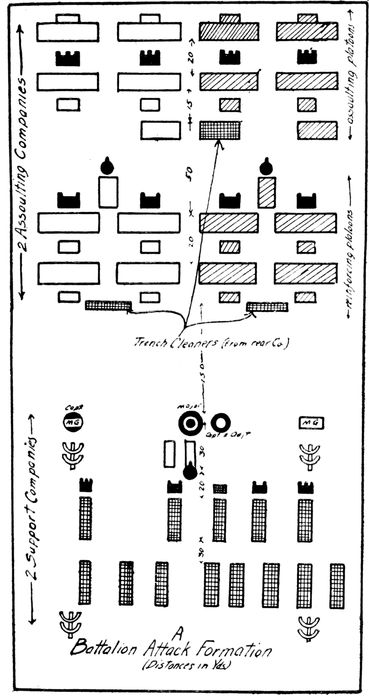
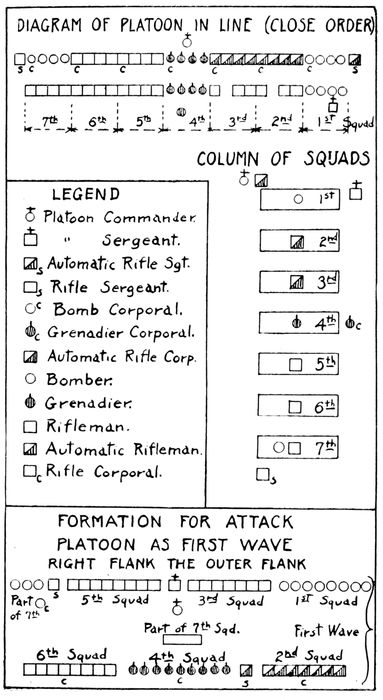
Hand Grenades. In the offensive, hand grenades are used to reach the enemy under cover in trenches, etc., by high-angle throwing. It is an excellent weapon to clear out the trenches that the assaulting columns are advancing against. The H. G. and the R. G. break the resistance, so to speak, of the line that the attack is to capture and the assaulting troops are to occupy and hold. The 8places of the hand grenadiers in the assaulting column are seen in the diagram.
The hand grenade is the principal weapon in trench combat—that is, to obtain progress laterally and in depth in the trenches after a breach has been made at one point, as every foot of trench has to be fought for. Each section of trench, between traverses, is cleared of the enemy by throwing H. G’s into it. It is then occupied and the next section cleared and occupied in a similar manner.
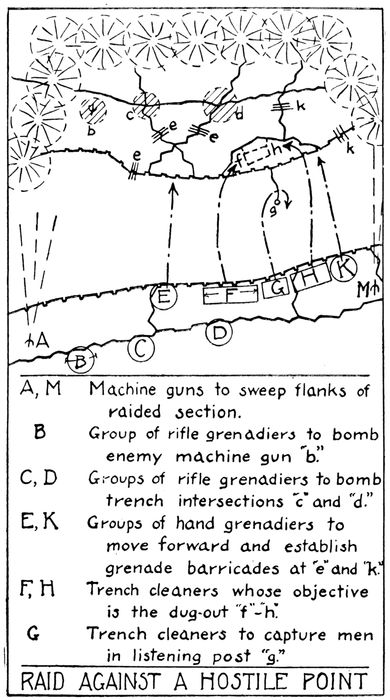
In a raid on the enemy’s trenches hand grenades are used to clear up the particular stretch of trenches before the raiding party jumps into them. This will be taken up in detail later.
Rifle Grenades. The rifle grenade in the offensive is employed similarly to the hand grenade, to reach an enemy under cover, but at a greater distance.
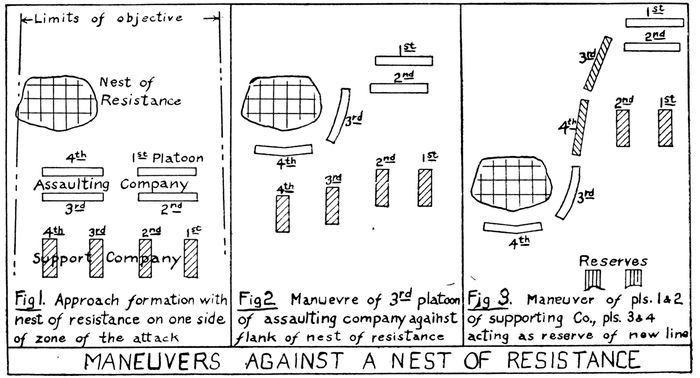
It is used to help reduce all nests of resistance that the assaulting infantry runs up against, and when the artillery barrage is not obtainable for that purpose.
They may be used as a barrage to cut off the retreat of a small group of the enemy that is being attacked in front.
Rifle grenades are very useful against counterattacks, especially before machine guns 9can be brought up and the defensive artillery barrage obtained.
The A. M. R. The A. M. R., with its great mobility and ease of control, makes it possible to carry this weapon in the assault and to be used immediately the wave is halted for any reason. In this connection, it can be instantly employed against a nest of resistance.
It is used in the assault to protect the flanks of the assaulting waves, especially when stopped.
As the A. M. R’s are brought up in the first wave, they are immediately available against counterattacks upon the captured position. In a similar manner they are employed to hold ground gained until an artillery barrage can be obtained to support it and before the machine guns come up.
The Riflemen. The riflemen, with bayonets fixed, do the necessary fighting in the interior of the enemy’s position. As was stated before, the H. G. and the R. G. break the enemy’s resistance and the rifleman does the hand-to-hand fighting required to occupy the objective lines of trenches.
To make a little résumé, we may say that the best results will be obtained by the proper combination of all of these weapons. The low trajectory weapons (rifle, A. M. R., H. G., 10and the 37 mm. gun) concentrate on everything that shows itself above the trenches; while the high-angle missiles (H. G. and R. G.) seek out the enemy under cover. The riflemen complete the success of the specialists by rushing forward and occupying the enemy’s position and fighting hand to hand for it if necessary.
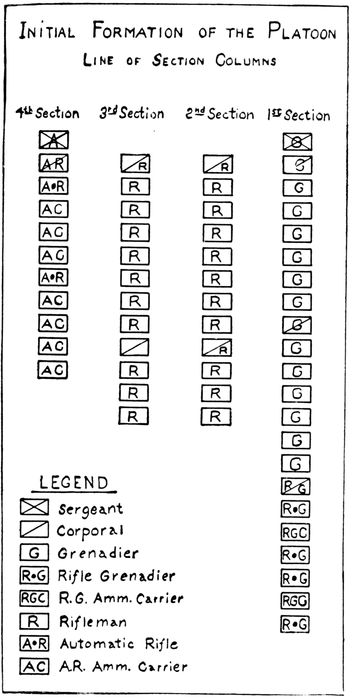
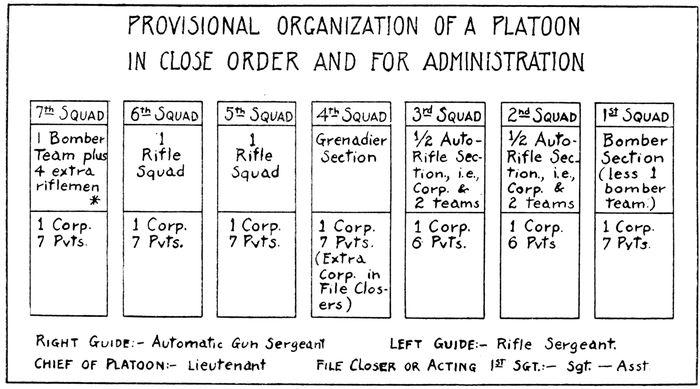
Initial Formation. The initial formation of the platoon in sections of specialists as per diagram is almost self-explanatory. Each group of specialists is in this formation under the control of its leader ready for any maneuver.
The platoon is the attacking unit because it contains all the specialists required for the assault. The frontage of an offensive is composed of a series of platoons, each with a definite objective, and each with reinforcing platoons in depth following.
12All other formations, whether for combat or ordinary march maneuvers, are based upon this initial formation.
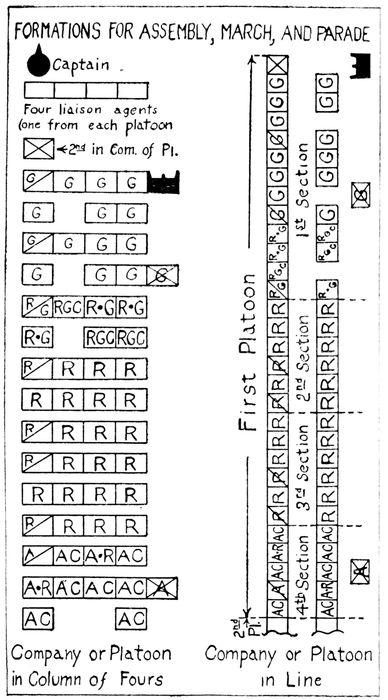
Close Order and March Formations. From the initial formation, we pass to the close order formations, used for parade, roll call, or the march.
(a) First we have the company in line, which is the habitual formation for assembly.
(b) From the company in line is formed a column of fours, for marching. The squads that are complete execute “squads right or left,” while the remaining odd number of specialists in any section execute the easiest movement to bring them into column of fours, sometimes with blank files behind the rest of their section.
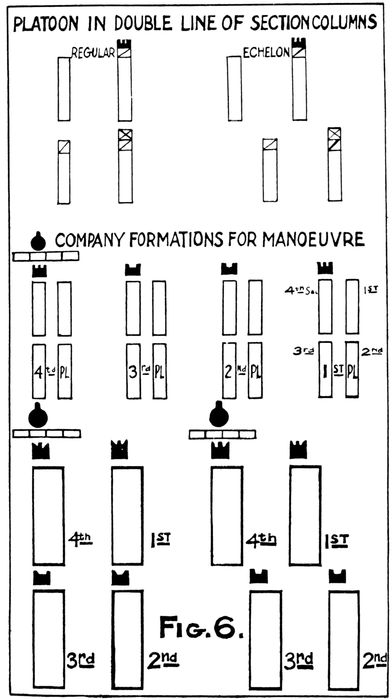
Approach March. The approach march is a name given to the formations that the platoon in section columns takes up to minimize casualties while crossing the zone of artillery fire.
These formations are taken up under the conditions of open warfare, or, in the case of reinforcements, following up an attack.
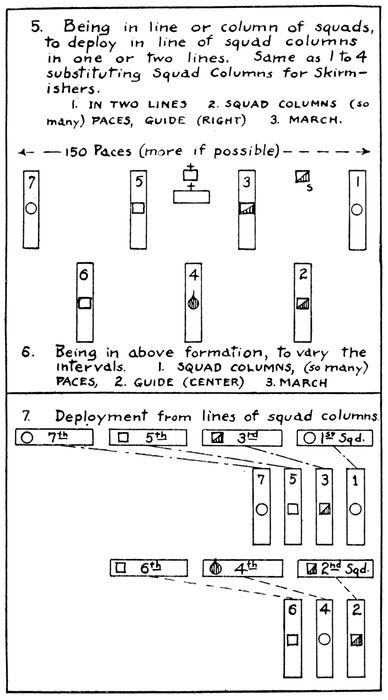
The formations may be in “Line of Section Columns” or “Double Line of Section Columns.” In the first case, each section may be in single file or in double column; or again the first and fourth platoon section may be in double column and the second and third sections in single file: In the “Double Line of Section Columns” any of the formations in the diagrams may be taken up, depending upon circumstances.
14The interval between sections is variable, but usually the interval is such as to give room for the proper development into line of skirmishers.
Skirmishers. This formation of skirmishers is not taken up for the assault, but under similar conditions as that of the approach march—that is, for open warfare and for the advance of the reinforcing platoons behind an attack.
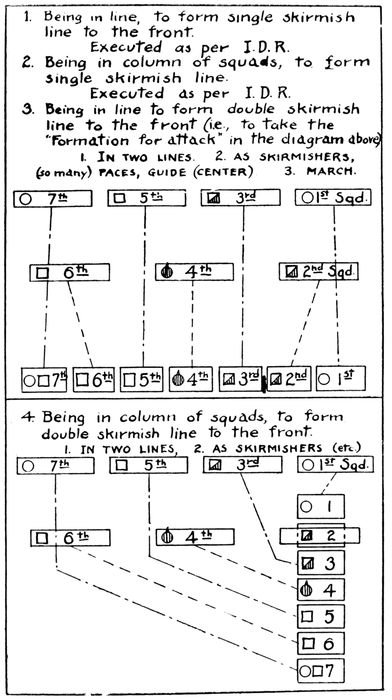
To form the skirmish line, each section column simply deploys into line, each man going either right or left front into line from the regular formation of double line of section column.
If you inspect the figure, you will see that this deployment into skirmish line gives practically the type formation of the first reinforcing platoon in the assaulting column.
Assaulting Formations. In the attack the platoon forms and goes forward in waves. A wave is not one line of men, but is composed usually of two or three lines.
16The composition of the lines of the wave depends upon the duties and functions of the different specialists during the attack.
Let us recapitulate the functions of the specialists in order to show the reasons for their positions in the assaulting wave.
The First Line of the Assaulting Wave. In this line are the grenadiers, whose duty it is to clear the enemy out of the objective trenches. Here also are the A. M. R’s, employed to protect the flanks of the wave. When the wave is halted, the A. M. R’s must be available for instant use against any nest of resistance and must therefore be in the first line. They are also used in the captured trench to withstand an enemy’s counterattack, which may develop within five minutes after its capture.
The Second Line of the First Wave. We have here the rifle grenadiers who help the hand grenadiers break up the enemy’s resistance and clear the trenches of the enemy. This is done by fire of rifle grenades from the second line. Here, also, we have all the riflemen of the platoon, whose function it is to follow up the success of the specialists and drive the surviving hostile men out of the trenches with the bayonet.
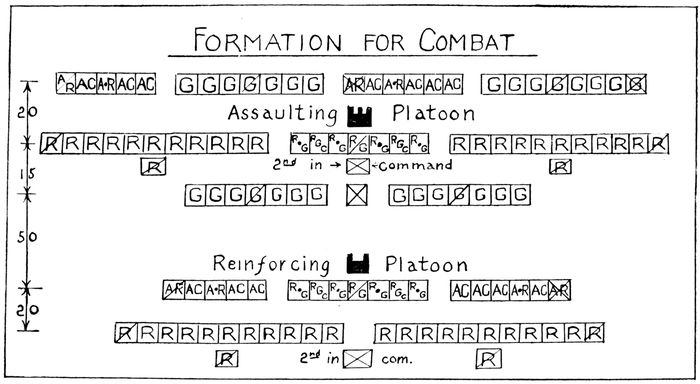
18Third Line of the First Wave. In this line we have the “trench cleaners” or “moppers-up.” These are hand grenadiers furnished by the reinforcing platoon and their function is to clear the enemy out of the trenches, both laterally and in depth of the position. The assaulting column remains above ground and continues across the position to the objective line of trenches, which is usually the limiting objective of the attack. The “trench cleaners” picket all entrances and exits of dugouts to allow none of the enemy to come out after the waves have passed and fire into the backs of the assaulting troops.
These three lines compose the first wave, and we see that the specialists are placed in the lines in the order of their duties.
Company Organization
1. For the purposes of drill and maneuver, the regiment will be organized as follows:
(a) One training company, as at present constituted, will form two platoons.
(b) The new organization contemplates four platoons to the company. When, for training purposes, a complete company is necessary or desirable, companies will be combined.
202. For a training company of two platoons, the 2nd in command (sergeant) of the first platoon is the right guide; the 2nd in command of the 2nd platoon is the left guide.
3. The platoons, in line or column, are arranged as at present.
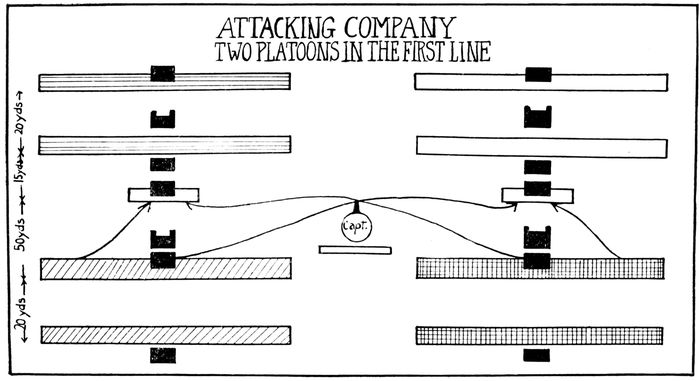
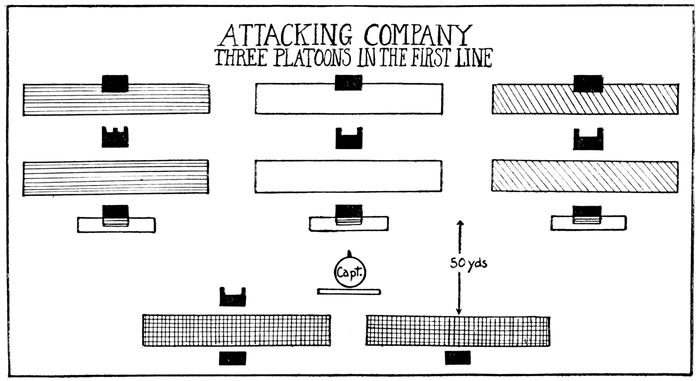
4. The usual arrangement of a company for attack is to place two platoons in the 1st wave and two in the 2nd wave. The two platoons in the 1st wave are known as the assaulting platoons; the two in the 2nd wave, as the reinforcing platoons. The normal distance between the assaulting and reinforcing platoon is about 65 yards. Sometimes three platoons are placed in the 1st wave and one in the 2nd wave.
5. The first wave is followed, at a distance of 15 yards, by the hand grenadiers of the reinforcing platoon, who are sent forward by the commander of the reinforcing platoon to act as trench cleaners or moppers-up for the first wave. Fifty yards behind these is the remainder of the reinforcing platoon. There are no “moppers-up” for the reinforcing platoon.
6. The captain of a company has four liaison agents constantly with him, one being 21furnished from and for each platoon. They march immediately in rear of the captain.
7. The post of the captain is between the 1st and 2nd waves.
Platoon Organization
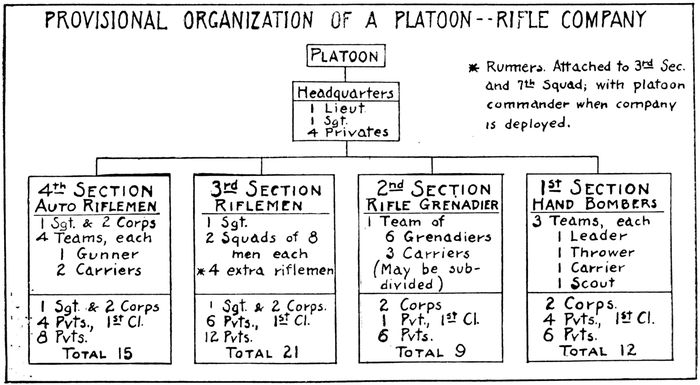
1. The composition of a platoon is as follows:
222. All platoons are alike in numbers, organization, and armament.
3. When the platoon is in column of squads or in line, the post of the platoon leader is as at present. When in line of section columns he is normally in front of the right center section, although he may be in front of some other section if he sees fit. In attack formation he is in the center of his platoon between his first and second lines.
4. When the platoon is in line, the post of the 2nd in command is in rear of the center of his platoon. In line of section columns he is in front of the 3rd section. In attack formation he is in rear of the fight center of the second line.
Platoon Movements
1.
1. The 1st Section (Grenadier Section) contains 15 rifle grenadiers (including the section sergeant) and 7 hand grenadiers. When in column of squads, the rifle grenadiers march as a squad, in rear of the hand grenadiers. 23The 1st Section constitutes 3 squads, each having the No. 3 in the rear rank as a blank file. The Section Sergeant marches abreast of the rear rank of the 2nd squad of his section. Line is formed by executing squads right or left.
2. The 2nd Section (Riflemen Section) contains 10 privates and 2 corporals. One corporal has charge of 7 men, the other of 3 men. When in column of squads, the section forms one complete squad and the front rank of another. Corporals are number four. To form line at the command “Squads left (right),” the complete squad executes “Squad left”; of the half squad the Nos. 3 and 4 execute “Twos left”; the Nos. 1 and 2 likewise execute “Twos left,” thus placing themselves in rear of Nos. 3 and 4. To form column from line at the command “Squads right,” the Nos. 3 and 4 of the incomplete squad move forward two paces, execute “Twos right,” and place themselves in rear of Nos. 3 and 4 of the preceding squad; Nos. 1 and 2 move forward two paces, execute “Twos right,” and place themselves in rear of Nos. 1 and 2 of the preceding squad.
3. The personnel, numbers and movements of the 3rd Section are identical with those of the 2nd.
244. The 4th Section (Automatic Rifle Section) contains 1 sergeant, 1 corporal, and 9 privates (total of 11). One complete squad is formed and 2 privates are left over who march in rear of Nos. 1 and 4 of the squad. The corporal is No. 4 of the front rank. No. 3, front and rear rank, are the gunners. The sergeant marches abreast of the rear rank of the squad in the line of file-closers; when line is formed, the two men left over form one additional file on the left (right) of their sections. In forming for attack formation, the No. 4 of the two men left over attaches himself to the front rank gun crew and goes with them; the No. 1, to the rear rank gun crew. The sergeant remains with his gun crew if the guns are separated, or assumes charge of both when together.
5. If the training company contains more men than are necessary to fill the platoons as indicated above, such additional men will be carried as riflemen and attached to the second and third sections of the platoons.
II
1. To form line of section columns from line.
The left file of each section moves straight to the front, followed by the file next on its 25right, and this in turn by the other files of the section. The section sergeants of the 1st and 4th sections place themselves at the head of their respective sections.
2. To form line of section columns in columns of twos or fours.
“Half-squads (squads) right front into line.”
3. To form line from line of section columns.
“Sections, right front into line.”
4. To form column of squads from line of section columns.
First form line of section columns in column of squads—then “Column of squads—1st (4th) section forward (column right or left).”
5. To form line of section columns from column of squads.
The left file of the leading section moves straight to the front, followed by the remaining files of the squad, then by the left file of the second squad, etc. The 2nd, 3rd, and 4th sections oblique to the right (left) in column of squads to section interval and, when in rear of their place, form column of files. The section may thus be marched in echelon, or line may be formed by halting the leading section, or the sections in rear may be double-timed 26to the line established by the leading section.
6. To form line of section columns to the flank, command:
“Sections, column left (right).”
“Line of section columns.”
7. Frequently, for convenience in maneuvering, the platoon leader may, when in line of section columns, wish to form only two columns from his four columns. In such event he will command:
“Double sections, 1st and 4th sections forward.”
One rifle section will follow the first section. The other rifle section, the 4th section. The rifle sections in such formation are always in rear of the specialist sections.
8. Intervals between sections or double sections are opened and closed by the command:
“To —— spaces extend (close).”
III
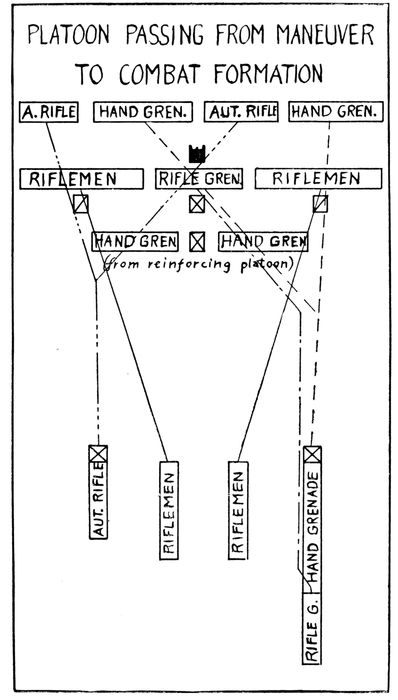
1. Attack formation is taken up from line of section columns only.
2. The attack formation is always in two lines. The two lines constitute a wave.
3. Hand grenadiers and automatic riflemen 27are always in the first line. The riflemen and rifle grenadiers are always in the second line in the assaulting platoon. Rifle grenadiers may be posted in the center of the second line, or on either flank, as the platoon leader directs. Similarly the automatic riflemen may be in the center, on either flank, or divided between center and flank of the first line, as the platoon leader may direct.
4. The 1st and 2nd lines are separated by a distance of 20 paces.
5. To pass from line of section columns to attack formation, the platoon leader commands:
“Form for attack at (place). Automatic rifles to center (left flank) (right flank) (both flanks) (left and center). Rifle grenadiers to center (left) (right).”
Only the automatic riflemen and grenadiers need be designated. The remaining men accommodate themselves to their movements.
At the above command the 2nd and 3rd sections stand fast until the 1st and 4th sections have cleared their front. They then move to their places led by the corporal at the head of their respective sections.
This movement will be executed at first in quick time; as men become more proficient, in double time and at a run.
IV
1. The arrangement of specialists in the reinforcing platoon differs somewhat from the assaulting platoon. The hand grenadiers of the reinforcing platoon are sent forward in two squads to follow in rear of the 2nd line of the first wave at a distance of about 15 yards. The two squads are abreast of each other, the section sergeant between them.
2. The rifle grenadiers of the reinforcing platoon are then moved up into the 1st line.
3. The riflemen of the reinforcing platoon remain in the 2nd line.
4. The position of the platoon leader of the reinforcing platoon is in front of the center of the 1st line. The position of the 2nd in command is the same as in the assaulting platoon.
CHAPTER II DEVELOPMENT OF A POSITION FROM AN OPEN WARFARE BATTLE — Successive Phases of the Organization — Principles of the Organization — Elements of the Organization
General Use of Fortifications. The first use of fortifications, whether hasty or permanent, is to give shelter against hostile fire. The more deliberate use of fortifications is to increase the holding or fighting power of troops by the proper employment of the natural defensive features of the ground and by artificial devices.
Change from Battle Lines to Trenches of a Position. During a battle, as we understand it in open warfare, as soon as the fighting lines are halted for any reason, every man immediately begins to dig in for shelter against the enemy’s fire. If the halting of these fighting lines is more or less permanent these “skirmish holes” are connected, and we have the 35beginning of a rude trench. We must remember that in a battle troops are disposed in depth in a series of lines. All these lines dig for protection in a similar manner, giving the beginning of several lines of trenches. If the troops remain for any time in this position, it is necessary to have routes from the rear to the front to carry up ammunition and supplies to the different lines. These communication routes are also dug in, and we have the beginning of communicating trenches. Soon the men will begin to seek better protection against rain, cold, and overhead fire, and build themselves some kind of shelters. In a similar manner command posts and supply depots are established.
In time there is a complete skeleton of a series of lines of trenches outlining a position. If the mission of the troops is to remain and hold the ground, the necessary plan of organization for the final position will have to be based upon this skeleton. The purpose of this new organization, as we have noted, is to establish the position so that the ground can be held by fewer troops.
Active and Passive Elements of a Position, Especially Support Points. The first fire trench of a position is continuous, but it is not good practice to man the whole of this line, 36because this would take too many men and defeat the purpose of the fortifications. Secondly, a better defense can be established by garrisoning a series of strong points, or salients, from which can be obtained flanking fire. In the first line these are called support points. The trenches connecting these support points are retained as such, but are not usually manned. This curtain trench, so to speak, is retained for communicating purposes, and to deceive the enemy as to the real points of defense. A few watchers are left in it.
The first line, then, is a series of support points, well defended by men and special weapons, and at such distances apart as to support each other.
Division of Position. The garrison of such a support point in the first line is a company, and the captain is responsible for the holding of this ground. (The platoon, we must remember, is a tactical unit.) In dividing the first line into these active elements the size of each support point depends upon the importance of the ground or of the tactical situation.
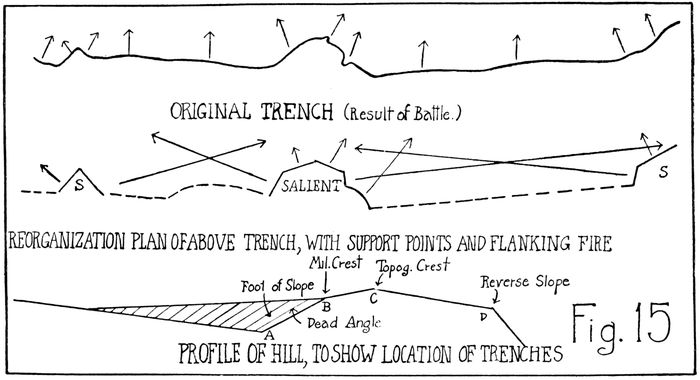
38Similar natural strong points are also located in the second line. They will be fewer and farther apart in this line than in the first line, which is exposed to hostile attacks. These points in the second line are connected with the support points and together the group is called a center of resistance. The command of such a center of resistance, including one or two support points in the front line, falls to a battalion commander with his unit. For example, the area of a center of resistance under the command of a Bn. C. O. will include, say, two support points in the first line with a company in each, and the strong point in the second line with two companies.
In the third line, also, natural strong points are located and organized for defense. The command of this strong point, including, let us say, two centers of resistance, falls to a colonel with his regiment. Such an area is called a sector, or a sub-sector. If it is a sub-sector two such constitute a sector in command of a brigadier-general.
Different Lines of a Sector. We have now arrived automatically at the fact that each sector is composed of a series of lines in depth, each defended in strong points.
The first line is termed the line of resistance, as the first defense is made against the enemy’s attacks in the support points of this line.
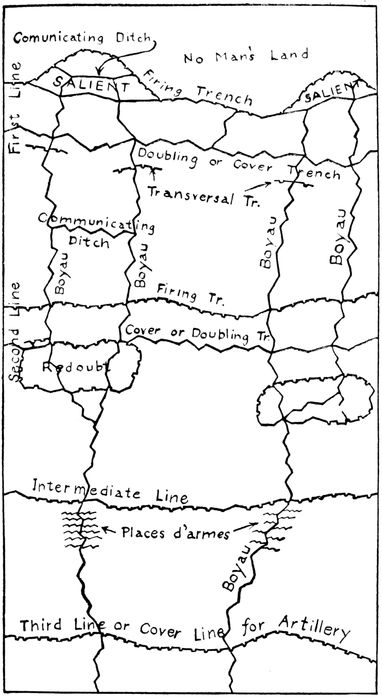
40The second, or main line of resistance, is called the support line. In the strong points of the centers of resistance are the reserves and the headquarters of the battalion commanders.
The third line is called the covering line of the artillery, because it defends the batteries distributed behind it. It also contains the reserve troops of the sector, a battalion usually holding each strong point. Here are established the headquarters of the colonel and the different central depots of the sector.
The above three lines constitute one position. There may be several positions in depth at distances of three miles or more apart. Usually there are two positions and sometimes three. It is said that the Germans have as many as six positions in depth in places. The first position only, of course, is permanently occupied.
Advantages of the Continuous Trench. The continuous or curtain trench between support points must not be eliminated for several reasons. The trench will deceive the enemy as to the location of the elements of support points. If this trench were absent the enemy could easily locate these, and subject them to concentrated artillery fire. The position cannot be hidden from airplane observation but the essential elements, such as emplacements, dugouts, etc., must be concealed.
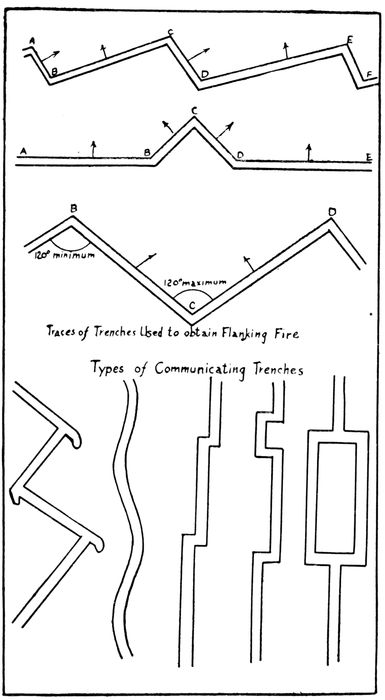
42The curtain trench serves for communicating purposes for lateral movements of troops and for liaison between neighboring units.
The absence of the curtain trench would leave breaches in the line where in a general attack units could concentrate and break through. In such a general attack the curtain trench is occupied and defended by the reserves. Barbed wire, of course, protects the entire front.
These trenches also serve, if necessary, as cover for reserves acting as reinforcements to the adjacent support points, as there is only sufficient shelter in a support point for its own permanent garrison.
Lastly they may serve as trenches of departure in the offensive.
Importance of Flanking Fire. It is possible to have the support points at intervals because flanking fire from these will command all ground in front. The importance of flanking fire cannot be overestimated. Everything must be done to obtain it.
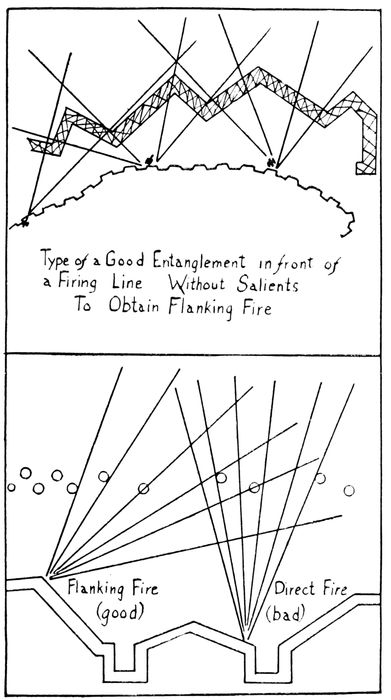
44Sometimes it is impossible to obtain flanking fire because of lack of salients. If this is true the trace of the first line trench must be rectified to give flanking fire along the line as per diagram.
When neither of these two methods is possible small combat posts with machine guns are located in advance of the line to obtain flanking fire.
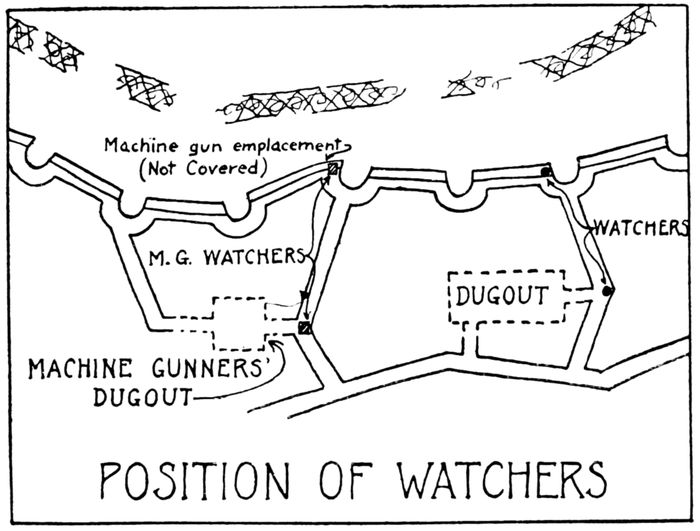
The machine gun is the best weapon for flanking fire. Several emplacements are constructed for each machine gun, but during the bombardment it is kept under cover in a dugout. When the attack develops the machine gun is quickly set up in the proper emplacement. If kept in a permanent emplacement the enemy will soon locate it and put it out of business by artillery fire.
If no emplacements are possible or if they are destroyed machine guns are operated on open ground or in shell holes.
Field of Fire. With proper flanking fire a line can be defended with a shorter field of fire than otherwise. A hundred yards of field of fire is sufficient with good flanking fire and accessory defenses, such as barbed wire, etc.
46Location of Trenches. Lines of trenches which are the result of a battle are not always located in the most logical positions. They are the results of the exigencies of the battle. However, it is well to know the best locations for the trenches of a position under different conditions in order to place them there when possible.
In flat country, of course, it makes no difference where the trenches are located. On the profile of a hill, however, the question is where to locate the first and where to locate the second line. Let us consider Figure 15. Point A is out of the question as you have no view of the enemy. At B you can observe the enemy’s line and he can observe yours. However, the enemy can shell you at this point and observe the results. At C the same conditions obtain as at B, except there is a dead angle directly in front. At D you cannot observe the enemy nor can the enemy observe your line. From these considerations we see that the proper location for the first line will be at B as you must be able to observe the enemy and all the ground in front. Your second line should be located at D where the enemy cannot observe and bombard your position. At D the line can be made as elaborate as you have time, men, and material, because you are more or less unmolested by the enemy’s fire and observation.
The reverse slope is of the very greatest 47importance in organizing a position. Movements of troops and supplies can be easily accomplished here under cover. Deep dugouts can be constructed with the least work. But the greatest advantage lies during the bombardment. The enemy is not able to observe the accuracy of his fire on the reverse slope so that the elements in this line are left more or less intact. For this reason the line on the reverse slope becomes the most important line of resistance against the enemy’s attacks. The Germans habitually organize their reverse slopes very strongly.
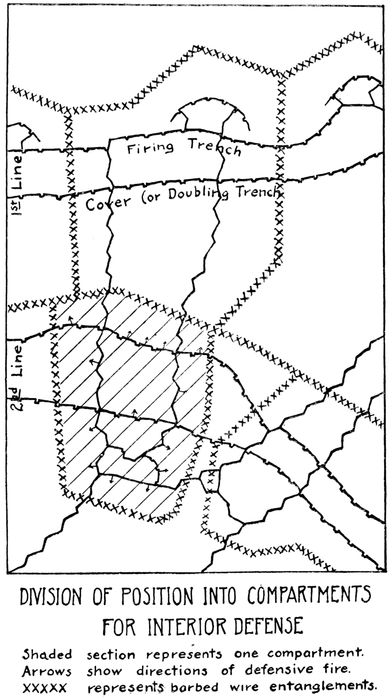
Division of the Position into Defensive Compartments. We have already spoken of the sector in depth by successive lines. In the same way it is necessary to organize the positions for lateral defense. A support point may be captured by the enemy and from this ground he can launch a flanking attack on the adjacent part of the position. It is necessary that there should be an established defense against such an attack, and for this purpose each sector is divided into compartments, so to speak, with all-around defense.
Boyaux or communicating trenches on the flanks of these compartments are organized as firing lines with barbed wire belts running parallel and with machine guns disposed for 48flanking fire. We have then each sector cut up into compartments capable of independent resistance in all directions, if the surrounding compartments are captured by the enemy. Such a compartment also has the advantage of serving as a base for a counterattack against an adjoining one that has fallen into the hands of the enemy.
In a sector the responsibility of such lateral defenses falls especially upon the colonel.
Concealment. All of the essential elements of a position, emplacements, dugouts, etc., are more or less without value if they can be seen by the enemy and subjected to heavy artillery fire. Everything that is possible must be constructed without the observation of the enemy.
It is important to hide your works by making them fit in with the color scheme and shape of the surrounding ground. False or dummy trenches, emplacements, shelters, etc., are constructed to cause the enemy to waste his ammunition. The art of camouflage is also extensively employed for this purpose against both ground and aërial observation.
Plan of Organization. We have seen that 49the first outline of the trenches left as a consequence of the battle must be modified in detail to obtain better protection and organization. The complete plan of reorganization is laid down by the commander of the sector and is called the Plan of Organization.
This plan is drawn up as soon as the position has a permanent garrison. The Plan of Organization must be faithfully followed by all the successive garrisons of the sector. After its adoption, even the commander of the sector himself cannot modify the plan without the consent of the general in charge.
The real value of the position depends upon the amount of continuous work that has been done in carrying out the original plan.
Outline of the First Line. As was seen before, the original trace of the first line was established as a consequence of the needs of the battle. In the organization plan, it is necessary to introduce several modifications in this trace. The commander responsible for this change should place himself in the situation of the enemy and consider an attack upon his own lines. From this consideration he will introduce such modifications as will make this task as difficult as possible.
The responsibility of making this modification in the trace of the first line does not 50devolve upon the captain in the first line. As a rule if it were left to him few changes would be made because of lack of initiative on his part, or because of fear that if the line were captured he would be blamed for having changed it. This task falls upon the battalion commander who is responsible for the center of resistance, with the consent of the sector commander. The reason for this is that the sector commander is the only one of these officers who knows the subsequent use of this particular sector, whether for defensive or offensive purposes. If for defensive purposes the line may be carried as close to the enemy’s line as possible. If the sector is being organized for an offensive there must be enough distance between to keep his own line out of the zone of artillery dispersion when the target is the enemy’s line.
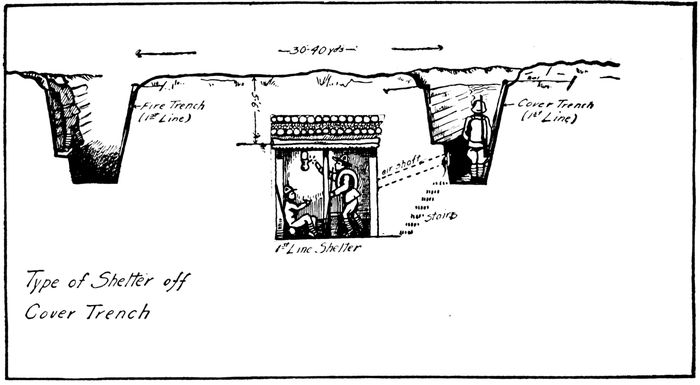
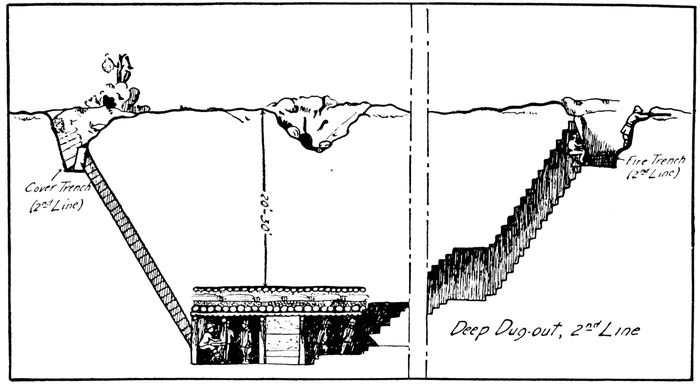
Cover Trench. In general all fire trenches have a second trench behind, called the doubling or cover trench. The use of the cover trench is not primarily for defensive purposes. It has special uses.
52The majority of the troops in the first line are kept in the cover trench in shelters located there. The first line is habitually manned by only a sufficient number of men to assure observation and security. The rest of the garrison remains in the shelters of the cover trench to get as much rest as possible. It is very important that comfortable shelters be located in the doubling trench. If troops are exposed to the elements and bombardment their value decreases very rapidly. If the shelling becomes too severe the men in the first line retire to the shelters of the cover trench until the attack develops.
Another use of the cover trench in the defensive is to keep here a necessary number of troops for reinforcing the first line when necessary and for counterattack against the same if it is taken. This latter use establishes the distance between the two lines, which is from thirty to forty yards, so that hand grenades can be thrown from the cover trench into the first line.
Behind each support point there is usually a lateral communicating ditch called the circulating ditch which should not be confused with the cover trench.
Advance Posts. In front of the firing line certain advance posts are established. There are three kinds of these: listening, observation, and combat posts.
The listening post is not under the control of the commander of the support point but is in the service of the Intelligence Officer. 53It is furnished with a microphone for the purpose of picking up enemy’s telephone messages in the hostile line.
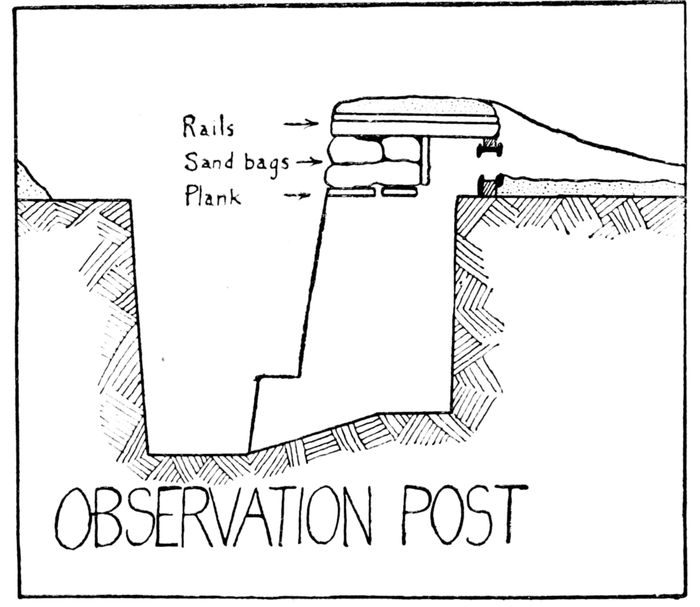
The observation post belongs to the sector and is used for purposes of observation and security.
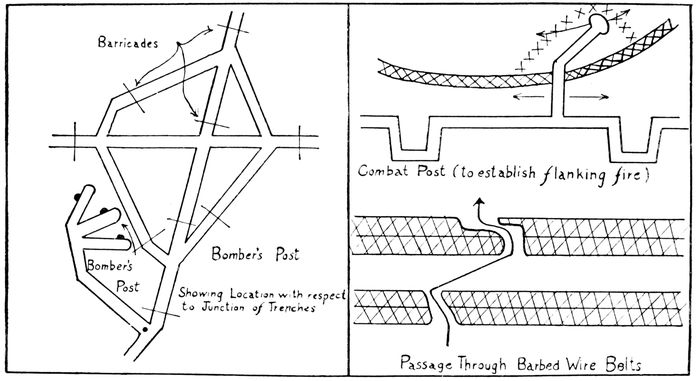
The combat post is established to obtain flanking fire along the barbed wire entanglements or it is used as a bombing post when in close proximity to the enemy’s trenches.
Sometimes a series of combat posts are connected and a new trench established in 54front of the firing line. This is called the observation line. It is best to avoid this practice as there is always the question whether to hold or abandon this line when the enemy’s attack develops. In either case there are grave disadvantages. If it is held you have a weak line. If you abandon it the enemy can use it for shelter.
Advance posts give excellent service if not too numerous. If there are many of them they are a temptation for hostile raids.
Dimensions of Trenches. These can be found in text-books on the subject. The general idea is that they are to be narrow and deep to prevent observation and to present a small target for high-angle fire.
Loopholes. Loopholes are used in the ordinary life of the trenches for observation and sniping purposes; but against the real attack of the enemy the firing is done over the parapet. If it is necessary to meet the enemy in hand to hand combat the men climb up on the parapet.
Traverses. Traverses are used to localize the effect of shell or grenade explosions, and to prevent enfilade fire.
They are sometimes used in long stretches of boyaux or communicating ditches as emplacements for A. M. R. to enfilade the same if the enemy penetrates the position.
55Transversal Lines. Transversal lines are usually constructed between the first and the second lines and between the second and the third lines. They are short stretches of trenches parallel to the front for special purposes: such as disposing of machine guns and trench mortars in depth; bombing posts for rifle and hand grenadiers; depots and observation posts.
Command posts are usually located in such small transversal trenches, a little in rear of the lines they are in command of. For instance, the captain in charge of a support point might be located in a transversal just in rear of the cover trench.
Support Trenches. The second or support line is established at such a distance that the first line is covered by its fire if the latter is captured.
Also the second line should be placed so that it will be out of the zone of dispersion if the first line is the artillery target either of your own or of hostile fire. This places the distance between the two lines at from 150 to 400 yards. At this distance also rifle grenade fire can be used in conjunction with an artillery preparation for a counterattack against the first line.
The organization of the second line is the 56same as that of the first; in other words, the same principles and elements of defense are used: making employment of barbed wire, flanking fire, cover trenches, etc.
The second line is the main line of resistance and must be made as nearly impregnable as possible. For this purpose it must be thoroughly and completely organized.
In the support line are the reserves of the C. of R. and for their proper shelter they should have very deep dugouts, and all the requisites for the comfort and rest of the troops.
Redoubts. Behind the support line is a redoubt containing the command post of the battalion commander. It is the last strong point of the center of resistance and is organized for an all-around defense.
The line of redoubts is the last line of serious resistance. If the enemy penetrates this line a breach has been made in the position at this point.
Boyaux and Communicating Ditches. As we have said before trenches for communicating purposes must be dug both in depth and laterally. We shall call those from front to rear boyaux, and those running laterally communicating ditches.
The number of boyaux is not fixed as that of 57the different lines. There must be at least one between each support point and its center of resistance.
Usually boyaux are used for movements in both directions. Often certain boyaux are designated for entrance only and others for evacuation. The numbers of the latter are usually less than the former.
In an attack all boyaux are used for movements from rear to front.
All movements to the rear while reinforcements are being brought up must be executed in the open ground, exceptions being made in the case of wounded.
Boyaux are important for the movement of supplies and ammunition, but above all they are essential for reinforcements during battle. The greater part of the troops in a sector is held in reserve in the second and third lines. This disposition is only possible if you have good boyaux to the front lines.
All boyaux and communicating ditches are narrow and deep. Boyaux are wider between the second and third line than they are between the first and second. Evacuation boyaux are usually wider than others. The trace of a boyau must be such as to prevent enfilade fire.
At intervals of about ten yards turnouts large 58enough for a stretcher are constructed in the side of the boyaux for passage of troops in different directions. Boyaux are named and signs are put up similar to those for streets in a city. The same name of a boyau must be kept from the third lines to the first.
At branches of the main boyaux they are dug a little deeper to avoid mistakes of identification.
As was said before certain boyaux are organized for defense.
It may be said here that supplies carried up at night are usually brought along on top of the ground close to the boyaux. This gives freer movement and the carriers are close to the cover of the trench if needed.
Accessory Defense. Of all the accessory defenses such as barricades, abatis, trous-de-loup, etc., the most important by far is barbed wire, which is almost exclusively used for obstacles.
Barbed wire should be placed from twenty to fifty yards in front of the first line. At this distance shelling of the barbed wire belts will do very little damage to the first line.
The wire entanglements must be under fire of the first line.
60The trace of the wire belt is not necessarily parallel to that of the firing line, but should be so placed as to obtain flanking fire along the wire belts. Good entanglements are constructed in double belts, the distance between the two belts being from ten to twenty yards, the farthest belt, of course, being constructed first.
Breaches must be left through the wire entanglements for the passage of patrols, friendly raiding parties, etc. Portable sections of barbed wire are used to close these passages when necessary.
All accessory defenses must be concealed so they cannot be easily observed and destroyed by the enemy.
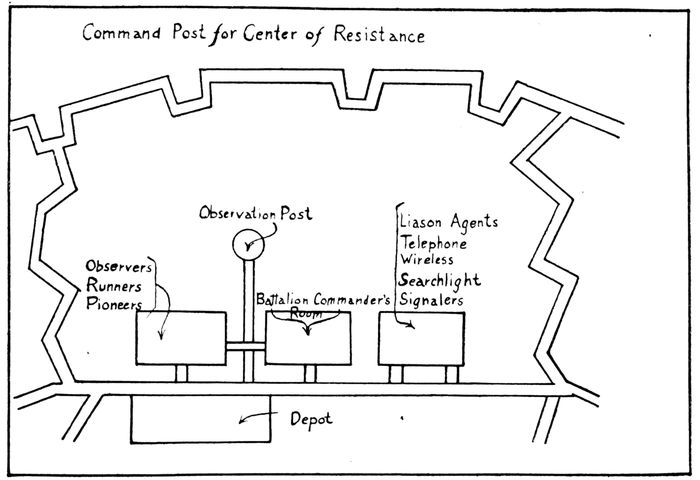
Command Post. A command post, in the full sense of the word, contains the headquarters of the leader of a division of a sector.
The command post must first of all be a good observation post, after which the other requisites are installed. When the observation post has been constructed the following are built: a room for the headquarters staff to work and to sleep in, a telephone central, dugout for liaison group, and a depot.
The preceding discussion is a development of a position from battle conditions. On the other hand if you are unmolested by the 61enemy the order of organizing a position would be as follows:
(1) Construct the emplacement to obtain flanking fire.
(2) Construct barbed wire entanglements.
(3) Observatory and dugouts.
(4) Trenches.
CHAPTER III SECTOR AND TRENCH DUTIES — I. Plan of Defense — Details of Trench Duty — Use of Infantry and Artillery Weapons, and Liaison — Artillery Support in a Sector — Instructions for Sentinel, Watcher, and Observer
Definition. The Plan of Defense contains all the different duties necessary to make a proper defense of the position. The execution of these duties is the execution of the Plan of Defense, which follows logically and depends directly upon the Plan of Organization.
Principles of the Plan of Defense. (a) The most important principle of organization of a position is the disposition of troops in depth. It is necessary to have plenty of support and reserve units disposed one behind the other. Only one-sixth to one-third of a garrison in the support point of the first line remains in the trenches for the purpose of observation and security. The rest remain in the rear as a reserve for reinforcements or counterattacks.
(b) Each trench, each nest of resistance, 63each area of the ground, must have a responsible leader. The garrison of any such area must never leave the ground allotted to its defense under any conditions of battle. The defense must be carried out by this garrison on the lines originally laid out. A leader is not allowed to fall back on troops in his rear or to take up a better position. The troops in depth are placed there for the purpose of reinforcements for the lines in front.
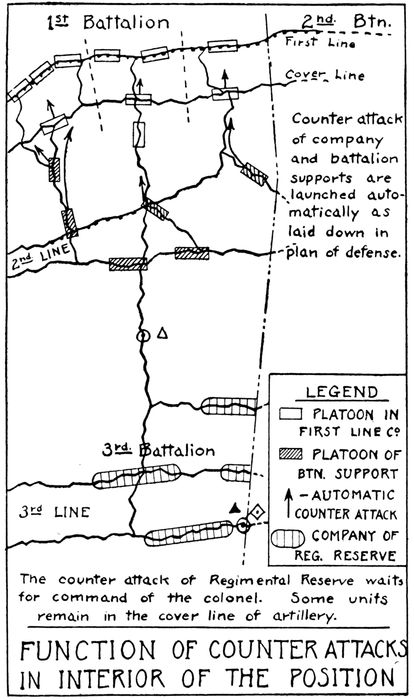
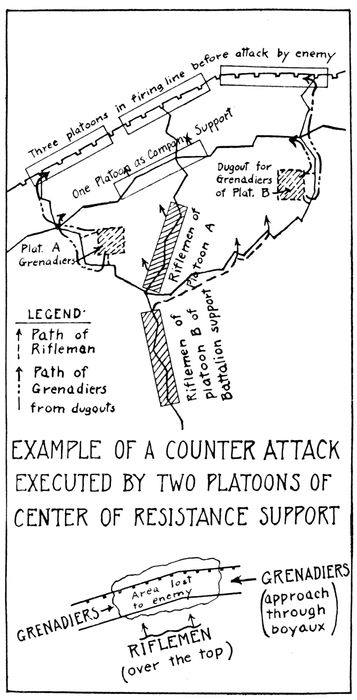
(c) Each part of a position that is lost to the enemy must be immediately retaken by a counterattack carried out by troops held in reserve. The first line is retaken by reserve troops in the support line, and similarly, if the support line is lost, it must be retaken by reserve troops held in the third line. If all three lines are captured, an attempt must be made to retake the third line by the reserve troops of the sector.
Form of Plan of Defense. In each division of the position from front to rear there must be a Plan of Defense. This plan always contains the five following elements:
- 1.
- Directions of the probable attacks.
- 2.
- Defense of the first line, or line of resistance.
- The outline of the first line.
- 64Location and mission of the troops in the first line.
- Employment of machine guns.
- 3.
- Counterattacks.
- Units which are used for the purpose.
- Directions or trenches to be used in the counterattack.
- Depots of grenades and sandbags for the counterattack.
- 4.
- Artillery support.
- Composition of this artillery.
- Establishing of the front of barrage.
- Infantry-artillery liaison.
- 5.
- Liaisons and supply during the hostile attack.
Guard Duties (Security). Security is obtained by the use of sentinels and patrols.
Sentinels must not be confused with observers, watchers, or snipers. Observers belong to the information service of the sector and are not on duty at night. Snipers operate only in the daytime. The watchers of the different lines give the alarm in case of an attack, and are on duty both day and night. Sentinels are posted in the first line or in advanced posts. Their work and number will 65depend upon the proximity of the enemy, the tactical situation, and above all upon the conditions of the wire entanglements out in front.
At night, one sentinel is posted, say, for example, every 10 yards in the fire trench of the first line. During the day, only enough sentinels are posted so that all parts of “No Man’s Land” can be observed. This will allow a maximum number of men to rest.
In the firing line, the sentinels work in three reliefs. When not on guard duty, they sleep. The remainder of the garrison in the cover trench, however, are available for work, for patrols, and to furnish supply parties. Sentinels should have their rifles resting on the parapet close at hand, ready to fire at a moment’s notice.
By day, the sentinels use a periscope or observe through a loophole. This practice is, however, strictly prohibited at night, when a, sentinel must observe over the parapet. As little challenging as possible is done, and then only in a very low tone.
Reconnoitering Patrols are the best means for security against attack. Every night the commanders of the support points or the centers of resistance send out patrols in front of the firing line. The strength of a patrol 66must be sufficient to carry back a wounded man, i. e., the number should be five, six, or more. The success of a patrol depends entirely upon the leader. He must be clever, daring, and observant, and the rest of the patrol is simply his bodyguard. He himself must observe the objective of the mission of the patrol.
Patrols should never be sent out without definite orders as to their mission. Such may be, for example, a reconnaissance of the enemy’s lines, to discover if the enemy has cut passages in his wire belt preparatory to an attack, to examine their own wire entanglements, etc.
The route of the patrol must be exactly determined; also the hour of departure and return designated. Word is passed along the line of sentinels that a patrol is out in front with the necessary information about the same. The preparation for a night patrol must be made during daylight.
Officer of the Watch. In the firing line the company commander arranges a roster of his officers for duty as officer of the watch. Also in each platoon the platoon commander will detail a N. C. O. of the watch. The officer of the watch is responsible for the duties of observation and security, and is especially 67responsible for the giving of the alarm in case of an attack and consequently for the calling of the artillery barrage by use of rockets, signals, etc.
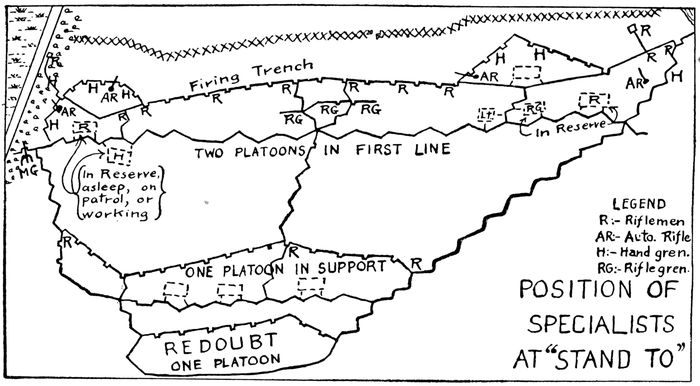
Standing to Arms. It is of the greatest importance that the troops in the first line are thoroughly trained in taking their positions when the alarm is given as quickly as possible, without confusion. The alarm is often given for practice in order to ascertain the amount of time it will take the men to reach their places in the firing line.
The command “Stand to” is usually given one hour before daylight and one hour before dark. At this time the company commanders arrange for inspection of arms, ammunition, and equipment by the platoon commanders.
Observers’ Duties. Every effort should be made to obtain information of the enemy, his trenches, and his wire entanglements. Any alteration in the enemy’s lines must immediately be reported. The importance of forwarding such information must be impressed upon all ranks. This duty is carried out by observers.
All men of the company are used as sentinels in the first line or as watchers in other lines, but not all are observers. Men who are to act as observers receive special training. 68A man to become an observer must have a special capacity for this task.
Each platoon should have at least six such observers, enough for proper reliefs.
The observers are placed:
1. In each company the observers are distributed in a number of observation posts properly camouflaged so as not to be discovered by the enemy. These posts may be in advance of the firing line, in the firing line, or at any point within the position that has a wide view of the front. The observers employ periscopes or field glasses. Everything of note that is observed is recorded and from these data the captain makes out his daily observation report.
2. Also in the sector there are 2 or 3 observatories from which the information is turned in directly to the colonel. These posts must be properly concealed and protected. In each one of these we find the following:
(a) Regulations posted that give the personnel, tour of duty, sector of observation, direction to special points of interest, and certain precautionary measures.
(b) Specially prepared blank forms upon which to record information gained by observation.
69(c) Field glasses, maps and sketches, and panoramic views of the ground in front, both visible and invisible from the observation posts.
(d) A telephone connecting the post with the nearest command post (center of resistance or sector).
The observers in these posts are directly under command of the intelligence officers of the regiment and are of a special personnel. They must be thoroughly familiar with the regulations of the posts, maps, panorama, etc.
The intelligence officer collects and coordinates all information gathered in the sector. Every morning he turns in a consolidated report made up from the information in the captains’ daily reports and from the records of the sector observatories. (In order to avoid confusion of the different daily reports these information records are kept on two different colored blanks, red and blue alternating each day.)
The report of the intelligence officer is signed by the colonel and sent on to the brigade headquarters. From the data of his complete report the intelligence officer very often must verify certain information by the use of patrols. For this purpose he makes a request upon the colonel for special patrols.
70Information is gathered from both airplanes and ground observatories. From ground observatories it is attempted to obtain the following data;
1. To ascertain the intentions of the enemy.
2. To properly prosecute attrition of the enemy’s works.
Attrition. By the word attrition in fighting is meant the gradual destruction of the enemy’s morale and strength, and demolition, little by little, of the enemy’s position. Trench warfare is not a rest or simply a time for guard duty. It is a phase of the battle in which you must do as much damage to the enemy as possible.
This work will also keep up the offensive spirit. For this purpose different means are used:
(a) Sniping: Each company in the first line uses its best shots as snipers. A sniper must be a good observer and he must depend upon his keen eye for evidences of the enemy, such as smoke of cigarette or the glint of a bayonet, giving proof of the presence of an enemy. Especially during hostile shelling will a too curious enemy come to his loopholes to observe the effect of the same. This is the sniper’s chance.
71In each center of resistance the snipers are placed under the command of a sniping officer. He makes the rounds of the snipers’ posts once or twice a day, and submits a daily report containing known casualties of the enemy, location of the number of snipers’ posts, telescope rifles, fixed rifles, and rifle batteries.
(b) Infantry Weapons: Besides sniping, all the other infantry weapons are used to assist attrition of the enemy. Hand and rifle grenades are thrown on special points of the hostile line. A battery of hand or rifle grenadiers properly disposed can very often carry out a concentrated surprise fire on an enemy’s salient or advanced post. Automatic and machine guns are always used for this purpose and especially at night. They are trained on supply routes, road junctions, etc., and by use of sudden bursts of fire at irregular intervals they will compel the enemy’s supply parties to continue their transportation in the boyaux instead of on the open ground.
The use of indirect machine gun fire is very depressing to the enemy. Such judicious employment of machine guns is sometimes more effective than severe artillery shelling.
The 37 mm. gun, which is also an infantry weapon, is used principally against hostile 72machine gun emplacements. The location of this gun must be constantly changed.
(c) Use of Artillery Weapons: Besides furnishing barrage fire against hostile attacks, the artillery can be called upon for surprise fire on working parties, harassing fire during the night against supply parties and their routes, and also for reply fire against hostile shelling.
Trench mortars and other engines keep the enemy as uncomfortable as possible at all times.
(d) Fighting Patrols and Raids: Fighting patrols and raids are used with the express purpose of causing loss and damage to the enemy. This is accomplished by engaging the enemy’s patrol and working parties or by raiding his saps, listening posts, or trenches. Such operations must not, however, degenerate into frivolous local fighting, causing loss of men and waste of artillery ammunition.
Work. Daily trench work consists of (1) maintenance and (2) new construction.
(a) Maintenance: The daily work of maintaining the elements of the position is considerable, and its importance often escapes those responsible for the same. They are:
Repair of parapets, boyaux, and shelters damaged by bombardment, water, or frost.
73Replacing or completing accessory defenses, revetments, ammunition recesses, emplacement of machine guns, observation posts, depots, etc.
Cleaning and Draining of Trenches and Boyaux: The garrison of each area is responsible for their own maintenance work, which is done usually during daylight hours. Sometimes during severe bombardments this repair and maintenance work becomes too great for the garrison and workmen have to be called in to help.
(b) New Construction: New elements of the position are constructed in carrying out the Plan of Organization. These are usually carried out at night. This work is carried out by troops in the doubling trench, the support line, or detachments of workmen from the reserve of the sector. There may also be special parties from the headquarters detachment of pioneers or of the engineer battalion of the brigade.
For all these special works the personnel for whom they are built must be present during the construction to furnish necessary information and for inspection. A machine gun crew helps in building its emplacement; the intelligence officer directs the construction of his observatories. The medical officer 74present during the work on the medical aid station; the telephone officer superintends the establishment of his telephone exchange, etc.
The battalion commander is responsible for all the work done in his center of resistance, and in conjunction with the sector leader draws up a time-table for the work.
All this work must be continued by each succeeding relief. When a new unit takes its turn in the trenches the orders and plans of new works are turned over to its commander.
Arms, Equipment, and Ammunition. Full equipment will always be worn in the firing trench, except the haversack, water bottle, and entrenching tool. In the support and reserve trenches the equipment to be worn is subject to the will of the sector commander. Every man will always carry a gas mask in any part of the position and even as far to the rear as ten miles.
The men in the firing line and in the doubling trenches will at all times be in possession of their rifles and bayonets. The rifles of men in the support and reserve trenches may be kept in protected racks in the same shelter as the men.
All rifles must be kept scrupulously clean at all times.
Ammunition is protected from bad weather 75by being placed in boxes located in the sides of the trenches.
Ten to twenty hand grenades are placed in a sandbag. These are usually kept at the depot and carried in these quantities for the supply of the fire trench in combat. One or two of such sandbags are kept at a bombing post.
Special care must be taken to keep rockets in good condition. Supplies are kept in the fire line (platoon leaders’ posts, observations) and at points in the rear (in the observatories or different command posts or in the observation posts of the information service).
Depots and Supply. (a) Depots:—There should be one general depot in each area located near the command post of the chief of area. However, in order to facilitate work in the first line the platoon leaders may establish near their post a small depot of tools and material being used for the time being. The importance of the depot depends upon the area it is to supply. For example, the depot of the garrison of a support point in the first line would contain:
- 20,000
- cartridges
- 1,000
- hand grenades
- 400
- rifle grenades
76
- 100
- each—signal and illuminating rockets
- 60
- to 70 gas masks
- 100
- shovels
- 100
- picks
- Sandbags, planks, barbed wire, etc.
The depot at the center of resistance contains the same articles but in greater number, also telephone wire, blankets, and three days’ rations of food.
The main depot of the position, however, is the one near the command post of the leader of the sector. It is divided into three parts:
1. Ammunition and rocket signals (Ordnance Service).
2. Material of every sort (Engineer Service).
3. Food and clothing (Quartermaster Service).
The different services in the rear of the position maintain the supplies of the sector depot. The amount of ammunition to be carried is fixed by orders from the general and this amount must be strictly maintained.
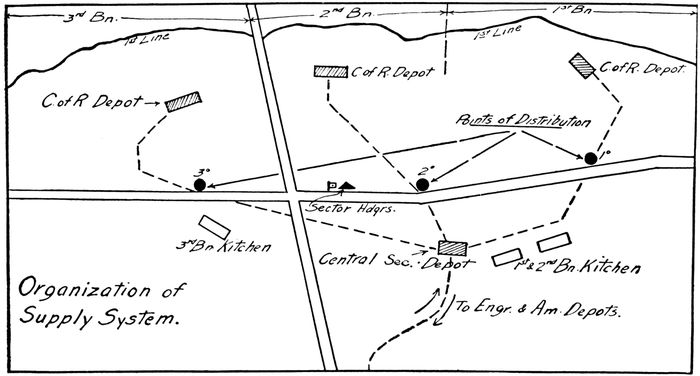
78(b) Requests for Supplies: Each morning the chiefs of areas send in a request for material required for the next night’s work. All these requests in a sector are grouped by a staff officer under the heads of the three different services. Along with each request must go the information showing necessity for same. Emergency requests are made by telephone. The officer making request for material must be on hand to receive and check the same upon delivery.
(c) Supply Parties: The supply of the depot is usually made with special detachments taken from the support or reserve companies. If it is necessary to take men from the front trenches for this purpose, no more than 10% can be taken away from these trenches at the same time. Complete units will be used as supply parties with their leader if possible. Upon each battalion in a C. of R. and upon each regimental reserve falls part of the responsibility of distributing supplies in the rear of the sector. The unloading or rendezvous points are disposed along what is called the supply line, usually on a road, path, ravine, behind a hill, etc. Supply parties sent out at night to these points make as little noise as possible. They return along a well-picketed path, usually running along one of the central boyaux. Transportation is thus carried in the open ground as far as possible, usually to the support line.
79When proper protection is possible, pack trains are used to carry supplies right through the distributing point and up to the depots of the sector.
(d) Cooking: The battalion kitchens are located behind the sector in a protected emplacement. Steps must be taken to ensure as little smoke as possible being seen from them. At night each platoon sends a ration party to the kitchen.
When the regiment has rolling kitchens, these are brought up part of the way towards the sector where they meet the ration party. Arrangements should be made to always have, if possible, some hot soup or drink available for the men between midnight and 4 a. m.
(a) Activities of the Troops: Sector duties include a considerable amount of work, and are not only useful from a tactical point of view, but are also indispensable for the moral and physical welfare of the troops. Men without occupation in the trenches stagnate, grow slack, and think only of the time when their relief will arrive. Such troops lose their aggressiveness, so that when the time for the offensive arrives they have no confidence and cannot deliver the proper blow.
Good practice to obtain fruitful results is the employment of time as follows: In 80each company the captain prepares a daily schedule of duties in which he allots the different services of the strong point: hours of “standing to” and inspection, of sending ration and supply parties, time of rest, of cleaning arms, equipment, and clothing, time of trench work, etc. This schedule is communicated daily to each platoon at a regular hour.
(b) Discipline in the Trenches:—Life in the trenches is not especially dangerous when all precautions are observed. In the presence of an alert enemy, every faulty move of disposition receives its punishment, such as the improper concealment of a movement, poorly hidden trench work, or useless noise in the firing line. Silence is one of the essential rules of the trench. Silence in a sector in which troops are properly disciplined enables the chief to rapidly transmit his orders and the men to accomplish same without delay.
Daily Reports:—In each sector, from the captain up, the different commanders must furnish a daily report. These are co-ordinated in the headquarters of the sector commander, and afterwards sent to the division headquarters.
(a) Telephone Reports:—
| Night report. | 5 a. m. to 7 a. m. |
| Day report. | 3 p. m. to 5 p. m. |
81These reports contain the main events of the time covered. Similar messages are sent at any time important events occur, such as heavy shelling, important information of the enemy, activities in the air, etc.
(b) Written Reports:—The daily morning written reports contain the following paragraphs.
1. General aspect of the sector.
2. Important events of the day.
(The events must be reported in detail, for example: A report of shelling must contain the details as to the area bombarded, the caliber of the gun used, and the time and direction of same, etc.)
3. Casualties (wounded, killed, and missing).
4. Consumption of ammunition.
5. Requests for miscellaneous equipment and material.
This report is signed by the chiefs of the area responsible for the information in the report. Along with this official report is added a second written report with the following paragraphs:
1. Request for materials for the night.
2. Observation and information reports (to the Intelligence Officer).
3. Report of all the work done in the sector, 82including time schedule of the center of resistance.
Machine Guns. The tactical use and location of machine guns in the sector depends upon the following two points:
(a) Machine gun emplacements must be thoroughly concealed and during the bombardment the M. G. itself is kept under cover in a dugout. Previous to an attack of the enemy, his artillery searches the position for the destruction of the machine guns and their emplacements, because they are the most powerful weapons of the defense.
If invisible casemates can be constructed this practice is good. The best method is, however, to prepare several emplacements, properly camouflaged, with a deep dugout near at hand for the protection of the M. G. and its crew. This shelter must be located at such a point that the M. G. can be quickly brought out to any one of its emplacements when the attack develops. These emplacements usually are simple pits located in front of the trench and connected with the dugout by a gallery. When emplacements are destroyed 83by hostile artillery fire, or when they are not possible, machine guns are pushed into shell holes or operated on the open ground. Shell holes out in front give the best service as emplacements for a daring M. G. crew. The French success at Verdun depended to a great extent upon the judicious use of shell holes for M. G. flanking fire.
(b) Machine guns are not only located in the first line, but are disposed throughout the interior of the position. The hostile artillery may entirely destroy the first line of defenses, but the proper disposition of machine guns for flanking fire in the interior lines will prevent the enemy’s progress after penetrating the position. Machine guns are so located in the position as to cover all the space between the different lines with flanking fire. Usually three pickets define the sector to be covered by any one M. G., one at the M. G. and two limiting its sector of fire.
In a sector, ⅓ of the machine guns are located in, or near the first line, ⅓ is disposed of in the support line or in the redoubt. The last ⅓ is assigned to the third line. In each line machine guns are under the command of the chief of the area.
As a general rule, in the first line, automatic-machine 84rifles, because of their mobility, are used instead of machine guns.
Standing orders are, that M. G. crews will never surrender, but fight to the last man. Often the tenacity of a M. G. crew has permitted the retaking of an area otherwise lost.
Trench Mortars. In each sector there are located a certain number of trench mortars. These are efficient weapons, but must be used with care, because they will nearly always draw concentrated artillery fire.
They are used for the destruction of special points in the enemy’s lines that the artillery cannot reach.
They are employed in the preparation for an offensive against the enemy’s first line, either for an attack or for a raid. They are used for reply fire against enemy’s trench mortars.
They participate in establishing barrages.
The efficiency of trench mortars cannot be overestimated, but at the same time, great precaution must be taken in their use and concealment. The personnel required to serve the light trench mortars are taken from the garrison of the sector and belong to a special headquarters unit, a platoon of bombardiers.
The large trench mortars are commanded 85by an artillery officer who keeps himself constantly in liaison with the commander of the center of resistance. He consults the latter on the location of his mortars and especially upon their use. He also reports to the commander of the center of resistance all orders he receives from his artillery chief. This artillery officer always works in co-operation with the chief of his area, who in turn gives him all necessary information and help. Especially does the mortar commander require help for the supply of ammunition.
Composition of the Artillery Support. The light artillery of this sector is not directly under the command of the Division Commander. The Commanding Officer of the light artillery, usually a Colonel, in co-operation with the chief of the sector, divides it into different parts, assigning one to each of the centers of resistance. This artillery is called support artillery. As we shall see later this practice is usually the same in the offensive.
The amount of artillery allotted as support depends upon the tactical situation, in other words, the activity of the enemy.
86In the Verdun and Champagne offensives the disposition of light artillery was the same in principle as that for the defensive, that is to say, one troop of artillery consisting of 3 batteries was assigned to each infantry battalion.
The general use of this artillery, is:
(a) To protect the infantry with barrage fire.
(b) Prosecution of destruction of the enemy’s personnel and works.
Tactical Liaison between Infantry and Orderly. To carry out its functions, the artillery support must be in perfect liaison with the infantry, and only when this is done is co-operation of the two arms possible. This liaison is obtained by the following five means:
(a) Organization of Leadership:—For the full co-operation of the infantry and artillery, the latter is not kept entirely independent, but is divided and assigned to infantry unit. Each chief of sector and each chief of center of resistance knows what artillery must support him if he needs it. The commander of the artillery support is not exactly under the command of the infantry chief of area, but he is at the latter’s disposal for certain calls for support fire. The proper co-operation of these two officers will give efficient results.
87(b) Relation between Artillery and Infantry Commanders:—The best of relations must be established between the artillery and infantry commanders. Usually, it is not possible to locate the commanding posts of the two officers close together. Each has his area or unit to command and for that purpose must be located for the proper control of the same. The support artillery commander, however, should make frequent visits to the infantry leader and his area. He should also send his subordinate artillery officers into the infantry area to become acquainted with the first line, the conditions in “No Man’s Land,” the enemy’s lines, and to gather all the information possible from the infantry officers in the trenches. Everything should be done to foster good relations between the infantry and their support artillery and this is best done by frequent visits of the artillery officers to the infantry trenches to gather information for artillery data.
(c) Communication of Orders:—It is necessary that the orders received by the infantry commander be communicated in whole or in part to the artillery commander, and vice versa. For instance, if the chief of area receives orders to send out a fighting patrol or a raid, this information is sent to the artillery 88commander, who, in turn, sends back his plan of action. Similarly, when the artillery commander expects to carry out special fires not called for by the infantry, such as destructive shelling, harassing fires, etc., he should first notify his infantry chief of area.
Similarly, any useful information picked up, either by the infantry or artillery, must be communicated to the other. The daily report of the chief of sector and the observation report of the Intelligence Officer are sent direct to the commander of the artillery support. Valuable information obtained at the artillery observation posts is sent to the infantry.
(d) Means of Communication:—The principal of the organization of the different means of communication is such as to assure the best liaison between the two arms. Telephone lines, searchlight signals, runners, etc., are established directly between a unit of infantry and its artillery support. This is to avoid loss of time and useless interruption between leaders.
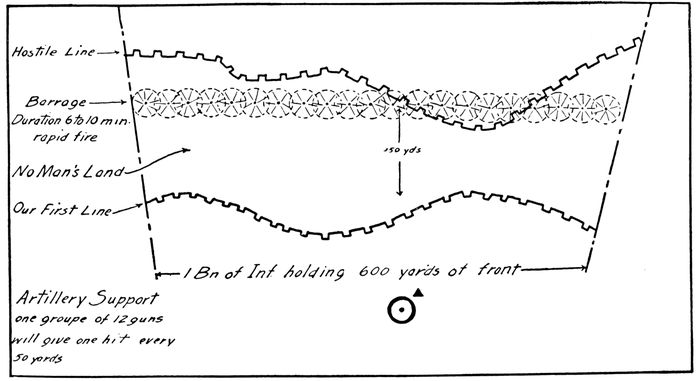
90(e) Detachments for Liaison and Observation:—For more efficient liaison between the artillery and the infantry, usually a certain number of artillerymen are sent from the group of the artillery Support to the infantry in their area. Usually a special detachment of artillerymen is sent. This detachment is made up of one officer, chief of the detachment, who is sent to the chief of sector, one N. C. O. to each chief of a center of resistance, the rest as telephone operators and artillery orderlies. This disposition of artillerymen in the infantry area is obligatory for an attack, but it is so practical that it is now employed in the sector organization.
The task of these artillery officers or N. C. O. is:—
(1) To control all means of communication with the batteries of the artillery support.
(2) To transmit to the artillery the different calls for fire, and in technical terms to give the proper data for the laying of the pieces on the target, and the kind of fire required.
Use of Artillery Support. Different kinds of fire are executed by the artillery support. The most important is the barrage.
Barrage. Purpose:—The purpose of a barrage is to stop a hostile attack before it can get started, or to hinder enemies’ reinforcements or reserve troops from coming forward.
Form:—The barrage is a curtain of fire let down in “No Man’s Land” as close in front of your first line as possible without loss to your own garrison. This will be about 150 or 200 yards to the front, between the two lines of trenches.
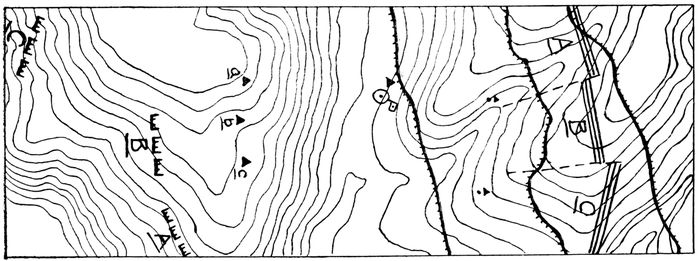
LOCATION OF ARTILLERY FOR BARRAGE
92Front of the Barrage:—The barrage has real value only if it is impassible. This will be if the density of the fire is so great that the danger zones of the explosions of the individual shells overlap each other. The allotting of one troop of artillery, 12 guns, for an infantry battalion is quite sufficient for this purpose if the front of the battalion does not exceed the average length of from 400 to 600 yards.
Duration:—The barrage is a burst of fire which lasts from six to ten minutes. At the beginning the fire is very rapid and towards the end becomes slower. For instance, for the first six minutes the fire may be six rounds per gun and in the last four minutes, say, four rounds per gun. Successive barrages can be carried out depending upon the needs of the infantry.
Calling for the Barrage:—Barrage fire, for the best results, must open up at the moment the hostile attack begins. To accomplish this the call for the barrage must be made by an observer in the first line. For this reason every officer in the first line has the authority to call for the barrage. The barrage is the only fire that can be called for automatically by signal.
93The kind and color of the rocket signifies the type of barrage required and the front it is to cover. In order to avoid mistakes this rocket signal is repeated from some point farther to the rear, usually at the observatories of the command post of the center of resistance, or of the sector. Rocket signals are repeated until the barrage fire opens.
Confirmation of the barrage is given by telephone, if possible. However, at the first signal rocket the artillery is required to open up the barrage fire as quickly as possible without waiting for confirmation. Barrage fire is at the disposal of the infantry and cannot be refused by the commander of the artillery, whether it is justified or not.
Other Kinds of Artillery Fires. The commanders of the center of resistance or of the sector may call on the artillery support for other fires besides the barrage, such as:
Reprisal fire on the enemy’s lines.
Reply fire to hostile shelling.
Surprise fire on supply attachments or working parties.
Destruction fire on special points.
All these fires are called for by telephone, but do not follow automatically like the barrage fire. The artillery commander, in such case, can use a certain amount of discretion 94whether these fires should be carried out or not. Last of all there is the counter-preparation fire, which is a strong shelling of the enemy’s position. It is carried out as a reply to a methodical bombardment of the enemy preliminary to his offensive. It is the best means to prevent a hostile attack. If this fire is well executed the enemy’s assault is “killed in the egg” as the French expression has it.
Liaison in the Sector.
(a) Telephone: There are two different systems of telephones.
First, there is the system connecting the infantry command posts, support points, centers of resistance, sector, and division headquarters, with the command posts of the artillery protecting the different infantry areas. These are direct lines between the command posts and the groups of support artillery. Also, this system connects the command post with observatories, depots, medical aid stations, kitchens, etc.
Secondly, there is the system connecting the chief of artillery with his subordinate commanders, the artillery observation posts, and the artillery dumps. In this same system the artillery command posts are again connected with the infantry units which they are to support. Special lines are run by the artillery to the officer and N. C. O. of the artillery attachment of liaison in the infantry areas.
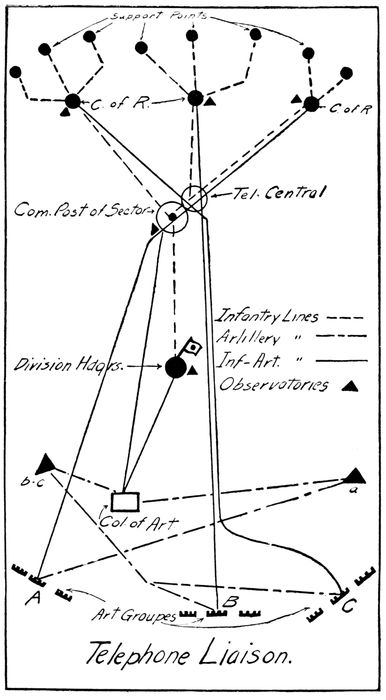
96Consequently, the liaison between the artillery and the infantry is doubly provided for in these two systems.
The lines of connection between the infantry and the artillery must be separate from those within the infantry area and those between the artillery commander and his subordinate units.
Confidential information should never be telephoned except in cipher. Conventional designations are employed to call the different posts. Strict regulations are maintained as to who should use the telephone and for what purposes.
The weak point of a telephone system is that it is often broken by bombardment or earth-slides. This can be partially remedied by constructing as few direct lines as possible, by burying the wires in the bottom of the boyaux, and by executing repairs as quickly as possible.
(b) Wireless and Ground Telegraphy: The battalions in the first line have ground telegraph apparatus connecting them with the regimental headquarters, and these, in turn, 97can communicate with the general headquarters by wireless. This means of communication is only employed when the telephone cannot be used.
(c) Signalling: It is difficult to establish signal communication within the sector without being seen by the enemy. However, at night with flashlights it is possible, especially in hilly country, to communicate from front to rear within the position. The receiving post should be able to certify received messages. When practicable, communications should be established between the command post of the center of resistance and the sector command posts, and from the latter post to the artillery. This method of liaison is organized as a duplicating means or as a temporary substitute for the telephone.
(d) Rockets: Signal rockets are used to communicate with the rear. Different forms and colors of rockets are used to signify different things. As we have seen, the most important use of the rocket is to signal for barrage fire. It is often necessary to relay a rocket signal from a second position in the rear to make absolutely sure that it reaches the artillery support.
Signal rockets are also used to communicate 98with aëroplanes, but this means is usually only employed during an attack.
(e) Runners: The liaison established with runners is best of all, from the point of view that it usually never fails. During heavy shelling it is the only sure means of communication.
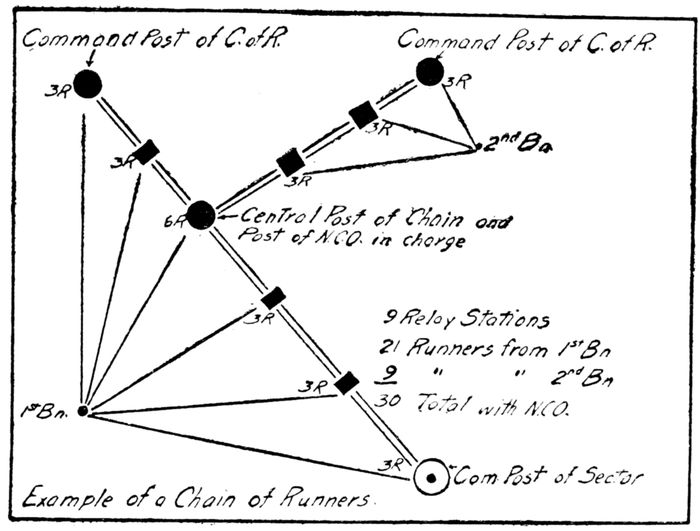
The ordinary messengers or orderlies are not used as runners. A chain of trained runners is used, located in a little post, shelters, or shell holes; Each post contains three runners, their distance being from 150 to 300 yards apart. Each runner is selected from the unit located near the next post in the chain, 99that is, the one to which he is to run. Often the divisional cavalry furnish these runners.
The chain of runners is under the command of a N. C. O. who is responsible for its efficiency. He has an important task on his hands. He must assure himself that every runner knows, not only his two neighboring posts, but also the general direction of the chain. He must change disabled runners and fill gaps in his chain. It becomes his duty to instill into the runners the importance of their duty.
(f) Carrier Pigeons: Carrier pigeons are the last means of communication. They have been found to give excellent service during heavy shelling or gas attacks. They do not fly very easily at night.
Each command post of a center of resistance in the first line has a pigeon post. These consist of two reliefs of men, four pigeons, and the necessary equipment and food. The pigeons themselves have to be relieved every few days. The care given to the birds at the command posts must not be as good as that at the dovecot in the rear, so that when they are released they will return immediately to the latter place, from where the message is delivered to its proper destination.
Sentinel. A sentinel is a soldier placed in the first line or in an advanced post for the purpose of security.
The duty of the sentinel is to watch and guard against hostile attack and to warn the chief of the platoon of every action of the enemy in “No Man’s Land.”
At night, one sentinel is posted about every ten yards in the firing trench. During the day, only a sufficient number are posted to assure that all parts of the enemy’s line and “No Man’s Land” are observed.
Sentinels are relieved every two hours except under bad weather conditions when the length of the tour of duty is reduced. Every sentinel is regularly posted by a non-commissioned officer who explains to him his duties and ascertains that both the sentinel and his relief are aware of the position of the platoon commanders and of the sentinels, on either side.
At night, the sentinels must observe over the parapet. As little challenging as possible is done and then only in a very low voice. If the sentinel receives no answer to his challenge, he shoots, thus giving the alarm. 101During the day, the sentinel uses a periscope or observes through a loophole.
The sentinel always has the bayonet fixed on his rifle, which is loaded and ready for use. He must be on the alert for every noise, and for this reason he is not allowed to wear any ear covering.
Sentinels must be informed of the sending out of patrols, the approximate hour of departure and return, and the general direction that the patrol is to follow.
Watcher. Each platoon in the trenches, from the first line to the rear, must have some watchers, whose duty it is to give the alarm both day and night against attack. These watchers do not observe the enemy as do the sentinels. They walk in the trench in which the platoon is placed, especially at the entrance of the dugouts or shelters occupied by this platoon. When they hear a signal of alarm given by a sentinel or by a messenger, they wake the platoon as quickly as possible. In general, they give to the chief of the platoon all the information that they have obtained during the time of their duty. When an officer or private from another sector enters the trench, it is the duty of the watchers to ascertain the purpose of his visit. Watchers receive special orders to give the alarm against 102a gas attack, and must sound the alarm gongs and bells for this purpose.
The watcher may have his rifle, without bayonet, resting on the side of the trench at the entrance of a dugout.
Observer. The observers are specially trained men whose duty is to observe the hostile position and to gain all the information that they can obtain of the enemy’s activities.
Each man in the company can be used as a sentinel or as a watcher, but not all as observers. To become an observer, a man must have a special capacity for this task. Each platoon should have at least six such observers of proper qualification; good eyesight and hearing, patient, and a good shot. They are relieved every two hours. Observation duty is carried out in daylight.
The observers are of two kinds:
(1) In each company the platoon observers are distributed in a number of observation posts especially chosen for this purpose. These posts are located in the support point of the company which may be in advance of the firing line, in the firing line, or in any point within the position that has a wide view of the front. These observers employ periscopes or field glasses. Everything of note that is observed is recorded and from this 103data the captain makes out his daily observation report.
(2) Also, in the sector, there are special observatories belonging to the headquarters of the regiment, under the command of the intelligence officer of the sector. There are usually two or three observatories, from which the information is transmitted directly to the colonel. These observatories are furnished with field glasses, maps, and telephones.
In general, all observers are required to obtain all possible information of the enemy, to record all modifications of the hostile position in its works and wire entanglements, all the movements that they can observe, all working parties that they can discover. Also, they receive special orders for the cases they must report to the commander, as for instance: shelling of the position by artillery or trench mortars, gas attacks, signal rockets fired in the front line, activities of the aviation services, whether of friend or enemy.