TACOMA—1904 — Climate and Health. — Distinctive Characteristics. — Tacoma’s Origin and Name. — Growth in Population. — Causes Contributing to Growth. — Abundance of Coal and Coke. — Inexhaustible Supply of Power. — Power Plant at Electron. — Snoqualmie Falls Power Plant. — White River Power Company. — Undeveloped Power Resources. — Access to Raw Materials. — Available Manufacturing Sites. — Lumber Industry at Tacoma. — Largest Lumber Plant in the World. — Other Manufactures of Wood. — Railway Construction and Repair Plants. — Largest Smelter on the Coast. — Flour Mills and Cereal Plants. — Brewing and Malting Establishments. — Railway Facilities and Traffic. — Electric Railway Systems. — Tacoma’s Ocean Commerce. — Mistress of the Oriental Trade. — Wholesale and Jobbing Trade. — Banks and Banking. — Increase in Bank Clearings. — Realty Transfers and Improvements. — Activity in Building Operations. — Federal Building and Collections. — Municipal Improvements and Utilities. — Assessment and Bonded Debt. — Schools, Colleges and Churches. — Ferry Museum and New Public Library. — Hospitals and Asylums. — 800 Acres of Public Parks. — Opportunities. — BUILDING PERMITS ISSUED DURING THREE YEARS ENDING JUNE 30, 1904, BY MONTHS. — TACOMA BANK CLEARINGS. — POST OFFICE RECEIPTS.
Tacoma, the Electric City of the Pacific
Coast, and the chief seaport of the North
Pacific, is situated at the head of ocean
navigation on Puget Sound in latitude 47°
15´ north and longitude 122° 25´ west from
Greenwich. Being further north than Duluth
or Quebec, Tacoma is supposed by
many to be bleak and cold. A popular
misapprehension among Eastern people
seems to be that Puget Sound is somewhere
near Alaska and that for half of the year
the people contend with snow and ice.
The climate of the Pacific Slope west of the Cascade
Mountains is tempered by the Pacific Ocean, the “Japan
current” and the equable southwesterly winds. The climate
resembles that of Western Europe rather than that
of the American Continent east of the Rocky Mountains.
Tacoma is four degrees further south than London, in
about the same latitude as Nantes, the chief city of Brittany,
near the mouth of the Loire. The climate of Puget
Sound is warmer in winter and cooler in summer than
that of Southern England, and is the most equable, salubrious
and delightful to be found in the United States.
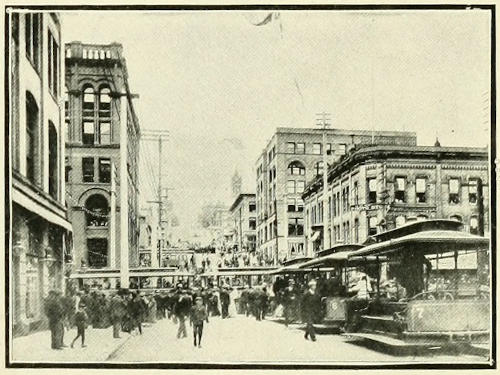
Eleventh Street at Pacific Avenue.
Tacoma’s winters are open, the grass is green and
flowers bloom out of doors every month in the year. Last
winter the temperature fell below the freezing point (32°
above zero, Fahrenheit), on one day in November, six
days in December, three days in January, five days in
February and eight days in March. The minimum temperature
on the coldest day in November was 28° above
zero; in December, 29°; in January, 26°; in February,
23°; and in March, 29°. It would be more accurate to
speak of the “winter” months as the “rainy season,”
for one-half of the annual precipitation, which amounted
to 45.11 inches in 1903, an amount slightly above the
average rainfall, fell during the three months of January,
November and December. Tacoma has little snow
and no ice. Cyclones or furious winds, in this peculiarly
sheltered region between the Olympics and the Cascades,
are unknown.
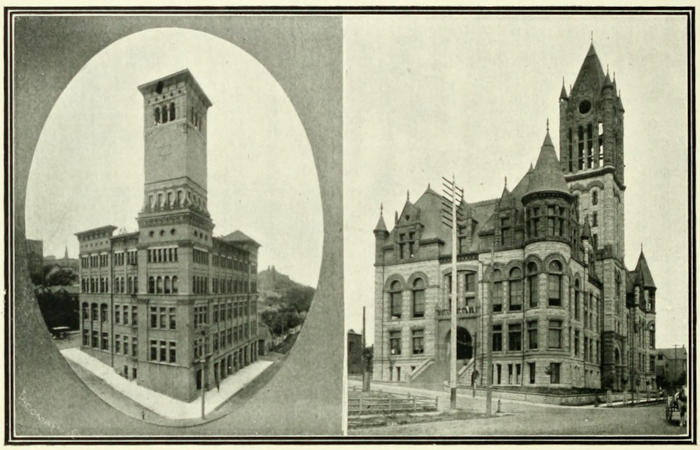
City Hall. Pierce County Court House.
Tacoma’s summer climate is equally free from extremes.
The temperature rarely rises to 80° Fahrenheit
on summer afternoons. In the summer of 1903, for example,
the mercury rose to 80° on only three days in
June, two days in July, once in August and once in September.
The nights are always cool, the days bright and
balmy. Thunder and lightning are exceedingly rare occurrences.
Nowhere in the world is the climate more conducive
to health, longevity, exhilaration of mind and
body, and to the production of flowers, fruits, forests
and crops in greater abundance and variety.
Tacoma is one of the healthiest cities in the world.
The number of deaths during the last census year was
425, indicating an annual death rate of 11.3 per 1,000,
which is fully one-third less than the average annual
death rate for the United States, 17.4 per 1,000, and
almost the lowest reported from any one of the registration
cities of the country. Since 1900 the death rate at
Tacoma has decreased. The total number of deaths for
twelve months ending June 30, 1904, was 520. The population
of the city has increased 60 per cent. since the
last federal census was taken and the annual death rate
does not now exceed 8.67 per 1,000. Tacoma may fairly
claim to be the healthiest city in the world.
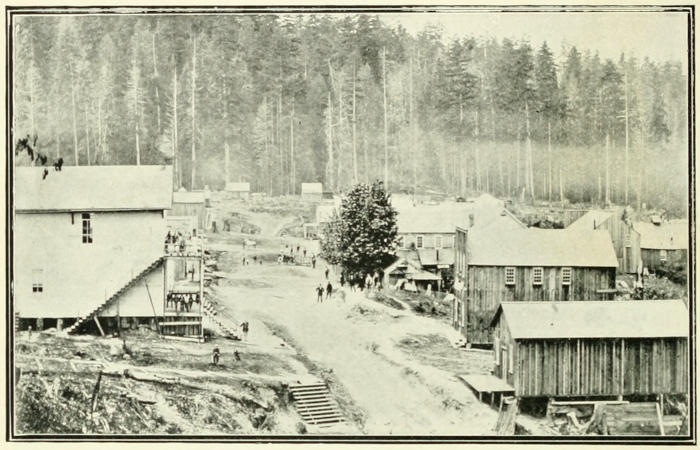
Tacoma in 1871.
Tacoma is the youngest of the maritime cities of the
United States. It is situated on one of the finest harbors
in the world. It is the leading seaport of Puget Sound,
the gateway to the Orient and Alaska. It is second only
to San Francisco on the Pacific Coast in the volume and
value of its foreign commerce. It is the chief Pacific
Coast port for steamship lines maintaining regular sailings
between Tacoma and Japan, Asiatic Russia, China
and Manila; between Tacoma and London, Liverpool and
Glasgow by way of the Orient, Suez Canal and the Mediterranean,
the longest regular steamship route in the
world; and between Tacoma and Hamburg, the chief seaport
of Continental Europe, by way of Mexican, Central
and South American ports. Tacoma is in direct, regular
steamship communication with Alaska, San Francisco,
Honolulu and New York. Tacoma is the western headquarters
and chief Pacific Coast terminal of the Northern
Pacific railway and the headquarters and western
terminal of the Tacoma Eastern railroad, the most important
independent railway in the State and the tourist
route to Paradise Valley and Mount Tacoma. Tacoma
handles the largest railway freight traffic of any city in
the Pacific Northwest. It is the center and operating
point of a system of city, suburban, and interurban electric
railways, with 135 miles of track. It is the chief
emporium, manufacturing and distributing point for the
leading staple products of the forests, farms, mines and
waters of the State of Washington and Alaska, and
the “Inland Empire,” the valleys of the Upper Columbia
and Snake Rivers in Eastern Washington and Idaho,
between the Cascade Range and the Rocky Mountains.
It is the chief wheat exporting and flour milling city of
the Pacific Coast. It is the first city of the Pacific Northwest
in manufactures. It is the electric city of the Pacific
Coast with natural power resources unequalled at
any city in America except Niagara Falls. It is the
“home City” of the North Pacific Coast, and possesses
scenic attractions which evoked from Sir Henry Irving
the declaration that Tacoma has the most beautiful situation
and environment of all the cities he had visited in the
world. It is an educational, literary, musical and social
center, with several institutions of higher learning, a
Public Library, a famous Museum, 800 acres of parks
of surpassing beauty, broad streets, fine public and private
buildings, theaters, hotels, churches, hospitals, charitable
and benevolent institutions and a rapidly growing
population of enterprising, prosperous and hospitable
people.
Tacoma dates its birth from July 14, 1873. On that
day the commissioners appointed to locate the Puget
Sound terminal of the Northern Pacific railway decided
to recommend as such a point on the south side of Commencement
Bay, in township twenty-one, range three
east of the Willamette meridian. Commencement Bay
was the largest and best sheltered harbor to be found on
Puget Sound and was accessible by easy grades for railways
from the north, south and east, and by several easy
passes over the great Cascade Mountain range. Into the
bay flows the Puyallup River, fed by the eternal glaciers
of Mount Tacoma, the giant dome of snow whose image
Theodore Winthrop found “displaced in the blue depths
of tranquil waters” in the bay. The shore line of the
bay, stretching ten miles from Brown’s Point at the
northeast to Point Defiance at the northwest was at the
time referred to unbroken by human habitations, save a
hamlet clustering about a saw mill on the west shore of
the bay, a view of which, from a photograph taken in
1871, is presented on the opposite page. In 1870 the
federal census enumerator had found seventy-three inhabitants
at Tacoma.
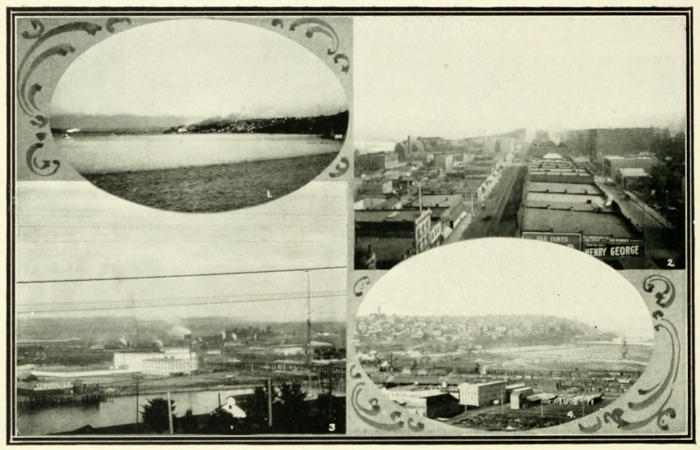
Tacoma in 1904.
- 1—City and Mount Tacoma from Harbor.
- 2—Looking South from City Hall Tower.
- 3—Manufacturing District East of City Waterway.
- 4—Tacoma from McKinley Park.
In the Ferry Museum is the original plat or sub-division
of some lands near the saw mill. It is entitled a map
of lots at “Commencement City,” but a line is drawn
through this name and the word “Tacoma” substituted.
The owners of the land discussed the name “Commencement
City” in the officers’ room of a Portland bank
and rejected it as an awkward designation. They preferred
instead the euphoneous Indian name of the mountain
which rises majestically to a height of 14,526 feet
southeast of the bay and commands the site of the
city that was to be erected apparently at its very base.
When President Roosevelt was Assistant Secretary of the
Navy, he selected Tacoma as the name of a new cruiser,
remarking that in his judgment the name should have
been adopted as the name of the State, instead of Washington.
The selection of Tacoma in 1873 as the terminus of
the Northern Pacific railway sealed its destiny as a
great city. During the same year a section of the road
was completed and opened extending from the north
bank of the Columbia River at Kalama to Tacoma. The
largest towns at that time in the Pacific Northwest were
Portland and Victoria. The route between the two was
by river steamer from Portland to Kalama, thence by
rail to Tacoma, and thence by sound steamer to Victoria
and intermediate points, Seattle being the largest town
on the route. Fourteen years, however, elapsed before
the main transcontinental line of the Northern Pacific
crossed the Cascades and entered Tacoma from the east.
Tacoma’s population, according to the federal census,
the annual school census, the directory lists, and other accepted
bases of calculation, has increased as follows:
|
City Limits. |
City and
Suburbs. |
| 1870 |
73 |
|
| 1880 |
1,098 |
|
| 1900 |
37,714 |
42,311 |
| 1904 |
60,250 |
67,405 |
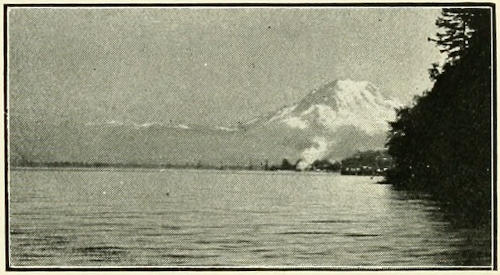
Mount Tacoma from Point Defiance.
The figures for 1870, 1880 and 1900 above quoted are
from the federal census. The number of names of individuals,
exclusive of all names of firms, corporations,
buildings and the like, in the city directory for 1900,
published by R. L. Polk & Co., was 16,951. The district
canvassed for the city directory includes the immediate
suburbs, which are to all intents and purposes a part of
the community. The ratio between the number of names
in the directory of 1900 and the population of the city
and immediate suburbs, as shown by the last federal
census, was 1 to 2½. The number of names of individuals
in the Tacoma city directory in 1900 and subsequent
years with the population as indicated by the use of
the multiplier 2½ is as follows:
| Year. |
Names in City
Directory. |
Estimated
Population. |
| 1900 |
16,951 |
*42,372 |
| 1901 |
20,418 |
51,045 |
| 1902 |
22,186 |
55,455 |
| 1903 |
25,057 |
62,642 |
| 1904 |
26,962 |
67,405 |
Federal enumeration, 42,311.
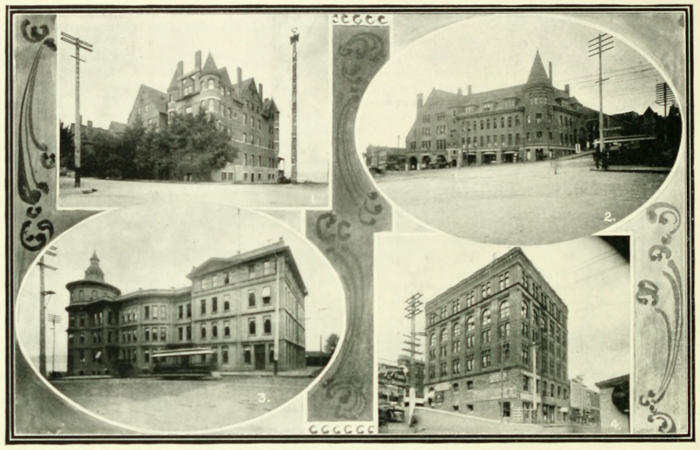
- 1—Tacoma Hotel and Totem Pole.
- 2—Tacoma Theatre.
- 3—Northern Pacific Headquarters Building.
- 4—Tacoma Chamber of Commerce Building.
This estimate of population in 1904 is confirmed by
the annual school census returns. The school census of
1904 for school district number 10, which is coextensive
with the city limits, reports 13,389 children of school age
residing in the district, as compared with 9,443 in 1900.
The census of the districts contiguous to the city and
embracing its immediate suburbs show a school population
in 1904 of 1,426, as compared with 646 in 1900.
The use of the multiplier 4½ applied to the school census
returns, indicates a population within the city limits in
1904 of 60,250 and in the city and its immediate suburbs
of 66,667. Other cities in the state employ a larger
multiplier than 4½ to estimate population from their
school census returns. For example, Seattle applies the
multiplier 6½, and Spokane 5¾ to their school census
returns in order to confirm their liberal estimates of
population. Tacoma is content to employ a safe and
conservative method of calculation.
Postoffice receipts more than confirm the foregoing
estimates as to Tacoma’s growth and present population.
The receipts of the Tacoma postoffice for the fiscal year
ending June 30, 1904, were $113,599, as compared with
$63,928 for the year ending June 30, 1900. The increase
in postoffice receipts is at the rate of 14.7 per
cent. in one year; 28.2 per cent. in two years; 53.7 per
cent. in three years and 77.4 per cent. in four years. The
increase in population as above shown by an increase of
10,011 in the number of names in the city directory is at
the considerably lower rate of 59.0 per cent. in four years.
Tacoma’s rapid growth is attributable to two principal
causes. First, the industrial, and second, the commercial
development of the city. There are abundant
grounds for the prediction that Tacoma will not only
continue to hold her position as the leading manufacturing
city in the State of Washington, but will rapidly
become one of the greatest industrial centers in the
world. Tacoma possesses unequalled facilities for manufacturing
in several important fields of industry. The
first superior advantage is abundance of cheap power;
the second is the possession or command of the raw materials,
and the third is direct transportation facilities
placing her in touch with the markets of the world.
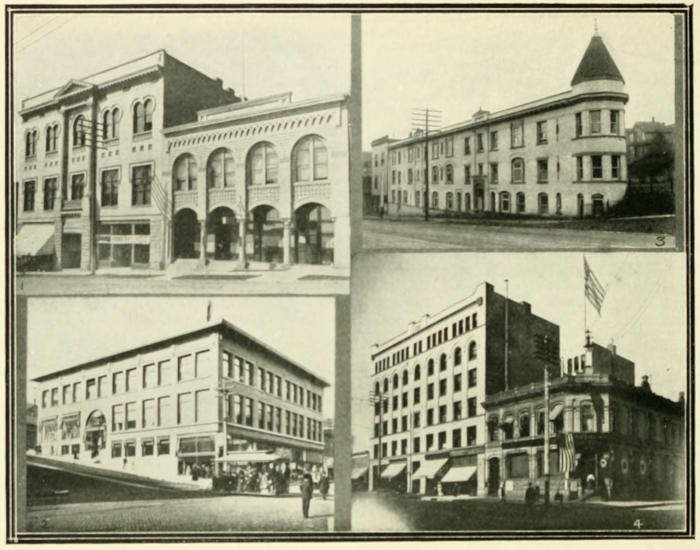
Some New Buildings.
- 1—Masonic Temple and Hoska Building.
- 2—Rhodes Bros. Department Store.
- 3—Hyson Apartments.
- 4—Provident Life & Trust Company’s Building.
Mr. E. W. Parker, of the United States Geological
Survey, who served by appointment of President Roosevelt
as one of the anthracite strike arbitrators, recently
called the attention of the Washington State Press Association
to the fact that Pennsylvania, Illinois, Colorado
and Washington are the chief coal-producing States
in the four longitudinal sections or belts of the United
States from east to west and that each of these States
takes the lead in manufacturing among all the States
in its section. Washington has incalculable supplies of
coal of excellent quality for producing heat and generating
steam. The coal is stored in the Cascade Mountains
and the mines of Pierce, Kittitas and Southern
King Counties are in close and direct railway communication
with Tacoma. It is said that the cars loaded
with coal at fifty mine openings in Western Washington,
would run by gravity into Tacoma by simply unloosening
the brakes. Tacoma has huge bunkers for coaling steamships
and a line of colliers plies constantly between this
port and San Francisco. The best, if not the only coking
coal yet mined in Washington is found in abundance
in Pierce County within thirty miles of Tacoma. But
fuel from the waste of the great lumber mills is so
abundant and cheap in Tacoma that the tremendous advantage
of her proximity to the rich coal fields of Washington
is not as yet fully realized.
Of even greater value than her coal as a factor in the
industrial development of Tacoma is the utilization of
the enormous water power which has its origin and
source in the snow-capped and glacier-buttressed dome
of Mount Tacoma. The mountain from which Tacoma
takes her name is an inexhaustible reservoir of power
whose efficiency is immeasurable. Tacoma lies at its
feet and is the natural outlet and market for its harnessed
energies.
Science has discovered the means for the conversion
of water power into electrical energy transmissible over
a wire from the place of its generation to a convenient
point for its application and use. There is a loss in
transmission which increases with the distance. Therefore
Tacoma, which is the nearest seaport and railway
terminal to the mountain from whose dizzy heights torrents
of water rush ceaselessly to the sea level, is favored
by her geographical position in the use of this power.
There are numerous streams which make a descent of
thousands of feet within fifty miles of the city. Capital
has been enlisted and freely expended in the work of generating
power for industrial and transportation purposes,
besides current for light and heat.
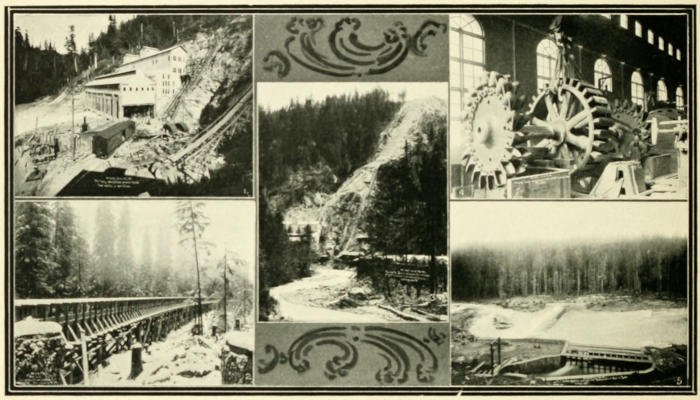
Puget Sound Power Company’s Plant.
- 1—Power House, 3 Units In Operation.
- 2—View of Flume Line.
- 3—Penstock Line and Power House.
- 4—Placing Water Wheel and Rotor Shaft in Bearings.
- 5—Intake and Dam at Head Works.
The largest plant in the world for the generation of
electric current by water power, with the single exception
of the power plant at Niagara Falls, has been installed
during the last eighteen months by the Puget
Sound Power Company, of Tacoma, at Electron, twenty-eight
miles southeast of Tacoma, near Lake Kapowsin,
on the Tacoma Eastern railroad. The work of installing
the power plant at Electron was commenced early in
1903. The first unit of 5,000-horse power was ready for
trial on April 14, 1904, and before the end of July, 1904,
four 5,000-horse power units, making a total of 20,000-horse
power, were completely installed and in commercial
operation. The Puget Sound Power Company is owned
by Messrs. Stone & Webster, of Boston, who control and
operate the Tacoma Railway & Power Company, the
Tacoma and Seattle Interurban railway and the Seattle
Electric Railway Company. The plant at Electron was
installed in order to furnish power for operation of the
urban, suburban and interurban railways of the Puget
Sound cities and to market the surplus to other power
consumers.
A page of illustrations is here presented showing,
from recent photographs, some of the principal features
of the power plant at Electron. The water for the plant
is taken from the south fork of the Puyallup River, below
its junction with the Mowich, thirty-five miles from Tacoma
and 1,800 feet above sea level. The river at this
point drains five of the largest glaciers of Mount Tacoma.
A low dam has been constructed, shown in the photograph
of the headworks, whence the water is conducted by a
flume eight feet wide and eight feet deep, following the
contour of the river canyon and descending at the rate
of seven feet to the mile, ten miles and a half to a reservoir
covering twenty-one acres and averaging twenty feet
in depth, on the crest of the hill above the power house.
The reservoir holds in reserve ten hours’ supply for the
power plant. The water is dropped from the reservoir
to the power house through four steel pipes or penstock
lines, 1,700 feet in length, erected on the slope of the
canyon at an angle of about 45 degrees. A fall of 887
feet and a pressure of 400 pounds to the square inch is
thus secured. Four million pounds of steel pipe were required
for the penstock line, each cylinder being four
feet in diameter at the top and reducing to two seven-inch
nozzles for each pipe. The water issues from the
nozzles at a speed of about three miles a minute and is
applied to four impulse water-wheels specially constructed
for the purpose. The present electrical installation includes
four generators, each of 3,500 kilowatts capacity.
The flume, the reservoir, the forebay, the slope for the
penstock line and the site for the power house have been
constructed or prepared with a view of adding to the
capacity of the plant. The west wall of the power house
shown in the illustration is temporary, in contemplation
of its extension and the installation of from two to four
additional 5,000-horse power units as soon as required.
The present plant is abundantly supplied with water
by the flume filled to a depth of three feet. The water
passes through the flume at the rate of seven miles an
hour. There is abundance of water for the operation
of the plant in the Puyallup River at all seasons of the
year, as the river is fed by torrents from the glaciers in
the dry season and by copious rains in the winter.
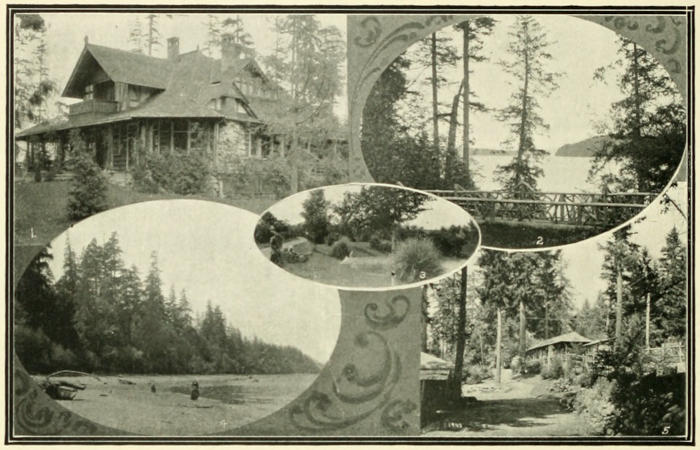
Views in Tacoma’s Parks.
- 1—Superintendent Roberts’ Lodge at Point Defiance Park.
- 2—The Sound from Point Defiance Park.
- 3—Glimpse In Wright Park.
- 4—The Beach at Point Defiance.
- 5—Spanaway Park.
The Puget Sound Power Company, of Tacoma, has
a large surplus of power above the requirements of the
electric railways controlled by Stone & Webster. This
power is already used to pump water from the new
driven wells at South Tacoma for the city of Tacoma,
also to operate the great railway construction and repair
plant of the Northern Pacific railway at South Tacoma,
the new packing house plant of the Carstens Packing Company
on the tideflats, the large grain warehouses and
elevators between the Eleventh Street bridge and the
Government warehouse on the city waterway, numerous
furniture factories, machine shops, pipe and iron foundries,
and a large number of stationary motors for miscellaneous
enterprises at Tacoma, besides supplying current
for light and power in the valley towns between
Tacoma and Seattle and the latter city. The transmission
line from Electron to Tacoma is twenty-eight miles
in length, while the distance from the plant to Seattle
is forty-eight miles.
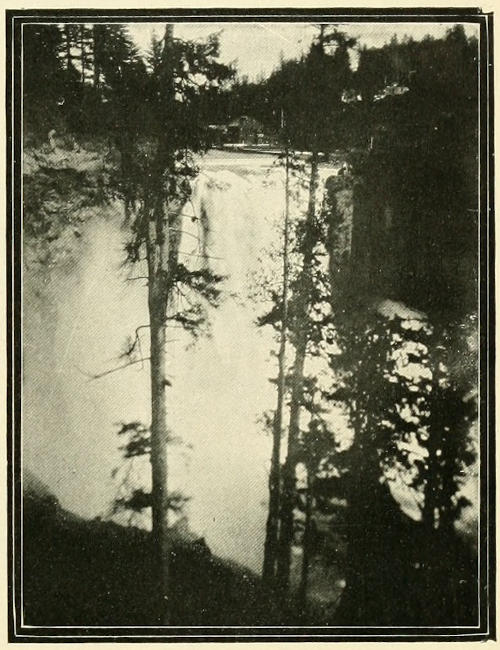
Snoqualmie Falls, 270 Feet High.
The colossal power plant at Electron is not the only
enterprise of its kind that is contributing to the industrial
growth of Tacoma. The Cascade Mountains are
the source of many rivers which have filed out deep canyons
and here and there plunge over lofty precipices
seeking ocean level in Puget Sound not many miles away.
The first of the waterfalls in the foothills of the Cascades
to be harnessed to generate electric power for transmission
to the Puget Sound cities was Snoqualmie Falls,
270 feet in height, or nearly twice as high as the falls
of the Niagara River. A plant generating 10,000-horse
power was installed at Snoqualmie Falls about four years
ago, a large share of the product of which is transmitted
to Tacoma, forty-four miles distant, where it is employed
for city lighting and important industrial purposes, such
as supplying power to the Tacoma Smelter, Tacoma Grain
Company’s flour mills, and many other manufacturing
enterprises.
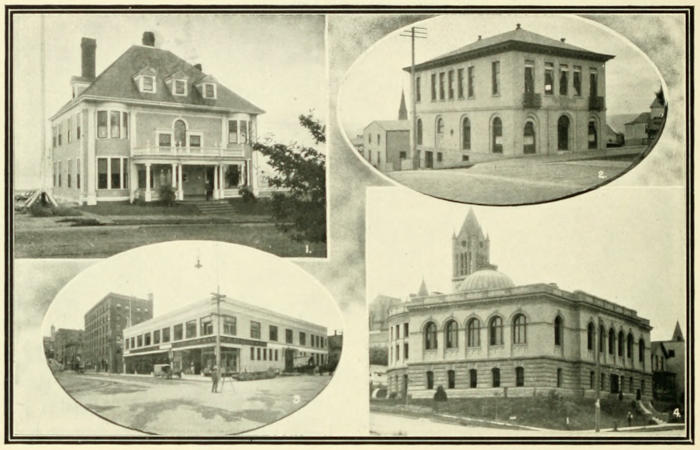
- 1—Union Club House.
- 2—Telephone Exchange.
- 3—Sheard Building.
- 4—New Public Library.
A fire destroyed the transformer house at the Snoqualmie
Falls power plant September 20, 1903. A new fire-proof
transformer house has been erected in which four
transformers of 2,500 kilowatts, or about 3,300-horse
power each, have been installed in place of a battery of
thirteen 550 kilowatt transformers, thus increasing the
capacity of the transformers by more than 4,000-horse
power.
The product of the Snoqualmie power plant was in
use up to its limit when the fire of September, 1903, occurred,
and the Tacoma Cataract Company, distributors
of the Snoqualmie power in this city, had already begun
the construction of an auxiliary steam power plant on the
tideflats at Tacoma, which was completed and placed in
operation December 20, 1903. It adds 1,500-horse power
to the product of the Snoqualmie Falls power plant employed
at Tacoma.
The inadequacy of the Snoqualmie Falls power plant
to meet the demand for power for municipal and industrial
purposes at Tacoma, prompted its owners to undertake
a much larger enterprise, which will result in the
construction of still another mammoth power plant within
ten miles of the city of Tacoma.
The plan which is being carried out by what is known
as the White River Power Company, is to divert the
White River about half a mile above the town of Buckley
into a canal, beginning at this point and extending
a distance of about five miles across the tableland to
Lake Tapps. The canal is being excavated like an ordinary
railway cut out of the solid gravel, hardpan or
earth or whatever the geological formation happens to
be. It will be thirty feet in width on the bottom and
fifty-five feet wide at the top and eight feet deep. Dams
are to be constructed at the low points on the northerly
side of Lake Tapps so that the lake can be raised to a
level thirty-five feet higher than the present, which will
cause the lake to overflow and merge with Kirtley Lake,
Crawford Lake and Kelly Lake, covering all the intervening
bottom lands and valleys so that the total area
thus submerged and overflowed will exceed 4,000 acres
of land. This lake may be drawn down thirty feet. This
reservoir will be supplied by the flood waters of White
River and will be drawn out through the water wheels
during the season of low water, and by thus equalizing
the flow of the river will make the power plant capable
of a continuous development of 100,000-horse power.
The reservoir will permit the plant to run at full load
for several months, even if White River were to run
dry or the use of the supply canal were to be discontinued
for that length of time.
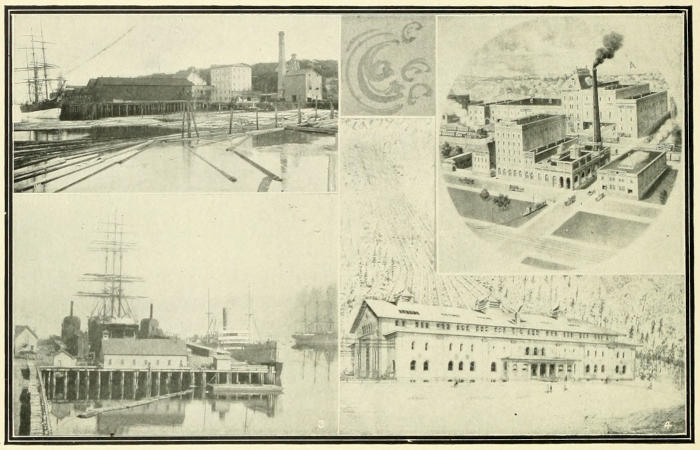
- 1—Puget Sound Flouring Mills.
- 2—Pacific Brewing Company’s Plant.
- 3—Dry Dock at Quartermaster Harbor.
- 4—Power House of White River Power Company.
The water from this enlarged lake reservoir will be
led through a channel into a masonry penstock whence
pressure pipes will conduct it down a declivity to the
site of the power house, within ten miles of Tacoma,
giving a fall of 485 feet. At the foot of these pipes the
power house, 105×250 feet, will be constructed, as shown
on the opposite page, and the water will thence be released
into the Stuck River. A short transmission line
will conduct the power to the Tacoma Cataract Company
building in this city, whence a large share of the present
output of the Snoqualmie Falls power plant is now
distributed to consumers, public and private, in Tacoma.
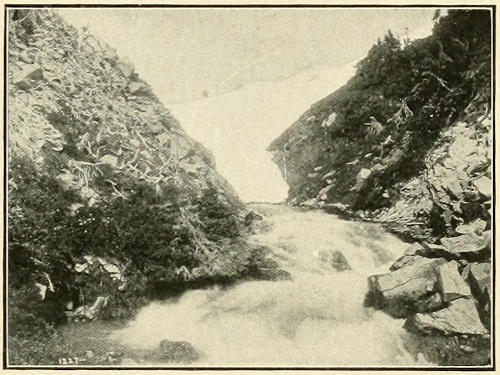
Nisqually River at Its Source in a Glacier.
There are many other rivers or streams fed by the
glaciers and snows of Mount Tacoma which may and
will be utilized for generating electrical power as rapidly
as required. The Tacoma Industrial Company has recently
bought a continuous strip four miles in length,
including the White River, and is making preparations to
install a 15,000-horse power plant twelve miles from
Tacoma. The Nisqually River, which flows into the Sound
south of Tacoma, has enormous undeveloped power resources.
Within thirty miles of Tacoma, at Le Grand,
a station on the Tacoma Eastern, on the brink of the
Nisqually Canyon, is an available and accessible water
power capable of generating 30,000-horse power. Tacoma
commands the use of from 150,000 to 200,000-horse power
as soon as required.
NO OTHER SEAPORT IN THE WORLD HAS
SUCH ABUNDANT RESOURCES OF CHEAP POWER
FOR MANUFACTURING PURPOSES.
POWER IS BEING DELIVERED TO THE CITY
OF TACOMA FOR PUMPING AND LIGHTING PURPOSES
AT THE LOWEST CONTRACT PRICES AT
WHICH POWER IS OBTAINED AT ANY CITY IN
THE WORLD.
MANUFACTURERS AT TACOMA ARE OBTAINING
ELECTRIC POWER AT A LOWER PRICE THAN
THAT AT WHICH POWER IS OBTAINABLE AT
ANY OTHER TIDEWATER PORT IN THE UNITED
STATES.
TACOMA IS THE ELECTRIC CITY OF THE PACIFIC
COAST.
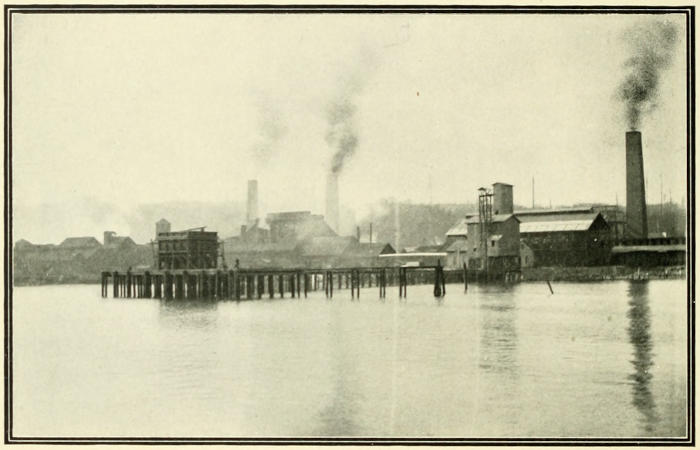
Tacoma Smelter.
Another important factor in Tacoma’s industrial development,
past, present and future, is its proximity and
convenient access to the natural products or raw materials
employed in manufacturing. Tacoma is the point at
which the leading staple products of Washington are
chiefly assembled for manufacture and distribution. The
resources of “Wonderful Washington” are manifold.
The products of the mines, the forests, the farms and
ranches, and of the waters are of untold value to the
world. Tacoma’s geographical position is such that she
commands these products as does no other point in the
pacific Northwest. The great Olympic Peninsula between
Puget Sound and the Pacific Ocean is surrounded
by water on three sides. Railroads are required to bring
its products to tidewater, and Tacoma, at the head of
ocean navigation on the Sound, is in closest proximity
of all the Sound ports to this section rich in timber and
mineral resources. South, southeast, east and northeast
of Tacoma are equally rich sections of territory extending
from the Sound on the north and west to the Columbia
River on the south and to the ridge line of the Cascade
Mountains on the east, whose treasures of agricultural,
mineral and forest wealth must seek the markets of the
world through this port. Tacoma is the natural and
exclusive outlet for the products of this region. Six
steam and four electric railway lines radiating from Tacoma,
and numerous steamers plying between Tacoma
and the island and mainland ports of the Sound afford
transportation facilities for the traffic of the immediate
and more remote regions tributary to the city. Across
and beyond the mountain passes lie the Yakima Valley,
the “Inland Empire,” and the greater domain of the
United States whose products seeking trans-pacific markets
pass through this natural gateway to the Orient.
Puget Sound is 300 miles nearer Japan, Manila and
the Orient than San Francisco. It is 800 miles nearer
Alaska than the Golden Gate. Ores for the Tacoma
Smelter are brought by rail from Eastern Washington
and by water from Alaska; from the islands along the
coast of British North America; from British Columbia,
Korea, Straits Settlements, Mexico and Central America.
Foreign products brought across the pacific for manufacture
in the United States, such as raw silk from China and
Japan and hemp from Manila, are landed at Tacoma.
The rail and water transportation facilities which unite
at Tacoma, coupled with its command of raw materials
and its wonderful resources of power and coal,
make this city a most exceptionally favored point for
manufacturing.
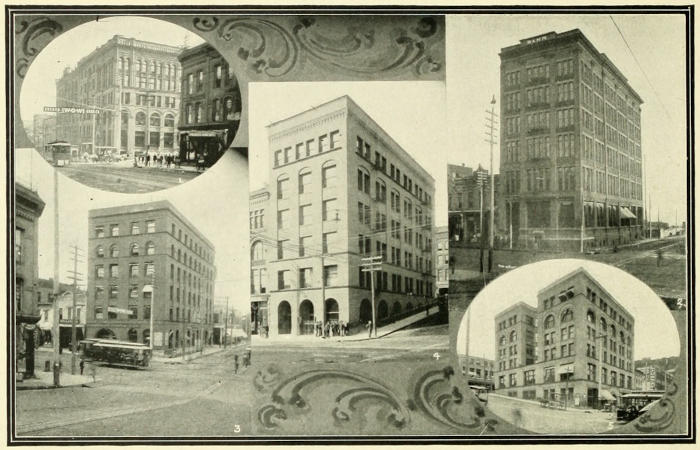
Homes of Tacoma Banks.
- 1—Equitable Building.
- 2—National Bank of Commerce Building.
- 3—Berlin Building.
- 4—Luzon Building.
- 5—Fidelity Trust Company’s Building.
A resume of Tacoma’s superior advantages for manufacturing
would be incomplete without reference to its
abundant supply of manufacturing sites. There are
twelve square miles of tide and river flats immediately
east of the city which, owing to a combination of circumstances,
were until recently incapable of private ownership
and occupation. At the south end or head of
Commencement Bay there is a level plain traversed near
its westerly side by the Puyallup River. The lands on the
easterly side of the river were for many years set apart
by the government as a part of the Puyallup Indian reservation,
but recently these have been sold by order of
the government. The King County line extended also to
the Puyallup River and the tide and river flats at the
head of the bay—most advantageously located for commercial
and industrial purposes—being without their
jurisdiction, were incapable of improvement by the city
or Pierce County. But in 1901 the reservation lands were
legally annexed to Pierce County, of which Tacoma is
the county seat, and the occupation of this enormous
area of flat lands adjacent to tidewater has just begun.
A substantial bridge has this year been erected by the
city of Tacoma across the Puyallup River at a convenient
point for access to the annexed lands from the manufacturing
district which occupies the flats west of the Puyallup
River. The federal government has made a complete
survey of the harbor of Tacoma, the plans for the
improvement of which contemplate the construction of
a series of waterways extending from deep water in the
bay a considerable distance to the south. The City
Waterway, which is being dredged to a width of 550 feet
and depths increasing as it approaches the bay from
fifteen to thirty feet, under a contract awarded by the
federal government in January, 1903, extends as far
south as Twenty-third Street, or nearly twenty city blocks
from the original harbor line. Miles of additional waterfront
and wharves will thus be obtained at the head of
the bay, exclusive of the natural shore line some ten miles
in extent from Brown’s Point to Point Defiance. Railroads
and steamships will have direct and immediate access
to the very heart of this district. The acquisition
and improvement by the construction of roads, bridges
and waterways of 6,000 acres of land immediately adjacent
to the city, make it possible for many more manufacturers
to secure sites and utilize the limitless power
resources of Tacoma, the great Industrial City of the
Pacific Northwest.
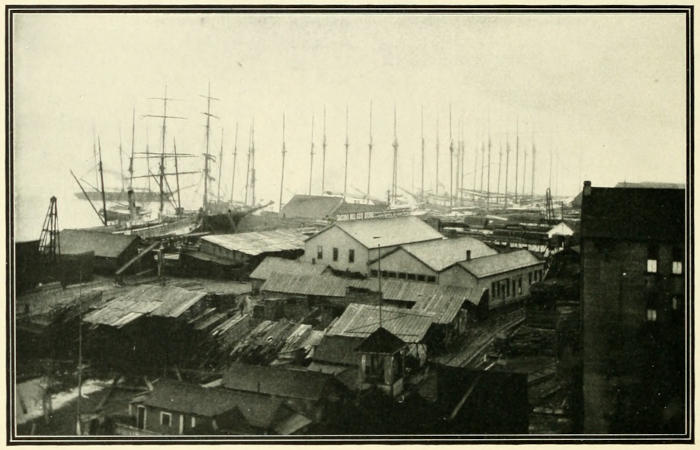
Loading Lumber at Tacoma Mill Company’s Wharf.
Tacoma is now the leading manufacturing city of
Washington and the Pacific Northwest. The industrial
development of the city since 1900 has been phenomenal.
According to the federal census there were in 1900 381
manufacturing establishments at Tacoma, whose aggregate
invested capital was $8,146,691, of which there were
385 proprietors and in whose employ there were 293
salaried officials and clerks and 4,347 wage-earners.
Of this total number of wage-earners in manufacturing
and mechanical industries at Tacoma, 4,104 were men,
while only 243 were women or children under the age
of 16 years. The total value of the products, including
custom work and repairing, of the 381 establishments
at Tacoma for the year preceding the taking of the census
was $12,029,497.
MORE THAN ONE HUNDRED NEW MILLS AND
FACTORIES HAVE BEEN ADDED TO THE LIST
OF TACOMA’S MANUFACTURING INDUSTRIES
DURING THE FOUR YEARS THAT HAVE ELAPSED
SINCE THE FEDERAL CENSUS WAS TAKEN.
THAT IS AN AVERAGE OF MORE THAN TWO
NEW FACTORIES EVERY MONTH. MANY OF
THE OLDER ESTABLISHMENTS HAVE DOUBLED
OR TREBLED THEIR CAPACITY DURING THE
SAME PERIOD.
No complete summary of the operations of Tacoma’s
manufacturing establishments can be presented for comparison
with the census report of 1900. But from written
reports submitted to the Tacoma Daily News by some
of the leading manufacturing concerns in Tacoma, it
appears that during the calendar year 1903, one hundred
and thirty-five representative manufacturers in the city
employed an average of 6,796 wage-earners during the
year, while the value of the finished product of these
establishments alone for the same year was $28,932,295,
and the cost of permanent improvements or additions to
the plants during the year was $1,129,550. In other
words, 135 out of 500 to 600 establishments that would
now be classified by the census as manufacturing concerns
in this city employed 2,349 more wage-earners in 1903
than were employed by a total of 389 establishments during
the census year, while the value of the output of
these 135 establishments in 1903 was nearly two and one-half
times as great as the total value of the product of
389 establishments in 1900.
Tacoma is the largest lumber manufacturing point
on the Pacific Coast. The manufacture of lumber is
the most important industry in the Pacific Northwest.
In 1900 there were twelve lumber and shingle mills in
operation in Tacoma. In 1903 there were twenty-two in
operation, employing an average of 2,682 wage-earners.
The increase in the lumber and shingle output since 1900
may be shown by the following figures, based upon reports
from the local mills.
Cut of Tacoma Lumber Mills.
| Year. |
Lumber, feet. |
Shingles. |
Total value. |
| 1900 |
185,414,130 |
178,386,000 |
$2,517,967 |
| 1901 |
219,150,000 |
251,000,000 |
2,695,700 |
| 1902 |
303,654,557 |
347,565,000 |
4,069,000 |
| 1903 |
361,522,766 |
376,935,500 |
5,110,398 |
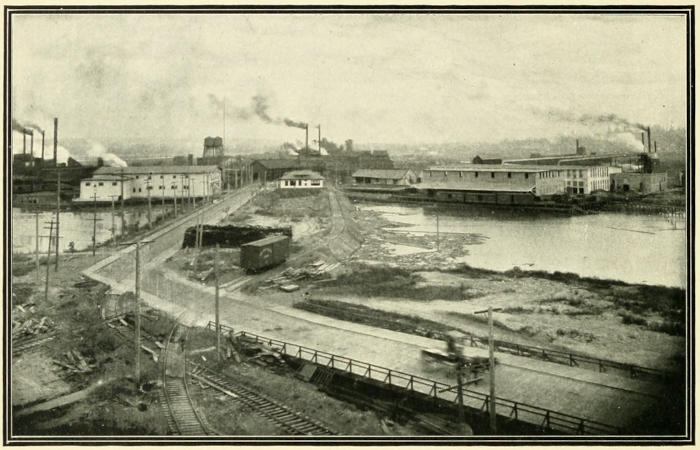
St. Paul & Tacoma Lumber Company’s Mill and
Wheeler-Osgood Company’s New Sash and Door Factory.
The increase in three years in the number of mills
engaged in the lumber and shingle industry at Tacoma
is at the rate of 83.3 per cent.; in the lumber cut at the
rate of 96.6 per cent.; in the output of shingles at the
rate of 94.0 per cent.; and in the value of the product at
the rate of 103.0 per cent.
The St. Paul & Tacoma Lumber Company’s plant
on the flats between the City Waterway and the Puyallup
River, is the largest saw mill plant in the United States
and probably in the world. It was established in 1888.
Its original capacity of 300,000 feet per diem has been
increased to 500,000 feet by the erection of a second mill
since 1900, and during the year 1903 the company cut
122,348,562 feet of fir, spruce, hemlock and cedar and
sawed, dried and packed 63,822,000 shingles, its output
for the year being valued at $1,761,698. The company
operates five logging camps along the Northern Pacific
and Tacoma Eastern railways and employs 1,500 men.
The Tacoma Mill Company’s plant on the waterfront
at “Old Town” is the second largest lumber plant at
Tacoma in capacity, number of men employed and the
value of its output. This company is the successor of
the firm of Hanson & Ackerson who established a mill
in 1868 on the shore of Commencement Bay where the
present plant of the Tacoma Mill Company now stands.
The first settlement at Tacoma was due to this mill. Its
original capacity was 40,000 feet per diem, which has
been increased to 300,000 feet, the output for 1903 including
85,824,204 feet of lumber and 42,738,500 shingles,
valued at $1,000,000.
RAIL SHIPMENTS OF LUMBER AND SHINGLES
FROM THE TACOMA MILLS INCREASED
FROM 3,141 CARS IN 1900 TO 6,012 CARS IN 1903,
WHILE CARGO SHIPMENTS OF LUMBER INCREASED
FROM 77,818,557 FEET IN 1900 TO 129,036,317
FEET IN 1903.
The United States transport Dix sailed on May 9,
1903, from this port for Manila with 3,900,156 feet of
lumber loaded at two Tacoma mill wharves. THIS WAS
THE LARGEST LUMBER CARGO EVER LOADED
IN THE WORLD.
A large share of the product of the Tacoma lumber
mills is supplied to manufacturers in this city. A long
list of industries has developed at Tacoma in consequence
of its pre-eminence as the lumber mart of the State.
There are many planing mills and sash, door and blind
factories. The largest plant of this description in the
State is that of the Wheeler-Osgood Company, on the
flats, enlarged and rebuilt since its destruction by fire
in September, 1902. Tacoma has large ship yards and
builds the largest wooden vessels for sail and steam navigation
engaged in the Sound or Coastwise trade to Alaska.
There are three car construction and repair plants at
Tacoma; several furniture factories, including the largest
plant in this industry on the Coast, that of the
Carman Manufacturing Company, covering six acres;
the largest plant in the West for the manufacture of
coffins and caskets; also the largest plant in this section
of the world for the manufacture of wooden-stave water-pipe,
that of the Washington Pipe and Foundry Company.
There are several large plants for the manufacture
of boxes and box shooks, and a great variety of industrial
enterprises for the manufacture of articles chiefly
of wood, such as ladders, wheelbarrows, incubators,
churns, carriages and wagons, kegs, mantles, pails, tubs,
trucks, wooden spoons, and many other articles.
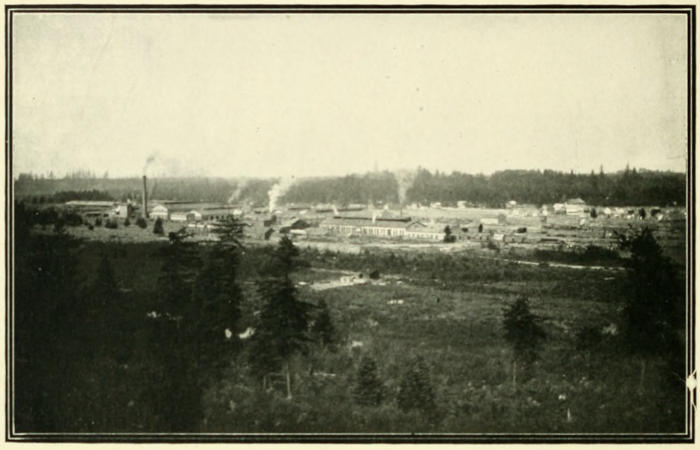
Northern Pacific Railway Construction and Repair Plant.
In this connection the fact should be mentioned that
Tacoma is not only the great mart for Washington fir,
spruce, hemlock, pine and cedar—soft woods, but has
command also of abundant supplies of hard woods, such
as maple, oak and ash, which are also found in Western
Washington. Among the new Tacoma industries of 1904
is a large plant for the manufacture of parlor furniture
from hard woods such as are obtainable in this vicinity
or will be brought from the tropical forests of the Philippine
Islands by steamships plying between this port
and Manila.
The second largest manufacturing plant in Tacoma
which is also the largest plant of its description in the
Pacific Northwest, is the railway construction and repair
plant of the Northern Pacific Railway at South Tacoma.
This enormous plant furnishes employment for 800 men
and manufactures and repairs everything in the line of
motive power or rolling stock for railroad use. A $60,000
building for an additional boiler shop is now being erected
to enlarge the facilities for locomotive work. The
shops of the Tacoma Eastern railroad and the Tacoma
Railway & Power Company are also located at Tacoma.
Adjoining the Northern Pacific plant is a large plant of
the Griffin Car Wheel Works, and not far distant from
South Tacoma is the largest rolling mill in the State,
the plant of the Western Iron & Steel Works at Lakeview.
Allied to this class of industrial enterprises are
numerous foundries and machine shops for the manufacture
of stationary and marine engines and boilers,
machinery, saws, architectural iron, bridges, and other
products of brass, tin, copper, iron and steel. The Puget
Sound Dry Dock & Machine Company, of Tacoma, operates
the largest private drydock north of San Francisco.
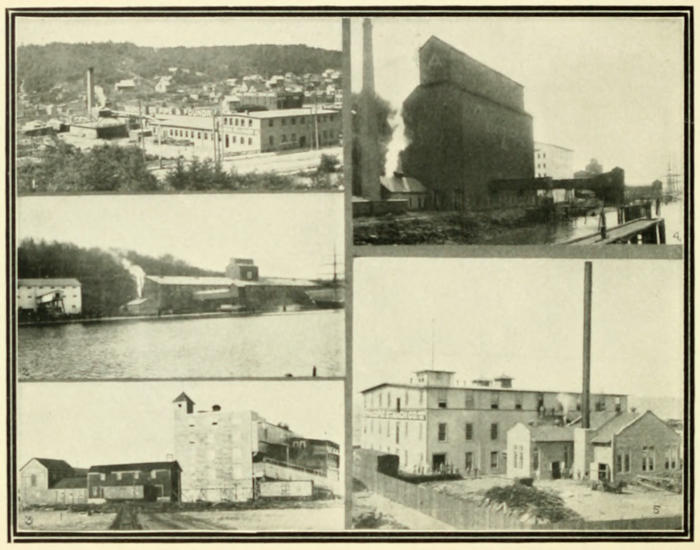
- 1—Washington Pipe & Foundry Company.
- 2—Tacoma Warehouse & Elevator Company.
- 3—Carstens Packing Company.
- 4—Elevator A and Tacoma Grain Company’s Flour Mill.
- 5—Pacific Starch Company.
Still another line of industry in which Tacoma takes
the lead, is in the reduction of ores of gold, silver, lead,
copper and other metals. The Tacoma Smelting Company’s
plant on the waterfront at the north end of the
city is the largest smelter on the Pacific Coast. In 1902
the plant was enlarged by the addition of huge copper
reduction works which began operations in September,
1902, and a copper refinery, the only plant of its kind
west of Great Falls, Montana, is now in course of construction.
The Tacoma Smelter began operations in September,
1890. In 1891 an average of fifty-eight men
were employed, and the value of the output was $781,133.38.
Five hundred men are now employed at the
smelter and the output of the plant for the year 1903
was as follows:
| Gold, 176,312.41 ounces |
$3,644,377.51 |
| Silver, 1,899,831.64 ounces |
1,016,409.93 |
| Lead, 22,488,377 lbs |
955,756.02 |
| Copper, 10,889,463 lbs |
1,422,853.84 |
| Total value of output |
$7,039,397.30 |
The amount paid in wages in 1903 was $264,767.60,
freight paid to Northern Pacific railway, $336,751.85,
and freight paid to vessels, $164,392.55.
Tacoma is the chief flour milling city of the Pacific
Northwest. The product of its flour mills in 1903 was
valued at $4,075,000. The Puget Sound Flouring Mills
Company operate the largest flour mill in the State at
Tacoma. The Tacoma Grain Company’s mill adjoining
Elevator A was erected in 1902. The Sperry Milling Company,
the largest millers in California, in connection with
the Tacoma Warehouse & Elevator Company, are erecting
a large mill on the waterfront adjoining Elevator B.
The Albers Brothers Milling Company are about to erect
another large flour and cereal mill on the City Waterway.
The plant of the Pacific Starch Company, erected at a
cost of $108,000 and opened in August, 1903, for the
manufacture of non-chemical wheat starch, is the largest
wheat starch factory in the United States. The Coast
Cereal Company have erected this year and are now operating
a large cereal plant at South Tacoma.
Tacoma has two large breweries. The plant of the
Pacific Brewing & Malting Company has been enlarged
by the erection of three large cellars, increasing the capacity
of the plant to 150,000 barrels a year. Malt is
manufactured at Tacoma, not only by local brewers for
their own use, but also for the trade. The Puget Sound
Malting Company is the only plant on the Coast north of
San Francisco engaged exclusively in the manufacture
of malt, and supplies the trade in Eastern Washington,
Oregon and Alaska, besides the Sound cities. The
plant has been doubled in capacity to 240,000 bushels per
year since January 1, 1904.
Tacoma has the largest stockyards and slaughtering
and meat packing establishment west of the Missouri
River Valley. The new plant of the Carstens Packing Company
on the tideflats is pronounced to be the best equipped
and most complete and up-to-date packing house in the
United States. Its capacity is 250 cattle, 500 sheep and
500 hogs per day. It will shortly be in full operation
employing 300 men. The plant of the Pacific Cold Storage
Company prepares meats for a large trade in Alaska.
Tacoma has also large fish canneries, pickling and preserving
works, bottling establishments, mineral and soda-water
works, coffee and spice mills, flavoring extract and
chemical works and candy factories. A large plant is
now being erected for the manufacture of crackers and
biscuits.
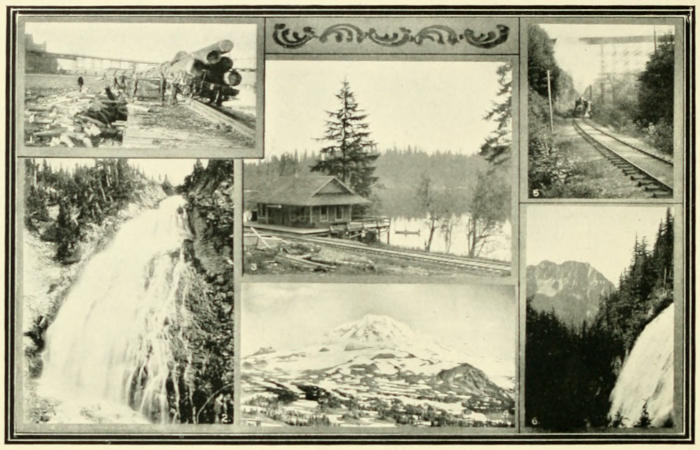
Views Along the Tacoma Eastern Railroad.
- 1—Unloading Logs at Tacoma.
- 2—Sluskin Falls, Paradise River.
- 3—Lake Kapowsin Station.
- 4—Mount Tacoma from Paradise Valley.
- 5—Train Leaving Tacoma.
- 6—In the Mountains.
Among the other lines of industry in Tacoma not already
enumerated are mills or factories for the manufacture
of brick and tile; brushes and brooms; artificial
ice; soap; tannery products; shoe uppers; boots and
shoes; buggy-tops; furs and for goods; clothing; shirts;
overalls; stockings; underwear; knit-goods; tents, awnings
and sails; paper boxes; fish baskets; oilskin garments
and other goods; cigars; cigar boxes; metal bedsteads
and woven-wire bed springs; cotton felt; carpets
and rugs; excelsior; egg cases; enamels; furnaces and
stoves; blank books, ledgers; stencils; rubber stamps;
trunks and traveling bags; paints and varnish, and many
other articles. TACOMA IS THE LEADING MANUFACTURING
CITY OF THE PACIFIC NORTHWEST.
TACOMA HAS THE MOST EXTENSIVE RAILWAY
TERMINAL FACILITIES AND HANDLES
MORE FREIGHT THAN ANY OTHER CITY IN THE
PACIFIC NORTHWEST. The Northern Pacific railway
has expended many millions in improvements on the
Tacoma waterfront. The official figures furnished by
the railroads showing the number of cars of pay freight
consigned to each of the three leading cities of the Pacific
Northwest during the year 1903 are as follows:
|
Cars of freight received at— |
| Railway System. |
Tacoma. |
Seattle. |
Portland. |
| Northern Pacific |
58,779 |
47,219 |
8,463 |
| Tacoma Eastern |
10,074 |
|
|
| Commercial Dock |
155 |
|
|
| Great Northern |
|
9,837 |
|
| Pacific Coast Co. |
|
11,020 |
|
| O. R. & N |
|
|
35,815 |
| Southern Pacific |
|
|
17,281 |
| Astoria & Columbia River |
|
|
896 |
| O. W. P. & R. Co. |
|
|
193 |
| Totals |
69,008 |
68,070 |
62,648 |
The Northern Pacific railway operates several distinct
lines which radiate from and converge at Tacoma.
The Chicago, Burlington & Quincy operates
through trains to and from Missouri River points and
Tacoma, over the N. P. tracks from Billings, Montana.
The Harriman system is to be extended to Tacoma from
Portland. The Tacoma Eastern railroad is now in operation
from Tacoma to Ashford, with a branch to Electron,
57.5 miles of track being now in operation. This
railroad taps the rich timber, coal and agricultural lands
on the southerly and westerly slopes of Mount Tacoma.
The company owns and is developing extensive coal
mines. It is about to extend into the “Big Bottom”
country, as the rich and fertile valley of the Upper
Cowlitz River is called, from three to twelve miles wide
and sixty miles in length, one of the most desirable sections
for settlement in the State. The Tacoma Eastern
railroad is the gateway to Mount Tacoma and the National
Park. The federal government is now constructing
a wagon road to Paradise Valley and the Camp of
the Clouds, which will connect with the railroad. Paradise
Valley and Mount Tacoma are destined to become
a great resort for tourists.
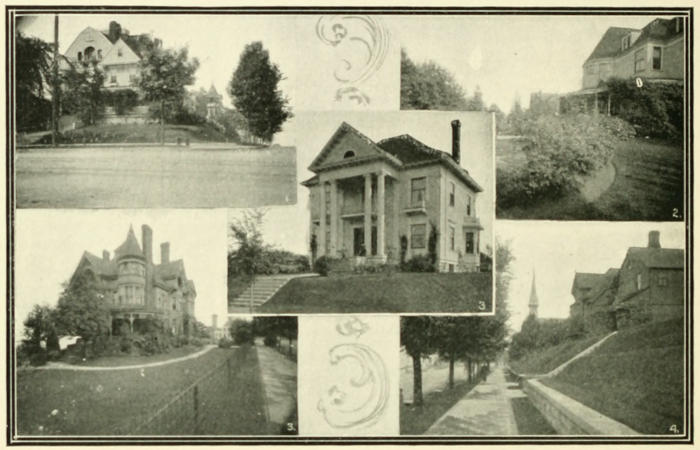
A City of Beautiful Homes.
- 1—Residences of Col. C. W. Griggs and Henry Hewitt.
- 2—Residences of L. D. Campbell and L. R. Manning.
- 3—Nelson Bennett’s Residence.
- 4—Residences of Stuart Rice and Chester Thorne.
- 5—S. R. Balkwill’s Residence.
The general offices of the Puget Sound Electric Railway,
operating fifty-three miles of standard gauge electric
railway, are at Tacoma. The main line extends from
Tacoma to Seattle, with a branch to Renton, twelve miles
from Seattle, and an extensive logging road from Edgewood,
near Tacoma, through the timber country towards
Brown’s Point. This is pronounced to be one of the
finest equipped, best constructed and operated electric
railways in the country. Thirty-four trains arrive or
leave Tacoma daily between six o’clock A. M. and midnight.
The road has been in operation about two years
and is aiding materially in the settlement and development
of the rich Puyallup and White River Valleys between
Tacoma and Seattle.
The Tacoma Railway & Power Company operates 85¼
miles of city and suburban electric and cable railways
at Tacoma. Lines are operated to Puyallup, 16 miles;
to Spanaway, 14 miles, and Steilacoom, 13 miles distant,
bringing these towns into close touch with Tacoma, and
facilitating the growth of the city’s suburbs. About 400
men are regularly employed as trainmen, trackmen, in
the shops and general offices. The increase in the number
of passengers carried during the past year is not
less than 5,000 per day.
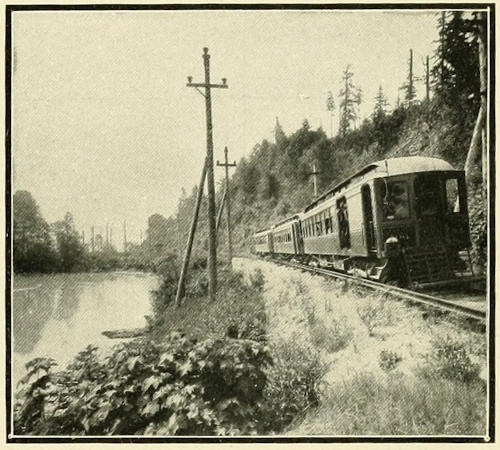
Train on Tacoma-Seattle Interurban Railway.
Tacoma’s ocean commerce exceeds in magnitude and
value that of every other port on the Pacific Coast with
the exception of San Francisco. President James J.
Hill, of the Great Northern Railway, explained the
fact with the epigrammatic remark: “Tacoma has the
facilities.” Tacoma possesses one of the finest harbors
in the world and has the most extensive wharves and
warehouses for handling ocean traffic on the Pacific Coast.
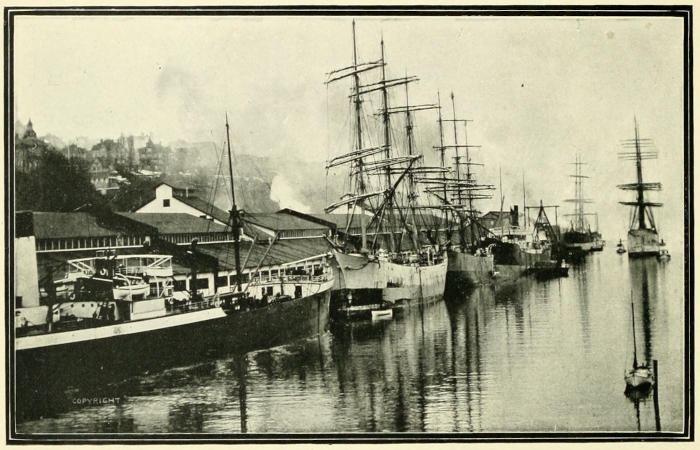
City Waterway from Eleventh Street Bridge.
Tacoma handles the largest share of the foreign trade
of the North Pacific Coast, the chief ports of which are
Tacoma, Portland and Seattle. The imports and exports
of these three ports for ten years from July 1, 1894, to
June 30, 1904, inclusive, as shown by the official customs
reports, were valued as follows:
| Tacoma |
$121,652,289 |
| Portland |
105,590,572 |
| Seattle |
84,911,055 |
Tacoma is the leading port of the Puget Sound customs
district, the headquarters of which are at Port
Townsend, and which includes Tacoma, Seattle and fourteen
other ports. Of the total foreign commerce of the
Puget Sound district, Tacoma handles more than 50 per
cent., Seattle less than 30 per cent., and the balance is
distributed between fourteen other ports in the district.
The following are the official figures showing the imports,
exports and total foreign commerce of Tacoma, Seattle,
and the Puget Sound district for the first six months
of 1904:
|
Imports. |
Exports. |
Total Foreign
Commerce. |
| Tacoma |
$2,835,712 |
$5,573,867 |
$8,409,579 |
| Seattle |
1,493,455 |
3,071,911 |
4,565,366 |
| Minor ports |
869,176 |
2,633,465 |
3,502,641 |
| Puget S’d Dist. |
$5,198,343 |
$11,279,243 |
$16,477,586 |
In ten years from 1894 to 1903, inclusive, the Puget
Sound customs district, of which Tacoma is the chief
port, rose from twenty-first to ninth in the magnitude of
its foreign commerce among the customs districts of the
United States. For the year ending June 30, 1903, Puget
Sound was the sixth district in the United States in the
tonnage of American and foreign vessels entered and
cleared in the foreign trade. The leading customs districts,
in the order of their rank in tonnage entered and
cleared, are New York, Boston, Philadelphia, New Orleans,
Baltimore, Puget Sound, San Francisco, Galveston,
Portland (Maine), and Pensacola.
While Puget Sound ranks ninth among the customs
districts of the United States in the magnitude of its
ocean commerce, measured by the value of its imports
and exports, this district stands first in the United States
in exports of manufactured lumber, boards, deals and
planks; shingles; fowls, and bristles. Second in exports
of sheep, buckwheat, oats, baking powder, cotton cloths,
dried herring, canned salmon, hay, malt liquors and
manufactures of tin. Third in exports of cycles, ginseng,
eider, copper ore, printing paper, milk and onions. Fourth
in exports of barley, wheat, wheat flour, bran, middlings
and mill-feed, candies, canned fruits and gunpowder.
Fifth in exports of eggs and malt. Sixth in exports of
furniture, salt, hogs, oysters, hops and nursery stock.
Seventh in exports of horses and copper, and eighth in
exports of fresh fish.
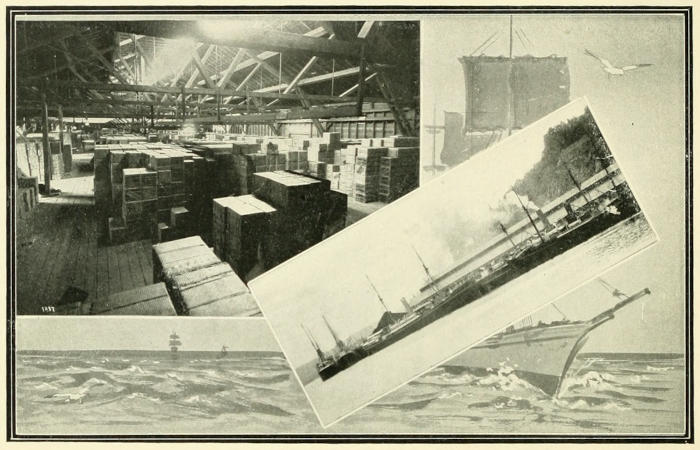
Oriental Wharves and Warehouses.
Tacoma’s ocean commerce may be classified as foreign
and coastwise. The latter includes chiefly shipments to
and receipts by water from Alaska, Hawaii and California.
The foreign trade of Tacoma extends to every continent
on the globe and to the islands of the sea. The
coastwise receipts are chiefly ores, salmon and furs from
Alaska, and fruits, general merchandise and manufactures
from California. The coastwise shipments consist
chiefly of merchandise sold by Tacoma jobbers to customers
in Alaska, provisions, machinery, lumber, feed,
etc.; bullion, coal, lumber and flour to California, and
coal, lumber and merchandise to Hawaii. The foreign
commerce of the port consists of imports of silk, tea,
mattings, Manila hemp, and other Oriental products, ores
for the Tacoma smelter, grain bags for Washington
wheat, cement and fire-bricks for building purposes, iron
and steel and other foreign commodities imported into
the United States; and exports the most valuable of
which are Washington products, wheat, flour, canned and
salt salmon, lumber, bottled beer, barley, hay and oats,
besides cotton, domestics, bicycles, tobacco and other products
and manufactures of Eastern and Southern States.
But by far the greater part of Tacoma’s exports are
products of the State or of Tacoma mills.
The Oriental trade of the Pacific Coast now centers
at Tacoma. In June, 1892, the first steamship for the
Orient from Puget Sound was dispatched from Tacoma.
In 1903, forty-four regular liners sailed from Tacoma
for the Orient, carrying cargoes valued at $8,149,906
from Tacoma, and cargo from Seattle valued at $946,318.
Tacoma is the home port of the Boston Steamship
Company, which operates a line of five large steamships
of American build and registry between Puget Sound
and the Orient. This line was established in July, 1902.
During the first two years of its operation, there were
thirty-five sailings from Tacoma for the Orient and
thirty-two arrivals by vessels of the line. Cargoes of
foreign merchandise valued at $6,146,488 were landed
at Tacoma, while domestic merchandise for export to
the value of $6,444,911 was loaded on vessels of the line
at this port. Seattle furnished additional cargo for the
line to the value of $2,505,935. Tacoma has handled
83.4 per cent. of the total foreign commerce carried by
the Boston Steamship Company since the inauguration of
its Puget Sound-Oriental line.
The China Mutual Steamship Company, Ltd., and
the Ocean Steamship Company, Ltd., both of which are
owned by Alfred Holt & Company, British ship owners,
operate a joint service between Tacoma and Liverpool
and Glasgow by way of the Orient, Suez Canal and Mediterranean
route. Dodwell & Company, the Tacoma
agents of the line, shipped from Tacoma in 1903, for
the Orient and Europe, by this service and the smaller
steamships of the Northern Pacific Steamship Company,
cargoes valued at $4,635,325, with additional cargo from
Seattle valued at $31,805. The steamships Tacoma, Victoria
and Olympia, for many years in the Tacoma-Oriental
trade, have recently been sold, the traffic having
outgrown their capacity. The cargo capacity of these
pioneer steamships in Tacoma’s Oriental trade ranged
from 3,000 to 3,800 tons. The new steamships in the
service have cargo capacity ranging from 6,739 tons to
18,000 tons. The Shawmut and Tremont of the Boston
Steamship Company, and the Ning Chow, the Oanfa and
the Keemun of the Holt lines, are the largest carriers
in the Trans-Pacific trade.
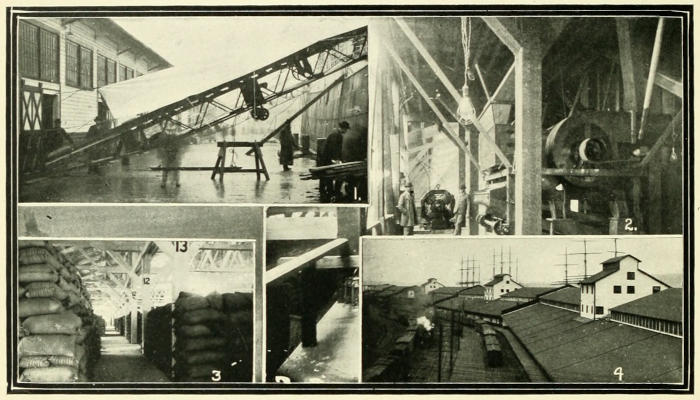
Tacoma’s Wheat Warehouses.
- 1—Loading by Electric Conveyor.
- 2—Machinery for Cleaning Wheat.
- 3—Sacked Wheat in Warehouses.
- 4—Where Sail meets Rail.
The Kosmos Line operates a regular service between
Puget Sound and Hamburg by way of Mexican, Central
and South American ports. In 1903 there were fifteen
sailings from Puget Sound by steamships of this line,
Tacoma furnishing nearly 70 per cent. of the total cargoes
carried from the Sound.
The largest vessels engaged in the coastwise trade
from Tacoma are the steamships of the American-Hawaiian
line operating from Tacoma to Honolulu and
New York, returning by way of San Francisco. The
Arizonian, Alaskan and Texan of this line, are vessels
of 8,671 tons gross register and 12,000 tons cargo capacity.
There were fourteen sailings from Tacoma for
Honolulu and New York by this line in 1903.
Two lines of steamships are operated regularly between
Tacoma and other Sound ports and San Francisco,
and several lines to Alaska. A fleet of colliers also plies
constantly between Tacoma and San Francisco, carrying
coal from this port. In 1902, 375,183 tons of coal were
shipped as cargo from this port, exclusive of fuel for
steamships. In 1903, the shipments of coal increased to
488,723 tons.
Tacoma handles the largest share of the staple products
of the State of Washington, lumber, wheat, flour
and coal. The shipments of lumber and coal have already
been stated. Tacoma’s facilities for the handling
of wheat are unequalled at any other port in the world.
The new wheat warehouses erected in 1900 and 1901 on
the city waterway, are the longest in the world, being
2,360 feet in length and 148 feet in width. They doubled
the warehouse capacity for grain at this port and afford
admirable facilities for receiving the wheat from the
cars, cleaning and sacking it and loading it on ocean
carriers. There are also two enormous grain elevators
and three large flour mills on the waterfront. Tacoma’s
facilities for exporting wheat and flour are so extensive
that in October, 1902, no less than twenty-five wheat carriers
were loaded and dispatched and the exports of the
month included upwards of 2,000,000 bushels of wheat
and 200,000 barrels of flour.
Tacoma is now the leading wheat and flour shipping
port on the Pacific Coast, and the customs district of
Puget Sound, of which Tacoma is the leading port, now
ranks fourth in the United States in both wheat and
flour exports, and fourth also in the combined exports
of wheat and wheat flour reduced to wheat measure,
each barrel of flour being equivalent to four and one-half
bushels of wheat.
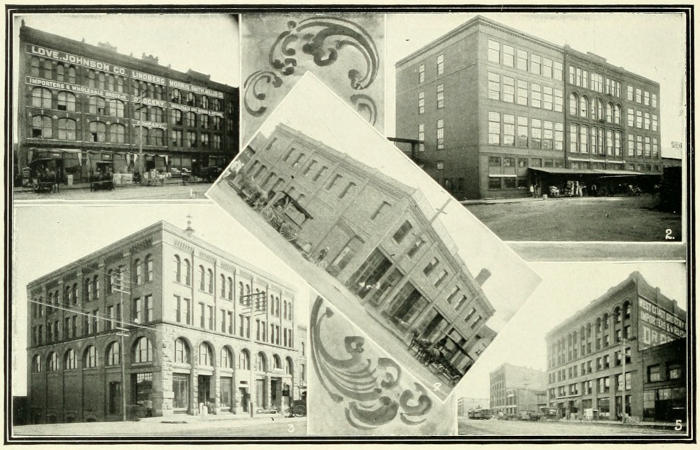
Group of Wholesale Houses.
- 1—On Lower Pacific Avenue.
- 2—F. S. Harmon & Company, Wholesale Furniture.
- 3—Hunt & Mottet, Hardware.
- 4—Wm. Gardner & Company, Plumbing, Heating and Mill Supplies.
- 5—West Coast Grocery Company.
THE PUGET SOUND CUSTOMS DISTRICT, OF
WHICH TACOMA IS THE LEADING PORT, HANDLING
90 PER CENT. OF THE WHEAT AND 60 PER
CENT. OF THE FLOUR EXPORTS OF THE DISTRICT,
ROSE FROM TENTH TO FOURTH PLACE
IN WHEAT EXPORTS AND FROM SEVENTH TO
FOURTH PLACE IN FLOUR EXPORTS IN THREE
YEARS FROM 1900 TO 1903.
The following table, compiled from the records of
the Tacoma harbormaster, shows the total value of Tacoma’s
ocean commerce, foreign and coastwise, for the
last five years:
|
Coastwise and Foreign— |
|
|
Receipts. |
Shipments. |
Total. |
| 1899 |
$8,607,196 |
$12,195,915 |
$20,803,111 |
| 1900 |
9,058,325 |
14,858,507 |
23,916,822 |
| 1901 |
11,495,859 |
22,904,877 |
34,400,736 |
| 1902 |
12,544,865 |
27,886,800 |
40,431,665 |
| 1903 |
13,335,398 |
21,861,972 |
35,497,370 |
Tacoma has a large and steadily increasing jobbing
trade. Seventeen individual firms and corporations are engaged
in the export trade in grain. There are sixty-three
concerns engaged in the manufacture or sale of lumber,
many of the number being large wholesalers. There are
a number of importing houses which handle Oriental
goods, fire-brick, cement, grain bags and other foreign
products for which there is a local demand.
Wholesale houses are established at Tacoma which
supply the trade in groceries and provisions, produce,
cereals, flour and feed, meats, fish, wines and liquors, confectionery,
tobacco and cigars, dry goods and notions,
furs, boots and shoes, drugs, paints and oils, hardware,
building materials and contractors’ supplies, belting and
hose, machinery and mill supplies, plumbers’ supplies,
wool, paper, furniture, and coal. There are numerous
commission houses and manufacturers’ agents. The West
Coast Grocery Company, of Tacoma, has the largest trade
in Alaska of any grocery house in the Northwest. The
first and only exclusively wholesale house established on
Puget Sound in the trade in dry goods and notions was
located and opened at Tacoma in January, 1903, after
a careful canvass of the merits of other cities. This was
quickly followed by the establishment of a wholesale
notion house, also handling dry goods. The largest wholesale
furniture house in the Pacific Northwest is at Tacoma.
One hundred and forty-four wholesale and jobbing
houses handled a trade amounting to $26,839,000
in 1903. Two hundred and eighty-six new business
houses were opened in Tacoma during 1903, while only
three were closed. These figures were furnished by the
mercantile agencies.
Tacoma has three national banks, two state banks
and one foreign banking corporation, the London & San
Francisco Bank, Ltd. There are also various institutions
for savings and building loans. The deposits in the
banks of discount and deposit aggregate $8,000,000 and
are constantly increasing.
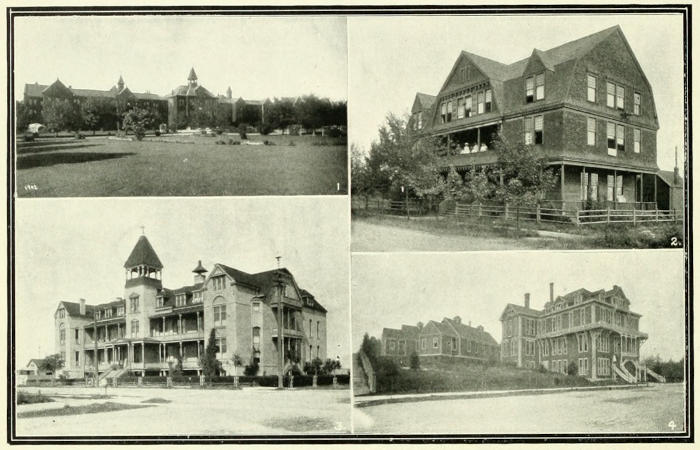
- 1—Western Washington State Hospital for the Insane.
- 2—Children’s Home.
- 3—St. Joseph’s Hospital.
- 4—Fannie C. Paddock Memorial Hospital.
Tacoma’s bank clearings reflect the marvelous growth
of business transacted in this city. The total bank clearings
for twelve months ending June 30, 1904, amounted
to $102,301,642, as compared with $93,348,272 during
the previous fiscal year, $51,838,768 during twelve
months ending June 30, 1900, and $24,550,442 during
twelve months ending June 30, 1897. TACOMA’S BANK
CLEARINGS HAVE INCREASED AT THE RATE OF
97.3 PER CENT. IN FOUR YEARS AND AT THE
RATE OF 316.7 PER CENT. IN SEVEN YEARS.
The number of real estate conveyances file for record
during twelve months ended June 30, 1904, was
6,513, and the amount of expressed consideration was
$6,302,837. This is an increase over the previous year
of $1,096,206, or at the rate of 21.1 per cent., and in
two years of $2,781,428, or at the rate of 79.0 per cent.
There has been a phenomenal increase in building operations
at Tacoma amounting to no less than 855.8 per
cent. in five years last past. The following is the official
record of the building inspector, showing the number
and estimated cost of dwellings and total building
operations for which permits were issued during the last
six years. The building inspector’s record does not cover
a large amount of building in the immediate suburbs of
Tacoma, for industrial and residence purposes.
Twelve Mos.
ending June |
Dwellings. |
Total Permits. |
| Number. |
Cost. |
Number. |
Cost. |
| 1904 |
845 |
$883,068 |
1,429 |
$1,691,105 |
| 1903 |
620 |
665,895 |
1,043 |
1,543,755 |
| 1902 |
447 |
491,005 |
779 |
869,492 |
| 1901 |
251 |
316,640 |
652 |
692,156 |
| 1900 |
130 |
97,350 |
422 |
417,845 |
| 1899 |
74 |
51,195 |
371 |
176,934 |
Notwithstanding the investment of millions of dollars
in Tacoma realty and improvements, the mortgage
indebtedness shows no appreciable increase. In
1903, realty transfers reciting a consideration of $4,646,537,
were recorded and permits were issued in
the city of Tacoma for improvements estimated to cost
$1,700,000. The net increase in the mortgage indebtedness,
as shown by the record of mortgages and mortgage
releases, was $169,655, or only 2.6 per cent. of the amount
involved in real estate purchases and improvements.
The federal government has purchased a site for a
much needed public building at Tacoma, which will
shortly be erected. Tacoma is the headquarters of the
new Internal Revenue Collection District of Washington
and Alaska. Federal collections at Tacoma for the fiscal
year ending June 30, 1903, were as follows: Internal
revenue, $688,696.50; customs, $301,039.32; postoffice receipts,
$113,598.66; total, $1,103,334.48. Postoffice receipts
have increased at the rate of 132.1 per cent. in
seven years.
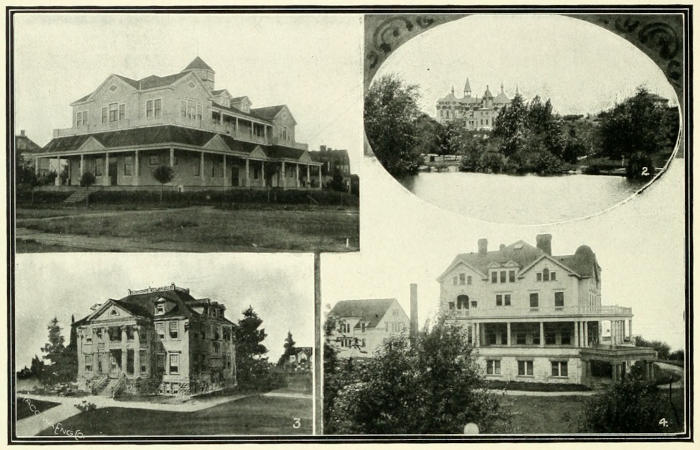
- 1—Mason Library, Whitworth College.
- 2—Annie Wright Seminary from Wright Park.
- 3—Administrative Building, University of Puget Sound.
- 4—Residence and Boys’ Dormitory, Whitworth College.
Extensive municipal improvements are in progress.
Among the more important are several miles of asphalt
and brick paving; fifty miles of new sidewalks, principally
of cement; sewers, water mains and bridges. Tacoma
owns and operates its own water and electric lighting
plants, supplying both water and light to private
consumers. The city procures current from the power
companies at the lowest rates paid in the United States
and receives a large and increasing revenue from operation,
notwithstanding recent reductions in rates, which
are as low to private consumers as in any American city.
Tacoma maintains an efficient free employment bureau.
The assessed valuation of taxable property in Tacoma
in 1903 was $22,468,988. The bonded indebtedness, exclusive
of the water and light debt, is $1,743,000. The
city has no floating indebtedness and has a sinking fund
amounting to $135,734.52, largely invested in Tacoma
city bonds bought in the market at 110. The city owns
property valued at $3,250,000. The light and water debt
of $2,080,000 represents the capital invested in a profitable
business which produces a revenue to the city.
Tacoma has twenty-one public schools of the primary
and grammar school grades and a high school. A magnificent
building with accommodations for 1,200 pupils
is being erected for the high school. The enrollment in
the public schools for the year 1903-04 was 8,939 and
the average daily attendance 7,066. The value of school
property in the district is $988,040, while the total liabilities,
including bond and warrant indebtedness amounted
to $492,523.02 on June 30, 1904, with a cash balance
on hand of $36,554.82.
Tacoma is the seat of Whitworth College, founded
and conducted by the Presbyterian Church, which occupies
a conspicuous location overlooking the Sound. The
University of Puget Sound is under the auspices of the
Methodist Episcopal Church. The University occupies
a fine new building at the West End. The Annie Wright
Seminary is a boarding and day school for girls. It
is liberally endowed and has a valuable property near
Wright Park. The Pacific Lutheran Academy and Business
College is at Parkland, a suburb at the south.
Vachon College is at Burton, on Quartermaster Harbor.
The Academy of the Visitation and St. Aquinas Academy
are schools for girls under Roman Catholic auspices.
There are also two business colleges, a training school
for nurses in connection with the Fannie Paddock Hospital,
and schools of music and art.
Tacoma has upwards of eighty church organizations,
representing all the leading religious denominations. Tacoma
is the see city of the Episcopal Jurisdiction of
Olympia.
The Ferry Museum occupies the fourth and fifth floors
of the County Court House. It has extensive collections
of natural history, art, sculpture, Indian baskets and
relics, Oriental curios and the like. The Tozier exhibit
is the most extensive Indian collection in the world.
Tacoma has a new public library building completed
and opened in 1903, the gift to the city of Andrew Carnegie,
who gave $75,000 for the building, the city providing
the site. The library contains 30,000 volumes.
There are two large and well-equipped general hospitals
at Tacoma, St. Joseph’s Hospital, and the Fannie
C. Paddock Memorial Hospital, also a large new Pierce
County Hospital. A $100,000 hospital for the employes
of the Northern Pacific railway is now building. At
Steilacoom is the Western Washington State Hospital for
the Insane. There are three children’s homes for orphans
or friendless children, and numerous benevolent
and charitable institutions.
Tacoma has 800 acres of beautiful parks. Point
Defiance Park occupies the northerly extremity of the
peninsula on which Tacoma is built. It has about three
miles of shore line on the Sound and most of it is covered
with giant fir. It is a park of unusual natural
beauties and attractions. Wright Park is a garden,
twenty-eight acres in extent in the heart of the city,
with a great variety of shrubs, trees and flowers.
Tacoma, the industrial and commercial center of the
Empire State of the Coast, is an inviting field for enterprise
and effort and offers boundless opportunities for
the profitable employment of capital in manufactures,
trade, commerce and transportation, and rich rewards
for the exercise of brains and well-directed energies.
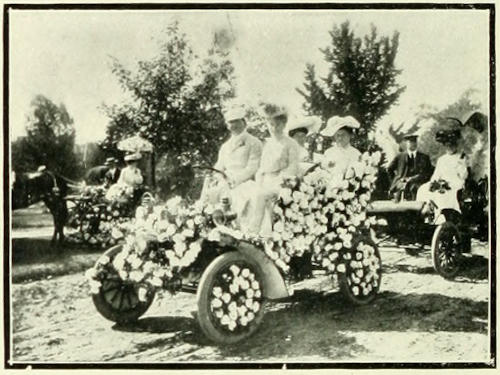
Decorated for Tacoma’s Rose Carnival.
| Months. |
1901-02. |
1902-03. |
1903-04. |
| Dwellings. |
Total Permits. |
Dwellings. |
Total Permits. |
Dwellings. |
Total Permits. |
|
No. |
Cost. |
No. |
Cost. |
No. |
Cost. |
No. |
Cost. |
No. |
Cost. |
No. |
Cost. |
| July |
29 |
$ 35,040 |
66 |
$ 66,845 |
38 |
$ 43,955 |
73 |
$ 76,945 |
79 |
$ 74,640 |
113 |
$ 125,680 |
| August |
23 |
29,990 |
47 |
59,540 |
42 |
42,850 |
70 |
150,880 |
90 |
96,135 |
149 |
120,401 |
| September |
38 |
52,200 |
63 |
137,741 |
39 |
48,660 |
69 |
113,555 |
84 |
88,150 |
144 |
170,345 |
| October |
30 |
21,125 |
61 |
36,941 |
45 |
43,252 |
81 |
120,700 |
68 |
65,720 |
117 |
148,783 |
| November |
22 |
21,290 |
34 |
24,520 |
42 |
39,140 |
77 |
54,095 |
45 |
33,730 |
78 |
122,225 |
| December |
17 |
15,800 |
25 |
31,200 |
20 |
22,075 |
43 |
70,695 |
44 |
35,900 |
84 |
56,015 |
| January |
33 |
34,900 |
55 |
53,340 |
49 |
51,130 |
77 |
84,785 |
55 |
57,360 |
92 |
116,553 |
| February |
37 |
46,650 |
60 |
68,900 |
60 |
75,410 |
100 |
116,725 |
62 |
64,485 |
105 |
121,675 |
| March |
55 |
57,075 |
84 |
109,050 |
71 |
72,505 |
106 |
306,012 |
68 |
72,100 |
115 |
92,950 |
| April |
55 |
57,415 |
96 |
104,320 |
78 |
76,660 |
131 |
190,990 |
83 |
100,580 |
128 |
135,600 |
| May |
72 |
73,460 |
122 |
100,280 |
62 |
67,595 |
99 |
111,743 |
86 |
97,160 |
160 |
234,582 |
| June |
36 |
46,060 |
66 |
76,815 |
74 |
82,463 |
117 |
146,630 |
81 |
97,108 |
144 |
246,296 |
| Totals |
447 |
$491,005 |
779 |
$869,492 |
620 |
$665,695 |
1043 |
$1,543,755 |
845 |
$883,068 |
1429 |
$1,691,105 |
| Months. |
1901-02. |
1902-03. |
1903-04. |
| July |
$ 4,318,153.03 |
$ 5,409,206.75 |
$ 7,715,579.70 |
| August |
4,594,683.55 |
5,945,993.04 |
7,308,197.37 |
| September |
5,252,834,60 |
6,244,709.50 |
8,330,087.33 |
| October |
5,982,652.46 |
8,569,541.60 |
9,268,786.11 |
| November |
5,537,297.55 |
8,460,959.94 |
8,764,691.01 |
| December |
5,031,807.23 |
9,681,493.06 |
10,060,853.96 |
| January |
5,414,839.63 |
8,969,399.35 |
8,719,901.12 |
| February |
4,267,933.49 |
7,521,557.21 |
8,175,534.17 |
| March |
5,243,385.69 |
8,639,380.86 |
9,144,338.91 |
| April |
5,266,410.53 |
8,162,920.94 |
8,231,909.76 |
| May |
5,508,605.51 |
7,965,403.09 |
8,299,838.70 |
| June |
5,736,684.64 |
7,767,707.08 |
8,281,923.53 |
| Totals |
$62,155,287.91 |
$93,348,272.42 |
$102,301,641.67 |
| Months. |
1901-02. |
1902-03. |
1903-04. |
| July |
$ 6,828.06 |
$ 7,854.42 |
$ 8,934.53 |
| August |
6,036.91 |
6,603.76 |
8,708.47 |
| September |
7,098.88 |
7,620.88 |
8,736.62 |
| October |
7,163.26 |
8,209.68 |
10,277.23 |
| November |
7,439.21 |
7,867.43 |
9,264.48 |
| December |
8,498.15 |
10,269.96 |
11,837.96 |
| January |
8,473.29 |
9,277.34 |
10,053.33 |
| February |
7,330.70 |
9,024.62 |
9,613.01 |
| March |
7,238.57 |
8,360.07 |
9,807.18 |
| April |
7,592.38 |
8,357.45 |
9,021.51 |
| May |
8,069.68 |
7,651.96 |
8,551.12 |
| June |
6,998.30 |
8,128.26 |
8,793.22 |
| Totals |
$88,767.39 |
$99,225.83 |
$113,598.66 |