There was a new boy at school.
In this little town with its ever changing population of miners and
fortune seekers, the advent of a stranger as a usual thing caused little
if any excitement. But with this boy it was different, though the
children could not have explained wherein he was unlike themselves. It
could not be his clothes, for Jimmy Gates, the hotel-keeper's son, was
the best-dressed boy in town; it could not be his appearance, for though
he was undoubtedly good-looking, he did not begin to be as handsome as
Herman Richards; it could not be the place where he lived, for the
Carson house was the largest and most attractive in town. And yet there
was something about him that won him a ready welcome wherever he went.
Tabitha was fairly hypnotized. She could not keep her eyes off him
whenever the opportunity to look in his direction came to her, which
fortunately was not often, as she sat in the front seat of the outside
row, while his desk was towards the rear of the room in the same row,
and they were both in nearly all the same classes, though he was
obviously some two or three years older than she. However, he was
further advanced in arithmetic, and recited in a different class, so she
could watch him during that lesson while he was working at the
blackboard, or sitting on the recitation bench in front of the whole
school. He had the loveliest red-brown curls and big, red-brown eyes
with long, heavy lashes! To be sure, his face was freckled, but he was
always laughing and one forgot the freckles in watching his flashing
white teeth or the dimples that came and went in his round cheeks.
Tabitha did not know that he hated these dimples almost as badly as she
did her name, and that his beautiful curls were a great trial to him, as
such things are to all boys of that tender age; but she did know that he
was different from any boy she had ever seen, and so she worshipped him
from afar.
Besides, he had the grandest name! Why had she never heard of Jerome
when she gave Tom the name of Dionysius Ulysses Humphrey Llewelyn?
Maybe it wasn't too late yet. Oh, she had forgotten—how could she ever
forget! And the crimson blood mounted her cheeks as she remembered that
unhappy day in the long ago when she had marched up one side of the
street and down the other and told the people that her name was Tabitha
Catt. Tom and the Carsons and Miss Brooks had been very kind to her
after that dreadful affair, and when she had gone back to school the
children never once referred to the beautiful name that had been so
ruthlessly snatched away from her, but they played with her just as if
nothing had happened and even spoke the hateful word, Tabitha, with such
a gentleness that it lost some of its sting. Carrie adopted Tom's pet
name for her, so in time others of the children had taken it up and she
was more frequently Puss than Tabitha; for all of which she was deeply
grateful. Still, she could not help wishing that Tom's name could have
been Jerome. That did sound so splendid! But Tom in her eyes was just as
nice as Jerome Vane, even if he was solemn and shy while Jerome was
laughing and debonair.
The new scholar had been in school just one week when one rainy day at
recess while the children were playing quietly inside the building, as
the weather was too forbidding to permit the usual games in the yard,
Tabitha's sharp ears caught a snatch of conversation among the boys busy
drawing horrible cartoons on the blackboard, and one of the speakers was
her idol, Jerome Vane.
"Who's that black-haired kid that signs her name as 'T. C.' in the
arithmetic class?" the new boy asked.
"Oh, that's Tabitha Catt."
"Tabitha Catt! What a funny name!" Jerome exclaimed; and Tabitha,
darting a swift glance at him from the corner of her eye, saw that he
was looking at her with an amused smile on his lips.
"Ain't it, though? She don't like it a bit, and took a different one;
but her father made her take it all back. She's teacher's pet, so we
daren't tease her."
"Huh!" declared the other with a swagger of bravado, "'twould take more
than that to make me stop teasing her if I wanted to."
"Guess you don't know Miss Brooks very well."
"I don't care a hang about Miss Brooks. I'd tease if I wanted to."
"I dare you!"
"Taken!"
Tabitha was almost too shocked to move, but at this opportune moment,
Carrie came running up to her desk with the news, "Sam Giles has just
brought in a bucket of water. Don't you want a drink before recess is
over?"
Glad to escape further observation, Tabitha followed blue-eyed Carrie
over to the corner of the room where the bucket stood, surrounded by the
thirsty boys and girls, all clamoring for a turn.
"Hurry up, Jack Leavitt, it's almost time for the bell and I want a
drink!"
"Give me that dipper, you Jim Gates; I want another swig!"
"Wait your turn, stingy!"
At last Tabitha stood beside the pail with the dipper in her hand, but
just as she lifted the big cup brimming over, someone behind her tweaked
her long braid, and she heard Jerome's laughing voice saying,
"'Tabby Catt, Tabby Catt, where have you been?'
'I've been to London to see the queen.'
'Tabby Catt, Tabby Catt, what saw you there?'—"
"I saw a sneaking boy with a shock of red hair," finished the enraged
Tabitha whirling toward him with the dripping dipper, and before he had
a chance to divine her intentions or dodge to one side, she let its
contents fly straight into his face.
"Tabitha Catt!"
An ominous hush had fallen over the room while this little scene was
transpiring, but the angry child had not noticed the unusual silence,
nor perceived that Miss Brooks had entered in time to see the deluge.
"Tabitha Catt!" repeated the astonished teacher. "I am surprised at you.
Ask Jerome's pardon for being so rude."
Tabitha still stood beside the water bucket, quivering in every limb,
eyes blazing, nostrils flaring, and clutching the empty dipper fiercely
in her hand.
"I will not!"
The teacher was shocked; no one had ever defied her in this manner
before, and the angry blood mounted to her forehead. She would have
obedience at whatever cost.
"Tabitha, I insist that you beg Jerome's forgiveness."
"I was to blame some, too, Miss Brooks," interrupted the boy
shamefacedly. "I'm sorry."
"I'm not," declared the little rebel, more hurt and grieved at finding
her idol shattered than angry at his teasing words.
Plainly Miss Brooks was puzzled. She could not ignore such open
defiance; it must be punished in some way. What should she do? A bright
thought occurred to her.
"Jerome, take your seat. Tabitha, come here."
The girl walked over to the teacher's desk, still gripping the dipper in
one grimy fist, and wondering what was to befall her now. This was the
first time Miss Brooks had ever punished her, and in spite of her anger,
sorrowful tears gathered in her eyes. She didn't mind being hurt, but to
have Miss Brooks punish her seemed more than she could bear. The teacher
carefully drew her chair out on the platform in front of the whole
school, and sitting down in it, took Tabitha on her knee.
"Now, Tabitha, you must sit in my lap until you will tell Jerome that
you are sorry. He has begged your pardon like a man, and it is worse
than impolite to refuse to do the same to him; it is wicked."
The scholars giggled. Instantly the tears were dried, the brown face
grew white and tense, the whole slender body rigid with passion, and
with unseeing eyes Tabitha stared straight ahead of her, refusing to
speak.
Thinking the child would see fit to do as she was told after a few
moments of meditation, the teacher rapped for order, took up her book
and called the next class for geography. But Tabitha's anger had
swallowed up every other emotion, and all that afternoon she sat on Miss
Brooks' knee, taking satisfaction in making herself as heavy as possible
and in stepping on the teacher's toes as often as they came within
reach.
It was an uncomfortable session for the whole school; Carrie took the
punishment as keenly as if she had been the culprit and grieved herself
sick over her friend's unhappiness; and the teacher was almost as
sorrowful. The reproachful look in the black eyes haunted her until
several times she was on the point of allowing the girl to take her
seat, but each time came the thought, "If I let this offense go
unpunished, I will soon have the whole school defying me. No, she must
obey, even if it is little Tabitha, and Jerome to blame." So she held
the furious rebel until the clock pointed to the hour of closing, and
then with the cold words, "You may go, now," she dismissed her, half
expecting the girl would linger and penitently ask her forgiveness; when
she meant to be very firm and make her see the error of her ways, but at
last to accept her apology and let the matter drop. To her hurt
surprise, however, Tabitha bundled into her wraps and bounced out of the
building without waiting even for Carrie, the loyal; and with heavy
heart the woman turned back to the little duties which must be attended
to before she could go to her home.
The rain had ceased, but little puddles stood in every hollow, and as
the schoolhouse was at the foot of the hill, it was almost surrounded by
a chain of these miniature lakes. As Tabitha rushed out of the door in
her mad flight, she found herself confronted by a huge puddle which she
could not cross without wetting her feet, and ever mindful of Aunt
Maria's heroic treatments for colds, she paused to choose a better path.
This gave Carrie a chance to overtake her, but before the little
peacemaker could say a word of comfort to the wounded heart, Jerome's
laughing tones rose clearly above the rest of the clamoring voices,
"Oh, Tabitha, wait a minute."
She hesitated, half turned as if to heed his entreaty, and then—then it
happened.
"Susie's reader has a new poem in it; one that I never saw before,
Tabitha," the teasing voice continued. "It says:
'My little black Tabby is perched on my knee;
As fierce as a lion or tiger is she;
She wakes—'"
Tabitha's books fell unheeded to the ground, she leaped toward her
tormentor with fury in her heart, and dealt him a staggering blow full
on the nose, screaming in rage,
"I would rather be a Tabby Catt than a cross-eyed, red-headed
chimpanzee."
Pushing him violently from her, she turned and fled through the wide
puddle and up the slope toward home, never hearing the loud splash
behind her and the mingled screams and laughter, and not aware that the
debonair Jerome with the blood spurting from his nose had lost his
balance and toppled into the muddy water.
Indignant Carrie faced him as he rose to his feet, and stamping her foot
in her extreme vexation, she boldly cried,
"You ought to be ashamed of yourself, Jerome Vane. Teacher said we
mustn't tease her, and I'm glad you're hurt. You deserve to be." And she
sped tearfully away in pursuit of her fleeing mate before the
discomfited boy could find breath to tell her that he was ashamed of
himself—thoroughly ashamed.
Miss Brooks had witnessed the fray from the window, but she wasn't the
only grown-up spectator. A tall, dark man loaded down with a huge
watermelon had come up the road just in time to hear and see the whole
performance, and a smile of satisfaction lit his face when the girl came
off victorious.
"Poor kid," he said under his breath. "She is a regular Catt all right.
How will she come out of it?"
He found himself hoping that life might have much more sweetness in it
for her than it had had for him. And he had named her Tabitha!
With wild rebellion in her heart and a keen sense of the injustice done
her, Tabitha had rushed heedlessly up the hill and down through the
pathless tangle of wet greasewood and sagebrush, splashing through mud
and water with reckless abandon, and arriving home in a deplorably
bespattered state, with feet wet and dress dripping. Aunt Maria saw her
coming and met her at the door with an exclamation of horror: "Tabitha
Catt! What do you think you are about? The very idea of running through
puddles in that manner! Get off those wet shoes this minute and put your
feet in the oven. If I just had some mullein leaves now to make
compresses with! Look at your dress, and this is the second this week.
Lucky this is Friday or you would have to wear a dirty gown to school
tomorrow."
The door opened again and Mr. Catt came in just in time to hear the last
words of the scolding. Laying the watermelon on the table, he turned to
the child huddled in the corner close to the hot stove, and demanded,
"How did you get so muddy?"
"Coming home from school."
"Say 'sir' when you address me. What were you doing to get so wet?"
"Running."
"What?"
"Running, sir."
"What were you running for?" He was trying to make her confess what had
happened at the schoolhouse, but she had her own method of answering
questions, and that was seldom very satisfactory to the questioner so
far as the amount of information was concerned.
"For exercise," she snapped, forgetting her fear of him in her
exasperation at these other unhappy events.
"You were fighting," he said sternly, and she started in surprise, but
made no answer. "Weren't you?"
"No."
"What?"
"No, sir."
"Tabitha Catt!" he exclaimed in astonishment. "Go to your room. No melon
tonight for a girl who will tell such a deliberate lie."
Tabitha rose instantly, seized her draggled belongings and started for
her door, but paused on the threshold to say, "I hit him only once. That
ain't fighting, is it? I wanted to trounce him good; he deserved it."
Her door shut with an emphatic bang, and the weary, perplexed,
belligerent little girl crept into bed to sob herself to sleep.
Breakfast was over, the dishes all cleared away and the kitchen deserted
when she awoke the next morning; but on the table stood a tray on which
her lunch was set forth, and beside it lay a note from Aunt Maria saying
that a sick neighbor had sent for her and she would be gone for some
time.
Tabitha took a survey of the premises. Tom was at the office, the father
nowhere in sight. Where was the watermelon? Surely three people couldn't
have eaten all of it in one meal! Oh, there it was in the cooler and not
even cut. She stood contemplating it for a moment, then with a deft
motion rolled it out on the floor. It was so heavy she could scarcely
lift it. She looked around for something to assist her, and her eye fell
upon an empty flour-sack which Aunt Maria had left on top of the barrel,
evidently intending to wash it out. Seizing this, she spread it open
beside the melon, rolled the great green ball inside, and dragged the
trophy out of doors up the rocky path to the road and out of sight among
the boulders. There she stood and surveyed the bag while she wrestled
with herself.
"He said I lied, and I didn't. It wasn't a fight, for Jerome never hit
me at all. It takes two to make a fight. Miss Brooks says so. He's
always telling me I lie. He never said I couldn't have some melon today.
Maybe if I had left it alone he would have given me some. Perhaps I'd
better take it back."
She stooped over, grabbed the end of the bag and started back down the
trail again, but at the first step she stopped. It was the wrong end of
the sack she had clutched, and the melon had rolled out into the sand.
"Oh, gracious! However did that happen?" she exclaimed aloud in horror,
gazing with fascinated eyes at the battered, hopelessly scarred ball
which had once been so smooth and round and green. Scarcely a bit of the
skin remained on its sides, and a great, jagged crack almost split the
thing in halves.
"Now, I've done it! What will Dad say? Guess I'll get a licking this
time sure. Well, he needn't have said I lied. Serves him right that his
old melon is spoiled. It's a pity to waste it, though. Guess I better
eat it. If I am going to get licked, I may as well have the melon first;
maybe it won't hurt so bad. It looks perfectly beautiful inside."
Down beside the shattered fruit she sat and began munching the red,
sweet, juicy pulp which smelled oh, so good! But somehow the taste was
bitter in her mouth, and the tempting morsels choked her when she tried
to swallow them. She reviewed the previous day's happenings and began to
wonder if she were entirely blameless. She had promised Mr. Carson not
to get mad when folks teased her, and here she had not only got mad but
had hurt Jerome, defied the teacher and stepped on her toes, wounded
faithful Carrie by running away from her, angered her father and stolen
his melon.
There was the sound of horse's hoofs and the rumbling of wheels on the
hard roadbed, and around the rocky hillside appeared a light carriage
driven by a portly, middle-aged man of professional appearance, who
drew rein at sight of the child sitting there so disconsolately with the
broken watermelon between her knees.
"Hello, sis," he said pleasantly, "can—"
"If you will follow the road you will reach Silver Bow in just a few
seconds. It's right around that next curve," recited Tabitha rapidly, as
if well accustomed to directing travelers.
The man smiled in amusement, and Tabitha wondered vaguely where she had
seen him before, for he certainly looked familiar. "I happen to be
staying at Silver Bow just at present, so I know where to go," he
answered genially, removing his hat to fan himself, and exposing to view
a head of wavy red-brown hair streaked liberally with gray. "I was going
to ask you if you could tell me what you were doing up there and where
you got that watermelon."
"Yes?"
He waited expectantly, but no further explanation was forthcoming, and
he gently reminded her, "I am listening."
"Well, I don't intend to tell you," she burst forth hotly, "for it is
none of your business!"
Instantly the kindly face became grave and he bowed politely as he
gathered up the reins, saying, "Oh, I beg your pardon, little girl; it
was rude of me to ask such a question. I forgot my manners."
She felt his unspoken reproof keenly and her face flushed with shame,
but before he could drive on she cried impetuously, "It wasn't your
manners that were forgot, it was mine. I have to be so polite to Dad and
Miss Brooks that I don't have any manners left, I reckon. I am sorry I
was rude. I stole this melon and drug it up here to plague Dad 'cause he
said I couldn't have any, but it got smashed all into bits coming up, so
I thought I better eat it so's to save it. Aunt Maria doesn't like
anything to go to waste. But the melon is sour, I reckon, and I'm sorry
I took it. I'd have lugged it back again but it was a sight to be seen
and wouldn't have held together till I could have got it there. Now I
s'pose I'd better go home and get ready to be licked. It will surely
come this time."
As this torrent of words tumbled from her lips she rose from her seat
and slid down the rocky incline to the road where the stranger sat
staring at her in absolute amazement.
"Are you Tabitha Catt?" he asked at last.
"Yes, sir. How did you know me?" and a look of intense bitterness crept
into her eyes as the hateful name sounded in her ears.
"My boy is in school here, and he told me—"
"Is your boy Jerome Vane?" she interrupted, suddenly recognizing the
great similarity between man and boy.
"Yes, I am Dr. Vane—"
"Well, I must say you've got the impolitest boy I ever saw! I threw
'most a bucket of water in his face yesterday and punched his nose good.
Dad saw me and that's why he said I couldn't have any watermelon."
The doctor's face was a study, his lips twitched and his eyes grew
suspiciously bright. Leaning over the side of the carriage, he held out
his hand to the barefooted girl among the rocks and said tenderly,
"Come home with me, Tabitha. The little mother wants to see you. Jerome
is sorry and he will never torment you again. He didn't understand."
Tabitha eyed the doctor doubtfully. Maybe he wanted to lick her for the
blow she had given Jerome; but one look at the sympathetic face
dispelled her fear, and she started as if to accept his invitation, then
drew back.
"Thank you, Dr. Vane. I should be pleased to accompany you," she said
with all the politeness and formality she could muster, "but I reckon
I'd better be going home now. Dad is probably looking for me by this
time. He'll want his melon."
The doctor surveyed the shattered fruit on the mountainside, and then
looked down into the small brown face with its pathetically drooping
mouth.
"We'll drive around by the store and get another melon, Tabitha, and
everything will be all right. Won't that do?"
"Why didn't I think of that before?" she exclaimed in visible relief.
"How much will it cost? Four bits?"
"Yes, maybe a little more. Such things cost more here on the desert than
they do where they use raised."
Her face fell. "I've got only forty-two cents in my bank. I reckon I'll
have to take the licking after all."
"I'll give you the rest—" he began.
"No, I mustn't take money from people unless I've done something to earn
it. But—if you will lend me eight cents, I'll pay it back as soon as I
can earn it,—that is, if you can wait for it. Maybe it will be quite a
while before I get any more. There ain't many things a girl can do on
the desert to earn money fast. In Ferndale I used to pick berries. Do
you think you can wait?"
"Yes, indeed, Tabitha. Climb in and we'll hurry that melon home before
anyone knows it is gone."
Up into the carriage she scrambled and away they drove towards town.
Back to contents
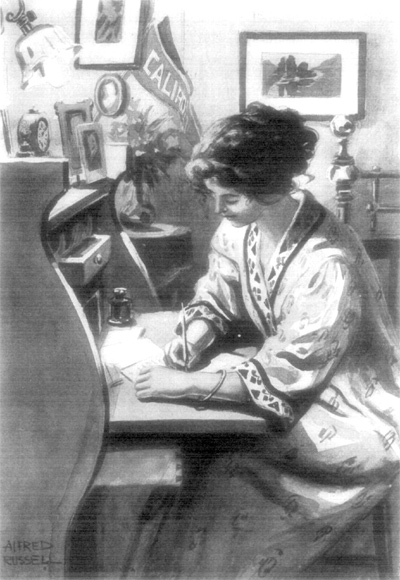 She began her first letter to the father she did not know
or understand.
She began her first letter to the father she did not know
or understand.