| 1. |
Uropatagium lacking, or, if present, deeply indented in center; tail
vertebrae absent, or if present, free |
| 2 |
| 1'. |
Uropatagium present, not indented; tail vertebrae present, free or in
uropatagium |
| MICROCHIROPTERA 1 |
| 2(1). |
External tail-vertebrae lacking, or, if present, less than 3 mm long |
| 3 |
| 2'. |
External tail-vertebrae more than 3 mm long |
| 6 |
| 3(2). |
Small or medium-sized (forearm less than 50); tongue long, extensile |
| 4 |
| 3'. |
Large (forearm more than 80); tongue not long and extensile |
| 5 |
| 4(3). |
Uropatagium present; small claw present on second phalanx of
second digit; tail short (about 3 mm) |
| Macroglossus, p. 812 |
| 4'. |
Uropatagium absent; no claw on second phalanx of second digit; no tail |
| Melonycteris, p. 814 |
| 5(3'). |
Entire back set with hair; wing membranes not meeting at middle
of back |
| Pteropus, p. 793 |
| 5'. |
Back naked; wing membranes meeting at middle of back, |
| Pteralopex, p. 790 |
| 6(2'). |
Nostrils having definite tubelike extensions |
| Nyctimene, p. 817 |
| 6'. |
Nostrils lacking tubelike extensions |
| 7 |
| 7(6'). |
Forearm less than 80; large, sharp claw on second phalanx of second
digit; four upper incisors |
| Rousettus, p. 787 |
| 7'. |
Forearm more than 90; small, blunt claw on second phalanx of second
digit; two upper incisors |
| Dobsonia, p. 807 |
Family PTEROPODIDAE
Subfamily Pteropodinae
Rousettus Gray
1821. Rousettus Gray, London Medical Repository, 15:299, April 1.
1843. Xantharpyia Gray, List of species ... British Museum, p. 37.
1852. Cynonycteris Peters, Reise nach Mossambique, p. 25.
The genus Rousettus occurs throughout the tropical regions of the Old
World, and in the Solomons is readily distinguished from all other megachiropteran
genera by having both a small claw on the second digit and free caudal
vertebrae. The oriental species have been divided into two groups on the
basis of size (Tate, 1942:344). The subspecies Rousettus amplexicaudatus
hedigeri appears to be the sole representative of this genus in the Solomon
Islands. Prior to 1953, several workers (Thomas, 1887b:323, 1888b:475;
Matschie, 1899:68; Sanborn, 1931:11) used the name Rousettus amplexicaudatus
brachyotis for it, but Pohle (1953) suggested that the specimens from
the Solomons recorded by earlier workers were R. a. hedigeri named by him
on the basis of the specimen that he saw from Bougainville.
Rousettus amplexicaudatus
Rousettus amplexicaudatus has at least three subspecies, one of which is
endemic to the Solomon Islands. The species is wide-ranging, being known
from as far west as Thailand (Ellerman and Morrison-Scott, 1966:93) and as
far east as the Solomons.
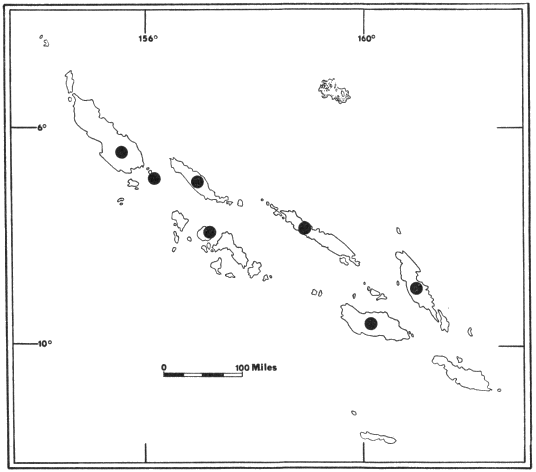
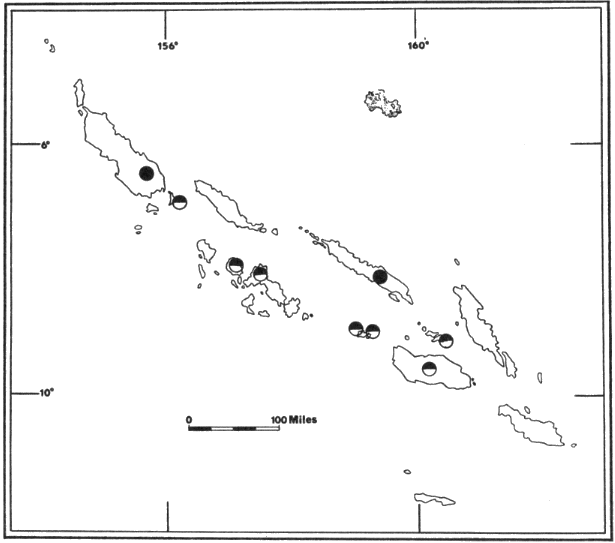
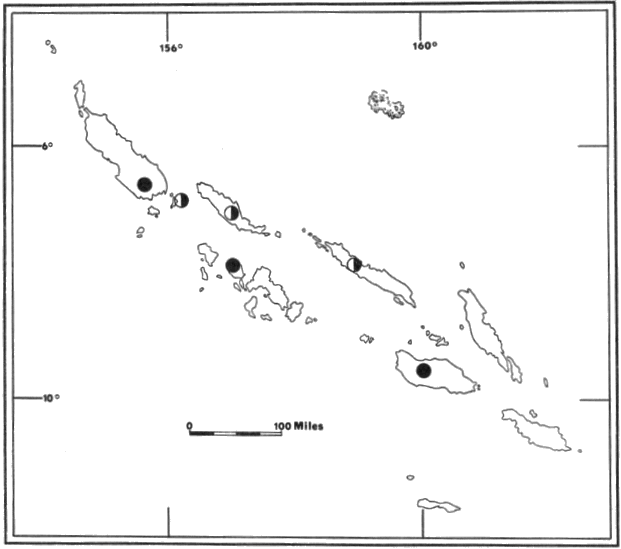
Fig. 3. Distribution of
Rousettus amplexicaudatus hedigeri. For names of
islands see Fig. 2.
Rousettus amplexicaudatus hedigeri Pohle
1953. Rousettus amplexicaudatus hedigeri Pohle, Z. Säugetierk., 17:127,
October 27, type from Bougainville.
1887. Cynonycteris brachyotis, Thomas, Proc. Zool. Soc. London, p. 323,
March 15; 1888, Thomas, Proc. Zool. Soc. London, p. 475, December
4, from Fauro.
1889. Xantharpyia brachyotis, Matschie, Die Megachiroptera ... naturkunde,
p. 68, from Guadalcanal.
1912. Rousettus brachyotis, Andersen, Catalogue of the Chiroptera ...
British Museum, 1:809; 1931, Sanborn, Publ. Field Mus. Nat. Hist.,
Zool. Ser., 18:11, February 12, from Santa Ysabel.
Specimens examined (20 males and 21 females; all in alcohol; ten crania
extracted and cleaned).—Guadalcanal in May, 23863, 23915; Fauro in April,
23804-5; Malaita in June, 24079; Choiseul in March, 23563-4, 23616, 23627,
23630, 23632-3, 23642, 23658, 23663-4, 23680, 23692-3, 23713, 23722; Kolombangara
in January and February, 23343, 23366, 23382-4, 23389-90,
23408-9, 23424, 23455, 23471-4, 23501.
Measurements.—Average and extreme external measurements of 13 males
and 18 females are, respectively, as follows: Length of head and body, 104.4
(99-118), 108.6 (104-117); tail vertebrae, 16.8 (13-19), 17.6 (15-24); hind
foot, 18.0 (16-19), 16.2 (12-18); ear, 15.9 (15-17), 15.0 (14-16); length of
forearm, 70.1 (66.0-74.1), 68.1 (65.0-69.1). Average and extreme measurements
of skulls of five males and five females are, respectively, as follows:
Greatest length of skull, 33.2 (33.0-33.7), 31.5 (30.9-32.1); condylobasal
length, 31.3 (30.9-31.9), 30.1 (29.3-30.8); palatal length, 14.0 (13.3-14.8),
13.3 (13.0-13.7); zygomatic breadth, 20.8 (19.8-21.8), 19.4 (18.7-20.8); length
of maxillary tooth-row, 11.0 (10.9-11.3), 10.3 (10.1-10.6); length of mandibular
tooth-row, 12.6 (12.4-12.9), 11.8 (11.7-12.2).
Remarks.—The specimens from Choiseul, Kolombangara, and Malaita islands
provide new records of distribution for Rousettus amplexicaudatus hedigeri
(Fig. 3). It was described as smaller than R. a. brachyotis Dobson, which is
known from New Guinea, Amboina, and the Bismarck Archipelago (Pohle,
1953:127-128). Andersen (1912:809) gave the range of length of forearm in
R. a. brachyotis as 73-81, whereas Pohle (1953:127) gave the length of forearm
of the type specimen of R. a. hedigeri (adult male) as 67. Measurements
of specimens examined by me indicate that hedigeri occurs throughout the
Solomon Islands. Cranial measurements of my specimens and Pohle's type
are less than those of R. a. brachyotis (see Andersen, 1912:48).
Sanborn (1931:11) noted that the forearms of three males examined by him
were longer than that of a female. Mean and range for length of forearm
of males and females listed herein, respectively, are 70.1 (66.0-74.1) and 68.1
(65.0-69.1). Also, each of seven cranial measurements taken by me averaged
more in males than in females. Sagittal and lambdoidal crests are more
prominent in males than in females.
Table 1. A Summary of Breeding Data for Females of Rousettus amplexicaudatus
hedigeri Collected December to June.
| Month |
Total number collected |
Number adult
♀ ♀ collected |
Number lactating |
Number of
immature individuals |
| December |
3 |
3 |
3 |
0 |
| January |
11 |
11 |
8 |
0 |
| February |
6 |
0 |
— |
1 |
| March |
16 |
1 |
0 |
9 |
| April |
2 |
2 |
0 |
0 |
| June |
1 |
1 |
0 |
0 |
As shown in Table 1, adult females obtained in December and January
were lactating when captured whereas those obtained in March, April, and
June were not. More than half of the individuals collected in March were
immature (judging from small size, unfused epiphyses, and lack of wear on
teeth). The immature individuals probably had been nursing in December
and January.
Pteralopex Thomas
1888. Pteralopex Thomas, Ann. Mag. Nat. Hist., ser. 6, 1:155, February 1.
1762. Pteropus Brisson, Regnum animale ..., ed. 2, p. 153.
Pteralopex, with one species and two subspecies, is the only megachiropteran
genus endemic to the Solomons. Thomas (1888b:475) considered this unusual
bat a relic, isolated from the time when pteropodids had cuspidate cheek-teeth.
Although two workers (Matschie, 1899:11; Simpson, 1945:54) have synonymized
Pteralopex with Pteropus, I regard Pteralopex as a morphologically distinct
genus.
Individuals of Pteralopex can be distinguished from all species of Pteropus
in the Solomon Islands by the following features: wing membranes originate
along dorsal midline; braincase diminutive relative to rest of skull; sagittal crest
pronounced; cheek-teeth cuspidate, broad and massive; i2 about 10 times
larger than i1; upper canines with well-developed secondary cusp; postorbital
process fused with zygomatic arch, forming complete bony ring around orbit.
Andersen (1909a:216; 1912:436) considered the relationships of Pteralopex
and Pteropus and concluded that Pteropus pselaphon Lay, 1829, from the
Sulphur Islands east of Taiwan, and Pteropus samoensis Peale, 1848, from the
Samoan Islands, were the "closest" living relatives of Pteralopex. He stated
further that Pteralopex "presents in fact scarcely a single character which is
not either developed to a certain extent or at least distinctly foreshadowed in
Pteropus pselaphon, pilosus, tuberculatus, or leucopterus." In summary, Andersen
thought several species of Pteropus had undergone evolutionary development
resembling that in Pteralopex, and that the latter, with its massive,
cuspidate cheek-teeth, could be considered a highly modified Pteropus. For
this hypothesis to be plausible, one must assume that the originally complex
cheek-teeth of pteropodids became simple and, at least in the case of Pteralopex,
secondarily became complex once again. According to present-day theory of
evolutionary development, his hypothesis is improbable. Thomas (1888b:475)
probably was correct when he considered Pteralopex an isolated relic.
Although Pteralopex usually is listed after Pteropus in phylogenetic arrangements
(see, for example, Sanborn, 1931:21; Pohle, 1953:129; Laurie and Hill,
1954:40), I have placed Pteralopex before Pteropus.
Pteralopex atrata
Two subspecies of Pteralopex atrata (P. a. atrata and P. a. anceps) have
been named; specimens of both are rare in museum collections. Thomas
(1888a:155) described adults of atrata. Sanborn (1931:21) examined the
one additional specimen known to me and reported that it agreed with Thomas'
description.
Andersen (1909b:266) used a subadult female ("nearly fully grown") as
the holotype of anceps. At least five additional specimens, all adults, of
anceps now are housed in various collections. Judging from these individuals,
the holotype of anceps was only four-fifths grown and because he used an
immature individual, Andersen's (1912:437) criteria for distinguishing the
two subspecies mostly are invalid.
Key to Subspecies of Pteralopex atrata
| 1. |
Length of forearm 139-144 mm.; dorsal surface of distal one-fourth of
tibia and entire metatarsus naked; known only from Guadalcanal and
Santa Ysabel islands |
| Pteralopex atrata atrata |
| 1'. |
Length of forearm 162-166 mm.; dorsal surface of distal one-fourth of
tibia and entire metatarsus furred; known only from Bougainville and
Choiseul islands |
| Pteralopex atrata anceps |
Pteralopex atrata atrata Thomas
1888. Pteralopex atrata Thomas, Ann. Mag. Nat. Hist., ser. 6, 1:155, February,
type from Guadalcanal; 1888, Thomas, Proc. Zool. Soc. London,
p. 475, December 4; 1896, Heude, Mém. Hist. Nat. Emp. China,
3:179; 1897, Trouessart, Catalogus Mammalium ..., 1:83;
1907, Miller, Bull. U. S. Nat. Mus., 57:60, June 29; 1912, Andersen,
Catalogue of the Chiroptera ... British Museum, 1:439; 1931,
Sanborn, Publ. Field Mus. Nat. Hist., Zool. Ser., 18:21, February 12,
from Santa Ysabel.
1954. Pteralopex atrata atrata, Laurie and Hill, List of land mammals of
New Guinea, Celebes and adjacent islands, p. 40, June 30.
1899. Pteropus (Pteralopex) atrata, Matschie, Die Megachiroptera ...
naturkunde, p. 11; 1904, Trouessart, Catalogus Mammalium ...,
Suppl., p. 49.
Specimens examined.—None.
Remarks.—Pteralopex atrata atrata is known from four specimens from
Guadalcanal and one from Santa Ysabel (Sanborn, 1931:21).
Sanborn (loc. cit.) reported that a specimen wounded at night, while feeding
on young green coconuts, was the only fruit bat that attempted to attack
the collectors. Troughton (1936:348) has suggested, on the basis of his
experiences with Pteropus, that this behavior probably was a reaction from fear
rather than an indication of general aggressiveness on the part of Pteralopex.
Pteralopex atrata anceps Andersen
1909. Pteralopex anceps Andersen, Ann. Mag. Nat. Hist., ser. 8, 3:266,
March, type from Bougainville; 1912, Andersen, Catalogue of the
Chiroptera ... British Museum, 1:437; 1936, Troughton, Rec.
Australian Mus., 14:348, April 7; 1953, Pohle, Z. Säugetierk., 17:129,
October 27.
1954. Pteralopex atrata anceps, Laurie and Hill, List of land mammals of
New Guinea, Celebes and adjacent islands, p. 40, June 30.
Specimens examined (three males, two females; one skull-only and one in
alcohol).—Choiseul in March, 23682; Bougainville in July, USNM 276973-74,
USNM 276928, USNM 277112.
Measurements.—Measurements of three males and one female are, respectively,
as follows: Length of head and body, 280, 271, 261, 255; hind foot,
50, 54, 52, 59; ear, 23, 23, 26, 22; length of forearm, 160, 162, 166, 171;
greatest length of skull, 77.6, 77.9, 78.9, 77.0; condylobasal length, 74.3, 74.3,
75.5, 73.8; zygomatic breadth, 42.2, 45.4, 43.1, 42.6; breadth across upper
canines, 18.7, 21.1, 19.0, 19.0; breadth across first upper molars, 22.2, 25.3,
22.9, 22.0; length of maxillary tooth-row, 29.3, 29.8, 28.9, 28.2; length of
mandibular tooth-row, 32.8, 32.8, 32.1, 31.4.
Remarks.—Heretofore, Pteralopex atrata anceps was not known from Choiseul.
The specimen from that island agrees well with specimens in the U. S.
National Museum from Cape Torokina, Bougainville.
The type specimen of this subspecies is a subadult and is smaller than the
specimens examined by me; Andersen (1912:440) gave length of forearm of
the type as 137 (as opposed to 164 in adults). He (1912:438) figured the
dentition of anceps and described the ways in which it differed from the dentition
of atrata. Although he (1912:437) concluded that anceps and atrata
represented "two stages of specialization of ... dentition," there apparently
are few, if any, dental differences between the two subspecies. Teeth
of adults of anceps differ from teeth of the immature type of anceps as follows:
in adults the anterior basal ledge of P4 extends onto the labial surface, whereas
in the type it does not; and maxillary and mandibular teeth in adults are spaced
as in the subspecies atrata (see Andersen, 1912:438, fig. 22) and not crowded
as in the type of anceps. Distance between individual cheek-teeth apparently
increases with growth of the cranium and mandible.
Adults of P. a. anceps that I examined are darker than the subadult type.
The mantle in these adults is black, whereas it is seal-brown in the type
(Andersen, 1912:439).
An adult female was lactating when obtained on Bougainville in July
(USNM 276928).
Key to Pteropus in the Solomon Islands
| 1. |
Premolars having distinct basal ledges; molars 2.5-4.0 wide |
| 2 |
| 1'. |
Premolars lacking definite basal ledges; molars 1.0-2.4 wide |
|
| 14 |
| 2(1). |
Rostrum unshortened (orbit to anterior tip of nasals about one-third
greatest length of skull); dorsal surface of tibiae nearly naked |
|
| 3 |
| 2'. |
Rostrum shortened (orbit to anterior tip of nasals less than one-third
greatest length of skull); dorsal surface of tibiae usually at least
partially furred |
| 8 |
| 3(2). |
Forearm more than 128 |
| 4 |
| 3'. |
Forearm less than 128 |
| 5 |
| 4(3). |
Forearm about 155; venter and dorsum nearly black, mantle pale
yellow |
| P. tonganus geddiei, p. 798 |
| 4'. |
Forearm 128-136; venter and dorsum near Mars Brown, mantle
Ochraceous or Cream-Buff |
| P. hypomelanus luteus, p. 796 |
| 5(3'). |
Mantle dark, russet or cinnamon, not strongly contrasting with
color of back |
| P. admiralitatum solomonis, p. 796 |
| 5'. |
Mantle pale, Ochraceous-Buff or Cream-Buff, strongly contrasting
with color of back |
| 6 |
| 6(5'). |
Mantle Ochraceous-Orange to Ochraceous-Buff, hairs pale basally;
forearm 108-111 |
| P. admiralitatum goweri, p. 797 |
| 6'. |
Mantle Ochraceous to Cream-Buff, but hairs dark brown basally;
forearm 110-122 |
| 7 |
| 7(6'). |
Length of forearm 110-112 |
| P. admiralitatum colonus, p. 796 |
| 7'. |
Length of forearm about 122 |
| P. howensis, p. 797 |
| 8(2'). |
Forearm more than 145 |
| 9 |
| 8'. |
Forearm less than 144 |
| 12 |
| 9(8). |
Forearm more than 162 |
| 10 |
| 9'. |
Forearm less than 162 |
| 11 |
| 10(9). |
Forearm 167-173 |
| P. rayneri grandis, p. 801 |
| 10'. |
Forearm about 164 |
| P. rayneri rubianus, p. 802 |
| 11(9'). |
Flanks and lower belly brightly colored, Burnt Sienna to Sanford's
Brown; forearm less than 150 |
| P. rayneri monoensis, p. 803 |
| 11'. |
Flanks and lower belly darker, near tawny; forearm more than 150, |
| P. rayneri lavellanus, p. 802 |
| 12(8'). |
Pelage of dorsum tricolored; rump brightly colored; forearm 139-141, |
| P. rayneri rayneri, p. 800 |
| 12'. |
Pelage of dorsum bicolored; rump dark; forearm less than 135 |
| 13 |
| 13(12'). |
Mantle tawny with some Ochraceous-Buff; forearm about 130, |
| P. rayneri rennelli, p. 804 |
| 13'. |
Mantle russet, lacking Ochraceous-Buff; forearm about 121, |
| P. rayneri cognatus, p. 803 |
| 14(1'). |
Forearm more than 131; dorsum Tawny Olive |
| P. mahaganus, p. 806 |
| 14'. |
Forearm less than 100; dorsum dark brown |
| P. woodfordi, p. 804 |
Pteropus Brisson
1762. Pteropus Brisson, Regnum animale ..., ed. 2, p. 153.
Remarks.—More species (seven) and subspecies (12) of Pteropus occur in
the Solomon Islands than of any other chiropteran genus. Other kinds of
Pteropus, as yet unknown, may live there.
The relationships among the species of these large fruit-eating bats, commonly
termed "flying foxes," are obscure and the genus is in need of revision.
The basic, definitive work is still that of Andersen (1912). Tate (1942) and
Felten (1964a, 1964b) have offered some additional remarks but groupings
and suggested relationships of species of Pteropus almost entirely are the products
of Kund Andersen. According to present-day concepts of variation and
speciation, Andersen's criteria are artificial.
Basically, there are three "species-groups" of Pteropus in the Solomon Islands.
The first is composed of species in which the rostrum is "unshortened"
(its length about one third of greatest length of skull), and the cheek-teeth are
of moderate size (M1 is 2.8-3.2 wide). The species are P. hypomelanus,
P. admiralitatum, P. tonganus, and P. howensis. The first and second species
were placed in the Pteropus hypomelanus group by Andersen (1912:98).
In the second group the rostrum is "shortened" (its length less than one
third of greatest length of skull) and the cheek-teeth are of moderate to large
size (M1 3.3-4.1 wide). Pteropus rayneri, endemic to the Solomons and represented
there by at least seven subspecies, fits into this category.
The third group is represented by P. mahaganus and P. woodfordi. Both
species are endemic to the Solomon Islands. In these species the rostrum is
unshortened but the cheek-teeth are greatly reduced, especially in width (M1
is 1.0-2.2 wide). Both P. mahaganus and P. woodfordi can be included in
the Pteropus scapulatus group of Andersen (1912:402).
Pteropus hypomelanus
Pteropus hypomelanus is a wide-ranging species of flying fox having at least
seven subspecies; three occur in southeastern Asia, two on and near Celebes, and
two in New Guinea and islands adjacent to the southeastern coast of New
Guinea, including one island in the Solomons (Ellerman and Morrison-Scott,
1966:95; Laurie and Hill, 1954:32-33).
Pteropus hypomelanus luteus Andersen
1908. Pteropus hypomelanus luteus Andersen, Ann. Mag. Nat. Hist., ser. 8,
2:362, October, type from Kiriwini Island, Trobriand Islands; 1912,
Andersen, Catalogue of the Chiroptera ... British Museum,
1:128; 1947, Sanborn and Beecher, Jour. Mamm., 28:388, November
19, from Banika Island, Russell Islands.
Specimens examined.—None.
Remarks.—Andersen (1908:362) identified specimens of Pteropus hypomelanus
from eastern New Guinea and three nearby islands (Conflict Islands,
Trobriand Islands, and Woodlark Island) as P. hypomelanus luteus. Sanborn
and Beecher (1947:388) identified a female from Banika Island in the Solomons
as of this subspecies although this specimen was darker and had a
slightly smaller skull than typical P. hypomelanus luteus. They noted that
the pelage of the venter of the female was uniformly dark rather than the
typical Ochraceous-Buff to Cream-Buff; the specimen was regarded as a dark
phase of the subspecies. Although not recorded previously for luteus, other
subspecies of P. hypomelanus were known in dark phase as well as pale and
intermediate phases of coloration (Andersen, 1912:122). The reported occurrence
of P. h. luteus on Banika Island extended the known geographic range
about 450 miles eastward from Woodlark Island.
Pteropus admiralitatum
Three subspecies, all about the same size but differing in coloration, have
been described from the Solomon Islands. P. a. goweri is known only from
Gower (Ndai) Island, notably removed from the western chain of islands inhabited
by P. a. colonus and P. a. solomonis. Only one other subspecies, from
the Admiralty Islands, is known.
Pteropus admiralitatum solomonis Thomas
1904. Pteropus solomonis Thomas, Novit. Zool., 11:597, type from Ghizo
Island; 1912, Andersen, Catalogue of the Chiroptera ... British
Museum, 1:149; 1931, Sanborn, Publ. Field Mus. Nat. Hist., Zool.
Ser., 18:12, February 12, from Ronongo (Ganongga), Vella Lavella,
and Narovo (Simbo) islands; 1947, Sanborn and Beecher, Jour.
Mamm., 28:389, November 19, from Banika and Guadalcanal islands.
1954. Pteropus admiralitatum solomonis, Laurie and Hill, List of land mammals
of New Guinea, Celebes and adjacent islands, p. 33, June 30.
Specimens examined.—None.
Remarks.—Andersen (1912:149) considered Pteropus admiralitatum, and
especially the subspecies P. a. solomonis, to be the easternmost "representative"
of Pteropus hypomelanus. In comparison with P. hypomelanus luteus, P. a.
solomonis differs mostly in size, being much smaller (length of forearm about
110 rather than 134). It is now known that both species occur on Banika
Island in the Solomons.
The subspecies P. a. solomonis has been recorded from a "chain" of islands
that included Vella Lavella, Simbo, Ghizo, Ganongga, Banika, and Guadalcanal
(see Fig. 5).
Pteropus admiralitatum colonus Andersen
1908. Pteropus colonus Andersen, Ann. Mag. Nat. Hist., ser. 8, 2:363,
October, type from Shortland Island; 1912, Andersen, Catalogue of
the Chiroptera ... British Museum, 1:150; 1931, Sanborn,
Publ. Field Mus. Nat. Hist., Zool. Ser., 18:12, February 12, from
Mono Island.
1954. Pteropus admiralitatum colonus, Laurie and Hill, List of land mammals
of New Guinea, Celebes and adjacent islands, p. 33, June 30.
1887. Pteropus hypomelanus (part), Thomas, Proc. Zool. Soc. London, p.
471, December 4; 1898, Trouessart, Catalogus Mammalium ...,
1:82, from "I. Salomonis."
1899. Pteropus (Spectrum) hypomelanus (part), Matschie, Die Megachiroptera
... naturkunde, p. 24.
Specimens examined.—None.
Remarks.—Pteropus admiralitatum colonus is the largest of the three subspecies
that occur in the Solomon Islands. It closely resembles P. hypomelanus
luteus, except in being smaller throughout (see Andersen, 1912:151-152,
for measurements) and darker on the underparts.
This bat has been found in a group of small islands (Alu, Mono, and Shortland)
about 30 miles south of Bougainville. Because of this proximity and
because yet another subspecies of this species occurs northward of Bougainville,
it is interesting that neither Troughton (1936) nor Pohle (1953) included
the species in their faunal lists for Bougainville.
Andersen (1912:152) indicated that the M1 in P. admiralitatum colonus is
smaller than in P. a. solomonis, the subspecies found in islands to the southeast
(4.4-4.5 and 5.2, respectively), but Sanborn (1931:13) studied specimens of
these two subspecies that overlapped in size of M1.
Pteropus admiralitatum goweri Tate
1934. Pteropus goweri Tate, Amer. Mus. Novit., 718:1, May 4, type from
Gower (Ndai) Island.
1954. Pteropus admiralitatum goweri, Laurie and Hill, List of land mammals
of New Guinea, Celebes and adjacent islands, p. 33, June 30.
Specimens examined.—None.
Remarks.—Pteropus admiralitatum goweri was described from six specimens
collected in 1930 by the Whitney South Sea Expedition (Tate, 1934:1). This
subspecies closely resembles the other two subspecies of P. admiralitatum
(colonus and solomonis) found in the Solomon Islands. Color and length of
forearm (see key on p. 793) seem to be the only reliable criteria for distinguishing
between these subspecies. The longitude of Gower Island, 160° 34' E,
was incorrectly listed in Laurie and Hill (1954:152) as 159° 34' E.
Pteropus howensis Troughton
1931. Pteropus howensis Troughton, Proc. Linn. Soc. New South Wales,
56:204, June 24, type from Lord Howe Islands (Ontong Java); 1950,
Sanborn and Nicholson, Fieldiana:Zool., 31:329, August 31.
Specimens examined (one male, three females, and two sex unknown; two
embryos in alcohol).—Liuniuwu, Lord Howe Islands (Ontong Java) in August,
USNM 278703-6, USNM 279715-6.
Measurements.—Average and extreme measurements of one male and three
females are as follows: Length of head and body, 185.2 (176-196); hind foot,
34.5 (33-36); ear, 21.5 (21-23); forearm not measured [broken in all specimens
examined]. Cranial measurements of a male and a female are, respectively,
as follows: Greatest length of skull, 55.3, 53.8; condylobasal length,
54.2, 52.8; palatal length, 26.7, 26.0; zygomatic breadth, 30.6, 29.9; breadth of
braincase, 19.9, 19.2; breadth across first upper molars, 14.3, 14.3; length of
maxillary tooth-row, 20.7, 19.6; length of mandibular tooth-row, 23.1, —.
Remarks.—Apparently Pteropus howensis is confined to Ontong Java (Lord
Howe Islands) located northeastward of the main body of islands that constitute
the Solomon Archipelago (see Fig. 5). According to A. J. Nicholson, who
collected the specimens listed above, P. howensis is not abundant in Ontong
Java. He related this circumstance to the fact that these small islands are
nothing more than parts of a coral atoll used almost entirely for the production
of coconuts (see Sanborn and Nicholson, 1950:329).
Specimens of Pteropus howensis deposited in the U. S. National Museum
agree well in most ways with the original description of the species by Troughton
(1931:204-205). Slight variation in color is evident; in two specimens,
the mantle, just posterior to the ears, is Ochraceous-Buff.
The relationship of this species to other kinds of Pteropus known from
Melanesia is not clear. Troughton (1931:204, 206) compared P. howensis
with P. hypomelanus and P. admiralitatum and found that it resembled each
of them. Tate (1934:2) noted that the skull of P. admiralitatum goweri was
similar to that of P. howensis in structure. The latter species is, however,
larger (length of forearm 122 according to Troughton, 1931:205) than any
subspecies of P. admiralitatum (length of forearm 108-112). Also, the cheek-teeth
of P. howensis that I have studied are relatively larger than those of
either P. hypomelanus or P. admiralitatum. Furthermore, in P. howensis there
is a small but distinct cusp located medio-posteriorly on P4 (most noticeable
in young individuals) that is more reduced or undeveloped in specimens of
the other two species. Cheek-teeth of P. howensis resemble those in a dull-colored
specimen of P. tonganus from Fiji Island with which I compared the
specimens listed above.
Weights and crown-rump lengths of the two embryos (in an advanced stage
of development) examined were 20 and 29 grams and 43 and 51 mm. (apparently
these are the specimens listed by Sanborn and Nicholson, 1950:329).
Pteropus tonganus
Pteropus tonganus has at least three subspecies, one of which has been recorded
from the Solomons. The species ranges from a small island off the
eastern coast of New Guinea, where there is an endemic subspecies, eastward
to Tonga and the New Hebrides (Laurie and Hill, 1954:33-34). Felten
(1964a) recently has reported on the species in the New Hebrides.
Pteropus tonganus geddiei MacGillivary
1860. Pteropus geddiei MacGillivary, Zoologist, 18:7134, September, type
from Aneitum Island, New Hebrides; 1912, Andersen, Catalogue of
the Chiroptera ... British Museum, 1:189; 1931, Sanborn,
Publ. Field Mus. Nat. Hist., Zool. Ser., 18:13, February 12, from
Rennell Island in the Solomons.
1914. Pteropus tonganus geddiei, Revilliod, in Sarasin and Roux, Nova
Caledonia (A), 1:341; 1954, Laurie and Hill, List of land mammals
of New Guinea, Celebes and adjacent islands, p. 34, June 30.
Specimens examined.—None.
Remarks.—Pteropus tonganus geddiei, as far as is known, is the widest
ranging subspecies of this genus. It is the only megachiropteran in the Solomon
Islands having affinities with bats to the southeast (the New Hebrides, Santa
Cruz Islands, Samoan Islands and Fiji Islands) rather than with those to the
west (New Guinea). The subspecies P. tonganus geddiei, which ranges from
the Solomons to the New Hebrides (about 500 miles straight-line distance), is
said to be remarkably uniform throughout its range. Sanborn (1931:14)
compared color and size in specimens from the Solomon Islands and the New
Hebrides and found little variation. Another subspecies, P. t. bascilicus Thomas
1915, apparently closely related to geddiei, is known from Dampier [= Kar-kar]
Island off the northeastern coast of New Guinea and therefore farther westward
from the New Hebrides than are the Solomon Islands. Additional remarks
on the distribution of this species are in the section on Zoogeography
and Speciation.
Pteropus rayneri
Pteropus rayneri is endemic to the Solomon Islands. It is divisible into
seven subspecies (see Fig. 6), which, excepting P. r. rennelli and P. r. cognatus,
are strikingly colored—the mantle, back, and rump being of different
colors. Differences in color and size provide characters differentiating the
subspecies (see key, p. 793). Recorded lengths of forearms do not overlap
between any two subspecies. P. r. grandis, northernmost in distribution, has
the longest (about 170) forearm and P. r. cognatus, known from two of the
southernmost islands, has the shortest (about 121).
Adult males of Pteropus rayneri have well-developed tufts of hair on each
side of the neck where a gland is located (see Andersen, 1912:259). Apparently
these glands are not present in females as none were found in specimens
studied by me or those reported by Sanborn (1931:16). Evidently, these
glands are associated with sexual maturity in males because neither Sanborn
nor I found them in subadult males.
Pteropus rayneri rayneri Gray
1870. Pteropus rayneri (part), Gray, Catalogue of monkeys, lemurs and
fruit-eating bats ... British Museum, p. 108, cotypes from
Guadalcanal; 1878, Dobson, Catalogue of the Chiroptera ...
British Museum, p. 33; 1879, Trouessart, Rev. Mag. Zool., 6:204;
1879, Trouessart, Ann. Sci. Nat. Zool, 8:16; 1887, Thomas, Proc.
Zool. Soc. London, p. 322, March 15; 1888, Thomas, Proc. Zool. Soc.
London, p. 472, December 4; 1898, Trouessart, Catalogus Mammalium ..., 1:78;
1912, Andersen, Catalogue of the Chiroptera ... British
Museum, p. 254; 1931, Sanborn, Publ. Field
Mus. Nat. Hist., Zool. Ser., 18:15, February 12, from Guadalcanal
and Malaita.
1954. Pteropus rayneri rayneri, Laurie and Hill, List of land mammals of
New Guinea, Celebes and adjacent islands, p. 35, June 30.
1899. Pteropus (Spectrum) rayneri (part), Matschie, Die Megachiroptera ... naturkunde,
p. 22; 1904, Trouessart, Catalogus Mammalium ..., Suppl., p. 51.
Specimens examined (four males and one female; one embryo in alcohol).—Guadalcanal
in July and November, USNM 278700-02, USNM 278142, USNM
278714.
Measurements.—Measurements of three males and one female are, respectively,
as follows: Length of head and body, —, 210, 214, 215; hind foot, —,
33, 39, 42; ear, —, 23, 23, 23; length of forearm, —, 138, 136, 134; greatest
length of skull, 61.5, 59.2, 61.6, 61.2; condylobasal length, 61.4, 58.2, 60.3,
60.0; zygomatic breadth, 36.6, 35.3, 35.4, 36.5; breadth of braincase, 23.7,
22.5, 22.6, 24.1; breadth across first upper molars, —, 16.9, 16.7, 16.8; width
of M1, 3.4, 3.5, 3.5, 3.5; length of maxillary tooth-row, 22.4, 22.1, 23.6, 23.2;
length of mandibular tooth-row, 26.4, 25.5, 25.9, 25.6.
Remarks.—Pteropus rayneri was named on the basis of two specimens (cotypes)
obtained on Guadalcanal and listed as "male" and "female"; according
to Andersen (1912:254), however, both are females.
P. r. rayneri is known from Guadalcanal and Malaita (see Fig. 6), and is
of almost the same size as P. r. cognatus, which is known from San Cristobal
and Ugi, only about 40 miles to the southeast. In the latter subspecies the
back and rump are the same color (Prouts Brown), whereas in P. r. rayneri
the rump is brightly colored and therefore contrasts strongly with the dark
brown back. A specimen of rayneri from Malaita was reported by Sanborn
(1931:15) as unusually small and having a dark-colored rump patch. In the
specimens examined from Guadalcanal, there is noticeable variation in color
of the mantle that does not seem related to age or sex. In two specimens
(adult male and female) the mantle is Cinnamon-Rufous tinged with Russet,
strongly contrasting with the crown, which is Ochraceous-Tawny and has
scattered silvery hairs. Another specimen has a darker mantle (near Chestnut-Brown)
and a crown of about the same color, but with a few scattered
Ochraceous-Tawny hairs.
The skull of one adult male bears an extra peglike tooth posterior to M3
on the right side.
An embryo, in an advanced stage of development, in the collection of the
U. S. National Museum, measures: Length of head and body, 98; hind foot,
30; ear, 8.5; length of forearm, 48 (this may be the same specimen listed by
Sanborn and Nicholson, 1950:329).
Pteropus rayneri grandis Thomas
1887. Pteropus grandis Thomas, Ann. Mag. Nat. Hist., ser. 5, 19:147,
March, type from Shortland; 1887, Thomas, Proc. Zool. Soc. London,
p. 320, March 15, from Alu and Shortland; 1897, Trouessart, Catalogus
Mammalium ..., 1:80, from "I. Salomonis"; 1899,
Matschie, Die Megachiroptera ... naturkunde, p. 15; 1904,
Trouessart, Catalogus Mammalium ..., Suppl., p. 49; 1907,
Miller, Bull. U. S. Nat. Mus., 57:58, June 29; 1912, Andersen, Catalogue
of the Chiroptera ... British Museum, 1:259, from
Bougainville; 1931, Sanborn, Publ. Field Mus. Nat. Hist., Zool. Ser.,
18:16, February 12, from Choiseul, and Santa Ysabel; 1936, Troughton,
Rec. Australian Mus., 19:348, April 7; 1953, Pohle, Z. Säugetierk.,
17:128, October 27.
1954. Pteropus rayneri grandis, Laurie and Hill, List of land mammals of
New Guinea, Celebes and adjacent islands, p. 35, June 30.
Specimens examined (six males and 10 females; five in alcohol).—Choiseul
in March, 23580, 23644, 23593; Bougainville in July, August, September, and
October, USNM 276926-7, USNM 276968, USNM 277091-9.
Measurements.—Average and extreme measurements of four males and
seven females are as follows: Length of head and body, 281 (260-302); hind
foot, 52.3 (50-58); ear, 33.1 (31-37); length of forearm, 173 (168-180).
Average and extreme measurements of skulls of three males and six females
are as follows: Greatest length of skull, 73.7 (71.3-77.7); condylobasal length,
73.1 (70.5-77.4); zygomatic breadth, 40 (36.4-41.5); breadth across first-upper
molars, 20.9 (18.3-22.1); length of maxillary tooth-row, 28.1 (26.9-29.9);
length of mandibular tooth-row, 31.8 (29.7-32.7).
Remarks.—Pteropus rayneri grandis is the largest subspecies of the species.
It is also the widest ranging subspecies, being found on six islands (see Fig. 6).
Although the specimens listed above agree well with descriptions of color
given by Thomas (1887a:147) and Andersen (1912:259, 263-264), some individual
variation is noticeable. In bats not yet fully grown (judging from
small size, unfused epiphyses, and lack of wear on teeth), numerous scattered
hairs on the sides of the face and crown are buffy. In adults the face and
crown are blackish. With regard to individual variation in color of mantle
and rump patch, specimens with the following combinations were noted (1)
mantle Brick Red, rump patch bright, basal three-quarters of hairs white, tips
Warm Buff (2) mantle darker, near Hessian Brown, rump patch dark, Chestnut
along edges, center Ochraceous-Tawny (3) mantle Brick Red, rump patch
intermediate between the two other types. Size of rump patch also is variable.
In some specimens it extends onto the upper parts of the thighs whereas in
other specimens it does not.
Sanborn (1931:16) reported an extra tooth, behind the last lower molar,
in a specimen from Choiseul. In one of three specimens in the Bishop Museum,
m3 is lacking. Judging from Troughton's (1936:346) remarks, size of individuals
varies considerably. Specimens that he examined from Bougainville
had longer forearms (up to 177) and larger hind feet (54-57) than those
examined by me from Choiseul. On the other hand, specimens listed above
from Bougainville agree well with those from Choiseul. In many specimens in
the U. S. National Museum, length of the right- and left-forearm differ. For
example, in No. 276926 the right forearm measures 180 whereas the left is 174;
in No. 277098 the right is 172 and the left is 167. Troughton (1936:346)
gave standard ear measurement in P. r. grandis as ranging from 29.5 to 31.5.
Ears of specimens that I examined varied from 31.0 to 37.0.
Pteropus rayneri rubianus Andersen
1908. Pteropus rubianus Andersen, Ann. Mag. Nat. Hist., ser. 8, 2:366,
October, type from Rubiana; 1912, Andersen, Catalogue of the
Chiroptera ... British Museum, 1:255; 1931, Sanborn, Publ.
Field Mus. Nat. Hist., Zool. Ser., 18:15, February 12, from Narovo
(Simbo).
1954. Pteropus rayneri rubianus, Laurie and Hill, List of land mammals of
New Guinea, Celebes and adjacent islands, p. 35, June 30.
1888. Pteropus grandis (part), Thomas, Proc. Zool. Soc. London, p. 470,
December 4, from Rubiana; 1899, Matschie, Die Megachiroptera ... naturkunde,
p. 15; 1904, Trouessart, Catalogus Mammalium
..., Suppl., p. 49.
Specimens examined (two males and one female).—Kolombangara, in February,
23458-60.
Measurements.—Measurements of two males and one female are, respectively,
as follows: Length of head and body, 253, 265, 251; hind foot, 53, 50,
50; ear, 30, 31, 32; length of forearm, 158, 161, 160; greatest length of skull,
70.2, 67.4, —; condylobasal length, 67.0, —, 68.4; zygomatic breadth, 40.0,
39.4, 40.7; breadth across first upper molars, 19.4, 20.4, 19.9; length of mandible,
53.9, 49.4, 51.3.
Remarks.—Kolombangara Island is a new locality for Pteropus rayneri
rubianus; heretofore this subspecies was known only from Rubiana and Narovo
islands (Andersen, 1908:366; Sanborn, 1931:15). The coloration of a specimen
from Narovo Island was described as between that of P. r. rubianus and
P. r. lavellanus. Sanborn (1931:16) allocated it to the subspecies rubianus
on the basis of length of forearm.
Andersen's descriptions (1908:366; 1912:256) of rubianus were of a specimen
stored in alcohol. Coloration of the museum skins examined by me is as
follows: Dorsum from shoulders to rump near Vandyke Brown; crown and
mantle Brick Red; face close to Mummy Brown; rump patch and thighs close
to Warm Buff, strongly contrasting with back and mantle; base of hairs dark,
Seal Brown; venter dark; chest about same as back but paler laterally (to
Ochraceous Tawny); throat Brick Red.
Pteropus rayneri lavellanus Andersen
1908. Pteropus lavellanus Andersen, Ann. Mag. Nat. Hist., ser. 8, 2:366,
October, type from Vella Lavella; 1912, Andersen, Catalogue of the
Chiroptera ... British Museum, 1:259; 1931, Sanborn, Publ.
Field Mus. Nat. Hist., Zool. Ser., 18:16, February 12, from Ghizo
and Ronongo.
1954. Pteropus rayneri lavellanus, Laurie and Hill, List of land mammals
of New Guinea, Celebes and adjacent islands, p. 36, June 30.
Specimens examined (one male and one female).—Vella Lavella in November,
23192, 23142.
Measurements.—Measurements of a male and a female are, respectively, as
follows: Length of head and body, 286, 282; hind foot, 55, 56; ear, 30, 30;
length of forearm, 156, 155; greatest length of skull, 72.9, 67.6; condylobasal
length, 71.8, 64.2; zygomatic breadth, 38.4, 37.9; breadth across first upper
molars, 19.9, 19.8; length of mandible, 54.6, 50.8.
Remarks.—Pteropus rayneri lavellanus inhabits islands geographically near
those from which P. r. rubianus is known (see Fig. 6) and in most respects
the two subspecies closely resemble each other. P. r. lavellanus is slightly the
smaller (average length of forearm about 156 instead of 160) and darker. A
bat from Narovo [Simbo] Island, only a few miles from Vella Lavella, identified
by Sanborn (1931:16) on basis of its size as P. r. rubianus, resembled the
subspecies lavellanus in color and probably represents an intergrade between
the two populations.
The color of P. r. lavellanus is close to that of P. r. rubianus except that the
crown, mantle, and foreneck are near Chestnut-Brown, the basal portions of
hair black, and the fur of the venter, from sternum to pectoral region, is dark,
almost black (compare with description of P. r. rubianus under account of
that subspecies).
Measurements of the male examined are greater than those of the female
studied. Andersen (1912:259) noted that the canine teeth are heavier in
males than in females.
Pteropus rayneri monoensis Lawrence
1945. Pteropus rayneri monoensis Lawrence, Proc. New England Zool. Club,
23:63, March 26, type from Mono (Treasury); 1954, Laurie and
Hill, List of land mammals of New Guinea, Celebes and adjacent
islands, p. 36, June 30.
Specimens examined.—None.
Remarks.—Pteropus rayneri monoensis is the most recently described subspecies
of P. rayneri. Lawrence (1945:63) judged that in most ways this bat
is intermediate between P. r. grandis and P. r. lavellanus. Coloration of
monoensis indicates affinity with the former, whereas length of forearm (145-148)
approaches that in the latter. The small skull, narrow palate, and whitish
rump patch of monoensis are differences that distinguish it from grandis and
lavellanus. The relatively isolated position of Mono Island may have been
important in establishment of the distinctive features of this bat.
Lawrence (1945:65) quoted a collector as stating: "They [individuals of
P. r. monoensis] rest quietly during the day in the tops of heavy-leaved, tall
jungle trees, and start flying about dusk, looking for feeding spots. There is
usually quite a flight for fifteen to twenty minutes at twilight...."
No additional specimens of this subspecies have been collected on small
adjacent islands and monoensis may therefore be confined to Mono Island.
Pteropus rayneri cognatus Andersen
1908. Pteropus cognatus Andersen, Ann. Mag. Nat. Hist., ser. 8, 2:365,
October 1, type from San Cristobal; 1912, Andersen, Catalogue of
the Chiroptera ... British Museum, 1:251; 1931, Sanborn,
Publ. Field Mus. Nat. Hist., Zool. Ser., 18:15, February 12, from
San Cristobal and Ugi; 1954, Laurie and Hill, List of land mammals
of New Guinea, Celebes and adjacent islands, p. 35, June 30.
1962. Pteropus rayneri cognatus, Hill, The natural history of Rennell Island,
British Solomon Islands, 4:9, February.
1870. Pteropus rayneri (part), Gray, Catalogue of monkeys, lemurs and
fruit-eating bats ... British Museum, p. 108, from San Cristobal;
1878, Dobson, Catalogue of the Chiroptera ... British
Museum, p. 33.
1904. Pteropus (Spectrum) rayneri (part), Trouessart, Catalogus Mammalium
..., Suppl., p. 51.
Specimens examined.—None.
Remarks.—Specimens of Pteropus rayneri cognatus first were reported under
the name Pteropus rayneri based on three specimens (one from San Cristobal
and two from Guadalcanal). Because the description was based mostly on the
two specimens from Guadalcanal, the name rayneri is applicable to the bats
from that island. Andersen (1908:365) thought that specimens that he
studied, from San Cristobal, were specifically distinct from P. rayneri and he
proposed the name Pteropus cognatus for them. Later, Hill (1962:9) reduced
cognatus to subspecific status under P. rayneri.
Presently P. r. cognatus is known only from San Cristobal and the small
adjacent island of Ugi (see Fig. 6).
Pteropus rayneri rennelli Troughton
1929. Pteropus rennelli Troughton, Rec. Australian Mus., 17:193, September
4, type from Rennell Island; 1954, Laurie and Hill, List of
land mammals of New Guinea, Celebes and adjacent islands, p. 35,
June 30.
1962. Pteropus rayneri rennelli, Hill, The natural history of Rennell Island,
British Solomon Islands, 4:7, February.
Specimens examined.—None.
Remarks.—Until recently, Pteropus rayneri rennelli was known from but a
single specimen. Hill (1962:7) reported two additional specimens and pointed
out that P. r. cognatus and P. r. rennelli probably represent the extremes of an
east-west cline in size. P. r. rennelli and P. r. cognatus differ from other subspecies
of the species in lacking tricolored pelage on the dorsum, but their
short rostrum clearly indicates affinity with other members of this complex
group in the Solomon Islands (Hill, 1962:8).
The relationship of the subspecies rennelli and cognatus is close, both geographically
and genetically. Longer forearm, longer metacarpals, and longer
mandibular tooth-row serve to differentiate rennelli from cognatus.
Pteropus woodfordi Thomas
1888. Pteropus woodfordi Thomas, Ann. Mag. Nat. Hist., ser. 6, 1:156,
February, type from Guadalcanal; 1888, Thomas, Proc. Zool. Soc.
London, p. 472, December 4; 1898, Trouessart, Catalogus Mammalium ..., 1:78;
1907, Elliot, Field Columbian Mus., Zool.
Ser., 8:491; 1912, Andersen, Catalogue of the Chiroptera ...
British Museum, 1:410, from New Georgia and Guadalcanal; 1931,
Sanborn, Publ. Field Mus. Nat. Hist., Zool. Ser., 18:19, February 12,
from Kolombangara; 1947, Sanborn and Beecher, Jour. Mamm., 28:389,
November 19, from Banika and Guadalcanal; 1954, Laurie and
Hill, List of land mammals of New Guinea, Celebes and adjacent
islands, p. 39, June 30.
1899. Pteropus (Sericonycteris) woodfordi, Matschie, Die Megachiroptera ... naturkunde,
p. 83; 1904, Trouessart, Catalogus Mammalium
..., Suppl., p. 54.
1945. Pteropus austini Lawrence, Proc. New England Zool. Club, 23:59,
March 26, from Florida.
Specimens examined (four males and three females; five in alcohol and two
skin-onlys).—Fauro, in April, 23727, 23790; Guadalcanal in May and June,
23823, 23931; Pavuvo (Russell Islands) in August and October, USNM 277887,
USNM 283872-3.
Measurements.—External measurements of two males and two females are,
respectively, as follows: Length of head and body, 152, 128, 132, 155; hind
foot, 29, 26, 31, 28; ear, 16, 14, 14, 17; length of forearm, 79, 76, 86, 90.
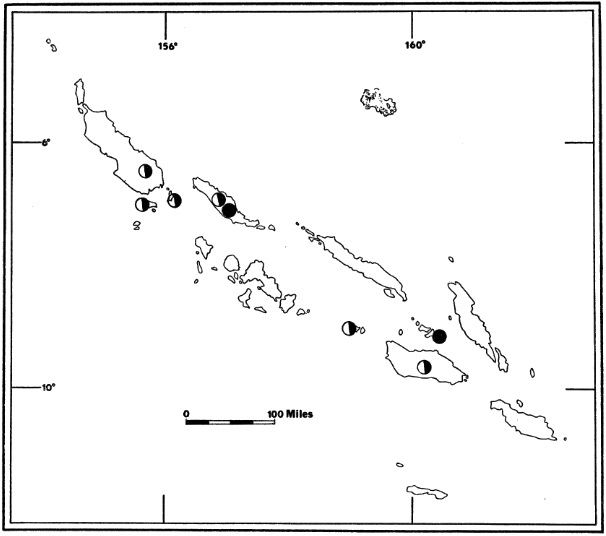
Remarks.—Heretofore, Pteropus woodfordi was known from New Georgia,
Guadalcanal, Kolombangara, and Banika (see Fig. 7); specimens from Fauro
and Pavuvo islands, listed above, provide new northern localities of record for
this species.
Judging by small size and unfused epiphyses, a bat obtained in April and
another obtained in June are subadults. Specimens of adults, examined by me,
agree well with the descriptions of P. woodfordi by Thomas (1888a:156) and
Andersen (1912:407-409), but are slightly smaller than specimens listed by
Sanborn and Beecher (1947:389). Color of pelage in this species seems to
vary. Adults seen have a pale head and mantle, contrasting strongly with the
dark back. Andersen (1912:409) and Lawrence (1945:61) discussed individuals
that had scattered silvery hairs mixed with dark fur dorsally and
darker mantles that did not contrast noticeably with the rest of the dorsum.
Lawrence (1945:389) named Pteropus austini as a new species closely related
to P. woodfordi and other species of the P. scapulatus group of Andersen
(1912:402) and Tate (1942:336). Sanborn and Beecher (1947:389), studied
a series of P. woodfordi from Banika and Guadalcanal and found that skulls
of two subadults agreed well with cranial characteristics ascribed to P. austini,
which was based on two subadults. Lawrence (1945:61) stated also that "the
interfemoral membrane is entirely absent medially in austini, while in woodfordi
it is present as a barely discernible ridge 8 mm. wide." Andersen (1912:408)
had earlier reported that in the type of woodfordi the interfemoral
membrane was "undeveloped in [the] centre." In 13 adults (in alcohol)
studied by Sanborn and Beecher (1947:389), as well as in adults examined
by me, the uropatagium is not present. In size, however, these specimens
agree with dimensions given for woodfordi by Thomas (1888a:156) and Andersen
(1912:410); for example, length of forearm is 93-99. According to
Lawrence (1945:59) austini, in which the interfemoral membrane is lacking,
is smaller than woodfordi and has a forearm of about 84. In two juveniles of
P. woodfordi in the U. S. National Museum, the medially-developed interfemoral
membrane is about 7 wide. One specimen has small but distinct
calcars whereas the other (slightly larger) apparently lacks calcars. This
suggests individual variation in the presence or absence, as well as in the size,
of the uropatagium in Pteropus woodfordi.
Sanborn and Beecher (1947:389) decided that "until fully adult specimens
showing the characters of austini are available, it best be considered a synonym
of woodfordi." For the following reasons I agree with these authors: (1)
austini is known from only two specimens, both of which are apparently subadults;
(2) austini is reported to have a forearm 84 long and no interfemoral
membrane, whereas woodfordi has a forearm about 96 long and an interfemoral
membrane that is only slightly developed; (3) specimens that agree in
size and cranial characters with the type of woodfordi but that lack an interfemoral
membrane have been obtained; and (4) skulls of subadults of woodfordi
agree with the description of skulls of austini.
Sanborn (1931:19) reported that specimens of Pteropus woodfordi were
obtained at night, while feeding on young green coconuts. Lawrence (1945:62)
reported that in the late afternoon a collector found individuals of austini
[= woodfordi] in the fronds of a coconut tree, apparently feeding on pollen
shoots. Sanborn and Beecher (1947:388) have reported malaria (Plasmodium)
in P. woodfordi obtained on Guadalcanal. They suggested that malaria might
have rendered one individual helpless because when it was found, on the
ground, no wounds were evident and parasites were present in the blood.
Pteropus mahaganus Sanborn
1931. Pteropus mahaganus Sanborn, Publ. Field Mus. Nat. Hist., Zool.
Ser., 18:19, February 12, type from Santa Ysabel, also reported from
Bougainville; 1954, Laurie and Hill, List of land mammals of New
Guinea, Celebes and adjacent islands, p. 39, June 30.
Specimens examined (one male and two females; one in alcohol).—Bougainville,
in August and October, USNM 276972, USNM 277104-5.
Measurements.—Measurements of one male and two females are, respectively,
as follows: Length of head and body, 180, 204, 198; hind foot, 42, 38,
44; ear, 25, 23, 22; length of forearm, 134, 138, 140. Measurements of the
skull of the male and one female are, respectively, as follows: Greatest length
of skull, 52.5, 55.8; condylobasal length, 50.9, 54.3; palatal length, 24.1, 26.0;
zygomatic breadth, 28.9, 32.5; breadth across first upper molars, 14.4, 15.0;
width of M1, 2.2, 2.2; length of maxillary tooth-row, 17.4, 18.4; length of
mandibular tooth-row, 20.1, 21.4.
Remarks.—Sanborn (1931:19-21) described Pteropus mahaganus on basis of
six specimens, five from Santa Ysabel and one from Bougainville. The latter
was in poor condition and only provisionally allocated to this species. The
specimens examined by me (listed above) confirm the occurrence of P. mahaganus
on Bougainville.
Sanborn (1931:20) described mahaganus as "similar to and about the size
of [Pteropus scapulatus] from Australia, but lighter in color," and considered it,
along with P. woodfordi, a member of the Pteropus scapulatus group of Andersen
(1912:402) and Tate (1942:336). I would judge, however, that
P. mahaganus and P. woodfordi are much more closely related to one another
than to P. scapulatus of Australia. The only significant characteristic that the
latter has in common with the two species from the Solomons is small cheek-teeth.
In fact, teeth of scapulatus are relatively smaller than teeth of either
mahaganus or woodfordi. Also, in scapulatus the upper canines are widely
separated due to lateral expansion of the palate at that point, whereas in
mahaganus and woodfordi the width across the upper canines is relatively
much less.
Dobsonia Palmer
1898. Dobsonia Palmer, Proc. Biol. Soc. Washington, 12:114, April 30.
1810. Cephalotes (part) É. Geoffroy, Ann. du Mus. d'Hist. Nat., 15:104.
Dobsonia, a genus of large to medium-sized fruit bats, occurring from Celebes
to the Solomon Islands, contains at least nine species. One species and its two
subspecies are endemic to the Solomons.
Dobsonia differs from all other genera of megachiropteran bats in the Solomons
by combining absence of a small claw on the second digit and presence
of external tail vertebrae.
The cranium of Dobsonia resembles, in some ways, the cranium of Rousettus
as well as that of Pteropus. Even so, in Dobsonia the rostrum is shorter and
the cheek-teeth, especially in the upper jaw, are more crowded. The anterior
part of the mandible is narrow and the lower incisors are diminutive and often
concealed by the flesh of the gum.
Dobsonia inermis
In a review of the genus Dobsonia, Andersen (1909c:532) named and described
D. inermis and D. nesea from the Solomons. Specimens of Dobsonia
inermis from San Cristobal and Ugi were said to differ from specimens of
D. nesea from Alu, Shortland, and Rubiana in having perpendicular as opposed
to anteriorly slanted upper canines. Andersen (1909c:532) reported that the
two species were of "... the same general size." Troughton (1936:348-349)
studied specimens of Dobsonia from Bougainville and Santa Ysabel and,
because of individual variation in proclivity of the upper canines, concluded
that D. nesea was conspecific with D. inermis. He (p. 349) noted that the ears
were shorter in inermis than in nesea, but the size of teeth showed insular variation
and a "... confusing amount of intergradation ... [that obscures]
... diagnostic importance."
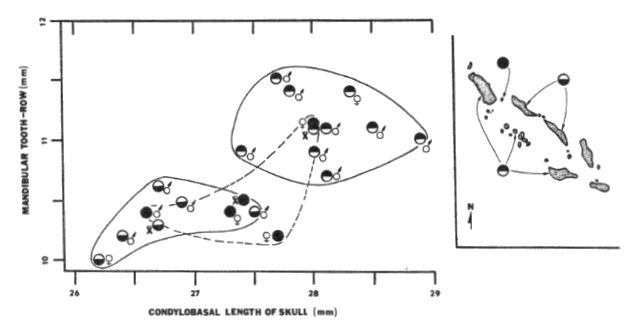
Specimens of Dobsonia from Choiseul are smaller (externally and cranially)
than those from Alu, Shortland, Rubiana, Bougainville, Fauro, Vella Lavella,
Guadalcanal, Florida, Ugi, San Cristobal, and Rennell. Specimens from Santa
Ysabel (see Fig. 8) are intermediate in size between those from Choiseul and
the other islands listed. Judging from available specimens, two subspecies of
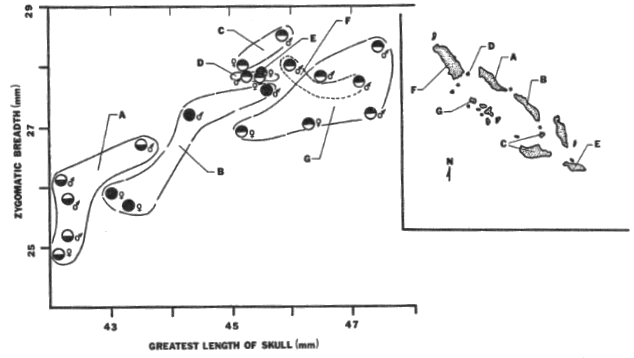
Dobsonia inermis occur in the Solomons. Specimens from Choiseul (see A,
Fig. 8), which are smaller than those from other islands, represent one subspecies
(heretofore unrecognized), whereas specimens from other islands (except
Santa Ysabel) represent a second subspecies. Specimens from Santa
Ysabel are slightly larger than those on Choiseul and are regarded as intergrades
between the two subspecies. Specimens from Rennell, Ugi, San Cristobal,
Florida, Fauro, and Guadalcanal are slightly smaller than those from
Bougainville, Vella Lavella, Shortland, and Rubiana, but the differences are not
great enough to warrant recognition of two subspecies. Therefore, the subspecific
name nesea is arranged as a synonym of inermis, which has priority,
and the latter name is used for specimens of Dobsonia inermis from the Solomon
islands other than Choiseul and Santa Ysabel. Additional remarks on the distribution
of this species are in the section on Zoogeography and Speciation.
Pohle (1953:130) suggested that Dobsonia inermis (as well as D. crenulata
and D. praedatrix) is conspecific with D. viridis, but Laurie and Hill (1954:41)
did not adopt his suggestion. I have not seen adequate series of crenulata,
praedatrix, and viridis (none of which occurs in the Solomons) to judge systematic
relationships of these kinds; therefore I follow Laurie and Hill.
Dobsonia inermis inermis Andersen
1909. Dobsonia inermis Andersen, Ann. Mag. Nat. Hist., ser. 8, 4:532,
December, type from San Cristobal; 1912, Andersen, Catalogue of
the Chiroptera ... British Museum, 1:475.
1936. Dobsonia inermis inermis, Troughton, Rec. Australian Mus., 14:349,
April 7, from Santa Ysabel; 1954, Laurie and Hill, List of land
mammals of New Guinea, Celebes and adjacent islands, p. 41, June
30; 1956, Hill, The natural history of Rennell Island, British Solomon
Islands, 1:74, November 28, from Rennell Island.
1878. Cephalotes peroni (part), Dobson, Catalogue of the Chiroptera
... British Museum, p. 91; 1879, Trouessart, Rev. Mag. Zool.,
3:208; 1887, Thomas, Proc. Zool. Soc. London, p. 323, March 15,
from Ugi and San Cristobal; 1888, Thomas, Proc. Zool. Soc. London,
p. 476, December 4; 1897, Trouessart, Catalogus Mammalium
..., 1:87.
1899. Dobsonia peroni (part), Trouessart, Catalogus Mammalium ...,
2:1278.
1909. Dobsonia nesea Andersen, Ann. Mag. Nat. Hist., ser. 8, 4:532, December
1, type from Shortland Island; 1912, Andersen, Catalogue of
the Chiroptera ... British Museum, 1:476, from Shortland
and Rubiana; 1931, Sanborn, Publ. Field Mus. Nat. Hist., Zool. Ser.,
18:22, February 12, from San Cristobal.
1936. Dobsonia inermis nesea, Troughton, Rec. Australian Mus., 14:348,
April 7, from Bougainville; 1953, Pohle, Z. Säugetierk., 17:130,
October 27; 1954, Laurie and Hill, List of land mammals of New
Guinea, Celebes and adjacent islands, p. 41, June 30, from New
Georgia.
Specimens examined (13 males and three females; three in alcohol, crania
extracted and cleaned).—Fauro in April, 23728, 23740, 23751; Vella Lavella
in November, 23134-36, 23141, 23145, 23147, 23149, 23151, 23153; Guadalcanal
in May and June, 23865, 23914, 24008; Florida in October, 24416.
Measurements.—See tables 2 and 3.
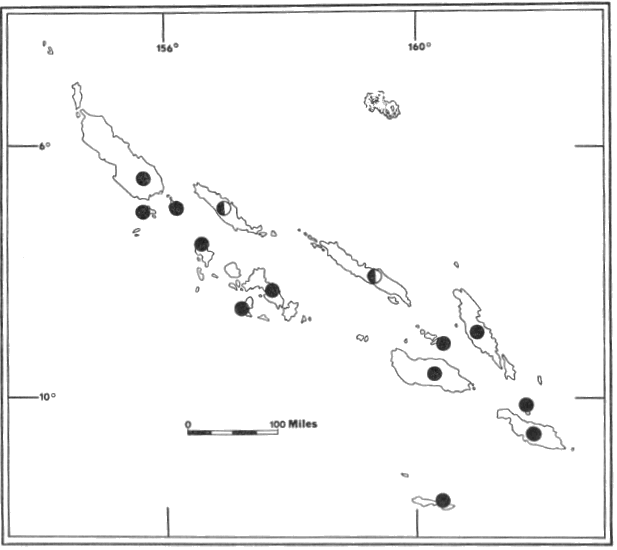
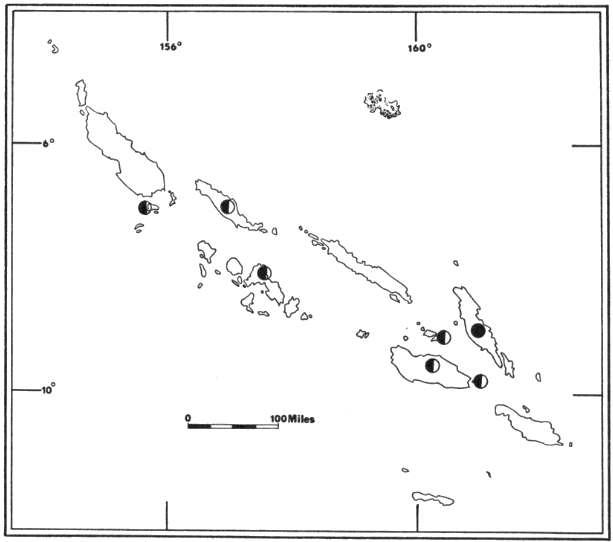
Remarks.—Heretofore, Dobsonia inermis inermis was unreported from Fauro,
Vella Lavella, Guadalcanal, and Florida. Apparently the subspecies occurs on
most islands of the archipelago (see Fig. 9).
In coloration and most cranial dimensions the specimens listed above agree
with specimens of D. i. inermis from Alu, Shortland, and Rubiana (Andersen,
1909c:532; 1912:475, 476), Bougainville (Troughton, 1936:348, 349), and
Rennell (Hill, 1963:74). The forearm in the adult male holotype of "nesea,"
from Shortland, is 109.5 as opposed to 109.0 in an adult female topotype of
inermis from Ugi (Andersen, 1912:478) in the southeastern part of the archipelago
(see Fig. 9). Forearms of specimens of D. i. inermis from Vella
Lavella are 107 to 112 (measurements from labels because forearms of these
specimens were broken and therefore could not be remeasured). Forearms of
specimens from Fauro, Florida, Guadalcanal, and Rennell are 103.6 to 110.0
(see Hill, 1956:74). Variation in length of forearm probably is not significant
because no cline is evident (see Fig. 9 and Table 2).
In 1964, 11 specimens of Dobsonia inermis were collected on Choiseul.
They are smaller, externally and cranially, than specimens of D. inermis from
Sun Cristobal, Ugi, Rennell, Guadalcanal, Florida, Rubiana, Vella Lavella,
Shortland, Alu, Bougainville, and Fauro, and may be named and described as
follows:
Dobsonia inermis minimus, new subspecies
Type.—Adult male skin and skull, in good condition (originally stored in
70 per cent alcohol for about one year), no. BBM-BSIP 23716, Bernice P.
Bishop Museum; from Choiseul Island, British Solomon Islands Protectorate;
obtained on 20 March 1964 by Philip Temple, original number 1524.
Distribution.—Choiseul Island (type locality); intergrades from Santa Ysabel
also assigned to this subspecies.
Diagnosis.—Size small for species; wing membranes, feet, and ears black;
dorsal surface of interfemoral membrane sparsely set with silvery hairs, other
membranes naked; hair soft, medium length (10 on mantle, 5 on crown), black
hairs and scattered white hairs on face and crown; fur of dorsal surface of
mantle composed of whitish hairs having faint olive cast imparting general
color of Buffy-Citrine; hair of venter short (about 5), soft, and fine; general
coloration Buffy-Citrine; cranium delicate; rostrum narrow in dorsal aspect
(nasals not expanded laterally); forehead (junction of nasals and frontals)
pronounced in lateral aspect; teeth resembling those of other subspecies of
D. inermis but slightly smaller.
Comparisons.—From adults of Dobsonia inermis inermis, which occurs on
Rennell, San Cristobal, Ugi, Malaita, Florida, Guadalcanal, Rubiana, Vella
Lavella, Shortland, Alu, Bougainville, and Fauro, minimus differs in being
smaller. Average length of mandible 31.2 and 33.4. For other measurements
see Table 2.
From Dobsonia praedatrix, which occurs on New Britain, New Ireland, and
Duke of York (northward of the Solomons), minimus differs in being smaller
in all dimensions; length of forearm averaging 100.5 as opposed to 116.0, and
greatest length of skull 42.4 as opposed to 50.0.
Table 2. Average and Extreme Measurements of Two Subspecies of Dobsonia inermis.
| Measurement |
D. i. minimus |
D. i. inermis |
Choiseul
4 ♂, 2 ♀ |
Santa Ysabel
1 ♂, 2 ♀ |
Guadalcanal,
Fauro, Vella
Lavella, Florida
9 ♂, 2 ♀ |
| Length of head and body |
174.5 | (170 | - | 180) |
.......... |
174.5 | (160 | - | 190) |
| Tail vertebrae |
28.5 | ( 24 | - | 33) |
23.0 | (21.5 | - | 24.0) |
30.4 | (25 | - | 35) |
| Hind foot |
25.3 | (25.1 | - | 25.9) |
23.5 | (23.5 | - | 24.0) |
29.3 | (26.0 | - | 31.6) |
| Ear |
21.5 | (21.0 | - | 22.9) |
21.1 | (21.0 | - | 21.5) |
23.1 | (19 | - | 25) |
| Length of forearm |
100.5 | (98.1 | - | 104.0) |
105.3 | (104 | - | 107) |
108.4 | (105 | - | 112) |
| 2nd metacarpal |
43.6 | (42.6 | - | 45.2) |
.......... |
48.1 | (45.9 | - | 50.9) |
| 3rd metacarpal |
61.5 | (59.8 | - | 62.9) |
.......... |
67.6 | (65.2 | - | 68.5) |
| 4th metacarpal |
57.5 | (56.5 | - | 58.5) |
.......... |
62.5 | (58.7 | - | 65.5) |
| 5th metacarpal |
59.0 | (57.0 | - | 60.5) |
.......... |
64.4 | (61.8 | - | 66.0) |
| Greatest length of skull |
42.4 | (42.1 | - | 43.5) |
44.0 | (43.0 | - | 45.6) |
45.9 | (45.2 | - | 47.4) |
| Condylobasal length |
40.4 | (39.5 | - | 41.3) |
41.7 | (41.1 | - | 42.6) |
43.6 | (43.1 | - | 45.0) |
| Zygomatic breadth |
25.6 | (24.9 | - | 26.8) |
26.5 | (25.7 | - | 27.6) |
27.9 | (27.2 | - | 28.5) |
| Breadth of braincase |
16.8 | (16.5 | - | 17.4) |
18.0 | (17.1 | - | 19.9) |
17.9 | (16.7 | - | 19.0) |
| Breadth across upper canines |
8.4 | (8.1 | - | 8.7) |
.......... |
9.2 | (9.2 | - | 9.5) |
| Breadth across first upper molars |
12.1 | (11.8 | - | 12.6) |
.......... |
13.1 | (12.6 | - | 13.3) |
| Length of maxillary tooth-row |
15.6 | (15.5 | - | 15.8) |
16.4 | (16.0 | - | 17.2) |
16.4 | (15.9 | - | 17.0) |
| Length of mandibular tooth-row |
17.1 | (16.8 | - | 17.6) |
17.8 | (17.3 | - | 18.4) |
18.2 | (17.8 | - | 19.4) |
Measurements.—Comparative measurements of the subspecies inermis and
minimus are given in Table 2.
Some measurements of the type are as follows:
Length of head and body, 147; tail vertebrae, 31; hind foot, 25; ear, 21; length
of forearm, 99.5; 2nd metacarpal, 42.8; 3rd metacarpal, 62.7; 4th metacarpal,
58.5; 5th metacarpal, 59.1; greatest length of skull, 42.2; condylobasal length,
40.6; zygomatic breadth, 25.8; breadth of braincase, 16.8; length of maxillary
tooth-row, 15.8; length of mandible, 31.2.
Remarks.—Dobsonia inermis minimus is the smallest subspecies of Dobsonia
inermis. Specimens from Santa Ysabel, southeastward of Choiseul, are slightly
larger than the type and paratypes of minimus. As can be seen in the scatter
diagram (Fig. 8), a male from Santa Ysabel is as large as one male and most
females of D. i. inermis. The other three specimens from Santa Ysabel also are
slightly larger than specimens of minimus from Choiseul, but are much smaller
than specimens of D. i. inermis, and, therefore, are referred to D. i. minimus.
Although there is a cline in size of Dobsonia inermis from Choiseul to
Florida (generally southward; Fig. 9), no cline in size is apparent between
Choiseul and Fauro (generally westward). Specimens of D. inermis from
Fauro are average for the subspecies inermis; there is no evidence, in the
small series available, of intergradation between minimus on Choiseul and
inermis on Fauro.
Specimens examined (eight males and three females, all originally in
alcohol; seven crania, all adults, extracted and cleaned).—Choiseul in March,
23565, 23628, 23637, 23665-67, 23640, 23714, 23716 (holotype), 23717, 23720.
Ellis LeG. Troughton kindly examined and measured nos. AM-M. 3693 ♂,
AM-M. 3694 ♂, AM-M. 3937 ♀, and AM-M. 3940 ♀, from Santa Ysabel in the
Australian Museum.
Subfamily Macroglossinae
Macroglossus F. Cuvier
1824. Macroglossus F. Cuvier, Des dents des mammiferes ... zoologiques,
p. 248.
1840. Kiodotus Blyth, in Cuvier's animal kingdom ..., p. 69.
1891. Carponycteris Lydekker, in Flower and Lydekker, mammals living
and extinct, p. 654.
1902. Odontonycteris Jentink, Notes Leyden Mus., 23:140, July 15.
Macroglossus, the widest-ranging genus of macroglossine bats, occurs from
southeastern Asia to the southern islands of the Solomon Archipelago (see
Ellerman and Morrison-Scott, 1966:101; Laurie and Hill, 1954:44). One
species, known also from Celebes and New Guinea, occurs in the Solomons and
is represented there by an endemic subspecies.
Numerous generic names have been applied, at one time or another, to bats
now considered as Macroglossus. Trouessart (1904:65) and Miller (1907:70)
listed the one bat of this genus occurring in the Solomons under Carponycteris
and Kiodotus, respectively. Andersen (1911:642; 1912:767) and, later, Sanborn
(1931:22) identified this bat as Macroglossus lagochilus microtus.
Troughton (1936:350), reporting an extension of range of this species in the
Solomons, used the generic name Odontonycteris without explanation. Andersen
(1912:754) pointed out that Jentink originally established the name Odontonycteris
on the basis of an extra premolar in each upper jaw as opposed to the
usual two in Macroglossus, and arranged Odontonycteris as a synonym of Macroglossus
because "in no genus of Megachiroptera are dental anomalies of so
frequent occurrence as in Macroglossus, and on no point of the jaws are these
anomalies ... so often met with as on that occupied by the molar
series." Sanborn (1931:22) and Phillips (1966:27) noted variation in number
of incisors in Macroglossus as well as in Melonycteris, another macroglossine
genus. All of the more recent workers (Ellerman and Morrison-Scott, 1966;
Pohle, 1953; Laurie and Hill, 1954) use the name Macroglossus.
Macroglossus lagochilus
Macroglossus lagochilus has at least three subspecies, one of which is endemic
to the Solomons. The species ranges from Celebes on the west to the Solomon
Islands on the east, occurring not only in New Guinea but also on many of
the small adjacent islands (see Laurie and Hill, 1954:44).
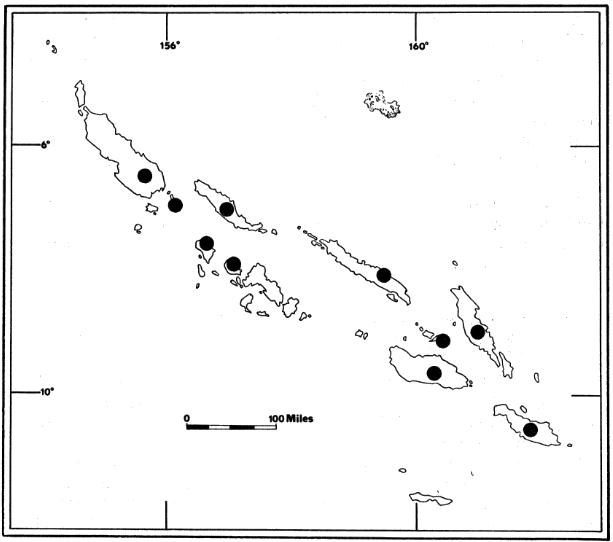
Fig. 10. Distribution of
Macroglossus lagochilus microtus. For names of islands see Fig. 2.
Macroglossus lagochilus microtus Andersen
1911. Macroglossus lagochilus microtus Andersen, Ann. Mag. Nat. Hist.,
Ser. 8, 7:642, June, type from Guadalcanal, additional specimens
from Florida; 1912, Andersen, Catalogue of the Chiroptera ...
British Museum, 1:767; 1931, Sanborn, Publ. Field Mus. Nat. Hist.,
Zool. Ser., 18:22, February 12, from San Cristobal; 1953, Pohle,
Z. Säugetierk., 17:130, October 27, from Bougainville; 1954, Laurie
and Hill, List of land mammals of New Guinea, Celebes and adjacent
islands, p. 44, June 30.
1888. Macroglossus australis (part). Thomas, Proc. Zool. Soc. London, p.
476, December 4, from Guadalcanal.
1904. Carponycteris nana (part), Trouessart, Catalogus Mammalium
..., Suppl., p. 65.
1907. Kiodotus sp., Miller, Bull. U. S. Nat. Mus., 57:70, June 29.
1936. Odontonycteris lagochilus microtus, Troughton, Rec. Australian Mus.,
14:350, April 7, from Bougainville.
Specimens examined (14 males and 16 females; in alcohol).—Choiseul in
March, 23654-57, 23614, 23629, 23643, 23645, 23647, 23677-79, 23684; Vella
Lavella in December, 23277-79, 23283-84; Fauro in April, 23765; Guadalcanal
in May and June, 23830, 23864, 23935; Kolombangara in January, 23385, 23399,
23397, 23407, 23420-21; Santa Ysabel in June, 24067; Malaita in June, 24067.
Measurements.—Average and extreme external measurements of 14 males
and 15 females are as follows: Length of head and body, 68.3 (63-72); tail
vertebrae present but scarcely perceptible and therefore not measured; hind
foot, 11.4 (9.0-12.9); ear, 12.0 (10.0-12.9); length of forearm, 37.6 (36.2-39.9).
Remarks.—The distribution of Macroglossus lagochilus microtus has not been
well known. Specimens herein reported from Choiseul, Fauro, and Vella Lavella
provide new records of distribution. As shown on Figure 10, the subspecies
occurs throughout the Solomon Islands.
Macroglossus lagochilus microtus differs slightly from M. l. nanus Matschie,
the subspecies of the Bismarck Archipelago and Admiralty Islands to the north
of the Solomons. M. l. nanus averages slightly larger than microtus (see
Andersen, 1912:768-769, for comparative measurements) but otherwise closely
resembles it.
Individual variation is evident in several measurements of the specimens at
hand (in length of forearm, for example) but no clines are apparent. Four
females obtained in March were lactating, as was one taken in December and
one taken in January.
Melonycteris Dobson
1877. Melonycteris Dobson, Proc. Zool. Soc. London, p. 119, June 1.
1877. Cheiropteruges Ramsay, Proc. Linn. Soc. New South Wales, 2:19,
July.
1887. Nesonycteris Thomas, Ann. Mag. Nat. Hist., ser. 5, 14:147, February.
The genus Melonycteris is known from three species, two apparently endemic
to the Solomon Islands and the third occurring in eastern New Guinea and the
Bismarck Archipelago (Laurie and Hill, 1954:45).
Heretofore, the generic name Nesonycteris has been applied to the species
in the Solomons, whereas Melonycteris has been restricted to the one species
in the Bismarck Archipelago and New Guinea. Andersen (1912:792) judged
that Nesonycteris was clearly distinct from Melonycteris on the basis of two
characters (loss of a claw on the second digit and loss of the inner, lower
incisors). On the other hand, he noted striking similarities in general cranial
features, dentition, palatal ridges, tongue, and external appearance of the two
genera. Pohle (1953:131) synonymized the two but Laurie and Hill (1954:45)
considered them distinct. I have suggested previously (Phillips, 1966:26, 27)
that characteristics used to distinguish between Melonycteris and Nesonycteris
are of less than generic value. Variability of number of incisors in the upper
jaw of specimens of Melonycteris (and in other macroglossine genera, as well)
indicates a lack of selective pressure for either increase or decrease in number
of incisors. Furthermore, the loss of the small claw on the second digit might
not be important because, as Bader and Hall (1960:15) have pointed out,
limbs of bats vary more in phenotypic expression than do other parts of the
skeletal structure.
The discovery of a new species (Melonycteris aurantius) in the Solomon
Islands sheds additional light on the problem. Although M. aurantius possesses
the distinguishing characteristics of the genus "Nesonycteris," the species closely
resembles Melonycteris in other features. Similarity in structure of hair of
Melonycteris and Nesonycteris, as first reported by Benedict (1957:293), also
supports the argument for synonymy (see Phillips, 1966:26).
Melonycteris aurantius lacks a small claw on the second digit and has only
two lower incisors. In these ways this species is like woodfordi, which also is
restricted to the Solomons. On the other hand, the structure of the skull of
M. aurantius is like that of M. melanops, which is the species found in the
Bismarck Archipelago.
Although melanops is not yet known from the Solomon Islands, I have included
it in the following key.
Key to Known Species of Melonycteris
| 1. |
Ventral surface darker than dorsum, but not strongly contrasting with
it; lacking a small claw on the second digit, |
| 2 |
| 1´. |
Ventral surface nearly black, strongly contrasting with dorsum; small
claw on second digit, |
| Melonycteris melanops |
| 2(1´). |
Pelage bright, Cinnamon-Rufous; postorbital region of skull expanded
(about 8.3 wide), |
| Melonycteris aurantius, p. 816 |
| 2´. |
Pelage dark, near Wood-Brown or Cinnamon; postorbital region of
skull constricted (about 7.5), |
| Melonycteris woodfordi, p. 816 |
Melonycteris aurantius Phillips
1966. Melonycteris aurantius Phillips, Jour. Mamm., 47:23-27, March 12,
type from Florida Island, additional specimens from Choiseul Island.
Specimens examined (six females; three in alcohol).—Florida in October,
24440; Choiseul in March, 23615, 23617, 23558, 23694, 23681.
Measurements.—Average and extreme measurements of six females are as
follows: Length of head and body, 80.8 (77-106); hind foot, 17.2 (16.0-18.7);
ear, 12.7 (11.5-14.0); length of forearm, 49.3 (42.9-53.8). Average and extreme
measurements of skulls of five females are as follows: Greatest length of
skull, 31.8 (30.8-33.3); condylobasal length, 29.7 (28.6-32.4); zygomatic
breadth, 18 (17.2-20.0); breadth of braincase, 12.6 (12.4-13.2); postorbital
breadth, 8.3 (8.0-8.9); length of maxillary tooth-row, 10.1 (9.4-10.4); length
of mandibular tooth-row, 11.7 (10.8-12.2).
Remarks.—On Choiseul Island Melonycteris aurantius was taken at the same
locality as its congener, Melonycteris woodfordi.
Externally, M. aurantius resembles M. woodfordi. These species are the
same size, but the former is brighter in color (nearly orange in adults) than
the latter, which is Wood-Brown dorsally. Internally, differences between
M. aurantius and M. woodfordi are more obvious. In the skull of M. aurantius,
the postorbital region is expanded (measuring about 8.3), whereas in M. woodfordi
the postorbital region is constricted. Furthermore, in lateral aspect the
posterior portion of the skull of M. aurantius is down-turned and the angle of
the facial axis with the basicranial axis is much more acute than in M. woodfordi.
The number of upper incisors is highly variable in the six specimens of
M. aurantius that I have examined. In two specimens an extra tooth has
erupted just anterior to I2 and there is a total of six upper incisors. In two
other specimens an extra tooth has erupted in front of I2 on one side but not
the other. I could find no trace of an extra tooth in the remaining two
specimens.
Practically nothing is known about the natural history of M. aurantius, or,
indeed, that of either of the other two species of this genus. One field collector
(Temple, in litt.) for the Bishop Museum reported that he obtained both
M. aurantius and M. woodfordi in the same mist net in one night. The holotype,
an adult female, was lactating when obtained in October.
Melonycteris woodfordi (Thomas)
1887. Nesonycteris woodfordi Thomas, Ann. Mag. Nat. Hist., ser. 5, 14:147,
February, type from Shortland Island; 1887, Thomas, Proc. Zool. Soc.
London, p. 324, March 15; 1888, Thomas, Proc. Zool. Soc. London, p.
476, December 4; 1898, Trouessart, Catalogus Mammalium ...,
1:90; 1899, Matschie, Die Megachiroptera ... naturkunde, p. 91;
1904, Trouessart, Catalogus Mammalium .., Suppl., p. 66;
1907, Miller, Bull. U. S. Nat. Mus., 57:74, June 29; 1912, Andersen,
Catalogue of the Chiroptera ... British Museum, 1:792, from
Alu, Shortland, Fauro, and Guadalcanal; 1931, Sanborn, Publ. Field
Mus. Nat. Hist., Zool. Ser., 18:23, February 12, from Russell Island
(Pavuvo); 1954, Laurie and Hill, List of land mammals of New
Guinea, Celebes and adjacent islands, p. 45, June 30.
1953. Melonycteris woodfordi, Pohle, Z. Säugetierk., 17:130, October 27,
from Bougainville Island; 1966, Phillips, Jour. Mamm., 47:23, March
12, from Choiseul.
Specimens examined (three males and one female; in alcohol).—Choiseul,
in April, 23413-14, 23434, 23275.
Measurements.—Average and extreme measurements of three males and one
female are as follows: Length of head and body, 86.1 (83.1-91.0); hind foot,
19.6 (17.2-22.2); ear, 11.3 (10.8-11.7); length of forearm, 54.4 (52.1-57.7).
Remarks.—Specimens of Melonycteris woodfordi from Choiseul constitute a
new locality of occurrence for the species. Apparently M. woodfordi occurs
throughout the Solomons (see Fig. 11).
Thomas (1887a:147) named Nesonycteris woodfordi in a preliminary report
that appeared before the publication of the more detailed description of the
genus and species (1887b:323-324). In the second paper he stated that the
anterior projections of the premaxillary bones are separated distinctly in both
Nesonycteris and Melonycteris. According to Thomas (1887b:323), it was by
some "accident" that Dobson (1878:4) reported the anterior projections of the
premaxillary bones in Melonycteris melanops to be united. Writing at a later
date, Andersen (1912:785) reported that in Melonycteris melanops the premaxillary
bones have "simple contact with each other." Furthermore, in Andersen's
(1912:791) illustration of M. woodfordi the premaxillary bones are in
contact anteriorly. In specimens of woodfordi and melanops examined by me,
the premaxillary bones are in contact. In M. aurantius the premaxillary bones
are not in contact, and it differs from woodfordi in several other respects.
In M. woodfordi, as in other macroglossine bats, there is variability in
dentition. One specimen examined has a total of three upper incisors, and
another had an extra peglike tooth just anterior to I1.
Subfamily Nyctimeninae
Nyctimene Borkhausen
1797. Nyctimene Borkhausen, Deutsche fauna ..., 1:86.
1810. Cephalotes É. Geoffroy, Ann. du Mus. d'Hist. Nat., 15:104.
1811. Harpyia Illiger, Prodr. Syst. Mamm. et Avium, p. 118.
1837. Gelasinus Temminck, Monographe de Mammalia ..., 2:100.
Tube-nosed bats of the genus Nyctimene occur from Celebes on the west to
the Santa Cruz Islands on the east. Heretofore, two species (N. albiventer and
N. major), each with an endemic subspecies, were known from the Solomon
Islands. Both species occur also in New Guinea and on many adjacent islands.
A new species of Nyctimene, apparently endemic to the Solomons, and a new
subspecies of N. albiventer are named beyond.
Nyctimene is related closely to Cynopterus and the "Cynopterus group" of
Andersen (1912:691). Because Nyctimene is a highly specialized bat, Miller
(1907:75) placed it in a subfamily separate from that of Cynopterus and its
allies.
Andersen (1912:696, 697) placed the species of Nyctimene previously
known from the Solomons in two groups, the "papuanus" group and the
"cephalotes" group, on the basis of difference in length of forearm and length
of maxillary tooth-row. Because of its short forearm (about 58), N. albiventer
is in the papuanus group; and N. major, because of its long forearm (about 74),
is in the cephalotes group.
Key to Species of Nyctimene in the Solomons
| 1. |
Forearm longer than 70; males grayish-brown, females pale gray, |
| N. major scitulus, p. 825 |
| 1'. |
Forearm shorter than 70; males dark brown, females pale brown, |
| 2 |
| 2(1'). |
Forearm about 65, |
| N. malaitensis, p. 822 |
| 2'. |
Forearm less than 61, |
| N. albiventer, p. 818 |
Nyctimene albiventer
This species occurs throughout New Guinea and on many adjacent islands,
including the Bismarck Archipelago and the Admiralty and Solomon islands.
The species varies geographically and five subspecies are recognized. The two
subspecies in the Solomons resemble N. albiventer papuanus, the subspecies
that ranges from eastern New Guinea to New Britain. N. albiventer bougainville
occurs in the western chain of islands of the Solomons, whereas another
subspecies, named as new beyond, occurs in the eastern chain of islands (see
Fig. 12).
Sexual dichromatism is striking. As Andersen (1912:690) previously reported,
females generally are paler, more brownish than males, which are dark
and have a better defined black dorsal stripe.
Nyctimene albiventer bougainville Troughton
1936. Nyctimene bougainville Troughton, Rec. Australian Mus., 19:349,
April 7, type from Bougainville.
1954. Nyctimene albiventer bougainville, Laurie and Hill, List of land
mammals of New Guinea, Celebes and adjacent islands, p. 46, June 30.
1953. Nyctimene papuanus bougainville, Pohle, Z. Säugetierk., 17:130, October 27.
Specimens examined (nine males, one female; nine in alcohol, nine crania
extracted and cleaned).—Bougainville in December, AM-M. 5786 (paratype);
Guadalcanal in May, 23812, 23815, 23827; Kolombangara in January and
February, 23369, 23381, 23388, 23406, 23444, 23456.
Measurements.—See Table 3.
Remarks.—Heretofore, Nyctimene albiventer bougainville was not known
from Kolombangara and Guadalcanal. The subspecies apparently ranges
throughout the western chain of the Solomons.
Troughton (1936:350) considered Nyctimene bougainville specifically distinct
from its nearest ally, N. papuanus. Pohle (1953:130) did not examine
specimens of either kind, but on the basis of Troughton's description decided
that N. bougainville differed only subspecifically from N. papuanus. Laurie
and Hill (1954:46) synonymized bougainville and papuanus with N. albiventer.
However, Troughton (1936:350) pointed out that in addition to size bougainville
differed from papuanus by having narrower and longer pm3 and pm4.
Judging from specimens examined by me, such is the case, and the difference
is even more pronounced in m1.
Specimens of N. a. bougainville from Kolombangara and Guadalcanal agree
with a paratype of this subspecies from Bougainville. Geographic variation,
if present in the population in the western chain of islands (see Fig. 12), is
slight and not notable in the series available. Some individual variation was
found, especially in the shape of the interorbital region of the skull. An adult
male from Kolombangara is unusually dark, almost black; color of the other
specimens (all in alcohol) is consistent according to sex.
Nyctimene albiventer from Choiseul and Santa Ysabel is smaller, in all
respects, than N. albiventer from Bougainville, Kolombangara, and Guadalcanal
(see Table 3), and therefore may be named and described as follows:
Nyctimene albiventer minor, new subspecies
Type.—Adult male, skin and skull, in good condition (originally stored in
alcohol for about one year), no. BSIP 23636, Bernice P. Bishop Museum; from
Choiseul Island, British Solomon Islands Protectorate; obtained on 11 March
1964, by Philip Temple, original number 1441.
Distribution.—Known only from Choiseul and Santa Ysabel islands (see
Fig. 12).
Diagnosis.—Small for Nyctimene; wing membranes brown with scattered
yellow spots (dried specimens); uropatagium, feet, and ears brown; dorsum of
tibia set with hair, ventral surface naked; dorsum of uropatagium sparsely set
with pale brown hairs, ventral surface almost bare; fringe of hairs along two
centimeters of dorsal and ventral surfaces of trailing edge of wing membrane;
proximal third of dorsal surface of forearm sparsely set with hairs; pelage of
back soft and thick, of medium length (about 7); hair on crown and nape
short (about 4); well-defined black dorsal stripe, extending from uropatagium
to shoulders; skull resembling that of other subspecies of N. albiventer but
relatively smaller; zygomatic arch delicate, slender anteriorly; P2 small (see
Fig. 14). Sexually dichromatic as follows: male—dorsum Hair-Brown, bases
of hairs darker; hair on throat sparse, medium length (about 6), Hair-Brown;
fur along sides of abdomen Drab; female—dorsum having Buffy-Brown cast,
some individual hairs Hair-Brown; shoulders Sayal-Brown; hair on throat sparse,
Hair-Brown on throat and midline of abdomen; sides of abdomen Sayal-Brown.
Comparisons.—From Nyctimene major scitulus, the largest member of this
genus in the Solomons, N. a. minor differs in being smaller in all measurements
taken; forearm averaging 54.8 as opposed to 73.5; greatest length of skull 28.2
as opposed to 37.0, and females pale brown instead of pale gray.
From nine adults of Nyctimene albiventer bougainville from Bougainville,
Kolombangara, and Guadalcanal, minor differs as follows: averaging slightly
smaller in all dimensions; forearm averaging 54.8 as opposed to 57.9; second
metacarpal averaging 27.4 as opposed to 28.3; 5th metacarpal averaging 38.5
as opposed to 40.0; condylobasal length 26.7 as opposed to 28.0; length of
mandibular tooth-row 10.3 as opposed to 10.9; mandible smaller (see Fig. 14);
dorsal stripe fainter.
From Nyctimene albiventer papuanus, known from eastern New Guinea,
New Britain, and the Admiralty Islands, minor differs as follows: slightly
smaller in most dimensions; forearm averaging 54.8 as opposed to 57.0; length
of maxillary tooth-row 8.9 as opposed to 9.8; length of mandibular tooth-row
10.3 as opposed to 11.0; breadth across upper third premolars notably less
(7.5 as opposed to 8.4).
N. a. minor differs from N. albiventer albiventer Gray, which occurs about
800 miles to the west of minor, in ways made apparent by the description by
Andersen (1912:700-701). N. a. minor occurs about 1500 miles eastward of the
place from which N. a. draconilla Thomas, a subspecies essentially unknown to
me, was named (see Laurie and Hill, 1954:46).
From Nyctimene sanctacrucis, known from the Santa Cruz Islands, minor
differs as follows: much smaller in all dimensions; forearm averaging 54.8 as
opposed to 75; greatest length of skull 28.2 as opposed to 34.5; length of
maxillary tooth-row 8.9 as opposed to 12.9.
Table 3. Average and Extreme Measurements of Nyctimene albiventer bougainville and N. a. minor.
| Measurement |
N. a. minor
Choiseul,
Santa Ysabel
4 ♂, 1 ♀ |
Intergrades
Fauro
1 ♂, 3 ♀ |
N. a. bougainville
Kolombangara,
Guadalcanal
8 ♂, 1 ♀ |
| Length of head and body |
107.0 | (105 | - | 109) |
109.2 | (105 | - | 112) |
110.0 | (106 | - | 117) |
| Tail vertebrae |
20.0 | (19.3 | - | 20.5) |
21.0 | ( 20 | - | 22) |
19.2 | ( 15.5 | - | 23.0) |
| Hind foot |
14.2 | (13.5 | - | 15.0) |
.......... |
14.3 | ( 13.0 | - | 15.9) |
| Ear |
11.9 | (11.0 | - | 13.0) |
.......... |
12.8 | ( 11.8 | - | 14.5) |
| Length of forearm |
54.8 | (54.0 | - | 55.8) |
57.1 | (55.9 | - | 59.0) |
57.9 | ( 55.8 | - | 59.8) |
| Greatest length of skull |
28.2 | (27.2 | - | 28.9) |
28.6 | (28.3 | - | 29.7) |
29.7 | ( 28.6 | - | 30.1) |
| Condylobasal length |
26.7 | (26.2 | - | 27.5) |
27.4 | (26.6 | - | 28.0) |
28.0 | ( 27.8 | - | 28.9) |
| Palatal length |
11.2 | (10.9 | - | 11.9) |
11.6 | (11.3 | - | 11.8) |
11.7 | ( 11.0 | - | 12.5) |
| Breadth of braincase |
12.0 | (11.5 | - | 12.4) |
12.0 | (11.7 | - | 12.2) |
12.3 | ( 12.1 | - | 12.8) |
| Zygomatic breadth |
18.9 | (18.4 | - | 19.7) |
18.6 | (18.4 | - | 19.2) |
19.2 | ( 18.7 | - | 20.0) |
| Interorbital breadth |
5.0 | ( 4.7 | - | 5.6) |
5.3 | ( 5.0 | - | 5.6) |
5.1 | ( 4.7 | - | 5.5) |
| Breadth across first upper molars |
8.6 | ( 8.4 | - | 8.9) |
8.9 | ( 8.7 | - | 9.1) |
9.1 | ( 8.8 | - | 9.6) |
| Maxillary tooth-row |
8.9 | ( 8.7 | - | 9.3) |
9.3 | ( 9.1 | - | 9.5) |
9.5 | ( 9.2 | - | 9.8) |
| Mandibular tooth-row |
10.3 | (10.0 | - | 10.6) |
10.5 | (10.2 | - | 11.1) |
10.9 | ( 10.7 | - | 11.4) |
Measurements.—Measurements of the two subspecies from the Solomons are
given in Table 3. Some measurements of the type are as follows: Length of
head and body, 108; tail vertebrae, 20.5; hind foot, 14.7; ear, 11.3; length of
forearm, 55.1; 2nd metacarpal, 27.4; 3rd metacarpal, 39.0; 4th metacarpal, 37.5;
5th metacarpal, 39.1; greatest length of skull, 28.6; condylobasal length, 27.5;
zygomatic breadth, 18.4; length of maxillary tooth-row, 9.0; length of mandibular
tooth-row, 10.4.
Remarks.—Nyctimene albiventer minor closely resembles N. albiventer
bougainville, differing from the latter mostly in size. Although adults of minor
average only slightly smaller than adults of bougainville (see Table 3), there
is only slight overlap (about 0.2 at most) in most minimum dimensions of
external and cranial features of bougainville and corresponding maximum dimensions
of externals and crania of minor. The difference in size is clearly
shown in Figs. 13 and 14.
Four specimens of Nyctimene albiventer from Fauro herein are considered
to be intergrades between N. a. bougainville and N. a. minor. As shown in
Table 3, the specimens from Fauro average slightly larger than those of minor
from Choiseul and Santa Ysabel and slightly smaller than specimens of bougainville
from Kolombangara and Guadalcanal. I have assigned the specimens from
Fauro to N. a. minor because they generally are closer to minor in size (see
Fig. 13).
Specimens examined (five males and four females; seven in alcohol; seven
crania extracted and cleaned).—Choiseul in February and March, 23636 (holotype),
23631, 23540, 23646; Santa Ysabel in February, 23539; Fauro in April,
23742, 23743, 23763, 23764.
One specimen of Nyctimene from Malaita Island is smaller than Nyctimene
major, which is known from Shortland, Alu, Florida, New Georgia, Guadalcanal,
Choiseul, and Malapa (see Fig. 15) and is larger than either of the two
subspecies of Nyctimene albiventer known from Bougainville, Fauro, Kolombangara,
Guadalcanal, Choiseul, and Santa Ysabel. This specimen represents
a previously unknown species and may be named and described as follows:
Nyctimene malaitensis, new species
Type.—Adult female, skin and skull, in good condition (originally stored in
alcohol for about one year), no. BSIP 24103, Bernice P. Bishop Museum; from
Malaita Island, British Solomon Islands Protectorate; obtained on 1 July 1964,
by Peter Shanahan, original no. unknown.
Distribution.—Known only from Malaita (see Fig. 16).
Diagnosis.—Size average for genus but larger than closest relative, Nyctimene
albiventer; wing membranes brown with scattered yellow spots (dried specimen);
uropatagium, ears, and feet brown; dorsal surface of tibia set with hair,
ventral surface bare; dorsal surface of uropatagium sparsely set with hair,
ventral surface having few, scattered hairs; dorsal surface of trailing edge of
wing membrane sparsely set with hairs, ventral surface bare; proximal third of
upper- and under-surface of forearm set with hair; pelage of back luxuriant
and soft (about 10 long); hair on crown and nape shorter than on back (4 to
8); well-defined black dorsal stripe from shoulders to rump (about 2 wide);
basal half of most hairs on dorsum Deep Mouse Gray, distal half Light Buff,
tips Ochraceous-Tawny; some hairs on back entirely Light Buff; hairs of crown
Light Ochraceous Buff tipped with Ochraceous-Tawny; hair on throat and
along sides of abdomen Light Ochraceous Buff; hairs of ventral midline Smoke
Gray; braincase narrow; zygomatic breadth relatively narrow; well-developed
lambdoidal crest in female; rostrum short, wide; upper canines slanted posteriorly;
upper incisors large; foramen ovale large (see Fig. 14).
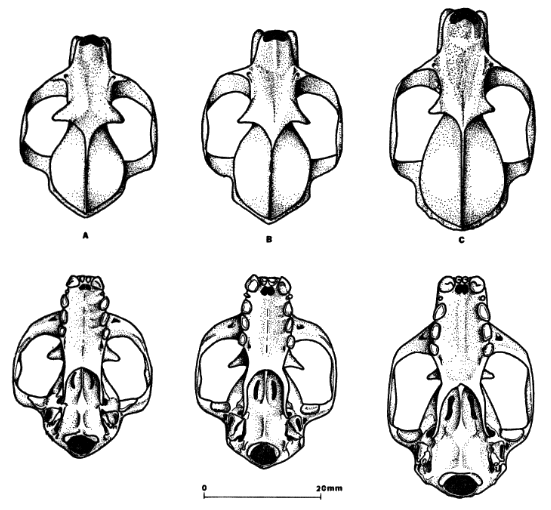
Fig. 14. Dorsal and
ventral views of skulls of (A) Nyctimene albiventer minor [specimen 23631 ♂,
(B) N. a. bougainville [specimen 23381 ♂], and (C) N. malaitensis
[specimen 24103 ♀].
Comparisons.—From Nyctimene major scitulus, the largest kind of Nyctimene
in the Solomons, malaitensis differs as follows: smaller in all dimensions
(forearm 65 as opposed to 73.5); greatest length of skull 32.4 as opposed to
37.0; length of maxillary tooth-row 10.5 as opposed to 13.0; length of mandibular
tooth-row 11.8 as opposed to 14.2.
From nine adults of Nyctimene albiventer bougainville from Bougainville,
Kolombangara, and Guadalcanal, malaitensis differs as follows: larger in all
dimensions: forearm 65 as opposed to 57.9; greatest length of skull 32.4 as
opposed to 29.7; zygomatic breadth 20.4 as opposed to 19.2; and length of
maxillary tooth-row 10.5 as opposed to 9.5; length of mandibular tooth-row
11.8 as opposed to 11.1.
From five adults of Nyctimene albiventer minor, from Choiseul and Santa
Ysabel, malaitensis differs in the same ways it differs from N. a. bougainville,
but the contrast is even greater when malaitensis and minor are compared.
From Nyctimene sanctacrucis, known only from the Santa Cruz Islands,
malaitensis differs in being smaller in all dimensions: forearm 65 as opposed to
75; greatest length of skull 32.4 as opposed to 34.5; and length of maxillary
tooth-row 10.5 as opposed to 12.9.
Measurements of the holotype.—Length of head and body, 118; tail vertebrae,
23.0; hind foot, 16.0; ear, 14.0; length of forearm, 65.0; 2nd metacarpal,
33.2; 3rd metacarpal, 46.4; 4th metacarpal, 44.3; 5th metacarpal, 46.0; greatest
length of skull, 32.4; condylobasal length, 30.6; palatal length, 13.0; breadth of
braincase, 12.5; zygomatic breadth, 20.4; interorbital breadth, 5.5; breadth
across first upper molars, 9.5; length of maxillary tooth-row, 10.5; length of
mandibular tooth-row, 11.8.
Remarks.—In size, Nyctimene malaitensis is intermediate between N. albiventer
and N. major. Because the type of malaitensis is brown and not pale
gray, as are females of major, N. malaitensis most likely is more closely related
to N. albiventer, in which the females are brown. The teeth of the holotype
and only known specimen of malaitensis are too worn to be useful in determining
the relationships between these species.
When more specimens are available, N. malaitensis may prove to be a subspecies
of N. albiventer. At present, malaitensis is accorded specific rank in
order not to obscure the apparent relationships of N. albiventer bougainville
and N. a. minor. Additionally, N. malaitensis is given specific rank because
(1) it is larger (especially in external dimensions) than the largest subspecies
of N. albiventer (compare above measurements with those in Table 3), and
(2) malaitensis does not form a cline with either of the two subspecies of
N. albiventer.
Specimen examined (one female).—Malaita in July, 24103 (holotype).
Nyctimene major
This large species of tube-nosed bat has at least four subspecies, one of
which (N. major scitulus) is endemic to the Solomons. The species occurs
throughout eastern New Guinea and on many of the islands adjacent to the
eastern coast of New Guinea, including the Trobriand Islands, the Bismarck
Archipelago, and the Solomons (see Laurie and Hill, 1954:47). The geographic
distribution of the species generally is the same as that of N. albiventer.
In Nyctimene major, as in N. albiventer, most males are grayish-brown,
whereas most females are pale gray.
Nyctimene major scitulus Andersen
1910. Nyctimene scitulus Andersen, Ann. Mag. Nat. Hist., ser. 8, 6:623,
December 1, type from Shortland; 1912, Andersen, Catalogue of the
Chiroptera ... British Museum, 1:711, from Shortland, New
Georgia, Florida, Guadalcanal; 1931, Troughton, Proc. Linnean Soc.
New South Wales, 56:206, July 15; 1931, Sanborn, Publ. Field Mus.
Nat. Hist., 18:22, February 12, from Choiseul and Malapa; 1942,
Tate, Bull. Amer. Mus. Nat. Hist., 80:342, December 31.
1954. Nyctimene major scitulus, Laurie and Hill, List of land mammals of
New Guinea, Celebes and adjacent islands, p. 47, June 30.
1862. Harpyia pallasi, Gerrard, Catalogue of the bones ... British
Museum, p. 58.
1870. Harpyia cephalotes, Gray, Catalogue of monkeys, lemurs and fruit-eating
bats in the British Museum, p. 121.
1878. Harpyia major, Dobson, Catalogue of the Chiroptera ... British
Museum, p. 90; 1879, Trouessart, Rev. Mag. Zool., 3:207; 1887,
Thomas, Proc. Zool. Soc. London, p. 323; 1888, Thomas, Proc. Zool.
Soc. London, p. 476; 1897, Trouessart, Catalogus Mammalium
..., 1:87.
1899. Cephalotes major, Trouessart, Catalogus Mammalium ..., 2:1277.
1899. Gelasinus major, Matschie, Die Megachiroptera ... naturkunde,
p. 84; 1904, Trouessart, Catalogus Mammalium ..., Suppl.,
p. 64.
Specimens examined (four males and one female; dried skins with skulls
inside).—Florida in October, 24397, 24413, 24418, 24419.
Measurements.—External measurements of four males and one female are,
respectively, as follows: Length of head and body, 134, 128, 134, 134, 136;
tail vertebrae, 28, 23, 27, 26, 21; hind foot, 20, 16, 19, 16, 21; ear, 17, 17,
17, 17, 18; length of forearm, 73.8, 68.0, 74.0, 73.6, 78.0.
Remarks.—Nyctimene major scitulus has been recorded only from the
western chain of islands in the Solomons (see Fig. 15). Specimens examined
by me agree well in external dimensions and color with specimens described by
Andersen (1912:712) and Troughton (1931:206-207).
ZOOGEOGRAPHY AND SPECIATION
De Beaufort (1951:113) considered bats of "less zoogeographical
importance" than other mammals because the ocean is not an
"absolute barrier to their dispersal." Volant animals are ecologically
terrestrial and therefore are more nearly earthbound than
De Beaufort's remarks would suggest (see Miller, 1966:10). Indeed,
many kinds of volant animals are endemic to the Solomons.
Birds, for example, are well adapted for flight but pose some of the
most complex zoogeographic problems in the area of New Guinea
and the Solomon Islands (Mayr, 1940:198; 1942:81-83; Koopman,
1957). Rapid speciation can take place in any situation where
there is a high degree of isolation (Wright, 1931; Lack, 1947). In
fact, isolation is a most important factor in speciation of insular
populations (Baker, 1951:55). The one genus, nine species, and 19
subspecies of megachiropterans that are endemic to the Solomons
(Table 4) obviously indicate that bats, although volant, can be
restricted to one or more islands long enough for new taxa to evolve.
Table 4. A Summary of the Kinds of Megachiropteran Bats in the Solomon
Islands and Their Affinities with Faunas of Adjacent Islands.
|
Totals |
Endemic to Solomons |
Common only to Solomons and Bismarcks |
Common to Solomons, Bismarcks, and New Guinea |
Common to Solomons, New Hebrides, and New Caledonia |
| Genera |
7 |
1 |
0 |
6 |
0 |
| Species |
16 |
9 |
1 |
6 |
1 |
| Subspecies |
20 |
19 |
0 |
0 |
1 |
The megachiropteran bats of the Solomons have their affinities
with the fauna of New Guinea (Table 4); the Solomons and New
Guinea have six genera and six species in common. Because the
two areas never have been connected (via the Bismarck Archipelago)
by dry land, bats probably have reached the Solomons by
flying from island to island (see Durham, 1963:357, 359, 361, 363).
Deignan (1963:266) has dismissed voluntary or involuntary flight as
possible explanations for distributions of bats and birds on islands
of the Pacific.
The taxonomic level of endemism can be used as an indicator of
antiquity (Dobzhansky, 1941; Koopman, 1958:429-430). The one
megachiropteran genus (Pteralopex) endemic to the Solomons apparently
is an ancient relic. Bats of this monotypic genus occur on
Bougainville, Choiseul, Santa Ysabel, and Guadalcanal (see Fig. 4).
These four islands probably were contiguous during the maximum
lowering of sea level in the Pleistocene (see Durham, 1963:362-363).
Bats of the genus Pteralopex are the only kind in the Solomons
having a distribution that can be correlated with former land
connections between islands.
The distributions of 16 species of megachiropterans known from
the Solomons are summarized in Table 5 and in Figure 16. The
larger islands (in terms of surface area and elevation) in general
have the highest number of species (Guadalcanal 10, Choiseul 9,
and Bougainville 8). But Fauro, one of the smallest islands for
which data are available, has six species of megachiropterans
whereas San Cristobal and Malaita, two of the larger islands, have
only three and four species, respectively. Possibly this difference
signals the need for additional collecting.
Bougainville and Choiseul, about 60 miles apart, have seven
species of megachiropterans in common (Table 5). Fauro, 25 miles
southeast of Bougainville and 35 miles west of Choiseul, shares five
species with each of these islands (Fig. 16). Pteralopex atrata and
Pteropus rayneri occur on Choiseul and on Bougainville, but not on
Fauro. Individuals of these species are the largest fruit bats in the
Solomons, and their absence on Fauro suggests, therefore, that this
small island is ecologically unsuitable, at least in some months, for
the support of populations of bats that require relatively large
amounts of food. The small size of the island is consistent with
this hypothesis, but several other islands as small as Fauro do support
populations of the large kinds of Pteropus, at least in some
months.
Table 5. A Summary of Distribution of All Species of Megachiropteran Bats
Known from the Solomons. Only Islands Well Known Faunistically Are
Listed.
| Subspecies |
 |
 |
 |
 |
 |
 |
 |
 |
 |
 |
 |
 |
 |
 |
 |
 |
| R. amplexicaudatus |
X |
X |
X |
|
X |
|
X |
|
|
X |
|
X |
|
|
|
|
| P. atrata |
X |
X |
X |
|
|
|
|
|
|
|
|
X |
|
|
|
|
| Pt. hypomelanus |
|
|
|
|
|
|
|
|
|
|
X |
|
|
|
|
|
| Pt. admiralitatum |
|
|
|
X |
|
|
|
X |
X |
|
X |
X |
|
|
|
|
| Pt. tonganus |
|
|
|
|
|
|
|
|
|
|
|
|
|
|
X |
|
| Pt. howensis |
|
|
|
|
|
|
|
|
|
|
|
|
|
|
|
X |
| Pt. rayneri |
X |
X |
X |
|
X |
|
|
|
X |
X |
|
X |
X |
X |
X |
|
| Pt. woodfordi |
|
|
|
|
|
|
X |
|
|
X |
X |
X |
|
|
|
|
| Pt. mahaganus |
X |
|
X |
|
|
|
|
|
|
|
|
|
|
|
|
|
| D. inermis |
X |
X |
X |
|
X |
X |
X |
X |
X |
|
|
X |
X |
X |
X |
|
| M. lagochilus |
X |
X |
|
|
|
X |
X |
|
|
X |
|
X |
X |
|
|
|
| M. woodfordi |
X |
X |
|
|
|
|
X |
X |
|
|
X |
X |
|
|
|
|
| M. aurantius |
|
X |
|
|
|
X |
|
|
|
|
|
|
|
|
|
|
| N. albiventer |
X |
X |
X |
|
|
|
X |
|
|
X |
|
X |
|
|
|
|
| N. major |
|
X |
|
|
|
X |
|
X |
|
|
|
X |
|
|
|
|
| N. malaitensis |
|
|
|
|
X |
|
|
|
|
|
|
|
|
|
|
|
| Totals |
8 |
9 |
6 |
1 |
4 |
4 |
6 |
4 |
3 |
5 |
4 |
10 |
3 |
2 |
3 |
1 |
Santa Ysabel has six species of megachiropterans and 10 occur on
Guadalcanal (Table 5). These two islands, separated by about 100
miles of water, share five species (Rousettus amplexicaudatus,
Pteralopex atrata, Pteropus rayneri, Dobsonia inermis, and Nyctimene
albiventer). The Nggela Group, in which Florida is the
largest island and the only one from which bats have been collected,
is 50 miles southeast of Santa Ysabel and 30 miles north of Guadalcanal
(Fig. 16). Four species of megachiropterans are known from
Florida (Dobsonia inermis, Macroglossus lagochilus, Melonycteris
aurantius, and Nyctimene major). Three of these are known from
Guadalcanal and one occurs on Santa Ysabel. This situation resembles
the one involving Fauro, Bougainville, and Choiseul because
none of the large bats (Pteropus and Pteralopex) is known
from Florida, even though two species of large bats that occur on
Santa Ysabel to the northwest occur also on Guadalcanal to the
south. Possibly Florida and the smaller islands that comprise the
Nggela Group are ecologically unsuitable for large bats, or perhaps
these small islands can support only limited numbers of individuals
during part of a year.
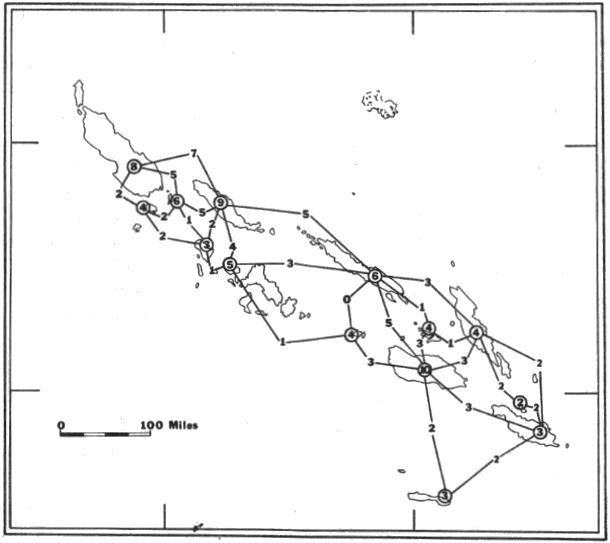
Fig. 16. The number
of megachiropteran species known from individual
islands (number within a circle) is compared with the number of species
common to two different islands (number without a circle). For names of
islands see Fig. 2.
Some of the small islands in the Solomons have populations of
large fruit bats. For example, Pteropus admiralitatum and P. hypomelanus
have been reported from the small islands in the Russell
Group (Table 5). Possibly these species do not live concurrently
in the Russells; specimens of the two were obtained in different
years. Two small megachiropterans, P. woodfordi and Melonycteris
woodfordi, also inhabit the Russells. Shortland, a small island about
15 miles south of Bougainville, supports one large bat, P. admiralitatum,
as well as smaller megachiropterans.
Kolombangara and Vella Lavella are about the same size and are
separated by about 15 miles of water. Rousettus amplexicaudatus,
Pteropus rayneri, P. woodfordi, Macroglossus lagochilus, and Nyctimene
albiventer have been collected on Kolombangara but only
P. admiralitatum, P. rayneri, and Dobsonia inermis have been found
on Vella Lavella. The difference in the known megachiropteran
faunas is more striking when one compares each island with adjacent
islands. Two species on Vella Lavella occur also on Choiseul,
which is about 35 miles northeastward, and two species occur also
on Shortland, which is 120 miles northwestward (Fig. 16). Four of
the five megachiropterans on Kolombangara also have been found
on Choiseul, about 50 miles northward (Table 5). Pteropus rayneri
is the only megachiropteran known from both Kolombangara and
Vella Lavella, even though the islands are separated by only a few
miles of water. Inadequate data possibly account for the differences
in the megachiropteran fauna, but I suspect that some other
factors are involved. Although Vella Lavella and Kolombangara
do have one species (P. rayneri) in common, a different subspecies
occurs on each island—rubianus on Kolombangara and lavellanus
on Vella Lavella (Fig. 17 and Table 6). This indicates that some
factor or factors are operating to keep megachiropterans from moving
frequently or easily from one island to the other.
Each of several subspecies of species in the genus Pteropus are
known from one or two small islands separated by only a few miles
from other islands on which different subspecies occur (see Fig. 6).
Judging from this kind of distribution, these bats do not move
frequently from island to island. Possibly this is because they cannot
easily cross water barriers, or are not inclined to do so because
food is abundantly available throughout the year on their home
island. Because "flying foxes" frequently are seen in flight over
water several hundred yards from shore, the first factor probably
is unimportant—at least where short distances are involved. It
seems most likely that when abundant food is available these bats
have no reason to move even moderate distances.
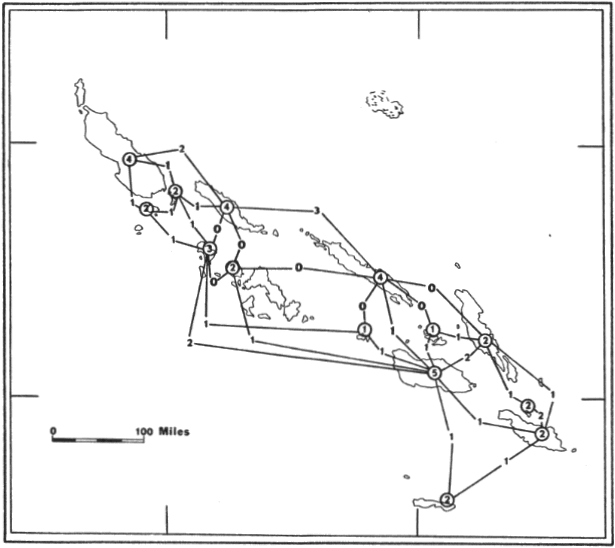
Fig. 17. The
number of subspecies of megachiropterans known from individual
islands (number within a circle) is compared with the number of subspecies
common to different islands (number without a circle). For names
of islands see Fig. 2.
Distributions of subspecies of polytypic species are summarized in
Table 6 and Figure 17. Generally, more subspecies are known
from the larger islands than from the smaller islands (Guadalcanal
with 5, Bougainville, Choiseul, and Santa Ysabel with 4, Fauro with
2.) The distributions of some subspecies can be used to judge the
differential effectiveness of water gaps between islands. The distribution
of Pteropus rayneri lavellanus and P. rayneri rubianus is
an example.
Choiseul and Santa Ysabel are separated by about 50 miles of
water (see Fig. 17) but have three subspecies in common (Pteropus
rayneri grandis, Dobsonia inermis minimus, and Nyctimene albiventer
minor.) Choiseul is about 50 miles from Kolombangara and
about 35 miles from Vella Lavella, but shares no subspecies with
these smaller islands although some species are shared (Tables 5
and 6). From these data one can conclude that exchange of genes
between populations on Choiseul and populations on Santa Ysabel
is frequent but for some reason exchange of genes between populations
on Vella Lavella and Choiseul and Kolombangara and Choiseul
is infrequent. A series of small islands (Rob Roy, Wagina, and
the Arnavon Islands, not named on the maps) connect Choiseul and
Santa Ysabel in stepping-stone fashion (see Fig. 17). Possibly these
small islands enhance movement of megachiropterans between
Choiseul and Santa Ysabel.
Table 6. A Summary of Distribution of Polytypic
Species of Megachiropteran Bats in the Solomon Islands. Only Islands Well
Known Faunistically Are Listed.
| Subspecies |
|
|
|
|
|
|
|
|
|
|
|
|
|
|
|
|
| P. atrata atrata |
X |
X |
|
|
|
|
|
|
|
|
|
|
|
|
|
|
| P. atrata anceps |
|
|
X |
|
|
|
|
|
|
|
|
X |
|
|
|
|
| Pt. a. solomonis |
|
|
|
|
|
|
|
|
X |
|
X |
X |
|
|
|
|
| Pt. a. colonus |
|
|
|
|
|
|
|
X |
|
|
|
|
|
|
|
|
| Pt. a. grandis |
|
|
|
X |
|
|
|
|
|
|
|
|
|
|
|
|
| Pt. r. rayneri |
|
|
|
|
X |
|
|
|
|
|
|
X |
|
|
|
|
| Pt. r. grandis |
X |
X |
X |
|
|
|
|
|
|
|
|
|
|
|
|
|
| Pt. r. rubianus |
|
|
|
|
|
|
|
|
|
X |
|
|
|
|
|
|
| Pt. r. lavellanus |
|
|
|
|
|
|
|
|
X |
|
|
|
|
|
|
|
| Pt. r. monoensis |
|
|
|
|
|
|
|
|
|
|
|
|
|
|
|
X |
| Pt. r. cognatus |
|
|
|
|
|
|
|
|
|
|
|
|
X |
X |
|
|
| Pt. r. rennelli |
|
|
|
|
|
|
|
|
|
|
|
|
|
|
X |
|
| D. i. inermis |
X |
|
|
|
X |
X |
X |
X |
X |
|
|
X |
X |
X |
X |
|
| D. i. minimus |
|
X |
X |
|
|
|
|
|
|
|
|
|
|
|
|
|
| N. a. bougainville |
X |
|
|
|
|
|
|
|
|
X |
|
X |
|
|
|
|
| N. a. minor |
|
X |
X |
|
|
|
X |
|
|
|
|
|
|
|
|
|
| Totals |
4 |
4 |
4 |
1 |
2 |
1 |
2 |
2 |
3 |
2 |
1 |
5 |
2 |
2 |
2 |
1 |
Florida, of the Nggela Group, is approximately halfway between
Santa Ysabel and Guadalcanal. Pteralopex atrata anceps occurs on
Santa Ysabel and on Guadalcanal but is unknown from Florida.
Fauro lies between Bougainville and Choiseul. Pteralopex atrata
atrata and Pteropus rayneri grandis occur on Choiseul and on Bougainville
but are unknown from Fauro. As suggested earlier, small
islands like Fauro and Florida possibly cannot support large fruit
bats, although they probably would utilize these small islands when
in transit between larger islands.
Fauro apparently is important to the distribution of the two subspecies
of Dobsonia inermis and Nyctimene albiventer in the Solomons
(see Figs. 9 and 13). In both species, one subspecies is found
in the eastern chain of islands and one subspecies is found in the
western chain. Specimens of Dobsonia inermis from Fauro and
Bougainville can be identified as the subspecies inermis whereas
those from Choiseul are assignable to the subspecies minimus.
Nyctimene albiventer bougainville occurs on Bougainville but specimens
of N. albiventer from Fauro and Choiseul can be identified
as the subspecies minor. Although interchange of genes occurs
between populations on Bougainville and Fauro in the case of
D. inermis, the population of N. albiventer on Fauro is at least
partially isolated from the population on Bougainville.
Rennell and Ontong Java are relatively isolated from other islands
in the Solomons (see Fig. 17). Only one kind of bat (Pteropus
howensis) is known from Ontong Java and apparently is endemic
to that atoll. Pteropus tonganus geddiei, one of the megachiropterans
that occurs on Rennell (Table 5), also is found in the New
Hebrides and on New Caledonia (Table 4). This makes P. t.
geddiei the only megachiropteran bat in the Solomons that is more
closely related to bats on islands to the southeast of the Solomons
than to bats on other islands of the Solomons, the Bismarcks, or
New Guinea, to the north and west. The other species of megachiropterans
(Dobsonia inermis and Pteropus rayneri) on Rennell
are found also on other islands in the Solomons. It is to be noted
that Mayr (1931) regarded the avifauna of Rennell as most nearly
like that of the New Hebrides and New Caledonia. He suggested
that the prevailing winds from the southeast have been important
for birds that have reached Rennell. The New Hebrides and New
Caledonia are four and a half times farther from Rennell than are
San Cristobal and Guadalcanal. On first consideration a person
might doubt that the winds would be favorable enough to compensate
for the great distance between Rennell and the New Hebrides
and New Caledonia. Darlington (1938) has used the formula
X n/m to obtain a comparison of barriers of different widths.
[X = the probability of an individual crossing a barrier of width m;
the probability of an individual crossing a similar barrier of width n
is the ratio n/m.] If this formula is applied here, one finds that
winds from the southeast (that is, from the New Hebrides and
New Caledonia) would have to be more than 100 times more
favorable than winds from the northeast (from Guadalcanal and
San Cristobal) in order to compensate for the distance of Rennell
from the New Hebrides and New Caledonia. Even so, tropical
storms with unusually strong winds, frequent during some parts
of the year, possibly account for the present distributional pattern
of bats and birds that live on Rennell.
Whatever the means by which bats of the species P. tonganus
reached Rennell, the fact remains that specimens from Rennell
cannot be distinguished from specimens of P. tonganus geddiei from
the New Hebrides and New Caledonia, more than 500 miles to the
southeast.
Note: An important and interesting paper on zoogeography of bats, which
was published too late to be included here, is: Krzanowski, A., 1967, The
magnitude of islands and the size of bats (Chiroptera), Acta Zool. Cracoviensia,
12:281-348.
LITERATURE CITED
Anonymous.
1944. Gazetteer of Solomon Islands, Bismarck Archipelago, and Islands
of the south-eastern end of New Guinea. Hydrographic office of
the United States Navy Department, No. 881.
Andersen, K.
1908. Twenty new forms of Pteropus. Ann. Mag. Nat. Hist., ser. 8, 2:361-370,
October.
1909a. On the characters and affinities of "Desmalopex" and Pteralopex.
Ann. Mag. Nat. Hist., ser. 8, 3:213-222, February.
1909b. Two new bats from the Solomon Islands. Ann. Mag. Nat. Hist.,
ser. 8, 3:266-270, March.
1909c. On the fruit-bats of the genus Dobsonia. Ann. Mag. Nat. Hist.,
ser. 8, 4:528-533, December.
1911. Six new fruit-bats of the genera Macroglossus and Syconycteris.
Ann. Mag. Nat. Hist., ser. 8, 7:641-643, June.
1912. Catalogue of the Chiroptera in the collection of the British Museum,
British Mus. (Nat. Hist.), London, 1:ci + 1-854, 79 figs.
Bader, R. S., and Hall, J. S.
1960. Osteometric variation and function in bats. Evol., 14:8-17, 3 figs.,
March 21.
Baker, R. H.
1951. The avifauna of Micronesia, its origin, evolution, and distribution.
Univ. Kansas Publ., Mus. Nat. Hist., 3:1-359, 16 figs., June 12.
Beaufort, L. E. De.
1951. Zoogeography of the land and inland waters. Sidgwick and Jackson,
London, viii + 208 pp., maps.
Belkin, J. N.
1962. The mosquitoes of the South Pacific (Diptera, Culicidae). Univ.
California Press, Berkeley, 1:xii + 1-608, July 18.
Benedict, F.
1957. Hair structure as a generic character in bats. Univ. California
Publ. Zool., 59:285-548, 9 pls., 4 figs., October 10.
Brigham, W. T.
1900. An index to the islands of the Pacific Ocean. Mem. Bernice P.
Bishop Mus., Honolulu, 2:1-170, maps.
Cranstone, B. A. L.
1961. Melanesia: a short ethnography. British Mus., London, 115 pp.,
26 pls., 43 figs., map.
Darlington, P. J.
1938. The origin of the fauna of the Greater Antilles, with discussion of
dispersal of animals over water and through the air. Quart. Rev.
Biol., 13:274-300, 5 figs.
Deignan, H. G.
1963. Birds in the tropical Pacific, pp. 263-269, in Pacific Basin biogeography
(J. L. Gressitt, ed.). Bernice P. Bishop Mus. Press,
Honolulu, xi + 563 pp.
Dobson, G. E.
1878. Catalogue of the Chiroptera in the ... British Museum.
British Mus., London, xlii + 567 pp., 30 pls.
Dobzhansky, T. G.
1941. Genetics and the origin of species. Columbia Univ. Press, New
York, 2nd. ed., rev., ix + 466 pp., 24 figs.
Durham, J. W.
1963. Paleogeographic conclusions in light of biological data, pp. 355-365,
4 figs., in Pacific Basin biogeography (J. L. Gressitt, ed.). Bernice
P. Bishop Mus. Press, Honolulu, xi + 563 pp.
Ellerman, J. R., and Morrison-Scott, T. C. S.
1966. Checklist of Palaearctic and Indian mammals, 1758-1946. British
Mus. (Nat. Hist.), London, 2nd. ed., 810 pp., July.
Felten, H.
1964a. Flughunde der Gattung Pteropus von den Neuen Hebriden (Mammalia,
Chiroptera). Senck. biol., 45:87-92, 6 figs., May 15.
1964b. Flughunde der Gattung Pteropus von Neukaledonien und den
Loyalty-Inseln (Mammalia, Chiroptera). Senck. biol., 45:671-683,
December 21.
Hall, E. R.
1946. Mammals of Nevada. Univ. California Press, Berkeley, xi + 710
pp., frontispiece, 11 pls., 485 figs., July 1.
Hill, J. E.
1956. The mammals of Rennell Island. The natural history of Rennell
Island, British Solomon Islands, Copenhagen, 1:73-84, November
28.
1962. A little-known fruit-bat from Rennell Island. The natural history
of Rennell Island, British Solomon Islands, Copenhagen, 4:7-9,
February 15.
1963. A revision of the genus Hipposideros. Bull. British Mus. (Nat.
Hist.), 2:1-129, October.
Koopman, K. F.
1957. Evolution in the genus Myzomela (Aves: Meliphagidae). The
Auk, 74:49-72, 5 figs., January.
1958. Land bridges and ecology in bat distribution on islands off the
northern coast of South America. Evol., 12:429-439, 2 figs.,
December.
Lack, D. L.
1947. Darwin's finches. Cambridge Univ. Press, Cambridge, x + 209 pp.,
8 pls., 27 figs.
Laurie, E. M. O., and Hill, J. E.
1954. List of land mammals of New Guinea, Celebes, and adjacent
islands. British Mus. (Nat. Hist.), London, 175 pp., June 30.
Lawrence, B.
1945. Three new Pteropus from New Caledonia and the Solomons. Proc.
New England Zool. Club, 23:59-69, March 26.
Lever, R. J. A. W.
1934. Notes on mosquitoes of the British Solomon Islands. British Solomon
Islands Agr. Gaz., 2:16.
Lewis, A. B.
1951. The Melanesians: People of the South Pacific. Chicago Nat. Hist.
Mus. Press, Chicago, 259 pp., 56 figs., maps, September.
Matschie, P.
1899. Die Megachiroptera des Berliner Museums für Naturkunde. Druck
und verlag von George Reimer, Berlin, viii + 102 pp., 14 figs.
Mayr, E.
1931. A systematic list of the birds of Rennell Island with descriptions of
new species and subspecies. Amer. Mus. Novit., 486:1-29, August 29.
1940. The origin and the history of the bird fauna of Polynesia. Proc.
6th Pacific Sci. Cong., 1939, 4:197-216.
1942. Systematics and the origin of species from the viewpoint of a
zoologist. Columbia Univ. Press, New York, xiv + 334 pp., 29 figs.
Miller, A. H.
1966. Animal evolution on islands, pp. 10-16, in The Galapagos (R. I.
Bowman, ed.), Univ. California Press, Berkeley.
Miller, G. S.
1907. The families and genera of bats. Bull. U. S. Nat. Mus., 57:xvii +
282, 14 pls., 49 figs., June 29.
Phillips, C. J.
1966. A new species of bat of the genus Melonycteris from the Solomon
Islands. Jour. Mamm., 47:23-27, 1 fig., March 12.
1967. A new subspecies of horseshoe bat (Hipposideros diadema) from
the Solomon Islands. Proc. Biol. Soc. Washington, 80:35-40, 2 figs.,
March 24.
Pohle, H.
1953. Über die Fledertiere von Bougainville. Z. Säugetierk., 17:127-137,
October 27.
Ridgway, R.
1912. Color standards and color nomenclature. Washington, D. C.,
iv + 44 pp., 53 pls.
Sanborn, C. C.
1931. Bats from Polynesia, Melanesia, and Malaysia. Publ. Field Mus.
Nat. Hist., Zool. Ser., 18:7-29, February 12.
Sanborn, C. C., and Beecher, W. J.
1947. Bats from the Solomon Islands. Jour. Mamm., 28:387-391, November
19.
Sanborn, C. C., and Nicholson, A. J.
1950. Bats from New Caledonia, the Solomon Islands, and New Hebrides.
Fieldiana (Zool.), 31:313-338, 6 figs., August 31.
Simpson, G. G.
1945. The principles of classification and a classification of mammals.
Bull. Amer. Mus. Nat. Hist., 85:xvi + 350, October 5.
Tate, G. H. H.
1934. An apparently new fruit bat of the Pteropus hypomelanus group
from Gower Island, Solomon Islands. Amer. Mus. Novit., 718:1-2,
May 4.
1942. Pteropodidae (Chiroptera) of the Archbold Collections. Bull.
Amer. Mus. Nat. Hist., 80:331-347, December 31.
Thomas, O.
1887a. Diagnoses of two new fruit-eating bats from the Solomon Islands.
Ann. Mag. Nat. Hist., ser. 5, 60:147, February.
1887b. On the bats collected by Mr. C. M. Woodford in the Solomon
Islands. Proc. Zool. Soc. London, 23:320-328, 3 figs., 2 pls.,
March 15.
1888a. Diagnoses of six new mammals from the Solomon Islands. Ann.
Mag. Nat. Hist., ser. 6, 2:155-158, February.
1888b. The mammals of the Solomon Islands, based on the collections
made by Mr. C. M. Woodford during his second expedition to the
Archipelago. Proc. Zool. Soc. London, 33:470-484, 3 pls., December 4.
Trouessart, E. L.
1904. Catalogus Mammalium tam viventium quam fossilium. Quinquennale
Supplementum, Berlin, vii + 929 pp.
Troughton, E. LeG.
1931. Three new bats of the genera Pteropus Nyctimene, and Chaerephon
from Melanesia. Proc. Linn. Soc. New South Wales, 56:204-209,
June 15.
1936. The mammalian fauna of Bougainville Island, Solomons Group.
Rec. Australian Mus., 14:341-353, April 7.
Wright, S.
1931. Evolution in Mendelian populations. Genetics, 16:97-159, 21 figs.
Transmitted August 10, 1967.
Transcriber's Notes
Obvious typographical and punctuation errors repaired. The "Key to
Pteropus in the Solomon Islands" was moved above the beginning of the
listing for Pteropus Brisson. Where figures or tables split
paragraphs, they were moved above or below the split.
Typographical Corrections
| Page | | Correction |
| 797 | | Liuinuwu → Liuniuwu |
| 809 | | intermis → inermis |
| 824 | | adbiventer → albiventer |
| 832 | | Gaudalcanal → Guadalcanal |

 December 16, 1968

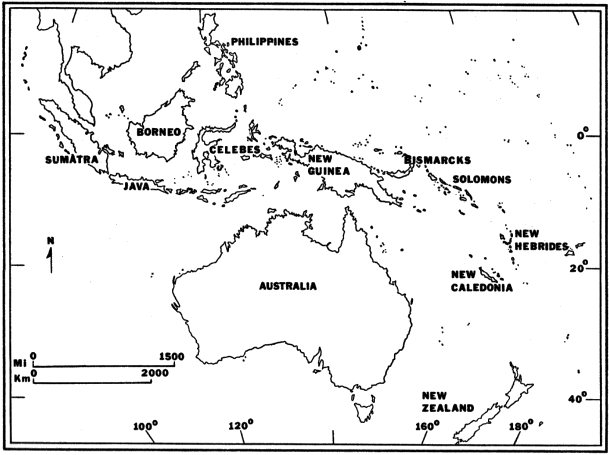
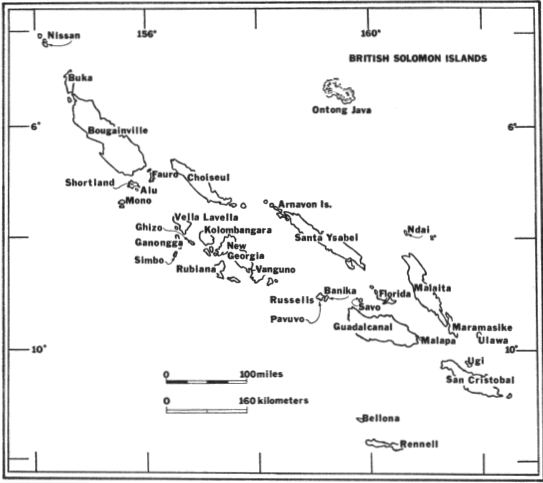
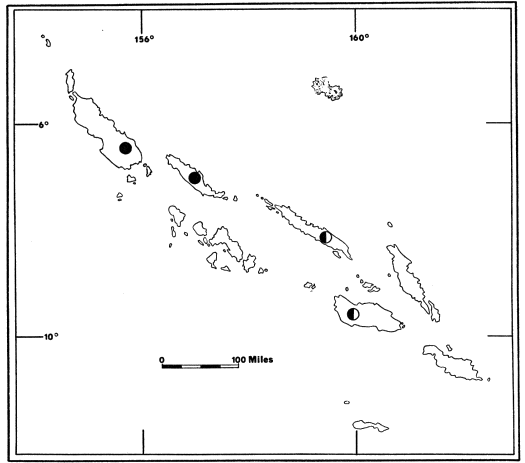
 ) and
P. atrata anceps (
) and
P. atrata anceps ( ).
For names of islands see
).
For names of islands see 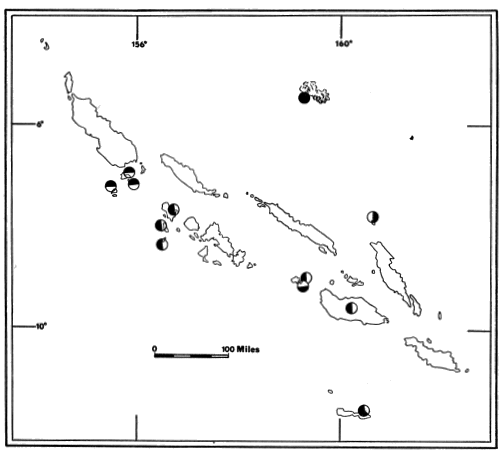
 ),
Pteropus admiralitatum solomonis (
),
Pteropus admiralitatum solomonis ( ),
Pteropus a. goweri (
),
Pteropus a. goweri ( ),
Pteropus tonganus geddiei (
),
Pteropus tonganus geddiei ( ),
and Pteropus howensis (
),
and Pteropus howensis (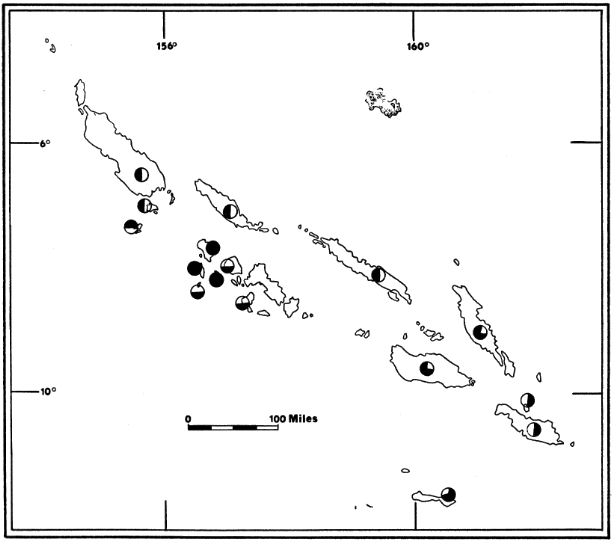
 );
P. r. grandis (
);
P. r. grandis (