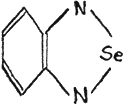
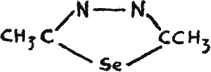
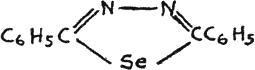
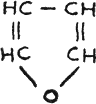
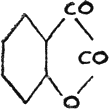
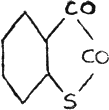
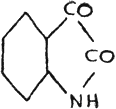
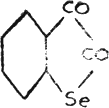
Busch prepared quinazolines by the action of o-amino or
o-nitro benzylamine with phosgene, and thioquinazolines with
carbon disulphide(51):
Accordingly the same reaction was tried with o-nitrobenzylamine,
prepared by the method of Lellmann and Stickel(50),
using carbon diselenide(51). The reaction seemed to work, but
the mixture formed was difficult to extract and it appeared that
other reactions took place at the same time, due to the impurity
of the carbon diselenide, as the latter has never been prepared
in the pure state.
Another method, which is equally attractive because of its
simplicity, is that of Gabriel and Stelzner(52),
In accordance with the above reaction o-aminobenzaldehyde
should work with equal ease with selenocarbamide, but the initial
materials were not available.
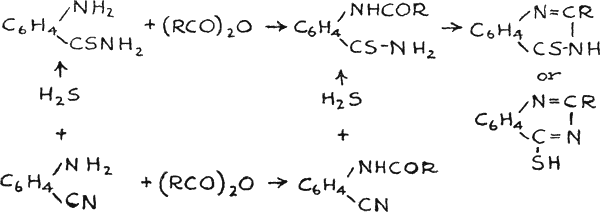
The reaction which was used successfully was that of
Bogert, Breneman and Hand(53),
The hydrogen selenide used in the reaction was prepared from
FeSe by the action of hydrochloric acid, or by heating paraffin and
selenium, in the proportion of four to one respectively, at 335°
to 350°C(54).
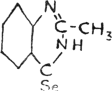
The selenoquinazoline was prepared from anthranilic nitrile
by the following methods—the anthranilic nitrile being prepared
from o-nitraniline(57),
(a) 20 grams of acetyl-anthranilic nitrile was dissolved in
absolute alcohol, and dry hydrogen selenide and dry ammonia
passed into the solution for three hours. The quinazoline crystallized
out gradually on cooling was filtered out and recrystallized
from dilute alcohol. The yield was about ten per cent.
(b) 10 grams of acetyl-anthranilic nitrile was heated in
a sealed tube at 110° with alcohol saturated at zero degrees with
dry hydrogen selenide and dry ammonia. After five hours, the
tube was taken out and the quinazoline crystallized out on cooling.
Yield was about sixteen per cent.
As hydrogen selenide was somewhat unstable and did not dissolve
freely in alcohol, freshly prepared sodium selenide was
used in the following method and was found to be more satisfactory.
It was prepared from sodium hydroxide in absolute
alcohol by passing dry hydrogen selenide into the solution for
about three hours. In the beginning and end of the reaction,
nitrogen was used to exclude the oxygen of the air. The selenide
was collected and dried in an atmosphere of nitrogen, and then
in a vacuum, in presence of phosphorus pentoxide. When thus
prepared, sodium selenide was colorless, but on exposure to
air it turns reddish and finally dark colored. The C. P. selenide
on the market was black and was found to be entirely useless.
(c) 20 grams of anthranilic nitrile and fifty grams of sodium
selenide were mixed and heated in a distilling flask in an atmosphere
of nitrogen, and forty grams of acetic anhydride dropped
into the flask very slowly. The temperature was kept at
115° for half an hour and then raised to distill off the acetic acid
formed in the reaction, as the condensation hardly went to completion
in the presence of any trace of acetic acid. The whole process
took an hour and a half. The flask was removed from the oil
bath and, after cooling, dilute alkali was run in, in successive portions,
to dissolve out the quinazoline. Into the clear alkaline
extracts carbon dioxide was bubbled for an hour, and common
salt then added. The precipitate was recrystallized several times
from twenty-five per cent. alcohol. The yield was from twenty
to twenty-five per cent.
(d) 10 grams of anthranilic nitrile, twenty grams of acetic
anhydride, and twenty-five grams of sodium selenide were mixed
in a sealed tube and heated together for three hours and a half at
110°-115°. The condensation product was crystalline when the
tube was cooled to room temperature. The contents of the
tube were extracted with dilute alkali as before, filtered, precipitated
by carbon dioxide, and recrystallized from dilute alcohol.
The yield was not over twenty per cent.
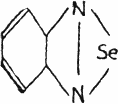
(e) An attempt was made to make o-aminobenzoselenamide,
and from the latter, by treatment with acetic anhydride, to form
the quinazoline, but the yield of the amide was too small to
carry the reaction further.
The substance prepared by the above methods crystallizes
from dilute alcohol in needles or prisms of dark brown color.
It melts at 213.5° (corr.). It dissolves readily in hot alcohol but
on concentration sometimes forms a sticky mass with a peculiar
but not unpleasant odor. It dissolves readily in alkalis and is
slightly soluble in hot benzene and chloroform, but insoluble
in hot water. Crystals purified from (a) were analyzed and
gave the following results:
| |
Calculated for
C9H8N2Se |
Found |
|---|
| I | II |
|---|
| Carbon |
48.38% |
48.45% |
48.62% |
| Hydrogen |
3.61 |
3.82 |
3.52 |
| Nitrogen |
12.55 |
12.51 |
12.66 |
| Selenium |
35.46 |
35.60 |
35.42 |
The crystals on standing in the presence of air and light decomposed
with separation of finely divided selenium and methyl
quinazolone.
In the quantitative determination of selenium in quinazoline
the method adapted by Becker and Meyer was found to be quite
satisfactory(56). Other methods are listed in the bibliography(57).
In the ultimate analysis of carbon and hydrogen, the ordinary
absolute method was followed with the use of copper
oxide, lead chromate, and lead peroxide in the tube. In the
determination of nitrogen the ordinary absolute method was
also followed excepting that a considerable quantity of specially
prepared lead chromate powder was mixed with the sample in
a number six porcelain boat. This was found to be desirable
when the dinitroselenazole was burned. Selenium dioxide, which
is a solid, seems to be formed in the tube and carried away by the
current of carbon dioxide with some difficulty. In such a case the
analysis usually took four hours after the combustion had actually
started. In the carbon and hydrogen determination selenium dioxide
was easily absorbed in the presence of oxygen gas.
The first method employed was a modification of the method
described by Fromm and Martin(58). Method (b) is an adaptation
of the method for preparing benzothiazoles.
(a) Twenty grams of benzanilide was mixed in a pyrex
flask with 160 grams of selenium dust and the flask placed in a
nitrate bath under an air condenser. After heating for an hour
at 220°C., the temperature was raised to 250°C., and kept at
250°-280°C. for sixteen hours. The dark mass was extracted
with hot concentrated HCl, the acid extracts filtered through glass
wool using a hot water funnel. The combined extracts were poured
into a large volume of water when the selenozole precipitated out
immediately; it was recrystallized from alcohol. In some cases it
was necessary to dissolve in hot HCl again and to recrystallize. The
yield was twelve per cent.
The above method has the disadvantage that water is
formed in the reaction and this in turn reacts upon benzanilid
at the higher temperature necessary (as selenium only melts at
217°C.), decomposing the benzanilid into aniline and benzoic acid.
Furthermore benzanilid boils at 160°C. and at such high temperatures
as 250°C. and over some of it is apt to be driven off.
(b) 106 grams of benzaldehyde were heated with 93 grams of
redistilled aniline at 120°C., for two hours or until the solution
was clear. The clear benzalaniline was then poured into 160
grams of selenium dust in a pyrex flask on a sand bath, the flask
being connected with an air condenser as before. In order to
distribute the flame to better advantage over the bath, an air
space was made between the Meker burner and the bath by
introducing a wire gauze. Hydrogen selenide was evolved freely.
Complete reaction took three days. The extraction and recrystallization
were the same as in the former case. The yield was sixty
per cent.
The selenazole crystallizes in colorless long needles, melting
at 117.5°C. (corr.) Fromm and Martin(58) gave the melting
point as 117°C. It is insoluble in water, and in the following
solvents it is lightly soluble in the cold, more easily hot: ether,
methyl alcohol, acetone, acetic acid, acetic anhydride, chloroform,
and nitrobenzene. It is difficultly soluble in ethyl alcohol, ethyl acetate,
and carbon tetrachloride, in the cold, but easily soluble
hot.
The mononitro derivative of the selenazole, 6-nitro-2-phenylbenzoselenazole,
was prepared by nitration with nitric
acid at a low temperature:
Twenty-five grams of the selenazole were dissolved in 150
grams of concentrated sulphuric acid, keeping the temperature
below the room temperature until complete solution took place.
It was then cooled on a freezing mixture and a mixture of sulphuric
and nitric acids (previously prepared and cooled by mixing
9.5 grams of nitric and fifteen grams of sulphuric acids)
slowly dropped into it in the course of half an hour, using mechanical
stirring for four hours. The solution was then poured into
two liters of water (ice water), filtered, dried, and recrystallized
from acetic acid, and alcohol with the help of animal charcoal.
The yield was 95 per cent.
This nitro compound crystallizes in flattened needles of a light
yellow color. It melts at 202.4°C. (corr.). It is very insoluble
in water; but soluble in hot acetic acid, acetic anhydride, nitrobenzene,
nitrotoluene, toluene, benzene, alcohol, and difficultly
soluble when cold. The crystals were analyzed and gave the
following results,
| |
Calculated for
C13H8N2O2Se |
Found |
|---|
| I | II |
|---|
| Nitrogen |
9.24% |
9.36% |
9.48% |
The conversion of mononitro compound to 6-amino-2-phenylbenzoselenazole
was accomplished by the action of tin and
hydrochloric acid as follows:
30.3 grams of nitro compound were mixed with 42 grams
of twenty mesh tin in a liter flask, immersing the latter in cold
water. 175 cc. of conc. HCl were slowly added to the flask.
In some cases it was necessary to apply initial heating but when
once the reaction started it took place rapidly. After the effervescence
had abated, the flask was heated over a free flame, under a
return condenser, for two hours. The solution usually turned
to a pasty mass, due to the formation of a tin double salt. The
mixture was dissolved in a large volume of water and heated
on a water-bath, the precipitate filtered out, washed, and preserved.
The clear filtrate was treated with concentrated alkali,
in excess, the separated amine collected, washed with water,
dried and recrystallized from alcohol, using bone-black. The
precipitate set aside was treated with strong alkali, the insoluble
residue washed, recrystallized, and added to the main
product. The yield was 75 per cent.
This amine crystallizes from alcohol in fine yellowish needles,
melting at 201.2°-202.3°C (corr.). It is insoluble in water and
ether, difficultly soluble in the hot; and fairly soluble in aniline.
A pure sample was analyzed and gave the following results:
| |
Calculated for
C13H10N2Se |
Found |
|---|
| I | II |
|---|
| Nitrogen |
10.25% |
10.34% |
10.42% |
| Carbon |
57.18 |
57.17 |
57.00 |
| Hydrogen |
3.69 |
3.79 |
3.85 |
Five grams of the monoamino compound were mixed with
powdered KOH, heated together until the mixture just melted, and
maintained in that state for a few minutes. When the latter had
cooled down to room temperature, cold water was poured over the
mixture. The filtered solution was acidified until no further
precipitate was formed. The precipitate was collected and recrystallized
from water, m.p. 121°C.
One gram of this solid was placed in a test tube, provided
with a cork and a delivery tube, and heated with soda lime; a
liquid with the smell of benzene was collected in another test
tube cooled with water. When this liquid was treated with a
few drops of nitric acid mixture the smell of nitrobenzene was
given off. A gram of the crystals was heated with concentrated
sulphuric acid and alcohol when the odor of ethyl benzoate was
noted.
Five grams of the monoamino selenazole were heated on a
water-bath with 10 cc. of acetic anhydride until the solution was
clear, which took about two hours. 100 cc. of water were poured
into the mixture, which was then neutralized with dilute ammonium
hydroxide. The precipitate was filtered, decolorized
by animal charcoal, and recrystallized from dilute alcohol.
The acetyl compound, 6-acetamino-2-phenylbenzoselenazole,
forms colorless crystals, melting at 188.1°-.7°C. (corr.). It is
insoluble in ether, benzene, carbon disulphide; slightly soluble in
toluene; soluble in alcohol, ethyl acetate, amyl acetate, acetone,
and acetic acid. A pure sample was analyzed and gave the
following result,
| |
Calculated for
C15H12N2SeO |
Found |
|---|
| Nitrogen |
8.88% |
8.92% |
8.68% |
Five grams of the monoamino compound were dissolved in
200 cc. absolute alcohol with the addition of 3 cc. of benzaldehyde
and the clear solution was boiled on a water-bath, with a return
condenser, for two hours. After the solution was boneblacked,
the yellow precipitate was recrystallized from carbon disulphide.
The yield was 90 per cent.
It crystallizes in yellow plates, melting at 156.7°-157.6°C.,
soluble in benzene, ether, ethyl alcohol, carbontetrachloride, acetone,
but difficultly soluble in ligroin. An analysis of the crystals
showed the following result,
| |
Calculated for
C20H14N2Se |
Found |
|---|
| Nitrogen |
7.75% |
7.92% |
7.68% |
Five and four tenth grams of the monoamino compound were
dissolved in hot conc. HCl, cooled in ice, and diazotized with
sodium nitrite solution, until starch iodide paper showed excess
nitrous acid. The diazotization was performed in ice, with
mechanical stirring, and required about an hour. The diazo solution
was poured into a solution of 3 grams B-naphthol in 8 grams
of NaOH and 60 cc. of water, while gradually stirring. A very
deep red solution formed. This was acidified with excess HCl,
salted out by NaCl, and crystallized from aniline-alcohol mixture.
In the pure state, it is a deep red powder, with a metallic lustre
when rubbed, melting at 284.2°C. An analysis showed the following
result,
| |
Calculated for
C23H15N3OSe |
Found |
|---|
| Nitrogen |
9.81% |
9.75% |
The nitration for the production of dinitro derivative was
at first carried out under the same conditions as in the preparation
of mononitro compound and after the latter was formed more nitric
acid mixture was added with the addition of heat:
conc. sulphuric acid, keeping it below room temperature. It was
then cooled in a freezing mixture and half the volume of a nitric
acid mixture (prepared and cooled by mixing 19 grams of nitric and
30 grams of sulphuric acids) was introduced very slowly to the
selenazole solution through a dropping funnel, maintaining at this
temperature for two hours (using mechanical stirring). The remaining
half of the nitric acid mixture was then slowly introduced
and the flask was heated on a water-bath for two hours. The solution
was poured into two liters of water, the precipitate filtered off,
dried and recrystallized several times from acetic acid. The yield
was 80 per cent.
This dinitro compound crystallizes in fine yellow needles,
m. p., 246.8°C. (corr.), very insoluble in water, but soluble in
hot acetic acid, acetic anhydride, nitrobenzene, nitrotoluene,
ethyl alcohol, and difficultly soluble cold. It was analyzed and
the following results were found,
| |
Calculated for
C13H7N3O4Se |
Found |
|---|
| I | II |
|---|
| Nitrogen |
12.07% |
12.30% |
12.12% |
The conversion of the dinitro to diamino derivative was accomplished
in the same manner as the reduction of the mononitro
derivative excepting that twice as much tin and HCl were used.
This diamino compound crystallizes in yellowish glistening
needles from alcohol and pyridine; m. p., 269°-270.5°C.; was
analyzed and gave the following results,
| |
Calculated for
C13H11N3Se |
Found |
|---|
| I | II |
|---|
| Nitrogen |
14.6% |
14.4 |
14.7 |
The diacetyl and dibenzylidene compounds were also prepared
from these diamino derivatives. The former crystallizes in
cubes from dilute alcohol; m. p., 307°C (Corr.) and the latter in
beautiful yellow plates from carbon disulphide, m. p., 195°-196°C.
(Corr.). An analysis of these two compounds showed the following
results,
| |
Calculated for
C17H15N3O2Se |
Calculated for
C27H19N3Se |
Found |
|---|
| I | II |
|---|
| Nitrogen |
9.05% |
11.21% |
9.21% |
11.43% |
Both the monoamino and the diamino derivatives form intensely
colored dyes when diazotized and coupled with phenols
and aromatic amines. The dyes formed are fast to light. In
the following table silk is given to represent the fabrics used.
Wool and cotton were dyed similar shades, though with slight
variation. Each silk sample was dyed in acid or alkaline baths as
indicated and each bath contained 0.01 gram in twenty cc. solution:
| Coupler |
Diazo.
monoamine |
On
silk |
Diazo.
diamine |
On
silk |
|---|
| Phenol |
deep red
(alk) |
v. light
yellow |
(alk)
deep red |
yellow |
| Dimethylaniline |
orange
(acid) |
light
yellow |
orange-red
(acid) |
yellow |
| P-nitraniline |
light brown
(acid) |
|
brownish
(acid) |
grayish
brown |
| P-toluidine |
light brown
(acid) |
|
brownish
(acid) |
brownish |
Pyrogallic
acid |
dark brown
(acid) |
grayish |
dark brown
(alk) |
grayish |
Salicylic
acid |
reddish
(alk) |
light brown |
red
(alk) |
brown |
| B-naphthol |
deep red
(alk) |
pink |
deep red
(alk) |
red |
Sulphanilic
acid |
light brown
(alk) |
brownish |
brown
(alk) |
brown |
| A-naphthylamine |
light brown
(acid) |
brownish |
yellow
(acid) |
yellow |
| Resorcinol |
purple
(alk) |
red |
dark purple
(alk) |
deep red |
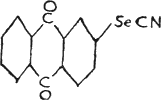
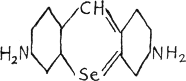

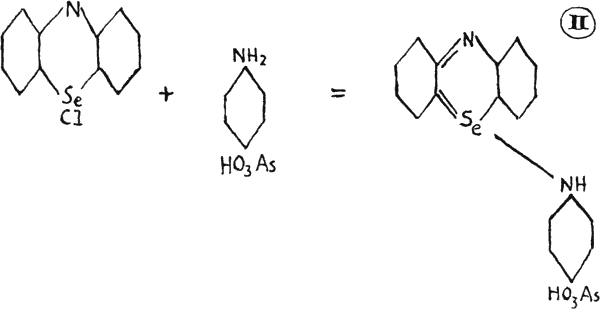
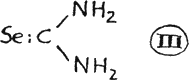
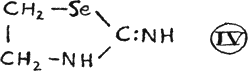
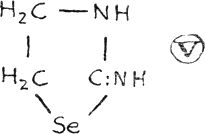
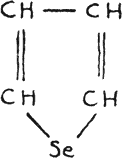
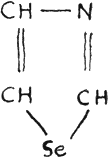
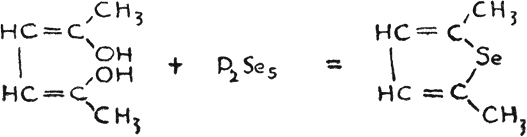
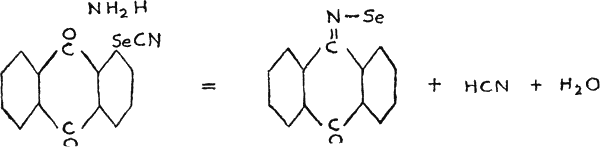
 or
or