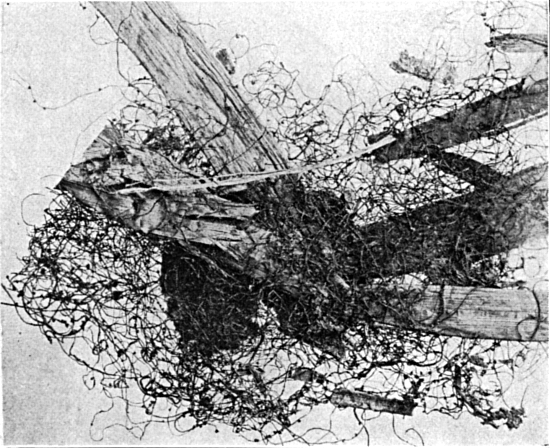
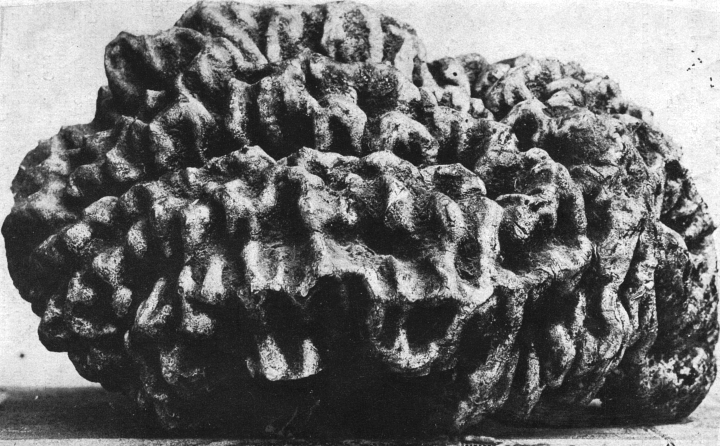
The receipt of a nice specimen of Camillea Cyclops from Rev. Torrend,
Brazil, has induced us to work over the similar species in our
collection. On our last visit to Europe we photographed the various
specimens we found in the museums, but did not study them as to
structure. However, they make such characteristic photographs that we
believe the known species can be determined from our figures.
We are all familiar with the common Hypoxylons that form little globose,
black balls, usually on dead limbs, in our own woods. They have a solid
carbonous interior with the perithecia imbedded near the surface. There
have been over two hundred alleged Hypoxylons, mostly from the tropics.
We have never worked them over, but suspect that a number of them from
the tropics, when examined, will be found to be Camilleas. If the
specimens were examined, no doubt "prior" specific names would be found
for several of this list.1
In the old days all similar carbonous fungi were called Sphaeria.
Montagne first received a section of Sphaeria with cylindrical form,
from South America. The perithecia were long, cylindrical, and were
arranged in a circle or were contiguous, near the summit of the stroma.
He proposed to call it Bacillaria, as a section of Sphaeria, but the
name being preoccupied, he, at the suggestion of Fries, afterwards named
it in honor of himself, Camillea, Montagne's first name being Camille.
The original species were separated into a genus by Montagne in 1855,
and five species listed, and it is a curious fact that these five
species, as well as all others that have since been added, are of the
American tropics. I have not worked over the "Hypoxylons" in the
museums, but as far as the records go the genus Camillea does not occur
in other tropical countries.
In 1845 Léveillé announced that he had discovered a plant resembling an
Hypoxylon which had, however, the spores borne on filaments
(acrogenous), and not in perithecia. He called it Phylacia globosa, and
classified it in Sphaerioidaea. The specimen (Fig. 847) is still at
Paris. Saccardo has omitted it, and states that Phylacia is probably a
pycnidial condition of Hypoxylon turbinatum. Both were guesses, one
statement surely, and both probably, wrong. The interior is filled with
a powder that under the microscope appears to be made up of ligneous
filaments mixed with a few spores. These filaments appear to me to be
the disintegrated walls of the perithecia, and not the "filaments that
bear the spores." From analogy, at any rate, the spores of all these
similar species are probably borne in asci which disappear early, and
Phylacia seems to be the same genus as Camillea, the walls of the
perlthecla disintegrating and forming a powdery mass. If this view is
correct, Camillea can be divided into two sections.
EUCAMILLEA.—Perithecia persistent.
PHYLACIA.—Perithecia early disintegrated.
CAMILLEA LEPRIEURII (Fig. 826).—Carbonous, black, cylindrical, 2-3 cm.
long, 3-4 mm. thick. Apex truncate, excavate. Perithecia linear, near
apex of stroma. Asci (teste Montagne) linear, 8 spored. Spores (pale)
spindle shape, dark, 6-7 × 25-35 mic.
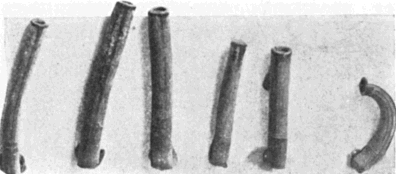 Fig. 826.
A most peculiar and apparently a rare species. All the specimens I have
noted came to Montagne from Leprieur, French Guiana. Berkeley records it
from Brazil, Spruce, but I think it has not been collected in recent
years. Our figure 826 is from specimens in Montagne's herbarium, and
these are three times as long as the specimen Montagne pictures. I saw
no such short specimens. Patouillard has given a detailed account of the
structure of the plant. The perithecia are arranged in a circle neat the
apex of the stroma. The spores are spindle shaped (rather than caudate,
as Montagne shows them) and 25 to 35 mic long. Patouillard claims that
Hypoxylon melanaspis has same spores and structure, and is the pulvinate
form of Camillea Leprieurii. It does not seem possible to me, but I can
not say to the contrary.
CAMILLEA BACILLUM (Fig. 827).—Stroma cylindrical, black, 1 cm. long, 1
mm. thick. Apex truncate, shown punctulate in Montagne's drawing. Spores
dark, reniform.
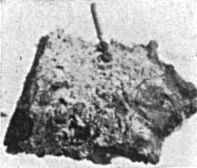 Fig. 827.
This is very similar to the preceding in shape, but is a much smaller
species with different spores (teste Montagne). We have only seen the
originals in Montagne's herbarium, from which our figure is made. The
drawing given by Montagne represents the plant better than our
photograph. Montagne records the species from Cuba and French Guiana. We
think it a very rare plant.
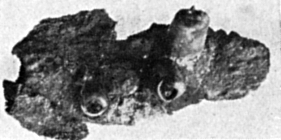
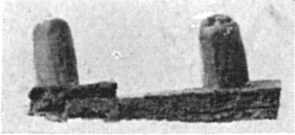
CAMILLEA MUCRONATA (Fig. 828).—Stroma cylindrical, black, 6 mm. long, 3
mm. thick. Apex with a prominent, mucronate point. Perithecia linear,
contiguous, near the apex of the plant. Asci cylindrical. Spores oblong
(M.) 3½ to 4 × 10 mic., colored.
|
|
|
Fig. 828.
|
This also is a rare species, only known from the original collection by
Leprieur, French Guiana. Our photograph is from the type. In the
original drawing there is a circle of little acute protuberances shown
near the apex of the plant. We can see but faint indication of them in
our photograph.
CAMILLEA LABELLUM (Fig. 829).—Plant short, cylindrical, about a cm.
tall and thick, with a depressed disc. Perithecia contiguous, forming at
layer beneath the disc. Spores (M.) fusiform, dark, 30 mic., long.
I believe the plant is only known from the original collection in
Montagne's herbarium, from Leprieur, French Guiana. It does not follow,
however, that it is such a rare plant, but only that the plants of the
region have been scantily collected. Our figure is a photograph of the
types.
CAMILLEA TURBINATA (Figs. 830-833).—Plants obconic or turbinate, about
a cm. tall and broad, growing in a dense cluster from a common, mycelial
carbonous base. The summit is truncate, and marked with a raised central
disc, which is thin and in old plants breaks irregularly. A section of a
young plant (Figs. 831 ×6) shows the lower part composed of rather soft,
carbonous tissue, the upper filled with a light brown powder, composed
of spores mixed with hyphae tissue. In old plants the tops break in, the
powder is dissipated, and there remains (Fig. 833) a bundle of carbonous
tubes, the walls of the perithecia. Finally, these break up and
disappear, leaving the upper part of the plant hollow. The spores are
elliptical, 6-7 × 16-18 mic., smooth, light colored. The asci which
disappear at at very early stage, are shown by Moeller as oval, each
containing 8 spores.
This is at common plant in our American tropics, and was named by
Berkeley, as Hypoxylon turbinatum, but in a later paper he referred it
to Camillea turbinata. It is compiled in Saccardo as Hypoxylon. I doubt
not but that it was named Sphaeria caelata by Fries many years "prior."
Spegazzini found it abundantly, and noting that it was not a good
Hypoxylon, puzzled over it in two or three papers and finally also
concluded that it was at Camillea. Moeller also "discovered" it, and
although the common plant was well known in other centers, the rumors
had not reached Berlin, hence he "discovered" it was a new genus, which
he dedicated to his friend, Dr. Hennings and called it Henningsinia
durissima. Fortunately, he gave a good figure by which his "discovery"
could be interpreted.
We have beautiful specimens from Dr. J. Dutra, Brazil, from which our
figure was made, also we have specimens from Rev. Rick.
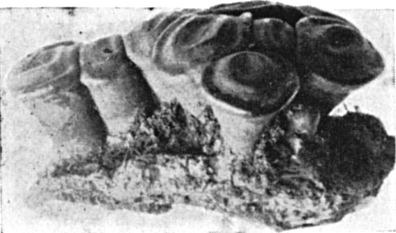
Fig. 830. Camillea turbinata. (Side view, natural size.)
|
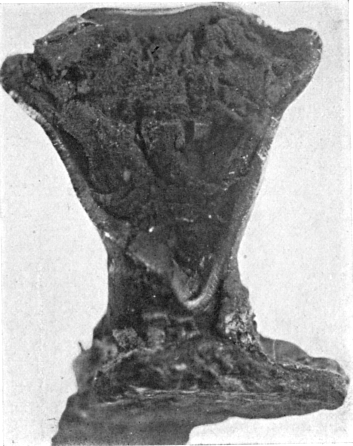
Fig. 831. Section with spore mass (X 6).
|
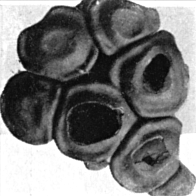
Fig. 832. Same, top view.
|
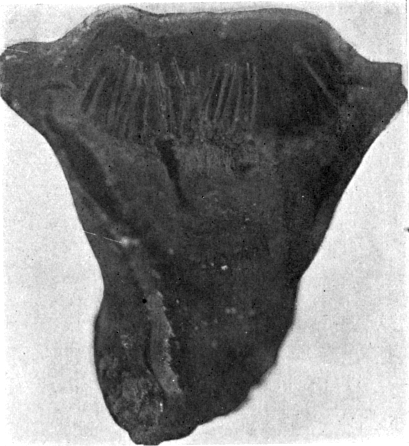 Fig. 833. Section after dispersion of spores.
|
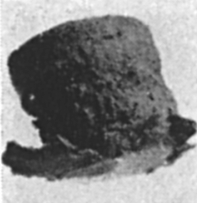
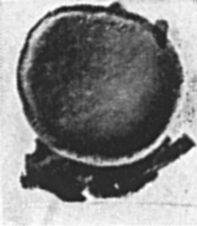
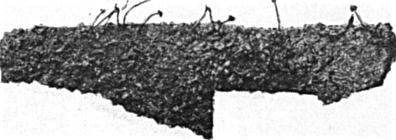
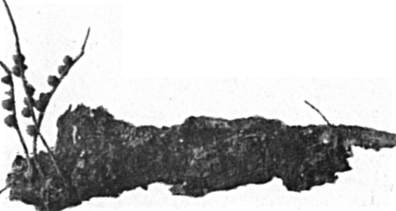
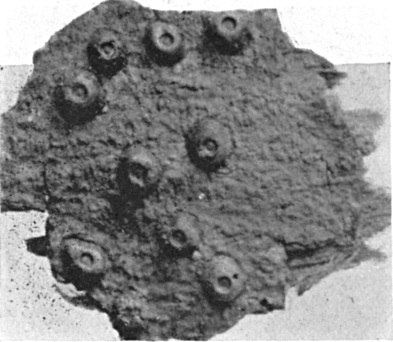
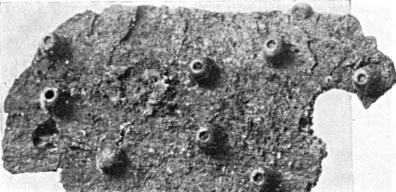
CAMILLEA CYCLOPS.—Plants short, cylindrical, or semi-globose, black,
about 4 mm. in diameter, erumpent from a common mycelial origin, and
distributed regularly over the matrix. They are produced at intervals of
about ½ cm, and apparently never two contiguous. Apex a circular,
rounded depression, with a slightly elevated disc. Perithecia arranged
in a central bundle, with permanent, carbonous walls (Fig. 835 ×6).
Spores oblong, 8 × 12, pale colored.
|
|
|
Fig. 834. Camillea Cyclops.
|
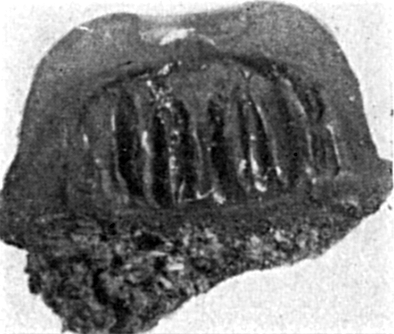 Fig. 835.
While this as probably not a rare plant in the American tropics, it
appears to have been only known from the Leprieur collections sent to
Montagne. We have recently gotten it from Rev. Torrend, Brazil, and the
receipt of the specimens inspired this pamphlet. I notice on some of
these specimens (not all) little protruding points that are similar to
those that Montagne shows, near the apex of Camillea mucronata. These
appear like abortive surface perithecia, but I do not find any clue to
their nature, and I do not know what they are. Cyclops was the name of a
giant in mythology that had but one eye in the middle of his forehead.
Thus species has but one "eye," but it is hardly a giant.
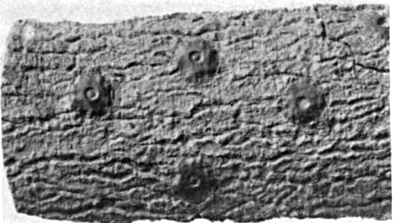 Fig. 837.
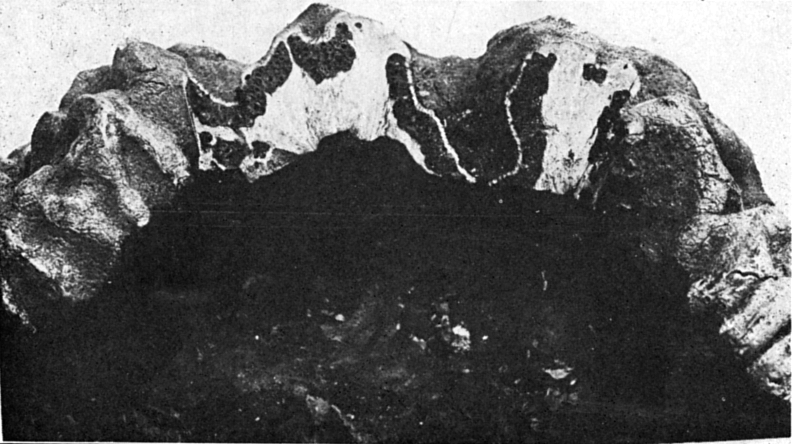
In the same paper in which Montagne lists Camillea Cyclops, he
names and figures Hypoxylon macromphalum. I can not tell the
photograph (Fig. 837) I made of the type from the photograph of
Camillea Cyclops. From Montagne's sectional figure, the
perithecia are arranged in the same manner, and the two plants
are surely cogeneric and, I believe, identical. A close reading
of Montagne's description discloses but one point of difference.
He records that in Hypoxylon macromphalum the ostioles are
prominent, and in a close examination of my photograph, I do
note minute points on the disc that are absent from Camillea
cyclops. Still I believe they are the same plant.
This might be made a genus, corresponding to Hypoxylon as to
stroma, but having the stroma hollow and filled with a
pulverulent mass. In reality, I think it is a better Camillea,
the perithecia arranged the same way, not permanent, but broken
up at an early stage. Of course, it is only an inference.
Léveillé states that it has the spores borne on hyphae
(acrogenous), but I do not place much value on Léveillé's
statements. Patouillard, after admitting that he saw nothing but
this powdery mass, adds "it is probable that the spores were
contained in logettes with fugacious walls, of which only the
marks on the inner side of the cavity remain." It would have
been better if he had stopped there, but he goes on to propose
afterwards that Hypoxylon Bomba should be held distinct from
Camillea under the name Phylacia, because it presents a form
"stylospored" and a form "ascospored." He does not give the
reason for the assertion that it is "stylospored," not even
citing the uncertain testimony of Léveillé. Phylacia might be
held distinct from Camillea on the ground of the powdery mass
and the early disappearance of the perithecia and ascus walls.
There is nothing new about that. It was done years ago by Fries
who called the "genus" Leveilleana, which is a tip for some
future name-juggler. All that is really known about its early
structure is only from inference, and that inference is contrary
to its having been "stylospored."
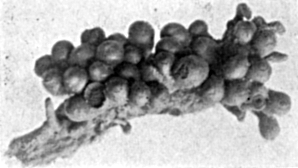
Fig. 838.
|
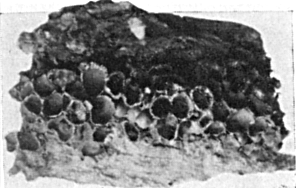
Fig. 839.
|
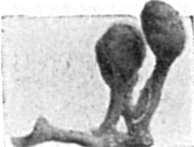
Fig. 840.
|
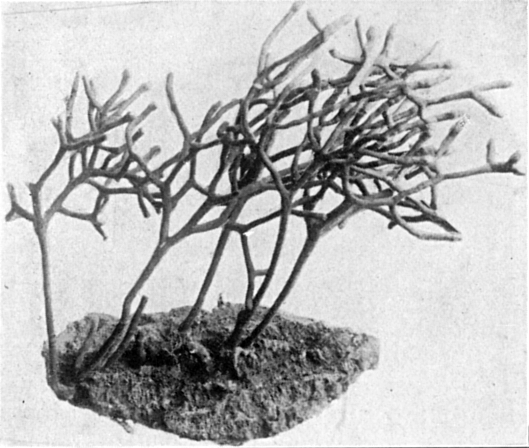
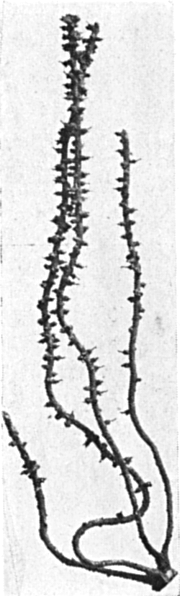
| Camillea Sagraena. Fig. 838, a cluster natural size; Fig. 839,
broken specimen as often seen; Fig 840, two long stipe
specimens. |
CAMILLEA SAGRAENA (Figs. 838-840).—Plants oblong about 3-4 mm.,
stipitate or substipitate at the base, growing densely caespitose, in
patches, black, smooth, the apices usually obscurely mammillate. Stipes
usually short, but sometimes 6-8 mm. long, and when growing in clusters,
the bases consolidated by a carbonous stroma. Interior of the receptacle
in two compartments (Fig. 841 ×6), the lower filled with soft tissue,
black around the edges, but white in the center. The upper compartment
filled with a mass of spores mixed with a few fragments of hyphae.
Spores narrowly elliptical, 6 × 12, straight, pale colored.
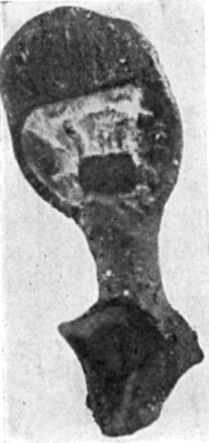 Fig. 841.
In Cuba I made abundant collections of this species. It grew in patches
from the thin bark, usually on the branches of a dead tree. I do not
know the name of the tree, but I think it was only on one kind, one of
the few softwood trees of Cuba. Camillea Sagraena is undoubtedly a
common species in the American tropics. It has never been well
described, and the white tissue of the interior lower half, which is a
very rare occurrence in similar black, carbonous plants, has never been
noted. A "new genus" might be based on this feature. It is quite fragile
and the broken bases as shown (Fig. 839) are often all that remain of it
when old. Camillea surinamensis as named by Berkeley from specimens from
Surinam, type at Kew, is exactly the same species. Berkeley does not
record it from Cuba, but from Nicaragua, and the specimen is supposed to
be illustrated by Ellis in his plate 38. It may have been the plant, but
if so, it was so inaccurately drawn that it would never be recognized.
In addition to my abundant collections from Cuba, I have a scanty
collection also from Cuba from E. B. Sterling.
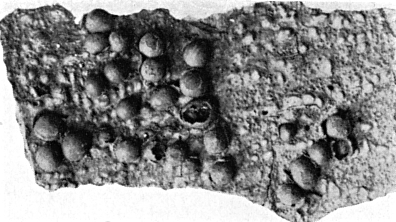
Fig. 844.
|
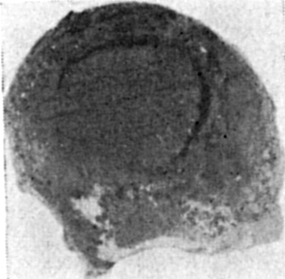
Fig. 845.
|
|
Camillea Bomba. Fig. 844 on bark; Fig. 845 on hard wood. |
CAMIILLEA BOMBA (Figs. 844, 845).—Plants globose, sessile, 4-6 mm. in
diameter, black, smooth, without any disc. Dehiscing by irregular
fracture. Stroma hollow on the interior (Fig. 846 ×6) filled with a
brown powder, composed of spores mixed with abundant hyphae remnants of
the perithecia and asci. Spores 6-7 × 10-12, elliptical, pale colored.
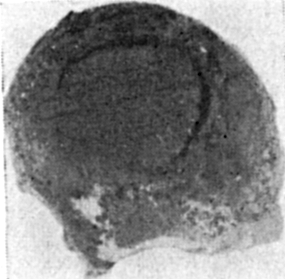 Fig. 846.
This seems to be a frequent species in tropical America. I collected it
in Cuba and have specimens from Miss Barrett, Jamaica, and L. J. K.
Brace, Bahamas. The latter specimens grew erumpent from thin bark, and
the broken bark forms a kind of cup at the base of the stroma. A thin,
black mycelial stroma underlies the bark. Those I collected in Cuba were
somewhat larger, and more irregular. Some grew in same manner, erumpent
from thin bark and the broken bark forms a kind of cup at the base of
the stroma, others on the naked, hard wood and grew more compact. In the
latter case the black stroma at the base was thicker and more in
evidence. There is no question but that Camillea Bomba is cogeneric with
Camillea Sagraena, but the gleba of the latter consists almost entirely
of spores, while in the former there is considerably more hyphae
remnants than spores.
CAMILLEA GLOBOSA (Fig. 847).—Plants densely caespitose, sessile,
globose, black, smooth. 7-8 mm. in diameter. Opening by irregular
fracture. Stroma hollow, filled with a brown mass of spores and hyphae
remnants. Spores elliptical.
Léveillé named this from a specimen from Tolima, Columbia, South
America. The type Fig. 847 is all than is known to me. Léveillé spins a
long story about it having spores borne on filaments, merely a wrong
deduction, I think, from his having found filaments (of the perithecia
walls?) mixed with the spores. Saccardo, who evidently did not take much
stock in Léveillé's story, omitted the species, suggesting that it was a
form of Camillea turbinata. Saccardo's conclusions were almost as bad as
Léveillé's.
We have not examined any specimens of Camillea globosa, but suspect a
section would show two divisions of the gleba, as in the next. In fact,
with the exception of the stipe, it appears to be the same plant, and
abundant collections may show them as only sessile and stipitate forms
of the same thing.
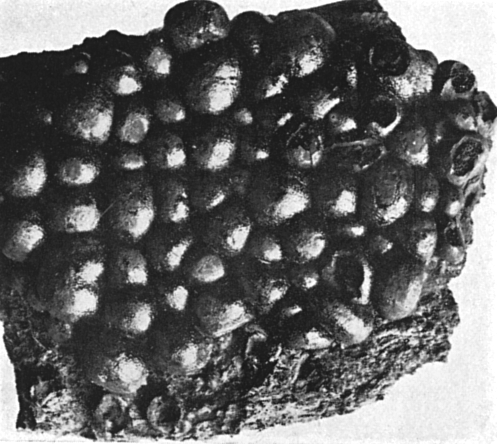 Fig. 847.
CAMILLEA POCULIFORMIS (Figs. 848 and 849).—Plants caespitose,
stipitate, globose or obovate, smooth, black, 8-15 mm. in diameter.
Stroma somewhat flattened at apex, opening circumscissally2 or
breaking irregularly. Stipe 8-10 cm. long, 2-3 mm. thick, black. Stroma
hollow, the interior in two divisions, a narrow layer above, the fertile
portion with a few spores in abundant, hyphae remnants, the lower
(corresponding to the sterile base of a Lycoperdon) of matted hyphae.
Spores short, elliptical, 9 × 14, pale colored, scantily found.
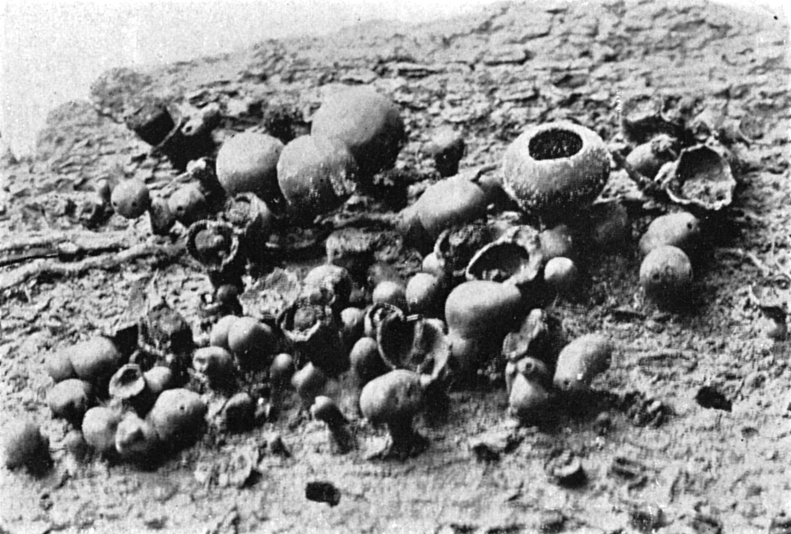 Fig. 848. Camillea poculiformis.
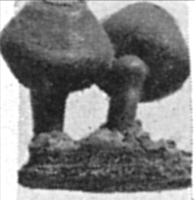
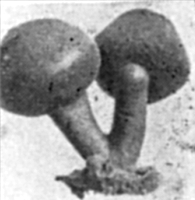 Fig. 849.
The pulverulent mass is rather firm, and remains after the peridium
breaks up. Camillea poculiformis was named Corynelia poculiformis in
Weigel's old exsiccatae, about a hundred years ago. It came from South
America. Years later Montagne published it as Hypoxylon poculiformis,
and Léveillé as Phylacia poculiformis. I can not trace it from Fries'
writings, though no doubt Fries had it and doubtless named it. The old
specimens of Weigel's exsiccatae are found in most museums of Europe,
and all the publishing has been done on this one collection. I have a
nice collection (Fig. 848), made by T. J. Collins in Guatemala.
The scanty knowledge we have of the real structure of this group
of plants leaves much to speculation. They are all evidently
closely related plants, and I think best classified under one
general head, or genus, Camillea. They are quite different from
the Hypoxylons of the temperate region, although we do not
question that the tropical species are included in Saccardo
mostly under Hypoxylon. When we come to compare what little we
know of the species we find several differences on which
"genera" could be based, and no doubt will be in time. In the
original sense, Camillea might be restricted to the two
cylindrical species, C. Leprieurii and C. Bacillum.
Then we have the short, cylindrical or globose forms with
persistent or semi-persistent perithecia, Camillea Labellum, C.
Cyclops and C. turbinata with the intermediate species C.
mucronata. The above will form one, or two, genera, according to
taste.
In the following plants we find no perithecia in the ripe
specimens, hence of course they will in time be considered a
genus. We believe there are two distinct differences between the
few species we know, corresponding with the old ideas of Bovista
and Lycoperdon in the puff balls. Camillea Sagraena and C.
poculiformis, with two divisions of the gleba, a fertile and a
sterile portion, and Camillea Bomba and C. globosa (?) with
homogenous gleba. The species Camillea Sagraena differs from the
other in having the fertile portion composed largely of spores
(scanty in others) and in having part of the sterile portion of
uncolored hyphae. Of course, it will form a "genus." Thus the
genus Camillea can be easily divided into five "genera" and we
make the suggestion for the benefit of those engaged in breaking
up the old genera, and proposing new names to which to add their
own. Who will rise to the occasion?