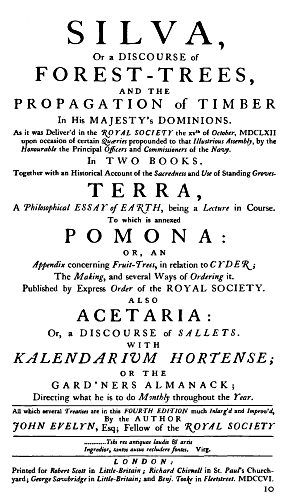
Among the prose writers of the second half of the seventeenth century
John Evelyn holds a very distinguished position. The age of the
Restoration and the Revolution is indeed rich in many names that have
won for themselves an enduring place in the history of English
literature. South, Tillotson, and Barrow among theologians, Newton in
mathematical science, Locke and Bentley in philosophy and classical
learning, Clarendon and Burnet in history, L’Estrange, Butler, Marvell
and Dryden in miscellaneous prose, and Temple as an essayist, have all
made their mark by prose writings which will endure for all time. But
the names which stand out most prominently in popular estimation as
authors of great masterpieces in the prose of this period are certainly
those of John Bunyan, John Evelyn, and Izaak Walton. And along with them
Samuel Pepys is also well entitled to be ranked as a great contemporary
writer, though he was at pains to try and ensure his being permitted to
remain free from the publicity of authorship, for such time at least as
the curious might allow his Diary to remain hidden in the cipher he
employed.
With the great though untrained genius of Bunyan none of these other
three celebrated prose authors of this time has anything in common. He
stands apart from them in his fervently religious and romantic
temperament, in his richness of
representation and ingenuity of
analogy, and in his forcible quaintness of style, as completely as he
did in social status and in personal surroundings. In complete contrast
to the romantic productions of the self-educated tinker of Bedford, the
works of Walton and Evelyn were at any rate influenced by, though they
can hardly be said to have been moulded upon, the style of the preceding
age of old English prose writers ending with Milton. The influence of
the latter is, indeed, plainly noticeable both in the diction and in the
general sentiment of these two great masters of the pure, nervous
English of their period.
It would serve no good purpose to make any attempt here to trace the
points of resemblance between the works of Walton and Evelyn, and then
to note their differences in style. Each has contributed a masterpiece
towards our national literature, and it would be a mere waste of time to
make comparisons between their chief productions. This much, however,
may be remarked, that the conditions under which each worked were
completely different from those surrounding the other. Izaak Walton, the
author of many singularly interesting biographies, and of the quaint
half-poetical Compleat Angler or the Contemplative Man’s Recreation,
the great classic “Discourse of Fish and Fishing,” was a London
tradesman, while his equally celebrated contemporary John Evelyn, author
of Sylva, or a Discourse of Forest Trees, the classic of British
Forestry, was a more highly cultured man, who wrote, in the leisure of
official duties and amid the surroundings of easy refinement, many
useful and tasteful works both in prose and poetry, ranging over a wide
variety of subjects. Judging from the number of editions which appeared
of their principal works, they were both held in great favour by the
reading public, though on the whole the advantage in some respects lay
with Evelyn. But during the present century the taste of the public,
judged by this same rough and ready, practical standard, has undoubtedly
awarded the prize of popularity to Izaac Walton.
So far as the circumstances of their early life were concerned there was
greater similarity between Walton and Pepys, than between either of them
and Evelyn. Born in the lower middle class, the son of a tailor in
London, and himself
afterwards a member of the Clothworkers’ guild,
Pepys was a true Londoner. His tastes were centred entirely in the town,
and his pleasures were never sought either among woods or green fields,
or by the banks of trout streams and rivers. His thoughts seem often
tainted with the fumes of the wine-bowl and the reek of the tavern; and
even when he swore off drink, as he frequently did, he soon relapsed
into his customary habits. Educated in London and then at Cambridge,
where his love of a too flowing bowl already got him into trouble more
than once, he was imprudent enough to incur the responsibilities of
matrimony at the early age of twenty-three, with a beautiful girl only
fifteen years old. Trouble soon stared this rash and improvident young
couple in the face, but they were spared the pangs of permanent poverty
through the aid and influence of Sir Edward Montagu, afterwards Earl of
Sandwich, who was a distant relative of Pepys. Acting probably as
Montagu’s secretary for some time, he was first appointed to a clerkship
in the Army pay office, and then soon afterwards became clerk of the
Acts of the Navy. Later on, like Evelyn, he held various more important
posts under the Crown, as well as being greatly distinguished by
promotion to non-official positions of the highest honour. His official
career was a very brilliant one, and deservedly so from the integrity of
his work, from his application, despite frequent immoderation in
partaking of wine, and from his business-like methods of work. As
Commissioner for the Affairs of Tangier and Treasurer, he visited
Tangier officially. He twice became Secretary to the Admiralty, and was
twice elected to represent Harwich in Parliament, after having
previously sat for Castle Rising. He was also twice chosen as Master of
the Trinity House, and was twice committed to prison, once on a charge
of high treason, and the other time (1690) on the charge of being
affected to King James II., upon whose flight from England Pepys had
laid down his office and withdrawn himself into retirement. Elected a
Fellow of the Royal Society in 1665, he attained the distinction of
being its President in 1684. He was Master of the Clothworkers’ Company,
Treasurer and Vice-President of Christ’s Hospital, and one of the Barons
of the Cinque Ports. In 1699, four
years before he succumbed to a long
and painful disease borne with fortitude under the depression of reduced
circumstances, he received the freedom of the City of London,
principally for his services in connection with Christ’s Hospital.
From the hasty sketch drafted in the above outlines, it will be seen
that throughout all Pepys’ manhood the circumstances of his daily life
and environment were much more similar to those of Evelyn than to those
of Walton, who may well be ranked as their senior by almost one
generation. Like Evelyn, Izaak Walton was rather the child of the
country than a boy of the town. Born in Stafford in 1593, he only came
to settle in London after he had attained early manhood. Thus, though a
citizen exposing his linen drapery and mens’ millinery for sale first in
the Gresham Exchange on the Cornhill, then in Fleet Street, and latterly
in Chancery Lane, the Bond Street of that time, he ever cherished a
longing for more rural surroundings and a desire to exchange life in the
city for residence in a smaller provincial town. On the civil war
breaking out in Charles the Ist’s time, he retired from business and
went to live near his birth place, Stafford, where he had previously
bought some land. Here the last forty years of his long life were spent
in ease and recreation. When not angling or visiting friends, mostly
brethren of the angle, he engaged in the light literary work of
compiling biographies and in collecting material for the enrichment of
his Compleat Angler. Published in 1653, this ran through five editions
in 23 years, besides a reprint in 1664 of the third edition (1661).
In spite of the many similarities between Evelyn and Pepys as to
university education, official position, political partisanship, and
social and scientific status in London, there are yet such essential
differences between what has been bequeathed to us by these two friends
that comparison between them is almost impossible. They are both
authors: but it was by chance rather than by design that Pepys
ultimately acquired repute as an author, whereas Evelyn at once achieved
the literary fame he desired and wrote for. Neither of the two works
published by Pepys, The Portugal History (1677) and the Memories of
the Royal Navy (1690), procured
for him the gratification of revising
them for a second edition, and it is indeed open to question if the
Diary upon which his undying fame rests was ever intended by him to be
published after his death. This is a point that is never likely to be
settled satisfactorily. The fact of its having been written in cipher
looks as if it had been compiled solely for private amusement, and not
with any intention of posthumous publication; and this view is greatly
strengthened by the unblushing and complete manner in which he lays
aside the mask of outward propriety and records his too frequent
quaffing of the wine-cup, his household bickerings, his improprieties
with fair women, and his graver conjugal infidelities. The improprieties
of other persons, and especially those of higher social rank than
himself, might very intelligibly have been written in cipher intended to
have been transcribed and printed after his death; but it would be at
variance with human nature to believe that he could so unreservedly have
reduced to writing all the faults and follies of his life had even
posthumous publication of his Diary been contemplated by him at the
time of writing it. For it is hardly capable of argument that, next to
the instincts of self-preservation and of the maintenance of family
ties, the desire to preserve outward appearances is undoubtedly one of
the strongest of human feelings; and this great natural law, often the
last remnant or the substitute of conscience, character, and
self-respect, is even more fully operative in a highly civilised than in
a savage or a semi-savage state of society. Of a truth, every human
being is more or less of a Pharisee with regard to certain
conventionalities of life. Complete disregard for the maintenance of
some sort of standard of outward appearances is the absolute vanishing
point of self-respect. Till that has been reached by any individual the
hope of his reformation is not lost, though at the same time successful
dissimulation makes the prospect of a turning point in a vicious career
but remote. Still, “it is a long lane that has no turning.” It is
therefore most probable that the leaving behind of the key to the cipher
was rather due to inadvertence than to intention and design. And if this
view be correct, then Pepys’ charming Diary was the purely natural
outpouring of his mind without
ever a thought being bestowed on
authorship and ultimate publication.
With Evelyn’s Diary, however, it was different. Although it was not
published until 1818, and though it may never have been intended by its
writer to have been given to the world in book form, yet it was very
clearly intended to be an autobiographical legacy to his family. Hence
it is no mere outpouring of the spirit upon pages meant only for the
subsequent perusal of him who thus rendered in indelible characters his
passing thoughts of the moment. And this being the case, comparison
between the two Diaries would be just as unfair as it is unnecessary.
The one is the fruit of unrestrained freedom and a mirthful mind, while
the other is the product of cultured leisure and a refined literary
method. When Evelyn was Commissioner for the maintenance of the Dutch
prisoners (1664-70) he had frequent communications with Pepys, then of
the Navy, and there are special references to him in Evelyn’s memoirs.
That an intimate friendship existed there is no doubt, and that they
each held the other in great respect as a man of intellect, as well as
of good business capacity, is equally clear. Thus, in June, 1669, he
encouraged Pepys to be operated on ‘when exceedingly afflicted with the
stone;’ and on 19 February, 1671, ‘This day din’d with me Mr. Surveyor,
Dr. Christopher Wren, and Mr. Pepys, Cleark of the Acts, two
extraordinary ingenious and knowing persons, and other friends. I
carried them to see the piece of carving which I had recommended to the
King.’ This was a masterpiece of Grinling Gibbon’s work, which Charles
admired but did not purchase; so Gibbon not long after sold it for £80,
though ‘well worth £100, without the frame, to Sir George Viner.’ Evelyn
at this time got Wren, however, to promise faithfully to employ Gibbon
to do the choir carving in the new St. Paul’s Cathedral.
Each of their Diaries teems with reference to the other. Pepys asked
Evelyn to sit to Kneller for his portrait which he desired for ‘reasons
I had (founded upon gratitude, affection, and esteeme) to covet that in
effigie which I most truly value in the original.’ This refers to the
well-known portrait, now at Wotton, that has been copied and engraved.
It appears to have been begun in October, 1685, but it was not till
July, 1689, that the commission was actually completed. The portrait
exhibits the face of an elderly man distinctly of a high-strung and
nervous temperament, though not quite to the extent of being ‘sicklied
oer with the pale caste of thought.’ His right hand, too, which grasps
his Sylva is one very characteristic of the nervous disposition. A
bright, shrewd intellect, lofty thoughts, high motives, good resolves,
and—last, tho’ by no means least—a serene mind, the mens conscia
recti which Pepys bluntly called ‘a little conceitedness,’ are all
stamped upon his well-marked and not unshapely features. It is eminently
the face of a philosopher, an enthusiast, a studious scholar, and a
gentleman.
No one can ever know Evelyn so well as Pepys did; and here is his
opinion of John Evelyn, expressed in the secret pages of his cipher
Diary on November, 1665:—‘In fine, a most excellent person he is, and
must be allowed a little for a little conceitedness; but he may well be
so, being a man so much above others.’ And this just exactly bears out
the rough general impression conveyed by the perusal of Evelyn’s Diary
and his other literary works. The long friendship of these two was only
terminated by the death of Pepys on 26th May, 1703, not long before
Evelyn had himself to depart from this life. ‘This day died Mr. Sam.
Pepys, a very courtly, industrious and curious person, none in England
exceeding him in knowledge of the navy, in which he had passed through
all the most considerable offices, Clerk of the Acts and Secretary of
the Admiralty, all which he performed with great integrity. When King
James II., went out of England, he laid down his office and would serve
no more..... He was universally belov’d, hospitable, generous, learned
in many things, skilled in music, a very great cherisher of learned men
of whom he had the conversation..... Mr. Pepys had been for near 40
yeares so much my particular friend, that Mr. Jackson sent me compleat
mourning, desiring me to be one to hold up the pall at his magnificient
obsequies, but my indisposition hinder’d me from doing him this last
office.’
The essential facts of Evelyn’s life, as he himself would have us know
them, are set forth at full length in autobiographical form,
chronologically arranged in what is always spoken of as his Diary,
although evidently this was (much of it, at any rate) merely a
subsequent personal compilation from an actual diary, kept in imitation
of his father, from the age of 11 years onwards and down even to within
one month of his death in 1706.
The second son and the fourth child of Richard Evelyn of Wotton in
Surrey, and of his wife Eleanor, daughter of John Stansfield ‘of an
ancient honorable family (though now extinct) in Shropshire,’ he was
born at Wotton on 31st. October, 1620. His father, ‘was of a sanguine
complexion, mixed with a dash of choler; his haire inclining to light,
which tho’ exceeding thick became hoary by the time he was 30 years of
age; it was somewhat curled towards the extremity; his beard, which he
wore a little picked, as the mode was, of a brownish colour, and so
continued to the last, save that it was somewhat mingled with grey
haires about his cheekes: which, with his countenance, was cleare, and
fresh colour’d, his eyes quick and piercing, an ample forehead, manly
aspect; low of stature, but very strong. He was for his life so exact
and temperate, that I have heard he had never been surprised by excesse,
being ascetic and sparing. His wisdom was greate, and judgment most
acute; of solid discourse, affable, humble and in nothing affected; of a
thriving, neat, silent and methodical genius; discretely severe, yet
liberal on all just occasions to his children, strangers, and servants;
a lover of hospitality; of a singular and Christian moderation in all
his actions; a Justice of the Peace and of the Quorum; he served his
country as High Sheriff for Surrey and Sussex together. He was a
studious decliner of honours and titles, being already in that esteem
with his country that they could have added little to him besides their
burden. He was a person of that rare conversation,
that upon frequent
recollection, and calling to mind passages of his life and discourse, I
could never charge him with the least passion or inadvertence. His
estate was esteem’d about £4,000 per ann. well wooded and full of
timber.’ As for his mother, ‘She was of proper personage; of a brown
complexion; her eyes and haire of a lovely black; of constitution
inclyned to a religious melancholy, or pious sadnesse; of a rare memory
and most exemplary life; for œconomie and prudence esteemed one of the
most conspicuous in her Country.’
Apparently John Evelyn thought he had made a very judicious choice of
his father and mother when he wrote ‘Thus much in brief touching my
parents; nor was it reasonable I should speake lesse to them to whom I
owe so much.’
These passages, occurring in the first two pages of his Diary serve at
once to illustrate a very characteristic feature of Evelyn’s mind, and
one that is everywhere discernible in his writings. He was a man with a
highly cultured and a very well balanced mind, but he was somewhat
inclined to exaggerate; and he certainly had the rather enviable gift of
considering everything pertaining to him, or approved or advocated by
him, as very superior indeed. All his eggs had two yolks, and all his
geese were swans. What he liked, he loved; and what he did not like,
he hated. There was no golden mean with him; he was either very
optimistic or else intensely pessimistic. Hence, naturally, he gave hard
knocks to those who differed from him in opinion, and particularly after
the Restoration; for he was one of the most expressive among King
Charles II’s courtiers. Direct evidence of this special temperament was
characteristic of Evelyn throughout all his life, and was of course
particularly noticeable in his writings, as we shall subsequently see.
It is therefore only to be expected that he prized his father’s little
estate of Wotton in Surrey as one of the finest in the kingdom. ‘Wotton,
the mansion house of my Father, left him by my Grandfather, (now my
eldest Brother’s), is situated in the most Southern part of the Shire,
and though in a valley, yet really upon part of Lyth Hill one of the
most eminent in England for the prodigious prospect to be seen from its
summit, tho’ of few observed. From it may be
discerned 12 or 13
Counties, with part of the Sea on the Coast of Sussex, in a serene day.
The house is large and ancient, suitable to those hospitable times, and
so sweetly environed with those delicious streams and venerable woods,
as in the judgment of Strangers as well as Englishmen it may be compared
to one of the most tempting and pleasant Seats in the Nation, and most
tempting for a great person and a wanton purse to render it conspicuous.
It has rising grounds, meadows, woods, and water in abundance. The
distance from London (is) little more than 20 miles, and yet (it is) so
securely placed as if it were 100; three miles from Dorking, which
serves it abundantly with provisions as well of land as sea; 6 from
Guildford, 12 from Kingston. I will say nothing of the ayre, because the
praeeminence is universally given to Surrey, the soil being dry and
sandy: but I should speak much of the gardens, fountains, and groves
that adorne it, were they not as generally knowne to be amongst the most
natural, and (till this later and universal luxury of the whole nation,
since abounding in such expenses) the most magnificent that England
afforded, and which indeed gave one of the first examples to that
elegancy since so much in vogue, and followed in the managing of their
waters, and other ornaments of that nature. Let me add, the contiguity
of five or six Mannors, the patronage of the livings about it, and, what
is none of the least advantages, a good neighbourhood. All which
conspire to render it fit for the present possessor, my worthy Brother,
and his noble lady, whose constant liberality give them title both to
the place and the affections of all that know them. Thus, with the poet,
Nescio quâ natale solum dulcedine cunctos
Ducit, et im’ emores non sinit esse sui!’
This is a very good specimen of Evelyn’s style, for it shews the
optimistic quality which, along with refinement and a love of classical
quotations, is ever present in his writings. Lythe Hill, from the summit
of which the ‘prodigious prospect’ is so eminently belauded, attains a
height of less than a thousand feet above the sea-level.
At the early age of four John Evelyn was initiated into the rudiments
of education by one Frier, who taught children at the church porch of
Wotton; but soon after that he was sent to Lewes in Sussex, to be with
his grandfather Standsfield, while a plague was raging in London. There
he remained, after Standsfield’s death in 1627, till 1630, when he was
sent to the free school at Southover near Lewes and kept there until he
went up to Balliol College, Oxford, as a fellow-commoner in 1637, being
then 16 years of age. It was his father’s intention to have placed him
at Eton ‘but I was so terrefied at the report of the severe discipline
there that I was sent back to Lewes, which perverseness of mine I have
since a thousand times deplored.’ In that same year (1637) Evelyn had
the misfortune to lose his mother, then only in the 37th year of her
age. Having been ‘extremely remisse’ in his studies at school, he made
no great mark during his University career. His application was not
assiduous, while his tutor, Bradshaw, whom he disliked, was negligent;
and he appears to have been subject to frequent attacks of ague,
disposing him to casual recreation rather than to close study. He had
also apparently the desire to acquire a smattering of many different
things rather than to study hard at a few special subjects. ‘I began to
look on the rudiments of musick, in which I afterwards arriv’d to some
formal knowledge though to small perfection of hand, because I was so
frequently diverted by inclinations to newer trifles.’
Completing his Oxford studies early in 1639, without taking any degree,
he went into residence at the Middle Temple in April, and soon arrived
at the conclusion that his ‘being at the University in regard of these
avocations, was of very small benefit.’ Here he and his brother lodged
in ‘a very handsome apartment just over against the Halt Court, but four
payre of stayres high, which gave us the advantage of fairer prospect,
but did not much contribute to the love of that unpolish’d study, to
which (I suppose,) my Father had design’d me!’ While thus a law student,
on 30th October, he saw ‘his Majestie (coming from his Northern
Expedition) ride in pomp, and a kind of ovation, with all the markes of
a happy peace, restor’d to the affections
of his people, being
conducted through London with a most splendid cavalcade; and on 3rd
November, following (a day never to be mentioned without a curse) to
that long, ungratefull, foolish, and fatall Parliament, the beginning of
all our sorrows for twenty years after, and the period of the most happy
Monarch in the world: Quis talia fando!’
In the closing days of 1640 Evelyn lost his father, when he abandoned
the study of the law and betook himself abroad in preference to being
mixed up in the disorders of the time. His resolutions were ‘to absent
myselfe from this ill face of things at home, which gave umbrage to
wiser than myselfe, that the medaill was reversing, and our calamities
but yet in their infancy.’ Shortly before that he had ‘beheld on Tower
Hill the fatal stroake which sever’d the wisest head in England from the
shoulders of the Earl of Strafford.’
Landing at Flushing in July, 1641, Evelyn passed, accompanied by his
tutor Mr. Caryll, through Midelbrogh, Der Veer, Dort, Rotterdam, and
Delft, to the Hague, where he presented himself to the Queen of
Bohemia’s Court. Thence he went on to Leyden, Utrecht, Rynen, and
Nimeguen, to where the Dutch army was encamped about Genep, a strong
fortress on the Wahale river. Here he enrolled himself and served for a
few days as a volunteer in the Queen’s army ‘according to the
compliment,’ being attached to the English company of Captain Apsley:
and in this capacity he ‘received many civilities.’ Even when thus
playing at soldering, he did not like the roughness of a soldier’s life,
‘for the sun piercing the canvass of the tent, it was, during the day,
unsufferable, and at night not seldom infested with mists and fogs,
which ascended from the river.’ However, during the few days he took his
fair share in the work. ‘As the turn came about, I watched on a horne
work neere our quarters, and trailed a pike, being the next morning
relieved by a company of French. This was our continual duty till the
Castle was re-fortified, and all danger of quitting that station
secured.’ Retracing his steps to Rotterdam, Delft, the Hague and Leyden,
he also visited Haerlem, Amsterdam, Antwerp, Brussels and various other
towns before returning by way of Ostend, Dunkirk and Dover to Wotton,
where he celebrated his 21st birthday.
Although his Diary does not contain any details on such matters as
Pepys would have been free to record in his cipher, John Evelyn was
probably rather a gay and pleasure-loving youth about this time. A
suspicion of this seems justified by the fact that he ‘was elected one
of the Comptrolers of the Middle Temple-revellers, as the fashion of ye
young Students and Gentlemen was, the Christmas being kept this year
(1641) with great solemnity; but being desirous to passe it in the
Country, I got leave to resign my staffe of office, and went with my
brother Richard to Wotton.’ From January till March he was back in
London ‘studying a little, but dancing and fooling more.’
It was hardly possible that anyone situated as Evelyn was could hold
aloof from the party strife when civil war broke out during the course
of this year. And, of course, he was on the Royalist side. But he did
not serve long with the troops. Here is his own record of that military
service,—‘Oct. 3rd. To Chichester, and hence the next day to see the
siege of Portsmouth; for now was that bloody difference betweene the
King and Parliament broken out, which ended in the fatal tragedy so many
years after. It was on the day of its being render’d to Sir William
Waller, which gave me an opportunity of taking my leave of Colonel
Goring the Governor, now embarqueing for France. This day was fought
that signal Battaile at Edgehill. Thence I went to Southampton and
Winchester, where I visited the Castle, Schole, Church, and King
Arthur’s Round Table, but especially the Church, and its Saxon Kings’
Monuments, which I esteemed a worthy antiquity. 12th. November, was the
Battle of Braineford surprisingly fought, and to the greate
consternation of the Citty had his Majesty (as twas believed he would)
pursu’d his advantage. I came in with my horse and armes just at the
retreate, but was not permitted
to stay longer than the 15th. by reason
of the Army’s marching to Glocester, which would have left both me and
my brother expos’d to ruine, without any advantage to his Majestie. Dec.
7th. I went from Wotton to London to see the so much celebrated line of
com’unication, and on the 10th. returned to Wotton, nobody knowing of my
having been in his Majestie’s Army.’
During the first half of 1643 Evelyn employed himself entirely in rural
occupations, visiting the garden and vineyard of Hatfield and similar
places. From time to time, however, he made many journeys to and from
London. What he sometimes saw there gave him much food for ample
reflection. ‘May 2nd. I went from Wotton to London, where I saw the
furious and zelous people demolish that stately Crosse in Cheapside. On
the 4th. I returned with no little regrett for the confusion that
threatened us. Resolving to possess myself in some quiet if it might be,
in a time of so great jealosy, I built by my Brother’s permission a
study, made a fishpond, an island, and some other solitudes and
retirements, at Wotton, which gave the first occasion of improving them
to those water-works and gardens which afterwards succeeded them, and
became at that tyme the most famous of England.’ But, willy nilly, he
was bound to become dragged into action on the King’s behalf. ‘July
12th. I sent my black manege horse and furniture with a friend to his
Majestie then at Oxford. 23rd. The Covenant being pressed, I absented
myselfe; but finding it impossible to evade the doing very unhandsome
things, and which had been a greate cause of my perpetual motions
hitherto between Wotton and London, Oct. 2nd. I obtayned a lycence of
his Majestie, dated at Oxford and sign’d by the King, to travell
againe.’ Accordingly, on 7th. November, he took boat at the Tower wharf
for Sittingbourne, ‘being only a payre of oares, expos’d to a hideous
storm, thence posting to Dover accompanied by an Oxford friend, Mr.
Thicknesse, and crossing the Channel to Calais.’
Proceeding by Boulogne, Monstreuil, Abbeville, Beauvais, Beaumont, and
St. Denys to Paris, of which he gives a very interesting account, he
threw himself into the social life of that gay capital. His first step
was to make his duty to
Sir Richard Browne, afterwards his
father-in-law, then in charge of British affairs pending the arrival of
the Earl of Norwich, who came immediately after that as Ambassador
Extraordinary. That Evelyn’s purse was fairly well lined the Parisian
passages in his Diary distinctly show. He appears to have taken part
in many gay excursions and junkettings, though he sometimes reckoned the
cost. ‘At an inn in this village (St. Germains en Lay) is an host who
treats all the greate persons in princely lodgings for furniture and
plate, but they pay well for it, as I have don. Indeede the
entertainment is very splendid, and not unreasonable, considering the
excellent manner of dressing their meate, and of the service. Here are
many debauches and excessive revellings, as being out of all noise and
observance.’ Wherever he visited the royal gardens and villas, or those
of the great nobles and other magnates, he writes rapturously of what he
saw. Sometimes, though, his joyous optimism rather leads one to doubt
the quality of his taste, as when, writing of Richelieu’s villa at
Ruell, he says ‘This leads to the Citroniere, which is a noble conserve
of all those rarities; and at the end of it is the Arch of Constantine,
painted on a wall in oyle, as large as the real one at Rome, so well don
that even a man skilled in painting may mistake it for stone and
sculpture. The skie and hills which seem to be between the arches are so
naturall that swallows and other birds, thinking to fly through, have
dashed themselves against the wall. I was infinitely taken with this
agreeable cheate.’ But he was certainly gradually acquiring the
materials which were afterwards to be so well used by him in his great
works on gardening. After a tour made in Normandy with Sir John Cotton,
a Cambridgeshire knight, he quitted Paris in April, 1644. Marching
across by Chartres and Estamps to Orleans, the party of which he formed
one had an encounter with brigands, ‘for no sooner were we entred two or
three leagues into ye Forest of Orleans (which extends itself many
miles), but the company behind us were set on by rogues, who, shooting
from ye hedges and frequent covert, slew fowre upon the spot... I had
greate cause to give God thankes for this escape.’ Taking boat, he went
down the Loire to St. Dieu, and thence rode to Blois and on to Tours,
where he stayed till the autumn. ‘Here I took a master of the language
and studied the tongue very diligently, recreating myself sometimes at
the maill, and sometymes about the towne.’ Here, too, he paid his duty
to the Queen of England, ‘having newly arrived, and going for Paris.’ In
the latter part of September, still accompanied by his friend
Thicknesse, he left Tours and ‘travelled towards the more southerne part
of France, minding now to shape my course so as I might winter in
Italy.’ Journeying southward, partly by road and partly by river, he
visited Lyons, Avignon, and Marseilles, whither he wended his way
deliciously ‘thro’ a country sweetely declining to the South and
Mediterranean coasts, full of vineyards and olive-yards, orange-trees,
myrtils, pomegranads, and the like sweete plantations, to which belong
pleasantly-situated villas ...... as if they were so many heapes of snow
dropp’d out of the clouds amongst these perennial greenes.’ Taking mules
to Cannes, he went by sea to Genoa ‘having procur’d a bill of health
(without which there is no admission at any towne in Italy).’ On
reaching ‘Mongus, now cal’d Monaco’ on the route, ‘we were hastened
away, having no time permitted us by our avaricious master to go up and
see this strong and considerable place.’
On Oct. 16th., after ‘much ado and greate perill’ he landed on Italian
soil. He was fully prepared to have the most delicious pleasure in this
classical land, having already, even during the stormy weather off the
coast, ‘smelt the peculiar joys of Italy in the perfumes of orange,
citron, and jassmine flowers for divers leagues seaward.’
It would be pleasant to ramble through Italy in Evelyn’s company, and to
share with him the many enjoyments recorded in his Diary: but space
forbids. From Genoa he went to Leghorn and Pisa, from Pisa to Florence,
thence to Sienna, and on to Rome. ‘I came to Rome on the 4th November,
1644, about 5 at night, and being perplexed for a convenient lodging,
wandered up and down on horseback, till at last one conducted us to
Monsieur Petits, a Frenchman, near the Piazza Spagnola. Here I alighted,
and having bargained with my host for 20 crownes a moneth, I
caused a
good fire to be made in my chamber and went to bed, being so very wet.
The next morning (for I was resolved to spend no time idly here) I got
acquainted with several persons who had long lived at Rome.’
Evelyn’s description of the interesting sights he saw in Rome is so good
that it might well be perused in place of modern guide-books by those
visiting the city. There is a delightful attractiveness about it, in
which these up-to-date works are sometimes wanting. But even his
youthful energy began to tire, and his keen appetite to become sated
with continuous sightseeing. After more than six months of it ‘we now
determined to desist from visiting any more curiosities, except what
should happen to come in our way, when my companion Mr. Henshaw or
myself should go out to take the aire.’ Then, however, as now for some
people, the crowning event of a visit to Rome was to receive the Papal
blessing. This Evelyn desired and obtained, although the event is not
recorded in his diary with any great enthusiasm. ‘May, 4th. Having seen
the entrie of ye ambassador of Lucca, I went to the Vatican, where, by
favour of our Cardinal Protector, Frair Barberini, I was admitted into
the consistorie, heard the ambassador make his ovation in Latine to the
Pope, sitting on an elevated state or throne, and changing two
pontifical miters; after which I was presented to kisse his toe, that
is, his embroder’d slipper, two Cardinals holding up his vest and
surplice, and then being sufficiently bless’d with his thumb and two
fingers for that day, I return’d home to dinner.’
He quitted Rome about the middle of May after a sojourn there of seven
months, which had occasioned him so small an outlay that he remarked
thereon in his Diary. ‘The bills of exchange I took up from my first
entering Italy till I went from Rome amounted but to 616 ducanti di
banco, though I purchas’d many books, pictures, and curiosities.’ Going
northwards by Sienna, Leghorn, Lucca, Florence, Bologna, and Ferrara, he
reached Venice early in June. Arriving ‘extreamly weary and beaten’ with
the journey, he went and enjoyed the new luxury of a Turkish bath. ‘This
bath did so open my pores that it cost me one of the greatest colds I
ever had in my life, for want of necessary caution
in keeping myselfe
warme for some time after; for coming out, I immediately began to visit
the famous places of the city; and travellers who come in to Italy do
nothing but run up and down to see sights.’
Evelyn had the good fortune to see Venice en fête, and in those days
that must have been a sight well worth seeing. He saw the Doge espouse
the Adriatic by casting a gold ring into it on Ascension day with very
great pomp and ceremony. ‘It was now Ascension Weeke, and the greate
mart or faire of ye whole yeare was kept, every body at liberty and
jollie. The noblemen stalking with their ladys on choppines; these are
high-heel’d shoes, particularly affected by these proude dames, or, as
some say, invented to keepe them at home, it being very difficult to
walke with them; whence one being asked how he liked the Venetian dames,
replied, they were mezzo carne, mezzo ligno, half flesh, half wood,
and he would have none of them. The truth is, their garb is very odd, as
seeming always in masquerade; their other habits also totaly different
from all nations.’
In Venice Evelyn made arrangements for visiting the Holy Land and parts
of Syria, Egypt, and Turkey; but they fell through owing to the vessel,
in which he would have sailed, being requisitioned to carry provisions
to Candia, then under attack from the Turks. Forced to abandon this
project, he remained in Venice ‘being resolved to spend some moneths
here in study, especially physic and anatomie, of both which there was
now the most famous professors in Europe.’ But in the autumn Mr.
Thicknesse, ‘my dear friend, and till now my constant fellow traveller,’
was obliged to return to England on private affairs; so Evelyn was left
alone in Venice. Very shortly after that he had an illness which seems
to have at one time threatened a fatal termination. ‘Using to drink my
wine cool’d with snow and ice, as the manner here is, I was so afflicted
with the angina and soare-throat, that it had almost cost me my life.
After all the remedies Cavalier Veslingius, cheife professor here, could
apply, old Salvatico (that famous physician) being call’d made me be
cupp’d and scarified in the back in foure places, which began to give me
breath, and consequently life, for I
was in ye utmost danger: but God
being mercifull to me, I was after a fortnight abroad againe; when
changing my lodging I went over against Pozzo Pinto, where I bought for
winter provisions 3000 weight of excellent grapes, and pressed my owne
wine, which proved incomparable liquor.’ Its goodness, indeed, seems to
have been the death of it. ‘Oct. 31st. Being my birth-day, the nuns of
St. Catherine’s sent me flowers of silk-work. We were very studious all
this winter till Christmas, when on twelfth day we invited all the
English and Scotts in towne to feast, which sunk our excellent wine
considerably.’ In explanation of this passage, it needs to be said that
he had soon again changed his lodging and gone to reside with three
English friends ‘neere St. Catherine’s over against the monasterie of
nunnes, where we hired the whole house and lived very nobly. Here I
learned to play on ye theorbo, taught by Sig. Dominico Bassano.’
After ‘the folly and madnesse of the Carnevall’ was over, Evelyn left
Venice for Padua in January, 1646, but went back in March to take leave
of his friends there, and at Easter set out on his return journey to
England in company with the poet Waller, who had been glad to go abroad
after being much worried by the Puritan party. They travelled by way of
Vicenza, Verona, Brescia, Milan, the Lago Maggiore, the Simplon Pass,
Sion, and St. Maurice to Geneva. Here again Evelyn became sick nigh unto
death, from small-pox contracted at Beveretta, the night before reaching
Geneva. ‘Being extremely weary and complaining of my head, and finding
little accommodation in the house, I caus’d one of our hostesses
daughters to be removed out of her bed and went immediately into it
whilst it was yet warme, being so heavy with pain and drowsinesse that I
would not stay to have the sheets chang’d; but I shortly after payd
dearly for my impatience, falling sick of the small-pox so soon as I
came to Geneva, for by the smell of frankincense and ye tale of ye good
woman told me of her daughter having had an ague, I afterwards concluded
she had been newly recovered of the small-pox.’ Becoming very ill he was
bled of the physician ‘a very learned old man..... He afterwards
acknowledg’d that he should not have bled me had he suspected ye
small-pox, which brake out a day after.’ As nurse he had a Swiss matron
afflicted with gôitre, ‘whose monstrous throat, when I sometimes awak’d
out of unquiet slumbers, would affright me.’ But again he was spared for
the work he was destined to do. ‘By God’s mercy after five weeks keeping
my chamber I went abroad.’
Leaving Geneva on the 5th July 1646, Evelyn’s party went by way of
Lyons, La Charite, and Orleans to Paris, arriving ‘rejoic’d that after
so many disasters and accidents in a tedious peregrination, I was gotten
so neere home, and here I resolv’d to rest myselfe before I went
further. It was now October, and the onely time that in my whole life I
spent most idly, tempted from my more profitable recesses; but I soon
recover’d my better resolutions and fell to my study, learning the High
Dutch and Spanish tongues, and now and then refreshing my danceing, and
such exercises as I had long omitted, and which are not in much
reputation amongst the sober Italians.’
During the course of the following winter and spring he saw much of ‘Sir
Richard Browne, his Majesty’s Resident at the Court of France, and with
whose lady and family I had contracted a greate friendship (and
particularly set my affections on a daughter).’ To this young girl,
Mary, the only child of Sir Richard Browne by a daughter of Sir John
Pretyman, he was married on 27th June, 1647, by Dr. Earle, chaplain to
the young Charles, then Prince of Wales, who was holding his court at
St. Germains. In October he returned by Rouen, Dieppe, and Calais, and
‘got safe to Dover, for which I heartily put up my thanks to God who had
conducted me safe to my owne country, and been mercifull to me through
so many aberrations’ during a period extending over four years. He
returned alone, ‘leaving my wife, yet very young, under the care of an
excellent lady and prudent mother.’ Indeed, she was a mere child, being
then not more than twelve years of age, and her father was only Evelyn’s
senior by fifteen years.
Arrived at Wotton, he at once went to kiss his Majesty’s hand at Hampton
Court and convey tidings from Paris, King Charles ‘being now in the
power of those execrable villains who not long after murder’d him.’
Thence he betook himself to Sayes Court, near Deptford in Kent, the
estate belonging to his father-in-law, where he ‘had a lodging and some
bookes.’ It was here that he was living when his first literary work was
published, Of Liberty and Servitude, a translation from the French of
Le Vayer, in January, 1649, though the dedication of it to his brother
George bears date 25th January, 1647. He was very near getting into
trouble about the preface to this, because in his own copy he noted that
‘I was like to be call’d in question by the Rebells for this booke,
being published a few days before his Majesty’s decollation.’ Although
he took no prominent part in politics at this particular time, yet he
could hardly help playing with the fire. Thus, on 11th December, ‘I got
privately into the council of ye rebell army at Whitehall, where I heard
horrid villanies.’ Having money in hand, either from savings during the
four years’ sojourn abroad, where his expenses (including all purchases
of objects of art and vertu) did not amount to more than £300 a year, or
else from his child-wife’s dowry, he dabbled in land speculation with
the fairly satisfactory result that on the whole he does not appear to
have lost much by it.
On 17th January, 1649, he ‘heard the rebell Peters incite the rebell
powers met in the Painted Chamber to destroy his Majesty, and saw that
archtraytor Bradshaw, who not long after condemn’d him.’ But his loyalty
kept him from being present at the death-scene. ‘The villanie of the
rebells proceeding now so far as to trie, condemne and murder our
excellent King on the 30th of this month, struck me with such horror
that I kept the day of his martyrdom a fast, and would not be present at
that execrable wickednesse, receiving the sad account of it from my
Brother George and Mr. Owen,
who came to visite me this afternoone, and
recounted all the circumstances.’
While he ‘went through a course of chymestrie at Sayes Court,’ and
otherwise engaged in study and in the examination of works of art, he
became disquieted about the condition of affairs in Paris.
Communications with his wife appear to have been very few and far
between, although with his father-in-law he ‘kept up a political
correspondence’ in cipher ‘with no small danger of being discovered.’ In
April he touched ‘suddaine resolutions’ of going to France, before he
received the news that Condé’s siege of Paris had ended by peace being
concluded. The immediate carrying out of this intention was hindered by
a rush of blood to the brain. ‘I fell dangerously ill of my head: was
blistered and let blood behind ye ears and forehead: on the 23rd. began
to have ease by using the fumes of a cammomile on embers applied to my
eares after all the physicians had don their best.’ On 17th June,
however, he ‘got a passe from the rebell Bradshaw, then in greate
power,’ and on 12th July went viâ Gravesend to Dover and Calais,
arriving at Paris on 1st. August. Curiously enough his Diary makes no
mention of the child-wife, from whom he had ‘been absent.... about a
yeare and a halfe,’ save that on ‘Sept. 7th. Went with my Wife and dear
cosin to St. Germains, and kissed the Queene-mother’s hand.’ He remained
in Paris till the end of June, 1650, when he made a flying visit to
England, and again obtained a pass from Bradshaw to proceed to France.
On 30th August, he was back again in Paris, where he stayed till his
final return to England in February 1652. His life in Paris at this time
was that of a cultured dilletante. He studied, or at any rate dabbled
in, chemistry, philosophy, theology, and music; and he found amusement
in examining gardens and collections of all sorts of virtuosities and
antiquities. He had ‘much discourse of chymical matters’ with Sir Kenelm
Digby; ‘but the truth is, Sir Kenelm was an arrant mountebank.’ Here,
too, he wrote his second literary composition, The State of France, as
it stood in the IXth yeer of this present monarch Lewis XIIII, which
was published in England in 1652. Apart from these occupations, his time
was chiefly spent in the pleasures and
amusements common to the court
of France and to the throng of exiles from Britain who formed the Court
of the uncrowned monarch, Charles II.
Evelyn longed for settlement in England, because he saw that the
Royalist cause was hopelessly lost for the time being. His
father-in-law’s estate of Sayes Court had been seized and sold by the
rebels, but ‘by the advice and endeavour of my friends I was advis’d to
reside in it, and compound with the soldiers. This I was besides
authoriz’d by his Majesty to do, and encourag’d with promise that what
was in lease from the Crowne, if ever it pleased God to restore him, he
would secure to us in fee-ferme.xxxi:1 I had also addresses and cyfers
to correspond with his Majesty and Ministers abroad: upon all which
inducements I was persuaded to settle henceforth in England, having now
run about the world, most part out of my owne country, neere ten yeares.
I therefore now likewise meditated sending over for my Wife, whom as yet
I had left at Paris.’ She arrived on 11th. June with her Mother; and as
small-pox was then raging in and about London they sojourned for some
time at Tunbridge Wells, drinking the waters. About the end of that
month Evelyn went to Sayes Court to prepare for their reception, but was
waylaid by footpads near Bromley and came near meeting his death from
them. Fortunately, however, ‘did God deliver me from these villains, and
not onely so, but restor’d what they tooke, as twice before he had
graciously don, both at sea and land;... for which, and many signal
preservations, I am extreamly oblig’d to give thanks to God my Saviour.’
On 24th July, 1652, Mrs. Evelyn presented her husband with their first
child, their son, John, who predeceased his father in 1698. He now
busied himself in acquiring full possession of his father-in-law’s and
the rebels’ interests in Sayes Court, which he effected at a cost of
£3,500 early in 1653.
Then he began gardening and planting on a large scale, transforming the
almost bare fields around the house into fine specimens of the art of
horticulture, as then practised.
Sayes Court was afterwards the
temporary residence of Peter the Great, who committed great havoc in the
gardens and hedges during his rough orgies. Here Evelyn lived quietly
till the time of the Restoration, spending his days in gardening and in
cultivating the acquaintance of men of cultured tastes like his own,
with occasional journeys to different parts of England. Thus he visited
Windsor, Marlborough, Bath, Oxford, Salisbury, Devizes, Gloucester,
Worcester, Warwick, Leicester, Doncaster, York, Cambridge, and many
other places, so that he probably saw a great deal more of England than
the majority of men in his position. Thus, too, he learned much about
the country and about all branches of rural economy. He had not yet
seriously given himself to literature, although his third work was
published in 1656, An Essay on the First Book of T. Lucretius Cerus de
Rerum Natura. Interpreted and made English Verse.
In January, 1658, heavy sorrow fell upon Evelyn by the death of his
younger son, an infant prodigy, and a sad and wonderful example of a
young brain being terribly overtaxed. ‘After six fits of a quartan ague
with which it pleased God to visite him, died my dear Son Richard, to
our inexpressible grief and affliction, 5 yeares and 3 days old onely,
but at that tender age a prodigy for witt and understanding; for beauty
of body a very angel; for endowment of mind of incredible and rare
hopes. To give onely a little taste of them, and thereby glory to God,
he had learn’d all this catechisme who out of the mouths of babes and
infants does sometimes perfect his praises: at 2 years and a halfe old
he could perfectly read any of ye English, Latine, French, or Gothic
letters, pronouncing the first three languages exactly. He had before
the 5th yeare, or in that yeare, not onely skill to reade most written
hands, but to decline all the nouns, conjugate the verbs regular, and
most of ye irregular; learn’d out “Puerilis,” got by heart almost ye
entire vocabularie of Latine and French primitives and words, could make
congruous syntax, turne English into Latine, and vice versâ, construe
and prove what he read, and did the government and use of relatives,
verbs, substantives, elipses, and many figures and tropes, and made a
considerable progress in Comenius’s Janua; began himselfe to write
legibly, and had a stronge passion for Greeke. The number of verses he
could recite was prodigious, and what he remembered of the parts of
playes, which he would also act; and when seeing a Plautus in one’s
hand, he ask’d what booke it was, and being told it was comedy, and too
difficult for him, he wept for sorrow. Strange was his apt and ingenious
application of fables and morals, for he had read Æsop; he had a
wonderful disposition to mathematics, having by heart divers
propositions of Euclid that were read to him in play, and he would make
lines and demonstrate them. As to his piety, astonishing were his
applications of Scripture upon occasion, and thus early, he understood
ye historical part of ye Bible and New Testament to a wonder, how Christ
came to redeeme mankind, and how comprehending these necessarys
himselfe, his godfathers were discharg’d of their promise. These and
like illuminations, far exceeding his age and experience, considering
the prettinesse of his adresse and behaviour, cannot but leave
impressions in me at the memory of him. When one told him how many days
a Quaker had fasted, he replied that was no wonder, for Christ had said
that man should not live by bread alone, but by ye Word of God. He would
of himselfe select ye most pathetic psalms, and chapters out of Job, to
reade to his mayde during his sicknesse, telling her when she pitied
him, that all God’s children must suffer affliction. He declaim’d
against ye vanities of the world before he had seene any...... How
thankfully would he receive admonition, how soone be reconciled! how
indifferent, yet continually chereful! He would give grave advice to his
Brother John, beare with his impertinencies, and say he was but a
child!’ Even allowing for Evelyn’s tendency to exaggeration, this is
surely one of the very saddest stories about a child of tender years,
reared in a wrong manner, that has ever been written in the English
language. This loss was no doubt the occasion of his writing his fourth
work, The Golden Book of St. John Chrysostom, concerning the Education
of Children. Translated out of the Greek, which was published in
September, 1658. A further relief from grief was also found in the
translation of The French Gardiner: instructing how to cultivate all
sorts of Fruit-trees and Herbs for the Garden; together with directions
to
dry and conserve them in their natural; six times printed in France
and once in Holland. An accomplished piece, first written by N. de
Bonnefons, and now transplanted into English by Philocepos.
It must have gratified his royalist feelings when, on 22 Oct. 1658, he
‘saw ye superb funerall of ye Protector.’ He remarks that ‘it was the
joyfullest funerall I ever saw, for there were none that cried but dogs,
which the soldiers hooted away with a barbarous noise, drinking and
taking tobacco in the streets as they went.’ Not long after this, on 25
April 1659, he notices ‘a wonderfull and suddaine change in ye face of
ye publiq: ye new Protector Richard slighted, several pretenders and
parties strive for the government: all anarchy and confusion; Lord have
mercy on us!’ For six months things drifted on, till on 11 Oct. ‘the
Armie now turn’d out the Parliament. We had now no government in the
nation; all in confusion; no magistrate either own’d or pretended, but
ye soldiers, and they not agreed. God almighty have mercy on and settle
us!’
Evelyn apparently now thought the time ripe for him to venture; hence,
during 1659, he published A Character of England as it was lately
presented in a Letter to a Noble Man of France, and also An Apology
for the Royal Party, written in a Letter to a person of the late Council
of State, by a Lover of Peace and of his Country. With a Touch at the
Pretended “Plea for the Army.” Of the latter he remarks in his Diary:
‘Nov. 7th. was publish’d my bold “Apoligie for the King” in this time of
danger, when it was capital to speake or write in favour of him. It was
twice printed, so universaly it took.’ Encouraged by the success of this
work, he began to intrigue with Colonel Morley, Lieutenant of the Tower,
and Fay, Governor of Portsmouth, in the interest of the exiled Charles;
but Morley shrank from declaring for the King, and General Monk
returning from Scotland to London, broke down the gates of the city,
‘marches to White-hall, dissipates that nest of robbers, and convenes
the old Parliament, the Rump Parliament (so called as retaining some few
rotten members of ye other) being dissolv’d; and for joy whereoff were
many thousands of rumps roasted publiqly in ye streets at the bonfires
this night, with
ringing of bells and universal jubilee. This was the
first good omen.’
From the February till the April following thereon Evelyn was confined
to bed with ague and its after effects, but found strength to write and
publish a pamphlet, The late News from Brussels unmasked, and His
Majesty vindicated from the base calumny and scandal therein fixed on
him, ‘in defence of his Majesty, against a wicked forg’d paper,
pretended to be sent from Bruxells to defame his Majesties person and
vertues, and render him odious, now when everybody was in hope and
expectation of the General and Parliament recalling him, and
establishing ye government on its antient and right basis.’ Early in May
came the tidings that the King’s application for restoration had been
accepted and acknowledged by the Parliament ‘after a most bloudy and
unreasonable rebellion of neare 20 years,’ and before the end of the
month Evelyn was an eye-witness of the triumphal entry of the new king
into his capital. ‘29th. This day his Majestie Charles the Second came
to London after a sad and long exile and calamitous suffering both of
the King and Church, being 17 years. This was also his birthday, and
with a triumph of above 20,000 horse and foote, brandishing their swords
and shouting with inexpressible joy; the wayes strew’d with flowers, the
bells ringing, the streets hung with tapissry, fountaines running with
wine; the Maior, Aldermen, and all the Companies in their liveries,
chaines of gold, and banners; Lords and Nobles clad in cloth of silver,
gold, and velvet; the windowes and balconies all set with ladies;
trumpets, music, and myriads of people flocking, even so far as from
Rochester, so as they were seven houres in passing the citty, even from
2 in ye afternoone till 9 at night. I stood in the Strand and beheld it,
and bless’d God. And all this was don without one drop of bloud shed,
and by that very army which rebell’d against him; but it was ye Lord’s
doing, for such a restoration was never mention’d in any history antient
or modern, since the returne of the Jews from the Babylonish captivity;
nor so joyfull a day and so bright ever seene in this nation, this
hapning when to expect or effect it was past all human policy.’
Despite his dilettantism and dabbling in science, philosophy
and
letters, Evelyn had for years past felt the desirability of having some
sort of fixed employment. Previous to this, during 1659, he had
communicated to the Hon. Robert Boyle, son of the Earl of Cork, a scheme
for founding a philosophic and mathematical college or fraternity, and
had even arranged with his wife that they should live asunder, in two
separate apartments. The Restoration, however, put a stop to this
scheme, which then evolved itself, soon afterwards, into the foundation
of the Royal Society, Boyle and Evelyn being two of the most prominent
original Fellows.
Evelyn was about forty years of age when the Restoration changed the
whole prospects of his still long life. He had been a devoted Royalist,
though it can not be denied that his zeal in this respect was ever
tempered with a vast amount of caution and prudence. In addition to what
interest he had earned by his own actions, he had the far more powerful
influence of his father-in-law who had, like Charles himself, been
exiled for nineteen years. Mrs. Evelyn was promised the appointment of
lady of the jewels to the future Queen, which she never received; and
Evelyn might have had the honour of knighthood of the Bath, but declined
it. He was present at the Coronation in Westminster Abbey on St.
George’s Day, 1661, and had prepared and printed a Panegyric poem on
the occasion, a screed of bombastic doggerel in fulsome praise of the
King. He was a frequent visitor at the Court, and loved to sun himself
in the royal presence. One of the finest examples of this feature of
Evelyn’s character is his Fumifugium, published in 1661, which will be
more particularly referred to later on, a work which marks the real
commencement of his literary career.
In 1661, also, Evelyn wrote a pamphlet entitled Tyrannus or the Mode,
an invective against ‘our so much affecting the French’ in dress, and he
was pleased with the idea that
afterwards, in 1666, a change in costume
then adopted by the King and court was due to this cause. He, too,
donned and went to office in ‘the vest and surcoat and tunic as ’twas
call’d, after his Majesty had brought the whole Court to it. It was a
comely and manly habit, too good to hold, it being impossible for us in
good earnest to leave ye Monsieurs vanities long.’
At length employment, at first unpaid, in the public service fell to
Evelyn in May, 1662, when along with ‘divers gentlemen of quality,’ he
was appointed one of the Commissioners ‘for reforming the buildings,
wayes, streetes, and incumbrances, and regulating the hackney coaches in
the Citty of London.’ About this same time he was also on the Commission
appointed ‘about Charitable uses, and particularly to enquire how the
Citty had dispos’d of the revenues of Gressham College,’ and in the
original grant of the Charter of the Royal Society he was nominated by
the King to be on its Council. Among the other Commissions upon which he
shortly sat were those on Sewers, and on the regulation of the Mint at
the Tower; but it was not till 27 Oct. 1664 that he received a paid
appointment as one of the four Commissioners for the care of the sick
and wounded prisoners to be made in the war declared against Holland.
For this the remuneration was ‘a Salary £1,200 a year amongst us,
besides extraordinaries for our care and attention in time of station,
each of us being appointed to a particular district, mine falling out to
be Kent and Sussex.’
Before this, however, an event had occurred which must have given
intense gratification to Evelyn, when on 30th April, 1663, ‘Came his
Majesty to honour my poore villa with his presence, viewing the gardens
and even every roome of the house, and was pleas’d to take a small
refreshment. There were with him the Duke of Richmond, E. of St. Albans,
Lord Lauderdale, and several persons of Quality.’
The year 1664 was a busy one for Evelyn, as he then brought out his two
great masterpieces Sylva and the Kalendarium Hortense, of which more
anon, as well as the translation of a French work on Architecture. His
official duties in connection with the maintainance of the Dutch
prisoners also became so heavy that the charges came to
£1,000 a week.
The Savoy Hospital was filled with them, and a privy seal grant of
£20,000 was made to carry on the work; but the expenses increasing
reached £7,000 a week, and Evelyn had hard work to get money from the
treasury. Harassed with anxieties of this sort, he frequently went ‘to
ye Royal Society to refreshe among ye philosophers’ where he found
solace in serving along with Dryden, Waller, and others on a Committee
for the improvement of the English language.
In the following year the dreadful plague broke out, when he and one
other Commissioner were left to deal with the task of providing for the
sick and wounded prisoners. From 1,000 deaths in a week in the middle of
July, the mortality increased to near 10,000 by the beginning of
September, so he sent his wife and family to his brother at Wotton, and
remained at work, ‘being resolved to stay at my house myselfe; and to
looke after my charge, trusting in the providence and goodnesse of God.’
Prisoners poured in in larger numbers than he could receive and guard in
fit places, and he was continually forced to importune for money lest
the prisoners should starve. It was then, perhaps, that Evelyn was
thrown most in contact with his intimate friend Pepys, for both of them
remained steadfast when others had fled. And they had their reward in
coming safely through their trial of faithfulness to official duty. ‘Now
blessed be God,’ he writes on 31 Dec. 1665, ‘for his extraordinary
mercies and preservation of me this yeare, when thousands and ten
thousands perish’d and were swept away on each side of me.’
This hard work was a source of loss to Evelyn, as from time to time he
advanced monies of his own to supply provisions for the needy committed
to his care: and subsequent petitions for reinbursement were only
partially successful. But he was rewarded by the sunny warmth of that
royal favour which cost nothing, because when the King returned from
Oxford to Hampton Court and Evelyn went to wait upon his Majesty there
at the end of January, 1666, he duly records how ‘he ran towards me, and
in a most gracious manner gave me his hand to kisse, with many thanks
for my care and faithfulnesse in his service in a time of such
greate
danger, when every body fled their employments.’ Poor Evelyn seems to
have been rather easily duped in this sort of way. ‘Then the Duke (of
Albemarle) came towards me and embrac’d me with much kindnesse, telling
me if he had thought my danger would have been so greate, he would not
have suffer’d his Majesty to employ me in that station.’ And so on,
‘after which I got home, not being very well in health.’ It certainly
was such ridiculously insincere treatment that it might well have caused
immediate sickening in one of robust health.
It was, forsooth, only in very minor matters that Evelyn profited by the
royal favour or by his courtiership. In April, 1666, Charles informed
him that he must now be sworn for a Justice of the Peace, (‘the office
in the world I had most industriously avoided, in regard of the
perpetual trouble thereoff in these numerous parishes’), and he only
escaped this infliction by humbly desiring to be excused from fresh
duties inconsistent with the other service he was engaged in. So excused
he was, by royal favour, for which he ‘rendered his Majesty many
thanks.’ And on that same day he declined re-election to the Council of
the Royal Society for the following year on ‘earnest suite’ of other
affairs; for he had to be consistent in such different matters that
would have engaged a portion of his time.
Besides his work in connection with prisoners and the Mint he was
shortly afterwards nominated one of the Commissioners for regulating the
farming and making of saltpetre and gunpowder throughout Britain, an
appointment which was all the more appropriate from the fact that his
grandfather, George Evelyn of Long Ditton and Wotton (1530-1603), had
been the first to introduce the manufacture of gunpowder into England,
when he established mills on both of his properties. He was also
appointed one of the three Surveyors of the repairs of St. Paul’s
Cathedral, ‘and to consider of a model for the new building, or, if it
might be, repairing of the steeple, which was most decay’d.’
With hands and head fully occupied with business affairs he found time
for other work of a useful nature, while still having plenty of leisure
for social duties and enjoyments. In this respect he forms a good
example of the well-known
truth that it is always the busiest men who
can spare most time for matters lying outside of their special grooves
of work. Thus in September, 1665, he drew up a scheme for erecting an
infirmary at Chatham, in which he was supported by his friend Pepys,
then a high official in the Navy Department and like himself a shrewd
man of business and method, and therefore finding time for other than
purely routine official work; while in August, 1666, he entreated the
Lord Chancellor ‘to visite the Hospital of the Savoy, and reduce it
(after ye greate abuse that had been continu’d) to its original
institution for ye benefit of the poore, which he promis’d to do.’
But nothing came from either of these schemes, for on 2nd. Sept. ‘this
fatal night about ten, began the deplorable fire neere Fish Streete in
London.’ It raged by day and by night,—‘(if I may call that night which
was light as day for 10 miles round about, after a dreadful manner).’
Nothing could be done to stay its progress, and the citizens were
awe-stricken and paralyzed by fear. ‘The conflagration was so universal,
and the people so astonish’d, that from the beginning, I know not by
what despondency or fate, they hardly stirr’d to quench it, so that
there was nothing heard or seene but crying out and lamentation, running
about like distracted creatures without at all attempting to save even
their goods; such a strange consternation there was upon them, so as it
burned both in breadth and length, the churches, publics halls,
Exchange, hospitals, monuments, and ornaments, leaping after a
prodigious manner, from house to house and streete to streete, at great
distances one from ye other; for ye heate with a long set of faire and
warm weather had even ignited the aire and prepar’d the materials to
conceive the fire, which devour’d after an incredible manner houses,
furniture, and every thing. Here we saw the Thames cover’d with goods
floating, all the barges and boats laden with what some had time and
courage to save, as, on ye other, ye carts etc., carrying out to the
fields, which for many miles were strew’d with moveables of all sorts,
and tents erecting to shelter both people and what goods they could get
away. Oh the miserable and calamitous spectacle! such as happly the
world had not seene since the foundation
of it, nor be outdon till the
universal conflagration thereof. All the skie was of a fiery aspect,
like the top of a burning oven, and the light seene above 40 miles round
about for many nights. God grant mine eyes may never behold the like,
who now saw above 10,000 houses all in one flame; the noise and cracking
and thunder of the impetuous flames, ye shreiking of women and children,
the hurry of people, the fall of towers, houses, and churches, was like
an hideous storme, and the aire all about so hot and inflam’d that at
the last one was not able to approach it, so that they were forc’d to
stand and let ye flames burn on, which they did for neere two miles in
lengh and one in breadh. The clowds also of smoke were dismall and
reach’d upon computation neer 50 miles in length. Thus I left it this
afternoone burning, a resemblance of Sodom, or the last day. It forcibly
call’d to my mind that passage—non enim hic habemus stabilem
civitatem: the ruines resembling the picture of Troy. London was, but
is no more! Thus I returned.’
For days the conflagration raged, although the whole situation might
probably have been saved if the advice of seamen, then as now amongst
the bravest and most practical of Britain’s sons, had been followed.
When the court suburb of Whitehall began to be threatened,—‘but oh, the
confusion there was then at the Court!’—the gentlemen, ‘who hitherto
had stood as men intoxicated, with their hands acrosse,.... began to
consider that nothing was likely to put a stop but the blowing up of so
many houses as might make a wider gap than any had yet been made by the
ordinary method of pulling them downe with engines; this some stout
seamen propros’d early enough to have sav’d neere ye whole citty, but
this some tenacious and avaritious men, aldermen, etc., would not
permitt, because their houses must have been of the first.’ At length,
however, the fire died out, the houseless citizens finding refuge in
tents and miserable huts and hovels hastily erected about St. George’s
fields and Moorfields as far as Highgate. But Evelyn’s abode had
remained untouched. From reviewing the now poverty-striken people ‘in
this calamitous condition I return’d with a sad heart to my house,
blessing and adoring the distinguishing mercy of God to me and mine, who
in the
midst of all this ruine was like Lot, in my little Zoar, safe
and sound.’
The plague and the fire were held to be the visitation of God’s anger,
and Evelyn evidently thought the heavy punishment richly merited. ‘Oct.
10th. This day was order’d a generall fast thro’ the Nation, to humble
us on ye late dreadfull conflagration, added to the plague and warr, the
most dismall judgments that could be inflicted, but whiche indeed we
highly deserv’d for our prodigious ingratitude, burning lusts, dissolute
Court, profane and abominable lives, under such dispensations of God’s
continu’d favour in restoring Church, Prince, and People from our late
intestine calamities, of which we were altogether unmindfull, even to
astonishment.’
Like Wren and Hooke, Evelyn submitted a scheme for the rebuilding of
London upon an improved plan, but the new city was formed mainly upon
the old lines.
Meanwhile the Dutch fleet was lying off the mouth of the Thames. Though
England then happily produced all the food she required, yet the city
became ‘exceedingly distress’d for want of fuell’ because of the traffic
up and down the estuary being interrupted. Hence Evelyn was appointed
one of a Committee to search the environs of London and find if any peat
or turf were fit for use. Experiments were made with houllies or
briquettes of charcoal dust and loam in the Dutch manner, and Evelyn
shewed to many proof of his ‘new fuell, which was very glowing and
without smoke or ill smell’. But the process never caught on, and was
abandoned as giving no promise of commercial success.
Evelyn’s account against the Treasury now amounted to above £34,000, and
he continued to urge for payment of it, or for the settlement of unpaid
portions of it, as late as 1702, about three years before his death.
Whether this straitened his means or not, he was at any rate eager to
make money by speculation. So in 1667 he joined Sir John Kiviet, a Dutch
Orangeman who had come over to England for protection and had been
knighted by King Charles, in a scheme for making bricks on a large
scale. Perhaps as a sort of advertisement of this commercial enterprise
he subscribed 50,000 bricks towards building a college for the
Royal
Society. It was a big scheme, including the embankment of the river from
the Tower to the Temple, and if successful it would have brought much
gain to the partners.
Evelyn says nothing about the ultimate results of his undertaking, but
Pepys furnishes the necessary clue in his diary for September,
1668—‘23d. At noon comes Mr Evelyn to me, about some business with the
office, and there in discourse tell me of his loss, to the value of
£500, which he hath met with in a late attempt of making of bricks upon
an adventure with others, by which he presumed to have got a great deal
of money; so that I see the most ingenious man may sometimes be
mistaken’. Kiviet a year or two later on had a fresh scheme for draining
marshy lands ‘with the hopes of a rich harvest of hemp and cole seed’,
but Evelyn took no share in this new adventure.
In July 1669 his University, Oxford, bestowed upon him the honorary
degree of Doctor of Civil Law, but he had still no permanent official
appointment, his Commissionerships now being completed. Early in May
1670 he went ‘to London concerning the office of Latine Secretary to his
Majesty, a place of more honor than dignitie and profit, the revertion
of which he had promised me’, though the promise was not fulfilled.
Early in 1669, it had been proposed to Evelyn by Lord Arlington that he
should write a history of the Dutch War, but he declined. Towards the
middle of the following year, however, pressure was brought on him to
undertake the work. ‘After dinner Lord (Arlington) communicated to me
his Majesty’s desire that I would engage to write the History of our
late War with the Hollanders, which I had hitherto declin’d; this I
found was ill-taken, and that I should disoblige his Majesty, who had
made choice of me to do him this service, and if I would undertake it, I
should have all the assistance the Secretary’s office and others could
give me, with other encouragements, which I could not decently refuse’.
This work was never completed, so much as was written by way of
introduction being subsequently published in 1674 as Navigation and
Commerce, their Original and Progress.
Evelyn was, however, not to have much longer to wait
for regular
official employment, as on 28 February, 1671, ‘The Treasurer acquainted
me that his Majesty was graciously pleas’d to nominate me one of the
Council of Forraine Plantations, and give me a salary of £500 per ann.
to encourage me’. He was pleased with his appointment in connection with
our Colonies, ‘a considerable honour, the others in the Council being
chiefly Noblemen, and Officers of State’. In the following year the
scope of this department was increased by adding the Council of Trade to
its duties. He at once went to thank the Treasurer and Lord Arlington,
Secretary of State, whose favour he possessed though he ‘cultivated
neither of their friendships by any meane submissions’. And he failed
not, of course, to kiss the King’s hand on being made one of that newly
established Council. But Royalist though he was, he could not be blind
to the profligacy of the Court and of the King, to whose Majesty his
works were so grandiloquently dedicated.
On one occasion after submitting progress of his History to the King, he
says ‘thence walk’d with him thro’ St. James’s Parke to the garden,
where I both saw and heard a very familiar discourse between... and Mrs.
Nellie as they cal’d an impudent comedian, she looking out of her garden
on a terrace at the top of the wall, and... standing on ye greene walke
under it. I was heartily sorry at the scene. Thence the King walked to
the Dutchess of Cleaveland, another lady of pleasure, and curse of our
nation’. Evelyn is usually so strict about any reference to the
proprieties that it is hard to understand why this particular interview
between King Charles and Nell Gwynne should be mentioned so
circumstantially. As for the Court, when it went abroad, say to
Newmarket, one might have ‘found ye jolly blades racing, dauncing,
feasting, and revelling, more resembling a luxurious and abandon’d rout,
than a Christian Court.’
Early in 1672 his father-in-law, Sir Richard Browne, resigned office as
Clerk of the Council, a place which his Majesty had years before
promised to Evelyn; but he was induced to give up this lien on renewal
of the lease of Sayes Court for 99 years, although the King’s written
engagement to grant the estate in fee-farme is still extant at Wotton.
In 1673 Browne became Master of the Trinity House, and Evelyn was sworn
in as a younger Brother, having in the previous autumn been chosen
Secretary to the Royal Society: and two months later his son John, now
18 years of age, was also made a younger brother of Trinity House.
Evelyn’s life seems now to have glided on very quietly. Much of his time
was taken up with the colonial and commercial work controlled by the
Council of Plantations and Trade, though he still found leisure for
literary work, scientific recreation, and other affairs. His mind
apparently about this time became greatly attracted towards religious
subjects, and it seems more than probable that this may (in part, at any
rate) have been due to a very strong though purely platonic attachment
he now formed to Miss Blagg, one of the Queen’s Maids of Honour, who
married Mr. Sydney, afterwards Lord Godolphin, in 1675 and died in
childbed in 1678 at the early age of twenty five. His Life of Mrs
Godolphin, never published till 1847, was ‘design’d to consecrate her
worthy life to posterity.’ In February 1680 his son John, now 23 years
of age and imitating his father’s literary beginning as a translator,
was married to Martha Spencer, step-daughter of Sir John Stonehouse.
That Evelyn was now fairly well off is evident from the terms of the
jointure and marriage contracts then made. ‘The lady was to bring £5,000
in consideration of a settlement of £500 a yeare present maintainence,
which was likewise to be her jointure, and £500 a yeare after myne and
my Wife’s decease. But with God’s blessing it will be at the least £1000
a yeare more in a few yeares.’ Always of business habits, Evelyn
particularly records how, in the following month, he went ‘To London, to
receive £3,000 of my daughter-in-law’s portion, which was paid in gold.’
The deeply religious caste of thought above alluded to as now becoming
very noticeable in Evelyn shewed itself strongly in the autumn of 1680.
‘I went to London to be private, my birthday being ye next day, and I
now arriv’d at my sixtieth year, on which I began a more solemn survey
of my whole life, in order to the making and confirming my peace with
God, by an accurate scrutinie of all my actions past, as far as I was
able to call them to mind. How difficult
and uncertaine, yet how
necessary a work! The Lord be mercifull to me and accept me! Who can
tell how oft he offendeth?... I began and spent the whole weeke in
examining my life, begging pardon for my faults, assistance and blessing
for the future, that I might in some sort be prepar’d for the time that
now drew neere, and not have the greater work to begin when one can
worke no longer. The Lord Jesus help and assist me! I therefore stirr’d
little abroad till the 5 November..... I participated of ye blessed
communion, finishing and confirming my resolutions of giving myselfe up
more intirely to God, to whom I had now most solemnly devoted the rest
of the poore remainder of life in this world; the Lord enabling me, who
am an unprofitable servant, a miserable sinner, yet depending on his
infinite goodnesse and mercy accepting my endeavours.’
It were well if all men, even before attaining 60 years of age, could
bring themselves to such periods of reflection on past and present acts,
and even though all the good resolves may not have been quite rigidly
acted up to. And even in Evelyn’s case, at any rate so far as his diary
shews, he appears afterwards to have continued just as much a man of the
world as he was before these solemn resolutions, although the glamour of
being a courtier seems perhaps to have henceforth become less
rose-coloured. A trivial incident happening while he was supping one
night at Lady Arlington’s, in June 1683, gave rise to the reflection
that ‘By this one may take an estimate of the extream slavery and
subjection that courtiers live in, who have not time to eate and drink
at their pleasure. It put me in mind of Horace’s Mouse, and to blesse
God for my owne private condition.’ Twenty years previously he would not
have thought or said this.
Evelyn took a leading part in the negociations for the repurchase of
Chelsea College for £1,300 from the Royal Society to whom it had been
recently presented by the King, and for the establishment of a hospital
for old soldiers there at a cost of £20,000 with an endowment of £5,000
a year.
Several violent fits of ague having afflicted him during the winter of
1681-82, to cure which ‘recourse was had to bathing my legs in milk up
to ye knees, made as hot as I
could endure it’, Evelyn made his will
and put all his affairs in order ‘that now growing in yeares, I might
have none of the secular things and concerns to distract me when it
should please Almighty God to call me from this transitory life’. In
November 1682 he was asked by many friends to stand for election as
president of the Royal Society, in succession to Sir Christopher Wren,
but pleading ‘remote dwelling, and now frequent infirmities’ he declined
the proffered honour. Subsequently, in 1690, he had actually, ‘been
chosen President of the Royal Society’, but desired to decline it ‘and
with greate difficulty devolv’d the election on Sir Robert Southwell,
Secretary of State to King William in Ireland.’ For a third time, in
November 1693, the honour was again offered—‘Much importun’d to take
the office of President of the Royal Society, but I againe declin’d it.’
On 12th February 1683 his father-in-law, Sir Richard Browne, who had
been created a baronet in 1649, and to whose influence he owed much,
died at his house at Sayes Court, leaving Mrs. Evelyn as his sole
heiress. Meanwhile grandchildren had been born to Evelyn, some of whom
soon died in infancy. His appointment on the Council of Plantations and
Trade seems to have lapsed before this time, for no further mention is
made in his diary of Council meetings, and he seems to have resided
chiefly at Sayes Court, gardening and spending his time in scholarly
leisure and recreation. This surmise is borne out by what he says in
1683, ‘Oct. 4th. I went to London, on receiving a note from the
Countesse of Arlington, of some considerable charge or advantage I might
obtaine by applying myselfe to his Majesty on this signal conjuncture of
his Majesty entering up judgment against the City charter; the proposal
made me I wholly declin’d, not being well satisfied with these violent
transactions, and not a little sorry that his Majesty was so often put
upon things of this nature against so great a Citty, the consequence
wheroff may be so much to his prejudice; so I return’d home.’
On 6th February 1685 King Charles II. died after an apoplectic fit, and
his brother James, Duke of York, ascended the throne. Evelyn comments
fully on the virtues and
vices of the late monarch. ‘He would doubtless
have been an excellent Prince had he been less addicted to women, who
made him uneasy, and allways in want to supply their immeasurable
profusion, to ye detriment of many indigent persons who had signaly
serv’d both him and his father..... He was ever kind to me, and very
gracious upon all occasions, and therefore I cannot, without
ingratitude, but deplore his loss, which for many respects, as well as
duty, I do with all my soul.’
With the accession of James II., Evelyn was again to feel the sunny
warmth of royal favour in the form of an official appointment. But
previous to this he had to suffer a heavy loss by the death from
small-pox of his eldest daughter Mary, in the 19th year of her age, who
had been born at Wotton in the same room as her father had first seen
the light.
In September 1685 Evelyn was informed that on Lord Clarendon, Lord Privy
Seal, going to assume the Lord Lieutenancy of Ireland the King had
nominated him as one of the Commissioners to execute the office of Privy
Seal during such appointment; and early in December he was ‘put into the
new Commission of Sewers.’ It was nearly Christmas before he kissed
hands on receiving the patent for executing this office and entered on
its duties along with the two other Commissioners. They performed these
till the 10th March 1687, when the King relieved them with compliments
on their ‘faithfull and loyal service, with many gracious expressions to
this effect’, and bestowed the seal on Lord Arundel of Wardour, a
zealous Roman Catholic.
In the early days of James II’s reign the patronage which seemed to be
coming in Evelyn’s direction appears to have, not unnaturally perhaps,
somewhat coloured his opinion as to the new monarch’s capacity and
disposition. After a journey undertaken with Pepys to Windsor,
Winchester,
and Portsmouth in September 1685, whither the King went to
view the state of the fortifications, he recorded that ‘what I observ’d
in this journey, is that infinite industry, sedulity, gravity, and
greate understanding and experience of affairs, in his Majesty, that I
cannot but predict much happiness to ye nation, as to its political
government; and if he so persist, there could be nothing more desir’d to
accomplish our prosperity, but that he was of the national church.’
Biassed and prejudiced in the royal favour as he then temporarily was,
this account of King James proved so totally incorrect that it is a
wonder Evelyn retained it in the compilation which he left as his
Diary. The only explanation seems to be that he wished to record his
prevision as regards Roman Catholicism proving the main rock upon which
the King might come to grief, as he afterwards did.
Titus Oates’ conspiracy and the Duke of Monmouth’s invasion and
insurrection went by without affecting Evelyn much. He was in the latter
case called upon to supply a mounted trooper, which he did rather
grudgingly. ‘The two horsemen which my son and myselfe sent into the
county troopes, were now come home, after a moneth’s being out to our
greate charge.’ But what concerned him much more was that matters
frequently came before the Commission of the Privy Seal to which he
could not, on religious grounds principally, give his assent. On such
occasions he would sometimes go to his house in the country, ‘refusing
to be present at what was to passe at the Privy Seale the next day’,
because any two out of the three Commissioners formed a quorum. At other
times, however, he had to face his responsibility properly, by refusing
to put his seal to the papers in question, while noting his objections
to the course of action proposed. The Papistry which was spreading over
the country under the King’s influence seemed to darken the land and to
obscure the future. ‘Popish Justices of the Peace establish’d in all
counties, of the meanest of the people; Judges ignorant of the law, and
perverting it—so furiously do the Jesuits drive, and even compel
Princes to violent courses, and destruction of an excellent government
both in Church and State. God of his infinite mercy open our eyes and
turn our hearts, and establish his
truth with peace! The Lord Jesus
defend his little flock, and preserve this threaten’d Church and
Nation.’
A staunch Protestant, Evelyn no longer possessed the King’s favour, and
henceforth he received no further appointment or token of royal approval
although he still frequented the Court at Whitehall. In August 1688 he
was secretly informed by the Rev. Dr. Tenison, afterwards Bishop of
Lincoln, of the impending invasion of the Prince of Orange, and, while
regularly paying his duty as a courtier, he informed the lately
imprisoned Archbishop and Bishops of the intrigues on which the Jesuits
were hard at work. And subsequently ‘My Lord of Canterbury gave me great
thanks for the advertisement I sent him in October, and assured me they
took my counsell in that particular, and that it came very seasonably.’
On 18th December, he ‘saw the King take barge to Gravesend at 12
o’clock—a sad sight,’ on the very day that the Prince of Orange came to
St. James and filled Whitehall with Dutch guards. All the world at once
went to pay court to the Prince whose star was now in the ascendant:
and, of course, Evelyn went too. A couple of months later he ‘saw the
new Queene and King proclaim’d the very next day after her coming to
Whitehall, Wednesday 13 Feb., with greate acclamations and generall good
reception.... It was believ’d that both, especially the Princesse, would
have shew’d some (seeming) reluctance at least, of assuming her father’s
Crown, and some apology, testifying her regret that he should by his
mismanagement necessitate the Nation to so extraordinary a proceeding,
which would have shew’d very handsomely to the world, and according to
the character given by her piety; consonant also to her husband’s first
decleration, that there was no intention of deposing the King, but of
succouring the Nation; but nothing of all this appear’d; she came into
White-hall laughing and jolly, as to a wedding, so as to seem quite
transported..... This carriage was censured by many.’
After the Restoration Evelyn’s life as a courtier was practically at an
end, as he never quite approved the enforced abdication of King James.
So henceforth he spent his time, without further attendance at Court or
seeking after office
or appointment, in study, literary work, and
retirement. He did not like the new régime, with its ‘Court offices
distributed amongst Parliament men.... Things far from settled as was
expected, by reason of the slothfull, sickly temper of the new King, and
the Parliament’s unmindfullness of Ireland, which is likely to prove a
sad omission.’ He even seems to have regretted that his son was in March
1692 made ‘one of the Commissioners of the Revenue and Treasury of
Ireland, to which employment he had a mind far from my wishes.’ This son
contracted serious illness in Ireland, and died ‘after a tedious
languishing sickness’ early in 1699, aged 44 years, leaving one son,
then a student at Oxford.
Some time before this his elder brother, George, having lost his last
son and heir, had settled the Wotton estate upon John Evelyn. In May
1694, yielding to the request to make Wotton his home, he went to
Wotton, leaving Sayes Court in charge of his daughter Susanna and her
husband William Draper, whose marriage had been celebrated about a year
previously. In 1696 it was let for three years to Admiral Benbow, who
sublet it in 1698 to Peter the Great, then visiting the Deptford
Dockyards for three months as his Majesty’s guest. So great was the
destruction done to the gardens, trees, and holly-hedges, that Wren was
asked to report on the compensation suitable, and £162-7-0 were paid to
Evelyn for damage to the house and garden.
Early in 1695 Evelyn accepted the offer of the Treasurership of
Greenwich Hospital, then about to be rebuilt and endowed for the
maintainence of decayed seamen, which was made to him by Lord Godolphin,
who had been the husband of his former friend Miss Blagg. During the
days of Charles II. some such transformation of the Palace had been
under consideration, but it was the 30th June 1696 before Evelyn and Sir
Christopher Wren ‘laid the first stone of the intended foundation,
precisely at 5 o’clock in the evening, after we had din’d together.’
This appointment carried with it ‘the salary of £200 per ann. of which I
have never yet receiv’d one penny of the tallies assign’d for it, now
two years at Lady-day; my son-in-law Draper is my substitute.’ When the
new Commission for Greenwich Hospital was
sealed in August 1703 Evelyn
resigned his office of Treasurer in favour of Draper.
His brother George dying in October 1699, Evelyn then became the owner
of Wotton, and looked to his grandson, the Oxford Student, to ‘be the
support of the Wotton family.’ The lad had a bad attack of small-pox in
the autumn of 1700, a malady that had caused many gaps in the family
circle; but, coming safely through this illness, he was in July 1701, by
the patronage of Lord Godolphin, made one of the Commissioners of the
Prizes, with a salary of £500 a year, while he was still an
undergraduate at Oxford. And in January 1704 the same noble patron
appointed him Treasurer of the Stamp Duties, with a salary of £300 a
year. He afterwards married Ann, daughter of Hugh Boscawen (afterwards
Lord Falmouth), Lord Godolphin’s niece, and was created a baronet in
1713. It was through him that the present family of Evelyn of Wotton
directly descend, though the baronetcy lapsed on the death of his
grandson Frederick in 1812.
As he had done twenty years before, so also on now attaining his 80th
birthday on 31st. October 1700 Evelyn rendered thanks for mercies with
his characteristic religious feeling. ‘I with my soul render thanks to
God, who of his infinite mercy, not only brought me out of many
troubles, but this yeare restor’d me to health, after an ague and other
infirmities of so greate an age, my sight, hearing and other senses and
faculties tolerable, which I implore him to continue, with the pardon of
my sins past, and grace to acknowledge by my improvement of his
goodnesse the ensuing yeare, if it be his pleasure to protract my life,
that I may be the better prepar’d for my last day, through the infinite
merits of my blessed Saviour, the Lord Jesus, Amen.’
Five times more was he to be privileged to record his thanks and prayers
on successive returns of this anniversary. One of the very last entries
in his memoirs is that on 31st. October 1705 ‘I am this day arriv’d to
the 85th year of my age. Lord teach me so to number my days to come that
I may apply them to wisdom’. And numbered, indeed, they then were; for
on the 27th of February 1706 he passed quietly and peacefully away,
retaining his faculties to the last. And he was laid at rest in the
Chancel of Wotton Church.
During the course of his long and distinguished life he had seen many
stirring events, had taken part in many important affairs, had achieved
much, and had suffered much. He had outlived four reigns, two of which
were terminated by a natural death, one by public execution, and one by
abdication. He had served many public and other distinguished offices
with zeal, ability, integrity, and success. He had given to English
literature some of the classic works that are among the treasures of our
literature of the Restoration period. He had outlived all of his six
sons, most of whom had died in childhood, as well as his eldest and
favourite daughter. Of all his nine children, the sole survivors were
his daughter Elizabeth, who was soon afterwards married to a son of Sir
John Tippet, and Susanna, wife of William Draper, afterwards of Adscomb
near Croydon. After nearly 60 years of pure domestic wedded life, in
marked contrast to the prevailing dissoluteness of the time, Evelyn was
survived for nearly three years by his widow, who died in 1709, aged 74
years, cherishing to the last her love and affection for him to whom her
destiny had been committed whilst she was still a mere child. ‘His care
of my education’, she wrote in her last Will and Testament, ‘was such as
might become a father, a lover, a friend, and a husband; for
instruction, tenderness, affection and fidelity to the last moment of
his life; which obligation I mention with a gratitude to his memory ever
dear to me; and I must not omit to own the sense I have of my parents’
care and goodness in placing me in such worthy hands.’ Surely no husband
ever had a nobler epitaph.
In an age of fierce political and ecclesiastical conflict, Evelyn,
often, no doubt, strongly tempted to partisanship, managed to steer his
course with prudence and great worldly judgment. But for that, his
industry and business talent would probably have brought him more
prominently into office under Charles II. In a corrupt and profligate
age, however, his character stands out as that of one unsullied by
excesses, impurities, or vices. And it is not the least of his merits
that, in an age of bigotry and narrow-mindedness, he was not intolerant
towards those whose religious views happened to differ from his own.
Evelyn’s earliest publications, some of which have already been referred
to, consisted mostly in translations from the French, Latin, and Greek,
that of the first book of Lucretius’ De Rerum Natura being in verse.
Their authorship was usually veiled either under Greek pseudonyms or
else more thinly under the initials ‘J.E.’ That on A Character of
England (1659), a tract purporting to have been written by a foreigner,
appeared anonymously.
Of all these seven publications appearing before the Restoration, the
only one of any importance was The French Gardener, the translation of
a work by N. de Bonnefons, which appeared at the end of 1658 and was
thus referred to in the diary,—‘Dec. 6th. Now was publish’d my “French
Gardener,” the first and best of the kind that introduc’d ye use of the
Olitorie garden to any purpose.’ Subsequent editions of it appeared in
1669, 1672, 1691, bearing Evelyn’s name on the titlepage in place of the
Philocepos on its first publication.
With the Restoration, bringing to him greater personal freedom of
thought and speech, came the most active period of Evelyn’s literary
production. His loyalty at once found opportunity to answer a libel on
King Charles (entitled News from Brussels) in The late News from
Brussels unmasked, a long vindication of his Majesty from the calumnies
and scandal therein fixed on him. From a literary and antiquarian point
of view, however, far greater interest attaches to a much shorter
treatise entitled Fumifugium: or the Inconvenience of the Aer and Smoak
of London Dissipated, together with some Remedies humbly proposed. As
this is the earliest reference to the great London Smoke Nuisance,
which, like the poor, we have always with us, it is of more than passing
interest to know how large this difficult problem of curing it loomed
about two and a half centuries ago. Moreover, this short work affords a
very typical example of Evelyn’s literary style, while at the same time
well exemplyfying his profusely
enthusiastic outbursts of devoted and
loyal attachment to the King’s person and interests.
In the dull days of autumn and winter, when the heavy, damp air wafted
inwards from the sea shrouds London with a dirty pall of fog thickened
and discoloured with the smoke belched forth skywards from the long
throats of thousands of tall factory chimneys and emitted from hundreds
of thousands of household and workshop fires, the dweller in this vast
overgrown city is tempted to range himself for the moment among the
belauders of better times in the past. Almost groping his way along the
streets in semi-darkness, and half choked with the sulphurous surcharge
in the atmosphere, this latter-day growler may perhaps be astonished to
learn that his complaint is of very old standing, and that long before
the days of his great-great-grandfather, in fact more than seven
generations ago, this poisoning of the atmosphere with the impurities
given off from ‘sea-coal’ and other combustibles had already come to be
looked on by some as a public nuisance. It will, therefore, interest
Londoners in general, and will delight the hearts of Sir William
Richmond R.A. and the County Council in particular, to know that their
great precursor in this matter of reform nearly 250 years ago considered
the question even then one of urgency, admitting of no delay. How
graphic, and how refreshing, is the pithy point thus neatly scored—
‘I propose therefore, that by an Act of this present
Parliament, this infernal Nuisance be removed.’
There is no beating about the bush here, and no mincing of phrases. The
matter is at once probed with the needle.
Evelyn was not merely a rather notable person in the London society of
that period. As a man of science he was one of the most prominent
pillars of the then recently founded Royal Society. As an official he
was His Majesty’s Commissioner for improving the streets and buildings
of London, in addition to various other particular duties. But
finally,—and, at the same time, first of all, if it be permissible to
emphasise the fact in so paradoxical a manner—he was a courtier; and
that at a time when expressions of loyalty
to His Gracious Majesty,
King Charles II., were somewhat too highly coloured, too servile and
sycophantic, to suit our modern taste.
This short work Fumifugium, really only a pamphlet, was therefore
dedicated to the King in language of the period extravagant in the
highest degree, though eminently typical of the Royalists during the
early days of the Restoration. The treatise was thus occasioned:— ‘It
was one day, as I was Walking in Your Majesty’s Palace at White-Hall
(where I have sometimes the honour to refresh myself with the Sight of
Your Illustrious Presence, which is the Joy of Your Peoples hearts) that
a presumptuous Smoak issuing from one or two tunnels near
Northumberland House, and not far from Scotland-yard did so invade
the Court; that all the Rooms, Galleries, and Places about it were
fill’d and infested with it; and that to such a degree, as Men could
hardly discern one another from the Clowd, and none could support,
without manifest Inconveniency. It was not this which did first suggest
to me what I had long since conceived against this pernicious Accident,
upon frequent observation; But it was this alone, and the trouble that
it must needs procure to Your Sacred Majesty, as well as hazzard to Your
Health, which kindled this Indignation of mine against it, and was the
occasion of what it has produc’d in these Papers.
Sir, I prepare in this short Discourse an expedient how this pernicious
Nuisance may be reformed; and offer at another also, by which the
Aer may not only be freed from the present Inconveniency; but (that
remov’d) to render not only Your Majesties Palace, but the whole City
likewise, one of the sweetest, and most delicious Habitations in the
World; and this, with little or no expence; but by improving those
Plantations which Your Majesty so laudably affects, in the moyst,
depressed and marshy grounds about the Town, to the Culture and
production of such things, as upon every gentle emission through the
Aer, should so perfume the adjacent places with their breath; as if,
by a certain charm, or innocent Magick, they were transferred to that
part of Arabia, which is therefore styled the Happy, because it is
amongst the Gums and precious spices.’
Objectionable cottages had thus apparently only recently,
probably
during the democratic Commonwealth, been erected to the east of
Whitehall, and were surrounded by fields. These fields were to be
divided into blocks of about 20 to 40 acres, and palisades or fences of
shrubs were to enclose belts of 150 feet or more between the various
fields. The fences were to be formed or filled with sweetbriar,
periclymena, woodbine, jessamine, syringa, guelder-rose, musk and other
roses, broom, juniper, lavender, and so on,—‘but above all Rosemary,
the Flowers whereof are credibly reported to give their sent above
thirty Leagues off at Sea, upon the coasts of Spain. Those who take
notice of the Sent of the Orange-flowers from the Rivage of Genöa, and
St. Pietro dell’ Arena; the Blosomes of Rosemary from the Coasts of
Spain many leagues off at Sea; or the manifest and odoriferous wafts
which flow from Fontenoy and Vaugirard, even to Paris in the
season of Roses, with the contrary Effects of those less pleasing
smells from other accidents, will easily consent to what I suggest: And,
I am able to enumerate a Catalogue of native Plants, and such as are
familiar to our Country and Clime, whose redolent and agreeable
Emissions would even ravish our senses, as well as perfectly improve the
Aer about London; and that, without the least prejudice to the
Owners and Proprietors of the Land to be employ’d about it.’ Evelyn
further recommended ‘That the Spaces, or Area between these
Pallisads, and Fences, be employ’d in Beds and Bordures of Pinks,
Carnations, Clove, Stock-gilly-flower, Primroses, Auriculas,
Violets, not forgetting the White, which are in flower twice a year,
April and August; Cowslips, Lillies, Narcissus,
Strawberries, whose very leaves as well as fruit, emit a Cardiague,
and most refreshing Halitus: also Parietria Lutea, Musk, Lemmon,
and Mastick: Thyme, Spike, Cammomile, Balm, Mint,
Marjoram, Pimpernel, Serpillum, etc., which upon the least
pressure and cutting, breathe out and betray their ravishing Odors.’
Plantations of trees were also to be made and nurseries formed, which
would have the additional advantage, besides mere beauty and ornament,
of providing for the fields—‘better Shelter, and Pasture for Sheep and
Cattel then now; that they lie bleak, expos’d and abandon’d to the
winds, which perpetually invade them.’ It is said that the planting of
Lime trees in St. James’ Park was due
to these suggestions. Evelyn’s
recommendations concluded with the exhorting that ‘the further
exhorbitant encrease of Tenements, poor and nasty Cottages near the
City, be prohibited, which disgrace and take off from the sweetness and
amoenity of the Environs of London, and are already become a great
Eye-sore in the grounds opposite to His Majesty’s Palace of
White-hall; which being converted to this use, might yield a diversion
inferior to none that could be imagin’d for Health, Profit, and
Beauty, which are the three Transcendencies that render a place
without all exception. And this is what (in short) I had to offer, for
the Improvement and Melioration of the Aer about London, and
with which I shall conclude this discourse.’
Besides dedicating his pamphlet especially to the King, as well as
proposing, on the title-page, the remedy “To His Sacred Majestie, and To
the Parliament now Assembled”, Evelyn likewise adresses himself “To the
Reader” by way of a second introduction; and he does so in these plainer
and rather contemptuous terms:— ‘I have little here to add to implore
thy good opinion and approbation, after I have submitted this Essay to
his Sacred Majesty: But as it is of universal benefit that I propound
it; so I expect a civil entertainment and reception....’ Confessing
himself ‘frequently displeased at the small advance and improvement of
Publick Works in this nation,’ he further expresses himself as
‘extremely amazed, that where there is so great affluence of all things
which may render the People of this vast City the most happy upon Earth;
the sordid and accursed Avarice of some few Particular Persons should be
suffered to prejudice the health and felicity of so many: That any
Profit (besides what is absolute necessity) should render men
regardlesse of what chiefly imports them, when it may be purchased upon
so easie conditions, and with so great advantages: For it is not
happiness to possesse Gold, but to enjoy the Effects of it and to know
how to live cheerfully and in health, Non est vivere, sed valere vita.
That men whose very Being is Aer, should not breath it freely when
they may; but (as that Tyrant us’d his Vassals) condemn themselves to
this misery and Fumo præfocari, is strange stupidity: yet thus we see
them walk
and converse in London, pursu’d and haunted by that
infernal Smoake, and the funest accidents which accompany it wheresoever
they retire.’
Surely, if John Evelyn could in spirit revisit the metropolis he loved
so well and was so much at home in, he would, while lamenting the
continuation and the now much more acute form of the “infernal
Nuisance”, to a certainty find ample cause for rejoicing at the
admirable work of late years carried out in the London Royal Parks and
Pleasure Grounds, and in the Parks and Open Spaces under the
administration of the County Council.
It was in 1664, however, that Evelyn achieved his greatest literary
triumph by the publication of his three masterpieces, Sylva: or a
Discourse of Forest Trees, and the Propagation of Timber in His
Majestie’s Dominions; Pomona: or an Appendix concerning Fruit Trees in
relation to Cider, the Making and several ways of Ordering it; and
Kalendarium Hortense: or the Gard’ners Almanack, directing what he is
to do Monthly throughout the Year.’
The manner in which the idea of the Sylva originated is clearly shewn
by what is noted in his Diary on 15th October, 1662.—‘I this day
deliver’d my “Discourse concerning Forest Trees” to the Society, upon
occasion of certain queries sent to us by the Commissioners of his
Majesties Navy, being the first booke that was printed by order of the
Society, and by their printer, since it was a Corporation.’ This latter
reference evidently anticipates events, as one often had reason to note
in this so-called diary, because Sylva was not actually published until
the beginning of 1664, when along with it were included Pomona, and
the Kalendarium Hortense. In February, 1664, ‘16th, I presented my
“Sylva” to the Society; and next day to his Majestie, to whom it was
dedicated; also to the Lord Treasurer and the Lord Chancellor.’
There is no doubt that Sylva was a work of national importance. Then,
as now, England was dependent on her Navy. But the stock of Oak timber
suitable for the requirements of the naval dockyards had become almost
exhausted. From a tonnage of 17,110 tons in 1603, our fleet had risen to
57,463 tons in 1660, and during the 25 years of Charles II’s
reign it
increased to 103,556 tons. To supply these rapidly expanding
requirements the stock of timber in the country was feared to be
inadequate. From 197,405, loads of timber fit for the Navy in the New
Forest in 1608, the stock sank later to 19,873 in 1707; and in the royal
forests in Gloucestershire a similar state of affairs obtained. At a
meeting of the Council of the Royal Society in November 1662, Evelyn
followed up his recent Sylva by suggesting a discourse ‘concerning
planting his Majesty’s Forest of Deane with oake, now so much exhausted,
of ye choicest ship-timber in the world.’ This was before the days of
steam or even of macadamized roads, when we had to grow our own supplies
of food and Navy timber. True, oak for wainscoting and the like had long
been imported from the Continent; but if we had been anything like
dependent on foreign oak, the Dutch War which shortly afterwards broke
out would probably have cut off the same entirely from reaching our
ports.
It is unnecessary to say much about this charming classic of Forestry,
of whose various excellences the reader can herein judge for himself.
Gracefully written in nervous English and in a cultured style, ornately
embellished according to the then prevailing custom by apt quotations
from the Latin poets, it contains an enormous amount of information in
the shape of legends and of facts ascertained by travel, of observation,
and of experience. No man of his time could possibly have been better
qualified than Evelyn for undertaking the special duty laid upon him;
and he carried out his task in a brilliant manner. Sylva soon ran into
several editions. The fourth edition appeared in the year of his death
(1706) and a fifth in 1729. From 1776 to 1812 other four editions were
published, with notes by Dr. A. Hunter of York, the last of which served
as the text for the celebrated forestry article in the Quarterly
Review for March, 1813. A later issue of Hunter’s editions appeared in
1825; but in 1827 ignorant and wanton hands were with much bombastic
language and buffoonry laid on this great classic, when James Mitchell,
an agriculturist, published Dendrologia; or a Treatise of Forest Trees,
with Evelyn’s Silva, revised, corrected, and abridged by a Professional
Planter and Collector of practical Notes forty years. Since then no
other edition of Sylva has appeared until the
present reprint of the
4th edition, making the 12th edition of this classic work.
The publication of Sylva gave an enormous stimulus to planting in
Britain, the benefits from which were subsequently reaped at the end of
the XVIII and the beginning of the XIX century, when during our war with
France the supply of oak timber for shipbuilding almost entirely ran
out. Dr. Hunter’s editions did much to revive the ardour for planting,
which was further stimulated by the Quarterly Review article and by
the advice which Sir Walter Scott put into the mouth of the Laird o’
Dumbiedykes to his son: ‘Jock, when ye hae naething else to do, ye may
be aye sticking in a tree; it will be growing, Jock, when ye’re
sleeping.’ To the impetus then given to planting, many of the woods now
growing in different parts of Britain, and especially in Scotland, owe
their origin.
As Evelyn had given the copyright to Allestry, the Royal Society’s
printer, Sylva brought no pecuniary profit to its author; and
indirectly it was the cause of disappointment to him. How this came
about may be seen from the following extract from a letter, dated 4th
August 1690, to his friend the Countess of Sunderland, which is further
of interest as giving Evelyn’s own account of the origin of
Sylva—‘when many yeares ago I came from rambling abroad, observ’d a
little time there, and a greate deale more since I came home than gave
me much satisfaction, and (as events have prov’d) scarce worth one’s
pursuite, I cast about how I should employ the time which hangs on most
young men’s hands, to the best advantage; and when books and severer
studies grew tedious, and other impertinence would be pressing, by which
innocent diversions I might sometime relieve my selfe without complyance
to recreations I took no felicity in, because they did not contribute to
any improvement of the mind. This set me upon planting of trees, and
brought forth my “Sylva,” which booke, infinitely beyond my expectation,
is now also calling for a fourth impression, and has been the occasion
of propagating many millions of usefull timber trees thro’out this
nation, as I may justifie (without im’odesty) from ye many letters of
acknowledgement receiv’d from gentlemen of the first quality, and others
altogether strangers to me. His late Majesty Charles the 2nd. was
sometimes graciously
pleas’d to take notice of it to me, and that I had
by that booke alone incited a world of planters to repaire their broken
estates and woodes, which the greedy rebells had wasted and made much
havock of. Upon this encouragement I was once speaking to a mighty man,
then in despotic power, to mention the greate inclination I had to serve
his Majesty in a little office then newly vacant (the salary I think
hardly £300) whose province was to inspect the timber trees in his
Majesties Forests, etc., and take care of their culture and improvement;
but this was conferr’d upon another who, I believe, had seldom been out
of the smoake of London, where though there was a greate deale of
timber, there were not many trees. I confesse I had an inclination to
the imployment upon a publique account as well as its being suitable to
my rural genius, borne as I was at Wotton, among the woods.’
A still greater success was achieved by the Kalendarium Hortense,
which reached its tenth edition (1706) during Evelyn’s lifetime, and of
which two reprints have subsequently been made. This small work was the
forerunner of the more modern books on English gardening, the names of
which are now almost legion.
Previous to this, Sculptura: or the History and Art of Chalcography and
Engraving in Copper and Mezzo-tinto, had been published in 1662, being
the first work on this subject that had appeared in England. But it was
a poor production, and ran into no second edition while the author
lived. His chief subsequent literary successes were Terra: a
Philosophical Discourse of Earth relating to the Culture and Improvement
of it for Vegetation, and for the Propagation of Plants, (1676), which
was first read before the Royal Society on 29th April 1675, and of which
the third edition was printed in 1706, and The Compleat Gardiner, or
Directions for cultivating and right ordering of Fruit Gardens and
Kitchen Gardens; with divers Reflections on several parts of Husbandry,
(1693), which went into five editions by 1710. His History of the Dutch
War, already referred to (page xliii) would have been by far his most
important work in point of length had its completion been allowed, but
only the introductory portion saw the light as Navigation and Commerce;
their Original and Progress, Containing
a succint account of Traffick
in general; etc. etc...... to the beginning of our late differences with
Holland; in which his Majesties title to the Dominion of the Sea is
asserted against the Novel and later Pretenders. (1674). His own
account of the stoppage of the work is given in the diary for 19th
August 1674,—‘His Majesty told me how exceedingly the Dutch were
displeas’d at my treatise of the “Historie of Commerce;” that the
Holland Ambassador had complain’d to him of what I had touch’d of the
Flags and Fishery, etc., and desired the booke might be call’d in;
whilst on the other side he assur’d me he was exceedingly pleas’d with
what I had done, and gave me many thanks. However, it being just upon
conclusion of the treaty of Breda (indeed it was design’d to have been
publish’d some moneths before and when we were at defiance), his Majesty
told me he must recall it formally, but gave order that what copies
should be publiqly seiz’d to pacifie the Ambassador, should immediately
be restor’d to the printer, and that neither he nor the vendor should be
molested. The truth is, that which touch’d the Hollander was much lesse
than what the King himself furnish’d me with, and oblig’d me to publish,
having caus’d it to be read to him before it went to the presse; but the
error was, it should have been publish’d before the peace was
proclaim’d. The noise of this book’s suppression made it presently be
bought up, and turn’d much to the stationer’s advantage. It was no other
than the Preface prepar’d to be prefix’d to my History of the whole
Warr; which I now pursued no further.’ Years afterwards, however, he
wrote somewhat bitterly on this subject to his intimate friend Pepys, in
a letter dated 28th April 1682, in which he says, ‘In sum, I had no
thanks for what I had done, and have been accounted since, I suppose, an
useless fop, and fit only to plant coleworts, and I cannot bend to mean
submissions; and this, Sir, is the history of the Historian. I confess
to you, I had once the vanity to hope, had my patron continued in his
station, for some, at least, honorary title that might have animated my
progress, as seeing then some amongst them whose talents I did not envy:
but it was not my fortune to succeed.’ This certainly seems as if Evelyn
had been hoping for knighthood from King Charles. If his desire lay this
way, it is difficult to reconcile such private
admission with the
definite statement made in the diary of 19th April, 1661, that ‘he might
have receiv’d this honour,’ of Knighthood of the Bath ‘but declined it.’
Evelyn’s other publications, works of considerably less importance,
include Tyrannus or the Mode, in a Discourse of Sumptuary Laws (1661);
A Parallel of the Ancient Architecture with the Modern (1664), and An
Idea of the Perfection of Painting, Demonstrated from the Principles of
Art (1668), both translated from the French of Roland Freart; Another
Part of the Mystery of Jesuitisim, also from the French (1665);
Publick Employment, and an Active Life preferr’d to Solitude (1667: a
reply to Sir George Mackenzie’s Work on Solitude); The History of three
late famous Imposters (Padre Ottomano, Mahomed Bei, and Sabatei Sevi:
1669); Mundus Muliebris: or the Ladies Dressing-room Unlock’d and her
Toilette spread (1690: a burlesque poem, ‘A voyage to Marryland,’
cataloguing female follies of the time, by his daughter Mary, who died
in 1685); Numismata: a Discourse of Medals, Antient and Modern: &c.
(1697); and Acetaria: a Discourse of Sallets (1699), which was merely
a chapter, written many years previously, of an extensive work he
intended writing under the comprehensive title of Elysium Britannicum.
There is no doubt that, but for his immersion in public affairs in
middle life, Evelyn would have been a much larger producer of literary
work than he actually was. But it seems very questionable if this would
in any substantial way have added to the enduring reputation he won for
himself by Sylva.
In addition to his published works, however, he left numerous
manuscripts, which he had noted as ‘Things I would write out faire and
reform if I had leisure,’ comprising poems, mathematical papers,
religious meditations, and biographies. The most ambitious of his poems
is Thyrsander, a Tragy-Comedy, which is probably one of those referred
to by Pepys in his Diary for 5th Novr. 1665, when, visiting Evelyn at
Sayes Court, he says that ‘He read me part of a play or two of his
making, very good, but not as he conceits them, I think, to be.’ Some of
these, including My own Ephemeris or Diarie, an autobiographical
memoir based on the journal or common-place book kept by him ever since
being eleven years of age, and his correspondence, were published
posthumously as Memoirs illustrative of the Life and Writings of John
Evelyn Esqre. F.R.S. in 1818. This has gone through nine editions and
reprints; and it affords, along with Pepys’ diary, one of the best views
of the life of those times. Each is the complement of the other, and the
only matter of regret is that the original manuscript of Evelyn’s actual
diary has not hitherto been forthcoming, as it would be infinitely
preferable to the compilation he made therefrom, which often refers to
future events. Other of his MSS. appeared as Miscellaneous Writings of
John Evelyn Esq. F.R.S. in 1825, The Life of Mrs. Godolphin (see page
xlv) in 1847, and subsequently in five or six editions and reprints, and
The History of Religion: A Rational Account of the True Religion in
1850. Of these the so-called Diary is by far the most interesting and
important, and it is on it and on the Sylva that his literary
reputation rests and has a sure and abiding foundation.
There can be no doubt that John Evelyn, both during his own lifetime and
throughout the two centuries which have elapsed since his death in 1706,
has exerted more individual influence, through his charming Sylva, or a
Discourse of Forest Trees and the Propagation of Timber in His Majesty’s
Dominion (first published in 1664) than can be ascribed to any other
individual. The attention drawn to the subject of Arboriculture by Dr.
Hunter towards the end of the eighteenth and the beginning of the
nineteenth centuries was in connection with several new editions of that
classic work, while the impulse given to the formation of large
plantations between 1800 and 1830 by Sir Walter Scott and the celebrated
Quarterly Review articles was connected very closely indeed with the
appearance of fresh editions of Sylva.
It is easy to understand the success of Evelyn’s work and the influence
he exerted on British Arboriculture. First and foremost, he held the
brief in an excellent cause, because the maintenance of adequate
supplies of oak timber
for shipbuilding ever remained a question of
very serious national importance right down to the time when this
pressure was removed by the introduction of steam communication and the
use of Indian Teak and subsequently of iron for purposes of
construction. Then again, his position as a courtier and a country
gentleman, and as one of the most prominent members of the recently
established Royal Society, gave him a much higher degree of prominence
than such adventitious aids would ensure in our present far more
democratic days. Finally, he had no small confidence in his own ability
(‘conceit’ his friend Mr. Samuel Pepys calls it in his diary); and this
has been recognised in the numerous editions of Sylva that have from
time to time been found worthy of publication.
Although by far the most celebrated of English writers on Arboriculture,
Evelyn was by no means the first who wrote on this subject. That honour
belongs to Master Fitzherbert, whose Boke of Husbandrie was published
in 1534. But it is a curious fact that the most important previous
contribution towards the propagation of timber—leaving Manwood’s
Treatise of the Forrest Lawes (1598) out of consideration—is
apparently never mentioned by Evelyn. This was a small booklet of 34
pages, a mere pamphlet in size, published in 1613 by Arthur Standish and
entitled New Directions of Experience ... for the Increasing of Timber
and Firewood. In this, Standish strongly urged sowing and planting on
an extensive scale; and the pamphlet was so highly approved by King
James I., that in 1615 a second edition was issued. This included, among
the prefatory matters, a royal proclamation ‘By the King, To all
Noblemen, Gentlemen, and other our loving Subjects, to whom it may
appertaine,’ which set forth the ‘severall good projects for the
increasing of Woods’ and recommended them to ‘be willingly received and
put in practise’ with a view to restore the decay of timber ‘universally
complained of’ within the realm.
Although exhortations and royal proclamations had previously been issued
more than once by James I. relative to the ‘storing’ of timber trees
when falls were being made in copsewoods, and generally to ensure better
effect being given to the intentions of Henry VIII’s Statute of Woods
of 1543,
as amended during Queen Elizabeth’s reign (in 1570), yet
Standish’s treatise was the first occasion (so far as I have been able
to discover) on which a private subject had endeavoured to stimulate the
progress of British Forestry by means of the publication of his views in
the form of a small book. His aims and objects are thus described on the
title-page of the second or royal edition of 1615:—“NEW DIRECTIONS OF
EXPERIENCE authorized by the King’s most excellent Majesty, as may
appeare, for the increasing of Timber and Fire-wood, with the least
waste and losse of ground. With a Neare Estimation, what millions of
acres the Kingdome doth containe; what acres is waste ground, wherever
little profit for this purpose will arise—which waste being deducted,
the remaine is twenty-five millions; forth of which millions, if two
hundred and forty thousand Acres be planted and preserved according to
the directions following, which is but the hundred part of the
twenty-five millions, there may be as much timber raised, as will
maintaine the Kingdome for all uses for ever. And how as great store of
Fire-wood may be raised, forth of hedges, as may plentifully mainetaine
the Kingdome for all purposes, without losse of ground; so as within
thirty years all Spring-woodslxvii:1 may be converted to Tillage and
Pasture. By Arthur Standish. Anno Domini MDCXV.”
This was the only work of the sort which had been published up to the
time of Evelyn’s Sylva appearing about fifty years later, in 1662. It
is curious that he made no reference to this work written with similar
objects to those he himself had in view. Another work, however, he does
mention, evidently that of a practical horticulturist and
arboriculturist, probably belonging to a lower status of society than
himself. Writing of the New Orchard and Garden (1597, 2nd. edit.
1623), he patronises the author by calling him ‘our countryman honest
Lawson’; and after giving a long quotation from it with regard to
pruning, he complacently concludes by adding ‘Thus far the good man out
of his eight and forty years experience concerning timber-trees.’
Evelyn had the satisfaction of seeing his work bear much fruit during
his own life-time, and this must have occasioned
a quite exceptionally
keen pleasure to a man of his disposition. In his preface, dated 5
December 1678, to the fourth edition of Sylva, he writes in ‘The
Epistle Dedicatory’ to the King that ‘I need not acquaint your Majesty
how many millions of timber-trees, besides infinite others, have been
propagated and planted throughout your vast dominions, at the
instigation, and by the sole directions of this work; because your
gracious Majesty had been pleased to own it publickly for my
encouragement, who in all that I here pretend to say, deliver only those
precepts which your Majesty has put in practise; as having, like another
Cyrus, by your own royal example, exceeded all your predecessors in the
plantations you have made, beyond, I dare assert it, all the Monarchs of
this nation, since the conquest of it.’
Apart from the planting done in the royal woods and forests, details of
Evelyn’s diary shew that he was frequently called upon to give advice
with regard to laying out private plantations,—as well as of ornamental
gardens, on which subject he was also considered one of the leading
authorities of the time.
More than a century after Evelyn’s death, during the time of our wars
with France, the demand for timber and the serious outlook with regard
to future supplies once more drew marked attention to the propagation of
timber throughout Britain, and many plantations of oak were then made
which have not yet been entirely cleared to make way for other and now
more profitable crops of wood. A very decided impetus was given in this
direction by the re-publication of the text of the fourth edition of
Sylva (as finally revised by the author in 1678), with copious notes
by Dr. A. Hunter F.R.S. in 1812. A most appreciative and favourable
review of this work is contained in the Quarterly Review for March
1813 (Vol. ix), which was of much assistance in drawing the attention of
our great landowners to the advantages of growing timber. Plantations
could then be made at about one-fourth to one-third (and often less than
that) of what it now costs to make them, while the market for timber and
wood of all sorts was then favourable, with a steady demand likely to
increase as time rolled on and the national commerce and industries
expanded,—because in those days the
economic revolution, accomplished
through the subsequent discoveries of the great uses to which steam and
iron are now put, were not then dreamed of.
This Quarterly Review article was an appreciation of Evelyn,—and not
the only one made by that celebrated periodical, as we shall see
presently. It traced the history of the work, showing how Charles II.
‘was too sensible a man to think of compelling his subjects to plant, by
fines and forfeitures for the omission. Example he knew would do
something, and he had scope enough for the purpose in his own wasted
forests; but an animated exhortation from the press, in an age when the
nobility and gentry began to read and to reflect, he knew would do more.
A proper person for the purpose therefore was sought and found; a man of
family, fortune, and learning; an experienced planter; a virtuoso, and
not a little of an enthusiast in his own walk. Such was Mr. Evelyn: and
to this occasion we are indebted for the Sylva, which has therefore a
title to be regarded as a national work... It sounded the trumpet of
alarm to the nation on the condition of their woods and forests.’
The re-publication of the Sylva by Dr. Hunter, coming at an
appropriate moment, revived the ardour which the work had excited about
60 years previously, and ‘while forests were laid prostrate to protect
our shores from the insults of the enemy, the nobility and gentry began
once more to sow the seeds of future navies.’
Previous to 1812, planting on any large scale whether for profit or
ornament seems to have been confined chiefly to great estates, and ‘if a
private gentleman, in the century preceding, planted an hedgrow of an
hundred oaks, it was recorded, for the benefit of posterity, in his
diary.’ The trade in the supply of plants had previously been in the
hands of a few nurserymen, but on the appearance of Dr. Hunter’s new
edition many private nurseries were established. This was more
especially the case in Scotland, where the Scottish nobility took the
lead ‘in this national and patriotic work,’—which promised to be very
profitable, owing to the recent introduction of the larch. The
well-deserved eulogy given in the Quarterly Review article to the
rapid growth of fine timber of this valuable forest tree was the direct
cause of
larch plantations being largely extended, because it was said
that ‘a tree which, if the oak should fail, would build navies, and if
the forests of Livonia or Norway or Canada were exhausted, would build
cities, is an acquisition to this island almost without a parallel.’ And
it still is one of the most valuable of our woodland trees, despite the
cankerous fungus-disease which has certainly been (indirectly) due in no
small degree to injudicious planting in pure woods on unsuitable soils
and situations.
This Quarterly Review article of 1813 probably did quite as much to
stimulate planting throughout Great Britain as the Sylva itself had
previously done; but as Evelyn’s classic formed the text for the
exhortation, the beneficial effects must of course in great part be
ascribed to his influence.
A few years later, the Quarterly Review in an article on Evelyn’s
Memoirs (April, 1818), again sings the well-deserved praise of his
influence on British Arboriculture. ‘The greater part of the woods,
which were raised in consequence of Evelyn’s writings, have been cut
down: the oaks have borne the British flag to seas and countries which
were undiscovered when they were planted, and generation after
generation has been coffined in the elms. The trees of his age, which
may yet be standing, are verging fast toward their decay and
dissolution: but his name is fresh in the land, and his reputation, like
the trees of an Indian Paradise, exists and will continue to exist in
full strength and beauty, uninjured by the course of time.
Thrones fall and Dynasties are changed:
Empires decay and sink
Beneath their own unwieldy weight;
Dominion passeth like a cloud away.
The imperishable mind
Survives all meaner things.
No change of fashion, no alteration of taste, no revolutions of science
have impaired or can impair his celebrity.’
Another of the celebrated Quarterly Review articles on Forestry is
that On Planting Waste Lands (October, 1827); and even though it was
Robert Monteath’s Foresters Guide and Profitable Planter which
furnished the peg for a discourse
on this occasion, still the spirit
breathing throughout the exhortion was the revivification of Evelyn’s
influence. And the same must also be said about the article on Loudon’s
‘Trees and Shrubs’ (Quarterly Review; October, 1838), which opens
with a eulogy of our great English enthusiast of Arboriculture. ‘The
good and peaceful John Evelyn was a great benefactor to England. He was
a country gentleman of independent fortune; he held an office under
Government; and was personally familiar with Charles II. and James II;
yet, in spite of the influence which he then possessed, his example
effected little for his favourite object till the publication of the
Sylva. Half the charm of this work lies in his contriving to make us
feel interested about his trees; he gossips about them, he tells us
where they came from and what they are used for, and has a few
marvels—not of his own—but told with such perfect good faith that we
can hardly help believing them with him. This was the secret by which he
managed to attract the attention of even the wits and gallants of ‘the
gay court;’ and thus it was that he gave an impulse to planting those
‘goodly woods and forests,’ the absence of which, in his own time, he so
feelingly laments, and which now crown our hills and enrich our valleys.
Mr. Loudon has followed Evelyn’s track.
Tradition—history—poetry—anecdote enliven his pages; the reader soon
feels as if his instructor were a good natured and entertaining friend.
He has also not contented himself with merely recalling old favourites
to our memory, but has introduced to us numerous agreeable foreigners
whose acquaintance we ought to rejoice to make, since by their aid we
may hope, in the course of another half century, to see our woods and
plantations presenting the richness and variety of the American autumns,
the trees which produce those ‘lovely tints of scarlet and of gold,’ of
which travellers tell us, are all to be obtained at moderate cost in
every nursery; and that they will thrive perfectly in this country
Fonthill and White Knights bear ample testimony.’
Hardly anything can well be added to the above testimony regarding
Evelyn’s influence on Arboriculture throughout the British Isles.
Economic conditions have changed entirely since his time, but the spirit
living and breathing in Sylva is
still that which is found
influencing many of our great landowners. And it is an influence which
cannot be indicated in any mere enumeration of the number of trees
planted or of acres enclosed as woodlands either for purposes of profit
or of ornament.
Far more is, of course, now known with regard to the physiology and the
natural requirements of our forest trees—e.g. with reference to soil
and situation, demand for light and capacity of enduring shade,
etc.,—than was known in Evelyn’s time. Many of his arguments could
easily be shown to be wrong, and many of his recommendations could
equally easily be proved to be inefficacious and inexpedient, just as
old works on Agriculture can no longer be accepted as trustworthy
text-books for the teaching of modern farming; because Vegetable
Physiology forms the true and scientific basis of both the arts relating
to the cultivation of the soil, Agriculture and Forestry; and Vegetable
Physiology is a branch of botanical science which is only of
comparatively recent growth.
Many works on Sylviculture or Forestry, on business principles, have
appeared in England and Scotland within the last fifteen years, but this
new edition of Sylva makes no pretence to belong to such an up-to-date
class of works. It is merely a reprint of the last edition that was
revised by Evelyn himself; and no notes of any description have been
added, such as those to be found in the several editions published by
Dr. Hunter. The present reprint is intended for those who love our
forests and woodlands and the old trees surviving in parks and chases as
links with the distant past; and it will also, for its own sake, appeal
no less strongly to those who love to peruse a classic work, written in
the very highly polished and ornate style affected by writers of
distinction in the seventeenth century.
John Nisbet.
S I L V A,
Or a DISCOURSE of
FOREST-TREES,
AND THE
PROPAGATION of TIMBER
In His MAJESTY’s DOMINIONS.
As it was Deliver’d in the ROYAL SOCIETY the xvth of October, MDCLXII
upon occasion of certain Quæries propounded to that
Illustrious Assembly, by the
Honourable the Principal
Officers and Commissioners of the Navy.
In TWO BOOKS.
Together with an Historical Account of the Sacredness and Use
of Standing Groves.
TERRA,
A Philosophical ESSAY of EARTH, being a Lecture in Course.
To which is annexed
POMONA:
OR, AN
Appendix concerning Fruit-Trees, in relation to CYDER;
The Making, and several Ways of Ordering it.
Published by Express Order of the ROYAL SOCIETY.
ALSO
ACETARIA:
Or, a DISCOURSE of SALLETS.
WITH
KALENDARIVM HORTENSE;
OR THE
GARD’NERS ALMANACK;
Directing what he is to do Monthly throughout the Year.
All which several Treatises are in this FOURTH EDITION much
Inlarg’d and Improv’d,
By the AUTHOR
JOHN EVELYN, Esq; Fellow of the ROYAL SOCIETY
........Tibi res antiquae laudis & artis
Ingredior, tantos ausus recludere fontes. Virg.
LONDON:
Printed for Robert Scott in Little-Britain; Richard Chiswell in
St. Paul’s Churchyard; George Sawbridge in Little-Britain; and
Benj. Tooke in Fleetstreet. MDCCVI.
 John Evelyn