On the morning following the expedition to
Donisbro’, Lady Frederica received an apologetic
note from Herr Felsbaden, Sydney’s
music-master, regretting his inability to give
Miss Lisle her lesson that day, owing to a
severe cold. If convenient to Lady Frederica
and Miss Lisle, he would come to the Castle
on Friday afternoon instead.
The note was sent in to Miss Osric, when
Lady Frederica had glanced through it over
her early cup of tea, and governess and pupil
read it together.
Sydney was looking pale and heavy-eyed
this morning, Miss Osric saw, and guessed
that Lord St. Quentin had said something to
distress the girl. It was a bright sunny morning,
with that exhilaration in the air which only
a perfect winter’s day has the power to give.
“Suppose, as you have no master coming
this morning, we go out for a walk as soon
as we have read a little, Sydney dear?” Miss
Osric suggested. “It is such a lovely morning,
and you look tired. I think the air would
do you good.”
“I have a little headache,” Sydney owned,
and they set out for their walk at about 10.30.
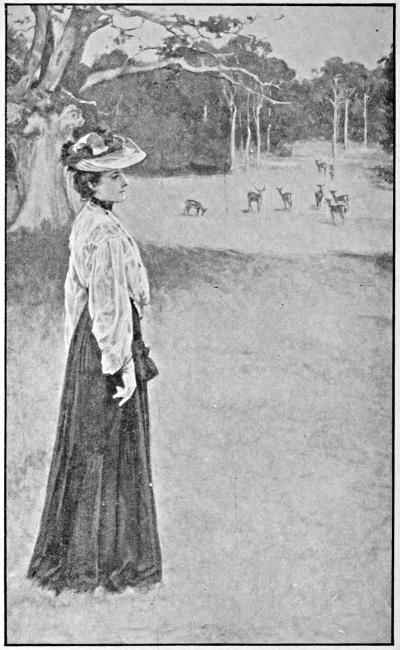
The frost was thick in the park, and every
little twig upon the great bare trees outlined
clearly against a sky of pale cloudless blue.
Sydney wondered why she did not feel the old
exhilaration that a morning such as this would
have once awakened in her, even in smoky
London.
But if she could not enjoy the perfect morning,
they soon met somebody who could!
As they passed the gate of the Vicarage, Mr.
Seaton came out, holding Pauly by the hand.
The child was in a state of absolutely wild
delight, dancing and jumping by his father’s
side, and his eyes glittering like two stars under
the tangle of red hair.
“Going up the great big ’normous tower!”
he informed Sydney, as she stooped to kiss
him. “Going to walk miles and miles and
miles up ladders, almost to the sky!”
The Vicar laughed and shook hands with
both the girls.
“I have to give some orders about new bell-ropes;
ours were rotten, and I’ve had them
taken down,” he explained. “And it was an
old promise I should take this monkey up the
tower next time I had to go there. Do you
two feel inclined, I wonder, to come with us,
and walk ‘miles and miles and miles up ladders,
almost to the sky’?”
Sydney looked at the tower, standing grey
and tall outlined sharply on the blue, and then
at Miss Osric. “Should you like it? It would
be lovely, I think.”
“We should like to go up very much indeed,
if Mr. Seaton doesn’t mind the bother of us,”
said Miss Osric, and the four went on together
to Lislehurst Church at the farther end of
the village.
The church itself had been rebuilt in the
eighteenth century, when the black oak panelling
had been removed as “dirty-looking” and
replaced by whitewash, and relieved at intervals
by the St. Quentin Arms painted on it in the
gaudiest colours. At the same time, the few
bits of exquisite stained glass which had survived
a visit from the “root and branch” men of the
Commonwealth days had been taken away
to make room for a complete set of crudely
coloured windows, which vexed the soul of Mr.
Seaton whenever his eyes fell upon them. But
the old tower had been left intact, and was
considered by the learned to be one of the
finest specimens of fourteenth century architecture
left in England.
There was a tradition that the saintly Bishop
Ken had once climbed it, and had pronounced
the view from the top to be “a foretaste of
Heaven.”
Sydney, when she saw the perpendicular
ladders tied together, which those who went
beyond the belfry chamber were compelled to
climb, doubted privately the probability of anyone
so old and frail as the non-juring Bishop
had grown when he came to Blankshire, having
strength or breath to reach the summit!
“You are not frightened, are you?” asked
the Vicar, when he had given his orders to the
man awaiting him in the belfry chamber, now
emptied of its dangling ropes. “Don’t try it,
if you feel in the least bit nervous, for it is a
stiffish climb!”
To be quite honest, Sydney did not particularly
like the look of the many ladders to
be scaled, but she would have died sooner than
own her fears.
After all, this was not so very much more
difficult than going up the ladders in that oast-house
in Kent, where they had gone to see the
men stamp out a hop-pocket, when the whole
family had spent that happy fortnight in a
Kentish farm-house last summer. Only then
Hugh had been there to help her, and pull her
up that awkward step where two rungs had
gone from the ladder. Her back was to the
Vicar, but Miss Osric saw the sudden wistfulness
in the girl’s grey eyes.
“Well, come on, if you really don’t feel
nervous,” Mr. Seaton said. “Oh, Hiram,” as
the old clerk came stumbling down the ladders
at the sound of their voices, “you here? That’s
just as well. Now you can go up in front and
get the little tower door open for the ladies.”
“Gentleman up the tower now, sir,” Hiram
said, touching his battered hat.
“All right; he won’t interfere with us,” the
Vicar said. “Now, Miss Lisle, will you go
first, and take Hiram’s hand where the ladders
cross. Miss Osric, you next. Then Pauly.
Hold tight, you little monkey, or I’ll take you
down again! I’ll bring up the rear, and then
if anybody slips, I’ll catch them.”
The procession started, Mr. Seaton keeping
a firm grip of his small son’s blouse the whole
time, and calling at intervals directions to the
others.
Up, up they went, clinging to the ladders
set perpendicularly against the rough grey
walls, worn with the lapse of time. Higher
and higher still they went, till Sydney and
Miss Osric felt as though they had been
climbing for hours instead of minutes.
The elders had no breath for speech, but
little Pauly chattered unceasingly. “Did these
funny stairs go right up into Heaven? Would
there be angels at the top of the tower?
Would there be stars? Would there be at
least a hole through which Pauly might look
into Heaven when he came so near it?”
Sydney could hear his shrill little voice
talking on, and his father’s grave tones answering
him now and then. As they came higher
the echoes caught up the two voices and
made the old tower ring with them in a way
that sounded strange and very eerie, Sydney
thought.
“Getting tired, Miss Lisle?” called the
Vicar cheerily, as she set foot on the highest
ladder.
His words must have been heard by “the
gentleman” of whom old Hiram had spoken,
for a square of blue and sunshine opened
suddenly above her, and, as she toiled up the
final rungs, a hand, whose touch was certainly
familiar, grasped hers, and swung her over
that last awkward step, where she seemed to
hang over a yawning black gulf for a moment,
before landing upon terra firma outside the
tower.
“Hugh!” She had forgotten everything for
the moment, except the joy of seeing him
again, but in an instant, like a bitter wind,
her cousin’s words swept back upon her—“I
forbid you to have anything to do with
that young man.”
Hugh could not think why she withdrew
her hand, and went back to the little low
tower door with a cloud on the face that had
been so bright a minute since. “How slow
the others are in getting up!” she said.
Hugh watched her uneasily, as she gave
her hand to Miss Osric and helped her through
the doorway; then proceeded to the same
office for little Pauly. Surely it was very
unlike Sydney to have nothing to say to
him, to be absorbed in these comparative
strangers, when he was at her elbow. Surely
her manner had changed with extraordinary
speed since yesterday.
She on her part had been rapidly considering
the situation. It was plainly impossible
to go down the tower again the very minute
after she had come up it. What excuse could
she make that had the slightest sound of reason?
None, she was quite aware. Plainly the only
thing that she could do was to obey her cousin’s
order in the spirit though not in the letter.
She was rather pale, but her voice was
steady as she bent over little Pauly, devoting
herself to answering his many questions.
Mr. Seaton talked to Miss Osric and to
Hugh, who answered him a little absently.
His eyes were fixed on Sydney. The Vicar
looked from one to the other in a rather puzzled
way from time to time, as he did the honours
of the splendid view that lay before them.
Glimpses of the Castle showed through its
encircling trees, but in summer, Mr. Seaton
said, when all the leaves were out, it was completely
hidden.
He pointed out in succession the quaint
little villages, dotted at intervals about the
valley, with some interesting comment upon
each. There was Loam, which boasted the
finest chancel-screen in the county. Miss
Lisle and Miss Osric ought to see it one of
these bright days: it was most distinctly worth
the trouble of a visit. That tiny church, with
a tower that looked as though some giant had
sat upon it long ago, was Marston. Did Mr.
Chichester remember a humorous account in
the papers two or three years back, of a famous
“kill” which had taken place in Marston
churchyard, when the fox had taken refuge in
one of the old stone box tombs, and held the
narrow entry, worn by age and weather in the
stone, for full an hour?
Styles and Hurstleigh lay out yonder; it
was in Hurstleigh that the Manor stood, which
a loyal lady of the Civil Wars had defended
against General Ireton, till relieved by her
husband just as the little garrison were reduced
to the last straits.
At another time Sydney would have been
immensely interested in the story, but to-day
somehow she could not care even to see the
place where Madam Courtenay caught the
first glimpse of the scarlet mantled horsemen,
riding to her succour only just in time.
She could not put herself to-day into the
place of the cavalier lady and rejoice with her;
she could only feel herself, Sydney Lisle, behaving
in a horrid, stiff, unkind way to the
brother Hugh, who kept looking at her with
those troubled, questioning eyes.
Miss Osric was the only member of the
party who really enjoyed Mr. Seaton’s explanations,
for little Pauly thought them dull to the
last degree. He wanted to know several
things, and no one would attend to his shrill
questions. Sydney was looking where Mr.
Seaton pointed, with unseeing eyes, and his
father took no notice of various impatient tugs
at his hand. Pauly wanted dreadfully to know
why the sky had gone away again, instead of
being quite near as he had expected, and
whether mother and the angels would hear him
if he were to call up to them very loudly, now
this minute, and whether a big man, who was
big enough to lean over the stone parapet of
the tower which his own head barely reached,
could see “In Memory of Rose” on the white
marble cross in the churchyard down below.
Hugh, to pacify him, looked over, and pronounced
that he could see “no end of crosses.”
But this by no means satisfied Pauly. Hugh
must see that special grave where Daddy took
him every Sunday, after service.
“Tell me where to look,” Hugh said; “but
you keep still, young man, if you please.
Don’t you go trying to lean over!”
He stared down. “Is your cross a tall one,
near a tree?” he asked presently. Pauly gave
a bound of delight.
“Yes, that’s where ‘In memorwy of Wose’
is. Do you see the lovely holly on the grave?
I stuck lots in the tin, I did weally, and my
fingers was all bleedy after. I didn’t mind.
Boys don’t mind being bleedy. ’Spect that
big girl that you keep on looking at would
mind. Girls cwy when they’re bleedy, don’t
they? Do you cwy? I s’pose not,’cause
you’re a big man. Did you see my lovely
holly? No, you won’t see where you are.
Oh, look! You can see my lovely holly this
side of the tower as well.”
“I say—stand still!” Hugh said sharply,
turning his head round. Pauly, in a state of
wild excitement, was climbing up the three-foot
parapet as nimbly as a cat. “Get down!”
Hugh shouted, springing to his feet, and darting
over to the child. He spoke too late.
Pauly had reached the top, and was kneeling
on it, peering down upon his “lovely holly.”
“Oh, I can see it! I can see my holly!” he
screamed joyfully, clinging and laughing.
Whether the height turned him giddy, or
he lost his balance by leaning too far, no one
knew. There was only time for a cry of horror,
and a frantic grasp into emptiness upon Hugh’s
part. The child had fallen from the parapet!
The poor father staggered backward, his
hand to his head—the two girls clung together,
speechless; only Hugh was able to
look over. The next moment he was shaking
Mr. Seaton fiercely by the shoulder.
“Quick, sir! Down and cut the belfry ropes.
Please God, we’ll save him yet!”
The Vicar, scarcely able to believe his ears,
looked over.
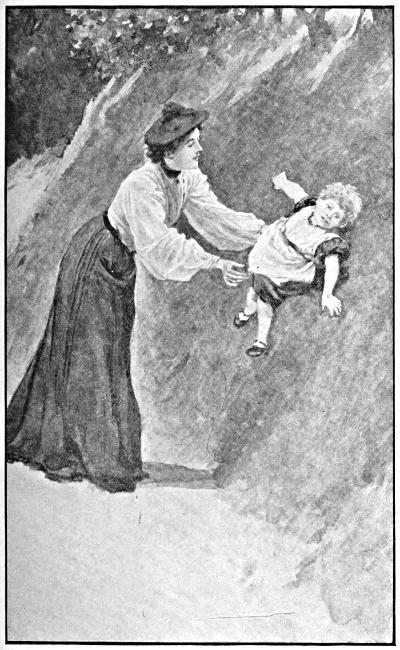
Some nine feet down the tower, at each
corner, a large projecting gargoyle served the
purpose of a water-spout, and it was on one
of these little Pauly had fallen—the creature’s
stone ear having caught his blouse as he
bumped against it in his fall. He was lying
on his back across the gargoyle’s neck, his legs
and head swinging into space, his frock hitched
half across the hideous head. He was still at
the moment, but how long would he remain
so? Below him was a drop of seventy feet.
Hugh flung off his coat, and put his leg
over the parapet. “Hurry with the ropes;
I’ll go to him.”
“No, no, not you!” the Vicar cried. “I
must.”
But Hugh was already letting himself down.
“Quick with the ropes!” was all he said.
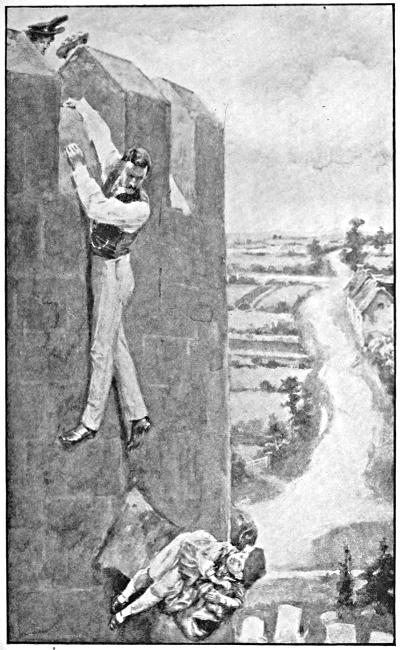
“‘Quick with the ropes!’ was all he said.”
(Page 128)
Sydney and Miss Osric looked at one another.
“The belfry ropes are gone!”
Before they had finished speaking, Mr.
Seaton was tearing in a neck-or-nothing fashion
down the ladders. It was well for him that
he was forced to act, and not wait to think.
Ropes must be got, and immediately, for what
ladder would be long enough? He did not even
cast one glance back at the tower as he rushed
through the churchyard in search of a rope.
There was nothing that Miss Osric and
Sydney had the power to do but wait and
pray. They clung to one another silently,
with set, white faces, as Hugh commenced his
difficult and dangerous descent, with one eye
on the little figure, which might move and be
dashed from its precarious resting-place at any
moment. Was the child stunned? Hugh
almost hoped he might be. Any movement
must almost certainly be fatal to his balance.
But as the young man felt carefully his
third step in that perilous climb, there was a
quiver in the dark blue bundle on the gargoyle,
and a scared little face was uplifted to his.
The hearts of the girls above stood still.
Hugh was struggling desperately for a foothold
which it seemed impossible to find.
Would the child move, or look down? Should
he do so, nothing could save him.
“It’s all right, old chap!” Hugh called in
his cheeriest tone. “You just keep still where
you are. Yes, that’s right; now look at me.
I’m coming down to take you up again. No,
don’t try and sit up—you can see me splendidly
from where you are.”
His voice broke off, as he all but lost both
hold and footing. He regained it with a frantic
struggle and descended another step. “Look
at me, Pauly!”
Pauly’s round eyes gazed up wonderingly.
Hugh neared the gargoyle, and set his teeth
for a mighty effort.
Pauly was a particularly large and strong
boy for not quite five years old, and, even on
firm ground, would be no joke to lift in one
hand. But the thing must be done. Hugh
strengthened his hold with his right hand, and
took an anxious downward glance. Some of
the village men were trying to join ladders,
but they were far too short. Mr. Seaton was
running frantically up the road beyond the
churchyard, with a coil of rope on his arm.
In the clear air Hugh could see his upturned
face, dead white, with eyes staring wildly.
He could not possibly get through the
churchyard and up the tower in less than ten
minutes—Hugh thought he would probably
take longer. It was not therefore possible to
risk leaving Pauly on the gargoyle till he himself
should have the help of a rope.
He took the firmest grip he could of the
roughened stonework of the tower with feet
and right hand, and loosed cautiously the other,
reaching with it towards the blue bundle on
the gargoyle. “Steady, Pauly, keep quite still,
old chap!”
With a struggle that brought beads of perspiration
out upon his forehead and nearly sent
him flying into space, he grasped the child,
and raised him slowly from his resting-place;
then stepped down on to the gargoyle, and
stood there, clasping Pauly closely, and leaning
back against the wall with closed eyes.
He was too physically exhausted with the
terrible anxiety and effort of the last few
minutes to make any further movement then.
Besides, it was now a necessity to wait for
the rope. The upward climb would be impossible
when burdened by the well-grown boy.
He had to concentrate all his powers on
keeping steady on the slender foothold, which
was all the gargoyle afforded, and waiting for
the help which Mr. Seaton would bring.
It seemed hours before a shout from above
came down cheerily to him, and a rope end
struck him on the shoulder. “Now, Pauly,”
he said, “hold on round my neck for all you’re
worth, there’s a good little chap!”
He took a firm grip of the child’s blouse in
his teeth, and, steadying himself with infinite
difficulty, fastened the rope beneath his own
arms, in the strongest knots that he could
make. Then, using his hands as a trumpet,
he called “Ready!”
His left arm was round Pauly, his right
grasped the rope above his head. “Now hold
tight, little chap, and don’t be frightened!”
Pauly carried out this order by taking as
good a grip as the hair-cutter allowed of Hugh’s
head, and it was in this position that the two
were at length hauled over the parapet by the
united strength of the Vicar, Hiram, and the
Vicarage gardener, whom Mr. Seaton had met
while searching for a rope.
Mr. Seaton wrung Hugh’s hand in silence,
and held his son to him, in silence also. No
one seemed to have much voice for speech
just then; even Pauly was subdued and shaken
by his fall, though he had escaped with nothing
worse than grazed knees.
The descent from the tower was very quiet
and sober. A strong shudder went through
the party as they passed the belfry chamber
and thought about the awful moment when
they had realised that the ropes were gone.
His father carried Pauly, and Hugh went
in front of Sydney and Miss Osric, and gave
them his hand where the ladders turned. He
and Sydney never spoke the whole way down.
They were in the churchyard at last, and
Pauly was demanding to be shown “the funny
little step where me and him was standing.”
The Vicar, shivering, hushed him, and turned
to Hugh. “You’ll come in and lunch with
me?” he said, a little huskily, his hand upon
the young man’s shoulder.
“Thank you, I will,” Hugh answered
gravely.
“And, Sydney, we must hurry back,” Miss
Osric suggested. “I am sure it is getting late.”
Sydney moved a step away; then took a
sudden resolution.
She went to Hugh and held out her hand.
“Good-bye, Hugh. Please understand,” she
said very low.
Hugh took the little gloved hand in his, and
read rightly the trouble in her eyes.
“It’s all right—don’t you bother, Syd,” he
said. “I understand.”