COPYRIGHT, 1941, BY A. S. BARNES AND COMPANY, INCORPORATED
This book is fully protected by copyright and nothing
that appears in it may be reprinted or reproduced in any
manner, either wholly or in part, for any use whatever,
without special written permission of the copyright owner.
PRINTED IN THE UNITED STATES OF AMERICA
This little book is dedicated by two former pupils
To
FRANCOIS DARRIEULAT
Originally of Dax, in France; sometime Master of the Sword to
The Washington Fencer’s Club, the Washington Racquet Club,
the United States Naval Academy and Cornell University. Twice
coach to American Olympic Fencing Teams. A sound teacher,
an inspiring master, a loyal friend.
PREFACE
The accompanying brief text originated in the failure,
when called upon to coach the fencing team at the University
of Kentucky several years ago, to find any book on
the subject that seemed to sufficiently emphasize some of
the basic principles of French Foil play. With books adequately
presenting both the Italian and compromise schools,
we felt that a brief presentation of the theory of the French
school would not be amiss.
It has seemed to us that this tendency to follow a compromise
school without any effort to explain or insist upon
the basic theory and practice of either French or Italian
method, will develop a group of sword fighters whose progress
is limited by their personal ability and originality
along irregular lines rather than by the almost limitless possibilities
of either of the classical schools. Certainly a
fencer thoroughly grounded in the basic philosophy and
technique of either of these schools is better prepared for a
long course of steady improvement than the individual who
has a rather vague conception of the purpose and performance
of offense and defense with the sword.
Therefore, we have endeavored to present accurately and
with reasonable thoroughness the basic principles of the
French school. We have tried to indicate the practical application
of these principles to competition fencing and to
point out a number of the pit falls that await the unwary.
There are four groups to whom it is hoped that this little
book will prove of special value: (1) the amateur fencer
whose past interest has been in the practice rather than in
the theory of the art, but who has been drafted as coach in
one of the colleges that has no available professional;
(2) the instructor in the Department of Physical Education
who, with only a minimum of personal knowledge, is
called upon for class instruction; (3) the amateur fencer
who has become somewhat vague in his memory of theory,
rules, and conventions, but finds that he is to be called upon
to act as an official in local fencing matches; and (4) the
young fencer who must either give up fencing or find his
way as best he may without the advantages of personal
instruction.
Man was never as fleet of foot and certainly never as
strong of fang and claw as the larger animals with which
he had to contend as he fought his way up the ladder of
physical and social evolution. However, he was superior
in cunning, and, later, in pure intellect. Early, he sought
means of equalizing the physical balance—first employing
such crude clubs as could be broken from the forest trees,
later improving these by the addition of a grass or skin
bound lump of stone, and yet later discovering that blood-letting
was superior to tissue crushing. This last discovery,
which led to the development of the stone knife, was the
first step in the evolution and perfection of the sword.
First, the dagger was fastened to a staff to make a spear
and, eventually, the sword appeared, although this probably
did not come in its true form until the bronze age. Whatever
its exact date, since the earliest historical records and
monuments of man, the sword has been his companion and
principal weapon of offence and defence. In fact, it was not
until after the French Revolution that it disappeared as
part of the formal dress of the gentleman, and not until after
World War I that it ceased to be an important part of the
equipment of the cavalryman.
And the sword was by no means a strictly utilitarian
product. Not only was it frequently the object of the most
painstaking and loving attention of both swordsmith and
silversmith, but it was endowed with personality, in some of
the most romantic songs and stories of the ages. King
Arthur, at the head of his knights of the Round Table, did
not wear just a sword. At his side rested Excalibur. When
Roland died in the Vale of Roncesvalles, surrounded by the
bodies of his Moorish foes, in his right hand was the good
sword, Durandal. The Cid Campeador carried into battle
the sword Tizona. Siegfried bore no nameless weapon. And
so, in the romances of England, of France, of Spain, and of
Germany, we find the swords of the heroes endowed with
personalities. Therefore, we may proudly claim that our
weapon has a history and a romance both as old as those
of man. Also, it is interesting to realize that the sword has
progressed with its bearer, varying in weight, in shape, and
in general characteristics as he has visualized the uses to
which it was to be put. In the so-called days of chivalry, the
problem of the swordsman was not graceful play of sword
against sword, but the cracking of a shell of armor so that
he could reach the kernel of humanity within. With the
passing of armor, the sword was lightened to the rapier—and,
with the progressive lightening of the sword, its uses
became more and more delicate and complicated, until, by
the time of the appearance of the colichemarde and small
sword, most of the refinements that we know today had been
recognized and developed.
Today, there remains to us a game which employs the
three weapons that have been derived from the rapier—the
duelling sword which, except for larger guard and
slightly larger blade, is an exact replica of the small sword;
the foil, which was developed as a practice weapon for the
small sword; and the saber which retains the use of both
point and edge, as did the rapier, but is much lightened to
permit greater speed and versatility of play. This game
calls upon the physical forces as does any of our more
severe athletic games. It requires the meticulous attention
to technique that characterizes golf; the explosive energy of
the sprint runner; the split-second decisions of the tennis
player and boxer; and, above all and before all, it requires
for its fullest achievement a power of analysis that is not
equalled by any other game in the athletic group—much
more nearly resembling chess in this characteristic. And it
is this final attribute that charms and holds its devotees.
After the passing of the super-abundant physical energy of
youth which requires some outlet, even after the passing of
that period when hard training will bring back speed and
endurance, there remains the fascination of the game, where
cunning of head and skill of hand may still more than balance
the physical superiority of younger, but less skilled,
heads. It is a game that can be followed for four or five
decades, with the aging devotee still a dangerous competitor
at the end of this time. It is a game where the 220
pounder has no advantage over the man half his size, and
where the six footer possesses no insuperable advantage
over the man a half foot shorter. It is a game of speed and
coordination, of technical finesse and intellectual acuity,
and offers full reward, both physical and mental, to those
who will pursue its intricacies.
Chapter I FUNDAMENTALS — THE POSITION OF GUARD, WITHOUT THE SWORD — THE ADVANCE AND RETREAT — THE THRUST — THE LUNGE — THE SWORD — THE GRASP (GRIP, OR HOLD) OF THE SWORD — POSITIONS OF SWORD-HAND IN GUARDS
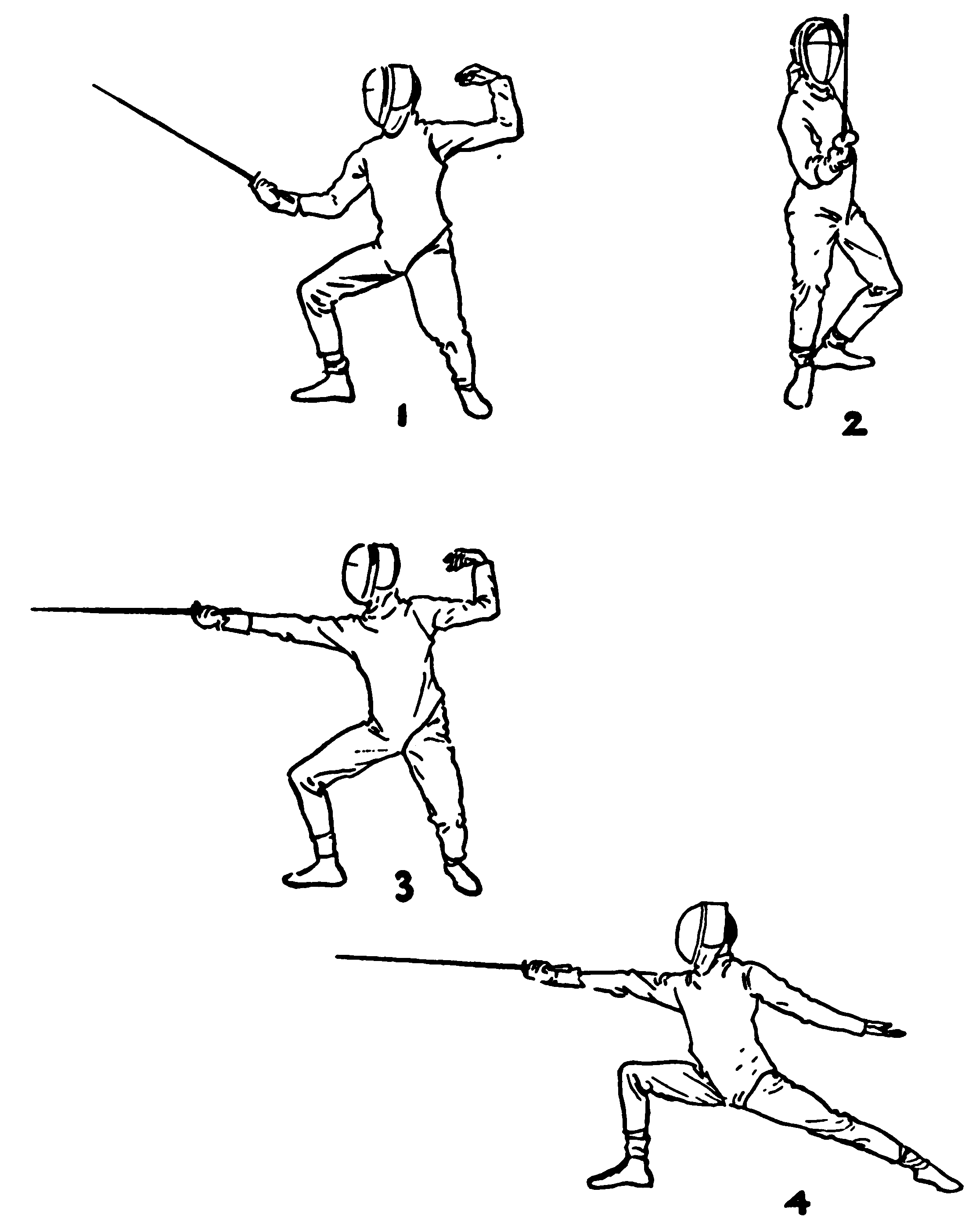
The feet are at right angles—the front foot in the long
axis of the fencing strip and pointing directly towards the
opponent, with the heel in line with the heel of the rear foot
and about two foot-lengths from it. The distance between
the feet cannot be set arbitrarily, but must be such as to give
a steady position without sacrificing agility, or tending to
fixation. Both knee- and hip-joints are well flexed, so that
the individual is almost “sitting on air.” The front thigh
should form an angle of less than forty-five degrees with the
horizontal and the knee should be directly above the instep.
The rear knee is “cocked” slightly in front of a vertical line
above the foot—so as to lend more force and assurance to
the forward kick in the lunge. The weight is equally distributed
on both feet, so that movement to the front or rear
may be executed with equal ease. The body is erect, with
rear shoulder forced somewhat backward so as to minimize
the target offered to the opponent, but without sufficient restraint
to hamper activity. The rear arm is elevated, with
upper arm horizontal, forearm vertical and hand horizontal,
the shoulder, elbow and wrist forming right angles.
The position of this arm should be maintained without rigidity
or tightness. The forward, or sword, arm is about two-thirds
extended, the forearm being almost horizontal with
elbow and hand slightly below the level of the breast. This
level should be approximately midway between the top of
the collar and the fork of the crotch. The elbow of the sword
arm should be maintained definitely inside of the outer line
of the body.
Early effort should be made: (1) to accustom the
muscles of the rear shoulder to maintaining its backward
position for the effacement of the target; (2) to accustom
the thigh muscles to the strain of maintaining the semi-sitting
position; and (3) to accustom the muscles of the
shoulder of the sword arm to the inside position of that
elbow. These are the only positions in fencing that carry with
them a sense of constraint to the beginner, and, as each
makes a very appreciable contribution to the future efficiency
of the swordsman, they should be practised with
assiduity from the beginning. The well flexed legs are the
very basis of the attack; the withdrawal of the rear shoulder
minimizes the apparent target; and the “inside” elbow of
the sword arm is a fixed pivot from which all parries are
controlled and all ripostes launched.
Fencing is a game of constant, sudden, and rapid movement.
The necessity of closing distance to facilitate the delivery
of a successful attack and of increasing distance to
reinforce the execution of a planned defence results in almost
incessant advancing and retreating. The advance is
executed by carrying the front foot forward approximately
its own length, planting it, and quickly bringing the rear
foot up to its previous relative position. The retreat is
merely a reversal of this procedure, first carrying the rear
foot backward approximately its own length, and then following
with the front foot. The necessity for quickness in
these movements cannot be over-emphasized. A certain
amount of imbalance and unreadiness is bound to exist
while one foot is in the air. The opponent may await this
brief moment and seize it for launching his attack.
Fig. 1. Side view of guard; in quarte.
Fig. 2. Front view of guard; in quarte.
Fig. 3. Thrust.
Fig. 4. Lunge.
The jump advance is just what the name would indicate,
a short jump forward—both feet leaving the ground at the
same time. In the Italian school, this is called the “balestra.”
It has the advantage of being executed in a single
movement, thus being quicker. However, being in a single
movement, it is irretrievable and, once started, must be
completed. Probably, its greatest field of usefulness is
against the individual who invariably sways backward on
his rear leg with his parry against any attack.
The thrust is entirely a movement of the sword arm and
is the initial movement in every attack. As the right of way
in the attack depends upon the sword arm being extended,
with the point threatening the target, any movement preceding
the thrust, such as an advance or retreat, is merely
by way of preparation, constitutes no threat, and, consequently,
has no rights. The movement, in its simplest form,
is merely a quick extension of the arm, with point in line.
The quickness should be without initial tension or terminal
jerk. If the point is not in line, it does not threaten the
target; does not constitute an effective feint; and, therefore,
does not command the right of way. Occasion will be taken,
from time to time, as this work progresses, to return to this
point for it is upon it and the various departures from it
that the entire theory of the right of way in foil fencing
is based. To recapitulate: No movement is a legal threat,
or possesses any inherent rights, unless preceded, initiated,
or accompanied by an extension of the arm, with the point
in line; nor do these rights become activated until this
movement has been completed; nor do these rights persist
after either the extension of the arm, or the threat of the
point, is withdrawn.
The lunge is the forward movement of the body by a
powerful extension of the rear leg. With the kick of the
rear leg, the front foot is raised an inch or two clear of the
floor and travels forward one and a half or two times its
own length, the heel landing almost imperceptibly ahead
of the planting of the ball of the foot. When the front foot
lands, the rear foot should remain in its original position;
the rear leg should be extended; the thigh of the front leg
should be horizontal, the lower leg vertical, and the body
inclined very slightly forward. With the kick, the rear arm
is straightened smartly to the rear. This is the concluding
movement of each properly executed attack, carrying the
point from its position at the end of the thrust to the target.
It should be catlike in the speed of its execution as well as
in the accuracy and coordination of its movements. It is
executed in a single time. There is no intermediate stage.
There is the kick of the rear leg, followed by the arrival in
the full extension of the lunge. There is no gentle settling
to, or gradual assumption of the lunge. The movement is
explosive in its sudden completeness. If the legs are insufficiently
flexed, the forward movement becomes a fall and
is infinitely slow in the split-second terms of fencing time.
If the rear knee is not cocked slightly forward, as prescribed,
the impetus is apt to be in an upward, rather than
forward direction, and both time and distance are sacrificed.
If, in the anxiety to reach out toward the opponent,
the body is allowed more than a very slight forward inclination,
the balance will be disturbed and the recovery
slowed. This may leave one at the mercy of a skilful opponent
who has successfully parried the original attack.
The recovery from the lunge is almost entirely dependent
upon a strong kick-back with the front leg. It is aided by a
simultaneous flexion of the rear leg and swinging of the
rear arm up to the position of guard. This recovery must be
executed as quickly and smoothly as was the lunge. It must
be so perfectly coordinated and free from conscious effort
that it permits the careful execution of defensive movements
with the sword during its performance. This presupposes
long, hard practice, so that perfectly seasoned
muscles perform their function almost without conscious
direction.
Great emphasis is being placed in these preliminary remarks
upon the development of fencing legs. This is necessary
for at least two sufficient reasons. In the first place,
fencing is a war of movement—not one of fixed positions.
In the second place, the muscles involved are used in a
way for which no other sport is more than a partial training.
While the fencing lunge may well be compared with
the quick start in the dash races, one is not allowed to prepare
his stance for a single start but must be continually in
position to make it at any moment and repeatedly, with
every muscle under the tension that exists at the precise
moment that the gun fires for the start. The sudden movements
of the advance and retreat must be made from this
position. The strain upon untrained thigh muscles is extreme.
The fencer who has not fully mastered these movements
and trained these muscles starts handicapped and
must look for his victories among those who are inferior to
himself in other branches of the game, or who are equally
inferior in this branch. Perfect performance and perfect
coordination of head, hand, and legs are necessary for the
finished fencer. The neglect of proper foot-work is one of
the commonest failings in young fencers—but is almost
never seen among the finalists in major competitions. Bad
and slovenly habits, formed early, are frequently fatal to
later success. School the hand and the legs, while waiting
for observation and experience to develop the head.
A good exercise for the development of fencing legs
consists in taking the position of guard at one end of a
forty-foot fencing strip and advancing rapidly to the other
end, interspersing a lunge and recovery after every third
or fourth advance. Never relax the flexed position of guard.
When too fatigued to continue properly, stop and rest.
The same exercise may be taken in reverse, doing several
quick retreats followed by lunge and recovery. Remember
that the average foil bout lasts about five minutes and that,
against anything like even competition, you may have to
make innumerable advances and retreats with as many as
fifteen lunges to gain your five touches. And you may have
to do this three, six, or nine times in a single afternoon,
with the added fatigue of high nervous strain. Few sights
are more depressing than a young man, with the legs of
an octogenarian, having to flex them before each attack
and trying to step back, with knees straight, from a swiftly
executed attack.
Hitherto, we have discussed the position of body and
arm without the sword. From now on, we discuss these positions
with the sword in hand.
The sword is made up of four components: the blade;
the guard; the grip (or handle); and the pommel. The blade
is further subdivided into the blade proper and the tang.
The tang is of much softer temper than the blade proper,
meets it at a sharp shoulder and serves for the attachment
of guard, grip, and pommel. The guard is usually made
of polished, or plated, steel or aluminum and is most commonly
shaped in a double loop, called “figure 8,” or as a
segment of a spherical surface, called “bell.” Occasionally,
rectangles or ovals of solid metal are seen. The guard has
a square aperture at its center for the passage of the tang.
The “figure 8” guard must be faced, on the blade side, with
heavy leather or other material to prevent the passage and
trapping of the opponent’s point. The bell guard is usually
padded on the inner face with a light, circular, cloth
cushion. The grip is usually made of wood, with a tunnel
through its center for the passage of the tang. It is slightly
curved to better fit the hand and is usually wrapped with
cord. The pommel is usually of steel in the shape of a
truncated cone, of such length and weight as to properly
balance the sword. It may be in one or two pieces and is
usually threaded to fit the end of the tang.
The French blade most commonly used is the #5, which
is about thirty-five inches long; rectangular in cross section;
much heavier near the guard than at the point; and
resilient and highly tempered, so that its tendency is to
resume its straightness after a touch. This blade terminates
at the point in a flattened button, which, in practice, is
wound with waxed cord or friction tape. The blade proper
is divided into three theoretical portions: the forte, which
is the heavier part near the guard; the faible, which is the
light portion near the point; and the middle section. In the
French theory, all parries are made against the faible of
the attacking sword, either by a pressure of forte to faible
or of a sharp blow of forte to faible, faible to faible, or
mid-section to faible.
The balance of the French foil, to lend itself ideally
to the finger play that is the perfection of French fencing,
should be immediately in front of the guard, so that the
sword is very slightly point heavy. This balance can be
obtained by mounting a standard #5 blade and guard, with
a grip measuring six and one half inches in length, and a
steel pommel measuring two inches in length and weighing
about five ounces. Many of the French foils offered on the
market are so short in the grip and light in the pommel as
to create a heaviness of point that is almost prohibitive to
any delicacy of finger work.
The manner in which the sword is held largely governs
its proper use, but is frequently neglected in the basic instruction
in sword-play. In the French school, proper sword-play
is grounded upon finger work and, for the successful
employment of this technique, two distinct grips are employed—the
one for defence, the other for offence. In both
grips, the position of the thumb is the same, resting upon
the broader surface of the handle close to the guard. However,
the finger grip varies. In the defence grip, the grip
of the sword passes across the palm in such a manner as
to permit the fingers to curl snugly around the handle, the
index finger resting its distal joint (articulation, not phalanx)
on the broad surface opposite the thumb and only
partially encircling the handle. This grip permits the use
of the full strength of the fingers in making parries and
attacks on the sword. In the attack position, the handle
of the sword runs slightly obliquely along the palm of the
hand, instead of across it, and is in direct prolongation of
the extended arm. The thumb and index finger retain their
firm grip near the guard, but the terminal phalanges of the
other fingers now rest lightly along the narrow face opposite
the palm for direction and control, rather than force.
The finger work (doigté) is one of the most valuable and
delicate and, at the same time, one of the most difficult and
neglected features of French sword-play, and this shifting
grip is quite necessary for its proper performance.
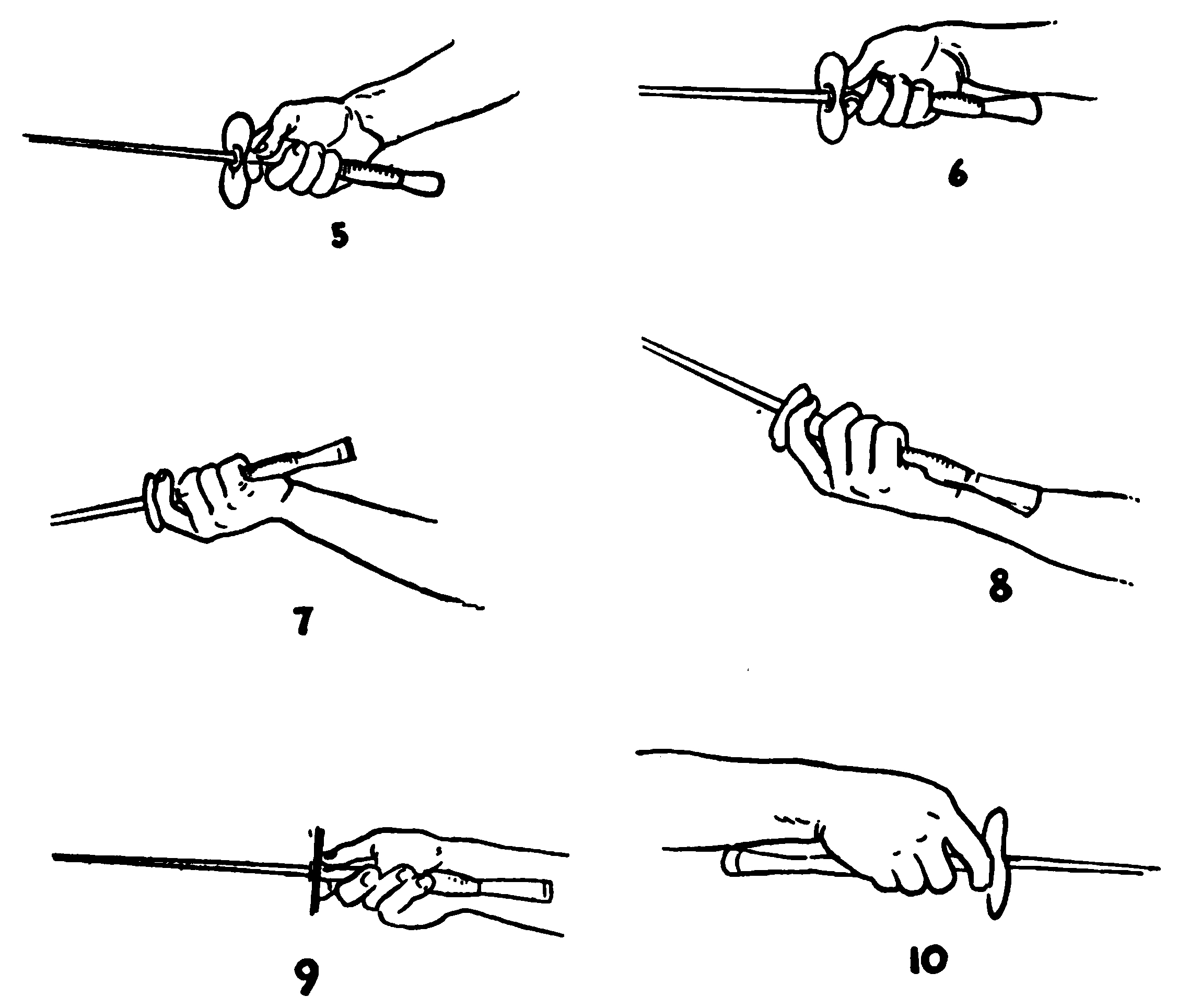
Fig. 5. Grip of sword in quarte; supination, page 11; defence,
p. 9; top view.
Fig. 6. Grip of sword in sixte; supination, p. 11; defence, p. 9;
top view.
Fig. 7. Side view; hand in supination, p. 11; low line guard, p. 11.
Fig. 8. Side view; same as above except high line guard.
Fig. 9. Grip in attack, p. 9; top view.
Fig. 10. Hand in pronation, p. 11.
The general position of the body and extremities in the
position of guard has been discussed in earlier paragraphs.
The various guards with the sword are designed to close
the various lines of attack to the opponent’s sword. The
valid target in foil play includes the entire trunk and the
neck to the top of the collar. The head, arms, and legs are
excluded. For purposes of description and of defence, this
target is divided by an imaginary horizontal line into a
high and a low line. This horizontal line is drawn at slightly
below the level of the breast and equally divides the distance
from the top of the collar to the fork of the crotch.
Frequent reference is also made to an inside and an outside
line, dependent upon its vertical area inside, or outside,
the sword arm. The high and low lines are fixed and
constant, but the inside and outside lines are variable, for
reasons that will be given later. The various areas of the
body are protected by a series of guards which, by their
position, prevent the attacking sword from reaching the
body in this particular area. This division gives two areas
to be covered in the high and two in the low line. This
gives us guards in both high and low lines that deviate the
attacking point from the target either to the outer side or
to the inner side of the sword arm. Not only are there the
four general lines of deviation of the attacking point, but
in each of these lines there is a distinction based upon
whether the guard is closed with the fingers of the sword
hand up (hand in supination) or with the fingers down
(hand in pronation). This gives us eight guards in all.
In all of these guards, the hand is maintained in the horizontal
line dividing high and low lines, the point being at
eye level in the high line and at knee level in the low line
guards.
If, as stated above, these guards prevent the attacking
sword from reaching the body in the particular area which
each is designed to protect, it becomes obvious that, when
an outside guard is taken, no outside line for attack exists,
except one which is outside the body, and, consequently,
no line at all. The same holds true of the inside line, either
high or low. Therefore, the outside and inside lines are
variables, existing only one at a time for purposes of
attack and, when they do exist, including the entire target.
This distinction will become more clear with the detailed
description of the various guards and their use in combat.
Chapter II DEFENCE AND ATTACK
Although one would probably be quite justified in stating
that there can be no arbitrary system of attack and
defence with the sword, yet the four and a half centuries
of accumulated experience that measure the development
of modern sword play must have taught certain lessons as
to greater, or lesser, desirability of method. The foil, being
essentially a weapon of practice, has further been surrounded
with certain conventions which carry a direct, or
indirect, penalty for doing things that would result in a
wound to the offender in actual combat with sharp weapons.
The convention of the “right of way” is probably the
most important single convention in foil play and has
evolved from certain very logical assumptions regarding
conduct in actual combat. It is assumed that there is no
attack until there is a threat and that there can be no threat
unless the point is directed toward the valid target. It is
further assumed that any individual threatened with a
sharp weapon would make some movement of defence. In
order that the attacker should somewhat more definitely indicate
his intention than by the simple direction of his point
in order to be able to claim the benefit of the convention, it
is further assumed that the first movement of a real attack
will consist in the extension of the arm, as the forward
precipitation of the body with arm withdrawn might result
in impaling oneself upon the extended sword of one’s opponent.
Thus, the convention declares that the individual
who extends his arm towards his opponent, with his point
in line (that is threatening the valid target), shall have the
right of way. This convention (right of way) requires that
his opponent shall deviate the attacking point from its
threatening position by parry, or attack on the sword, or
by evasion through bodily movement before initiating any
type of counter-offensive. If the effort to deviate, or to
evade, the threatening point is unsuccessful and the one
threatened precipitates himself upon it in making a counter-attack,
the touch counts against him, even though he scores
what would otherwise have been a valid touch. The logic
of this convention is clear. The defender has taken a chance
with practice weapons that would never have been accepted
in actual combat and is penalized for the transgression.
This convention leads to the rule: The man attacked must
parry. Of course, this rule does not mean that every attack,
no matter how ill-conceived as to time and distance or how
poorly executed, must be honored by a parry. However, it
does mean that, in the face of a properly executed attack,
the defender has no offensive rights until he has found the
attacking sword with his own and carried its point away
from his torso.
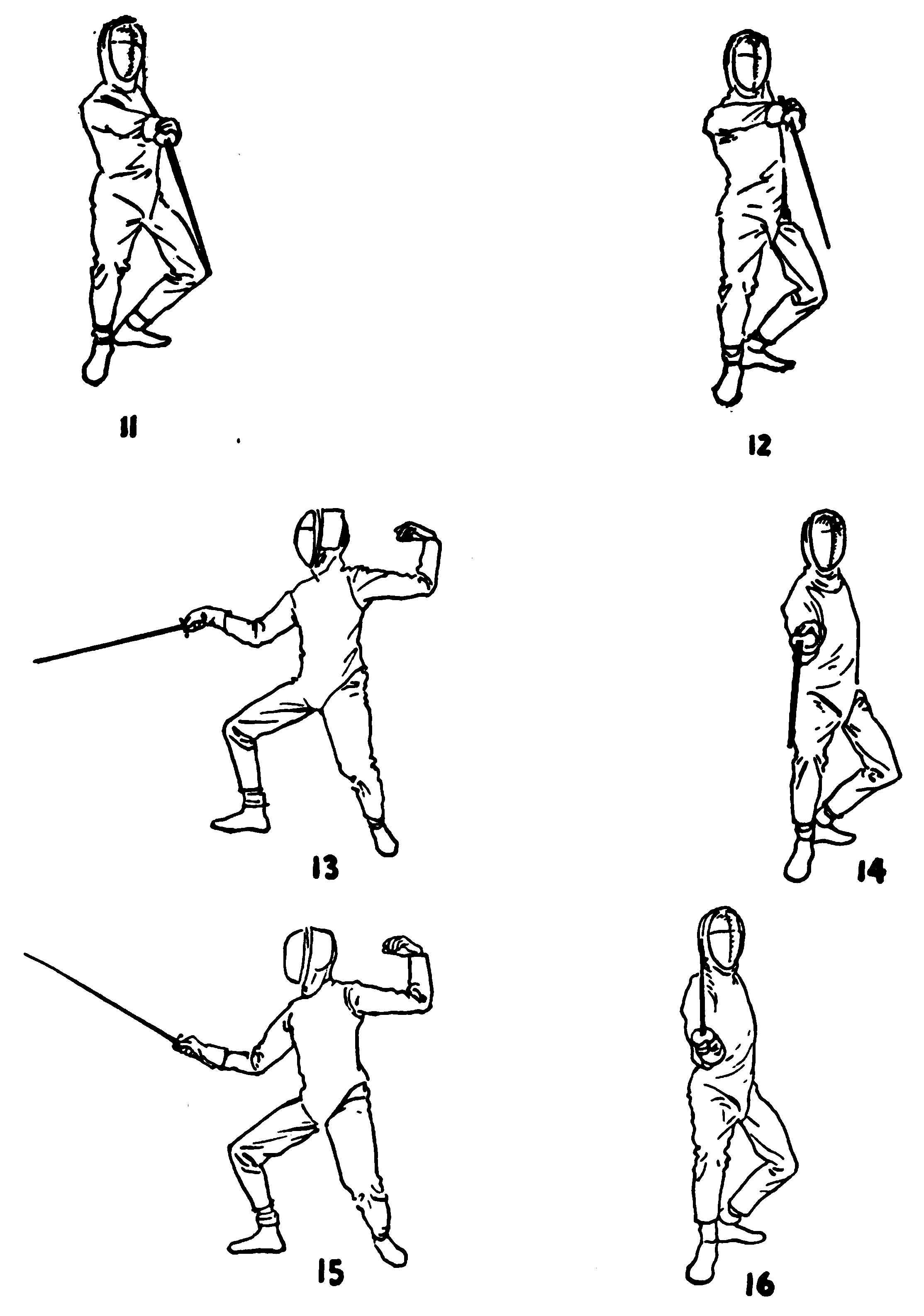
Fig. 11. Guard of prime; front view, p. 15.
Fig. 12. Guard of high prime, p. 51.
Fig. 13. Seconde, side view, p. 16.
Fig. 14. Seconde, front view.
Fig. 15. Tierce, side view, p. 16.
Fig. 16. Tierce, front view.
for quarte see figs. 1 and 2.
This discussion of one of the fundamental conventions of
foil play and its accompanying rule brings us to a detailed
consideration of the guards, parries, and attacks. The general
character of the guards has already been mentioned.
Experience has shown that the entire target can be covered
and the different lines of possible attack closed by four
guards. To all intents and purposes, in the French school,
there are but four guards, but, as it is sometimes advantageous
to take them with the hand in pronation or in supination,
each position has been given a separate designation.
These positions are designated by number and the
first (prime) is the position guarding the low line on the
inside with the hand in pronation, to which the sword naturally
goes upon being drawn from a scabbard at hip level
on the inside, or side opposite the sword hand. If this guard
was deceived by the opponent, the hand was carried directly
across the body, to meet the deceive and to cover the
outside line, the hand still pronated and slightly below
breast level, the point still at the level of the knee if the
deceive was in the low line, but raised to the level of the
eye if the deceive was in the high line. These two positions
give us the second and third guards (seconde and tierce).
These were the early days of the rapier. The weapon was
very long (a sixty inch blade being not unknown and a
length from ground to navel being considered the perfection
of individual fitting) and relatively heavy, being still
suitable for cutting as well as thrusting. There was no light
play of the point in attack, or light tapping of the opponent’s
blade in defence. The guard, or parry, must carry
authority. This was perhaps accomplished best by what
today might be called a rolling parry. So, on the deceive
of the third guard, the hand was carried across the body,
rolling from pronation to supination, developing the first
guard of the high line on the inside and the fourth guard
of our series (quarte). Although this position proved the
handiest for the high inside guard with the heavy rapier,
the other guards being with the hand in pronation, it was
only natural that a similar guard should be developed for
this line—so we have the fifth guard (quinte) which covers
the high inside line with the hand in pronation. The development
of the rolling guard from quinte to cover the
high outside line led naturally to the sixth guard (sixte),
with hand in supination. We can readily visualize the duellist,
rolling his guard from tierce to quarte to meet his
opponent’s blade, suddenly realizing that the threatening
point has shifted to the low line. Just as quickly, he drops
his point to cover the threatened area, and the seventh
guard (septime), is born, with hand in supination to cover
the low inside line. The eighth guard (octave), probably
had a similar birth during a rolling guard from quinte to
sixte, which had to be quickly modified to cover the low
line. And so we have the eight guards of the French school—all
with the hand at the same level, slightly below the
breast; four (prime, seconde, tierce, and quinte) with the
hand in pronation; four (quarte, sixte, septime, and octave)
with the hand in supination; four (tierce, quarte, quinte, and
sixte) with the point at eye level; four (prime, seconde,
septime, and octave) with the point at knee level; four
(prime, quarte, quinte, and septime) with the hand in the
same vertical plane as the front of the inside (rear)
shoulder; four (seconde, tierce, sixte, and octave) with the
hand in the same vertical plane as the back of the outside
(front) shoulder; and all with the elbow carried inside
the outer line of the body.
In this discussion, no distinction has been made between
guard and parry. However, in modern fencing, there is a
definite, though slight, difference. The guards are positions
which close certain lines to attack, whereas the parries are
movements which are designed to close threatened lines to
attack and, at the same time, to carry the threatening point
definitely out of line. In the guard position, the point is
toward, or at, the center line of the body at the approximate
height of the eye in the high line, and of the knee in
the low line. In the parry position, the point is in the vertical
plane of the shoulder on the side threatened. The defending
point is carried to this position by a sharp loosening
and contraction of the fingers, as the hand moves from one
guard position to another.
The parries accomplished by this movement of hand
and point from one line to another are called simple parries
and are indeed the simplest and most natural method of
meeting a threat in any of the unclosed lines.
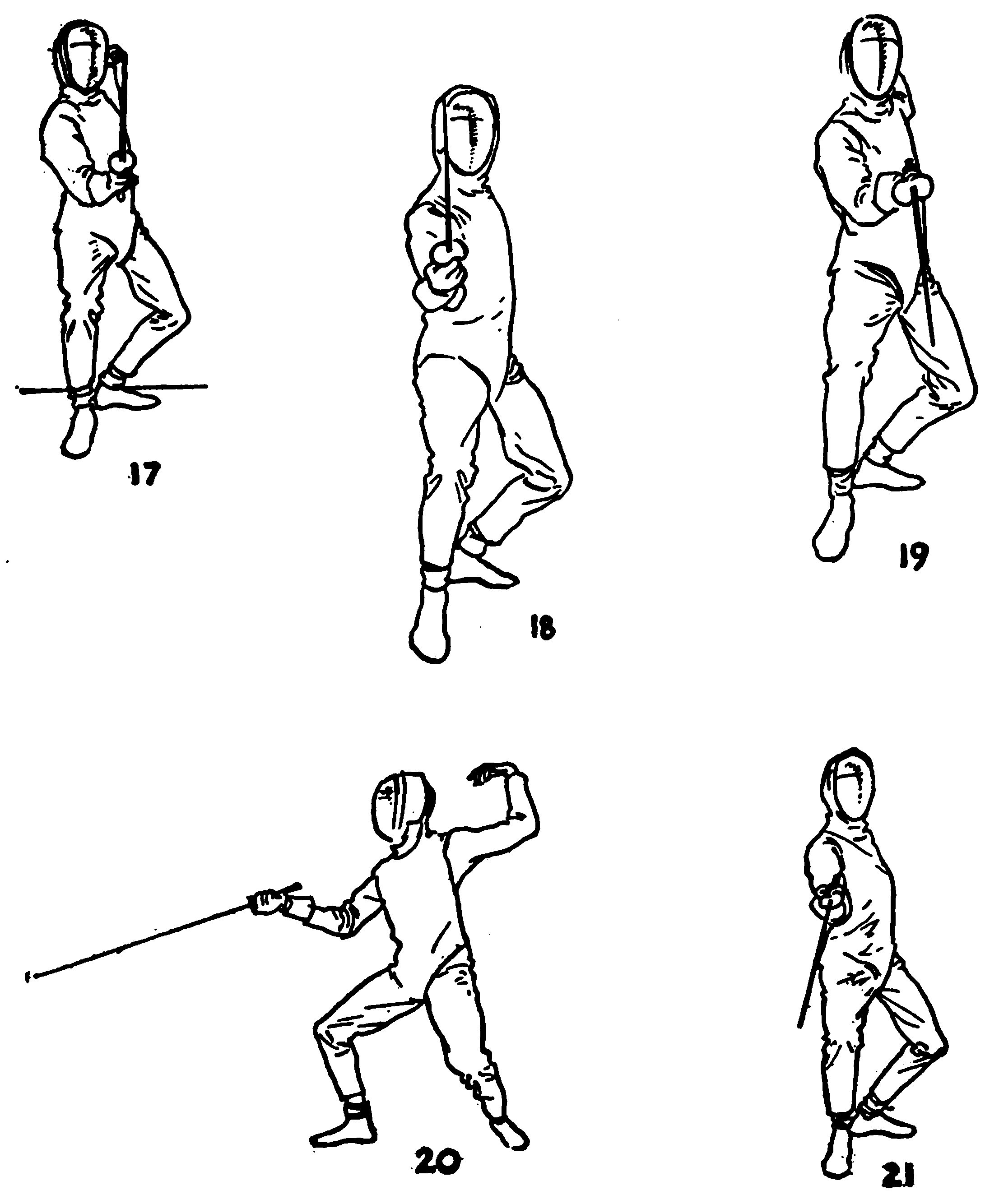
Fig. 17. Guard of quinte from front (low quinte not shown),
p. 16.
Fig. 18. Guard sixte from front, p. 16. For side view see Fig. 1.
Fig. 19. Guard septime from front, p. 17.
Fig. 20. Side view both octave and septime, p. 17.
Fig. 21. Guard octave from front, p. 17.
Distance. As usually employed in fencing, the word
“distance” applies to the extreme limit from which an
attack can be successfully launched. In other words, it is
the additional distance added to an attack by the extension
of the arm and the lunge, without moving the rear foot
closer to your opponent. This automatically creates the conception
of a double distance, one for each fencer, as physical
conformation, position, and correctness of performance
are seldom identical in any two opponents. This is a matter
of major importance in competition, as what is out of distance
for one fencer may be well within for another.
The engagement. When two opponents face each other
within distance, they have the choice of fencing either in,
or out of, engagement. The engagement consists in the holding
of the faibles of the two swords in light contact, the line
in which the contact occurs usually being closed by both
opponents. Of course, either of the guards closing a particular
line may be employed by either fencer. Thus, one may
be engaged in tierce and the other in sixte—both closing
the high line to the outside of the arm.
Where one fencer is left-handed, they engage in opposite
guards—quarte, or quinte, opposing tierce, or sixte.
When fencing out of engagement, there is no contact of
swords and no prescribed line is closed. Fencing out of engagement
is usually not employed within distance.
Counter parries. Each position of guard, in addition to
its simply parry, also has what is called a counter parry of
the same name. In contrast to the natural, or instinctive,
character of the simple parries, the counter parries are
definitely planned parries. Instead of meeting the threatening
point in the line attacked and deviating it from the
target in that line, the counter parry picks up the attacking
blade by a somewhat encircling movement, carries it back
to the original line and deviates the point in that line. On
account of this encircling movement, the counter parries
are often called circular parries. Literally, this is inaccurate,
but it has been widely accepted by both teachers and
authors on account of the difficulty of either describing or
illustrating what should occur. If one can visualize the
simplest threatening movement by the opponent in the open
line, it will consist of simply passing the point under (in
the high line) the defending sword and extending the arm,
with the point threatening the target. Of course, as a terminal
movement, this extension will be followed by a lunge.
But, at the completion of the thrust, it places the attacking
sword relatively close to the defending one, in a horizontal
line at the height of the shoulder, with the point in approximately
the same transverse vertical plane with and about six
inches above the defending guard (or point of intersection
of guard and blade). However, the defending blade is
sloping upward from slightly below breast level to about
eye level and toward the mid-line from the shoulder line.
This places the defending hand about six inches below and
the defending point about eight inches above the attacking
sword. Also, if the attacking sword is very close to the defending,
the defending point may occupy a position further
in the open line than does the attacking point. This means
that, before the start of the encircling movement, the defending
point must assume a position below and to the
closed side of the attacking blade. It must then pass back
under to the open side and, as a third movement, strike
the opposing blade and deviate its point while carrying the
defending point past its original position of guard to that
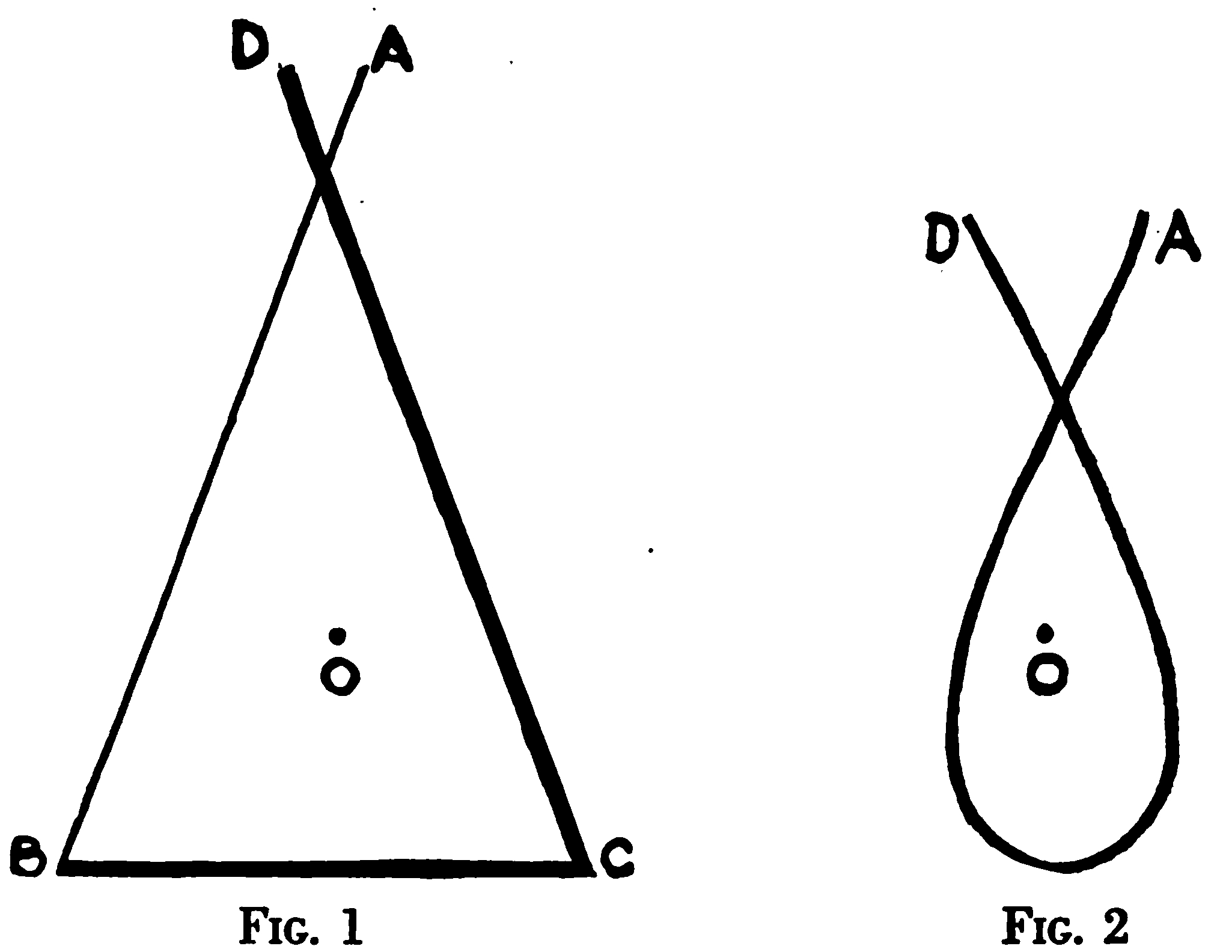
of parry. In theory, this would form a triangle with its
sides continued beyond the apex. Figure 1 (page 21)
roughly illustrates this theory, A being the starting position
of the defending point and ABCD its line of travel about
the attacking blade O. However, in practice, this is a continuous
movement, so that the base angles are rounded and
the enclosed area becomes more a raindrop than a triangle.
Figure 2 illustrates the rounding of the base angles.
These figures illustrate the movement of the point from the
guards of quarte, or quinte, as you face the attacker. The
movement is counter-clockwise to the observer. From the
guards of tierce, or sixte, the movement by the defender
would be clockwise. In the low lines, the loop would be
inverted, as the defending point passes over, instead of
under, the attacking blade. These analyses and figures only
apply to the counter as an initial parry; i.e., when taken
from the position of guard. When it is a later parry against
a compound attack, i.e. taken from the position of parry
instead of guard, the movement of the point is somewhat
different. Being already in the position of parry, the point
need only be lowered vertically to be in position for its
encircling sweep and need only return to its starting point,
so that the theoretical figure becomes a right-angle triangle
with apex uncrossed, and the practical figure becomes only
one-half of our raindrop.
Fig. 1Fig. 2
The attack. As the object of all sword play is to touch
without being touched, an efficient attack must be of the
very greatest importance. Any detailed reference to the
technique of the attack has been delayed in the present
work on account of the obvious fact that the character is
almost wholly dependent upon the system of defence employed
and the efficiency of its execution. As this makes it
true that no adequate appreciation of the objectives, logic,
and technique of certain attacks can be attained without a
thorough understanding of the various parries, the endeavor
has been made to impart this understanding before
proceeding to a detailed consideration of the attack.
When considered according to motive, attacks may be
divided into frank, false, and concealed attacks. The present
discussion is concerned with frank attacks, which are
just what the name implies—frank efforts to gain a valid
touch by the offensive penetration of the opponent’s guard.
According to the complexity of the manoeuvers with the
sword in their execution, frank attacks are classified as
simple attacks and compound attacks.
The simple attacks are called:
1. The straight lunge.
2. The disengage and lunge.
3. The cut-over (coupé) and lunge.
The compound attacks are composed of any series, or
combination, of the simple attacks used as feints, with the
thrust accompanying the first and the lunge the final
movement.
The straight lunge. The straight lunge is executed by extending
the sword arm toward the target and lunging without
any effort to evade the defending sword. Its efficacy
must depend entirely upon speed and timing. Therefore,
it is almost never used against an opponent who fences in
engagement, with the line of engagement properly closed.
The disengage and lunge. The disengage and lunge is
executed by passing the point under the defending sword,
as the arm is extended, and lunging upon the completion of
the thrust. This is our first practical example of the delicacy
of the French finger play. In the position of guard, in engagement,
the hand is already on the open side of the defending
blade, and the point is on the closed side. To make
this disengage, the guard grip of the fingers is relaxed sufficiently
to permit the point to drop below the level of the
defending sword; the fingers are tightened in the attack
grip as the thrust is executed; and the lunge follows immediately.
All of this is accomplished without any conscious
lateral movement of the attacking point, the mere shifting
of the finger grip accomplishing this first disengage.
To avoid confusion, it is probably well to mention at
this point that the guards of pronation do not lend themselves
readily to finger play in offensive work, although
some of them are particularly strong for defensive purposes.
For this reason, the guards of quarte and sixte in
the high line and septime and octave in the low line are
frequently favored by fencers of the French school.
The disengage from one low line to the other must pass
over, instead of under, the defending blade and, consequently,
requires more wrist play, but in other ways is
essentially as described.
The cut-over (coupé) and lunge.
The cut-over is executed with the fingers by elevating the
point just enough to clear the point of the defending sword
and dropping it into line on the other side as the arm is
extended. The lunge follows the thrust immediately.
Although there is little difficulty, or danger, in executing
the coupé from the position of guard, as an original simple
attack, there may be both difficulty and danger in its use
from the conventional position as a second, or later movement
in a compound attack. With the arm extended in a
full feint, there is some difficulty in clearing the defending
point without bending the elbow. As the cut-over withdraws
the point from its threat of the opposing target, the accompanying
bending of the elbow would result in a complete
surrender of the conventional right of way obtained by
the extension of the arm with the point threatening the
target. For this reason, the cut-over carries an inherent
danger, or weakness, to the attacker, in any case. Therefore,
it is advised that a slight departure from the conventional
position of the hand be employed with the coupé.
This would consist of a slight turning of the hand toward a
mid-position, with the thumb up. This permits a much
greater withdrawal of the point by finger action alone,
without any bending of the elbow.
As already stated, the compound attacks may consist
of any series, or combinations, of simple attacks. They are
all based upon the successive execution of one or more parries
by the defence and are planned so that the second,
third, or later movement will, through superiority of execution
in speed or timing penetrate the defensive guard.
They must be adapted in both character and timing to the
defence, as failure in either will result in contact of the
swords and a breaking of the rhythm of the attack. Indeed,
this accidental contact of the swords may be considered a
technical parry and deprive the attacker of any further
rights. In other words, more than one disengage will not
deceive a counter parry and the type of attack that will
deceive a counter parry will not deceive simple parries.
The Feint. In any attack, a movement that is designed to
draw a defending parry but not, by its direct continuation,
to reach the defending target is called a feint. In a frank
attack, this would carry with it the further intention of evading
this parry and completing the attack on a subsequent
movement in a different line. One of the simplest examples
of this would be to execute a disengage, without a lunge,
and, as the defending sword makes a simple parry to deviate
the point from the threatened line, to make a second
disengage, with lunge, back into the line of original engagement.
All threatening movements in a compound
attack, prior to the final one which is accompanied by a
lunge, are feints. Thus, a compound attack consists of one
or more feints followed by the actual attack. To be legal,
that is to retain the conventional right of way, the arm
must be extended and the point threatening the target at
all times. To be effective, a feint must so closely simulate
a real attack as to draw a defending parry. Thus, it will be
seen that a feint may be legal without being effective—the
slowness of the execution failing to convince the adversary
that he is being attacked. On the other hand, a
feint may be effective without being legal, as almost any
sudden movement may draw a parry from a nervous, or
shaken, opponent.
One of the simplest and most widely used of the compound
attacks has already been mentioned as an example
in the above definition of feint. This is the feint disengage
and deceive of the simple parry. This is called
The One-Two. The One-Two is frequently, and erroneously,
described as a lateral movement of the attacking
point under the defending blade into the open line, followed,
when that line is closed by a defending simple parry,
by a second lateral movement under the defending blade
back into the original line, with a terminal lunge. This is
the natural, unconsidered technique, and is the way not to
do it. We have already described how the first disengage is
executed, without conscious effort at lateral movement of
the point, how the finger relaxation in the grip of guard
permits the point to fall below the defending blade, and
how the tightening of the fingers in the grip of attack brings
the point in line on the other side of the defending sword.
If this movement, with its accompanying thrust, is executed
smartly, it will be an effective feint and will draw a parry.
If this is a simple parry, the attacking point is already in
the line which it wishes to hold, threatening the opposing
target, and should not be deviated in a lateral direction.
How evade the parry? Drop the point, by a simple relaxation
of the fingers, and allow the parry to pass above it.
Tighten the finger grip to bring the point back to its original
level, as you lunge. More doigté. The lateral movement
is all made by the defending parry. The down-and-up
movement of the attacking point is the sole evasion.
Whether one, or seven, simple parries are taken, the evasion
is a repetition of the same relaxation and tightening
of the fingers, down-and-up of the point until the psychological
moment for the launching of the lunge. Exactly the
same technique is employed that would be necessary to
avoid the successive swings of a pendulum.
But, suppose a One-Two has already proved successful
or that for other reasons the defender does not respond
with a simple parry. Instead, to the feint of disengage, he
responds with the counter parry—that somewhat asymmetrical
raindrop that has already been described. Does
one, as so often taught, try to deceive this parry by following
it around the circle? He does not! Again, we avoid the
natural, unconsidered course and follow the efficient, considered
course. As the defending blade describes its encompassing
arc, the attacking blade is carried obliquely
downward in the same direction as the concluding sweep
of the parry and, as this passes, is brought back along the
same line to its original position as the lunge is executed.
This deceive of the counter parry is called
The Double. The Double is sometimes described as two
disengages into the same line. While this definition describes
the intention, it gives an erroneous impression of
the technique, as the vertical down-and-up of the successive
disengages is quite different from the oblique down and
back of the successive doubles.
Although an infinite number of compound attacks might
easily be imagined to deceive an equal number of mixed
parries, in practice the compound attack seldom tries, or
needs, to deceive more than two or three parries. During instruction,
more complicated series may be practised for
their value as exercises in control and coordination.
It is important to realize that attack and defence are interdependent.
No attack can be more intricate than the
defence that it seeks to penetrate. Similarly, although to a
lesser degree, the defence may be restricted in its versatility
by an attack that depends primarily upon speed and
timing combined with the simplest movements.
In another section of this work certain exercises, or lessons,
are given, by which two fencers may practise the
interplay of the various attacks and parries. The performance
of these, or similar exercises, is vital to the development
of the accuracy and coordination that go to make the
finished swordsman.
So far, the subject of attack and defence has been treated
as though one fencer attacked and the other defended and
then started over. However, nothing is farther from the
actual method of procedure. It is true that, when one
fencer seizes the initiative by extending the arm with point
threatening the target, the right of way remains with him
until he surrenders it by bending the arm or removing the
threat of his point from the opposing target or until his
opponent deprives him of it by forcibly deviating his point
from the target. With this surrender or destruction of the
right of way, the initiative passes to the other fencer. If
this termination of the right of way is by means of a successful
parry, not only does the initiative pass to the defender
but also the right of way for an immediate counter-stroke,
even though the arm is not extended and the point
is not in line at the moment of completion of the successful
parry. This is the only condition under which the right of
way exists without the extension of the arm with the point
threatening the target, and this is only momentary. The
right of way ceases automatically, if not immediately used
for delivering a counter-stroke. This counter-stroke is called
a riposte. It may be a direct thrust in the line of the original
attack, which has been opened by the force of the parry,
or may be a compound movement with one or more feints
or deceives. As in all thrusts, the grip shifts from that of
guard to that of attack. In spite of the dependence of the
right of way upon the immediacy of the return, it is at
times of definite advantage to delay the riposte until the
attacker starts to resume the guard. If this delay should
occur, without a resumption of the guard, all right of way
ceases and any subsequent touch by either must be judged
upon the basis of priority alone.
When an attack has been successfully parried and the
defendant delays his riposte, but does not keep the original
line of attack closed, the attacker may renew the
attack in the original line without returning to the position
of guard. This attack is called a remise. The remise is
only valid when the defender delays or misses his riposte.
Under similar conditions of a delayed riposte, with the
defender keeping the original line of attack closed, the
attacker may immediately renew the attack in another line,
usually by a partial return to the position of guard. This
is called a redoublement d’attaque.
When, upon the completion of an attack, or an attack,
parry, riposte, and counter-parry, or any other sequence
originating in an attack but not terminating in a touch,
the attacker resumes the position of guard and immediately
launches another attack; this is termed a reprise d’attaque.
It will be gathered from the preceding remarks that
the original attack may lead into a quite complicated series
of movements by both fencers. The rule is that such a
series of attacks and counter-attacks terminates only with
the command of the Director of the Jury to halt. The Director
should halt the action (1) upon the indication of a
fair or foul touch by one of the judges; (2) upon the loss
or breaking of his weapon by one of the contestants; and
(3) upon the transgression of the rules by a competitor.
Such a series of attacks and ripostes, finally terminating in
a touch or a halt by the Director for other reason, is called
a phrase d’armes. Neither contestant has the privilege of
discontinuing the phrase of his own volition and his action
in doing so leaves him open to a fair touch by his opponent.
Counter-Attacks. In general, there are two types of aggressive
action employed to interfere with the formulation
and execution of attacks. These are designated counter-attacks
and, according to the time of occurrence, are classified
as attacks on the preparation and attacks on the
execution. If the proper moment, during the making of
preliminary movements but before the establishment of
the right of way, is seized, the attack on the preparation
may take the form of any of the frank attacks, its only difference
lying in the fact that it seizes for its execution the
exact moment when the opponent is mentally committed to
the attack rather than prepared for defence. One of the
best examples of this is where one fencer advances, making
a simultaneous attack on the sword, with the idea of closing
distance and shaking his opponent’s defence preparatory
to launching his attack within distance. If his opponent
evades the attack on his sword, he can extend his arm and
lunge, having seized the right of way on the preparation
of his adversary, or may even touch by a simple extension
if the attacker precipitates himself upon the point. Possibly,
a more usual example would be found in a quick
extension against the “short arm” fighter, who rushes to
close quarters with multiple feints with the sword, but no
proper extension of the arm.
The attacks on the execution are neither so simple nor so
safe as the attacks on the preparation. There are three such
attacks and all are executed against an adversary who has
established the conventional right of way. They are designated
the tension, the stop thrust (coup d’arrêt), and the
time thrust (coup de temps). The tension is the simple,
frequently instinctive, extension of arm and point toward
the attacker in the hope that the point may strike the attacker
and that the unexpected counter-attack may cause his
blow to miss. It is frequently devoid of planned objective
and always without any conventional rights. It can only
score if the attacker completely misses the target. It is bad
form, poor fencing, and the recourse of excited or inadequately
trained fencers. The stop thrust, although frequently
confused with the tension, is quite different.
Although employed against an opponent who has established
the conventional right of way, it is used only when
that right of way has been technically (even though only
momentarily) abandoned. An example of this would be an
attack initiated by a feint of disengage, which gains the
right of way, and followed by a cut-over, which technically
abandons it by removing the point from a position of threat
and, possibly, slightly bending the elbow. If, upon the first
elevation of the point from the target, the defender extends
his arm with point in line and touches either with the thrust
or an accompanying lunge, he has executed a valid stop
thrust. The sole condition controlling the validity of a
properly executed stop thrust is that it must precede by
an appreciable measure of fencing time any touch made
by the original attacker in the continuation of his attack.
Another common example of a properly executed stop
thrust is found when the attacker, after having properly
taken the conventional right of way with his initial feint,
proceeds in a compound attack with subsequent feints wide
of the target and the defender takes advantage of the first
of these withdrawals of the point to extend and score.
These examples and distinctions are given in detail and
emphasized on account of the confusion that seems to exist
among both fencers and judges regarding the difference
between the tension and the stop thrust. Instead of the existing
tendency to penalize a properly executed stop thrust,
on account of its superficial resemblance to the tension,
there should rather exist a reluctance to concede any rights
to a fencer who deliberately, or through carelessness or
ineptitude, abandons his right of way and then tries to
recover it on a technicality that should not exist.
However, there is one form of stop thrust against which
technicalities should exist and be enforced. This is the
stop thrust by evasion. Here, an endeavor is made to “side
step” or dodge under a properly executed attack and make
a point from the side, or below, after evading the attacking
point. The rules have an added penalty by awarding a fair
touch for a touch made on any part of the person that may
be substituted for the valid target in such an evasion.
The time thrust, when properly executed, is the perfection
of analysis of your opponent’s offensive play. It consists
in closing the line of the final movement of your
opponent’s attack with a simple opposition parry, at the
same time extending arm and point toward his target. To
be valid, this manoeuver must fully deviate the attacking
point from the target. Therefore, its proper performance
requires perfect analysis, perfect coordination and perfect
timing. As there can be no more exacting requirement, so
there can be no higher attainment.
While the preceding paragraphs cover the theory of the
counter attack, it is well to give warning as to the practical
application in a number of these cases. The Rules Committee
of The Amateur Fencer’s League of America, in
order to avoid hair-splitting definitions, has covered the
subject of the stop thrust in one broad statement which
reads as follows:
The stop thrust is a simple counter attack, against the opponent’s
attack. It is successful against a faulty attack, simple or composite;
or against attacks advancing (“on the march”) and delayed attacks,
when the attacker exposes an open line and enables the defender
to obtain the advantage of a sufficient interval of fencing
time.
It will be seen from this definition that the final decision
in most of these instances will rest with the director, who
alone decides the validity of touches. If the director happens
to be ill informed, or unsympathetic regarding this
type of counter attack, a perfectly timed attack on the
preparation or stop thrust may be declared a stop thrust
without sufficient interval of fencing time. Unfortunately,
in this, as in many other instances, knowing your officials
or their prejudices is almost more important than knowing
your fencing.
Attacks on the sword. Sometimes there comes to an aggressive
fencer the feeling that his opponent is a little too
sure of himself; that his position of guard is too assured;
that his confidence in his defence is too unshaken; that his
response to feints is too deliberate, too unhurried. There
is no reaction to the preliminary movements of a compound
attack, and the response to the final movement is so
delayed and so sure as to carry with it exceptional danger
of a successful riposte. Something must be done to shake
this confidence, to make the defender a little less sure of
his position, a little less certain of the line in which the
developing attack is to come. What shall it be? One possibility
is an attack on the defending sword, as a preliminary
to the actual attack. Such an attack on the sword
may be suggested, or real. Also, it may be single, or multiple.
The suggested attacks are: (1) the press—a light,
sharp pressure, faible to faible, in the position of guard;
(2) the glide (coulé)—a light, prolonged pressure from
the position of guard as the arm is extended to a feint in
line; and (3) the light beat—a light tap, faible to faible,
in the position of guard. None of these suggested attacks
on the defending blade forces it from the position of guard.
In fact, its intention is quite the opposite, being to suggest
a forcible entry in the closed line so as to delay response
to an actual attack in the open line. All of these attacks
should be performed by mere finger play. The real attacks
on the sword are executed with much more force and authority
than the suggested attacks and are planned to actually
force the defending blade aside so that an opening
will exist in the closed line, whether or not penetration is
intended. The real attacks on the sword are: (1) the heavy
beat—performed much more strongly but in the same way
as the light beat in the suggested attack; (2) the force
(froisé)—performed in much the same way as the glide
in the suggested attacks, but with a force that almost throws
the defending blade out of line and not infrequently results
in a disarmament against a lightly held blade; (3) the
cross (croisé); (4) the bind (liement); and (5) the envelopment.
The last three of these have no corresponding
movements in the suggested attacks and will have to be
treated separately.
As mentioned above, the heavy beat is much heavier
than in the suggested attack. However, it is executed entirely
with the fingers in the lines of seconde, tierce, quarte,
and septime and with minimum wrist play in quinte, sixte,
and octave. The beat from prime is not mentioned because
of the very infrequent use of the guard of prime in modern
fencing and because of the extreme difficulty of executing
a successful beat from that guard.
The cross is executed by closing distance enough to
permit engaging the faible of the defending sword with
either the forte or middle section of the attacking blade.
This closing of distance may be accomplished by a short
advance, or may be unnecessary against an adversary who
extends the arm with point in line. In the latter case, great
care must be exercised in the execution of the movement,
as the defender’s extension is a recognized invitation to an
attack on the sword, and it must be assumed that he is
especially prepared for such a manoeuver. As such preparation
probably means that he plans to evade the attacking
blade and permit the attacker to precipitate himself upon
an extended point, which has taken the conventional right
of way, care must be taken that his blade is found and his
point deviated before the attack is pursued. When the
adversary’s arm is not extended, it is necessary to raise
the hand slightly in order to obtain the necessary control of
the defending sword. Control of the opposing blade having
been established, the faible is forced laterally toward the
open line and depressed, while the attacking sword crosses
over to the open line—the extension and lunge following
immediately. In this movement, great care must be
exercised to maintain contact of the blades until the thrust is
completed. When made upon a blade with right of way,
additional care must be exercised to sufficiently deviate
the threatening point to effectually and obviously destroy
the right of way.
The bind is executed under the same conditions and in
the same manner as the cross, except that it retains control
of the opposing faible and carries it through an encircling
movement to the low line of the high line in which the
original engagement occurred. The converse is true from
low to high. The same restrictions and precautions must be
observed as with the cross.
The envelopment is the third of this series of attacks on
the sword and is merely a further development of the bind,
as the bind was of the cross. In this instance, the defending
sword is carried through a complete circle, ending in the
guard in which it started. The thrust and lunge of the
attack follow immediately upon the completion of the envelopment.
It is probably unnecessary to point out the need
of increasing caution and exactness as these movements
become more extensive and complicated. The addition of
each succeeding quadrant to the encircling movement detracts
from the element of surprise, adds to the chance of
evasion, and increases the probability of wide play.
With the exception of the beat in the inside high line,
greater authority in the execution of the various attacks
on the sword is obtained from the guards with the hand in
pronation. However, as all of these manoeuvers are in
preparation for the final lunge of the attack, it is well to
remember that what is gained in force is ordinarily sacrificed
in control and accuracy. Therefore, the cross, the bind,
and the envelopment will usually be used most effectively
from the guards with the hand in supination.
Reference has already been made to the progressive
development of the cross, the bind, and the envelopment.
This same comparison could quite properly include the
simpler attacks on the sword which use force and are designed
to create an opening for the attacking point. In
other words, we have a progressive series of forceful attacks
on the sword, which have as their objective the opening
of a line of attack by the deviation of the defending
blade. These are, in their progressive intricacy or extent:
(1) the strong beat, or strong press; (2) the force (froisé);
(3) the cross (croisé); (4) the bind (liement); and (5)
the envelopment. Where these attacks are to be employed,
the fencer should carefully master the details of each one
and accustom himself to its use. When the adversary can
anticipate a fairly definite and dependable reaction under
given circumstances, the advantages attendant upon initiative
and surprise are largely lost. It is of utmost importance
that the play should be very close and controlled, as the
temptation to put elbow and even shoulder movement into
these attacks is great. There are few occasions more disconcerting
than the termination of a powerful and uncontrolled
attack on the sword—which has been evaded. At
this moment, the attacker, has widely opened his own target
and, instead of an attack on the sword, may have executed a
precipitation on the point.
Defence against attacks on the sword. The first step in
preparing an adequate defence against attacks on the sword
is the inclusion of these manoeuvers in all practice and
lesson work. This will permit one to school himself against
response by instinctive movements. In other words, there
must be no instinctive response to such attacks. The tendency
to hold the guard in which a light beat or press has
been made just a moment too long may result in a successful
disengage to the open line. But, on the other hand, the
careful training of oneself to always make a simple parry
in the open line upon such an attack will be just as fatal
with an observant adversary, as he will make the attack
on the sword and lunge in line as the parry is executed.
Therefore, so accustom yourself to the attacks that you
neither allow them to hold you in the original guard position
nor draw you into an habitual parry. This advice applies
not only to suggested but also to real attacks on the
sword. But, in the latter group, something more is necessary.
The forceful attack on the sword is bound to shake
the position of guard and to derange the plan of defence.
Also, it opens a line of attack and must be met by some
form of defence.
All of these attacks are best met with some form of evasion.
The simplest form of this consists in a quick retreat,
executed as soon as the heavy blow or pressure characteristic
of such attacks is felt on the blade. However, the
simplest is not always the best, and the retreat should be
the defence of desperation rather than of routine. As soon
as the retreat becomes a regular part of every defence,
allowance is made for it in every attack. The better form
of evasion is with the blade. This requires the maximum of
readiness, almost to the extent of anticipation. Of course,
where the arm has been extended with point in line, this
constitutes an invitation to the attack on the sword and
readiness for any eventuality may be assumed. In such
case, the relative success of attack or evasion is governed
by the superior timing, coordination, and speed of attacker
or defender. The evasion consists of the simple, finger-controlled
disengage, one-two, or double required by the form
of attack made—always treating and considering the attack
on the sword as a parry to be deceived. However, when
the contact of swords is established and control of the
blade gained, and resistance is of no value, as the attacker
has an advantage of leverage that cannot be counteracted
by any amount of force, the defence must consist of some
form of parry of either a releasing or a yielding character.
Even the releasing parries in these cases are partly yielding
in character. For instance, with engagement in the line
of sixte, a strong press or beat, or a froisé, is executed by
one fencer. The defender allows his hand to follow his
point into the guard of quarte, executing a counter of quarte
as he does so. In doing this, he has been forced to yield
with the point; has voluntarily yielded with the hand; and
has released his point and covered both high lines with the
counter of quarte. Against the more controlled attacks on
the sword (the cross, the bind, and the envelopment), a
more pronounced yielding and following of the attacking
sword is required. Both point and hand yield, but there is
little hope of release against a properly executed attack,
so the hand must be allowed to slip into a defending parry
while appearing to yield continuously. The bind is the
simplest and the cross the most difficult of these “slipping”
oppositions to execute. Taking the bind from quarte as an
example, it would start by taking control of the defending
faible in the guard of quarte and delivering its touch in the
line of septime. However, as the carrying of the defending
blade into septime is completed, and the attacking point is
advanced, the defender is able to oppose forte to faible.
This is accomplished by allowing the deviation of the point
from quarte to septime and at the same time carrying the
hand across the target from quarte to octave (or seconde)
and, as the point is released from opposing control, carrying
it by a strong movement of the fingers to the parry
occupied by the hand. If taken too much by surprise, the
movement of hand and point must be synchronous. A less
usual, but very effective, reply to the bind is accomplished
by yielding to the pressure of the attacking sword, turning
the hand into pronation, dropping it to hip level with point
high, and offering strong opposition in the attacked line.
If the attack is the envelopment, again from quarte, the
point again travels freely to the end of the movement, but
the hand has travelled to the outside line and, with the
final finger play of the parry, sixte (or tierce) is opposed
to the attacking point. Also, it is possible to allow this
attack to proceed to its completion and to execute a counter
of quarte parry at that time, which is a return to the yielding
and releasing manoeuver. While the reply to the cross
may offer no greater intrinsic difficulties than these attacks,
it does require a radical departure from fundamental positions.
Here, the blade is forced downward as well as in a
lateral direction, and the proper defence of the high line
must be by a high line parry. To assume that point and
hand can be returned to the attacked line in time for its
closure is to assume too great a margin of superiority in
speed and technique on the part of the defence. Here, the
yielding “slip” parry must use a low line parry in irregular
position to cover a high line. So, the point is allowed to
remain in the slightly low position to which it has been
forced, and the hand is raised to chin level, the parry of
septime (or prime) being taken from this position, if the
attack was made from sixte. Probably the only time that
the parry of prime will be recommended in this work will
be where the cross is employed from sixte with sufficient
force to thoroughly shake the guard and to make it more
natural to roll this hand into the parry of prime than to
carry it across into septime. When the attack is made from
quarte, the high octave is the parry of choice.
It may be well, at this time, to emphasize a mental attitude
toward all parries. In making a parry, unless very
sure of the analysis of the opponent’s play, it should never
be considered as a terminal movement. In other words, a
fencer never says to himself, “Upon such and such an
attack, I shall take the parry of so and so.” He says, “Upon
such and such an attack, I shall take the parry of so and
so—and—.” The “and” may be left open, as merely indicating
a state of mind. In other words, if the attacker
deceives the planned parry, the defender is mentally prepared
to take another parry and awaits the contact of the
blades before closing his mind on that particular defence.
This is especially true of the encircling attacks on the
sword, which are very hard to analyze until the style of
play of a particular opponent is known.
The Attacks Advancing. Although there is no fundamental
difference between the execution of the attacks from
position (de pied ferme), which already have been described,
and the attacks advancing (en marchant), there
are certain points that are worthy of special attention.
Where the fencing is out of engagement and out of distance,
or where one of the fencers accompanies every parry with
a retreat, or a pronounced backward swaying of the body,
the attacker must take cognizance of these circumstances
each time he prepares to attack. How is he to so adjust the
distance at which his lunge is executed as to be sure that
he is within distance? The first requirement is a knowledge
of his adversary’s reaction under given conditions. If the
defender is a “pendulum” fencer, swaying back with each
parry and forward immediately afterward, the distance is
fixed. When he sways backward, his weight is carried to
his rear foot and further retreat is awkward, slow, or impossible.
Therefore, having once determined the limit of
rearward travel that this sway permits, it is only necessary
to add the gain of that distance to any other that may have
to be covered in reaching the target. If the fencing is in
engagement and within distance, the sway is the total
amount to be gained. If possible, this should be done without
warning. Generally, this is best accomplished by the
employment of a movement designated “the gain” (gagnant).
This is simply a contraction of the foot position of the
guard to the front. In other words, without moving the
front foot and without attracting the attention of the defender,
the rear foot is brought forward either the needed
distance or all of the way to the front foot. In order to
distract the attention of the defender, it is well to execute
some feint with the sword at the same time that this movement
is executed. With the completion of the “gain” and
the return of the hand to the position of guard from the
accompanying feint, the previously planned attack is immediately
executed, before the defender has time to appreciate
the change in foot position. This simple movement
will diminish the distance to be covered by more than
eighteen inches with the average position of guard. Where
the fencing is out of distance and the defender employs
the sway, but knows that a single advance will not close
both the extra distance and his sway, the single advance,
with gain, may be employed. Here, the advance which is inadequate
to close the total distance is completed by bringing
the rear foot up to the front foot, and the attack is completed
immediately. In this instance, it is well to accompany the
advance with an attack on the sword to cover the changed
foot-work. Either the simple advance, or the gain, will
cover similar distance made by the adversary and any
combination of the two will match him move for move.
However, trying to follow a retreating opponent is likely
to disturb the accuracy of any accompanying attack. In
order to avoid this, it is well to time the consecutive movements
of the attack to the successive gains in distance, so
far as this is possible. For instance, assuming that the
distance to be gained requires two advances and that the
parries to be deceived are a counter of quarte and sixte,
the first advance is made with the feint of disengage, the
second advance with the deceive of the counter parry, and
the deceive of the simple parry and lunge are made from
this position. As this method establishes a certain coordination
and rhythm between foot and hand, it offers a minimum
likelihood of deranging the attack and should be
employed whenever possible. Against the consistent multiple
retreater, the rabbit of sword play who has come into
his own with the extension of the fencing limits, there is
no recourse but to gain all of the distance possible and
hold what is gained. After all, with a forty-foot strip, each
fencer has only about fifteen feet behind him in the original
position of guard. If he uses this distance for running exercises,
and his adversary takes and holds the distance
surrendered, the time soon arrives when there is no further
room for retreating within the limits of the strip. He must
then stand and take the attack or run off the strip. If he
does the latter with both feet, a touch is scored against
him, and it is just as good a touch as any other. In fact,
psychologically, it is better. If a fencer who depends upon
the retreat for his defence is once driven off the strip for
a declared touch, subsequent to that time his mind will
be divided between what he is trying to do and how much
distance he has behind him. However, it is well to give
warning against the following of such a fencer with over-confidence.
There is always the possibility that this exaggerated
retreating is planned to lure the attacker into an
ill-considered, rushing attack which will be met with a
parry and riposte from position. Never assume that you
are a better or a smarter fencer than your adversary, until
the final decision of the jury justifies that conclusion—and,
then, don’t assume that the condition is more than temporary.
Who knows what will happen tomorrow, particularly
if you presume on the basis of what happened today.
There is one method of closing, or extending, distance in
large measure and quickly that we mention with trepidation.
Before the discovery of the lunge, which was an advanced
development of fencing, there was need of some
method of quickly arriving within striking distance of
one’s adversary. An ingenious movement was evolved which
was based upon the “gain” and was called the “passado.”
This movement was executed by bringing the rear foot not
only up to, but past, the front foot and planting it, and,
then, bringing the front foot forward to the position of
guard. By this movement, three feet or more could be swiftly
covered in one forward movement. Although long omitted
from the formal instruction in the classical French school
of the foil, it was retained in the school of the bayonet
under the designation of “front pass” and “rear pass.” The
principal objections to the “passes” are: (1) that they
commit one almost irrevocably to an extensive, sometimes
excessive, gain or surrender of distance; (2) that, at the
mid-point of the “pass,” they have a tendency to do away
with the effacement of the rear shoulder and broaden the
visible target; and (3) that in both attack and defence,
they have a tendency to disturb the steadiness of the hand.
However, there are very rare occasions when they may be
advisable. The most definite of these is to supplement a
“parry of desperation.” Another, but more questionable,
use would be when pursuing a badly shaken and rapidly
retreating opponent. It will occasionally, though rarely,
happen that such a pursuit will carry the opponent to the
limit of his available space and that a following lunge may
drive him off the strip.
Opposition in Attacks. The giving of opposition in attacks
is that deviation of the hand slightly away from the
direct line of attack and toward the defending sword that
endeavors to keep that line closed against a stop or time
thrust, or succeeding simple riposte. Against the stop thrust
(really “tension” under these circumstances), it is unnecessary,
as the attack has the right of way. Against the time
thrust, it is inadequate as that manoeuver will force it
aside. Against the anticipated riposte, it is foolish because
the parry has not yet been made and may prove unsuccessful.
However, immediately following a successful parry of
your attack, it is an excellent procedure and should always
be employed, unless you have something better planned.
The group of attacks and counter-attacks described prior
to this have all been in the class of frank attacks. As will
be recalled, two other classes of attacks were mentioned at
the beginning of this section—false attacks and concealed
attacks. The false attacks are just what the name would
indicate, movements simulating the characteristics of attacks
but lacking the intent of gaining a touch by their
execution. They are usually employed with one of three
purposes—to gain distance, to gain information, or to
discompose the adversary. Their employment to gain distance
is against the running defence already described.
Here, there is neither hope nor intention of touching. The
false attack is delivered with the usual precautions against
a parry and riposte, but is used with the idea of closing
forward to the guard position upon its completion and
making a permanent gain of distance of any ground gained
by both the lunge and any advance that may have preceded
it. Its use for gaining information is in the process of feeling
out an opponent’s defence, in order to discover whether
he has favorite parries, or sequences of parries. Against
some fencers, a quick feint, or series of feints, will serve
this purpose. Against a stronger and more confident fencer,
the actual lunge may be needed to draw the parry. The feint
does not differ from that of the frank attack, but the lunge
is usually a little “tied-in,” being delivered with the same
initial impetus to give the impression of a real attack, but
only going to one-half or two-thirds the distance of a full
lunge. Its use to discompose the adversary is most useful
against the fencer who is constantly edging in rather than
making a frank attack advancing. This edging-in process
is frequently accompanied with attacks on the sword, or
with multiple feints, but usually does not lead to a frank
attack until the desired distance is attained or a moment
of unreadiness seized. If not prepared to deliver an attack
on the preparation but still unwilling to permit the persistent
gain of ground, an unexpected deceive of the attack
on the sword and false attack will frequently cause a hurried
withdrawal that will surrender any ground gained.
A concealed attack is one which originates in a false
attack but is immediately followed by a true attack which
was part of the original plan. A good example of this is
the planned remise against a fencer who slightly delays his
riposte, with the idea of delivering it during the resumption
of the guard. A false attack is delivered with two-thirds
lunge and the remise follows immediately, without attempting
to regain the guard. However, a more generally useful
employment of the concealed attacks is in a group of
secondary attacks that are called counter-ripostes. The
counter-ripostes are most useful against a strong defence,
where the parries are held to the last possible moment, are
both authoritative and carefully controlled, and are followed
by immediate ripostes. Such a defence is extremely
hard to penetrate. By making quick, apparently hard false
attacks which will draw the parry and riposte, the riposte
may be parried and an opening found for the counter-riposte.
Few fencers, no matter how strong their defences,
are as well prepared against a counter-riposte as against
an original attack. This play should be practised assiduously
in all lines and mastered by every fencer who hopes
to attain a rank that will expose him to difficult and versatile
competition.
The original attack of the planned counter-riposte generally
employs only a two-thirds lunge and the parries
preceding the counter-ripostes are frequently made in an
almost fully extended position of the arm.
Chapter III IRREGULAR PRACTISES
The earlier discussion of the defence treated only what
might be described as the regular parries and their use in
a regular way. In the choice of the word “regular,” it is
not intended to indicate that other parries or a different use
of the usual parries may not be perfectly legal as well as
an accepted procedure. However, the most finished technique
is to meet a certain attack with the parry that will
deviate its final movement from the target as an act of
deftness and skill rather than force. There is an application
of the regular parries and a certain group of compound
parries that aim at defence by breaking up the attack at
its inception or at some predetermined point in its development
by a “breaking of the line.” This breaking of
the line is the application of force in a direction opposite
to that of the attacking blade. It rather tends to minimize
the necessity of a complete analysis of the attack and plans
to break it by force before its full development. Also, there
is a use of certain of the regular parries in irregular ways
to meet attacks of force, or frank attacks executed in an
irregular manner.
One of the most frequently seen examples of the use of
a regular parry to break the line is the opposing of the
parry of septime to a disengage from quarte into sixte.
The closing of the line of sixte by the parry of sixte, or the
returning of the attacking point into quarte by the counter
of quarte would be the regular method of meeting this
attack. But, if the attacking faible is met by a sharp parry
of septime as it drops to pass under the defending blade,
the attack is immediately terminated in an entirely new
and unexpected line before the completion of its first movement.
A similar defence with octave, or seconde, may be
employed from the line of sixte. Also, it is obvious that
any plan for a compound attack has been shattered by this
initial breaking of the line. Of course, if the attacker anticipates
the play, he merely starts the disengage and immediately
returns to the high line that has been opened.
As already stated, there are certain combination parries
used for this same purpose of breaking the line. Two of
the best known and most widely used of these are the
parries of septime and octave enveloppé. These parries are
started from the high line guards of quarte or of sixte, drop
to the corresponding low lines of septime or of octave and
are carried back by an encircling (enveloping) movement
to the opposite high line of sixte or of quarte. The parry
is supposed to be so executed that the low line parry meets
the initial movement of the first feint of the attacking blade
and that the subsequent envelopment carries it upward and
outward to the opposite high line. Both of these parries are
extremely efficient against inexperienced fencers and, if
only used very occasionally, against experienced swordsmen.
However when anticipated, there is no parry more
easily deceived. With the wide sweep from quarte to septime
to sixte, such a parry must be relatively slow and requires
only the start of the disengage to draw the septime
parry and an immediate disengage over the septime to
deceive the following sweep from septime to sixte. One of
the pleasantest to use of these combination parries is the
combination of counter of sixte—octave against the double
from sixte. This, after showing the counter to the feint,
only suggests it to the attack, starting as though to take the
counter-parry but really going directly to octave. The
riposte, which is almost continuous with the parry, is best
taken in seconde, by simply turning the hand into pronation
as the thrust is made. Again, if anticipated, this parry is
very easily deceived, but, if successfully executed, has all
of the beauty of a time thrust. The high line that would
have been closed by the counter parry is left wide open by
its abandonment, and the attack need only continue in the
line of the original feint, after making a slight movement
to suggest the deceive of the counter parry. As has been
suggested in each instance, this group of parries may be
most disconcerting when resorted to only occasionally as
surprise measures. As has also been suggested, when used
habitually, they are much more easily deceived than the
simpler regular parries for which they are substituted. The
Italian school has a favored parry designated “half-circle,”
which is similar to the French parry of septime but is used
in the high line. This is not infrequently employed by
fencers of the French school and called “high septime.”
When taken from the guard of quarte, it sweeps all lines
except the high outside (sixte, or tierce). When properly
timed, it is very inclusive. The best deceive is a disengage
over the blade into the low outside line (octave, or
seconde). Similarly, “high octave” is best deceived with a
disengage over the blade into septime, or prime.
There is an irregular type of attack designated as a
cavation, or cavé, which is executed by endeavoring to
bend around the defending parry. The effort is to evade a
properly executed parry by forming such an angle between
the sword and the sword arm that the point remains on the
target, although the hand is carried well out of line. While
quite irregular, this attack is neither illegal nor uncommon.
It calls for a different parry from the one that would
ordinarily close the line attacked. For instance, a straight
attack in sixte would be parried by the simple parry of
sixte. But a cavé attack into sixte would carry the hand so
far outside that the point would come in from the side and
there would be no deviation of the attacking point by a
parry of sixte. However, a counter parry into the opposite
line will always pick up a lateral cavé. Notice the emphasis
upon the word “lateral.” The cavé from above is practically
never employed, and no regular parry will pick up the
cavé from below. It is too low to be met with a regular high
line parry and the blade takes a direction parallel to that
of the low line parries, so that contact of the blades is a
matter of chance. This should make it the ideal attack. But
there are two weaknesses inherent to its use. The angulation
at the hand shortens the line of attack, while the dropping
of the hand uncovers the entire target—an invitation
to a successful stop thrust. This is first and the second is
even more stringent. A slight dropping in the semi-sitting
position of guard and a lowering of the hand to slightly
below the waist level, while maintaining the hand and sword
position of a high line guard, makes the high line parries
a perfect defence against the cavé from below, whereas the
attacker has only his faible to offer in defence against the
riposte which follows a successful parry. To summarize our
conclusions, we may say that there are certain irregular
parries and irregular uses of regular parries, as well as
certain irregular attacks, that offer a temporary advantage
when used sparingly as surprise measures. But each and
every one of these puts its user at a greater disadvantage
when its use is expected, either through its excessive employment
or the unusual preparedness of the adversary.
There is no attack that cannot be parried. There is no
parry that cannot be deceived. On the whole, close, careful,
regular play is the surest play.
There is a certain use of parries that for lack of a better
term, we designate “parries of desperation.” These are
employed when some very unexpected manoeuver of the
opponent has quite destroyed the sequence of your play
and left you, however temporarily, completely at his
mercy, without formulated plan of defence. These occasions
should be so rare that your reaction to them could never
be employed by your opponent in his analysis of your play.
If you allow such an occasion to arise twice against the
same team, much less against the same individual, you will
have earned the defeat that will almost surely be your
portion. These “parries of desperation” are generally as
inclusive as you can make them, breaking one or more
lines. Here is the occasion for the “universal parry” of the
old masters. But, probably, the best that we have available
is the “high septime,” the “high octave,” the septime enveloppée,
or the octave enveloppée. An occasional fencer
still insists upon a high prime, seconde alternation as the
answer to this dénouement. And whichever of these is employed
should always be accompanied by a breaking of
distance. The direction of the break will be governed by
the action of your adversary. If he is pursuing rapidly and
tenaciously, to exploit his advantage close to the front, it
will be more disconcerting. It may destroy his estimate of
the situation. If he stands fast, awaiting his opportunity,
break rapidly to the rear, regaining your position of guard
and, perhaps, aplomb out of distance.
Chapter IV THE BOUT
All of the discussion of the theory of fencing that has
gone before leads up to meeting an adversary in competition.
This single match of man against man is called a bout.
In addition to the rules and conventions that govern the
bout itself, there are certain courtesies that are not prescribed
by rule, but that are customary and an integral
part of the refinements of the game. The preliminary
formalities are the process of coming on guard and the
salute to the jury and to your adversary. As these are not
prescribed by rule, they may be omitted, may be very abbreviated,
or may be quite slovenly in their execution without
any penalty—except in the minds of any observers.
The procedure that is recommended and described is of
the more formal kind.
When called to the fencing strip, the fencer steps to his
preliminary position and half faces his adversary. The
heels are together, the front toe pointing directly at the
adversary and the rear foot at right angles to this. The
mask is grasped in the rear hand, the thumb holding the
head spring near the body of the mask, the arm curled
around the circumference of the mask and the chin of the
mask in the arm-pit. The sword is held in direct prolongation
of the arm, with the point a few inches above the
ground and from a foot and a half to two feet in front of
the front toe. The fingers are to the front. The first movement
is to raise the hand to the level of the forehead,
keeping the arm straight and the sword in direct prolongation
of it. As the jury and audience are placed on
both sides of the fencing strip, it is courteous to salute both
groups before saluting your adversary and proceeding with
the bout. The salute to the inside is performed by turning
the hand over, with knuckles up, and turning the sword in
a horizontal plane towards the inside through a complete
circle and an eighth, using only the fingers and the wrist,
until the sword stops with the hand in supination, fingers
up, pointing diagonally to the inside front, with the arm
bent in the position of the guard and the head turned
towards those saluted. The salute to the outside starts from
the position of termination of the salute to the inside and
the sword is turned back through a horizontal circle and a
quarter, point starting toward the outside, and ending
pointing to the outside front with the hand in pronation,
knuckles up, and arm in the position of guard. From this
position, the arm is straightened toward the adversary, with
hand at height of forehead and fingers up, and the adversary
saluted. This salute is rendered by bending the
elbow and bringing the hand back, until the guard is about
four inches in front of the mouth and the point has a slight
forward slope. The point is then lowered smartly to the
original position taken facing the adversary by a simple
straightening of the elbow and wrist. The mask is then
adjusted and the fencer comes on guard. Even this action
is best performed in a regular and formal manner. The
sword is turned back to a horizontal position, with the arm
extended, so that the hands are almost together—the right
hand grasping the sword and the fingers of the left hand,
back down, running along the blade and touching the guard
at approximately crotch level. From this position, the hands
are raised over the head, without changing their relative
positions, with arms bowed to form almost a circle and
blade horizontal, with point to the rear. From this position,
the knees are bent, the front foot is advanced the proper
distance and the hands are separated and lowered to the
position of guard. If anyone feels that all of these preliminaries
are quite unnecessary, it is only fair to consent.
But, the experience of the race has prescribed certain
courtesies by which one is judged almost more severely
than by his morals, and sword-play has developed its little
courtesies over some four hundred years. As a practical
and, possibly, materialistic hint, let us suggest that some
members of the jury are prejudiced in favor of the courtesies.
Old fogies, if you please! But don’t violate their
sense of the decencies in the opening and expect them to
credit you with good intentions when you violate rules later
on. It is sometimes difficult for one trained in the “old
school” to believe that bad manners and good intentions
can go hand in hand. For this, if no other reason, cultivate
good “fencing manners.”
Final salute and positions of formal assumption of guard.
The coming on guard has taken place near the center of
a strip which is forty feet long and six feet wide. According
to the rules, there must be a line marking the center of
this strip. The contestants fall on guard sufficiently to their
own sides of this line to be out of engagement. When the
director starts the bout by the command of “Play,” or
“Fight,” each contestant is left to pursue his own judgment,
within the limits of the rules, as to the subsequent action.
If one desires to fence “in engagement,” he advances
slightly, always on the alert against offensive action, and
endeavors to cross swords, faible to faible. If he does not
desire to fence “in engagement,” he may either retain his
position of guard, awaiting the preliminary movements of
his adversary, or attempt to close distance, remaining out
of engagement. There is an old “catch phrase” for the objective
from this point. It has been said that fencing is the
height of altruism. Its persistent objective is to give and to
receive nothing in return. The action of each fencer is
governed by two factors—his personal temperament and
his schooling. A fencer may be aggressive because he is
not temperamentally suited to the waiting game, or because
he has not developed confidence in his defence. If you are
going to be aggressive, do not let it be for the latter reason.
So develop your defence during the schooling period that
you are not driven to the attack of desperation. Let your
attacks be planned and based upon calm observation and
study of your opponent’s play. A touch by parry and
riposte is just as valuable as one by attack and may be more
valuable if it shakes the faith of an aggressive adversary
in his attack. Do not let your attacks be unconsidered. A
quick feint may tell you whether your adversary prefers
simple, or counter, parries. A false attack may be necessary
to get the same information. If he prefers simple parries,
there is no use planning doubles. If he holds his parry to
the last possible fraction of a second, don’t forget your
counter-ripostes, against immediate ripostes, and don’t forget
the remise and the redoublement against the delayed
riposte. All of the various methods that have been suggested
under the theory are necessary, and then a fund of “fighting
sense” that only comes with experience.
It is not possible to over-emphasize certain suggestions
that were made very early in regard to position. The
well flexed position of the legs, with feet not too close together
for steadiness and not too far apart for agility, must
be maintained at all times. The reduction of the target by
the effacement of the rear shoulder should become a matter
of subconscious practice. And the maintenance of the elbow
of the sword arm, definitely inside the line of the body, is
of great importance. With this elbow held well inside and
serving as a fixed pivot for all parries, in the parries with
the hand held in supination, it is almost impossible to carry
the parry of sixte too far to the outside and very difficult
to execute those wide parries of quarte in which the point
beats the floor. It is important to bear in mind that every
parry is the natural precursor of a riposte and that it
should stop in a position from which the riposte can be
made easily and accurately. The parry that is held to the
last possible moment, that goes just far enough to cover the
target and that is promptly followed by a quick, accurate
riposte, either simple or compound, soon becomes a matter
of dread to the attacker.
Frequent reference has been made to the analysis of
attacks and parries and to the withholding of the parry to
the last possible moment. Like most other details of fencing
technique, this is simple and is not a matter of inspiration
but of long, patient practice. First, as to the movements of
the blade, whether in attack or defence. In close sword
play, with the fingers or even the wrist controlling the
point, the movements of the blade originate at the hand and
become progressively larger as they approach the point.
Even in wide play, with the movement coming even from
the shoulder, the movement at the point is wider than at
the hand. Therefore, watch the intersection of the blade
with the guard for information regarding the point. The
movement of the point always follows and exaggerates the
movement of this intersection. The slightest of movements
here tells you that the point is going to right or left, up or
down. That indication directs your parry, or deceive, as the
case may be. But there is another advantage in making this
intersection the focal point of your observation. It includes
in the lower limit of the field of vision the front foot of
your adversary. This is important. If your judgment of
distance is accurate and you have not allowed your adversary
to come closer than lunging distance, he cannot
hope to hit you without lunging. He cannot lunge without
raising the front foot from the ground. It is extremely difficult
to change the direction of an attack in the middle of
a lunge. Therefore, you may safely ignore all feints made
before the starting of the lunge. Only an infinitesimally accurate
judgment of the speed of your adversary’s lunge
can tell you just how long you can wait after that foot comes
off the ground before starting your parry. But, you never
need to parry before the foot leaves the ground and the
longer you can safely wait afterwards the less is the chance
of your parry being deceived.
A considerable number of factors has been mentioned
that will contribute to successful competition fencing. Our
recommendation is that every effort be made to master all
of these factors. However, it is always interesting to try to
arrange such factors in their order of relative importance.
Probably no two individuals would agree as to the entire
list. But we shall give our idea and endeavor to support it
by reason. We give first importance to the position of the
elbow of the sword arm. Upon this depends the building of
an impregnable defence, and the fencer with an impregnable
defence cannot lose. Upon this foundation, and for
the same reason, we advocate a complete mastery of the
various parries. Although we advise it, we do not insist
upon a mastery of all eight parries. But a complete mastery
of one parry for each of the four lines (inside and outside
high and inside and outside low) is essential. If only four
parries are to be mastered, we advocate quarte and sixte
in the high lines, septime and either seconde or octave for
the low lines. Third in our order of importance would come
the effacement of the rear shoulder, because this also contributes
to the defence by minimizing the effective target.
Fourth, we would master the various ripostes from our
parries, because the groundwork has already been laid for
getting touches by this method. Fifth, we should master our
leg work, partly because the ability to extend and close
distance adds to the efficiency of the defence, and partly because
fully developed leg work is a necessary preliminary
to any study of the offense. Next, sixth, we would study
the concealed attacks (counter-ripostes), because we have
already mastered the parries and ripostes and the concealed
attacks would be utilized to tease an over-cautious opponent
into playing our game. Finally, we would master the frank
attacks, including the attacks on the sword and the counter-attacks.
Throughout all of this progress, we should be
constantly studying both time and distance, as well as endeavoring
to analyze and anticipate the play of our opponent’s
weapon and trying to learn how to hold our parries
to the last possible moment.
Even if the average instructor agreed with the preceding
outline, it would not be practicable for him to follow it.
Try to visualize the fencing master of a large club giving
ten, or fifteen, or twenty lessons in an afternoon and giving
all of them in the defence. Even with the labor-saving
methods that he has learned of stepping forward instead of
making a hard lunge, he would soon be exhausted. Also,
he would find a certain proportion of his pupils of a combative
temperament complaining because they were not
being taught to attack. Further, he would find that certain
other of his pupils, not having mastered leg work in the
beginning when their enthusiasm was high, would never
after go through the drudgery of adequately practising it.
And, of course, the best reason of all would be that he
considered the whole thing foolishness—that lesson five
should come before lesson fifteen and that no one could
convince him to the contrary.
It is well to remember that there is no such thing as an
advance plan for conducting any bout. Even if you think
that you are thoroughly familiar with your adversary’s
play, he may have changed it to meet certain peculiarities
observed in yours. He may have found in his last bout with
you that there are certain parries or attacks that he had
best avoid. Or his coach may have been studying your play
from the side-lines and advising him as to the best methods
to employ against you. Therefore, enter each bout with an
open mind. Do not presume too far upon what you know
about your adversary’s former play. Remember it and be
prepared to profit by it, but do not presume upon it. Comment
has already been made upon the necessity of gaining
and holding distance with a constantly retreating opponent.
Do not forget that he may do the same to you. At the beginning
of the bout, you have equal distances behind you.
Do not become unconscious of this margin of safety to the
rear. There is a warning line ten feet from the end of the
strip, which is all of the warning the fencer receives under
the present rules. However, this should be of no interest
to you. Your guide as to distance to the rear should be
the line in the middle of the strip. If your adversary has
crossed it, the fighting is being pursued in your territory
and a sudden unconsidered, extensive retreat may carry
you off the strip. Do not permit yourself to be driven far
enough back so that this reduced distance to the rear becomes
a fear that distracts your attention from other details
of the combat. When the crowding of your opponent becomes
obvious, which should be immediately after its inception,
drive him back with false attack, concealed attack, or
frank attack, regaining your lost ground by resuming the
guard forward instead of to the rear. Remember that, as
you have some control over your opponent’s play, so he is
not without influence over yours. Do not obstinately persist
in preferred movements that do not fit in with his style.
If you like cut-over attacks and he is adept at the stop
thrust, mind your step. If you favor counter parries and he
makes wide feints with a slight tendency to cavé, go back
to the simple parries. The counter parry against a wide
feint tries to pick up his blade with the faible, which is
risky at best. On the other hand, these same resources are
yours. Against an adversary who employs “elbow” cutovers,
the well executed stop thrust is a wonderful deterrent.
However, this is an occasion where you must study
your judges and Director, as well as your opponent. A
beautiful stop thrust before a jury that treats it as a tension
is a pearl before swine. Again, with an adversary who is
not too well effaced and who favors counter parries, somewhat
wide feints with a firmer grip than usual may cause
his parries to fail and may eventually cause him to fall
back upon the simple parries, which may be his weakness.
Against a fencer of the classic school, who fences with
light hand and without too many attacks on the sword, it is
pleasant to fence in engagement. Against a heavy-handed
fencer, who is constantly trying to force your blade out of
line and who is reinforcing this play with constant attacks
on the sword, it is well to fence out of engagement. There
is no use in exposing your hand to the constant pounding
of a mauler. When fencing out of engagement, the outside
guard in the high line is usually preferable. A right-handed
fencer has to come across his own body to make an attack
on your sword. Thus, it follows that the high guard on the
inside may be preferable against a left-hander.
There are other things to remember about a left-handed
fencer. The guard of sixte is relatively weak from the point
of view of offering opposition to force of any sort. It
places leverage against the weaker side of the hand. So,
when fencing in engagement against a left-handed fencer,
it is well to remember that his strong guard of quarte is
naturally opposed to your weak guard of sixte. For this
reason, many left handers prefer to fence in quarte and
will make considerable effort to maintain that guard. It
is also well to remember that such slight bend as has developed
at the point of your sword, to prevent breakage, is
away from the thumb side. This slight bend has a tendency
to throw the point toward the target of a right-handed
fencer, lessening the tendency to slip off the target, when
the hand is in suppination (fingers up). Conversely, with
hand in supination, this same bend has the tendency to
throw the point away from the target of the left-handed
fencer. Turning the hand into pronation (fingers down)
corrects this tendency. Finally, it is of psychological value
to recall that there is no inherent advantage in fencing with
either left or right hand. The advantage of the left hander
rests in the fact that he is accustomed to fencing against
right-handed fencers, while they are less used to left
handers. Unfortunately, this adventitious advantage leads
many left-handed fencers to neglect thorough grounding in
all departments of play. If your opponent is such a one,
look for the phase that he has neglected. Welcome every opportunity
to meet the “gauchers” and try to have one in
your own circle of fencers. All of this advice is equally
applicable to left hander meeting left hander. But the best
advice to him, after all, is to avoid the pitfall of accepting
his advantage as a special gift that justifies neglect of that
mastery of all departments of the game that is necessary to
the well rounded fencer.
In any discussion of this sort, some reference must be
made to the special problems presented by competition with
a fencer of the Italian school. The basic theory behind the
Italian and French schools differs in many ways. There is
no desire to aggrandize or to disparage either school in the
present discourse. We are basing our discussion and instruction
upon the French school, because it was the one in
which we were first instructed and to which we afterwards
adhered, either through preference or prejudice. That this
preference is not based entirely upon ignorance is evinced
by the fact that one of us fenced for two years on a team
with a pupil of the great Italian master Greco and later
spent one season under the instruction of another Italian
master. It is felt that the swords of the two schools are the
outward evidence of the essential underlying difference in
theory. The French school uses a sword with a light blade
that is almost perfectly balanced by a relatively long grip
and heavy pommel. The grip depends entirely upon the
fingers as does the control of the sword. On the other hand,
the Italian sword has a slightly heavier blade, a cross bar
at the upper limits of the guard about which the fingers curl
for greater power, a relatively short grip and light pommel,
and a strap for securing the pommel to the wrist. This assembly
does not lend itself to light finger play, but presupposes
the control of movements by the wrist and arm, some
movements including the shoulder. With such a weapon,
we should expect more dependence upon force, numerous
attacks on the sword, powerful parries that break the line
and a general tendency to break through rather than slip
through. It seems to us that this is the fundamental difference—force
rather than evasion. And the fencer whose
training and weapon both lend themselves to evasion must
learn to avoid exposing himself to the full effects of a
force for which he is neither armed nor prepared. It is
not necessary to warn one to fence out of distance and out
of engagement, for that is the usual choice of the Italian
fencer. The well trained fencers of this school are keen
judges of both time and distance and are very highly
trained in foot work. From a position well out of distance,
they are prepared to close distance very rapidly by one or
a series of advances, possibly including an attack on the
sword, before launching the final lunge. In regard to the
closing of distance, remember that there are three ways of
meeting this. The first is by being thoroughly prepared and
receiving the attack with a sure defence. The second is by
increasing the distance at the final, or earlier, movement
of your opponent’s attack. The third and frequently the
most disconcerting is to close distance yourself at your adversary’s
first movement. When the aggressor has decided
that two advances are necessary to close distance before
the lunge, to suddenly find that one of those advances has
put him within reach of a parry and lunge riposte may
greatly shake his confidence. Remember also that the principle
of properly applied leverage in parries eliminates all
advantages of heavier weapons. Also, remember the earlier
“rolling” parries that were evolved for use against heavy
weapons. An unexpected “rolling” parry, executed with
force and forte to faible, from sixte to quinte, or from
quarte to tierce, and accompanied by froisé or croisé, may
shake the wrist of your adversary as much as his heavier,
strapped-on sword was expected to shake your hand. And
never lose sight of the fact that the second defensive movement
of the Italian fencer is most likely to break the line.
That is, if a double into sixte has deceived his counter
quarte, his next parry is apt to be the high septime. The
deceive of this must be over the blade.
There are certain combinations in the way of parries and
ripostes or attacks that may be advantageously practised as
a part of your repertoire. The combination parry of counter
sixte—octave, with riposte of tierce, against a double, from
sixte, has already been mentioned. An occasional octave
enveloppée, with straight riposte, against a disengage or
planned double from sixte, may prove disconcerting. The
septime enveloppée is equally successful but, somehow,
seems easier to recognize and anticipate. The cut-over
riposte may be helpful against an adversary who bears
down with heavy opposition after a parried attack. On the
offensive, similar variations may be found. A properly
timed cut-over disengage (the tour de l’épée) may be very
effective. A drop to the low line on the deceive of the
counter in the high line sometimes finds an unexpected
opening. A disengage from quarte, with strong attack on
the sword with high septime at the first movement of a
counter parry, may break a way through. These are merely
hints at the various ways in which elementary attacks, parries,
and ripostes may be combined in combat.
In general, fencers conform to one of three mental types.
There is the rote fencer. He has certain movements—a certain
technique—possibly several tricks, which he employs
persistently, without regard for the play of his opponent.
Next, there is the inductive fencer, who strives by feints
and suggested parries to lead his adversary into the defence
or attack that he desires. Finally, there is the analyst, who
studies his opponent’s play, who has no favorite method,
but will adopt the one best calculated to overcome his opponent.
The first is an opportunist, the second an artist, the
third artist and scientist combined.
As a final suggestion regarding competition fencing, let
us emphasize the courtesies. The acknowledgment of touches
is not required. With well qualified juries of five, this is no
longer considered either necessary or desirable. The claiming
of touches is not permitted. The contestant is not supposed
to endeavor to influence the decision of the judges by
either word or action. In team competitions, the team captain
may protest decisions either at the time of their occurrence
to the Director, or later to the Bout Committee. In
individual competition, it would probably be permissible to
request permission of the Director to register an immediate
protest, or to inform him that a later protest would be
registered with the Bout Committee. Beyond such very unusual
occurrences, the contestant should offer no comment and
should certainly refrain from theatrical gestures that are
planned to influence the judges or to appeal to the audience.
These actions are bad from at least three points of view.
They are against the rules. They are unwise. They are bad
manners. When the final touch is announced, close to the
rear, bringing your heels together, assuming the upright
position, with arm and sword extended as in the position
preceding the assumption of guard, and salute your adversary.
Then, remove your mask and step forward to
shake hands with your adversary. Remember that, while
there is little excuse for being a poor loser, there is absolutely
no excuse for being an ungracious winner. Thank
your adversary for the bout. If he won, tell him what a corking
exhibition of strong fencing he gave. If he lost, pick
something that he did well as an excuse for congratulation
and assign his loss to bad luck. And mean it. If you can
once reach that point where you can fully appreciate a
beautiful touch made by your opponent at your expense,
you have become a real fencer, regardless of the score.
The foil costume. The foil fencing costume is designed
for utility and safety, not for beauty. The black velvet
jacket and the red heart of the calendar girls is not seen
elsewhere. The suit is white or nearly so and should be
made of a fairly heavy canvas. The material in the jacket
should be doubled over the front and sword side of the
body, the collar, and the upper sword arm. This is important.
A broken foil blade is a truly deadly weapon.
The jacket is form-fitting, closes along the side opposite the
sword arm and has a short tail piece, called a cuissard which
is carried between the legs and fastened in back. This protects
the extreme low line.
The pants may be either trousers, or knee breeches,
should be of the same material as the jacket, and should
have the fly arranged opposite to the sword arm. If trousers,
the lower portion should be somewhat shaped to the leg.
Such a suit is equally useful for foil, duelling sword, or
saber work, although some fencers like a little padding in
the saber jacket.
The shoes may be any light, flexible type of athletic
shoe. If a linoleum strip is used, an elk sole and resin are
best. If a rubber strip is used, the rubber sole, as used in
basketball, is satisfactory. For duelling sword play, the
shoes must be white.
The mask is of wire mesh: (1) of close enough weave to
prevent the passage of a broken blade; and (2) strong
enough to resist a heavy blow with lunge and body weight
behind it, from the stump of a broken blade. The mask
must have a bib to protect the neck. For épée, all trim must
be white.
The glove should be of soft leather, lightly padded over
the back of the hand and fingers and should be one full
size larger than the street glove. In major competitions, it
must be of light color. The type with soft gauntlet is probably
most desirable.
The sword has already been described, except for one
accessory—the martingale. This is a string, or strap, which
may be wrapped around the fingers or wrist, or otherwise
secured, to prevent a released sword from flying into the
audience or jury. At least two foils, preferably of demountable
type, and also spare blades, should be available for
every match, if more than one bout is to be fought.
The jury is charged with the obligation of seeing that
equipment conforms to the rules and that it does not endanger
adversary, onlookers, or self. If they consider that
a fencer’s costume offers inadequate protection, they may
disqualify him.
Chapter V EXERCISES
While there is always doubt as to the acceptability of
formal exercises, to be voluntarily pursued, in any sport,
there are always a few enthusiasts who are hunting for
methods of improving their play. In an earlier section, we
have suggested exercises for the development of the legs.
As will be recalled, these consist in the lonely travel up
and back the fencing strip, with the advance and lunge and,
later, the retreat and lunge. Possibly it is absurd to suggest,
but the fencer who will assume the leg position of
guard during the morning shave, will get in an extra ten
minutes on those legs. Again, if the man who sits over a
book, will start an open sheet of newspaper at the corner
with the fingers of his sword hand (or both hands, if he
desires symmetry of exercise and development) and gradually,
by finger action alone, crumple that sheet of paper
until it is a compact ball within his hand, he will eventually
develop almost tireless fingers. Of course, these exercises
are quite outside of swordplay and may not interest one
who just wants to fence.
There are other formal exercises, with the sword, that
are planned to help develop one or another of the phases of
the technique of the sword. One series of these is planned
to help perfect finger work in the parries. Two fencers face
each other well within distance in what might be called
engagement for the simple parries and reverse engagement
for the counter parries. The first term is self-explanatory.
Here, the fencers engage in sixte, or quarte, or whatever
guard they may choose. They then alternate, taking the
sharp, tapping parry of that position with the fingers alone,
or with a minimal amount of wrist play. It is recommended
that the parry of prime be omitted from this exercise.
Of the other parries, seconde, tierce, quarte, and septime
are practised very easily with the fingers alone. The parries
of sixte and octave require some degree of wrist play. But
constant practice will reduce this to a minimum. These exercises,
when properly executed, help in four elements—the
developing of the leg position of guard, the holding of
the elbow of the sword arm well inside the line of the body,
the effacement of the rear shoulder, and the practice of
doigté in the simple parries. They may prove of some interest,
as well as of great value, to the practical fencer. As
stated, with the counter parries, a reverse engagement is
employed. By this, it is meant that instead of opposing
quarte to quarte, or sixte to sixte, as would be the usual
practice if only closing the line were desired, quarte is opposed
by sixte, and similarly throughout the series of
guards, so that the various counter parries can be used. In
fact, no true engagement exists. In the stated position, first
one fencer takes the counter of quarte, whereupon the other
takes the counter of sixte. Any time spent in these exercises
will amply repay the fencers in the development of perfection
in the execution of these movements.
Another series of formal exercises that permits an almost
infinite variety opposes a known parry to attack and introduces
the lunge into the exercise. For example, two fencers
come on guard in quarte. It is agreed that the defence must
be by no parry or the counter of quarte. The reason that
“no parry” is introduced is in order to prevent the fencer
with the attack from starting a “spinning” double on the
agreement of a counter parry. With the privilege of “no
parry” the defender may stand fast, whereupon the “spinning”
double runs into the motionless defending sword and
loses the attack. This is fine practice in timing the attack
to the defence and vice versa. In addition to the practice in
the various elements of the guard and parries of the previous
exercises it introduces: (1) the analysis of the attack
and the defence; (2) the timing of attack to defence and
defence to attack; (3) practice in holding the parry until
the front foot leaves the ground; and (4) the launching of
the lunge in perfect synchronization with the other elements
of the attack. As this exercise can be practised from all
guards and with all parries, either simple or counter, it
may well command almost continuous interest for the perfection
of weak spots in attack or defence between the
periods of formal instruction. If the fencers are equally
advanced, observant and mutually critical and helpful, they
may make such exercises of enormous value.
Chapter VI CLASS INSTRUCTION — LESSON I — LESSON II — LESSON III — LESSON IV — LESSON V — LESSON VI — LESSON VII — LESSON VIII — LESSON IX — LESSON X — LESSON XI — LESSON XII — LESSON XIII — LESSON XIV — LESSON XV
Although we have already put ourselves on record as
believing that nothing can take the place of individual instruction
by a competent professional, this does not mean
that one who cannot fence under ideal conditions should not
fence at all. Throughout the country, teams are being instructed
by amateurs who are giving their time and such
knowledge as they possess from pure love of the game. In
other institutions, members of the Departments of Physical
Education are replying to the demand for instruction by
obtaining such textbooks as are available and making a
very sporting effort to teach as they learn. It is principally
for these individuals and, to a somewhat lesser degree, for
those small groups that must go a step further and indulge
in self-instruction that the following exercises are prepared.
An effort has been made to prepare a series of fifteen lessons,
or formal exercises, that will carry a class or small
group through the field of foil fencing in a logical progression.
Of course, the most that can be hoped for from such
a course is the attainment of basic instruction and the
avoidance of the formation of bad habits during the formative
period. The instructor will want to devote two or more
class periods to some of the lessons. He will be wise to
devote the opening minutes of each period to a physical
review of what has gone before. The various procedures
will be mastered only by constant repetition with meticulous
attention to correct performance. A spirit of friendly
cooperation on the part of members of the class will be of
incalculable help in making adequate progress. If each
member will try to correct the mistakes that his particular
fencing partner makes during the exercises with the sword
and to welcome similar corrections from his partner, the
efforts of the instructor will be multiplied to an extent that
will permit him to concentrate on the obvious serious errors
of individuals. Where a small group is working without an
instructor, it is of great importance that each member become
thoroughly familiar with the discussions in the section
on theory before the corresponding lesson is practised. In
class work, this study will probably be imposed on the
instructor.
Position of guard.
To be especially emphasized:
1. Semi-sitting position.
2. Effacement of rear shoulder.
3. Inside position of front elbow.
4. Slight forward “cock” of rear knee.
The Advance.
The Retreat.
The Lunge.
To be especially emphasized:
1. The single time, “explosive” character.
2. Horizontal position of front thigh and vertical position
of front leg.
3. Extended position of front and rear arms and
rear leg.
4. Very slight forward inclination of trunk.
The points to be emphasized in this lesson will be found
illustrated by Figures 1, 2, 4 and 18 (on pages 3 and
18).
Exercises. Class in line, two feet distance between individuals.
Describe “Position of guard.” At command “On
guard,” (1) right handers face half to left, feet at right
angles, toe of front foot pointing directly to original front;
(2) arms are raised to position of guard and knees simultaneously
bent to semi-sitting position; (3) front foot is
advanced twice its length. Left handers face half to the
right, otherwise following same directions. At this point,
individual criticism of position should be made. At first,
position of guard should not be maintained for more than
two minutes. At the end of this time, command “To the
rear—Close,” whereupon individuals carry front heel back
to rear, straighten knees and drop arms simultaneously and
half-face back to original position. Allow class to stand at
ease while explaining that these short periods are for the
gradual hardening of untrained muscles to somewhat constrained
positions. During this period, the more obvious
errors of position may be criticized. After a short rest,
have the class resume the position of guard and proceed
with individual criticism for the two-minute period and
during the succeeding rest. The first third of the instruction
period can well be devoted to these successive periods
of position and rest.
After the completion of this exercise, explain the execution
of the advance and the retreat, emphasizing the speed
with which these exercises must be performed. Form the
habit from the very beginning of speed and snap in all
footwork. Then continue the periods of two minutes of
work and of rest, insisting upon the maintenance of the
semi-sitting position throughout these short periods and
continually criticizing the general position as well as the
performance of the actual exercise under consideration. As
this double criticism is being maintained, another third of
the period can well be devoted to these exercises.
The final instruction in the first period is devoted to the
execution of the lunge. Explain this execution with great
care. Emphasize the “explosive” character of the movement.
Warn against rising up in the air with the kick and
a gradual settling-to position at the end. Warn against the
turning forward of the rear shoulder from its position of
effacement and against the excessive leaning forward of
the trunk. After this explanation, proceed with the actual
exercise. Do not keep the class in the extended position
while making individual criticisms. This is a hard position
for the beginner. Intersperse the lunges with an occasional
advance or retreat to emphasize the need for maintaining
the semi-sitting position. Continue to criticize all elements
of the various positions as well as the actual execution of
the lunge. Make the rest periods a little longer for this exercise
and do most of the individual criticisms during the
rest periods. The successive commands are “Lunge” and
“On guard.”
At the end of the period, explain to the class that these
exercises, if properly performed, will result in considerable
crippling of the thigh muscles.
This lesson will be with sword and glove. The mask and
jacket may be omitted, as there will be no opposed exercises.
After the beginning of opposed exercises with the
sword, the class should never be allowed to assemble without
masks and properly constructed jackets.
The Description of the Sword.
The Grasp of the Sword.
To be especially emphasized:
Difference between grasp of guard and grasp of attack.
Coming on guard with the sword.
Do not teach the salutes at this time. Practise the various
movements included in the assumption of the guard with
the sword. It is well at this time to teach a single position
of guard. The position of quarte is recommended.
The Thrust. Describe the execution of the thrust, emphasizing
the change from the grip of guard to the grip of attack
during the execution. Emphasize the fact that it definitely
precedes the lunge.
From this point, proceed with the exercises very much
as in the first lesson, practising the advance, retreat and
lunge with the sword. Divide the execution of the lunge
into two movements, commanding (1) Thrust; (2) Lunge.
The alternating periods of two minutes of exercise and
two minutes of rest should be persisted in during this lesson.
After each thrust emphasize and check the change of
grip from guard to attack. Occasionally, after the command
“Thrust,” follow with the command “On guard,” to check
not only the correct resumption of the position of the guard
of quarte, but also the correct resumption of the grip of
guard. It is well to remember that each lesson is the occasion
for insisting upon the fundamental positions of the
legs, the rear shoulder and the front elbow, as well as
any later movements that may be taught. It is also well to
remember that this exercise of the thrust is the first occasion
to teach any fingerplay, which is going to be of
great importance.
Preliminary unopposed exercise. It is recommended that
a short period at the opening of each instruction period be
devoted to practice in the positions and movements of the
first two lessons. These lessons contain important fundamental
instruction that is often neglected and their content
may well be emphasized for a short period at each session.
Evolution of the Guards.
To be especially emphasized:
(1) The high and low lines.
(2) The constant level of the hand for both lines.
(3) Point at eye level for high line and knee level
for low line.
(4) Lateral limits for hand in inside and outside
guards.
Difference between guards and parries.
Simple high line parries—quarte and sixte.
Distance.
The engagement.
The simple attacks—high line
(1) The straight lunge in engagements of quarte and
of sixte.
(2) The disengage and lunge from engagements of
quarte and of sixte.
To be especially emphasized:
(1) Change to grip of attack.
(2) Absence of deliberate lateral movement of point.
(3) The cut-over and lunge from engagements of quarte
and of sixte.
To be especially emphasized:
(1) Movement with fingers alone.
(2) Thumb turned slightly up.
This is the first occasion of opposed practice. Let class
count twos and have numbers two step forward three steps
and turn about. Let them alternate the exercises, first with
the parry succeeding and then the attack. Limit exercise
periods.
Preliminary unopposed exercise.
The Feint—Definition.
The Compound Attacks.
(1) The One-Two.
To be especially emphasized:
The down and up movement of second disengage.
Description of the counter parries.
The counter of quarte and the counter of sixte.
The Compound Attacks.
(2) The Double.
To be especially emphasized:
The absence of any circular movement of the point.
This lesson is the opportunity to lay once and for all the
ghost of the “circular” attack and the “circular” parry.
Some members of the class may have had some previous instruction
and some may have done a little reading on the
subject. These are going to have to be convinced first and
reeducated afterwards. Few things are more difficult. But,
if the beginners can master the earlier positions and the
simple movements of these fundamental attacks and parries,
they will have made a real start toward correct fencing.
There will be very little difficulty in building the later
and more complicated manoeuvers into their game. On
the other hand, bad habits learned at this time may never
be eradicated. Any time spent in mastering the material
in these first four lessons will more than repay both instructor
and class.
Preliminary unopposed exercise.
Short review exercise of the parries of quarte and sixte
and their counters and of the One-Two and Double from
these lines.
The simple low line parries—septime and octave.
The deceive of the simple low line parries, disengage over
the sword into octave and septime.
The compound deceive of the simple low line parries—One-Two
over the sword.
The counters of septime and of octave.
The deceive of the low line counters by doubles of septime
and octave.
This lesson is a simple progression from Lesson IV. The
same alternation of attack and defence by fencing partners
may be practised, with first the attack, and then the defence
succeeding. The leg muscles should be getting a
little toughened by now, so that the exercise periods may
be extended to five minutes while the rest periods are held
at two minutes.
Preliminary unopposed exercise.
This lesson should be devoted to a continuation and extension
of the exercises in the parries of quarte, sixte, septime,
and octave, their counters and the necessary deceives.
The simple parries may be extended to two successful parries,
which require a One-Two-Three for their deceive. Two
counter parries may be taken, requiring two doubles for
their deceive. One counter parry and a simple parry may
be taken, requiring a double and disengage to deceive.
These more complicated parries and attacks are excellent
training for the hand and some of them are very practical
for competition work. A double and disengage or two
doubles will be frequently used, the one-two-three less frequently
but occasionally. This will also be an opportunity
to use the cut-over as the second movement of an attack,
when the temptation to bend the arm is much greater.
Some experience with the cut-over is valuable for both
attack and defence.
Preliminary unopposed exercises.
Attacks with change of line.
This lesson should be devoted to further practice with
the attacks and parries used in Lessons V and VI and should
add to them certain attacks where the final movement
shifts from high line to low, or from low line to high. For
example, a disengage may be made from quarte into
sixte; as the parry of sixte replies, a second disengage may
be made into septime. A similar movement may be practised
from sixte to quarte to octave. Similarly a disengage
may be made from quarte to octave and on the parry of
octave a second may return to quarte. Or a disengage may
be made from sixte into quarte and on the counter of sixte
a double may be made into septime.
All of these changes from one parry to another and from
one line to another should be accompanied by a constant
insistence upon the sword hand clinging to the horizontal
line slightly below breast level, upon the point being at
eye level in the high line and knee level in the low line
parries and upon the parry never carrying the attacking
sword unnecessarily wide of the target.
Preliminary unopposed exercises.
The Ripostes. By this time, the class is presumed to have
a reasonable knowledge of the usual attacks and parries.
However, up to this time, each exercise has had to stop
with the successful attack or with the successful parry. It
is now time to take up the ripostes after the successful
parry. First practise the straight riposte following the
simple parries and the counter parries. Do this in both
high and low lines. See whether the parries stop sharply in
proper position, with the point ready to follow through immediately.
There is a very strong tendency to carry the
point out too wide in the counter parries and the same may
be true of the simple parries if the elbow is not carried
well inside the body line. Watch this and emphasize it.
Preliminary unopposed exercise.
Period of exercise in straight ripostes.
This period should be devoted to a continuation of the
instruction in the ripostes, proceeding to the riposte with
disengage, riposte with one-two, riposte with double, and
riposte with cut-over. Of course, the riposte with cut-over
can be practised only against high line parries.
The value of the parry and riposte should be explained
to the class. The fact that its proper use may be a decisive
factor in any match should be emphasized. The fact should
be explained that its mastery may be the basis in more advanced
work, through the concealed attack of the counter-riposte,
of penetrating what seems an impregnable defence.
Controlled parries and accurate ripostes may more than
counter-balance some weakness in the offensive.
Preliminary unopposed exercise.
Attacks advancing.
In the section on theory, the use of attacks on the advance
has been extensively discussed. This lesson should be employed
for their explanation to the class. In class instruction,
only the attack with “gain” should be employed with
a simple attack. The advance, the gain advance, and the
double advance should be used with compound attacks and
care should be taken to try to synchronize them with the
successive movements of the attack. In the class instruction,
some of the attacks should be made against a sway, some
against a single retreat, and some against a multiple retreat.
This exercise will be valuable for the fencing partner,
as it will train him in executing the various actions
without deranging the accuracy of his own defence.
Preliminary unopposed exercise.
Concealed Attacks—Counter Ripostes.
These exercises should start with the simpler attacks and
counter-parries. The effective execution and control of the
two-thirds lunge after considerable practice with the full
lunge is a distinct problem in itself.
It is suggested that the lesson should open with the lunge,
parry and remise, starting with the straight lunge, simple
parry, and remise from each of the high line guards of
quarte and sixte. After this procedure has been mastered,
the remise against the counter parries may be practised,
to be followed by the low line simple parries and the low
line counters. The remise is practised because it is the
natural predecessor to the counter-ripostes. Its use and
abuse should be most carefully explained, or we may develop
a sewing machine instead of a swordsman. It is recommended
that no effort be made to include the redoublement
d’attaque in this basic instruction.
After the remise, the counter riposte may be developed,
first against simple parry and riposte with simple parry
and riposte; then against compound riposte; and finally
against counter and compound parries. As the concealed attacks
are such a very important aid in penetrating exceptionally
strong defences, it is felt that some additional time
and practice could be advantageously given to them.
Preliminary unopposed exercise.
Review of counter-ripostes.
Counter-Attacks.
1. The stop thrust.
Practice this movement first against an opponent using
an “elbow” cut-over and then against an opponent
who makes the second feint wide of the target.
2. The time thrust.
Practice against disengage, one-two, double, double
and disengage, and two doubles.
Preliminary unopposed exercise.
Attacks on the sword.
Suggested attacks.
The press, the glide, and the light beat.
Real attacks.
The heavy beat, the force, the cross, the bind, and the
envelopment.
The use of the fingers in all of these exercises and the
greater accuracy from positions of supination should be
emphasized. The proper execution of bind and envelopment
will be found much more difficult than the simpler attacks.
Preliminary unopposed exercise.
Defence against attacks on the sword.
The Courtesies—Salute to jury and opponent.
Formal exercises.
It may be that the preceding outline of fifteen instruction
periods may be considered as more noticeable for what
is omitted than for what is included. Immediately, it becomes
evident that no instruction in the parries of prime,
seconde, tierce, and quinte has been included. It is admitted
that, except for the parry of prime, this is a matter
of personal preference. Prime is omitted because of the
difficulty attending its mastery and the very awkward position
in which it leaves the hand for either riposte or further
defence. Tierce, and quinte in the high line, and seconde in
the low line are omitted because the parries with the hand
in pronation are somewhat more difficult to perform with
accuracy, to control as to extent and to follow with a
riposte against a right-handed fencer. The enumeration of
the omissions with reasons for the choice might be continued
but the basic fact remains that no man ever mastered
fencing in fifteen lessons. The old prescribed period
of instruction by the French master of the classical school
was a minimum of three years. It still takes three years to
make a good college fencer. A conscientious adherence to
and practice of the exercises outlined in these lessons will,
however, give the beginner a sound foundation upon which
to build, bring him to the point where he may appreciate
the beauties and intricacies of the game, qualify him to
pass this knowledge on to other beginners and, above all and
before all, will save him from the early formation of those
bad or slovenly habits of performance that have ruined
the future of more fencers than any other one factor.
From time to time, as opportunity offers, the instructor
may refer to some of the omitted sections and emphasize
the fact that the class instruction is after all only basic.
He may encourage the members of the class to study the
other parries. He may mention their advantages and disadvantages
in special combinations and under specified
conditions. He should continuously impress upon the class
the limitations as well as the advantages of such a brief
course.
Chapter VII THE DUELLING SWORD
As stated on the title page, the purpose of this book is
to present sword play, as based upon the French school
of the foil. With this purpose clearly before us, it will be
appreciated that any comments on the duelling sword must
be incidental as well as brief.
In duelling sword play, the weapon, the rules, and the
target present certain differences from the foil that exercise
a continuous influence on the play of the weapon.
The sword blade is of the same length as that of the
foil but is approximately triangular in cross section, with
grooves on each face, and is both heavier and stiffer than
the foil blade. The guard is always of the bell type, being
both wider and deeper than that on the foil, and is planned
to actually cover the hand. The orifice for the passage of
the blade is frequently placed in a somewhat eccentric
position. The grip is very similar to that of the foil as is
the pommel, except that the latter is somewhat heavier to
balance the heavier blade. As an aid to the judging of
touches, a small, sharp, three-pointed button, called a
point d’arrêt, is ordinarily fastened to the point of the sword
with waxed thread. The points catch in the material of the
adversary’s clothing, emphasizing the touch. A drop of
some easily removed dye is frequently placed between the
points as a further aid. In important competitions, an electric
recording device may be used. The rules are chiefly
concerned with the limitation of the field of operations,
the delimitation of the target, the prevention of dangerously
rough play and the doing away with rules. The
target includes the entire person of the fencer, a touch on
any part of the head, trunk, or extremities being fair, so
long as it is made with the point of the weapon.
There are practically no conventions. The man attacked
does not need to parry if he prefers not. There is no conventional
right of way. There is no requirement of an extended
arm. This sounds extremely simple, but is not.
The bout is usually for three touches. Practically the
only governing element in connection with these touches is
the question of time. The touch that arrives appreciably
ahead of the other scores. This emphasizes play for the
nearer parts of the target—principally the hand and arm,
although some play is directed at the front foot and leg.
This play for “les avancés” generally results in the play
being out of engagement and out of distance. The lack of
any conventional right of way and the prime importance
of priority makes attacks on the sword, particularly the
controlling, or locking, or binding attacks highly favored.
If you can seize control of your opponent’s sword and
maintain it until your point has quite, or almost, arrived,
your danger from a foil “tension” which becomes a duelling
sword “stop thrust” is minimized.
The same group of parries that serves in the foil persists
in the épée, but there are qualifying conditions. The
parries to the inside (prime, quarte, quinte, and septime)
carry the attacking point across the target, even bringing
the rear hand and the rear leg into the field of attack, and
also uncover the sword arm. Therefore, they are much more
dangerous parries for any but exceptional use. “Rolling”
parries from high to low line (sixte to seconde) and from
low to high line (seconde to sixte) are very inclusive and
very powerful. The counter parries to the outside, including
these “rolling” parries as a variable, make a very successful
defence.
The custom of fencing both out of distance and out of
engagement makes the duelling sword even more a war of
rapid movement than the foil. There is constant “edging”
in, interspersed with short, quick advances and jump advances.
The half, or two-thirds, lunge is common, the full
lunge rare. The latter brings hand, arm, head, and trunk
all within easy hitting distance.
Evasions of attacks on the sword must be executed with
small movements at the point extremely close to the attacking
blade, with a two-fold purpose. In the first place, a
wide evasion will open the defending arm to the attacking
point. Secondly, the successful evasion should be the precursor
of a stop thrust and this should be directed at the
hand, or arm. Where the attack on the sword has been successful
so far as establishing contact and control of blades
is concerned, the various methods of defence described in
the foil section carry special dangers which must be anticipated
and guarded against. A releasing parry exposes the
outer or inner side of the forearm, depending upon whether
it has originated from the outside or inside guard. The
slip parry exposes one or the other side of the forearm in
its yielding movement around the successive quadrants of
the circle—always with uncertainty as to when the attacking
sword is going to release its control and try for a touch.
The very short distance from attacking point to defending
forearm makes this danger somewhat more acute than when
the body is the target. This brings us to the decision that
all first parries against attacks on the sword should be accompanied
by a retreat. This does not mean all parries.
If the attacker is convinced by the retreat accompanying the
first parry that he is pursuing a retreating, or shaken antagonist,
it is quite possible that the second parry should
be made while standing firm, or even that it should be accompanied
by an advance. Either one gives the opportunity
to break the rhythm of the attack and either one may completely
destroy the attacker’s conception of distance. As
always, the prevention of an accurate analysis or forecast
of your reaction is vital.
There are certain other basic facts that it is well to remember.
If your sword is in prolongation of your forearm
and your point is directed towards the hand or guard of
your opponent and your guard is in the same horizontal
plane with his, the opening to attack showing on your opponent’s
arm also appears on yours. Conversely, if he is
covered, you are covered. Therefore, one of the most desirable
standard positions of guard with the épée would be
an adaptation of the foil guards of sixte, tierce, or seconde—with
blade in direct prolongation of the forearm, point at
approximately hand level, and forearm concealed by guard
of sword. Of course, if the position of seconde is chosen,
the point would be below the level of the hand. It follows
that successful parries from these positions will require a
raising or lowering, as well as lateral deviation of the
point, so that the defendant blade will cross instead of remain
parallel to the line of attack. Also, if he leaves his
position to attack your arm, he offers an opening on the
same or opposite side of his hand or arm to the one that
he is attacking on yours. In continuation of the same reasoning,
as you take the point-to-point, guard-to-guard position,
you inevitably expose certain areas to attack. This is
not necessarily undesirable, so long as you remember the
fact, know just what the exposed area is and have decided
just what you are going to do in case of attack on that area.
It is even sometimes desirable to leave a definite opening
as an invitation to attack, provided that you have an adequate
answer ready. For instance, your position of guard
may deliberately expose the tip of your elbow to attack
from below. The assumption is that, when your adversary
attacks this elbow, you will counter-attack at his hand or
wrist. The extension of your arm in the counter-attack removes
your elbow further from his point, places it in an
unexpected position, and gives you a target that is the full
length of the forearm closer to your point than his target
to his point. Attacks on the front leg or foot are easily
evaded when the balance is equally distributed on both
feet. The simple withdrawal of the foot is sufficient. But
the mask, hand, or arm of the attacker may be very vulnerable
to counter-attack. Never parry an attack on the front
foot or leg—but, likewise, never permit a feint at the front
foot or leg to cause such a withdrawal of the foot and simultaneous
leaning forward of the head and body and extension
of the arm that a successful attack on the sword
becomes too easy.
It is obvious that there is one detail in which preliminary
foil training will be of little benefit to the duelling sword
fencer. This is in the quick recognition of a sudden, small
target and the accurate “throwing” of a point to that target.
Concentrated practice in this one pursuit is a very necessary
preliminary to serious work with this weapon. An
improvised target game may be very helpful in this connection,
as well as of interest to a small group of fencers.
A small rubber ball, not over one inch in diameter, is
threaded on a string and suspended from the ceiling at
the approximate height of the hand of a fencer in the position
of guard. The various members of the practising group
then arrange themselves in a circle about the ball at a
distance of about four inches less than their respective
thrusting ranges. The ball is then started swinging and the
members of the squad are allowed one thrust each, the
only rules being that the thrusts shall be taken only one at
a time, that the opportunity to thrust shall travel in regular
rotation around the group, and that no individual shall
allow the ball to come to a dead rest before taking his
thrust. Ordinarily, there is no wish to keep accurate scores,
but this may be done if it seems to add to the interest. It
is well to insist that the various men assume the actual
position of guard during the exercise. If the exercise appears
to become more easy, the fencers may be required
to take position out of distance and practise simple advance
or jump advance before the thrust.
Equipment.
The sword has already been described. A martingale is
required.
The uniform is similar to that for foil.
The shoes are similar to those for foil, but must be white.
The mask is similar to that for foil, but the trim must
be white.
The glove is of special type. It is not padded, has soft
leather palm while back of fingers and hand and entire
gauntlet are of strong canvas. This should be little larger
than street glove and glove and gauntlet should fit snugly.
Chapter VIII THE SABER
The comments on the saber will be equally as brief as
those upon the duelling sword. In the first place, there is no
recognized play of the saber that is based upon the French
school of the foil. Thirty-five, or forty, years ago, there was
a definite French school of the saber. The Italian saber
play was so superior to that of the French school that the
latter was gradually abandoned as a distinct entity. Today,
it is probable that the most finished fencers with the saber
belong to the Hungarian school which is an adaptation and
perfection of the Italian school.
The saber is a weapon to itself and its play is a school
to itself. The modern fencing saber is light, weighing only
an ounce or two more than the foil. The blade is about
one inch shorter than those of foil and duelling sword. It
is assumed to have a point, a sharp edge extending the full
length of the front edge of the blade and a sharp false edge,
extending for the distal third of the back of the blade.
Fair touches may be made with any of these portions of
the blade. The target includes head, arms, and the trunk
down to the break of the hips in the position of guard.
Probably the most favored position of guard with the
saber corresponds to the French foil guard of tierce. The
parries across the body tend to assume the characteristics
of the “rolling” guards mentioned under foil play. Thus
the four parries for the arms and trunk would be very similar
to the foil parries of tierce, quarte, septime, and
seconde. The parry of prime, or an alternating prime-seconde
is also employed, although it exposes the arm.
The parries against cuts at the sides of the head may be
made by simply raising the parries of the corresponding
high lines of the body. A downward cut at the head may be
met by a blade sloping slightly upward and pointing from
right to left, or left to right. As attacks with both point and
edges are permissible and the hand and forearm are included
in the target, precautions similar to those observed
in the duelling sword are necessary, with certain obvious
additions. As cuts with the edge are good, the fact that the
point has been successfully deviated is not a final and sufficient
defence. What is a feint of a point attack may end
as an attack with the edge at some other portion of the
target. It may even end with a withdrawing cut with the
false edge during the return to the position of guard.
As in the duelling sword, with the inclusion of the hand
and arm in the valid target, it is customary to fence out
of engagement and out of distance. This makes the game of
the saber one of extremely active and accurate foot-work.
Also, there is a very marked difference in the theory of
the handling of the sword from that which has been prescribed
for foil play under the French school. There is a
definite, intended, prescribed departure from finger- or
wrist-play. Here, the emphasis is placed upon the elbow.
The sword is carried in direct prolongation of the sword
arm and parries, feints, attacks, and counter-attacks are
executed from the elbow.
Anyone who is seriously following the foil may obtain
considerable pleasure from saber play by treating it largely
as has been advised for the duelling sword. The point may
be used to great advantage. The false edge may be used to
occasional advantage, following a feinted point attack.
Beyond this the foil or duelling sword fencer had better not
venture. If he wishes to make a serious study of the saber,
which it thoroughly well deserves, let him seek a competent
master of the Italian or Hungarian school, or, if such is not
available, obtain a book from the pen of such a master.
To somewhat amplify the preceding remarks, in adapting
our basic knowledge of French foil and duelling sword
play to the saber, we assume the regular position of guard
so far as body and legs are concerned. The rear arm, instead
of being carried high as in foil play, is carried behind
the back—the back of the hand resting in the small
of the back, with the fingers inside of and grasping the
belt. The sword arm and sword are carried in the guard of
tierce. However, in this position of guard, the blade is
carried in a practically horizontal position instead of carrying
the point at the level of the eye. Although fencing out
of engagement, the point is directed towards the opponent’s
sword hand. This position of guard accomplishes three
things: first, the straight line formed by forearm and sword
places the hand and forearm directly behind the protection
of the guard of the sword; second, the horizontal position
of the sword, with point relatively low, renders the blade
less accessible to an attack on the sword; and, third, the
constantly threatening point must be displaced or evaded
before the opponent can safely launch any attack.
The sword arm is maintained in a position two-thirds
extended with hand at approximately the same level as in
foil work. Although this low position of the hand does not
adequately cover the head, or even the upper portion of the
trunk, it places the hand and forearm under the cover of
the bell and removes the blade from ready accessibility to
attack. Against point attacks, the parries are executed much
as in foil play—except that the simple parries with the
true edge are favored—necessitating a rolling parry to
meet a change of line. Thus the normal high line parries
are quarte and tierce, the low line septime and seconde.
When the attack is at the head, high quarte and high tierce
are used—thus giving really a high, a mid, and a low line.
Also, as previously mentioned, the parries are controlled
more from shoulder or elbow and little from the fingers or
from the wrist.
Against cuts, there is some further departure from the
technique of foil parries. In the latter, both hand and point
stop just beyond the line of the body, as the deviation of
the attacking point requires little force if faible is met
with forte. However, with the saber, a cut may well force
through to the target if it is met by simple opposition.
Therefore, the point of the parrying sword is carried diagonally
beyond the direct zone of the target so as to cause
the attacking blade to glide down the parrying blade to the
guard.
As the fencing is out of engagement, practically all
attacks must be initiated with a closing of distance. As in
foil play, this closing of distance may be accompanied by
the first feint of a compound attack or by an attack on the
sword. At all times, it must be remembered that the sword
hand and arm are a part of the target and that they must
not be uncovered during the preliminary movements of the
attack.
A very good practice for both attacker and defender is
the making of compound attacks and the parries against
them in three lines—accompanying the first two feints by
advances and the third cut by a lunge. Such an attack
would be: (1) feint seconde cut, with advance; (2) feint
quarte cut, with advance; and (3) high tierce cut, with
lunge. The first of these feints would bring the attacker
within distance; the second would be met by a retreat of
the defender; and the third would touch the mark—or give
the defender the opportunity to parry and riposte—according
to previous agreement. These exercises could be
alternated between fencers—first one and then the other
attacking—and first the attacker touching and then the
defendant making a successful parry and riposte. The same
variation should be made in the origin and direction of the
attacks, changing the first feint from one side to the other
and from the low line to the high line. This is excellent
practice for both foot and hand.
The attacker should never forget that certain feints and
attacks automatically carry exposure of certain portions of
the target to stop cuts or thrusts. When made in the low
line, the upper side of the arm is exposed and when to
the inside or the outside, the inside or the outside of the
arm is exposed. While the same general rules as to right of
way pertain to saber as to foil play, the fact that cuts with
the saber are nearly always preceded by some withdrawal
of the sword makes many more stop cuts valid. The tendency
of directors is to grant the right of way to a simple
attack but to judge between successful compound attacks
and stop cuts on the basis of time. This is particularly true
where the defender makes a successful stop cut on the first
feint of a compound attack en marchant and succeeds in
executing a retreat before the attacker overtakes him and
touches with the final movement of his compound attack.
It is well to remember that many saber fencers have
never been trained in the school of the foil and have sadly
neglected practice in point work. Against such, a straight
lunge, a disengage, or a one-two and lunge may prove very
efficacious.
The saber riposte is frequently less complicated than
with the foil. The successful parry of a cut leaves the defender’s
sword between that of the attacker and the target.
A straight riposte may frequently be achieved by simply
turning the hand over and making a gliding cut at the
exposed area. Other ripostes follow the general rules laid
down for foil and épée.
The hand and arm are frequently vulnerable to either
direct attack or to stop cut or thrust against fencers who
indulge excessively in compound attacks or who have
peculiarities of execution.
With the saber as with the épée, the occasional individual
who fences with fully extended arm and sword is particularly
susceptible to attacks on the sword. But, it must not
be forgotten that he has schooled himself against these
attacks and that the attacker must be versatile in their use
and not over-confident of success. Probably the most commonly
used attack on the sword is the bind (liement).
However, in both saber and épée, the croisé may be both
safer and more efficacious. The inclusion of the mask in
the target of these weapons makes it particularly difficult
to carry off the croisé—and, if it is carried off, it must be
at the expense of a complete exposure of the flank.
The rule regarding the right of way of the riposte following
a successful parry is the same for saber as for foil.
However, the much greater frequency of attacks on the
sword with the saber makes it very important for the defender
to be sure that he is parrying a frank attack or a
feint, rather than an attack on the sword. Otherwise, he
may be surprised to find that what he considered a good
riposte is being judged a stop cut and what he considers
his opponent’s remise, or redoublement, is being declared
a good touch on the attack, following an attack on the
sword. Such decisions are extremely difficult and, adopting
baseball terminology, may be called a “director’s choice.”
Frequently, he can reach a decision only through a knowledge
of the habitual play of the individual fencers.
For the guard and type of play here advocated, the
saber guard, which is designated “Olympic,” should be
employed, as the Hungarian guard leaves the top of arm
exposed in the low position.
Costume and equipment.
With the exception of the weapon, there is no fundamental
difference between the equipment for saber and for
foil. The mask may be of somewhat heavier wire and somewhat
more heavily padded. Some fencers prefer light padding
in the jacket. Some like a leather or padded cap for
the elbow of the sword arm. Some like a glove with some
padding in the gauntlet. All of these differences are matters
of personal preference—are permissible but not mandatory.