THE EARLIEST SWISS: THE LAKE-DWELLERS: CHARLEMAGNE
To her lakes rather than to her mountains Switzerland owed the
beginnings of civilisation. Nowadays, as the curtains of mist are
rolled away from the past by geologist and anthropologist, we are
coming to a clearer idea of the origins of this wonderful civilisation
of ours, which makes the common routine of a plain citizen to-day more
full of wonders than any legend told of an ancient god. Science,
fossicking in the tunnels of the excavators and scanning closely what
they bring up to the surface light, is inclined now to tell us that
the beginnings of organised community life were on the lake shores of
some ancient age.
The idea would be reasonable in theory even if it had no facts to
support it. A lake means shelter, water, fish: it suggests—in this
unlike a river—settling down. In a lake the fish teem thick and
become big and fat and slothful. (Note how the little fighting trout
of the rapid streams grow to the big, stupid, inert things of the New
Zealand lakes, fish that come and ask to be caught, fish that a family
can feed upon.) It was natural that a lake should stimulate into
activity those microbes of civilisation which had infected the
primitive nomads. In the Antipodes you may see to-day, in an
anthropological record which is contemporary with us in time but with
the Neolithic Age in development, the working of what one may call the
lake forces, towards civilisation. The Australian aborigines—poor
nomads almost without law, architecture, or clothing—when they won to
a good steady fishing-ground managed to advance a little towards a
higher civilisation. When a coast lagoon gave good supply of
crustaceans and other fish, you may note at the old aboriginal
camping-grounds timid ventures towards art, certain rock drawings,
effective if crude. Stomachs being regularly filled, the minds of
these primitives began to work. A step higher in the ascent of
man—the Papuans have their most advanced communities in villages
built on piles over the beaches of the sea or of the coral lagoons.
The surrounding water gives some protection against prowling
marauders. Draw up the bridge which makes a way to the hut, and the
water at once serves it in the office of a wall. Further, the water is
a source of food supply and an easier means of communication than the
jungle to other sources of food supply. Finally, the water gives the
little community a good drainage system without trouble: rubbish can
just be cast down and it is carried away.
The early European, feeling a call to settle down and form a village,
thus found in a lake the best of prompting to community life. It
offered some security and so appealed to his dawning sense of
property. It offered some steadiness of food supply and so appealed to
his dawning sense of stability. It appealed also to the new sense of
cleanliness which we must credit him with, a very primitive sense
truly and many thousands of years behind ideas of modern sanitation,
but still a beginning.
Recent discoveries of the remains of lake dwellings in England have
established the fact that in many parts of Europe, and perhaps indeed
all over the Continent, man in the Neolithic time formed the habit
of living in villages built on piles over the shores of lakes, and
that he kept this habit during the Bronze Age, and had not wholly
abandoned it at the dawn of the Iron Age. But it was probably in
Switzerland, the area richest in suitable lakes of all Europe, that
the primitive lake-dwellers flourished most strongly. A whole chain of
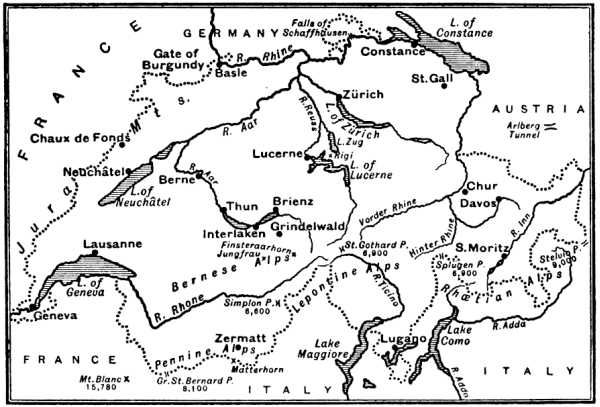
lake settlements have been discovered around Lake Zurich, and
recently, when Mr. Ritter, famous for the gigantic scheme to supply
Paris with water from the Swiss lakes, "corrected" the meanderings of
the river Thiele which conducts the waters of Lake Neuchâtel to
Bienne, his engineering feat, besides gaining huge tracts of fertile
land, lowered the level of Lake Neuchâtel and led to some further
valuable discoveries regarding the lake-dwellers. It seems clear that
every Swiss lake was a centre for a thick population in the later
Stone Age and the Bronze Age.
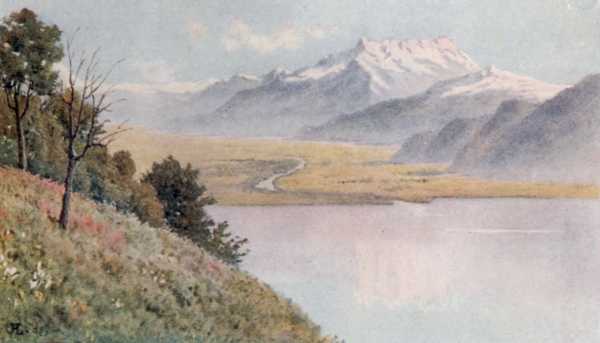
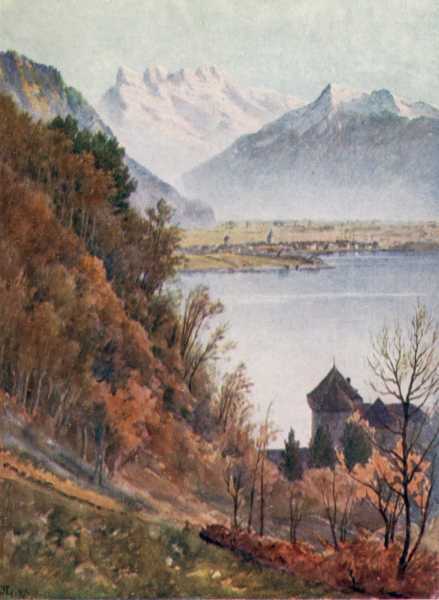
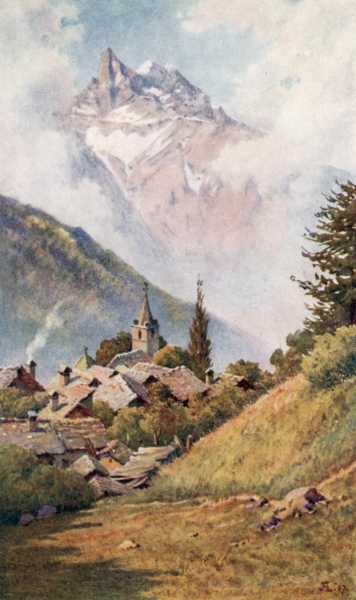
LOOKING DOWN THE RHONE VALLEY FROM MONT PELERIN, AT THE EASTERN END OF THE LAKE OF GENEVA.
The first important discoveries regarding these Swiss lake-dwellers
were made in 1853, when the waters of Zurich lake sank so low that a
stretch of land was laid bare along the shores. The people of Meilen,
twelve miles from Zurich, took advantage of this to carry out some
public works, and during the operations the workmen encountered
obstacles, which proved to be wooden piles. These piles, the tops of
which were but a few inches below the surface of the mud, were found
to be planted in rows and squares, in great number. There were picked
out of the mud bones, antlers, weapons and implements of various
kinds. Dr. Ferdinand Keller was sent from Zurich to examine the
workings, and he pronounced them to be the site of a lake settlement,
probably of some very ancient Celtic tribe. Many marks of a
prehistoric occupation had been found before 1853, but no traces of
dwellings. The discovery caused a sensation, and gave a great impulse
to archæological studies. Dr. Keller called these early settlers
Pfahl-bauer, or pile-builders. Since then over two hundred of these
villages have been discovered—on the shores of the lakes of
Constance, Leman, Zurich, Neuchâtel, Bienne, Morat, and other smaller
lakes, and on rivers and swampy spots which had once been lakes. The
strictly Alpine lakes, however, with their steep inaccessible banks,
show no trace of these settlements.
The early lake dwellings were built on piles driven into the bed of
the lake, and as many as thirty or forty thousand of these piles have
been found in a single village. The houses were made of hurdlework,
and thatched with straw or rushes. Layers of wattle and daub
alternating formed the floors, and the walls had a covering of clay,
or else of bulrushes or straw. A fence of wickerwork ran round each
hut. Light bridges, easily moved, connected the huts with each other
and with the shore. Each house contained two rooms at least, and some
of the dwellings measured as much as 27 feet by 22 feet. Hearthstones
blackened by fire in some huts remain to show where the kitchens had
been. Mats of straw and reeds were found, and proofs of an organised
worship of some gods.
The lake-dwellers hunted with weapons of bronze. They tilled the
ground and had flocks of horses, cattle, and sheep. They wove the wool
of animals, and also a fibre of flax, and made a coarse pottery. Men
and women wore ornaments of metal, of glass, of leather, of carved
stones. Probably the later generations of lake-dwellers were
contemporary with the Homeric period in Greece, though their state of
culture was inferior to that of the people of the Grecian peninsula.
Some idea, then, we may form of the people of Switzerland in
prehistoric times, those times when the fair-haired Achæans were
settling in the Hellenic peninsula the issue between themselves and an
earlier Canaanitish race, and giving prompting to the stories of the
Homeric legends. Celtic migrants, making their way along the great
watercourses of Europe, had come to these Swiss lakes resting at the
feet of the Alps, and had found there prompting to settle and to begin
to cultivate a community life. Seemingly there were three different
epochs in the age of the lake-dwellers, of which two were of the later
Stone Age and one of the Bronze Age. Switzerland had then, probably,
as thick a population as most parts of Europe, and at the earliest
stage of the lake-dwellings that population was almost as advanced in
culture as were the forefathers of the Grecian and Roman
civilisations. But later it was not so. Those nomadic peoples who
found places in the Mediterranean sun; and who there came into contact
with the civilisations which had grown up on the shores of the Levant,
in the valley of the Nile, and on the north coast of Africa; after
mingling their blood with the Mediterranean peoples and acquiring
their culture, were capable of creating great communities which
unmeasurably outstripped the little primitive states of their cousins
who had settled at the base of the Alps.
It is probable that, fairly close on the heels of the lake-dwellers,
there came other Celtic immigrants to Switzerland, dispossessing the
aboriginal peoples of the mountains, fighting with the lake-dwellers,
and coming in time to as high a standard of civilisation as they. With
the Iron Age the lake-dwellings seem to have been abandoned and the
lake-dwellers merged into the general body of the Helvetians. What we
know as Switzerland to-day was then occupied by Celts, Rhætians, and
Alamanni. Helvetia, as it was known to the Romans, took its name from
the Helvetians, a tribe of Celts who had been pushed out of their own
territories by the advancing tide of the Teutonic invasion and had
colonised lower Switzerland.
Just as the lake-dwellers had set up a higher standard of civilisation
than the mountain-dwellers in their age, so the Helvetians, occupying
the lower ground of Switzerland, showed much more culture than any of
their neighbours. They had adopted the Greek alphabet and kept written
records of their doings. Their weapons and armour were good; their
cultivation of the soil was skilful, and they had a knowledge of
architecture, their fortifications in particular being praised by
Roman writers as excellent. Local traditions said that Hercules had
once visited Helvetia and taught the Helvetians arts and laws. That
was the picturesque way of stating that their ideas of civilisation
had come from Greece. These Helvetians were the easily traceable
ancestors of the present Swiss, and many Swiss cities of to-day occupy
the sites and keep close to the names of the old Helvetian
centres—Geneva, Lausanne, Soleure, and Zurich, for examples. But the
Helvetians were not strictly an Alpine race. They left the great
mountains to wilder people and settled on the foothills and around the
lakes.
The method of government of the Helvetians was closely modelled on the
aristocratic republicanism of the Greek states. Wealthy nobles owned
the land, and the rest of the population was made up of their vassals
and slaves. But no one could aspire to be king. The chief Orcitrix, it
is told, aspiring to kingly power, was burned to death. The Swiss do
not seem to have copied the Grecian religious system, adhering to
their ancient Druidical worship. Perhaps the gloomy and savage form
which Protestantism was to take in after years among the Swiss, was in
part due to the fact that their ancient form of worship seems to have
been a particularly fierce kind of Druidism, and was very little
subjected to the moderating influence of the pagan culture.
The mountain barriers kept the Helvetii for a long time from hostile
encounters with the Roman power. But there is evidence that they got
in touch with the Etruscans for purposes of trade through the Alpine
passes from a very early age. Their chief warlike trouble came from
the north, where the German population was constantly pressing down
seeking fresh outlets. The first conflict between the Helvetii and the
Romans was when the Tigurini tribe of Switzerland joined with the
Cimbri in an attack upon Roman Gaul and defeated a Roman army under
Cassius and Piso. That was 107 B.C. The Romans did not make any
serious attempt to avenge that humiliation. The next meeting of the
Helvetii with the Romans was not until the days of Cæsar (58 B.C.).
Then the Helvetii, hemmed in on one side by Roman Gaul and on the
other by the swelling floods of the German migration, resolved on a
mass move, abandoning their own country completely and seizing some of
the rich lands of Gaul.
It was a strange design and was carried out with strange persistency.
Two years were devoted to the organisation of the great move, and on
the appointed day practically all the Helvetii, men, women, and
children, with all their beasts and their property assembled at
Geneva. Their old homes were given to the torch, burned so that there
would be no temptation for the people to turn back. Julius Cæsar (who
followed Thucydides in the ranks of great war correspondents) tells
the story: and it was Cæsar who set himself to the breaking up of this
great plan. At Geneva the Helvetii found the bridge over the Rhone
broken up by Cæsar's order. After useless attempts to cross the river,
they turned towards the Jura Mountains, and whilst they were toiling
over the steep and rugged Pas de l'Ecluse, Cæsar returned to Italy to
gather his legions. Returning to Gaul, he arrived in time to see the
Helvetians cross the Arar (Saône). The Tigurini were the last to
cross. On them Cæsar fell and almost exterminated them, thus wiping
out the old stain on the Roman arms. The Roman legions had crossed the
Saône in twenty-four hours, and this feat so excited the admiration
of the Helvetians, who had themselves taken twenty days to cross, that
they sent legates to treat with Cæsar for a free passage. They
promised him that they would do no harm to any one if he would comply
with their request, but threatened the full rage of their arms if he
should intercept them. Cæsar asked them to give hostages to confirm
their promise. "The Helvetians are not accustomed to give hostages;
they have been taught by their fathers to receive hostages, and this
the Romans must well remember," was the reply.
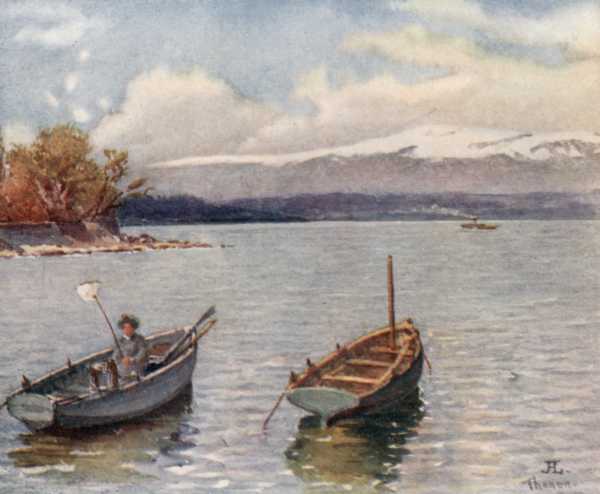
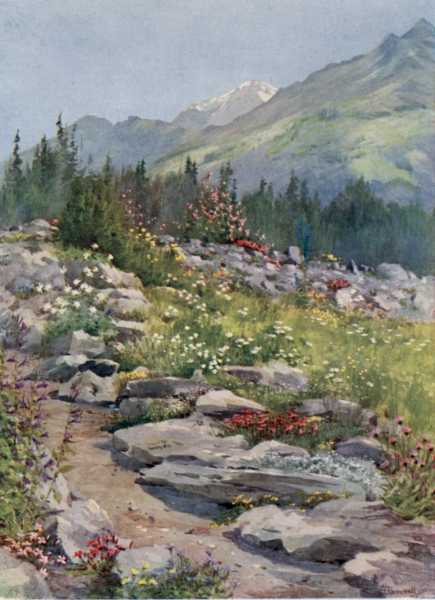
A DISTANT VIEW OF THE JURA RANGE FROM THE SOUTH SIDE OF THE LAKE OF GENEVA.
The Helvetians continued their march, Cæsar watching for an
opportunity of attacking them. At Bibracte, west of Autun in Burgundy,
Cæsar seized a hill, posted his troops there, and charged the enemy
with his cavalry. The Helvetians fiercely repulsed the attack, and
poured on the Roman front, but were quite unable to stand against the
steady discipline of the legions. They lost the battle but won the
respect of Cæsar, and the remnant of this "nation on trek" were helped
by him to return to their homes and were allowed to become allies of
Rome, with the task assigned to them of guarding the Rhine frontier
against the Germans. But the Helvetii found this vassalage irksome,
rebelled, were punished, and their country subjugated by the Roman
roads as well as the Roman legions.
The Helvetia thus brought under Roman sway was not all of the
Switzerland of to-day. Some of the Swiss cantons were comprised in the
old province of Rhætia, which was not subdued by the Roman arms until
the days of the first Augustus. Then, however, the Rhætians, who were
kindred with the Italian Etruscans, came so completely under Roman
influence that to this day in the valleys of the Engadine a corrupted
Latin tongue is spoken, somewhat similar to that of the Roumanians of
the Balkan Peninsula. Under Augustus western Switzerland was
incorporated with the Roman province of Gaul, having its capital at
Lyons; eastern Switzerland was joined with Rhætia, having its capital
at Augsburg. Thus early in history the difference between Gallic
Switzerland and Teutonic Switzerland begins to show itself.
Helvetia was much favoured by the Romans and became in effect the
frontier province for the defence of the empire against the Germans.
After a time the Helvetians were but little distinguishable from the
Romans, adopting their manners and their faith. Wealthy Romans loved
to make their summer resorts along the lake of Geneva, and Aventicum,
the Helvetian capital, became a great Roman city.
At Avenches (which was the Roman Aventicum) there are to-day but 2000
people, but there can be seen remains of a Roman wall four miles long
and in some places 15 feet high. In the day of Vespasian the city was
as big as Canterbury is to-day, and with its walls, theatre, and
aqueduct could look down upon the miserable contemporary village of
Londinium. Helvetia, under the Romans, followed, in fine, very much
the same course as Britain under the Romans.
With the decay of the Roman power Helvetia, like Britain, was made to
feel at the hands of the barbarians a harsh punishment for its
acceptance of the Italian civilisation. In the third century of the
Christian era the Alamanni swept over the country, looting and
devastating and retiring. In the fourth century they came again and
took possession of all the east. The Burgundians followed, and, to a
greater degree than most of the civilised world, Switzerland had to
face the horrors that followed the disruption of the Roman Empire.
Gradually there emerged from the welter the beginnings of the
Switzerland of to-day, in part representing the old Gallic Helvetians
and Etruscan Rhætians, in part the Alamanni (Germans) and the
Burgundians. With the coming of the northern invaders Christianity,
which had supplanted Paganism in Helvetia as it had in Rome, was
almost stamped out. But as the power of the Burgundians grew over that
of the Alamanni the country began to turn again towards Christianity.
In the sixth century missionaries from Ireland did much to spread the
Christian faith in Switzerland. The most famous of these was St.
Columban, who established a monastery at Luxeuil, of which he soon
made a storm centre, involving himself in constant troubles with the
Gallic clergy and with the Italian Pope. There is extant a famous
letter of his to Pope Boniface IV. It is addressed by him to "the most
beautiful head of all the churches of entire Europe. The most sweet
Pope, the most high President, the most reverent investigator." After
that flood of "blarney" St. Columban goes on to complain of the
infamia in which the Papal Seat is steeped. Out of that remonstrance
nothing seems to have come, but when St. Columban joined issue with
the masterful Queen Brunhilde of Burgundy he met a spirit as
imperious as his own. To guard her own power in the Court of Burgundy
the famous Brunhilde encouraged her grandson, the reigning king, to
keep mistresses rather than to marry a queen. St. Columban referred to
the children of these mistresses as a "brothel brood." Shortly after
he was exiled by force from Luxeuil, and is next heard of at Nantes,
ready, it seemed, to embark for Ireland, his native land. But he
changed his mind, turned back on his tracks, and established himself
on the lake of Constance, where he preached successfully to the
heathen and threw their idols into the lake. Next St. Columban went
over to Northern Italy, abusing his disciple St. Gall who was too sick
to accompany him. St. Gall remained in Switzerland and founded the
famous monastery of St. Gall, visited by Charlemagne in 883.
Charlemagne was particularly fond of Switzerland and the Swiss, and
founded many monasteries and schools in the country. Often he resided
in Switzerland, and it is from Switzerland that comes the story which
tells that his justice and mercy were so well renowned as to be known
even to the animals. There was, the story runs, near his palace at
Zurich a chapel on the river-side where he had placed a bell for
people to ring if they wished to appeal for justice. One day as he was
at dinner this bell began to ring. None could inform him what was the
matter. The bell rang a second time, and then a third. On this the
emperor rose from the table, saying, "I am sure there is some poor man
you do not wish me to see." He walked down the hill to the chapel,
where, hanging to the bell rope, he found a snake. The snake led
Charlemagne to a tuft of nettles, and examining the spot he found a
large toad sitting on the eggs in the serpent's nest. At once,
grasping the meaning of the appeal, Charlemagne passed sentence that
the toad should be killed. The next day the snake entered the
dining-hall of the emperor, climbed on the table, and, beckoning the
emperor to remove the lid of his golden goblet, dropped into it a
beautiful jewel.
With the death of Charlemagne his empire was broken up and Switzerland
was doomed to centuries of struggle in the vindication of her
independence. The story of that struggle is one of the most
fascinating of the national records of the Middle Ages.