I DEDICATE THIS BOOK
TO THE CONSERVATORS OF THE HEATH,
AND TO
ALL WHO LOVE ‘SWEET HAMPSTEAD’
FOR ITS OWN SAKE.
THE AUTHOR.
PREFACE.
As illustrating the very common axiom that extremes
meet, a preface at the beginning of a book is, as
a matter of course, the last thing that is written.
In the present instance, having stated my reasons
for writing ‘Sweet Hampstead’ in the introductory chapter,
a preface seems almost redundant. Moreover, I have an
idea that prefaces as a rule are not popular reading, but
literary custom being stronger than private opinion, I must
revoke my heresy.
It is very many years since the thought of writing the
story of Hampstead occurred to me. I found that previous
writers had left the most important period of its local history,
and the most interesting personages who had vitalized it,
with little more than a passing reference; and thence it was
that the desire to occupy unbroken ground took possession
of me.
But the years alluded to were amongst the busiest of a
busy life, when I was ‘coining my brains for drachmas,’ or
their equivalent in British currency, and had no time for the
dreamland of topographical speculation. The engagements,
however, that hindered my design opened up many sources
of material for future use; and as topography is always
a literary mosaic, their diversity tended to enrichment.
Thus it came to pass that the first draft of my book was
laid aside, but never forgotten, for more than thirty years,
and has only recently been reverted to—a task that has
been a delight, bringing back—though sometimes through
a mist of tears—images of the past, with pleasant memories
of sunny days that, looked at from the perspective of eighty-nine
years, seem brighter even than sunshine is itself.
From such a pile of years I almost lose the author’s dread
of the critic. Praise or blame are to me now much the same;
but, being a woman, I still prefer the praise.
I cannot close these preliminary words without expressing
my obligations to Mr. P. Forbes for the eight sketches he
has permitted to be copied for the beautifying of the book;
to Messrs. Oetzmann for some illustrations so kindly lent; to
Mr. Baines, not only for a similar favour, but for help from
his valuable ‘Records of Hampstead’; and to the proprietors
of the Municipal Journal for the charming picture of the
viaduct.
My thanks are also due to Mrs. Rosa Perrins, to Miss
Kemp, Miss Quaritch, and Mr. M. H. Wilkin, who have all
kindly assisted me. I also desire to acknowledge my indebtedness
to Mr. Lloyd, of Highgate, for information gathered
from his clever lecture on ‘Caen Wood and its Associations.’
To the courtesy and kindness of Mr. G. W. Potter I owe
much original material, and many interesting notes; and
I also desire to thank Mr. C. A. Ward for the personal
interest he has taken in my work, and the great help he
has ungrudgingly given me in preparing and correcting it for
the press. I can only add that should my book be found so
readable as to convey to others some share of the pleasure
I have felt in writing it, or lead in more capable hands to
future research and a fuller development of a delightfully
interesting topic, ‘Sweet Hampstead’ will have fulfilled its
intention, and I can sing with an unknown poet of the
sixteenth century:
To the inhabitants of London and its suburbs a
history of Hampstead and the Heath may seem
wholly unnecessary. What London lad who has
not fished in and skated on its ponds, played
truant in its subrural fields and lanes, gone bird-nesting in
its woods, or spent delightful, orthodox half-holidays upon
the heath?
As for the free brotherhood of the lanes and alleys before
the plague of Board schools afflicted them, or the Board of
Works stood sponsor for the preservation of the Heath, what
hand’s breadth (of its mile-wide waste) of its hundreds of
acres was there that they did not know and continue to
renew acquaintance with on every recurrence of the high
festivals of Easter and Whitsuntide?
But it is not of ‘’Appy ’Amstead’ that I am about to
write, but of that older Hampstead the materials for the
history of which lie scattered through many books not
often read, and in the correspondence of dead men and
women.
Lysons and Park are not for general readers, and such
works as William Howitt’s ‘Northern Heights’ and Baines’s
‘Records of Hampstead’ are not companionable volumes.
Yet I know of no intermediate work between them and mere
guide-books.
Hence it occurred to me that I might fill a vacant place
in the literature of ‘Sweet Hampstead,’ and give to others,
without the toil, the pleasure I have had in recalling forgotten
incidents connected with it, and memories of some
of the celebrated men and women who, from the days of
Queen Anne till our own, have added to the intrinsic delights
of the place the charm of their association with it.
When the idea of undertaking ‘this labour of love’ occurred
to me, the window near which I loved to write commanded
a last fragmentary view of Gospel Oak Fields, which divided
Hampstead from the parish of St. Pancras. These fields
were even then (early in the sixties) in the hands of speculative
builders, but a few green hedges, a group of elms, a pollard
oak or two—scions, perhaps, of the traditionary one that for
centuries had given its name to these now obliterated prata
et pasturas—remained.
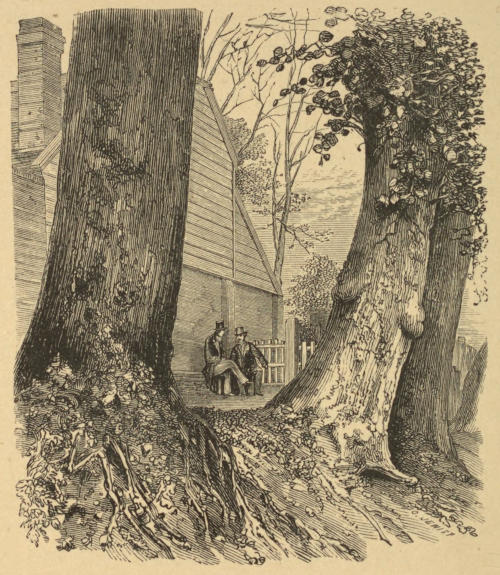
Ten years previously the hollow trunk of a very aged tree
(fenced round) was still standing, and was locally said to be
the remains of the original Gospel Oak, one of the many so
called, in various counties of England, from the use made
of them by the Preaching Friars, who under their shade
were wont to read and explain the Scriptures to the people.
It was at that time, and for years afterwards, used as a
boundary tree, when once in three years the clergyman,
parochial authorities, and charity children perambulated the
boundaries of the parish of St. Pancras, of which it was the
terminus in this direction.
Where Fleet Road is now, the shallow remnant of the
once ‘silvery Fleet,’ as Crosby calls it in his ‘Additional
Notes,’ written only a very few years before the period I am
writing of, ‘meandered, irrigating those charming meadows
which reach on either side of Kentish Town.’
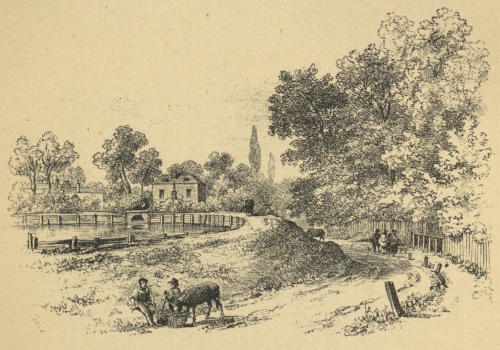
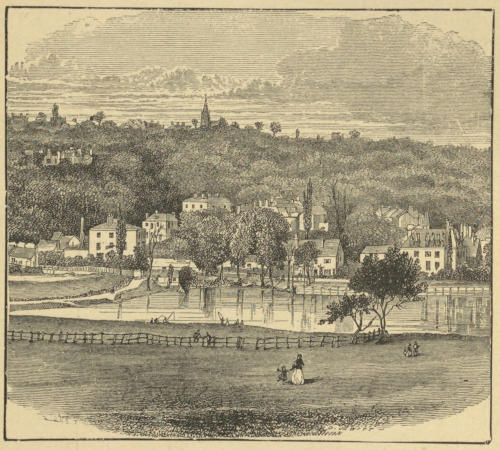
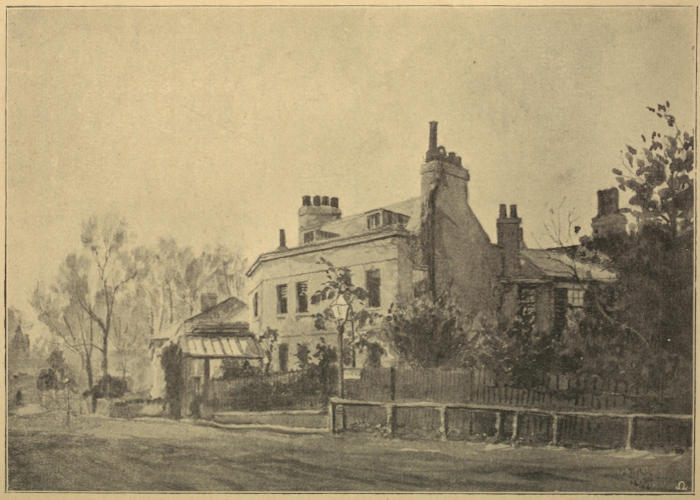
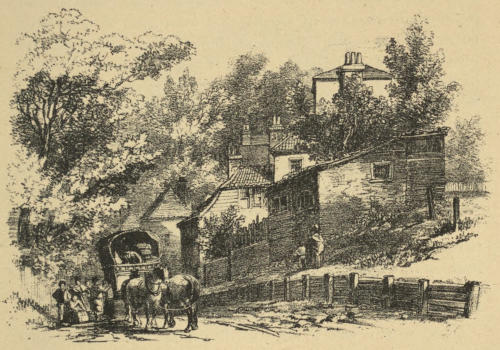
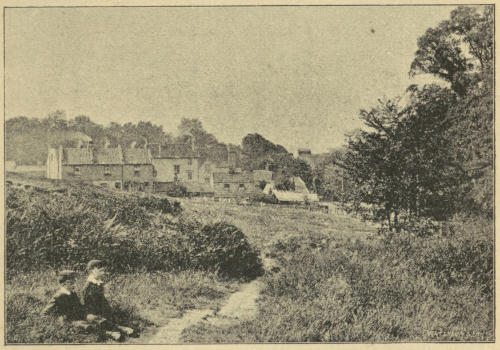
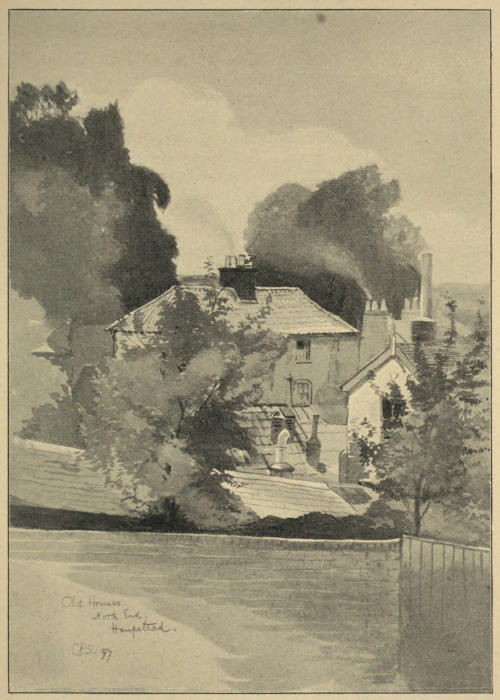
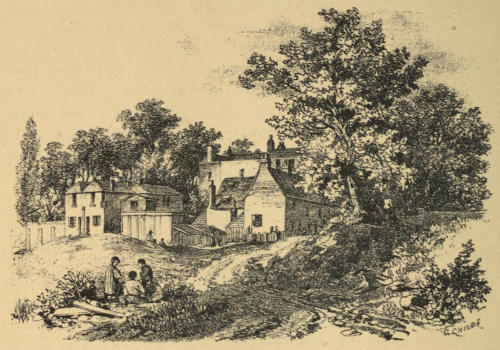
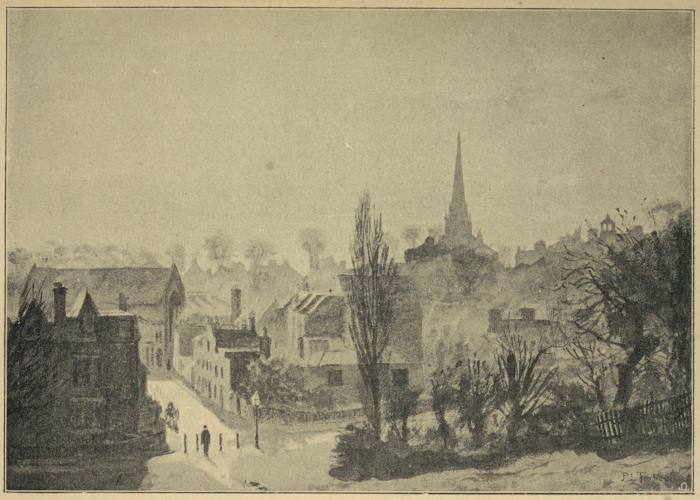
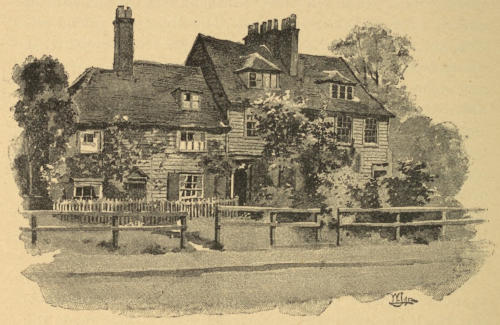
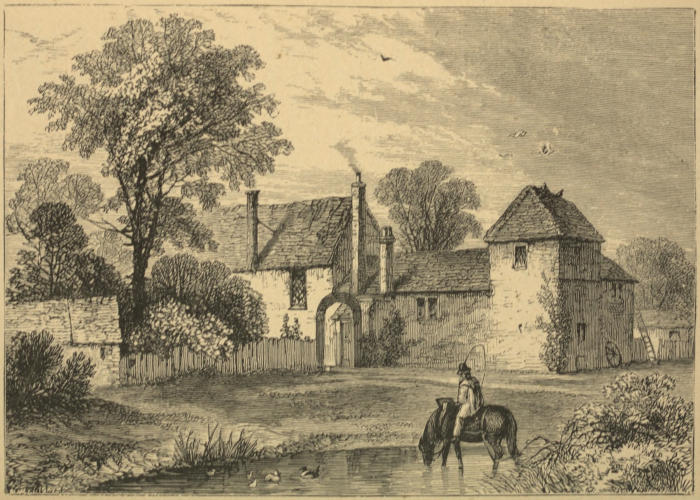
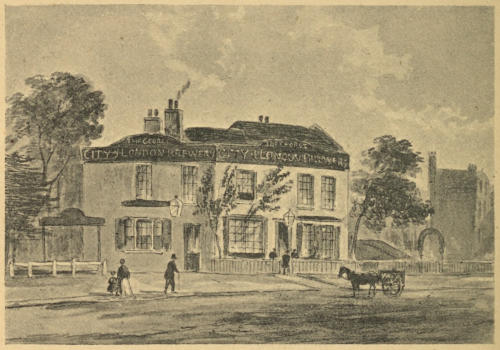
South End Road, 1840.
In my time it crept, a sluggish stream, a mere ditch in
dry weather, but after copious rain it rose suddenly, brimming
to its margin, to disappear at the end of Angler’s Lane by a
subterranean channel under part of Kentish Town, where it
once more came to light as a narrow runlet in the main road
that was easily stepped over. There were persons then living
who remembered this portion of the river, a limpid stream
flowing by the west side of Kentish Town towards King’s
Cross, for it is not much more than half a century since it
was arched over and built upon.
The fields through which it passed showed signs of its
meanderings, and were still lovely with trees that had figured
in many an artist’s sketch-book, and had thence imparted
the refreshment of their pictured beauty to many a home.
The footpath through these meadows from Kentish Town
followed the curve of an old rivulet scarcely dry in places,
the whole course of which was traceable in the wavering
line of aged willows, hollow and splintered, but putting forth
hoar green branches above the exhausted stream that had
once fed their roots.
This was Mary Shelley’s lovely walk from Kentish Town
through the fields, with their fine old elms and rivulets and
alder-trees, and a view to the north of the wooded heights of
Highgate. In her time Carlton Road and the region thereabouts
were all meadows.
This path led over the easiest of stiles through a little
lane between hedges of hawthorn and elder by an old nursery
garden and cottage where strawberries and cream were to be
had in the season, and a cup of tea at all times, and so to
South End or such portion of it as was not already changed
to railway uses. The houses here were of a humbler description
than those in the Flask Walk, but there were sufficient
indications in little garden-borders, in roses trained about
the doors, in vines wholly untrained, running to an excess
of leafiness over walls and roofs, in a group of straw bee-hives,
sheltered in a corner, to show how pretty and rustic
the place had once been. There was the down-trodden,
worn-out Green, with its white palings and rickety turnstile,
in itself a protest to the farther use of it, and lime-trees,
out of all proportion to the small houses you saw
between them, large-limbed and flourishing.
An ascending row of houses to the right, on what is now
South Hill Park, occupied the levelled slopes the summits of
which when I first knew the lovely neighbourhood afforded
charming views, and not the least charming that of the
eastern outskirts of Hampstead, sweeping up amidst a profusion
of foliage towards the high ground about Squire’s
Mount, with a foreground of water and groups of trees
studding the undulating surface, the fields on the east
bounded by the remarkable mound which now bears the
name of Parliament Hill, but was then known by the more
striking one of Traitors’ Hill.
Ainsworth has made it memorable as the scene whence
some of the conspirators of the Gunpowder Plot watched for
the explosion of the Houses of Parliament at the hands of
Guy Faux. Park, who refers to Stukeley’s ‘Itinerary’ on
various occasions, takes no notice of this eminence.
Mr. Lloyd, in his published ‘Lecture on Caen Wood,’
tells us that when Mr. Bills purchased the estate of Sir James
Harrington, amongst the properties belonging to it was a
windmill, ‘which occupied the fine site of the summit of
Parliament Hill, where the trench formed by the removal of
its foundations is still to be traced. It was, doubtless, the
Manor mill.’
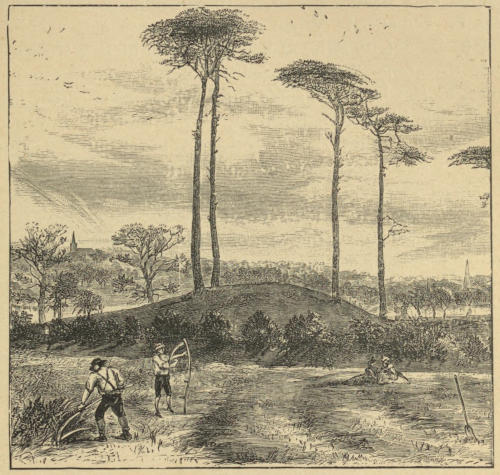
Tumulus.
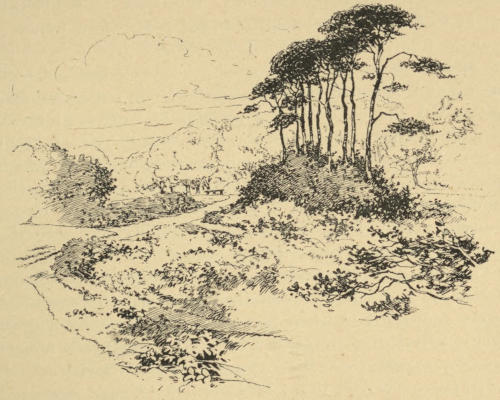
At one time it was presumed that, like the mound in the
field to the right of the path to Highgate, which Lord
Mansfield caused to be enclosed and planted with Scotch
firs, it was a tumulus. In support of this idea there is a
tradition of Saxon times still extant of this neighbourhood.
Was it not about the skirts of Highgate that Alfred encamped
with his troops to protect the citizens of London,
whilst they gathered in the harvest from the surrounding
fields, from Hastings of the Ivory Horn, who lay with his
Danish army beside the Lea, ready to pillage them of their
summer fruits? And might not some great battle have been
fought, and have resulted in the raising of this mound?
Alas for romance! When a few summers ago a child at
play in its neighbourhood unearthed the hidden treasure of
some threatened home, buried for safety’s sake in troublous
times, or the booty of some thief, whose after-career interfered
with his return for it, a search into the interior of
the mound, under the direction of the County Council,
dispelled the theories of the antiquaries and the dreams of
romancists.[1]
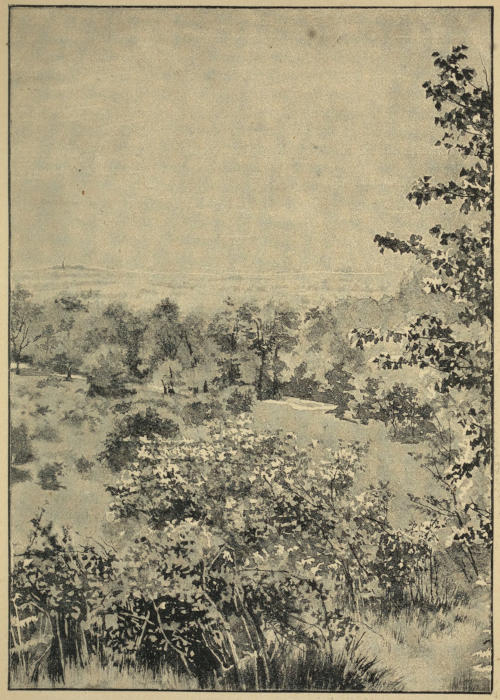
But whatever its origin, the mound adds materially to the
visual enjoyment of the visitor; and the sight of London
from its height, especially at the early dawn of a clear
summer’s day, is said to be worth a midnight pilgrimage to
obtain. The air blows over its summit ‘most sweetly,’
especially in June, blending the scent of the lime blossoms
from the sister villages with the aroma of the hayfields
and hedgerows, where the honeysuckle and wild-rose bloom
unmolested.
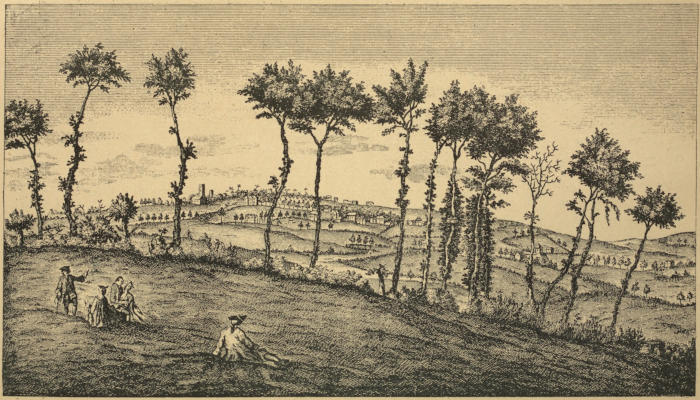
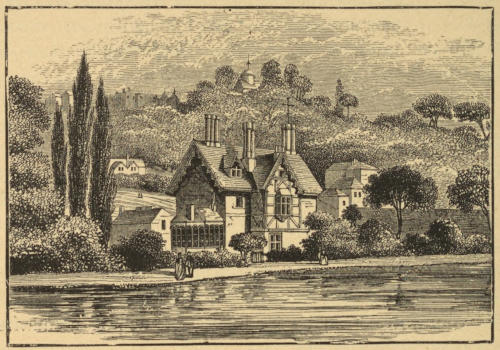
Facing round, we have Highgate Hill in view, with white
modern houses showing here and there, and others roof-high
in the foliage of surrounding trees. Of the ancient
hamlet we see only a ridge of red-tiled roofs showing in the
neighbourhood of the church.
To the north, where the grounds of Caen Wood come
sweeping down to the brimming ponds, on which the swans
‘float double, swan and shadow,’ the landscape widens into
one of rare beauty. Park-like beyond the park, in its alternations
of lawny slope and little dells and groups of trees,
it looks like a portion of the demesne, and not the least
picturesque and lovely part of it.[2]
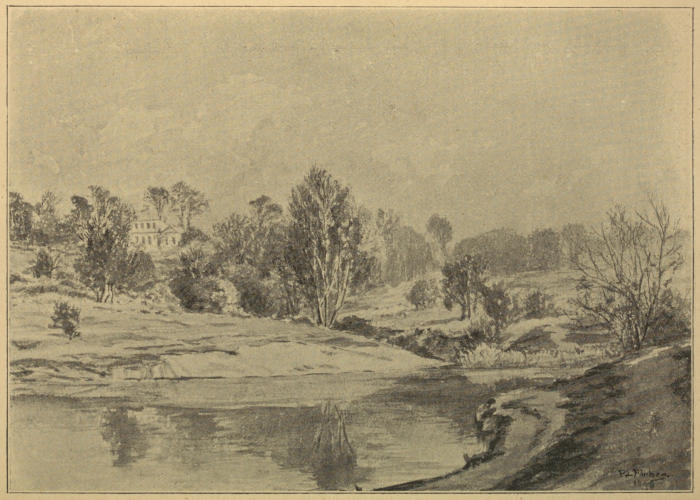
View of Highgate and Ponds.
To the west (a proper pendant to the view of Highgate)
our vision closes with the spire of St. John’s Church, and
the town of Hampstead stretching down a peninsula of
houses in a sea of verdure, terminating in the fast-narrowing
strip of green fields between Kentish Town and the
St. John’s Wood estate on this side of Hampstead Road.
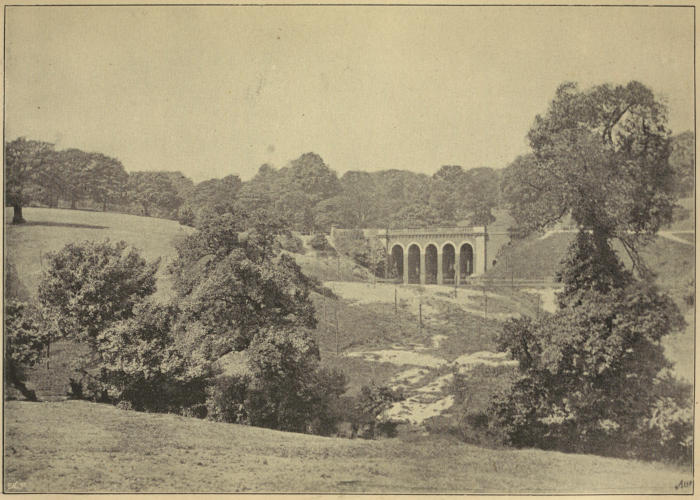
I specially remember a bit of landscape in which the red
viaduct[3] in Sir Maryon Wilson’s demesne shows to much
advantage on the grassy foreground between the wooded
undulations of the park. It is still pretty, but ‘with a
difference.’ Then a footway crossing the Heath led through
an old gray, weather-beaten gate to a shady path, with a
plantation of young trees on one side, and a hedgerow,
redolent in summer of wild-rose and May, dividing it from
a meadow on the other. The remains of a long-disused
tile-kiln stood on the edge of the field, the red earth of
which showed its fitness for such manufacture. This path
led through upland fields to Highgate, and was a charming
one, beloved by painter and poet. The last time I saw it
the beauty was devastated, and the meadow changed into
a brickfield, with a view to its conversion into a site for
building on.
But I am forgetting, in my remembrances of the charming
suburb, that from the earliest birth of a taste for natural
beauty, Hampstead must have had a special interest for the
inhabitants of London.
Beautiful as were the whole range of gently-swelling
hills forming the background of the City, and long subsequent
to Tudor times covered with dense woods, which
encroached on the north and east even to its gates, and
came down on the west as far as Tyburn, Hampstead Hill
from its altitude, and the fact, as someone has written,
that it ‘closed the gates of view in that direction,’ must
have had an interest beyond the others.
Baines claims for Hampstead that it was a village before
1086; in other words, that the five manses, or homes of the
villani and bordarii on the original clearing, which are
mentioned as existing when Domesday Book was compiled,
constituted a village. In 1410, at the time of the
assignment of Hampstead, together with Hendon, to Henry
Lord Scrope of Marsham for the maintenance of his servants
and horses, he being then attending Parliament on the
King’s service, it is included with Hendon, and styled a
town (‘the towns of Hampstead and Hendon’).
Viaduct.
But in the reign of Henry VIII. it is again called a
village, by which designation it continued to be called even
in our own times, long after it had outgrown the dimensions
of one, just as a beloved child when grown up retains the
pet name given to it in infancy; and truly Hampstead continues
to be the best-beloved of all the City suburbs.
A stone in the north aisle of the old church, dated 1658,
recorded that John Baxter, Gent., had made it incumbent
on the owners of a house ‘in Hamstede Streete, where
Mr. Netmaker dwelleth’ (no other street apparently existed
to make a prefix necessary), to pay the sum of £3 yearly to
the poor of the parish. Someone of importance, no doubt,
occupied the moated mansion and demesne of Caen Wood,
and there are records of other great men and rich City
merchants resident in the upland hamlet. A peep at the
parish register,[4] the earliest date in which is 1560, affords
us a clue to the growth of the population.
Subsequent to the above date, 1580-89, the baptisms
averaged 13³⁄₁₀, the burials 6⅒. At the close of 1680-89
the baptisms amounted to 33⅗, the burials to 65⁹⁄₁₀, an excess
accounted for by the visitation of the Plague (1664-65).
Towards the close of the eighteenth century (1790-99) the
baptisms averaged 99⅗, the burials 141⅗,[5] a slow but steady
growth, marvellously increased in modern times.
After the Great Plague, change of air in the summer
season became an article of faith with the inhabitants of
London, and an annual sojourn of some weeks in the
country or at the seaside an established custom with all
who could afford it, a custom which resulted on the part of
the wealthy merchants and citizens in the hire or purchase
of a country retreat in one or other of the suburbs.
Hampstead, towards the end of the Commonwealth,
combined the advantages of ‘Air and Hill, and Well and
School,’ and these favourable circumstances, added to its
easy distance from London, recommended it to the City
fathers and mothers, and made it, of all the rural villages in
the neighbourhood of town, the most popular.
Though its high-pitched situation precluded at that period,
and for a long time after, such an increase of buildings as
lower situations were afflicted with, its position, fine air, and
beautiful prospects made it much sought, and in the times
of the Stuarts many notable persons in connection with
the Court had houses here. Sir Henry Vane built his fine
mansion on what was then called Hampstead Hill, and
J. Bills, Esq., son of the printer to His Majesty, resided at
Caen Wood; while my Lord Wotton had his country-house at
Belsize. After the Restoration we find Sir Geoffrey Palmer,
Attorney-General, residing at Hampstead, where he died,
May 1, 1670, and though Pepys does not mention it, Sir
George Downing, Secretary to the Treasury, who so often
appears in the ‘Diary,’ and whom Pepys stigmatizes as a
‘sider with all times and changes,’ resided here, and had his
house broken into and robbed (1685). From the St. James’s
Gazette, published by authority, I find that, amongst other
articles of which the thieves deprived Sir George, were the
following items: ‘A large agate about the bigness of a crown
piece, with Cupid and Venus and Vulcan engraved on it.
A blue sapphire seal, set in gold, enamelled, with an old
man and woman’s head engraved on it. A pomander,[6] set
in gold. A locket, with fourteen diamonds and a crystal in
the middle, engraved with two Cupids holding a heart over
a cypher.’ This catalogue appeals to the sympathies of
every lover of delightful bric-à-brac, but one fears the advertisement
of them failed to recover the charming items, some
of which may even yet find their way to one of the table-cases
in South Kensington.
Every year appears to have added to the favour of Hampstead
as a summer resort, a fact that was not lost upon the
inhabitants, who were not slow to realize the benefit of these
annual incursions.
Copyholds were readily procurable, and Hampstead was
soon dotted about in various directions with weather-boarded
or brick dwellings, so that by the end of the seventeenth
century twelve houses had risen upon the demesne, two
upon the freeholds, and 257 upon the copyholds, besides
cottages, barns, brewhouses, etc., together with a dancing-room,
shops, and other tenements in connection with the
Wells.[7]
In the first year of the present century we find that Hampstead
possessed 691 houses, which in 1811 had increased to
842, with 5,483 inhabitants, and there were seventeen houses
building, and forty-five unlet.
In 1815, when Britton revisited it, he tells us that Hampstead,
from a beautiful rural village, had become a town, with
hundreds of mean houses (intended for lodging-houses) disposed
in narrow courts, squares, and alleys, many of them
uninhabited.
Yet the rate of building mentioned was insignificant compared
with its after-progress. In 1861 the inhabited houses
had increased to 4,340, with 385 uninhabited dwellings, and
169 more in course of building, while the population of the
whole parish amounted to a total of 32,271 persons, a
very remarkable feature in the succeeding census of Hampstead,
1871, being the preponderance of female inhabitants,
who exceeded by 711 the entire population of the previous
census in 1861.
If anything can invest these dry details with interest, it is
the contrast they present between the Hampstead of the past
and present. At the census of 1891 the inhabited houses
numbered 9,528, with 687 uninhabited, 461 in course of
erection, whilst the population in the four wards comprised
in the parish of St. John amounted to 68,425 persons. The
population of Hampstead at the present time (1898) is said
to be about 78,000. In thirty years houses and inhabitants
had doubled their numbers. The man who published a book
in 1766, called ‘London Improved,’ which proposed to make
the New Road, now Euston Road, the boundary of building
in that direction, ‘otherwise the Hills of Hampstead and
Highgate may be expected to become a considerable part of
the suburbs of London,’ wrote prophetically, for London
stretches out its infolding tentacles on all sides, and is
only nominally divided from them. This New Road, as it
continued to be quite recently called, though made under
the Act of the twenty-ninth of George II. (1746) under the
control of the Hampstead and Highgate trust, intersected
level fields from Tottenham Court Road to Battle Bridge.
It takes us a little aside from the story of Hampstead, but
is a pleasant prelude to it, and one can hardly refrain from
giving a glance at the London approach to the beautiful
village as it existed at the time of, and for a considerable
period after the opening of the New Road.
Midway on the south side of the road stood the Bowling
Green House, famous for nearly a century previously as a
place of rural resort, and lower down the Brill Tavern, rather
more ancient than its rival.
The Old Mother Red Cap public-house (and a nickname
for a shrew of the first quality, whom a recent writer claims
as a sutler and camp-follower of Marlborough’s,[8] but who
appears to have kept this house as long ago as 1676, and
to have been widely known by the unpleasant sobriquet of
Mother Damnable, under which name some doggerel verses
addressed to her are preserved in Caulfield’s Eccentric Magazine)—the
Old Mother Red Cap, and old St. Pancras Church,
were the only interruptions in the view of Hampstead
from Bedford House, Queen Square, and the Foundling,
except some groups of trees near St. Pancras, and in a
lane leading from Gray’s Inn Road to the Bowling-Green
House.
Gay and Pope both refer to the Tottenham Fields, and
William Blake, painter and poet, sings of
‘The fields from Islington to Marybone,
To Primrose Hill and St. John’s Wood.’
Where Harrington and Ampthill Squares now stand
‘stretched fields of cows by Welling’s Farm,’[9] the reputed
proprietor of 999 ‘milky mothers of the herd,’ which could
never be increased to 1,000, a singular tradition common to
the fields by Clerkenwell, and to the once green pastures
between the Old Kent Road and Peckham. A lady well
acquainted with Hampstead tells me that the same legend
existed with regard to a local cow-keeper, a Mr. Rhodes,[10] in
the early years of the present century.
A venerable friend of the writer’s in the fifties, an old
inhabitant of the neighbourhood, remembered that where
Francis Street now is there were fields called Francis’s
Fields running up to the Tottenham Court Road, which
few persons cared to pass through after dark. Some houses
then below what is now Shoolbred’s had little gardens with
green palings before them, which she specially remembered
from the figures of the traditional blind beggar and his
daughter, who so marvellously escaped the Great Plague
of London, ornamenting one of them. Harrison Ainsworth
has preserved the story in one of his graphically-written
novels. A gentleman tells me that an old lady born in 1800,
and only lately deceased, remembered as a child waiting in
the evening at the corner of Tottenham Court Road and
Oxford Street till a party of six or more persons collected,
when, in fear of footpads, they were convoyed across the
fields to Kentish Town by a watchman.
Camden Town, which had been begun to be built in 1791,
consisted for the most part of one-storied brick or weather-boarded
houses, the outlines of some of which could be
traced in my own time, though heightened and otherwise
altered. Other houses, with gardens and orchards lying
wide apart, led up to the half-way house we have just
mentioned—the Old Mother Red Cap—where, at the point
where the roads to Hampstead and Highgate diverge, stood,
as it still stands, Brown’s Dairy. A thatched cottage in
those days, with deep eaves, and little leaded, diamond-paned
casements sparkling under them. Over the half-hatch
door of this rustic dairy-house ladies and children
from the neighbourhood of the old-fashioned squares (who
took their morning walk through a turnstile at the top
of Judd Street, leading by hawthorn-shaded hedgerows to
the open fields), were wont to refresh themselves with
a cup of new milk, or equally innocent sweet curds and
whey.
At the top of Tottenham Court Road, in the fields on the
left-hand side, were the remains of a mansion, the removal
of which my old friend Valentine Bartholomew, the artist,
remembered. It gave its name to the road, and is said to
have been a palace of Henry VIII.’s; it was taken down
towards the end of the last century (1791).
On the same side of the way stood a well-known tavern
and tea-gardens, called the Adam and Eve,[11] the bowery
arbours, lawns, smooth bowling-green and garden-alleys of
which have been ill-exchanged for the gin palace opposite its
site.
This house is mentioned in the curious trial of Andrew
Robinson Bowes, Esq., and others, in the King’s Bench,
May 30, 1787, for conspiracy against his wife, Lady Strathmore—a
postboy, one of the witnesses of the lady’s forcible
abduction, having orders to hire a chaise with excellent
horses, and wait at the Adam and Eve, described as on the
road to Barnet. ‘Lady Strathmore, while shopping in
Oxford Street, was made prisoner, and the peace officer
who presented the warrant, a creature of her husband’s,
under colour of taking her before Lord Mansfield, had her
carriage driven up the Tottenham Court Road, Mr. Bowes
himself on the box, where, meeting the postboy, he bade him
follow in the chaise.’
Twenty-seven years afterwards Leigh Hunt tells us Mr.
Bowes was still in Horsemonger Lane Gaol, expiating, on the
debtors’ side of the prison, his misconduct to his wife, and
the non-payment of the fine to which he had been condemned.
Ponds and pools of water were in those days common in
the public ways, and one in the near neighbourhood of this
house became, on an afternoon of September, 1785, the
scene of the following brutal outrage:
A youth was suspected of picking a gentleman’s pocket
close to the Adam and Eve, whereupon some of the by-standers
took him to an adjoining pond and ducked him
very severely. A sailor, not satisfied with the discipline of
the crowd, threw him again into the water, and kept him
under till he was drowned.
A little further on to the right of the road there stood in
my time a high mound, covered with grass, beneath which
was a reservoir which supplied the neighbourhood with
water; it was removed, if my memory is correct, about
1846-47, when its site was occupied by one of the earliest
experimental baths and wash-houses, which have since given
place to some sunless houses, under the shadow of the Congregational
Church, in what is known as Tolmer Square.
From this mound the road to Hampstead, a comparatively
short period before the above date, was fringed with pastures
to the right, and with gardens, fields, hedgerows, and
orchards on the left, with only two or three cottages and a
roadside alehouse between the Adam and Eve and the High
Street, Camden Town.
Roads, in the present meaning of the word, there had
been none subsequent to Roman times, till the Hanoverian
succession. Even when the use of carriages made them
necessary, they resembled those deep country lanes, not yet
unknown in Devonshire and Essex, where in winter the
mud imbeds the wheels of carts or waggons, or were mere
pack-horse paths, with a raised causeway running through
the midst, and a deep fosse of mud on either side. Such a
road was that which, in Elizabeth’s time, ran up from Battle
Bridge between the hedgerow banks of Maiden Lane to
Green Street and Highgate, whence a path led by Caen
Wood to what was then called Wildwood Corner, across
Hampstead Heath to Pond Street, tree-shaded, with its wild
banks full of primroses and violets in spring, and redolent of
May a little later, but rendered all but impassable in winter
from the rains and overflow of the many rivulets which
drained the uplands into Pancras Vale.
I have before me a view of the ‘Hampstead Road, near
Tomkins’ House,’ engraved by Charles White, probably a
grandson of Robert White, a celebrated engraver, who died
in 1704. A post-chaise, drawn by two horses, is depicted
labouring up what appears to be a mere rugged track over
rough heath-ground. The dome of St. Paul’s (finished in
1710) and the City spires and houses appear in the distance
but the view exhibits a primitive and solitary country,
only broken by clumps of trees, furze coverts, and hedgerows,
and except a single cottage and the gable of a house
(probably Tomkins’) no other habitation is to be seen.
As late as May, 1736, it is reported in the London Post
‘that Col. de Veil had committed one of the coachmen who
was driving the Hampstead coach to Newgate, for getting
out of the track he was in and assaulting the Hon. the Lady
Cook Winford by driving his coach upon her, whereby he
threw her and her horse into a deep ditch, and she was
greatly hurt and bruised.’
The Hampstead Road was not made till 1772, when
George III. was King, though the summit of the hill had
been previously cut down. When Ogilby, in the time of
Charles II. wrote his Guide, St. Giles’ Pound lay in the
open country, and the way to Holborn, like Gray’s Inn
Lane, was a pleasant rustic road. Tottenham Court Road
lay between fields and market-gardens, sprinkled with houses
of entertainment, some of which lingered long after the
making of the present road. Gay tells us that in summer
‘the Tottenham fields with roving beauty swarms,’ and thirty
years later some doggerel verses in Poor Robin’s Almanack
inform us under the head of the month of May:
‘The ladies now, to take the air,
To Stepney or Hyde Park repair;
While many others do resort
For cakes and ale to Tottenham Court.’
In Pennant’s time, Oxford Street, then Oxford Road, had
only a few houses on the north side of it. He remembered
it ‘a deep hollow road, full of sloughs, with here and there a
ragged house, the lurking-place of cut-throats’—a state of
things the contrast to which was set forth in some crude
lines of a song that a venerable relative, who died at the age
of ninety-six, has often repeated to me, but of which I only
remember—
‘That was the time for games and gambols,
When Oxford Street was covered with brambles,
Ponds, and sloughs, and running water,
Where now there’s nothing but bricks and mortar.’
This semi-rural state of things appears to have lasted west
of Holborn for the first quarter of the present century.
When Bedford House was built (1706), the north side of
Queen’s Square was purposely left open that the inhabitants
might enjoy the charming prospect before it, terminating in
the Hampstead and Highgate Hills.
When Portland Place was planned, more than half a
century later, the then Lord Foley insisted on a clause in a
lease he held of the Duke of Portland to prevent the building
of any street to intercept the pure air of Hampstead and
Highgate from Foley House, a fact to which the width of
Portland Place is attributable.[12]
Gray, writing from Southampton Row as late as the
summer of 1759, tells his friend Palgrave that ‘his new
territories command Bedford Garden, and all the fields as
far as Hampstead and Highgate.’[13]
In contrast with the poet’s triumph in the beauty of his
views, we find Sir Samuel Romilly, many years later, complaining,
in a letter to his sister written from his chambers
in Gray’s Inn, ‘that, having but one row of houses between
him and Hampstead, a north-west wind, sharp as the piercing
bise, blows full against his windows.’[14]
Long after this date, Rosslyn House and Park could be
seen from Clerkenwell Green, and later still the green heights
of Caen Wood were visible from Bedford Row.
One of the advantages that Ned Ward’s public-house in
Red Bull Yard possessed was ‘commodious rooms, with
Hampstead air supplied’; and I think it is Lysons who
quotes the advertisement of a house of entertainment near
Bagnigge Wells, the proprietor of which sets forth as an
inducement for the favour of the public that his windows
command fine views of Hampstead and Highgate Hills.
These details help us to realize the relation of Hampstead
to London when its wooded crest could be seen from such
distant points, and it had come to be regarded as the air-filterer
and health invigorator of the whole district. Even
as late as 1820, from the west of Oxford Street to the skirts
of Hampstead Heath, there were green fields and pastures
all the way.
CHAPTER I. HAMPSTEAD AND THE HEATH.
Hampstead, situated in the Hundred of Oussulston
and County of Middlesex, is separated from
London by St. Pancras and Marylebone, and
otherwise bounded by Finchley, Hendon, Willesden,
and Paddington.
In the account of the several districts into which the
Registrar-General has divided London, Hampstead claims
the greatest elevation, standing 400 feet above Trinity high-water
mark, a circumstance that, in connection with its
gravelly soil, accounts for its dry, salutary air. It contains
in its parochial area 2,169 acres.[15]
The early history of Hampstead lies very far back, though
for all purposes of respectable antiquity—whether persons or
places are concerned—an appearance in Domesday Book is
sufficient. Hamestead, in its old, pleasant Saxon name, tells
of a yet higher antiquity, and long before the astute Norman
(in the language of the Saxon Chronicle) ‘sent forth his men
to inquire how many hundred hides of land were in each
shire, so that there was not a hide of land in England of
which he knew not the possessor, and how much it was
worth.’
Long before the existence of this pleasant schedule enabled
the Conqueror to parcel out the fairest portions of the land
to his favourite retainers, the five hides of land and five
manses, or homes, of which this manor consisted, were said
to have been given by King Ethelred, the gift being afterwards
confirmed by Edward the Confessor, to the Abbey
Church of St. Peter at Westminster.[16] These grants are
said to be spurious—forged, in fact, by the monks, the
mark of a pendent seal attached to one, and the wax adhering
to the other, proving too much, such seals not being used
in England till after the Conquest. But William, desirous
of standing well with the Church, continued the grant of
Hamsted to the Abbot of Westminster. At the making of
Domesday Book, not another roof had risen on the manor.
There were still five manses, the homes of villeynes and
bordarii, the first small farmers having certain degrees of
personal freedom, but dependent for their ground on several
corporal and servile services rendered to the lord; the others,
mere labourers, who paid rent in eggs, poultry, etc.
‘“The Abbot holds four hides (arable) land to three ploughs.
To the demesne appertain three hides and a half, and there
is one plough. The villeynes have one plough, and could
employ another. There is one villeyne who has one virgate,
and five bordars who have one virgate; and one bondman
or slave. The woodlands afford pannage (beech-mast and
acorns) for a hundred swine.
‘“The whole is valued at fifty shillings, of which Ranulph
Peverel, who held one hide of the land under the Abbot,
paid five shillings.”
‘There is nothing more undecided than the presumed
value of the hide. Some writers say it represented as much
land as employed a plough during the year. Another, that
it meant as much land as would maintain a family. Spelman
imagined it 100 acres. At one place in Domesday Book
20 acres are called half a hide.
‘“In Maldon in Essex there were five free men holding
10 acres of ground; of these Ranulph Peverel holds 5 acres,
and Hugh de Montfort 5 acres; it was in the time of King
Edward the Confessor worth tenpence, it is now [at Domesday]
worth twelvepence.”’[17]
This Ranulph Peverel, a Norman high in the King’s
favour, who held, as Camden tells us, estates in several
counties of England, had married the discarded concubine
of the Conqueror, the daughter of a Saxon noble, and one
of the most lovely women of her time, and had given his
own name to the King’s son by her—William Peverel,[18]
subsequently Lord of Nottingham, and founder of the
famous castle in the Peak—and if it had not been shown
that such small portions of land were frequently held by
noblemen in those times in different counties, probably as
a nucleus to be added to as opportunities arose, one would
have been inclined to doubt the identity of the owner of one
hide of land at Hamstede with the Peverel whose descendants
became so important in the history of England.
The original grant (or presumed grant) of Ethelred gives
a certain spot of land, in the place called Hamstede, of five
cassati—this word, we read, means hide—in perpetual inheritance,
etc.
Very primitive must have been the Hamestead of those
days, a group of clay-built or wattled huts, set down in a
sheltered clearing, somewhere in the vicinity of the future
Chapel of St. Mary, the site of the present parish church, in
the district known as Frognal.
The uncleared ground above this settlement rose irregularly
to the Heath, with great woods stretching dense and gloomy
west, north, south, and east of it, and in places impinging on
the sandy skirts of the Heath, originally the upheaved crust of
an old sea-bottom, 100 feet deep, but then a waste of wild
vert, on a surface of clay, sand, and gravel. These woods, or,
rather, the great Forest of Middlesex, extended for centuries
later on the east to Enfield Chace, and went crowding on
in serried masses westward to the Chiltern Hills. All the
surroundings were heavy with timbered shade, and hazardous
from the wild beasts lurking there: wolves, boars, stags,
and wild-bulls of the indigenous breed only just become
extinct in the Craven district—a whole forest region, in
fact, instinct with game.
Fitzstephen, the monk whose charming description of the
country on the north-west of London reads like a prose
idyll, tells us that in these woods were many yew-trees, and
Camden, that the forest ‘was full of that weed of England,
the oak,’ whilst the mast, or fruit of the beech, as we have
seen, made part of the value of the manor in Domesday
Book. Evelyn and W. J. Hooker assure us that in these
woods grew the hornbeam, elm, and other indigenous
sylva.
During the Saxon Heptarchy, the Roman Verulamium had
become St. Albans, the shrine of the British protomartyr,
and a place of great sanctity, to and from whence pilgrims
were constantly moving. I know nothing of Roman roads,
and am therefore quite neutral as regards opinion, but am
aware that modern antiquaries have wholly overturned the
belief of their fathers, and, while quoting Camden as a reliable
and careful authority on other matters, ignore the old
antiquary’s belief in the long-descended tradition that the
Wanderers’ Way, or Watling Street, which passed from
Kent to Cardiganshire, cutting through the great forest of
Middlesex, in a straight line from station to station, passed
by Hampstead Heath. ‘Not by the present road through
Highgate, which was made by license of the Bishop of
London 300 years ago, but that ancient one, as we gather
from the charters of Edward the Confessor, which passed
near Edgware.’
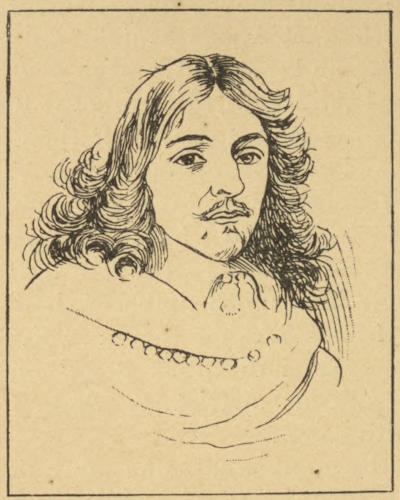
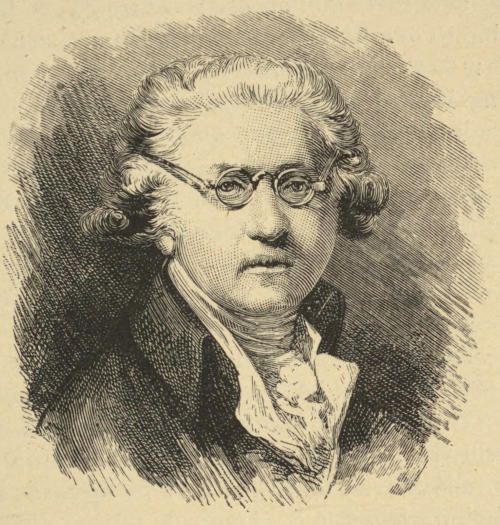
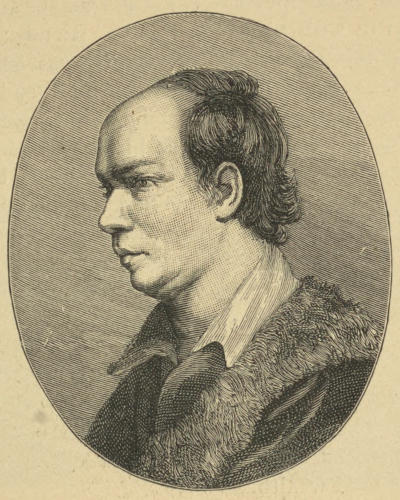
John Evelyn.
Old Norden states that on the northern edge of Middlesex
the Roman road, commonly called the Watling Way,
enters this county, leading straight from old Verulamium
to London over Hamestead Heath; from whence
one has a curious prospect of a most beautiful city and
most pleasant country. Camden, again, tells us that
‘at the very distance that Antoninus in his Itinerary
placeth Pulloniacæ, to wit, 12 miles from London, and
9 miles from Verulam, there remaineth some marks of an
ancient station, and there is much rubbish digged up upon a
hill which is now called Brockley Hill.’ No doubt Norden,
with the fond zeal of a believing antiquary, had traced the
road many a time to Edgworth (Edgware) and so on to
Hendon, through an old lane called Hendon Wante.[19] So
completely had this tradition entered into the faith of
people generally that we find it embalmed in Drayton’s
‘Polyolbion,’ where, to paraphrase his figurative description
of Highgate and Hampstead Hills, he emphatically adds of
the latter:
‘Which claims the worthiest place his own,
Since that old Watling once o’er him to pass was known.’
Defoe, too, in his ‘Tour of Great Britain,’ tells us that he
‘went to Hampstead, from whence he made an excursion to
Edgware, a little market-town on the way to St. Alban’s,
for it is certain that this was formerly the main-road from
London to St. Alban’s, being the famous highroad called
Watling Streete, which reached from London to Wales.’
No traces of such a road have been found on Hampstead
Heath, though Roman relics and proofs of Roman burial
have been discovered there, and accepted by our oldest
antiquaries as strengthening their theory of the Watling
Way having skirted or crossed it. That there was a road
from St. Albans to the Heath is curiously confirmed by an
old French folio, published in Paris (time of Elizabeth),
which explains the reasons why the Romans built a city
on the site of the present London,[20] and states that ‘subsequent
to the recall of the legions in consequence of its rapid
growth and absorption of the population and commerce of
the other great cities, it so raised the envy and indignation
of their inhabitants, that the people of St. Albans
threatened to come and destroy the rising city of London,
until the Londoners advanced as far as Hampstead Heath,
where they entrenched themselves, and prepared to do battle
in defence of their homes.’ A writer in the New Monthly
Magazine, commenting on this extract, says that the remains
of the entrenchments are still pointed out.[21]
Dr. Hughson, writing of the Reed-mote, or six-acre field,
formerly to the north-west of White Conduit House, and
which was supposed to have been the site of a Roman camp,
observes ‘that a Roman road[22] passed this way, we have great
reason to believe, for from Old Ford we pass Mere (vulgarly
called Mare Street), Kingsland, Islington, Highbury, the
Hollow-way, Roman Lane, over Hampstead Heath through
Hendon to Verulam.’ With the vanishing of the pilgrims’
route over Hampstead Heath, we lose the reason for the
name of the hamlet suggested by Lysons, who supposed the
wearied pilgrims on reaching the heath to exclaim at the
sight of the city at their feet, ‘Hame-sted!’ the place of their
home and the end of their journey. Park believes the homely
name was given to it by the Saxon churls[23] who inhabited
it previous to the date of the Domesday Survey.[24]
In the time of Abbot Leofstan, when Albanus[25] had become
a very popular saint, ‘especially with merchants and traders
going beyond sea, who sought his protection, and made rich
offerings at his shrine,’ the state of the great forest, its ways
infested not only with beasts of prey, but by ‘outlaws,
fugitives, and other abandoned beings,’ with the probable
effect of diminishing the revenues of his Church, set the
Abbot seriously to the task of removing these obstructions.
He had the woods in part cut down, rebuilt bridges, repaired
rough places, and finally entered into a contract with
a certain knight to defend the highway with two trusty
followers, and be answerable to the Church for anything
that might happen through his neglect.[26]
In the eighth of Henry III., the great Forest of Middlesex
was ordered to be disforested, giving the citizens of London,
as Stowe tells us, ‘an opportunity of buying land, and
building, whereby the suburbs were greatly extended.’
But the disforesting appears to have been partial, and the
building limited to the east. Hampstead retained its woods
in all their savage wildness; the paths through them, to the
terror of passengers, continued to be scoured by wild beasts,
especially wolves, which had not all been extirpated when
the ‘Boke of St. Alban’s’ was written.[27]
During Henry III.’s reign (1256) we find Richard de
Crokesley, Abbot of Westminster, ‘“assigning the whole
produce of Hamestede and Stoke for the celebration of his
anniversary in that monastery by ringing of bells, giving
doles during a whole week, to the amount of 4,000 denarii.
A thousand to as many paupers on the first day, and the
same dole to 500 others on the six days following. A feast
with wine, a dish of meat and a double pittance to the
monks in the refectory. A Mass by the Convent in copes,
on the anniversary day; and four Masses daily at four
different altars for the repose of his [the Abbot’s] soul for
ever!” With many other daily forms and ceremonies. But
the keeping of this commemoration was found to be so
heavy a burden that the monks petitioned the Pope in less
than ten years after the Abbot’s death to dispense with it,
and he very sensibly sent his mandate to Westminster,
dated 5 Kal. June, 1267, declaring that he found these things
to abound more in pomp than the good of souls, and “that
it was evident they accorded not with religion, nor were
suitable to religious persons,” and recommending the monks
to limit the mode of commemoration to their ideas of the
dead Abbot’s deserts, and the advantages that had accrued
to the monastery by his administration. Upon which the
said manors and revenues became at the free disposal of the
Abbot and Convent of Westminster, towards the welfare of
the abbey; an annual portion of 10 marks being assigned
for making such celebration as that sum would admit of for
the said Richard de Crokesley.’[28]
At the dissolution of the monasteries, Henry VIII., by
way of a sop to the Church, created a new bishopric, that
of Westminster, giving it for its diocese the county of
Middlesex, of which he deprived London. Great part of
the revenues of the dissolved monastery were settled upon
the new bishopric, the manor and advowson of Hampstead
making a portion of it, but in nine years the new Bishop
had alienated his lands to such an extent that there was
scarcely anything left to maintain ‘the port of a Bishop.’
In this reign, while the Manor of Hampstead was in the
hands of the newly-made Bishop of Westminster, we find
that a considerable part of the woods still covered the ground
in this neighbourhood, as well as in that of Hornsey, and
that game was still plentiful in them.
Of this we have proof in the proclamation of the King for
the preservation of his sport in these places:[29]
‘A Proclamacion yt noe p’son interrupt the King’s game
of Partridge or phesaunt.
‘Rex majori et vice comitibus London. Vobis mandamus,
etc.
‘Forasmuch as the King’s most Royall Maᵗⁱᵉ is much
desirous to have the games of hare, partridge, phesaunt, and
heron p’served in and about his honor at his palace of
Westm’ for his owne disport and pastime; that is to saye,
from his said palace of Westm’ to St. Gyles in the Fields,
and from thence to Islington to oʳ Lady of the Oke, to Highgate,
to Hornsey Parke, to Hamsted Heath, and from thence
to his said palace of Westm’ to be preserved and kept for
his owne disport, pleasure, and recreacion; his highness
therefore straightlie chargeth and commandeth, all and
singular, his subjects, of what estate, condicion, so’er they
be, that they, ne any of them, doe p’sume or attempt to
hunt, or hawke, or in any means to take or kill any of the
said games, within the precincts aforesaid, as they tender his
favour, and will estchue the ymprisonment of their bodies
and further punishment at his Ma’ts will and pleasure.
‘Et hoc sub p’iculo incumbenti nullatenus omittat.
‘Teste mæipso apud Westm’ vij. die Julij anno tricesimo
Septimo Henrici Octavi. (1546.)’
This mandate was issued just six months before the King’s
death, when his physical condition must have totally incapacitated
him from the sport from which he interdicted
others, and this in the face of repeated charters giving the
citizens of London a right of free chase in the forests of
Middlesex, Hertfordshire, the Chiltern country, and Kent as
far as the river Cray. This proclamation helps us in imagination
to a view of the then existing condition of the north-western
suburbs—fields from the back of Gray’s Inn right
away to Islington, a village of ‘cakes and cream’ in the
midst of meadows; the uplands of Hampstead, Highgate,
and Hornsey still covered with thick woods and coverts filled
with game, whilst between them and the city stretched the
open country, with here a wattled hut, and there a half-timbered
house; the clack of mills resonant beside the
willow-shaded Fleet, which had its rise at the foot of
Hampstead Hill, and went running on through Gospel Oak
Fields to Kentish Town and Pancras, and thence by Holborn
to its outlet in the Thames at Blackfriars, where a creek
rendered it navigable to Holborn Bridge.
There stood St. Pancras, or ‘Pankeridge,’ as Ben Jonson
calls it, the oldest church in London with the exception of
old Paul’s, ‘all alone, utterly forsaken, and weather-beaten,’
while on the breezy high ground at Hampstead a windmill
or two gave animation to the scene.
During the reign of Henry VIII., a predicted inundation
of the city drove the inhabitants to the hills, and Hampstead
Heath appeared covered with hundreds of little huts and
tents in which the credulous people sheltered themselves.
The prediction, of course, failed, and the prophets only
escaped the indignation of their dupes on finding their fears
disappointed by avowing a mistake of a hundred years in
their calculations.
During the reigns of Edward VI., Mary, and Elizabeth,
Hampstead Woods continued to flourish, coming down on
the east to the village of Cantleowes, or Kentish Town,
while on the west they spread by Belsize, and what is now
the Adelaide Road, to St. John’s Wood, where at the
Domesday the Abbess of Barking held wood and pasture of
the King for fifty swine.
More recently St. John’s Wood belonged to the Knights
Templars. It was in this wood the unfortunate Babington
took refuge from the fury of Elizabeth till driven forth by
hunger.
With this Queen’s successor, and his favourite, Buckingham,
Hampstead was a frequent hunting-ground, and to
this day the plateau on the west Heath, locally known as the
King’s Hill, commemorates the spot from which His Majesty
was wont to see the hounds throw off.
In James’s reign and that of his son, Charles I., certain
‘fair edifices’ had arisen on the Heath and its vicinity for
the accommodation and convenience of the Court when
hunting and hawking in the neighbourhood. Of these old
houses none exist to add to the archæological interest of the
neighbourhood. It is impossible to imagine a finer foreground
for a hunting or hawking party than the Heath, the
natural beauty of the landscape lending itself most effectively
to such scenes.
Who questions the locality of the wicked bon-mot of our
Merry Monarch, who could never resist the temptation of
saying a smart thing? When in the midst of a group of
beauties, courtiers, and Churchmen (who particularly
delighted in hawking), he observed of the church of Harrow-on-the-Hill
that it was ‘the only visible Church he knew
of.’
Towards the closing years of Charles I.’s reign (1647), the
Great Hollow Elm at Hampstead (figured by Hollar in an
engraving preserved amongst the pamphlets in the King’s
Library in the British Museum) became an object of attraction
to visitors. Remarkable for its size and supposed age,
measuring 28 feet immediately above the ground in girth,
with widely-spreading branches, and of great height, a
sagacious speculator about the year 1647 (as appears from
some verses addressed to it by Robert Codrington, of
Magdalen College, Oxford, 1653) constructed a staircase of
forty-two steps within the hollow trunk, with sixteen
openings lighting it, which led up to an octagon turret fixed
amongst the branches of the tree 33 feet from the ground.
‘The seat above the steps six might sit upon, and round
about room for fourteen more.’ At this altitude spectators
enjoyed a most glorious view, or, rather, a succession of
them, and found themselves above every object in Middlesex
with the exception of the church spire of Harrow.
From the open tableland on which it appears in the
engraving, the great tree probably stood on the summit of
the Heath, where the road now runs past Jack Straw’s
Castle. On the same broadside on which the engraving
appears are certain descriptive verses. This broadside
seems to have been given away to the visitors, and the
circumstance of its having been folded for putting in the
pocket, and so worn out, accounts for the few copies of it in
existence.
‘The Great Hollow Elm at Hampstead’ (as the broad
sheet describes it) does not appear to have long survived
its singular treatment. No subsequent records that I have
met with mention it; but that it must have been the object
of many a summer’s day pilgrimage to the Heath is evident,
even in Puritan times, when Robert Codrington addressed
his verses to it. In them he mentions the
‘beauteous ladies that have been
These twice three summers in its turret seen.’
In the same year (1647) a poetical stationer, commonly
known as Michael Spark, but who, in moments of aspiration,
fancifully called himself ‘Scintilla,’ tells us of a very curious
use to which this sylvan upper chamber was put.
A foreigner, the fellow-countryman of Joannes a Commenius,
as he pedantically styles John Amos Comenius, the
Moravian grammarian and divine, had established a school
at Hampstead for a ‘limited number of young gentlemen,’
the number being restricted to twelve, and these, Mr. Spark
tells us, he spared no pains in training:
‘For he, on top of all (this tree) above the shade,
His scholars, taught; where they such verses made
As spread his honours, and do blaze the fame
Of Hampstead School—I’ll trumpet up the same!’
It is he who lets us into the seeming secret of the birth of
the Wells, and sings of the
‘air, and hill, and well, and school,’
as if the reputation of each was publicly known and appreciated.
Codrington indirectly tells us that the elm was
attempted to be put to another use ‘by some of the new
religion, that would make a preachment beneath its shade.’
In the reign of Charles II., when the Great Plague was
ravaging London and the Merry Monarch and his merry
Court had discreetly withdrawn from its neighbourhood,
Hampstead and the Heath had other experiences, for
hundreds of the wretched citizens who had fled from the
city to the suburbs, driven forth from the village with
scythes and pitchforks, lay down to die in the fields and
woods and ditches in the vicinity. This was the occasion of
the obloquy levelled at the Hampstead people by Taylor, the
Water-poet. And as a consequence, having almost wholly
escaped the visitations of 1603, Hampstead suffered considerably
in 1665, when the burials—which in the first year
of the plague numbered only seven, and in the next twenty-three—rose
to 214, more than seven times the ordinary
averages of the period.[30]
Twelve months later, when the Great Fire swept out as
with the besom of destruction the germs of the plague, many
of the fugitives from London watched from the Heath the
destruction of their homes and property, the smoke of the
city ascending ‘like the smoke of a great furnace,’ a smoke
so dense and fearful that it ‘darkened the sun at noonday,
and if at any time the sun peeped through, it looked as red
as blood; through the long night there was no darkness
of night;’ and, to add to these horrors, on the dreadful
Wednesday night ‘the people of London, now of the fields,’
heard the murmur that the French were coming, and though,
in the quaint language of the writer of the ‘City Remembrancer,’
‘the women, naked and weak, did quake and
tremble, many of the citizens began to stir themselves like
lions or bears bereaved of their whelps, and “Arm! arm!”
resounded through the woods and suburbs.’
These scenes, of which Hampstead Heath has been the
centre, have long since faded out of the traditions of its
inhabitants, like those of that still older night in 1588, when
the cresset upon Beacon Hill blazed the approach of the
Armada to its fellow on Hadley Church tower, and thence
from cresset to cresset to the farthest North—scenes full of
the tragic passions of human perplexity and terror.
The General Elections for Middlesex appear to have
always taken place on Hampstead Heath. I read that at
one of these meetings of the Middlesex freemen on the top
of Hampstead Hill,[31] 1695, Admiral Lord Edward Russell
made his appearance before the assembled voters, and was
returned without opposition.
These meetings occasioned the assembling of great mobs
of rough persons and much lawlessness, which greatly facilitated
the business of cut-purses and footpads who habitually
haunted the Heath. But at the commencement of 1700,
after much trouble on the part of the influential inhabitants,
this nuisance was done away with, only, as it would appear,
to make space for another—for some time previous to 1732
horse-races took place upon the upper Heath, and were
largely attended.[32]
The race-course appears to have been at the back of Jack
Straw’s Castle, where the surface of the Heath, so delved
and broken up and caverned by the sand and gravel diggers
in modern times, was then, it is said, level with North End
Hill.
In July, 1736, a paragraph in the Grub Street Journal
states that while the horses were being run on the Hampstead
course, a gentleman, about sixty years of age, was
observed hanging almost double over a gate, his head nearly
touching the ground. His horse was grazing near him, and
there had been no foul play; his watch and money were
upon him. The dead man was a Mr. Hill, a teller in the
Excise Office.
What an occasion would this incident have afforded for
the fiery declamation and denunciation of the great Nonconformist
preacher, George Whitfield, who three years afterwards
writes in his Diary that he took his station under a
tree near the horse-course at Hampstead! He was preaching
there by invitation, and his audience, he tells us, were ‘some
of the politer sort,’ which gave him occasion to speak to
their souls of our spiritual race, and he adds, ‘most were
attentive, but others mocked.’
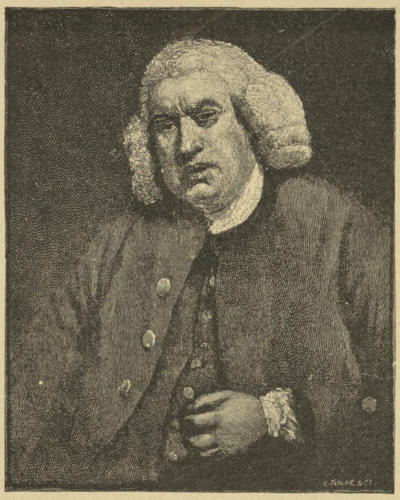
Johnson somewhat cynically said of him that ‘he had
known Whitfield at college before he became better than
other people’; but he also said that ‘he believed he sincerely
meant well, but had a mixture of politics and ostentation,
while Wesley thought only of religion.’
The races had grown to be so great a nuisance, from the
crowds they drew together and the mischief that ensued,
that some time subsequent to 1748 they were put down by
the Court of Magistrates.[33]
Except at election times, there had never been such
throngs of people or disorder on the Heath. The effect of
the races had been to drive away the more refined portion of
visitors to Hampstead, just at a time of year when the
season was at its high-tide, and the Heath and woods and
walks in their perfection.
In the spring of 1750 the people of Hampstead witnessed
another instance of the spontaneity of panic-fear, which sent
numbers of people to the Heath and the high grounds of the
other northern suburbs to escape suffering the fate of the
Metropolis, which a mad trooper (‘next to the Bishop of
London’[34]) had predicted should be swallowed up by an
earthquake in the April of this year. The shock of one had
been felt on February 8, and again on March 8, and the
proverbial fatality of the third time led to the belief that a
final one would take place on April 8. When the three
months were nearly accomplished, at the end of which the
prophetic trooper had announced the destruction of London,
this ‘frantic terror,’ writes Horace Walpole, on April 2, ‘prevails
so much that within these three days seven hundred and
thirty coaches have been counted passing Hyde Park Corner.’
Several women, he adds, ‘made themselves earthquake gowns
to sit out of doors all night.’ The day passed, however,
without disturbance, and, except that the unfortunate seer
was sent to Bedlam, nothing came of the prediction.
That must have been a grand day on the Heath, mid-winter
as it was, when, roused by Bonaparte’s threatened
invasion of England (1803-4), the Hampstead Association—disbanded
about a year before—joined themselves into a
volunteer force, 700 strong, with the public-spirited ex-Lord
Mayor of London, Josiah Boydell, as their Colonel Commandant,
and Charles Holford, Esq., for their Major, and
took the oath of allegiance in the face of heaven and their
friends and neighbours on their own beloved Heath. They
then marched to the parish church of St. John’s, where Lady
Alvanley presented them with their colours.
When peace was proclaimed, these were deposited in the
church, where they remained, a trophy of the patriotic spirit
that had animated the men of Hampstead. In later times,
when the wisdom of being always prepared for such defence
made itself felt throughout the length and breadth of the
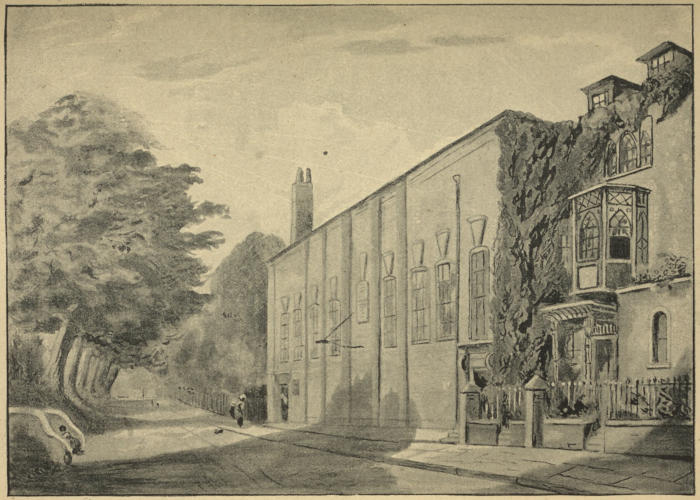
land, the Episcopal Chapel in Well Walk was converted into
a drill-room for the volunteers who fell into rank in the
place of their forefathers. The old colours were now borne
from the church, and escorted with full military honours to
the drill-room,[35] where they remained till the building was
taken down, when with similar ceremony they were deposited
in the new drill-hall, Heath Street.
One of the most pathetic incidents in connection with
Hampstead Heath is the remembrance of Charles Lamb and
his sister which Talfourd has left us, ‘mournfully crossing it
hand-in-hand, and going on sadly through the quiet fields to
the retreat at Finchley, where the poor sufferer sought shelter
from herself ... whence, after a time, she would return in
her right mind ... a gentle, amiable woman, beloved by all
who knew her,’ but most of all by her brother, whose young
manhood was in a measure blighted by the tragedy of which
she who enacted it was wholly unconscious. He might be
said to have devoted himself to her, and in life they were
never parted.
Few even of their contemporaries knew the particulars of
that household tragedy; the reporters of the inquest, with a
respectful pity rare in their craft, withheld the names; and
compassion was universally felt for the naturally inoffensive
and all-unconscious perpetrator of it, and for him, the dutiful
son and loving brother, whose affectionate and sensitive
nature suffered in silence the double horror and the double
grief. This is how the ‘Annual Register’ tells the melancholy
tale (September 23, 1796):
‘On the afternoon of this day a coroner’s jury sat on the
body of a lady in the neighbourhood of Holborn, who died
in consequence of a wound from her daughter the preceding
day.... While they were preparing for dinner, the young
lady, in a fit of insanity, seized a case-knife from the table,
and in a menacing way pursued a little girl round the room.
On the eager cry of her infirm mother to forbear, she
renounced her object, and turned with loud shrieks upon her
parent. The little girl by her cries brought up the landlady,
but too late—the mother was lifeless in her chair, stabbed to
the heart, her daughter still wildly standing over her with
the knife, and the venerable old man, her father, weeping by
her side, himself bleeding from a blow on the forehead from
one of the forks she was throwing distractedly about.’
A few days previously she had exhibited signs of lunacy,
from which she had previously suffered, and her brother—in
this lay the self-wounding sting for such a nature as Elia’s—had
endeavoured on the morning of the occurrence to see
Dr. Pitcairn, and had failed. ‘Had that gentleman,’ it is
suggested, ‘seen her, the catastrophe might have been
averted.’
What a scene for the young clerk at the India House!
He was then only twenty-one, and, like his unhappy sister,
working against the tide to help the straitened means of
their parents. It was elicited at the inquest that no one
could be more affectionate to both father and mother than
the unconscious matricide, and that to the increased attentiveness
which the growing infirmities of the latter required,
added to the pressure of business, was to be ascribed the loss
of the daughter’s reason.
Poor Lamb had himself once suffered from the same sad
malady. He has been censured for sometimes yielding to
drinking habits, but the memory of that one day in his life—the
very threshold, rather, as it may be called—might well
plead in merciful extenuation.
At times throughout her life Mary Lamb was subject to
fits of mental aberration, the approach of which she was
conscious of, and on these occasions would request to be
taken to the abode at Finchley, where she found safety and
remedial treatment.
One other event in modern times has caused widespread
and painful commotion in association with Hampstead
Heath, the suicide of John Sadleir, Esq., M.P. for Tipperary.
I well remember the excitement on the occasion,
and the rapidity with which the story was bruited about.
Early in the morning of Sunday, February 17, 1856, a man
was looking for a strayed donkey amongst the furze-bushes
on the south side of the old watercourse (now obliterated),
when he came upon the dead body of a well-dressed man.
A silver cream-ewer and a small bottle lay beside him, his
head resting near an old furze-clump, and his feet almost
touching the water. His hat had fallen off, and his lips
gave out the scent of prussic acid.
There was one extraordinary fact in connection with the
case: the soles of the dress-boots on the feet of the corpse
were unsoiled, though the night had been stormy and the
neighbourhood of the watercourse damp at all times of the
year. It was evident he must have alighted from a vehicle
very near the spot, which was some distance down the bank,
at the back of Jack Straw’s Castle. I have not the report of
the inquest to refer to, but the details of the event made a
deep impression on me, and the more so for the mystery
surrounding it. I think no cabman came forward or could
be found to give an account of a midnight fare to Hampstead
Heath, and it was midnight or after when his butler heard
him leave the house. The dress and general appearance
were identical with those of Mr. Sadleir, director of the
Tipperary Bank (which he had founded) and chairman of
several railways and banking and mining companies; and if
any doubt had existed, there was found on the corpse a slip
of paper, on which, in a hand as bold as his proceedings had
been, and infinitely clearer, was written, ‘John Sadleir,
Gloucester Square, Hyde Park.’ Many knew the handwriting,
and though some of the witnesses observed the
great alteration death had made in the countenance, Mr.
Wakeley, the coroner, lifted the eyelids of the dead man,
and, having known him personally, pronounced them the
eyes of John Sadleir. At first it was surmised that insanity
from a brain overworked had led to the fatal act, but it soon
became apparent that, to avoid the public scandal and
degradation consequent on his own bad acts, he had voluntarily
rushed out of life.
‘By his scheming and forgeries, the issue of false balance-sheets,
the overissue of railway shares, the pledging of false
securities and obligations, he had deprived widows, single
women, army and navy officers on half-pay, and others
equally helpless and unwary, of all they possessed. The
victims of his iniquitous and gigantic frauds were to be
counted by thousands, from shareholders to the poorest
depositors, till at last, hemmed round by an inextricable
network of multitudinous crime, and seeing no means of
escape from the near crisis of discovery, he had stolen by a
perilous short-cut out of sight and hearing of the cries and
curses of those who had trusted him, to find oblivion in a
suicide’s grave.’[36]
There were many who firmly believed his apparent death
a forgery also, and long afterwards reports were current that
he had been met with in America, whither his brother, the
manager of the Tipperary Bank, had absconded. It is
certain that a large sum of money which John Sadleir had
received only on the day previous to the discovery of the
dead body on Hampstead Heath was not forthcoming, nor
was its disappearance in any way accounted for.
It appears singular why, having possessed himself of the
poison, and knowing its almost instantaneous effect, he
should have left his home, and gone out into the wild, dark
night and distant solitude of Hampstead Heath, to perpetrate
the despairing sin of self-murder. Perhaps the
wretched man was goaded by the scorpion-stings of conscience
to affinities closer to the condition of his mind than
the conventional and ill-gotten luxuries around him. The
cold damp earth, the sharp furze spines, the buffeting winds,
the all-aloneness—save for the ghosts of lost opportunities,
of great talents turned to infernal uses, of high respect and
honours thrown away—seemed more in sympathy with the
fierce frenzy, the unutterable horror, of his unmasked soul.
Assuredly, no more terrible proof could be required that
‘sooner or later sin is its own avenger,’ than the suicide of
John Sadleir.
CHAPTER II. THE WAYS TO HAMPSTEAD.
The oldest maps of London extant show two roads
to Hampstead; Aggas’s (time of Elizabeth) has
four. The most easterly of these roads ran out by
Gray’s Inn Lane, past old St. Pancras and Battle
Bridge, through Kentish Town and part of Holloway to
Highgate, touching Caen Wood, and so by Bishop’s Wood
and Wild Wood Corner to Hampstead. Later on a branch
of this same Gray’s Inn or Battle Bridge Road ran off by
St. Pancras a little to the west, into a country lane running
up from Tottenham Court Road, into what is now the
Hampstead Road, and so to Hampstead.[37]
Another road ran out by Tyburn, crossing the road to
Reading—the present Edgware Road—and going on by
Lisson Grove to Kilburn Abbey, passing West End and
Sutcup Hill, Hampstead, and thence on to Edgworth. But
the most interesting of these roads, and which is distinctly
traced in Aggas’s map, ran up from Charing Cross, through
St. Martin’s Lane to Broad St. Giles’s, crossing the ‘Waye
to Uxbridge’ (Oxford Street), and thence up Tottenham
Court Road, which shows how nearly the modern highway
follows the lines of the ancient one. It looks very like
the present road to Hampstead, except that it appears to
stop short at the top of Tottenham Court Road. The
difference is in the road itself and its surroundings—running
as it did over a track, which, once made, was left to take
care of itself; dangerous with heaps of refuse and hollow
places that in winter were full of water, and at other times
absolute sloughs. Even in Charles II.’s time, when turnpike
roads were made by Act of Parliament, the travelling by
coach or waggon does not appear to have been much improved.
The highways were in places so narrow that a lady
traveller in 1764 tells us that, meeting another coach, her
conveyance was brought to a standstill till the road was
made sufficiently wide at that particular part to allow of the
carriages passing each other. In winter and in rainy seasons,
owing to the want of a proper knowledge of draining, it was
not an unknown grievance for the waters in low-lying places
to inundate the carriages; while at the close of such periods
travellers frequently found their wheels so deeply embedded
in the mud left in these hollows that they had to remain
there till additional horses could be had from the nearest
farmhouse or village to drag their vehicle out. The private
letters, diaries, and memoirs of those bygone years are full
of such adventures.
It was not, indeed, till after the first decade of George III.’s
time that this state of things began to be seriously remedied,
and roads, in our present meaning of the term, laid through
the length and breadth of the land. Pretty deep in the
present century, except for a few cottages in the fields, there
were no habitations between the George Inn, Hampstead
Road, and the Load of Hay, on Haverstock Hill. In other
ways, the road continued to be pretty much the same as in
Colonel Esmond’s time, ‘hedgerows and fields and gardens’
all the way up to Hampstead. About the time of the building
of Camden Town, people who loved pure country air
began to move further out, and toy villas and rustic residences
dotted the Hampstead Road, some of them remaining there
with their paled-in gardens and trellised porches and verandas,
oddly wedged in between builders’ yards and other commercial
premises, till long after I knew the neighbourhood.
As recently as 1859 the road to Hampstead was a charming
one, especially if one drove there; for then you had the
advantage of seeing beyond and above the pedestrian. No
sooner did you cross the Canal Bridge than your pleasure in
the prospects began. Leaving Chalk Farm on the left,
where in some one or other of the effaced fields Tom Moore
and Jeffrey (afterwards Lord Jeffrey) met to fight their
intercepted duel, and Primrose or Barrow Hill, in a ditch on
the south side of which (1678) the body of the murdered Sir
Edmondbury Godfrey was found, ‘his sword thrust through
him, but no blood upon his clothes or about him, his shoes
clean, his money in his pocket, his rings upon his fingers,
but with his breast all bruises, and his neck broken’;[38] and
upon the summit of which, with sublimated vision, William
Blake, pictor ignotus, saw the spiritual sun, ‘not like a golden
disc the size of a guinea, but like an innumerable company
of the heavenly host, crying “Holy, holy, holy!”’
Then Haverstock Hill, with the Load of Hay tavern,
looking in 1845 as rustic and simple as its name. It had
been famous for its tea-gardens, and an ancient footpath
from the Lower Heath, Hampstead, formerly crossed the
fields from Pond Street, and came out beside it on the main
road. Above the bank, rising from the highway on the left,
stood the cottage, ‘famous,’ as Carey in his ‘Book of the
Roads’ (1812) called it, as the residence of Sir Richard
Steele, the ‘solitude’ that for so many years reminded
readers of the literary Captain’s delightful essays, and
recalled in his company all the wits of Queen Anne’s time,
who, on their way to the summer meetings of the Kit-Cat
Club at the Upper Flask, Hampstead, were wont to beguile
him from unfinished copy, an easy task, since the gay
instincts of the man on these occasions would generally
override the severity of the philosopher, and prevent the
personal application of the moralities he so charmingly
discoursed about.
Hampstead from Primrose Hill.
‘I am in a solitude,’ he wrote to Pope, June 1, 1712, ‘an
house between Hampstead and London, in which Sir Charles
Sedley died, breathing his last,’ he adds, ‘in this very room,’
a circumstance that, in connection with his enforced rusticity,
and the circumstances that induced it, combined to waken
serious reflections; and writing on this occasion, as Pope
himself was said to write, ‘with his reputation in his hand,’
Sir Richard somewhat ungenerously, when we consider the
close kinship of many of Sedley’s inclinations with his own,
improved the occasion at the dead man’s expense, wholly
ignoring the assurance of gossiping Anthony à Wood that
poor Sedley, after suffering much for his offences, took up and
grew serious, and subsequently became a leading man in the
House of Commons. If this be true, it says a good deal for
the recuperative moral force concentrated in Sir Charles’s
nature. Steele’s cottage stood so nearly opposite to the
little hostel, the Load of Hay, that its inhabitants, if so
minded, could have almost distinguished the features of the
gentlemen of the road who, towards sunset, occasionally
drew bridle beside the horse-block in front of the well-worn
steps leading into it, to refresh themselves with a tankard of
ripe ale, or some more potent stirrup-cup, before starting
across country to Brown’s Well, or Finchley Common, places
which continued till quite modern times to be words of fear
in the vocabulary of travellers.
Pope’s contributions to the Spectator led in 1712 to
Steele’s making his acquaintance, which was followed by his
introducing the young poet to his courtly friend Addison.
One can fancy the fine presence and handsome countenance
of the distinguished essayist, his Sir Charles Grandison air,
and the stately suavity of his bow, which brings the side-locks
of his voluminous wig an arm’s length beyond the
shapely hand laid impressively on the breast of his deep-flapped
waistcoat, and the ill-dressed, crooked figure and
sallow face of the youthful poet. But remembering that
Pope at seventeen years of age had been admitted to the
company of the wits at Wills’s, it is probable that the stately
compliments of the great moralist, whose mission it was to
help reform the morals and manners of the day, did not so
much affect him as they might have done an older man less
conscious of his acknowledged power; and the nervous
flushing of the sallow cheek, the brightening of the large
dark eyes, and the slight quiver of the sensitive muscles of
the melancholy mouth, may be as much the result of infelt
pride as of modesty.
Sir Richard Steele.
It was Addison who, on reading the first two cantos of
the ‘Rape of the Lock,’ pronounced it ‘a delicious little
thing’; ‘it was merum sal,’ he said, but when Pope resolved
to recast the whole poem, and asked Addison’s advice, and
the latter entreated him not to run the risk of spoiling it,
in doing so he affronted the morbidly jaundiced mind of the
poet, who, on the altered poem proving a success, called
Addison’s counsel insidious, and accused the amiable giver
of it of baseness.[39]
It is a pleasant recollection not only to have seen Steele’s
cottage, but to have stood with my friend, Eliza Meteyard,
in the room to the right where some of those witty, playful,
clever papers were composed, in which the follies and vices
of the times are mirrored with graphic power in the pages of
the now too rarely read Spectator and Guardian.
To
My Lov’d Tutour Dʳ. Ellis
With Secret impulse thus do Streams return
To that Capacious Ocean whence they’re born:
Oh Would but Fortune come wᵗʰ. bounty fraught
Proportion’d to yᵉ mind wᶜʰ. thou hast taught!.
Till then let these unpolish’d leaves impart
The Humble Offering of a Gratefull Heart.
Richᵈ: Steele
There might have been an ampler number of them, perhaps,
but for the proximity of the Upper Flask and Bull and Bush
taverns, and the near neighbourhood of the Wells. But it
is still pleasant to fancy the lifting of the gate-latch, and to
see in imagination going up the garden-path, or issuing from
it, with Steele in the midst of them, Arbuthnot and Gay and
Pope, and it may be Swift, famous associates and friends,
whose almost centuries-old footsteps—for those who care to
look beneath the surface of the present—underlie the dust
upon the hillside, and give the road a charm beyond its
own.
Their pungent repartees, their brilliant fancies and clever
witticisms, those mental coruscations of the moment, may
yet be floating airily in space, but the more solid portions of
their intellectual riches have become national endowments,
and their harvest result is with us yet.
The commonplace row of mean shops called Steele’s
Terrace marks the place where Steele’s double-fronted
cottage stood, elevated some 15 feet above the roadway,
with a large strip of garden ground before it, but solitary
even when I was accustomed to see it, no other house
being close to it.
Nichols, quoted by Park, alluding to Steele’s disappearance
from town to this ‘solitude’ at Hampstead, writes,
‘It is to be feared that there were too many pecuniary
reasons for this temporary retirement,’ a supposition generally
adopted by Sir Richard’s biographers. I venture to think
that another cause existed more pressing than the importunities
of creditors or the exigencies of straitened means.
Exactly one month after Steele’s letter to Pope, describing
his whereabouts, Swift, writing to Mrs. Dingley from the old
Court suburb, under the date of July 1, 1712, tells her
‘Steele was arrested the other day for making a lottery
directly against an Act of Parliament; he is now under
prosecution, but they think it will be dropped out of pity.
I believe he will very soon lose his employment, for he has
been mighty impertinent of late in his Spectators, and I will
never offer a word on his behalf.’[40]
Feeling himself disgraced, and desirous of keeping out of
the way of his town acquaintances, seems a more cogent
reason for his seclusion than the fear of his creditors,
especially when we learn that the Spectator, instead of falling
off in popularity, was selling better than ever and at double
its original price; and that at the close of this summer he
had taken a house for his wife in Bloomsbury Square, which
does not look as if he was in want of funds.
As for the irritable Dean, who had threatened to do nothing
for him, a little further on in his ‘Correspondence’ he is
telling the same lady of all he had done for the Whigs, and
adds that he had ‘kept Steele in his place.’[41]
Leaving Steele’s cottage, we pass England’s Lane on
the left—a lane famous for its blackberry hedges and the
pleasant fields in the neighbourhood of the late Mr. Bell
the publisher’s house; but all has changed, and the once
rural lane is now a path between brick walls and garden
fences. Farther on is Park Road, leading to the newly-made
Fleet Road and Gospel Oak Station; and on the
other side of the way, a little further on, Upper Park Road,
with fragrant nursery-grounds spreading over the same
distance on the right, reminiscent of the times when it was
all ‘flowers and gardens’ on that side of the way to Hampstead.
The road is still attractive with its handsome houses,
standing behind well-grown trees in well-kept gardens; but
formerly, on the ascent of Haverstock Hill, the outside
passenger by the old stage-coach on looking back found
himself repaid on a clear day by a brief prospect of the
great city, with ‘the dome of St. Paul’s in the air,’ and all
the surrounding spires, towers, and cupolas that ascend
above the city roofs.
We leave Haverstock Terrace (now Belsize Grove), leading
to Belsize Gardens, on the left, and a little above it, to the
right, the sloping grass-fields—as yet unbuilt on, but marked
for speculation—and a pleasant view, between the poplars
shading the top of Haverstock Hill, of green Highgate, and
the smooth mound of Traitors’ Hill west, with Camden
Town crowding up to the new Cattle Market, and tiers of
houses covering what were once Copenhagen Fields, an
engraving of which, dated 1782, lies before me, and shows
these fields with only one habitation in them, Copenhagen
House, a tea-drinking place, the popularity of which extended
for a considerable time into the present century.
The entrance to the garden is through the ribs of a whale
set up archwise, with an inscription across the top. Two
individuals are playing at bowls, whilst two others look on.
In the foreground are three gentlemen in cocked hats, long-skirted
coats, and their hair en queue, one of whom placidly
smokes a churchwarden; while at a little distance, watching
them, are two sinister-looking men, with thick bludgeons in
their hands, and the ugly head of a horse-pistol ominously
protruding from the pocket of one of them, suggestive of a
state of society to which again I shall presently refer.
Meanwhile, Belsize Avenue dips down on the left, and a
little further on the opposite side of the road Rosslyn House,
once the home of the clever but unscrupulous Lord Loughborough,
Earl of Rosslyn, who began life as ‘plain Mr.
Wedderburne, a Scotch lawyer,’ and lived to be Lord
Chancellor of England.
But the Wedderburnes, though poor, were well descended,
and it is said that backstairs influence was not spared to
second his own unblushing efforts for position. Lord Campbell
tells us he was the first to deny the right of the poor,
‘which old usage and the piety of our forefathers had given
them, to glean in the cornfields after the harvest.’ He gave
judgment also that the law of burning women alive for the
crime of coining should not be mitigated to hanging, and on
the occasion of the Gordon Riots showed himself merciless as
another Jeffreys in taking life, condemning the rioters to be
hanged by scores without reference to age or degree of
culpability.[42]
Rosslyn House.
He hanged mere children, for some of these unfortunates
were not more than fourteen years of age, of whom Selwyn,
who never missed an execution or a death at which he could
be present, noted in his ‘Diary’ that he ‘never saw boys cry
so much in his life.’
But to return to Rosslyn House and Lord Loughborough,
we read that in politics he was without honour, siding with
either party that happened to be in power, and whether
Whig or Tory it mattered not—his lordship was always on
the winning side. ‘None are all evil,’ but ‘neither wit, nor
talent, nor a splendid hospitality’ can redeem the meaner
and darker traits of Lord Loughborough’s character.[43]
Rosslyn House, formerly known as Shelford Lodge, had
anciently belonged to the Careys, who held it of the Church
of Westminster. It is stated in the ‘Northern Heights of
London’ that the celebrated Lord Chesterfield lived here
for some years, while he held the Manor of Belsize, of which
it is a part, and this author suggests that his ancestors might
have called the house after their estate, Shelford Manor, in
Nottinghamshire.[44]
In 1812 Rosslyn House was occupied by Mrs. Milligan,
widow of the projector of the West India Docks. It has
since been the residence of Admiral Disney, the Earl of
Galloway, Sir Francis Freeling (Secretary of the General
Post Office), and others, till it fell into the hands of a speculative
builder, who happened to fail before all the fine timber
was felled and the house wholly destroyed. The grand
avenue of chestnut-trees, which is said to be as old as Elizabeth’s
time, remained almost entire[45] (1855-56), and some
well-timbered fields appeared in the vicinity of the mansion.
But the park itself has been cut up into portions, each of
which belongs to a separate proprietor, and as many houses
are scattered over it.
For four years, while the fine old house, the historical
home of the unfortunate Sir Harry Vane, was being prepared
for them, Rosslyn House was used as the Home for Soldiers’
Daughters.
A little farther on a bit of sward crops out, reminiscent of
Hampstead Green, where Collins the painter once lived, and
on one side of which still stands the house formerly occupied
by Sir Rowland Hill,[46] the inaugurator of cheap postage, and
that of Sir Francis Palgrave, a well-known writer and
Deputy-Keeper of the Public Records, 1838.
The central space is now occupied by St. Stephen’s Church,
a structure nominally built by public subscription, but which,
I have been told, owed its completion to the munificence of
one family, old inhabitants of Hampstead, that of Prance.
They gave the clock, and subsequently the carillon.
Some ancient elm-trees of magnificent size are left standing
near the church. At the east end of the building two paths
branch out of the main road, one leading to Pond Street and
South End Green, the other to the Home of the Sisters of
Providence and the congeries of sheds which, used as a
small-pox hospital, desecrated this charming neighbourhood
in 1870-72, and in 1886 were converted into a temporary
asylum for idiots. The ground they occupy appears to
be devoted to unseemly uses, a proposition having subsequently
been made to convert it to the purpose of a cemetery,
and this with the knowledge of the deteriorated value of
property in the locality, which the closing of the small-pox
hospital had not then readjusted.[47]
On the left lies Belsize Lane, and immediately past the
church to the right the road leading to Pond Street, with
Belsize Grove and Lyndhurst Road opposite.
Amongst the many notable men associated with Hampstead,
Sir Stevenson Arthur Blackwood, K.C.B., must not
be overlooked. ‘My earliest recollections,’ he writes, ‘are
of Rosslyn Lodge, an old-fashioned two-storied house, in
the then quiet and charming suburban village of Hampstead.’
Rosslyn Lodge stood in the grove opposite Pond Street,
facing some shady fields which led on towards the town,
about a quarter of a mile distant.
At the top of the grove, which consisted of fine old Spanish
chestnut-trees, stood the residence of Lord Galloway (Rosslyn
House), and a path led up to the Conduit Fields. These
extracts from his ‘Life’ decide the whereabouts of Sir Arthur’s
boyhood’s home, which one writer, at least, has placed at
Frognal.
Fields near Pond Street, 1840.
At this point Rosslyn Street opens straight ahead,
dominated by the ugly tower of Trinity Presbyterian
Church, and a little beyond Pond Street, on the same
side of the way, a new bit of road marked ‘Hampstead
Gardens’ affords another charming view of Highgate. To
the right Downshire Hill leads to the lower Heath and North
London railway-station, with Thurlow Road to the left, and
a little further on the same side of the way the lane leading
to the Conduit Fields and Shepherd’s Well, which till quite
modern times supplied Hampstead with water, employing a
body of local water-carriers, who made a living by vending
tall pails full to the householders at a penny a pail. The
last of these old water-carriers died an inmate of the workhouse
at New End about 1868.
Shepherd’s Well.
The road becomes steeper at the entrance of Rosslyn
Street, where one looks in vain for the old ‘Chicken House,’
which Brewer describes ‘near the entrance of the village, an
ancient domestic dwelling of low proportions built of brick,’
in all probability the home of the wood-reeve or keeper, and
not, as local tradition persisted in believing it, a royal hunting-lodge.[48]
In 1815 it was in a state of dilapidation, the front disfigured
by the presence of some miserable tenements, and
in 1866 was so built in, blocked up, and divided, that, with
the exception of the wide oaken staircase projecting into a
yard at the end of the narrow alley—about the sixth house
to the right in Rosslyn Street—no part of the original
structure remained. Up these stairs on the night of August 25,
1619, passed James I. and his favourite, the Duke of Buckingham,
an event commemorated by two small portraits of
the monarch and his Master of the Hounds, preserved till
late in the eighteenth century in the window of an upper
room in the Chicken House, with another painting of the
infant Christ in the arms of Simeon. Under the former was
inscribed: ‘Icy dans cette chambre couche nostre Roy
Jacques premier de nom, le 25th Aoust 1619’—a legend
sufficient in itself to show that the incident was an unusual
one.
Here Mr. Murray, afterwards Lord Mansfield, whose
attachment to Hampstead is said to have ‘amounted to a
passion,’ was in the habit of taking up his summer quarters.
Towards the latter years of the eighteenth century it was a
favourite lodging-house for young gentlemen from the Inns
of Law, the Toupees, and other sprightly youths of fashion,
who affected Hampstead for the facilities the horse-course
afforded of exhibiting their talents as curricle and hackney-coach
drivers.
Gale, the antiquary, also lodged here, and on one occasion
commissioned Signore Grisoni to make a drawing of the
picturesque old church, an entry of which is preserved in
the Trust Book.[49]
In 1754 Gale returned to the Chicken House, where he
died. He was buried in the old churchyard. To the left of
Rosslyn Hill, a little removed from the road, at the commencement
of the bank, which shows the depth to which
the hill has been cut down, stands the large red-brick
mansion, occupying the site, and in part formed of, Vane
House, a staircase of which is preserved.[50] It is now the
Home for Soldiers’ Daughters, which was formally opened
for their habitation by the Royal Consort, Prince Albert, on
a summer’s day of 1860. A little beyond, on the same side
of the way, is Green Hill, where, on the site of the late
eminent publisher’s house (William Longman, Esq.[51]), stands
the new Wesleyan Chapel, and, divided from it by Prince
Arthur’s Road, Stanfield House, which preserves in its name
that of the well-known marine painter, Clarkson Stanfield,
who for some years resided here, never tired of tending his
pretty garden, which has almost entirely disappeared. It is
now the Institute and Public Library.
Vane House, 1800.
On the right are Rosslyn Hill Schools and Trinity
Presbyterian Church.[52] It was formerly called Red Lion
Hill. The original site of the small secluded chapel, in which
Rochemont Barbauld officiated from 1785 to 1799, now
underlies in part the present Unitarian Chapel schoolroom.
On this side of the way, immediately facing Green Hill,
stood Elizabeth House, an old mansion, so called, it is said,
from the legend of her princely Majesty on some occasion or
other having slept here. For a considerable part of the
present century it was occupied as a first-class ladies’ school.
Serjeant Ballantine’s sister and Constable’s daughters were
pupils. It is still standing, but in disguise, having been converted
into shops.
On the same side of the way is Gayton Road, a new
thoroughfare, unfinished when I left the neighbourhood
(1864-65). It covers the greater part of the space formerly
occupied by the playground, gardens, and orchards of a once
celebrated school (the house—Norway House—still stands)
in the now narrow cul de sac called Burford Lane, after the
name of the present proprietor, an old-fashioned, many-windowed,
two-storied dwelling.
Burford Lane is close to the town entrance to the Lower
Flask Walk, on the right-hand side of the High Street, and
close by the Bird in Hand, the coach-office where the
modern omnibus deposits its passengers, as the old stage-coach
did in the days of Richardson’s Clarissa.
High Street and Heath Street are the great arteries of
Hampstead, out of which issue the crowded, confused ramifications
which make the study of its groves, mounts,
squares, streets, terraces, lanes, and courts a topographical
puzzle to the uninitiated.
The ways leading to these intricacies all start from the
two principal streets, so that a stranger beginning at the
beginning soon learns to unravel the difficulties of the
locality for all purposes of business or pleasure. How
this complicated irregularity of position and outline came
about, which makes the old town unlike any other, and how,
from a hill village of five wattled huts, shut in by the great
Forest of Middlesex, it grew to be a place of fashionable
resort, and gradually enlarged to its present extent and
settled respectability, with its tens of thousands of inhabitants,
claiming municipal rights, will be set forth in the
following chapters.
CHAPTER III. THE DESCENT OF THE MANOR.
From the earliest times until after the Reformation
we find Hampstead an appanage of the Church.
At the dissolution of the Abbey and Convent of
Westminster, Henry VIII. granted the Manor of
Hampstead, combined with those of North Hall and Down
Barnes, in part support to the newly-made bishopric of
Westminster. In 1551, two years before the death of
Edward VI., they were surrendered to the Crown, and in
the same year granted to Sir Thomas Wroth as a mark of
the young King’s favour. This gentleman, who, ‘amongst
the divers sober and learned men of the King’s privy chamber,
by whose wise and learned discourse he was much profitted,’
stood highest in his estimation, and in proof of it, with
boyish generosity, we find the King, who had knighted him,
making him rich presents from the royal wardrobe, and
bestowing on him, not only the Manor of Hampstead and
the others above-mentioned, but a plurality of manors in
several counties.
On the death of Edward, and accession of Mary, Sir
Thomas fled to Strasburg, where he remained till the
succession of Elizabeth, when he returned to England,
where he was ‘received into the Queen’s favour, and employed
by her in the concerns of State.’
In Hakluyt’s ‘Voyages,’ Park tells us, ‘there is an account
of a merchandising voyage to Barbary in the year 1552, set
forth by Sir Thomas Wroth and others.’
His name appears in the catalogue of Middlesex gentry,[53]
and ‘it is observable,’ says Fuller, ‘that of all in this
catalogue, he who went away for his conscience hath alone
his name remaining in the County.’ He retained a high
reputation to the last, and died at his Manor of Durants, in
Enfield, co. Middlesex, October 9, 1573.
The Manor of Hampstead remained in this family till sold
by one John Wroth to Sir Baptist Hicks in 1620. This
Sir Baptist Hicks was a wealthy silk mercer of Cheapside.
He married Elizabeth, daughter of Richard May, of London,
who outlived her husband, and at her death left £200 for the
purchase of land, the produce of which was to be appropriated
to apprenticing children and assisting the poor of
Hampstead.
Sir Baptist Hicks was the son of Michael Hicks, silk
mercer in Cheapside, and the younger brother of Sir Michael
Hicks, secretary to Lord Treasurer Burleigh. He was
brought up to his father’s business, and had ‘great dealings
with the Court for his rich silks and commodities from Italy
and other foreign parts, by which he made a great estate.
Upon the coming in of King James he was sworn one of his
servants (anno 1603), and soon knighted.’[54] He is remarkable
for having been the first citizen who kept shop after
receiving knighthood, and for having built at his own
expense, in the midst of the street called St. John Street,
Clerkenwell, a building of brick and stone for the convenience
of the meetings of the justices of the county of
Middlesex, of whom he was one,[55] which had hitherto been
held ‘at a common inn called the Castle in St. John’s
Street, the resort of carriers and many other sorts of
people.’[56]
‘On Wednesday, the 17th of Jany., 1612, the “Session
House” being then nearly finished, there assembled twenty-six
justices of the said county, being the first day of their
meeting there, where the founder feasted them all; and then,
after they had considered what name this structure should
bear, they all with one consent gave it the name of Hicks’s
Hall, in grateful memory of the builder, and he freely gave
the House to them and their successors for ever.’[57]
But previous to this his wealth, the King’s favour, and the
honour bestowed upon him, and, above all, the contempt he
had shown for civic dignities—having paid the fine of £500
to be discharged from the office of Alderman for Bread Street
Ward, which was permitted at the King’s express desire—appears
to have brought on him the ill-will of the Court of
Aldermen, who disputed his right to continue in business
after knighthood; and subsequently by standing on his
knighthood for precedency, a right which a fellow-citizen,
one Herrick, and his wife disputed, he involved himself in
another contest with them. It proved a tedious, troublesome,
and chargeable one, owing to the haughty deportment of both
Hicks and Herrick and of their imperious wives, ‘who, at
their own expense, maintained the suit against the Court of
Aldermen.’
It was after these proceedings—perhaps as a sort of peace-offering—that
Hicks’s Hall was built. Sir Baptist Hicks was
one of the Commissioners appointed by the King (anno
1620) to inquire into the decay of St. Paul’s. He was
eventually created Lord Hicks and Viscount Campden, with
remainder, in default of male issue, to his son-in-law, Sir
Edward Noel, who had married the eldest of his two
daughters, Juliana, by whose descendant Baptist, third Earl
of Gainsborough, son of Sir Edward Noel (son-in-law and
successor to Lord Hicks, Viscount Campden), the Manor of
Hampstead was sold to Sir William Langhorne, Bart., 1707;
and from this time, says Park, the Manor of Hampstead
became closely connected in proprietorship with that of
Charlton, in Kent, which Sir William had likewise purchased,
and where he resided in the fine mansion built by
Sir Adam Newton, tutor to Henry, Prince of Wales.
Park calls this gentleman an East India merchant, but I
find that a Sir William Langhorne, thirty-five years previous
to the purchase of Hampstead Manor, was Governor of
Madras.[58] Sir William had for his first wife a daughter of
the Earl of Rutland, who died in 1700, and at nearly fourscore
married a second time ‘the daughter-in-law of his
friend, Dr. Warren, to whom he gave the Rectory of
Charlton, and who appears to have resided like a private
chaplain in his house. Seven years afterwards, at his death
(aged eighty-six years), he left Dr. Warren his sole executor,
guardian, and tutor to his nephew and residuary legatee,
William Langhorne Games, Esq., and trustee of the Manor
of Charlton. From this gentleman the estate passed to
Mrs. Margaret Maryon, widow, a distant relative of Sir
William (a fourteenth tenant in tail), from whom it descended
to her son, the Rev. John Maryon, with whom the
testamentary limitations ended. A new entail was created,
from which the present proprietor derives his title, as those
who succeed him are likely to do for many years.’[59]
By the will of the Rev. John Maryon, the Manors of
Hampstead and Charlton were limited to the testator’s
niece, sole executrix and residuary legatee, Margaret Marie
Weller, widow (1760), for life; with remainder to her only
child, Jane Weller, for life; with remainder to the heirs of
the said Jane Weller, who married General Sir Thomas
Spencer Wilson, Bart., who in his wife’s right became
possessed of the manor in or about 1780. Sir Thomas died
in 1798, and his wife, Dame Jane Wilson, was Lady of the
Manor until 1816, when her son, Sir Thomas Maryon Wilson,
Bart., under his father’s will became tenant for life of the
manor, with the advowson, and divers freehold messuages,
lands, and hereditaments at Hampstead.
On his death he was succeeded by his brother, Sir John
Maryon Wilson, and he by his son, Sir Spencer Maryon
Wilson.
Sir Spencer Pocklington Maryon Wilson is the present
Lord of the Manor (1898).[60]
CHAPTER IV. CHURCH ROW AND ST. JOHN’S CHURCH.
The High Street, Hampstead, is a continuation of
Rosslyn Street, as Rosslyn Street is of the Hampstead
Road. In my earliest days the way to Church
Row and the church—which, being the oldest part
of the town, deserves the earliest notice—was through some
narrow passages to the left of High Street, called Church
Lane and Perrin’s Court, disagreeable purlieus now happily
altered.
Church Row was then the private and superior part of the
old town of Hampstead, which, lying under the shadow of
the church, still preserves an air of old-fashioned gentility
and retirement.
The houses of red brick, with a string-course of the same
material along their fronts, with narrow windows, dormers
in the roofs, and fan-lighted hall doors, exhibit a style of
domestic architecture common from James II.’s time to that
of the Georges.
They remind one of the houses in Bush Lane, City, rebuilt
after the Great Fire. We gather the meaning of the word
‘row’ from the fact that the houses on the north side of the
way are much older than those on the left; these date no
further back than the rebuilding of the church in 1745.
The door and gateway of No. 8, on the right, are clearly
of an early date, as is also the weather-boarded, bow-fronted
house on the same side of the way, and the double-gabled
house nearest the church.
Several of these houses had originally very fine gardens,
with stables and coach-house in the rear, and were occupied
by rich City men, Riga, Turkey, and Spanish merchants,
some of whose names may still be found under the moss of
the churchyard stones and in the obituary columns of the
magazines of the day. Others of these houses were of less
pretension, as we find from Mr. Abraham’s ‘Book of Assessments,’
some being rated at £50 and £60 per annum, and
others at £14, £15, and even less.
Church Row, Hampstead.
But Church Row has had residents memorable for attributes
more enduring and higher than riches, and for their
sakes as long as Hampstead exists, and living minds delight
in recalling the scenes and associations connected with men
and women of genius, the place hallowed as the sometime
home of Mrs. Barbauld and her niece, Lucy Aikin, will always
be for English-speaking people endowed with a personal
interest.
From 1785 to 1802, Mrs. Barbauld, whose writings achieved
a wide and distinguished popularity in the literature of the
last century, resided here in the house (in my time No. 8) on
the right-hand side of the way going from the town towards
the church, noticeable for a large wrought-iron gate.
Her husband, Rochmount Barbauld, a native of Germany,
was the pastor of a small congregation of Dissenters, whose
place of meeting for worship was the Presbyterian chapel on
Red Lion Hill, now Rosslyn Hill.
They were not rich, and from the time of their marriage,
in 1774, had assisted their income by receiving a few
pupils, a course they continued on coming to Hampstead,
Mrs. Barbauld herself receiving a class of little boys. It
appears to have been quite an aristocratic school, and the
education and training of the children a labour of love to
both the pastor and his wife.
She, in her early home, had enjoyed those advantages that
have so often helped to strengthen and enlarge learned and
literary tastes in women, an almost masculine education,
and the society of highly-cultured and liberal-minded men.
She was the only daughter of Dr. Aikin, who himself, we
are told, was a man of sound scholarship, and the friend
of Drs. Priestley, Enfield, and Doddridge, the latter of
whom for some time resided in the family.[61]
Back View of Houses, Church Row.
Her first poems were published the year before her
marriage, and were followed by her ‘Hymns in Prose,’ for
children, hymns that were themselves full of poetry—at
least, to the perception of one child’s heart—and were accepted
by hundreds of parents with gratitude and admiration.
Other works followed, and she assisted her brother, Dr.
John Aikin, in the delightful series of stories entitled
‘Evenings at Home.’ But the fruits of her training and
associations are best seen in her critical and graver writings,
which display ‘a strong, logical, and correctly-thinking
mind’[62]—nay, in some of them a breadth and liberality of
thought quite beyond the times in which she lived; and
it required in that day some courage to publish them.
Take, for instance, her ‘Observations on the Devotional
Taste,’ on ‘Sects and Establishments,’ a page of which I
append.[63]
At the present day some of her suggestions have become
opinions, and are openly preached; but her anticipatory
expression of them reads rather like inspiration than the
simple sequence of logical reasoning. Moreover, she was
living in times when for women to have opinions at all—or
at least to print them—was regarded as unfeminine, and
looked upon with disfavour. Mrs. Barbauld herself, in her
‘Life of Richardson,’ tells us how the accomplished and
clever Mrs. Delany found fault with a conversation in ‘Sir
Charles Grandison,’ in which the words ‘intellect’ and
‘ethics’ occur, as being too scholastic to be spoken by a
woman; and Dr. Johnson ‘did not greatly approve of
literature as a career for women,’ though he condoned it in
the case of little Fanny Burney and Miss Mulso, afterwards
well known as Mrs. Chapone, or, as she used to be styled in
my young days, Madame Chapone, without a course of whose
letters no young lady was supposed to have finished her
education. But Johnson affected, in Mrs. Barbauld’s case,
to underrate her talents. When, however, at the very height
of her literary reputation, he heard of her devoting herself to
the culture of the young minds entrusted to her own and her
husband’s care, she had, we are told, ‘his highest praise.’
No one, according to Mrs. Piozzi, ‘was more struck with
this voluntary descent from possible splendour to painful
duty than the Doctor.’ But why ‘painful duty’? I imagine
that to Mrs. Barbauld the divine gift of teaching, as she, and
Pestalozzi, and Dr. Arnold, and a few others, have taught,
was as spontaneous and irrepressible as her writing poetry.
The first-fruits of her genius had been for children. The
publication of her ‘Early Lessons’ was an era in their first
steps to knowledge, and her contemporaries declared it
unrivalled amongst books for children. She had taught
when quite a girl in her father’s school, for the simple love
of teaching, and thus I do not believe that the step she took
was one regarded by her as a descent. She had made a
name that was destined to live, and the estimation in which
her writings were held lost nothing by her ceasing to write,
though the reputation of them enhanced that of the Hampstead
School. No doubt she regarded her acceptance of the
position from quite another point of view than did the learned
Doctor, who had essayed school-keeping as a means to an
end, and failed, while the lady entered upon it con amore,
and her method was altogether different from the scholastic
system then in vogue. She was the friend, companion, and
confidant of her pupils; she sympathized with all their
small troubles, shared their joys, and catered for their amusement.
Howitt, in his ‘Northern Heights of London,’ tells
how a lady calling on her found Mrs. Barbauld in the midst
of making paper plumes, ruffs, and collars, for the boys who
were about to play in private theatricals.
No; I feel sure there was no feeling of descent in her
change of occupation, no sense of ‘painful duty’ in the
teaching that helped to mould the minds of boys like Thomas
Denman, afterwards Lord Denman, Lord Chief Justice of
England, and of William Gell, subsequently Sir William
Gell, the antiquary and topographer of Greece and Pompeii,
neither of whom in after-life forgot their indebtedness to her.
She had, as a writer, known the triumph of success. Her
poems, published in 1778, had passed through four editions
in the year. She had won the praise of Charles James Fox,
who particularly admired her songs; had been eulogized by
Garrick as ‘She who sang the sweetest lay’; and was regarded
by Wordsworth as the ‘first of literary women’;
while Crabb Robinson, who did not see her till she had
reached old age, was enthusiastic in his admiration of her
intellect, and charmed with her appearance even then.
It is amusing, from a woman’s standpoint, to mark the
generous praise and admiration of these men, and compare
it with the stinted commendation and personality of the
‘sweet Queen’s’ ex-reader, and of Mrs. Chapone. Some
time after Miss Burney’s return to her father’s house, Mr.
and Mrs. Barbauld called upon her, whereupon she writes in
her journal that the latter is altered at this period, ‘but not
for the worse to me, since the first flight of her youth has
taken with it a great portion of an almost set smile, which
had an air of determined complacency and prepared acquiescence
that seemed to result from a sweetness that never
risked being off guard. I remember,’ she runs on, ‘Mrs.
Chapone saying to me, “She is a very good young woman,
as well as replete with talent, but why must one always
smile so? It makes my jaws ache to look at her;”’ and
then Miss Burney sums up her literary merit as ‘the
authoress of the most useful works, next to Mrs. Trimmer,
that have been written for children, though this with the
world is probably her very secondary merit. Her many
pretty poems, and particularly songs, being generally
esteemed. But many more have written these as well. For
children’s books she began the new walk, which has since
been so well cultivated, to the great information as well as
the utility of parents.’
She tells us that Mrs. Barbauld’s brother, Mr. Aikin, had
a very fine countenance, and describes Mr. Barbauld as
‘a very characteristic figure, but well bred and sensible.’
Crabb Robinson is more clear in his delineation of him, and
says he had ‘a slim figure, a weazen face, and a shrill voice.
He talked a good deal, and was fond of dwelling on controversial
points of religion. He was by no means destitute of
ability.’ Amongst Mrs. Barbauld’s guests at Church Row in
1798 was Miss Mary Galton, afterwards Mrs. Schemelpennick,
one of the shining lights in that brilliant company that met
in Mrs. Montague’s drawing-rooms on the occasions of her
literary assemblies, which brought together all the wit and
talent of the town.
Amongst these celebrities Mrs. Barbauld was a welcome
guest, and many of these gifted men and women visited her
in Church Row.
She appears to have been as charming in person as she
was rich in intellect. A small portrait of her in the European
Magazine of March, 1786, suggests, from the sweetness of
expression and refinement of the features, the composed
beauty of countenance which Crabb Robinson describes
her as possessing at sixty-two years of age.
In 1802 the Barbaulds removed from Hampstead. Through
the kindness of a friend, I have before me the copy of a
letter from Rochmount Barbauld to the celebrated Dr. Parr,
dated March 29, 1802, in which he says: ‘We are on the
point of leaving this charming spot, in order to remove
to Stoke Newington, thus exchanging the beauties of nature
for the pleasures of the heart and mind—for the advantage,
I mean, of living close to Dr. Aikin.’ This closes all questions
as to the time when the Barbaulds removed from
Hampstead, which one writer has asserted to have been in
1799. It was at Stoke Newington that Crabb Robinson
paid his first visit to them in 1805-6. We have seen his
personal description of Mr. Barbauld, but he added to it the
suggestive expression that at that time the afflictive disease
was lurking in him which in a few years broke out, and, as
is well known, caused a sad termination to his life. This
was the circumstance that made their removal to Stoke
Newington a necessity, in order that Mrs. Barbauld should
be near her brother for advice, assistance, and protection.
No wonder Mrs. Le Breton, in her recollections of her, calls
her life a brave and beautiful one. Of Mrs. Barbauld,
Crabb Robinson says: ‘She bore the remains of great
personal beauty; she had a brilliant complexion, light hair,
blue eyes, a small elegant figure, and her manners were
agreeable, with something of the generation departed.’
Mrs. Barbauld.
When he next saw her she was quite aged, and her
husband had been dead many years; but she still kept the
calm sweetness of countenance that had charmed him on
the occasion of his first visit. One of her poems, written in
her declining days, is so characteristic of her quiet faith and
the serenity of her mind that we cannot forbear quoting it:
‘Life, we’ve been long together,
Through pleasant and through cloudy weather;
’Tis hard to part when friends are dear,
Perhaps ’twill cause a sigh, a tear;
Then steal away, give little warning,
Choose thine own time;
Say not “Good-night!” but in some brighter clime
Bid me “Good-morning!”’
And it was in some such mood that death found her in the
eighty-second year of her age.
On leaving Church Row, the school—probably on account
of her husband’s malady—being given up, Mrs. Barbauld
immediately recommenced her literary labours, and compiled
a selection of essays from the Spectator, Tatler, and Guardian,
with an introductory one of her own. This work appeared
the year after her removal from Church Row, and was
followed by her ‘Life of Richardson,’ whose correspondence
she had edited. Her husband died in 1808, and the ‘widow
recorded her feelings in a poetical dirge to his memory,’
a form of diverting feelings with which I have no sympathy,
especially as the ebullition appears to have been published!
I better understand her seeking relief in other literary occupation.
She wrote a poem in 1811 in which she more
naturally refers to her husband. She had also edited a
collection of the British novelists, published in 1810, with an
introductory essay of her own, and biographical and critical
notices.
Placidity and cheerfulness continued with her to the last.
She died of gradual decay on March 9, 1825. Meanwhile
she had had the pleasure of witnessing the literary success of
her brother’s daughter, Miss Lucy Aikin,[64] who had written
various historical memoirs and a ‘Life of Joseph Addison,’
which Macaulay criticised, and who, because ‘Miss Lucy
Aikin’s reputation—which she has so justly earned—stands
so high,’ thinks it right to remind her of her lapses, and of
‘the necessity in a future edition for every fact and date,
about which there can be the smallest doubt, to be verified.’
Valuable and wise advice, the rigour of which he softened by
adding that ‘the immunities of sex were not the only immunities
Miss Aikin might rightfully plead ... several of her
works, and especially the very pleasing memoirs of the reign
of James I., having fully entitled her to the privileges enjoyed
by good writers.’ In June, 1822, this lady and her mother
took the house in Church Row which the Barbaulds had
occupied, and continued to reside there till 1830, when
Mrs. Aikin died. Upon the loss of her mother, Miss Aikin
removed to No. 18, on the opposite side of the way, where
she remained till 1844, when she came to London.
Nearly twenty years later, when verging towards the end
of her life, she returned to Hampstead, and died at the
house of her relative by marriage, P. H. Le Breton, Esq.,
John Street, January 24, 1864, while these notes of Hampstead
and its neighbourhood were being collected.
At No. 25, not far from the house Miss Aikin had last
occupied in Church Row, and which did in my recollection—perhaps
does so still—possess a lovely view from the back-windows,
was the residence of two well-descended ladies, the
Misses Gillies; the one almost as well known as a writer of
charming stories for young people as her sister, Miss Margaret
Gillies, was as an artist. Her pictures were in the fifties,
and long after, familiar to the frequenters of the summer and
winter exhibitions of the Old Society of Painters in Water-Colours,
of which she had long been a member. In this
house I am reminded that the last twenty-eight years of her
long life had been passed. I remember her being there in
1859-60, and she may have lived there even at an earlier
date. She died July 20, 1887, verging on eighty-four years
of age. Previous to her tenancy Miss Meteyard had lived in
this house on her first going to Hampstead. It was then a
sort of private boarding-house especially affected by literary
people, and indirectly brought her acquainted with two or
three lady writers of a past period, of whose style, personal
and literary, she had some very amusing recollections.
Subsequent to Miss Gillies’ death, I learn from Baines’
‘Records of Hampstead’ that this house was tenanted for
some time by the novelist, Wilkie Collins, son of the painter.
The late well-known Mr. Ballantyne, the magistrate, also
resided in Church Row; and for a considerable period it was
the place of residence of Dr. Garth Wilkinson[65] and his wife.
He was the author of a curious and eloquently-written book,
which attracted some attention at the time of its appearance.
Here also, at a far-off period, and only as a lodger, I believe,
Park, the historian of Hampstead, is said to have lived.
In quite recent times Mr. Le Breton, who had married a
grand-niece of Mrs. Barbauld’s, and to whom the inhabitants
of Hampstead are indebted for the preservation of the Judges’
Walk, tenanted a house in Church Row, where he died.
In 1895 Miss Harraden, the writer of that well-read story,
‘Ships that Pass in the Night,’ had her summer residence in
Church Row.
It will be pleasant for future chronologists of Hampstead
to know that, amongst the many men of genius who have
made it their home, Mr. Austin Dobson, best known by his
charming Vers de Société, resided here. Beyond occasional
verse, he is too little heard of. It is to be regretted, for his
lyrics contain some real poetical gems.
In my time this central, yet retired, part of Hampstead,
which is close to the busiest streets, and yet entirely secluded
from them, continued to be a favourite locality with artists
and other professional men. There were symptoms of social
decadence towards the end of the fifties in a ‘Home for
Servants,’ to which No. 28 was then converted; while two
or three other public institutions thrust themselves noticeably
forward, ‘as ’tis their nature to.’ Its old traditions of privacy
and dignified quiet—there was no public traffic through
Church Row; Miss Sullivan’s toll-gate stopped the way—was
to be sacrificed, and the character it had maintained
for so many years for staid gentility and retirement swept
away.
Austin Dobson.
No. 9, next door to Mrs. Barbauld’s old home, had become,
before I left the neighbourhood, a Reformatory School for
Girls, established in 1861 by Miss Christian Nicoll, under
whose admirable superintendence it has done, and is doing,
good and useful work. The school is the only Government
one of the kind in Middlesex. The young inmates have all
been convicted of crime, and are undergoing various terms of
detention; but advantage is taken of this period to bring
them under the influence of religious teaching free from
sectarianism, to instruct them in reading, writing, and arithmetic,
and to train them for domestic service. Account has
to be rendered to the Home Secretary of the conduct and
progress of the girls for four years after they leave, and
the result is that from 70 to 80 per cent. are found to do
well.
From Church Row you walk straight into the gateway of
the prettily-situated parish church of St. John, and in those
times the well-kept graveyard.
Until 1745 the ancient chapel, originally dedicated to the
Virgin, and appropriated in 1461[66] to the Abbot and Convent
of Westminster, continued to be the only church at Hampstead.
It had been patched up and added to and rendered
picturesque by reason of age, irregularity of outline, and ruin,
and was in so dangerous a condition, to quote the preamble
of the petition to rebuild and enlarge, ‘that the inhabitants
could not attend Divine worship without apparent hazard to
their lives.’ Moreover, it is further stated ‘that Hampstead
being a place of great resort, especially in summer-time, the
said church, were it in a repairable condition, would not
be sufficient to accommodate one-half of the parishioners
and others who are desirous of coming to Divine service
there.’
The old church was taken down in the spring of 1745,
and the present structure consecrated by Dr. Gilbert, Bishop
of Llandaff, October, 1747.[67]
During the two years it took in building, the Episcopal
Chapel in Well Walk was rented at £50 per annum (which
benefited the Wells Charity to that amount), and it was
used as the parish church, although it had not been
consecrated.
Meanwhile the monuments and mural tablets within the
demolished Chapel of St. Mary were necessarily displaced,
and have not, Mr. Howitt tells us, ‘found their way back
to the depositors they marked, and the memory of which
they were intended to perpetuate.’
The design of the church was furnished by a resident
architect, Mr. Flitcroft,[68] ‘Burlington Harry,’ as he was
familiarly called from circumstances elsewhere referred to;
and the building entrusted to a resident builder, Mr.
Saunderson, who was not, it appears, able to follow the
original design of the church (the spire of which was very
handsome) for want of funds. A note in the trust book,
1744, relating to the building of the church, throws a strong
light on Mr. Saunderson’s dilemma, and the small importance
of architectural beauty, or even propriety, in the minds
of the trustees of that period.
‘The tower, being placed at the eastern end of the
church, would be a considerable saving of expense.’ As a
result of this saving, the church appears the wrong side
before, with the tower and belfry at the east end, and the
chancel at the west. You pass the altar on entering, and
the font is at the further end. There is an altar-piece,
but no east window, and the whole is further darkened by
galleries north and south. Park says it is a neat but ill-designed
church, and we can only repeat what Park says.
An engraving of the old church (said to be from an oil
painting by Grisoni) in Park’s ‘History of Hampstead’
represents a picturesquely irregular rustic building, with low
walls, rather high-pitched roofs, sharply-pointed gables, and
a small open timber bell-tower. It has dormers in the roof,
a square mullioned window in one gable, a different sized
one in another, and other lights thrown in anywhere. A
transverse addition forms the whole into an irregular cruciform
structure.
Trees crowd around it at the west end, as they do at the
present day, and in the graveyard are several recognisable
monuments, notably that above the burial-place of the
Delamere family; of Daniel Bedingfield, Clerk of the Parliament,
1637; of —— Popple, Esq., Secretary of the Board
of Trade, 1722. A flat stone (recut since its discovery),
beside the second pathway to the left on entering, bears the
date of the Great Fire, 1666. There is also that of John
Harrison, the inventor of the chronometer, who died
March 24, 1776, after sixty years’ application to the improvement
of watches and clocks, and of whom Mrs. Montague,
writing to her brother, Mr. Robinson, from London, May 28,
1762, observes: ‘Mr. Harrison’s watch’ (the fourth, Dr.
Doran says), ‘and most perfect timekeeper for ascertaining
the longitude at sea’ (and for which he ultimately received
£2,400), ‘has succeeded beyond expectation. Navigation
will be improved by it, which all who have the spirit of
travelling shall rejoice at.’[69]
The clean-swept paths, the flowery garden-graves, the
close-mown turf, the shrubs and bowering trees, and the
varied, often elegant tombs amongst them, give Hampstead
churchyard an air of beautiful repose and quiet.[70] Two
magnificent yew-trees with straight, tall, channelled trunks,
centuries old, spread their wide horizontal branches over
spaces ‘sacred to many sorrows.’ Beneath the first of
them, to the east, is the grave of Sir James Macintosh,
‘a man,’ says Mr. Howitt, ‘of grave, practical, useful, and
moderately reforming character and talents, rather than of
that broad and original stamp which marks the foremost
leaders of mankind.’
If we take the first path to the left hand on entering the
graveyard, we pass on the side nearest the wall the tombstone
of Henry Cort, ironmaster, who greatly improved the
manufacture of British iron, and according to Mr. William
Fairbairn, in his ‘History of Iron and its Manufacture,’ conferred
on his country during the last three or four generations
equivalent to six hundred millions sterling, and has given
employment to six hundred thousand of the working population,
but who himself was suffered to die of disappointment
and broken fortune in the sixtieth year of his age. Passing
on to the second cross on the right of this path, we find the
headstone which marks the simple grave of Lucy Aikin, who
lies at the feet of her friend and neighbour, Joanna Baillie,
whose railed-in altar-tomb has still a little footpath worn by
pilgrims’ feet on the grass beside it.
‘Oh, who shall lightly say that fame
Is nothing but an empty name?
When but for those, our gifted dead,
All ages past a blank would be,
Sunk in oblivion’s murky bed.’
It is only fitting that she, who sang thus in her ‘Metrical
Legends of Exalted Character,’ should in her village grave
illustrate the sentiment of these lines.
If we follow the east path to the end, and keep in the one
under the south-east wall, the second tomb is that of John
Constable, R.A. He rests beside his beloved partner, Maria
Elizabeth Bicknell, and one or more of their children. He
died in London, March 31, 1837.
A little further on, under the same sheltering wall, lies a
flat stone inscribed, ‘Sacred to the Memory of Maria Honey,
whose mortal remains repose in the vault beneath. She died
in the year of our Lord 1843, in the 27th year of her age.’
Some of our readers remember the brilliant, graceful
actress, and thus can feel the pathetic force of the brief
lines inscribed beneath:
‘Shall I remain forgotten in the dust,
When Fate, relenting, lets the flowers revive?’[71]
Parish Church, Hampstead.
Within the church lies Incledon, the exquisite sweetness
of whose voice, and wonderful power of expression, drew
from the stately Sarah Siddons the graceful compliment
that in singing two lines he could produce as much
emotion as she could by the elaborate representation of
the highest passion. (This delighted him and did not hurt
herself.)
A white marble tablet at the west end of the church
marks the resting-place of Dr. Askew, and at the east end
of the south gallery we find the handsome mural monument
to the memory of Lady Erskine, whose burial-place is in a
vault at the west end of the church. Other memorials of
persons of ‘mark and likelihood’ appear in the church and
churchyard, but we have only pointed the way to a few
of them.
Since the foregoing pages were written, a very interesting
addition, which we owe to America, has been made to the
local memorials in St. John’s Church, in the delicately
sculptured but idealized bust of Keats, which we almost
touch on entering. It presents itself in profile, bracketed in
the vicinity of the Communion-table—a graceful offering to
the genius of the poet, and recognition of the undying
charm of his poetry, which is as deeply felt in the land of
Longfellow as at home. We are certainly not an enthusiastic
people, and seldom memorize our literary men or
women—never in any public way till a century or so of
years have given proof of the abidingness of their deserts.
The time has therefore not yet arrived for a public acknowledgment
of our national appreciation of the writer of
‘Endymion’ and ‘Hyperion’; but it will come, and I
should not wonder if this charming reminder on the part
of our Transatlantic kinsfolk should lead the sooner to the
honour of a niche for him in Poets’ Corner.
In wandering through this, the only graveyard in Hampstead,
one notices the absence of those doggerel lines and
absurd inscriptions once so frequently seen in country
churchyards, and which were wont to introduce a sense
of the ridiculous into these solemn places. There is still
remaining an inscription on a tombstone in the churchyard
that for complacent egotism is ludicrously noticeable:
Here lie the Ashes of
MR. JOHN HINDLEY,
Of Stanhope Street, Mayfair, London;
Originally of King Street, Liverpool; who, under peculiar disadvantages,
Which to common minds would have been
A bar to any exertion,
Raised himself from all obscured situations
Of Birth and Fortune by his own Industry and frugality
To the enjoyment of a moderate competency.
He attained a peculiar excellence in penmanship and drawing
Without the Instruction of a Master,
And to eminence in Arithmetic, the useful and higher
Branches of the Mathematics,
By going to School only a year and eight months.
He died a Bachelor
On the 24th day of October, 1807,
In the 55th year of his age,
And without forgetting Relations, Friends, or acquaintances,
He bequeathed one-fifth of his Property
To Public Charities.
Reader, the world is open to thee.
Go thou and do likewise![72]
The author of ‘A Walking Tour in Normandy’ states
that in the church of Avranches there is a marble slab
erected by the Marquis de Belbœuf in 1844 to the memory
of his predecessor of that name, the late Bishop of Avranches,
who, it is stated, died, and was buried at Hampstead, in
England. Is anything known of the Bishop or his grave?
On March 30, 1797, the remains of Lord Southampton
were conveyed in great funeral pomp from his late residence
in Stanhope Street for interment in the family vault at
Hampstead.
CHAPTER V. FROGNAL AND WEST END.
Frognal claims to be considered the very heart of
Hampstead, the site of its first settlement, the
spot on which the ancient manor-house and the
humble little chapel to St. Mary primitively arose,
and around which gathered by degrees the wattle and dab
cottages that succeeded the ruder huts of the villani and
bordarii of the Conqueror’s time. The path through the
churchyard leads straight to the entrance of a narrow lane,
guarded in my time by a small toll-house and gate. This
lane is partly made by the wall enclosing the Mansion, an
old-fashioned, grave-looking, two-storied house, standing in
its own grounds, in which grew some remarkably fine yew-trees;
and between these grounds and the end of the new
burial-ground on the eastern side of St. John’s stands a small
Roman Catholic chapel, dedicated to St. Mary, erected by a
French émigré—l’Abbé Morel—early in the present century.
The family living at the Mansion between forty and fifty
years ago were of Irish extraction, and of the creed of their
country, circumstances that in those days (especially in small
places) subjected the persons so conditioned to a measure of
suspicion and unreasoning antagonism scarcely to be comprehended
in these more liberal times.
Whether this was or was not the case with the Sullivan
family, I cannot say. Their society was not generally
courted, and outside their own special circle they made few
friends. They lived a quiet, retired life, and after her father’s
death Miss Sullivan was most frequently heard of in connection
with the toll-gate, which appertained to her residence.
I am informed that a toll of one penny for each cart or
carriage was exacted for the use of the gate and lane, but no
one had the privilege of driving through it without permission
of the lady of the Mansion; and as it was the straight and
short way to any part of Frognal, it became a constant
source of friction between the public and the owner. There
was something very arbitrary and vexatious in the way
Miss Sullivan resisted all requests and representations on
the part of her neighbours and the inhabitants generally.
It was her right, and she resolved not to abate an iota of
her power; so the struggle became continuous till quite
recent times, when the parochial authorities resolved on
doing away with the gate, offering the owner a fair pecuniary
equivalent for the ground belonging to her; but whether she
came to terms I do not know. Her death probably facilitated
the matter, and when I last visited Hampstead (1895-96) I
found the little toll-house standing, but the gate that for so
many years had pertinaciously obstructed the thoroughfare
lay wide open, while an appearance of unresisted desolation
and neglect enshrouded the house and grounds, which I
heard were to be sold.[73] Since then many houses have been
built upon the grounds of the old Mansion.
Frognal gives its name to several good houses in the
vicinity, as Frognal Hall, Frognal Lodge, Frognal House,
Frognal Grove, etc., and preserves (Park suggests) in its
own the diminutive of the title of the ancient manor-house,
the appellation of Hall being very early given to the mansion
of a manorial district. He imagines that Frognal may
probably come from Frogen Hall. How the hall originally
came by this designation, if it ever had it, he does not
tell us. By some it has been deemed merely a name of
derision—Froggenhal or Frogs’ Hall.
Mr. Walter Rye, the well-known Norfolk antiquary, and
present proprietor of Frognal House, strongly supports
Park’s view of the origin of the name, of which there are
many examples in various parts of the country.
Frognal is situated on the demesne land, which formerly
extended from Child’s Hill, north, to Belsize, south, the
site of the old church, or, rather, chapel, of St. Mary,[74] and
that of the ancient manor-house, clearly indicating the
portion of the manor first peopled.[75]
At Frognal Rise the ground is level with Mount Vernon,
but it gradually descends, till at the ruined house (no longer
standing) known in my time as Frognal Priory it is nearly
flat. Like every other part of Hampstead, Frognal has its
reminiscences. At the beginning of this century there was
still standing on the rise of the hill, where a high wall (said
to have been part of it) skirted a narrow lane leading up to
Mount Vernon, a remarkable old brick mansion, of the
origin or owners of which neither Lysons nor Park gives
any account. It is picturesque, with two high pointed gables,
mullioned windows, connected by a balustraded gallery, deep
bays and dormers on the roof. Park, in his ‘History of
Hampstead,’ gives an engraving of it, taken in 1814, from a
picture by William Alexander, painted in 1801. For some
cause or other, the fine old fabric had suffered neglect, and
some time prior to 1725 was let in apartments. It occupied
a beautiful situation, and here, amongst other lodgers, Colley
Cibber and his theatrical friends, Booth and Wilks, were
frequent visitors in summer.
Subsequently the lease was purchased by the parochial
authorities of Hampstead, and the fine old house was converted
to the uses of the village poor-house. It seems to
have served this purpose till 1800, when it had become so
decayed and ruinous, and so prejudicial to the health and
comfort of the inmates, that the minister[76] and parishioners,
with Josiah Boydell at their head,[77] petitioned Parliament
for leave to bring in a Bill to build, or provide, a new workhouse.
The Bill was granted the following May, and the
mansion belonging to Mrs. Leggett at New End being to be
sold, it was purchased, and there is lying before me the
printed specification of the alterations required to fit it for
its present occupation.
From this period the old house at Frognal fell into desuetude
and decay—an interesting object to the antiquary and
the delight of artists, but daily becoming more dangerous
to the public, on which account it was taken down a few
years before Park published the first edition of his history
(1813). White, of Fleet Street, published an engraving of
it in 1814.
The first house on the west side of the churchyard is
Frognal Hall, formerly in the occupation of a very remarkable
man, Mr. Isaac Ware, who, by his genius and self-education,
aided by Lord Burlington, raised himself from
the humble position of chimney-sweep to that of an eminent
architect. He was the author, Park tells us, of a correct
and valuable edition of Palladio’s ‘Architecture,’ which, self-taught,
he had translated from the Italian, and had also
engraved the plates after tracings taken from the original
work. He afterwards translated Lorenzo Sarigatti’s ‘Perspective,’
and brought out an accurate edition of Palladio’s
first five books on the Five Orders, which was then
considered the standard of the English School, and was
himself the author of a ‘Complete Body of Architecture.’
He was of His Majesty’s Board of Works. Truly a remarkable
man;[78] but there was a flaw somewhere, for, with all his
talent and success in his career, he died in distressed circumstances
at his house in Kensington Gravel Pits.
Frognal Hall subsequently became the residence of the
Guyons, a French family of eminent merchants. ‘Stephen
Guyon, Esq.,’ so says the slab in the churchyard, ‘ob.
Dec. 5th, 1779, æt. 73; and Henry Guyon, Esq., ob.
May 15th, 1790.’ The house was sold on the death of
Stephen Guyon. Another member of the family continued
to reside at Hampstead till his death (May, 1806).[79]
After having had one or two other tenants, it was occupied
by Lord Alvanley, ‘Richard Pepper Ardennes, Esq., a
descendant of the ancient family of the Ardennes of Cheshire,
who successively held the high offices of Solicitor and Attorney
General, Chief Justice of Chester, Master of the Rolls, and
Lord Chief Justice of Common Pleas, and was finally raised
to the peerage by the title of Lord Alvanley.’ He died at
Hampstead, March 19, 1804,[80] and was buried in the Rolls
Chapel,[81] now ruthlessly destroyed.
Lady Alvanley continued to reside at Frognal Hall for
some years subsequently.
Lord Alvanley was as remarkable for the smallness of his
stature as for the importance of the offices he had arrived at.
As a gentleman of the long robe, he made a frequent subject
for the caricaturists and the paragraph-writers of the
day. He appears to have been a kind man as well as a
clever lawyer, with a sense of humour that did not take
offence at being the cause of it in others.
In 1813 Thomas Wilson, Esq., resided at Frognal Hall.
It was afterwards tenanted by a Mr. Cole, and subsequently
by Julius Talbot Airey, Esq. At present it is occupied as a
Roman Catholic boarding-school.
On the opposite side of the lane is Frognal Lodge, the
probable site of Alderman Boydell’s house, who some years
before his death had moved from North End to Frognal,
and is said to have been the near neighbour and friend of
Lord Alvanley, whom he outlived a few months. Abrahams
tells us that the house, gardens, grounds, lands, coach-house,
and stables belonging to this ‘grand encourager of art,’ as he
truly calls him, and which had lately been sold for £3,400,
had been rated at £70 per annum, but should have been
rated at £150. The discovery came too late to be rectified.
The art-loving Alderman and famous print-seller, whose
house had supplied, not only the chief cities of Europe, but
those of the whole civilized world, with the highest productions
of the painter’s and engraver’s art, found himself
ruined by the long-continued war, which effectually closed
commercial intercourse with foreign countries, and caused
him such serious losses that he was compelled to petition
Parliament to be allowed to dispose of the large stock of
pictures and engravings on hand by lottery,[82] which took
place after his death (1804-5).
For years he had cherished the idea of forming a gallery
of paintings of Shakespearian characters and scenes, that
should be at once an offering to the genius of his immortal
countryman and the crown of his own efforts to exculpate
art in England from the subordinate status it held in comparison
with that of other nations. To this end he had
engaged the most famous artists of his day—Sir Joshua
Reynolds, Romney, Fuseli, Northcote, Blake, and many
others (amongst them he himself was numbered)—and had
built a handsome gallery (afterwards the British Institution)
in Pall Mall for the reception and exhibition of their works
and the engravings taken from them.
There is something very pathetic in the old man’s letter,
which his friend and fellow-Alderman, Sir J. William Andrews,
read in the House of Commons, pleading, after a life and
fortune expended in perfecting and accumulating these
treasures of art, to be allowed to dispose of them by lottery,
in order that at the close of a long and honourable life—he
was eighty-five years of age—he might be enabled to pay his
just debts.
He ‘knows no other way by which it can be effected but by
a lottery, and if the Legislature will have the goodness to
grant a permission for that purpose, they will, at least, have
the assurance of the even tenor of a long life that it will be
fairly and honourably conducted.’
The objects were his pictures, galleries, drawings, etc.,
which, unconnected with the copper-plates and trade, ‘are
much more than sufficient, if properly disposed of, to pay all
he owes in the world.’ He hopes that every honest man at
any age will feel for his anxiety to discharge his debts, ‘but
at his advanced age it becomes doubly desirable.’
As a citizen of London Joshua Boydell had received the
highest honours, having filled the office of High Sheriff, and
subsequently that of Lord Mayor. While resident at Hampstead
he had taken a leading part in all that concerned the
well-being of the inhabitants, and had given the prestige of
his name and the encouragement of his comradeship when
eighty-four years of age to the Hampstead Volunteers, of
which corps he was Colonel Commandant. He died on
November 12, 1804.[83]
At the date of Abrahams’ pamphlet (1811) there were
seventy-two houses within the boundaries of Frognal, a
hamlet of handsome residences, surrounded by wooded
groves and beautiful gardens of an extent begrudged by
builders in these modern days.
One of these, remarkable for its quaint comeliness, is
Fenton House (early Georgian), situated at the very top of
the grove, an old red-brick mansion, with a high-pitched,
red-tiled roof, and key-patterned timber cornice, painted
white, running round it. The front, which recedes a little
in the centre, is ornamented with a pediment of the same
pattern, and the projecting ends have balustrades simulating
galleries upon them. A remarkable house, though, according
to modern notions, an inconvenient one.
Fenton House.
In or about 1793 Fenton House was the residence of Philip
Robertson Fenton, Esq., formerly an eminent Riga merchant,
the son of Thomas Fenton and Elizabeth his wife, of Hunslet,
near Leeds. She was the daughter of Sir Charles Hogton,
of Hogton Tower, in Lancashire, where the slab above his
grave tells us her son ‘was born on the night of the 19th of
November, 1731, O.S.,’ she being on a visit to her brother.
Mr. Philip Fenton resided at Hampstead for fifteen years,
and died there in the seventy-second year of his age. Park,
though a contemporary during the latter years of his life,
gives us no personal particulars of this gentleman, but we
find in the list of subscribers to the ‘History of Hampstead’
the name of C. R. Fenton, Esq., of the India House; and
in 1829, at a meeting of copyholders held at the Holly Bush
in the July of that year, to take measures to preserve the
Heath from further encroachments, a Mr. Fenton presided.
It is therefore probable that some of the family continued
to reside at Hampstead.
No doubt Fenton House[84] had had some other name
previous to the retired Riga merchant’s occupation of it.
Some time in the summer of 1746 Johnson (he was not yet
Doctor) had lodgings in Frognal. Park,[85] and subsequently
Brewer, who copied him, assure us that the house ‘so
dignified’ was the last in Frognal southward—then, in
1813-15, in the occupancy of Benjᵉ Charles Stephenson,
Esq., F.S.A., ‘where the greater part, if not the whole, of the
“Vanity of Human Wishes,” in imitation of the tenth satire
of Juvenal, was written.’[86]
I cannot help thinking that the Doctor’s literary reputation,
rather than a review of his pecuniary circumstances at
this time, led to this assumption, and believe that a much
humbler dwelling sufficed for Mrs. Johnson’s summer
lodging than that which the well-known and well-to-do
architect would choose for his suburban residence; and I
ground my belief on the statement of Dr. Johnson himself,
who says: ‘I wrote the first seventy lines in the “Vanity of
Human Wishes” in that small house beyond the church,
Hampstead; the whole number were composed before I
threw a single couplet upon paper’—under pressure, probably,
of fair, frivolous, pretty Mrs. Johnson’s requirements,
real or imaginary, who, with her perpetual ailments and
perpetual opium, was always craving for country air—a
craving sometimes gratified at great inconvenience to her
husband. At the period in question he was so poor
that, in order to afford his wife a change of air, he was
obliged to dispense with a town lodging for himself; and
for want of means to pay the coach fare to Hampstead, the
roads to which were dangerous after dark, had nothing left
to him but to walk about till daylight, or, as in the old times
with Savage, to sleep on a bulk. Under the circumstances,
we have to judge whether the expression ‘that small house
beyond the church’ could apply to the ‘last house in
Frognal southward.’
This reference to the Doctor is as eloquent as a volume in
exemplifying the exigeant selfishness of his wife’s character,
and the self-sacrificing kindness of his own, for with all his
roughness and ‘bear-like growl,’ as Northcote calls it, there
was a fine strain of compassionate tenderness in his nature.
I am afraid he found material for the ‘Vanity of Human
Wishes’ not far from home, for notwithstanding his generous
indulgence of his wife’s love of Hampstead air, ‘nice living
and unsuitable expense,’ Mrs. Desmoulins[87] tells us that she
did not ‘always treat him with becoming complacency.’
It was very vexatious, with her fastidious love of cleanliness,
which her husband has borne witness to, to see him
walking about in linen the complexion of which Sir John
Hawkins said shamed her, and it was not less vexatious,
perhaps, to have her personal wishes frustrated; for, having
hair as blond as a babe’s, we are told that she was always
endeavouring to dye it black, much to the great Khan of
Literature’s dissatisfaction. But with all her pitiful little
failings, when death had dulled the fair hair and stilled the
querulous lips for ever, her husband, we are told, sincerely
mourned her loss.[88]
It is said that at one time Dr. Akenside lived in Frognal,
but the place of his abode is not known. Apropos of this
unfortunate poet, a curious story is told in connection with
him, very disgraceful to the perpetrator of the fraud. A
literary man, known to Frederick, Prince of Wales, as a
poet and writer of varieties, when Dr. Akenside published
his ‘Pleasures of Imagination’ without his name, tacitly
concurred in the supposition that he was the writer of the
poem, and absolutely maintained himself, or was maintained,
in Dublin for some years on the reputation it gained him.[89]
Priory Lodge.
I find the family of the Bocketts, who were living in this
neighbourhood in 1722, resided at Frognal in 1811. They
were connected with the famous Lord Erskine; the late
Mrs. Bockett, who died at Hampstead some twenty-five
years ago, was his niece.
Turning to the right past the toll-gate, the road runs
between high walls, fringed with ivy, pendent grasses, and
long trails of purple toad-flax overtopped by trees to Frognal
Rise; past Frognal House,[90] now the home of Mr. Walter
Rye, and other modern mansions in handsome grounds,
whence the main road follows its course to Branch Hill, and
is continued to the West Heath Road. Branch Hill is the
site of Branch Hill Lodge, standing in ample grounds upon
an elevation that commands extensive and beautiful views.
Brewer describes it as a well-proportioned family residence,
though not of capacious dimensions. It has, however,
undergone many additions and alterations since Brewer’s
time.
Branch Hill Lodge was partly built by Sir Thomas Clarke,
Master of the Rolls, on the site of an older mansion, parts of
which it included, but it had been so altered and enlarged
that only a very small portion of it remained in the house
which was standing when Lysons wrote. Sir Thomas bequeathed
it to his patron, the notorious Thomas Parker
(Lord Chancellor Macclesfield), ‘who was obliged to purchase
the copyhold part of the premises from the heirs
of Sir Thomas Clarke, in consequence of his having failed
to surrender it to the uses of his will.’ It was after Lord
Macclesfield’s enforced retirement from office that he came
to reside here. Twenty-five years previously he had been
impeached by the House of Commons for fraudulent practices,
for which he was condemned to pay a fine of £30,000,
with imprisonment till it was paid. The standard of morality
was not very high at this period, and though some person
amongst the crowd who had followed him on his way to the
Tower cried out that Staffordshire had produced three of
the greatest rascals in England—Jack Sheppard, Jonathan
Wild, and Tom Parker—the cry had ceased long before the
six weeks of his imprisonment ended; and time and more
recent rascality somewhat shaded his lordship’s association
in this triumvirate before he took up his abode at Branch
Hill Lodge, where he lived for several years.
The house appears to have been particularly affected by
members of the law. It was tenanted by Mr. Thomas
Walker, Master in Chancery, and subsequently by Lord
Loughborough (afterwards Lord Rosslyn). In 1799 it was
purchased by Colonel Parker, a younger son of Lord
Macclesfield; and later on it became the residence of Mr.
Thomas Neave (eldest son of Sir Richard Neave, Bart.), who
was living here when Park wrote his history. This gentleman
amused himself by altering, adding to, and greatly
improving the house and grounds. He was fond of collecting
painted glass, and, besides some very fine Continental
specimens, obtained much of that which Bishop Butler
possessed; and the pieces from the old Chicken House were
said to have found a sanctuary at Branch Hill Lodge.[91]
The house has had other tenants since then, and whether
the painted glass has been removed or still adorns the
mansion, I know not.
Considerably raised above the road, to the left, upon a
sort of wedge-shaped promontory of land pushing out into
the highway, between Branch Hill and Frognal House, one
is attracted by an ancient grove of lime-trees, at the end of
which is Montagu House, so called in honour of Mr.
Montagu, whose memory the people of Hampstead with
great reason revere.
The house was formerly the home of Mr. Flitcroft, the
architect, who, finding the then beautiful avenue ready
grown, built a villa at the end of it. He died in 1769. His
fortune was due to what proved to be a happy accident.
A man of great natural talent, but employed at Burlington
House as a journeyman carpenter, a fall from a scaffold and
a broken leg brought him to the notice of Lord Burlington,[92]
a born builder himself, a patron of art, and evidently also a
man of much humanity and warmth of heart. In some
drawings with which Flitcroft amused himself during his
recovery, his lordship discovered great cleverness, and interesting
himself in his advancement, got him placed on the
Board of Works, of which he eventually became Comptroller.
He was the architect of St. Giles’s Church, London, and
unfortunately for his fame, as we have elsewhere said, of
St. John’s Church, Hampstead. His St. Olave’s, Tooley
Street, is his most original work; St. Giles’s is but an
inferior copy of Wren.
During his residence Montagu House had been known as
Frognal Grove, a name it retained during the residence of
Edward Montagu, Esq., Master in Chancery, who, some
time subsequent to 1769, tenanted it.[93] A man of sense and
refined feeling, a philanthropist and practical benefactor to
Hampstead, he was one of the leaders of a band of gentlemen
who had wakened up from the general apathy as to the
moral, social, and religious wants of their poorer neighbours,
and who (to quote Park), ‘setting their faces against the
drinking habits prevalent in mixed society, pledged themselves
to keep within the bounds of temperance, and to
introduce subjects, or topics of conversation, that should
tend to improve the understanding and the mind. Under
the ill-chosen name of Philo-investiges, the members of the
society held their meetings at the Flask Tavern, and from
the quarterly subscriptions, fines, etc., established a fund for
charitable purposes.’[94]
In 1787 the members, with Mr. Montagu at their head,
founded the Hampstead Sunday-School, a proof that the
intention of the society had been adhered to, and had borne
fruit after its kind, for in those days, when neither national[95]
nor other schools existed in villages for the children of the
poor, the value of Sunday-schools could scarcely be overrated.
Mr. Perceval also patronized this school. It is only
just to say that the absolute founder of the Sunday-school
was Mr. Thomas Mitchell, who kept a school at Hampstead
for twenty-two years on week-days, and was so real a philanthropist
that he continued the vocation on Sundays for the
benefit of poor children.
To return to Mr. Montagu. This gentleman was the
trusted friend of Lord Mansfield, who placed in his hands
his resignation of the Lord Chief Justiceship. After Mr.
Montagu’s death, and in honour of him, Frognal Grove
was called Montagu House, a name it still retains.
Stevens, the Shakespearian annotator, had a house in
Frognal before he purchased the premises of the Upper
Flask, which is now known as Upper Heath.
Previous to 1811 Lord Walpole had a residence at
Frognal, which Mr. Thomas Kestevan afterwards bought
for £400, the price of a very humble abode in the present day.
At this time two of the four joint purchasers of the Belsize
estate, German Lavie and James Abel, Esqs., were living
in Frognal. Thomas Carr, Esq., had a residence here early in
the present century, where Crabb Robinson was a frequent
visitor. His house appears to have been the literary centre
of this part of Hampstead, and the pleasant diarist tells us of
meeting there on one occasion Sir Humphry Davy and his bride
(Mrs. Apreece), the poet Wordsworth, and Joanna Baillie,
adding that ‘Sir Humphry and Lady D—— seem hardly
to have finished their honeymoon.’
Frognal in the present day is by no means devoid of
literary associations. In the cosy home known as
Frognal End resides the well-known and well-regarded
Sir Walter Besant, whose unstained pen, powerful as the
lamp of Aladdin, has helped to raise a Palace of Delight in
the dreary heart of East London, and where the thick
‘darkness of ignorance’ prevailed has let in light and hope,
and the love of healthful and intelligent pleasures.
When Baines was writing his ‘Records of Hampstead,’
the late well-known artist and novelist, George du Maurier,
was living in New Grove House. He had been resident at
Hampstead for many years, and, like others of his brotherhood,
appears to have found the neighbourhood helpful to
his art. A well-known writer[96] tells us ‘that the Hampstead
scenery made in Punch his mountains and valleys, his backgrounds
and foregrounds ... the group of Scotch firs
suggested a deer forest ... and the distant dome of St.
Paul’s an always interesting perspective point.’[97]
For some time Sir Gilbert Scott, the architect, resided
in an adjacent house, afterwards occupied by Mr. Henry
Sharpe, after whose name Baines has added the suffix, ‘a
good man.’
When I last visited Hampstead, the talented authoress of
the ever-popular ‘Schomberg-Cotta Family’ was living in
her pleasant home, Combe Edge, Branch Hill, where, in a
grove of evergreens, I listened to a blackbird whistling on
the third day of the New Year, 1896. Early in this year the
kind heart, the active brain, and busy hands of this wholesome
writer and benevolent woman ceased their work, to the
deep regret of many friends and the great loss of the patients
of the North London Hospital for Consumption, to whom she
had been a constant visitor and sympathetic friend.
Her friends honoured her memory by endowing an additional
bed in the hospital. A tablet, upon which is inscribed,
‘The Elizabeth Rundle Charles Memorial bed,’
was unveiled by the Princess Christian (whose sympathy
with all charitable work is well known) on December 18,
1896.
The Frognal of to-day, though a charming neighbourhood,
with its air of affluence, ease, and ordered neatness, has lost
the more natural charms of fifty years ago. The old mystery
of high walls is still with us, but the free wildness of
grassy slopes and shady trees, with little neighbourly short-cuts
crossing one another, or unpremeditated footpaths
meandering about in aimless fashion, though to good purpose,
are there no longer. I like not the wide road bisecting
it, nor the lofty, many-windowed, scarlet-faced mansions
overlooking it. For me they have destroyed too much of
the tree-grouped greensward of my early days, and park-like
look of the old Frognal precinct, and the pretty, tree-shaded,
devious ways that led to unexpected places. I remember
wandering by one of these narrow footways with a few trees
hanging over one side of it, when suddenly I found myself
in front of a dilapidated lodge and other offices appertaining
to the sham Tudor mansion known as Frognal Priory.[98] At
that time—1869—it was a tottering ruin, supported by beams
of timber on one side to make it tenantable; and, as I soon
found, giving off, through neglected drainage, mal odours
enough to defy all but the curiosity of a press interviewer,
or of the London Sunday visitors, whose purses helped to
support the ancient, self-constituted custodian.
Half a century earlier this house, with its simulated
Elizabethan appearance, must have been a really pictorial
object. The irregularly gabled front of ruddy bricks, its
oriel and mullioned windows, carved window-frames, quaint
waterspouts, and twisted chimneys, even in this stage of ruin
and combined with squalor, was eminently picturesque, and,
from an artist’s point of view, really effective. On this
account, and for the sake of some lovely views to be seen
from the upper windows at the back, a few youthful enthusiasts
of the profession, devoted to form and colour,
would lodge here for days together, despite the unsafe walls,
morbific air, and fearful effluvia from the ground-floor
premises.
The history of this modern antique house—the building of
which many people living at Hampstead in the fifties could
remember—is too curious to be left out of our account of
Frognal. It was built by one Thompson,[99] better known to
his friends as ‘Memory Corner Thompson.’
Originally a public-house broker and salesman, he is said
to have gained this distinctive appellation from a marvellous
feat of memory—nothing less than stating for a bet the name
and occupation of everyone who kept a corner shop in the
city of London. But as pawnbrokers, chemists, and publicans
generally monopolize these usually Janus-faced houses, the
difficulty may have been more apparent than real to one
whose business with the latter made him naturally notice the
shops emphasized by exemption from his professional occupation.
At any rate, he won the bet, and became known by
this prefix ever after.
In the course of his business career as auctioneer and
broker, he had had many opportunities of collecting ancient
furniture and other antiquities, for which he appears to have
had a natural taste, and he resolved to build a characteristic
mansion to lodge them in. He obtained a lease of twenty
years, subject to a fine to the Lord of the Manor, and built
this house on the traditionary site of the ancient priory, where
Cardinal Wolsey is said to have occasionally lived.
Exceedingly rich and ostentatious, Mr. Thompson took
pleasure in turning his house into an exhibition, without the
rules and order observed in public ones. Visitors were
admitted at all times, and a lady who was in the habit of
calling on his wife informed Miss Meteyard that no meal was
sacred from intrusion, nor were the feminine members of the
family secure even when engaged with their toilets, but were
frequently obliged to rush out of the way while a company of
strangers inspected their bedrooms.
The hall and largest room in the house were devoted to
the exhibition of medieval furniture, real or spurious. The
library, a charming little room, looked into the garden and
out away over what were then the Finchley meadows; the
light from the square mullioned window was softened with
painted glass; the shutters and doorways were to appearance
carved, and the panelled ceiling handsomely emblazoned with
coats-of-arms; the walls were surrounded with antique book-presses,
glazed and guarded with brass nettings, and filled
with rare and costly volumes beautifully bound. The whole
of this display was a deception. Mr. Memory Corner
Thompson had no personal interest in the coats-of-arms;
the carving was stucco; the volumes, the titles of which
must have awakened sharp longings in the breasts of
scholarly visitors—if any such did visit the Priory—were
mere shades of books, pasteboard integuments of them with
nothing real about them but the titles. The building itself
was of the same make-believe character both as to material
and workmanship. Plaster-of-Paris mouldings had been
made to do duty for carved stone wherever this was
characteristically required. The divisional walls were of
simple lath and plaster, and the exterior ones not much
more solid. They lasted, however, the proprietor’s time,
who, having no children living, left it, with part of his
large fortune, to his niece, who had married the notorious
Gregory, the proprietor of that disgraceful publication called
the Satirist, and who, it was known, made money by
threatening persons of ‘mark and likelihood’ with scandalous
libels, unless they would pay smartly to have them
suppressed. On one occasion, instead of finding a victim,
the miscreant ‘caught a Tartar,’ who prosecuted him, and
Gregory was properly sentenced to some months’ imprisonment
for his attempted extortion. At this juncture Mr.
Thompson died, and on Gregory’s coming out of prison
he found himself, through his wife’s fortune, a rich man,
and set up a new rôle amongst the many he had attempted,
that of gentleman; but as his conception of the part induced
much extravagance and dissipation, it was very soon
played out, and ended in the loss of all his possessions.[100]
After his wife’s death, having neglected to pay the fine to
the Lord of the Manor, the latter recovered possession by
injunction. The antique furniture and articles of vertu,
pictures, etc., collected by Thompson, which he had not
disposed of, or that were not sold at his death, disappeared
during Gregory’s occupation. The very fixtures vanished,
chimney-mantels and fire-grates were removed, so that with
the exception of a few pieces of painted glass in the guest-chamber
over the library, and a few mouldering bits of real
carved oak in window fittings, or cornices, nothing remained
in proof of the antique taste of the original proprietor of
Frognal Priory.
A gate, under the trees on the left as one approached the
very handsome porch, the only real thing about the building,[101]
led to a pleasant slope once gay with garden-beds and flowering
shrubs, where a fountain then choked up had once played,
and by which a weeping ash still lingered. The greensward,
rough and matted, was dotted about with groups of
trees, and there remained in part the raised terrace that had
divided this part of the grounds from the kitchen-garden,
into which a flight of steps led. Here the ruinous condition
of the house was more apparent than within it. Still a niched
saint looked calmly down from beneath the cross-surmounted
gable of a pseudo-chapel, while the ruined parapet, fissured
and broken, threatened soon to bury its share of the sham
edifice in a heap of dust.
The late Sir Thomas Wilson desired to utilize the house
as an office, but for this purpose it required reparation, and
the fear of an heir to Thompson starting up prevented his
bestowing any outlay on it till it became too late. Some
time after Gregory’s exit Sir Thomas Wilson’s bailiff, to
prevent the house and its materials being carried away
piecemeal, installed a labourer and his wife as caretakers,
who remained in it over twenty years. The man died,
leaving certain instructions to the woman, who, old and
houseless but for its shelter, standing upon her supposed
right after twenty years’ possession, absolutely refused to
quit, and set at defiance all peaceable efforts to remove her;
and though the lessee of the ground (then being broken up
for brickfields) had managed to induct a tenant of his own,
the oldest inhabitant was resolute in remaining; the result
was intermural war. The old woman, remembering her
husband’s injunction, fully believed that the Priory had
lapsed to her in right of her twenty years’ free tenancy, and
she doubted the power of the Lord of the Manor to remove
her. It was not till some time after I had left the neighbourhood,
and only by taking legal proceedings, that this
too-tenacious inhabitant was expelled.
In these bygone years, on leaving Frognal Priory, if you
took the first turning to the right, you found yourself at the
entrance to West End Lane, then a really rustic lane, with
high hedgerows and sheltering trees.[102]
CHAPTER VI. WEST END TO CHILD’S HILL AND THE WEST HEATH.
Although lying wide of Hampstead proper, West
End is an integral part of the parish of St. John,
and the western boundary of the original demesne
lands of the manor. It is accessible from the
Heath by two or three charming field-paths, and when in the
neighbourhood of Frognal Priory, at the period these lines
were written, the first turning to the left led straight to it.
In those days not even the blank walls and close-clipped
garden hedges at the entrance could deprive West End Lane
of the character of rusticity.
The ground along which it undulated, the fine old trees
that overhung it in places, and the grassy slopes to the left,
with their old-fashioned hedgerows broken by elm and oak
trees, and brightened in spring and summer with whitethorn
and elder bloom, left us a glimpse, as it were, of the lovely
aspect of the fields, once stretching away to what were then
Kilburn meadows, but which now underlie a town.
The first house to the right at the beginning of the lane
was the Ferns, noticeable as having been the residence of
the late Henry Bradshaw Fearon, a wealthy wine-merchant
of London, a man of ‘large mind, and liberal principles, and
a leader of them in others.’ ‘In common with, if not in so
prominent a degree as, Lord Brougham, Thomas Campbell,
and other men of high standing and influence, he took
an active part in the originating and founding of the
London University, and, if only on this account, deserves
the gratitude of his fellow-citizens.’[103]
Next to the Ferns was the so-called Manor House, the
residence for some years of the head of the well-known
publishing firm of Longman and Co.[104] A few yards
further, the road dipped down into a green hollow, with
meeting elm-boughs overhead, and there was a seat pleasantly
placed for the comfort and rest of wayfarers. Beside it a
gate and footpath led aslant over two grass fields hemmed
round by hedgerows and trees, the second of them having
two very aged oak-trees in it; one of them, hollow and gnarled,
but still sprouting forth a green head, stood one half within
and one half without the gate, which separated the fields
directly in the middle of the pathway which led round it. Of
these fields we find a pleasant memory in a letter of Miss
Meteyard’s, published by Mr. Stephens in his ‘Life of Sir
Edwin Landseer,’ whose father, in 1849-50, resided (as his
family have since continued to do) at St. John’s Wood. At
this period the Howitts were living in the avenue close by,
and being well acquainted, William Howitt and the elder
Landseer often met in their walks, or would go or return
together.
‘One evening in passing along the Finchley Road towards
Child’s Hill, Mr. Landseer stayed at a gate of ancient look,
and said to his friend, “These two fields were Edwin’s first
studios. Many a time have I lifted him over this very
stile. I then lived in Foley Street, and nearly all the way
between Marylebone and Hampstead was open fields. It
was a favourite walk with my boys, and one day when I had
accompanied them, Edwin stopped by this stile to admire
some sheep and cows which were quietly grazing. At his
request I lifted him over, and finding a scrap of paper and a
pencil in my pocket, I made him sketch a cow. He was
very young indeed then, not more than six or seven years
old. After this we came on several occasions, and as he
grew older, this was one of his favourite spots for sketching.
He would start off alone, or with John or Charles, and
remain till I fetched him in the afternoon.... Sometimes
he would sketch in one field, sometimes in the other ... but
generally in the one beyond the old oak we see there, as
it was more pleasant and sunny.”’[105] This was the upper
field, nearest West End Lane, which some of my readers
will remember. Nor will it lessen their interest in this once
pleasant locality, that it was while walking in these fields
that William Howitt, whose name is a household word in
English family literature, told the story to Miss Meteyard,
who was never wearied of expatiating on the woodland
beauty of this neighbourhood.
Within her own recollection it was famous for the number
and beauty of its oak-trees—‘a region of them,’ she called it—and
West End Lane was then a deep-hedged, tree-shaded
alley all the way to Fortune Green.
In the May of 1815 (it should be 1816) we find Haydon,
the disappointed, sad-lived artist, ‘sauntering,’ as he tells us,
‘to West End Lane, and so to Hampstead, with great
delight.’ And no wonder, for besides the spring-dressed
beauty of Nature around him, he had for his companion
that lover and evangelist of it, Wordsworth, and they were
bound for the Vale of Health, and Leigh Hunt’s cottage,
where Cumberland joined them, and afterwards walked with
Haydon on the Heath. This excerpt from the artist’s diary
closes the mouths of the sceptics who doubt that Wordsworth
visited the ‘pink of Poets,’ as his critics sarcastically called
the author of ‘Rimini,’ in his humble retreat at Hampstead.
Park, to whom I am so much indebted, tells us that the
demesne land, occupying from four to five hundred acres of
the richest land in the parish, lay scattered along the western
side of the hill from Child’s Hill, north, to Belsize, south,
and that the name of manor was in his time appropriated to
that portion of them situated south of West End Lane. He
also says that the old manor-house, which some of the then
living inhabitants of Hampstead remembered, was a low,
ordinary building in the farmhouse style, but with a very
capacious hall.
Vale of Health, Lower Heath, 1840.
The old manor-house had stood on the north side of the
lane, in Park’s time the site of a modern house, on what was
called the Manor Farm, occupied by General Sir Samuel
Bentham, who, ‘tired of war’s alarms,’ had settled down to
a peaceful life in a lovely neighbourhood, and took pleasure
in pointing out to his visitors an old pollard oak in his
grounds, which he believed was the identical oak which
had given its name to the manor-farm—Hall Oak Farm.
This name, Park tells us, was cut upon a stone built in as
the keystone of the arched doorway of a large old barn.
‘The late lessee of the manor-farm (Mr. Thomas Pool)
made great alterations in the disposition of the homestall.
He pulled down the old house, and built a substantial residence
upon the spot. At this house the manor courts were
held till Pool removed to a smaller house on the other side
of the road, and the courts were removed with him.’
But the house built on the site of the old manor-house,
known in Park’s time as Hall Oak Farm, has now—1899—the
name of Manor Lodge. ‘The title of Manor House was
in 1813 appropriated to the adjoining house, then the residence
of Thomas Norton Longman, Esq.,[106] which was without
doubt a part of the original homestead, and in which the
manor courts have occasionally been kept.’[107]
But in spite of the respectability of its antiquity and
inhabitants, West End was not without its drawbacks. The
Cock and Hoop upon the edge of the green (it is there still,
1896) was by no means an overnice hostel in the matter of
customers. It lay on the road to Finchley Common, and
‘first come, first served,’ liberally read, seems to have been
the motto of successive landlords. It had the reputation of
being a rendezvous of highwaymen and robbers. An annual
fair, which had grown up no one knew how, having no legal
sanction by charter or otherwise, must also have been, from
the number of tramps and roughs, and other disreputable
and dangerous characters it brought together, a real grievance
to the respectable inhabitants. Ostensibly it was an innocent
fair enough, dealing chiefly in toys and gingerbread,
with the usual accompaniment of travelling shows and
theatres, attractions which brought together a concourse of
people, and as naturally a number of thieves and pickpockets.
Yet, being regarded as a pleasure fair, and taking place in
mid-summer, it appears to have been frequented during daylight
by respectable persons, and when evening came by
decent tradespeople, and others of a class who have made
great progress in social refinement since then. A newspaper
cutting subsequent to July 28, 1819, informs us, under
the head of Bow Street, that in consequence of the outrageous
and daring scenes of disorder, robberies, wounding
and ill-treating of a number of persons at the West End
Fair near Hampstead on Monday evening, and during the
night, an additional number of constables from this office, as
well as officers from Hatton Garden, and a number of the
inhabitants of Hampstead as special constables, attended
the fair on Tuesday, to detect and apprehend the various
gangs who attacked defenceless individuals, if possible more
brutally than on Monday night. They pushed the people
down, and not only robbed them of their watches and
money, but actually tore off and possessed themselves of
their clothes. One woman had her earrings torn from her
ears. A number of desperate characters were taken up on
this occasion, several of whom were committed, and others
summarily dealt with as rogues and vagabonds. Long years
after this date (for West End Fair was not suppressed),
attendance at it appears to have been ‘a desperate pleasure.’
Apart from the perils of the fair itself, as soon as night fell
the lanes and footpaths about Hampstead—the Kilburn
meadows, the hedgerows in Pancras Vale, even the highways
themselves—were infested with footpads and robbers, so
that in the memory of an eye-witness living in 1849 it was
customary for the decent part of the company to wait till
the drummer went round the fair to recall the soldiers
present to their quarters, and then to fall in with them for
safety’s sake, and thus escorted march back to town.
Now if silence and dulness be signs of propriety, few
places can be better behaved than West End Green, or
what is left of it; even the cheerful clangour of the blacksmith’s
forge, which used to stand at the further end of
it, where many a traveller’s tire has been mended, and many
a loose shoe replaced for gentlemen of the road in their
wake, has passed away, and though the Cock and Hoop
stands where it did, that, too, is changed, and has taken to
new ways, and ‘lives cleanly.’[108] Only the conservative old
houses still set their faces against class confusion, and aim at
retirement behind tall walls and taller trees. But rank upon
rank of modern minor houses is rapidly approaching from
the south, while New West End, on the other side of the
highway, threatens to absorb the fields still stretching between
the Finchley Road and Kidderpoor Hall—a mansion
which is said to occupy one of the healthiest situations in
Middlesex, and was at one time recommended for a royal
nursery.[109] A short distance along the main-road brings us to
Platt’s Lane, leading to Child’s Hill. Almost opposite to
this a path takes from the Finchley Road by Fortune Green
Lane back to West End.
Another and shorter way to Child’s Hill is by the footpath
at New West End, which, crossing diagonally a hillside
field, takes through two others, in the last of which in
line, but at a distance from each other, are three trees—an
elm, lime, and horse-chestnut—remarkable in summer time
for their richness of foliage and fine shape. At the end of
this field (to the left of which is a pretty house of modest
dimensions, and on the right in a hollow a barn) there is an
opening into Platt’s Lane, which takes its name from a
former owner of Child’s Hill House, Thomas Platt, Esq.,
which house subsequent to 1811, when he resided at Upper
Terrace, he altered and enlarged. Brewer gives an engraving
of it in his ‘Beauties of England and Wales,’ 1813, and
describes it as an unostentatious brick building, with a
cottage roof, and though it has been raised a story by its
recent proprietor, Joseph Hoare, Esq.,[110] it is perfectly recognisable
in the engraving. The ground to the east of Platt’s
Lane preserves the pastoral character it must have had
two centuries ago, and which induced the trustees of the
Campden Charity to invest their trust in the purchase of
‘fourteen acres of meadow land at Child’s Hill for the
benefit of the poor at Hampstead.’
Leg of Mutton Pond.
At the top of Platt’s Lane, where the road is crossed by
Child’s Hill Lane, is a bit of waste, an unclaimed angle,
where the turf grows green or sunburnt with the seasons,
and which in bygone years was seldom without the ‘burnt
spot’ which marks the camping-place of gipsies. Now
the trees are scant about it, and the gipsies rarely seen,
though till 1825-30 Hampstead Heath was seldom without
some stragglers of the tawny tribe. Walking on, we pass
the back of the premises of Child’s Hill House,[111] which,
standing some 300 feet above the level of the Thames,
commands charming and extensive views, and is surrounded
by several acres of pleasure-ground and gardens. A short
distance further on we enter the West Heath Road, and
can either follow it to its junction with the Broad Walk, or
cross the sandy margin of the Heath in any direction we
please. There is a way by the bottom of Leg of Mutton
Pond, or, if we prefer it, we can strike into a path higher up
than the boggy ground which occupies a wide space on
either side of the watercourse running into it. From the
higher ground the views are delightful, and there are seats
scattered here and there in the most eligible places for
enjoying them. Upon the brow of the Heath, North
End Hill as it is called, some of the houses in the
North End Road are seen now to be facing us. There
lies Cedar Lawn and the wooded grounds of Hill House,
fraternally looking towards Child’s Hill; in 1856 the residence
of another member of the Hoare family; and pushing
out a recently-erected wall many feet beyond its original
enclosure is Heath Lodge, of which there is a story to tell.
This house was built by a Mrs. Lessingham, an actress of
no very good repute, on a piece of gorse-covered waste
about 1775. Having wit as well as beauty, she appears to
have done pretty much as she liked, for having a mind to
a villa at Hampstead, no obstacle appears to have been
thrown in the way of a grant of land to build on, either by
the Lord of the Manor or his agent, although she was not
a copyholder of the manor, upon which the copyholders,
headed by one Master Folkard, asserted their common
rights, and destroyed the building as fast as it was raised.
In order to obviate the illegality of the transaction, Mrs.
Lessingham[112] purchased an insignificant cottage, and so
became a copyholder; and being supported by Mr. Justice
Addington, she braved the lawsuit (by means of which the
Hampstead people hoped to exorcise the witch) and won it.
The accounts of the riots at Hampstead between the builder’s
men and the copyholders, or the mob who represented
them, afforded the newspapers a subject for some time,
and engaged the satirical pen of George Steevens, who sided
with the Helen of the local war. She, clever as impudent,
turned her opponents and their efforts into ridicule, and
published an account (metrical) of the transaction and of the
actors in it, which is not to be bought at the present day.
She was sufficiently popular as an actress to figure on
articles of pottery of the period, and I have met with her
effigy at Messrs. Sotheby and Wilkinsons’ rooms, in the
character of Ophelia, on one of Sadler of Liverpool’s printed
tiles. Mrs. Lessingham appears to have held quiet possession
of her Hampstead villa for the brief remainder of her
life, dying there in 1783; she was interred in the village
churchyard, where her son subsequently erected an altar-tomb
to her memory.[113]
At present Heath Lodge is the residence of D. Powell, Esq.,[114]
since whose occupation a pretty bosky bit of waste between
his premises and those of Hill House has been enclosed, and
a meagre footpath substituted.
In 1750 the hamlet of West End contained about forty
houses. Abrahams, in his ‘Book of Assessments’ (1811),
has unfortunately included it with Frognal, and by thus
confusing the localities has deprived us of the exact information
his pamphlet would otherwise have supplied.
West End House.
West End Lane is now absorbed into West Hampstead.
There were several good houses on both sides of the way;
they were mostly hidden within high walls, and set in park-like
grounds that gave them a wealthy and exclusive air
like those in Frognal. At one time (1799) Josiah Boydell
had a house here, from which he subsequently removed to
Frognal. New West End House, the residence of Mr. John
Miles, of Stationers’ Hall Court, from 1813 to December,
1856, had at the first date no house nearer than Old West
End House (the Beckfords) between it and the Edgware
Road. It is said that the rumbling of the cannon on the
field of Waterloo was heard in Mr. Miles’s garden. Mr.
Miles died in 1856, and for seventy-six years afterwards his
widow continued to reside at West End House, where she
died on April 18, 1889, in her ninety-ninth year.[115] The
house and 13 acres of land were purchased by Colonel
Frazer for £32,500. His death occurred a very short time
afterwards, and in 1895 it was suggested to purchase the
estate for a public park and recreation-ground for West
Hampstead.
Old West End House must have been a place of considerable
importance. In 1811 it was to be sold; it was
then Miss Beckford’s, the after Duchess of Hamilton.
The house, with gardens, pleasure-grounds, and offices,
occupied an area of 21 acres.
From 1796 to 1802 this house was in the occupation of
Mrs. Walpole, widow of the Hon. Richard Walpole. It
was subsequently tenanted by various families.
CHAPTER VII. HEATH STREET TO THE UPPER FLASK AND SPANIARDS.
Heath Street[116] is long and straggling, with
nothing remarkable in it but the florid-looking
new fire-brigade office at its entrance on the
left, in a line with what is called the Mount,[117]
one of the several little hills on which Hampstead is
built, and which has been cut through to form the roadway
and street beneath it. Some good private houses
and gardens crest the Mount, and some fine old elm-trees,
for the growth of which Hampstead has always been
remarkable, remain on the same side of the way. A little
distance along Heath Street on the left is Grove Passage,
and nearly opposite a lane leading to the rather depressed
neighbourhood of New End, in which the workhouse is
situated. Just beyond Grove Passage lie Silver Street and
Golden Square, with nothing in their present appearance,
except irony, to suggest the etymology of the names.
Further on to the right is Elm Row, leading past Christ
Church to Cannon Road and Squire’s Mount.
Continuing its uphill way a little farther, Heath Street
terminates upon the edge of the Heath. The high wall
extending some distance along the east side of the street
incloses the garden and pleasure-grounds of what was once
the Upper Flask Tavern, but is now a private residence so
grave and respectable in appearance that no one would
suspect the rather rackety reputation of its youth. A line
of fine old elm-trees with bulged and warted trunks, interspersed
with younger trees, stands in formal row at the side
of the house looking to the Heath.
In the first period of Hampstead’s popularity as a spa,
the Upper Flask was famous for its fine gardens—‘a sort of
petit Vauxhall’—on gala nights, for the noble views from its
upper windows, its good ales, fine wines, and cosy suppers,
a little less severely simple than Sir Roger de Coverley’s.
Especially was it famous as the summer meeting-place of
the celebrated Kit-Cat Club,[118] a fact eloquent as to the
excellence of its cellar and the skill of its chef. The club
was first held at the Trumpet, at the west side of Shire
Lane, St. Clement Danes, and subsequently at the Tavern
in King Street, Westminster, near to which lived Christopher
Kat, cook and confectioner, who supplied the members
with pastry so excellent that, according to Bowyer, they
complimented him by giving his name to the club. A wit
has preserved in one of the many epigrams it gave rise to
another origin for the name, and tells us it arose from the
liberal yet somewhat selfish chivalry of the members, who,
to add to the number of their toasts, were wont to include
all the beauties, and were not fastidious as to the matter of
age:
‘Whence deathless Kit-Cat took its name
Few critics can unriddle;
Some say from pastrycook it came,
And some from Cat-and-Fiddle.
‘From no trim beau its name it boasts,
Gray statesman, or green wits,
But from its pell-mell pack of toasts,
Of old Cats and young Kits!’
We know that the club was Whig in politics, and had
for its object ‘the Protestant succession of the House of
Hanover.’ It was also eminently literary, counting amongst
the thirty-nine noblemen and gentlemen of whom it consisted
some of the finest scholars, wits, and poets of the day,
so that from its commencement in 1700[119] (some writers say
1688) to its close in 1720 it was a power politically and
intellectually in the land. Its secretary, Jacob Tonson—‘genial
Jacob,’ Pope calls him[120]—one of a family of remarkable
printers and publishers, survived the dissolution of the
club sixteen years, dying March 24, 1736, at Ledbury in
Herefordshire. Kneller painted the portraits of the members,
which at the breaking up of the club were given to the
secretary, who left them to his great-nephew.
Swift.
In 1833 they were in the possession of William Baker,
Esq., of Crayfordbury.[121]
Amongst the company to the Upper Flask came Dr.
Garth,[122] Addison, Swift, Steele, Parnell, Sir Richard Blackmore,
Sir Godfrey Kneller, Dr. Arbuthnot, and others whose
names are not connected with my subject.
But the friendship of the associates did not end with good-fellowship.
Few things redound more to the credit of this
famous club than the firmness of its members’ regard for
one another, which often showed itself very practically, as
in Addison’s frequent assistance of Steele, till wearied by his
recklessness and folly, and in Swift’s help to him at a critical
moment, which we have already glanced at.
For the sake of these celebrities the Upper Flask had
been famous long before Richardson made the persecuted
Clarissa alight there from the Hampstead coach.
The mulberry-tree, now held together by iron bands,[123] in
what was once the garden of the tavern, may have shaded
in those far-off summers the brows of Isaac Bickerstaffe,
Obadiah Greenhat, and others of the witty confederates
banded against the vices and frivolities of the times. Their
charming essays remain with us in the too-little-looked-at
pages of the Spectator, Guardian, and Tatler. A few years
later we should have found Colley Cibber, playwright and
actor, seated beneath it, discussing stage business with his
theatrical allies, Wilkes and Booth, over tankards of brown
ale or a bowl of punch; or it may be the great Dr. Johnson
himself, in his ‘bushy, grayish wig, brown clothes, black
worsted stockings, and plain shirt’ (a solecism in the days
of lace ruffles and embroidery). Goldsmith, too, may have
sat there, having strolled through the pleasant fields from
his cottage lodging ‘near a place called Kilburn Priory,’ with
the MS. of his ‘Animated Nature.’ And Richardson must
have been familiar with the place of his heroine’s attempted
seclusion.
Samuel Stanton, vintner, was the proprietor of the Upper
Flask, or Upper Bowling-green House, as it was called in
1707. He left it to his nephew and namesake, a man of
considerable wealth and standing, it would appear, whose
sister was married to the Earl of Warwick, and who bequeathed
this house in 1750 to his niece, Lady Charlotte
Rich, their daughter. In all probability it continued to be
let as an inn for a considerable time after this date. A
writer in the Universal Museum, 1764, says that, going to
Hampstead to observe an eclipse of the sun, he noticed near
the Upper Flask a stone fixed, stating that this spot was as
high as the cupola of St. Paul’s. The stone has long since
disappeared, but this note proves the existence of the tavern
till within five years of the date when it came to be the
property of George Steevens, the indefatigable annotator of
Shakespeare, twenty of whose plays he published from the
original text, and with the aid of Johnson brought out a
complete edition of them in 1773. The fourth edition of
his plays of Shakespeare, with notes, was undertaken and
finished wholly by himself in the short space of eighteen
months. To facilitate the printing of it, and prevent any
delay for want of copy, proofs, etc., he was in the habit of
starting with the patrol from Hampstead every morning
between four and five o’clock, without reference to season
or weather, taking with him the copy written overnight.[124]
‘Him still from Hampstead journeying with his book
In his time the house was simply paled in, and had a fair
lawn before it, surrounded by picturesque trees and shrubs.
A man of fine taste, but of a violent and uncertain disposition,
George Steevens lived in retirement at Hampstead
for nearly thirty years (twenty-one of them in this house),
‘excluding all local acquaintance.’ He is said to have
expended £2,000 in improving and beautifying the house
and grounds. He died here in 1800, aged sixty-two, and
was buried in the chapel at Poplar, in which parish he was
born, being the son of a sea-captain in the service of the
East India Company, subsequently a director. A monument
by Flaxman and an epitaph by Hayley distinguish his
tomb.[126]
In 1812, when John Carey published the fifth edition of
his ‘New Itinerary, or Book of the Roads,’ this house was in
the possession of Thomas Sheppard, Esq., M.P. for Frome,[127]
who retained it till 1845, when it passed into other hands.
At this present writing it is the property of Mrs. Lister.
Immediately opposite is the green mound and ornamental
shrubbery of the New Reservoir, and at the end of the wall,
continued from the house, and enclosing the once busy
stable-yard and offices of the Upper Flask, a path runs into
the Holford Road, by Heathfield House, and so to the East
Heath.
On the opposite side of the road is the Whitestone Pond,
and here the visitor finds himself
‘High on bleak Hampstead’s swarthy moor,’
as Macaulay has it, a line all very well for poetical purposes,
but by no means characteristic of Hampstead Heath, with
its pure, etherized air, full of brightness on the least pretence
of sunshine, and though bleak enough at this eminence
with the wind at N.N.E., even balmy then in some one or
other of its many walks and sheltered valleys. It is true
that Gilchrist in his ‘Life of Blake’ speaks of the depth
and monotony of the tints prevailing in the woods and fields
about Hampstead. But Collins and Constable, Linnell,
Leslie, and Landseer, and a host of later artists, have not
found them so. To them the Heath, with its broken
ground, varied herbage, and picturesque trees or groups of
them, its splendid cloudscapes, its changeful lights and
shadows, has proved an art school full of infinite variety and
inexhaustible beauty. Here Collins came for his old trees,
his undulating banks, ‘full of flowering grasses, and dark dock
leaves,’ and the light and shade and reflections that delight
us in his pictures. Here, too, he met his ‘Harvest
Showers’ and ‘Blackberry-Gatherers,’ and just across the
Heath, where we are going, is the scene of his ‘Taking out
a Thorn’ (this picture is in the possession of Her Majesty).
And Constable, he who never saw an ugly thing in his life,
‘for light and shade and perspective will make it beautiful,’[128]
he, too, found by every hedge and in every lane treasures of
form and tint, which Nature scatters broadcast, and therefore,
to use his own words, ‘nobody thinks it worth while to
pick them up’—we suppose because the miracle is too
common to be generally noticed. Here he also studied the
skies, and effects of light, shade and colour, the dews, the
breeze, the storm, and made many a pictorial transcript
from the vantage-ground of the Heath, now bright with
sunshine, but more often under the aspect of drifting
showers, for he seems to have loved the rain-laden, cloudy
skies, and to have revelled in depicting them. Fuseli, when
going to call on the artist, would cry out, ‘Give me an
umbrella; I am going to see Constable’s pictures!’[129]
It was delightful to Constable, as it was to Collins, to
point out the beauty of the scene (than which there are few
more lovely spots in England), and to do, as it were, the
honours of the Heath to friends and visitors less intimate
with it than himself—to surprise them with new effects,
and hear the praise of his ‘sweet Hampstead,’ repeated at
every fresh point of view. Such sympathetic appreciation
doubled his own pleasure in the prospects. We can imagine
him and the brothers Chalon, who in the delicious weather
of the summer of 1834-35 spent six weeks at Hampstead,
standing here,[130] near the Flagstaff, from whence on a clear
day one may see the towers of Windsor, on the one hand,
and across the Thames to Shooter’s Hill and Hanging
Woods on the other; while to the south-west rises the
spire-crowned hill of Harrow, with all the broad lands lying
between. Blake, too, though he could not relish the brisk
air of the Upper Heath, must in his visits to Linnell’s have
met with visions on its summit. It may have been here
that he saw
‘The moon like a flower
In heaven’s high bower
With silent delight
Sit and smile on the night.’
Who knows? And Varley, with his portfolio of mingled
horoscopes and drawings, must have added many a rapid
sketch to these latter from this fair neighbourhood.[131]
Jack Straw’s Castle.
Flagstaff.
At this point the well-known tavern, Jack Straw’s Castle,
claims the distinction of occupying the highest of the
London levels, standing, as I have elsewhere said, 400 feet
(local historians say 443 feet) above the level of the Thames.
The tavern, according to a fast-fading tradition, has its
name from a robber who assumed it, and who lived on this
spot, where, of course, he commanded a good look-out on all
footpaths leading to or crossing the Heath. A cave on the
premises is said to have been the depository of his spoils.
In all probability it had been the site of a rude fort or
mound, thrown up as a defence either against or by Jack
Straw’s and Wat Tyler’s rebel army.[132] At present Jack
Straw’s Castle is best known as a pleasant resort of summer
visitors to the Heath, and of late years as the scene of the
Christmas Court Leets, one of the rare occasions when the
red-crossed flag of St. George, the Lord of the Manor’s flag,
waves from the adjacent flagstaff. From this spot two roads
fork off, that to the left leading to North End, the other to
the Spaniards, an inn standing at the entrance of the Heath
on the road to Highgate, on the site of an ancient toll-gate
which formerly divided the Bishop of London’s park from
Hampstead Heath. It was primitively known as the Gate-house
or Park Gate-house, and has its present name from
its first landlord, a Spaniard, who converted the lodge into a
house of entertainment. So the story runs, but how it grew
to a plural is not explained. It is quite outside the precincts
of Hampstead, being really in Finchley parish, but is
too closely connected with the Heath to be left out in a
description of it.
The Spaniards’ Garden.
(From a print by Chastelaine.)
The Spaniards was, perhaps is still, famous for its curiously
laid-out garden, in which designs in coloured pebbles
appear to have anticipated floral tapestry beds; and also for
the fine views from the mound in it, from which the most
salient objects in six counties could be seen. It was to the
Spaniards, if I remember aright, that Oliver Goldsmith was
wont to take his ‘Jolly Pigeon friends’ for what he called ‘a
shoemaker’s holiday’ on the Heath; and it was to the
Spaniards Tea-gardens that Mrs. Bardell and her friends
betook themselves on that eventful summer afternoon when
Dodson and Fogg took the widow in execution ‘on cognovit
and costs.’[133] The memory of Charles Dickens, like that of
the author of the ‘Vicar of Wakefield,’ is thus indelibly
associated with the Spaniards.[134]
A visit to this tavern was not always so unadventurous a
proceeding as at present, for a notice in the Grub Street
Journal of October, 1736, informs us that on the previous
Sunday evening, between seven and eight, when Mr. Thomas
Lane, a farrier of Hampstead, was coming home from the
Spaniards, upon the Heath, near the house called Mother
Huffs[135] three men in mean apparel jumped out of the bushes,
and laying hold of him, robbed him of forty-five shillings.
They afterwards stripped him, tied him neck and heels, and
made him fast to a tree, in which condition he lay more than
an hour, till a woman coming by, he cried out, and she released
him. A warning to farriers and others to avoid tippling at
the Spaniards till eight o’clock on Sunday evenings.
It was to the astuteness of the landlord of the Spaniards
that Lord Mansfield owed the saving of his house at Caen
Wood from the fury of the mob in the Gordon Riots, who,
after sacking and setting fire to the Earl’s town-house in
Bloomsbury Square, started for Caen Wood with the intention
of destroying that also. The course of the rioters lay
through Gray’s Inn Lane to Hampstead. The afternoon
was exceedingly sultry, and the men and boys composing
the mob, heated and weary from their previous exertions
and the march out, rejoiced at the sight of the well-known
inn, and longed for its foaming tankards of ripe ale. The
landlord, who knew of their intentions, affected rabble
sympathies, and encouraged them to refresh themselves.
While they did so, he secretly gave information to Lord
Mansfield’s steward, who supplied additional barrels of ale
from the Caen Wood cellars, and in the meantime sent off a
messenger for the military. They fortunately were already
on their way out, and quickly surrounded the house, made
the ringleaders prisoners, and as many of their wretched
followers as they could well secure.
Erskine House.
It is said Lord Mansfield never forgot his indebtedness to
his publican neighbour. And now—for this talk of the inn
has lured us straight to it—we must turn back if we mean to
keep within the precincts of Hampstead. The house—the
end one of three at the east corner of the Heath as we
enter it from the Spaniards—with a deep portico projecting
to the road, was once the residence of the famous Lord
Erskine, ‘an inconsiderable-looking home for the great Lord
Chancellor, but in which, with his domestic tastes and love
of Nature, he probably spent some of the happiest years of
his life.’ Originally neither house nor garden appears to
have been of much importance, but both were capable of
improvement, and Lord Erskine delighted in improving
them. The ground comprised several acres lying in natural
undulations, and lent itself to ornamental planting; while
the eye was not confined to the enclosure, but ‘ranged over
views diversified and beautiful.’ The garden in his day, be
it remembered, lay on the opposite side of the road, and was
connected with the house by a subway, but this has long
since been taken by Lord Mansfield. Erskine himself is said
to have planted the famous holly-hedge. Here, with his old
gardener, his lordship worked by way of refreshment after
his professional toils, and at last the place became noted for
the number and beauty of the trees and shrubs about it,
and took the name of the Evergreens, or Evergreen Hill,
which it retained till his lordship’s death, since when it is
properly distinguished as Erskine House.
For the story of Lord Erskine’s life—a grand one, though
with the last pages of it a little blurred—I must refer my
readers to Campbell’s ‘Lives of the Lord Chancellors.’ It
is not often that the army proves the vestibule to the Bar,
but the training was of use there, and we read that the effect
of his eloquence was not a little heightened by the dignity of
his fine person and stately bearing. Crabb Robinson tells
us he could never forget the figure and voice of Erskine.
There was a charm in his voice, he says, ‘a fascination in
his eye.’ His eloquence was at once powerful and persuasive.
We only remember it was used on the side of truth
and right. He was best known in connection with Hampstead
as a humane and amiable man, with a great love of
gardening and flowers.
Apropos of this, there is a story told of an anxious client
calling on him in Serjeants’ Inn, and finding the table of
his consulting-room occupied by thirty or forty small vials,
in each of which was a slip of geranium, and when the great
man came in, instead of talking of the case, he began to tell
him of the many kinds of geraniums there were.[136] He made
no secret that he attached little or no importance to consultations,
but chose rather to rely upon himself.
There is an anecdote told of him which, though it appeared
in all the magazines of the period subsequent to his death,
and is repeated in Howitt’s ‘Northern Heights,’ as it relates
to the Heath, may very well appear here. That good angel
to animal existence, the Baroness Burdett-Coutts, had not
yet appeared, nor was there a Society for the Prevention of
Cruelty to Animals, though to Lord Erskine belongs the
honour of having first proposed the measure in Parliament
which Martin of Galway succeeded in carrying,[137] and which
resulted in the founding of the society. Crossing the Heath,
he saw one of the donkey-drivers beating a poor brute with
more than ordinary cruelty, and hurried up to expostulate
with the man, who rudely answered him ‘that he had a
right to do what he liked with his own.’ ‘Very well,’ said
Erskine, ‘so have I. This stick is my own;’ and he lost no
time in practically illustrating the force of the unfortunate
argument by giving the fellow a sound thrashing.
When Hardy, Horne Tooke, and others, were, through
his manly pleading, acquitted of high treason, his name
became a household word in England. Tokens, two of
which are before me, were struck commemorative of the
event, with the portraits and names of the accused gentlemen
on the obverse, and the words ‘Tried for high treason,
1794’; and on the reverse, ‘Acquitted by his jury and counsels,
Hon. Thos. Erskine and W. Gibbs, Esq.’
The words ‘Trial by Jury’ were painted by way of motto
on one of the windows of Erskine House.
It is well known that differences in their political feelings
and opinions had alienated him from Burke, whom he much
admired; but it is pleasant to learn that before the death of
the latter their differences were adjusted, and Burke visited
him at Hampstead. ‘He came to see me,’ says Lord
Erskine, ‘before he died. I then lived at Hampstead Hill.
“Come, Erskine,” said he, holding out his hand, “let us
forget all. I shall soon quit this stage, and wish to die in
peace with everybody, especially you.” I reciprocated the
sentiment, and we took a turn round the grounds. Suddenly
he stopped; an extensive prospect broke upon him....
He stood wrapped in thought, gazing on the sky as the sun
was setting. “Ah, Erskine,” he said, pointing towards it,
“you cannot spoil that, because you cannot reach it. It
would otherwise go. Yes; the firmament itself you and
your reformers would tear down.”’
Lord Erskine.
This is Mr. Rush’s account, but the Right Hon. T.
Erskine says: ‘Mr. Rush has quite spoiled Mr. Burke’s
sarcasm upon being conducted by my father to his garden
through a tunnel under the road that divided the house from
the shrubbery. All the beauty of Ken Wood, Lord Mansfield’s,
and the distant prospect burst upon him. “Oh,”
said Burke, “this is just the place for a reformer. All the
beauties are beyond your reach; you cannot destroy
them.”’
Miss Seward was much struck with Erskine’s fine face
and elegant figure, his bonhomie and exuberant fun; but his
egotism was wearisome, and, unfortunately, it grew upon
him with years. Fanny Burney’s account of him runs
pretty much on the same lines, but he was not, when she
met him, so brilliant in conversation as he had been.
In 1805 he had lost his wife, to whom he was tenderly
attached, and who had literally shared with him the ‘burden
and heat of the day,’ as true and loving in comparative
poverty as in affluence. She died in London, but is buried in
Hampstead Church, where a fine monument by the younger
Bacon, of which Park gives an engraving, perpetuates her
memory as the ‘most faithful and affectionate of women.’
About 1821-23 Lord Erskine removed from his house at
Hampstead, where he had resided from 1788, and on doing
so transferred the copyhold to Lord Mansfield.
He subsequently resided in Arabella Row, Pimlico, and
tarnished, it is said, the lustre of his declining years by a
second marriage. ‘When, how, or with whom,’ Lord
Campbell had not heard upon authority. It is also said that
his bright spirits deserted him, and that, like S. T. Coleridge,
he had recourse to opium. Sheridan charitably suggested
‘When men like Erskine go astray,
Their stars are more in fault than they.’
The house next the Evergreens, Heath End House,
was in 1811 in the possession of Edward Coxe, Esq.,
the author of various poems, many of them referring to
the Heath;[138] and the large square one opposite the
beautiful grove of pine-trees (which Constable painted,
and which were raised from seeds of the stone-pine
brought from Ravenna,[139] and planted by that ancient
Sylvanus of the Heath, Mr. Turner, a retired tobacconist of
Thames Street) originally belonged to him, but at the date
above mentioned was the residence of Charles Bosanquet,
Esq. It stands on an eminence, and is said to command
beautiful and extensive views. These houses have had
various tenants since then, but not one who has conferred
such lasting benefits on the Heath as Mr. Turner, who
appears to have devoted his retired leisure to beautifying it.
The groups of ash and elm and horse-chestnut trees, now
railed in (thanks to the Board of Works) for their better
preservation, are of his planting. He also made the road,
the Sandy Road, as it is called, from this point to North End.
Hereabouts is the scene of that charming bit of nature, to
which we have already referred, ‘Taking out a Thorn,’ which
had for its point of view, the late Mr. Charles Collins tells
us, the clump of fir-trees near the Spaniards, looking towards
North End. ‘There, upon the bank, sits the old furze-cutter,
extracting a thorn from the finger of a chubby urchin, who
rubs his eye dolefully during the operation with the corner of
his pin-before.’
North Heath.
If, following the tree-shaded winding way, we make a little
détour to the right, we shall see, lying in the bottom, half in
shade, by reason of new sheds and a great square, vane-crested
barn (the natural outcome of thrifty labour, and
better times for farmers than of late), the little Morland-like
farmhouse to which they belong. When the trees about it
are in leaf, its high-pitched, red-tiled roof, white weather-boarded
front, and small windows, set in a garden in which
rue and southernwood still flourish, the whole inclosed with
palings and defended by a gate on the latch, makes a pretty
picture. A few ash-trees, the remains of a grove of them,
fringe the path to it past the new barn, and the view in front
is closed by a little gravelly hill, on the summit of which
seats are placed, and charming views are to be had for the
climbing. This is Collins’ Farm, now called Tooly’s Farm,
a dwelling that, for all its seeming humility, has been the
temporary abode of many men of genius.[140]
This was for successive summers the ‘sunshine holiday’ home
of the elder Linnell and his family, who perhaps never worked
harder himself than when here, and who, being here, drew
around him a little company of his brother artists and men of
letters—amongst them Blake, Varley, Flaxman, and Morland.
Nearer to our own times Dickens had lodgings here, and
wrote, it is said, several chapters of ‘Bleak House’ in this
retirement. Lover is also said to have made it his summer
quarters on one occasion. Other artists than the elder
Linnell have found its simple comfort and quiet, in addition
to its close proximity to the lovely Heath and its surroundings,
excellent reasons for preferring Collins’ Farm to more
pretentious lodgings in the neighbourhood. It is easy to
return from this point to the broad holly hedge opposite
Lord Erskine’s house. At the end of it is the site (until
quite recently) of the most interesting relic that Hampstead
retained of what may be called its classic days—the Nine
Elms, whose boughs had shaded the favourite resting-place
of Pope and Murray (the after owner of Ken Wood, Lord
Chief Justice Mansfield). Poetically they were dedicated to
the Muses,
‘Who chose them for their favourite shrine:
The trees were elms, their number nine.’
So sang Edward Coxe, the poet of the Heath, and friend
and neighbour of Erskine, who, because they impeded his
view, had had a mind to have them cut down, but spared
them for the sake of their associations. ‘So late as the
spring of 1872 these trees were standing. In April or May
of that year the writer of a letter to the Board of Works,
which appeared in the Hampstead Express, called their attention
to a bit of unappropriated land near the Nine Elms on
the Spaniards Road, and suggested that, as the Board had
got possession of Judges’ Walk, the Wildwood Avenue, the
triangular piece of ground at the end of Holford Road, and
the piece of ground where the band used to play, the Vestry
should endeavour to get hold of this also.’ But soon after
it was stated that the ground had been granted to Lord
Mansfield, and the first thing that had been done was to cut
down these trees, with which the name of his famous kinsman
had been so charmingly connected.
In my time the elms guarded the old seat, scarred with
forgotten names and the initials of the unknown, around
which they stood, ‘green sentinels,’ whispering in every
breeze to those who knew the story of their youth gentle
reminiscences of the men for whose sake the inhabitants of
Hampstead and the conservators of the Heath would have
given, we believe, ten times their value as timber to have
had them retained.[141]
The small bit of land on which they grew having been
granted to Lord Mansfield, it is natural to suppose that, for
the sake of their associations, he would have spared the trees
had he known how sacred they were in the literary annals of
Hampstead.
Fanny Burney.
Whereabouts, I wonder, was that villa situated on Hampstead
Hill (Lord Erskine used to speak of his home as being
on Hampstead Hill) where in June, 1792, Fanny Burney
and her father paid a three days’ visit to the beautiful
Mrs. Crewe?—a villa, ‘small, but commodious,’ with a
garden, and so near the Heath that the company strolled
out upon it for a walk after dinner? No one can answer
our question, and Miss Burney has left us no clue. Mrs.
Crewe, to whose name the word ‘beautiful’ appears to have
been an ordinary prefix, was one of the great leaders of
society in the latter part of the eighteenth century. She
was the daughter of Mr. Fulke Greville, Ambassador from
the Court of Britain to that of Bavaria. She married in
1774-75[142] John Crewe, Esq., of Crewe Hall, Leicestershire,
and accepted her husband’s politics, those of the Whigs.
As clever as she was lovely, her salons were sought by men
of all parties, and she numbered Burke and Fox among her
stanchest friends. Especially was she the idol of her
husband’s club, Brooks’s,[143] whose favourite toast was ‘Buff
and Blue, and Mrs. Crewe!’ The colours alluded to were
those of the club, whose uniform, audaciously borrowed from
that worn by the American rebels who fought in Washington’s
army, consisted of a blue coat and buff waistcoat. The
personal feeling which permeated politics in those days
appears to have been felt as passionately by the women as
the men, and ladies, Whig and Tory, not only wore their
patches on opposite sides of their faces, but adopted the
colours of their party in their dress. I have before me an
odd volume of the Lady’s Magazine, where, under the head
of ‘Fashion,’ I find it stated that ‘Ladies attached to Mr.
Fox’s party are distinguished by a uniform of blue and
straw colour: the gown blue, the petticoat straw colour;
the hats blue, lined with straw colour, and trimmed with a
fox’s brush, feathers, or wreaths of laurel, having the leaves
inscribed in gold letters, “Fox, Liberty, Freedom and Constitution!”
with coloured silk shoes to match the dress, with
white heels.’ Imagine driving down the Regent Street of
to-day in a hat thus decorated!
In the March of 1775 Mrs. Crewe gave an elegant
masquerade, remarkable for the first appearance of plumes
in the hair and head-dresses of the ladies, a French fashion
newly come up, and which, judging from the number of
quizzical verses it gave rise to in the pages of the Universal
and other magazines of the day, was not at first more
popular with the gentlemen than with the mob.[144] One
writer suggested that the ladies had made a party to rob the
museum,
‘And to feather their nests well, and make their heads clever,
Had crossed Leicester Square, and plundered poor Lever.’[145]
Upon the same page is a song called ‘The Feathers,’ also
referring to Mrs. Crewe’s masquerade, while a third writer
sings:
‘Here beauty displays her high plumes to our view,
Here all her bright feathers are shown;
Though none of them wave on the tresses of Crewe,
She yet to each heart gives the ton.’
The personal beauty, wit and cleverness of this accomplished
woman appear to have distinguished her to the end.
Sixteen years had passed between this event and Miss
Burney’s visit to her at Hampstead, and this is how the
author of ‘Evelina’ describes her: ‘We were received by
Mrs. Crewe with much kindness. The room was rather
dark, and she had a veil to her bonnet half down, and with
this aid she looked still in a full blaze of beauty. She is certainly
in my eye the most complete beauty of any woman I
ever saw.’ Later on she had better opportunities of noticing
her fair hostess, and her verdict is still, ‘I know not even
now any female’ (horrid word!) ‘in her first youth who
could bear the comparison. Her bloom perfectly natural,
and the form of her face so exquisitely perfect’ that the eyes
of the observant Fanny never met it without fresh admiration.
‘She is certainly in my eyes,’ she repeats, ‘the most
perfect beauty of a woman I ever saw: she uglifies everything
near her.’ No wonder we find the gallants of the day,
amongst others Fox, writing adulatory verses to her. This
unity of opinion as to the many graces of this lovely
woman suggests a character as perfect as her face, and we
do not wonder that men of such a diversity of personal
qualities and political opinions should be attracted by her
as Burke and his brother, who were dining with her on the
occasion referred to, and Lords Loughborough and Erskine,
who joined them in their walk afterwards. Fox’s poem is
too long to quote, but the first verse will show the spirit
of it:
‘Where the loveliest expression to features is joined,
By Nature’s most delicate pencil designed;
Where blushes unbidden, and smiles without art,
Speak the softness and feeling that dwell in the heart;
Where in manner enchanting no blemish we trace,
But the soul keeps the promise we had from the face!’[146]
And this reminds me of the complex character of the soft-hearted
but rugged-looking writer of them, the great Whig
Minister, whom the Opposition party represented as a
desperate and dangerous demagogue, and compared to
another Cromwell. Yet Burke, his great opponent and
adversary, spoke of him as ‘a man made to be loved,’ the
‘most brilliant and accomplished of debaters the world ever
saw.’ And Gibbon declared that no human being was more
free from any taint of malignity, vanity, or falsehood. It is
no wonder that women were enthusiastic in their admiration
of him, and though one clever Frenchwoman designated him
a ‘fagot des épines,’ Madame Récamier, paraphrasing Shakespeare,
wrote of him that he had ‘a tear for pity, and a
hand open as day for melting charity.’ ‘What a man is
Fox!’ exclaimed Horace Walpole. ‘After his exhausting
speech on Hastings’ trial, he was seen handing ladies into
their coaches with all the gaiety and prattle of an idle
gallant.’
He felt strongly on the subject of the slave trade, and
opposed it,[147] as well as the war with America. His good
nature and affability made him very popular. I should not
wonder, if gout permitted it, to learn that he made one of
the visitors to Hampstead during Mrs. Crewe’s residence
there. What a charming figure, by the way, must this
lady have made in the walks, where we should have met
the Hon. Miss Murrays (when not in attendance on their
venerable uncle, Lord Mansfield) and Mrs. Montague, the
recognised leader of literary society, and clever little Fanny
Burney herself!
CHAPTER VIII. HOLLY-BUSH AND WINDMILL HILLS.
Leaving Heath Street upon the right (at the end
of High Street), and Mount Vernon on the left,
the ascent of Holly-bush Hill, in the years I am
writing of, led through into an open space with a
bit of the waste running in upon it, with three tree-sheltered
and old-fashioned red-brick houses on the very brow of
Windmill Hill. One of these, the centre one of the three—Bolton
House—was for many years the home of Joanna
Baillie and her sister Agnes, where Lady Davy often visited
them to the very last.
Windmill Hill and Holly-bush Hill are in such close
proximity that the names become almost convertible, and
were not unfrequently used one for the other. Thus, the
author of the ‘Northern Heights of London’ placed the
home of Romney the painter on Windmill Hill, and suggested
that it was the house standing in a garden at the
back of Bolton House. But Park, who was resident at
Hampstead, and published the first edition of his history in
1813, only eleven years after the death of Romney, distinctly
states that ‘the present very elegant Assembly Room’ at
the Holly-bush Tavern, with card and supper rooms adjoining,
are ‘partly formed out of the house built by Romney
the painter.’
Bolton House.
Other writers describe the Assembly Room as having
made part of the artist’s gallery. When, for the purpose of
this chapter, I personally visited the place to make inquiries
on the spot, I was informed that, until recently, the Assembly
Room and other public rooms adjoining it had been totally
separate from the Holly-bush Tavern, making in point of fact
part of another house, with which, except by going through
the kitchen and garden of the inn, there was no communication.
But all this had been altered, to the great convenience
of persons attending the balls, concerts, lectures, etc.; and the
lofty spacious rooms, further enlarged and decorated, were by
these changes attached to, and entered from, the tavern.
More than forty years have passed since the above paragraphs
were written, and all the functions, which then made
the Holly-bush and the old Assembly Room of importance,
are now removed to the Conservatoire, Haverstock Hill. I
learn from Baines’ ‘Records of Hampstead,’ the Assembly
Room, etc., is to this day held on a totally different agreement
from the inn.
The life of Romney, as told by his biographers, is a
melancholy one. In order to devote himself wholly to art
and the acquisition of fame and fortune, he had sacrificed
all domestic happiness, and condemned a young and loving
wife to years of wasting and protracted solitude. When at
last weary of the town and society, or, as his biographer
puts it, ‘filled with that desire of the unsatisfied soul for a
peace that the world cannot give,’ he had abandoned, after
twenty years’ residence, his fine house in Cavendish Square,
and had thrown away more than £2,000 on the building of
a coveted retirement at Hampstead, a structure in which
‘the painting-room and gallery had been nobly planned, but
all domestic conveniences overlooked.’ Here, with his
friend and panegyrist, the poet Hayley—who, by the way,
writes of his abode as his ‘singular house at Hampstead’—we
find him projecting new subjects for his easel, and reproducing
in characters as varied as her fortune the fascinating
Lady Hamilton. Now she appears as Nature,[148] as the
enchantress Circe, as a Magdalen with tear-stained eyes, a
wood-nymph, the musically-inspired virgin St. Cecilia, or a
vine-crowned Bacchante, as she smiles on us from the walls
of the National Gallery.[149]
It was during Romney’s residence at Hampstead that
Boydell resolved on publishing his ‘Shakespeare Gallery,’
and enlisted, among other artists, Romney’s talent for his
enterprise.
‘Before you paint Shakespeare,’ observed Lord Thurlow,
to whom the painter mentioned his commission, ‘I advise
you to read him.’ A very pertinent suggestion, even if a
little obvious.
In his fine painting-room during its first novelty Romney
continued to receive visitors of high rank, and amongst
other lovely personages the beautiful Mrs. Bosanquet and
her children, as they stepped into the studio from their walk
or drive, fresh as the Heath itself that they had crossed; the
artist’s weary heart turning the while to his waiting wife,
who through long years had endured, as Milton expresses it,
‘that greatest injury to the gentle spirit—the suffering of
not being beloved, and yet retained.’
But now, when he had reached the desired position
where, ‘without reference to gain or patronage, he was
free to work out his most ambitious conceptions of art, his
strength failed him, his hands shook,’ and after two years’
struggle in his mansion on the hill at Hampstead, where
Hayley at this period found him ‘solitary and dejected,’
the mistaken man returned in the summer of 1799 to his
faithful wife, whom he had only visited twice in thirty
years, to learn, Howitt thinks, from her gentle, unreproaching
tenderness how much he had lost by leaving her.
It is a melancholy story, this, of man’s ambitious vanity,
losing the zest of life for a vapour of laudation from the
mouths of men, but a notice of Holly-bush Hill would be
incomplete without it. He lingered, rather than lived, till
1802, and died November 15 of that year, reaching to nearly
sixty-eight years of age, helpless as an infant. His Hampstead
house and its contents were sold, but being ‘wholly
without domestic accommodation, and the gallery and
painting-room out of all proportion for family requirements,’
the use which Park assigns to it was no doubt the only
practical one to which it could be appropriated.
Prejudices, like old traditions, die hard at Hampstead,
and I found in 1898 that some very odd ideas of Romney’s
residence still obtained there. He was said to have lived for
a few years at No. 5, The Mount, and had at the back of his
garden, on Holly-bush Hill, an art-gallery or studio, a
weather-boarded building of large size. It was said that the
existing buildings (also weather-boarded) were the same, but
my informant tells me that he was enabled to prove that
this was only partially the case.
Besides Hayley’s account of the artist’s mansion on the
Hampstead hill, we have Allan Cunningham’s memoir of
Romney at hand, in which he tells us that no sooner had
the idea of an ampler gallery in a quieter scene than Cavendish
Square possessed Romney, than he forthwith purchased
the ground, lined out the site, and began to draw his plans;
and in 1797 he writes: ‘The strange new studio and
dwelling-house which he (Romney) had planned and raised
at Hampstead had an influence on his studies, his temper,
and his health. He had expended a year, and a sum of
£2,733, on an odd and whimsical structure in which there
was nothing like domestic arrangements. There was a
wooden arcade for a riding-house in the garden, and a very
extensive picture and statue gallery.’ The former, I have no
doubt, was the weather-boarded building of large size which
subsequently represented to popular imagination the picture-gallery
of the great painter.
On the sale of this house (probably in 1803, when
Romney’s pictures were sold at Hampstead), it was found,
as we have said, useless as a residence, and required rebuilding
to fit it for the purpose of an Assembly House, which
alteration did not take place till 1807, when the premises
appear to have been purchased for this speculation by
certain gentlemen of Hampstead, who formed themselves
into a company, one of whom was the father of the present
Mr. George Holford, who possesses documents relating to
this building of the above date.[150]
The builder of the Assembly Room was a Mr. Greening.
The fact is, I believe, accepted, that it stands where Romney’s
house stood, and that some portion of his gallery remains.
The whole set of apartments are now used for the Constitutional
Club.[151]
Romney is not the only memorable painter associated
with the Holly-bush Assembly Room. In later years we
find the Nature-loving, tender-hearted Constable, whose
‘fine presence and genial manners’ were long remembered at
Hampstead and its vicinity, giving a series of lectures here
on the ‘Origin of Landscape Painting,’ and illustrating his
theme by reference to local objects.
Lovers of Hampstead Heath well know the Fir-tree
Avenue, or, rather, the wreck of it remaining, of which, then
in its prime, he made a drawing, on seeing which Blake
exclaimed: ‘Why, this is not drawing, but inspiration!’
From his lecture we learn that in his time there had stood
at the entrance of the village a tall and elegant ash-tree, the
likeness of which he had taken and exhibited to his audience,
while he pleasantly told its story:
‘Many of my friends may remember this young lady[152] at
the entrance of the village; her fate was distressing, for it is
scarcely too much to say that she died of a broken heart. I
made this drawing when she was in full health and beauty.
On passing some time after I saw, to my grief, that a
wretched board had been nailed to her side, on which was
written in large letters, “All vagrants and beggars will be
dealt with according to law.” The tree seemed to have felt
the disgrace, for even then some of the top branches had
withered. Two long spikes had been driven far into her side;
in another year one half had become paralyzed, and not long
after the other shared the same face.’
Holly-bush Hill, 1840.
On the occasion of Constable’s second lecture at the same
place we catch a glimpse of Leslie walking across the West
End fields to hear it. It was a summer’s evening, and Leslie
pauses now and again to watch the splendid combinations
of the glorious clouds, and their radiant effect in and upon
the landscape—effects which Constable had noticed also,
and called attention to in his lecture.
All the then scientific, intellectual, and social life of
Hampstead had its headquarters at the Assembly Room on
Holly-bush Hill till after the fifties. Here, as I have said,
the public balls and concerts, lectures and conversaziones,
took place, and all the social problems and local movements
that affected the well-being of the town and its inhabitants
were discussed here.
Here, too, were held those memorable meetings which
had for their object the frustration of the scheme so subtly
and surreptitiously devised, to wrest the Heath and its
privileges from the copyholders and the general public; and
here were resolved on various occasions those prandial and
pyrotechnic displays of loyalty that from time to time have
borne witness to the strength of this sentiment amongst the
inhabitants of Hampstead. Nor is the Holly-bush Tavern,
of which the Assembly Room was in 1855 an integral part,
without its own interesting associations. It does not look
much like a scene of political intrigue, yet on this account,
possibly, it was the rendezvous of Carr (Earl of Rochester),
Dering and Goring, who during the wars of the King and
Parliament met at this house to devise the rising in Kent,
Essex, and Hertfordshire. The cosy parlour saw other
company in Charles II.’s time, when the wicked ‘dramatists
of the Restoration’ were wont ‘to set the table in a
roar’ with wit, the sparkle of which, like the phosphorescent
glitter of corruption, has vanished at the presence of the
healthy light.
Good wine is said to need no bush, but the acceptability
of that at the Holly-bush to men who frequented Powlet’s
and ‘knew a hawk from a hernshaw,’ where honest port
and good claret were in question, had given a prestige to the
wayside inn, not lost even when these lines were first written,
especially in the estimation of literary men. One must put
a mask on (as the women did who listened to his plays) to
penetrate the pleasant parlour during the symposia, at which
the handsome, but vicious and immoral Wycherley presided.
No such compromise in modesty is needed when Goldsmith
turns host, and entertains at no small cost (for the little inn
had always a reputation for its cuisine), Garrick, Sir Joshua,
Boswell, and the Great Leviathan of learning, Dr. Johnson.
I forget the occasion on which the dinner at the Holly-bush
came off. I have no doubt it commemorated some rare
event that had put money in the pocket of our improvident
author—the profits of ‘The Good-Natured Man,’ perhaps.
Sir Joshua Reynolds.
We all know how warmly and truly Johnson regarded
Goldsmith, and yet he was capable of wounding him to the
quick by his cruel pleasantries. On one occasion—let us
hope it was not this—when Goldy, a little jealous of the
success of Beattie’s ‘Essay on Truth,’ exclaimed, ‘Here’s a
stir about a fellow that has written one book, and I have
written many’—‘Ah, doctor, doctor,’ observed the terrible
man, ‘there go two-and-forty sixpences to one guinea.’ But
time has justified poor Goldy, and the ‘Deserted Village’ is
still read, and the delightful ‘Vicar of Wakefield’; Moses
and the rest of the Primrose family live on, perennial as their
name; while Beattie, except by bookmen, is almost wholly
forgotten.[153]
Telford, Leigh Hunt, and Lamb, showed the same faith in
the capital cellar and culinary skill to be found at the Holly-bush
Tavern. Modern men of their craft have been of the
same opinion, and the inn continued till recent times to be a
favourite with literary men and artists. The Holly-bush
had also the honour (perhaps has it still) of being the headquarters
of the Masonic Lodge of St. John; but otherwise
its prestige has departed. The Assembly-Room, if it exists,
is now the meeting-place of political and other local clubs, and
its exterior and surroundings are so altered as to be scarcely
recognisable to one who first saw it half a century ago.
To return to the sister eminence, Windmill Hill, so called
from having been the site of one of the two windmills that
anciently added to the picturesque charms of Hampstead,
the mound on which it stood was, when I first knew this
delightful spot, plainly discernible in the artificially rising
ground on which Netley Cottage stands. In Elizabeth’s
time another windmill stood in a field near the church,
which Gerard distinguished as the habitat of the white
butterfly orchis.
But it is not from its antiquity, old as it is, that Windmill
Hill derives its interest, but from the fact of its having been
the place of residence for many years of a woman of genius,
whose celebrity, so to speak, still clings to it; for apart
from Joanna Baillie’s connection with it, there is little to be
said of Windmill Hill.[154]
There is a pleasant notice in one of Mrs. Barbauld’s letters
from Hampstead of two shy, Nature-loving girls, whom she
was constantly encountering in her walks, and who were
never so happy as when gathering wild-flowers in the woods
and hedgerows, or in seeing the ‘gold-thorn’ blazing on the
Heath, or in roaming about the old gravel-pits and water-courses.
They were the daughters of her near neighbour,
Mrs. Dorothea Baillie, widow of the Rev. James Baillie, D.D.,
Professor of Divinity at Glasgow, and sisters of the distinguished
Dr. Matthew Baillie. But the youngest of these
girls was then twenty-two years of age.
Later on (in 1800) Mrs. Barbauld writes to a friend: ‘I
have received great pleasure lately from the representation
of “De Montfort,” a tragedy, which you probably read a year
and a half ago in a volume entitled “A Series of Plays on
the Passions.” I admired it then, but little dreamed I was
indebted for my entertainment to a young lady whom I
visited, and who came to Mr. Barbauld’s meetings all the
while with as innocent a face as if she had never written a
line.’ The play, she adds, is admirably played by Mrs. Siddons
and Kemble, and is finely written, with great purity of sentiment
and beauty of diction, strength, and originality of
character, but it is open to criticism.[155]
Six years later the young poetess (the prologue to whose
tragedy had been written by the Hon. Francis North, and
the epilogue by the Duchess of Devonshire) had become
famous, and her home on Windmill Hill an object of
pilgrimage to men of the highest intellectual reputation.
Hither came Sir Walter Scott, Wordsworth, Southey,
Rogers, and, as time moved on, succeeding representative
men and women, to pay their tribute of respect and admiration
to the successful poetess.
No longer shy, but simple and unaffected, and full of
genuine kindness, she appears to have had the faculty of
attaching those whom she attracted—notably Wordsworth
and Sir Walter Scott, whose appreciation of her as a poetess
led to life-long personal friendship.
It is noteworthy that on the first occasion of the great
novelist, whom a clever critical correspondent of mine calls
the ‘greatest second-rate man the world ever saw,’ coming
to London in the summer of 1806, the year in which Miss
Baillie’s mother died, one of his earliest visits was to his
gifted fellow-countrywoman—for the little manse, near Bothwell
Brig, in the valley of the Clyde, where her father was
minister, was Joanna Baillie’s birthplace—a visit that led to
many others on both sides, and a friendship, as I have said,
that lasted through life. She tells us that at her first meeting
with him she was disappointed, so different was he in appearance
from the ideal bard of the ‘Lay,’ which her own poetical
mind had imagined. She had pictured an ‘ideal elegance
and refinement of feature in the poet,’ ‘but found comfort in
looking at the benevolence and shrewdness in the rough-hewn,
homely face of her great compatriot; and in the
thought that were she in a crowd, and at a loss what to do,
she should have fixed upon that face among a thousand, as
the sure index of a brave kind nature that would, and could,
help her in her strait.’ Yet before they had talked long,
she saw in the expressive play of his countenance far more,
even of elegance and refinement, than she had missed in its
mere lines. Henceforth she and her brother, Dr. Matthew
Baillie, were amongst the most honoured friends of Sir
Walter. The acquaintance on both sides ripened into the
most affectionate regard.
Amongst Joanna Baillie’s correspondence, Sir Walter’s
letters are about the most interesting. One of them has for
the purposes of these pages a twofold interest, not only as
showing his admiration of the poetess, but as illustrating the
evil reputation of the neighbourhood of Hampstead, and the
dangers to which foot-passengers were liable, even at that
time. The letter is dated 1811, and was written on the
appearance of a new volume of Joanna Baillie’s ‘Plays on
the Passions,’ one of them being the passion of Fear, in which
appear the lines set to music by Bishop, with which we are
all familiar, ‘The Chough and Crow.’
‘Fear, the most dramatic passion you have hitherto touched, because
capable of being drawn to the most extreme paroxysm on the stage. In
Ozra you have all the gradations from timidity excited by strong and
irritable imagination to the extremity which altogether unhinges the
understanding. The most dreadful fright I ever had in my life (being
neither constitutionally timid nor in the way of being exposed to real
danger) was in returning from Hampstead the day which I spent so
pleasantly with you. Although the evening was nearly closed, I foolishly
chose to take the short-cut through the fields, and in the enclosure where
the path leads by a thick and high hedge with several gaps. In it, however,
did I meet with one of your thoroughpaced London ruffians—at
least, judging from the squalid and jail-bird appearance and blackguard
expression of countenance. Like the man who met the Devil, I had
nothing to say to him, if he had nothing to say to me; but I could not
help looking back to watch the movements of such a suspicious figure,
and, to my great uneasiness, saw him creep through the hedge on my
left hand. I instantly went to the first gap to watch his motions, and
saw him stooping, as I thought, either to pick up a bundle or to speak to
someone lying in the ditch. Immediately after he came cowering back,
up the opposite side of the hedge, as returning to me under cover of it. I
saw no weapon he had except a stick, but, as I moved on to gain the
stile which was to let me into the free field, with the idea of a wretch
springing upon me from the cover at every step I took, I assure you I
would not wish the worst enemy I ever had to undergo such a feeling as
I had for about five minutes. My fancy made him of that description
which usually combines murder with plunder; and though I was armed
with a stout stick, and a very formidable knife, which when open becomes
a sort of shene-dhu, or dagger, I confess my sensations, though those of
a man resolved not to die like a sheep, were vilely short of heroism. So
much so that, when I jumped over the stile, a sliver of the wood ran a
third of an inch between my nail and the flesh without my feeling the
pain, or being sensible that such a thing had occurred. However, I saw
my man no more, and it is astonishing how my spirits rose when I got
into the open field; and when I reached the top of the little mount, and
all the bells of London’ (it was probably on a Sunday evening) ‘began to
jingle at once, I thought I had never heard anything so delightful in my
life, so rapid are the alternations of our feelings.’[156]
Writing twelve months later, Crabb Robinson relates
how, on a morning of May, 1812, meeting Wordsworth in
the Oxford Road (now Oxford Street), and getting into the
fields, he walked thence with him to Hampstead, where they
met Joanna Baillie, whom he thus describes:
‘She is small in figure, and her gait is mean and shuffling, but her
manners are those of a well-bred woman. She has none of the unpleasant
airs too common to literary ladies. Her conversation is sensible. She
possesses apparently considerable information, is prompt without being
forward, and has a fixed judgment of her own, without any disposition to
force it upon others. Wordsworth said of her, with warmth: “If I had
to present anyone to a foreigner as a model English gentlewoman, it
would be Joanna Baillie.”’
Later writers eulogize her quiet, unobtrusive life in the
beloved companionship of her sister, and the enjoyment of
the yet unspoiled beauty of Nature which surrounded them.
A few steps from their house took them to the Heath, with
its glorious sun-risings and sun-settings, its cloud and landscapes,
its groups and groves of trees, its ferny hollows, and
hillocks, purple or golden in their seasons, with the bells of
the common heath, or the glittering peach-scented blossoms
of the furze. Twenty-nine years after Crabb Robinson’s
meeting with her, in the course of a chatty London letter of
Lord Jeffreys to Mrs. Innes, he tells her how after breakfasting
with Miss Rogers in Regent’s Park, where they had
the poet Murray, the hero of the Pawnees, the Milmans,
Sir Charles and Lady Bell, etc. (a most lovely morning, by
the way), they drove to Hampstead and saw Joanna Baillie,
then in her seventy-fifth year.
It was on the occasion of a visit to her some time before
this that Mary Howitt, with her little son Charlton, I believe,
had the pleasure of meeting Sir Walter Scott, whose admiration
of the fair curls and bright looks of the boy was ever
afterwards associated with her remembrance of the kind-hearted
author of the Waverley novels.[157]
Joanna Baillie.
To the last Joanna Baillie continued to keep a little court
for literary callers, and received in her simple, old-fashioned
home the homage of the great in rank and intellect. In
1851, at the ripe age of eighty-eight (she was born in
1763), the little churchyard through which she had so
often passed received the remains of this lovable and gifted
woman.[158]
Her sister, Miss Agnes Baillie, continued to reside at
Bolton House, in which she had a number of the windows
darkened, so that it came to be called by the children of
the Heath ‘the house with the black windows.’ She was
becoming very old, and, though sane upon many subjects,
had little innocent illusions of going to heaven in the ark,
the appearance of which she looked for from day to day. It
came at last on April 27, 1861, when she died, aged one
hundred years and seven months. Some time before this
event a controversy had been going on in a literary paper
which questioned the fact of ‘lives of a hundred and upwards,’
whereupon a gentleman wrote to the editor of the
Athenæeum as follows:[159]
‘January 7, 1860.—Permit me to forward a copy of the
certificate of birth of a lady in her hundredth year, living at
Hampstead, viz., the sister of the well-known authoress
Joanna Baillie, and of the deceased Dr. Baillie,’ etc.
The document was lately obtained by Dr. Baillie’s son,
Mr. W. H. Baillie, of Upper Harley Street, and is as follows:
‘Copy of an entry in a separate register of the Presbytery
of Hamilton under the head of “Sholto.” That Mr. James
Baillie has a daughter named Agnes, born 24 September,
1760. Attested and signed at Hamilton the 25 day of
November, 1760, in the presence of the Presbytery. Signed
(James Baillie); John Kirk, Clerk; Patrick Maxwell,
Moderator.’
‘This venerable lady,’ it is added, ‘is still, notwithstanding
the recent severe weather, in the enjoyment of her usual
health.’
Seven months later she had, as we have seen, joined her
sister in the peaceful churchyard; but lives of a hundred
years and more have been by no means rare at Hampstead.
In 1895 my attention was directed to a newspaper paragraph,
containing a description of the Baillies’ residence at
Hampstead, and also to some notes which had appeared
from time to time in the Bookman, descriptive of remarkable
houses in the locality.
The newspaper correspondent’s account of the date of the
Baillies’ residence at Hampstead is certainly incorrect. He
tells us that the Baillies came to London in 1791, where they
lived with their brother, Dr. Matthew Baillie, at 16, Great
Windmill Street, Piccadilly. In 1802, shortly after the
appearance of ‘Plays of the Passions,’ vol. ii., they went
with their mother to live at Red Lion Hill, Hampstead, and
on her death they removed to Bolton House. The first
appearance of ‘De Montfort’ was, as I have shown, in April,
1800, at which time the Barbaulds were living in Church
Row, from whence Mrs. Barbauld writes of the Baillies as
her near neighbours, which they would not have been had
they been living at Red Lion (now Rosslyn) Hill, with the
whole length of Hampstead town between them.
The Barbaulds left the neighbourhood for Stoke Newington
in 1802, the year this gentleman gives as that of the Baillies’
removal to Hampstead.
Still stranger is the chronology of the writer in the Bookman
(1895), who gives the year of their mother’s death (1806)
as the date of the Baillies’ removal to Hampstead.
CHAPTER IX. NORTH END.
When Leigh Hunt wrote of Hampstead that it
‘was a village revelling in varieties,’ he summarised
in a sentence its chief characteristic
and charm.
Behind the High Street, to the right, there lies a labyrinth
of lanes, passages, courts, roads, groves, and squares. The
map of the place shows its complications, and the irresponsibility
of the builders. Houses seem to have been run up
without design or order; a so-called road ends in a cul-de-sac,
a square is represented by a malformed triangle, the groves
are without trees. Good old houses assert themselves on
high places, and mean ones crowd the ways leading up to
them. All shows the extemporary mode of building locally
prevalent at the time, in which no fixed plan appears; it is
the old copyhold mode of temporary convenience consolidated
into brick. But variety meets you everywhere.
Nature herself aids it in the formation of the ground—the
mounts and interposing undulations. Trees are seen
here and there, and bits of primitive waste appear in quite
unexpected places.
Queer old houses nestle in trellis-work and creepers,
interned within high garden walls, and a little compact
settlement of them tops the Mount, the altitude of which
shows that of the highway to the Heath when Oliver Goldsmith,
his heart still true to the memory of ‘Sweet Lissoy,’
climbed it on summer Sunday mornings, and wrote afterwards
of the view from Hampstead Hill that ‘Nature never
exhibited a more beautiful prospect.’ This was in 1756-57,
and the road was not cut through till 1763; so that from its
summit, as was said by some old author of Highgate Hill,
one trod upon the top of St. Paul’s. And it may be that
the solitudes of the upper Heath, with its hawthorn-thickets,
its broken ground and gravelly hollows, or the stillness of
the rustic lanes in its vicinity, may have proved as propitious
to his Muse as they did in later times to those of Keats and
Shelley. At all events, to breathe the air upon its heights
must have made him who was brimful of the love of Nature
feel as the gods felt when respiring that of Olympus—sublimely
indifferent to mundane matters. Then the garrulous,
flighty talker grew serene: he ‘communed with his
own heart, and was still.’
Goldsmith.
Here, possibly, some portions of the ‘Traveller’ may have
been thought out, that poem which modified for Miss
Reynolds the ugliness of the sallow, melancholy-looking
man with heavy, protuberant forehead, and grim frown
between the brows, the result of thought which not even
his friends gave him credit for, but whose ‘ill-natured eyes,’
as he himself calls them, grew tender with compassion at
the sight of want and sorrow.[160]
It was another thing when, ceasing to be a mere Grub
Street hack, he moved to Wine Office Court, and gave
suppers, and came hither for a ‘shoemaker’s holiday,’ as
he expressed it, with his ‘Jolly Pigeon’ friends. But at the
period I am now writing of, Goldsmith was correcting the
press for Mr. Samuel Richardson, the literary bookseller of
Salisbury Court, whose epistolary novels, as we know, had
taken the town by storm, and who himself frequently figured
in the shady Hampstead Well walk, as also at Tunbridge
Wells, where Loggan, the dwarf,[161] had included him amongst
others of our Hampstead celebrities who frequented that
pleasant sanatorium: Old Colley Cibber, Mr. and Mrs.
Johnson, Garrick, and Mrs. Fraisi, the singer, whose fine,
expansive person and expensive dress made an important
appearance in the walks.
Then the trees, or groups of them, the ponds, the little
dells, the piquant ‘come and see what I can show you’
eminences! The old, solid, red or brown brick mansions;
that speak of ‘successful commercial enterprise, and its
sequel of splendid wealth.’
And, better still, in the shadow of an old lane, an early
Georgian house of ruddy brick, unfaded by centuries of
storm and sunshine, with a white gallery running round it
like a ruff, and a lovely oriel looking to the sunsets.[162] Then
the avenues that have some way got adrift from the homes
they once led to, and are left stranded on the Heath, and
the sweet, tree-shaded lanes; but these are, alas! for the most
part lost to us, like the woods, the site of a once-great gathering
of them, that had a history before the Conquest, though
the history is lost to us, like the concluding chapters of Livy.
The oldest inhabitant of Hampstead will tell you that he
does not know the whole of it, and a workman once informed
the writer that he had daily crossed the Heath to his employment
for many years, but he believed that he had scarcely
ever found his way across it or back by precisely the same
path. Undoubtedly, Hampstead has the merit of infinite
variety, and the charm of compelling those who know it to
desire a return to it with great longing. Even the
separate districts into which it is now nominally divided
have a distinctive character of their own, and West End
is no more like Frognal than South End is like North
End or Church Row.
North End from the Heath.
North End is easily accessible from any part of the Heath,
but if one happens to come out on the Spaniards Road, it is
worth while pausing to admire the pleasing effect of the
slender spire of Christ Church, showing almost everywhere
above the trees that appear massed about it on Squire’s
Mount, and everywhere harmonizing with the view. We
have the east Heath to the right, with the Vale of Health
lying in a green hollow below the Broad Walk, which
divides the upper from the lower Heath; and passing the
destroyed site of the ‘Nine Elms’ in a dell on the same side
of the way, the roof of a grange-like dwelling, noticeable in
my time for a bell or clock turret on the stable buildings,
peeping through the surrounding foliage. If I remember
aright, Mrs. Hodgson then lived there. Bordering the road
for some distance we have, or had, the holly-hedge, said to
have been wholly the work of Lord Erskine.
Turning back at the Spaniards, we can either take the
Sandy Road, as it is locally called, which shows like a
terrace path between the pines upon the side of the hill; or,
going on past Heath House and Jack Straw’s Castle, make
a landmark of one of the Heath-keeper’s red-brick lodges,
and steer a course at an angle that will bring us out close
to Wildwood Avenue, and pretty low down on the North
End Road.
By the first route we pass some charmingly-situated
houses on the upper ridge of the Heath, looking towards
the south-west, and with their back-fronts, if I may so call
them, to the road. Closed in by high walls, the passers-by
see nothing of the beauty of the grounds by which they are
surrounded, so that by making a slant across the Heath we
lose nothing of interest or beauty. Our path brings us out
nearly opposite the gates of Cedar Lawn, and not far from
Hill House, or The Hill, as it was more generally called, the
beautiful home till quite recently of Francis Hoare, Esq.
The place was celebrated for its lovely grounds and gardens.
In 1895 Mr. Francis Hoare removed to a house in Kensington,
and Hill House, that for the best part of a century had
been the home of one or other of the Hoare family, now
nearly rebuilt, is the residence of Mr. Fisher. It was probably
built in George I.’s reign, but had been several times
altered and added to. In 1811 Abrahams mentions the
house ‘with new buildings,’ and it had no doubt suffered
since from modern improvements.
Fenton House, 1780.
The Hill, like the older home of the family at the
Heath, had been distinguished as a centre of intellectual
life, of active religious thought, and practical philanthropy.
Here Wilberforce and Sir Thomas Fowell Buxton discussed
their scheme for the suppression of that long-existing blot
upon the Christianity and civilization of England, the dreadful
slave-trade, and the ever-to-be-honoured Elizabeth Fry
found abundant sympathy in her labour of love for the
hitherto uncared-for female criminals in Newgate and other
prisons. A letter from Lucy Aikin to her niece, November,
no date of day or year, but probably in 1826, gives a glimpse
of a social evening at Hill House:
‘Yesterday I dined at the S. Hoares’; enjoyed it much.
There was no great party, but all were kind and friendly,
and we talked of the days of our youth. Mr. Crabbe came
in the evening, and we made him tell us of Johnson, whom
he had met with Burke at the house of the Reynolds. Then
we spoke of modern poets, Burns and Montgomery.’
She calls Mrs. Inchbald a charming writer, and says that
Miss Edgeworth has just come to town. In October, 1826,
she writes that Hampstead is almost a desert, ‘the Earls
away, Mrs. Greaves away, the Misses Baillie not expected
till to-morrow.’[163]
In Augustus Hare’s ‘Memorials of the Gurneys of
Earlham,’ we get another peep of society at Hill House
in 1830, in a letter of J. G. Gurney, who there first met
Dr. Chalmers:
‘I had the pleasure of meeting Dr. Chalmers at Hill
House, Hampstead. We walked in the garden ... at
dinner an interesting party. Sumner, Bishop of Chester,
Dr. Lushington, Buxton (Sir Fowell), and my sister, Elizabeth
Fry.[164] In the evening Joanna Baillie joined our party.
Next morning my brother Samuel Hoare took Dr. Chalmers
and me to Wilberforce’s at Highwood, beyond Hendon (Mill
Hill). Our morning passed delightfully; a stream of conversation
flowed between ourselves and the ever-lively Wilberforce.
I have seldom observed a more amazing contrast than
between Chalmers and Wilberforce. Chalmers is stout and
erect; Wilberforce minute and singularly twisted. Chalmers,
both in body and mind, moves with a deliberate step; Wilberforce
flies about with astonishing activity, while his mind
flits from object to object with astonishing versatility.
Chalmers is like a good-tempered lion; Wilberforce like a
bee, and, except when fairly asleep, is never latent.’
These extracts afford an interesting glance at persons and
associations connected with the Hoare family and Hill
House. Earlier in the century we might have met Hannah
More, Young of the ‘Night Thoughts,’ Mrs. Barbauld, and
subsequently the banker-poet, Rogers, Coleridge and many
more of the fraternity of letters.
To the right of Hill House lay a little bit of wooded
ground, part of the original Wildwood Grove,[165] through
which a path running diagonally from the road led into one
of the avenues for which Hampstead is remarkable, avenues
that, like Coleridge’s discourses, to those who could not
understand them, ‘start from no premises, and arrive at no
definite conclusion,’ though houses have occasionally been
adapted to them, like Flitcroft’s Villa, at the end of the fine
grove of lime-trees between Branch Hill and Frognal. Wildwood
Avenue, as it is called, consists of a row of horse-chestnut-trees
on one side, and a stately file of limes on the
other. These, with their widely-spreading branches, through
which the breeze sends restless lights and shadows, in
contrast with the stronger forms and picturesquely-slanting
trunks of the horse-chestnuts, which in some instances have
taken a half-spiral direction in their efforts to strengthen
themselves against the storms of many winters, have been
a joy to successive generations of artists and unnumbered
lovers of Nature.
Wildwood Avenue passes the entrance to North End
House,[166] to which I am informed it originally led, and the
trees go off by twos and threes upon a little triangular bit of
greensward opposite to what used to be, perhaps is still,
Wildwood Cottage, a plain, white, weather-boarded house,
with red-tiled roof, a rustic rose-covered porch, and with a
triplet of limes before it. Of this house there is something
more to be said further on.
In coming down the avenue we pass on the right hand a
paddock belonging to Mr. Gurney Hoare, where in bygone
years stood a walnut-tree,[167] to the fruit of which by immemorial
custom all the copyholders of Hampstead had a
right, a privilege, I am told, that the boys used to take good
care should not lapse for want of being annually maintained.
Returning to the road at the end of the wall enclosing
the grounds of Hill House, we come out upon a bit of the
Heath, with a straggling group of dark-stemmed, storm-stricken
fir-trees at its farthest end, near the wall of Heath
Lodge, locally known as the Eleven Sisters. Beneath the
footpath on the edge of the Heath the main road is continued
along a deep cutting past the back-front of North
End House, now called Wildwood, a name to which, Mr.
Howitt thinks, it had the original right. This cutting, said
to be some centuries old, runs parallel with the gardens and
grounds of North End House,[168] a name under which the
place retains reminiscences of the saddest chapter in the life
of England’s great statesman, Pitt, Earl of Chatham, which
it would have been well for the interest of Hampstead to
have retained. The house stands on a descending tongue
of ground, running down, as we have said, between the old
avenue and the North End Road, and is embowered in
finely-grown trees. The garden runs up the ascent, and has
an old, octagonal summer house of three stories at the upper
end of it, which can be seen from the footpath on the Heath.
This is still in a fair state of preservation.
Firs.
The house—as old as the early Georgian period—has been
altered and raised a story since it was held, probably on
lease, by Lord North. It was during his tenancy that his
famous brother-in-law, Lord Chatham, when suffering from
the agonies of gout, and sometimes, it has been suspected,
when only making them a pretext to escape from political
vexations and perplexities, was wont to resort thither, sometimes
coming all the way from Richmond to find a night’s
rest at North End. Lord Mahon, in his ‘History of
England,’ gives copies of letters written by the great
Minister from this retreat. From one of these we find he
was at North End, Hampstead, on Saturday, August 23,
1766, immediately after he became Prime Minister; whilst
his last visit here, according to the author of the ‘Northern
Heights of London,’ took place some time after March, 1778
(that would be very shortly before his death, which occurred
May 11 of that year).
I hope I am not quoting someone else in applying to him
that line, ‘Great wits are sure to madness near allied,’[169] but
his conduct and eccentricities at times came very near it.
He had such a dread of neighbours that he bought up all
the houses near his own to ensure his having none. His
terror of loud noises and of strangers was excessive, and if
in his solitary walks he saw another person on the path
approaching him, he would run round corners or down side-paths
to avoid a meeting. Even when driving for exercise
on the Heath, the blinds of the carriage were close drawn,
so that no one might see him.
It cannot be said that in age his looks were in his favour.
He was dark, even to swarthiness, with a large hooked nose,
and eyes with which ‘he glared at his antagonists, and a
scowl with which he overawed them.’
Walpole says he had a black beard which, when suffering
with gout, he would leave unshaven for days. But a modern
writer, while leaving his portrait intact, transfuses it with
genius, and says that ‘with his eagle aspect, and eyes that
would blaze a cannon, he commanded the little things that
listened to his voice as might an Emperor his legionaries.’
‘I should not mind what he says,’ exclaimed Lord Holland
to his wife; ‘but his eyes!’
There is no doubt that either from physical suffering or
mental anxiety he was at times the victim of great prostration
and nervous irritability. It may be that at these periods
the seclusion and quiet of North End House, with the
wooded beauty and fine air of the neighbourhood, may have
proved to him in effect what fine music was to the mind of
Emerson, at once assuasive and refreshing.
It is probable, too, that these seasons of retirement, in
which he withdrew himself even from his family, shutting
himself up in a small room, which, with the oriel window
belonging to it, was for many years properly left unaltered,
enabled him to abstract himself from everything but the
political problems of the day, and to map out in his masterful
mind the means of coping with difficulties, if not of
subjugating them wholly. Mr. Howitt gives the following
description of the ‘closet, or room,’ in which Lord
Chatham voluntarily imprisoned himself, at which times
not even the servant who waited on him was permitted to
see him:[170]
‘The opening in the wall from the staircase to the room
still remains through which the unhappy man received his
meals, or anything else conveyed to him. It is an opening
of perhaps 18 inches square, having a door on each side of
the wall; the door within had a padlock, which still hangs
upon it. When anything was conveyed to him, a knock
was made on the outer door, and the articles placed in the
recess. When the outer door again closed, the invalid
opened the inner door, took what was there, again closed
the door, and locked it.’[171]
In all this great man’s afflictive trials it must have comforted
him to remember that in the hour of the unfortunate
Admiral Byng’s extremity, when women of rank were urging
a royal Princess, nothing loath, to be, as they expressed it,
‘for his execution,’ he (Lord Chatham) had been on the
side of justice, and had used his utmost influence with the
King to procure the Admiral’s pardon, a plea for mercy that
must have softened by reflection his own death-bed.[172]
Right opposite the upper end of the garden of North End
House, and no doubt close to the highroad in former days,
stands an ancient solitary tree, known as the Gibbet Elm,
one of two trees between which stood the gallows on which,
in the May of 1673, one Jackson, a notorious highwayman,
was hung in chains for the murder of Henry Miller on, or
near, the spot. There for years from season to season
mouldered the skeleton of the murderer, swinging wildly
out before the scourging winter winds, with the rusty chain-links
creaking, as it were, a ghastly requiem, or in high
summer perhaps a nesting-place for birds, such instances of
bird-building between the ribs or in the skulls of felons being
not uncommon in those days, when gibbets were more
plentiful by the waysides than hand-posts. After long years
of purgatorial nights and days, Nature would receive into
her bosom the time-bleached bones, to make the grass grow
greener about the base of the old tree, whose companion was
blown down some fifty years ago.
The elm, when I last saw it in 1863-64, was still sound,[173]
and, though beaten about and storm-broken, stretched forth
its branches a goodly distance, its root
The upright of the gibbet, by one of those curious freaks
common to ancient landlords, who early learnt the attractiveness
of morbid curiosities, and knew with Trinculo that
‘those who will not give a doit to relieve a lame beggar will
lay out ten to see a dead Indian,’ was converted into a part
of the kitchen mantelpiece at Jack Straw’s Castle, serving
thenceforth as a fertile subject for the ale-consuming and
company-constraining gossip of times not so long past, when
few cared to cross the Heath alone after nightfall—times of
which Hicks’s Hall and the Newgate Calendar keep record
still.
Old Cottages, North End.
Passing Heath Lodge, we leave the footpath for the
main road, and find ourselves at North End. In Elizabeth’s
time this was literally wildwood and waste. Here,
as at Belsize, Gerard found what he calls the white butterfly
orchis, ‘near unto a small cottage in the way as you go
from London to Hendon, a village thereby, in the field
next the pound, or pinnefold without.’
North End, so called from its situation at the northern
extremity of the Heath, consists of a cluster of middle-class
houses, cottages, and pleasant gardens. It does not seem,
says Park, to be a place of any antiquity. No doubt the
Wildwood, as the fragment of the old forest was quaintly
called, formerly overran the site of the present hamlet, and
lingered here after the clearance of the woods from other
portions of the district.
We find it marked in the map of Middlesex in Gibson’s
edition of Camden’s ‘Britannia’ (1695) as Wildwood Corner.
It had been so called in Elizabeth’s time, and the tradition
survives in the names of certain messuages, as Wildwood,
Wildwood House, Wildwood Lodge, etc.
Bull and Bush, Hampstead.
In all probability, the weather-boarded cottages opposite
Wildwood Lodge, and the cosy little inn, the Bull and
Bush, are about the oldest habitations in North End. The
latter flourished when Addison wrote, and it is said that it
shared his favour, and that of his friends, in common with
the Upper Flask. In its yew-tree arbour he may have
enjoyed himself after the simple fashion of Sir Roger de
Coverley, and drunk ripe ale, and smoked his churchwarden
on summer afternoons. It has its arbour and garden still—a
carefully-kept one—which makes a pretty feature of the
unpretentious but comfortable house.
In later times, Gainsborough, Garrick and Foote, Sir
Joshua Reynolds (at rare seasons), Cibber, Booth, Hogarth,
and Laurence Sterne are said to have been amongst its
summer visitors. The room—an upper one—in which their
feasts, to which the company brought ‘attic salt,’ were held
looks out upon a smooth-clipped lawn with flowery borders,
and commands the little eminence overlooking Wildwood,
where Blake would first appear to the vigilant eyes of the
eldest Linnell’s little daughter on Saturday afternoons, who
sat watching for the anticipated appearance of her favourite.
Upon the green lawn is the yew-bush or bower to which the
inn owes half its name, a whimsey to which rustic landlords
in the eighteenth century appear to have been much addicted.
Being furnished with a table and seats, it afforded a quiet
retirement or smoking-box.[175]
Hither, in the Addison days, came the companionable
Dr. George Sewell, with some or other of his many friends,
friends who, at his death in 1726, neglected even the
common duties of humanity, and permitted this accomplished
gentleman and scholar to pass unhonoured to an
almost pauper grave, unfollowed but by one attendant, and
with the mean obsequies of one ‘whom nobody owns.’ He
was a bachelor, and kept no house, but boarded at Hampstead,
and we are told ‘he was so much esteemed, and so
frequently invited to the tables of the neighbouring gentry,
that he had seldom occasion to dine at home.’ He contributed
many papers to the supplemental volumes of the
Tatler and Spectator, wrote the tragedy of ‘Sir Walter
Raleigh,’ and other works, and various poems. His writings
impress one with the feeling that he was not only a clever
and versatile writer, but a good and amiable man. No
memorial was raised above his grave, but a boundary-tree—a
holly—in the hedge of the churchyard for some time
marked the place of his interment. This has long since
been removed.
Coming down the years, we find that literary people,
either as residents or visitors, more and more affected
Hampstead and the Heath. No matter of surprise to us
who have tasted the exhilaration of its fresh breeziness and
summer beauty, and witnessed the cold splendour of its
wintry landscapes, with a sky such as Danby delighted to
paint reddening the west, and making wider the fields of
snow stretching around; the still woods wrapped in rime,
each tree crystallized, as it were; the tall groups of elm,
ash, and pine trees with each reticulated branch and spray
standing out with photographic accuracy against the clear
atmosphere, whose sharpness stings the pedestrian and
warms.
It was under such conditions that Lovell Edgeworth saw
the Heath when he visited his philosophical but eccentric
friend Day, the author of ‘Sandford and Merton,’ who had
‘lodged his newly-married wife in “inconvenient lodgings”
at Hampstead.’ Edgeworth found him walking on the Heath
with her, though the snow covered the ground. But then
the lady was sensibly attired in a frieze cloak and thick
shoes. She surprised the visitor, who had been led to
imagine her an exceedingly delicate person, by an appearance
of rude health. But this is beside North End.
About the year 1748 Dr. Akenside, divided between the
love of poetry and duty to his profession, endeavoured, with
the assistance of his friend the Hon. Jeremiah Dyson, who
had purchased a house for him in this neighbourhood, to
establish himself as a physician at Hampstead.
We have somewhere read that the house which Akenside
occupied was really at Golder’s Hill.[176] The two statements
are not irreconcilable, as in the directory of this year
Golder’s Hill is included in North End. Horace Walpole,
writing in 1750, says of him: ‘Here is another of those
tame geniuses, a Mr. Akenside, who writes odes. In one
he has lately published he says, “Light the tapers ...
urge the fire!” Had not you rather make gods jostle in the
dark than light the candles, for fear they should break their
heads?’
But in criticising the poet’s ‘Pleasures of Imagination,’ he
allows that at its first appearance it attracted much notice,
from the elegance of its language and the warm colouring
of the descriptions. Akenside appears to have been a proud,
cold, uncomfortable man, with an overweening opinion of
his abilities, a dictatorial habit, a morbid sensitiveness on
the score of his connections, and a susceptibility of offence,
which seldom left him long without one. He seems to have
passed a rather disagreeable time at Hampstead.
In vain his weak but generous friend and patron introduced
him at the clubs and balls, the assemblies and the
Long-room; he failed to make himself popular with the men,
and was ‘too indifferent to feminine nature to ingratiate
himself with their wives and daughters.’ So that, with all
his mental accomplishments, his handsome person, and the
genius which Southey says distinguished his face, he made
no friends, but, on the contrary, many enemies.
When the secret of his family connections, and his dependence
on Mr. Dyson, who generously allowed him £300 a
year, oozed out, society at Hampstead, composed for the
most part of opulent City men—which means successful men,
too prone to despise the want of success in others—made
no secret of its contempt for Akenside’s pretensions to
superiority, and the end was that in less than three years
all hopes of his succeeding as a physician at Hampstead had
to be given up. Mr. Dyson then took a small house for him
in Bloomsbury Square, and continued his allowance till his
death in 1770, in the forty-ninth year of his age.
A pleasant reminiscence of North End is that for some
years it continued to be the chosen home of William Collins,
the artist, who, from his boyhood, as his talented son has
told us in his delightful memoir of him, had loved Hampstead,
and spent many a summer day there, ‘watching the
bird-catchers with their decoys and nets, the hedger with his
high tanned gloves and bill-hook, cows going afield, hay-makers,
and rosy rustic children.’
As he grew up, his love of Hampstead grew with him,
and we catch glimpses of the young art student, sketching
in the delightful fields and bosky lanes, occasionally
laying down his pencil to refresh himself, as it were, with
the quaintly-written devotional hymns of George Herbert,
which he carried with him. In 1822-23 he married
Miss Giddies, and in the summer of the same year took a
cottage at Hampstead, and ‘in tranquillity and the companionship
of his young wife studied Nature unremittingly.’
Hampstead Heath, which lay close to his door, became
the scene and source of his best pictures.
‘Here he found his footsore trampers; the patched or
picturesquely ragged beggars; the brutish or audacious
boys; the itinerant rat-catcher, with the dirt-shine on his
leather breeches, and his ferrets and cage of rats.’ Like
Linnell, Leslie, and Constable in those days, and Gainsborough
in previous ones, he was never tired of the sweet
beauty of his surroundings, or of exhibiting them to his
friends. He was for ever discovering fresh points of view
and new effects, and Hampstead proved to him, as to all
other lovers and students of Nature, inexhaustible.
Cottages, North End.
In 1829 his fame and fortune had both outgrown what
Wilkie called his ‘beautiful cottage at North End,’ and he
was intending to build himself a house upon the Heath; but
there were difficulties in the way of the purchase of the
ground, which caused him eventually to give up the idea of
building, and content himself with renting a larger house
near the Heath. In the end he returned to London, where
the latter years of his life were spent. It was at North End,
according to the author of the ‘Northern Heights,’ that his
three talented sons were born, and here Wilkie—his great
friend—and many other artists, and men of note visited him.
Shortly before 1813, Mr. Abraham Robarts, senior partner
in the banking house of Robarts, Curtis and Co., resided at
North End, in the house previously occupied by —— Dingley,
Esq., about 1777, a gentleman memorable for the part he
took in the introduction of sawing-mills into this country,
which the mob resented and destroyed.
When Park wrote his History, the same house (but he
does not describe its situation) was in the possession of John
Vivian, Esq., solicitor to the Excise. In all probability it
was the square brick house at the end of the avenue, which
the inhabitants of North End regard as the house which
Dr. Akenside resided in—the house with the newly-laid-out
garden running up on one side under the umbrageous shade
of the trees that once sheltered a lovely glade, locally known
as the Lovers’ Bank or Lover’s Walk, and which, through
oversight or forgetfulness on the part of those entrusted with
the preservation of the Heath, was left out in the purchase
of it, and was granted to the present owner. In this house
at one period resided Sir Fowell Buxton, the friend and
fellow-labourer with Clarkson and Wilberforce, in their
noble efforts for the emancipation of the negro, which led to
the abolition of slaves in our colonies, and began that crusade
which we are still waging on their behalf. At that period
his sister-in-law, Mrs. Charles Buxton, was living at Wildwood,
in Mrs. Earle’s house, the white house facing the
avenue. It is right that the homes of eminent men and
women should be remembered, and amongst such homes at
North End, Wildwood Cottage is one of the most interesting.
Here for some time lived Dinah Mulock, the late
Mrs. Craik, author of ‘John Halifax,’ and other standard
works of fiction; and here subsequently resided, from 1864
to 1871, Eliza Meteyard, the painstaking author of the ‘Life
of Wedgwood the Potter,’ a work containing much valuable
information on the subject of this beautiful manufacture, the
interest in which her labour undoubtedly contributed to
revive and enlarge. Here she expended years of studious
research in the prosecution of her task, in recognition of
which Mr. Gladstone—himself a lover and collector of the
charming ware—granted her a Government pension of £100
per annum, which, however, she only lived to enjoy one year.
She may be said to have lost her life for the sake of her
strong interest in the study of this beautiful fabric. Having
accepted a pressing invitation from members of the Liverpool
Society of Arts to be present at a conversazione and
exhibition of Wedgwood ware, she travelled back to town
in very inclement weather, and took a chill, which brought
on (being neglected) pulmonary complications, ending in
her death, which took place in 1879, she dying in the arms
of her old friend, the writer of these few lines. Popularly
she was better known as the ‘Silver Pen’ of Douglas
Jerrold’s and other magazines, in which she strongly advocated
the higher education of the people.
For some time Coventry Patmore, the author of ‘The
Angel in the House,’ and other charming poems, resided at
North End, and here he lost his loving and beloved wife
(1862).
We pass the gray, unprepossessing-looking cottage to the
east of the large house on the right of Golder’s Hill, known
as the Manor House, and said to occupy the site of the
ancient North Hall Manor, included with that of Hampstead,
and granted by Edward VI. to his favourite, Sir Thomas
Wroth, Knight. Shortly before Belsize Gardens were closed,
an attempt was made to popularize a medicinal well at
North End, and render it fashionable as a Spa and pleasure-place;
and though it is said by contemporaries that Belsize
Gardens exceeded in immorality and dissipation any place
of the kind in modern times, an advertisement in the Daily
Post of the opening of the New North End Hall Wells, after
promising a profusion of amusement, etc., coolly adds that
‘great care will be taken to keep up the same decorum in
everything as at Belsize.’
In 1811 the Lords Granville were living at North End,
and Sir Francis Willes for some time occupied North End
House. In 1806 Lady Wilson, proprietress of the manor,
brought an action against him for cutting turf on the Heath,
‘then covered with grass, and fit for cattle,’ which action
put an end to this practice, which every copyholder believed
he had a right to, and which was pronounced to be inconsistent
with the rights of common pasture.
Golder’s Hill, the seat of Sir Spencer Wells, occupies a
large piece of ground, skirted on the side nearest the Heath
by the new ride.[177]
To the left of the North End Road are several good houses
with enclosed grounds and gardens. The road follows the
bend of what was probably a morass in ancient times, but
is fertile meadow-land now; and we are told that within
memory rushes grew, quaint rural things! at the very point
where the North End Road cuts the Finchley Road, and the
way was fringed by some magnificent old trees, which have
been cut down, with the advantage of throwing open an
extensive view of Hendon Fields.[178]
Hence the North End Road runs on to its terminus at the
hand-post on Golder’s Green.
The Lady’s Magazine, in 1816, announced the death at
North End, Hampstead, at an advanced age, of Elizabeth
Dowager Marchioness of Waterford, in January, 1816 (no
other date); whether resident or a visitor was not stated.
CHAPTER X. FINCHLEY ROAD, CHILD’S HILL, AND NEW END.
At the hand-post on Golder’s Green—a bit of the
original waste in 1859—Hampstead parish ends
in this direction. Here Finchley Road, running
north and south, divides the road to Hendon from
North End Road.
The name of Hendon reminds me that John Taylor, the
‘Water Poet,’ in his curious poetical production ‘The Fearful
Summer; or, London’s Calamitie, the Countrie’s Discourtesie,
and both their Miserie,’ while including the
inhabitants of Hampstead with the other country people
around London as ‘beastly, barbarous, cruel countrie cannibals,’
excepts those of Hendon, who did what they could
for the plague-stricken Londoners.
With Finchley parish Hampstead has no other connection
than that it borders it; but having taken the Finchley
Road, it is scarcely fair to leave this once too-famous neighbourhood
without a word. The Common had for many
years been a terror to travellers, and in 1790-1, when Landmanor
wrote his ‘Recollections and Adventures,’ its reputation
had not improved. It was still the haunt of footpads
and highwaymen, as, indeed, was Hampstead Heath also.
Half a dozen years after the above date, Lord Strathmore,
then residing at Hampstead, was attacked by two men when
driving over Finchley Common, who rode up to the carriage
intending robbery, but his lordship, with the aid of his
servants, turned the tables on them, shot one, and made
the other prisoner—an evil day for these ‘gentlemen of the
road.’ Yet, in spite of such incidents, some hardy householders
were bold enough to purchase property and build
houses in the neighbourhood; and Mrs. Barbauld tells us
that at one time (about 1754), when Richardson was looking
about for a country retirement, as became a fortunate bookseller
who was his own novelist, he bethought him of the
pretty district of Finchley.
While thinking of doing this, his friend Mr. Dunscombe
wrote to him that the place would ‘affect his nerves,’ for
that all the crimes in the Decalogue were of daily occurrence
there, and finished by saying: ‘If you are planted so near the
scene of action as to be constantly hearing of highwaymen
and viewing of gibbets, in vain will Lady B. [Braidshaigh]
send you her sylphs and fairies, in vain will Miss M. [Miss
Mulso] terrify with dreams and visions.’[179]
The author of the ‘New and Complete British Traveller’
prosaically confirms this account: ‘A large tract of ground
called Finchley Common has long been remarkable as a
particular spot for the commission of robberies, and it has
been usual to erect gibbets on it, where some of the most
notorious malefactors have been hung in chains.’
So, though the village on the west side of the Common
had some good houses on it, Richardson’s inclination
for a Tusculum at Finchley was probably not very strong,
or his friend’s badinage, from the proportion of truth
it contained, proved convincing, for we find him settling
down in the placid respectability of Parson’s Green, and the
enjoyment of that delightful summer-house at the end of the
garden, with room enough in it for the literary young ladies
who buzzed about him like bees about a bed of borage, with
their mild suggestions and criticism, all commendatory, and
praises altogether saccharine, till we believe in the truth of
Johnson’s remarks to Mrs. Thrale, afterwards Madame
Piozzi: ‘You think I like flattery, and so I do, but a little
too much disgusts me. That fellow Richardson, on the
contrary, could not be contented to sail quietly down the
stream of reputation without longing to taste the froth from
every stroke of the oar.’ An anecdote which Finchley is not
concerned in, though apropos to our talk of Richardson.
Madame Piozzi.
If we take the Finchley Road back, we can make our way
by Cricklewood to Child’s Hill Lane, and so back to the
West Heath. There were in 1859 two or three good houses
to the left of the road, with large, newly-enclosed grounds,
but a few years later this portion of the Finchley Road was
the least interesting and the most vitiated place on the skirts
of Hampstead. The melancholy attempt to raise good
houses on either side appeared to have been blighted by the
unwholesome airs arising from the ill-drained and already-crowded
suburb of Child’s Hill lying in the bottom to the
right. Here various businesses the reverse of sanitary were
carried on, the vile smells from which in hot weather, even
at a considerable distance, made the inhaling of them
dangerous, and occasioned a sort of local fever, from which
it was said the neighbourhood was seldom free.
It was a relief, when leaving the sight of coal-yards covering
what had been delightful meadows only a few years ago,
and the useful, but certainly unpicturesque, railway-station
to the right, to turn the corner by a semi-rural hostel at
Cricklewood, and a row of village shops, and, mounting the
slope, to enter what was quite recently a deep-hedged
country lane, into which, according to the exploded theory
of my antiquarian friend, the old Roman road over Hampstead
Heath struck down by way of Cricklewood to Hendon.
We pass the Hermitage, the temporary summer home of
many well-known artists, and two or three cottages. The
road, in places still fringed with trees, suggesting the shady
way it must have been in olden time, ends at the spot that
Platt’s Lane brought us to, within a short distance of West
Heath.
Had we desired a longer walk on the Finchley Road, we
might have found our way back through a field-gate a little
to the east of Platt’s Lane, and of the path I have already
described, leading to a gate opening into Oak Hill Fields at
New West End, a region of rich grass fields, the quality of
which recommended the purchase of 14 acres of meadow-land
at Child’s Hill to the trustees of the Campden Charity,
with which they joined the bequest of an unnamed but
eccentric gentlewoman who left the parish £40 for the purpose
of distributing among the inhabitants of Hampstead,
rich and poor, halfpenny loaves (cross-buns, probably) on the
morning of Good Friday annually.
If we follow the path, we find ourselves in the midst of a
scene of pastoral beauty still unspoiled. Cattle, such as
Sidney Cooper loves to paint, sleek and dappled, were, when
I last saw it, placidly cropping mouthfuls of juicy grasses, or
lying about on the slope of the upland field, lazily chewing
the cud. In the hedgerows oak-trees, some of them hollow
with age, and others young and verdant, appeared scattered
over the face of the hill, which takes its name from the
numbers of them once growing there. It was a walk for
summer mornings and summer evenings—peaceful, sequestered,
lovely—a walk that many a poet had trodden,
and one in which many an artist besides Landseer had found
inspiration and charming subjects. The hedgerows still
sheltered their indigenous wild-flowers; hawthorn and elder,
wild rose and woodbine, beautified the hedges in their several
seasons, and though it felt and looked far away from the
town, a very short walk to the gate or stile led to the main
road, and past Oak Hill House, and Oak Hill Lodge, to the
junction of Frognal Rise with Branch Hill.
We may either follow the latter road to the West Heath,
or strike into the road past Lower Terrace, and come out
between the enclosure of the Hampstead Waterworks and
the walls of Mrs. Johnstone’s premises, at the angle of
which, railed in, stands a fine old elm,[180] memorable as
Irving’s Elm, under the shade of which some of the old
inhabitants of Hampstead may remember to have seen the
preacher of the ‘unknown tongue’ take his stand, and with
vehement language and gesture address a crowd half curious,
half eager to listen to his passionate pleadings or fierce
denunciations.[181]
It is curious that Edward Irving, like Whitfield, was
remarkable for a fearful squint. The Edinburgh Review,
with a cruelty not unusual in its criticisms, attacked his
appearance, actions, tones, gesticulation, and pronunciation,
and stated that he thundered forth a growling falsetto, and
‘draweth out the thread of his verbosity finer than the staple
of his argument.’ It describes his violent contortions of
countenance, and winds up by asserting that there had never
been such a tossing of brawny arms, and such a lowering of
bushy eyebrows performed ‘to so little purpose.’ But the
critic adds that, ‘were he to dispense with his absurd, fitful,
inappropriate vehemence, and eternal straining after singularity
in the most minute points, he might become a rational
and respectable minister of the Gospel.’
Turning back a few yards to Branch Hill, a road runs off
at an angle with the main road past Lower Terrace, at No. 2
of which Constable, with his ‘placid companion’ and their
little ones, had lodgings in 1821, and takes us out by the
reservoir of the Hampstead Waterworks upon the Heath.
By making a little détour to the left, in front of Upper
Terrace, and taking advantage of an opening between the
houses, we find ourselves in the Judges’ Walk, or Prospect
Terrace, as at one time modern Hampstead was inclined to
call it, forgetting the archæological interest attached to the
old name, and find ourselves face to face with a surprise of
prospective beauty—a view so wide in extent, so rich in
woodland scenery, rolling on over the Hertfordshire hills to
the right, and all between a wide expanse of fertile country,
that in all England there is scarcely a finer woodland and
pastoral view. The trees and houses to the left shut out the
sight of Harrow, and the glittering waters of the Kingsbury
reservoir are no longer seen; but looking to the right, the
view is charming, and to witness a sunset from this eminence
is worth, on a fine summer’s day, a pilgrimage to Hampstead.
The Judges’ Walk was so called, it is said, because during
the year of the Great Plague the judges removed their Courts
from Westminster, and, returning to the normal practice of
their prototypes in Saxon and Norman times, held their Seats
of Justice ‘under the green tree’s shade.’ Court Tree, in the
Isle of Sheppey, has its name from this antique custom, and
the laws are thus annually promulgated on the Tynwald Hill
in the Isle of Man.
Harrow and Welsh Harp, from Hampstead Heath.
Now that we are so near the Whitestone Pond, and the
half square of houses opposite, let us cross over, and, passing
at the side of the last of these, walk to the end of the tree-shaded
alley, the view from which is one of the many scenic
surprises of the Heath. There lies—or has it, with many
other charms, been swept away?—the still pond, its surface
scarcely ruffled by the movements of the swans, the green
Heath on this side dipping down to its margin, and beyond
the wooded heights of Highgate and the church. It is a
picture that requires no composing; it is perfect in its
natural picturesqueness.
A path under the garden wall of a house to the left brings
us out at the Holford Road, between high walls, skirted by
well-grown trees, past Heathfield House to the left, and
other enclosed premises to the right, with Christ Church
facing us, fringed by some grand old trees (part of a grove),
leading by Cannon Place to Squire’s Mount. To the left of
the church is a space half surrounded by houses, in one of
which the well-known popular Nonconformist minister and
eloquent preacher and writer, the Rev. Newman Hall, resided.
To the east of the church are the school buildings appertaining
to it, and Christ Church Road, which runs down to the
Willow Walk and East Heath.
Leaving the church, which stands slightly raised above
the roadway, on the right hand, we pass a row of good but
dully-situated houses, known as Cannon Place, which extends
from Christ Church to Squire’s Mount, and takes its name
from the old cannon which stand as kerb-posts, muzzles
downwards, in front of the courtyard of Cannon Hall, at the
north-east corner of Squire’s Mount. Unfortunately, the
history of the cannon is lost, and so also is that of the man
who originally placed them there. Modern Hampstead is
inclined to believe it the work of Sir J. C. Melville, but the
older inhabitants, whose ‘fathers have told them,’ assert
that the cannon were there long before this gentleman
resided at Hampstead. There are, besides these peacefully-utilized
pieces, two other very curious small bronze pieces of
ordnance of beautiful workmanship and great age (said to
have been taken from the Dutch), one bearing the date 1640,
the other inscribed 1646. These find a place in the very
beautiful grounds in which the house stands, an old red-bricked,
two-storied mansion of early eighteenth-century
design. The views from it—especially to the south—are
said to be very extensive. It possesses a garden an acre in
extent, and the ornamental grounds descend from 400 feet
to the level of the Thames.
At the end of Cannon Place is Squire’s Mount, with some
good houses cresting it, and a row of cottages running in a
straight line towards the East Heath, with the Vale of
Health (not assertive in offensive ugliness, as at present)
modestly nestling right opposite, the Broad Walk crossing
the Heath above it. At Squire’s Mount, in the house
(one of those with some fine old trees sheltering them on the
north-east) distinguished by a magnificent horse-chestnut in
front of it, resided the octogenarian artist, Mrs. Harrison,
a fine-looking, genial old lady, whose charming transcripts
of spring flowers, wild blossoms, bird-nests, and bits of
hedgerow beauty, were well known to visitors at the Old
Painters in Water Colours’ Exhibitions. So late as the
spring of 1864-65 she had copied primroses from nature.
At the back of Squire’s Mount Cottages are a group of
small houses, known as Heath Cottages, looking out on a
delightful view, but one which is said to be threatened with
extinction. It takes in the red viaduct and wooded neighbourhood
of Caenwood Farm, with Highgate; but when
these lines were written, a brickfield smouldered on one side,
and the ground it covered will, it is said, be shortly in the
hands of the builders.
If, instead of walking across the Heath, we desire to
return to the town, we must turn back to Cannon Place, at
the western end of Squire’s Mount Cottages, and, crossing
the road at the bottom to the right, keep down a short lane,
at the end of which is Well Walk. Keep straight past the
Burgh, and Wetherall House, and, still bearing to the right,
above the new districts of Gayton and Gardener’s Roads—the
latter probably so called in memory of the allotments,
formerly the garden, playground, and orchard of a rather
celebrated school—keep on down Flask Walk to the High
Street. Or return by Christ Church Road, here leading
east and west; or by way of New End to Heath Street.
And this reminds me that New End requires some
notice.
Squire’s Mount, about 1840.
It marked, no doubt, as its name implies, a new epoch in
the growth of Hampstead, and an attempt at making a
straight street, which the genius of the place appears to
have resented, the outline of New End representing that of
an ill-proportioned funnel, with its mouth to the east, and its
narrow termination in Heath Street, where, on both sides of
the way (for the place was sadly in request by tramps journeying
to London), used to be posted up ‘To New End and the
Workhouse.’ Park does not mention the neighbourhood,
except to notice the purchase by the parish of Mrs. Leggatt’s
mansion for the new workhouse. Yet in 1811 there were
fifty rateable tenements, besides some untenanted, in the
district; eight of them rated at £25 per annum, one at
£60—the residence of a Mr. Richard Otley—were probably
private residences.
These houses rose on the rim of the bowl in which
Mrs. Leggatt’s handsome red-brick mansion (as we see it
to-day the façade remains unaltered) was set down, a reason,
no doubt, for disposing of it, and which was objected to on
the part of some of the people in authority as likely to prove
detrimental to the health of its future inmates. From the
schedule before me of the old materials, it is possible to
rehabilitate the mansion, the body of which forms the centre
of the present workhouse, and relieves, with brilliant ruddiness,
the added ugly gray buildings overlooking it. It had a
ventilator and turret on the roof; there were bows to the
parlour, dining, and drawing rooms looking to the east, a
probably uninterrupted view originally.
These rooms had handsomely stuccoed ceilings, cornices,
and mouldings, and marble chimney-pieces, carved, no doubt,
after the lovely fashion of their day, with an old Roman
triumph, or a procession of Ceres, or a vine-crowned Bacchus
and Bacchantes. The great stairs, with mahogany hand-rail
and banisters, sprang up from the ground-floor in the
centre of the building to the two-pair story; and these, and
all the marble chimney-pieces, except those left in the
Master’s room, and the room over it, were to be taken at a
valuation by the contractors, unless available in the work.
All the offices were at the west side, or back, of the house;
there was a clinker-paved stable, a laundry, and greenhouse,
and what are called stewing-stoves in the kitchen—in short,
all the appointments of a well-arranged establishment, the
finishing touch to which is suggested in the enriched
chimney caps.
Since then the character of the whole district seems to
have fallen, and New End is chiefly occupied by humble
shops and cheap lodging-houses. The square, an imperfect
triangle, still asserts itself superior to the dingy, sordid
neighbourhood, about which the less said the better.
CHAPTER XI. THE VALE OF HEALTH.
From Hampstead Heath Station a branch of the
East Heath Road leads direct to this popular and
well-known part of the Lower Heath, while innumerable
pathlets traced by the feet of visitors
impatient to reach the goal of their pilgrimage all trend in
the same direction.
The present name of the Vale dates back to the period
of the wells fashion, a period when sheltered places were
believed to be more conducive to health than more open
ones, especially for invalids.
When the fame of Dr. Gibbon’s ‘Fountain of Health’
brought many visitors to Hampstead, quite a crop of small
dwellings rose in this vicinity to meet the needs of a class of
invalids unable, or indisposed, to put up at the taverns, or the
‘Wells Dwelling-house,’ or in the then fashionable lodging-houses
in Pond Street and the Lower Flask Walk.
Upon the decline of the wells in public estimation, and
the consequent falling-off in the number of visitors, many
of these easily-run-up habitations (mostly weather-boarded
cottages) disappeared. But of the few that survived till
quite modern times, some of them, as we shall see, have had
remarkable tenants.
The little cluster of cottages upon the margin of the pool
in the bottom of the Vale constituted the headquarters of
the craft which made the greater part of the population of
Hampstead in Tudor times—the laundresses, who washed
the linen of the Court and gentry and of the chief City merchants
and citizens, abundance of water, dry breezy air,
and unlimited bleaching and drying ground, making a very
paradise for the suddy sisterhood.
These privileges were possessed by their successors for
many years after I first knew Hampstead, who made it
appear in the early half of each week as if the grassy spaces
between the turf-grown gravel ‘hills and holes,’ as children
called them, and all the level growing beds of whortleberry,
and coverts of furze, belonged to them.
It was not unpleasing to an idle observer to watch the
bringing up from the Vale of the great bucking-baskets of
fresh-washed linen by the youngest and strongest of the
lavandières, to give them their prettiest appellation, fresh-cheeked,
full-chested, large-armed lassies, with elf-locks
blowing about their faces, who soon made a wide part of
the Heath appear as if an army were about to picnic there.
As time went on, the proprietors of these cottages (marked
on the map of the Ordnance Survey as ‘Grottoes and
arbours’) developed the sensible idea of providing in a
humble way for the refreshment of the many summer-afternoon
visitors to the lovely village, and preserved in my time
the tradition of the tea and bun houses with which Hampstead
had formerly been too abundantly provided. A humble
guild, with no better properties than deal tables and benches,
coarse white or coloured ware, of which there used to be
great piles, and clean tablecloths for the first comers. The
knives, when required, were bone-handled, and blunt; and
the spoons—well, sensitive persons used to wash them in
the slop-basin, and dry them surreptitiously on the edge of
the tablecloth. It was not exactly Frascati’s,[182] but it was a
pleasant picture in its way of homely, hearty enjoyment, and
the crowning joy of many a girl and boy’s afternoon holiday
on Hampstead Heath.
One of them, rather an old boy now, has told me that,
after an independent excursus in Bishop’s Wood, a general
exploration of the Heath, a game of hide-and-seek with his
sisters among the gravel-pits, and a donkey-ride from the
Whitestone Pond to the Spaniards and back again, or from
the same starting-point round the West Heath to Jack
Straw’s Castle and the Whitestone Pond, few things could
be more pleasantly suggestive than the fuming chimneys in
the hollow of the Vale of Health, and the near sight of the
several tables with big family teapots, flanked by heaped-up
plates of serviceable slices of bread-and-butter (delicious after
the ‘crug’ of Christ’s School), and new-laid eggs, and water-cresses
from the spring, which made the general menu of
these al-fresco entertainments.
It was not unusual on summer evenings to see the whole
space in front of these cottages thronged with respectably-dressed
family and other parties taking tea in the open, and
enlivening the placid scene with social gaiety.
It was with the hope of alluring a portion of this company,
and the expected crowds which the opening of the North
London Railway promised, that the East Heath Tavern
intruded its gaunt ugliness upon this peaceful spot, a speculation
that ultimately failed.
As the only place on Hampstead Heath outside the
taverns where in the forties and fifties a cup of tea could be
had, or hungry folk find refreshment for their children or
themselves, the Vale of Health was well known and appreciated.
But its higher claims to be regarded and sought out
and visited, I think, as a rule, the general inhabitants of the
town of Hampstead had forgotten or ignored.
Neither William Howitt, Baines, nor a writer in the Bookman—who
in 1893, 1894, and 1895 contributed some notices
of Hampstead to that publication—appears to have known
anything decided of the whereabouts of Leigh Hunt’s
cottage, otherwise than that it was situated in the Vale of
Health. The desire on all sides appears to have been to
furnish the poet with a more important habitation than he
himself tells us he occupied.
In or about 1855-56, it was believed that Vale Lodge, then
the hospitable home of the talented writers of ‘The Wife’s
Secret’[183] and ‘Ingomar,’ was the veritable house in which
the poet had resided, and in one of the rooms of which Keats
had composed the first verses of ‘Endymion.’
There is lying before me a note from a lady since closely
connected with Hampstead, in which she writes:
‘M. asks me to say that she finds Leigh Hunt and Douglas
Jerrold both lived in Mr. Lovell’s present house in the Vale
of Health.’
In a series of sketchy, ill-considered papers—the very
memory of which makes my ears tingle—I helped to give
currency to this belief, but subsequently, on reading the
letters of Leigh Hunt, and the literary recollections of his
friend, Charles Cowden Clarke, I found, both from description
and allusion, that Vale Lodge could not possibly be the
‘little packing-case, by courtesy called a house,’ which Leigh
Hunt himself describes as his home at Hampstead, where he
had gone for the sake of his ‘health, and his old walks in the
fields.’
It seemed a case for the ‘oldest inhabitant,’ and I was
fortunately referred to Mr. Paxon, of High Street, rate
collector, etc., as his father had been before him. An old
and ailing man, but intelligent, courteous, and communicative,
he at once gave me the information I sought for, and
was at pains to point out the white, weather-boarded
cottage where, when a lad, as his father’s clerk, he had
often delivered the rate-papers to Mr. or Mrs. Hunt, whom
he well remembered, and their children also.
Even then the cottages—a row of four, if I remember
aright—their prospect bounded by the margin of what is
now the Spaniards Road, with a space of unspoiled sward
before them, coming down to the garden rails, had an
air of mild gentility, the effect, probably, of their retired
situation, and the cared-for little garden plots before them,
not much bigger than an old sea-captain’s bandanna handkerchief,
and quite as flowery. Some resident had named
the one Leigh Hunt had tenanted Rose Cottage. It had
then a little green trellised veranda smothered in roses and
scented clematis above the French window that opened on
the garden.
My informant told me that Lord Byron had at one time
lodged in another of these cottages, and had written with
a diamond on a pane of one of the windows two lines
which afterwards appeared in ‘Childe Harold.’ The pane
existed in his time, but had either been broken, or cut
out and removed. This was before Leigh Hunt’s residence
there.
When, in 1895, after a prolonged absence from Hampstead,
I again visited it for the purpose of reviving my
impressions of certain localities, I naturally desired to revisit
Leigh Hunt’s cottage; but time and the alterations in the
neighbourhood had confused my recollection of the way to
it, and upon inquiring, I am obliged to confess there is
some truth in the accusations of certain American magazine
writers, that the people generally are not well up in the
traditions of their neighbourhood, nor greatly interested in
the homes of the poets, painters, and other celebrities, the
memory of whose fame has enriched it.
My quest was met by a frank ignorance: neither the
cottage nor its memorable occupant had been heard of by
the ordinary dwellers in the neighbourhood.
Wandering on, I was fortunate enough to recognise the
high-hedged orchard-garden that had belonged to Vale
Lodge, and I had no farther difficulty in finding my way to
the whereabouts of Leigh Hunt’s cottage. Now, instead of
the open space before it and its fellows, the approach is
strangely narrowed and closed in, but on the top of the
garden-gate of the last of the row of what were four white
weather-boarded cottages in my time (of which only two
remain, the place of the others being filled by two tall,
narrow brick houses), the Town Council, or Board of Works,
or some other local authority, had had inserted a brass
plate, some two inches wide and five or six in length,
inscribed ‘Hunt’s Cottage.’ After this, let no American
or other traveller say that we do not commensurately keep
alive the memory of our men of genius! For one mistaken
moment I felt grateful; the next I had realized that this
was not the cottage I had been assured on such excellent
authority was the one lived in by Leigh Hunt, though next
door to it. But what does it signify? Fame is far-reaching,
and the space covered by the row so small that the
memory of the one little home includes the whole, and
clothes these few cottages on the south-west side of the Vale
of Health with undying interest.
Then I remembered how Leigh Hunt had written:
‘Strada Smollett is delightful. By-and-by there will be
such streets all over the world. People will know not only
the name of a street, but the reason for it.’
Soon I found myself wondering if such an important body
as the Town Council or the Board of Works could really be
answerable for the sparse bit of brass, and the obscure
‘Hunt’s Cottage’ graven on it, which might mean any man’s
cottage of the name of Hunt. There are quite a number in
the London Directory, whereas there is only one Leigh Hunt,
the author of ‘Rimini’ and ‘The Old Court Suburb,’ etc.
Why, if intended to honour the poet, had they deprived
him of the Christian name that distinguished him, and has a
place in every reader’s memory?
I will not despair of seeing this rectified and expanded, so
that all who pass by may see the ‘writing on the wall,’ and
know that for some few years of his long life the ‘Pink of
Poets,’ as his adverse critics sarcastically called him, resided
in one of these cottages, where he wrote the greater part of,
and finished, the story of ‘Rimini.’
In 1812, Leigh Hunt, writing from 37, Portland Street,
Oxford Road, to Mr. Henry Brougham, tells him that he
‘longs to get into his Hampstead retreat, out of the
stir and smoke of London.’ And a little later he informs
the same correspondent that he is about to move to a
cottage at West End, Hampstead, ‘a really bonâ-fide
cottage, with humble ceilings and unsophisticated staircase;
but there is green about it, and a garden with
laurels.’
I mention this because I think it is to this circumstance
he alludes when he writes in his Autobiography that ‘early
in the spring of 1816 he went to reside again in Hampstead.’
His friend Charles Cowden Clarke tells us that soon after
his release from Horsemonger Lane Gaol[184] Leigh Hunt
‘occupied a pretty little cottage in the Vale of Health.’ And
Leigh Hunt himself, in a letter to a friend in 1821, observes,
‘I came to get well in our little packing-case here, dignified
with the name of house.’
Again, in later years, in answer to a letter from his friend
Mr. Dalby, he says: ‘I defy you to have lived in a smaller
cottage than I have done. Yet it has held Shelley and Keats
and half a dozen friends in it at once; and they have made
worlds of their own within the rooms. Keats’ “Sleep and
Poetry” is a description of a parlour that was mine, no
larger than an old mansion’s closet.’
Cowden Clarke tells us that when Keats slept there a bed
was improvised for him on a couch in Leigh Hunt’s library,
a room at the back, rather larger, if I remember, than the
parlour.[185] Keats himself writes of it in the poem Leigh
Hunt alludes to:
Whilst Shelley, writing from Italy, tells how Mrs. Williams’
singing of ‘Dorme l’amour’ transports him back to the little
parlour at Hampstead. ‘I can see the piano, the prints, the
casts, and hear Mary’s [Mrs. Hunt] “Ah! ah! ah!”’ Whenever
Leigh Hunt or his friends refer to the Vale of Health
cottage, the smallness of the place is, as it were, insisted on,
and accentuated by the diminutive ‘little.’
Shelley.
With such evidence as this as to the size and position of
the poet’s habitation, it appears a work of superfluity to seek
after the site of a dwelling that has never existed except in
the generous imagination of those who think talent receives
honour from exterior surroundings to which it never made
pretence. Leigh Hunt in his pretty little Vale of Health
cottage (which, by the way, appears to have been as largely
receptive as the kindly heart of its proprietor) was as interesting,
as regarded, and as much sought by his friends—and
what a cluster of bright names they make!—as if he had
inhabited a mansion. The same refined taste that had given
grace to his prison room reigned here, and we may depend
the roses were not wanting in the little garden-plot that had
given living, as well as pictured, beauty to those gloomy
walls.[187]
W. Hazlitt.
Here the magnetism of its master, whose personality was
even more fascinating than his writings,[188] drew around him a
society of the most intellectual and clever men of the day—Hazlitt
and Haydon, Telford, Ollier, Charles Cowden
Clarke, Charles Lamb, Shelley, the brothers Horace and
James Smith, Keats, and many others. Leigh Hunt himself
was not only a brilliant talker, but an accomplished musician;
he sang and played delightfully, and amongst his friends and
frequent guests were the Novellos, a family to which England
is much indebted for the growth and appreciation of
good music. No wonder, therefore, that Keats should sing:
‘Scarce can I scribble on, for lovely airs
Are fluttering round the room, like doves in pairs.’
Grave Mary Shelley found the recurrence of the host’s
fugues, and the masses, madrigals, and part-songs of his
musical allies at times too much for her, and she wearied of
them, but not of her delightful host.
Of all his friends, Shelley, Charles Lamb, and Keats appear
to have kept him closest company. From the first he was
soon parted; but genial, ‘gentle Elia,’ and the sensitive yet
strong-souled Keats, were his sympathetic friends and
frequent companions.
There is no doubt, with all his originality and independence
of thought and character, Keats was greatly
influenced by Leigh Hunt. Keats’ young enthusiasm and
gratitude for Hunt’s encouragement and sympathy made
him greatly overrate his mental powers. Both were
saturated with the natural beauty of their surroundings—the
woods, the fields, and what Bacon would call ‘the winsome
air and amenities of the spot.’
Even Shelley owed some of his inspirations to the sweet
influences of Hampstead; and we find him loitering in the
fields, or leaning, notebook in hand, upon the old gray gate
that admitted (notwithstanding the notice to trespassers) to
the green glooms of Caen Wood, or one of those other
gates, leading up to the charming walk to Highgate, with
Caen Wood on one side, and the linked ponds on the other.
I pleasure myself in thinking that it may have been in the
blue, clear, ambient sky above the Heath that he heard the
skylark singing:
‘Like a poet hidden
In the light of thought,
Singing hymns unbidden
Till the world is wrought
To sympathy with hopes and fears it heedeth not!’
Sometimes he might be seen pensively sauntering in Millfield
Lane,[189] between Caen Wood and Highgate, an ideal
lane in those days, secluded between great wayside elms and
other trees, ‘Of beechen green, and shadows numberless,’
curving in its course, and farther sheltered by high hedges,
not looking as if begrudged the ground they occupied, but
buttressed by wide, grassy banks, bright with wild-flowers,
fragrant with rose and woodbine in their season, and
clustered generously with primroses in spring.
Highgate Ponds and Sheep.
Hither came Collins, and Leslie, and Constable, as Gainsborough
had done before them, for their foregrounds of soft
mosses, that underline the sward in late autumn as down
does the breasts of birds; and the big bronze dock-leaves,
and vari-coloured toadstools, and the painted cups of scarlet
peziza[190] that bloom, as it were, on bits of sere wood and dead
branches. A lane so lovely that it charmed the ordinary
wayfarer, and inspired poets and artists; so that when, some
years ago, a correspondent of the Athenæum drew attention
to the fact that official vandalism was destroying its natural
loveliness, cutting down some of the fine old trees, and
lopping others of the umbrageous branches that had shaded
the heads of Coleridge, Keats, Shelley, ‘Elia,’ and Leigh
Hunt, as well as those of many of our best known and loved
artists, a feeling of general indignation was aroused, and
much local influence exerted to stop the farther destruction
of a spot so full of interest and association, but with what
effect I am ignorant.
Coleridge.
To this picturesque old lane, and other lovely bits of
Hampstead and its neighbourhood, the triad of poets whose
centre was Leigh Hunt’s cottage are indebted for many a
rustic image, many an exquisite description of pastoral and
woodland scenery. The picturesque old trees, the aerial
suggestions, the near cornfields and country lanes, the
rippling or moss-muffled rills that then channelled the grassy
slopes, and trickled down to the Fleet ditch at Kentish
Town, were mentally preserved, to reappear in verse that
gives them immortality.
From a boy, Leigh Hunt, whose father at one time lived
in Hampstead Square, had been familiar with the beautiful
suburb, and for some months before the publication of
‘Rimini’ had been daily wandering about the precincts of
Caen Wood, and the grassy land
‘From which the trees as from a carpet rise,
In knolls, and clumps, with rich varieties,’
just as they did on South Hill half a century ago.
There, too, he found his ‘plashy pools with rushes,’ and it
may be—for Hampstead Heath has seen many such morns of
May:
‘Last of the spring, yet fresh with all its green,
For a warm eve, and gentle rain at night,
Have left a sparkling welcome for the light.
And there’s a crystal clearness all about;
The leaves are sharp, the distant hills look out,
A balmy briskness comes upon the breeze,
The smoke goes dancing from the cottage trees;
And, when you listen, you may hear the coil
Of bubbling springs about the grassy soil.’
It may be that the inception of these felicitously-descriptive
lines was due to local influence, for, though written of
Italy, they are as true a transcript of many an early summer’s
morn at Hampstead (where Crabb Robinson tells us the
pleasure of waking and looking out of window from his friend
Hammond’s house[191] was worth walking from London overnight
to enjoy) as of a waking village landscape in the
neighbourhood of Ravenna.
It is otherwise in winter, with snow on the ground, and a
fierce wind blowing, for the wind, Leigh Hunt tells us, ‘loses
nothing of its fierceness on Hampstead Heath.’ It was on
such a bitter winter night that Shelley, in either going to or
leaving the little cot in the Vale of Health, found a woman
lying insensible on the snow on the top of the hill, and,
knocking at the first door he came to, asked to have her
taken in and cared for—or, at least, that she might be placed
in an outhouse out of the inclement night. Being refused,
he made an application at the second house, with the same
result. Indignant at this seeming want of charity and the
uselessness of his intercession, he took her up, and carried
her down the frozen path to his friend’s cottage, the expansiveness
of which he well knew when an act of compassion
was in question. Nor was it ill bestowed. The woman,
who was on her way to Hendon, ‘had been all day attending
a criminal court, at which a charge had been made against
her son, and, though he had been acquitted, the suspense
and agitation, added to fatigue, had affected her so seriously
as to produce fits; from which the doctor who was called in
asserted she could not have recovered but for the timely care
and shelter bestowed upon her.’
Cowden Clarke gives us a glimpse of Shelley on the Heath
under other conditions—‘scampering and bounding over the
gorse bushes late at night, now close upon us, and now
shouting from the height like a wild schoolboy.’ It was on
his return to town, after one of his overnight visits to the
‘Hampstead bard,’ that Shelley, accompanied by the latter,
astonished the only other inside passenger of the Hampstead
coach—a stiffly-silent old gentlewoman, who, in spite of
various attempts to draw her into conversation, determinedly
maintained a severe reticence—by suddenly exclaiming:
‘For God’s sake, Hunt,
‘Let’s talk of graves, and worms, and epitaphs,
Make dust our paper, and, with rainy eyes,
Write sorrow on the bosom of the earth;
Let’s choose executors, and talk of wills’
—a choice of subjects that seemed to scare the lady, and make
her look as if she believed herself in the near neighbourhood
of one Bedlamite at least.
It was Leigh Hunt who introduced Keats to ‘the old
man eloquent’—S. T. Coleridge—whom they met when
walking in the fields between Highgate and Hampstead—the
upland fields that offered such fair views in those days to
the lovers of them. They walked with him two miles, at the
end of which Keats tells us that, though the sage had
broached a hundred subjects, all he knew was that he had
heard his voice as he came towards them, and heard it as he
moved away—and all the interim, if he might so express it;
but apparently the discourse had no sequence or conclusion,
except that utterance of the mild, then somewhat fatuous-looking
old man; that it was just as well he did not comprehend,
who, after shaking hands with Keats, turned to Leigh
Hunt, who lingered in bidding the author of ‘Christabel’
and ‘The Ancient Mariner’ farewell, and whispered to him
that he felt death in the touch of the young poet’s
hand.
Mrs. Cowden Clarke tells us that Charles C. Clarke introduced
Keats, his old friend and schoolmate, to Leigh Hunt
in his Vale of Health cottage. But this is a mistake; Hunt
himself, in his Autobiography, distinctly says: ‘It was not at
Hampstead that I first saw Keats; it was in York Buildings, in
the New Road’ (now Euston Road), ‘No. 8, where I wrote
part of the “Indicator,” and he resided with me in Mortimer
Terrace, Kentish Town, No. 13, where I concluded it.’
Leigh Hunt’s tenancy of his little Vale of Health cottage
was but a short one; he went there, as we have seen, in
1816, and early in 1819 we find him writing to C. C.
Clarke:
‘As we must certainly move, we have made up our minds
to move to Kentish Town, which is a sort of compromise
between London and our beloved Hampstead. The London
end touches so nearly Camden Town, which is so near
London, that Marianne will not be afraid of my returning
from the theatres at night, and the country is extremely quiet
and rural, running to the woods, and the shops between
Hampstead and Highgate.’
Accordingly, on February 15, 1819, he writes from Mortimer
Terrace:
‘Hampstead is now in my eye—hill, trees, church, and all
the slope of Caen Wood, to my right, and Primrose and
Haverstock Hills, with Steele’s cottage, to my left.’
Charles Lamb.
One looks regretfully back to the breaking up of the little
literary home in the Vale of Health—the roof under which
Hunt tells us that he had introduced Shelley to the young
poet Keats; that had welcomed the handsome, brown-faced
Charles Lamb, and his always-to-be-pitied sister Mary;
where the genial C. Cowden Clarke came and went as
he listed, bursting in like a mingling of breeze and sunshine,
full of freshness and warmth; and Keats, keenly
sensitive and self-contained, who, loving his old schoolmaster’s
son, to whom he owed deep obligations—the
‘first to teach him all the sweets of song’—yet thought the
laughter-loving Clarke, in spite of his poetical taste, ‘coarse.’
One would fain have kept them a little longer dwellers in
‘sweet Hampstead.’
First Shelley sails away for Dante’s land, whither Hunt
and Keats were eventually to follow him—the first to join
Lord Byron in a literary enterprise that did not answer its
noble projector’s expectations,’[192] and Keats in the companionship
and care of his devoted friend, the young and promising
artist Severn, with the vain hope of lengthening the thinning
thread of life that bound him to earth. Throughout these
years of failing health and mental trial Keats was suffering
the sordid cares of insufficient means—cares that to an
independent, upright spirit such as his, must have been an
ever-present source of uneasiness and depression. The
critics’ half-hearted verdict on ‘Endymion,’ when, as in the
case of some of his reviewers, it was not cruel, must have
deeply wounded the sensitive nature of the poet, who had
yet the manliness to hide his wounds, and the faith in himself
to fall back on the consolation of his own conviction of
the vitality of his work. It stirs one with a feeling of indignation,
remembering the depreciation of the poem in the
poet’s lifetime, to read that at a sale of autographs in the
September of the year 1897 the original manuscript of John
Keats’ ‘Endymion’ sold for £695.
It has been told me by one who knew Leigh Hunt long
subsequent to his return from Italy, that no one who came
within the charm of his kindly nature and delightful fancy
could refrain from loving him. He was full of friendliness
and human sympathy, and ready to render kindness to all
who needed it, virtues that made men overlook other short-comings
in his character—his vanity and want of a proper
feeling of self-dependence: he was too apt to throw himself
and his difficulties upon his friends. Mrs. Barbauld could
see no beauty in his ‘Rimini’; it is, according to her
ideas, ‘most fantastic’; she was without the power of feeling
the natural simplicity and picturesqueness of Hunt;
to her he was an author, who, ‘in exaggeration of all the
slovenliness of the new school, has thought proper to come
into public with his neckcloth untied and his stockings about
his heels.’ She could not comprehend his originality, or the
half-antiquated but expressive phraseology that gave such
piquancy to his prose writings, and has made his Essays, as
a recent writer has observed, worthy to have a place on the
same shelf with those of ‘Elia.’
Long after Leigh Hunt had vacated the little cottage in
the Vale of Health another charming reminiscence attaches
to the locality.
Leigh Hunt.
Lord Dufferin, in his delightful memoir of his lovely and
talented mother, Helen, Lady Dufferin (then Mrs. Blackwood),
the writer of many sweet lyrics, tells us that she
tenanted one of those toy cottages in the Vale of Health,[193]
Hampstead, where she sought health, and found it—so much
so that the next summer she took a larger cottage in the
same neighbourhood, probably Pavilion Cottage, a rather
odd association, which Mr. Baines mentions as having been
her ladyship’s abode at one time. He does not name her
having lived in one of the smaller cottages previously.
Some time between 1855-60 the Lovells removed from
their house in Mornington Crescent, where they had been
the near neighbours of George Cruikshank, the Westland
Marstons, Mrs. Oliphant, and many other literary and
artistic friends, to Vale Lodge, in the Vale of Health, which,
as I have elsewhere said, they fully believed to have been the
Hampstead home of Leigh Hunt—a representation that,
perhaps, the agent, or some other interested person, found
useful in letting the house. Though of very modest proportions,
it by no means tallied with Leigh Hunt’s description
of his ‘little packing-case,’ nor did the parlours (there were
more than one) resemble an old mansion’s closets, which the
single one in the toy cottage did very closely. Mr. Lovell’s
residence here was not a very long one, and the family
subsequently removed to Lyndhurst Road.
Since I first knew this part of Hampstead it has grown
into quite a large and noisy suburb of the town, and the
secluded and rustic character of the Vale has wholly changed.
Rows and terraces of fifth-rate houses cover the grassy
slopes and gravelly mounds, then crested with furze-bushes
and occasional beds of heath, and the turf that, in spite of
the thousands of feet that at Easter and Whitsuntide trod it
nearly bare, continued to renew itself.
There was not much left for the botanist on the East
Heath, but plenty of space and freshness, and the wild
simplicity of natural heathland, for the twice yearly throngs
of visitors from the dull courts and stifling alleys of London.
Now two large hideous buildings, utterly out of character
with the locality, dominate the houses—the one a German
club-house, the other used for refreshment-rooms, which
have partly put an end to the simple, out-of-doors accommodation
of the cottage folk.
The Vale of Health.
This part of the Vale is further vulgarized by what appears
to be a stationary steam merry-go-round, swings, etc.,
additions to the ‘’Appy ’Ampstead’ of ’Arry and ’Arriet, but
an eyesore to those who imagine the freshness of leafy trees
and greensward would be more real enjoyment to town-worn
folk than the conventionalities of a country fair, or a gas-lighted
corner off the High Street, Battersea.
Yet, as long as Hampstead survives, and that infelt law of
attraction in human hearts to visit the homes of men and
women whose thoughts have touched the spirits and enriched
the minds of tens of thousands of their fellow-creatures, so
long will Hampstead have its pilgrims, and Leigh Hunt’s
lowly cottage be sought for.
I can hardly get away from it, with its memories, not only
of the poet-essayist, but of his affinities. The best writers,
and other men ‘of mark and likelihood,’ in the first decades
of our swiftly-waning century, were its guests, and shared
those frugal symposia that Cowden Clarke has told us of,
severely simple, at which not the viands, but the company,
made the feast. And then, on summer evenings, the strolling
on to the Heath, of which the cottage was but the vestibule,
with Clarke and Shelley, or Lamb and Keats, watching
the glorious sunsets from the western heights, and lingering
on till twilight deepened and the stars came out. Or waiting
at high-tides, till the white moonlight of the summer
night enwrapped the woods, and Heath, and shining ponds,
and made the whole scene one of ethereal beauty, the
charms of which, and of their own converse, belated them,
until the early thrush and blackbird serenaded the dawn,
and the friends said ‘Good-night’ and ‘Good-morning’ in
the same breath.
CHAPTER XII. CAEN WOOD.
Caen Wood (or Ken Wood, as Lord Mansfield
always spelt it), lying between the villages of Hampstead
and Highgate, belongs to neither, but is
situated in the parish of St. Pancras, which adjoins
Hampstead Heath at the upper corner of Lord Mansfield’s
demesne. Part of Caen Wood comes out upon the Heath,
from which it has been emparked, and the whole is so nearly
connected by neighbourhood and association with the local
history of Hampstead, that in writing of the one it is impossible
to ignore the other.
Ken Wood, a name which Loudon believed preserved the
British one of Kerns, or oak-woods, with which its site was
anciently covered, is thought by Lysons to be derived from
that of some remote possessor, a family of the name of
Kentewoode having in bygone times held land in this neighbourhood
and in Kentish Town.
Mr. Lloyd quite recently, in a lecture entitled ‘Caen Wood
and its Associations,’ gives it as his opinion that the name
comes from the French Caen; and he says that in all
probability the Conqueror gave the property to a relation of
his own, who, having lands at Caen in Normandy, naturally
called his new estate after that town. I give this suggestion,
which is very probable, for what it is worth.
In the time of Charles II., I learn from Somers’ Tracts,
Ken Wood was not the name of a part only, but of the
whole remaining portion of the great woods belonging to the
See of London, part of the old Forest of Middlesex, of which
Park, with reason, imagines Ken Wood to be a remnant.[194]
It is situated in the Manor of Cantleowes, in the north-east
corner of the parish of St. Pancras, and ‘is a portion of one
of its four great manorial properties, viz., Cantleowes,
Kentish Town, St. Pancras, Somerstown, Ruggemere, Marylebone,
and Tottenhall, Tottenham Court Road.’[195]
Leaving the names of its more ancient proprietors to the
dead past, in 1640-42 Sir James Harrington resided at Ken
Wood. He was an active Commonwealth man, and fled
beyond seas at the Restoration, having narrowly escaped
arrest. Subsequently we find Mr. John Bill, the younger,
whose father, John Bill, Esq., one of the King’s printers,[196]
had been sequestered for delinquency by the Long Parliament,
writing to Sir Harry Vane for his advice touching the
purchase of the property, which he (Sir Harry), then—1658—resident
in his fine house on Hampstead Hill, knew all
about. He reports that the ‘estate of Ken Wood appears
to him to require handling well; the home demesne is particularly
good, and capable of much improvement, but that
little castle of ruinous brick and stone could only be used for
materials to build another house. There are nearly thirty
acres of waste, as ponds, moate, etc., and a deal of trees to
be cut down, and many serious expenses to be considered.’
He adds that it is not worth by £100 the price asked for it,
and advises his friend not to purchase—advice which appears
to have met with the usual fate of counsel that runs counter
to the inclination of the client, for two years afterwards
(1660) Mr. John Bill the younger purchased the estate. It
then consisted of 280 acres of land, well covered with timber,
and the house is described as a ‘capital messuage of brick,
wood, and plaster.’ That ‘little castle of ruinous brick and
stone’ on the demesne must have been a mere excrescence,
a relic of more antique times. There were, besides, eight
cottages, a farmhouse, windmill, and fishponds.[197] The
windmill occupied the summit of what is now known as
Parliament Hill, where, says my authority, ‘the trench
formed by the removal of its foundation is still to be
traced.’[198]
It was, no doubt, the Manor Mill, a source of much profit
to the Lord, ‘the tenants being compelled to grind their
corn there, at his own price.’ Having ‘found a place that
he could live in with comfort,’ as he expresses it, Mr. John
Bill married Diana, daughter of Mildmay, Earl of Westmoreland,
and widow of John Pelham, Esq., of Brokesly,
Lincolnshire, whose name the lady preferred and retained.
The St. Pancras register for 1661 records the baptism of
Diana, daughter of John Bill and Lady Pelham, at Caen
Wood, an event that inspired James Howell, the author of
‘Poems on Several Choice and Various Subjects: Lond.
1663,’ to write one
‘Of Mrs. Diana Bill,
Born and Baptized lately in Cane Wood,
Hard by Highgate.’
The title is sufficiently curious, and so are the lines that
follow, for which I refer my readers to Lysons, or Park.
I am reminded that Pepys in his Diary records that he
and Lady Bill (a well-bred but crooked woman) stood
sponsors for a friend’s child. Meanwhile Mr. Bill has been
busy with his estate, and has surrounded twenty-five acres
of it with a brick wall. In 1661 occurred the strange outbreak[199]
of the Fifth Monarchy men, who, being driven out
from St. John’s and Hornsey Woods, took refuge in Cane
Wood (as it was then written). Here flew their banner,
with its wild motto, ‘The King Jesus, with their heads on
the gate!’—that gate, as someone writes, that from reign to
reign ‘resembled a butchery with the heads and quarters of
men.’
Here Venner, preacher and cooper, with his scanty handful
of followers, for three days in mid-winter, when Mr. Pepys’
pew was gay with rosemary and bays, kept their woody
stronghold, and prayed and starved, till Raresby, ‘who
wanted a little action,’ rode out with a band of soldiers and
surrounded them. Even then Venner, who fought desperately,
would not suffer himself to be taken till he was badly wounded,
and most of his party cut down or prisoners. In 1673, much
to his wife’s (Lady Pelham) satisfaction, we may be sure, the
name of John Bill, Esq., appears in the list of Middlesex
gentry, an honour he survived for seven years, dying at Caen
Wood in 1680. He was buried in Hampstead Church.
Their only daughter—and, I believe, their only child, for in
his will he desired that the estate might be sold at the death
of his wife—had in the meantime married Captain Francis
D’Arcy Savage, and died, his widow, May 23, 1726. She
‘lies buried,’ Park tells us, ‘against the north wall in Barnes
churchyard.’
Nine years after the death of Mr. Bill, the estate of Caen
Wood was the residence of a Mr. Withers; and some time
prior to 1698 Mr. William Bridges, Surveyor-General of the
Ordnance, resided here.
When Mackey wrote his ‘Tour through England’ (1720),
Ken Wood had become the property of one Dale, an upholsterer,
who is said to have bought it out of the ‘Bubbles.’[200]
His hold upon it appears to have been quite as fleeting, for
he very soon mortgaged it to Lord Hay for £1,575. Fifteen
years later we find his lordship bringing an action[201] to foreclose,
on the plea that he can neither get principal nor
interest from him, and that a second mortgage had been
made to William, Lord Forbes, and the mortgagee had
suffered the house to go to ruin, had felled a quantity of
timber, and committed great waste. The end was that, after
being allowed six months to pay £1,907 7s. 6d. (October 24,
1724), the miserable upholsterer found himself absolutely
foreclosed of all equity of redemption of the mortgaged
property, and shortly after, February, 1725, the same order
was made against Lord Forbes, the second mortgagee. ‘This
is interesting,’ says Mr. Lloyd, ‘as showing the value of the
property 167 years ago. It is set out as a messuage, pleasure-grounds,
orchards, kitchen-garden, paddock, and woodlands,
with four ponds, covering 22 acres, together with £5 per
annum parcel of £15 a year secured upon lease granted to
the Governors of the Waterworks. Yet, all this only
brought as much as would cover the first mortgage, under
£2,000—little more than £100 per acre; and yet within the
last three years (1892) some 200 acres of the adjoining bare
land has been sold by Lord Mansfield for public purposes at
£1,000 per acre! and the vendor was so completely master
of the situation as to compel the erection of a fence by the
public of something approaching the value of the fee simple
of the estate when it was sold by order of the Court in 1724;
and doubtless it would have sold for more if cut up for
building purposes.’
In the same year that Lord Hay recovered the estate the
famous Duke of Argyle purchased it; and at his death he
left it to his nephew, Lord Bute.
Horace Walpole, his old schoolfellow, describes him as a
man of taste, who he thinks ‘meant well.’ He was said to be
the favourite of the Dowager Princess of Wales (mother of
George III.), who, according to the above authority, forced
the King to employ him. He proved a weak and incompetent
Minister, who, in his desire to fuse all parties, offended
all. He married the only daughter of the celebrated Lady
Mary Wortley Montagu, the sometime friend and correspondent
of Horace Walpole and Pope, and, Court
scandal apart, proved passably amiable in his domestic
relations.[202]
Lady Mary Wortley Montagu, in her letters to her
daughter, tells her that she well remembers Caen Wood (she
spells it Kane Wood[203]) House, and cannot wish her a more
agreeable place. But in those days the house was comparatively
insignificant, and the gardens and grounds not nearly
so extensive or so well laid out as at present. Neither was
it so secluded or self-contained. The road to Highgate at
this time came close up to the principal entrance.
A wood called Turner’s Wood adjoined it, which
became in 1737 the site of the very original and favourite
place of amusement, New Georgia—a tea-drinking house,
and pleasure-grounds, with waterworks, and various ingenious
contrivances laid out, invented, and executed by
a sexagenarian, who appears to have had considerable
mechanical skill, and some humour in his application of it.
The cottage, on which an inscription set forth that he, Robert
Caxton, had built it with his own hands,[204] contained several
rooms, in one of which a chair sank on a person sitting in it,
while another contained a pillory, into which, when a gentleman
put his head, he could only be extricated by a lady
kissing him—a grace which the free manners of the times
allowed on the part of maids or matrons without the fear of
scandal or the police-courts. We learn from contemporary
writings that this contrivance became exceedingly popular,
and the Connoisseur[205] informs us ‘that it made a favourite
Sunday recreation of the citizens to put their necks into the
pillory at New Georgia.’[206]
But the close neighbourhood of this popular place of resort
could scarcely have added to the charms of Ken Wood or the
peace of its noble proprietor, and accordingly, some time
subsequent to 1755, ‘for a cause that did him honour’ (the
payment of his debts), Lord Bute sold Ken Wood to the
then Attorney-General, the erewhile Mr. Murray of the
Chicken House.
Turner’s Wood, with the humorous cottage, garden, ponds,
labyrinths, etc., became absorbed in the grounds of that
domain.[207]
Notwithstanding the sneers of Malone, it is impossible, in
tracing the career of Mr. Murray, not to agree with Boswell’s
opinion of him, that he was ‘no mere lawyer.’ The life-long
friend and companion of some of the greatest wits and
writers of his time (and there were giants in those days)
must have had more in him than good company to have
deserved, and retained, their friendship, or to have felt
sympathy in their society. There is more poetry in human
nature than finds expression in verse; the courage, faith,
and self-reliance—precious but easily packed possessions—that
sat as lightly in the breast of the poor but well-born
boy as he himself upon the rough Scotch pony on
which he made his two months’ journey to the Metropolis,
like the younger son in a fairy tale, with three good gifts
for his portion, have in themselves the elements of poetry.
He seems through life to have retained these gifts, and
to have owed to a strong will, brave heart, and noble
ambition, the achievement of eminence that has won him
a historical name, independent of his father’s, and has
made that of Mansfield little less memorable than that of
Murray.
Roscoe tells us that his success was the legitimate and
logical result of the means he sedulously employed to secure
it. Remembering his want of wealth, the well-known predilections
of his house for that of the Stuarts, and his consequent
want of influence with those in power, it is pretty
evident that in the early part of his professional life he had
no honours thrust upon him that he had not hardly and
justly earned. Ten years before the purchase of Ken Wood,
in the ever historically memorable 1745, we find Mr. Murray,
then Solicitor-General, called before the Privy Council and
put to his purgation touching his suspected Jacobite tendencies,
being accused (though a Westminster boy at the
time) of having drunk the Pretender’s health upon his knees;
and also that on the trial of the Scotch rebels, instead of
applying to them the latter epithet, he had referred to them
as ‘unfortunate gentlemen.’ Yet in the next year, when the
heads of the Lords Lovat, Kilmarnock, and Balmerino had
fallen on Tower Hill, the astute Scotch lawyer maintained
his legal and social status; but when, eight years later, he
was made Attorney-General (1754), it is said that he was so
afraid of the accusation he had been called to answer before
the Privy Council being brought against him in the House
of Commons that he offered his Sovereign, George II., to
resign his place, saying that ‘the person who served His
Majesty in that high office should not be suspected of treason.’
‘Sir,’ replied the King, ‘were I able to replace you with as
able a man as yourself, I might perhaps permit you to give
up your place.’
A year afterwards he became Chief Justice of the King’s
Bench (1755), and entered the House as Baron Mansfield.
Recollecting his passionate admiration of the neighbourhood
of Ken Wood (I call it so because he did), his purchase
of it reads like the crowning chapter of a romance. It
was Lord Mansfield who first declared that the air of England
was too pure for a slave to breathe, and that every man
who inspires it is free!—a decision pronounced in favour of
a runaway negro, James Somerset.[208]
He decided against the barbarous custom of wrecking
then, and till comparatively modern times, prevalent upon
our coasts. He also favoured freedom of religious opinion,
gave literary copyright to authors, and is said to have been the
founder of the commercial law of this country. But his liberality
only extended to a certain limit. He took the part of the
Crown against the North Americans’ righteous resistance
to taxation[209] without representation; and he would have
restricted the liberty of the press. He had not sufficient
magnanimity to forego monopoly of his highly-paid offices,
for it was said of him that ‘next to the King he regarded the
coinage,’ and had a keen appetite for emoluments.[210]
About the years 1767-68 he had become so thoroughly
unpopular, that not only were the public prints filled with
abuse of him, but the very potters emphasized this feeling by
making him figure disagreeably on articles of pottery and
porcelain. At a recent sale of ceramic ware, I remember
to have met with a curious example on a Chelsea porcelain
punch-bowl, which was painted with portraits of John
Wilkes in a shield surmounted by the British lion, with
Lords Camden and Temple as supporters, inscribed ‘Wilkes
and Liberty!’ with the motto underneath, ‘Always ready in
a good cause,’ and a pendent portrait of Lord Mansfield,
surmounted by a serpent, with George III. and the devil as
supporters, and underneath a motto, ‘Justice en pettee!’
But the silver-tongued Murray bore all this, and much
more, with apparent equanimity, and exhibited even to his
political enemies a heroic moderation. To his honour, he
assisted in reversing the sentence of outlawry against Wilkes,
who had returned from abroad in 1767, and had been chosen
to represent Middlesex. On that occasion we find from his
speech that he was suffering from a similar persecution to
that complained of by the late Lord Chief Justice during a
famous trial[211]: ‘Numerous crowds attending in and about the
hall;’ ‘audacious addresses, dictating to us from those they
call the people the judgments to be given;’ ‘reasons of
policy being urged from danger to the kingdom by commotions
and general confusion.’ ‘I pass over,’ said his lordship,
‘many anonymous letters I have received.... The
threats go farther than the abuse; personal violence is
denounced. I do not believe it. It is not the genius of the
worst men of this country in the worst times. But I have
set my mind at rest. The last end that can happen to any
man never comes too soon if he falls in support of the law
and liberty of his country ... for liberty is synonymous
with law!’
Lord W. Mansfield.
In the ‘Historical Chronicle’ of the Gentleman’s Magazine,
under the date of January 1, 1773, it is recorded: ‘This day
the Right Hon. Lord Mansfield entertained at his house at
Caen Wood, near Hampstead, about four hundred people,
and gave each a half-crown and a quartern loaf after
dinner.’
Years of scarcity were but too common in the last century,
and this might have been one. Under any circumstances
such seasonable hospitality was calculated to make the donor
popular with the masses, yet seven years later, in the course
of the Gordon Riots, when, under pretence of religious zeal,
the mob resented his lordship’s supposed favour of Catholicism,[212]
we find Horace Walpole writing to the Countess of
Ossory, June 7, 1780, that Lord Mansfield’s house in Bloomsbury
was in ashes, and that George Selwyn had just told him
that 5,000 men were marching on Kane Wood. ‘It is true,’
he adds, ‘and that 1,000 of the Guards are gone after them.’
Then, by way of postscript: ‘Kane Wood is saved! It will
probably be a black night. I am decking myself with blue
ribbands like a May-day garland.’
But Horace Walpole was not alone in adopting blue
ribands on that occasion. Every wayfarer donned the
same colour, and every house had a blue flag or favour hung
out. The very Jews inscribed on their dwellings, ‘This
house true Protestant’; and chalk was in great request,
affording as it did an easy washable way of asserting ‘No
Popery!’ The father of Grimaldi chalked up, ‘No Religion!’
We already know the result of the raid on Ken Wood, and
the enterprise of the quick-witted landlord of the Spaniards.[213]
Literature still deplores the loss of his lordship’s fine
library, his splendid collection of law books and autograph
letters, but most of all his private notes and papers, which it
is said had been accumulating for fifty years.
The Spaniards.
All his contemporaries bear witness to the calmness and
dignity with which he bore this irreparable loss,[214] nor (for all
that is said of his love of money) would he accept of any
pecuniary compensation for it. His hard, inflexible animosity
to his noble opponent, Lord Chatham, whose death ‘he
witnessed without compassion, whose funeral he refused to
attend, and when the House moved for a pension to be
granted to the widow and her children had kept silence,
voting neither one way nor the other,’[215] was the great moral
blot on Lord Mansfield’s character. But on this occasion of
keen mental pain and bitter personal disappointment—far
beyond his great monetary loss—he exhibited no vindictiveness
against the perpetrators of it, and himself directed the
acquittal of Lord George Gordon.
One wonders if he came face to face in the hour of his
calamity with the memory of his own past want of mercy,
and recognised in fire and the devastation of his best-prized
treasures the form of a protean Nemesis.
Not long after this event Mrs. Boscawen, writing to her
friend Mrs. Delany, tells her that she has called at Ken
Wood; that Lord Mansfield appears to bear his trial with
great equanimity, but that Lady Mansfield is looking
very ill.
It was a happy thing for the Chief Justice that, like his
neighbour and friend Erskine (notwithstanding all their
occasional professional antagonism), he too found pleasure
in simple things, especially in the improvement of his
grounds; and though not so ardent and practical an arborist
as Lord Erskine, several of the trees in the demesne are
of his plantings—especially the cedars of Lebanon, which
make so interesting an appearance in the grounds opposite
the house. There are three of them, planted at the angles
of an equilateral triangle, and, unlike most cedars of Lebanon,
they grow from 50 to 60 feet high without branches. The
trunk of the largest measures in girth, just above the
ground, 24 feet.[216]
Another source of relief from mental corrosion was his
fondness for the society of young persons, and it is pleasant
to learn from a letter in the correspondence of Mrs. Delany
that twelve months after the Gordon Riots he had recovered,
if, indeed, he had ever lost, his accustomed serenity.
This lady, then in her eighty-first year, was visiting Mrs.
Boscawen (widow of the Admiral) at Glanville, Colney
Hatch, and she writes to her niece under the date of July 23,
1781:
‘Last Friday Lady Mansfield and Miss Murray (grand-niece
to the Lord Chief Justice) came here from Kenwood,
and invited Mrs. Boscawen and all her guests to dine there
yesterday, which we did. A most agreeable day it proved,
Lord Mansfield in charming spirits; and after dinner he
invited me to walk round his garden and through his wood;
and by the time we came back to tea it was eight o’clock.
We had walked two miles at least, and though I felt a little
tired, the pleasure of the place and his conversation made me
not sensible of it till I came home.’
This walk was most probably the serpentine path which is
mentioned by Brewer, nearly two miles in extent, and which
conducted round the most interesting part of the grounds,
and through the large and venerable woods. In this perambulation
some charming views occur, revealing landscapes
wholly unconnected with the demesne, but which add greatly
to its apparent extent and picturesqueness. Looking at an
engraving of Caen Wood House, taken after its restoration
and enlargement by Robert Adam, and subsequently Saunders,
soon after it came into the possession of the then Attorney-General,
it looks a fitting home for learned leisure, or the
refreshment of one weary of the toil of public life. Handsome
without magnificence, lapped amongst bowery woods,
with charming views, fine gardens, water, and beautifully
laid-out grounds. We read that within the house the
arrangements were more imposing than the exterior would
suggest, the rooms being large, lofty, and well proportioned.[217]
Amongst the pictures were several portraits of celebrated
men, notably two by Pope (who took lessons of Jarvis,
the face-painter), the famous head of Betterton, the actor,
and the portrait of the poet himself. After the burning
of his lordship’s house in Bloomsbury Grove, hundreds of
persons called at Caen Wood to inquire if Pope’s portrait
had been saved.[218] Lord Mansfield lived to be eighty-six
years of age, and voluntarily resigned in 1788 (not a day, it
was said, before it was imperatively necessary for him to do
so) the Lord Chief Justiceship of the Court of King’s Bench,
which he had held for thirty-two years.
Caen Wood House.
When Fanny Burney, on the occasion of her visit to Mrs.
Crewe at Hampstead, was taken by that lady to see, amongst
other places of interest, Caen Wood, she tells us Lord Mansfield
had not been out of his room for four years, though he
continued to see his intimate friends.
His last years, she is careful to note, were brightened by
the assiduous attentions and tender care of his nieces, the
Hon. Miss Murrays. He died March, 1793.
Lord Mansfield was noted for the charming quality of his
voice—an immense force in oratory, helping as it does to
sway the feelings of the audience. Pope is said to have had
this charm in so remarkable a degree that in his childhood
he was called ‘the little nightingale,’ a term more applicable
to vocalization than to speaking, and, like Pope, Murray had
studied elocution.
Hogarth.
He is said to have had a greed for money-getting, and
never to have given an opinion gratis or unprofessionally.
There is a story told of a lady who, wishing to have the
authority of his ideas upon the subject of the French Revolution,
inquired how he thought it would end, and was answered
that, ‘as the event was without precedent, so the end was
without prognostic,’ a sentence that could not have greatly
added to her enlightenment.
It was through Lord Mansfield’s suggestion that the
Honourable Society of Lincoln’s Inn are in possession of
Hogarth’s picture of ‘Paul before Felix.’ A legacy of £200
had been left to the Inn, and as the best way of spending
it his lordship recommended the Benchers to employ
Hogarth to paint them the picture, which hangs, or did
hang, in the Benchers’ old hall.
It is pleasant to record of Lord Mansfield that, at a time
when the criminal law of England was Draconic in its indiscriminating
severity, he, as a rule, leaned to the side of
mercy. It was Lord Mansfield who directed a jury to find
a stolen trinket less in value than ten shillings in order that
the thief might escape capital punishment, to which the
jeweller who prosecuted demurred, asserting that the fashion
of the thing had cost him twice the money. ‘Gentlemen,’
replied the judge, with grave solemnity, ‘we ourselves stand
in need of mercy; let us not hang a man for the fashion’s
sake!’
His kinsman and successor, the second Earl of Mansfield,
spent much of his time at Hampstead, of which he was also
a warm admirer; and when, in the autumn of 1829, it
became necessary for the freeholders and copyholders to
consider what measures should be taken for the preservation
of their own privileges, and the prevention of further encroachments
on the Heath, by breaking up and destroying
the herbage, for the digging and selling of sand, etc., and
also to oppose the further progress of what was called Sir
Thomas Maryon Wilson’s Estate Bill, which had actually
arrived at its last stage in the House of Lords without their
knowledge,[219] and, consequently, without a voice being raised
against it, Lord Mansfield wrote to the committee promising
to support the opposition, and subscribing £50 towards the
necessary expenses.
Six years later, in the summer of 1835, Caen Wood
received the honour of a royal visit, in the gaiety and gratulation
of which event Hampstead naturally shared. Their
Majesties William IV. and his amiable Queen, Adelaide, on
whom kindness sat more easily than state, had announced
their intention of being present at a garden-party to be given
by the Earl and Countess of Mansfield, and forthwith the
loyalty of the village, whose church bells had not rung out
on such an occasion since the passing by of Queen Mary,
wife of William III., in the summer of the year of her
death—1694—was put upon its mettle how best to demonstrate
itself. Eventually the exultation and excitement of
the inhabitants, guided by the good taste of the gentlemen
(there were a hundred of them) who had formed themselves
into a committee of management, took the pretty form of
dressing the houses on the line of route from Rosslyn Hill to
the top of Heath Street with green boughs, flowers, and
variegated lamps. At the entrance of the Heath, just short
of the White Stone Pond, the decorations culminated in a
triumphal arch, not quite as large as Temple Bar, but far
more ornamental. It spanned the road, and was draped
with the royal standard and St. George’s banner, and many
other flags, the bright colours of which, mingled with garlands
and festoons of flowers and greenery, lent themselves
well to picturesque effect.[220]
On either side were enclosed recesses for the ladies
privileged by rank or courtesy to represent the élite of the
neighbourhood; and here their Majesties’ carriage was to
pause while Colonel Bosanquet, chairman of the committee,
read a loyal address. The rejoicings were to end with a
pyrotechnic display upon the Heath and the illumination of
the village.
The day was radiant, as days will sometimes be even in
England in the solstitial season, and Caen Wood, with its
fifty acres of flower-garden and pleasure-grounds, its leafy
woods and park, and sheet of water, broken by groups of
trees, and crossed by an artificial bridge at a distance, looked
its very best, especially from the terrace along the south
front of the mansion, on which a state sofa had been prepared
for their Majesties. On this occasion the whole suite
of apartments on the ground-floor had been thrown open to
the company, the principal dining-room being reserved for
the royal party.
If we look back to the Court Journal of that day, we shall
find that the six carriages, in the last of which, drawn by
four white horses, were the King and Queen, entered the
village of Hampstead a little after 4 p.m. The parochial
authorities had met them at the boundary of the parish;
charity children were drawn up in ranks and had saluted
them; and the spectators all along the line of road from
Tottenham Court Road to Chalk Farm had made the air
resonant with hearty cheers, which were caught up and
continued all the way to Caen Wood.
A royal salute notified their Majesties’ arrival at Hampstead.
A moment after hurrying avant-couriers appear on
the edge of the Heath. The band of the 1st Life Guards
struck up the National Hymn, the tiers of elegantly-dressed
women rose on either side of the triumphal arch, at the
entrance of which the royal carriage stopped, the steps were
let down, and Colonel Bosanquet and a deputation of the
committee approached. The Colonel, bowing profoundly,
laid a white-gloved hand on the carriage door, and, apologizing
for arresting their Majesties’ progress, read the
address of the loyal inhabitants of Hampstead. Whereupon
the King answered that he received with pleasure on the
part of himself and the Queen the loyal expressions of the
inhabitants of all classes of the parish and ‘beautiful village
of Hampstead.’ Let that phrase be remembered as an
unpremeditated pearl of praise from the lips of Majesty,
in sight of the loveliness of views expanding on both sides of
him, an echo intensified, as it were, of Constable’s ‘sweet
Hampstead.’
Thence to Caen Wood, as we have said, the route was a
popular ovation, the way lined with spectators and carriages
that were filled with them. At Mansfield House—so we find
it called at this date, their Majesties were received at the
north entrance by Lord and Lady Mansfield, the Ladies
Murray, and Lord Stormont, then a boy of seven years of
age; while a brilliant company (700 in number) gathered
in the grounds, where tents and marquees shone white
upon the lawns. Small boats, decked with flags, floated on
the water or glided to and fro, giving colour and animation
to its surface. The woods echoed to the notes of the
Styrian Hunters[221] and the Coldstream band; and subsequent
to the banquet, when the twilight deepened into dusk, and
the lake, boats and bridge appeared outlined with coloured
lights, and many of the trees entwined with them, the whole
resembled fairyland. Their Majesties remained till past ten
o’clock, and departed amidst the same enthusiastic crowds
of loyal people and the same manifestations of popular
regard, every house in the ‘beautiful village’ along the line
of road vying with its neighbour in illuminated devices,
ciphers, etc.
At Caen Wood the ‘pleasures of the place,’ the dance
music of Weippert’s band, the delicious strains of the Coldstreams,
and various other devices of delight, kept the
company enthralled till
‘Some stars the tranquil brow of heaven still crowned;
The birds upon the trees sang one by one.
Dark night had flown, bright day was not yet come.’
This was the first and last semi-state visit of royalty to
Hampstead. The drive along the Broad Walk and by Caen
Wood and Fitzroy Farm is said to have been a favourite one
with Queen Victoria in her early days, on which a strict
privacy was observed. But on philanthropical occasions,
when the Divine gift of charity is supposed to be largely
moved by the honour of presenting purses to royal receivers
of them, kind-hearted Princes and Princesses have never been
wanting; and once, on the occasion of a benevolent and
unforgotten function by those who witnessed it, the opening
of Vane House as an asylum for soldiers’ daughters, the
Prince Consort himself inaugurated it, and was right loyally
received.
But of late years neither the ‘beautiful village’ of Hampstead
nor the sylvan beauty of Caen Wood had power to lure
the third Lord Mansfield, who was High Constable of Scone,
from his Northern palace for more than three months in the
year. In the absence of the proprietor, this charming
demesne—one of the brightest jewels, as it were, in the
coronet of his ancestral honours—has been left to solitude
and comparative neglect.
The late Lord Mansfield died at his Castle of Scone,
August 2, 1898. He was born February 20, 1806. Caen
Wood House is now in the hands of his grandson, Lord
Stormont having died during his father’s lifetime.
In 1825 the peaceful shades of Caen Wood were the scene
of a sad domestic tragedy, for here, in a wood near the
house, Colonel James Hamilton Stanhope, who was on a
visit to his father-in-law, the second Lord Mansfield, committed
suicide. The unhappy gentleman had long been
suffering from mental depression, the result of an unhealed
gunshot wound he had received at the siege of San Sebastian.
It is pleasant to hear that the present owner of the beautiful
demesne is likely to reside there more frequently than
his predecessor.
CHAPTER XIII. THE GEOLOGY OF THE HEATH.
The appearance of the Upper Heath, as that portion
of it beyond Jack Straw’s Castle to the north-west
is called, shows that the purchase of it for the sake
of its preservation was not a day too soon, while as
far as preserving the primitive beauty of the Heath, it was
years too late.
The surface, originally flush with the paddock near the
North End Hill, has been delved by sand and gravel diggers
into a series of pits and hollows, with corresponding mounds
and hillocks. At one period (1811), owing to the multiplicity
of building operations going on, upwards of twenty loads a
day passed through Hampstead, besides the quantity taken
away by other roads.
Looking at the ravaged Heath as it appeared in 1872, it
would seem as if this wholesale devastation had been going
on ever since, without reference to anything but the market
value of the deep layer of gravelly sand which geologists tell
us overlays the Heath in places to the depth of 80 feet.
No doubt the barren appearance of the surface east of the
Spaniard Road and in the vicinity of the Vale of Health
may be attributed to the removal of this gravelly substratum
till the clay was reached, which formed the vari-coloured
hillocks that used to make quite a feature of this portion
of the landscape. Subsequently, as we have seen, the
highest part of the Heath was treated as one huge gravel-pit,
the purchasers of which dug out their loads any and
every where, encroaching within my memory on the Fir-tree
Avenue, in front of the historic houses at Park Gate, as this
entrance to the Heath continues to be called; and, not
content with delving it in the open, the purchasers were
permitted to ruthlessly dig out the sand from under and
between the roots of the fine old trees, undermining many
of them, and leaving them a prey to the first tempest.
In this way nearly all the trees on this part of the Heath
have suffered; and to this cause may be attributed the fragmentary
condition of the Stone Pine Avenue, and the curious
exposition at one time of the efforts of some of the remaining
ones to support themselves by sending pile-like roots into the
ground on the side on which they are most exposed to tempests.
Fortunately for their existence, the Board of Works
have taken steps to preserve their weird beauty to the Heath,
and protect the groups of elm and ash and other trees, which
so long as the season of leafage and blossom remains to them
will literally keep green the memory of that lover of Nature,
the planter of the majority of them, Mr. Turner, of Thames
Street.
Naturalists and geologists may still find here abundant
materials for their studies,[222] and the geology of Hampstead
Heath would in capable hands prove a most interesting
chapter in its history. But the writer is not a geologist, so
must be content to summarise what others have said, or
written, of it.
Time was when a sea a hundred fathoms deep rolled over
the present site of London and the lands around it.[223] Evidence
of its having been above Hampstead Hill is found in the
deposits it left on the summit of it.
On the highest part of the Heath there lies a horizontal
bed of light-coloured ferruginous sand, mostly coarse and
gritty; but an admixture of fine sand and thin bands of loam
occurs in places, which, like the sand, is destitute of fossils.
In the lowest part of the deposit it becomes more clayey,
and passes gradually to sandy clay, and eventually to the
stiff blue clay called London Clay. Many well-preserved
fossils are found in the sandy clay, which proves that the
deposit was formed 50 fathoms below the sea-level; while
the fossils of the London Clay indicate a much deeper sea.[224]
The lowest portion of the sandy clay is known by the
appearance of swampy ground, and by the oozing out of the
springs, as in Well Walk, in Conduit Fields, and at North
End. It is the property of clay to hold up water, and the
lower part of the sand, through which it percolates, lying
horizontally on the clay, and becoming very full, the water
comes out at the edges of the hill, especially at the places
indicated. The sandy clay leading down to the London
Clay is about 50 feet thick, and from that at Child’s Hill
beautiful marine shells, quite perfect, showing that they had
neither been rolled nor drifted, were found at a depth of
30 feet in an excavation for drainage in the Finchley Road
(Child’s Hill, 1872). Below this comes the stiff London
Clay, about 350 feet thick.
The chalk at Hampstead Hill is another proof of its submarine
formation. This is many feet thick, and is pure
carbonate of lime, composed of minute sea-shells, and must
have taken an immense period of time to form. There have
been found in it hard portions of animals similar to those
which now dwell in the sea. So many evidences exist
around the British Islands of change of levels, both by
elevation and depression, that there is no improbability in
supposing that Hampstead Hill has through past ages been
gradually raised from below the level of the sea, and at times
has been again depressed, which change geologists believe
to have taken place more than once, the hill not taking its
present form till after several upheavals.
The changes of temperature must have been as vast as the
geological ones. Tropical animals—large elephants, rhinoceroses,
hippopotami, etc.—are said by Professor Owen to
have inhabited the neighbourhood of Hampstead; and
though no evidence remains here of the glacial period, icebergs
floated at Finchley, and left their deposits in the
shallows of the sea that covered it, and doubtless at that
period Hampstead was covered with thick ice. The fossil
nautilus, sharks’ teeth, and the plates and spines of echini,[225]
have frequently been found, the latter in gravel-pits upon
the Heath. Modern geologists have stated that the sand
at the top of the Heath is only a small patch, very irregular
in shape, and that there was another patch on the top
of Highgate; and it is suggested that perhaps these were
formerly connected, but that the depression of the ground at
Caen Wood may have swept the sand from them. Park, on
the other hand, observes ‘that vast quantities of sand exist
at Hampstead, the Heath being covered with it at an average
to the depth of 10 feet, though in some places it is more
than 25 feet in depth, notwithstanding the length of time it
has been supplying the Metropolis and intermediate villages.’
Could both be thinking of the same stratum?
That the Heath is covered with sandy gravel (in fact, the
Heath is confined to the sand) is sufficiently apparent to the
ungeological eye, especially in this rugged and denuded
portion of it. It has been a vexed question with the artists
and the conservators of the Heath whether to fill up these
irregularities of the surface or leave them to Nature’s healing.
Already, taking advantage of the past year or two’s rest from
aggression, she has covered the scarred places with her green
mantle, and crowding fronds of common brake have taken
to grow on the graves of its old habitat. Great spaces
amongst the gravel-pits have been brilliant with the glittering
flowers of the common broom, and where the unquenched
springs still drain themselves into pools and shallows, stocks
of willow-wood have in some instances been driven, which
have taken root and put forth branches, and in a few more
seasons will be vigorous trees.
Our hope is that the present conservators of the Heath, to
whom great praise is due for the visible improvement in its
appearance, will be patient with this seemingly most hopeless
portion of it, and leave the rest to the great Mother’s
care. In time the rugged superficies will round and soften,
and the hollows be converted into bosky dells, tangles of
woodbine, wild-rose, and arching brambles. We have
already seen indications of the return of Erica cinerea and
E. tetralix, once common on the Heath, and the tufted stems
and silvery lilac flowers of the indigenous heather.
If loving hands a little after harvest-time would bring an
alms of hips and haws and mountain-ash berries and drop
them carelessly about the turf, the birds would scatter them,
and help to bring back beauty to the Heath, that wild beauty
that is Nature’s own, and, though quite unpremeditated, is
ever in agreement with its surroundings.
For the geological part of this chapter I am indebted to notes taken of
a lecture on ‘Hampstead Hill in Past Ages,’ delivered by C. Evans, Esq.,
F.G.S., in Rosslyn Hill Schoolroom, March, 1872.
CHAPTER XIV. THE PONDS AND WATER-WORKS.
In the chain of ponds which make so charming a feature
between Highgate and Caen Wood, or in some of
them at least, we have, according to the brothers
Storer,[226] all that remains visible of the river Fleet,
which originally formed them. The others are as old as the
time of Henry VIII., and owe their existence to the necessities
of the citizens of London for a better water-supply.
The ancient springs, which previous to 1544 abundantly
supplied the city, had about that time ‘diminished and
abated to the great discomodity of the inhabitants, and the
threatened decay of the said Citie, if a speedy remedy was
not provided.’ We learn that Sir William Boyer, Knight
(subsequently Mayor of London), called ‘unto him dyvers
grave and expert persons,’ who, by ‘diligent search and
exploracion found dyvers great and plentiful springes at
Hamstede Heath, and other places within five miles of
London, very meet, proper, and convenient, to be brought
and conveyed to the same.’ Upon which an Act was passed
to empower the said Mayor and Commonalty to lay pipes,
dig pits, and erect conduits in the grounds of all persons
whatsoever, making satisfaction to the proprietors of the soil.
Special provision being made for the protection of the springs
‘at the foot of the hyll of the sayde Heath, called Hamstede
Heath, now closed in with brick for the comodity and necessary
use of the inhabitants of the towne of Hamstede.’
These works were carried on in 1589-90 by Sir John Hart,
and about the same time the course of the ancient river
Fleet, which rose on the south slope of Hampstead Hill, and
fell into the Thames at Blackfriars, being much choked and
decayed, it was undertaken that by draining divers springs
about Hampstead Heath into one head and course (for which
£666 17s. 4d. were collected by order of the Common
Council), and connecting the rivulets with Turnmill Brook,
or the river of Wells[227] and the Old Bourne, which rose in a
clear stream near Holborn Bar, that both the city should
be served of fresh water in all places of want, and also that
by such a follower (as men call it) the channel of this brook
should be scoured into the river. But by continual encroachment
on its banks, and casting of refuse into the stream, after
much money had been spent to little purpose, the Fleet
became more ‘choaken’ than before. Subsequently the
springs were leased out by the City of London (1692), and
the Hampstead Water Company was formed, whose office,
Maitland tells us, was in his time in Denmark Street,
St. Giles’s, to which belonged two main pipes of 7-inch
bore, which brought water from the ponds at Highgate and
Hampstead.
In a terrier of the Manor of Hampstead, taken about the
end of the seventeenth century, to which Park had access,
he found among the copyholds ‘the Upper Pond on the
Heath, stated to contain three roods thirty perches. The
Lower Pond on ditto, one acre one rood thirty-four perches.’
In Park’s time the Hampstead Water Company still supplied
some parts of the neighbourhood of Tottenham Court.
As a result of this speculation, it may not be uninteresting
to subjoin the following paragraph, which appeared in the
Times of August 4, 1859:
‘Yesterday at the Auction Mart, Mr. Marsh offered to
public sale twenty-five shares in the property of this
company (the Hampstead Water-Works), which was formed
in 1692, having for its object to raise a capital for the supply
of water from springs within the parishes of St. Pancras,
Hampstead and Hornsey, the right to which had become
vested in the promoters under the lease from the City of
London, the lease being renewed from time to time. By an
arrangement recently effected with the New River Company,
the renewed lease and the property have been transferred to
the New River Company for the consideration of an annuity
of £3,500, payable in perpetuity by the New River Company,
being at the rate of £5 16s. 6d. per share on the 600 shares
of the company.’
The shares sold at from £100 to £110 per share. In 1870,
when the preservation of the Heath was almost accomplished,
Mr. Le Breton stated at a vestry meeting that he had been
‘to the New River Company to make out the history of
these ponds, and he had heard what we have just recited,
that they had formerly belonged to the Hampstead Water-Works,
whose rights were bought by the New River Company.
So far as they could learn, the land was still vested
in the Lord of the Manor. The company had a right to
the easement of the water, but not in the land. It was said
there was a lease of the ponds for 999 years; the secretary
of the New River Company seemed to think they only had
a right to the water, and Sir John Wilson was very anxious
that the ponds should remain as ornaments to the Heath’—a
desire in which every lover of the picturesque must
join him.
Hughson has fallen into the error of regarding Turnmill
Brook, or the River of Wells, as one and the same with the
Fleet, simply because, as already stated, it was ultimately
included in its outlet; but a little examination and research
would have shown him that at the time of the making of
Domesday Book, the Fleete, the Tybourne, and the Brent,
were the principal streams which carried the waters from the
northern heights through the Great Forest to the Thames;
and that Turnmill Brook, or the River of Wells, was, as he
himself observes in another place, formed ‘by the influx of
many springs in the neighbourhood,’ and not a substantive
and self-supplied stream as the Fleet was. This year, he
observes (1503), the ancient River of Wells (afterwards
called Fleet Ditch) was cleared, and made navigable for craft
as far as Holborn Bridge. Maitland also calls it ‘Fleet
Dyke, now Fleet Ditch, the remains of the ancient River of
Wells.’ It is all plain enough if we admit the Fleet to have
lost its identity in that of the River of Wells, or Turnmill
Brook, at an early stage of its set-out from Hampstead Hill.
But unless we take the word ‘Fleete’ in its general Saxon
sense as a flood, or mere watercourse, how can we separate
the idea of an important stream from one that presumably
gave a name to so many objects and places?
It was always a troublesome stream, going wrong immediately
after it got to Holborn, as early as 1307.
‘The first mention I find of this watercourse by the name
of Fleet,’ says Maitland, quoting Stowe, ‘is in a complaint
made to a Parliament held at Carlisle by Henry, Earl of
Lincoln (in the above year), setting forth that the watercourse
under Fleet Bridge, formerly frequented by many
ships, was then, by encroachments and other obstructions,
rendered unnavigable.’ And very curiously (recollecting
what he has written above of the Fleet Ditch) he goes on
to observe that this complaint, through great inattention,
is quoted by Stowe to prove that the Fleet was then denominated
the River of Wells, whereas from a charter
granted by the Conqueror to the Collegiate Church of
St. Martin le Grand, and also quoted by Stowe, he had
shown the direct contrary in these words:
‘I do give and grant to the same Church all the land and
the moor without the postern which is called Cripplegate, on
either part of the postern, that is to say, from the North
corner of the wall as the River of Wells there near runneth,
departeth the same moor from the wall, unto the running
water (Wall-brook) which entereth the City.’
Moreover, the most westerly of the springs which fed the
River of Wells appears to have been St. Clement’s Well,
Clerkenwell, and Skinner’s Well; the others were much
more to the east. But in describing the Liberty of St.
Sepulchre, Maitland tells us that the street vulgarly called
Turnbull Street was anciently called Turnmill Street, from
the mills thereon erected by the Knights of St. John, which
were wrought by a stream of water from Hampstead and Highgate,
which, being apparently dried up, had given occasion
to some to represent the same as lost, whereas, had they
taken trouble to inquire, they would have found that the said
stream was brought to the suburbs of London in two large
wooden pipes of 7 inches bore each, the original contrivance
of Sir John Hart, probably.
The modern local opinion is that the Fleet had its rise
about the middle of the Flask Walk, whence it ran downhill,
at the back of the cottages and houses in Willow Walk,[228] to
South End Green, where there used to be a pond; thence by
what is now Fleet Road, through Kentish Town, to Bagnigge
Wells Road,[229] the present King’s Cross Road; and so on by
Farringdon Street to the Thames, debouching somewhere
about Blackfriars Bridge.
Undoubtedly it rose in the clay on the slope of Hampstead
Hill, and, long before the Norman took seizin of our shore,
is mentioned in Edgar’s forged charters to the monks at Westminster
of land at Paddington, of which it made the eastern
boundary, that on the south being the Thames, on the north
the Roman Road, and on the west the Tybourne. In maps
of the fifteenth, sixteenth, and seventeenth centuries, one
stream—the Fleet—is seen descending from the south side
of Hampstead Hill.
It is said to have been navigable as far as King’s Cross in
Edward I.’s time. When the brothers Storer published
their ‘History of Clerkenwell,’ in 1828, they tell us that
from a point in their parochial boundary the banks of the
Fleet River were seen to jut out in little wild crags, and
break into miniature precipices, as it meandered originally
between green slopes at the foot of the uplands, clothed
with umbrageous trees.
Charles Mathews’ House, Highgate.
In Crosby’s ‘Notes’ mention is made of the varying and
interesting windings of the Fleet River in its course from
Hampstead to the Thames. Even in his ‘Additional Notes’
(1845) he speaks of the silver Fleet meandering through and
irrigating those charming meadows which reach on either
side of Kentish Town to the sister hills of Hampstead and
Highgate.
It was only a little later than this date that I first knew
these meadows, and the dried channel of the winding
stream he speaks of, the course of which might be traced
by the decaying alders and old willows that fringed it through
Gospel Oak fields, at the end of which it had subsided in a
ditch.
It had remained navigable as far as Holborn Bridge till
Henry VII.’s time, from which period the less we say of its
city life the better. It had been dredged and scoured to no
purpose, but after the Great Fire, much of the débris being
thrown into it, it became, in Charles II.’s reign, an abomination.
In Anne’s time, Gay gives us a sufficiently disagreeable
description of the desecrated river, and Pope, in the ‘Dunciad,’
asserts it
‘The king of dykes, than whom no sluice of mud
With deeper sable blots the silver flood.’
It was the Creek that in modern times was called Fleet
Ditch. It had its entrance immediately below Bridewell,
Blackfriars being to the east of it, and reached as far as
Holborn Bridge, at the foot of Holborn Hill. Here it received
the little river Fleet, Turnmill Brook, and the rivulet
known as the Old Bourne. The latter rose at Holborn Bars
(removed[230] not many years ago), and gave its name to
Holborn. It lost itself, as has been said, in the Fleet at
Holborn Bridge.
In 1737 Fleet Ditch was covered over, and the space
gained was occupied by Fleet Market. Nearly a hundred
years later (1829) this was removed, and Farringdon Street
now occupies its site.
Upon the right, going towards Holborn, stood the Fleet
prison for debtors, founded in the first year of Richard I. I
remember its removal in 1845, and, long before I ever saw
it, hearing my mother tell of the sad feelings with which she
had often passed it in her youth, by reason of the melancholy
implorations of certain of the prisoners, wretched-looking
beings, who let down bags from the windows, and cried to
the passers-by: ‘Please remember the poor debtors!’ One
penny loaf per day was the gaol allowance, and those who
had not friends to supply them with food to supplement this
dole literally starved to death.
This was the scene of the Fleet marriages. Pennant tells
how in his youth he had often been tempted by the question
‘Sir, will you please to walk in and be married?’ and he
tells us that a painted sign of a male and female, hands
conjoined, with the inscription ‘Marriages performed here,’
was hung on the walls of the building. A dirty fellow
invited you in, and the parson, a squalid, profligate figure,
‘clad in a tattered plaid nightgown, with a fiery face,’ stood
just within, ‘ready to couple you for a dram of gin or roll
of tobacco.’ This state of things was not put an end to
till 1753.
But the Fleet prison has a history of its own, and lies
outside the Hampstead story of the river.
To return to the water-supply. The ponds in the valley
between the sister hills, as Thomson calls the acclivities of
Hampstead and Highgate, have often proved dangerous to
children and others, from the sudden shelving of their banks.
Suicides, too, lured by the lonely quiet of these silent
pools, have sometimes sought oblivion in them; but, as
a rule, anglers and naturalists are their more persistent
visitors, and they may generally be trusted. One specially
dangerous is that at the back of the tavern in the Vale of
Health, on which the swans make so pleasing an appearance,
and children are likely to approach too near the margin in
their eagerness to feed them.
The town of Hampstead, till quite recent times, was
supplied from the well in Shepherd’s Fields, where a conduit
had existed in very early times, the water of which is said to
have been remarkably sweet and soft.
This well was mentioned in the last Act relating to the
conduits in the time of Henry VIII.
CHAPTER XV. THE WELL WALK—THE EARLY PERIOD.
Every period has produced some specific or other
for ‘the thousand natural shocks that flesh is heir
to,’ and during the latter part of the eighteenth
century, and the early years of the present, mineral
waters were the fashionable panacea.
From traditional times the curative properties of the spring
in Well Walk had been known to the inhabitants of Hampstead
and the neighbourhood. It oozed out of the green
hillside to the east of the village into a self-made pool, whose
surface was covered with a rust-coloured film that disclosed
its ferruginous nature. But something more than a mere
local reputation must have suggested to the Hon. Susannah
Noel the gift of the ‘medicinal spring, together with six acres
of heathland lying about and encompassing it,’ for the sole
use and benefit of the poor of Hampstead for ever. The
indenture by which this gift is made on her own part and
that of her infant son, Baptist, Earl of Gainsborough, is
dated December, 1698, and is the foundation of what is
known as the Wells Charity.
For some time after the date of this indenture, the project
seems to have remained in abeyance, but in the Postman of
April 16 and 20, 1700, an advertisement appears, stating
that the Hampstead chalybeate waters are ‘so highly
approved by the most eminent physicians, that they are
by direction of the trustees of the Wells aforesaid, for the convenience
of those who yearly drink them in London, carefully
bottled up in flasks, and sent to Mr. Phelps, Apothecary, at
the Eagle and Child in Fleet Street every morning at the
rate of 3d. per flask, and if any persons desire to have them
brought to their houses, they will be conveyed to them upon
leaving a note at Mr. Phelps’, aforesaid, at 1d. a flask
more.’ Here we have the origin of the names given to the
two taverns of Upper and Lower Flask, and of the Walk in
the vicinity of the latter. It is further stated that ‘the true
waters are nowhere else to be procured, unless they are sent
for to the Wells, Hampstead.’
An advertisement in the same newspaper (August 27 and
29 of this year) sets forth that:
‘By order of the Trustees of Hampstead Mineral Waters,
These are to certify that the Widow Keys is discharged from
the Wells, and carries no more of the said waters, the
Trustees now only employing Mr. Adams, a potter at
Holborn Bars, to deliver out the said mineral waters. If
any other person pretends to bring Hampstead waters, they
(the purchasers) are desired to try them, so that they be not
cheated. Also, the Trustees will let the said waters, with
six acres of land, by lease or yearly rent. Such as desire to
treat about the same, may meet the Trustees at Craddock’s
Coffee-house, Hampstead, every Saturday from 10 to
12 o’clock in the morning untill the 29th of September next.’
This same month and year, in the Court Rolls of Hampstead,
it is ordered that ‘the Spring by the purging Well be
forthwith brought into the town of Hampstead, at the parish
charge, and yt ye money and profit arising thereout be
applied to the easing of the poors’ rates hereafter to be
made.’
In the early part of 1701, we find the advertisement of
the letting of the Wells, and the land attached to them,
reappearing in the Postman, with the effect of attracting a
lessee; for soon after we read of the Wells dwelling-house
and tavern, the latter with a very fair bowling-green attached,
without which no gentleman of the period would have been
pleasurably provided for. Subsequently, tea and coffee
rooms and a dancing-room were added, and the new
watering-place is announced as ready to receive company.
May was the pleasant month in which the water-drinking
season primitively began, though later on, from June till
Michaelmas, was considered the best time for taking them. An
old advertisement of the opening of the season reads as follows:
‘These are to acquaint all persons that have occasion to
drink Hampstead waters that the Wells will be opened on
Monday next, being the 11th of May, with very good music
for dancing, and will continue every Monday during the
season for water-drinking, and there is complete accommodation
for water-drinkers of both sexes with accomodation of a
very good bowling-green, and very good stabling and coach-house.’[231]
There is a vagueness in the phrasing of this notice that
leaves a doubt whether it is the Wells or the music that will
continue every Monday, but from other sources we learn
that ‘very good music for dancing went on all day long
every Monday during the season.’
Dr. Gibbons, who resided at Hampstead, was the first
physician who encouraged the drinking of the waters, setting
a practical example himself, and continuing in it till his death
(1725). Others of his profession supported the opinion of
their excellence, and the sale of them in London, as well as
their local use, seems to have largely increased in consequence.
Instead of one or two agents, the advertisements
set forth that, being approved by the most eminent physicians,
the said mineral water continues to be brought fresh from
Hampstead Wells every day to Mr. Adams, Glass-seller, near
Holborn Bars; to Mr. Cresset’s at the Sugar-loaf at Charing
Cross; to Nando’s Coffee-house,[232] near Temple Bar; to
Sam’s Coffee-house, near Ludgate; to the Salmon in Stock’s
Market; and by Mr. Pratt to the Greyhound in King Street,
Bloomsbury; to Howe’s Coffee-house in Cheapside by the
Half-moon Tavern, and to the Black Posts, Fleet Street.
At this time there was no lack of small but pleasant
lodgings to be had in South End, and on the Lower and
Upper Heath, weather-boarded structures for the most part
of the cottage species, some of which survived till our own
time in the Vale of Health and about Squire’s Mount; one
of the ancient customs of the Manor of Hampstead being
that the tenants of their own free will might ‘let, sell, take
down, or remove any of their tenements without any fine or
forfeiture to or for the same to the lord,’ a custom that greatly
facilitated the raising of inexpensive removable dwellings.
A few of the houses in Well Walk in the early part of the
century were probably of this description, and, I suspect, of
an earlier date than the flat-faced, narrow-windowed brick
edifices with fan-lighted hall doors that faced the Walk in
the fifties. Instead of that decorous straight line, I imagine
irregularity in the appearance, as well as in the positions,
of the original structures, which followed no fixed plan, but
were added to as wanted.[233]
Neither do I imagine that the tenements which arose
between the date of the advertisement of the letting of the
Wells, and that which announces their opening in the
summer of the same year (1701) could have been of very
solid construction. There was no time for the work that
English builders in those days put into the building of brick
houses, and everything shows that the preparation for the
convenience of visitors to the spa must have been of a
hurried, and for the most part of a temporary, nature.
Very soon we read of bun-houses and raffling-shops, which
appear to have been set up over against the Long Room,
from which some years later Steele crossed over to watch
the cheating play in one of them. In deference to the
religious wants of the visitors, we find the proprietor of the
Wells building a chapel at his own expense, of which I shall
have more to say farther on.
Happily, the most interesting, from its associations, of the
Wells buildings, the Long Room, still exists in Weatherall
Place, a long, low, white structure when I first knew it, of
timber, brick and mortar. It has been used as a private
residence for quite a hundred years, and a late proprietor,
Mr. Routh, has wholly metamorphosed its appearance by
having it cased with red brick.
Sion Chapel, which afterwards became notorious in the
history of Hampstead, was a much-needed and, for some
time, decently conducted place of worship, at which one or
other of the many ejected Nonconformist ministers of the
time officiated, for even then the ancient chapel of St. Mary
(now St. John’s) was almost ruinous, and inadequate to the
yearly increasing number of parishioners, and so could afford
little, if any, accommodation for strangers.
From 1701 to 1712-13, that happy period when, as Dr.
Gibbons tells us, the Wells were frequented by ‘as much
and as good company as go yearly to Tunbridge Wells, in
Kent,’ the searcher of old newspapers will find concerts of
vocal and instrumental music, as well as other entertainments,
to have been constantly advertised to take place in
the Long Room. The prices of admission to the concerts
were one shilling in the morning, and (except on extraordinary
occasions) sixpence in the evening, when, ‘for the
convenience of gentlemen returning to town,’ the concerts
commenced at five o’clock. The early hour is suggestive
of the then state of the roads in the suburbs of London. At
this period a stage-coach started for Hampstead every
morning, from the Greyhound in Holborn, and another
from the Chequers, returning at night,[234] besides a carrier
daily; but in all probability the coachmen preferred driving
home by daylight, not only on account of the roughness
of the roads, but to avoid running the risk of being stopped
by highwaymen on their track, or at the meeting of the ways
at the half-way house, the Old Mother Red-Cap, a place
noted for waylaying the coaches, probably from the facility
of escape which the divergence of three separate roads
afforded.
It happened, fortunately for the fashionable visitors to the
Wells, that the summer meetings of the Kit-Cat Club, which
had been instituted a few years before (though some say
after their opening) coincided with the period of drinking
the Hampstead waters, and as people walked after dinner
in those days, some one or other of the witty brotherhood
would often saunter down from the bosky covert of the
gardens of the Upper Flask, or across the Heath from the
Bull and Bush, at Wildwood Corner (as Camden calls North
End) to greet their friends in the Long Room or in the
walks, or look in, as Steele was wont to do (with an eye
to copy and the correction of morals), at the cheating play
in the raffling-shops, the proprietors of which appear to
have been knaves of the worst order. Steele took great
pleasure in exposing them. It is to such a passing inquisition
that the subscribers to the Tatler in the summer
of 1709 owed the witty paper that describes one of these
rogues as ‘a person deep in the practice of the law, who,
under the name of his maid Sisly, had set up this easier
way of conveyancing and alienating estates from one family
to another.’
Some years later, the Spectator informs us—probably by
the same hand—that ‘a Count figures amongst this fraternity,
who is humorously described as “the errantist Count of all
the Courts of England,” and who, believing the fair diversion-table
at Hampstead to be all foul play, has vouchsafed to set
up another himself, in imitation of it.’ The company, under
these circumstances, became, we may be sure, considerably
mixed; adventurers of both sexes found their way to the
upland village, and the idle and profligate, as well as the
invalid and ennuyé, mingled with personages of rank and
fashion at the Wells.
Card-playing went on all day in the Long Room, and
dancing pretty well all night. But, then, card-playing was
the general amusement of all classes in that day. At Hampstead
it became a passion, especially with women, ‘who,
possessed by excitement and avarice, and in the hope of
winning seven guineas for one by giving the enamelled ball
a graceful twirl to induce it to fall upon four cards nominated
for luck’s sake, out of two-and-thirty, staked and lost money,
diamonds, beauty, and reputation at the fair diversion,’ as
our essayist calls it, all which had been translated from the
neighbourhood of Bloomsbury and Red Lion Square to the
Wells and raffling-shops of Hampstead.
It is not until 1710 that I find in the Postboy (April 18)
the following advertisement:
‘As there are many weddings at Sion Chapel, Hampstead, five shillings
only are required for all the church fees of any couple that are married
there, provided they bring with them a license, or certificate, according
to the Act of Parliament. Two sermons are continued to be preached
in the said chapel every Sunday, and the place will be given to any clergyman
that is willing to accept of it, if he is approved of.’
In Read’s Weekly Journal, September 8, 1716, we come
upon this:
‘Sion Chapel at Hampstead, being a private and pleasure place, many
persons of the best fashion have lately been married there. Now, as a
minister is obliged to attend, “This is to give notice that all persons
upon bringing a license, and who shall keep their wedding dinner in the
gardens, only five shillings will be demanded of them for all fees.”’
Park adds that, from these advertisements, Sion Chapel
would seem to have been the prototype of the Fleet and
Mayfair marriages, but this is incorrect. Fleet marriages
took place as early as 1704. The honour of primitive suggestion
belongs rather to Gretna Green.[235]
Amongst other popular attractions of Hampstead, though
hardly to the taste of the more refined visitors, was a pleasure
fair. In the Spectator for July 29, 1712 (No. 443, original
edition), a notice appears that Hampstead Fair will be held
upon the Flask Walk on Friday, August 1, and will hold four
days. As fairs were annual occurrences, we must conclude
that for four days yearly the rural quiet and beauty of Hampstead
were delivered over to ‘rude mirth and tipsy revelry,’
much as it is in these days at the holidays of Easter and
Whitsuntide.[236]
A triangular bit of waste ground, open in my time at the
upper part of Flask Road, was pointed out to me by an
archæological friend as the place where anciently that earliest
institution of social life, the village pound, and subsequently
the stocks and cage, stood, as the after-site of the fair. The
fair (continued for more than thirty years after this date)—a
fair for the sale of gingerbread, toys, sweetmeats, chap-books,
wares such as Autolycus the rogue sold, or affected to sell,
the maids. But a pleasure-fair by no means precluded the
presence of unpleasant company, and here, as at other fairs, to
intoxication, rioting, and uproar, robberies were superadded.
The fair, not being a chartered one, but simply permissive
by license of the Lord or Lady of the Manor, or the Middlesex
magistrates, had frequently been written about and
complained of; but the nuisance was suffered to go on till,
at length (as late as 1746), it became so great a drawback
to the comfort of the respectable inhabitants and visitors,
that it was forbidden by the authorities at Hicks’s Hall,
a prohibition that did not prevent an impudent attempt, two
years subsequently, to revive it, on the part of one Thomas
Keate, probably the landlord of the Lower Flask Tavern,
who made his purgation in a London newspaper as follows:
‘The Flask, Hampstead,
‘August 2, 1748.
‘Whereas I published an advertisement on Saturday last,
declaring a sale of goods and toys to be held at Hampstead,
which advertisement was addressed to persons usually frequenting
Hampstead Fair, and occasioned great numbers of
loose and disorderly people to resort to Hampstead, under
the notion that the Fair suppressed two years since as illegal,
would be revived, and held in the Flask Walk ... I take
this publick opportunity to declare that I am extremely
sorry, that I should ignorantly be engaged to act in opposition
to the Magistrates of the County, in any endeavour to
revive a Fair deemed illegal by authority; and I hope this
public acknowledgment of my error will satisfy their worships,
and declaring that I will desist from any such attempt for
the future.
‘Thomas Keate.’
This epistle, as far as I have discovered, is final with
regard to the fair in Flask Walk, though sadly out of chronological
order here. Happily for the lovers of historic
Hampstead, the site of the ancient Pump-house in Well
Walk has been discovered, while that of the modern one is
preserved by an inscription on a part of the house now
occupying its place. But the situation of Sion Chapel, of
which we completely lose count after the early advertisements
I have transcribed, is not known.
Unfortunately, the easy access to the Wells from London—a
walk of only four or five miles being but an ordinary
recreation to persons unaccustomed, as a rule, to any other
mode of locomotion—made it impossible to maintain the
exclusiveness dear to the dignity of the Ladies Betty, Moll,
or Susan, who stepped so stately,
‘Alack! the little heels won’t let them haste!’
under the then young limes shading the Well Walk. This
ease of access bounced into their midst the City madams
and pert, Fleet Street seamstresses, that furnished the fun of
Baker’s comedy, a force stronger in the end than the Bon
ton, who, after a decade of endurance, forsook the Fons
Sanitatis of Hampstead, and its high-priest, Dr. Gibbons.
But intermediately the proprietor of the Wells had been
doing a thriving business in illicit marriages and frequent
wedding-dinners; and Hampstead had won for itself a quite
unenviable notoriety. Play often ran so high at the gaming-tables
that the Justices at the Quarter Sessions at Hicks’s
Hall recommended the great room at Hampstead to the
particular attention of the petty constables and head-boroughs
of the parish, to prevent all unlawful gaming, riots, etc. As
for the rest, Baker’s comedy, to which I have alluded
(and which is still extant) offers a very graphic description.
Park has quoted at considerable length from it, but Park is
not often read out of the reading-room of the British Museum,
or the Public Library at Hampstead.
Smart, in the said comedy, discussing philosophically
the social peculiarities of the Long Room, observes that
assemblies so near town give us examples of all degrees.
‘We have Court ladies, all air and no dress; City belles,
overdressed and no air; and country dames with broad
brown faces like a Stepney bun; besides an endless number
of Fleet Street seamstresses, that dance minuets in their
furbeloe scarfs, and whose clothes hang as loose on them
as their reputations.’
Arabella (another character in the same play) observes:
‘Well, this Hampstead is a charming place; to dance all
night at the Wells, and be treated at Mother Huffs’;[237] to
have presents made one at the raffling-shops,’ etc. Occasional
visitors to the Wells on assembly nights might reasonably
desire to dance the day-dawn in for safety’s sake; and
the extension of the hours at the Long Room might possibly
have originated in the perils of getting home from it. The
roads, hazardous even by day, were doubly so after dark,
especially in the neighbourhood of towns. The Hampstead
coach had quite recently been stopped and robbed (1713),
although a portion of the Hampstead road was just then
unpleasantly occupied by the body of a murderer hanging in
chains,[238] an object-lesson our forefathers were fond of exhibiting
with deterrent intention, and with about as much practical
result as from the suspension of criminal crows in a harvest-field.
But to return to the Wells. Let us be thankful for the
old newspapers and magazines, that in feeble type and
quaintly-worded paragraphs and advertisements have yet
preserved for us faithful transcripts of the ways and fashions
of the times, so that with a file of old Postboys, Mists, and
Read’s Weekly Journal, and the Lady’s Magazine, but little
imagination is required to revivify the company in Well
Walk (that focus of fashion whilst fashion clung to it), to
reclothe them in the costumes they wore, and busy them
again in all their old occupations and amusements.
We can see in fancy the large, cumbrous, top-heavy coach
toiling up the steep hill, tacking like a ship against a head-wind,
until it landed its passengers at the coach office, the
Bird-in-Hand,[239] or, higher up, at the Upper Flask. Say that
it is the afternoon of a summer’s day in 1713-14. Amongst a
crowd of other passengers, a lady in a little flutter of expectation,
her head-dress a lace or muslin hood, with turnover (a
species of fichu) ... and ruffles to match, steps out on the
points of her high-heeled shoes, letting her hoop expand
with a grace totally unknown to the modern wearers of
crinoline.[240]
Be sure she has in her netted or embroidered hand-bag a
little of the famous ‘Bavarian red liquor,’ which gave such
a ‘delightful blushing colour to the cheeks pale or white,’
and which is not ‘to be discovered as other than the natural
colour by the most fine sight.’ Nor is she without a bottle
of Hungary, or citron water, for being a fine lady she must
have nerves.
To-morrow what a stir she will create on the Well Walk
in her voluminous brocade or Italian silk gown, shining with
gold or silver flowers, and cut in the latest fashion!
There is no dearth of matters to be discussed by the
general company. The Lottery and the South Sea Scheme
are flourishing, and afford interesting topics for all grades of
society; then there is the opera and the theatres, and the
last duel, and, apart from the ladies, the recent doings at
Hendon and Hockley-in-the-Hole.
Should Arbuthnot, or Swift, or Steele, happen to be
amongst the crowd of visitors, Pope, who has already made
a name in literature, and, like his friend Mr. Murray, been
early admitted to the fellowship of the wits at Button’s and
the Scriblerus Club, is not likely to find their criticisms on
his recently-published verses wholly favourable, though regarded
as giving great promise, which the ‘little fellow,’ as
Johnson subsequently called him, is bound to make good.
Quite in opposition to Dr. Gibbons’ advice, the ladies,
one and all, file into the tea-room, where the best Bohea at
eighteen shillings a pound is dispensed in diminutive Nankin
china cups without handles, to hold and drink out of which
gracefully is in itself a fine art. Pope describes
‘How her red lips affected zephyrs blow
To cool Bohea, and inflame the beau;
While one white finger and a thumb conspire
To lift the cup, and make the world admire.’
Or they stroll off to ransack the raffling-shops for gloves,
fans, etc., while the gentlemen smoke, play at bowls, or
adjourn to cards. In the Long Room the musicians play, and
those who like may dance, or rehearse their steps and figures
for the evening exhibition of them. Some wander away to
the green skirts of Caen Wood, or seek the deep-hedged
lanes, where the elm boughs meet overhead. While others
are content to find their pleasure on the Heath, with its
ever-varied, ever-lovely views, or choose the pleasant shade of
its leafy groves, that both diversify the scene and break
the force of the winds that blow upon it. Others, again,
ride or drive to some of the many pretty places, or the
seats of friends in the vicinity, Highgate, and Hornsey,
and Colney Hatch being in much favour with the gentry
as sites for country-houses. Then at the orthodox hour for
the promenade, what a flutter of fans, and tapping of fine
snuff-boxes, and lifting of laced or feathered hats, as the
company bow, and curtsey, and smile, and ogle, as they
pass and repass in the walks, the ladies resplendent in
‘stained silks,’ damasks, and flowered satins, that from the
perfection of their texture would, in the parlance of old folks
describing them, have literally stood alone. Nor was the
dress of the gentlemen less superb. Their quaintly-cut,
wide-skirted coats, with great cuffs bound with gold or
silver lace, and deep flapped waistcoats richly embroidered,
were often of the most costly materials, accompanied with
flowing cravats—or falls, as they were called—and hanging
ruffles of Mechlin or other lace. Then there were the
shoes—the beaux wore them—with red heels and silver or
brilliant buckles; and, again, the sword-hilt, band, and
knot, allowed of a variety of dainty devices, the sword-hilt
being sometimes of plain steel or silver only, but sometimes
gilt and jewelled.
No record remains to us of the great ladies who gave
the encouragement of their presence to the fashion of the
Hampstead Wells in those early years; but we know that
Addison, and Garth, and Steele, and Arbuthnot, Sir
Godfrey Kneller, Swift, and all the Kit-Cats, were of the
company. And their presence there has made the Heath
and Well Walk classic ground for all who love the eighteenth
century. It was a time of lordly bows, deep curtseys, stately
manners, and coarse speech, and the day of depraved morality
and affected sentiment. Women in want of an expletive had
hardly given up the use of oaths; Her Grace of Marlborough
habitually retained them; and men felt but little restriction
in the presence of women. Indecent equivoke and double
entendre were thought witty even in good society, and
judging from Swift’s correspondence with Lady Betty
Germain and Miss Arbuthnot, there was a freedom of
speech between the sexes that astonishes one. Modesty
must have been relegated to the fan, for evidently it was
not on guard in the ear any longer.
Away from the temptations, engagements, and frivolities
of town life, as housewives and mothers (to give them their
due), these ladies took an active part in domestic affairs,
and taught their children, harshly enough sometimes, the
lesson of dutifulness and obedience—a lesson too much
neglected in modern education. But for a woman to exhibit
a love of learning or a predilection for its pursuit was to
incur the suspicion and contempt of her own sex, and the
derision of the other. Ordinarily women read, in the language
of the day, ‘to kill time,’ and this amusement was chiefly
supplied to them by the playwrights or the novels of Fielding
or Mrs. Aphra Behn, works of fiction that taught their readers
a new use for the squabs of the settee or sofa whenever a
visitor was announced.
The mission of the essayists who produced the Spectator
and Guardian was to purify the manners of the times, to
awaken an interest in literature for its own sake, and to show
through the amusing medium of narrative and anecdote the
meanness and wickedness of much that was going on unconcealed,
and yet unnoticed, around them.
It is said that the publication of these works exercised a
perceptible influence on society, and produced a permanent
improvement in morals, no mean mission, nor contemptible
result, if they ever effected it.
Few country ladies, unless privileged persons who desired
to keep up their relations with the Court, came to London
in those days, except on urgent occasion. The great trouble
and expense the journey involved, the execrable condition of
the roads, and terror of the highwaymen who infested them,
were reasons quite sufficient to account for the home-staying,
which has often been put to their account as a virtue, and
flaunted in the face of their travel-loving great-great-great-grand-daughters.
The principal event in the lives of many
country ladies was the summer visit to one of the fashionable
spas—Bath or Harrogate, Tunbridge or Hampstead Wells—where
they met old friends and renewed acquaintances,
picked up the threads of unfinished family histories, saw
dress ‘as worn in the politest circles,’ compared notes with
one another, and acquired the newest information of the
world that lay outside their own, so that on their home-going
they became exemplars and oracles on all social and
society matters to those of their acquaintance who had not
had the felicity of visiting the spa.
But to return to Hampstead. The light-hearted indifference
to what was going on around them enabled the fashionable
visitors to endure the scandal of the runaway marriages
at Sion Chapel, the hurly-burly of the four days’ fair, and
the company brought together by these doings; but at last
the cheating play at the raffling-shops, and the morals of
Hampstead, became so notorious ‘that persons of character
were almost ashamed to be seen there, even with their own
relations,’ and the most reckless of the rank and file of
fashion found it necessary to turn their backs upon it. Yet,
before it reached this last depth of moral degradation,
Hampstead Wells must have exhibited a brilliant epitome
of Bath and Tunbridge. Of course, the behaviour of the company
at the Assembly and Long Room was not lost sight of
by the wits and satirists of the day. The ballad-singers
preserved the follies of the Wells in wicked verse; the playwrights—at
least one of them, as we have seen—dramatized
them; and I should not wonder if Baker’s holding of the
‘mirror up to Nature,’ or the modish pretence of Nature
that so often passes for it, had something to do with the
waking up of thoughtful people, and the falling-off of fashion
from the place.
A few people of the upper class, who had learned to love
sweet Hampstead for its own sake, continued, from season
to season, to return here for change of air, so that the better
kind of lodging-houses in Pond Street and elsewhere were
not wholly deserted. Neither were the Wells, of which we
have a rather deterrent proof in the following advertisement
from the Daily Courant of June 18, 1718:
‘Hampstead.—Whereas it has been reported that a robbery has been
committed this season upon the road to Hampstead Mineral Well, this is
to inform ladies and gentlemen that for the future at half-past ten in the
evening, every Monday, Thursday, and Saturday (being public days),
there will be a sufficient guard, well armed, sent by the inhabitants of the
said Wells, to attend the company thence to London.’[241]
Evidently the citizens and their wives, and others of the
inhabitants of London, did not forsake the allurements of
the Long Room and the Walks. Neither did the City
seamstresses in their vamped-up fine clothes, nor the
City fop,
‘Who put on belt and sword at Temple Bar.’
The early termination to the evening’s entertainment, in
contrast with the all-night dancing Arabella had enjoyed at
the Wells, is noticeable in the above advertisement, but is
by no means attributable to the improved morals of the
place. It appears to have sunk year by year.
The cheating at the gambling-tables led to fighting and
riots. Footpads lurked in the fields and hedges, and highwaymen
infested the roads, making them more than ordinarily
perilous for foot-passengers, and adding greatly to the duties
of the magistrates at Hicks’s Hall (the annals of which would,
I imagine, throw considerable light upon the story of the
Hampstead Wells at this intermediate period).
Ten years after the decline of their fashion, many of the
buildings in the Well Walk disappeared, but the tavern, then
known as the Whitestone Inn,[242] the Assembly-room and
pump-room (under the same roof), and the Long Room,
with the tea and coffee rooms adjoining it, remained.
Dr. Gibbons still lived, and still retained his faith, as did
Dr. Arbuthnot also, in the valuable curative quality of the
water, and the invigorating air of Hampstead, which, when
occasion required, he not only recommended to his friends,
but sought himself. In this way it is that we find Gay here
in the summer of 1722, whose friends had ‘brought him,’ as he
says, ‘to Hampstead at a time when his life was despaired
of,’ after the failure of the South Sea Scheme, in which his
slender fortune was invested. Here, in Well Walk, we can
imagine him seated, with Pope and Arbuthnot by him, owing
his recovery almost as much to the tenderness of the author
as to the skill of the doctor.
It was during Gay’s stay at Hampstead that he wrote his
tragedy of ‘The Captive,’ which he was requested to read to
the Princess of Wales at Leicester House. On that occasion,
when the hour came, and he saw the Princess and her ladies
in expectation, advancing ‘with reverence too great for
any other attention, and pre-resolved to impress Her Royal
Highness as favourably towards the poet as the poem, he
quite lost sight of a footstool in the way, and, stumbling over
it, fell against a large screen, which he overset, and thus
made his obeisance in a style that threw the ladies into no
small disorder, and himself into such a state that but for the
good-nature of his royal auditor must have told severely
against the effect of the tragedy,’[243] which was brought out
at Drury Lane, and played on the third night by particular
desire of the Princess of Wales.[244] Think of the good-natured
merriment with which Arbuthnot, ‘who was seldom serious
but when attacking some great enormity,’ received the
account of his fat friend’s sudden projection into the royal
circle; how Swift must have chuckled over the comicality,
Pope and the rest of the witty brotherhood joining in a
loud laugh that none would enjoy more heartily than the
genial-tempered subject of it.
In 1723 I find Mrs. Pendarves writing to Swift that ‘the
beautiful Irish girl, Miss Kelly’ (the Syren of this lady’s letters
to her sister) ‘is at Hampstead, quite alone, and she deserves
it. She is in a very expensive way, with her sickness, her
servants, and her horses, high passions, low spirits, and a
tyrannous father.’
Not a very pleasing picture of the wilful Irish beauty who
paid Hampstead the compliment to prefer it to more fashionable
places. Yet the fair widow had previously written of
Miss Kelly as ‘very harmless, and not at all coquet; she
brings in all the news that flies about, and now and then
adds a little of her own.’
This is the lady about whom Lady Betty Germain eight
years later writes to Swift, observing:
‘Miss Kelly was a very pretty girl when she went from
hence, and the beaux show their good taste by liking her.
I hear her father is now kind to her, but if she is not
mightily altered, she would give up some of her airs and
equipage to live in England.’
In a letter of a later date, to the Dean, Lady Betty says:
‘Surely your Irish air is very bad for darts, if Miss Kelly’s
are blunted already. Make her cross father let her come
here, and we won’t use her so in England.’
Once more, May 1, 1733, Lady Betty, still writing to
Swift, says:
‘I am extremely Miss Kelly’s humble servant, but I will
never believe she is more valued for her beauty and good
qualities in Ireland than she was in England.’
Then comes a bit of ill news concerning the Hibernian
beauty:
‘I am heartily sorry for your new friend, Mrs. Kelly, who
writes in a desponding way to Mrs. Chambers (Lady Betty
Germain’s niece) about her health, and talks of going to
Spa. This is a melancholy subject, and I hate to be vexed,
so I will say no more of it.’
But she does say some more about it in a letter to the
Dean from Knowle (or, as she spells it, Knole), July 9, 1733:
‘I hear poor Mrs. Kelly is not near so well as she says;
and a gentleman that came from Bristol says she looks
dreadfully, and fears that it is all over with her, and that no
mortal could know her. So ends youth and beauty!’
And so exit the beautiful Miss Kelly, of whom I find no
further traces at Hampstead or elsewhere. Her story, I
think, may easily be traced in these few epistolary extracts:
‘That she belonged to the beau monde is evident, or she
would not have been received into that “old courtiers’” set,’
as Mrs. Pendarves calls Lady Betty, whose name visitors to
Knowle will be familiar with.[245]
CHAPTER XVI. THE WELL WALK—THE SECOND PERIOD.
Although it could not be said that the Wells
were ever actually closed till subsequent to 1809,
the visits of the head-borough and a posse of constables
at unexpected hours had so disarranged
the system of play in Well Walk that before 1725 the
gaming-tables, and with them the raffling-shops, had disappeared.
Defoe, in an early edition of his ‘Tour of Great Britain,’
tells us, in describing the Hampstead Wells, that besides the
Long Room, where the gentry meet to amuse themselves and
play at cards publicly, on Monday evenings, there is an
Assembly-room for dancing 60 feet long and 30 feet wide,
elegantly decorated. Every gentleman who subscribes a
guinea has a ticket for himself and two ladies; to non-subscribers
the fee for admission is two and sixpence.
Another authority adds that most of the resident gentlemen
are subscribers.[246]
In these days of incandescent gas and electric light, one
shudders at the thought of this handsome sixty-feet-long
assembly-room illuminated by chandeliers filled with
pyramids of candles, with others in plated or pewter
sconces at set distances on the walls.
At Almack’s, long afterwards, where only the best wax-lights
were tolerated, complaints of the destruction to the
ladies’ dresses, and gentlemen’s also, from the dropping of
the melted wax upon them, were frequent. I have no doubt
the same lamentation was heard at Hampstead, where the
method of lighting could scarcely have been as perfect. But
if the illumination inside be thought inadequate, what is
to be said as to the state of things outside? It was a happy
circumstance when a full moon fell due upon an assembly
night, and was accordingly set forth in the advertisement.
Otherwise a row of lanterns, suspended from tree to tree
above the Well Walk, lighted the visitors to the rooms,
though these, towards the end of the century, were superseded
by ill-smelling and uncertain oil-lamps.
Under these circumstances, leaving the rooms was perilous.
Groups of flambeaux in the hands of waiting serving-men
and link-boys threw a lurid glow through the foul-smelling
smoke that clouded them, and under cover of which cut-purses
and pickpockets, amongst them, perhaps, the notorious
Jenny Diver herself,[247] were enabled to mix with the company
leaving the doors, and relieve them of laced handkerchiefs,
fans, purses, snuff-boxes, and jewellery, without detection.
Not unfrequently the throng was swelled by a mob of roughs
(as we now call them), who, getting up a quarrel for the
express purpose of creating confusion, could so cover the
retreat of the thieves.
This state of things was often recurring in Well Walk,
and continued down to quite the end of the eighteenth
century. Cradock, quoted by Lord Campbell in his ‘Lives
of the Lord Chancellors,’ tells his readers that one evening
the Misses Thurlow (there were three of them),[248] being at
the Hampstead Assembly, were on returning in some danger
from a riot at the door, from which they were rescued by a
young officer who happened to be present, and who handed
them in safety to their coach. The incident reads like the
opening of a Della Cruscan romance; but, alas! the Lord
High Chancellor Thurlow had outlived romance, though he
made a point of calling the next morning on the young
gentleman, whom he found at breakfast, and satisfied his
sense of obligation to him by offering to partake of it, which
he did.
How or when the notorious Sion Chapel was disposed of
we learn nothing.[249] Park is silent on the subject. I think
it not impossible that on the falling off of visitors to the
Wells, and the probable discontinuance of marriages at the
chapel, the latter being private property, the owner may
have turned it wholly to secular uses, and have converted it
into the fine Assembly Room, with the hope of adding a new
attraction to the place for the general public.
If so, he appears to have wholly failed in his speculation,
for, owing to the questionable company who found admittance
to it, the resident gentry withdrew their patronage, and
held their assemblies in the long room of the Upper Flask.
This movement must have destroyed at one stroke the
prestige and prosperity of the beautiful Assembly Room,
the assured support of which rested with the resident
subscribers.
But if Park ignores the fate of the degraded Sion Chapel,
he is almost as reticent with regard to the New Episcopal
Chapel in Well Walk. He makes a mistake of eight years
in the date of its opening. The bell, and the altar plate, the
first given by Mr. Rous and Mr. Wood (a name long known
in connection with Hampstead), the latter by the old
physician, Dr. Gibbons, were severally inscribed, ‘New
Chapel, Hampstead, 1725,’ and ‘Nova Capella de Hampstead,
1725.’ Park did not know of this till the editor or
a contributor to the Gentleman’s Magazine challenged the
correctness of the date he had given (1733) for the opening
of the new chapel.
In 1725 Dr. Gibbons died, leaving, as a testimony of his
concern for them, £100 to the poor of Hampstead. Six
years later I find in the obituary of the Gentleman’s Magazine,
under the date of September 26, 1731, ‘At Hampstead, Mr.
Rous, who built a chapel there.’ Park states that the New
Chapel in Well Walk was universally understood to have
been the Assembly room of the Wells Tavern,’ but he admits
that Mr. Rous having built a chapel, and the expressions
‘Nova Capella’ on the altar plate, and ‘New Chapel’ on
the bell, seem rather to contradict the traditionary account
that it was originally a ballroom; but he observes with the
tenacity of an unconvinced man, ‘I have met with no positive
evidence on this subject.’
During the lapsed quarter of a century between the
opening of the Wells and the opening of the New Chapel in
Well Walk, great additions and alterations had taken place
in the village. The beauty of the situation and the well-known
healthiness of the air induced many of the wealthy
merchants of London to purchase or build mansions on and
about the Heath, and their example was followed by some
of the well-to-do people of a lower grade, who began to run
up (every man being his own architect) edifices that in their
fantastic reality vied with the imaginary structure of Joseph
Wilks, of Thames Street, Esq., who, in the event of his
ticket in the lottery winning, resolved to fit up a snug little
box at Hampstead in the Chinese taste for his retirement
on Sundays.[250]
I find from a guide-book of 1724 that at that time
Hampstead had risen from a little country village almost to
a city. In October, 1734, Dr. Arbuthnot, who was ill at
Hampstead, says when writing to Swift: ‘I am going out
of this troublesome world, and you, amongst the rest of my
friends, shall have my last prayers and good wishes.’ He
had gone there so reduced by a dropsy and asthma that he
could ‘neither sleep, breathe, eat, or move,’ and, contrary to
his expectation, had recovered his strength to a considerable
degree, and was able to ride, sleep, and eat with appetite.
He tells his friend that he expects upon his return to London
and the coming of winter that the symptoms of his disease
will return with them, for that ‘no man at his age could
hope to recover.’
His experiment had been, not with a view to life, but ease.
‘I am at present,’ he says, ‘in the case of a man that was
almost in harbour, and then blown back to sea; who has a
reasonable hope of going to a good place, and an absolute
certainty of leaving a very bad one;’ and then he corrects
himself, having experienced many comforts in this world in
the affections of his family and the kindness of friends, and
gives a touching peep at his domestic relations in three or
four lines:
‘My family give you their love and service. The great
loss I sustained in one of them gave me my first shock, and
the trouble I have with the rest to bring them to a good
temper to bear the loss of a father who loves them, and
whom they love, is really a most sensible affliction to
me.’[251]
Shortly after the date of this letter, Pope, writing to one
of the Miss Blounts, tells her that he had seen Dr. Arbuthnot,
who was very cheerful:
‘I spent a whole day with him at Hampstead. He was
in the Long Room half the morning, and has parties at cards
every night. Mrs. Lepell and Mrs. Saggione and her sons
and two daughters are all with him.’
In the March following Dr. Arbuthnot died, as he believed
he should on his return to London.
‘Poor Arbuthnot, who grieved to see the wickedness of
mankind, and was particularly esteemed by his own countrymen,[252]
is dead, to the great regret of everyone who had the
pleasure of knowing him intimately.’
Of him Swift wrote to Pope, referring to his humanity
and benevolence, ‘Oh that the world had but a dozen
Arbuthnots in it! I would burn my travels’ (‘Gulliver’);
and when a lady asked the satirical Dean for the Doctor’s
character, he summed it up in a sentence, ‘He has more
wit than we all have, and his humanity is equal to
his wit.’
The presence of such an invalid at the Wells is a proof
that faith in the potency of the regimen observed there, and
in the health-giving air of the Heath, was by no means
withdrawn from them. Indeed, we read that at this date and
during the previous season, more company had been seen in
the walks than had visited the village for years—a fact not
lost upon Dr. Soames, the friend of, and possibly the successor
to, Dr. Gibbons, whose treatise afforded him the literary
material and groundwork for his pamphlet on the ‘Hampstead
Mineral Wells, with Directions how to Drink the
Waters’—an essay calculated to impress his patients, and
even the general public, with the sanitary combinations of
the rural resort. It was published in 1734, and is not
without interest. He repeats the description of the older
writer and physician, that Hampstead ‘is situated somewhat
romantic, but every way pleasant, on several little hills, on
high ground of different soils.’
‘That here persons may draw in a pure and balmy air,
with the heavens clear and serene, at that season of the year
that the great and populous City of London is covered with
fogs and smoke. And what adds,’ observes the doctor,
‘to the blessings of the place is the salubrious water of
Hampstead, which may be justly called the Fountain of
Health.’
He describes the chalybeate as breaking out from the
declivity of the hill, to the east of the town, near the chapel
and bowling-green, and tells us that it was conveyed
through a pipe to a marble perforated bowl or reservoir
adjoining the chapel. Dr. Soames, as his predecessor had
done, notices the views from the Heath, its soils, and the
number of aromatic plants growing on it, and adds that the
Apothecaries’ Company seldom miss coming to Hampstead
every spring to have their botanizing feast.[253] ‘As for walks
and shady groves,’ he continues, ‘we have our share, and
those are very delightful.’ But his praises of the spring
which trickled till within the last few years into its basin on
the left-hand side of the walk on entering it from the Heath,
and his regimen for the water-drinkers, are the most amusing
part of his treatise. He assures his readers that ‘the
chalybeate, though as strong, if not stronger, than that of
Tunbridge Wells of the iron mineral, is not at all unpleasant;
that if well corked and sealed down, and kept in
a cellar for one or two years, when you have drawn the cork
it will be most ready to fly, and when poured into a glass,
will sparkle and knit up like a glass of champagne or
Herefordshire cider.’
He recommends the drinking of this water in cases of
defective digestion, in preference to the drinking of drams
(a thing too common in his day), which he hopes ‘may not
spread its contagion beyond his own sex.’ At the same time
he greatly hopes that the inordinate drinking of thea may be
retrenched, which, if continued in, will infallibly ‘cause the
next generation to be more like pigmies than men and
women.’[254] The best time to take the waters is from June
to Michaelmas; the time of day an hour after sunrise (no
wonder music began in the Long Room at 6 a.m.). He
allows his patients balm, or sage tea, with a little orange-peel
in it for breakfast; or chocolate, milk, porridge, or
mutton-broth, with bread-and-butter. An hour after
taking the water, coffee may be used—the less the better—but
as for the green or bohea thea, that ‘ought to be
banished.’
Smoking appears to have been allowed, for Dr. Soames
observes that those who take tobacco ‘may do so with all
safety’; only he politely suggests, ‘let them not offend the
company, especially the ladies, who cannot well relish that
smoke with their waters.’ He recommends his patients a
ride of four or five miles one hour after drinking them, or,
where there is an objection to riding, to divert themselves
with the amusements of the place. These, as we have
said, had considerably contracted since the days when the
members of the Kit-Cat Club had mingled with the visitors
in the walks, and exchanged smart repartees together, as
was the fashion of the day, when the last bon-mot at
Button’s was set against the newest scandal at the
Wells.
Dr. Soames’ regimen, it will be seen, consisted in early
hours, temperance, pure air, invigorating exercise, and whatever
tended to maintain a cheerful temper; these made the
curative charm of the Hampstead waters, and for a time
restored the reputation of the Wells.
It is rather amusing to find the curate in league with the
doctor, and setting himself forth as an example of the efficacy
of the waters. ‘Could my pen convey to others the idea I
have of them,’ exclaims this enthusiastic partisan, ‘and the
advantages we should have in using them, we should see the
walks crowded as heretofore, twenty or thirty years ago.
And it is some pleasure,’ he adds complacently, ‘to be
informed that this summer they have not been without a
pretty number of visitors.’
Old Cottages, North End
If we add the amount of satisfaction felt by Mr. Watts,
Curate and Lecturer of Hampstead, to that of the inhabitants
whose tenements were at the disposal of the said visitors, we
get the idea that Hampstead must have smiled all over this
season with a satisfaction it had not known in many preceding
ones. All the little green-fenced white cottages in
the neighbourhood of South End and the Vale of Health
(reminiscent in its very name of the Gibbons and Soames
period), as well as those on the upper slope of the East
Heath and Squire’s Mount (to which a then leafy lane ran
up from the Wells), had had a fresh coat of spotless paint
put on. The mistresses of them were nodding and smiling
to one another at their doors, and asking if they were ‘all
let,’ or ‘quite full,’ or some question or other, indicative of a
personal and neighbourly interest, which left it without
doubt that they themselves had not another room to spare;
while the select houses in Pond Street, and Lower Flask
Walk, with their better accommodation and superior landladies,
received such an access of purification and polish,
that the flashing of the fanlights over the hall doors, and
the shining of brass knobs and knockers, and the superlatively
white, neatly-festooned blinds to every window,
were in themselves so many letters of recommendation writ
large.
Lodgings were to be had in the High Street, where little
else was to be had, the few shops in it, with their half-hatch
doors, open shop-boards, and hanging shutters, showing only
the most simple necessaries of village life—always excepting
the so-called general shop, with its heterogeneous stock of
dry-goods, drapery, and drugs. Every household in those
days baked its own bread, and an itinerant butcher visited
the village weekly.[255] But the farms and cottages around
supplied the freshest butter, eggs, milk, cream and poultry,
with the common kinds of vegetables and fruit; for the rest,
there was the London carrier, who led his horse by easy
stages up the hill, bringing provisions, as requisitioned from
day to day, for the visitors.
At the opening of the season, the farmhouse productions
rose to famine price; the laundresses who lived in a congeries
of cottages, at the bottom of the Vale of Health,
with their backs to the east wind and the pool—for the
pond as we see it now was not made till 1777, previous to
which date it was a mere pool fed by a spring that trickled
from the bank that margined it—immediately raised their
prices. The parson bethought him of charity sermons,
and the doctors of increased fees; and thus the whole
social system of the village found itself comforted, and
enriched, by a restored faith in the medicinal springs. In
fact, to again quote Baker, ‘everything became as dear as
a freeholder’s vote, and as great an imposition as a Dutch
reckoning.’
But the Hampstead of these later days was an altered
place from what it had been when Baker’s comedy was
written. It had been made to see the error of its ways, and
as the greatest sinners are said to become the greatest saints,
so the peccant village appears to have recoiled to the opposite
degree from its former self, even to the verge of decorous
(some said dismal) dulness, and had fallen into neglect, as
Dr. Soames very oddly phrases it, ‘through the knavery of
some, the folly of others, and the exceeding great zeal for
the glory of God and the good of the poor.’
The raffling-shops shut up, Mother Huff’s no longer heard
of, the tea-gardens deserted for the most part by all but the
common people, ‘who on Sundays, always mindful of the
commandment which enjoins them to do no work on that
day, took occasion to eat buns at Chelsea, drink beer at
St. Pancras, of being sworn on the Horns at Highgate,[256] and
of drinking tea at Hampstead or Little Hornsey,’[257] which was
in the centre of the present Finsbury Park.
New Georgia was as yet unheard of, but, if I remember aright,
the bowling-green had not disappeared. The tavern is doing
a brisk business; the Long Room is full of fine company,
and the walks between the elms and limes in blossom, bright
with colour, and gay with mirth, which, more robust than in
these artificial times, laughed out merrily and was not
ashamed.
Cards, I am obliged to say, were as much in request as
ever, but the cheats at them were not professionals; and
though Dr. Soames distinctly set his face against the ‘violent
exercise of country dances,’ the fortnightly meetings in the
Long Room were not thinned thereby. Concerts were of
frequent occurrence, and the following ditty,[258] originally
printed on a broad-sheet, and which afterwards appeared
in the Musical Entertainer, and was set to music by Mr. Abel
Whichello, under the title of ‘The beauties of Hampstead,’
was, in all probability, first sung at the Wells:
‘Summer heat the town invades,
All repair to cooling shades;
How inviting, how delighting,
Are the flowery hills and vales!
‘Here, where lovely Hampstead stands,
And the neighbouring vale commands,
What surprising prospects rising,
All around adorn the lands.
‘Here ever-woody mounts arise,
There verdant lawns delight the eyes,
Where Thames wanders—in meanders—
Lofty domes approach the skies.
‘Here are grottos, purling streams,
Shades defying Titan’s beams;
Rosy bowers, fragrant flowers,
Lovers’ wishes, poets’ themes.
‘Of the crystal, bubbling well,
Life and strength the currents swell;
Health and pleasure, heavenly treasure.
Smiling, here united dwell.
‘Here, nymphs and swains, indulge your hearts,
Share the joys the scene imparts;
Here be strangers to all dangers
All but those of Cupid’s darts!’
It is not impossible that a local speculator may have
bribed the muse of one or other of the ever-ready Grub
Street poets to compose these verses, which read very like
a lyrical advertisement of the place; while the broad-sheet
form in which they first appeared was the usual one in which
such poetical puffs were presented.
Nothing can be more Arcadian than the conceits and
images in this effusion; no one reading it at this time of
day would imagine danger lurking in the shape of footpads
in St. Pancras Vale, where Smollett makes one of his heroes
walk with a drawn sword by the side of his mistress’s coach
on her way to town from the Flask Walk. It was better to
fall into the hands of the redoubted Turpin himself than into
those of these cruel and rapacious robbers.[259] He, on the
other hand, affected a certain bonhomie in his proceedings,
and loved best to disembarrass his victims of their property
without unnecessary violence. His wit appears to have been
heavier than his hand.
‘You will soon be caught!’ cried out an angry but non-combative
gentleman, one of two in a chaise, whom, besides
others, he had robbed on a certain Sunday on the road
between Hampstead and Highgate.
‘So I have thought myself,’ returned Dick, ‘but believe
I am in no danger from you!’
During the years that had passed between the first opening
of the Wells and this temporary resuscitation of their popularity,
death had broken up that knot of brilliant wits and
writers whose presence there has made Hampstead classical.
Addison and Steele, Arbuthnot and Gay, were, in one sense,
simply names, but names so intimately interwrought with
the literature of their age and country as to be for ever
inseparable from it.
‘Those sovereigns of the Muse’s skill
Are the true patterns of good writing still!’
Swift, parted by the Irish Sea from his old associates, still
lived, Dean of St. Patrick’s; and only Pope, pale and sickly,
represents the bright band of literary brothers who had
found many suggestive themes, in the Well Walk and its
vicinity, for the exercise of their genial humour or piquant
censorship. Jarvis, the friend of the poet, writing about this
period to Dean Swift, observes: ‘Pope is off and on, here
and there, everywhere, à son ordinaire, therefore as well as
we can hope for a carcase so crazy.’ Jarvis was the well-known
‘face-painter,’ contemporary with Sir Godfrey Kneller,
and who had given lessons to Pope in portrait-painting.[260]
The latter continued to visit Hampstead for Murray’s
sake, whose love for the charming place ‘amounted almost
to a passion,’ and who sought it on every opportunity.
One of the persons most constantly seen in the Long
Room and the walks, at this period, was the newly-made
Poet Laureate (Colley Cibber), a man of vast intelligence,
though a little too full of self-importance, and perhaps
egotism. His ‘Birthday Odes’ were the delight of the wits
and the amusement of the critics, who pounced down upon
them in the Grub Street Journal, and other publications,
and literally tore them line from line. Colley was himself
insensible to satire, though he could wield it very successfully
against others. He always remained perfectly satisfied
with his own performances as playwright, manager, and
poet. So devoid was he of any sense of the absurdity of his
odes, that he was in the habit of carrying them about with
him, and reading them to those of his acquaintances who
would listen, all the while unconscious that the little ill-dressed
man, with the pain-drawn, sallow face and large,
dark, luminous eyes, who was never without a knot of the
best people in the company, la crême des beaux esprits, about
him, was passing round an epigram of his own, the reading
of which occasioned hilarious laughter.
The lines ran as follows:
‘In merry old England it once was a rule,
The King had his poet, and also his fool;
But now we’re so frugal, I’d have you to know it,
That Cibber can serve both for fool and for poet.’
Let us take Swift against Pope:
‘Sir, I admit your general rule,
That every poet is a fool.’
No doubt Colley Cibber, who at seventy years of age aped
the airs of a man of fashion, made himself as ridiculous on
the walks at Hampstead as he subsequently did on the
Pantiles at Tunbridge Wells, where Richardson describes
him making love to the handsome Miss Chudleigh (the
pseudo Duchess of Kingston[261]), and growing green with
jealousy when she bestowed a smile on anyone but himself.
His appointment to the Laureateship, and the Birthday and
other odes in which he exhibited his poetical fitness for the
honour of the wreath, occasioned Lady Betty Germain to
remark, in one of her clever letters to Dean Swift, that if it
was the Queen, and not the Duke of Grafton,[262] that picked
out such a Laureate, she deserved his poetry in her praise.
In May we find Mrs. Donnellan,[263] sister to the Bishop of
Killala, and a friend of Swift’s and Mrs. Delany’s,[264] writing
to the latter that she is waiting in Dublin to cross to England
‘when the wind served.’ This lady, who appears to have
frequently renewed her visits to Hampstead, was received in
the best society, and especially sought that of distinguished
literary people. She was the Philomela of the Widow Pendarves’
correspondence with her sister—an affectation that
suggests that, like so many of her charming country-women,
she had the gift of a melodious voice added to that exquisite
Gaelic endowment of taste and feeling in the use of it.
Richardson, who after the appearance of ‘Pamela’ had
become famous, and was fêted and run after, especially by
women who affected literature, was a friend of hers. She
appears to have preferred Hampstead, not only for the sake
of the Wells, but from her innate love for the natural beauty
of the place.
In 1748, the year ‘Clarissa’ took the reading world by
storm, Richardson succeeded in persuading her that the air
of the north-west suburb was too sharp for her, and so lured
her for a time to North End, Fulham. But though getting
into years, the lady appears to have had a will of her own,
and in the summer of this year returned to her favourite
place of abode and the shelter of Pond Street.
Richardson, writing to Mrs. Delany, informs her of her
friend’s removal, and adds: ‘I did myself the honour to
dine with her there (Pond Street) yesterday. The weather
was not propitious ... she complained.... I chid her
for her removal. But upon my word, madam, I do think it
is not so very much amiss sometimes that control ... but
no more on this subject.... I will only add that she
rejoices in her prospects variegated with hill and dale. They
are certainly very fine.’ To this epistle, the style of which
is very like that of his epistolary novels, Mrs. Delany, whose
‘deportment was all elegance, and speech all sweetness,’ as
Burke expressed it, a born courtier at heart, replies that she
has written to Mrs. Donnellan, ‘condemning her, though
she was loath, for going to that ugly Hampstead, which
she had never loved since Clarissa had such persecutions
there.’
Nevertheless, Mrs. Donnellan continued to enjoy the air of
Hampstead from time to time for ten years longer. Mrs.
Barbauld, in her ‘Life of Richardson,’ tells us that a friend
of hers at Hampstead could remember her ‘a venerable old
lady with very sharp, black eyes.’
She was an intimate friend of the famous Mrs. Montague,
the acknowledged patron of the literary and artistic celebrities
of the time, the entrée to whose drawing-rooms bestowed a
sort of diploma on the favoured recipient, which, by the way,
was never extended to the literary bookseller. Mrs. Donnellan
died of what Mrs. Montague calls ‘a cold and fever,’ the precursor,
probably, of our modern influenza, as universal a
plague in 1772 as the latter in 1893-94.
Though for a brief period after the publication of Dr.
Soames’ treatise the presence of an increased number of
visitors gladdened his heart, it soon became apparent that
no persuasive pamphlet, no poetical puff, could restore it.
The favour of people of fashion had passed away from it.
The walk without the raffling-shops and gaming-tables,
and the ballroom without the freedom of the all-night
dancing, had no charms for any others than the real lovers
of the delightful suburb for its own sake. It came to be
considered as a sort of natural sanatorium, a pleasant rustic
summer resort and resting-place; and as the fame of the
waters fell away, except in the grateful remembrance of those
who had imagined themselves benefited by them, the reputation
of its pure, health-giving air and the natural beauty
of its situation and surroundings became more obvious to
persons who, like Mrs. Donnellan, Mr. Murray, and others,
were permeated with an ever-growing love of them.
It was no doubt the dearth of entertainment for the visitors
that suggested to the inventive imagination of the sexagenarian
Robert Causton the idea of opening the tea-drinking house,
with pleasure-gardens, waterworks, and various ingenious
contrivances (to which I have elsewhere referred) in a part
of Turner’s Wood, the wood where the lilies-of-the-valley,
once indigenous on Hampstead Heath, lingered latest.
It was opened in 1737, and became so popular with Londoners
and the general public, that it remained open twenty
years afterwards, so that the enterprise must have amply
repaid the originator.
From this it would seem that not only Mother Huff’s, but
others of these apparently innocent places for refreshment
and recreation (so-called tea and bun houses), with their fair
bowling-greens, and garden bowers, for summer evenings’, and
Sunday afternoons’ rest and pleasure, were included in the
general blight which the drastic measures of the magistrates
at Hicks’s Hall had inflicted on Well Walk and its neighbourhood.
We recognise the reason for this measure when we
learn that many of their proprietors had succeeded, through
a direct infringement of the law, in obtaining licenses for the
sale of wine and punch, and in this way tea-houses had
become sources of dissipation and vice.
In 1744, Pope, whose life had been one long illness, finally
disappeared from the Well Walk, where with Murray and so
many other wits and celebrities he had shared with the
lighter crowd in the fashions and follies of the place—the
last but one of that bright galaxy of literary stars in which
it had been his privilege to shine and mingle. He died,
to the regret of many admirers and the sincere sorrow of
his friends. With all his faults—and they were flagrant—there
must have been something lovable and sympathetic
in his nature, to have won and kept the life-long friendship
of men with minds and dispositions so differently
constituted as Dr. Arbuthnot’s, Dean Swift’s, John Gay’s,
and Mr. Murray’s.
His love for his mother and Gay was almost feminine in its
steadfastness and tenderness, and I fancy we may discover
something noble in his self-restraint when tending the latter
from time to time during his illness at Hampstead, for,
though suffering himself from the same circumstances, he
never seems to have alluded to his own share of loss in the
South Sea Bubble.
How affectionately each of the three ‘Yahoos’—Jonathan
Swift, John Gay, and Pope—alludes to the time they spent
together at Twickenham, and how much of real pathos he,
the most artificial of poets, crushed, as it were, into the two
last lines of his intended epitaph on Gay!—
‘For all thy blameless life the sole return,
My verse, and Queensberry’s tears above thy urn.’
Everyone knew of the misunderstanding between him and
Addison from the commencement of his career; yet in
expressing his regret for the essayist’s death, he observed
there was in Addison’s conversation ‘more charm than he
had heard in any other man’s.’ High praise from a supposed
adversary, but praise that was assuredly due to him.
In the Penny London Advertiser, under the date of
June 13-15, 1744, and the heading ‘Home News,’ it is
stated that ‘Last week the body of Mr. Pope was privately
interred at Twickenham, when twelve men and twelve
women were entirely new cloathed, and attended his corpse
to the grave, pursuant to his will.’[265] No reference is made
to his genius, no word is said of his works; nor does it
appear that any personal friends attended his funeral. I
have said that, owing to his deformity and other causes, his
life had been pronounced one long disease. I wonder if his
more robustly-constituted critics took this fact into consideration
when sitting in judgment on the bitterness, irritability,
and other sins of omission and commission of the man
of whom the friends around his death-bed observed ‘that his
humanity survived his understanding,’ and whom Gay had
said ‘he loved as his own soul.’ Think of fifty-six years’
habitation of a misshapen, dwarfed, feeble body, in which
he could never have known freedom from physical depression,
and say how many of us under the same conditions might
not have dentated sharpest incisors rather than wisdom-teeth.
In 1748 Richardson, after eight years’ abstinence from
novel-writing, produced his crowning work, ‘Clarissa Harlowe,’
a book that occasioned intenser excitement and more
eager expectation than any work of fiction that had preceded
it. To understand this, one has only to take a course of
eighteenth-century belles-lettres, as exhibited in the romances
of the magazines, and so-called memoirs, and narratives of
the day.
In these no attempt is made to depict human nature
naturally, or to endue the characters represented with the
ordinary language, idiosyncrasies, temper, or feelings of
living beings. Richardson’s style was formal and spiritless,
and the epistolary form in which he developed his long-drawn
stories absolutely wearisome; but he painted men
and women, and made them speak. Their joys and sorrows,
trials and temptations, were true to Nature, as were their
weaknesses and vices; and this living force in his delineations—the
human passion and the human pathos, that
make many of his descriptions throb with life—touched the
hearts of his readers, unaccustomed to such graphic treatment,
with spontaneous sympathy, and set all England
weeping over the imaginary wrongs and sorrows of Miss
Clarisse, which Mr. Lang tells us the Young Pretender, with
a reward of £30,000 for his apprehension hanging over his
head, requested a lady of his acquaintance to secure for him.
Not only matrons and maidens, but men also, persisted
through the seven or eight volumes with unflagging interest,
and any amount of lachrymatory effusion, amongst them a
Bishop, who cheerfully averred that he had ‘shed buckets
full of tears over its pages.’[266] No wonder if the author
(whom Horace Walpole and others regarded as a ‘conceited
prig’) did feel a little lifted up in self-estimation, especially
when Johnson sententiously observed to him that in writing
his story of ‘Clarissa Harlowe’ he ‘had enlarged the knowledge
of human nature, and taught the passions to move at
the command of virtue.’
There is no doubt that Richardson’s writings initiated the
English novel, which henceforth became the favourite form
with writers of fiction. It will be remembered by those who
have read ‘Clarissa Harlowe,’ a reprint of which, edited by
Dallas, was brought out some years ago, that the heroine, in
her innocence, takes shelter at the Upper Flask Tavern, and
subsequently finds lodgings in Flask Road. Mrs. Barbauld
tells us of her own knowledge of a Frenchman who paid
a visit to Hampstead for the ‘sole purpose of finding the
house in Flask Walk where Clarissa had lodged, and was
surprised at the ignorance or indifference of the inhabitants
on the subject,’ just as if Clarissa had been a living
being.
Her story indelibly associates the author with Hampstead,
where, indeed, the smooth-faced, precise, placid-looking little
man might often be seen in retired corners of the pump-house
or Long Room, or sidling behind the trees in the
walks, or propped upon his stick, his favourite attitude,
‘one hand in his bosom, and the other supporting his chin.’
The year in which ‘Clarissa’ appeared was that in which
Johnson, in spite of his poverty, had taken lodgings for the
exacting Tetty in that ‘little house beyond the church,’ and
was hard at work upon the ‘Vanity of Human Wishes,’
possibly to provide the means of paying for them. In this
year—the ‘Clarissa’ year—the inhabitants of Hampstead
being ‘very desirous to prevent any robberies or felonies
being committed in the said parish,’ had joined with those
of Hackney, Clapham, and probably other outlying suburbs,
and subscribed amongst themselves to a common fund, which
enabled them to offer a reward of ‘ten pounds to any person
or persons who shall apprehend or take any highwayman
or footpad, who shall commit any robbery within the said
parish.’[267]
Similar announcements, differing in no way but in the
name of the place, appeared almost simultaneously in the
columns of the Daily Advertiser in the month of June, 1748.
As early as 1736 the gentlemen of Hackney, then a
beautiful subrural village, much affected by rich City men
and merchants, had agreed to have ‘a good and substantial
watch to patrol the footway between London and Hackney,
from six at night till ten, all armed with halberts’; and
years previously the turnpike men had provided themselves
with long speaking-trumpets, that upon the first notice of a
robbery they might alarm the distant villages, and enable
the inhabitants to pursue the robbers. It was this state of
social terror that roused the householders from time to time
to band themselves together, and, armed with blunderbusses
and cutlasses, to patrol the roads in the neighbourhood of
their homes for mutual protection. Evidently a lawless
time, with only one remedy, the gibbet, which an appearance
before Sir John de Veil, or other Bow Street justice,
was almost certain to be the prelude to.
The laws of England were draconic, the quality of mercy
unknown. All gradations of crime were condemned together,
and convicts came out by cart-fulls to Tyburn, where the
cruel, stealthy, midnight murderer, and the pitiful thief who
had filched a sixpence from a farmer’s boy,[268] came to the
same end, and were hanged. ‘The death penalty,’ says
Horace Walpole, ‘was as frequent as curses in the Commination
Service.’
Through all these years no attempt had been made by
those in authority to remedy the dangerous state of the roads.
All round the Metropolis, even at noonday, no traveller
was safe. Barnet, Hoxton, the Hendon Fields, Finchley
Common, Tottenham Court Road, Pancras Meadows, the
Half-way House (Mother Red-Cap), Kilburn, and the Highgate
Road, were all haunts of footpads and highwaymen,
of whom, in 1736, Dick Turpin, especially in Epping Forest,
was the most active and successful. Hence the crude co-operation
of the inhabitants of Hampstead and other villages
to defend themselves.
A pamphlet written by Henry Fielding, the novelist, who
had been himself a magistrate, lets us into the fact that the
sympathies of the working classes were with the law-breakers,
who, though publicly known for such, rode impudently
through the streets[269] in the very sight of an officer
who held in his pocket the warrant for their arrest, but
dare not serve it for his life’s sake. It was verging towards
the close of the eighteenth century before Sir Richard Ford
established his plan of the horse patrol, or blind Sir John
Fielding his system of Bow Street runners—his ‘black band,’
as they were called—and it was not till the fifteenth year of
George III. (1774) that an Act was obtained for the lighting
of the streets, roads, and public passages within the town of
Hampstead, and for the establishment of a nightly patrol
between the said town and London.
With light, and the horse patrol, the vocations of footpad
and highwayman very soon showed signs of decline; but
intermediately we read such paragraphs as the following:
‘On Saturday night between eight and nine o’clock four
men were attacked in a field between Tottenham Court
Road and the Half-way House to Hampstead by a single
footpad, who came to them with a pistol in each hand, and
robbed them of what money they had.’
A Mr. Herman was robbed of eight guineas and some
silver on Finchley Common, on his return from Barnet, by
two well-mounted highwaymen. A man was stopped close
to the barn near the Mother Red-Cap by some villains, who
robbed and murdered him, leaving him under the eaves of
the barn, and two ladies were robbed on Hampstead Heath
by a young man who informed them that he was ‘a baronet’s
son, but in great distress.’
Very often we read of persons dying from wounds received
in these brutal encounters, the scene of which, as in the
instances above quoted, was often very near to Hampstead.
‘Mr. Bocket, an old inhabitant, remembered the mail-coach
being robbed opposite Pilgrim Lane in 1800’—a fact for
which I am indebted to Martin H. Wilkin, Esq.
CHAPTER XVII. THE MODERN WELL WALK.
At the present day all that remains of the original
Well Walk are the great elms on the bank above
the bench at the Heath end of it, with two houses
so facially improved that I do not recognise them,
and the celebrated Long Room (Weatherall Place), converted
to a private house about a hundred years ago. Gainsborough
Mansions on one side of the way, and Gainsborough Gardens
on the other, which memorise the name of the donor of the
Wells, and the 6 acres of waste land lying about it, afford
a striking proof of the growing value of ground for building
purposes in the near neighbourhood of town, and the magnificent
increase in the value of the Wells property to the
poor of Hampstead.
In 1811 Well Walk and thereabouts contained thirty-nine
houses. In one of these lived Thomas Park, the engraver,
father of the precocious historian of Hampstead. It did not
escape Mr. Abrahams that he was occupying a house rated
at £24 per annum, which should rightly have been rated at
£36. It is a pity that no inhabitant of Hampstead appears
to have taken any particular notice, or have kept any record
of the remarkable young man—Park junior—who, at an age
when other youths are scarcely out of the playground, was
eagerly collecting materials, and seeking every fragment of
information he could obtain towards the history of this
interesting suburb.
Beyond the fact of his valuable work[270] and that he was
the son of a respectable inhabitant, we know nothing of the
youth whose after-career it would have been interesting to
follow.[271]
In 1817, between the publication of his first poems and
‘Endymion,’ Keats was lodging in Well Walk. The house
was either the first or second from the tavern,[272] and its proprietor
was Bentley, the postman. It was here, feeling the
benefit that Hampstead air had been to himself, that he
invited his consumptive brother Tom to join him; and here
he nursed and tended him till his death, probably hastening
by this act of fraternal devotion the development of the
germs of the same fatal disease in himself.
His next-door neighbours were two ancient, soft-hearted
single gentlewomen, whom Keats, who had a lively sense of
humour, informed his sister ‘possessed a dog between
them, who had grown so fat,’ ‘a corpulent little beast,’ he
calls it, ‘that when taken out for its daily exercise it had to
be coaxed along at the end of an ivory-tipped cane.’ The
ladies, the Miss Jacksons, continued to reside in Well Walk
long after Keats had left it, and the one who lived longest
attained a sort of local fame and memory, from the fact of
her leaving her dog a legacy, to insure its being taken care
of after her death, the legacy taking the form of a life
annuity to the animal.
Keats’ visit to Scotland occurred whilst he was Bentley’s
tenant, and at a time when his bodily strength was scarcely
equal to the fatigue of rough roads and climbing hills, and
he writes:
‘I assure you I often long for a seat and a cup of tea at
Well Walk.’
After his return, this walk with its seats and shade
became his favourite outdoor resort; and here it was, as we
have elsewhere said, that Hone saw him for the last time.
Well Walk.
In 1830 Well Walk received another memorable tenant in
Constable, the painter, who from his first coming to London
had known and loved Hampstead. Immediately after
leaving the mills and streams of Berghold, we find him
passing whole days upon the Heath, and, with all a poet’s
ineffable love of Nature, making his fairest transcripts of
her at his ‘Sweet Hampstead’—an endless treasury to him
for all the purposes of his art. After his marriage he had
been in the habit of spending a portion of the summer
months here with his wife and children, always with the
same result, ‘no illness amongst them.’ But this year
(1830), instead of returning to the old lodgings at No. 2,
Lower Terrace, he rented a house in Well Walk, from
which in the August of the same year I find him writing to
his friend Leslie:
‘Will this weather tempt you to walk over the fields to
my pretty dwelling in Well Walk?’
In the next year (1831) I think it is quite clear that, for
some reason or other, he gave up this house in favour of a
larger and better situated one, else why should he write thus
to his friend Dean Fisher?—
‘This house is to my wife’s heart’s content.... It is
situated on an eminence at the back of the spot in which you
saw us’ (Well Walk), ‘and our little drawing-room commands
a view unsurpassed in Europe, from Westminster
Abbey to Gravesend. The dome of St. Paul’s in the air
seems to realize Michael Angelo’s words on seeing the
Pantheon, “I will build such a thing in the sky.”’
‘We see the woods and lofty grounds of the East Saxons
to the north-east.’
The Well Walk then extended some distance, but in a
straight line and on level ground. Dean Fisher says the
house he visited was at the bottom of the walk, and Constable
himself that the one he is writing of was on an
eminence. I imagine that it must have stood on the same
side of the way as the Long Room, but beyond the walk,
on the slope of the rising ground about Christchurch, where
at that time of open spaces such a view was possible. I
remember an old and respected inhabitant of Hampstead
High Street telling me in 1859 that thirty years previous
you could see from what he called ‘Perrin’s Corner’ Erith
Reach, and the ships sailing up and down the Thames,
while the back-windows of his house looked over open fields
to Pancras. The house we are in quest of was rented at £52
per annum, and £24 taxes—not an unimportant house in
those days—yet when William Howitt wrote his ‘Northern
Heights of London’ there was no house in Well Walk
possessing such a view as Constable had described; nor
could he,[273] though not much more than thirty years had
passed since the delightful painter of the ‘Cornfield, a View
near Hampstead,’ and the ‘Fir-tree Avenue on the Heath,’
had resided in the vicinity, discover his sometime abode.
Here the artist lost his beloved and loving wife, and wrote
in his diary under the date of her death, ‘I shall now call
Hampstead home.’
Whereabouts, I wonder, stood that elegant group of trees,
ashes, elms and oaks, of which he made a study, and that
were to be of as much service to him as if he had bought
the field in which they grew? But his sketch-books were
full of the likenesses of the sylvan beauties of the Heath and
its neighbourhood—the beautiful trees that, like the clouds,
seemed to ask him to do something like them. Perhaps
those in the grounds of Mr. Charles Holford, of which he
made a sketch, may still be flourishing.
In 1832 he exhibited ‘Sir Richard Steele’s Cottage,
Hampstead,’ and the next year finds him lecturing on art
in the Assembly Room on Holly Bush Hill. The date of his
last lecture before the Literary and Scientific Institution
was July 26, 1836. I was told a little story of Constable,
recounted by his son to an old gentleman who resided at
Hampstead, which exhibits the painstaking genius of the
painter. As a boy, he said, he used to sleep in his father’s
studio, and one of his earliest recollections was that of
being startled by seeing his father enter the room in the
middle of the night, very lightly clad, with a candle in one
hand and a brush in the other, for the purpose of adding a
suddenly conceived idea or additional touch to a picture,
before the suggestion should have faded away. After the
death of his wife, Constable retained his Hampstead house
as an occasional residence. He died in London in 1837, and
rejoined his beloved and two of their little ones in the
churchyard at Hampstead.
In the magnificent summer of 1834 the brothers Chalons,
as full of charm, brightness and fancy as their pictures, spent
six delightful weeks at Hampstead, giving Constable an
opportunity he never lost of pointing out his pet views and
all the loveliest trees and best bits of his ‘Sweet Hampstead.’
I remember Mr. and Mrs. Valentine Bartholomew, who
knew them well, telling me the following story of the
pleasant brothers: how a very large, straggling old vine
which covered the back of their house, and that of a titled
neighbour in a quiet street off a then fashionable square,
suddenly appeared en papilotte, to the astonishment of the
next-door household, whose share of the vine had never
developed a single blossom. A few days later a ladder was
laid against the wall, and one or other of the brothers
ascended it, and appeared deeply interested in examining the
vintage, which, looking at the number of paper bags covering
the vine, appeared to be quite wonderful. The artists’ old
French manservant and the housekeeper next door were on
very friendly terms, and she had essayed all her arts to discover
the mystery of the one-sided behaviour of the vine;
but the secret of its productiveness was his master’s, and
Le Brun was impenetrable. At last—for there had been
other innocent delusions and merry conceits on the part of
the light-hearted brothers—this daughter of Eve fell upon
the plan of pretending distress at the fruiterer’s failing to
send grapes in time for dessert, conscious that, if there was
any reality in appearances, this feint would discover it, and
was more than ever confounded when the old Frenchman
made his appearance no great while after, with messieurs his
masters’ compliments, and a basket of delicious grapes—‘their
own fruit.’
Doubtless there have been other residents in Well Walk
of ‘mark and likelihood,’ but I am ignorant of them. The
most important houses in it in my time were the Pump-House
School, the Long Room, and its close neighbour, the
gloomy-looking Bergh, then the officers’ quarters of the
militia barracks close by. This, I am told, is now a private
residence, with handsome grounds and garden, concealed by
high walls. The Wells died out slowly, for outsiders still
retained their faith in the potency of the waters.
When Dr. Hughson in 1809 published his ‘History of
London and its Neighbourhood,’ he states that Hampstead
then ranked high for the number and variety of its
medicinal waters; that beside the old spa of chalybeate
quality, there were two other kinds of mineral water. One
of them, a saline spring, was discovered by Mr. John Bliss,
an eminent surgeon of Hampstead, 1802. The other owed
its disclosure to Dr. Goodwin, another local practitioner; so
that it would appear that, though no longer a place of
amusement, the Wells continued to be resorted to by
invalids.
In my own time it was quite common for working men
from Camden and Kentish Towns, and even places much
farther off, to make a Sunday morning’s pilgrimage to
Hampstead to drink the water, and carry home bottles of it
as a specific for hepatic complaints, and as a tonic and eye-water.
We know from modern analysis that only one of the
springs contained sufficient iron to be of any medical use,
but, on the other hand, we have the practical testimony of
Dr. Gibbons, and of the royal physician, Dr. Arbuthnot, to
their curative qualities. May not modern building and
drainage have interfered with the sources of the springs and
deteriorated them?
There has always been an uncertainty in modern times as
to the origin of the chapel in Well Walk. Hampstead’s own
historian, Park, appears to have had no better foundation for
his short notice of it (p. 236, 1818 edition) than surmise and
tradition; but there are cases in which Tradition may be
trusted as the handmaid of Truth, and this is certainly one
of them.
The chapel appears to have served a very useful purpose
for more than a hundred years, ninety-three of them as a
chapel of ease to the parish church, St. John’s Chapel, on
Downshire Hill, not having been built till 1818. For many
years after I knew Hampstead these three continued to be
the only places of worship connected with the Establishment;
now I understand there are, within the fourteen
ecclesiastical districts into which the parish is divided, as
many churches, besides a number of other places of worship.
The opening of St. John’s Chapel of Ease to St. John’s,
Frognal, does not appear to have interfered with the congregation
attending the chapel in Well Walk, who continued
to worship there till Christ Church was built, when the
congregation removed to it, about 1852-53. Then the chapel
in Well Walk was let to the Scotch Presbyterians, and it
remained their place of worship till about 1861-62, after
which (never having been consecrated) it was let to the
Hampstead Rifle Volunteers, who were in want of a drill-hall,
and it continued to be retained for this purpose till
about a dozen years ago, when it was taken down and the
site used for building upon.
A gentleman then connected with the Hampstead Rifle
Corps, and who was deputed to oversee the alterations in
the building, necessary to fit it for its new purpose, has kindly
enabled me to follow, and with his help unravel, the story of
the origin of the Wells Chapel.
The conversion of this mutable building to military uses
involved the taking down of all its former fittings—pews,
galleries (of which there were three), etc. The space
thus gained resulted in a vast room, 90 feet long by some
36 feet wide, and 24 feet high. A wainscot, about 4 feet
high, ran round the wall, and on removing a portion of it
at the north-east end of the apartment, a sort of niche or
recess in the depth of the wall, which was very thick, disclosed
itself, and was clearly, to men acquainted with such
appearances, the place where the basin and discharge-pipes
of an old fountain had been. It had remained hidden behind
the wainscot from the time this had been put up. This was
surprise the first; but ‘some time after’ (I will let my correspondent
tell the story) ‘the workmen, who were cleaning the
walls for recolouring, came to tell me that they had found
some old paintings on the walls. On going to look at them, I
found that there were just nine life-sized figures representing
the Muses. There could be no doubt about this, for the
name was painted under each figure—Clio, Euterpe, and so
on. These paintings were seen by various people; but they
were rather faint and much damaged, and, as the work of
redecoration had to go on, they were again coloured over
with distemper.’ Now, leaving the region of fact and entering
that of speculation, I think that this large apartment,
some 90 feet long by 36 feet wide, could not have been the
chapel spoken of by various writers.[274] I cannot but think it
was the old Pump Room, converted afterwards into a large
chapel (with its galleries capable of holding some 1,000
persons). My correspondent adds: ‘Besides its great size,
one can hardly imagine that such uncanonical figures as the
Muses could ever have been painted on the walls of a chapel,
and I am sure that the paintings I saw were as old as the
building itself.’
Assembly and Pump Rooms, Well Walk.
All this mystery was delightful to me, for I felt sure I held
the key to it. I remembered the fine Assembly Room, 60 feet
long, and elegantly decorated, and felt confident that
Park’s belief was vindicated, and that, as he had stated, the
chapel in Well Walk was ‘made out of the old Assembly
Room.’ This room, however, was stated to have been
60 feet long, and here were 90 feet to be disposed of. But
my informant quickly wrote: ‘Thanks to our correspondence,
I think I see a way of explaining that which has perplexed
you with respect to the chapel mentioned by the
authors you quote. Your last letter seems to give the clue
to the whole matter. If you will kindly refer to the sketch-plan
I sent you, you will see that the size of the building
there depicted is given as 90 feet long by 36 feet wide. I
have, perhaps, rather mistaken the width. Now, if you take
off from this building 60 feet, you will have left an apartment
30 feet long. Was not this smaller room the Pump Room,
and the other the Assembly Room? If you look at the view
of this old building given in Baines, you will see that it is
one as seen from the outside, and I know from my own
observation as a surveyor that from its style this building
must have been built about the commencement of the last
century. I consider,’ adds this gentleman, ‘that the Pump
Room and Assembly Room were converted into what was
known as Well Walk Chapel in the last century.’[275] The
change took place, as we know, in the first quarter of it.
Subsequently I learned that the paintings were at the end
and sides of the building farthest from the recess, which,
of course, appertained to the Pump Room. Baines’ view
shows that there were eight windows on the north-west side
of the building, next the Well Walk, and my informant
thinks the windows on the opposite side were equal in
number. The figures of the Muses were painted in the
spaces between the windows and at the end. The exterior
walls of the building were of red brick, but had been coloured
over, and, after the mode of building in those times, were
very solid. I think this discovery definitively establishes the
origin of the Well Walk Chapel, and proves Park to have
been correct.
Until pretty deep in the fifties, the upper part of Well
Walk possessed a small but beautiful grove of century-old
lime-trees, now very nearly destroyed by the unskilful hands
of someone ignorant of the knowledge of forestry. It is perhaps
noteworthy that Mr. Gurney Hoare, his brother, wife
and children, were members of the Well Walk Chapel
congregation, the first part of the family, it is said, to
become members of the Church of England.
About fifteen years ago the public basin on the left-hand
side of Well Walk as you entered it from the Heath was
removed, and a new stone structure, with pipe and basin,
was placed by the Wells Charity on the opposite side of the
Walk. A memorial tablet attached to this structure bears
the following inscription: ‘To the Memory of the Honourable
Susannah Noel, who with her son Baptist, third Earl
of Gainsborough, gave this Well, with six acres of land, to
the use and benefit of the poor of Hampstead, December 20,
1691.’
Under this inscription appear the following lines:
‘Drink, traveller, and with strength renewed
Let kindly thoughts be given
To her who has thy thirst subdued,
Then tender thanks to Heaven.’
G. W. Potter, Esq., a gentleman eminently interested in all
that concerns Hampstead and its inhabitants, and to whom
I am indebted for much valuable information, tells me that
people come in numbers to the fountain of a morning, but the
water barely drips, and is only very slightly chalybeate in
character. But this circumstance induced him, as one of
the trustees of the Wells Charity, to get his fellow-trustees
to make a small grant of money to be expended in the
endeavour to discover the old chalybeate spring, and in
greater volume. The Vestry’s workmen were accordingly employed
under his direction, with the result that a source of the
true chalybeate waters in abundant quantity was discovered.
‘Unfortunately, the analysis showed that the water contained
a small amount of organic matter, and the local
officers of health very properly will not allow the water to
be used by the public unless it is practically pure.’
‘I have reason for thinking,’ continues my correspondent,
‘that the water was fouled accidentally by the workmen
making the trial shaft, and further efforts are to be made.’
With what results to Hampstead who can tell?
CHAPTER XVIII. HAMPSTEAD LATER ON.
In later years, as soon as May fretted the Kilburn
meadows with cowslips, and the birds began to warble
the livelong day and half the night in the woods and
the thickets and groves upon the Heath, sensitive
persons ‘in populous city pent’ found themselves irresistibly
drawn to one or other of the many paths crossing the Marylebone
fields, or that ran up from the west, by Lisson Grove,
then a tree-shaded, pleasant neighbourhood of good houses,
and so by Kilburn meadows to the Heath and Hampstead,
‘each rural sight, each rural sound, fraught with delight.’
Such persons sought it simply for the pleasure of the
place, the charming views, the ‘sweet, salutary air,’ the
walk, and a few hours’ idling on the turfy slopes of the
West Heath, or elm-shaded lovers’ bank now lost to us.
Every breath was an inspiration of health, every whiff of air
came laden with the odours of melilot and sweet-scented
vernal grasses—not yet quite ready for the scythe. For
some travellers there followed luncheon or a cosy dinner at
one or other of the favourite taverns (there were no hotels
in those days), and for frugal mothers and their little ones
tea or new milk, home-made bread and fresh-churned
butter, the milk from the Morland-like farmhouse at
North End, familiar to us as Collin’s farm,[276] or at some convenient
cottage, the cleanliness and modest charges of which
were well known, and tried by past experiment.
Dr. Johnson.
Amongst these summer visitors to Hampstead in the last
half of the eighteenth century many old familiar names
jostle. Here we again meet Dr. Johnson, with his dictionary
speech and ponderous learning, dogmatic and dictatorial as
ever. But he has in the meantime finished his great word-book,
and, no longer dependent on booksellers, but much to
his comfort, though directly against his principles (thanks to
Lord Bute), is in the receipt of a Government pension of
£300 a year, and able to indulge the active benevolence of
his nature, and to make his house in Bolt Court, Fleet
Street, an asylum of bounty to many grumbling dependents,
hardly grateful to him. Mercifully, ‘Tetty’ had deceased
before the augmentation of her husband’s means could help
her in the larger development of her personal wants; and
though he decorously mourned her with closed doors for
forty days, he by this time, with the aid of company and the
clubs, appears to have overcome his sorrow, and to be having
an excellent time of it in the society of Mr. Reynolds (not yet
Sir Joshua), with whom almost from the period of his coming
to town he had had a club and tavern familiarity. At
last, according to Northcote, after many failures, he had
succeeded in getting admission to the great painter’s house
in Leicester Fields, as well as to the tea-table of his sister,
Miss R. Reynolds, with whom he soon became a prime
favourite.
It was after criticising the “Percy Ballads,” and drinking
unnumbered cups of his favourite beverage, that the Doctor
(the rhythm of the verses running in his head) burst into his
clever impromptu imitation of it:
‘Oh, hear it then, my Renny dear,
Nor hear it with a frown:
You cannot make the tea as fast
As I can pour it down.’
It was after this that he made the acquaintance of the rich
Bermondsey brewer, Mr. Thrale, and his young and clever
papillon wife (afterwards Mrs. Piozzi), and became a
weekly guest, and subsequently almost a fixture, at their
hospitable Streatham home, Thrale Park. Better fortune
has made but little change in him so far as appearance is
concerned: he is just as slovenly and personally uncared for
as in the years gone by; perhaps, if possible, he is even
more awkward and ungainly, because grown more massive, so
that, though written of another,[277] it might be said of him,
‘When Johnson treads the street the paviours cry,
“God bless you, sir,” and lay their rammers by.’
Yet it is something added to the interest of Hampstead and
its walks, that they have known the weight of the great
Doctor’s tread, and the pressure of the serviceable oaken
staff with which he steadied the uncertain movements of his
unwieldy frame and vacillating legs, which, like his arms, to
quote Lord Chesterfield, were never in the position which,
according to the situation of his body, they ought to be in.
His burly figure is so familiar to us—thanks to friend
Reynolds—that we can easily imagine him rolling along,
not averse to a talk with any intelligent passer-by, for he
himself was an illustration of his own remark, ‘that one man
would learn more in a journey by the Hampstead coach, than
another would in the course of the Grand Tour.’
It is not the love of Nature, however beautiful, or of fine
views, that brings him here—he valued neither. Either he
accompanies friends, or expects to meet some or other of his
club associates, Goldy or Garrick, whom he ‘allows no man
to find fault with but himself.’ Or it may be Hogarth in his
sky-blue coat, who, with the actor, likes to be where folks
foregather, and loves Hampstead for its own sake. Did he
not select the Hampstead Road for the scene of his “March
to Finchley”?[278] There was a time when he brought with
him his favourite friend, the genial old sea-captain, Thomas
Coram. How could a kindly-hearted man, the merriest in
Fleet Street, enjoy the finest views, and air nearest heaven in
his neighbourhood, and not desire the Jonathan of his soul
to share them with him? While he, having seen his scheme
of a foundling hospital accomplished, could with a white
conscience afford himself a ‘sunshine holiday.’ But all
that is past. The old philanthropist died in 1751, and
‘Home had gone and ta’en his wages.’
As it is, what a unique party they must have made at one or
other of the pleasant taverns, and how much has Boswell lost
for us, by not hearing the rich after-dinner talk of them over
the ‘wine and walnuts,’ or bowl of punch, or often the homelier
refreshment of brown ale and clean Broseley pipes! The
number they smoked and the quantity of ale they consumed
remains a social problem of their times unsolved.
The Well Walk is clean swept out of many of its old
properties, but the Tavern, the Episcopal Chapel, with a
modern Pump House, and the Long Room on the other
side of the way, still remain. In summer the Walk is
seldom destitute of company; either the force of habit
or the associations of the spot attract visitors to it. At
this period patients, though few, were never wholly absent,
and conversation and cards had still their headquarters
in the Long Room; invalids naturally preferred the
level walk and the benches in the Lime-tree Avenue, from
which the unimpeded view eastward must have been very
charming.
James Boswell.
It seems a long way back to the days when Addison, with
that knot of literary men (‘who gave a more undying lustre
to the reign of Queen Anne than even the brilliant victories
of Marlborough’) met here; yet Pope, the last of them
(save Swift), had been lavish in praise of Richardson’s
“Pamela,” and knowing nothing personally of Johnson at
the time, but the reputation of his scholarship, and of his
poverty, upon the publication of the latter’s poem, “London,”
used all he had of influence with Swift, and that of others
with Lord Gower, to procure the writer of it an Irish degree,
so that the title of Doctor might enable him to obtain a
mastership of £60 per annum. The act was unsolicited, and
should always be remembered to the credit of the bard of
Twickenham. Pope had passed away, but Johnson had
personally known him. Richardson, whom we last met in
1748, and who had fed ever since on the honey of feminine
adulation, is still an occasional visitor to Hampstead, and
finds his way to the Well Walk with his old friend Mrs.
Donnellan, where Mrs. Delany and the Dean, who managed
to spend a considerable portion of their time on this side of
the Channel, might sometimes be met with, for they had
personal connections and friends in Hampstead and the
neighbourhood.[279]
Dapper little Colley Cibber, ‘the greatest fop either on or
off the stage’ that Lady Braidshaigh had ever seen—‘an
irreclaimable old sinner’ she calls him—still visits his
favourite suburb, and haunts the precincts of the altered
Wells, hunting after new faces, and as happy if he can obtain
the notice of a fine woman as he was at the age of seventy-seven,
when Richardson found him dabbling with the Tunbridge
Waters, and described his vanity in a letter to Miss
Mulso. In the interim one of his odes has been set to
music by Mr. Greene, and been sung in the clubs and
coffee-houses. But some things have gone out of his life.
Mr. Foote is too busy with his summer performances at
the Hay market to be wiled from business by the ancient
Laureate, and his old friend, the handsome, clever Barton
Booth, has long since found a place amongst the celebrities
in Poets’ Corner.
Pertinaciously present at the Assembly balls and in the
Long Room, we should see Dr. Akenside, pale and proud,
and with the stamp of genius on his handsome brow, passing
without recognition, or meeting supercilious looks of contempt,
which he is not slow to return with scorn.
Sometimes Garrick brings his graceful Viola (she was
called Violette by command of Maria Theresa), on the occasion
of a special concert or other entertainment in the Long
Room, where Goldsmith, who loves music, and still better
to escort Miss Reynolds and her friends, appears in bag-wig
and sword and his second-best suit of ‘Queen’s blue
silk,’ lined with satin. Once Miss Reynolds was asked to
toast the ugliest man she knew, and instantly named Oliver
Goldsmith, but on reading “The Traveller,” rescinded her
opinion. The beautiful thoughts of the poet transfigured
the man, and she could never after think him ugly.
Another noticeable person seen here from time to time
was the cheerful, chatty Dr. Young, the protégé of Mrs. Boscawen,
widow of the Admiral who resided at Colney Hatch,
the friend and correspondent of Richardson. Young’s daily
utterances had no affinity with his sombre “Night Thoughts,”
lines lit with loveliness though many of them be. Charming
Mrs. Montague, too, occasionally appeared—a little later than
May Day, when she was wholly engaged with her annual
feast and garden-party, her guests being the little sweeps of
London, enfranchised for one summer day in their miserable
existence by this lady’s compassionate thought for them.
Her death must have been a real sorrow for the black
brotherhood of London climbing boys, their one friend out
of all the great multitude of its inhabitants, till Elia’s
gentle-hearted friend Jem White for some years resumed the
festival.
As we have said, the persons we have recalled are well
known to us, almost as well as if we had lived, and walked, and
talked amongst them; they stand out saliently from the general
company. But there is a new order amongst these whom we
know not. The Toupees, young gentlemen of fashion, who,
while periwigs were still worn, wisely took the ordering of
their heads into their own hands, and wore their own hair
powdered and brushed up from the forehead in a top-knot or
toupee. They appear to have been the precursors of the
modern masher, and when on the Mall, or at Ranelagh, or
Vauxhall, were said to be composed of powder, lace, and
essences. ‘You may know them,’ says one authority, ‘by
the dress of the toupee, the buckles in their shoes, the choice
of the waistcoat, and the cock of the hat.’[280]
But there were times when these ‘pretty fellows’ aspired
to quite another rôle, that of hackney-coach and curricle
driving, the latter vehicle being of such a height and build
as to render the exercise really dangerous. Yet to drive
furiously was a sine quâ non; and as the public parks scarcely
admitted of such performances, the race-course at Hampstead
was a favourite rendezvous for these “young bloods,” and
the Chicken House, and other summer lodgings, were for
some seasons much patronized by Templars, and other
youths in the ranks of the Toupees.
To old ladies they seem to have been a terror in more
ways than one, and they do not always appear to have put
off the characteristics of the hackney coachman with his
three-caped coat. When Swift, remembering the clever
horsewoman Lady Betty Germain had been when Lady
Betty Berkeley, recommended her for her health’s sake to
ride when in London, among other reasons which she gave
him for not doing so was this: that ‘nothing would more
rejoice the Toupees than to see a horse throw an ancient
gentlewoman.’ Miss Burney a few years later introduces
us, in ‘Evelina,’ to some of these eighteenth-century Jehus.
Meanwhile, one after the other of the frequenters of the
Hampstead walks we have recalled is missed from them.
First the soft-hearted old seaman, Captain Coram, passes
away; then Colley Cibber vanishes; and Richardson dies
(1761), and is followed a year later by his venerable friend,
Mrs. Donnellan. More than a dozen years after Richardson’s
death, I find in the delightfully-named ‘Flowers of Parnassus,’
in the Monthly Miscellany for 1774, ‘Lines addressed
to a Lady weeping over “Clarissa.”’
From the period of what is called the Augustan Age of
English literature, Hampstead had claims to be considered,
if not the literary suburb which it subsequently became, at
least an appanage of the Muses. If their most famous representatives
did not absolutely reside here, they were, at all
events, frequent visitors, so much so that the Muses themselves
were poetically fabled to have forsaken
‘Aganippe’s font,
And hoof-ploughed Hippocrene,’
for
‘Hampstead courted by the western winds,’
as Dr. Armstrong in his poem to ‘Health’ sings of the upland
suburb, where he and his brother resided for some time,
being very well regarded by the inhabitants. Could the
doctor have been that other ‘tame genius’ that Horace
Walpole bracketed with Akenside?
In those years plain little Thomas Gray,[281] who could see
the ‘northern heights’ from his lodgings west of the museum,
with their woods and massy elms, and loved them as much
as Milton had done—Gray of the deathless ‘Elegy,’ that,
had he never written another line, would have ranked him
with the immortals, might occasionally have been met
wandering alone upon the Heath, or in the company of
friends in the walks, an incomprehensible poet to the author
of ‘Rasselas,’ who could neither feel his sensitiveness to
the influence of Nature nor the exquisite pathos of this
poem.
As one by one the bright lights of literature faded out,
others arose in their stead, and found their way as visitors
to the topmost of the London levels. Dr. Johnson still
survives the greater number of his contemporaries, and
is occasionally to be found at Hampstead, a guest at the
suburban feasts given by his friends.
In 1778 Miss Burney’s ‘Evelina’ appeared, to the surprise
and delight of the world of letters, and little Fanny Burney,
Dr. Johnson’s ‘Fannikin,’ became famous. Certain scenes
in her novel assure us of her acquaintance with Hampstead
Wells and its sometime visitors. Her description of the ball
in the Long Room has done as much to memorise that
building as Richardson’s ‘Clarissa’ did for the Upper Flask
and Flask Walk.
When, in 1782, ‘Cecilia’ was published, Miss Burney’s
fame enlarged. The greatest men of the day eulogized her
works, and overwhelmed her with compliments and congratulations,
Burke, Johnson, Reynolds, Windham, Gibbon,
and Sheridan being of the number. At public places she
became the ‘observed of all observers,’ and the gaze of
admiring crowds ‘followed her along the Steyne at Brighton,
and the Pantiles at Tunbridge Wells.’ Two years later, in
1784, the year her friend Dr. Johnson died, Mrs. Barbauld
was staying in London, and witnessed a balloon exhibition
at the Pantheon, which occupied the site of the future opera-house.
In a letter to her niece she observes that next to the
balloon Miss Burney is the object of curiosity. In the next
year, 1785, when the Barbaulds moved from Wimbledon to
Hampstead, Mrs. Barbauld brought her literary reputation
with her, and was at once received in the best local society,
the centre of which at this time, as I have elsewhere said,
was Heath House, the home of the liberal-minded Quaker
banker, Samuel Hoare. Here she made the acquaintance of
many literary persons of note, amongst others that of Dr.
Beattie, and Dr. George Crabbe, the author of the ‘Borough,’
the poet of the poor as he was called, and subsequently that
of Mrs. Hannah More, Miss Seward, Mme. Chapone, and,
in curious contrast with them, the banker-poet, Samuel
Rogers, and later still Montgomery, whose sobriquet was
‘Satan,’[282] and nearer again to this century Campbell, and
Coleridge. In the autumn of 1788 I find Samuel Rogers
writing to Mrs. Barbauld that they are to have an assembly
at the Long Room on Monday, October 22, ‘which they
say will be a pretty good one,’ inviting her to join their
party. He was probably staying with his sisters at Hampstead,
a frequent practice in those days instead of going to
the seaside.
In 1855 the author of the ‘Pleasures of Imagination’ and
various other works died, aged ninety-two years. He was
born in 1763.
In 1785 there had appeared in the journals and magazines
of the day the appointment of Miss Burney to the Court
function of Dresser to the Queen, and for five years the
literary world lost sight of the clever novelist, who at their
expiration managed to get enfranchised from what had
proved to her the house of bondage, and we find her at
Hampstead in 1792, the guest of the celebrated Mrs. Crewe.
At this time many notable persons were living here. Lord
Loughborough, rather tolerated than trusted, resided in the
Chesterfields’ old house, which we are told resembled in
appearance an ancient French château, and on receiving the
title of Lord Rosslyn he renamed it Rosslyn House. Lord
Erskine had his home at the Evergreens, or Evergreen Hill,
as it was sometimes called, not very far from Caen Wood,
Lord Mansfield’s seat, and Lord Thurlow, the ‘lion of the
law,’ had a retreat at Hampstead. His town residence was
in Great Ormond Street, then abutting in the rear on fields,
whence the thieves who stole the Great Seal made their way
to the house. Other men high in legal office, bankers, and
rich merchants, were living at Frognal, and North End; and
so far as rank and wealth were concerned, the village of
Hampstead at this period was eminently favoured.
Lord Thurlow, who seems to have ostentatiously set
social laws at defiance, in spite of fashion, was wont to
appear amongst the visitors ‘wearing his full suit of cloth
of the old mode, great cuffs, massy buttons, great wig, long
ruffles,’ his black eyebrows exceeding in size any Lord
Campbell had ever seen, and ‘his voice, though not without
melody, was like the rumbling of murmuring thunder.’[283]
Fanny Burney says of his voice: ‘Though low, it was very
melodious.’ I do not know if when at Hampstead he permitted
the companionship of the tame white goose by which
he was generally attended in his London home, and which
followed him about his grounds, and is said to have been
never absent from his consultations. If so, the presence of
his feathered pet must have considerably added to the
grotesqueness of his own; for a gentleman’s dress of the
period, as established ‘in the polite circles of St. James’s
and at Bath,’ consisted of a light-coloured French frock,
with gilt wire or gold buttons, breeches of the same colour,
and tamboured waistcoats for afternoon dress. His lordship’s
wide-skirted coat, like the rest of his habiliments,
must have been a score of years behind the mode. Strong
passions and a hard, vindictive, unforgiving nature lowered
in the large dusky eyes and thick, almost meeting eyebrows
of his lordship. His treatment of the daughter who had
offended him by marrying the man she loved, but who
nursed her father with the greatest tenderness in his last
illness, fully bears out the character that his countenance
indicated.
With the commencement of the present century, new names
appear in connection with Hampstead and its celebrities.
Joanna Baillie, the shy girl of Mrs. Barbauld’s acquaintance,
upon the publication of her tragedy of ‘De Montfort,’ was
at once accepted as a genius and poetess. A few years later
Sir Walter Scott visited Sweet Hampstead to do her honour,
and heralded the poet of Rydal Mount,[284] some years in advance
of his appearance there in person. Later on in the present
century we find Lord Byron, for his health’s sake, I presume,
spending some weeks of summer in one of the toy cottages
in the Vale of Health, two doors distant from that subsequently
tenanted by Leigh Hunt. It was on a window-pane
of this humble habitation, and not, as has been stated,
in Leigh Hunt’s cottage, which he never visited, that he
wrote with a diamond (a favourite amusement of the time
when diamonds were less common than in these days) two
lines which are said to have afterwards appeared in ‘Childe
Harold.’
In 1816 the presence of Leigh Hunt, fresh from expiating,
by a fine of £1,000 and three years’ confinement in Horsemonger
Lane Gaol, the crime of libellously characterizing
the Regent as ‘a fat Adonis of fifty,’ is felt as a social shock
by some of the eminently loyal residents of Hampstead,
especially when the magnetism of the man attracted Shelley
to him—the disowned and denounced Shelley; then came
Charles Lamb[285] and Keats, and robust Charles Cowden
Clarke, with his voice and laugh as strong as the blast of
the rams’ horns that levelled Jericho—in brief, the brotherhood
who constituted what the critics of that day called
the ‘Cockney School of Poets,’ a school whose works—those
of three of them, at least—were destined to a worldwide
reputation. The ‘Essays’ of Leigh Hunt are too
delightful reading to be ever wholly laid aside.
When Keats’ first book of poems appeared, one of these
critics, more mannerly than most of them, admitted that
the author had ‘a fine ear for the grand, elaborate, and
abstracted music of Nature, and now and then catches a few
notes from passages of that never-ending harmony which
God made to retain in exaltation and purity the spirits
of our first parents.’ A curious limitation to the power
of an eternal harmony. At the same time, he accuses the
poems of ‘savouring too much of the foppery and affectation
of Leigh Hunt.’
When the tall, fragile figure and beautiful face of Shelley
were no more seen on the Heath, when Keats had forsaken the
‘places of nestling green for poets made,’ and Elia and his
sister were no longer met with in the vicinity of the Vale of
Health, and Leigh Hunt himself—the slight, rather tall,
straight gentleman with the wide low forehead, dark eyes, and
foreign complexion, whom Godfrey Turner remembered and
described to me, and to whom (except in height) his son
Vincent, whom I knew, must have borne a strong resemblance—had
all left Hampstead, there still remained Joanna
Baillie and her literary home, which had, as time went on,
become a pilgrimage and shrine, not only to the most
celebrated men and women of England, but of those of
other countries also.
Keats.
As we approach contemporary times, we find Hampstead
as attractive to the Howitts, and the authors of ‘Festus ’
and ‘Orion,’ poets who almost ‘achieved greatness,’ and
yet failed to grasp it; and Westland Marston, and William
Allingham, and Ruskin, and Tennyson himself, and all the
wits of the first Punch period; and that bunch of novelists who
bloomed almost simultaneously—Thackeray and Dickens,
Ollier and Ainsworth, Lover and Lever, Anthony Trollope
and Douglas Jerrold, and a host of other authors and artists;
for, from the days of Addison and Sir Godfrey Kneller, no
neighbourhood has proved more in sympathy with the pursuits
of both brotherhoods, whether of pen or pencil.
Oh, those old taverns!—those trysting-places of successive
generations of wits and men of genius! May your walls,
coeval with the Kit-Cats, keep their memories green for
generations yet to come, and with them those of the men
of genius of our day, whose names are ‘household words’
in the land of their birth, and in every other English-speaking
country also.
To-day, as in the older days we have attempted to recall,
artists and literary men and women still feel the attractions
of the pleasant suburb, and increase them by the magnetism
of their own; for delightful as the natural beauties of Hampstead
are, how much less would they loom without the charm
of these associations that meet us everywhere, and people the
Well Walk, and the Hill, and Heath with memories of the
deathless men and women who have trodden them!
Nor do we forget that a share of this interest is due to our
American kinsfolk, who have freely sent us their stars, whilst
reserving their stripes for our enemies; for them, as for
us, the facts that Washington Irving, Longfellow, Hawthorne
of the ‘Scarlet Letter,’ the fated Margaret Fuller,
Mrs. Stowe, Wendell Holmes, and many others of their gifted
nation, have made pilgrimages to the gleby Heath, and looked
with loving eyes on scenes made sacred by the transition of
immortals through them, whose works live on through the
dead centuries, and whose names have passed into glories,
are so many added charms to the intrinsic ones of our Sweet
Hampstead.
CHAPTER XIX. A RETROSPECT.
As I approach the end of my pleasant task, the contrast
between the ‘Sweet Hampstead’ of Constable’s
(and even of my own) time with the present, makes
itself felt with a sense of loss and change that is
almost pathetic, so many of its lovely accessories are now
missing. It is like contrasting the simplicity and grace of
childhood with the conventional man or woman it has subsequently
developed.
Instead of rejoicing in its enlargement, and the importance
of the townlike outgrowths on its skirts, at the increase of
its wealth, and the growing numbers of its population, I like
to think of it as it was in those far-away days, when the
walk to it through Gospel Oak Fields was such an easy one
to me, and the toil of the ascent of what is now the East
End Road repaid itself in refreshing draughts of the ‘impalpable
thin air’ one breathed upon its summit.
Then Hampstead was a street of village shops upon the
slope of the hill, with a broken sky-line of red-roofed, one-storied,
brown-brick or weather-boarded houses, with small
windows, often glazed with glass that darkened light. Some
of the shops had still hanging shutters, and open shop-boards,
and many of them half-hatch doors, a few of which,
with a fine vein of what was called independence, were
comfortably bolted against all comers during meal-times.
Not many years ago I met with the same custom in
practice at Totnes, on the river Dart.
A narrow footway paved with cobble-stones followed the
irregular outlines of the street, and made Hampstead, like
other places of pilgrimage, a place of penance also for the
pilgrims who chose that narrow way. The shops then
were dusky little places, with not much choice of goods;
and what there were, were exhibited with little taste in the
arrangement of them. What did it signify? Everyone knew
of what his neighbours’ stock consisted, and consequently
where to get what he wanted. There was no hurry in those
days, and plenty of time for everything. Very few people
except visitors were to be seen about, and there was a
delightful freedom from the sounds of vehicles—a stillness
in the uphill street that suggested somnolence. The little
windows seemed to blink at the sunshine like the half-shut
eyes of the sleek tabby I used to see there taking her afternoon
nap amongst the soft goods in one of them.
There was another peculiarity in many of the Hampstead
shops: the earth had so accumulated outside the houses
that the difference in the level of the street with the floor
had to be taken into consideration when entering them,
otherwise the unaccustomed customer was very likely to
make a more precipitate than graceful entry. This state
of things continued even as late as 1895, at the old post-office
and elsewhere. Such things as these only proved the
antiquity of the delightful suburb, and its unlikeness to other
places.
In the old sunny days South End lay, a picturesque little
hamlet of red-roofed houses, embosomed in green trees—an
integral part of the parish of St. John, but unenfolded in it—a
sort of Hagar’s child, outside Hampstead.
I am told that part of South End still remains in South
End Road, close to Hampstead Heath Station, and that
South End Green—with a few houses that have not been
converted to shops, with their palings and gardens, in a very
dilapidated condition—also exists. The Green has on it a
fountain, erected in 1880 by a lady resident (Miss Crump) to
the memory of a relative. It stands on a piece of greensward,
surrounded by iron railings, nearly opposite her house, and
no doubt answers a very useful purpose, for South End
Green is now the terminus of the tramcars, which in
summer bring many thirsty children and travellers to Hampstead.
In the days I am recalling, a road ran out of South End
over the sloping fields, sweet with white clover flowers, to
Parliament Hill, and the mounds like tumuli on the sunk
road in the field at the east end of the Heath. I used to
think these mounds were barrows, but am told that they
only cover the dead hopes of a rapacious Lord of the Manor,
who between forty and fifty years ago intended building
houses on the field, but, having only a life interest in the
estate, was prevented doing so. The road and ground
delved for foundations, and thrown up in great heaps here
and there, was left neglected and desolate. But Nature
soon covered the scarred earth with a green mantle, and
turned its unsightliness to beauty. Only a few years ago a
subscription was raised amongst the inhabitants of Hampstead,
and the fields, with Parliament Hill, and the storied
Pancras meadows, were purchased and added to the Heath.
But in my time there were what Shelley, who knew the
whole of Hampstead by heart, and remembered it with
yearning amidst the lovely landscapes of Italy, called the
beautiful meadows near Shepherd’s Fields, and tells his
friend Hunt that he often longs for them, and the Hendon
Road, and Hampstead lanes, and the pretty entrance to the
village from Kentish Town.
How well I remember the Shepherd’s Fields,[286] and the old
conduit in them, round the margins of which the yellow
stars of the lesser celandine first opened, and Shakespeare’s
ladies’ smocks were soonest seen.
Then there were other pretty meadows near Chalk Farm, the
peacefulness of which had often been desecrated by duellists,
and of which some tragic stories might be told, but not here.
Old Chalk Farm.
In those days my walk from the White Stone Pond often
led to the Nine Elms and the old bench beneath them.
The trees grew in a sort of irregular half-circle around it,
tall and straight, of no great girth, being planted too close
together; they drew one another, as gardeners say, but the
boughs and upper branches afforded plenty of shade. The
floor was paved with a sort of natural parquetry, made by
the interlacing of the roots, which was smooth and polished
in places by innumerable feet of loiterers. This was said to
have been the favourite resting-place of Pope and Murray.
It did not need much imagination to see them in the
serene moonshine of a summer’s night, approaching from the
Upper Flask towards the elms. They walked slowly across
the turf, on which the moonlight played freaks of exaggeration
with the crooked figure of the poet, and caricatured the
wide-skirted coat, and three-cornered hat, and the little
sword he wore. But Pope is familiar with the ugly shadow,
knows himself superior to it, and is indifferent about it.
Moreover, at noonday, into whatever assemblage of his
fellow-men he takes that defective frame of his, the people
crowd around him; or else, as when Sir Joshua Reynolds
saw him at a book auction, they make a lane for him to
walk through, he bowing prince-like right and left as he
passes. I saw the same thing happen to plain little
Charlotte Brontë at the Hanover Square Rooms, a compliment
at least on a par with the homage shown to the
physical beauty of the two lovely Irish girls, the Miss
Gunnings.
But to return to the Nine Elms. Here, with the stillness
and solitary beauty of Nature, the wits became philosophers,
and gave their spirits air and space in higher realms, and
exercised themselves in profounder thoughts than any of
the salons, clubs, courts of law, or the great town itself,
suggested to them. At such times the gravest and profoundest
cogitations of the human soul by some celestial
attraction rise to the surface, and compel us to oracular
confession. At such seasons one can imagine the nature of
the little satirist enlarged, and softened, the spirit of the
‘Universal Prayer’ filling his heart, and the natural influence
of their surroundings imparting a gravity, mingled with
poetic exaltation, to their converse, that must have made it
as solemn, and yet more sweet than Johnson’s talk with
Boswell in Dr. Taylor’s garden on that serene autumn night,
when, emboldened by his friend’s ‘placid and benignant
frame of mind,’ his hereafter biographer ‘directed the discourse
to a future state.’
Seated here, how often must Pope have seen the shades
of friends and kindred spirits flit across the old familiar
paths,
‘Under the silent blue,
With all its diamonds trembling through and through,[287]
Steele, Gay, Arbuthnot, and the rest, who, as we know, had
slipped out of the daylight of the sweet landscape, years and
years before, but now
‘Revisiting the glimpses of the moon,’
with nothing earthly about them but the still clinging likeness
of their old humanity. No one will ever more dream
dreams or see visions under the Nine Elms, that made such
a charming landmark from the East Heath, and of which
it was locally said that when they fell Windsor Castle would
fall also. This prophecy was, of course, attributed to Mother
Shipton, whose power to prophesy had ceased long before
the Nine Elms were planted, and which, I cannot help
thinking, had its origin in a transverse reading of two lines
of Edward Coxe’s poem, ‘To Commemorate the Preservation
of the Nine Elms on Hampstead Heath’:
‘While yonder castle towers sublime
These elms shall brave the threats of time.’
In the years I am writing of, the Heath possessed more
natural beauty than at present; then the grove of pine-trees
opposite the old citizen’s house who had reared and planted
them looked much as it looked when Constable painted
it, or as it appeared in Blake’s illustration of Dante,
which gave these trees (amongst the artist’s friends) the
name of ‘the Dante Wood.’ Twenty years farther on in
my remembrance of them, time and winter storms had
thinned their boughs, and bared them of their foliage (if
one can apply this phrase to their needle-shaped leaves);
moreover, the sand and gravel diggers had excavated
under and between their roots, leaving them bare, and with
scarcely any hold upon the earth, an easy prey to the first
hurricane.
Judge’s Walk.
But the contrast of the tall, orange-brown trunks with the
dusky green, jagged and stretched-out branches made them
picturesque objects; and seeing how well they once flourished
on that windy eminence, and the proofs some of the best
artists have given of the eminently pictorial effect of these
trees, let us hope that the conservators of the Heath may be
induced to plant others.
In those far-off days the Judge’s Walk, though greatly
despoiled of its primal beauty, retained sufficient of it to
show what a handsome double grove this triple row of
elms, magnificent in height and form in the amplitude of
spreading boughs and summer foliage, must have made. A
friend of mine possessed a very fine lithographed drawing of
the walk when at the apparent acme of its perfection, the
recollection of which makes one grieve at its present almost
hopeless decadence, the trees pollarded and lopped out of
all resemblance of their old forms, and more than three
parts of their number dead.
I hear of the planting of flowering shrubs and trees, and
of artificial cascades, and as I do so my heart goes back to
the wild picturesqueness of the uncared-for Heath, with its
groups of storm-bent old hawthorns, its thickets of blackthorn,
and twisted crab-apple-trees, pink all over with their
rosy blossoms in May.
It was under the Hawthorn bushes on the Heath that
Gerard found lilies of the valley growing. I remember its
coverts of swarthy furze, twice yearly glorified with golden
blossoms, and how on one of these occasions, when every
hillock was ablaze with its brightness, Frederika Bremer,
whom her friend Mary Howitt had brought with her to the
Heath, burst into tears at the first sight of the floral
splendour. Her great countryman, Linnæus, is said to have
fallen on his knees and thanked God for the sight.
It was on a gorse bush on North End Hill that I first
found dodder, ‘like a red harp string winding about it.’
Black alders grew on the margin of the Leg of Mutton Pond,
and there used to be wide spaces covered with the creeping
willow, and great beds of close-growing whortleberry, which
turns red in autumn, and dyed portions of the Upper Heath
at that season with its crimson leaves; and upon North End
Hill, breast-high coverts of branching ling, with ferns of
other species, besides the common Lastrea felix mas, and
Athyrium felix femina.
The vari-coloured clay and sand and gravel that overlies the
Heath were then the cause of very picturesque effects. The
deep orange and yellows of the gravel-pits were contrasted
by the glistering hollows scooped in the hillside beyond Jack
Straw’s Castle, where brown gipsies dug the ‘lily-white
sand’ with which they supplied London and other housewives
for domestic purposes; while in various places there
cropped up little hillocks, patched with blue and yellow and
ferruginous brown clay, occasionally verging to red, dashing
in bits of colour in the landscape with charming pictorial
effect. The very irregularity of the surface made one of its
chiefest charms, and the wide beds of treacherous sphagnum
bordering the old watercourse that drained into the deep-set,
sullen-looking Leg of Mutton Pond were full of interest for
the botanist. There grew, with their roots in the stream,
clusters of turquoise-blue forget-me-nots, and the pretty
yellow pimpernel, the ‘creeping Jenny’ of the London area
and attic, with purple brook-lime, and pink ragged-robin
with torn petals, between groups of straight brown rushes,
and beds of flags, and water-mint. The silken flocks of the
greater cotton-grass that lie before me grew there once, as
did the little red-leaved Rosa solis or sundew, with its crook-shaped
flower-scape, and atomic insect remains still held in
its hinged leaves; and this brown bit of dried vegetation,
a specimen of one of the loveliest of wild flowers, ‘buck-bean,’
with its curiously-feathered corolla, and these unfaded
rosy flowers of bog-pimpernel, looking so large by comparison
with the slender stems and tiny leaves set in couplets
on them—all lived upon those pale-green sphagnum beds.
It was a delight to trace the descendants of the plants old
Gerard found upon the Heath, still lingering in their ancient
habitats, all but the primrose, the odorous violet, and the
lily of the valley, which, before the fashion of the Wells had
waned, retired from the Heath to Turner’s Wood, and was
wholly lost sight of by outsiders when Lord Mansfield enclosed
it in Caen Wood.
In those far-away times gipsies, with glittering eyes,
bangled arms, and bright orange or red kerchiefs snooding
their blue-black hair, were not the only picturesque figures
to be met with on the Heath. It was no unusual thing to
meet with speculative lace-makers from Buckinghamshire,
in their short red cloaks, frilled with black lace, and
wonderful black bonnets, with cushion and pendent vari-coloured
bobbins swinging from it, selling their thread lace
to chance customers, and taking orders from others who had
learned the value of their wares.
But, after all, their appearance was an accident, while the
gipsies’ was of common occurrence. You passed a furze
clump or a sheltered hollow, and saw no one, but an instant
later a nut-brown palmist stood in your path, with speculation
in her eyes, and promises of love and fortune on her
lips. We have changed all this. The brown hand goes uncrossed
with silver, and faith in palmistry is reserved for
drawing-room professors of it.
CHAPTER XX. THE SUB-MANOR OF BELSIZE.
The sub-manor of Belsize, lying on the south side
of the parish of Hampstead, was given to the
Abbot and Convent of Westminster by Sir Roger
le Brabazon in 1317, upon condition that they should provide
a priest to say a daily Mass in their church for the souls of
Edmund, Earl of Lancaster, Blanch, his wife, the said Sir
Roger, and all the faithful departed this life.
Whether, at the dissolution of the abbey, it passed through
the hands of the Bishop of Westminster is not known. At
present it is the property of the Dean and Chapter of that
minster. The manor-house was for a long period the residence
of the Waad (subsequently Wood) family, who held
the lease during many years of the sixteenth and seventeenth
centuries, under the said Dean and Chapter.
Armigall Waad was Clerk of the Council to Henry VIII.
and Edward VI. He was also a nautical adventurer of some
notoriety, and Anthony Wood asserts the first Englishman
who discovered America. This idea, for it amounts to nothing
more, is derived from the inscription formerly on an old
monument in Hampstead Church—apart from which, it is
said, there is not a shred of evidence of a discovery to
which, as everybody knows, he had no claim. It is not even
clear that he was amongst the first Englishmen who visited
that country. Fuller says that his voyages are fully described
by Hakluyt; but Park says that readers may search there
or elsewhere in vain for Waad’s voyages, although in Hore’s
account of his voyage to Newfoundland, in 1536, Waad is
mentioned as an adventurer in that undertaking.
Queen Elizabeth employed him on an undertaking of some
importance, and in old age he retired to Belsize, where he
died in 1567. He was buried in Hampstead Church, under
a fair monument of alabaster, the inscription on which
Nordon copied. Gerard tells us that in a wood by a village
called Hamstede, ‘near unto a worshipful gentleman’s house
(Belsize), one of the clerks of the Queen’s Council called
Mr. Waade,’ he found betony with white flowers, whence
he brought the plant into his own garden at Holborn.
Pepys.
James I., who hoped to buy popularity by scattering titles
broadcast, knighted Mr. Waade’s son and heir, who succeeded
to his father’s office as Clerk to the Council, and
after being employed in various foreign embassies and
other high official services, was made Lieutenant of the
Tower. His widow (a second wife), daughter of Sir Henry
Browne, Knt., Lady Anne Waad, disposed of her interest in
Belsize in 1640.[288] Twenty-eight years afterwards Pepys, in
his ‘Diary’ under the date of August 17, 1668, tells us that
he went to Hampstead to speak with the Attorney-General
(Sir Geoffrey Palmer), whom he met in the fields by his
old route and house, and, after a little talk about business,
went and saw the Lord Wotton’s house and garden
(Belsize), ‘which is wonderfully fine, too good for the
house the gardens are, being, indeed, the most noble that
ever I saw, and brave orange and lemon trees.’ In June,
1677, Evelyn pronounces the gardens ‘very large, but ill-kept.’
Remembering that the Tradescants, father and son, were
successively gardeners to the Wotton family, it is not to be
wondered at that the gardens and grounds of Belsize House
exceeded in beauty any that the diarist had previously seen.
Lord Wotton made Belsize his principal residence for many
years—Brewer says from 1673 till 1681.
In the year 1681, under the head of ‘London, October 18,’
we read:
‘Last night eleven or twelve highway robbers came on horseback to
the house of the Lord Wotton, at Hampstead, and attempted to enter
therein, breaking down part of the wall and the gate; but there being
four or five men within the house, they very courageously fired several
musquits and a blunderbuss upon the thieves, which gave an alarm to
one of the Lord’s tenants, a farmer that dwelt not far off, who thereupon
went immediately into the town, and raised the inhabitants; who
going towards the house, which was half a mile off, it is thought the
robbers hearing thereof and withall finding the business difficult, they all
made their escape. It is judged they had notice of my Lord’s absence
from his house, and likewise of a great booty which was therein, which
put them upon this desperate attempt.’—The True Protestant Mercury,
October 15-19, 1681.
Lord Charles Wotton’s mother, Catherine, the eldest of
the four daughters and co-heirs of Thomas Lord Wotton,
of Wotton in Kent, married for her third husband Daniel
O’Neale, Esq., Gentleman of the Bedchamber to Charles II.,
to whom the grant of Belsize had been renewed in 1660.
This lady had married, firstly, Henry, Lord Stanhope,[289]
eldest son of Philip, first Earl of Chesterfield, by whom she
had one son. Her second husband was Poliander de Kirkhoven,
Lord of Hemsfleet in Holland, by whom she also
had one son, Lord Charles Henry Kirkhoven, who, on
account of his mother’s descent, was created Lord Wotton
in 1650; to whom on her demise in 1667, without issue by
Mr. O’Neale, her third husband, the grant of the manor and
demesne of Belsize was renewed.
Upon the death of Lord Wotton without issue 1682, his
half-brother, Philip, Earl of Chesterfield,[290] obtained a renewal
of the grant of the estate.
Park states that after Lord Wotton’s death the manor
had always been in the occupation of under-tenants. But
though the manor might be so let, it seems quite feasible
that the mansion and demesne should be retained by the
owner. It is hardly to be supposed that the beautiful gardens
and the house (which at some period in Charles II.’s time
had been rebuilt) would be immediately deserted by the
new proprietor. It appears not only possible, but extremely
probable, that the second Earl of Chesterfield resided here
at times until his death in 1713; and five years afterwards we
find that the gardens required putting in order, a proof, I
think, that intermediately they had been kept up and attended
to. In one of Swift’s letters to Stella, dated September 7,
1710, three years before the death of the second Earl of
Chesterfield, he tells her that ‘going into the City to see
his old schoolfellow, Straford the Hombourg merchant,’ and
turning into the Bull on Ludgate Hill, where they met, the
latter forced him to go to dinner with him at his house at
Hampstead, ‘among a great deal of ill company, Hoadley
(afterwards Bishop) being one of them.’ But he adds, ‘I
was glad to be at Hampstead, where I saw Lady Lucy and
Moll Stanhope.’ And he notes on the 24th of the same
month, ‘I dined to-day at Hampstead with Lady Lucy.’
True, he does not name Belsize; but neither does Pepys
when describing Lord Wotton’s gardens. But Evelyn does,
and says that O’Neale built Belsize House.
Philip, second Earl of Chesterfield, is said to have sold
his interest in the estate. It was either before or immediately
after the death of this nobleman that it was let to
Mr. Charles Povey, who appears to have been the first tenant.
In 1733 we find the late Earl’s grandson, Philip Dormer
Stanhope, fourth Earl of Chesterfield, obtaining a renewal
for three lives of the manor and demesne of Belsize; and in
1751 he again procured a renewal of the grant.
The estate continued in the possession of his kinsman,
Philip Stanhope, Esq.,[291] son of Arthur Stanhope, deceased,
lineally descended from the first Earl of Chesterfield, who
succeeded to his titles and estates, till 1807, when, having
obtained an Act of Parliament for selling this and several
estates, it was jointly purchased by four gentlemen resident
at Hampstead,[292] who in the next year divided the estate,
containing about 234 acres, into four allotments.
On this partition the mansion of Belsize devolved to James
Abel, Esq., the proprietor when Park published his ‘History
of Hampstead.’
When Mr. Povey, a retired coal-merchant, entered upon
his occupation of Belsize House, he very soon found his
possession a white elephant. A man of many grievances
against the Whig Government, he strove to avenge them by
publishing a violent pamphlet entitled ‘England’s Inquisition;
or Money raised by New, Secret, Extinct Law, without Act
of Parliament.’ He complained of a series of unjust extortions
and persecutions practised upon his person, property,
and estate by Commissioners of Excise and others, and
enumerates amongst other services and sacrifices he claims
to have made for his country, and which had been ungratefully
overlooked by those in power, his having refused to let
Belsize House to the Duc d’Aumont, the French Ambassador,
who had offered him £1,000 per annum for the use of it
during his residence in England, being resolved that the new
chapel attached to the mansion should not be used as a
‘mass-house.’
Subsequently, in the profoundness of his patriotism, he
had made an offer of Belsize to the Prince of Wales, as an
occasional retirement or as a constant residence. But
though he had taken care to inform the Prince of the
tempting offer he had had, and of his self-sacrifice in refusing
it for conscience’ sake, his future King (George II.),
with scant courtesy, never even honoured him with an
answer, though he ‘waited in expectation of it, and kept
the mansion house and park unlet for a considerable time.’
In the meanwhile, as I have elsewhere said, Hampstead,
under the magisterial rule of Hicks’s Hall, and subjected to
the inquisition of the Head-boroughs and their men at unexpected
moments, sank rapidly in the affections of the populace.
The time for a new place of entertainment was ripe, and
Mr. Povey in despair, when one Howell, who appears to
have been the Barnum of his day, conceived the idea of converting
Belsize House, with its spacious park and beautiful
gardens, into a place of amusement for the public on a more
than usually magnificent scale. He made his offer, which,
after two years of Belsize unlet, Mr. Povey accepted, and one
can imagine the disgust society people must have felt on the
appearance of the following announcement in Mist’s Journal
of April 16, 1720:
‘Whereas that ancient and noble house near Hampstead, commonly
known as Belsize House, is now taken and fitted up for the entertainment
of gentlemen and ladies during the whole summer season; the same will
be open on Easter Monday next, with an uncommon solemnity of music
and dancing. This undertaking will exceed all of the kind that has
hitherto been known near London. Commencing every day at six
in the morning, and continuing till eight at night, all persons being
privileged to admittance without necessity of expense, etc. The park,
wilderness, and gardens being wonderfully improved, and filled with a
variety of birds, which compose a most melodious and delightful harmony.
N.B.—Persons inclined to walk and divert themselves, may breakfast on
tea or coffee as cheap as at their own chambers.’
From time to time we find the proprietor of this ancient
prototype of Cremorne, under the title of ‘His Excellency
the Welsh Ambassador,’ introducing various novelties for the
diversion of his visitors. Now he announces ‘A Plate of Six
Guineas to be run for by eleven footmen!’ At another time,
‘For the better diverting of the Company he designs to have
Duck-hunting every evening; and what will be more extraordinary,
the proprietor having purchased a large Bear-dog
that will hunt a duck as well as any spaniel in England; and
any gentleman may have the liberty to bring his own spaniel
to try him.’
Who doubts that this announcement proved a triumph to
the money-getting sagacity of Mr. Howell, more especially
when we know that the great canals and walks in the grounds
were very commodious for the purpose, and that all ‘the
expense attending the diversion is met by the payment of
sixpence for gentlemen at the time of going into the park;
while the ladies are admitted free.’ But to meet certain
inconveniences attending this liberality, an N.B. adds that
‘No person will be admitted but who will be thought
agreeable.’
Again we learn that a great quantity of wild deer have
been purchased, and that it is the spirited proprietor’s intention
‘to hunt one down every Thursday and Saturday through
the whole season; and that on these days, for the convenience
of single gentlemen, there will be a good ordinary at two
o’clock, and for one of the dishes there will constantly be
venison.’ Verily, this Welshman appears to have been exceedingly
astute as to the sporting and gastronomic propensities
of Englishmen, Metropolitan or otherwise. This advertisement
involved a double pleasure—the delight of the chase,
enhanced by the expectation of this feast in kind afterwards.
Twelve months after the opening of Belsize Gardens,
Read’s Journal, July 15, 1721, contained the following announcement:
‘Their royal highnesses the Prince and Princess of Wales
dined at Belsize House, near Hampstead, attended by several
persons of quality, where they were entertained with the
diversions of hunting, and such others as the place afforded,
with which they seemed well entertained, and at their departure
were very liberal to the servants.’
On such occasions the mounted company rode over the
park with horns blowing, and beagles barking, the proprietor
leading the hunt in person. I have tried in vain to find the
advertisement of this royal visit, which doubtless figured on
handbills, or otherwise, in advance of the event, and with as
successful an issue to the treasury of Belsize House as the
appearance of the Prince of Oude, or the Siamese Ambassador,
at Cremorne or the Surrey Gardens in modern
times, or the Shahraza at the Crystal Palace in the summer
of 1895. Such visitors, of course, bestowed a certain prestige
on the new place of amusement, and brought it into favour
with (to use a pet phrase of the day) the bon-ton. But this
‘delightful place of amusement’ was by no means dependent
on the patronage of lords and ladies; those who could not
afford silver were encouraged to spend their pence, ‘a part
of the house being set aside for the accommodation of the
meaner sort’; while the beaux and coquettes of fashion, who
promenaded the Long Room, or minced in high-heeled shoes
over the lawns or through the garden alleys, sipped coffee,
tea, chocolate, or ratafia, or dined at princely prices à la
Pontac, do not appear to have secured perfect immunity
from vulgar and even questionable associates, since ‘sham
gentlemen’ not unfrequently crept in—anyone, according to
the writer of a satirical poem, written only two years after
the opening of Belsize as a place of entertainment,
‘Who would at charges be,
Might keep their noble honours company.’
Indeed, the irregularities of the establishment seem to
have led to the proprietor’s imprisonment in Newgate within
the first year of his lesseeship. No wonder, therefore, that
in May, 1722, we find Belsize included in the Justices’ order
to the Head-borough of Hampstead, touching the prevention
of unlawful gaming, riots, etc. Yet the fashion of the place
does not appear to have declined greatly on account of its
disreputable notoriety and inexclusive character, or the
license of which it was said to be the scene. On the contrary,
its vogue increased, so that on a day of June, 1722,
the attendance of the nobility and gentry was so numerous,
that they reckoned between three and four hundred carriages.
On this occasion a wild deer (which in the satirist’s
description becomes a starved buck) was hunted down and
killed in the park, after affording the company three hours’
diversion.
It is easy to imagine the crowds thronging between the
painted grenadiers[293] that stood sentinel on either side of the
gates, or walking up the grand old avenue, or dispersing
over the greensward, fluttering and glittering amongst the
trees and glades, for, after all, gold and silver lace, steel
sword-hilts, brilliant buckles, hoods of all hues, that made a
box at the theatre in those days look like a bed of tulips,
hooped petticoats, gorgeously-coloured gowns, and floating
scarfs and ribbons, are fine things at a fête champêtre. One
can fancy the blue sky with fleecy cloudlets dappling it, and
a tepid breeze lifting the leaves, rippling the long grass in
the adjacent meadows, and giving motion to the lace and
ribbons of the ladies’ dresses—a sunny, breezy day of ‘leafy
June,’ before our seasons grew sophisticated, and the prime
of the year took to the ways of April, and became lachrymose—for
June was always the grand month of the season at
Belsize, and, looking back, one sees the day and the place in
all its pristine brightness. If we could pass out of the breezy
sunshine and shifting shadows into the Long Room, where
balls and concerts were given, we should find it, according
to the satirist before quoted, the focus of the quintessence of
vanity in both sexes. The women were there to captivate,
the men to admire and be admired; and if outward appearance
counts for anything, the embroidered coats and waistcoats,
gold-clocked stockings, red-heeled shoes, feathered
hats, and clouded canes of the beaux, betrayed as absolute a
desire for effect as any modish madam or lisping coquetilla
of the day could have aspired to.
Gay describes them on the promenade ‘tuning soft
minuets between their pretty nothings,’ but here, between
the breathings of the dance, the snuff-box helped their little
affectations, and
‘Spanish snuff to modish nose is put:
At which the perfumed handkerchief’s drawn up,
T’ adjust some bold disorder of the face,
And put the chin-patch in its proper place.’
No doubt Gay, for all his despondency and ill-health,
being at Hampstead this summer, visited the fair gardens
at Belsize, and yet oftener the assembly and gaming rooms,
where the Captain Macheaths and Polly Peachums of the
times were frequent visitors. This mention of the Captain
naturally reminds one of the state of the roads, which, owing
to the fields and woods in the vicinity, were so beset with
footpads and highwaymen that in the handbills of the entertainments
at Belsize House for this season (1722) it is stated
that for the safety of the company the proprietor has hired
twenty stout labouring men, well known about Hampstead,
to line the road betwixt Belsize and London, so that they
will be as safe by night as by day. In the first announcement
of this arrangement the number of these bucolic guardians
of the road is only twelve, so that the highways round the
Metropolis had meanwhile become doubly hazardous.
Not only did the stage-coaches carry an arsenal of cutlasses
and blunderbusses, and equestrians ride with pistols
in their holsters, but private carriages were built with a
sword-box at the back, as much for the safety as the convenience
of their occupants, and no one thought of venturing
out after nightfall between the suburbs and the city unarmed.
The satirist already mentioned aims an ill-natured blow
at the Welsh Ambassador’s arrangement, and suggests as
questionable whether one-half of what he calls
‘the rabble guard,
Whilst t’other’s half-asleep on watch and ward,
Don’t rob the people they pretend to save.’
Belsize is noticed in an old London guide-book of 1724 as
‘an academy of music, dancing, and play for the diversion
of the ladies,’ and it adds with heavy playfulness that ‘where
they are the gentlemen will not fail to be also.’ It describes
the ballroom and gaming-rooms as particularly fine and
handsomely adorned, and intimates that it would surprise one
to see so much good company as came hither in the season.
Concerts of music, open-air fêtes, hare and buck hunting,
fine grounds and sweet gardens, with fishing, dancing, etc.,
from six in the morning till eight at night, were sufficient
inducements to render a less agreeable spot attractive. The
free admission was, of course, a bait by which the visitors
were drawn in just far enough to induce them to go farther.
At any rate, it became a place of resort for persons of all ranks,
and some of the most questionable characters, and according to
contemporary writers, appears to have exceeded in immorality
and dissipation any place of the kind in modern times.
In 1729 Galloway Races, to be run for a Plate of £10 value,
were advertised to take place at Belsize, the horses to pay
one guinea entrance, and to be kept in the stable at Belsize
from entrance to the time of running.
Long after rank and fashion had deserted it, Belsize continued
to be popular with the multitude, and remained
open as a tea-drinking house, etc., till 1745, when foot-races
were advertised to take place. This, however, was nothing
new. A paragraph under the head of ‘Domestic Intelligence’
in the Grub Street Journal of April 1, 1736, informs
its readers that ‘yesterday Mr. Pidgeon and Mr. Garth ran
twelve times round Belsize for £50 a side, which was won
with great difficulty by Mr. Pidgeon, although Garth fell
down and ran ten yards on the wrong side of the post, and
was forced to return back; yet he lost it only by a foot.’
This diversion appears to have been amongst the last
devices of the proprietor to retain the patronage of the
people. But new tea-gardens had been opened; New Tunbridge
Wells at Islington had put forth renewed claims to
popular favour, and a new generation had arisen indifferent
to the past prestige of Belsize House, which was subsequently
restored as a private mansion, and tenanted by
several persons of importance, amongst them the unfortunate
Prime Minister, Spencer Perceval, who was shot in the
lobby of the House of Commons, May 15, 1812, by Bellingham,
‘a mild-mannered man,’ maddened by misfortune.
Mr. Perceval, whose character, both in public and private
life, appears to have been unimpeachable, had taken an
active interest in all that concerned the well-being of Hampstead
and its inhabitants, especially where the poorer classes
of them were concerned. But when, on the suggestion of his
colleagues in the conduct and support of the Sunday-school
(less than half of the scholars in which were unable to attend
a day-school for want of funds), it was proposed to introduce
the Lancastrian system, Mr. Perceval withdrew his patronage
and resigned his presidency of the schools, to which Mr.
Holford (an old and honoured name in Hampstead), who
had been vice-president for years, was nominated. Park
says nothing of it, but in the Lady’s Magazine, 1812-13, it is
noted that Mr. Samuel Hoare had obtained permission to
establish a Lancastrian school.
Subsequently Belsize House was let to other persons of
position, and in 1811-12 Mr. Everett occupied it, and afterwards
Mr. Henry Wright, a London banker, resided here.[294]
How it was afterwards tenanted I do not know. In 1841
the house and demesne were offered for sale for building
purposes, and subsequently the whole fell into dilapidation
and decay. When I first knew it a great gloom seemed to
have settled on the place. Many of the windows were
boarded up, and the house assumed that air of mystery that
always appertains to large, old uninhabited houses. If one
inquired, unknowing that it waited purchasers, the reason
for the neglected appearance of the mansion and grounds,
curiosity was met by a common cause for it in those days,
viz., that the property was in Chancery, which it was not.
But one was free to wander in the unpruned wilderness
and forgotten flower-garden, and under the large-limbed
magnificent trees, the planting of which one or other of
the Tradescants might have superintended.
At this time Belsize Lane was absolutely rural.[295] Great
elms shaded its high grassy banks, with woodbine, wild-rose,
and elder blowing in them. There you might still hear a
‘charm of birds’ on summer mornings, and gather blackberries
in autumn. Between 1842-45 the estate fell into the
builder’s hands, and the site of the famous mansion, which
had had a name in local history from the time of the
Crusades, became mapped out in formal lines, parallels, and
parallelograms, which have since resulted in Belsize Avenue,
Belsize Gardens, Belsize Square, Belsize Crescent, etc., and
with a church in its own precincts. It may be that some of
the fine old elms—part of the grand avenue that led from
Haverstock Hill to the mansion; they were but few when I
last saw it—may remain. If so, these and the name are all
that are left to remind us of Belsize House, except the sketch
of it in the doggerel verse of the satirist when the Welsh
Ambassador was Master of the Revels:
‘This house, which is a nuisance to the land,
Doth near a park and handsome garden stand,
Fronting the road betwixt a range of trees,
And is perfumed by the Hampstead breeze.’
Belsize Lane, 1850.
There was, when I knew it, a little-used, gloomy, thorn-hedged
footpath running out of Belsize Lane to Chalk Farm—now
covered with houses, but then a very solitary place of
ill repute after nightfall—which on the evening of February 21,
1845, became the scene of the murder of Mr. James Delarue
by Thomas Henry Hocker, a young man only twenty-one
years of age, who was convicted and executed. Jealousy was
said to have provoked the crime, but the treachery, falsehood,
and cruelty of the culprit appear to have hardened all hearts
against him.[296] This is how Lucy Aiken writes of the unsavoury
affair:
‘I rather congratulate myself on not being in Church Row
during the delightful excitement of the murder’ (the murder
of Delarue) ‘and the inquest, which appear to have had so
many charms for the million. One comfort is, that the
murdered man appears to have been anything but a loss to
society. But I think the event will give me a kind of dislike
to Belsize Lane, which I used to think the pleasantest, as
well as the shortest, way from us to you.’[297]
From this time Belsize and the beautiful lane became
suspected; people looked shudderingly down the by-paths
before entering them, and few cared to pass that way after
nightfall.
For some time part of the house remained, with windows
boarded, the garden run to waste, the paths weed-grown,
the lilied ponds filled up, the park a wilderness, the great
trees lopped and broken, till the builder and his men set
about their business in earnest, and evolved almost a suburban
town on what had been a nobleman’s mansion and park for
centuries.
CHAPTER XXI. THE HAMLET OF KILBURN.
As only one side of this hamlet is in Hampstead
parish, there is not much to be said of it here. It
was rapidly increasing when Park wrote his description
of it; but that was nothing to the proportion
of its increase during the last ten years, when it has grown
to the dimensions of a town. Its name comes from two
Saxon words, kele, cold, and bourn, a rivulet.
By this cool stream,[298] which rose on the southern slope of
Hampstead, hard by the forest-side, one Godwyn, in the
time of Henry I., built himself a cell, and for a time at least
led a hermit’s life.
There can be little doubt, from the fact of his ultimately
making over this nucleus of the future nunnery, with the
grounds belonging to it, to the Church of St. Peter of Westminster,
in trust to the Abbot for the use and abode of three
retired Maids of Honour to Queen Matilda (herself a Benedictine
nun), that Godwyn was a penitent courtier or nobleman.
Eventually he himself was made Warden of the abode
and guardian of the maidens, Emma, Christiana, and Gunilda,
who took upon themselves a holy life, though no particular
monastic rule is mentioned, nor does it appear in the foundation
deed that they were vowed to celibacy.
On the death of Godwyn some other person was to be
chosen to his office, with the advice of the Abbot of Westminster,
and with the consent of the nuns themselves; no
one could be appointed without their approval, nor was to
interfere with matters relative to their temporal affairs, nor
with the affairs of the church, except at their desire.
The Abbot, Osbert de Clair, Prior of Westminster, augmented
the grant to the cell of Kilburne by a rent of thirty
shillings and land at Knightsbridge, after which it became
a nunnery of the Benedictine Order, dedicated to the
Virgin and St. John the Baptist. At the dissolution of the
monasteries the lands of Kilburn nunnery at Hampstead and
Kilburn were given by Henry VIII., in exchange for Paris
Garden and other estates, to the Knights of Jerusalem,
whose Order he soon after dissolved (1540).
Subsequent to the dissolution of the Knights of St. John
it became the property of John, Earl of Warwick, who lost
no time in alienating it to Richard Taverner, Esq. In 1604
Sir Arthur Atye died seized of Kilburn and Shuttop Hill.
It was recently in the family of the Powells, an old name at
Hampstead.
At no time does it appear to have been a religious house
of any importance, though dignified with the name of Priory.
Park states its revenue at the time of the Dissolution to have
been under £200 per annum. Dugdale sets it down at
£74 7s. 11d. per annum, and the whole building, inclusive of
kitchen, larder, bakehouse, and brewhouse, beside the church,
contained only twelve rooms.
From a rude but interesting etching in Park’s ‘History of
Hampstead,’ of some parts of the domestic buildings, the
only relics of it remaining, and which were standing in 1722,
no idea can be formed of the appearance of the conventual
structure, the site of which was distinguishable at the beginning
of the present century by a rising bank in what was
called the Abbey Fields, near the Tea Gardens.
No doubt the Kilburn well, a mild chalybeate, was one of
the so-called holy wells with which the vicinity of London
abounded in Catholic times. But it was not until 1714 that
some speculator bethought him of converting the slightly-medicated
waters to use.
The George Inn before 1870.
The spring or well is situated at the south-western extremity
of the parish of Hampstead. It rises about 12 feet
below the surface, and is enclosed in a large brick reservoir,
with the date cut in the keystone of the arch over the
door. It is a simple saline water with too little iron to
give it the character of a true chalybeate, as may be easily
imagined when we read that in 1813 it was used chiefly for
the domestic purposes of the adjoining tavern. In 1773 the
Kilburn wells were attached to a tea-drinking house, ‘well
known to the holiday folk of London,’ the advertisement of
which, transcribed by Park from the Public Advertiser in the
July of that year, is amusing:
‘Kilburn Wells, near Paddington.—The waters now in the
utmost perfection; the gardens enlarged and greatly improved; the
house and offices repaired and beautified in the most elegant manner.
‘The whole is now opened for the reception of the public, the great
room being particularly adapted to the use and amusement of the politest
companies; fit for music, dancing, or entertainments.
‘This happy spot, celebrated for its rural situation, extensive prospects,
and the acknowledged efficacy of its waters, is most delightfully situated
on the scite (sic) of the once famous Abbey of Kilburn, on the Edgware
Road, at an easy distance, being but a morning’s walk from the
Metropolis, two miles from Oxford Street, the footway from Marybone
across the fields still nearer. A plentiful larder is always provided,
together with the best of wines and other liqueurs.
‘Breakfasting and hot loaves.
‘A printed account of the waters, as drawn up by an eminent physician,
is given gratis at the Wells.’
Brewer tells us that this house was much frequented by
holiday people from London.
We have noted elsewhere that Oliver Goldsmith had
lodgings in a cottage near a place called The Priory at
Kilburn. Poor Goldy had retired thither with the intention
of practically studying the habits of some of the animals he
was writing of in his ‘Animated Nature.’ His range of
subjects must have been necessarily restricted, for, beyond
the humble farmyard of his landlord, the rusticity of Kilburn
appears at that point of time to have been limited to cow-keepers
and market-gardens. It had an evil fame for dog-fights
and pugilistic encounters, at which Hogarth is said
to have been a frequent spectator—not from a love of such
sights, but with a view to the work of humanity he was then
doing, in displaying the coarse brutality and repulsively cruel
features of those so-called sports with all the realism of his
caustic pencil.
Many years later Kilburn lay heavy on the minds of the
Middlesex magistrates, and during the first half of the present
century its reputation was decidedly low, and its inhabitants,
or the additional ones they sheltered, a frequent trouble to
the constables of those days.
Time and the builders have amended all that, and the
village of Kilburn is (1860) partly a suburb of genteel villas,
and a struggling ground for newly-started professional men
and tradesmen of large hope and small capital, with ultimate
success as the prize for those who can play a losing game
longest.
Before leaving Kilburn I may add that, in the spring of
1878, when the work of widening the London and North-Eastern
Railway was going on at Kilburn, the workmen came
upon a curious brass coffin-plate, bearing an effigy supposed
to be that of an Abbess of Kilburn Nunnery. The nuns gave
a touching reason for the dilapidated condition of their house
(which lay close to the highway for wayfarers and pilgrims
to the shrine of St. Alban’s) in the daily charity of the poor
sisters to those of the poorer sort, a charge they were ill able
to bear; and this fact, in connection with the well-known
poverty of their house, exempted them from taxes to the
Crown, which recompensed itself at the dissolution of the
religious houses by taking the whole of the little they possessed.
At this time the buildings of the priory consisted
of the hall, the chamber next the church, the middle chamber
between that and the Prioress’s chamber; the buttery, pantry,
and cellar; the inner chamber to the Prioress’s room, the
chamber between the latter and the hall, the kitchen, the
larder-house, the brewhouse and bakehouse, the three
chambers for the chaplain and the hinds or husbandmen,
the confessor’s chamber, and the church. The orchard and
cemetery, valued at ‘xxs. by the yere, and one horse of the
coller of black at vs. For all these chambers 2 bedsteads of
bordes, 1 featherbed, 2 matteres, 2 old coverlettes, 3 wollen
blanketts, a syller of old stained work, and 2 pieces of old
hangings paynted,’ appear a sparse allowance of comfort.
They were better off in the matter of church furniture and
vestments, as not only altar-cloths, curtains, hangings, copes,
which were nuns’ work, and very likely made by them, but
chalices are enumerated; and they also possessed, closed in
silver, and set with counterfeit stones and pearls, a relique of
the Holy Cross, and a cross with certain other reliques, ‘wt
silver gilded. Item, a case to keepe in reliques, plated and
gilt ... and a clocke.’ These were the nuns’ small treasures,
and all were confiscated.
In the ‘Romance of London,’ by the late industrious
Mr. Timbs, there is a legend, quoted by Mr. Walford, of
Kilburn Priory. He calls it traditionary, and says that
Mr. Timbs could not trace it to any authentic source; yet
it appears to have been well known to that enthusiastic
collector of ancient ballads and legendary lore, Sir Walter
Scott, who had written a lyrical version of the story long
before Mr. Timbs produced his ‘Romance of London,’ though
without publishing it. Here is the tale of its origin, according
to Mr. H. G. Atkinson, who tells us the verses (which I
give further on) remained unpublished till their appearance
in the columns of the Athenæum, September 17, 1881:
‘My father, an architect, was a friend of Scott’s, and helped
him, as a friend, in the decoration and finishings of Abbotsford.
Scott would often dine with my father when in London,
and was greatly interested in the garden. In one corner
there was some rockwork, in which were inserted some fragments
of stone ornaments of Kilburn Priory, and crowning
all was an irregularly-shaped stone, having a deep red stain,
no doubt of ferruginous origin. This stone was sent to my
father by Lord Mulgrave in one of his cement vessels, my
father having been struck with its appearance on the shore
at Whitby, and from these simple, really unconnected facts
Scott made out the following story in verse, which might be
regarded as a kind of friendly offering in return for services
rendered. Here are the lines; I had supposed them lost,
but my sister, in turning over some old papers, found a copy.’
This I have taken the liberty to reproduce:
THE MUCKLE STAIN, OR BLEEDING STONE OF KILBURN PRIORY.
For the blessed rood of Sir Gervase the Good
The nuns of Kilburn pray;
But for the wretch who shed his blood
No tongue a prayer shall say.
The bells shall ring, and the nuns shall sing,
Sir Gervase to the blest;
But holiest rites shall never bring
His murderer’s soul to rest.
‘Now tell me, I pray, thou palmer gray,
Why thou kneelest at this shrine;
And why dost thou cry so eagerly
Upon the help Divine?
‘Oh, tell me who the man may be,
And what his deadly sin,
That the Church’s prayer, for his soul’s despair,
The mercy of Christ may win.’
‘I cry at this shrine on the help Divine
To save the soul of one
Who in death shall lie ere morning shine
Upon this ancient stone.
‘Sir Gervase rode forth far in the north
To Whitby’s holy see;
In her bower alone his lady made moan,
A fairer could not be.
‘His false brother came to the weeping dame:
“Oh, I love you dearer than life.”
“Hence! would you win to shame and sin
Thy brother’s wedded wife?”
‘“He is far away, thou sweet ladie,
And none may hear or see;
So, lady bright, this very night,
Oh, open your door to me.
‘“Sir Gervase rides forth far in the north,
’Tis long ere he comes back,
And thine eyes shine bright like stars by night,
From thy hair of raven black.”
‘“The fire shall burn at the door stone
Ere I open my door to thee,
And thy suit of hell to Sir Gervase I’ll tell,
And a traitor’s death thou wilt die.”
‘“Then fare ye well, Dame Isabel,
Thou lady of mickle pride;
Thou shalt rue the day thou saidst me nay,
When back to thee I ride.”
‘The day declined, the rising wind
Sung shrill on Whitby sands;
With ear down laid, and ready blade,
Behind a rock he stands.
‘Sir Gervase rode on in thought alone,
Leaving his men behind;
The blow was sure, the flight secure,
But a voice was in the wind:
‘“False brother, spur thy flying steed,
Thou canst not fly so fast;
But on this stone where now I bleed
Thyself shall breathe thy last.”
‘That stone was then on Whitby’s shore,
And now behold it here;
And ever that blood is in my eye,
And ever that voice in mine ear!’
‘Now, thou palmer gray, now turn thee, I pray,
And let me look in thine eye.
Alas! it burns bright with a fearful light—
Like guilt about to die.
‘That stone is old, and o’er it has rolled
The tempest of many years;
But fiercer rage than of tempest or age
In thy furrowed face appears.’
‘Oh, speak not thus, thou holy man,
But bend and pray by me,
And give me your aid in this hour of need,
Till I my penance drie.
‘With book and beads, with ave and creed,
Oh, help me while you may;
When the bell tolls one, oh, leave me alone,
For with me you may not stay.’
Sore prayed the friar by the gray palmer,
As both knelt o’er the stone;
And redder grew the blood-red hue,
And they heard a fearful groan.
‘Friar, leave me now, on my trembling brow
The drops of sweat run down;
And alone with his sprite I must deal this night,
My deadly guilt to atone.’
By the morning light the good friar came
By the sinner’s side to pray;
But his spirit had flown, and, stretched on the stone,
A corse the palmer lay.
And still from that stone at the hour of one—
Go visit it who dare—
The blood runs red, and a shriek of dread
Pierces the midnight air.
Mr. Timbs’ prose variant of the story, briefly told, is as
follows:
At a place called Kilburn Priory, near St. John’s Wood,
there was a stone of a blood colour, which stain was caused
by the blood of Sir Gervase de Morton, or de Mortonne,
who was slain by his brother centuries ago. The latter,
Stephen de Morton, had sinfully fallen in love with the
beautiful wife of Sir Gervase, whom he persecuted with his
illicit passion, till at length she threatened to inform her
husband. To prevent this, and enraged by hate and jealousy,
the wicked brother lay in wait in a narrow lane through which
Sir Gervase had to pass on his way home, and on one side
of which was a quarry with some rocks projecting. Here
Stephen de Morton lay in ambush, and, as soon as his brother
passed, stepped from his concealment, and stabbed him in
the back. Sir Gervase fell forward upon a part of the rock
mortally wounded, and in dying recognised his brother in
his murderer, who he solemnly predicted should also die
upon that stone.
Stephen appears to have thought but lightly of his crime,
and less of his murdered brother’s denunciation. He returned
immediately to the prosecution of his design; but the lady
was obdurate, and resented his insulting proposals with indignant
scorn, upon which his base passion turned to hate,
and he pitilessly consigned her to a dungeon.
Subsequently he strove to forget his crime, and the innocent
cause of it, by riotous living, but all to no purpose; his conscience
would not rest, and he suffered such an access of
remorse that at length he caused the remains of his brother
to be brought to Kilburn Priory, and ordered a handsome
tomb to be erected to his memory. The stones used in
building it were brought from the neighbourhood of the
place where the murder was committed, and amongst them
was the one on which the blood of Sir Gervase had flowed,
and which, as soon as the wretched Stephen approached it,
oozed out blood. Upon this the horrified man confessed his
crime to the Bishop of London, submitted himself to severe
penance, and bequeathed all his worldly possessions to Kilburn
Priory. But all in vain; he soon after pined away and died,
breathing his last upon the stone stained with the blood of
his brother, and this miraculous stain was the ‘Bleeding
Stone’ of Kilburn Priory. Not a word is said of the unfortunate
lady’s release from her undeserved dungeon, from
which we can only hope she was freed to find a place amongst
the nuns, and be near the resting-place of her husband.
Mr. Atkinson, in writing of Sir Walter Scott’s verses,
thinks their origin interesting, equally in an artistic, literary,
and psychological point of view; but looking at Mr. Timbs’
independent presentation of the same story, the inference is
that, the legend being known to Sir Walter, the juxtaposition
of the red stone and the fragmentary relics from Kilburn
Priory quickened the imagination of the poet, and helped
him to produce the lines. In some place or other the tradition
must have had an independent existence, or it could not
have appeared in Timbs’ ‘Romance of London’ previous to
its publication in the Athenæum.
APPENDIX. — HEATH HOUSE. — WENTWORTH PLACE, JOHN STREET. — VANE HOUSE. — POND STREET. — A FRAGMENT OF THE FLORA OF HAMPSTEAD. — March and April. — May. — June. — July. — August. — BENEFACTORS OF HAMPSTEAD AND THE CHARITIES. — THE FATE OF A REFORMER. — THE STRUGGLE FOR THE HEATH.
It would be doing injustice to a family long known and
honoured in this neighbourhood to bid farewell to Hampstead
and the Heath, without some special notice of Heath
House, the present residence of Lord Glenesk, but in 1790
the home of Samuel Hoare, Esq.
It is a large, square, heavy-looking Georgian house of brown
brick, surrounded by trees and shrubs, close to the Broad Walk
on one side, and divided by a narrow roadway from Jack Straw’s
Castle on the other. It stands upon the highest ridge of the
Heath, at the same elevation as the tavern, and the windows
command fine views east, west, and north, whilst from the flat,
lead-covered roof one may see on a clear day, it is said, six counties.
In 1772 Mr. Hoare had joined the firm of Bland and Barnett,
bankers, of 62, Lombard Street, in which his son, grandson, and
great-grandsons were afterwards partners, when the bank was
known as Barnett, Hoare and Co.
When the first Samuel Hoare moved to Heath House, his
family consisted of himself and second wife, whom he had married
two years previously; his only son Samuel, a boy seven years
old; and a little daughter. The coming of this family to the
Heath was an epoch in the social history of Hampstead.
Refined, intellectual, religious in the best sense of the phrase,
yet largely liberal, the Quaker banker opened wide his hospitable
doors to friends and neighbours, and brought into their midst the
men and women then most distinguished in literature, philanthropy,
and for high social aims. Nor were the poor forgotten in the
‘beneficent schemes that filled the mind of this benevolent man.’
Whatever could improve the condition, or help the needs of his
humble neighbours had his earnest aid. England had been for
some time conscience-smitten, and agitated with the wrongs
inflicted on the unhappy negro race. Young Clarkson was calling
the attention of every man of influence he could get at to
their cause, and Wilberforce, one of his earliest converts, had
become his eloquent and pertinacious second. It is well known
that the first petition for the abolition of the slave trade presented
to the House of Commons came from the people called Quakers.
To this amiable and unobtrusive sect belongs the honour of having
taken the initiative in the crusade against this barbarous traffic,
and the young enthusiast Clarkson, who was preparing for the
Church, but had chosen a wider platform for the diffusion of his
impressions of Christian charity, found in Mr. Hoare, not a disciple,
but an apostle already in close sympathy with his purpose, and
daily working for its accomplishment.
Here at Heath House these ever-to-be-remembered men discussed
with their host their trials, hopes, and disappointments;
for during a series of sixteen or seventeen years the Bill for the
Abolition of the Slave Trade, which Wilberforce Session after
Session presented to the House of Commons, was as constantly
thrown out, and two years before the final triumph of their cause
(1827) their associate and helper, Samuel Hoare senior, died
(1825), aged seventy-five.
I have not seen it mentioned in the History or ‘Records of
Hampstead,’ but find in a paragraph of the Lady’s Magazine,
December, 1812, that ‘the Lancastrian school which Mr. Hoare,
the banker, has erected at his own expense at Hampstead was
opened a few days ago with about a hundred children. The
establishment is capable of accommodating about one hundred
and fifty, and promises to be soon filled up.’
Some years before his father’s death, Samuel Hoare junior
had married one of the famous Earlham sisters, Louisa, daughter
of John Gurney, banker, of Norwich, and had gone to reside at
the Hill, North End (the house a wedding-gift from his father).
Later on Sir Thomas Fowell Buxton, who had married Hannah,
another of the Miss Gurneys, also resided for some time at
North End, at a house now known as Myrtle Wood, a delightful
event for the sisters, their relatives, and friends. It is of Hill
House, during the residence of Sir Fowell and Lady Buxton in
its near neighbourhood (1820), that the celebrated Severen of
Cambridge wrote: ‘More of heaven I never saw than in the two
families at Hampstead’ (the Hoares and Buxtons).
Of course, the same circle of friends were received at the houses
of both father and son; but when the death of Samuel Hoare
senior occurred, though his widow and daughter continued to
occupy Heath House, the delightful reunions that have made it
memorable ceased.
Like his father and his brother-in-law, Sir Thomas Fowell
Buxton, Samuel Hoare the second entered heartily into the views
of his friends, Clarkson and Wilberforce, and gave their great
scheme for the abolition of slavery his steady help and influence.
He lived long after the cause they battled for so pertinaciously had
been won, and, with his sympathetic wife, inaugurated various
projects for bettering the condition of the poor of Hampstead,
some of which I am told are still actively beneficial.
There are just two or three old inhabitants of Hampstead who
remember the tall figure of the second Samuel Hoare, who used
to go down to town on horseback followed by his servant; later
on I am told the servant’s place was changed, and he rode very
close to—indeed, side by side with—his master, who towards the
end of his life was subject to sudden seizures.
This gentleman died December 26, 1846, at the comparatively
early age of sixty-four, and Hill House became the property of
his son Samuel, who did not live very long to enjoy it, dying in
the twenty-sixth year of his age, October 27, 1833. The present
Sir Samuel Hoare, Member for Norwich, is the fourth of the
name, and the great-grandson of the first Samuel Hoare of Heath
House, of which he is the owner, as well as of the Hill, and other
property at Hampstead.
Mrs. Hannah Hoare, the second wife and widow of Samuel
Hoare of the Heath, continued to reside there with her step-daughter
for many years in the near neighbourhood of their
relations at the Hill. There is something touchingly suggestive
in the fact that they both died in the same year, the widow
on January 21, and her step-daughter on October 21, 1833.
Mr. Gurney Hoare, son of the second Samuel Hoare, lived
at Hill House many years, and died there. The only representatives
of this family now at Hampstead (1899) are Mrs. MacEnnis
and her sister, Miss Greta Hoare, who reside at Wildwood
Avenue.
The now frequented thoroughfare of John Street has been long
in coming into its inheritance—namely, the interest it derives from
the fact that, after the death of his brother, John Keats resided
here for nearly twelve months, and the last month of his life in
England was spent here.
Wentworth Place lies on the right side of the road going from
St. John’s Chapel (on Downshire Hill) to the station. It consisted
of two adjoining houses, one of them occupied by Charles
Armitage Brown, the personal friend and sympathetic admirer of
the poet; the other by the Dilkes—Charles Wentworth Dilke,
the critic, who was afterwards editor and part proprietor of the
Athenæum, and his brother William.[299] A lady, born at Hampstead,
and who resided there till twenty-two years of age, remembers
that a low fence encircled the garden, within which was a hedge
of laurustinus and China roses; latterly it was railed round.
I can imagine the road then, with only a few houses bordering
it, each in its setting of greensward and evergreens, almost impinging
on the green slope of South Hill, and leading round by
Sol’s Row, where Wilkie at one time had lodgings, and where a
great nobleman and his wife and daughter called upon him with
a proposal for him to paint the portrait of one or both the ladies,
to which the unsophisticated Scotchman bluntly replied that ‘he
would think about it.’
Sol’s Row then looked out upon a wide stretch of meadow-land,
beautiful with divisional elms and other trees, and had a fair-sized
pond in the foreground.
It was with his friend Brown, as I have before said, that Keats
visited Scotland, but had not strength left to attempt it a second
season. He occupied the front sitting-room in his friend’s house,
and here he wrote the greater part of ‘Hyperion,’ and the Odes
to ‘Indolence’ and to ‘Psyche,’ ‘On a Grecian Urn,’ and to ‘A
Nightingale.’ Here also he commenced the unfinished ‘Cap and
Bells,’ and wrote ‘La Belle Dame sans Merci’; and here, at a
party given by the Dilkes, he met Miss Brawne, the lady who
‘was not Cleopatra, but was at least Charmian,’ and who, with
her fine eyes and fine manners, and her rich Eastern looks, was
fated to play so large a part in the inner tragedy of his short life.
The lady whom I have just now alluded to, who knew Miss
Brawne till she herself was fifteen years of age, when the latter
left England, describes her as a very striking, dignified-looking
woman, fair, but pale, with bright dark eyes and light brown hair.
She remembers her mother saying that Fanny Brawne was a
lovely girl, but that she had lost her colour in an illness she had
after her engagement with Keats was broken off—‘that mad boy
Keats,’ as they used to call him.
When subsequently the Dilkes moved to Westminster, Mrs.
Brawne and her daughter took their house, so that the lovers
must have seen each other daily. Keats resided with his friend
from 1818 to 1819, when, in order to be near Leigh Hunt, who
had left the Vale of Health and was living at Kentish Town, he
removed there. Afterwards, when Hunt left England for Italy,
Keats made trial of a cheap lodging in College Street, Westminster,
where he only remained a week, returning instinctively
to Hampstead, where the Brawnes, from womanly compassion,
received him (he was then hopelessly ill), and tenderly nursed
him in the white bedroom, with the white curtains and white quilt,
in which Haydon, the painter, saw him, the bright hectic of his
flushed cheeks the only relief to the surrounding wanness. Here
he remained a month, the last month of his life in England, and
Hampstead and his lady-love possessed it.
If ever a spot of earth could claim as its own one whose charmed
gift of poesy has impenetrated and irradiated the whole sphere of
intellectual life, surely Hampstead may call Keats her own.
When the Brawnes left Wentworth Place, an actress of some
eminence—a Miss Chester, who held the post of Reader to
George IV.—took both houses, threw them into one, and called
her home Lawn Bank, by which name it continued to be called
till inquiries began to be made for Wentworth Place, which
readers of the ‘Northern Heights of London’ will remember
William Howitt could not find. The name has now been
restored.
Upon this house the Society of Arts placed a memorial tablet
of terra-cotta, inscribed:
JOHN KEATS, Poet,
Lived in this House.
Born 1795. Died 1821.
Not a very clearly-expressed inscription, since anyone ignorant
of the poet’s history might naturally infer that he had not only
lived, but had been born and had died here. However, this is
better than barren forgetfulness, and now John Street has its
visitors, as Flask Road had in times gone by, but with far livelier
interest, for he who lived and wrote some of his most lovely poems
within these walls, to paraphrase his own prophecy, ‘lives among
the English poets after death.’
Alas! it would seem that even this poor, long-delayed honour,
the only one his countrymen have afforded him, was a mere
mockery, for I find it stated in the public papers under the date of
August 1, 1898, that Wentworth House has been sold on a building
lease of ninety-nine years, with a proviso that only houses of
a superior class shall be erected on the site.
It is generally believed that the fine old red-brick mansion to the
left of the road as you ascend Rosslyn Hill, now the ‘Home of
the Soldiers’ Daughters,’ is the veritable house which the unfortunate
Sir Harry Vane built for himself on Hampstead Hill, a
place in which he had hoped to pass the declining years of his
life in peace.
Of the original house only an old staircase leading to the garden
exists, but the interior of the mansion has suffered so many
changes, both before and after it became the residence of the
celebrated Dr. Butler, that, together with the alterations necessary
to fit it for its present use, not one of the original apartments
remains.
The south wing of the house has been cut off; the northern
half is in good repair, and makes a commodious house. It has
received the name of Belmont. When Baines wrote the ‘Records
of Hampstead’ this was the home of H. J. Griffiths, Esq. The
fine avenue of elms that anciently skirted Vane House, some of
which were standing in quite recent years, has wholly disappeared.
The gardens and grounds were very extensive and well laid
out, but these have been despoiled, though ‘one ancient mulberry-tree
survives.’
When the grand old house was converted to its present use,
two-thirds of the garden were taken for the children’s playground,
and quite recently half an acre of the kitchen garden has been
sold for £5,000!
It seems extraordinary that there should be any question as to
the identity of the house. Its original owner was executed on
June 14, 1662, just thirty years before the birth of Butler, who
was born in 1692. The Bishop, who only lived to be sixty, dying
in 1752, appears to have resided here for many years, and ornamented
the windows with a quantity of painted glass.
One would imagine that a building of such distinction, so
strikingly situated, and tenanted from time to time by important
personages—it was afterwards the home of Mr. Thomas Neave
and of J. Pilgrim, Esq.—without the tragic story attached to
it, was not one to be lost sight of in the annals of the then
small village. Its history might, one would think, even without
the aid of highway and parish books, be fairly trusted to oral
tradition from one generation to another, in a period covered by
ninety years, from the date of Sir Harry Vane’s execution till the
death of Dr. Butler. The architectural characteristics of the
building when intact bore out its claim to have been built in the
days of the Commonwealth.
Eliza Meteyard, in her ‘Hallowed Spots of Ancient London,’
a book deserving a better fate than it has met with, tells us that
the famous avenue was the scene of Sir Harry’s arrest. Here
on the evening of an early day in July, 1660, just as the sun was
setting, Sir Harry walked and meditated, as was his wont, till the
glowing splendour of the western sky gradually faded, as did the
sounds of the cotter children at their play, the barking of a sympathetic
dog, or some broken scrap of hymn, and still Sir Harry
continued to pace beneath the elm-trees, the sweetness and the
stillness deepening with the twilight, when the measured tramp
of soldiers on the hill, some of whom marched straight to Vane
House, whilst others guarded the exits, struck terror into the
hearts of his humble neighbours, who, before night settled fully
down, saw Sir Harry taken from his home, a prisoner on his
way to the Tower, whence, after two years of torturing uncertainty,
and removals from one place of captivity to another, he
came forth on another summer’s day, June 14, 1662, to die by
the hand of the executioner on Tower Hill, another martyr to
the liberties of his country.
Readers will remember Pepys’ hurry to shut up his office that
morning, and get off with his friends to see how the great
Commonwealth man would comport himself on so public and so
trying a platform as the scaffold. He is a witness, amongst
others, to the calmness and self-command which the ill-used
enthusiast exhibited in parting from mortality.
Pond Street—evidently the fashionable street in the eighteenth
century for the reception of visitors of the class dignified as the
‘quality’—appears to have been in the early years of this, the
Harley Street of Hampstead. Here resided Baron Dimsdale, in
a house on the left side of the road going down, the physician
who inoculated the Empress Catherine of Russia for small-pox.
It will be remembered, to the Empress’s credit, that she requested
him to leave the country as soon as possible after the
operation, as in the event of her death he would be held guilty
of it.
Dr. Rodd, Dr. Lond, and various other medical men, lived
in Pond Street.
I can remember it with a row of trees on the right-hand side of
the way as you entered it from the highroad, and a strip of greensward
running down it—a quiet street of formal appearance, with
an air of genteel frigidity characteristic of its period.
It was in Pond Street that ‘poor Kirkman,’ as Keats sympathetically
calls him, ‘fell amongst thieves,’ who stopped and beat
and robbed him of his watch. He had been visiting the poet at
Wentworth Place, and left about half-past eight in the evening,
and was on his way to the London Road, probably intending to
meet the coach there, when he was waylaid, maltreated and robbed.
This was in 1818, so that the middle passage between Hampstead
and the Metropolis was not even then without its danger.
Keats, writing to his brother some days after the event, tells
him he had been to see Kirkman, who had not recovered of his
bruises.
In the reigns of Elizabeth and James the herbalists appear to have
had Hampstead Heath very much to themselves. The laundresses
must have had light feet, and children have been comparatively
few.
Otherwise they did not wander so far as Bishop’s Wood, or
the old Target Bank, where the lilies of the valley grew so plentifully
in Johnson’s time. Johnson was the pupil of Gerard, and
the editor of a new edition of his master’s work, the ‘Great
Herbal.’ To this lover of Nature, an apothecary by profession,
is due the honour of having prepared the first catalogue of local
plants ever published in England, the locality of these plants being
the Heath and the Woods of Hampstead; many of the plants
have survived the predatory habits of London flower-vendors,
and still flourish in their old habitats.
Of the survivors, we are glad to give the following list from
personal acquaintance with them:
Common Daisy (Bella perennis).—Perennial everywhere. We
gathered it on the East Heath January 26, 1874.
Blackthorn (Prunus spinosa).—Upper and West Heath.
Marsh Marigold (Caltha palustris).—The borders of the old watercourse
at the back of Jack Straw’s Castle. This watercourse
is now extinct (1895).
Pasque Flower (Anemone Pulsatilla).—On a bank at the edge of
the Upper Heath. A small bed of it amongst the whitethorn-trees
going to the Leg of Mutton Pond.
Dandelion (Leontodon taraxacum).—In grassy places. East and
West Heaths, everywhere.
Wood Crowfoot, Goldylocks (Ranunculus auricomus).—Amongst
the trees beyond the red viaduct, Lower Heath.
We look in vain for the primroses which adorned the hedgerows
and overspread the woods in Gerard’s time, and the cowslips
ankle-deep in the meadows between Kilburn and the Heath.
Like the lilies of the valley, the orchids and ophreys, they have
long since been exterminated by mendicant root-vendors, or
buried under the foundations of modern streets.
Wild Hyacinth, Bluebell (Hyacinthus non-scriptus).—Plentiful
on the grassy banks beside the New Road leading to Child’s
Hill.
Speedwell Germander (Veronica).—In the same neighbourhood.
Wood Sorrel (Oxalis acetosella).—Under the shade of some old
thorn-stocks, south side of the watercourse, Upper Heath.
Butcher’s Broom (Ruscus aculeatus).—Bushy places about the
neighbourhood of the pond, near the red viaduct, Lower
Heath.
Shepherd’s Purse (Bursa pastoris).—Common by roadsides everywhere.
Crab Apple (Pyrus malus).—On the right hand of the watercourse
behind Jack Straw’s Castle, descending the Heath, near the
pond.
Hawthorn, Hagthorn, Maybush (Crategus oxyacanthus).—In the
same neighbourhood, right and left.
Dog Violet (Viola canina).—In various places on the West
Heath.
Dwarf Willow (Salix repens, Smith, Salex repens, Bab.).—Near
the bog opposite the grounds of Hill House, North End.
Common Watercress (Nasturtium officinalis).—In a pool at the
lower end of the watercourse.
Ragged Robin (Lychnis flos-cuculi).—On the moist margin of
the same place near the pond.
Marsh Stitchwort (Stellaria glauca).—Same habitat as the above.
Water Ranunculus (R. aquatilis).—In the pond at the bottom
of the old watercourse.
Needle Green-weed, Petty-whin (Genista anglica).—On high
ground on the West Heath.
Common Broom (Cytisus scoparius).—Frequent on both Heaths,
making the gravelly hollows luminous. These now effaced
(1895).
Buck Bean (Menyanthes trifoliata).—On the sphagnum by the
watercourse.
Marsh Red Rattle (Pedicularis palustris).—Beds of its rosy
flowers in moist places frequent on the West Heath.
Cotton Grass, Downy-stalked (Eriophorum pubescens).—Once
plentiful in May and June beside the watercourse, in the
bed of which I found it lingering in the summer of 1873.
Abundant June 3, 1874; lost 1895.
Marsh Pennywort (Hydrocotyle vulgaris).—In damp places on
the West Heath.
Cuckoo-flower, Lady’s Smock (Cardamine pratensis).—On bogs
on West Heath, of a beautiful deep lilac hue.
Common Milkwort (Polygala vulgaris).—I call it gay-wings.
Blue, pink, purple and white, disports itself in all the grassy
hollows on the Western Heath.
Sweet Woodruff (Asperula odorata).—In the shade of the trees
in the neighbourhood of the red viaduct, near Lord Mansfield’s
grounds, Lower Heath.
Scarlet Pimpernel, Shepherd’s Weather-glass (Anagallis
arvensis).—Borders of the sandy roadsides, fields and paths.
Lesser Stitchwort (Stellaria graminea).—In the little dells on
lower part of West Heath.
Rest Harrow (Ononis arvensis).—On Upper Heath.
Common Furze (Ulex europæus).—Everywhere amongst the gravelly
mounds and hollows on the Upper Heath and North
End Hill.
Mare’s-tail (Hippurus vulgaris).—Margins of ponds, Upper and
Lower Heath.
Brooklime (Veronica beccabunga).—In channel of the old
watercourse.
Common Elder (Sambucus nigra).—Plentiful in hedgerows and
lanes in the vicinity of the Heath. Constable noticed the
beauty of its rounded cymes.
Speedwell (Veronica spicata).—On West Heath, near Leg of
Mutton Pond.
Sheep’s Sorrel (Rumex acetosella).—Abundant on West Heath,
its deep red clustered spikes of flowers conspicuous above
the yet unopened white ones of Galium saxatile, among which
it frequently appears.
Greater Stitchwort (Stellaria holostea).—Amongst the bushes
near the Leg of Mutton Pond, West Heath.
White Dutch Clover (Trifolium repens).—Sparsely on the West
Heath, near the reservoir, and in the fields going to Parliament
Hill.
Dwarf Mallow (Malva rotundifolia).—Under the garden-wall of
Hill House, North End.
Devil’s-bit Scabious (Scabiosa succisa).—On the higher part of
West Heath.
Common Eye-bright (Euphrasia officinalis).—On the high ground
under the western plateau of the Heath. One of Milton’s
flowers.
Common Bugle (Ajuga reptans).—In moist places; abundant over
all the Heath; perennial.
Upright St. John’s Wort (Hypericum pulchrum).—On the dry
banks above Leg of Mutton Pond, at the foot of the watercourse.
Common Filago (F. germanica).—Frequent about the gravel-pits,
Upper Heath.
Wood Sage (Teucrium scorodonia).—Abundant on Upper Heath.
Common Bird’s-foot Trefoil (Lotus corniculatus).—Abundant on
the West Heath.
Greater Bird’s-foot Trefoil (Lotus major).—Near the old
watercourse, towards the pond.
Purple Sandwort (Arenaria rubra).—On the sandy paths and
hillocks east of Jack Straw’s Castle, Lower Heath.
Tormentilla (T. reptans).—Its red trailing stems, strawberry-shaped
leaves, and bright yellow flowers, common everywhere
upon the Heath all summer.
Heath Bedstraw (Gallium saxatile).—Great spaces on the high
ground of the Upper Heath snowy white with the dense
panicles of this lovely little plant.
Harebell (Campanula rotundifolia).—Common over all the upper
parts of the Heath.[300]
Lesser Spearwort (Ranunculus flammula).—Along the margins
of the old watercourse.
Celery-leaved Crowfoot (R. sceleratus).—In the same neighbourhood.
Great Reedmace, or Cat’s-tail (Typha latifolia).—In the pond
on Lord Mansfield’s grounds, beside the viaduct, where an
old boat lies stranded (1856).
Water Violet (Viola palustris).—Margin of the same pond, and
in the pool at the bottom of the watercourse behind Jack
Straw’s Castle.
Meadowsweet, Queen of the Meadow (Spiræa ulmaria).—In
the bed of an old runnel on the right of the New Road going
to Child’s Hill.
Sundew (Drosera rotundifolia).—Boggy places amongst sphagnum
beds in the vicinity of the watercourse, West Heath.
Common Yarrow, Milfoil (Achillea millefolium).—Almost everywhere
on the Heath.
Mouse-ear Hawkweed (Hieracium pilosella).—Runs over all the
little mounds and hillocks on the Western Heath; abundant
all the summer.
Common Chamomile (Anthemis nobilis).—In many places on the
Upper Heath.
Dodder (Cuscuta epithymum).—Found on furze bushes on the
Upper Heath August, 1859.
Betony (Betonica officinalis).—Amongst furze clumps in a line with
the old watercourse.
Fine-leaved Heath (Erica cinerea).—On the West Heath in
gravelly, grass-grown hollows.
Ling (Calluna vulgaris).—Amongst the gravel-beds frequent.
Yellow Water-lily (Nuphar lutea).—In the pond at the viaduct,
Lower Heath. Note its flask-like seed-vessels, which have
libelled it with the name of ‘brandy-bottle.’
Common Arrow-head (Sagittaria sagittifolia).—Margins of the
same pond.
Small-flowered Hairy Willow Herb (Epilobium parviflorum).—Lower
end of old watercourse.
To this list I may add a few other plants found on the Heath
and its vicinity by Messrs. Bliss, Hunter and others, leaving out
those proper to Caen Wood, which is still rich in the plants that
flourished on the Heath and in the woods when Gerard wrote:
Henbane (Hyoscyamus niger).—Near the Vale of Health.
Lesser Centaury (Erythræa pulchella).—In the same habitat
and on the West Heath.
Great Yellow Loosestrife (Lysimachia vulgaris).—In a field
near North End.
Lesser Periwinkle (Vinca minor).—Under the hedge in Belsize
Lane.
Bog Pimpernel (Anagallis tenella).—Boggy places on the Heath,
west side.
Black Whortleberry, or Whinberry (Vaccinium myrtillus).—On
several parts of the Heath.
Lesser Skullcap (Scutellaria minor).—Among the bushes near the
bogs on the west side of the Heath, and very abundant on
the east side between the Vale of Health and Well Walk.
Musk Mallow (Malva moschata).—In a field between Turner’s
Wood and North End.
Only two species of moss were said to grow in a bog to the
west of the Heath, and these I found still growing there, viz.:
Hypnum stramineum, straw-like feather moss, and Hypnum cuspidatum,
pointed bog feather moss. In 1895, the researches
of the London Natural History Club added quite a long list to
them, and they appear to be as numerous in the bogs and on
the Heath as in the strictly preserved precincts of Caen Wood.
One of the earliest benefactors of Hampstead was Elizabeth,
Dowager Viscountess Campden, widow of Sir Baptist Hicks, the
donor of Hicks’s Hall to the county of Middlesex, and Lord of
the Manor of Hampstead (whose town house, by the way, was
Campden House, Kensington), ‘with whom, in all peace and contentment,
she lived, his dear consort and wife, for the space of
forty-five years.’
She bequeathed by will, dated February 14, 1643, the sum of
£200 to trustees for the purchase of land of the clear yearly value
of £10, ‘in trust to pay yearly for ever one moiety towards the
better relief of the most poor and needy people that be of good
name and conversation, inhabitants of the Parish of Hampstead;
to be paid to them half yearly at or in the Church porch. The
other moiety to put forth annually one poor boy, or more, of the
said Parish to apprenticeship.’ To this gift was joined the sum
of £40, bequeathed by an unknown but eccentric gentlewoman
in the same year, for the purpose of distributing a halfpenny loaf
(probably a crossed bun) annually on Good Friday morning to
the inhabitants of Hampstead, rich and poor. Mad as a March
hare! for what did the rich inhabitants of Hampstead want of a
halfpenny loaf on Good Friday, or any other morning, even in
the days when a crossed bun was a panacea for almost every
ailment? Yet the bequest proved as bread cast upon the waters,
and seen after many days; for being joined to Lady Campden’s
£200, the whole was laid out in the purchase of fourteen acres of
meadow-land at Child’s Hill, in the parish of Hendon, of the
clear value of 10s. per acre.
When Park wrote, this estate was rented at £84 per annum;
at the present day it must be worth much more, though on
inquiry being made on the part of the Vestry into the management
of this charity in 1873, it was said that it had not been
developed.
Next on the list of Hampstead benefactions, in point of time,
but far beyond the Campden charity in its importance, is what is
called the Wells Charity, that gift of ‘six acres of waste land
lying about and encompassing the Well of Medicinal Water,’
which the Hon. Susanna Noel of the one part, and the grantees
of a piece of waste ground on the Heath of the other (on behalf of
Baptist, Earl of Gainsborough, her son, then an infant), bestowed
with all the improvements of the same in trust to the sole use and
benefit of the poor of Hampstead.
On this land stand the houses and chapel in Well Walk, which
when Park lived there produced £95 per annum, the trustees
having at that period £1,100 stock in the Three per Cents. In
1859 the estate was said to be capable of producing from £2,000
to £3,000 per annum.
This charity is applied—or at least a portion of it—to apprenticing
poor children of both sexes. The parents of the children
must have been parishioners (not receiving parochial relief) for
three years. The boys must be fourteen, the girls twelve years
of age; and in order to enter an application it is necessary to
obtain a recommendation from one of the trustees.
Appertaining to this charity there is also a fund for charitable
distribution. Besides these gifts, certain poor widows and housekeepers
were to be maintained and assisted by the benefactions
of Elizabeth Shooter, spinster, the possible foundress of one or
other of the four almshouses formerly existing at Hampstead, and
one of which, being removed from a part of the Heath by Sir
Francis Willes, and the site taken into his grounds at North End,
was rebuilt by him in the Vale of Health. A Mrs. Mary Arnsted,
of Hampstead, widow, assisted in this charity.
Francis Marshall, Esq., of Hampstead, in 1772 left £100 in
the Three per Cents., to be distributed to poor housekeepers
annually on Easter Day. Besides these, there is another important
bequest, known as Stock’s Charity.
One would like to know the ancient whereabouts of the donor,
John Stock, Esq., paper-stainer, citizen, draper, and philanthropist,
while resident at Hampstead, who, having, as the white
marble tablet in the north-east corner of Christ Church, London,
tells us, ‘acquired with the strictest integrity considerable wealth,
bequeathed the greater part of it at his death, September 21, 1781,
for the promotion of religion and virtue ... the advancement of
literature and art ... the relief of the decrepit and comfort of
the blind.’ He specially bequeathed £1,000 (which, with the
dividends that had accrued, and some donations from the trustees,
purchased £2,000 in the Three per Cents.) to the minister and
gentlemen parishioners of Hampstead for the purpose of clothing,
educating, and putting out apprentice ten poor fatherless children
of the parish—viz., six boys and four girls, the former to receive
£5 as an apprentice-fee, the latter £2. Eight boys and seven
girls received the benefit of this fund in 1812, and as it increased
a proportionate number have benefited since then.
To these generous and useful charities many a poor widow has
been indebted for the training and suitable settling in life of her
otherwise destitute children; but for them many a household
would have been broken up and scattered, and decently-born
children and respectable matrons reduced to the dead-level of the
poor-house. But the large compassion of those ancient benefactors
of the beautiful village, and the more recent charities of honest
John Stock,[302] have enlarged and widened, as it were, with the
years and the number of the necessitous, and continue to strengthen
the hands and comfort the hearts of the widows and fatherless
with timely and efficient aid.
The funds of the Wells Charity have grown out of all proportion
to the original intentions of the donor of them, and proposals
have been made to utilize them for the benefit of a class above
those whom the foundress desired to benefit. But the working
classes themselves, or their representatives, have suggested many
ways of using them without wresting them from their proper
channel, by which not only they themselves, but the whole community,
will be advantaged. It has been suggested to build baths
and wash-houses, and a working men’s hall and institute; and
who can doubt the reciprocal blessings to rich and poor that must
spring from cleanliness, temperance, and those mental improvements
which come of intelligent association and rational means of
amusement?
Other charities exist in the parish—various bequests of small
sums, which if amalgamated, like the Campden Fund with the
£40 for annually bestowing halfpenny loaves, would create useful
stock, and go far to relieve the ratepayers of the parish.
While these lines were being penned, we had the pleasure to
see that a memorial to the Attorney-General, with Mr. Gurney
Hoare at its head, had been signed to provide a working men’s
club and institute at Hampstead with a portion of the revenue of
the Wells Charity.
It has also been suggested, in accordance with the necessities
of the times, that a larger premium be given with apprentices, to
ensure better masters and mistresses. Some persons have even
advocated a plan for improving the dwellings of the local poor,
and others, again, a middle-class school for poor tradesmen’s
children; but, unless the funds are capable of extension to cover
the whole of these plans, the middle-class school scarcely seems
to come within the scope of the Hon. Susanna Noel’s intentions.
It appears the germ of a working men’s unsectarian club has been
for some little time in existence, and that the want of class-rooms
and other suitable premises has made the members, and the projectors
and encouragers of it, actively alive to the prospect so
appositely thrown open to them.
Soon, therefore, we may hope that a handsome building will
arise—an ornament to the town and a monument to the memory
of the foundress of the Wells Charity.
We have already alluded to the practical services rendered by
Mr. Perceval and Mr. Montagu during their residence at Hampstead
and in its neighbourhood. It would not be difficult to trace
the seeds of the present anxiety for mental and social improvement
on the part of local working men, and the desire to aid them
in their advance on the part of their employers and friends, to the
discussions of the Philo-Investigists, and the Sunday and night
schools on Rosslyn Hill. Mr. Fearon’s philanthropy took a wider
field: it belonged to no party, or time, or class; his efforts were
for the freedom of human intellect, and the advancement through
education of all. He belongs by right of residence to Hampstead.
There is in the churchyard a monument to two children of the
Hon. and Rev. Edward John Tornour, a member of the noble
family of that name, the seventh and, at that time, the only child
of the Right Hon. Edward Garth Tornour, Earl of Winterton,
Viscount Tornour, and Baron Winterton, who had been resident
at Green Hill, Hampstead, for several years. Benevolence seems
to have been a hereditary virtue of this noble family. Mr. Tornour
took Holy Orders for love of the sacred office, and not for the
emoluments of the Church; and previous to becoming a permanent
resident of London, whither he was obliged to move for the sake
of his health, he had accepted the offices of curate, afternoon
preacher, and evening lecturer at Hampstead, where he resided
till he could no longer bear the sharp air. While there he
acted as a county magistrate and guardian of the poor. It is
impossible to look at the engraved portrait of him, after a painting
by Drummond, without feeling the fine nature of the man; the
broad, full, philanthropical forehead, the large, sweet, compassionate
eyes and kindly mouth, are full of benignity and goodness,
though we are not aware that he benefited the parish he served
pecuniarily. He was living there about, or shortly before, the
date of Park’s History. The tears and blessings of the poor do
not follow the unreal Christian minister, nor the unworthy magistrate,
nor the uncompassionate guardian, and from the character
given of him on his death, and which may be seen in the pages of
the European Magazine, we venture to regard him as one of the
Hampstead worthies.
We find the following notice in the columns of the Grub Street
Journal:
‘Yesterday [April 16, 1736], of the gout in his stomach, Mr.
Andrew Pitt, of Hampstead, one of the most eminent of the
people called Quakers.’ After thirty years’ attention to business,
he had, in the language of Voltaire, who corresponded with him,
‘the wisdom to prescribe limits to fortune and his desires, and settle
in a little solitude at Hampstead.’ Ceasing from business, however,
by no means prevented his active occupations in other ways.
At the beginning of this year (1736) all the Nonconformists of
England were petitioning against the cruel Test Act, and Tithe
Bill, and Mr. Pitt, as the representative of his ‘people,’ waited
upon the Prince of Wales to solicit His Highness’s favour in
support of the Quakers’ Tithe Bill. Perhaps there is no greater
proof of the charm of manner ascribed to the Prince, and the
tact with which he could soften even the refusal of a request
when so minded, than the fact that, though Mr. Pitt failed, he
came away greatly pleased with the Prince’s reply and his excellent
notions of liberty.
It is evident that Voltaire had personally known Mr. Pitt.[303]
He describes him as hale and ruddy, a perfect stranger to intemperance
of any kind, and as never having suffered from
sickness.
Another inhabitant who deserves notice was Mr. Thomas Hayes,
who as a poor lad began life in the humble and unpromising
capacity of a pot-boy at a local public-house, from which post he
raised himself, ‘entirely by his own merit,’ to that of a surgeon.
He received his knowledge of pharmacy from Collins, whom Park
calls ‘the glossarial stalking-horse of Steevens.’ Mr. Hayes died
May 7, 1787, beloved and regretted by his friends and neighbours,
respected and unenvied. He was laid in his native churchyard in
Maiden Lane.
Another inhabitant of Hampstead who has won the right to be
remembered in a description of it was Mr. Thomas Mitchell, for
twenty of his forty-eight years of life a schoolmaster in the town.
He was the real founder of the Sunday-school, ‘and, by great
application and attention to its interests, left it supported on a
firm basis.’ He appears to have carried out with great earnestness
the spirit of his self-made motto, ‘Do all the good you can.’
The poor were special objects of his care, and, without the aid of
money, his practical good sense and actively philanthropical nature
enabled him to strike out permanent means of assisting them. He
was one of the Society of the Philo-Investigists, a society which,
as we have elsewhere said, aimed at intellectual improvement, and
suggested the benefit society afterwards known as the Flock of
the Philo-Investigists. He did not live to see his benevolent
scheme in action; but some years after his death, in 1799, it came
into effect under the name of the Parochial Benefit Society.
In 1802 Josiah Boydell appears to have taken a very keen
interest and an active part in the care of the poor inhabitants of
Hampstead, and to have materially aided in procuring better
quarters than the old workhouse at Frognal for the superannuants
and ailing pensioners of the parish.
I have had occasion to speak of Mr. Abrahams’ pamphlet[304]
several times in the course of these pages, a publication that fell
like a bomb in an unexpectant place, and aroused among the
well-to-do inhabitants of Hampstead anything but gratitude.
This gentleman, who had ‘a way,’ he tells us, ‘of looking into
things for himself,’ having become a parishioner of St. John’s,
proceeded to act as he had done when resident in St. Luke’s,
London, where his scrutiny into parochial transactions had resulted
in a saving to Government of upwards of £2,000, and a
reduction of the poor rates from 4s. 8d. in the pound to 3s., a
result that led to an annual commemoration of the event at
Canonbury House.
But the people of Hampstead did not desire to be saved from
themselves, and resented this new inhabitant’s interference with
indignation. There is something very amusing in Mr. Abrahams’
account of the proceedings.
Provided with a list of the names of the inhabitants, he called
on the overseer of the parish and requested he would return it
to him with the figures at which they were rated to the poor.
Whereupon the irate overseer demanded to know if he came to
disturb the harmony that existed among the parishioners in a
parish where everything was properly conducted; they wanted
no looking after, and therefore he should treat his request and the
list accompanying it with the contempt they deserved by setting
his pipe alight with the latter. Upon which Mr. Abrahams made
no more requests to the courteous official, but possessed himself
by other means of the amounts to which the inhabitants were
assessed, and drew public attention to the matter by the publication
of his pamphlet. It would have been well for parishes
generally had they possessed a representative as energetic as this
new parishioner of St. John’s, for the ignorance and dishonesty
his pamphlet disclosed appears to have been pretty general.
Six years later (1817) we find Sir Walter Scott writing to his
friend Mr. Moratt, who had himself written a pamphlet on the
subject, ‘Pray let me have your pamphlet on the poor-rates as
soon as it is out. It is an Augean stable; it is the very canker
in the bosom of the country, and no small claim will he have on
the gratitude of England who can suggest a practical remedy.’
But the people of Hampstead, until they had tasted the fruits
of Mr. Abrahams’ interference, thought otherwise. At that time
they were paying from the inequalities of the rates 4s. 8d. in the
pound poor rates, and 1s. 9d. in the pound for lighting, watching,
and repairing the roads.
In the happy days which preceded the appearance of this
reformer, neither the parson, vestry clerk, nor beadle paid rates,
and, as has elsewhere been said, the landlord of the Spaniards Inn
enjoyed the same pleasant immunity. The Lady of the Manor
(Lady Wilson) was rated at £100 for the Heath, to which the
critical Abrahams objects that ‘when the rate was made, and till
within the last few years, when so great an impetus had been given to
building, sand, that now sold at 4s. 6d. a load, and gravel[305] at 6s.
per load, had sold for 2s. 6d. and 4s. 6d.;’ he rated the Heath
therefore at five times the sum, £500.
Lord Erskine’s house, garden, pleasure-grounds, stables, coach-house,
etc., were also rated at £100, and very few proprietors
were rated higher.
The following are the places named in his report: Church
Street, Hampstead Hill, the Lower Flask Walk, New End, the
Well Walk and thereabouts, the Square, part of the Heath, the
Terrace, Nag’s Head side, Frognal, the Heath, and North End,
the whole of which produced at that time £21,078, but might,
according to Mr. Abrahams’ rating, produce above a fourth more,
or £26,788, and reduce the poor rate by 1s. 2d. in the pound.
Amongst the land-owners mentioned at this period are the names
of Neave, Todd, Milligen, Holford, Hoare, Lord Mansfield;
Everett (late Perceval), Belsize House, Haverstock Hill; Lady
Watson, Well Park—a list not very different from Carey’s notes
of the inhabitants a twelvemonth later, in the fifth edition of his
‘Book of the Road,’ 1812.[306] He is describing the Barnet road,
which led up to and skirted Hampstead Heath:
‘On the left of the three-mile stone from St. Giles’s Pound,
Pryor, Esq.’ (a name retained in the ‘Pryors,’ the present home
of Walter Field, Esq.), ‘whose family have been for some time
resident at Hampstead.’ ‘A little further on Belsize House,
William Everett, Esq., and C. Todd, Esq., nearly opposite to
which is T. Cartright, Esq. Farther on the left Roberts, Esq.,
and Coke, Esq. An eighth of a mile on the left, Rosslyn House,
Mrs. Milligen. On the top of Red Lion Hill, to the right, is
T. Gardner, Esq.; opposite is Pilgrim, Esq., adjoining to which
is Mrs. Key. On the entrance to the Heath, T. Sheppard, Esq.,
M.P. for Frome’ (who resided in Steevens’ old house, now the
home of the Misses Lister); and ‘across the Heath, S. Hoare,
Esq., and a distant view of Caen Wood, with the seats of Charles
Bosanquet, Esq., and Lord Erskine.’
He does not mention Edward Coxe, the poet, who was their
neighbour the preceding year. ‘On the right is Caen Wood, Earl
of Mansfield, and near it Fitzroy Farm, Lord Southampton.
Between the Castle (Jack Straw’s) and North End, on the
left, Kerney, Esq.; adjoining Ware, Esq., and opposite S. Hoare
junior, Esq., Hill House, and James Kesteven, Esq. On the
right Robert Ward, Esq., and opposite John Thompson, Esq.,
The Priory; and beyond the Hoop on Golder’s Green are seats
of Henry Woodthorpe, Esq., Beck, Esq., and Amand, Esq.’
Abrahams tells us that in 1811 Church Street (as he calls it)
had 25 residences; Flask Walk, 58; New End, 59; the Well
Walk and thereabouts, 39; the Square, 20; part of the Heath,
20; the Terrace, 58; Nag’s Head side, 74; the Heath and North
End, 38; Heath Street is not mentioned.
In this year it is stated in the Lady’s Magazine:
‘We hear that it is in contemplation to form a new Ranelagh
and Vauxhall near Chalk Farm, and a contract has been entered
into for forty acres of land to be appropriated to that purpose.’
New Georgia had long gone to increase Lord Mansfield’s
demesne and the acreage of Caen Wood. North End Hall and
Well had proved a failure; but the people of Hampstead and its
neighbourhood still hankered after the flesh-pots of Egypt, and
regretted the affluent days of the Wells fashion, and the bankruptcy
of Belsize. Nothing, however, appears to have come of the idea,
and long years passed before the beautiful meadows in the neighbourhood
of Chalk Farm disappeared.
As early as 1829 we find the freeholders and copyholders of the
Manor of Hampstead meeting at the Assembly Rooms on Holly-bush
Hill, to discuss the best means to prevent further damage
being done to the Heath, by destruction of the herbage, and
digging sand and gravel thereon, as well as to inaugurate a subscription
to try by law the right of the Lord of the Manor to so
disturb and destroy it, or to build on or enclose any part of it.
Even prior to this date there seems to have subsisted an ill-feeling
between the inhabitants of Hampstead and Sir Thomas
Wilson. The copyholders claimed the right to improve their
own copyholds by building on them, or otherwise, as also to get
materials for such purposes off their own land, or from the waste.
This matter had been tried between Lady Wilson and Sir Francis
Willes, and had gone against the latter, because his removing the
herbage had been detrimental to the rights of the other copyholders,
who on certain parts of the Heath had a right to turn
in their cattle, levant et couchant. Yet from the beginning of the
century, as we have seen, the digging of sand and gravel for the
benefit of Lady Wilson, and subsequently for the Lord of the
Manor, had been going on without stint, and with scarcely any
intermission, though in doing so (to quote the phrase of Professor
Vaughan of Oxford, a resident near the Heath) they were carting
away the climate and the drainage, and therefore the health of
the neighbourhood, which depended on the sand and gravel.
But the then Lord of the Manor was not living for posterity,
but for himself. In the May previous to the meeting we have
mentioned, without even the courtesy of giving the usual notice
to the copyholders, Sir Thomas Wilson had brought his Estate
Bill before Parliament, by which he sought to abrogate the privileges
of the copyholders, and appropriate to himself the power
of granting licenses to improve their customary estates, and
licenses to get materials for that purpose from their own copyholds,
upon payment of 40s. fine to the Lord of the Manor,
and £3 3s. fee to the steward for every such license. The Bill
also sought power to grant building leases of the Heath, or other
wastes of the manor, and to extend the power of granting building
leases over certain lands formerly part of the waste, which were
granted by the Lord of the Manor to himself, in the name of a
trustee, with the consent of the homage, upon the express condition
that no buildings should at any time be erected on them.
It was by mere accident, it is said, that the people of Hampstead
heard of this Bill being before the House, and only just in
time to oppose its being carried through surreptitiously.
No wonder that there were meetings in hot haste, and resolutions
passed to defend the rights and privileges of the freeholders
and copyholders, and at the same time those of the inhabitants
and visitors. The sympathy of the public, as well as of the principal
residents in the neighbourhood, was with them. Lord
Clifton favoured the opposition. Lord Mansfield headed the
subscription, as we have elsewhere said, with a donation of £50.
The inhabitants, well aware how much of their prosperity was
due to the natural beauty of the Heath and its surroundings, gave
with no niggard hands towards the fund for its protection. But,
as we subsequently learn, the £3,000 raised by voluntary contributions
was expended with no other result than the prospect of
endless litigation.
It was impossible for this state of things to exist without a
certain degree of personal ill-feeling being imported into it. Sir
Thomas was rich and resolute, but the copyholders had their
rights, and determined to hold by them. The years ran on
without any radical adjustment of the questions at issue.
Every now and again, not Hampstead only, but the heart of
Nature-loving London, was shaken by reports that the Heath
was forthwith to be built on, and then would come appeals for
further subscriptions, with the hope of purchasing it, appeals
headed grandiloquently, but earnestly, ‘Awake! arise! or
lose the Heath for ever!’ and thenceforth other meetings would
ensue, fresh resolutions be declared, but to little apparent purpose,
so far as the assurance of the preservation of the Heath was concerned.
Happily, in the meantime, Government had taken up
the question of public parks and recreation-grounds for the people,
and measures were being adopted for the preservation of the
commons at Wandsworth, Wimbledon, Clapham, Tooting, and
Putney.
The Hampstead Heath Committee put themselves into communication
with the Board of Works, and authorized it to negotiate
the purchase of the Heath with the Lord of the Manor of
Hampstead.
But though propositions had been made for its purchase in
1856, it was not till the latter end of 1866 that, from information
received, the Board imagined that the time had arrived when Sir
Thomas Wilson might be willing to negotiate for the sale of his
rights in the Heath. Accordingly an interview was arranged
between the then Chairman of the Board of Works, Sir John
Thwaites, and the Lord of the Manor, upon what proved to be
wholly delusive premises. Instead of being willing to listen to
overtures on the subject, Sir Thomas was altogether indisposed
to entertain any such proposition, or to acquiesce with the Board
in any application for the necessary powers to deal with the
Heath.
Though himself having only a life-interest in the estate, he insisted
on regarding it as building land, and modestly estimated
the value of the property at from £5,000 to £10,000 per acre, a
prohibitory price, of course, to those who sought the purchase of
the Heath.
At the commencement of 1870 there stepped in an unexpected
arbitrator, or, as one of the vestrymen expressed it, ‘the hopes of
Hampstead people were brightened by the death of Sir Thomas
Wilson.’ His brother succeeded to the estate, and once more,
and with reason in this instance, it was said that if an offer of
£50,000 was made by the Board to the new Lord of the Manor,
Sir John Maryon Wilson would be disposed to accept of that
sum, and surrender all his rights and interest in the property,
comprising an area of about 240 acres.
In consequence of this belief, negotiations were renewed at the
suggestion of Mr. Le Breton, the representative of Hampstead
at the Metropolitan Board, an honoured name in the neighbourhood
from its associations with that of the Aikins family, Mrs.
Barbauld’s grand-niece being the wife of Mr. Le Breton.
This gentleman, in conjunction with Mr. Gurney Hoare, and a
committee of the influential lease and copy holders, reopened the
overtures for the purchase of the Heath, which had so signally
fallen through with the late Lord of the Manor (Sir Thomas
Wilson), and happily with success.
Sir John Maryon Wilson and his son, Mr. Spencer Wilson,
agreed to give up all the rights of the Lord of the Manor of
Hampstead in the Heath for the sum of £45,000—costs to solicitors,
surveyors, etc., not to exceed £2,000.
The Lord only reserved certain defined portions for the making
new roads, which will not affect the enjoyment of the public.
Thus the struggle between the Lord of the Manor and the
people of Hampstead—we may say, the people of the Metropolis—came
to a final close. The Bill for the Preservation of the Heath
passed the Houses of Parliament in the next spring, and the Act
by which the ownership of Hampstead Heath was transferred to
the Metropolitan Board of Works in trust to maintain it for ever
as an unenclosed space for the purpose of health and recreation
received the Royal Assent June 29, 1871, a day to be long remembered
in the annals of Hampstead.
Very general pleasure and gratification was felt on the occasion
by all who knew the lovely suburb, and regarded it as a pleasure
spot of the Metropolis; and when the fears which the name of
the Board of Works evoked, of straight lines, gravel-paths, and
frigid plantations, had spent themselves in deprecating any attempt
to make it other than itself, a wild heath, disfigured by turf and
gravel-digging, scarred in all directions, and naked in parts, but
with sufficient recuperative strength, if let alone, to renew its
greensward and gorse and heather, and to restore the vigour of
trees and undergrowth, a formal taking possession of it, and
dedicating it to the use of the public for ever, was resolved on.
The circuit of its extent was marked out with flags. The
officers of the Board of Works and local authorities were to
perambulate it. But the free atmosphere of the vagrant Heath
seemed to resent the intended formalities, and a downpour of rain
put an end to the whole programme. Flags and bands and
festive company were out of the question, and the ceremony consisted
of a few officials and other gentlemen in close carriages
making the partial circuit of the Heath, pausing at certain points
where alterations and amendments were to be made, but eventually
taking the shortest road to the Flagstaff and Jack Straw’s
Castle, where the Vestry were about to entertain the officers of
the Board of Works, the local authorities, and other guests at a
handsome déjeûner. At the Flagstaff Colonel Hogg, in a brief
but graceful speech, proclaimed the fact that Hampstead Heath
was dedicated to the free use and recreation of the people for
ever, and expressed a hope that it would prove that blessing
which had been so long and fondly desired by the great Metropolitan
community, the spirit of which speech, no doubt, the
hearts of all present echoed.
Having thus far traced the story of this loveliest of London
suburbs, we, too, rejoice that its wide views on three sides can
never be impeded, but that, as in the days of Defoe, visitors to
the Heath may on a clear day distinguish in the north-west
Hanslip steeple, which is only eight miles distant from Northampton,
and see the Langden Hills in Essex to the east—objects
which lie at least sixty-six miles apart. Then there is the prospect
of London, and beyond to Banstead Downs, Shooter’s Hill,
and Redhill; while on the west the view is uninterrupted to
Windsor Castle. But to the north topographers tell us we can
see no further than Barnet, which is only six miles distant.
But, unfortunately, there were other troubles to be encountered.
The Board of Works were privileged to make grants of some
portions of the Heath, a privilege that resolved itself into helping
certain influential individuals to enclose some of the loveliest
and most interesting portions of it into their own premises.
The angle of ground on which stood the famous group of trees,
the Nine Elms, was made over to the late Lord Mansfield,
with what result we all know. Another gentleman, before a voice
could be raised against it, was allowed to enclose the loveliest bit
of North End, known for generations as the Lovers’ Walk, in his
demesne. And just when a third claimant was bargaining for
the historic grove of trees called the Judge’s Walk, the remnant
of which recalls a memorable fact, not only in the history of
Hampstead, but of England,[307] Mr. Le Breton, who had fortunately
heard of the transaction, was enabled to interfere and
frustrate it.
A similar piece of good fortune helped the inhabitants to preserve
the remains of the Old Avenue at North End from being
enclosed in an adjacent demesne. The committee of the Hampstead
Heath Protection Society, who now charge themselves with
looking after the Heath and maintaining it intact for the people,
are resolved on getting back as many of its original acres as
possible. When, therefore in the summer of the year 1898 the
beautiful estate of Golder’s Hill, the residence of the late Sir
Spencer Wells, was to be sold, the inhabitants of Hampstead
were naturally disturbed by the report that a syndicate of builders
were plotting its purchase, with the intention of covering the
charming grounds with streets of houses.
Part of these grounds impinge upon the Heath, and it was
said included the Flagstaff Hill, the very crowning point of view
upon it, the threatened loss of which affected all the inhabitants,
and roused, says my authority, a collective spirit of resistance.
A letter from Mrs. Hart, widow of the artist, who had left a sum
of money for such contingencies, appeared in some of the London
papers, and called popular notice to the threatened vandalism.
A committee was formed, and subscriptions were raised, to which
the local and London County Councils, as well as many of the
inhabitants of Hampstead, generously contributed, till the whole
of the purchase-money, £40,500, was in a very short time happily
provided.
It is intended to let the house, but the picturesque grounds are
to be kept in their integrity and added to the Heath, from which,
the new ride now divides them. The cost of the ground purchased
averages about £1,000 per acre. This was the price paid
to Lord Mansfield for 209 acres of the Heath, while Sir Spencer
Wilson received £100,000 for sixty-one acres, making together,
with all extra expenses in the purchase of the Heath, £302,000.
Everyone who knows the pleasant suburb must rejoice that a
neighbourhood which has delighted the people of successive ages,
as well as our own, is reserved to give enjoyment to those who
shall come after us, and that henceforth, from generation to
generation, each being, we may hope, more able to appreciate its
natural beauty than the last, Hampstead will continue to be the
scene of unnumbered holidays; the Heath,
with its wide margin of hundreds of added acres, under the wise
supervision of skilled conservators, growing year by year into
fuller beauty of Nature-planted wild-flowers and indigenous furze
and ferns.
Long may the people of the close courts and alleys of London
come hither in their tens of thousands on the gold-letter days of
their sparse holidays, to revel in the winnowing freshness of its
breezy height, and pleasant groves and lanes and grassy nooks,
and take back with them to their crowded homes a measure of
the health that ‘floats upon the genial atmosphere.’ So shall
Hampstead still (as in old Drayton’s time) ‘remain the noblest
hill.’
The old Heath covered 220 acres, so that 261 acres acquired by
recent purchase up to 1889, have more than doubled the expanse
of the old Heath (1899).
FOOTNOTES
[1] One find I specially remember in connection with this neighbourhood
of peculiar interest with reference to the great forest that once covered
the site: When making the railway through Gospel Oak Fields, a hillock
had to be cut through; some gigantic roots of trees, hard as ebony and
black as bog-oak, were unearthed, bearing witness to the ancient woodlands
that had covered it.
[5] No cause is mentioned for the great increase of deaths.
[6] ‘Pomander’: a round, perforated box, filled with musk, ambergris,
civet, or other sweet-scented ingredients. It was used to perfume apartments,
and was frequently made of some precious material. Doctors
used them for the head of the cane they usually carried as a prophylactic.
[8] The present sign, the copy of an older one, represents her in a red
conical hat, with a glass of ale in her hand. Her modern memorialist
says:
‘She was an old camp-follower through the campaignes of the Duke of
Marlborough, and set up a hedge alehouse after the Peace of Utrecht,
with her own portrait as a sign.’—Ante ‘The Anecdote Library.’
[14] Romilly’s childhood’s home was in the High Street, Marylebone,
then a small village about a mile and a half from London, with the cheerful
country close to it. Sir Samuel was born 1757; he died 1818.
[15] At the present time it is said to contain 2,245 acres.
[16] The charter of Ethelred II. (who began to reign 979) to St. Peters,
Westminster, A.D. 986: ‘Starting from Sandgate east to Bedgar’s “Stywei”
(? lea); then south to Dermod’s house; from Dermod’s house to middle
Hamstead: so forward along the hedge to the rushes; from the rushes
west by the side of the marsh to the barrow west along the boundary to
the stone pit; from the stone pit to Watling Street, so north along
Watling Street to the boundary brook, back east by the boundary to
Sandgate.’
This last document has only lately become accessible. It is one of the
Stowe MSS. recently secured by the British Museum. This charter has,
I believe, never before been printed, except in Mr. Maude Thompson’s
catalogue of the Stowe MSS. It is No. 10 in that catalogue.—Article by
Professor J. W. Hales, M.A., F.S.A., in Baines’ ‘Records of Hampstead.’
[17] ‘The Common-place Book’ of the late Miss Catherine Fry.
[18] ‘Planché, who has gone deeper into the subject of the Peverels than
either Eyton, the Shropshire historian, or Mr. E. Freeman (who rejects
this supposition with contempt and indignation), puts it in this wise:
“During all the battles and commotions in Normandy preceding the
Conquest, we hear nothing of the Peverels. No land is called by their
name, nor do we hear of it till that of Ranulph, in Domesday Book, when
he figures as the lord of sixty-four manors. Planché suggests what
Mr. Eyton has overlooked that the Saxon lady of rank might have
visited Normandy before 1051, a circumstance that would remove the
only serious difficulty in the story. The latter Ranulph Peverel was the
founder of Hatfield Peverel, in Essex, as shown by Camden, Glover,
Dugdale, Sandford, Weever and others.”’ The author of the ‘Roman
de la Rose’ makes no mention of Peverel.
[20] London was a city long before the Romans entered it. Ammianus
Marcellinus says that 1200 years before his time it was a city, i.e., about
900 B.C., which, if correct, would make it 200 years older than Rome
itself.—C. A. W.
[21] Unfortunately, when copying this account, having no idea of using
it, I neglected to note the date or number of the magazine, but I believe
it was during Mr. Ainsworth’s editorship.
[22] Where was Roman Lane, which Dr. Hughson must have known?
[23] ‘Bordarii,’ I think, Park scarcely understood for a Domesday Book
word. These would not be bordarii before, but Saxon churls; and
‘hame stead’ is ‘home station,’ i.e., the outhouses or cots to the big
lord’s residence.—C. A. W.
[24] Hughson thinks that it possibly referred, by way of pre-eminence, to
the residence of the Lord of the Manor.
[33]Daily Advertiser, July 19, 1748: ‘To-morrow, the 20th inst., will be
run for on Hampstead Course, a considerable sum, between two poneys,
at the Castle on Hampstead Heath. There are great bets depending.
The poneys will be rubbed down at the Castle aforesaid.’ In reference
to this race we read: ‘On Wednesday a race was run on Hampstead
Heath between a bay poney belonging to Lord Blessington, and a gray
poney of Mr. Woods, of Jack Straw’s Castle, for a considerable sum of
money, which was won by the former.’
[35] Hampstead, July, 1810. It is stated in the Morning Post that the
Hampstead Volunteers, who had been practising firing at a large target
on the Heath, ‘had fired many excellent shots, some of which nearly
entered the bull’s eye.’ They have improved upon this since then, as have
also their firearms.
[37] Morden’s Map of Middlesex, 1593, shows this road, which skirts the
Fleet for a short distance in the neighbourhood of old St. Pancras, and
runs up Tottenhall or Tottenham Court Road, passing by Lower
Chalcot and Upper Chalcot to Pond Street.
[40] Steele had his office at the Cockpit, in Whitehall. He held the post
of Gazetteer and Commissioner of Stamps.
[41] There has been a question as to the burial-place of Steele, which
the following note, kindly forwarded me through a friend, sets at rest:
‘Sir R. Steele was buried in the church at Carmarthen, and only in
August, 1876, was there a memorial tablet placed over his remains by a
gentleman of the name of Davies. It bears the inscription:
‘“Sir Richd. Steele, Knight,
Author, Essayist, and first chief promoter of the periodical press
of England.
[44] A contributor to Baines’ ‘Records of Hampstead’ states: ‘Under
an old thorn-tree, near the house, on the north side of the avenue, there
was within the memory of living people a dipping-well for public use.’
Is this, I wonder, the small fountain of delicious water, the footpath to
which from the High Street Lord Rosslyn tried to stop? But, though
on the Woolsack, he failed to do so. The case appeared in a Times newspaper
of 1878.
[45] At the present (1899), only one of the beautiful trees is standing.
[46] Subsequently Sir Rowland Hill resided at Bartrum Park, a little to
the east of the green, on the same side of the way.
[47] Where the small-pox sheds stood, the Hampstead Hospital for
Fever and Small-pox stands now (1899).
[48] There is an engraving of this house in Mr. Gardener’s collection,
copied in Mr. Howitt’s ‘Northern Heights of London.’
[49] An engraving of this picture appeared in the European Magazine.
[51] The father of this gentleman, the second Thomas Norton Longman,
resided here. He was unfortunately killed by a fall from his horse about
1842. Soon after his daughters came to live at Frognal Rise.
[52] ‘The Presbyterian Chapel on Rosslyn Hill was built by Isaac Honeywood,
Esq., who inhabited the adjoining mansion, and died there,
November 8, 1740. He was cousin-german to Sir Edward Honeywood,
the first baronet. Frazer Honeywood and Sir John Honeywood, of the
same family, were subsequently resident at Hampstead.’—Baines, ‘Records
of Hampstead.’
[60] Spencer Perceval, who was shot by Bellingham, and is buried at
Charlton in Kent, had married the youngest of the three daughters of Sir
Thomas Spencer Wilson.
[63] ‘There are periods in which the human mind seems to slumber,
but this is not one of them. A keen spirit of research is abroad, and
demands reform. Perhaps in none of the nations of Europe will their
articles of faith, or their Church establishments, or their models of
worship, maintain their ground for many years in exactly the same position
in which they stand at present. Religion and manners act upon
one another. As religion, well understood, is a most powerful agent in
ameliorating and softening our manners; so, on the other hand, manners,
as they advance in cultivation, tend to correct and refine our religion.
Thus, to a nation in any degree acquainted with the social feelings,
human sacrifices and sanguinary rites could never long appear obligatory.
The mild spirit of Christianity has, no doubt, had its influence in softening
the ferocity of the Gothic times; and the increasing humanity of the
present period will, in its turn, produce juster ideas of Christianity, and
diffuse through the solemnities of our worship, the celebrations of our
Sabbaths, and every observance connected with religion, that air of
amenity and sweetness which is the offspring of literature and the
peaceful intercourse of society. The age which has demolished dungeons,
rejected torture, and given so fair a prospect of abolishing the iniquity of
the slave-trade, cannot long retain among its articles of belief the gloomy
perplexities of Calvinism, and the heart-withering perspective of cruel
and never-ending punishment.’ This is very clever writing for her, but
how absurdly wrong she is in the total!
[64] Miss Aikin published her ‘Life of Queen Elizabeth,’ 1813.
[66] In 1461 we find the Abbot and Convent of Westminster instituting
John Barton to the Rectory of Hendon cum capella de Hamsted eidum
annexa.—Park.
In the time of Edward VI., the curacy of Hampstead was valued at
£10 per annum; but up till that time the inhabitants chiefly consisted of
laundresses and their families.
[69] For a portrait of Harrison, see the European Magazine, October, 1789.
[70] I regret that on my recent visit to the churchyard I found this description
no longer true. An air of neglect, very painful to one who
remembers its appearance thirty years ago, pervades it now; and all the
neatness and care seems to be transferred to the newer portion of the
graveyard on the opposite side of the church.
[71] On the last occasion of my visiting the graveyard (1896), I could not
find this tomb.
[73] The toll is still exacted. Several attempts have been made by the
parish authorities to extinguish the right, but they have never come to
terms with the successor of Miss Sullivan (1899).—G. W. P.
[76] The Rev. Samuel White, at that time resident at Frognal.
[77] ‘At the above date Hampstead, with many other parishes, took
advantage of a statute passed in the reign of George I., which, with the
consent of the major part of the parishioners, empowered the churchwardens
and overseers of parishes to purchase or hire any house in the
parish, or to contract with any person to lodge and keep and employ the
poor ... hiring them, in fact, to contractors. The system, for a while,
appeared to work well, but after a time ceased to be useful.’—Howitt,
‘Northern Heights.’
[78] It was he who built the magnificent Chesterfield House, Mayfair.
[82] Every ticket was sold before the drawing took place.
[83] Obituary, European Magazine, of this month and year. Haydn
says 1805.
[84] Fenton House has had many tenants in modern times, amongst
them the Honourable Miss Murrays and the Baroness Grey. It has
been called the Clock House, a resident, some thirty years ago, having
placed a sham dial-plate on the front of the entrance porch.
[85] Park, the historian of Hampstead, so often referred to in these pages.—C.
W.
[86] I have a clinging impression that much of the ‘Vanity of Human
Wishes’ was composed in Greenwich Park without being committed to
paper, but I cannot refer now.—Note by C. A. Ward, Esq.
[87] Mrs. Desmoulins had lived with Mrs. Johnson for some before her
marriage with the Doctor.
[88] Mr. G. W. Potter reminds me that a very interesting discussion and
much correspondence has recently (May, 1899) taken place as to the
house inhabited by Dr. Johnson, the result being that Park’s account is
believed to be quite correct, viz., that it was the last house south in
Frognal. Park’s father had lived for years in Hampstead, and at the
same time as Dr. Johnson; he must, therefore, have given his son
accurate information on the point. The house in question is now called
Priory Lodge, and the difficulty arose from its being a large house with a
very large garden and stabling. ‘I was enabled,’ continues my correspondent,
‘to point out that the large garden and stables were taken
from Frognal Hall only some thirty-five years since, and that at the same
time large additions were made to the house itself. A Mr. Watson,
whose father I well remember, saw my letter in the Hampstead Express,
and corroborated it, saying that his father, who had lived in it—i.e., Priory
Lodge—some fifty years ago, had also enlarged it. An inspection of the
house shows that it has grown from a very moderate-sized house to a
much larger building.’
[90] In 1868 Frognal House was used as the Sailors’ Daughters Orphan
School, and continued for some twelve years to be so used, till the house
on Green Hill was ready for their occupation.
[91] The original house was known as North Court, and a public well
which existed on Branch Hill, Park tells us, was known as North Hole.
[92] Lord Burlington was the friend of Handel, who lived in his house
for three years. ‘He used to drive down to the Foundling Hospital with
Gay in his coach-and-four, to hear Leveridge sing there—“Leveridge,
with his voice of thunder.”’ Lord Burlington patronized music, literature,
painting, and architecture.
[93] Exactly opposite Montagu House is the modern North London
Consumption Hospital, on Mount Vernon.
[104] T. Norton Longman, who died at Hampstead, February 5, 1797, aged
sixty-six, and was buried at Barnet. Nichols gives an account of him in
‘Literary Anecdotes,’ vi. 439. Vide Park.
[105] The sketch referred to is now in the collection of Landseer’s early
drawings in the South Kensington Museum. It is said to be wonderfully
lifelike.
[107] I am informed by Mr. G. W. Potter, who was a member of the court
for thirty years, that the manorial courts are still held at Manor Lodge,
which is in the lane near Frognal, and which is said to stand on the site
of the old manor-house.
[108] It now stands an empty and desolate building. The tenant, for some
breach of the law, forfeited his license about three years ago, and the
disreputable old inn is now (1899) advertised for sale as a building site.—G.
W. P.
[109] This year (1896) it is said that this is to make room for a new road.
[110] Mr. Joseph Hoare died at Child’s Hill House in 1886.
[111] This house is now let as a school for young gentlemen.
[112] Her real name was Mrs. Hemet, Lessingham being the name she
adopted for the stage.
[113] In January, 1773, Mrs. Lessingham was playing Lucy in ‘The
Rivals,’ at Covent Garden.
[114] This gentleman died some twenty years ago, and the house is now
occupied by its owner, Mr. Gross.
[115] Mrs. Miles, widow of John Miles, Esq., was buried in the family
vault in Hampstead Parish Church, which was specially opened for the
purpose.
[116] Neither Park nor Abrahams mentions Heath Street, though many of
the houses look very old.
[117] This is now the middle of Heath Street, and divides old or Upper
Heath Street from Lower Heath Street, leading to Fitzjohn’s Avenue.
[118] It has been suggested to me that it was so called from Kit’s cates.
[122] It was Dr. Garth who, being present on an occasion when the
Duchess of Marlborough was pressing the Duke to take a medicine, and,
with her accustomed warmth, added, ‘I’ll be hanged, Duke, if it do not
prove serviceable!’ exclaimed, ‘Do take it, my Lord Duke, for it must
be of service in one way or the other!’
[129] C. Deane was another artist who loved and painted Hampstead
Heath. He exhibited a scene from Hampstead at the British Gallery in
1823—a most perfect representation of local scenery. I owe this note to
an odd number of the Literary Gazette.
[130] Alfred Edward Chalon proposed to give, in 1859, to the inhabitants
of Hampstead his own large collection of sketches, and his brother’s
unsold works, and some endowment to uphold the collection, if they
would provide suitable premises; but it fell through by their default, and
he died on October 3, 1860.
[131] Varley was very chary of drawing horoscopes. He was often
terrifically right.
[132] ‘A copy of the ancient customs used in the Manor of Hampstead
was made, February 14, 1753, from a paper found by Mr. Tims at Jack
Straw’s Castle, where several of the bailiffs of the manor had lived, and,
from the style of the writing, appeared to have been written eighty or
ninety years before.’—Baines, ‘Records of Hampstead.’
[134] There is a quaint detached tea-room at the Spaniards, approached
by an outside flight of wooden steps. Until about thirty years ago there
was inscribed on one of the panes of glass in the end window the autograph
of the late Emperor of the French. He is said to have cut this
inscription with a diamond ring, about 1845-46, when in exile here as
Prince Louis Napoleon. The window has been altered, and the pane has
disappeared.—G. W. P.
[135] When Gibson wrote his additions to Camden, 1695, Mother Huffs
was a house of entertainment on Hampstead Heath. I have recently
learned that in an old map of 1630 a small house near the Elms is marked
‘Mother Houghs.’
[138] This house was occupied for many years by Captain Sir Edward
Parry, the Arctic explorer, who was connected by marriage with the
Hoare family.—G. W. P.
[139] ‘Sylvan Sketches,’ by the author of ‘Flora Domestica,’ 1825.
[140] ‘Collins’ and Tooly’s Farm were two adjoining but separate grass-farms;
now they are one, in the occupation of the late Mr. Tooly’s son.
Mr. Collins was the occupant of the other, and lived in the farmhouse,
or cottage, where Dickens and so many other famous men have lived.
This cottage is now occupied by Mr. Arthur Wilson, the son of the late
Rev. Daniel Wilson. He has added to the cottage without in any way
spoiling it.’—G. W. P.
[141] The new paling at the end of the holly hedge shows the place where
the nine elms and the old seat stood.
[142] Said by some writers to have been married in 1776—a statement
disproved by the magazines of the day, and by the fact of Mrs. Crewe’s
magnificent masquerade in 1775. There is a portrait of Mrs. Crewe
painted by Reynolds.
[143] The members of this celebrated club included the Dukes of Roxburghe
and Portland, the Earl of Strathmore (whose encounter with the
highwaymen on Finchley Common I have alluded to), Mr. Crewe, Fox,
Sheridan, Lord Carlisle, and others. The club was established in Pall
Mall in 1764, and the proprietor in 1775 founded the present Brooks’s,
in St. James’s Street.
[144] Mirabeau, in one of his letters, tells of two ladies just arrived from
Paris with tall feathers in their hats, who, as he was conducting them
from the Bell Inn, Holborn, to Hatton Garden, were surrounded by a
mob, from whom they were only rescued by some English gentlemen on
horseback, who used their whips on the crowd, and thus dispersed it.
[145] Sir Aston Lever, who had just made a present of his collection to the
British Museum.
[146] Fox’s verses to Mrs. Crewe were printed at Strawberry Hill.
[147] On his death-bed Fox observed: ‘There are two things I wish heartily
to see accomplished—peace with Europe, and the abolition of the slave-trade;
but of the two, I wish the latter.’
[148] While rewriting this chapter, a sale of Romney’s engravings took
place at Christie’s, when Lady Hamilton as ‘Nature,’ engraved in colours
by Meyer, sold for 100 guineas (May, 1894).
[150] It must be patent to everyone that, had the Assembly House been
originally built for that purpose, a proper entrance would have formed an
essential part of it, whereas, as I have said, it was without one till quite
modern times.
[151] I am indebted to Mr. G. W. Potter for the above information.
[152] The birch-tree, with its light sprays and silvery bark, is very frequently
styled the ‘Lady of the Woods.’ Constable used the appellation in connection
with the beautiful ash metaphorically.
[153] ‘Goldsmith’s English, when English comes to be the sole tongue
wanted to run the wide world round, as it spins by day and night under
the sun, will necessarily be more and more resorted to as the best model
to be had of plain and simply effective speech. His “Village” and his
“Vicar” will be carefully searched into to help counteract the ever-augmenting
virus of vulgar dialectical debasement from oversea offshoots,
colonial or enfranchised, that is to-day poisoning the living font of
Chaucer. Addison will then be less read than even now he is, and
Johnson will never be sought for at all out of Boswell. The huge
autocrat of yesterday is with the worms to-morrow, and Oliver, “who
talked like poor Poll,” will then sit enthroned as preceptor of English to
the universe.’—Mr. C. A Ward.
[154] I am reminded that Mr. Richardson, the friend and correspondent
of Sir W. Scott, resided here for several years.
PLAYED FOR THE FIRST TIME AT DRURY LANE, APRIL 29, 1800.
Characters.
De Montfort
Mr. Kemble.
Rezenvelt
Mr. Talbot.
Albert
Mr. Barrymore.
Manuel
Mr. Powell.
Jerome
Mr. Dowton.
Conrad
Mr. Caulfield.
Jane de Montfort
Mrs. Siddons.
Countess
Miss Heard.
[156] ‘Life of Sir Walter Scott,’ vol. ii., pp. 267, 268.
[157] Sir Walter Scott paid his last visit to Hampstead and Joanna Baillie
in April, 1828. It might have been on this occasion that Mrs. Howitt
met him.
[158] To-day the inscription on her tomb needs the tender hand of Old
Mortality to remove the lichen that hides it!
[160] There is but one good portrait of Goldsmith—that painted by his
friend Sir Joshua Reynolds, now at Knowle.
[161] Loggan had been dwarf to the Princess of Wales. He kept a
hairdresser’s shop on the Pantiles at Tunbridge Wells, and painted fans,
which were ornamented with likenesses of all the most important persons
who appeared there.
[170] North End House is now the residence of Mr. Figgis; and I read in
Baines’ ‘Records of Hampstead’ that the room fraught with such sad
interest is used as a day-nursery.
This does not appear to be the description of a room that would
adapt itself, or be capable of adaptation to the uses of a day-nursery;
and we sincerely hope that Mr. Baines has been misinformed, and
that the room remains as when Mr. Howitt described it, sacred to the
memory of the great orator.
[171] I have several times been in this historic room, and visited it only
last summer with the Hampstead Antiquarian Society. The room is a
double one: the smaller apartment has the double-hatch door, and the
larger room opening from it is quite large enough for a nursery. The tradition
is that the Earl of Chatham occupied the double apartment.—G. W. P.
[172] Horace Walpole, who also vindicated Byng, and regarded his fate as
a gross injustice, or, rather, we should say, a judicial murder, tells us
that, being with Her Royal Highness Princess Amelia at her villa of
Gunnersbury, amongst other interesting anecdotes, she told him that
while Byng’s affair was depending, the Duchess of Newcastle sent Lady
Sophia Egerton (the wife of a clergyman, by the way) to beg her to be
for the execution of the Admiral. ‘And, indeed,’ she continued, ‘I was
already for it. The officers would never have fought if he had not been
executed; nor would Lord Anson have been head of the Admiralty.’
[173] I have seen it this year (1895), and rejoice at its healthy appearance.
[175] The bower or seat at the Bull and Bush is about 12 feet from
the ground, among the branches of the yew-tree, and is reached by a
rude staircase. The tree was a very ancient one, but a ring of young
shoots have sprung up from the roots, and are growing vigorously round
the spot where the old trunk stood.—G. W. P.
[183] Said to have been one of the most reliable of Charles Kean’s stock
pieces.
[184] Leigh Hunt and his brother had been condemned to two years’
imprisonment each, and a fine of £1,000, for having, as he ludicrously
phrases it, contrasted the Morning Post’s description of the Regent as an
Adonis in appearance, and the Mæcenas of his age, with the old real, fat
state of the case, and for having said that H.R.H. had lived for fifty years
without doing anything to deserve the admiration of his contemporaries
or the gratitude of posterity.
[185] A tradition of the inhabitants of the cottage when I saw it.
[186] These lines do not appear in ‘Sleep and Poetry,’ in Moxon’s edition
in the Pocket Series.
[187] Old John Cleave, the publisher, and friend of Douglas Jerrold and
William Linton, who visited Leigh Hunt in his Surrey cage, told me that
not only were the walls covered with a rose-patterned paper, but that the
poet had trained living roses on them.
[189] Millfield Lane is said to be a very ancient road. This was the road
traversed by the mounted messenger in 1780 who was despatched for the
military, while the would-be wreckers of Lord Mansfield’s house were
being regaled by the landlord of the Spaniards Inn.
[192] Some persons have asserted that Lord Byron was one of Leigh
Hunt’s visitors in the Vale of Health, but Hunt himself tells us that
though Lord Byron visited him in Horsemonger Lane Gaol, he did not
afterwards. His interviews with Lord Byron took place at his lordship’s
town-house.
[193] In the garden of which her three-year-old son celebrated his mother’s
birthday by eating laburnum seeds, which nearly killed him.
[194] Those who have had experience of forestry consider the mighty
beeches and oaks in Caen Wood to be the real descendants of the primeval
giants of the old Forest of Middlesex.
[195] Lloyd’s ‘Caen Wood and its Associations.’ A lecture.
[196] State Calendars of Charles I. and II., April 24, 1630, and September 21,
1660.
[197] There is a tradition that the ponds were enlarged, if not made, by the
Monks (Lloyd).
[198] The old mill has still a local tradition in Millfield Lane, by which it
was approached from the hamlet of Green Street, Kentish Town (ibid.).
[204] The inscription was as follows: ‘I, Robert Caxton, begun this place
in a wild wood ... stubbed up the wood, digged all the ponds, cut all
the walks, made all the gardens, built all the rooms with my own hands.
Nobody drove a nail here, or laid a brick, or a tile, but myself; and ... thank
God for giving me strength at sixty-four years of age, when I began
it,’ etc.
[206] Mr. G. W. Potter informs me, that while a skating pond was being
enlarged about seven or eight years ago, traces of this strange building
were found.
[207] It was said of Murray, that he had less law than many lawyers, but
more practice than any. Sarah, Duchess of Marlborough, was one of
his clients.
[208] Referred to in a speech, at a City banquet, by Sir Bartle Frere,
July, 1874.
[211] That of the claimant to the Tichborne baronetcy.
[212] It is curious to notice the different description of the event which
Mrs. Delany (writing at the same time as Horace Walpole) gives us, the
latter averring that the Guards, a thousand strong, had been despatched
to prevent the intended arson, whilst the lady writes that the mob was
met by a regiment of militia on the march, who turned them back. It is
plain that Horace Walpole’s description was correct, otherwise there
would have been no obligation to the landlord of the Spaniards, which,
it is said, Lord Mansfield never forgot.
[213] Abraham states that the Spaniards Tavern paid no poor rate. There
may be no relation between the facts, but as cause is wanted for this
exemption, one wonders if the saving of Caen Wood had anything to do
with it.
[214] More than £30,000 by the burning of his house.
[216] Lambert tells us that amongst the celebrated cedars of Lebanon at
Caen Wood, young when he saw them, was one planted by Lord Mansfield
himself.
[217] The ‘Man Milliner,’ as a correspondent of the European Magazine
writes himself, suggests in the August number of that year (1781) that
Lord Southampton at Fitzroy Farm might with advantage stucco the
front of his three rooms to the west. His neighbour Lord Mansfield’s
south front will show him the permanent beauty of the new stucco.
[218] I have been told that this portrait is still preserved at Caen Wood
House.
[219] The freeholders and copyholders of the manor did not even receive
the courtesy of a notice of the intention to bring in the Bill, which was
almost surreptitiously passed through the House.
[220] Prints of the handsome arch were treasured in Hampstead homes
long after the event. One of them, coloured and gilt, is now before me,
rather the worse for sixty-three years’ wear and tear.
[221] The Styrian Hunters were a band of foreign musicians so called,
very popular in London just then.
[222] This was written in 1872 before the great hillocks had been levelled,
or the pits and hollows filled up.
[223] It is the belief of geologists that the whole of Middlesex was the bed
of an estuary of the sea, from which the waters subsided into the
Thames.
[224] A lady whose girlhood was spent at Hampstead tells me she used to
find bright little stones amongst the gravel, locally known as ‘Hampstead
diamonds’; a ring made of them, in her possession, still sparkles very
prettily.
[225] These have been found in the gravel-pits, and also a specimen of
Concha rugosa.
[226] Authors of the ‘History of Clerkenwell,’ London, 1828.
[227] So called because formed of the united streams which supplied the
city and suburbs with clear, sweet, and wholesome water in the west
part, whose first decay was owing to certain mills erected thereon by the
Knights of St. John, and by degrees gave it the name of Turnmill Brook,
which name is still preserved in Turnmill Street, through part of which
it took its course. In time this name was lost in that of Fleet Dyke or
Ditch.
[228] There is a mystery about this Walk which, when I first knew
Hampstead, I often heard spoken of. Now I am told, on very reliable
authority, that no such Walk exists; yet the above traditional account of
the course of the Fleet was given me as late as 1895 by a very intelligent
inhabitant, and he spoke of Willow Walk as if he knew it.
[229] After great falls of snow or heavy rains, the Fleet frequently overflowed
the Pancras valley and the Bagnigge Wells Road, rendering them
impassable in places.
[230] The Holborn Bars are removed, but the posts stand.
[231] These latter buildings, or part of them, I am told, are still in being,
and used for their original purpose.
[232] A celebrated house, much frequented by the wits. This mention of
Nando’s Coffee-house reminds me that it figures in one of the amusing
papers in the Tatler (No. 180), which Steele had started in 1709. In this
paper the public are informed that ‘a coach runs daily from Nando’s
Coffee House to Mr. Tiptoe’s Dancing School’; and then is added by
way of postscript, ‘Dancing shoes not exceeding four inches height in
the heels, and periwigs not exceeding three feet in length, are carried in
the coach box gratis,’ a satire upon the high heels and exaggerated wigs
then in vogue.
[233] There was, I am told, an old weather-boarded house opposite the
Wells Tavern called Willow House, which remained till some twenty
years ago, when its site, and that of its large garden, were built upon,
and six or more houses were erected there. This was probably the
type of the early houses in Well Walk.
[236] Bank Holidays, though in the near future, had not been inaugurated
when this was first written.
[237] Gibson, who published his additions to Camden at the Black
Swan, Paternoster Row, 1695, tells us that Mr. Pittiver found what
he calls cluster-headed goldy-locks (Ranunculus bulbosus?) in going
from Mother Huffs’ to Highgate. Mother Huffs’ would seem to have been
situated pretty near the Spaniards Inn, and was in all likelihood a tea-drinking
house.
[239] The Bird-in-Hand, like the old post-office, was said to be of the same
age as the Chicken House.
[240] This ungraceful adjunct to dress was flourishing when these lines
were first written (1852-53).
[241] I respect the unknown hand that appended the above newspaper
cutting to Soames’ ‘Treatise on the Hampstead Wells,’ in the reference-room
of the Hampstead Library.
[242] In 1721 the tavern in Well Walk was called the White Stone Inn.
[244] In this same year, 1722, I find Gay writing to Swift that he is persuaded
Pope had borne his share in the loss of the South Sea—a sentence
that says much for the fortitude and unselfish forbearance of the latter
who had taught himself in this instance to forget his own loss in endeavouring
to strengthen and comfort his friend and fellow-sufferer.
[245] Lady Betty Germain, second daughter to Earl Berkeley, Lord Chief
Justice of Ireland, to whom Swift was either private secretary or chaplain,
or both(?). Visitors to Knowle will remember Lady Betty’s chamber,
and the bed-hangings, chair-covers, etc., of the lady’s own embroidering.
[246] This description is repeated in every edition of this work, long after
the Assembly-room had ceased to exist, and is given verbatim in several
topographical descriptions of Hampstead.
[247] That this too ambidextrous individual visited Hampstead is well
known. But so she did Belsize and Ranelagh, as well as the opera, the
theatres, and, indeed, the churches—every place, in fact, where well-dressed
persons congregated. Many years ago an old inhabitant of
Hampstead lent me a scrap-book in which was a likeness of Jenny
Diver, a by no means unpleasant-looking woman. She was represented
with an ostentatious display of pearls and other ornaments round her
neck and waist. She held a watch in one hand, and a purse in the other,
and under a cap wore her hair turned back from a rather clever forehead;
the remainder, while tied behind with a ribbon, fell in loose curls upon
her neck. Gay introduces her in the ‘Beggars’ Opera.’ According to
the text, she was demure-looking. March, 1740, closed Jenny’s career at
Tyburn.
[252] He was a Scotchman. Letter of Mr. Pulteney to Swift. See ‘Correspondence.’
[253] I am told that this custom is still maintained.
[254] This is precisely the language of Jonas Hanway, the traveller, and
introducer of that useful article, the umbrella. This was also the favourite
argument of the clergy, when preaching against the use of tea, as they
also did against vaccination.
[255] I am told by an old resident that as late as 1830 there was but one
butcher’s shop in Hampstead.
[256] A ridiculous custom, of which an account will be found in Hone’s
‘Table Book.’
[258] Quoted in ‘Hampstead and the Heath,’ which appeared in Sharpe’s
Magazine early in the sixties.
[259] Twelve months later, 1736, Turpin rides on the Highgate road,
wearing an open gold-laced hat, while his companion (who sometimes
passes for his man) has a plain gold-laced hat.
[260] He was Court painter to George II., and the translator of ‘Don
Quixote.’ Sir Joshua Reynolds thought so little of his paintings that
when asked where they were to be seen he replied, ‘In the garret.’
[263] Mrs. Donnellan (the prefix Mrs. was then frequently applied to unmarried
ladies) was the daughter of Chief Justice Donnellan, and sister
to the Bishop, of Killala. Dr. Clayton married her sister, and gave his
wife’s fortune to Mrs. Donnellan, who seems to have passed a great part
of her life in England, making Hampstead a frequent place of residence.
[264] The rich and beautiful Widow Pendarves married the Irish Dean
Delany, 1732, to the great disgust of John Gay. See his letter to Swift
in the correspondence of the latter. ‘As Dr. Delany hath taken away
a fortune from us, I expect to be recommended in Ireland. If authors
of godly books are entitled to such fortune, I desire you would recommend
me as a moral one—I mean in Ireland, for that recommendation would
not do in England’ (Swift’s Correspondence).
[265] I have seen it stated that the burial-place of Pope is unknown.
[266] Clergymen extolled ‘Clarissa’ in the pulpit, and Pope observed of
‘Pamela’ that it would do more good than all their sermons.
[268] William Moray, for robbing John Head, a farmer’s boy, of sixpence
(Universal Magazine, February 15, 1775).
[269] About nine o’clock on a July morning, Turpin was seen by two
gentlemen who knew him, at Tottenham High Cross, mounted on a
gray horse, with a boy behind as servant on a brown horse, with a black
velvet cap and silver tassel. He rode through the town without molestation.—Grub
Street Journal, 1736, No. 397.
[270] Park’s ‘History of Hampstead,’ published when the author was little
more than of age.
[271] Mr. Baines, in his ‘Records of Hampstead,’ has remedied this oversight,
and has given some interesting particulars of the young historian’s
after-life.
[273] I am told upon excellent authority that the house Constable lived
in was taken down and rebuilt about six years ago; this house is now
44, Well Walk.
A modern writer on the neighbourhood appears to have been misled by
these lines into the supposition that the gates were guarded by living
soldiers.
[294] Belsize House stood at the bottom of the present avenue. One of
the last inhabitants was old Mr. Martinez, of the famous firm of port-wine
shippers, Martinez, Gassiot and Co, Mark Lane, about 1847.—C. A.
Ward, Esq.
[295] When Lysons wrote his ‘Environs of London,’ 1812, Belsize was a
subrural place, the house modern.
[296] There was a little stile in the lane, at the south-west corner of the
estate, and this was the spot of the murder, just as Delarue was mounting
it.
[297] Letter of Lucy Aiken to Mrs. Mallett, Hampstead, September, 1845.
[298] The Kilburne rises near West End, Hampstead, and passes through
Kilburn to Bayswater, supplying the Serpentine River, Hyde Park; and
in Park’s time it flowed through the fields to the Thames at Ranelagh.
‘In a note sewn into a copy of the “Speculum Britanniæ,” wrought
by Travaile, and view of John Norden of Fulham, in the year 1596,’
the name is spelt three different ways—Kylburne, Keylbourne, Kulleburne
(quoted from Baines’ ‘Records,’ etc.).
[299] Great-uncles to the present Sir Charles Dilke.
[300] The author of the ‘Saturday Half-Holiday Guide’ mentions a pure white
variety of Campanula rotundifolia growing on the Heath, but I never had the
good fortune to meet with it.
[301] All the plants enumerated in this catalogue have been found by the writer
in the habitats indicated on Hampstead Heath.
[302] In reference to this charity, the following paragraph from the ‘Monthly
Chronicle’ of the European Magazine for January, 1790, is interesting: ‘At a
meeting held in London of the trustees of John Stock, Esq., of Hampstead,
who bequeathed a bounty of £100 a year to be divided amongst ten poor
curates of the Church of England, whose incomes should not exceed £40 per
annum ... thirty-eight petitions were presented and read from poor curates
to partake of his benevolence, many of whose stipends were not more than
£25 yearly, with which they have to support numerous and burdensome
families. As ten only could receive the gift, twenty-eight were unsuccessful
candidates.’
[303] In the winter of 1727 Voltaire was lodging at the White Peruke, Covent
Garden, and visiting Pope at Twickenham. It may have been on this occasion
that he made the acquaintance of Mr. Pitt.
[304] ‘A Pamphlet on the Unequal and Partial Assessments; or, The Book of
Assessments to the Poor Rates of the Parish of St. John, Hampstead, in the
County of Middlesex, laid open by A. Abrahams, 1811, with a view to Meliorate
the Situation of the Middling and Lower Classes by a New Assessment.’
[305] At this time twenty loads per day passed through Hampstead, besides
what went other ways.
[306] Abrahams mentions Miss Baillie at Frognal, and G. Paxon the Flask—the
Lower Flask, of course.
[307] The reason for the name of this avenue has been gravely questioned, and
the legend attached to it is looked upon as a mere fable. But in 1859 Sir
Francis Palgrave, then Deputy-Keeper of the Record Office, discovered a full
account of the assize which was held under these memorable trees in the year
1662—Communicated by G. W. Potter, Esq.