In some sections of the country much trouble has been experienced
for a few years past in obtaining satisfactory yields of sweet-clover
seed. This difficulty has been due for the most part to the following
causes: (1) To cutting the plants at an improper stage of development,
(2) to the use of machinery not adapted to the handling of the
crop, (3) to the shedding of immature pods, and (4) possibly to the
lack of pollination. As the first two have been overcome, mainly
because of a better understanding of the requirements for handling
this crop, the subject matter of this bulletin is concerned primarily
with the factors which produce the third and fourth causes.
Where the production of seed was disappointing although the
plants produced an abundance of flowers, it has been observed
that many apparently were not fertilized, or if fertilized the pods
aborted. In order to obtain data in regard to the causes of the
failure of sweet clover to produce a normal seed yield, a study was
made of the insects which were most active in pollinating the flowers,
the source of the pollen necessary to effect fertilization, and the
conditions under which the flowers must be pollinated in order to
become fertilized. The relation of environmental conditions to the
shedding of immature pods was also investigated. In order to
overcome local environmental factors as much as possible, the
experiments were conducted on the Government Experiment Farm
at Arlington, Va., and in cooperation with the botanical department
of the Iowa State College at Ames, Iowa.
Since Darwin (4, p. 360)[1] published the statement that a plant of
Melilotus officinalis protected from insect visitation produced but a
very few seeds, while an unprotected plant produced many, other
scientists have investigated this subject. Knuth (19, v. 1, p. 37), in
giving a list of the best known cases of self-sterility in plants, mentions
Melilotus officinalis. The same author (19, v. 2, p. 282) states
that since the stigma projects beyond the anthers, automatic self-pollination
is difficult, and for the same reasons Müller (29, p. 180)
believes that self-fertilization is not apt to occur.
In 1901 Kirchner (18, p. 7) covered a number of Melilotus alba
racemes with nets. On one of the plants 12 protected racemes
produced 187 seeds and on another plant only one seed was obtained
from 10 covered racemes. This experiment was duplicated in 1904,
with the result that 40 netted racemes produced an average of 38 seeds
each. Kirchner concluded from this experiment that spontaneous
self-pollination occurs regularly even though the stigma projects
above the anthers. He (18, p. 8) also performed an experiment with
Melilotus officinalis in 1901. At this time 16 isolated racemes produced
a total of 11 seeds. This experiment was repeated in 1904,
with the result that 16 protected racemes produced an average of 14
seeds each. As the racemes on one of the plants that was protected
in 1904 died, Kirchner concluded that the flowers of M. officinalis
were especially sensitive to inclosure in nets and that the failures to
obtain more than a very few seeds on protected racemes in Darwin's
experiment and in his first experiment were due to this cause.
According to Kerner (17, v. 2, p. 399) the peas and lentils (Pisum
and Ervum) and the different species of horned clover and stone
clover (Lotus and Melilotus) as well as the numerous species of the
genus Trifolium and also many others produce seeds when insects
are excluded from the plants, and only isolated species of these
genera gave poor yields without insect visitation.
The yield of sweet-clover seed varies greatly from year to year in
many parts of the United States. It has been assumed that this
variation was due to climatic conditions, as excellent seed crops were
seldom harvested in seasons of excessive rainfall or of prolonged
drought just preceding or during the flowering period. The lack of
a sufficient number of suitable pollinating insects also was thought
to be an important factor in reducing seed production. This was
especially true where the acreage of sweet clover was large and where
few, if any, honeybees were kept.
In order to obtain data upon the factors influencing the yield of
seed, a series of experiments was outlined to determine (1) whether
the flowers are able to set seed without the assistance of outside agencies,
(2) whether cross-pollination is necessary, (3) the different kinds
of insects which are active agents in pollinating sweet clover, and (4)
whether a relation exists between the quantity of moisture in the soil
and the production of seed.
The racemes containing the flowers which were to be pollinated by
hand were covered with tarlatan before any of the flowers opened and
were kept covered except while being pollinated until the seeds were
nearly mature. This cloth has about twice as many meshes to the
linear inch as ordinary mosquito netting and served to exclude all
insects that are able to pollinate the flowers. When entire plants
were to be protected from all outside agencies, cages covered with
cheesecloth, glass frames, or wire netting were used.
A preliminary study of the pollination of Melilotus alba and M. officinalis
showed that both were visited by the same kinds of insects
and that both required the same methods of pollination in order to
set seed. On this account M. alba was used in most of the experiments
reported in this bulletin. Where M. officinalis was employed
it is so stated.
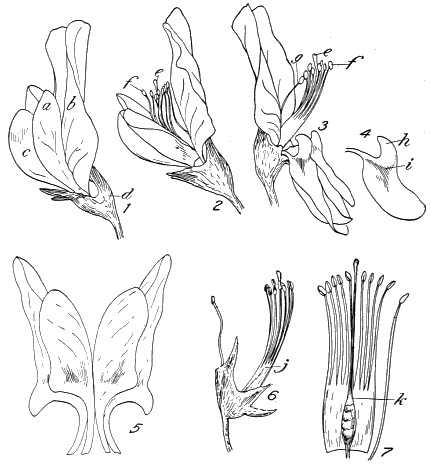
Fig. 1.—Different parts of the flower of Melilotus alba: 1, Side view of the flower; 2, side view of the flower
with the carina and alæ slightly depressed; 3, side view of the flower, showing the carina and alæ depressed
sufficiently to expose the staminal tube and the tenth free stamen; 4, ala; 5, ate and carina
spread apart to show their relative position and shape; 6, flower after the petals have been removed,
showing in detail the calyx and staminal tube; 7, the staminal tube split open to show the relative size
and position of the pistil, a, Alæ; b, vexillum; c, carina; d, calyx; c, stigma; b, anthers: g, tenth free
stamen; h, digitate process of the superior basal angle of an ala; i, depressions in the ala; j, staminal
tube; k, pistil.
The racemes of Melilotus alba contain from 10 to 120 flowers with
an average of approximately 50 per raceme for all of the racemes of
a plant growing under cultivation in a field containing a good stand.
The flower consists of a green, smooth, or slightly pubescent calyx
with 5-pointed lobes and with an irregular white corolla of five petals.
(Fig. 1.) The claws of the petals are not united nor are they attached
to the staminal tube which is formed by the union of the filaments of
the nine inferior stamens. As the claws of the alæ and carina are not
attacked to the staminal tube; the petals may be bent downward
sufficiently far so that many different kinds of insects may secure
without difficulty the nectar secreted around the base of the ovary.
The fingerlike processes of the alæ are appressed closely to the
carina, therefore the alæ are bent downward with the carina by
insects. These processes grasp the staminal tube superiorly and
tightly when the carina and alæ are in their natural positions, but
when the carina is pressed downward by insects the fingerlike processes
open slightly but not so far that they do not spring back to their
original position when the pressure is
removed. The staminal tube splits
superiorly to admit the tenth free
stamen. The filament of this superior
stamen lies along the side of this
staminal tube. The filaments of the
nine stamens which compose the staminal tube separate in the hollow of the
carina. All stamens bear fertile anthers. The pistil is in the staminal
tube, the upper part of the style and
stigma of which is inclosed with the
anthers in the carina. The stigma
is slightly above the stamens.
An insect inserts its head into a
sweet-clover flower between the vexillum and carina, the stigma, therefore,
comes into direct contact with the
head of the insect and cross-pollination
is effected. At the same time the anthers brush against the insect, so that
its head is dusted with pollen, to be
carried to other flowers.
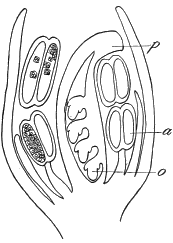
Fig. 2.—Lengthwise sectional view of a very
young flower of Melilotus alba, showing the
relative development of the stamens and
pistil. In the upper set of stamens the divisions
of the mother cells are completed,
while division is just beginning in the
lower set of stamens. In the ovules the
outer integuments are well started on their
development, a, Anther; o, ovule; p,
pistil. × 38.
The stamens of Melilotus alba and M. officinalis may be divided
into two sets, according to their length and time of development.
(Fig. 2.) The longer set extends about the length of the anthers
above the shorter set, and the pollen mother cells in the longer set
divide to form pollen grains at least two days earlier than those in
the shorter set. At the time the pollen mother cells divide, the
longer set of stamens is approximately three-eighths of a millimeter
in length and the pistil about half a millimeter long. The stigma
and a portion of the style project beyond the stamens, and this relative
position is maintained to maturity. The pollen mother cells
undergo the reduction division while the megaspore mother cells are
just being differentiated and while the outer integuments are barely
prominent at the base of the nucellus. The pollen grains are formed
while the embryo sac is beginning to develop. The division of the
megaspore mother cell does not occur until a number of days later,
and the embryo sac is not mature until the flower is nearly ready to
open. Thus, the pollen grains are formed a week to 10 days before
the embryo sac is ready for fertilization. The pollen grains increase
in size and undergo internal changes after their formation. These
changes, which are not completed until the flower is one-half or more
of its mature length, may be regarded as the ripening processes, and
they are undoubtedly necessary before the pollen is capable of functioning.
For this reason it is probable that the pollen grains are not
able to function much before the embryo sac is mature.
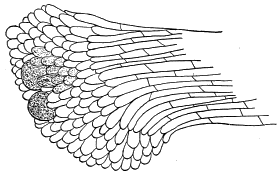
Fig. 3.—Stigma at the time of pollination, showing its papillate
character and the position of the pollen in reference to the papillæ
in pollination. × 175.
The pistils of Melilotus alba and M. officinalis are straight for
the greater part of
their length, but curve
rather abruptly toward
the keel just below the
capitate stigma. The
surface of the stigma
is papillate. (Fig. 3.)
In their reaction with
Sudan III, alkanin, and
safranin the Walls of
the papillæ of the stigma
show that some fatlike substances are present. Aside from water,
the contents of the papillæ consist chiefly of a fine emulsion of oil.
The number of ovules in the ovary of Melilotus alba varies from
two to five; however, most commonly, three or four ovules occur.
In Melilotus officinalis the number in each ovary ranges from three
to six. In both species the ovules are campylotropous at maturity
with the micropylar end turned toward the base of the ovary.
Mature ovules contain two integuments, but the inner one does
not close entirely around the end of the nucellus. The outer integument
develops considerably ahead of the inner one. The outer
integument is much thickened at the micropylar end, the seed coat
is formed from it, and the inner integument is used as nourishment
by the endosperm and embryo.
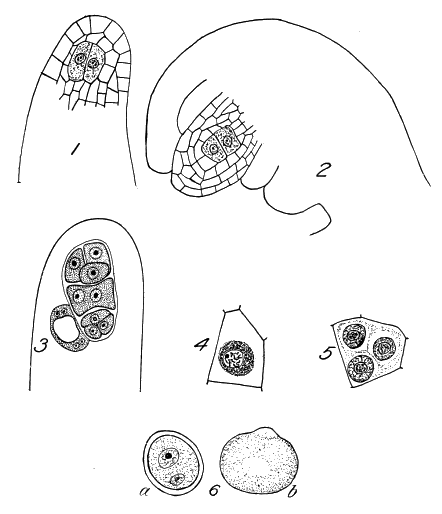
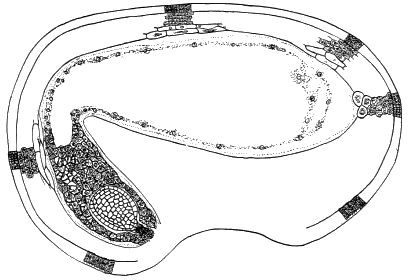
The number of megaspore mother cells in an ovule varies from
one to many. Two or more embryo sacs often start to develop in
the same ovule, but seldom more than one matures. (Pl. I, figs. 1, 2, and 3.)
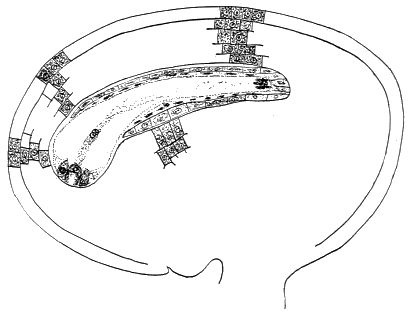
In general, the development of the embryo sac proceeds
in the ordinary way, as described by Young (44, p. 133), with the
inner megaspore functioning. (Text fig. 4 and Pl. II, fig. 1.) In its
development the nucellus is destroyed rapidly, the destruction being
most rapid first at the micropylar end proceeding backward. The
nucellus is completely destroyed at the micropylar end by the time
the embryo sac is mature, and consequently the embryo sac comes in
contact with the outer integument in this region. (Pl. II, fig. 1.)
As the destruction of the nucellus extends toward the chalazal end
the embryo sac becomes much elongated and tubelike. The antipodals
disappear early, so that a mature embryo sac consists of the
egg, the synergids, and the two polars. The two polars lie in contact
in the micropylar end of
the sac near the egg until
fertilization.
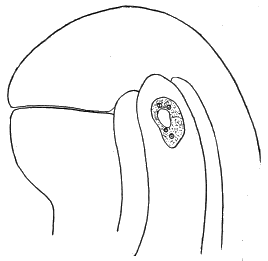
Fig. 4.—Median section through an ovule, showing the embryo
sac with four nuclei and the position of the integuments.
× 150.
In Melilotus alba and M. officinalis there is very
little tendency toward
sterility of ovules. In an
extended study of ovules
developing under normal
and under excessive moisture conditions only an
occasional one was found
in which no reproductive
cells were differentiated,
and no ovaries were found
in which all of the ovules
were sterile.
The pollen mother cells do not separate, but previous to the reduction
division the protoplasm shrinks from the walls, thus forming a
dense globular mass which often occupies less than half the lumen of
the mother cell. (Pl. I, fig. 4.) Nuclear division occurs while they
are in this contracted condition, and four nuclei are formed from two
successive divisions. The cytoplasm is equally distributed around
each nucleus. The four masses of protoplasm separate, and as they
enlarge a number of times and develop into mature pollen grains they
become binucleate, and a wall is gradually formed around each.
(Pl. I, figs. 5 and 6.) At first the cytoplasm is quite dense and contains
some starch but no fatty oils. However, the cytoplasm of
mature pollen grains is vacuolate, and it contains a fatty oil in the
form of an emulsion. Soon after the pollen grains are formed, the
walls of the mother cells disappear, thus permitting the pollen grains
to lie loose in the anther.
The time intervening between pollination and fertilization was
investigated with both self-pollinated and cross-pollinated flowers.
In cross-pollination the parents were separate plants. This point
was investigated with plants out of doors during the summer of 1916
and with plants in the greenhouse during the following winter. The
time elapsing between pollination and fertilization ranged from 50 to
55 hours and was not longer in the case of self-pollinated than with
cross-pollinated flowers. Furthermore, the rate of the development
of the embryo in each kind of pollination was studied and was found
to be as rapid in self-pollination as in cross-pollination. Therefore,
self-pollination is apparently as effective as cross-pollination in
Melilotus alba so far as the vigor of pollen tubes and the rate at which
embryos develop are concerned. Melilotus officinalis was not studied
in reference to this point.
Considerable difference often exists in the size of the young embryos
in the ovules of the same pod. This is due in part to a difference
in the time of fertilization, although some of it is due to a difference
in nourishment. It was observed that the ovule first fertilized
might be an upper one, lower one, or any one between these. Occasionally
one or more ovules are not fertilized.
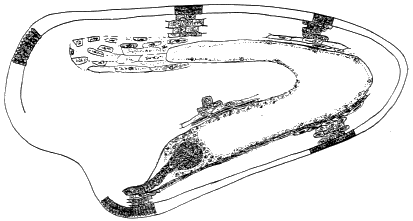
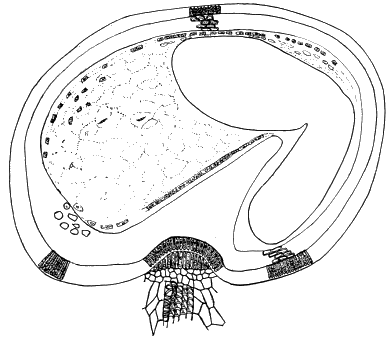
A proembryo with a rather long suspensor is developed from the
fertilized egg. (Pl. II, fig. 2). The endosperm, which quite early
forms a peripheral layer around the entire embryo sac, develops most
rapidly about the embryo, which soon becomes thoroughly embedded
in it. (Pl. III, figs. 1 and 2.) After the embryo has used up the
endosperm in the micropylar end and has enlarged so much as to
occupy nearly all of the space in this region, the development of the
endosperm becomes more active in the chalazal end, and when the
embryo is mature there is very little endosperm left.
The seed coat begins to form about the time of fertilization,
although it apparently does not depend upon it, for in ovules where
fertilization is prevented the outer integument undergoes the early
modifications in the development of the seed coat before the ovule
breaks down. The development of the seed coat is apparent first at
the micropylar and chalazal ends, where the outer cells of the outer
integument become much elongated and their outer walls thicken
very soon after fertilization. The modifications in the development
of the seed coat extend around the ovule from these points, involving
at first only the outer or epidermal layer of cells which form the
malpighian layer. Later, the cells just beneath the malpighian layer
form the osteosclerid layer. Accompanying or closely following the
formation of the osteosclerid cells, the remaining cell layers of the
outer integument become modified into the nutritive and aleurone
layer, and the seed coat is fully formed. Meantime the inner integument
is practically all used as food.
Development of the Ovules and Pollen in Sweet Clover.
Fig. 1.—Section through the nucellus of an ovule of Melilotus alba, showing two megaspore mother cells.
× 360. Fig. 2.—Median section through an ovule of Melilotus alba, showing the two cells resulting
from the first division of the megaspore mother cell, and the relative development of the different
parts of the ovule. × 300. Fig. 3.—Section through the nucellus of an ovule of Melilotus alba,
showing two embryo sacs, one being more advanced than the other. × 360. Fig. 4.—Protoplasm of the
pollen mother cell of Melilotus alba contracted and ready to undergo division. × 560. Fig. 5.—Pollen
grains of Melilotus alba just formed, showing their dense cytoplasm and the presence of the mother-cell
wall. × 560. Fig. 6.—a, Mature pollen grain of Melilotus alba, showing the binucleate condition
at the time of shedding; b, surface view. × 560.
Fig. 1.—Median Section through an Ovule of Melilotus alba.
The embryo sac is shown ready for fertilization. The egg and synergids are in contact with the
outer integument at the micropylar end. The remains of the antipodals may be seen at the
chalazal end. × 180.
Fig. 2.—Section through an Ovule of Melilotus alba, about Three
Days After Fertilization.
The proembryo, the endosperm, and modifications of the integuments are shown. At this stage
the suspensor prominent part of the proembryo, and the endosperm is most abundant around
the embryo. The inner integument is being rapidly destroyed, and the outer integument is
beginning to form the seed coat, as is indicated by the modifications in the outer layer of its cells,
which are elongating and thickening their outer walls. × 33.
Fig. 1.—Section of an Ovule of Melilotus alba after Fertilization.
The stage of development is a little later than that shown in Plate II, figure 2. The embryo is
embedded deeply in endosperm tissue. × 45.
Fig. 2.—Section through an Ovule of Melilotus alba after the Embryo
is Nearly Half Mature.
But little endosperm remains except in the chalazal end, and very little remains of either the
nucellus or inner integument. The modifications which transform the outer integument into a
seed coat are well under way. Not only the outer layer of cells which becomes the Malpighian
layer is quite well modified, but also the layer beneath is being transformed into the osteosclerid
layer. × 30.
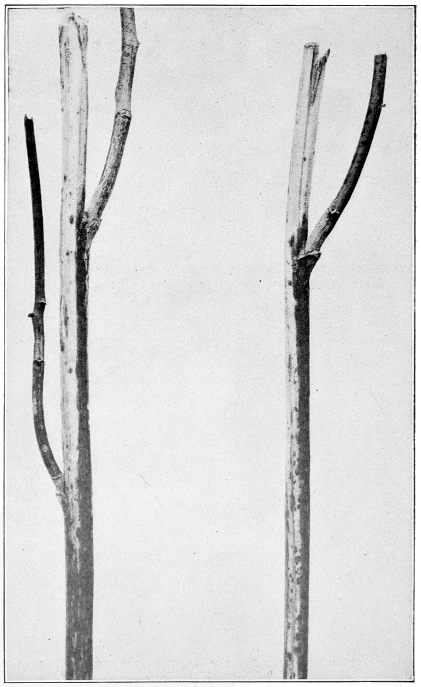
Stubble of Melilotus alba.
These plants, which were cut 12 inches above the ground during rainy weather, had made a 40 to 42 inch
growth. The stubble became infected at the top and the light-colored portions of them were killed by
disease, thus checking the water supply to the growing branches above the infection.
The pollen grains of Melilotus alba and of M. officinalis are quite
similar. Each grain contains three germ pores, and when viewed
so that the pores are visible they present a slightly angled appearance.
The average dimensions of the pollen of Melilotus alba and of M. officinalis
are 26 by 32 microns and 24 by 30 microns, respectively, when
measured in the positions shown in b in Plate I, figure 6.
The walls of the pollen grains have cutin deposited in them, as
shown by their reactions with Sudan III, alkanin, safranin, and
chloriodid of zinc. The contents of the pollen grains give a distinct
reaction when tested for fat, and Millon's reagent shows that also
some protein is present. Tests for sugars and starch showed that
these substances are not present in perceptible quantities in mature
pollen grains, although some starch is present in immature pollen.
The germination of the pollen of Melilotus alba permits considerable
variation in moisture, as is illustrated in Table I.
Table I.—Germination of the pollen of Melilotus alba in water and in solutions of
cane sugar of different strengths.
| Melilotus alba. |
Pure water. |
Cane sugar in solution (per cent). |
| 8 |
12 |
18 |
24 |
30 |
35 |
45 |
55 |
| Germination of pollen per cent |
33 |
23 |
64 |
46 |
60 |
46 |
31 |
22 |
0 |
The results given in Table I represent the average of 12 tests.
Some of the pollen grains burst in pure water and in the weak cane
sugar solutions, the percentage of bursting being greatest in pure
water and decreasing as the percentage of sugar in the solution was
increased. There was considerable variation in the percentages of
germination in both water and in the solutions of different strengths,
and at times there was very little bursting which was not accompanied
by a high percentage of germination. The pollen tubes grew as
rapidly in water as in any of the sugar solutions, some reaching a
length of 100 microns in six hours. As the pollen tubes made no
more growth in the solutions of sugar than in water, it is evident
that the sugar is not used as food, but helps in germination by reducing
the rate at which water is absorbed.
To judge from Table I, the pollen of sweet clover can be effective
not only under ordinary conditions but also when the flowers are
wet with rain or dew or when the stigma is so dry that in order to
obtain water from the papillæ the pollen must overcome a high resistance
offered by the sap of the papillæ, a resistance that may be
equal to the osmotic pressure of a 45 per cent solution of cane sugar.
This is in accord with results obtained under field conditions; as
flowers that were pollinated while rain was falling set seed satisfactorily,
indicating that a high percentage of humidity in the atmosphere
does not check the germination of the pollen sufficiently to interfere
with fertilization. Neither was the setting of seed affected when the
soil about the roots of plants was kept saturated with water, showing
that the excessive quantity of water in the stigmas resulting from an
abundance of water in the soil did not interfere with the fertilization
of the flowers.
No definite counts were made of the germination of the pollen of
Melilotus officinalis in the solutions of cane sugar of different strengths,
but observations show that the moisture requirement of the pollen
of this species is approximately the same as that of Melilotus alba.
Results published by previous investigators on the cross-pollination
and self-pollination of sweet clover do not agree. The experiments
of Darwin (4) show that the flowers are self-pollinated to
only a small extent. On the other hand, Kirchner (18) and Kerner
(17) find that self-pollination occurs generally and that cross-pollination
is not necessary for the production of seed. However, all
investigators agree that many different kinds of insects are able to
pollinate sweet clover.
Because of the diverse opinions as to the pollination of sweet clover,
a number of experiments were conducted to determine (1) whether
insect visitation was necessary to pollinate the flowers, (2) if necessary,
whether the flowers must be cross-pollinated, and (3) what
insects are active agents as pollinators of sweet clover.
Experiments were conducted to determine, if possible, the effect
of various types of artificial manipulation of sweet-clover flowers
when in full bloom on the production of seed. Only healthy, vigorous
plants growing on well-drained soil were selected for these experiments.
Before any of the flowers were open, the individual
racemes were covered with tarlatan and labeled. (Fig. 5.) As soon
as part of the flowers opened, the racemes were uncovered and after
removing all flowers that were not open the open flowers were pollinated
and the racemes re-covered. If the flowers of sweet clover
are not fertilized they will remain open for two to three days, then
wither, and in a short time drop. But after being fertilized the ovules
enlarge very rapidly, and the corollas usually drop in about seven
or eight days. Therefore, all fertilized flowers can be distinguished
a few days after fertilization has taken place. Counts were made of
the number of pods which formed in 10 to 12 days after pollination.
An outline of the experiments is given in Table II.
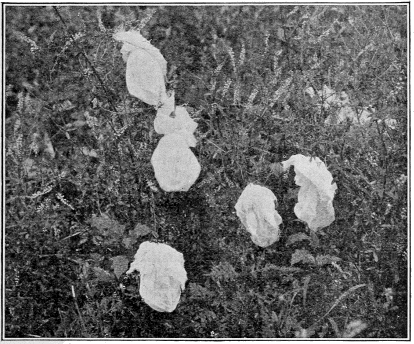
Fig. 5.—Individual racemes of white sweet clover covered with cheesecloth to protect them from insect
visitation.
Table II.—Treatment of sweet-clover flowers in the artificial-manipulation experiments.
| Experiment. |
Method of pollinating the flowers. |
| A |
Check—covered. |
| B |
Check—open to insect visitation at all times. |
| C |
A separate toothpick was used to spring the keel of each flower on the raceme. |
| D |
One toothpick was used to spring the keels of all the flowers on a raceme. |
| E |
Cross-pollinated. |
| F |
Raceme rolled several times between thumb and finger. |
As insects, and especially honeybees, usually visit all recently
opened flowers on a raceme, experiments C and D were conducted to
determine whether more seed would be produced when pollen from
other flowers on the same raceme was placed on the stigmas of the
flowers than when only the pollen produced by each flower was placed
on its own stigma. The effect of pollination when only the pollen
produced by an individual flower was placed on its own stigmas was
also obtained in experiment F, as by this method of pollination no
pollen was transferred from one flower to another. It can not be
stated definitely that the seed produced by the cross-pollinated
flowers was the result of fertilization with foreign pollen, as the
anthers were not removed from the flowers pollinated because it
would be necessary to remove the anthers when the flowers were not
more than two-thirds mature, and in doing this the flowers would be
so mutilated that only occasionally would pollination at this time
or at a later date be effective. The flowers listed in experiment E
were pollinated a short time before they opened, and in each case
pollen taken from flowers of other plants was placed on the stigmas.
The petals of the cross-pollinated flowers were not mutilated, and
in each case they returned to their original positions soon after pollination.
The results obtained in experiment B, where the racemes
were simply labeled and left open to the action of insects at all times,
serve for comparison with other experiments where the flowers were
protected from insect visitation and were artificially manipulated.
Martin (25) found the setting of alfalfa seed and Westgate (40)
found the setting of red-clover seed to be affected by an excessive
quantity of moisture in the soil or atmosphere. In order to overcome
the possible effect of this or of other detrimental factors, in
each experiment only the flowers on a certain number of racemes
were pollinated at one time. All of the experiments were repeated a
number of times during the months of July and August, 1916, and
the results given in Table III show the total number of flowers pollinated
and the number of pods that formed during the two months.
The results presented in Table III show that flowers fertilized
with pollen transferred from another plant produced a higher percentage
of pods than any of the other treatments. The results obtained
in experiment D, where the same toothpick was used to
spring the keels of all the flowers on a raceme, show that this method
of pollination produced an average of 7.24 pods per raceme more than
the racemes in experiment C. where a separate toothpick was used
for each flower. These results indicate that pollen transferred from
one flower to another on the same raceme is more effective than when
the pollen produced by an individual flower is used to fertilize its
own stigma. However, the results of experiment C prove that self-pollination
is effective in Melilotus alba. In experiment B. which
was the open check, 4.3 per cent more flowers set seed than on the
racemes where the same toothpick was used to spring all the keels,
but 11.57 per cent more seed was obtained than in experiment C.
Spontaneous self-pollination occurs to only a very small extent, as
will be seen from the results of experiment A, in which an average of
only 2.9 per cent of the flowers set seed.
Table III.—Effect of different types of artificial manipulation on the
seed production of sweet clover at Arlington, Va., and at Ames, Iowa, in
1916.
| Location. |
Experiment. |
Total number of— |
Flowers that set seed (per cent). |
| Racemes. |
Flowers. |
Pods set. |
At each station. |
Average. |
|
|
|
|
|
|
|
| Arlington |
A |
49 |
3,510 |
144 |
4.1 |
} |
2.9 |
| Ames |
A |
84 |
4,536 |
92 |
2.0 |
|
|
|
|
|
|
|
| Arlington |
B |
100 |
5,599 |
3,973 |
70.95 |
} |
66.51 |
| Ames |
B |
196 |
1,276 |
600 |
47.02 |
|
|
|
|
|
|
|
| Arlington |
C |
50 |
1,229 |
701 |
57.03 |
} |
54.94 |
| Ames |
C |
75 |
289 |
133 |
46.02 |
|
|
|
|
|
|
|
| Arlington |
D |
50 |
1,480 |
936 |
63.24 |
} |
62.18 |
| Ames |
D |
88 |
575 |
342 |
59.47 |
|
|
|
|
|
|
|
| Arlington |
E |
31 |
377 |
307 |
81.43 |
} |
70.10 |
| Ames |
E |
48 |
175 |
80 |
45.71 |
|
|
|
|
|
|
|
| Arlington |
F |
30 |
933 |
524 |
56.16 |
......... |
The production of seed of Melilotus alba under ordinary field conditions
varies considerably, not only in different parts of the country
but also on different fields in the same region. A number of factors
contribute to this variation, one of the most important of which
appears to be the inability of the plant to supply all the developing
seed with sufficient moisture, causing some of them to abort. As
pointed out on page 22 this condition was very marked in certain
parts of the country in 1916. However, poor seed production is
not always correlated with lack of moisture, for the seed crop was a
failure in 1915, where cloudy and rainy weather prevailed much of
the time the plants were in bloom. It is believed that the lack of
pollination by insects was the principal cause for the failure of seed to
set, as very few insects visit sweet-clover flowers when such conditions
prevail. As sweet-clover pollen will germinate in pure water
and as plants which have their roots submerged in water set seed
abundantly when pollinated, the failure of the seed crop in 1915 was
not due to excessive moisture.
As a rule, thin stands of sweet clover produce more seed to the
acre than thick stands and isolated plants more seed than those
growing in either a thick or thin stand. The correlation of seed
production with the thickness of stand is probably due to the shading
and partial prevention of insect visitation to part of the racemes on
the lower branches. Most of the flowers upon the lower branches
of isolated plants are directly exposed to sunlight and to insect visits:
therefore the racemes on these branches produce as large a percentage
of seed as the racemes on the upper branches. In a thick
stand, little seed is produced by racemes on the lower branches.
A plant approximately 3 feet high growing close to the center of a
field at Arlington. Va., in which was an average stand of four sweet-clover
plants to the square foot was selected in order to determine
the number of racemes produced and the average number of seeds
to the raceme. This plant produced 196 racemes, which contained
an average of 20.4 pods each. The racemes varied from 2 to 10 cm.
in length, and the number of pods to the raceme ranged from to 75.
The racemes on the upper and most exposed portions of the plants
were larger and the flowers produced a much higher percentage of
pods than the racemes close to the bases of the larger branches.
Many of the small racemes on the lower branches produced less than
five pods each.
The data obtained from the two plants at Arlington that were
protected from night-flying insects may also be cited here, as the
results of that experiment show that night-flying insects are not an
important factor in the production of sweet-clover seed, and, further.
because they were growing under the same conditions, in the same
plat, and were approximately of the same size. These two plants
produced a total of 544 racemes, with an average of 20.9 pods each.
The number of pods to the raceme varied from to 86.
In order further to test the self-sterility of sweet clover and to determine
the relative efficiency of night-flying and of different
kinds of day-flying insects as pollinators of the flowers, a number of
cages covered with cheesecloth, glass, or wire screen having 14
meshes to the linear inch were placed over plants at Arlington. Va.,
and at Ames. Iowa, in July and August. 1916. The bases of the
cages were buried several inches in the ground, so that insects could
not pass under them. Cheesecloth was used to cover most of the
cages and was made into sacks of such a size that they could be put
on or removed from the frames of the cages without difficulty. It
was stretched tightly over the frames and fastened to their bases
with laths.
A cage having two sides and the top of glass but with ends covered
with cheesecloth to permit ventilation was used at Ames to protect
a number of plants from insect visitation at all times. The purpose
of this cage was to determine whether the partial shading of the
plants in the cages covered with cheesecloth would have any effect
upon the setting of seed.
The cage covered with wire netting having 14 meshes to the linear
inch was used to determine the efficiency as pollinators of sweet
clover of insects so small that they could pass through openings of
this size.
The plants used in the experiments at Arlington were growing
close to the center of a field of sweet clover. Volunteer plants in a
field that contained only a scattering stand were used at Ames. The
cages were placed over the plants in all of these experiments before
any of the flowers opened, and the work was continued until they
were through blooming.
A plant subject to insect visits at all times and growing in the same
plat as those inclosed in the cages at Arlington was selected as a
check to those inclosed in the cages during their entire flowering
period or for only a portion of it. This plant, which was in bloom at
the same time as those inclosed in the cages, produced 196 racemes
with an average of 20.4 pods each. As all of the racemes were collected
and as those on the lower portions of the plant were smaller
than those on the upper branches, the average number of seeds per
raceme is much lower than it would have been if only the larger
racemes had been collected.
An isolated plant that was subject to insect visits at all times was
selected for a check to the cage work conducted at Ames. This was
necessary in order to get results that would be comparable with those
obtained from the plants inclosed in the cages, as the cage experiments
at Ames were conducted with isolated plants. The plant produced
239 racemes, with an average of 41.6 pods.
On July 3, 1916, a cage 3 feet square and 3½ feet high, covered with
cheesecloth, was placed over three sweet-clover plants at Arlington.
(Fig. 6.) This cage was not opened until August 3, when practically
all of the racemes had passed the flowering stage and the few seeds
that formed on some of them were practically mature. The three
plants inclosed in the cage produced 904 racemes, with an average
of 0.63 pod each. No pods were produced on 594 racemes, while 150
produced but one each. None of the racemes produced more than
five pods.
This experiment was duplicated at Ames in August, 1916, with the
result that the three protected plants produced a total of 776 racemes,
with an average of 0.19 pod each.

Fig. 6.—Cage covered with cheesecloth to protect
plants from insect visitation.
The plants inclosed at Arlington produced 0.44 pod to the raceme
more than the plants inclosed at Ames, and the average for the six
plants at Arlington and at Ames is only 0.42 pod to the raceme.
Results given below for nine plants inclosed in the glass-covered cage
show that the pods
produced per raceme
by different plants
varied from 0.1 to
0.45, which is slightly
less than the variation
in the two cages
covered with cheese-cloth.
In order to determine
whether the
shading of the plants
in the cheesecloth-covered
cages had
caused the production
of seed to be reduced,
a cage 4 feet
wide, 4 feet high, and
10 feet long, having
glass sides and top,
but with ends covered with cheesecloth to permit ventilation, was
placed over nine plants at Ames in August, 1916. The results
obtained in this experiment are presented in Table IV.
Table IV.—Production of sweet-clover seed by plants protected from
insect visitation during their entire flowering period at Ames, Iowa,
in 1916.
| Plant. |
Racemes per plant. |
Pods produced by all racemes. |
Average number of pods to the raceme. |
| No. 1 |
84 |
17 |
0.20 |
| No. 2 |
130 |
58 |
.44 |
| No. 3 |
166 |
30 |
.18 |
| No. 4 |
199 |
88 |
.44 |
| No. 5 |
243 |
35 |
.27 |
| No. 6 |
131 |
36 |
.27 |
| No. 7 |
119 |
13 |
.10 |
| No. 8 |
182 |
83 |
.45 |
| No. 9 |
340 |
142 |
.41 |
| Total |
1,594 |
592 |
....... |
| Average |
....... |
....... |
.31 |
The results given in Table IV show that an average of 0.31 of a
pod to the raceme was obtained from 1,594 racemes and that the
variation in seed production of the different plants was from 0.1 to
0.45 to the raceme. The average seed production for the nine plants
is 0.11 seed to the raceme less than the average results obtained from
the six plants that were covered with cheesecloth. As this difference
is well within the limit of variation for individual plants, it may be
stated that the shading of the plants in the cheesecloth-covered cages
did not reduce the production of seed. The results of this experiment
show that spontaneous self-pollination does not occur regularly, as
stated by Kirchner.
In order to determine the importance of night-flying insects as
pollinators, two cheesecloth-covered cages 3 feet square and 3½ feet
high were placed over sweet-clover plants at Arlington on July 10,
1916. The covers of the cages were removed each evening at 7:30
and replaced each morning at 4:30 o'clock. Practically all the
flowers on these plants had bloomed by August 2, and the seed produced
was nearly mature. The few racemes that contained opened
flowers or buds were discarded. The three plants in one cage produced
723 racemes, with an average of 3.76 pods each, while the one
plant in the other cage produced 227 racemes, with an average of
3.58 pods to the raceme. The four plants, therefore, produced a
total of 950 racemes, with an average of 3.71 pods each. The only
night-flying insect found working on sweet clover while these plants
were in bloom was Diacrisia virginica Fabr.
This experiment was duplicated at Ames in August, 1916, with the
result that one plant subject to visitation only by night-flying insects
produced 486 racemes, with an average of 16.5 pods each.
The results obtained in these experiments show that night-flying
insects were much more active in pollinating sweet clover at Ames
than at Arlington. However, as the results obtained from the plants
subject to visitation by day-flying insects only were practically the
same as those obtained from plants which were subject to insect
visitation at all times, it is concluded that night-flying insects were
not a factor in the pollination of sweet clover at Arlington or at Ames
in 1916.
A cheesecloth-covered cage, 3 feet square and 3½ feet high, was
placed on July 7, 1916, over two sweet-clover plants at Arlington,
before any of the flowers opened. As the cover of this cage was
removed at 7.30 a. m. and replaced at 4.30 p. m. each day during the
experiment, the plants were subject to visitation by day-flying
insects only. As soon as all of the flowers on most of the racemes had
bloomed, and before any mature pods shattered, the racemes were
removed from the plants and the pods produced by each raceme
counted. The two plants produced a total of 544 racemes, with an
average of 20.9 pods each.
This experiment was also conducted at Ames. One plant was
protected from insect visitation at night in August, 1916, with the
result that it produced 418 racemes, with an average of 41.11 pods
each.
It is well known that many small insects, and especially those
belonging to the family Syrphidæ and to the genus Halictus, frequent
sweet-clover flowers, but no records have been noted that show how
important these insects are as pollinators of this plant. In order to
obtain data on this subject a cage 12 feet square and 6½ feet high,
made of wire screen having 14 meshes to the linear inch, was placed
over a few plants at Ames, in July, 1916, before they began to bloom.
The base of the cage was buried several inches in the soil, so that no
insects could get into it. As these plants were growing in a field
where there was a sufficient supply of moisture at all times, they made
a growth of 5 to 6 feet. For this reason all the racemes were collected
from only a portion of one of the plants instead of from the entire
plant, as was done with the smaller ones inclosed in the cheesecloth-covered
cages. The branches selected contained 224 racemes, with
an average of 24.53 pods each. Many insects that were able to pass
through the wire netting were observed working on the flowers of the
inclosed plants.
A check plant, subject to visitation by all insects and growing
within a few yards of the cage, contained 264 racemes, with an average
of 28.23 pods each.
This experiment shows that small insects are efficient pollinators
of sweet clover and that the plant to which all insects had access
produced an average of only 3.7 pods to the raceme more than the
one inclosed in the cage. As these plants were growing close to a
strip of timber and some distance from a field of sweet clover, it is
probable that more small insects worked on the flowers than would
have been the case if the cage had been located in the center of a
field of sweet clover. Though these results show that small insects
are able to pollinate sweet-clover flowers freely, it is very doubtful
whether insects of this kind would be numerous enough to pollinate
sufficient flowers in a large field of sweet clover for profitable seed
production. The honeybee is the most efficient pollinator of this
plant, and it is believed that in many sections it is responsible for the
pollination of more than half of the flowers.
The data secured in the different experiments where sweet-clover
flowers were subject to insect visitation at one time or another are
presented in detail in Table V.
Table V.—Summary of the insect pollination studies conducted
at Arlington, Va., and Ames, Iowa, in 1916.
| Location. |
Number of plants. |
Method of treatment. |
Number of— |
| Racemes. |
Pods produced. |
Pods per raceme, average. |
| Arlington. |
1 |
Check—subject to insect visitation at all times. |
196 |
4,013 |
20.47 |
| Ames. |
1 |
do. |
239 |
9,943 |
41.60 |
| Arlington. |
3 |
Protected from all insects. |
904 |
577 |
.63 |
| Ames. |
12 |
do. |
2,370 |
653 |
.27 |
| Arlington. |
3 |
Visited by night-flying insects only (cage 1). |
723 |
2,720 |
3.76 |
| Do. |
1 |
Visited by night-flying insects only (cage 2). |
227 |
152 |
.67 |
| Ames. |
1 |
Visited by night-flying insects only. |
486 |
8,024 |
16.51 |
| Arlington. |
2 |
Visited by day-flying insects only. |
544 |
11,397 |
20.95 |
| Ames. |
1 |
do. |
418 |
17,186 |
41.11 |
| Do. |
9 |
Protected from all insects. |
1,594 |
502 |
.31 |
The results in Table V show that an average of 0.37 pod to the
raceme was obtained from the plants protected from visitation by all
insects during the flowering period. As the racemes of Melilotus
alba will average approximately 50 flowers each, less than 1 per cent
of them set seed without being pollinated by insects. The results
obtained in the cages in which only night-flying insects had access to
the flowers show that these insects pollinate sweet clover to a slight
extent, but that the number of pods produced by them is so few that
it may be assumed that these flowers would have been pollinated by
day-flying insects. This assumption is borne out by the results
obtained in the cages where only day-flying insects had access to the
flowers, as the results obtained in these cages at Arlington and Ames,
respectively, are approximately the same as those obtained on the
plants subject to insect visitation at all times. It will be noted that
the yield of seed on the plants visited by insects at Ames is much
higher than that of the plants subjected to insect visits during the
same period at Arlington. This difference in seed yield may be
attributed to the fact that isolated plants were used in the experiments
at Ames, and at Arlington the experiments were conducted
with plants growing under field conditions.
Observations of sweet-clover plants grown under cultivation, and
especially when the stands were thick, showed that the flowers of the
racemes on the upper and exposed branches produced a larger percentage
of seed than those on the lower branches which were less
exposed. It is thought by some that the failure of the flowers on the
lower racemes to be fertilized is due to shading; but the results obtained
in the cheesecloth and glass covered cages do not warrant this
belief, as it is doubtful whether the shading of the flowers on the
lower racemes is more than that caused by the cheesecloth. It is
probably the lack of pollination that causes this decrease in seed production
on the lower branches of plants growing close together, as a
vast number of flowers open each day on portions of the plants which
are exposed directly to visitation by insects and are therefore more
accessible to them.
In order to obtain information upon the number of flowers that
produce seed on the upper and lower portions, respectively, of sweet-clover
plants when grown under field conditions and where the stand
contained four to five plants to the square foot, a number of racemes
were labeled on different portions of the plants at Ames in 1915 and
1916. When the pods were partly mature, records were made of the
number of flowers that produced pods. The results obtained are
given in Table VI.
Table VI.—Relation of the position of sweet-clover flowers on the plants
to seed production, at Ames, Iowa, in 1915 and 1916.
| Year. |
Position of the flowers. |
Number of flowers. |
Pods formed. |
| Number. |
Percentage. |
Average. |
| 1915 |
Upper half of plants |
812 |
357 |
43.9 |
} |
42.6 |
| 1916 |
do |
261 |
101 |
38.7 |
| |
|
|
|
|
|
| 1915 |
Lower half of plants |
344 |
44 |
12.7 |
} |
18.3 |
| 1916 |
do |
216 |
59 |
27.3 |
The flowers on the upper racemes of the plants produced 31.2 per
cent more pods than those on the lower racemes in 1915. and 11.4 per
cent more in 1916. These results prove that insects more frequently
visit the flowers that are directly exposed and are therefore more
accessible.
The seed production of sweet clover is seldom satisfactory when
rainy or muggy weather prevails during the flowering period. In
order to obtain data as to the relation existing between the visits of
insects and the prevailing weather conditions, a record of insect visits
and of the number of flowers that opened each day was kept for a
period of nine days at Ames in August, 1915.
In this experiment the racemes were marked early each morning
just above the last flowers which had opened the previous day, and
early the following morning the number of flowers which had opened
the previous day was noted. The number of flowers that were pollinated
was determined by the number of pods that formed. Table
VII gives in detail the results obtained.
Table VII.—Influence of the weather at blossoming time upon the yield of sweet -clover
seed, at Ames. Iowa, in 1915.
| Date, 1915. |
Weather conditions. |
Insect visitors. |
Number of flowers that opened. |
Pods formed. |
Percentage of flowers that matured. |
| Aug. 16 |
Cloudy and showery |
|
Very few |
102 |
18 |
17.6 |
| Aug. 17 |
Rain all day |
|
None |
69 |
4 |
5.7 |
| Aug. 18 |
Cloudy most of the day |
|
Very few |
60 |
20 |
33.3 |
| Aug. 19 |
Clear and cool |
|
Numerous |
94 |
53 |
56.3 |
| Aug. 20 |
Mostly clear and warm |
|
do |
61 |
38 |
62.2 |
| Aug. 21 |
Clear and warm |
|
do |
81 |
44 |
54.3 |
| Aug. 22 |
Partly cloudy and warm |
} |
do |
181 |
100 |
55.2 |
| Aug. 23 |
do |
| Aug. 24 |
Cloudy till mid-afternoon |
|
Few |
37 |
12 |
32.4 |
The data given in Table VII show that the percentage of effective
pollination is much higher in clear weather, when insects are active,
than in cloudy or rainy weather, when but few insects visit the
flowers.
On account of the ease with which the heavy flow of nectar of
sweet-clover flowers may be obtained many insects visit the flowers,
thereby pollinating them. While the useful insect visitors of flowers
of red clover are limited to a few species of Hymenoptera, those
pollinating sweet-clover blossoms are many and belong to such
orders as Coleoptera, Lepidoptera, and Diptera, as well as to the
Hymenoptera. However, in the United States the honeybee is the
most important pollinator of sweet clover. In many parts of the
country the different species of Halictus, commonly known as sweat
bees, rank next in importance. The margined soldier beetles
(Chauliognathus marginatus Fabr.) were very active pollinators at
Arlington, Va., in the latter part of June and first part of July, 1916,
but the woolly bear (Diacrisia virginica Fabr.) was the only night-flying
insect found working on sweet clover at Arlington.
Insects belonging to the genera Halictus, Syritta, and Paragus
were very active pollinators at Ames, Iowa, in 1916, and ranked
next in importance to the honeybee. In fact, the results obtained
in the cage where the plants were protected from visitation by
insects that could not pass through a screen having 14 meshes to
the linear inch showed that these small insects were able under
the conditions of that experiment to pollinate practically as many
flowers as larger insects.
The insects listed below were collected while visiting Melilotus
alba and M. officinalis flowers in 1916.
AT ARLINGTON, VA.
Neuroptera.—Perithemis domitia Dru., Enallagma sp.
Hemiptera.—Adelphocoris rapidus Say, Lygus pratensis Linn, (tarnished plant
bug).
Coleoptera.—Chauliognathus marginatus Fabr. (margined soldier beetle), Diabrotica
12-punctata Oliv. (southern corn rootworm).
Lepidoptera.—Pieris protodice Bd. (imported cabbage butterfly), Heodes hypophleas
Bd., Lycaena comyntas Gdt., Hylephila campestris Bd., Scepsis fulvicollis Hubn.,
Ancyloxypha numitor Fabr., Pholisora catullus Fabr., Pyraustid sp., Loxostege similalis
Gn. (garden webworm), Thecla melinus Hubn., Colias philodice Gdt. (the common
sulphur butterfly), Tarachidia caudefactor Hubn., Pyrameis atalanta Linn., Drasteria
(2 species), Diacrisia virginica Fabr. (the woolly bear).
Hymenoptera.—Halictus lerouxi Lep., H. provancheri (sweat bee), H. pectoralis
Sm. (sweat bee), Halictus (3 unidentified species), H. legatus Say, Bombus affinis
Cr., B. impatiens Harris (bumblebee), Melissodes bimaculata Lep., Polistes pallipes
Lep. (paper wasp), Megachile sp. (leaf-cutter bee), Coelioxys octodentata Say, Xylocopa
virginica Drury (common carpenter bee), Pompiloides sp., Apis mellifica Linn, (honeybee),
Philanthus punctatus Say, Sphex nigricans Dahlb. (caterpillar hawk), S. pictipennis
Walsh (caterpillar hawk).
Diptera.—Archytas analis Fabr., Chrysomyia macellaria Fabr. (screw-worm fly),.
Pollenia rudis Fabr. (cluster fly), Ocyptera carolinae Desv., Trichophora ruficauda
V. D. W., Eristalis arbustorum Linn., Physocephala tibialis Say.
AT AMES, IOWA.
Hemiptera.—Lygus pratensis Linn., Adelphocoris rapidus Say,
Coleoptera.—Coccinella transversoguttata Fabr.
Lepidoptera.—Eurymus eurytheme Bdv., Chrysophanus sp., Lycaena (2 species),.
Libythea bachmani Kirtland, Pieris rapae Linn.
Hymenoptera.—Angochlora sp., Apis mellifica Linn., Colletes sp., Halictus lerouxi
Lep., H. provancheri D. J., Halictus sp., Elis sp., Calliopsis andreniformis Smith, Polistes
sp., Sphex sp., Eumenes fraterna Say, Sceliphron sp., Isodontia harrisi, Fern., Cerceris
sp., Oxybelus sp.
Diptera.—Syritta sp., Paragus sp., Chrysomyia macellaria Desv., Syrphidæ (2 unidentified
specimens).
Careful inspection of a number of sweet-clover fields in Iowa and
Illinois in the autumn of 1916 indicated that many plants were
unable to obtain sufficient moisture for the proper development of
their flowers. Examination of flowers that aborted shortly after
reaching their mature size showed that the anther sacs had not
burst, even though the pollen grains were mature. Apparently for
the same reason many immature pods aborted. The precipitation
for July, 1916, in Livingston County, Ill., where the sweet-clover
seed crop suffered materially for lack of moisture, was 3.2 inches less
than normal, while the temperature was 4.5° F. above normal. In
August the precipitation was 0.96 of an inch below normal and the
temperature 4.2° F. above normal. At Ames, Iowa, the precipitation
was 3.54 inches below normal and the temperature 5.4° F. above
normal in July. Both the precipitation and temperature were about
normal at Ames in August, but most of the precipitation fell before
the experiments were commenced.
In north-central Illinois the seed production of sweet clover was
very irregular. Some fields produced an abundance of seed, while a
large percentage of the pods on the plants in other fields near by,
where the thickness of the stand, size of the plants, and conditions
in general were approximately the same, aborted. It was evident
that all stands producing a good seed crop were growing on well-drained
soil and that those which were not yielding satisfactorily
were on poorly drained land. It is well known that sweet clover
will produce deep taproots only when the plants are growing in
well-drained soil and that a much-branched surface root system will
be formed on poorly drained land, and especially when there is an
excess of moisture or a high water table during the first season's
growth. During this droughty period in 1916 the upper layer of soil
became so depleted of moisture that the plants with surface root
systems were unable to obtain sufficient water to mature their seed.
On the other hand, the lack of precipitation and the high temperatures
did not affect the moisture content of the subsoil sufficiently
to interfere with the normal seed production of deep-rooted plants.
According to Lutts (22, p. 47) this same condition was found to be
true in Ohio in 1916.
As a rule, under droughty conditions the second crop of sweet
clover will produce a higher yield of seed than the first crop, as the
second growth of the plants is seldom more than half as much as the
first, thereby requiring less moisture. However, if showery hot
weather prevails when the first crop is cut, the end of each stub is
very apt to become infected, usually with a species of Fusarium,
which kills all the cortex as far back as the upper bud or young shoot
and that part of it on the opposite side of this bud to the bud below.
If the second bud from the top of a stub is not directly opposite the
upper one the decay may extend nearly to the ground. (Pl. IV.)
The destruction of half to two-thirds of the cortex from 2 to 4 inches
below the upper bud materially reduces the quantity of water that
can be conveyed to the branch above the base of the dead area.
Plants thus infected obtain sufficient moisture for seed production
only under the most favorable conditions. When the first crop is
cut during warm dry weather, and especially when the first crop has
not been permitted to make more than a 30 to 32 inch growth, the
stubble seldom decays, and in no instance have the plants been
observed to decay as far back as the upper buds.
An experiment was conducted at Ames in the latter part of August
and first part of September, 1916, to determine the effect of watering
plants that were aborting a large percentage of their flowers and
immature pods. For this purpose several volunteer plants growing
in a meadow were selected. A hole 12 inches square and 14 inches
deep was dug 8 inches from the crown of one plant, and each evening
during the experiment 2 gallons of water were poured into the hole.
The top of the hole was kept covered, so as to check evaporation from
it as much as possible. Another plant of the same size and growing
about 15 yards from the watered plant served as a check. On both
plants many of the flowers and immature buds were aborting at the
beginning of the experiment. The soil in this field was so depleted
of moisture that the leaves of the plants wilted during the hottest
part of the days preceding the experiment. The foliage on the check
plant wilted each day for the first five days of the experiment. On the
sixth day 0.96 of an inch of rain fell and four days later 0.23 of an
inch more. The dropping of the flowers was temporarily checked by
these precipitations, but owing to the dry, compact condition of the
soil the rain was not sufficient to check entirely the fall of flowers and
immature pods. At the beginning of the experiment the racemes on
both plants were divided into three classes, according to the development
of the flowers, and labeled. They were collected and the seeds
counted as soon as the pods at the bases of the racemes commenced
to turn brown. Table VIII presents the results obtained.
Table VIII.—Effect of water upon the seed production of sweet clover when growing
under droughty conditions at Ames, Iowa, in 1916.
| Stage of development when labeled. |
Plant not watered. |
Plant watered. |
Increase from watering. |
| Number of racemes labeled. |
Average number of pods per raceme that matured. |
Number of racemes labeled. |
Average number of pods per raceme that matured. |
| Flowers at the base of the racemes just ready to open. |
49 |
27.39 |
110 |
55.63 |
28.24 |
| |
|
|
|
|
|
| Pods 3 to 6 days old |
30 |
21.13 |
112 |
39.81 |
18.68 |
| |
|
|
|
|
|
| Pods 9 to 12 days old |
35 |
15.23 |
50 |
29.86 |
14.63 |
|
|
|
|
|
|
The effect of the water was noticeable soon after the first application,
as the leaves and flowers on this plant became turgid and the
anther sacs burst at the proper stage of their development. Very
few flowers fell after the second day. The water decidedly checked
the aborting of immature pods, as is shown by the results obtained
on the racemes which were labeled after the pods had formed. The
racemes which contained pods 3 to 6 days old when labeled matured
9.95 pods to the raceme more than those which contained older pods
at the beginning of the experiment, but this was expected, as most
of the aborting which caused this difference had taken place before
the racemes were labeled. As very few pods aborted before they
were 3 to 6 days old, the difference of 9.95 pods to the raceme in favor
of the ones labeled when the flowers at their bases were just ready to
open was largely due to the dropping of the flowers on the older
racemes before the experiment was begun.
It will be seen that the production of mature pods on the plant
not watered was much greater on the racemes that were labeled
before the flowers opened than on the older racemes. This difference
is undoubtedly due to the precipitation which fell on the sixth and
tenth days of the experiment. It is believed that the yield of 15.23
pods to the raceme on the ones labeled when the pods were 9 to 12
days old is representative of the production of pods per raceme previous
to the precipitation and that the other racemes on this plant
would have yielded proportionately if conditions had remained the
same.
In the early spring of 1916, Melilotus alba was planted in several
large pots in the greenhouse of the Department of Agriculture at
Washington, D. C. These pots were placed outside the greenhouse
in the late spring, where they remained until the following January,
when they were taken into the greenhouse. The plants grew rapidly
and began to flower during the latter part of April, 1917. At this
time two pots were placed in a large cage made of screen having 20
meshes to the linear inch. One pot was submerged in a tub of water,
so that the soil was saturated at all times, while the plant in the other
pot was given only sufficient water to keep it from wilting. The
pods on a few racemes were self-pollinated and the results obtained
are given in Table IX.
Table IX.—Effect of moisture on the seed production of Melilotus alba at Washington,
D. C, in 1917.
| Soil treatment. |
Total number of-- |
Flowers that matured (per cent). |
| Racemes. |
Flowers. |
Pods formed. |
Total. |
Increase. |
|
|
|
|
|
|
| Soil given only a limited quantity of water. |
12 |
227 |
65 |
28.63 |
...... |
|
|
|
|
|
|
| Soil saturated. |
17 |
425 |
235 |
55.03 |
26.22 |
| |
|
|
|
|
|
The results of this experiment compare favorably with those obtained
under field conditions at Ames in 1916.