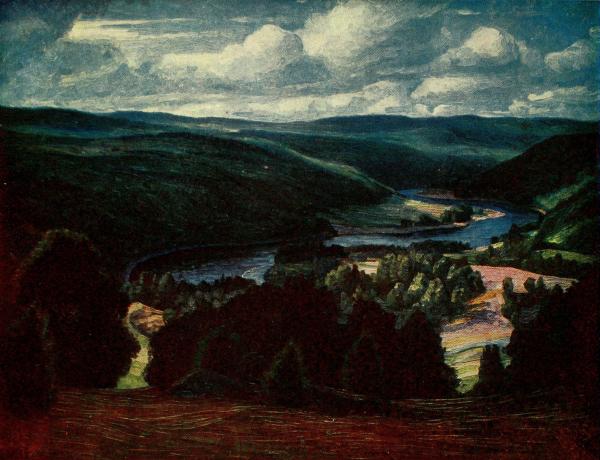
In one of the most beautiful and romantic districts of Sweden there is
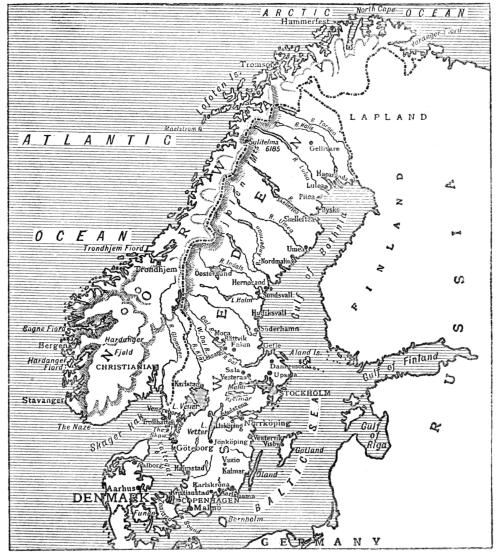
one of the oldest copper-mines in the world. It is situated at Falun
in Dalecarlia. About 400 years ago a young man might have been seen
looking into the open mine. He was full of thought and anxiety, for
was not his country in the hands of the Danish King, Christian II., a
cruel tyrant? and was not he himself being pursued and driven to seek
concealment, as he was a direct descendant of the ancient Kings of
Sweden? He had suffered much, but had never given up hope. He stood
there thinking of his country’s down-trodden condition, hopeful,
trustful, and resolute, resolving to deliver his native land from the
foreign yoke. He remembered how the miners had fought in days of old
for their country. He would rouse them so that they would do it again.
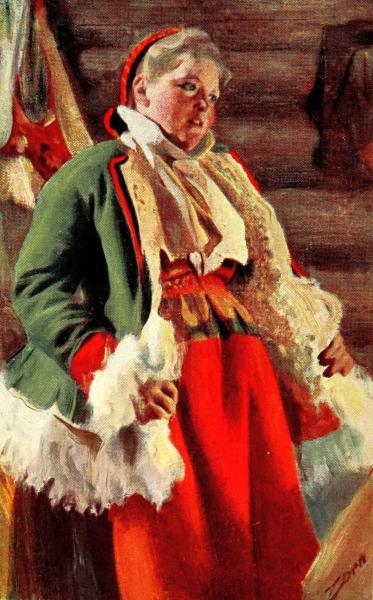
He donned the peasant costume, and became as one of themselves. He
worked alongside them in the mines, and soon became a great favourite
because of his bright, winning manner. He took every opportunity of
speaking to them of the subject that lay nearest to his heart—the
freedom of their native land. He told them of the massacre of many
nobles at Stockholm, of ladies of rank being thrown into the sea, of
boys being whipped to death, and of peasants hanged for the slightest
offence at the order of King Christian, the Nero of the North.
After working in the mine for some time, he was recognized. He then
took service with an old college friend, Anders Persson, of Rankhytta,
who sympathized with him, but was unable to help him. He sent him to
Squire Arendt Persson, who, eager to win the reward offered for
Gustavus Vasa’s capture, betrayed him to the Danish soldiers. Arendt’s
wife suspected treachery, and let the young man down with a towel from
a window in the loft to the snow-covered ground outside, where a
trusty servant was waiting with a sledge to convey him to a place of
safety. When Persson arrived next morning with soldiers, he found the
bird flown.
On another occasion he took refuge in a hut in the forest. The Danes
had so entirely encircled the district, that Gustavus seemed
completely in their power. A friend, however, hid him in a load of
straw, and proceeded towards Rättvik. They were surrounded by Danish
soldiers, who stopped the cart and roughly thrust their sharp pikes
into the straw. Gustavus was pierced in the side by a spear. The pain
was great, but he endured it without a groan. Satisfied he could not
be there, the soldiers rode on. Blood, however, was seen on the
ground. To account for this, the driver had cut his horse’s leg close
down to the hoof.
As soon as he recovered from this wound, he went with renewed vigour
and zeal from hut to hut, exhorting the people to rise and throw off
the Danish yoke. This led him into great difficulties and great
suffering. He was often in want of food, and afraid to ask shelter. At
one time he had scarcely a moment to conceal himself under a fallen
tree before a party of Danish soldiers galloped up.
At last he made his way to Dalecarlia, where he had made his first
venture. The Danish soldiers again got on his track. He rushed to the
house of a peasant, and found the wife at her spinning-wheel. When she
knew who he was, she put him into a dark cellar underneath the
kitchen-floor, and covered the trap-door with a large brewing vat.
The soldiers were baffled, and although they were strongly of opinion
that Gustavus was there, left without him, but not without having been
entertained by the good woman, who had never lost her presence of
mind.
Gustavus Vasa, after many trials and disappointments, seemed to think
that he must give up his scheme, and resolved to leave the country for
Norway. He was away in a lonely spot, and preparing to cross the
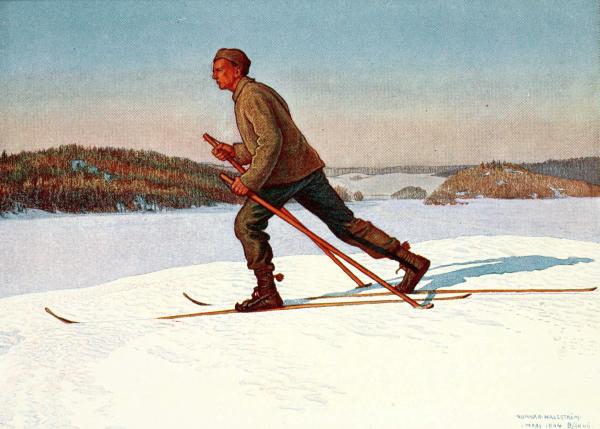
mountains, when he heard voices calling to him. He turned round, and
saw some Dalecarlians on skis, who had been sent by their companions
to recall him, as they had resolved to rise against the Danes under
his leadership. Gladly he agreed to their request, and returned to
Mora, where, on a Sunday after church, he addressed the men,
recounting the miseries and sufferings of the land under the Danes.
“He has a manly voice, and a winning tongue,” said an old man, “and
see the north wind blows. Let us attend to what he says.” The north
wind blowing was considered a good omen—a sign that God would be
gracious. Gustavus was soon chosen lord and chieftain over Dalecarlia,
and the whole realm of Sweden. After he had collected an army of
several hundred men, he marched to Falun, seized the property of the
Danish and German merchants, and distributed it among his men.
Infected by his enthusiasm and encouraged by his early success, the
Swedes assembled round his banner in large numbers. The Danes were
struck by their courage and hardihood. On one occasion a Danish
General asked how a large force of Swedes could be supported in so
wild a country. A Swede, hearing the remark, said that the
Dalecarlians were content to drink water, and, if need be, eat bread
made from the bark of a tree. Thereupon the Dane said: “A people who
eat wood and drink water, the devil himself cannot subdue,” much less
any other. The Swedes at first were poorly armed, but with bows and
arrows, axes, and clubs, used with an intense love of Gustavus and
country, they repeatedly defeated the Danes, who, after two years’
hard fighting, were driven out of Sweden. On Midsummer’s Eve, June 23,
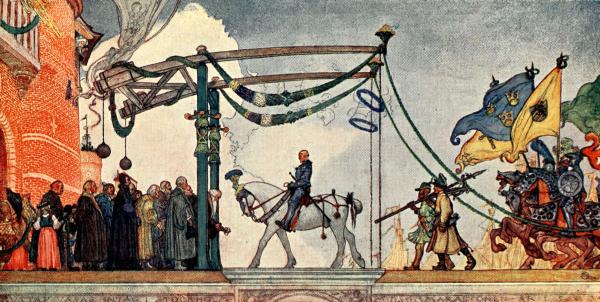
1523, Gustavus made a triumphant entry into Stockholm as King. He
reigned for thirty years. His memory is fresh to-day in Sweden as the
liberator of the country from the Danish yoke.
Another name that is honoured by every true Swede, and by many who are
not Swedes, is Gustavus Adolphus I. He is chiefly and justly held in
honour because of what he did for the Protestant cause in Europe. The
Protestant Princes had lost heart, as they had suffered very much at
the hands of Generals Tilly and Wallenstein. Gustavus resolved to go
to the aid of the Princes. With only 13,000 Swedes he set sail, but as
soon as he reached Germany, large numbers of men joined his army.
Emperor Ferdinand, when he heard of his arrival, said: “Oh, we have
another little enemy come against us!” His courtiers replied with a
laugh, and said: “The Snow King will melt as he approaches the
southern sun.” He did not melt, but proved an iron King, as he drove
everyone before him. Soon he rallied the Protestant forces, and made
his power felt from the Polar Sea to the Alps.
The Emperor’s Generals found in him more than a match. He was cut off,
however, very early in life. He was with his devoted men before Lützen
preparing for a great battle. As usual, they prepared by worshipping
God. They sang the King’s hymn, “Fear not, little flock,” and then
engaged in prayer. The next day the King mounted his horse to lead his
army. When his officers saw him, he was without his armour. They urged
him to put it on. “God is my cuirass,” said the King, and galloped
into the thick of the fight. It was a desperate fight, and a critical
moment, when his riderless horse was seen rushing madly out of the
fray. Gustavus Adolphus was dead. He had died in the hour of victory.
He was not only a great man, but also a good man. He believed in God’s
willingness to help the right. “To pray often is almost to conquer,”
was a favourite saying of his.
Charles XII. was another warrior-King of Sweden, and was one of
Europe’s greatest and youngest of soldiers. At the age of fifteen,
when most boys are thinking of amusement, he ascended the throne of
Sweden after the death of his father, and a few months later took the
reins of government into his hand and placed himself at the head of
his army. He was possessed of great energy, very courageous—perhaps
oftentimes foolhardy—but too ambitious of winning glory. Within
twelve months, when he was only nineteen years of age, he had to
encounter Denmark, Russia, and Poland. He first so attacked Denmark
that the King had to sue for peace. On a November morning, with 8,000
Swedes, he attacked 50,000 Russians under the walls of Narva, and
inflicted on them a great defeat. He then dethroned the King of Poland
and put another in his place. His hatred of Russia was his downfall.
In 1708 he again invaded that country. He spent the winter in an
impoverished and hostile land, and when the Czar, Peter the Great,
with 70,000 men, attacked him, he had but 23,000 worn-out and
destitute men. He was defeated, and fled to Turkey, where he found a
refuge; but at the end of 1715 he returned to Sweden. Notwithstanding
his reverses, his passion for fighting led him to attack Norway in
1716 and 1718, when he was killed at Frederikshald at the early age of
thirty-six.
He is one of the heroes of Sweden. He called upon his men to suffer
much, which they did willingly, as they were devoted to him, because
of his courage, his sympathy with them, and his ever-cheerful
countenance. He, however, exhausted the country, as the wars he
carried on drained her of her best blood, and emptied her treasury.
From this date Sweden was no longer one of the great military powers.
It was of Charles that Dr. Johnson wrote, in his “Vanity of Human
Wishes,” the celebrated lines:
“His fall was destin’d to a barren strand,
A petty fortress, and a dubious hand.
He left the name at which the world grew pale
To point a moral or adorn a tale.”
The last of this line of Kings was Charles XIII. He was an old,
infirm, and childless man when the question arose who should succeed
him. Napoleon Bonaparte was then carrying everything before him,
and among his Generals was one Bernadotte, who had risen from the
ranks, and proved himself to be one of the greatest powers in France
at that time. The Swedes chose him as Crown Prince, very much against
Napoleon’s wish, who, no doubt, did not desire to lose so able a
General, but at last, probably thinking that Bernadotte would help him
in his schemes, said, “Well, go! may our fates be fulfilled.”
Bernadotte soon after this took a leading part in Napoleon’s
overthrow, and in 1818 ascended the throne of Sweden as Charles XIV.
He reigned for twenty-six years, and proved a wise ruler. His
great-grandson is the present King.
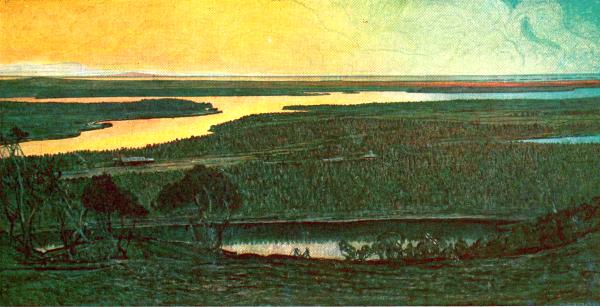
OUR COUNTRY.
Otto Hesselbom.
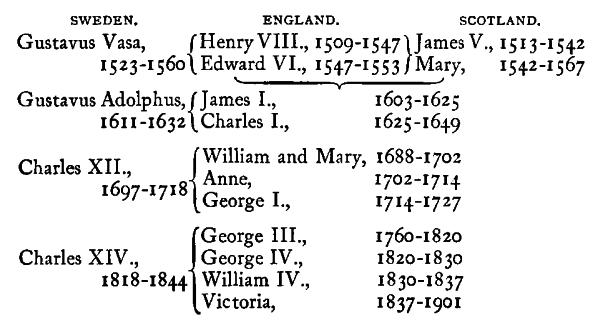
The following is a list of Kings in our country contemporary with the
Swedish ones of whom a brief sketch has been given:
| SWEDEN. |
ENGLAND. |
SCOTLAND. |
| Gustavus Vasa, 1523-1560 |
Henry VIII., 1509-1547
Edward VI.,1547-1553 |
James V., 1513-1542
Mary, 1542-1567 |
| Gustavus Adolphus, 1611-1632 |
James I., 1603-1625
Charles I., 1625-1649 |
| Charles XII., 1697-1718 |
William and Mary, 1688-1702
Anne, 1702-1714
George I.,1714-1727 |
| Charles XIV., 1818-1844 |
George III.,1760-1820
George IV., 1820-1830
William IV.,1830-1837
Victoria, 1837-1901 |