The pre-history of Sussex is unknown. The county does not lie (as a
first glance at the map might suggest) upon the main track between the
metallic districts of the West of England and the Straits of Dover. That
track was forced north by the indent of Southampton Water, and pursued
its way, perhaps originally through Salisbury Plain, ultimately through
Winchester, and so by Farnham, where it struck and followed the North
Downs to Canterbury, which was the common centre for the ports of the
Kentish coast. Sussex, moreover, was not only off this main prehistoric
trade route, but also, as has been previously explained in the first
portion of this book, was cut off to some extent on the north by the
Weald, and to the east and to the west by Romney Marsh and Chichester
Harbour respectively.
We may, therefore, presume that before the advent of the Romans the
district was a very isolated and perhaps a very backward piece of
Britain. Convenient as were its harbours, and comparatively short as was
the trajectory from the opposite coast, it suffered from what handicaps
all such coast lines, that is, the absence of a wealthy hinterland.
London was more easily made through Kent or by sailing up the estuary of
the Thames, and the great roads to the north which converged on London
were better arrived at through Kent and by way of the Watling Street
than through Sussex.
All we can positively say is that the western part of the county was
presumably inhabited by a tribe called the Regni, whose capital was, we
may believe, upon the site of Chichester. For the rest all is
conjecture.
It is equally true that we have no direct history of Sussex during the
400 years of the Roman occupation. But here, as is the case almost
everywhere in England, the material evidences of Rome and of the vast
and prosperous civilisation which she founded in the island, are in
number quite out of proportion with the meagre documents that speak of
her occupation. The whole soil of
THE ROMAN BASIS
England is strewn thickly with the relics of Rome; and the reader will
perhaps pardon a digression on a matter of such historical importance,
because, though it does not concern Sussex alone, it does concern the
history of England in general very much, and therefore the history of
Sussex in particular. Nor can any one understand an English countryside
unless he has already understood what the Romans did for this province
of theirs, Britain.
There has arisen in the last two generations a school which is now
weakening, but which has already had a very ill effect upon the general
comprehension of European history. This school was German in its origin,
meticulous in its methods, feeble in its historic judgment, and very
strongly influenced by the bias of race and religion. It attempted to
establish the thesis that the effect of Rome upon Europe had been
exaggerated, and that the North especially had been but little moulded
by the Latin order. This was partly true in the case of Northern
Germany, for though the German civilisation is a Latin civilisation, yet
it is and remains Latin only in the second degree. German thought,
building, law, religion, and the rest are Latin, or they are nothing;
but they are imported Latin. They are not of that Latinity which grows
up and lives and takes root in the soil. There lies behind them a sort
of vague thing which has never taken form, never is expressed, but
evidently colours all North German life and makes it different from the
life of Southern, Western, and civilised Europe; for Rome never occupied
the Baltic plain.
But though this insufficient influence of Rome be obviously true with
regard to Northern Germany, whose poor soil and shallow harbours had
never tempted the Roman eagles, it is profoundly untrue of Britain. By
far the greater part of our historical towns can be proved to be Roman
in origin, and it is to be presumed that of the remainder most will
ultimately furnish, or at least could furnish, proofs of a similar
foundation. But though Britain was thoroughly kneaded into the stuff of
the Empire, the accidents of the barbarian wars lend arguments to those
who would minimise the vast effect of her early civilisation upon her
subsequent history.
For the continuity of Roman speech and of the civilisation of the Empire
was sharply broken in Britain by the invasion (gradual, but very
disastrous) of the North Sea pirates,—raids which
THE SAXON RAIDS
exercised an increasing pressure throughout the end of the fourth
century, and which in the middle of the fifth began to triumph over the
resistance of the native population. How far the effect of these raids
was constructive, the foundation of a race, and how far merely
destructive, the marring of a social order, we will discuss later; it is
sufficient for the moment to point out that they prevented us, when we
re-entered civilisation, from harking back with certitude to our origins
as Gaul or the Rhine or Spain could to theirs. We have, indeed, our
hagiographers, but they are not, like the hagiographers of the
Continent, in direct connection with the Fathers of the Church and with
the Imperial centre. We had, indeed, a flourishing monastic system, but
we could not say of it as could Gaul, that it went right up to the time
of Julian the Apostate, derived from St. Martin, and was linked with the
memory of a once strong and ordered state. There is, therefore, more
room for discussion and for denial of the Roman influence in Britain
than in any other province of the Empire; more even than in Africa,
where the complete and sudden wiping out of the Roman genius by the
Mahommedan religion has fossilised, as it were (and therefore
preserved), enormous evidences of Roman activity.
With the darkness of the Saxon invasions to aid them, authorities of
considerable weight have been found to advance such propositions as that
the total population of Roman Britain amounted to but little more than a
million souls; that the continuity of London, York, Leicester, and the
other original cities is doubtful, and so forth. There is nothing so
fantastic but it has had a home for a short space among the historians
of our universities, so long as the phantasy was in opposition to the
general spirit of Europe and to the grandeur of the Roman name.
It is best for a modern reader to forget these vagaries, and to found
himself upon the constant judgment of permanent historical work—upon
the common sense, as it were, of Europe as we receive it handed on
through the historical traditions of the Middle Ages, and as we see it
developing since the renaissance of learning in the sixteenth century.
We can believe that Roman Britain, though we do not know its exact
population, was very densely populated (Gibbon, the best authority,
perhaps, puts it highest), and that, at least towards the close of the
third century, it was full of flourishing towns, and intersected
everywhere by great military roads; it was peaceable, wealthy, and a
very close part of the Roman unity.
THE ROMAN TOWNS
Sussex was no exception to this rule. Small as was the extent of its
then habitable or thickly-populated part (virtually confined to the
coast-plain, for the Downs could not be inhabited, the villages of their
foot-hills were few, and the belt between them and the Weald was
difficult of access), small as was that portion, it contained two
considerable towns—Anderida and Regnum. Anderida lay upon the site of
Pevensey, Regnum is Chichester. What other settlements it had of a
strictly Roman nature, as distinguished from the Celtic villages and the
isolated farms held both by Celtic and by Roman masters, we cannot tell.
The Roman remains of Lewes prove it (as does its site) to have been a
place of importance since the beginning of history, but we cannot
identify it with certitude. Arundel, a place obviously as old, has
hitherto furnished no Roman relics. It is possible that Bramber was
fortified; and it is fairly certain, though it is not positive history,
that the mouth of the old estuary at Shoreham was the Portus Adurni.
More than this we cannot say.
But there is contained in Sussex a further and more striking evidence of
the power of Rome than even the line of the wall at Chichester or the
ruins of Anderida. This is to be found in the great track of the Stane
Street, the Roman road which led from the East Gate of Chichester to
London, and of which so large a part is in actual use to-day.
This great monument of our past is equalled by little else in our island
as a dramatic witness of the source from which we spring. The Roman wall
between Tyne and Solway has afforded much more food for scholarship, and
is in places of a more active effect upon the eye, but it does not
appear before us as does the Stane Street, possessed of a constant
historic use, and explaining the development of a whole district.
This military way can be traced, with a few gaps, for a space of fifty
miles and more; from the eastern gate of Chichester to the neighbourhood
of Epsom, where it passes just between Lord Rosebery’s house and the
race-course, having crossed the Surrey border in the neighbourhood of
Ockley, and pursued its way through Dorking churchyard across Burford
Bridge, through the gardens of Juniper Hall, and so northwards and
eastwards.
The line of it in Sussex is clear to any one who glances at an Ordnance
map. It is a hard road over the first mile on leaving Chichester. At the
village of West Hampnet, some unknown cause in the
THE STANE STREET
remote past has diverted it, and the original line is lost in the fields
behind the workhouse of the place; but within another mile it once more
coincides with the present high road and goes straight for the Downs.
Close upon it was founded the Abbey of Boxgrove which, like Hyde and
Westminster and so many others, owed its site to the presence of a great
national way. It goes on over the shoulder of Halnacker Hill, then
plunges through the north wood where it is no longer traceable as a
road, but as a high ridge for several miles. It emerges upon the open
grass of the Downs at Gumber Farm, where it still marks a division
between ancient properties and modern fields. It then climbs down the
escarpment of the hills upon the north side in a great curve which has
given its name to the farm of Cold Harbour,—for the word Cold harbour,
which so frequently occurs in English topography, is probably derived
from the Latin “Curbare,” and marks the points where the usually dead
straight line of the Roman road was compelled for some local reason to
adopt a curve.
Immediately at the foot of this curve is to be found the little village
of Bignor, which contains one of the most perfect Roman pavements in
England, and which has been conjectured to be the “Ad Decimam”—the
tenth milestone from Chichester. It may be the villa of a private estate
or (more probably) the military residence of a small garrison. From this
point to Pulborough Bridge the track of the road is conjectural, with
the exception of a few stretches, where, even to-day, the discoloration
of the earth in the ploughed fields marks the old line in the Stane
Street. At Hardham, however, just before it reaches the marshes of the
Arun, its passage is clearly discernible due east of a still defined
camp which stands in between Petworth branch line and the main line of
the L.B.S.C.R., just before their junction. Immediately beyond, on the
farther side, stood the old Priory of Hardham which, like Boxgrove, must
have owed its site to the neighbourhood of the way.
The remaining mile over the marshes to Pulboro’ Bridge is, of course,
absolutely lost. It is a universal rule of topography throughout
Britain, that where a Roman causeway crossed a marsh, it has been lost
in the barbaric centuries by a slow process of sinking into the soft
soil below. But the direction which the Stane Street must have followed
when the causeway existed is not difficult to determine; it is to be
decided by a consideration which
THE STANE STREET
the historians of the county have not hitherto remarked. It is this. If
one stands upon the height of Gumber above Cold Harbour Hill and notes
the direction of the Stane Street as it crosses the Downs, one finds it
pointing straight at Pulborough Bridge. Or again, if one lays a ruler
along the line of the Stane Street upon an Ordnance map so as to cover
the section between Halnacker and Gumber, the prolongation of that line
strikes to within a yard or two of Pulborough Bridge. It is, therefore,
as certain as anything can be that the road made for this point, that
the Roman causeway across the marsh ran directly from Hardham to the
bridge, and that the Arun was crossed sixteen hundred years ago at the
same place as it is to-day.
The point though new can hardly be questioned. Roads of this sort were
necessarily laid down by a method of “sighting” from one distant point
of the horizon to the other. In no other way could their straightness be
achieved, and there can be no doubt that the first surveyor, in laying
down the track from the south to the north side of the Downs, was guided
by signals from the crest of the ridge; the line was given him by
watchers upon the summit who could observe the parties on the southern
slope below and the distant Arun to the north, and who had already
determined from that vantage place the point at which the river could be
most easily crossed.
At Pulborough Bridge the Stane Street again becomes a hard road, and
with such slight deviations as the long centuries of its history have
caused at Adversane and Parbook (they never leave the straight by so
much as fifty yards) it takes its way right through the heart of the
county. Billingshurst stands upon it, breaking its exact line by a
growth of little encroaching freeholds. It does not cease to be a county
road for many miles farther; it arrives at Five Oaks Green, there enters
the heart of the Weald, where even to this day there are but very few
houses; it dwindles to a lane, and so reaches its second crossing of the
Arun at Alfordean Bridge, where traces of Roman fortification still
appear. The remaining two and a half miles of its course through the
county are either lost under the plough, overgrown in thickets (such as
“Roman’s Wood”), or preserved as stretches of foot-path. It is here a
deserted track, and enters Surrey at last near Ruckman’s Farm.
There may have been other Roman roads of the regular and military sort
piercing the county.
OTHER ROMAN WAYS
Some have maintained that one such road ran from the mouth of the Adur
up to London, and another from Pevensey through Mayfield also to London.
It is absolutely certain that in the Roman time there must have been
roads following some such tracks: evidences of one, at least, have been
discovered at Haywards Heath and at Reigate, while it is a fair
inference that the march of William the Conqueror from Pevensey through
Hastings up on to Hastings Plain, where he fought his great battle, was
made along an ancient way. But it may be doubted whether any of the
other lines of communication in Sussex were of a true military nature,
or possessed the permanence of what we usually call a Roman road. At any
rate, they have left no evidences which warrant our asserting that they
were ever of the same nature as the great Stane Street.
We know one or two more things about Roman Sussex. We know that the
industry of the Eastern Weald was an iron industry. We may be fairly
certain that there must have been a flourishing agriculture along the
sea-plain to maintain its great towns; but we know nothing more until we
enter with the Saxon invasions, the beginning of the second phase in the
history of the county.
These invasions are themselves mythical in their details. Though the
main fact of their success at the eastern and southern coast-line is
historical beyond dispute their story reposes upon legends, which, as
the reader need hardly be reminded, are not trustworthy. From the oral
traditions of a very barbarous people possessed of hardly any continuous
institutions, split up into dozens of little tribes which differed from
each other in local patois, and were possessed of no unity or national
spirit, the tales of the pirate raids were handed on till at last they
were written down hundreds of years after, when civilisation had once
more penetrated into the southern and eastern part of the island, and a
sort of rude literature could re-arise to give them for what they were
worth. A traditional and probably mythical being, called in the legend
“Aella,” is reported to have effected the first regular landing upon the
Sussex coast towards the beginning of the sixth century, or rather to
have turned into a permanent settlement those temporary raids which had
been common for a century and more before his time. The feature of this
invasion which most powerfully struck the barbaric imagination was the
fall of Anderida. So violent was the effect produced upon the victims
and their
THE BREAK-DOWN OF ROME
despoilers, that the Saxon Chronicle some centuries later records a
tradition to the effect that not one of its inhabitants was left alive
when the city was stormed. This, of course, is no truer than any other
history of the sort; but it is valuable as pointing to the violence of
the struggle. Anderida was, moreover, one of the very few cities of
Europe where, in the break-down of the Roman Empire, municipal life was
actually destroyed. For we know by the evidence of an eye-witness (which
is a very different thing from legend), that after so comparatively
short a lapse of time as two hundred years from the time of the
invasion, the ruined walls were still standing and the place was
uninhabited.
What form the disaster took after this date we cannot tell; but we can
derive some idea of its severity from the break-down of the native
language. We know that, mixed with the Celtic roots of Sussex
place-names, with the purely Celtic names of its main rivers, with the
Celtic and possibly Roman names of its villages, there is a Teutonic
admixture so welded in with the rest as to be inseparable from it.
Billingshurst, for example, springs presumably from a Celtic source, and
records, like Billingsgate, the worship of Belinus. But this “hurst,”
like all the other “hursts” up and down the south of England, is almost
certainly a Teutonic ending.
It is to be noted that Teutonic terminations are particularly noticeable
along the coast itself, from whence the invasion of the pirates came.
Hastings is entirely an un-Latin and un-Celtic name. So is Selsea. So is
Shoreham. Half the names along the Sussex coast must be purely Teutonic;
and even of the remainder one cannot be sure how much of their framework
has survived since the days before the pirate invasion. Thus “ness” (as
in Dungeness) may be Northern, but it may also be Latin.
We can, again, be certain of the thoroughness of the cataclysm by the
effect of the invasion upon the philosophy of the place. In Sussex,
whatever may have happened elsewhere, there was a complete disappearance
of the Christian religion. The raids must have been many and severe, and
the last permanent settlement of the barbarians successful, to have
produced such a result. For Britain round about the year 500 was
obviously as Christian as any other province, and to have destroyed
Christianity in the period which saw St. Eligius and Dagobert in their
full power beyond the narrow English Channel necessarily means that the
attack was very powerful and very ruthless.
EXTINCTION OF CHRISTIANITY
It is of particular importance to insist upon the Christianity of
Sussex in this respect. For, as we consider the south of England,
which was the more civilised portion of the island, we remark that in
Devonshire and Cornwall Christianity made a stand which maintained a
continuity of the faith. In Kent, again, there was very probably a relic
of Christianity. A Christian queen was upon the throne there a hundred
years before the neighbouring county had so much as heard of the gospel.
A Christian church was in existence in Canterbury before Augustine
landed—though whether it had survived from Roman times we cannot tell;
nor do we know the fate of the central district of Hampshire and
Dorsetshire, except that we may presume that the Christian religion and
the tradition of civilisation could hardly have been quite destroyed
upon the borders of the Christian Severn valley and of the Christian
Damnonian peninsula, to which were so continually flowing the influences
of Christian Brittany and Christian Ireland and Christian Wales. In
Sussex, therefore, alone of the southern counties, we may state it as
historically certain that civilisation was totally destroyed, and that
the faith which is the central expression of civilisation was stamped
out.
Another line of argument leads to the same conclusion. It is that drawn
from the story of St. Wilfrid. In this story we see St. Wilfrid in his
exile landing in Sussex, and finding the barbarians fallen to so low an
ebb that they had even lost the craft of fishing. The Roman arts had, of
course, long ago disappeared. It is quite possible that men had here
even forgotten how to plough in the general break-down which followed
the coming of the pirates. At any rate there was a famine when St.
Wilfrid came. St. Wilfred taught them how to make nets, and there
followed what always follows when savages come across civilisation (if
that civilisation is beneficent)—the savages accepted it en bloc,
customs, faith, and all; even in their fragmentary records they talk
henceforth of “Ides” and “Kalends.” They made St. Wilfred their bishop,
and he established his see (possibly from a vague tradition of the Roman
times) at Selsea.
The place in which he built his first cathedral is now perhaps under the
sea. The Roman buildings and the establishments of the city were already
in danger, when, in the eleventh century, the see was removed to the
neighbouring town of Chichester, where it remained in a continuous
tradition which lasted till the Reformation. The district of Selsea
SELSEA
lingered on as a batch of islands, flooded at high tide, until
comparatively recent times. It is said that even as late as the Tudors
the patch now known as “The Park” was really a park, and that the rapid
current known as the Looe stream corresponded to a ravine in that royal
domain. At any rate the whole place is to-day a mass of tangled rocks
and shallows, mixed up with which we may presume are the ruins of the
Roman and early Saxon buildings. It is known as the “Owers,” and there
stands upon it a lighthouse which is one of the principal marks of the
Sussex coast; nor can any ships of considerable burthen go between these
rocks and the shore. The great liners on their way to Southampton all
pass outside: the fishing-boats and coasting-vessels can take the
shorter inner passage, if they have a tide with them, through the Looe
stream.
The remaining history of Sussex until the advent of the Normans is
obscure and meagre. Here, as in the rest of England, the barbarism of
the Dark Ages was tempered, of course, by the existence of the historic
and organised machinery of the Catholic Church, but they remained
barbaric, and nowhere more barbaric than in Britain. The wound of the
Saxon invasion was never really healed. There are those who maintain
that we feel its effects to this day.
From the period of the conversion which may roughly be said to have
occupied the last twenty years of the seventh century, right away down
to the tenth, with its violent internal convulsions ending in the Danish
conquest, Sussex almost disappears from history. It is true to say that
in the Anglo-Saxon Chronicle of this period we hear more of Gaul than we
do of the English county. It must have been singularly free from the
storm of the Danish invasions until close upon the end of the ninth
century, when we get the landing of Hasting and his march up the valley
of the Rother. But even that raid failed, for Alfred had already
restored peace to the south of England.
It is at this period also that we begin to have historical evidence of
the existence of the fortified places of Sussex.
The opportunities afforded by Arundel, Bramber, Lewes, and the rest must
have been recognised from prehistoric times. There also existed from
prehistoric times the great entrenchments on the Downs. But it is not
until the close of the ninth and beginning of the tenth centuries that
we get documentary proofs of the way in which these
THE STRATEGIC POINTS
advantages were seized. Thus we know from Alfred’s will that at the
beginning of the tenth century Arundel was already fortified and already
a king’s castle.
Of the smaller projecting spur of Lewes, similarly defended by marshes
and similarly easy to isolate by a ditch across the narrow neck which
connects it with the Downs, we have not indeed direct evidence so early.
But several smaller places dependent upon it and in its neighbourhood
are mentioned at the same time; and a little later, under Athelstan, the
town itself is mentioned with this particular mark, that of the four
Sussex mints (which were here and at Hastings and at Chichester) two
were permitted to be established in Lewes, numbers which point to its
being, even at that early date, the recognised capital of the whole
county.
Bramber, we may be certain from the name, though documents are lacking,
was fortified at least as early as this period.
In a word, all the gaps of the Downs were held in a military fashion,
and had entered into the scheme of the county as strongholds, guarding
the river passes for one hundred and fifty or one hundred and seventy
years before they fell into the hands of the Norman invaders. But of
the rest of the development of the county in Saxon times we know so
very little that even conjecture is hardly worth our while. The
place-names are all that indicate to us what Saxon foundation the towns
and villages of the Weald may have received. Their gradual development,
the granting of their charters, and the documentary proof of their
existence and commercial importance we do not get until after the
Conquest. These proofs we shall be able the better to examine when we
come to that event, and especially when we analyse the way in which the
rape of Bramber grew up under the leadership of the Warrens.
The end of the barbaric period in the reign of Edward the Confessor, and
its enormous effect upon the future of England, are, however, associated
with the county; and the complete obscurity within which it had lain for
so many generations is partially compensated for by the name of Godwin.
That great earl, with his strength, his vices, and his ambitions, was
altogether a Sussex man. He was the son of Wulnoth, a knight of the
South Saxons.
It has sometimes been regretted that feudalism in England did not follow
the line which it did on the Continent, and that the various districts
of England were not coalesced under great overlords,
GODWIN
so as to form true provinces and thus to intensify the life of the
nation. These regrets may or may not be just, but Godwin very nearly
succeeded in satisfying that ideal. He was by far the greatest man in
Sussex, as he was in England. He held nearly sixty manors, and that not
merely in a technical sense and for a merely military reason, as did the
great overlords immediately later under the Conqueror hold manors in yet
larger numbers, but actually (we may presume) and with a true lordship.
Among them are many names to be recognised to-day. There is Beeding
which is under the Downs, beyond Bramber, a place called with fine irony
Upper Beeding; it lies in a hollow, damp all the year round, while Lower
Beeding is set upon a high hill. There is Climping, the seaside village
near Little Hampton, of which little now remains. There is Rottingdean,
Brighton itself, Fulking, Salescombe, Wiston (which is the master of
Chactonbury), and Ashington and Washington close by. Godwin, indeed, for
his economic power reposed upon Sussex, and it is curious that his
connection with the county has been so little emphasised by historians.
With the Norman Conquest, Sussex, like the rest of England, re-enters
history. And that in a peculiar manner, for, as has been seen, of all
the districts of England, Sussex had suffered the deepest eclipse during
the barbaric period, and by the peculiar fact that the invasion of
civilisation came from Normandy, was most advantaged in the period
immediately following. The contrast was abrupt and striking. Here was a
district of which, as we have seen, practically no mention is made
between the fall of the Roman power and the last efforts of Godwin. It
is cut off from the rest of England by the Andred’s Weald. The only
considerable story in connection with it is that of its conversion. It
can boast no great monasteries founded in that time, as all the rest of
England can boast; it can show no great military leader, nor even the
scene of any great military disaster, for Ockley itself was beyond its
borders. The advent of the last invaders, but invaders this time who
bring with them constructive power and the full European tradition, is
from the shore immediately opposing its own. A short day’s sail away
there ran the coast of Normandy, where a race of Gallo-Romans, with a
slight but transforming admixture of Scandinavian blood, were chafing
under their superabundant energy. Already for nearly a century a great
intercourse must have
THE NORMAN INVASION
existed between the harbours to the north and the south of the Channel.
It was from Bosham that Harold sailed; the Court of Edward had been full
of Normans, and one has but to cross the Channel in a little boat to see
how the advance of the arts after the darkness of the ninth century must
have increased communication between Normandy and the shores of Sussex.
A man will run in a five tonner from Shoreham to Dieppe close hauled
into a fresh south-westerly wind between the morning and the evening of
a summer’s day; he will run from Dieppe into Rye with such a wind on his
quarter during the daylight of almost any day in the year, except
perhaps in the mid-winter season.
With such a wind William sailed from St. Valery in the autumn of 1066.
He landed at Pevensey. He marched along the coast to Hastings, and then
struck up north and a little east for four or five miles to where the
Saxon force lay on the defensive upon a rounded height above the valley
of the Brede, called “Hastings Plain.”
A pedantic discussion, into which we need not enter, has waged round the
exact name of the spot where the battle was fought. One of the principal
authorities for the history of the battle (but not a contemporary
authority) calls it several times “Senlac.” It is just possible that he
was mis-spelling some local name. Halnacker is similarly mis-spelt
“Hanac” in the title deeds of Boxgrove Abbey. But the name as it stands
is a Gascon name, and in all probability was given to some portion of
the land long after the battle because a Gascon gentleman had acquired
manorial rights there. Every other authority alludes to it as Hastings,
or Hastings Plain, and every Sussex man can see why, for there is
nothing commoner in the country than the calling of one of the uplands
by the name of some neighbouring, inhabited, and settled spot in the
lowlands, possibly because the inhabitants of that neighbouring and
inhabited spot had some sort of territorial rights in the upland place
so named. Thus one has on the Downs, between Arundel and Goodwood,
“Fittleworth Wood,” six or seven miles away from Fittleworth itself, and
the use of the word “plain” for a stretch of the uplands is as common as
can be,—for instance Plummers Plain between Lower Beeding and
Handcross.
We may take it, then, for the purposes of this short description, that
among the Saxons of the time, or rather the local Sussex men of the
time, “Hastings Plain” was the name given to the hill of stunted trees
and grass up which the
THE NORMAN WEALD
Normans charged late on that October afternoon. By sunset the issue was
determined, and the victory gave the crumbling and anarchic Saxon state
back again to Europe. The disorders of the Church were reformed, a
centralised and efficient government was introduced, the art of building
received, as it always does with the coming of fresh vigour, a vast
impetus, and the history of the England that we know began.
In connection with the Norman Conquest it is of some historical
importance to ask one’s self what was the remaining function of the
Weald, the great forest which ran along the rising swell of clay and
sand, and bounded Sussex on the north?
We have seen that in prehistoric times the Weald was undoubtedly the
obstacle which delimited Sussex, and made all this district a maritime
province with its towns on the sea. The Romans pierced the Weald with
one great military road and probably several minor ways. But they did
not settle it thickly. One may say that with the exception of a trace or
two of fortifications it is practically destitute of Roman remains. It
may possibly, or even probably, have contained many isolated farms in
the prosperous middle and conclusion of the Roman period, but with the
advent of the barbarians it fell again, as did so many other parts of
Europe, into the prehistoric conditions, and we have at least one
allusion in Anglo-Saxon history to its desertion, in the story of that
Saxon king who fled during the tenth century from his enemies and hid in
the Weald for many months. We know then that in Roman times it was
traversed by at least one great military road and probably by several
others; that in the Dark Ages it was certainly a dividing line between
the coast district and the Thames valley; that in the thirteenth and
fourteenth centuries it was thoroughly civilised again. The main
historical question or doubt relates to the eleventh century. Was this
old wild condition of the forest a complete barrier to any travel
northward from the coast at the time of the Conquest?
It may be seriously doubted that it was such a barrier. It is probable
that a certain amount of communication between North and South had
already arisen, and, as we shall see in a moment, it is certain that
communication became very vigorous in the centuries immediately
succeeding Hastings.
The nature of the obstacle, it must be remembered, has been mistaken by
historians, notably by Freeman and by Green, and by all the smaller
modern men, such as Mr. Davis and Mr. Oman
THE WEALD
of Oxford, who copy what they see written in the popular histories. The
Weald was never an impenetrable forest; no Northern European forests
are. It was not cut by great lines of marsh, which are the chief
obstacle to men under primitive conditions. It was not even dense, as
are some of the English forests, for example the beech forests of the
Downs. Those pieces of the Weald which have been left uncultivated, and
which remain to-day almost in their original state, show us clearly what
the whole district once was. It was simply a vague, long belt which it
did not pay to cultivate in early times. Small, strong oak-trees stood
in it, never very close together. Here and there on sandy wastes and
heaths were furze and ferns. The clay did, indeed, give rise to many
pools, stagnant meres, and sodden patches of soil. But there could never
have been great difficulty in getting across it northwards, nor any lack
of forest tracks from one side to the other, nor any great prevalence of
dense thickets in which enemies could hide. Its chief character as a
barrier was that of loneliness. For some sixteen or twenty miles, for a
full day’s march that is, you had a chance in the early centuries as you
went across the Weald of not meeting a man, and this old character is
still remembered by any one who walks along the Stane Street from Five
Oaks Green to Ockley. But you certainly could not have gone five miles
without seeing some evidence of man’s activities—a road, a wall, a
well, a felled tree, or a cast weapon. The Weald was, therefore, never a
military obstacle, and to talk about the “impenetrable forest of the
Weald” checking William the Conqueror after the Battle of Hastings is to
show complete ignorance of the nature of Sussex. It was, however, an
obstacle to the spread of ideas, speech, folklore, and the rest, and did
maintain the isolation of Sussex down to quite recent times. It keeps
traces of that character still.
William then was not prevented from his march on London by the Weald. He
went back at his leisure to the sea coast to secure his communications,
marched up to Dover, garrisoning every harbour on his way, and then took
the great north-east road through Kent, which has been the line of
invasion, of commerce, and foreign travel in our island from the very
origins of history.
His own personal effort appears after this to pass from the history of
the county, but the effect of the invasion upon Sussex was, as we have
just remarked, enormous. It will be seen from what has preceded this
that the field lay open for the effects
THE NORMAN ORGANISATION
of the new vigour. Nowhere had the remnants of Roman civilisation more
thoroughly decayed. The old British stock and the admixture, such as it
was, of Teutonic blood had mixed to form a population very much what we
see to-day in the villages of Sussex, where most of the people are
short, with dark, keen eyes, but a few tall and large, with the light
hair, the slow gait, and the heavy bodies of the marsh men from Frisia
and the Baltic.
Again the reorganisation of Sussex begins from the sea.
In the administrative division of the county Rapes, as they are called,
were mapped out, though it must not be imagined that there was anything
original in the selection of the particular districts. The clear Norman
brain and the weighty Norman power would certainly make definite
boundaries where before there had been nothing but the vague, local
feeling of the countryside to determine the limits of the separate parts
of the county; but the general set of the divisions was certainly
inherited by the Norman from the older and semi-barbaric state of
things. Moreover, even after the Norman organisation was fully
established, the exact boundaries of each Rape were not always very well
determined. Thus the parish of Slindon remained for centuries doubtful
between Arundel and Chichester Rape, to which last it has finally been
attributed.
In number the Rapes were six, and were called after the towns of
Chichester, Arundel, Bramber, Lewes, Pevensey, and Hastings.
It will be noted that in each case a town which could be reached by
ships was chosen as the basis of the division, and that the tides of the
Channel here, as always, were the creators of the county.
The importance which the county was to hold in the new state of affairs
is marked at once by the names of those to whom four of the Rapes were
given: Montgomery, Braose, Warren, and Moreton, all of them closely
connected with the family of the Conqueror, and all of them set, not as
proprietors, but as military overlords over a vast number of manors. It
would probably be seen, if an exact computation were taken, that, with
the exception of the counties Palatine, feudal power was nowhere more
concentrated than on this stretch of the sea coast. Here it was that
William’s invasion had proved successful; here that new dangers might be
expected; here, therefore, that he organised in the most thorough manner
and under chiefs most closely connected with himself and his family,
the
BUILDING UP OF LEWES RAPE
defence of the land. These few men count between them five-sevenths of
the whole county.
Before speaking of what was probably the principal economic factor in
the new life which Sussex received from the invasion, the foundation of
monasteries, it is of interest to show how a rape was built up from the
sea by the new-comers, and the best example we can take to exhibit this
process is the rape delivered into the hands of Warren, the Duke’s
son-in-law, in overlordship. We shall see it spreading from the centre
of its ancient capital, fed, it may be presumed, from its ancient
harbour, and slowly extending northward a jurisdiction gradually
acquired over the Weald, and later even overleaping the northern
boundary of the forest ridge. The whole process occupied about two
hundred years. Here then are the chief points in the growth of this Rape
of Lewes.
Let us note, in the first place, its natural boundaries. The Ouse bounds
it to the east and the Adur to the west, and the strip of land runs
north and south between these two river valleys; it starts from the sea
coast by which entry is made into the county, and loses itself in the
forest to the north.
Its principal town, Lewes, has all those characteristics which
distinguish the central towns of the countrysides of Western Europe,
save that it possesses no cathedral. It is a place naturally susceptible
of fortification. It is Roman, and probably pre-Roman in its origins. It
possesses a natural means of approach in the shape of the river beneath
it; good water, a dry and naturally well-drained soil, and (a peculiar
feature which is to be discovered in every case throughout Gaul,
Northern Italy, Western Germany, and Britain) it lies, not in the
centre, but right to one side of the countryside which takes its name
from it. This feature, which is so marked in the case of the great
Norman bishoprics and of most other divisions of the later Empire, is
probably due to the fact that where a river or range of hills or great
forest formed a natural boundary for a district, it at the same time
formed the main natural defence for the chief stronghold of that
district. Whatever the cause may be, the chief towns of the various
divisions into which Western Europe has fallen are nearly always near
the frontier of those divisions. Canterbury is near the sea; Edinburgh
near the north of the Lothians. Rouen is by no means central as to
Normandy. Even Avranches, Bayeux, and Coutances are upon the edges of
their
MILITARY VALUE OF LEWES
respective dioceses. And in this county of Sussex, Chichester, the
cathedral town, is close to the western border, Arundel is right up
against the border of its own Rape, Bramber within a stone’s throw of
its eastern boundary. Pevensey alone is somewhat central. Hastings is
again thrown up towards the eastern side of the belt which takes its
name.
Lewes, then, is the stronghold upon which the chance division of the
county had grown up in the Dark Ages. The Normans come; they add to the
Saxon fortifications a great Norman castle, and they define more
accurately the Rape whose general conception they have inherited from
the men whom they have just conquered. They survey (the results of their
survey remain in Doomsday), and, having done so, for the next four or
five generations they push northward, increasing the agricultural value
of the villages as they cultivate them, and extending the rule of man
over nature farther and farther into the forest of the Weald.
The constructive effort of the Norman begins by his arrangement of
government. He settles upon each of the great divisions the head of some
great family, who is nominally the overlord of numerous parishes within
that boundary, and who is practically the head of the garrison of the
central castle, and the receiver of certain small dues from the numerous
villages or manors of which he is technically the lord. In the case of
Lewes this function fell, as we have seen, to William of Warren, who was
a son-in-law of William the Conqueror, and had distinguished himself in
the fight upon Hastings Plain. His residence is in the Castle at Lewes,
and undoubtedly his chief political function is to guard this entry to
the county. He rebuilds that castle, and he is the custodian of the
local survey.
What he does for a port we cannot tell at this distance of time. We know
that the marshy land at the foot of the castle was not an estuary of the
sea at this epoch, and was probably even passable in the eleventh
century. We know this from the coins and relics which have been found in
it. We know also that the present harbour of Newhaven was diverted later
than the Conquest, and that the old mouth of the river ran somewhat to
the east of it. We may conjecture with great probability that the port
upon which Lewes was dependent for its commerce and provisions and
reinforcements was somewhere near the old mill-pond between Newhaven and
Seaford.
LEWES RAPE INLAND
Chief among the manors dependent on Lewes and the personality of De
Warren we find Brighton under its old Saxon name. It is a large and
important place. It controls the chief arable district which falls
within the command of Lewes Castle and of the Rape thereto appertaining.
Rottingdean, next to it, also comes into the great survey, for
Rottingdean is along the sea, and the parishes along the sea, as we have
so frequently had occasion to repeat, are historically the first and
economically the most valuable of Sussex.
The next belt inland, the belt of the Downs, was uninhabited then as it
is to-day, and will be perhaps throughout a remote future. But the old
villages upon the strip of fertile land to the north of them are already
well developed by the time the Normans come. Nay, they were Roman before
they were Saxon, for Clayton and Ditchling, the two principal centres of
the string of villages in this part, contain Roman remains. Keymer also
is in Doomsday. So is Hurstpierpoint, under the name of Herste.
Immediately northward you get the line of villages which are not
developed until the wealth and the population of England have increased
with the advent of the new civilisation. Typical of these is Cuckfield.
It is not mentioned in Doomsday. It was then perhaps mere forest. It is
not until the thirteenth century that it gets its market (from Henry
III.), and we know that at that moment it was land held of the Warrens.
Finally, at the very end of the same century, within a few years of the
meeting of the great parliament of Edward I., and in the seventh year of
his reign, we get the first hint of the demarcation of the Sussex border
on the forest ridge. There is an inquiry into the rights of the Warrens
to the free hunting of ground game in the forest of Worth, which extends
over the crest of the forest ridge and down on to the Surrey side.
Here we have an excellent example of the way in which the overlapping of
Sussex into what is geographically Surrey occurred. The Warrens are very
powerful nobles, much more powerful than those lordships in the Surrey
towns who hold positions of no strategic importance, and whose garrisons
were therefore not heavily endowed at the time of the Conquest. Being
great lords the Warrens extend their hunting as far north as they can
into the Weald. They go right up through the forest, over the ridge, and
down on to the Surrey side. There is (it may be presumed) some complaint
against them for this extravagance,
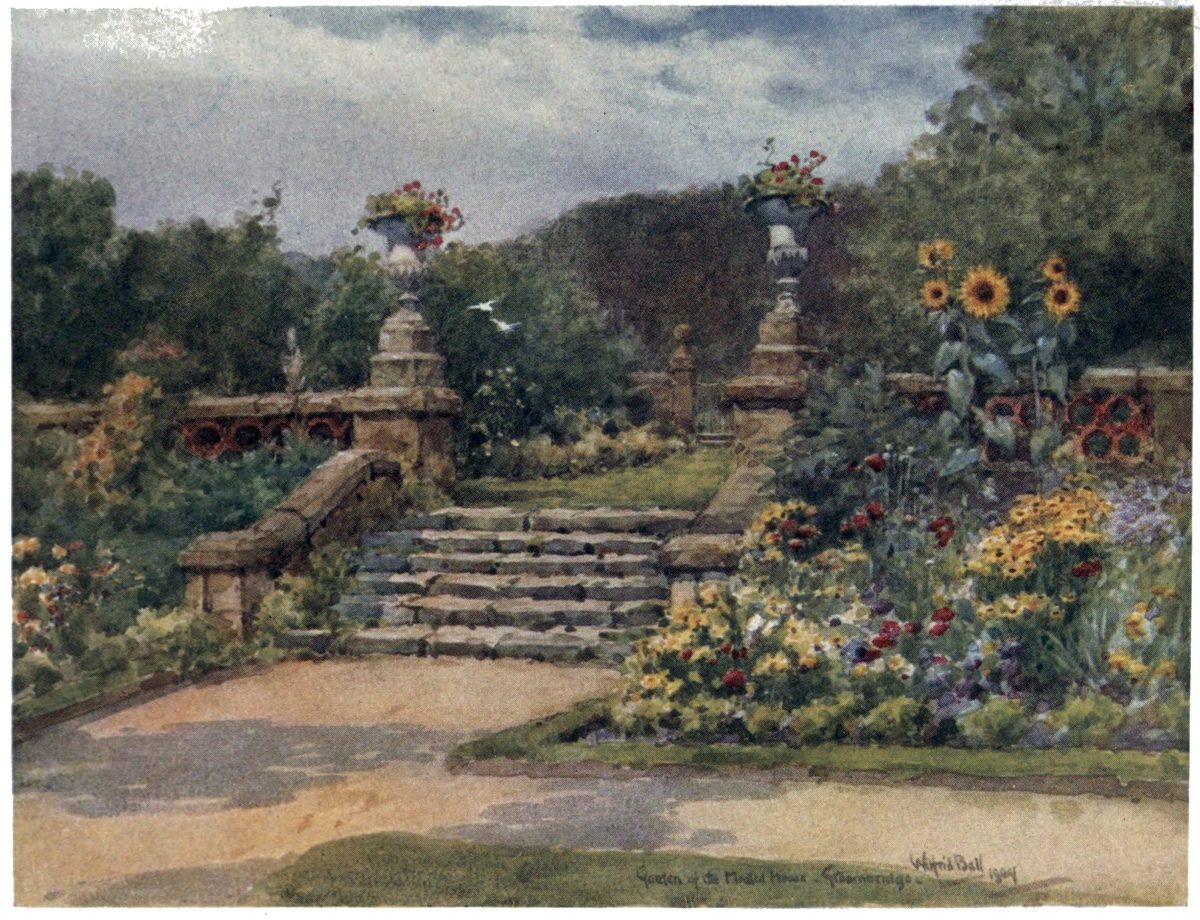
GARDEN OF THE MOATED HOUSE, GROOMBRIDGE
THE END AT WORTH
or some jealousy on the part of the Crown. They are examined, and under
the inquisition come out triumphant; so that the effect of their family
and of the Conqueror’s original disposition in the Rape may be said to
have come to its final result when their claim over the extreme limit of
the forest ridge was granted by Edward I., and Worth Forest was admitted
to be within their jurisdiction and therefore within the county.
This sketch model, as it were, of the way in which a rape has been built
up,—first, the sea fortress, then the Wealden market-town, and lastly,
the definition of the forest boundary,—may be borne in mind as we deal
with the other five similar divisions into which Sussex fell.
Lewes Rape, which we have just been considering, is the very central
Rape of the whole county. If a line be drawn through Stanmer Park from
north to south, and prolonged to the sea on one side and to the Surrey
border on the other, such a line will be discovered to bisect the county
into two almost exactly equal areas, and to bisect the Rape of Lewes in
very much the same proportion.
Lewes Rape is not only central, but is also the backbone, as it were,
upon which the county has been built up. It is this which makes its
development so typical of the general history of Sussex. The three
Rapes to the west of it and the two Rapes to the east have been somewhat
more open from the beginning of history, but not until one has
understood Lewes Rape does one understand the growth of the Bramber,
Chichester, and Arundel Rapes to the west, nor of those of Pevensey and
Hastings to the east. For all, like Lewes, grew up from the sea, from
the harbour mouth and a castle at the back of it, on northward through
the old British villages under the Downs, till at last they stretched
into the Weald and overlapped into what should properly be Surrey. But
this process, though common to all, was modified in every special case
by special circumstances to which we shall presently allude.
The Rape of Pevensey is of a curious shape. It narrows somewhat towards
the middle and bulges out towards the top, or north end. This appears to
be the contrary of what one would expect in a Sussex division, the
important part of which always lay round the sea coast, but the cause of
the shape thus assumed by the Rape is that in its northern part the iron
industry had arisen long before the Norman Conquest, and had thus opened
up the Weald; it had also made the
PEVENSEY RAPE
government of the area and the collection of taxes from it a subject of
ambition for the strongest of the neighbouring lords.
Such a lord was found in the Earl of Moreton, the brother-in-law of the
Conqueror, who held the Castle of Pevensey, and who was the first
controller of the district after the full Norman organisation began.
Here, as in the case of Hastings, but unlike every other Rape, the seat
of government, Pevensey, was actually upon the sea.
The name of Pevensey is instructive of its antiquity. It is probably
derived from Celtic roots signifying “the fortification at the far end
of the wood,” which would exactly describe an important and fortified
sea-coast town situated as Pevensey was situated to the forest from
which it took its Roman name; for “Anderida,” or “Andresio,” certainly
refers to the Weald, the Celtic forest of “Andred,” of which the Saxons
made “the Andredswald.”
Incidentally one may digress to point out how crude and insufficient is
the greater part of our hurried modern philology. But for an accident no
one would have been able to work out the meaning of this name of
Pevensey. It was gradually shortened (after passing through the
strangest forms) to “Pemsey,” a comparatively recent change in the
spelling, due perhaps to local patriotism, or perhaps to the affectation
of some studious landlord who, in reproducing the ancient form, gave us
the present spelling of the word, from which we are able to trace its
ancient Celtic roots; but how many place-names up and down South England
must have been wrongly ascribed to Teutonic origin from our ignorance of
the local method of pronunciation!
It is doubtful whether anything of Roman structure remains in Pevensey,
though much of the material used in the castle is Roman, and though the
towers of that fortification are round. It is enough to remark, that
after the long night of the Saxon period the town shared in the general
renaissance of South England which followed the Norman Conquest. To give
but one indication of this: it trebled in population in twenty years.
There is little doubt that at this period, that is, throughout the end
of the eleventh century, the whole of the twelfth, and beginning of the
thirteenth, the harbour lay beneath the mound of the present ruins. The
contour lines, slight as they are in elevation, and the nature of the
soil are enough to prove this; nor is it difficult, as one stands on the
height of Pevensey Castle, to reproduce the scene which must
PEVENSEY TOWN
have presented itself to the eye of a man living six hundred years ago
when he looked northwards and eastwards at high tide. The great marshy
flats of the Level were a shallow bay covered by the sea, out of which
bay there rounded in towards him a harbour protected from every side
except the north-east, and even from that side exposed to no long drive
of the weather. This harbour, which was naturally shallow, was probably
deepened artificially, whether before or during the Roman occupation; it
remained serviceable until past the close of that twelfth century which
produced so many great changes in the physical condition as in the
political constitutions of Western Europe. Thus Pevensey is one of the
first of the lesser towns of England to receive its borough charter. It
gets that charter in the ninth year of King John, and it counts as being
politically the most important of the Cinque Ports, until there falls
upon it the fate which has fallen upon every south-country harbour in
turn. It was destroyed by that upon which it had lived, the sea. The
beginning of the disaster, a mixture of drift silting up the harbour and
of encroachment and breaking-down of its defences, may be dated from the
middle of the thirteenth century, and after this date the decline
continues with such rapidity that before the end of the French wars
Pevensey is hardly a town. It has declined ever since.
You get in the Rape of Pevensey, as in that of Lewes, the universal
Sussex rule that the inhabited places are first found in the
neighbourhood of the sea. But this rule is modified in the case of
Pevensey Rape by the ironstone of the Eastern Weald. But for the
industry arising from the use of this the forest ridge of Ashdown would
have remained as lonely as that of St. Leonards. As it was, many places
upon either slope of the ridge are known to have been inhabited from the
earliest times; for instance, Mayfield, which may properly be regarded
as a foot-hill of Ashdown Forest, and as a part of the true Weald, is
connected with the name of St. Dunstan, and formed one of that
procession of ecclesiastical palaces which the See of Canterbury held
all along the centre of the county, and of which the last westward is
Slindon. Again, Rotherfield is, quite possibly, as old as Offa, or
older; at least, dues from that parish were claimed by the Monastery of
St. Denis near Paris, which dues were said to have been bequeathed by
Bertoald, one of Offa’s lieutenants, during the lifetime of Charlemagne,
and before the close of the eighth century. Frant, though we do not hear
of it by name
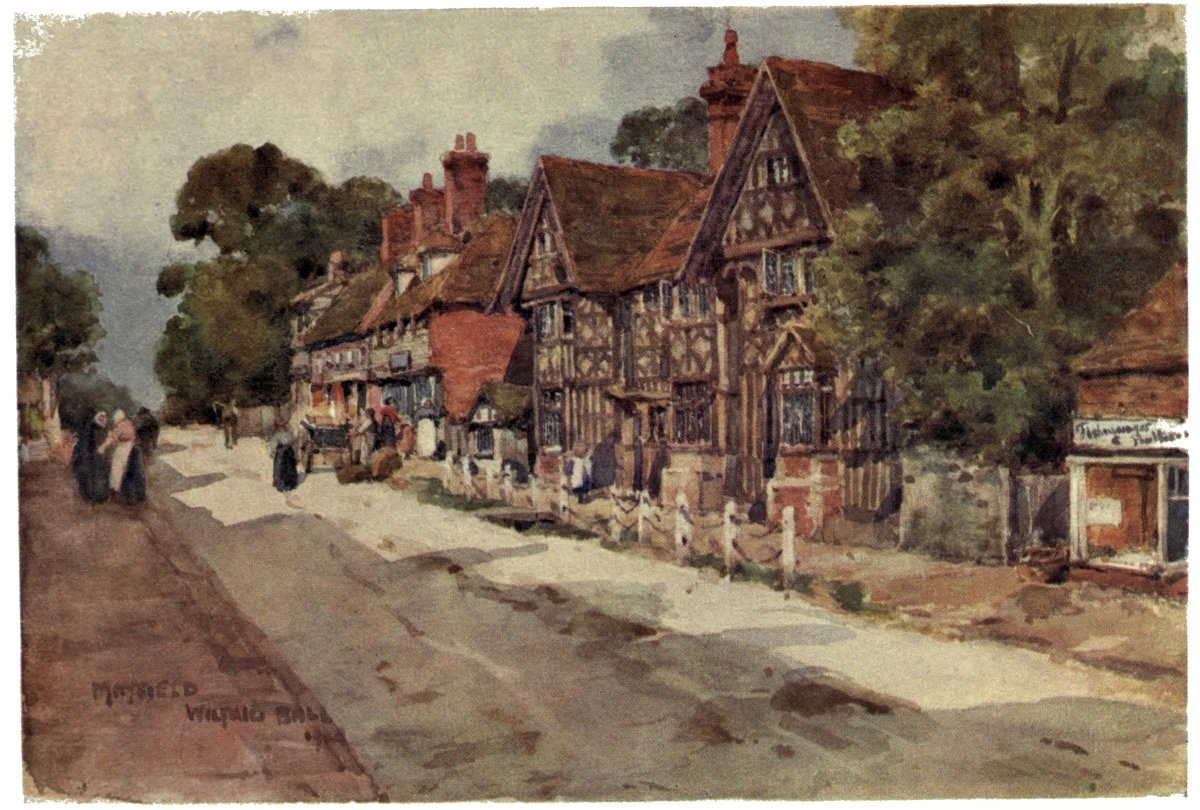
HASTINGS RAPE
until much later, was undoubtedly of great antiquity, and formed a sort
of appendage to Rotherfield.
When, however, one gets over the empty ridge of Ashdown and south on to
the slope which looks at the Downs, the natural isolation of the Weald
is to be traced. Buxted, for instance, is not heard of before 1298,
though later it has the fine reputation of having cast the first cannon
ever made in England. Uckfield close by is of no importance until the
sixteenth century. When we turn to the sea coast, on the contrary,
everything at once proves the antiquity of settlements in that
neighbourhood. For example, you have discoveries at Alfriston, just
behind Beachy Head, of British coins; you have Hailsham, mentioned in
the Norman Survey; and on Mount Caburn, just above the Vale of Glynde,
are some of the most perfect prehistoric fortifications in the county.
The Rape of Hastings has, further, exceptions of its own, for here we
come to the narrow eastern end of the county where there is no long
hinterland of Weald to give us the normal development of the Sussex
Rape. But even here there is a trace of that slower rising of the inland
as compared with the sea-coast sites; thus Robertsbridge is the child of
a monastery of the central Middle Ages. Battle was so little known
until the great fight of 1066 that even its name appears in doubt at
that epoch. On the other hand, Crowhurst we know to have been held by
Harold. Bexhill is mentioned in Doomsday, and we know of the existence
of Winchelsea and of Rye at the same epoch.
The mention of these two towns cannot be allowed to pass without some
description of their fate as seaports.
Winchelsea, like Pevensey, contained, hooked in behind a peninsula of
land, a harbour protected from the prevailing south-westerly winds, and
here, as at Pevensey, it is possible to stand to-day and notice what
original opportunities must have led to the later and partly artificial
harbour. Its importance continued, as did that of Pevensey, into the
middle of the thirteenth century, when the first of its disasters began
in an overwhelming high tide. Rye is still a port, the port of the mouth
of the Rother; but what a port, only those know who have attempted to
make it even in the smallest of craft! Unless there should arise some
local industry which will make it worth while to dredge the river and
establish an expensive system of leading marks into its mouth, Rye
within another hundred years will be no more than Sandwich.
HASTINGS TOWN
The antiquity of the town of Hastings itself is among the most
interesting points in the history of Sussex, as is also the name which
the town bears. This name is usually ascribed to the pirate Hasting, or
Hasten, who ravaged the coast and later sailed up the Thames, at the
very end of the Danish invasions, during the reign of Alfred. It is at
any rate one of the very few important Sussex names which are certainly
and wholly Teutonic, and, if its derivation be exactly guessed, it is
the only place-name in the county derived from the name of a man, for
the derivation of Chichester from Cissa, the son of Aella, is obviously
as legendary as the derivation of Portsmouth from “Port,” or indeed any
other of the Anglo-Saxon myths.
The antiquarian does not discover at first sight what feature it was
which led to the early importance of Hastings. But, on a further
consideration, it may be conjectured that the rise of the place depended
upon the conjunction of two things not often found together, a safe
beach and a strong isolated hill.
Allusion has already been made, in the earlier part of this book, to the
importance of a good beach in early navigation. As common a way as any
other of making land, until the development of shipping in the later
Middle Ages, was that still adopted by our South Coast fishermen. The
vessels, though large, were of a shallow draft and of a broad beam; they
were run upon the beach with a careful choice of the right moment
between the breakers, and before the momentum of their “weigh” was
wholly spent, two or three hands standing ready forward had leapt into
the shallow water, and had prepared to direct the bows of the vessel
over some form of roller when the next sea should thrust her farther up
the shore. When once the bows had taken the roller above the sea line,
the rest was easy. The advancing seas would necessarily push the vessel
farther up the slope, and when a second or third roller had been placed
under the keel a dozen or so of the crew could move even a heavy vessel
up out of the way of the high tide. Nor would craft with so shallow a
section as those used in the Dark and early Middle Ages have careened
over to one side or another at all dangerously during the process of
beaching. But for this manœuvre to be successful a particular kind of
beach is required; the slope must be even, or one might damage one’s
vessel against an abrupt bulge of it. It must not be too steep, or the
rolling of the vessel will be too laborious for the crew. It must not be
too slight, or the distance along which the
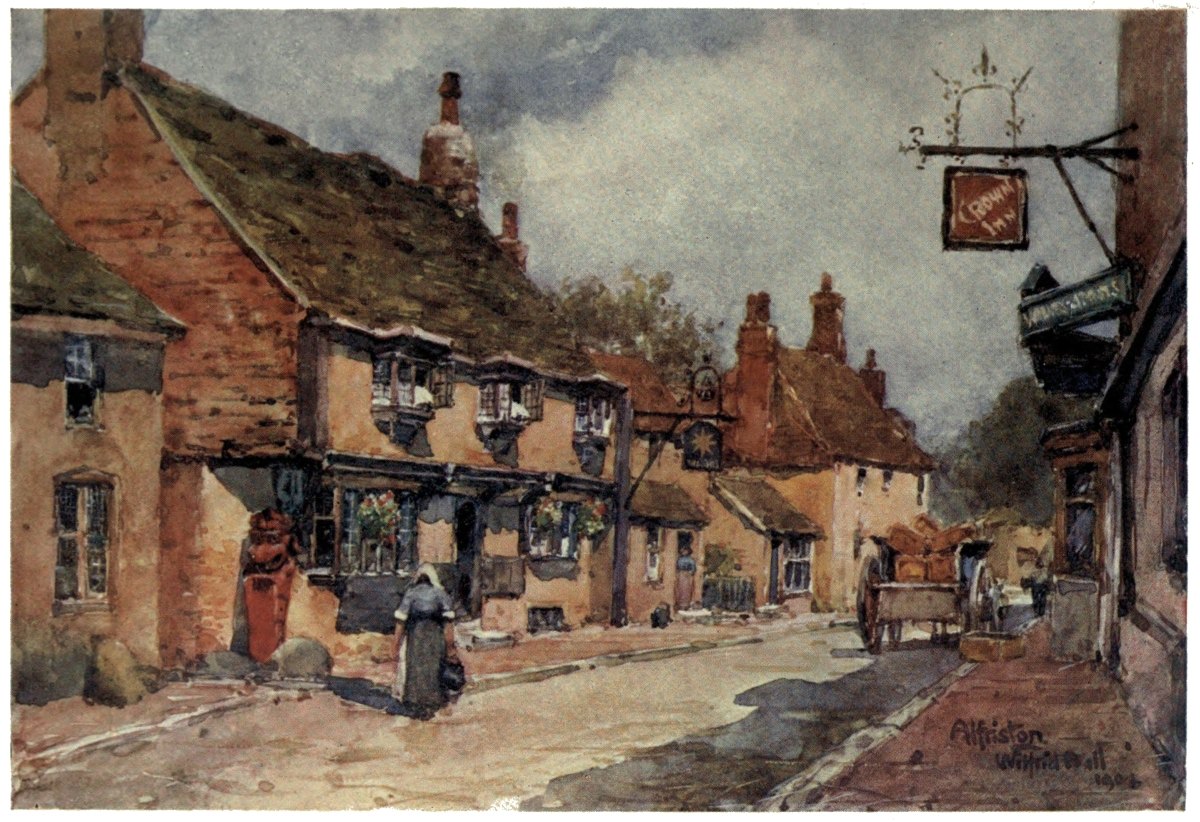
MILITARY IMPORTANCE OF HASTINGS
vessel has to be rolled will be too great to make the effort worth
while. In material it must be firm and hard—a quality which gave its
pre-eminence to the sand of Deal, for if it be shifty or sinking the
difficulty of beaching the boat may be insuperable.
Now all these characters are to be discovered in the shingle at
Hastings, and added to these is the presence of a strong and easily
fortified eminence.
The importance of this sort of refuge can easily be minimised by the
modern historian, but those acquainted with the conditions of an earlier
time will appreciate its value. A fortress now serves, as Napoleon well
put it, “to save time,” and serves little else in military purpose. In a
sense this has always been the chief value of a fortress, but when one
was dealing with smaller forces, more passionate and less constant in
motive than those of to-day, and far more easily disintegrated than is a
thoroughly civilised army, time was of far greater value in a campaign.
Again, the defence was easier with a smaller body of men on account of
the comparative inefficiency of projectiles, the comparative lack of
training of the assaulting infantry, and the pre-dominance of cavalry
tactics, between the fall of the Roman Empire and the invention of
fire-arms. It may be roughly asserted that the power of the defensive
behind properly constructed works grew to a maximum from the fifth to
the middle of the twelfth century, remained almost stationary till the
close of the thirteenth, and only slowly declined during the sieges of
the French wars in the succeeding hundred years.
Now under such conditions the importance of hills such as that of
Hastings was very great. Here a garrison could, properly commanded, hold
out almost indefinitely; it could, therefore, cover a landing or repel
an invasion; it could gather under its protection a large and increasing
population. The shape of the hill was precisely that required for
fortification in the Dark and Middle Ages. It is, in its best form, an
example of what you will find also at Chateau Gaillard in Normandy and,
to a lesser degree, at Lewes and Arundel in this same county of Sussex,
namely, a sort of peninsula or spur with a crowning summit of its own,
united with the hills behind it by a comparatively narrow neck, over
which assault should be impossible. In the modern sense and referring to
modern artillery, such positions are extremely bad, for they are
commanded by the higher range at their back; as Arundel is commanded by
the heights of the
MILITARY IMPORTANCE OF HASTINGS
Park, Lewes by Mount Harry, and Chateau Gaillard by the woods locally
known as “La Ferme”; indeed, in the case of this latter castle the
conquest of Philip Augustus was largely due to the fact that missile
weapons, even in his age, were just within range of the castle from the
heights to the south and east. But though, under modern conditions, such
situations are bad, under the conditions of at least the eleventh and
early twelfth centuries, they were ideal. When William the Conqueror
held Hastings there were no methods by which projectiles of sufficient
strength could be thrown at the castle from the hills to the north-east,
though a hundred years later, by the time of the Third Crusade, and
later still, during the attack on the Norman castle already mentioned,
such weapons had been developed. One has but to stand on the platform of
the ruined stronghold of Hastings to see that, for at least the first
hundred years after the Conquest, the place must have been, under any
proper command, impregnable. And indeed we find attached to it in
Anglo-Saxon times the epithet “ceaster,” which is never given to any
place that has not been properly fortified, whether by the Romans or by
their successors.
This fortification of Hastings Hill leads one to mention two other
castles which lie within the Rape, and which are illustrative of a
feature to be discovered in Sussex alone among the English counties.
This feature is the presence of subsidiary castles to strengthen the
gates of the county, and to stand behind those principal castles whose
primary function it is to defend the entries into the land. These
subsidiary castles may be best explained to modern readers by using a
modern metaphor, and saying that they act as “half-backs” to the great
seaport castles of Sussex.
The seaport castles have already been mentioned; we will repeat the list
to refresh the reader’s memory: they are Hastings, Pevensey, Lewes,
Bramber, and Arundel.
Of these Lewes alone did not, so far as history knows, possess a
subsidiary castle to the north of it, and that for this sufficient
reason, that the road immediately north split eastward and westward, and
forced an army either to pass within striking distance of Hurstmanceaux
or within striking distance of Bramber, for the old road did not go over
the bleak and deserted ridge of Ashdown as the modern one does. And the
historic marches down south upon Lewes were undertaken in a
THE SECONDARY CASTLES
circuitous manner, as, for instance, that famous one of Henry III.,
which ended in the defeat of the King in 1264.
In the case of every other great defensive work a secondary work exists
behind it. Hastings has Bodiam, Pevensey has Hurtsmanceaux, Bramber has
Knepp (which has been more completely ruined than any of the others),
Arundel has Amberley. Hurtsmanceaux should logically fall into the Rape
of Pevensey, to which it strategically belongs. The accident of a river
course makes it fall into the Rape of Hastings, and on this account we
mention it here. The other castles will be dealt with in their proper
place under each Rape as we deal with it; for Knepp is in the Rape of
Bramber, and Amberley in that of Arundel.
As Moreton had been given the overlordship of Pevensey, the government
of its Rape, and many manors within it, and as Warren had been given
Lewes, so Bramber fell to Braose, and that great name still stands
written like a title over the history of this part of the county. The
castle itself and some few of the many manors with which the family was
richly endowed enjoyed a fate extremely rare in the case of English
land, and on account of its rarity the more pleasing, when it is
discovered; there has been a long and true continuity in their manorial
lordship. With the French this continuity was quite common up to the
Revolution, and to this day there are many French families, several
Italian, and a few German, who can trace their lineage and their
connection with particular portions of the soil well beyond the
crusading epoch and even to the ninth or early tenth century. But our
English aristocracy is exceedingly modern. The bulk of such few families
as boast any antiquity at all can barely trace themselves to the
Reformation; the mass of those who pose for lineage end in the mist of
the seventeenth century. Bramber and some of the De Braose lands had
better luck. For ten generations it remained in direct succession. When
this ended (much at the same time as the Lancastrian usurpation) in an
heiress, this heiress married a Mowbray, upon which family, almost
immediately afterward, was conferred the Duchy of Norfolk. Ten
successors, Mowbrays, held it in the direct line when, about a century
after the first change, and a generation before the Reformation, it
ended again in an heiress who married into the then undistinguished
family of Howard, whose various branches had been careful, above all
things, to increase their wealth by opportune
BRAMBER RAPE
alliances. To this new family the Duchy of Norfolk was soon conveyed,
and after another ten successors the De Braose inheritance of Bramber is
still to be found in their hands. It is a remarkable and a delightful
example of a succession unbroken by purchase.
The last sign of the ancient importance of Bramber lay in the fact that
it returned, until the Reform Bill, two members to Parliament as a
borough. It was then as it is now a small village, and there remained
then as there remains now of its ancient castle nothing but one vast
wall.
Here, as is the case throughout all the other Rapes, the parishes along
the sea coast or near it come earliest in history, and those of the
Weald come last. Thus Lancing is in Doomsday; so is Coombes; so is
Buttolphs (under Annington); Beeding is actually in Alfred’s will.
Shoreham, as we have seen, entered history hundreds of years before, and
Henfield is in the great Norman survey under the lordship of the Bishop
of Chichester; but as you go northwards the names begin to fail you.
Shipley, if we may judge by its church, was probably a development of
the next century. Horsham is first mentioned as a town of importance in
the thirteenth century, when it sends two members to the Parliament of
the twenty-third of Edward I. And little Rusper, up in the far north, we
do not hear of until there is mention of a convent of the same date. As
for the forest of St. Leonard’s we know that De Braose held it, but, no
more than in the case of Worth, is there any proof of its inhabitation
or even importance till a much later date.
The port of this Rape, Shoreham, has an interesting history as being yet
another of those many ports which the long history of Sussex has seen
decline. It lay so directly south of London, and, once communication was
established across the Weald, it was so excellent a port of
disembarkation for any one coming from the mouth of the Seine or any of
the Norman ports, that it maintained a very high political importance
right on into the fifteenth century. Thus it was the landing-place of
John when he returned to England after the death of his brother.
In the French wars under the third Edward it was assessed to furnish as
many ships as Plymouth and two more than Bristol or London. Shortly
after its decline began. That great bank of shingle, which is now
covered with a very unpleasant little town of iron bungalows, grew up
and obstructed
SHOREHAM TOWN
the issue of the river, so that to-day the mouth of the harbour is far
eastward of New Shoreham. The burgesses complained that they could no
longer pay the old taxes, the borough rights lingered on; but even these
at last disappeared in the eighteenth century, when the town was
disfranchised and the whole Rape was represented together in its stead.
Oddly enough it was at this very moment that the town began to revive;
the trade in coal proved useful to it; it became, before the railways,
the natural port for Brighton, which lies close by, and, year by year,
it gradually though somewhat slowly recovered its old position. It now
has probably as much trade as any other Sussex port except Newhaven,
though the bar is still difficult for vessels of any draft, and the
sharp turning at the entry of the harbour adds to the inconvenience of
that refuge, as does the narrowness of the river and the steepness of
its banks opposite the town itself.
Its gradual revival did not re-enfranchise it; the Rape still remained
the parliamentary unit to which it belonged, and the first member to sit
for that division was a Burrell of Knepp Castle.
With this name we get not only one of the famous Sussex squires, whose
position will be dealt with later, but the principal historian of the
county residing in one of its most ancient centres. The Burrells were
lawyers of Horsham who purchased Knepp in the second half of the
eighteenth century, a true Sussex family growing upon Sussex soil. The
founder of the present baronetcy collected all the new material which
has been worked in by subsequent writers into the history of the county.
Much of this is luckily preserved in the British Museum, but some parts,
unless the present writer is misinformed, disappeared during the recent
fire in the modern house of Knepp Castle.
Of the original fortification nothing remains but one little fragment in
the south of the estate to the right of the Ashington road. The land has
still one local distinction, however, in that it holds a sheet of water,
Knepp mill-pond, which is said to be the largest unbroken area of water
south of the Thames.
Next in order to the Rape of Bramber comes that of Arundel. Here again
the typical upgrowth of a Sussex Rape is modified by local conditions,
for the Weald at the northern end of this Rape has been traversed since
the beginning of our history by the great line of the Roman road.
Arundel Rape has therefore been always accessible from
ARUNDEL RAPE
the Thames valley, and the Thames valley from it. On this account there
occurs, as one might imagine, a very early and very thorough development
of all its habitable portion. A mere list of the places mentioned in
Doomsday in this Rape, places which are still most of them quite small,
and have never supported any great number of inhabitants, is surprising.
Some, such as Arundel itself, and Climping and Felpham, go back to
Anglo-Saxon times. One, Amberley, counts as part of the original
foundation of the Church at the close of the eighth century, and
Lyminster had a convent before the arrival of the Normans, while
Littlehampton was certainly a port before the same date. Meanwhile a
rapid survey of the names appearing in Doomsday, all within a walk of
the sea coast, are sufficient to show how thoroughly the Arun valley,
the subsidiary valley of the Western Rother, and the coastal plain west
of the mouth of the river, had developed before the close of the
eleventh century.
Thus Barnham (to begin with the flat lands along the sea) is in
Doomsday; so are Eastergate, Walberton, Tortington, where later was the
famous priory which preserved the early records of the mayoralty of
London, and in whose destruction the chief monuments of London history
were lost. Binsted is in Doomsday. Turning to the slope of the Downs we
find Goring is in Doomsday. Angmering below it, and on the belt of good
loam land to the north of them Sutton, Barlavington, Duncton, Burton,
Stopham, and Petworth are all to be found, as are Bury, Bignor, and
Hardham, where later was to spring up the priory of the Hauterives. On
the far side of the river Parham and Burpham are mentioned, so is
Storrington, and on the river itself Pulborough; while even such lonely
nooks of the Downs as Upper Waltham come into the Norman Survey.
All this fell to the Montgomerys. Very shortly afterwards, by the
failure of that family, the guardianship of the castle at Arundel and
the headship of the Rape went to the De Albinis; to them succeeded the
Fitz Alans, and to them again, when they ended in an heiress, succeeded
the ubiquitous and ever watchful family of Howard, who snapped up that
inheritance before it could fall to any other, and the new Duchy of
Norfolk added not only the Rape of Arundel to that of Bramber, but also
a sort of headship over the Rape of Chichester,—for Chichester had gone
with Arundel in the original grant to Montgomery.
ARUNDEL TOWN
The town of Arundel is singular among English sites of the first rank,
from the fact that it has neither increased nor diminished to any
considerable extent for at least a thousand years.
It is probable that there was here in Roman times a crossing of the
river, though the point is hotly denied by the more pedantic among our
historians, because, so far, no Roman remains have been found under the
soil of the town, or at least none have been identified by casual
visitors. But, whether it was a Roman town or not, it is certain that
from the moment the isolated spur upon which the castle stands was
crowned with strong fortifications and garrisoned by the central
authority of England, a town of much the same size as the modern Arundel
must have been grouped round its base.
Those who deal most with the statistics of the early Middle Ages seem
most blind to the conclusions of common sense. When they are told that
only ten or twenty burgesses are to be discovered in a particular town,
according to the evidence of some taxing list, they are willing to jump
to the conclusion that only ten or twenty families existed in the place
at the time the list was made. Instead of appreciating the very natural
attitude of any tax-gatherer to save himself all possible labour, and
the certitude that he would put down only those who were assessed in his
particular tax, and instead of grasping the fact that, until the later
Middle Ages, men paid taxes, not by localities, but by categories (some
as King’s men, some as local baron’s men, some as the Church’s men,
others according to all manner of local apportionments), they take the
very crude way of estimating the particular document they have as an
index of total population. It is this, for example, which has led to the
astounding conclusion that England at the time of the Norman invasion
held less than two million souls, and it is this which makes people
misunderstand, if they read modern histories, the nature of a town like
Arundel.
So long as the spur above the Arun was protected by marshes and isolated
by a narrow neck from the main range of the Downs, so long would it
tempt men to form a stronghold there, and the moment that stronghold was
held by national forces under the obedience of a national King, it
presupposed a county town. It presupposed defence for a market (the
later license for a market is quite a different thing; the market
existed often for centuries before the license which was usually
MIDHURST—KNOCK HUNDRED ROW
ARUNDEL TOWN
only the proof of the King’s growing power); it presupposed butchers
under the castle walls, money-changers, men coming to and from the
garrison for every sort of purpose, carriers, and—to quote a particular
point—barbers; the men of the Dark and early Middle Ages were clean
shaven. An Arab fortress does not arise nowadays without a town at its
foot, still less would the civilisation of the Dark and Middle Ages
produce the stronghold without producing a town as well. And a town
means something more than a village.
The bridge at Arundel, which one may believe, though one cannot prove,
to be Roman in its origin, used to cross the river somewhat farther down
the stream. The line of the modern High Street points directly to that
part of the town which now looks very like a continuation of the
market-place, and has become a sort of backwater in the traffic of the
place. It was originally the direct line to the old bridge. Those
acquainted with Arundel will best appreciate the site of the old
crossing of the river when they learn that the modern Bridge Hotel lies
exactly between the ancient and the modern bridges, and the line of the
causeway eastward can further be traced by the existence at the farther
end of it, up against the high land, of the old building which is seen
from the station between the railway and the rising ground.
Amberley Castle, which lay at the north end of Arundel gap, is not
preserved in its entirety, but is still a fine ruin, and occupies, as
Arundel did, a position of great military strength, though it does not
dominate the landscape as does the larger fortress. The strength of
Amberley lay in this, that from the north and west it was quite
unattainable. If the culture of those fields now known by the highly
descriptive name of “Amberley Wildbrook” were to cease for a generation,
the old conditions would be reproduced; the floods would soon turn them
into marsh again. From the east the approach is not easy: it lies over
the rolling spurs of the Downs. From the south there is only one narrow
passage on the shelf of the Downs as they slope down to the Arun. It is
a tradition in the county that the two castles of Arundel and Amberley
were linked together in their system of fortification by an underground
passage, and stories are told—with what authority the present writer
cannot say—of men who have attempted to explore either end of this
passage and succeeded for a certain distance. The thing is possible
enough.
HOUGHTON BRIDGE
Amberley is at any rate one of the very, very old sites of human
habitation in Sussex. It is the fashion to decry monastic charters, and
it would be difficult to prove, though it was for centuries constantly
asserted, that Amberley was part of the original foundation of the
Church of Selsea. We have regarded it as sufficiently historical to be
included in former pages of this book, but whether the monastic
traditional charter be true or false, its very existence proves that the
popular legend attributed to the place the highest antiquity.
Houghton, which lies in the neck of the gap, is certainly equally old.
That British trackway which was mentioned when the topography of Sussex
was being described, and which runs all along the rich loam belt
immediately to the north of the Downs, had to cross the river at some
point. Now it is the universal rule of the old British trackways that
they spy out the narrowest part of the wet lands when they attempt to
cross a river. They descend by the nearest spur upon the one side, and
make for the nearest firm land upon the other. At this spot the river
Arun curves strongly eastward and runs right under the Downs. The
marshes to the westward of it are still often flooded and were once wide
and impassable, but at Houghton there is a spur coming down across them
which, while it does not actually bridge the gap, comes near to doing
so. That hollow sunken lane, which is the modern descendant of the old
British road, runs from Bury just above the flood line on dry soil; it
climbs up on to the spur close to an old and reverend inn called “The
St. George and Dragon,” and then turns sharp to the left down along the
crest of the spur, making for the shortest possible crossing which the
marshes afford. It is not too much to say that we are certain the Arun
has been crossed at this point since prehistoric men first attempted to
pass the river as they journeyed north of the Downs.
The connection of the place with modern history is also not without
interest. It was here that Charles II., escaping in disguise after the
battle of Worcester, took what was perhaps his last glass of ale, or at
least his last glass of ale in the saddle, on his way to Shoreham, from
which happy port he got away to his long exile. The house is still
licensed, and cursed be the man who takes that license away.
The historical importance of Houghton is further evidenced by the name
of the wood which lies up beyond Whiteways on the slope of the
THE RAPE OF CHICHESTER
Downs, which still retains the name of Houghton Forest, indicating that
the Crown hunting lands, or, if the modern phrase be preferred, the
national preserves, of the neighbourhood depended upon this valley
village two miles off. There is little more to say with regard to the
historical development of the Rape of Arundel. The villages and towns of
the Weald are here, as elsewhere, of a late development. Slinfold, for
example, is not mentioned in Doomsday, nor is Billingshurst, though the
latter is probably Celtic in origin. Pulborough, which like
Billingshurst lies on the Roman road, is the last of the outposts of the
Weald to be spoken of in that document, while the excellent village of
North Chapel was actually not detached from the parish of Petworth until
as late a date as 1693.
The Rape of Chichester has this character to differentiate it from the
other rapes of the county, that it is not military. Two explanations of
this fact concur and supplement each other. The Rape of Chichester led
nowhere, and had no gap in its hills, and the Rape of Chichester was
dominated by the Church.
We have seen that all the Rapes of Sussex, leading as they did from
north to south, tended to group themselves round highways from the
Channel to the Thames valley, and Chichester, with its large though
shallow harbour, certainly did afford an admirable entry into England
for early navigation; but, once one had made the town, one’s way to
London and the North lay up the Stane Street, and this Roman road went
through no populous districts nor through any of those gaps which men
(after Roman times) would naturally seek for their advance, but went
straight over the bleak and desolate Downs, and by the time it got to
the crest of these it was within half an hour’s smart riding of the
garrison of Arundel. Westward no man would go. The marshes prevented
him. Neither would he advance northward; he would have found in that
direction, after crossing the pass at Singleton, a fertile valley indeed
to raid, but no good opportunity for further progress. Before him would
have lain the large sandy wastes which began at what is now the Sussex
border by Fernhurst, and continued right on to the neighbourhood of the
Thames. They are to-day filling up with villas, but they were,
throughout the centuries in which our history was made, empty deserts
yielding no corn and affording no shelter of towns or villages to an
army. Supposing that an enemy, as for instance a pirate raid of the
Danes, were
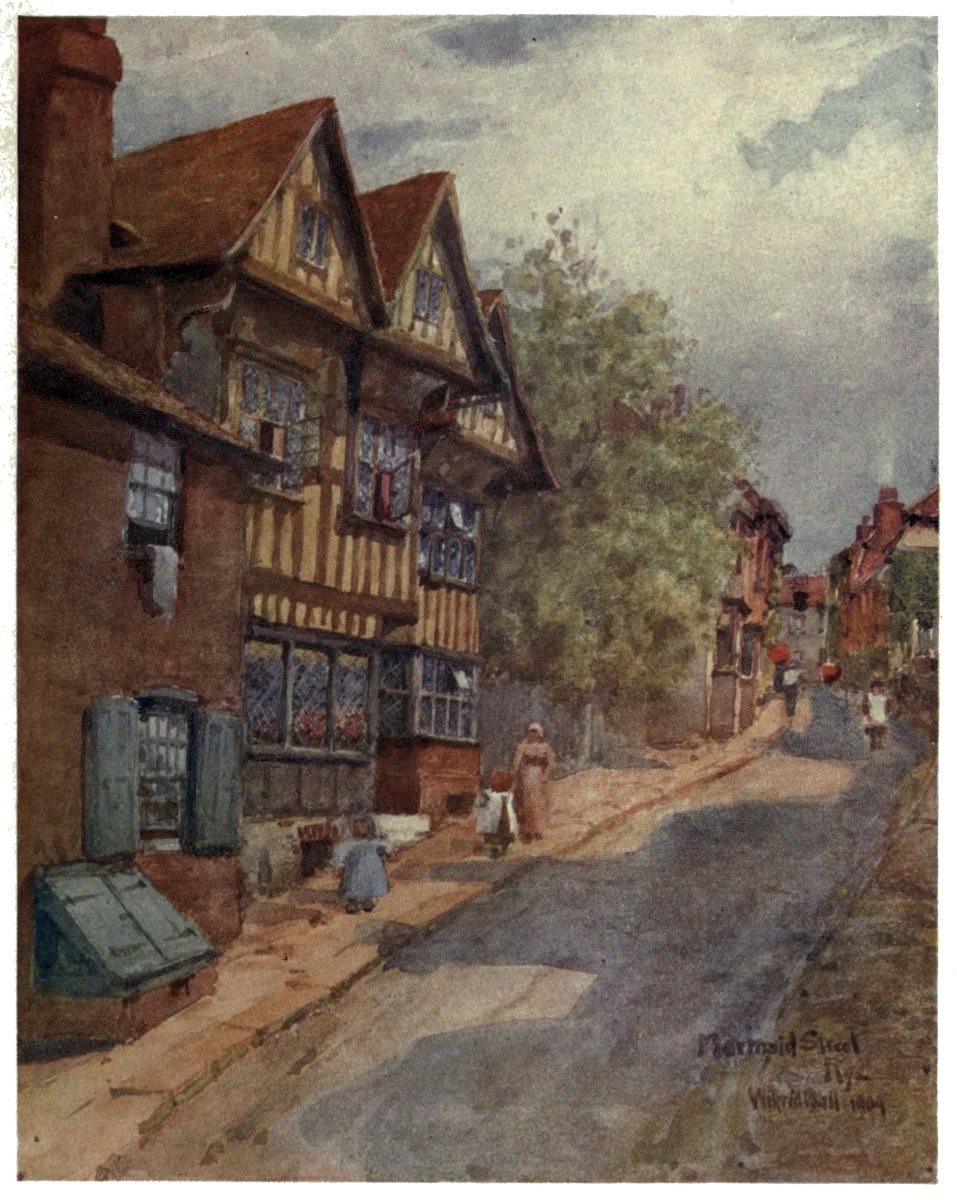
ITS ECCLESIASTICAL CHARACTER
making for the lowlands of the Rother valley, or farther on for the rich
pastures of the Wey (where later was to spring up the wealth and
magnificence of Waverley), such a sailors’ raid would certainly have
proceeded up the Arun and tried to force its way past Amberley Castle.
It would never have made the attempt through Chichester.
There is, then, a clear topographical and strategical reason for the
immunity of the Rape of Chichester from military conditions. There is
also an ecclesiastical reason. It is a thing not to be forgotten, that
from the fall of the Roman Empire to the Renaissance the contrast
between the ecclesiastical and the civil method of government was a
reality. It afforded for men’s minds something of the foil or background
which to-day the legal aspect of society gives us as against the
commercial, or the conception of a gentleman as against the conception
of a rich man. The contrast was, of course, much more vigorous and
satisfactory than any of our modern contrasts can be. We see it in a
thousand ways illuminating the history of the Middle Ages; by way of
sanctuary, by way of the ecclesiastical courts, by way of the atonement
which men paid for violence when they founded great monasteries, by way
of the technical abstention from capital sentences which the Church
rigorously preserved. It is not fantastic to ascribe to this cause the
fact that the Rape of Chichester held no important castle and was the
site of no great battle. Nor is it ridiculous to imagine that the
somewhat ungeographical inclusion of the parish of Slindon into the
hundred of Aldwick, and therefore into the Rape of Chichester, had
something to do with this ecclesiastical quality. For Slindon was
Canterbury’s; Stephen Langton died there.
Here, as in the Rape of Arundel, everything within a march of the sea
was in Doomsday, and the actual entries from the sea are known before
Doomsday; for example, there is Bosham, from which we have seen that
Harold sailed on that pleasure trip of his to Normandy. Right up in the
Downs Doomsday parishes continue, as Singleton, which is the mother of
West Dean, and lies in the same internal valley or fold of the hills as
does that other parish of Upper Waltham, which we have already
discovered to be included in the Doomsday Survey in the Rape of Arundel.
So with the loam belt to the north of the Downs in this Rape. Graffham
is in Doomsday, Cocking is in Doomsday, and while Heyshott is not
actually in
SCILLY SUSSEX
Doomsday, it is alluded to a little later as Percy Land held of the
Montgomerys. But once we get into the neighbourhood of the Weald the
dates fall later. Midhurst is a full borough in the early fourteenth
century under Edward II., and not before.
The Rape of Chichester is not only the principal ecclesiastical
influence in the county; it is, one might say with no great
exaggeration, the only one. By which it is not meant that the Church as
a whole did not have its full effect in the county; on the contrary, in
moulding the type of Sussex character the Church had, if possible, a
greater influence than it had in moulding the character of any other
county. To this day we talk of “Scilly Sussex,” which means “holy
Sussex,” just as we talk of “Hampshire hogs” or “Kentish men with
tails”; and all up and down the soil of the county are to be seen the
noblest collection of parish churches in England, the proofs of an
ancient devotion.
But ecclesiastical influence, exercised as an economic power and with
deliberate intention, is less strong in Sussex during the Middle Ages
than in any other county. The monasteries were not very numerous, and
when they were rich (which they rarely were) they do not seem to have
had a very considerable effect upon the life of the county. The towns,
of course, possessed their monks, as did all the towns of England; Lewes
had its Benedictines, Arundel its Dominicans, and so forth. But the
monks who, throughout the west of Europe, reclaimed land, opened up
empty and uncultivated spaces, and were the pioneers of the mediæval
civilisation, did nothing for this county on the same scale as they did,
say, for the North country, or for East Anglia. The reason is plain.
Sussex was cut off while the earlier part of the monastic effort was at
work, and was very rapidly developed by a civil influence the moment
that isolation ceased with the coming of the Normans.
Hardham and Boxgrove are almost the only examples which point by their
sites to the economic work of the early monasteries, for they both lie
along one of the old Roman roads; but both of them came comparatively
late. Boxgrove was founded by the lords of Halnacker under Henry I.,
Hardham was later still. Robertsbridge, also a development of the
central Middle Ages, may be cited as an example of the monks opening up
wild country, but Battle was quite artificial, the result
THE MONASTERIES
of a vow paid and of the accidental site of a battle. Moreover, Battle,
thus artificial, was by far the wealthiest of all. At the time of the
dissolution Hammond, the last abbot (who surrendered with great
pusillanimity to Henry VIII., and against whom the gravest charges have
lain), gave up revenues of £1000 a year in the currency of the
times—far more than £10,000 of our money. Boxgrove itself could only
count about one hundred and fifty pounds.
The priory of Tortington, next to Arundel, is interesting in the history
of England for reasons already mentioned, but it was not wealthy. Almost
every other foundation, as the Dominicans of Chichester or Winchelsea,
or those we have previously noted at Arundel, or the Franciscans of
Winchester and Lewes, or those near the north gate of Chichester, or the
Carmelites of New Shoreham, or the Friars of Rye, are connected with
towns and do not therefore concern the development of the county.
So far we have been dealing with the historic basis upon which Sussex,
like every other part of England, has been built.
We have seen that upon the prehistoric origin of which we know hardly
anything came Rome. We have seen that the Italian race laid down the
bed upon which all the rest was to rise—a bed, firm, hard, and even,
like their own concrete. It was a process occupying in this island some
four hundred years.
Upon Britain, as upon every other western province, fell the barbarian
invasions of the fifth century. We have seen that they were somewhat
more severe here than in other provinces, and that Sussex in particular
was swept clean by them, not indeed of her race, but of her religion and
her civilisation. The darkness resultant upon this catastrophe lasted
for little more than a hundred years, but in that hundred years
everything which gives dignity to mankind had disappeared, and the
countryside, from Romney Marsh westward away to Chichester Haven, had
gone savage. We have seen that it was slowly re-Christianised and
recivilised, but that the planting of good stems upon such a devastated
soil was for long a difficult and an unfruitful business. The mission of
St. Wilfrid coincides with the close of the eighth century. It is not
till the middle of the eleventh that Sussex really re-enters the
European unity; it is not till the close of it that the influence of
that unity begins to be largely felt after the Norman Conquest.
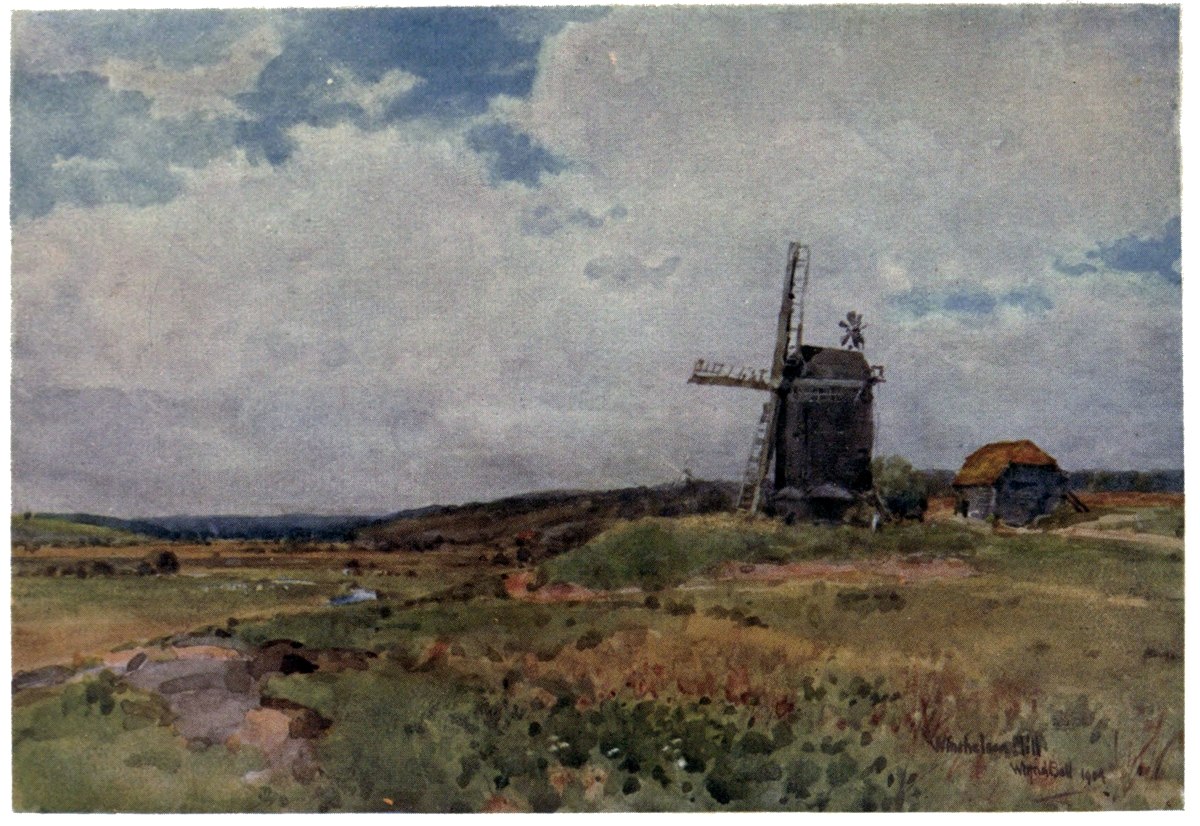
THE RISE OF THE SQUIRES
Two hundred and fifty years pass, during which the social development of
England and of Sussex keeps the main lines laid down by the Conquest;
the central government is still strong, the conception of tenure still
weighs upon the wealthy class, and all men are responsible somewhere to
some lord. Briefly, the mediæval system is during that period alive;
here, as in northern France. And this island and northern France form,
between them, until the close of the thirteenth century, the heart of
Christendom. It is in them that arise the great philosophic discussions
of the new universities, the Gothic architecture, the feudal scheme, the
true co-operative industry of the mediæval manor.
For as long as that society could endure, that society was organised;
and in Sussex the organisation, or, to use a better word, the sense of
authority, is to be discovered in the great “Rape” overlordships,
Hastings, Pevensey, Lewes, Bramber, Arundel, and Chichester, whose
growth has been already sketched.
It so happened that that mediæval system grew old and failed.
The period of time between its failure and the present day is
comparatively short, as the history of mankind goes. Its break-down is
only apparent to the historian with the middle of the fourteenth
century; it is not suspected by its own victims till the middle of the
fifteenth. We are to-day but in the beginning of the twentieth. It may
be said, roughly, that four hundred years of change alone separate us
from that organic unity which had survived for fifteen hundred years
from the civilisation that the Mediterranean brought us. We feel a world
away from that organic unity of the Middle Ages, because these last four
centuries have been so full of an active intelligence and of an
increasing material knowledge, that these take up nearly the whole
horizon of our minds; but our detachment is but apparent and illusory.
At bottom our morals, in so far as they are permanent, our conception of
civic life, our modern appetite for economic justice, are all rooted in
the Middle Ages; and the more a modern man learns of them the more he
feels that they are his native place.
The process of disintegration which the mediæval system suffered took in
Britain a peculiar form, and in this most typical district of Britain,
in Sussex, that form is clearly to be traced. The village, which was the
unit of mediæval life, was essentially co-operative. As the segregation
of individual industry arose, either the lord was certain
THE RISE OF THE SQUIRES
to become, from the head official of a corporation, a proprietor of the
whole, or the villein, his tenant, was bound to become, from a member of
a co-operative society, a proprietor of his part. There was not room for
both. Elsewhere, in all northern France, and to some extent in the
valley of the Rhine, the break-up of the mediæval system is the attack
of the peasant upon his lord. It is (spread over a much longer period)
something like the campaign which the Irish have inaugurated in our own
time. It is a movement towards peasant proprietorship.
In England the development is very different. Feudalism in England, even
when it was highly organised, as in Sussex, had to fight against a force
which is almost inherent in the soil. For that force it is difficult to
find a name, though it is a tendency clearly observable in the whole of
English history. It may, perhaps, best be defined as the tendency of the
English village group to submit to one lord, coupled with the lack of
any tendency among these lords to coalesce under a superior. The system
is essentially oligarchic, and its foundations were laid in the natural
crystallisation of society during the anarchy of the Anglo-Saxon
centuries. With his inheritance of law weakened, and his memory of a
protecting government destroyed, the small man had not the wit or the
courage to fight against the big man; hence the English squire. The big
men had not the necessity forced upon them to unite in defence of an
antique civilisation and a strong Roman tradition; hence the permanent
insecurity and ultimate abasement of the English monarchy.
The latter of these two forces you see at work continually in the
history of England during that space which lies between the Norman
Conquest and the Barons’ Wars, when the attempt to govern from a centre
was made and failed. The village aristocracy is always stronger than the
Crown, and in some sense expresses a national action against the Crown.
At first this aristocracy merely supported the barons (who were their
nominal overlords) in the joint attack upon monarchy, but as the
centuries pass the overlords themselves lose their hegemony. At last,
round about the period of the Reformation, the lords of single manors,
the squires, become completely independent, and their final, wholly
successful effort matures when the Tudors are no longer there with their
violent personalities to defend the symbol, the remaining symbol, of a
central authority.
THE SUSSEX FAMILIES
The Stuarts break down. The squires arm. The Crown is defeated. A king
is beheaded. From thence onward a process which was easily apparent in
the fourteenth and fifteenth centuries, which had taken on strength with
the dissolution of the monasteries in the sixteenth, which had become of
further importance with the large transfers of land at the end of
Elizabeth’s reign, is completed. The seventeenth century sees in Sussex,
as throughout England, the final victory of the village landlords, their
complete possession of the soil and of the people who dwell upon it, and
their complete independence from any authority over them.
There are many brief historical surveys which illustrate the rise of the
landed families. Among the easiest for a general reader to take, and
also the most instructive, is the list of the public offices of the
county. We have a fairly complete calendar of the sheriffs from the
purely feudal times to our own, and there we may trace the dignity
falling more and more into the hands of county men. The local patriotism
and its result, the strong local oligarchy, which are between them the
warp and the woof of England, are exhibited here at one glance. The
names mentioned are not always those of sheriffs for Sussex alone,
especially in the earlier times; but their names and their places of
origin are significant.
We begin that list not quite a hundred years after the Conquest, in the
reign of Henry II. The names are drawn from all over England. They are
merely royal officers and they do not concern us. But as the Middle Ages
come to their end, the names which we can identify as those of the local
gentry begin to tell. You get, just at the beginning of the Wars of the
Roses, the Ashburnhams and the Stricklands. In Edward IV.’s reign you
find for the first time a Goring (who was then not even a knight). You
get the Gainsfords of Crowhurst, and the Coombes (honoured name!),
presumably of Coombes in the vale of the Adur. Just before the
Reformation the Oxenbridges of Brede and the Dawtreys of Petworth, who
founded Hardham Priory, and whose name proceeds from the high banks
(“d’Haute Rive”) of the water meadows of Arun. You get again that good
Sussex name, the Palmers of Angmering, and so on to the Civil Wars.
There are further Gorings and Morleys, also a Glynde, and, just before
the struggle, a bishop a knight of Parham.
It is after the Restoration, of course, when the
THE SUSSEX FAMILIES
victory of the squires was complete and final, that the habit becomes
fixed, and that you find (until quite recent times) nothing but Sussex
names in the great roll of the sheriffs. There is a sort of gap under
William and Mary, who were usurpers and disturbed the order of England;
but with Anne reasonable things returned. The names of Blunt and Shelley
appear, which still adorn the county; and under the Hanoverians, the
Bartelotts of Stopham, and many another family which still holds land
within the centre and in the west of the county, are to be found upon
the rolls.
Not until the Reform Bill does the tradition begin to change. Then you
find a Curzon coming in out of nowhere; and since then, one must dare
say, many another man who is simply rich, and who simply happens to have
settled upon Sussex land.
We may now turn to examine in detail those Sussex families which have
become bound up with the history of the county; some of them originally
territorial; some of them professional, acquiring wealth in their
professions, and achieving territorial rank; many of them passing from
one part of the county to another, but all remaining a true framework
for the countryside.
Alongside with them we shall be able to trace a most deplorable
vicissitude in the ownership of certain manors which has, most
unfortunately, not ceased to-day, but has rather increased, and which
very seriously menaces the future integrity of the county.
It is impossible, of course, to give a complete survey of the process in
these few pages, but the consideration of a few typical manors and,
after that, of a few typical families will suffice to fill in that
general impression of the county which it is the object of this book to
convey.
Consider, for example, the Manor of Cuckfield, and see the way in which
the squirearchy develops. One may presume that throughout the true
Middle Ages it preserved at least a semblance of depending upon the
overlordship of the Rape, and the Fitz Alans can count themselves its
masters.
But as the Lancastrian usurpation breaks the great families a local
consideration comes in. In the eighteenth year of Henry VI. the manor
was divided between four co-heiresses, and so remained divided into four
pieces (each still held by great families, but each holding the germ of
a future squire in its small limits), until the last half of the
sixteenth century, when two men, Bowyer and Covert, introduce (in the
sixteenth and twenty-third
GRAFFHAM AND LAVINGTON
years of Elizabeth respectively) a new stock upon the old land.
Within a hundred years there comes in one Sigerson, perhaps of the
middle class, a Commissioner of the Navy; he buys the estate, his family
hold it throughout the eighteenth century, and are the principal owners
at this day.
This tendency of lands to remain in the same hands till the close of the
Middle Ages, and then to be bought up by a new race of squires, may be
traced in many another parish. There is Graffham, which does not change
hands until after the Armada, when a certain Garter of London buys it;
it then passes by the marriage of an heiress to the first of the
Sargeants; an heiress of the Sargeants after many generations marries
the man who was afterwards Cardinal Manning; another heiress (by this
time the family held Lavington close by) marries Wilberforce, the
bishop, and, right in our own time, his son sells it to a Scotch
distiller.
Or consider again Madehurst which, until the reign of Elizabeth, holds
of the Arundel earls; then one Dixse has it in fee; then it passes to
the Kemps, and they sell it to Sir George Thomas (whose family sold it
again), after which it passes by a second sale in 1825 to John Smith;
and at last we see it in the middle and end of the nineteenth century in
the hands of a manufacturing family who had chosen to assume the ancient
name of Fletcher.
Eartham (to quote another example) went to King Henry VIII. in exchange
for Michelham Priory; in the middle of the eighteenth century a
Chichester man bought it, one Hayley; a generation later, Huskisson, the
politician; then the Milbankes; and then again, quite recently, a man
whose name is connected with a custard powder.
Singleton went down traditionally until the Reformation; nay, till that
year after the Armada, when Graffham also had slipped; then, in 1589, it
changes hands, passing from a noble to a squire. It remained in his
family till the beginning of the eighteenth century; it is sold and
re-sold, passing from hand to hand. Within present memory first a
squire, and then a northern Quaker, and at last a wealthy racing family
have held it, one after the other.
As might be imagined, the Church lands, their lineage abruptly torn
apart at the Reformation, suffered fates even more revolutionary, and
produced a squirearchy even more tenacious by its
NEWTIMBER
wealth, and even less attached by tradition to the county of Sussex.
Thus Newtimber, which had come down from Doomsday, is seized by Thomas
Cromwell. The King chucks it to Anne of Cleves; then you find a Darrell
in possession; then a Bellingham (holding of Lord Abergavenney in the
sixteenth year of Charles I.) It is left to one Woodcock, whose
daughter, after the Restoration, marries a Cust; and then, following the
universal fate, it is sold to a yeoman of Poynings, one Osborne, whose
grandson in 1741 sells it to a Newnham, whose grandson, again, early in
the last century, sells it to a Gordon, etc.
An historian might make many exceptions. The fortified places have most
of them held out (as it is their nature to hold out) against change. We
have already pointed out that Bramber and Arundel have had a continuous
tenure. Bosham goes right down from the confiscation after the Conquest
to the nineteenth century without alienation. But take Sussex land as a
whole: the sixteenth century first and the Restoration afterwards have
dug an impassable gulf.
It is pleasant for those who love certitude to pass from such
vicissitudes to something allied to the tradition of the land, but more
permanent than it: the tradition of the owners of the land. It is
pleasant to note the continuity of certain Sussex families, their
origin, and their grip upon the soil.
Thus the Shelleys have not only glorified Sussex by producing at the end
of their line her chief poet, but have also welded themselves into the
soil of this happy county.
Shelley, whose great name might almost add something to the splendour of
the land upon which he was born, will be remembered because that birth
of his was next to Horsham. The story of his family will show how widely
it was spread over Sussex land, and how worthy it was of inheriting such
skies and such a landscape as could produce a master of verse.
The name, oddly enough, is from Kent; indeed there has been, since the
centuries after the Conquest, a continual movement westward from Kent
into Sussex of which the Shelleys are but one example.
Long before family names arose, while men were still called by their
Christian names and their land was mentioned after them, the men of
Shelley in Kent were lords of Shelley. They were there in the end of the
thirteenth century, they were there until the middle of the fourteenth;
at that epoch
THE SHELLEYS
one John Shelley went westward, for the good of England. The Lancastrian
usurpation, that watershed in our social history, is apparent here. John
Shelley is returned for the Commons of Rye, just after Agincourt. He had
a son who went still farther west, and, coming to Mitchegrove, married
the daughter and the heiress of the lord of that place, a certain John,
who took his name, as was right, from his own land. This settlement of
the family endured through the Reformation. After this latter date the
Shelleys marry into Buckhurst; still further on before the Civil Wars
they exchange their Warwickshire lands for further Sussex holdings; in
the eighteenth century one finds them marrying into Maresfield. Already
they had a hold upon Findon. Up on St. Leonard’s Forest you find their
name in one of the first of the ploughed lands which open that deserted
belt, and they remain to-day Sussex in name, place, and position.
To take but one other example, and that of a very different kind, the
Blunts of Crabbet Park are Sussex, though of a later stock. Here also we
have a westward movement coming in with the last migration of the
squires. For Thomas Blunt (a Collector of Customs in Kent) had a
grandson, Elyas, fixed at Bolney; his name is not without significance
of the time in which he lived. This man married the heiress of New
Buildings after the Restoration, and perhaps in the Civil Wars the
family acquired those waste spaces of the Crown which now make up the
larger part of their holdings. At any rate that family has produced at
the end of its line to-day another poet, and again a poet of Sussex.
The list might be multiplied, but it will be of little purpose to
develop it in so short a summary as this. It is our purpose rather to
show how, until quite recent years, Sussex lands ran into the hands of a
group of families who perpetually interchanged their holdings, and who
yet remained full of the county air, until there came that modern
diversion by which so much of the county has fallen to those who have
nothing of its spirit, and who only come into it as into a sort of park,
for their momentary pleasure.
For until the last two generations nothing was more tenacious than the
Sussex squire to his soil. Long after the Reform Bill, nay, right into
our own time, Sussex land was not sold to outsiders, and Sussex social
conservatism was unbroken. The moral health of its villages was keen and
singular; the squire was of no excessive wealth, the farmer
SUSSEX JUST PAST
securing his tenancy, the labourer glad of his wage, and living on from
grandfather to grandson, secure also of his position in the village. The
old arts, which are the test of vitality in any commonwealth,
survived—to this day there are villages where the thatcher can thatch
as he can in no other part of England; for instance, in Walberton he can
do so. To this day Sussex retains in some of her remoter hamlets, for
instance in Bury, the true Broadcast Sower.
There is a phase of English history which all lovers of England look
back upon with regret; it is a phase whose complete literary expression
is to be found in Gray’s Elegy; it was in the purpose of whatever guides
this county that such a phase should not be very long-lived, but while
it lasted perhaps the happiness of the English countrysides was higher
than it had been before within our historical memory, or will be again
within the limits of our continuous tradition. Of this happiness it can
be almost proved that Sussex presented the chief example, but just
because the county had reached such a goal it was destined to a measure
of change.
When Sussex had fallen into what seemed a permanent phase of large
agricultural estates, held by the most contented gentry and tenantry in
England, there fell upon this state of affairs a foretaste of what was
to happen throughout the county with the great economic revolution of
the nineteenth century; a great town began to arise and to grow with
startling rapidity in one devoted portion of the countryside.
It is curious that Sussex, whose character and whose pleasure it has
always been to live its own life, and to stand apart from the
development of the rest of the island, or at least to develop only after
the rest of the island has made its particular experiments, and has
proved its experiments wise,—it is curious that Sussex should in this
one case, and that a most important one, have gone before the rest of
England. For Sussex was the county to develop the great watering-places
and the great centres of population (as apart from the centres of
industry) which first created, then were so vastly increased by, the
railway system.
The reason is, of course, not far to seek. Sussex possessed the nearest
coast-line to London, and presented that coast in an aspect most
attractive to Londoners.
No very considerable harbours disfigure it. The trade with France was
not a trade of such a
THE WATERING TOWNS
volume as that which has created Liverpool or long ago created Bristol.
It was a busy, small agricultural trade.
Again, all along the coastal plain there is a beach; and a beach, when
people once begin to take their pleasure by the sea, is a necessity for
that pleasure.
Again, the line to this coast was close and direct. Every one who has
bicycled or walked from London to the Kentish shores knows what a
different task it is compared to a half-day’s run to the South
Coast—the Sussex Coast is the “South Coast” for London, and the only
one.
The first town to be developed in this manner was Brighton, and Brighton
was not so much created by the fashion of the Prince Regent as by the
fact of its proximity to London. It is the nearest point which Londoners
can reach when they desire to enjoy the sea. It grew up in a manner to
be paralleled nowhere else in England.
There are other characters in connection with the extension of this
great town far more remarkable than the rapidity of its growth or the
vastness of its population, as, for example, that it has affected to so
slight a degree the neighbouring country around it; still the
contemporaries of its growth were more struck by its rapidity than by
any other feature. It began as a fishing town of 2000 souls. At the
close of the last century it already counted 5000, in the year 1850 it
measured 40,000—all this before the railway. When the effect of the
railway was at its height, before the common use of the bicycle or the
motor car, the development of Brighton was the most characteristically
modern impress which the nineteenth century had made upon the landscape
and nature of the county. It retains this pre-eminence in our own
generation, but in a degree which is very probably to be lessened.
Somewhat later the other coast towns began to develop, and so long as
the railway controlled that development, their growth was regular and
almost according to a set law. Fashion or the doctors would recommend
some point upon the coast. The long coastal railway from Brighton to
Portsmouth afforded a station at the place, and the town increased in
regular fashion, not with the station as the centre, but as the point
from which branches spread out to the sea, so that these towns all more
or less resemble a tree spreading from the railway station, and trippers
hurrying from that station to the beach are like the deployment of a
regiment
THE WATERING TOWNS
from column into line. These towns are, of course, stretched out along
the beach; for their separate and successive organisation, the continual
presence behind them of the coastal plain, with its railway parallel to
the shore, has afforded admirable opportunities. That plain from
Brighton to Bosham is perfectly flat; the crossing of the rivers has
presented the only obstacle, and that obstacle was insignificant. The
railway could run pretty well in a straight line and build up the towns
along the sea.
Even to-day the villages are linking up with the towns. Rustington is
full of bricks. Rottingdean, for twenty years a sort of suburb, has now
long been full of painters and others. A curious collection of bungalows
has sprung up on the long pebbly beach which shuts out the Adur from the
sea. Opposite these barracks lies Lancing; and even upon the extremity
of old Selsea a new settlement, now nourished by a light railway from
Chichester, is arising. At Seaford, which is saved a little by its
hills, the same attempt at rapid building is made.
There is one feature in this string of houses all along the coast of the
county which Sussex men note with a pleasure not unmixed with malice. It
is this, that while places of absolutely no commercial use and of no
historical importance in the growth of the county are thus gradually
being turned into appendages of London (so that all the way from Beachy
Head to Chichester Harbour you have within the space of some fifty miles
at least sixteen miles of houses), yet the places characteristically
Sussex, the places upon the sea-line, which have gone to the building up
of the county, and in which the population naturally gathered, continue
to resist with extraordinary tenacity.
You can do nothing with Newhaven except leave it a port. Littlehampton
refuses to be the pleasure ground that its landlord desires it to be.
Bosham is still the ancient harbour and village which its history
demands that it should be. Shoreham will not consent to become a lesser
Worthing or a second Brighton, and this is the more remarkable from the
fact that these harbour towns and villages are geographically more in
touch with London than those other towns whose special character it is
to lie sheltered by the hills and far from the gaps by which a railway
could approach them from the north.
One may discover precisely the same state of affairs upon the eastern
coast of the county
THE WATERING TOWNS
beyond Beachy Head. Here, for example, is the enormous development of
Eastbourne, in a place which was useless for sailors, but sheltered from
the winds by the neighbouring hill. Bexhill has increased along a beach
which was not used until speculation had built the new town. Pevensey
between them, upon its flat inland, is still deserted.
To this list Hastings is a very considerable exception, because its
beach and hill made it during the Middle Ages, and for very different
reasons to-day, a necessary sea-town. But, with the exception of
Hastings, every other town follows a general rule, that the new growth
of watering-places along the south coast is extraneous.
This long series of new towns grates upon men who have known and loved
the county throughout their lives. There is little of Sussex about them;
they have not the Sussex method of building nor any of the Sussex
industries. Even their permanent population is largely drawn from other
parts of England, and you do not hear the full warm accent of the south
country often enough in their streets. The only consolation which the
county can give itself as it watches this increasing line of new
buildings is that, a mile or two behind them, their very presence seems
to be forgotten.
A closer observer has another consolation, which is that the new methods
of communication are perhaps beginning to check the tendency which
existed throughout the nineteenth century to over-populate the sea
coast. If men, foreign to the place, are trying to spoil the Weald, at
least they are applying a counter-irritant to their too great success in
spoiling the coastal plain, and in the Weald they have a larger area
over which to spread their limited faculties for evil.
It is even possible that the power which the county has shown itself
possessed of for so many centuries to digest and to absorb new-comers,
will save it altogether from these latter invasions—possible, but
doubtful. Then the descendants of those who now own Brighton, Worthing,
and the rest, the children of the men who build villas on Crowboro’ top,
and the heirs of the new-comers who have purchased, one would think, at
least a third of the great old houses under the Downs, will be worthy of
the soil which their ancestors certainly did not understand, and the
historical development of Sussex will continue.
It is more likely that that development has already come to an
unfruitful end.


