| Dist. |
|
| 66 |
Abbots Ann, Hants, 101, a parish and
market town, containing 85 houses, and
457 inhabitants. |
| 71 |
Abbots Wood, Hants, 85. |
| 72 |
Abbots Wood Common, Hants, 86. |
| 68 |
Acol, Kent, 12. |
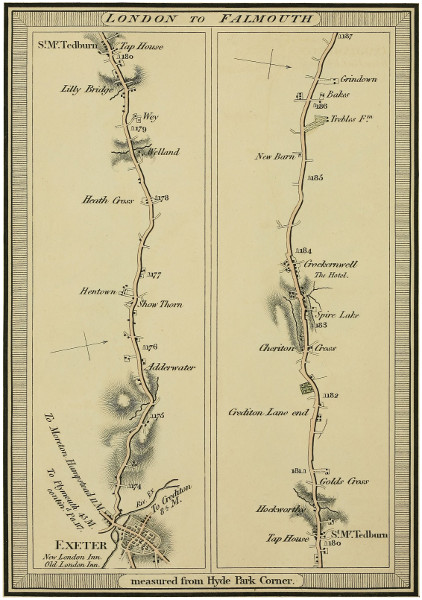
| 176 |
Adderwater, Devon, 147. |
| 203 |
Alder, Devon, 151. |
| |
Alderbury, Wilts, 209. This village is
pleasantly situated on a healthy hill, in a
good sporting country. In 1777 a fire
here destroyed 100 houses. It now contains
78 houses, and 430 inhabitants. |
| 104 |
Alfred’s Tower, Wilts, 172, a monument
erected to Alfred the Great, who, in 878,
fixed his standard against the Danish invaders
on this spot. (See Index of Seats,
Stourhead House) |
| 135 |
Allington, Dorset, 111. A parish containing
63 houses, and 716 inhabitants. |
| 174 |
Alphington, Devon, 117. A parish containing
98 houses, and 845 inhabitants. |
| 57 |
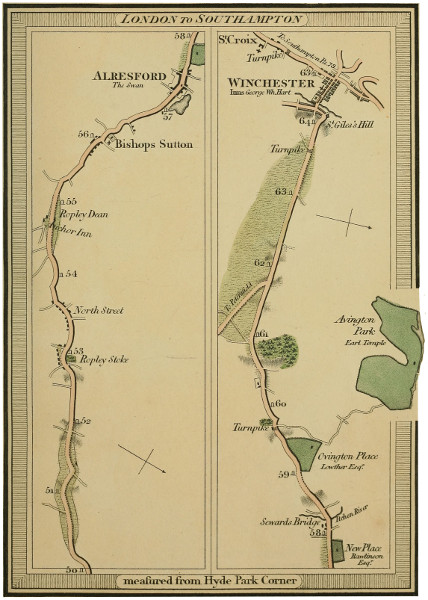
Alresford, Hants, 83. A parish and
market town. The name signifies the Ford
of Alre. The river on which it is situated
now called the Itching, rises at no great
distance. The church, a very neat structure,
with a beautiful tower, was taken
down and rebuilt in 1753. The parsonage
house is a handsome edifice, rebuilt
by the late Chancellor Hoadley. Here is a
large pond, covering near 200 acres of
ground, which being well stocked with
swans, and other water fowl, presents a
pleasing appearance. It contains about
196 houses, and 1132 inhabitants; and
has a market on Thursday. |
| 220 |
Alternan, Cornwall, 153. |
| 47 |
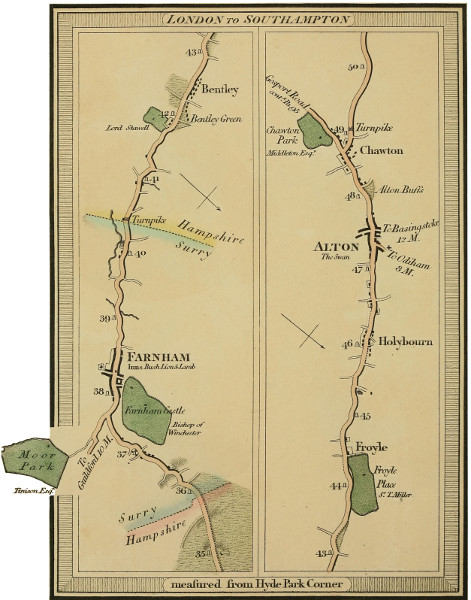
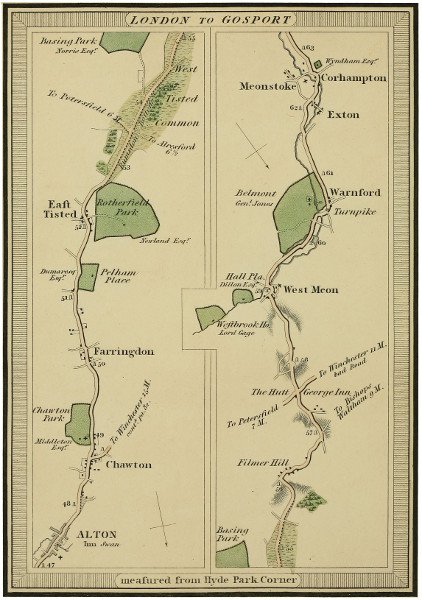
Alton, Hants, 82, 95. A market town
and parish, situated on the river Wey. The
town consists of three streets; the principal
one is wide and modern, and it has
a small neat church. Its chief manufactures
are druggets, serges, and a variety
of worsted goods; in the neighbourhood
are several hop plantations. The market
is on Saturday, and the parish contains
375 houses, and 2026 inhabitants. |
| 48 |
Alton Buffs, Hants, 82. |
| 122 |
Alvington, Somerset, 141. |
| 78 |
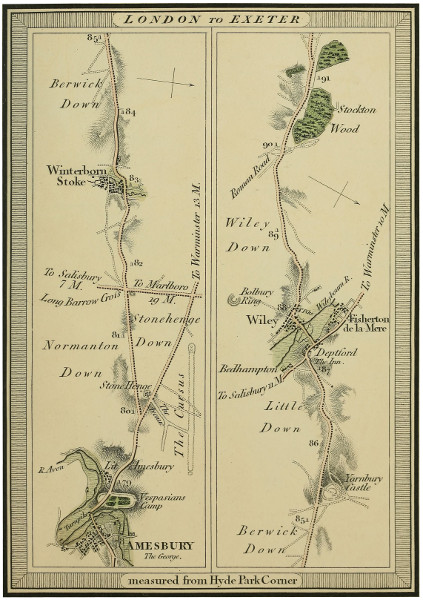
Amesbury, Wilts, 161. A market town
and parish, pleasantly situated in an open
country on the river Avon; and is of some
antiquity, having the ruins of a venerable
abbey.
The town consists principally of two
streets, the church standing in the intersection.
It contains 397 houses, and 2130
inhabitants. Market on Friday. This
place gave birth to the celebrated Mr. Addison.
The neighbourhood produces the
best kind of clay for tobacco pipes, and the
river a delicious little fish, called a loach.
Near Amesbury is a Roman camp (see
Vespasian’s Camp), and about two miles
distant is Stonehenge, which attracts numerous
travellers here.
The true origin of this stupendous structure
yet remains a matter of doubt; it is a
subject on which our antiquarians widely
differ in opinion, but the majority have
pronounced it to be the ruins of a Druidical
temple. Seventeen huge stones are
now standing, which, with seven others
lying on the ground, form the outward circular,
or oval range: the inward circle is
about eight feet from the outward one, and
has eleven stones standing, and eight fallen;
between these two circles is a walk of
about three hundred feet in circumference,
the appearance of the whole from which
is singularly awful and surprising. The
stones are from eighteen to twenty feet
high, from six to seven broad, and about
three feet thick; round it are numerous
barrows, covered with earth, raised chiefly
in the form of a bell. Many of those
which have been opened have contained
human skeletons, urns, and military weapons.
From Stonehenge an avenue about half
a mile long, between two ditches, leads to
the Cursus, which is two miles in length,
and enclosed by two ditches, three hundred
and fifty feet asunder, having a bank,
or long barrow, at each end.
Dr. Stukeley fixes the date of the erection
of Stonehenge, four hundred and sixty
years before Christ. |
| 79 |
Amesbury, Little, Wilts, 161. (Population
included with Amesbury) |
| 70 |
Amfield, Hants, 85. |
| 121 |
Amphitheatre, (commonly called Maumbury)
Dorset, 171. This amphitheatre is
allowed to be the most perfect of its kind
remaining in England. It is situated on a
plain in the open fields, and is raised on
the solid chalk upon a level; the jambs at
the entrance are somewhat worn away.
Half the work is above five feet and a half
under the surface of the ground; probably
it was framed of solid chalk, cemented
by mortar made of burnt chalk, and covered
with turf.
This amphitheatre consists of about an
acre of ground, and is supposed to have
been made under the government of Agricola.
The number of spectators it was
capable of accommodating is computed at
near 13,000. The views from the top of
the mound are extensive, including Poundbury,
Maiden Castle, and the southern
hills covered with barrows. |
| 64 |
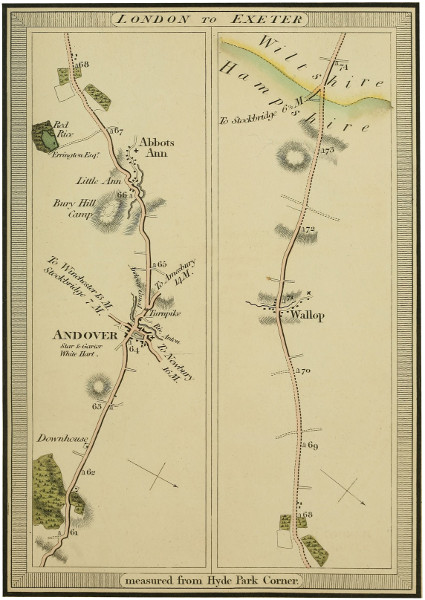
Andover, Hants, 101, 159. A borough
and market town; it is a healthy and populous
place, carrying on a considerable
traffic in shalloons, malting, &c. and sends
two members to parliament. On two hills
in the neighbourhood are the appearance
of Roman encampments. The market
house is a handsome modern building,
standing in a large open square; over it is
the council room, in which the public
business is transacted. The church is an
ancient structure. It has a market on
Saturday, and contains 657 houses, and
3304 inhabitants. Four miles distant is
held the celebrated annual fair of Weyhill,
being the largest in England for cattle,
sheep, hops, cheese, &c. and lasts fourteen
days from the 10th of October. |
| |
Angmering, Sussex, 217. A parish containing
79 houses, and 708 inhabitants. |
| 66 |
Ann, Little, Hants, 101. |
| 95 |
Ansty, Wilts, 137. A parish containing
50 houses, and 242 inhabitants. |
| 221 |
Anthony, Cornwall, 123. A parish containing
254 houses, and 1795 inhabitants. |
| 170 |
Appledore, South, Devon, 195. |
| 117 |
Arno’s Vale, Somerset, 203. |
| 61 |
Arundel, Sussex, 44, 217. A borough
and market town, seated on the side of
the river Arun, over which is a bridge;
and the river is navigable for barges.
Here stands on a hill, Arundel Castle (see
Index of Seats). The town is delightfully
situated on the declivity of a hill, and is
a borough by prescription, so ancient as
to be mentioned in King Alfred’s will. In
the church are four stately monuments of
the Earls of Arundel. Here formerly was
an harbour capable of containing ships of
100 tons burthen, though it is now much
ruined by the sea. Arundel sends two
members to parliament; has a market on
Wednesday and Saturday, and contains
334 houses, and 1855 inhabitants. |
| |
Arundel Coverts, Sussex, 217. |
| 52 |
Ash, Hants, 99. A parish containing 14
houses, and 95 inhabitants. |
| 191 |
Ashburton, Devon, 119. A borough
and market town, standing in a valley nearly
encompassed with hills. Here is a handsome
church, built in the form of a cathedral;
on the cross is a large square tower,
90 feet high, over which is a small spire;
it was once collegiate, and part of the
stalls are now standing. Ashburton sends
two members to parliament, and is one
of the four stannary towns of Devon,
(the other three being Chigford, Plympton,
and Tavistock), having several good
tin and copper mines in the neighbourhood,
which are very productive; it
has also a manufactory for serge. The
town gives the title of baron to the family
of Dunning. It has a market on Tuesday
and Saturday; and contains 370 houses,
and 3080 inhabitants. |
| 52 |
Ashcomb, Sussex, 60. |
| 136 |
Ashcot, Somerset, 191. A parish containing
71 houses, and 358 inhabitants. |
| 33 |
Ashdown Forest, Sussex, 57. |
| |
Ashfield, Hants, 220. |
| 47 |
Ashington, Sussex, 66. A parish containing
28 houses, and 173 inhabitants. |
| 92 |
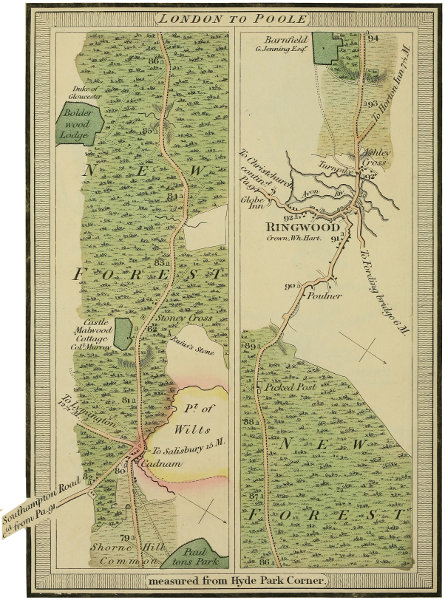
Ashley Cross, Hants, 88. |
| 101 |
Ashley Green, Wilts, 186. |
| 102 |
Ashley Wood, Wilts and Somerset, 186,
201. |
| 16 |
Ashstead, Surrey, 62. This village is
delightfully situated near the spring of the
Epsom Wells, and contains 91 houses, and
552 inhabitants. In the church are some
handsome monuments. Here King Charles
the Second was entertained, and the table
is still preserved on which he dined. |
| |
Ashton Gifford, Wilts, 207. (Population
included with Codford St. Peter’s) |
| 131 |
Askerwell, Dorset, 111. This village is
pleasantly situated in a vale, enclosed on
all sides with high hills. It contains 30
houses, and 170 inhabitants. |
| 129 |
Askerwell Down, Dorset, 111. |
| 99 |
Atford, Wilts, 200. |
| 98 |
Atford Common, Wilts, 200. |
| 181 |
Atherleigh Mill, Devon, 196. |
| 254 |
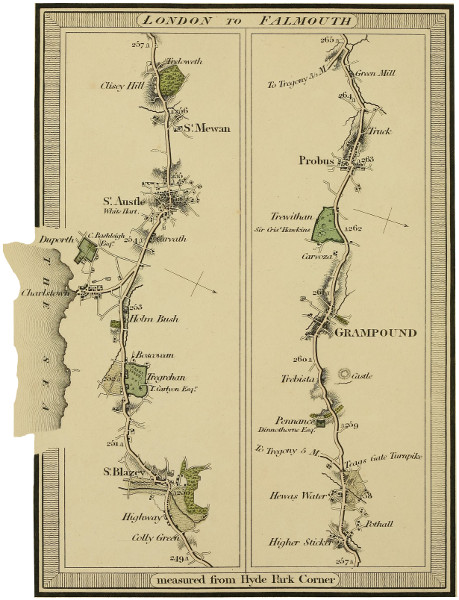
Austle, St. Cornwall, 127. A market
town, in the environs of which are several
tin mines, and quarries of porcelain clay,
which is sent to Liverpool, Bristol, and
Staffordshire, for the potteries.
The church is an ancient massy building;
about the tower are many curious ornaments
and decorations. The market,
which is held on Friday, is well supplied
with all kinds of provisions. It contains
663 houses, and 3788 inhabitants. |
| 81 |
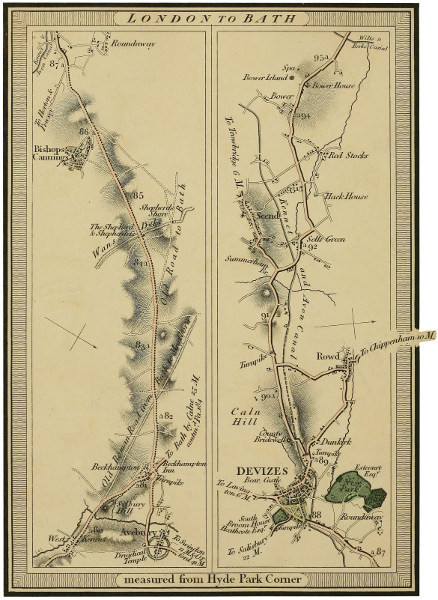
Avebury, Wilts, 183, 198. This village
contains 115 houses, and 590 inhabitants,
and is remarkable for the stupendous remains
of a Druid’s temple, being a collection
of huge stones, like that on Salisbury
Plain. (see Druidical Temple) |
| 80 |
Avenue, The, Wilts, 161. (see Amesbury) |
| 62 |
Avington, Berks, 181. A parish containing
13 houses, and 57 inhabitants. |
| |
Avisford Hill, Sussex, 217. |
| 96 |
Avon, Hants, 94. |
| 114 |
Avon Mills Bridge, Somerset, 202. |
| 146 |
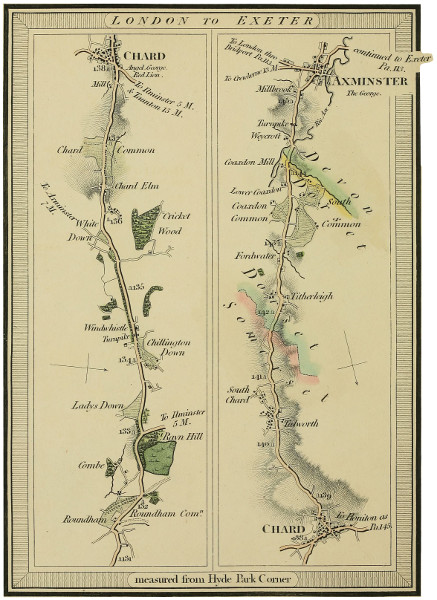
Axminster, Devon, 113, 144. A market
town, deriving its name from the river
Axe, on which it stands: and the minster, or
monastery, erected here by Athelstan for
seven priests to pray for the souls of those
killed in his army, when he defeated the
Danes in the neighbouring field, which is
still called King’s Field. The town is
clean and neat, and reckoned very healthy.
Here is a considerable manufactory for
broad and narrow cloth, but more particularly
for carpets; also for cotton tapes,
druggets, leather breeches, and gloves.
The market, reckoned the first in the
county, is held on Saturday. It contains
456 houses, and 2387 inhabitants. |
| |
|
| 119 |
Babylon Hill, Dorset, 141. |
| |
Badsley Common, Hants, 211. |
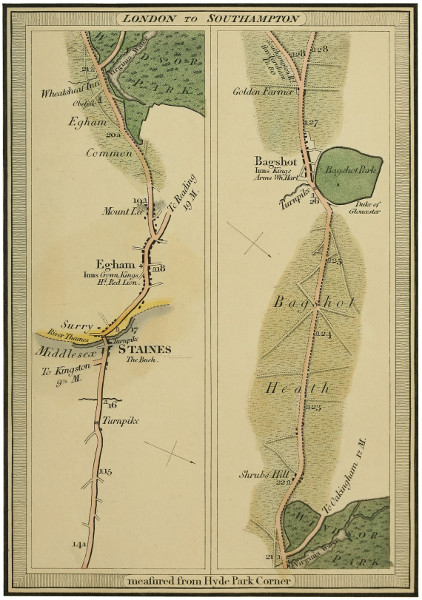
| 26 |
Bagshot, Surrey, 72. This place is famous
for its excellent mutton brought here
from the Hampshire Downs; it was formerly
called Holy Hall; and here our
kings had a house and park, which was
laid open after the civil wars: the church
was rebuilt in 1676, after having been
destroyed by lightning. It contains 182
houses, and 1136 inhabitants. |
| 21 |
Bagshot Heath, Surrey, 72, is mostly a
barren desert, but upon its borders are a
great number of handsome seats. |
| 21 |
Bailies, Bucks, 175. |
| 228 |
Bake Lane End, Cornwall, 124. |
| 186 |
Bakes, Devon, 148. |
| 141 |
Balay Down, Dorset, 145. |
| 5 |
Balham Hill, Surrey, 45. |
| |
Ball’s Hut, Sussex, 216. |
| 211 |
Bamham, Higher, Cornwall, 152. |
| 211 |
Bamham, Lower, Cornwall, 152. |
| 15 |
Bansted Common, Surrey, 47. |
| 12 |
Bansted Downs, Surrey, 46. This is one
of the most delightful spots in England,
having a command of prospect for 30
miles round, including a view of the royal
palaces of Windsor and Hampton Court,
London and Westminster. The turf here
is of the most beautiful verdure, intermixed
with thyme and other fragrant
herbs, which renders the mutton fed upon
the Downs particularly sweet. On these
Downs is Epsom Race Course, much frequented
in the season. In the neighbourhood
are many elegant seats. |
| 41 |
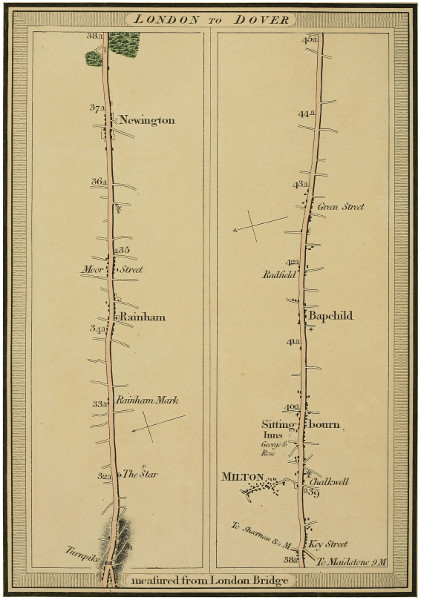
Bapchild, Kent, 6. This village contains
48 houses, and 224 inhabitants. In
the church window are many remains of
painted glass, particularly of the arms of
the see of Canterbury. On the north
side of the road are the remains of the
building which was used as a resting place
by the pilgrims who visited St. Thomas
à-Becket’s shrine at Canterbury. |
| |
Bapton, Wilts, 207. (Population included
with Fisherton de la Mere) |
| 87 |
Barford, Wilts, 136. A parish containing
91 houses, and 450 inhabitants. |
| 88 |
Barford Heath, Wilts, 136. |
| 59 |
Barham Downs, Kent, 8. A most delightful
spot, where the Canterbury races are
annually held in August. The course has
been extended from two to four miles, and
a handsome building erected for the accommodation
of the visitors. |
| 185 |
Barn, New, Devon, 148. |
| 96 |
Barn, New, Wilts, 137. |
| 230 |
Barron Down, Cornwall, 155. |
| 126 |
Barrows, Somerset, 142. |
| 45 |
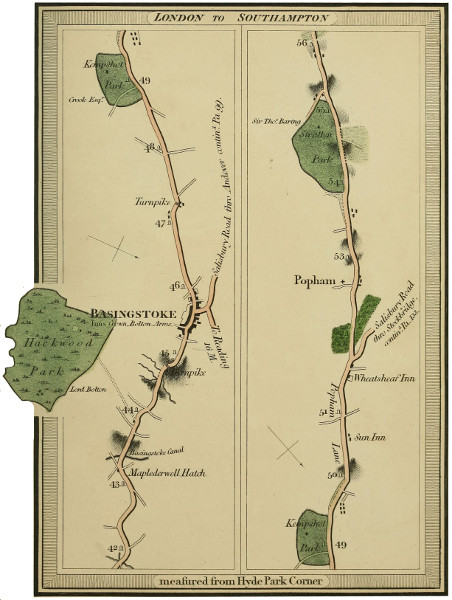
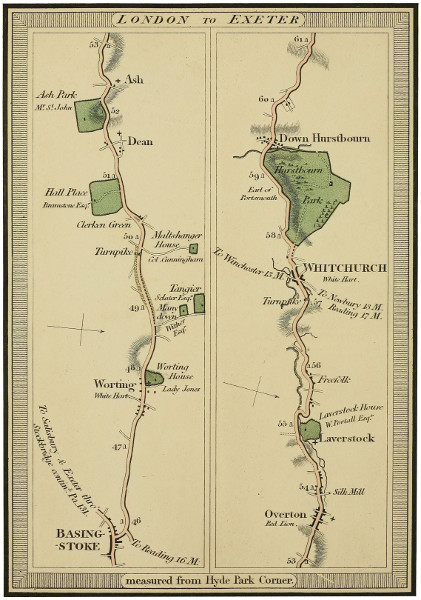
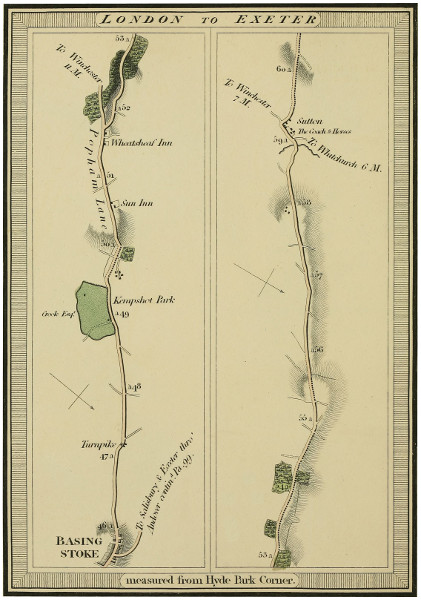
Basingstoke, Hants, 75, 99, 131. A
market town of some antiquity, pleasantly
situated in a fine open country. The
church is ancient; near it stands a free
school, and it has also three charity schools,
one of which is supported by the Skinners’
Company of London. The remains of the
chapel of the Holy Ghost stands on a considerable
eminence near the town; it was
formerly a fine edifice, richly ornamented
with scriptural pictures. The town has a
manufactory of druggets and shalloons,
and has a good market house, and a town
hall over it, where the sessions are held
twice a year, and the magistrates meet
weekly. It contains 501 houses, and 2589
inhabitants, and the market on Wednesday
is very considerable for provisions, corn,
and cattle. |
| 106 |
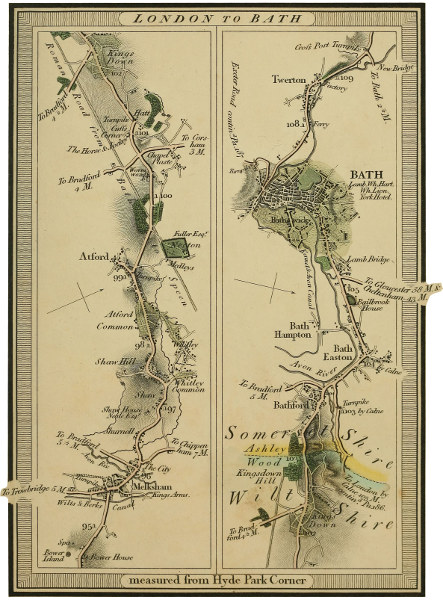
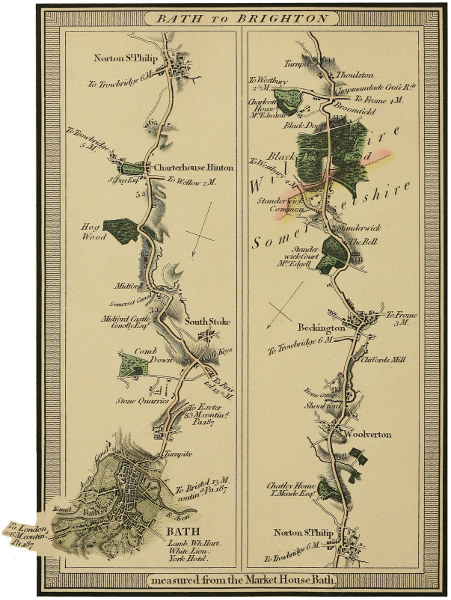
BATH, Somerset, 187, 201, 204. The
city of Bath is justly esteemed the most
elegant town in England. The hot baths,
from which it derives its name, were
known in the Roman times; nor was their
celebrity lost even in the dark period of
Anglo Saxon history. But the town has
been greatly enlarged and decorated in the
last century. The waters are used both
internally and externally, chiefly in gout,
bilious, and paralytic cases, being frequented
twice in the year, what is called
the spring and autumnal seasons. Two-thirds
of the company are attracted merely
by amusement, society, and dissipation;
in all of which it is only second to London.
But so great are the attractions of this
celebrated spot, and the reputation of
these waters has so much increased, that
Bath has become the constant residence,
not only of many opulent invalids, but
also of numerous votaries of pleasure.
The baths consist of the King’s, the
Queen’s, the Cross, the Hot, the Corporation,
and the Duke of Kingston’s Baths.
The taste of the water is pleasant, impregnated
with a vitriolic principle, which
yields, upon evaporation, a small portion of
neutral salt, with a calcareous earth and
iron. At the King’s Bath is a handsome
pump room, where the company drink the
waters in the morning, and where an excellent
band of music enlivens the scene.
The amusements of this gay city are various,
rational, and well conducted. They
consist chiefly of assemblies, balls, concerts,
card parties, and public breakfasts;
besides the theatre. There are two sets
of assembly rooms, termed the Upper and
Lower, where the amusements are alternately
held: the former of these stands
on the walks leading from the Grove to
the Parade; and the latter, on the east
side of the Circus.
The city, except a little opening to the
east and west, through which the Avon passes,
is surrounded on all sides by hills. It
has an elegant bridge, and the river has been
made navigable to Bristol. It was formerly
surrounded with a slight wall, of which
there still appears some remains, as well
as one or two of its gates. Most of the
new buildings, and by far the largest and
finest part of the city, are without the
walls, particularly Queen Square, in the
midst of which is a garden, with gravel
walks, and an obelisk in the centre; but a
principal ornament is the Circus, the
houses of which are built on a uniform
plan, with three openings at equal distances,
leading into as many streets. The
fronts of the houses are adorned with
three rows of columns, in pairs, of the
Doric, Ionic, and Corinthian orders, and
the frieze embellished with sculpture. In
the centre is a reservoir of water, filled from
springs rising in the neighbouring hills.
On the north and south sides of the
town are the north and south parades,
paved with hewn stone, raised upon arches,
having an elegant row of houses on one
side, and a stone balustrade opposite.
Among the late improvements of Bath,
the Royal Crescent forms a striking feature,
standing upon an eminence. Behind
the crescent is St. James’s Square, which,
with Landsdown Crescent, Catherine
Place, Rivers Street, &c. enjoys every
advantage of air, prospect, and scenery.
Orange Grove, between the Abbey Church
and the lower rooms, is a beautiful open
area, planted with rows of elms, &c. The
Guildhall is situated in the high street.
Here is a noble infirmary, or general hospital,
for the sick and lame from all parts
of the kingdom. It is 100 feet in front,
and 90 in depth, capable of containing
150 patients. It was built in 1738, by
William Pulteney, afterwards Earl of Bath.
The monastery here, of which the cathedral
was the church, was a truly venerable
pile; the other churches are St. James, St.
Michael, the Abbey Church, or St. Peter
and St. Paul, Walcot, and Christ’s Church.
There are several chapels and meeting
houses, as well as hospitals, almshouses,
and charity schools.
Bath is governed by a mayor, recorder,
aldermen, twenty common council, and
a town clerk; sends two members to
parliament; and, joined with Wells, forms
a bishoprick, called the diocese of Bath
and Wells. The number of aldermen,
out of which the mayor and two justices
are chosen, is not to exceed ten, or be
less than four: and out of the common
council are yearly elected two bailiffs, or
sheriffs, and two constables. The senior
of the common council is always the
chamberlain. The markets are here principally
on Wednesday and Saturday, and
are plentifully supplied with all kinds of
provision: excellent mutton is produced
from the feed on Lansdown, one of the
highest hills which overlooks the city,
about three miles in extent, on which is
annually held, on the 10th of August, a
fair for horses, cheese, and all kinds of
merchandise. The fish market, on Monday,
Wednesday, and Friday, far excels
that of any inland town in the kingdom.
Bath contains 4279 houses, and 31,496 inhabitants,
exclusive of the out parishes of
Bath Hampton, Bathwick, Bathford, and
Batheaston, which contain 670 houses,
and 4514 inhabitants. |
| 104 |
Batheaston, Somerset, 187, 201. (For
Population see Bath) |
| 103 |
Bathford, Somerset, 186, 201. A Roman
pavement was discovered here, in the
seventeenth century, in digging a cellar.
(for Population see Bath) |
| 104 |
Bath Hampton, Somerset, 187, 201.
(for Population see Bath) |
| 154 |
Bath Pool, Somerset, 193. |
| 106 |
Bathwick, Somerset, 187, 201, 204.
(For Population, see Bath.) |
| 5 |
Battersea Rise, Surrey, 23. |
| 56 |
Battle, Sussex, 22. A market town
and parish. The old name of this place,
was Epiton, but it took its present
appellation from the famous battle of
Hastings, gained by William the Conqueror
over Harold, in 1066; the Conqueror
having first landed near Pevensey,
a few miles distant. In memory of this
victory, William founded here a celebrated
abbey, called Battle Abbey; one of those
religious houses which had, anciently, the
privilege of sanctuary. From its remains,
it appears to have been very magnificent,
being near a mile in circumference; its
abbot was mitred. The gate-house is entire
and is now converted into a place
for holding the sessions, and other public
meetings. On one part of the site of the
abbey stands a mansion, belonging to Sir
Godfrey Webster, called the Abbey. (See
Index of Seats)
The town stands in a valley, and is reckoned
rather unhealthy from its situation.
Near this town is Beacon Hill, formerly
called Standard Hill, where the standard of
the Conqueror was first planted. There
are several powder mills in the neighbourhood;
and the town has been long famous
for the best gunpowder in Europe. The
weekly market is on Thursday, which, till
1600, was held on Sunday; it has also a
very large market on the second Tuesday
in every month. It contains 291 houses,
and 2040 inhabitants. |
| 142 |
Bawdrip, Somerset, 192. A parish containing
51 houses, and 244 inhabitants. |
| 106 |
Bayford, Somerset, 165. |
| 233 |
Beacon Hill, Cornwall, 155. |
| 75 |
Beacon Hill, Wilts, 160. |
| 166 |
Beam Bridge, Somerset, 194. |
| 197 |
Bearah, Devon, 120. |
| 28 |
Bear Green, Surrey, 63. |
| 45 |
Bears In Gate, Sussex, 66. |
| 81 |
Beckhampton, Wilts, 184, 198. A tything
to the parish of Avebury, containing
18 houses, and 99 inhabitants. |
| |
Beckington, Somerset, 205. This village
contains several streets, and was formerly
of considerable importance, particularly
in the manufacture of woollens; some of
which are still made here. The houses
are built of stone, in number 247, containing
1469 inhabitants. |
| 13 |
Bedfont, Middlesex, 70. A parish containing
82 houses, and 456 inhabitants. |
| |
Bedhampton, Hants, 214. A parish containing
52 houses, and 305 inhabitants. |
| 87 |
Bedhampton, Wilts, 162, 207. |
| |
Bedhampton, Little, Wilts, 207. |
| 68 |
Bedwin, Little, Wilts, 182. A parish containing
81 houses, and 428 inhabitants. |
| 194 |
Beer Bridge, Devon, 149. |
| 200 |
Beggars Bush, Devon, 120. |
| 276 |
Belle Vue, Cornwall, 130. |
| 240 |
Belovely, Cornwall, 156. |
| 82 |
Bemerton, Wilts, 136, 208, (Population
included with Fugglestone) |
| |
Bemont, Wilts, 209. |
| 57 |
Benges Wood, Sussex, 39, 42. |
| 42 |
Bentley, Hants, 81. Here is an extensive
hop plantation, and the hamlet contains
94 houses, and 504 inhabitants. |
| 42 |
Bentley Green, Hants, 81. |
| 62 |
Bere Forest, Hants, 31. |
| 233 |
Berry Tower, Cornwall, 155. |
| 68 |
Bersted, South, Sussex, 41, 42. This village
contains 94 houses, and 737 inhabitants. |
| 84 |
Berwick Down, Wilts, 161. |
| 93 |
Berwick, St. Leonard’s, Wilts, 163. A
parish containing only 8 houses, and 36
inhabitants. |
| 11 |
Bexley Heath, Kent, 2. |
| 188 |
Bickington, Devon, 119. A hamlet and
chapelry to the parish of Ashburton, containing
40 houses, and 243 inhabitants. |
| 202 |
Bidlake, Great, Devon, 151. |
| 202 |
Bidlake, Little, Devon, 151. |
| 123 |
Bincomb Down, Dorset, 171. |
| 57 |
Binderton, Sussex, 36. A hamlet containing
4 houses, and 53 inhabitants. |
| |
Birch Wood, Hants, 210. |
| 16 |
Birch Wood, Surrey, 47. |
| 86 |
Bishops Cannings, Wilts, 198. A parish
containing 212 houses, and 1108 inhabitants. |
| 93 |
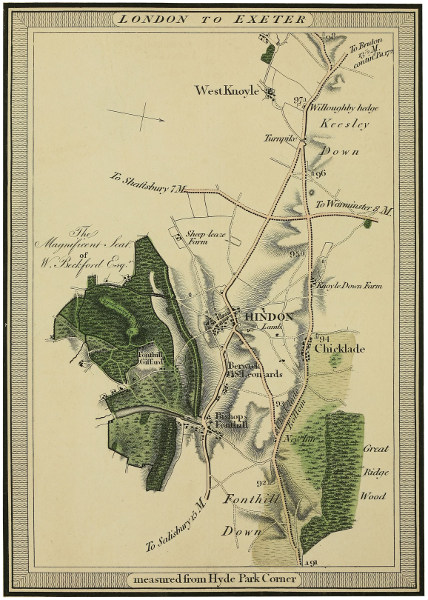
Bishops Fonthill, Wilts, 163. A parish
containing 39 houses, and 194 inhabitants. |
| 158 |
Bishops Hull, Somerset, 194. A parish
containing 96 houses, and 683 inhabitants. |
| 56 |
Bishops Sutton, Hants, 83. A village
containing 60 houses, and 379 inhabitants. |
| 202 |
Bittaford Bridge, Devon, 121. |
| 117 |
Black Castle, Somerset, 203. |
| |
Black Dog, Wood, Wilts and Somerset,
205. |
| 111 |
Blackford, Somerset, 165. A village, containing
26 houses, and 159 inhabitants. |
| 5 |
Black Heath, Kent, 1. Situated on the
South side of Greenwich; a most beautiful
spot, commanding extensive prospects
over the adjacent country and the river
Thames, having a full view of the Ranger’s
house in the park, Greenwich hospital, the
new docks at Poplar, a multitude of
shipping, and a distant view of the metropolis;
it was on this plain that the Kentish
rebel, Wat Tyler, mustered 100,000
men. In the park is the Royal Observatory
for the King’s astronomers, to which there
is a steep ascent on all sides except one,
and it has a deep dry well for observations
in the day time. On the right
stands Morden College, built by Sir John
Morden, for decayed Turkey merchants;
and in the neighbourhood are many beautiful
villas
In 1780, a cavern was discovered on
the side of the ascent to Blackheath
by the Dover road, consisting of seven
large rooms, from 12 to 36 feet wide;
the whole range having a communication
by arched avenues: some of these
apartments have large conical domes, 36
feet high, supported by a column of chalk,
43 yards in circumference; the bottom of
the cavern is 50 feet from the entrance,
and at the extremities 160 feet, the descent
to which is by a flight of steps; the sides
and roofs are also rocks of chalk, and the
bottom a fine dry sand. 170 feet under
ground is a well of clear water, 27 feet deep. |
| 187 |
Blackpool, Devon, 118. |
| 103 |
Blackstone, Dorset, 139. |
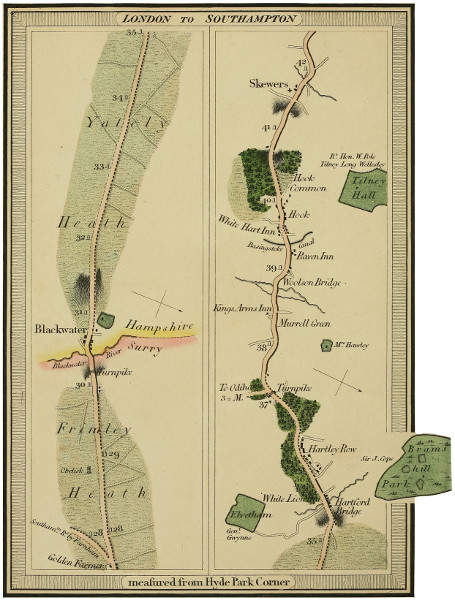
| 30 |
Blackwater, Hants, 73. |
| 104 |
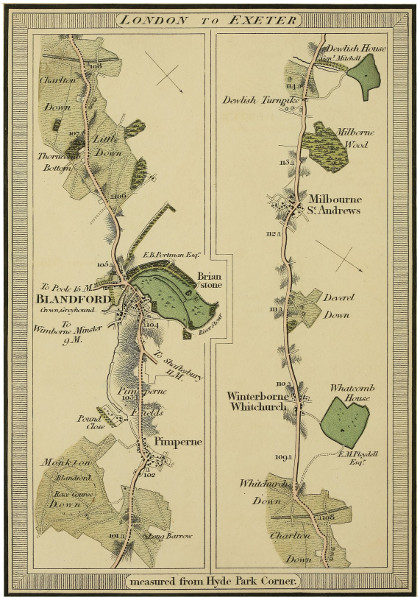
Blandford, Dorset, 107. A market
town and parish, pleasantly situated on the
river Stour, near the Downs; its principal
manufactures consist of thread, and shirt
buttons.
The town is very ancient, and appears to
have been a settlement of the Britons long
before the arrival of the Romans. It gave
the title of Marquis to John Churchill, Duke
of Marlborough, which has still descended
in the family; and formerly sent members
to parliament. The church is a neat
structure, in the Grecian style. The
streets are handsome, and the houses in
general well built of brick. It has suffered
more by fires than any other town in England.
Blandford contains 405 houses,
and 2326 inhabitants; and has a market
on Saturday, which is well supplied. |
| 101 |
Blandford Race Course, Dorset, 107. |
| 250 |
Blazey, St., Cornwall, 127. A township to
the parish of St. Austle, situated upon an
inlet from the Sea, and containing 87
houses, and 467 inhabitants. |
| 222 |
Blerack, Cornwall, 123. |
| 24 |
Blindley Heath, Surrey, 56. |
| 74 |
Blockhouse, Hants, 98. |
| 44 |
Bloom End, Berks, 178. |
| |
Bodenham, Wilts, 209. A parish containing
50 houses, and 221 inhabitants. |
| 233 |
Bodmin, Cornwall, 155. A borough and
market town, standing almost in the centre of
the county, between two hills. This place appears
to have been very considerable some
centuries past; having a bishop’s see erected
here by King Edward, in 905: but, during
the Danish wars, translated to St. Germain’s,
and afterwards to Kirton in Devonshire,
and thence to Exeter, where it remains.
It sends two members to parliament,
which it has done ever since the
reign of Edward the First. The town
consists chiefly of one long street, running
east and west for nearly a mile; the church
is an ancient fabric, but the spire was
destroyed in 1699 by lightning. The
summer Assizes, and Michaelmas Quarter
Sessions are held here, and the
new county gaol and bridewell, form a
handsome building, well situated for the
health of the prisoners, and built after the
Howardian plan.
There is a remarkable well near the
town, the water of which is heavier than
most others; and will keep pure the greater
part of a year. In the neighbourhood are
some monumental stones, called the Hurlers,
supposed to be the remains of a
Druid’s temple, they stand on a down in
three circles.
This place is noted in history for being
the head quarters of Perkin Warbeck, who
styled himself the son of Edward the
Fourth; and here Humphrey Arundel,
governor of St. Michael’s Mount, in the
reign of Edward the Sixth, collected an
army of 10,000 men. It has a good market
on Saturday, well supplied with corn
and all kinds of provisions. Bodmin contains
325 houses, and 2299 inhabitants. |
| 234 |
Bodmin Down, Cornwall, 155. |
| 223 |
Bodmin Moor, Cornwall, 154. |
| 235 |
Bodwanic, Cornwall, 155. |
| 70 |
Bognor, Sussex, 41, 42. This village is
much frequented in the summer season for
sea bathing. It is an extensive assemblage of
modern brick buildings, without any regular
plan; which originated with the speculation
of the proprietor, the late Sir Richard
Hotham. It has a new assembly room
near the sea, and a very neat modern chapel. |
| 88 |
Bolbury, or Bilbury Rings, Wilts, 162.
This encampment occupies a point of Down,
projecting from the great ridge, and is
supposed to be of British origin. It is
defended on the east by double, and on
the west by triple entrenchments; the
outward one being very broad and flat.
The exterior vallum is 990 yards in circuit,
and the ramparts 20 feet high, including
an area of seventeen acres and a
quarter; within which is another work
of an irregular form. Many British and
Roman antiquities have been here discovered.
It has several entrances, some of
which appear to be of modern formation. |
| |
Boreham, Wilts, 206. (Population included
with Warminster.) |
| 252 |
Boscovean, Cornwall, 127. |
| 50 |
Bosenden Wood, Kent, 7. |
| |
Bosham, Sussex, 215. This village stands
on the east point of land at the entrance
of Bosham Creek.
The only thing worthy of notice in this
place is the church, a spacious Gothic
building, erected at the expence of the
bishop of Exeter, in 1119, in the reign of
Henry the First. It was made collegiate
for a dean and prebendary, and enjoyed
many privileges till the general dissolution,
when it was made parochial. The stalls
are still standing, over which are some curious
ancient carving, |
| |
Bosham Creek, Sussex, 215. |
| |
Bosham Pound, Sussex, 215. |
| |
Botley, Hants, 212. A parish containing
98 houses, and 614 inhabitants. |
| 49 |
Boughton, Kent, 7. A parish containing
174 houses, and 884 inhabitants. The
church has two aisles, and contains several
very ancient monuments; it has also a
very good stone tower, the spire of which
fell down about the close of the sixteenth
century. It has two charity schools, in
which one hundred children are educated.
In 1716, a complete human skeleton was
dug up, near the road side, with a hanger,
and a brass coin of Antoninus Pius. Adjoining
was anciently Blean Forest, which
abounded with boars, wolves, and other
animals of chase. |
| 50 |
Boughton Hill, Kent, 7. This hill commands
a most extensive and beautiful prospect. |
| 104 |
Bourton, Dorset, 164. A hamlet containing
112 houses, and 637 inhabitants. |
| 103 |
Bourton Bridge, Dorset, 164. |
| 185 |
Bovey Heath, Devon, 118. |
| 108 |
Bow Bridge, Somerset, 139. |
| 94 |
Bower, Wilts, 199. |
| 94 |
Bower Island, Wilts, 199. |
| 178 |
Bowhill, Devon, 196. |
| 101 |
Box, Wilts, 186. A parish containing
210 houses, and 1165 inhabitants. |
| |
Boxgrove, Sussex, 216. A parish containing
131 houses, and 682 inhabitants. |
| 21 |
Box Hill, Surrey, 63. This hill derives its
name from the number of box trees growing
on it, planted by the Earl of Arundel
in the reign of Charles the First. These
groves are interspersed with a number of
small open spaces and agreeable walks;
from whence, on a clear day, the prospect
is beautifully varied and extensive,
the immediate vicinity of the hill being
greatly enlivened by the windings of the
river Mole.
A few years ago, an eccentric man, requested
to be buried on the summit of this
hill, in an erect posture; and, at his decease,
this singular request was complied
with. In the neighbourhood are a number
of gentlemen’s seats. |
| |
Boyton, Wilts, 207. A parish containing
41 houses, and 248 inhabitants. |
| 122 |
Bradford Down, Dorset, 110. |
| 123 |
Bradford Heath, Dorset, 110. |
| 239 |
Bradock Common, Cornwall, 125. |
| 178 |
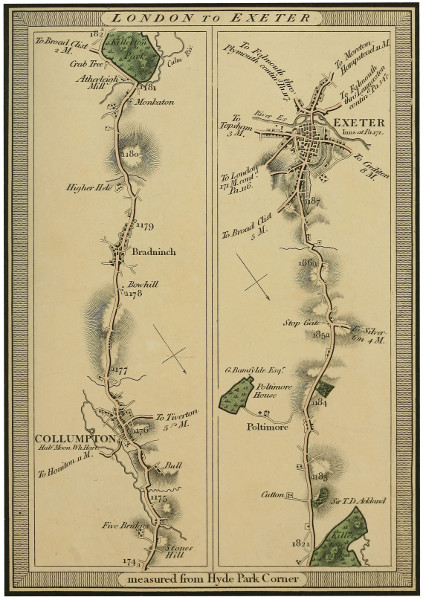
Bradninch, Devon, 196. This town is
nearly a mile in length consisting chiefly
of one large irregular street, and the houses
but indifferently built. Its principal manufacture
is paper. It formerly sent members
to parliament till the reign of Henry
the Seventh, but on a complaint that the
inhabitants were not able to pay them their
wages, 2s. per day, they were excused
on the payment of five marks. The church
is an ancient Gothic building. It contains
247 houses, and 1187 inhabitants, and has
a trifling market on Tuesday. |
| 199 |
Brent Bridge, Devon, 120. |
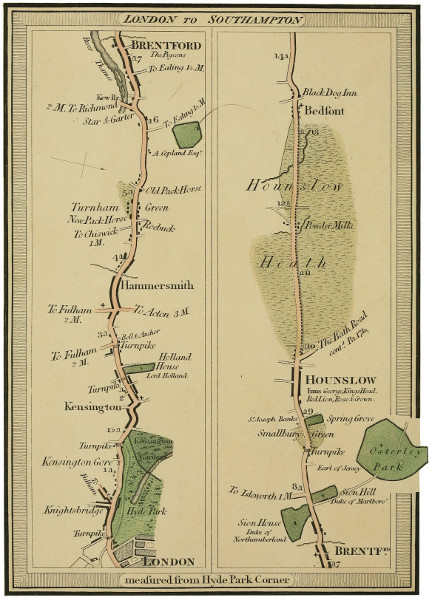
| 7 |
Brentford, Middlesex, 69, a market
town. It is divided into New and Old Brentford,
and is named from the small river Brent,
over which it had a ford, and which here
empties itself into the Thames. The
church was originally built in the reign of
Edward the First, being a chapel of ease
to Great Ealing, and was rebuilt, except
the tower, in 1654. This place affords
employment to its numerous poor, having
a flour mill on the same construction as
the late Albion Mills, formerly situated at
the foot of Blackfriars Bridge; a large pottery,
extensive brick fields, and a very
large malt distillery.
At the extremity of New Brentford, towards
London, on the opposite side of the
Thames, is Kew Palace, formerly the occasional
residence of His Majesty; near which,
on the banks of the Thames, His Majesty has
erected a magnificent Gothic building, said
to have been intended as a residence for the
Queen.
The members of parliament for the county
are here chosen, and the market on Tuesday
is well supplied with all kinds of provision,
corn, cattle, &c. Brentford contains
304 houses, and 1733 inhabitants. |
| 197 |
Brent Harberton Ford, Devon, 120. |
| 199 |
Brent, South, Devon, 120. A parish containing
163 houses, and 1032 inhabitants. |
| 97 |
Brickers, Wilts, 186. |
| 200 |
Bridestow, Devon, 150. A parish containing
91 houses, and 581 inhabitants. |
| 230 |
Bridge, Cornwall, 124. |
| 58 |
Bridge, Kent, 8. This village is situated
in a valley, by the side of the river Stour;
and contains 42 houses, and 325 inhabitants. |
| 126 |
Bridge, Somerset, 168. |
| 245 |
Bridge End, Cornwall, 126. |
| 105 |
Bridge, High, Dorset, 139. |
| 75 |
Bridge, Mary, Hants, 98. |
| 212 |
Bridge, New, Devon, 122. |
| 96 |
Bridge, New, Dorset, 89. |
| 109 |
Bridge, New, Somerset, 201. |
| 102 |
Bridge, New, 186. |
| 145 |
Bridgewater, Somerset, 192. A borough
and market town, seated on the river
Parret, over which is a stone bridge; here
the tide rises at high water 6 fathoms,
and sometimes flows in with such impetuosity,
that it rises near two fathoms deep
at a time; which often occasions considerable
damage to the shipping, driving
them foul of each other, and oversetting
the small craft. It is termed the boar, and
is frequent in the rivers of the channel,
particularly the Severn.
The church is a handsome spacious
structure, containing a fine altar piece of our
Saviour taken from the Cross, by Guido, and
the spire is the loftiest in the county. Near
the church is a handsome free school, built
of stone; the town hall is a large building,
beneath which is a cistern, whence
the inhabitants are supplied with water.
It was first incorporated as a borough by
King John, who built a castle here, and it
was one of the first towns seized by the
barons in the reign of Henry the Third,
being then considered of great importance.
The Duke of Monmouth was here proclaimed
king, and lodged sometime in the
castle; but being betrayed by Lord Gray,
and his army consisting chiefly of raw countrymen,
he was defeated by the royal army,
on a moor near Weston, 3 miles distant; when
1000 were killed, and 1500 taken prisoners;
and here Judge Jefferies and Colonel Kirk
had most of the survivors executed.
The houses in general are irregular, but
the streets are wide, and well paved. It
sends two members to parliament, and has a
market on Tuesday and Saturday; at the
former, cattle of all kind are sold, and
cheese in great quantities, and provisions
of all sorts, are plentiful. The midsummer
county sessions are held here, and
the assizes every other year. Through
the convenience of its navigation it has
also a very good coasting-trade, and a
number of coal ships are constantly employed.
Bridgewater contains 916 houses,
and 4911 inhabitants. |
| 134 |
Bridport, Dorset, 111. A borough and
market town, situated between two branches
of the river Brit, which joins below the
town, and falls into the sea, having once
had a convenient harbour, but which now
is choaked up with sand. The town consists
of three good spacious streets, some
of the houses being built of stone, and
some of brick. The East, West, and South
streets, are in the form of a T, having several
back lanes or passages. In the centre of
the town has been erected a very handsome
market house. It is a very ancient corporation,
and has sent members to parliament
ever since the 23d of Edward the First.
The church, dedicated to St. Mary, is a
large neat building, near the centre of the
town, in the form of a cross, with a tower in
the middle, 72 feet high. Its chief manufacture
is in twine, sail-cloth, and hats.
Bridport contains 520 houses, and 3567
inhabitants, and has two market days, Wednesday
and Saturday, both of which are
well supplied with fresh meat. |
| 54 |
Brighton, or Brighthelmstone,
Sussex, 51, 60, 219. A sea-port and
market town of some antiquity. It
was once fortified, and some traces of
the walls are still left. Queen Elizabeth
erected here four gates. A flint wall,
three feet thick towards the sea, and a
block house, had been built before in the
reign of Henry the Eighth. The town was
of little or no consequence, being chiefly
inhabited by fishermen, and has only
risen to its present state, as a fashionable
resort for sea-bathing, within these few
years; being now enlarged with many new
streets, elegant buildings, &c. The houses
of the new streets, particularly the Steyne
and the Crescent, are elegantly built, and
chiefly lodging houses. North-street, furnishes
handsome shops of every description,
and there is a neat little theatre.
There are also two elegant assembly rooms,
with suits of card, tea, and supper rooms;
those at the Castle Tavern are open every
night during the season, as are also those
at the Old Ship, which are little inferior.
The Steyne is a fine lawn, on the
eastern part of the town, which is the
general parade for the company. On the
Steyne are the North and South Parades,
Blue and Buff Parade, Steyne-place, or
South and Steyne Row; besides this,
there are two other Steynes, but both inferior
to the preceding. One is called the
New Steyne, and is situated in the east of
the town leading to Rottingdean; the
other, the North Steyne, but more commonly
the Level, both having many handsome
buildings. The promenade commences
after the heat of the day, and
continues till dark; a choice band of music
playing all the while. The Prince Regent
has an elegant mansion here, called
the Pavilion. (see Index of Seats.)
There are two public libraries on the
Steyne, furnished with all the newspapers,
periodical publications, &c. This is the
morning lounge for every vehicle of news
There are also a suite of hot, cold, vapour
and salt-water baths, for those who may not,
or do not choose to plunge into the ocean.
There are also air-pump water baths, for
the relief of persons afflicted with the
gout, or violent scorbutic affections; the
ingenious invention of Mr. Nathan Smith,
of Artillery-place. The baths are situated
near the Steyne, and were first erected
in 1789. On one side of a handsome
vestibule are six cold-baths, and on the
other side, the hot baths.
The streets nearly intersect each other at
right angles, and are very clean and neat.
Among the recent improvements, the handsome
row of uniform houses, called Dorset
Garden, deserves to be noticed; in front, is an
extensive well planned garden, while two octagon
temples ornament the pleasure ground.
The road is composed of chalk and sea beach,
with a spacious foot pavement of bricks on
each side, which is entirely dry, almost immediately
after the most heavy rains. The
town is also well lighted, and from its vicinity
to the metropolis, and accommodation
of every kind, it may justly rank as the
first watering place in the kingdom.
The church stands on a hill near the town,
and has a square tower, which may be seen
a considerable distance at sea, having the
figure of a dolphin for a vane. From its increase
of population, a Chapel Royal has
been erected within these few years, which is
sufficiently spacious to contain 1000 persons.
About half a mile west of the church is a
chalybeate spring, much frequented; it has
been found serviceable in several cases of
debility, indigestion, &c. The proprietors
have erected a neat lodge over the spring,
and near it a very handsome mansion.
Although the town itself is not observable,
it lying so low that in several bombardments
by the enemy, the balls have gone
over it without doing any damage, it is
now flanked with some strong batteries.
The town is not incorporated, but an act
was passed about 30 years ago, vesting a
power in 36 inhabitants, as commissioners,
to erect a market, pave, light, and cleanse
the streets, and to execute all necessary
matters for the good order of the place.
Brighton contains 1282 houses, and 7339
inhabitants.
At this place Charles the Second embarked
for France, in 1651, after the battle of
Worcester.
The only manufacture here, (if it may
be termed one) is the making of part
of the nets for the use of the fishery,
the materials coming from Bridport. The
fishery employs about 100 boats, carrying
some three, four, and five men each. The
mackarel season commences in April, and
that for herrings in October. Independent
of these almost every kind of fish
are also found in plenty, and to be purchased
every day. To the fishery, and
the numerous visitants during the bathing
season, the inhabitants look up for support.
But what has particularly enlivened
the town of late years, during the war,
has been the encampment of several regiments
of regulars and militia, on the levels
to the west of the town, between Brighton
and Hove; and it is now much benefited
by the numerous travellers to France, embarking
from hence to Dieppe, and also
from its being the favourite country residence
of the Prince Regent. The principal
market day is on Thursday; but it is open
every day except Sunday, and well stored
with every kind of provision.
The mutton of this place, being chiefly fed
on the South Downs, is particularly admired
for its fine flavour. The Downs afford most delightful
rides, and pleasing land and sea views.
The race-ground, which is fenced in, and
properly attended to, is justly admired.
The races, which last four or five days, are
usually the first week in August, when it is
esteemed the fullest part of the season. |
| 57 |
Brighton Race Ground, Sussex, 60. |
| 129 |
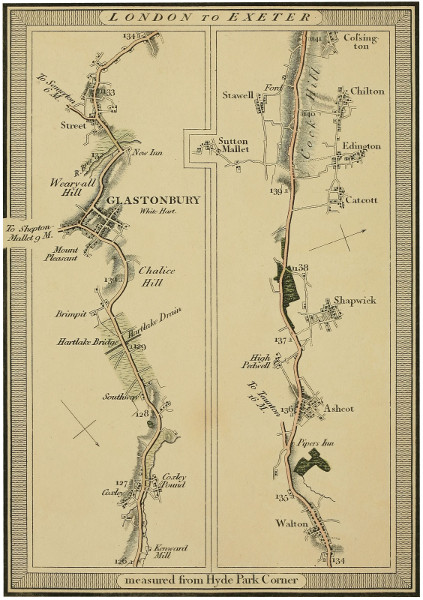
Brimpit, Somerset, 190. |
| 239 |
Brin, Cornwall, 156. |
| 117 |
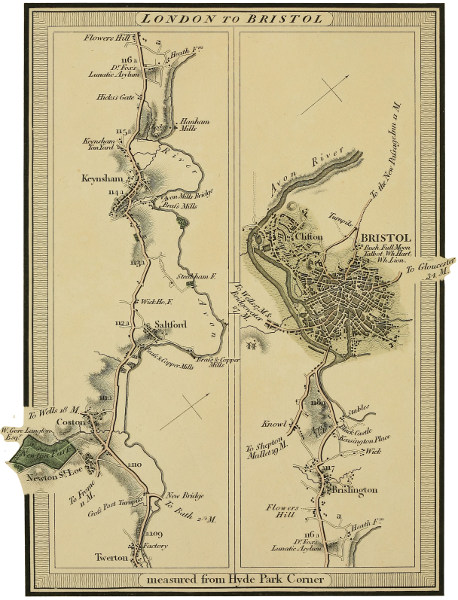
Brislington, Somerset, 203. A parish containing
136 houses, and 776 inhabitants. |
| 119 |
BRISTOL, 203. This city may justly
rank as the second in the British dominions
for trade, wealth, and population, though
much of its commerce with the West Indies
and America have passed to Liverpool.
It properly lies in two counties,
Somerset and Gloucester, but in the reign
of Edward the Third it was erected into
a county of itself.
This metropolis of the west of England gradually
rose to eminence in the Anglo Saxon
period, but its origin is uncertain. It contains
10,403 houses, and 63,645 inhabitants,
and is situated on the rivers Avon and Frome.
The bridge over the former was first built
above 500 years ago, and rebuilt in 1768.
It consists of three wide and lofty arches,
with a neat stone ballustrade. The river
here is deep and very rapid, and flows to the
height of 40 feet, so as to bring a vessel
of 1000 tons up to the bridge.
The internal streets of this city are high
and irregular, with projecting buildings,
mostly built of wood and plaster, which
render it close; but many of the streets have
been lately much widened, particularly the
avenues to the bridges. The suburbs and
external parts of the city are elegant and
spacious buildings, principally inhabited by
gentry, merchants, and retired tradesmen,
or let as lodging-houses. The sides of the
streets have smooth pavements, and the
whole is well lighted. It is supplied with
excellent water, both from pumps and conduits;
that in Temple Street has a noble
statue upon it, representing Neptune. The
common sewers which run through the
streets, render the whole city remarkably
clean. Carts are not admitted in the
streets, for fear of damaging the arches of
the vaults and gutters that are made under
ground, for conveying the soil into the
rivers; on this account every thing is conveyed
by sledges, to the no small danger
of the foot passengers.
In King Street there is a very elegant and
convenient theatre, and the city library is
a handsome stone building, with literary
emblems in front, which contains a very
good collection of books, and a clergyman
is always appointed the librarian.
Above the river, Redcliff Parade is a handsome
range of houses, whence is a beautiful
prospect of the surrounding country.
Over the river Frome is a draw-bridge,
which has also two arches of stone, and an
octagon building at each end.
The quay is above a mile in length,
reaching from St. Giles’s to Bristol
Bridge, and is all the way embanked by
a firm wall, coped with hewn stone; the
whole is not impeded by the buildings,
which lie a considerable way back, so that
it is one continued quay, although under
different names; that from Bristol Bridge
to the bend of the river opposite Redcliff
Parade, is called The Back, and from thence
downwards is called The Grove. Here is
a dock which will contain 10 sail of
large vessels, and further on there is another,
where a building is erected on 14
pillars of cast iron, being a crane, a curious
piece of mechanism for loading and unloading
ships; from which, to the mouth of the
river Frome, the quay is called The Gibb.
The Avon being joined by the Frome,
passes on by the Hot-well through the
rocks of St. Vincent, in a winding course
of about eight miles, and discharges
itself into the Bristol Channel; on the
banks are several dock yards, and the merchants’
floating dock is extremely large.
The cathedral church, dedicated to the
Holy Trinity, was founded in the reign of
King Stephen, in 1140; it is 175 feet long;
the tower is 130 feet high, square, and
ornamented with four pinnacles: the
church, though not large, has many gothic
beauties within, and a good organ; it is
adorned with painted windows, and several
handsome monuments, particularly that of
Mrs. Draper, the celebrated Eliza of Sterne.
Behind the church is a cloister, in which
are the entrances to the library and
bishop’s palace. To the west of the
church is a most beautiful gothic gateway,
ornamented with statues.
Bristol contains 17 parish churches, and
five chapels. The church of St. Mark,
opposite the cathedral, was formerly
collegiate: now it is the mayor’s chapel.
All the churches are neat, beautifully
decorated, and most of them have many
handsome monuments: that of St. Mary’s,
Redcliff, is one of the finest in the kingdom,
containing two beautiful monumental statues
of its founder, William Canninge, who
had been five times mayor of the city; in
one appearing habited as a magistrate, and
in the other as a priest, he having in his
latter days taken holy orders: there is also
another of Sir William Penn, father of the
famous Quaker. Here are also many hospitals
and charitable institutions.
On College Green is a stately high cross,
with the statues of several kings round it.
There are 13 city companies, several of
whom have elegant halls, particularly the
Merchant’s Hall, in Princes Street, a capacious
stone structure, enclosed by an iron
pallisade, with a very curious front. The
Cooper’s Hall, in King Street, has a superb
front, with four Corinthian columns.
There are also several handsome squares:
Queen Square has a spacious walk, shaded
with trees; in the centre is a fine equestrian
statue of William the Third, by Rysbrack.
The government of the city is administered
by a mayor, 12 aldermen, all justices
of the peace, two sheriffs, 28 common
council, town clerk, and deputy town
clerk, chamberlain, vice-chamberlain, under-sheriff,
&c. besides a city marshal, and
other inferior officers.
A mile below the city, close by the
river, is the Hot-well, the waters of which
are reckoned specific for the diabetes,
phthisical, scorbutic, and inflammatory disorders.
It is a great resort for invalids
during the summer, for whose accommodation
and entertainment there are a pump-room,
ball-room, coffee-house, taverns, and
elegant lodging-houses, both below, on a
level with the well, and above, in the delightful
village of Clifton, situated on the
brow of a hill, the prospect from which is
beautifully romantic, and from the purity
of its air and its situation, it has generally
been termed the Montpelier of England.
Clifton is at all times preferable to any
place of residence in or about Bristol; for
it is not only convenient for the wells, but
is so happily situated with respect to
Durdham Downs, that, without fatigue,
valetudinarians are in a few minutes conveyed
to them, and thereby enjoy an advantage
equal, if not superior in effect, to
that of the waters. Indeed this the physicians
themselves acknowledge, and therefore
the sick drive hither for health, and
the unailing for amusement.
The Bristol and Matlock waters are of
the same quality, their mineral contents
being chalk, lapis calcareous, and calaminaris,
without any impregnation of iron. In
the rocks above the well are found beautiful
crystals; and the rivers afford salmon, eels,
plaice, flounders, dabs, and vast quantities
of elvers, and higher up trout, roach, and
dace.
In the markets of Bristol there is an
astonishing plenty and variety of provisions,
fruit, and vegetables. The city gives
the title of Earl to the family of Hervey, and
here the famous Thomas Chatterton was
born, his father being sexton of St. Mary’s
Redcliff.
In 1777, an incendiary, called Jack the
Painter, set fire to different parts of this
city, and occasioned considerable damage. |
| |
Britford, Wilts, 209. A parish containing
125 houses, and 675 inhabitants. |
| |
Britford Bridge, Wilts, 209. |
| 4 |
Brixton Causeway, Surrey, 52. |
| 5 |
Brixton Hill, Surrey, 52. |
| |
Broadbridge Mill, Sussex, 215. |
| 9 |
Broad Green, Surrey, 53. |
| 122 |
Broadleaze, Somerset, 167. |
| 55 |
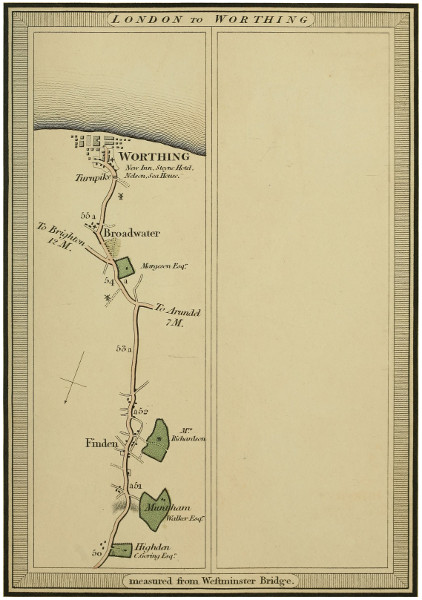
Broadwater, Sussex, 67, 218. A parish
containing 183 houses, and 1018 inhabitants. |
| 125 |
Broadway, Dorset, 171. A parish containing
42 houses, and 210 inhabitants. |
| 134 |
Broadway, Somerset, 169. A hamlet
containing 57 houses, and 328 inhabitants. |
| 225 |
Brocka Barrow, Cornwall, 154. |
| 87 |
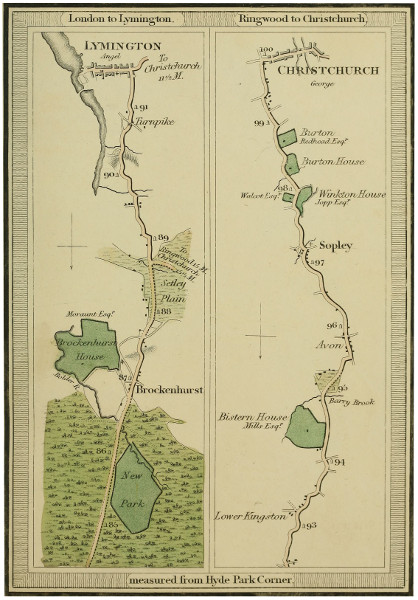
Brockenhurst, Hants, 93. This hamlet
contains 127 houses and 632 inhabitants,
and is one of those sequestered retreats
where the lovers of rural life would find
their highest gratification. It lies at an
agreeable distance both from Lymington
and Southampton, and the environs are
studded with seats, among which that belonging
to Edward Moraunt, Esq. occupies
one of the most delightful and select situations
in the whole forest. |
| 10 |
Bromley, Kent, 16. A market town
and parish, seated on the river Ravensbourne.
Near the town is a palace of the
Bishops of Rochester, where there is a
mineral spring, of similar quality to that
at Tunbridge; and the manor of this place
was granted to the bishop by king Edgar,
in the year 700. The church is a very
old structure. There is still standing a
college, erected by Bishop Warner in the
reign of Charles the Second, for 20 poor
clergymen’s widows, with an allowance of
£20, together with £50 per annum to the
chaplain. This was the first endowment
of the kind established in England. The
allowance has since been augmented to
£30 per annum, and £60 to the chaplain,
through the munificence of the Rev. Mr.
Hetherington and Bishop Pearce, the former
of whom left £2000, and the latter
£5000. Bromley contains 419 houses, and
2965 inhabitants; and has a market on
Thursday. |
| 12 |
Bromley Common, Kent, 16. |
| 9 |
Bromley Hill, Kent, 16. |
| 38 |
Brook Green, Surrey, 33. |
| 96 |
Brook Water, Wilts, 138. |
| |
Broomfield, Hants, 212. |
| |
Broomfield, Wilts, 205. |
| 109 |
Bruton, Somerset, 173. A market town
and parish, deriving its name from its situation
on the river Brue, over which it has
a stone bridge. It is a well-built town,
composed chiefly of three streets, at the
meeting of which is a very convenient
market place, built by a subscription of
the farmers. The church is a handsome
building, and has two quadrangular towers,
one at the west, and the other at the north
aisle. The Quarter Sessions for the eastern
division of the county is sometimes held
here, and it has a small manufacture of
stockings, and inferior kinds of woollen
goods. It contains 317 houses, and 1631
inhabitants, and has a market on Saturday. |
| 123 |
Brympton, Somerset, 141. A parish
containing 21 houses, and 133 inhabitants. |
| 231 |
Buckapit, Cornwall, 124. |
| 230 |
Buckaton, Cornwall, 124. |
| 194 |
Buckfastleigh, Devon, 119. A parish
containing 260 houses, and 1525 inhabitants.
The remains of a Cistercian monastery
are here visible. |
| |
Buckingham, Sussex, 219. |
| 70 |
Buckland, Kent, 10. A parish containing
71 houses, and 346 inhabitants. |
| 138 |
Buckland St. Mary, Somerset, 169. A
hamlet containing 81 houses, and 418 inhabitants. |
| |
Bull Moor, Wilts, 206. |
| 111 |
Bullstake Hill, Somerset, 140. |
| 86 |
Burcomb, Wilts, 136. A parish containing
54 houses, and 254 inhabitants. |
| 22 |
Burfoot Bridge, Surrey, 63. |
| |
Bursledon, Hants, 221. A small port,
where vessels are employed in the flour,
timber, and hop trade; containing 73
houses, and 522 inhabitants. |
| |
Bursledon Bridge, Hants, 221. |
| 99 |
Burton, Wilts, 164. |
| 56 |
Bury, Sussex, 43. A parish containing
62 houses, and 361 inhabitants. |
| 57 |
Bury Hill, Sussex, 43. |
| 60 |
Bury Hill Camp, Hants, 101. |
| 15 |
Bury Mead, Middlesex, 174. |
| 12 |
Butcher’s Grove, Middlesex, 174. |
| 56 |
Butser Hill, Hants, 30. From the summit
of this hill, on a clear day, Salisbury
Cathedral is visible at the distance of
forty miles. |
| 50 |
Byworth Street, Sussex, 43. |
| |
|
| 113 |
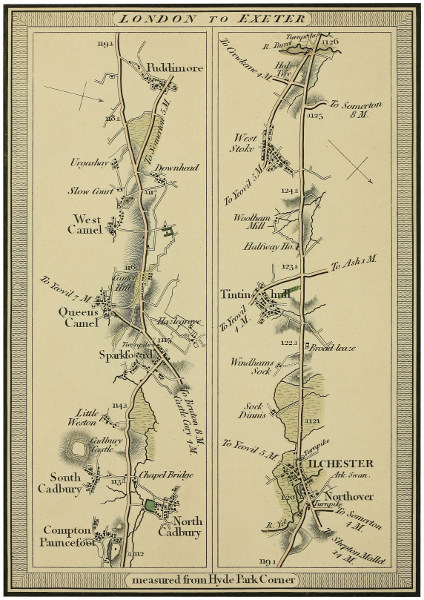
Cadbury Castle, or Camalet, Somerset,
166. The ruins of this place proclaim it
one of the most stupendous fortifications
in the kingdom. It is described to have
been, in the year 1612, a hill of a mile in
compass at the top, having four trenches,
and betwixt every one an earthen wall, encircling
an area within of about twenty
acres, full of ruins and relics of old buildings:
great number of Roman coins have
been found here, and other works of antiquity,
among which a silver horse-shoe is
mentioned by Stow. A part of these ruins
is denominated King Arthur’s Palace. The
rampart is made of large stones, covered
with earth, with only one entrance facing
the east, guarded by several ditches. Various
opinions are entertained by different
writers as to the origin of this place; but
the most probable conjecture appears to be
that of attributing it to the Romans. |
| 112 |
Cadbury, North, Somerset, 166. A parish
containing 173 houses, and 810 inhabitants. |
| 113 |
Cadbury, South, Somerset, 166. A parish
containing 37 houses, and 214 inhabitants. |
| 8 |
Cadet Barracks, Kent, 1. |
| 205 |
Cadleigh, Devon, 121. A parish containing
38 houses, and 226 inhabitants. |
| 80 |
Cadnam, Hants, 87. |
| 66 |
Cake Wood, Wilts, 182. |
| 42 |
Calcot, Berks, 178. |
| 42 |
Calcot Green, Berks, 178. |
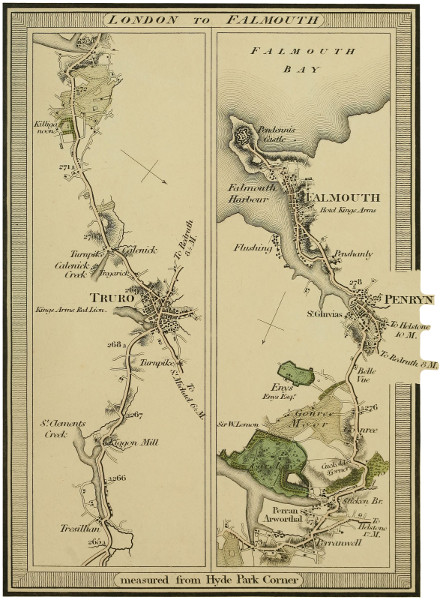
| 270 |
Calenick, Cornwall, 129. |
| 254 |
Callerick, Cornwall, 158. |
| 87 |
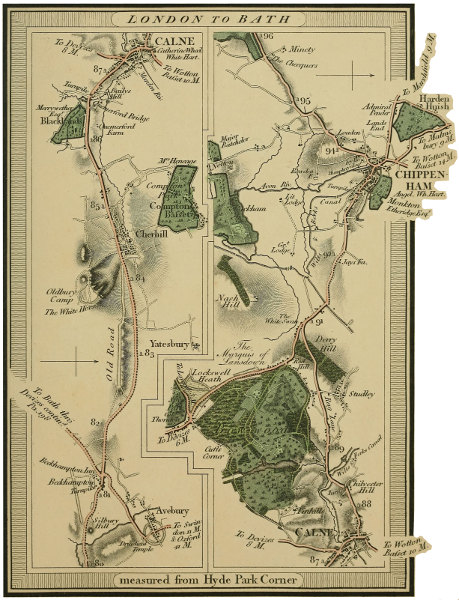
Calne, Wilts, 184. A borough and
market town of considerable antiquity, supposed
to have risen out of the ruins of an
old Roman colony on the other side of the
river Calne, near Studley, where many
Roman coins have been found. Here was
one of the palaces of the West Saxon
kings; and it also had a castle, but there
are now no traces thereof left. The town
is well built, and the church is a large
structure, with a handsome square tower.
This town has of late years experienced
many improvements, through the patronage
of the Marquis of Lansdown. It stands
on the river Marden, whence it has a good
supply of water, and by the side of which
are many fulling and corn mills.
Calne contains 775 houses, and 3767 inhabitants;
its chief manufactory is cloth;
and it has a market on Tuesday. |
| 89 |
Cain Hill, Wilts, 199. |
| 71 |
Cambreach, Wilts, 182. |
| 115 |
Camel Hill, Somerset, 166. |
| 116 |
Camel West, Somerset, 166. A parish
containing 38 houses, and 224 inhabitants. |
| |
Cams, East, Hants, 222. |
| 103 |
Canford Bottom, Dorset, 90. |
| 101 |
Canford Bridge, Dorset, 90. |
| 100 |
Cann, Dorset, 138. A parish containing
32 houses, and 203 inhabitants. |
| 55 |
CANTERBURY, Kent, 8, 11. A city,
and the metropolitan see of all England.
It is situated in a pleasant valley, between
hills of a moderate height and easy ascent,
among which are several springs. The
river Stour passes here, and dividing into
several small streams, forms islands of
various sizes, in one of which the western
part of the city stands.
It was the Durovernum of the Romans; and
the Britons called it Caer Kent, that is, the
city of Kent. It is mentioned as a city in Antonine’s
Itinerary, and its ancient importance
appears from the strong military causeways
leading to Dover and Lymme through the
city, as well as the many Roman vestiges
and coins found in and about the neighbourhood;
and its archiepiscopal and metropolitan
dignity seems also to have been
settled very early.
This city was given entirely to the
bishops by William Rufus; and it was held
in particular veneration after the murder of
Becket, in the reign of Henry the Second; to
whose shrine, so great were the offerings, that
Erasmus says, the whole church and chapel in
which he was interred, glittered with jewels.
The cathedral has been several times destroyed
by fire: the present structure was
built about the year 1174; but not entirely
completed till the reign of Henry the Fifth:
kings, princes, cardinals and Bishops, are buried
in it. During the great rebellion it suffered
much; Cromwell made a stable of it
for his dragoons; but after the restoration it
was repaired. The body of the church measures
178 feet from the western door to the
choir steps; and the breadth, including the
aisles, 71 feet, and the vaulted roof 80
feet. It was new paved with Portland stone,
in 1788. The choir is the most spacious
of any in the kingdom, being 180 feet in
length from the western door to the altar.
The altar piece was designed by Sir James
Burrough, master of Caius College, Cambridge;
and the great stained window is
the most beautiful of the kind in England.
In 1784, an elegant organ was put up, built
in the Gothic style. Behind the altar is
the beautiful chapel of the Holy Trinity,
in the middle of which stood the shrine of
St. Thomas à Becket; part of the flat is
curiously inlaid with mosaic work, and
contains the episcopal chair, composed of
three pieces of grey marble. In the mint
yard, within the precincts of this church, is
a public grammar school, founded by Henry
the Eighth.
Christ’s-church gate is an elegant structure,
built in 1517. From this gate you
have a view of Oxford steeple, a tower 130
feet high, with four handsome pinnacles;
and that stately tower called Bell Harry
steeple, being 235 feet high; on its top
hangs a small bell, called Bell Harry, which
is tolled every day for prayers: but never
rung, except on the death of a King, Queen,
or Archbishop.
The four principal streets are disposed
in the form of a Cross, and divided into
six wards. It is called the city, and
county of the city of Canterbury, and is
governed by a mayor, recorder, 12 aldermen,
24 common councilmen, with a
sheriff and coroner, and 4 serjeants at
mace. It has sent members to parliament
ever since the reign of Edward the First.
Great improvements have been made here
lately; the streets, which were formerly
paved with flints, are now smooth pavements;
the old signs and projecting buildings
are removed, the whole is well
lighted with lamps, and a regular watch set
at 10 o’clock.
A slip of land, called Dungehill, of
about six acres, having an artificial mount,
is now converted into the City Mall; the
sides are adorned with spiral walks to the
top, the old towers with shrubberies, and
the old ramparts are also converted into a
beautiful terrace. The Guildhall, in High
Street, is a handsome and lofty building,
adorned with the portraits of the City benefactors.
Over the Canterbury bank are
some large and elegant assembly rooms.
Its manufactures are of worsted, silk, and
cotton; the former furnishes employment
for several hundred persons, in the fabrication
of what is called Canterbury muslins.
The city is surrounded on all sides with
extensive hop grounds, contains 16 parishes,
2018 houses, and 10,498 inhabitants,
and is famed for its excellent brawn.
The Archbishop of Canterbury is primate
and metropolitan of all England, and is
the first peer in the realm; and wherever
the court may be, the King and Queen are
his proper domestic parishioners.
To the cathedral belongs 1 archbishop,
1 dean, 1 chancellor, 1 archdeacon, 12 prebends,
6 preachers, 6 minor canons, 6 substitutes,
12 lay clerks, 10 choristers, 2 masters,
50 scholars, and 12 almsmen. |
| 29 |
Capel, Surrey, 64. A parish containing
99 houses, and 675 inhabitants. A singular
phenomenon is recorded to have happened
here in the reign of Queen Elizabeth: part
of a hill was divided from the other part,
and removed to some distance. |
| 79 |
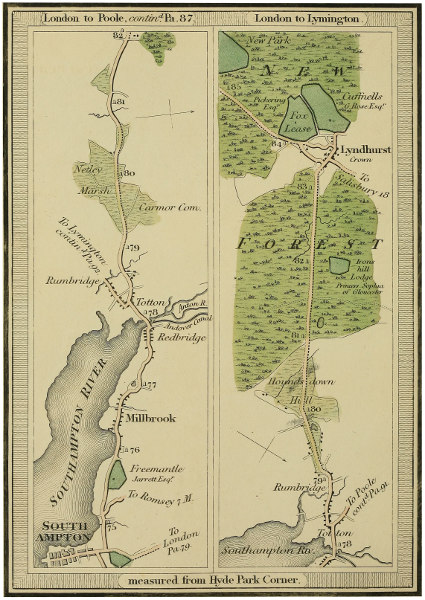
Carmor Common, Hants, 91. |
| 223 |
Carneglos, Cornwall, 154. |
| 112 |
Carnicot, Somerset, 188. |
| 233 |
Cartuther, Cornwall, 124. |
| 254 |
Carvath, Cornwall, 127. |
| 261 |
Carvoza, Cornwall, 128. |
| 260 |
Castle, Cornwall, 128. |
| 100 |
Castle, Wilts, 164. |
| 241 |
Castle Down, Cornwall, 156. |
| 115 |
Castleton, Dorset, 140. (see Sherborne) |
| |
Catersfield, Hants, 222. |
| 139 |
Catcott, Somerset, 191. A hamlet containing
66 houses, and 391 inhabitants. |
| 30 |
Catherine Hill, Surrey, 27. |
| |
Catwater, Devon, 122. (See Plymouth.) |
| 102 |
Causeway, Dorset, 139. |
| 98 |
Chaddenwych Barn, Wilts, 164. |
| 130 |
Chalice Hill, Somerset, 190. |
| 23 |
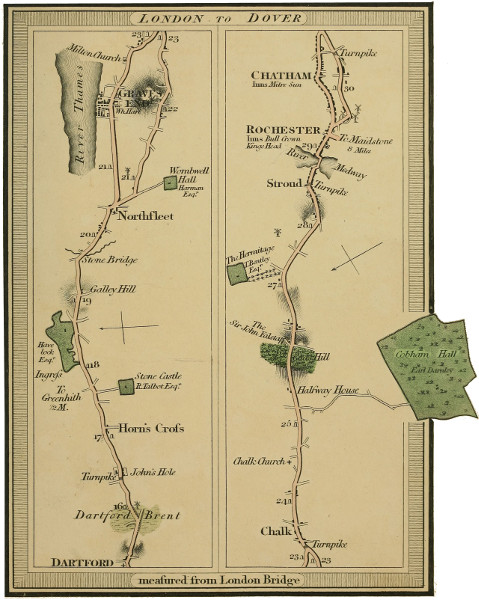
Chalk, Kent, 4. A parish containing
62 houses, and 322 inhabitants. |
| 24 |
Chalk Church, Kent, 4. |
| 39 |
Chalkwell, Kent, 6. |
| 69 |
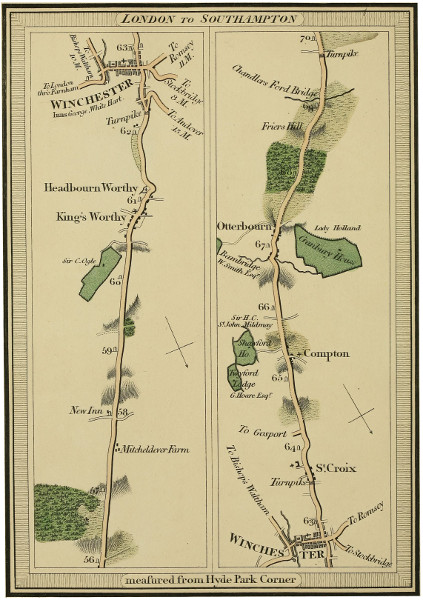
Chandler’s Ford Bridge, Hants, 78. |
| 113 |
Chapel Bridge, Somerset, 166. |
| 44 |
Chapel, North, Sussex, 38. A parish
containing 93 houses, and 621 inhabitants. |
| 100 |
Chapel Plaste, Wilts, 200. |
| |
Chapmanslade Cross Roads, Wilts, 205. |
| 138 |
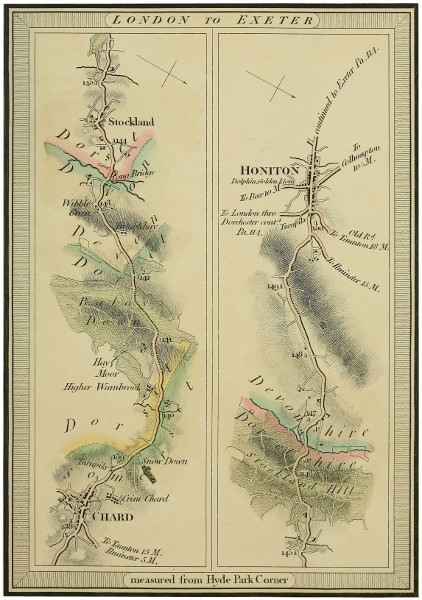
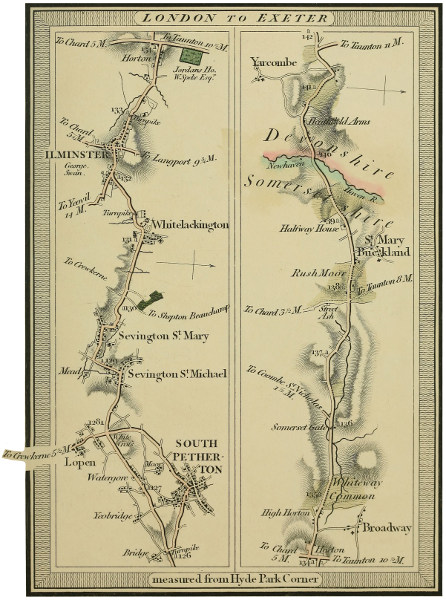
Chard, Somerset, 143, 145. A market
town and parish. The town consists chiefly
of two streets, intersecting each other, composed
of good commodious houses. The
church is a low building, possessing nothing
remarkable either in internal or external
decorations. At the angle where the two
streets meet, stands an ancient Gothic
building, formerly a chapel, but now used
as a town hall. |
| |
Chard contains 534 houses, and 2784 inhabitants.
Several streams run through the
town, and keep it clean. The assizes were
held here formerly, and the town sent members
to parliament; but it lost the privilege
by negligence. At the west end of the town
rises a very fine spring, conveyed by leaden
pipes to four conduits, which supply the
inhabitants with water. The market is
held on Monday, and is abundantly supplied
with corn. |
| 136 |
Chard Common, Somerset, 143. |
| 136 |
Chard Elm, Somerset, 143. |
| 141 |
Chard, South, Somerset, 144. |
| 253 |
Charlstown, Cornwall, 127. |
| 107 |
Charlton Down, Dorset, 107. |
| 141 |
Charmouth, Dorset, 112. This village
derives its name from its situation near the
mouth of the river Char. It stands at the
foot of an amazing hill, no less than 1000
feet high, opposite to which is another 970
feet high. Here the Danes twice defeated
the English; but, in 833, they were in turn
completely routed, with the loss of nearly
their whole fleet, consisting of 35 sail. It
contains 64 houses, and 369 inhabitants. |
| |
Charterhouse Hinton, Somerset, 204. |
| 30 |
Chatham, Kent, 4. This town is situated
by the river Medway, and is joined to
Rochester, to which it is a suburb. It was
built by King Charles the Second after the
Dutch war; but the dock was begun by
Queen Elizabeth, and has been so much
improved, that it is now the first arsenal in
the world. The houses of the various
officers are well built, and some of them
even stately. The dock-yard, including
the ordnance wharf, is about a mile in
length, and some of the store rooms are
near 700 feet long. Although the stores
of the navy are so immense in these magazines,
every thing is arranged in the greatest
order. Here are upwards of 20 smiths’
forges constantly at work, and some of the
anchors that are made weigh near five tons.
The new rope-house is 1140 feet in length,
in which cables are made 120 fathoms long,
and 22 inches round. In the yard are four
docks for repairing, and six slips for building,
new ships. The ordnance wharf, which
adjoins hereto, was the original dock, where
the guns belonging to each ship are now
arranged in tiers, with the names of the vessels
they belonged to marked above them.
In 1558 the Chest of Chatham was instituted
by the seamen in the service of
Queen Elizabeth, each paying a portion of
his pay for the relief of the sufferers in the
defeat of the Spanish Armada. There is
also here an hospital for the relief of aged
mariners or shipwrights.
At the entrance of the town stands the victualling
office, whence his Majesty’s ships at
Chatham and Sheerness are supplied with
provisions. Near it stands the chapel of ease
to the parish church, it is a circular building,
the walls of which are three feet thick, and
appears of great antiquity, probably of
Norman origin by the architecture. This
chapel is 74 feet long and 20 wide, the west
end and steeple having been added in 1743.
Chatham is defended by the castles
of Upnor and Gillingham; the first is
almost opposite the dock on the west side
of the river. Gillingham Castle is a very
strong fortification, and has a complete
command of the river.
The church stands on a hill adjoining
the ordnance office; it contains several elegant
marble monuments, and the ordnance
office has granted a piece of ground, a little
distance therefrom, as a burial ground,
where a ship is used as a church for the
sailors.
In 1667 the Dutch fleet proceeded up
the Medway, took Sheerness, and did considerable
damage to Chatham.
The population of Chatham has of late
years considerably increased; it contains
1715 houses, and 10,505 inhabitants, exclusive
of Gillingham, which contains 715
houses, and 4135 inhabitants: and it has
a market on Saturday. |
| 48 |
Chawton, Hants, 82, 95. This parish
contains 64 houses, and 372 inhabitants. |
| 84 |
Cherhill, Wilts, 184. A hamlet in the
parish of Calne, containing 60 houses, and
304 inhabitants. |
| 183 |
Cheriton Cross, Devon, 148. |
| 61 |
CHICHESTER, Sussex, 36, 40, 41, 216.
A city and county of itself; containing
nine parishes, 821 houses, and 4744 inhabitants.
It is situated in a pleasant vale
on the little river Lavant, which washes
it on all sides, except the north, and is said
to have been built by Cissa, the second
king of the South Saxons, and named
Cissan Caester. It consists of four principal
streets, in the form of a cross, is surrounded
with a stone wall, and had formerly
four gates: the streets are broad,
handsome, and well paved, and there are
six parish churches within the walls. This
city sends two members to parliament, and
is governed by a mayor, recorder, and 38
common councilmen, 4 justices of the
peace being chosen out of the aldermen.
An ancient nunnery founded here, is now
converted into an hospital which has a
very neat chapel. The Guildhall, situated
in an obscure part of the city, is a spacious
ancient building, and the council chamber,
which is over the market house, supported
by pillars, is both neat and elegant,
adjoining to which is a subscription assembly
room, and there is a small theatre,
situated at the bottom of South-street.
The bishop’s palace, erected in 1727,
has very commodious and well laid-out
grounds. The cathedral, which is built in
the form of a cross, on the site of St. Peter’s
the Great, and dedicated to the Holy
Trinity, is an elegant Gothic structure;
the spire nearly 300 feet high. The choir
of late has been neatly repaired, and has a
well-furnished library. In the south aisle
is painted the history of its foundation,
and under it are the portraits of our kings,
from William the Conqueror to Edward
the Sixth, continued in the chapter house
and library, to George the Second: on the
east side are the bishops. The see was
translated here from Selsea, in the reign of
William the Conqueror. In a nich, near
the east door of St. Peter’s the Great, which
stands within the cathedral, is a statue of
bishop Seiffrid, who built the church in
1199, together with the palace, cloisters, &c.
In the centre of the town stands a neat
cross, of an octagonal form, supported
on 8 arches. Adjoining the fish shambles,
in the South-street, is a large reservoir and
conduit of excellent water, with the figure
of an ancient Druid above.
In 1727, a Roman pavement was discovered
here, and on the brill, near the
city, is a Roman camp of an oblong square,
supposed to have been raised by Vespasian;
and from the soil being a hard gravel, must
have been a work of great labour. There
are vestiges of another about a mile and a
half west, called Gonshill.
The inconvenient distance of the town
from the sea, has been partly remedied by
a canal to Brocklesham bay. The haven
affords excellent lobsters, and every other
Wednesday there is here one of the largest
markets for sheep and black cattle in the
county, which not only supplies the city,
but sends vast quantities to Portsmouth
and London. |
| 94 |
Chicklade, Wilts, 163. A parish containing
25 houses, and 150 inhabitants. |
| 93 |
Chicklade Bottom, Wilts, 163. |
| 40 |
Chidingfold, Surrey, 37. A parish containing
162 houses, and 848 inhabitants. |
| 137 |
Chidiock, Dorset, 112. A township and
chapelry, containing 107 houses, and 578
inhabitants. |
| 117 |
Chilcompton, Somerset, 188. A parish
containing 74 houses, and 348 inhabitants. |
| |
Chilhampton, Wilts, 208. |
| 134 |
Chillington Down, Somerset, 143. |
| 162 |
Chilson, Somerset, 194. |
| 162 |
Chilson Heathfield, Somerset, 194. |
| 66 |
Chilton, Berks, 181. A parish containing
48 houses, and 244 inhabitants.
This place gave birth to the Lord Chief
Justice Crook. |
| 140 |
Chilton, Somerset, 191. A parish containing
53 houses, and 310 inhabitants. |
| 88 |
Chilvester Hill, Wilts, 185. |
| |
Chilworth, Hants, 211. A parish containing
18 houses, and 132 inhabitants. |
| |
Chilworth Common, Hants, 211. |
| 125 |
Chinnock, East, Somerset, 142. A parish
containing 60 houses, and 505 inhabitants.
This place is noted for a brackish
spring, although 20 miles from the sea. |
| 125 |
Chinnock Hutts, Somerset, 142. |
| 93 |
Chippenham, Wilts, 185. A borough
and market town, situated on the river
Avon, over which it has a handsome bridge
of 16 arches, and is mentioned to have
been of considerable strength and importance
in the time of Alfred the Great. The
church is a venerable Gothic structure,
supposed to have been built by the Hungerford
family, whose arms are still to be
seen upon its walls. The houses in general
are neat and well built. It has a considerable
manufacture of superfine woollen cloth;
sends two members to parliament, and contains
667 houses, and 3366 inhabitants.
The market on Saturday is well supplied
with all kinds of provision, and great quantities
of corn. |
| 74 |
Cholderton, Wilts, 160. A parish containing
35 houses, and 127 inhabitants. |
| 69 |
Cholderton, East, Hants, 159. |
| 100 |
Christchurch, Hants, 94. A borough
and market town, pleasantly situated at the
conflux of the rivers Avon and Stour,
which, about a mile and a half distant,
falls into the sea at Christchurch bay. It
derives its name from a collegiate church
built here by the West Saxons, and was
formerly called Christchurch Twynham,
and had also a castle.
The river Avon was made navigable from
Salisbury in 1680, and is famous for its
salmon fishery. A little to the east is
Hordell Cliff, which runs for a mile along
the shore, and is 150 feet above the level
of the sea. Christchurch sends two members
to parliament, contains 290 houses,
and 1410 inhabitants, having a considerable
trade in knit silk stockings and watch
chains. Market on Monday. |
| 181 |
Chudleigh, Devon, 118. A market
town and parish, situated near the river
Teign, having a considerable woollen manufactory.
Here was formerly a Benedictine
monastery, and a palace of the
bishop of Exeter. It gives title of baron to
the Clifford family; contains 360 houses,
and 1786 inhabitants, and has a market
on Saturday. |
| 183 |
Chudleigh Bridge, Devon, 118. |
| 22 |
Cippenham Court, Bucks, 175. |
| 96 |
City, The, Wilts, 200. |
| 3 |
Clapham, Surrey, 45. This village consists
chiefly of one long street, and a number
of handsome houses surrounding a common,
which is so well planted with various
trees, that it has now the appearance of
a park: though, formerly, it was little
better than a morass. This improvement
was chiefly effected by a subscription of
the inhabitants. Near the road to Wandsworth
is a reservoir of fine water, which
supplies the parish. On the north-east
corner of the common, a new church was
erected in 1776, at the expence of
£ll,000; but it has no cemetery. On
the site of the old church a new chapel
has been lately erected, in which the funeral
service is performed when there are
any interments. Clapham contains 480
houses, and 3864 inhabitants. |
| 3 |
Clapham Common, Surrey, 45, (See
Clapham.) |
| |
Clapham Common, Sussex, 218. |
| 30 |
Clarks Green, Surrey, 64. |
| 76 |
Clatford, Wilts, 183. A hamlet containing
26 houses, and 122 inhabitants. |
| |
Clay Street, Wilts, 210. |
| 47 |
Clayton, Sussex, 51. A parish containing
55 houses, and 337 inhabitants. |
| 50 |
Clerken Green, Hants, 99. |
| 232 |
Clicker, Lower, Cornwall, 124. |
| 231 |
Clicker Tor, Cornwall, 124. |
| 51 |
Cliff, Sussex, 59. (See Lewes.) |
| 120 |
Clifton, Gloucester, 203. (See Bristol.) |
| 256 |
Clisey Hill, Cornwall, 127. |
| 176 |
Clopton Bridge, Devon, 117. |
| 77 |
Clorus’s Camp, Wilts, 103, 135. Clorus’s
Camp, or Figbury Ring, is situated on a
commanding eminence. This entrenchment
is of a circular form, and comprehends
an area of nearly fifteen acres within
the outer vallum, which is forty-six feet
in height, and 1078 yards in circumference.
The principal entrance faces the east, and
is defended by two outworks; there are
also two other openings, one towards the
south, and the other towards the west, and a
deep ditch, excavated within the area, apparently
the boundary of a lesser camp. |
| 210 |
Coadron, Devon, 152. |
| 102 |
Coal Cot, Wilts, 172. |
| |
Coates, Sussex, 218. A parish containing
only 6 houses, and 30 inhabitants. |
| 143 |
Coaxdon Common, Dorset, 144. |
| 144 |
Coaxdon Mill, Dorset, 144. |
| 144 |
Coaxdon, Lower, Dorset, 144. |
| 19 |
Cobham Street, Surrey, 25. A parish
pleasantly situated by the river Mole, over
which are two neat brick bridges. It contains
208 houses, and 1200 inhabitants.
Here are two medicinal springs, Cobham
Wells, and the Spa; formerly much noted,
but now in no repute. On the banks of
the Mole there are several charming villas,
and the river affords plenty of pike, trout,
perch, eels, &c. |
| 139 |
Cock Hill, Somerset, 191. |
| 52 |
Cocking, Sussex, 35. A parish containing
49 houses, and 300 inhabitants. |
| 51 |
Cocking Common, Sussex, 35. |
| |
Codford, St. Mary, Wilts, 207. A parish
containing 31 houses, and 187 inhabitants. |
| |
Codford, St. Peter, Wilts, 207. A parish
containing 71 houses, and 399 inhabitants. |
| 107 |
Cogley Wood, Somerset, 173. |
| 124 |
Coker Hill, Somerset, 142. |
| 123 |
Coker, West, Somerset, 142. A parish
containing 128 houses, and 758 inhabitants. |
| 238 |
Coldrigen, Cornwall, 156. |
| 176 |
Collumpton, Devon, 196. A market
town, situated on the river Culm, which
joins the Ex two miles above Exeter, and
over which it has a bridge. Its principal
trade is in woollen cloth, serges, and corduroys.
It contains 615 houses, 3138 inhabitants,
and has a market on Saturday. The
church is a large and curious structure in
the Gothic style; and formerly contained
the figure of St. Columb, which was much
resorted to by pilgrims: the gilded roof of
the church is still preserved. |
| 249 |
Colly Green, Cornwall, 126. |
| 17 |
Colnbrook, 174. A market town situated
on the river Coln; part of it is in
Middlesex, and part in Bucks. It consists
chiefly of one street, in the middle of which
stands the chapel of ease, with a market
house under it, where a market is held on
Thursday. |
| 46 |
Colthook Common, Sussex, 38. |
| 202 |
Combe, Devon, 151. |
| 132 |
Combe, Somerset, 143. |
| 84 |
Combe Bisset, Wilts, 104. |
| 86 |
Combe Common, Wilts, 104. |
| 98 |
Combe Cross, Wilts, 138. |
| |
Comb Down, Somerset, 204. |
| 10 |
Combe Wood, Surrey, 24. |
| 143 |
Common, South, Dorset, 144. |
| 65 |
Compton, Hants, 78. A parish containing
34 houses, and 225 inhabitants. |
| 85 |
Compton Basset, Wilts, 184. A parish
containing 71 houses, and 366 inhabitants. |
| 90 |
Compton Chamberlain, Wilts, 137. A
parish containing 48 houses, and 283 inhabitants. |
| 112 |
Compton Pauncefoot, Somerset, 165. A
parish containing 30 houses, and 207 inhabitants. |
| |
Copperas Gap, Sussex, 219. |
| 62 |
Corhampton, Hants, 96. This village
contains 18 houses, and 130 inhabitants. |
| 97 |
Corsham, Wilts, 186. A market town
and parish, consisting chiefly of one street;
which is neat and well built, with a handsome
market house: the church is an
ancient building. It is a pleasant and
healthy place, but standing on a dry stoney
soil is not fertile, and its chief support is
the woollen manufacture. The fields in
the neighbourhood are in general inclosed
with stone walls instead of hedges. It
contains 458 houses, and 2402 inhabitants.
Market on Wednesday. |
| 67 |
Cosham, Hants, 32, 214, 223. |
| 141 |
Cossington, Somerset, 191. A parish
containing 49 houses, and 237 inhabitants. |
| 111 |
Coston, Somerset, 202. |
| |
Cotley Hill, Wilts, 206. |
| 108 |
Cottage Crescent, Somerset, 187. |
| 230 |
Council Barrow, Cornwall, 155. |
| 64 |
Court Week, Sussex, 44. |
| 88 |
Cowden Down, Wilts, 105. |
| 249 |
Cowland, Cornwall, 157. |
| |
Cowsfield Green, Wilts, 210. |
| 127 |
Coxley, Somerset, 190. |
| 127 |
Coxley Pound, Somerset, 190. |
| 212 |
Crab Tree, Devon, 122. |
| 181 |
Crab Tree, Devon, 196. |
| 113 |
Crackment Hill, Somerset, 140. |
| 223 |
Crafthole, Cornwall, 123. |
| 143 |
Crandon Bridge, Somerset, 192. |
| 12 |
Cranford Bridge, Middlesex, 174. |
| 30 |
Crawley, Sussex, 49. A parish containing
26 houses, and 210 inhabitants. |
| 13 |
Crayford, Kent, 2. The name is derived
from an ancient ford over the river Cray,
or Crouch; which, a little below this
town, falls into the Darent. Here are some
considerable callico printing grounds, and a
manufactory for slitting iron and rolling it
into hoops. In this and the adjoining
parishes are a number of deep caverns,
artificially cut out of the chalk pits; concerning
the origin of which various conjectures
have been formed. The church stands
on an eminence, and is ornamented with a
beautiful altar-piece. The river produces
excellent trout. It contains 187 houses,
and 1210 inhabitants. |
| 182 |
Crediton Lane End, Devon, 148. |
| 130 |
Crewkerne, Somerset, 142. A market
town and parish, lying in a pleasant
valley on the branches of the rivers Parret
and Axe, and consists of five principal
streets; the church is an elegant Gothic
structure, richly ornamented. The market-house
is roomy, and stands in the centre of
the town; it is well supplied on Saturdays
with provisions, corn, &c. It contains
489 houses, and 2576 inhabitants. |
| 93 |
Cribbage Hutt, Wilts, 137. |
| 136 |
Cricket Wood, Somerset, 143. |
| 138 |
Crim Chard, Somerset, 145. |
| |
Crockerhill, Sussex, 216. |
| 184 |
Crockernwell, Devon, 148. |
| 63 |
Croix, St., Hants, 78, 84. |
| 77 |
Cromlech, The Devil’s Den, Wilts, 183.
This ancient monument is formed of two
upright stones, supporting a vast flat one
as an impost; and, from the great breadth
of the supporters, it has the appearance of a
cave. Near it are two other stones lying
on the ground, one in contact with the western
upright. These monuments, many of
which are extant, both here and in Scotland
and Ireland, are generally supposed
to be of Druidical origin. |
| |
Crooks Gate, Hants, 213. |
| 69 |
Cross Ford, Wilts, 182. |
| 102 |
Cross, High, Wilts, 164. |
| 201 |
Cross Lanes, Devon, 151. |
| 4 |
Cross, New, Surrey, 1, 15. |
| 10 |
Croydon, Surrey, 53. A market town
and parish. The town is in general well
built, and pleasantly situated on the
edge of Banstead Downs, containing 1474
houses, and 7801 inhabitants. Its chief manufactures
are paper and printed cottons;
and its church is a handsome Gothic structure,
containing several fine monuments,
particularly of the archbishops of Canterbury,
and formerly had a chantery.
The manor has belonged to the archbishop
of Canterbury from the days of
William the Conqueror; but the archbishops’
palace is now converted into a
manufactory. Vast quantities of charcoal
are made here, with wood brought from
the neighbouring hills, and it has a market
on Saturday, which is well supplied with
all kinds of provision, particularly fowl,
oats, and oatmeal. |
| 39 |
Cuckfield, Sussex, 50. A market
town and parish, situated on a rising
ground, having a spacious and handsome
church, and a free grammar school, founded
in the reign of Queen Elizabeth. It has a
small market on Friday. |
| 275 |
Cuckold’s Corner, Cornwall, 130. |
| 89 |
Cuffs Corner, Wilts, 185. |
| 201 |
Cuffs Corner, Wilts, 200. |
| |
Curbridge Common, Hants, 213. |
| 80 |
Cursus, The, Wilts, 161. (See Amesbury.) |
| 183 |
Cutton, Devon, 197. |
| |
|
| 151 |
Dalwood Down, Dorset, 114. |
| 194 |
Dart Bridge, Devon, 119. |
| 15 |
Dartford, Kent, 2. A market town,
deriving its name from an ancient ford over
the river Darent. Here are to be seen the
remains of a magnificent nunnery, founded
by Edward the Third, (of which Bridget,
the daughter of Edward the Fourth was
prioress;) which at the Reformation was
converted into a royal mansion. A branch
of the old Roman Watling-street passes
through this town. The parish church is
situated in the main street, which is wide
and commodious, with several handsome
shops, and a good bridge over the Darent.
The assizes were formerly held here. In
the neighbourhood are some gunpowder
mills, much esteemed for their produce.
This town is remarkable for having been
the place where the rebellion of Wat Tyler
and Jack Straw, first broke out, occasioned
by the indecent behaviour of a tax gatherer
towards the daughter of Tyler, who killed
the offender with a pole-axe. The market
is on Saturday, and it is well supplied with
provisions, corn, cattle, &c. Dartford contains
535 houses, and 3177 inhabitants. |
| 16 |
Dartford Brent, Kent, 3. |
| 20 |
Datchet, Bucks, 175. This village is
pleasantly situated opposite Windsor Little
Park, by the side of the Thames, over which
it has a bridge. It contains 102 houses,
and 857 inhabitants. |
| 51 |
Dean, Hants, 99. |
| 195 |
Dean Prior, Devon, 120. A parish containing
93 houses, and 495 inhabitants. |
| 56 |
Dean, West, Sussex, 35. A parish containing
103 houses, and 510 inhabitants. |
| 64 |
Denford, Lower, Berks, 181. |
| |
Dennis’s, St., Abbey, Hants, 221. |
| 4 |
Deptford, Kent, 1. This town is divided
into Upper and Lower Deptford, and
contains 3068 houses, and 17,548 inhabitants;
it has a commodious stone bridge
over the small river Ravensbourn, near its
fall into the Thames, at which place was
anciently a very deep ford, whence the
name of the town.
The old church of St. Nicholas consists
of a chancel, nave, and two aisles, and was
rebuilt, excepting the tower, in 1697.
The new church of St. Paul, which is a
handsome stone structure, with a chancel,
nave, and two aisles, supported by pillars
of the Corinthian order, was erected in
1730, as one of the 50 new churches within
the bills of mortality; when, by act of parliament,
it was made a distinct parish.
The Royal Dock Yard was first erected in
the reign of Henry the Eighth. The storehouses,
which form a square, have had several
additional buildings; the whole yard
covers 31 acres of ground, containing two
wet docks, one single the other double,
three slips, a bason, and two ponds for
masts, with the various manufactories for
anchors, cables, masts, blocks, &c. and
apartments for the numerous officers employed.
Here the royal yachts are generally
kept. There are also several private
docks in the neighbourhood for the building
and repair of merchants’ vessels. The
Red House, a little to the north-west of
Deptford, is the grand store for provisions,
&c. for the royal navy.
On the site where St. Nicholas’ workhouse
now stands, was the manor house of Say’s
Court, which was the residence of the Czar,
Peter the Great, when he worked as a shipwright
in this yard. Here the Society of the
Trinity House was first formed in the reign
of Henry the Eighth, and incorporated under
the title of Master, Warden, and Assistants
of the Guild of the Most Glorious and
Undivided Trinity; the object of which institution
is, for the increase and encouragement
of navigation, and the good government
of mariners, shipping, &c. |
| 87 |
Deptford, Wilts, 162, 207. |
| 90 |
Derry Hill, Wilts, 185. |
| 111 |
Deverel Down, Dorset, 108. |
| 187 |
Devicourt Devon, 149. |
| 41 |
Devil’s Punch Bowl, Surrey, 28. |
| 88 |
Devizes, Wilts, 199. A borough and
market town, comprising three parishes,
and containing 890 houses, and 4851 inhabitants;
its manufactures chiefly consist of
druggets, serges, kerseymeres, and malting.
It has two churches and a chapel. The
houses are old, and mostly built of timber.
The Romans enclosed it with a vallum and
ditch, in which there is now a road almost
round the town; and on a small hill within
the town are to be seen the remains of its
strong castle. It is well fortified by nature,
and was made almost impregnable by Roger,
Bishop of Salisbury. Brass figures of
household gods, coins, bricks, and urns,
evidently Roman, have been dug up here.
Near the castle rises a rivulet, which falls
into the Avon near Bramham; and the
town is greatly improved by the Kennet
and Avon Canal, which here presents a
beautiful appearance. The new Gaol, at
the western extremity of the town, is also
worthy of notice.
This borough was incorporated by
Charles the First, and sends two members
to parliament. The markets are on Monday
for butchers’ meat, and on Thursday
for horses, cattle, corn, wool, provisions,
poultry, &c. |
| 143 |
Devon Gate, Devon, 170. |
| 44 |
Dial Post, Sussex, 66. |
| |
Ditchampton, Wilts, 208. (Population
included with Wilton) |
| 14 |
Ditton Common, Surrey, 25. |
| 13 |
Ditton Marsh, Surrey, 24. |
| 237 |
Dobwalls, Cornwall, 125. |
| 71 |
Dock Yard, Portsmouth, Hants, 32.
(see Portsmouth) |
| 54 |
Dog Kennel, Sussex, 39. |
| 120 |
Dorchester, Dorset, 109, 171. A
borough, market, and county town, standing
on an elevation on the river Frome,
comprising three parishes, 364 houses, and
2546 inhabitants. Its principal manufactures
are serge and broad cloth. Its ancient
name was Durnovaria, signifying the
passage of the river, and it was strongly fortified,
having four gates and a deep ditch;
and in the time of the Saxons two mints
were established here.
The town is built in the direction of
the four cardinal points, and the buildings
are good. The foundation of the
Roman wall appears quite round the town;
but to the east there is a street built
upon it, and the ditch is filled up. On
the south-west side of the wall there is
an agreeable walk between a row of trees;
but the winding of the river to the north
spoils the square of the town that way. It
has a newly erected town hall and market
place, and a commodious county gaol, built
after Mr. Howard’s plan, on the site of an
ancient castle. The streets are neatly
paved, and the houses in general built
regularly of stone.
Dorchester sends two members to parliament,
and the assizes for the county are held
here. Several Roman antiquities, and the remains
of military ways, have been discovered
in this town, particularly a Mosaic pavement,
four feet under the surface of the ground. St.
Peter’s is the only church that can be called
handsome. In the neighbourhood are extensive
meadows, and a down on which
vast flocks of sheep are fed. This place is
noted for the excellence of its ale, which
is sent to all parts of the kingdom. It has
a good market on Wednesday and Saturday. |
| 23 |
Dorking, Surrey, 63. A market town
and parish. The town stands on a rock of
soft sandy stone, in the angle of two fine
vallies, surrounded by beautiful hills. The
church is collegiate, and has a square tower
near the centre, with eight bells, and a set
of chimes. The streets are wide, well
paved, and very clean. A great traffic is
carried on in lime, which is accounted superior
to any other made in the country:
the town also supports a considerable trade
in meal. Dorking is noted for its breed of
poultry, which is remarkably large and
fine, and singular for the birds having five
toes in each claw. Capons bred here
about Christmas, often weigh seven or
eight pounds out of the feathers.
In the suburbs are many elegant seats.
The custom of Borough English prevails
in this manor, by which the youngest son
is heir to a copyhold estate. It contains
607 houses, and 3259 inhabitants; and has
a market on Thursday. |
| 71 |
Dover, Kent, 10. A sea port and
market town, and one of the cinque ports,
containing 3068 houses, and 13,418 inhabitants.
This town lies in a valley, encompassed
by a semicircle of hills, and was
formerly surrounded by a wall which had
10 gates, and appears to have been in a
very flourishing state in the reign of Edward
the Confessor, who incorporated it
by the style of a mayor and commonalty.
The town consists of two parts, connected
by a long narrow street, called
Snaresgate Street, from the lofty rocks that
overhang it, and seem to threaten the passenger
with instant death. The town hall
stands in the market place, and is ornamented
with several good portraits, and a
curious print of the embarkation of Henry
the Eighth for France. It has also a neat
assembly room, a theatre, and two circulating
libraries.
Here were formerly seven churches, but
five of them have long since been demolished;
those remaining are dedicated to
St. Mary the Virgin, and St. James: the
former was built by the prior and convent
of St. Martin’s, for the use of the inhabitants,
and the foundation of its tower was
built upon the remains of an ancient Roman
bath. The church of St. James anciently
belonged to the castle, and in it the Courts
of Chancery and Admiralty for the Cinque
Ports are still occasionally held. In the
reign of Henry the Third a large religious
house was founded by Hubert de Burgh,
Earl of Kent, at the end of this town,
called the Maison Dieu; but at the time
of the reformation it was converted into a
victualling office, for which purpose it is
still used.
Dover is celebrated in history as a place
of the greatest importance ever since the
Norman Conquest. Its ancient castle is
supposed to have been built by Julius
Cæsar. Henry the Second, about the year
1153, is said to have enclosed it with a
new wall. The present entrance is on the
south side of the main tower, by a grand
flight of steps round the eastern side to the
third story, or the governor’s apartments.
These steps were secured by three strong
gates, at each of which was a chamber or
guard room, and a dungeon for prisoners,
in which several persons of distinction
have been confined at different times, but
now used only for disorderly soldiers.
These entrances, before the use of gunpowder,
were impregnable, the walls being
18 feet thick. Without the Duke of Suffolk’s
gate are commodious barracks, and
wells which supply the garrison with
water, being about 370 feet deep. After
this castle was surrendered to William the
Conqueror, it was considerably strengthened,
and made more secure by the erection
of two exterior walls from the Saxon fortification
to the very edge of the perpendicular
cliff and additional towers. In the
exterior wall of the castle are 17 towers,
most of them named from the persons
under whom they were erected.
In the reign of Charles I. this strong fortress
was taken by surprise by a few men in
the night. One Drake, a zealous republican,
formed a plan to seize the garrison;
and, accompanied by 10 or 12 men, at
midnight, by the assistance of ropes and
scaling ladders, he reached the top of the
high cliff undiscovered. Having dispatched
the sentinel, they threw open the gates, and
the garrison, who were few in number, in
the confusion supposing themselves to be attacked
by superior numbers, surrendered up
the castle to this handful of desperadoes.
Under the castle to the north of the
town, Captain Smith, the father of the
gallant Sir Sidney Smith, has erected a
pleasant though whimsical residence, called
The Cave; it is hewn out of the solid rock.
Near the edge of the cliff is a beautiful
piece of brass ordnance, 24 feet long, cast
at Utrecht, in 1544, called Queen Anne’s
Pocket Pistol, finely ornamented with
figures in bass-relief: it was a present from
the States of Holland to the Queen, and is
said to be capable of carrying a twelve
pound shot to the distance of seven miles.
In time of peace this town is a great
thoroughfare for persons passing and re-passing
to and from France, the channel
here being only nine leagues across to
Calais, and with a fair wind the voyage is
often made in one tide.
The harbour has been considerably improved
of late years, but still will only admit
vessels of moderate burthen. The piers
which form the haven are very costly works,
defended by some very strong batteries,
which are now continued in a chain along
the coast, with numerous martello towers,
&c. The market days are on Wednesday
and Saturday. |
| 117 |
Downhead, Somerset, 166. A hamlet
containing 43 houses, and 225 inhabitants. |
| 59 |
Down Hurstbourn, Hants, 100. |
| 106 |
Down, Little, Dorset, 107. |
| 86 |
Down, Little, Wilts, 162. |
| 122 |
Down, North, Dorset, 110. |
| 127 |
Down, North, Somerset, 142. |
| 45 |
Down Wood, Sussex, 20. |
| 224 |
Dozmare Pool, Cornwall, 154. |
| |
Drayton, Hants, 214, 223. |
| 90 |
Drove End, Wilts, 105. |
| 64 |
Droxford, Hants, 97. A parish containing
210 houses, and 1199 inhabitants.
It is pleasantly situated in a fine open
country, having an extensive view over
Portsdown. The church is a good building,
of Saxon architecture. |
| 80 |
Druidical Temple, Wilts, 183, 198.
The ruins of this temple evidently manifest
its having once been the most extensive
in the kingdom of which at present we
have any remains, though from its situation
being low, and it having been encroached
upon by a village being formed
within its area, consequently obscuring it
by the erection of houses, planting trees,
hedges, &c. it has not become so much an
object of attention as Stonehenge, and
other relicks of the kind situated on more
commanding and less cultivated districts.
This is nevertheless more calculated to
excite astonishment, if strictly investigated,
than any one of the others, though, from
the circumstances above stated, it is certainly
less striking to the superficial observer.
As a monument of the peculiar
rights and customs of a people with whose
history, manners, and establishments we
are totally unacquainted, this stupendous
ruin certainly claims particular attention,
there being still remaining numerous objects
to awaken curiosity, and excite research.
In its perfect state, this immense temple
must have presented an appearance
at once solemn and impressive: at present,
part of its site is occupied by the
village of Avebury, with the high road
passing through it, bounded by lofty hills,
and the greater part encircled by a deep
and wide ditch, and a lofty vallum, within
which are several very large stones,
some standing erect, and others lying on
the ground; at some distance, south and
west of the village, are other stones in similar
situations. According to Stukely,
this temple originally consisted of 650
stones, independent of a large cromlech
about a mile to the north.
The vast barrow, called Silbury Hill,
and numerous others in the neighbourhood,
are all apparently connected with the work. |
| 186 |
Drum Bridge, Devon, 118. |
| 223 |
Drywork, Cornwall, 154. |
| 103 |
Duncliff, Dorset, 139. |
| 110 |
Duncorn Hill, Somerset, 187. |
| 53 |
Duncton, Sussex, 39. A parish containing
30 houses, and 205 inhabitants. |
| 51 |
Duncton Common, Sussex, 39. |
| 53 |
Duncton Hill, Sussex, 39. |
| 111 |
Dunkerton, Somerset, 187. A parish
containing 46 houses, and 238 inhabitants. |
| 89 |
Dunkirk, Wilts, 199. |
| 37 |
Dunk’s Place, Kent, 19. |
| 55 |
Dunstan’s, St., Kent, 8. A parish containing
132 houses, and 707 inhabitants. |
| 21 |
Dunton Green, Kent, 17. |
| |
Durrington, Sussex, 218. |
| |
|
| 38 |
Early Common, Berks, 177. |
| 59 |
Eartham, Sussex, 42. A parish containing
19 houses, and 114 inhabitants. |
| 59 |
Eartham Common, Sussex, 42. |
| 49 |
Easebourn, Sussex, 34. A parish containing
90 houses, and 764 inhabitants. |
| 61 |
Eastergate, Sussex, 42. A parish containing
21 houses, and 163 inhabitants. |
| 64 |
Eddington, Berks, 181. (Population included
with Chilton) |
| 139 |
Edington, Somerset, 191. A hamlet situated
on a Moor, containing 46 houses,
and 284 inhabitants. A number of clay
moulds have been found here for making
Roman coins, some of them joined with
the metal in them, 20 of which are still
preserved in the Ashmolean Museum. |
| 52 |
Egdean, Sussex, 43. A small parish,
containing 11 houses, and 72 inhabitants. |
| 51 |
Egdean Common, Sussex, 43. |
| 18 |
Egham, Surrey, 71. A parish containing
363 houses, and 2190 inhabitants. On
Runny Mead are annual horse races, which
are well attended. |
| 19 |
Egham Common, Surrey, 71. |
| 120 |
Emborrow, Somerset, 189. A township
containing 54 houses, and 241 inhabitants. |
| |
Emsworth, Hants, 215. A hamlet to the
parish of Warblington, pleasantly situated
close to the sea, and noted for the peculiar
flavour of its oysters. A small neat chapel
has been erected here, the parish church of
Warblington being above a mile distant. |
| |
Emsworth Harbour, Sussex, 215. |
| |
End, East, Hants, 212. |
| |
End, East, Wilts, 207. |
| |
End, West, Hants, 212. |
| 45 |
Englefield, Berks, 178. A parish containing
62 houses, and 336 inhabitants. |
| 246 |
Enoder, St., Cornwall, 157. A parish
containing 159 houses, and 869 inhabitants. |
| 14 |
Epsom, Surrey, 62. This village is delightfully
situated on the west side of Banstead
Downs, near which are some medicinal
springs, discovered in 1618, formerly
in much repute, but now, like most of those
near London, quite neglected.
This place is but badly supplied with
water, chiefly from a pond in the middle of
the town, at one end of which is the town
close. The church stands about a mile
and a half from the town.
On the Downs are annual horse races,
which are generally much frequented. The
race-course being on an elevated situation,
commands an extensive view of the surrounding
country.
Epsom contains 414 houses, and 2404
inhabitants. |
| 15 |
Epsom Common, Surrey, 62. |
| 252 |
Erme, St., Cornwall, 158. A parish
containing 70 houses, and 358 inhabitants. |
| 15 |
Esher, Surrey, 25. A parish containing
154 houses, and 874 inhabitants. It commands
a pleasant and beautiful prospect
over the surrounding country. |
| 17 |
Esher Common, Surrey, 25. |
| 22 |
Eton, Bucks, 175. This village, which
consists principally of one street, is pleasantly
situated on the north bank of the
river Thames, opposite Windsor, to which
it is connected by a bridge. It contains
290 houses, and 2026 inhabitants. |
| 22 |
Eton College, Bucks, 175. This noble
seminary of learning was founded by the
unfortunate Henry the Sixth, in the year
1440. It is most advantageously situated
in a valley both healthy and fertile, through
which the river Thames winds its delightful
course at a short distance from its walls,
contributing greatly to the beauty of this
truly interesting scene.
This institution supports a provost, vice-provost,
and seventy scholars, with various
officers and assistants. Besides which
there are seldom less than 300 noblemen
and gentlemen’s sons, who board with the
masters, and receive their education at this
seminary.
The college consists of two quadrangles:
one of them is appropriated to the school,
and the lodging of the masters and scholars;
the other contains the apartments of
the provost and fellows, and likewise the
library, which is regarded as one of the
finest in Europe. Some very valuable
drawings, paintings, and oriental manuscripts,
are among its curiosities.
The chapel is a fine gothic structure,
ornamented with pinnacles and embrasures. |
| 68 |
Ewell, Kent, 10. A parish containing
34 houses, and 172 inhabitants. |
| 13 |
Ewell, Surrey, 61. A market town
and parish, containing 194 houses, and
1112 inhabitants. It is pleasantly situated,
and remarkable for its numerous crystal
springs, which unite and form the head of
a fine stream, called Hog’s Mill River,
which falls into the Thames at Kingston.
The market is on Thursday. |
| 172 |
EXETER, Devon, 116, 147, 197. This
city was formerly called Excestor, or a city
standing on the river Ex, and more anciently
Isex; it was the Isca Danmoniorum
of the Romans. It is about three miles in
circumference, a bishop’s see, and contains
3208 houses, and 20,305 inhabitants,
together with fifteen churches within the
walls, and four without, besides several
chapels.
The cathedral, dedicated to St. Peter, is
a magnificent pile; but little of the original
fabric remains, except the Lady Chapel.
It has a ring of twelve bells, and an excellent
organ. On the left side of the altar is
still to be seen the seat where Edward the
Confessor and his Queen sat and installed
Leofricus, the first bishop, and in the south
aisle is the same bishop’s monument. The
north tower contains a bell, weighing
17,472 pounds.
This city consists of four principal streets,
all well paved, and meeting at a point, near
which is a conduit. In the north-east part
is an old castle, supposed to have been first
built by the West Saxons, and was remarkably
strong, both by nature and art; it
also contains many spacious and elegant
public buildings, and has a good bridge
over the Ex, which cost £20,000. By
means of floodgates, for keeping up the
water at the flowing of the tide, vessels of
150 tons are brought to the quay near the
city walls.
Exeter gives title of marquis to the Cecil
family, and sends two members to parliament.
Its principal manufactures are woollen goods,
of various descriptions; and here is held a
weekly serge market, the largest in England,
excepting that at Leeds, besides two
other markets on Wednesday and Friday,
for provisions, &c. This city is reckoned
very healthy, notwithstanding its numerous
population, and the closeness of the buildings. |
| 62 |
Exton, Hants, 96. A parish containing
37 houses, and 224 inhabitants. About
two miles distant from the town, on a hill,
there appears to have been a Roman camp,
fortified with a rampart, called Old Winchester,
where, according to tradition, there
was formerly a city. |
| 136 |
Eype Down, Dorset, 112. |
| |
Eyre’s Summer House, Wilts, 209. |
| |
|
| 18 |
Fair Mile, Surrey, 25. |
| 243 |
Fairy Cross, Cornwall, 126. |
| 54 |
Falmer, Sussex, 60. A parish containing
48 houses, and 255 inhabitants. |
| 279 |
Falmouth, Cornwall, 130. A sea port
and market town of considerable trade,
situated at the mouth of the river Fale,
containing 578 houses, and 4849 inhabitants,
and having a commodious harbour,
of sufficient depth to contain the largest
ships, and defended by two castles, strongly
fortified, built by Henry the Eighth.
The town is tolerably well built, and has
a custom-house for most of the Cornish
towns. It carries on a considerable fishery
of pilchards; and the packet boats for
Spain, Portugal, and the West Indies, are
established here. It has a good market on
Tuesday, Thursday, and Saturday. |
| |
Falmouth Harbour, Cornwall, 130. (see
Falmouth) |
| 73 |
Fareham, Hants, 98, 222. A market
town, situated at the north-west extremity
of Portsmouth Harbour, containing 621
houses, and 3325 inhabitants. During the
summer season this town is much frequented
for the purpose of sea-bathing,
having a commodious bathing-house; and
the houses are tolerably well built.
Its principal manufactures are sacking
and ropes; it has also a considerable trade
in coals, and a good market on Wednesday. |
| |
Farlington, Hants, 214, 223. A parish
containing 53 houses, and 302 inhabitants. |
| 32 |
Farnborough, Hants, 80. A parish containing
48 houses, and 241 inhabitants. |
| 14 |
Farnborough, Kent, 16. A township and
chapelry, containing 57 houses, and 314
inhabitants. |
| 38 |
Farnham, Surrey, 81. A market
town, situated on the river Wey, containing
538 houses, and 2910 inhabitants, and deriving
its name from the quantity of fern
which grows in its vicinity. The town is
neat, well paved, and has several handsome
houses.
Near this town is a cave formed in a
rock, called Mother Ludlam’s Hole,
through which passes a continual stream of
fine water, which, after falling down a
number of marble steps, runs into the river
in the meadow below: this grotto is said
to have been the favourite study of Dean
Swift, when on a visit to Sir William Temple.
It is large, but diminishes gradually,
and winds away as the spring seems to have
directed it. The bottom is paved with
Mosaic tile: it is separated by a little parapet,
through which the water flows, and
falls into small marble troughs below each
other, till conveyed out of the grotto. It
appears that these springs were collected
together for the use of the adjacent monastery.
Part of the abbey and chapel
ruins are still to be seen. In the neighbourhood
are many extensive hop plantations.
The market is held on Thursday. |
| 22 |
Farnham End, Bucks, 175. |
| 50 |
Farringdon, Hants, 95. A parish containing
64 houses, and 387 inhabitants. |
| 47 |
Faversham, Kent, 7. A market town
and parish, situated on the river Swale,
containing 639 houses, and 3655 inhabitants.
The town appears to be very ancient,
and the two Roman saints, Crispin
and Crispianus, are said to have founded
an asylum here, where they were bound
apprentices to a shoemaker.
So early as the year 811, this was denominated
the King’s Town, in which King
Cenwall granted a charter to Wulford,
Archbishop of Canterbury. Here are also
to be seen the ruins of an abbey, founded
by King Stephen.
The parish church is supposed to have
been built about the reign of Edward the
First. It is in the form of a cross: the
walls are of flint, quoined with stone from
Caen. The inside of the church is handsome,
and well worthy of observation.
Here are likewise an elegant assembly
room, and a neat theatre.
Faversham is noted for its extensive manufacture
of gunpowder, and also for its
celebrated oyster fishery, in which near
200 families are employed. The markets,
which are held on Wednesday and Saturday,
are well supplied with all kinds of
provisions. |
| 28 |
Felbridge, Sussex, 56. |
| 159 |
Fenny Bridges, Devon, 115. |
| 45 |
Fernhurst, Sussex, 34. |
| 106 |
Fifehead, Dorset, 139. A parish containing
15 houses, and 72 inhabitants. |
| 69 |
Fifield, Hants, 159. A parish containing
43 houses, and 193 inhabitants. |
| 56 |
Filmer Hill, Hants, 96. |
| 51 |
Finden, Sussex, 67. A parish containing
57 houses, and 381 inhabitants. |
| |
Fishbourn, Sussex, 215. A parish containing
26 houses, and 309 inhabitants. |
| |
Fishbourn, Old, Sussex, 215. |
| 43 |
Fisher Street, Sussex, 37. |
| 88 |
Fisherton de-la-Mere, Wilts, 162, 207.
A parish containing 57 houses, and 207 inhabitants. |
| 81 |
Fisherton, Wilts, 136, 209. A parish
containing 189 houses, and 865 inhabitants.
This place is of great antiquity, and formerly
had a house of black friars. |
| 50 |
Fish Pond Wood, Kent, 7. |
| 52 |
Fittleworth, Sussex, 43. A parish containing
81 houses, and 564 inhabitants. |
| 53 |
Fittleworth Bridge, Sussex, 43. |
| 242 |
Five Barrow Hill, Cornwall, 126. |
| 174 |
Five Bridges, Devon, 196. |
| 107 |
Five Bridges, Dorset, 139. |
| 220 |
Five Lanes, Cornwall, 153. |
| 44 |
Flimwell, Sussex, 20. |
| 116 |
Flowers Hill, Somerset, 202. |
| 279 |
Flushing, Cornwall, 130. |
| 27 |
Folly, The, Berks, 176. |
| 91 |
Fonthill Down, Wilts, 163. |
| 94 |
Fonthill Giffard, Wilts, 163. A parish
containing 76 houses, and 494 inhabitants. |
| 208 |
Ford, Devon, 121. |
| 140 |
Ford, Somerset, 191. |
| 79 |
Ford, Wilts, 103, 135. |
| 38 |
Ford Green, Sussex, 58. |
| 121 |
Fordington Fields, Dorset, 171. |
| 143 |
Fordwater, Dorset, 144. |
| 80 |
Forest, New, Hants, 87, 88, 92. This
forest extends from Godshill on the north-west,
to the sea on the south-east about 20
miles, and from Hardley on the east, to
Ringwood on the west, being 15 miles; containing
92,365 statute acres: and from its
situation, with respect to water carriage,
and its vicinity to Portsmouth Dock-yard,
is far superior to every other forest in the
kingdom. |
| 32 |
Forest Row, Sussex, 57. |
| 77 |
Forton, Hants, 98. (Population included
with Gosport) |
| 110 |
Fosse Road, Somerset, 187. |
| 225 |
Four Holes Cross, Cornwall, 154. |
| 91 |
Fovant, Wilts, 137. A parish containing
100 houses, and 514 inhabitants. |
| 244 |
Fradden, Cornwall, 157. |
| 56 |
Freefolk, Hants, 100. A hamlet containing
8 houses, and 54 inhabitants. Here
is a paper mill, where the finer kinds of
paper are manufactured, particularly that
sort used by the Bank of England. |
| 68 |
Friars’ Hill, Hants, 78. |
| 45 |
Friars’ Oak, Sussex, 50. |
| 44 |
Friday’s Hill, Sussex, 34. |
| 30 |
Frimley, Surrey, 80. A hamlet containing
83 houses, and 532 inhabitants. |
| 30 |
Frimley Bridge, Hants, 80. |
| 27 |
Frimley Heath, Surrey, 72, 80. |
| 102 |
Frog Lane, Wilts, 164. |
| 67 |
Froxfield, Wilts, 182. A parish containing
128 houses, and 492 inhabitants.
Here is a handsome and well-endowed almshouse,
founded by Sarah, Duchess Dowager
of Somerset, for the maintenance of
30 poor widows. |
| 44 |
Froyle, Hants, 82. A parish containing
123 houses, and 744 inhabitants. |
| 84 |
Fugglestone, Wilts, 136, 208. A parish
containing 111 houses, and 590 inhabitants. |
| 193 |
Fullaford, Devon, 149. |
| 47 |
Furley Hill, Sussex, 34. |
| 43 |
Furness, Old, Sussex, 65. |
| 193 |
Furzely, Devon, 119. |
| 77 |
Fyfield, Wilts, 183. |
| |
|
| 26 |
Gad’s Hill, Kent, 4. This place has
been rendered famous by Shakspeare making
it the scene of the frolics of Henry the
Fifth, when Prince of Wales, and his companion
Falstaff. On the spot is a public
house, bearing the prince’s head on one
side, and the fat knight and his companion
on the other. |
| 192 |
Gaggs, Devon, 119. |
| 19 |
Galley Hill, Kent, 3. |
| 22 |
Gander’s Hole, Surrey, 47. |
| 243 |
Gaverigon, Cornwall, 156. |
| 239 |
Gelly Copse, Cornwall, 125. |
| 226 |
Germains, St., Cornwall, 124. A
borough, town, and parish, containing
350 houses, and 2030 inhabitants. The
town is situated on a rising ground near
the river Tidi, a branch of the Lyhner.
It was a bishop’s see, gives title of Earl
to the family of Eliot, and sends two
members to parliament. It owes its name
to a bishop of Auxene, who extirpated the
Pelagian heresy from Britain, and to whose
memory King Athelstan here founded a
priory of secular canons. The see of
Bodmin was translated hither in 981, and the
remains of the bishop’s palace may still be
traced in a farm about one mile distant
from the town. The conventual church,
which is now used as the parish church, is
a large and handsome building, and still
contains an episcopal choir, and the prebends’
stalls.
The parish of St. Germains is the largest
in the county, including sixteen villages. |
| 64 |
Giles’s, St., Hill, Hants, 84. |
| 131 |
Glastonbury, Somerset, 190. A
market town, consisting of two parishes,
containing 486 houses, and 2337 inhabitants.
It derived its celebrity from its
abbey, which, during a period of six hundred
years, surpassed in value and authority
every other in England, except that of
Westminster; the grandeur of its ruins
still convey an idea to the beholder of its
ancient magnificence. The abbot lived in
all the state of regal splendour, with an income
of near forty thousand pounds per
annum. The last abbot, refusing to surrender
his abbey to King Henry the Eighth,
was, with two of his monks, drawn on a
hurdle to the Torr, near the town, and
there hanged.
This is said to be the burial place of the
famous King Arthur.
The town and environs of Glastonbury
abound with religious relics; the most conspicuous
of which is the Torr, or St. Michael’s
Tower, which still remains an object
of admiration to travellers.
The town was built by king Ina, about
the year 708, when after having been destroyed
by the Danes, and subsequently
by fire, it was rebuilt by Henry the
Second.
Near the town are found several petrifactions,
resembling snakes, cockles, oyster-shells,
&c. The market is on Tuesday. |
| 277 |
Gluvias, St., Cornwall, 130. |
| 33 |
Godalming, Surrey, 27. A market
town and parish, containing 680 houses,
and 3543 inhabitants. This town is delightfully
situated in a valley by the side
of the river Wey, which is navigable from
thence to Weybridge, where it falls into
the Thames. The church is a neat building
with a high and handsome spire. Its
chief manufactures are woollen goods, particularly
stockings and fleecy hosiery.
Market on Saturday. |
| 20 |
Godstone Green, Surrey, 55. |
| 181 |
Golds Cross, Devon, 148. |
| 275 |
Gonree, Cornwall, 130. |
| 275 |
Gonree Moor, Cornwall, 130. |
| 78 |
Gosport, Hants, 98. A market town
situated on the west side of Portsmouth
Harbour, over which there is a constant
ferry. It contains 1474 houses, and 7788
inhabitants.
This is a place of great trade and business,
but more particularly so in time of
war, from the number of docks here for
the King’s service, and likewise a large
iron foundery, in which various articles are
cast for the use of the navy.
A little to the south of this town near the
sea, is that noble building, Haslar Hospital,
for the cure of the sick and wounded seamen
in his Majesty’s service. This building
was begun in 1746, and finished in
1762, it stands on a dry gravelly soil, and
is surrounded with an airing ground, near
a mile in circumference, enclosed with a
wall twelve feet high. On a pediment in
the front of the hospital are various emblematical
sculptures. The hall is very spacious,
and the wards are all uniformly sixty
feet long, and twenty broad.
It has a strong fort, with a platform well
mounted with cannon to defend the entrance
into the harbour. The market is on
Saturday. |
| 260 |
Grampound, Cornwall, 128. A borough
and market town, containing 99 houses,
and 601 inhabitants. It was made a borough,
with very extensive privileges, by Edward
the First, particularly that of freedom
of toll throughout all Cornwall. It has a
good stone bridge over the river Fale, or
Vale, which is of considerable breadth
here; and sends two members to Parliament.
The market is on Saturday. |
| 67 |
Gravel Hill, Hants, 97. |
| 22 |
Gravesend, Kent, 3. A market-town,
and the first port in the river Thames,
containing 536 houses, and 31,119 inhabitants.
The old town of Gravesend was burnt in
1380 by the French and Spaniards, who
came up the river in row gallies. The
present town was erected for the defence
of the river in 1513, and, by a grant of
Richard the Second, enjoys the privilege
of conveying passengers to and from London.
The boats depart from Billingsgate
every tide at high water, on the ringing of
a bell, and from Gravesend to London every
flood. The fare, which was originally twopence,
is now one shilling and sixpence.
The church, which is an elegant building,
was erected in 1731. All outward-bound
vessels are obliged to bring-to here, till
they have been examined by the proper
custom house officers, and receive their
clearances; here also all foreigners are
detained on arriving from abroad, till they
have obtained permission from the Secretary
of State’s office to proceed; and all
foreigners departing, must receive their
clearances from the Alien Office here. Opposite
the Block-house, on the Essex shore,
is Tilbury Fort, having a strong battery.
The market on Wednesday and Saturday is
well supplied, and on Sunday there is a
good fish market. |
| 41 |
Gray’s Wood Common, Surrey, 33. |
| 227 |
Greenbarrow, Cornwall, 154. |
| 264 |
Green Mill, Cornwall, 128. |
| 42 |
Green Street, Kent, 6. |
| 15 |
Green Street Green, Kent, 16. |
| 239 |
Gregland, Cornwall, 156. |
| 117 |
Greys Wood, Dorset, 109. |
| 87 |
Grims Ditch, Wilts, 104. |
| 186 |
Grindown, Devon, 148. |
| 29 |
Grinsted, East, Sussex, 57. A borough,
market town, and parish, containing
450 houses, and 2804 inhabitants. It is
a borough by prescription of great antiquity,
and sends two members to parliament.
The tower of the church fell down
in 1785, after having stood just 100 years,
and so much damaged the church, that the
whole was obliged to be rebuilt.
At the end of the town is a large handsome
stone building, called Sackville College,
erected by Sackville, Duke of Dorset,
in the reign of James the First; in which
are accommodations for 24 aged persons of
both sexes, where each has a comfortable
room, and a yearly allowance of £8. It
is governed by a warden and two gentlemen
assistants; and has a neat chapel,
wherein the warden reads prayers every
morning. A suit of apartments in this edifice
was intended for the occasional residence
of his Grace, but as he never occupies
it, the rooms are used by the Judges
of the Circuit during the Assizes, which
are generally held here in Lent, though the
county gaol is at Horsham. The market is
on Thursday, chiefly for corn. |
| 43 |
Grinsted, West, Sussex, 65. A parish
containing 133 houses, and 939 inhabitants. |
| 29 |
Guildford, Surrey, 27. A borough
and market town, containing 527 houses,
and 2974 inhabitants; it is pleasantly situated
on the side of a chalk hill on the
banks of the river Wey, and was anciently
a royal town, being the residence of our
monarchs. Part of the remains of its castle
are still visible, especially the square
tower, or keep, which has been a place of
great strength. Here are also some remains
of a palace of considerable extent.
Guildford gives title of Earl to the family
of North; and sends two members to parliament.
It has a theatre and several
handsome public buildings; near the town
is a circular race course, where a plate of
100 guineas value, left by King William the
Third, is annually run for in the Whitsun-week,
at which time there are also three
subscription plates run for; these races are
in general well attended. The market is
on Saturday, and is well supplied. |
| 96 |
Guissage, St. Andrew, Dorset, 106. |
| 98 |
Guyers, Wilts, 186. |
| |
|
| 178 |
Hal Down, Devon, 117. |
| |
Hall Court, Hants, 213. |
| 60 |
Halnaker, Sussex, 40, 216. |
| |
Hambrook Common, Sussex, 215. |
| 37 |
Hammer Ponds, Witley Common, Surrey,
28. |
| 3 |
Hammersmith, Middlesex, 69. This village
is pleasantly situated on the north
bank of the Thames, having many handsome
seats and villas in its neighbourhood;
here is also a nunnery, in which many devotees
have taken the veil, and doomed
themselves to voluntary seclusion. Hammersmith
contains 871 houses, and 5600
inhabitants. |
| |
Hamoaze, Devon, 122. (See Plymouth.) |
| |
Hampnet, East, Sussex, 216. |
| 62 |
Hampnet, West, Sussex, 40, 216. |
| |
Hampot, Sussex, 217. |
| 96 |
Hampreston Heath, Dorset, 89. |
| 37 |
Hampstead Hill, Sussex, 49. |
| 65 |
Hampton, Little, Sussex, 44. A parish
and small sea port, situated at the mouth
of the river Arun, containing 112 houses,
and 584 inhabitants. Of late years this
place has been much frequented during
the season for sea bathing. In the neighbourhood
formerly stood several religious
houses, and the remains of a Benedictine
monastery are still to be seen at Boxgrove. |
| 35 |
Hand Cross, Sussex, 49. |
| 41 |
Handstay Cross, Sussex, 50. |
| |
Hanging Langford, Wilts, 207. |
| 54 |
Harbledown, Kent, 8. A parish containing
95 houses, and 473 inhabitants.
The church is pleasantly situated on a hill,
opposite to which is an hospital and
chapel. |
| 106 |
Hardway, Somerset, 173. |
| 32 |
Hare Hatch, Berks, 177. |
| 13 |
Harlington, Middlesex, 174. A parish
containing 70 houses, and 363 inhabitants. |
| 13 |
Harlington Corner, Middlesex, 174. |
| 82 |
Harnham, Wilts, 104. A hamlet containing
40 houses, and 186 inhabitants. |
| 82 |
Harnham Hill, Wilts, 104. |
| 35 |
Hartford Bridge, Hants, 74. |
| 129 |
Hartlake Bridge, Somerset, 190. |
| 129 |
Hartlake Drain, Somerset, 190. |
| 36 |
Hartley Row, Hants, 74. |
| 128 |
Haselborough, Somerset, 142. |
| 99 |
Haselbury Hill, Wilts, 186. |
| 42 |
Haslemere, Surrey, 33. A borough and
market town, containing 156 houses, and
756 inhabitants. It is a very ancient borough
by prescription, and has sent members
to parliament ever since the reign of
Edward the Fourth. It is said formerly
to have had five parish churches, although
it has now only a chapel to the mother
church of Chiddingfold. Its market is on
Tuesday. |
| 63 |
Hastings, Sussex, 22. A borough and
market town, situated between two hills,
and containing 710 houses, and 3848 inhabitants.
It is very ancient; in the year
924, in the reign of Athelstan, it had a
mint, and is supposed to have been built
by one Hastings, a Danish pirate, who
erected a fort here to secure his men in
their retreat, after having pillaged the
country. It is the principal of the Cinque
Ports, and formerly had a noted harbour,
but now a road only for small vessels, notwithstanding
the vast expence that has
been frequently incurred in order to clear
it.
The churches of St. Clement’s and All
Saints, are ancient fabrics; St. Clement’s
contains several good monuments, and curious
inscriptions, with a neat altar piece.
All Saint’s is spacious, and has a pulpit
cloth made of the canopy used at Queen
Anne’s coronation.
Between the parishes of St. Clement’s
and All Saint’s runs a fresh water stream,
called the Bourne, which supplies nearly
the whole town with water. The town is
commanded by a strong fort, and the whole
of this coast is strongly fortified with batteries
and martello towers. Here is also a
barrack for foot soldiers, and a custom
house, with an establishment of twelve
riding officers; this place and its neighbourhood
being famous for a trade in contraband
goods. The streets are well paved,
and from their inclination towards the sea,
are easily kept clean and neat.
At low water Hastings has a fine level
sand, of a great extent, rendering bathing
safe at any time of the tide, and it is a very
fashionable watering place, having a convenient
bathing room at the parade to the
west of the town, which is, during the
season, furnished with every elegant amusement.
The environs of this place are beautifully
romantic. At two miles distance is
a large broad stone, on which it is said
King William the Conqueror dined on his
landing.
On a hill westward of the town are the
remains of an ancient castle, the walls of
which are in some places eight feet thick:
its shape is triangular, with the angles
rounded, and the base or south side is
formed of a perpendicular craggy cliff, about
400 feet long. A little to the west of Castle
Cliff is a farm house, called the Priory,
originally belonging to the order of Black
Canons; some of its walls are still to be
seen, and close to the farm yard is a piece
of water, which, being drained off some
years ago, discovered a large hole near 30
feet deep, with the remains of a sluice,
gates, &c.
This town was incorporated by James
the Second, and sends two members to parliament.
Here was fought the famous battle
between Harold of England and William
the Norman, in 1066, in which the
former was defeated and killed, and the
latter became king of England; in this
battle the victors lost near 15,000 men,
and the conquered many more.
The market is held on Wednesday and
Saturday, and is well supplied. |
| 3 |
Hatcham, Surrey, 1. A hamlet containing
148 houses, and 734 inhabitants. |
| 101 |
Hatt, Wilts, 200. |
| |
Havant, Hants, 214. A market town
and parish, containing 335 houses, and
1670 inhabitants. The church is a very
ancient building, and at a mile and a half
distant are the ruins of Warblington Castle.
Its market, which is held on Saturday,
is well supplied with all kinds of
grain. |
| 37 |
Haver Hill, Sussex, 49. |
| 220 |
Hay, Cornwall, 123. |
| 114 |
Haydon, Dorset, 140. A parish containing
17 houses, and 83 inhabitants. |
| 140 |
Hay Moor, Dorset, 145. |
| 115 |
Hazlegrove, Somerset, 166. |
| 61 |
Headbourn, Worthy, Hants, 77. A parish
containing 25 houses, and 153 inhabitants. |
| 178 |
Heath Cross, Devon, 147. |
| 47 |
Heath, North, Sussex, 34. |
| 14 |
Heath Row, Middlesex, 174. |
| 171 |
Heavitree, Devon, 116. A parish containing
163 houses, and 833 inhabitants.
This being the place of execution for the
city of Exeter, it is supposed to have derived
its name from thence. It is very
pleasantly and healthily situated, and a
number of the inhabitants of Exeter have
chosen it for a favourite residence. |
| 29 |
Helden Green, Kent, 18. |
| 179 |
Hele, Higher, Devon, 196. |
| 12 |
Hell, Little, Surrey, 46. |
| 221 |
Hendra, Cornwall, 153. |
| 47 |
Henley Common, Sussex, 34. |
| 109 |
Henstridge, Somerset, 140. A parish
containing 152 houses, and 827 inhabitants. |
| 109 |
Henstridge Ash, Somerset, 140. |
| 70 |
Hens Wood, Wilts, 182. |
| 177 |
Hentown, Devon, 147. |
| 53 |
Herringdean Wood, Sussex, 35. |
| 258 |
Hewas Water, Cornwall, 128. |
| |
Heytesbury, Wilts, 206. A borough
and parish, situated on the river Wyley,
containing 196 houses, and 1072 inhabitants.
The church is a spacious building, having
been formerly collegiate, with four prebends
in it belonging to Salisbury cathedral:
it is built in the form of a cross, with
a tower in the centre, containing six bells;
and is about 400 years old. Here is an
hospital for 12 aged men and one woman,
well endowed.
The greater part of this place was destroyed
by fire in 1766, from which circumstance
the town has been considerably
improved; it consists principally of one
main street, and being on the borders of
Salisbury Plain, is in a remarkably open
and healthy situation. It is an ancient
borough by prescription, and sends two
members to parliament. A considerable
woollen manufacture has been established
here, which has much increased its population,
and it formerly had a market. |
| 115 |
Hicks’s Gate, Somerset, 202. |
| 127 |
High Cross Hill, Somerset, 142. |
| |
Highdown Hill, Sussex, 218. |
| 123 |
Highleaze, Somerset, 142. |
| 249 |
Highway, Cornwall, 127. |
| 112 |
Hill, East, Somerset, 140. |
| 68 |
Hilsea, Hants, 32. Here is a very extensive
building of considerable age, called
Portchester Castle, generally used for the
reception of prisoners of war; here also
are large and commodious barracks for
foot soldiers. |
| 40 |
Hindhead Heath, Surrey and Hants, 28. |
| 40 |
Hindhead Hill, Surrey, 28. |
| 94 |
Hindon, Wilts, 163. A borough and
market town, containing 175 houses, and
793 inhabitants. This town suffered greatly
by fire in 1754, from which circumstance
many of the houses are built in the modern
taste. The chapel of ease is a neat structure.
Hindon is an ancient borough by
prescription, returns two members to parliament,
and has a market on Thursday. |
| 47 |
Hoads Common, Sussex, 38. |
| 180 |
Hockworthy, Devon, 148. A parish containing
56 houses, and 283 inhabitants. |
| |
Hog Wood, Somerset, 204. |
| 105 |
Holes Bay, Dorset, 90. |
| 217 |
Holloway Cross, Cornwall, 153. |
| 239 |
Hollywell, Cornwall, 156. |
| 253 |
Holm Bush, Cornwall, 127. |
| 25 |
Holmwood Common, Surrey, 63. |
| 109 |
Holton, Somerset, 165. |
| 46 |
Holybourn, Hants, 82. A hamlet containing
53 houses and 366 inhabitants. |
| 125 |
Holy Tree, Somerset, 167. |
| 156 |
Honiton, Devon, 114, 146, 170. A
borough, market town, and parish, containing
600 houses, and 2735 inhabitants. This
town is in a very improved state, the buildings
being of modern erection, from its
having suffered considerably by fire at
different times: it is paved and lighted,
and the houses mostly slated. The parish
church stands about half a mile distant
from the town on a bold eminence, and
appears to have been erected at different
periods; the tower, a square embattled
building, 63 feet high, contains five bells,
and near the church are stables to accommodate
those who ride from the neighbouring
villages to hear divine service. Its
principal manufacture is that of broad
lace. Before the entrance of the town is a
hill which commands one of the finest prospects
in the kingdom. The market is on
Saturday. |
| 176 |
Honiton’s Clyst, Devon, 116. |
| 39 |
Hook, Hants, 74. |
| 40 |
Hook Common, Hants, 74. |
| 26 |
Hookwood Common, Surrey, 48. |
| 16 |
Hooley, Surrey, 53. |
| 65 |
Hopgrass, Wilts, 181. |
| 27 |
Horley Church, Surrey, 48. |
| 61 |
Horn Dean, Hants, 31. |
| 17 |
Horn’s Cross, Kent, 3. |
| 39 |
Horny Common, Sussex, 58. |
| 123 |
Horrington, West, Somerset, 189. |
| |
Horsea Island, Hants, 223. |
| 36 |
Horsham, Sussex, 65. A borough,
market town, and parish, situated on the
river Arun, containing 638 houses, and
3839 inhabitants. It is said to derive its
name from Horsa, the brother of Hengist
the Saxon, by whom it is supposed to have
been first built. It is a borough by prescription,
and returns two members to parliament,
which it has done ever since the
reign of Edward the First. The church is
an ancient building, and it has a good
county gaol, and an established bank.
The Assizes are frequently held here, and
its market on Saturday, is well supplied
with poultry, &c. |
| 45 |
Horstead, Sussex, 59. A parish containing
88 houses, and 591 inhabitants. |
| 134 |
Horton, Somerset, 168. |
| 135 |
Horton, High, Somerset, 169. |
| 69 |
Hothampton, Sussex, 41, 42. |
| 80 |
Hounds Down Hill, Hants, 92. |
| 123 |
Houndston, Somerset, 141. |
| 9 |
Hounslow, Middlesex, 70, 174. A
market town, situated on the edge of the
heath which bears its name, on a branch of
the river Coln, on which are some powder
mills. On this heath are many vestiges of
ancient encampments, and also some newly
erected barracks for cavalry. Here, in
1686, James the Second encamped after
the suppression of the Duke of Monmouth’s
rebellion. |
| 10 |
Hounslow Heath, Middlesex, 70, 174.
(See Hounslow.) |
| |
Hove, Sussex, 219. A parish containing
18 houses, and 101 inhabitants. |
| 74 |
How Ford, Hants, 98. |
| 112 |
Huddox Hill, Somerset, 188. |
| 64 |
Hungerford, 181. A market town
and parish, situated on the banks of the
Kennet, part in the county of Berks, and
part in Wilts; containing 383 houses, and
1987 inhabitants. The church is an ancient
building, it stands at the end of a
pleasant walk, shaded with high trees, in
the western quarter of the town. A bugle
horn made of brass, and a drinking can, are
here shown, both of which were presented
as confirmations of charters granted to this
town by John of Gaunt, Duke of Lancaster.
The market is on Wednesday. |
| 64 |
Hungerford Down, Berks, 181. |
| 23 |
Huntercomb, Bucks, 175. |
| 89 |
Hurcot, West, Wilts, 136. |
| 67 |
Hursley, Hants, 85. A parish containing
201 houses, 1105 inhabitants. |
| 38 |
Hurst Common, Surrey, 37. |
| 47 |
Hurst Green, Sussex, 21. |
| 25 |
Hurst Hill, Surrey, 48. |
| |
|
| 249 |
Jenkins Barrow, Cornwall, 157. |
| 185 |
Jews Bridge, Devon, 118. |
| 120 |
Ilchester, Somerset, 167. A borough,
market town, and parish, containing 416
houses, and 1862 inhabitants, pleasantly
situated on the river Ivel, which is not navigable.
It appears to have been a strong
fortified town in the time of the Romans,
and at the Norman Conquest was a city
containing several churches; the foundation
of its walls are still perceivable near the
river, and Yard Lane was formerly a ditch,
which entirely surrounded the town. The
fosse way retains its name, and passes
through the principal street, and the pavement
of the original ford across the river,
may be seen on the west side of the bridge,
formed of flag stones.
The town at present consists of four
streets, and it has a neat church. It is a
borough by prescription, returns two members
to parliament, and gives title
of Earl to the family of Fox. The celebrated
Roger Bacon was born at this
town. On King’s Moor horse races are
held, and the neighbourhood produces
great quantities of excellent grain. The
market is on Wednesday. |
| 132 |
Ilminster, Somerset, 168. A market
town and parish, situated near the river
Ille, containing 377 houses, and 2160 inhabitants.
The church is a handsome building
ornamented with a quadrangular glazed
tower. It contains a monument erected
in the beginning of the 17th century, to
the memory of Nicholas Wadham and Dorothy
his wife, the founders of Wadham
College, Oxford.
Here is a free grammar school, founded
by Edward the Sixth, with a good salary,
and a house for the head master, as also
for his assistant. In the centre of the
town stands the market house and shambles,
where a market is held on Saturday. |
| 110 |
Inn Wood, Somerset, 140. |
| 51 |
John’s Cross, Sussex, 21. |
| 16 |
John’s Hole, Kent, 3. |
| 43 |
John’s, St., Common, Sussex, 50. |
| 22 |
Iron Peartree Wells, Surrey, 56. |
| 24 |
Irons Bottom, Surrey, 48. |
| |
Isherton, Wilts, 207. |
| |
Itchen, Hants, 221. |
| 204 |
Ivy Bridge, Devon, 121. A populous
little village, in a situation particularly
healthy and pleasant. Here are some
paper and block mills, and a neat chapel,
erected in 1790. |
| |
|
| 96 |
Keesley Down, Wilts, 163. |
| 19 |
Kennel, Surrey, 55. |
| 215 |
Kenner’s House, Cornwall, 152. |
| 79 |
Kennet, East, Wilts, 183. A parish containing
19 houses, and 102 inhabitants. |
| 79 |
Kennet, West, Wilts, 183, 198. (Population
included with East Kennet.) |
| 2 |
Kennington Common, Surrey, 52. |
| 1 |
Kensington, Middlesex, 69. A parish
and pleasant village, containing 1433
houses, and 8556 inhabitants. |
| 1 |
Kensington Gore, Middlesex, 69. |
| 117 |
Kensington Place, Somerset, 203. |
| 114 |
Keynsham, Somerset, 202. A market
town and parish, situated on the north side
of the Avon, it consists principally of
one street a mile long; containing 278
houses, and 1591 inhabitants.
The town is built upon a rock replete
with fossil ammonitæ, having a good stone
bridge over the river Avon, leading to
Gloucester, and another over the river
Chew. The church is an ancient Gothic
building, and it has a good market on
Thursday. |
| 38 |
Key Street, Kent, 6. |
| 266 |
Kiggon Mill, Cornwall, 129. |
| 250 |
Killegrew, Cornwall, 157. |
| 271 |
Killiganoon, Cornwall, 129. |
| 148 |
Kilmington, Devon, 113. A township
in the parish of Axminster, containing 84
houses, and 444 inhabitants. |
| 103 |
Kilmington, Somerset, 172. A parish
containing 104 houses, and 504 inhabitants. |
| 103 |
Kilmington Down, Somerset, 172. |
| 42 |
Kiln Down, Kent, 20. |
| 31 |
Kiln Green, Berks, 177. |
| 32 |
Kingfold, Sussex, 64. |
| 13 |
King’s Arbour, Middlesex, 174. |
| 102 |
King’s Down, Wilts, 200. |
| 103 |
King’s Down Hill, Wilts, 186, 201. |
| 44 |
King’s Marsh, Sussex, 34. |
| 127 |
Kingston, Dorset, 110. |
| 12 |
Kingston, Surrey, 24. A market town
and parish, situated on the banks of the
Thames, over which it has a wooden
bridge. It contains 726 houses, and 4144
inhabitants.
This town was either a royal residence
or demesne, as early as the union of the
Saxon heptarchy; some of the Saxon kings
were crowned here, and close to the north
side of the church is a large stone, on which
tradition says, they sat during the ceremony.
The church is a spacious handsome
building, and the tower contains eight bells.
Here are held the Lent Assizes for the
county. The market is on Saturday. |
| 93 |
Kingston, Lower, Hants, 94. |
| |
Kingston by Sea, Sussex, 219. A parish
containing 11 houses, and 77 inhabitants. |
| 104 |
King’s Wood, Somerset, 172. |
| 61 |
King’s Worthy, Hants, 77. |
| 62 |
Kintbury, Berks, 181. A parish containing
282 houses, and 1430 inhabitants. |
| 36 |
Kipping’s Cross, Kent, 19. |
| 184 |
Knighton, Devon, 118. |
| 184 |
Knighton Heathfield, Devon, 118. |
| |
Knightsbridge, Middlesex, 69. The
most remarkable building here is St.
George’s Hospital, which was formerly the
seat of Lord Lanesborough. |
| |
Knooke, Wilts, 206. A hamlet containing
30 houses, and 194 inhabitants. |
| 117 |
Knowl, Somerset, 203. |
| 70 |
Knowl, Wilts, 182. |
| 30 |
Knowl Hill, Berks, 176. |
| 97 |
Knoyle, West, Wilts, 163. A hamlet
containing 33 houses, and 184 inhabitants. |
| |
|
| 36 |
Lady Cross, Surrey, 33, 37. |
| 235 |
Lady Park, Cornwall, 125. |
| 133 |
Lady’s Down, Somerset, 143. |
| 93 |
Lagpond, Wilts, 137. |
| 40 |
Lamberhurst, 20. A parish situated part
in Kent and part in Sussex; containing
89 houses, and 1057 inhabitants. |
| 41 |
Lamberhurst Down, Sussex, 20. |
| 105 |
Lamb Bridge, Somerset, 187, 201. |
| |
Lancing, Sussex, 218. A parish containing
79 houses, and 451 inhabitants. |
| 94 |
Lands End, Wilts, 185. |
| |
Lands, Old, Sussex, 215. |
| |
Langford, Little, Wilts, 207, A parish
containing 5 houses, and 25 inhabitants. |
| 19 |
Langley Broom, Bucks, 175. A parish
containing 226 houses, and 1215 inhabitants. |
| 253 |
Lannilley, Cornwall, 158. |
| 236 |
Lanivet, Cornwall, 155. A parish containing
131 houses, and 513 inhabitants. |
| 236 |
Lanivet Down, Cornwall, 155. |
| 247 |
Lantivery, Cornwall, 126. A parish
containing 134 houses, and 778 inhabitants. |
| 241 |
Largin Castle, Cornwall, 125. |
| 212 |
Launceston, Cornwall, 152. A borough,
market town, and parish, pleasantly
situated on the side of a hill on the river
Tamer, containing 278 houses, and 1758
inhabitants. Reginald, Earl of Cornwall,
built a castle here, which is spoken of by
Leland as one of the strongest works in the
kingdom. The tower is now made use of
as a prison.
Launceston was made a free borough by
Henry the Third, being before composed
of two other boroughs. The knights of the
shire are elected here, and the Winter
Assizes are held at the Guildhall in this
town, the Summer Assizes being removed
to Bodmin. It has sent two members to
parliament since the 23d of Edward the
First. The church was built in the reign
of Henry the Eighth, on the side of one of
its walls is a fine figure of Mary Magdalen;
most kinds of provisions are plentiful and
reasonable, but coals are very dear. The
markets are on Wednesday and Saturday. |
| 98 |
Launceston Down, Dorset, 106. |
| 58 |
Lavant, East, Sussex, 36. A parish containing
53 houses, and 274 inhabitants. |
| 55 |
Laverstock, Hants, 100. A parish containing
17 houses, and 88 inhabitants. |
| 50 |
Lavington Common, Sussex, 35. |
| 235 |
Lawrence, St., Cornwall, 155. |
| 71 |
Lawrence, St., Kent, 13. A parish containing
234 houses, and 1068 inhabitants. |
| 120 |
Leachmoor Pond, Somerset, 189. |
| 15 |
Leaden Cross, Surrey, 53. |
| 18 |
Leatherhead, Surrey, 62. A parish, and
formerly a market town, containing 187
houses, and 1078 inhabitants. The town
is situated on the right bank of the river
Mole, which having sunk into the earth
at Mickleham, at the foot of Box Hill,
makes its appearance again near this place;
standing on a rising bank it is very dry and
pleasant, and has a brick bridge of 14
arches over the river. The church is built
in the form of a cross. |
| 11 |
Leaves Green, Kent, 16. |
| 62 |
Leckford Hutt, Hants, 133. |
| 201 |
Lee, Higher, Devon, 121. |
| 206 |
Lee Mill Bridge, Devon, 121. |
| 99 |
Leigh Common, Dorset, 89. |
| 63 |
Leominster, Sussex, 44. A parish containing
60 houses, and 357 inhabitants. |
| 171 |
Leonard Moor, Devon, 195. |
| 95 |
Leonard’s, St., Bridge, 89. |
| 216 |
Lestwithiel, Cornwall, 126. A borough,
market town, and parish, containing
145 houses, and 825 inhabitants. It is
situated on the river Fowey, which was formerly
navigable, but is now choaked up
with sand, and has a handsome church
with a spire steeple. This borough has
returned two members to parliament ever
since the 23d of Edward the First. The
market is on Friday. |
| 234 |
Leveddon, Cornwall, 155. |
| 204 |
Lew Cross, Devon, 151. |
| 51 |
Lewes, Sussex, 59. A borough and
market town, consisting of six parishes,
containing 945 houses, and 6221 inhabitants.
This town stands on the slope of
a hill, on the banks of the river Ouse, surrounded
by higher hills, and was formerly
encompassed with walls. The gate and
two towers of its ancient castle, built by
William, Earl of Warren, in the 11th
century, still remain. Lewes is a handsome
town, and one of the largest and most
populous in the county. It formerly had
twelve churches, which are now reduced to
six, including St. Thomas at Cliff, so called
from its standing under the high chalky
cliffs at the outskirts of the town. From a
windmill in the neighbourhood, a fine view
of the sea and the circumjacent country is
obtained. It is a borough by prescription,
but not incorporated, and has sent two members
to parliament ever since the 23d of
Edward the First. There is an annual
horse race here for the King’s plate of 100
guineas. The market is on Saturday. |
| 52 |
Lewes Race Ground, Sussex, 60. |
| 5 |
Lewisham, Kent, 15. This village has
several good houses, inhabited by rich citizens
of the metropolis, who have retired
from business, or by those whose families
wish to enjoy the peaceful sweets of a
country life. The church is an elegant
modern edifice, containing several good
monuments by Banks and Flaxman.
A branch of the river Ravensbourne runs
through the village. Lewisham contains
686 houses, and 4007 inhabitants. |
| 5 |
Lewisham Bridge, Kent, 15. |
| 85 |
Lichinton, Wilts, 136. |
| 230 |
Lidcott, Cornwall, 155. |
| 179 |
Lilly Bridge, Devon, 147. |
| 47 |
Limbo, Sussex, 38. |
| 38 |
Lindridge Causeway, Kent, 19. |
| 46 |
Liphook, Hants, 29. |
| 47 |
Liphook, Common, Sussex, 29. |
| 214 |
Lipson, Devon, 122 |
| 223 |
Liscome, Cornwall, 123. |
| 234 |
Liskeard, Cornwall, 125. A borough,
market town, and parish, containing 549
houses, and 2884 inhabitants, and having a
considerable manufacture of leather. The
church is a large and noble building. The
town hall is erected on stone pillars, with
a turret on the top, and a clock with four
dials. On the hills of North Liskeard are
many tin mines. This borough was incorporated
by Queen Elizabeth, and returns
two members to parliament. It has a very
considerable market on Saturday. |
| 29 |
Littlewick Green, Berks, 176. |
| 65 |
Liverton, Berks, 181. |
| 73 |
Lobcomb Corner, Wilts, 103, 134. |
| 203 |
Lobhill, Devon, 151. |
| 77 |
Lockeridge Dean, Wilts, 183. A hamlet
containing 51 houses, and 194 inhabitants. |
| 13 |
Locks Bottom, Kent, 16. |
| 90 |
Lockswell Heath, Wilts, 185. |
| 92 |
Lodge, Great, Wilts, 185. |
| 93 |
Lodge, Little, Wilts, 185. |
| 127 |
Lodmoor, Dorset, 171. |
| 94 |
London Elm, Wilts, 137. |
| 105 |
Lone Fleet, Dorset, 90. A tything to
Pool, containing 120 houses, and 504 inhabitants. |
| 82 |
Long Barrow Cross, Wilts, 161. |
| 33 |
Long Bottom, Hants, 80. |
| 128 |
Long Breedy Hutt, Dorset, 110. |
| 143 |
Long Bridge, 145. |
| 102 |
Long Cross, Wilts, 164. |
| 15 |
Longford, Middlesex, 174. This village
is pleasantly situated on the banks of
the Colne, and is much frequented by
anglers. |
| 140 |
Longharris, Dorset, 112. |
| 102 |
Long Lane End, Wilts, 172. |
| 236 |
Looe Mills, Cornwall, 125. |
| 128 |
Lopen, Somerset, 168. This village contains
71 houses, and 326 inhabitants. |
| 18 |
Lords Wood, Kent, 17. |
| |
Lothbury, Hants, 211. |
| 44 |
Lotmore Green, Berks, 178. |
| 109 |
Lotterford, Somerset, 165, |
| 94 |
Louden, Wilts, 185. |
| 51 |
Low Heath, Sussex, 43 |
| 28 |
Lowfield Heath, Surrey and Sussex, 48. |
| 97 |
Ludwell, Wilts, 138. |
| 66 |
Lydden, Kent, 9. A parish containing
21 houses, and 103 inhabitants. |
| 209 |
Lyfton, Devon, 152. |
| 209 |
Lyfton Down, Devon, 152. |
| 91 |
Lymington, Hants, 93. A borough
and market town, pleasantly situated on
the brow and declivity of a gentle hill, on
a creek of the English Channel, called
Boldre Water. It consists principally of
one long street, containing 541 houses, and
2641 inhabitants. Many of the houses are
well built, commanding most delightful
prospects of the English Channel, and the
Isle of Wight. There are two sets of
baths, one at the bottom of the town, the
other about half a mile from it, they are
very convenient, and are much frequented
during the season. The borough is a corporation
by prescription, and sends two
members to parliament. Market on Saturday.
About a mile distant are the traces of
a Roman Camp, known by the name of
Buckland Rings, or Castle Field. |
| 83 |
Lyndhurst, Hants, 92. A parish containing
170 houses, and 882 inhabitants. |
| |
|
| 47 |
Macknade, Kent, 7. |
| 122 |
Maiden Castle, Dorset, 171. This is
one of the strongest and most extensive
camps in England, and is supposed to be of
British origin; its form is an irregular ellipsis,
surrounded by treble ditches and
ramparts, the former are of prodigious
depth, and the latter extremely high and
very steep. The entrances to the east and
west are strengthened by additional works;
the ends of the ramparts lapping over each
other, and rendering the outlets very winding
and intricate. The inner rampart includes
an area of about forty acres, and is
nearly a mile and a quarter in circumference.
Near the south side is the mouth
of a cave, said to extend a considerable
way; though it is now choaked up and impassable.
This appears to have been a
contrivance to obtain water, the river flowing
through the valley at the distance of
about a quarter of a mile. The ground
rises gradually to the centre of the area,
which commands an extensive prospect. |
| 168 |
Maiden Down, Devon, 195. |
| 26 |
Maidenhead, Berks, 176. A market
town, containing 167 houses, and 792 inhabitants.
It is pleasantly situated on the
banks of the Thames, over which is a very
commodious bridge of 13 arches. The
principal trade of this town is in malt,
meal, and timber. The market is on Wednesday. |
| 25 |
Maidenhead Bridge, 176. |
| 28 |
Maidenhead Thicket, Berks, 176. |
| |
Mansbridge, Hants, 212. |
| 76 |
Manton, Wilts, 183. |
| 110 |
Maperton, Somerset, 165. A parish containing
22 houses, and 171 inhabitants. |
| 43 |
Maplederwell Hatch, Hants, 75. |
| 19 |
Marams Court Hill, Kent, 17. |
| 41 |
Maresfield, Sussex, 58. A parish containing
170 houses, and 960 inhabitants. |
| 72 |
Margate, Kent, 12. A market town
on the sea coast, pleasantly seated on the
north side of the Isle of Thanet, and a
member of the port of Dover; it contains
1291 houses, and 6126 inhabitants. The
principal improvements of Margate have
taken place since 1787, when an act of parliament
was obtained to rebuild the pier
with stone, since which it has become a very
fashionable resort for sea bathing. From
the increase of company, new buildings
became necessary for their accommodation,
by which the town was considerably enlarged
and greatly improved. On that
part next the coast there are many commodious
rooms, which are the morning resort
of the company, and whence they are
driven by turns into the sea, in bathing
machines. There are also four marble salt
water baths, filled from the sea, which may
be brought to any temperature.
The church of St. John stands about
half a mile from the lower end of the town;
it is a large building of flint, rough cast,
consisting of three long low aisles, separated
by pillars of various forms. At the west
end of the north aisle is a square tower with
a low spire, containing six bells. It has
many monuments of antiquity, with a good
organ. Here is a general sea-bathing infirmary,
which was opened in 1796.
Margate has every amusement common
with other fashionable watering places,
having a neat theatre, assembly rooms, tea,
card, and billiard rooms, &c. &c.
About a mile and a half from the town,
stands the rural spot of Dandelion, where
are the remains of an ancient mansion and
fortification, once of great strength, and belonging
to the family of Dandelion. This
place is now in great repute, and has
alcoves, a bowling green, a platform for
dancing, an orchestra, and every accommodation
for company. Market on Wednesday
and Saturday. |
| 74 |
Marks Barn, Wilts, 206. |
| |
Marlborough, Wilts, 183. A borough
and market town, consisting of two
parishes; containing 456 houses, and
2579 inhabitants. It is situated on the
banks of the river Kennet, and consists
principally of a broad street with piazzas
along one side of it. The churches, dedicated
to St. Mary and St. Peter, have both
square towers and six bells in each. This
town gave title to the celebrated warrior,
John Churchill, who was created Earl of
Marlborough, by William the Third, in
1689, and Duke of Marlborough by Queen
Anne; it has sent two members to parliament
since the 28th of Edward the
First. The market is on Saturday. |
| 70 |
Marlbrook Pond, Hants, 79. |
| 58 |
Marsh Benham, Berks, 180. |
| 211 |
Marsh Mill, Devon, 122. |
| 10 |
Mason’s Hill, Kent, 16. |
| 233 |
Maudlin, Cornwall, 125. |
| 62 |
Maudlin, Sussex, 40, 216. |
| 129 |
Mead, Somerset, 168. |
| 99 |
Medleys, Wilts, 200. |
| 128 |
Melcomb Regis, Dorset, 171. A
borough and market town, containing 423
houses, and 2350 inhabitants, situated at
the mouth of the river Wey, which separates
it from Weymouth, over which river
there is a wooden bridge of seventeen
arches. It has a good market place and
town hall, in which the members of the
Corporation of Weymouth attend public
business.
This borough has sent two members to
parliament ever since the reign of Edward
the First. It is united to Weymouth as a
sea port, corporation, and market town.
Market on Tuesday and Friday. |
| 95 |
Melksham, Wilts, 200. A town and
parish, containing 759 houses, and 4030
inhabitants. Most of the houses in this
town are well built of free stone, but not
regular. It has one parish church, and
three meeting houses for dissenters. Its
chief manufacture is broad cloth, and it
has a market every other Thursday for
cattle. |
| 62 |
Meonstoke, Hants, 96. A parish containing
50 houses, and 289 inhabitants. |
| 59 |
Meon, West, Hants, 96. A parish containing
83 houses, and 536 inhabitants. |
| 100 |
Mere, Wilts, 164. A market town and
parish, containing 457 houses, and 2211
inhabitants. It is a very straggling town,
indifferently built, and has a small cross, or
market house, where a market is held on
Thursday. In the reign of Henry the
Third it was the lordship of Edmund, Earl
of Cornwall, and had a castle belonging to
it, occupying the summit of an adjoining
eminence, very few traces of which now
remain.
Its principal manufacture is bed-ticking. |
| 98 |
Mere Down, Wilts, 172. |
| 219 |
Merrifield, Cornwall, 123. |
| 187 |
Merrymeet, Devon, 149. |
| 19 |
Merstham, Surrey, 54. This village
contains 100 houses, and 481 inhabitants. |
| 7 |
Merton, Surrey, 61. This village is
seated on the river Wandle, over which it
has a bridge, remarkable for its arch, which
is turned with tiles, instead of brick or
stone, and it is the boundary of the three
parishes of Mitcham, Wimbledon, and
Merton. The parish contains 147 houses,
and 813 inhabitants. The church is an old
building of flint, and has been lately repaired
and ornamented.
Merton was once celebrated for an abbey,
founded in the reign of Henry the First, in
which abbey, at a parliament held in 1236,
the famous “Provisions of Merton,” (the
most ancient body of laws after Magna
Charta), were enacted, and the Barons
gave that celebrated answer to the clergy,
Nolumus leges Angliæ mutare. |
| 256 |
Mewan, St., Cornwall, 127. A parish
containing 130 houses, and 780 inhabitants. |
| |
Michelgrove Woods, Sussex, 217. |
| 20 |
Mickleham, Surrey, 62. A parish containing
53 houses, and 389 inhabitants. It
is pleasantly seated at the foot of Box Hill,
and watered by the river Mole. |
| 71 |
Middlecot, Hants, 160. |
| |
Midford, Somerset, 204. |
| 50 |
Midgham, Berks, 179. A village containing
43 houses, and 340 inhabitants. |
| 49 |
Midhurst, Sussex, 34. A borough,
market town, and parish, containing 199
houses, and 1256 inhabitants, pleasantly
seated on the banks of the river Arun, its
name in Saxon signifying Middlewood.
The town is in general well built, and is a
borough by prescription; it has sent two
members to parliament ever since the 4th
of Edward the Third. The market is on
Thursday. |
| 59 |
Mid Lavant, Sussex, 36. A parish containing
182 houses, and 1073 inhabitants. |
| 59 |
Mid Lavant Common, Sussex, 36. |
| 112 |
Milborne Port, Somerset, 140. A
borough and parish, containing 198 houses,
and 953 inhabitants, pleasantly situated on
a branch of the river Parret. The church
is a good building, with a square tower,
containing six bells, and a set of chimes.
It is a borough by prescription, and returns
two members to parliament. |
| 112 |
Milbourne St. Andrews, Dorset, 108.
A parish containing 44 houses, and 217
inhabitants. |
| 113 |
Milbourne Wood, Dorset, 108. |
| 180 |
Mile Stone Cross, Devon, 118. |
| 136 |
Miles Cross, Dorset, 112. |
| 35 |
Milford, Surrey, 27, 33, 37. (Population
included with Godalming) |
| 245 |
Milham, Cornwall, 126. |
| 48 |
Milland Church, Sussex, 29. |
| 48 |
Milland Common, Sussex, 29. |
| 145 |
Millbrook, Devon, 144. |
| 76 |
Millbrook, Hants, 91, 220. A parish
containing 250 houses, and 1304 inhabitants. |
| 100 |
Mills Plat, Wilts, 186. |
| 39 |
Milton, Kent, 6. A market town and
parish, containing 321 houses, and 1746
inhabitants, situated at the head of a creek
that runs into the Swale, which separates
the Isle of Sheppey from the main land.
It is a place of great antiquity, being once
the residence of the kings of Kent.
The church is a neat building, situated
at some distance from the town; and contains
several curious monuments.
The town is tolerably well built, and has
a port for barges: it is particularly noted
for the produce of delicious oysters, called
Milton oysters. The market is on Saturday. |
| 96 |
Minety, Wilts, 185. |
| 68 |
Minster Mills, Kent, 13. |
| 8 |
Mitcham, Surrey, 46. The little river
Wandle winds through this parish, and is
celebrated as a trout stream: on it are
some snuff mills, spinning mills, and printed
calico manufactories. A considerable quantity
of medicinal plants are here propagated,
and it has an extensive common.
The chancel of the church contains a
monument to the memory of Sir Ambrose
Crowley, Alderman of London, who died
in 1713, and is celebrated in No. 75 of
The Tatler, under the name of Sir Humphrey
Greenhat. In 1637 the church was
destroyed by lightning, and ten bells in
part melted. Mitcham contains 604 houses,
and 3466 inhabitants. |
| 248 |
Mitchell, alias St. Michael, Cornwall,
157. A borough, containing 30
houses, and about 160 inhabitants. It was a
place of note during the time of the Saxons,
and was formerly called Modishole.
It has sent two members to parliament ever
since the 6th of Edward the Sixth. |
| 68 |
Mollin’s Cot, Hants, 159. |
| 241 |
Molly Toms, Cornwall, 156. |
| 180 |
Monkaton, Devon, 196. |
| 147 |
Monkton, Devon, 170. A hamlet
containing 18 houses, and 121 inhabitants. |
| 122 |
Monkton, Dorset, 171. |
| 101 |
Monkton Down, Dorset, 107. |
| 66 |
Monkton, Kent, 12, 13. A parish
containing 59 houses, and 300 inhabitants. |
| 153 |
Monkton, Somerset, 193. |
| 21 |
Montem, Bucks, 175. (see Salt Hill) |
| 127 |
Moor, Somerset, 168. |
| 152 |
Moorcot, Dorset, 114. |
| 35 |
Moor Street, Kent, 5. |
| 9 |
Morden, Surrey, 61. A parish containing
65 houses, and 512 inhabitants. |
| 6 |
Morden College, Kent, 1. (see Blackheath) |
| 139 |
Morecamblake, Dorset, 112. |
| 234 |
Mount Brandy, Cornwall, 125. |
| 19 |
Mount Lee, Surrey, 71. |
| 154 |
Mount Pleasant, Devon, 114. |
| 68 |
Mount Pleasant, Kent, 13. |
| 130 |
Mount Pleasant, Somerset, 190. |
| 36 |
Mousall, Surrey, 27. |
| 173 |
Mucksbere, Devon, 195. |
| 38 |
Murrell Green, Hants, 74. |
| |
|
| 124 |
Nap Hill, Somerset, 189. |
| 187 |
Narraway, Devon, 149. |
| 91 |
Nash Hill, Wilts, 185. |
| 63 |
Near, Berks, 181. |
| 117 |
Nether Compton, Dorset, 141. |
| |
Netley, Hants, 221. This village is
only remarkable for the remains of its once
beautiful abbey, which are situated on the
gentle declivity of a hill, near Southampton
Water. It was founded by Henry the
Third, about 1239, for Cistertian monks.
The venerable ruins of its church, and
many of its apartments covered with ivy,
are generally visited by every traveller who
resorts for pleasure to Southampton. |
| 80 |
Netley Marsh, Hants, 91. |
| 56 |
Newbury, Berks, 180. A borough,
market town, and parish, containing 1028
houses, and 4898 inhabitants. The town
is situated in a valley on the banks of the
Kennet: it has long been famed for its extensive
woollen manufacture, and in the
reign of Henry the Eighth, one John
Winchcomb, better known by the name of
Jack of Newbury, kept 100 looms in his
own house. At the expedition to Flodden
Field, he marched against the Scots
with 100 of his men, all armed and clothed
at his own expense. He was also a considerable
benefactor to the building of its
present handsome church. The streets
here are very spacious, and well paved,
with a convenient market place, in which is
the Guildhall.
Newbury was incorporated by Queen
Elizabeth, and once sent members to parliament,
but was released therefrom on the
petition of Jack of Newbury.
The town hall is ornamented with a
beautiful picture of the Surrender of Calais,
painted by Price, Here are also several
charitable institutions. The market is on
Thursday. |
| 26 |
New Chapel Green, Surrey, 56. |
| 140 |
Newhaven, Somerset, 169. |
| 219 |
Newhay, Cornwall, 153. |
| 37 |
Newington, Kent, 5. A parish containing
61 houses, and 429 inhabitants. |
| 1 |
Newington, Surrey, 23, 45. This village
extends about a mile in length from
Southwark to Kennington Common, towards
which are many well-built houses, the residence
of opulent merchants and tradesmen
in the metropolis. It contains 2865 houses,
and 14,847 inhabitants. The church was
rebuilt on a larger scale, but on the same
inconvenient spot, by the side of the great
road, in 1793. It has in its church-yard a
remarkable tomb, raised over the body of
William Allen, a young man killed by the
firing of the soldiers at the time that John
Wilkes was in the King’s Bench Prison.
There are several singular inscriptions, and
among the rest—O earth, cover not thou
my blood! which has excited general attention. |
| 249 |
Newlyn Down, Cornwall, 157. |
| 110 |
Newton, St. Loe, Somerset, 202. A
parish containing 49 houses, and 371 inhabitants. |
| |
Newton, South, Wilts, 208. A parish
containing 100 houses, and 541 inhabitants. |
| 216 |
Nicholas, St., Island, Devon, 122. This
island is situated on the coast of Devonshire,
in extent about three acres, lying
before the mouth of Plymouth Harbour;
it is strong both by art and nature, and on
it is erected a battery, commanding the
entrance to Hamoaze and Catwater, with
barracks and apartments for a commanding
officer. |
| 125 |
Nine Stones, Dorset, 110. These stones
are placed in a circular form, and are from
three to seven feet in height, supposed to
be the remains of a Druidical temple. |
| 33 |
Nonsuch Green, Kent, 14. |
| 80 |
Normanton Down, Wilts, 161. |
| |
Norridge, Wilts, 206. (Population included
with Warminster) |
| |
Norridge Wood, Wilts, 206. |
| 20 |
Northfleet, Kent, 3. A parish containing
291 houses, and 1910 inhabitants. It
is situated on a high chalk hill, commanding
a very extensive view of the river
Thames and the county of Essex. The
church is an extensive building, and contains
several monuments of the 14th century.
On the north wall is a beautiful alabaster
monument to the memory of Dr.
Brown, eminent for his skill in natural history,
and physician to Charles the Second.
Vast quantities of lime are burnt here, and
extraneous fossils have been dug up. In
the flint (of which there are frequent
strata,) complete cockle shells filled with
chalk are found, many of which are of
an extraordinary size. |
| 120 |
Northover, Somerset, 167. A parish
containing 12 houses, and 56 inhabitants. |
| 231 |
Norton, Cornwall, 155. |
| |
Norton Bovant, Wilts, 206. A parish
containing 48 houses, and 264 inhabitants. |
| 116 |
Norton Down, Somerset, 188. |
| |
Norton, St. Philip, Somerset, 204. A
parish containing 101 houses, and 557 inhabitants. |
| 101 |
Norwood, Wilts, 164. |
| 126 |
Nottington, Dorset, 171. This place is
famous for its medicinal spring, which has
been found extremely serviceable in cutaneous
and scorbutic disorders. It has a
strong sulphurous smell, though perfectly
limpid, and greatly resembles the Moffatt
water in Scotland. |
| 94 |
Notton, Wilts, 185. |
| |
Nutbourn, Sussex, 215. |
| 38 |
Nutley, Sussex, 58. (Population included
with Maresfield) |
| |
Nutshalling Street, Hants, 220. |
| 107 |
Nyland, Somerset, 139. |
| |
|
| 194 |
Oakhampton, Devon, 149. A borough,
market town, and parish, containing
227 houses, and 1440 inhabitants. It is
pleasantly situated in a valley near the
source of the river Oak. The church
stands on a hill, one mile from the town;
and in the market place is an ancient
chantry chapel. In the suburbs are the
ruins of its ancient castle, dismantled by
Henry the Eighth, on the attainder of
Henry Courtney, Marquis of Exeter.
It is a very ancient borough, and sends
two members to parliament. The market
is on Saturday. |
| 67 |
Oak Hill, Wilts, 182. |
| 114 |
Oborne, Dorset, 140. A parish containing
26 houses, and 132 inhabitants. |
| 20 |
Ockham Heath, Surrey, 25. |
| 124 |
Odcomb, Somerset, 142. A parish containing
70 houses, and 428 inhabitants. |
| 108 |
Odd Down, Somerset, 187. |
| |
Offington, Sussex, 218. |
| 84 |
Oldbury Camp, or Bratton Castle, Wilts,
184. This ancient fortification is supposed
to be of Roman origin, but there is little
doubt of its being subsequently occupied
by the Danes and Saxons. On two sides,
where the acclivities of the hill are steep,
it is but slightly fortified, but on the other
sides it is defended by a double ditch and
lofty valla.
On the slope of the hill on which stands
Oldbury Camp, is the figure of a white
horse in a trotting attitude, measuring 100
feet from the hoof to the tip of the ear,
and 100 feet from the nose to the tail; it
is formed by removing the turf from the
surface of the soil, which is chalk.
This curious monument is asserted by
Gough to be an undoubted memorial of
the victory obtained by Alfred over the
Danes, near Eddington, in the year 878,
resembling that by which he commemorated
the victory he gained in Berkshire
eight years before, having then only acted
as lieutenant to his brother Ethelred.
In the last battle he was not only commander
in chief, but King of England; his
affairs were in a most critical situation, and
the Danes masters of a great part of his
kingdom.
This battle is supposed to have been
fought near the village of Eddingdon, or
Eddington, where the Danish army was
encamped.—Alfred, with the utmost secresy,
concealed his intentions, and by
rapid movements appeared in sight of their
camp before they had intelligence of his
designs, immediately attacked them, and
gained a complete victory.
The Danes, however, defended themselves
with great bravery, retreated to
Bratton Castle, where they held out a siege
of fourteen days, and obtained terms of
capitulation, more favourable than they
had reason to expect in their reduced situation.
Gough supposes Bratton Castle to have
been a fortification situate on the pinnacle
of White Horse Hill, and that the horse
here seen was formed to commemorate the
victory of Alfred: while, on the other
hand, Mr. Wise, in his dissertation on the
White Horse of Berkshire, asserts, that
this at Oldbury Camp is of modern construction,
and that it was made within the
memory of persons living at the time he
visited it in 1742, by the inhabitants of
Westbury, who instituted a revel, or festival,
thereupon.
The writer of this article was also informed,
when making his survey, that it
was executed at the expense and under
the direction of Dr. Alsop, of Calne, about
thirty years ago, at a revel then said to be
held upon the spot.
Camden, Gibson, and Gough, all agree
in identifying Ethandun with Eddington,
near Bratton Castle, and conceive the latter
to have been the fortress to which the
Danes retired after the battle. Such also
are the sentiments of Sir Richard Colt
Hoare.
To attempt a discussion of the merits of
these several opinions would occupy more
space than our limits will admit. Amidst
such conflicting testimony it is difficult
to decide, but the writer is much inclined
to adopt the opinion of the learned Baronet,
that the inhabitants of Westbury
might but retrace the nearly obliterated
remains of an imperfect original, and in
this he feels warranted from the information
himself received, as before observed,
upon the spot.
In conclusion, he takes occasion to remark,
that modern information is so extremely
contradictory as to merit very little
attention, and deems it most probable,
that from the White Horse having been
the standard used by Alfred, and the majority
agreeing in fixing this as the spot
to which the Danes retreated, it is not unreasonable
to suppose that it was originally
executed in commemoration of that
victory. |
| 205 |
Old Street Down, Devon, 151. |
| |
Oliver’s Tomb, Sussex, 218, erected to
the memory of Oliver, many years the tenant
of the adjacent mill, who, from partiality
to the spot while living, requested,
when dead, he might be here interred. |
| 61 |
Ore, Sussex, 22. A parish containing
34 houses, and 243 inhabitants. |
| 46 |
Ospringe, Kent, 7. A parish containing
109 houses, and 645 inhabitants. This
was a Roman military station, and here
King Henry the Third founded an hospital
called Maison de Dieu, some slight remains
of which are to be seen on the north
side of the street. |
| 67 |
Otterbourn, Hants, 78. A township
containing 70 houses, and 440 inhabitants. |
| 118 |
Over Compton, Dorset, 141. |
| |
Over Street, Wilts, 208. |
| 53 |
Overton, Hants, 100. A parish containing
228 houses, and 1130 inhabitants.
This was anciently a borough and market
town, and sent two members to parliament,
but through neglect lost its charter.
An excellent trout stream rises in the
parish of Ash, and flows with such a current
by this village, as to drive several
mills; one of them, a silk mill, is a very
curious piece of machinery, in the form
of an oblong square; the rest are corn
mills.
The church is a neat building, standing
on an eminence about a quarter of a mile
from the centre of the village. |
| 78 |
Overton, Wilts, 183. A hamlet containing
33 houses, and 180 inhabitants. |
| 77 |
Ower, Hants, 86. |
| |
|
| 47 |
Padworth Mills, Berks, 179. |
| 223 |
Palmer’s Bridge, Cornwall, 153. |
| |
Palsgrove, Hants, 223. |
| 49 |
Pangdean, Sussex, 51. |
| 38 |
Park Wood, Surrey, 33. |
| 36 |
Pastep Green, Kent, 19. |
| 50 |
Patcham, Sussex, 51. A parish containing
30 houses, and 286 inhabitants. |
| |
Patching Pond, Sussex, 218. |
| 31 |
Pease Marsh, Surrey, 27. |
| 137 |
Pedwell, High, Somerset, 191. |
| 274 |
Pelyn, Cornwall, 126. |
| 35 |
Pembury Green, Kent, 19. |
| 33 |
Pembury Wood, Kent, 19. |
| 241 |
Pendean, Cornwall, 156. |
| 280 |
Pendennis Castle, Cornwall, 130. This
is one of the largest castles in the kingdom,
standing on a high rock in the peninsula
of Pendennis, at the mouth of Falmouth
Haven. It was built by Henry the
Eighth, but considerably improved by
Queen Elizabeth. |
| 119 |
Pen Mill, Somerset, 141. |
| 228 |
Penerel’s Cross, Cornwall, 154. |
| 254 |
Penmount, Cornwall, 158. |
| 238 |
Pennant, Cornwall, 125, 154. |
| 142 |
Penn Cross, Dorset, 112. |
| 130 |
Pennymoor Pitt, Dorset, 139. |
| 277 |
Penryn, Cornwall, 130. A borough
and market town, containing 362 houses,
and 2713 inhabitants. It is situated on an
eminence, at the mouth of the river called
the King’s Road, which runs into Falmouth
Harbour.
Here is a market house, town hall, &c.
and the town is extremely well watered,
having streams running through the streets;
on which there are four corn mills, and one
paper mill.
It was anciently surrounded by a wall,
and defended by a strong castle.
Penryn has sent members to parliament
ever since the 1st of Queen Mary. Its
principal business is in the pilchard and
Newfoundland fisheries. The market days
are on Wednesday, Friday, and Saturday. |
| 248 |
Pensawn, Cornwall, 157. |
| 278 |
Penshanly, Cornwall, 130. |
| 229 |
Penstroad, Cornwall, 154. |
| 66 |
Penton Mewsey, Hants, 159. A parish
containing 38 houses, and 215 inhabitants. |
| 93 |
Pentridge Down, Dorset, 105. |
| 23 |
Pepbrook Bridge, Surrey, 63. |
| 105 |
Pergin’s Island, Dorset, 90. |
| 274 |
Perran Arworthal, Cornwall, 130. A
township containing 125 houses, and 884
inhabitants. |
| 274 |
Perranwell, Cornwall, 130. |
| 165 |
Perry Elm, Somerset, 194. |
| 54 |
Petersfield, Hants, 30. A borough
and market town, situated on the river
Loddon, containing 212 houses, and 1280
inhabitants. This town was incorporated
by Queen Elizabeth, and sends two members
to parliament. The market is on Saturday. |
| 148 |
Petherton, North, Somerset, 192. A
parish of considerable extent, including
seventeen villages, containing 436 houses,
and 2346 inhabitants. It consists principally
of one long street; many of the
houses are well built, and formerly it had a
very considerable corn market on Saturday. |
| 127 |
Petherton, South, Somerset, 168. A
market town and parish, situated on the
river Perrot, containing 346 houses, and
1674 inhabitants. It has a good stone
bridge over the river. The principal
manufacture is that of dowlas, and the market
is on Thursday. |
| 49 |
Petworth, Sussex, 38, 43. A market
town and parish, situated near the river
Arun, containing 396 houses, and 2264 inhabitants.
It is chiefly remarkable for a
magnificent seat of the Earl of Egremont.
(see Index of Seats).
The church is a neat building, containing
several monuments of the Percy family,
and the market on Saturday is generally
well supplied. |
| 88 |
Picked Post, Hants, 88. |
| 97 |
Pickwick, Wilts, 186. |
| 116 |
Piddle Town, Dorset, 109. A parish
containing 151 houses, and 909 inhabitants.
Formerly it was much more considerable,
and had a market; the church is a very
large and ancient building. |
| 117 |
Piddletown Heath, Dorset, 109. |
| 48 |
Piecomb, Sussex, 51. |
| 7 |
Pigs Marsh, Surrey, 46. |
| 102 |
Pimperne, Dorset, 107. A parish containing
62 houses, and 316 inhabitants.
The church contains many vestiges of
Saxon antiquity, and the town appears to
have been formerly much more considerable. |
| 103 |
Pimperne Fields, Dorset, 107. |
| 88 |
Pinhills, Wilts, 185. |
| 183 |
Pitt, Devon, 118. |
| 65 |
Pitt, Hants, 85. |
| 65 |
Plant, Hants, 32. |
| 46 |
Plashet Wood, Sussex, 59. |
| 215 |
Plymouth, Devon, 122. A sea port,
borough, and market town, situated at the
mouths of the Tamar and Plym, which
here fall into a bay of the Channel called
Plymouth Sound. It contains 5732 houses,
and 56,060 inhabitants.
The mouth of the Tamar is called Hamoaze,
and that of the Plym, Catwater;
and the sound is capable of receiving 1000
sail of shipping. It is one of the most
considerable sea ports in the kingdom, and
is defended by several strong batteries, and
a citadel, erected in the reign of Charles
the Second, opposite to Nicholas Island,
which contains a large storehouse, and five
regular bastions.
Plymouth has two parish churches, a
large custom-house, a charity school, several
hospitals, exclusive of a general military
and marine hospital, and an extensive
workhouse. The town is well supplied
with water, which was first brought from
a place seven miles distant, at the expense
of Sir Francis Drake, a native of this
town.
Between the town and the sea is a high
hill, called the Haw, having a delightful
plain on the top, and affording a most
charming prospect.
Opposite to Plymouth is Mount Edgecumbe,
the charming seat of the Earl of
that title, (see Index of Seats). This
mount, commanding the town of Plymouth,
was garrisoned for Charles the First, and
considerably annoyed the town. Between
Mount Edgecumbe and Plymouth are
erected two baths, and near them an elegant
assembly and breakfasting room.
That part of Plymouth called the Dock,
which lies about a mile and a half from the
town, at the mouth of the Tamar, was first
designed as a wet and dry dock, in the
reign of William the Third, and to which
two others have since been added, with all
the conveniencies necessary for building
and repairing ships of war; the docks
are dug out of a mine of slate, and lined
with Portland stone.
Near the docks are erected ranges of
storehouses for the arms, rigging, sails, &c.
with houses for the various officers of the
different departments to live in. Here are
also commodious barracks, and so numerous
are the shops, and the buildings have
within these few years so rapidly increased,
that Dock (as it is termed) is now as large
as the town itself. There is also a neat
little theatre here.
For accommodating the great intercourse
and distance between the extremities of the
town, there are four-wheeled chaises drawn
by one horse for regular hire, similar to the
Hackney coaches of the metropolis.
It returns two members to parliament,
and is termed an admiralty borough. The
markets are on Monday, Thursday, and
Saturday.
At the entrance of Plymouth Sound lies
a very large and dangerous rock, called
the Edystone, covered at high water, but
at low water bare. On the summit of this
rock is erected a light-house, 80 feet high,
built of Portland stone and granite. |
| 216 |
Plymouth Dock, Devon, 122. (see Plymouth) |
| |
Plymouth Sound, Devon, 122. (see Plymouth) |
| 210 |
Plympton Earle, Devon, 122. A
borough, market town, and parish, containing
92 houses, and 715 inhabitants. It was
formerly called Plympton Thomas, out of
respect to Thomas à Becket.
The town consists of two irregular
streets, and has a Guildhall, supported on
stone pillars, beneath which is held the
corn market. This is one of the stannary
towns for stamping tin, and is a very ancient
borough; it sends two members to
parliament. The market is on Saturday,
and there is also a market for all kinds of
cattle the second Wednesday in every
month. The town is well supplied with
fish from the neighbouring sea-port towns
almost every day. |
| 210 |
Plympton, St. Mary, Devon, 122. A
parish containing 245 houses, and 1562 inhabitants. |
| 202 |
Point Bridge, Devon, 151. |
| 229 |
Polecat, Cornwall, 124. |
| 251 |
Polglaze, Cornwall, 158. |
| 248 |
Polharmon, Cornwall, 126. |
| |
Poling, Sussex, 217. A village containing
23 houses, and 170 inhabitants. |
| 217 |
Pollaphant, Cornwall, 153. |
| 224 |
Polscove, Cornwall, 123. |
| 183 |
Poltimore, Devon, 197. A parish containing
46 houses, and 250 inhabitants. |
| 225 |
Polvathic, Cornwall, 124. |
| 254 |
Polwhele, Cornwall, 158. |
| |
Polygon, Hants, 220. |
| 75 |
Pond’s Foot Hill, Hants, 86, |
| 106 |
Poole, Dorset, 90. A sea-port, borough,
and market town, containing 1134 houses,
and 4816 inhabitants.
This town is about three quarters of a
mile long, half a mile broad, and consists
of three or four considerable streets, running
nearly from north-east to south-west:
it lies on the borders of a very narrow
dreary heath, being a peninsula, joined to
the parish of Lanford by a neck of land.
It is of considerable antiquity, having been
an important port in the time of the
Romans, and a Roman military way may be
still traced from hence to Wimbourn.
The church, dedicated to St. James, was
formerly a chapel of ease to Lanford, but
has since been considerably enlarged, and
contains several neat monuments.
The harbour is considered the best and
safest in the channel, as the ground is every
where soft, and water sufficient at spring
tides for vessels of sixteen feet draught to
come up to the quay. Market on Monday
and Thursday. |
| 70 |
Poor, Hants, 32. |
| 52 |
Popham, Hants, 76. A parish containing
5 houses, and 48 inhabitants. |
| 50 |
Popham Lane, Hants, 76. |
| |
Porchester, Hants, 222. A parish containing
132 houses, and 917 inhabitants.
It was anciently called Port Peris, and was
a sea-port before Portsmouth.
Its ancient castle was erected to command
the harbour, the walls of which
formed a square of 440 feet, containing an
area of four acres; they are six feet thick,
and in many places 16 feet high, having
13 towers, besides the keep, which has
four. It is of very great antiquity, but its
age and founder are both unknown. This
castle is now private property, rented by
the crown, and has been appropriated
to the purpose of confining prisoners of
War. Towards the south-east part of the
area is the parish church, which is an ancient
fabric. |
| |
Porchester Castle, Hants, 223. (see Porchester) |
| 206 |
Portgate, Devon, 151. |
| 66 |
Portsdown Hill, Hants, 32, 214, 223. |
| 68 |
Portsea Gate and Turnpike, Hants, 32. |
| |
Portslade, Sussex, 219. A parish containing
48 houses, and 284 inhabitants.
This village has partly risen out of the
ruins of the parish of Aldrington, which
the encroachments of the sea has entirely
destroyed, not a house remaining. |
| 71 |
Portsmouth, Hants,
32, 98. A sea-port,
borough, market town, and parish,
containing 7114 houses, and 40,567 inhabitants.
This town was anciently defended by a
wall of timber, covered with earth, and
with bastions and forts of hewn stone.
But in the reign of Queen Elizabeth it was
strengthened by new works; at the restoration
of King Charles the Second great
improvements were made, by the establishment
of new docks; and several forts were
strongly fortified in the modern manner,
since which time each succeeding monarch
has made further improvements and additional
works, and it is now the most regular
fortress in Britain, and is reckoned almost
impregnable by land as well as by sea.
The dock yard, containing the warehouses
for keeping all kinds of military
and naval stores, is the most complete in
the world, and possesses all the various
manufactories necessary for supplying its
different naval equipments. The docks
and yards, in short, resemble a distinct
town, there being particular rows of dwellings,
built at the public expense, for all
the principal officers who are under a separate
government from the garrison.
The streets of the town are mostly narrow
and dirty, but always in a bustle, the
consequence of the town being wholly supported
by the fleets and armed vessels,
which, during war, are constantly at anchor
here; and in peace it is the general
rendezvous of the India fleet.
Close to the shore is the signal post,
which is continually making signals to the
ships lying at Spithead, as well as the telegraph,
conveying intelligence and receiving
orders from the Admiralty in the course
of eight minutes.
The whole of the walls round the town
are planted with cannon, and on some of
them are very pleasant walks, particularly
on the east side, and near the sea, commanding
a beautiful prospect.
The church, with its tower, cupola, and
lantern, may pass as a stately edifice, but
the style of its architecture is not remarkable
for any beauty.
Portsmouth sends two members to parliament,
it has a port admiral, and all
the various officers of the revenue. On
South-sea Beach are several commodious
bathing machines. The mouth of the
harbour is not so broad as the Thames
at Westminster, and is defended on the
Gosport side by four forts and a strong
platform of cannon. The markets are on
Thursday and Saturday, as well as a small
one on Tuesday; and a fair which continues
fourteen days. |
| 70 |
Portsmouth Common, Hants, 32. |
| 257 |
Pothall, Cornwall, 128. |
| 14 |
Potter’s Lane, Surrey, 47. |
| 90 |
Poulner, Hants, 88. |
| 210 |
Poulston, Devon, 152. |
| 121 |
Poundbury, Dorset, 109. Poundbury
Camp is an irregular parallelogram in
shape, surrounded by a vallum, which
is very lofty, but appears to have been
discontinued on the north side, or perhaps
has been worn away: on the east
side, on which was the principal entrance,
it appears to have been double.
Another entrance next the river was made
with the greatest art, a narrow path being
drawn all along between the edge of the
precipice and the vallum; and beyond the
camp, west, for a long way, a small trench
is cut upon the said edge, which seems
designed to prevent the ascent of cavalry.
The breadth of the area is 147 paces, and
its length 378: towards the middle the
ground is considerably elevated, and near
the south side is a barrow, which is imagined
to be Celtic, and extant before the
camp was made. |
| 103 |
Pound Close, Dorset, 107. |
| 229 |
Pounds Cause, Cornwall, 154. |
| 27 |
Povey Cross, Surrey, 48. |
| 17 |
Pratt’s Bottom, Kent, 17. |
| 75 |
Preshute, Wilts, 183. A parish containing
100 houses, and 496 inhabitants. |
| 122 |
Preston, Somerset, 141. A parish containing
46 houses, and 260 inhabitants. |
| 52 |
Preston, Sussex, 51. A parish containing
31 houses, and 222 inhabitants. |
| |
Prinsted, Sussex, 215. |
| 263 |
Probus, Cornwall, 128. A parish containing
194 houses, and 1013 inhabitants. |
| 118 |
Puddimore, Somerset, 166. A parish
containing 26 houses, and 154 inhabitants. |
| 128 |
Puddle Town, Somerset, 142. |
| 45 |
Puntfield, Berks, 178. |
| 65 |
Purbrook, Hants, 32. |
| 8 |
Putney Heath, Surrey, 24. On this
heath stands an obelisk, erected to commemorate
an invention for securing buildings
against fire. |
| |
|
| |
Quag-end, Hants, 213. |
| 70 |
Quarley, Hants, 159. A parish containing
34 houses, and 134 inhabitants. |
| 71 |
Quarley Hill, Hants, 160. On this hill
are considerable traces of a Roman encampment. |
| 31 |
Quarry Hill, Kent, 14. |
| 115 |
Queen’s Camel, Somerset, 166. A parish
containing 94 houses, and 584 inhabitants.
This was formerly a considerable
town, having two markets weekly, but was
nearly destroyed by fire about two centuries
since. |
| 80 |
Quemerford, Bridge, Wilts, 184. |
| 83 |
Quidhampton, Wilts, 136, 208. |
| |
|
| 42 |
Radfield, Kent, 6. |
| 127 |
Radipole, Dorset, 171. A parish containing
26 houses, and 151 inhabitants. |
| 114 |
Radstoke, Somerset, 188. A parish containing
100 houses, and 509 inhabitants. |
| 89 |
Rag Lane, Wilts, 185. |
| 34 |
Rainham, Kent, 5. A parish containing
119 houses, and 722 inhabitants. It consists
of one principal street, and the church
contains several ancient monuments, particularly
an elegant marble statue of one of
the Earls of Thanet. |
| 33 |
Rainham, Mark, Kent, 5. |
| 49 |
Rake, Sussex, 29. |
| 72 |
Ramsgate, Kent, 13. This town is situated
in a valley, commanding a delightful
prospect of the British Channel. Anciently
it was but a mean fishing village, but has
acquired its present respectability from its
inhabitants, about a century back, entering
largely into the Russia and East country
trade, and of late years from its fashionable
resort as a sea-bathing place. A spacious
new street has been erected for the accommodation
of its numerous summer visitors,
and it has now become the rival of Margate.
The pier, built of Portland and Purbeck
stone, at the expence of several hundred
thousand pounds, is the most magnificent
structure of the kind in the kingdom. It
extends eight hundred feet into the sea
before it forms an angle, and is twenty-six
feet broad at the top. Its south front is a
polygon, its angles five on a side, each four
hundred and fifty feet, with octagons of
sixty feet at the ends, and the entrance
two hundred feet; this great work was
began in 1749. The harbour is capable
of admitting vessels of five hundred tons,
and the pier forms the grand promenade.
The bathing place lies in front of a long
line of high chalky rocks at the back of
the pier, composed of a reddish sand, soft
and pleasant to the feet; it is furnished
with machines in the same manner as Margate.
The rooms for the accommodation
of the bathers are commodious, and there
are four warm salt water baths, also a
plunging and shower bath, with convenient
rooms attached. The assembly room
is a neat fabric, near the harbour, with all
the various coffee, tea, billiard, card, &c.
rooms annexed; the whole is under the
direction of the master of the ceremonies
of Margate. There are several good hotels,
and numerous lodging houses, suited
to every sort of company. It has a handsome
chapel erected in 1785. The town
is well paved, lighted, and watched; and
contains 919 houses, and 4221 inhabitants.
In addition to the many improvements
made at Ramsgate, a stone light-house
has been built on the west head, furnished
with patent lamps and reflectors. The
markets are on Wednesday and Saturday. |
| 41 |
Ramsnest Common, Surrey, 37. |
| 75 |
Ranvill’s Gate, Hants, 86. |
| 69 |
Ratlick, Hants, 85. |
| 133 |
Rayn, St., Hill, Somerset, 143. |
| 39 |
Reading, Berks, 178. A borough and
market town, on the river Kennet, which
joins the Thames a little below the town.
It consists of three parishes, and contains
2032 houses, and 10,788 inhabitants. Each
parish has its church, and there is a neat
stone bridge over the river.
Reading sends two members to parliament;
and here are held the Lent Assizes,
and the Epiphany County Sessions. The
streets are paved, many of them are wide,
and contain some handsome houses. Its
principal manufactures are sacking, sail-cloth,
blankets, ribbons, and pins.
On Bullmarsh Heath there are annual
horse races, the third Tuesday, Wednesday,
and Thursday, in August. Here is
also a small theatre. The principal market
days are on Saturday, for corn, cattle,
and provisions; and on Wednesday, for
provisions, poultry, fruit, vegetables, &c. |
| 77 |
Redbridge, Hants, 91. |
| 90 |
Red Hill, Wilts, 185. |
| 108 |
Redlynch, Somerset, 173. |
| 93 |
Red Stocks, Wilts, 199. |
| 237 |
Redtye, Cornwall, 156. |
| |
Rewell Wood, The, Sussex, 217. |
| 17 |
Richmore Hill, Kent, 17. |
| 13 |
Riddles Down, Surrey, 55. |
| 123 |
Ridge Way, Dorset, 171. |
| 91 |
Ridge Wood, Great, Wilts, 163. |
| 210 |
Ridgway, Devon, 122. |
| 91 |
Ringwood, Hants, 88. A market town
and parish, containing 678 houses, and
3269 inhabitants, situated on the east side
of the river Avon. Many of the houses
and the church are well built. This town
has long been celebrated for the excellence
of its ale, of which considerable quantities
are exported.
The neighbouring meadows are frequently
overflowed by the several streams
into which the river is here divided. The
market is on Wednesday. |
| 23 |
Ripley, Surrey, 26. This is a handsome
little village, and has a neat chapel. |
| 22 |
Riverhead, Kent, 17. This village takes
its name from the head of the river Darent
in the neighbourhood. It contains 129
houses, and 750 inhabitants. |
| 25 |
River Hill, Kent, 18. |
| 239 |
Roach Down, Cornwall, 156. |
| 50 |
Robertsbridge, Sussex, 21. |
| 29 |
ROCHESTER, Kent, 4. A city containing
three parishes, 1532 houses, and
9070 inhabitants, situated on an angle of the
river Medway. A church was first erected
here about the year 600, by Ethelbert,
King of Kent. The present steeple was
built about the year 1749. On the
north side of the cathedral stands a tower
or castle, supposed to have been erected
by bishop Gundulph, whose name it bears;
it was originally sixty feet high, but is now
much reduced: the walls are six feet
thick, and enclose an area of twenty feet
square.
Rochester has a stone bridge over the
Medway, of eleven arches, the largest
being about forty feet wide. The castle is
so lofty that it may be seen at the distance
of thirty miles; several attempts have been
made to pull it down, but it was found too
durable to pay for the expence of rescaling
the stones.
Rochester and Chatham are connected
by a long row of buildings on a gentle eminence,
called the Bank. In the cemetery,
on the north side of the cathedral, is the
church belonging to the parish of St. Nicholas.
The present fabric was erected
about the year 1620. It is a very substantial
building, the walls being of great thickness,
and supported on all sides by buttresses;
it consists of a nave and two side
aisles, which are separated by two ranges
of lofty columns, from which spring the
arches supporting the roof. The episcopal
palace is at Bromley, no bishop having
resided here since the Reformation. The
town hall, erected in 1687, is a handsome
structure: the clock-house was built in
1686, at the expence of Sir Cloudesley
Shovel, who also gave the clock; it has
been subsequently repaired and beautified
at the city’s expence. The main street is
wide and well paved. This city sends two
members to parliament, who are elected
by the freemen at large. The market is
on Friday. |
| 165 |
Rockbere, Devon, 116. A parish containing
78 houses, and 419 inhabitants. |
| 164 |
Rockwell Green, Somerset, 194. |
| 39 |
Rodd Lane, Surrey, 28. |
| |
Roe Ashes, Hants, 213. |
| 73 |
Romsey, Hants, 86, 211, 220. A market
town and parish, containing 933 houses,
and 4297 inhabitants; situated on the
river Test, which falls into Southampton
bay; and the canal, from Southampton to
Andover, passes through the town.
The church is a noble edifice, built in
the form of a cross, and is arched with
stone of beautiful Saxon architecture; it
contains several curious and ancient monuments;
but the most singular curiosity is
an apple tree growing on the leads of the
roof, which produces good fruit: the origin
of this tree is not remembered by the
oldest inhabitant.
The principal trade of this town is in
the manufacture of sacking and paper.
The market is on Saturday. |
| 76 |
Romsey Common, Hants, 86. |
| 57 |
Rooks Hill, Sussex, 36. |
| 55 |
Ropley Dean, Hants, 83. |
| 53 |
Ropley Stoke, Hants, 83. |
| 254 |
Rosedale, Cornwall, 158. |
| 237 |
Rosewarick, Cornwall, 156. |
| 87 |
Roundaway, Wilts, 198. |
| 131 |
Roundham, Somerset, 143. |
| 131 |
Roundham Common, Somerset, 143. |
| 90 |
Rowd, Wilts, 199, a parish containing
178 houses, and 796 inhabitants. |
| 99 |
Rudley, Wilts, 186. |
| 99 |
Rudley Firs, Wilts, 186. |
| 82 |
Rufus’s Stone, Hants, 87. This pillar
was erected by the late Lord Delawar, in
commemoration of the fatal catastrophe of
King William the Second, surnamed Rufus.
It consists of a plain triangular stone, not
more than six feet high, surmounted with a
ball, and charged with inscriptions. |
| 78 |
Rumbridge, Hants, 91, 92. |
| 53 |
Rumsden Bottom, Hants, 95. |
| 159 |
Rumwell, Somerset, 194. |
| 33 |
Ruscombe, Wilts, 177. |
| 138 |
Rush Moor, Somerset, 169. |
| 6 |
Rushy Green, Kent, 15. |
| 4 |
Rushy Green, Surrey, 52. |
| 243 |
Ruthvos, Cornwall, 156. |
| 243 |
Rye Downs, Cornwall, 126. |
| 21 |
Ryegate, Surrey, 47, 54. A borough
and market town, consisting of two well
built streets, containing 407 houses, and
2246 inhabitants. It is situated in a pleasant
valley called Holmsdale, and its name
is supposed to have been derived from
a Saxon word signifying the course
of a river, it being seated on a branch
of the Mole. A gate and some small
remains are still to be seen of Holms
Castle, particularly a long vault with a
large room at the end, in which the Barons,
who took up arms against King John, are
said to have had their private meetings,
especially the evening preceding the general
congress at Runny Mead: which has
rendered this place an object of curiosity.
Ryegate has sent members to parliament
ever since the reign of Edward the First.
The neighbourhood abounds with fullers
earth, and medicinal springs. Market on
Tuesday, besides a monthly one on Wednesday. |
| 19 |
Ryegate Hill, Surrey, 47. |
| |
|
| 52 |
Sages Cross, Berks, 179. |
| 81 |
SALISBURY, Wilts, 104, 136, 209. A
city containing 1575 houses, and 8243 inhabitants.
It was first built on a hill, a situation
chosen by the Britons. The original
cathedral was finished in the most splendid
manner by bishop Roger, in the reign of
King Stephen, but the bishop’s castle being
seized and garrisoned by the king, the
bishops and canons resolved to remove to
a spot where they would be less disturbed;
and the present site of the cathedral was
chosen by bishop Poore, in the reign of
Henry the Third. The church was began
in 1220, and finished in six years. The
body of the building is supported by ten
pointed arches on each side, resting on
clusters of the lightest pillars, each transept
has three such arches, forming as many
chapels, and the choir has seven arches.
The chapter house is an octagonal building,
with a clustered pillar in the middle, the
frieze all round, under the windows, has
reliefs of scripture history in tolerable preservation.
The cloister on the south is the
largest and most magnificent in England.
The west front and buttresses of the cathedral
all round have been filled with
statues. In the nave, choir, and transepts,
are many handsome and ancient monuments
of the earls and bishops of Salisbury.
The whole cathedral has of late
years undergone a thorough repair, and
received many improvements. The east
window, which is twenty-three feet in
height, is composed of beautiful painted
glass; the windows on each side are painted
in mosaic, as well as those on the north and
south sides of what was called the Lady
Chapel. This cathedral is the most elegant
and regular Gothic structure in the kingdom,
and its spire, which is the loftiest in
England, is 410 feet high.
The church of St. Thomas was built by
bishop Bingham, as a chapel of ease to the
cathedral, and contains several handsome
monuments; it is ornamented with a well
adorned tower, ninety feet high to the top
of the stone work, the finishing above being
of wood covered with lead. In the tower
are eight bells, with a set of chimes. On
the east side of the tower is a dial near ten
feet square, and on the south side are two
figures in niches, of Thomas à Becket, and
the Virgin Mary with our Saviour in her
arms.
The market place is very extensive, being
a handsome open square, in the south-east
corner of which stands the council house,
a magnificent structure, occupying the site
of the old Guildhall; it was erected at the
expence of the Earl of Radnor, and completed
in 1795. It is a square building of
white brick, with a grand Doric portico
at the entrance to the two courts of law on
the west side, and a large bow window
projecting from the great room on the east.
The principal entrance is on the north,
with a flight of steps leading to the door
through a noble façade, consisting of four
Doric columns; the whole building is surrounded
by a rich cornice, and the angles
of each front are ornamented with handsome
rustic work in stone. In the different
apartments contained in this building all
the public business of the city is transacted.
Salisbury was first incorporated by Henry
the Third, and increased so much after the
desertion of Old Sarum, the building of the
cathedral, and the turning the western
road through it by a grant from Edward
the Third, that it soon became one of the
most thriving cities in England. It has
a considerable manufacture of flannels,
and the cloth called Salisbury whites,
and some traffic in cutlery. The streets
are in general spacious, and built at
right angles. Four rivers meet near the
city, and the waters of three of them run
through the streets in canals lined with
brick. There are no vaults in any of
the churches, nor any cellars in the
town, the soil being so moist that the
water rises up in the graves dug in the
cathedral.
Salisbury sends two members to parliament.
There is a concert every other
Thursday during the winter, and once a
month during the summer, well supported,
and at which all strangers are admitted
gratis: there is also an assembly every
other Thursday during the winter, and a
neat little theatre.
Here are three charity schools, in which
170 children are taught and clothed.
The races are commonly held in the
month of August, and continue three days,
being generally well attended. The markets
are on Tuesday and Saturday. |
| 112 |
Saltford, Somerset, 202. A parish containing
54 houses, and 223 inhabitants. |
| 21 |
Salt Hill, Bucks, 175. This hamlet is
remarkable for its fine situation, and for
being the spot to which the scholars of
Eton make their procession triennially,
called the Montem, when a public collection
is made from the company for the
benefit of the captain of the school, who is
generally elected a member of King’s
College, Cambridge. This collection often
amounts to £1000. |
| |
Salts, New, Sussex, 219. |
| |
Salvington, Sussex, 218. |
| |
Sarisbury Green, Hants, 221. |
| 64 |
Sarre, Kent, 12. This village was once
a place of some repute, and had anciently
a haven, where there is now only a small
brook. |
| 71 |
Savernake Forest, Wilts, 182. This
forest is twelve miles in circumference,
plentifully stocked with deer, and rendered
very pleasant by the many delightful walks
and vistas cut through the coppices and
woods with which it abounds. |
| |
Scratchbury Camp, Wilts, 206. This
fine encampment comprehends an area of
forty acres, enclosed with a single ditch and
rampart, 1846 yards in circuit, having
three entrances; and is supposed to be of
British origin, from the remains of antiquity
found within its precinct. |
| 101 |
Search, Wilts, 172. |
| 92 |
Seend, Wilts, 199. A township containing
169 houses, and 976 inhabitants. |
| 92 |
Sells Green, Wilts, 199. |
| 88 |
Setley Plain, Hants, 93. |
| 23 |
Sevenoaks, Kent, 18. A market town
and parish, containing 358 houses, and
1922 inhabitants. It is supposed to have
derived its name from seven remarkable
oaks which stood near it when first built.
The town is well built, and has a good free
grammar school. The market is on Saturday. |
| 25 |
Sevenoaks Common, Kent, 18. |
| 8 |
Severndroog Castle, Kent, 1, is situated
on the top of Shooter’s Hill, and may be
seen at a great distance from almost every
part of the adjacent country. It was built
by Lady James, to commemorate the reduction
of Severndroog, in 1756, a strong
fort, which belonged to Angria the pirate,
on an island near Bombay. This structure
is of a triangular form, with turrets at each
angle. From the top of this tower a most
delightful view of the surrounding country
is obtained, including the metropolis, the
shipping on the river Thames, and the long
range of the Surrey hills, the top of the
building being 482 feet above the level of
the sea. |
| 129 |
Sevilles, Somerset, 142. |
| 129 |
Sevington, St. Mary, Somerset, 168. |
| 129 |
Sevington, St. Michael, Somerset, 168. |
| 58 |
Sewards Bridge, Hants, 84. |
| 100 |
Shaftesbury, Dorset, 138. A borough
and market town, consisting of three parishes,
containing 589 houses, and 2635
inhabitants. It is situated on a hill, supposed
by Camden to have been founded by
Alfred, and is recorded to have been a
populous city, containing twelve churches,
before the Conquest, only three of which
now remain, none of them retaining any
thing worthy of note. The houses are
tolerably well built; and many of them of
free-stone. In the corn market is a neat
town hall, in which the Quarter Sessions are
held. Water here is extremely scarce.
This borough has returned two members
to parliament since the reign of Henry the
Third, except during the reigns of Henry
the Seventh, Eighth, and Edward the
Sixth. The chief manufacture of the town
is that of shirt buttons, which are mostly
made by women and children. The market
is on Saturday, and is well supplied
with all kinds of provision. |
| 137 |
Shapwick, Somerset, 191. A parish containing
79 houses, and 408 inhabitants. |
| 102 |
Shave, Wilts, 172. |
| 56 |
Shaw, Berks, 180. A parish containing
96 houses, and 422 inhabitants. |
| 97 |
Shaw, Wilts, 200. |
| 97 |
Shaw Hill, Wilts, 200. |
| 53 |
Sheet Bridge, Hants, 30. |
| 84 |
Shepherds Shore, Wilts, 198. |
| 115 |
Sherborne, Dorset, 140. A market
town and parish, containing 597 houses,
and 3370 inhabitants. It was anciently a
bishopric, but in the 11th century, the see
being removed to Salisbury, the cathedral
was converted into an abbey. It was originally
a noble structure, but, in the reign
of Henry the Seventh, a quarrel happening
between the monks and inhabitants, the
latter set fire to the building, and great
part of it was burned down. At the dissolution
of monasteries it was made parochial,
and is now the finest parish church in the
west of England. The inside is beautifully
decorated, and contains many Saxon monuments
of kings and nobility.
The town is pleasantly situated on the
declivity of a hill, and is divided into two
parts, called Sherborne and Castleton, by
the river Ivel: that part called Castleton
had a strong castle erected by Roger, third
bishop of Salisbury, which in the civil
wars of Charles the First, was the first castle
besieged by the parliament forces, and
the last that held out for that prince. Only
the ruins of this castle are now to be seen.
The markets are on Tuesday, Thursday,
and Saturday, and are well supplied. |
| 102 |
Sherborne Causeway, Dorset, 139. |
| |
Sherfield, English, Hants, 210. A parish
containing 66 houses, and 324 inhabitants. |
| |
Sherfield, Hatchet, Hants, 210. |
| 68 |
Sherrill Heath, Hants, 97, 213. |
| |
Sherrington, Wilts, 207. A parish containing
209 houses, and 134 inhabitants. |
| 223 |
Sheviock, Cornwall, 123. A parish containing
76 houses, and 409 inhabitants. |
| |
Shidfield, Hants, 213. |
| 175 |
Shillingford, Devon, 117. A parish containing
12 houses, and 71 inhabitants. |
| 42 |
Shingley Wood, Kent, 20. |
| 132 |
Shipton Beacon, Dorset, 111. |
| |
Shirley, Hants, 220. |
| |
Shoalford, Somerset, 205. |
| |
Shoot Ash Hill, Hants, 210. |
| |
Shoot End, Wilts, 209. |
| 8 |
Shooters Hill, Kent, 2. This hill is supposed
to have derived its name from the
exercise of archery carried on in the neighbouring
woods in former times. On the
summit of the hill, which commands a most
extensive prospect, are some pleasant
houses. It was formerly noted for robberies,
till the road was widened, and
much of the coppice wood cut down. On
the right of the road stands a triangular
tower. (See Severndroog Castle.) |
| |
Shoreham, New, Sussex, 219. A sea-port,
borough, and market town, on the
river Adur, containing 168 houses, and
770 inhabitants.
The town lies about a mile within the
haven, singularly built, in the centre of
which is the market house, standing on
Doric pillars. The church is an extensive
building, and was formerly collegiate; of
late it has been repaired, and greatly beautified.
Although it is only a tide haven,
yet as it is the best upon the coast, vessels
of considerable burthen come into it. Beyond
the town is a timber bridge across
the river, leading to Arundel and Chichester.
Here are also military barracks. The
town is a borough by prescription, and has
sent members to parliament ever since the
year 1298.
Shoreham has a considerable trade in
ship-building, and is noted for the excellence
of its oysters. The market is on
Saturday. |
| |
Shoreham, Old, Sussex, 219. A parish
containing 48 houses, and 247 inhabitants. |
| 78 |
Shorne Hill Common, Hants, 86. |
| 71 |
Shortenden, Kent, 12. |
| 176 |
Show Thorn, Devon, 147. |
| 64 |
Shripney, Sussex, 42. |
| 22 |
Shrubs Hill, Surrey, 72. |
| 96 |
Shurnell, Wilts, 200. |
| 149 |
Shute Hill, Devon, 113. |
| 80 |
Silbury Hill, Wilts, 183, 198. The remains
of a stupendous Roman barrow, it
rises 170 feet in perpendicular height, and
its form is the frustrum of a cone, its diameter
at the top being 105 feet, and at the
bottom 500. In digging through the centre
of this hill, in 1777, nothing was found but
a rotten post, and a rusty knife. |
| 48 |
Silver Hill, Sussex, 21. A strong military
post, commanding a most extensive
view of the country. |
| |
Silvers Lake Bridge, Hants, 213. |
| 136 |
Simondsbury, Dorset, 112. |
| 55 |
Singleton, Sussex, 35. A parish containing
74 houses, and 445 inhabitants. |
| 54 |
Singleton Wood, Sussex, 35. |
| 14 |
Sipson Green, Middlesex, 174. |
| 40 |
Sittingbourn, Kent, 6. This village,
(which was formerly a market town) consists
of one long street, containing 200
houses, and 1347 inhabitants. The church
is a large and handsome building, in which
are many ancient monuments. |
| 41 |
Skewers, Hants, 74. |
| |
Slindon Common, Sussex, 216. |
| 20 |
Slough, Bucks, 175. |
| 38 |
Slough Green, Sussex, 50. |
| 20 |
Slough, New, Bucks, 175. |
| 117 |
Slow Court, Somerset, 166. |
| |
Smallbrook, Wilts, 206. |
| 8 |
Smallbury Green, Middlesex, 70. |
| 207 |
Smithalee, Devon, 121. |
| 65 |
Smitham, Berks, 181. |
| 12 |
Smitham Bottom, Surrey, 53. |
| 139 |
Snow Down, Somerset, 145. |
| 121 |
Sock Dinnis, Somerset, 167. |
| |
Sompting, Sussex, 218. |
| 35 |
Sonning, Berks, 177. A parish containing
187 houses, and 1111 inhabitants. |
| 97 |
Sopley, Hants, 94. A parish containing
165 houses, and 840 inhabitants. |
| 197 |
Sourton Down, Devon, 150. |
| 75 |
Southampton, Hants, 79, 91, 221.
A borough town, consisting of seven parishes,
(including Stoneham,) situated at the
union of the rivers Test and Itchen, which
form Southampton Bay. It contains 1669
houses, and 9617 inhabitants; many of
the streets are handsome and well built.
The High-street, terminating at the Quay,
much resembles, in width and beauty, the
High-street of Oxford, and has a charming
view of the river and the New Forest,
and the shops may vie with any in the metropolis.
The town, (except the eastern
part) is well paved and lighted, and supplied
with excellent water.
The approach to the town from the London
road is exceedingly striking, from the
beautiful view of Southampton Bay, the Isle
of Wight, and the scenery of the New
Forest, elegant seats and rows of trees line
the road on both sides; and on entering
the town by one of its more fashionable
streets, the view is farther heightened by
that venerable remain of antiquity, the
Bargate. The north front is a semi-octagon,
flanked with two semicircular turrets, and
crowned with large and handsome open
machicolations; above the arch of entrance,
on a row of sunk pannels, is a shield of
relief, charged with the arms of England,
Scotland, Paulet, Windham, &c. The
greater part is supposed to have been
erected in the reign of Edward the Third,
the front towards the High Street is modern
and plain, and has a statue of Queen
Anne in the central niche. Over the
arches of the two foot and carriage ways is
a town-hall and grand jury-room. Two
lions, cast in lead, guard the entrance of the
Bargate, besides which there are two gigantic
figures of Ascupart and his renowned
conqueror, Sir Bevis of Southampton.
The walls with which the town was anciently
surrounded are in many places quite
destroyed, but in others they still present a
venerable appearance; they were defended
by towers at different intervals, several of
which still remain. The circuit of the ancient
walls is computed to have been about
a mile and a quarter, but the whole town
cannot be less than three miles round at
present.
The castle stands in the south part of
the town, and seems to have been of a semicircular
form, of which the town wall
towards the sea, formed the diameter. The
keep stood on a high artificial mount, and
from its ruins a small round tower has been
constructed, from whence there is a delightful
prospect. It is supposed to have
been of Saxon origin. The castle is now
the property of the Marquis of Lansdown,
of which has been formed, by considerable
additions, a very commodious mansion.
Southampton contains five parish churches,
these are for the most part handsome edifices.
Near the west quay is a range of convenient
baths, in which the water is changed
every tide; here is also a commodious warm
bath: further towards the channel is another
suit of convenient and well frequented
baths, and several bathing machines have
been erected at the Cross-house near Itchen
Ferry.
At the bottom of Orchard Street, without
the Bargate, is a spring of the nature
of Tunbridge Wells, and used with effect
for the same complaints. The public rooms
are situated near the baths, and command
a delightful prospect. Here is also a capacious
and elegant theatre. The town
has several well furnished libraries, and
three respectable banks.
About half a mile from the Bargate stand
the barracks, enclosing an area of two
acres.
This town was made a borough by Henry
the Second, and by King John a county of
itself; it returns two members to parliament,
and has a market on Tuesday, Thursday,
and Saturday. |
| 33 |
Southborough, Kent, 14. |
| 143 |
South Common, Dorset, 144. |
| 41 |
Southcot, Berks, 178. |
| 7 |
Southend, Kent, 16. |
| 38 |
Southwater, Sussex, 65. |
| 128 |
Southway, Somerset, 190. |
| |
Southwick, Hants, 213. A village containing
109 houses, and 569 inhabitants. |
| |
Southwick, Sussex, 219. A parish containing
34 houses, and 271 inhabitants. |
| 95 |
Spa, Wilts, 199. In the summer of
1814, a medicinal spring was discovered
here, the waters of which are said to resemble
those of Cheltenham. |
| 114 |
Sparkford, Somerset, 166. A parish containing
44 houses, and 239 inhabitants. |
| |
Sparsholt, Hants, 211. |
| 57 |
Speen, Berks, 180. A parish containing
71 houses, and 408 inhabitants. It was a
considerable town under the Romans, and
called Spinae. Donnington Castle, now in
ruins, was erected out of the remains of its
ancient castrum. |
| 56 |
Speenhamland, Berks, 180. A tything
containing 140 houses, and 712 inhabitants. |
| 56 |
Speen Hill, Berks, 180. |
| 183 |
Spire Lake, Devon, 148. |
| 207 |
Spry, Devon, 151. |
| 16 |
Staines, Middlesex, 71. A market
town and parish, situated on the banks of
the Thames, containing 355 houses, and
2042 inhabitants. The town is neat, being
lately much improved, and an iron bridge
erected over the river. The name is supposed
to be derived from the Saxon word
stana, a stone, from the London-mark-stone,
which stands above the bridge at Coln
Ditch, denoting the boundary of the city of
London on the river; this stone bears the
date 1280. The market is on Friday. |
| 109 |
Stalbridge, Somerset, 140. |
| |
Standerwick, Somerset, 205. |
| |
Standerwick Common, Somerset, 205. |
| |
Standlinch Down, Wilts, 209. |
| 21 |
Stansted Borough, Surrey, 56. |
| 36 |
Staplefield Common, Sussex, 49. |
| |
Stapleford, Wilts, 208. A parish containing
46 houses, and 238 inhabitants. |
| 140 |
Stawell, Somerset, 191. A parish
containing 24 houses, and 124 inhabitants. |
| 213 |
Stephens, St., Cornwall, 152. A parish
containing 342 houses, and 1738 inhabitants. |
| |
Steeple Langford, Wilts, 207. A village
containing 118 houses, and 523 inhabitants. |
| 274 |
Sticken Bridge, Cornwall, 130. |
| 257 |
Sticker, Higher, Cornwall, 128. |
| 191 |
Sticklepath, Lower, Devon, 149. |
| 66 |
Stockbridge, Hants, 133. A borough
and market town, containing 145 houses,
and 663 inhabitants. It returns two members
to parliament, but is not a corporation,
being a borough by prescription. The
market is on Thursday. |
| 68 |
Stockbridge Race Course, Hants, 134. |
| 144 |
Stockland, Dorset, 145. A parish containing
198 houses, and 988 inhabitants. |
| 146 |
Stockland Hill, Dorset, 146. |
| |
Stockton, Wilts, 207. A parish containing
42 houses, and 224 inhabitants. |
| 90 |
Stockton Wood, Wilts, 162. |
| 2 |
Stockwell Common, Surrey, 45. |
| |
Stoford, Wilts, 208. |
| |
Stoke, South, Somerset, 204. A village
containing 39 houses, and 177 inhabitants. |
| 124 |
Stoke, West, Somerset, 167. |
| 201 |
Stone, Devon, 150. |
| 70 |
Stone, Hants, 32. |
| 141 |
Stonebarrow, Dorset, 112. |
| 20 |
Stone Bridge, Kent, 3. |
| 43 |
Stone Crouch, Kent, 20. |
| |
Stoneham, North, Hants, 212. A parish
containing 83 houses, and 675 inhabitants.
In the church is a beautiful monument to
the memory of Lord Hawke. |
| |
Stoneham, South, Hants, 212. A parish
containing 228 houses, and 1255 inhabitants. |
| 80 |
Stonehenge, Wilts, 161. (See Amesbury.) |
| 80 |
Stonehenge Down, Wilts, 161. |
| 216 |
Stonehouse, Devon, 122. A township
and chapelry, containing 358 houses, and
3407 inhabitants. |
| 14 |
Stone Ness, Surrey, 53. |
| |
Stone Quarries, Somerset, 204. |
| 174 |
Stones Hill, Devon, 196. |
| 82 |
Stoney Cross, Hants, 87. |
| 185 |
Stop Gate, Devon, 197. |
| 94 |
Stops Beacon, Wilts, 163. |
| 103 |
Stour Head, Wilts, 172. |
| 103 |
Stourton, Wilts, 172. A parish containing
50 houses, and 306 inhabitants. |
| 102 |
Stourton Lane, Wilts, 172. |
| 104 |
Stower, East and West, Dorset, 139.
A parish containing 72 houses, and 380
inhabitants. |
| 103 |
Stower Common, Dorset, 139. |
| 106 |
Stower Hill, Dorset, 139. |
| 162 |
Straightway Head, Devon, 115. |
| 242 |
Stream Works, Cornwall, 156. |
| 6 |
Streatham, Surrey, 52. A parish containing
386 houses, and 2357 inhabitants.
In 1660, a mineral water of a cathartic
quality was discovered in this parish, which
is still held in esteem. The church is a
new building. |
| 7 |
Streatham Common, Surrey, 52. |
| 132 |
Street, Somerset, 190. A parish containing
88 houses, and 540 inhabitants. |
| 137 |
Street Ash, Somerset, 169. |
| 53 |
Street, North, Hants, 83. |
| 61 |
Strettington, Sussex, 40, 216. |
| 28 |
Stroud, Kent, 4, a town and parish, containing
196 houses, and 1172 inhabitants.
It is separated from Rochester by the river
Medway, over which is a stone bridge.
The church is a handsome building, consisting
of a nave and two aisles, one hundred
feet in length. In the south aisle is a
stone chapel, the pavement of which contains
several specimens of Mosaic work. |
| 29 |
Stubbings, Berks, 176. |
| 28 |
Stubbings Heath, Berks, 176. |
| 90 |
Studley, Wilts, 185. |
| 58 |
Sturry, Kent, 11. A parish containing
130 houses, and 657 inhabitants. It is
situated on the river Stour, over which is
a neat stone bridge. |
| 246 |
Summer Court, Cornwall, 157. |
| 91 |
Summerham Bridge, Wilts, 199. |
| 11 |
Sutton, Surrey, 46. A parish containing
93 houses, and 579 inhabitants. |
| 59 |
Sutton Hants, 132. |
| 10 |
Sutton Common, Surrey, 46. |
| 139 |
Sutton Mallet, Somerset, 191. A parish
containing 17 houses, and 151 inhabitants. |
| 94 |
Swallow Cliff, Wilts, 137. A parish containing
38 houses, and 217 inhabitants. |
| |
Swanwick, Hants, 221. |
| |
Swathling, Hants, 212. |
| |
|
| 217 |
Tall Petherwin, Cornwall, 153. |
| 140 |
Talworth, Somerset, 144. |
| 15 |
Tangier, Surrey, 47. |
| |
Tangmere, Sussex, 216. A parish containing
24 houses, and 136 inhabitants. |
| 25 |
Taplow, Bucks, 176. A parish containing
80 houses, and 422 inhabitants. It is
pleasantly situated on the banks of the
Thames, commanding a fine prospect of
the surrounding country, which is adorned
with many elegant villas. |
| 232 |
Tarr, Cornwall, 124. |
| 100 |
Tarrant Hinton, Dorset, 106. This village
contains 41 houses, and 192 inhabitants. |
| 156 |
Taunton, Somerset, 193. A borough
and market town, consisting of two parishes,
situated on the river Tone, containing
1371 houses, and 6997 inhabitants.
It consists of four principal streets, and is
in length, from east to west, near a mile.
The houses are well built, and the streets
wide and clean. The church of St. James
is an old building, having a square tower
and six bells; that of St. Mary Magdalen
is a handsome structure, having a lofty
tower, containing eight bells.
This town has a considerable manufacture
of silks, and here are two banking
houses. It is an ancient borough by
prescription, but the borough does not
comprehend the whole of the town, only
part of the parish of St. Mary Magdalen
being within its limits. It sends two members
to parliament, and has a market on
Wednesday and Saturday. |
| 180 |
Tedburn, St. Mary, Devon, 147. A parish
containing 84 houses, and 527 inhabitants. |
| 227 |
Temple, Cornwall, 154. A parish containing
only 2 houses, and 15 inhabitants. |
| 226 |
Temple Bridge, Cornwall, 154. |
| 227 |
Temple Tor, Cornwall, 154. |
| 20 |
Tetsworth Water, Bucks, 175. |
| 14 |
Thames Ditton, Surrey, 24. A parish
pleasantly situated on the banks of the
Thames, containing 265 houses, and 1288
inhabitants. |
| 53 |
Thatcham, Berks, 180. A parish containing
407 houses, and 1995 inhabitants. |
| 44 |
Theal, Berks, 178. |
| 98 |
Thick Thorn, Dorset, 106. |
| 213 |
Thomas, St., Cornwall, 152. A parish
containing 36 houses, and 173 inhabitants. |
| 79 |
Thomas’s, St., Bridge, Wilts, 103, 135. |
| 107 |
Thorncomb Bottom, Dorset, 107. |
| 9 |
Thornton Heath, Surrey, 53. |
| 94 |
Thorny Down, Dorset, 106. |
| |
Thoulston, Wilts, 205. |
| 160 |
Three Bridges, Somerset, 194. |
| 151 |
Thurloxton, Somerset, 193. A parish
containing 28 houses, and 136 inhabitants. |
| 69 |
Thuxton, Hants, 159. |
| 211 |
Tilbestraw Hill, Surrey, 56. |
| 42 |
Tilehurst, Berks, 178. A parish containing
254 houses, and 1353 inhabitants. |
| 42 |
Tilehurst Common, Berks, 178. |
| 32 |
Tilgate Forest, Sussex, 49. |
| 27 |
Timberham Bridge, Surrey, 48. |
| 208 |
Tinhay Bridge, Devon, 152. |
| 122 |
Tintinhull, Somerset, 167. A parish containing
41 houses, and 333 inhabitants. |
| 52 |
Tisted, East, Hants, 95. A parish containing
59 houses, and 226 inhabitants. |
| 54 |
Tisted, West, Common, Hants, 95. |
| |
Titchfield, Hants, 222. A market
town and parish, containing 551 houses,
and 2949 inhabitants. The parish is very
extensive, and has a good roadstead for
vessels in Titchfield Bay, near the mouth
of Southampton water. The river Aire
passes the town, over which it has a bridge.
The market is on Saturday. |
| |
Titchfield Common, Hants, 222. |
| 142 |
Titherleigh, Dorset, 144. |
| 28 |
Tittle Row, Berks, 176. |
| 6 |
Tooting, Surrey, 45, 61. A parish containing
163 houses, and 1189 inhabitants.
The church is of a circular form, with a
low spire. |
| 5 |
Tooting, Upper, Surrey, 45. |
| 218 |
Tor Point, Cornwall, 123. |
| 229 |
Tor, St., Bellarmines, Cornwall, 154. |
| |
Tortington Woods, Sussex, 217. |
| 78 |
Totton, Hants, 91, 92. |
| 260 |
Trebista, Cornwall, 128. |
| 230 |
Trebrown, Cornwall, 124. |
| 219 |
Tredoll, Cornwall, 153. |
| 248 |
Trefeesa, Cornwall, 157. |
| 222 |
Tregantle, Lower, Cornwall, 123. |
| 269 |
Tregarick, Cornwall, 129. |
| 241 |
Tregos, Cornwall, 156. |
| 241 |
Tregos Moor, Cornwall, 156. |
| 216 |
Treguddick, Cornwall, 153. |
| 257 |
Treloweth, Cornwall, 127. |
| 227 |
Trerule, Cornwall, 124. |
| 227 |
Trerule Foot, Cornwall, 124. |
| 214 |
Tresbury, Cornwall, 152. |
| 214 |
Tresbury, Higher, Cornwall, 152. |
| 214 |
Tresbury, Lower, Cornwall, 152. |
| 231 |
Tresilgin, Cornwall, 124. |
| 265 |
Tresillian, Cornwall, 129. |
| 214 |
Tresmarrow, Cornwall, 152. |
| 219 |
Tresmayne, Cornwall, 153. |
| 252 |
Trespen, Cornwall, 158. |
| 216 |
Trethorn, Cornwall, 153. |
| 218 |
Trevithick, Cornwall, 153. |
| 248 |
Trevorry, Cornwall, 126. |
| 245 |
Trewheela, Cornwall, 157. |
| 224 |
Trewin, Cornwall, 123. |
| 220 |
Trewint, Cornwall, 153. |
| 220 |
Trewint Marsh, Cornwall, 153. |
| 221 |
Trewint Tor, Cornwall, 153. |
| 252 |
Treworgan, Cornwall, 158. |
| 54 |
Triphill, Sussex, 43. |
| 142 |
Troublehay, Devon, 145. |
| 117 |
Troy Town, Dorset, 109. |
| 263 |
Truck, Cornwall, 128. |
| 268 |
Truro, Cornwall, 129, 158. A borough,
market town, and parish, containing 400
houses, and 2482 inhabitants. It is situated
at the confluence of two rivers, which
form a convenient harbour for small vessels.
The streets are regularly built, and
the church is a spacious Gothic structure.
It was incorporated by King John, and its
charter confirmed by Queen Elizabeth; it
is also a stannary town, and returns two
members to parliament. The market is on
Wednesday. |
| 251 |
Trutham, Cornwall, 158. |
| 30 |
Tunbridge, Kent, 14, 18. A market
town and parish, situated on the small river
Tun, a branch of the Medway, containing
704 houses, and 4371 inhabitants.
Tunbridge is a very flourishing town,
and once returned members to parliament.
The church is a handsome modern structure.
The ruins of its once magnificent
castle are still to be seen, which was the
scene of many events recorded in British
history. Here is a famous grammar school,
founded by Sir Andrew Judd, Lord Mayor
of London in 1551; many of the masters
of this seminary have been distinguished
for their literary characters.
The name of this town is supposed to be
derived from the Town of Bridges, it
having a stone bridge over each of the
streams of the Medway. The market is on
Friday, and on the first Tuesday in every
month for cattle. |
| 35 |
Tunbridge Wells, Kent, 14. A town
and chapelry, containing 236 houses, and
1618 inhabitants. This town may be divided
into four divisions, viz. Mount
Ephraim, Mount Pleasant, Mount Sion, and
the Wells; the three former are the suburbs,
and take their name from their situation.
Mount Ephraim was once the most
fashionable quarter, and had its assembly
room, tavern, &c. but it is now chiefly occupied
by lodging houses. The part called
the Wells, is the centre of both business
and amusement, having elegant assembly
rooms, a new chapel, and the place of the
public parades, called the Upper and
Lower. These are two walks parallel to
each other, the former being the principal
one, is paved with Purbeck stone; from
which the Lower Parade is divided by a
range of palisadoes. A portico, supported
by wooden Tuscan pillars, runs the length
of the principal walk. Here is a neat little
theatre.
The principal trade of this town is in
the manufacture and sale of toys, made of
cherry-tree, sycamore, &c. and the Tunbridge
turnery-ware finds a ready mart in
most parts of the kingdom.
The celebrated springs of Tunbridge
were first discovered in 1606, by Dudley
Lord North, who had retired into the
neighbourhood in the last stage of a
consumption; after three months use of
these waters, his Lordship’s health was
quite recovered, and he lived to be 80
years of age. The wells are now enclosed
with a triangular stone wall, containing a
well paved area, entered by a handsome
gateway; over the springs are placed
basons, with perforations at the bottom to
discharge the overflowing: at the fountain
head it is extremely clear and pellucid,
having little smell, but the taste is strongly
impregnated with iron: the season commences
in March or April, and ends as
late as November. In the neighbourhood
are many pleasant walks and rides. |
| 5 |
Turnham Green, Middlesex, 69. |
| 206 |
Twelveacre, Devon, 151. |
| 70 |
Twenties, Kent, 12. |
| 109 |
Twerton, or Twiverton, Somerset, 201.
This village contains 109 houses, and 764
inhabitants. |
| 142 |
Twisgate, Devon, 170. |
| 34 |
Twyford, Wilts, 177. |
| 14 |
Tythe Barn, Middlesex, 174. |
| |
|
| 42 |
Uckfield, Sussex, 58. A township containing
102 houses, and 811 inhabitants. |
| 170 |
Ufculm Down, Devon, 195. |
| 85 |
Ugford, Wilts, 136. |
| 144 |
Uppottery, Devon, 170. A parish containing
150 houses, and 795 inhabitants. |
| 62 |
Upstreet, Kent, 11. |
| 20 |
Upton, Bucks, 175. A parish containing
165 houses, and 1018 inhabitants. |
| |
Upton Folley, Wilts, 207. |
| |
Upton Lovell, Wilts, 207. A parish
containing 37 houses, and 242 inhabitants. |
| 125 |
Upway Street, Dorset, 171. |
| 117 |
Urgashay, Somerset, 166. |
| |
|
| 3 |
Vauxhall, Surrey, 23. A hamlet situated
on the banks of the river Thames. It contains
several extensive manufactories of
pottery, stone, patent shot, and several distilleries.
Here is also that celebrated place
of amusement for the metropolis, during the
summer season, known by the name of
Vauxhall Gardens, originally opened under
the name of Spring Gardens, in 1730, by
Mr. Jonathan Tyers. The season commences
on the 4th of June, and closes the
latter end of August; it is open three times
a week.
The grounds are very handsomely decorated
with paintings, originally from the
humorous pencil of Hogarth; all the
walks and avenues are brilliantly lighted
with variegated lamps and transparencies.
In the centre of the gardens is erected
an orchestra, where the concert commences
at eight o’clock, assisted by the most eminent
performers, both vocal and instrumental,
and finishes about twelve o’clock
with a display of fire works.
In the neighbourhood of Vauxhall are
many handsome residences. |
| 79 |
Vespasian’s Camp, Wilts, 161. This
ancient fortification occupies the summit
of an eminence, bounded by the river
Avon; it is surrounded by a single ditch
and vallum, inclosing an area of thirty-nine
acres. Its origin is supposed to be British,
though it bears the name of a Roman Emperor,
whose troops might probably have
occupied it, to whom additions and alterations,
evidently made, may be attributed;
and there are also many traces remaining
which denote its subsequent occupation by
the Danes and Saxons. The area of this
entrenchment is covered with plantations,
disposed in avenues, walks, &c. |
| 52 |
Vine Hall, Sussex, 21. |
| |
|
| |
Waddon, Wilts, 209. |
| |
Walberton, Sussex, 217. A parish containing
72 houses, and 502 inhabitants. |
| 61 |
Walcot, Great, Berks, 181. |
| 61 |
Walcot, Little, Berks, 181. |
| 133 |
Walditch, Dorset, 111. A village containing
19 houses, and 134 inhabitants. |
| 152 |
Walford Bridge, Somerset, 193. |
| |
Wallington, Hants, 222. |
| 71 |
Wallop, Hants, 102. |
| 66 |
Waltham Chase, Hants, 97. |
| 56 |
Waltham, Upper, Sussex, 39. |
| 134 |
Walton, Somerset, 191. A parish containing
70 houses, and 397 inhabitants. |
| |
Walton Heath, Hants, 213. |
| 17 |
Walton Heath, Surrey, 47. |
| 140 |
Wambrook, Higher, Dorset, 145. A
parish containing 22 houses, and 138 inhabitants. |
| 6 |
Wandsworth, Surrey, 23. A parish situated
near the confluence of the Wandle
with the Thames, containing 720 houses,
and 4446 inhabitants. The church is a
modern edifice, but the tower is of ancient
structure.
Garret Lane, between this village and
Tooting, was the scene of the mock election
of the Mayor of Garret, held for a
number of years at every general election
among the mobility, to the great emolument
of the publicans of Wandsworth. |
| 84 |
Wans Dyke, Wilts, 198. A ditch
crossing the country from east to west
over Salisbury Plain for many miles together.
It is by some supposed to have
been thrown up by the Saxons, as a boundary
between them and the Mercians; but
Stukeley is of opinion that it was extant
before the time of the Romans. The name
is British, signifying the Division Dyke,
thence it is inferred that it was one of the
boundaries of the Belgic kingdom. |
| |
Warblington, Hants, 214. A parish
containing 282 houses, and 1433 inhabitants. |
| |
Warminster, Wilts, 206. A market
town and parish, situated on the small
river Wyley, which falls into the Avon at
Salisbury, containing 1073 houses, and
4866 inhabitants. The principal trade is
that of malting, and a small woollen manufacture.
The parish church, situated at
the west end of the town, is a spacious
and handsome building, with a square
tower, containing six bells. It has also a
neat chapel of ease, erected for the convenience
of the parishioners, near the centre
of the town: there is a good market
house and assembly room, and a free grammar
school for twenty boys.
The houses are mostly built of rough
stone, and the market on Saturday is well
supplied with corn. |
| 60 |
Warnford, Hants, 96. |
| 34 |
Warnham, Sussex, 64. A parish containing
103 houses, and 680 inhabitants. |
| 54 |
Wartlington, Sussex, 21. |
| 48 |
Washington Common, Sussex, 66. |
| 122 |
Watercomb Gate, Somerset, 141. |
| 127 |
Watergore, Somerset, 168. |
| 27 |
Watts Cross, Kent, 18. |
| 131 |
Wearyall Hill, Somerset, 190. |
| 178 |
Welland, Devon, 147. |
| 10 |
Welling, Kent, 2. |
| 163 |
Wellington, Somerset, 194. A market
town and parish, situated on the river
Tone, containing 745 houses, and 4032 inhabitants.
This town gives title of Duke to the illustrious
hero of Waterloo: it is well built,
consisting of four streets, the principal one
being half a mile in length. The church
is a noble structure, having a lofty tower,
containing eight bells. Market on Thursday. |
| 125 |
WELLS, Somerset, 189. This city is
pleasantly situated on the borders of the
Mendip Hills, on the small river Wesitire,
containing 930 houses, and 5156 inhabitants.
It is well built, the houses neat,
many of them elegant, and the streets
well paved and clean.
The cathedral, the greater part of which,
as it now stands, was erected in 1239, by
Bishop Joseline de Wells, is a spacious gothic
structure, in the form of a cross, being
380 feet long, and 130 wide. The entire
west front is a pile of statues of most excellent
carved stone-work, and one of the
principal windows contains some beautiful
paintings on glass; the cloisters adjoining
are spacious and elegant, and the chapter-house,
in the form of a rotunda, is supported
by one pillar in the centre.
The episcopal palace is reckoned the
handsomest in the kingdom, though small.
The parish church of St. Cuthbert has
a lofty square tower, containing six bells;
that of the cathedral has eight. The town-hall
is situated over Bishop Bubwith’s Hospital,
which is endowed for thirty poor men
and women, besides which there are several
other charities.
On the east side of the city is a spacious
open market place. It was first incorporated
in the reign of Richard the First,
and created into a free borough by a confirmed
charter of King John; but in the
reign of Queen Elizabeth the present corporation
was formed, consisting of a mayor,
recorder, seven masters, and sixteen common-councilmen.
It returns two members
to parliament.
The chief manufactures are knitting of
hose and bone lace. Market on Wednesday
and Saturday.
In that part called East Wells, which is
without the city liberty, the annual races
are held. |
| 62 |
Westergate, Sussex, 42. |
| |
Westerton, Sussex, 216. |
| 157 |
Weston, Devon, 114. |
| 114 |
Weston, Little, Somerset, 166. |
| |
Weston and Netley Heath, Hants, 221. |
| |
Weston Pond, Hants, 221. |
| 96 |
Westrop, Wilts, 186. |
| 179 |
Wey, Devon, 147. |
| 144 |
Weycroft, Devon, 144. |
| 67 |
Weyhill, Hants, 159. A small village,
consisting only of a few straggling houses
on a rising ground, but noted for its fair,
which commences on the 9th of October,
for all kinds of cattle, cheese, hops, and
pedlary, and reckoned the largest in England,
lasting fourteen days. |
| 128 |
Weymouth, Dorset, 171. A sea port,
borough, and market town, containing
1019 houses, and 4732 inhabitants. It is
a place of considerable antiquity, but was
small, and indifferently built, till within
these last twenty or thirty years, when,
from its fashionable resort as a bathing
place, it became greatly enlarged, and has
now many elegant buildings. The church
is a low building, and consists of three
aisles; the altar-piece is universally admired.
Weymouth formerly carried on a considerable
trade, and was the principal port
of the county, but it is now rivalled by
Pool; being sheltered by the surrounding
hills, possessing a pure air, a fine beach of
sand, and a calm bay, formed by a semicircle
of more than two miles, it is well
adapted as a bathing place: near the centre
of the town is a commodious hot salt-water
bath; there are likewise private cold
baths. The theatre is neatly fitted up, and
has a good company. The assembly room
is very spacious and lofty, and the interior
handsomely decorated. Here are also well
furnished libraries, commodious lodging-houses,
and every thing necessary for the
pleasure and convenience of its numerous
visitors.
The port is defended by two castles,
Sandford, and Portland. The fashionable
promenade is on The Esplanade, which is
about half a mile long, and 30 feet broad.
The Look-out, on the Weymouth side of
the river, is another pleasant and much
frequented walk, commanding a beautiful
prospect of the bay and Portland isles;
near it is the Camera Obscura, and in
the vicinity is a battery of heavy cannon,
and some cavalry barracks.
Two packets are stationed here for the
islands of Guernsey and Jersey. It sends
two members to parliament; and has a
market on Tuesday and Friday. |
| 36 |
Wheeler Street, Surrey, 37. |
| 187 |
Whiddon End, Devon, 149. |
| 188 |
Whiddon Down, Devon, 149. |
| 57 |
Whitchurch, Hants, 100. A borough,
market town, and parish, containing 220
houses, and 1275 inhabitants.
The town is an ancient borough by prescription,
but not incorporated. It sends
two members to parliament.
Whitchurch is noted for a trout stream,
much frequented by anglers. Market on
Friday. |
| 108 |
Whitchurch Down, Dorset, 108. |
| 128 |
White Cross, Somerset, 168. |
| 136 |
White Down, Somerset, 143. |
| 84 |
White Horse, The, Wilts, 184. (For
description see Oldbury Camp) |
| 131 |
Whitelackington, Somerset, 168. |
| 39 |
Whiteman’s Green, Sussex, 50. |
| |
Whitenap, Hants, 211. |
| |
White Parish, Wilts, 210. A parish
containing 189 houses, and 877 inhabitants. |
| 96 |
Whitesand Cross, Wilts, 138. |
| 100 |
White Sheet Castle, Wilts, 172. This
encampment derives its name from the hill
on which it is placed; it is strongly fortified
by nature on three sides, and on the
fourth it is defended by three ditches and
valla, terminating in one, on the sides most
difficult of access. The area within the
innermost vallum measures fifteen acres,
and the circumference of the outward ditch
is 1032 yards.
Sir Richard Colt Hoare is of opinion
that this encampment was originally a British
work, with a single ditch; and supposes
that the other two were added at a
subsequent period, and probably by the
Saxons. |
| 96 |
White Sheet Hill, Wilts, 138. |
| 135 |
Whiteway Common, Somerset, 169. |
| 98 |
Whitley, Wilts, 200. |
| 97 |
Whitley Common, Wilts, 200. |
| 143 |
Wibble Green, Devon, 145. |
| 117 |
Wick, Somerset, 203. |
| |
Wicker, Hard, Hants, 222. |
| 69 |
Wickham, Hants, 97, 213. A parish
which appears to have been formerly much
more considerable, and is remarkable as
being the birth-place of the famous William
of Wickham, in the reign of Edward the
Second. |
| |
Wickham Corner, Hants, 213. |
| |
Wildern, Hants, 212. |
| 221 |
Wildmoor, Cornwall, 153. |
| 88 |
Wiley, Wilts, 162, 207. |
| 89 |
Wiley Down, Wilts, 162. |
| 174 |
Willand, Devon, 195. A parish containing
50 houses, and 255 inhabitants. |
| 173 |
Willand Moor, Devon, 195. |
| |
Willoughby’s Barn, Wilts, 206. |
| 97 |
Willoughby Hedge, Wilts, 163. |
| 152 |
Wilmington, Devon, 114. |
| 228 |
Wilton, Cornwall, 124. |
| 84 |
Wilton, Wilts, 136, 208. A borough,
market town, and parish, situated on the
river Wyley, containing 344 houses, and
2144 inhabitants. Its manufactures are
principally carpets and clothing. It is the
county town, and sends two members to
parliament. The market is on Wednesday. |
| 9 |
Wimbledon Common, Surrey, 24. This
Common is surrounded by many handsome
residences: and here is a well, the water
of which is never known to freeze. |
| 101 |
Wimborne Minster, Dorset, 89. A
market town and parish, containing 704
houses, and 3518 inhabitants. It is situated
between the rivers Stour and Allen,
and has a bridge over each. Its name is
derived from its ancient minster or abbey,
which is a venerable Norman Gothic structure,
having a fine tower in the middle,
and another at the west end. The middle
tower had formerly a spire, which is recorded
to have been as high as that of
Salisbury. King Ethelred, who was slain
in battle by the Danes, is said to have been
buried here. The market is on Friday. |
| |
Wimmering, Hants, 214, 223. |
| 107 |
Wincaunton, Somerset, 165. A market
town and parish, containing 380 houses,
and 1850 inhabitants. Its chief manufactures
are ticking and dowlas. The church
has a neat square tower, containing six
bells. The market is on Wednesday. |
| 62 |
WINCHESTER, Hants, 77, 84, 85.
This city is situated on the banks of the
river Itchen, containing 1134 houses, and
6705 inhabitants. Most of the buildings
have an appearance of antiquity, and the
streets are broad, and remarkably clean.
It is about half a mile long, a mile and
a half in compass, and contains eight
churches.
The present cathedral was began in the
11th century, by Bishop Walkelyn, but
was in part rebuilt by Bishop Wickham, in
1394. The length of this magnificent fabric
is 545 feet, including the chapel of
our lady, 54 feet, and the choir 136. The
height of the tower is 138 feet; but it appears,
from the abrupt manner of its termination,
never to have been finished.
The altar-screen is thought by many even
superior to that of St. Alban’s. The entrance
into the choir is by a noble flight of
steps, the breadth of the middle aisle. On
each side of the great arch of the entrance
are recesses, wherein are placed the statues
of King James and Charles the First, cast
in copper.
The cross, from north to south, is divided
from the choir by wooden partitions, carried
up to a vast height. The stalls in the
choir are of fine Gothic workmanship, but
the Bishop’s throne is inferior to the rest.
The stone screen, where the high altar is
placed, is a neat and delicate piece of Gothic
work.
At the west end of the church is a
painted window, representing the history
of the Old Testament, but much defaced.
At the east end is also a window with
paintings. For many years this church
was the place for the coronation of our
kings.
The east end of the church is terminated
by three chapels; that on the south is called
Bishop Langton’s Chapel, of curious
carved work, containing several elegant
tombs. In the Chapel of our Lady, King
Philip and Queen Mary were married.
The new college of this city was founded
by William of Wickham. The building
consists of two large courts, the first containing
suits of apartments for the warden,
ten fellows, seventy scholars, three chaplains,
six choristers, masters, &c. In the
centre is an elegant chapel. In the second
court are the schools, and a long cloister
and enclosures for the diversion of the
scholars. In the middle of the cloisters is
the library, a strong stone building. Over
the door of the school is a statue of the
founder. Contiguous to the college, on
the west, is a spacious quadrangular building,
forming a detached school for commoners,
or gentlemen not on the foundation,
under the immediate care of the head
master.
The mother church of Winchester is St.
Lawrence; it consists of one large aisle,
with a lofty square tower, containing five
bells. St. Thomas’s is an ancient structure,
consisting of two aisles, divided by
round pillars of the Gothic order; the
tower is a low ordinary building. St.
Maurice’s was originally a priory, and consists
of two aisles, one of which is very
spacious; the tower is strong. St. Michael’s
is a low and ancient building, tiled,
having two good aisles, and a tower containing
five bells. St. Swithen’s is erected
over a postern, called King’s Gate, and
consists of a large neat room, ascended to
by a stone stair-case. St. Peter’s Cheesehill,
consists of two ailes, of different
sizes, both neat, but plain; it has a tower
containing three bells. St. John’s-at-Hill
is divided into three ailes by round Gothic
pillars; the tower is remarkably strong,
finished with a turret, containing a clock.
St. Martin’s Winnall was rebuilt in 1736,
and consists of one aisle, having a small
tower at the west end, containing one bell.
In this city are a number of a charitable
institutions, among which is the public infirmary,
a handsome edifice.
The town hall is a good building, supported
by doric pillars, and ornamented
with a statue of Queen Anne.
In 1788 a new spacious county gaol was
erected on the Howardian plan, in the
court of which is a neat chapel; there is
also a Bridewell for the city, and another
for the county. The theatre is a handsome
structure, built in 1785. There is an
annual well-attended music meeting held
here in September, continuing for three
days, which closes with a ball. Winchester
has also its winter assembly, concerts,
balls, and every other fashionable amusement.
The streets are well paved and lighted;
and here are two banking-houses. The
ancient castle, which is supposed to have
been built by King Arthur, was mostly demolished
by the parliament forces during
the civil wars, except the old hall, in which
the assizes are held; in this also hangs
what is denominated Arthur’s Round Table,
with the names of the knights thereon. In
this castle William the Second was crowned,
and on its site a royal palace was began in
1683, the principal floor of which is a noble
range of apartments, and contains in all
160 chambers, which has often been occupied
by prisoners of war, on their parole.
This city sends two members to parliament.
The markets are held on Wednesday
and Saturday, and are well supplied
with all kinds of provision, poultry, fish,
&c. |
| 122 |
Windham’s Sock, Somerset, 167. |
| 120 |
Windmill Hill, Somerset, 141. |
| 22 |
Windsor, Berks, 175. A borough and
market town, delightfully situated on the
banks of the Thames, containing 1051
houses, and 6155 inhabitants. It has belonged
to the crown ever since the conquest,
and has of late been much improved,
containing several good streets, which are
well paved and lighted.
The parish church is a spacious building,
situated in the High Street, in which
also stands the Guildhall, or Town-house,
a neat structure, erected in 1686, supported
by columns and arches of Portland stone.
On the north side is a statue of Queen
Anne, and on the south side that of Prince
George of Denmark: the inside is adorned
with the portraits of many royal person
ages.
Windsor contains many handsome buildings,
but its chief pride is the Castle, which
for more than seven hundred years has
been the favourite country residence of
the British kings. (see Index of Seats)
The chapel of St. George was originally
a chapel dedicated to Edward the Confessor.
It was rebuilt by Edward the Third,
and established as a collegiate church, but
owes its present form to Edward the
Fourth, and its completion to Henry the
Seventh. Here lie interred under the
choir, the bodies of Henry the Eighth and
Jane Seymour, Charles the First, and a
daughter of Queen Anne. Adjoining the
east end is a neat building, erected by
Henry the Seventh, a burial place for himself
and successors: a most sumptuous
monument was erected here by Cardinal
Wolsey; but he dying at Leicester, was
there privately buried.
This chapel, after having been long neglected,
was repaired by his present Majesty,
in 1790, when it was adorned with
rich carvings in wood, and received a new
altar-piece, organ, and gallery. The ceremonies
of the installation of the Knights
of the Garter are performed in this chapel
with great state and solemnity.
Windsor was made a free borough by
Edward the First, and sent members to
parliament in the thirteenth year of the
same reign, which it has continued, except
an intermission from the 14th of Edward
the Third, until the 25th of Henry the
Sixth.
Here is a neat theatre, and extensive
barracks for horse and foot soldiers. The
market is held on Saturday, in the area
beneath the town hall, and is well supplied
with all kinds of provision, fish, &c. |
| 134 |
Windwhistle, Somerset, 143. |
| |
Wine Cross, Hants, 213. |
| 125 |
Winterborne Abbas, Dorset, 110. A
parish containing 26 houses, and 156 inhabitants. |
| 126 |
Winterborne Common, Dorset, 110. |
| 83 |
Winterborn Stoke, Wilts, 161. A parish
containing 48 houses, and 256 inhabitants. |
| 77 |
Winterbourn Down, Wilts, 103, 135. |
| 75 |
Winterbourn Gunner Down, Wilts, 103,
135. |
| 110 |
Winterborne Whitchurch, Dorset, 108.
A parish containing 89 houses, and 430
inhabitants. |
| 74 |
Winterslow Hutt, Wilts, 103, 135. |
| |
Wishford, Wilts, 208. A parish containing
80 houses, and 346 inhabitants. |
| |
Wishford, Little, Wilts, 208. |
| 19 |
Wistley Common, Surrey, 25. |
| 51 |
Withdean, Sussex, 51. |
| 37 |
Witley, Surrey, 37. A parish containing
163 houses, and 1039 inhabitants. A spring
in this parish, at Bonfield, is reckoned efficacious
for sore eyes. This place retains
its ancient privilege from serving on juries.
From Hindhead and Gracewood Hills, are
charming prospects of the surrounding
country. |
| 36 |
Witley Common, Surrey, 27, 33. |
| 170 |
Wonford, East, Devon, 116. |
| 27 |
Woodcock Bridge, Surrey, 56. |
| 22 |
Wood Hatch, Surrey, 48. |
| 204 |
Woodland, Devon, 121. |
| 35 |
Wood’s Gate, Kent, 19. |
| 92 |
Woodyates Inn, Dorset, 105. |
| 8 |
Wood, West, Kent, 2. |
| 29 |
Wooley Green, Berks, 176. |
| 123 |
Woolham Mill, Somerset, 167. |
| 49 |
Woolhampton, Berks, 179. A parish
containing 43 houses, and 322 inhabitants. |
| 39 |
Woolson Bridge, Hants, 74. |
| 63 |
Woolwich Wood, Kent, 9. |
| |
Woolverton, Somerset, 205. A parish
containing 28 houses, and 169 inhabitants. |
| 93 |
Workly Down, Dorset, 105. |
| 56 |
Worthing, Sussex, 67, 218. This place,
which a short time ago consisted only of a
few miserable huts, has now many handsome
buildings, several of them sufficiently
extensive and elegant to accommodate the
first families in the kingdom.
The modern buildings are on the coast,
but the village extends towards the Downs,
in a straight line, for about half a mile.
Here are two respectable libraries, and
commodious warm baths.
Worthing is much resorted to during the
bathing season, by those who prefer quiet
to the noise and bustle of Brighton; and
there is a facility of bathing here in the
most stormy weather, with a level extent
of sand for a length of ten miles. Being
surrounded at the distance of about a mile
by the chain of Sussex Downs, even in the
winter months, the chilling blasts of the
northern and eastern winds are entirely excluded.
A fishery is carried on here in the
spring for mackarel, and in the autumn for
herrings. |
| 48 |
Worting, Hants, 99. A parish containing
15 houses, and 120 inhabitants. |
| 21 |
Wray Common, Surrey, 54. |
| 201 |
Wrangerton, Devon, 120. |
| 35 |
Wych Cross, Sussex, 57. |
| |
|
| 141 |
Yarcombe, Devon, 169. A parish containing
110 houses, and 740 inhabitants. |
| 85 |
Yarnbury Castle, Wilts, 162. This ancient
fortification, like most others of a
similar nature, occupies an elevated spot.
Its original construction is supposed to be
British, though it was afterwards occupied
by the Romans and Saxons. At present
it consists of a double ditch and vallum,
inclosing an area of twenty-eight acres and
a half. There are six entrances, but several
of these do not appear to have belonged to
the original work. The principal one towards
the east is defended by a strong and
detached out-work, and there is also on
the west side another defended by an
out-work of an irregular form. The inner
rampart is very strong, fifty-two feet high,
and is of a more regular construction than
the outer vallum. The circumference of
the exterior ditch is nearly a mile. Many
vestages of British and Roman antiquities
have here been discovered. |
| 148 |
Yarty Bridge, Devon, 113. |
| 31 |
Yately Heath, Hants, 73. |
| 83 |
Yatesbury, Wilts, 184. A parish containing
51 houses, and 234 inhabitants. |
| 117 |
Yellowham Hill, Dorset, 109. |
| 126 |
Yeobridge, Somerset, 168. |
| 120 |
Yeovil, Somerset, 141. A market town
and parish near the river Yeo, or Ivil, containing
747 houses, and 2774 inhabitants.
Many of the streets are wide, and the
houses well built of stone and brick. The
church is a fine old Gothic structure, with
a high tower, containing six bells. This
town was formerly noted for its manufacture
of woollen cloth; but its principal
mart now is that of leather gloves. The
town is well supplied with water, and the
market, which is held on Friday, is very
considerable for lean cattle, and all kinds
of provision. |
| 119 |
Yeovil Bridge, Somerset, 141. |
| |
|
| 102 |
Zeal’s Green, Wilts, 164. |
| 102 |
Zeal’s Row, Wilts, 164. |
| 190 |
Zeal, South, Devon, 149. |