SURREY’S crooked northern border is washed by the Thames, “great father
of the British floods,” to whom so many compliments, vows, and addresses
have been offered in prose and verse:—
O could I flow like thee, and make thy stream
My great example, as it is my theme!
Though deep, yet clear; though gentle, yet not dull;
Strong without rage, without o’erflowing full!
These lines, in which let no writer scorn to join chorus of quotation,
are from Denham’s Cooper’s Hill, a title supplied by the “airy
mountain” that raises its “proud head”—to a poetic height of 200 feet
and more—upon the north-western corner of Surrey. Descending the river
from Windsor, after passing Old Windsor Church, we enter this county
beyond the “Bells of Ouseley,” to find the right bank edged by what
plain prose must belittle as a wooded rise, on whose top, pleasant
rather than proud, stands a stately mansion that, in the course of its
chequered history, grew into a banyan grove of buildings built in vain.
Cooper’s Hill was in Victorian times the property of one of those
meteoric financiers flashing across the sky of British commerce, the
same who in London built for himself a house so large that no one ever
lived in it. Then the place made itself a new name as a college for the
Indian engineering service; but this institution came to be uprooted,
and its halls passed into private occupation, after for a time standing
desolate, as those of Ossian’s Balclutha, while there was question what
to do with them. An academy for horse-marines, a week-end club for
members of Parliament, a training-school for county councillors, are
suggestions that could be made; but, to my mind, a truly Liberal
Government might have endowed Cooper’s Hill as an asylum for minor
poets.
This first though not foremost of Surrey heights is surrounded by fair
and famous scenes to inspire the Denhams of our generation. Below it, on
the Berkshire edge, lies Beaumont, once home of Warren Hastings, now a
Roman Catholic Eton. Behind it opens Englefield Green, a village of much
gentility, which has housed many well-known persons, from Louis
Napoleon to the late R. H. Hutton of the Spectator; and it is clearly
the “Dinglefield” of Mrs. Oliphant’s Neighbours on the Green. Near
this, at the Bishops Gate of Windsor Park, is the hamlet where Shelley
wrote his Alastor, and did not let his views of Church or State be
charmed by the sight of Windsor Castle that here rises royally into
prospect. Windsor Park is mainly in Berkshire; yet, keeping down the
woods and rhododendron walks on the east side, we should come upon
Virginia Water, overflowing at one end into Surrey, which may claim a
share of the royal demesne, and a large one of the wider bounds once
known as Windsor Forest.
From the Thames slope of Cooper’s Hill, where “Denham’s Seat” makes a
view-point across the river, expands a wider landscape over the flat
fields of Bucks and Middlesex, watered by the branching Colne. The spire
to the north marks a village known on maps as Wyrardisbury, but to men
as Wraysbury; then a mile beyond, across the railway, comes Horton, home
of Milton’s youth. But the scene of greatest fame lies in the
foreground, at our feet, for this wide riverside meadow, degraded to a
race-course as it has been, is Runnymede, on which King John was forced
to sign the first great charter

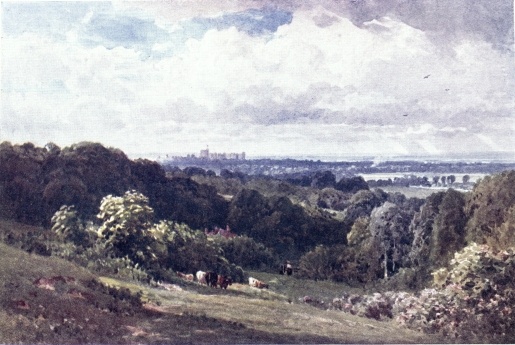 WINDSOR CASTLE FROM COOPER’S HILL, NEAR EGHAM.
of our liberties. Some would have that historic stage to be Magna Charta
island off the west end of the mede, where a stone is shown as the table
of signing; but no Surrey patriot can allow such a pretension on the
part of Buckinghamshire, while it may be that the king had his quarters
at the Benedictine Nunnery of Ankerwyke on the other bank, if not at the
old house in Staines pretending to that honour. It is remarkable what a
number of places in many parts of England claim to have housed or lodged
a so unpopular and worthless sovereign.
Above Runnymede, dropping off the ridge of Cooper’s Hill, one may come
down to the pleasant town of Egham, its one long street lying a mile
back from the river; but its accretions straggle on towards the bank,
where the tow-path leads by havens of boating men and “Anglers’ Rests”
to the bridge of Staines. This is a Middlesex town, the older part of it
also lying back from the Thames, upon the Colne, whose damp flats form a
somewhat dreary background, not enlivened by the banks of a huge
reservoir for thirsty London. But Staines has a name on the Thames
through its ancient stone, marking the limit of London City’s
jurisdiction, thirty-six miles up the river. There may be Londoners who
never heard of this stone, which made the goal of a Lord Mayor’s
progress eighty years ago, to be celebrated by his Lordship’s chaplain
in a most amusing style, by no means meant to be amusing. Having spared
the reader Akenside’s inscription for the column on Runnymede, I have
half a mind to inflict upon him some account of this expedition, as
raised to all the dignity of history, and all the interest of
exploration, in the reverend gentleman’s now rare volume. But it might
seem too like ancient history to a generation of impatient readers, who
know the Lord Mayor’s State barge only from the heading of their
Illustrated London News, and perhaps do not know how the Corporation’s
Admiralship has passed into the farther reaching hands of the Thames
Conservancy. “Suffice it, therefore, to say that though the party were
three successive days—two of which included fifteen hours—upon the
water; yet, such was the fine and ever-varying nature of the home
scenery around them, which was itself sufficient to engross the
attention, as the Thames made its azure sweeps round slopes of meadow
land; so diversified were the occupations of reading, working, and
conversation—conversation which, always easy and intelligent, was often
such as to discover memories containing ample registers of
miscellaneous snatches and fragments of sentiments, both in prose and
verse, which were sometimes applied with considerable tact and address
to passing scenes; so well and interestingly, in short, were the several
successive hours filled up”—that one must break off the chronicler’s
long-winded sentence with his own admission, that “it would be difficult
and tedious to detail all the particulars” of that civic voyage.
I do not aspire to emulate this author’s stilted gait on the trip from
Staines to London, but I invite the reader to plod with me along the
tow-path; that, as he is aware, will pass from one side to another, a
matter hardly understood by an observant American writer, who made note
how “one shore of the Thames, sometimes the right, sometimes the left,
it seems, belongs to the public.” From the Bells of Ouseley to Staines
Bridge the tow-path has been in Surrey; now it crosses to the pleasant
river front of the town, the Surrey side being blocked by private
paradises and boating-houses. To Chertsey, the next Surrey town, we
might, indeed, cut across by a road that at one point comes close to the
river; but the more inviting way is the path on the Middlesex bank, and
at one of the locks we may have the luck to catch a steamboat plying in
summer between Kingston and Oxford on a river, of which that old poet
might say more emphatically in our generation:—
Though with those streams, he no resemblance hold,
Whose foam is amber and their gravel gold;
His genuine and less guilty wealth to explore,
Search not his bottom, but survey his shore.
The riches of the shore here are chiefly in trim gardens and flat
fields, by which the tow-path leads windingly, yet spares us Father
Thames’ most wayward aberration, the mile-long loop of Penton-Hook,
across the mouth of which we cut by the lock in a couple of minutes.
Before reaching this from Staines, is passed on the opposite bank a
surprising collection of bungalows, shanties, and tents, one of those
settlements of genteel gipseying that have grown up on the banks in our
time. Beyond the lock, we come to the Middlesex village of Laleham, in
whose churchyard lies Matthew Arnold, born here in his father’s
pre-Rugby days. Below this leafy place, beginning to be overlaid by
builders’ plans, road and tow-path run together beside Laleham Park
towards Chertsey Bridge, the Surrey bank being fringed by willow copses,
much sought for floating flirtations and picnic teas. But to reach the
older part of Chertsey, one had better cross by the ferry at Laleham,
and take a mile of straight hedgerow path over the Abbey Mead, passing a
crumbling fragment, all that now represents what was once the richest of
Surrey’s monasteries, as it was the first founded in the county by St.
Augustine.
Nowadays there is not much air of ecclesiastical dignity about Chertsey,
rather of quiet prosperity in the long thoroughfare that crooks itself
nearly two miles from the station to the bridge, connecting the new
quarters that have sprung up at either end. The lion of this straggling
town is the house on the right side of the way up to the station, marked
by a tablet recording how “here the last accents flowed from Cowley’s
tongue”; but such a relic has gone down in value since the days when
Abraham Cowley ranked among the first flight of British poets. A name
more familiar to this generation is that of Charles James Fox, who had
his country retreat at St. Ann’s Hill. Another notable neighbour of
Chertsey was Thomas Day, author of Sandford and Merton. About three
miles behind the town, past Botley’s Park, Potter’s Park, and Ottershaw,
the now rich woods of Anningsley make a monument to that earnest
philanthropist, who fixed his home here on poor sandy land that he
might give employment in improving it by plantations. His death came
about through too consistent carrying out of his principle that animals
can always be managed by kindness; he was killed by being thrown from an
unbroken colt; then the wife whom he had chosen with so much
scrupulosity, after pupils trained for that post had failed to pass his
examination of trying ordeals, showed herself a worthy helpmeet by
spending the rest of her life in heart-broken seclusion.
Pleasant walks may be taken by those parks to the Basingstoke Canal and
the valley of the Wey, a few miles behind Chertsey. But no one who has
an hour to spare here should miss the ascent of St. Ann’s Hill, which
lies a short mile to the west on the road leading out near the railway
station. The grounds, with their grotto, “Temple to Friendship” and such
like, are of course private; but at the “Golden Grove,” notable by a
tree bearing up a platform in front, one can turn off the road for a
public path leading over the hill. Though only about 200 feet high, this
richly-wooded eminence looks far over the Thames valley; and through the
foliage at the top vistas have been cut framing such prominent landmarks
as Windsor Castle, the Holloway College, Harrow-on-the-Hill, Richmond
Hill, the Crystal Palace, and the Great Wheel at Earl’s Court, till it
had ceased to obtrude itself on so many points of view to the west of
London. There are traces of an old encampment that gave this hill the
forgotten name of Aldbury; and hidden among the trees is a “Nun’s Well,”
from which perhaps it was re-christened after a now vanished chapel of
St. Ann.
A couple of miles above Chertsey, between the Thames and the big village
of Addlestone, swells up Woburn Park, its grounds once celebrated as a
ferme ornée, but now a nursery of the young idea, where
prospect-hunters are out of bounds. Round it one may take a pleasant
path from Chertsey Bridge, leading over the green level of Chertsey
Mead, and curving into the Weybridge Road, where it crosses a Bourne not
far from the canalised course of the Wey. This path cuts off the bends
of the Thames tow-path, which as far as Weybridge keeps the Middlesex
bank. But if one were going from Chertsey Bridge to Walton Bridge, more
than half the distance is saved by taking the fairly straight road
through Shepperton in Middlesex. Travellers on wheels are willing to
give a wide berth to the Thames bendings, cyclists indeed being warned
off the tow-path; and the modern Great Western Road, like the old Roman
way to Silchester, does not touch Surrey till the bridge at Staines has
been crossed.
Thus Weybridge, lying off direct roads, entangled between the Thames and
the Wey, seems not so well known as it deserves to be. Richmond
excepted, I declare this the pleasantest riverside town in Surrey. It
stretches roomily from the river to the railway, with one end in the
lush meadowland of the Thames valley, and the other rising on the heath
and pine-wood scenery so characteristic of West Surrey. I once met a
honeymoon couple from the North who were pining among the tame richness
of England, but their spirits revived at the “Hand and Spear,” near
Weybridge station, which I prescribed as a tonic in their case. Here,
behind the railway, begins the wooded ridge of St. George’s Hill, the
top of which was an ancient camp, and one of Cæsar’s supposed stations
in Surrey. Nearly the whole of this long height is a private enclosure,
but it has been liberally set open to ramblers who will do no mischief.
In a central glade among the pine woods is even provided a Swiss Châlet
for refreshments; then a little south of this, where
 Hampton Court.
the ridge makes a sudden drop, opens a clear and wide view to the Downs.
The southern gate of the park lets one out on a road between Byfleet and
Cobham; and the winding tracks through the woods lead down on either
side to varied scenes, on the west the mazes of the Wey, straightened
out by its canalised arm, on the east an expanse of common and fir woods
falling to the alluvial bed of the Mole.
It is no wonder, then, that many Londoners—too many, says the last
comer—have built themselves villas on the dry upper slopes of Wey
bridge, while the older part of the town on the river bank is better
known to transient visitors of aquatic tastes. A link between the two
quarters is the spire rising near the bridge over the Wey to mark the
oldest part of all. The rebuilt church contains a tomb by Chantrey for
the Duchess of York, whose residence at Oatlands is also commemorated by
a pillar on the Green, a second-hand monument that once ornamented the
Seven Dials of St. Giles. Another royalty, Louis Philippe, for a time
found sepulchre in the Roman Catholic chapel here, till the bones of
this exiled family might be removed to their native land.
Oatlands Park borders Wey bridge on the east. If the general reader be
surprised that Drayton, in his account of what Milton styles
“Royal-towered Thames” couples Oatlands with Hampton Court and Richmond,
that is because readers with so much to read forget how this, too, has
been a palace, which made one stage of King Charles’s long journey to
the scaffold; and his youngest son, as born here, was Henry of Oatlands.
In the park stood two yew trees, some hundreds of yards apart, between
which legend draws its long bow in measuring by them a feat of Queen
Bess’s archery. The mansion is now an hotel; and the grounds have been
encroached on for building plots. A century ago it belonged to George
IV.’s military brother, that Duke of York whom Charles Greville, in his
critical way, calls the only one of the royal princes bearing the
character of an English gentleman; and he touches on the Duchess’s
extraordinary love of dogs, parrots, and monkeys. The graves of her
hundred pets still ornament the park, which has also to show such a
costly grotto as was dear to Georgian “improvers.” Another feature of
these grounds is the Broadwater Lake, representing a former course of
the Thames. The tongue of land beyond was once Middlesex, but by
alteration of the channel has been thrown into Surrey.
To this side the tow-path crosses at Weybridge, and one can double the
distance to Walton by following the bends of the river opposite
Shepperton and Halliford. Near Walton Bridge is reached a scene of
historic note, for Cowey Stakes here has been taken to be the ford by
which Cæsar crossed the Thames on his pursuit of Cassivelaunus. What
will be more obvious to the wayfarer is a very modern encampment of
tents, with other shelters and conveniences, including a floating bath,
which has sprung up of late years near the Middlesex end of Walton
Bridge. The town of Walton-on-Thames stands mainly back from the river,
its station being a mile behind. It has no such wild background as St.
George’s Hill, but lies pleasantly mixed up with groves and parks, and
seems a snug place of retreat for quiet-minded Londoners. Walton Church
was the scene of Elizabeth’s cautiously Anglican view of the
Sacrament:—
Christ was the Word who spake it,
He took the bread and brake it;
And what that Word did make it
That I believe, and take it.
This church boasts the tomb of Lilly the astrologer, and monuments by
Chantrey and Roubiliac; then near it is to be seen the house of the
regicide Bradshaw, now split up into cottages. In the churchyard is
buried “bright, broken Maginn,” Thackeray’s “Captain Shandon,” who set
so many tables in a roar.
But the literary and historic memories of such places may not much
concern those who have come out for a day on the river. Each of these
Thames-side towns is a haven for escaped Londoners, often familiar with
little more of them than the boat-houses on their banks, and the inns,
some of which seem too eager to make their hay while the sun shines.
Each has its fleet of boats, moored thickly together in whole rafts, its
clubs, and its annual gala day of the local regatta. On a fine Sunday or
Saturday afternoon every lock is packed with youth and beauty, set off
by gay colours and airy costumes. Every reach within railway ride of
London may be found lively with a jumble of craft of all sorts, from
Canadian canoes to Venetian gondolas, tiny yachts, skiffs, tubs,
outriggers, punts, ferry-boats, eights, fours, “dongolas,” “randans,”
pairs, rowed, poled, tugged, towed, or idly moored, like the big
house-boats whose cramped luxury gives a lazy refuge from cares and
taxes. Among all these the barges of business move like surly and
clumsy tyrants; and water-scorching machines sweep through the fluttered
crowd as wolves in a sheepfold. Steamers and motor-launches have
replaced the State barges in which Lord Mayors and such-like used to
progress in the days when to be a “jolly young waterman” was more of a
trade than a pleasure.
Those flights upon the banks of Thames,
That so did take Eliza and our James—
were winged by mercenary arms. It seems well that the golden or gilded
youth of our generation are more active, taking their amusement moult
tristement, as might be judged by an unsympathetic foreigner. An
English writer has found fault with Thames boats as “built for woman and
not for man, for lovely woman to recline, parasol in one hand and tiller
ropes in the other, while man—inferior man—pulled and pulled and
pulled as an ox yoked to the plough.” But that is hardly fair now that
girls boyishly take their turn at the oar, even exhibiting the spectacle
of whole galleys deftly womanned by crews of water-Amazons. The only
right left to man here is the panting and perspiring toil of the
tow-path, to which he bends devotedly like “the captives depicted on
Egyptian monuments with cords about their necks.” Such slavery may well
be preferred to the aid of those exorbitant and foul-mouthed hirelings
who infest the river banks in search of a job, which to Edwin makes a
labour of love, so Angelina be drawn along cool, at ease, grateful, and
admiring. With his dynamic energy, contrast the contemplative, perhaps
misanthropic, and apparently celibate joys of the angler, throned upon
his punt or posted on the bank, as he has been ever since Pope’s day—
The patient fisher takes his silent stand,
Intent, his angle trembling in his hand:
With looks unmoved, he hopes the scaly breed,
And eyes the dancing cork, and bending reed.
Below Walton, the Thames winds quietly on between banks that again
suggest a quotation from Denham—
No stupendous precipice denies
Access, no horror turns away our eyes.
The panorama is one of green meadows, garden grounds, shady islands,
cuts and creeks, Sunbury Lock, boat-houses, inns, water-works,
racecourse enclosures, and hints of villages lying back from the river;
but Hampton Church stands out on the bank; then a string of islets
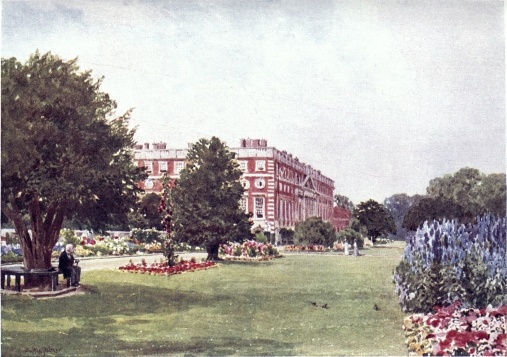
brings us on to the mouth of the Mole opposite Hampton Court. This
palace of popular resort, with its galleries, courts, gardens, and park
avenues, its barracks, its many houses of entertainment, and its
terminus of London tramways, is in Middlesex; but its station is across
the bridge in Surrey; and if one wanted matter to fill a few pages, one
might fairly include a description of its treasures. But so much has to
be said of the Surrey side, that we had better pass on with one look at
this monument of old England, touched with graces of continental taste.
The tow-path, that has been in Surrey since we left Weybridge, again
crosses to pass with princely breadth under the wall of Hampton Park.
But on the Surrey side also, we are not kept far from the river, for,
after a diversion through Molesey, the road comes to the bank by the old
church of Thames Ditton; then, through the outskirts of Long Ditton, it
joins the much-wheeled Ripley road, which in front of Surbiton becomes a
waterside esplanade beseeming that most respectable London colony that
has the name of being affected by west-end tradesmen and the like “warm”
citizens. Such, at least, is the reproach brought against it by
satirical scribblers, who perhaps live at Peckham or Camden Town,
envious at heart of Surbiton’s social amenities as described in the
instructive life of “Mr. Bailey Martin.” Another novelist suggests how
Surbiton wants nothing but a pier to look like a seaside resort, with
its parade, bandstand, and so forth, along which, by two miles of
houses, we come into the ancient borough of Kingston, that makes a core
for so much villadom.
As an independent town, this, with its excrescences, Surbiton, Norbiton,
Malden, is second for size in Surrey, overgrown only by Croydon; and
Kingston has also a Middlesex Lambeth in its transpontine quarter,
Hampton Wick. It is so far the county seat that the Hall of the County
Council has been built here; while it no longer shares with Guildford
and Croydon the dignity of assize town. There was a time when it might
boast of higher rank, for in the tenth century the Saxon kings were
crowned at this Rheims or Scone of South England. It seems always to
have been a place of importance through its ford, then through a bridge
which was long the next one above London Bridge. When a hostile attack
on London failed from the Southwark side, the enemy had nothing for it
but to march all the way round by Kingston, as Sir Thomas Wyat did to
little purpose. In the Civil War a
 FROM RICHMOND HILL
bridge of boats came to be thrown across the river at Putney. The first
movement of this war was about Kingston, a place worth seizing as key of
the road to Portsmouth, so in turn held by Royalists and Roundheads; and
almost the last sharp encounter between the two parties was a running
fight that ended in the outskirts of the town. London citizens of that
day must have had stirring news, when more than once they heard of
hostile forces so near their gates as at Hampton and Hounslow. The
wayfarer on Wimbledon Common is still apt to be startled by the sight of
train-bands slinking in knots from copse to hollow; but these are only
our Boy Scouts practising the devices of modern war; and presently, we
know, they will go home in peace to their tea. It was otherwise when
Captain Hew-Agag-in-pieces, or the doughty Sir Hudibras, could not take
his family on a trip up the river without the risk of falling into the
hands of malignant Philistines, its banks a paradise lost to Milton,
while perhaps Denham or Herrick might have safely ventured—
With soft-smooth virgins for our chaste disport
To Richmond, Kingston, or to Hampton Court.
Near the end of Kingston Bridge, now crossed by a tramway, stands the
restored Church, which has the distinction of being one of the largest
in Surrey, and contains old monuments, besides a show of modern memorial
windows. The chapel where the Saxon kings were crowned has been
destroyed; but the rough stone on which they traditionally sat is
reverently enclosed in the market-place for all to see but not to touch.
Could it speak for itself, this might tell strange tales of forgotten
superstition, like that other boulder in Westminster Abbey, uneasy seat
of Scottish kings, that must have travelled so far by land and sea since
it made Jacob’s pillow. By a recently “restored” statue of Queen Anne
before the Town Hall, Kingston also shows special devotion to the memory
of that truly dead sovereign. Such are “the memorials and the things of
fame that do renown this city”—as it might claim to style itself; and
the market-place whereabout they stand makes often a lively and
picturesque scene, on which the quasi-cockney mingles with the true
rustic.
Kingston is a headquarter of Thames boating, and its population must to
a considerable extent be made up of such “Jacks” as are the
camp-followers of this exercise. It is also fortunate in lying close to
three royal parks that have all become practically public
pleasure-grounds. The pleasantest way down the river is by the high edge
of Richmond Park; but below also one may take the tow-path, now on the
Surrey bank; while a middle way is the road passing over Ham Common. The
Middlesex bank is almost entirely taken up by private grounds; though at
Hampton Wick there is a tea-garden resort reached by a path from the
road behind. In the secluded back-water opening here there used to be a
capital bathing station, the nearest to London; but this has now been
closed by the excessive modesty of suburban senators; and not till the
shades of dusk may the youth of Teddington sally forth to make a noisy
Arcadia of the tow-path. Teddington lies in Middlesex, between Hampton
Wick and Twickenham, where the spread of villadom has not yet wholly
overwhelmed market-gardens, like that cultivated lovingly but at a loss
by the author of Lorna Doone.
At Teddington (Tide-end-town?) is the last rushing weir, and the Thames
current is for the last time bridled by a lock, not counting that
half-lock at Richmond. Henceforth, without ceasing to be a
pleasure-stream, it attends more strictly to business, and its voyagers
have to reckon with the tide. Above Teddington, the river is frequented
rather by more or less practised oarsmen; but on the Richmond reach we
may find a larger proportion of land-lubbers splashing manfully as best
they can; and on public holidays, it might be safer not to mingle in the
throng of lasses and lads who are trying their prentice hands at aquatic
pursuits, prices being then raised as the standard of experience is
lowered.
All the building is still on the Middlesex side, where Twickenham has
pleasant homes to show, as also celebrated ones like Pope’s Villa; but
the main part of the town lies hidden away behind Eel Pie Island. The
Surrey tow-path is bare, but for Ham House, whose famous avenue, beyond
Twickenham Ferry, opens on to the bank, here a broad bowery sward, with
room for all the engaged couples of Petersham and Richmond to keep aloof
from each other. Eyes less preoccupied will be attracted to the trees
and lawns of Orleans House and Marble Hill across the river, then
arrested by the noble brow of Richmond Hill that seems to bar our way
on.
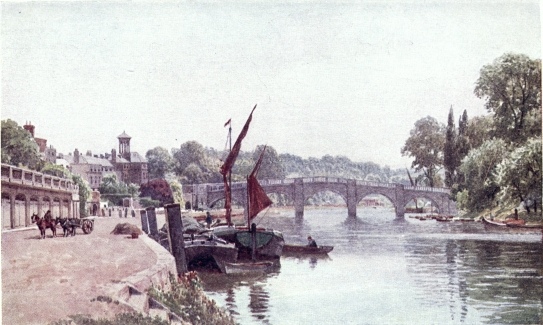
Richmond, of old known as West Sheen, was once a royal residence, and
its Green shows a fragment of the palace in which Elizabeth and other
sovereigns died. Most of Richmond’s antiquity has disappeared, down to
the renowned Cobweb Cellar, swept away two or three years ago, beneath a
rebuilt tavern; but much of the place still wears a dignified look of
Georgian old fashion, borne out by the narrow, bent main thoroughfare
that on a Saturday night will be more crowded than the Strand. The newer
streets above are quiet and genteel enough; but all the quarter between
the station and the front of busy boat-houses lays itself out for
strangers brought by four railway lines from London; and the streets
here are thickly set with houses of entertainment of every rank,
including confectioners to provide the “maids of honour” cheese-cakes
that are at Richmond what whitebait is or was at Greenwich. These two
places long made rival goals of London junketings up and down the river;
but automobiles now ply farther afield, carrying their best customers
past the Richmond hotels, so that the renowned “Star and Garter” had to
close its doors, to be reconstructed as a hospital for disabled
soldiers.
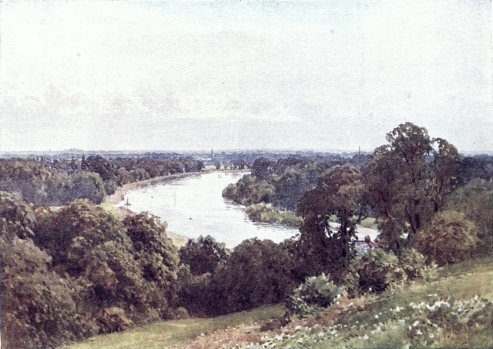
The great sight here, of course, is Richmond Hill, to which a gradual
ascent leads from the bridge, or from the bank above the boat-houses a
steeper one up the slope laid out as a beautiful public garden, its
highest part a shady terrace, commanding that rich landscape over which
gazed Jeanie Deans, in her heart perhaps preferring the view from
Arthur’s Seat. “A huge sea of verdure, with crossing and intersecting
promontories of massive and tufted groves, was tenanted by numberless
flocks and herds, which seemed to wander unrestrained and unbounded
through the rich pastures. The Thames, here turreted with villas and
there garlanded with forests, moved on slowly and placidly, like the
mighty monarch of the scene, to whom all its other beauties were but
accessories.” Flocks and herds, indeed, are not so visible in our day;
but the hundred barks and skiffs seen by Scott, may appear multiplied by
tenfold on the reach of the river extending at our feet.
Passing on before the transformed “Star and Garter,” and through the
gate of the Park, from this corner of it one has the same outlook—
... Here let us sweep
The boundless landscape: now the raptured eye
Exulting swift to huge Augusta send,
Now to the Sister Hills that skirt her plain,
To lofty Harrow now, and now to where
Majestic Windsor lifts his princely brow....
Heavens! what a goodly prospect spreads around,
Of hills and dales, and woods and lawns and spires,
And glittering towns, and gilded streams, till all
The stretching landscape into smoke decays.
Richmond Park is nearly nine miles in circuit, at its Robin Hood Gate
almost adjoining the wilder expanse of Putney Heath and Wimbledon
Common. It is a royal demesne, but by degrees, one of them a “village
Hampden” lawsuit, it has come to be treated as a public pleasure-ground.
Quite recently King Edward crowned former concessions by giving up
game-preserving in the many thickets that shade its swards, stocked with
herds of not too shy deer. In a central hollow are ponds that serve for
skating. Every part is now open except the enclosures of several
residences within the park, which are tenanted by royal favour. The
White Lodge on the farther side was the youthful home of the Princess of
Wales. Pembroke Lodge, near the Richmond Gate, was granted as retreat to
the veteran statesman Earl Russell, having originally been built for
that Countess of Pembroke young George III. loved in vain. On a mound
here Henry VIII. is said to have watched for the rocket from Anne
Boleyn’s scaffold on Tower Hill, as signal of his being a not
disconsolate widower.
On the riverside below Richmond Green, for public recreation is also
given up the old Deer Park, over which the Chinese pagoda beacons us
towards Kew Gardens. The Observatory here has now, through disturbance
caused by the vicinity of electric lines, lost its function of testing
delicate instruments. Along the road by the Lion Gate of the Gardens,
Richmond and Kew almost run into each other. As usual, it is twice as
far by the pleasanter path on the bank, which passes outside the Park
and Gardens, with views across the river upon St. Margaret’s, then on
Isleworth, on the grounds of Sion House, the home of an English Duke,
but at Lisbon its keys are or long were kept by the sisterhood banished
hence at the Reformation; then on the wharves and slums of Brentford,
county town of Middlesex, where the Brent makes shamefaced confluence as
a canal. Thus we come to the new Kew Bridge and Kew Green, which still
keeps a look of the dignity it wore as a favourite residence of George
III.; even in our own day it has housed a branch of the royal family at
Cambridge Cottage. The place is a great resort of his present Majesty’s
subjects, for whose refreshment appear many tea-houses and taverns. The
grounds of Kew Palace are now thrown into the gardens, that,
 RICHMOND.
open at all reasonable hours, make such a famous sight. Every Londoner
knows the Palm-Houses, the Botanical Houses, the show of aquatic plants,
and the gallery of Miss North’s paintings from all over the world. But
what many a visitor may pass unnoticed is what Richard Jefferies judged
the best show of all, the enclosure called the Herbaceous Ground, “a
living dictionary of English wildflowers,” to which “the meadow and the
cornfield, the river, the mountain and the woodland, the sea shore, the
very waste place by the roadside, each has sent its peculiar
representatives,” so as here to present an essence of wild nature, and
an epitome of the hills, woodland banks, and hedgerows of Surrey.
Thomson poetically speaks of Richmond as the place where “silver Thames
first rural grows”; but in prosaic fact the Surrey bank below Kew may
often be found a bushy solitude, sometimes a sloppy one, when overflowed
by high tides; and on the other side, the villas of Gunnersbury once
passed, the advance of Chiswick is masked by trees and market-gardens as
yet occupying a tongue of flat land, round which the river makes a
southward bend. The tow-path takes us on beside Mortlake, reached at its
“White Hart” haven of London omnibuses, and beneath the railway bridge,
so crowded when this is the goal of the University boat-race. Did one
care to explore Mortlake, in the Roman Catholic cemetery, behind the
station, would be found an extraordinary modern tomb, a huge stone tent
decorated with crescents and stars more conspicuous than crosses,
beneath which Sir Richard Burton rests after his many travels. In the
church is buried Dr. Dee, that “last of the magicians,” who was indeed
one of the first of our mathematicians. Farther back Richmond Park is
gained through the amenities of Sheen, now dwindling before the builder;
but there is still a pretty patch of Sheen Common.
The river front of Mortlake almost touches that of Barnes. Here it is
the turn of Surrey to throw out a flat promontory of market-gardens,
across the neck of which one can make a short-cut to Putney or to Barnes
Common. Keeping the bank, one has rather a dull walk round by the ferry
to Chiswick Church, then opposite Chiswick Mall and the old-fashioned
riverside front of Hammersmith, where the bridge would bring one fairly
into London. The London County Council’s scheme to run regular steamers
so far did not command the success it deserved; but in the fine season
ply occasional excursion Argoes, holding on up to Kew or still farther.
The river now becomes imprisoned in water-works, wharves, and piers; and
at low tide it reveals unlovely stretches of mud below the scrubby withs
that bind this shorn Samson’s writhings. Yet still, besides craft of
business, it may be found alive with boats, including police-cruisers
commissioned against boys surreptitiously bathing from a bit of
rubbish-strewn wilderness on the Middlesex bank, that in a few years
will be overflowed by the tide of houses creeping up behind. Meanwhile,
why not leave those unshamed urchins alone, whose aquatic gambols till
lately made a cooling sight from the opposite tow-path? One or two of
them were drowned every year, it is said; but the sum of life saved by
our grandmotherly councillors must fall far below the amount of health,
cleanliness, and cheerfulness stolen on such waste spots; and it might
well be considered what will become of this country a generation after
its youth has been schooled and policed out of exulting to risk life,
limb, and skin.
I forget what last-century autobiographer mentions a party of
schoolfellows landing to bathe a little higher up in the grounds of
Brandenburgh House, then occupied by the Margravine of Anspach, and
being surprised by her unserene Highness in person, who, armed with a
riding whip, took the young Adams at sore disadvantage. This vivacious
Amazon had been widow of Lord Craven, who built another house, called
Craven Cottage, just below the osier-fronted waste at present awaiting
reclamation. The Craven Cottage grounds have been fortified and
garrisoned by a club that carries on the business of drawing enormous
crowds to bet and roar over the performances of professional athletes,
their din suggesting another hint as to the welfare of the next
generation. But we may take hope to see how manfully the striplings of
Putney and Hammersmith ply oar and sculls in what else might be their
hours of ease; as everywhere within reach of the capital, that
sympathetic visitor, Mr. John Burroughs, could admire “young athletic
London, male and female, rushing forth as hungry for the open air and
the water as young mountain herds for salt.”
Ramblers on the Surrey side get a tantalising glimpse of expensive
pastimes, for the tow-path leads them beside the grounds of Barn Elms,
home of more than one notability in the last three centuries, now arena
of the Ranelagh Club’s sports. At the end of this enclosure is bridged
what looks like a muddy back-water, but is the mouth of the Beverley
Brook, so idyllic as it flows by Wimbledon Common to Roehampton; then
beyond we come to the boat clubs and taverns of Putney, facing the
grounds of Fulham Palace, now turned into a public park along the river
wall.
Putney is a suburb of much respectability, rising on to heights of
gentility at the back, and merging with the super-gentility of
Roehampton’s palatial villas. In future this birthplace of Gibbon may
also be known as abode of the poet Swinburne. At present it has an
annual hour of clamorous fame as starting-place of the University
boat-race. In the past it made an appearance in history as headquarters
of Cromwell’s army during the autumn of 1647, while negotiations went on
with the Parliament at Westminster on one hand, and with the King at
Hampton Court on the other. The church, then used as a council hall, has
one fine old feature in the chantry of Bishop West; and the way in which
it faces the corresponding tower of Fulham has provoked a legend of
their having been built by two giant sisters, who, as in the case of St.
Catherine’s and St. Martha’s Chapel near Guildford, are credited with
using one hammer between them, which they flung backwards and forwards
across the river.
Putney, as yet unfettered by tramways, is closely linked with London by
motor-buses plying all the way to northern and eastern suburbs, as well
as by trains of more than one line. But now the tow-path fails us, and
we must take ship to keep an eye on the Surrey shores. A little below,
the river will touch the four-mile-circle from Charing Cross. Once more
it is bordered by trees and lawns, but these belong to Hurlingham Club
and to Wandsworth’s new park; and it has far to go before reaching green
fields again on the shores of Kent and Essex. Shades of its prison-house
close in upon it fast, beginning with the group of grimy wharves and
mills amid which ends the bedraggled Wandle, turned to many a task from
its source to its mouth. The old buildings of Wandsworth have been
vanishing like the Mayoralty of Garratt Green behind it; but it has
still some quaint nooks, and the true Surrey feature of its open Common.
The next steamboat stage is by Battersea Reach, where it takes an
artist’s eye to catch the points of beauty dear to Turner. Battersea
Park faces the restored dignity of Chelsea. A huge railway arsenal
covers the site of those Nine Elms that have long gone to make coffins
for the dancers in Vauxhall Gardens. Doulton’s pottery works look across
to the Tate Gallery. Lambeth Palace is passed, then St. Thomas’s
Hospital stares from wakeful eyes at the House of Parliament. Below
Westminster Bridge, Surrey is to give a site for the Hôtel de Ville of
our County Council; but as yet the bank here makes a shabby contrast to
the clubs and hotels of the Middlesex side. St. Paul’s looks down upon
Southwark, which has now a Cathedral Church of its own in St. Saviour’s,
with its old monuments and new memorial windows. This lies at the end of
London Bridge, beyond which the tanneries of Bermondsey have hidden the
very site of its once famous Abbey, opposite the Tower of London. The
last Surrey parish is Rotherhithe, where Captain Lemuel Gulliver could
find a pleasant retreat after his voyages, when it was known as Redriff;
but now the name of its Cherry Orchard pier seems a mockery, till one
searches out the groves and garden-beds of Southwark Park, hidden behind
a front of wharves and warehouses. A dull change this from the green
meads of Egham or the slopes of Richmond. But a painter in words, too
early lost to his Surrey home, George W. Steevens, can show colour,
life, and romance in those avenues of dingy buildings and naked masts.
Always the benign sun-and-smoke clothes them with softness and
harmony; it softens their vermilion advertisements to harmony with
the tinted azure of the sky and the vague grey-brown of the water.
Brutal business built them, to ship and unship, and be as crass and
crude as they would, but the smoke turns them into the semblance of
sleepy monsters basking by the river they love. Presently the tall
sky-line breaks and drops; let in between the monsters appears a
terrace of tiny riverside houses, huddled together as in a
miniature. There is a tiny tavern with a plank-built terrace rising
on piles out of the water, a tiny shop all aslant, a tiny brown
house with a pot-belly of a bow-window. It all babbles of Jack and
Poll, of crimps and tots of rum, and incredible yarns in the
bar-parlour. Next, between the dusky wharves, an Italian
church-tower soars up out of a nest of poor houses; the sun catches
its white face and transfigures it. Then, the dearest sight of
all—ships appearing out of the land, fore and main and mizzen,
peak and truck, halliards and stays, and men like flies furling
top-gallant sails above the roofs of London. As we open the region
of the docks we are in a great city of ships—big steamers basking
lazily with their red bellies half out of water, frantic
spluttering tugs, placid brown-sailed barges, reckless banging
lighters—and behind all this, clumps and thickets and avenues of
masts and spars and tackle stretching stretching infinitely on
every side. The houses have melted all away, and London is become a
city of ships.
Here we go on shore from Father Thames, that
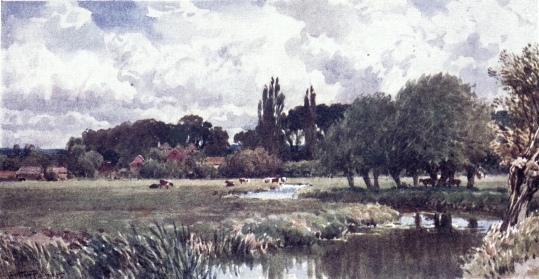 THE MEADS, FARNHAM.
sober and steady as he looks, leads so many a British stream to end its
skittish, froward, and headstrong youth by running away to sea:—
And round about him many a pretty page
Attended duly, ready to obey;
All little rivers which owe vassalage
To him, as to their lord, and tribute pay:
The chalky Kennet and the Thetis grey;
The moorish Colne, and the soft sliding Breane;
The wanton Lea, that oft doth lose his way;
And the still Darent, in whose waters clean
Ten thousand fishes play and deck his pleasant stream.
Further on in his catalogue of rivers, Spenser gives the Mole a whole
couplet to itself, well known to guide-book writers in search of copy.
But one rubs one’s eyes to find him omitting Surrey’s principal
tributary, so compliant, too, in yoke of rhyme,—the Wey, a clansman of
the Welsh Wye, and also of that disguised “Thetis grey,” which turns out
to be the stream flowing into the Thames at Cookham, on maps styled Wye,
though a high authority suspects that it adopted this good old British
name only by suggestion from its course beside Wycombe, even as the men
of some broken clan might wrap themselves in the tartan of Campbell or
Macdonald.