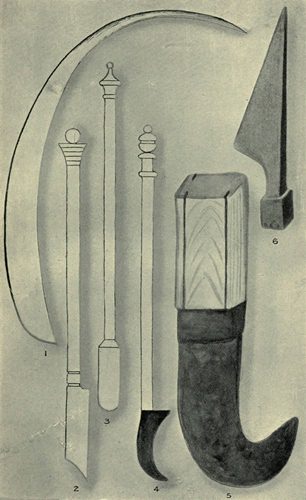
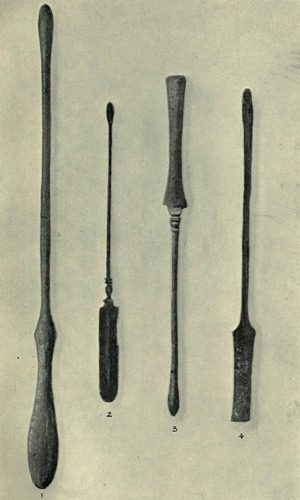
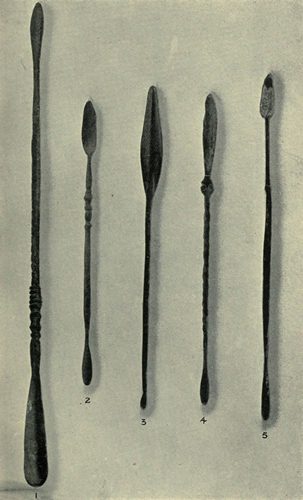
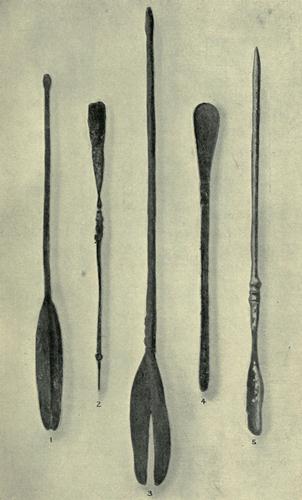
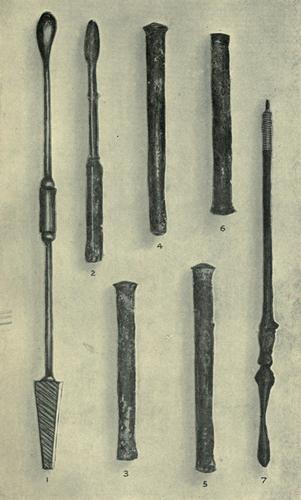
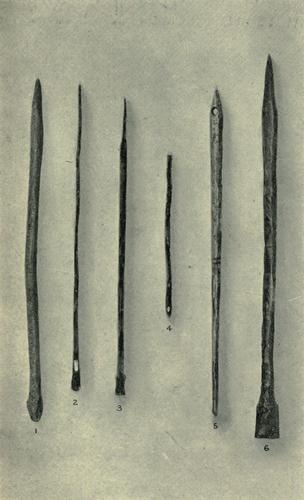
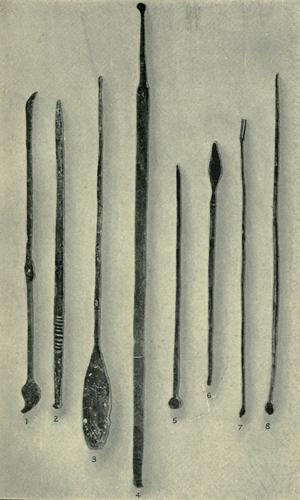
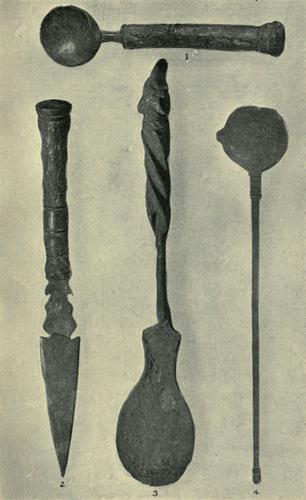
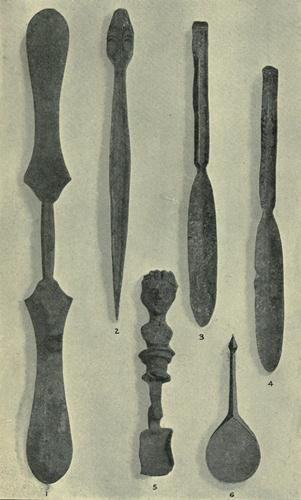
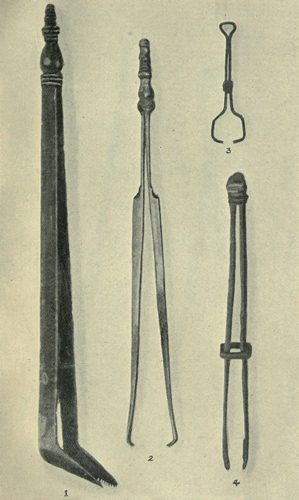
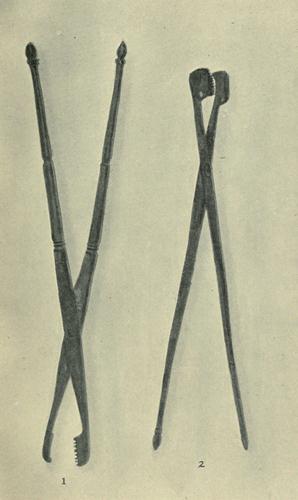
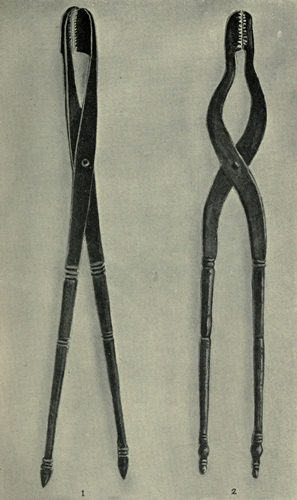
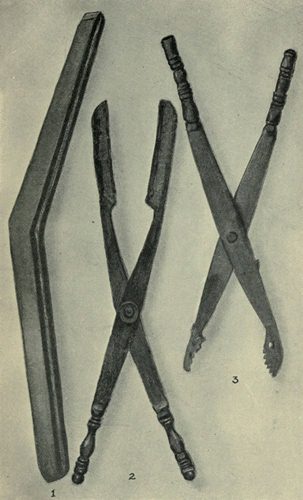
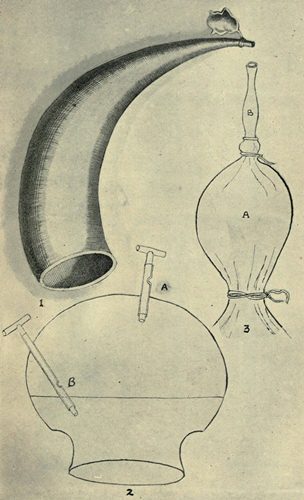
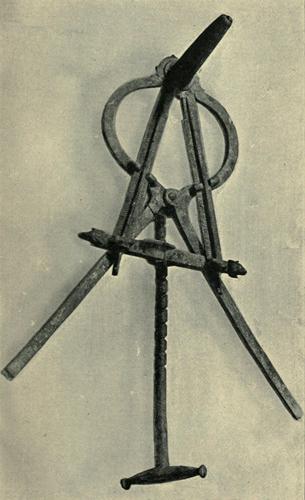
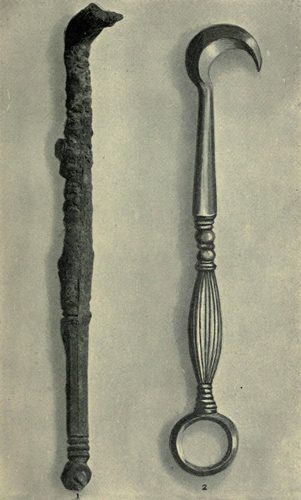
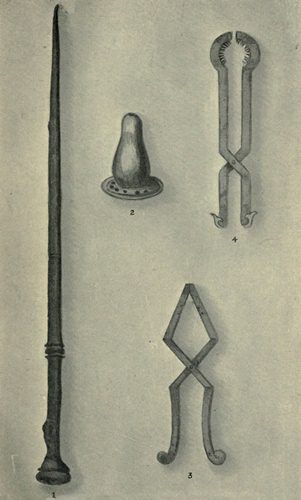
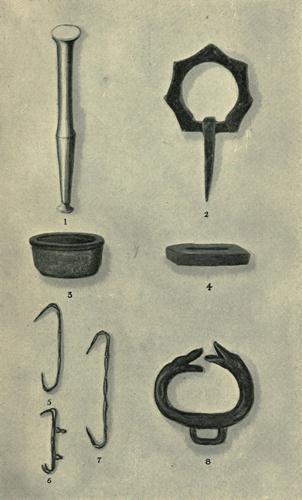
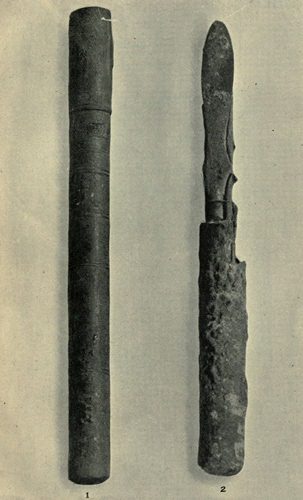
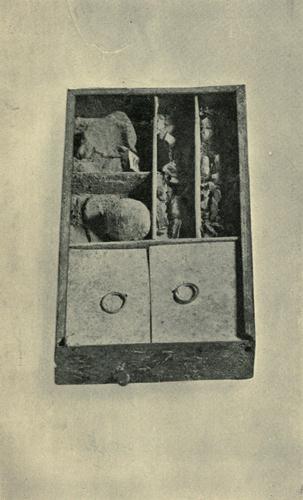
PROBES
Greek, μήλη, κοπάριον, ὑπάλειπτρον, ὑπαλειπτρίς; Latin,
specillum.
This is a very comprehensive class. The original specillum was no doubt a
simple sound. Varro thus defines the specillum: ‘Quo oculos inunguimus
quibus specimus specillum est. Graecis μήλη dicitur.’ Thus it
meant a probe or sound.
μήλη is probably derived from μῆλον, an apple or fruit,
from the olivary enlargement at the end of a sound.
The term ὑπάλειπτρον, which is frequently used by Hippocrates,
originally meant an ointment spatula, being derived from ὑπαλείφω,
to spread ointment. But the custom of combining two
instruments on one shaft gradually led to the application of these terms,
especially the term specillum, to denote a large variety of instruments.
The name κοπάριον is evidently derived from the resemblance of
the probe to the pestle, which was such a frequent utensil in Greek homes.
It is connected with κόπανον, ‘pestle,’ κοπανιστήριον,
‘mortar,’ and κοπανίζω, ‘bray,’ and κοπτάριον, a
medicament pounded in a mortar (Dioscorides, iv. 190). The exact
significance of the term κοπάριον is sometimes difficult to
determine. It is easy to prove that in general it is merely a sound. Thus
Paul (VI. lxxviii), in quoting a passage from Hippocrates, substitutes
κοπάριον for the word μήλη, which Hippocrates uses to
denote the sound used for exploring a fistula. Throughout this chapter, in
which the word occurs ten times in all, Briau translates it by ‘manche du
scalpel’, although the whole context shows that a probe is meant. Even
where it is spoken of as an eyed probe (διὰ τετρημένου κοπαρίου)
Briau translates it by ‘au moyen du manche percé d’un scalpel’, an
expression which is meaningless to a surgeon. Briau evidently thinks it is
derived from κόπτω, and at times it seems as if it might denote a
cutting instrument. Thus Adams, in a note to Paul, VI. lxxvii, says, ‘if
the κοπάριον, however, was the same as the μήλη or
specillum it was evidently used for cutting with, as well as for cutting
upon’, and on one occasion (Paul, VI. lxxx) he translates
κοπάριον by ‘knife’. Liddell and Scott translate it as ‘a small knife’. A
careful examination of those passages where it seems to indicate a cutting
instrument will show, however, that only blunt dissection, which was
frequently performed with the spatula end of a probe, is meant. I am quite
convinced that the word κοπάριον is only a late Greek term for
the earlier μήλη, and means essentially a sound, and not a knife.
While on this subject we may note that throughout the codices and texts
there is great confusion between words meaning probe and words meaning
scalpel. The proper forms σμίλη, ‘scalpel,’ and μήλη,
‘probe,’ are distinct, but the inferior reading σμήλη is frequent
in both codices and texts as a bastard, for σμίλη is often
written σμήλη incorrectly, and μήλη often becomes
σμήλη, just as μικρός is written σμικρός. Thus
in Paul (VI. viii), where the author is describing the eversion of the
eyelid by means of the olivary point of a probe (τῷ πυρῆνι τῆς
μήλης), four codices and the Aldine and Basle texts read σμήλης,
two codices read σμύλης, one reads μήλης, four
μίλης, and Briau reads σμίλης. In a case like this only a
knowledge of surgery can tell us whether a probe or scalpel is meant.
The Specillum as a Sound.
The ancients were fully aware of the value of the information to be gained
by searching the recesses of a lesion with a rod of metal. Celsus (v. 28)
says regarding fistulae:
Ante omnia autem demitti specillum in fistulam convenit, ut quo tendat
et quam alte perveniat scire possimus; simul etiam protinus humida an
siccior sit: quod extracto specillo patet. Si vero os in vicino est
id quoque disci potest si iam necne eo fistula penetraverit et
quatenus nocuerit; nam si molle est quod ultimo specillo contingitur,
intra carnem adhuc vitium est, si magis id renititur, ad os ventum
est. Ibi deinde si labitur specillum, nondum caries est: si non
labitur sed aequali innititur, caries quidem, verum adhuc levis est:
si inaequale quoque et asperum subest, vehementius os exesum est. At
cartilago ubi subsit, ipsa sedes docet; perventumque esse ad eam ex
renisu patet.
‘But first it is well to put a probe into the fistula to learn where
it goes and how deeply it reaches, also whether it is moist or rather
dry as is evident when the probe is withdrawn. Further, if there be
bone adjacent, it is possible to learn whether the fistula has entered
it or not and how deeply it has caused disease. For if the part is
soft which is reached by the end of the probe the disease is still
intermuscular; if the resistance be greater it has reached the bone:
if there the probe slip there is as yet no caries. If it does not slip
but meets with a uniform resistance there is indeed caries, but it is
as yet slight. If what is below is uneven and rough the bone is
seriously eroded, and whether there is cartilage below will be known
by the situation, and if the disease has reached it will be evident
from the resistance.’
These remarks show that with the probe the ancients had cultivated the
tactus eruditus to a high degree, and the remarks of Aetius and Paul are
equally to the point.
The tips of the probes which have survived vary considerably in size and
shape. Some have a point which is almost sharp like a stylet; in others
the natural thickness of the shaft is kept right to the tip, which is
simply rounded off or there is an oval enlargement like that on our
olivary probes and sounds. In rare cases the enlargement is globular. The
oval enlargement was named by the Greeks πυρήν, which means
‘olive-kernel’. The sixteenth-century translators uniformly render this by
‘nucleus’, which is a convenient term to use, but it has no classical
Latin authority. Indeed, there is no classical Latin equivalent used by
medical authors. Theodorus Priscianus uses baca (sic), a berry, and
bacula, little berry, and in the Additamenta (I. viii. 21, ed. Rose)
he uses the transliteration pyrena meles. But this is African Latin.
A probe without enlargement at the tip was called ἀπυρηνομήλη or
ἀπυρομήλη. The ear probe is frequently referred to as belonging
to this class. These probes without nuclei were specially adapted for
wrapping round with wool to apply medicaments, or wipe away discharge.
The size of the nucleus varied in different varieties of probe, but was
pretty constant in each particular. It was largest in the probe known as
the spathomele—a combination of spatula and probe which was in extremely
common use for pharmaceutical purposes. The nucleus of this probe was such
a well-known object that it is frequently referred to as a standard of
size and shape. Galen (ii. 898) says:
‘In the cervix uteri is the foramen by which the woman both passes the
monthly flux and receives the semen of the husband. By it also the
foetus leaves the womb. It is marvellous how it varies in size
according to circumstances. When the woman is not pregnant it admits
the nucleus of a probe or something slightly larger’
(πυρῆνα μὲν μήλης ἐπιδέχεται ἢ βραχύ τι τούτου παχύτερον).
Here Kühn translates πυρῆνα by ‘acuminatum capitulum specilli’,
which is incorrect. It is an olivary enlargement, not sharp point. In Paul
(VI. xc), we have the nucleus given at the measure of distance between the
perforations by which a bone was surrounded preparatory to its excision by
means of chisels: ‘the space between the perforations made by the drills
should be the breadth of the nucleus of a probe’ (τὸ μῆκος πυρῆνος).
Aetius (III. i. 16) says in volvulus the sphincter ani is so contracted
that the nucleus of a probe cannot be got in.
Paul (VI. xxi) says that in couching a cataract we must enter the couching
needle a nucleus breadth from the iris.
Besides its use as a sound the nucleus was frequently used as a means of
applying medicaments, either in the form of ointments or dry powder, to
affected parts.
Paul (VI. ix) says that in the cases of entropion, where the ordinary
plastic operation is objected to, an elliptical piece may be burnt out of
the eyelid with caustic applied on the nucleus of a probe (πυρηνοσμήλης),
and similarly after removal of sebaceous cysts from the
lid, levigated salts may be applied on the nucleus (τὸν πυρῆνα τῆς μήλης).
Aetius (II. iv. 23), quoting from Galen, says that in caries of the teeth
some wax may be warmed on the nucleus of a probe (πυρῆνος μήλης),
and again (II. iv. 14) he directs us to use it for application of pomade
to the face (πυρῆνι μήλης). It would seem that this, and not the
exploration of wounds, was the original use to which the olivary-pointed
probe was put, for in early Egyptian tombs small pestle-like probes are,
as a rule, found accompanying the toilet pigment boxes which are so
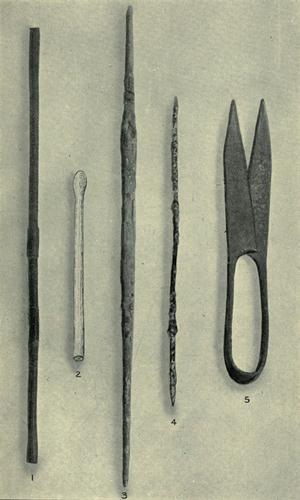
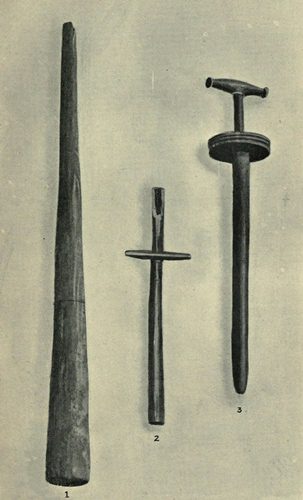
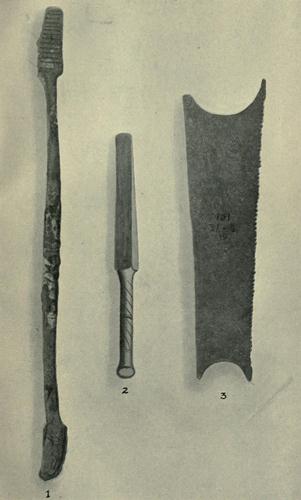
common. They are mostly made of wood (Pl. X, fig. 2). The kohl-stick was
not unknown to Greek ladies. (See Eustathius, Comment. in Iliad.)
Hitherto I have spoken of the probe as if it were a single instrument;
but, as a matter of fact, the ends of the shaft are usually fashioned to
serve different purposes. Thus at one end there will be a probe, at the
other a spatula, a spoon, or a hook. Some of these combinations have names
of their own, and others are so frequently met with that they too seem to
have been constant types.
It may simplify matters if we anticipate a little and remark that while
the uses of the probes in actual surgery were the same as at the present
day, in the minor surgery, consisting of the application of medicaments
and toilet preparations, they were used in a slightly different manner.
Semi-solids, like eyebrow pigment and eye ointments, were applied on
olivary-pointed probes. Liquids, like ear and eye drops, were usually
instilled by squeezing a ball of wool dipped in the liquid and placed
round the middle of a probe, and letting it run off the point. Thus a
common form of toilet instruments consists of a probe-like instrument with
an olive at one end and a sharp stylet at the other. Ligulae with scoops
were used to withdraw drops of fluid essences, &c. from unguentaria. Some
of these ligulae run up to a foot and a half in length.
The specilla which remain to us are mostly made of bronze. A few are
overlaid with gold and silver, and a few are solid gold or solid silver.
We read, however, of specilla of lead, tin, copper, and wood, and of the
use of a boar’s bristle or a stalk of garlic for searching fistulae.
I shall now proceed to classify and discuss these different varieties,
premising, however, that no hard and fast line can be drawn between
different types. They shade off into each other by imperceptible
gradations, so that whatever system of classification we adopt bastard
forms are sure to occur.
Double Simple Probe.
Greek, ἀπυρηνομήλη, ἀπυρομήλη; Latin, specillum.
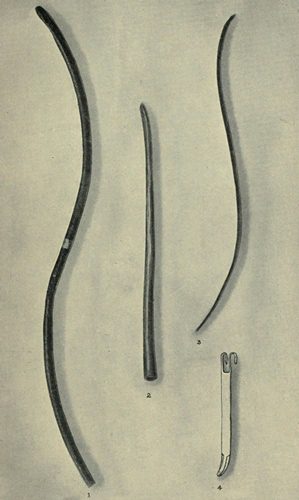
The simplest form of specillum is a plain rod of metal rounded off at
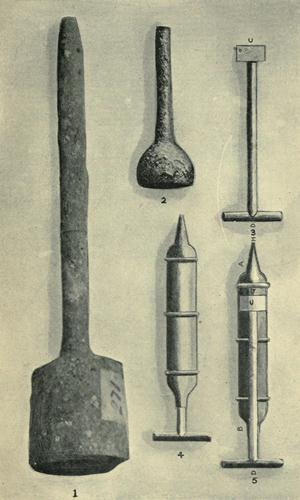
either end. These are not infrequently met with. I figure one from my
collection. Its length is 14.5 cm., its diameter 2 mm. At either end it
tapers rapidly off to a blunt point. At a distance of 3 cm. from one end
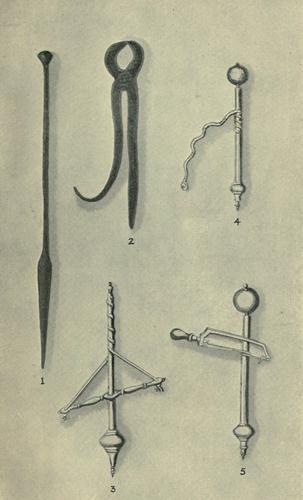
is a raised ring (Pl. X, fig. 4). A similar probe in silver may be seen in
the Musée de Cinquantenaire, Brussels. It was found with other probes in
an étui. Pl. X, Fig. 3 shows a rather longer specimen from the Naples
Museum. A variety with non-tapered ends is seen in Pl. X, fig. 1. It is
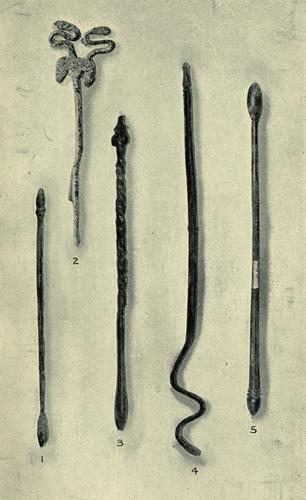
also from the Naples Museum. Pl. XI, fig. 4 shows a probe, from my own
collection, which carries the snake of Aesculapius at one end. One with a
double snake (caduceus form) was found in the Roman Hospital at Baden (Pl. XI, fig. 2).
Specilla with two olivary ends.
Greek, διπύρηνος μήλη, ἀμφίσμιλος.
A slender sound with slight olivary enlargement at either end is very
frequently mentioned under the name διπύρηνος μήλη by Galen. He
also calls it ἀμφίσμιλος. Thus he says:
Καί σοι διχόθεν ἔστι διεμβάλλειν αὐτοῦ τι τῶν
παρασκευασμένων λεπτὸν εἴτε ἀμφίσμιλον, εἴτε διπύρηνον ὀνομάζειν
ἐθέλεις, εἰ δέ τι λεπτότερον δέῃ καὶ μηλωτίδα (ii. 581).
‘And in the double passage you must insert some one of the slender
instruments you have at hand, either a double-ended probe (a ‘double
olive’ if you prefer to call it so), or if something finer be
necessary, even an ear probe.’
In dealing with fistulae Paul (VI. lxxvii) says:
‘We must first examine them with a sound if they be straight, or with
a very flexible ‘double olive’ (διπυρήνῳ εὐκαμπεῖ), such as
those made of tin or the smallest of those made of bronze, if they be
crooked.’
Paul refers to its use as a cautery to destroy the roots of hairs after
epilation (VI. xiv):
‘Some, preferring cauterizing to the operation of transplantation,
evert the eyelid, and with a cilia forceps dragging out the offending
hair, or two or even three hairs, apply a heated double-olive probe or
an ear probe, or some such slender instrument, to the place from which
the hair or hairs were removed’ (Διαπυρίνον ἢ μηλωτίδα ἤ τι
τοιοῦτον λεπτὸν ὄργανον πεπυρωμένον εἴρουσι τῷ τόπῳ ὅθεν ἡ θρὶξ ἢ
αἱ τρίχες ἐκομίσθησαν).
Here Briau reads πυρῆνα (an olivary point), but the balance of
the evidence of the codices is in favour of διαπυρίνον, and the
parallel to the passage quoted from Galen is so complete that I have no
hesitation in adopting the reading given above.
I give an example of the dipyrene from my own collection. It is 11·2 cm.
long. The shaft is unequally divided by a ringed fluting into two
portions; 4·5 cm. and 6·7 cm. long respectively. The shorter portion of
the shaft is plain, the longer is grooved longitudinally by eight grooves
(Pl. XI, fig. 1). In many instances the dipyrene carried an eye in one of
its olives. This variety is frequently mentioned. Thus Paul (VI. xxv)
says, under treatment of nasal polypus:
‘Taking then a thread moderately thick like a cord, and having tied
knots on it at the distance of two or three finger-breadths, we
introduce it into the eye of a dipyrene (διπυρήνου τρήματι),
and we push the other end of the probe (τὸ ἕτερον πέρας τοῦ διπυρήνου)
upwards to the ethmoid openings, withdrawing it by the
palate and the mouth, and then pulling with both hands we, as it were,
saw the fleshy bodies away by means of the knots.’
Pl. XI, figs. 5 and 3 show single olive probes for the application of
semi-solid medicaments. The former is from the outfit of the oculist of
Rheims, in the Museum at St-Germain-en-Laye; the latter, more highly
ornamented by spirally twisting the stem, is from my own collection.
Spathomele or Spatula probe.
Greek, ὑπάλειπτρον, σπαθομήλη; Latin, spathomele (Theodorus
Priscianus), spathomela (Marcellus); German, Spatelsonde.
Almost every medical writer mentions the spathomele. It consists of a long
shaft with an olivary point at one end and a spatula at the other. Galen
(Lex.) calls the one στρόγγυλον μήλην, the other μήλη πλατεῖα.
It was a pharmaceutical rather than a strictly surgical
instrument. The olive end was used for stirring medicaments, the spatula
for spreading them on the affected part or on lint. Galen (xiii. 466) says
that certain applications are to be softened in the hand with rosaceum by
means of the spathomele (μαλάξας ἐπὶ τῆς χειρὸς διὰ σπαθομήλης).
Marcellus frequently refers to it as used for stirring liquids in a
vessel:
Immo manu vel digitis moderantibus paulatim insperges et adsidue
spathomela commovebis et permiscebis, post haec omnia mittes oleum
chamaemelinum, et iterum igni non nimio adposita olla lente et
paulatim decoques medicamen, ita ut illud manu non contingas, sed
spathomela agites (vii. 19).
In xiv. 44 he mentions a spathomele of copper:
Oportet autem moveri aquam ipsam rudicula vel spathomela aeris rubri.
The following passage from Theodorus Priscianus refers to its use for
applying ointment to an affected part:
Si veluti carbunculus innatus fuerit, lycium cum melle contritum
suppono frequenter per diem et spathomela temptante (Euporiston,
xxvii).
Aetius (II. iv. 16) directs a particular medicament to be rubbed in and to
be scraped off after a moderate space of time with a spathomele
(τῇ σπαθομήλῃ).
The spathomele was used by painters for preparing and mixing their
colours. The very large numbers in which they are found would indicate
that their use was not confined to medical men.
Although the nucleus of the spathomele was too large to admit of its use
as a probe for small lesions, it is evident that in exploring large
cavities it must have been a valuable instrument. Galen (ii. 712) says:
‘In small bodies the opening into the torcular Herophili may not be
large enough to admit a spathomele nucleus, and therefore we must try
some of the other olivary probes or even an ear probe, and cut
alongside it.’
Priscianus alludes to plugging the nares with it:
Prius spathomeles extremo in baca molli lana obvoluto glebas sanguinis
e naribus frequentius purgare nos convenit, post lana identidem
obturando perclaudere (xiv).
‘First of all we must frequently wipe away the clots of blood from the
nose with the end of a spathomele wrapped on the ‘berry’ with soft
wool, and then occlude it by plugging with wool in the same way.’
From Leonidas (Aetius, VI) we learn that it was used as a tongue
depressor. He says:
‘In inflammation of the throat in adults seat the patient, open his
mouth and depress the tongue with a tongue depressor or a spathomele,
and open the abscess with a scalpel or a needle-knife.’
The following passage from Galen shows that it was used as a substitute
for the meningophylax (q. v.):
‘Having separated the pleura from the rib and placed a thin
meningophylax or a flat spathomele (σπαθομήλην πλατεῖαν)
between the ribs, and taking care that you neither tear nor perforate
the membrane, which being properly accomplished, cut the bone of the
rib with two chisels placed opposed to each other’ (ii. 686).
Soranus (xxvii) refers to its use as a cautery:
‘After cutting off the umbilical cord, cauterize the umbilicus with a
heated reed, or the flat of a probe’ (τοῦ πλάτεος τῆς μήλης).
An interesting passage in Aetius shows that it was used as a dissector in
opening up an occluded vagina:
‘Pass a sound into the cervix, and dissect with the spathomele below
the spot marked out by the sound’ (Aet. IV. iv. 96).
This probably means blunt dissection only, as none of the spathomeles
found have edges sharp enough to be actually cutting. Large numbers of
this instrument have been found. It is the commonest surgical instrument
in museums. It must be remembered, however, that not every spathomele is a
surgical instrument strictly speaking, as pharmacopolists and even artists
used exactly similar instruments.
The average length of twenty specimens measured by me was 16 cm. Of this
the nucleus occupies 1·5 cm., the spatula 6 cm. The average diameter of
the nucleus is 7·5 mm. The width of the spatula averages 15 mm., but the
size and shape of the spatula both vary considerably.
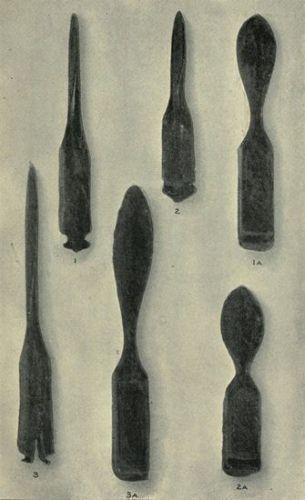
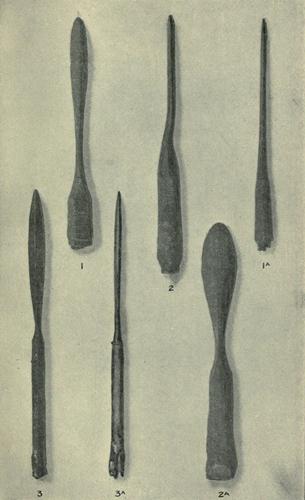
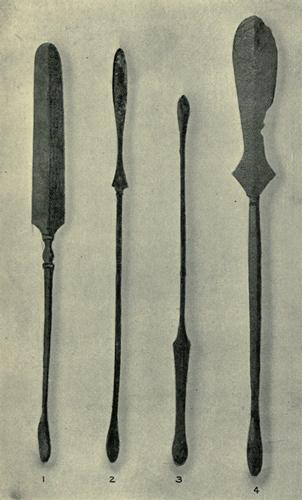
The different varieties of shape will be better understood by a reference
to the accompanying figures of actual specimens than from a written
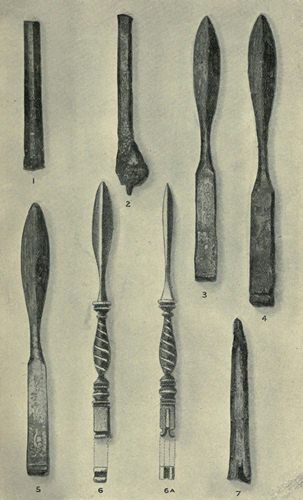
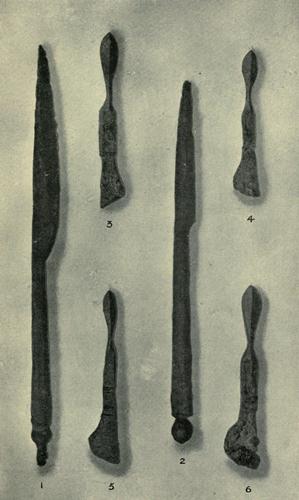
description. Pl. XII shows neatly formed specimens from various sources;
the specimen shown in fig. 3 having ornamental grooves along the length of
the shaft. Figs. 3 and 4, Pl. XIII show coarse, thick specimens, which are
most likely to have been used for non-medical purposes. All have the
characteristic oar-blade shape, though the outline varies greatly. In some
the blade widens out at the end, so that the tip is broad and rounded. In
others the blade slopes to a rounded point, or the point is quite acute.
The edges of the blade are usually thick and blunt. In some specimens,
however, the edges are thin, sharp, and almost suitable for use for
cutting with. These are well adapted for use as blunt dissectors.
The shaft, as a rule, is plain, occasionally it is ornamented with
longitudinal or spiral fluting. More rare is a silver band, inlaid in a
spiral round the shaft. I have seen a few specimens which have been
entirely plated with gold.
Hitherto I have taken no notice of spathomeles in which the spatulae are
not flat. In many specimens, however, the blades are hollowed. For these
it seems advisable to constitute a special class, which may be called the
cyathiscomele class.
Cyathiscomele.
German, Löffelsonde.
Although this variety of the spathomele is not one which is specially
mentioned by any classical writer, it is convenient to have a name by
which we can denote that variety of the spathomele in which the blade is
not flat.
It has the same large oval nucleus as the flat spathomele, and the same
shaft, plain, or fluted, or overlaid with silver, but the spatula is
replaced by a spoon, the outline of which shows the same variety of form
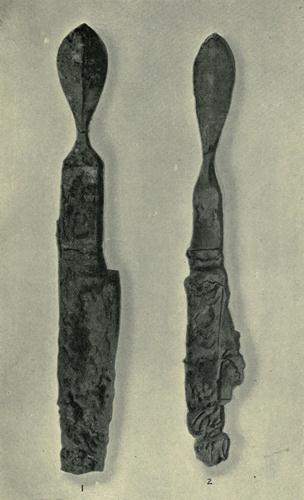
as we met with in the spatula. The depth of the spoon varies greatly. Pl.
XIV, fig. 3 shows an instrument in which the two lateral halves of the
blade, instead of lying exactly in the same plane, meet in the midline at
a slight angle so as to form a cavity obtusely angular on cross section,
and gently rounded on longitudinal section:
| Cross sec. |
|
 |
| Long. sec. |
|
 |
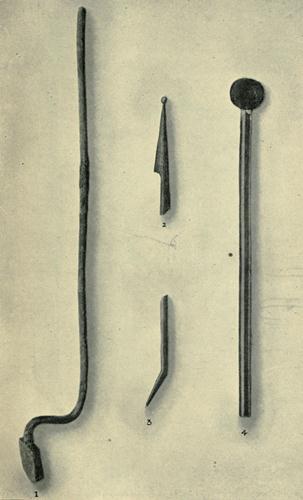
Pl. XV, fig. 1 shows a similar arrangement, except that the cavity is more
marked, and the tip instead of being sharp is rounded. In Pl. XIV, fig. 1
the cavity is so marked that a typical spoon is formed. This specimen is
interesting as showing the ornamentation of the shaft by overlaying a
spiral silver wire. It is from the Naples Museum, and it is figured by
Vulpes. Other varieties are seen in Plates XIV,
XV. Pl. XV, fig. 4 shows
a very coarse, thick specimen. The scope of the cyathiscomele in medical
art is evidently like the flat spathomele to act occasionally as a sound,
but mainly to mix, measure, and apply medicaments. Some are adapted for
use as curettes. But the large number in which this instrument occurs
would of itself indicate that it was used for lay as well as medical
purposes. Many are toilet articles. An interesting discovery of two
typical specimens in the grave of a lady artist was made in Vendée in
1847. Among a number of colour pots and alabaster mortars for rubbing down
and mixing colours was an étui similar to the typical cylindrical
instrument case of the ancient surgeon, and in this were two spoon probes
like the one shown in Pl. XIV, fig. 1. Evidently they were favourite
instruments of the painter, and had been used by her for mixing and
preparing her colours.[2]
The form of cyathiscomele, in which the two lateral halves of the scoop
meet at an angle (Pl. XIV, fig. 1), has a tendency to split along the
ridge in the middle of the scoop if roughly handled. One of these, to
which this accident has happened, is in the Naples Museum (Pl. XV, fig. 3)
and has an interesting history. In 1847 Vulpes described it as a guard for
dividing the fraenum linguae, and successive writers have copied this ever
since, and it is so described in the catalogue. As the photograph shows,
it is only a spoon probe which had been trod on or otherwise damaged, and
which had split down the centre, or rather near the centre, for the crack
has deviated at its termination from the midline. The termination of the
notch thus formed has quite a different appearance from the figure by
Vulpes. The accident is not an uncommon one. There is in the Capitoline
Museum an instrument to which precisely the same has happened, and I have
a probe in my own possession which has split, and which with a little
manipulation would make a beautiful duplicate of the one in the Naples
Museum (Pl. XV, fig. 1). It is almost certain that the guard is quite a
modern invention.
Many ancient writers point out the danger of wounding the vein, but none
mention the guard. Thus Celsus says:
Horum extrema lingua vulsella prehendenda est, sub eaque membrana
incidenda: magna cura habita ne venae quae iuxta sunt violentur et
profusione sanguinis noceant (VII. xii).
Paul says:
‘The patient is to be placed in a proper seat, the tongue is to be
raised to the roof of the mouth and the membranous fraenum cut
transversely. But if the curvature is occasioned by a cicatrix we
transfix the callus by a hook and draw it upwards, and making a cross
incision free the bent parts, taking care not to make deep incisions
of the parts, for haemorrhages, which have been found difficult to
stop, have thereby been occasioned’ (VI. xxix).
Aetius gives a similar account.
These writers, then, all take note of the possibility of wounding the
vein, but give no clue that they knew of the utility of a cloven plate in
preventing the accident. Further, the Arabs, timid operators all and fond
of describing safeguards such as this, give no mention of it, although
Albucasis, Rhases, Avicenna, and Haly Abbas all describe the operation. I
can find no reference to the use of a guard for this purpose until quite
recent times.
Ear specillum.
Greek, μηλωτίς, -ίδος, μηλωτρίς, ἀπυρομήλη, τῇ πυρῆνα μὴ ἐχούσῃ
τούτεστι τῇ μηλωτρίδι (Galen, Lexicon); ὠτογλυφίς, μήλην
ἐξωτίδα (Galen, Lexicon); Latin, oricularium specillum (Celsus);
auriscalpium (Scrib. Largus); German, Ohrlöffel.
Of all the specilla this is one of the most frequently mentioned by name.
It consists of a small narrow scoop at one end and a simple probe without
olivary enlargement at the other. We shall discuss the scoop first. The
following passage from Archigenes describes it (Galen, xii. 652):
‘If a bean, stone, &c., fall into the ear remove it with the small
narrow scoop of the ear specillum’ (κυαθίσκῳ στενῷ μικρῷ μηλωτρίδος).
Again Galen (loc. cit.) and Paul (VI. xxiv) say that in cases where
foreign bodies cannot be got out of the ear by more simple methods, we
must incise behind the ear and remove them by means of the ear scoop. The
removal of foreign bodies from the ear by means of this instrument is very
frequently referred to and shows that the scoop was small. Celsus says
(VI. vii):
‘When a person begins to experience a dullness of hearing, which very
often happens after long continued headaches, first of all we must
examine the ear itself, for there will appear either a scab such as
occurs upon ulcers, or a collection of sordes. If there is a scab it
ought to be fomented with warm oil or with verdigris in honey, or leek
juice or a little nitre in hydromel, and when the scabs have been
detached from the part, the ear is to be washed out with tepid water,
in order that being spontaneously separated it may be the more easily
extracted with the ear specillum (oriculario specillo). If there is
cerumen and it is soft, it is to be extracted with the same specillum,
or if it is hard vinegar with a little water is to be put in, and when
it is softened the ear is to be washed out and evacuated in the same
way.’
In VI. vii he says:
Ubi vero vermes orti sunt, protrahendi oriculario specillo sunt.
‘Where worms have arisen they are to be extracted with an ear
specillum.’
Celsus also recommends it for extracting a calculus from the meatus
urinarius (VII. xxvi):
Eum, si fieri potest, oportet evellere vel oriculario specillo, vel eo
ferramento quo in sectione calculus protrahitur.
‘It, if possible, is to be extracted with the specillum or the
instrument for extracting the calculus in lithotomy.’
Aetius (III. v) also describes removal of urethral calculus in this way.
The following passage from Paul (VI. xl) on venesection shows that in
cases where the band of Antyllus could not be applied, the back of the ear
scoop was pressed on the proximal end of the vein, in order to obstruct
the flow of blood and cause it to discharge by the opening made with the
phlebotome:
‘Tie a ligature round the neck, and when the frontal vein is properly
filled divide it with the point of a phlebotome or a scalpel. In the
same way we open the external jugulars for chronic ophthalmia,
producing a discharge of blood with the scoop of a probe’
(κυαθίσκου μήλης).
Adams evidently misunderstood this passage. He translates it ‘with the
concave part of a scalpel’, which is meaningless. This use of the scoop
will also explain an otherwise obscure passage in Hippocrates (iii. 678).
He says:
‘In letting blood avoid pressing hard with the specillum
(καὶ ὅταν ἀφαιρῇς τὸ αἷμα τῇ μήλῃ μὴ κάρτα πιέζειν ὡς μὴ φλάσις προσγίνηται) lest injury be caused.’
Of the use of the ear scoop as a curette we have several instances. Thus
Aetius (II. iii. 81) recommends it for curetting the interior of a
chalazion, and again (II. iii. 84), cf. Galen, Comp. Med. vii. 2. The
scoop was also used for applying medicaments, especially to the eye.
Liquid applications were poured from it, semi-solid were applied with the
back of it (averso specillo). This use of the back of the scoop has
often been misunderstood. The natural translation of the phrase averso
specillo is ‘with the probe turned away’, i. e. the back of the probe.
Scultetus, however (Tab. VIII. vii), considers that it refers to a
spatula probe, and says it means the probe turned end for end. Other
translators adopt this meaning. Deneffe (Les Oculistes Gallo Romains, p.
108), e. g., says:
Il faut entendre par averso specillo la partie de la spatule
opposée à celle qui sert comme sonde, c’est-à-dire son extrémité
large, l’autre bout étant le plus souvent olivaire.
Scribonius Largus puts the true meaning of the phrase beyond doubt. He
directs us, after the application of caustic to haemorrhoids, to endeavour
to get them to fall off by the back of an ear scoop, which part the Greeks
called the spoon (‘auriscalpio averso quam partem κυαθίσκον
Graeci vocant’).
Marcellus copies this passage from Scribonius, but alters it. He says: ‘de
specilli latitudine illinendae sunt’ (xxxi. 6, p. 329).
I shall now proceed to give a few instances of this use of the back of the
scoop in minor surgical manipulations.
In ancyloblepharon Celsus says the eyelids are to be separated with the
back of the scoop.
Igitur aversum specillum inserendum, diducendaeque eo palpebrae sunt (VII.
vii. 6).
The back of the scoop was used as a retractor for delicate structures. In
radical cure of hernia Celsus directs us to keep the bowel from prolapsing
by means of it:
‘For if the piece be small it is to be pushed back over the groin into
the abdomen, either with the finger or the back of the specillum.’
Nam quod parvulum est super inguen in uterum vel digito vel averso
specillo repellendum est (VII. xxi).
In the cure of varicocele it is used to replace the veins in position:
Tum venae, quaecunque protractae sunt, in ipsum inguen averso specillo
compelli debent (VII. xxii).
‘Then the veins which have been drawn upon ought to be replaced with
the back of a specillum.’
In sloughing ulcer of the bladder it is used to separate the lips of the
perineal wound:
Quod si antequam vesica purgata est orae se glutinarunt, dolorque et
inflammatio redierunt, vulnus digitis vel averso specillo diducendum
est (VII. xxvii).
‘But, if before the bladder has become cleansed the lips unite and
pain and inflammation have returned, the wound is to be separated with
the fingers or the back of a specillum.’
We shall next proceed to discuss the other end of the ear specillum. This
was a simple probe. It had no nucleus. In his Lexicon Galen defines it
thus:
Ἀπυρομήλῃ· τῇ πυρῆνα μὴ ἐχούσῃ τούτεστι τῇ μηλωτρίδι.
‘Probe without olivary enlargement—that is to say “the ear
specillum”.’
Not only was its tip not expanded into a nucleus, it was actually sharp.
Galen (xiv. 787) treating of fistula in ano, says in non-perforating
fistulae we perforate all the sound flesh with the sharp end of an ear
probe (τῷ ὀξεῖ τῆς μηλωτίδος). The chief use of an ear probe in
aural work was to instil liquids into the ear. A large ball of wool
saturated with the liquid was wrapped round the middle of the probe, and
on squeezing this the liquid ran down and dropped into the meatus. There
are many mediaeval illustrations showing the ear probe used in this
fashion. Sometimes, however, we read of the tip of the probe being wrapped
in a small ball of wool, which was dipped in some sticky substance to
extract foreign bodies from the ear. Galen (xii. 689) says foreign bodies
may be removed thus by a probe dipped in resin.
The ear probe seems to have been much used for probing wounds and fistulae
when a very slender instrument was required. Galen (ii. 581), in
describing the torcular Herophili, says:
‘And in the double passage you may be able to insert some of the
slender instruments you have at hand, a double ended probe—a
‘double-olivary’ if you prefer to call it so—or if something smaller
be necessary even an ear specillum’ (καὶ μηλωτρίδα).
In his chapter on the extraction of weapons (VI. lxxxviii) Paul says:
‘If the weapon has a tang, which is ascertained by examination with an
ear probe’ (ἐκ τῆς μηλωτῆς).
As a cautery it was used to destroy the roots of hairs, which had been
removed for trichiasis. Paul says:
‘We may apply a double olive or an ear probe (μηλωτίδα) or
some such fine instrument heated’ (VI. xiii).
In fistula in ano Paul says it may be used as a director to cut upon.
‘Having introduced a sound or an ear probe (ὑποβάλλοντες κοπάριον ἢ μηλωτίδα)
through its orifice, we cut the skin over it at one incision’ (VII. lxxviii).
Illustrations of two ear probes are given. What I regard as the type is
seen in Pl. XV, fig. 5, which shows an instrument from the Roman Hospital
at Baden. Typical specimens are not by any means common. Pl. XV, fig. 2
shows another variety from my own collection.
Screw Probes.
On probes for wrapping round with wool we frequently raise a screw thread
to enable the wool to adhere better. This useful contrivance was also
known to the ancients. I give a figure of one in my possession. It was
found in the Roman Camp at Sandy (Pl. XXI, fig. 5). It measures 9·7 cm. in
length and is 1·5 mm. thick. The screwed portion occupies 7 mm. of one
end. The other end is plain. The little instrument is well adapted for
treating small cavities, such as an ear or a carious tooth by wrapping
round the screw portion with wool and dipping in medicaments.
Ear specillum for wounds.
Greek, τραυματικὴ μήλη; Latin, specillum vulnerarium.
There was a special variety of ear specillum which was adapted for wounds.
Paul (VI. lxxxviii) says:
‘Stones and other missiles from slings may be removed by levers or the
scoop of an ear probe adapted for wounds’ (κυαθίσκου τραυματικῆς μηλωτίδος).
This was probably an instrument on the same principle as the ear probe, i.
e. a combined probe and scoop, but on a larger scale. Possibly it may have
had a slight olivary enlargement. That it was large we learn from Galen’s
Lexicon, where μήλην ἰσχυράν is stated to mean τὴν τραυματικὴν μήλην. It will easily be seen that the specillum
vulnerarium has considerable affinity with the other class of spoon
probes which I constituted, viz. the class of cyathiscomeles—for these
had a scoop at one end—and this being specially intended for wounds most
likely had a certain amount of olivary enlargement at its tip, but smaller
than the olive of a cyathiscomele, which was too large for ordinary
wounds. The typical ear specilla and the typical cyathiscomeles both form
well defined groups, but between these innumerable gradations occur among
the specimens extant. For practical purposes it is convenient to class all
these intermediate forms as specilla vulneraria.
Handled Needles.
In the find of the oculist Severus were no less than nine handles for
needles. Of these, six were merely cylinders of bronze, expanded slightly
at one end and perforated at the other with a small hole for a needle.
They were from 72 to 40 mm. long and 7 to 5 mm. in diameter. Two were
hexagonal, four were round (Pl. XXI, figs. 2, 4, Pl. XVI, figs. 3, 4, 5,
6). Two others had the same holes for needles at one end, but at the other
they were pierced with a slot, 10 mm. deep, for the insertion of a knife
blade. One was 60 x 7 mm., the other 53 x 5 mm. (Pl. II, figs. 1, 2).
Another, perforated at one end as before, carried at the other an
olive-pointed probe. It was 8 cm. in length, and of this 3·5 cm. consisted
of a hexagonal handle 3·5 cm. in diameter. The remainder was cylindrical,
and it terminated in a probe point with a slight olivary enlargement (Pl.
XVI, fig. 2). In all cases the needles had evidently been made of steel
and had entirely disappeared.
We have many allusions to the use of handled needles in ophthalmic work.
In describing the couching of cataract Celsus says:
Tum acus admovenda est, acuta ut foret sed non nimium tenuis (VII. vii).
‘Then a needle is to be applied, sharp so as to penetrate, but not too
fine.’
Sextus Platonicus (Med. ex Animalibus) says that cataract is depressed
with a specillum.
A full description of the operation is given by Paul:
‘We measure off a nucleus’ breadth (ὅσον πυρηνομήλης) from
the part called the iris and in the direction of the outer canthus,
then mark with the olivary end of the couching needle (πυρῆνι
παρακεντηρίου) the place to be perforated. If it is in the left eye,
we work with the right hand, and vice versa. Bringing round the
pointed end of the perforator, which is round at the tip (καὶ
ἀναστρέψαντες τὴν ἀκμὴν στρογγύλην κατὰ τὸ πέρας ὑπάρχουσαν τοῦ
κεντηρίου), we push it firmly through at the part which was marked
out until we come to an empty space. The depth of the perforation
should be as great as the distance of the cornea from the iris. Then
raising the needle to the apex of the cataract (the bronze of it is
plainly visible through the transparent part of the cornea) we depress
the cataract to the underlying parts. After the couching of the
cataract we gently extract the needle with a rotatory movement’ (VI.
xxi).
It will be seen from Paul’s vivid description that the couching instrument
consisted of a handle with a nucleus at one end, to measure off the spot
at which to perforate, and a needle at the other. We saw that the outfit
of the oculist Severus contained one such instrument (Pl. XVI, fig. 2).
The same combination is not infrequently met with. In the Museum at Aarau
there are four from the station at Vindonissa. I have one in my collection
which is interesting as showing a screw thread for fitting on a cover to
protect the needle (Pl. XVI, fig. 7). It was found in Bedfordshire. It
reminds one very strongly of the couching needle figured by Paré. Other
handled needles were used in eye work as cauteries. Of trichiasis Celsus
says (VII. vii):
Si pili nati sunt qui non debuerunt, tenuis acus ferrea ad
similitudinem spathae lata in ignem coniicienda est: deinde candens,
sublata palpebra sic ut eius perniciosi pili in conspectum curantis
veniant, sub ipsis pilorum radicibus ab angulo immittenda est ut ea
tertiam partem palpebrae transsuat; deinde iterum, tertioque usque ad
alterum angulum; quo fit ut omnes pilorum radices adustae emoriantur.
Ophthalmic Probe.
Greek, ὀφθαλμικὴ μήλη.
In Hippocrates (ii. 100) we find an ophthalmic probe mentioned.
Λεπίδος μῆλαι τρεῖς τῷ πλατεῖ καὶ ἀλήτου σητανίου κόλλης,
πάντα ταῦτα λεῖα τρίψας, καταπότια ποιήσας δίδου.
‘Of squama aeris three times the full of a specillum and [as much] of
the gluten of wheat. Levigate all up fine, form into pills and
administer.’
Galen in his Lexicon explains that μῆλαι τρεῖς τῷ πλατεῖ means
τῷ κυαθίσκῳ ὀφθαλμικῆς μήλης. This is the only mention which
we have of a special ophthalmic probe with scoop. In applying medicaments
to the eye with a probe whenever any variety of probe is mentioned it is
always the ear specillum which is named. It seems most likely that either
the ear specillum or some variety of it is referred to here. It may have
had a nucleus for applying medicaments at one end and a scoop at the
other.
Rasping Specillum.
Greek, βλεφαρόξυστον; Latin, specillum asperatum (Celsus).
A special burred specillum, for curetting the granular lids so common as a
result of the ophthalmia which is endemic in most Eastern countries, and
which was rampant in ancient Greece and Rome, is described by Celsus and
also by Paul. Celsus says:
In hoc genere valetudinis quidam crassas durasque palpebras et
ficulneo folio, et asperato specillo, et interdum scalpello eradunt,
versasque quotidie medicamentis suffricant (VI. vi).
Paul says:
‘But if the granulation be hard and yield to none of these things we
must evert the eyelid, and rub it down with pumice stone, or the
shell of the cuttlefish, or fig-leaves, or the surgical instrument
called blepharoxyston’ (διὰ τοῦ βλεφαροξύστου καλουμένου,
III. xxii).
Heister (vol. i. tab. xvi. p. 591) figures the blepharoxyston as a
spoon-shaped instrument burred on the convex side. There is in the Orfila
Museum, Paris, an instrument of similar form. It consists of a handle with
an olivary point at one end, and at the other a plate with transverse
ridges. This agrees well enough with what we know of the classical
instrument. It was found in Herculaneum. (Pl. XVI, fig. 1).
Styli and Styloid Specilla.
Greek, γράφιον, γραφεῖον, γραφίς; Latin, stylus or stilus.
The difficulty of deciding as to whether any particular instrument is a
surgical or a domestic article is often well illustrated by styloid
instruments. In the British Museum several types of instrument will be
found classed among surgical instruments, and a series of exactly similar
articles will be found repeated among the styli used for inscribing and
erasing characters on wax tablets. As even the writing stylus was
occasionally used for surgical manipulations we are justified in looking
on all styloid instruments as potentially implements of minor surgery. The
claims of any doubtful instrument to be considered as once having been one
of a surgeon’s tools must be decided on such grounds as the circumstances
of its discovery.
Galen (xii. 865) says teeth may be extracted with the stylus (γραφείῳ ἀνάλαβε) or with the finger.
Hippocrates (i. 46) thus describes the method of extraction of the
secundines:
‘Place the patient on the obstetric chair and, leaving the cord uncut,
place the child on two bladders filled with water and puncture each of
the bladders with a stylus (γραφίῳ) so that the water may
slowly flow away.’
The writing stylus, then, from the fact of its being at hand and of
suitable shape was occasionally, perhaps often, used as a surgical
instrument.
I give a figure of a stylus in silver, beautifully oxidized, which was
found at York while making excavations there in constructing the railway
(Pl. XVII, fig. 3).
Pl. XVII, fig. 6 shows an instrument which is figured by Vulpes (op. cit.)
as a specillum. Personally, I think its highly ornamented form shows that
it is rather a domestic article, but, as no information is available as to
the surroundings among which it was found, we can only say that its shape
fits it equally well either for writing or minor surgical manipulations.
Grooved Director.
Although we have no actual description of a grooved director, we have many
manipulations described in which such an instrument would be used
nowadays. For example, in describing the treatment of fistulae Celsus
says:
In has demisso specillo ad ultimum eius caput incidi cutis debet (VII.
iv).
‘A director being inserted into them down to their termination the
skin ought to be incised.’
It is interesting to find that we have at least one grooved director
extant to prove that this instrument was known to the Romans. It is in the
Section of Surgical Antiquities of the Musée de Cinquantenaire, Brussels,
and it was discovered, along with several other surgical instruments, in a
surgeon’s case of the usual cylindrical form.
It is 15 cm. long, 2 mm. in diameter. A deep groove runs for 6 cm. from
one end. The other end terminates in a small button. It is of silver, as
also were the other contents of the case. It is possible that grooved
specilla may have been in quite common use, but may have been made of wood
or tin, and have therefore not survived; because we learn from Galen’s
Manual of Dissection that probes which were used as directors in
dissecting work were generally of wood, such as boxwood, so that they
might not chip the scalpel (ii. 711).
Surgical Needle (three cornered).
Before discussing the eyed probes it will be well to clear the way by
disposing of the needles, and of these, as the most easily defined class,
it will be best to take the surgical needles first. We have innumerable
references to the surgical needle though we have no actual description of
it. There must have been many different sizes of it, for the manipulations
vary greatly in magnitude. I shall content myself with giving two
quotations describing respectively one of the largest and one of the
smallest of these. Both passages are from Celsus. He thus describes the
operation of suturing the abdominal parietes:
Sutura autem neque summae cutis neque interioris membranae per se
satis proficit; sed utriusque: et quidem duobus linis iniicienda est,
spissior quam alibi; quia et rumpi facilius motu ventris potest, et
non aeque magnis inflammationibus pars ea exposita est. Igitur in duas
acus fila coniicienda, eaeque duabus manibus tenendae; et prius
interiori membranae sutura, iniicienda est sic ut sinistra manus in
dexteriore ora, dextra in sinisteriore a principio vulneris orsa, ab
interiore parte in exteriorem acum immittat: quo fit ut ab intestinis
ea pars semper acuum sit quae retusa est. Semel utraque parte
traiecta, permutandae acus inter manus sunt, ut ea sit in dextra quae
fuit in sinistra, ea veniat in sinistram quam dextra continuit:
iterumque eodem modo per oras immittendae sunt: atque ita tertio et
quarto, deincepsque permutatis inter manus acubus plaga includenda.
Post haec, eadem fila eaedemque acus ad cutem transferendae similique
ratione ei quoque parti sutura iniicienda; semper ab interiore parte
acubus venientibus, semper inter manus traiectis: dein glutinantia
iniicienda (VII. xvi).
In the next case, where Celsus describes the treatment of staphyloma of
the cornea, a very small needle must have been used:
Haec fere circa oculum in angulis palpebrisque incidere consuerunt. In
ipso autem oculo nonnunquam summa attolitur tunica, sive ruptis intus
membranis aliquibus sive laxatis; et similis figura acino fit: unde id
σταφύλωμα Graeci vocant. Curatio duplex est: altera, ad
ipsas radices per mediam transsuere acu duo lina ducente; deinde
alterius lini duo capita ex superiore parte, alterius ex inferiore
adstringere inter se; quae paulatim secando id excidunt: altera in
summa parte eius ad lenticulae magnitudinem excidere (VII. vii).
Now for suturing tissues, and more especially tissues of such toughness
and thickness as the abdominal parietes, a round needle is absolutely of
no use. A surgical needle not only requires to have cutting edges, as our
three-cornered needles have, but these edges need to be in good condition
to work well. Three-cornered surgical needles were in use from very early
times. They are fully described in the Vedas of the Hindoos (Wise, Hindoo
System of Medicine, p. 171). A few three-cornered needles of Roman origin
have been found, although they are rare. Those which exist are of bronze.
Probably the majority were of steel, and of these none have survived. I
give a photograph of a three-cornered needle from my collection (Pl. XVII,
fig. 4). It is imperfect at the point. It measures 7·2 cm. in length, and
the sides are each 2 mm. in breadth. It is important to emphasize the fact
that only needles with cutting edges are to be looked on as surgical,
because it is not unusual to find needles, which are round and of large
calibre, described as surgical, although they are quite unfitted for
surgical work. Such is the one figured by Vulpes (op. cit.).
Needles of this kind are sometimes found, as this one was, among surgical
instruments. But they are not surgical needles in the sense that they are
intended for suturing tissues. They are for fixing bandages. I shall
describe them in the next section.
Round Needles and Bodkins.
Hippocrates tells us that bandages for fixing dressings and splints on a
fractured limb ought to be finished off by stitching with a thread (iii.
55), and Celsus repeats the advice:
Hieme saepius fascia circumire debet: aestate quoties necesse est.
Tum extrema pars eius inferioribus acu assuenda est; nam nodus vulnus
laedit, nisi tamen longe est (V. xxvi).
The round sewing needle was therefore part of the recognized outfit of the
surgeon, and numbers have been found associated with surgical instruments.
Apart from this association with other instruments it is quite impossible
to distinguish them from domestic needles. The same may be said of
bodkins, as these too occur in surgical finds, and are also quite
indistinguishable from the domestic articles for embroidering. Pl. XVII,
fig. 2 shows a bronze needle from Roman London. A similar one from
Pompeii, now in the Naples Museum, is given by Vulpes as a surgical
needle, owing to the fact that it was found along with surgical
instruments; but it is evident that it is only a needle for sewing
bandages, &c.
Other types of needles and bodkins are found in bronze, but many also are
of bone and ivory. Even the latter are quite serviceable, and in spite of
their being comparatively thick will stitch compact cloth easily. An ivory
needle from Roman London is shown in Pl. XVII, fig. 5.
Eyed Probes.
We have frequent references to eyed probes, and we also possess a
considerable number of different types. In dealing with the dipyrene I
quoted a passage to show that it sometimes carried an eye in one of its
olives. Hippocrates refers to an eyed probe of tin. In treating of fistula
he directs us to take a rod of tin having one end pierced with an eye
(μήλην κασσιτερίνην ἐπ' ἄκρου τετρημένην), and having put one end
of a twisted piece of lint through the eye put the probe into the fistula,
get the end of the specillum, bend it and hold the thread with the finger
and withdraw the ends. Paul quotes this passage (VI. lxxvii), but alters
the wording slightly:
‘Hippocrates directs us to pass a thread consisting of five pieces
through the fistula by means of an eyed probe or a dipyrene’ (διὰ τετρημένου κοπαρίου ἢ διπυρήνου).
Again in polypus naris (ii. 243) Hippocrates directs us to cut a sponge to
the shape of a ball and tie the ball round with thread, and make it hard
and of such a size as to fill the nose. To the sponge tie a thread of four
pieces, each a cubit long, and make one thread of them. Put the end
through a fine tin rod having an eye at the end. Push the rod bent at an
acute angle into the mouth, and catch the end of the thread under the
palate and pull it through, propping it with another hoof-like probe, and
extract the polypus. Pl. XVII, fig. 1 shows an eyed probe from the Baden
Hospital. Its shape is exactly the same as a lead probe figured by Paré
for the insertion of the apolinose.
An example of a scoop at one end and an eyed probe at the other was found
at Augst, and is now in the Museum at Basle (Brunner, loc. cit., Taf. I,
fig. 14). It is 16 cm. long, of which the spoon, slightly defective at its
tip, occupies 3 cm. About 2 cm. from its tip, which is fine, there is an
elongated eye, 5 mm. in length.
Various other combinations are met with.
Ligula type of Specillum.
Greek, κυαθίσκος; Latin, ligula.
Ligulae are found in enormous numbers and in very great variety. They are
toilet articles for extracting from tubes and boxes ointment, the various
salves, balsams, and powders which entered into the mysteries of the Roman
lady’s toilet. The ligula is therefore not strictly speaking a surgical
instrument, but as it was used by the laity, and no doubt also by
physicians, for making applications to affected as well as to unaffected
parts, and as it is often found associated with surgical instruments, it
is advisable to bring it within the scope of this investigation. It is
also convenient to do so, because some varieties approach so closely in
form to the true surgical specilla that it is often difficult to decide
which class to place a particular specimen in. In doubtful cases it is
well to remember that the specillum is most usually a combination of two
instruments on one shaft. Brunner (loc. cit.) figures a number of ligulae
from the Swiss museums. These he names specilla oricularia, although
admitting that they are only domestic articles. I have shown, however,
that the specillum oricularium is a well-defined combination of scoop and
probe.
Plate XVIII shows a variety of ligulae from various sources, some simple,
some combined instruments. Figs. 4, 5, 8 are most typical forms. Some of
this simple type are two feet in length. They are often overlaid with
gold. Fig. 7 shows a ligula which has so been treated. It carries a small
fork on which to poise a pellet of semi-solid medicament.
Spoons for measuring, preparing, and pouring medicaments.
A type of spoon not uncommonly met with has a round bowl about 2 cm. in
diameter, and a handle of about 10 cm. long. Usually they are of bronze;
but occasionally they are of silver, and a considerable number in bone
were found in the Roman Hospital at Baden. They are for measuring
medicaments, heating them, and removing them from unguentaria, &c. They
are often found alongside the glass unguentaria which contained the
salves. They were also used for religious purposes.
Similar spoons with pointed handles are common in finds of domestic
articles. The sharp end is for extracting shellfish, &c. A larger variety
of the unguent spoon has a spout to assist in pouring the contents. This
variety is rather rare.
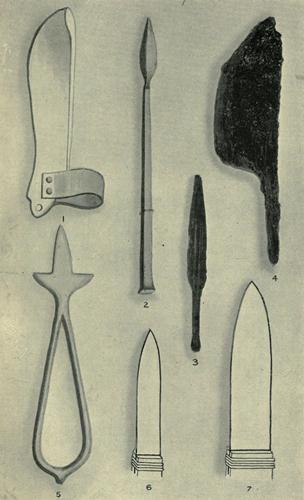
Pl. XIX, fig. 4 is from the British Museum. The bowl is 2.5 cm. in
diameter and the handle is 15 cm. long. The handle is round, and it has a
small ringed ornamentation at its end and one close to the bowl. The
bottom has been thinned out with heat, and there is a small perforation
visible in it. A similar spoon was found in the grave of the Paris
surgeon. Traces of medicament remain on it. This type is probably intended
for warming salves and pouring them into the eye and other affected parts.
Another variety is seen in Pl. XIX, fig. 1. This specimen is in the
Naples Museum, and was found along with the spatula shown in Pl. XIX, fig.
2. The handles of each are of bronze, the scoop and spatula parts are of
silver. Vulpes describes these as a lancet for drawing blood and a spoon
for collecting and examining the same. It is impossible to regard an
instrument of silver as a cutting instrument. These are for mixing and
spreading medicaments. A large spoon of a peculiar shape from the Naples
Museum is seen in Pl. XIX, fig. 3. It is of silver. The handle, which is
of ivory, is ornamented with spiral carving, and the end bears a ram’s
head. Another interesting little shovel from the same museum is of bronze,
and carries the head of Minerva Medica on the end of the handle (Pl. XX,
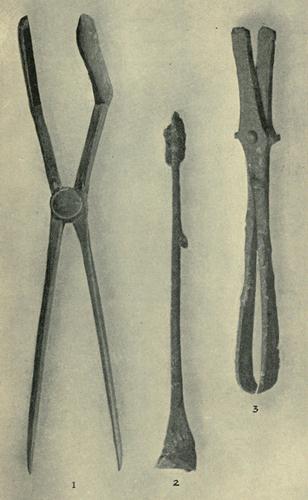
fig. 5). We may here include the large double spatulae of the type shown
in Pl. XX, fig. 1, which represents a specimen from Naples. A similar one
was found in the outfit of the Paris surgeon, and Scultetus shows
precisely similar instruments in use in his time for applying the
stiffening to the bandages, &c. for setting fractures. The Romans probably
used theirs for a similar purpose.
Tongue Depressor.
Greek, γλωσσοκάτοχος.
To open a quinsy Aetius says (II. iv. 45):
‘If the patient is adult, seat him and make him open his mouth, and
depress the tongue with a spathomele, or a tongue depressor, and open
the abscess with a probe or a needle knife.’
In excision of the tonsil Paul (VI. xxx) bids us seat the patient in the
sun and depress the tongue with a tongue depressor (γλωσσοκατόχῳ).
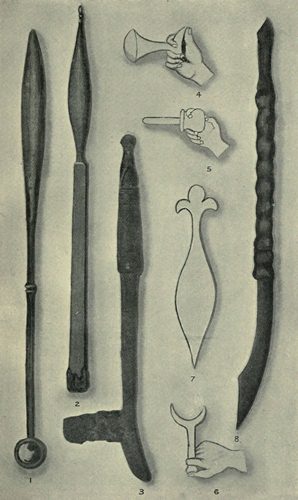
Pl. XX, fig. 6 shows one of six bronze tongue depressors, burnished like
small mirrors, from the Lépine collection (Védrènes, Celse).
Uterine Sound.
The uterine sound is frequently mentioned by Hippocrates for correcting
malpositions of the uterus, and dilating and applying medicaments to the
interior of the cervix. After falling into disuse in the middle ages it
was reintroduced by Sir J. Y. Simpson, only to disappear once more almost
entirely from sight.
I have already referred to Galen’s statement that the non-pregnant os is
of such a size that it will just admit an olive-pointed probe (p. 54).
Hippocrates (ii. 836) directs us to treat hysteria by dilating the cervix,
first with an ointment probe and then with the finger.
Καὶ ὑπάλειπτρον καθιέναι καὶ ἀναστομοῦν καὶ τῷ γε δακτύλῳ ὡσαύτως λειοῦν.
Soranus (II. x) describes plugging for uterine haemorrhage by means of the
sound:
Καὶ τρυφερὸν ἔριον ἑνί τινι τῶν εἰρημένων χυλῶν διάβροχον
διὰ δακτύλου ἢ μήλης παρεντιθέσθω τῷ στόματι τῆς ὑστέρας. καὶ πολὺ
μᾶλλον ἐντεῦθεν τῆς αἱμορραγίας ὑπαρχούσης.
Hippocrates (iii. 34) alludes to applying medicament to the internal os
with the sound:
‘Grind the pulp of colocynth, &c., and rub it up with honey and smear
it on the sound (περὶ μήλην) making the consistence such that
it can enter the os and always be pushed beyond until it has
penetrated to the interior of the uterus. When the medicament has
liquefied extract the sound, and again in the same way apply
elaterium.’
If pus collect in the uterus post partum, or after abortion or from any
other cause, it is good practice to pass a sound (μήλην
ὑπαλειπτρίδα) into the cervix (i. 471). In another place we are directed
to draw off gas in the uterus by fomenting the whole body and the uterus
with vinegar and water, warmed specilla being afterwards inserted
(μήλας διαπύρους ἐμβάλλοντα).
Again we find the sound applied to correct malposition of the uterus (iii.
140):
‘When the semen is extruded on the third day and the woman
consequently fails to conceive, take small soft feathers and tie them
together, and foment the uterus as we do the eyes. Make the feathers
even at the tips and tie the ends with a very fine thread, and anoint
with much rosaceum. Also place the patient on her back on a couch, and
place a pillow under the loins, and, the woman’s thighs being extended
and separated, insert a sound and turn it to this side and that till
it project.’
In all these cases there is no special instrument designated as being used
for a uterine sound, only the spathomele (ὑπάλειπτρον) and the
olivary probe named. With both of these we have met before. However, I
have thought it of historical interest to cast these passages together. It
will also clear the way for the discussion of other instruments, whose use
is entirely reserved for the purpose of dilation of the cervix.
A more questionable use of the sound is referred to by many authors.
During the Empire the death of the foetus was frequently procured both by
abortifacients and instruments. Frequent references to the use of drugs
for this purpose may be found in the lay writers such as Juvenal and
Suetonius (Domitian), and the later medical authors do not hesitate to
describe the composition of abortifacient pessaries. It will be remembered
that the Hippocratic oath specially forbids this practice.
Uterine Dilators—Solid, graduated wooden.
Greek, διαστομωτρίς, μήλην τὴν διαστέλλουσαν—τὸν διαστολέα
(Galen, Lexicon).
Besides the ordinary probes, which we have just seen that Hippocrates used
occasionally for dilating the os, we have frequent mention made of a
special variety of dilators which, although they are called μήλη
by Hippocrates, are not, strictly speaking, probes or sounds, but a
graduated set of dilators of wood, tin, or lead. They correspond, in fact,
to our Hegar’s dilators.
Hippocrates describes these dilators (ii. 799). The patient is to have
fumigations for five or six days till the cervix is softened. After these
fumigations, dilators (προσθέτων) made of pieces of very smooth
slipping pinewood are to be introduced into the cervix. There were six of
these. Each was six finger breadths (4·2 in.) in length. They ended in a
point, and each succeeding rod was larger than the preceding one; the
largest being of the diameter and shape of the index finger, being smaller
at one extremity than the other. They should be as round as possible and
with no splinters. Before being introduced they were smeared with oil.
First the point was gradually introduced by rotating the dilator and
pushing it simultaneously till it entered for a distance of four finger
breadths (2·8 in.). After the first rod was introduced it was withdrawn
and replaced by a larger one. During the after treatment a leaden tube
filled with mutton fat was left in the uterus at night, while through the
day one of the pine dilators was used. Pl. XX, fig. 2 shows a specimen
from Pompeii, which Védrènes regards as a uterine dilator. It is hollow,
and is ornamented to resemble the head and body of a snake.
Metal Dilators mounted on handles of wood.
Hippocrates (i. 473) mentions a variety of dilator made of tin or lead,
and hollow behind for mounting on a wooden handle:
‘After douching and fumigation, dilate, and, if necessary, straighten
the cervix with a dilator of tin or lead (τῇ μήλῃ τῇ
κασσιτερίνῃ ἢ μολυβδαίνῃ), beginning with a fine one, and then a
thicker if it be admitted, until it seems to be in proper position.
Dip the dilators in some emollient. The dilators are to be made hollow
behind, and fitted round rather long pieces of wood and thus used.’
This evidently refers to a portable set of dilators, each capable of
fitting on a common handle, like Fritsch’s, Peaslee’s, or Lawson Tait’s of
modern times.
Bifurcated Probe.
Greek, μήλη δικροῦς, χηλή.
In treating of polypus naris Hippocrates directs us to take a sponge and
tie it into a hard ball, and attach a four ply thread to it. Next to pass
the end of this thread by means of an eyed probe of tin till it is caught
at the back of the mouth, and drawing it out of the mouth to place a
bifurcated probe under the palate, and using this as a fulcrum pull until
the polypus is extracted (De Morbis, ii. 243: ἔπειτα χηλὴν
ὑποθεὶς ὑπὸ τὸν γαργαρεῶνα ἀντερείδων ἕλκειν ἔστ' ἂν ἐξειρύσῃς τὸν
πώλυπον). In Galen’s Lexicon we find χηλή explained as
meaning a notched probe, split like a hoof at the point (μήλην
δικροῦν, κατὰ τὸ ἀκρὸν ἐκτετμημένην ἐμφερῶς χηλῇ). And again under the
heading δικροῦν he gives τὸ οἷον δίκρανον, ὅπερ καὶ
δισχιδὲς ὀνομάζουσι τὸ δὲ αὐτὸ καὶ δηλοῖ, ‘what they call cloven and
also cleft.’ The same word also means the notch of an arrow. In De
Morbis (ii. 245), Hippocrates describes another method of extracting
polypus with the same instrument. Taking a piece of stringy gut (χορδήν)
and making a loop on it pass the end through the loop, thus
making a second larger one, i. e. a noose. Pass the end of the gut through
the nose into the mouth with a tin probe. Pull the loop into the nose and
adjust it round the polypus with a notched probe (μήλῃ τῇ
ἐντετμημένῃ), and when this is done pull on the gut, using the notched
probe as a fulcrum.
There must have been one form of bifurcated probe with a rounded end
bearing a notch like an arrow. This is the only form of cleft probe which
it would be safe to use in the back of the throat in the manner described
by Hippocrates. We know, however, of other forms of bifurcated probes.
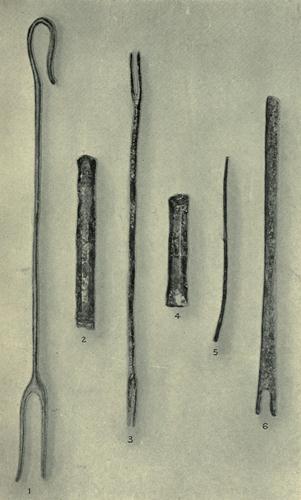
Celsus describes a bifurcated retractor used for the extraction of weapons
buried in the flesh:
Saepius itaque ab altera parte quam ex qua venit recipienda est;
praecipueque quia fere spiculis cingitur; quae magis laniant si
retrorsus quam si contra eximatur. Sed inde aperta via caro diduci
debet ferramento facto ad similitudinem Graecae litterae Y; deinde,
ubi apparuit mucro, si arundo inhaeret propellenda est donec ab altera
parte apprehendi et extrahi possit (VII. v).
Variant readings are V and Λ. The Aldine edition has ψ.
The reading I have adopted is Daremberg’s; but whichever is correct
matters little, as all indicate a bifurcated instrument, except the
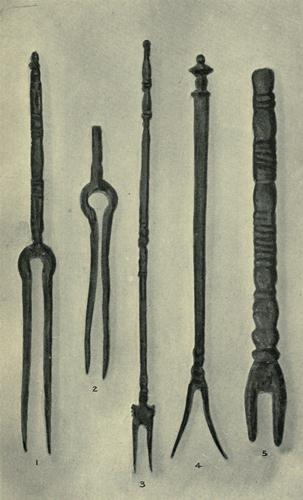
Aldine, which would indicate a three-pronged one. There are several
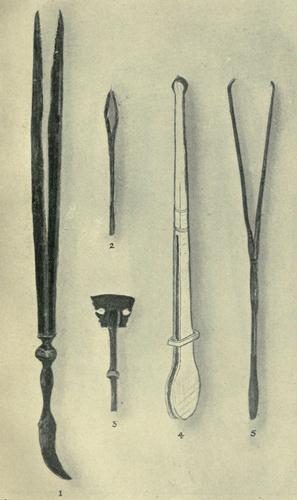
bifurcated specilla in the British Museum (Pl. XXII). One in the Orfila
Museum, Paris, of slender construction, carries a hook at the other end.
It is from Herculaneum (Pl. XXI, fig. 1). A plain variety is shown in
Pl. XXI, fig. 6. The specimen shown in Pl. XXI, fig. 3 is interesting as
showing a possible fallacy. It has considerable affinity to the Roman
netting-needle, and may not be a probe at all. The typical netting-needle
has, however, blunt points, and the planes in which the forks lie are at
right angles to each other.
Blunt Dissectors.
In his chapter on Angiology (or Division of the Temporal Blood Vessels)
for headache and ophthalmia (VI. v), Paul mentions the use of dissectors:
‘Having therefore first shaven the hairs of the temples we make an
examination by palpation, applying warm fomentations or even a fillet
round the neck, and mapping out the vessels with ink as they become
apparent, we stretch the skin to either side with the fingers of our
own left hand and those of an assistant, and make a superficial
incision along the vessel. Then cutting down and retracting with hooks
and exposing the vessel with dissectors (δι' ἐξυμενιστήρων)
we must raise it up completely isolated. If it be small, having
stretched it and applied torsion we may divide it through in such a
way as to remove a piece of it at one stroke.’
The typical scalpel handle ends in a leaf-shaped dissector, and Celsus
always describes blunt dissection as being performed with the manubriolus
of the scalpel. We have, however, a few dissecting manubrioli as separate
instruments not designed to carry scalpel blades. Three were found
together in the grave of the surgeon of Paris. There are also two in the
museum of St-Germain-en-Laye, and one in the Museum at Mainz. We may take
as types two from the find of the oculist Severus in the
St-Germain-en-Laye Museum (Pl. XX, figs. 3, 4). They consist of elongated
leaf-shaped blades carried on hexagonal handles, and are exactly similar
in appearance to a scalpel handle, except that they do not carry a slot
for the insertion of a blade.
Curved Dissectors.
Greek, ὑδροκηλικὸν κοπάριον.
On the cure of hydrocele Paul (VI. lxii) says:
‘When the fluid is in the tunica vaginalis we make the incision where
the apex of the tunica makes its appearance, and, separating the lips
of the incision with a hook, and having dissected off the fascia with
the hydrocele specillum and the scalpel (ἐξυμενίσαντες τῷ τε
ὑδροκηλικῷ κοπάριω καὶ τῷ σμιλίῳ), we divide it through the middle
with a lancet.’
Treating of the excision of varices (VI. lxxxii) he says:
‘Having separated the lips of the wound with hooks, and dissected away
the fascia with curved hydrocele specilla, and laid bare the vein and
freed it all round’ (ὑδροκηλικοῖς ἐπικαμπέσι κοπαρίοις).
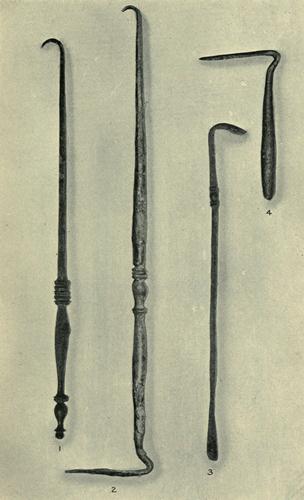
A curved dissector from the find of the oculist Severus, now in the Museum
of St-Germain-en-Laye, has a neatly ornamented handle with a small hook at
one end, and at the other it curves first backward and then forward to
join a small leaf-shaped dissector 3 cm. long and 1 cm. in its greatest
breadth (Pl. XXIII, fig. 2).
Sharp Hooks.
Greek, ἄγκιστρον, ἀγκυρομήλη; Latin, hamus, hamulus acutus.
Hooks blunt and sharp are frequently mentioned in both Greek and Latin
literature, and served the same purposes as we use them for; the blunt for
dissecting and raising blood-vessels like the modern aneurism needle, the
sharp for seizing and raising small pieces of tissue for excision, and for
fixing and retracting the edges of wounds. We are fortunate also in
possessing many fine specimens of both sharp and blunt hooks in museums,
&c. In the Naples Museum alone there are upwards of forty examples of
hooks. Of pterygium Celsus says:
Tum idem medicus hamulum acutum, paulum mucrone intus recurvato,
subiicere extremo ungui debet eumque infigere; atque eam quoque
palpebram tradere alteri; ipse, hamulo apprehenso, levare unguem
eumque acu traiicere linum trahente (VII. vii).
Aetius also mentions this use of the sharp hook:
‘And, transfixing the pterygium with a hook
(καὶ ἀγκίστρῳ καταπείροντες περὶ τὰ μέσα τὸ πτερύγιον), we gently make traction on
it’ (Tet. II. iii. 60).
Paul also says:
‘Seizing the pterygium with a hook with a small curve,
(ἀγκίστρῳ μικροκαμπεῖ ἀναδειξάμενοι) we stretch it’ (VI. xviii).
The method of excision of the tonsil described by Celsus, Aetius, and Paul
is to bring the tonsil into view by dragging on it with a sharp hook and
then amputating it. Thus Paul says:
‘Wherefore seating the person in the light of the sun, and, directing
him to open his mouth, while one assistant holds his head and another
presses down the tongue to the lower jaw with a tongue depressor we
take a hook (ἄγκιστρον) and transfix the tonsil with it and
draw it outwards as much as we can without drawing the capsule along
with it, and then we cut it out by the root with the tonsil knife
suited to that hand’ (VI. xxx).
In contraction of the vulva, Paul says:
‘Having transfixed the connecting body, whether flesh or membrane,
with hooks, we stretch it and divide it with the fistula knife’ (VI.
lxxii).
Similarly Celsus (VII. xxviii) says:
At si caro increvit, necessaria est recta linea patefacere; tum ab
ora, vel vulsella vel hamo apprehensa, tamquam habenulam excidere.
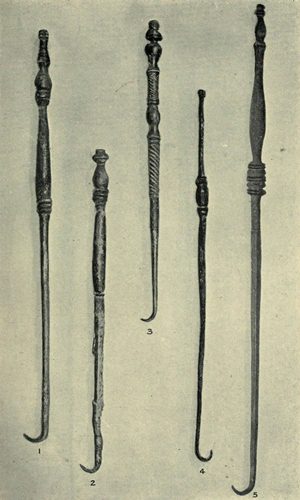
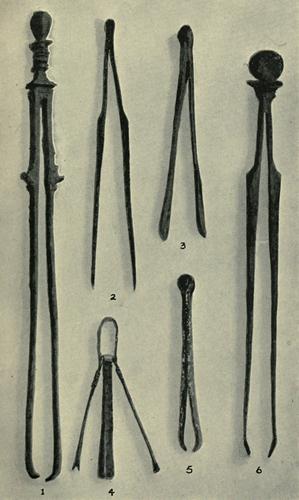
In dissection, many of the manipulations which we perform with the
dissecting forceps were performed by the ancients with sharp hooks. Pl.
XXIV, figs. 1-5 represent specimens from various sources; some simple,
others combined with another implement.
Blunt Hooks.
Greek, τυφλάγκιστρον; Latin, hamus retusus.
Aetius (Tet. III. i. 13) says:
‘Whatever adhesions there are of the lower border of the lids to the
tunics of the eye, we must put them on the stretch with a blunt hook
(τυφλαγκίστρῳ) and with a pterygotome free the adhesion.’
In Aetius (Tet. II. iii) we see the blunt hook used in the same way as
we use an aneurism needle, except that the ligature is not introduced with
it, but with another needle. He says we transfix the lips of the incisions
with two hooks and gradually dissecting with the scalpel we free the
vessel from the underlying fascia. Then with a blunt hook (τυφλάγκιστρον)
placed under the vessel we raise it up from the depth,
and beneath it when raised we place a two ply thread by means of a needle,
and doubly tie and cut between.
Paul says:
‘Exposing the vessel with dissectors we must raise it up when it is
separated all round. If it be small, having stretched and twisted it
with a blunt hook, we may divide it through in such a way as to remove
part of it. But if it be large we must apply a double ligature under
it with a needle, either a piece of raw flax or some other strong
thing’ (VI. v).
The ‘eyed hook’ is mentioned by Galen in describing the dissection of the
spinal cord:
Ἐνδέχεται δὲ καὶ χωρὶς βελόνης ἀγκίστρῳ διατρήτῳ γενέσθαι
τὴν ἐγχείρησιν, ὡς ἐπὶ τῶν περὶ τὰς καρωτίδας ἀρτηρίας νεύρων εἴωθε ποιεῖσθαι (ii. 669).
‘It is advisable that the manipulation be performed not with a needle
but with an eyed hook, as is usually done in the case of the tendons
in the neighbourhood of the carotid arteries.’
A small variety of the blunt hook is mentioned by Celsus, Galen, and Paul.
Of the extraction of foreign bodies from the ear Celsus says:
Sin aliquid exanime est, specillo oriculario protrahendum est, aut
hamulo retuso paulum recurvato (VI. vii).
Paul says that if stones of fruits, &c. fall into the ear they must be
extracted with an ear scoop, a hook, or a forceps.
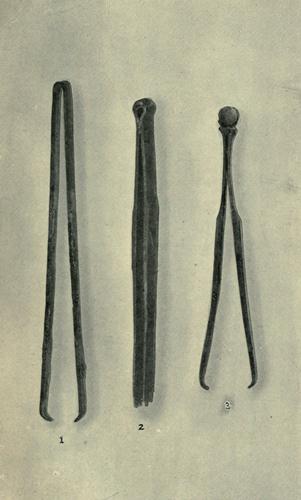
Both types of blunt hook are represented by extant specimens; see Pl.
XXIII, figs. 3, 4. These remind us of our aneurism needles, and it is
interesting to note that Galen (ut supra) speaks of an ‘eyed hook’. The
instruments shown in Pl. XXIII, figs. 2, 4 we might look on either as
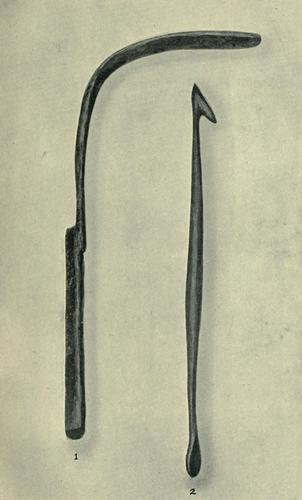
curved retractors or dissectors as they are half sharp. Pl. XXV, fig. 2
shows a hook of crotchet-hook type combined with a scoop. It is from
Herculaneum.
The Strigil.
Greek, ξύστρα. Latin, strigil.
It seems to have been a common method of applying remedies to the auditory
canal to warm them in a strigil and pour them in with it. Galen frequently
mentions this. In Med. Sec. Loc. (xii. 622) he says:
Having warmed the fat of a squirrel in a strigil, instil it.
Celsus (VI. vii. l) says:
In aurem vero infundere aliquod alimentum oportet quod semper ante
tepefieri convenit; commodissimeque per strigilem instillatur.
Marcellus (IX. l) says:
Conteres et in strigili calefacies, et infundes, et lana occludes
aurem.
Scribonius Largus (xxxix) says:
Ad auriculae dolorem et tumorem sine ulcere prodest herbae urceolaris
aut cucurbitae ramentorum sucus tepens per strigilem in foramen auris
dolentis infusus.
The strigil varied much in size and shape. A common form was a
sickle-shaped instrument, the circular part being hollow and semicircular
on section, and admirably adapted for warming and pouring oil and other
medicaments into the ear as above described. Pl. XXV, fig. 1 shows a small
strigil from my collection.
Spoon for applying astringent liquids to the uvula.
Greek, σταφυλεπάρτης.
In his description of the medical treatment of diseases of the mouth Paul
(III. xxvi) says:
‘When the uvula is inflamed we must use the gargles recommended for
inflammation of the tonsils, and those of a moderately astringent
nature, such as the juice of pomegranate, applied by means of a spoon
or the instrument called the “uvula medicator”’ (σταφυλεπάρτου).
It is evident that it is quite a different instrument from the
staphylocaustus (q. v.), which we are specially told had more than one
hollow and was a grasping instrument like a forceps. The present
instrument is for applying liquids, and was apparently of the form of a
spoon. Fabricius describes and figures such an instrument. It is a small
round spoon with a long handle.