IN
Mr. Austin Dobson’s Hogarth, to which all
students of that master are so deeply indebted,
the following sentence concludes the list of
“Prints of an Uncertain Date”: “It has been
thought unnecessary to include two or three
designs, the grossness of which neither the ingenuity
of the artist nor the coarse taste of his
time can reasonably be held to excuse.” And in
this book I have made it a cardinal point to
emulate Mr. Dobson’s excellent example.
We remember in one of Mr. G. Russell’s amusing
books the story of the erstwhile Member of
Parliament who had accepted a peerage, notwithstanding
his profession of democratic sentiments.
Thereupon one of his late
supporters, {83}
with excellent, though somewhat brutal, metaphor,
remarked, “Mr. —— says as how he’s going to the
House of Lords to leaven it. I tell you he can’t
no more leaven the House of Lords than you can
sweeten a cart-load of muck with a pot of
marmalade.” Per contra, let us always bear in
mind, that were the cart full of marmalade, and
the pot of muck, the latter would be fully
sufficient to render the whole an abomination.
Fortunately for us, the Hogarth “Suppressed
Plates” which are befitting are of exceptional
interest. And it may as well be pointed out here
that those peculiarly gross ones which are often
alluringly alluded to as “suppressed” are nothing
of the sort. So far from being indeed effectively
withdrawn from observation, they have had, as a
matter of fact, particular attention drawn to them
by the fussy ingenuity with which their concealment
has been emphasised.
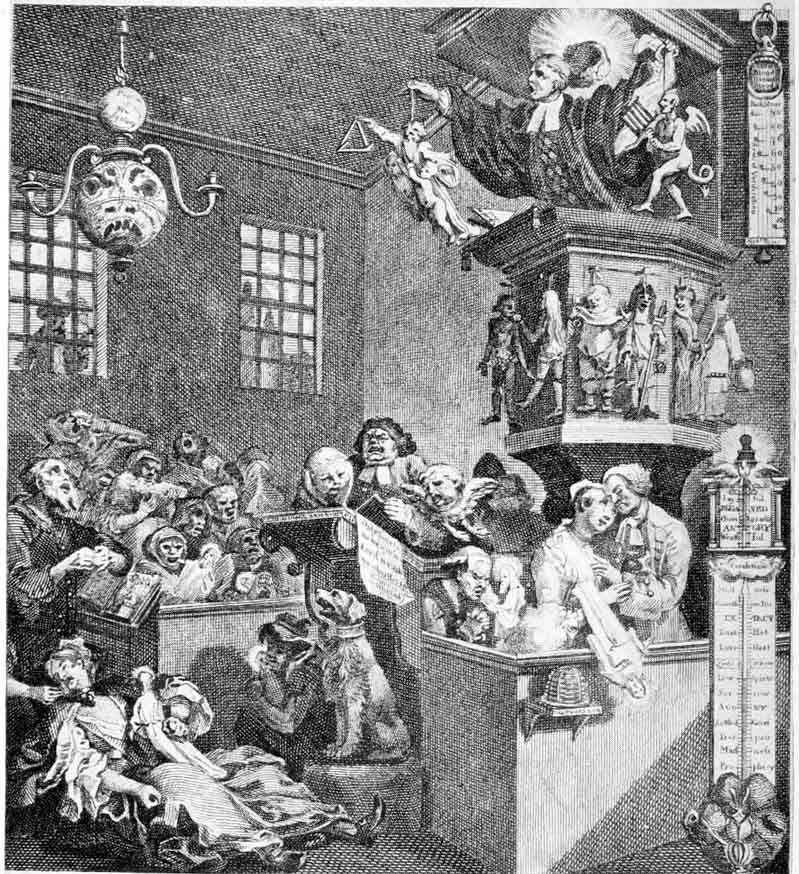
The first of the Hogarth plates which we here
reproduce—“Enthusiasm Delineated”—is of far
greater intrinsic importance than any of those
with which we have already dealt in the preceding
chapters. It differs essentially
from them not {84}
only in the fact that here the artist himself is the
fount and origin of the suppression but also in the
fact that it is a fine example of those palimpsest
plates of which more particular description will be
found in later chapters of this book. Peculiar
interest, too, attaches to the circumstance that,
superb as it was in execution, and elaborate to a
degree though it was in conception, it was no
sooner finished than the artist deliberately decided
against its publication, and destroyed the engraving
after only two impressions had been taken
from the copper. Fortunately for us, one of these
is now in the possession of the British Museum.
It will be interesting to those who are the
happy possessors of Hogarth Illustrated and
the Anecdotes to compare this with the reduced
copy (a very different matter) made by
Mills and published in these volumes. For it
must always be remembered that Hogarth’s autograph
engravings are infinitely more interesting
than the copies, however eminent the journeyman
engraver may have been.
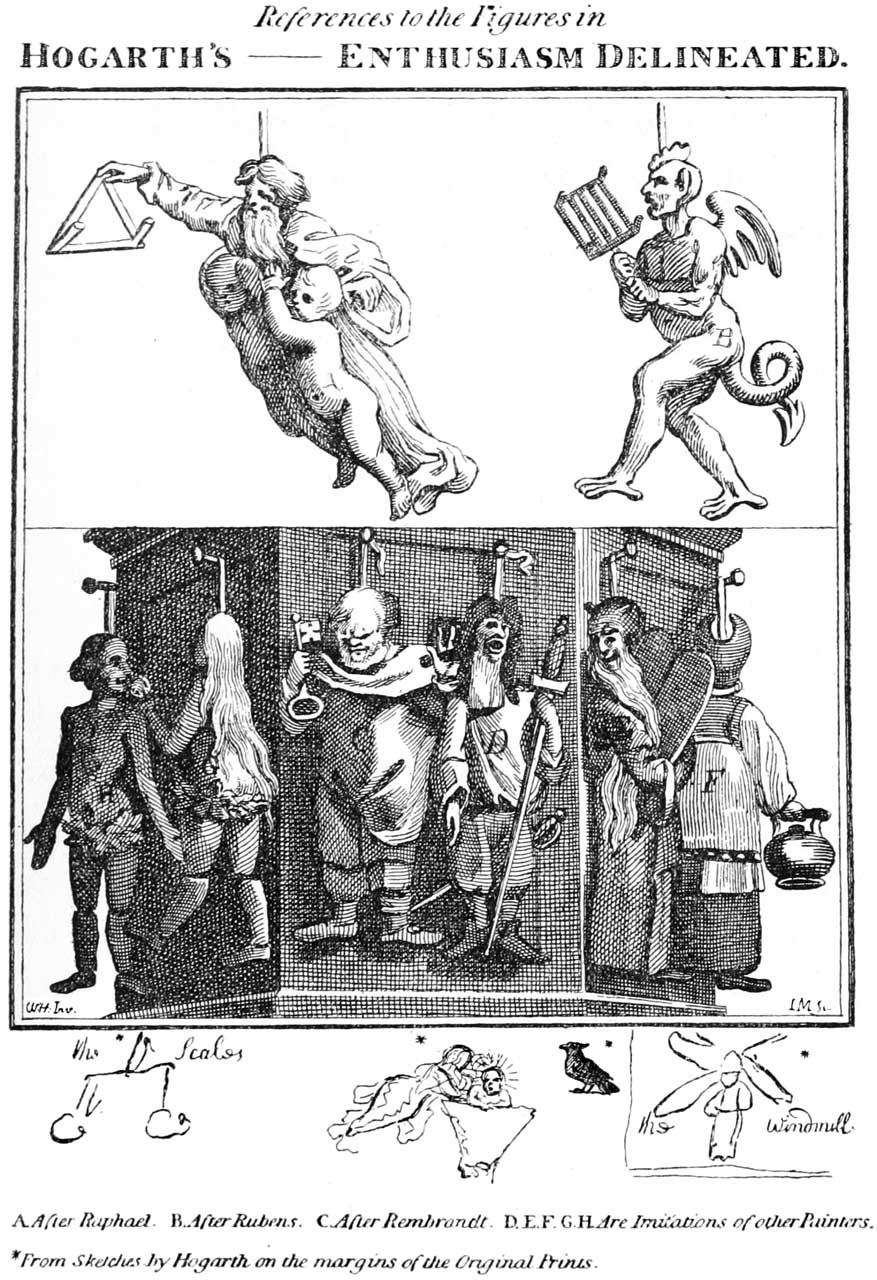
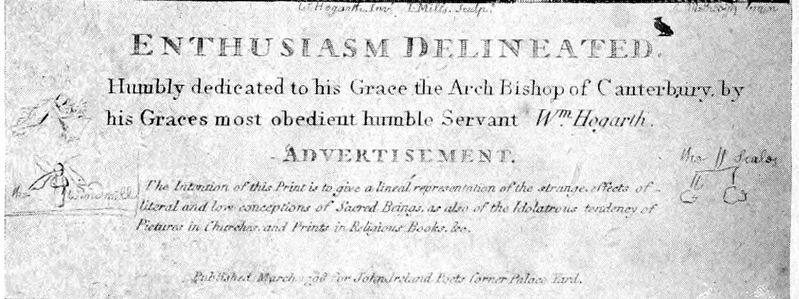
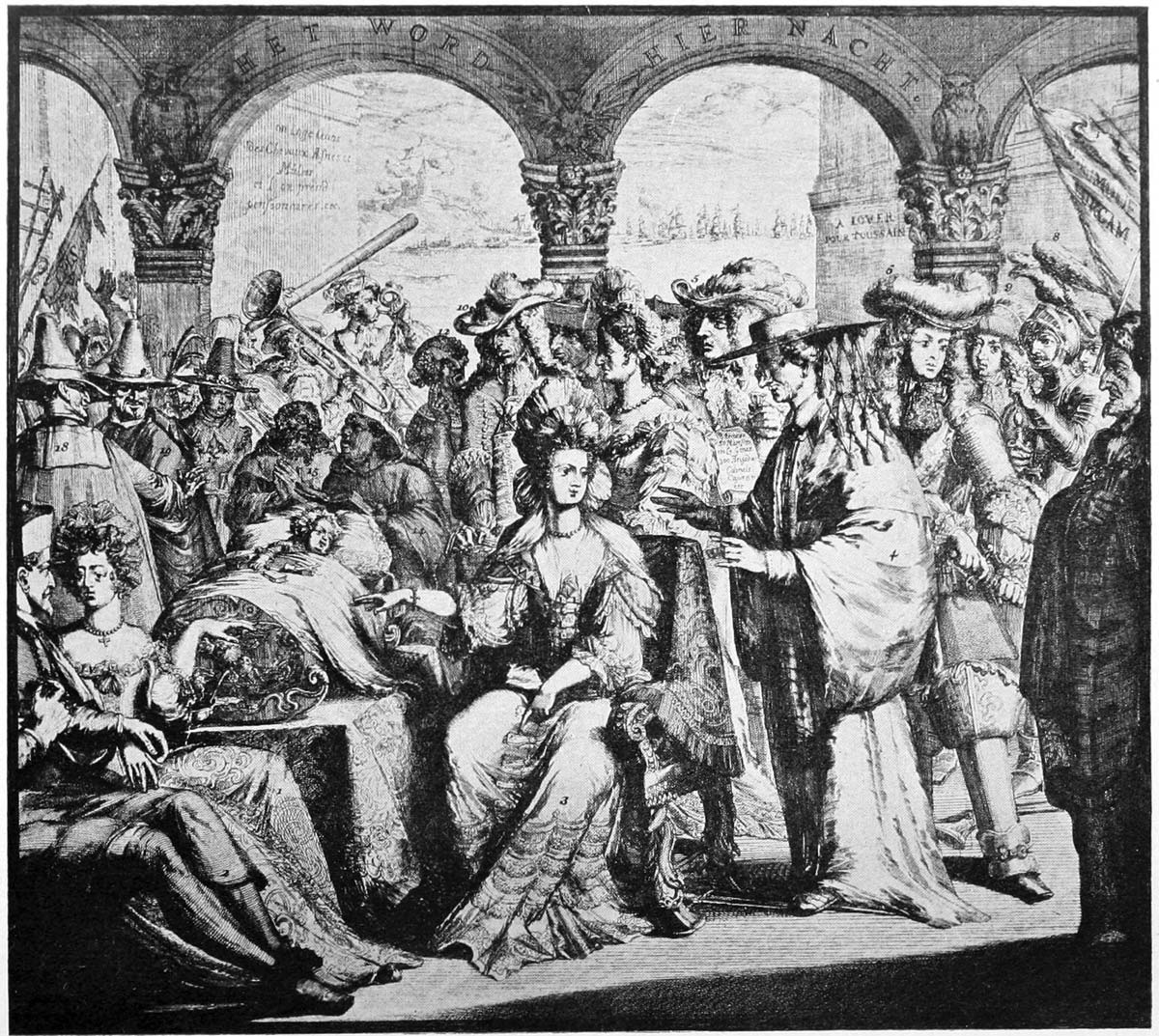
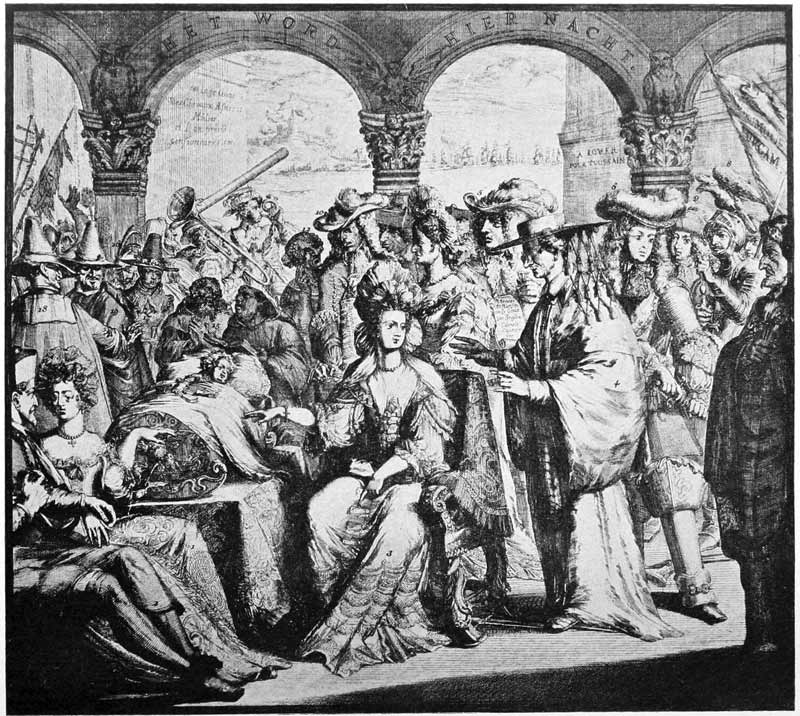
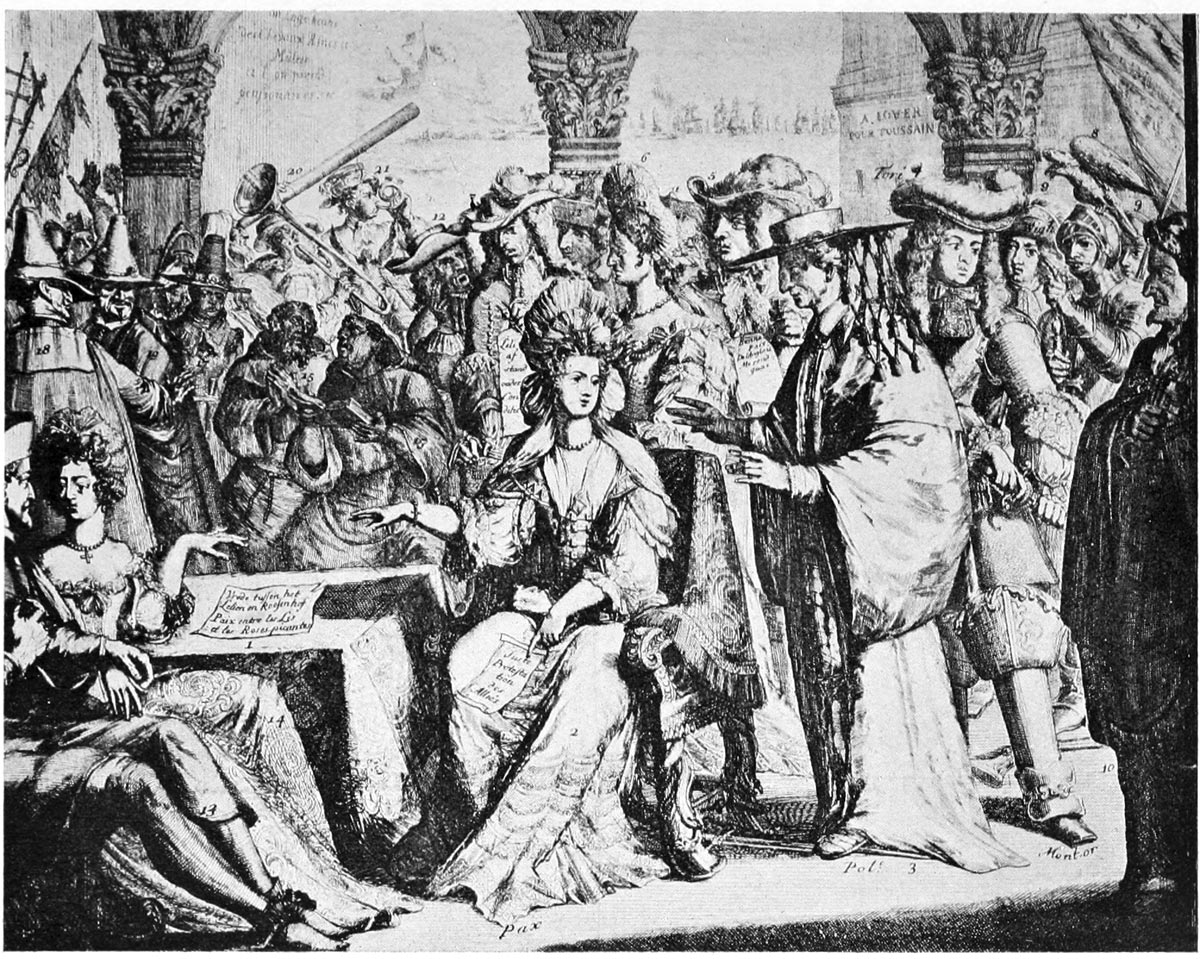
Enlarged detail of
Hogarth’s “Enthusiasm Delineated”
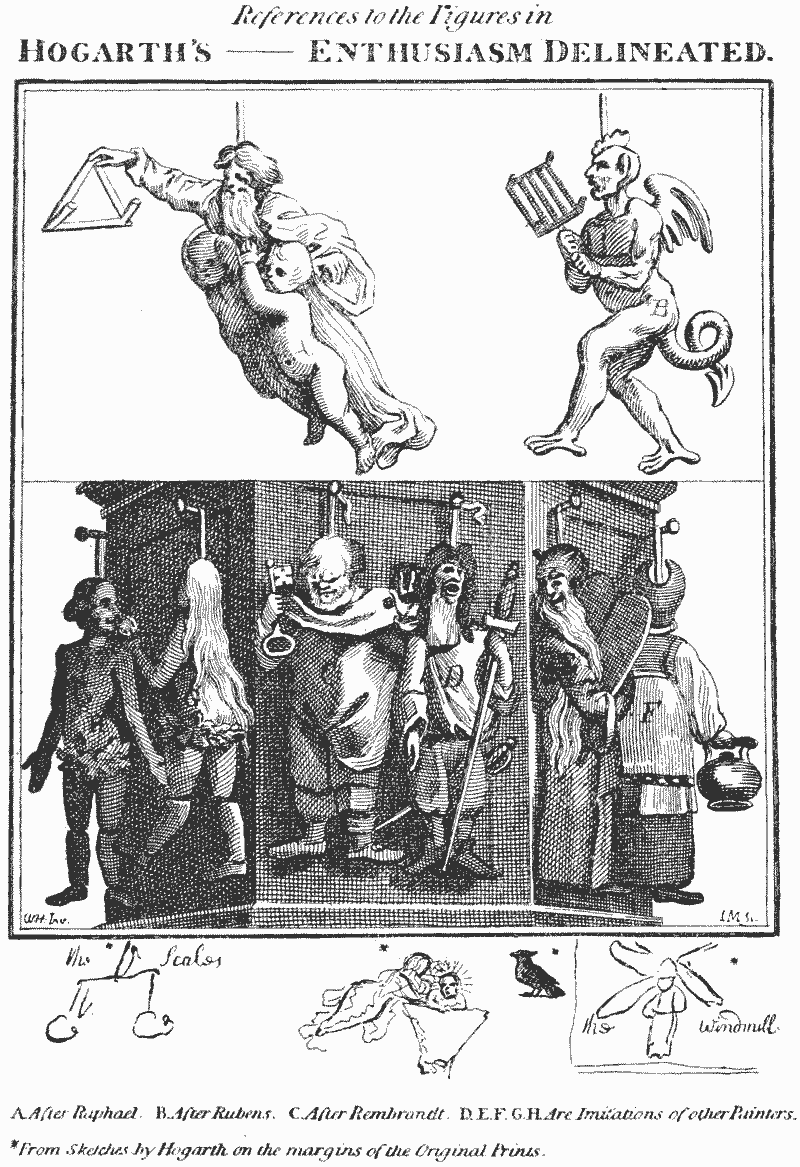
Enlarged detail of
Hogarth’s “Enthusiasm Delineated”
Another plate was engraved by Mills of the size
of the original, and published
separately by Ireland {86}
in 1795. The date of the original plate is given
in the British Museum Catalogue as 1739, but how
that date is arrived at I am at a loss to understand.
It will be noticed that there are upon the
margin of our reproduction some curious remarques
inscribed “the windmill,” “the scales,”
and others. These were drawn in pen-and-ink by
Hogarth on the margins of the two original impressions.
They also appear engraved in facsimile
on the second state of Mills’s full-sized plate. It
will therefore be well for owners of this last not
to jump to the hasty conclusion that they are the
fortunate possessors of one of the two impressions
mentioned above! It should be added that the
MS. inscription on the British Museum copy
differs considerably from that engraved by Mills.
The method by which the suppression of this
plate came about is exceedingly curious.
It is probable that, after the design was completed,
Hogarth came to the conclusion that the
intention of the satire might be mistaken, and
that, instead of bringing ridicule upon “the
superstitious absurdities of popery
and ridiculous {87}
personification delineated by ancient painters,” it
might be considered that his objective was religion
itself.
If this were so, the episode redounds greatly
to the artist’s credit, and throws an effective light
upon a little-known side of his character. It was
an act of great nobleness to suppress what was the
result of long toil, nay, more than that, what was
perhaps his highest mental, though by no means
his highest artistic, achievement, from what some
might consider hyper-conscientious motives.
It must be remembered that Hogarth lived in
a gross and irreligious age, and that what appears
to us exceedingly profane was largely the result of
the outspokenness of the times.
Ireland says that he altered and altered this
plate piecemeal until its final suppression. This,
however, I venture to doubt, for reasons given
below. At all events, in the end he had beaten
out and re-engraved every figure save one, and
changed, as Mr. Dobson says, what “was a compact
satire” into “a desultory work—a work of
genius for a lesser man, but scarcely worthy
of Hogarth.” The final design
was entitled {88}
“Credulity, Superstition and Fanaticism: a
Medley,” and was published in March 1762.
Let us now compare the two designs.
Hogarth’s general purpose in the first was, in his
own words, to give “a lineal representation of the
strange effects of literal and low conceptions of
Sacred Beings, as also of the idolatrous tendency
of Pictures in Churches and Prints in Religious
Books.” In the second his text was, “Believe not
every spirit, but try the spirits whether they are
of God, because many false Prophets are gone out
into the world.”
Before comparing the designs in detail, I should
like to say that, besides carefully examining the
plates for myself, I have collated the various
descriptions of Ireland, Nichols, Mr. Austin
Dobson, and Mr. F. G. Stephens, whose conclusions
I have not hesitated to adopt, add to,
discard or modify, as the circumstances have
seemed to require.
Let us now particularise the incidents portrayed
on the two states of the plate, both of which are
here reproduced for purposes of comparison.
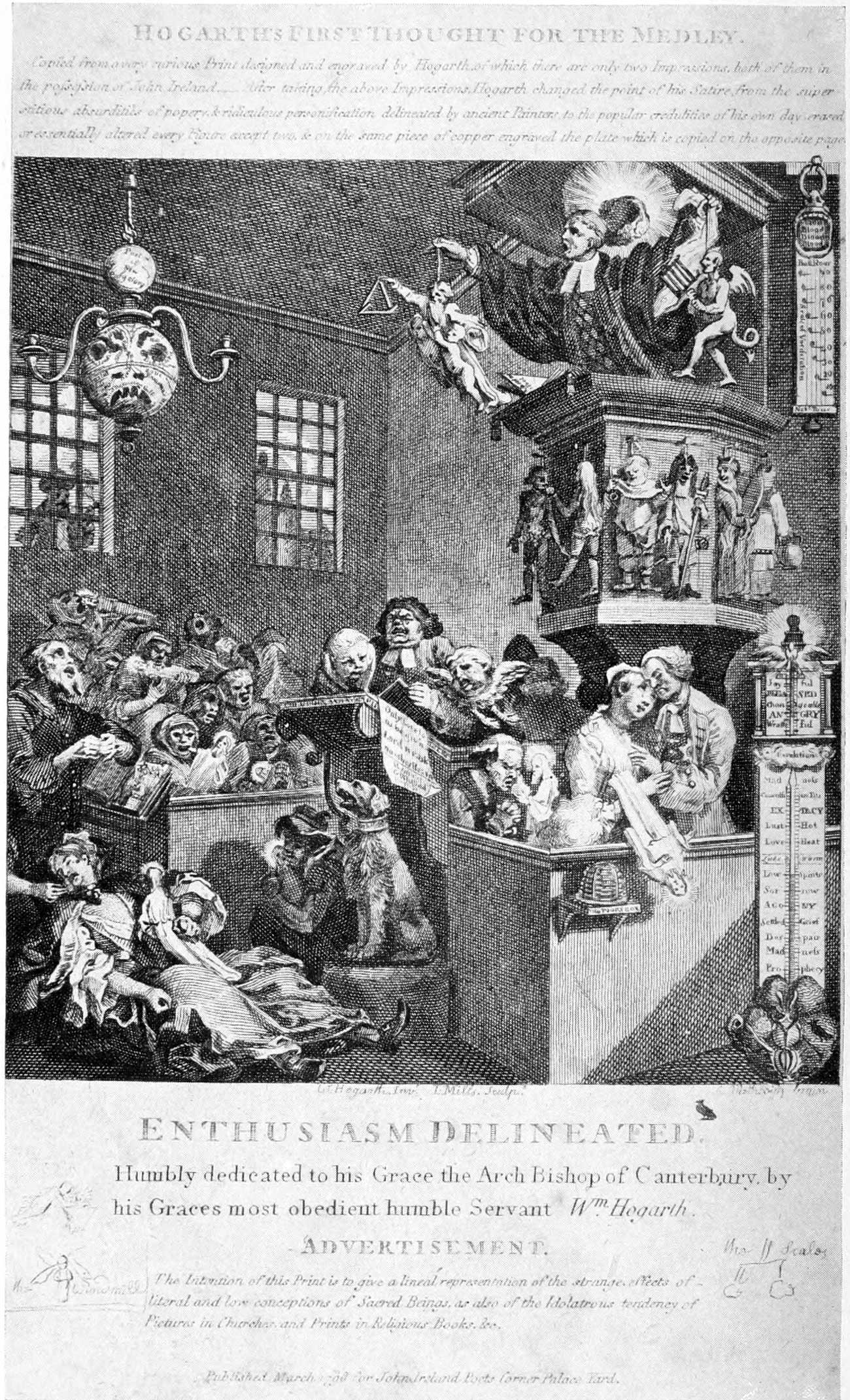
PLATE I.
“Enthusiasm Delineated. (Humbly dedicated to
his Grace the Arch Bishop of Canterbury by his Graces most
obedient humble Servant Wm. Hogarth”)
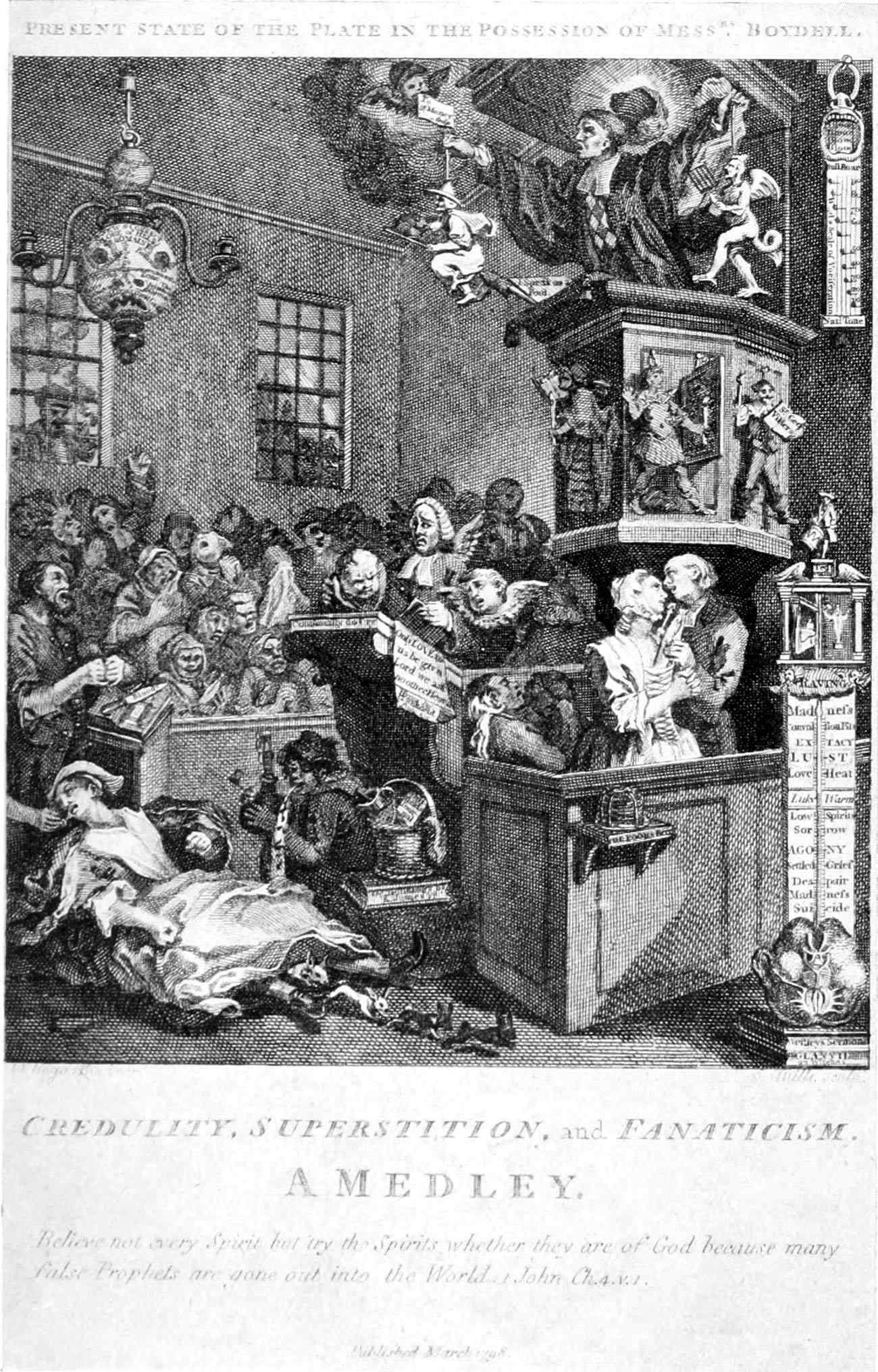
PLATE II.
“Credulity, Superstition, and Fanaticism. A
Medley”
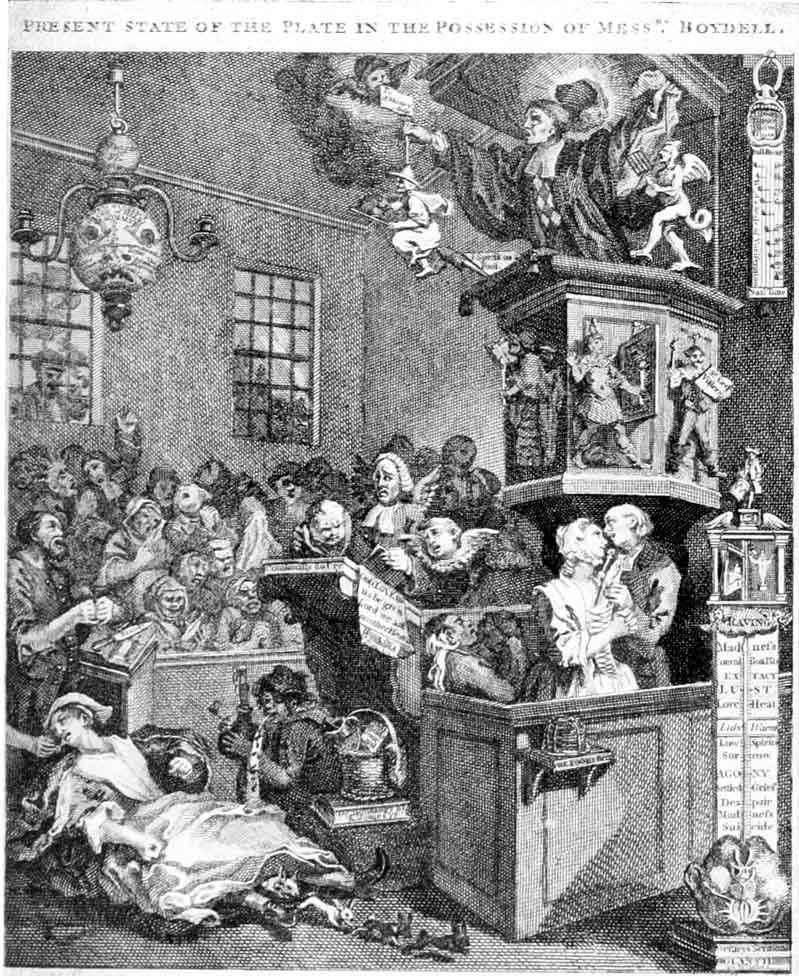
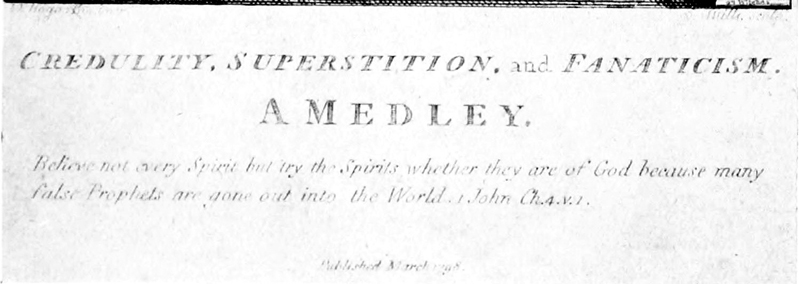
PLATE II.
“Credulity, Superstition, and Fanaticism. A
Medley”
Beginning with the preacher,
we notice that {89}
his is the only figure practically unaltered and
common to both engravings. By his “bull-roar”
(vide the “scale of Vociferation” hanging on
the wall to his left) he has apparently succeeded
in cracking the sounding-board above his head.
Notice his shaven crown, exposed by the fallen
wig, which intimates that he is a Papist in disguise;
and the harlequin jacket underneath his
gown, which suggests that he is a religious merry-andrew.
A point worth remarking is that the
halo surrounds his wig, and not his head!
From his right hand (Plate I.) he suspends a
puppet (caricatured from a picture of Raphael’s)
supporting the sacred triangle, which, in attempting
to personify the Trinity, was considered by
some to be a profane materialisation of a mystical
idea. This he has ingeniously turned into a gridiron
or trivet of the Inquisition by the simple
addition of three legs. In Plate II. this puppet
has been removed and its place taken by a witch,
riding on a broom-handle, who is suckling what
appears to be a huge rat. Beyond the preacher’s
hand we find a further addition in the shape of a
cherub, hunting-cap on head, bearing
in its mouth {90}
a letter directed “To St. Moneytrap.” The
sermon paper, too, has been turned about so as to
bring the words “I speak as a fool” into greater
prominence. In which connection it may be
noticed that in “Enthusiasm Delineated” all the
lettering would seem to be from the burin of
Hogarth, whilst that in the “Medley” has been
put in by a writing engraver, with considerable
weakening of the general effect. Dangling from
the preacher’s left hand is a devil with a gridiron
(after Rubens), practically identical in both plates,
though obviously re-engraved.
Further puppets hang ready for use on the
panels of the pulpit. In Plate I. they are
caricature representations, from pictures of the
Old Masters, of Adam and Eve (suggested by
Albert Dürer), of Peter with his Key, and Paul
in a black periwig armed with two swords and
elevated by high-heeled shoes (travestied from
Rembrandt), and of Moses and Aaron. In Plate
II. these scriptural puppets are exchanged for the
superstitious images of Mrs. Veal’s ghost (see the
writing on the book), who, according to Defoe,
appeared the day after her death to
Mrs. Bargrave {91}
of Canterbury, September 8, 1705; of Julius
Cæsar’s apparition, starting at its own appearance
in the looking-glass; and of that of Sir George
Villers (sic), not “Villiers” as Ireland has it, whose
appearance to an officer at Windsor, charging him
to warn his son, the Duke of Buckingham, of his
approaching assassination, is recorded by Lord
Clarendon and Lilly the astrologer.
In the foreground, on the right, we have in
both plates a most remarkable mental thermometer,
the bulb of which is inserted in a Methodist’s
brain. In Plate I. the mercury stands at “low-spirits”;
in Plate II. at “lukewarm.” In the
first a dove surmounts the whole; in the second
the Methodist’s brain rests upon “Wesley’s
Sermons,” and “Glanvid” (an evident misprint
for “Glanvil”) on “Witches.” The lettering, too,
is altered, and, in place of the inscription in the
top division, is a picture of the Cock Lane Ghost,
of which Walpole wrote—“Elizabeth Canning and
the Rabbit Women were modest impostors in
comparison of this.” The whole is surmounted by
a figure of the Tedworth drummer immortalised
by Addison. {92}
In the adjoining pew a nobleman, as can be
seen by the decoration half concealed by his coat,
makes love to a girl, who discards a heavenly for
a very earthly affection, point to which is given
by the quotation from Whitfield’s hymn which
can be read on the paper hanging over the adjacent
clerk’s desk. The “mixed expression of religious
hypocrisy and amorous desire” on the girl’s face
is marvellously expressed. The other occupant of
the pew is a repentant thief, as may be seen from
the “T” branded on his cheek.
In the first account of the plate given in the
Catalogue of Prints and Drawings in the British
Museum, the suggestion that the felon sniffs at
a bottle of spirits held in the hands of the image
is obviously incorrect. He is dropping his tears
into the bottle. In Plate II. a less aristocratic
and somewhat more decently behaved pair of
lovers occupy the pew. The puppet held by the
man is clearly a repetition of the Cock Lane Ghost,
only bearing in its hand a lighted candle in place
of a hammer. What the meaning of this is I fail
to understand. Of the two other occupants of
the pew one is weeping and
the other asleep. {93}
A winged devil whispers evil thoughts into the
sleeper’s ear.
In both plates, on a bracket attached to the
side of the pew and inscribed “The Poor’s Box,”
rests a wire rat-trap in place of the proper receptacle.
Turning now to the clerk’s desk, which in Plate
I. has the inscription “Cherubim and Seraph [ — ]
do cry,” and in Plate II. “Continually do cry,”
we find a hideous and brutal-looking clerk singing
lustily from a book which he half supports in his
claw-like fingers. Supporting him are two winged
cherubs, the ridiculous nothingness of whose
bodies (so envied by Thackeray in his days of
pupilage) is accentuated by the significant addition
of ducks’ feet. Their pitiful faces accord with the
punning inscription on the edge of the desk. In
Plate II. the ducks’ feet have been removed, but
to make up for the loss we have the clerk himself,
now a lean and hungry-looking individual, also
decorated with a pair of wings.
Below the desk in Plate I. howls a dog, his
collar engraved with Whitfield’s name, whilst,
below the hassock on which he
sits, a ragged {94}
figure squats embracing an image. In Plate II.
a book entitled Demonology, by K. James Ist.,
surmounted by a shoeblack’s basket in which
Whitfield’s Journal is stuck, takes the place of the
dog, whilst the boy of Bilston, vomiting forth
nails, displaces the ragged figure. From the neck
of the bottle in his hand a figure, similar to that
held by the man in the pew, rises expelling the
cork, which falls to the ground.
In the forefront of Plate I. lies the bloated
figure of Mother Douglas, who, after a most
licentious life, was said to have become a rigid
devotee. Hogarth, who has portrayed her in
other of his plates, here ridicules her conversion.
A hand belonging to a figure outside the plate
holds a bottle of salts to her nose. In Plate II.
Mary Tofts, “ye Godliman woman,” takes her
place. Her well-known imposture, which it would
be out of place to particularise here, gave rise to a
voluminous literature, and a sheaf of remarkable
caricatures. In place of the salts a glass of cordial
is applied as a restorative.
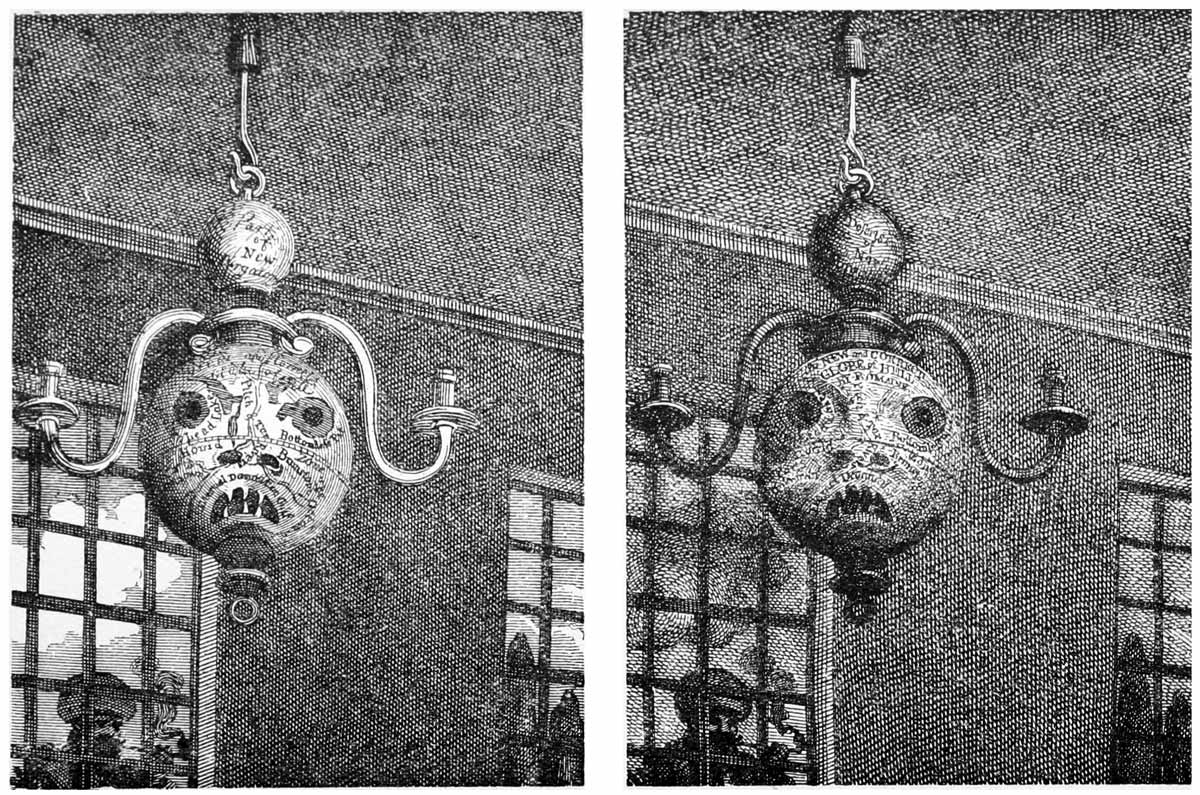
The Chandelier in “Enthusiasm” |
The Chandelier in “Credulity” |
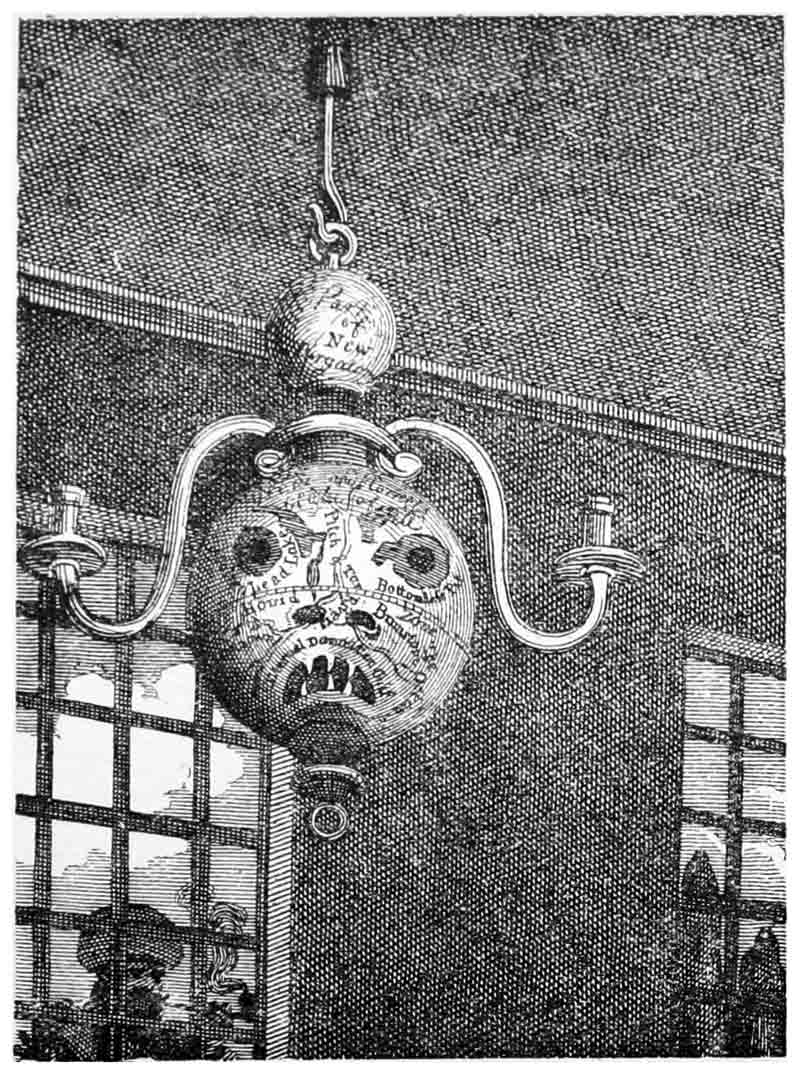
The Chandelier in “Enthusiasm”
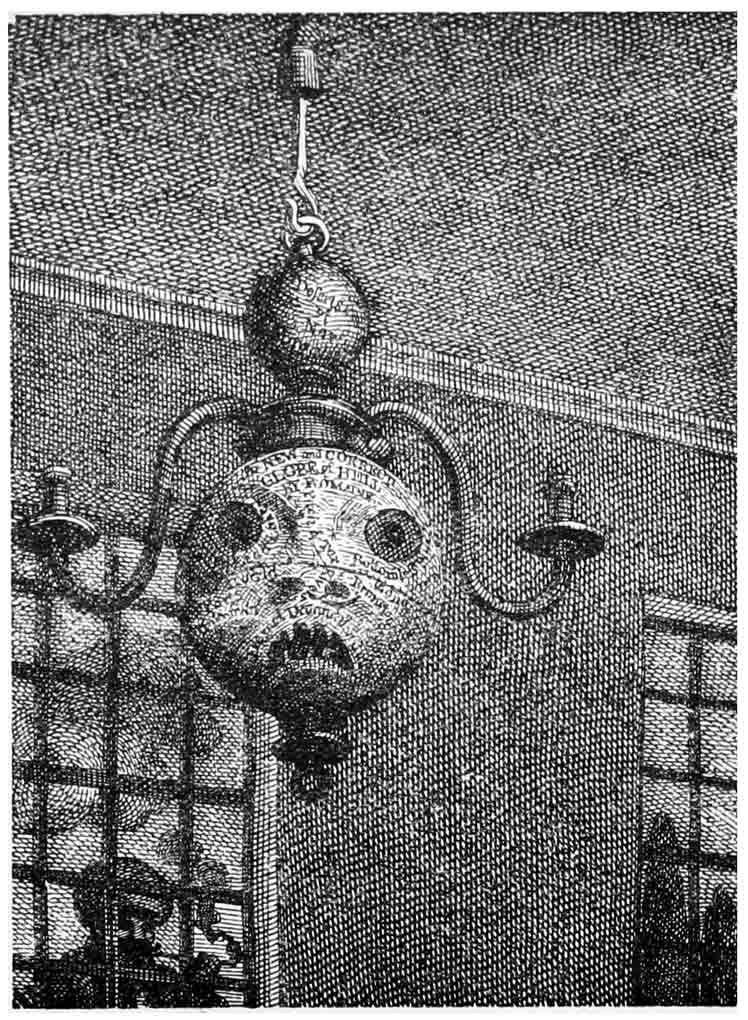
The Chandelier in “Credulity”
In Plate I., behind the prostrate woman a
bearded Jew regards the
preacher with mock {96}
devotion, what time he kills a flea between his
thumb-nails. Before him lies a book open at a
picture of Abraham offering up Isaac. In Plate
II. the figure of the Jew is much weakened, whilst
a knife inscribed “Bloody” is laid across a picture
of an altar on the page of the open book.
In the background of both plates a motley
collection of devotees assists at these religious
orgies. To the extreme left of Plate II., which,
by the addition of several persons in the congregation,
has become greatly overcrowded, a minister
directs the attention of a terrified wretch, whose
hair bristles with fear, to the extraordinary double-globed
chandelier above their heads.
Final emphasis is given to the whole satire by
the figure of a Turk (slightly varied in the two
plates), who regards with amusement through the
window the idolatry of those “dogs of Christians.”
So much for the details of the plates. As
regards the general effect of the whole, the
superiority of the suppressed design will be evident
at a glance. In lighting, balance, and composition,
the substituted design is immeasurably removed
from the original. Nor would this
be wonderful if, {97}
as Ireland surmised, “the alterations were made
by degrees.”
With this view, however, I find it, as I have
said above, impossible to concur. If, as he suggests,
the figures were beaten out one by one, their
substitutes would occupy practically identical
spaces on the plate; but a little measurement
demonstrates the fact that, with the exception of
the figure of the preacher, which has been left
where it was, and of the mental thermometer,
which has been raised, almost the whole of the
design has been shifted downwards.
I am therefore inclined to think that from the
first Hogarth, from one cause or another, made up
his mind to change the direction of his satire, and
at once beat out all the figures on the plate save
one. That the arrangement of the new design
should coincide generally with that of the first is,
I think, no more than one would naturally expect,
and does not in any way weaken the argument.
In conclusion, it should be pointed out, for the
sake of those who would study the matter further,
that the accounts of the impressions of the several
plates in the Catalogue of
Prints and Drawings {98}
in the British Museum are not easily found, being
somewhat arbitrarily placed at pages 301–307, vol.
iii., part i., and pages 644–648, vol. ii., respectively.
So far we have seen Hogarth in his character of
general iconoclast and antipapist. It is now our
business to deal with him in what was a more
personal polemic.
In the year 1731 Pope first published his
notorious attack upon the Duke of Chandos in his
satire Of Taste: An Epistle to the Right Hon.
Richard, Earl of Burlington.
Hogarth forthwith entered the lists, and designed
and published a well-deserved pictorial
counterblast, allusively entitled “The Man of
Taste,” or “Burlington Gate.” This was immediately
“suppressed” on a prosecution being
threatened because of what was deemed its
scurrilous and defamatory character.
Notwithstanding this prompt suppression, however,
the design reappeared the following year,
reduced in size, as frontispiece to a pirated edition
of Pope’s “Epistle,” which was included in a
pamphlet entitled A Miscellany
on Taste; by {99}
Mr. Pope, etc., published by Lawton and others.
Its contents were (1) Of Taste in Architecture,
an Epistle to the Earl of Burlington, with Notes
Variorum, and a complete Key; (2) Of Mr. Pope’s
Taste in Divinity: viz., the Fall of Man, and the
First Psalm, translated for the use of a Young
Lady; (3) Of Mr. Pope’s Taste of Shakespeare;
(4) His Satire on Mr. P——y; and (5) Mr.
Congreve’s fine Epistle on Retirement and Taste,
addressed to Lord Cobham. In this copy of the
plate Pope, who is shown in the original by means
of the back of his head and figure, and as wearing
a full-bottomed wig, is more distinctly satirised,
his face being displayed in profile, and his head
enclosed by a linen cap instead of a wig. Amongst
a few other minor alterations, it may be noticed
that the palette held by Kent is transferred from
one hand to the other.
Referring to the republication of Hogarth’s
cartoon in this form, Mr. Dobson seems somewhat
inclined to argue against the story of
its “suppression,” or, at any rate, its effectual
suppression; but he does not allude to the important
fact that the publisher
of this pamphlet {100}
was also promptly prosecuted, and the sale strictly
prohibited. From which it is clear that the
suppression was as unqualified and as prompt as
could reasonably be expected.
Steevens indeed mentions a copy upon which
the following inscription had been
made:—
“Bot. this book of Mr. Wayte, at the Fountain Tavern,
in the Strand, in the presence of Mr. Draper, who told me
he had it of the Printer, Mr. W. Rayner.
“J.
COSINS.”
The signatory was an Attorney, and the wording of
the memorandum suggests the intended prosecution.
To return to Pope’s poem. In it he passes
the most scathing criticism upon the splendid
but tasteless surroundings of “Timon” at his
stupendous villa.
“Greatness,
with Timon, dwells in such a draught
As brings all Brobdingnag before your thought.
To compass this, his building is a town,
His pond an ocean, his parterre a down:
Who but must laugh, the master when he sees,
A puny insect, shivering at the breeze!
Lo, what huge heaps of littleness around!
The whole, a labour’d quarry above ground.
Two cupids squirt before: a lake behind
Improves the keenness of the northern wind.
His gardens next your admiration call,
On every side you look, behold the wall!
{101}
No pleasing intricacies intervene,
No artful wildness to perplex the scene;
Grove nods at grove, each valley has a brother,
And half the platform just reflects the other.”
And then, at the end of it all, he proceeds to
justify Providence, in giving riches to those who
squander them, in a way that will hardly commend
itself to the student of the dismal science. A bad
taste, he says in effect, employs more hands, and
diffuses wealth more usefully than a good one!
One would like to have heard John Stuart Mill on
the subject of “Pope.”
The “Epistle” was addressed to Pope’s patron,
the Earl of Burlington, who was one of the noblemen
who had helped to screen him a few years
before on his publication of the Dunciad.
“Timon” (mainly though not entirely) referred to
the Duke of Chandos, who was, Johnson says, a man
perhaps too much delighted with pomp and show,
but of a temper kind and beneficent, and who had
consequently the voice of the public
in his favour.20
{102}
A violent outcry was therefore raised against
the ingratitude and treachery of Pope, who was
said to have been indebted to the patronage of
Chandos for a present of a thousand pounds, and
who gained the opportunity of insulting him by
the kindness of his invitation to “Canons,” the
Duke’s seat near Edgware.
In a pamphlet entitled Ingratitude published
in 1733, of which only a portion of the frontispiece
is in the British Museum,21
the matter is thus alluded
to. “A certain animal of diminutive size, who
had translated a book into English metre (or at
least had it translated for him), addressed himself
to a nobleman of the first rank, and in the style of
a gentleman-beggar requested him to subscribe a
guinea for one of his books. The nobleman
entertained him at dinner in a sumptuous manner,
and continued so to do as often as the insignificant
mortal came to his house. After dinner this
generous man of quality, taking him aside, put a
bank-note for five hundred pounds into his hands,
and desired he might have but
one book. But {103}
what was the consequence of this? Why, truly,
the wretch, who is a composition of peevishness,
spleen and envy, having no regard to the benefits
he had received, in a few years after, and without
any manner of provocation, or the least foundation
for truth, publishes a satire, as he terms it, but in
reality it is an infamous and calumnious libel,
calculated, with all the malice and virulency
imaginable, to defame and render odious the
character of his best benefactor.”
20
Bowles says, “As Pope was the first to deal in personalities, the
following severe retaliation was published in the papers of the
time:
“Let
Pope no more what Chandos builds deride,
Because he takes not Nature for his guide;
Since, wond’rous critic! in thy form we see
That Nature may mistake, as well as he.”
21
Vide Catalogue of Prints and Drawings in the British Museum,
Division I., Satires, vol. ii., No. 1935.
From which it will be seen that Hogarth was
not out of the fashion in retaliating upon Pope’s
devoted head with the cartoon which we here
reproduce.
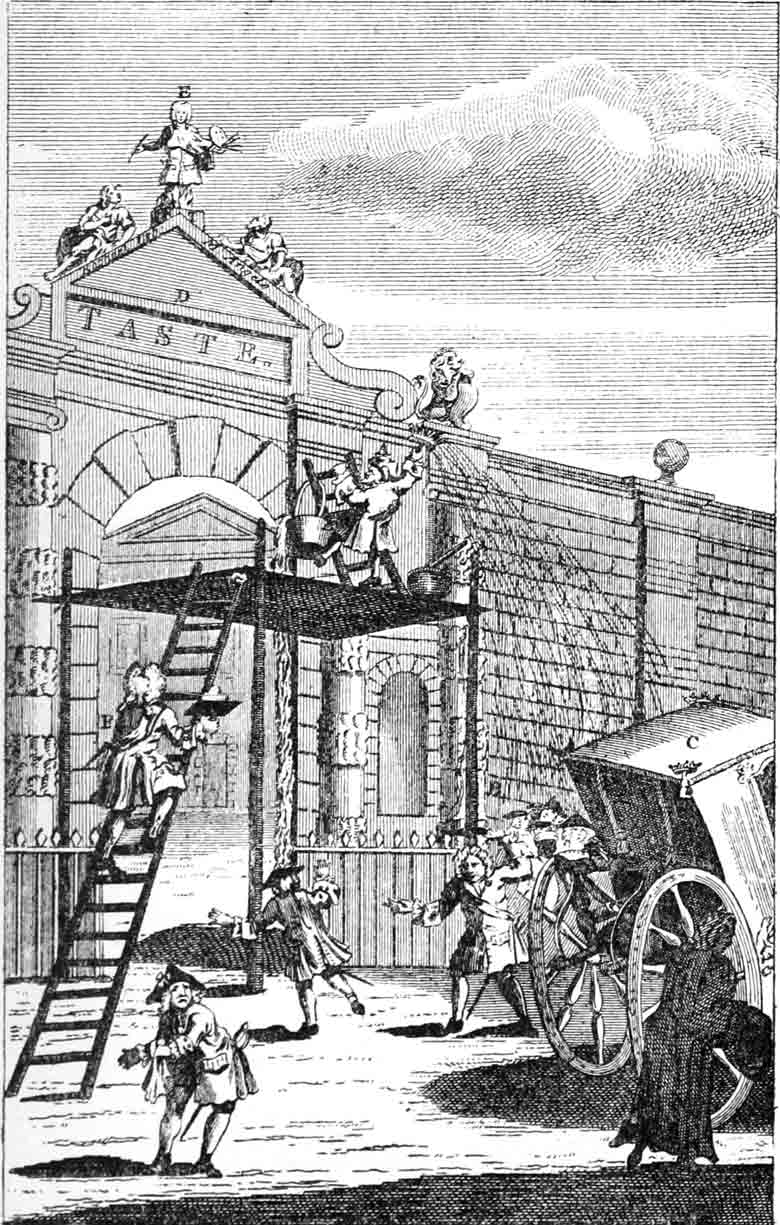
Let us examine it in detail. The gate, which
is the main feature in the picture, is a travesty
of that which is familiar to old frequenters of
Piccadilly. Until as lately as 1868, it formed the
frontage to Burlington House. It was the joint
design of Lord Burlington and Colin Campbell,
and, although well-proportioned and inoffensive,
hardly justifies the fulsome praise which has been
bestowed upon it. Kent, originally a coach-painter,
with whose statue Hogarth
has surmounted the {104}
structure, was patronised by, and brought his
practical knowledge to the assistance of, Lord
Burlington, himself undoubtedly a man of enlightened
taste. The alteration and reconstruction
of the original Burlington House, which had been
built by his great-grandfather, the first Earl, was
the first of his many architectural projects. It
was eventually taken down to make way for the
existing Royal Academy and Science Buildings.
Lord Hervey laughed at its inconvenience in the
following
couplet:—
“Possessed
of one great hall of state,
Without a room to sleep or eat.”
The best of Lord Burlington’s and Kent’s joint
work is to be found in the northern park front of
the Treasury Buildings in Whitehall, “which,” says
Fergusson, “if completed, would be more worthy
of Inigo Jones than anything that has been done
there since his time.”
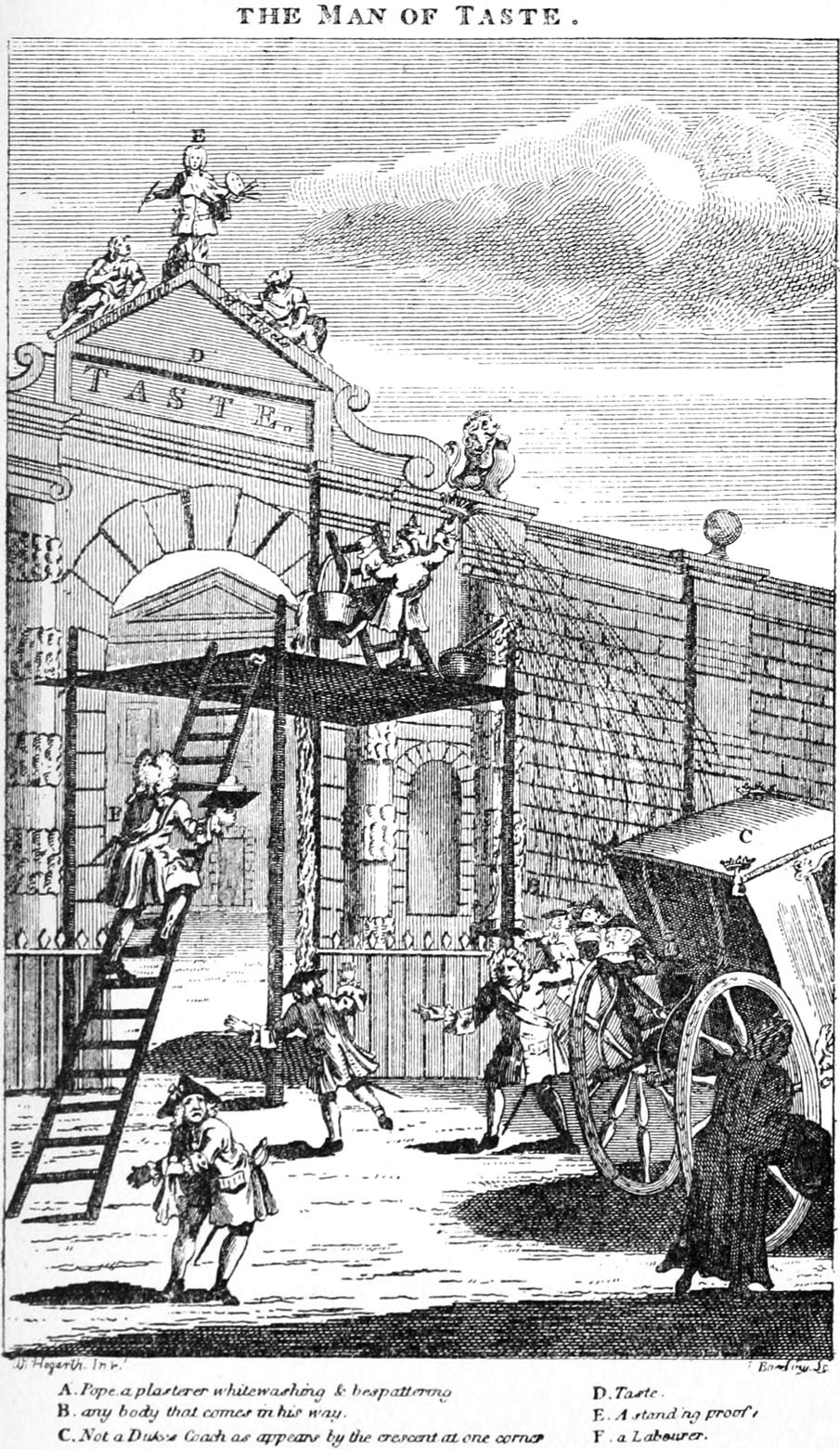
The Man of Taste
Flanking the ex-coach-painter, Hogarth has placed reclining figures
of Raphael and Michael Angelo, who regard the modern architect with
respectful admiration! On the platform is Pope rough-casting the front
of the structure, and {106}
incidentally bespattering the passers-by with whitewash from his
huge brush. Chief amongst these is the Duke of Chandos, who vainly
strives to protect himself with his hat. Ascending the ladder is
Lord Burlington, who carries up more whitening for the beautifying
of his own gate and the defilement of his neighbours’ clothes. Over
the gate Hogarth has sarcastically inscribed the solitary word “TASTE.” The double distribution of flattery
and satire is an excellent pictorial burlesque of the Epistle to Lord
Burlington, and who can say that it was not richly deserved? At any
rate, stroke and counterstroke were fierce and unhesitating in those
days, and, although Pope’s and his patrons’ influence was sufficient to
get Hogarth’s witty plate suppressed, it is a tribute to the wholesome
respect which the poet had for the artist, that, pugnacious and
irrepressible as his pen generally was, Pope never ventured to make any
written retaliation upon the libeller.
It should be mentioned that this was not the
first occasion upon which Hogarth had attacked the
charlatanry of Kent. In the first plate published
on his own account,
in 1724—“Masquerades and {107}
Operas”—he had included him in his ridicule of
what Mr. Dobson calls “foreign favourites and
dubious exotics.” In that plate, also, he had
ridiculed “Burlington Gate,” and, curiously
prompted by the spirit of prophecy, had labelled
it “Accademy (sic) of Arts!” He had also, in
the following year, burlesqued Kent’s scandalous
altarpiece at St. Clement Danes, which had lately
been taken down in response to the outcry against
its sacrilegious impudence.
By the kindness of the publisher of The Builder,
I am enabled to reproduce a wood engraving of
Burlington Gate as it actually was, which appeared
in that journal on October 28, 1854. Comparing
this with the cartoon, it will be seen that Hogarth
did not scruple to heighten the effect of his satire
by depriving Lord Burlington’s edifice of such
merits as it undoubtedly possessed.
So much for Hogarth in his polemic with Pope.
We will now turn for a moment to Hogarth and
his quarrel with Wilkes and Churchill, in which we
shall find him working over an old plate as in the
case of “Enthusiasm Delineated,” but with a very
different object in view. Here he
adopts a method {108}
of retaliation which, as we shall learn from later
chapters of this book, had become already customary
amongst the producers of political broadsides in
the seventeenth century. Hitherto Hogarth had
kept clear of politics, but now, in his sixty-fifth
year, he threw himself into the fray. John Wilkes
had started a paper called The North Briton in
opposition to The Briton, the organ of the Tory
party of which Lord Bute was the leader. Hogarth
had long enjoyed Bute’s favour. He had also
until now been on friendly terms with Wilkes and
his henchman Charles Churchill, the poet. On
September 7, 1762, taking sides with his patron,
he published The Times (Plate I.). This so enraged
Wilkes that he retaliated on the Saturday following,
in the seventeenth number of The North Briton,
with a violent attack on Hogarth both as man and
artist. In the May following Hogarth retorted
by publishing a portrait of John Wilkes which,
professing to be a likeness, cleverly exhibited his
most repulsive characteristics. Wilkes being now
on his trial for libel, Churchill came to the rescue
with his savage and slashing Epistle to William
Hogarth. This was published
on August 1. {110}
With a promptitude astonishing in those days of
tardy copper-plate engraving, Hogarth, by a clever
expedient, retaliated within a month with his
exceedingly venomous print of “The Bruiser.” The
plate from which this was printed had already done
duty as a portrait of Hogarth himself with his dog
Trump, engraved from the well-known painting
now in the National Gallery.
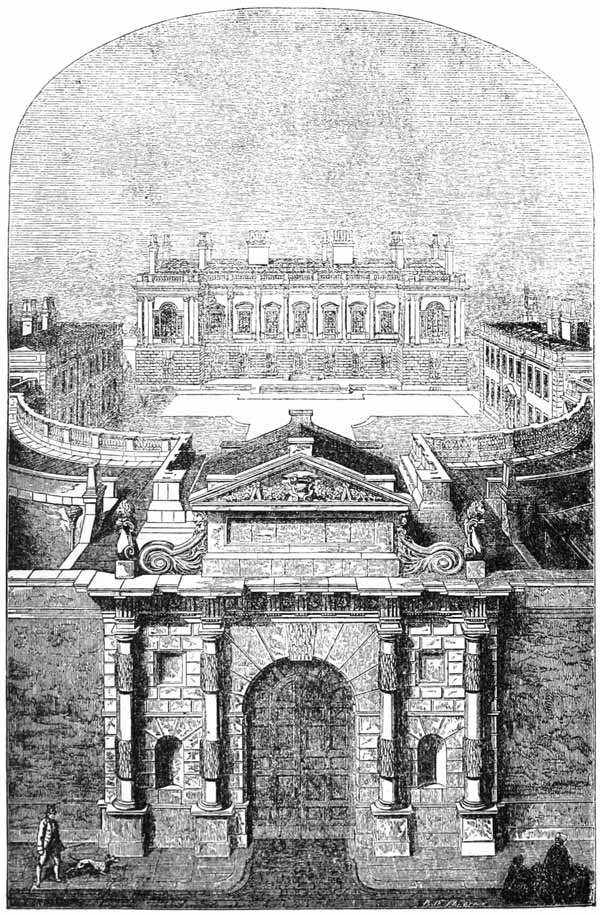
Burlington Gate as it appeared prior to 1868
Pressed for time, in ill-health, and apprehensive lest the public
might attribute delay in replying to inability to do so, he took the
old plate, burnished out his own portrait, and substituted in its place
the head of a bear, with torn and soiled clerical bands about its neck,
ruffles on its wrists, and clasping against its chest a foaming pot
of beer, in allusion to the personal habits of the poet and ci-devant
parson. With his left paw the beast clasps a huge club, the knots of
which are labelled “Lye 1,” “Lye 2,” referring to the falsities of The
North Briton. There are other minor alterations which may be seen at a
glance. The whole was entitled “THE
BRUISER,
CHARLES CHURCHILL (once the Revd.!)
In the character of a RUSSIAN
HERCULES, regaling himself after
having killed {111} the
MONSTER
CARICATURE,
that so sorely gall’d his virtuous friend, the Heaven-born
Wilkes.” The plate thus altered is to be found in five states,
particulars of which may be found on p. 286 of Mr. Austin Dobson’s
William Hogarth, 1891. That here reproduced is from a copy of
the last state engraved by Dent for John Ireland.22 It is only in the last two states that
the clever little engraving in front of the palette is to be found.
22
In copying, the design, as will be seen, has been turned from left
to right.
So far we have dealt with work done by Hogarth
in his individual capacity. Let us now turn to such
of his collaborative work as suffered cancellation.
In dealing with the series of suppressed Quixote
plates we shall be brought into touch with two not
uninteresting and accessory episodes in the artist’s
career. In the first of these Hogarth made a
great success, where a rival artist had made a
signal failure. In the second, by way of righting
the balance of things, fate ordained it that this
same artist should badly best Hogarth, and that in
a manner peculiarly galling to the latter’s vanity.
Hogarth’s father-in-law was Sir
James Thornhill, {112}
whose drawing academy in Covent Garden had
not proved as valuable an institution as had been
anticipated. Johan Van der Banck, the rival
artist above alluded to, had been one of Sir
James’s pupils. By heading a secession and
establishing a rival school he had undoubtedly
largely contributed to the failure of his master’s
venture. However, in due time, his school too
proved to be lacking in the elements of success,
and came to an untimely end.
On Sir James’s death the “neglected apparatus”
of his father-in-law passed into Hogarth’s hands,
and he set to work to establish the academy on a
different footing. The result was that it became
a successful educational centre, which only ceased to
exist many years afterwards on the establishment
of the Royal Academy. A picture by Hogarth of
the interior of the school with the students drawing
from life is to be seen on the staircase leading to
the Diploma Gallery at Burlington House.
In this case Hogarth had the laugh on his side.
In the other, which is immediately relevant to our
subject, the laugh was with Van der Banck.
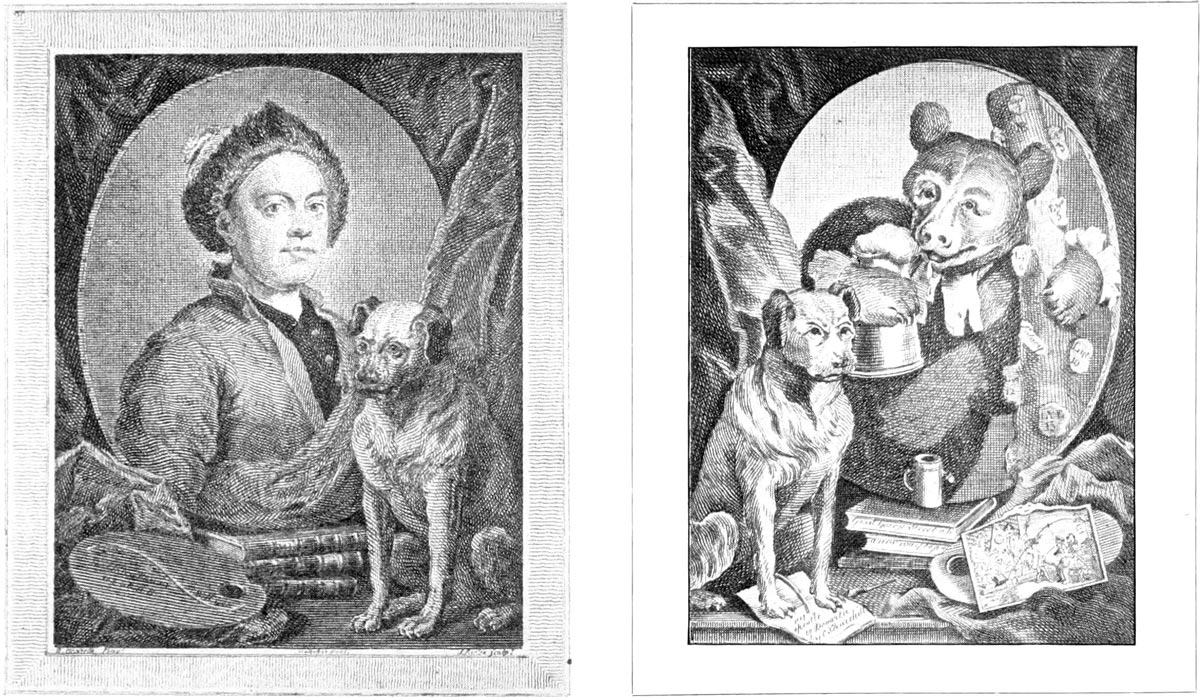
| Portrait of Hogarth with His Dog Trump* |
The plate reversed and in its last state,
now entitled “The Bruiser” |
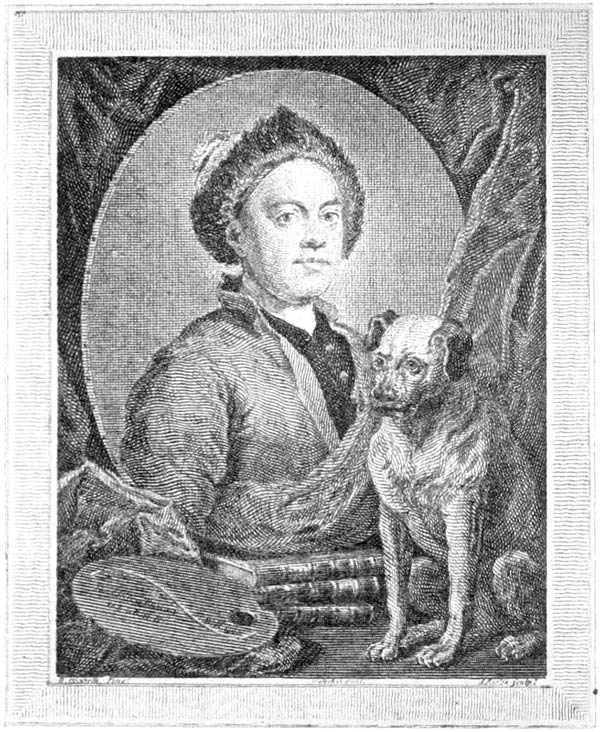
Portrait of Hogarth with His Dog Trump*
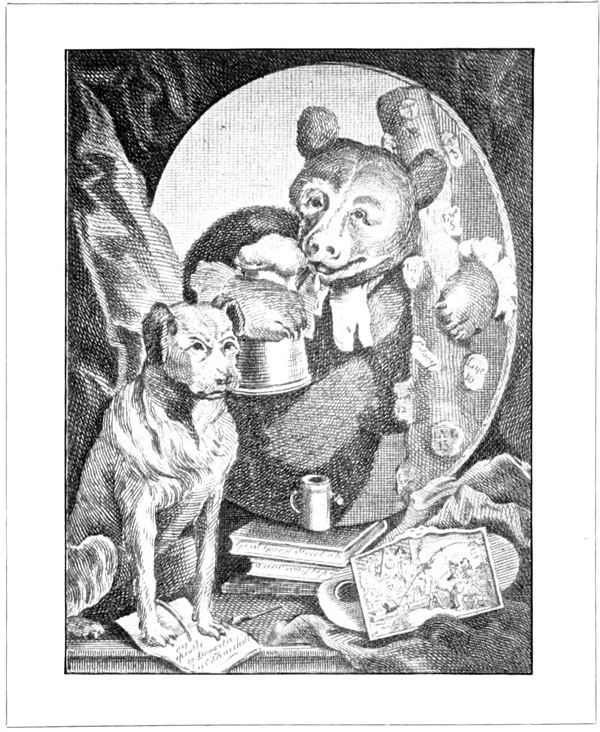
The plate reversed and in its last state,
now entitled “The Bruiser”
*
The plate being re-engraved
for Hogarth Illustrated became transposed.
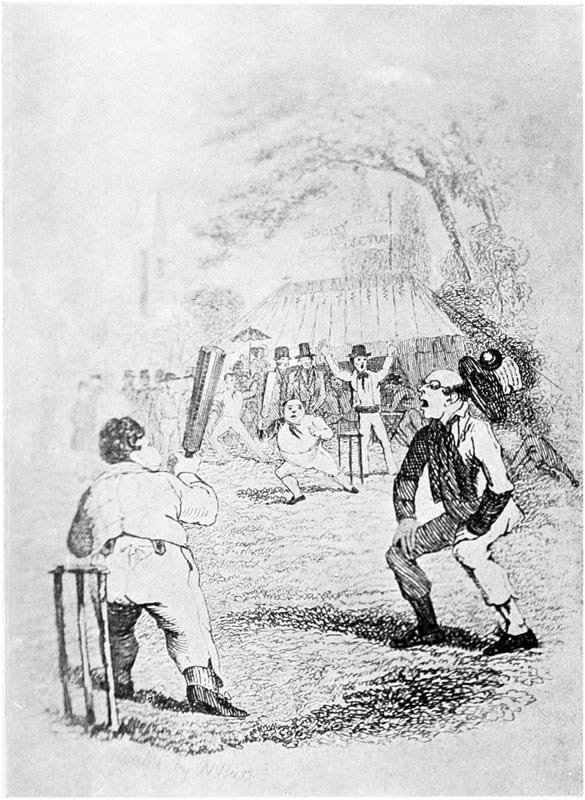
In 1738 Lord Carteret’s Spanish
edition of Don {113}
Quixote was published. For this Hogarth had
been commissioned to design a series of illustrations.
Eight of these were executed, but, on
being submitted to Lord Carteret, did not meet
with his approval. The commission was consequently
transferred to Johan van der Banck,
who thus succeeded in revenging himself for his
former failure, and at the same time unconsciously
provided us with matter for consideration in these
papers. His sixty-eight designs were engraved by
Van der Gucht and republished in the English
edition of 1756, of which Charles Jarvis was the
translator. Of Hogarth’s unsuccessful venture
John Ireland writes with some indignation, “As
they are etched in a bold and masterly style, I
suppose the noble peer did not think them pretty
enough to embellish his volume and therefore laid
them aside for Vandergucht’s engravings from
Vanderbank’s designs.” It is a slight satisfaction
to know that Hogarth’s completed etchings were
paid for!
One curious fact about Jarvis’s edition demands
our attention. The plate representing the Don’s
first sally in quest of adventure
is without any {114}
signature, but the “style of the etching and the
air of the figures” indisputably determine for us
the fact that it is from the pencil and burin of
Hogarth, so that it is open to any one who has
access to this edition to judge for themselves
of the justice of Ireland’s strictures upon Lord
Carteret.
For those who have not access to Jarvis’s
edition it may be mentioned that a copy engraved
by J. Mills appears in Ireland’s Hogarth Illustrated
and in the Anecdotes of William Hogarth, published
by Nichols in 1833. Of Hogarth’s eight designs
we are therefore left with only seven, which were
“suppressed.” Of these six were published from
Hogarth’s own plates in Baldwin, Cradock and
Joy’s splendid collection of the Works in 1822;
whilst previously, in 1798, John Ireland had
published small copies of them together with an
unfinished design of “The Innkeeper” in his
possession, engraved by J. Mills. These plates
were used over again in the Anecdotes of 1833
with altered lettering and the etchings considerably
worn.
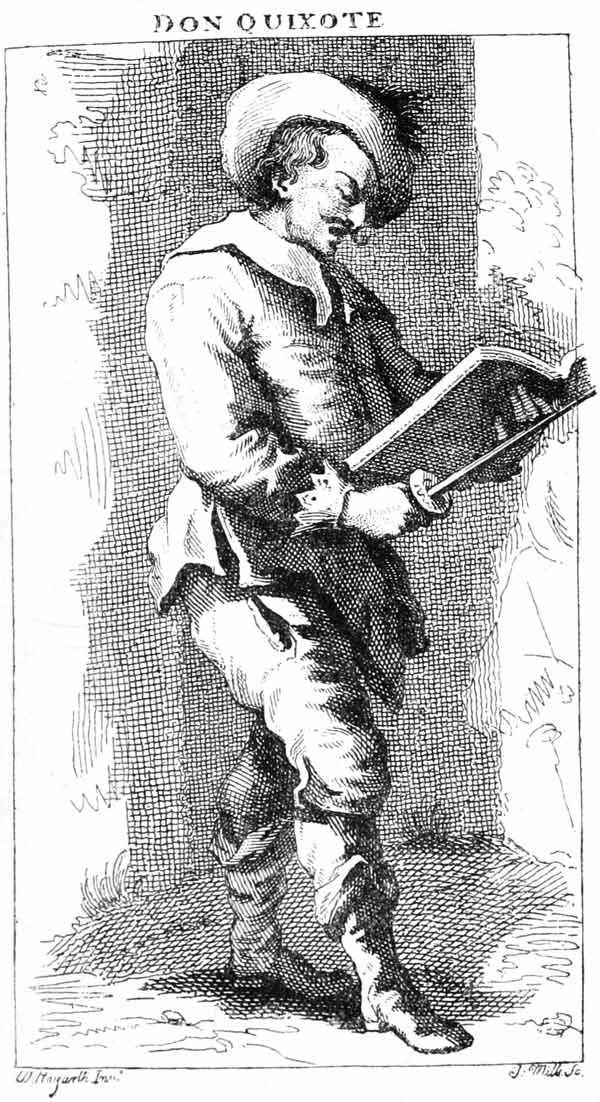
Don Quixote
No. 1.—The Innkeeper
The accompanying reproductions
are, save for {116}
No. 1., not made from any of the foregoing, but
from the early states of the plates, never before
published, to be found in the British Museum.
Thus they will prove not only of interest to the
casual reader but also valuable, for purposes of
comparison, to the possessors of any of the three
editions of Hogarth’s Works mentioned above.
The full descriptions of the plates may be found in
Ireland and Nichols, but for the convenience of the
reader I append a short commentary.
No. I. The Innkeeper is from an unfinished
etching and is of particular interest. By some its
authenticity is doubted, but John Ireland believed
in it, and I, for one, see no reason to call his
judgment into question, more particularly as this
figure bears a more than chance resemblance to
that of “The Innkeeper” in the undoubted Hogarth
referred to above published in Jarvis’s edition.
In the Van der Banck plate, which represents the
knighting of the Don by the Innkeeper, it is also
evident that Hogarth’s rival has done him the
compliment of adopting his model.
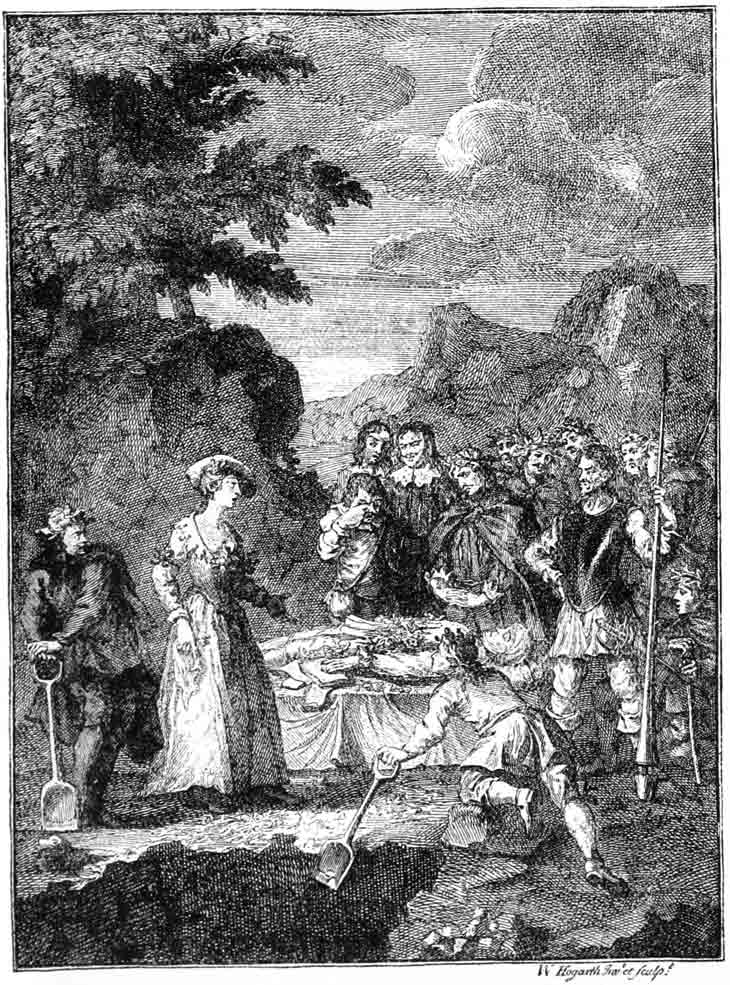
Don Quixote
No. II.—The Funeral of Chrysostom
No. II. The Funeral of Chrysostom, Marcella
vindicating herself. This scene
was also taken {118}
by Van der Banck for illustration, and a comparison
of the two plates is not favourable to
Hogarth.
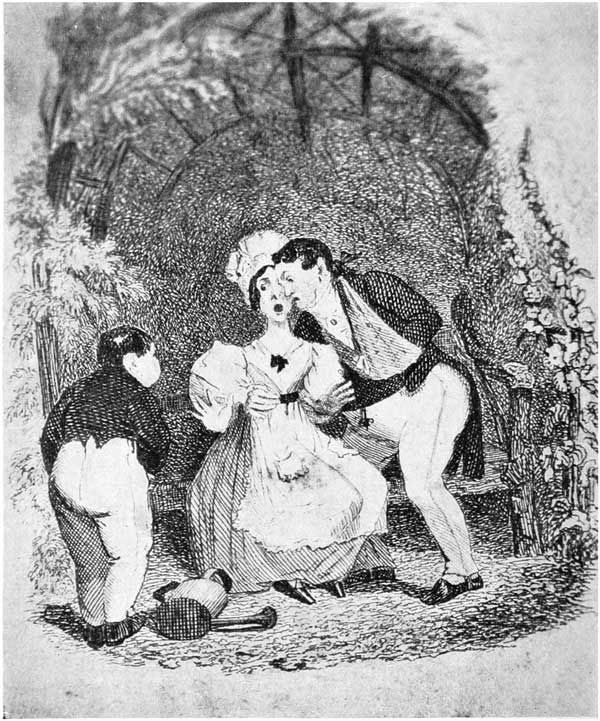
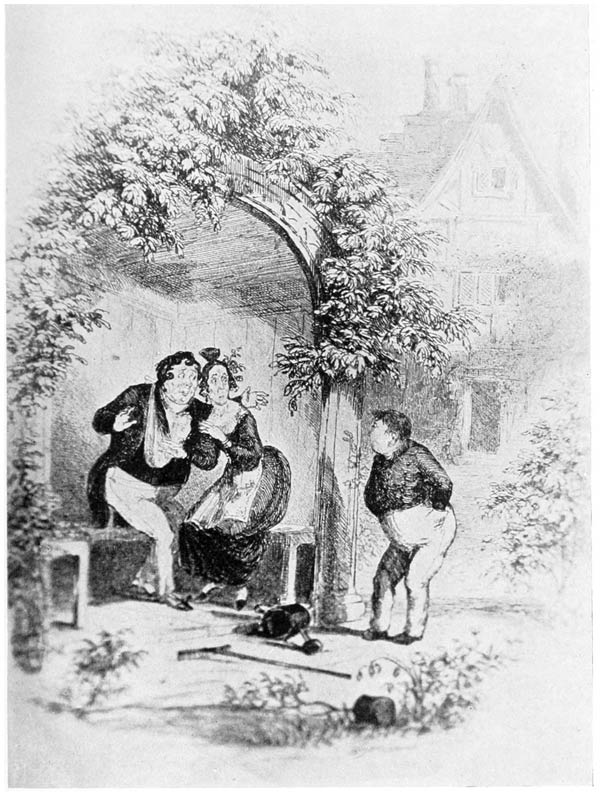
No. III. The Innkeepers Wife and Daughter
taking care of the Don after he had been beaten.
“Much superior to the same scene designed by
Van der Banck.”
No. IV. Don Quixote seizes the Barber’s Basin
for Mambrino’s Helmet. On the whole inferior to
Van der Banck’s. The barb of the Don’s weapon
is different from that in the Hogarth design published
by Jarvis. The stirrups and saddling of the
horse too are different. These points have not
been referred to before, but I mention them by
way of argument against the authenticity of the
Jarvis plate. As I have said before, personally I
have no doubt that it is from Hogarth’s burin.
No. V. Don Quixote releases the Galley Slaves.
Here the Don is found wearing the barber’s basin
as his helmet. By a not unusual oversight it will
be noticed Hogarth has made his figures left-handed,
forgetful of the reversing process due to
printing from a plate. A superior design to that
of Van der Banck, who, as
Ireland says, “has {121}
given to two or three of the thieves the countenances
of apostles.”
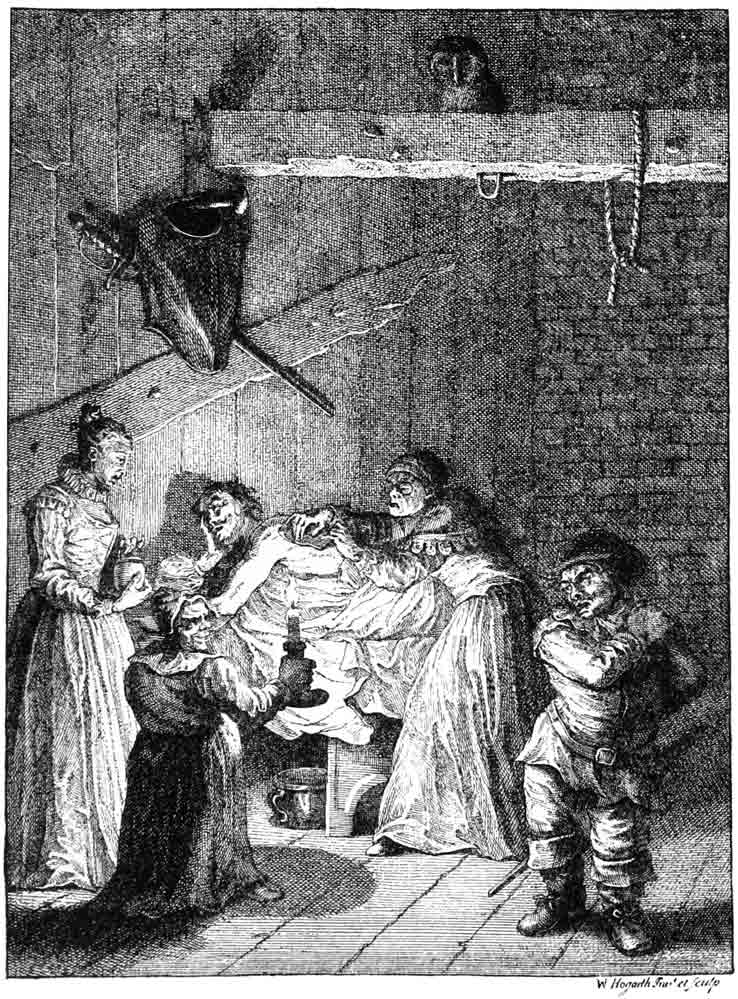
Don Quixote
No. III.—The Innkeeper’s Wife and Daughter
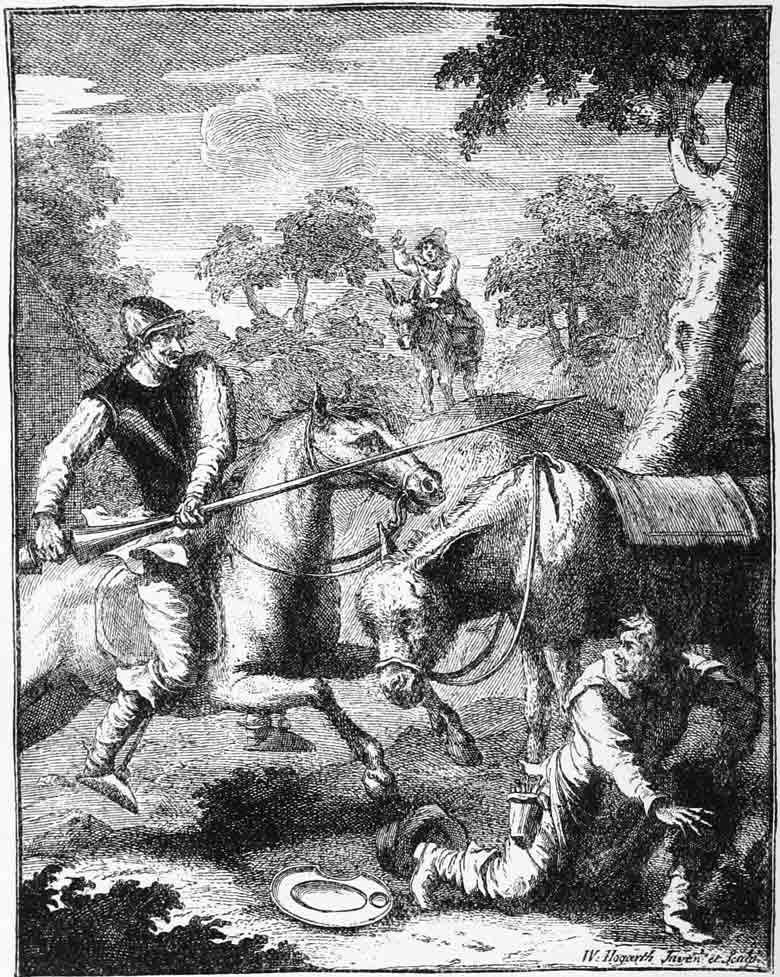
Don Quixote No. IV.—Don Quixote seizes
the Barber’s Basin
No. VI. The First Interview of the Valorous
Knight of La Mancha with the Unfortunate Knight
of the Rock. Distinctly superior to Van der Banck.
No. VII. The Curate and Barber disguising
themselves to convey Don Quixote home. An excellent
representation of the curate assuming the
dress of a distressed virgin who, by his tale of
having been wronged by a naughty knight, hopes
to induce the Don to return to his home.
Whilst on the subject of Don Quixote it may
be mentioned that, much earlier in his career,
Hogarth had designed and engraved a plate dealing
with “Sancho’s feast,” but this must not be
in any way identified or confused with the series
begun for Lord Carteret, although Ireland groups
them all together.
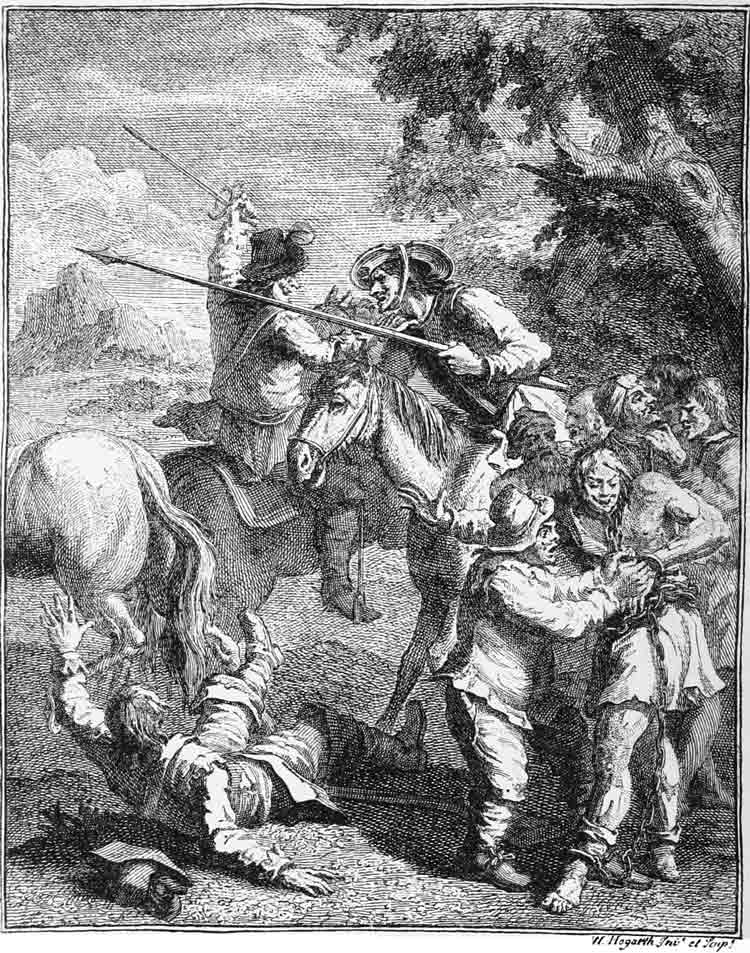
Don Quixote No. V.—Don Quixote releases
the Galley Slaves
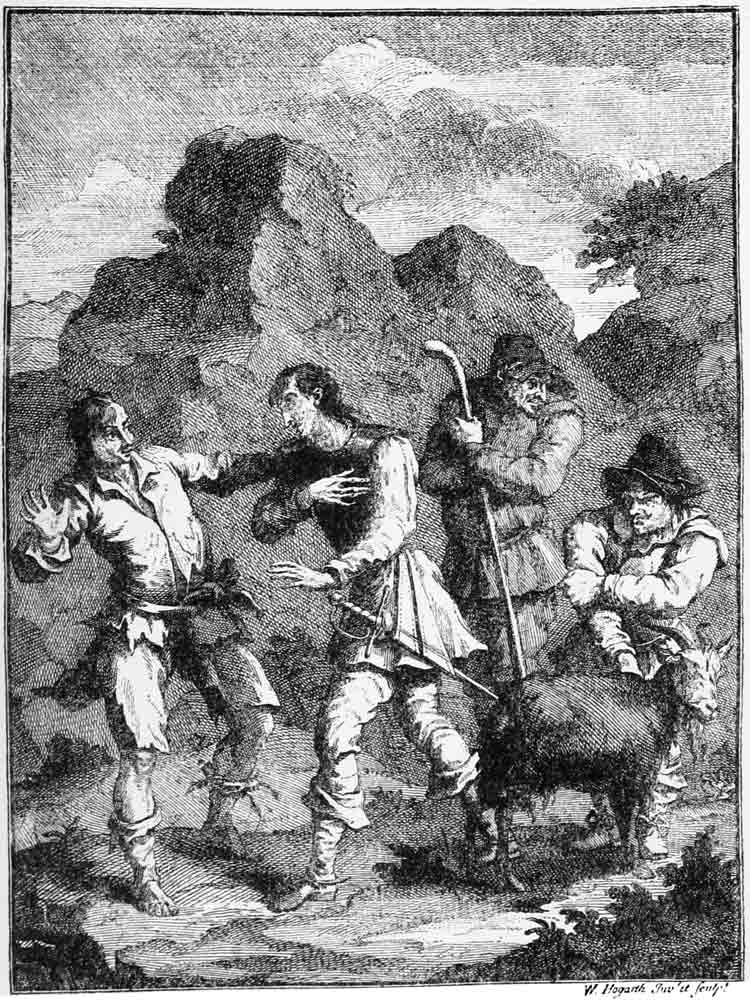
Don Quixote No. VI.—The First
Interview
So much for Hogarth’s suppressed illustrations,
and it is, it must be confessed, something of a
relief to turn again from his cognate art to that
which is individual and typical. For we do not
much value Hogarth as an illustrator. In this
character he rarely does more than
repeat for us {124}
in another medium the obvious matters already
dealt with in the letterpress. “Illustration,” as
Mr. Laurence Housman has well said, “should
be something in the nature of a brilliant commentary
throwing out new light upon the subject,
an exquisite parenthesis of things better said in
this medium than could be said in any other: in a
word, the result of another creative faculty at
work on the same theme.” And this in no way
describes Hogarth’s work as an illustrator. It is
as a great original painter working out consummately
the homeliest of morals that he appeals to
us. Those morals which, to quote Thackeray, are
“as easy as Goody Twoshoes,” the moral of
“Tommy was a naughty boy and the master
flogged him, and Jacky was a good boy and had
plum-cake.” For it is in “Marriage à la Mode,”
“A Rake’s Progress,” “Industry and Idleness,”
that he succeeds inimitably, carrying out the
motto beneath “Time Smoking a
Picture”:—
“To
Nature and your Self appeal
Nor learn of others what to feel.”
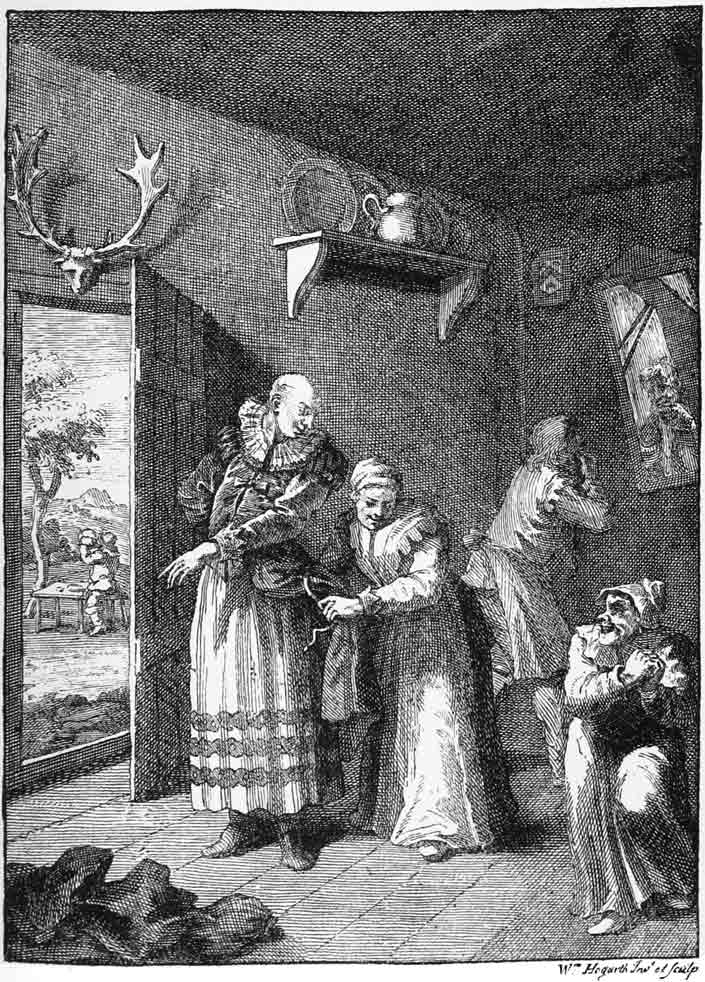
Don Quixote
No. VII.—The Curate and the Barber
But this only in passing, for our subject
debars us from lingering
over Hogarth’s best. {126}
From the nature of our theme we are confined to
the examination in the majority of cases of that
which verges upon failure either from artistic or
social considerations.