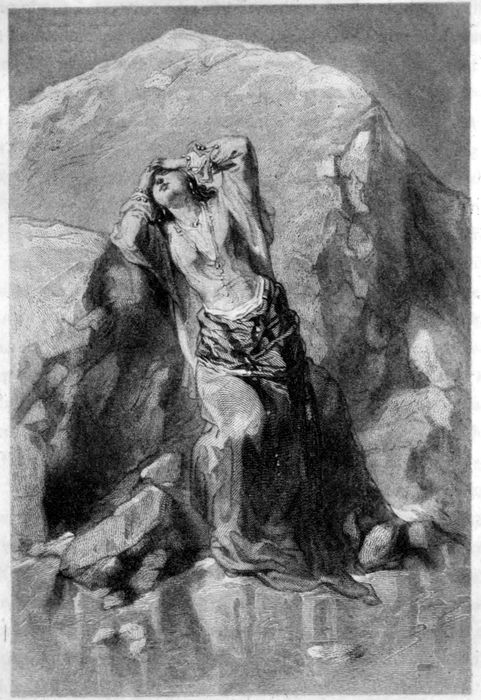
ALAEDDIN; OR, THE WONDERFUL LAMP. — ALAEDDIN; OR, THE WONDERFUL LAMP. ” — ALADDIN; OR, THE WONDERFUL LAMP. ( ENGLISH TRANSLATION OF GALLAND. )
49
51Quoth Dunyazad, “O sister mine, how rare is thy tale and
delectable!” whereto quoth Shahrazad, “And what is this compared
with that I would relate to you on the coming night
concerning Alaeddin[66] and the Enchanted Lamp, an this my lord
the King leave me on life?” The King said to himself, “By
Allah, I will not slay her until she tell me the whole tale.”
Now when it was the Five Hundred and Fourteenth Night,
Quoth Dunyazad,[67] to Shahrazad, “O sister mine, an thou be
other than sleepy, do tell us some of thy pleasant tales;” and
52quoth she “With love and good will: I will relate to you the
story of
It hath reached me, O King of the Age, that there dwelt in a city
of the cities of China a man which was a tailor, withal a pauper,
and he had one son, Alaeddin hight. Now this boy had been from
his babyhood a ne’er-do-well, a scapegrace; and, when he reached
his tenth year, his father inclined to teach him his own trade; and,
for that he was over indigent to expend money upon his learning
other work or craft or apprenticeship, he took the lad into
his shop that he might be taught tailoring. But, as Alaeddin
was a scapegrace and a ne’er-do-well and wont to play at all times
with the gutter boys of the quarter, he would not sit in the shop
for a single day; nay, he would await his father’s leaving it for
some purpose, such as to meet a creditor, when he would run off
at once and fare forth to the gardens with the other scapegraces
and low companions, his fellows. Such was his case; counsel and
castigation were of no avail, nor would he obey either parent in
aught or learn any trade; and presently, for his sadness and
sorrowing because of his son’s vicious indolence, the tailor sickened
and died. Alaeddin continued in his former ill courses and, when
his mother saw that her spouse had deceased, and that her son was
a scapegrace and good for nothing at all[68] she sold the shop and
whatso was to be found therein and fell to spinning cotton yarn.
By this toilsome industry she fed herself and found food for her
son Alaeddin the scapegrace who, seeing himself freed from bearing
the severities of his sire, increased in idleness and low habits; nor
53would he ever stay at home save at meal-hours while his miserable
wretched mother lived only by what her hands could spin until the
youth had reached his fifteenth year.——And Shahrazad was surprised
by the dawn of day and ceased saying her permitted say.
Now when it was the Five Hundred and Fifteenth Night,
Quoth Dunyazad, “O sister mine, an thou be other than sleepy,
do tell us some of thy pleasant tales,” whereupon Shahrazad
replied, “With love and good will.”——It hath reached me, O King
of the Age, that when Alaeddin had come to his fifteenth year, it
befel, one day of the days, that as he was sitting about the quarter
at play with the vagabond boys behold, a Darwaysh from the
Maghrib, the Land of the Setting Sun, came up and stood gazing
for solace upon the lads and he looked hard at Alaeddin and
carefully considered his semblance, scarcely noticing his companions
the while. Now this Darwaysh was a Moorman from
Inner Marocco and he was a magician who could upheap by his
magic hill upon hill, and he was also an adept in astrology. So
after narrowly considering Alaeddin he said in himself, “Verily, this
is the lad I need and to find whom I have left my natal land.”
Presently he led one of the children apart and questioned him
anent the scapegrace saying, “Whose[69] son is he?” And he sought
all information concerning his condition and whatso related to him.
After this he walked up to Alaeddin and drawing him aside asked,
“O my son, haply thou art the child of Such-an-one the tailor?”
and the lad answered, “Yes, O my lord, but ’tis long since he died.”
The Maghrabi,[70] the Magician, hearing these words threw himself
54upon Alaeddin and wound his arms around his neck and fell
to bussing him, weeping the while with tears trickling adown his
cheeks. But when the lad saw the Moorman’s case he was seized
with surprise thereat and questioned him, saying, “What causeth
thee weep, O my lord; and how camest thou to know my father?”
“How canst thou, O my son,” replied the Moorman, in a soft voice
saddened by emotion, “question me with such query after informing
me that thy father and my brother is deceased; for that he was my
brother-german and now I come from my adopted country and
after long exile I rejoiced with exceeding joy in the hope of
looking upon him once more and condoling with him over the
past; and now thou hast announced to me his demise. But blood
hideth not from blood[71] and it hath revealed to me that thou art my
nephew, son of my brother, and I knew thee amongst all the lads,
albeit thy father, when I parted from him, was yet unmarried.”——And
Shahrazad was surprised by the dawn of day and ceased
to say her permitted say.
Now when it was the Five Hundred and Sixteenth Night,
Quoth Dunyazad, “O sister mine, an thou be other than sleepy,
do tell us some of thy pleasant tales,” whereupon Shahrazad replied,
“With love and good will.”——It hath reached me, O King
of the Age, that the Maghrabi, the Magician, said to the tailor’s
orphan, “O my son Alaeddin, and I have now failed in the
55mourning ceremonies and have lost the delight I expected from
meeting thy father, my brother, whom after my long banishment
I had hoped to see once more ere I die; but far distance wrought
me this trouble nor hath the creature aught of asylum from the
Creator or artifice against the commandments of Allah Almighty.”
Then he again clasped Alaeddin to his bosom crying, “O my son,
I have none to condole with now save thyself; and thou standest
in stead of thy sire, thou being his issue and representative and
‘whoso leaveth issue dieth not,’[72] O my child!” So saying, the
Magician put hand to purse and pulling out ten gold pieces gave
them to the lad asking, “O my son, where is your house and where
dwelleth she, thy mother, and my brother’s widow?” Presently
Alaeddin arose with him and showed him the way to their home
and meanwhile quoth the Wizard, “O my son, take these moneys
and give them to thy mother, greeting her from me, and let her
know that thine uncle, thy father’s brother, hath reappeared from
his exile and that Inshallah—God willing—on the morrow I will
visit her to salute her with the salam and see the house wherein
my brother was homed and look upon the place where he lieth
buried.” Thereupon Alaeddin kissed the Maghrabi’s hand, and,
after running in his joy at fullest speed to his mother’s dwelling,
entered to her clean contrariwise to his custom, inasmuch as he
never came near her save at meal-times only. And when he found
her, the lad exclaimed in his delight, “O my mother, I give thee
glad tidings of mine uncle who hath returned from his exile and
who now sendeth me to salute thee.” “O my son,” she replied,
“meseemeth thou mockest me! Who is this uncle and how canst
thou have an uncle in the bonds of life?” He rejoined, “How
sayest thou, O my mother, that I have nor living uncles nor kinsmen,
when this man is my father’s own brother? Indeed he
56embraced me and bussed me, shedding tears the while, and bade
me acquaint thee herewith.” She retorted, “O my son, well I
wot thou haddest an uncle, but he is now dead nor am I ware that
thou hast other eme.”——And Shahrazad was surprised by the
dawn of day and ceased to say her permitted say.
Now when it was the Five Hundred and Seventeenth Night,
Quoth Dunyazad, “O sister mine, an thou be other than sleepy,
do tell us some of thy pleasant tales,” whereupon Shahrazad replied,
“With love and good will.”——It hath reached me, O King
of the Age, that the Maroccan Magician fared forth next morning
and fell to finding out Alaeddin, for his heart no longer permitted
him to part from the lad; and, as he was to-ing and fro-ing about
the city-highways, he came face to face with him disporting himself,
as was his wont, amongst the vagabonds and the scapegraces.
So he drew near to him and, taking his hand, embraced him and
bussed him; then pulled out of his poke two dinars and said,
“Hie thee to thy mother and give her these couple of ducats and
tell her that thine uncle would eat the evening-meal with you; so
do thou take these two gold pieces and prepare for us a succulent
supper. But before all things show me once more the way to your
home.” “On my head and mine eyes be it, O my uncle,” replied
the lad and forewent him, pointing out the street leading to the
house. Then the Moorman left him and went his ways and
Alaeddin ran home and, giving the news and the two sequins to
his parent, said, “My uncle would sup with us.” So she arose
straightway and going to the market-street bought all she required;
then, returning to her dwelling she borrowed from the neighbours
whatever was needed of pans and platters and so forth and when
the meal was cooked and suppertime came she said to Alaeddin,
“O my child, the meat is ready but peradventure thine uncle
wotteth not the way to our dwelling; so do thou fare forth and
meet him on the road.” He replied, “To hear is to obey,” and
before the twain ended talking a knock was heard at the door.
Alaeddin went out and opened when, behold, the Maghrabi, the
Magician, together with an eunuch carrying the wine and the
dessert-fruits; so the lad led them in and the slave went about
his business. The Moorman on entering saluted his sister-in-law
with the salam; then began to shed tears and to question her
saying, “Where be the place whereon my brother went to sit?”
She showed it to him, whereat he went up to it and prostrated
himself in prayer[73] and kissed the floor crying, “Ah, how scant is
my satisfaction and how luckless is my lot, for that I have lost thee,
O my brother, O vein of my eye!” And after such fashion he
continued weeping and wailing till he swooned away for excess of
sobbing and lamentation; wherefor Alaeddin’s mother was
certified of his soothfastness. So coming up to him she raised
him from the floor and said, “What gain is there in slaying thyself?”——And
Shahrazad was surprised by the dawn of day and
ceased to say her permitted say.
57
Now when it was the Five Hundred and Eighteenth Night,
Quoth Dunyazad, “O sister mine, an thou be other than sleepy,
do tell us some of thy pleasant tales,” whereupon Shahrazad replied
“With love and good will.”——It hath reached me, O King
of the Age, that Alaeddin’s mother began consoling the Maghrabi,
the Magician, and placed him upon the divan; and, as soon as he
was seated at his ease and before the food-trays were served up,
he fell to talking with her and saying, “O wife of my brother, it
must be a wonder to thee how in all thy days thou never sawest
58me nor learnedst thou aught of me during the life-time of my
brother who hath found mercy.[74] Now the reason is that forty
years ago I left this town and exiled myself from my birth-place
and wandered forth over all the lands of Al-Hind and Al-Sind and
entered Egypt and settled for a long time in its magnificent city,[75]
which is one of the world-wonders, till at last I fared to the regions
of the Setting Sun and abode for a space of thirty years in the
Maroccan interior. Now one day of the days, O wife of my
brother, as I was sitting alone at home, I fell to thinking of mine
own country and of my birth-place and of my brother (who hath
found mercy); and my yearning to see him waxed excessive and
I bewept and bewailed my strangerhood and distance from him.
And at last my longings drave me homewards until I resolved
upon travelling to the region which was the falling-place of my
head[76] and my homestead, to the end that I might again see my
brother. Then quoth I to myself:—O man,[77] how long wilt thou
wander like a wild Arab from thy place of birth and native stead?
Moreover, thou hast one brother and no more; so up with thee
and travel and look upon him[78] ere thou die; for who wotteth the
woes of the world and the changes of the days? ’Twould be saddest
regret an thou lie down to die without beholding thy brother and
Allah (laud be to the Lord!) hath vouchsafed thee ample wealth;
and belike he may be straitened and in poor case, when thou wilt
aid thy brother as well as see him. So I arose at once and
equipped me for wayfare and recited the Fátihah; then, whenas
Friday prayers ended, I mounted and travelled to this town, after
suffering manifold toils and travails which I patiently endured
59whilst the Lord (to whom be honour and glory!) veiled me with
the veil of His protection. So I entered and whilst wandering
about the streets, the day before yesterday, I beheld my brother’s
son Alaeddin disporting himself with the boys and, by God the
Great, O wife of my brother, the moment I saw him this heart of
mine went forth to him (for blood yearneth unto blood!), and my
soul felt and informed me that he was my very nephew. So I
forgot all my travails and troubles at once on sighting him and I
was like to fly for joy; but, when he told me of the dear one’s
departure to the ruth of Allah Almighty, I fainted for stress of
distress and disappointment. Perchance, however, my nephew
hath informed thee of the pains which prevailed upon me; but
after a fashion I am consoled by the sight of Alaeddin, the legacy
bequeathed to us by him who hath found mercy for that ‘whoso
leaveth issue is not wholly dead.’”[79]——And Shahrazad was surprised
by the dawn of day and ceased to say her permitted say.
Now when it was the Five Hundred and Nineteenth Night,
Quoth Dunyazad, “O sister mine, an thou be other than sleepy,
do tell us some of thy pleasant tales,” whereupon Shahrazad
replied, “With love and good will.”——It hath reached me, O
King of the Age, that the Maghrabi, the Magician, said to
Alaeddin’s mother, “Whoso leaveth issue is not wholly dead.”
And when he looked at his sister-in-law she wept at these his
words; so he turned to the lad that he might cause her forget the
mention of her mate, as a means of comforting her and also of
completing his deceit, and asked him, saying, “O my son Alaeddin
what hast thou learned in the way of work and what is thy
business? Say me, hast thou mastered any craft whereby to earn
60a livelihood for thyself and for thy mother?” The lad was
abashed and put to shame and he hung down his head and bowed
his brow groundwards; but his parent spake out, “How, forsooth?
By Allah, he knoweth nothing at all, a child so ungracious as this
I never yet saw; no, never! All the day long he idleth away his
time with the sons of the quarter, vagabonds like himself, and his
father (O regret of me!) died not save of dolour for him. And I
also am now in piteous plight: I spin cotton and toil at my distaff,
night and day, that I may earn me a couple of scones of bread
which we eat together. This is his condition, O my brother-in-law;
and, by the life of thee, he cometh not near me save at
meal-times and none other. Indeed, I am thinking to lock the
house-door nor ever open to him again but leave him to go and
seek a livelihood whereby he can live, for that I am now grown a
woman in years and have no longer strength to toil and go about
for a maintenance after this fashion. O Allah, I am compelled to
provide him with daily bread when I require to be provided!”
Hereat the Moorman turned to Alaeddin and said, “Why is this,
O son of my brother, thou goest about in such ungraciousness?
’Tis a disgrace to thee and unsuitable for men like thyself. Thou
art a youth of sense, O my son, and the child of honest folk, so
’tis for thee a shame that thy mother, a woman in years, should
struggle to support thee. And now that thou hast grown to man’s
estate it becometh thee to devise thee some device whereby thou
canst live, O my child. Look around thee and Alhamdolillah—praise
be to Allah—in this our town are many teachers of all
manner of crafts and nowhere are they more numerous; so choose
thee some calling which may please thee to the end that I stablish
thee therein; and, when thou growest up, O my son, thou shalt
have some business whereby to live. Haply thy father’s industry
may not be to thy liking; and, if so it be, choose thee some other
handicraft which suiteth thy fancy; then let me know and I will
aid thee with all I can, O my son.” But when the Maghrabi saw
61that Alaeddin kept silence and made him no reply, he knew that
the lad wanted none other occupation than a scapegrace-life, so he
said to him, “O son of my brother, let not my words seem hard
and harsh to thee, for, if despite all I say, thou still dislike to
learn a craft, I will open thee a merchant’s store[80] furnished with
costliest stuffs and thou shalt become famous amongst the folk and
take and give and buy and sell and be well known in the city?”
Now when Alaeddin heard the words of his uncle the Moorman,
and the design of making him a Khwájah[81]—merchant and
gentleman,—he joyed exceedingly knowing that such folk dress
handsomely and fare delicately. So he looked at the Maghrabi
smiling and drooping his head groundwards and saying with the
tongue of the case that he was content.——And Shahrazad was
surprised by the dawn of day and ceased to say her permitted say.
Now when it was the Five Hundred and Twentieth Night,
Quoth Dunyazad, “O sister mine, an thou be other than sleepy,
do tell us some of thy pleasant tales,” whereupon Shahrazad
replied, “With love and good will.”——It hath reached me, O King
of the Age, that the Maghrabi, the Magician, looked at Alaeddin
and saw him smiling, whereby he understood that the lad was
satisfied to become a trader. So he said to him, “Since thou art
content that I open thee a merchant’s store and make thee a gentleman,
do thou, O son of my brother, prove thyself a man and
Inshallah—God willing—to-morrow I will take thee to the Bazar
62in the first place and will have a fine suit of clothes cut out for
thee, such gear as merchants wear; and, secondly, I will look after
a store for thee and keep my word.” Now Alaeddin’s mother had
somewhat doubted the Maroccan being her brother-in-law; but as
soon as she heard his promise of opening a merchant’s store for
her son and setting him up with stuffs and capital and so forth, the
woman decided and determined in her mind that this Maghrabi
was in very sooth her husband’s brother, seeing that no stranger
man would do such goodly deed by her son. So she began
directing the lad to the right road and teaching him to cast
ignorance from out his head and to prove himself a man; moreover
she bade him ever obey his excellent uncle as though he were
his son and to make up for the time he had wasted in frowardness
with his fellows. After this she arose and spread the table, then
served up supper; so all sat down and fell to eating and drinking,
while the Maghrabi conversed with Alaeddin upon matters of
business and the like, rejoicing him to such degree that he
enjoyed no sleep that night. But when the Moorman saw that
the dark hours were passing by, and the wine was drunken, he
arose and sped to his own stead; but, ere going, he agreed to
return next morning and take Alaeddin and look to his suit of
merchant’s clothes being cut out for him. And as soon as it was
dawn, behold, the Maghrabi rapped at the door which was opened
by Alaeddin’s mother: the Moorman, however, would not enter,
but asked to take the lad with him to the market-street. Accordingly
Alaeddin went forth to his uncle and, wishing him good
morning, kissed his hand; and the Maroccan took him by the
hand and fared with him to the Bazar. There he entered a
clothier’s shop containing all kinds of clothes and called for a suit
of the most sumptuous; whereat the merchant brought him out
his need, all wholly fashioned and ready sewn; and the Moorman
said to the lad, “Choose, O my child, whatso pleaseth thee.”
Alaeddin rejoiced exceedingly seeing that his uncle had given him
63his choice, so he picked out the suit most to his own liking
and the Maroccan paid to the merchant the price thereof in
ready money. Presently he led the lad to the Hammám-baths
where they bathed; then they came out and drank sherbets, after
which Alaeddin arose and, donning his new dress in huge joy and
delight, went up to his uncle and kissed his hand and thanked
him for his favours.——And Shahrazad was surprised by the dawn
of day and ceased to say her permitted say.
Now when it was the Five Hundred and Twenty-first Night,
Quoth Dunyazad, “O sister mine, an thou be other than sleepy,
do tell us some of thy pleasant tales,” whereupon Shahrazad
replied, “With love and good will.”——It has reached me, O King
of the Age, that the Maghrabi, the Magician, after leaving the
Hammam with Alaeddin, took him and trudged with him to the
Merchants’ bazar; and, having diverted him by showing the
market and its sellings and buyings, said to him, “O my son, it
besitteth thee to become familiar with the folk, especially with the
merchants, so thou mayest learn of them merchant-craft, seeing
that the same hath now become thy calling.” Then he led him
forth and showed him the city and its cathedral-mosques together
with all the pleasant sights therein; and, lastly, made him enter a
cook’s shop. Here dinner was served to them on platters of silver
and they dined well and ate and drank their sufficiency, after which
they went their ways. Presently the Moorman pointed out to
Alaeddin the pleasances and noble buildings, and went in with
him to the Sultan’s Palace and diverted him with displaying all
the apartments which were mighty fine and grand; and led him
finally to the Khán of stranger merchants where he himself had
his abode. Then the Maroccan invited sundry traders which were
in the Caravanserai; and they came and sat down to supper, when
64he notified to them that the youth was his nephew, Alaeddin by
name. And after they had eaten and drunken and night had
fallen, he rose up and taking the lad with him led him back to
his mother, who no sooner saw her boy as he were one of the
merchants[82] than her wits took flight and she waxed sad for very
gladness. Then she fell to thanking her false connection, the
Moorman, for all his benefits and said to him, “O my brother-in-law,
I can never say enough though I expressed my gratitude to
thee during the rest of thy days and praised thee for the good
deeds thou hast done by this my child.” Thereupon quoth the
Maroccan, “O wife of my brother, deem this not mere kindness of
me, for that the lad is mine own son and ’tis incumbent on me to
stand in the stead of my brother, his sire. So be thou fully
satisfied!” And quoth she, “I pray Allah by the honour of the
Hallows, the ancients and the moderns, that He preserve thee and
cause thee continue, O my brother-in-law, and prolong for me thy
life; so shalt thou be a wing overshadowing this orphan lad; and
he shall ever be obedient to thine orders nor shall he do aught
save whatso thou biddest him thereunto.” The Maghrabi replied,
“O wife of my brother, Alaeddin is now a man of sense and the
son of goodly folk, and I hope to Allah that he will follow in the
footsteps of his sire and cool thine eyes. But I regret that,
to-morrow being Friday, I shall not be able to open his shop, as
’tis meeting-day when all the merchants, after congregational
prayer, go forth to the gardens and pleasances. On the Sabbath,[83]
65however, Inshallah!—an it please the Creator—we will do our
business. Meanwhile to-morrow I will come to thee betimes and
take Alaeddin for a pleasant stroll to the gardens and pleasances
without the city which haply he may hitherto not have beheld.
There also he shall see the merchants and notables who go forth
to amuse themselves, so shall he become acquainted with them and
they with him.”——And Shahrazad was surprised by the dawn of
day and ceased to say her permitted say.
Now when it was the Five Hundred and Twenty-second Night,
Quoth Dunyazad, “O sister mine, an thou be other than sleepy, do
tell us some of thy pleasant tales,” whereupon Shahrazad replied,
“With love and good will.”——It hath reached me, O King of the
Age, that the Maghrabi went away and lay that night in his
quarters; and early next morning he came to the tailor’s house and
rapped at the door. Now Alaeddin (for stress of his delight in
the new dress he had donned and for the past day’s enjoyment in the
Hammam and in eating and drinking and gazing at the folk;
expecting furthermore his uncle to come at dawn and carry him
off on pleasuring to the gardens) had not slept a wink that night,
nor closed his eyelids, and would hardly believe it when day broke.
But hearing the knock at the door he went out at once in hot
haste, like a spark of fire, and opened and saw his uncle, the Magician,
who embraced him and kissed him. Then, taking his hand,
the Moorman said to him as they fared forth together, “O son of
my brother, this day will I show thee a sight thou never sawest in
all thy life,” and he began to make the lad laugh and cheer him
with pleasant talk. So doing they left the city gate, and the
66Maroccan took to promenading with Alaeddin amongst the gardens
and to pointing out for his pleasure the mighty fine pleasances
and the marvellous high-builded[84] pavilions. And whenever they
stood to stare at a garth or a mansion or a palace the Maghrabi
would say to his companion, “Doth this please thee, O son of my
brother?” Alaeddin was nigh to fly with delight at seeing sights
he had never seen in all his born days; and they ceased not[85] to
stroll about and solace themselves until they waxed aweary, when
they entered a mighty grand garden which was nearhand, a place
that the heart delighted and the sight belighted; for that its swift-running
rills flowed amidst the flowers and the waters jetted
from the jaws of lions moulded in yellow brass like unto gold.
So they took seat over against a lakelet and rested a little while,
and Alaeddin enjoyed himself with joy exceeding and fell to jesting
with his uncle and making merry with him as though the
Magician were really his father’s brother. Presently the Maghrabi
arose and loosing his girdle drew forth from thereunder a bag full
of victual, dried fruits and so forth, saying to Alaeddin, “O my
nephew, haply thou art become anhungered; so come forward
and eat what thou needest.” Accordingly the lad fell upon the
food and the Moorman ate with him and they were gladdened and
cheered by rest and good cheer. Then quoth the Magician,
“Arise, O son of my brother, an thou be reposed and let us stroll
onwards a little and reach the end of our walk.” Thereupon
Alaeddin arose and the Maroccan paced with him from garden to
garden until they left all behind them and reached the base of a
high and naked hill; when the lad who, during all his days, had
never issued from the city-gate and never in his life had walked
such a walk as this, said to the Maghrabi, “O uncle mine, whither
are we wending? We have left the gardens behind us one and all
67and have reached the barren hill-country[86]; and, if the way be still
long, I have no strength left for walking: indeed I am ready to
fall with fatigue. There are no gardens before us, so let us hark
back and return to town.” Said the Magician, “No, O my son;
this is the right road, nor are the gardens ended for we are going
to look at one which hath ne’er its like amongst those of the Kings
and all thou hast beheld are naught in comparison therewith. Then
gird thy courage to walk; thou art now a man, Alhamdolillah—praise
be to Allah!” Then the Maghrabi fell to soothing Alaeddin
with soft words and telling him wondrous tales, lies as well as truth,
until they reached the site intended by the African Magician who
had travelled from the Sunset-land to the regions of China for the
sake thereof. And when they made the place, the Moorman said
to Alaeddin, “O son of my brother, sit thee down and take thy
rest, for this is the spot we are now seeking and, Inshallah, soon
will I divert thee by displaying marvel-matters whose like not one
in the world ever saw; nor hath any solaced himself with gazing
upon that which thou art about to behold.”——And Shahrazad was
surprised by the dawn of day and ceased to say her permitted say.
Now when it was the Five Hundred and Twenty-third Night,
Quoth Dunyazad, “O sister mine, an thou be other than sleepy,
do tell us some of thy pleasant tales,” whereupon Shahrazad
replied, “With love and good will.”——It hath reached me, O King
of the Age, that the Maghrabi wizard said to Alaeddin, “No one
of created beings hath enjoyed the sights thou art about to see.
But when thou art rested, arise and seek some wood-chips and
fuel sticks[87] which be small and dry, wherewith we may kindle a
fire: then will I show thee, O son of my brother, matters beyond
68the range of matter.”[88] Now, when the lad heard these words, he
longed to look upon what his uncle was about to do and, forgetting
his fatigue, he rose forthright and fell to gathering small
wood-chips and dry sticks, and continued until the Moorman
cried to him, “Enough, O son of my brother!” Presently the
Magician brought out from his breast-pocket a casket which he
opened, and drew from it all he needed of incense; then he
fumigated and conjured and adjured, muttering words none
might understand. And the ground straightway clave asunder
after thick gloom and quake of earth and bellowings of thunder.
Hereat Alaeddin was startled and so affrighted that he tried to
fly; but, when the African Magician saw his design, he waxed
wroth with exceeding wrath, for that without the lad his work
would profit him naught, the hidden hoard which he sought to
open being not to be opened save by means of Alaeddin. So
noting this attempt to run away, the Magician arose and raising
his hand smote Alaeddin on the head a buffet so sore that well
nigh his back-teeth were knocked out, and he fell swooning to the
ground. But after a time he revived by the magic of the Magician,
and cried, weeping the while, “O my uncle, what have I
done that deserveth from thee such a blow as this?” Hereat
the Maghrabi fell to soothing him, and said, “O my son, ’tis my
intent to make thee a man; therefore, do thou not gainsay me,
for that I am thine uncle and like unto thy father. Obey me,
therefore, in all I bid thee, and shortly thou shalt forget all this
travail and toil whenas thou shalt look upon the marvel-matters
I am about to show thee.” And soon after the ground had cloven
asunder before the Maroccan it displayed a marble slab wherein
was fixed a copper ring. The Maghrabi, striking a geomantic
table[89] turned to Alaeddin, and said to him, “An thou do all I
69shall bid thee, indeed thou shalt become wealthier than any of the
kings, and for this reason, O my son, I struck thee, because here
lieth a hoard which is stored in thy name; and yet thou designedst
to leave it and to levant. But now collect thy thoughts, and
behold how I opened earth by my spells and adjurations.”——And
Shahrazad was surprised by the dawn of day, and ceased to
say her permitted say.
Now when it was the Five Hundred and Twenty-fourth Night,
Quoth Dunyazad, “O sister mine, an thou be other than sleepy,
do tell us some of thy pleasant tales,” whereupon Shahrazad
replied, “With love and good will.”——It hath reached me, O King
of the Age, that the Maghrabi, the Magician, said to Alaeddin,
“O my son, now collect thy thoughts! under yon stone wherein
the ring is set lieth the treasure wherewith I acquainted thee: so
set thy hand upon the ring and raise the slab, for that none other
amongst the folk, thyself excepted, hath power to open it, nor may
any of mortal birth, save thyself, set foot within this Enchanted
Treasury which hath been kept for thee. But ’tis needful that
thou learn of me all wherewith I would charge thee; nor gainsay
e’en a single syllable of my words. All this, O my child, is for thy
good; the hoard being of immense value, whose like the kings of the
world never accumulated, and do thou remember that ’tis for thee
and me.” So poor Alaeddin forgot his fatigue and buffet and tear-shedding,
and he was dumbed and dazed at the Maghrabi’s words
and rejoiced that he was fated to become rich in such measure
that not even the Sultans would be richer than himself. Accordingly,
he cried, “O my uncle, bid me do all thou pleasest, for
I will be obedient unto thy bidding.” The Maghrabi replied,
“O my nephew, thou art to me as my own child and even dearer,
for being my brother’s son and for my having none other kith and
70kin except thyself; and thou, O my child, art my heir and
successor.” So saying, he went up to Alaeddin and kissed him
and said, “For whom do I intend these my labours? Indeed,
each and every are for thy sake, O my son, to the end that I may
leave thee a rich man and one of the very greatest. So gainsay
me not in all I shall say to thee, and now go up to yonder ring and
uplift it as I bade thee.” Alaeddin answered, “O uncle mine, this
ring is over heavy for me: I cannot raise it single-handed, so do thou
also come forward and lend me strength and aidance towards uplifting
it, for indeed I am young in years.” The Moorman replied,
“O son of my brother, we shall find it impossible to do aught
if I assist thee, and all our efforts would be in vain. But do thou
set thy hand upon the ring and pull it up, and thou shalt raise the
slab forthright, and in very sooth I told thee that none can touch it
save thyself. But whilst haling at it cease not to pronounce thy
name and the names of thy father and mother, so ’twill rise at
once to thee nor shalt thou feel its weight.” Thereupon the lad
mustered up strength and girt the loins of resolution and did as
the Maroccan had bidden him, and hove up the slab with all ease
when he pronounced his name and the names of his parents, even
as the Magician had bidden him. And as soon as the stone was
raised he threw it aside.——And Shahrazad was surprised by the
dawn of day and ceased to say her permitted say.
Now when it was the Five Hundred and Twenty-fifth Night,
Quoth Dunyazad, “O sister mine, an thou be other than sleepy,
do tell us some of thy pleasant tales,” whereupon Shahrazad
replied, “With love and good will.”——It hath reached me, O King
of the Age, that after Alaeddin had raised the slab from over
the entrance to the Hoard there appeared before him a Sardáb,
a souterrain, whereunto led a case of some twelve stairs and the
71Maghrabi said, “O Alaeddin, collect thy thoughts and do whatso
I bid thee to the minutest detail nor fail in aught thereof. Go
down with all care into yonder vault until thou reach the bottom
and there shalt thou find a space divided into four halls,[90] and
in each of these thou shalt see four golden jars[91] and others
of virgin or and silver. Beware, however, lest thou take aught
therefrom or touch them, nor allow thy gown or its skirts even
to brush the jars or the walls. Leave them and fare forwards
until thou reach the fourth hall without lingering for a single
moment on the way; and, if thou do aught contrary thereto thou
wilt at once be transformed and become a black stone. When
reaching the fourth hall thou wilt find therein a door which do
thou open, and pronouncing the names thou spakest over the
slab, enter therethrough into a garden adorned everywhere with
fruit-bearing trees. This thou must traverse by a path thou wilt
see in front of thee measuring some fifty cubits long, beyond
which thou wilt come upon an open saloon[92] and therein a ladder
of some thirty rungs. And thou shalt also see hanging from
its ceiling,”——And Shahrazad was surprised by the dawn of day
and ceased to say her permitted say.
Now when it was the Five Hundred and Twenty-Sixth Night,
Quoth Dunyazad, “O sister mine, an thou be other than sleepy,
do tell us some of thy pleasant tales,” whereupon Shahrazad
replied, “With love and good will.”——It hath reached me, O
King of the Age, that the Maghrabi, the Magician, fell to teaching
Alaeddin how he should descend into the Hoard and continued,
72“On reaching the saloon thou shalt there find a Lamp hanging
from its ceiling; so mount the ladder and take that Lamp and
place it in thy breast-pocket after pouring out its contents; nor
fear evil from it for thy clothes because its contents are not
common oil.[93] And on return thou art allowed to pluck from the
trees whatso thou pleasest, for all is thine so long as the Lamp
is in thy hand.” Now when the Moorman ended his charge
to Alaeddin, he drew off a seal-ring[94] and put it upon the lad’s
forefinger saying, “O my son, verily this signet shall free thee
from all hurt and fear which may threaten thee, but only on
condition that thou bear in mind all I have told thee.[95] So
arise straightway and go down the stairs, strengthening thy
73purpose and girding the loins of resolution: moreover fear
not for thou art now a man and no longer a child. And in
shortest time, O my son, thou shalt win thee immense riches
and thou shalt become the wealthiest of the world.” Accordingly,
Alaeddin arose and descended into the souterrain, where he
found the four halls, each containing four jars of gold and these he
passed by, as the Maroccan had bidden him, with the utmost care
and caution. Thence he fared into the garden and walked along
its length until he entered the saloon, where he mounted the
ladder and took the Lamp which he extinguished, pouring out
the oil which was therein, and placed it in his breast-pocket.
Presently, descending the ladder he returned to the garden where
he fell to gazing at the trees whereupon sat birds glorifying
with loud voices their Great Creator. Now he had not observed
them as he went in, but all these trees bare for fruitage costly
gems; moreover each had its own kind of growth and jewels
of its peculiar sort; and these were of every colour, green and
white; yellow, red and other such brilliant hues and the radiance
flashing from these gems paled the rays of the sun in forenoon
sheen. Furthermore the size of each stone so far surpassed
description that no King of the Kings of the world owned a
single gem equal to the larger sort nor could boast of even
one half the size of the smaller kind of them.——And Shahrazad
was surprised by the dawn of day and ceased to say her permitted
say.
Now when it was the Five Hundred and Twenty-seventh Night,
Quoth Dunyazad, “O sister mine, an thou be other than sleepy
do tell us some of thy pleasant tales,” whereupon Shahrazad
replied, “With love and good will.”——It hath reached me, O King
of the Age, that Alaeddin walked amongst the trees and gazed
74upon them and other things which surprised the sight and bewildered
the wits; and, as he considered them, he saw that in lieu of
common fruits the produce was of mighty fine jewels and precious
stones,[96] such as emeralds and diamonds; rubies, spinels and balasses,
pearls and similar gems astounding the mental vision of man.
And forasmuch as the lad had never beheld things like these
during his born days nor had reached those years of discretion
which would teach him the worth of such valuables (he being still
but a little lad), he fancied that all these jewels were of glass or
chrystal. So he collected them until he had filled his breast-pockets
and began to certify himself if they were or were not
common fruits, such as grapes, figs and such like edibles. But
seeing them of glassy substance, he, in his ignorance of precious
stones and their prices, gathered into his breast-pockets every kind
of growth the trees afforded; and, having failed of his purpose in
finding them food, he said in his mind, “I will collect a portion of
these glass fruits for playthings at home.” So he fell to plucking
them in quantities and cramming them in his pokes and breast-pockets
till these were stuffed full; after which he picked others
which he placed in his waist-shawl and then, girding himself therewith,
carried off all he availed to, purposing to place them in the
house by way of ornaments and, as hath been mentioned, never
imagining that they were other than glass. Then he hurried his
pace in fear of his uncle, the Maghrabi, until he had passed through
the four halls and lastly on his return reached the souterrain where
he cast not a look at the jars of gold, albeit he was able and
75allowed to take of the contents on his way back. But when he
came to the souterrain-stairs[97] and clomb the steps till naught
remained but the last; and, finding this higher than all the others,
he was unable alone and unassisted, burthened moreover as he
was, to mount it. So he said to the Maghrabi, “O my uncle,
lend me thy hand and aid me to climb;” but the Moorman
answered, “O my son, give me the Lamp and lighten thy load;
belike ’tis that weigheth thee down.” The lad rejoined, “O my
uncle, ’tis not the Lamp downweigheth me at all; but do thou
lend me a hand and as soon as I reach ground I will give it to
thee.” Hereat the Maroccan, the Magician, whose only object was
the Lamp and none other, began to insist upon Alaeddin giving it
to him at once; but the lad (forasmuch as he had placed it at the
bottom of his breast-pocket and his other pouches being full of
gems bulged outwards)[98] could not reach it with his fingers to hand
it over, so the wizard after much vain persistency in requiring what
his nephew was unable to give, fell to raging with furious rage and
to demanding the Lamp whilst Alaeddin could not get at it.——And
Shahrazad was surprised by the dawn of day and ceased to
say her permitted say.
76
Now when it was the Five Hundred and Twenty-eighth Night,
Quoth Dunyazad, “O sister mine, an thou be other than sleepy,
do tell us some of thy pleasant tales,” whereupon Shahrazad
replied, “With love and good will.”——It hath reached me, O King
of the Age, that Alaeddin could not get at the Lamp so as to hand
it to his uncle the Maghrabi, that false felon, so the Magician
waxed foolish with fury for that he could not win to his wish.
Yet had the lad promised truthfully that he would give it up as
soon as he might reach ground, without lying thought or ill-intent.
But when the Moorman saw that he would not hand it over, he
waxed wroth with wrath exceeding and cut off all his hopes of
winning it; so he conjured and adjured and cast incense amiddlemost
the fire, when forthright the slab made a cover of itself, and
by the might of magic lidded the entrance; the earth buried the
stone as it was aforetime and Alaeddin, unable to issue forth,
remained underground. Now the Sorcerer was a stranger, and, as
we have mentioned, no uncle of Alaeddin’s, and he had misrepresented
himself and preferred a lying claim, to the end that he
might obtain the Lamp by means of the lad for whom this Hoard
had been upstored. So the Accursed heaped the earth over him
and left him to die of hunger. For this Maghrabi was an African
of Afrikíyah proper, born in the Inner Sunset-land, and from his
earliest age upwards he had been addicted to witchcraft and had
studied and practised every manner of occult science, for which
unholy lore the city of Africa[99] is notorious. And he ceased not to
77read and hear lectures until he had become a past-master in all
such knowledge. And of the abounding skill in spells and conjurations
which he had acquired by the perusing and the lessoning of
forty years, one day of the days he discovered by devilish inspiration
that there lay in an extreme city of the cities of China, named
Al-Kal’ás,[100] an immense Hoard, the like whereof none of the
Kings in this world had ever accumulated: moreover, that the
most marvellous article in this Enchanted Treasure was a wonderful
Lamp which, whoso possessed, could not possibly be surpassed
by any man upon earth, either in high degree or in wealth and
opulence; nor could the mightiest monarch of the universe attain
to the all-sufficiency of this Lamp with its might of magical means.——And
Shahrazad was surprised by the dawn of day and ceased
to say her permitted say.
Now when it was the Five Hundred and Twenty-ninth Night,
Quoth Dunyazad, “O sister mine, an thou be other than sleepy,
do tell us some of thy pleasant tales,” whereupon Shahrazad
replied, “With love and good will.”——It hath reached me, O
King of the Age, that when the Maghrabi assured himself by his
science and saw that this Hoard could be opened only by the
presence of a lad named Alaeddin, of pauper family and abiding
in that very city, and learnt how taking it would be easy and
without hardships, he straightway and without stay or delay
equipped himself for a voyage to China (as we have already told),
and he did what he did with Alaeddin fancying that he would
become Lord of the Lamp. But his attempt and his hopes were
baffled and his work was clean wasted; whereupon, determining
to do the lad die, he heaped up the earth, over him by gramarye
78to the end that the unfortunate might perish, reflecting that “The
live man hath no murtherer.”[101] Secondly, he did so with the
design that, as Alaeddin could not come forth from underground,
he would also be impotent to bring out the Lamp from the souterrain.
So presently he wended his ways and retired to his own
land, Africa, a sadder man and disappointed of all his expectations.
Such was the case with the Wizard; but as regards Alaeddin
when the earth was heaped over him, he began shouting to the
Moorman whom he believed to be his uncle, and praying him to
lend a hand that he might issue from the souterrain and return to
earth’s surface; but, however loudly he cried, none was found to
reply. At that moment he comprehended the sleight which the
Maroccan had played upon him, and that the man was no uncle
but a liar and a wizard. Then the unhappy despaired of life, and
learned to his sorrow that there was no escape for him; so he fell
to beweeping with sore weeping the calamity had befallen him;
and after a little while he stood up and descended the stairs to see
if Allah Almighty had lightened his grief-load by leaving a door
of issue. So he turned him to the right and to the left but he saw
naught save darkness and four walls closed upon him, for that the
Magician had by his magic locked all the doors and had shut up
even the garden, wherethrough the lad erst had passed, lest it offer
him the means of issuing out upon earth’s surface, and that he might
surely die. Then Alaeddin’s weeping waxed sorer, and his wailing
louder whenas he found all the doors fast shut, for he had thought
to solace himself awhile in the garden. But when he felt that all
were locked, he fell to shedding tears and lamenting like unto one
who hath lost his every hope, and he returned to sit upon the
stairs of the flight whereby he had entered the souterrain.——And
Shahrazad was surprised by the dawn of day and ceased
to say her permitted say.
79
Now when it was the Five Hundred and Thirtieth Night,
Quoth Dunyazad, “O sister mine, an thou be other than sleepy,
do tell us some of thy pleasant tales,” whereupon Shahrazad
replied, “With love and good will.”——It hath reached me, O King
of the Age, that Alaeddin sat down upon the stair of the vault
weeping and wailing and wanting all hopes. But it is a light
matter for Allah (be He exalted and extolled!) whenas He
designeth aught to say, “Be” and it becometh; for that He
createth joy in the midst of annoy; and on this wise it was with
Alaeddin. Whilst the Maghrabi, the Magician, was sending him
down into the souterrain he set upon his finger by way of gift, a
seal-ring and said, “Verily this signet shall save thee from every
strait an thou fall into calamity and ill shifts of time; and it shall
remove from thee all hurt and harm, and aid thee with a strong
arm whereso thou mayest be set.”[102] Now this was by destiny of
God the Great, that it might be the means of Alaeddin’s escape;
for whilst he sat wailing and weeping over his case and cast away
all hope of life, and utter misery overwhelmed him, he rubbed his
hands together for excess of sorrow, as is the wont of the woeful;
then, raising them in supplication to Allah, he cried, “I testify
that there is no God save Thou alone, The Most Great, the
Omnipotent, the All-conquering, Quickener of the dead, Creator
of man’s need and Granter thereof, Resolver of his difficulties
and duresse and Bringer of joy not of annoy. Thou art
my sufficiency and Thou art the Truest of Trustees.
And I bear my witness that Mohammed is Thy servant and
Thine Apostle and I supplicate Thee, O my God, by his
favour with Thee to free me from this my foul plight.” And
80whilst he implored the Lord and was chafing his hands in the
soreness of his sorrow for that had befallen him of calamity, his
fingers chanced rub the Ring when, lo and behold! forthright its
Familiar rose upright before him and cried, “Adsum; thy slave
between thy hands is come! Ask whatso thou wantest, for that I
am the thrall of him on whose hand is the Ring, the Signet of my
lord and master.” Hereat the lad looked at him and saw standing
before him a Márid like unto an Ifrít[103] of our lord Solomon’s
Jinns. He trembled at the terrible sight; but, hearing the Slave of
the Ring say, “Ask whatso thou wantest, verily, I am thy thrall,
seeing that the signet of my lord be upon thy finger,” he recovered
his spirits and remembered the Moorman’s saying when giving
him the Ring. So he rejoiced exceedingly and became brave and
cried, “Ho thou, Slave of the Lord of the Ring, I desire thee to
set me upon the face of earth.” And hardly had he spoken this
speech when suddenly the ground clave asunder and he found
himself at the door of the Hoard and outside it in full view of the
world. Now for three whole days he had been sitting in the
darkness of the Treasury underground and when the sheen of day
and the shine of sun smote his face he found himself unable to
keep his eyes open; so he began to unclose the lids a little and
to close them a little until his eyeballs regained force and got
used to the light and were purged of the noisome murk.——And
Shahrazad was surprised by the dawn of day and ceased to say
her permitted say.
81
Now when it was the Five Hundred and Thirty-first Night,
Quoth Dunyazad, “O sister mine, an thou be other than sleepy,
do tell me some of thy pleasant tales,” whereupon Shahrazad
replied, “With love and good will.”——It hath reached me, O King
of the Age, that Alaeddin, issuing from the Treasury, opened his
eyes after a short space of time and saw himself upon earth’s
surface, the which rejoiced him exceedingly, and withal he was
astounded at finding himself without the Hoard-door whereby he
had passed in when it was opened by the Maghrabi, the Magician;
especially as the adit had been lidded and the ground had been
smoothed, showing no sign whatever of entrance. Thereat his surprise
increased until he fancied himself in another place, nor was his
mind convinced that the stead was the same until he saw the spot
whereupon they had kindled the fire of wood-chips and dried sticks,
and where the African Wizard had conjured over the incense. Then
he turned him rightwards and leftwards and sighted the gardens
from afar and his eyes recognised the road whereby he had come.
So he returned thanks to Allah Almighty who had restored him to
the face of earth and had freed him from death after he had cut off
all hopes of life. Presently he arose and walked along the way to
the town, which now he well knew, until he entered the streets
and passed on to his own home. Then he went in to his mother
and on seeing her, of the overwhelming stress of joy at his
escape and the memory of past affright and the hardships he had
borne and the pangs of hunger, he fell to the ground before his
parent in a fainting-fit. Now his mother had been passing sad
since the time of his leaving her and he found her moaning and
crying about him; however on sighting him enter the house she
joyed with exceeding joy, but soon was overwhelmed with woe
when he sank upon the ground swooning before her eyes.
82Still,[104] she did not neglect the matter or treat it lightly, but at once
hastened to sprinkle water upon his face and after she asked of
the neighbours some scents which she made him snuff up. And
when he came round a little, he prayed her to bring him somewhat
of food saying, “O my mother ’tis now three days since I ate
anything at all.” Thereupon she arose and brought him what she
had by her; then, setting it before him, said, “Come forward, O
my son; eat and be cheered[105] and, when thou shalt have rested,
tell me what hath betided and affected thee, O my child; at this
present I will not question thee for thou art aweary in very deed.”——And
Shahrazad was surprised by the dawn of day and ceased
to say her permitted say.
Now when it was the Five Hundred and Thirty-second Night,
Quoth Dunyazad, “O sister mine, an thou be other than sleepy,
do tell me some of thy pleasant tales,” whereupon Shahrazad replied,
“With love and good will.”——It hath reached me, O King
of the Age, that Alaeddin ate and drank and was cheered and after
he had rested and had recovered spirits he cried, “Ah, O my mother,
I have a sore grievance against thee for leaving me to that accursed
wight who strave to compass my destruction and designed to take
my life.[106] Know thou that I beheld Death with mine own eyes at
the hand of this damned wretch, whom thou didst certify to be
my uncle; and, had not Almighty Allah rescued me from him,
I and thou, O my mother, had been cozened by the excess of this
Accursed’s promises to work my welfare, and by the great show of
83affection which he manifested to us. Learn, O my mother, that
this fellow is a sorcerer, a Moorman, an accursed, a liar, a traitor,
a hypocrite;[107] nor deem I that the devils under the earth are
damnable as he. Allah abase him in his every book! Hear then, O
my mother, what this abominable one did, and all I shall tell thee
will be soothfast and certain. See how the damned villain brake
every promise he made, certifying that he would soon work all good
with me; and do thou consider the fondness which he displayed to
me and the deeds which he did by me; and all this only to win
his wish, for his design was to destroy me; and Alhamdolillah—laud
to the Lord—for my deliverance. Listen and learn, O my
mother, how this Accursed entreated me.” Then Alaeddin informed
his mother of all that had befallen him (weeping the while
for stress of gladness); how the Maghrabi had led him to a hill
wherein was hidden the Hoard and how he had conjured and fumigated,
adding,[108] “After which, O my mother, mighty fear gat hold
of me when the hill split and the earth gaped before me by his
wizardry; and I trembled with terror at the rolling of thunder in
mine ears and the murk which fell upon us when he fumigated and
muttered spells. Seeing these horrors I in mine affright designed
to fly; but, when he understood mine intent he reviled me and
smote me a buffet so sore that it caused me swoon. However,
inasmuch as the Treasury was to be opened only by means of me,
O my mother, he could not descend therein himself, it being in my
name and not in his; and, for that he is an ill-omened magician,
he understood that I was necessary to him and this was his need
of me.”——And Shahrazad was surprised by the dawn of day and
ceased to say her permitted say.
84
Now when it was the Five Hundred and Thirty-third Night,
Quoth Dunyazad, “O sister mine, an thou be other than sleepy,
do tell me some of thy pleasant tales,” whereupon Shahrazad replied,
“With love and good will.”——It hath reached me, O King
of the Age, that Alaeddin acquainted his mother with all that had
befallen him from the Maghrabi, the Magician, and said, “After he
had buffetted me, he judged it advisable to soothe me in order that
he might send me down into the Enchanted Treasury; and first
he drew from his finger a Ring which he placed upon mine. So I
descended and found four halls all full of gold and silver which
counted as naught, and the Accursed had charged me not to touch
aught thereof. Then I entered a mighty fine flower-garden everywhere
bedecked with tall trees whose foliage and fruitage bewildered
the wits, for all, O my mother, were of vari-coloured glass, and lastly
I reached the Hall wherein hung this Lamp. So I took it straightway
and put it out[109] and poured forth its contents.” And so saying
Alaeddin drew the Lamp from his breast-pocket and showed it
to his mother, together with the gems and jewels which he had
brought from the garden; and there were two large bag-pockets
full of precious stones, whereof not one was to be found amongst
the kings of the world. But the lad knew naught anent their
worth deeming them glass or crystal; and presently he resumed,
“After this, O mother mine, I reached the Hoard-door carrying the
Lamp and shouted to the accursed Sorcerer, which called himself my
uncle, to lend me a hand and hale me up, I being unable to mount
of myself the last step for the over-weight of my burthen. But
85he would not and said only:—First hand me the Lamp! As,
however, I had placed it at the bottom of my breast-pocket and
the other pouches bulged out beyond it, I was unable to get at it
and said:—O my uncle, I cannot reach thee the Lamp, but I will
give it to thee when outside the Treasury. His only need was the
Lamp and he designed, O my mother, to snatch it from me and after
that slay me, as indeed he did his best to do by heaping the earth
over my head. Such then is what befel me from this foul Sorcerer.”
Hereupon Alaeddin fell to abusing the Magician in hot wrath and
with a burning heart and crying, “Well-away! I take refuge
from this damned wight, the ill-omened, the wrong-doer, the forswearer,
the lost to all humanity, the arch-traitor, the hypocrite, the
annihilator of ruth and mercy.”——And Shahrazad was surprised
by the dawn of day and ceased to say her permitted say.
Now when it was the Five Hundred and Thirty-fourth Night,
Quoth Dunyazad, “O sister mine, an thou be other than sleepy,
do tell us some of thy pleasant tales,” whereupon Shahrazad
replied, “With love and good will.”——It hath reached me, O King
of the Age, that when Alaeddin’s mother heard his words and
what had befallen him from the Maghrabi, the Magician, she said,
“Yea, verily, O my son, he is a miscreant, a hypocrite who
murthereth the folk by his magic; but ’twas the grace of Allah
Almighty, O my child, that saved thee from the tricks and the
treachery of this accursed Sorcerer whom I deemed to be truly
thine uncle.”[110] Then, as the lad had not slept a wink for three
days and found himself nodding, he sought his natural rest, his
mother doing on like wise; nor did he awake till about noon on
86the second day. As soon as he shook off slumber he called for
somewhat of food being sore anhungered, but said his mother,
“O my son, I have no victual for thee inasmuch as yesterday thou
atest all that was in the house. But wait patiently a while: I
have spun a trifle of yarn which I will carry to the market-street
and sell it and buy with what it may be worth some victual for
thee.” “O my mother,” said he, “keep your yarn and sell it not;
but fetch me the Lamp I brought hither that I may go vend it and
with its price purchase provaunt, for that I deem ’twill bring more
money than the spinnings.” So Alaeddin’s mother arose and
fetched the Lamp for her son; but, while so doing, she saw that it
was dirty exceedingly; so she said, “O my son, here is the Lamp,
but ’tis very foul: after we shall have washed it and polished it
’twill sell better.” Then, taking a handful of sand she began to
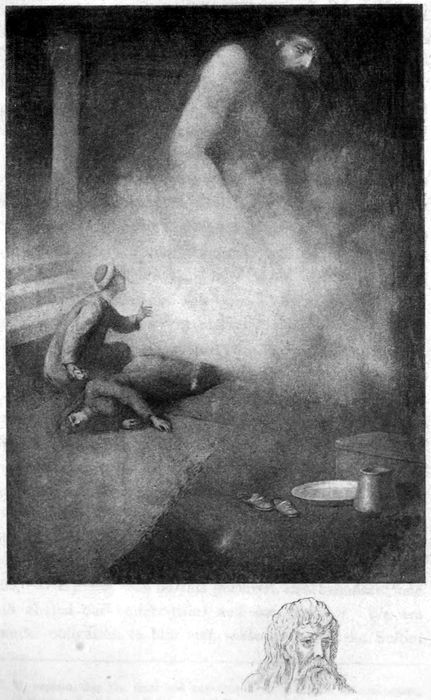
rub therewith, but she had only begun when appeared to her one
of the Jánn whose favour was frightful and whose bulk was horrible
big, and he was gigantic as one of the Jabábirah.[111] And forthright
he cried to her, “Say whatso thou wantest of me? Here am I,
thy Slave and Slave to whoso holdeth the Lamp; and not I alone,
but all the Slaves of the Wonderful Lamp which thou hendest in
hand.” She quaked and terror was sore upon her when she looked
at that frightful form and her tongue being tied she could not
return aught reply, never having been accustomed to espy similar
semblances.——And Shahrazad was surprised by the dawn of day
and ceased to say her permitted say.
87
Now when it was the Five Hundred and Thirty-fifth Night,
Quoth Dunyazad, “O sister mine, an thou be other than sleepy,
do tell us some of thy pleasant tales,” whereupon Shahrazad
replied, “With love and good will.”——It hath reached me, O
King of the Age, that Alaeddin’s mother could not of her terror
return a reply to the Márid; nay she fell to the ground oppressed
by her affright.[112] Now her son was standing afar off and he had
already seen the Jinní of the Ring which he had rubbed within the
Treasury; so when he heard the Slave speaking to his parent, he
hastened forwards and snatching the Lamp from her hand, said,
“O Slave of the Lamp, I am anhungered and ’tis my desire that
thou fetch me somewhat to eat and let it be something toothsome
beyond our means.” The Jinni disappeared for an eye-twinkle and
returned with a mighty fine tray and precious of price, for that
’twas all in virginal silver and upon it stood twelve golden platters
of meats manifold, and dainties delicate, with bread snowier than
snow; also two silvern cups and as many black jacks[113] full of wine
clear-strained and long-stored. And after setting all these before
Alaeddin, he evanished from vision. Thereupon the lad went and
sprinkled rose water upon his mother’s face and caused her snuff
up perfumes pure and pungent and said to her when she revived,
“Rise, O mother mine, and let us eat of these meats wherewith
Almighty Allah hath eased our poverty.” But when she saw that
mighty fine silvern tray she fell to marvelling at the matter and
quoth she, “O my son, who be this generous, this beneficent one
who hath abated our hunger-pains and our penury? We are
indeed under obligation to him and, meseemeth, ’tis the Sultan
88who, hearing of our mean condition and our misery, hath sent us
this food-tray.” Quoth he, “O my mother, this be no time for
questioning: arouse thee and let us eat for we are both a-famished.”
Accordingly, they sat down to the tray and fell to feeding when
Alaeddin’s mother tasted meats whose like in all her time she had
never touched; so they devoured them with sharpened appetites
and all the capacity engendered by stress of hunger; and, secondly,
the food was such that marked the tables of the Kings. But
neither of them knew whether the tray was or was not valuable,
for never in their born days had they looked upon aught like it.
As soon as they had finished the meal (withal leaving victual
enough for supper and eke for the next day), they arose and
washed their hands and sat at chat, when the mother turned to
her son and said, “Tell me, O my child, what befel thee from the
Slave, the Jinní, now that Alhamdolillah—laud to the Lord!—we
have eaten our full of the good things wherewith He hath favoured
us and thou hast no pretext for saying to me, ‘I am anhungered.’”
So Alaeddin related to her all that took place between him and
the Slave what while she had sunk upon the ground aswoon for
sore terror; and at this she, being seized with mighty great surprise,
said, “’Tis true; for the Jinns do present themselves before
the Sons of Adam[114] but I, O my son, never saw them in all my life
and meseemeth that this be the same who saved thee when thou
wast within the Enchanted Hoard.” “This is not he, O my
mother: this who appeared before thee is the Slave of the
Lamp!” “Who may this be, O my son?” “This be a Slave of
89sort and shape other than he; that was the Familiar of the Ring
and this his fellow thou sawest was the Slave of the Lamp thou
hentest in hand.”——And Shahrazad was surprised by the dawn
of day and ceased to say her permitted say.
Now when it was the Five Hundred and Thirty-sixth Night,
Quoth Dunyazad, “O sister mine, an thou be other than sleepy, do
tell us some of thy pleasant tales,” whereupon Shahrazad replied,
“With love and good will.”——It hath reached me, O King of the
Age, that Alaeddin said, “Verily, O my mother, the Jinni who
appeared to thee was the Slave of the Lamp.” And when his
parent heard these words she cried, “There! there![115] so this Accursed,
who showed himself to me and went nigh unto killing me
with affright, is attached to the Lamp.” “Yes,” he replied, and
she rejoined, “Now I conjure thee, O my son, by the milk wherewith
I suckled thee, to throw away from thee this Lamp and this
Ring; because they can cause us only extreme terror and I
especially can never abear a second glance at them. Moreover all
intercourse with them is unlawful, for that the Prophet (whom
Allah save and assain!) warned us against them with threats.”
He replied, “Thy commands, O my mother, be upon my head[116]
and mine eyes; but, as regards this saying thou saidest, ’tis impossible
that I part or with Lamp or with Ring. Thou thyself hast seen
what good the Slave wrought us whenas we were famishing; and
know, O my mother, that the Maghrabi, the liar, the Magician,
when sending me down into the Hoard, sought nor the silver nor the
gold wherewith the four halls were fulfilled, but charged me to
bring him only the Lamp (naught else), because in very deed he
90had learned its priceless value; and, had he not been certified of
it, he had never endured such toil and trouble nor had he travelled
from his own land to our land in search thereof; neither had he
shut me up in the Treasury when he despaired of the Lamp which
I would not hand to him. Therefore it besitteth us, O my mother,
to keep this Lamp and take all care thereof nor disclose its mysteries
to any; for this is now our means of livelihood and this it is
shall enrich us. And likewise as regards the Ring, I will never
withdraw it from my finger, inasmuch as but for this thou hadst
nevermore seen me on life; nay I should have died within the
Hoard underground. How then can I possibly remove it from my
finger? And who wotteth that which may betide me by the
lapse of Time, what trippings or calamities or injurious mishaps
wherefrom this Ring may deliver me? However, for regard to
thy feelings I will stow away the Lamp nor ever suffer it to be
seen of thee hereafter.” Now when his mother heard his words
and pondered them she knew they were true and said to him, “Do,
O my son, whatso thou willest; for my part I wish never to see
them nor ever sight that frightful spectacle I erst saw.”——And
Shahrazad was surprised by the dawn of day and ceased to say her
permitted say.
Now when it was the Five Hundred and Thirty-seventh Night,
Quoth Dunyazad, “O sister mine, an thou be not sleepy, do tell us
some of thy pleasant tales,” whereupon Shahrazad replied, “With
love and good will.”——It hath reached me, O King of the Age,
that Alaeddin and his mother continued eating of the meats
brought them by the Jinni for two full told days till they were
finished; but when he learned that nothing of food remained for
them, he arose and took a platter of the platters which the Slave
had brought upon the tray. Now they were all of the finest gold
91but the lad knew naught thereof; so he bore it to the Bazar and
there, seeing a man which was a Jew, a viler than the Satans[117],
offered it to him for sale. When the Jew espied it he took the lad
aside that none might see him, and he looked at the platter and
considered it till he was certified that is was of gold refined. But
he knew not whether Alaeddin was acquainted with its value or he
was in such matters a raw laddie;[118] so he asked him, “For how
much, O my lord, this platter?” and the other answered, “Thou
wottest what be its worth.” The Jew debated with himself as to
how much he should offer, because Alaeddin had returned him a
craftsman-like reply; and he thought of the smallest valuation; at
the same time he feared lest the lad, haply knowing its worth,
should expect a considerable sum. So he said in his mind, “Belike
the fellow is an ignoramus in such matters nor is ware of the
price of the platter.” Whereupon he pulled out of his pocket a
dinar, and Alaeddin eyed the gold piece lying in his palm and
hastily taking it went his way; whereby the Jew was certified of
his customer’s innocence of all such knowledge, and repented with
entire repentance that he had given him a golden dinar in lieu of a
copper carat,[119] a bright-polished groat. However, Alaeddin made
no delay but went at once to the baker’s where he bought him
bread and changed the ducat; then, going to his mother, he gave
her the scones and the remaining small coin and said, “O my
mother, hie thee and buy thee all we require.” So she arose and
walked to the Bazar and laid in the necessary stock; after which
they ate and were cheered. And whenever the price of the platter
was expended, Alaeddin would take another and carry it to the
accursed Jew who bought each and every at a pitiful price; and
92even this he would have minished but, seeing how he had paid a
dinar for the first, he feared to offer a lesser sum, lest the lad go
and sell to some rival in trade and thus he lose his usurious gains.
Now when all the golden platters were sold, there remained only
the silver tray whereupon they stood; and, for that it was large and
weighty, Alaeddin brought the Jew to his house and produced the
article, when the buyer, seeing its size gave him ten dinars and
these being accepted went his ways. Alaeddin and his mother
lived upon the sequins until they were spent; then he brought out
the Lamp and rubbed it and straightway appeared the Slave who
had shown himself aforetime.—And Shahrazad was surprised by
the dawn of day and ceased to say her permitted say.
Now when it was the Five Hundred and Thirty-eighth Night,
Quoth Dunyazad, “O sister mine, an thou be other than sleepy,
do tell us some of thy pleasant tales,” whereupon Shahrazad replied,
“With love and good will.”——It hath reached me, O King of the
Age, that the Jinni, the Slave of the Lamp, on appearing to
Alaeddin said, “Ask, O my lord, whatso thou wantest for I am thy
Slave and the thrall of whoso hath the Lamp;” and said the lad,
“I desire that thou bring me a tray of food like unto that thou
broughtest me erewhiles, for indeed I am famisht.” Accordingly,
in the glance of an eye the Slave produced a similar tray supporting
twelve platters of the most sumptuous, furnished with requisite
cates; and thereon stood clean bread and sundry glass bottles[120] of
strained wine. Now Alaeddin’s mother had gone out when she
knew he was about to rub the Lamp that she might not again look
upon the Jinni; but after a while she returned and, when she sighted
93the tray covered with silvern[121] platters and smelt the savour of the
rich meats diffused over the house, she marvelled and rejoiced.
Thereupon quoth he, “Look, O my mother! Thou badest me throw
away the Lamp, see now its virtues;” and quoth she, “O my son,
Allah increase his[122] weal, but I would not look upon him.”
Then the lad sat down with his parent to the tray and they ate
and drank until they were satisfied; after which they removed
what remained for use on the morrow. As soon as the meats had
been consumed, Alaeddin arose and stowed away under his clothes
a platter of the platters and went forth to find the Jew, purposing
to sell it to him; but by fiat of Fate he passed by the shop of an
ancient, jeweller, an honest man and a pious who feared Allah.
When the Shaykh saw the lad, he asked him saying, “O my son,
what dost thou want? for that times manifold have I seen thee
passing hereby and having dealings with a Jewish man; and I
have espied thee handing over to him sundry articles; now also I
fancy thou hast somewhat for sale and thou seekest him as a buyer
thereof. But thou wottest not, O my child, that the Jews ever
hold lawful to them the good of Moslems,[123] the Confessors of Allah
Almighty’s unity, and, always defraud them; especially this accursed
Jew with whom thou hast relations and into whose hands
thou hast fallen. If then, O my son, thou have aught thou wouldest
sell show the same to me and never fear, for I will give thee its
full price by the truth of Almighty Allah.” Thereupon Alaeddin
brought out the platter which when the ancient goldsmith saw, he
took and weighed it in his scales and asked the lad saying, “Was
94it the fellow of this thou soldest to the Jew?” “Yes, its fellow
and its brother,” he answered, and quoth the old man, “What price
did he pay thee?” Quoth the lad, “One dinar.”——And Shahrazad
was surprised by the dawn of day and ceased to say her permitted
say.
Now when it was the Five Hundred and Thirty-ninth Night,
Quoth Dunyazad, “O sister mine, an thou be other than sleepy,
do tell us some of thy pleasant tales,” whereupon Shahrazad replied,
“With love and good will.”——It hath reached me, O King of the
Age, that the ancient goldsmith, hearing from Alaeddin how the
Jew used to give only one dinar as the price of the platter, cried,
“Ah! I take refuge from this Accursed who cozeneth the servants
of Allah Almighty!” Then, looking at the lad, he exclaimed, “O
my son, verily yon tricksy Jew hath cheated thee and laughed at
thee, this platter being pure silver and virginal. I have weighed
it and found it worth seventy dinars; and, if thou please to take
its value, take it.” Thereupon the Shaykh counted out to him
seventy gold pieces, which he accepted and presently thanked him
for his kindness in exposing the Jew’s rascality. And after this,
whenever the price of a platter was expended, he would bring
another, and on such wise he and his mother were soon in better
circumstances; yet they ceased not to live after their olden fashion
as middle class folk[124] without spending on diet overmuch or
squandering money. But Alaeddin had now thrown off the
ungraciousness of his boyhood; he shunned the society of scapegraces
and he began to frequent good men and true, repairing
daily to the market-street of the merchants and there companying
with the great and the small of them, asking about matters of
merchandise and learning the price of investments and so forth; he
95likewise frequented the Bazars of the Goldsmiths and the Jewellers[125]
where he would sit and divert himself by inspecting their precious
stones and by noting how jewels were sold and bought therein.
Accordingly, he presently became ware that the tree-fruits, wherewith
he had filled his pockets what time he entered the Enchanted
Treasury, were neither glass nor chrystal but gems rich and rare;
and he understood that he had acquired immense wealth such as
the Kings never can possess. He then considered all the precious
stones which were in the Jewellers’ Quarter, but found that their
biggest was not worth his smallest. On this wise he ceased not
every day repairing to the Bazar and making himself familiar
with the folk and winning their loving will;[126] and enquiring anent
selling and buying, giving and taking, the dear and the cheap,
until one day of the days when, after rising at dawn and donning
his dress he went forth, as was his wont, to the Jewellers’ Bazar;
and, as he passed along it he heard the crier crying as follows:
“By command of our magnificent master, the King of the Time and
the Lord of the Age and the Tide, let all the folk lock up their
shops and stores and retire within their houses, for that the Lady
Badr al-Budúr[127], daughter of the Sultan, designeth to visit the
Hammám; and whoso gainsayeth the order shall be punished
with death-penalty and be his blood upon his own neck!” But
when Alaeddin heard the proclamation, he longed to look upon the
King’s daughter and said in his mind, “Indeed all the lieges talk
of her beauty and loveliness and the end of my desires is to see
her.”——And Shahrazad was surprised by the dawn of day and
ceased to say her permitted say.
96
Now when it was the Five Hundred and Fortieth Night,
Quoth Dunyazad, “O sister mine, an thou be other than sleepy,
do tell us some of thy pleasant tales,” whereupon Shahrazad replied
“With love and good will.”——It hath reached me, O King of the
Age, that Alaeddin fell to contriving some means whereby he
might look upon the Princess Badr al-Budúr and at last judged
best to take his station behind the Hammam-door whence he
might see her face as she entered.[128] Accordingly, without stay or
delay he repaired to the Baths before she was expected and stood
a-rear of the entrance, a place whereat none of the folk happened
to be looking. Now when the Sultan’s daughter had gone the
rounds of the city and its main streets and had solaced herself by
sight-seeing, she finally reached the Hammam and whilst entering
she raised her veil, when her face rose before sight as it were
a pearl of price or a sheeny sun, and she was as one of whom the
describer sang:—
Magic Kohl enchanteth the glances so bright of her: ✿ We pluck roses in posies from cheeks rosy bright of her:
Of night’s gloomiest hue is the gloom of the hair of her ✿ And her bright brow uplighteth the murks of the night of her.
[129]
(Quoth the reciter) when the Princess raised from her face the veil
and Alaeddin saw her favour he said, “In very truth her fashion
magnifieth her Almighty Fashioner and glory be to Him who
created her and adorned her with this beauty and loveliness.” His
strength was struck down from the moment he saw her and his
thoughts were distraught; his gaze was dazed, the love of her gat
hold of the whole of his heart; and, when he returned home to his
97mother, he was as one in ecstasy. His parent addressed him, but
he neither replied nor denied; and, when she set before him the
morning meal he continued in like case; so quoth she, “O my son
what is’t may have befallen thee? Say me, doth aught ail thee?
Let me know what ill hath betided thee for, unlike thy custom,
thou speakest not when I bespeak thee.” Thereupon Alaeddin
(who used to think that all women resembled his mother[130] and who,
albeit he had heard of the charms of Badr al-Budur, daughter of the
Sultan, yet knew not what “beauty” and “loveliness” might
signify) turned to his parent and exclaimed, “Let me be!” However,
she persisted in praying him to come forwards and eat, so he
did her bidding but hardly touched food; after which he lay at full
length on his bed all the night through in cogitation deep until
morning morrowed. The same was his condition during the
next day, when his mother was perplexed for the case of her son
and unable to learn what had happened to him. So, thinking that
belike he might be ailing, she drew near him and asked him saying,
“O my son, an thou sense aught of pain or such like, let me know
that I may fare forth and fetch thee the physician; and to-day
there be in this our city a leech from the Land of the Arabs whom
the Sultan hath sent to summon and the bruit abroad reporteth
him to be skilful exceedingly. So, an be thou ill let me go and
bring him to thee.”——And Shahrazad was surprised by the dawn
of day and ceased to say her permitted say.
98
Now when it was the Five Hundred and Forty-first Night,
Quoth Dunyazad, “O sister mine, an thou be other than sleepy,
do tell us some of thy pleasant tales,” whereupon Shahrazad replied,
“With love and good will.”——It hath reached me, O King of the
Age, that Alaeddin, hearing his parent’s offer to summon the
mediciner, said, “O my mother, I am well in body and on no wise
ill. But I ever thought that all women resembled thee until
yesterday, when I beheld the Lady Badr al-Budur, daughter of the
Sultan, as she was faring for the Baths.” Then he related to her
all and everything that had happened to him adding, “Haply thou
also hast heard the crier a-crying:—Let no man open shop to stand
in street that the Lady Badr al-Budur may repair to the Hammam
without eye seeing her. But I have looked upon her even as she
is, for she raised her veil at the door; and, when I viewed her
favour and beheld that noble work of the Creator, a sore fit
of ecstasy, O my mother, fell upon me for love of her and firm
resolve to win her hath opened its way into every limb of me, nor
is repose possible for me except I win her. Wherefor I purpose
asking her to wife from the Sultan her sire in lawful wedlock.”
When Alaeddin’s mother heard her son’s words, she belittled
his wits and cried, “O my child, the name of Allah upon thee!
meseemeth thou hast lost thy senses. But be thou rightly guided,
O my son, nor be thou as the men Jinn-maddened!” He replied,
“Nay, O mother mine, I am not out of my mind nor am I of the
maniacs; nor shall this thy saying alter one jot of what is in my
thoughts, for rest is impossible to me until I shall have won the
dearling of my heart’s core, the beautiful Lady Badr al-Budur. And
now I am resolved to ask her of her sire the Sultan.” She rejoined,
“O my son, by my life upon thee speak not such speech, lest any
overhear thee and say thou be insane: so cast away from thee
99such nonsense! Who shall undertake a matter like this or make
such request to the King? Indeed, I know not how, supposing
this thy speech to be soothfast, thou shalt manage to crave such
grace of the Sultan or through whom thou desirest to propose it.”
He retorted, “Through whom shall I ask it, O my mother, when
thou art present? And who is there fonder and more faithful to
me than thyself? So my design is that thou thyself shalt proffer
this my petition.” Quoth she, “O my son, Allah remove me
far therefrom! What! have I lost my wits like thyself? Cast the
thought away and a long way from thy heart. Remember whose
son thou art, O my child, the orphan boy of a tailor, the poorest
and meanest of the tailors toiling in this city; and I, thy mother,
am also come of pauper folk and indigent. How then durst thou
ask to wife the daughter of the Sultan, whose sire would not deign
marry her with the sons of the Kings and the Sovrans, except
they were his peers in honour and grandeur and majesty; and,
were they but one degree lower, he would refuse his daughter to
them.”——And Shahrazad was surprised by the dawn of day and
ceased to say her permitted say.
Now when it was the Five Hundred and Forty-second Night,
Quoth Dunyazad, “O sister mine, an thou be other than sleepy, do
tell us some of thy pleasant tales,” whereupon Shahrazad replied,
“With love and good will.”——It hath reached me, O King of the
Age, that Alaeddin took patience until his parent had said her
say, when quoth he, “O my mother, everything thou hast called
to mind is known to me; moreover ’tis thoroughly well known
to me that I am the child of pauper parents; withal do not these
words of thee divert me from my design at all, at all. Nor
the less do I hope of thee, an I be thy son and thou truly love me,
that thou grant me this favour, otherwise thou wilt destroy me;
100and present Death hovereth over my head except I win my will
of my heart’s dearling; and I, O my mother, am in every case thy
child.” Hearing these words, his parent wept of her sorrow for
him and said, “O my child! Yes, in very deed I am thy mother,
nor have I any son or life’s blood of my liver except thyself, and
the end of my wishes is to give thee a wife and rejoice in thee.
But suppose that I would seek a bride of our likes and equals, her
people will at once ask an thou have any land or garden, merchandise
or handicraft, wherewith thou canst support her; and
what is the reply I can return? Then, if I cannot possibly answer
the poor like ourselves, how shall I be bold enough, O my son, to
ask for the daughter of the Sultan of China-land who hath no peer
or behind or before him? Therefore do thou weigh this matter
in thy mind. Also who shall ask her to wife for the son of a snip?
Well indeed I wot that my saying aught of this kind will but
increase our misfortunes; for that it may be the cause of our
incurring mortal danger from the Sultan; peradventure even death
for thee and me. And, as concerneth myself, how shall I venture
upon such rash deed and perilous, O my son? and in what way
shall I ask the Sultan for his daughter to be thy wife; and,
indeed, how ever shall I even get access to him? And should I
succeed therein, what is to be my answer an they ask me touching
thy means? Haply the King will hold me to be a madwoman.
And, lastly, suppose that I obtain audience of the Sultan, what
offering is there I can submit to the King’s majesty?”[131]——And
Shahrazad was surprised by the dawn of day and ceased to say
her permitted say.
101
Now when it was the Five Hundred and Forty-third Night,
Quoth Dunyazad, “O sister mine, an thou be other than sleepy, do
tell us some of thy pleasant tales,” whereupon Shahrazad replied,
“With love and good will.”——It hath reached me, O King of the
Age, that Alaeddin’s mother continued to her son, “’Tis true,
O my child, that the Sultan is mild and merciful, never rejecting
any who approach him to require justice or ruth or protection, nor
any who pray him for a present; for he is liberal and lavisheth
favour upon near and far. But he dealeth his boons to those
deserving them, to men who have done some derring-do in battle
under his eyes or have rendered as civilians great service to his
estate. But thou! do thou tell me what feat thou hast performed
in his presence or before the public that thou meritest from him
such grace? And, secondly, this boon thou ambitionest is not for
one of our condition, nor is it possible that the King grant to thee
the bourne of thine aspiration; for whoso goeth to the Sultan and
craveth of him a favour, him it besitteth to take in hand somewhat
that suiteth the royal majesty, as indeed I warned thee aforetime.
How, then, shalt thou risk thyself to stand before the Sultan and
ask his daughter in marriage, when thou hast with thee naught to
offer him of that which beseemeth his exalted station?” Hereto
Alaeddin replied, “O my mother, thou speakest to the point and
hast reminded me aright and ’tis meet that I revolve in mind the
whole of thy remindings. But, O my mother, the love of Princess
Badr al-Budur hath entered into the core of my heart; nor can I
rest without I win her. However, thou hast also recalled to me a
matter which I forgot and ’tis this emboldeneth me to ask his
daughter of the King. Albeit thou, O my mother, declarest that
I have no gift which I can submit to the Sultan, as is the wont of
the world, yet in very sooth I have an offering and a present
whose equal, O my mother, I hold none of the Kings to possess;
102no, nor even aught like it.”——And Shahrazad was surprised by
the dawn of day and ceased to say her permitted say.
Now when it was the Five Hundred and Forty-fourth Night,
Quoth Dunyazad, “O sister mine, an thou be other than sleepy,
do tell us some of thy pleasant tales,” whereupon Shahrazad
replied, “With love and good will.”——It hath reached me, O
King of the Age, that Alaeddin said to his mother, “Because
verily that which I deemed glass or chrystal was nothing but
precious stones and I hold that all the Kings of the World
have never possessed any thing like one of the smallest thereof.
For, by frequenting the jeweller-folk, I have learned that they
are the costliest gems and these are what I brought in my pockets
from the Hoard, whereupon, an thou please, compose thy mind.
We have in our house a bowl of China porcelain; so arise thou
and fetch it, that I may fill it with these jewels, which thou shalt
carry as a gift to the King, and thou shalt stand in his presence
and solicit him for my requirement. I am certified that by such
means the matter will become easy to thee; and, if thou be
unwilling, O my mother, to strive for the winning of my wish
as regards the Lady Badr al-Budur, know thou that surely I
shall die. Nor do thou imagine that this gift is of aught save
the costliest of stones and be assured, O my mother, that in
my many visits to the Jewellers’ Bazar I have observed the
merchants selling for sums man’s judgment may not determine
jewels whose beauty is not worth one quarter carat of what
we possess; seeing which I was certified that ours are beyond all
price. So arise, O my mother, as I bade thee and bring me
the porcelain bowl aforesaid, that I may arrange therein some
of these gems and we will see what semblance they show.”
So she brought him the China bowl saying in herself, “I shall
103know what to do when I find out if the words of my child
concerning these jewels be soothfast or not;” and she set it
before her son who pulled the stones out of his pockets and
disposed them in the bowl and ceased not arranging therein
gems of sorts till such time as he had filled it. And when it
was brimful she could not fix her eyes firmly upon it; on the
contrary, she winked and blinked for the dazzle of the stones
and their radiance and excess of lightning-like glance; and her
wits were bewildered thereat; only she was not certified of their
value being really of the enormous extent she had been told.
Withal she reflected that possibly her son might have spoken
aright when he declared that their like was not to be found with
the Kings. Then Alaeddin turned to her and said, “Thou
hast seen, O my mother, that this present intended for the Sultan
is magnificent, and I am certified that it will procure for thee
high honour with him and that he will receive thee with all
respect. And now, O my mother, thou hast no excuse; so
compose thy thoughts and arise; take thou this bowl and away
with it to the palace.” His mother rejoined, “O my son, ’tis
true that the present is high-priced exceedingly and the costliest
of the costly; also that according to thy word none owneth
its like. But who would have the boldness to go and ask the
Sultan for his daughter, the Lady Badr al-Budur? I indeed dare
not say to him:—I want thy daughter! when he shall ask me:—What
is thy want? for know thou, O my son, that my tongue
will be tied. And, granting that Allah assist me and I embolden
myself to say to him:—My wish is to become a connection of
thine through the marriage of thy daughter, the Lady Badr
al-Budur, to my son Alaeddin, they will surely decide at once
that I am demented and will thrust me forth in disgrace and
despised. I will not tell thee that I shall thereby fall into
danger of death, for ’twill not be I only but thou likewise.
However, O my son, of my regard for thine inclination, I needs
104must embolden myself and hie thither; yet, O my child, if the
King receive me and honour me on account of the gift and
enquire of me what thou desirest,”——And Shahrazad was surprised
by the dawn of day and ceased to say her permitted say.
Now when it was the Five Hundred and Forty-fifth Night,
Quoth Dunyazad, “O sister mine, an thou be other than sleepy,
do tell us some of thy pleasant tales,” whereupon Shahrazad
replied, “With love and good will.”——It hath reached me, O King
of the Age, that Alaeddin’s mother said to her son, “And in reply
I ask of him that which thou desirest in the matter of thy marriage
with his daughter, how shall I answer him and he ask me, as is
man’s wont, What estates hast thou, and what income? And perchance,
O my son, he will question me of this before questioning
me of thee.” Alaeddin replied, “’Tis not possible that the Sultan
should make such demand what time he considereth the jewels
and their magnificence; nor is it meet to think of such things as
these which may never occur. Now do thou but arise and set before
him this present of precious stones and ask of him his daughter
for me, and sit not yonder making much of the difficulty in thy
fancy. Ere this thou hast learned, O mother mine, that the Lamp
which we possess hath become to us a stable income and that
whatso I want of it the same is supplied to me; and my hope
is that by means thereof I shall learn how to answer the Sultan
should he ask me of that thou sayest.”[132] Then Alaeddin and his
mother fell to talking over the subject all that night long and
when morning morrowed, the dame arose and heartened her heart,
especially as her son had expounded to her some little of the
105powers of the Lamp and the virtues thereof; to wit, that it would
supply all they required of it. Alaeddin, however, seeing his
parent take courage when he explained to her the workings of the
Lamp, feared lest she might tattle to the folk thereof;[133] so he said
to her, “O my mother, beware how thou talk to any of the properties
of the Lamp and its profit, as this is our one great good.
Guard thy thoughts lest thou speak over much concerning it
before others, whoso they be; haply we shall lose it and lose the
boon fortune we possess and the benefits we expect, for that ’tis
of him.”[134] His mother replied, “Fear not therefor, O my son,”
and she arose and took the bowl full of jewels, which she wrapped
up in a fine kerchief, and went forth betimes that she might reach
the Divan ere it became crowded. When she passed into the
Palace, the levée not being fully attended, she saw the Wazirs and
sundry of the Lords of the land going into the presence-room and
after a short time, when the Divan was made complete by the Ministers
and high Officials and Chieftains and Emirs and Grandees,
the Sultan appeared and the Wazirs made their obeisance and
likewise did the Nobles and the Notables. The King seated himself
upon the throne of his kingship, and all present at the levée
stood before him with crossed arms awaiting his commandment to
sit; and, when they received it, each took his place according to
his degree; then the claimants came before the Sultan who delivered
sentence, after his wonted way, until the Divan was ended,
when the King arose and withdrew into the palace[135] and the
106others all went their ways.——And Shahrazad was surprised by the
dawn of day and ceased to say her permitted say.
Now when it was the Five Hundred and Forty-sixth Night,
Quoth Dunyazad, “O sister mine, an thou be other than sleepy,
do tell us some of thy pleasant tales,” whereupon Shahrazad replied,
“With love and good will.”——It hath reached me, O King of
the Age, that Alaeddin’s mother, having come the earliest of all,
found means of entering without any addressing her or offering
to lead her to the presence; and she ceased not standing there
until the Divan ended, when the Sultan arose and withdrew into
the palace and the others all went about their business. And
when she saw the throne empty and the King passing into his
Harem, she also wended her ways and returned home. But as
soon as her son espied her, bowl in hand, he thought that haply
something untoward had befallen her, but he would not ask of
aught until such time as she had set down the bowl, when she
acquainted him with that had occurred and ended by adding,
“Alhamdolillah,—laud to the Lord!—O my child, that I found
courage enough and secured for myself standing-place in the
levée this day; and, albe I dreaded to bespeak the King yet
(Inshallah!) on the morrow I will address him. Even to-day were
many who, like myself, could not get audience of the Sultan.
But be of good cheer, O my son, and to-morrow needs must I
bespeak him for thy sake; and what happened not may happen.”
When Alaeddin heard his parent’s words, he joyed with excessive
joy; and, although he expected the matter to be managed hour
by hour, for excess of his love and longing to the Lady Badr al-Budur,
yet he possessed his soul in patience. They slept well
that night and betimes next morning the mother of Alaeddin
arose and went with her bowl to the King’s court which she
found closed. So she asked the people and they told her that the
107Sultan did not hold a levée every day but only thrice in the
se’nnight; wherefor she determined to return home; and, after
this, whenever she saw the court open she would stand before the
King until the reception ended and when it was shut she would go
to make sure thereof; and this was the case for the whole month.
The Sultan was wont to remark her presence at every levée, but,
on the last day when she took her station, as was her wont, before
the Council, she allowed it to close and lacked boldness to come
forwards and speak even a syllable. Now as the King having
risen was making for his Harem accompanied by the Grand Wazir,
he turned to him and said, “O Wazir, during the last six or seven
levée days I see yonder old woman present herself at every reception
and I also note that she always carrieth a something under
her mantilla. Say me, hast thou, O Wazir, any knowledge of her
and her intention?” “O my lord the Sultan,” said the other,
“verily women be weakly of wits, and haply this goodwife cometh
hither to complain before thee[136] against her goodman or some of
her people.” But this reply was far from satisfying the Sultan;
nay, he bade the Wazir, in case she should come again, set her
before him; and forthright the Minister placed hand on head and
exclaimed, “To hear is to obey, O our lord the Sultan!”——And
Shahrazad was surprised by the dawn of day and ceased to say
her permitted say.
Now when it was the Five Hundred and Forty-seventh Night,
Quoth Dunyazad, “O sister mine, an thou be other than sleepy,
do tell us some of thy pleasant tales,” whereupon Shahrazad
replied, “With love and good will:”——It hath reached me,
O King of the Age, that the mother of Alaeddin, as she made a
108practice of repairing to the Divan every day and passing into
the room and standing opposite the King, albeit she was sorrowful
and sore aweary, withal for her son’s sake she endeavoured to
make easy all her difficulties. Now one day of the days, when
she did according to her custom, the Sultan cast his eyes upon
her as she stood before him, and said to his Grand Wazir, “This
be the very woman whereof I spake to thee yesterday, so do thou
straightway bring her before me, that I may see what be her
suit and fulfil her need.” Accordingly, the Minister at once
introduced her and when in the presence she saluted the King by
kissing her finger tips and raising them to her brow;[137] and, praying
for the Sultan’s glory and continuance and the permanence of
his prosperity, bussed ground before him. Thereupon, quoth he,
“O woman,[138] for sundry days I have seen thee attend the levée
sans a word said; so tell me an thou have any requirement I may
grant.” She kissed ground a second time and after blessing him,
answered, “Yea, verily, as thy head liveth, O King of the Age,
I have a want; but first of all, do thou deign grant me a promise
of safety that I may prefer my suit to the ears of our lord the
Sultan; for haply thy Highness[139] may find it a singular.” The
King, wishing to know her need, and being a man of unusual
mildness and clemency, gave his word for her immunity and bade
forthwith dismiss all about him, remaining without other but the
Grand Wazir. Then he turned towards his suppliant and said,
109“Inform me of thy suit: thou hast the safeguard of Allah
Almighty.” “O King of the Age,” replied she, “I also require of
thee pardon;” and quoth he, “Allah pardon thee even as I do.”
Then, quoth she, “O our lord the Sultan, I have a son, Alaeddin
hight; and he, one day of the days, having heard the crier commanding
all men to shut shop and shun the streets, for that the
Lady Badr al-Budur, daughter of the Sultan, was going to the
Hammam, felt an uncontrollable longing to look upon her, and
hid himself in a stead whence he could sight her right well, and
that place was behind the door of the Baths. When she entered
he beheld her and considered her as he wished, and but too well;
for, since the time he looked upon her, O King of the Age, unto
this hour, life hath not been pleasant to him. And he hath
required of me that I ask her to wife for him from thy Highness,
nor could I drive this fancy from his mind because love of her
hath mastered his vitals and to such degree that he said to me:
Know thou, O mother mine, that an I win not my wish surely I
shall die. Accordingly I hope that thy Highness will deign be
mild and merciful and pardon this boldness on the part of me
and my child and refrain to punish us therefor.” When the
Sultan heard her tale he regarded her with kindness and, laughing
aloud, asked her, “What may be that thou carriest and what be
in yonder kerchief?” And she seeing the Sultan laugh in lieu of
waxing wroth at her words, forthright opened the wrapper and set
before him the bowl of jewels, whereby the audience-hall was
illumined as it were by lustres and candelabra;[140] and he was dazed
and amazed at the radiance of the rare gems, and he fell to
marvelling at their size and beauty and excellence.——And
Shahrazad was surprised by the dawn of day and ceased to say
her permitted say.
110
Now when it was the Five Hundred and Forty-eighth Night,
Quoth Dunyazad, “O sister mine, if thou be other than sleepy,
do tell us some of thy pleasant tales,” whereupon Shahrazad replied,
“With love and good will.”——It hath reached me, O King
of the Age, that when the King saw the gems he was seized by
surprise and cried, “Never at all until this day saw I anything
like these jewels for size and beauty and excellence: nor deem
I that there be found in my treasury a single one like them.”
Then he turned to his Minister and asked, “What sayest thou,
O Wazir? Tell me, hast thou seen in thy time such mighty
fine jewels as these?” The other answered, “Never saw I such,
O our lord the Sultan, nor do I think that there be in the
treasures of my lord the Sultan the fellow of the least thereof.”
The King resumed, “Now indeed whoso hath presented to me
such jewels meriteth to become bridegroom to my daughter,
Badr al-Budur; because, as far as I see, none is more deserving
of her than he.” When the Wazir heard the Sultan’s words he
was tongue-tied with concern and he grieved with sore grief,
for the King had promised to give the Princess in marriage to
his son; so after a little while he said, “O King of the Age,
thy Highness deigned promise me that the Lady Badr al-Budur
should be spouse to my son; so ’tis but right that thine exalted
Highness vouchsafe us a delay of three months, during which
time, Inshallah! my child may obtain and present an offering yet
costlier than this.” Accordingly the King, albeit he knew that
such a thing could not be done, or by the Wazir or by the
greatest of his Grandees, yet of his grace and kindness granted
him the required delay. Then he turned to the old woman,
Alaeddin’s mother, and said, “Go to thy son and tell him I
have pledged my word that my daughter shall be in his name;[141]
111only ’tis needful that I make the requisite preparations of nuptial
furniture for her use; and ’tis only meet that he take patience
for the next three months.” Receiving this reply, Alaeddin’s
mother thanked the Sultan and blessed him; then, going forth
in hottest haste, as one flying for joy, she went home; and when
her son saw her entering with a smiling face, he was gladdened
at the sign of good news, especially because she had returned
without delay as on the past days, and had not brought back the
bowl. Presently he asked her saying, “Inshallah, thou bearest
me, O my mother, glad tidings; and peradventure the jewels
and their value have wrought their work and belike thou hast been
kindly received by the King and he hath shown thee grace and
hath given ear to thy request?” So she told him the whole tale,
how the Sultan had entreated her well and had marvelled at the
extraordinary size of the gems and their surpassing water as did
also the Wazir, adding, “And he promised that his daughter
should be thine. Only, O my child, the Wazir spake of a secret
contract made with him by the Sultan before he pledged himself
to me and, after speaking privily, the King put me off to the end
of three months: therefore I have become fearful lest the Wazir
be evilly disposed to thee and perchance he may attempt to
change the Sultan’s mind.”——And Shahrazad was surprised by
the dawn of day and ceased to say her permitted say.
Now when it was the Five Hundred and Forty-ninth Night,
Quoth Dunyazad, “O sister mine, an thou be other than sleepy, do
tell us some of thy pleasant tales,” whereupon Shahrazad replied,
“With love and good will.”——It hath reached me, O King of the
Age, that when Alaeddin heard his mother’s words and how the
Sultan had promised him his daughter, deferring, however, the
wedding until after the third month, his mind was gladdened and
112he rejoiced exceedingly and said, “Inasmuch as the King hath
given his word after three months (well, it is a long time!), at
all events my gladness is mighty great.” Then he thanked his
parent, showing her how her good work had exceeded her toil and
travail; and said to her, “By Allah, O my mother, hitherto I was
as ’twere in my grave and therefrom thou hast withdrawn me;
and I praise Allah Almighty because I am at this moment certified
that no man in the world is happier than I or more fortunate.”
Then he took patience until two of the three months had gone by.
Now one day of the days his mother fared forth about sundown to
the Bazar that she might buy somewhat of oil; and she found all
the market shops fast shut and the whole city decorated, and the
folk placing waxen tapers and flowers at their casements; and she
beheld the soldiers and household troops and Aghás[142] riding in
procession and flambeaux and lustres flaming and flaring, and she
wondered at the marvellous sight and the glamour of the scene.
So she went in to an oilman’s store which stood open still and
bought her need of him and said, “By thy life, O uncle, tell me
what be the tidings in town this day, that people have made all
these decorations and every house and market-street are adorned
and the troops all stand on guard?” The oilman asked her, “O
woman, I suppose thou art a stranger and not one of this city?”
and she answered, “Nay, I am thy townswoman.” He rejoined,
“Thou a townswoman, and yet wottest not that this very night
the son of the Grand Wazir goeth in to the Lady Badr al-Budur,
daughter of the Sultan! He is now in the Hammam and all this
power of soldiery is on guard and standing under arms to await
his coming forth, when they will bear him in bridal procession to
the palace where the Princess expecteth him.” As the mother of
Alaeddin heard these words, she grieved and was distraught in
113thought and perplexed how to inform her son of this sorrowful
event, well knowing that the poor youth was looking, hour by
hour, to the end of the three months. But she returned straightway
home to him and when she entered she said, “O my son, I would
give thee certain tidings, yet hard to me will be the sorrow they
shall occasion thee.” He cried, “Let me know what be thy
news;” and she replied, “Verily the Sultan hath broken his
promise to thee in the matter of the Lady Badr al-Budur, and
this very night the Grand Wazir’s son goeth in to her. And for
some time, O my son, I have suspected that the Minister would
change the King’s mind, even as I told thee how he had spoken
privily to him before me.” Alaeddin[143] asked, “How learnedst thou
that the Wazir’s son is this night to pay his first visit to the
Princess?” So she told him the whole tale, how when going to
buy oil she had found the city decorated and the eunuch-officials
and Lords of the land with the troops under arms awaiting the
bridegroom from the Baths; and that the first visit was appointed
for that very night. Hearing this Alaeddin was seized with a fever
of jealousy brought on by his grief: however, after a short while
he remembered the Lamp and, recovering his spirits said, “By thy
life, O my mother, do thou believe that the Wazir’s son will not
enjoy her as thou thinkest. But now leave we this discourse and
arise thou and serve up supper[144] and after eating let me retire to my
own chamber and all will be well and happy.”——And Shahrazad
was surprised by the dawn of day and ceased to say her permitted
say.
114
Now when it was the Five Hundred and Fiftieth Night,
Quoth Dunyazad, “O sister mine, an thou be other than sleepy,
do tell us some of thy pleasant tales,” whereupon Shahrazad
replied, “With love and good will.”——It hath reached me, O King
of the Age, that Alaeddin after he had supped retired to his
chamber and, locking the door, brought out the Lamp and rubbed
it, whenas forthright appeared to him its Familiar who said,
“Ask whatso thou wantest, for I am thy Slave and Slave to him
who holdeth the Lamp in hand; I and all the Slaves of the Lamp.”
He replied, “Hear me! I prayed the Sultan for his daughter to
wife and he plighted her to me after three months; but he hath
not kept his word; nay, he hath given her to the son of the
Wazir and this very night the bridegroom will go in to her.
Therefore I command thee (an thou be a trusty Servitor to the
Lamp) when thou shalt see bride and bridegroom bedded together
this night,[145] at once take them up and bear them hither abed; and
this be what I want of thee.” The Marid replied, “Hearing
and obeying; and if thou have other service but this, do thou
demand of me all thou desirest.” Alaeddin rejoined, “At the
present time I require naught save that I bade thee do.” Hereupon
the Slave disappeared and Alaeddin returned to pass the
rest of the evening with his mother. But at the hour when he
knew that the Servitor would be coming, he arose and retired to
his chamber and after a little while, behold, the Marid came
bringing to him the newly-wedded couple upon their bridal-bed.
115Alaeddin rejoiced to see them with exceeding joy; then he cried
to the Slave, “Carry yonder gallows-bird hence and lay him at
full length in the privy.”[146] His bidding was done straightway;
but, before leaving him, the Slave blew upon the bridegroom a
blast so cold that it shrivelled him and the plight of the Wazir’s
son became piteous. Then the Servitor returning to Alaeddin
said to him, “An thou require aught else, inform me thereof;”
and said the other, “Return a-morn that thou mayest restore
them to their stead;” whereto, “I hear and obey,” quoth the
Marid and evanished. Presently Alaeddin arose, hardly believing
that the affair had been such a success for him; but whenas he
looked upon the Lady Badr al-Budur lying under his own roof,
albeit he had long burned with her love yet he preserved respect
for her and said, “O Princess of fair ones, think not that I brought
thee hither to minish thy honour. Heaven forfend! Nay ’twas
only to prevent the wrong man enjoying thee, for that thy sire
the Sultan promised thee to me. So do thou rest in peace.”——And
Shahrazad was surprised by the dawn of day and ceased to
say her permitted say.
Now when it was the Five Hundred and Fifty-first Night,
Quoth Dunyazad, “O sister mine, an thou be other than sleepy,
do tell us some of thy pleasant tales,” whereupon Shahrazad
replied, “With love and good will.”——It hath reached me, O King
of the Age, that when the Lady Badr al-Budur, daughter of the
Sultan, saw herself in that mean and darksome lodging, and heard
Alaeddin’s words, she was seized with fear and trembling and
waxed clean distraught; nor could she return aught of reply.
Presently the youth arose and stripping off his outer dress placed
116a scymitar between them and lay upon the bed beside the Princess;[147]
and he did no villain deed, for it sufficed him to prevent the consummation
of her nuptials with the Wazir’s son. On the
other hand the Lady Badr al-Budur passed a night the evillest
of all nights; nor in her born days had she seen a worse;
and the same was the case with the Minister’s son who lay in the
chapel of ease and who dared not stir for the fear of the Jinni which
overwhelmed him. As soon as it was morning the Slave appeared
before Alaeddin, without the Lamp being rubbed, and said to him,
“O my lord, an thou require aught, command me therefor, that
I may do it upon my head and mine eyes.” Said the other, “Go,
take up and carry the bride and bridegroom to their own apartment;”
so the Servitor did his bidding in an eye-glance and bore
away the pair, and placed them in the palace as whilome they
were and without their seeing any one; but both died of affright
when they found themselves being transported from stead to
stead.[148] And the Marid had barely time to set them down and
wend his ways ere the Sultan came on a visit of congratulation
to his daughter; and, when the Wazir’s son heard the doors thrown
open, he sprang straightway from his couch and donned his dress[149]
for he knew that none save the King could enter at that hour.
Yet it was exceedingly hard for him to leave his bed wherein
he wished to warm himself a trifle after his cold night in the water-closet
which he had lately left.——And Shahrazad was surprised
by the dawn of day and ceased to say her permitted say.
117
Now when it was the Five Hundred and Fifty-second Night,
Quoth Dunyazad, “O sister mine, an thou be other than sleepy,
do tell us some of thy pleasant tales,” whereupon Shahrazad
replied, “With love and good will.”——It hath reached me, O King
of the Age, that the Sultan went in to his daughter Badr al-Budur
and kissing her between the eyes gave her good morning
and asked her of her bridegroom and whether she was pleased
and satisfied with him. But she returned no reply whatever and
looked at him with the eye of anger and, although he repeated his
words again and again, she held her peace nor bespake him with
a single syllable. So the King quitted her and, going to the
Queen, informed her of what had taken place between him and
his daughter; and the mother, unwilling to leave the Sultan angered
with their child, said to him, “O King of the Age, this be the
custom of most newly-married couples at least during their first
days of marriage, for that they are bashful and somewhat coy.
So deign thou excuse her and after a little while she will again
become herself and speak with the folk as before, whereas now her
shame, O King of the Age, keepeth her silent. However ’tis my
wish to fare forth and see her.” Thereupon the Queen arose and
donned her dress; then, going to her daughter, wished her good
morning and kissed her between the eyes. Yet would the Princess
make no answer at all, whereat quoth the Queen to herself, “Doubtless
some strange matter hath occurred to trouble her with such
trouble as this.” So she asked her saying, “O my daughter, what
hath caused this thy case? Let me know what hath betided
thee that, when I come and give thee good morning, thou hast not
a word to say to me?” Thereat the Lady Badr al-Budur raised
her head and said, “Pardon me, O my mother, ’twas my duty to
meet thee with all respect and worship, seeing that thou hast
honoured me by this visit. However, I pray thee to hear the cause
118of this my condition and see how the night I have just spent hath
been to me the evillest of the nights. Hardly had we lain down,
O my mother, than one whose form I wot not uplifted our bed
and transported it to a darksome place, fulsome and mean.” Then
the Princess related to the Queen-mother all that had befallen her
that night; how they had taken away her bridegroom, leaving her
lone and lonesome, and how after a while came another youth who
lay beside her, in lieu of her bridegroom, after placing his scymitar
between her and himself; “and in the morning” (she continued)
“he who carried us off returned and bore us straight back to our
own stead. But at once when he arrived hither he left us and
suddenly my sire the Sultan entered at the hour and moment of
our coming and I had nor heart nor tongue to speak him withal,
for the stress of the terror and trembling which came upon me.
Haply such lack of duty may have proved sore to him, so I hope,
O my mother, that thou wilt acquaint him with the cause of this
my condition and that he will pardon me for not answering him
and blame me not, but rather accept my excuses.”——And Shahrazad
was surprised by the dawn of day and ceased to say her
permitted say.
Now when it was the Five Hundred and Fifty-third Night,
Quoth Dunyazad, “O sister mine, an thou be other than sleepy,
do tell us some of thy pleasant tales,” whereupon Shahrazad
replied, “With love and good will.”——It hath reached me, O King
of the Age, that when the Queen heard these words of Princess
Badr al-Budur, she said to her, O my child, compose thy thoughts.
An thou tell such tale before any, haply shall he say:—“Verily, the
Sultan’s daughter hath lost her wits. And thou hast done right
well in not choosing to recount thine adventure to thy father; and
beware and again I say beware, O my daughter, lest thou inform
him thereof.” The Princess replied, “O my mother, I have spoken
119to thee like one sound in senses nor have I lost my wits: this
be what befel me and, if thou believe it not because coming from
me, ask my bridegroom.” To which the Queen replied, “Rise
up straightway, O my daughter, and banish from thy thoughts
such fancies as these; and robe thyself and come forth to glance
at the bridal feasts and festivities they are making in the city
for the sake of thee and thy nuptials; and listen to the drumming
and the singing and look at the decorations all intended to honour
thy marriage, O my daughter.” So saying, the Queen at once
summoned the tirewomen who dressed and prepared the Lady
Badr al-Budur; and presently she went in to the Sultan and assured
him that their daughter had suffered during all her wedding-night
from swevens and nightmare and said to him, “Be not
severe with her for not answering thee.” Then the Queen sent
privily for the Wazir’s son and asked of the matter, saying,
“Tell me, are these words of the Lady Badr al-Budur soothfast
or not?” But he, in his fear of losing his bride out of hand,
answered, “O my lady, I have no knowledge of that whereof
thou speakest.” Accordingly the mother made sure that her
daughter had seen visions and dreams. The marriage-feasts
lasted throughout that day with Almahs[150] and singers and the
smiting of all manner instruments of mirth and merriment,
while the Queen and the Wazir and his son strave right
strenuously to enhance the festivities that the Princess might
120enjoy herself; and that day they left nothing of what exciteth
to pleasure unrepresented in her presence, to the end that she
might forget what was in her thoughts and derive increase of
joyance. Yet did naught of this take any effect upon her; nay,
she sat in silence, sad of thought, sore perplexed at what had befallen
her during the last night. It is true that the Wazir’s son
had suffered even more because he had passed his sleeping hours
lying in the water-closet: he, however, had falsed the story and
had cast out remembrance of the night; in the first place for his
fear of losing his bride and with her the honour of a connection
which brought him such excess of consideration and for which
men envied him so much; and, secondly, on account of the wondrous
loveliness of the Lady Badr al-Budur and her marvellous
beauty. Alaeddin also went forth that day and looked at the
merry-makings which extended throughout the city as well as the
palace and he fell a-laughing, especially when he heard the folk
prating of the high honour which had accrued to the son of the
Wazir and the prosperity of his fortunes in having become son-in-law
to the Sultan and the high consideration shown by the wedding
fêtes. And he said in his mind, “Indeed ye wot not, O ye
miserables, what befel him last night that ye envy him!” But
after darkness fell and it was time for sleep, Alaeddin arose and,
retiring to his chamber, rubbed the Lamp, whereupon the Slave
incontinently appeared.——And Shahrazad was surprised by the
dawn of day and ceased to say her permitted say.
Now when it was the five Hundred and fifty-fourth night,
Quoth Dunyazad, “O sister mine, an thou be other than sleepy,
do tell us some of thy pleasant tales,” whereupon Shahrazad replied,
“With love and good will.——It hath reached me, O King of the
Age, that when the Slave appeared in presence of Alaeddin, he
was bidden to bring him the Sultan’s daughter together with her
bridegroom as on the past night ere the Wazir’s son could abate
121her maidenhead. So the Marid without stay or delay evanished
for a little while until the appointed time, when he returned carrying
the bed whereon lay the Lady Badr al-Budur and the Wazir’s
son; and he did with the bridegroom as he had done before, to
wit, he took him and lay him at full length in the jakes and there
left him dried up for excess of fear and trembling. Then Alaeddin
arose, and placing the scymitar between himself and the Princess,
lay down beside her; and when day broke the Slave restored the
pair to their own place, leaving Alaeddin filled with delight at the
state of the Minister’s son. Now when the Sultan woke up
amorn he resolved to visit his daughter and see if she would treat
him as on the past day; so shaking off his sleep he sprang up and
arrayed himself in his raiment and, going to the apartment of the
Princess bade open the door. Thereat the son of the Wazir arose
forthright and came down from his bed and began donning his
dress whilst his ribs were wrung with cold; for when the King
entered the Slave had but just brought him back. The Sultan,
raising the arras,[151] drew near his daughter as she lay abed and gave
her good morning; then kissing her between the eyes, he asked
her of her case. But he saw her looking sour and sad and she
answered him not at all, only glowering at him as one in anger
and her plight was pitiable. Hereat the Sultan waxed wroth with
her for that she would not reply and he suspected that something
evil had befallen her,[152] whereupon he bared his blade and cried to
her, brand in hand, saying, “What be this hath betided thee:
Either acquaint me with what happened or this very moment I
will take thy life! Is such conduct the token of honour and
respect I expect of thee, that I address thee and thou answerest
me not a word?” When the Lady Badr al-Budur saw her sire in
122high dudgeon and the naked glaive in his grip, she was freed from
her fear of the past, so she raised her head and said to him, “O
my beloved father, be not wroth with me nor be hasty in thy hot
passion, for I am excusable in what thou shalt see of my case. So
do thou lend an ear to what occurred to me and well I wot that
after hearing my account of what befel to me during these two
last nights, thou wilt pardon me and thy Highness will be softened
to pitying me even as I claim of thee affection for thy child.”
Then the Princess informed her father of all that had betided her
adding, “O my sire, an thou believe me not, ask my bridegroom
and he will recount to thy Highness the whole adventure; nor did
I know either what they would do with him when they bore him
away from my side or where they would place him.”——And
Shahrazad was surprised by the dawn of day, and ceased to say her
permitted say.
Now when it was the Five Hundred and Fifty-fifth Night,
Quoth Dunyazad, “O sister mine, an thou be other than sleepy,
do tell us some of thy pleasant tales,” whereupon Shahrazad replied,
“With love and good will.”——It hath reached me, O King of the
Age, that when the Sultan heard his daughter’s words, he was
saddened and his eyes brimmed with tears; then he sheathed his
sabre and kissed her saying, “O my daughter, wherefore[153] didst thou
not tell me what happened on the past night that I might have
guarded thee from this torture and terror which visited thee a
second time? But now ’tis no matter. Rise and cast out all such
care and to-night I will set a watch to ward thee nor shall any mishap
again make thee miserable.” Then the Sultan returned to
his palace and straightway bade summon the Grand Wazir and
asked him, as he stood before him in his service, “O Wazir, how
123dost thou look upon this matter? Haply thy son hath informed
thee of what occurred to him and to my daughter.” The Minister
replied, “O King of the Age, I have not seen my son or yesterday
or to-day.” Hereat the Sultan told him all that had afflicted the
Princess, adding, “’Tis my desire that thou at once seek tidings of
thy son concerning the facts of the case: peradventure of her fear
my daughter may not be fully aware of what really befel her;
withal I hold all her words to be truthful.” So the Grand Wazir
arose and, going forth, bade summon his son and asked him anent
all his lord had told him whether it be true or untrue. The youth
replied, “O my father the Wazir, Heaven forbid that the Lady
Badr al-Budur speak falsely: indeed all she said was sooth and
these two nights proved to us the evillest of our nights instead of
being nights of pleasure and marriage-joys. But what befel me
was the greater evil because, instead of sleeping abed with my
bride, I lay in the wardrobe, a black hole, frightful, noisome of
stench, truly damnable; and my ribs were bursten with cold.” In
fine, the young man told his father the whole tale, adding as he
ended it, “O dear father mine, I implore thee to speak with the
Sultan that he may set me free from this marriage. Yes, indeed
’tis a high honour for me to be the Sultan’s son-in-law and especially
the love of the Princess hath gotten hold of my vitals; but I
have no strength left to endure a single night like unto these two
last.”——And Shahrazad was surprised by the dawn of day and
ceased to say her permitted say.
Now when it was the Five Hundred and Fifty-sixth Night,
Quoth Dunyazad, “O sister mine, an thou be other than sleepy,
do tell us some of thy pleasant tales,” whereupon Shahrazad replied,
“With love and good will.”——It hath reached me, O King of the
Age, that the Wazir, hearing the words of his son, was saddened
and sorrowful exceedingly, for it was his design to advance and
124promote his child by making him son-in-law to the Sultan. So he
became thoughtful and perplexed about the affair and the device
whereby to manage it, and it was sore grievous for him to break off
the marriage, it having been a rare enjoyment to him that he had
fallen upon such high good fortune. Accordingly he said, “Take
patience, O my son, until we see what may happen this night,
when we will set watchmen to ward you; nor do thou give up the
exalted distinction which hath fallen to none save to thyself.”
Then the Wazir left him and, returning to the sovran, reported
that all told to him by the Lady Badr al-Budur was a true tale;
whereupon quoth the Sultan, “Since the affair is on this wise, we
require no delay,” and he at once ordered all the rejoicings to
cease and the marriage to be broken off. This caused the folk and
the citizens to marvel at the matter, especially when they saw the
Grand Wazir and his son leaving the palace in pitiable plight for
grief and stress of passion; and the people fell to asking, “What
hath happened and what is the cause of the wedding being made
null and void?” Nor did any know aught of the truth save
Alaeddin the lover who claimed the Princess’s hand, and he laughed
in his sleeve. But even after the marriage was dissolved, the Sultan
forgot nor even recalled to mind his promise made to Alaeddin’s
mother; and the same was the case with the Grand Wazir, while
neither had any inkling of whence befel them that which had
befallen. So Alaeddin patiently awaited the lapse of the three
months after which the Sultan had pledged himself to give him to
wife his daughter; but, soon as ever the term came, he sent his
mother to the Sultan for the purpose of requiring him to keep his
covenant. So she went to the palace and when the King appeared
in the Divan and saw the old woman standing before him, he
remembered his promise to her concerning the marriage after
a term of three months, and he turned to the Minister and said
“O Wazir, this be the ancient dame who presented me with the
jewels and to whom we pledged our word that when the three
125months had elapsed we would summon her to our presence before
all others.” So the Minister went forth and fetched her[154] and
when she went in to the Sultan’s presence she saluted him and
prayed for his glory and permanence of prosperity. Hereat the
King asked her if she needed aught, and she answered, “O King
of the Age, the three months’ term thou assignest to me is
finished, and this is thy time to marry my son Alaeddin with thy
daughter, the Lady Badr al-Budur.” The Sultan was distraught
at this demand, especially when he saw the old woman’s pauper
condition, one of the meanest of her kind; and yet the offering she
had brought to him was of the most magnificent, far beyond his
power to pay the price. Accordingly, he turned to the Grand
Wazir and said, “What device is there with thee? In very sooth
I did pass my word, yet meseemeth that they be pauper folk and
not persons of high condition.”——And Shahrazad was surprised
by the dawn of day and ceased to say her permitted say.
Now when it was the Five Hundred and Fifty-seventh Night,
Quoth Dunyazad, “O sister mine, an thou be other than sleepy,
do tell us some of thy pleasant tales,” whereupon Shahrazad replied,
“With love and good will.”——It hath reached me, O King of the
Age, that the Grand Wazir, who was dying of envy and who was
especially saddened by what had befallen his son, said to himself,
“How shall one like this wed the King’s daughter and my son lose
this highmost honour?” Accordingly, he answered his Sovran
speaking privily, “O my lord, ’tis an easy[155] matter to keep off a
poor devil such as this, for he is not worthy that thy Highness give
his daughter to a fellow whom none knoweth what he may be?”
“By what means,” enquired the Sultan, “shall we put off the man
126when I pledged my promise; and the word of the Kings is their
bond?” Replied the Wazir, “O my lord, my rede is that thou
demand of him forty platters made of pure sand-gold[156] and full of
gems (such as the woman brought thee aforetime), with forty white
slave-girls to carry the platters and forty black eunuch-slaves.”
The King rejoined, “By Allah, O Wazir, thou hast spoken to the
purpose, seeing that such thing is not possible and by this way we
shall be freed.” Then quoth he to Alaeddin’s mother, “Do thou
go and tell thy son that I am a man of my word even as I plighted
it to him, but on condition that he have power to pay the dower of
my daughter; and that which I require of him is a settlement consisting
of two score platters of virgin gold, all brimming with gems
the like of those thou broughtest to me, and as many white
handmaids to carry them and two score black eunuch-slaves
to serve and escort the bearers. An thy son avail hereto I will
marry him with my daughter.” Thereupon she returned home
wagging her head and saying in her mind, “Whence can my poor
boy procure these platters and such jewels? And granted that he
return to the Enchanted Treasury and pluck them from the trees
which, however, I hold impossible; yet given that he bring them
whence shall he come by the girls and the blacks?” Nor did she
leave communing with herself till she reached her home, where
she found Alaeddin awaiting her, and she lost no time in saying,
“O my son, did I not tell thee never to fancy that thy power would
extend to the Lady Badr al-Budur, and that such a matter is not
possible to folk like ourselves?” “Recount to me the news,”
quoth he; so quoth she, “O my child, verily the Sultan received
127me with all honour according to his custom and, meseemeth
his intentions towards us be friendly. But thine enemy is that
accursed Wazir; for, after I addressed the King in thy name as
thou badest me say:—In very sooth the promised term is past,
adding:—’Twere well an thy Highness would deign issue commandment
for the espousals of thy daughter the Lady Badr
al-Budur to my son Alaeddin, he turned to and addressed the
Minister who answered privily, after which the Sultan gave me his
reply.” Then she enumerated the King’s demands and said,
“O my son, he indeed expecteth of thee an instant reply; but I
fancy that we have no answer for him.”——And Shahrazad was
surprised by the dawn of day and ceased to say her permitted say.
Now when it was the Five Hundred and Fifty-eighth Night,
Quoth Dunyazad, “O sister mine, an thou be other than sleepy,
do tell us some of thy pleasant tales,” whereupon Shahrazad
replied, “With love and good will.”——It hath reached me, O
King of the Age, that when Alaeddin heard these words he
laughed and said, O my mother, thou affirmest that we have no
answer and thou deemest the case difficult exceedingly; but compose
thy thoughts and arise and bring me somewhat we may eat;
and, after we have dined, an the Compassionate be willing, thou
shalt see my reply. Also the Sultan thinketh like thyself that
he hath demanded a prodigious dower in order to divert me from
his daughter, whereas the fact is that he hath required of me a
matter far less than I expected. But do thou fare forth at once
and purchase the provision and leave me to procure thee a reply.”
So she went out to fetch her needful from the Bazar and Alaeddin
retired to his chamber and taking the Lamp rubbed it, when forthright
appeared to him its Slave and said, “Ask, O my lord, whatso
thou wantest.” The other replied, “I have demanded of the
128Sultan his daughter to wife and he hath required of me forty
bowls of purest gold each weighing ten pounds[157] and all to be filled
with gems such as we find in the Gardens of the Hoard; furthermore,
that they be borne on the heads of as many white handmaids,
each attended by her black eunuch-slave, also forty in full
rate; so I desire that thou bring all these into my presence.”
“Hearkening and obeying, O my lord,” quoth the Slave and, disappearing
for the space of an hour or so, presently returned
bringing the platters and jewels, handmaids and eunuchs; then,
setting them before him the Marid cried, “This be what thou
demandest of me: declare now an thou want any matter or service
other than this.” Alaeddin rejoined, “I have need of naught
else; but, an I do, I will summon thee and let thee know.” The
Slave now disappeared and, after a little while, Alaeddin’s mother
returned home and, on entering the house, saw the blacks and the
handmaids.[158] Hereat she wondered and exclaimed, “All this proceedeth
from the Lamp which Allah perpetuate to my son!” But
ere she doffed her mantilla Alaeddin said to her, “O my mother,
this be thy time before the Sultan enter his Serraglio-palace[159] do
thou carry to him what he required and wend thou with it at once,
so may he know that I avail to supply all he wanteth and yet
more; also that he is beguiled by his Grand Wazir and the twain
imagined vainly that they would baffle me.” Then he arose
forthright and opened the house-door, when the handmaids and
blackamoors paced forth in pairs, each girl with her eunuch beside
her, until they crowded the quarter, Alaeddin’s mother foregoing
them. And when the folk of that ward sighted such mighty fine
sight and marvellous spectacle, all stood at gaze and they considered
129the forms and figures of the handmaids marvelling at their
beauty and loveliness, for each and every wore robes inwrought
with gold and studded with jewels, no dress being worth less than
a thousand dinars.[160] They stared as intently at the bowls and
albeit these were covered with pieces of brocade, also orfrayed and
dubbed with precious stones, yet the sheen outshot from them
dulled the shine of sun.——And Shahrazad was surprised by the
dawn of day and ceased to say her permitted say.
Now when it was the Five Hundred and Fifty-ninth Night,
Quoth Dunyazad, “O sister mine, an thou be other than sleepy,
do tell us some of thy pleasant tales,” whereupon Shahrazad replied,
“With love and good will.”——It hath reached me, O King
of the Age, that the folk and especially the people of the quarter
stood a-marvelling at this singular scene. Then Alaeddin’s mother
walked forwards and all the handmaids and eunuchs paced behind
her in the best of ordinance and disposition, and the citizens
gathered to gaze at the beauty of the damsels, glorifying God the
Most Great, until the train reached the palace and entered it accompanied
by the tailor’s widow. Now when the Aghas and Chamberlains
and Army-officers beheld them, all were seized with surprise,
notably by seeing the handmaids who each and every would ravish
the reason of an anchorite. And albeit the royal Chamberlains
and Officials were men of family, the sons of Grandees and Emirs,
yet they could not but especially wonder at the costly dresses of
the girls and the platters borne upon their heads; nor could they
gaze at them open-eyed by reason of the exceeding brilliance and
130radiance. Then the Nabobs went in and reported to the King
who forthright bade admit them to the presence-chamber, and
Alaeddin’s mother went in with them. When they stood before
the Sultan, all saluted him with every sign of respect and worship
and prayed for his glory and prosperity; then they set down
from their heads the bowls at his feet and, having removed the
brocade covers, rested with arms crossed behind them. The Sultan
wondered with exceeding wonder and was distraught by the
beauty of the handmaids and their loveliness which passed praise;
and his wits were wildered when he considered the golden bowls
brimful of gems which captured man’s vision, and he was perplexed
at the marvel until he became, like the dumb, unable to
utter a syllable for the excess of his wonder. Also his sense was
stupefied the more when he bethought him that within an hour or
so all these treasures had been collected. Presently he commanded
the slave-girls to enter, with what loads they bore, the dower of
the Princess; and, when they had done his bidding Alaeddin’s
mother came forward and said to the Sultan, “O my lord, this be
not much wherewith to honour the Lady Badr al-Budur, for that
she meriteth these things multiplied times manifold.” Hereat the
Sovran turned to the Minister and asked, “What sayest thou, O
Wazir? is not he who could produce such wealth in a time so brief,
is he not, I say, worthy to become the Sultan’s son-in-law and take
the King’s daughter to wife?” Then the Minister (although he
marvelled at these riches even more than did the Sultan), whose
envy was killing him and growing greater hour by hour, seeing his
liege lord satisfied with the moneys and the dower and yet being
unable to fight against fact, made answer, “’Tis not worthy of
her.” Withal he fell to devising a device against the King that he
might withhold the Lady Badr al-Budur from Alaeddin and accordingly
he continued, “O my liege, the treasures of the universe all
of them are not worth a nail-paring of thy daughter: indeed thy
Highness hath prized these things overmuch in comparison with
131her.”——And Shahrazad was surprised by the dawn of day and
ceased to say her permitted say.
Now when it was the Five Hundred and Sixtieth Night,
Quoth Dunyazad, “O sister mine, an thou be other than sleepy,
do tell us some of thy pleasant tales,” whereupon Shahrazad
replied, “With love and good will.”——It hath reached me, O
King of the Age, that when the King heard the words of his
Grand Wazir, he knew that the speech was prompted by excess of
envy; so turning to the mother of Alaeddin he said, “O woman,
go to thy son and tell him that I have accepted of him the dower
and stand to my bargain, and that my daughter be his bride and
he my son-in-law: furthermore, bid him at once make act of
presence that I may become familiar with him: he shall see
naught from me save all honour and consideration, and this night
shall be the beginning of the marriage-festivities. Only, as I said
to thee, let him come to me and tarry not.” Thereupon Alaeddin’s
mother returned home with the speed of the stormwinds that she
might hasten her utmost to congratulate her son; and she flew
with joy at the thought that her boy was about to become[161] son-in-law
to the Sultan. After her departure the King dismissed the
Divan and, entering the palace of the Princess, bade them bring
the bowls and the handmaids before him and before her, that she
also might inspect them. But when the Lady Badr al-Budur
considered the jewels, she waxed distraught and cried, “Meseemeth
that in the treasuries of the world there be not found one jewel
rivalling these jewels.” Then she looked at the handmaids and
marvelled at their beauty and loveliness, and knew that all this
came from her new bridegroom who had sent them in her service.
So she was gladdened, albeit she had been grieved and saddened
132on account of her former husband, the Wazir’s son, and she
rejoiced with exceeding joy when she gazed upon the damsels and
their charms; nor was her sire, the Sultan, less pleased and
inspirited when he saw his daughter relieved of all her mourning
and melancholy and his own vanished at the sight of her enjoyment.
Then he asked her, “O my daughter, do these things divert
thee? Indeed I deem that this suitor of thine be more suitable to
thee than the son of the Wazir; and right soon, (Inshallah!) O
my daughter, thou shalt have fuller joy with him.” Such was the
case with the King; but as regards Alaeddin, as soon as he saw
his mother entering the house with face laughing for stress of joy
he rejoiced at the sign of glad tidings and cried, “To Allah alone
be lauds! Perfected is all I desired.” Rejoined his mother, “Be
gladdened at my good news, O my son, and hearten thy heart and
cool thine eyes for the winning of thy wish. The Sultan hath
accepted thine offering, I mean the moneys and the dower of the
Lady Badr al-Budur, who is now thine affianced bride; and, this
very night, O my child, is your marriage and thy first visit to her;
for the King, that he might assure me of his word, hath proclaimed
to the world thou art his son-in-law and promised this night to be
the night of going in. But he also said to me:—Let thy son come
hither forthright that I may become familiar with him and receive
him with all honour and worship. And now here am I, O my son,
at the end of my labours: happen whatso may happen the rest is
upon thy shoulders.” Thereupon Alaeddin arose and kissed his
mother’s hand and thanked her, enhancing her kindly service:
then he left her and entering his chamber took the Lamp and
rubbed it when, lo and behold! its Slave appeared and cried,
“Adsum! Ask whatso thou wantest.” The young man replied,
“’Tis my desire that thou take me to a Hammám whose like is not
in the world; then, fetch me a dress so costly and kingly that no
royalty ever owned its fellow.” The Marid replied, “I hear and I
obey,” and carried him to Baths such as were never seen by the
133Kings of the Chosroës, for the building was all of alabaster and
carnelian and it contained marvellous limnings which captured
the sight; and the great hall[162] was studded with precious stones.
Not a soul was therein but, when Alaeddin entered, one of the
Jann in human shape washed him and bathed[163] him to the best of
his desire.——And Shahrazad was surprised by the dawn of day
and ceased to say her permitted say.
Now when it was the Five Hundred and Sixty-first Night,
Quoth Dunyazad, “O sister mine, an thou be other than sleepy,
do tell us some of thy pleasant tales,” whereupon Shahrazad
replied, “With love and good will.”——It hath reached me, O
King of the Age, that Alaeddin, after having been washed and
bathed, left the Baths and went into the great hall where he
found that his old dress had been removed and replaced by a
suit of the most precious and princely. Then he was served
with sherbets and ambergris’d coffee[164] and, after drinking, he arose
and a party of black slaves came forwards and clad him in the
costliest of clothing, then perfumed and fumigated him. It is
known that Alaeddin was the son of a tailor, a pauper, yet now
would none deem him to be such; nay, all would say, “This be
the greatest that is of the progeny of the Kings: praise be to
134Him who changeth and who is not changed!” Presently came the
Jinni and lifting him up bore him to his home and asked, “O my
lord, tell me hast thou aught of need?” He answered, “Yes,
’tis my desire that thou bring me eight and forty Mamelukes, of
whom two dozen shall forego me and the rest follow me, the
whole number with their war-chargers and clothing and accoutrements;
and all upon them and their steeds must be of
naught save of highest worth and the costliest, such as may not
be found in treasuries of the Kings. Then fetch me a stallion
fit for the riding of the Chosroes and let his furniture, all thereof,
be of gold crusted with the finest gems:[165] fetch me also eight
and forty thousand dinars that each white slave may carry a
thousand gold pieces. ’Tis now my intent to fare to the Sultan,
so delay thou not, for that without all these requisites whereof
I bespake thee I may not visit him. Moreover set before me a
dozen slave girls unique in beauty and dight with the most
magnificent dresses, that they wend with my mother to the royal
palace; and let every handmaid be robed in raiment that befitteth
Queen’s wearing.” The Slave replied, “To hear is to obey;” and,
disappearing for an eye-twinkling, brought all he was bidden
bring and led by hand a stallion whose rival was not amongst
the Arabian Arabs,[166] and its saddle cloth was of splendid brocade
gold-inwrought. Thereupon, without stay or delay, Alaeddin
sent for his mother and gave her the garments she should wear
and committed to her charge the twelve slave-girls forming her
suite to the palace. Then he sent one of the Mamelukes, whom
the Jinni had brought, to see if the Sultan had left the Serraglio
or not. The white slave went forth lighter than the lightning
135and returning in like haste, said, “O my lord, the Sultan
awaiteth thee!” Hereat Alaeddin arose and took horse, his
Mamelukes riding a-van and arear of him, and they were such
that all must cry, “Laud to the Lord who created them and
clothed them with such beauty and loveliness.” And they scattered
gold amongst the crowd in front of their master who surpassed
them all in comeliness and seemlihead nor needst thou
ask concerning the sons of the Kings,—“praise be to the Bountiful,
the Eternal! All this was of the virtues of the Wonderful Lamp,”[167]
which, whoso possessed, him it gifted with fairest favour and
finest figure, with wealth and with wisdom. The folk admired
Alaeddin’s liberality and exceeding generosity and all were distraught
seeing his charms and elegance, his gravity and his good
manners, they glorified the Creator for this noble creation, they
blessed him each and every and, albeit they knew him for the son
of Such-an-one, the tailor, yet no man envied him; nay, all owned
that he deserved his great good fortune.——And Shahrazad was
surprised by the dawn of day and ceased to say her permitted say.
Now when it was the Five Hundred and Sixty-second Night,
Quoth Dunyazad, “O sister mine, an thou be other than sleepy,
do tell us some of thy pleasant tales,” whereupon Shahrazad
replied, “With love and good will.”——It hath reached me, O
King of the Age, that the people were bewildered at Alaeddin
and his liberality and generosity; and all blessed and prayed for
him, high and low, as he rode palace-wards with the Mamelukes
before and behind him, scattering gold upon the heads of the folk.
Now the Sultan had assembled the Lords of the land and, informing
136them of the promise he had passed to Alaeddin, touching the
marriage of his daughter, had bidden them await his approach and
then go forth, one and all, to meet him and greet him. Hereupon
the Emirs and Wazirs, the Chamberlains, the Nabobs and the
Army-officers took their stations expecting him at the palace gate.
Alaeddin would fain have dismounted at the outer entrance; but
one of the Nobles, whom the King had deputed for such duty,
approached him and said, “O my lord, ’tis the Royal Command
that thou enter riding thy steed nor dismount except at the Divan-door.”[168]
Then they all forewent him in a body and conducted him
to the appointed place where they crowded about him, these to
hold his stirrup and those supporting him on either side whilst
others took him by the hands and helped him dismount; after
which all the Emirs and Nobles preceded him into the Divan and
led him close up to the royal throne. Thereupon the Sultan
came down forthright from his seat of estate and, forbidding him
to buss the carpet, embraced and kissed and seated him to the
right[169] of and beside himself. Alaeddin did whatso is suitable, in
the case of the Kings, of salutation and offering of blessings,
and said, “O our lord the Sultan, indeed the generosity of thy
Highness demanded that thou deign vouchsafe to me the hand of
thy daughter, the Lady Badr al-Budur, albeit I undeserve the
greatness of such gift, I being but the humblest of thy slaves. I
pray Allah grant thee prosperity and perpetuance; but in very
sooth, O King, my tongue is helpless to thank thee for the fullness
of the favour, passing all measure, which thou hast bestowed upon
me. And I hope of thy Highness that thou wilt give me a piece
137of ground fitted for a pavilion which shall besit thy daughter, the
Lady Badr al-Budur.” The Sultan was struck with admiration
when he saw Alaeddin in his princely suit and looked upon him
and considered his beauty and loveliness, and noted the Mamelukes
standing to serve him in their comeliness and seemlihead; and still
his marvel grew when the mother of Alaeddin approached him in
costly raiment and sumptuous, clad as though she were a Queen,
and when he gazed upon the twelve handmaids standing before
her with crossed arms and with all worship and reverence doing
her service. He also considered the eloquence of Alaeddin and
his delicacy of speech and he was astounded thereat, he and all his
who were present at the levée. Thereupon fire was kindled in the
Grand Wazir’s heart for envy of Alaeddin until he was like to
die: and it was worse when the Sultan, after hearing the youth’s
succession of prayers and seeing his high dignity of demeanour,
respectful withal, and his eloquence and elegance of language,
clasped him to his bosom and kissed him and cried, “Alas, O my
son, that I have not enjoyed thy converse before this day!”——And
Shahrazad was surprised by the dawn of day and ceased to
say her permitted say.
Now when it was the Five Hundred and Sixty-third Night,
Quoth Dunyazad, “O sister mine, an thou be other than sleepy,
do tell us some of thy pleasant tales,” whereupon Shahrazad
replied, “With love and good will.”——It hath reached, me, O
King of the Age, that when the Sultan beheld Alaeddin after such
fashion, he rejoiced in him with mighty great joy and straightway
bade the music[170] and the bands strike up; then he arose and,
138taking the youth led him into the palace where supper had been
prepared and the Eunuchs at once laid the tables. So the Sovran
sat down and seated his son-in-law on his right side and the Wazirs
and high officials and Lords of the land took places each according to
his degree, whereupon the bands played and a mighty fine marriage-feast
was dispread in the palace. The King now applied himself
to making friendship with Alaeddin and conversed with the youth,
who answered him with all courtesy and eloquence, as though he
had been bred in the palaces of the kings or he had lived with
them his daily life. And the more the talk was prolonged between
them, the more did the Sultan’s pleasure and delight increase,
hearing his son-in-law’s readiness of reply and his sweet flow of
language. But after they had eaten and drunken and the trays
were removed, the King bade summon the Kazis and witnesses
who presently attended and knitted the knot and wrote out the
contract-writ between Alaeddin and the Lady Badr al-Budur.
And presently the bridegroom arose and would have fared forth,
when his father-in-law withheld him and asked, “Whither away,
O my child? The bride-fêtes have begun and the marriage is
made and the tie is tied and the writ is written.” He replied,
“O my lord the King, ’tis my desire to edify, for the Lady Badr
al-Budur, a pavilion befitting her station and high degree, nor can
I visit her before so doing. But, Inshallah! the building shall be
finished within the shortest time, by the utmost endeavour of thy
slave and by the kindly regard of thy Highness; and, although I
do (yet indeed!) long to enjoy the society of the Lady Badr al-Budur,
yet ’tis incumbent on me first to serve her and it becometh
me to set about the work forthright.” “Look around thee, O my
son,” replied the Sultan, “for what ground thou deemest suitable
to thy design and do thou take all things into thy hands; but I
deem the best for thee will be yonder broad plain facing my
palace; and, if it please thee, build thy pavilion thereupon.” “And
this,” answered Alaeddin, “is the sum of my wishes that I may be
139nearhand to thy Highness.” So saying he farewelled the King
and took horse, with his Mamelukes riding before him and behind
him, and all the world blessed him and cried, “By Allah he is
deserving,” until such time as he reached his home. Then he
alighted from his stallion and repairing to his chamber, rubbed the
Lamp and behold, the Slave stood before him and said, “Ask, O
my lord, whatso thou wantest;” and Alaeddin rejoined, “I require
thee of a service grave and important which thou must do for me,
and ’tis that thou build me with all urgency a pavilion fronting the
palace of the Sultan; and it must be a marvel for it shall be
provided with every requisite, such as royal furniture and so forth.”
The Slave replied, “To hear is to obey.”——And Shahrazad was
surprised by the dawn of day and ceased to say her permitted say.
Now when it was the Five Hundred and Sixty-fourth Night,
Quoth, Dunyazad, “O sister mine, an thou be other than sleepy,
do tell us some of thy pleasant tales,” whereupon Shahrazad
replied, “With love and good will.”——It hath reached me, O King
of the Age, that the Slave evanished and, before the next dawn
brake, returned to Alaeddin and said, “O my lord, the pavilion is
finished to the fullest of thy fancy; and, if thou wouldst inspect it,
arise forthright and fare with me.” Accordingly, he rose up and
the Slave carried him in the space of an eye-glance to the pavilion
which, when Alaeddin looked upon it, struck him with
surprise at such building, all its stones being of jasper and alabaster,
Sumákí[171]-marble and mosaic-work. Then the Slave led
him into the treasury which was full of all manner of gold and
140silver and costly gems, not to be counted or computed, priced or
estimated. Thence to another place, where Alaeddin saw all
requisites for the table, plates and dishes, spoons and ladles,
basins and covers, cups and tasses, the whole of precious metal:
thence to the kitchen, where they found the kitcheners provided
with their needs and cooking batteries, likewise golden and silvern;
thence to a warehouse piled up with chests full-packed of
royal raiment, stuffs that captured the reason, such as gold-wrought
brocades from India and China and kimcobs[172] or orfrayed cloths;
thence to many apartments replete with appointments which
beggar description; thence to the stables containing coursers whose
like was not to be met with amongst the kings of the universe;
and, lastly, they went to the harness-rooms all hung with housings,
costly saddles and other furniture, everywhere studded with pearls
and precious stones. And all this was the work of one night.
Alaeddin was wonder-struck and astounded by that magnificent
display of wealth which not even the mightiest monarch on earth
could produce; and more so to see his pavilion fully provided with
eunuchs and handmaids whose beauty would seduce a saint. Yet
the prime marvel of the pavilion was an upper kiosque or belvedere
of four-and-twenty windows all made of emeralds and rubies
and other gems;[173] and one window remained unfinished at the
requirement of Alaeddin that the Sultan might prove him impotent
to complete it. When the youth had inspected the whole
edifice, he was pleased and gladdened exceedingly: then, turning
to the Slave he said, “I require of thee still one thing which is yet
141wanting and whereof I had forgotten to tell thee.” “Ask, O my
lord, thy want,” quoth the Servitor; and quoth the other, “I demand
of thee a carpet of the primest brocade all gold-inwrought
which, when unrolled and outstretched, shall extend hence to the
Sultan’s palace in order that the Lady Badr al-Budur may, when
coming hither, pace upon it[174] and not tread common earth.” The
Slave departed for a short while and said on his return, “O my
lord, verily that which thou demandest is here.” Then he took him
and showed him a carpet which wildered the wits, and it extended
from palace to pavilion; and after this the Servitor bore off
Alaeddin and set him down in his own home.——And Shahrazad
was surprised by the dawn of day and ceased to say her permitted
say.
Now when it was the Five Hundred and Sixty-fifth Night,
Quoth Dunyazad, “O sister mine; an thou be other than sleepy,
do tell us some of thy pleasant tales,” whereupon Shahrazad
replied, “With love and good will.”——It hath reached me, O
King of the Age, that the Slave, after displaying the Carpet to
Alaeddin, bore him home. Now day was brightening so the
Sultan rose from his sleep and throwing open the casement looked
out[175] and espied, opposite his palace, a palatial pavilion ready
edified. Thereupon he fell to rubbing his eyes and opening them
their widest and considering the scene, and he soon was certified
that the new edifice was mighty fine and grand enough to bewilder
the wits. Moreover, with amazement as great he saw the carpet
142dispread between palace and pavilion: like their lord also the royal
door-keepers and the household, one and all, were dazed and
amazed at the spectacle. Meanwhile[176] the Wazir came in and, as
he entered, espied the newly-builded pavilion and the carpet,
whereat he also wondered; and, when he went in to the Sultan the
twain fell to talking on this marvellous matter with great surprise
at a sight which distracted the gazer and attracted the heart. They
said finally, “In very truth, of this pavilion we deem that none of
the royalties could build its fellow;” and the King, turning to the
Minister, asked him, “Hast thou seen now that Alaeddin is worthy
to be the husband of the Princess my daughter? Hast thou looked
upon and considered this right royal building, this magnificence of
opulence, which thought of man can not contain?” But the Wazir
in his envy of Alaeddin replied, “O King of the Age, indeed this
foundation and this building and this opulence may not be save by
means of magic nor can any man in the world, be he the richest in
good or the greatest in governance, avail to found and finish in a
single night such edifice as this.” The Sultan rejoined, “I am
surprised to see in thee how thou dost continually harp on evil
opinion of Alaeddin; but I hold that ’tis caused by thine envy and
jealousy. Thou wast present when I gave him the ground at his
own prayer for a place whereon he might build a pavilion wherein
to lodge my daughter, and I myself favoured him with a site for
the same and that too before thy very face. But however that be,
shall one who could send me as dower for the Princess such store
of such stones whereof the kings never obtained even a few, shall
he, I say, be unable to edify an edifice like this?”——And Shahrazad
was surprised by the dawn of day and ceased to say her permitted
say.
143
Now when it was the Five Hundred and Sixty-sixth Night,
Quoth Dunyazad, “O sister mine, an thou be other than sleepy,
do tell us some of thy pleasant tales,” whereupon Shahrazad
replied, “With love and good will.”——It hath reached me, O
King of the Age, that when the Wazir heard the Sultan’s words,
he knew that his lord loved Alaeddin exceedingly; so his envy and
malice increased; only, as he could do nothing against the youth,
he sat silent and impotent to return a reply. But Alaeddin seeing
that it was broad day, and the appointed time had come for his
repairing to the palace (where his wedding was being celebrated
and the Emirs and Wazirs and Grandees were gathered together
about the Sultan to be present at the ceremony), arose and rubbed
the Lamp, and when its Slave appeared and said, “O my lord, ask
whatso thou wantest, for I stand before thee and at thy service,”
said he, “I mean forthright to seek the palace, this day being my
wedding-festival and I want thee to supply me with ten thousand
dinars.” The Slave evanished for an eye-twinkling and returned
bringing the moneys, when Alaeddin took horse with his Mamelukes
a-van and arear and passed on his way, scattering as he went
gold pieces upon the lieges until all were fondly affected towards
him and his dignity was enhanced. But when he drew near the
palace, and the Emirs and Aghas and Army-officers who were
standing to await him noted his approach, they hastened straightway
to the King and gave him the tidings thereof; whereupon the
Sultan rose and met his son-in-law and, after embracing and kissing
him, led him still holding his hand into his own apartment
where he sat down and seated him by his right side. The city
was all decorated and music rang through the palace and the
singers sang until the King bade bring the noon-meal, when the
eunuchs, and Mamelukes hastened to spread the tables and trays
which are such as are served to the kings. Then the Sultan and
144Alaeddin and the Lords of the land and the Grandees of the realm
took their seats and ate and drank until they were satisfied. And
it was a mighty fine wedding in city and palace and the high
nobles all rejoiced therein and the commons of the kingdom were
equally gladdened, while the Governors of provinces and Nabobs
of districts flocked from far regions to witness Alaeddin’s marriage
and its processions and festivities. The Sultan also marvelled in
his mind to look at Alaeddin’s mother[177] and recall to mind how she
was wont to visit him in pauper plight, while her son could command
all this opulence and magnificence. And when the spectators,
who crowded the royal palace to enjoy the wedding-feasts, looked
upon Alaeddin’s pavilion and the beauties of the building, they
were seized with an immense surprise that so vast an edifice as
this could be reared on high during a single night; and they blessed
the youth and cried, “Allah gladden him! By Allah, he deserveth
all this! Allah bless his days!”——And Shahrazad was surprised
by the dawn of day and ceased to say her permitted say.
Now when it was the Five Hundred and Sixty-seventh Night,
Quoth Dunyazad, “O sister mine, an thou be other than sleepy,
do tell us some of thy pleasant tales,” whereupon Shahrazad
replied, “With love and good will.”——It hath reached me, O
King of the Age, that when dinner was done, Alaeddin rose and,
farewelling the Sultan, took horse with his Mamelukes and rode to
his own pavilion that he might prepare to receive therein his bride,
the Lady Badr al-Budur. And as he passed, all the folk shouted
their good wishes with one voice and their words were, “Allah
145gladden thee! Allah increase thy glory! Allah grant thee length
of life!” while immense crowds of people gathered to swell the
marriage procession and they conducted him to his new home, he
showering gold upon them during the whole time. When he
reached his pavilion, he dismounted and walked in and sat hint
down on the divan, whilst his Mamelukes stood before him with
arms afolded; also after a short delay they brought him sherbets
and, when these were drunk, he ordered his white slaves and handmaids
and eunuchs and all who were in the pavilion to make ready
for meeting the Lady Badr al-Budur. Moreover, as soon as
mid-afternoon came and the air had cooled and the great heat
of the sun was abated, the Sultan bade his Army-officers and
Emirs and Wazirs go down into the Maydán-plain[178] whither he
likewise rode. And Alaeddin also took horse with his Mamelukes,
he mounting a stallion whose like was not among the steeds of the
Arab al-Arbá,[179] and he showed his horsemanship in the hippodrome
and so played with the Jaríd[180] that none could withstand
him, while his bride sat gazing upon him from the latticed balcony
of her bower and, seeing in him such beauty and cavalarice, she
fell headlong in love of him and was like to fly for joy. And
after they had ringed their horses on the Maydan and each had
displayed whatso he could of horsemanship, Alaeddin proving himself
the best man of all, they rode in a body to the Sultan’s palace
and the youth also returned to his own pavilion. But when it
was evening, the Wazirs and Nobles took the bridegroom and,
falling in, escorted him to the royal Hammam (known as the
Sultání), when he was bathed and perfumed. As soon as he came
146out he donned a dress more magnificent than the former and took
horse with the Emirs and the soldier-officers riding before him
and forming a grand cortège, wherein four of the Wazirs bore
naked swords round about him.[181] All the citizens and the strangers
and the troops marched before him in ordered throng carrying wax-candles
and kettle drums and pipes and other instruments of mirth
and merriment, until they conducted him to his pavilion. Here
he alighted and walking in took his seat and seated the Wazirs
and Emirs who had escorted him, and the Mamelukes brought
sherbets and sugared drinks, which they also passed to the people
who had followed in his train. It was a world of folk whose tale
might not be told; withal Alaeddin bade his Mamelukes stand
without the pavilion-doors and shower gold upon the crowd.——And
Shahrazad was surprised by the dawn of day and ceased to
say her permitted say.
Now when it was the Five Hundred and Sixty-eighth Night,
Quoth Dunyazad, “O sister mine, an thou be other than sleepy,
do tell us some of thy pleasant tales,” whereupon Shahrazad
replied, “With love and good will.”——It hath reached me, O
King of the Age, that when the Sultan returned from the Maydan-plain
to his palace he ordered the household, men as well as
women, straightway to form a cavalcade for his daughter, with all
ceremony, and bear her to her bridegroom’s pavilion. So the
nobles and soldier-officers, who had followed and escorted the
bridegroom, at once mounted, and the handmaids and eunuchs
went forth with wax-candles and made a mighty fine procession for
the Lady Badr al-Budur and they paced on preceding her till
they entered the pavilion of Alaeddin whose mother walked beside
147the bride. In front of the Princess also fared the wives of the
Wazirs and Emirs, Grandees and Notables, and in attendance on
her were the eight and forty slave-girls presented to her aforetime
by her bridegroom, each hending in hand a huge cierge scented
with camphor and ambergris and set in a candlestick of gem-studded
gold. And reaching Alaeddin’s pavilion they led her to her
bower in the upper storey and changed her robes and enthroned
her; then, as soon as the displaying was ended, they accompanied
her to Alaeddin’s apartments and presently he paid her the first
visit. Now his mother was with the bride and, when the bridegroom
came up and did off her veil, the ancient dame fell to considering
the beauty of the Princess and her loveliness; and she
looked around at the pavilion which was all litten up by gold and
gems besides the manifold candelabra of precious metals encrusted
with emeralds and jacinths; so she said in her mind, “Once upon
a time I thought the Sultan’s palace mighty fine, but this pavilion
is a thing apart; nor do I deem that any of the greatest Kings or
Chosroes attained in his day to aught like thereof; also am I
certified that all the world could not build anything evening it.”
Nor less did the Lady Badr al-Budur fall to gazing at the pavilion
and marvelling for its magnificence. Then the tables were spread
and they all ate and drank and were gladdened; after which
fourscore damsels came before them each holding in hand an
instrument of mirth and merriment; then they deftly moved their
finger-tips and touched the strings smiting them into song, most
musical, most melancholy, till they rent the hearts of the hearers.
Hereat the Princess increased in marvel and quoth she to herself,
“In all my life ne’er heard I songs like these,”[182] till she forsook
food, the better to listen. And at last Alaeddin poured out for her
wine and passed it to her with his own hand; so great joy and
148jubilee went round amongst them and it was a notable night, such
an one as Iskandar, Lord of the Two Horns,[183] had never spent in
his time. When they had finished eating and drinking and
the tables were removed from before them, Alaeddin arose and
went in to his bride.[184] As soon as morning morrowed he left his
bed and the treasurer brought him a costly suit and a mighty fine,
of the most sumptuous robes worn by the kings. Then, after
drinking coffee flavoured with ambergris, he ordered the horses be
saddled and, mounting with his Mamelukes before and behind him,
rode to the Sultan’s palace and on his entering its court the eunuchs
went in and reported his coming to their lord.——And Shahrazad
was surprised by the dawn of day and ceased to say her permitted
say.
Now when it was the Five Hundred and Sixth-ninth Night,
Quoth Dunyazad, “O sister mine, an thou be other than sleepy,
do tell us some of thy pleasant tales,” whereupon Shahrazad replied,
“With love and good will.”——It hath reached me, O King of the
Age, that when the Sultan heard of Alaeddin’s approach, he rose
up forthright to receive him and embraced and kissed him as though
he were his own son: then, seating him on his right, he blessed and
prayed for him, as did the Wazirs and Emirs, the Lords of the land
and the Grandees of the realm. Presently, the King commanded
149bring the morning-meal which the attendants served up and all
broke their fast together, and when they had eaten and drunken
their sufficiency and the tables were removed by the eunuchs,
Alaeddin turned to the Sultan and said, “O my lord, would thy
Highness deign honour me this day at dinner, in the house of the
Lady Badr al-Budur thy beloved daughter, and come accompanied
by all thy Ministers and Grandees of the reign?” The King
replied (and he was delighted with his son-in-law,) “Thou art
surpassing in liberality, O my son!” Then he gave orders to all
invited and rode forth with them (Alaeddin also riding beside him) till
they reached the pavilion and as he entered it and considered its construction,
its architecture and its stonery, all jasper and carnelian, his
sight was dazed and his wits were amazed at such grandeur and magnificence
of opulence. Then turning to the Minister he thus addressed
him, “What sayest thou? Tell me hast thou seen in all thy time
aught like this amongst the mightiest of earth’s monarchs for the
abundance of gold and gems we are now beholding?” The Grand
Wazir replied, “O my lord the King, this be a feat which cannot
be accomplished by might of monarch amongst Adam’s sons;[185] nor
could the collected peoples of the universal world build a palace like
unto this; nay, even builders could not be found to make aught
resembling it, save (as I said to thy Highness) by force of sorcery.”
These words certified the King that his Minister spake not except
in envy and jealousy of Alaeddin, and would stablish in the royal
mind that all this splendour was not made of man but by means of
magic and with the aid of the Black Art. So quoth he to him,
“Suffice thee so much, O Wazir: thou hast none other word to
speak and well I know what cause urgeth thee to say this say.”
Then Alaeddin preceded the Sultan till he conducted him to the
150upper Kiosque where he saw its skylights, windows and latticed
casements and jalousies wholly made of emeralds and rubies and
other costly gems; whereat his mind was perplexed and his wits
were bewildered and his thoughts were distraught. Presently he
took to strolling round the Kiosque and solacing himself with these
sights which captured the vision, till he chanced to cast a glance at
the window which Alaeddin by design had left unwrought and not
finished like the rest; and, when he noted its lack of completion,
he cried, “Woe and well-away for thee, O window, because of thine
imperfection;”[186] and, turning to his Minister he asked, “Knowest
thou the reason of leaving incomplete this window and its framework?”——And
Shahrazad was surprised by the dawn of day and
ceased to say her permitted say.
Now when it was the Five Hundred and Seventieth Night,
Quoth Dunyazad, “O sister mine, an thou be other than sleepy,
do tell us some of thy pleasant tales,” whereupon Shahrazad replied,
“With love and good will.”——It hath reached me, O King of the
Age, that the Wazir said to the Sultan, “O my lord, I conceive that
the want of finish in this window resulteth from thy Highness
having pushed on Alaeddin’s marriage and he lacked the leisure to
complete it.” Now at that time, Alaeddin had gone in to his bride,
the Lady Badr al-Budur, to inform her of her father’s presence; and,
when he returned, the King asked him, “O my son what is the
reason why the window of this Kiosque was not made perfect?”
“O King of the Age, seeing the suddenness of my wedding,”
answered he, “I failed to find artists for finishing it.” Quoth the
Sultan, “I have a mind to complete it myself;” and quoth Alaeddin,
151“Allah perpetuate thy glory, O thou the King; so shall thy memory
endure in thy daughter’s pavilion.” The Sultan forthright bade
summon jewellers and goldsmiths and ordered them be supplied
from the treasury with all their needs of gold and gems and noble
ores; and, when they were gathered together he commanded them
to complete the work still wanting in the Kiosque-window. Meanwhile
the Princess came forth to meet her sire the Sultan who
noticed, as she drew near, her smiling face; so he embraced her
and kissed her, then led her to the pavilion and all entered in a
body. Now this was the time of the noon-day meal and one table
had been spread for the Sovran, his daughter and his son-in-law
and a second for the Wazirs, the Lords of the land, the Grandees
of the realm, the Chief Officers of the host, the Chamberlains and
the Nabobs. The King took seat between the Princess and her
husband; and, when he put forth his hand to the food and tasted
it, he was struck with surprise by the flavour of the dishes and their
savoury and sumptuous cooking. Moreover, there stood before him
the fourscore damsels each and every saying to the full moon,
“Rise that I may seat myself in thy stead!”[187] All held instruments
of mirth and merriment and they tuned the same and deftly moved
their finger-tips and smote the strings into song, most musical, most
melodious, which expanded the mourner’s heart. Hereby the
Sultan was gladdened and time was good to him and for high
enjoyment he exclaimed, “In very sooth the thing is beyond the
compass of King and Kaysar.” Then they fell to eating and
drinking; and the cup went round until they had drunken enough,
when sweetmeats and fruits of sorts and other such edibles were
served, the dessert being laid out in a different salon whither they
removed and enjoyed of these pleasures their sufficiency. Presently
the Sultan arose that he might see if the produce of his jewellers
152and goldsmiths favoured that of the pavilion; so he went upstairs
to them and inspected their work and how they had wrought; but
he noted a mighty great difference and his men were far from being
able to make anything like the rest of Alaeddin’s pavilion.——And
Shahrazad was surprised by the dawn of day and ceased to say her
permitted say.
Now when it was the Five Hundred and Seventy-first Night,
Quoth Dunyazad, “O sister mine, an thou be other than sleepy,
do tell us some of thy pleasant tales,” whereupon Shahrazad
replied, “With love and good will.”——It hath reached me, O
King of the Age, that after the King had inspected the work of
his jewellers and goldsmiths, they informed him how all the gems
stored in the Lesser Treasury had been brought to them and used
by them but that the whole had proved insufficient; wherefor he
bade open the Greater Treasury and gave the workmen all they
wanted of him. Moreover he allowed them, an it sufficed not, to
take the jewels wherewith Alaeddin had gifted him. They carried
off the whole and pushed on their labours but they found the gems
fail them, albeit had they not yet finished half the part wanting to
the Kiosque-window. Herewith the King commanded them to
seize all the precious stones owned by the Wazirs and Grandees of
the realm; but, although they did his bidding, the supply still fell
short of their requirements. Next morning Alaeddin arose to look
at the jewellers’ work and remarked that they had not finished a
moiety of what was wanting to the Kiosque-window: so he at once
ordered them to undo all they had done and restore the jewels to
their owners. Accordingly, they pulled out the precious stones
and sent the Sultan’s to the Sultan and the Wazirs’ to the Wazirs.
Then the jewellers went to the King and told him of what
Alaeddin had bidden; so he asked them, “What said he to you,
and what was his reason and wherefore was he not content that the
153window be finished and why did he undo the work ye wrought?”
They answered, “O our lord, we know not at all, but he bade us
deface whatso we had done.” Hereupon the Sultan at once called
for his horse, and mounting, took the way pavilion-wards, when
Alaeddin, after dismissing the goldsmiths and jewellers had retired
into his closet and had rubbed the Lamp. Hereat straightway its
Servitor appeared to him and said, “Ask whatso thou wantest:
thy Slave is between thy hands;” and said Alaeddin, “’Tis my
desire that thou finish the window which was left unfinished.” The
Marid replied, “On my head be it and also upon mine eyes!” then
he vanished and after a little while returned saying, “O my lord,
verily that thou commandedst me do is completed.” So Alaeddin
went upstairs to the Kiosque and found the whole window in
wholly finished state; and, whilst he was still considering it,
behold, a castrato came in to him and said, “O my lord, the
Sultan hath ridden forth to visit thee and is passing through the
pavilion-gate.” So Alaeddin at once went down and received his
father-in-law.——And Shahrazad was surprised by the dawn of
day and ceased to say her permitted say.
Now when it was the Five Hundred and Seventy-second Night,
Quoth Dunyazad, “O sister mine, an be thou other than sleepy,
do tell us some of thy pleasant tales,” whereupon Shahrazad
replied, “With love and good will.”——It hath reached me, O
King of the Age, that the Sultan, on sighting his son-in-law, cried
to him, “Wherefore, O my child, hast thou wrought on this wise
and sufferest not the jewellers to complete the Kiosque-window
leaving in the pavilion an unfinished place?” Alaeddin replied,
“O King of the Age, I left it not imperfect save for a design of
mine own; nor was I incapable of perfecting it nor could I purpose
that thy Highness should honour me with visiting a pavilion
154wherein was aught of deficiency. And, that thou mayest know
I am not unable to make it perfect, let thy Highness deign walk
upstairs with me and see if anything remain to be done therewith
or not.” So the Sultan went up with him and, entering the
Kiosque, fell to looking right and left, but he saw no default at all
in any of the windows; nay, he noted that all were perfect. So
he marvelled at the sight and embraced Alaeddin and kissed him,
saying, “O my son, what be this singular feat? Thou canst
work in a single night what in months the jewellers could not do.
By Allah, I deem thou hast nor brother nor rival in this world.”
Quoth Alaeddin, “Allah prolong thy life and preserve thee to
perpetuity! thy slave deserveth not this encomium;” and quoth
the King, “By Allah; O my child, thou meritest all praise for a
feat whereof all the artists of the world were incapable.” Then
the Sultan came down and entered the apartments of his daughter,
the Lady Badr al-Budur, to take rest beside her, and he saw her
joyous exceedingly at the glory and grandeur wherein she was;
then, after reposing awhile he returned to his palace. Now
Alaeddin was wont every day to thread the city-streets with his
Mamelukes riding a-van and arear of him showering rightwards
and leftwards gold upon the folk; and all the world, stranger and
neighbour, far and near, were fulfilled of his love for the excess of
his liberality and generosity. Moreover he increased the pensions
of the poor Religious and the paupers and he would distribute alms
to them with his own hand; by which good deed, he won high
renown throughout the realm and most of the Lords of the land
and Emirs would eat at his table; and men swore not at all save
by his precious life. Nor did he leave faring to the chase and the
Maydan-plain and the riding of horses and playing at javelin-play[188]
in presence of the Sultan; and, whenever the Lady Badr
155al-Budur beheld him disporting himself on the backs of steeds,
she loved him much the more, and thought to herself that
Allah had wrought her abundant good by causing to happen
whatso happened with the son of the Wazir and by preserving
her virginity intact for her true bridegroom, Alaeddin.——And
Shahrazad was surprised by the dawn of day and ceased to say
her permitted say.
Now when it was the Five Hundred and Seventy-third Night,
Quoth Dunyazad, “O sister mine, an thou be other than sleepy,
do tell us some of thy pleasant tales,” whereupon Shahrazad
replied, “With love and good will.”——It hath reached me, O
King of the Age, that Alaeddin won for himself day by day a
fairer fame and a rarer report, while affection for him increased
in the hearts of all the lieges and he waxed greater in the eyes of
men. Moreover it chanced that in those days certain enemies took
horse and attacked the Sultan, who armed and accoutred an
army to repel them and made Alaeddin commander thereof. So
he marched with his men nor ceased marching until he drew near
the foe whose forces were exceeding many; and, presently, when
the action began he bared his brand and charged home upon the
enemy. Then battle and slaughter befel and violent was the hurly-burly,
but at last Alaeddin broke the hostile host and put all to
flight, slaying the best part of them and pillaging their coin and
cattle, property and possessions; and he despoiled them of spoils
that could not be counted nor computed. Then he returned
victorious after a noble victory and entered the capital which had
decorated herself in his honour, of her delight in him; and the
Sultan went forth to meet him and giving him joy embraced him
and kissed him; and throughout the kingdom was held high festival
with great joy and gladness. Presently, the Sovran and his son-in-law
repaired to the pavilion where they were met by the Princess
156Badr al-Budur who rejoiced in her husband and, after kissing him
between the eyes, led him to her apartments. After a time the
Sultan also came and they sat down while the slave-girls brought
them sherbets and confections which they ate and drank. Then
the Sultan commanded that the whole kingdom be decorated for
the triumph of his son-in-law and his victory over the invader; and
the subjects and soldiery and all the people knew only Allah in
heaven and Alaeddin on earth; for that their love, won by his
liberality, was increased by his noble horsemanship and his successful
battling for the country and putting to flight the foe. Such
then was the high fortune of Alaeddin; but as regards the
Maghrabi, the Magician, after returning to his native country, he
passed all this space of time in bewailing what he had borne of
toil and travail to win the Lamp and mostly that his trouble had
gone vain and that the morsel when almost touching his lips had
flown from his grasp. He pondered all this and mourned and
reviled Alaeddin for the excess of his rage against him and at times
he would exclaim, “For this bastard’s death underground I am
well satisfied and hope only that some time or other I may obtain
the Lamp, seeing how ’tis yet safe.” Now one day of the days he
struck a table of sand and dotted down the figures and carefully
considered their consequence; then he transferred them to paper
that he might study them and make sure of Alaeddin’s destruction
and the safety of the Lamp preserved beneath the earth. Presently,
he firmly stablished the sequence of the figures, mothers as well as
daughters,[189] but still he saw not the Lamp. Thereupon rage overrode
him and he made another trial to be assured of Alaeddin’s
death; but he saw him not in the Enchanted Treasure. Hereat
his wrath still grew, and it waxed greater when he ascertained that
the youth had issued from underground and was now upon earth’s
157surface alive and alert: furthermore, that he had become owner of
the Lamp, for which he had himself endured such toil and travail
and troubles as man may not bear save for so great an object.
Accordingly quoth he to himself, “I have suffered sore pains and
penalties which none else could have endured for the Lamp’s sake
in order that other than I may carry it off; and this Accursed hath
taken it without difficulty. And who knoweth an he wot the
virtues of the Lamp, than whose owner none in the world should
be wealthier?”——And Shahrazad was surprised by the dawn of
day and ceased to say her permitted say.
Now when it was the Five Hundred and Seventy-fourth Night,
Quoth Dunyazad, “O sister mine, an thou be other than sleepy,
do tell us some of thy pleasant tales,” whereupon Shahrazad
replied, “With love and good will.”——It hath reached me, O
King of the Age, that the Maghrabi, the Magician, having considered
and ascertained that Alaeddin had escaped from the
souterrain and had gotten the boon of the Lamp, said to himself,
“There is no help but that I work for his destruction.” He then
struck another geomantic table and examining the figures saw
that the lad had won for himself unmeasurable riches and had
wedded the daughter of his King; so of his envy and jealousy he
was fired with the flame of wrath; and, rising without let or stay,
he equipped himself and set forth for China-land, where he arrived
in due season. Now when he had reached the King’s capital
wherein was Alaeddin, he alighted at one of the Kháns; and, when
he had rested from the weariness of wayfare, he donned his dress
and went down to wander about the streets, where he never passed
a group without hearing them prate about the pavilion and its
grandeur and vaunt the beauty of Alaeddin and his lovesomeness,
his liberality and generosity, his fine manners and his good morals.
Presently he entered an establishment wherein men were drinking
158a certain warm beverage;[190] and, going up to one of those who were
loud in their lauds, he said to him, “O fair youth, who may be
the man ye describe and commend?” “Apparently thou art a
foreigner, O man,” answered the other, “and thou comest from a
far country; but, even this granted, how happeneth it thou hast
not heard of the Emir Alaeddin whose renown, I fancy, hath filled
the universe and whose pavilion, known by report to far and near,
is one of the Wonders of the World? How, then, never came to
thine ears aught of this or the name of Alaeddin (whose glory and
enjoyment our Lord increase!) and his fame?” The Moorman
replied, “The sum of my wishes is to look upon this pavilion and,
if thou wouldest do me a favour, prithee guide me thereunto, for
I am a foreigner.” The man rejoined, “To hear is to obey;” and,
foregoing him, pointed out Alaeddin’s pavilion whereupon the
Maroccan fell to considering it and at once understood that it was
the work of the Lamp. So he cried, “Ah? Ah! needs must I dig a
pit for this Accursed, this son of a snip, who could not earn for
himself even an evening meal: and, if the Fates abet me, I will
assuredly destroy his life and send his mother back to spinning at
her wheel, e’en as she was wont erewhiles to do.” So saying, he
returned to his caravanserai in a sore state of grief and melancholy
and regret bred by his envy and hate of Alaeddin.——And Shahrazad
was surprised by the dawn of day and ceased to say her
permitted say.
Now when it was the Five Hundred and Seventy-fifth Night,
Quoth Dunyazad, “O sister mine, an thou be other than sleepy,
do tell us some of thy pleasant tales,” whereupon Shahrazad
replied, “With love and good will.”——It hath reached me, O
159King of the Age, that when the Maghrabi, the Magician, reached
his caravanserai, he took his astrological gear[191] and geomantic table
to discover where might be the Lamp; and he found that it was
in the pavilion and not upon Alaeddin’s person. So he rejoiced
thereat with joy exceeding and exclaimed, “Now indeed ’twill be
an easy task to take the life of this Accursed and I see my way to
getting the Lamp.” Then he went to a coppersmith and said to
him, “Do thou make me a set of lamps and take from me their full
price and more; only I would have thee hasten to finish them.”
Replied the smith, “Hearing and obeying,” and fell aworking to
keep his word; and when they were ready the Moorman paid him
what price he required; then taking them he carried them to the
Khan and set them in a basket. Presently he began wandering
about the highways and market-streets of the capital crying aloud,
“Ho! who will exchange old lamps for new lamps?”[192] But when
the folk heard him cry on this wise, they derided him and said,
“Doubtless this man is Jinn-mad, for that he goeth about offering
160new for old;” and a world followed him and the children of the
quarter caught him up from place to place, laughing at him the
while, nor did he forbid them or care for their maltreatment. And
he ceased not strolling about the streets till he came under
Alaeddin’s pavilion,[193] where he shouted with his loudest voice and
the boys screamed at him, “A madman! A madman!” Now
Destiny had decreed that the Lady Badr al-Budur be sitting in
her Kiosque whence she heard one crying like a crier, and the
children bawling at him; only she understood not what was going
on; so she gave orders to one of her slave-girls saying,[194] “Go thou
and see who ’tis that crieth and what be his cry?” The girl fared
forth and looked on when she beheld a man crying, “Ho! who
will exchange old lamps for new lamps?” and the little ones
pursuing and laughing at him; and as loudly laughed the Princess
when this strange case was told to her. Now Alaeddin had carelessly
left the lamp in his pavilion without hiding it and locking it
up in his strong box;[195] and one of the slave-girls who had seen it
said, “O my lady, I think to have noticed, in the apartment of my
lord Alaeddin, an old lamp: so let us give it in change for a new
lamp to this man, and see if his cry be truth or lie.”——And
Shahrazad was surprised by the dawn of day and ceased to say
her permitted say.
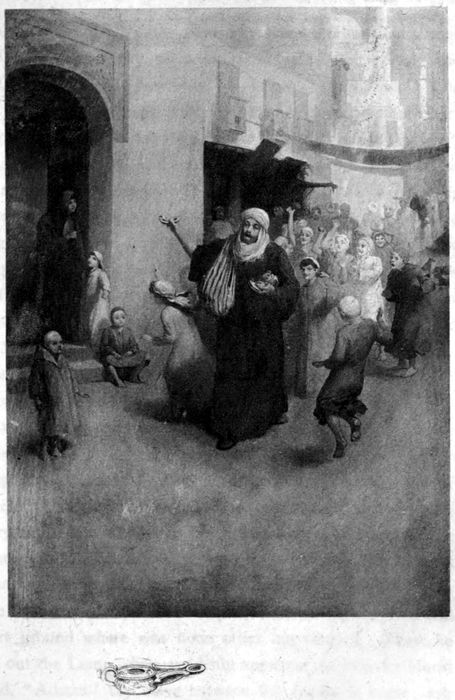
161
Now when it was the Five Hundred and Seventy-sixth Night,
Quoth Dunyazad, “O sister mine, an thou be other than sleepy,
do tell us some of thy pleasant tales,” whereupon Shahrazad
replied, “With love and good will.”——It hath reached me, O King
of the Age, that hereupon the Princess said to the slave-girl,
“Bring the old lamp which thou saidst to have seen in thy lord’s
apartment.” Now the Lady Badr al-Budur knew naught of the
Lamp and of the specialities thereof which had raised Alaeddin
her spouse to such high degree and grandeur; and her only end
and aim was to understand by experiment the mind of a man who
would give in exchange the new for the old. So the handmaid
fared forth and went up to Alaeddin’s apartment and returned
with the Lamp to her lady who, like all the others, knew nothing
of the Maghrabi’s cunning tricks and his crafty device. Then the
Princess bade an Ághá of the eunuchry go down and barter the
old Lamp for a new lamp. So he obeyed her bidding and, after
taking a new lamp from the man, he returned and laid it before his
lady who looking at it and seeing that it was brand-new, fell to
laughing at the Moorman’s wits. But the Maroccan, when he held
the article in hand and recognised it for the Lamp of the Enchanted
Treasury,[196] at once placed it in his breast-pocket and left all the
other lamps to the folk who were bartering of him. Then he went
forth running till he was clear of the city, when he walked leisurely
over the level grounds and he took patience until night fell on him
in desert ground where was none other but himself. There he
brought out the Lamp when suddenly appeared to him the Marid
who said, “Adsum! thy slave between thy hands is come: ask
of me what so thou wantest.” “’Tis my desire,” the Moorman
162replied, “that thou upraise from its present place Alaeddin’s
pavilion with its inmates and all that be therein, not forgetting
myself, and set it down upon my own land, Africa. Thou knowest
my town and I want the building placed in the gardens hard by it.”
The Marid-slave replied, “Hearkening and obedience: close thine
eyes and open thine eyes whenas thou shalt find thyself together
with the pavilion in thine own country.” This was done; and,
in an eye-twinkling, the Maroccan and the pavilion with all therein
were transported to the African land. Such then was the work of
the Maghrabi, the Magician; but now let us return to the Sultan
and his son-in-law. It was the custom of the King, because of his
attachment to and his affection for his daughter, every morning
when he had shaken off sleep, to open the latticed casement and
look out therefrom that he might catch sight of her abode. So
that day he arose and did as he was wont.——And Shahrazad was
surprised by the dawn of day and ceased to say her permitted say.
Now when it was the Five Hundred and Seventy-seventh Night,
Quoth Dunyazad, “O sister mine, an thou be other than sleepy,
do tell us some of thy pleasant tales,” whereupon Shahrazad
replied, “With love and good will.”——It hath reached me, O King
of the Age, that when the Sultan drew near the latticed casement
of his palace and looked out at Alaeddin’s pavilion he saw naught;
nay, the site was smooth as a well-trodden highway and like unto
what it had been aforetime; and he could find nor edifice nor
offices. So astonishment clothed him as with a garment, and his
wits were wildered and he began to rub his eyes, lest they be
dimmed or darkened, and to gaze intently; but at last he was
certified that no trace of the pavilion remained nor sign of its
being; nor wist he the why and the wherefore of its disappearance.
So his surprise increased and he smote hand upon hand and the
tears trickled down his cheeks over his beard, for that he knew
163not what had become of his daughter. Then he sent out officials
forthright and summoned the Grand Wazir who at once attended;
and, seeing him in this piteous plight said, “Pardon, O King of
the Age, may Allah avert from thee every ill! Wherefore art thou
in such sorrow?” Exclaimed the Sovran, “Methinketh thou
wottest not my case?” and quoth the Minister, “On no wise.
O our lord: by Allah, I know of it nothing at all.” “Then,”
resumed the Sultan, “’tis manifest thou hast not looked this day
in the direction of Alaeddin’s pavilion.” “True, O my lord,”
quoth the Wazir, “it must still be locked and fast shut;” and
quoth the King, “Forasmuch as thou hast no inkling of aught,[197]
arise and look out at the window and see Alaeddin’s pavilion
whereof thou sayest ’tis locked and fast shut.” The Minister
obeyed his bidding but could not see anything, or pavilion or other
place; so with mind and thoughts sore perplexed he returned to
his liege lord who asked him, “Hast now learned the reason of my
distress and noted yon locked-up palace and fast shut?” Answered
the Wazir, “O King of the Age, erewhile I represented to thy
Highness that this pavilion and these matters be all magical.”
Hereat the Sultan, fired with wrath, cried, “Where be Alaeddin?”
and the Minister replied, “He hath gone a-hunting,” when the
King commanded without stay or delay sundry of his Aghas and
Army-officers to go and bring to him his son-in-law chained and
with pinioned elbows. So they fared forth until they found
Alaeddin when they said to him, “O our lord Alaeddin, excuse
us nor be thou wroth with us; for the King hath commanded that
we carry thee before him pinioned and fettered, and we hope pardon
from thee because we are under the royal orders which we cannot
gainsay.” Alaeddin, hearing these words, was seized with surprise
and not knowing the reason of this remained tongue-tied for a
164time, after which he turned to them and asked, “O assembly, have
you naught of knowledge concerning the motive of the royal
mandate? Well I wot my soul to be innocent and that I never
sinned against king or against kingdom.” “O our lord,” answered
they, “we have no inkling whatever.” So Alaeddin alighted from
his horse and said to them, “Do ye whatso the Sultan bade you
do, for that the King’s command is upon the head and the eyes.[198]”——And
Shahrazad was surprised by the dawn of day and ceased
to say her permitted say.
Now when it was the Five Hundred and Seventy-eighth Night,
Quoth Dunyazad, “O sister mine, an thou be other than sleepy,
do tell us some of thy pleasant tales,” whereupon Shahrazad replied,
“With love and good will.”——It hath reached me, O King of the
Age, that the Aghas, having bound Alaeddin in bonds and pinioned
his elbows behind his back, haled him in chains and carried him
into the city. But when the lieges saw him pinioned and ironed,
they understood that the Sultan purposed to strike off his head;
and, forasmuch as he was loved of them exceedingly, all gathered
together and seized their weapons; then, swarming out of their
houses, followed the soldiery to see what was to do. And when the
troops arrived with Alaeddin at the palace, they went in and
informed the Sultan of this, whereat he forthright commanded the
Sworder to cut off the head of his son-in-law. Now as soon as the
subjects were aware of this order, they barricaded the gates and
closed the doors of the palace and sent a message to the King
saying, “At this very moment we will level thine abode over the
heads of all it containeth and over thine own,[199] if the least hurt or
harm befal Alaeddin.” So the Wazir went in and reported to the
165Sultan, “O King of the Age, thy commandment is about to seal
the roll of our lives; and ’twere more suitable that thou pardon thy
son-in-law lest there chance to us a sore mischance; for that the
lieges do love him far more than they love us.” Now the Sworder
had already dispread the carpet of blood and, having seated
Alaeddin thereon, had bandaged his eyes; moreover he had walked
round him three several times awaiting the last orders of his lord,
when the King looked out of the window and saw his subjects, who
had suddenly attacked him, swarming up the walls intending to tear
them down. So forthright he bade the Sworder stay his hand
from Alaeddin and commanded the crier fare forth to the crowd
and cry aloud that he had pardoned his son-in-law and received him
back into favour. But when Alaeddin found himself free and saw
the Sultan seated on his throne, he went up to him and said, “O my
lord, inasmuch as thy Highness hath favoured me throughout my
life, so of thy grace now deign let me know the how and the wherein
I have sinned against thee?” “O traitor,” cried the King, “unto
this present I knew not any sin of thine;” then, turning to the
Wazir he said, “Take him and make him look out at the window
and after let him tell us where be his pavilion.” And when the
royal order was obeyed Alaeddin saw the place level as a well-trodden
road, even as it had been ere the base of the building was
laid, nor was there the faintest trace of edifice. Hereat he was
astonished and perplexed knowing not what had occurred; but,
when he returned to the presence, the King asked him, “What is
it thou hast seen? Where is thy pavilion and where is my
daughter, the core of my heart, my only child, than whom I have
none other?” Alaeddin answered, “O King of the Age, I wot
naught thereof nor aught of what hath befallen,” and the Sultan
rejoined, “Thou must know, O Alaeddin, I have pardoned thee
only that thou go forth and look into this affair and enquire for me
concerning my daughter; nor do thou ever show thyself in my
presence except she be with thee; and, if thou bring her not, by
166the life of my head I will cut off the head of thee.” The other
replied, “To hear is to obey: only vouchsafe me a delay and respite
of some forty days; after which, an I produce her not, strike off my
head[200] and do with me whatso thou wishest.”——And Shahrazad
was surprised by the dawn of day and ceased to say her permitted
say.
Now when it was the Five Hundred and Seventy-ninth Night,
Quoth Dunyazad, “O sister mine, an thou be other than sleepy,
do tell us some of thy pleasant tales,” whereupon Shahrazad replied,
“With love and good will.”——It hath reached me, O King of the
Age, that the Sultan said to Alaeddin, “Verily I have granted thee
thy request, a delay of forty days; but think not thou canst fly
from my hand, for I would bring thee back even if thou wert above
the clouds instead of being only upon earth’s surface.” Replied
Alaeddin, “O my lord the Sultan, as I said to thy Highness, an I
fail to bring her within the term appointed, I will present myself
for my head to be stricken off.” Now when the folk and the lieges
all saw Alaeddin at liberty, they rejoiced with joy exceeding and
were delighted for his release; but the shame of his treatment and
bashfulness before his friends and the envious exultation of his foes
had bowed down Alaeddin’s head; so he went forth a-wandering
through the city ways and he was perplexed concerning his case
and knew not what had befallen him. He lingered about the
capital for two days, in saddest state, wotting not what to do in
order to find his wife and his pavilion, and during this time sundry
of the folk privily brought him meat and drink. When the two
days were done he left the city to stray about the waste and open
lands outlying the walls, without a notion as to whither he should
167wend; and he walked on aimlessly until the path led him beside a
river where, of the stress of sorrow that overwhelmed him, he
abandoned himself to despair and thought of casting himself into
the water. Being, however, a good Moslem who professed the unity
of the Godhead, he feared Allah in his soul; and, standing upon
the margin he prepared to perform the Wuzú-ablution. But as he
was baling up the water in his right hand and rubbing his fingers,[201]
it so chanced that he also rubbed the Ring. Hereat its Marid
appeared and said to him, “Adsum! thy thrall between thy hands
is come: ask of me whatso thou wantest.” Seeing the Marid,
Alaeddin rejoiced with exceeding joy and cried,[202] “O Slave, I desire
of thee that thou bring before me my pavilion and therein my wife,
the Lady Badr al-Budur, together with all and everything it
containeth.” “O my lord,” replied the Marid, “’tis right hard
upon me that thou demandest a service whereto I may not avail:
this matter dependeth upon the Slave of the Lamp nor dare I even
attempt it.” Alaeddin rejoined, “Forasmuch as the matter is
beyond thy competence, I require it not of thee, but at least do
thou take me up and set me down beside my pavilion in what
land soever that may be.” The Slave exclaimed, “Hearing and
obeying, O my lord;” and, uplifting him high in air, within the
space of an eye-glance set him down beside his pavilion in the land
of Africa and upon a spot facing his wife’s apartment. Now this
was at fall of night yet one look enabled him to recognise his home;
whereby his cark and care were cleared away and he recovered
trust in Allah after cutting off all his hope to look upon his wife
168once more. Then he fell to pondering the secret and mysterious
favours of the Lord (glorified be His omnipotence!); and how,
after despair had mastered him, the Ring had come to gladden
him, and how, when all his hopes were cut off, Allah had deigned
bless him with the services of its Slave. So he rejoiced and his
melancholy left him; then, as he had passed four days without
sleep for the excess of his cark and care and sorrow and stress of
thought, he drew near his pavilion and slept under a tree hard by
the building which (as we mentioned) had been set down amongst
the gardens outlying the city of Africa.——And Shahrazad was
surprised by the dawn of day and ceased to say her permitted say.
Now when it was the Five Hundred and Eightieth Night,
Quoth Dunyazad, “O sister mine, an thou be other than sleepy,
do tell us some of thy pleasant tales,” whereupon Shahrazad
replied, “With love and good will.”——It hath reached me, O King
of the Age, that Alaeddin lay that night under a tree beside his
pavilion in all restfulness; but whoso weareth head hard by the
headsman may not sleep o’ nights save whenas slumber prevail
over him. He slumbered till Morning showed her face and, when
awakened by the warbling of the small birds, he arose and went
down to the bank of the river which flowed thereby into the city;
and here he again washed hands and face[203] and after finished his
Wuzú-ablution. Then he prayed the dawn-prayer, and when he
had ended his orisons he returned and sat down under the windows
of the Princess’s bower. Now the Lady Badr al-Budur, of her
exceeding sorrow for severance from her husband and her sire the
Sultan, and for the great mishap which had happened to her from
the Maghrabi, the Magician, the Accursed, was wont to rise during
169the murk preceding dawn and to sit in tears inasmuch as she
could not sleep o’ nights, and had forsworn meat and drink. Her
favourite slave-girl would enter her chamber at the hour of prayer-salutation
in order to dress her; and this time, by decree of
Destiny, when she threw open the window to let her lady comfort
and console herself by looking upon the trees and rills, and she
herself peered out of the lattice, she caught sight of her master
sitting below, and informed the Princess of this, saying, “O my
lady! O my lady! here’s my lord Alaeddin seated at the foot of
the wall.” So her mistress arose hurriedly and gazing from the
casement saw him; and her husband raising his head saw her; so
she saluted him and he saluted her, both being like to fly for joy.
Presently quoth she, “Up and come in to me by the private
postern, for now the Accursed is not here;” and she gave orders
to the slave-girl who went down and opened for him. Then
Alaeddin passed through it and was met by his wife, when they
embraced and exchanged kisses with all delight until they wept for
overjoy. After this they sat down and Alaeddin said to her, “O my
lady, before all things ’tis my desire to ask thee a question. ’Twas
my wont to place an old copper lamp in such a part of my pavilion,
what became of that same?” When the Princess heard these
words she sighed and cried, “O my dearling, ’twas that very Lamp
which garred us fall into this calamity!” Alaeddin asked her,
“How befel the affair?” and she answered by recounting to him
all that passed, first and last, especially how they had given in
exchange an old lamp for a new lamp, adding, “And next day
we hardly saw one another at dawn before we found ourselves
in this land, and he who deceived us and took the lamp by way
of barter informed me that he had done the deed by might
of his magic and by means of the Lamp; that he is a Moorman
from Africa, and that we are now in his native country.”——And
Shahrazad was surprised by the dawn of day and ceased to say
her permitted say.
170
Now when it was the Five Hundred and Eighty-first Night,
Quoth Dunyazad, “O sister mine, an thou be other than sleepy,
do tell us some of thy pleasant tales,” whereupon Shahrazad
replied, “With love and good will.”——It hath reached me, O
King of the Age, that when the Lady Badr al-Budur ceased
speaking, Alaeddin resumed, “Tell me the intent of this Accursed
in thy respect, also what he sayeth to thee and what be his will of
thee?” She replied, “Every day he cometh to visit me once and
no more: he would woo me to his love and he sueth that I take
him to spouse in lieu of thee and that I forget thee and be consoled
for the loss of thee. And he telleth me that the Sultan my
sire hath cut off my husband’s head, adding that thou, the son of
pauper parents, wast by him enriched. And he sootheth me with
talk, but he never seeth aught from me save weeping and wailing;
nor hath he heard from me one sugar-sweet word.”[204] Quoth
Alaeddin, “Tell me where he hath placed the Lamp an thou
know anything thereof;” and quoth she, “He beareth it about on
his body alway, nor is it possible that he leave it for a single
hour; moreover once when he related what I have now recounted
to thee, he brought it out of his breast-pocket and allowed me to
look upon it.” When Alaeddin heard these words, he joyed with
exceeding joy and said, “O my lady, do thou lend ear to me.
’Tis my design to go from thee forthright and to return only after
doffing this my dress; so wonder not when thou see me changed,
but direct one of thy women to stand by the private postern
alway and, whenever she espy me coming, at once to open. And
now I will devise a device whereby to slay this damned loon.”
Herewith he arose and, issuing from the pavilion-door, walked
171till he met on the way a Fellah to whom he said, “O man, take
my attire and give me thy garments.” But the peasant refused,
so Alaeddin stripped him of his dress perforce[205] and donned it,
leaving to the man his own rich gear by way of gift. Then he
followed the highway leading to the neighbouring city and entering
it went to the Perfumers’ Bazar where he bought of one some
rarely potent Bhang, the son of a minute,[206] paying two dinars
for two drachms thereof and he returned in disguise by the same
road till he reached the pavilion. Here the slave-girl opened to
him the private postern wherethrough he went in to the Lady
Badr al-Budur.——And Shahrazad was surprised by the dawn
of day and ceased to say her permitted say.
Now when it was the Five Hundred and Eighty-second Night,
Quoth Dunyazad, “O sister mine, an thou be other than sleepy,
do tell us some of thy pleasant tales,” whereupon Shahrazad
replied, “With love and good will.”——It hath reached me, O
King of the Age, that when Alaeddin went in disguised to his wife
he said, “Hear me! I desire of thee that thou dress and dight
thyself in thy best and thou cast off all outer show and semblance
of care; also when the Accursed, the Maghrabi, shall visit thee, do
thou receive him with a ‘Welcome and fair welcome,’ and meet
him with smiling face and invite him to come and sup with thee.
Moreover, let him note that thou hast forgotten Alaeddin thy
beloved, likewise thy father; and that thou hast learned to love
him with exceeding love, displaying to him all manner joy and
pleasure. Then ask him for wine which must be red and pledge
172him to his secret in a significant draught; and, when thou hast
given him two to three cups full and hast made him wax careless,
then drop these drops into his cup and fill it up with wine: no
sooner shall he drink of it than he will fall upon his back senseless
as one dead.” Hearing these words, the Princess exclaimed, “’Tis
exceedingly sore to me that I do such deed;[207] withal must I do it
that we escape the defilement of this Accursed who tortured me
by severance from thee and from my sire. Lawful and right therefore
is the slaughter of this Accursed.” Then Alaeddin ate and
drank with his wife what hindered his hunger; then, rising without
stay or delay, fared forth the pavilion. So the Lady Badr al-Budur
summoned the tirewoman who robed and arrayed her in her
finest raiment and adorned her and perfumed her; and, as she
was thus, behold, the accursed Maghrabi entered. He joyed
much seeing her in such case and yet more when she confronted
him, contrary to her custom, with a laughing face; and his love-longing
increased and his desire to have her. Then she took him
and, seating him beside her, said, “O my dearling, do thou (an thou
be willing) come to me this night and let us sup together. Sufficient
to me hath been my sorrow for, were I to sit mourning through a
thousand years or even two thousand, Alaeddin would not return
to me from the tomb; and I depend upon thy say of yesterday, to
wit, that my sire the Sultan slew him in his stress of sorrow for
severance from me. Nor wonder thou an I have changed this
day from what I was yesterday; and the reason thereof is I have
determined upon taking thee to friend and playfellow in lieu of
and succession to Alaeddin, for that now I have none other man
but thyself. So I hope for thy presence this night, that we may
sup together and we may carouse and drink somewhat of wine each
with other; and especially ’tis my desire that thou cause me taste
173the wine of thy natal soil, the African land, because belike ’tis
better than aught of the wine of China we drink: I have with me
some wine but ’tis the growth of my country and I vehemently
wish to taste the wine produced by thine.”——And Shahrazad was
surprised by the dawn of day and ceased to say her permitted say.
Now when it was the Five Hundred and Eighty-third Night,
Quoth Dunyazad, “O sister mine, an thou be other than sleepy,
do tell us some of thy pleasant tales,” whereupon Shahrazad
replied, “With love and good will.”——It hath reached me, O
King of the Age, that when the Maghrabi saw the love lavisht
upon him by the Lady Badr al-Budur, and noted her change from
the sorrowful, melancholy woman she was wont to be, he thought
that she had cut off her hope of Alaeddin and he joyed exceedingly
and said to her, “I hear and obey, O my lady, whatso thou wishest
and all thou biddest. I have at home a jar of our country wine,
which I have carefully kept and stored deep in earth for a space of
eight years; and I will now fare and fill from it our need and will
return to thee in all haste.” But the Princess, that she might
wheedle him the more and yet more, replied, “O my darling, go
not thou, leaving me alone, but send one of the eunuchs to fill for
us thereof and do thou remain sitting beside me, that I may find
in thee my consolation.” He rejoined, “O my lady, none wotteth
where the jar be buried save myself nor will I tarry from thee.”
So saying, the Moorman went out and after a short time he brought
back as much wine as they wanted; whereupon quoth the Princess
to him, “Thou hast been at pains and trouble to serve me and I
have suffered for thy sake, O my beloved.” Quoth he, “On no
wise, O eyes of me; I hold myself enhonoured by thy service.”
Then the Lady Badr al-Budur sat with him at table, and the twain
fell to eating and presently the Princess expressed a wish to drink,
when the handmaid filled her a cup forthright and then crowned
174another for the Maroccan. So she drank to his long life and his
secret wishes and he also drank to her life; then the Princess, who
was unique in eloquence and delicacy of speech, fell to making a
cup-companion of him and beguiled him by addressing him in the
sweetest terms full of hidden meaning. This was done only that
he might become more madly enamoured of her, but the Maghrabi
thought that it resulted from her true inclination for him; nor knew
that it was a snare set up to slay him. So his longing for her increased,
and he was dying of love for her when he saw her address
him in such tenderness of words and thoughts, and his head began
to swim and all the world seemed as nothing in his eyes. But
when they came to the last of the supper and the wine had
mastered his brains and the Princess saw this in him, she said,
“With us there be a custom throughout our country, but I know
not an it be the usage of yours or not.” The Moorman replied,
“And what may that be?” So she said to him, “At the end of
supper each lover in turn taketh the cup of the beloved and
drinketh it off;” and at once she crowned one with wine and bade
the handmaid carry to him her cup wherein the drink was blended
with the Bhang. Now she had taught the slave-girl what to do
and all the handmaids and eunuchs in the pavilion longed for the
Sorcerer’s slaughter and in that matter were one with the Princess.
Accordingly the damsel handed him the cup and he, when he
heard her words and saw her drinking from his cup and passing
hers to him and noted all that show of love, fancied himself
Iskandar, Lord of the Two Horns. Then said she to him, the
while swaying gracefully to either side and putting her hand
within his hand, “O my life, here is thy cup with me and my cup
with thee, and on this wise[208] do lovers drink from each other’s cups.”
175Then she bussed the brim and drained it to the dregs and again
she kissed its lip and offered it to him. Thereat he flew for joy
and meaning to do the like, raised her cup to his mouth and drank
off the whole contents, without considering whether there was
therein aught harmful or not. And forthright he rolled upon his
back in death-like condition and the cup dropped from his grasp,
whereupon the Lady Badr al-Budur and the slave-girls ran hurriedly
and opened the pavilion door to their lord Alaeddin who, disguised
as a Fellah, entered therein.——And Shahrazad was surprised by
the dawn of day and ceased to say her permitted say.
Now when it was the Five Hundred and Eighty-fourth Night,
Quoth Dunyazad, “O sister mine, an thou be other than sleepy,
do tell us some of thy pleasant tales,” whereupon Shahrazad
replied, “With love and good will.”——It hath reached me, O
King of the Age, that Alaeddin entering his pavilion, went up
to the apartment of his wife, whom he found still sitting at table;
and facing her lay the Maghrabi as one slaughtered; so he at
once drew near to her and kissed her and thanked her for this.
Then rejoicing with joy exceeding he turned to her and said,
“Do thou with thy handmaids betake thyself to the inner-rooms
and leave me alone for the present that I may take counsel
touching mine affair.” The Princess hesitated not but went away
at once, she and her women; then Alaeddin arose and, after
locking the door upon them, walked up to the Moorman and
put forth his hand to his breast-pocket and thence drew the
Lamp; after which he unsheathed his sword and slew the villain.[209]
Presently he rubbed the Lamp and the Marid-slave appeared and
said, “Adsum, O my lord, what is it thou wantest?” “I desire
of thee,” said Alaeddin, “that thou take up my pavilion from this
176country and transport it to the land of China and there set it
down upon the site where it was whilome, fronting the palace of
the Sultan.” The Marid replied, “Hearing and obeying, O my
lord.” Then Alaeddin went and sat down with his wife and
throwing his arms round her neck kissed her and she kissed him,
and they sat in converse, what while the Jinni transported the
pavilion and all therein to the place appointed. Presently Alaeddin
bade the handmaids spread the table before him and he and the
Lady Badr al-Budur took seat thereat and fell to eating and
drinking, in all joy and gladness, till they had their sufficiency
when, removing to the chamber of wine and cup-converse, they
sat there and caroused in fair companionship and each kissed other
with all love-liesse. The time had been long and longsome since
they enjoyed aught of pleasure; so they ceased not doing thus
until the wine-sun arose in their heads and sleep gat hold of them,
at which time they went to their bed in all ease and comfort.[210]
Early on the next morning Alaeddin woke and awoke his wife, and
the slave-girls came in and donned her dress and prepared her and
adorned her whilst her husband arrayed himself in his costliest
raiment and the twain were ready to fly for joy at reunion after
parting. Moreover the Princess was especially joyous and gladsome
because on that day she expected to see her beloved father.
Such was the case of Alaeddin and the Lady Badr al-Budur; but
as regards the Sultan, after he drove away his son-in-law he never
ceased to sorrow for the loss of his daughter; and every hour of
every day he would sit and weep for her as women weep, because
she was his only child and he had none other to take to heart.
And as he shook off sleep, morning after morning, he would
hasten to the window and throw it open and peer in the direction
where formerly stood Alaeddin’s pavilion and pour forth tears
177until his eyes were dried up and their lids were ulcered. Now on
that day he arose at dawn and, according to his custom, looked
out when, lo and behold! he saw before him an edifice; so he
rubbed his eyes and considered it curiously when he became
certified that it was the pavilion of his son-in-law. So he called for a
horse[211] without let or delay; and as soon as his beast was saddled,
he mounted and made for the place; and Alaeddin, when he saw
his father-in-law approaching, went down and met him half way:
then, taking his hand, aided him to step upstairs to the apartment
of his daughter. And the Princess, being as earnestly desirous
to see her sire, descended and greeted him at the door of the
staircase fronting the groundfloor hall. Thereupon the King
folded her in his arms and kissed her, shedding tears of joy; and
she did likewise till at last Alaeddin led them to the upper saloon
where they took seats and the Sultan fell to asking her case
and what had betided her.——And Shahrazad was surprised by
the dawn of day and ceased to say her permitted say.
Now when it was the Five Hundred and Eighty-fifth Night,
Quoth Dunyazad, “O sister mine, an thou be other than sleepy,
do tell us some of thy pleasant tales,” whereupon Shahrazad
replied, “With love and good will.”——It hath reached me, O
King of the Age, that the Lady Badr al-Budur began to inform
the Sultan of all which had befallen her, saying, “O my father,
I recovered not life save yesterday when I saw my husband,
and he it was who freed me from the thraldom of that Maghrabi,
that Magician, that Accursed, than whom I believe there be none
viler on the face of earth; and, but for my beloved, I had never
178escaped him nor hadst thou seen me during the rest of my days.
But mighty sadness and sorrow gat about me, O my father, not
only for losing thee but also for the loss of a husband, under
whose kindness I shall be all the length of my life, seeing that he
freed me from that fulsome sorcerer.” Then the Princess began
repeating to her sire every thing that happened to her, and
relating to him how the Moorman had tricked her in the guise
of a lamp-seller who offered in exchange new for old; how she
had given him the Lamp whose worth she knew not, and how she
had bartered it away only to laugh at the lampman’s folly. “And
next morning, O my father,” she continued, “we found ourselves
and whatso the pavilion contained in Africa-land, till such time
as my husband came to us and devised a device whereby we
escaped: and, had it not been for Alaeddin’s hastening to our
aid, the Accursed was determined to enjoy me perforce.” Then
she told him of the Bhang-drops administered in wine to the
African and concluded, “Then my husband returned to me and
how I know not, but we were shifted from Africa-land to this
place.” Alaeddin in his turn recounted how, finding the wizard
dead drunken, he had sent away his wife and her women from the
polluted place into the inner apartments; how he had taken the
Lamp from the Sorcerer’s breast-pocket whereto he was directed
by his wife; how he had slaughtered the villain and, finally how,
making use of the Lamp, he had summoned its Slave and ordered
him to transport the pavilion back to its proper site, ending his
tale with, “And, if thy Highness have any doubt anent my
words, arise with me and look upon the accursed Magician.”
The King did accordingly and, having considered the Moorman,
bade the carcase be carried away forthright and burned and its
ashes scattered in air. Then he took to embracing Alaeddin and
kissing him said, “Pardon me, O my son, for that I was about
to destroy thy life through the foul deeds of this damned enchanter,
who cast thee into such pit of peril; and I may be excused, O my
179child, for what I did by thee, because I found myself forlorn of
my daughter; my only one, who to me is dearer than my very
kingdom. Thou knowest how the hearts of parents yearn unto
their offspring, especially when like myself they have but one
and none other to love.” And on this wise the Sultan took to
excusing himself and kissing his son-in-law.——And Shahrazad
was surprised by the dawn of day and ceased to say her permitted
say.
Now when it was the Five Hundred and Eighty-sixth Night,
Quoth Dunyazad, “O sister mine, an thou be other than sleepy,
do tell us some of thy pleasant tales,” whereupon Shahrazad
replied, “With love and good will.”——It hath reached me, O
King of the Age, that Alaeddin said to the Sultan, “O King of
the Time, thou didst naught to me contrary to Holy Law, and I
also sinned not against thee; but all the trouble came from that
Maghrabi, the impure, the Magician.” Thereupon the Sultan
bade the city be decorated and they obeyed him and held high
feast and festivities. He also commanded the crier to cry about
the streets saying, “This day is a mighty great fête, wherein public
rejoicings must be held throughout the realm, for a full month of
thirty days, in honour of the Lady Badr al-Budur and her husband
Alaeddin’s return to their home.” On this wise befel it with
Alaeddin and the Maghrabi; but withal the King’s son-in-law
escaped not wholly from the Accursed, albeit the body had been
burnt and the ashes scattered in air. For the villain had a brother
yet more villainous than himself, and a greater adept in necromancy,
geomancy and astromancy; and, even as the old saw
saith “A bean and ’twas split;”[212] so each one dwelt in his own
quarter of the globe that he might fill it with his sorcery, his fraud
180and his treason.[213] Now, one day of the days it fortuned that the
Moorman’s brother would learn how it fared with him, so he
brought out his sandboard and dotted it and produced the figures
which, when he had considered and carefully studied them, gave
him to know that the man he sought was dead and housed in the
tomb. So he grieved and was certified of his decease, but he
dotted a second time seeking to learn the manner of the death
and where it had taken place; so he found that the site was the
China-land and that the mode was the foulest of slaughter; furthermore,
that he who did him die was a young man Alaeddin hight.
Seeing this he straightway arose and equipped himself for wayfare;
then he set out and cut across the wilds and wolds and heights for
the space of many a month until he reached China and the capital
of the Sultan wherein was the slayer of his brother. He alighted
at the so-called Strangers’ Khan and, hiring himself a cell, took
rest therein for a while; then he fared forth and wandered about the
highways that he might discern some path which would aid him unto
the winning of his ill-minded wish, to wit, of wreaking upon Alaeddin
blood-revenge for his brother.[214] Presently he entered a coffeehouse,
a fine building which stood in the market-place and which
collected a throng of folk to play, some at the Mankalah,[215] others
at the backgammon[216] and others at the chess and what not else.
181There he sat down and listened to those seated beside him and
they chanced to be conversing about an ancient dame and a
holy, by name Fátimah,[217] who dwelt alway at her devotions in a
hermitage without the town, and this she never entered save only
two days each month. They mentioned also that she had performed
many saintly miracles[218] which, when the Maghrabi, the
Necromancer, heard he said in himself, “Now have I found that
which I sought: Inshallah—God willing—by means of this crone
will I win to my wish.”——And Shahrazad was surprised by the
dawn of day and ceased to say her permitted say.
Now when it was the Five Hundred and Eighty-seventh Night,
Quoth Dunyazad, “O sister mine, an thou be other than sleepy,
do tell us some of thy pleasant tales,” whereupon Shahrazad
replied, “With love and good will.”——It hath reached me, O
King of the Age, that the Maghrabi, the Necromancer, went up
to the folk who were talking of the miracles performed by the
devout old woman and said to one of them, “O my uncle, I
heard you all chatting about the prodigies of a certain saintess
named Fatimah: who is she and where may be her abode?”
“Marvellous?”[219] exclaimed the man: “How canst thou be in our
city and yet never have heard about the miracles of the Lady
182Fatimah? Evidently, O thou poor fellow, thou art a foreigner,
since the fastings of this devotee and her asceticism in worldly
matters and the beauties of her piety never came to thine ears.”
The Moorman rejoined, “’Tis true, O my lord: yes, I am a
stranger and came to this your city only yesternight; and I hope
thou wilt inform me concerning the saintly miracles of this
virtuous woman and where may be her wone, for that I have
fallen into a calamity, and ’tis my wish to visit her and crave her
prayers, so haply Allah (to whom be honour and glory!) will,
through her blessings, deliver me from mine evil.” Hereat the
man recounted to him the marvels of Fatimah the Devotee and
her piety and the beauties of her worship; then, taking him by
the hand went with him without the city and showed him the way
to her abode, a cavern upon a hillock’s head. The Necromancer
acknowledged his kindness in many words and, thanking him for
his good offices, returned to his cell in the caravanserai. Now by
the fiat of Fate on the very next day Fatimah came down to the
city, and the Maghrabi, the Necromancer, happened to leave his
hostelry a-morn, when he saw the folk swarming and crowding;
wherefore he went up to discover what was to do and found the
Devotee standing amiddlemost the throng, and all who suffered
from pain or sickness flocked to her soliciting a blessing and
praying for her prayers; and each and every she touched became
whole of his illness.[220] The Maroccan, the Necromancer, followed
her about until she returned to her antre; then, awaiting till the
evening evened, he arose and repaired to a vintner’s store where
he drank a cup of wine. After this he fared forth the city and
finding the Devotee’s cavern, entered it and saw her lying
183prostrate[221] with her back upon a strip of matting. So he came
forward and mounted upon her belly; then he drew his dagger
and shouted at her; and, when she awoke and opened her eyes,
she espied a Moorish man with an unsheathed poniard sitting
upon her middle as though about to kill her. She was troubled
and sore terrified, but he said to her, “Hearken! an thou cry out
or utter a word I will slay thee at this very moment: arise now and
do all I bid thee.” Then he sware to her an oath that if she
obeyed his orders, whatever they might be, he would not do her
die. So saying, he rose up from off her and Fatimah also arose,
when he said to her, “Give me thy gear and take thou my habit;”
whereupon she gave him her clothing and head-fillets, her face-kerchief
and her mantilla. Then quoth he, “’Tis also requisite
that thou anoint me with somewhat shall make the colour of my
face like unto thine.” Accordingly she went into the inner cavern
and, bringing out a gallipot of ointment, spread somewhat thereof
upon her palm and with it besmeared his face until its hue favoured
her own; then she gave him her staff[222] and, showing him how to
walk and what to do when he entered the city, hung her rosary
around his neck. Lastly she handed to him a mirror and said,
“Now look! Thou differest from me in naught;” and he saw
himself Fatimah’s counterpart as though she had never gone or
come.[223] But after obtaining his every object he falsed his oath
and asked for a cord which she brought to him; then he seized
her and strangled her in the cavern; and presently, when she was
dead, haled the corpse outside and threw it into a pit hard by.——And
Shahrazad was surprised by the dawn of day and ceased
to say her permitted say.
184
Now when it was the Five Hundred and Eighty-eighth Night,
Quoth Dunyazad, “O sister mine, an thou be other than sleepy,
do tell us some of thy pleasant tales,” whereupon Shahrazad
replied, “With love and good will.”——It hath reached me, O
King of the Age, that the Maghrabi, after murthering Fatimah,
threw her body into a pit and went back to sleep in her cavern;
and, when broke the day, he rose and repairing to the town took
his stand under the walls of Alaeddin’s pavilion. Hereupon
flocked the folk about him, all being certified that he was Fatimah
the Devotee and he fell to doing whatso she was wont to do: he
laid hands on these in pain and recited for those a chapter of the
Koran and made orisons for a third. Presently the thronging of
the folk and the clamouring of the crowd were heard by the Lady
Badr al-Budur, who said to her handmaidens, “Look what is to
do and what be the cause of this turmoil!” Thereupon the Agha
of the eunuchry fared forth to see what might be the matter and
presently returning said, “O my lady, this clamour is caused by
the Lady Fatimah, and if thou be pleased to command, I will
bring her to thee; so shalt thou gain through her a blessing.”
The Princess answered, “Go bring her, for since many a day
I am always hearing of her miracles and her virtues, and I
do long to see her and get a blessing by her intervention,
for the folk recount her manifestations in many cases of
difficulty.” The Agha went forth and brought in the Maroccan,
the Necromancer, habited in Fatimah’s clothing; and, when the
wizard stood before the Lady Badr al-Budur, he began at first
sight to bless her with a string of prayers; nor did any one of
those present doubt at all but that he was the Devotee herself.
The Princess arose and salam’d to him; then seating him beside
her, said, “O my Lady Fatimah, ’tis my desire that thou abide with
me alway, so might I be blessed through thee, and also learn of
185thee the paths[224] of worship and piety and follow thine example making
for salvation.” Now all this was a foul deceit of the accursed
African and he designed furthermore to complete his guile, so he
continued, “O my Lady, I am a poor woman and a religious that
dwelleth in the desert; and the like of me deserveth not to abide
in the palaces of the kings.” But the Princess replied, “Have no
care whatever, O my Lady Fatimah; I will set apart for thee an
apartment of my pavilion, that thou mayest worship therein and
none shall ever come to trouble thee; also thou shalt avail to
worship Allah in my place better than in thy cavern.” The
Maroccan rejoined, “Hearkening and obedience, O my lady; I
will not oppose thine order for that the commands of the children
of the kings may not be gainsaid nor renounced. Only I hope of
thee that my eating and drinking and sitting may be within my own
chamber which shall be kept wholly private; nor do I require or
desire the delicacies of diet, but do thou favour me by sending thy
handmaid every day with a bit of bread and a sup of water;[225] and,
when I feel fain of food, let me eat by myself in my own room.”
Now the Accursed hereby purposed to avert the danger of haply
raising his face-kerchief at meal times, when his intent might be
baffled by his beard and mustachios discovering him to be a man.
The Princess replied, “O my Lady Fatimah, be of good heart;
naught shall happen save what thou wishest. But now arise and
let me show thee the apartment in the palace which I would prepare
for thy sojourn with us.”——And Shahrazad was surprised
by the dawn of day and ceased to say her permitted say.
186
Now when it was the Five Hundred and Eighty-ninth Night,
Quoth Dunyazad, “O sister mine, an thou be other than sleepy,
do tell us some of thy pleasant tales,” whereupon Shahrazad
replied, “With love and good will.”——It hath reached me, O
King of the Age, that the Lady Badr al-Budur arose and taking
the Necromancer who had disguised himself as the Devotee,
ushered him in to the place which she had kindly promised him
for a home and said, “O my Lady Fatimah, here thou shalt dwell
with every comfort about thee and in all privacy and repose; and
the place shall be named after thy name;” whereupon the Maghrabi
acknowledged her kindness and prayed for her. Then the Princess
showed him the jalousies and the jewelled Kiosque with its four
and twenty windows[226] and said to him, “What thinkest thou, O
my Lady Fatimah, of this marvellous pavilion?” The Moorman
replied, “By Allah, O my daughter, ’tis indeed passing fine and
wondrous exceedingly; nor do I deem that its fellow is to be found
in the whole universe; but alas for the lack of one thing which
would enhance its beauty and decoration!” The Princess asked
her, “O my Lady Fatimah, what lacketh it and what be this thing
would add to its adornment? Tell me thereof, inasmuch as I was
wont to believe it wholly perfect.” The Maroccan answered, “O
my lady, all it wanteth is that there be hanging from the middle
of the dome the egg of a fowl called the Rukh;[227] and, were this
done, the pavilion would lack its peer all the world over.” The
Princess asked, “What be this bird and where can we find her
egg?” and the Maroccan answered, “O my lady, the Rukh is
indeed a giant fowl which carried off camels and elephants in her
187pounces and flieth away with them, such is her stature and
strength; also this fowl is mostly found in Mount Káf; and the
architect who built this pavilion is able to bring thee one of her
eggs.” They then left such talk as it was the hour for the noon-day
meal and, when the handmaid had spread the table, the Lady
Badr al-Budur sent down to invite the Accursed African to eat
with her. But he accepted not and for a reason he would on no
wise consent; nay, he rose and retired to the room which the
Princess had assigned to him and whither the slave-girls carried his
dinner. Now when evening evened, Alaeddin returned from the
chase and met his wife who salam’d to him and he clasped her to
his bosom and kissed her. Presently, looking at her face he saw
thereon a shade of sadness and he noted that contrary to her
custom, she did not laugh; so he asked her, “What hath betided
thee, O my dearling? tell me, hath aught happened to trouble thy
thoughts?” “Nothing whatever,” answered she, “but, O my
beloved, I fancied that our pavilion lacked naught at all; however,
O eyes of me, O Alaeddin, were the dome of the upper story hung
with an egg of the fowl called Rukh, there would be naught like it
in the universe.” Her husband rejoined, “And for this trifle thou
art saddened when ’tis the easiest of all matters to me! So cheer
thyself; and, whatever thou wantest, ’tis enough thou inform me
thereof, and I will bring it from the abysses of the earth in the
quickest time and at the earliest hour.”——And Shahrazad was
surprised by the dawn of day and ceased to say her permitted say.
Now when it was the Five Hundred and Ninetieth Night,
Quoth Dunyazad, “O sister mine, an thou be other than sleepy,
do tell us some of thy pleasant tales,” whereupon Shahrazad
replied, “With love and good will.”——It hath reached me, O
King of the Age, that Alaeddin, after refreshing the spirits of his
Princess by promising her all she could desire, repaired straightway
188to his chamber and taking the Lamp[228] rubbed it, when the Marid
appeared without let or delay saying, “Ask whatso thou wantest.”
Said the other, “I desire thee to fetch me an egg of the bird
Rukh and do thou hang it to the dome-crown of this my pavilion.”
But when the Marid heard these words, his face waxed fierce and
he shouted with a mighty loud voice and a frightful, and cried,
“O denier of kindly deeds, sufficeth it not for thee that I and all
the Slaves of the Lamp are ever at thy service, but thou must
also require me to bring thee our Liege Lady[229] for thy pleasure,
and hang her up at thy pavilion-dome for the enjoyment of thee
and thy wife! Now by Allah, ye deserve, thou and she, that
I reduce you to ashes this very moment and scatter you upon the
air; but, inasmuch as ye twain be ignorant of this matter, unknowing
its inner from its outer significance, I will pardon you for
indeed ye are but innocents. The offence cometh from that
accursed Necromancer, brother to the Maghrabi, the Magician,
who abideth here representing himself to be Fatimah, the Devotee,
after assuming her dress and belongings and murthering her in
the cavern: indeed he came hither seeking to slay thee by way of
blood-revenge for his brother; and ’tis he who taught thy wife
to require this matter of me.”[230] So saying the Marid evanished.
But when Alaeddin heard these words, his wits fled his head and
his joints trembled at the Marid’s terrible shout; but he empowered
his purpose and, rising forthright issued from his
chamber and went into his wife’s. There he affected an ache of
head, for that he knew how famous was Fatimah for the art and
mystery of healing all such pains; and, when the Lady Badr
189al-Budur saw him sitting hand to head and complaining of
unease, she asked him the cause and he answered, “I know of
none other save that my head acheth exceedingly.” Hereupon
she straightway bade summon Fatimah that the Devotee might
impose her hand upon his head;[231] and Alaeddin asked her, “Who
may this Fatimah be?” So she informed him that it was Fatimah
the Devotee to whom she had given a home in the pavilion.
Meanwhile the slave-girls had fared forth and summoned the
Maghrabi, and when the Accursed made act of presence, Alaeddin
rose up to him and, acting like one who knew naught of his
purpose, salam’d to him as though he had been the real Fatimah
and, kissing the hem of his sleeve, welcomed him and entreated
him with honour and said, “O my Lady Fatimah, I hope thou
wilt bless me with a boon, for well I wot thy practice in the
healing of pains: I have gotten a mighty ache in my head.”
The Moorman, the Accursed, could hardly believe that he heard
such words, this being all that he desired.——And Shahrazad
was surprised by the dawn of day and ceased to say her permitted
say.
Now when it was the Five Hundred and Ninety-first Night,
Quoth Dunyazad, “O sister mine, an thou be other than sleepy,
do tell us some of thy pleasant tales,” whereupon Shahrazad
replied, “With love and good will.”——It hath reached me, O
King of the Age, that the Maghrabi, the Necromancer, habited
as Fatimah the Devotee, came up to Alaeddin that he might
place hand upon his head and heal his ache; so he imposed one
hand and, putting forth the other under his gown, drew a dagger
190wherewith to slay him. But Alaeddin watched him and, taking
patience till he had wholly unsheathed the weapon, seized him
with a forceful grip; and, wrenching the dagger from his grasp
plunged it deep into his heart. When the Lady Badr al-Budur
saw him do on this wise, she shrieked and cried out, “What hath
this virtuous and holy woman done that thou hast charged thy
neck with the heavy burthen of her blood shed wrongfully?
Hast thou no fear of Allah that thou killest Fatimah, this saintly
woman, whose miracles are far-famed?” “No,” replied Alaeddin,
“I have not killed Fatimah. I have slain only Fatimah’s slayer,
he that is the brother of the Maghrabi, the Accursed, the
Magician, who carried thee off by his black art and transported my
pavilion to the Africa-land; and this damnable brother of his
came to our city and wrought these wiles, murthering Fatimah
and assuming her habit, only that he might avenge upon me his
brother’s blood; and he also ’twas who taught thee to require of
me a Rukh’s egg, that my death might result from such requirement.
But, an thou doubt my speech, come forwards and consider
the person I have slain.” Thereupon Alaeddin drew aside the
Moorman’s face-kerchief and the Lady Badr al-Budur saw the
semblance of a man with a full beard that well nigh covered his
features. She at once knew the truth and said to her husband,
“O my beloved, twice have I cast thee into death-risk!” but he
rejoined, “No harm in that, O my lady, by the blessing of your
loving eyes: I accept with all joy all things thou bringest me.”
The Princess, hearing these words, hastened to fold him in her
arms and kissed him saying, “O my dearling, all this is for my love
to thee and I knew naught thereof; but indeed I do not deem
lightly of thine affection.” So Alaeddin kissed her and strained
her to his breast; and the love between them waxed but greater.
At that moment the Sultan appeared and they told him all that
had happened, showing him the corpse of the Maghrabi, the
Necromancer, when the King commanded the body to be burned
191and the ashes scattered on air, even as had befallen the Wizard’s
brother. And Alaeddin abode with his wife, the Lady Badr
al-Budur, in all pleasure and joyance of life and thenceforward
escaped every danger; and, after a while, when the Sultan
deceased, his son-in-law was seated upon the throne of the Kingdom;
and he commanded and dealt justice to the lieges so that
all the folk loved him and he lived with his wife in all solace and
happiness until there came to him the Destroyer of delights and
the Severer of societies.[232]——And Shahrazad was surprised by the
dawn of day and ceased to say her permitted say.
193
195In the capital of one of the large and rich provinces of the kingdom of China,
the name of which I do not recollect, there lived a tailor, whose name was
Mustapha, without any other distinction but that which his profession afforded
him, and so poor, that he could hardly, by his daily labour, maintain himself
and family, which consisted of a wife and son.
His son, who was called Aladdin, had been brought up after a very careless
and idle manner, and by that means had contracted many vicious habits. He
was wicked, obstinate, and disobedient to his father and mother, who, when he
grew up, could not keep him within doors; but he would go out early in the
morning, and stay out all day, playing in the streets and public places with
little vagabonds of his own age.
When he was old enough to learn a trade, his father, not being able to put
him out to any other, took him into his own shop, and shewed him how to use
his needle; but neither good words nor the fear of chastisement were capable
of fixing his lively genius. All that his father could do to keep him at home
to mind his work was in vain; for no sooner was his back turned, but Aladdin
was gone for that day. Mustapha chastised him, but Aladdin was incorrigible;
and his father, to his great grief, was forced to abandon him to his libertinism;
and was so much troubled at not being able to reclaim him, that it threw him
into a fit of sickness, of which he died in a few months.
The mother of Aladdin, finding that her son would not follow his father’s
business, shut up the shop, sold off the implements of that trade, and with
the money she got for them, and what she could get by spinning cotton, thought
to maintain herself and her son.
Aladdin, who was now no longer restrained by the fear of a father, and who
cared so little for his mother, that whenever she chid him he would fly in her
face, gave himself entirely over to dissipation, and was never out of the streets
from his companions. This course he followed till he was fifteen years old,
without giving his mind to any thing whatever, or the least reflection on what
would become of him. In this situation, as he was one day playing according
to custom, in the street, with his vagabond troop, a stranger passing by stood
still to observe him.
This stranger was a famous magician, called by the writer of this story the
African Magician; and by that name I shall call him with the more propriety,
as he was a native of Africa, and had been but two days come from thence.
Whether the African magician, who was a good physiognomist, had observed
196in Aladdin’s countenance something which was absolutely necessary for the
execution of the design he came about, he inquired artfully about his family,
who he was, and what were his inclinations; and when he had learned all he
desired to know, he went up to him, and taking him aside from his comrades,
said to him, “Child, was not your father called Mustapha the tailor?”—“Yes,
sir,” answered Aladdin, “but he has been dead a long time.”
At these words, the African magician threw his arms about Aladdin’s neck,
and kissed him several times with tears in his eyes. Aladdin, who observed
his tears, asked him, What made him weep? “Alas! my son,” cried the
African magician, with a sigh, “how can I forbear? I am your uncle; your
good father was my own brother. I have been a great many years abroad
travelling, and now I am come home with the hopes of seeing him, you tell me
he is dead. I assure you it is a sensible grief to me to be deprived of the comfort
I expected. But it is some relief to my affection, that as far as I can
remember him, I knew you at first sight, you are so like him; and I see I am
not deceived.” Then he asked Aladdin, putting his hand into his purse, where
his mother lived; and as soon as Aladdin had informed him, he gave him a
handful of small money, saying to him, “Go, my son, to your mother, give my
love to her, and tell her that I will come and see her to-morrow, if I have time,
that I may have the satisfaction of seeing where my good brother lived so long,
and ended his days.”
As soon as the African magician left his new-adopted nephew, Aladdin ran
to his mother, overjoyed at the money his uncle had given him. “Mother,”
said he, “have I an uncle?” “No, child,” replied his mother, “you have no
uncle by your father’s side or mine.” “I am just now come,” answered Aladdin,
“from a man who says he is my uncle by my father’s side, assuring me that he
is his brother. He cried and kissed me when I told him my father was dead;
and to shew you that what I tell you is truth,” added he, pulling out the money,
“see what he has given me; he charged me to give his love to you, and to tell
you, if he has any time to-morrow, he will come and pay you a visit, that he
may see at the same time the house my father lived and died in.” “Indeed,
child,” replied the mother, “your father had a brother, but he has been dead a
long time, and I never heard of another.”
The mother and son talked no more then of the African magician; but the
next day Aladdin’s uncle found him playing in another part of the town with
other children, and embracing him as before, put two pieces of gold into his
hand, and said to him, “Carry this, child, to your mother, and tell her that I
will come and see her to-night, and bid her get us something for supper; but
first shew me the house where you live.”
After Aladdin had shewed the African magician the house, he carried the two
pieces of gold to his mother, and when he had told her of his uncle’s intention,
she went out and bought provisions; and considering she wanted various
vessels, she went and borrowed them of her neighbours. She spent the whole
day in preparing the supper; and at night, when it was ready, she said
197to Aladdin, “Perhaps your uncle knows not how to find our house, go and see
for him, and bring him if you meet with him.”
Though Aladdin had shewed the magician the house, he was very ready to go,
when somebody knocked at the door, which Aladdin immediately opened; and
the magician came in, loaded with wine and all sorts of fruits, which he brought
for a dessert.
After the African magician had given what he brought into Aladdin’s hands,
he saluted his mother, and desired her to shew him the place where his brother
Mustapha used to sit on the sofa; and when she had so done, he presently fell
down and kissed it several times, crying out with tears in his eyes, “My poor
brother! How unhappy am I, not to have come soon enough to give you one
last embrace!” Aladdin’s mother desired him to sit down in the same place,
but he would not. “No,” said he, “I shall take care how I do that; but give
me leave to sit here over against it, that if I am deprived of the satisfaction of
seeing the master of a family so dear to me, I may at least have the pleasure
of seeing the place where he used to sit.” Aladdin’s mother pressed him no
farther, but left him at his liberty to sit where he pleased.
When the magician had made choice of a place, and sat down, he began to
enter into discourse with Aladdin’s mother. “My good sister,” said he, “do not
be surprised at your never having seen me all the time you have been married
to my brother, Mustapha, of happy memory. I have been forty years absent
from this country, which is my native place, as well as my late brother’s; and
during that time have travelled into the Indies, Persia, Arabia, Syria, and
Egypt, and have resided in the finest towns of those countries, and afterwards
crossed over into Africa, where I made a longer stay. At last, as it is natural
for a man, how distant soever it may be, to remember his native country,
relations and acquaintance, I was very desirous to see mine again, and to
embrace my dear brother; and finding I had strength and courage enough
to undertake so long a journey, I immediately made the necessary preparations
for it, and set out. I will not tell you the length of time it took me, all the
obstacles I met with, and what fatigues I have endured, to come hither; but
nothing ever mortified and afflicted me so much as the hearing of my brother’s
death, for whom I always had a brotherly love and friendship. I observed his
features in the face of my nephew, your son, and distinguished him from
a number of children with whom he was at play; he can tell you how I received
the most melancholy news that ever reached my ears. But God be praised for
all things! It is a comfort to me to find him again in a son, who has his most
remarkable features.”
The African magician, perceiving that Aladdin’s mother began to weep at the
remembrance of her husband, changed the discourse, and turning towards Aladdin,
asked him his name. “I am called Aladdin,” said he. “Well, Aladdin,”
replied the magician, “what business do you follow? Are you of any trade?”
At this question Aladdin hung down his head, and was not a little dashed
when his mother made answer, “Aladdin is an idle fellow; his father, when
198alive, strove all he could to teach him his trade, but could not succeed; and
since his death, notwithstanding all I can say to him, he does nothing but idle
away his time in the streets, as you saw him, without considering he is no
longer a child: and if you do not make him ashamed of it, and make him leave
it off, I despair of his ever coming to any good. He knows that his father left
him no fortune, and sees me endeavour to get bread by spinning cotton every
day; for my part, I am resolved, one of these days, to turn him out of doors and
let him provide for himself.”
After these words, Aladdin’s mother burst out into tears; and the magician
said, “This is not well, nephew; you must think of helping yourself, and
getting your livelihood. There are a great many sorts of trades: consider if
you have not an inclination to some of them; perhaps you did not like your
father’s trade, and would prefer another! come, do not disguise your sentiments
from me; I will endeavour to help you.” But finding that Aladdin returned
no answer,—“If you have no mind,” continued he, “to learn any trade, and
prove an honest man, I will take a shop for you, and furnish it with all sorts of
fine stuffs and linens, and set you to trade with them; and with the money you
make with them, lay in fresh goods, and then you will live after an honourable
way. Consult your own inclination, and tell me freely what you think of it;
you shall always find me ready to keep my word.”
This proposal greatly flattered Aladdin, who mortally hated work, and had
sense enough to know that such sort of shops were very much esteemed and
frequented, and the owners honoured and respected. He told the magician
he had a greater inclination to that business than to any other, and that he
should be very much obliged to him all his life for his kindness. “Since this
profession is agreeable to you,” said the African magician, “I will carry you
along with me to-morrow, and clothe you as richly and handsomely as the best
merchants in the city, and after that we will think of opening a shop as I
mean.”
Aladdin’s mother, who never till then could believe that the magician was
her husband’s brother, no longer doubted it after his promises of kindness to
her son. She thanked him for his good intentions; and after having exhorted
Aladdin to render himself worthy of his uncle’s favour by his good behaviour,
served up supper, at which they talked of several indifferent matters; and then
the magician, who saw that the night was pretty far advanced, took his leave
of the mother and son, and retired.
He came again the next day, as he promised, and took Aladdin along with
him to a great merchant, who sold all sorts of clothes for different ages and ranks
ready made, and a variety of fine stuffs. He asked to see some that suited
Aladdin in size; and after choosing a suit which he liked best, and rejecting
others which he did not think handsome enough, he bid Aladdin choose those
he preferred. Aladdin, charmed with the liberality of his new uncle, made
choice of one, and the magician immediately bought it, and all things proper
to it, and paid for it without haggling.
199When Aladdin found himself so handsomely equipped from top to toe, he
returned his uncle all imaginable thanks; who, on the other hand, promised
never to forsake him, but always to take him along with him; which he did to
the most frequented places in the city, and particularly where the capital
merchants kept their shops. When he brought him into the street where they
sold the richest stuffs, and finest linens, he said to Aladdin, “As you are soon
to be a merchant as well as these, it is proper you should frequent these shops,
and be acquainted with them.” Then he shewed him the largest and finest
mosques, and carried him to the khans or inns where the merchants and
travellers lodged, and afterwards to the sultan’s palace, where he had free
access; and at last brought him to his own khan, where, meeting with some
merchants he had got acquainted with since his arrival, he gave them a treat,
to bring them and his pretended nephew acquainted.
This treat lasted till night, when Aladdin would have taken his leave of his
uncle to go home, but the magician would not let him go by himself, but conducted
him safe to his mother, who, as soon as she saw him so finely dressed,
was transported with joy, and bestowed a thousand blessings upon the magician
for being at so great an expense upon her child. “Generous relation,” said
she, “I know not how to thank you for your liberality. I know that my son is
not deserving of your favours; and was he never so grateful, and answered
your good intentions, he would be unworthy of them. For my part,” added
she, “I thank you with all my soul, and wish you may live long enough to be
a witness of my son’s gratitude, which he cannot better shew than by regulating
his conduct by your good advice.”
“Aladdin,” replied the magician, “is a good boy, and minds well enough,
and I believe we shall do very well; but I am sorry for one thing, which is,
that I cannot perform to-morrow what I promised, because it is Friday, and
the shops will be shut up, and therefore we cannot hire or furnish one, but let
it alone till Saturday. But I will call on him to-morrow, and take him to walk
in the gardens, where people of the best fashion generally walk. Perhaps he
has never seen these amusements, he has only hitherto been among children;
but now he must see men.” Then the African magician took his leave of the
mother and the son, and retired. Aladdin, who was overjoyed to be so
well clothed, anticipated the pleasure of walking in the gardens which lay
about the town. He had never been out of the town nor seen the environs,
which were very beautiful and pleasant.
Aladdin rose early the next morning and dressed himself, to be ready
against his uncle calling on him! and after he had waited some time, he began
to be impatient, and stood watching for him at the door: but as soon as he
perceived him coming, he told his mother, took his leave of her, and ran to
meet him.
The magician caressed Aladdin when he came to him. “Come along, my
dear child,” said he, “and I will shew you fine things.” Then he led him out
at one of the gates of the city, to some large fine houses, or rather palaces, to
200each of which belonged beautiful gardens, into which anybody might go. At
every house he came to, he asked Aladdin if he did not think it fine: and
Aladdin was ready to answer when any one presented itself, crying out, “Here
is a finer house, uncle, than any we have seen yet.” By this artifice the cunning
magician got Aladdin a pretty way into the country; and as he had a mind to
carry him farther, to execute his design, he took an opportunity to sit down in
one of the gardens by a fountain of clear water, which discharged itself by a
lion’s mouth of bronze into a great basin, pretending to be tired, the better to
rest Aladdin. “Come, nephew,” said he, “you must be weary as well as me;
let us rest ourselves, and we shall be better able to walk.”
After they had sat down, the magician pulled from his girdle a handkerchief
with cakes and fruit, which he had provided on purpose, and laid them on the
edge of the basin. He broke a cake in two, gave one half to Aladdin, and ate
the other himself; and in regard to the fruit, he left him at liberty to take
which sort he liked best. During this short repast, he exhorted his nephew to
leave off keeping company with children, and seek that of wise and prudent men,
to improve by their conversation; “for,” said he, “you will soon be at man’s
estate, and you cannot too early begin to imitate their conversation.” When
they had eaten as much as they liked, they got up, and pursued their walk
through the gardens, which were separated from one another only by small
ditches, which only marked out the limits without interrupting the communication;
so great was the confidence the inhabitants reposed in each other. By
this means, the African magician drew Aladdin insensibly beyond the gardens,
and crossed the country, till they almost came to the mountains.
Aladdin, who had never been so far in his life before, began to find himself
much tired with so long a walk, and said to the magician, “Where are we
going, uncle? We have left the gardens a great way behind us, and I see
nothing but mountains; if we go much farther, I do not know whether I shall
be able to reach the town again.” “Never fear, nephew,” said the false
uncle; “I will shew you another garden, which surpasses all we have yet
seen; it is not far off, it is but a little step; and when we come there, you
will say that you would have been sorry to have been so nigh it, and not
seen it.” Aladdin was soon persuaded; and the magician, to make the way
seem shorter and less fatiguing, told him a great many stories.
At last they came between two mountains of moderate height and equal
size, divided by a narrow valley, which was the place where the magician intended
to bring Aladdin, to put into execution a design that had brought him
from Africa to China. “We will go no farther now,” said he to Aladdin: “I
will shew you here some very extraordinary things, and what nobody ever saw
before; which, when you have seen, you will thank me for; but while I strike
fire, do you gather up all the loose sticks you can see, to kindle a fire with.”
Aladdin found there so many dried sticks, that before the magician had
lighted a match, he had gathered up a great heap. The magician presently
set them on fire, and when they were all in a blaze, the magician threw in some
201incense he had about him, which raised a great cloud of smoke, which he dispersed
on each side, by pronouncing several magical words which Aladdin did
not understand.
At the same time, the earth trembled a little, and opened just before the
magician and Aladdin, and discovered a stone about half a yard square, laid
horizontally, with a brass ring fixed into the middle of it, to raise it up by.
Aladdin was so frightened at what he saw, that he would have run away; but
as he was to be serviceable to the magician, he caught hold of him, scolded
him, and gave him such a box on the ear, that he knocked him down, and had
like to have beat his teeth down his throat. Poor Aladdin got up again
trembling, and with tears in his eyes, said to the magician, “What have I done,
uncle, to be treated after this severe manner?” “I have my reasons for it,”
replied the magician: “I am your uncle, and supply the place of your father,
and you ought to make no reply. But, child,” added he, softening, “do not be
afraid of anything, for I shall not ask anything of you, but that you obey
me punctually, if you would reap the advantages which I intended you should.”
These fair promises calmed Aladdin’s fears and resentment; and when the
magician saw that he was come to himself, he said to him, “You see what I
have done by virtue of my incense, and the words I pronounced. Know, then,
that under this stone there is hid a treasure which is destined to be yours, and
which will make you richer than the greatest monarch in the world; this is so
true, that no other person but yourself is permitted to touch this stone, and to
pull it up and go in; for I am forbid ever to touch it, or set foot in this treasure
when it is opened; so you must, without fail, punctually execute what I tell
you, for it is a matter of great consequence both to you and me.”
Aladdin, amazed at all he saw and heard the magician say of the treasure,
which was to make him happy for ever, forgot what was past, and rising up,
said to the magician, “Well, uncle, what is to be done? Command me, I am
ready to obey you.” “I am overjoyed, child,” said the African magician, embracing
him, “to see you take the resolution; come, take hold of the ring, and
lift up that stone.” “Indeed, uncle,” replied Aladdin, “I am not strong enough
to lift it; you must help me.” “You have no occasion for my assistance,”
answered the magician; “if I help you, we shall be able to do nothing: you
must lift it up yourself: take hold of the ring, only pronounce the names of your
father and grandfather, then lift it up, and you will find it will come easily.”
Aladdin did as the magician bade him, and raised the stone with a great deal of
ease, and laid it on one side.
When the stone was pulled up, there appeared a cavity of about three or
four feet deep, with a little door, and steps to go down lower. “Observe, my
son,” said the African magician, “what I am going to say to you: go down
into that cave, and when you are at the bottom of those steps, you will find a
door open, which will lead you into a large vaulted place, divided into three
great halls, in each of which you will see four large brass vessels placed on each
side, full of gold and silver, but take care you do not meddle with them. Before
202you go into the first hall, be sure to tuck up your gown, and wrap it well about
you, and then go through the second into the third without stopping. Above
all things, have a care that you do not touch the walls, so much as with your
clothes; for if you do, you will die instantly. At the end of the third hall, you
will find a door, which leads into a garden planted with fine trees loaded with
fruit; walk directly across the garden by a path which will lead you to five steps
that will bring you upon a terrace, where you will see a niche before you, and in
that niche a lighted lamp. Take the lamp down, and put it out; when you
have thrown away the wick, and poured out the liquor, put it in your breast,
and bring it to me. Do not be afraid that the liquor will spoil your clothes, for
it is not oil, and the lamp will be dry as soon as it is thrown out. If you have
a mind to any of the fruit of the garden, you may gather as much as you
please.”
After these words, the magician drew a ring off his finger, and put it upon
one of Aladdin’s telling him that it was a preservative against all evil, while he
observed what he had prescribed to him. After this instruction, he said, “Go
down boldly, child, and we shall both be rich all our lives.”
Aladdin jumped into the cave, went down the steps, and found the three
halls just as the African magician had described them. He went through them
with all the precaution the fear of death could inspire, if he failed to observe
all that he was told very carefully; crossed the garden without stopping, took
down the lamp from the niche, threw out the wick and the liquor, and, as the
magician told him, put it in his bosom. But as he came down from the terrace,
seeing it was perfectly dry, he stopped in the garden, to observe the fruit, which
he only had a glimpse of in crossing it. All the trees were loaded with extraordinary
fruit, of different colours on each tree: some bore fruit entirely white,
and some clear and transparent as crystal; some pale red, and others deeper;
some green, blue, and purple, and others yellow; in short, there was fruit of all
colours. The white were pearls; the clear and transparent, diamonds; the deep
red, rubies; the paler, ballas rubies; the green, emeralds; the blue, turquoises;
the purple, amethysts; and those that were of yellow cast, sapphires; and so of
the rest. All these fruits were so large and beautiful, that nothing was ever seen
like them. Aladdin was altogether ignorant of their value; and would have
preferred figs and grapes, or any other fruits, before them; and though he took
them only for coloured glass of little value, yet he was so pleased with the
variety of the colours, and the beauty and extraordinary size of the fruit, that
he had a mind to gather some of every sort; and accordingly filled his two
pockets, and the two new purses his uncle had bought for him with the clothes
which he gave him; and as he could not put them in his pockets, he fastened
them to his girdle. Some he wrapped up in the skirts of his gown, which was
of silk, large and wrapping, and crammed his breast as full as it could hold.
Aladdin, having thus loaded himself with riches he knew not the value of,
returned through the three halls with the same precaution, and made all the
haste he could, that he might not make his uncle wait, and soon arrived at the
203mouth of the cave, where the African magician awaited him with the utmost
impatience. As soon as Aladdin saw him, he cried out, “Pray, uncle, lend me
your hand to help me out.” “Give me the lamp first,” replied the magician;
“it will be troublesome to you.” “Indeed, uncle,” answered Aladdin, “I cannot
now; it is not troublesome to me; but I will as soon as I am up.” The
African magician was so obstinate, that he would have the lamp before he
would help him up; and Aladdin, who had encumbered himself so much with
his fruit, that he could not well get at it, refused to give him it till he was out
of the cave. The African magician, provoked at this obstinate refusal of the
lad, flew into a terrible passion, and threw a little of his incense into the fire,
which he had taken care to keep in, and no sooner pronounced two magical
words, but the stone which had closed the mouth of the cave moved into its
place, with the earth over it, in the same manner as it lay at the arrival of the
magician and Aladdin.
This action of the African magician’s plainly shewed him to be neither
Aladdin’s uncle, nor Mustapha, the tailor’s brother, but a true African, a native
of that part of the world. For as Africa is a country whose inhabitants delight
most in magic of any other in the whole world, he had applied himself to it
from his youth; and after about forty years’ experience in enchantments, works
of geomancy, fumigations, and reading of magic books, he had found out that
there was in the world a wonderful lamp, the possession of which would render
him more powerful than any monarch in the world, if he could obtain it; and
by a late operation of geomancy, he found out that this lamp lay concealed in
a subterraneous place in the midst of China, in the situation, with all the
circumstances, already described. Fully persuaded of the truth of this discovery,
he set out from the farthest part of Africa, and, after a long and fatiguing
journey, came to the town nearest to this treasure. But though he had a
certain knowledge of the place where the lamp was, he was not permitted to
take it himself, nor to enter the subterraneous place where it was, but must
receive it from the hands of another person. For this reason, he addressed
himself to Aladdin, whom he looked upon as a young lad of no consequence,
and fit to serve his purpose; resolving, as soon as he got the lamp into his
hands, to sacrifice poor Aladdin to his avarice and wickedness, by making the
fumigation mentioned before, and saying those two magical words, the effect of
which was to remove the stone into its place again, that he might have no
witness of the transaction.
The blow he gave Aladdin, and the authority he assumed over him, was
only to use him to fear him, and to make him obey him more readily, and
give him the lamp as soon as he asked for it. But his too great precipitation
in executing his wicked intention on poor Aladdin, and his fear lest somebody
should come that way during their dispute, and discover what he wished to
keep secret, produced an effect quite contrary to what he proposed to himself.
When the African magician saw that all his great hopes were frustrated for
ever, he returned that same day for Africa; but went quite round the town, and
204at some distance from it, for fear lest some persons who had seen him walk out
with the boy, seeing him come back without him, should entertain any jealousy
of him, and stop him.
According to all appearances, there was no prospect of Aladdin being any
more heard of. But the magician, when he contrived his death, had forgotten
the ring he put on his finger, which preserved him, though he knew not its
virtue; and it is amazing that the loss of that, together with the lamp, did not
drive the magician to despair; but magicians are so much used to misfortunes,
and events contrary to their wishes, that they do not lay them to heart, but
still feed themselves all their lives with unsubstantial notions and chimeras.
As for Aladdin, who never suspected this bad usage from his pretended
uncle, after all his caresses, and what he had done for him, his surprise is
more easily to be imagined than expressed by words. When he found himself
buried alive, he cried, and called out to his uncle to tell him he was ready to
give him the lamp; but all in vain, since his cries could not be heard by him
and he remained in this dark abode. At last when he had quite tired himself
with crying, he went to the bottom of the steps, with a design to get into the
garden, where it was light; but the door, which was opened before by enchantment,
was now shut by the same means. Then he redoubled his cries and
tears, and sat down on the steps, without any hopes of ever seeing the light
again, and in a melancholy certainty of passing from the present darkness into
that of a speedy death.
Aladdin remained in this state two days, without eating or drinking, and on
the third day looked upon death as inevitable. Clasping his hands with an
entire resignation to the will of God, he said, “There is no strength or power
but in the great and high God.” In this action of joining his hands, he rubbed
the ring which the magician put on his finger, and of which he knew not yet
the virtue, and immediately a genie of an enormous size and frightful look
rose out of the earth, his head reaching the vault, and said to him, “What
wouldst thou have with me? I am ready to obey thee as thy slave, and the
slave of all who have the ring on thy finger; I, and the other slaves of that
ring.”
At another time, Aladdin, who had not been used to such visions, would
have been so frightened, that he would not have been able to speak at the sight
of so extraordinary a figure; but the danger he was in made him answer
without hesitation, “Whoever thou art, deliver me from this place, if thou art
able.” He had no sooner made an end of these words, but the earth opened,
and he found himself on the very spot where the magician first brought him.
It was some time before Aladdin’s eyes could bear the light, after having
been so long in total darkness; but after he had endeavoured by degrees to
support it, and began to look about him, he was very much surprised not to
find the earth open, and could not comprehend how he had got so soon out of
its bowels. There was nothing to be seen but the place where the fire had
been, by which he could nearly judge whereabouts the cave was. Then
205turning himself about towards the town, he perceived it in the midst of the
gardens that surrounded it, and knew the way back by which the magician
had brought him to it; then, returning God thanks to see himself once more
in the world, where he never more expected to be, he made the best of his way
home. When he got within his mother’s door, the joy to see her, and
his faintness for want of sustenance for three days, made him faint, and
he remained for a long time as dead. His mother, who had given him
over for lost or dead, seeing him in this condition, omitted nothing to bring
him to himself again. As soon as he recovered, the first words he spake
were, “Pray, mother, give me something to eat, for I have not put a morsel of
anything into my mouth these three days.” His mother brought what she had,
and set it before him. “My son,” said she, “be not too eager, for it is
dangerous; eat but a little at a time, and take care of yourself. Besides, I
would not have you talk; you will have time enough to tell me what has
happened to you when you are recovered. It is a great comfort to me to see
you again, after the affliction I have been in since Friday, and the pains I
have taken to learn what had become of you, ever since I found it was night,
and you were not returned.”
Aladdin took his mother’s advice, and ate and drank moderately. When
he had done, “Mother,” said he to her, “I cannot help complaining of you,
for abandoning me so easily to the discretion of a man who had a design to
kill me, and who at this very moment thinks my death certain. You believed
he was my uncle, as well as I; and what other thoughts could we entertain
of a man who was so kind to me, and made such advantageous offers? But
I must tell you, mother, he is a rogue and a cheat, and only did what he did,
and made me all those promises, to accomplish my death; but for what
reason neither you nor I can guess.—For my part, I can assure you I never
gave him any cause to deserve the least ill-treatment from him. You shall
judge of it yourself, when you have heard all that passed from the time I left
you, till he came to the execution of his wicked design.”
Then Aladdin began to tell his mother all that happened to him from
Friday, when the magician took him to see the palaces and gardens about
that town, and what fell out in the way, till they came to the place between
the two mountains, where the great prodigy was to be performed; how, with
incense which the magician threw into the fire, and some magical words
which he pronounced, the earth opened, and discovered a cave which led to
an inestimable treasure. He forgot not the blow the magician gave him,
and in what manner he softened again, and engaged by great promises, and
putting a ring on his finger, to go down into the cave. He did not omit the
least circumstance of what he saw in crossing the three halls and the garden
and his taking the wonderful lamp, which he pulled out of his bosom and
shewed to his mother, as well as the transparent fruit of different colours,
which he had gathered in the garden as he returned, two purses full of which
he gave to his mother. But though these fruits were precious stones, brilliant
206as the sun, and the reflection of a lamp which then lighted the room might
have led them to think they were of great value, she was as ignorant of their
worth as her son, and cared nothing for them. She had been bred in a
middling rank of life, and her husband’s poverty prevented her being possessed
of such things, nor had she, or her relations or neighbours ever seen them,
so that we must not wonder that she looked on them as things of no value,
and only pleasing to the eye by the variety of their colours.
Aladdin put them behind one of the cushions of the sofa he sat upon, and
continued his story telling his mother that when he returned and presented
himself at the mouth of the cave, upon his refusal to give the magician the
lamp till he had got out, the stone, by his throwing some incense into the fire,
and using two or three magical words, stopped it up, and the earth closed
again. He could not help bursting into tears at the representation of the
miserable condition he was in, to find himself buried alive in a dismal cave,
till by the touching of his ring, the virtue of which he was then an entire
stranger to, he, properly speaking, came to life again. When he had made an
end of his story, he said to his mother, “I need say no more; you know the
rest. This is my adventure, and the danger I have been exposed to since
you saw me.”
Aladdin’s mother heard with so much patience as not to interrupt him this
surprising and wonderful relation, notwithstanding it could be no small affliction
to a mother, who loved her son tenderly; but yet in the most moving part,
which discovered the perfidy of the African magician, she could not help
shewing, by marks of the greatest indignation, how much she detested him;
and when Aladdin had finished his story, she broke out into a thousand
reproaches against that vile impostor. She called him perfidious traitor,
barbarian, assassin, deceiver, magician, and an enemy and destroyer of
mankind. “Without doubt, child,” added she, “he is a magician, and they
are plagues to the world, and by their enchantments and sorceries have
commerce with the devil. Bless God for preserving you from his wicked
designs; for your death would have been inevitable, if you had not called upon
him, and implored his assistance.” She said a great deal more against the
magician’s treachery; but finding, while she talked, her son Aladdin, who had
not slept for three days and nights, began to nod, she put him to bed, and soon
after went to bed herself.
Aladdin, who had not had one wink of sleep while he was in the subterraneous
abode, slept very heartily all that night, and never waked till the next
morning; when the first thing that he said to his mother was, he wanted
something to eat, and that she could not do him a greater pleasure than to give
him his breakfast. “Alas! child,” said she, “I have not a bit of bread to
give you, you ate up all the provisions I had in the house yesterday; but have
a little patience, and it shall not be long before I will bring you some: I have
a little cotton, which I have spun; I will go and sell it, and buy bread, and
something for our dinner.” “Mother,” replied Aladdin, “keep your cotton
207against another time, and give me the lamp I brought home yesterday; I will
go and sell it, and the money I shall get for it will serve both for breakfast and
dinner, and perhaps supper too.”
Aladdin’s mother took the lamp, and said to her son, “Here it is, but it is
very dirty; if it was a little cleaner I believe it would bring something more.”
She took a little fine sand and water to clean it; but had no sooner begun to
rub it, but in an instant a hideous genie of gigantic size appeared before her,
and said to her in a voice like thunder, “What wouldst thou have? I am ready
to obey thee as thy slave, and the slave of all those who have that lamp in
their hands; I, and the other slaves of the lamp.”
Aladdin’s mother was not able to speak at the sight of this frightful genie,
but fainted away; when Aladdin, who had once before seen such another genie
in the cavern, without losing time or reflection, snatched the lamp out of his
mother’s hands, and said to the genie boldly, “I am hungry; bring me something
to eat.” The genie disappeared immediately, and in an instant returned
with a large silver basin on his head, and twelve covered plates of the same
metal, which contained some excellent meats: six large white loaves on two
other plates, and two bottles of wine, and two silver cups in each hand. All
these things he placed upon a table, and disappeared; and all this was done
before Aladdin’s mother came out of her swoon.
Aladdin went presently, and fetched some water, and threw it in her face,
to recover her: whether that or the smell of the meats the genie procured
brought her to life again, it was not long before she came to herself. “Mother,”
said Aladdin, “do not mind this; it is nothing at all; get up, and come and
eat; here is what will put you in heart, and at the same time satisfy my
extreme hunger; do not let such fine meat be cold, but fall to.”
His mother was very much surprised to see the great basin, twelve plates,
six loaves, and the two bottles and cups, and to smell the delicious odour which
exhaled from the plates. “Child,” said she to Aladdin, “to whom are we
obliged for this great plenty and liberality? Has the sultan been made
acquainted with our poverty, and had compassion on us?” “It is no matter,
mother,” said Aladdin, “let us sit down and eat: for you have almost as much
need of a good breakfast as myself, when we have done, I will tell you.”
Accordingly, both mother and son sat down, and ate with the better stomach,
as the table was so well furnished. But all the time Aladdin’s mother could not
forbear looking at and admiring the basin and plates, though she could not well
tell whether they were silver or any other metal, so little accustomed were she
and her son to see such, and the novelty more than the value attracted their
attention.
In short, the mother and son sat at breakfast till it was dinner-time, and
then they thought it would be best to put the two meals together; yet, after
this, they found they should have enough left for supper, and two meals for the
next day.
When Aladdin’s mother had taken away and set by what was left, she went
208and sat down by her son on the sofa. “Aladdin,” said she, “I expect now that
you should satisfy my impatience, and tell me exactly what passed between the
genie and you while I was in a swoon;” which he presently complied with.
She was in as great amazement at what her son told her, as at the appearance
of the genie; and said to him, “But, son, what have we to do with genies?
I never in my life heard that any of my acquaintance had ever seen one. How
came that vile genie to address himself to me, and not to you, to whom he had
appeared before in the cave?” “Mother,” answered Aladdin, “the genie you
saw is not the same who appeared to me, though he resembles him in size: no,
they had quite different persons and habits; they belong to different masters. If
you remember, he that I first saw called himself the slave of the ring on my finger;
and this you saw called himself the slave of the lamp you had in your hand: but I believe you
did not hear him, for I think you fainted away as soon as he began to speak.”
“What!” cried the mother, “was your lamp, then, the occasion of that
cursed genie addressing himself rather to me than to you? Ah! my son,
take it out of my sight, and put it where you please. I will never touch it. I
had rather you would sell it, than run the hazard of being frightened to death
again by touching it: and if you would take my advice, you would part also
with the ring, and not have anything to do with genies, who, as our prophet has
told us, are only devils.”
“With your leave, mother,” replied Aladdin, “I shall now take care how I
sell a lamp, as I was going to do, which may be so serviceable both to you and
me. Have not you been an eye-witness of what it hath procured us, and it shall
still continue to furnish us with subsistence and maintenance. You may suppose,
as I do, that my false and wicked uncle would not have taken so much
pains, and undertaken so long and tedious a journey, if it had not been to get
into his possession this Wonderful Lamp, which he preferred before all the gold
and silver which he knew was in his halls, and which I have seen with my own
eyes. He knew too well the merit and worth of this lamp, not to prefer it to
so great a treasure; and since chance hath discovered the virtue of it to us,
let us make a profitable use of it, without making any great stir, and drawing
the envy and jealousy of our neighbours upon us. However, since the genies
fright you so much, I will take it out of your sight, and put it where I may find
it when I want it. As for the ring, I cannot resolve to part with that neither;
for, without that, you had never seen me again; and though I am alive now,
perhaps, if it was gone, I might not be so some moments hence; therefore I
hope you will give me leave to keep that, and to wear it always on my finger.
Who knows what dangers you and I may be exposed to, which neither of us
can foresee, and which it may deliver us from?” As Aladdin’s arguments were
just, and had a great deal of weight in them, his mother had nothing to say
against them, but only replied that he might do what he pleased, but for her
part, she would have nothing to do with genies, but, would wash her hands of
them, and never say anything more about them.
By the next night they had eaten all the provisions the genie had brought;
209and the next day Aladdin, who could not bear the thoughts of hunger, took one
of the silver plates under his coat, and went out early to sell it, and addressing
himself to a Jew whom he met in the streets, took him aside, and pulling out
the plate, asked him if he would buy it. The cunning Jew took the plate and
examined it, and no sooner found that it was good silver, but he asked Aladdin
how much he valued it at. Aladdin, who knew not the value of it, and never
had been used to such traffic, told him he would trust to his judgment and
honour. The Jew was somewhat confounded at this plain dealing; and
doubting whether Aladdin understood the material or the full value of what he
offered him to sell, he took a piece of gold out of his purse, and gave it him,
though it was but the sixtieth part of the worth of the plate. Aladdin took the
money very eagerly, and, as soon as he got it in his pocket, retired with so
much haste, that the Jew, not content with the exorbitancy of his profit, was
vexed he had not penetrated into Aladdin’s ignorance, and was going to run
after him, to endeavour to get some change out of the piece of gold; but
Aladdin ran so fast, and had got so far, that it would have been impossible for
him to overtake him.
Before Aladdin went home to his mother he called at a baker’s, bought a
loaf, changed his money, and went home, and gave the rest to his mother,
who went and bought provisions enough to last them some time. After this
manner they lived, till Aladdin had sold the twelve plates, one at a time, to
the Jew, for the same money; who, after the first time, durst not offer him less,
for fear of losing so good a chap. When he had sold the last plate, he had
recourse to the basin, which weighed ten times as much as the plate, and would
have carried it to his old purchaser, but that it was too large and cumbersome;
therefore he was obliged to bring him home with him to his mother’s, where
the Jew had examined the weight of the basin, he laid down ten pieces of gold,
with which Aladdin was very well satisfied.
They lived on these ten pieces in a frugal manner a pretty while; and
Aladdin, who had been used to an idle life, left off playing with young lads of
his own age ever since his adventure with the African magician. He spent
his time in walking about, and talking with people with whom he had got
acquainted. Sometimes he would stop at the most capital merchants’ shops,
where people of distinction met, and listen to their discourse, by which he
gained some little knowledge of the world.
When all the money was spent, Aladdin had recourse again to the lamp.
He took it in his hand, looked for the same place where his mother had rubbed
it with the sand, and rubbed it also, and the genie immediately appeared, and
said, “What wouldst thou have? I am ready to obey thee as thy slave, and the
slave of all those who have that lamp in their hands—I, and the other slaves
of the lamp.” “I am hungry,” said Aladdin; “bring me something to eat.”
The genie disappeared, and presently returned with a basin, and the same
number of covered plates, &c., and set them down on a table, and vanished again.
Aladdin’s mother, knowing what her son was going to do, went out at that
210time about some business, on purpose to avoid being in the way when the genie
came; and when she returned, which was not long after, and found the table
and sideboard so furnished a second time, was almost as much surprised as
before, at the prodigious effect of the lamp. However, she sat down with her
son, and when they had eaten as much as they had a mind to, she set enough
by to last them two or three days.
As soon as Aladdin found that their provisions and money were spent, he
took one of these plates, and went to look for his Jew chapman again; but
passing by a goldsmith’s shop who had the character of a very fair and honest
man, the goldsmith perceiving him, called to him and said, “My lad, I have
often observed you go by, loaded as you are at present, and talk with such a
Jew, and then come back again empty-handed. I imagine that you carry
something that you sell to him; but perhaps you do not know what a rogue he
is, and that he is the greatest rogue among all the Jews, and is so well known
that nobody will have anything to do with him. What I tell you is for your
own good. If you will show me what you now carry, and it is to be sold,
I will give you the full worth of it; or I will direct you to other merchants
who will not cheat you.”
The hopes of getting more money for his plate induced Aladdin to pull it
from under his coat, and shew it to the goldsmith. The old man, who at first
sight saw that it was made of the finest silver, asked him if he had sold
any such as that to the Jew, and Aladdin told him plainly that he had sold
him twelve such, for a piece of gold each. “What a villain!” cried the goldsmith;
“but,” added he, “my son, what is past cannot be recalled. By shewing
you the value of this plate, which is of the finest silver we use in our shops,
I will let you see how much the Jew has cheated you.”
The goldsmith took a pair of scales, weighed the plate, and after he had
told Aladdin how much an ounce of fine silver contained and was worth, he
demonstrated to him that his plate was worth by weight sixty pieces of gold,
which he paid him down immediately. “If you dispute my honesty,” said he,
“you may go to any other of our trade, and if he gives you any more, I will
be bound to forfeit twice as much; for we gain only the fashion of the plate
that we buy, and that the fairest dealing Jews do not.”
Aladdin thanked him for his good advice, so greatly to his advantage,
and never after went to any other person, but sold him all his plates and the
basin, and had as much for them as the weight came to.
Though Aladdin and his mother had an inexhaustible treasure of money in
their lamp, and might have had whatever they had a mind to every time it
failed, yet they lived with the same frugality as before, except that Aladdin
went more neat: as for his mother, she wore no clothes but what she earned
by her spinning cotton. After their manner of living, we may easily suppose
that the money Aladdin had sold the plates and basin for was sufficient to
maintain them some time. They went on for many years by the help of the
produce Aladdin, from time to time, made of his lamp.
211During this time Aladdin frequented the shops of the principal merchants,
where they sold cloth of gold and silver, and linens, silk stuffs, and
jewellery, and oftentimes joining in their conversation, acquired a complete
knowledge of the world, and assumed its manners. By his acquaintance
among the jewellers, he came to know that the fine fruit which he had gathered
when he took the lamp were not coloured glass, but stones of extraordinary
value. For as he had seen all sorts of jewels bought and sold in their shops,
but none that were so beautiful or so large as his, he found, that instead of
coloured glass, he possessed an inestimable treasure; but had the prudence
not to say anything of it to anyone, not even to his mother.
One day, as Aladdin was walking about the town, he heard an order of
the sultan’s published, for all people to shut up their shops and houses, and
keep within doors, while the princess Badr-oul-boudour, the sultan’s daughter,
went to the baths and back again.
This public order inspired Aladdin with a great curiosity to see the
princess’s face, which he could not do without getting into the house of some
acquaintance, and through a window: but this did not satisfy him, when he
considered that the princess, when she went to the baths, had a veil on; but
to gratify his curiosity, he presently thought of a scheme which succeeded;
that was, to place himself behind the door of the bath, which was so situated
that he could not fail of seeing her face.
Aladdin had not waited long before the princess came, and he could see
her plainly through a chink of the door without being seen. She was attended
with a great crowd of ladies, slaves, and eunuchs, who walked on each side,
and behind her. When she came within three or four paces from the door
of the baths, she took off her veil, and gave Aladdin an opportunity of a
full look at her.
Till then Aladdin, who had never seen any woman’s face but his mother’s,
who was old, and never could boast of any such features, thought that all
women were like her, and could hear people talk of the most surprising
beauties without being the least moved; for whatever words are made use of
to set off the merit of a beauty, they can never make the same impression
as the beauty herself.
But as soon as Aladdin had seen the princess Badr-oul-boudour, his sentiments
were very much changed, and his heart could not withstand all those
inclinations so charming an object inspires. The princess was the most
beautiful brunette in the world; her eyes were large, lively, and sparkling;
her looks sweet and modest; her nose was of a just proportion and without a
fault; her mouth small, her lips of a vermilion red, and charmingly agreeable
symmetry; in a word, all the features of her face were perfectly regular. It is
not therefore surprising that Aladdin, who had never seen, and was a stranger
to so many charms, was dazzled, and his senses quite ravished with such an
assemblage. With all these perfections the princess had so delicate a shape,
so majestic an air, that the sight of her was sufficient to inspire respect.
212After the princess had passed by Aladdin and entered the baths, he remained
some time astonished, and in a kind of ecstasy, retracing and imprinting the
idea of so charming an object deeply in his mind. But at last considering that
the princess was gone past him, and that when she returned from the bath her
back would be towards him, and then veiled, he resolved to quit his post and
go home. But when he came there, he could not conceal his uneasiness so
well but that his mother perceived it, and was very much surprised to see him
so much more thoughtful and melancholy than usual; and asked him what had
happened to him to make him so, or if he was ill. Aladdin returned her no
answer, but sat carelessly down on the sofa, and remained in the same condition,
full of the image of the charming Badr-oul-boudour. His mother, who
was dressing supper, pressed him no more. When it was ready, she set it on
the table before him; but perceiving that he gave no attention to it, she bid
him eat, and had much ado to persuade him to change his place; and when he
did, he ate much less than usual, and all the time cast down his eyes, and
observed so profound a silence, that she could not possibly get the least word
out of him in answer to all the questions she put, to find the reason of so extraordinary
an alteration.
After supper, she asked him again, why he was so melancholy, but could
get no information, and he determined to go to bed, rather than give her the
least satisfaction. Without examining how Aladdin passed the night, his mind
full as it was with the beautiful charms of the princess Badr-oul-boudour, I shall
only observe that as he sat next day on the sofa, over against his mother, as she
was spinning cotton, he spoke to her in these words: “I perceive, mother, that
my silence yesterday has very much troubled you; I was not, nor am I sick, as
I fancy you believed; but I can tell you, that what I felt then, and now endure,
is worse than any disease. I cannot tell what ails me, but doubt not what I am
going to tell you will inform you.
“It was not known in this quarter of the town, and therefore you could know
nothing of it, that the princess Badr-oul-boudour, the sultan’s daughter, was to
go to the baths after dinner. I heard this as I walked about the town, and an
order was issued, that, to pay all the respect that was due to that princess, all
the shops should be shut up in her way thither, and everybody keep within doors,
to leave the streets free for her and her attendants. As I was not then far from
the bath, I had a great curiosity to see the princess’s face; and as it occurred to
me that the princess, when she came nigh the door of the bath, would pull her
veil off, I resolved to get behind that door. You know the situation of the
door, and may imagine that I must have a full view of her, if it happened as I
expected. The princess threw off her veil, and I had the happiness of seeing
her lovely face with the greatest satisfaction imaginable. This, mother, was
the cause of my melancholy and silence yesterday; I love the princess with so
much violence, that I cannot express it; and as my lively passion increases every
moment, I cannot live without the possession of the amiable princess Badr-oul-boudour,
and am resolved to ask her in marriage of the sultan her father.”
213Aladdin’s mother listened with attention to what her son told her; but when
he talked of asking the princess Badr-oul-boudour in marriage of the sultan,
she could not help bursting out into a loud laugh. Aladdin would have gone
on with his discourse, but she interrupted him. “Alas! child,” said she, “what
are you thinking of? You must be mad to talk so.”
“I assure you, mother,” replied Aladdin, “that I am not mad, but in my
right senses: I foresaw that you would reproach me with this folly and
extravagance; but I must tell you once more, that I am resolved to demand
the princess Badr-oul-boudour of the sultan in marriage, and your remonstrances
shall not prevent me.”
“Indeed, son,” replied the mother, seriously, “I cannot help telling you,
that you have quite forgot yourself; and if you would put this resolution of
yours in execution, I do not see who you can get to venture to propose it for
you.” “You yourself,” replied he immediately. “I go to the sultan!”
answered the mother, amazed and surprised. “I shall take care how I engage
in such an affair. Why, who are you, son,” continued she, “that you can have
the assurance to think of your sultan’s daughter? Have you forgot that your
father was one of the poorest tailors in the capital, and that I am of no better
extraction? and do not you know that sultans never marry their daughters but
to princes, sons of sultans like themselves?”
“Mother,” answered Aladdin, “I have already told you that I foresaw all
that you have said, or can say: and tell you again, that neither your discourse
nor your remonstrances shall make me change my mind. I have told you that
you must ask the princess Badr-oul-boudour in marriage for me: it is a favour
I desire of you, with all the respect I owe you; and I beg of you not to refuse
me, unless you would rather see me in my grave, than by so doing give me
new life.”
The good old woman was very much embarrassed, when she found Aladdin
so obstinately persisting in so foolish a design. “My son,” said she again, “I
am your mother, who brought you into the world, and there is nothing that is
reasonable but I would readily do for you. If I was to go and treat about your
marriage with some neighbour’s daughter, whose circumstances were equal with
yours, I would do it with all my heart: and then they would expect you should
have some little estate or fortune, or be of some trade. When such poor folks
as we are have a mind to marry, the first thing they ought to think of is how to
live. But without reflecting on the meanness of your birth, and the little merit
and fortune you have to recommend you, you aim at the highest pitch of
fortune; and your pretensions are no less than to demand in marriage the
daughter of your sovereign, who with one single word can crush you to pieces.
I say nothing of what respects yourself. I leave you to reflect on what you
have to do, if you have ever so little thought. I come now to consider what
concerns myself. How could so extraordinary a thought come into your head,
as that I should go to the sultan, and make a proposal to him, to give his
daughter in marriage to you? Suppose I had, not to say the boldness, but the
214impudence to present myself before the sultan, and make so extravagant a
request, to whom should I address myself to be introduced to his majesty? Do
you not think the first person I should speak to would take me for a mad
woman, and chastise me as I should deserve? Suppose there is no difficulty
in presenting myself to an audience of the sultan, as I know there is none to
those who go to ask justice, which he distributes equally among his subjects;
I know too that to those who ask some favour, he grants it with pleasure when
he sees it is deserved, and the persons are worthy of it. But is that your case?
And do you think you have deserved the favour you would have me ask for
you? Are you worthy of it? What have you done to deserve such a favour?
What have you done either for your prince or country? How have you
distinguished yourself? If you have done nothing to merit so great a favour,
nor are worthy of it, with what face shall I ask it? How can I open my mouth
to make the proposal to the sultan? His majestic presence and the lustre of
his court would presently silence me, who used to tremble before my late
husband your father, when I asked him for anything. Here is another reason,
my son, which you do not think of, which is, nobody ever goes to ask a favour
of the sultan without a present; for by a present, they have this advantage,
that if for some particular reasons the favour is denied, they are sure to be
heard. But what presents have you to make? And if you had any that was
worthy of the least attention of so great a monarch, what proportion could it
bear to the favour you would ask? Therefore, reflect well on what you are
about, and consider, that you aspire to a thing which is impossible for you to
obtain.”
Aladdin heard very calmly all that his mother could say to endeavour to
dissuade him from his design, and after he had weighed her representation
in all points, made answer: “I own, mother, it is great rashness in me to
presume to carry my pretensions so far; and a great want of consideration, to
ask you with so much heat and precipitancy to go and make the proposal
of my marriage, to the sultan, without first taking proper measures to procure
a favourable reception, and therefore beg your pardon. But be not surprised,
that through the violence of my passion I did not at first see everything that
was necessary to be done, to procure me that happiness I seek after. I love
the princess Badr-oul-boudour beyond all you can imagine; or rather I adore
her, and shall always persevere in my design of marrying her; which is a thing
I am determined and resolved on. I am obliged to you for the hint you have
given me, and look upon it as the first step I ought to take to procure me
the happy success I promise myself.
“You say, it is not customary to go to the sultan without a present, and that
I have nothing worthy of his acceptance. As to what you say about the present,
I agree with you, and own that I never thought of it; but as to what you say
that I have nothing fit to present him with, do not you think, mother, that what
I brought home with me that day on which I was delivered from an inevitable
death, may be an agreeable present. I mean those things you and I both took
215for coloured glasses; but now I am undeceived, and can tell you that they are
jewels of an inestimable value, and fit for the greatest monarchs. I know the
worth of them by frequenting the jewellers’ shops; and you may take my word
for it, all the jewels that I saw in the most capital jewellers’ shops were not to
be compared to those we have, either for size or beauty, and yet they value them
at an excessive price. In short, neither you nor I know the value of ours, but
be it as it will, by the little experience I have, I am persuaded that they will
be received very favourably by the sultan: you have a large porcelain dish fit
to hold them; fetch it, and let us see how they will look, when we have ranged
them according to their different colours.”
Aladdin’s mother fetched the china dish, and he took the jewels out of the
two purses in which he had kept them, and placed them in the dish. But
the brightness and lustre they had in the day-time, and the variety of the
colours, so dazzled the eyes both of mother and son, that they were astonished
beyond measure; for they had only seen them by the light of a lamp; for
though Aladdin had seen them hang on the trees like fruit, beautiful to the eye,
yet as he was but a boy, he did not take much notice of them; but looked on
them only as trinkets.
After they had admired the beauty of this present some time, Aladdin said
to his mother, “Now you cannot excuse yourself from going to the sultan,
under the pretext of not having a present to make him, since here is one
which will gain you a favourable reception.”
Though Aladdin’s mother, notwithstanding the beauty and lustre of the
present, did not believe it so valuable as her son esteemed it, she thought it
might nevertheless be agreeable to the sultan, and found that she could not
have anything to say against it, but was always thinking of the request Aladdin
wanted her to make to the sultan by favour of his present. “My son,” said she,
“I cannot conceive that your present will have its desired effect, and that the
sultan will look upon me with a favourable eye; and I am sure, that if I
attempt to acquit myself on this message of yours, I shall have no power to
open my mouth; and therefore I shall not only lose my labour, but the present,
which you say is so extraordinary, and shall return home again in confusion,
to tell you that your hopes are frustrated. I have told you the consequence,
and you ought to believe me; but,” added she, “I will exert my best endeavour
to please you, and wish I may have power to ask the sultan as you would
have me; but certainly he will either laugh at me, or send me back like a fool,
or be in so great a rage, as to make us both the victims of his fury.”
She used a great many more arguments to endeavour to make him change
his mind; but the charms of the princess Badr-oul-boudour had made too great
an impression on his heart to dissuade him from his design. Aladdin persisted
in desiring his mother to execute his resolution, and she, as much out of tenderness
as for fear he should be guilty of a greater piece of extravagance, condescended
to his request.
As it was now late, and the time of day for going to the sultan’s palace was
216past, it was put off till the next. The mother and son talked of different
matters the remaining part of the day; and Aladdin took a great deal of pains
to encourage his mother in the task she had undertaken to go to the sultan;
while she notwithstanding all his arguments, could not persuade herself she
could ever succeed; and it must be confessed she had reason enough to doubt.
“Child,” said she to Aladdin, “if the sultan should receive me as favourably
as I wish for your sake, and should hear my proposal with calmness, and after
this kind reception should think of asking me where lie your riches and your
estate, (for he will sooner inquire after that than your person,)—if, I say, he
should ask me the question, what answer would you have me return him?”
“Let us not be uneasy, mother,” replied Aladdin, “about what may never
happen. First, let us see how the sultan receives, and what answer he gives
you. If it should so fall out, that he desires to be informed of all that you
mention, I have thought of an answer, and am confident that the lamp, which
hath subsisted us so long, will not fail me in time of need.”
Aladdin’s mother could not say anything against what her son then proposed;
but reflected that the lamp might be capable of doing greater wonders than just
providing victuals for them. This consideration satisfied her, and at the same
time removed all the difficulties which might have prevented her from undertaking
the service she had promised her son with the sultan; when Aladdin
who penetrated into his mother’s thoughts, said to her, “Above all things,
mother, be sure to keep the secret, for thereon depends the success we have to
expect;” and after this caution, Aladdin and his mother parted to go to bed.
But violent love, and the great prospect of so immense a fortune, had so much
possessed the son’s thoughts, that he could not rest as well as he could have
wished. He rose at daybreak, and went presently and awakened his mother,
pressing her to get herself dressed to go to the sultan’s palace, and to get in
first, as the grand vizier, the other viziers, and all the great officers of state,
went in to take their seats in the divan, where the sultan always assisted in
person.
Aladdin’s mother did all her son desired. She took the china dish, in which
they had put the jewels the day before, tied up in two napkins, one finer than
the other, which was tied at four comers for more easy carriage, and set forwards
for the sultan’s palace, to the great satisfaction of Aladdin. When she came to
the gates, the grand vizier, and the other viziers and most distinguished lords of
the court, were just gone in; and, notwithstanding the crowd of people who had
business at the divan was extraordinarily great, she got into the divan, which was
a large spacious hall, the entry into which was very magnificent. She placed
herself just before the sultan, grand vizier, and the great lords, who sat in that
council, on his right and left hand. Several causes were called, according to their
order, and pleaded and adjudged, until the time the divan generally broke up,
when the sultan rising, dismissed the council, and returned to his apartment,
attended by the grand vizier; the other viziers and ministers of state returned,
as also did all those whose business called them thither; some pleased with
217gaining their causes, others dissatisfied at the sentences pronounced against
them, and some in expectation of theirs being heard the next sitting.
Aladdin’s mother, seeing the sultan rise and retire, and all the people
go away, judged rightly that he would not come again that day, and resolved
to go home. When Aladdin saw her return with the present designed for the
sultan, he knew not at first what to think of her success, and in the fear he was
in lest she should bring him some ill news, he had not courage enough to ask
her any questions, till his mother, who had never set foot into the sultan’s
palace before, and knew not what was every day practised there, freed him from
his embarrassment, and said to him, with a great deal of simplicity, “Son, I
have seen the sultan, and am very well persuaded he has seen me too;
for I placed myself just before him, and nothing could hinder him from
seeing me; but he was so much taken up with all those who talked on all
sides of him, that I pitied him, and wondered at his patience in hearing them.
At last I believe he was heartily tired, for he rose up suddenly, and would not
hear a great many who were ready prepared to speak to him, but went
away, at which I was very well pleased, for indeed I began to lose all patience,
and was extremely tired with staying so long. But there is no harm done: I
will go again to-morrow; perhaps the sultan may not be so busy.”
Though Aladdin’s passion was very violent, he was forced to be satisfied
with this excuse, and to fortify himself with patience. He had at least the
satisfaction to find that his mother had got over the greatest difficulty, which
was to procure access to the sultan, and hoped that the example of those she
saw speak to him would embolden her to acquit herself better of her commission
when a favourable opportunity offered to speak to him.
The next morning she went to the sultan’s palace with the present, as early
as the day before; but when she came there, she found the gates of the divan
shut, and understood that the council sat but every other day, therefore she
must come again the next. This news she carried to her son, whose only relief
was to guard himself with patience. She went six times afterwards on the day
appointed, placed herself always directly before the sultan, but with as little
success as the first time, and might have perhaps come a thousand times to as
little purpose, if the sultan himself had not taken a particular notice of her:
for it is very probable that only those who came with petitions approached the
sultan, and each pleaded their cause in its turn, and Aladdin’s mother was not
one of them.
That day at last, after the council was broke up, when the sultan was returned
to his own apartment, he said to his grand vizier, “I have for some time
observed a certain woman, who comes constantly every day that I go into
council, and has something wrapped up in a napkin: she always stands up
from the beginning to the breaking up of the council, and affects to place her
self just before me. Do you know what she wants?”
“Sir,” replied the grand vizier, who knew no more than the sultan what
she wanted, but had not a mind to seem uninformed, “your majesty knows
218that women often form complaints on trifles; perhaps this woman may come to
complain to your majesty, that somebody has sold her some bad flour, or some
such trifling matter.” The sultan was not satisfied with this answer, but
replied, “If this woman comes again next council-day, do not fail to call her,
that I may hear what she has to say.” The grand vizier, made answer by
kissing his hand, and lifting it up above his head, signifying his willingness to
lose it if he failed.
By this time, Aladdin’s mother was so much used to go to the council, and
stand before the sultan, that she did not think it any trouble, if she could but
satisfy her son that she neglected nothing that lay in her power to please him;
so the next council-day she went to the divan, and placed herself before the
sultan as usual; and before the grand vizier had made his report of business,
the sultan perceived her, and compassionating her for having waited so long,
he said to the vizier, “Before you enter upon any business, remember the
woman I spoke to you about; bid her come near, and let us hear and dispatch
her business first.” The grand vizier immediately called the chief of the
officers, who stood ready to obey his commands; and pointing to her, bid him
go to that woman and tell her to come before the sultan.
The chief of the officers went to Aladdin’s mother, and, at a sign he gave
her, she followed him to the foot of the sultan’s throne, where he left her, and
retired to his place by the grand vizier. Aladdin’s mother, by the example of
a great many others whom she saw salute the sultan, bowed her head down to
the carpet which covered the steps of the throne, and remained in that
posture till the sultan bid her rise, which she had no sooner done, than
the sultan said to her, “Good woman, I have observed you to stand a long
time, from the beginning to the rising of the divan; what business brings you
here?”
At these words, Aladdin’s mother prostrated herself a second time; and
when she got up again, said, “Monarch of monarchs, before I tell your majesty
the extraordinary and almost incredible business which brings me before your
high throne, I beg of you to pardon the boldness or rather the impudence of the
demand I am going to make, which is so uncommon, that I tremble, and am
ashamed to propose it to my sultan.” In order to give her the more freedom
to explain herself, the sultan ordered everybody to go out of the divan but the
grand vizier, and then told her that she might speak without restraint.
Aladdin’s mother, not content with this favour of the sultan’s to save her the
trouble and confusion of speaking before so many people, was notwithstanding
for securing herself against his anger, which, from the proposal she was going
to make, she was not a little apprehensive of; therefore resuming her discourse,
she said, “I beg of your majesty, if you should think my demand the least
injurious or offensive, to assure me first of your pardon and forgiveness.”
“Well,” replied the sultan, “I will forgive you, be it what it will, and no hurt
shall come to you: speak boldly.”
When Aladdin’s mother had taken all these precautions, for fear of the
219sultan’s anger, she told him faithfully how Aladdin had seen the princess Badroul-boudour,
the violent love that fatal sight had inspired him with, the declaration
he had made to her of it when he came home, and what representations she
had made to dissuade him from “a passion no less injurious,” said she, “to
your majesty, as sultan, than to the princess your daughter. But,” continued
she, “my son, instead of taking my advice and reflecting on his boldness, was
so obstinate as to persevere in it, and to threaten me with some desperate act,
if I refused to come and ask the princess in marriage of your majesty; and it
was not till after an extreme violence on myself, I was forced to have this complaisance
for him, for which I beg your majesty once more to pardon not only
me, but forgive Aladdin my son, for entertaining such a rash thought as to
aspire to so high an alliance.”
The sultan hearkened to this discourse with a great deal of mildness, without
shewing the least anger or passion; but before he gave her any answer, he
asked her what she had brought tied up in that napkin. She took the china
dish, which she had set down at the foot of the throne, before she prostrated
herself before him; she untied it, and presented it to the sultan.
The sultan’s amazement and surprise were inexpressible, when he saw so
many large, beautiful, and valuable jewels collected in one dish. He remained
for some time motionless with admiration. At last, when he had recovered
himself, he received the present from Aladdin’s mother’s hand, and crying out
in a transport of joy, “How rich and how beautiful!” After he had admired
and handled all the jewels, one after another, he turned about to his grand
vizier, and shewing him the dish, said, “Look here, and confess that your eyes
never beheld any thing so rich and beautiful before.” The vizier was charmed.
“Well,” continued the sultan, “what sayest thou to such a present? Is it not
worthy of the princess my daughter! And ought I not to bestow her on one
who values her at so great price?”
These words put the grand vizier into a strange agitation. The sultan had
some time before signified to him his intention of bestowing the princess his
daughter on a son of his; therefore he was afraid, and not without grounds,
that the sultan, dazzled by so rich and extraordinary a present, might change
his mind. Thereupon, going to him, and whispering him in the ear, he said
to him, “Sir, I cannot but own that the present is worthy of the princess;
but I beg of your majesty to grant me three months before you come to a
resolution. I hope, before that time, my son, on whom you have had the
goodness to look with a favourable eye, will be able to make a nobler present
than Aladdin, who is an entire stranger to your majesty.”
The sultan, though he was very well persuaded that it was not possible
for the vizier to provide so considerable a present for his son to make the
princess, yet he hearkened to him, and granted him that favour. So turning
about to Aladdin’s mother, he said to her, “Good woman, go home, and tell
your son that I agree to the proposal you have made me; but I cannot marry
the princess my daughter till some furniture I design for her be got ready, which
220cannot be finished these three months; but at the expiration of that time come
again.”
Aladdin’s mother returned home much more overjoyed than she could have
imagined, for she looked upon her access to the sultan as a thing impossible;
and besides, she had met with a favourable answer instead of the refusal and
confusion she expected. From two circumstances Aladdin, when he saw his
mother return, judged that she brought him good news; the one was, that she
returned sooner than ordinary; and the next was, the gaiety of her countenance.
“Well, mother,” said he to her, “may I entertain any hopes, or must I die
with despair?” When she had pulled off her veil, and had sat herself down
on the sofa by him, she said to him, “Not to keep you long in suspense, son,
I will begin by telling you, that instead of thinking of dying, you have every
reason to be very well satisfied.” Then pursuing her discourse, she told him
how that she had an audience before everybody else, which made her come
home so soon; the precautions she had taken lest she should have displeased
the sultan, by making the proposal of marriage between him and the princess
Badr-oul-boudour, and the favourable answer she had from the caliph’s own
mouth; and that, as far as she could judge, the present wrought that powerful
effect. “But when I least expected it,” said she, “and he was going to give
me an answer, the grand vizier whispered him in the ear, and I was afraid it
might be some obstacle to his good intentions towards us.”
Aladdin thought himself the most happy of all men, at hearing of this news,
and thanked his mother for all the pains she had taken in the pursuit of this
affair, the good success of which was of so great importance to his peace.
Though, through his impatience to enjoy the object of his passion, three months
seemed an age, yet he disposed himself to wait with patience, relying on the
sultan’s word, which he looked upon to be irrevocable. But all that time he
not only counted the hours, days, and weeks, but every moment. When two
of the three months were passed, his mother one evening going to light the
lamp, and finding no oil in the house, went out to buy some, and when she
came into the city, found a general rejoicing. The shops, instead of being
shut up, were open, dressed with foliage, every one striving to shew their zeal
in the most distinguished manner. The streets were crowded with officers in
habits of ceremony, mounted on horses richly caparisoned, each attended by a
great many footmen. Aladdin’s mother asked the oil-merchant what was the
meaning of all those doings. “Whence came you, good woman,” said he,
“that you don’t know that the grand vizier’s son is to marry the princess Badr-oul-boudour,
the sultan’s daughter, to-night? She will presently return from
the baths; and these officers that you see, are to assist at the cavalcade to the
palace, where the ceremony is to be solemnised.”
This was news enough for Aladdin’s mother. She ran, till she was quite out
of breath, home to her son, who little suspected any such thing. “Child,” cried
she, “you are undone! you depend upon the sultan’s fine promises, but they
will come to nothing.” Aladdin was terribly alarmed at these words. “Mother,”
221replied he, “how do you know the sultan has been guilty of a breach of
promise?” “This night,” answered the mother, “the grand vizier’s son is to
marry the princess Badr-oul-boudour.” She then related how she had heard
it; so that from all circumstances he had no reason to doubt the truth of what
she said.
At this account, Aladdin was thunderstruck. Any other man would have
sunk under the shock; but a secret motive of jealousy soon roused his spirits,
and he bethought himself of the lamp, which had till then been so useful to
him; and without venting his rage in empty words against the sultan, the vizier,
or his son, he only said, “Perhaps, mother, the vizier’s son may not be so happy
to-night as he promises himself: while I go into my chamber a moment, do
you go and get supper ready.” She accordingly went about it, and she guessed
that her son was going to make use of the lamp, to prevent if possible, the
consummation of the marriage.
When Aladdin had got into his chamber, he took the lamp, and rubbed it
in the same place as before, and immediately the genie appeared, and said to
him, “What wouldst thou have? I am ready to obey thee as thy slave, and
the slave of all those who have that lamp in their hands; I and the other slaves
of the lamp.” “Hear me,” said Aladdin; “thou hast hitherto brought me
whatever I wanted as to provisions; but now I have business of the greatest
importance for thee to execute. I have demanded the princess Badr-oul-boudour
in marriage of the sultan her father: he promised her to me, but he
asked three months’ time: and instead of keeping that promise, has this night,
before the expiration of that time, married her to the grand vizier’s son. I
have just heard this, and have no doubt of it. What I ask of you is, that as
soon as the bride and bridegroom are in bed, you bring them both hither in
their bed.” “Master,” replied the genie, “I will obey you. Have you any
other commands?” “None, at present,” answered Aladdin; and then the
genie disappeared.
Aladdin went down stairs, and supped with his mother, with the same
tranquillity of mind as usual; and after supper, talked of the princess’s
marriage as of an affair wherein he had not the least concern; and afterwards
returned to his own chamber again, and left his mother to go to bed; but he
for his part, sat up till the genie had executed his orders.
In the meantime, everything was prepared with the greatest magnificence
in the sultan’s palace, to celebrate the princess’s nuptials; and the evening
was spent with all the usual ceremonies and great rejoicings till midnight,
when the grand vizier’s son, on a signal given him by the chief of the princess’s
eunuchs, slipped away from the company, and was introduced by that
officer into the princess’s apartment, where the nuptial bed was prepared. He
went to bed first, and in a little time after, the sultaness, accompanied by her
own women, and those of the princess, brought the bride, who, according to
the custom of new-married ladies, made great resistance. The sultaness
herself helped to undress her, put her into bed by a kind of violence; and
222after having kissed her, and wished her good night, retired with all the women,
and the last who came out shut the door.
No sooner was the door shut, but the genie, as the faithful slave of the lamp,
and punctual in executing the command of those who possessed it, without
giving the bridegroom the least time to caress his bride, to the great amazement
of them both, took up the bed, and transported it in an instant into
Aladdin’s chamber, where he set it down.
Aladdin, who waited impatiently for this moment, did not suffer the vizier’s
son to remain long in bed with the princess. “Take this new-married man,”
said he to the genie, “and shut him up in the house of office, and come again
to-morrow morning after daybreak.” The genie presently took the vizier’s son
out of bed, and carried him in his shirt whither Aladdin bid him; and after
he had breathed upon him, which prevented his stirring, he left him there.
Great as was Aladdin’s love for the princess Badr-oul-boudour, he did not
talk much to her when they were alone; but only said with a passionate air,
“Fear nothing, adorable princess; you are here in safety; for, notwithstanding
the violence of my passion, which your charms have kindled, it shall never
exceed the bounds of the profound respect I owe you. If I have been forced
to come to this extremity, it is not with any intention of affronting you but to
prevent an unjust rival’s possessing you contrary to the sultan your father’s
promise in favour of me.”
The princess, who knew nothing of these particulars, gave very little attention
to what Aladdin could say. The fright and amazement of so unexpected
an adventure had put her into such a condition, that could not get one word
from her. However, he undressed himself and got into the vizier’s son’s
place, and lay with his back to the princess, putting a sabre between himself
and her, to show that he deserved to be punished, if he attempted anything
against her honour.
Aladdin, very well satisfied with having thus deprived his rival of the
happiness he had flattered himself with enjoying that night, slept very quietly,
though the princess Badr-oul-boudour never passed a night so ill in her life;
and if we consider the condition the genie left the grand vizier’s son in, we
may imagine that the new bridegroom spent it much worse.
Aladdin had no occasion the next morning to rub the lamp to call the genie;
he came at the hour appointed, and just when he had done dressing himself,
and said to him, “I am here, master; what are your commands?” “Go,”
said Aladdin, “fetch the vizier’s son out of the place where you left him, and
put him into his bed again, and carry it to the sultan’s palace, from whence you
brought it.” The genie presently returned with the vizier’s son. Aladdin took
up his sabre, the bridegroom was laid by the princess, and in an instant the
nuptial bed was transported into the same chamber of the palace from whence
it had been brought. But we must observe, that all this time the genie never
appeared either to the princess or the grand vizier’s son. His hideous form
would have made them die with fear. Neither did they hear anything of the
223discourse between Aladdin and him; they only perceived the motion of the
bed, and their transportation from one place to another; which we may well
imagine was enough to frighten them.
As soon as the genie had set down the nuptial-bed in its proper place, the
sultan, curious to know how the princess his daughter had spent the wedding-night,
opened the door to wish her good morning. The grand vizier’s son, who
was almost perished with cold, by standing in his shirt all night, and had not
had time to warm himself in bed, no sooner heard the door open, but he got
out of bed, and ran into the wardrobe, where he had undressed himself the
night before.
The sultan went to the bed-side, kissed the princess between the eyes,
according to custom, wishing her a good-morrow, and asked her smiling, how
she had passed the night. But lifting up her head, and looking at her more
earnestly, he was extremely surprised to see her so melancholy, and that
neither by a blush nor any other sign she could satisfy his curiosity. She only
cast at him a sorrowful look, expressive of great affliction or great dissatisfaction.
He said a few words to her; but finding that he could not get a word
from her, he attributed it to her modesty, and retired. Nevertheless, he
suspected that there was something extraordinary in this silence, and thereupon
went immediately to the sultaness’s apartment, and told her in what a
state he found the princess, and how she received him. “Sir,” said the
sultaness, “your majesty ought not to be surprised at this behaviour; all new-married
people always have a reserve about them the next day; she will be
quite another thing in two or three days’ time, and then she will receive the
sultan her father as she ought; but I will go and see her,” added she; “I am
very much deceived if she receives me in the same manner.”
As soon as the sultaness was dressed, she went to the princess’s apartment,
who was still in bed. She undrew the curtain, wished her good-morrow, and
kissed her. But how great was her surprise when she returned no answer;
and looking more attentively at her, she perceived her to be very much dejected,
which made her judge that something had happened which she did not understand.
“How comes it, child,” said the sultaness, “that you do not return my
caresses? Ought you to treat your mother after this manner? And do you
think I do not know what may have happened in your circumstances? I am
apt to believe you do not think so, and something extraordinary has happened:
come, tell me freely, and leave me no longer in a painful suspense.”
At last the princess Badr-oul-boudour broke silence with a great sigh, and
said, “Alas! madam, most honoured mother, forgive me if I have failed in the
respect I owe you. My mind is so full of the extraordinary things which have
befallen me this night, that I have not yet recovered my amazement and fright,
and scarce know myself.” Then she told her how the instant after she and her
husband were in bed, the bed was transposed into a dark dirty room, where he
was taken from her and carried away, where she knew not, and she was left
alone with a young man, who, after he had said something to her, which her
224fright did not suffer her to hear, laid himself down by her, in her husband’s
place, but first put his sabre between them; and in the morning her husband
was brought to her again, and the bed was transported back to her own
chamber in an instant. “All this,” said she, “was but just done, when the sultan
my father came into my chamber. I was so overwhelmed with grief, that I
had not power to make him one word of answer; therefore I am afraid that
he is offended at the manner in which I received the honour he did me: but
I hope he will forgive me, when he knows my melancholy adventure, and the
miserable state I am in at present.”
The sultaness heard all the princess told her very patiently, but would not
believe it. “You did well, child,” said she, “not to speak of this to your
father: take care not to mention it to anybody, for you will certainly be thought
mad if you talk at this rate.” “Madam,” replied the princess, “I can assure
you I am in my right senses: ask my husband, and he will tell you the same
story.” “I will,” said the sultaness; “but if he should talk in the same manner
I shall not be better persuaded of the truth. Come, rise, and throw off this
idle fancy; it will be a fine story indeed, if all the feasts and rejoicings in the
kingdom should be interrupted by such a vision. Do not you hear the
trumpets sounding, and drums beating, and concerts of the finest music?
Cannot all these inspire you with joy and pleasure, and make you forget all
the fancies you tell me of?” At the same time, the sultaness called the princess’s
women, and after she had seen her get up, and set her toilet, she went
to the sultan’s apartment, and told him that her daughter had got some old
notions in her head, but that there was nothing in them.
Then she sent for the vizier’s son, to know of him something of what the
princess had told her; but he, thinking himself highly honoured to be allied
to the sultan, resolved to disguise the matter. “Son-in-law,” said the sultaness,
“are you as much infatuated as your wife?” “Madam,” replied the vizier’s
son, “may I be so bold as to ask the reason of that question?” “Oh! that
is enough,” answered the sultaness; “I ask no more, I see you are wiser than
her.”
The rejoicings lasted all that day in the palace, and the sultaness, who never
left the princess, forgot nothing to divert her, and induce her to take part in
the various diversions and shows: but she was so struck with the idea of what
had happened to her that it was easy to see her thoughts were entirely taken
up about it. Neither was the grand vizier’s son’s affliction less, but that his
ambition made him disguise it, and nobody doubted but he was a happy bridegroom.
Aladdin, who was well acquainted with what passed in the palace, never disputed
but that the new-married couple were to lie together again that night, notwithstanding
the troublesome adventure of the night before; and therefore,
having as great an inclination to disturb them, he had recourse to his lamp, and
when the genie appeared, and offered his services, he said to him, “The grand
vizier’s son and the princess Badr-oul-boudour are to lie together again to-night:
225go, and as soon as they are in bed, bring the bed hither, as thou didst
yesterday.”
The genie obeyed Aladdin as faithfully and exactly as the day before: the
grand vizier’s son passed the night as coldly and disagreeably as before, and the
princess had the mortification again to have Aladdin for her bedfellow, with
the sabre between them. The genie, according to Aladdin’s orders, came the
next morning, and brought the bridegroom and laid him by his bride, and
then carried the bed and new-married couple back again to the palace.
The sultan, after the reception the princess Badr-oul-boudour had given him
that day, was very anxious to know how she passed the second night, and if
she would give him the same reception, and therefore went into her chamber
as early as the morning before. The grand vizier’s son, more ashamed and
mortified with the ill success of this last night, no sooner heard him coming, but
he jumped out of bed, and ran hastily into the wardrobe. The sultan went to
the princess’s bed-side, and after the caresses he had given her the former
morning, bid her good-morrow. “Well, daughter,” he said, “are you in a better
humour than you were yesterday morning?” Still the princess was silent, and
the sultan perceived her to be more troubled, in greater confusion than before,
and doubted not but that something very extraordinary was the cause; but provoked
that his daughter should conceal it, he said to her in a rage, with his sabre
in his hand, “Daughter, tell me what is the matter, or I will cut off your head
immediately.”
The princess, more frightened at the menaces and tone of the enraged
sultan, than at the sight of the drawn sabre, at last broke silence, and said, with
tears in her eyes, “My dear father and sultan, I ask your majesty’s pardon if I
have offended you, and hope, that out of your goodness and clemency you will
have compassion on me, when I have told you in what a miserable condition
I have spent this last night and the night before.”
After this preamble, which appeased and affected the sultan, she told him
what had happened to her in so moving a manner, that he, who loved her
tenderly, was most sensibly grieved. She added, “If your majesty doubts the
truth of this account, you may inform yourself from my husband, who, I am
persuaded, will tell you the same thing.”
The sultan immediately felt all the extreme uneasiness so surprising an
adventure must have given the princess. “Daughter,” said he, “you are very
much to blame for not telling me this yesterday, since it concerns me as much
as yourself. I did not marry you with an intention to make you miserable, but
that you might enjoy all the happiness you deserve and might hope for
from a husband, who to me seemed agreeable to you. Efface all these troublesome
ideas out of your memory; I will take care and give orders that you shall
have no more such disagreeable and insupportable nights.”
As soon as the sultan got back to his own apartment, he sent for the grand
vizier. “Vizier,” said he, “have you seen your son, and has he not told you
anything?” The vizier replied, “No.” Then the sultan related all that the
226princess Badr-oul-boudour had told him, and afterwards said, “I do not doubt
but that my daughter has told me the truth; but nevertheless I should be glad
to have it confirmed by your son; therefore go and ask him how it was.”
The grand vizier went immediately to his son, and communicated to him
what the sultan had told him, and enjoined him to conceal nothing from him,
but to tell him the whole truth. “I will disguise nothing from you, father,”
replied the son, “for indeed all that the princess says is true; but what relates
particularly to myself she knows nothing of. After my marriage, I have passed
two such nights as are beyond imagination or expression; not to mention the
fright I was in, to feel my bed lifted up four times, and transported from one
place to another, without being able to guess how it was done. You shall judge
of the miserable condition I was in, to pass two whole nights in nothing but my
shirt, standing in a kind of privy, unable to stir out of the place where I was put,
or to make the least movement, though I could not perceive any obstacle to
prevent me. Yet I must tell you that all this ill-usage does not in the least
lessen those sentiments of love, respect and latitude I entertain for the princess,
and of which she is so deserving; but I must confess, that notwithstanding all
the honour and splendour that attends my marrying my sovereign’s daughter
I would much rather die, than live longer in so great an alliance, if I must
undergo what I have already endured. I do not doubt but that the princess entertains
the same sentiments, and that she will readily agree to a separation, which
is so necessary both for her repose and mine. Therefore, father, I beg you, by
the same tenderness you had for me to procure me so great an honour, to get
the sultan’s consent that our marriage may be declared null and void.”
Notwithstanding the grand vizier’s ambition to have his son allied to the
sultan, the firm resolution he saw he had formed to be separated from the
princess, made him not think it proper to propose to him to have a little patience
for a few days, to see if this disappointment would not have an end; but left him
to go and give the sultan an account of what he had told him, assuring him that
all was but too true. Without waiting till the sultan himself, whom he found
pretty much disposed to it, spoke of breaking the marriage, he begged of him
to give his son leave to retire from the palace; alleging for an excuse, that
it was not just that the princess should be a moment longer exposed to so
terrible a persecution upon his son’s account.
The grand vizier found no great difficulty to obtain what he asked. From
that instant the sultan, who had determined it already, gave orders to put a
stop to all rejoicings in the palace and town, and sent expresses to all parts of
his dominions to countermand his first orders; and in a short time all rejoicings
ceased.
This sudden and unexpected change gave rise, both in the city and kingdom,
to various speculations and inquiries; but no other account could be given of
it, except that both the vizier and his son went out of the palace very much
dejected. Nobody but Aladdin knew the secret. He rejoiced within himself
for the happy success procured for him by his lamp, which now he had no more
227occasion to rub to produce the genie, to prevent the consummation of the
marriage, which he had certain information was broken off, and that his rival
had left the palace. But, what is most particular, neither the sultan nor the
grand vizier, who had forgotten Aladdin and his request, had the least thought
that he had any hand in the enchantment which caused the dissolution of the
marriage.
Nevertheless, Aladdin waited till the three months were completed, which
the sultan had appointed for the communication of the marriage between the
princess Badr-oul-boudour and himself; but the next day sent his mother to the
palace, to remind the sultan of his promise.
Aladdin’s mother went to the palace, as her son had bid her, and stood before
the divan in the same place as before. The sultan no sooner cast his eyes upon
her, but he knew her again, and remembered her business, and how long he
had put her off; therefore, when the grand vizier was beginning to make his
report, the sultan interrupted him, and said, “Vizier, I see the good woman
who made me the present some months hence: forbear your report till I have
heard what she has to say.” The vizier then, looking about the divan, presently
perceived Aladdin’s mother, and sent the chief of the officers for her.
Aladdin’s mother came to the foot of the throne and prostrated herself as
usual, and when she rose up again, the sultan asked her what she would have.
“Sir,” said she, “I come to represent to your majesty, in the name of my son,
Aladdin, that the three months, at the end of which you ordered me to come
again, are expired; and to beg you to remember your promise.”
The sultan, when he took his time to answer the request of this good
woman, the first time he saw her, little thought of hearing any more of a
marriage which he imagined must be very disagreeable to the princess, when
he only considered the meanness and poverty of Aladdin’s mother in her dress,
not above the common run; but this summons for him to be as good as his
word was somewhat embarrassing to him; he declined giving an answer till he
had consulted his vizier, and signified to him the little inclination he had to
conclude a match for his daughter with a stranger whose fortune he supposed
to be very mean indeed.
The grand vizier freely told the sultan his thoughts on the matter, and said
to him, “In my opinion, sir, there is an infallible way for your majesty to avoid
a match so disproportionable, without giving Aladdin, were he better known to
your majesty, any cause of complaint; which is, to set so high a value upon
the princess, that were he never so rich, he could not come up to it. This is
the only way to make him desist from so bold, not to say rash, an undertaking,
which he never weighed before he engaged in it.”
The sultan, approving of the grand vizier’s advice, turned about to Aladdin’s
mother, and after some reflection, said to her, “Good woman, it is true sultans
ought to be as good as their words, and I am ready to keep mine, by making
your son happy by the marriage of the princess, my daughter. But as I cannot
marry her without some valuable consideration from your son, you may tell him,
228I will fulfil my promise as soon as he shall send me forty basins of massy gold,
brimful of the same things you have already made me a present of, and carried
by the like number of black slaves, who shall be led by as many young and
handsome well-made white slaves, all dressed magnificently. On these conditions,
I am ready to bestow the princess, my daughter, on him; therefore,
good woman, go and tell him so, and I will wait till you bring me his answer.”
Aladdin’s mother prostrated herself a second time before the sultan’s throne,
and retired. On her way home, she laughed within herself at her son’s foolish
imagination. “Where,” said she, “can he get so many such large gold basins
and enough of that coloured glass to fill them? Must he go again to that
subterraneous abode, the entrance into which is stopped up, and gather them
off the trees? But where will he get so many such slaves as the sultan
requires? It is altogether out of his power, and I believe he will not be well
satisfied with my embassy this time.” When she came home, full of these
thoughts, she said to her son, “Indeed, child, I would not have you think any
farther of your marriage with the princess Badr-oul-boudour. The sultan
received me very kindly, and I believe he was well inclined to you; but if I
am not very much deceived, the grand vizier has made him change his mind,
as you will guess from what I have to tell you. After I had represented to his
majesty that the three months were expired, and begged of him to remember
his promise, I observed that he whispered with his grand vizier before he gave
me this answer.” Then she gave her son an exact account of what the sultan
said to her, and the conditions on which he consented to the match. Afterwards
she said to him, “The sultan expects your answer immediately; but,”
continued she, laughing, “I believe he may wait long enough.”
“Not so long, mother, as you imagine,” replied Aladdin; “the sultan is
mistaken if he thinks by this exorbitant demand to prevent my entertaining
thoughts of the princess. I expected greater difficulties, and that he would
have set a higher price upon that incomparable princess. But I am very well
pleased; his demand is but a trifle to what I could have done for her. But
while I think of satisfying his request go and get us something for dinner, and
leave the rest to me.”
As soon as Aladdin’s mother was gone out to market, Aladdin took up the
lamp, and rubbing it, the genie appeared, and offered his service as usual.
“The sultan,” said Aladdin to him, “gives me the princess, his daughter, in
marriage; but demands first of me forty large basins of massy gold, brimful
of the fruits of the garden from whence I took this lamp you are slave to; and
these he expects to have carried by as many black slaves, each preceded by
a young handsome well-made white slave, richly clothed. Go, and fetch me
this present as soon as possible, that I may send it to him before the divan
breaks up.” The genie told him his command should be immediately obeyed,
and disappeared.
In a little time afterwards the genie returned with forty black slaves, each
bearing on his head a basin of massy gold of twenty marks’ weight, full of
229pearls, diamonds, rubies and emeralds, all larger and more beautiful than those
presented to the sultan before. Each basin was covered with a silver stuff,
embroidered with flowers of gold: all these, and the white slaves, quite filled
the house, which was but a small one, and the little court before it, and the
little garden behind. The genie asked Aladdin if he had any other commands.
Aladdin telling him that he wanted nothing farther then, the genie disappeared.
When Aladdin’s mother came from market, she was in a great surprise to
see so many people and such vast riches. As soon as she had laid down her
provisions, she was going to pull off her veil; but Aladdin prevented her, and
said, “Mother, let us lose no time: but before the sultan and the divan rise, I
would have you return to the palace, and go with this present, as the dowry he
asked for the princess Badr-oul-boudour, that he may judge by my diligence
and exactness of the ardent and sincere zeal I have to procure myself the
honour of this alliance.” Without waiting for his mother making a reply,
Aladdin opened the street door, and made the slaves walk out; a white slave
followed always by a black one with a basin on his head. When they were
all got out, the mother followed the last black slave, and he shut the door, and
then retired to his chamber, full of hopes that the sultan, after this present,
which was such as he required, would at length receive him as his son-in-law.
The first white slave that went out of the house made all the people, who
were going by and saw him, stop; and before they were all got out of the
house, the streets were crowded with spectators, who ran to see so extraordinary
and noble a sight. The dress of each slave was so rich, both for the stuff and
the jewels, that those who were dealers in them valued each at no less than a
million of money; besides the neatness and propriety of the dress, the good
grace, noble air, and delicate shape and proportion of each slave was unparalleled;
their grave walk at an equal distance from each other, the lustre of
the jewels, which were large, and curiously set in their girdles of massy gold,
in beautiful symmetry, and those ensigns of precious stones in their hats, which
were of so particular a taste, put the crowds of spectators into so great admiration,
that they could not be weary of gazing at them, and following them with
their eyes as far as possible; but the streets were so crowded with people that
none could move out of the spot they stood on. As they were to pass through
a great many streets to go to the palace, a great part of the city had an
opportunity of seeing them. As soon as the first of these slaves arrived at the
palace gate, the porters formed themselves into order, and took him for a king,
by the richness and magnificence of his habit, and were going to kiss the hem
of his garment; but the slave, who was instructed by the genie, prevented
them, and said, “We are only slaves; our master will appear at a proper
time.”
Then this slave, followed by the rest, advanced into the second court, which
was very spacious, and in which the sultan’s household was ranged during the
sitting of the divan. The magnificence of the officers, who stood at the head
of their troops, was very much eclipsed by the slaves who bare Aladdin’s
230present, of which they themselves made a part. Nothing was ever seen so
beautiful and brilliant in the sultan’s palace before; and all the lustre of the
lords of his court was not to be compared to them.
As the sultan, who had been informed of their march, and coming to the
palace, had given orders for them to be admitted when they came, they met
with no obstacle, but went into the divan in good order, one part filing to
the right and the other to the left. After they had all entered, and had formed
a great semicircle before the sultan’s throne, the black slaves laid the basins
on the carpet, and all prostrated themselves, touching the carpet with their
foreheads and at the same time the white slaves did the same. When they
all rose again, the black slaves uncovered the basins, and then all stood with
their arms crossed over their breasts with great modesty.
In the meantime, Aladdin’s mother advanced to the foot of the throne, and
having paid her respects, said to the sultan, “Sir, my son Aladdin is sensible
this present, which he has sent your majesty, is much below the princess
Badr-oul-boudour’s worth; but hopes, nevertheless, that your majesty will
accept of it, and make it agreeable to the princess, with the greater confidence
that he has endeavoured to conform to the conditions you were pleased to impose
on him.”
The sultan was not able to give the least attention to this compliment of
Aladdin’s mother. The moment he cast his eyes on the forty basins, brimful
of the most precious, brilliant, and beautiful jewels he had ever seen, and the
fourscore slaves, who appeared, by the comeliness of their persons, and the
richness and magnificence of their dress, like so many kings, he was so struck
that he could not recover from his admiration; but, instead of answering the
compliment of Aladdin’s mother, addressed himself to the grand vizier, who
could not any more than the sultan comprehend from whence such a profusion
of riches could come.—“Well, vizier,” said he aloud, “who do you think it
can be that has sent me so extraordinary a present, and neither of us know?
Do you think him worthy of the princess Badr-oul-boudour, my daughter?”
The vizier, notwithstanding his envy and grief to see a stranger preferred
to be the sultan’s son-in-law before his son, durst not disguise his sentiments.
It was too visible that Aladdin’s present was more than sufficient to merit his
being received into that great alliance; therefore, adopting the sultan’s sentiments,
he returned this answer: “I am so far, sir, from having any thoughts
that the person who has made your majesty so noble a present is unworthy
of the honour you would do him, that I should be bold to say he deserved
much more, if I was not persuaded that the greatest treasure in the world ought
not to be put in a balance with the princess, your majesty’s daughter.”—This
advice was applauded by all the lords who were then in council.
The Sultan made no longer hesitation, nor thought of informing himself
whether Aladdin was endowed with all the qualifications requisite in one who
aspired to be his son-in-law. The sight alone of such immense riches, and
Aladdin’s diligence in satisfying his demand, without starting the least difficulty
231on the exorbitant conditions he had imposed on him, easily persuaded him that
he could want nothing to render him accomplished, and such as he desired.
Therefore, to send Aladdin’s mother back with all the satisfaction she could
desire, he said to her, “Good woman, go and tell your son that I wait to receive
him with open arms and embrace him; and the more haste he makes to come
and receive the princess my daughter from my hands, the greater pleasure he
will do me.”
As soon as Aladdin’s mother retired, overjoyed as a woman in her condition
must be, to see her son raised beyond all expectations to such great
fortune, the sultan put an end to the audience for that day; and, rising from
his throne, ordered that the princess’s eunuchs should come and carry those
basins into their mistress’s apartment, whither he went himself to examine
them with her at his leisure. The fourscore slaves were not forgotten, but were
conducted into the palace; and some time after, the sultan, telling the princess
Badr-oul-boudour of their magnificent appearance, ordered them to be brought
before her apartment, that she might see through the lattices he exaggerated
not in his account of them.
In the meantime Aladdin’s mother got home, and shewed in her air and
countenance the good news she brought her son. “My son,” said she to him,
“you have now all the reason in the world to be pleased: you are, contrary to
my expectations, arrived at the height of your desires, and you know what I
always told you. Not to keep you too long in suspense, the sultan, with the
approbation of the whole court, has declared that you are worthy to possess the
princess Badr-oul-boudour, and waits to embrace you, and conclude your marriage;
therefore you must think of making some preparations for that interview,
that may answer the high opinion he has formed of your person; and after the
wonders I have seen you do, I am persuaded nothing can be wanting. But I
must not forget to tell you, the sultan waits for you with great impatience,
therefore lose no time to go to him.”
Aladdin, charmed with this news, and full of the object which possessed his
soul, made his mother very little reply, but retired to his chamber. There
after he had rubbed his lamp, which had never failed him in whatever he wished
for, the obedient genie appeared. “Genie,” said Aladdin, “I want to bathe
immediately; and you must afterwards provide me the richest and most magnificent
habit ever worn by a monarch.” No sooner were the words out of his
mouth, but the genie rendered him, as well as himself invisible, and transported
him into a bath of the finest marble of all sorts of colours, where he was undressed,
without seeing by whom, in a neat and spacious hall. From the hall
he was led to the bath, which was of a moderate heat, and he was there rubbed
and washed with all sorts of scented water. After he had passed through
several degrees of heat, he came out, quite a different man from what he was
before. His skin was clear, white, and red, and his body lightsome and free;
and when he returned into the hall, he found instead of his own, a suit, the
magnificence of which very much surprised him. The genie helped him to
232dress, and when he had done, transported him back to his own chamber, where
he asked him if he had any other commands. “Yes,” answered Aladdin; “I
expect you should bring me as soon as possible a horse, that surpasses in beauty
and goodness the best in the sultan’s stables, with a saddle, bridle, and housing,
and other accoutrements worth a million of money. I want also twenty slaves,
as richly clothed as those who carried the present to the sultan, to walk by my
side, and follow me, and twenty more such to go before me in two ranks.
Besides these, bring my mother six women slaves to wait on her, as richly
dressed at least as any of the princess Badr-oul-boudour’s, each loaded with a
complete suit fit for any sultaness. I want also ten thousand pieces of gold in
ten purses. Go, and make haste.”
As soon as Aladdin had given these orders, the genie disappeared, and presently
returned with the horse, the forty slaves, ten of whom carried each a
purse with one thousand pieces of gold, and six women slaves, each carrying
on her head a different dress for Aladdin’s mother, wrapped up in a piece of
silver stuff, and presented them all to Aladdin.
Of the ten purses Aladdin took but four, which he gave to his mother,
telling her those were to supply her with necessaries; the other six he left in
the hands of the slaves who brought them, with an order to throw them by
handfuls among the people as they went to the sultan’s palace. The six slaves
who carried the purses he ordered likewise to march before him, three on the
right hand and three on the left. Afterwards he presented the six women slaves
to his mother, telling her they were her slaves, and that the dresses they had
brought were for her use.
When Aladdin had thus settled matters, he told the genie he would call for
him when he wanted him, and thereupon the genie disappeared. Aladdin’s
thoughts now were only of answering, as soon as possible, the desire the sultan
had shown to see him. He despatched one of the forty slaves to the palace,
with an order to address himself to the chief of the officers, to know when he
might have the honour to come and throw himself at the sultan’s feet. The
slave soon acquitted himself of his message, and brought for answer that the
sultan waited for him with impatience.
Aladdin immediately mounted his horse, and began his march in the order
we have already described: and though he was never on a horse’s back before,
he appeared with such extraordinary grace, that the most experienced horseman
would not have taken him for a novice. The streets through which he was
to pass were almost instantly filled with an innumerable concourse of people,
who made the air echo with their acclamations, especially every time the six
slaves who carried the purses threw handfuls of gold into the air on both sides.
Neither did these acclamations and shouts of joy come only from those who
scrambled for the money, but from a superior rank of people, who could not
forbear applauding publicly Aladdin’s generosity. Not only those who knew
him once when he played in the streets like a vagabond, did not know him
again; those who saw him but a little while before hardly knew him, so much
233were his features altered: such were the effects of the lamp, as to procure by
degrees to those who possessed it perfections agreeable to the rank the right
use of it advanced them to. Much more attention was paid to Aladdin’s
person than to the pomp and magnificence of his attendants, which had been
taken notice of the day before, when the slaves walked in procession with the
present to the sultan. Nevertheless the horse was very much admired by good
judges, who knew not how to discern his beauties, without being dazzled with
the jewels and richness of the furniture: and when the report was everywhere
spread about, that the sultan was going to give the princess Badr-oul-boudour
in marriage to him, nobody regarded his birth; nor envied his good fortune, so
worthy he seemed of it.
When he arrived at the palace, everything was prepared for his reception;
and when he came to the second gate, he would have alighted from off his
horse, agreeable to the custom observed by the grand vizier, the generals of
the armies, and governors of provinces of the first rank; but the chief of the
officers, who waited on him by the sultan’s order, prevented him, and attended
him to the council hall, where he helped him to dismount; though Aladdin
opposed him very much, but could not prevail. The officers formed themselves
into two ranks at the entrance of the hall. The chief put Aladdin on his right
hand, and through the midst of them led him to the sultan’s throne.
As soon as the sultan perceived Aladdin, he was no less surprised to see
him more richly and magnificently clothed than ever he had been himself, than
surprised at his good mien, fine shape, and a certain air of unexpected grandeur,
very different from the meanness his mother appeared in.
But notwithstanding, his amazement and surprise did not hinder him from
rising off his throne and descending two or three steps quick enough to prevent
Aladdin’s throwing himself at his feet. He embraced him with all the demonstrations
of friendship. After this civility, Aladdin would have cast himself
at his feet again; but he held him fast by the hand, and obliged him to sit
between him and the grand vizier.
Then Aladdin, resuming the discourse, said, “I receive, sir, the honour
which your majesty out of your great goodness is pleased to confer on me; but
permit me to tell you, that I have not forgotten that I am your slave; that I
know the greatness of your power, and that I am not insensible how much my
birth is below the splendour and lustre of the high rank to which I am raised.
If in any way,” continued he, “I could have merited so favourable a reception,
I confess I owe it merely to the boldness which chance inspired in me to raise
my eyes, thoughts, and desires to the divine princess, who is the object of
my wishes. I ask your majesty’s pardon for my rashness, but I cannot
dissemble, that I should die with grief if I should lose my hopes of seeing
them accomplished.”
“My son,” answered the sultan, embracing him a second time, “you would
wrong me to doubt for a moment of my sincerity: your life from this moment is
too dear to me not to preserve it, by presenting you with the remedy which is
234at my disposal. I prefer the pleasure of seeing and hearing you before all your
treasure added to mine.”
After these words the sultan gave a signal, and immediately the air echoed
with the sound of trumpets and hautboys, and other musical instruments: and
at the same time the sultan led Aladdin into a magnificent hall, where there
was prepared a noble feast. The sultan and Aladdin ate by themselves, the
grand vizier and the great lords of the court, according to their dignity and
rank, waited all the time. The conversation turned on different subjects; but
all the while the sultan took so great a pleasure in seeing him, that he hardly
ever took his eyes off him; and throughout all their conversation Aladdin
shewed so much good sense, as confirmed the sultan in the good opinion he
had of him.
After the feast, the sultan sent for the chief judge of his capital, and ordered
him to draw up immediately a contract of marriage between the princess Badr-oul-boudour
his daughter, and Aladdin. In the meantime the sultan and he
entered into another conversation on various subjects, in the presence of the
grand vizier and the lords of the court, who all admired the solidity of his wit,
the great ease and freedom wherewith he delivered himself, and the beautiful
thoughts, and his delicacy in expressing them.
When the judge had drawn up the contract in all the requisite forms,
the sultan asked Aladdin if he would stay in the palace and solemnise the
ceremonies of marriage that day. To which he answered, “Sir, though great
is my impatience to enjoy your majesty’s goodness, yet I beg of you to give me
leave to defer it till I have built a palace fit to receive the princess in; I therefore
desire you to grant me a convenient spot of ground near your palace, that
I may come the more frequently to pay my respects to you, and I will take care
to have it finished with all diligence.” “Son,” said the sultan, “take what ground
you think proper; there is land enough before my palace; but consider, I cannot
then see you so soon united with my daughter, which would complete my
joy.” After these words he embraced Aladdin again, who took his leave with
as much politeness as if he had been bred up and had always lived at court.
Aladdin mounted his horse again, and returned home in the same order he
came, with the acclamations of the people, who wished him all happiness and
prosperity. As soon as he dismounted, he retired to his own chamber, took
the lamp, and called the genie as before, who in the usual manner made him a
tender of his service. “Genie,” said Aladdin, “I have all the reason in the
world to commend your exactness in executing hitherto punctually whatever
I have asked you to do; but now, if you have any regard for the lamp your
mistress, you must show, if possible, more zeal and diligence than ever. I
would have you build me, as soon as you can, a palace over against and at a
proper distance from the sultan’s fit to receive my spouse, the princess Badr-oul-boudour.
I leave the choice of the materials to you, that is to say,
porphyry, jasper, agate, lapis lazuli, and the finest marble of the most varied
colours, and of the rest of the building. But I expect, that in that highest
235storey of this palace you shall build me a large hall with a dome, and four
equal fronts; and that, instead of layers of bricks, the walls be made of massy
gold and silver, laid alternately; that each front shall contain six windows,
the lattices of all which, except one, must be left unfinished and imperfect, and
shall be so enriched with art and symmetry, diamonds, rubies and emeralds,
that they shall exceed everything of the kind that has ever been in the world.
I would have an inner and outer court before this palace; and a curious
garden; but above all things take care that there be laid in a place which you
shall point out to me, a treasure of gold and silver coin. Besides, this palace
must be well provided with kitchens, and offices, store-houses, and rooms to
keep choice furniture in, for every season of the year. I must have stables
full of the finest horses, with their equerries and grooms, and hunting equipage.
There must be officers to attend the kitchens and offices, and women slaves to
wait on the princess. You understand what I mean; therefore go about it,
and come and tell me when all is finished.”
By the time Aladdin had instructed the genie with his intentions respecting
the building of his palace, the sun was set. The next morning by break of
day, Aladdin, whose love for the princess would not let him sleep, was no
sooner up but the genie presented himself, and said, “Sir, your palace is
finished; come and see how you like it.” Aladdin had no sooner signified his
consent, but the genie transported him thither in an instant, and he found it so
much beyond his expectation, that he could not enough admire it. The genie
led him through all the apartments, where he met with nothing but what was
rich and magnificent, with officers and slaves, all dressed according to their
rank and the services to which they were appointed. Then the genie shewed
him the treasury, which was opened by a treasurer, where Aladdin saw heaps
of purses, of different sizes, piled up to the top of the ceiling, and disposed in
most pleasing order. The genie assured him of the treasurer’s fidelity, and
thence led him to the stables, where he shewed him some of the finest horses
in the world, and the grooms busy in dressing them; from thence they went to
the store-houses, which were filled with all necessary provisions, both for the
food and ornament of the horses.
When Aladdin had examined the palace from top to bottom, and particularly
the hall with the four-and-twenty windows, and found it much beyond
whatever he could have imagined, he said to the genie, “Genie, no one can be
better satisfied than I am; and indeed I should be very much to blame if I
found any fault. There is only one thing wanting, which I forgot to mention;
that is, to lay from the sultan’s palace to the door of the apartment designed
for the princess, a carpet of fine velvet for her to walk upon.” The genie
immediately disappeared, and Aladdin saw what he desired executed that
minute. Then the genie returned and carried Aladdin home, before the gates
of the sultan’s palace were opened.
When the porters, who had always been used to an open prospect, came to
open the gates, they were amazed to find it obstructed, and to see a carpet of
236velvet spread for a great way. They did not immediately see what it meant;
but when they could discern Aladdin’s palace distinctly, their surprise was
increased. The news of so extraordinary a wonder was presently spread
through the palace. The grand vizier, who came soon after the gates were
open, was no less amazed than other people at this novelty, but ran and
acquainted the sultan, and endeavoured to make him believe it to be all enchantment.
“Vizier,” replied the sultan, “why will you have it to be enchantment?
You know as well as I, that it is Aladdin’s palace, which I gave him
leave to build, to receive my daughter in. After the proof we have had of
his riches, can we think it strange that he should build a palace in so short
a time? He has a mind to surprise us, and let us see what wonders are to
be done with ready money every day. Confess sincerely with me that that
enchantment you talk of proceeds from a little envy.” The hour of going to
council put an end to the conversation.
When Aladdin had been conveyed home and had dismissed the genie, he
found his mother up, and dressing herself in one of those suits that were
brought her. By the time the sultan came from the council, Aladdin had prepared
his mother to go to the palace with her slaves, and desired her, if she
saw the sultan, to tell him she came to do herself the honour to attend the
princess towards evening to her palace. Accordingly she went; but though
she and the women slaves who followed her were all dressed like sultanesses,
yet the crowd was nothing near so great, because they were all veiled, and had
each an upper garment on, agreeable to the richness and magnificence of their
habits. As for Aladdin, he mounted his horse, and took leave of his paternal
house for ever, taking care not to forget his wonderful lamp, by the assistance
of which he had reaped such advantages, and arrived at the utmost height of
his wishes, and went to the palace in the same pomp as the day before.
As soon as the porters of the sultan’s palace saw Aladdin’s mother, they
went and informed the sultan, who presently ordered the bands of trumpets,
cymbals, drums, fifes, and hautboys, placed in different parts of the palace, to
play and beat, so that the air resounded with concerts, which inspired the
whole city with joy: the merchants began to adorn their shops and houses with
fine carpets and cushions, and bedeck them with boughs, and prepare illuminations
against night. The artists of all sorts left their work, and the people all
repaired to the great space between the sultan’s and Aladdin’s palace; which
last drew all their attention, not only because it was new to them, but because
there was no comparison between the two buildings. But their amazement was,
to comprehend by what unheard-of miracle so magnificent a palace should be
so soon built; it being apparent to all that there were no prepared materials, or
any foundations laid, the day before.
Aladdin’s mother was received in the palace with honour, and introduced
into the princess Badr-oul-boudour’s apartment, by the chief of the eunuchs.
As soon as the princess saw her, she went and saluted her, and desired her to
sit down on her sofa; and while her women made an end of dressing her, and
237adorned her with the jewels Aladdin had presented her with, a noble collation
was served up. At the same time, the sultan, who had a mind to be as much
with his daughter as possible before he parted with her, came and paid her
great respect. Aladdin’s mother had often talked to the sultan in public, but
he had never seen her with her veil off, as she was then; and though she was
somewhat advanced in years, she had the remains of a good face, which shewed
what she had been in her youth. The sultan, who had always seen her dressed
very meanly, not to say poorly, was surprised to find her as richly and magnificently
clothed as the princess his daughter. This made him think Aladdin
equally prudent and wise in whatever he undertook.
When it was night, the princess took her leave of the sultan her father:
their adieus were tender, and accompanied with tears. They embraced each
other several times, and at last the princess left her own apartment, and set
forward for Aladdin’s palace, with his mother on her left hand, followed by a
hundred women slaves, dressed with surprising magnificence. All the bands
of music, which played from the time Aladdin’s mother arrived, joined together,
led the procession, followed by a hundred chiaoux, and the like number of black
eunuchs, in two files, with their officers at their head. Four hundred of the
sultan’s young pages carried flambeaux on each side, which, together with the
illuminations of the sultan’s and Aladdin’s palaces, made it as light as day.
In this order the princess walked on the carpet, which was spread from the
sultan’s palace to Aladdin’s, preceded by bands of musicians, who, as they
advanced, joining with those on the terraces of Aladdin’s palace, formed a
concert, which extraordinary and confused as it appeared, increased the joy not
only of the crowd assembled in the great square, but of all that were in the
two palaces, the town, and a great way round about it.
At length the princess arrived at the new palace. Aladdin ran with all
imaginable joy to receive her at the entrance of the apartment appointed for
him. His mother had taken care to point him out to the princess, in the midst
of the officers that surrounded him, and she was charmed with his person as
soon as she saw him. “Adorable princess,” said Aladdin to her, accosting her
and saluting her respectfully, “if I have the misfortune to have displeased you
by my boldness in aspiring to the possession of so lovely a princess, and my
sultan’s daughter, I must tell you, that you ought to blame your bright eyes
and charms, not me.”—“Prince, as I may now call you,” answered the princess,
“I am obedient to the will of my father: and it is enough for me to have seen
you, to tell you that I obey without reluctance.”
Aladdin, charmed with so agreeable and satisfactory an answer, would not
keep the princess standing after she had walked so far, which was more than
she was used to do; but took her by the hand, which he kissed with the
greatest demonstrations of joy, and led her into a large hall, illuminated with
an infinite number of wax candles, where, by the care of the genie, a noble
feast was served up. The plates were of massy gold, and contained the most
delicate meats. The vases, basins, and goblets, with which the beaufet was
238furnished, were gold also, and of exquisite workmanship, and all the other
ornaments and embellishments of the hall were answerable to this great wealth.
The princess, dazzled to see so much riches collected in one place, said to
Aladdin, “I thought, prince, that nothing in the world was so beautiful as the
sultan my father’s palace; but the sight of this hall alone is sufficient to shew
I was deceived.”
Then Aladdin led the princess to the place appointed for her, and as
soon as she and his mother were sat down, a band of the most harmonious
instruments, accompanied with the voices of beautiful ladies, began a concert,
which lasted without intermission to the end of the repast. The princess was
so charmed, that she declared she never heard anything like it in the sultan
her father’s court; but she knew not that the musicians were fairies chosen
by the genie, slave of the lamp.
When the supper was ended, and the table taken away, there entered a company
of dancers, who danced, according to the custom of the country, several
figure dances, ending with a dancing man and woman, who performed their parts
with surprising lightness and agility, and shewed all the address they were
capable of. About midnight, Aladdin, according to the custom of that time in
China, rose up and presented his hand to the princess Badr-oul-boudour to dance
with her, and to finish the ceremonies of their nuptials. They danced with so
good a grace, that they were the admiration of all the company. When they
left off, Aladdin did not let the princess’s hand go, but led her to the apartment
where the nuptial bed was prepared. The princess’s women helped to undress
her, and put her to bed: Aladdin’s officers did the same by him, and then all
retired. Thus ended the ceremonies and rejoicings at the marriage of Aladdin
with the princess Badr-oul-boudour.
The next morning when Aladdin awaked, his valets-de-chambre presented
themselves to dress him, and brought him another habit as rich and magnificent
as that he wore the day before. Then he ordered one of the horses appointed
for his use to be got ready, mounted him, and went in the midst of a large troop
of slaves to the sultan’s palace. The sultan received him with the same honours
as before, embraced him, placed him on the throne near him, and ordered in
breakfast. Aladdin replied, “I beg your majesty will dispense with me from
accepting that honour to-day; I came to ask you to come and take a repast in
the princess’s palace, attended by your grand vizier, and all the lords of your
court.” The sultan consented with pleasure, rose up immediately, and, as it
was not far off, went thither on foot, with Aladdin on his right hand, the grand
vizier on his left, preceded by the chiaoux and principal officers of his palace,
and followed by all the great lords of his court.
The nearer the sultan approached Aladdin’s palace, the more he was struck
with its beauty, but was much more amazed when he entered it; and could not
forbear breaking out into exclamations of approbation. But when he came into
the hall with the four-and-twenty windows, into which Aladdin had invited him,
and had seen the ornaments, and, above all, cast his eyes on the windows,
239enriched with diamonds, rubies, emeralds, all large perfect stones; and when
Aladdin had observed to him, that it was as rich on the outside, he was so
much surprised, that he remained some time motionless. After he recovered
himself, he said to his vizier, “Is it possible that there should be such a stately
palace so nigh my own, and I be an utter stranger to it till now?” “Sir,”
replied the grand vizier, “your majesty may remember that the day before
yesterday, you gave Aladdin, whom you accepted for your son-in-law, leave
to build a palace over against your own, and that very day at sunset there was
no palace on this spot, and yesterday I had the honour first to tell you that
the palace was built and finished.” “I remember it,” replied the sultan, “but
never imagined that the palace was one of the wonders of the world; for
where in all the world besides shall we find walls built of courses of massy
gold and silver, instead of courses of brick, stone, or marble: and diamonds,
rubies, and emeralds set thick about the windows? There never was anything
mentioned like it in this world before.”
The sultan would examine and admire the beauty of all the windows and
counting them, found that there were but three-and-twenty windows that were
so richly adorned, and he was greatly astonished that the twenty-fourth was
left imperfect. “Vizier,” said he, for that minister made a point of never
leaving him, “I am surprised that a hall of this magnificence should be left
thus imperfect.” “Sir,” replied the grand vizier, “without doubt Aladdin only
wanted time to finish this window like the rest; for it is not to be supposed
but that he has sufficient jewels for it, and that he will set about it the first
opportunity.”
Aladdin, who had left the sultan to go and give some orders, returned just
as the vizier had given that prince his supposed reasons. “Son,” said the
sultan to him, “this hall is the most worthy of admiration of any hall in the
world; there is only one thing that surprises me, which is, to find one of the
windows unfinished. Is it from the forgetfulness or negligence of the workmen
or want of time, that they have not put the finishing stroke to so beautiful
a piece of architecture?” “Sir,” answered Aladdin, “it was for none of
these reasons that your majesty sees it in this condition. The thing was
done by design, and it was by my orders that the workmen left it thus,
since I had a mind that your majesty should have the glory of finishing
this hall and the palace also together, and I beg of you to approve of my
good intention, that I may remember the favours I have received from you.”
“If you did it with this intention,” replied the sultan, “I take it kindly, and
will give orders about it immediately.” He accordingly sent for the most
considerable jewellers and goldsmiths in his capital.
In the meantime, the sultan went out of this hall, and Aladdin led him
into that where he had regaled the princess Badr-oul-boudour on their
wedding-day. The princess came immediately afterwards, and received the
sultan her father with an air that shewed how much she was satisfied with
her marriage. Two tables where immediately spread with the most delicious
240meats, all served up in gold dishes. The sultan, princess, Aladdin, and the
grand vizier, sat down at the first, and all the lords of the court at the
second, which was very long. The sultan was very much pleased with the
meats, and owned he had never eaten anything more excellent. He said the
same of the wines, which were delicious; but what he most of all admired
was four large beaufets, profusely furnished with large flagons, basins, and
cups, all of massy gold, set with jewels. He was besides charmed with
several bands of music, which were ranged along the hall, and formed most
agreeable concerts.
When the sultan rose from table, he was informed that the jewellers and
goldsmiths he had sent for attended; upon which he returned to the hall,
and shewed them the window which was unfinished. “I sent for you,” said
he, “to fit up this window in as great perfection as the rest; examine them
well, and make all the despatch you can, to make them all alike.”
The jewellers and goldsmiths examined the other three-and-twenty windows
with great attention, and after they had consulted together to know what
each could furnish, they returned, and presented themselves before the sultan,
whose principal jeweller, undertaking to speak for the rest, said, “Sir, we are
all willing to exert our utmost care and industry to obey your majesty, but
among us all we cannot furnish jewels enough for so great a work.” “I have
more than are necessary,” said the sultan; “come to my palace, and you shall
choose what are fitting.”
When the sultan returned to his palace, he ordered his jewels to be fetched
out, and the jewellers took a great quantity, particularly those which Aladdin
had made him a present of, which they soon used without making any great
advance in their work. They came again several times for more, and in a
month’s time had not finished half their work. In short, they used all the
jewels the sultan had of his own, and borrowed of the vizier, and yet the work
was not half done.
Aladdin, who knew that all the sultan’s endeavours to make this window
like the rest were in vain, and that he never could compass it with credit, sent
for the jewellers, and goldsmiths, and not only bid them desist from their work,
but ordered them to undo what they had begun, and to carry all their jewels
back to the sultan and to the vizier. They undid in a few hours what they had
been six weeks about, and retired, leaving Aladdin alone in the hall. He took
the lamp, which he carried about him, and rubbed it, and presently the genie
appeared. “Genie,” said Aladdin, “I ordered thee to leave one of the four-and-twenty
windows of this hall imperfect, and thou hast executed my commands
punctually; now, I would have thee make it like the rest.” The genie immediately
disappeared. Aladdin went out of the hall, and returning soon after
into it, he found the window, as he wished it to be, like the others.
In the meantime, the jewellers and goldsmiths reached the palace, and were
introduced into the sultan’s presence, where the first jeweller, presenting the
jewels which he had brought back, said, in the name of all the rest, “Sir, your
241majesty knows how long we have been upon the work you were pleased to set us
about, in which we used all imaginable industry. It was far advanced, when
Aladdin obliged us not only to leave off, but to undo what we had already
begun, and bring your majesty your jewels back.” The sultan asked them if
Aladdin gave them any reason for so doing, and they answering that he had
given them none, he ordered a horse to be brought to him presently, which he
mounted, and rode to Aladdin’s palace, with some few attendants on foot by his
side. When he came there, he alighted at the staircase, which led up to the
hall with the twenty-four windows, and went directly up to it, without giving
previous notice to Aladdin; but it happened that at that very juncture Aladdin
was opportunely there, and had just time to receive him at the door.
The sultan, without giving Aladdin time to complain obligingly of his not
giving him notice, that he might have acquitted himself with the more duty and
respect, said to him, “Son, I come myself to know the reason why you left so
noble and magnificent a hall as this is imperfect.”
Aladdin disguised the true reason, which was, that the sultan was not rich
enough in jewels to be at so great an expense, but said, “It is true your majesty
saw this hall unfinished, but I beg of you now to see if anything is wanting.”
The sultan went directly to the window which was left imperfect, and
when he found it like the rest, he fancied that he was mistaken, and examined
the two windows on each side, and afterwards all the four-and-twenty; and
when he was convinced that the window, which several workmen had been so
long about, was finished in so short a time, he embraced Aladdin, and kissed
him between his eyes. “My son,” said he, “what a man you are to do such
surprising things always in the twinkling of an eye! There is not your fellow
in the world. The more I know you, the more I admire you.”
Aladdin received these praises from the sultan with a great deal of modesty,
and replied in these words: “Sir, it is a great honour to me to deserve your
majesty’s goodwill and approbation, and I assure you I shall study to deserve
them more.”
The sultan returned to his palace as he came, but would not let Aladdin go
back with him. When he came there, he found the grand vizier waiting for
him, to whom he related the wonder he had been a witness of with the utmost
admiration, and in such terms as left that minister no room to doubt but that
the fact was as the sultan related it; though he was the more confirmed in his
belief that Aladdin’s palace was the effect of enchantment, as he told the sultan
the first moment he saw it. He was going to repeat the same thing again, but
the sultan interrupted him, and said, “You told me so once before. I see, vizier,
you have not forgot your son’s marriage to my daughter.” The grand vizier
plainly saw how much the sultan was prepossessed, and therefore avoided any
disputes, and let him remain in his own opinion. The sultan, as certain as he
rose in a morning, went into the closet to look at Aladdin’s palace, and would
go many times in a day to contemplate and admire it.
All this time, Aladdin did not confine himself in his palace, but took care
242to shew himself once or twice a week in the town, by going sometimes to one
mosque, and sometimes to another, to prayers or to pay a visit to the grand
vizier, who affected to pay his court to him on certain days, or to do the principal
lords of the court the honour to return their visits, after he had regaled them at
his palace. Every time he went out, he caused two slaves, who walked by the
side of his horse, to throw handfuls of money among the people, as he passed
through the streets and squares, which were generally on those occasions
crowded. Besides, no one came to his palace gates to ask alms, but returned
satisfied with his liberality. In short, he so divided his time, that not a week
passed but Aladdin went either once or twice a hunting, sometimes in the
environs of the city, sometimes further off; at which times the villages through
which he passed felt the effects of his generosity, which gained him the love and
blessings of the people; and it was common for them to swear by his head. In
short, without giving the least umbrage to the sultan, to whom he paid all
imaginary respect, it might be said that Aladdin, by his affable behaviour and
liberality, had won the affections of the people, and was more beloved than the
sultan himself. With all these good qualities he shewed a courage and zeal for
the public good which could not be sufficiently applauded. He gave sufficient
proofs of both in a revolt on the borders of that kingdom: for he no sooner
understood that the sultan was levying an army to disperse the rebels, but he
begged the command of it, which he found no difficulty to obtain. As soon as
he was at the head of the army, he marched against the rebels with so much
expedition, that the sultan heard of the defeat of the rebels before he had
received an account of his arrival in the army. And though this action
rendered his name famous throughout the kingdom, it made no alteration in his
disposition; but he was as affable after his victory as before.
Aladdin had behaved himself after this manner several years, when the
African magician, who undesignedly had been the instrument of raising him to
so high a pitch of fortune, bethought himself of him in Africa, whither after his
expedition, he returned; and though he was almost persuaded that Aladdin
died miserably in the subterraneous abode where he left him, yet he had the
curiosity to inform himself about his end with certainty; and as he was a great
geomancer, he took out of a cupboard a square covered box, which he made use
of in his geomantic observations, then set himself down on his sofa, set it
before him and uncovered it. After he had prepared and levelled the sand
which was in it, with an intention to discover whether or no Aladdin died
in the subterraneous abode, he cast the points, drew the figures, and formed
a horoscope, by which, when he came to examine it, he found that Aladdin
instead of dying in the cave, had escaped out of it, lived splendidly, was
very rich, had married a princess, and was very much honoured and respected.
The magician no sooner understood by the rules of his diabolical
art, that Aladdin had arrived to that height of good fortune, but a colour
came into his face, and he cried out in a rage, “This poor sorry tailor’s
son has discovered the secret and virtue of the lamp! I believed his death
243to be certain, but find too plainly he enjoys the fruit of my labour and study.
But I will prevent his enjoying it long, or perish in the attempt.” He was
not a great while deliberating on what he should do; but the next morning
mounted a barb which was in his stable, set forwards, and never stopped
but just to refresh himself and horse, till he arrived at the capital of China.
He alighted, took up his lodgings in a khan, and stayed there the remainder
of the day and the night, to refresh himself after so long a journey.
The next day his first object was to inquire what people said of Aladdin;
and, taking a walk through the town, he went to the most public and frequented
places, where people of the best distinction met to drink a certain warm liquor,
which he had drank often when he was there before. As soon as he sat down,
he was presented with a glass of it, which he took; but, listening at the same
time to the discourse of the company on each side of him, he heard them
talking of Aladdin’s palace. When he had drank off his glass, he joined
them; and, taking this opportunity, asked them particularly what palace that
was they spoke so advantageously of. “From whence come you?” said the
person to whom he addressed himself; “you must certainly be a stranger, not
to have seen or heard talk of prince Aladdin’s palace (for he was called so
after his marriage with the princess Badr-oul-boudour.) I do not say,” continued
the man, “that it is one of the wonders of the world, but that it is the
only wonder of the world, since nothing so grand, rich, and magnificent was
ever seen. Certainly you must have come from a great distance, not to have
heard of it; it must have been talked of all over the world. Go and see it,
and then judge whether I have told you more than the truth.” “Forgive my
ignorance,” replied the African magician; “I arrived here but yesterday, and
came from the farthest part of Africa, where the fame of this palace had not
reached when I came away. For the affair which brought me hither was so
urgent, that my sole object was to get here as soon as I could, without stopping
anywhere, or making any acquaintance. But I will not fail to go and see it;
my impatience is so great, I will go immediately and satisfy my curiosity, if
you will do me the favour to shew me the way thither.”
The person to whom the African magician addressed himself took a pleasure
in shewing him the way to Aladdin’s palace, and he got up, and went thither
instantly. When he came to the palace, and had examined it on all sides, he
doubted not but that Aladdin had made use of the lamp to build it. Without
attending to the inability of Aladdin, a poor tailor’s son, he knew that none
but the genies, the slaves of the lamp, the attaining of which he had missed,
could have performed such wonders; and, piqued to the quick at Aladdin’s
happiness and greatness, he returned to the khan where he lodged.
The next thing was to know where the lamp was; if Aladdin carried it
about with him, or where he kept it; and this he was to discover by an operation
of geomancy. As soon as he entered his lodging, he took his square box
of sand, which he always carried along with him when he travelled, and after
he had performed some operations, he knew that the lamp was in Aladdin’s
244palace; and so great was his joy at the discovery, that he could hardly contain
himself. “Well,” said he, “I shall have the lamp, and I defy Aladdin’s preventing
my carrying it off, and making him sink to his original meanness, from
which he has taken so high a flight.”
It was Aladdin’s misfortune at that time to be gone a-hunting for eight days,
of which only three were expired, which the magician came to know by this
means. After he had performed this operation, which gave him so much joy, he
went to the master of the khan, entered into discourse with him on indifferent
matters, and, among the rest, told him he had been to see Aladdin’s palace;
and, after exaggerating on all that he had seen most surprising and most
striking to him and all the world, he added, “But my curiosity leads me farther,
and I shall not be easy till I have seen the person to whom this wonderful
edifice belongs.” “That will be no difficult matter,” replied the master of the
khan; “there is not a day passes but he gives an opportunity when he is in
town, but at present he is not at home, and has been gone these three days on
a hunting-match, which will last eight.”
The magician wanted to know no more: he took his leave of the master of
the khan, and returning to his own chamber, said to himself, “This is an
opportunity I ought by no means to let slip, but will make the best use of it.”
To that end he went to a maker and seller of lamps, and asked for a dozen
of copper lamps. The master of the shop told him he had not so many by
him, but if he would have patience till the next day, he would get him so
many against any time he had a mind to have them. The magician appointed
his time, and bid him take care that they should be handsome and well
polished. After promising to pay him well, he returned to his inn.
The next day the magician called for the twelve lamps, paid the man his
full price for them, put them into a basket which he brought on purpose,
and, with the basket hanging on his arm, went directly to Aladdin’s palace;
and when he came near it, he began crying, “Who will change old lamps
for new ones?” As he went along, he gathered a crowd of children about
him who hooted at him, and thought him, as did all who chanced to be
passing by, mad or a fool, to offer to change new lamps for old ones.
The African magician never minded their scoffs and hootings, or all they
could say to him, but still continued crying, “Who will change old lamps
for new ones?” He repeated this so often, walking backwards and forwards
about the princess Badr-oul-boudour’s palace, that the princess, who was then
in the hall with the four-and-twenty windows, hearing a man cry something,
and not being able to distinguish his words, by reason of the hooting of the
children and increasing mob about him, sent one of her women slaves down
to know what he cried.
The slave was not long before she returned, and ran into the hall, laughing
so heartily that the princess could not forbear herself. “Well, giggler,” said
the princess, “will you tell me what you laugh at?” “Madam,” answered
the slave, laughing still, “who can forbear laughing, to see a fool, with a
245basket on his arm, full of fine new lamps, asking to exchange them for old
ones? The children and mob crowding about him so that he can hardly
stir, make all the noise they can by deriding him.”
Another woman slave, hearing this, said, “Now you speak of lamps, I
know not whether the princess may have observed it, but there is an old
one upon the cornice, and whoever owns it will not be sorry to find a new
one in its stead. If the princess has a mind, she may have the pleasure to
try if this fool is so silly as to give a new lamp for an old one, without
taking anything for the exchange.”
The lamp this slave spoke of was Aladdin’s Wonderful Lamp, which he,
for fear of losing it, had laid upon the cornice before he went hunting; which
precaution he made use of several times before, but neither the princess, the
slaves, nor the eunuchs had ever taken notice of it. At all other times but
hunting, he carried it about him, and then, indeed, he might have locked
it up; but other people have been guilty of as great oversights, and will be so
to the end of time.
The princess Badr-oul-boudour, who knew not the value of this lamp, and
the interest that Aladdin, not to mention herself, had to keep it safe from
everybody else, entered into the pleasantry, and bid a eunuch take it, and
go and make the exchange. The eunuch obeyed, went out of the hall, and
no sooner got to the palace gates, but he saw the African magician, called
to him, and showing him the old lamp, said to him, “Give me a new lamp
for this.”
The magician never doubted but this was the lamp he wanted. There
could be no other such in this palace, where all was gold or silver. He snatched
it eagerly out of the eunuch’s hand, and thrusting it as far as he could into
his breast, offered him his basket, and bid him choose which he liked best.
The eunuch picked out one, and carried it to the princess Badr-oul-boudour;
but the exchange was no sooner made, than the place rung with the shouts
of the children, deriding the magician’s folly.
The African magician gave everybody leave to laugh as much as they
pleased: he stayed not long about Aladdin’s palace, but made the best of his
way, without crying any longer, “New lamps for old ones.” His end was
answered, and by his silence he got rid of the children and the mob.
As soon as he got out of the square between the two palaces, he skulked
down the streets which were the least frequented; and having no more
occasion for his lamps or basket, set all down in the midst of a street where nobody
saw him; then scouring down another street or two, he walked till he
came to one of the city gates, and pursuing his way through the suburbs, which
were very long, he bought some provisions before he left the city, got into the
fields, and turned into the road which led to a lonely remote place, where he
stopped for a time, to execute the design he came about, never caring for his
horse, which he left at the khan; but thinking himself perfectly compensated
by the treasure he had acquired.
246In this place the African magician passed the remainder of the day, till the
darkest time of night, when he pulled the lamp out of his breast, and rubbed it.
At that summons, the genie appeared, and said, “What wouldst thou have? I
am ready to obey thee as thy slave, and the slave of all those who have that
lamp in their hands; both I and the other slaves of the lamp.” “I command
thee,” replied the magician, “to transport me immediately, and the palace
which thou and the other slaves of the lamp have built in this town, such as it
is, and with all the people in it, to such a place in Africa.” The genie made no
reply, but with the assistance of the other genies, the slaves of the lamp, transported
him and the palace entire immediately to the place he appointed in
Africa; where we will leave the magician, palace, and the princess Badr-oul-boudour,
to speak of the surprise of the sultan.
As soon as the sultan rose the next morning, according to custom, he went
into his closet, to have the pleasure of contemplating and admiring Aladdin’s
palace; but when he first looked that way, and, instead of a palace, saw an
empty space, such as it was before the palace was built, he thought he was
mistaken, and rubbed his eyes: he looked again, and saw nothing more the
second time than the first, though the weather was fine, the sky clear, and the
daybreak beginning to appear had made all objects very distinct. He looked
through the two openings on the right and left, and saw nothing more than he
had formerly been used to see out of them. His amazement was so great, that
he stood for some time turning his eyes to the spot where the palace had stood,
but where it was no longer to be seen. He could not comprehend how so large
a palace as Aladdin’s which he saw plainly every day, and but the day before,
should vanish so soon, and not leave the least remains behind. “Certainly,”
said he to himself, “I am not mistaken; it stood there; if it had tumbled down,
the materials would have lain in heaps; and if it had been swallowed up by an
earthquake, there would be some mark left.” Whatever was the case, though
he was convinced that no palace stood there, he could not help staying there
some time, to see whether he might not be mistaken. At last he retired to his
apartment, not without looking behind him before he quitted the spot, and
ordered the grand vizier to be fetched in all haste; and in the meantime sat
down, his mind agitated by so many different thoughts, that he knew not what
to resolve on.
The grand vizier did not make the sultan wait long for him, but came with
so much precipitation, that neither he nor his attendants, as they passed by,
missed Aladdin’s palace; neither did the porters, when they opened the palace
gates, observe any alteration.
When he came into the sultan’s presence, he said to him, “Sir, the haste in
which your majesty sent for me makes me believe something very extraordinary
has happened, since you know this is council-day, and I shall not fail attending
you there very soon.” “Indeed,” said the sultan, “it is something very extraordinary,
as you say, and you will allow it to be so: tell me what has become
of Aladdin’s palace.” “Aladdin’s palace!” replied the grand vizier, in great
247amazement; “I thought as I passed by it, it stood in its usual place: such substantial
buildings are not so easily removed.” “Go into my closet,” said the
sultan, “and tell me if you can see it.”
The grand vizier went into the closet, where he was struck with no less
amazement than the sultan had been. When he was well assured that there
was not the least appearance of this palace, he returned to the sultan. “Well,”
said the sultan, “have you seen Aladdin’s palace?” “Sir,” answered the
vizier, “your majesty may remember that I had the honour to tell you, that
that palace, which was the subject of your admiration, with all its immense
riches, was only the work of magic and a magician; but your majesty would not
pay the least attention to what I said.”
The sultan, who could not deny what the grand vizier had represented to
him, flew into a greater passion. “Where is that impostor, that wicked wretch,”
said he, “that I may have his head cut off immediately.” “Sir,” replied the
grand vizier, “it is some days since he came to take his leave of your majesty; he
ought to be sent to, to know what has become of his palace, since he cannot be
ignorant of what has been transacted.” “That is too great an indulgence,”
replied the sultan; “go and order a detachment of thirty horse, to bring him
to me loaded with chains.” The grand vizier went and gave orders for a detachment
of thirty horse, and instructed the officer who commanded them how they
were to act, that Aladdin might not escape them. The detachment pursued
their orders; and about five or six leagues from the town, met him returning
from hunting. The officer went up to him, and told him that the sultan was
so impatient to see him that he had sent them to accompany him home.
Aladdin had not the least suspicion of the true reason of their meeting him
but pursued his way hunting; but when he came within half a league of the
city, the detachment surrounded him, and the officer addressed himself to him,
and said, “Prince Aladdin, it is with great regret that I declare to you the
sultan’s order to arrest you, and to carry you before him as a criminal. I beg
of you not to take it ill that we acquit ourselves of our duty, and to forgive us.”
Aladdin, who felt himself innocent, was very much surprised at this declaration,
and asked the officer if he knew what crime he was accused of, who replied
he did not. Then Aladdin, finding that his retinue was much inferior to this
detachment, alighted off his horse, and said to the officer, “Execute your
orders; I am not conscious that I have committed any crime against the sultan’s
person or government.” A large long chain was immediately put about his
neck, fastened round his body, so that both his arms were pinioned down; then
the officer put himself at the head of the detachment, and one of the troopers
taking hold of the end of the chain, and proceeding after the officer, led Aladdin
who was obliged to follow him on foot, into the town.
When this detachment entered the suburbs, the people who saw Aladdin thus
led as a state criminal, never doubted but that his head was to be cut off; and
as he was generally beloved, some took sabres and other arms; and those who
had none, gathered stones, and followed the detachment. The last five of the
248detachment faced about to disperse them; but their numbers presently increased
so much, that the detachment began to think that it would be well if they could
get into the sultan’s palace before Aladdin was rescued; to prevent which,
according to the different extent of the streets, they took care to cover the
ground by extending or closing. In this manner they arrived at the palace
square, and there drew up in a line, and faced about till their officer and the
trooper that led Aladdin had got within the gates, which were immediately
shut.
Aladdin was carried before the sultan, who waited for him, attended by the
grand vizier, in a balcony; and as soon as he saw him, he ordered the
executioner, who waited there on purpose, to cut off his head without hearing
him, or giving him leave to clear himself.
As soon as the executioner had taken off the chain that was fastened about
Aladdin’s neck and body, and laid down a skin stained with the blood of the many
criminals he had executed, he made Aladdin kneel down, and tied a bandage
over his eyes. Then drawing his sabre, he took his measures to strike the
blow, by flourishing it three times in the air, waiting for the sultan’s giving the
signal to separate his head from his body.
At that instant, the grand vizier, perceiving that the populace had forced the
guard of horse, and crowded the great square before the palace, and were
scaling the walls in several places, and beginning to pull them down, to force
their way in, he said to the sultan, before he gave the signal, “I beg of your
majesty to consider what you are going to do, since you will hazard your palace
being forced; and who knows what fatal consequence may attend it?” “My
palace forced!” replied the sultan; “who can have that boldness?” “Sir,”
answered the grand vizier, “if your majesty but cast your eyes towards the
great square, and on the palace walls, you will know the truth of what I say.”
The sultan was so frightened when he saw so great a crowd, and perceived
how enraged they were, that he ordered the executioner to put his sabre
immediately in the scabbard, and to unbind Aladdin; and at the same time bid
the chiaoux declare to the people that the sultan had pardoned him, and that
they might retire.
Then all those who had already got upon the walls, and were witnesses of
what had passed, abandoned their design, and got quickly down, overjoyed that
they had saved the life of a man they dearly loved, published the news among
the rest, which was presently confirmed by the chiaoux from the top of the
terraces. The justice which the sultan had done to Aladdin soon disarmed
the populace of their rage; the tumult abated, and the mob dispersed.
When Aladdin found himself at liberty, he turned towards the balcony, and
perceiving the sultan, raised his voice, and said to him in a moving manner,
“I beg of your majesty to add one favour more to that which I have already
received, which is, to let me know my crime.” “Your crime!” answered the
sultan; “perfidious wretch! do you not know it? Come up hither, and I will
shew it you.”
249Aladdin went up, and presenting himself to the sultan, the latter going before
him without looking at him, said, “Follow me;” and then led him into his closet.
When he came to the door, he said, “Go in; you ought to know whereabouts
your palace stood; look round, and tell me what is become of it.”
Aladdin looked round, but saw nothing. He perceived very well the spot of
ground his palace had stood on; but not being able to divine how it should
disappear, this extraordinary and surprising event threw him into so great
confusion and amazement, that he could not return one word of answer.
The sultan growing impatient, said to him again, “Where is your palace,
and what is become of my daughter?” Then Aladdin, breaking silence, said
to him, “Sir, I see very well, and own that the palace which I have built is not
in the same place it was, but is vanished; neither can I tell your majesty where
it may be, but can assure you I have no hand in it.”
“I am not so much concerned about your palace,” replied the sultan; “I
value my daughter ten thousand times before it, and would have you find her
out, otherwise I will cause your head to be struck off, and no consideration
shall prevent it.”
“I beg of your majesty,” answered Aladdin, “to grant me forty days to
make my inquiries; and if in that time I have not the success I wish for, I will
come again, and offer my head at the foot of your throne, to be disposed of at
your pleasure.” “I give you the forty days you ask for,” said the sultan; “but
think not to abuse the favour I shew you, by imagining you shall escape my
resentment: for I will find you out in whatsoever part of the world you are.”
Aladdin went out of the sultan’s presence with great humiliation, and in a
condition worthy of pity. He crossed the courts of the palace, hanging down
his head, and in so great confusion that he durst not lift up his eyes. The
principal officers of the court, who had all professed themselves his friends, and
whom he had never disobliged, instead of going up to him to comfort him, and
offer him a retreat in their houses, turned their backs on him, as much to avoid
seeing him, as lest he should know them. But had they accosted him with a
word of comfort, or offer of service, they would have no more known Aladdin.
He did not know himself, and was no longer in his senses, as plainly appeared
by asking everybody he met, and at every house, if they had seen his palace
or could tell him any news of it.
These questions made everybody believe that Aladdin was mad. Some
laughed at him, but people of sense and humanity, particularly those who had
any connection of business or friendship with him, really pitied him. For three
days he rambled about the city after this manner, without coming to any
resolution, or eating anything but what some good people forced him to take
out of charity.
At last, as he could no longer, in his unhappy condition, stay in a city where
he had formerly made so fine a figure, he quitted it, and took the road to the
country, and after he had traversed several fields in a frightful uncertainty, at
the approach of night he came to a river side. There, possessed by his despair
250he said to himself “Where shall I seek my palace? In what province, country,
or part of the world, shall I find that and my dear princess, whom the sultan
expects from me? I shall never succeed; I had better free myself at once
from so much fruitless fatigue and such bitter grief which preys upon me.” He
was just going to throw himself into the river, but, as a good Mussulman, true
to his religion, he thought he could not do it without first saying his prayers.
Going to prepare himself, he went first to the river side to wash his hands and
face, according to custom. But that place being steep and slippery, by reason
of the water’s beating against it, he slid down and had certainly fallen into the
river, but for a little rock which projected about two feet out of the earth.
Happily also for him, he still had on the ring which the African magician put
on his finger before he went down into the subterraneous abode to fetch the
precious lamp, which had not been taken from him. In slipping down the
bank he rubbed the ring so hard by holding on the rock, that immediately the
same genie appeared whom he saw in the cave where the magician left him.
“What wouldst thou have?” said the genie, “I am ready to obey thee as thy
slave, and the slave of all those that have that ring on their finger; both I and
the other slaves of the ring.”
Aladdin, agreeably surprised at an apparition he so little expected in the
despair he was in, replied, “Save my life, genie, a second time, either by
shewing me to the place where the palace I have caused to be built now stands,
or immediately transport it back where it first stood.” “What you command
me,” answered the genie, “is not in my power; I am only the slave of the
ring; you must address yourself to the slave of the lamp.” “If it be so,”
replied Aladdin, “I command thee, by the power of the ring, to transport me
to the place where my palace stands, in what part of the world soever it is, and
set me down under the princess Badr-oul-boudour’s window.” These words
were no sooner out of his mouth, but the genie transported him into Africa,
to the midst of a large meadow, where his palace stood, a small distance from a
great city, and set him exactly under the windows of the princess’s apartment,
and then left him. All this was done almost in an instant.
Aladdin, notwithstanding the darkness of the night, knew his palace and the
princess Badr-oul-boudour’s apartment again very well; but as the night was
far advanced, and all was quiet in the palace, he retired to some distance, and
sat down at the foot of a large tree. There, full of hopes, and reflecting on his
happiness, for which he was indebted to pure chance, he found himself in a
much more peaceable situation than when he was arrested and carried before
the sultan, delivered from the danger of losing his life. He amused himself
for some time with these agreeable thoughts; but not having slept for five or
six days, he was not able to resist the drowsiness which came upon him,
but fell fast asleep where he was.
The next morning, as soon as day appeared, Aladdin was agreeably
awakened, not only by the singing of the birds which had roosted in the tree
under which he had passed the night, but all those which perched in the thick
251trees of the palace garden. When he cast his eyes on that wonderful edifice,
he felt an inexpressible joy to think he should soon be master of it again,
and once more possess his dear princess Badr-oul-boudour. Pleased with
these hopes, he immediately got up, went towards the princess’s apartment,
and walked some time under her window, in expectation of her rising, that he
might see her. During this expectation, he began to consider with himself
from whence the cause of his misfortune proceeded; and after mature reflection,
he no longer doubted that it was owing to his having put his lamp out of
his sight. He accused himself of negligence, and the little care he took of
it, to let it be a moment away from him. But what puzzled him most was, he
could not imagine who had been so jealous of his happiness. He would soon
have guessed this, if he had known that both he and his palace were in Africa,
the very name of which would soon have made him remember the magician, his
declared enemy; but the genie, the slave of the ring, had not made the least
mention of the name of the place nor had Aladdin asked him.
The princess Badr-oul-boudour rose earlier that morning than she had done
since her transportation into Africa by the magician, whose presence she was
forced to support once a day because he was master of the palace; but she
had always treated him so harshly, that he dared not reside in it. As she was
dressing, one of the women, looking through the window, perceived Aladdin, and
presently ran and told her mistress. The princess, who could not believe the
news, went that moment herself to the window, and seeing Aladdin, immediately
opened it. The noise the princess made in opening the window made Aladdin
turn his head that way, who, knowing the princess, saluted her with an air that
expressed his joy. “To lose no time,” said she to him, “I have sent to have
the private door opened for you. Enter and come up;” and then shut the
window.
The private door, which was just under the princess’s apartment, was soon
opened, and Aladdin was conducted up into the princess’s chamber. It is
impossible to express the joy of those lovers at seeing each other, after a
separation which they both thought was for ever. They embraced several
times, and showed all the marks of a sincere love and tenderness, after an
event so unforeseen and melancholy. After these embracings, and shedding
tears of joy, they sat down, and Aladdin, beginning the discourse said, “I beg
of you, princess, in God’s name, before we talk of anything else, to tell me,
both for your own sake, the sultan your father’s and mine, what has become of
an old lamp which I left upon the cornice in the hall of the four-and-twenty
windows, before I went to hunting.”
“Alas! dear husband,” answered the princess, “I am afraid our misfortune
is owing to that lamp; and what grieves me most is, that I have been the cause
of it.” “Princess,” replied Aladdin, “do not blame yourself, since it was
entirely my fault, and I ought to have taken more care of it. But let us now
think only of repairing the loss: tell me what has happened, and into whose
hands it has fallen.”
252Then the princess Badr-oul-boudour gave Aladdin an account how she
changed the old lamp for a new one, which she ordered to be fetched, that he
might see it, and how the next morning she found herself in the unknown
country they were then in, which she was told was Africa, by the traitor who
had transported her thither by his magic art.
“Princess,” said Aladdin, interrupting her, “you have informed me who the
traitor is, by telling me we are in Africa. He is the most perfidious of all men;
but this is neither a time nor place to give you a full account of his villainies.
I desire you only to tell me what he has done with the lamp, and where he has
put it.” “He carries it carefully wrapt up in his bosom,” said the princess;
“and this I can assure you, because he pulled it out before me, and shewed it
to me in triumph.”
“Princess,” said Aladdin, “do not be displeased that I trouble you with so
many questions, since they are equally important both to you and me. But to
come to what most particularly concerns me. Tell me, I conjure you, how so
wicked and perfidious a man treats you?” “Since I have been here,” replied
the princess, “he comes once every day to see me; and I am persuaded the
little satisfaction he receives from his visits makes him come no oftener. All his
discourse tends to persuade me to break that faith I have pledged to you, and
to take him for a husband; giving me to understand, I ought not to entertain
any hopes of ever seeing you again, for that you were dead, and had had your
head struck off by the sultan my father’s order. He added, to justify himself,
that you were an ungrateful wretch: that your good fortune was owing to him,
and a great many other things of that nature, which I forbear to repeat; but as
he received no other answer from me but grievous complaints and tears, he was
always forced to retire with as little satisfaction as he came. I doubt not his
intention is to allow me time to vanquish my grief, in hopes afterwards that I
may change my sentiments; and if I persevere in an obstinate refusal, to use
violence. But my dear husband’s presence removes all my disquiets.”
“I am confident it is not in vain,” replied Aladdin, “since my princess’s
fears are removed, and I think I have found the means to deliver you from both
your enemy and mine: to execute this design, it is necessary for me to go to
the town. I shall return by noon, and then will communicate my design to
you, and tell you what must be done by you to ensure success. But that you
may not be surprised, I think it proper to acquaint you that I shall change my
apparel, and beg of you to give orders that I may not wait long at the private
door, but that it may be opened at the first knock;” all which the princess
promised to observe.
When Aladdin had got out of the palace by that door, he looked round
about him on all sides, and perceiving a peasant going into the country, he
hastened after him; and when he had overtaken him, made a proposal to him to
change clothes, which the man agreed to. They went behind a hedge, and there
made the exchange. The countryman went about his business, and Aladdin to the
city. After traversing several streets, he came to that part of the town where all
253sorts of merchants and artisans had their particular streets, according to their
trades. He went into that of the druggists; and going into one of the largest and best
furnished shops, asked the druggist if he had a certain powder which he named.
The druggist, looking upon Aladdin by his habits to be very poor, and that
he had not money enough to pay for it, told him he had it, but that it was very
dear; upon which Aladdin, penetrating his thoughts, pulled out his purse, and
shewing him some gold, asked for half a drachm of the powder; which the
druggist weighed, and wrapped up in a piece of paper, and gave him, telling
him the price was a piece of gold. Aladdin put the money in his hand, and
staying no longer in the town but just to get a little refreshment, returned to
the palace, where he waited not long at the private door. When he came into
the princess’s apartment, he said to her, “Princess, perhaps the aversion you
tell me you have for your ravisher, may be an objection to your executing what
I am going to propose to you; but give me leave to tell you, it is proper that
you should at this juncture dissemble a little, and do violence to your inclinations,
if you would deliver yourself from him, and give my lord the sultan, your
father, the satisfaction of seeing you again.”
“If you will take my advice,” continued he, “dress yourself this moment in
one of your richest habits, and when the African magician comes, make no
difficulty to give him the best reception; receive him with an open countenance,
without affectation or constraint, yet so as that, if there remains any cloud of
affliction, he may imagine time will dissipate it. In your conversation, let him
understand that you strive to forget me; and that he may be the more fully
convinced of your sincerity, invite him to sup with you, and give him to understand
you should be glad to taste some of the best wines of his country. He
will presently go to fetch you some. During his absence, put into one of the
cups like that you are accustomed to drink out of, this powder, and setting it
by, charge the slave you design that night to attend you, upon a signal you
shall agree upon with her, to bring that cup to you. When the magician and
you have eaten and drank as much as you choose, let her bring you the cup,
and change cups with him. He will take it as so great a favour that he will not
refuse you, and will empty the cup; but no sooner will he have drank it off,
than you will see him fall backwards. If you have any reluctance to drink out
of his cup, you may pretend only to do it, without fear of being discovered;
for the effect of the powder is so quick, that he will not have time enough to
know whether you drink or not.”
When Aladdin had finished, “I own,” answered the princess, “I shall do
myself a great violence in consenting to make the magician such advances as
I see absolutely necessary for me to make; but what cannot one resolve to do
against a cruel enemy? I will therefore follow your advice, since both my
repose and yours depend on it.” After the princess had agreed to the measures
proposed by Aladdin, he took his leave of her, and went and spent the rest of
the day in the neighbourhood of the palace till it was night, when he might
safely return to the private door.
254The princess Badr-oul-boudour, who was not only inconsolable to be separated
from her dear husband, whom she loved from the first moment, and still
continued to love more out of inclination than duty, but also from the sultan
her father, who had always shewed a tender and paternal love for her, had,
ever since that cruel separation, lived in great neglect of her person. She had
almost, as one may say, forgot the neatness so becoming persons of her sex
and quality, particularly after the first time the magician paid her a visit; and
she understood by some of the women, who knew him again, that it was he
who took the old lamp in exchange for a new one, which notorious cheat
rendered the sight of him more abhorred. However, the opportunity of taking
the revenge he deserved sooner than she durst hope for, made her resolve to
gratify Aladdin. As soon, therefore, as he was gone, she sat down at her
toilet, and was dressed by her women to the best advantage, in the richest
habit, most suitable to her design. Her girdle was of the finest and largest
diamonds set in gold, which she suited with a necklace of pearls, six on a side,
so well proportioned to that in the middle, which was the largest and most
valuable, that the greatest sultanesses and queens would have been proud to
have been adorned with only two of the smallest. Her bracelets, which were
of diamonds and rubies intermixed, answered admirably to the richness of the
girdle and necklace.
When the princess Badr-oul-boudour was completely dressed, she consulted
her glass and women upon her adjustment; and when she found she wanted
no charms to flatter the foolish passion of the African magician, she sat down
on a sofa, expecting his arrival.
The magician came at the usual hour, and as soon as he entered the great
hall, where the princess waited to receive him, she rose up in all her beauty
and charms and pointed with her hand to the most honourable place, waiting
till he sat down, that she might sit at the same time which was a piece of
civility she had never shewn him before.
The African magician, dazzled more with the lustre of the princess’s eyes
than the glittering of the jewels with which she was adorned, was very much
surprised. The majestic and graceful air with which she received him, so
opposite to her former behaviour, quite confounded him.
When he had sat down, the princess, to free him from his embarrassment,
broke silence first. Looking at him all the time in a manner sufficient to
make him believe that he was not so odious to her as she had given him to
understand before, said to him, “You are doubtless, amazed to find me so
much altered to-day from what I used to be; but your surprise will not be
so great when I acquaint you that I am naturally of a disposition so opposite
to melancholy and grief, sorrow and uneasiness, that I always strive to put
them as far away as possible when I find the subject of them is past. I have
reflected on what you told me of Aladdin’s fate, and know the sultan my
father’s temper so well, that I am persuaded, with you, that Aladdin could
not escape the terrible effects of his rage; therefore should I continue to lament
255him all my life, my tears cannot recall him. For this reason, after I have
paid all the duties my love requires of me to his memory, now he is in
the grave, I think I ought to endeavour to comfort myself. These are
the motives of the change you see in me; and to begin to cast off all
melancholy, I am resolved to banish it entirely; and persuaded you will bear
me company to-night, I have ordered a supper to be prepared; but as
I have no wines but of China, I have a great desire to taste of the product
of Africa, where I now am, and doubt not you will get some of the
best.”
The African magician, who looked upon the happiness of coming so soon
and so easily into the princess Badr-oul-boudour’s good graces as impossible,
could not think of words expressive enough to testify how sensible he was of
her favours: but to put an end the sooner to a conversation which would have
embarrassed him, if he had engaged farther in it, he turned it upon the wines
of Africa, and said, “Of all the advantages Africa can boast, that of producing
the most excellent wines is one of the principal. I have a vessel of seven years
old, which has never been broached; and it is indeed, not praising it too much
to say it is the finest wine in the world. If my princess,” added he, “will give
me leave, I will go and fetch two bottles, and return again immediately.” “I
should be sorry to give you that trouble,” replied the princess, “you had better
send for them.” “It is necessary I should go myself,” answered the African
magician; “for nobody but myself knows where the key of the cellar is laid,
or has the secret to unlock the door.” “If it be so,” said the princess, “make
haste back again; for the longer you stay the greater will be my impatience,
and we shall sit down to supper as soon as you come back.”
The African magician, full of hopes of his expected happiness, rather flew
than ran, and returned quickly with the wine. The princess not doubting in
the least but he would make haste, put with her own hand the powder Aladdin
gave her into the cup that was set apart for that purpose. They sat down at
the table opposite to each other, the magician’s back towards the beaufet. The
princess presented him with the best at the table, and said to him, “If you
please, I will entertain you with a concert of vocal and instrumental music:
but as we are only two, I think conversation may be more agreeable.” This
the magician took as a new favour.
After they had eaten some time, the princess called for some wine, and
drank the magician’s health; and afterwards said to him, “Indeed you were
in the right to commend your wine, since I never tasted of any so delicious
in my life.” “Charming princess,” said he, holding in his hand the cup which
had been presented to him, “my wine becomes more exquisite by your approbation
of it.” “Then drink my health,” replied the princess; “you will find
I understand wines.” He drank the princess’s health, and returning the cup,
said, “I think myself happy, princess, that I reserved this wine for so good
an occasion; and I own I never before drank any so excellent in every
respect.”
256When they had drank two or three cups more a-piece the princess, who
had completely charmed the African magician by her civility and obliging
behaviour, gave the signal to the slave who served them with wine, bidding
her bring the cup which had been filled for herself, and at the same time bring
the magician a full cup. When they both had their cups in their hands, she
said to him, “I know not how you here express your loves when drinking
together as we are: with us in China, the lover and his mistress reciprocally
exchange cups, and drink each other’s health;” at the same time she presented
to him the cup which was in her hand, and held out her hand to receive his.
He for his part hastened to make the exchange with the more pleasure, because
he looked upon this favour as the most certain token of an entire conquest over
the princess, which raised his happiness to its height. Before he drank, he
said to her, with the cup in his hand, “Indeed, princess, we Africans are not so
refined in the art of love as you Chinese: and instructing me in a lesson I was
ignorant of, informs me how sensible I ought to be of the favour done me.
I shall never, lovely princess, forget my recovering, by drinking out of your
cup, that life, which your cruelty, had it continued, would have made me
despair of.”
The princess Badr-oul-boudour, who began to be tired with this barefaced
declaration of the African magician, interrupted him, by saying, “Let us drink
first, and then say what you will afterwards;” and at the same time set the
cup to her lips, while the African magician, who was eager to get his wine off
first, drank up the very last drop. In finishing it he had reclined his head back,
to show his eagerness, and remained some time in that state. The princess
kept her cup at her lips, till she saw his eyes turn in his head, and he fell
backwards lifeless.
The princess had no occasion to order the back-door to be opened to
Aladdin; for her women were so disposed from the great hall to the foot of the
staircase, that the word was no sooner given, that the African magician was
fallen backwards, but the door opened that instant.
As soon as Aladdin entered the hall, he saw the magician stretched backwards
on the sofa. The princess Badr-oul-boudour rose from her seat, and ran
overjoyed to him, to embrace him; but he stopped her, and said, “Princess, it
is not yet time; oblige me by retiring to your apartment, and let me be left
alone a moment, while I endeavour to transport you back to China as quickly
as you were brought from thence.”
When the princess, her women and eunuchs were gone out of the hall,
Aladdin shut the door, and going directly to the dead body of the magician,
opened his vest, and took out the lamp carefully wrapt up, as the princess
told him, and unfolding and rubbing it the genie immediately appeared.
“Genie,” said Aladdin, “I have called thee to command thee, on the part of
thy good mistress of this lamp, to transport this palace presently into China
to the same place from whence it was brought hither.” The genie bowed his
head in token of obedience, and disappeared. Immediately the palace was
257transported into China, and its removal was only felt by two little shocks, the
one when it was lifted up, the other when it was set down, and both in a very
short interval of time.
Aladdin went down to the princess’s apartment, and embracing her, said, “I
can assure you, princess, that your joy and mine will be complete to-morrow
morning.” The princess, who had not quite supped, guessing that Aladdin
might be hungry, ordered the meats that were served up in the great hall, and
were scarce touched, to be brought down. The princess and Aladdin ate as
much as they thought fit, and drank in like manner of the African magician’s
old wine: during which time their discourse could not be any otherwise than
satisfactory, and then they retired to their own chamber.
From the time of the transportation of Aladdin’s palace, and of the
princess Badr-oul-boudour in it, the sultan, that princess’s father, was inconsolable
for the loss of her, as he considered it. He hardly slept night or day
and instead of taking measures to avoid everything that could keep off his
affliction, he, on the contrary, indulged in it; for whereas before he used to go
every morning into his closet, to please himself with that agreeable prospect,
he went now many times in the day, to renew his tears, and plunge himself
into the deepest melancholy, by the idea of no more seeing that which once
gave him so much pleasure, and reflecting how he had lost what was the most
dear to him in this world.
The very morning of the return of Aladdin’s palace, the sultan went by
break of day into his closet, to indulge his sorrows. Collected in himself, and
in a pensive mood, he cast his eyes in a melancholy manner towards the place
where he remembered the palace once stood, expecting only to see an open
space; but perceiving that vacancy filled up, he at first imagined it to be the
effect of a fog; but looking more attentively, he was convinced beyond the
power of doubt that it was his son-in-law’s palace. Then joy and gladness
succeeded to sorrow and grief. He returned immediately into his apartment,
and ordered a horse to be saddled and brought to him in all haste, which he
mounted that instant, thinking he could not make haste enough to get to
Aladdin’s palace.
Aladdin, who foresaw what would happen, rose that morning by daybreak,
put on one of the most magnificent habits his wardrobe afforded, and went up
into the hall of twenty-four windows, from whence he perceived the sultan
coming, and got down soon enough to receive him at the foot of the great staircase,
and to help him to dismount. “Aladdin,” said the sultan, “I cannot
speak to you till I have seen and embraced my daughter.”
He led the sultan into the princess Badr-oul-boudour’s apartment, who,
having been told by him, when he rose, that she was no longer in Africa, but in
China, and in the capital of the sultan her father, had just done dressing herself.
The sultan embraced her with his face bathed in tears of joy; and the
princess, on her side, gave him all the testimonies of the extreme pleasure the
sight of him gave her.
258The sultan was some time before he could open his lips, so great was his
surprise and joy to find his daughter again, after he had given her up for
lost; and the princess, after seeing her father, let fall tears of joy.
At last the sultan broke silence, and said, “I would believe, daughter, your
joy to see me makes you seem so little changed, as if no misfortune had
befallen you; for a large palace cannot be so suddenly transported as yours
has been, without great fright and terrible anguish. I would have you tell me
all that has happened, and conceal nothing from me.”
The princess, who took great pleasure in giving the sultan the satisfaction
he demanded, said, “Sir, if I appear so little altered, I beg of your majesty to
consider that I received new life yesterday morning by the presence of my
dear husband and deliverer Aladdin, whom I looked upon and bewailed as
lost to me; and the happiness of seeing and embracing whom has almost
recovered me to my former state of health. But my greatest trouble was only
to find myself forced from your majesty and my dear husband; not only in
respect to the inclination I bore to my husband, but from the uneasiness I
laboured under besides, for fear that he, though innocent, should feel the
effects of your anger, to which I knew he was left exposed. I suffered but
little from the insolence of the wretch who had carried me off; for having
secured the ascendant over him, I always put a stop to his disagreeable
discourse, and was as little constrained as I am at present.
“As to what relates to my transportation, Aladdin had no hand in it; I
myself am the innocent cause of it.” To persuade the sultan of the truth of
what she said, she gave him a full account how the African magician disguised
himself like a seller of lamps, and offered to change new lamps for old ones;
and how she amused herself in making that exchange, being entirely ignorant
of the secret and importance of that lamp; how the palace and herself were
carried away and transported into Africa with the African magician, who was
recollected by two of her women and the eunuch who made the exchange of
the lamp, when he had the boldness to pay her the first visit, after the success
of his audacious enterprise, to propose himself for her husband; how he
persecuted her till Aladdin’s arrival; how he and she concerted measures
together to get the lamp from him again, which he carried about him; and
the success they had; and particularly by her dissimulation, inviting him to
supper and giving him the cup with the powder prepared for him. “For the
rest,” added she, “I leave it to Aladdin to give you an account.”
Aladdin had not much to tell the sultan, but only said, “When the private
door was opened, I went up into the great hall, where I found the magician
lying dead on the sofa; as I thought it not proper for the princess to stay
there any longer, I desired her to go down into her own apartment, with her
women and eunuchs. As soon as I was alone, and had taken the lamp out of
the magician’s breast, I made use of the same secret he had done to remove
the palace, and carry off the princess; and by that means the palace was
brought into the same place where it stood before; and I have the happiness
to bring back the princess to your majesty, as you commanded me. But
259that your majesty may not think that I impose upon you, if you will give
yourself the trouble to go up into the hall, you shall see the magician punished
as he deserved.”
The sultan, to be assured of the truth, rose up instantly, and went up into the
hall, where, when he saw the African magician dead, and his face already livid
by the strength of the poison, he embraced Aladdin with great tenderness,
and said, “My son, be not displeased at my proceedings against you; they
arose from my paternal love, and therefore you ought to forgive the excesses
to which it hurried me.” “Sir,” replied Aladdin, “I have not the least reason
to complain of your majesty’s conduct, since you did nothing but what your
duty required of you. This infamous magician, the basest of men, was the
sole cause of my misfortune. When your majesty has leisure, I will give you
an account of another villainous action he was guilty of to me, which was no
less black and base than this, from which I was preserved by the grace of
God in a very particular manner.” “I will take an opportunity, and that very
shortly,” replied the sultan, “to hear it; but in the meantime let us think only
of rejoicing, and the removal of this odious object.”
Aladdin ordered the magician’s dead carcass to be removed and thrown
on the dunghill, for the birds and beasts to prey upon. In the meantime the
sultan commanded the drums, trumpets, cymbals, and other instruments of
music, to announce the public joy, and a feast of ten days to be proclaimed
for joy of the return of the princess Badr-oul-boudour, and Aladdin with his
palace.
Thus Aladdin escaped a second time the almost inevitable danger of losing
his life: but this was not the last, since he ran as great a hazard a third time,
the circumstances of which I shall relate.
The African magician had a younger brother, who was a great necromancer,
and even surpassed him in villainy and pernicious designs. As they did not
live together, or in the same city, but oftentimes when one was in the east the
other was in the west, they failed not every year to inform themselves, by their
art of necromancy, where each other was, how they did, and whether they stood
in need of each other’s assistance.
Some time after the African magician had failed in his enterprise against
Aladdin’s happiness, his younger brother, who had not heard any tidings of him
for a year, and was not in Africa, but in a distant country, had the curiosity to
know in what part of the world he was, how he did, and what he was doing;
and as he, as well as his brother, always carried a geomantic square instrument
about him, he prepared the sand, cast the points, and drew the figures. On
examining the houses, he found that his brother was no longer living; by
another house, that he had been poisoned, and died suddenly; and by
another, that it was in the capital of the kingdom of China; and that the person
who poisoned him was of mean birth, and married to a princess, a sultan’s
daughter.
When the magician had after this manner informed himself of his brother’s
260fate, he lost no time in useless regret, which could not restore him to life
again; but resolving immediately to revenge his death, he took horse, and
set forwards for China: where, after crossing plains, rivers, mountains, deserts,
and a long tract of country without stopping, he arrived after incredible fatigues.
When he came to the capital of China, which his knowledge of geomancy
pointed out to him, and being certain he had not mistaken any other kingdom
for it, he took a lodging. The next day he went out, and walked through the
town, not so much to observe the beauties, which were indifferent to him, but
with an intention to take proper measures to execute his pernicious designs.
He introduced himself into the most frequented places, where he listened to
everybody’s discourse. In a place where people resorted to divert themselves
with all sorts of games, and where some are conversing while others play, he
heard some persons talk of the virtue and piety of a woman called Fatima, who
had retired from the world, and of the miracles she performed. As he fancied
that this woman might be serviceable to him in the project he had in his head,
he took one of the company aside, and desired him to tell him more particularly
who that holy woman was, and what sort of miracles she performed.
“What!” said the person to whom he addressed himself, “have you never
seen or heard talk of her? She is the admiration of the whole town, for her
fasting, her austerities, and her exemplary life. Except Mondays and Fridays,
she never stirs out of her little cell; and on those days on which she comes
into the town, she does an infinite deal of good; for there is not a person who
has the headache, but is cured by her laying her hand upon them.”
The magician wanted no further information. He only asked the person
in what part of the town this holy woman’s cell was. After he had shewn him
it, and he had concluded and determined on the detestable design he had in
his head, and that he might know the way again, and be fully informed, he
watched all her steps the first day she went out after he had made this inquiry,
without losing sight of her till evening, when he saw her re-enter her cell.
When he had fully observed the place, he went to one of those houses where
they sell a certain hot liquor, and where any person may pass the night, particularly
in the great heats, when the people of that country prefer lying on a
mat to a bed. About midnight, after the magician had satisfied the master of
the house for what little he had called for, he went out, and proceeded directly
to the cell of Fatima, the holy woman, the name she was known by throughout
the town. He had no difficulty in opening the door, which was only fastened
with a latch, and he shut it again after he had got in, without any noise; and
when he entered the cell, perceived Fatima by moonlight lying in the air on
a sofa, covered only by an old mat, with her head leaning against the wall.
He awakened her and clapped a dagger to her breast.
Poor Fatima, opening her eyes, was very much surprised to see a man
with a dagger at her breast ready to stab her, and who said to her, “If you cry
out, or make the least noise, I will kill you: but get up and do as I bid you.”
Fatima, who had lain down in her clothes, got up trembling with fear.
261“Do not be so much frightened,” said the magician, “I only want your habit:
give it me presently, and take mine.” Accordingly Fatima and he changed
clothes. Then he said, “Colour my face as yours is, that I may be like you;”
but perceiving that the poor creature could not help trembling, to encourage
her, he said, “I tell you again you need not fear anything: I swear by the
name of God I will not take away your life.” Fatima lighted her lamp, made
him come into the cell, and taking a pencil and dipping it into a certain
liquor, rubbed it over his face, and assured him the colour would not change,
and that his face was of the same dye as her own: after which she put her
own head-dress on his head, with a veil, with which she showed him how
to hide his face as he passed through the town. After this, she put a long
string of beads about his neck which hung down to the middle of his body,
and giving him the stick she used to walk with, in his hand, brought him a
looking-glass, and bid him look if he was not as like her as possible. The
magician found himself disguised as he wished to be; but he did not keep
the oath he so solemnly swore to the good Fatima; but instead of stabbing
her, for fear the blood might discover him, he strangled her; and when he
found she was dead, threw her body into a cistern just by the cell.
The magician, thus disguised like the holy woman Fatima, spent the remainder
of the night in the cell, after he had committed so horrid a murder. The
next morning, two hours after sunrise, though it was not a day the holy woman
used to go out on, he crept out of the cell, being well persuaded that nobody
would ask him any questions about it; or, if they should, he had an answer
ready for them. As one of the first things he did after his arrival was to find
out Aladdin’s palace, where he was to execute his designs, he went directly
thither.
As soon as the people saw the holy woman, as they imagined him to be,
they presently gathered about him in a great crowd. Some begged his blessing,
others kissed his hand, and others, more reserved, only the hem of his garment:
while others, whether their heads ached, or they had a mind to be
preserved against that distemper, stooped for him to lay his hands upon them;
which he did, muttering some words in form of prayer, and, in short, counterfeited
so well, that everybody took him for the holy woman.
After frequently stopping to satisfy these kind of people, who received
neither good nor harm from this imposition of hands, he came at last to
the square before Aladdin’s palace. The crowd was so great that the eagerness
to get at him increased in proportion. Those who were the most zealous
and strong, forced their way through the crowd to get room. There were
such quarrels, and so great a noise, that the princess, who was in the hall
of four-and-twenty windows, heard it, and asked what was the matter; but
nobody being able to give her an account, she ordered them to go and see,
and inform her. One of her women looked out of a window, and then told her
it was a great crowd of people that were gathering about the holy woman, to
be cured of the headache by the imposition of her hands.
262The princess, who had for a long time heard a great deal of this holy
woman, but had never seen her, conceived a great curiosity to have some conversation
with her, which the chief of the eunuchs perceiving, told her it was
an easy matter to bring her to her, if she desired and commanded it; and the
princess shewing a desire, he immediately sent four eunuchs for the pretended
holy woman.
As soon as the crowd saw the eunuchs coming, they made way, and the
magician perceiving also that they were coming for him, advanced to meet
them, overjoyed to find his plot took so well. “Holy woman,” said one of the
eunuchs, “the princess wants to see you, and has sent us for you.” “The
princess does me too great an honour,” replied the false Fatima; “I am ready
to obey her command,” and at the same time followed the eunuchs to the
palace.
When the magician, who under a holy garment disguised a wicked heart,
was introduced into the great hall, and perceived the princess, he began a
prayer, which contained a long enumeration of vows and good wishes for
the princess’s health and prosperity, and that she might have everything she
desired. Then he displayed all his deceitful, hypocritical rhetoric, to insinuate
himself into the princess’s favour under the cloak of piety, which it was no hard
matter for him to do; for as the princess herself was naturally good she was
easily persuaded that all the world was like her, especially those who made
profession of serving God in solitary retreat.
When the pretended-Fatima had made an end of his long harangue, the
princess said to him, “I thank you, good mother, for your prayers; I have
great confidence in them, and hope God will hear them. Come and sit by me.”
The false Fatima sat down with affected modesty: then the princess, resuming
her discourse, said, “My good mother, I have one thing to ask you, which you
must not refuse me; which is, to stay with me, that you may entertain me with
your way of living; and that I may learn from your good example how to serve
God.” “Princess,” said the counterfeit Fatima, “I beg of you not to ask what
I cannot consent to, without neglecting my prayers and devotions.” “That
shall be no hindrance to you,” answered the princess; “I have a great many
apartments unoccupied; you shall choose which you like best, and shall have
as much liberty to perform your devotions as if you were in your own cell.”
The magician, who wanted nothing more than to introduce himself into
Aladdin’s palace, where it would be a much easier matter for him to execute
his pernicious designs, under the favour and protection of the princess, than if
he had been forced to come and go from the cell to the palace, did not urge
much to excuse himself from accepting the obliging offer the princess made
him. “Princess,” said he, “whatever resolution a poor wretched woman, as I
am, may have made to renounce the pomp and grandeur of this world, I dare
not presume to oppose the will and commands of so pious and charitable a
princess.”
Upon this the princess, rising up, said, “Come along with me, I will shew
263you what empty apartments I have, that you may make choice of which you like
best.” The magician followed the princess Badr-oul-boudour, and of all the
apartments she shewed him, made choice of that which was the worse furnished,
saying it was too good for him, and that he only accepted of it to please her.
Afterwards the princess would have brought him back again into the great
hall to make him dine with her: but he considering that then he should be
obliged to show his face, which he had always taken care to hide; and fearing
that the princess should find out that he was not Fatima, he begged of her
earnestly to dispense with him, telling her that he never ate anything but bread
and dried fruits, and desiring to eat that slight repast in his own apartment;
that the princess granted him, saying, “You may be as free here, good mother,
as if you were in your own cell: I will order you a dinner, but remember I
expect you as soon as you have finished your repast.”
After the princess had dined, and the false Fatima had been informed by
one of the eunuchs that she had risen from the table, he failed not to wait upon
her. “My good mother,” said the princess, “I am overjoyed to have the
company of so holy a woman as yourself, who will confer a blessing upon this
palace. But now I am speaking of this palace, pray how do you like it? And
before I shew you it all, tell me first what you think of this hall.”
Upon this question, the counterfeit Fatima, who, to act his part the better,
affected to hang down his head, without so much as ever once lifting it up, at last
looked up, and surveying the hall from one end to the other, when he had
examined it well, said to the princess, “As far as such a solitary being as I can
judge, who am unacquainted with what the world calls beautiful; this hall is
truly admirable and most beautiful: there wants but one thing.” “What is that,
good mother?” answered the princess Badr-oul-boudour; “tell me, I conjure
you. For my part I always believed, and have heard say, it wanted nothing;
but if it does, it shall be supplied.”
“Princess,” said the false Fatima, with great dissimulation, “forgive me for
the liberty I have taken; but my opinion is, if it can be of any importance, that
if a roc’s egg was hung up in the middle of this dome, this hall would have no
parallel in the four quarters of the world, and your palace would be the wonder
of the universe.”
“My good mother,” said the princess, “what bird is a roc, and where may
one get an egg?” “Princess,” replied the pretended Fatima, “it is a bird of
prodigious size, which inhabits the top of mount Caucasus; the architect who
built your palace can get you one.”
After the princess Badr-oul-boudour had thanked the false Fatima for what
she believed her good advice, she conversed with her upon other matters; but
could not forget the roc’s egg, which she made account to tell Aladdin of when
he returned from hunting. He had been gone six days, which the magician knew
and therefore took advantage of his absence; but he returned that evening after
the false Fatima had taken leave of the princess, and retired to his apartment.
As soon as he arrived, he went directly up to the princess’s apartment, saluted
264and embraced her, but she seemed to receive him coldly. “My princess,” said
he, “I think you are not so cheerful as you used to be. Has anything happened
during my absence which has displeased you, or given you any trouble or dissatisfaction?
In the name of God do not conceal it from me. I will leave
nothing undone that is in my power to please you.” “It is a trifling matter,”
replied the princess, “which gives me so little concern that I could not have
thought you could have perceived it in my countenance; but since you have
unexpectedly discovered some alteration, I will no longer disguise a matter of so
little consequence from you.
“I always believed, as well as you,” continued the princess Badr-oul-boudour,
“that our palace was the most superb, magnificent, and complete in the
world; but I will tell you now what I find fault with, upon examining the hall
of four-and-twenty windows. Do not you think with me, that it would be complete
if a roc’s egg was hung up in the midst of the dome?” “Princess,”
replied Aladdin, “it is enough that you think there wants such a thing. You
shall see by the diligence used to repair that deficiency, that there is nothing
which I would not do for your sake.”
Aladdin left the princess Badr-oul-boudour that moment, and went up into
the hall of four-and-twenty windows, where pulling out of his bosom the lamp,
which after the danger he had been exposed to, he always carried about him, he
rubbed it; upon which the genie immediately appeared. “Genie,” said
Aladdin, “there wants a roc’s egg to be hung up in the midst of the dome.
I command thee, in the name of this lamp, to repair the deficiency.” Aladdin had
no sooner pronounced these words, but the genie gave so loud and terrible a cry,
that the hall shook, and Aladdin could scarce stand upright. “What! wretch,”
said the genie, in a voice that would have made the most undaunted man
tremble, “is it not enough that I and my companions have done everything for
you, but you, by an unheard-of ingratitude, must command me to bring my
master, and hang him up in the midst of this dome? This attempt deserves
that you, your wife, and your palace, should be immediately reduced to ashes;
but you are happy in not being the author of this request, and that it does not
come from yourself. Know, then, that the true author is the brother of the
African magician, your enemy, whom you have destroyed as he deserved. He
is now in your palace, disguised in the clothes of the holy woman Fatima, whom
he murdered: and it is he who has suggested to your wife to make this
pernicious demand. His design is to kill you, therefore take care of yourself.”
After these words, the genie disappeared.
Aladdin lost not a word of what the genie had said. He had heard talk of
the holy woman Fatima, and how she pretended to cure the headache. He
returned to the princess’s apartment, and without mentioning a word of what
had happened, he sat down, and complained of a great pain which had
suddenly seized his head; upon which the princess ordered the holy woman to
be presently fetched, and then told him how that holy woman came to the
palace, and that she had appointed her an apartment.
265When the pretended Fatima came, Aladdin said, “Come hither, good mother,
I am glad to see you here at so fortunate a time: I am tormented with a violent
pain in my head, and request your assistance, by the confidence I have in
your good prayers, and hope you will not refuse me that favour which you do
to so many persons afflicted with this distemper.” So saying, he rose up, but
held down his head. The counterfeit Fatima advanced towards him, with his
hand all the time on a dagger concealed in his girdle under his gown; which
Aladdin observing, he seized his hand before he had drawn it, pierced him to
the heart with his own dagger, and then threw him down on the floor dead.
“My dear husband, what have you done?” cried the princess in surprise.
“You have killed the holy woman.” “No, my princess,” answered Aladdin
without emotion, “I have not killed Fatima, but a wicked wretch that
would have assassinated me, if I had not prevented him. This wicked man,”
added he, uncovering his face, “has strangled Fatima, whom you accused me
of killing, and disguised himself in her clothes, to come and murder me: but
that you may know him better, he is brother to the African magician.” Then
Aladdin told her how he came to know those particulars, and afterwards
ordered the dead body to be taken away.
Thus was Aladdin delivered from the persecution of two brothers who were
magicians. Within a few years afterwards the sultan died in a good old age,
and as he left no male children, the princess Badr-oul-boudour, as lawful heir
of the crown, succeeded him, and communicating the power to Aladdin, they
reigned together many years, and left a numerous and illustrious posterity
behind them.
“Sir,” said the sultaness Scheherazade, after she had finished the story of
the Wonderful Lamp, “your majesty without doubt has observed in the person
of the African magician a man abandoned to the unbounded passion for possessing
immense treasures by the most unworthy means. On the contrary,
your majesty sees in Aladdin a person of mean birth raised to the regal
dignity by making use of the same treasures, which came to him without his
seeking, but just as he had an occasion for them to compass the end proposed;
and in the sultan you will have learnt what dangers a just and equitable
monarch runs, even to the risk of being dethroned, when, by crying injustice,
and against all the rules of equity, he dares by an unreasonable precipitation,
condemn an innocent person to death, without giving him leave to justify
himself. In short, you must abhor those two wicked magicians, one of whom
sacrificed his life to attain great riches, the other his life and religion to revenge
him, and both received the chastisements they deserved.”[233]