CONTAINING A FEW THOUGHTS AND OPINIONS UPON MATTERS
RHODESIAN AND SOUTH AFRICAN
No one, I think, who has carefully read the little history
which I have just brought to a close, can fail to have
been struck by the conspicuous part which has been played
by the Dutch settlers in Matabeleland in the recent struggle
for supremacy between the white invaders of that country
and the native black races; and it will probably come as a
surprise to many to find that the Boer element is so strong
as it is in Rhodesia, for that country has always been considered
more exclusively British as regards its white population
than any other State in South Africa, not except Natal
and the Eastern Province of the Cape Colony, both of which
territories, though almost purely British in the large towns,
yet possess a large Boer population in the farming districts,
whose ancestors were living on the land before the arrival
of the British colonists.
But, in the opening up and colonisation of Rhodesia by
means of the pioneer expedition of the British South Africa
Company, which took possession of Eastern Mashunaland in
1890, a new departure was made in South African history,
for the British became the pioneers instead of the Dutch, and
a British colony was established in the far interior of the
country many hundred miles to the north of the most
northerly Dutch state; and it is the fact that the occupation
of Mashunaland in 1890 and the invasion and conquest
of Matabeleland in 1893 were purely British enterprises,
which has, I think, created the belief generally held in England
that Rhodesia at the present day is a purely British
colony. Yet this is not the case, for within the British
state there are two Boer colonies, the one of which has been
established subsequent to the Matabele war in the country to
the south of Fort Charter, whilst the other has occupied the
hills and valleys of Gazaland since the latter part of 1891.
Besides these agricultural colonies, where a number of contiguous
farms are occupied by Boers who have settled on the
land with their wives and families, there are many other
Boer farmers scattered throughout Rhodesia, whilst up to
the time when the rinderpest destroyed all their cattle, a large
number of Dutchmen were constantly present in the country,
earning their living with their waggons and oxen as carriers
from one district to another.
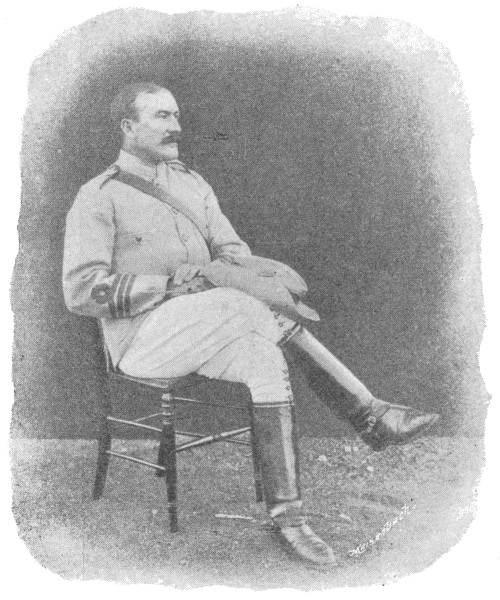
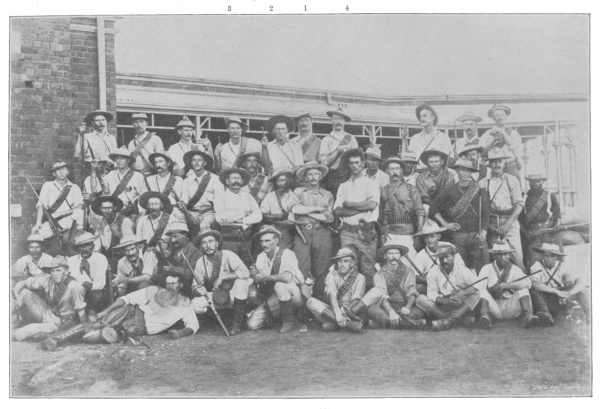
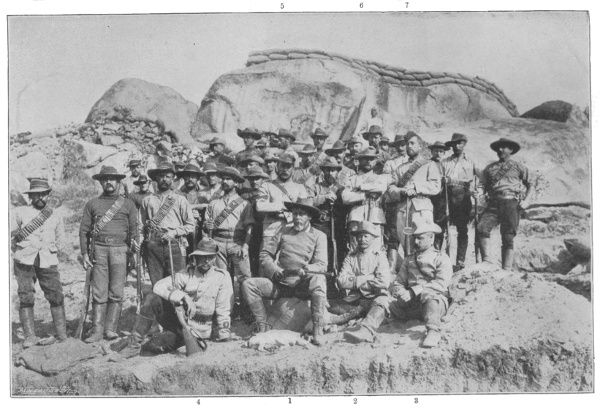
When the rebellion broke out, Commandant Van Rensberg
at once formed an Africander Corps, the great majority
of whose members were Boers, although it numbered in its
ranks a certain proportion of colonists of British blood,
and it is a matter of history that these Dutchmen under
Commandant Van Rensberg and Captains Van Niekerk and
Pittendrigh have done splendid service during the recent
insurrection in Matabeleland, and have fought side by side
with Grey's Scouts and Gifford's Horse, and all the other
troops of the Bulawayo Field Force, in a way which has won
for them the admiration and respect of their brothers in arms
and fellow-colonists of British blood; and that the mutual
esteem and good fellowship engendered between the two races
during the recent time of common peril may be fostered and
maintained in the coming years ought not only to be the
earnest desire of all thinking men, but should be also one of
the main objects constantly kept in view by the English
Administrator of these territories.
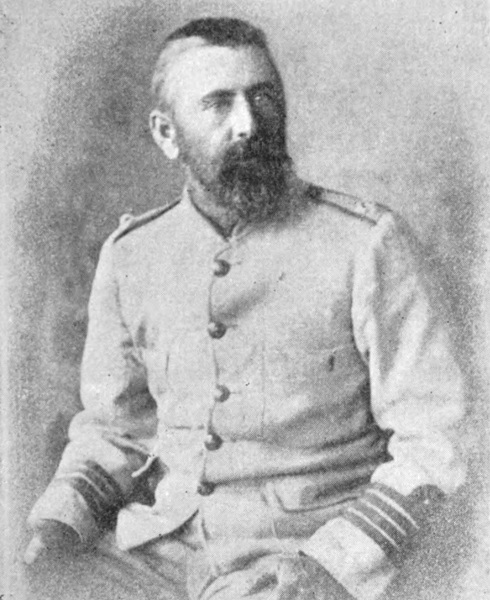
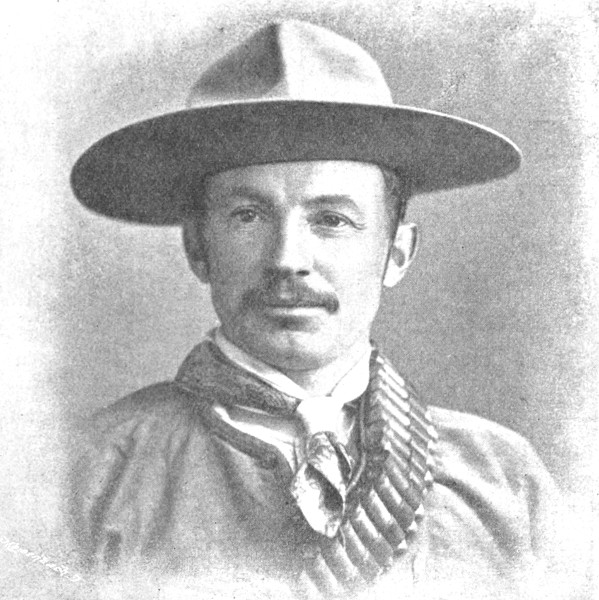
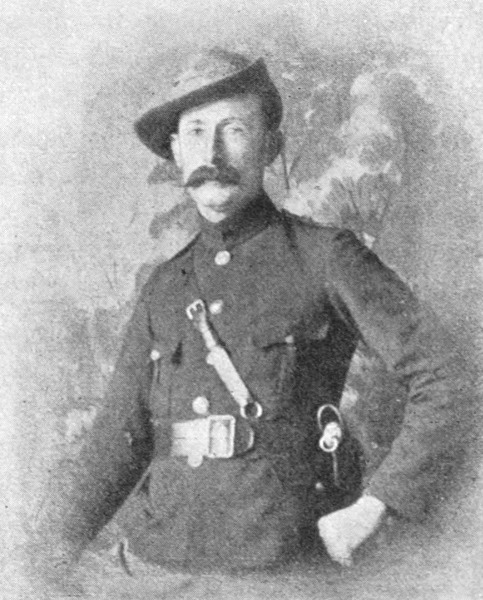
COMMANDANT VAN RENSBERG
who raised the Africander Corps of the Bulawayo Field Force.
Many years ago, at a time when the scheme for the colonisation
of the high and healthy plateaus lying between the
Limpopo and the Zambesi had not yet assumed definite shape
in the fertile brain of Mr. Cecil Rhodes, I remember writing
in the course of an article, published, I think, in the Fortnightly
Review, that those territories were in my opinion the natural
heritage of the British and Dutch colonists in the older
states of South Africa. My forecast was true enough, for
although in its first inception the colonisation of Rhodesia
was a purely British enterprise, yet to-day, in less than six
years from the date when the Union Jack was hoisted at
Fort Salisbury and the country proclaimed to be a province of
Britain, it already numbers amongst its inhabitants a very
considerable number of Dutch Boers, who form an element
of the population, which in all South African history has
been found indispensable for the gradual conversion of vast
uncultured wastes into civilised states.
Now I might, I think, have gone further, and said that the
whole of temperate South Africa (in which must be included
the high plateaus lying between the Limpopo and the Zambesi)
was the joint possession of the British and Dutch races;
for in all the states of that country, the old and the new
alike, we find the two races living side by side, whilst, curiously
enough, in the British province of the Cape Colony the
Dutch outnumber the British, and in the Boer State of the
Transvaal the British outnumber the Dutch.
Throughout South Africa the Dutch live away from the
towns on their farms, and, speaking generally, form the agricultural
and pastoral population of the country. They are
naturally a kindly, hospitable race; but as the inevitable
result of their surroundings and the circumstances in which
they have lived for generations, they are for the most part
very poorly educated, and therefore ignorant, unprogressive
and bigoted; whilst among the descendants of the "voor-trekkers,"
who some forty years ago abandoned their farms in
the Cape Colony and fled, with their wives and their children,
their flocks and their herds, into the unknown interior beyond
the great Orange River, in order to escape from what they
considered the injustice of British rule, there exists an ingrained
hatred and distrust, not of the individual Englishman,
but of the government of the country under whose flag they
believe their fathers suffered wrong, and it is this sentiment
which at the present moment, unfortunately, is being used as
a political lever, which threatens nothing but disaster to the
whole of South Africa, by the anti-British, but non-Boer
adventurers, who are fighting for their own hands in Pretoria.
The recent deplorable invasion of Transvaal territory by a
British force in defiance of all international law, to accomplish
I still fail to understand what, has naturally exasperated
the Dutch of the Transvaal, and caused them to look
upon everything British with more distrust and suspicion than
ever; but the history of that disastrous expedition, evoking
as it did the most intense national sentiment, not only
amongst the Boers of the Transvaal, but also in a somewhat
milder degree perhaps, though still in a most pronounced
manner, amongst their compatriots in the Orange Free State,
coupled with the very notorious fact that in the exclusively
Dutch districts both of the Cape Colony and Natal a very
strong anti-British feeling was excited, must have convinced
even the most infatuated that a conflict between Dutchmen
and Englishmen, in whatever portion of South Africa it may
arise, will be but the prelude to a war between the two races
throughout every province from Cape Agulhas to the Zambesi—a
war which would retard the general progress of the country
for a generation, which would be infinitely disastrous to both
races engaged in the struggle, and yet could be beneficial to
neither, no matter which proved victorious.
In future let us hope that neither young military aspirants
to fame, who, being ignorant of everything concerning South
Africa, would yet climb their way to glory over the dead
bodies of British and Dutch South Africans with the most
light-hearted carelessness, just in the way of their professional
business, nor cold-hearted self-seeking foreign politicians,
who would use the ignorance and prejudice of the Boer to
assist them in gratifying their jealous hatred of England, will
be allowed to sway the councils of the statesmen, British
or Boer, on whose decree the fate of South Africa really
depends.
Not being a politician nor anything else but a wandering
Englishman with a taste for natural history and sport, it may
be held most presumptuous on my part to have written as I
have done; but yet I have the most profound conviction that
a war between the Boers and British in South Africa can
only be a calamity of incalculable dimensions to both races;
whilst the name of that statesman, whether Boer or Briton,
who should without just cause on the one hand "cry havoc
and let loose the dogs of war," or on the other compel the
slipping of such dogs by fatuous obstinacy, and a cynical
disregard for all the principles of enlightened government,
will be assuredly held in execration by unborn generations of
Boers and Britons alike. Neither race can get away from or
do away with the other, and therefore both must try and rub
off their mutual prejudices, and live harmoniously together.
This is not difficult in a new country like Rhodesia, where
the representatives of the two peoples are in the nature of
things thrown much together, and where there has always
been a good understanding between them, which has of late
been very much strengthened by the mutual assistance given
by each to the other during the recent troublous times; and
the fact that in these territories a very good understanding
prevails between the Dutch and British gives one reason to
hope that in time a similar state of things may be attained in
the Transvaal, although unfortunately in that State there
are several factors which militate against such a result being
speedily arrived at.
In the first place, the great mass of the European population
in the Transvaal, the greater part of which is British,
resides in one great city, where it leads its own life, and does
not come in contact with the Dutch farming population, of
which it knows neither the language nor the history, and
with whose modes of thought and manner of life it is
altogether out of sympathy; whilst, on the other hand, the
rough Boer, in too many cases, despises the ultra-civilised,
sharp-witted, faultlessly-dressed European, and does not
recognise that many amongst them are fine fellows and good
sportsmen, and are capable of throwing off their coats and
doing a day's work, hunting or fighting, with the roughest
Boer amongst them, should occasion serve.
And yet these mutual prejudices and misunderstandings
between the two peoples might easily be rubbed away if it
were not for the presence of an anti-British clique of Hollanders
and Germans in Pretoria, whose object it is to widen the
breach between the Boers and the British; and as many of
these men occupy official positions in the Government of the
country, and are therefore more in touch with the Boer
legislators than the citizens of Johannesburg can hope to be,
they have opportunities which they do not fail to use of
increasing the distrust and suspicion already existing between
the two races who alone have got to work out the destiny of
South Africa between them, and amongst whom they are
only meddlesome self-seeking interlopers.
All the various States of South Africa will no doubt be
united sooner or later under one flag, but I am beginning to
have my doubts as to what flag that will be. It is true that
at the present time there exists in South Africa a very large
British population of highly intelligent and energetic men,
who have been attracted to that country by the diamond
and gold fields. That population is constantly increasing,
but it is not one which settles on the land. It is rather a
population which has come to the country on a visit, in the
endeavour to make a fortune with which to retire to the old
country, and as the recent census taken in Johannesburg
has shown, it is for the most part composed of young men,
the greater number of whom are unmarried. Now I suppose
it is conceivable that a day may come, say in fifty, eighty or
a hundred years time, when all the treasures have been dug
up out of the South African earth; and should such a day
arrive, is it not also conceivable that the great mining populations
which have built the cities of Kimberley and
Johannesburg in what a few years ago was a sparsely-inhabited
wilderness, may dwindle down to comparatively
small proportions, leaving the Boer population, which during
all that time will have been increasing at a very rapid rate,
once more numerically very much in excess of the British?
It does not appear to me very probable that during the
present generation at least the Boers, either of the Transvaal
or the Orange Free State, are likely (except under compulsion,
which presupposes a deplorable war) to enter any confederacy
of South African States, on any terms whatever, under the
British flag; and therefore should the large British mining
population now existent in the country gradually vanish,
and the Boer population at the same time very much increase,
the eventful confederation may take place under some other
flag than the Union Jack. After all, as the Boers hold as
large a stake in land, if not in wealth, as the British in South
Africa, and as they were the first comers, and can lay claim
to having killed off as many natives, and generally prepared
as much country for occupation by white men, as the British,
I think they are entitled to some consideration in the matter
of the flag which is eventually to fly over the confederated
States of South Africa; and for my part I would rather see
a confederation take place under a compound flag, composed
of equal parts of the Union Jack and Dutch ensign, with a
bit of a French flag let in, to represent the Huguenots who,
on their first arrival in South Africa, formed one-sixth of the
entire white population of the country, and to whom the South
African Boers of to-day owe many of their most estimable
qualities, than have the country plunged into war in order to
enforce its acceptance of the Union Jack.
However, this flag question is a problem of the future,
and in the meantime it is the duty of all South Africans
who have the welfare of the country as a whole at heart to
do all they can to obliterate the remembrance of events galling
to the national pride either of Dutchmen or Englishmen, and
to endeavour to bring about once more a feeling of mutual
trust and confidence between the two races. The Dutch
must forget Slagter's Nek and Boomplaats, and the English
must learn to think no more of avenging the defeats of Laing's
Nek and Majuba Hill than they do of avenging the battles
lost by the British troops in America which culminated in
the surrender of Cornwallis and the declaration of American
independence.
Now there has been for some years past an association in
South Africa called the African Bond, which in some quarters
at least must be considered anti-British, since another association
called the Loyal Colonists' League has been inaugurated
to counteract its effects. This latter society, judging by some
speeches which have lately been made by some of its members,
is frankly anti-Dutch. Now, would it not be better, if, in
place of the latter society, whose object seems to be to
widen and accentuate the breach which, in the Transvaal at
least, is existent between the two races, an association should
be formed, which all clergymen of all denominations, including
ministers of the Dutch Reformed Church, should be invited to
join, whose object should be the gradual obliteration of race-hatred
and race-jealousy between the Dutch and British
throughout South Africa, by the promotion of knowledge
amongst the ignorant and prejudiced of both peoples?—for
that, after all, is what is most required in order to bring
about mutual respect and mutual forbearance, and enable every
member of every State in South Africa to work under equal
laws for the general prosperity of the whole country, a prosperity
which can never attain to full fruition until the Dutch
and British have attained to a political unity throughout
South Africa as complete as it is to-day in the Cape Colony.
And now, after this long digression upon matters South
African, and the expression of many opinions which, should
they be read at all, will possibly only excite ridicule, coupled
with a rebuke upon my presumption in wandering from the
fields of sport and natural history, where I may be at home,
into the arena of politics, where, it will be said, I certainly
am not, let me say a few words about the present position
and future prospects of Rhodesia.
Should the lists I have given at the end of my book be
glanced through, it will be seen that the number of the
settlers who were murdered in Matabeleland alone at the
outbreak of the native insurrection, added to those who have
since been killed and wounded in the subsequent fighting,
amounts to over 300, or more than ten per cent of the entire
white population of the country at the time of the outbreak of
the rebellion, a proportion, I think, which ought to be entirely
gratifying to even the most determined enemies of colonial expansion
in Africa, whilst it gives the lie direct to the statement
which has so frequently been made, that the settlers in
Matabeleland have run no greater risks in fighting with the
Matabele in order to put down the rebellion than would
be incurred by a sportsman engaged in shooting hares and
rabbits at home.
I do not expect that the publication of these lists will call
the blush of shame to the cheeks of those who have been so
eager to vilify their countrymen in Rhodesia, but I do hope that
it will arouse a feeling of indignation in the minds of many
who have hitherto been more or less led astray by these dishonest,
spiteful, and unpatriotic mentors, and at any rate they
must be sad reading to all but the most prejudiced. However,
the rebellion can now, I think, be considered as almost
at an end. The Kafirs have entirely failed in their attempt
to kill all the white men in Matabeleland, and to re-establish
themselves as an independent nation. To the west, north-west,
north, north-east, and east, the impis which four months
ago had formed a cordon round all those faces of Bulawayo
have one and all been driven from their positions, and have
now broken up into hundreds of little bands, living in the
forests with their wives and children. From all the information
one can gather, the vast majority of these people are
already suffering from want of food, as their cattle are all or
nearly all dead from rinderpest, and a large proportion of their
year's supply of grain has been taken possession of or
destroyed by the white men. Under these conditions they
cannot hold out much longer, and they would probably have
already come in to surrender were it not that on the one hand,
knowing the exasperation caused amongst the whites by the
crimes they have committed, they are afraid to throw themselves
on their mercy, and on the other they are kept from
doing so by their chiefs, who having been the ringleaders of
the rebellion, and fearing that in case of surrender their own
lives at least would be forfeited, are still doing all they can to
prevent their people from submitting.
In the Matopos, Mr. Cecil Rhodes and Mr. Johan Colenbrander
are at the present moment carrying on negotiations
with the insurgent chiefs, which may or may not end in peace.
Should no satisfactory arrangement be arrived at, and the
war be continued, the natives will be driven to desperation,
and it will not only require a much larger force than there is at
present in the country, but the expenditure of a vast amount of
money, and the loss of many valuable lives, before they can
be absolutely all killed or hunted out of the almost impregnable
fastnesses and hills honeycombed with caverns which
exist all over the large area of country known as the
Matopos.
Now I think that, in view of the enormous cost and great
loss of life that would be entailed by the decision to make no
terms with the natives, it would be better to accept their
submission on lines consistent with the future safety of the
country. The chiefs must stand their trial, but the lives of
all those who have had no part in the murder of white men,
women, and children, could be guaranteed. The whole
nation must of course be disarmed as completely as possible,
and the actual murderers of white people during the first
days of the rebellion must be shot or hanged. But should
these conditions be complied with, whilst at the same time a
large police force is maintained in the country, and the
native administration carried on in such a way that, although
the natives are treated with firmness, their grievances will
always be heard, and as far as possible remedied, I do not
think we need fear another rebellion.
Of course there are those who say that it is a great
mistake to hold any parley with them at all. Go on killing
them, they say, until the remnant crawl in on their hands and
knees and beg for mercy. Well, that end could only be
attained, as I have already said, at a cost of much money and
many lives; so I think that there are many here, who, some
for the sake of expediency and others for the sake of
humanity, would now wish to see this rebellion ended as
soon as possible, if it can be done in such a way as to ensure
the future safety of the settlers in the country. As soon as
the chiefs submit and their people are again located on the
lands from which they have been driven, I think there can be
no doubt that the country will, for the time being, be perfectly
safe for white men; for history has shown us that
when a Kafir tribe submits it does so absolutely for the
time being, and no murders of isolated individuals
are committed until the chiefs are ready for another insurrection.
It may of course be said that the Matabele have not yet
been thoroughly beaten, and that, having gained a good deal
of experience during the last five months, their idea in submitting
is to get in their next year's crops and then begin
again, on the principle of "reculer pour mieux sauter." But
is this at all probable? After the first war they were more
or less surprised into submission to the white men, the
greater part of them never having fought for their country at
all. Then they found that the shoe of the white man's rule
began to pinch, but they wore it for two years, and did not
attempt to throw it off until the country appeared to them to
have been left in an absolutely defenceless condition by their
conquerors.
They have now had their rebellion, and it has absolutely
failed, and they have lost at least twice as many men in the
recent fighting as they did in the first war. Nor is there any
longer a cattle question to excite their resentment, for the cattle
are all, or almost all, dead from the rinderpest. Therefore it
appears to me, that if they are disarmed as far as is possible,
and if a strong police force is maintained in the country for
the next few years, their submission can be safely accepted,
and the mass of the people be allowed to go unpunished; but
justice and common sense both demand that all who are
proved to have been implicated, either directly or indirectly,
in any of the murders which marked the outbreak of the
rebellion, shall be most summarily dealt with. They will be
gradually discovered, and some, it may be, may not be brought
to justice for years to come, but no mercy must be shown
them whenever or wherever they may be found.
In less than two years' time the railway now being pushed
on through the Bechuanaland Protectorate will have reached
Bulawayo; and if the natives can be kept quiet by a firm and
just rule until the advent of the iron horse in Matabeleland,
there is little fear of their ever again rising in rebellion
against the white man.
In the meantime the development of the country must
remain at a standstill, and the country retained as a British
possession, by an occupation which will be almost purely military,
as not only has the cost of living been rendered almost prohibitive
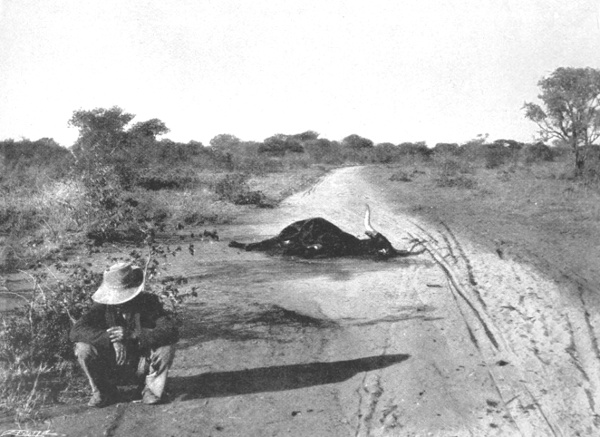
through the destruction of all the cattle in Matabeleland
and Bechuanaland by the rinderpest, and the consequent
substitution of mules and donkeys in the place of oxen for
draught purposes, but farming also has been rendered very
difficult, as, putting aside stock and dairy farming, no ploughing
can be done without oxen, nor can agricultural produce
be carried to market without the assistance of those useful
animals, for salted and acclimatised horses and mules are too
scarce and expensive to be reckoned on for farm work. The
rinderpest, therefore, has for the present put an end to all
European enterprise in the way of mining and farming in
Matabeleland.
People in England can only realise the disastrous effect
which this dread disease has had on the prosperity of the
country by endeavouring to picture to themselves what the
consequences would have been had a disease suddenly made
its appearance in Great Britain in the early part of the
present century, before the introduction of railways, which
destroyed ninety-nine per cent of all the horses in the British
Isles; yet even that would scarcely represent the extent of
the calamity from the effects of which we are now suffering,
when it is considered what an immense tract of barren
wilderness yet lies between Matabeleland and the nearest
railway station.
In the early part of this year there were over 100,000
head of cattle, all sleek and in excellent condition, in Matabeleland,
but when it closes, I think it very doubtful if 500
will be still left alive in the whole country. Even this loss
is small as compared with that sustained by Khama and
his people, who were the largest cattle-holders in South
Africa, and whose loss it has been computed, from reliable
data, exceeds 800,000 head of horned cattle.
However, the rinderpest is a calamity which is not likely
to occur again, but which, when it does occur, sweeps everything
before it both in Europe and Africa. That Matabeleland
as a whole is a country second to none in South Africa for
cattle-breeding is the opinion of everyone who has lived there
for any length of time and had the opportunity of studying
the matter. When, therefore, the rinderpest has died out,
and the railway has reached Bulawayo, the country will be
gradually restocked; and then, too, mining machinery will be
imported, and our mines will at last be worked with a result
which will give the final death-blow to all those who have for
the last six years been engaged in disseminating falsehoods
concerning Rhodesia.
From the statistics supplied to me by the Compensation
Board, which I have given in the form of an appendix, it will
be seen that a good deal of farming work had already been
done at the time of the outbreak of the rebellion, and that the
population of Matabeleland were not all "gin-sellers" or
"men who had gone out to Matabeleland in order to swindle
the British public, by inducing them to subscribe for shares
in worthless companies, whose so-called gold claims contained
no gold." The fact, too, that farmers and prospectors were
living all over the country in perfect health rather explodes
the theory of a noxious vapour rising to some four feet from
the ground which is so deadly to Europeans that all colonisation
of the country is impossible; but this, if I remember
aright, was the theory propounded by one of Mr. Labouchere's
"reliable" correspondents—a fit contributor, forsooth, to the
pages of Truth.
It is now known throughout South Africa that Matabeleland
and Mashunaland are white men's countries, where
Europeans can live and thrive and rear strong healthy
children; that they are magnificent countries for stock-breeding,
and that many portions of them will prove suitable
for Merino sheep and Angora goats; whilst agriculture and
fruit-growing can be carried on successfully almost everywhere
in a small way, and in certain districts, especially in
Mashunaland and Manica where there is a greater abundance
of water, on a fairly extensive scale.
As for the gold, there is every reason to believe that out
of the enormous number of reefs which are considered by their
owners to be payable properties some small proportion at
least will turn up trumps, and, should this proportion only
amount to two per cent, that will be quite sufficient to ensure
a big output of gold in the near future, which will in its turn
ensure the prosperity of the whole country.
Once let the railway reach Bulawayo, and given intelligent
legislation in the best interests of the settlers and miners in
the country, Rhodesia will soon prove its value to the
most sceptical; but the prosperity which I predict will, I am
afraid, be very much retarded, if not completely destroyed, by
the revocation at the present moment of the Charter which
was granted to the British South Africa Company in 1889,
and the substitution of Imperial rule for the present form of
Government. For this reason:—Under the present régime
the Company's administrator is always accessible to the
people living in the country, and whatever local reforms
may be deemed necessary by the latter are always capable
of discussion, and can be acceded to by him on the spot,
without despatches having first of all to be forwarded to the
High Commissioner at the Cape, by whom they would be sent
on to the Colonial Office, with the result that a local reform,
urgently required, might be delayed for months or never
granted at all.
Under the Company's government, too, the administrator
himself would always be a man acquainted with the history
of the territories he was governing, and would be probably
one who not only had the prosperity of the country he was
governing deeply at heart, but who also would have a very
good idea as to how that prosperity was likely to be attained.
During the next few years, too, which will be a very critical
period in the history of Rhodesia, such an administrator
would always have the benefit of the advice of the man
through whose energy and genius the territories forming that
state have been secured for the British Empire. But should
this territory be converted into a Crown colony and governed
from Downing Street on hard-and-fast lines, some of them not
at all applicable to local requirements, with an administrator
very likely ignorant of his local surroundings, and possibly
out of sympathy with the settlers—Dutch and British—who
have made the country their home, nothing but disaster is to
be expected.
Surely the people who have stuck to Rhodesia through
good and evil times, and who, under the auspices of the
Chartered Company, have added a vast territory to the British
Empire and laid the foundations of what will soon be a
prosperous colony, which, given an intelligent and adaptable
form of government, will be able to pay its way, ought to
have some say in this matter, and not be transferred unwillingly
to a rule which they know would be ill suited to local
requirements, and under which local enterprises would surely
languish for want of the fostering care which only a local
administrator can provide.
The white population of Rhodesia have had many a growl
at the government of the Chartered Company, but in most
cases they have got what they growled for—to wit, the extension
of the railways, both from the Cape Colony and the
East Coast; the reduction of the Company's percentage of
interest in the mines; and full and most generous compensation,
where the claims were just, for cattle destroyed in
the endeavour to stay the progress of the rinderpest, and for
all losses sustained owing to the late native insurrection.
Under Imperial rule they know that no compensation has
ever been granted for losses sustained through a native
rebellion, and they also know that little or no assistance
could be hoped for in the construction of railways or other
public works. Recognising all these things, having as an
object-lesson just before their eyes the wretchedly slow
progress made in Bechuanaland under the Imperial administration,
and knowing, moreover, that the Transvaal war of
1880-81, if not the loss of the Transvaal itself as a British
possession, was brought about solely by a Government from
Downing Street, through an administrator entirely ignorant
of local requirements and absolutely out of sympathy with
the people he was chosen to govern, can it be wondered at
that at a recent meeting of the Chamber of Commerce in this
town, the people of Bulawayo expressed confidence in the
government of the Chartered Company and in Mr. Cecil
Rhodes, representing as they do a corporation of capitalists
who hold the largest financial stake in the country, and whose
aims and objects are identical with those of the people living
in the country, whilst they resented the idea of being handed
over to Imperial rule without having their wishes in the
matter consulted, in order to please the Little Englander party
at home?
One of the most noteworthy features at the meeting to
which I have referred was the remarkable unanimity shown
by the British and Dutch on this subject, for the Dutch up
here believe in Mr. Rhodes, and have the most absolute
confidence in his ability to insure the prosperity of the
country. The natives, too, as has just been shown, look upon
him as their father; and I believe that through his influence
and the strength of his personality, a peace will soon be
arranged with them, which would have been impossible at
the present time but for his presence in the country.
Bulawayo, 26th August 1896.
 will bring up a larger version of the image.