TROPICAL GROWTH
OF THE ENTHUSIASM OF ALL GROWING THINGS IN FLORIDA—OF PAW-PAWS AND
PROSPECTUSES AND PERFECT THIRTY-FOURS—OF FIENDS IN HUMAN SHAPE—AND OF
THE WATCHFULNESS OF THE NATIVES FOR INSULTS
Everything grows in Florida. That is to say, everything grows in Florida
that Florida people want to grow. That is Florida’s specialty: growing.
Occasionally a few things get out of hand and indulge in some
over-enthusiastic growing when Florida people wish that they wouldn’t;
but for the most part Florida is proud of the remarkable growths that
take place within her boundaries. This is particularly true of southern
Florida. The superlatives as well as the fish grow to surprising
proportions: so do the real-estate advertisements and the avocados. The
sun is larger and warmer than in other parts of America; and the
sky—unless the leading Florida authorities are mistaken in their
observations—is higher and bluer than elsewhere.
There are only three things that southern Florida has never made any
effort to grow. These are mountains, snow-storms and earthquakes. If
there were any particular reason for her to grow any of these things,
she could probably arrange to pump up a few square miles of ocean floor
and pile the sand up into a mountain that would look like a blood
relative—say a grandson—of Fujiyama; and she could unquestionably find
a way to raise artificial snow-storms that would make Oregon jealous,
and earthquakes that would shake out a person’s eye-teeth. Since there
isn’t any reason for them, she specializes on more useful things like
paw-paws and prospectuses and perfect thirty-four bathing-girls and
what-not, and secures some startling results.
Take Miami, for example. Before taking it, one should understand that
there is grave danger in taking any particular city in Florida to the
exclusion of any other city, because all the untaken cities immediately
feel slighted and begin to thirst for the heart’s blood of the one who
did the taking.
Each Florida city or resort is violently jealous of every other resort
or city. The residents of Palm Beach speak sneeringly of Miami as being
a bit plebeian. The residents of Miami speak compassionately of Palm
Beach, as young and pretty girls speak of decaying beauty. St.
Petersburg and Tampa and Miami have little of a favorable nature to say
concerning one another. They only unite to resist attacks from resorts
outside the state, or to say a few tart words about California.
Every little while some fiend in human shape prints a piece in a South
Carolina or North Carolina or Georgia paper falsely accusing a Florida
city of harboring a few cases of typhoid or scarlet fever, or of being
too chilly for winter bathing. Instantly the Florida people rise to
defend the state’s fair name; and the low, searing curses that are
hurled against the foul detractor are warm enough to singe a hog.
Every little while, too, Florida gets a chance to slip a knife into her
hated resort rival, California; and when the chance occurs, the air is
filled with a deadly swishing sound, due to the violence with which the
knife is inserted.
A snow-storm in California causes Florida newspapers to spread loud and
exultant head-lines entirely across their front pages, declaring
excitedly: NO LIVES LOST IN CALIFORNIA BLIZZARD. This is the negation of
news everywhere except in Florida; but Florida smacks her lips over it
with the keenest delight. She emphasizes the blizzard’s severity by
shrieking that no lives were lost, thus implying that hundreds—nay,
thousands—might have been lost save for the merest chance. She is so
anxious to have tourists realize that she is the queen of winter
resorts that she is overjoyed when another resort-state is cursed with a
phase of Nature that tends to discourage tourists.
There is another grave danger in taking any Florida city as an example.
The natives of Florida winter resorts are constantly on the qui vive for
slights and insults. They are so much on the qui vive in this respect
that there is scarcely room for any one else on it. They occupy
practically the entire qui vive.
OF HOTEL RATES—OF MOSQUITOES—AND OF THE OUTCRY AGAINST THE SHIPPING
BOARD FOR DARING TO MENTION EUROPE
One can never tell beforehand what statements, phrases, remarks, words
or inflections—or lack of these things—the staunch Floridans will
regard as slighting or insulting. Sometimes they become just as fretful
if you don’t say them as they do if you do say them.
There is the matter of hotel rates, for example: if you tell what they
are at the best hotels, all Florida reviles you for frightening tourists
away. If you tell what they are at the cheaper hotels, the owners and
officials of the best hotels curse you bitterly for representing Florida
as a cheap place. Evidently they want you to lie about the hotel rates;
but if you do, they will call you a liar.
Then there is the little matter of mosquitoes. Usually there are not
mosquitoes along the Florida coastline between the months of November
and March, inclusive, because the prevailing winds drive them inland.
Occasionally, however, the wind shifts or the atmosphere is unduly
affected by the hemisphere or something technical; and the tough,
leathery, muscular, hungry Florida mosquitoes are blown down to the
shore, where they sink their dagger-like beaks into the soft white flesh
of the northern tourists.
It is only occasionally, it should be understood, that such a
catastrophe occurs. Occasionally at Palm Beach one is told with hoarse
jeering laughter that there are mosquitoes at Miami; but when one gets
to Miami he finds no mosquitoes, and is told with cold emphasis that
there aren’t any in Miami—but that there are many of them at Palm
Beach. And so it goes. If one doesn’t mention the Palm Beach mosquitoes,
one runs the risk of being viewed with abhorrence by the Miami folk;
and if one doesn’t mention the Miami mosquitoes, one is apt to be
regarded with loathing by the Palm Beach boosters. And if one goes back
North and makes any mention whatever of mosquitoes in Florida, he is
more than likely to be enthusiastically damned by every Floridan as a
vile prevaricator.
Not long ago the Shipping Board in its advertisements emphasized the
delights of winter travel in Europe. Instantly the watchful Floridans
leaped to their feet with ear-piercing shrieks of protest. A government
bureau, they screamed, was taking the money of Florida taxpayers to
advertise winter attractions in competition with their own. The entire
state had never been so insulted in its life; and the wrathful cries
which went forth traveled all the way to Washington and knocked
unsightly chips from many of the capital’s ivory domes. As a result, the
Shipping Board promised to change its policy, and the touchy Floridans
became calmer—though it is difficult for the outsider to see how the
Shipping Board can advertise at all in the winter without entering into
competition with Florida. But you never can tell. You never can tell. It
is about as safe to write about Florida as it would be to kick
carelessly at the nubbins on a floating mine.
OF PALM TREES—OF VARIETIES OF FISH—AND OF FRUIT AND LIARS AND BARON
MUNCHAUSEN
Let us return to the matter of growth in southern Florida. Everything,
as has been said, grows there. There are twenty-nine varieties of palm
trees; and one can spend an entire week doing nothing but check up palm
trees. According to official count there are two hundred and
seventy-five different varieties of fish in southern Florida waters—or
there were toward the middle of last February. A new variety is
discovered every week. Unofficial counters say that there are more than
seven hundred varieties. The unofficial ones are probably nearer right
than the official ones. There are so many different varieties of fruit
that if one attempted to eat every variety in one day, he would
unquestionably burst with a loud majority report. A partial list of
fruits which are being successfully raised in Florida’s southernmost
county, provided by a man with a poor memory, contains avocado—or
alligator pear, custard apple, mammea apple, Jamaica apple, rose apple,
Bugamot, citron, banana, Barbadoes cherry, chermoyas, cecropia, Surinam
cherry, carissa, Jackfruit, lime, lemon, loquat, various sorts of
mangoes, fifty-seven different varieties of orange, a number of crosses
between oranges and other things, grapefruit, eggfruit, dates, olives,
monsterosa deliciosa, papaya, pomegranate, Japanese persimmon, sour sop,
sapote, sapodillo, strawberry, tomato. If a Floridan has plenty of time
at his disposal, he can think up twenty or thirty more fruits that are
fruiting constantly and energetically in southern Florida.
One of the unfortunate features of discussing southern Florida lies in
the fact that if one isn’t careful, his non-Florida or anti-Florida
hearers will suspect him of having taken money to advertise the state.
They will, in short, suspect him of exaggeration when he carelessly
mentions the ever-sunny skies and the perfect-thirty-four bathing girls
and the amazing growths. The whole subject is fraught with risks. Baron
Munchausen would never have been able to work up a reputation as a liar
in southern Florida, because his lies weren’t much more startling than
the things that happen there every day. But if the Baron had sandwiched
a few Florida facts among his lies and had tried them out on his
neighbors some evening after his second gallon of Dortmunder beer, they
would have slapped one another on the back and rolled around in their
chairs with tears of mirth pouring down their cheeks, and assured one
another between their spasmodic gasps and groans of merriment that there
never would be anybody in the world who would be able to tell such
downright ridiculous, preposterous, side-splitting, hair-raising lies as
the Baron.
OF MIAMI AND OF TROPICAL GROWTH—OF THE GROWING OF A SHINGLE INTO A
BUNGALOW—OF THE POPULATION OF MIAMI IN 1980—AND OF THE PRONUNCIATION
OF MIAMI
Take Miami, for example. In 1896 Miami consisted of two small dwellings
and a storehouse. Sometimes as many as ten Seminole Indians would be
seen in the vicinity of these buildings at one time, and the occupants
of the dwellings would scarcely be able to sleep that night because of
their excitement at seeing such a throng of people.
In 1910, Miami had a population of 5,471. In 1920 there were about
30,000 people living there. In 1922 there were 40,000. That’s the way
things go in Florida. Once let a thing get a foothold, and it grows so
rapidly that the general effect is more that of an explosion than a
growth.
Grass grows with such enthusiasm in Miami that one can’t merely plant
seed and let it grow. If one did that the grass would come in so thick
that it would choke itself. What one does is to plant the seed and then,
when the seed has sprouted, transplant the spears of grass so that
they’re six inches apart.
Tree culture is very simple. A small piece of wood the size of a
toothpick is stuck in moist sand. At the end of four years the toothpick
has grown into a hibiscus bush twenty feet high and twenty feet across.
The publisher of the leading Miami paper declares that in some sections
of the city the soil is so fertile that if a shingle is planted in it
before sun-up, it will grow into a fully equipped bungalow by nightfall.
Other fish stories will be taken up in another place.
Miami surges ahead so rapidly that none of its citizens dares to stand
still for a moment in order to watch it grow for fear that
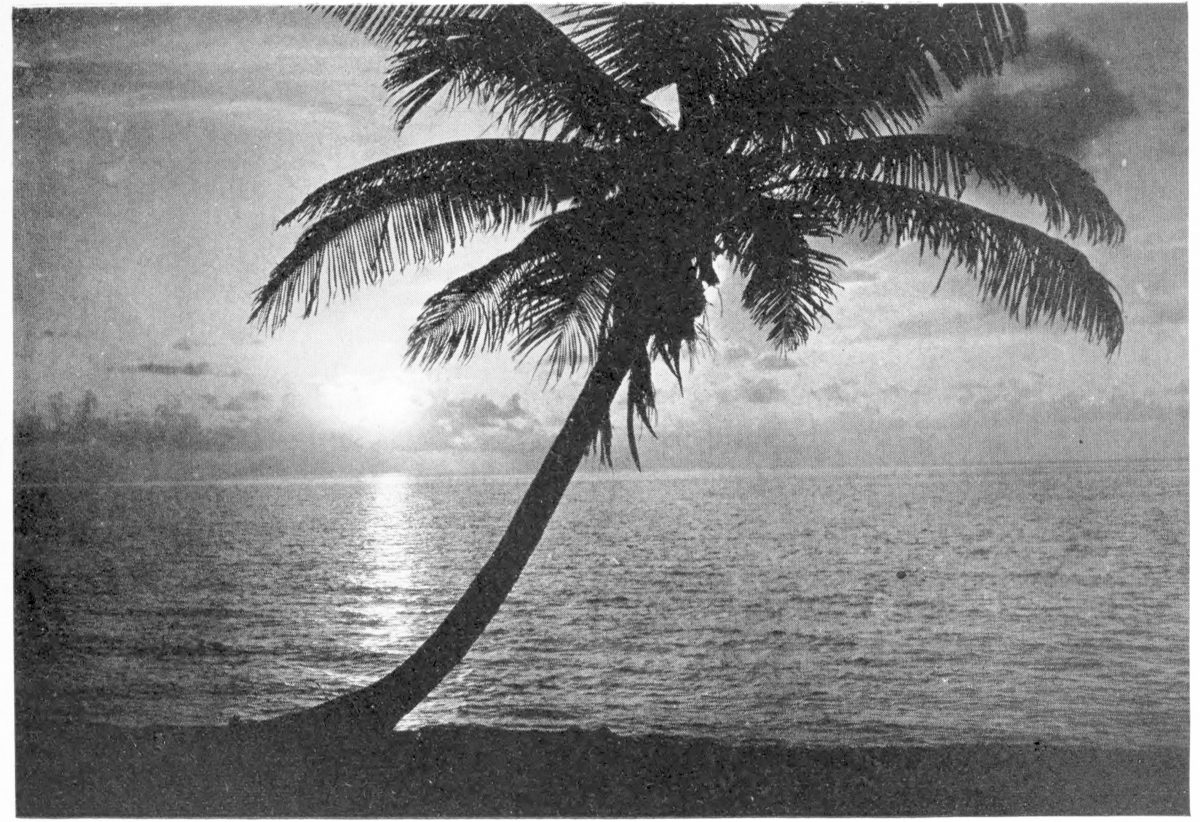
Photograph by F. A. Robinson
Scientists skilled in the use of the slide rule have estimated that up
to and including April 1, 1922, 1,672,889 kisses have been exchanged
beneath this tree.
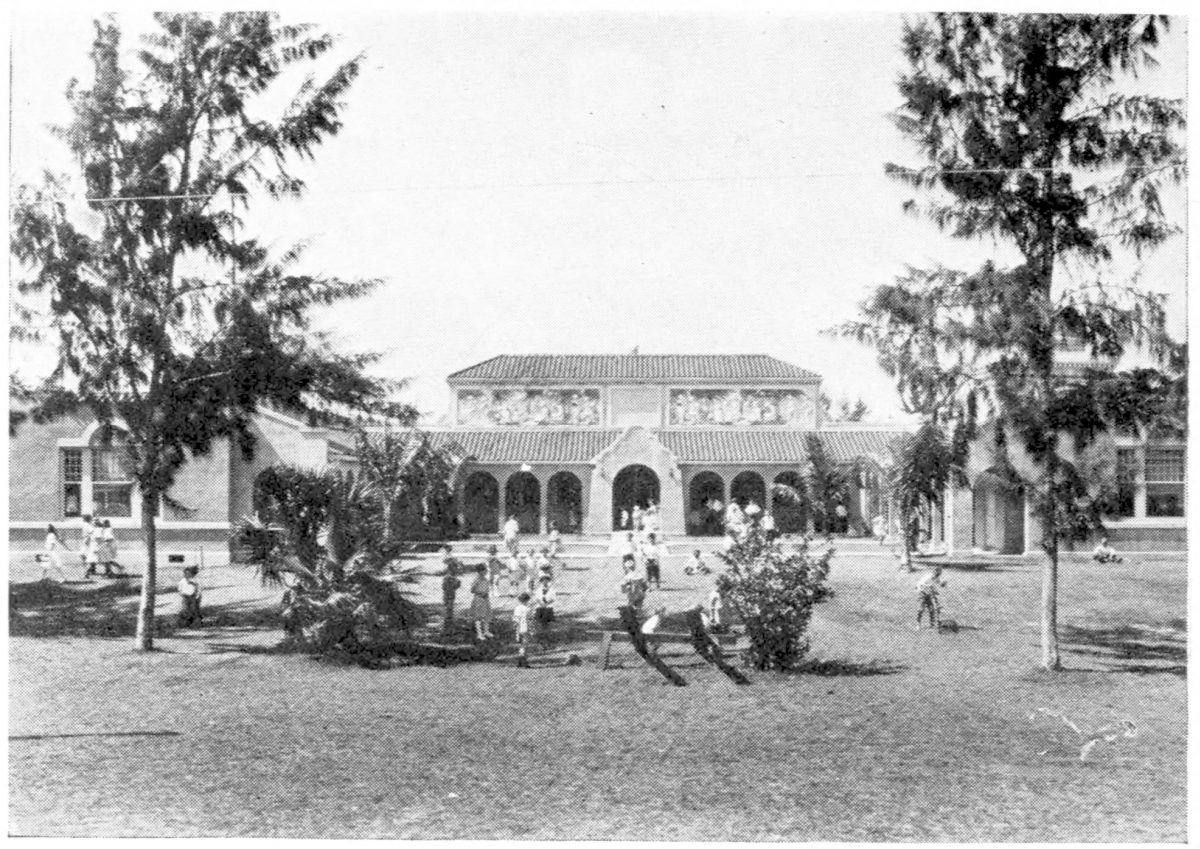
Photograph by W. A. Fishbaugh
One of Miami’s many beautiful public schools.
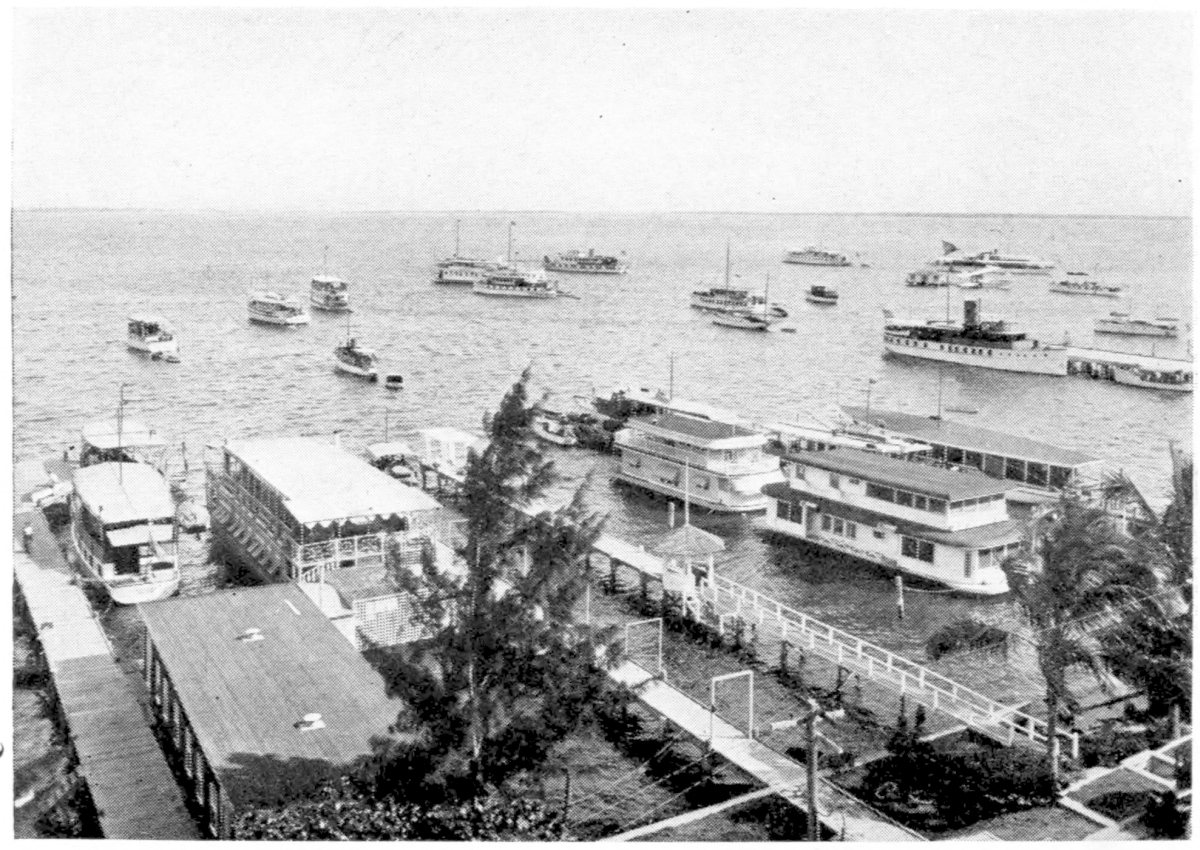
Photograph by W. A. Fishbaugh
Private yachts and house-boats tied up at the foot of Miami’s principal
shopping street.
he’ll be left so far behind that he’ll never catch up. If he makes a
prediction, he makes a running prediction; never a standing prediction.
If he sells a piece of land—and it’s as natural for a Miami citizen to
sell a piece of land as it is for him to have coffee for breakfast—he
is very likely to name a price that the land will reach to-morrow
instead of the price that it has reached to-day. He is always moving
ahead of the city.
The population of Miami has increased four hundred and forty per cent.
in the last ten years. Therefore the Miami people figure that it will
easily increase another four hundred and forty per cent. in the next ten
years. They claim that the city’s population in 1925 will be one hundred
thousand, and that in 1930 it will be two hundred thousand. Proceeding
at that rate, its population in 1950 will be five million; and by 1980
practically every one in North America will be pushing and crowding in
his effort to squeeze into the city.
It is, of course, quite obvious to the effete and blasé northerner that
the claims made by the Miami folk show that there are some screws loose
on their claimers. The Miami people, however, say that the northern
people don’t know how to adjust their views to a rapidly growing
city—that they stand still to look at it; and that while they are
looking, the city grows out of focus. They prove their theory by the
following anecdote:
A short time ago the telephone company sent down estimators to look at
Miami and estimate its population in another ten years, in order that
the company might be able to install the proper-sized telephone
switchboard. The estimators looked, made careful estimates, and reported
that the population would be one hundred thousand in ten years’ time.
The telephone company burst into loud howls of derision. “You’re crazy!”
it cried to the estimators. “Who ever told you that you could estimate?
Somebody must be paying you to boost the place! Get out of the way and
let us send down some regular estimators!” So the company sent down some
new estimators; and these estimators in turn looked over the ground and
did some careful estimating. They then returned and reported that the
population in ten years’ time would be one hundred and twenty thousand.
The telephone company, without more ado, installed a switchboard based
on that estimate. But the Miami people claim that the estimators were
making stationary estimates, and that the difference between the
estimates of the first and the second estimators was merely due to the
fact that the city had moved forward between their visits. If they had
known how to place themselves en rapport, so to speak, with the city
and move forward with it, both of them would have estimated that the
population would be two hundred thousand in ten years’ time.
At any rate, the real-estate operations in Miami—and the word Miami,
by the way, is pronounced My-amma by every one except the uncultured
folk who insist on pronouncing it as spelled—the real-estate operations
in Miami are on a scale that will provide building lots for twenty
million people by 1930.
OF REAL-ESTATE DEALERS—OF THE LARGE HANDSOME SALESMEN—OF NOISY
AUCTIONS—OF ABSOLUTE AND UNABSOLUTE AUCTIONS—AND OF PRICES FOR EVERY
POCKETBOOK
The exact number of real-estate dealers in Miami is not known.
Practically every one over eighteen years of age dabbles in real-estate
at one time or another. Almost every one owns a lot somewhere that he is
anxious to get rid of, although it is unanimously admitted by the owners
that every lot in Miami will double in value in a year’s time. Almost
every other doorway along Miami’s crowded streets shelters a real-estate
firm; and whole coveys of real-estate firms are frequently sheltered in
buildings that would be considered small by a family of three people.
Some of the firms keep impressive-looking salesmen standing just outside
of the building in which the firms do business. These salesmen are
large, handsome men for the most part, strikingly dressed in white
trousers, pearl gray sack coats, white shoes, white belts, white
neckties and straw hats tilted knowingly toward the right ear. If one
stops for a moment to admire a window display which shows automobiles,
diamonds and tax-exempt bonds sprouting from the super-fertile soil of
land that is on sale within at one thousand dollars an acre, one of the
salesmen is very apt to come up behind him and tempt him with honeyed
words. It is almost futile to struggle against these salesmen. Unless
one possesses an iron will, he will weakly permit himself to be coaxed
within the portals of the office, where he will spend the better part of
an hour looking at meaningless maps and hearing large sums of money
mentioned with the utmost carelessness and disrespect.
Other real-estate firms constantly carry on selling campaigns that
strongly resemble—in noise, at least—the return of the Twenty-seventh
Division from the War. They resort to brass bands, numbers of
sight-seeing automobiles, silver-tongued orators to cajole the crowd,
and advertisements that inflame the acquisitive spirit of every
beholder. When newcomers see a monster parade of automobiles, headed by
a blaring band, swinging through the streets of Miami, they usually
think, in their innocence, that a three-ring circus has come to town. As
a matter of fact, it is only the firm of Yammer & Yawp taking a mob of
prospects out to its daily auction sale of lots at Rubber Plant Park.
Skilled and expensive real-estate auctioneers are imported from
California and New York—auctioneers capable of selling refrigerating
machines to inhabitants of the Arctic Circle. People are lured to the
auctions by free lunches, by distribution of souvenirs, by the giving
away of automobiles. “We give away,” advertises one subdivision owner,
“a new Ford car each Monday or its equivalent in cash, and other
valuable gifts daily for the duration of the sale. And we will entertain
those who attend the sales with Any Amusements We Are Able To Provide.”
The exact meaning of the last phrase is shrouded in mystery, but it
makes its appeal to those who read between the lines.
“Remember,” shouts another firm, “Remember, We Are Giving Away
Absolutely Gratis a Sedan to the Person Holding the Lucky Number—Get
Your Free Ticket Now.” “Auction! Auction! Auction!” bawls another.
“Beautiful and useful souvenirs and prizes to be given away.” “Come ride
in our busses and win our free prizes,” coaxes another.
Early in 1922 the real-estate firms which disposed of their land by
auction were vociferating passionately that their auctions were bona
fide, that they were “legitimate and sound,” that they were “without
reserve,” that they were absolute. “Absolute auctions” was the
watchword of the hour. The inference was, of course, that a number of
auction sales had been held that were not absolute. “One Thousand
Dollars Reward,” stated one firm in a dignified but bean-spilling
manner, “will be paid for the proof of any buy-bidder at any of our
sales. The opportunity of opportunities to buy a piece of the richest
garden and fruit land in southern Florida. Remember, you make the price
and every lot put up will positively be sold to the highest and best
bidder without limit or reserve.”
This was what had been happening: Real-estate firms had advertised
auctions, put up lots for sale, and, when those in attendance languidly
refused to bid more than six or seven dollars for a lot, used
professional buyers to make phony bids in order either to run up the
price or get the lots off the market. It is possible that such a thing
will never happen again, now that real-estate firms have the habit of
advertising absolute auctions—possible, but scarcely probable. With
five or six auctions being held each day, and with large numbers of
unattractive lots being offered to stolid middle-westerners who have
come more for the free lunch and the automobile ride than for the
real-estate, it is inevitable that some lots will go for about one
dollar and seventy-five cents if everything is left in the hands of the
legitimate prospects. Common sense tells us that no real-estate dealer
could stand such a blow without emitting raucous shrieks of pain, no
matter how persuasively and convincingly he may chatter about absolute
auctions.
Some of the real-estate dealers allow customers to buy land on terms
that would attract even Trotsky, who doesn’t believe in that sort of
thing. Four-hundred-dollar lots in one subdivision can be had for twenty
dollars cash and ten dollars a month, with no interest or taxes for a
year. In another subdivision, one-thousand-two-hundred-and-fifty-dollar
lots sell for one hundred dollars cash and twenty-five dollars a month
until twenty per cent. of the principal has been paid, after which the
buyer can sink back and refrain from paying any more on his principal
for seven and a half years. A firm advertises island water-front lots at
five thousand seven hundred and fifty dollars a lot, the terms being
“seven hundred and fifty cash; balance five hundred every six months; no
interest first year; no taxes till spring 1925.”
OF SUBDIVISIONS, WISE AND OTHERWISE—OF LANDSCAPE ATROCITIES—OF SMALL
FARMS AND FARMERS—AND OF FASCINATING STRAWBERRY AND TOMATO STATISTICS
Subdivisions extend out of Miami in all directions—up the coast and
down the coast and inland and out into the bay in the shape of islands.
Palm Beach is seventy-five miles north of Miami; and there are almost
enough subdivisions along that seventy-five mile stretch to provide
homes for a million people.
Some of the subdivisions are beautiful and some of them are horrible.
Some have been thoroughly cleared of the tangled jungle of palmettos and
other scrub that makes a total mess of all undeveloped Florida land; and
flawless roads and pavements have been constructed, water mains put in,
and gas, water and electricity provided. Restrictions are imposed in
some of the good ones: homes costing less than four thousand can not be
built on certain lots, while on other lots they must cost at least
fifteen thousand.
Other subdivisions are laid out purely and simply, as the saying goes,
for the purpose of separating the sucker from his money. The streets are
half-laid, the location is vile, and the shacks that are run up on the
crowded lots are little better than the marshhuts of Revere Beach and
Coney Island to which poverty-stricken city dwellers of Boston and New
York frequently repaired during the heated terms of the early;
’eighties.
On top of these depressing spectacles, many of which may some day be
partly obscured in tropical verdure, certain enterprising citizens of
Miami have added to Florida’s scenic beauties by lining the roadsides
with blatant sign-boards setting forth the delights of garages,
restaurants, clothing emporia and similar enterprises. Not content with
building self-sustaining sign-boards which protrude gauntly and
repulsively from the flat landscape and convince the newcomer that he is
approaching a slum-city, they have nailed countless numbers of huge
yellow monstrosities to the palms and fruit-trees along the
highways—signs that have no influence on any one except the lover of
beauty, and which only serve to fill him with contempt for people who
can permit the few natural beauties of their surroundings to be so
befouled. In the North one expects to find—as he does find—a plague of
sign-boards, and hideous summer resorts whose predominant features are
those of the awful and tasteless ’eighties. In the new South, however,
which lures tourists with honeyed words and promises of every sort of
beauty, the erecting of roadside sign-boards should be viewed with as
much disgust and loathing as grapefruit-stealing or murder—both of
which crimes fall under somewhat the same head in Miami.
Spreading through and beyond the subdivisions are the orange and
grapefruit groves, and the truck gardens and vegetable farms. Oranges
and grapefruit are so common in southern Florida that grapefruit are
served free in many of the hotels; while many other hotels keep large
bowls of free oranges alongside the ice-water tank. So far as is known,
these are the only things that one has a chance of getting for nothing
in Florida hotels.
There are hundreds of three-acre and five-acre farms owned by
northerners who didn’t like winter, and ran away from it with one or two
thousand dollars in their pockets. Many of these little farmers not only
manage to make both ends meet, but even salt away comfortable bank
rolls. One little town near Miami shipped sixty-one thousand quarts of
strawberries to northern cities during the first six weeks of the 1922
season, and the growers’ share of the spoils was fifty cents a quart.
The wise strawberry farmers, who plant their land to velvet beans during
the summer and plow them under in September, and otherwise indulge in
the clever tricks of the trade, get some very snappy results. One of the
best strawberry farmers near Miami had four and one-tenth acres of land
planted to strawberries in 1921. His first berries came in on December
twentieth, and he picked twice a week until July fifteenth. The total
yield of his four and one-tenth acres was 41,059 quarts, his average
price for each quart was forty-five cents, and his gross sales amounted
to slightly over eighteen thousand five hundred dollars. His total
expenses were a little over six thousand dollars.
More than eight thousand acres are planted to tomatoes in the vicinity
of Miami, and nearly five hundred thousand crates were shipped north
during the 1921 season. These tomatoes bring the growers about three
dollars a crate, of which about a dollar and seventy-five cents must be
charged off to fertilizer, labor, hauling and crating. The life of a
tomato farmer is not a happy one, for the crop is very sensitive to wet
weather. It is also very sensitive to dry weather. The slightest nip of
frost also puts a severe crimp in it. Some of the tomato farmers say
that the plant is so sensitive that if a man cusses or chews tobacco in
its vicinity, it will refuse to bear. In spite of all this, there are
plenty of tomato-lovers to plant tomatoes every winter, and some of them
have made fortunes out of this popular fruit—or vegetable.
OF THE SUSPICIOUS STORIES CONCERNING THE MANGO—OF THE PET MANGO OF THE
MIAMIANS—AND OF ITS SUPERIORITY TO OTHER THINGS
The cupidity of farmers who are sick of northern winters is easily
aroused by prices obtained for the best varieties of mangoes. “Their
rich, spicy flavor, tempting fragrance and beautiful coloring,” say the
Miami prospecti, “make them one of the most tempting table desserts that
can be imagined.” Miami, it appears, has a monopoly on this fruit, and
the catalogues rub in the bad news by adding that “this monopoly is not
only confined to the cultivation, but also to the exquisite joy of
eating it, as very few find their way to the northern markets, the local
demand far exceeding the supply.” One reads that the choicest varieties
“readily sell in the northern markets for from one dollar to one dollar
and fifty cents each,” thus confirming the skeptical northerner in the
belief of the late P. T. Barnum that there was one born every minute.
The weak spot in this argument is not visible offhand to the doubting
Thomases from the North who spend the winter in Florida. The mango
ripens in summer—in June and July—so the winter visitors can not sink
their teeth in the widely advertised fruit. Consequently they always
feel sure that there is some good reason why the Florida people prefer
the exquisite joy of eating the mango to the even more exquisite joy of
shaking down their northern brothers for one dollar and fifty cents per
mango.
Strangely enough, there is no Ethiopian concealed anywhere in the mango
woodpile, although any one who aspires to become a mango-grower may have
his first fine enthusiasm dashed by the fact that mango trees don’t
begin bearing until five to seven years after they have been set out;
and seven years is a long time to wait, especially if one is hunting
for quick returns.
The mango in its finest form, however, is worth waiting seven years for.
The mango with which northerners are familiar is a small, mottled,
unhealthy-looking fruit about the size of a large lemon. The interior is
partly mushy and partly stringy, and it gets tangled up in the teeth in
a most annoying manner. The general effect obtained from dallying with
it is that the mango is a total loss. The pet mango of the Miamians is a
very different proposition. It is known as the Hayden mango, and is
about the size of a large coconut. When ripe it is rosy red all over,
and has the fragrance of a flower. It is a baffling fruit to open, as
its seed is about the size and shape of the cuttle-bone used as an aid
to canaries’ digestions. The unskilled mango eater will frequently wreck
an entire mango trying to worry it open gently; but he eventually learns
that one must wring its neck in a brutal manner to get the best
results.
The meat of the Hayden mango is sweeter than that of any other fruit I
know; and it has a peculiar and delicious taste and aroma of pine
forests. Years ago my grandfather, in the spring of the year, would go
prowling through the New Hampshire woods; and on his return he would
bring with him a lardpail full of the tender, slippery, fragrant inner
lining of the bark of pine trees, locally known as “slyver.” This was
always seized with delighted acclaim by the entire family and wolfed
down greedily because of its delicious piney taste. The Hayden mango has
the same piney taste raised to the thirty-third or master’s degree. One
Hayden mango makes an ample dessert for two people; and I have not found
that the Miamians are averse to selling them, or that the prices are as
high as the catalogues claim. Packages of six Hayden mangoes have been
sent to me repeatedly from Miami by parcel post at three dollars a half
dozen.
The Miami catalogues are a trifle wild when they start raving about the
exquisite joy of eating a mango that costs a dollar and a half; but if
one can get a good Hayden mango for half a dollar, it will probably
strike him as being considerably better than such ordinary matters as
oatmeal gruel, baked beans, suet pudding, griddle cakes, fried bananas,
bread pudding, or a poke in the eye with a pointed stick.
OF THE EVERGLADES AND OF THE TWO SEASONS OBTAINING IN THAT DAMP
LOCALITY—AND OF GRASS, FANCY AND OTHERWISE
Off to the west of Miami lie the Everglades, first made famous by the
Seminole War, when the United States Army spent upward of fifteen years
trying to chase the Seminoles out of the Everglades but seldom saw more
than three Seminoles at one time. The Everglades, not so long ago, was
an enormous shallow lake eight thousand square miles in area, dotted
with half-submerged islands out of which grew giant whiskered live oaks
and countless varieties of tropical plants. The alligator basked in its
shadowed streams; and the graceful panther lurked among the undergrowth,
constantly ready to emit a bloodcurdling scream calculated to make the
hardiest intruder think longingly of home and mother. Exploration was
made almost impossible by a saw-toothed grass which grew throughout the
Everglades and extended several feet above the water, so that the person
who tried to force his way through it would cut everything to shreds up
to and including his eyebrows. People talked for years of draining the
Everglades; but such talk was usually received with screams of laughter
that rivaled the yells of the Everglades panthers.
Several years ago the State of Florida settled down in earnest to the
systematic draining of the Everglades. Canals were cut, giant locks were
installed to control the water level, and the land was cleared.
Thousands of acres are being reclaimed each year, settlers are moving in
constantly, and the reclaimed land is yielding vegetables and fruits of
a size and quality to make a Maine farmer shake his head dubiously and
wonder whether that last batch of licker that the sheriff sent him had
affected his eyes. The soil is a rich black muck which has resulted
from centuries of decaying vegetation; and anything that will grow will
grow about twice as large and twice as rapidly in the Everglades as it
will anywhere else. There used to be only two seasons in the
Everglades—wet and wetter; but now there is a dry season; and in the
course of a few years, when the fruit-trees begin to bear, the
Everglades alone will be in a position to supply every northern city
throughout the winter with all the newfangled and oldfangled fruits and
vegetables that can be desired.
The thousands of farmers who have retired from active farming and are
occupying their winters by absorbing the sun in Miami and pitching
horseshoes in Royal Palm Park become fearfully excited over the various
varieties of grass that are raised in the Everglade lands. Grass is not
a thing that one would expect to mention at any length in a casual
dissertation on a winter resort; but the excessive wonderment over it
on the part of the horseshoe pitchers requires some mention of grass. It
appears that some of the grasses that have come in thick enough to get
themselves talked about are Para, Bermuda, Rhodes, Natal, Sudan, St.
Lucia, St. Augustine, Napier, Broom, sage, Guatemalan, panicum, crab
grass, maiden cane, Billion Dollar grass and several others. There seems
to be everything but just plain grass. The chief idea of the farmers
seems to be that with all this grass, the Florida stock raisers can have
evergreen pasturage, and cattle can be fed on about a third of the space
that they need in the North.
This, of course, is important if true; but the average person who comes
to Miami is not interested in grass except as something on which to play
golf or sit. What he wants is usually holiday relaxation and plenty of
it; and if that’s what he wants, he can get so much of it in and near
Miami that one week of complete relaxation must usually be followed by
two weeks of recuperation.
OF THE OLD MIAMI AND THE NEW MIAMI—OF DIFFERENCES BETWEEN MIAMI BEACH
AND PALM BEACH—OF THE SCENIC POSSIBILITIES IN FLOATING COCONUTS AND THE
ACTIVITIES OF JOHN S. COLLINS
The people who knew Miami prior to 1918 have in their minds an entirely
different place from the Miami of to-day. The old Miami was a city first
and a winter resort afterward. This statement will, of course, offend
the touchy Miami folk; but it is true none the less. It was—and is—a
hustling, bustling, booming, noisy city with about one automobile for
each seven-eighths of an inhabitant, and with perpetual warmth and
sunshine. In the long run, however, the big-money tourists don’t want to
go to a hustling, bustling, rapidly growing city for their winter
holidays, even though the city may boast perpetual warmth and sunshine.
What they want is clean air and plenty of sun and sky, and a complete
change from the scenery to which they are accustomed in their northern
cities, and a surcease from all noises except the noises they make
themselves—which are frequently much louder than the ordinary noises of
a city. For that reason Palm Beach was in a class by itself. The
big-money tourists went to Palm Beach. Miami got a smattering of them,
but a very small smattering. Palm Beach sneered at Miami Beach and
called it “the Coney Island of Florida.”
That, however, was prior to 1918. To-day Miami has been augmented by
Miami Beach; and eventually Miami Beach will nose out ahead of Palm
Beach and get all the youngsters and live wires who like to be on the
jump from eight in the morning until three and four and five o’clock the
next morning—with occasional busy evenings which will keep them up
until six or seven in the morning. Palm Beach folk still sneer
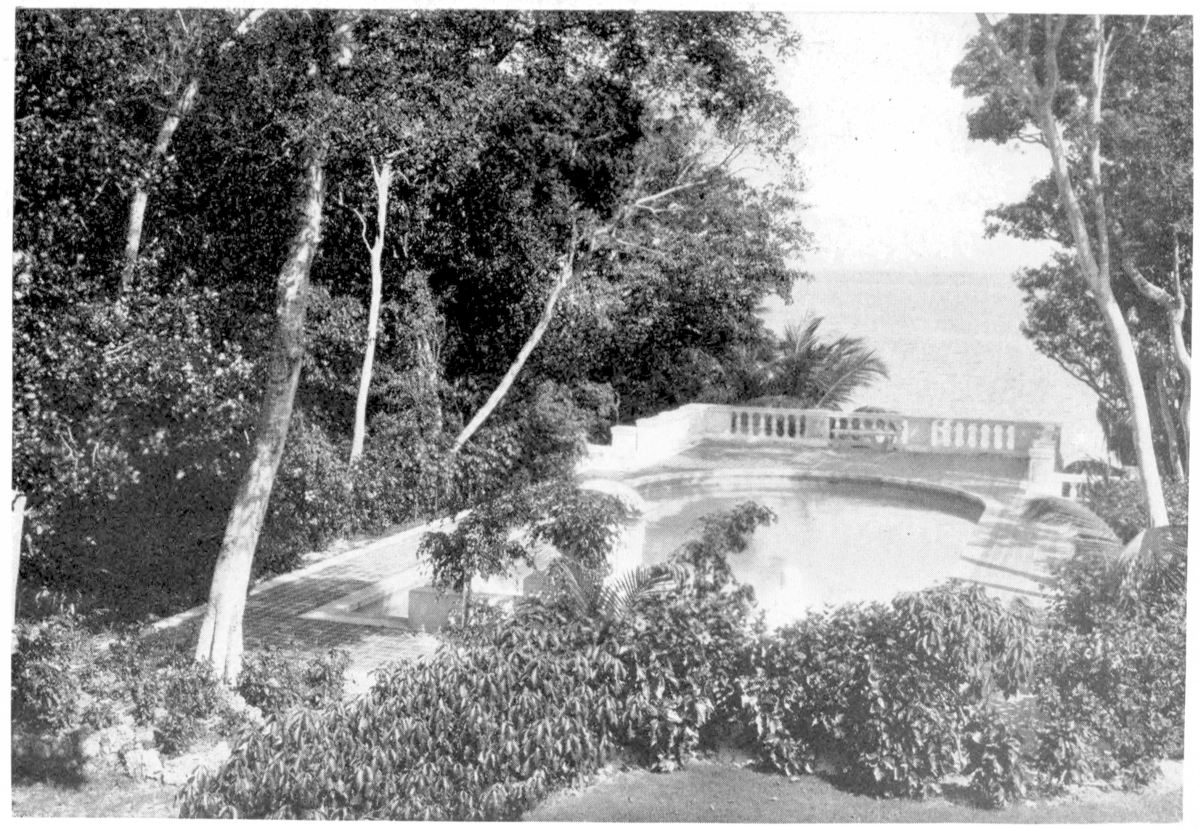
Photograph by F. A. Robinson
The outdoor swimming pool on a private estate in Miami.
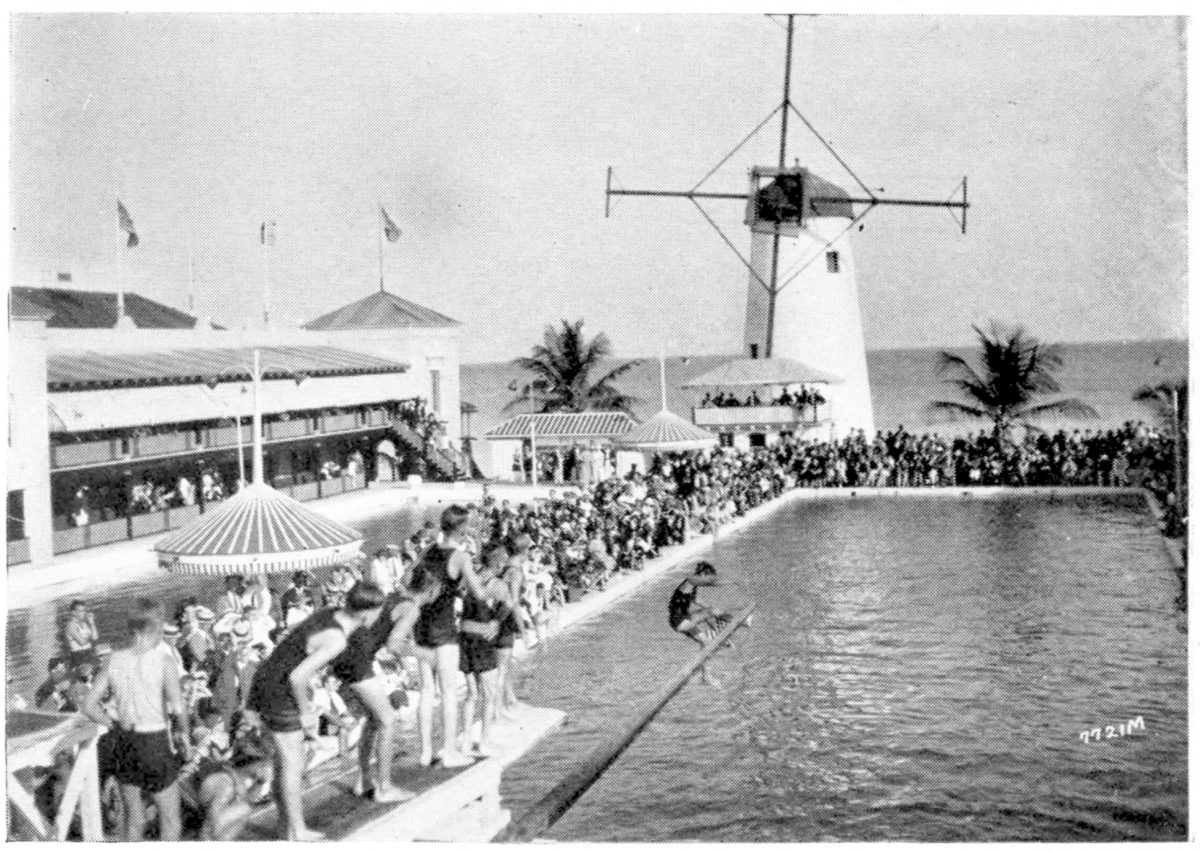
Any January morning at Miami Beach.
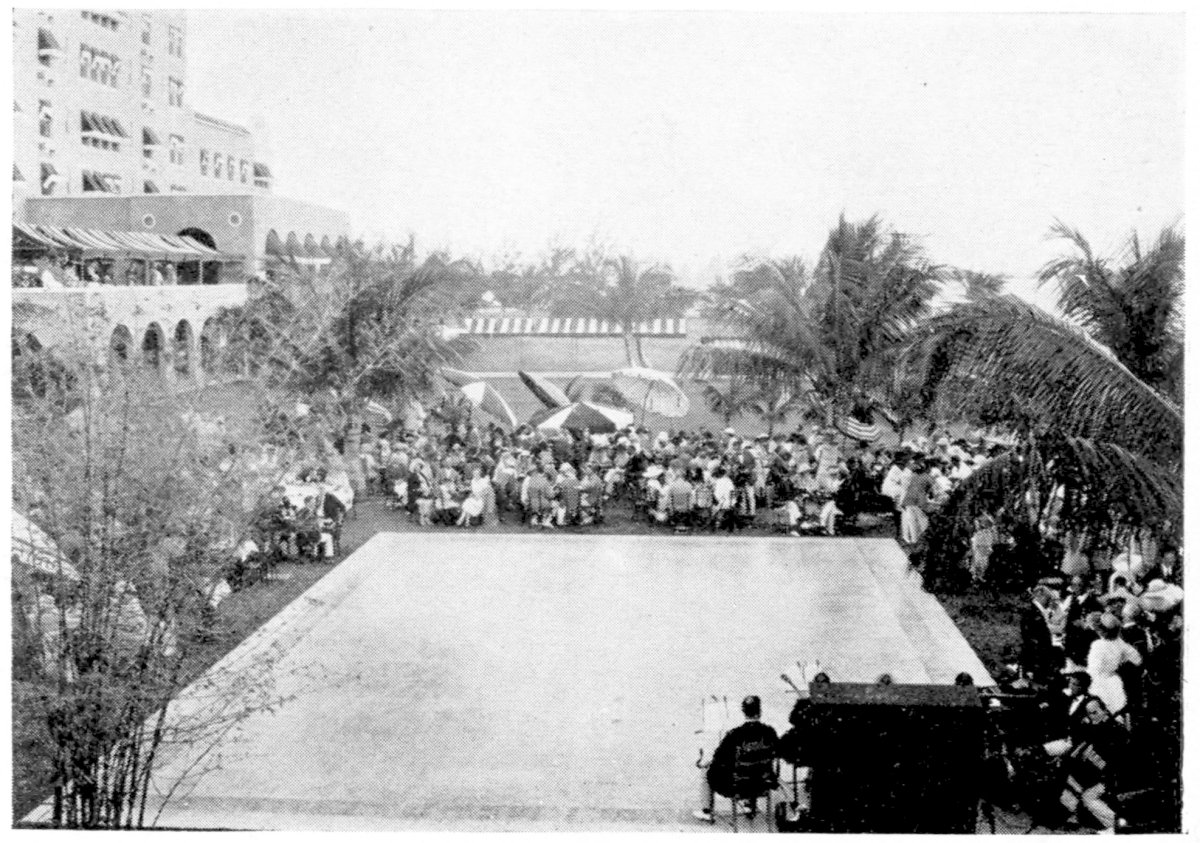
A January afternoon tea-dance on the shore of Biscayne
Bay.
at Miami Beach and still, according to their ancient custom, call it the
Coney Island of Florida. But it isn’t the Coney Island of Florida; and
Palm Beach is frightened for the first time in years—frightened that
the wealthy tourists will desert the endless corridors of her hotels and
the continuous clothes-changing and the eternal chatter and twaddle of
society and near-society and the lifeless air of Bradley’s Roulette
Emporium, and get down to Miami, where there’s something doing every
minute, and where people go into dinner in golf clothes without getting
a hard look from the head waiter.
The story of Miami Beach is a remarkable one and without it Miami would
scarcely be able to get out gaudy prospectuses with pictures of
beautifully shaped ladies in red one-piece bathing suits on the covers.
This is the way of it:
Miami’s palm-shaded streets run down to the shores of Biscayne Bay,
which is a strip of water some seven miles long and between two and
three miles wide. Between the bay and the ocean is a long narrow tongue
of land, not much over a mile in width at its widest point. Prior to
1913, ninety-nine per cent. of this narrow tongue of land was a
worthless jungle. The man who owned it is said to have bought it for
twelve thousand dollars. The only way of reaching it was by ferry boat,
and there was nothing on it in the line of a winter resort except a
bathing shack on the beach at the extreme tip, to which a few tourists
occasionally repaired when the urge for sea bathing became almost too
intense to be endured.
A persistent attempt had been made to utilize the natural advantages of
this narrow tongue of sand and jungle. In 1884 some New Jersey business
men essayed to plant coconuts on it in sufficient quantities to make the
venture profitable. There were no railroads, and it could only be
reached by boat. Three shiploads of coconuts were brought from the
island of Trinidad. The ships were anchored off the tongue of land; and
when the wind blew toward the shore, the coconuts were dumped overboard
to float to land. Three hundred and thirty-four thousand coconuts were
sent ashore by the promoters of this scheme. They cost five cents apiece
in Trinidad, and the freight figured up to six cents apiece. The venture
became so costly that the promoters hunted around for more capital and
succeeded in interesting a New Jersey fruit-grower named John S.
Collins. As a commercial proposition, the coconut planting was a
complete failure. But as a flyer in landscape architecture, it was a
great success; for the entire ocean-front of the tongue of land was
fringed with beautiful coconut palms.
The original coconut planters dropped out as their failure became
apparent. Collins and one other man hung on to their narrow and
apparently worthless piece of land. In the center of it was some high
ground on which Collins conceived the idea of starting a grove of
avocados, better known as alligator pears. The avocado shuns frost as an
Epworth Leaguer shuns cocktails; and since there is no frost worthy of
the name on the tongue of land because of its water-protection on both
sides, Collins figured that avocado culture could be made to pay. He was
right; and his avocado grove is now the largest in the world. The speed
with which he worked, however, didn’t meet the approval of his one
remaining partner; so Collins bought him out, becoming the sole owner of
the narrow sand-spit with the avocado grove down its backbone.
It then began to dawn on Collins, who was seventy-four years old and
therefore able to see a good many things that younger men overlooked,
that his sand-spit was a pleasant place on which to live during the
winter and summer too, but that he probably couldn’t persuade people to
live there until he made it possible for people to get there.
Consequently he conceived the idea of building a wooden bridge two and
one-half miles in length—the longest vehicle bridge in the
world—between Miami and the sand-spit.
The bridge was started in July, 1912; and, as has always been customary
in the early developments of Florida, his friends, attorneys and bankers
almost had heart-failure over his wild scheme. They prophesied
enthusiastically that in about two years’ time he would be standing at
the Miami end of his unfinished bridge, begging for nickels with which
to get a square meal. The population of Miami at that time was about
seven thousand five hundred.
At one time, late in 1912, the amateur prophets were looking gloomily at
Collins and saying proudly to each other: “Well, I told him so!” The
bridge was such a tremendous undertaking that the Collins money began to
pinch out; and no local talent could be found to advance any sum larger
than nine dollars on the chance of making a success out of the bridge or
the sand-spit.
OF THE ARRIVAL OF CARL FISHER IN MIAMI—OF FISHER’S FEVERISH IMAGINATION
AND VIOLENT DREAMS—OF THE DESPAIR OF FISHER’S FRIENDS—AND OF THE
EVOLUTION OF A JUNGLE
Early in 1913, a wealthy Indianapolis business man named Carl G. Fisher
came to Miami for his health. Fisher, from the days when he used to be a
news butcher on Indiana trains, was able to see the possibilities in
things which every one else regarded as impossibilities. He had always
plunged heavily on his beliefs while his friends and acquaintances stood
on the side-lines and told one another what a shame it was that Carl had
gone bugs. One of his plunges had been the big Indianapolis Speedway—a
gigantic structure which does all its business, pays its expenses and
makes its profits on one day out of the year.
Collins, unable to complete his bridge alone, went to Fisher and asked
him for assistance. Fisher, with his ever-present willingness to take a
chance, supplied Collins with the necessary funds to finish the job,
taking in return a large and unprepossessing slice of the long, narrow,
jungle-grown sand-spit that shut Miami off from the sea. He immediately
began to take a passionate interest in that desolate piece of real
estate. In his feverish mind’s eye he saw it covered with the greatest
winter resort of modern times—with acres of beautiful homes, and hotels
bowered in towering palms and scarlet-flowered hibiscus; with polo
fields and golf links and tennis courts and ice-rinks: with lagoons and
canals and artificial islands and Venetian gondolas: with casinos and
bath-houses and outdoor swimming pools that would outdo anything in
America or Europe.
He let himself go with the utmost enthusiasm, and kept his imagination
working on a twenty-two-hour day. His friends gave up all hope for him.
“Poor Fisher!” they murmured privately behind his back. “Poor Fisher has
gone completely loco. We must make arrangements to put him away
quietly.”
After he had dreamed a few of his more violent dreams, he went out to
the sand-spit to look it over more carefully and decide definitely where
to put a few of the hotels and casinos. Around its shores he found a
solid wall of mangroves whose interlaced roots rose several feet out of
the water in such a confused and slimy jumble that any appreciable
progress through them was a matter of hours. So he got a gang of twelve
negroes and set them to work hacking a hole all the way through this
jungle. Beyond the mangrove swamp was a solidly interlaced growth of
cabbage palms and palmettos through which no human being could force a
passage without tearing his clothes and his skin to shreds. The palm and
palmetto growth filled every part of his property except the
shores—and the shores were overgrown with mangroves.
Greatly cheered and stimulated by these obstacles, he promptly set to
work on his scheme to build, almost overnight, America’s greatest winter
resort. Starting at the extreme tip of the tongue, his gangs of laborers
cleared off the mangroves, cabbage palms, palmettos and other scrub.
They found bear in it, and panther and countless numbers of smaller
animals, and quail by the thousands. Then along the edges of the tongue
they built high cement bulkheads. As the bulkheads were finished,
dredgers pumped sand and water out of Biscayne Bay and inside the
bulkheads. The water ran off, but the sand remained and turned the
swamps and marshes into solid land. This work required dredging crews of
one hundred and fifty men, three pumping boats, two digging boats, from
ten to fifteen barges, five supply boats, two oil tugs, two anchor boats
and an eighteen-inch pipe line over a mile in length. For eight months
the pay roll was four thousand dollars a day, and Fisher’s friends daily
became more insistent that he be locked up where he could no longer
throw his money into the Atlantic Ocean.
Canals and inland waterways were dug so that future residents might have
easy access to all portions of the resort by yacht, house-boat and
motor-boat. Palms, hibiscus and tropical plants and vines slowly crept
along in the rear of the dredging operations. Fifty acres were turned
into polo fields. Three hundred and twenty-five acres were set aside for
golf courses. Three excellent golf courses were made, two at a cost of
two hundred thousand dollars apiece, and one at a cost of a quarter
million.
To-day, the tongue of land that was an impenetrable jungle in 1913 and a
waste of sand in 1917, has become the city of Miami Beach. Its value has
grown from twelve thousand to twenty million. There may be some to
question the latter figure; but the accessed value of Miami Beach
property in 1921 was $5,540,112; and unimproved property was being
assessed at one-quarter of its valuation, while improved property was
being assessed at one-tenth of its valuation. It has a frontage of six
miles on the ocean, seven miles on Biscayne Bay, and sixteen miles on
inland waterways and canals—though a Miami Beach enthusiast would no
more think of listing Miami Beach property in miles than a jeweler would
think of listing diamonds in quarts. It is too precious. He lists it in
feet, and tells you that the frontage on inland waterways is eighty-five
thousand feet. In a few years, if he progresses in the future as he has
in the past, he’ll probably be listing it in inches.
OF EXPENSIVE EXPENSES AND HEATED ICE-RINKS—OF LILY ON LILY THAT
O’ERPLACE THE SEA—AND OF THE BONEHEADEDNESS OF MOST OF THE HUMAN RACE
In 1913 Miami Beach was an impenetrable jungle on a sand-spit and a
swamp. In 1922 many a water-front lot was being sold for double the
price that was paid for the original jungle not so many years ago.
In place of the sand and the swamp and the jungle there are over forty
miles of street and roads, lined with palms and shrubs. Several hotels
have been built, the largest of which—the Flamingo—looks exactly like
a grain elevator and has the reputation of being the most expensive
winter resort hotel in the world. As a matter of fact, it is no more
expensive than the big Palm Beach hotels—although that is sufficiently
expensive to send the cold shivers up and down the spine of the person
who hasn’t become thoroughly hardened to money-spending. Two people can
have a nice room with bath and all the food they want—in reason—for
forty dollars a day. They can also have free oranges, which somehow
seems to remove some of the numbing pain from the impact of the bill
against the brain. There is no particular reason why it should, as one
can easily drown himself in the juice from a dollar’s worth of oranges.
There are a score and more of apartment-houses, and three hundred and
fifty private residences ranging from unconsciously simple little
ten-thousand-dollar bungalows up to artfully simple little
two-hundred-thousand-dollar cottages.
Within another six years, according to the more sane and conservative
Miami Beach predicters, there will be six or seven more hotels at Miami
Beach, all larger than the Flamingo. Fisher has another modest
caravansary planned which is to have an ice-rink, covered tennis courts
and a tanbark horse-show enclosure on the roof. Unless his friends lock
him up, he is sure to carry out his plans—which will probably be as
highly successful as his past ventures.
A few of his friends no longer fear for his sanity. His former business
partner in Indianapolis, James A. Allison, has even helped the good work
along by building and stocking at Miami Beach an aquarium that rivals
the great aquariums of Monaco, Naples, Honolulu and Manila. A great many
of his friends, however, still shake their heads pityingly when they
hear mention of hotels with ice-rinks on the roof.
The dredging operations which had transferred sand from the bottom of
Biscayne Bay to the top of Miami Beach had left several unsightly mud
banks protruding a few inches from the surface of the bay. Fisher
surrounded these mud banks with bulkheads and pumped more mud into
them. The result was seven beautiful islands, most of which are already
shaded by palm groves and dotted with simple but beautiful homes costing
about thirty dollars a square inch. They are easy of access, since they
are connected with the mainland or the causeway.
Some Miami people have likened these islands to lilies which o’erlace
the sea, after the fashion of Senator Lodge quoting from Browning in an
attempt to explain the islands of the Pacific to a concourse of
hard-boiled hearers; but Palm Beach folk, with that peculiar jealousy
evinced by the residents of one Florida resort toward everything in a
rival Florida resort, say that they look more like floating flapjacks.
The truth, of course, lies between; and when they are covered with
masses of tropical foliage, there will be nothing flapjackish about
them. One of the islands, together with an obelisk rising from its
center, was constructed as a memorial to Henry M. Flagler, without whose
vision and foresight Florida would probably only be known as the place
that Florida Water was named after. One of the largest islands has an
area of sixty acres. A mile of bulkhead, with bulkheading at twelve
dollars a foot, was necessary in its construction, and its total cost
was half a million dollars.
The inability of ninety per cent. of the human race to see how a thing
is going to look when finished has cost the human race a large amount of
money at Miami Beach. Not long ago, for example, an effort was made to
sell a new house for sixteen thousand dollars. It stood on new flat
land, however, and there were no trees or shrubs around it. Everybody
who saw it refused to buy it; so three thousand five hundred dollars was
spent in planting grass, palms and flowers and adding walks and a
boathouse. When this had been done, the house sold instantly for thirty
thousand dollars to one of the men who had refused to pay sixteen
thousand for it the preceding year.
OF ONE-PIECE AND TWO-FIFTHS-PIECE BATHING SUITS—OF THE HONORABLE
WILLIAM JENNINGS BRYAN AND HIS ACTIVITIES—OF BOOTLEGGERS—OF THE
SANCTIMONIOUS HAIG AND HAIG BOYS—AND OF RUM IN GENERAL.
Miami and Miami Beach are now connected by a curving concrete causeway
three and a half miles long. New and spacious as it is, it is often too
small to accommodate the thousands of automobiles that hasten out to
Miami Beach on hot Sunday afternoons in mid-winter in order that their
occupants may obtain an eyeful, as the saying goes of the bathing
crowds. The prudish element hasn’t yet been able to make its influence
felt at Miami Beach to any noticeable extent. The one-piece bathing suit
is heavily displayed by engaging young women, and there are also large
numbers of bathing suits which appear to be one-half-piece or even
two-fifths-piece. The latter variety of bathing suit is never worn with
stockings; for no stockings—so far as is known—have yet been made long
enough to reach to the hips. A striking effect is frequently obtained by
the wearers of these two-fifths-piece bathing suits when they stroll out
on the beach in short, hip-length capes which hang open negligently at
the throat. One sees nothing below the cape but several square yards of
flesh, and nothing above the cape but several square feet of flesh. It
is a sight that gives one pause. When one sees it for the first time, he
feels that he ought to hunt up a life-saver sometime later in the day
and ask him to go and speak to the young woman and tell her that she has
come out without her two-fifths-piece bathing suit. But one soon becomes
accustomed to seeing such things—so accustomed, in fact, that one feels
disappointed if he doesn’t see them.
The Honorable William Jennings Bryan
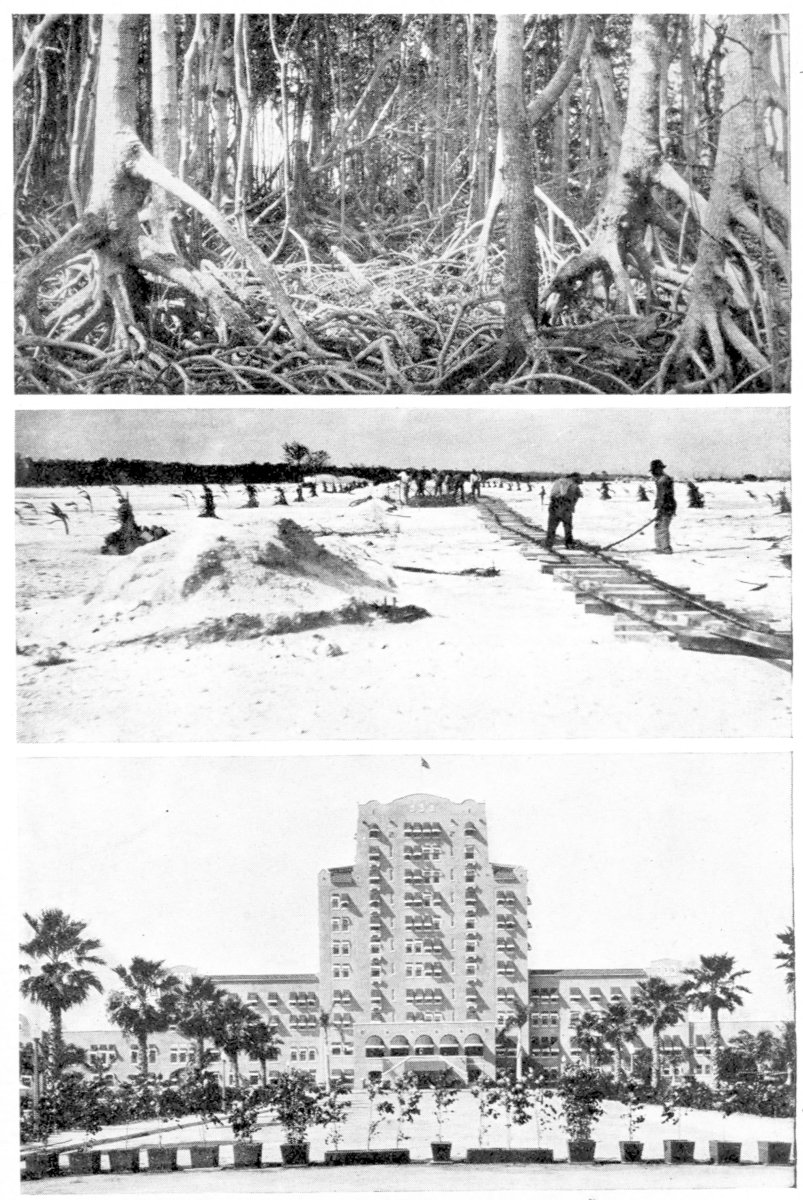
The site of the Flamingo Hotel, Miami Beach (at top) in
1912; (in middle) in 1917; and (at bottom) in 1922.
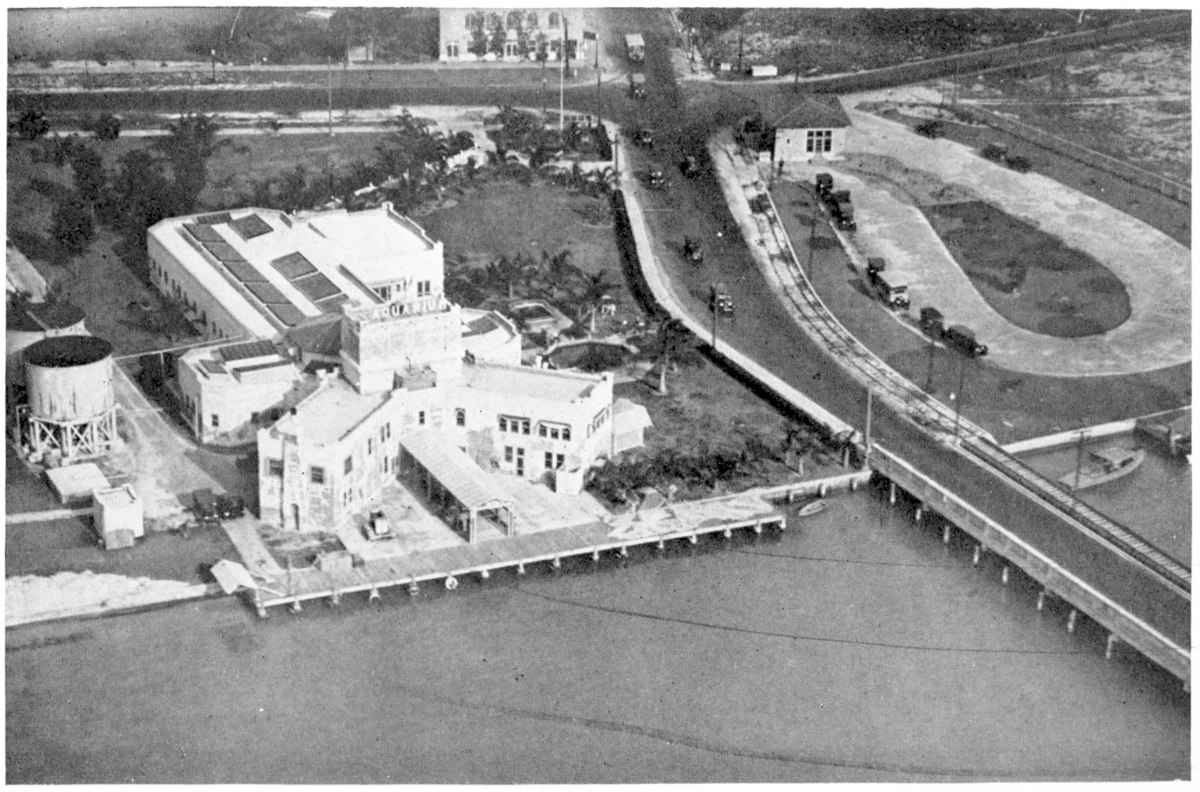
The Miami Beach Aquarium.
has a home in Miami, and was devoting most of his time during the winter
of 1922 to assuring his large and enthusiastic audiences that the
doctrine of evolution, hitherto accepted as proved by every reputable
scientist because of the overwhelming mass of supporting evidence, is no
more worthy of credence than the story of Cinderella and the little
Glass Slipper; that, in fact, it is as harmful to the young and
impressionable as an unexpurgated set of Burton’s Arabian Nights. The
citizens of Miami Beach were highly delighted with Mr. Bryan’s
anti-evolution activities—not because they have anything against
evolution, but because they like to see Mr. Bryan interested in
something that will keep him from trying to make his neighbors conform
to his ideas of right, and, by so doing, spoiling the bathing-hour. In
fact, a committee of Miami Beachers was thinking of waiting on Mr. Bryan
when he had finished shooting holes in Darwin, Huxley, Wallace, Herbert
Spencer and other distinguished scientists, and urging him to attack the
disgusting and contemptible theory that the earth is a globe or sphere,
and to come out strong for a flat earth.
There are no wheel-chairs in Miami Beach, as there are in Palm Beach.
The hotels tried to interest their guests in wheel-chairs, but the
guests would have none of them. They are successful at Palm Beach
because the Palm Beachers find them useful things in which to kill time.
But at Miami Beach one has no time for time-killing. There is something
doing every minute. There is golf and tennis and polo and bathing and
dancing and seeing the bootlegger, or rushing over to town to see a
movie or an orange grove or another bootlegger or something, and if one
tried to get around in a wheel-chair, he’d come down with nervous
prostration in a couple of days.
The bootleggers are very active in Miami; and the Miami bootlegger is a
very superior sort of bootlegger. He comes around to his patrons each
day with long lists of wet goods and the prices, and gives the names of
prominent bankers as references for his reliability. The prices seem
pleasingly low to northerners who have been paying one hundred and
twenty dollars a case for stuff that is only fit for cleaning the
nicotine out of pipe stems. The bootleggers get their wares in Bimini,
which is a small island only a few miles off the Florida coast. It is a
British island, but the British officials evidently haven’t any idea of
assisting the United States to enforce her laws. One of the leading
Scotch distillers stated contemptuously when I was in Scotland a little
over a year ago that it would allow none of its product to be sold to a
nation of hypocrites—meaning America. A good percentage of the stuff in
Bimini, however, is Haig & Haig, and it was the Haig & Haig people that
made the pleasant observation about the nation of hypocrites.
The past record of all distillers has proved conclusively that they
would sell to anybody that had the price—hypocrite, murderer,
wife-beater, degenerate or sot; and Haig & Haig are no better than the
rest of them.
All this Haig & Haig comes over to Florida, where it is not esteemed
very highly because it was apparently turned out of the distillery in a
hurry for the American trade. The Miami bootleggers recommend Lawson
Scotch to their friends rather than Haig & Haig; for they say that the
Haig & Haig is too green—whatever that means. The universal bootlegging
price for Scotch whisky in Miami is fifty dollars a case.[A] The
bootleggers buy it for twenty-four dollars a case in Bimini. The taxicab
men at the big hotels retail the stuff to the hotel guests at ten
dollars a bottle or one hundred and twenty dollars a case, which makes a
very nice profit for them. Gin can be bought—from the bootleggers, not
from the taxicab agents—for thirty dollars and forty dollars a case;
while the most expensive liquid refreshment is absinthe, which comes as
high as sixty-five dollars a case.
Tourists who plan to bring back a wee nip of Scotch with them from
Florida should be very careful to carry the bottles in their hand
luggage. Many trunks are opened on the way up, evidently by members of
the train crews, and all alcoholic stimulants carefully abstracted.
Nothing else is touched. A friend of mine took three metal hot-water
bottles to Florida with him so that he could bring Scotch back in them.
These bottles were encased in pretty pink flannel wrappers. He filled
them with Scotch as planned; but when he reached Washington again, he
found that his trunk had been opened and the bottles removed. The pink
flannel wrappers were left behind, and nothing else had been touched.
There seems to be an idea in the North that rum-running from Bimini and
Cuba to the Florida coast can be easily stopped by Prohibition agents.
This is a mistaken idea; for the rum-runner has several hundred miles of
uninhabited coastline and keys on which to land his cargo. It was among
these keys that the most notorious pirates of the early days concealed
their vessels and their treasure, and eluded pursuit for years. It would
be as easy to catch a rum-runner among the Florida keys as to locate a
red ant in the Hippodrome.
Any Prohibition enforcement agent that didn’t have lead in his shoes and
a daub of mud in both eyes, however, could easily get the goods on
twenty or thirty Miami bootleggers in a day.
One good result of comparatively cheap whisky in Miami is the apparently
total disappearance of beer-making and other home-brewing activities.
There seems to be no market for hops, malt, prunes, raisins or
wash-boilers—which would seem to make Miami an unusually healthy city
in which to live.
OF FLORIDA FISHING—OF THE TIGERISH BARRACUDA AND THE SURPRISED-LOOKING
DOLPHIN—OF THE UNCONVENTIONAL HABITS OF THE WHIP-RAY AND THE VARYING
ESTIMATES OF CAP’N CHARLEY THOMPSON—AND OF THE CONSERVATIVE RAVING OF
THE MIAMI PROSPECTUSES
The Florida keys drip down from the end of the peninsula on which Miami
beach is built, and would doubtless be compared by Senator Lodge or the
late Robert Browning to a necklace of jade and gold, or to mango on
mango that o’erlace the sea, or something similarly poetic. Among,
between and around these keys is found the greatest fishing in the
world. Florida fishing is about as much like the ordinary conception of
fishing as prize-fighting is like fox-trotting. Instead of sitting
contemplatively over a rod and reel with a pipe in his mouth and a
dreamy look in his eyes, and occasionally snaking a small fish out of
the water in a leisurely manner, the Florida fisherman crouches over
his rod with taut muscles and enters knock-down and drag-out fights with
bundles of concentrated energy that leave him as sore and limp and
blistered as though he had been wrestling with the Twentieth Century
Limited.
Speedy motor-boats slip away from Miami landing-stages and reach the
fishing grounds in an hour. Over the reefs, on whose rocky peaks lie the
skeletons of many an ancient wreck, wait the barracuda, sometimes known
as the tigers of the sea. They are long, slim, silvery fish, rather like
enormous pickerel, and their jaws are set with heavy dog-teeth. They
average between four and five feet in length; and as the fisherman sits
in the stern of a motor-boat with his bait spinning along thirty yards
astern, he can see the barracuda following, following along behind the
bait like a thin gray shadow. The barracuda is always there and always
hungry; so when all other game fish fail, the fishermen turn to him.
When he finally decides to take the bait, he takes it with such vigor
that the fisherman feels that a steamer trunk has fallen on the tip of
his rod. The rods are stiff as iron and the big reels have drags on them
that would stop a race-horse in a hundred yards; so the average
barracuda seldom fights more than ten minutes. All game fish, of course,
are caught by trolling from the back of a motor-boat traveling from six
to ten miles an hour.
Out a little farther toward the gulf stream are the golden dolphins,
thin and surprised-looking fish, much smaller than the barracuda, but
better fighters. There, too, is the husky amberjack, that fights for
twenty minutes and more in spite of the heavy drag on the reel. The
prettiest welter-weight fighter of the Florida waters is the sailfish, a
blue and silver torpedo, five and six and seven feet in length, with a
spear for a nose and a lateen sail for a dorsal fin. He is a finicky
striker; and when he is at the bait one feels only a slight jar. The
lightness of the touch usually means sailfish; and when it comes, the
fisherman releases his drag and lets his line run out fifteen or twenty
or even thirty feet. Then he snaps the drag back into place and hoists
his rod with a mighty heave without further inquiry. Frequently the
sailfish is at the end of the line, in which case the fun begins—the
sensation being about the same as holding a bucking bronco at the end of
a fifty-yard rope. If an amateur is holding the rod, the end of the
thirty or forty-five minute fight finds him calling in a weak and
trembling voice for a large drink of varnish or some similar
restorative, and he spends the remainder of the trip pricking and
caressing the blisters on his hands.
Farther out in the gulf stream are the kings of the heavy-weight
scrappers—tuna; while between the keys and the mainland are the giant
tarpon. These fish will fight for two, three and even four hours; and
if, in their leapings to shake the hooks from their mouths they chance
to fall in the boat, there is never any room for any one else.
The spectacles that one sees in these Florida waters are enough to make
Izaak Walton take the pledge.
During one day’s fishing which I had off the keys with President James
Allison of the Miami Aquarium and Cap’n Charley Thompson, champion
tarpon-tracker of Biscayne Bay, a whip-ray twenty feet from wing to wing
shot thirty feet into the air just ahead of our boat, falling back into
the water with a crash that must have been heard a mile in every
direction. Cap’n Thompson declared that this violent leaping was due to
the fact that the whip-ray frequently feeds on clams. When he has
gathered a bushel of clams into his stomach, he leaps high in the air
and descends on his stomach. The resultant crash breaks all the
clamshells and permits the ray to digest the clams. This doesn’t sound
exactly right, but one should be careful about disbelieving any of these
Florida stories. A little later a giant marlin or spear fish plunged out
of the water among our three lines when each line had a dolphin fighting
busily at its end. Cap’n Thompson estimated his weight at four hundred
pounds, but three hours later he was estimating it at seven hundred
pounds. At the end of the afternoon, when the lines were being reeled in
preparatory to starting home, an eight-foot shark surged up from nowhere
and removed my bait from beneath my hand. Fortunately, he removed the
hook with it, and a few minutes later he was lashed fast to the stern of
the boat, making a hurried trip back to Miami—where Director Louis
Mowbray of the Aquarium spent a happy hour removing pilot fish and
parasites from his nose and gills and tongue.
One can never tell what is going to turn up in Florida waters. The
prospectuses of both winter and summer resorts usually lay it on a
little too thick. The Miami prospectuses always sound very much too
much. Starting with the bathing-girls on the front cover and ending with
the proud fisherman on the back cover, they always look a little too
perfect. The phrasing, too, seems a trifle sappy and fat-headed. “It’s
June in Miami,” these prospectuses declare, “where winter is turned to
summer.” They seem to rave over-wildly. “Miami welcomes you with the
smile of the tropics,” rave these bits of passionate literature, “and
the warmth of the unclouded sun is instilled in the hospitality of the
greeting that awaits you here. Leave winter behind, fling care to the
icy winds, come to Miami and play at being eternally young again. Here
in Nature’s most alluring out-of-doors playground, under azure skies,
amid fronded palms and riotous flowers, with song of bird, balmy air,
and the benediction of glorious sunshine, find health, happiness and
contentment.”
It seems like raving before you’ve been there. But after you’ve been
there you recognize that the bathing girls and the fish are as
advertised. As for the prospectuses, they don’t seem so violent after
all. In fact, they seem pretty conservative.
THE END