BY
SOMERVILLE HASTINGS M.S.
AUTHOR OF “ALPINE PLANTS AT HOME,” SERIES I. AND II.
ILLUSTRATED BY REPRODUCTIONS
FROM DIRECT COLOUR PHOTOGRAPHS
BY THE AUTHOR
LONDON: J. M. DENT & SONS, Ltd.
NEW YORK: E. P. DUTTON & CO.
Preface
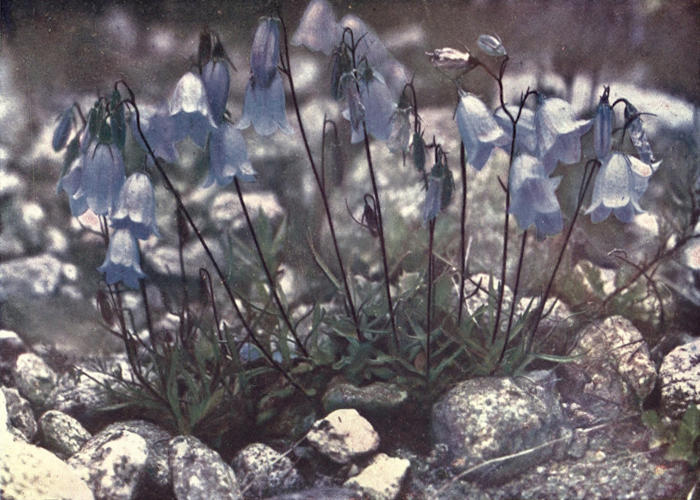
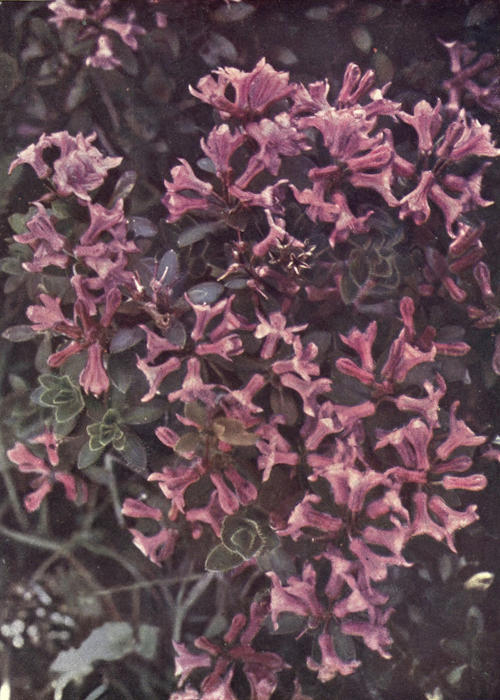
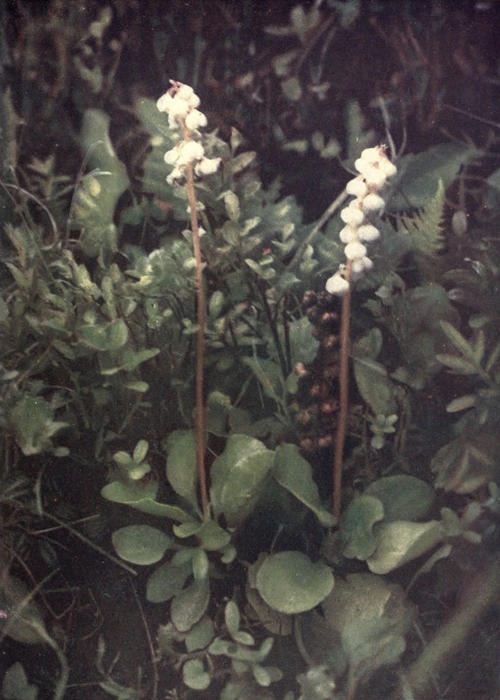
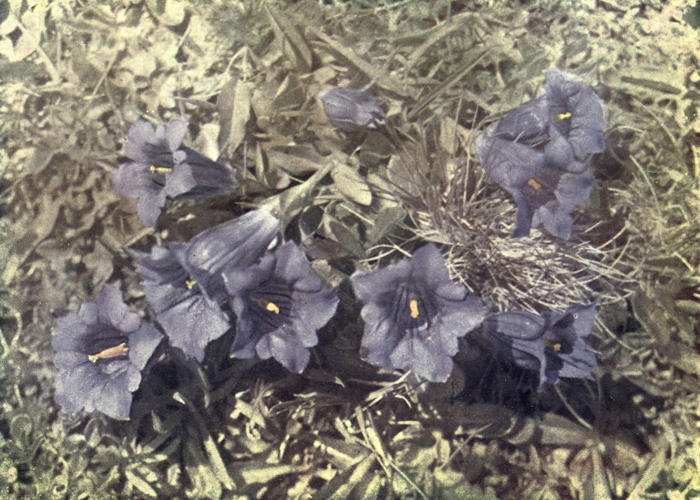
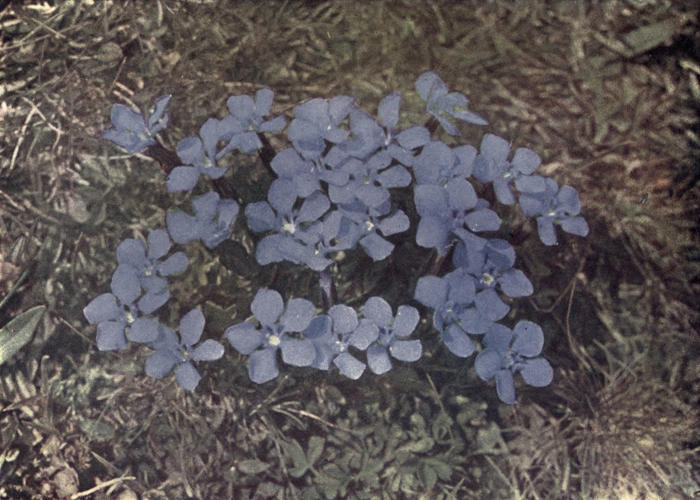
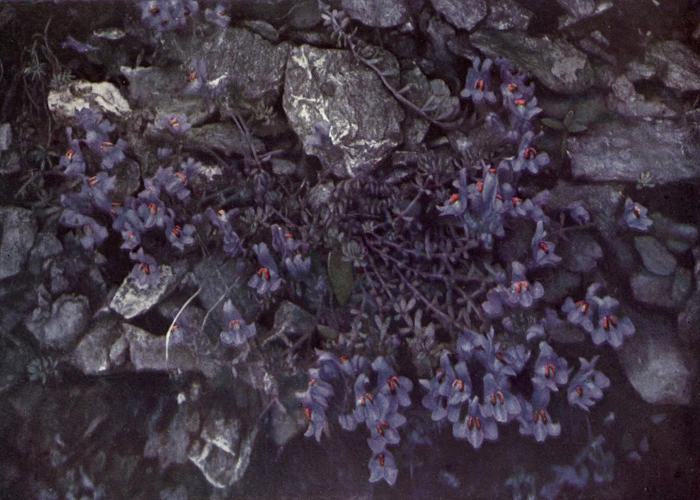
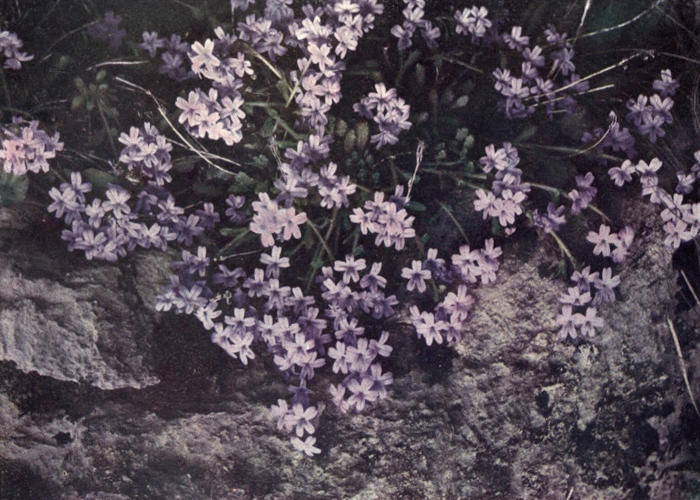
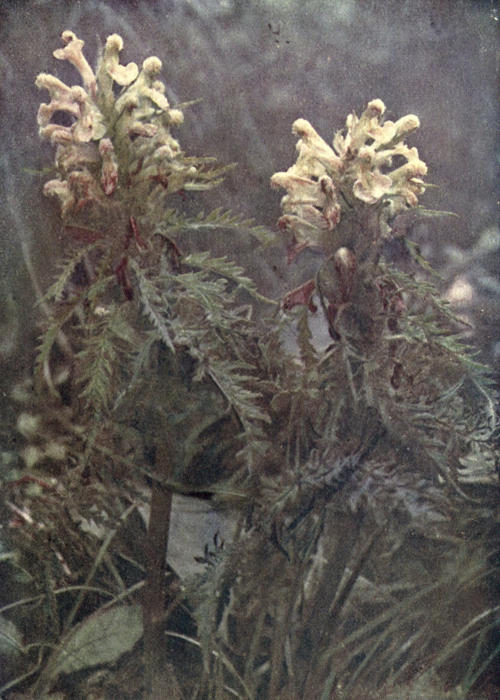
The coloured plates of Alpine plants, which are the special
feature of this book, are all reproduced from colour photographs
taken directly from nature. The plants were all
photographed exactly as they were found, with two exceptions,
in the immediate neighbourhood of Rosenlaui in the
Bernese Oberland during the month of July 1909; so that
the pictures are true portraits of the flowers “at home.”
The Lumière process of colour photography which was
used, depends on the action of light on a photographic plate
after its passage through various coloured starch grains.
The process is entirely beyond the control of the operator,
and the exact colours are automatically reproduced. These
photographs have in turn been carefully reproduced for this
work by the three colour process.
The flowers here photographed were selected as good
examples of common and typical species; and, of course,
they represent but a very small portion of the rich flora of
Switzerland. The present volume is intended as a short
introduction to the subject, for the fuller study of which the
following works are recommended:—
A. Gremli, “The Flora of Switzerland.” Translated
by Paitson.
A. W. Bennett, “The Flora of the Alps.”
G. Hoffmann, “Alpine Flora.” Translated by E. S.
Barton.
L. and C. Schröter, “Coloured Vade-mecum to the
Alpine Flora.”
C. Schröter, “Das Pflanzenleben der Alpen.”
F. E. Hulme, “Familiar Swiss Flowers.”
“Hints and Notes for Travellers in the Alps,” being the
General Introduction to Ball’s Alpine Guide.
They have all been freely referred to in the preparation
of the accompanying notes.
Wherever possible the common name of each plant in
English, French, and German has been given on the corresponding
plate. It is hoped that this may be of use to the
reader.
In conclusion I would like to thank the publishers for
the great trouble they have taken in the preparation of the
plates, and Mr Howard Farmer, of the Polytechnic School
of Photography, for much valuable advice.
No one can visit Switzerland for the first time without being
struck with the singular beauty of its wild flowers. In the
early summer the whole country from the lowland meadows
right up to the snowline is ablaze with beauty. Probably
in no other part of the world are the forms of the flowers
more pleasing and their colours more brilliant. Hence it is
that almost everyone who visits the Alps, however little
interest he may take in the wild flowers of his own home,
desires to know something of the wonderful new forms that
everywhere meet his gaze. Here the charm of novelty also
comes in, for at least half the flowers met with in the Alps
are absent from the plains, and many of the species that
occur in both situations have, as we shall see later, acquired
such different characters at high altitudes as to be with
difficulty at first sight recognised. Those who would see
Switzerland in all its beauty, and as far as its floral treasures
are concerned, at its best, must visit it in early June before
the hay is cut. Otherwise they will miss the glory of the
unmown meadows, and although many of the spring flowers,
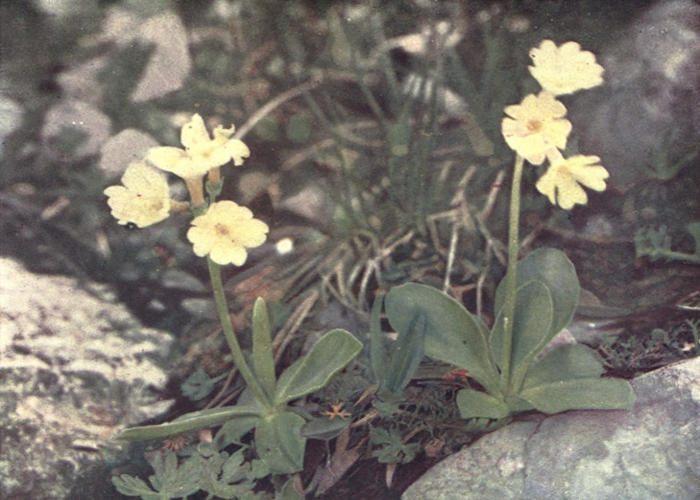
like the Crocuses and Primulas (Plate 35), may still be found
in small quantities at high altitudes even in July, the striking
effect of the large masses of these flowers will be entirely
wanting.
If we travel to Switzerland by the ordinary tourist route,
across Germany or France, and then ascend the mountain
peaks, we shall, in the first part of our journey, notice but
few differences in the vegetation from that to which we
are accustomed. The wild flowers of France and Germany
are very like those of the South of England and, except that
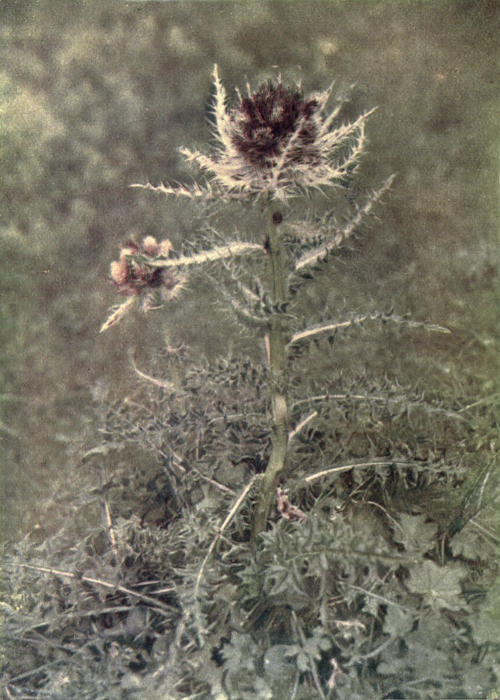
perhaps the yellow Fuller’s Thistle (Circium oloraceum) may
be seen in damp places near the railway, very little of
botanical interest will be observed until the customs are
passed and Switzerland itself is reached. Even here the
traveller may be for a time a little disappointed. The first
unfamiliar plant to be noticed will very likely be the Red-berried
Elder (Sambucus racemosa). A little later, in some
shady wood, the tall feathery Spiræa (Spiræa Aruncus), or
the beautiful little May-Lily (Maianthemum bifolium), may
be seen. Or a glimpse of the white-flowered Rampion
(Phyteuma spicatum) or the Alpine Honeysuckle (Lonicera
alpigena), with its twin red berries, may be had in passing.
But not until the mountains themselves are reached will the
tourist discover that he has entered into an entirely new plant
world.
The main factor which determines the character of the
flora of any given region in the Alps is its altitude. But we
must not forget that there are other things to be considered
beside the absolute height above the sea level, and the local
conditions of exposure to the sun and protection from the
cold winds are quite important factors. Generally speaking,
it may be said that the climate is a good deal milder on the
southern slopes of the Alps than in the north. Olives can
be grown in some of the lower mountain regions of the
south, and with them are found many of the plants of
Southern Europe and the Mediterranean region which are
never seen in places of the same altitude on the northern slopes.
It is exceedingly probable that most of the lower parts of the
Alps were originally covered to a large extent by forest
trees. The oak, ash, and beech still flourish in many parts,
although much of the original forest has been removed long
ago, and used for building purposes or as fuel, and large
areas have been thus cleared for meadow and pasture land.
In many districts the spruce and the pine appear to be
usurping the place of the other forest trees mainly because
the young plants are less eagerly devoured by browsing
animals, especially the goats. Below 4000 feet on the
northern slopes and 5000 feet or a little over on the south
side of the Alps may be described as the region of
forest trees, and above this level the ordinary deciduous
trees become dwarfed and scarce. That this altitude
corresponds fairly well with a transition to a colder climate
is seen by the change in the character of the herbaceous
plants also. For the next 2000 feet we have the subalpine
region covered mainly by Coniferous trees. Here are vast
forests, particularly of Spruce (Picea excelsa) and Silver Fir
(Abies pectinata). The former is the familiar “Christmas
tree,” which grows to a great height on the mountain sides,
its lower branches festooned with grey lichens. Besides
these trees the Larch (Larix Europæa) on primary rock, and
the Scotch Fir (Pinus sylvestris) and the Arolla (Pinus Cembra)
are also to be seen.
Above 6000 feet in the north and 7000 in the south the
Conifers become dwarfed and stunted, and gradually
disappear to give place to the alpine region. Sometimes
as we look along a valley the line of transition is seen to be
abrupt and straight, at other times irregular and undulating.
Bushes of Alpenrose, Juniper, and Alpine Willow extend
upward to the Alpine region, but larger trees are entirely
absent. Here are found in profusion the greater number of
the plants and flowers peculiar to the Alps. Many of the
species may of course be found in sheltered or secluded
spots at much lower levels, but here are to be seen in
abundance the bright-coloured Saxifrages, Gentians,
Anemones, and Pansies, which make the Alps their particular
home. Here are the alps or upland pasture grounds of the
Swiss, and here are situated the châlets or summer homes of
Swiss herdsmen. In June or July, when the pasture is
becoming scarce in the valleys and when all the snow is
melted on the mountain slopes, the native farmer packs a
large copper caldron and whatever else he may require for
making cheese into his bullock waggon, and accompanied by
his cattle, and often by his family as well, treks upward.
The “alps” may be two or three days’ journey from his
home, so that he must take with him all that he will
probably require for his two or three months’ stay.
The Alpine region extends from the upper tree limit to
the snowline, which may be taken as somewhere between
8000 and 9000 feet. Some of the most charming and
brightly coloured of Alpine plants like Eritrichium nanum
and the Cushion pinks (Plate 9) are to be found just below
the snowline. Even above this level flowering plants may
be met with, for even at the highest altitudes bare rock is to
be found from which the snow has been blown by the
wind or melted by the sun, or where the slope is too great
for more than a very thin covering to remain lodged. The
Glacier Crowfoot (Ranunculus glacialis), a pink-flowered
buttercup, has for example been found within a short
distance of the summit of the Finsteraarhorn, the highest
peak in the Bernese Oberland.
Just over two thousand different species of flowering
plants are to be found in Switzerland, and a little over half
of these are exclusively Alpine. In contrasting the flowers
of the Alps with those of our own country, it may be first
of all well to consider what we have that Switzerland has
not. Of course our seashore plants will be mainly absent,
but strange to say a few species of Thrift are here and
there found, and the yellow Horned Sea-poppy (Glaucium
luteum) even grows in the neighbourhood of Lake Neuchâtel.
We are so used to the bluebells of our woods, the purple
heather of our heaths, and the yellow gorse of our commons,
that we hardly realise how glorious they are. In Switzerland
the gorse is very rare, the bluebells are not found at all,
and the bell-heathers are absent though the ling is found
everywhere. Even the purple foxglove is replaced by a
yellow variety. These facts should be borne in mind, lest
a too unfavourable comparison be made with our own
rich flora.
But the flowers of the mountains are truly wonderful,
and it is their abundance as well as their bright colours
that make them so striking. At the same time, it must be
remembered that though so numerous neither the flowers
themselves nor the plants that bear them are really larger
than their lowland relatives. Indeed, in spite of their bright
conspicuous flowers, the plants that grow at the higher
altitudes are generally stunted and dwarfed. Most of the
peculiarities of Alpine plants, which we will now enumerate,
are to be accounted for by the conditions under which they
live. That this is really so is shown by the fact that
“within the bounds of what must unquestionably be
regarded as a single species, individuals change in character
as we ascend to higher altitudes, the leaves become more
hairy and more fleshy, and the flowers brighter and larger.”
Even more direct evidence of this is to be obtained by
cultivating Alpine plants at lower levels and lowland plants
at high altitudes. Not a few of the plants of the mountains
when grown in our gardens at home change in character
very considerably. They tend to elongate so that their
leaves are separated by longer intervals of stem, and their
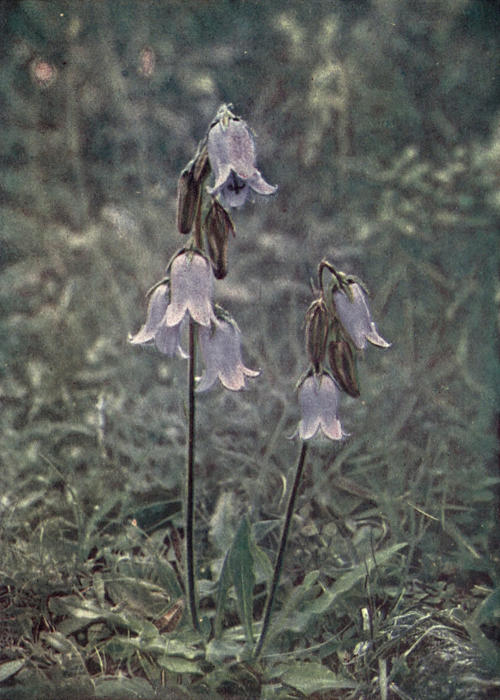
hairy characters very largely disappear. The Bearded
Bell-flower (Plate 26) may lose its bearded character, and
the familiar Edelweiss may, in some cases, develop smooth
green leaves almost as hairless as those of an ordinary plant.
Conversely, we have the observations of Professor Bonnier,
who cultivated the plants of the lowlands at high altitudes
in the Alps and Pyrenees. Where the plants were able
to grow at all they became, in most cases, stunted and
dwarfed. The Jerusalem Artichoke, for example, which
forms a tall leafy stem like a sunflower in the plains, became
a short stumpy plant with leaves arranged in a rosette at its
base. Generally speaking, the plants developed a better
marked underground stem, and thicker, darker green leaves
than the same species grown under more ordinary
conditions.
One of the principal characteristics of Alpine plants is
the extensive development of the rootstock and underground
stem. This is required to protect them against the strong
winds, and to extract as large a supply of water and
nourishment as possible from the frequently scanty soil.
But there is another consideration of at any rate equal
importance. During at least half of the year owing to the
white coverlet of snow, all activity in the Alpine plant
world ceases so that the production of flowers and seeds,
indeed all the vital processes of the plants must be crowded
into the few months when the ground is clear. Crocuses
and Snowbells and other plants are found blooming at the
very edge of the snow, therefore everything must be
ready for immediate flower production directly the snow
melts. For this to take place a reserve store of nourishment
is essential, and accordingly Alpine plants are furnished
with thick underground stems and fleshy roots where the
food substances can be stored.
It is further interesting to note that the number of
plants that go through their life cycle in a single year and
then die off (annuals as they are called), is in the Alps
comparatively small, for most of the plants persist from year
to year. Kerner states that while only 44 per cent. of the
plants on the Danube plains are perennials, there are as
many as 96 per cent. in the Alps. That this has something
to do with the conditions under which the plants grow is
seen by the fact that the annual meadow-grass (Poa annua)
becomes perennial in the Alps. Annuals persist through
the winter season, only in the form of seed, so that a single
wet summer such as the last (1909), by interfering with the
ripening of the seeds, might threaten with extinction an
entire species. Annuals have but little food stored up for
a sudden outburst of activity on the approach of spring, nor
can the tiny root of a budding seedling obtain from the soil
all that is necessary for the rapid production of flowers and
seeds. Moreover, as we shall see immediately, the production
of seeds is in most plants very largely dependent on
the presence of insect visitors, and without them either less
fertile seeds or no seeds at all are in most cases formed.
Insects are said to be less numerous in the Alps than in the
plains, and thus the assumption of a perennial character
makes the existence of the plant less dependent on external
conditions.
Another point which has already been referred to is the
low stature and stunted character of so many Alpine plants.
Undoubtedly there are marked exceptions, such as the tall
Gentians; but, generally speaking, it must be admitted that
mountain plants are short stemmed and dwarfed, the vegetative
part of the plant being often merely represented by a wreath
of leaves. This is also very largely the result of the peculiar
conditions of plant-life at high altitudes. The bright sunlight
by day and intense cold at night have both a retarding effect
on the growth of the stem. As regards light, the converse
result is well seen in the long, lanky shoots of a potato growing
in a dark cellar. But there is also another factor of some
importance. The green leaves of plants are constantly giving
out as watery vapour the fluid which has been absorbed
by the roots. The decreased atmospheric pressure at high
altitudes, the general dryness of the air, and the bright
sunlight by day all unite to accelerate this process. During
the day the ground is warmed even to a larger extent than
the air, and thus the absorption of water by the roots is
correspondingly hastened. During the night the intense
radiation rapidly cools down the soil on which the plant
grows, but the surrounding air is not cooled to anything
like the same extent. The result is that the absorption of
fluid by the roots is diminished in a much larger degree than
the effusion of watery vapour from the leaves, and the plant
is in imminent danger of being dried up. To this danger
the plants of high altitudes respond in various ways. In
the first place, their stunted character not only diminishes
the area of leaf surface for the exhalation of watery vapour
and protects them to some extent from strong winds, but it
also places them in the lowest stratum of air which is most
likely to assume the temperature of the soil. The felted,
cushion-like habit (Plate 9) of so many Alpine plants, and
the rosette-like arrangement of their leaves (Plate 19), are
also of advantage to the plants by exposing less leaf surface
directly to the air. The succulent leaves of plants like the
house-leeks (Plates 18 and 19), and the hairy covering of
the Cat’s-foot (Plate 23), Edelweiss, and others, seem also
designed to counteract the tendency to too rapid desiccation,
and the tough leathery character of many leaves
(Plate 7), and the thickened cuticle of others (Plate
30), are clearly of like value. The relatively increased
thickness of the leaves of many Alpine plants is also,
no doubt, due to the intensity of the sunlight, for direct
experiments have shown that increased illumination has this
effect. Their usual dark green colour is thought to result
from an excess of the green pigment by which plants are able
to extract the carbon required for their growth from the air.
The rarefaction of the air and shortness of the season of
growth at high altitudes, as well as the low stature of most
Alpine plants, make it essential that assimilation should take
place as rapidly as possible when conditions are favourable for it.
But it is in connection with their flowers that the
wonderful adaptation of Alpine plants to their surroundings
is perhaps best seen. The plants of high altitudes generally
bear more numerous and more brightly coloured flowers than
do their relatives of the plains. The low stature of the
plants that bear them gives rise to the impression that the
flowers of the Alps are also larger than those of lowland
districts, but though undoubtedly more numerous and more
crowded together they are of about the same size as those
of other nearly related species. The colours of the flowers
are, however, undoubtedly deeper and more intense. If we
examine specimens of the same kind of flower, for instance
the Forget-me-not or Eyebright, that have been found growing
at different altitudes, we shall be struck with the deeper
tints of the flowers from the higher regions. That this
character has something to do with the conditions of life in
Alpine districts is shown by the disappointment that we
sometimes feel at the diminished brilliancy of the flowers of
Alpine plants when grown in our gardens at home. The
flowers of the Alps are also, as a rule, of a more highly
organised type than those of the plains, and corresponding
with this increase in complexity is a relative increase in the
number of pink and blue flowers, and a diminution in that
of the yellow and white. Alpine plants, too, seem to produce
more honey than do the corresponding plants in the plains;
at any rate, the yield of honey from bee-hives is greater,
and Bonnier has shown that the secretion of honey by
flowers of the same kind increases with the altitude, and
that in some cases there is a corresponding increase in the
intensity of the scent of the flower.
While many of the characteristics of Alpine flowers
are to be explained as a direct result of the conditions of
life at high altitudes, it is probable that the process of
natural selection has also had a good deal to do with their
production. One of the principal objects of the life of a
flowering plant is to produce seeds. It has been shown that,
generally speaking, more numerous and healthier seeds are
produced when the seed-producing apparatus of a flower is
fertilised by pollen from the stamens of a flower of a
different plant. Hence arrangements have to be made
by plants for the conveyance of their pollen from flower to
flower. This is sometimes effected by the wind, but much
pollen is lost, so that this is manifestly a very wasteful
method. Plants have therefore adopted the more economical
plan of getting insect visitors to do this carrying business for
them. The bright colours and sweet scents are to attract
insects to the flower, and honey is provided for their
entertainment there. It is generally believed that the total
number of insect visitors in the Alps is less than in the
plains, and therefore the competition for their services being
more severe, greater attractions in the form of brighter
coloured flowers and more abundant honey have to be
provided for them. But, unfortunately, the direct observations
of H. Müller do not confirm this view. There can be
no question, however, that the relative proportion of the
several varieties of insects in the Alps is very different from
that in the plains. There are comparatively few flies, bees,
and wasps, but numerous humble-bees, butterflies, and
moths in the mountain regions. These insects have longer
tongues and prefer to visit flowers of a more complicated
structure, where the honey cannot be reached by their
shorter tongued relatives. Flowers of this sort with less
easily obtained honey are more often of a red or blue or
pink colour, and more rarely of a yellow tint. Not a few
Alpine flowers like the Aconites (Plates 3 and 4) are entirely
dependent on humble-bees for their fertilisation, and an
even larger number, such as the Long-Spurred Pansy (Plate
5), and several of the Gentians are exclusively visited by
butterflies and moths. Müller even goes so far as to suggest
that not a few of the Alpine flowers, especially those of a
pale crimson colour and with a clove-like smell, such as the
Pinks (Plate 9), have been evolved in the Alps under the
influence of butterflies and moths. In spite of this it is
curious to note that the number of flowers that are habitually
self-fertilised is greater in the Alps than in the plains. But
when it is explained that these are for the most part of the
same type of flower that is pollinated by flies, bees, and
wasps in lowland districts the apparent anomaly becomes
clear.
The question of the origin of the Alpine flora is a
subject upon which botanists are by no means completely
agreed at the present time. A large number of the thousand
different plants that are found in the high Alps reappear in
distant mountains and the Arctic regions, though absent in
the intervening country. Thus the late John Ball calculated
that 17 per cent. of the Alpine species were met with in
the Arctic regions, and 25 per cent. in the Altai Mountains
of Northern Asia. That this is not due to the conveyance
of seeds from place to place by the agency of wind or birds
is shown by the fact that the resemblance of the plants of
different mountain chains to one another is in no way
proportional to their geographical proximity, even when their
climate is similar. The true explanation is probably to be
sought in the Glacial Period, in which the greater part of
Europe was covered by ice, so that the climate of the plains
was very similar to that of the high Alps and Arctic regions
at the present time. At this period the flora of the extreme
north was able to mingle with that of the mountain regions.
When the climate of the intervening districts became once
more less severe, the competition with the present lowland
flora became so keen that the Alpine-Arctic plants retreated
to high altitudes or the far north. It may be that the high
mountain regions have formed centres for the evolution of
new species, as Mr John Ball believed, but there is but little
direct evidence for this view.
Nearly every visitor to Switzerland who regards its rich
flora in any way worthy of notice is desirous to obtain some
permanent record of the pleasing impressions obtained. Either
the flowers are pressed, or the plants are pulled up with more
or less of their roots to be planted in some garden at home,
or, as the author would suggest is by far the best method,
photographs of the plants are taken. May we here, first of
all, protest against the wholesale destruction of Alpine plants
that goes on every year by careless visitors. Where a few
flowers are required for study or to be preserved by pressing,
they may, by all means, be picked. There seems no
reason also why a few of the more common or abundant
plants should not be dug up with their roots, carefully
packed, and taken home, although the Swiss authorities do
not permit even this, but it is disgraceful that large nosegays
of choice flowers should be gathered for the mere pleasure
of watching them wither in the hand, and then thrown away.
The Swiss natives, unhappily, set us a very bad example in
this respect; but it is fortunate that the Edelweiss and
Alpenrose are the only flowers that they at all extensively
attack. Many of the more frequented tourist routes have
become almost bare of any but the commonest flowers. One
has only to ascend to some peak or glacier by two paths,
one that is well-trodden, and a second but little used, to see
how complete this destruction of wild flowers has been.
Excellent little presses for preserving plants and flowers
can be bought in Switzerland. They take up no more room
in one’s bag than a Baedeker or Bradshaw’s Guide, and do
the work much more efficiently. Their only disadvantage
is that they are generally too small to display any but the
tiniest plants completely, and it is really wiser to take out
from England a couple of boards with straps and a good
supply of blotting paper. The special paper sold for pressing
plants is much to be preferred to ordinary white or
pink blotting-paper, as the plants tend to stick to it much
less. A fair amount will be required, as the plants need
frequent changing and the paper must be dried. Specimens
should be carefully set out by pressing on them with the
finger till they take up the required positions, and stored
when dry in some exercise book or between sheets of paper.
The cultivation of Alpine plants in our gardens at home
is by no means as easy as might at first be supposed. The
climate and conditions of life in Peckham are very different
to those at the summit of Pilatus, and unless the thing is
done carefully and thoroughly it had better not be attempted
at all. The chief difficulty in growing Alpine plants in our
climate is not the cold but the excessive moisture of winter,
which tends to rot their roots, and from which they are
protected in their native home by their snowy covering.
Our object should be to reproduce, as far as possible,
in our gardens the conditions under which the plants
grow in the high Alps. For the rockery a porous stone
will be required, such as limestone or sandstone, and it is
essential to select a kind that does not crumble with the frost.
The partially fused masses of brick, which can be obtained
very cheaply as a waste product from brick kilns, when
washed over with a mixture of cement and sand do very
well. The rocks and stones must be so laid that every bed
or pocket in which the plants are to grow is thoroughly well
drained, for nothing is so destructive to them as water-logging
of the soil. Plants that grow in the clefts of rocks should be
planted in a sloping position, as water is then less liable to
collect in the rosettes of leaves. Those that grow in cool,
moist, spongy soil are best planted in a mixture of peat moss
and earth. It is also important to notice whether the plant
which is being cultivated was previously growing on limestone
or granitic soil, for it is easy to add a little chalk to
the earth if this is required. In planting out one has to be
careful not to curl up the roots, and it is wise to sprinkle
the plant with water two or three times a day for the first
week or so. Alpine plants should never be manured. It
should be remembered that mountain plants grow slowly,
and though very many species can be successfully cultivated,
the Houseleeks and Saxifrages are likely to give the best
results with a minimum of trouble.
It is impossible in such a book as this to give more
than a few general suggestions as to the photography of
Alpine plants. One of the chief difficulties with which one
has to contend is the wind. When the plant is photographed
anywhere near its natural size the smallest stop has to be
used to obtain depth of focus, and this greatly increases
the duration of the exposure. Many of the colour photographs
herein reproduced were given as long as five or ten
minutes. When the wind is intermittent it is quite safe to
give repeated exposures of a few seconds at a time, being
careful in removing and replacing the cap not to shake the
camera, for the plant is sure to return to exactly the same position
after being blown to and fro by the wind. Where tall
plants are being taken it is wisest to select a time in the
early morning or near sunset, for though the intensity of
light is diminished at these times, there is usually but little
wind. The writer has found a strip of white calico, some 12
or 15 inches wide, with long knitting needles sewn on to
it at intervals, of great value as a wind screen in plant
photography. The knitting needles can be pushed into
the ground, and the plant surrounded on three sides or
completely by such a screen, and thus very largely shaded from
the wind. With a little care the screen does not appear in
the photograph, and it is easily rolled up and carried from
place to place. For near objects the intensity of light in
the Alps is only slightly greater than that in England at the
same time of day, but it is always wiser to make use of an
exposure meter if the best results are desired. By the use of
the swing back any plane surface, whatever be its inclination
to the vertical, can be easily focussed. This will be found
of especial value where a blurred background is desired, and
the slight distortion thus obtained, which is so noticeable in
architectural subjects, is quite negligible in the case of plant
portraits. The deep shadows that are produced when flowers
are photographed in bright sunlight are generally best
avoided.
SUMMER FLOWERS OF THE HIGH ALPS
HERE FOLLOW COLOURED PLATES AND
DESCRIPTIONS OF 39 SWISS PLANTS,
WITH THEIR NAMES IN LATIN, ENGLISH,
FRENCH, AND GERMAN
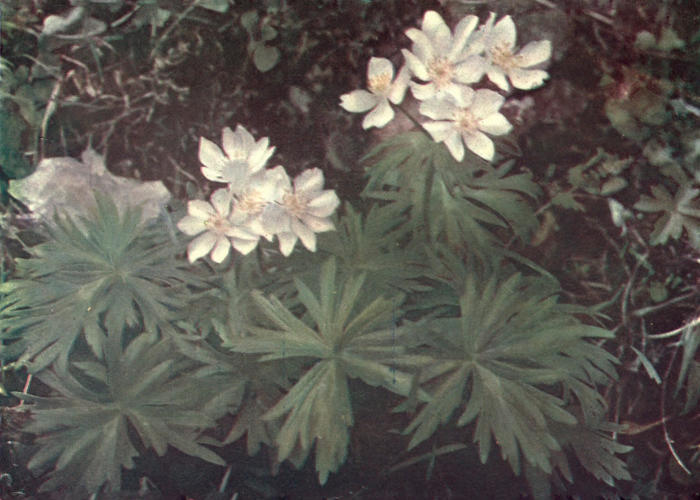
The Narcissus-Flowered Anemone ( ANEMONE NARCISSIFLORA )
Many varieties of Anemone are found in Switzerland.
Not only have we the common English Wood Anemone
(A. nemorosa) of the early spring, and the much rarer Pasque
Flower (A. Pulsatilla) of our downs, but there is also the
white or yellow Alpine Anemone (A. alpina), which forms
so marked a feature of the Alpine pastures in early summer.
Even in July and August, when most of the flowers have
faded, the feathery tufts of seeds of the Alpine Anemone
are still to be seen as the so-called “Chamois’ beards.”
The Narcissus-flowered Anemone, here photographed, is
a widely distributed plant. It occurs on grassy slopes and
in pastures between 4000 and 7000 feet above the sea
level, and seems to prefer a limestone soil. The finely
divided leaves are well seen in the photograph. Unlike
every other species of Anemone found in Switzerland the
flower stalk bears not a single flower only but two to eight, or
even more, and at the point where the flower stalk divides a
green collaret or involucre is seen. The flowers are pure
white inside, and their external surfaces are often slightly
woolly and tinged with pink, especially in the bud. The
seeds have no feathery appendages like those of the Alpine
Anemone. The flowers are without honey. They are visited
by pollen-collecting insects, and should these fail will become
self-fertilised. The plant blooms in May and June, and
some flowers may still be found even in July in the highest
Alpine pastures. It is met with widely distributed over
Central Europe, North America and Northern Asia, but is
absent in Scandinavia. On account of the numerous closely
allied species which are found in Northern Asia, it is thought
that this plant may have originated in that region and then
spread east and west to America and Europe respectively.
Plate I.
ANEMONE NARCISSIFLORA. L.
The Narcissus-flowered Anemone. Anémone à fleurs de Narcisse.Narcissenblüthige Anemone oder Berg-Windröschen.
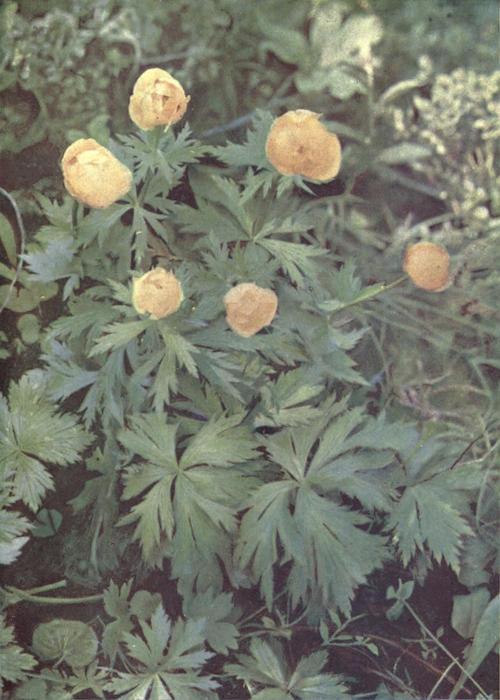
The Globe Flower ( TROLLIUS EUROPÆUS )
THIS large and stately plant is common in mountain pastures
from the lower levels right up to 7000 feet. It has finely
divided leaves and bright yellow globe-like flowers, borne on
long stalks which are usually unbranched. It is evidently
a near relation of the buttercups, but differs from them in
the possession of numerous brightly-coloured sepals, which
enclose and conceal the much smaller tongue-shaped petals.
Although not exclusively Alpine, being found all over
Central Europe, in Scandinavia, and the north of England,
it has been included in this series because it is sure to be
noticed by anyone visiting Switzerland for the first time.
It flowers in May, June, and July, and flourishes best in
damp places. A much smaller form, bearing only a single
flower, is found exclusively on high mountains (var. humilis).
It should probably be regarded merely as a variety and not
as a distinct species.
The Globe Flower, the Anemones, and the two species
of Aconitum illustrated in the two following plates are all
examples of the buttercup order, the Ranunculaceæ. The
common yellow buttercup so abundantly found in Alpine
meadows is Ranunculus montanus. This species very closely
resembles the ordinary upright buttercup of our English
fields (Ranunculus acris), which it replaces in the Alps,
but differs from it in the possession of a solid (not hollow)
stem and a hairy disc beneath the seeds. It is a somewhat
smaller plant, with less numerous—generally only two or
three—flowers.
Plate II.
TROLLIUS EUROPÆUS. L.
The Globe Flower. Trolle d’Europe
ou Boule d’Or.Echte oder Europäische
Trollblume.
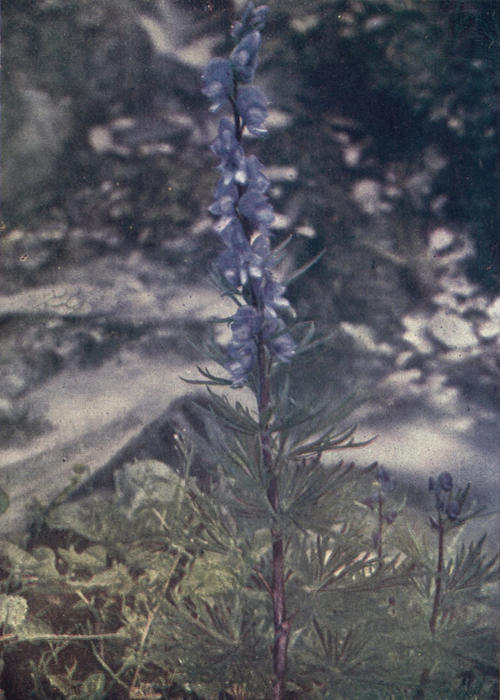
The Common Monk’s-Hood ( ACONITUM NAPELLUS )
Several species of Aconitum are met with in Switzerland.
They have all bright-coloured flowers, especially adapted for
fertilisation by humble-bees. It is only where there are
humble-bees to convey the pollen from flower to flower that
seeds can mature, so that where these insects do not exist the
Aconites cannot spread. The five sepals of the Aconite
flowers are coloured for attractive purposes, the highest being
especially large and helmet-shaped. Protected by this are
the representatives of the petals, so modified and reduced
that they no longer have any attractive function, and are only
of use to the plant by producing honey. They form a couple
of nectaries on long stalks inside the helmet-shaped sepal.
The Common Monk’s-Hood is found in rich moist
meadows between 3000 and 7000 feet. It seems to be
especially common in the neighbourhood of Alpine dairies
and cow houses. It flowers in June and July, and is very
poisonous. From the conical root, resembling that of horseradish,
the preparations of aconite used in medicine are
prepared. When applied externally, aconite causes tingling
and numbness and may relieve the pain of neuralgia.
Internally, it depresses the action of the heart and lowers
the temperature of the body. Homeopathists still use it
for this purpose, but in doses so small as to have no
appreciable action whatever. The single straight flower
stalk, closely packed with blossoms, is rarely branched in its
upper part, though small branches may be met with below.
The Panicled Monk’s-hood (Ac. paniculatum) resembles
the above rather closely, but differs from it in the more open
arrangement of the flowers on the hairy flower stalk, which
is usually branched near the top. The leaves of both plants
are finely divided, but the sub-divisions of those of the
common Monk’s-hood are longer and narrower, more strap-shaped
in fact, than those of the panicled form.
Plate III.
ACONITUM NAPELLUS. L.
The Common Monk’s-Hood. Aconit
Napel ou Napel bleu.Rübenwurzliger
Eisenhut.
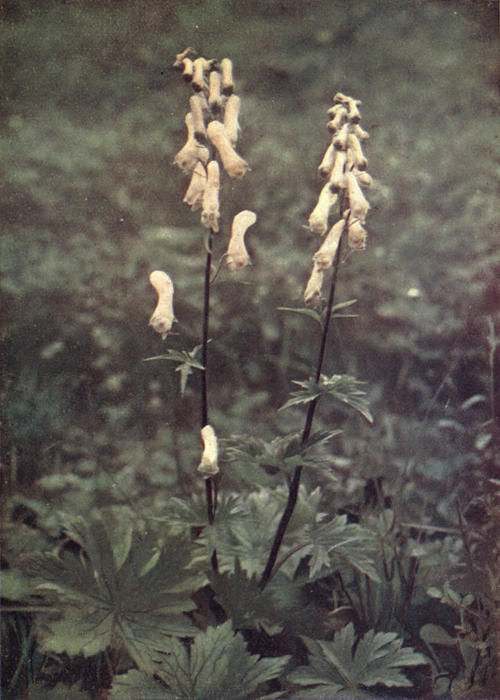
The Yellow Wolf’s-Bane ( ACONITUM LYCOCTONUM )
This plant is a species of Aconite, and a close relation of the
common Monk’s-hood illustrated on the previous page. It
is common on the borders of woods and in bushy places
between 3000 and 7000 feet above the sea level. In
this species, which, like the common Monk’s-hood, is visited
almost exclusively by humble-bees, the upper helmet-like
sepal which conceals the honey is especially long. It is
interesting to note that the humble-bees do not, in all cases,
obtain the honey in the way intended by the plant. A dark
spot is often to be seen near the tip of the helmet where a
humble-bee has nibbled through the flower leaf and obtained
access to the nectary direct. In this way the designs of the
plant for cross fertilisation may be frustrated, for where the
honey is obtained in this manner no pollen is carried from
flower to flower by the insect visitor. Aconitum Anthora,
which is rather like the above, has more finely divided leaves
and darker yellow flowers which are much less elongated
than those of the Wolf’s-bane. The flowers, in fact, closely
resemble those of the common Monk’s-hood except that
they are yellow instead of blue. Both plants are poisonous.
Plate IV.
ACONITUM LYCOCTONUM. L.
The Yellow Wolf’s-bane. Aconit
Tue-loup ou Cappe de Moine.Wolftödtender
Eisenhut.
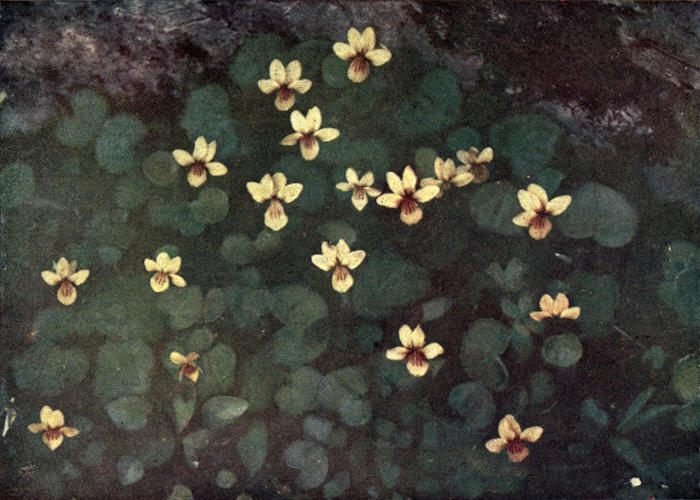
The Two-Flowered Violet ( VIOLA BIFLORA )
This pretty little plant is common in moist shady places
between 3000 and 7000 feet all over Switzerland. It is
also found in Bohemia, Silesia, the Vosges, and other parts
of Central Europe. It flowers from May to August in the
clefts of rocks, and amongst the boulders on the banks of
streams. It was in just such a place as this that the present
photograph was taken. The flowers are bright yellow,
streaked with brown, and the dark green leaves are kidney-shaped
and entire. Although there are several other violets
with yellow flowers to be found in Switzerland, no other
species has broad kidney-shaped leaves. The smooth, erect
flower stalk, which also bears some leaves, frequently divides
into two near the middle, each branch being terminated by
a bright yellow flower. This character, which has given
to the violet its name, is, however, by no means constant,
and flower stems bearing a single or three or more flowers
are also often seen. The number of flowers borne by the
plant would seem rather to be determined by its size and
vigour, which, of course, again depend largely on the conditions
under which it grows.
Plate V.
VIOLA BIFLORA. L.
The Two-flowered Violet. Violette
à deux Fleurs.Zweiblüthiges Veilchen oder
Zwillings-Veilchen.
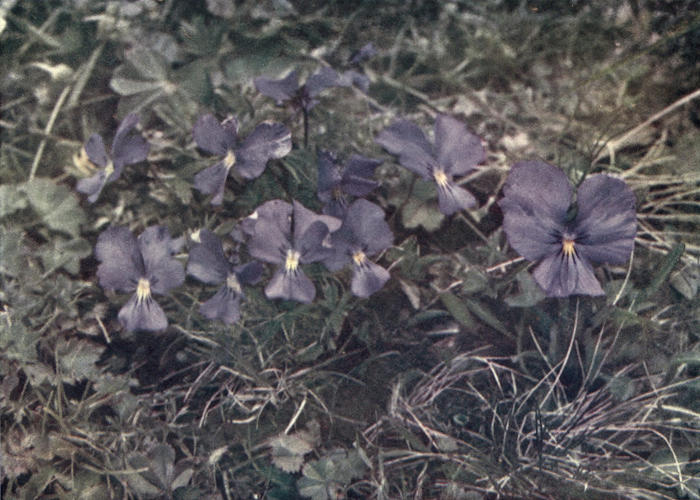
The Long-Spurred Pansy ( VIOLA CALCARATA )
The Long-Spurred Pansy flowers in June and July, and
is a typical Alpine plant. The high mountain pastures are
sometimes literally carpeted with its large purple flowers, all
turned towards the sun. It is common on sunny slopes and
among rocky débris between 5000 and 9000 feet, and
prefers a limestone soil. The underground stem of the
plant bears at its extremity a small rosette of leaves, and a
short flower stalk terminated by the single large flower. The
flower, which has a delicate and sweet scent, is usually of a
rich purple colour, much more rarely yellow (var. flava).
Sometimes the purple becomes paler and a lavender variety
results, and, rarest of all, the flower may be pure white.
From the many other violets and pansies which are found in
Switzerland, the species we are now considering is recognised
by its narrow, notched leaves, by the upward direction of
the lateral petals, and especially by the long, narrow spur,
which is quite as long as the corolla.
Unlike most of the violets which are fertilised by bees,
the Long-Spurred Pansy depends entirely on butterflies for
the conveyance of its pollen. The narrow opening to the
flower and the long spur, at the bottom of which the honey
is concealed, are only suited to insects such as butterflies
and moths with relatively long tongues. It is pretty to see
the butterflies flitting from flower to flower, and Müller
observed a single insect visit no less than one hundred and
ninety-four different blossoms in 6¾ minutes.
Plate VI.
VIOLA CALCARATA. L.
The Long-spurred Pansy. Violette
à long éperon ou Violette éperonnée.Langgesporntes Veilchen.
The Box-Leaved Milkwort ( POLYGALA CHAMÆBUXUS )
The Box-leaved Milkwort is a shrubby mountain plant with
a woody branching stem and leathery evergreen leaves, which
resemble those of the common box but are somewhat thicker.
The flowers occur singly or in pairs in the axils of the upper
leaves. They consist of a boat-shaped corolla of a pale
yellow colour, which becomes darker towards the tip, and two
wing-like appendages, which look like petals but are really
sepals. These are usually white but are sometimes purple red.
It is stated that their colour is determined by the soil on which
the plant grows and is white or pure slate; on calcareous,
slate coloured.
The Box-leaved Milkwort is widely distributed in
Switzerland, Germany, and Austria, between 1500 and 7000
feet, and grows on wooded hills and in dry rocky places,
where it is often extremely abundant. It flowers from May
till the end of August. The plant is quite distinctive and
will be readily recognised. Although belonging to the
Milkwort tribe it is quite different from all other species,
which have red, white or blue, never yellow, flowers and
deciduous, not evergreen, leaves.
The Common Milkwort (Polygala vulgaris) of our English
downs and heaths is also found in the Alps. It is a small
herbaceous plant with a slender stem, perhaps three or four
inches long, which is thickly covered with leaves, and terminates
in a cluster of pink, blue, or white flowers. Polygala
calcarea, a nearly-related species found only in limestone
districts, has sky-blue flowers and leaves for the most part
clustered in the form of a rosette at the base of the stem.
Plate VII.
POLYGALA CHAMÆBUXUS. L.
The Box-leaved Milkwort. Polygala
faux-buis.Immergrüne Kreuzblume.
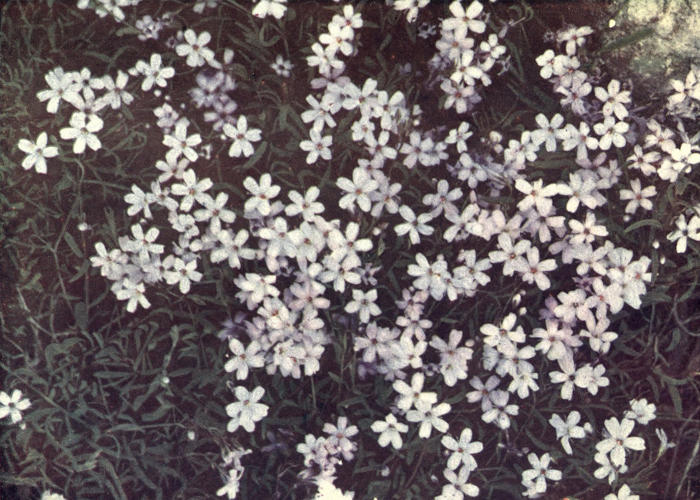
The Creeping Gypsophila ( GYPSOPHILA REPENS )
The Creeping Gypsophila is a perennial plant with a woody
stem, from which branches arise bearing the narrow
strap-shaped leaves and pale crowded flowers. It is found
in all the limestone regions of the Alps, amongst the rocky
boulders beside mountain streams, and in dry torrent beds
between 1000 and 7000 feet, and even descends to the
plains with certain of the rivers. It is found, for example,
near Munich on the banks of the Isar. The plant is also
widely distributed in the mountain regions of Central Europe
and extends from the Pyrenees to the Carpathians. The
flowers, which open in July and August, are white with
more or less of a tinge of pink about them, which may be
quite marked in certain cases. Together they form what
is botanically known as a corymb. The numerous flower
stalks branching off from different points of the ascending
stem are of such a length that all the flowers are
approximately on the same level. In this way they are displayed
to the best advantage, so that their insect visitors may find
it easy to pass from flower to flower. There are several
species of Sandwort and Chickweed to be found in Switzerland
that closely resemble the Creeping Gypsophila. Apart
from technicalities the chief points to keep in mind in the
identification of the plant are the woody creeping stem, the
much-branched flower stalks, and the entire absence of hairs.
Plate VIII.
GYPSOPHILA REPENS. L.
The Creeping Gypsophila. Gypsophile rampante.Kriechendes Gipskraut.
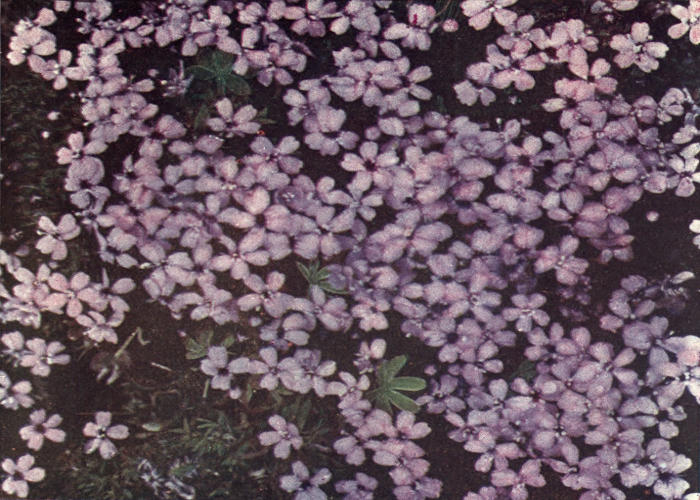
The Moss Campion or Cushion Pink ( SILENE ACAULIS )
Wherever conditions are unfavourable to plant life, not only
on high mountains but also in deserts and by the seashore,
the plants that manage to survive frequently respond by a
process of co-operation and form dense cushion-like masses.
In the high Alps many examples of this are seen. The
individual plants are closely huddled together in the form of
a tuft, not only on account of warmth and natural protection
and to prevent their being blown away by rough winds, but
also because the cushion acts as a sort of reservoir or sponge
and prevents the little plants being dried up by the fierce rays
of the sun.
The Moss Campion is a typical “Cushion plant.” It is
found abundantly all over the Alps, especially in the limestone
regions between 5000 and 10,000 feet or even higher.
It grows in open rocky places, often on the bare rock itself,
and in the neighbourhood of glaciers, and may be found close
up to the snowline. The bright green moss-like cushions
formed of the dense clusters of leaves become sprinkled over
with pinkish-purple star-like flowers in June, July, and
August. Occasionally the flowers are white. The long
conical root penetrates far into the soil or into some fissure
in the rocks, thus securely anchoring the plant, and divides
above into numerous branches, which radiate in all directions
and are thickly covered below with brown dead leaves and
terminate above in a rosette of bright green linear leaflets.
The flowers, which are visited by many kinds of insects, are
of three kinds. Rarely we find cushions of flowers containing
both stamens and pistil in the same flower, but even here the
pistil becomes ready to receive pollen before the stamens
open so as to prevent self-fertilisation. Usually, however, the
flowers are unisexual and contain stamens or pistil only, and
staminate and pistillate flowers are borne on different
cushions.
The Moss Campion is widely distributed in the mountain
regions of Southern Europe, North America, and the
Arctic regions. Silene exscapa closely resembles the above,
but is much less common. Its flowers are smaller and less
brightly coloured, and the separation between calyx and flower
stalk is more gradual and less abrupt than in the Moss
Campion. Its seed-vessel or capsule is, moreover, hardly
longer than the remains of the calyx which encloses it, whereas
the capsule of the Moss Campion projects well beyond the
enclosing calyx leaves.
Plate IX.
SILENE ACAULIS. L.
The Moss Campion or Cushion Pink.
Silène à Courte tige.Stengelloses Leimkraut oder Moos-Leimkraut.
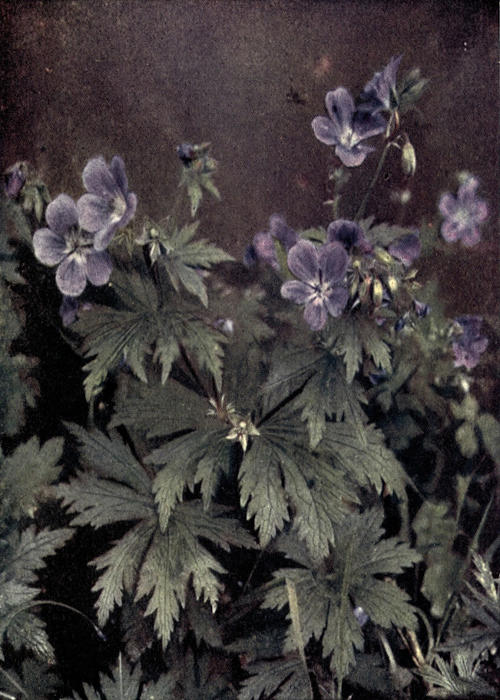
The Wood Geranium ( GERANIUM SYLVATICUM )
Seventeen species of Geranium or Crane’s-bill, so named from
the shape of the seed, are met with in Switzerland, and several
of them are rather difficult to distinguish from one another.
The Wood Geranium is found in England, but is not
very common. In Switzerland it is exceedingly abundant on
the borders of woods and in rich mountain meadows and
pastures between 3000 and 7000 feet. Though a beautiful
plant it is by no means welcome to the herdsman, for it is
not good for fodder. The finely divided leaves are well
seen in the photograph. The purple-blue flowers have more
of a tinge of red in them when they first open. The Wood
Geranium will be recognised by its erect stem, hairy above,
leaves which are arranged opposite to one another, purple-violet
flowers with petals that are not notched in the middle,
and sepals drawn out to a long point. The Brook Crane’s-bill
(Geranium rivulare) has white flowers varied with red, and the
Meadow Crane’s-bill (Geranium pratense) has larger flowers
which tend to hang down, and the Blood Geranium (Geranium
sanguinum) has unbranched flower stalks and notched petals.
Plate X.
GERANIUM SYLVATICUM. L.
The Wood Geranium or Wood Crane’s-bill.
Géranie des Forêts.Wald-Storchschnabel.
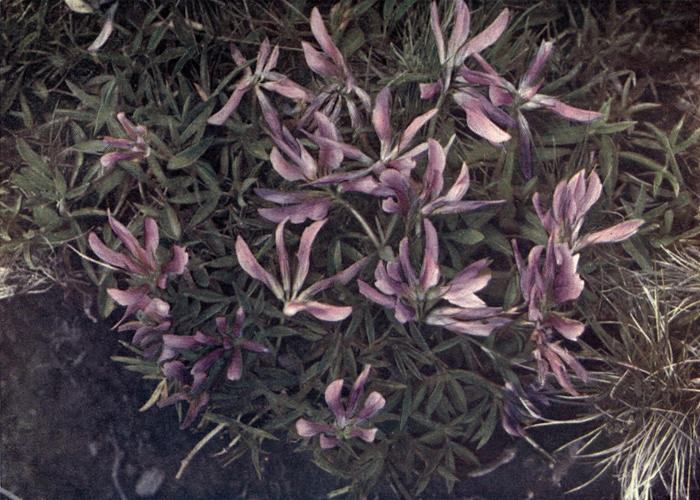
The Alpine Clover ( TRIFOLIUM ALPINUM )
This plant is the most beautiful and most sweetly scented
of all the clover tribe. The long conical root stock which
penetrates far into the soil terminates above in many
radiating branches. On these are borne the long stalked
leaves, composed of three narrow leaflets with serrated
margins. The flowers, which are larger than those of any
other clover, are borne in a group of four to twelve on top
of a long flower stalk. They begin to appear early in June
and continue coming out till the end of August; they are
usually of a delicate pinkish-purple colour, but occasionally
a cream or white variety may be found. The Alpine
breezes are often filled with their delicate fragrance. When
the flower fades the petals are not shed, but remain attached
to the seeds and act as wings which aid in their dispersal.
Unlike most of our English clovers, which are annuals, the
Alpine clover is a perennial and lives for many years,
throwing up fresh leaves and branches every spring. The
thick solid rootstock of some of these plants must be many
years old. This species is very common in the meadows
and pastures in the central Alps between 5000 and 8000
feet, where it grows in greatest abundance and especially
luxuriantly on primary granitic rock. It is probably a true
native of the Alps, but is also found in South Tyrol, the
Pyrenees, and the Carpathians.
The Alpine clover will be readily recognised by its few-flowered
flower-heads and narrow pointed leaflets arranged
in groups of three. The much rarer Trifolium pallescens is
perhaps a little like the pale flowered variety, but it has many
flowered flower-heads and ovate leaflets.
Plate XI.
TRIFOLIUM ALPINUM. L.
The Alpine Clover. Trèfle
des Alpes ou Réglisse des Alpes.Alpenklee.
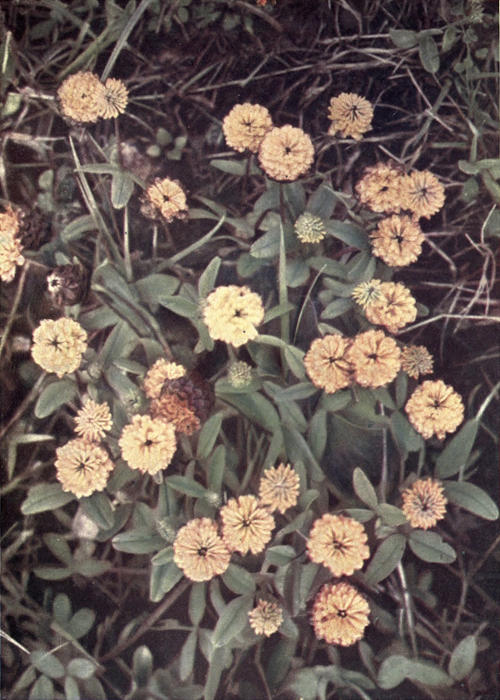
The Brown Clover ( TRIFOLIUM BADIUM )
Unlike the greater number of Alpine plants which persist
from year to year the Brown Clover is a biennial, that is to
say, its life is limited to two years, and at the end of its
second summer the plant dies off. It is found abundantly
in the limestone districts of Switzerland between 4000 and
7000 feet, and flowers in July and August. It grows in
meadows and pastures, and seems to prefer a moist, open spot,
where the competition with other plants will be less severe.
Thus it is met with on moraines, on the fresh soil brought
down by avalanches and streams, and even on the dirt heaps
around Alpine cow houses. The much-branched brownish
stem bears the rather long-stalked leaves, composed of three
leaflets with serrated margins and blunt points. The flower-heads,
made up of numerous florets closely packed together,
are at first of a golden yellow colour. As the individual
flowers fade—and the lowest fade first—they become brown
and scale-like and turn downwards, and the dry brown
corolla remaining attached to the seed forms an important
aid in its dispersal by the wind. The Brown Clover is
widely distributed in the mountain regions of Central Europe.
It will be readily recognised by its globular flower-heads of
yellow flowers and bright green leaves made up of three
leaflets, which are arranged opposite to one another on the
upper part of the stem.
Trifolium spadiceum is very like the above, but is not so
common. Its flower-heads become more elongated and
change to a darker brown tint than those of the plant
here photographed as the flowers fade.
Plate XII.
TRIFOLIUM BADIUM. SCHREB.
The Brown Clover. Trèfle
brun.Braunklee.
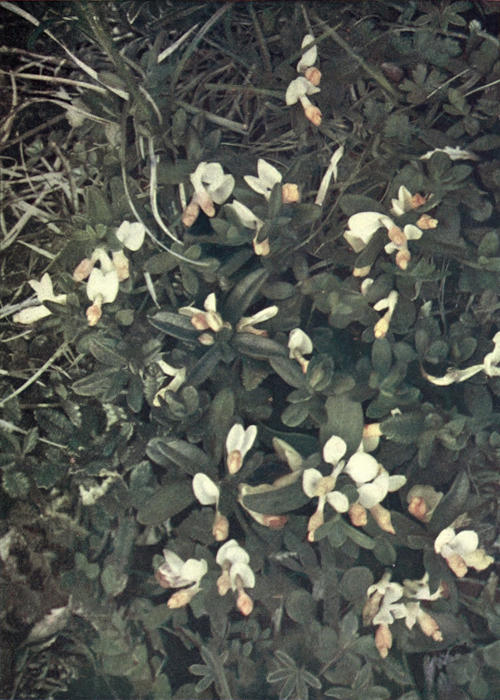
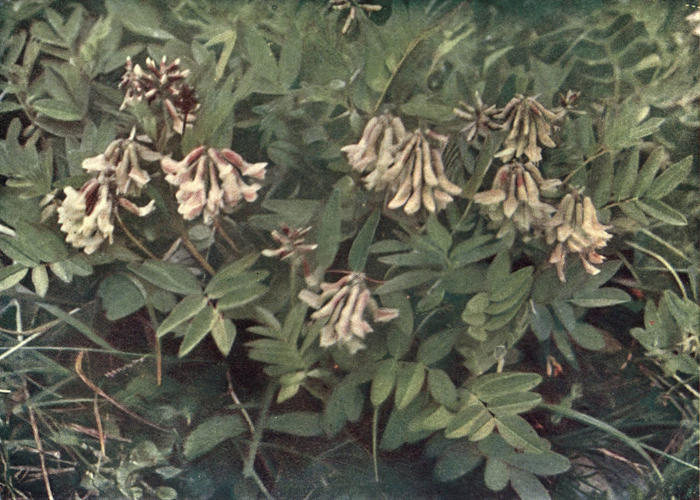
The Cold Mountain-Lentil ( PHACA FRIGIDA )
The Cold Milk-Vetch or Mountain-lentil—to give a literal
translation to its popular Swiss name, for it has no English—is
a typical Alpine plant, found in fair abundance between
5000 and 8000 feet, perhaps most frequently in limestone
districts. In rocky places or mountain meadows it often
grows in profusion, but it seems to avoid the pastures. The
stem is usually unbranched, about 6 or 8 inches high,
and bears the pale yellow or cream-coloured flowers and the
bright green leaves, made up of four or five pairs of leaflets
with an odd one at the tip. The leaves are arranged in
pairs opposite to one another, and where they join the stem
a couple of pale broad wing-like stipules are attached. It is
unfortunate that these are not well seen in the photograph,
for they are the most characteristic thing about the plant.
The Cold Mountain-lentil has an extensive range, being
found in mountain districts all over Europe, Northern Asia,
North America, and in the Arctic regions. It is thought to
have originated in the Steppes of Northern Asia.
Phaca alpina differs from the above in being a somewhat
taller plant with branched stem, deeper yellow flowers,
leaves made up of nine to eleven pairs of leaflets, and
smaller, narrower, stipules.
Plate XIII.
PHACA FRIGIDA. L.
The Cold Milk-Vetch or Mountain-Lentil. Phaque Froide.Kalte Berglinse
oder Einfache Gletscherlinse.
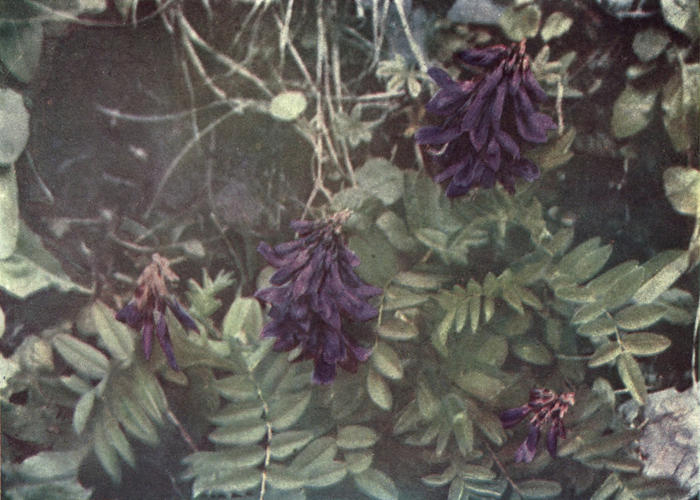
The Dull-Flowered Sweet Clover or Alpine Sainfoin ( HEDYSARUM OBSCURUM )
The Alpine Sainfoin is the only member of the sixteen
European species of Hedysarum (Sainfoin) that is found in
Switzerland. The plant consists of a thick, dense underground
stem which persists from year to year and serves as a
storehouse for food. Underground branches extend outward
from this in various directions and give rise to ascending
shoots bearing leaves and flowers. The short stalked leaves
bear eleven to nineteen leaflets which are arranged in pairs;
the purple-red flowers occur in clusters. The flowers are visited
by bees on account of the honey they contain. By means
of a sort of catapult arrangement, which only goes off when
the bee settles on the flower, the body of the insect becomes
dusted with pollen and as the bee travels from flower to flower
pollination is effected. In the Western Alps a variety
of this plant with yellowish flowers is occasionally to be
found. The seed vessel of the Alpine Sainfoin is very
characteristic. It is not unlike an ordinary pea-pod, but is
smaller, more flattened, and divided into two or three oval
segments by constrictions. The plant is fairly abundant
between 5000 and 8000 feet, and flowers in July and August.
It is rare in meadows, but is found on the rocky borders of
Alpine pastures and on the banks of streams. It is met with
in all parts of the Alps, in the mountainous districts of Europe
and Asia, and in the Arctic regions, and is thought to have
taken origin in the Steppes of Northern Asia. It should be
very easily recognised. The drooping habit of the flowers
and the constricted seed-pods are most characteristic.
The flowers of this species have generally more red in
them than those of the specimen photographed.
Plate XIV.
HEDYSARUM OBSCURUM. L.
The Dull-Flowered Sweet Clover or Alpine
Sainfoin. Esparcette des Alpes.Dunkler Süssklee.
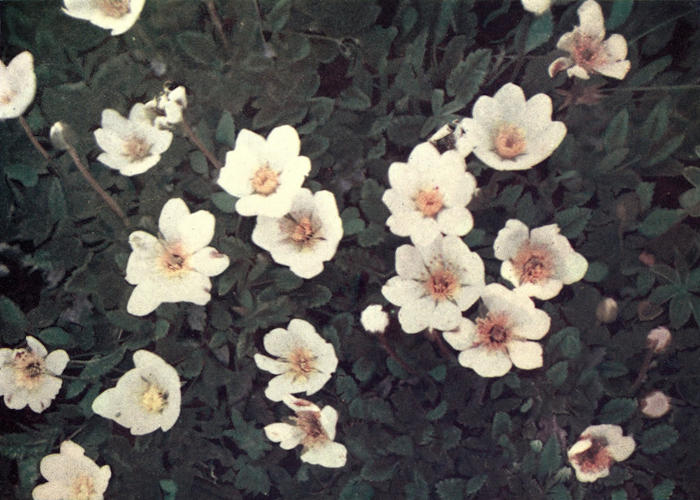
The White Dryas ( DRYAS OCTOPETALA )
The White Dryas, or Silver-herb as the Swiss call it, is a
characteristic Alpine plant which is found all over Switzerland
between 3000 and 8000 feet, and even descends to the plains
with some of the rivers. It is common in dry mountain
pastures and rocky places, and seems to grow best on limestone
soil. Often the bare surfaces of rocks and boulders
are thickly covered with its matted growth, which persists
from year to year as soil gradually accumulates around it.
The thick dense rootstock gives rise to long trailing
branches, which extend in all directions and bear the leaves
and flowers. Associated with the root tips is a curious
fungus growth, which from its constant presence is thought
to be of value to the plant. The tough leathery evergreen
leaves have rolled back notched edges. Their upper surfaces
are dark green, smooth, and polished, and devoid of the
stomata or little pores by which air is absorbed by green
plants generally; the lower surfaces are covered by thick
white felt-like hairs. The flowers, which appear from May
till July, resemble those of the Alpine Anemone, but are
smaller. They have usually eight petals, hence the Latin
name. Inside the petals are a large number of stamens
arranged in the form of a ring, and inside these again a honey
secreting gland which surrounds the mass of closely packed
carpels in the centre of the flower. The carpels bear long
silky styles, which grow out into beautiful feathery appendages
as the seeds ripen—another point of resemblance to the
Alpine Anemone. The carpels become ready for pollination
before the stamens shed their pollen. Then the outermost
stamens open, and only after several days have elapsed do
the innermost stamens become mature. A little consideration
will show how wonderfully this arrangement is adapted to
favour the cross-fertilisation of the carpels by pollen brought
from another flower by the agency of insect visitors. Should
this, for any reason, fail, self-fertilisation will almost certainly
be effected by means of the pollen from the innermost stamens.
If a large number of plants of the White Dryas be carefully
examined some will be found with flowers containing both
stamens and carpels, as above described, while others, less
numerous, have flowers with stamens only. These will of
course produce no seeds. Some plants, again, will be seen
to bear both kind of flowers. The White Dryas is found
in the mountainous districts of Europe and in the Arctic
regions of the new and old worlds. The plant will be
readily recognised, for its leaves are quite different from those
of an anemone.
Plate XV.
DRYAS OCTOPETALA. L.
The White Dryas or Silver-herb. Dryade à huit pétales.Echte
Silberwurz.
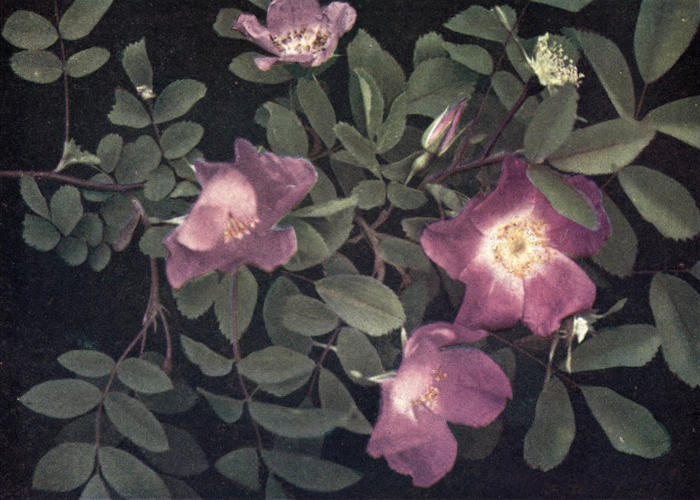
The Alpine Rose ( ROSA ALPINA )
THE Alpine Rose or Dog-Rose must not be confounded
with the Alpenrose. The resemblance is only in the names,
for the Alpenrose so much beloved by the Swiss is really a
rhododendron and quite a different plant. The Alpine Rose
is a shrub sometimes 8 or 10 feet high, and only a single
branch is shown in the photograph. It is found on the
borders of mountain woods and in bushy places, from the
lower slopes up to about 7000 feet, and flowers in May,
June, and July. The leaves consist of seven to eleven leaflets,
and there are broad stipules at the base of each leaf. The
sweet-scented flowers are of a rich rose-red colour. The sepals
are exceptionally long and project beyond the petals; this is
especially noticeable in the bud. The fruit or hip is flask-shaped
and rather narrowed at the base. Thorns are as a
rule absent from the flowering branches, but are generally
to be found on the lower and younger shoots, which point
downwards. Sometimes they are absent altogether. The
Alpine Rose is found pretty abundantly in the mountain
woods of Southern and Central Europe, but does not extend
to the North. Thus it grows in the Pyrenees, Auvergne,
the Balkans, and in one part of the Black Forest.
The Dog-Roses are phenomenally difficult to distinguish
from one another, and as many as fifty Swiss species are
described. The characteristics above mentioned, and
especially the high elevation at which it is found, will assist
in the recognition of the present species. By the arrangement
and character of the leaves and spines and the shape of
the fruit, the Alpine Rose itself has been sub-divided into
some thirty sub-species.
Plate XVI.
ROSA ALPINA. L.
The Alpine Rose. Eglantine des
Alpes.Alpen-Heckenrose.
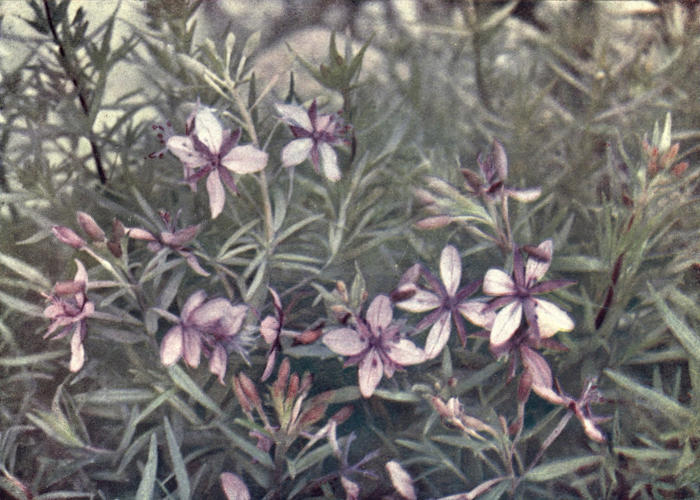
Fleischer’s Willow-Herb ( EPILOBIUM FLEISCHERI )
This plant is fairly common in the Alps and grows in dry
stony places, especially amongst the boulders of dried-up
torrent beds and beside some of the streams; with some of
these it descends towards the plains. Like not a few of the
less common Alpine plants, where it is found at all, it is usually
met with in great abundance. The flowers which open out
in July are of great beauty, and their arrangements to
prevent self-pollination are of considerable interest. The
stamens first ripen, and while these are held erect the stigma
is bent downward and the four segments into which it is
divided above are closely pressed together. (Most of the
flowers are in this stage in the photograph.) When the
pollen is shed the stamens bend downward, and not till then
does the stigma rise in the centre of the flower and its four
lips become separated from one another.
The flowers of Fleischer’s Willow-herb closely resemble
those of the Rose-bay (Epilobium angustifolium),
common in bushy places all over England, Switzerland, and
Central Europe. But the Rose-bay is a bigger plant with
tall, usually unbranched stem and much larger leaves, which
are veined underneath. As will be seen by the photograph,
the leaves of Fleischer’s Willow-herb are narrow and
lance-shaped, and the few veins that can be made out
are all parallel to one another. Closely resembling the plant
here photographed is the Rosemary-leaved Willow-herb
(Epilobium rosmarinifolium). Its leaves are usually more
numerous, narrower, and more strap-shaped, and its stem is
taller and, as a rule, more branched. But the most constant
difference between the two plants is to be found in the
length of the stalk which bears the stigma (style). This
is as long as the stamens in Epilobium rosmarinifolium, but
only half this length in Epilobium Fleischeri.
Plate XVII.
EPILOBIUM FLEISCHERI. HOCHST.
Fleischer’s Willow-Herb. Epilobe
des Moraines.Weidenröschen.
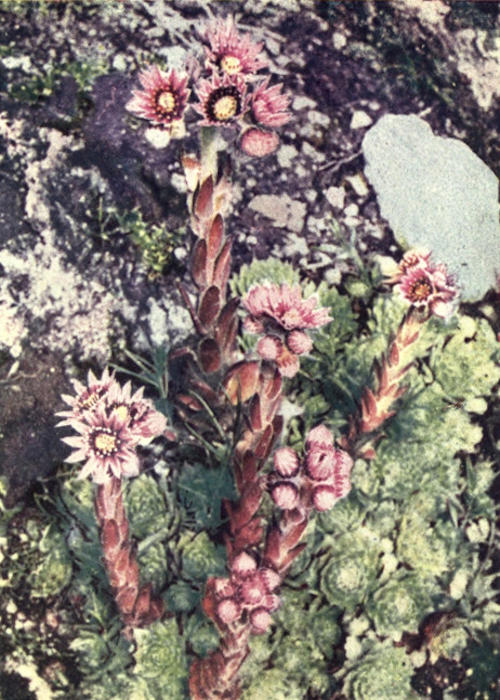
The Mountain House-Leek ( SEMPERVIVUM MONTANUM )
Several varieties of House-leek are found in Switzerland.
They grow in dry, rocky places, where moisture is scarce and
where they are exposed to the fierce heat of the sun. Their
succulent leaves, covered by a thick, almost leathery, cuticle, are
arranged in rosettes, and serve as storehouses for water.
The plants grow slowly and in clusters, and when each one
has accumulated sufficient strength it throws up a long central
stalk bearing star-like flowers, and dies as the seeds mature.
The house-leeks are reproduced not only by means of seeds,
but also by runners, which extend outward and bear a small
rosette of leaves at their extremities. Some of these can
be made out in the photograph. Some of the Saxifrages
closely resemble the house-leeks in habit of growth, but are
less succulent.
The Mountain House-leek is common all over the Alps
between 4000 and 8000 feet, or even higher in certain
parts. It seems to grow best on primary granitic rock.
The wedge-shaped rosette leaves are covered with short
glandular hairs. The rosettes are unfortunately not well
seen in the photograph, the leaves that can be made out
being mainly those of a species of Primula. From the
centre of the rosette the flower stalk arises. It is some 3
to 6 inches long and is covered with succulent leaves with
reddish tips. Above it divides into branches which bear the
beautiful star-like flowers. The flowers, which appear in
July and August, are usually of a pale red colour with a
darker central stripe to each petal. A variety with cream-coloured
petals is very occasionally found.
The Cobweb House-leek (Sempervivum arachnoideum)
is not unlike the plant here photographed, but will be readily
distinguished from it by the long white hairs borne at the
tips of the rosette leaves, which become interwoven with
those of adjoining leaves to form a spider’s-web-like
structure. Its flowers are a brighter crimson than those of
the Mountain House-leek.
Plate XVIII.
SEMPERVIVUM MONTANUM. L.
The Mountain House-leek. Joubarbe des Montagnes.Berg-Hauswurz.
Sempervivum Funckii
Not unlike the Mountain House-leek photographed on the
previous page is Sempervivum Funckii. It is not a common
plant, being only found in Eastern Switzerland, the Tyrol,
the Carpathians, and a few other mountainous districts, and
does not seem to have acquired any local name. Compared
with the Mountain House-leek the rosettes of leaves are a
little smaller. They are covered with much longer hairs,
which are not, however, twisted together into a spider’s web
like those of the Cobweb House-leek. As will be seen the
flowers are of a beautiful pale pink colour, and each petal has
a stripe of a darker tint running down its centre. The
plant grows in rocky places.
The Common House-leek (Sempervivum tectorum), which
is often seen in England growing on old walls and on cottage
roofs, where it is supposed to protect from lightning, is also
found in Switzerland. It is fairly common in dry, rocky
places, and ascends from the plains to 7000 feet. Its purple
flowers are not unlike those of Sempervivum Funckii, but its
wedge-shaped rosette leaves are only provided with hairs
along their margins, and are armed with sharp spines at their
extremities. It is, moreover, a much larger plant. The
rosette leaves of Sempervivum Wulfeni, another Alpine
species, are very like those of the Common House-leek, but
the plant is readily distinguished by its yellow or greenish-yellow
flowers. It grows on primary rock between 6000 and
8000 feet, and is rather uncommon.
Plate XIX.
SEMPERVIVUM FUNCKII. BRAUN.
Funcke’s House-leek. Joubarbe de
Funcke.Funcke’s Hauswurz.
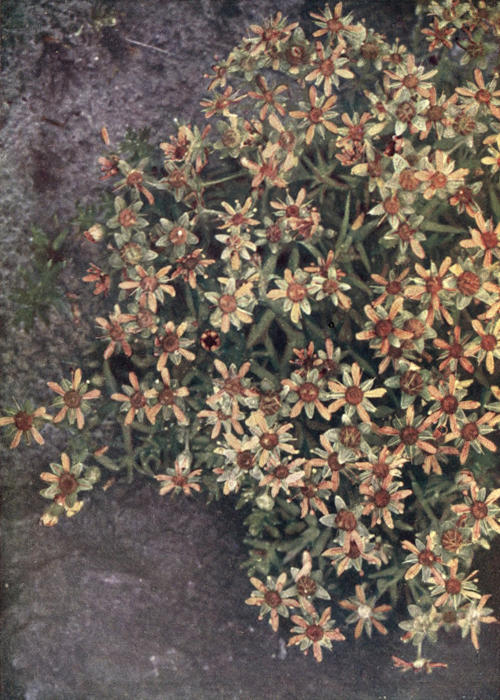
The Evergreen Saxifrage ( SAXIFRAGA AIZOIDES )
THE Saxifrages have been extraordinarily successful in the
Alps. Some thirty different species, some of them exceedingly
common, are met with in Switzerland.
The Evergreen Saxifrage is one of the most abundant. It
grows in moist rocky places, at the foot of glaciers, and on
the banks of mountain streams and waterfalls. It ascends to
9000 feet in places and descends almost to the plains with
some of the rivers. The plant grows in tufts. The erect
flower stems are covered by the narrow, succulent leaves,
which have hairs along each margin; they terminate in
branches bearing four to eight flowers. The star-like
flowers, which appear in July and August, are made up of
five brightly coloured petals alternating with five green
sepals. The petals may be lemon yellow with orange
red spots, or, as in the specimen here photographed (var.
atrorubens), pure orange red. Next comes a ring of ten
stamens with dark red pollen, and then the showy ring-like
nectary and the two styles in the centre of the flower.
The honey is so obvious and abundant that insects of all
kinds—flies, bees, butterflies, and beetles—visit the flowers;
but self-fertilisation is, in the main, prevented by the pollen
being shed before the ovaries with their stigmata are ready
for fertilisation. The Evergreen Saxifrage is to be found in
all parts of the Alps, and is also met with in the Arctic
regions.
With the help of the photograph no difficulty should be
experienced in recognising the plant. From the Stonecrops,
notably the Biting Stonecrop (Sedum acre), it is recognised
by its possession of two styles. But several of the other
Saxifrages resemble it much more closely. The Rough
Saxifrage (S. aspera) has paler flowers and more hairy leaves.
The Moss-like Saxifrage (S. bryoides) has a moss-like growth
and the flowers are borne on long, usually unbranched,
flower stalks. Saxifraga Sequieri has more flattened leaves,
and Saxifraga Hirculus, which is rare, has two raised spots at
the base of each yellow petal.
Plate XX.
SAXIFRAGA AIZOIDES. L.
The Evergreen Saxifrage. Saxifrage toujours verte ou Saxifrage pain
d’Oiseau.Immergrüner Steinbrech oder
Borsten-Steinbrech.
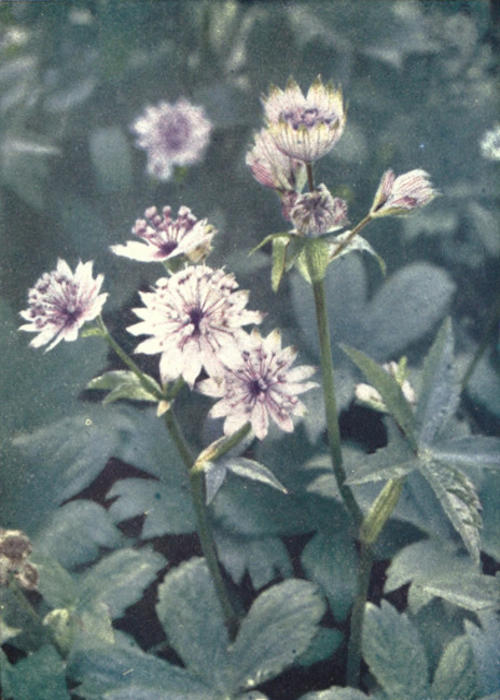
The Large Astrantia ( ASTRANTIA MAJOR )
This tall and handsome plant is common from the lower
mountain region up to 6000 feet all over Switzerland. It
grows in meadows, bushy places, and mountain woods.
Several long-stalked leaves rise directly from the root stock.
They are of a large size, circular in general outline, and
consist of five or six radiating lobes with deep depressions
between them. The branched flower-stem, perhaps some
2 or 3 feet in height, bears relatively few leaves. Its
various branches terminate in what appear to be single
flowers, but what are really masses of tiny flowerets with
short stalks all of the same length, surrounded by a
sort of cup made up of radiating leaves. The individual
flowers are greenish-white, often with a pinkish tinge, and
the radiating leaves are pale pink, with a central green stripe
and greenish tip. The flower-masses of the Astrantia are
an excellent example of the way in which small and unattractive
flowers combine together and form a structure, both
large and conspicuous, to attract insect visitors. These floral
societies are even better seen in the large natural order the
Compositæ, of which our next four photographs are examples.
The Large Astrantia flowers in July and August, and is met
with in many of the mountain woods of Central Europe as
well as in the Alps. It is occasionally found in England.
The Small Astrantia (Astrantia minor) is a much smaller
and more slender plant. The notches in its leaves extend
right up to the stem, thus completely separating the eight
or nine leaflets from one another. The Hare’s-ear
(Bupleurum ranunculoides) somewhat resembles the Large
Astrantia, but its flower-masses are entirely devoid of any
tinge of pink and its leaves are strap-shaped.
Plate XXI.
ASTRANTIA MAJOR. L.
The Large Astrantia or Master-wort. Astrance Majeure ou Radiaire.Grosse Sterndolde.
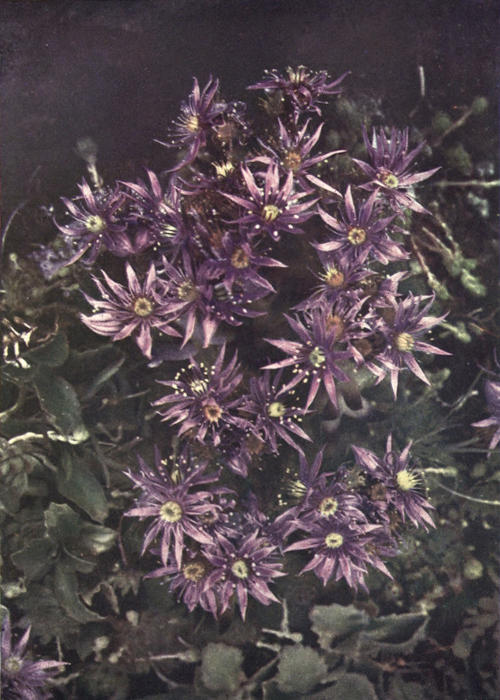
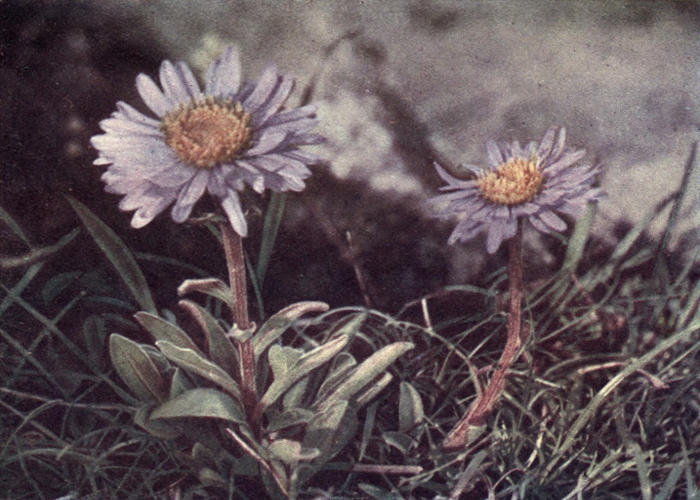
The Alpine Starwort or Alpine Aster ( ASTER ALPINUS )
The beautiful little Alpine Aster is found all over the Alps.
It flowers in July, August, and September, but occasionally it
may be found in bloom even as early as May. It grows in
dry Alpine pastures, sunny meadows, and rocky places, not
infrequently in company with the Edelweiss, between 4000
and 9000 feet; in a few places it extends much lower. The
plant consists of a rosette of woolly tufted leaves, with a
central stem bearing the solitary flower-head. In the higher
regions the flower-stem is short, perhaps only 4 inches
in length, but nearer the plains it may be 8 or 9 inches.
In any case, however, the flower-head is large, an inch
or two in diameter, and conspicuous on account of the broad
purple ray florets, which contrast strongly with the golden
yellow centre. The Alpine Aster is very widely distributed,
being found in Northern Asia, Arctic America, and in most
of the mountain ranges of Central and Southern Europe, but
not in the far North.
Closely resembling this plant is the Alpine Fleabane
(Erigeron alpina). It has narrower ray florets, which are
arranged in several rows and not in a single row like those
of the Alpine Aster, and a branched flower-stem bearing
several separate flower-heads. The much rarer Aster
Amellus differs from the Alpine Aster in the possession of
a branched flower-stem and blue, not purple, ray florets.
Plate XXII.
ASTER ALPINUS. L.
The Alpine Aster or Alpine Starwort.
Aster des Alpes.Alpen-Aster.
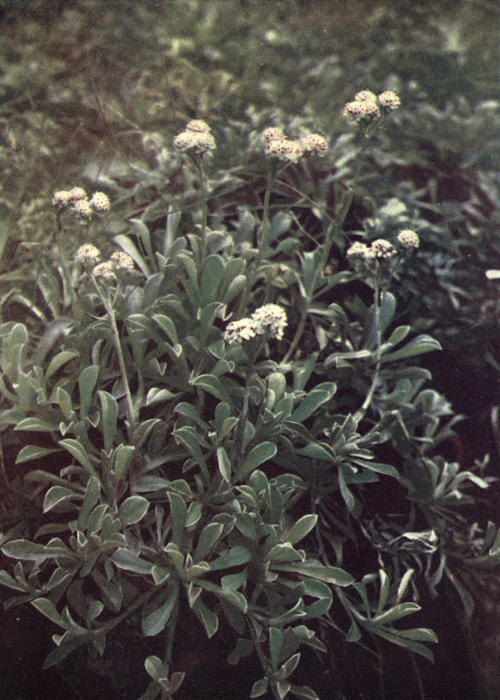
The Cat’s-Foot, Mountain Everlasting or Mountain Cudweed ( ANTENNARIA DIOICA )
The Cat’s-foot, which is, after all, perhaps the most suitable
name for this curious plant, is abundant in the Alps from the
lowest levels right up to 7000 or 8000 feet. It is found in
dry places, on moors and heaths, and in dry open woods.
It sometimes forms an unwished-for inhabitant of the mountain
pastures where it is disliked by the herdsmen, for it is
an undesirable plant for fodder. The leaves, like those of
the Edelweiss, are covered with white woolly hairs, and the
flower stems are also hairy. The flowers, which are pink or
white, are dioicious, that is to say, the same flower does not
produce both pollen and seed, and seed-forming and pollen-producing
flowers do not occur on the same plant. As the
pollen is not carried by the wind from flower to flower, the
plant is entirely dependent upon its insect visitors for the
fertilisation of its seeds, and without them no seeds will be
formed. The plant is also spread by means of runners,
which extend over the soil and take root at intervals.
The Swiss peasants make wreaths of the Mountain Everlasting,
which they wear as a charm, especially on
Ascension Day. The plant is widely distributed, and is
found in the North of England and Scotland, as well as
most parts of Europe and the Polar regions.
The Carpathians Cudweed (Antennaria carpathica),
which is also common in Switzerland, differs from the Cat’s-foot
in that its flowers are brown rather than white or pink,
and that it does not send out runners.
Plate XXIII.
ANTENNARIA DIOICA. GÄRTNER.
The Cat’s-Foot, Mountain Everlasting, or Mountain
Cudweed. Gnaphale dioique ou Pied de Chat.Echtes Katzenpfötchen oder Mayensässblume.
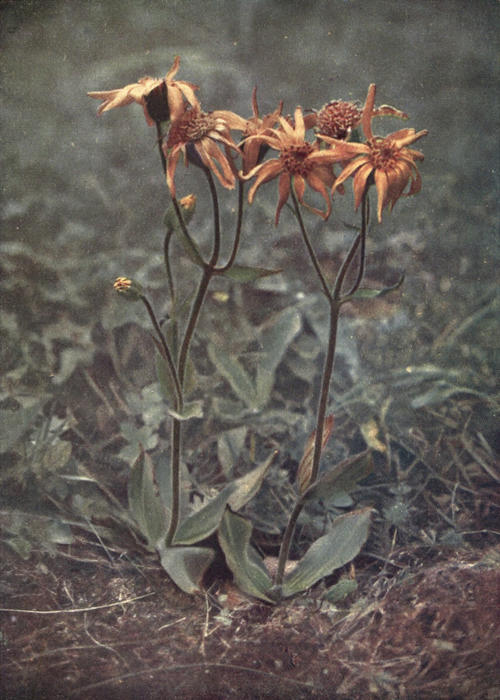
The Arnica ( ARNICA MONTANA )
A bright conspicuous plant is the Arnica, with its yellow
star-like flower-heads. It grows in meadows, pastures, and
on sunny moors, and is widely distributed in the Alps, from
the lower mountain regions up to 8000 feet. It is much
less common in limestone than in other districts. Four
broad green leaves grow from the root in the form of a
cross. In the centre of these rises the erect flower-stalk
some 8 or 9 inches long, and covered with glandular hairs.
On the flower-stalk are borne the one or two pairs of leaves,
without stalks, and arranged opposite to one another. The
flower-heads are drooping in the bud, but when they open they
are large and conspicuous and of a deep yellow colour. They
give forth a faint, resinous, not very pleasing, odour. The
outer or ray florets of the flower-head have long projecting
strap-shaped petals. Their purpose is to attract insects to
the floral society, and the less conspicuous florets in the
centre of the flower-head produce just as good seeds. At
first but a single flower-head is formed, but later on, if the
plant is vigorous, buds appear in the axils of the opposite
stem-leaves, and two more flower-heads appear. This is
what has happened in the two specimens here photographed,
and a second pair of buds is seen in one of them. It is
interesting to note that a mould-like fungus is found constantly
associated with the roots of the plant. It is believed
that the two plants grow together to the mutual advantage
of each, the fungus assisting the Arnica to obtain nourishment
from the soil, and in return receiving from it some of
the organic matter manufactured from the air with the help
of light. The root has a bitter aromatic taste. From it is
made the tincture of Arnica, which is often applied to
bruises, apparently, however, without any very considerable
influence upon them.
Several other Alpine plants, the Doronicum and Aronics,
for example, have bright yellow flower-heads like the Arnica,
but as no similar Alpine plant has pairs of opposite leaves
on the flower-stem, the recognition of the Arnica becomes
a very simple matter.
Plate XXIV.
ARNICA MONTANA. L.
The Arnica. Arnica.Echtes Wohlverlei.
The Spiny Fuller’s Thistle ( CIRCIUM SPINOSISSIMUM )
This stately and beautiful plant is common in all parts of
the Alps, but is found nowhere else. It grows in moist
places in the meadows and pastures, and beside the streams,
between 4000 and 7000 feet. It is generally looked upon as a
noxious weed by the herdsmen, but in one or two places the
upper and more succulent parts are gathered and preserved
as pigs’ food for the winter.
The thick evergreen leaves, armed with formidable
spines, are paler at the upper part of the stem where they
surround the large brown flower-head. Usually but a single
flower-head is borne by each plant, but each one produces
some hundreds of seeds. Each seed has a feathery wing-like
appendage, so that it may be more easily distributed by the
wind. The Spiny Fuller’s Thistle is usually some 3½ or 4
feet high, as was the specimen photographed, but in high
altitudes the plant is more bushy and stunted. Under these
conditions it is not unlike the Stemless or Alpine Carline
Thistle (Carlina acaulis), which, in spite of its name, has
sometimes a stem some 8 or 10 inches long. But the
Carline Thistle has a larger and more flattened flower-head,
and when the flowers are in bloom they are of a purple
colour, though they soon turn brown as they get dried up.
Probably the nearest relation of the plant here photographed
is the Common Fuller’s Thistle (Circium oloraceum),
abundant in moist places, both in the Alps and lowlands. It
is a plant that would seem to be protected by its resemblance
to other members of its family, for though it appears spiny,
it is soft and succulent, and bears not a single prickle anywhere.
The leaves, which are sparsely distributed on the
slender stem, are of a dirty grey-green colour, and though as
tall as its spiny relative, the plant is much less robust.
The Round-Headed Rampion ( PHYTEUMA ORBICULARE )
In England we have only two kinds of Rampion and both
are rare, but in Switzerland there are no less than ten
different species, with blue and white flowers, and some of
them are extremely abundant. One of the commonest of
the blue-flowered varieties is here photographed. It grows
in mountain pastures and poor meadows between 3000 and
8000 feet, and is found not only in the Alps but all over
Central Europe, though absent in the North. It flowers in
July, and the size of the plant undergoes considerable variation
according to the altitude at which it grows. Sometimes
the flower-stalks are but 3 or 4 inches long, at others 16
or 18. The leaves, which grow from the root stock, have
serrated edges, and are frequently a good deal larger than
those of the specimen photographed. The methods adopted
by the plant for the distribution of its pollen and the
fertilisation of its seeds through the agency of insect visitors
are of particular interest. Each flower of the flower-head
is formed of a blue tubular structure (corolla), which is at
first closed above. In the centre of this is the style covered
by short hairs and surrounded by the five stamens. While still
in the bud the stamens shed their pollen, which collects in
the tube around the style and is retained in position by the
short hairs. Now the flower opens at its tip, and while
maintaining its tubular character above splits longitudinally
below into five or six segments, so that linear openings are
formed. The result is that when an insect settles on the
flower the tubular corolla is very easily depressed, exposing
the style surrounded on all sides by pollen. Any pollen that
is not removed by the insect falls from the style, for the
short hairs on the style by which it is held in position very
soon fade. The style then splits above into three segments,
exposing for the first time the sticky stigmatic surface now
ready for pollination.
The Round-headed Rampion is one of the five Swiss
species with rounded, not elongated, flower-heads. Three
of them can at once be put aside, because they are usually
much smaller plants and have less than twelve flowers to a
flower-head, whereas the Round-headed Rampion has always
more. Phyteuma Scheuchzeri is distinguished from this
plant by its lilac flowers, longer stalked and usually
broader basal leaves, and especially by the circle of leaves
immediately beneath the flower-head, which are longer than
the flowers themselves.
Plate XXV.
PHYTEUMA ORBICULARE. L.
The Round-headed Rampion. Raiponce à Capitules Arrondies.Kugelköpfige Rapunzel.
The Bearded Bell-flower or Campanula ( CAMPANULA BARBATA )
Of the numerous Bell-flowers which abound in the Alps none
is more quaint and beautiful than the one here photographed.
The whole plant, stem, leaves, and flowers, is covered with
short hairs, but around the mouth of the bell the hairs are
longer and stiffer, and pure white. It is interesting to note
that when cultivated in rockeries in England the hairy
character of the plant almost entirely disappears. Some
three to five pendent flowers are borne by each flower-stalk,
all turned in the same direction. Occasionally a single
flowered variety is met with, usually at a high altitude. The
ordinary pale blue colour of the flower may disappear entirely,
and specimens with pure white blossoms are not infrequent.
The plant is found abundantly all over the Alps and Sub-Alps,
in meadows and pastures, and to a less extent in open
woods, from 3000 feet almost to the snowline (7000 to
9000 feet). It is usually less abundant on limestone than
on other rocks. The Bearded Bell-flower is also met with
in the Carpathians, Jura, southern parts of Norway, and in
other mountainous districts in Europe. It is probably a
native of the Alps.
No difficulty will be experienced in recognising the
Bearded Campanula. No other Bell-flower has little projections
between each of the five teeth of the calyx which are
turned back towards the stem. Only one other Bell-flower
(Campanula Zoysii), and that a species not always recognised
as distinct, has a light blue corolla with long hairs around its
mouth. But here there is a constriction just immediately
below the opening of the bell, and the plant is smaller and very
rare, and occurs only in Eastern Switzerland.
Plate XXVI.
CAMPANULA BARBATA. L.
The Bearded Bell-flower or Campanula. Campanule Barbue.Bärtige
Glockenblume.
The Dwarf Hair-Bell or Bell-Flower ( CAMPANULA PUSILLA )
The photograph gives a good general idea of the tufted
growth of the Dwarf Bell-flower. The plant is quite small,
rarely more than 3 or 4 inches high, and forms dense close-growing
tufts of some size. The smooth or hairy flower-stalks
bear one to six pale blue flowers and the narrow leaves, which
are most numerous and have serrated edges below. There
are also short flowerless branches covered with similar
leaves, and a few broader leaves with longer stalks grow
directly from the root stock. These last are not well seen
in the photograph. The plant is very abundant in dry
rocky and sandy places, in dried up torrent-beds, by the
roadside and on the tops of walls. It is found from the
lower mountain region up to some 8000 feet, and descends
with some of the rivers towards the plains. It is also found
in the Jura and parts of the Black Forest.
The Dwarf Bell-flower will be recognised from most of
the other species of Campanula which abound in Switzerland
by its broad basal leaves, its narrow stem leaves, and its
erect seed pod. But, unfortunately, there are three other
Swiss species to which this description equally well applies.
Of these the rare Campanula excisa is at once picked out
by the deep rounded clefts between the five segments of its
bell-shaped flower. Campanula Scheuchzeri is a larger
plant of more open and less tufted growth and with fewer
flowerless leafy shoots. Its bell-shaped flowers are usually
of a darker blue, are more conical, and have a wider
opening; they are, in fact, less truly bell-shaped. Campanula
rotundifolia, the common Hair-bell of our heaths and downs,
which occurs also in Switzerland, is slightly taller than our
plant and has also more cone-shaped flowers. Its flower
buds are held erect, while those of the other three Bell-flowers
we are considering are dependent. In a general
way, the low stature and tufted growth of the Dwarf Bell-flower
will, in most cases, suffice for its recognition.
Plate XXVII.
CAMPANULA PUSILLA. HÆNK.
The Dwarf Hair-bell or Bell-flower. Petite Campanule ou Campanule Naine.Kleine Glockenblume.
The Hairy-Leaved Alpenrose ( RHODODENDRON HIRSUTUM )
The Alpenrose is the commonest and best known of all the
Alpine plants. It abounds almost everywhere; were it not
so it would have become practically extinct years before, for
it is gathered unmercifully. Nor are the visitors to Switzerland
alone responsible for this. Every Sunday throughout
the summer, crowds of the native peasants, both children
and adults, may be seen returning home, each bearing in
his arms an immense bunch of the favourite flower, and
often with a second and smaller nosegay tied round the top
of his alpenstock.
There are really two distinct species of Alpenrose, the
Hairy-leaved (Rhododendron hirsutum), and the Rusty-leaved
(Rhododendron ferrugineum) varieties, and a hybrid
or cross between them is also less commonly found. Both
varieties are low evergreen shrubs with thick leathery leaves
which only fade after three or four years. Both have raised
brown spots on the lower surfaces of the leaves, only they
are much more numerous on the Rusty-leaved species, so
that the under surface of the leaf is completely covered with
them while they are only sparsely scattered on the leaf of
the Hairy-leaved variety. They contain a balsam, and are
thought to be of use to the plant in preventing its drying
up. They may also assist in the absorption of water. The
flowers of both species are admirably adapted for cross-fertilisation
by the humble-bees which visit them. The
stamens first mature, and not until the great part of the
pollen is shed does the stigma lengthen and become ready
for pollination. The long hairs growing from the stalks
which bear the stamens interlock with similar hairs on the
inside of the corolla, and thus effectively prevent the
entrance of smaller insects which might visit the flower
in search of the abundant honey, but which would fail to
effect its fertilisation. The flowers of the species here
illustrated are usually a little paler in colour, slightly smaller,
and open a little later than those of the Rusty-leaved variety.
The plant usually forms a lower and more thickly branched
shrub, with rather shorter twigs. But the essential distinguishing
features between the two are to be found in
their leaves. The leaves of Rhododendron hirsutum are
usually broader and less pointed, green underneath, and
have well-marked hairs all round their edges. In Rhododendron
ferrugineum the leaves tend to be narrower, darker green
above, and brown underneath, and are entirely devoid of
hairs, but have rolled back edges. Both species are found
abundantly in rocky places between 4000 and 8000 feet,
and flower in June, July, and August, and may be seen at
their best in July. The Rusty-leaved variety seems to
prefer a rather moister spot and may also be found on peat.
It is most abundant on primary granitic rock, while the other
species grows best on limestone.
Plate XXVIII.
RHODODENDRON HIRSUTUM. L.
The Hairy-leaved Alpenrose. Rhododendron cilié ou hérissé.Bewimperte Alpenrose, oder Wimpern-Alpenrose.
The Lesser Winter-Green ( PYROLA MINOR )
The plant here photographed derives its English name from
the evergreen character of its leaves. It is in fact a British
plant, being found somewhat rarely in Scotland and in the
North, but is much more common in Switzerland. It grows
among the moss in shady woods, from the plains right up to
the tree-limit and may even reach 8000 feet or higher, where
protected by shrubs and bushes. The plant is widely
distributed in Switzerland and is also found in Vosges,
Pyrenees, and Jura. It flowers in July.
The Lesser Winter-Green will be recognised by its
short, straight style, which does not project beyond the flower
and which is closely surrounded by the stamens which
converge toward it. Of the four other Swiss Pyrolas which
resemble the above, two only are at all common, and these
two will alone be mentioned. Pyrola secunda will be
recognised by its longer straight style, which projects beyond
the petals and by its greenish white flowers, which are all
turned in the same direction. Its leaves are more pointed
and have deeper notches than those of our plant. Pyrola
rotundifolia has also a style that projects beyond the petals,
but it is curved so that the stigmatic surface at its extremity
is far below the centre of the flower.
Plate XXIX.
PYROLA MINOR. L.
The Lesser Winter-green. Petite
Pyrole.Kleines Wintergrün.
The Stemless Gentian ( GENTIANA ACAULIS )
Many species of Gentian are met with in the Alps. One of
the best known of the smaller varieties is the Stemless
Gentian or Gentianella, which is a frequent inhabitant of
heaths, meadows and pastures all over the higher parts of
Switzerland, and is also found in the Jura and Carpathians,
being less common on limestone soil and more abundant on
primary granitic rock. The plant grows at an altitude of
4000 to 8000 feet, and flowers in June, July, and August.
Occasionally it descends much lower and may even be found
below 1500 feet in a few special localities. Each plant
consists of a small rosette of leaves, a very short stem, and
a single bell-shaped flower of deep azure blue. Very often
two or three plants are found growing together and a small
group such as that photographed is not infrequent.
Occasionally also specimens with pale blue, rose red or
even white flowers may be seen. When the flower has
been fertilised, and while the seeds are maturing, the brightly
coloured corolla shrivels up and surrounds the seed vessel,
at the same time becoming of a green colour and perhaps
taking on a vegetative function. The leaves are rather
leathery, narrow, and pointed.
It is often quite a difficult matter to distinguish between
the Stemless Gentian, here illustrated, and the Carved
Gentian (Gentiana excisa), not only because the two plants are
so much alike but also because intermediate forms exist;
indeed, it is open to question whether the two plants are
really to be regarded as distinct species. In the Carved
Gentian the calyx lobes become contracted just above their
bases, to widen out again above, and the recesses between
the lobes are more rounded and less pointed. The leaves
also are broader, less leathery, and not nearly so sharp pointed
as those of the so-called stemless variety. The flowers of the
Marsh Gentian (Gentiana Pneumonanthe) are also not unlike
those of the plant here photographed, but it should be readily
distinguished because its leaves are much narrower and
several flowers are borne by a single plant.
Plate XXX.
GENTIANA ACAULIS. L. (GENTIANA CLUSII).
The Stemless Gentian. Gentiane
à Tige Courte.Stengelloser Enzian oder
Erd-Enzian.
The Short-Leaved Gentian ( GENTIANA BRACHYPHYLLA )
A particularly fine group of this beautiful little Gentian
is here photographed. It is typical of the high Alps or
snow region, and is rarely found below 6000 feet, and while
scarce above 9000 is to be gathered even at 12,000 feet on
the Matterhorn. But a single flower is borne by each little
plant at the top of a short stem, which also bears the small,
thick, closely packed leaves. The plant is found growing in
the turf of mountain pastures and rocky places in the central
parts of the whole Alpine chain. It is moderately common
particularly on primary rock, and is also met with in Dauphiny
and the Pyrenees.
Of the twenty or more species of Gentian that occur in
Switzerland, some are tall, stately plants, bearing numerous
blue, yellow, or purple flowers. Others are much smaller
and bear relatively few flowers, or even one only in small
feeble plants. A few never have more than a single
blossom to each little plant. Among these last are the
Stemless Gentian with its bell-shaped flower, figured on the
previous plate, and the Short-leaved Gentian with its star-like
flower, which we here illustrate. As a matter of fact, there
are really three single-flowered Star-Gentians and to distinguish
between them is not easy. Of these the Bavarian
Gentian (Gentiana bavarica) is recognised from our plant by
its longer stem, perhaps 2 to 3 inches long, on which
only two or three pairs of opposite leaves are borne, and by
the fact that the lower leaves are smaller than the upper.
The Spring Gentian (Gentiana verna) has a very short stem,
covered by closely packed leaves like the short-leaved
variety, and like it, too, the lower leaves are the larger, but
its leaves are harder, narrower, and more pointed, and short
wing-like projections are found on its calyx.
Plate XXXI.
GENTIANA BRACHYPHYLLA. FROL.
The Short-leaved Gentian. Gentiane à Feuilles Courtes.Kurzblättriger Enzian oder Eiförmiger Enzian.
The Alpine Toad-Flax ( LINARIA ALPINA )
This beautiful little plant is abundant in all parts of the
Alps. It is one of the first to take possession of fresh
soil, but disappears rapidly under the stress of competition
with other plants. Its numerous winged seeds are carried
far and wide by the wind, and take root and grow rapidly
on any open space. Hence it is found among the general
rocky débris of the mountain-side, on the moraines of
glaciers, and on the fresh soil brought down by avalanches,
and is most abundant in limestone districts. Its true home
is the high Alps and the snow region, and it flourishes best
between 5000 and 9000 feet; but it is often carried down
to a much lower level by the rivers, and is even found
locally in the plains of Southern Germany. The Alpine
Toad-flax is an inhabitant of most of the mountain ranges of
Central and Southern Europe, and is thought to have taken
origin in the South. It flowers from June till September, and
seems to have derived its name from its flax-like foliage.
From the root stock arise one or more prostrate branches
which creep over the rocks and soil, and turn upward at their
extremities to terminate in a bunch of the brightly-coloured
flowers. The grey-green leaves are narrow and succulent,
and are arranged in whorls of four on the stem. The flowers
are furnished with a long spur which contains the honey,
and are only visited by bees and humble-bees. The common
humble-bee has a long enough tongue to reach to the tip
of the spur and is the chief agent in the fertilisation of the
plant. The orange-yellow spot at the only opening to the
flower is equivalent to a notice “this way to the honey.”
Should no insect visit a flower self-fertilisation will nevertheless
occur and seeds will be produced all the same. A variety of
this plant, with flowers of a uniform red-violet colour and without
any orange-yellow spot, grows on primary granitic rock.
A second and much rarer type has pure yellow blossoms.
The plant is sure to be easily recognised. The prostrate
stem, narrow leaves, and entirely closed up flowers that grow
together in bunches are some of the more characteristic
features.
Plate XXXII.
LINARIA ALPINA. MILL.
The Alpine Toad-flax. Linaire des
Alpes.Alpen-Leinkraut.
The Alpine Balsam ( ERINUS ALPINUS )
The Alpine Balsam is a characteristic rock plant of the
limestone Alps. Taking root in the clefts of the rocks, it
sends out radiating branches in all directions, which adhere
closely to the surface. It may also be sought in dry
mountain meadows and among the grass of dry stony slopes,
and is fairly common between 4000 and 7000 feet. Sometimes
it is met with at a lower altitude in rocky places. The
leaves, which are broader at their free extremities and covered
by short hairs, are crowded together at the base of the stem.
They have deeply serrated edges. The violet-purple or
occasionally white flowers, which are formed of five petals
united at their bases, are borne at the extremities of the
branches. The Alpine Balsam is found not only in the Swiss
Alps but also in the Tyrol, the Jura, the Vosges and
Pyrenees. It flowers from early June till August.
The flowers of the Bird’s-eye or Mealy Primrose (Primula
farinosa) are not unlike those of the Alpine Balsam, at any
rate at first sight. But each Mealy Primrose plant bears
but a single leafless flower-stem which terminates in a
cluster of flowers. Moreover, the Mealy Primrose is found
in moist meadows and boggy places, and rarely among rocks,
and its leaves have a grey, powdery bloom on their lower
surfaces.
Plate XXXIII.
ERINUS ALPINUS. L.
The Alpine Balsam. Erine des
Alpes.Alpen-Leberbalsam.
The Leafy Lousewort ( PEDICULARIS FOLIOSA )
The Louseworts as a whole have been exceedingly successful
in the Alps. No less than fourteen different species are to
be found, and some of them are exceedingly common. In
spite of their unpleasant name they are for the most part
really beautiful plants, and as a group they are interesting
in several ways. In the first place, they are all in some degree
parasites on other plants. Branches arise from the roots
which attach themselves to the roots of neighbouring plants
and absorb from them water or salts or even organic nourishment.
The Leafy Lousewort is not a great offender in this
respect, but other species are capable of completely destroying
many of the surrounding plants. The method of pollination
of the Lousewort flowers is also somewhat remarkable. The
flowers are only visited by humble bees, for no other insect
appears to be strong enough to force an entrance into the
flower. As may be made out from the photograph, the
flower consists of two lips. In the upper is a vertical slit
through which the stigma alone projects, but immediately
behind the slit are the four stamens. The lower lip forms
practically a landing stage for insect visitors. When the
humble-bee alights on the flower his head is sure to come
in contact with the projecting stigma and some of the pollen
which he unconsciously carries with him will be removed.
As he bends forward and thrusts his head into the flower
to suck the honey the vertical slit in the upper lip will be
widened out and the stamens will protrude and strike
the insect’s head. When the humble-bee at last leaves
the flower to continue his journey its various parts will
resume their former relative positions. Should no insects
visit the flower self-pollination will occur. This appears to
be the usual course of events in the North where humble-bees
are scarce. In Spitzbergen, where there are no
humble-bees, a nearly-related species, Pedicularis lanata, is
said to be regularly self-fertilised without apparently
suffering in any possible way.
The Leafy Lousewort here illustrated is the commonest
variety in most districts. It is a tall, stately plant, often some
two feet high, which is found on grassy slopes and in
rocky places between 3500 and 7000 feet, and grows best on
a limestone soil. The large fine-divided leaves are even found
among the pale yellow flowers on the flower-stem. The
plant flowers in June and July, and is found in the Alps,
Pyrenees, Vosges, and Jura. It will be readily recognised by
its alternate leaves, and pale yellow hairy flowers, without any
beak-like projection at their summits. Pedicularis Oederi,
which is a little like it, has no foliage leaves between the
flowers, which are devoid of hairs, and have a blackish red
spot on either side of the upper lip.
Plate XXXIV.
PEDICULARIS FOLIOSA. L.
The Leafy Lousewort. Pédiculaire
à épi feuillé.Reichbeblättertes
Läusekraut.
The Yellow Auricula ( PRIMULA AURICULA )
Directly the snow melts up come the Auriculas, but only
on limestone soil. The Auricula is really a spring plant,
and usually flowers in May, but where protected by slowly
melting masses of snow it may not bloom till much later;
the accompanying photograph was taken in July. The thick,
dense rootstock penetrates deep into the clefts of the rock.
The leaves are smooth, rather fleshy, and of a bluish-green
colour. The upper surface of the leaves, the flower-stalk
and the calyx are covered with a white mealy substance.
The leaves appear to serve the plant as a means of absorbing
or storing water. Although the thick, dense cuticle usually
present on leaves which have this function is here absent,
they are found to dry up very slowly. It is probable that
the thick cellulose walls between the individual cells replace
the cuticle in the leaves of this plant. The flowers give
forth a pleasant odour, something like that of the cowslip,
but rather sweeter. Like the flowers of the primrose, they
are of two kinds. The one has a long stigma which projects
as far as the opening of the flower, and short stamens, and
the converse is the case in the other. The object of this
arrangement is to facilitate the pollination of the flowers by
the agency of insect visitors as they pass from the one type
to the other. Darwin found that very few seeds were
formed when the flowers were self-fertilised.
The Auricula grows in rocky places between 3000 and
7000 feet. It is only found in limestone districts, and is
rather local. It is also to be met with in the Jura, Dauphiny,
the Pyrenees, the Carpathians, and in one or two places in
the Black Forest.
The Auricula will be readily recognised. From the
Oxlip (Primula elatior) and Cowslip (Primula officinalis
or veris), it is distinguished by its smooth, not wrinkled,
leaves and mealy stem. It is probable that most of the
brilliantly coloured garden Auriculas were originally derived
from this species.
Plate XXXV.
PRIMULA AURICULA. L.
The Yellow Auricula. Primevère
Auricule.Felsen-Aurikel oder
Flühblüemli.
The Marsh Orchis ( ORCHIS LATIFOLIA )
A large number of Orchids are to be found in the Alps.
They form a well-defined group of plants which are particularly
interesting in view of complicated devices which they
have adopted to ensure the fertilisation of their seeds by the
agency of insect visitors. Nearly all the English species are
found in Switzerland, and most of them are met with in
much greater abundance there. The beautiful pink Helleborine,
the sweet-scented Butterfly Orchis, may be found in
profusion on the lower mountain slopes, and the dark red
Nigritella, with its odour of vanilla, and the ghost-like
Coral-root, in the higher regions.
Of the genus Orchis alone there are no less than seventeen
Swiss species. Many of these are much alike, and by
no means easy to distinguish from one another. One of the
most abundant is the Marsh Orchis, which is also met with
in England, but is not nearly so common there. The plant
grows in damp meadows and boggy places, where an average
sized plant may be 18 inches or two feet high. Its large
purple spotted flowers appear in June and may last until July.
The methods adopted by the plant to ensure the fertilisation
of its flowers by means of insect visitors are most
elaborate and exact, but without the aid of diagrams they
are a little difficult to explain. It is curious that no honey
is contained in the spur. It is probably the cell sap in it
that is attractive to insects.
The Marsh Orchis will be recognised by its spreading
spotted leaves, hollow stem, the palm-shaped tubers of its
root, and the thick spur to the flower.
Plate XXXVI.
ORCHIS LATIFOLIA. L.
The Marsh Orchis. L’Orchis
à Feuilles Larges.Breitblättriges
Knabenkraut.
The Lady’s Slipper ( CYPRIPEDIUM CALCEOLUS )
This is one of the most striking plants of the Swiss flora, and
while nowhere common is pretty widely distributed in the
limestone districts of the Alps. It is a plant of some size,
perhaps 12 to 24 inches in height, and grows in stony woods
from the lower mountain region up to 6500 feet. One to
three large yellow flowers are borne by each plant. Their
method of fertilisation is of exceptional interest. Close to
the attachment of the yellow slipper-shaped petal to the rest
of the flower is a projection bearing on each side a stigmatic
surface below and a mass of pollen above. The large yellow
petal is smooth inside and has overhanging edges, rather like
those of the familiar beetle-trap that is used for catching
cockroaches, and as we shall see in a moment it acts in a
similar manner. There is no honey in the flower, and it is
not quite clear what the small bees that have been seen
visiting it go there for. But at any rate when they once get
in they have the greatest possible difficulty in getting out
again, and only succeed in doing so by climbing up the
attached side of the flower where the edges are not overhanging,
that is on either side of the central projection. In
doing this they are sure to brush first against the stigmatic
surface, leaving behind some of the pollen they may chance to
have sticking to them, and then against the viscid mass of
pollen, some of which is sure to become attached to them.
This process has been actually observed by Dr Herman
Müller in the Alps.
The Lady’s Slipper Orchid is found also in the Jura, Tyrol,
Dauphiny, Pyrenees, in certain parts of Central and
Southern Germany, and even in the North of England. It
is everywhere rather rare, but specially so in this country.
It flowers in May and June, and is sure to be easily recognised,
for there is no other plant in the least like it.
No doubt such names as the Lady’s Slipper, Lady’s Mantle,
and Lady’s-Tresses refer to the dedication of the plant to
the Virgin in mediæval times. The French name, “Sabot
de Vénus,” refers to a very different personage. A comparison
between the English, French, German, and the scientific
names, for the last of which Linneus is responsible, is a good
example of the way in which the goddess Venus and the
Virgin Mary were often confounded with one another in the
early days.
Plate XXXVII.
CYPRIPEDIUM CALCEOLUS. L.
The Lady’s-Slipper Orchid. Sabot
de Vénus.Gemeiner Frauenschuh.
The White Veratrum ( VERATRUM ALBUM )
The White Veratrum is a tall weed with large green leaves,
very abundant in moist meadows and pastures in all parts of
the Alps between 2000 and 6000 feet. Before the flowers
appear it strongly suggests one of the larger Gentians, but
the flowers, which come out in July and August, are quite
different. It is a widely distributed plant, being found in
Russia, Siberia, Lapland, as well as in most of the mountain
ranges of Central and Southern Europe. It appears to have
been left as a relic of the glacial period in the higher parts
of Silesia and the Black Forest. The large green leaves are
downy beneath, and the flowers, which are always green
externally, may be pure white (var. typicum), or more commonly
yellowish-green (var. Lobelianum), internally. Some would
regard these two varieties as distinct species. The whole
plant is extremely poisonous. Sometimes it is eaten by the
sheep and goats with disastrous results to the herdsmen,
but the cattle are wiser and rarely make this mistake. The
poison is an alkaloid Veratrin, which is contained in largest
quantities in the root from which it is extracted for medical
purposes. If the root be tasted it will at first appear sweet,
but its acrid, bitter flavour soon overpowers this first
impression. The Swiss herdsmen look upon the White
Veratrum as a noxious weed, not only because of its poisonous
properties but also because it grows in the richest soil and
robs the true fodder plants of nourishment. In the Jura,
on the other hand, the farmers rather welcome it. They
say that the shade of its large leaves preserves the grass
for the cattle and prevents it becoming dried up by the
scorching sun.
The White Veratrum will be easily recognised. Its
nearest relative, the Black Veratrum (Veratrum nigrum), is a
much rarer plant that grows in woods. It has reddish-black
or chocolate flowers, which grow in large spikes like those of
the plant here illustrated, but each individual flower has a
relatively longer flower-stalk.
Plate XXXVIII.
VERATRUM ALBUM. L.
The White Veratrum. Hellébore blanc ou
Vératre blanc.Weisser Germer.