“We have stopped the plumers,” said the game-warden, “and we are
holding the market-hunters to something like decency; but there’s a
pot-hunter yonder on Pelican Point that I’ve got to do up or lose my
job.”
Pelican Point was the end of a long, narrow peninsula that ran out
into the lake, from the opposite shore, twelve miles across from us.
We were in the Klamath Lake Reservation in southern Oregon, one of the
greatest wild-bird preserves in the world.
Over the point, as we drew near, the big white pelicans were winging,
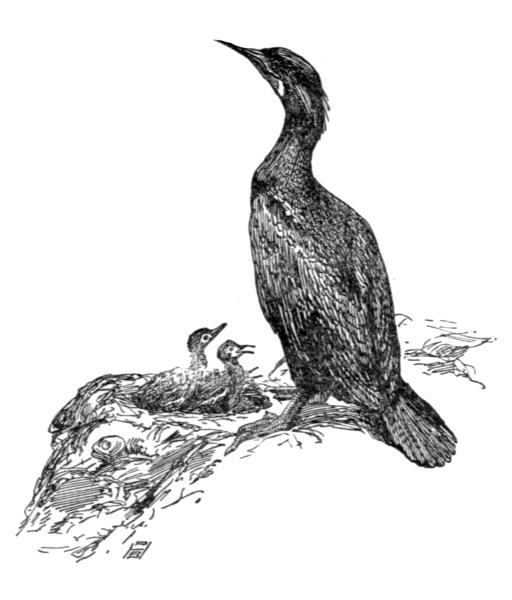
and among them, as our boat came up to the rocks, rose a colony of
black cormorants. The peninsula is chiefly of volcanic origin,
composed of crumbling rock and lava, and ends in well-stratified
cliffs at the point. Patches of scraggly sagebrush grew here and
there, and out near the cliffs on the sloping lava sides was a field
of golden California poppies.
The gray, dusty ridge in the hot sun, with cliff swallows and
cormorants and the great pouched pelicans as inhabitants, seemed the
last place that a pot-hunter would frequent. What could a pot-hunter
find here? I wondered.
We were pulling the boat up on the sand at a narrow neck in the
peninsula, when the warden touched my arm. “Up there near the sky-line
among the sage! What a shot!”
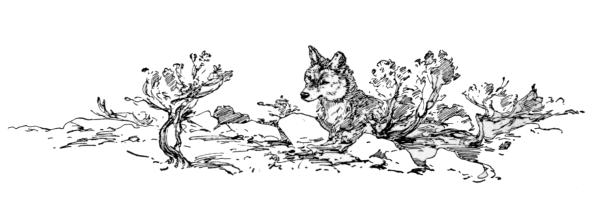
I was some seconds in making out the head and shoulders of a coyote
that was watching us from the top of the ridge.
“The rascal knows,” went on the warden, “I have no gun; he can smell a
gun clear across the lake. I have tried for three years to get that
fellow. He’s the terror of the whole region, and especially of the
Point; if I don’t get him soon, he’ll clean out the pelican colony.
“Why don’t I shoot him? Poison him? Trap him? I have offered fifty
dollars for his hide. Why don’t I? I’ll show you. Now you watch the
critter as I lead you up the slope toward him.”
We had not taken a dozen steps when I found myself staring hard at the
place where the coyote had been, but not at the coyote, for he was
gone. He had vanished before my eyes. I had not seen him move,
although I had been watching him steadily.
“Queer, isn’t it?” said the warden. “It’s not his particular dodge,
for every old coyote that has been hunted learns to work it; but I
never knew one that had it down so fine as this sinner. There’s next
to nothing here for him to skulk behind. Why, he has given my dog the
slip right here on the bare rock! But I’ll fix him yet.”
I did not have to be persuaded to stay overnight with the warden for
the coyote-hunt the next day. The warden, I found, had fallen in with
a Mr. Harris, a homesteader, who had been something of a professional
coyote-hunter. Harris had just arrived in southern Oregon, and had
brought with him his dogs, a long, graceful greyhound, and his
fighting mate, a powerful Russian wolfhound; both were crack coyote
dogs from down Saskatchewan. He had accepted the warden’s offer of
fifty dollars for the hide of the coyote of Pelican Point, and was now
on his way round the lake.
The outfit appeared late the next day, and consisted of the two dogs,
a horse and buckboard, and a big, empty dry-goods box.
I had hunted possums in the gum swamps of the South with a stick and a
gunny-sack, but this rig, on the rocky, roadless shores of the lake—a
dry-goods box for coyotes!—beat any hunting combination I had ever
seen.
We had pitched the tent on the south shore of the point where the
peninsula joined the mainland, and were finishing our supper, when not
far from us, back on shore, we heard the doleful yowl of the coyote.
We were on our feet in an instant.
“There he is,” said the warden, “lonesome for a little play with your
dogs, Mr. Harris.”
There was still an hour and a half of good light, and Harris untied
his dogs. I had never seen the coyote hunted, and was greatly
interested. Harris, with his dogs close in hand, led us directly away
from where we had heard the coyote bark. Then we stopped and sat down.
At my look of inquiry, Harris smiled.
“Oh, no, we’re not after coyotes to-night, not that coyote, anyhow,”
he said. “You know a coyote is made up of equal parts of curiosity,
cowardice, and craft; and it’s a long hunt unless you can get a lead
on his curiosity. We are not out for him. He sees that. In fact,
we’ll amble back now—but we’ll manage to get up along the crest of
that little ridge where he is sitting, so that the dogs can follow him
whichever way he runs. You hunt coyotes wholly by sight, you know.”
The little trick worked perfectly. The coyote, curious to see what we
were doing, had risen to his feet, and stood, plainly outlined against
the sky. He was entirely unsuspecting, and as we approached, only
edged and backed, more apparently to get a sight of the dogs behind us
than through any fear.
Suddenly Harris stepped from before the dogs, pointed them toward the
coyote, and slipped their leashes. The hounds were trained to the
work. There was just an instant’s pause, a quick yelp, then two
doubling, reaching forms ahead of us, with a little line of dust
between.
The coyote saw them coming, and started to run, not hurriedly,
however, for he had had many a run before. He was not afraid, and kept
looking behind to see what manner of dog was after him this time.
But he was not long in making up his mind that this was an entirely
new kind, for in less than three minutes the hounds had halved the
distance that separated him from them. At first, the big wolfhound was
in the lead. Then, as if it had taken him till this time to find all
four of his long legs, the greyhound pulled himself together, and in a
burst of speed that was astonishing, passed his heavier companion.
We raced along the ridge to see the finish. But the coyote ahead of
the dogs was no novice. He knew the game perfectly. He saw the gap
closing behind him. Had he been young, he would have been seized by
fear; would have darted right and left, mouthing and snapping in
abject terror. Instead of that, he dug his nails into the shore, and
with all his wits about him, sped for the desert. The greyhound was
close behind him.
I held my breath. Harris, I think, would have taken his fifty dollars
then and there! And the warden would have handed it to him, despite
his past experience with the beast; but suddenly the coyote headed
straight off for a low manzanita bush that stood up amid the scraggly
sagebrush back from the shore.
The hunt was now going directly from us, with the dust and the
wolfhound behind, following the line in front. The gap between the
greyhound and the coyote seemed to have closed, and when the hound
took the low manzanita with a bound that was half-somersault, Harris
exclaimed, “He’s nailed him!” and we ran ahead to see the wolfhound
complete the job.
The wolfhound, however, kept right on across the desert; the greyhound
lagged uncertainly far behind; in the lead, ahead of the big grizzled
wolfhound, bobbed the form of a fleeing jack-rabbit!
The look of astonishment and then of disgust on Harris’s face was
amusing to see. The warden may have been disappointed, but he did not
take any pains to repress a chuckle.
Harris said nothing. He was searching the stunted sagebrush off to the
left of us. We followed his eyes, and he and the warden, both
experienced plainsmen, picked out the skulking, shadowy shape of the
coyote, as the creature, with belly to the ground, slunk off out of
sight.
It was too late for any further attempt that night.
“An old stager, sure,” Harris commented, as we returned to camp.
“Knows a trick or two for every one of mine. But I’ll fix him.”
Nothing was seen of the coyote all the early part of the next day, and
no effort was made to find him; but toward the middle of the
afternoon, Harris hitched up the bronco, and, unpacking a flat package
in the bottom of the buckboard, showed us a large glass window, which
he fitted as a door into one end of the big dry-goods box. Then into
the glass-ended box he put the two hounds.
“Now, gentlemen,” he said, “I’m going to invite you to take a
sight-seeing trip on this auto out into the sagebrush. Incidentally,
if you chance to see a coyote, don’t mention it.”
If all the coyotes, jack-rabbits, gophers, and pelicans of the
territory had come out to see us thump and bump over the dry, uneven
desert, I should not have been surprised; and so, on coming back to
camp, it was with no wonder at all that I discovered the coyote, out
on the point, staring at us from across the neck of the peninsula.
Nothing like this had happened on his side of the lake before.
Harris saw him instantly, and was quick to recognize our advantage. We
had the coyote cornered—out on the long, narrow peninsula, where the
dogs must run him down. The wily creature had so far forgotten himself
as to get caught between us and the ridge along shore, and, partly in
curiosity, had kept running ahead and stopping to look at us, until
now he was past the place where he could skulk back without our seeing
him, into the open plain.
Even yet all depended upon our getting so close to him that the dogs
could keep him constantly in sight. The crumbling ledges at the end of
the point were full of holes and crevices into which the beast could
dodge.
We were not close enough, however. With one of us watching the coyote,
should he happen to run, Harris turned the bronco slowly round until
the glass end of the box in the back of the buckboard was pointing
directly at the creature. There was a scramble of feet inside the box.
The dogs had sighted the beast. Then Harris started as if to drive
away, the coyote watching us all the time.
Instead of driving off, he made a circle, and coming back slowly
toward the coyote, gained the top of a little knoll. Had the coyote
seen the dogs in the box, he would have vanished instantly; but the
box interested and puzzled him.
He stood looking with all his eyes as the procession turned, and once
more the glass end of the box was pointed directly toward him. The
dogs evidently knew what was expected of them. They were silent, but
ready. Suddenly, without stopping the pony, Harris pulled open the
glass door, and yelled, “Go!”
And go they did. I never saw hundred-yard runners leap from the mark
as those two hounds leaped from that box. The coyote, in his
astonishment, actually turned a back handspring and started for the
point.
The dogs were hardly two hundred yards behind him, and were making
short work of the space between. It seemed hardly fair, and I must say
that I felt something like sympathy for the under dog, wild dog though
he was; the odds against him were so great.
But the coyote knew his track thoroughly, and was taking advantage of
the rough, loose, shelving ground. For the farther out toward the end
of the point they ran, the narrower, rockier, and steeper grew the
peninsula, the more difficult and dangerous the footing.
The coyote slanted along the side of the ridge, and took a sloping
slab of rock ahead of him with a slow side-step and a climb that
brought the dogs close up behind him. They took the rock at a leap,
slid halfway across, and scrambling, rolled several yards down the
slope—and lost all the gain they had made.
Things began to even up. The chase began to be interesting. Here
judgment was called for, as well as speed. The cliff swallows swarmed
out of their nests under the overhanging rocks; the black cormorants
and great-winged pelicans saw their old enemy coming, and rose,
flapping, over the water; the circling gulls dropped low between the
runners; their strange clangor and the stranger tropical shapes thick
in the air gave the scene a wildness altogether new to me.
On fled the coyote; on bounded the dogs. He would never escape!
Nothing without wings could ever do it! Mere feet could never stand
such a test! The chances that pursued and pursuers took—the
leaps—the landings! The whole slope seemed rolling with stones,
started by the feet of the runners.
They were nearing the high, rough rocks of the tip of the point.
Between them and the ledges of the point, and reaching from the edge
of the water nearly to the top of the ridge, lay the steep golden
garden of California poppies, blooming in the dry lava soil that had
crumbled and drifted down on the rocky side.
The coyote veered, and dashed down toward the middle of the poppies;
the hounds hit the bed two jumps behind. There was a cloud of dust,
and in it we saw an avalanche of dogs ploughing a wide furrow through
the flowers nearly down to the water. Climbing slowly out near the
upper edge of the bed was the coyote, again with a good margin of
lead.
But the beast was at the end of the point, and nearing the end of his
race. Had we been out of the way, he might have turned and yet given
the dogs the slip—for behind us lay the open desert.
Straight toward the rocks he headed, with the hounds laboring up the
slope after him. He was running to the very edge of the point, as if
he were intending to leap off the cliff to death in the lake below,
and I saw Harris’s face tighten as his hounds topped the ridge, and
senselessly tore on toward the same fearful edge. But the race was not
done yet. The coyote hesitated, turned down the ledges on the south
slope, and leaping in among the cormorant nests, started back toward
us.
He was surer on his feet than were the hounds, but this hesitation on
the point had cost him several yards. The hounds would pick him up in
the little cove of smooth, hard sand that lay, encircled by rough
rocks, just ahead, unless—no, he must cross the cove, he must take
the stretch. He was taking it—knowingly, too, and with a burst of
power that he had not shown upon the slopes. He was flinging away his
last reserve.
The hounds were nearly across; the coyote was within fifty feet of the
boulders, when the greyhound, lowering his long, flat head, lunged for
the spine of his quarry.
The coyote heard him coming, spun on his fore feet, offering his fangs
to those of his foe, and threw himself backward just as the jaws of
the wolfhound clashed at him and flecked his throat with foam.
The two great dogs collided and bounded wide apart, startling a jack
rabbit that dived between them into a hole among the rocks. The
coyote, on his feet in an instant, caught the motion of the rabbit,
and like his shadow, leaped into the air after him for the hole.
He was as quick as thought, quicker than either of the hounds. He
sprang high over them,—safely over them, we thought,—when, in
mid-air, at the turn of the dive, he twisted, heeled half-over, and
landed hard against the side of the hole; and the wolfhound pulled him
down.
It was over; but there was something strange, almost unfair, it
seemed, about the finish.
Before we got down to the cove both of the dogs had slunk back,
cowering from the dead coyote. Then there came to us the buzz of a
rattlesnake—a huge, angry reptile that lay coiled in the mouth of the
hole. The rabbit had struck and roused the snake. The coyote in his
leap had caught the warning whir, but caught it too late to clear both
snake and hounds. His twist in the air to clear the snake had cost him
his life. So close is the race in the desert world.