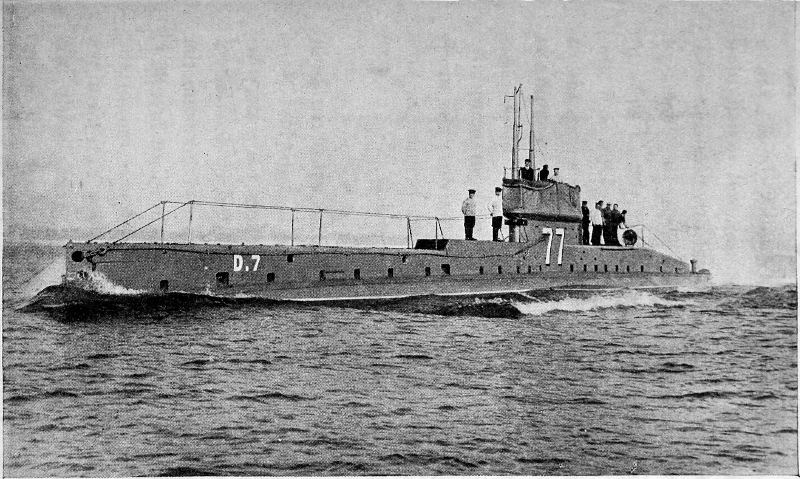
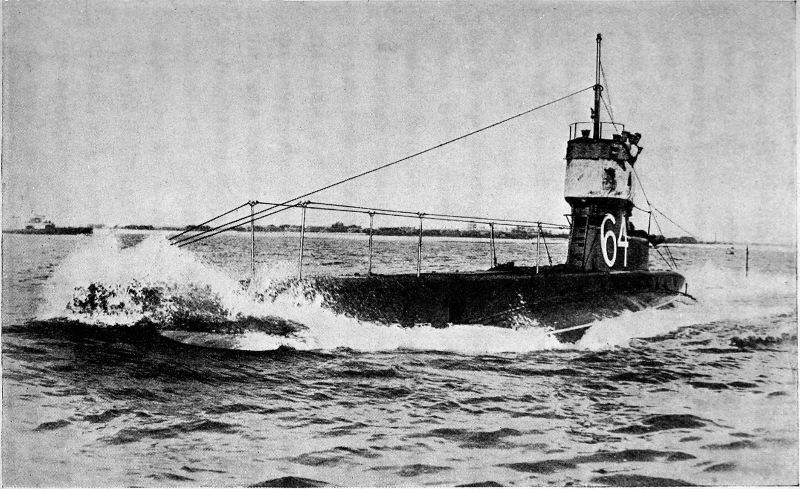
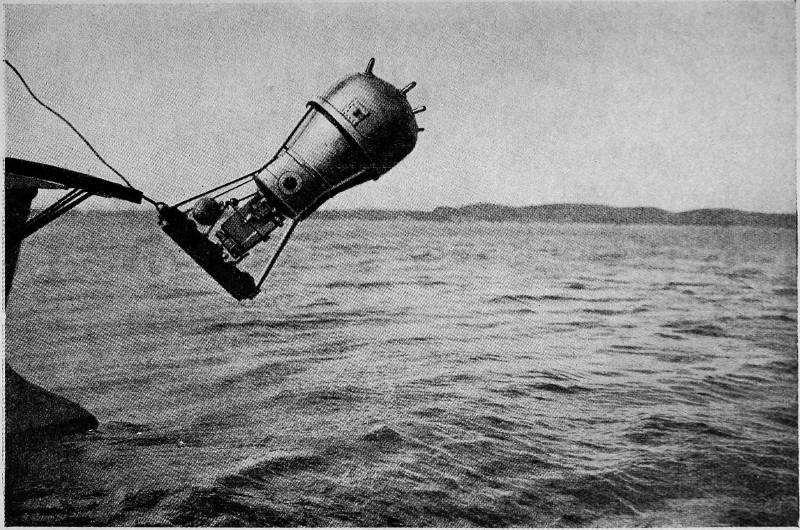
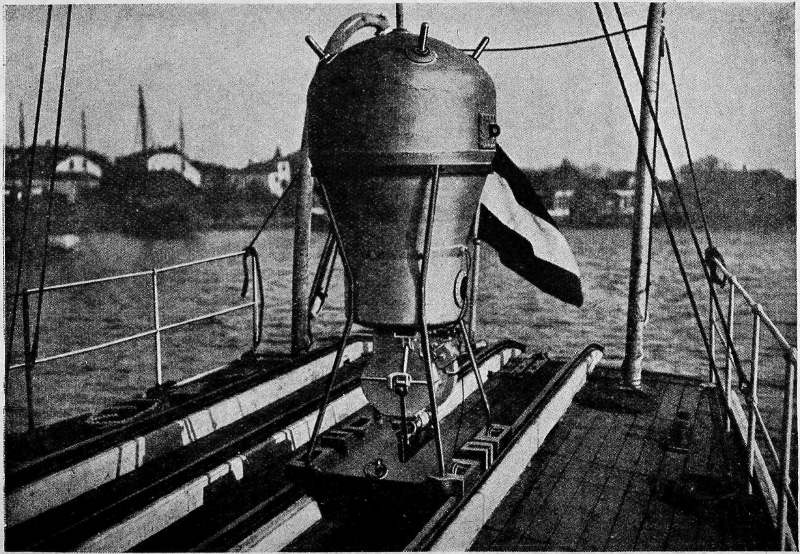
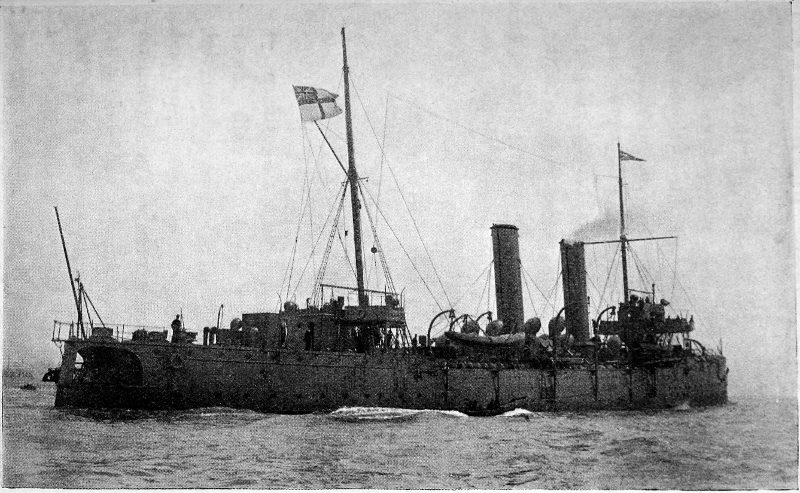
There are 17 vessels of this class, completed between 1912‒14.
SUBMARINES, MINES AND TORPEDOES IN THE WAR
BY
CHARLES W. DOMVILLE-FIFE
AUTHOR OF “SUBMARINES OF THE WORLD’S NAVIES”,
“SUBMARINE ENGINEERING OF TO-DAY,” ETC.
ILLUSTRATED
HODDER AND STOUGHTON
LONDON NEW YORK TORONTO
MCMXIV
PREFACE
v
Warfare has become so largely a matter
of science that in order to arrive at an
intelligent understanding of the naval
situation or of the military campaigns in
the Great European War, a knowledge
of the scientific factors contributing to
victory or defeat is essential. And in
this volume it has been my aim not only
to review the actual fighting underseas,
but also to present a compendium of
information relative to the submarine
fleets and arms of the great Naval Powers
engaged; which I venture to hope will
prove of present interest on account of
the prominent part played by the under-water
fighting ships and appliances, and
of permanent historic value as being the
first work to describe the vast preparations
and curious events leading to the new
“Submarine Phase” in naval warfare.
In the mist of war which envelops over
half the entire world, no less than 264
underwater fighting ships are engaged.
They form the submarine fleets of
England, France, Russia, Japan, Germany
and Austria; and the highly-trained
crews of these modern additions to the
fighting navies comprise nearly 20,000
men. But the conduct of submarine warfare
on the grand scale requires far more
than flotillas of submergible warships
and their daring crews. This new branch
of naval science is ever widening in its
scope, its means of offence, and in its
attendant ramifications. Every important
naval base has its curious submarine
10floating docks, ready for crippled members
of its attached flotilla; every naval construction
department has its corps of
submarine experts; each of the 1,500
surface warships engaged in this titanic
struggle for the dominion of Europe and
the mastery of the seas carries the means
for delivering submarine attacks in its
torpedoes and surface and submerged discharging
tubes. The oceans in the
theatres of war have been strewn with
German and Austrian mines; then they
have been either counter-mined or swept
clear and mined again. British seaplanes,
with specially trained observers,
are continually searching from high in
the air for the dark patches in the semi-transparent
sea-green which denote the
presence of mines and submarines.
Within signal-range or wireless call of
the aërial scouts and their attendant ships
are destroyer flotillas to give battle to
the hostile submarines, while hundreds of
trawlers and small steamers, fitted with
special apparatus, are continually sweeping
11up the hundreds of submarine mines laid
by the enemy’s vessels which are fitted
to enable them to sow like seeds over the
pathways of the sea these deadly perils
to navigation. Submerged wire entanglements
in conjunction with boom-defences
and observation and contact submarine
mines protect the seaward approaches to
harbours in the same way as similar
appliances are used to protect the
approaches to land fortifications; and
every harbour, waterway and channel of
strategic importance is protected by
elaborate submarine mine defences. All
this is part of the new warfare underseas—that
science which is daily rendering
hazardous the life of the greatest battleship
and the smallest merchantman afloat
in the zone of war.
Before placing in review order the vast
preparations made for submarine attack
and defence in the years which preceded
the outbreak of war and describing in
detail the powerful submarine fleets
engaged, it is necessary to make clear
12to the reader the wonderful change which
this new mode of attack has made in all
branches of naval warfare and its influence
on sea power. As indicative of
this change we have only to survey in
their submarine aspect the naval operations
in the opening phase of this, the
greatest war in history.
In the domain of naval strategy we
find reflected the altered conditions caused
by these invisible arms. Every battle
on land and sea teaches its lesson of
concealment and sudden stealthy attack;
and even as the huge siege guns and
devastating artillery fire of the land
forces is causing the extension of the
battle-front and the rapid burrowing
under earth or entrenching of positions
dearly won or with difficulty retained—“approximating
to siege warfare”—so
are the powerful 12 and 13.5-inch naval
guns (weight of projectile 850 lbs. and
1,400 lbs. respectively), combined with
the rapidity and accuracy of the modern
warship’s secondary armament, necessitating
13the reduction in numbers of the
big surface ships of the opposing fleets
by frequent submarine and torpedo
attacks prior to the decisive engagements
between the battle fleets. Hence
we find, in the opening phase of the
naval war, the German and Austrian
fleets, inferior in numbers and gun
power, skulking behind fortifications and
waiting for their submarine and surface
torpedo-boats and light cruisers, in conjunction
with the hundreds of submerged
mines strewn over the North Sea, Baltic,
Adriatic and elsewhere to reduce the
number and power of the British, French,
Russian and Japanese fleets before the
decisive actions are fought; and in order
that these tactics might be frustrated, and
the big British ships, as well as those
of her allies, costing several millions
sterling each, should not be exposed
to these grave risks when no good
could result, they have been compelled
to delay initiative, and meanwhile all
their operations had to be screened by
14smaller and faster vessels of the cruiser and
destroyer types, while they waited within
call should the German Battle Fleet—in
the case of the North Sea—dare to
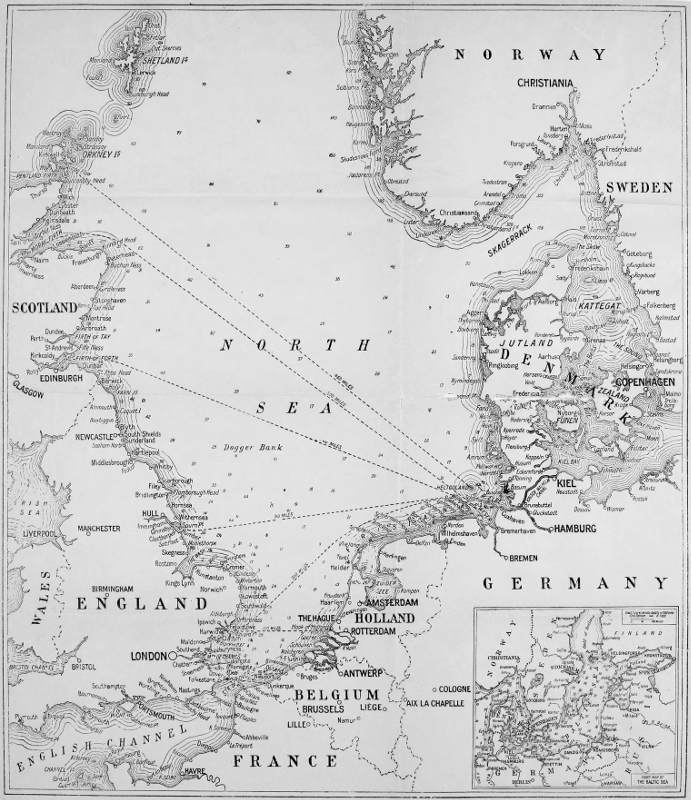
come out to fight. The British submarines
of the large sea-going type were
in the meantime employed in watching
the Frisian coast with the object of
attacking any of the enemy’s ships which
ventured from behind the elaborate coast
fortifications. Not content with this rôle,
however, several British submarines made
their way unseen through the dangerous
waters of the Heligoland Bight and
succeeded in getting within reconnoitering
distance of the German submerged
harbour defences, behind which lurk their
big ships.
With what degree of success this new
opening or submarine phase in naval
warfare has been attended is shown by
the sinking, during the first few weeks
of the war, of the British cruiser
Amphion, a vessel of 3,440 tons displacement,
completed in 1912, and
15carrying ten 4-inch guns, with a loss of
131 men, by contact with a German
mine; the destruction of the German
submarine U.15 by the British cruiser
Birmingham; the sinking of an Austrian
torpedo-boat by a mine off Pola; the
torpedoing of H.M.S. Pathfinder, a
fleet scout of about 3,000 tons displacement,
completed in 1905‒6, by a
German submarine; the destruction of
the Wilson liner Runo by a mine; the
sinking of the German cruiser Hela, a
vessel of 2,000 tons displacement, built
in 1896, by the British submarine E 9,
and the torpedoing of the British
armoured cruisers Aboukir, Hogue and
Cressy—vessels of 12,000 tons displacement,
carrying two 9.2-inch and twelve
6-inch guns besides twelve 12-pounder
quick-firing guns and two torpedo tubes—by
German submarines concealed behind
a trawler engaged in laying mines,
over which the Dutch flag had been
hoisted as a blind.
This is in addition to the lamentable
16destruction of much life and property
belonging to neutral powers caused by
the laying of German floating mines on
the trade-routes.
To the Allies this submarine phase
did not come unexpected. The British
Naval yards in conjunction with the big
shipbuilding and engineering firms, such
as Messrs. Vickers Ltd., Barrow-in-Furness;
Messrs. Armstrong, Whitworth
and Co. Ltd., Newcastle-on-Tyne; the
Whitehead Torpedo Company Ltd.,
Weymouth; Messrs. Siebe, Gorman and
Co. Ltd., London; and Messrs. Scotts’
Shipbuilding and Engineering Co. Ltd., as
well as many other firms and individual
submarine experts had been engaged for
many years in solving one after another
the problems continually arising in the
practical application of all forms of
submarine warfare. The first British
naval submarines were launched in
1901‒2 from Messrs. Vickers’ works at
Barrow, and the subsequent growth of
our submarine flotillas has been rapid
17both in number of vessels and in size
and armament. The British submarine
fleet now numbers 82 vessels. The
original boats from which the British
type has since been evolved were built
from the designs of Mr. John P. Holland,
an American inventor.
To France belongs the honour of being
the first naval power to adopt the submarine
torpedo-boat as a vessel of war;
and the first vessel, the Gymnôte, was
launched in 1888, but it was not until
1893 that the Republic commenced the
construction of her now powerful submarine
flotilla, numbering 92 vessels.
The first Russian submarine was
launched at Kronstadt in 1902, and
since that date the Russian flotilla has
steadily increased until it now numbers
37 vessels.
Japan commenced the construction of
what is now a powerful and up-to-date
flotilla of seventeen vessels by the acquisition
of a British-Holland boat in 1904.
Turning to Germany we find at first
18a great reluctance on the part of the
Ministry of Marine to provide for the
construction of submarines, but in 1905‒6
this initial hesitation was overcome and
the two vessels U.1 and U.2 were
launched. Since then the belief in a
powerful submarine flotilla steadily grew
until at the moment when war was
declared Germany possessed no less than
30 to 36 submarines of a very efficient
type. The Austro-Hungarian Navy did
not adopt submarines as units of the
Fleet until 1909, and now possess only
six small vessels.
From this brief resumé of the growth
of the submarine fleets of the six great
naval Powers at war, it will be seen that
in point of numbers as well as in priority,
bringing with it practical experience,
Great Britain and France have a very
appreciable superiority. It must, however,
be left for succeeding chapters to
describe in detail the steady growth and
present size and capabilities of the
submarine fleets at war.
19The lessons taught by the Russo-Japanese
war were not lost on the
British Admiralty, and special methods
had been prepared to deal with submarine
attack in its various forms.
Having in mind the destruction caused
to both Russian and Japanese warships
by submarine mines—especially those
of the “offensive contact” type, which
are moored to the bottom, float just
under the surface and explode immediately
on contact; and in the Russo-Japanese
War were responsible for
the sinking of the Japanese battleships
Hatsuse and Yashima as well
as the Russian battleship Petropavlovsk
and the cruiser Boyarin—the
British Admiralty foresaw the danger to
which both warships and merchantmen
would be exposed in time of war if the
seas strewn with these mines could not
be quickly cleared, and a new type of
auxiliary came into being. This was the
mine-sweeper, and eight vessels of the old
torpedo-gunboat type were fitted out for
20the work. In addition to these, however,
the Admiralty purchased a considerable
number of steam fishing trawlers, and
fitted them with mine-sweeping appliances,
and made arrangements for a large fleet
of similar vessels to be placed at the disposal
of the navy in the event of war.
In order to man this new mine-sweeping
fleet with experienced sailors on the outbreak
of war, a new section of the Royal
Naval Reserve was created in 1911.
This is known as the “Trawler Section,”
and consists of 142 skippers and 1,136
men taken from the fishing fleet.
Realizing the value of the submarine
mine in certain cases, the British
Admiralty went further and created a
small mine-laying fleet from seven old
second-class cruisers, which had their aft-decks
cleared and provided with rails for
a large number of mines to be run down
and slid over the stern into the water as
the vessels steamed along, thus quickly
laying a mine-field. But as the laying
of mines, speaking generally, is a defensive
21mode of warfare and the policy of
the British Navy—owing to its supremacy—is
attack and not defence, the
mine-laying fleet is of second importance
to the sweeping fleet, the work of which,
although much augmented by additional
small steamers pressed into service, was,
during the first few weeks of the war,
of a nature more arduous and dangerous
than will ever be realised. Hundreds of
German mines were swept up, and
hundreds more were exploded by being
dragged into contact with each other during
the progress of sweeping operations.
What the clearance of these vast fields
of floating and anchored mines in the
North Sea meant to the British Navy,
engaged in blockading the German
Fleet, and to the Mercantile Marine not
only of England, France, Russia and
Belgium, but also to that of the neutral
countries, it is perhaps a little difficult to
realize until one remembers that several
hundred British and French warships
were patrolling the North Sea and
22Channel, and, at the opening of hostilities,
there were hundreds of merchantmen
homeward bound whose course lay across
this mine-infested sea. Many of these
vessels had on board not only valuable
cargoes of food, raw material for manufacture
and gold and silver bullion, but
also officers and men returning from
various parts of the world to rejoin their
regiments. Again, the Expeditionary
Force had to be transported across the
Channel to France. This could not be
attempted until a guarantee had been
given by the Navy that the seas were
clear of hostile warships, submarines and
mines. The fleet blockading the
Frisian coast had to be supplied with
coal and fresh food; and last but by no
means least it was of vital importance
to the Allied Armies in the Field that
the whole coast-line from Bordeaux to
Antwerp, forming the rear and left-flank,
should be accessible to friendly shipping.
It is not difficult to realize what would
have been the effect had thousands of
23these deadly German contact mines been
allowed to float unhindered in these
narrow seas, for, notwithstanding the
magnificent effort made by thousands of
seamen in hundreds of mine-sweepers
assisted by seaplanes, many vessels—some
belonging to neutral powers and
others to the enemy themselves—were
destroyed before the seas could be effectively
swept clear, the hostile mine-layers
destroyed or chased into port and there
blockaded with their cowardly fleet.
The torpedo has long been recognised
as one of the most effective of naval
arms. It is carried by every modern
warship afloat, but it is essentially the
arm of the submarine and of the small
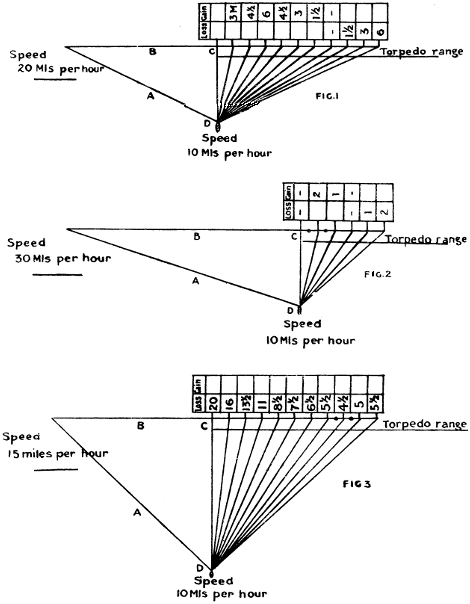
and fast surface vessel. For a torpedo
attack to be successful it is absolutely
necessary for the vessel carrying the
weapon to get within about 1,000 yards
of the object of attack. The difficulty
of accomplishing this manœuvre with an
enemy on the alert is easily apparent,
but if the attacking vessel can creep up
24to within torpedo range unobserved her
chances of sinking the enemy are decidedly
good, and it is the quality
possessed by the submarine of making
herself invisible by sinking beneath the
surface and approaching her enemy
“seeing but unseen” that makes this
type of vessel the ideal torpedo-boat.
But, like everything else, there are limits
to its use, for a submarine, although it can
navigate on the surface like an ordinary
torpedo-boat, cannot deliver a submerged
attack at night owing to the periscopes,
which are the “eyes” of these underwater
fighting ships, being useless in the dark.
When night covers the sea, however, the
chances of the fast grey-painted surface
torpedo-boat or destroyer being able to
approach the enemy unseen are more
than doubled, and in this way fleets
become exposed to submarine torpedo
attack by day and surface torpedo attack
by night. Further, a submarine will often
attack while a seaplane hovers over the
enemy in order to draw attention. It
25is this constant exposure to sudden
and unseen submarine attack which is
primarily responsible for the terrible
nerve strain imposed on the crews of
modern surface warships in time of war.
Owing to the ability of submarines to
deliver stealthy attacks by day, naval
tacticians have designated this type of
craft “Daylight torpedo-boats,” but they
are rapidly passing beyond the purely
torpedo and coastal defensive stage and
are taking on to themselves the rôle of
the ocean cruiser. The size of these
vessels has increased from 50 to 1,000
tons displacement in ten years. They
now carry not only a considerable
number of the largest size torpedo but
also quick-firing guns for repelling attacks
by small surface vessels, and are capable
of accompanying fleets to sea. The
Australian naval submarines A.E.1 and
A.E.2 both made the voyage from
Barrow to Sydney under their own
power and without convoy. The radius
of action of the latest vessels both of the
26British and French Navies amounts to
several thousand miles. In the case of
the British “F” class the displacement
has risen to 1,500 tons, the speed to 20
knots and the armament to six torpedo
tubes and four 12-pounder quick-firing
guns, thus making them in every sense
ocean cruisers capable of keeping the
sea in almost any weather and possessing
wide range of action and considerable
offensive power. Hitherto British submarines,
like the ordinary surface
torpedo-boats, have been known by
numbers only, but the latest vessels are
to receive names which indicates the
increase in size and importance of these
craft. They may be termed the advance
guards of the submarine battleships of
the future.
The torpedo, which is the principal
arm of the submarine boat, is itself a
submarine projectile. After being discharged
from the firing tube it sinks a
short distance below the surface and is
propelled by its own engines at a high
27rate of speed in a straight line towards
its object of attack. Great improvements
have been made during the past
ten years in the construction of these
delicate weapons. The extreme effective
range and speed has risen from 4,000
yards at 18 knots to 7,000 yards at 45
knots or 11,000 yards at 30 knots. The
“war-head” or front section of the
torpedo contains a charge of about 200
pounds of damp gun-cotton which is
fired by a detonator on the torpedo
striking an object. This very powerful
explosive charge is capable of tearing
open an enormous hole in the unprotected
under-water skin of the surface
warship. The type of weapon used in
the British, French, Russian and
Japanese Navies is the Whitehead
torpedo (18-inch and 21-inch). The
German Navy uses the Schwartzkopf
torpedo (18-inch and 21-inch), which is
very similar to the Whitehead and is a
very powerful weapon.
In the first phase of the naval war no
28less than eight warships have been sunk
by submarine torpedoes.
The activity of the British submarines
in the theatre of war, from the beginning
of hostilities, is admirably set forth in
the following dispatch from Commodore
Roger B. Keyes, C.B., which is the
first dispatch in the history of naval
warfare to describe in detail submarine
attack and reconnaissance:—
H.M.S. Maidstone,
17th October, 1914.
“Sir,—In compliance with Their Lordships’
directions, I have the honour to
report as follows upon the services performed
by the Submarines since the
commencement of hostilities:—
“Three hours after the outbreak of war,
Submarines E.6 (Lieutenant-Commander
Cecil P. Talbot), and E.8 (Lieutenant-Commander
Francis H. H. Goodhart),
proceeded unaccompanied to carry out a
reconnaissance in the Heligoland Bight.
These two vessels returned with useful
29information, and had the privilege of
being the pioneers on a service which is
attended by some risk.
“During the transportation of the Expeditionary
Force the Lurcher and Firedrake
and all the Submarines of the
Eighth Submarine Flotilla occupied
positions from which they could have
attacked the High Sea Fleet, had it
emerged to dispute the passage of our
transports. This patrol was maintained
day and night without relief, until the
personnel of our Army had been transported
and all chance of effective
interference had disappeared.
“These Submarines have since been
incessantly employed on the Enemy’s
Coast in the Heligoland Bight and
elsewhere, and have obtained much
valuable information regarding the composition
and movement of his patrols.
They have occupied his waters and
reconnoitred his anchorages, and, while
so engaged, have been subjected to
skilful and well executed anti-submarine
30tactics; hunted for hours at a time by
Torpedo Craft and attacked by gun-fire
and torpedoes.
“At midnight on August 26th, I
embarked in the Lurcher, and, in company
with Firedrake and Submarines
D.2, D.8, E.4, E.5, E.6, E.7, E.8, and
E.9 of the Eighth Submarine Flotilla,
proceeded to take part in the operations
in the Heligoland Bight arranged for
August 28th. The Destroyers scouted
for the Submarines until nightfall on
the 27th, when the latter proceeded independently
to take up various positions from
which they could co-operate with the Destroyer
Flotillas on the following morning.
“At daylight on August 28th the
Lurcher and Firedrake searched the
area, through which the Battle Cruisers
were to advance, for hostile Submarines,
and then proceeded towards Heligoland
in the wake of Submarines E.6, E.7,
and E.8, which were exposing themselves
with the object of inducing the
enemy to chase them to the westward.
31“On approaching Heligoland, the
visibility, which had been very good
to seaward, reduced to 5,000 to 6,000
yards, and this added considerably to
the anxieties and responsibilities of the
Commanding Officers of Submarines,
who handled their vessels with coolness
and judgment in an area which was
necessarily occupied by friends as well as
foes.
“Low visibility and calm sea are the
most unfavourable conditions under which
Submarines can operate, and no opportunity
occurred of closing with the
Enemy’s Cruisers to within torpedo
range.
“Lieutenant-Commander Ernest W.
Leir, Commanding Submarine E.4, witnessed
the sinking of the German
Torpedo-Boat Destroyer V.187 through
his periscope, and, observing a Cruiser
of the Stettin class close, and open fire
on the British Destroyers which had
lowered their boats to pick up the survivors,
he proceeded to attack the
32Cruiser, but she altered course before
he could get within range. After
covering the retirement of our Destroyers,
which had had to abandon their
boats, he returned to the latter, and
embarked a Lieutenant and nine men
of Defender, who had been left behind.
The boats also contained two Officers
and eight men of V.187, who were
unwounded, and eighteen men who were
badly wounded. As he could not embark
the latter, Lieutenant-Commander Leir
left one of the Officers and six unwounded
men to navigate the British
boats to Heligoland. Before leaving he
saw that they were provided with water,
biscuit, and a compass. One German
Officer and two men were made prisoners
of war.
“Lieutenant-Commander Leir’s action
in remaining on the surface in the
vicinity of the enemy and in a visibility
which would have placed his vessel within
easy gun range of an enemy appearing
out of the mist, was altogether admirable.
33“This enterprising and gallant Officer
took part in the reconnaissance which
supplied the information on which these
operations were based, and I beg to
submit his name, and that of Lieutenant-Commander
Talbot, the Commanding
Officer of E.6, who exercised patience,
judgment, and skill in a dangerous
position, for the favourable consideration
of Their Lordships.
“On September 13th, E.9 (Lieutenant-Commander
Max K. Horton) torpedoed
and sank the German Light
Cruiser Hela six miles South of Heligoland.
“A number of Destroyers were evidently
called to the scene after E.9 had
delivered her attack, and these hunted
her for several hours.
“On September 14th, in accordance
with his orders, Lieutenant-Commander
Horton examined the outer anchorage
of Heligoland, a service attended by
considerable risk.
“On September 25th, Submarine E.6
34(Lieutenant-Commander C. P. Talbot),
while diving, fouled the moorings of a
mine laid by the enemy. On rising to
the surface she weighed the mine and
sinker; the former was securely fixed
between the hydroplane and its guard;
fortunately, however, the horns of the
mine were pointed outboard. The weight
of the sinker made it a difficult and
dangerous matter to lift the mine clear
without exploding it. After half an
hour’s patient work this was effected by
Lieutenant Frederick A. P. Williams-Freeman
and Able Seaman Ernest
Randall Cremer, Official Number 214235,
and the released mine descended to its
original depths.
“On October 6th, E.9 (Lieutenant-Commander
Max K. Horton), when
patrolling off the Ems, torpedoed and
sank the enemy’s Destroyer S.126.
“The enemy’s Torpedo Craft pursue
tactics which, in connection with their
shallow draft, make them exceedingly
difficult to attack with torpedo, and
35Lieutenant-Commander Horton’s success
was the result of much patient and
skilful zeal. He is a most enterprising
submarine officer, and I beg to submit
his name for favourable consideration.
“Lieutenant Charles M. S. Chapman,
the Second in Command of E.9, is also
deserving of credit.
“Against an enemy whose capital
vessels have never, and Light Cruisers
have seldom, emerged from their fortified
harbours, opportunities of delivering
Submarine attacks have necessarily been
few, and on one occasion only, prior to
the 13th September, has one of our
Submarines been within torpedo range
of a Cruiser during daylight hours.
“During the exceptionally heavy westerly
gales which prevailed between the
14th and 21st September the position
of the Submarines on a lee shore,
within a few miles of the Enemy’s
coast, was an unpleasant one.
“The short steep seas which accompany
westerly gales in the Heligoland Bight
36make it difficult to keep the conning
tower hatches open. There was no rest
to be obtained, and even when cruising
at a depth of 60 feet, the Submarines
were rolling considerably, and pumping—i.e.
vertically moving about twenty
feet.
“I submit that it was creditable to
the Commanding Officers that they
should have maintained their stations
under such conditions.
“Service in the Heligoland Bight is
keenly sought after by the Commanding
Officers of the Eighth Submarine
Flotilla, and they have all shown daring
and enterprise in the execution of their
duties. These Officers have unanimously
expressed to me their admiration of the
cool and gallant behaviour of the Officers
and men under their command. They
are however, of the opinion that it is
impossible to single out individuals when
all have performed their duties so
admirably, and in this I concur.
“The following Submarines have been
37in contact with the enemy during these
operations:—
D.1
(Lieutenant-Commander Archibald D. Cochrane).
D.2
(Lieutenant-Commander Arthur G. Jameson).
D.3
(Lieutenant-Commander Edward C. Boyle).
D.5
(Lieutenant-Commander Godfrey Herbert).
E.4
(Lieutenant-Commander Ernest W. Leir).
E.5
(Lieutenant-Commander Charles S. Benning).
E.6
(Lieutenant-Commander Cecil P. Talbot).
E.7
(Lieutenant-Commander Ferdinand E. B. Feilmann).
E.9
(Lieutenant-Commander Max K. Horton).
I have the honour to be, Sir,
Your obedient servant,
(Signed) ROGER KEYES,
Commodore (S).”
38In conclusion, it must therefore be set
on record that the opening phase in the
greatest naval war in history has been
one of submarine attack and counter-attack,
mine-laying and destroying, warships
and merchantmen sunk in a few
minutes by submarine torpedoes and
mines, with sharp engagements between
the cruisers and destroyers acting in
conjunction with the under-water craft.
The much-vaunted German Fleet, like
that of its ally Austria-Hungary, has
not dared to show itself from behind
the forts and carefully-screened anchorages
of the naval bases, suffering rather
the everlasting disgrace of having stood
in cowardly idleness while the 5,000
merchant ships it was built to protect
hauled down the flag of the “Fatherland”
and German maritime commerce
was swept from the seas while the Allied
fleets hold undisputed command of every
ocean.
The First Lord of the British
Admiralty has said that if the German
39Fleet will not come out to fight it must
be “dug out like rats in a hole.” This,
then, may be the second phase in the
naval war, and out in the grey mist of
the North Sea, ready and eager for
the work, lies the great battle fleets of
England.
CHAPTER I THE MODERN SUBMARINE TORPEDO-BOAT — Method of Submergence — Propulsion. — Vision When Submerged. — Armament. — Habitability.
40
The submarine torpedo-boat is to most
people a complete mystery, and before
describing the composition and strength
of the submarine fleets at war it may
therefore be of interest to say something
of the principal features common to all
types of submarine craft.
It may sound ridiculous, in face of the
many accidents which have occurred, to
say that one of the greatest difficulties
is to make a submarine sink sufficiently
quickly, and one of the easiest of
operations to make her rise, and yet
such is undeniably the case.[1]
41It will be readily understood that
any delay in disappearing beneath the
surface when attacking would be a
great danger to a submarine in action.
For example, a number of hostile torpedo-boat
destroyers are scouring the
sea in advance of a fleet, and are discovered
at daybreak by the submarines,
which are waiting to attack the fleet behind,
approaching at a speed of 30 knots
an hour. A hurried dive beneath the
surface is necessary if the waiting submarines
would avoid detection, which
would, in all probability, mean destruction
by the quick-firing guns of the destroyers.
When a submarine is travelling on the
surface she is in what is technically called
the light condition, that is to say, with her
water ballast tanks empty, but when it is
required to sink her so that only the tiny
platform, or deck, and conning-tower are
above the surface, water is let into these
ballast tanks, and the additional weight
causes her to sink into the sea until her
42back is almost flush with the surface—this
is known as the awash condition.
It is not difficult to perceive that when
travelling awash, a wave might at any
moment roll along the tiny unprotected
deck of the submarine, break over the
mouth of the conning-tower, and descend
like a waterspout into the interior. Were
this to happen a terrible disaster might
result, for it must be remembered that
when travelling awash, a very little
additional weight would cause the submarine
to plunge beneath the surface.
In order to obviate this risk it has
become a rule that when proceeding
with this small margin of buoyancy,
the hatch covering the mouth of the
conning-tower should be screwed down
and the submarine hermetically closed,
ready to sink.
To many it may appear strange that
total submergence is not accomplished
by letting still more water into the
ballast tanks, but entirely with the aid
of the propellers and rudders. A submarine
43has two, and sometimes three,
pairs of rudders; one pair of ordinary
vertical ones to guide her to port or
starboard, and a horizontal pair to cause
her to dive and rise. Two additional
fins are frequently placed on each side of
the forepart of the vessel to assist the
diving and rising.
In order to make the submarine dive
beneath the surface, the horizontal
rudders are deflected when the boat is
proceeding at full speed. The action of
the water against the rudders is such
that the bows are forced down and the
whole vessel slides under the surface.
The principle is much the same as that
of steering an ordinary surface vessel,
where the force of the water against the
rudder causes the vessel to swing to
right or left.
From this it will be seen that a submarine
is only held below the surface
by the action of her rudders on the
passing water; should the propellers
driving her along cease to revolve and
44the vessel slow down, she automatically
rises to the surface because the rudders
have no longer any effect.
Although the steering both on the
vertical and horizontal plane is controlled
by hand, it would be quite beyond the
strength of a man to move the various
rudders as required, so electric motors
are installed to perform the actual work.
In fact, almost everything in a submarine
is operated by electricity.
In the earlier types of submarine
boats, a considerable time was required
to open the valves and allow sufficient
water to enter the ballast tanks to make
them sink to the awash condition. Some
of the now obsolete French naval boats
took as long as fifteen to twenty minutes
to carry out this simple operation. The
main reason for this was, that they
were designed with too much surface
buoyancy, that is to say, they rode too
high in the water when floating in the
light condition compared with the inadequate
means then employed for the
45inlet of water into the ballast tanks, and
were thus forced to let in an enormous
quantity of water at a very slow rate
before they settled down sufficiently to
enable total submergence to be accomplished
by the use of the horizontal fins
and rudders. This great drawback has
now been completely overcome, and the
modern submarine can sink below the
surface in about three minutes.
When water is pumped into the ballast
tanks in order to make the submarine
settle down, the air which normally fills
these tanks is compressed into a fraction
of its proper space, and is therefore
always exerting a downward pressure
which increases as more water is pumped
in. Therefore, when it is desired to
bring the submarine to the surface again,
all that is necessary is to open the
valves and allow the compressed air to
force the water out. It should, however,
be remembered that there is really no
need to “blow out” the ballast tanks
in order to bring the submarine to the
46surface, for this can be much quicker
accomplished by simply elevating the
horizontal rudders; but in this case the
submarine only rises just above the
surface—to the awash condition—whereas
if the tanks are emptied of water she
rises to the light or cruising condition.
This substantiates the assertion made
at the beginning of this chapter—that it
is far more difficult to make a submarine
sink than it is to make her rise.
It has been said that a man walking
from one end of a submarine to the other
would, in all probability, cause her to
plunge dangerously, so delicate is the
state of equipoise when totally submerged.
Whatever may have been the case in
the early types it is certainly not so now.
So steady are modern submarines when
running below the surface, especially
those of the British, Russian, French,
and Japanese and German Navies, that
the long up and down hill glides, which,
with some boats, used to amount to
yaws of from 20 to 30 feet, have now
47been reduced to a few feet in so many
hundreds of yards. In fact, this switch-back
motion is almost unnoticeable
except when the submarine is being
swung round at a sharp angle. In no
case, however, is it sufficient materially
to affect the firing of the torpedoes.
The reserve buoyancy of a submarine in
the awash condition—or diving-trim, as it
is called in the British flotillas—is necessarily
very small, amounting to little
more than two or three pounds in a
thousand, which in a 300-ton vessel means
a difference of only about 100 gallons of
sea-water between the ability to float
and the inevitability of sinking. Any
material increase in the small margin of
what is known as positive-buoyancy must
be accompanied by a corresponding
increase in the power of propulsion,
otherwise it would be quite impossible to
drive her under, or, in other words, to
overcome the vessel’s natural tendency
to float on the surface.
For these and other reasons, a submarine
48when running submerged is in
such a delicate state of equipoise that
any sudden increase or loss of weight
would upset the balance and so cause
the vessel to either dive or rise with
dangerous rapidity.
This would be the effect produced
when a torpedo was discharged were
provision not made to counter-balance
this sudden loss of weight by means of
compensating-tanks, into which sufficient
water is pumped to compensate for the
loss of weight incurred by the discharge
of each torpedo.
Many submarines are also fitted with
bow and stern trimming-tanks, into which
water can be pumped in such a manner
as to correct any tendency of the vessel
to float too high or low at either
extremity.
Of the many complicated problems
surrounding submarine boat construction
the motive power and propelling engines
49have been in the past, and are still, the
most profound puzzles. Steam, compressed
air, electricity, petrol, and heavy
oil have all been used with varying
results since first this type of vessel
came into being; and many curious
engines for using these prime movers in
conjunction with each other and with
chemical compounds have been evolved
by ingenious inventors.
About steam and compressed air little
need be said, for although given a good
trial, especially by the French naval
authorities, they were abandoned some
years ago in favour of a combination of
petrol and electric engines, which in turn
have given place to more powerful
machines using heavy oil and electricity.
Steam is, however, again being
used in conjunction with turbine engines
for surface propulsion.
The carrying of large quantities of
petrol, or heavy oil, is under all circumstances
attended with a certain
amount of risk, and when many tons
50have to be carried in a confined
space, as in a submarine, this risk is
more than doubled, as the slightest
leakage when the vessel is submerged
would mean that a powerful explosive
mixture of petrol and air would be made.
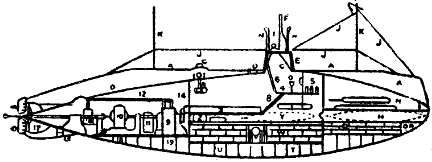
A modern submarine torpedo-boat (British type). A.
Deck superstructure. B. Scuppers for filling superstructure.
D. External connections. E. Conning-tower (4-inch
armour). F. Periscope. G. Periscope motor (for turning,
&c.). H. Air cowls. I. Conning-tower cap (opening
sideways). J. Mast stays. K. Mast (not part of service
equipment). L. Torpedo-tube cap. M. Torpedo-tubes
(twin), torpedoes in. N. Air-flask (for expelling torpedoes).
O. Hydroplane engines. X. Double casing, with special
vent for accumulators. Y. Spare torpedoes. Z. Petrol
storage tanks (2). 1. Air flasks. 2. Centrifugal pumps.
3. Air-lock, with submarine escape dresses. 4. Commander’s
platform. 5. Ladders. 6. Depth and deflection
indicator, registering submarine’s deflection from horizontal.
7. Speed dials. 9. Petrol engines. 10. Electric engines.
11. Dynamo, for recharging batteries. 12. Petrol engines—exhaust.
It being also quite impossible, for
obvious reasons, to use a petrol engine
51when running submerged, a second
motive power, an engine, with its additional
space and weight, has to be
carried to drive the submarine when
under water. For this purpose electricity
is used in almost all types. But
electricity, again, has many drawbacks.
It costs in weight nearly thirty times
more than other motive powers, and is
extremely dangerous, for should salt
water in any way gain access to the
storage batteries, chlorine gas would be
given off in large quantities, although in
the more recent vessels of the British,
American, and French Navies this danger
has been minimised by enclosing the
batteries in air-tight cases. On account
of the weight and the space required,
it is impossible to install a very powerful
electric engine in a submarine
(compared with the size of the boat),
and thus both the speed and radius of
action are curtailed.
If this division of power between the
surface and submerged engines could
52be overcome, and the whole space made
available for one powerful set of engines
suitable for driving the vessel both on
the surface and when submerged, not
only would the mechanism of submarines
be simplified, but a very considerable
increase in both speed and range of
action would naturally result.
In the “D,” “E” and “F” classes
of British submarines, and in the more
modern vessels of the French, Russian
and German Navies, heavy oil is being
used in place of petrol on account of the
increase in power obtained with greater
safety.
Arrangements are made in almost all
modern submarines so that when the
vessel is using the oil engines for running
on the surface the electricity for use
when submerged is being made by a
dynamo and stored in batteries. From
this it will be seen that there are really
three separate engines in a submarine:—(1)
the oil or petrol motor, which drives
the vessel when on the surface, and, at
53the same time, by a suitable arrangement
of gearing, operates a dynamo, (2)
which makes the electric current for
storage, and (3) an electric engine which
drives the vessel when submerged,
obtaining the necessary power from the
batteries.
It is, however, technically incorrect
to say that there are two sources of
power in a submarine, for electricity is
not, in itself, a source of power, but
merely a handy method of storing and
transmitting it. The only actual source
being the oil or petrol.
There are also numerous small engines
to add to the complexity of machinery
in a submarine, such as the air compressors
used for charging the torpedo
tubes with compressed air for expelling
the torpedoes and for other purposes,
and electric motors for operating the
pumps, steering mechanism, and periscopes.
In addition to all this, hand-mechanism
is provided for use in case
of a breakdown to operate most of these
54important appliances. Then again there
is, of course, the armament mechanism
for working the torpedo tubes and semi-automatic
quick-firing guns.
From the foregoing it may appear that
the interior of a submarine presents a
picture of mechanical complexity utterly
incomprehensible. Yet such is not the
case. The fanciful belief that the crew
stand, boxed up in these vessels, sweating
with the heat, struggling for breath,
and with crank-shafts whirling uncomfortably
close to the small of their backs,
electric motors buzzing within a few
inches of their ears, and nervous hands
grasping one or other of the levers
ranged in rows in front of them, is,
doubtless, most romantic, but quite
unreal. Much of the undoubtedly complicated
machinery in a submarine is
tucked away in the conical extremities,
under the interior decking, and fixed
to the arched steel sides. The centre
is left almost entirely clear, so that
trestle-tables may be erected for meals,
55hammocks swung for sleeping, and
sufficient space allowed to make these
small vessels as habitable as possible.
Not the least difficulty of the submarine
designer is to create order and leave
space among the chaos of machinery
which has to be installed in these peculiar
and deadly little torpedo craft.
Perhaps the greatest difficulty which
has beset both submarine construction and
navigation is the puzzle how to see when
submerged. This is now accomplished
by means of periscopes, or tubes extending
up from the roof of the submarine
to a height of several feet above the
surface—not unlike hollow masts. By a
series of lenses and reflectors a picture of
the surface is thrown down these tubes
on to reflectors inside the submarine. A
man with his eyes at the bottom of a
periscope can see the surface clearly.
Although it projects above the surface
when the whole submarine is submerged,
56it is far too small an object to be easily
seen moving through the water, and
extremely difficult to hit by gun-fire.
The latest panoramic periscope—two of
which are fitted in modern submarines—has
a field of vision of about 60
degrees. The range of vision is, however,
very short, owing to the periscopic
tube projecting only a few feet above the
surface. On a moderately smooth and
fairly clear day steering by periscope is
not altogether difficult, but at night or
in fog this instrument is useless, and for
this reason it would be almost impossible
for a submarine to effect a submerged
attack on an enemy at night. Hence
the name given to this type of craft—daylight
torpedo-boats—for in the brilliant
light of day, when any attempt by
ordinary torpedo craft to get sufficiently
close to hostile warships to discharge a
torpedo with reasonable hope of success
would be foredoomed to failure, there is
every possibility that submarines would
effect a surprise attack.
57
The chief armament of all naval submarines
is the torpedo, which is expelled
by a blast of compressed air from one of
the tubes fitted in the bow and stern.
Several torpedoes are usually carried by
each boat, so that if one failed to strike
the object of attack further attempts can
be made.
About the efficiency of torpedoes
nothing need be said here, for they now
form an important weapon in every navy,
and to this subject a future chapter is
devoted.
The latest submarines built are also
fitted with quick-firing guns for use when
these vessels are cruising on the surface.
The guns are arranged so that when it is
desired to sink they can be made to
disappear beneath the narrow deck of the
submarine. The provision of guns has
been made with the object of giving
these vessels a means of defence should
they be discovered by prowling hostile
torpedo-boat destroyers, or by air-craft.
58
Many people imagine the interior of a
submarine to resemble a stokehold, hot,
stifling, and semi-dark, whereas the exact
contrary is the truth. The temperature
is but little above the normal for a ship’s
engine-room, the air-supply is amply
sufficient, and the whole interior is well
illuminated by electric lamps.
The necessary supply of pure air is
derived either from large steel cylinders
containing the air in a highly compressed
state or from flasks of oxylithe. The
carbonic acid gas of the respired air
being at the same time chemically
absorbed.
Food is cooked for the crew by
electricity, and drinking water obtained
from special tanks. Notwithstanding
these arrangements, however, it is almost
impossible for the crew to live on board
for many weeks at a time, owing to the
small free space in the interior and to the
cramped deck; but as the size and radius
59of action of these boats increase, so also
does the space available for exercise, and
thus the habitability.
CHAPTER II BRITISH SUBMARINES — Submarines in Home Waters. — Submarines on Foreign Stations. — “A” Class. — “B” Class. — “C” Class. — “D” Class. — “E” Class. — Australian Submarines : — British Submarines Building . — “F” Class. — “V” Class. “W” Class. “S” Class.
60
The British Fleet at the moment when
war was declared possessed 82 submarine
torpedo-boats built and 22 building.
Some of these were, however, stationed
at the oversea naval bases. The composition
and distribution of the submarine
flotillas at the outbreak of hostilities were
as follows:—
Attached to Mediterranean Fleet.—Submarines
B.9, B.10, and B.11.
At Gibraltar.—Submarines B.6, B.7,
and B.8.
Attached to China Squadron.—Submarines
C.36, C.37, and C.38.
With Australian Fleet.—Submarines
A.E.1[2] and A.E.2.
The statement that the headquarters
of the various submarine flotillas in home
waters are at Chatham, Portsmouth, and
Devonport, must not be taken as indicating
that these are the only points
along the coast protected by submarines.
These places are merely the chief bases
63of the Patrol Flotillas. The wide range
of action of modern submarines enables
them to operate several hundred miles
from any base or depôt, and consequently
Chatham becomes merely the
general store, or head-depôt, of what
should be termed the North Sea Flotillas,
which not only patrol the whole East,
North-East and South-East Coasts of
England and Scotland, but also have
their floating secondary bases in the
form of Depôt Ships, which, with their
attached submarines, are often at
Harwich, Newcastle, Rosyth, etc. In
the same way Portsmouth is merely the
headquarters of the submarines patrolling
the Channel; and Dover, Portland, etc.,
are seldom without strong flotillas of submarines
with their Depôt ships. The
Devonport Flotillas have the longest
coast-line to patrol, for their area covers
not only the West Coast of England,
Wales and Scotland, but also the Irish
Coast. They are, however, furthest
removed from the zone of war.
64Considerable alterations have taken
place in the composition and distribution
of the British submarine flotillas since
the outbreak of war, with the object of
materially strengthening the Fleet in
the main theatre of operations, but the
addition to the flotillas of new vessels of
the latest “E” type—nearly completed
when war broke out—has made this
rearrangement possible without materially
weakening the flotillas guarding the more
distant coasts of Great Britain or recalling
vessels from overseas.
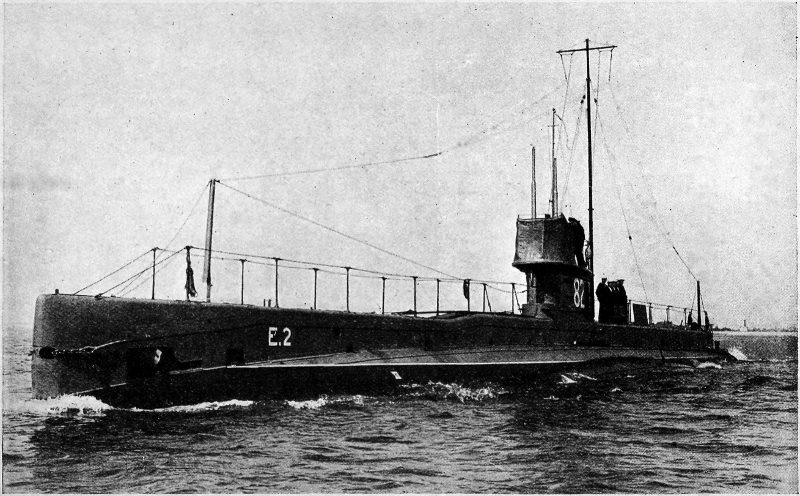
There are 8 vessels of this class, completed between 1908‒12.
The first submarine torpedo-boat built
for the British Navy was launched from
the yard of Messrs. Vickers Ltd., Barrow-in-Furness
in 1901, and was designated
the No. 1. It was constructed from the
designs of the famous American inventor,
Mr. John P. Holland, and was one of the
most successful boats afloat at that time.
A series of exhaustive trials with this
and the succeeding five vessels, all of the
same type and launched during 1901‒2,
65proved conclusively the fighting value of
this type of craft, and a further order was
given by the British Admiralty for four
new vessels embodying the improvements
suggested by the trials of the
first five. These vessels were the first
of the “A” class, and were designated
the “A’s 1, 2, 3, and 4.” They had a
submerged displacement of 180 tons, a
length of 100 feet and a beam of 10 feet.
They were propelled by petrol motors
of 190 H.-P. on the surface and by
electric motors of about 80 H.-P. when
submerged. Their speed ranged from 8
knots an hour on the surface to 5 knots
when travelling submerged, and their
maximum surface endurance (or fuel
capacity) was only 400 knots at 8 knots.
Their armament consisted of three 18-inch
Whitehead torpedoes and one bow tube.
All these vessels were, however,
obsolete and therefore scrapped before
the opening of hostilities, hence information
concerning them is only of
interest as showing the rapid growth
66in size, power and armament of British
submarines. The next batch of vessels
were the A’s 5 to 13, launched at
Barrow in 1904, but these, as will have
been seen from the table showing the
composition and distribution of the submarine
flotillas at the outbreak of war,
are still on the effective list. All the
following British submarines are now in
the fighting line.
(Completed 1904.)
A’s 5, 6, 8, 9, 10, 11, 12, 13.
These vessels are the oldest British
submarines in commission. They were
built at Messrs. Vickers’ works at
Barrow, and have a submerged displacement
of 204 tons. Their length is
150 feet. They are propelled on the
surface by petrol motors of 600 H.-P.
and by electric engines of 100 H.-P.
when submerged. Their surface and
submerged speed is 11 knots and
7 knots respectively. The cruising
67range, or maximum surface endurance
on the fuel carried, is 400 knots at 10
knots an hour, and the endurance submerged
three hours at full speed. Their
armament consists of two bow tubes with
four 18-inch Whitehead torpedoes. Complement:
Eleven officers and men.
These vessels, which are now used
almost entirely for harbour defence, can
be distinguished from later types by
their high conning-towers and single
short periscopes. The A.7 was lost off
Plymouth early in 1914, and was never
raised.
(Completed 1904‒6.)
B’s 1, 3, 4, 5, 6, 7, 8, 9, 10, 11.
These are submarines of the improved
Holland type, and are in every way
superior to their predecessors. They
may be considered the first of the sea-going
type. Their submerged displacement
is 316 tons; length 135 feet, and
beam 13 ½ feet. The motive power is the
68same as in the “A’s”—petrol for surface
propulsion and electricity for use when
submerged. The horse-power of the
petrol engines is 600, and that of the
electric engines 189. As in most submarines
the supply of current for driving
the electric engines is derived from storage
batteries charged by dynamos driven from
the petrol engines while the vessels are
running on the surface. In the “B”
class a special system of encasing these
storage batteries was introduced. Their
speed averages 12 knots on the surface
and 8 knots when submerged. The surface
cruising range is 1,300 knots at 10
knots per hour, and the maximum submerged
endurance 80‒100 knots at 5
knots per hour. Their armament consists
of two bow tubes with 4‒6 18-inch
Whitehead torpedoes. Complement: Sixteen
officers and men.
The “B” type are vessels about 50
per cent. larger than the “A” type which
preceded them. The “B’s” have superstructures
extending from the bow to the
69conning-tower, forming a narrow deck
which tends to disperse the wave which
heaped around the blunt noses of the
“A’s” and original Hollands. Vision
when submerged is obtained by two
panoramic periscopes, each having an arc
of vision of 60 degrees. In the more
modern vessels three periscopes are fitted.
The twin screws of the “B’s” are placed
below the centre line of the vessel and
consequently operate in deeper water
when the vessels are cruising on the
surface. This gives them better surface
cruising qualities, as in a sea-way the
propellers are liable to race if worked
too near the surface. The increase in
the speed of these vessels over that of the
“A’s” was of great importance, as in
this respect lies the weakness of the submarine.
The tactical advantages derived
from high speed in actual warfare cannot
be over-estimated. The speed of a fleet
is governed by that of its slowest unit.
The distinguishing feature of the “B”
type is the straight bow, the forward
70superstructure, and the two periscopes.
The B.2 was run down by the liner
Amerika in the Straits of Dover in
October, 1912, and was never recovered.
This class of submarines is composed
of vessels of the improved “B” type.
They have a submerged displacement
of 320 tons and are 135 feet long and
13 ½ feet broad. The petrol motors develop
600 H.-P. and give to these vessels a
speed of 14 knots an hour on the surface.
The power of the electric engines was
increased to 300 H.-P., giving a submerged
speed of just over 9 knots an
hour. The surface cruising range is
2,000 knots at the most economical speed,
and the submerged endurance 100 knots
at 5 knots an hour. Their armament
71consists of two bow tubes with six
18-inch Whitehead torpedoes; and their
complement sixteen officers and men.
In the later vessels of the “C” class
heavy oil is used instead of petrol, giving
a great increase in power without the
comparative additional weight; enabling
a wider radius of action. The vessels
of both the “B” and “C” classes are
fitted with air-traps and safety-helmets,
giving the crew a possible means of
escape in the event of disaster while
submerged.
The distinguishing feature of the “C”
class is the sloping bow. The C.11
collided with the steamer Eddystone
in the North Sea in 1909 and was
irretrievably lost.
(Completed 1908‒11.)
D’s 1, 2, 3, 4, 5, 6, 7, 8.
These are all modern vessels of the
sea-going type, and are of considerable
fighting value. They, however, differ
72slightly from each other: D.1 has a
submerged displacement of 595 tons;
D.2 of 600 tons; and the remaining
vessels of this class of 620 tons. They
have an approximate length of 150 feet
and a beam of 15 feet. Heavy-oil
engines of 1,200 H.-P. drive them at a
maximum speed of 16 knots an hour on
the surface, and electric motors of 550
H.-P. give them a submerged speed of
just over 10 knots an hour. All these
vessels have twin-screws situated below
the centre line. Their cruising range on
the surface is 4,000 miles, and when
submerged 120 knots at 7 knots an
hour. These vessels were the first to
be fitted with a special and more efficient
pattern of electric storage battery and a
safer type of electric motor. The armament
of the “D’s” consists of two bow
and one stern tube with six 18-inch Whitehead
torpedoes. D’s 4, 5, 6, 7, and 8
are also fitted with a small quick-firing,
high-angle gun for defence against air-craft.
This gun is fixed on a disappearing
73mounting, enabling it to be quickly and
almost automatically lowered into a watertight
cavity in the superstructure before
the submarine dives below the surface.
The complement of these vessels is
twenty-one officers and men.
These fine ocean-going submarines are
the latest additions to the British Flotillas.
They have a submerged displacement of
800 tons, are 176 feet long and 22 ½ feet
in beam. The heavy-oil engines of
nearly 2,000 H.-P. give them a surface
speed of over 16 knots, while the
electric engines of 800 H.-P. drive them
at a maximum speed of 10 knots an
hour when submerged. Their surface
cruising range is 5,000 miles at
economical speed, and the submerged
endurance 140 knots at 8 knots an hour.
In point of armament the “E’s” are far
74more powerful than their predecessors,
being fitted with four tubes and carrying
six of the largest and most powerful
Whitehead torpedoes. They are also
equipped with two 3-inch quick-firing
guns on high-angle disappearing mountings
for defence against air-craft and
hostile torpedo-boats and destroyers.
They have wireless telegraphic apparatus;
and, like the vessels of the “B,” “C”
and “D” classes, have armoured conning
towers and decks. Three tall panoramic
periscopes are fitted, and their high
superstructures and increased buoyancy
when travelling on the surface enable
them to keep the sea in almost any
weather.
A.E.1 and A.E.2.
These vessels are exactly the same
as the “E” class. The fact that they
both accomplished the 13,000-mile voyage
from Barrow to Sydney under their
own power and without convoy is
75practical proof of the wide range, seaworthiness
and general efficiency of the
latest British Naval Submarines. The
A.E.1 mysteriously disappeared in
Australian waters in October, 1914, and
has not been recovered.
At the commencement of the great
war there were 22 British submarines in
course of construction at the various
shipbuilding works and naval dockyards.
Up to 1909 Messrs. Vickers Ltd., had
constructed all the British submarines,
but in that year the vessels C.17 and
C.18 were laid down at Chatham Dockyard.
Since then several other boats
have been constructed there, and of
those now in hand some are being built
by Messrs. Vickers Ltd. at Barrow,
others at Messrs. Scott’s shipbuilding
yards at Greenock, and a few by Messrs.
Armstrong, Whitworth and Co. Ltd.
at Newcastle-on-Tyne, and at H.M.
Dockyard at Chatham.
76Hitherto, British submarines, although
divided into classes—each of which has
shown a marked improvement on the
preceding class—have been all of one
type—the “Improved Holland.” Among
the vessels being constructed at the
opening of hostilities they were, however,
no less than three different types.
Those being built at Barrow and
Chatham were of the original design
with modern improvements, but the submarines
under construction at Greenock
were of the Laurenti, or Italian type,
and those at Newcastle-on-Tyne of the
Laubeuf, or French type. In addition
to this wise departure from previous
practice, two of the new vessels have
been given the names of Nautilus and
Swordfish.
The haze of war has obscured these
vessels, and it is impossible to say definitely
which of them have taken their
place in the active flotillas, and further
the necessity for observing the very
strictest secrecy regarding new types of
77warships at a time like the present
makes it advisable to give here only
the briefest particulars and not to discuss
too freely the peculiarities of their design
or their probable capabilities.
There are several vessels of this class
now being constructed. They are the
latest improvement of the original Holland
design and are sea-going submarines
of wide range, high speed and great
fighting power. The F.1, which was
built at Chatham Dockyard, has a submerged
displacement of 1,500 tons.
Heavy-oil engines of about 5,000 H.-P.
give her a maximum speed of 20 knots
an hour on the surface, and electric
motors of 2,000 H.-P. drive her at 12 knots
when submerged. The armament consists
of six torpedo tubes, ten torpedoes, and
two quick-firing, high-angle guns.
Nautilus and Swordfish.
These three classes include the
78vessels of entirely different design to
those now forming the British flotillas.
The “V,” or Vickers’ type, of which
four were under construction at the
beginning of the war, are large sea-going
submarines with a submerged
displacement of over 1,000 tons, and a
probable surface speed of 20 knots.
The “W” Class, of which four are
being built at Elswick, comprise vessels
of the French Laubeuf type. The “S”
Class, building at Greenock, and four
in number, are of the Italian, or F.I.A.T.—Laurenti
type. The two named
vessels—Nautilus and Swordfish—are
large sea-going submarines of wide
range and high speed. Their submerged
displacement is about 1,000
tons, and their speed 20 knots on the
surface and 12 knots when submerged.
The armament is six tubes, with eight
torpedoes, and two quick-firing guns.
The complement of all these large
submarines is about 25 officers and men.
France possessed 92 submarines in
active service when war was declared.
In addition to these, nine large and
powerful vessels were in various stages
of construction. The flotillas of the
French Navy are composed of two
different types of vessels: Submarines
Defensive and Submersibles. The former
are intended, as their name implies,
solely for coast and harbour defence;
their radii of action is very small, and
they are incapable of action independent
of a naval base. The submersibles are
like the large sea-going submarines of
England and Germany, and have a
wide radius of action, high speed, and
great offensive power.
The first naval submarine (Gymnôte)
80was launched in 1888, giving to France
the honour of being the first Naval
Power to adopt the submarine torpedo-boat
as a vessel of war. The pioneers
of submarine construction in France
were Captain Burgeoise, Engineer Brun,
M. Dupuy de Lome, M. Gustave Zédé,
and Admiral Aube. The second submarine
ordered for the French Navy
was the Gustave Zédé, launched in 1893.
So successful did this vessel prove that
another of the same type, and named
the Morse, was launched at Cherbourg
Dockyard in 1899. In the same year
four vessels of a new type were laid
down in the dockyard at Rochefort, and
named Lutin, Farfâdet (re-named Follet),
Korrigan, and Gnôme. These, with the
exception of the ill-fated Lutin, are still
in the active flotillas.
(Completed 1901‒2.)
Follet.
Korrigan.
Gnôme.
These are the oldest submarines in
the French Navy, and are all of the
81defensive type. They have a displacement
of about 185 tons, with electric
engines for propulsion both on the
surface and when submerged. Their
speed is 12 knots on the surface and
8 knots when submerged. Their range
of action is about 200 miles at 7 knots.
The armament consists of one bow tube
and two holders, with four 18-inch
Whitehead torpedoes. The complement
is nine officers and men.
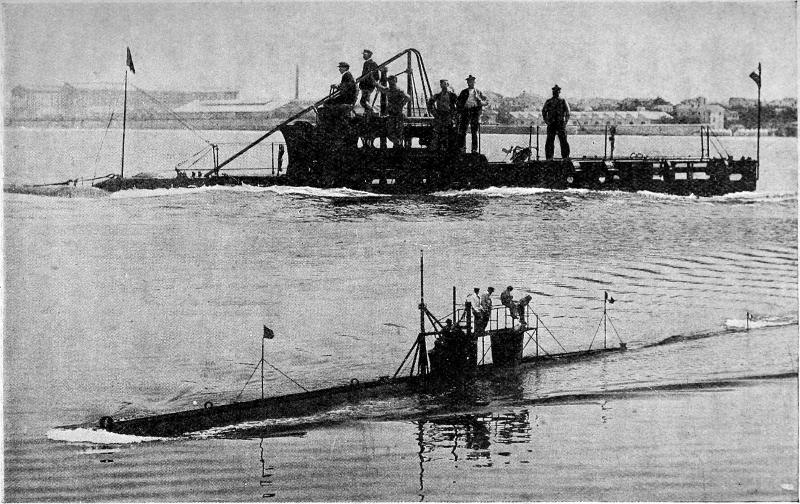
Photos, M. Bar.]
A FRENCH SUBMARINE OF THE HARBOUR DEFENCE TYPE. (top)
A FRENCH SUBMARINE OF THE COAST DEFENCE TYPE. (bottom)
(Completed 1901‒2.)
Française.
Algérien.
These two vessels are of the improved
Morse type, and are intended solely
for coast and harbour defence. Their
surface displacement is 146 tons, and
they have electric engines of 350 H.-P.
for both surface and submerged propulsion,
giving them a speed of 12 knots
and 8 knots an hour, respectively.
Their surface radius is about 80 miles
at 8 knots. They have one bow tube and
82two holders, with four torpedoes. The
complement is nine officers and men.
(Completed 1901‒2.)
Triton.
Sirene.
Espadon.
Silure.
These four vessels were the first of
the submersible type and were designed
by M. Laubeuf, who has since designed
many vessels for both France and other
countries (Laubeuf type). They have
a submerged displacement of 200 tons,
and are 111 feet long and 12 ½ feet in
beam. Steam is used for surface
propulsion (217 H.-P.) and electricity
when submerged. Their speed is 11
knots on the surface and 8 knots
when submerged, with a cruising radius
of 600 miles at 8 knots. They are
armed with four holders fitted with 18-inch
Whitehead torpedoes, and have a
complement of ten officers and men.
83
(Completed 1902‒4.)
Naiade.
Loutre.
Protée.
Lynx.
Perle.
Truite.
Castor.
Oursin.
Meduse.
Otarie.
Phoque.
Ludion.
Alose.
Anguille.
Grondin.
Dorade.
Souffleur.
Thon.
Bonite.
Esturgeon.
Twenty small harbour defence submarines,
having a displacement of
about 67 tons. They have petrol and
electric motors, giving them a speed of
8 ½ knots on the surface and 5 knots
when submerged. Their armament consists
of one bow tube and two holders;
four torpedoes are carried. Their complement
is six officers and men.
(Completed 1904.)
Aigrette.
Cicogne.
These two vessels are submersibles
of the Laubeuf type, and were great
84improvements on their predecessors, the
Triton Class. Their submerged displacement
is 351 tons, and their
dimensions 118 × 12 × 12 feet. A triple
expansion steam engine of 200 H.-P.
is used for surface propulsion and
an electric motor of 150 H.-P. when
submerged. Their speed is 10 knots
and 8 ½ knots. Their maximum surface
endurance is 700 miles at 8 knots, and
submerged 60 miles at 6 knots. Their
armament consists of one bow tube with
four 18-inch torpedoes. Their complement
is about fifteen officers and men.
(Completed 1905.)
A submersible designed by M. Bertin
(late Chief Constructor French Navy).
This vessel, which was first named
Omega, has a displacement of about
300 tons. She is driven by steam and
electricity, and has a speed of 11 knots
and 9 knots. Her armament consists
of two bow tubes and two holders,
85with six 18-inch Whitehead torpedoes.
The complement is about seventeen officers
and men.
(Completed 1906‒8.)
Emeraude.
Saphir.
Opale.
Topaz.
Rubis.
Turquoise.
These six vessels are of the Maugas
type and are sea-going submarines
with a submerged displacement of over
400 tons. They have petrol and electric
motors of 600 H.-P. and 450 H.-P.,
respectively. Their surface speed is 12
knots and submerged 8 ½ knots. Their
surface cruising radius is just over
1,000 miles at economical speed. Their
armament consists of two tubes and four
holders with 8 torpedoes of the usual
pattern. Their complement is seventeen
officers and men.
(Completed 1907.)
Circe.
Calypso.
These two vessels are of the Laubeuf
type, and are improvements on the
86Aigrette class. They have a submerged
displacement of about 450 tons and are
160 feet in length. They are driven by
a steam engine of 440 H.-P. (flash
boiler and oil fuel) when on the surface,
and by electric motors when submerged.
Their speed is 11 knots and 8 knots;
and the range of action 1,000 miles.
Their armament comprises two tubes and
four holders with eight torpedoes. The
complement is 21 officers and men.
(Completed 1907‒12.)
Pluviôse.
Nivôse.
Ventôse.
Messidor.
Thermidor.
Fructidor.
Brumaire.
Frimaire.
Florèal.
Prairial.
Germinal.
Submarines of the Laubeuf type with
a submerged displacement of nearly 600
tons. All built at Cherbourg. The
Brumaire and Frimaire are driven by
petrol motors of 700 H.-P. when
cruising on the surface, but all the
others have small steam turbines with
87a special type of flash-boiler. Electric
motors are used for submerged propulsion.
Their speed is 12 knots above
and 9 knots below. The armament is
seven 18-inch torpedoes. Their complement
is 22 officers and men.
(Completed 1908‒12.)
Fresnel.
Berthelot.
Papin.
Monge.
Ampère.
Gay-Lussac.
Cagnot.
Faraday.
Giffard.
Montgolfier.
Newton.
Volta.
Watt.
Euler.
Faucault.
Franklin.
Arago.
Permouilli.
Joule.
Coulomb.
Curie.
Le Verrier.
Twenty-two submarines of the largest
sea-going Laubeuf type. Only three of
these are steam driven, the others using
heavy-oil engines for surface propulsion.
They are in all respects similar to
vessels of the Pluviôse class, and have
a displacement of about 600 tons. Their
speed is 12 knots above, and 9 knots
88below, and the armament seven 18-inch
torpedoes. These vessels are fitted with
stern as well as bow tubes. Their
surface cruising range is over 2,000 miles.
(Completed 1912.)
An experimental boat of the Bourdelle
type, built at Cherbourg. The submerged
displacement is just under 800
tons and the length 190 feet. She is
driven on the surface by heavy-oil
engines of 1,600 H.-P., which give a
speed of 15 knots. The electric motors
for submerged propulsion are of 700 H.-P.,
giving a speed of 10 knots. The armament
consists of seven 18-inch torpedoes,
and the cruising range is 3,500 miles.
(Completed 1912.)
Another experimental boat built at
Cherbourg. The submerged displacement
is about 810 tons, and the length
and beam 212 feet and 22 feet
89respectively. Steam turbines are used for
surface propulsion and electric motors
when submerged. Her speed is 15 knots
above and 10 knots below. The armament
is seven 18-inch torpedoes, and
the complement 24 officers and men.
Photo, M. Bar.]
A FRENCH SUBMARINE OF THE SEA-GOING TYPE.
(Completed 1912.)
The third experimental boat, of the
Rodiquet type, built at Cherbourg. The
displacement when submerged is 650
tons and the length about 200 feet.
Petrol motors of 1,500 H.-P. drive her
at 15 knots an hour on the surface and
electric motors of 550 H.-P. at 10 knots
when submerged. Her radius of action
is 3,000 miles, and her armament seven
18-inch torpedoes, which can be fired
from both bow and stern tubes. The
complement is about 25 officers and men.
(Completed 1912.)
The fourth experimental vessel, built
at Cherbourg during 1909‒12. The
90submerged displacement is 450 tons and
the length 145 feet. Steam turbines of
1,300 H.-P. drive her at 15 ½ knots an
hour on the surface, and electric motors
of 500 H.-P. at 10 knots when submerged.
Her armament consists of six 18-inch
torpedoes. The complement is 22 officers
and men.
(Completed 1913‒14.)
Clorinde.
Cornélie.
Amphritrite.
Astree.
Artémis.
Aréthuse.
Atalante.
Amaranthe.
Ariane.
Andromaque.
These ten vessels are the very latest
additions to the French Submarine
flotillas. They have a submerged displacement
of about 550 tons, a length
of 177 feet and a beam of 16 feet.
Heavy-oil engines of 1,300 H.-P. give
them a speed of 15 knots on the surface,
and electric motors of 550 H.-P. enable
them to travel at 9 ½ knots an hour when
submerged. They carry eight torpedoes,
91and have a complement of 25 officers and
men.
(Completed 1913‒14.)
Gustave Zede.
Néréide.
These two vessels are the largest
submarines in the French flotillas.
They have a submerged displacement of
1,000 tons, a length of 240 feet, and a
beam of 20 feet. Heavy-oil engines give
them a surface speed of 16 knots and
electric motors a submerged speed of
10 knots. Their armament consists of
two bow and two stern tubes with eight
18-inch torpedoes. They are also equipped
with two 14-pdr. quick-firing guns on high-angle,
disappearing mountings. The
cruising range is 4,000 miles, and the
complement 27 officers and men.
(Completed 1914.)
Bellone.
Hermione.
Gorgone.
Fast sea-going submarines with a
submerged displacement of 610 tons.
92They have heavy-oil engines of about
2,000 H.-P., which give them a surface
speed of 17 ½ knots. Electric motors of
950 H.-P. drive them at 12 knots when
submerged. Their surface cruising range
is 4,000 miles. Their armament consists
of eight 18-inch torpedoes and two 14-pdr.
quick-firing, high-angle guns. The complement
is 30 officers and men.
On the day when war was declared
nine submarines were in the early stages
of construction. The two most advanced
of these were the Diane and Daphne.
These vessels have a submerged displacement
of about 800 tons, and the
anticipated speed is 18 knots and 10
knots. Their armament will consist of
ten torpedoes and four 9-pdr. guns. The
complement will be 30 officers and men.
The other seven vessels are of the
improved Gustave Zede Class. They
will have a submerged displacement of
over 1,000 tons and a speed of 20 knots
93on the surface and 12 knots when submerged.
Their armament will consist of
ten torpedoes and four 9-pdr. guns. The
complement will be about 35 officers and
men.
The Imperial Russian Navy at the commencement
of hostilities included 37
submarines in active service, and 19 in
various stages of construction. The
composition and distribution of the
submarine flotillas was as follows:—
Baltic Flotilla: 14 Submarines with
depôt ships in commission, and 12 vessels
building. Bases: Kronstadt, Port Peter
the Great (Reval) and Port Alexander III.
(Libau) (ice free).
Black Sea Flotilla: 11 Submarines
with depôt ships in commission, and
several new vessels building. Bases:
Sevastopol and Nikolaieff.
Siberian Flotilla: 12 Submarines
95with depôt ships in commission, and 6
vessels building. Base: Vladivostok.
The first Russian naval submarine was
completed at Kronstadt in 1902, and
named the Petr Kochka. She was built
in sections to facilitate transport over the
Siberian Railway, being intended for
the defence of Port Arthur, and had a
surface displacement of only 20 tons.
Her armament consisted of two holders,
or Darzewiecki launching apparatus, containing
two small Whitehead torpedoes.
The maximum speed was 8 knots on
the surface and 4 knots when submerged.
The second submarine ordered for the
Russian Navy was the Delphin, which
foundered off Kronstadt, but was subsequently
raised and is now used as a
training ship for the submarine service.
These two vessels have been removed
from the active flotillas, but the third
vessel to be built for the Russian Navy—the
Graf Cheremetieve—is still in
commission.
96
(Completed 1904‒5.)
Graf Cheremetieve.
Kasatka.
Nalim.
Skat.
These are the oldest submarines in
the Russian Navy, and are small vessels
of the Holland-Bubnoff type. They have
a submerged displacement of 200 tons.
Petrol and electric engines drive them at
9 knots on the surface and 6 knots when
submerged. Their armament consists
of one bow torpedo tube and two
exterior holders, with four 18-inch
Whitehead torpedoes.
(Completed 1904‒6.)
Ostr.
Byts-chok.
Kefal.
Platus.
Plotva.
These five submarines are of the
American Lake type. The Ostr was
originally the American Lake Co.’s
boat Protector. They have a submerged
displacement of 175 tons, are 65 feet
97in length and 11 feet in breadth. Have
petrol engines of 250 H.-P. for surface
propulsion and electric motors for use
when submerged. Their speed is 11
knots above and 7 knots below. The
surface cruising radius is 450 knots at
full speed. The armament consists of
two bow and one stern tube with
four 18-inch Whitehead torpedoes. The
special characteristics of the American
Lake type will be seen on pages 119‒120.
(Completed 1904‒6.)
Som.
Shtshuka.
These two vessels, which are of the
Holland-Bubnoff type, have a submerged
displacement of about 150 tons. Petrol
and electric motors are used for surface
and submerged propulsion, and the speed
is 9 ½ knots and 7 knots, above and below,
respectively. Their armament consists
of two bow tubes with four 18-inch
Whitehead torpedoes. Their complement
is about fifteen officers and men.
98
(Completed 1905‒6.)
Sterliad.
Bialuga.
Peskar.
These three vessels are also of the
Holland-Bubnoff type. They have a
submerged displacement of 150 tons.
The petrol motors for surface propulsion
are of 160 H.-P. The speed is 9 ½ knots
and 7 knots, above and below, respectively.
Their armament consist of two
bow tubes with four 18-inch Whitehead
torpedoes. Their complement is eleven
to fifteen officers and men.
(Completed 1906.)
A submarine of the Lake type;
similar in almost every respect to
vessels of the Ostr class.
(Completed 1907.)
Makrel.
Okun.
Two vessels of the Improved Holland-Bubnoff
type. They have a submerged
99displacement of about 200 tons. The
petrol motors are of 300 H.-P., and the
electric engines of 150 H.-P. Their
speed is 10 knots on the surface and
8 knots when submerged. They are
fitted with two bow tubes and two stern
holders, and carry six 18-inch Whitehead
torpedoes. Their complement is fifteen
officers and men.
(Completed 1907.)
Lossos.
Ludak.
Two somewhat smaller submarines of
the Holland type. Intended either for
the Black Sea or Far Eastern Flotilla.
Similar to those of the Sterliad class.
(Completed 1907‒8.)
Karp.
Karas.
These two submarines are of the
Germania, or Krupp type, and have a
submerged displacement of 250 tons.
They have Krupp-Nuremburg heavy-oil
100engines of 400 H.-P., and electric motors
of 160 H.-P. Their speed on the surface
is 12 knots, and 8 knots when submerged.
The surface range of action is
about 1,000 miles, and the submerged
endurance about three hours at full
speed. Their armament consists of two
bow torpedo tubes and four torpedoes
are carried. Their complement is fifteen
officers and men.
(Completed 1908‒9.)
Alligator.
Kaiman.
Drakon.
Krokodil.
Four submarines of the improved
Lake type. They have a submerged
displacement of 500 tons. Their speed
is 15 knots on the surface and 10 knots
when submerged. They are fitted with
two bow and two stern tubes, and carry
six 18-inch Whitehead torpedoes. Their
complement is seventeen officers and
men. (See also page 96.)
101
(Completed 1908.)
Minoga.
Potschovy.
Two small submarines of the Holland-Bubnoff
type, which were built in sections
to facilitate transport by rail. They
have a submerged displacement of about
150 tons, and a speed of 12 knots and
9 knots, above and below, respectively.
Their complement is eleven officers and
men.
(Completed 1909.)
A large submarine of the Holland-Bubnoff
type. Her displacement is about
570 tons, and her speed 16 knots on
the surface and 10 knots when submerged.
The armament consists of two
bow and one stern tube, with six 18-inch
Whitehead torpedoes. The complement
is 20 officers and men.
102
(Completed 1909‒12.)
Kaschalot.
Kit.
Krab.
Morsh.
Narval.
Nerpa.
Tinlen.
These seven vessels are among the
most modern submarines in the Russian
flotillas. They are of the Holland-Bubnoff
type, and have a submerged displacement
of about 500 tons. Heavy-oil
engines of over 1,000 H.-P. drive them
at a maximum surface speed of 16 knots,
and electric motors of 550 H.-P. give them
a submerged speed of just over 10 knots
an hour. Their surface cruising range is
about 3,000 miles. Their armament consists
of two bow and one stern tube with
six 18-inch Whitehead torpedoes. They
are also fitted with a small, quick-firing,
high-angle gun for defence against air-craft.
Their complement is 21 officers
and men.
At the commencement of the war there
were nineteen Russian submarines in
103course of construction. Very little information
concerning these boats can be
obtained, except that their submerged
displacement ranges from 800 to 1,500
tons, and their anticipated surface speed is
20 knots. Some of the 800-ton vessels
have already been completed, and the
first twelve will be named: Svitza, Leopard,
Pantera, Ruis, Kaguar, Tiqr,
Yaguar, Vepr, Wolk, Baro, Gepard,
and Tur. These vessels have a speed
of 16 knots on the surface and 10 knots
when submerged. Their complement is
25 officers and men.
CHAPTER V JAPANESE SUBMARINES — Nos. 6 and 7. — Nos. 8 and 9. — Nos. 10‒15. — Nos. 16‒17 [4] .
104
The Imperial Japanese Navy includes a
submarine flotilla of seventeen vessels,
all except two of which are of the British
Holland or Vickers type. Japan commenced
the construction of what is now
a rapidly increasing and powerful flotilla
in 1904 by the purchase of five elementary
Holland boats. These, however, are still
in the active flotilla and are designated
Nos. 1‒5. They have a submerged displacement
of 120 tons, and are 65 feet
in length and 12 feet in beam. Petrol
motors of 160 H.-P. drive them at 9 knots
on the surface and electric motors of
70 H.-P. at 7 knots when submerged.
Their armament consists of one bow
105expulsion tube with three 18-inch
Whitehead torpedoes.
(Completed 1906.)
These two vessels were the first submarine
boats to be built in Japan, but are
of the same type as Nos. 1‒5, only larger
and faster. They have a submerged
displacement of 180 tons, a length of
100 feet and a beam of 10 feet. The
petrol engines are of 300 H.-P. and the
electric motors of 100 H.-P. The surface
and submerged speed is 10 knots and
8 knots an hour, respectively. Their
armament consists of one torpedo tube with
three 18-inch Whitehead torpedoes.
(Completed 1907‒8.)
These two vessels are very similar to
the British “C” class, and were built by
Messrs. Vickers Ltd. They have a submerged
displacement of 320 tons; petrol
motors of 600 H.-P., and a surface and
106submerged speed of 13 knots and 8 knots
an hour, respectively. Their armament
consists of two bow tubes with four to six
18-inch Whitehead torpedoes. Their
complement is sixteen officers and men.
(Completed 1909‒12.)
These six vessels are the same in
almost every respect as the later “C”
class of British submarines (pages 70‒71).
(Completed 1912‒14.)
These two vessels are of the Schneider-Laubeuf
or French type. (British “W”
class.) Their submerged displacement is
about 500 tons, and the horse-power of
their surface engines 2,500. The surface
and submerged speed is 18 knots and
9 knots respectively. Their armament
consists of six torpedo tubes with eight
Schneider torpedoes. The complement is
about 30 officers and men.
107The natural adroitness with which
Japanese sailors manipulate complicated
machinery, combined with their absolute
fearlessness, make them ideal for torpedo
work.
CHAPTER VI GERMAN SUBMARINES — U.1. — U.2-U.8. — U.9-U.18. [5] — U.19 and U.20. — U.21-U.24. — U.25-U.30. — U.31-U.36.
108
On “The Day”—August 4th, 1914—Germany
possessed 30 submarine torpedo-boats.
These were divided into
three flotillas, with their headquarters at
Kiel, the largest and most modern
vessels being attached to the Heligoland
or North Sea Flotilla. During 1913,
although 24 submarines were stated as
being in commission, only about 15
were actively employed, and these mostly
in training reserves, the older boats
being docked and modernized where
possible. But during the year six new
vessels were added to the flotilla and the
personnel of the submarine service was
largely increased. At the same time the
inspection of submarines was separated
109from that of the other torpedo-boats and
a flag-officer was appointed as head of
the submarine branch of the Naval
Service, with headquarters at Kiel.
Thus when the hour came for the great
struggle which was to decide the mastery
of the seas the whole German Flotilla of
30 vessels, with a reserve of six new boats
which had been secretly hurried forward
and were rapidly nearing completion, was
ready to put to sea.
The German Naval Law provided for
the construction of 72 submarines by the
end of 1917. All the vessels built up
to the present time have been known as
the “U” class and numbered in rotation.
They are painted a brownish-grey colour
and have high collier-like bows with
massive armoured conning-towers and
long superstructures amounting to narrow
decks. They have all been built at
either Kiel or Dantzig.
Although the first submarine boats
built for the German Navy were two
vessels of the Nordenfeldt type, launched
110in 1890, they were never actively employed
with the fleet and have long since
been reduced to scrap-iron, and the first
vessel which can now be reckoned as a
fighting unit of the German torpedo-boat
flotilla was a vessel designated the
“U.1.” This was built at the Germania
Shipyard, Kiel, and launched on August
30th, 1905. This was the forerunner of
the “U” class, which in most of the
essential features resembles the British
Improved Holland type.
(Completed 1905.)
This U.1 was built as an experimental
boat by the famous firm of
Krupps. She has a surface displacement
of 197 tons, a submerged displacement
of 236 tons, and her heavy-oil surface
engines are of 250 H.-P. The electric
motors for submerged use develop just
over 100 H.-P. The speed ranges from
10 knots an hour on the surface to 7
knots when submerged, and her surface
111range of action is about 700 to 800 miles.
The armament consists of one bow torpedo
tube and three (17.7) Schwartzkopf
torpedoes are carried. The complement
is nine officers and men.
The trials of the U.1 extended over
a period of a year and a half, and all
proved remarkably satisfactory. During
the tests which took place in Eckernforder
Bay she succeeded, twice in
succession, in torpedoing a moving target
while travelling submerged at full speed.
The uncertainty displayed for some
years previous by the German Naval
Authorities regarding the value of submarine
boats gave place to a thorough
sense of the important part these
“mighty atoms” would play in future
naval warfare, and to a strong determination
that the German Navy should
include a powerful submarine flotilla.
(Completed 1907‒10.)
These seven vessels were great
improvements on the U.1. Their
112displacement is 210 tons on the surface
and about 250 tons when submerged.
They are fitted with Krupp-Nuremburg
heavy-oil engines of 400 H.-P. and
electric motors of 160 H.-P. Their
speed on the surface is 12 knots and
8 knots when submerged. The surface
range of action is 1,000 miles and the
submerged endurance about three hours
at full speed. Their armament consists
of two bow torpedo tubes and four
torpedoes are carried. The complement
is eleven officers and men.
(Completed 1910‒12.)
These ten vessels are of increased
size and power, their submerged displacement
being 300 tons, and the horse-power
of their heavy oil surface engines
is 600. The electric motors develop
200 H.-P. The surface and submerged
speeds are 13 knots and 8 knots
respectively. The surface range of
113action is 1,500 miles, and the armament
consists of two bow and one stern torpedo
tube with five torpedoes. The U.13
and subsequent vessels of this class are
provided with a quick-firing, high-angle
gun for defence against aircraft, and
have sleeping accommodation for the
crew. They may be termed the first
German sea-going submarines. Their
complement is twenty officers and men.
(Completed 1912‒13.)
There are only two vessels in this
class owing to the adoption of certain
improvements with the aid of which a
partly new type has been evolved.
These two vessels have a displacement
when submerged of 450 tons. Their
oil engines of 650 H.-P. give a speed
of 13 ½ knots an hour on the surface,
and their electric motors of 300 H.-P. give
8 knots an hour when submerged. Their
surface range of action is 2,000 miles,
and their armament consists of two bow
114and one stern torpedo tube with six
torpedoes, and two 14-pdr. quick-firing,
high-angle guns on disappearing mountings.
The complement is seventeen
officers and men.
(Completed 1912‒13.)
These four vessels are the first of the
new type of large sea-going submarines
for the German Navy. Their submerged
displacement is 800 tons. They are
propelled on the surface by heavy-oil
engines of 1,200 H.-P., and when submerged
by electric motors of 500 H.-P.
Their speed above water is 14 knots
an hour and below the surface 9
knots. The surface range of action
is 3,000 miles and the submerged endurance
120 miles at economical speed.
Their armament consists of two bow
and two stern torpedo tubes with eight
torpedoes, and one 14-pdr. quick-firing
gun and two 1-pdr. high-angle guns,
all on disappearing mountings, for
115defence against hostile destroyers and
aircraft. Their complement is twenty-five
officers and men.
(Completed 1913‒14.)
These six vessels are the latest additions
to the German submarine flotilla.
They are vessels of 900 tons submerged
displacement with heavy-oil engines of
2,000 H.-P., and electric motors of 900 H.-P.
Their surface and submerged speed is
18 knots and 10 knots, respectively.
The surface cruising range is 4,000 miles.
Their armament consists of two bow and
two stern torpedo tubes, with eight large
size torpedoes, and, in addition, two
14-pdr. quick-firing guns and two 1-pdr.
high-angle guns. They have wireless
telegraphic apparatus on board, and are
specially constructed with long superstructures
and high collier-like bows to
enable them to keep at sea in almost any
weather. They are fitted with two or
three periscopes, and also possess a small
116look-out cap on the top of the lofty
conning-tower to facilitate an “awash”
attack in the half-lights of dawn and
dusk, when the periscope is almost useless.
The conning-towers and decks are
armoured. Their complement is 30 to 35
officers and men.
(Building.)
These are the six vessels which are
rapidly nearing completion, and which
were in a much more advanced state,
at the opening of hostilities, than was
generally known in foreign naval circles.
They are the same in almost every
respect as the vessels U.25 to U.30.
There is, however, another submarine
being built for Germany of a totally
different design. This is the F.I.A.T.
or Laurenti boat (Italian), laid down at
the beginning of 1914. This vessel is
very similar to the four “S” boats being
built at Greenock for the British Navy.
No German submarines have in the
117past been sent to any Colonial or oversea
station. Therefore, the whole flotilla
of 30 to 36 vessels was immediately available
for operations in the North Sea and
Baltic when war began. The personnel
of the whole torpedo service is very
efficient, great attention having been
paid to this branch of the Navy. The
three German Submarine flotillas have
their headquarters at Kiel, Wilhelmshaven,
and Heligoland.
CHAPTER VII AUSTRIAN SUBMARINES — U.1 and U.2. — U.3 and U.4. — U.5 and U.6. — U.7-U.11. — Submarine Flotillas of Neutral European Powers.
118
At the commencement of the War the
Austro-Hungarian Navy included six
submarines in the active flotilla and
five others were being completed at the
Germania Yard, Kiel, but it is doubtful
if they had been delivered. In which
event they must be added to the strength
of the German flotilla. In addition to
these, several larger vessels, mostly of
the latest “U” or Krupp design, had
been ordered, but were not expected to
take their place in the active flotillas
before the end of 1915.
Austria commenced the formation of a
submarine flotilla in 1908 by the acquisition
of two vessels of the Improved Holland
type from Messrs. Vickers Ltd., and
119two others of the American Lake type.
In the following year two more submarines
were ordered, this time from
Krupp’s Germania Yard. All these
vessels were delivered during 1910, and
Austria’s first submarine flotilla came into
being.
(Completed 1910.)
These two vessels are of the American
Lake type. They have a submerged
displacement of 250 tons and petrol
surface motors of 720 H.-P. Their speed
is 12 knots on the surface and 8 knots
when submerged. The armament consists
of two bow and one stern torpedo
tube. This type of submarine has three
special features which distinguish it from
all others. It is fitted with a kind of
underframe and wheels, and is designed
to travel in four different positions: (1) on
the surface; (2) semi-submerged, with
only a look-out cowl above water; (3)
submerged, with nothing but the periscope
showing; (4) totally submerged and
120running along the sea-bed on wheels,
like a submarine motor car. It is drawn
down from the surface to the sea-bed
by an ingenious system of wire-hawsers
and drop-weights, which can be released
in the event of accident. A “diving
chamber” enables members of the crew
to don diving-dresses and leave the submarine
when on the sea-bed, for the
purpose of laying or destroying submerged
mines. The Lake type of submarine is
also used in the Russian Navy.[6]
(Completed 1910.)
These two vessels are of the Krupp
design, and have a submerged displacement
of 300 tons. The horse-power of
their heavy-oil surface engines is 600.
The electric motors develop 200 H.-P.
The surface and submerged speeds are
13 knots and 8 knots respectively. The
surface range of action is 1,500 miles,
and the armament consists of two bow
121and one stern tube with five 18-inch
torpedoes. Their complement is fifteen
officers and men.
(Completed 1910.)
These are submarines of the Improved
Holland type. Their submerged displacement
is about 316 tons; length
135 feet, and beam 13 ½ feet. The
horse-power of the petrol engines is 600
and that of the electric engines 189.
The speed averages 12 knots on the
surface and 8 knots when submerged.
The surface cruising range is 1,300
knots at 10 knots an hour. Their
armament consists of two bow tubes with
four to six 18-inch Whitehead torpedoes.
Their complement is sixteen officers and
men.
(Completed 1914. Delivery doubtful.)
These five vessels are of the Krupp-Germania
type, and are similar to those
completed for the German Navy in
1221912‒13. They are large sea-going
submarines with a submerged displacement
of 800 tons. They are propelled
on the surface by heavy-oil engines of
1,200 H.-P., and when submerged, by
electric motors of 500 H.-P. Their speed
is 14 knots and 9 knots, above and
below, respectively. The surface range
of action is 3,000 miles, and the submerged
endurance 120 miles at economical
speed.
Their armament consists of two bow
and two stern torpedo tubes, with eight
torpedoes, and one 14-pdr. quick-firing
gun and two 1-pdr. high-angle guns,
for defence against hostile destroyers and
air-craft. Their complement is twenty-five
officers and men.
One or two Austrian submarines are
supposed to have been sunk by the
Allied Fleet during the first few weeks
of the war, but exactly which vessels
they were is not known.
Several other submarines have been
ordered in foreign countries for the
123Austrian Navy, but cannot be delivered
while the war lasts.
Country.
Vessels Built.
Vessels Building.
Italy
20 (100‒300 tons)
8 (large size)
Denmark
9 (100‒300 tons)
several
Holland
6 (100‒300 tons)
4 (large)
Sweden
7 (150‒300 tons)
3 (large)
Greece
2 (Laubeuf)
――
Norway
1 ――
4 (Germania)
Portugal
1 ――
3 ――
Turkey
――
3 ――
Spain
――
3 ――
CHAPTER VIII SUBMARINES IN ACTION — Attacking at Right Angles. — The Porpoise Dive. — Difficulty of the Fixed Torpedo Tube. — Submarine Flotilla v. Surface Fleet. — Surprise Attack.
124
Submarines have two great advantages
over all types of surface warships; they
can become invisible at will—or sufficiently
invisible to make gun or torpedo-practice,
except at very close quarters,
almost entirely useless—and they can,
by sinking, cover themselves with armour-plate
of sufficient thickness to be absolutely
shell-proof. These are the two
main points in favour of the submarine.
There are, however, many minor features.
Although submarines are known in the
naval services as “daylight torpedo-boats,”
for their greatest value lies in
their ability to perform the same task in
the “light” as the ordinary surface torpedo-boats
and destroyers can do under
125cover of darkness or fog—that of creeping
up close to an enemy, and launching a
torpedo unobserved—they have been
given, during recent years, so much
greater speed, armament, and range of
action, that they can no longer be looked
upon as small boats just suitable for daylight
torpedo attack in favourable circumstances.
Their surface speed has been
increased from 10 to 20 knots, making
them almost as fast as the surface torpedo-boat.
This, combined with manœuvering
powers and general above-water invisibility,
has enabled them to take over the
duty of the surface torpedo-boat—that
of delivering night-attacks on the surface.
After nightfall a submarine attack is
almost impossible owing to the periscope—the
eyes of the submarine—being
useless in the dark.
The increase in the armament of the
submarine—from the single bow torpedo
tube with two torpedoes of short range
and weak explosive charge, to the four
bow and two stern tubes with eight or ten
126torpedoes of long range and high
explosive charge—has greatly increased
their chances of successful attack on
surface warships, first, by giving them
four or six shots ahead, then the possibility,
in the event of all these
torpedoes missing, of a dive under the
object of attack, and two more shots
at close range from the stern tubes
(still retaining two torpedoes); and,
secondly, by increasing the distance
from which the first projectile can be
launched, owing to the increased range
of the modern torpedo. There are also
the advantages derived from the battery
of quick-firing guns installed on the
decks of modern submarines. Although
at the present time these guns are
only of small power they nevertheless
afford a means of defence—and even
of attack under favourable circumstances—against
hostile surface torpedo-boats,
destroyers, and air-craft. In fact, a
flotilla of submarines could undoubtedly
now give a very good account of
127itself if attacked either on the surface
or when submerged by one or two
prowling destroyers. The increase in
the power of the guns carried by submarines,
which will certainly come soon,
will enable this type of craft to take
up the additional duties of the destroyer—that
of clearing the seas of hostile
torpedo-boats and carrying out advanced
scouting—for which work their ability
to travel submerged and in a state of
invisibility for distances of over 100
miles makes them eminently suitable.
The enormous increase in the size
and range of action of submarines,
combined with the improvements effected
in the surface cruising qualities, have
enabled these vessels to be taken from
the “nursery” of harbour and coast
defence and placed with the sea-going
flotillas and battle-fleets. In the short
period of ten years the tonnage of
submarines has risen from 100 to over
1,000 tons, and the range of action
from 400 miles at economical speed to
1285,000 miles. Exactly what this means
is more easily realized when it is
stated that the earlier types of submarines
could scarcely cross the English
Channel and return without taking in
supplies of fuel, and in rough weather
were forced to remain in harbour,
whereas the modern vessel can go
from England to Newfoundland and
back without assistance, and can remain
at sea in almost any weather, as was
first demonstrated by the successful
voyage of the British submarines A.E.1
and A.E.2 to Australia, and has since
been proved by the operations of the
British submarine flotilla in the North
Sea.
In addition to the cruising range
there is, however, the question of
habitability. In this respect the progress
has been equally as rapid. In
the older boats no sleeping accommodation
was provided for the crew, and
food supplies and fresh water sufficient
only for a few days were carried. In the
129latest British, French and German
vessels proper sleeping and messing
accommodation is provided, and supplies
of all kinds and in sufficient quantity
to last a month are carried. Although
work on these craft is still very
cramping for the crew, the increase in
the deck space and in the surface
buoyancy has greatly minimised the
discomforts of service in the submarine
flotilla.
With regard to safety, it has already
been shown that a submarine is only held
below the surface by the power of her
engines and the action of the water on
her diving-rudders. This means that in
the event of anything going wrong
inside the vessel she would automatically
rise to the surface; but should the hull
be pierced in any way, either by shot
or by collision, and an overwhelming
inrush of water result—overcoming the
buoyancy quickly obtained by blowing
out the water-ballast tanks—then the
vessel must inevitably sink, and the
130question of whether or not the crew
can save themselves becomes a problem
to which no definite answer can be given,
although a special means is provided in
all modern vessels belonging to the British
Navy. Speaking generally, it may, however,
be said that if the disaster occurs
suddenly, and the vessel sinks into very
deep water rapidly, the chances of life-saving
are extremely small; but if the
water is comparatively shallow, as along
the coast (100 to 150 feet), the likelihood
of many of the crew being able to save
themselves with the aid of the special
escape helmets and air-locks is fairly good.
We now come to the most important
improvement made in the fighting qualities
of these vessels since first they came into
being, viz. the wonderful increase in the
surface and submerged speed. In the
older craft the surface speed did not
exceed 8 to 10 knots an hour, whereas it
now amounts to 16 to 20 knots, and the
submerged speed has risen from 5 knots
to 10 to 12 knots. It is a little difficult
131for any but a naval man to realize exactly
what this increase in the speed of submarines
really means, and it is equally as
difficult to adequately describe it here in
non-technical language. It is a mere
platitude to say that in order to attack a
surface warship the submarine must first
get within torpedo range of it; and yet it
is on this very point that the strategy and
tactics of submarine warfare revolve. A
clever naval tactician once described the
submarine as a “handicapped torpedo-boat.”
The two points on which he
based this opinion were—the (then) slow
speed of these vessels compared with that
of the surface warship, and its almost
total blindness when submerged. These
two defects were for some years the
principal drawbacks of all the submarines
afloat; but since that naval expert pronounced
submarines to be “handicapped
torpedo-boats,” great changes, great improvements
have been made. The speed
of the submarine has increased by over
100 per cent., and they have been given
132longer and wider range of vision by the
introduction of two and three improved
periscopes instead of one elementary
instrument. Nevertheless, the speed
difficulty is still a very real one, as
will readily be seen when it is taken
into consideration that the speed of a
submarine when attacking submerged is
frequently only half, or even a third,
of that of her enemy. In order to
more clearly illustrate this and lift for
a moment the veil of secrecy which
enshrouds the methods of attack adopted
by this type of craft, it will be necessary
to describe what is known as the right-angle
attack.
The difficulty of attacking a surface
warship steaming at right angles to the
course of the submarine will be clearly
understood by referring to the following
diagrams. The first shows an attack on
a warship travelling at 20 miles an
hour, such as a big battleship or a cruiser
133Any increase in the speed of the surface
vessel not only adds to the difficulty of
the attacking submarine, but also the
direction from which the attack must be
made. This feature is shown in the
second diagram, which illustrates a submarine
attack on a vessel steaming
at 30 miles an hour, such as a fast
destroyer or fleet scout. On the other
hand, a decrease in the speed of the
on-coming surface vessel tends to either
make easier the task of the attacking
submarine, or else to increase the
distance from which the attack can be
delivered. This is shown in the third
diagram, which assumes the speed of the
surface vessel to be only 15 miles an
hour, such as a merchantman, troopship,
food-ship, collier, or old warship.
Right-Angle Attack by Submarines.
Fig. 1 represents a submarine attacking
a hostile warship (or fleet) steaming at
20 (statute) miles an hour. “A” is the
line of vision. The submarine sights the
warship at a distance of just over 11 miles
on her port bow. “B” shows the hostile
134vessel’s course, which is 10 miles to point
marked “C,” and each division beyond
equals 1 mile.
Directly the submarine, which is
assumed to be lying in an awash
condition, sights the object of attack,
she totally submerges and steers forward
at a speed of 10 miles an hour.
The loss, and gain, of the submarine on
the different courses, can be seen in the
table above the chart.[7]
The spaces between the black dots
show the most favourable points of
attack. It will be noticed in the table
that both vessels are equal at point “C,”
but for many reasons this is not the best
point of attack. The gain of about six
minutes on the longer course enables the
submarine not only to manœuvre into the
best possible position for the attack, but
135also to discharge more than one torpedo
if necessary.
Fig. 2 shows the extreme limit at
which a submarine could, with reasonable
chances of success, attack a destroyer, or
other vessel, steaming at 30 (statute)
miles an hour, having sighted her at a
distance of 16 miles in the position
shown by the line of vision “A.”
The distance to “C” is 15 miles
for the surface vessel, and 5 miles for
the submarine. Here, again, the two
vessels would be equal; but the most
favourable point of attack is shown by
the two black dots—where the submarine
has gained two minutes.
Fig. 3.—The submarine sights the
object of attack at a distance of 14 ¼
miles, in the position shown by the line
of vision “A.” The surface vessel has
a speed of only 15 miles an hour
(merchantman). In this case the surface
vessel accomplishes the 10-mile journey
along course “B”—arriving at point
“C” 20 minutes in advance of the
136submarine. The table shows how the
submarine, by changing her course and
“throwing” the surface vessel on her
beam, gradually reduces the loss, until,
at the point marked with the two black
dots, she is but 4 ½ minutes behind. At
this distance she could fire her torpedoes at
long range, with some likelihood of success.
Although these charts show approximately
the extreme limits of the right-angle
attack, a submarine could, of
course, proceed for some distance on
the surface at a much faster speed;
but considering the rate at which the
two vessels would be approaching each
other, the submarine which attempted
it would run considerable risk of being
detected, and thus destroy her chances
of a successful attack. Considering also
the time lost in sinking from the “light”
to the totally submerged condition, in
coming to close quarters, the gain in
speed would not amount to as much as
may at first seem probable.[8]
137These charts are drawn and calculations
made assuming the following
points:—
(1)
The weather—fine and bright.
(2)
Not taking into consideration strong tides, currents, etc.
(3)
The enemy on the alert.
(4)
Submarine waits at point “D” in an awash condition.
(5)
Owing to 1, 2, and 3 above, the submarine travels from point “D” in all courses in a
submerged condition.
The most favourable position for a
submarine flotilla is to manœuvre close
up to a fleet at anchor, or to get within
1,000 yards of a fleet—steaming across
its course; but both of these ideal
positions for attack are extremely
difficult to obtain, and consequently in
all the less favourable positions speed
is the deciding factor. Strategems will
undoubtedly play an important part in
submarine warfare. An example of this
has already been afforded when the
138German submarines resorted to the
dishonest trick of laying in wait behind
a trawler engaged in laying mines, over
which the flag of a neutral state had
been hoisted as a blind. This resulted
in the loss of three British cruisers with
over 1,000 lives. It would, however,
be quite in accord with the rules of
civilised warfare for a submarine to
shelter behind a “decoy”; to attack
simultaneously with a seaplane; or to
approach an enemy behind one of its
own merchant ships.
The manœuvre known as the “Porpoise
Dive” is merely the sudden rising of a
submarine in order to enable her commander
to get a better view of the surface
than that afforded by the periscope. The
submarine on approaching the object of
attack rises quickly to the surface by the
action of her horizontal rudders, then
dives again, only remaining above water
for a few seconds to enable her commander
139to get a glimpse of the enemy,
and to take bearings. The submarine
can then get within torpedo-range, with
simply the tiny periscope projecting from
the surface. This manœuvre is now
seldom necessary, owing to the long and
wide range of vision of the two or three
periscopes fitted in modern submarines.
With the exception of one or two
vessels, which it would be unwise to
specify, all the submarines engaged in
the present war have what are called
fixed submerged tubes. This means that
the tubes from which the torpedoes are
discharged are fitted inside the submarine
on a line with the centre of the boat, and
cannot be moved or aimed in any way
apart from the boat itself. It therefore
becomes necessary for the submarine to
be aligned by the steering rudders on the
object of attack before the torpedoes can
be discharged. In simpler vein, torpedoes
140can only be fired by a submarine straight
ahead or straight astern. Hence a
submarine, with a hostile warship coming
up on its beam, is compelled to turn and
face its opponent (or turn its stern towards
her) before delivering an attack.
It is absolutely necessary for submarines
acting in company to have each
its allotted task; and for a wide space of
water to be left between each boat; as it
is impossible, at present, for one submarine
to know the exact position of
another when both vessels are submerged.
Therefore, if each boat was not previously
instructed how to act, there would not
only be the likelihood of the greater
portion of an attacking flotilla firing their
torpedoes at one or two vessels of the
hostile fleet and allowing the remainder
either to escape or to keep up a heavy
and dangerous fire unmolested, but also
of collision and of torpedoeing each other
141by accident. There is no means of
inter-communication between submarines
when submerged, and a battle between
submarines is almost impossible.
In this case invisibility is the element
of success. Admiral Sir Cyprian Bridge,
G.C.B., in a letter to the Author once
said: “When submerged the concealment
of the submarine is practically perfect.
If she has not been sighted up to the
moment of diving, she will almost
certainly reach, unobserved, the point at
which she can make her attack.” And
this opinion—shared for many years by
all experts—has been amply proved in the
present war.
A submarine must, however, blend with
the surrounding sea in its ever-varying
colours, lights and shades, in order that
she may be as invisible as possible when
cruising on the surface. The French
Naval Authorities experimented off
Toulon with a luminous paint of a
142sea-green colour; but this, although
causing the hull to be almost totally
invisible in certain weather, was found
to be useless, as, on a bright day with
a blue sky, the green showed up clear
against the bluish tint of the surrounding
sea. After many months of experimenting,
a pale, sea-green, non-luminous
paint was chosen as the best colour
for French submarines. The British
Admiralty also carried out a few experiments
in this direction, and came to the
conclusion that a dull grey was the most
invisible shade. The German authorities
decided in favour of a grey-brown.
When travelling submerged, with only
the thin periscopic tube above the surface,
it is almost impossible to detect the
approach of a submarine before she gets
within torpedo range; and when cruising
on the surface she is equally as invisible
at a distance of a few miles. These
qualities enable the submarine in nearly
all cases where her speed permits, to
effect a surprise attack on a hostile battleship
143or cruiser when not closely screened by
fast destroyers, whose duty it is to be ever
on the watch for submarines.
As to the tactics which would be
employed by a submarine (or flotilla) in
attacking a hostile warship (or fleet), it
is impossible to say, for, like the
impromptu attacks of all “mosquito
craft,” the exact method, or manœuvre,
is arranged to suit the circumstances,
and it is very seldom that two such
attacks are carried out alike. Generally
speaking, however, a hostile warship
could be easily sighted, on a fairly
clear day, from the flying-bridge of a
submarine at a distance of 10 miles; but
it would be practically impossible to
detect the submarine from the deck of
a warship at that distance. On sighting
her object of attack the submarine would
sink to the “awash” condition, and
proceed for from 2 ½ to 5 miles, as
might be deemed expedient. She would
then submerge and steer by her periscopes,
each of which has a field of vision
144of 60 degrees. He would be a very
keen look-out who would be able to
detect the few square inches of periscopic
tube at a distance of three miles.
As this distance lessened, it might be
advisable, if the sea was very calm and
if the object of attack was stationary,
for the submarine to slacken speed, so as
to prevent any spray being thrown off
by the periscopic tube. Assuming, however,
that the optical tube was seen by
the enemy, it would be extremely difficult
to hit it with gun-fire at a distance of one
or two miles, or to damage the boat itself,
which would probably be immersed to a
depth of 12 or 15 feet. At a distance of
about 2,000 yards, or just over one mile,
the submarine would discharge her first
torpedo, following it up with another
at closer range from the second bow
tube. A rapid dive would then probably
be necessary in order to avoid the hail
of shot which would plough up the waters
around her. If the first two torpedoes
missed their mark the submarine might
145either dive completely under the object
of attack and then fire her stern tubes
at close range, or else manœuvre below
the surface for an attack from some
other point.
One of the effects produced on fleets
or individual warships in war time by
the ever present possibility of submarine
attack is, however, that they never
remain at anchor or even stationary in
an exposed position, and seldom—if wise—proceed
without destroyers as advance
and flank guards. These precautions
double the difficulties of a successful
submarine attack.
CHAPTER IX ANTI-SUBMARINE TACTICS
146
In all warfare, new weapons of attack
are, sooner or later, met by new methods
of defence. The submarine and the
aeroplane are at present the only
weapons against which there is no true
means of defence, and yet one is being
used as an antidote for the other without,
however, any very striking success so far.
The seaplane may be able to distinguish
the dark patch in the sea caused by the
hull of the submarine in clear water,
but she cannot destroy it, neither can
she signal the exact locality to an
accompanying destroyer flotilla, owing
to the speed with which seaplane and
submarine pass over and under each
other; furthermore, in rough weather or
147in shallow muddy water no sign of the
submarine when submerged is visible
from above. The great value of the
seaplane as an antidote for submarines
lies, however, first in the fact that the
water of the open sea is usually clear,
and the submarine shadow is visible
from above, and, secondly, in the great
speed of these aircraft which enables
them to quickly cover miles of sea in
their search for hostile submarines and
to report their presence in a given
locality by wireless to all ships operating
within range.
When the enormous superficial area of
a zone of war, such as the North Sea
and English Channel, is duly considered,
however, the difficulty in quickly and
reliably locating from the air the
few scattered “submarine shadows” will
be easily realized. To make this
method of locating submarines even
fairly reliable an enormous fleet of seaplanes
would be required. Again seaplanes
do not, in themselves, constitute
148a means of defence against submarine
attack, they merely increase the likelihood
of detection, but, in actual warfare,
it has now been proved that for every
submarine detected by seaplanes two
others pass quite unobserved.
Many means of attack on submarines
have been proposed; and no doubt some
of these, in certain cases, would prove
effective; but none can be relied upon.
Therefore, one of the points in favour
of the submarine still remains without
its antidote. This is the moral effect;
for if there is no absolutely reliable
means of defence, there can be no
feeling of security for surface warships
or merchant vessels when anywhere
within the danger zone of the submarine.
Let us now examine briefly what
practical methods of defence a modern
warship has against submarine attacks.
Great speed is undoubtedly a surface
ship’s most reliable defence; and when
combined with a frequent change of
course, would greatly reduce the chances
149of a successful under-water attack.
Should hostile submarines be on the
line of advance they would not know
whether to wait and chance the enemy
approaching within torpedo range or
whether to run to starboard or port.
This is, if the surface warship was
steaming in an erratic course—not a
zigzag course, for then it might be
possible to estimate, within torpedo
range, the position of the ship at a
given point if the “tacks” were regular.
Should submarines be seen approaching,
a surface vessel would do well to turn
her stern to the attacking flotilla, presenting
as small a target as possible,
and deflecting the torpedoes by her
propeller race.
The escape of the Battle Cruiser
Queen Mary and the Light Cruiser
Lowestoft, during the action in the
Heligoland Bight, as described in the
dispatch of Vice-Admiral Sir David
Beatty, K.C.B., demonstrates what may
be done by the skilful use of the helm
150on surface warships to frustrate submarine
attacks. So interesting, and informative
as to the actual fighting
between British warships and hostile
submarines, in this dispatch that I give
it here in full. It should, however, be
studied in conjunction with the comprehensive
report—the first in the
history of Naval warfare detailing submarine
attack and reconnaissance—from
Commodore Roger J. B. Keyes, C.B.,
of the British submarines, given on
page 28.
“H.M.S. Lion,
1st September, 1914.
“Sir,—I have the honour to report
that on Thursday, 27th August, at 5 a.m.,
I proceeded with the First Battle Cruiser
Squadron and First Light Cruiser
Squadron in company, to rendezvous
with the Rear-Admiral, Invincible.
“At 4 a.m., 28th August, the movements
of the Flotillas commenced as
previously arranged, the Battle Cruiser
Squadron and Light Cruiser Squadron
151supporting. The Rear-Admiral, Invincible,
with New Zealand and four
Destroyers having joined my flag, the
Squadron passed through the pre-arranged
rendezvous.
“At 8.10 a.m. I received a signal
from the Commodore (T), informing me
that the Flotilla was in action with the
enemy. This was presumably in the
vicinity of their pre-arranged rendezvous.
From this time until 11 a.m. I remained
about the vicinity ready to support as
necessary, intercepting various signals,
which contained no information on which
I could act.
“At 11 a.m. the Squadron was attacked
by three Submarines. The attack
was frustrated by rapid manœuvring and
the four Destroyers were ordered to
attack them. Shortly after 11 a.m.,
various signals having been received
indicating that the Commodore (T) and
Commodore (S) were both in need of
assistance, I ordered the Light Cruiser
Squadron to support the Torpedo Flotillas.
152“Later I received a signal from the
Commodore (T), stating that he was
being attacked by a large Cruiser, and
a further signal informing me that he
was being hard pressed and asking for
assistance. The Captain (D), First
Flotilla, also signalled that he was in
need of help.
“From the foregoing the situation
appeared to me critical. The Flotillas
had advanced only ten miles since 8 a.m.,
and were only about twenty-five miles
from two enemy bases on their flank and
rear respectively. Commodore Goodenough
had detached two of his Light
Cruisers to assist some Destroyers earlier
in the day, and these had not yet rejoined.
(They rejoined at 2.30 p.m.). As
the reports indicated the presence of many
enemy ships—one a large Cruiser—I
considered that his force might not be
strong enough to deal with the situation
sufficiently rapidly, so at 11.30 a.m. the
Battle Cruisers turned to E.S.E., and
worked up to full speed. It was evident
153that to be of any value the support must
be overwhelming and carried out at the
highest speed possible.
“I had not lost sight of the risk of
Submarines, and possible sortie in force
from the enemy’s base, especially in view
of the mist to the South-East.
“Our high speed, however, made
submarine attack difficult, and the
smoothness of the sea made their detection
comparatively easy. I considered
that we were powerful enough to deal
with any sortie except by a Battle
Squadron, which was unlikely to come
out in time, provided our stroke was
sufficiently rapid.
“At 12.15 p.m. Fearless and First
Flotilla were sighted retiring West. At
the same time the Light Cruiser
Squadron was observed to be engaging
an enemy ship ahead. They appeared
to have her beat.
“I then steered N.E. to sounds of
firing ahead, and at 12.30 p.m. sighted
Arethusa and Third Flotilla retiring to
154the Westward engaging a Cruiser of the
Kolberg class on our Port Bow. I
steered to cut her off from Heligoland,
and at 12.37 p.m. opened fire. At 12.42
the enemy turned to N.E., and we chased
at 27 knots.
“At 12.56 p.m. sighted and engaged
a two-funnelled Cruiser ahead. Lion
fired two salvoes at her, which took
effect, and she disappeared into the mist,
burning furiously and in a sinking condition.
In view of the mist and that she
was steering at high speed at right angles
to Lion, who was herself steaming at
28 knots, the Lion’s firing was very
creditable.
“Our Destroyers had reported the
presence of floating mines to the Eastward
and I considered it inadvisable to
pursue her. It was also essential that
the Squadrons should remain concentrated,
and I accordingly ordered a
withdrawal. The Battle Cruisers turned
North and circled to port to complete the
destruction of the vessel first engaged.
155She was sighted again at 1.25 p.m.
steaming S.E. with colours still flying.
Lion opened fire with two turrets, and at
1.35 p.m., after receiving two salvoes, she
sank.
“The four attached Destroyers were
sent to pick up survivors, but I deeply
regret that they subsequently reported
that they searched the area but found
none.
“At 1.40 p.m. the Battle Cruisers
turned to the Northward, and Queen
Mary was again attacked by a Submarine.
The attack was avoided by the use of
the helm. Lowestoft was also unsuccessfully
attacked. The Battle Cruisers
covered the retirement until nightfall.
By 6 p.m., the retirement having been
well executed and all Destroyers accounted
for, I altered course, spread the
Light Cruisers, and swept northwards in
accordance with the Commander-in-Chief’s
orders. At 7.45 p.m. I detached
Liverpool to Rosyth with German
prisoners, seven officers and 79 men,
156survivors from Mainz. No further incident
occurred.—I have the honour to
be, Sir, your obedient Servant.
“(Signed) DAVID BEATTY,
“Vice-Admiral.
“The Secretary of the Admiralty.”
Quick-firing guns of the 3-inch and
6-inch type are certainly the best weapons
for an attack on submarines. In combination
with “sharp look-outs,” they
could be used with effect from the
elevated positions on the fore part of
warships. The periscopic-tube of the
submarine always proves a target for
gun-fire; but a grey steel tube, 3 inches
in diameter, at a distance of 1,000 yards
requires “excellent” marksmanship to
hit. That it can be done is proved by
the sinking of the German submarine
U.15 by the British Cruiser Birmingham
in the North Sea. The effect of a shot
carrying away the periscope is to blind
the submarine, at least in one eye, she
can then be run-down by the surface
157warship or destroyed by rapid gun-fire at
close range.
Of course, if submarines were caught
napping on the surface the guns of surface
warships could quickly sink them; but
another incident, similar to that which
opened the naval engagements of the
Russo-Japanese War, cannot be looked
for in the naval engagements to come.
For a fleet engaged in bombarding or
blockading, one of the best methods of
defence would be to lower the torpedo
nets, not close round each vessel, but
suspended from “picket-boats” at a distance
from the bombarding or blockading
fleet. “Picketing” is also considered a
good defence during daylight, but
neither of these methods are reliable.
A submarine might be able to dive
unobserved under, or past, the destroyers
acting as pickets, and it is this
chance which causes these under-water
craft to be a source of constant anxiety.
The torpedo-boat destroyer should
prove a nasty enemy to the submarine.
158In warfare it is the duty of these 30-knot
vessels to look after their under-water
opponents.
It has been suggested that internal
armour could be fitted to warships
below the water-line, which would
render the hulls able to withstand mine
or torpedo explosions. At present this
is practically impossible, as the great
weight of this additional armour, combined
with the ever-increasing size of
guns and weight of above-water protection,
would necessitate a vessel of
such enormous displacement as to be
quite impossible, if the important factor—high
speed—has also to be maintained.
The defence of harbours against submarines
is a problem which does not
present nearly so many difficulties as
the defence of moving ships. Portsmouth,
for example, is closed by means
of a submarine boom-defence, which is
stretched across the mouth of the
harbour. The entrance to the River
Elbe (leading to the Kaiser Wilhelm
159Canal) is effectively closed to British
submarines by boom-defences, mines, and
submerged wire entanglements. Narrow
waterways, such as the Straits of Dover,
can be closed by the laying of contact-mines,
and even broader seas can be
made dangerous to submarines by the
same method. An example of this is
afforded by the laying of a British
mine-field somewhere between the
Goodwin Sands and the Dutch Coast, to
prevent German submarines from penetrating
into the English Channel.
There are so many reliable means
of defending harbours and narrow
waterways against submarines that it is
unnecessary to say anything further
here. But to protect moving ships at
sea, under all conditions, certainly presents
a most profound puzzle.
CHAPTER X THE SUBMARINE TORPEDO
160
The submarine torpedo has become one
of the principal naval arms. Not only
does it supply the chief offensive power
of the submarine, the torpedo-boat and
the destroyer, but it is also carried as a
separate arm, with a special highly-trained
crew, by almost every warship afloat.
At the beginning of hostilities the Naval
Powers engaged owned considerably over
80,000 of these weapons, and one factory
in England alone can make them at the
rate of two a day. During the first few
weeks of the Great War the torpedo
was responsible for the sinking of warships
to the value of over one million sterling.
Had the German Fleet been on the high
seas instead of in harbour and protected
161from torpedo raids by carefully-prepared
submarine defences, there is little
doubt but what several more of the
enemy’s ships would have been sunk
by this weapon. The fact that at first
the British light cruisers suffered rather
heavily—though in total loss of ships and
men less than the German Navy—does
not point to any advantage derived either
from the type of torpedo used or from
skill in this mode of warfare possessed by
the Germans, but clearly to the timidity
of the German main fleet, which was at
the very beginning of hostilities withdrawn
from the zone of war and placed behind
fortifications, where it was safe from
torpedo attack. The British Fleet, true
to the policy of “attack and not defence,”
began operations the moment war was
declared, with results so brilliantly successful,
and of such far-reaching and
world-wide importance, that enumeration is
well-nigh impossible. But while all these
operations were in progress the British
Fleet was more or less exposed to torpedo
162attack by any hostile submarines or fast
surface craft which might succeed in
getting past the cordon of protecting
destroyers, while the German Fleet was
safe, but ignominiously impotent. That
the naval losses of Great Britain, with
all her fleets at sea, have not been far
greater than they have is in itself a victory
of the greatest magnitude—a victory due
entirely to consummate naval skill.
The modern torpedo varies in length
from 14 to 19 feet, and weighs up to
half a ton. It has an extreme range
of 4,000 yards, or just over 2 ¼ miles.
There are three types of torpedoes in
use by the fleets at war. The British
use the Whitehead Torpedo, the French
the Whitehead and the Schneider, the
Russians and the Japanese use the
Whitehead; the Germans have a type
of their own, known as the Schwartzkopf,
and the Austrian arm is principally the
Whitehead. All these types are alike in
their essential features, and therefore need
not be described separately.
163The latest pattern 18-inch Whitehead
torpedo is propelled by compressed air
stored in that section of the weapon
known as the air-chamber (see diagram).
The air on being released is heated and
expanded in a tiny three or four-cylinder
engine which operates twin screws,
moving “clockwise” and “anti-clockwise.”
The “war-head” contains about
200 pounds of wet gun-cotton which is
exploded on the torpedo striking an
object. The essential features of the
Whitehead torpedo are shown in the
diagram.[9]
This torpedo maintains a speed of
42 knots for 1,000 yards, 38 knots for
2,000 yards, 32 knots for 3,000 yards,
and 28 knots for 4,000 yards. Thus, if
discharged at a distance of half a mile
it reaches its object in about 45 seconds.
Sketch showing the essential parts of a Whitehead
torpedo. A. Pistol, detonator, primer, which causes the
explosion of “B” when the torpedo strikes an object. B.
Explosive head, filled with wet gun-cotton. (The “war-head”
is substituted by a weighty dummy during practice.)
C. Air chamber with compressed air, at a pressure of
approximately 1350 lbs. per square inch, for action. The
chamber is tested to stand a pressure of 1700 lbs. per square
inch. D. Balance chamber, containing mechanism for
regulating the depth of submergence at which the torpedo
is adjusted to run. E. Engine-room, containing propelling
machinery (I.H.P. 60 in latest 18-in. type). F. Buoyancy
chamber—a practically empty chamber—to give the
necessary buoyancy to the torpedo. G. Gyroscope. An
instrument for correcting any deviation of the torpedo
from the line of fire. H. Rudders, and mechanism for
operating. I. Twin-screws, operating “clockwise” and
“anti-clockwise.”
Torpedoes are fired—or ejected—into
the sea from surface or submerged
tubes, and on striking the water are
164propelled by their own engines in an
absolutely straight course towards the
target. The exact mechanism of the
submerged tube—which is used in
surface warships as well as in submarines—is
a naval secret. When fired from
a surface tube the torpedo sinks immediately
to a depth of about 10 to 14
feet, and maintains this depth until it
strikes its object. When fired from a
165submerged tube it rises—if necessary—to
the same level. A torpedo always
proceeds towards its object of attack at
a depth of a few feet below the surface.
This, combined with speed, renders
it almost impossible to destroy an
approaching torpedo by gun-fire. So
marvellous is the mechanism of these
little weapons that in anything like
favourable circumstances they may be
depended upon, if well aimed, to strike
within a yard or two of the spot aimed
at. This accuracy is due almost
entirely to the gyroscope, which,
briefly described, is a rotating wheel
automatically controlling the torpedo’s
course.
Although for many years torpedoes
have been carried by nearly all types
of service warships, none of them were
really ideal for this kind of warfare. A
new field for the torpedo was, however,
opened out by the introduction of the
submarine boat. In order to be effective
the torpedo must be discharged from a
166distance under 4,000 yards—preferably
from a point less than half this distance
from the object of attack. This means
that the vessel carrying the torpedo
would have to get within a mile, or at
least a mile and a-half, of her object
of attack before discharging a torpedo.
For a surface vessel to accomplish this in
the face of a heavy cannonade from quick-firing
guns would be extremely risky.
To make a quick rush to close quarters,
if possible, by several vessels from
different points, was the only chance of
delivering a successful torpedo attack
on a hostile warship; unless, of course,
she was favoured by fog or darkness
at the right moment—favourable conditions
which would seldom obtain in
actual warfare. Again, every increase in
the speed of the big surface warship
rendered the task of the ordinary torpedo-boat
and destroyer more difficult because
in the event of a threatened attack the
larger vessel would make use of her
speed to keep out of torpedo range while
167her powerful guns were repelling the
attacking torpedo-boat.
The hour of the torpedo came with
the perfection of the submarine. All the
conditions of an ideal torpedo-boat were
fulfilled—invisibility rendering daylight
attacks possible; almost perfect immunity
from gun-fire enabling the torpedo to be
discharged at closer range; submerged
discharge removing the likelihood of
the weapon being exploded by accurate
gun-fire before being discharged; speed on
the surface enabling the “carrying”
vessel to manœuvre for position; moderate
speed when submerged enabling an
attack under all reasonably tactical
conditions; and comparatively large displacement
giving good cruising qualities,
wide range of action, and enabling a
large number of torpedoes and tubes
being carried.
CHAPTER XI SUBMARINE MINES
168
If the Russo-Japanese war was the
first to fully demonstrate the value of
the explosive mine, the Great European
Conflict has certainly brought this weapon
to the forefront in the rapidly growing
science of submarine warfare. During
the first few weeks of the naval fighting
several warships, beginning with H.M.S.
Amphion, and many merchant vessels
representing millions of pounds sterling,
were destroyed by these weapons. Had
it not been for the foresight of the
British Admiralty in providing a very
large fleet of mine-sweepers, aided by
seaplanes, there can be no doubt but
what the shipping of all countries—neutrals
169and belligerents alike—would
have suffered far greater losses.
LAUNCHING A GERMAN TROTYL MINE.
A GERMAN SUBMARINE TROTYL MINE ON THE DECK OF A MINE-LAYER.
These mines contain the famous T.N.T., or Trotyl explosive.
The indiscriminate scattering of mines
across the trade routes, as carried on
by Germany immediately on the outbreak
of war, and before hardly any of the
ships at sea belonging to neutral
countries could be warned to avoid the
zone of operations, has never before been
so ruthlessly resorted to by a big civilised
power.
The system of defence consists of the
mooring of these mines in such positions
as to make it almost impossible for hostile
ships to pass without either striking or
coming within the destructive zone of one
or more of them. What are known as
floating mines are those set adrift to be
washed about by the tide. They explode
immediately on being struck by a passing
vessel, and, of course, do not discriminate
between friend and foe. The systems of
destroying hostile mine-fields consist of
counter-mining, or placing other mines in
the enemy’s field and destroying it by
170their explosion, and by sweeping. The
latter method is the one mostly employed
in modern warfare. The boats taking
part in the sweep place themselves one
on each side of the mine-field, and
between them hangs a long wire rope,
weighted in the centre to keep it well
submerged. They then move forward,
sweeping the mines to the surface or
exploding them harmlessly. It is, however,
very dangerous but highly necessary
work.
There are two kinds of submarine
mines, one is designed to explode on
being struck by a passing vessel, and is
called a contact mine, and the other is
fired from the shore by an electric
current, and is known as an observation
mine. The explosive principally used is
wet gun-cotton or Trotyl, owing not only
to the safety with which they can be
stored and manipulated, but also to the
fact that they seldom explode in sympathy
with neighbouring mines, requiring to be
actually fired. The importance of this will
171be more fully realised when it is remembered
that in warfare it is often necessary
to explode certain mines over which hostile
ships are endeavouring to pass, while
leaving others in fairly close proximity
intact, ready to repel a second invasion
or to destroy ships nearer to them. The
actual explosion is caused by an electric
current, either from the shore or from a
battery in the mine itself, causing the
detonation of fulminate of mercury in
conjunction with a small priming charge
of dry gun-cotton. Mines are often laid
in a series, connected to a battery on the
sea-bed in the centre of the line of
defence.
The observation mine is mostly used for
defending the approaches to harbours, as
an observer on shore can watch the movements
of hostile warships and explode
each mine when the vessel passes over
it. Contact mines, on the other hand, are
used wherever an enemy’s fleet is likely
to pass. They are anchored to the sea-bed
by means of a cable and heavy
172weight, and are allowed to float a few
feet below the surface. They explode
immediately on contact. At times an
unscrupulous or demoralised enemy will
simply throw a number of these mines
overboard and allow them to float at the
mercy of wind and tide. They then
become a terrible danger to the shipping
of all nations, as once they are left
unwatched it is extremely difficult to tell
with any degree of certainty where they
will eventually proclaim their presence
by devastating explosions. Happily for
the whole seafaring world, this method is
seldom resorted to, as mines set adrift in
this way become a danger to both friend
and foe. In the Russo-Japanese war
several ships were destroyed by their
own mines.
There are many different kinds of submarine
mines, both of the observation
and the contact type. Some are spherical
in shape and others cylindrical. Some
are moored close down to the sea-bed
with a very heavy explosive charge
173(200‒500 lbs. of gun-cotton), and have
a small buoyant globe floating above
them, which, when struck, fires the mine
below. Others, known as secret-mines,
are kept continually moored in the waterways
leading to important naval harbours,
and are only allowed to rise sufficiently
high from the sea-bed to be struck by
passing vessels in times of emergency.
The type most generally used is, however,
the ordinary offensive contact mine,
which contains a powerful explosive
charge and is anchored in the path of
hostile warships. These mines are
usually automatically sown in large
numbers over a wide area of sea by the
mine-laying fleets.
CHAPTER XII MINE-LAYING FLEETS — Mine-Laying Fleets. — Great Britain. — Germany. — Austria. — France and Russia.
174
The regular mine-laying fleets of the
powers at war are composed of the
following vessels, all of which are fitted
with special apparatus for the work.
Submarine mines can, however, be laid
by any vessel, and it is therefore almost
impossible to say exactly what ships are
engaged in this work. Both Germany
and Austria have converted a large
number of their merchantmen into mine-layers.
England, in reply, has converted
a large number of small steamers into
mine-sweepers. Russia is a strong
believer in explosive mines, and has
strewn the gulfs of Finland and Riga
with them. Japan, being on the
offensive, is employing more mine-sweepers
175than layers. France has an
elaborate system of submarine mine
defence for all her important harbours,
and maintains a small fleet at each base,
known as the “defence mobile.” These
vessels are all capable of both mine-laying
and sweeping.
The submarine mine is primarily the
defence of the weaker naval power,
and therefore a fleet acting on the
defensive, either temporarily or permanently,
requires more mine-layers than
mine-sweepers, but the reverse is
naturally the case with a fleet acting
on the offensive. Although this may
be taken as a general rule, it does not
imply that a strong naval power like
Great Britain, whose policy is attack
and not defence, needs no mines or
mine-layers. On the contrary, the
laying of counter mines is one of the
ways of destroying an enemy’s mine-field;
and even the strongest fleet
cannot guard every portion of a long
coast line with many harbours exposed
176to attack. The judicious laying of
mine-fields will often prevent raids by
hostile submarines and torpedo-boats;
and will limit the theatre of operations,
as was done by the British Navy in the
southern portion of the North Sea in
October, 1914. The axiom that a really
strong navy needs to be strong in every
branch, therefore holds good in this, as
in all other respects.
Apollo.
Thetis.
Andromache.
Latona.
Naiad.
Intrepid.
Iphigenia.
These are all second class cruisers of
from 3,400 to 3,600 tons, built about
1891‒2, which have been converted
into mine-layers. They are equipped
with a very large number of submarine
explosive mines, which can be automatically
lowered into the water as the
vessels steam along. Their speed is
about 15 knots, and their armament
consists of four 4·7-inch quick-firing
177guns. Their complement is about 150
officers and men.
Photo, Cribb, Southsea.]
THE BRITISH MINE-LAYER H.M.S. IPHIGENIA.
The mine-dropping gear can be seen in the stern.
Pelikan (1890).
Nautilus (1906).
Albatross (1907).
Arkona (1903).
All these vessels, with the exception of
the Arkona, which was a protected
cruiser, have been specially built for
mine-laying work. Their displacement
is about 2,000 tons. The Pelikan has a
speed of 15 knots, the Albatross and
Nautilus of 20 knots, and the Arkona of
21 ½ knots. They are all fitted with
special gear for dropping the large
number of mines carried, and their
armament consists of from four to eight
21-pdr. quick-firing guns. Their complement
is about 200 officers and men.
The Austro-Hungarian Navy possesses
only one regular mine-laying warship—the
Chamaleon, which was being completed
when war was declared. She is
a vessel of 1,800 tons displacement,
178with a speed of 20 knots. Her mine-launching
gear is of the most modern
and efficient type, and she is armed
with several quick-firing guns.
Since the beginning of hostilities
Austria has converted several old warships
and merchantmen into mine-layers.
Neither of these powers possess
proper mine-laying vessels, but on the
outbreak of war several old warships
and small merchant steamers were used
for that purpose.
CHAPTER XIII MINE-SWEEPING FLEETS
179
For clearing away the mines dropped
by an enemy special vessels are employed.
Each vessel is fitted on both
sides with a curious contrivance known
as the “picking-up gear.” This
apparatus is lowered into the water,
and “picks up” any mines which may
lie in the path of an on-coming fleet.
When a mine-field is discovered by
either destroyers or seaplanes these
vessels are immediately dispatched to
destroy it; and they are aided, in the
case of the British Navy, by a large
flotilla of steam trawlers. Many of
these auxiliary vessels are not fitted
with the picking-up gear, but go to work
in pairs. Two vessels, connected together
by a long wire rope weighted in
180the centre to keep it submerged, range
themselves on each side of a mine-field,
and by steaming ahead in a parallel line
sweep up the mines floating between
them. This process can be carried on
simultaneously by a large number of
trawlers, covering a very wide area of
sea. In the meantime the attached
destroyers and seaplanes can be
searching for new fields. It often
happens during sweeping operations
that mines are brought into contact with
each other and violent explosions occur.
Sometimes the vessels engaged in this
hazardous work will themselves strike
one of the mines, but it is more often
the searching flotillas which meet with
sudden disaster in this way. Fully
equipped mine-sweepers usually precede
a fleet of battleships and big cruisers
through dangerous and narrow seas,
within the likely zone of hostile mines.
The British Mine-Sweeping Fleet
comprises the following vessels:—Circe
(810 tons), Jason (810 tons), Speedy (810
181tons), Leda (810 tons), Gossamer (735
tons), Seagull (735 tons), Skipjack (735
tons), and Speedwell (735 tons).
These eight vessels are obsolete torpedo-gunboats
which have been specially
fitted out for the work of mine-sweeping.
There is also a large flotilla of steam
fishing trawlers engaged. Some of these
vessels were purchased by the Admiralty
before the war, and were also equipped
for mine-sweeping; but many others were,
by special arrangement, handed over to
the Navy on the outbreak of war. The
whole of the mine-sweeping fleet is
manned by a special section of the Royal
Naval Reserve, known as the “Trawler
Section,” which consists of about 142
skippers and 1,136 men. This is, of
course, in addition to the several
thousand naval sailors employed on the
regular mine-sweepers, named above,
and also to those employed on the large
number of additional small steamers taken
over for this work by the Admiralty at
the commencement of hostilities. It is
182estimated that the task of keeping the
North Sea clear of mines during the first
four weeks of the Great War required
over 100 vessels and 5,000 sailors, in
addition to the usual destroyer and submarine
patrols with their crews, and also
to the seaplanes with their pilots and
observers.
Almost any steamship can be quickly
converted into an effective mine-sweeper,
and for this reason it is impossible to
give here more than the very briefest
information concerning the vessels
employed in these operations by the
other Naval Powers at war. Russia had
fifteen special mine-sweeping vessels
building when war broke out; but,
doubtless, many small merchant ships
have since been used for this purpose.
France employed a number of mine-sweepers
in the Adriatic; and Japan
used some in clearing the approaches to
Tsing-tau. Germany and Austria, of
course, did not need many vessels of
this kind, as the Allied Navies laid
183comparatively few mines and German
oversea commerce ceased to exist almost
as soon as war was declared. It was
in the North Sea, during the first phase
of the naval war, that the value of a big
British mine-sweeping fleet made itself
so wonderfully apparent.
CHAPTER XIV COMPARATIVE FIGHTING VALUE OF THE SUBMARINE FLEETS AT WAR — BRITISH NAVY. — Sea-going Vessels. — 186 Coast Defence Vessels. — FRENCH NAVY. — Sea-going Vessels. — Coast Defence Vessels. — Harbour Defence Vessels. — RUSSIAN NAVY. — Sea-going Vessels. — 189 Coast and Harbour Defence Vessels. — JAPANESE NAVY. — Sea-going Vessels. — Coast and Harbour Defence Vessels. — GERMAN NAVY. — Sea-going Vessels. — 191 Coast Defence Vessels. — AUSTRIAN NAVY. — Sea-going Vessels.
184
Tempered and tried in the forge of
war the submarine has at last been
lifted from the experimental stage of
naval construction to the fore-front of
fleets in being. For over twenty years
naval experts, marine engineers and
scientists have been wrestling with the
vast and complex problems of submarine
construction, navigation and warfare, and
have, at a cost of many lives and many
millions sterling, produced submersible
warships of steadily increasing size and
power, until to-day 264 of these vessels,
of over a dozen different and more or
less secret designs, with displacements
ranging from 100 to 1,000 tons are in
185the fighting line of the Fleets at war.
Thousands of sailors have been trained
to fight beneath the seas; torpedoes,
guns, engines, and even the air to breath,
have been adapted for submarine work.
A comparison, therefore, of the strength
and fighting power of the submarine
fleets engaged for the first time in this
great struggle for the mastery of the
seas is of more than passing interest.
Submarines of 1,000‒1,500 tons (“F” class), range 6,000 miles, speed 20/12 knots, armament 6 torpedo tubes and 2 q.-f. guns: (nearly completed)
6
Submarines of 800 tons (“E” class), range 5,000 miles, speed 16/10 knots, armament 4 torpedo tubes and 2 q.-f. guns: (in commission)
19
Submarines of 500‒600 tons (“D” class), range 4,000 miles, speed 16/10 knots, armament 3 torpedo tubes and 1 q.-f. gun: (in commission)
8
Submarines of 300‒400 tons (“C” class), range 1,700 miles, speed 14/9 knots, armament 2 torpedo tubes: (in commission)
37
Total Sea-going Submarines
70
Submarines of 300 tons (“B” class), range 1,000 miles, speed 12/8 knots, armament 2 torpedo tubes: (in commission)
10
Submarines of 200 tons (“A” class), range 350 miles, speed 11/7 knots, armament 2 torpedo tubes: (in commission)
8
Total Coast Defence Submarines
18
――
Total number of vessels in British Flotillas
88
It must, however, be pointed out that
six vessels of the sea-going “F” class
have not yet taken their place in the
active flotillas; and that eight vessels
of the “E” class were on duty on foreign
stations when war commenced.
Submarines of 600‒1,000 tons (Diane class, Bellone class, and Gustave Zede class), range 4,000‒5,000 miles, speed 18/10 knots, armament 4 to 6 torpedo tubes and 2 to 4 q.-f. guns: (completing)
7
Submarines of 500‒600 tons (Clorinde class), range 3,500 miles, speed 15/9 ½ knots, armament 4 torpedo tubes: (in commission)
10
187Submarines of 600‒800 tons (vessels: Mariotte, Archimède, Charles Brun, and Admiral Bourgeoise), range 3,000‒3,500 miles, speed 15/10 knots, armament 4 torpedo tubes: (in commission)
4
Submarines of 600 tons (Fresnel class), range 2,000 miles, speed 12/9 knots, armament 4 torpedo tubes: (in commission)
22
Submarines of 500‒600 tons (Pluviôse class), range 2,500 miles, speed 12/9 knots, armament 4 torpedo tubes: (in commission)
11
Total Sea-going Submarines
54
Submarines of 450 tons (Circe class), range 1,000 miles, speed 11/8 knots, armament 2 torpedo tubes and 2 torpedoes in holders: (in commission)
2
Submarines of 400 tons (Emeraude class), range 1,000 miles, speed 12/8 ½ knots, armament 2 tubes and 4 holders: (in commission)
6
Submarines of 300‒400 tons (Argonaute and Aigrette class), range 700 miles, speed 10/9 knots, armament 1 to 4 torpedo tubes: (in commission)
3
Total Coast Defence Submarines
11
Submarines of 150‒200 tons (Triton class, Française class, and Lutin class), range 100‒600 miles, speed 11/8 knots, armament 3 to 4 torpedo tubes or holders: (in commission)
9
188Submarines of 50‒100 tons (Naiade class), range 100 miles, speed 8 ½/5 knots, armament 1 torpedo tube and 2 holders: (in commission)
20
Total Harbour Defence Submarines
29
――
Total number of vessels in French Flotillas
94
Submarines of 800‒1,500 tons (Tigr class), no particulars: (completing)
12
Submarines of 500‒600 tons (Kaschalot class), range 3,000 miles, speed 16/10 knots, armament 3 torpedo tubes and 1 q.-f. gun: (in commission)
7
Submarines of 400‒500 tons (Alligator class), range 3,000 miles, speed 15/10 knots, armament 4 torpedo tubes: (in commission)
4
Submarines of 300‒400 tons (Akula class), range 2,500 miles, speed 16/10 knots, armament 3 torpedo tubes: (in commission)
1
Submarines of 200‒300 tons (Karp class), range 1,000 miles, speed 12/8 knots, armament 2 torpedo tubes: (in commission)
2
Submarines of 200 tons (Makrel class), range 800‒1,000 miles, speed 10/8 knots, armament 2 torpedo tubes and 2 holders: (in commission)
2
Total Sea-going Submarines
28
Submarines of 150‒200 tons (Minoga class, Lossos class, Sig, Sterliad class, Som class, Ostr class, and Graf Cheremetieve class), range 400‒600 miles, speed 11‒9 knots on surface and 6‒7 knots submerged, armament 1‒3 torpedo tubes and holders: (in commission)
19
Total Coast Defence Submarines
19
――
Total number of vessels in Russian Flotillas
47
Submarines of 500 tons (Nos. 16‒17), range 3,500 miles, speed 18/9 knots, armament 6 torpedo tubes and holders: (completing)
6
Submarines of 300‒400 tons (Nos. 10‒15), range 1,700 miles, speed 14/9 knots, armament 2 torpedo tubes: (in commission)
6
Submarines of 300 tons (Nos. 8‒9), range 1,500 miles, speed 13/8 knots, armament 2 torpedo tubes: (in commission)
2
Total Sea-going Submarines
14
Submarines of 180‒200 tons (Nos. 6‒7), range 800 miles, speed 10/8 knots, armament 1 torpedo tube: (in commission)
2
190
Submarines of 100‒150 tons (Nos. 1‒5), range 500 miles, speed 9/7 knots, armament 1 torpedo tube: (in commission)
5
Total Coast Defence Submarines
7
――
Total number of vessels in Japanese Flotillas
21
Submarines of 900 tons (U.25-U.30 completed, and U.31-U.37 completing), range 4,000 miles, speed 18/10 knots, armament 4 torpedo tubes and 4 q.-f. guns: (in commission and completing)
13
Submarines of 800 tons (U.21-U.24), range 3,000 miles, speed 14/9 knots, armament 4 torpedo tubes and 3 q.-f. guns: (in commission)
4
Submarines of 400‒500 tons (U.19-U.20), range 2,000 miles, speed 13 ½/8 knots, armament 3 torpedo tubes and 2 q.-f. guns: (in commission)
2
Submarines of 300 tons (U.9-U.18), range 1,500 miles, speed 13/8 knots, armament 3 torpedo tubes and 1 q.-f. gun: (in commission)
10
Submarines of 200‒300 tons (U.2.-U.8), range 1,000 miles, speed 12/8 knots, armament 2 torpedo tubes: (in commission)
7
Total Sea-going Submarines
36
Submarines of 200 tons (U.1), range 700‒800 miles, speed 10/7 knots, armament 1 torpedo tube: (in commission)
1
――
Total number of vessels in German Flotillas
37
Submarines of 800 tons (U.7-U.11), range 3,000 miles, speed 14/9 knots, armament 4 torpedo tubes and 3 q.-f. guns: (completing—delivery doubtful)
5
Submarines of 300‒400 tons (U.5-U.6), range 1,500 miles, speed 12/8 knots, armament 2 torpedo tubes: (in commission)
2
Submarines of 300 tons (U.1-U.4), range 1,500 miles, speed 13/8 knots, armament 3 torpedo tubes: (in commission)
2
Submarines of 200‒300 tons (U.1-U.2), range 800 miles, speed 12/8 knots, armament 3 torpedo tubes: (in commission)
2
――
Total number of vessels in Austrian Flotillas
6
When war commenced all the vessels
of the German Flotillas (30 to 37) were
192concentrated in the North Sea and Baltic.
The Austrian Flotilla of six vessels was
in the Adriatic. Great Britain had in
home waters 74 submarines and 14 others
on duty in the outer seas. France had
several of the 92 vessels composing her
powerful flotillas at her oversea colonial
naval bases. Russia had 14 submarines
in the Baltic, 11 in the Black Sea, and
12 in the Far East. The Japanese
Flotilla (17) was concentrated in Japanese
waters.
Printed in Great Britain by Wyman & Sons Ltd., London and Reading.
1. “Submarine Engineering of To-day.” By Charles W.
Domville-Fife. (London: Seeley, Service & Co. Ltd. 1914.)
3. The Narval, the first of this type, has been removed from
the effective list.
4. It is very doubtful if these two boats were delivered
before the outbreak of war.
5. The U.18 was sunk by a British patrol in November, 1914.
6. “Submarine Engineering of To-day.” By Charles W.
Domville-Fife. (London: Seeley, Service & Co. Ltd. 1914).
7. As it is almost impossible for a submarine, when totally
submerged, to steer a perfectly straight course, the table
above each chart shows the approximate average loss and
gain on each mile. It must also be remembered that the
submarine in actual practice need only reach the torpedo
firing line.
8. “Submarines of the World’s Navies.” By Charles W.
Domville-Fife. (London: Francis Griffiths.)
9. “Submarines of the World’s Navies,” By Charles W.
Domville-Fife. (London: Francis Griffiths.)