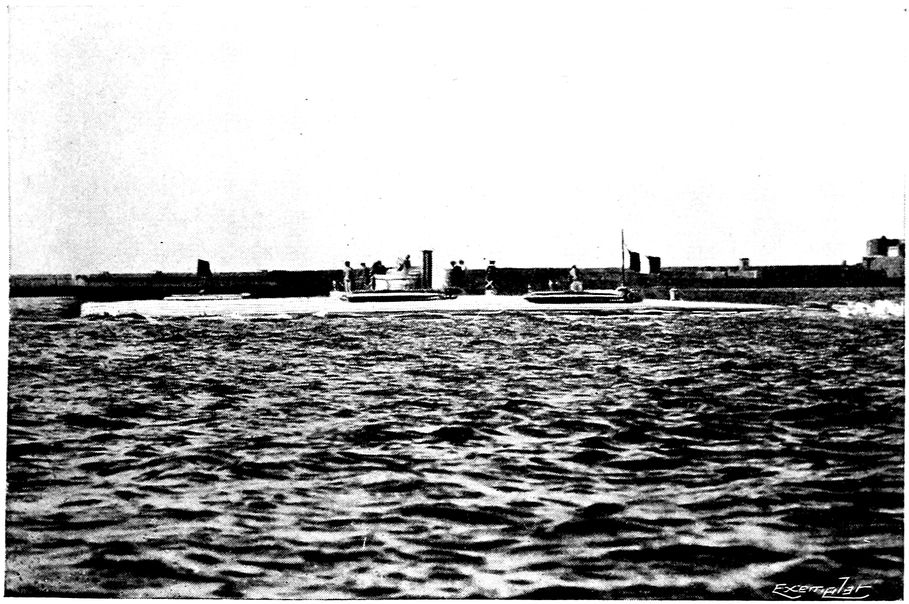
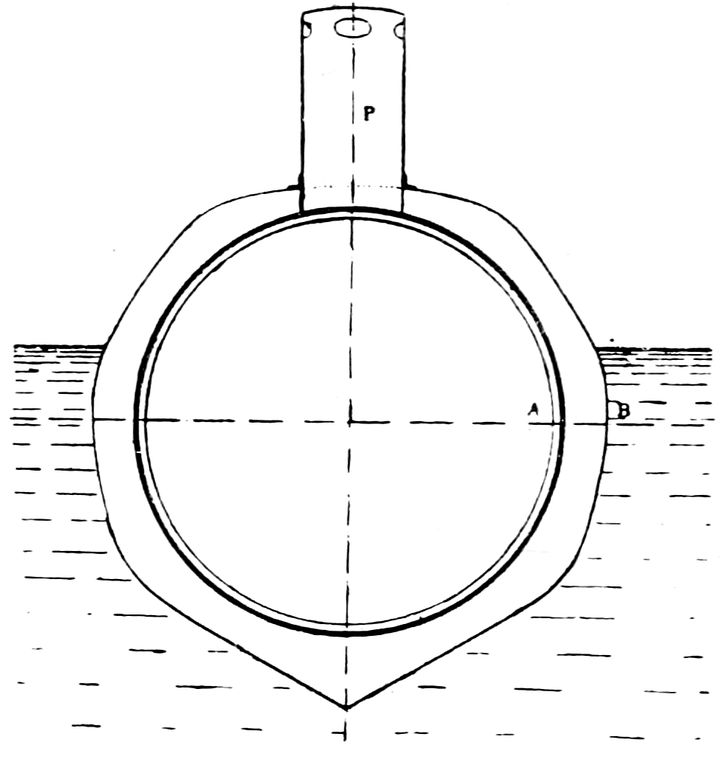
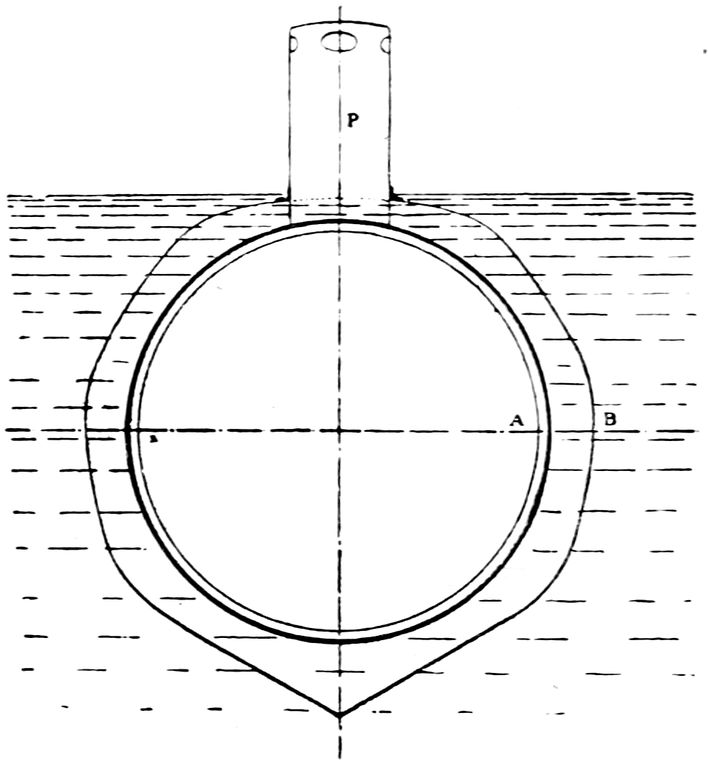
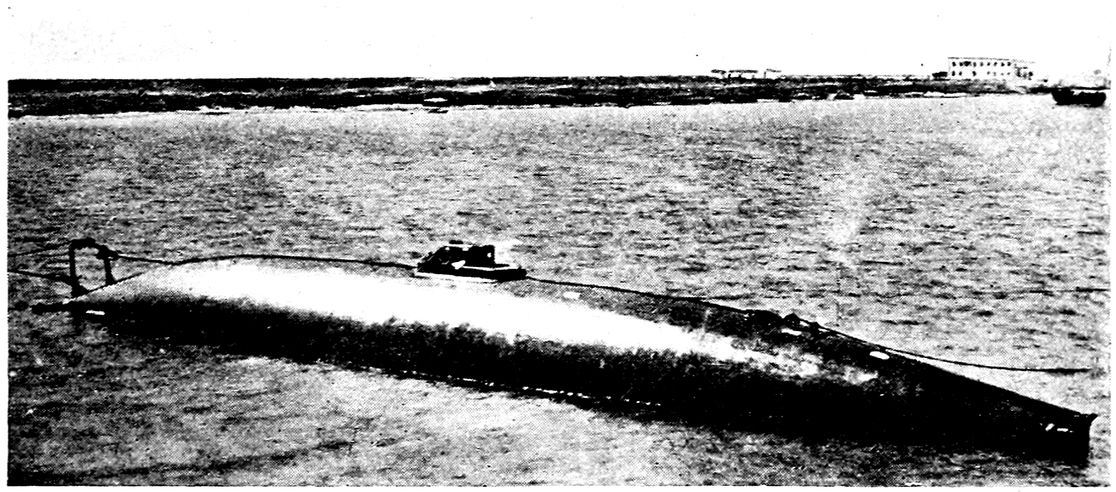
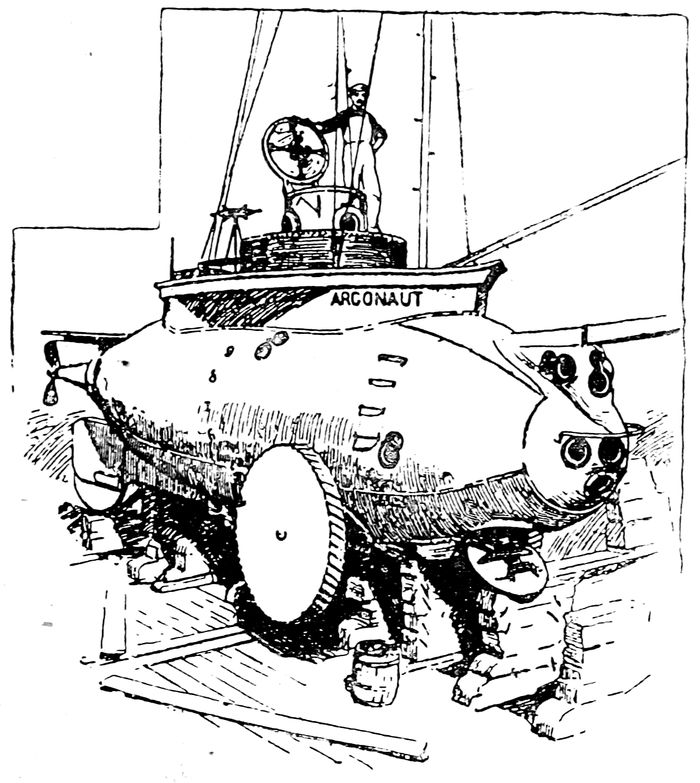
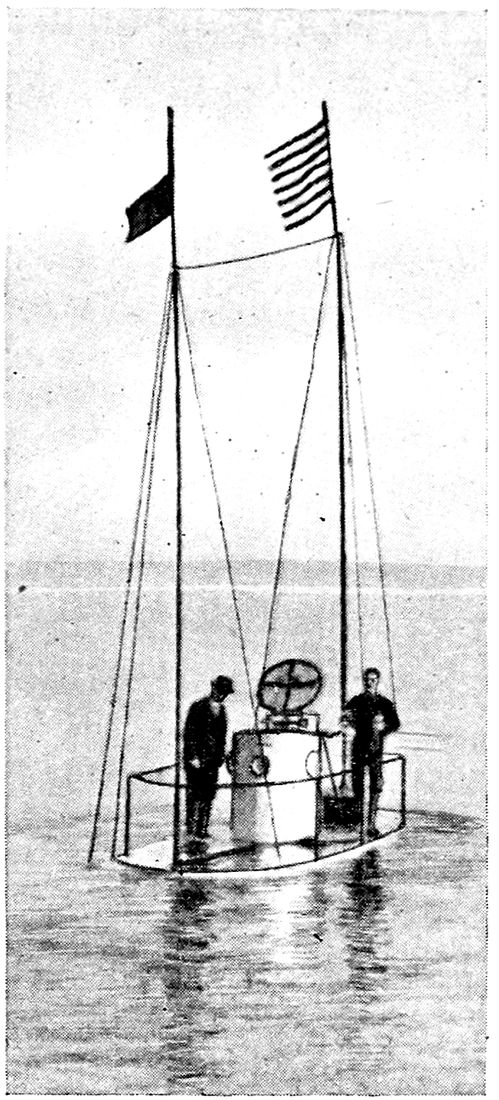
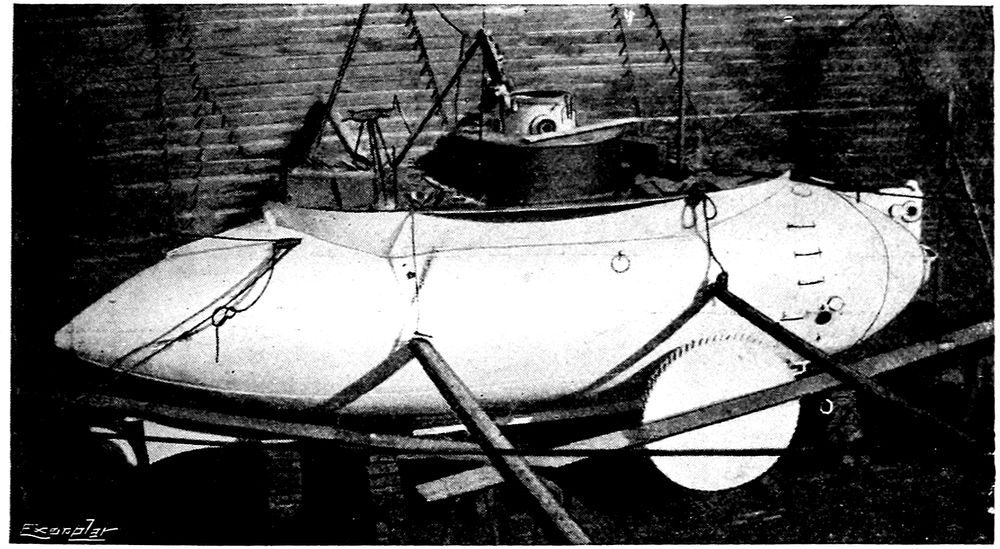
The cover image was created by the transcriber and is placed in the public domain.
SUBMARINE WARFARE
PAST, PRESENT, AND FUTURE
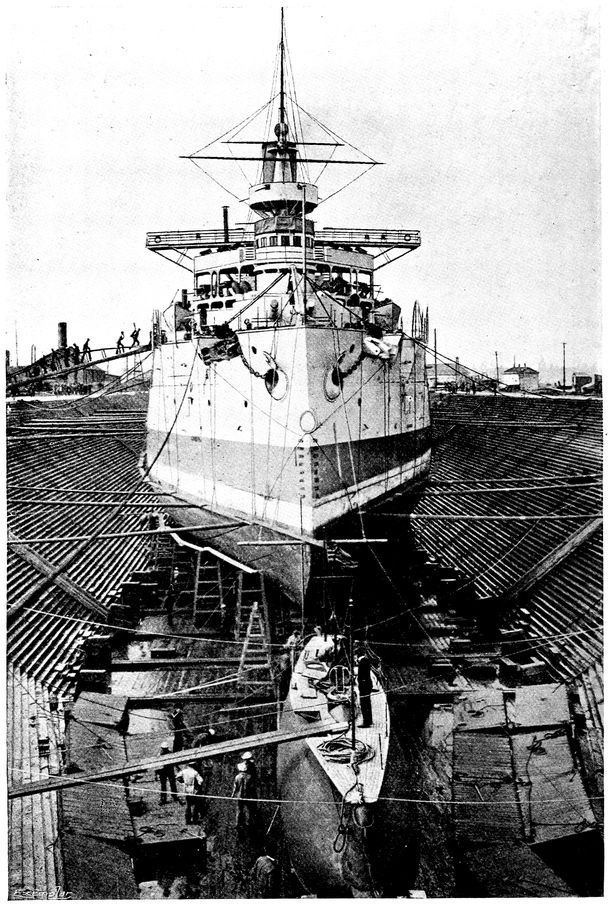
“DAVID AND GOLIATH.”
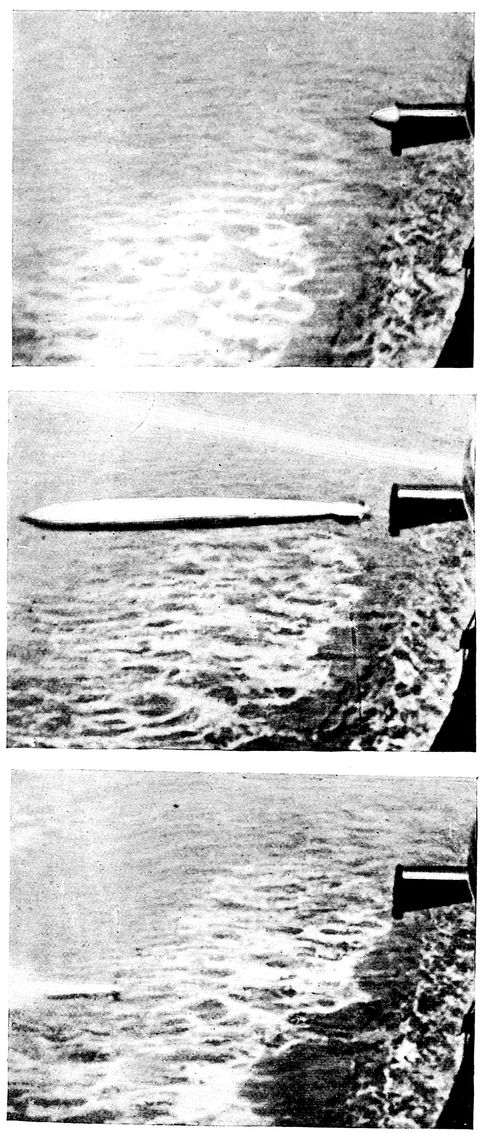
The Russian Battleship “Retvisan” (12,700 tons) and the U.S. Submarine “Holland” (75 tons).
BY
HERBERT C. FYFE
(Sometime Librarian of the Royal Institution, London)
WITH AN INTRODUCTION BY ADMIRAL THE HON. SIR EDMUND ROBERT FREMANTLE, G.C.B., C.M.G.; AND A CHAPTER ON “THE PROBABLE FUTURE OF SUBMARINE BOAT CONSTRUCTION” BY SIR EDWARD J. REED, M.P. ✜ ✜ ✜ ✜ ✜
WITH FIFTY ILLUSTRATIONS
LONDON
GRANT RICHARDS
48, LEICESTER SQUARE
1902
UNWIN BROTHERS, LIMITED, PRINTERS, WOKING AND LONDON.
PREFACE
vii
There exists no popular work in the English
language on submarine warfare, and only one which
deals exclusively with submarine boats. This was
written fifteen years ago by Lieutenant G. W. Hovgaard
of the Danish Navy. It is a little book of
ninety-eight pages, and out of these forty only are
given to the “History and Development of Submarine
Boats.” The rest of the volume is taken
up with a description of a vessel imagined by the
author but never constructed. Lieutenant Sleeman’s
“Torpedoes and Torpedo Warfare” takes no account
of under-water craft, whilst Lieutenant G. E. Armstrong,
in his little book, “Torpedoes and Torpedo-vessels”
devotes only eighteen pages out of 306 to
“Submarines and Submersibles.”
Having always taken a keen interest in submarine
boats, the writer some two years ago commenced the
compilation of the present work. His aim has been
to produce a book which should be essentially of a
popular character and should appeal to those who
viiihave neither the time nor the inclination to pursue
the subject very deeply. It necessarily contains a
certain amount of detailed description, but the aim
has been to avoid technicalities as far as possible.
That the book may appeal to the general public,
and that it may also be found worthy of a place
on the shelves of the student of naval history and
naval warfare is the author’s wish, and he trusts
that a volume will not be unacceptable that traces
the story of under-water warfare from the earliest
times to the present day, that endeavours to explain
how a submarine boat is worked, and that attempts
to arrive at some conclusions respecting a mode of
fighting which may possibly figure largely in future
battles on the seas.
Interest in the navy and in naval matters is
fortunately greater than it used to be, but there is
still a vast amount of ignorance existing in the
minds of the public respecting our warships and our
sailors. When an explosion occurred recently on the
Royal Sovereign a man in the street remarked to
his friend, “How lucky it didn’t happen when we
went to Margate on her last summer!” The navy
is certainly not so much in the public eye as is
the army, still it should be the desire of every Briton
to know even a little about the service for which he
pays so much. Many people seem to imagine that
torpedo-boats do their work below the waves, and
have but very hazy notions respecting the working
of the torpedo or the functions of the destroyer.
It was recently remarked to the writer by one
ixwho has had a large experience in catering for the
mental needs of the British public that we were not
a mechanical nation, and that while Americans would
naturally be interested in such a subject as submarine
warfare, Britons would only display an apathetic
attitude towards it. Perhaps the general lack of
interest in scientific matters is due to the fact that
little trouble is taken to place them before readers in
an attractive form. There is no doubt that the
Germans, the French, and the Americans are far
more alive to the importance of science, and are far
more ready to discuss inventions, discoveries, and
scientific topics than we are ourselves.
That his work will appeal to a very large class of
readers the writer has little hope. He trusts, however,
that those who do read it will be encouraged to pursue
the subject a little more deeply, and that inventive
minds may be induced to apply their ingenuity
to the designing of weapons for under-water warfare.
When we decided to add submarines to our navy,
we had to adopt the design of an American, Mr.
Holland, because no other was then available.
Similarly the system of wireless telegraphy used on
our men-of-war is the invention of an Italian.
“We have started,” says a well-known English
professor, “all the branches of engineering; we have
invented nearly all the important things, but the
great development of these things has gone out of
the hands of the amateurs of our nation. It is
because our statesmen are Gallios who ‘care for
xnone of these things,’ because they know nothing of
science.”
It was an Englishman who invented the Whitehead
torpedo; it was in the brain of an Englishman
that the idea of the torpedo-boat destroyer was
evolved. Are there not those who will bring their
inventive talent to bear on the perfecting of the
diving torpedo-boat and of the many contrivances
that are needed to make it an efficient weapon of
offence and defence?
It may be said that the encouragement given
to the inventor by the Admiralty is so scanty as
to make him shy of offering them his ideas. Let
us hope, now that Lord Selborne and Mr. Arnold
Forster are at the Admiralty, that the bad old
days when inventors were snubbed, and novel ideas
ridiculed, have gone never to return. The submersible
craft of to-day is no longer an ingenious toy; it is
a practiced engine of warfare of no mean value.
But there is vast room for improvement in its
design. It must be endowed with more speed, its
longitudinal stability must be improved, and its
appliances for under-water vision perfected. Are
there not Britons willing to devote their energies
to the realisation of the ideal submarine?
The author has derived his information from a
great many sources, some of which are mentioned in
the brief Bibliography at the end of the book.
He desires to express his thanks to Messrs.
Vickers Sons & Maxim, the Holland Torpedo-boat
Company, Mr. P. W. D’Alton, Lieutenant A. T.
xiDawson, late R.N., Mr. Simon Lake and others, for
information kindly given him respecting various
boats and for photographs. To Mr. Alan H. Burgoyne
his thanks are due for permission to use some
of his original sketches.
Royal Societies’ Club,
St. James Street, S.W.
INTRODUCTION
xiii
BY
ADMIRAL THE HON. SIR E. R. FREMANTLE, G.C.B, C.M.G.
(Rear-Admiral of the United Kingdom.)
The natural attitude of the Naval mind towards
submarines is the same now as that expressed by
Lord St. Vincent when Fulton invented the notorious
“catamaran” expedition.
Fulton had been trying some experiments before
Pitt, who favoured the project, to which Lord St.
Vincent, then First Lord of the Admiralty, was
strongly opposed, and he bluntly stated that “Pitt
was the greatest fool that ever existed to encourage
a mode of war which those who commanded the
seas did not want, and which, if successful, would
deprive them of it.”
It was, our Admiralty recently held, “the weapon
of the weaker power, and not our concern,” then
we were to “watch and wait,” which sounded plausible
but was evidently dangerous, and as the success
of the French submarines became too evident we
were forced to follow suit. As Lord Selborne
xivreminded us when speaking about the boilers, we
have too often ignored new inventions and resisted
change till we were left well behind in the race, as
we were with ironclads, breech-loading guns, and
other improvements in naval warfare.
The fact is that every new invention has its infancy
of weakness and failure, its adolescence of partial
adoption, and doubtful success, and its manhood of
completion and achievement. Unfortunately the
natural conservatism of a profession and perhaps
of human nature is apt to deride the early failures,
and to prejudice the invention so as to delay its
adoption. Every inventor can tell stories of the
obstruction he has met with, and often of his ultimate
triumph, like Mr. Whitworth and his steam
hammer pile-driving competition, when he succeeded
in driving piles with his steam hammer in as many
minutes as it took hours under the method previously
adopted, much to the astonishment of the
old hands.
Certainly the submarine has had its period of
failure and ridicule, for the attempt to use submarines
dates from very ancient days, as Mr.
Fyfe’s interesting historical résumé shows, yet it is
only now arriving at the stage of development
which forces us to reckon with it as a serious
factor in naval warfare.
We need not follow Mr. Fyfe in his early
history of the submarine, but leaving James I.’s
somewhat apocryphal voyage under the waters of
the Thames, the inventions of Bushnell, Fulton,
xvWarner, and others, we may come to the Confederate
diving boat during the war of secession. Here
we have a real diving boat which, though it drowned
three crews, did succeed in destroying the United
States sloop Housatonic, one of the blockading fleet
off Charleston, though she was herself sunk in the
effort, drowning her fourth crew. It is interesting
to compare this submarine boat with one of our
modern Hollands.
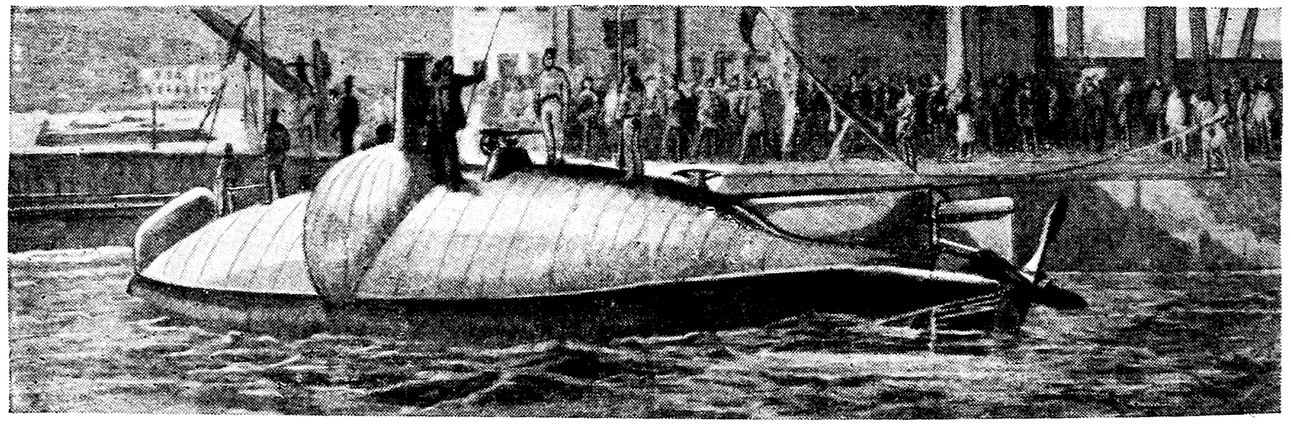
The following is the description given by Captain
Maury, the well-known hydrographer, then at the
head of the Confederate torpedo bureau, of this unfortunate
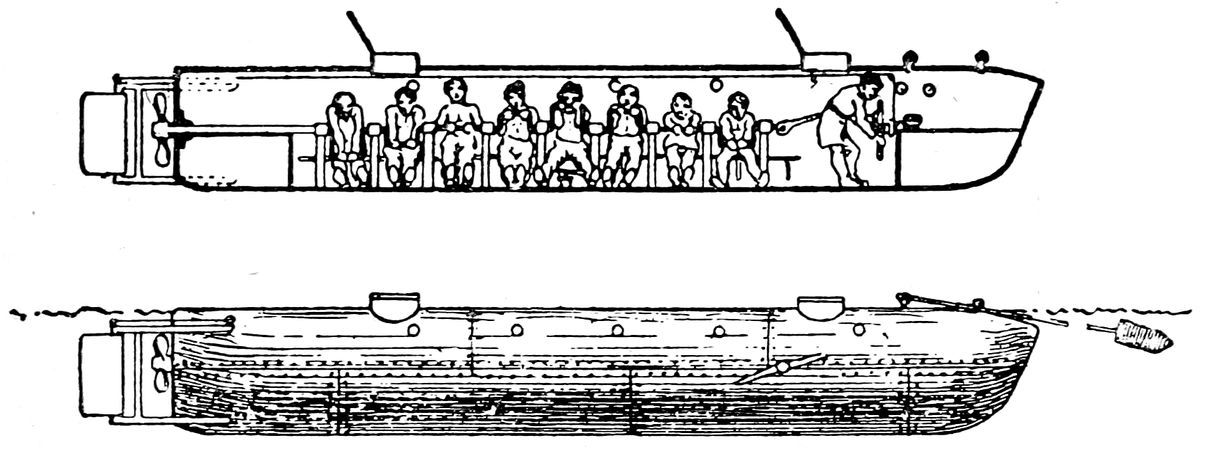
craft, or David as she was called. “It
was built of boiler iron, about 35 feet long, and was
manned by a crew of nine men, eight of whom
worked the propeller by hand, the ninth steered
the boat and regulated her movements below the
surface of the water. She could be submerged at
pleasure to any desired depth, or could be propelled
on the surface. In smooth, still water she could be
exactly controlled, and her speed was about 4
knots.”
It is further stated that she could remain submerged
for half an hour “without inconvenience
to her crew,” and in action she was to drag a
torpedo under a ship’s bottom, which was intended
to explode on striking.
Now contrast this rude and dangerous craft with
the “Holland” boats now building for the British
Government, and the advance which has been made
in the last forty years is evident.
xviI need not describe the Holland here, but motive
power, speed, radius of action, and torpedo are all
essentially different; but above all it has been
proved that a modern submersible boat like the
French Gustave Zédé, or Narval, or our Holland
can remain under water truly “without inconvenience
to her crew” for periods of nine or ten
hours, so that all the problems connected with
submarine navigation may be said to have been
solved, except that of seeing under water, for
when submerged the submarine is in cimmerian
darkness, and more helpless than an ordinary vessel
in the densest of fogs. Nor is it likely that invention
has said its last word in regard to the submarine
now that it is acknowledged to be a weapon of
practical value.
On this point it is convenient to call to mind the
remarkable development of the Whitehead torpedo
since it was first adopted in our Navy rather more
than thirty years ago. It happens that I have
been able to refer to an article on torpedoes which
I wrote in Fraser’s Magazine just thirty years ago,
in which I described the Whitehead of that day
as having a speed of from 7 to 7½ knots, a range
of 1,000 yards, and a charge of 67 lbs. of gun-cotton.
Now, the speed of our modern Whiteheads
is 30 knots, the range 2,000 yards, the charge 200
lbs. of gun-cotton, and, thanks to the gyroscope, it
can be discharged with extraordinary accuracy.
Admitting, then, that the submarine is with us,
and that it will remain, let us see what is likely
xviito be its function in war. The submarine compares
naturally with the torpedo destroyer or torpedo
boat; like them it will attack by stealth, and it
has neither their speed nor radius of action. But,
whereas searchlights and quick-firing guns are
effective weapons against the latter, they are of
little use against the submarine, and as all these
craft are to act by surprise, the advantage is
strongly in favour of the submarine, which can
approach with little danger of being discovered,
with the cupola only showing, until close to her
enemy, thus rendering a close blockade by large
vessels impossible.
I have said that is naturally the weapon of the
weaker power, but that it can be used and that it
will be used by the stronger power acting on the
offensive I see no reason to doubt. It can certainly
be employed against ships at anchor unless they
are suitably protected, and it can probably render
good service in removing obstructions and clearing
passages defended by torpedoes.
The question remains as to whether any antidote
to the submarine is likely to be effective. It is
possible that one may be discovered, but it is not
easy to see in what direction we are to look for it,
as the submarine differs from other craft in the
fact that the possession of any number of similar
vessels, by ourselves for instance, affords little or
no protection against a few well-handled Gustave
Zédé’s in the hands of our enemies. At the same
time they would be of little or no value against
xviiitorpedo boats or destroyers; and cruisers blockading,
moving about at a speed of 10 knots or
more, at some distance from a port known to
harbour submarines, would have little to fear, as
it could only be by a lucky chance that a submarine
could approach near enough to them to
have a fair shot. It is also worthy of remark that
the navigation and pilotage of a submarine, even
with her cupola above water, would be by no
means easy in shallow water or thick weather,
and of the value of the periscope I cannot but feel
somewhat sceptical. The French are stated to have
found that submarines can be easily discovered from
balloons; but this must naturally apply only to daylight
and fine weather, and their opportunity will
naturally occur in thick weather or at night.
I have offered these remarks to show that
though I consider the submarine to be an important
weapon, it clearly has its limitations, and
I suspect that when we have them fairly under
trial we shall find that when these are fully
appreciated and the position of the submarine in
naval warfare is duly assigned, much of the terror
and mystery now surrounding this novel weapon
will be removed. Probably it will be found to be
a more dangerous and effective torpedo boat, and
will supplant it in great measure.
Mr. Fyfe has done good service in giving us
this popular account of submarines, which is a
valuable addition to the scanty literature of the
subject in the English language.
THE PROBABLE FUTURE OF SUBMARINE BOAT CONSTRUCTION.
xix
BY
SIR EDWARD J. REED, K.C.B., F.R.S., M.P.
(Chief Constructor of the Navy 1863–70.)
There is nothing in the nature of things that I
know of to prevent submarine warfare being
carried on in the future to a very large extent.
This development will probably follow triple lines:
(1) Vessels for the defence of ports and harbours,
with sufficient means of proceeding outside to give
the defence a certain limited power of attack in
the approaches; (2) Vessels primarily designed for
attack, and therefore capable of proceeding to sea for
considerable distances; and (3) Smaller vessels to
be taken to sea in ships, as part of their equipment,
and capable of being lowered to take part
in a battle, and raised again, and re-stowed on
board when no longer needed in action. All these
types of vessel will need to be endowed with the
power of passing easily and quickly from the
floating to the submerged condition, and back
xxagain to the surface when necessary; but the
boats of the second class in the foregoing category
will doubtless be developed to an extent as yet
anticipated by very few of us, in respect alike of
their ability to proceed for great distances below
water, and of their ability to steam satisfactorily
afloat when submergence is needless.
All who are acquainted with the structure of
waves, so to speak, will be aware that wave disturbance
diminishes very rapidly as we go down
below the surface, and will consequently understand
that when once we have succeeded in giving
submarines a great range of under-water travel,
we shall have endowed them with the capability
of avoiding at pleasure in bad weather the tempestuous
surface of the sea, with all the drawbacks
to speed which stormy seas impose upon
ships, and especially upon comparatively small
vessels. In order to bring about this advantage,
science has to effect, no doubt, immense improvements
in the production of storage of air, or of
its equivalent; but there is great reason to believe
that the demand will bring the supply, as in so
many other matters. Nor must it be forgotten
that this is a branch of science for the development
of which the ship proper, as we have
hitherto known it, has offered few, if any, inducements.
I do not know how the sight of an
ordinary modern ship of war strikes the eyes of
others, but for my part I never look at one,
with its vast and monstrous assemblage of gaping
xximouths of funnels, pipes, and cowls, without thinking
that our method of supplying breathing gas
to men below in a ship is at present of a very
elementary and unsatisfactory character. It is
certainly the roughest and readiest method that
could well be adopted. Nor is it without a sense
of satisfaction that one knows that the submarine
ship will at least sweep away these ugly and
towering excrescences, and force us to resort much
more than at present to the chemical and mechanical
arts for the ventilation of vessels.
The development of the sea-going submarine
will bring with it, doubtless, many improvements
in the vessels which have been first mentioned,
viz., vessels for the defence of ports and their
approaches. It is not possible yet to say to what
extent the “Holland” boats building at Barrow will
prove fairly satisfactory, although my acquaintance
with this class of vessel for several years past has
given me a favourable impression of it—favourable,
that is, as furnishing many elements of
initial success. More than this could not be reasonably
expected; nor can we doubt that with the
skill of both the Admiralty designers and those
of the great manufacturing establishment which
has produced the first few vessels concentrated
upon this class of boat, immense improvements
may be confidently anticipated.
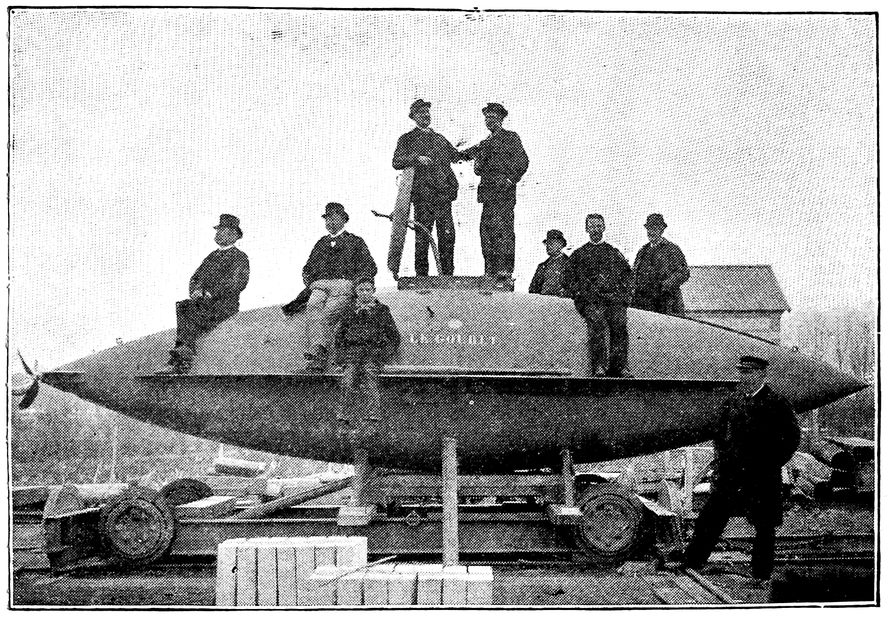
Of the third class of vessels before referred to
the Goubet boat may be regarded as a commencing
type. The principle of this boat appears to be
xxiithat of carrying and launching torpedoes from
external supports, the size and buoyancy of the
vessels being very small by comparison with those
of vessels which carry their torpedoes inside. M.
Goubet appears to go beyond this principle, and
to have other ideas, which are mentioned in the
text of this work. Suffice it here to say that the
idea of relieving the submarine boat from the
necessity of carrying its torpedoes with it, goes
a long way towards furthering the use of submarine
torpedo craft carried on the decks, or at
the davits of battleships and cruisers.
If one may contrast for a moment the present
attempts at aerial navigation with the concurrent
attempts at submarine navigation, one quickly sees
how terribly the æronaut is handicapped as compared
with the under-water sailor. The advantage
of the dense medium which the sea offers to the
submarine navigator is precisely the same as it
has offered from the beginning of time to the
surface navigator, and nothing new is needed to
sustain the submarine ship, whereas the unhappy
man who seeks to navigate the air has to obtain
from a medium of extraordinary levity the support
necessary for keeping him aloft. The difference
between the specific gravity of air (of which
ships are full) and of water is so great by comparison
between the specific gravity of any gas
available for filling aerial-ships and that of air, that
the problem of the submarinist is easy indeed
compared with the other. But it is in the face of
xxiiithis initial and enormous difficulty that the æronauts
of to-day have apparently persuaded themselves
that they can successfully float their balloon-ship
in mid-air, and propel it not only against the
rapid tides of the air in which it floats, but also
drive it at a good additional speed. When men
are to be found capable of committing their fortunes,
and even their lives, to navigation of this
kind, it is not surprising to find that the far easier
problem of navigating the seas beneath the surface
has won the attention and the effort of enterprising
men. They certainly have chosen, if the
humbler, also the more practical and promising
field of operation. I doubt not that they have
likewise chosen the more fruitful field.
It is worthy of remark that it is once again in
connection with the arts of war that a great
extension of human progress has been commenced.
But for the temptation of gaining equality with,
and even mastery over, our possible foes, the art
of submarine navigation would certainly not have
been attracting the attention of some of our best
and most scientific men, who are once again
eagerly developing—
“Those dire implements
Which sombre science with unpitying pains,
That love of neither man nor God restrains,
To warring foes presents.”
One can only be thankful that the world is so constituted
and so ruled, that out of seeming evil
often comes great good to men.
xxivI have not been asked to say anything of the
book with which these lines are associated. I may
nevertheless remark that I have had an opportunity
of hastily looking through the author’s proofsheets,
and have formed the opinion that it is a
most timely and highly instructive work, and one
which gives to the non-technical world an extremely
good review of all that has been done in the
way of submarine war vessels, while the technical
man into whose hands it may come will be compelled,
by its great interest and by its clever record
of facts, to read every page of it.
PART I — CHAPTER I INTRODUCTORY — CHAPTER II THE PLACE OF THE SUBMARINE IN WARFARE — CHAPTER III THE MORALITY OF SUBMARINE WARFARE — CHAPTER IV THE MECHANISM OF THE SUBMARINE, AND SUBMARINES OF THE FUTURE — 1. Submarines with no Floatability when Submerged. — 2. Submarines Possessing Floatability when submerged. — Immersion by Screws Mounted on a vertical Shaft. — Immersion by Horizontal Rudders. — Motive Power. — Propulsion of the Surface. — Armament. — Safety and Habitability. — Vision When Submerged. — CHAPTER V THE ROMANCE OF UNDER-WATER WARFARE — CHAPTER VI THE MORAL INFLUENCE OF UNDER-WATER WARFARE — CHAPTER VII THE SUBMARINE IN ACTION — French Submarines. — CHAPTER VIII THE ANTIDOTE TO SUBMARINES
1
“The submarine craft is a miracle of ingenuity though Nelson and
his hearts of oak, fighting only on deck, in God’s free air, and with
‘the meteor flag of England’ fluttering overhead, would have
loathed and scorned her burglarious, area-sneak dodges down
below.”
In modern under-water warfare two weapons are
employed, the Mine and the Torpedo. Both are
explosive devices, but whilst mines are stationary,
torpedoes are endowed with the power of locomotion
in some form or another.
The modern submarine boat is in reality a
diving torpedo-boat and like all other torpedo craft
of the present day its function is to discharge
automobile torpedoes.
The submarine boat is sometimes said to be the
child of the torpedo-boat. As a matter of fact the
earliest known torpedo vessel was designed to do
its work under water.
In 1776 an attack was made on the English frigate
H.M.S. Eagle, and in 1777 on the English man-of-war
H.M.S. Cerberus by a submarine vessel invented
by David Bushnell and provided with “torpedoes.”
2Although no injury was inflicted on these ships,
three of the crew of a prize schooner astern of the
Cerberus, in hauling one of Bushnell’s drifting
torpedoes on board, were killed by its explosion.
A few years afterwards Robert Fulton occupied
himself with torpedoes, and like Bushnell he came
to the conclusion that a submarine boat was the
best suited for the discharge of his weapons. In
time of peace Fulton showed that his torpedoes
could sink ships, but in actual warfare he failed to
accomplish the destruction of any craft. For a
while torpedo warfare received but scant attention,
but on the outbreak of the American Civil War the
mine and the torpedo “leapt at one bound from the
condition of theory and experiment to become
accepted once for all as practical and valuable
factors for offence and defence.”
At this period also it is to be noted that the
torpedoists considered the under-water vessel the
most favourable method of utilising the spar-torpedo,
the weapon of the day. Both Federals
and Confederates paid much attention to submarine
navigation, and success attended the efforts
of the latter, for on February 17, 1864, the Federal
frigate Housatonic was sunk off Charleston by a
submarine boat manned by the Confederates and
armed with a spar-torpedo. This is the sole
occasion on which an under-water vessel has ever
succeeded in sinking a hostile craft in actual warfare,
and even then it was being navigated in the
awash condition, and not completely submerged.
3The introduction of the automobile or fish torpedo
led to the building of above-water torpedo
vessels by all the great Powers. The idea of
discharging this weapon from a submarine boat
occupied the attention of numerous inventors,
amongst others of Mr. Nordenfelt, of machine-gun
fame.
Greece and Turkey both bought Nordenfelt
submarine boats, but although they achieved a
certain amount of success and were certainly the
best specimens of under-water fighting vessels
extant, they failed to receive wider recognition
owing to their serious disadvantages.
The possibility of utilising the electric accumulator
revived the hopes of the advocates of submarine
navigation, and towards the end of the
eighties, France added the first under-water
torpedo-boat to her navy: since then her interest
in the subject has never abated, and although it
would be unfair to attribute to all French naval
men and officials the ideas as to the superiority of
the torpedo vessel to the ironclad put forward by
a certain class of writers, it cannot be denied that
the question of under-water warfare has attracted
more attention in France than in any other country.
A few years after the launch of the first French
submarine, the Gymnote, the U.S. Government
purchased the Holland, and in the same year
ordered six more Hollands of an improved type.
When Greece and Turkey purchased Nordenfelt
boats there were not wanting those who declared
4that Great Britain should also add under-water
vessels to her navy. The official view was however
hostile to such craft. In the early part of
1900, Viscount Goschen said that while close attention
had been given by the Admiralty to the
subject of submarine boats, they considered that
even if the practical difficulties attending their use
could be overcome, they would seem to be weapons
for “maritime Powers on the defensive.” It seemed
to him that the reply to this weapon must be
looked for in other ways than in building submarine
boats ourselves, for it was clear that one
submarine boat could not fight another. It would
seem from this that the Admiralty had no very
high opinion of the submarine as an offensive
weapon. However this may be, an order was
placed in the autumn of 1900 with Messrs. Vickers
Sons and Maxim for five of the newest “Holland”
boats, they being the agents in Europe for the
Holland Torpedo-boat Company of New York, and
this being the only type available. Not till the
statement of the First Lord was published on
March 1, 1901, was the fact of the ordering of
these boats made public; the secret had indeed
been well kept.
He would be a bold man who would prophesy
how the question of submarine navigation will
stand fifty years hence. Some declare that the
under-water vessel will go the way of the dynamite
gun, the circular battleship, the aerial torpedo
and other inventions; others affirm that the warfare
5of the future will take place neither on land
nor on the seas, but in the air and beneath the
waves. We shall see what we shall see. At
present we would prefer to go no further than
the cautious statement of the First Lord. “What
the future value of these boats may be in naval
warfare can only be a matter of conjecture. The
experiments with these boats will assist the
Admiralty in assessing their true value. The
question of their employment must be studied,
and all developments in their mechanism carefully
watched by this country.”
6
“Drake would have understood Trafalgar. Neither Drake nor
Nelson could understand a modern naval action.”
“Competent authorities hold that the submersible torpedo-boat is
the vessel of the future rather than either the existing type, or the
‘Destroyer’” (Excubitor in the Fortnightly Review for August, 1901).
“It is not only the unstable opinions of experts, liable to sudden
change, which makes the forecast of future naval war difficult; it is
that the progress of invention may be, for all we know, undermining
the whole position by disturbing the balance which creates existing
warship design” (the late Vice-Admiral P. H. Colomb).
“Conservatism has thus far delayed the adoption of a most valuable
offensive and defensive weapon, not because success was ever proved
to be unattainable, but because some vessels built by inexperienced
inventors happened to be failures” (Mr. J. P. Holland).
“In the dawn of the twentieth century there has entered into the
history of the world’s navies a class of vessel which is probably destined
to revolutionise, eventually, the whole system of maritime
construction. The problem of submarine navigation, in a limited
sense at least, has been solved” (Lieutenant G. E. Armstrong).
“Most torpedo destruction has been done with a bag of explosive
tied to the end of a pole, and the submarine boat will permit you to
get closer to the enemy with a bigger bag of explosive and with less
damage to the pole. You have all the advantages of attack with
almost absolute safety to the torpedo-boat itself.”
7
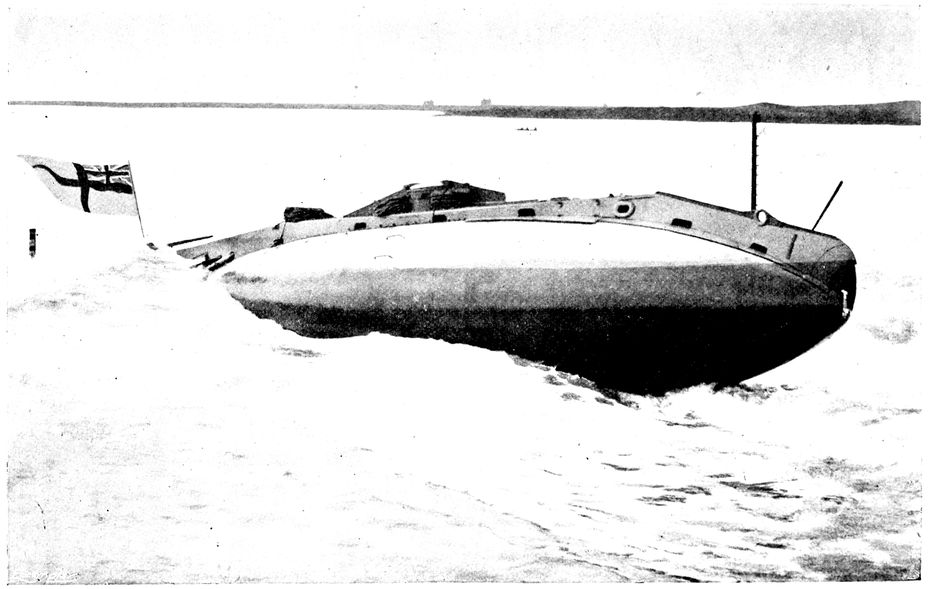
THE FIRST SUBMARINE TO FLY THE WHITE ENSIGN.
(By permission of the Admiralty and Messrs. Vickers, Sons, and Maxim.)
9At the present time opinion is divided as to the
part that the submarine boat is likely to play in
the naval warfare of the future. Those who have
expressed themselves on the subject may be roughly
divided into three classes.
1. Those who have little or no faith in submarines.
2. Those who believe that submarines will revolutionise
warfare, ocean locomotion, marine industries,
&c., and that an epoch may come in which
merchantmen will alone sail the ocean and all the
warships will be submarines or submersibles.
3. Those who recognise that the submarine boat
of to-day is a great improvement on the boats of
twenty years ago; who believe that although at
present it suffers from grave defects, its development
will continue, and who are of opinion that
it will find useful spheres of action in time of war.
Much of the adverse criticism which the “submarine
boat” has had to encounter has been due
to the popular belief that this type of craft was
intended to do its work below the surface of the
water. As it is impossible at present to see
beneath the waves, many critics have declared the
submarine to be a perfectly useless fighting vessel.
It cannot be too often asserted, for the sake of
overcoming prejudice, that the proper place of the
submarine is at the surface, and that she only
goes below for short intervals. This is now
universally recognised by constructors of such
craft, which it might be more correct to term “submersibles”
10or “diving torpedo-boats.” So far back
as 1886 Mr. Nordenfelt remarked, “It is impossible
to think of a submarine boat that actually
manœuvres and does its work under water. I
gave that up from the very commencement.”
By the term “submarine” we mean to imply a
vessel capable of manœuvring on the surface like
an ordinary torpedo boat, of running awash with
her conning tower alone above water to enable her
to be steered, and of totally immersing herself for
short periods either to escape detection, avoid the
fire of the enemy, or fire torpedoes.
The history of the submarine bears a curious
resemblance to that of the torpedo and the torpedo
vessel in many particulars. All three have
been declared to be the weapons of the weaker
power and of no possible value to a nation which
must maintain the command of the seas. The first
Whitehead torpedoes were certainly slow and
erratic; now they are capable of running within a
few inches of the required depth at a speed of over
37 miles an hour for a range up to 2,000 yards,
and hitting the point aimed at with almost the
same precision as a gun.
In spite of the sneers of fossilised officials, Great
Britain adopted the torpedo-boat, and in the process
of time evolved the destroyer, an offensive
weapon of no mean value, and a type of craft
which some have declared to be the fighting
vessel of the future. She will soon be in the
possession of nine under-water vessels, and it may
11be that the submarines of twenty years hence will
bear the same resemblance to those of to-day, as
the Albatross does to the Lightning of 1877.
The very first submarine to figure in actual warfare
was the boat invented by David Bushnell.
His attempt to blow up the British frigate Eagle
failed, mainly owing to the incapacity of the
operator, Sergeant Ezra Lee. Fulton, although he
blew up several old hulks in time of peace, was
afforded no opportunity of testing the capabilities
of his vessel in actual warfare.
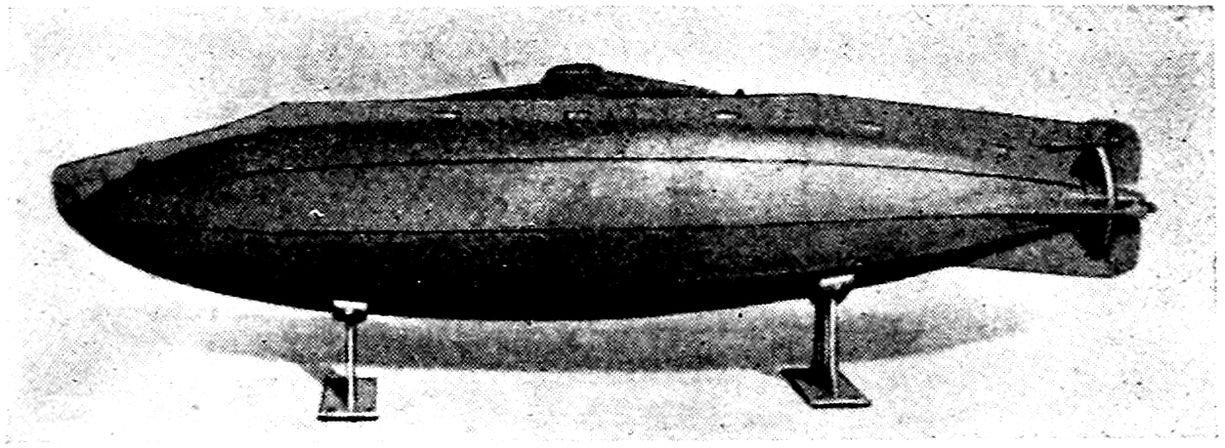
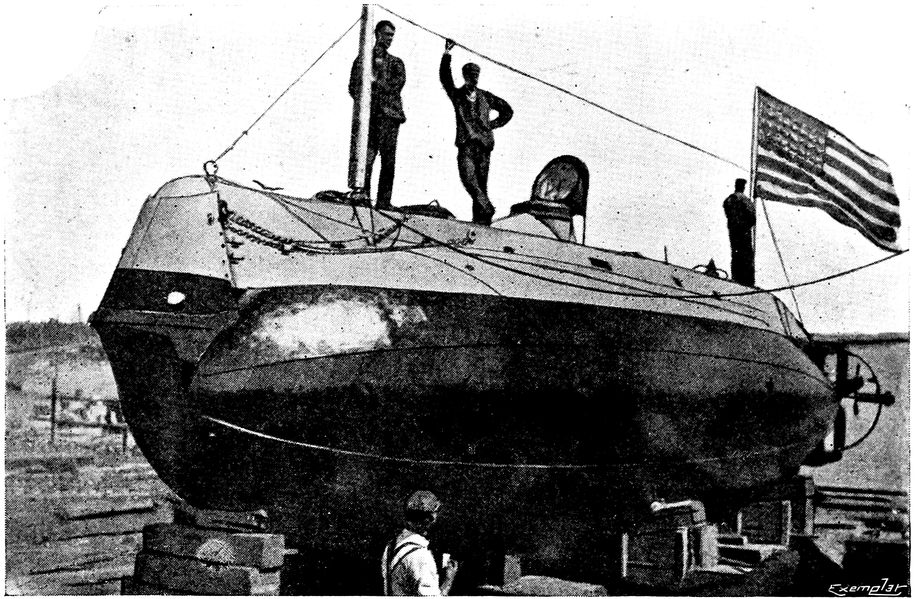
U.S. SUBMARINE “SHARK” ON THE STOCKS.
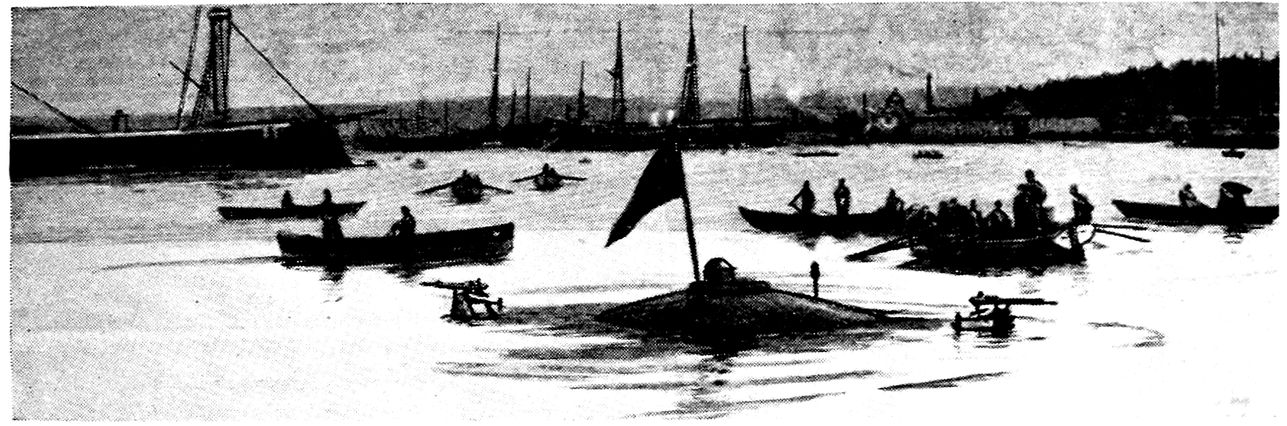
During the American Civil War there occurred
the famous incident of the destruction of the
Housatonic by the Confederate diving torpedo-boat
David—the only occasion on which a submarine
12boat has succeeded in inflicting injury on a hostile
vessel in a naval action. Though many lives were
lost in the David, this would not have occurred
had the most ordinary precautions been taken.
On February 5, 1886, Mr. Nordenfelt read a paper
before the Royal United Service Institution on his
Submarine Boats; in the discussion that followed
many eminent naval authorities took part, and the
following are extracts taken from their speeches
on this occasion:—
“My opinion is that all torpedo-boats should be submarine
boats” (Admiral Arthur).
“With the cupola above water the submarine boat would
prove a very formidable means of attack” (Admiral Sir
Astley Cooper Key).
“Mr. Nordenfelt has done much towards solving a problem
which is likely to be of great importance in future naval
operations” (Vice-Admiral H.R.H. Duke of Edinburgh).
“I think Mr. Nordenfelt is to be congratulated on having
made an enormous step forward, and one which I am sure
has a great future before it” (Admiral Selwyn).
“If you want to economically defend a port it is better
to have a boat that does not show at all. The moral
effect of this boat would be enormous, and I am perfectly
certain that foreign war vessels would not lay off a port
to intercept outward- and homeward-bound vessels if they
knew that there was a submarine vessel inside that could
come out without being seen” (Major-General Hardinge
Stewart).
“As far as practicability for warfare is concerned this
submarine boat (the Nordenfelt) is pretty well accepted by
the profession.... Therefore as a craft not altogether
wholly submerged, but just a boat awash for coast defence,
13and also for the attack of ships at sea, and especially in
heavy weather, when the fast torpedo boats cannot act, I
believe the vessel will be found of great practical and
reliable service” (Major-General Sir Andrew Clarke).
The Nordenfelt boats, as will be seen in Chapter
XV, failed to come up to the high expectations
that had been formed of them, and the British
Admiralty considered themselves relieved from the
necessity of taking up the subject of submarine
navigation.
In 1888 France added the first submarine (the
Gymnote) to her navy, and proceeded to lay down
a certain number of under-water craft yearly. In
1900 the United States Government bought the
Holland, and in many quarters the opinion was
held that the Admiralty should carefully investigate
the whole question of submarine warfare.
The official mind thought otherwise, and expressed
itself thus: “We know all about submarines:
they are the weapons of the weaker
power; they are very poor fighting machines, and
can be of no possible use to the Mistress of the
Seas. We are very grateful to the Governments of
France and the United States for expending so
much money in experimenting with these craft,
and in allowing us to buy experience for nothing;
if ever they produce a vessel which we consider
satisfactory we shall begin to build, but not till
then.” The official mind was inclined to apply to
submarine warfare, the words used by Earl St.
Vincent in reference to Fulton’s torpedo warfare—“A
14mode of war which we who command the seas
do not want, and which, if successful, would deprive
us of it.”
This council of sitting still and watching others
experiment did not commend itself to many thinking
people who saw that the French and the
Americans were every year improving their vessels
and converting them little by little from expensive
toys into fighting machines with which we
should have to reckon sooner or later. Even the
Engineer, never enthusiastic about submarine boats,
went so far as to remark that “the day for pooh-poohing
them is past.”
The anti-submarine party replied that the French
and Americans were suffering from hallucinations;
that the submarine boat was of no value except
for purposes of defence, as its range of action was
very limited. The advent of the Holland and the
Narval, each capable of making long journeys,
proved the fallacy of this view.
Shifting their ground they said that the submarine
would be of no use as a weapon of offence,
because it was blind; that it would never be able
to fire a torpedo at a moving vessel whilst itself
in motion; that its speed was so small that big
ships could always avoid it; that it would be unable
to remain under water for long, as the effect
of “potted air” on the crew would be disastrous;
and that its lack of longitudinal stability was a
fatal drawback to its employment in action.
The behaviour of the Gustave Zédé, the Narval,
15and the Holland in manœuvres, during the course
of which they have all fired fish torpedoes whilst
moving, which have hit targets, again showed that
such arguments could not hold water.
Now whilst it is one thing to say that the submarine
boat is a useless weapon to-day, it is quite
another to prophecy that it will never be of any
value to a navy whose ships are intended to act
on the offensive.
The introduction of gunpowder; of steam; of
the screw-propeller; of iron-built ships; of high-pressure
engines; of rifled ordnance; of explosive
shells; of armour plating; of twin-screws; of
breech-loading guns; of steel-built ships; of the
locomotive torpedo; of electricity on shipboard;
of quick-firing and machine guns; of collapsible
boats; of wireless telegraphy; of turbine vessels; of
devices for coaling ships at sea; of magazine-rifles,
&c., &c., have been successively ridiculed by those
responsible for the condition of the British Navy.
Officialism is, and always has been, a foe to
inventive progress, and the official mind still seems
incapable of realising that invention is a plant of
slow growth; that improvements or innovations
when first mooted do not necessarily represent
their final form, and that all the great advances
and revolutions in the past in the world of science,
invention, and discovery have sprung from small
beginnings which have grown gradually and slowly
until they forced upon themselves the recognition
that was their due.
16Faraday, when asked by “practical people” the
use of any of his experimental researches, would
reply, “What is the use of a baby?” An invention
resembles a baby, in that it needs to be
carefully watched, tended, and cared for in its
initial stages if ever it is to be of any value in
the world.
We all remember the gentleman who said that
he would eat the first steamboat that crossed the
Atlantic; the Quarterly Reviewer who wrote with
reference to the proposal to build a line to Woolwich
that “he should as soon expect the people of Woolwich
to suffer themselves to be fired off by one of
Congreve’s ricochet rockets as trust themselves to
the mercy of a high-pressure steam engine travelling
at the awful speed of eighteen to twenty miles an
hour”; and the wiseacres who pooh-poohed the electric
telegraph and telephone, the electric light, the electric
car, the pneumatic-tyred bicycle, and many other
inventions which have come into general use.
Granting, as we do, that the submarine is at present
in a very inefficient stage of its existence, the necessity
for experiment in view of the march of science
during the past century is obvious. What should we
say of a professor who pleaded that his experiments
were a waste of time and money, as he could arrive
at his end quite as well by simply reading what other
professors in foreign countries were doing?
One cannot too often insist on the fact that it is
only by actual experiment that useful facts are
arrived at, and that in the investigation of new
17devices more can, as a rule, be learnt from an experiment
carefully arranged and personally carried out
than from the reading of voluminous reports of the
work of others.
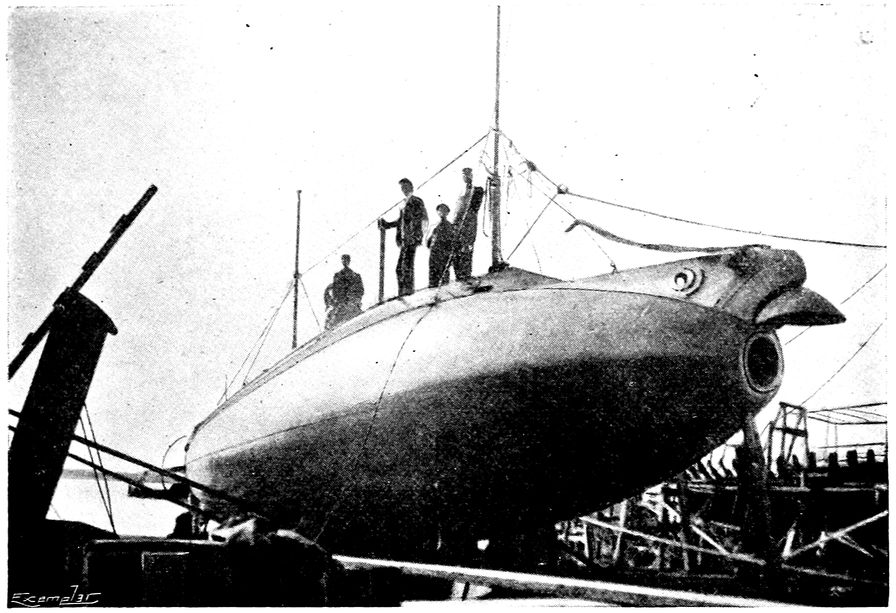
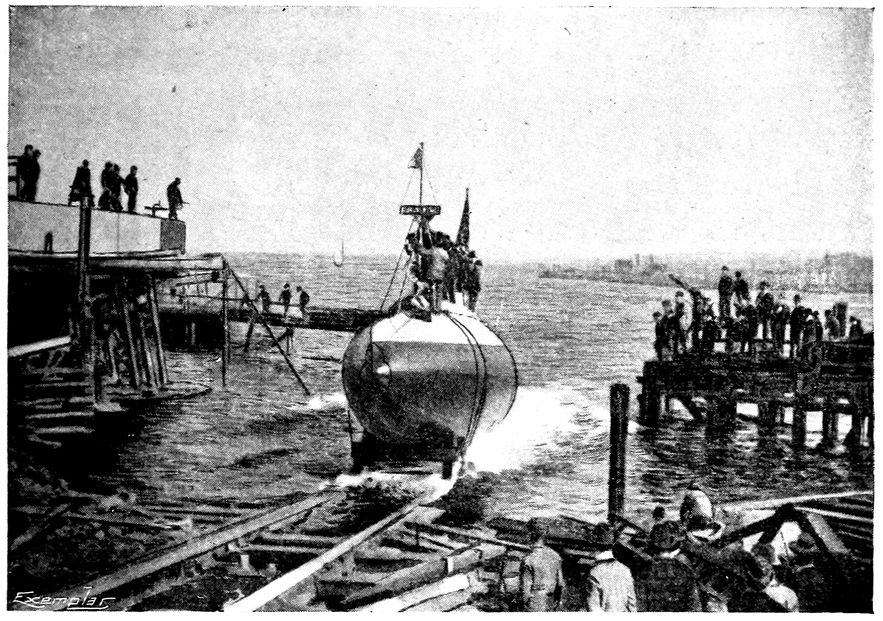
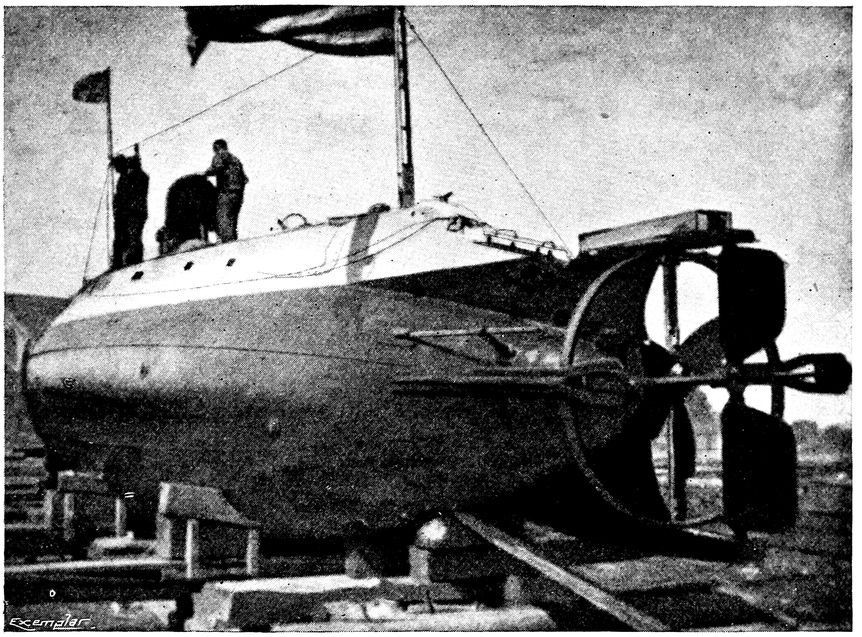
LAUNCH OF U.S. SUBMARINE “SHARK.”
Rear-Admiral C. C. P. FitzGerald, in an article in
the Empire Review for February, 1901, on “Our Naval
Strength,” referring to submarines said:—“It seems
a little risky to hold our hand altogether. We are
said to be ‘watching,’ and no doubt it will be very
convenient if we can allow others to spend their time
and money on experiments and then just cut in at
the right moment when the submarine boat has
established itself as a practicable engine of warfare
and build as many as we want with the unrivalled
18resources which we are so fond of talking about.
But it should be remembered that secrets are better
kept abroad than they are in England and that a
new mechanical industry always takes some time to
develop and to train the special workmen essential
to its prosecution.”
Mr. Arnold Forster has himself said that an ounce
of practice is worth a ton of theory, and it would be
well if all officials thought as he does. There is far
too little experimental work and practical trial of
novel ideas both in the Army and the Navy. If we
were never going to use our soldiers or our ships in
actual warfare it would be both economical and
prudent to wait until other nations had perfected
inventions before adopting them ourselves. In this
case we should never make any progress at all, for
the reason that no improvement is final, and that the
fleet of to-day is a totally different thing from the
fleet of fifty years ago.
Si vis pacem para bellum. The essence of maritime
war is, it has been well said, its suddenness, and a
day gained in striking the first blow may make the
difference between the fall of an empire and the
annihilation of the enemy. To wait to consider to
what use we can put submarine vessels and to
postpone the question of discovering the most effective
method of destroying the boats of the enemy
until war breaks out is a suicidal policy, which,
however, seemed for many years to appeal to a
“Government of Amateurs.”
Had there been more experimental work before
19the outbreak of the Boer War our army would have
probably finished its task sooner and with less loss of
life. Questions such as the employment of heavy
field ordnance, of telescopic sights, of shields for
guns and rifles, of motors, of electricity, &c., will
have to be considered when the war is over, but
they should have received attention before hostilities
commenced. If every nation would agree to maintain
the status quo and to make no effort to keep its
navy and its army abreast of the advances of modern
scientific progress and invention, then the policy of
our Admiralty and War Office would be excellently
suited to our needs. As it is, however, Germany,
France, the United States, Russia, and Japan are
much more ready to improve their services than is
Great Britain, whose officials, for the sake of peace
and quiet, snub the inventor and smother their consciences
by repeating that all is well in our army and
navy. Only when great pressure is brought to bear
on them will they stir themselves. Admiral Sir E.
Fremantle recently suggested that there ought to be
a committee on inventions always sitting, and Mr.
Laird Clowes has appealed for readier official interest
in certain recent inventions.
The experiments with the British submarines must
be carefully watched in order that we may arrive at
a well-reasoned opinion concerning their future. It
may be that it will be decided that for our purposes
a means of destroying the submarines of the enemy
will be of more value than the boats themselves. On
the other hand, the conclusion may be reached that
20for certain purposes this type of craft will be a useful
adjunct to our fleet. Whatever the decision may
be it is quite certain that the submarine boat will
continue to receive improvements at the hands of
inventors, and that as practical applications have
been found for the Röntgen Rays and wireless
telegraphy, so uses will be found for the submarine
of the future which may be as great an improvement
on the submarine of to-day as the Deutschland is
over the Savannah, the first steam-packet that ever
crossed the Atlantic.
Those who discuss submarine navigation as if it
were quite a new development are apt to forget
that the earliest use of the torpedo was in an
under-water vessel. Bushnell and Fulton, no less
than the Confederates of a later day, saw that their
best chance of success lay in attacking by stealth,
and though the modern Whitehead is a very different
weapon to the cases of explosive used by Bushnell
and Fulton, or the spar-torpedo employed by the
Confederates in their Davids, there are still the
same advantages to be gained by a submarine attack.
Whilst the torpedoists of the extreme school claim
that torpedo vessels can attack with a very good
chance of success in daylight, the more general
opinion is that they will he utilised chiefly under
cover of darkness, and that the destroyer and the
smaller torpedo-boat would stand no chance in broad
daylight against the tremendous artillery fire to
which they would be subjected by the battleships
singled out for attack. Even at night, however,
21the flare from her funnels might betray the
destroyer.
A writer in the United Service Gazette a few years
ago remarked that the development of quick-firing
guns brought about by the increase in the offensive
and defensive power of swift torpedo-boats threatened
ere long to completely abolish the use of surface
torpedo-boats in marine warfare unless the latter
could be rendered proof against those terribly destructive
weapons, the new rapid-firing guns of large
calibre. To secure this invulnerability by the aid of
armour would destroy the speed and hardiness of the
torpedo-boats, and it had long been the opinion
amongst naval officers, more especially on the Continent
and in America, that if the torpedo is to be
used for successful attack it would have to be discharged
from a vessel which was rendered invulnerable
by being totally submerged—that is to say,
from a submarine torpedo-boat.
The submarine boat of the future will be a diving
torpedo-boat capable of manœuvring (1) on the
surface, (2) awash with conning tower only above
the water, and (3) beneath the waves.
It will have two methods of propulsion, one for
the surface, one for beneath the water, and its
mode of operation will be to steam on the surface
until it is within sighting range; to then take in
enough water ballast to bring it to the “awash”
condition, thus greatly reducing the chances of being
hit; and, having approached within a certain
distance of the enemy, to sink entirely beneath the
22waves, rising once probably for a second to take
final bearings before firing its torpedo.
The nine vessels ordered for our navy are really
diving torpedo-boats and are not intended for use
under water except for very short intervals of
time. The submarine of to-day bears a close
resemblance to the torpedo-boat in the early
stages of its development and appears to be of
more value to a country that is desirous of defending
its coasts than to one which must maintain
the command of the seas.
There are signs, however, that in the process of
its evolution the submarine will go through many
of the same stages as did the torpedo vessel, and
will develop into an offensive weapon which
England will be unable any longer to despise.
That a Holland, a Narval, or a Gustave Zédé is
as formidable an adversary as an Albatross or an
Express few would claim, but the last word has
not yet been said on submarine navigation, and
the future may be expected to bring about many
changes.
For purposes of coast defence the submarine
may be said to have fairly established its value.
The knowledge that such craft were “in being”
would have a deterrent influence upon an admiral
attacking a fort or contemplating a blockade, and
in all probability the days of close blockade are
over.
As a weapon of offence the utility of the submarine boat
is not so clearly established. It is
23true that some of the French boats have operated
at a considerable distance from their base, but its
speed, its seaworthiness, and range of action must
be improved before the submarine can be regarded
as a useful adjunct to a fleet acting on the
offensive. The radius of action at the surface of
the newest Hollands is only 400 knots at 8 knots
per hour, and submerged the speed is 7 knots for
a four hours’ run.
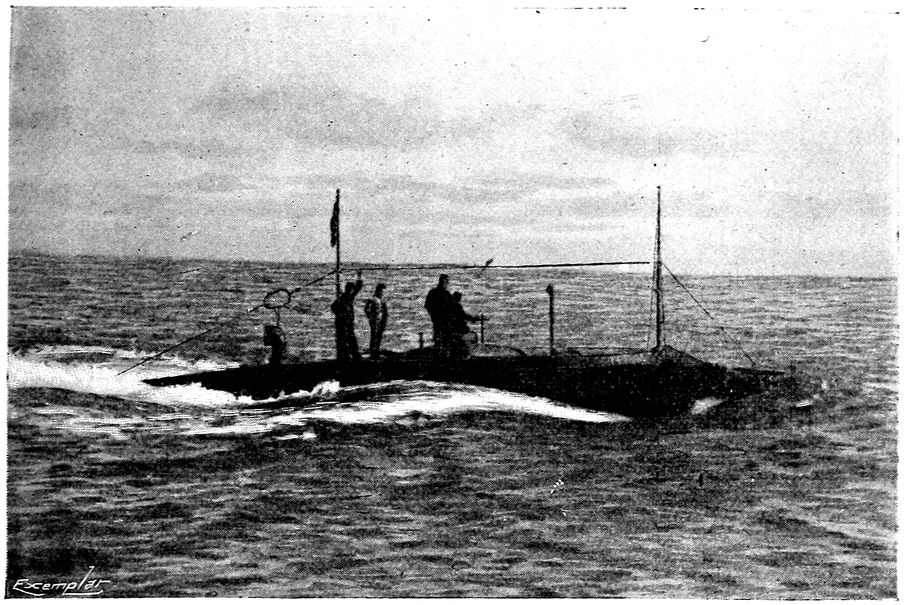
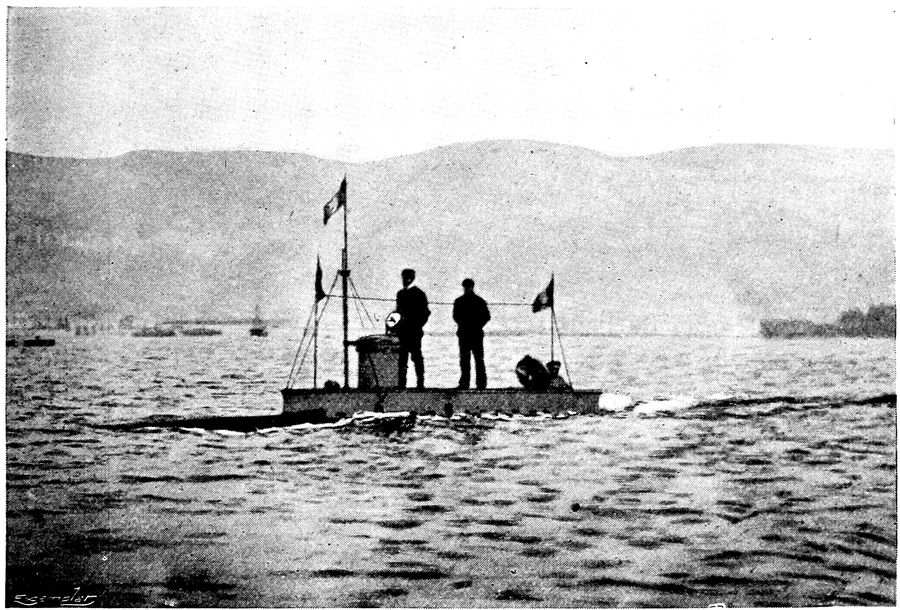
THE “FULTON” RUNNING ON THE SURFACE.
Still even now there are uses to which a submarine
boat might be put, such, for instance, as
the attack of ships shut up in a blockaded harbour,
or of vessels in port; the destruction of a mine
field so that ships may enter in safety; the cutting
and repairing of cables; the forcing an entrance
through a boom, &c.
24The late Captain Cairnes, in his book “The Coming
Waterloo,” enunciated the theory that even if the
British fleet destroyed the French fleet it would
still be necessary for us to land an army on
French soil in order to bring hostilities to a conclusion.
In that case submarine boats would
probably be employed, for some of the purposes
above enumerated.
It has been suggested that small diving torpedo-boats
might be carried on battleships, and it is
said that the United States have been experimenting
with vessels of this kind. The difficulties of
hoisting such vessels in and out of a big ship
are, however, considerable, and few naval officers
favour this idea. Perhaps a special “submarine
depot ship” somewhat similar to the Vulcan might
be useful for conveying submarines to foreign
waters.
In the opinion of many naval experts most of
the naval actions of the future will be virtually
decided quite outside the reach of any torpedo yet
designed, and at ranges almost beyond the ken of
unaided human vision, owing to the fact that
with the breech-loading gun of to-day accurate
practice can be made at very long range. The
battle of Manila was fought and decided at a
distance varying from 5,600 to 2,000 yards, and
the battle of Santiago from 5,000 to 1,600. A naval
battle of the future, according to a distinguished
German admiral, if both adversaries are determined
and energetic, will resemble a conflict between two
25stags, which in a moment of fury rush upon one
another, entangling their antlers, and, in the end
of ends, destroying one another. Or if the enemies
are less determined, a naval battle will resemble
a contest of athletes, the combatants moving backwards
and forwards in serpentine lines; both will
keep up fire from a great distance until neither
has enough ammunition left to strike a decisive
blow.
In the opinion of the late M. Jean de Bloch the warfare
of the future will resemble the latter picture, but
it will be remembered that this writer in his book,
“Is War now Impossible?” laid it down that the
bayonet would never be used, as troops would be
unable to cross the terrible bullet-swept zone and
thus come into personal contact with the enemy.
The Boer War has proved on the contrary that
the bayonet is still a valuable weapon, and that
the bravery of the soldier, combined with artillery
fire, will enable him to use it with good effect in
spite of the modern rifle.
What the bayonet is in military, that the submarine
is in naval warfare. The increasing range
of rifle and cannon enable both combatants, if well
entrenched, to blaze away at one another and do
very little damage, and the necessity therefore
arises, if a definite conclusion is to be reached, for
some sharp and sudden blow to be delivered at
close quarters that shall cause the enemy to
evacuate his position and beat a hasty retreat. A
bayonet charge is a desperate affair no doubt, but
26owing to the modern art of entrenchment, recourse
must be had to it if the enemy is to be shifted.
In much the same way a submarine attack will
be ordered when firing at long ranges has had no
effect. There will be great risks, but the chances
of a successful attack will be sufficient to warrant
its being tried.
In conclusion the following extract from a recent
article in the Engineer—a journal which has always
regarded the submarine with suspicion—may be
quoted: “We must not shut our eyes to the fact
that the semi-submarine boat may be a very
dangerous foe. Years have passed since we pointed
this out. It seems to be admitted that a fast
torpedo-boat can get within say a mile of an
enemy without certainty of destruction. Indeed,
up to that she is fairly safe. If now, that point
reached, she descends say five feet below the surface,
leaving a conning tower just level with the water,
she can be steered, and the chances that she will
be sunk by her enemies are very small. The five
feet of water above her would deflect all projectiles
from machine guns. She would have to get very
close up to be hit hard even by heavier metal, and
the little conning tower at the water level would
be a very difficult matter to strike. A fast vessel
operating thus a fleur d’eau would be no despicable
enemy. And it is in this direction we think that
submarine attacks will be developed with the best
chance of success.”
27
“War’s a brain-spattering, wind-pipe slitting art. It is not to be
‘humanised,’ but only abolished one fine day when nations have cut
their wisdom teeth.”
“Inter arma silent leges.”
“All’s fair in love and war.”
“The sea fights of the future, with improved ships, guns, and
range-finders, may be fought at ranges almost beyond the ken of
unaided human vision. It is to be hoped that before that time
arrives the progress of civilisation, intellect, and humanity will have
consigned all weapons of war to the museum of the antiquary, and that
other methods than war may have been discovered for preserving the
peace and virility of men and nations.”
In the early years of the nineteenth century the
writer of an article in the Naval Chronicle, devoted
to a consideration of Fulton’s schemes, stigmatised
his torpedoes and submarine boats as “revolting to
every noble principle,” their projector as a “crafty
murderous ruffian,” and his patrons as “openly
stooping from their lofty stations to superintend the
construction of such detestable machines, that promised
destruction to maritime establishments.” He
went on to protest against the policy of encouraging
28inventions that tended to innovate on the triumphant
system of naval warfare in which England excelled,
and he concluded thus:
“Guy Fawkes is got afloat, battles in future may
be fought under water; our invincible ships of the
line may give place to horrible and unknown structures,
our projects to catamarans, our pilots to divers,
our hardy, dauntless tars to submarine assassins;
coffers, rockets, catamarans, infernals, water-worms,
and fire-devils! How honourable! how fascinating
is such an enumeration! How glorious, how
fortunate for Britain are discoveries like these!
How worthy of being adopted by a people made
wanton by naval victories, by a nation whose empire
are the seas!”
It is quite evident that even in this “so-called
Twentieth Century” there exist many Britons who
in their heart of heart agree with this writer, and
who cherish the idea, though they may not openly
express it, that there is something mean and underhanded,
something dishonourable and “un-English”
in all methods of under-water warfare. The Englishman
prides himself on being a lover of fair play,
and so long as the odds are more or less equal, he
is ready to enjoy any contest or sport. The average
Englishman is neither a hot-headed Jingoist, nor
a peace-at-any-price humanitarian; he regards wars
as unfortunate necessities of modern civilisation, and
he likes to see them waged fairly and squarely, each
side observing the rules of the game. As regards
warfare on land, it must be confessed that he has
29had to correct some of his ideas since the Boer war.
He would have preferred the enemy to come out into
the open and fight like men. Instead of this, they
took every precaution to avoid being seen, and our
army found that it had to face an invisible foe.
From the Boers we have learnt the lesson of the
value of cover and entrenchments, and now officers
and men, however much they may dislike it, are
forced to seek and utilise cover whenever possible,
making it their aim to hit their opponents and to
avoid being hit themselves.
“Let us admit it fairly as a business people should,
We have had no end of a lesson, it will do us no end of good.”
In naval warfare we have had no opportunity of
learning our lesson in the light of actual experience,
for we have had no big battle on the seas since
Trafalgar, and our naval supremacy has not been
seriously threatened since 1805; it is thus possible
for men to hold different opinions as to the value
of submarine fighting, and we consequently find that
there are numerous people who, whilst they would
not go so far as to declare mines, torpedoes, and
submarine boats unlawful, yet consider them as
methods better fitted to the requirements of other
nations than to those of the Mistress of the Seas.
Modern submarine warfare was introduced by two
Americans, David Bushnell and Robert Fulton, and
forced itself into prominence during the American
War of Independence. The spar-torpedo originated
in America; the Whitehead torpedo was first adopted
30by the Austrian Government, and Norway, Sweden,
Denmark, France, and Austria all began to build
torpedo boats before Great Britain condescended to
add them to her Navy.
As to submarine vessels Greece and Turkey purchased
Nordenfelt boats in 1887. France built her
first boat in 1888, and the United States purchased
her first submarine, the Holland, in 1900. Great
Britain, then, has followed instead of leading other
nations in the matter of mines, torpedoes, and submarine
boats, and has only been induced to adopt
such methods of warfare because other nations forced
her to do so.
Before the advent of the torpedo boat, Great
Britain was secure in her position of Mistress of the
Seas, so long as she possessed more line-of-battle
ships than any other nation. The arrival of the
torpedo-boat, the destroyer, and the submarine, all
armed with the Whitehead torpedo, has given
weaker nations the chance of attacking our ironclads
with new weapons, and there are even those
who affirm that the battleship is doomed, and must
give way to a different type of craft.
The whole trend of modern invention has been
to the advantage of weaker nations. Earl St.
Vincent described under-water methods as “a mode
of war which they, who commanded the seas, did
not want, and which, if successful, would deprive
them of it.” It is quite true that Great Britain
would sooner trust to her guns and her line-of-battle
ships than to her torpedoes and torpedo craft
31in actions on the high seas, but owing to other
nations—admittedly weaker—having adopted the
torpedo, she has no choice but to adopt it also in
order to maintain her naval supremacy. So long
as she provides herself not only with methods of
submarine attack, but also with means of warding
off the under-water attacks of the enemy, other
nations are not likely to wrest the command of
the seas from her.
It is idle to lament the advancement of Science.
Man is an inventive animal, and is ever trying to
inaugurate new devices and improve on old ones.
For hundreds of years the sailing ship held the
field, and guns and cannon underwent but little
change. During the “Wonderful Century,” however,
changes began in earnest. The wooden sailing ship
disappeared, and the steam-driven ironclad took its
place, whilst rifled ordnance, high explosive shells,
and powerful propellants were introduced.
The fish torpedo made its appearance, and the
swift torpedo vessel followed in its wake, and we are
now threatened with submarine boats, turbine-driven
men-of-war, and aerial machines for the launching
of aerial torpedoes both on armies and on fleets.
What the future has in store none can foresee,
and until the next great naval battle between first-class
Powers comes to pass the value of modern
engines of warfare will remain doubtful. All that
is certain at present is that Great Britain cannot
afford to dispense with mines, torpedoes, and submarine
boats.
32We may seem to have wandered a long way
from the “morality of submarine warfare,” but our
purpose has been to show that when certain people
argue—as they do seriously in this year of grace—that
torpedo warfare should be declared contrary
to the laws and customs of war, they are, to a
certain extent, influenced by the fact that the
torpedo is a weapon which Great Britain could
very well do without, provided it was tabooed by
other nations.
No one, not even a member of the Peace Society,
would urge the suppression of the Lee-Enfield, or
the quick-firer, because Great Britain relies on
these for the maintenance of her place in the front
rank of the nations of the world, and the argument
as to the “illegitimacy” of the torpedo
depends largely on the fact that other nations gain
and Great Britain loses by its adoption.
There have been persons who have argued in
favour of giving no quarter to crews of torpedo
boats and submarines that might fall into our
hands, and have suggested that we could explain
such action to the other Powers, to whose advantage
it is to use such weapons, by saying that
though we had been driven to employ such
methods, we were forced to treat the practice with
severity. Such a course of action would cut both
ways, and we suspect our own torpedoists would
be very much averse to it.
Strange engines of warfare and new modes of
fighting are received by the bulk of a nation,
33whose instincts are conservative and whose minds
are incapable of imagining a state of things other
than that which prevails at the moment, in much
the same way as are new inventions. They are first
of all scouted as impossible; then, if possible, of no
utility; and finally, when they have been universally
adopted, they are declared to be no novelties
at all. Just as many old ladies have been heard
to declare that they will never travel by the Two-penny
Tube, so nations have been known to disclaim
all intention of using particular weapons.
Yet after a time we find the old ladies in the Tube
and the nations employing the weapons. Familiarity
breeds contempt.
The earliest man—Homo sapiens—fought with his
fists, his legs, and his teeth. Gradually he made
for himself weapons, deriving his first instruction
in their manufacture by observing the ways in
which the animal creation fought one another.
His earliest weapons were made of wood, bone, and
stone, and in due course there was evolved the
spear, the waddy, the boomerang, the hatchet, the
tomahawk, the bow and arrow, the pike, the lance,
the axe, the sword, and other implements.
It is exceedingly probable that the adoption of a
new engine of warfare by a tribe would be condemned
by another tribe—to whom it had not
occurred to use it—as illegitimate, but it is equally
probable that while sturdily protesting against the
use of one weapon the tribe would be slily endeavouring
to procure one more deadly still.
34The first great revolution in the art of war was
the introduction of gunpowder, both as a propelling
agent and also as a charge for shells and
bombs. Although the explosive nature of saltpetre
when mixed with carbon and charcoal was doubtless
known to the Chinese some centuries before
the Christian era, our first knowledge of the
use of gunpowder as a military agent dates from
the seventh century, when it was used by the
Byzantine emperors under the name of “Greek
fire” in the defence of Constantinople against the
Saracens.
“Greek fire,” the invention of which is commonly
attributed to Callinichus in 668 A.D., consisted
probably of pounded resin or bitumen, sulphur,
naphtha, and nitre. There were three ways of
employing it: it was poured out burning from
ladles on besiegers, it was projected out of tubes
to a distance, and it was shot from balistæ burning
on tow, tied to arrows. Its effect was probably
rather moral than material.
Geoffrey de Vinesauf, in an account of a naval
battle in the time of Richard I., writes thus of
Greek fire: “The fire, with a deadly stench and
livid flames, consumes flint and iron; and unquenchable
by water, can only be extinguished by
sand or vinegar. What more direful than a naval
conflict! What more fatal, when so various a fate
envolves the combatants, for they are either burnt
and writhe in the flames, shipwrecked and swallowed
up by the waves, or wounded and perish by arms.”
35Despite the lamentations of the humanitarians
of the time, Greek fire and serpents (missiles resembling
rockets charged with and impelled by the
slow explosion of a certain mixture) continued to
be used in the navy until the reign of Richard III.
Another favourite method of early naval warfare
was the “fire-ship.” Falkiner, an old writer, tells
us that fire-ships were used by the Rhodians in
190 B.C. They were certainly used by the Greeks;
they were employed by ourselves against the
Armada, and they first appeared in our Navy List
in the year 1675; they were used in the Dutch and
French wars at the close of that century, but
probably fell into disuse in the eighteenth. It is
quite clear that with the French, as well as with
ourselves, the crews of fire-ships did not expect
quarter. Admiral Gambier deprecated fire-ships as
being a “horrible and anti-Christian mode of warfare,”
while Lord Cochrane said that if any
attempts were made upon the British squadron by
fire-ships they would be “boarded by the numerous
row-boats on guard, the crews murdered, and the
fire-ships turned in a harmless direction.”
Lord Dunsany appeared to think that this apparently
cruel rule of no quarter to the crews of
fire-ships worked well for humanity in practice, and
he seemed to be in favour of its being extended to
the crews of torpedo-boats and submarines. His
Lordship pointed out, in a lecture at the Royal
United Service Institution, that the crews of fire-ships
would not stick to their ships to the moment
36of explosion, but had after firing the fuse to make
their escape in boats, which boats, as they passed
through the enemy’s lines, would naturally become
targets, and if meanwhile some ship clasped in the
deadly embrace of the fire-ship had exploded, it
was all the more likely that the fugitives would
be the objects of unsparing vengeance.
“Probably then the vague but fatal epithet ‘un-English’
came to attach to men who used a deadly
weapon, but withdrew themselves (sometimes too
quickly) from the fray. I cannot produce evidence
of the facts, but I believe that officers serving in
fire-ships did not stand high with their brother
officers. It is some confirmation of this creed that
we do not find the Boscawens, Rodneys, Howes,
Jervises, Nelsons serving in fire-ships.”
The first use of gunpowder as a propelling agent
was in Spain in the twelfth century, at which period
both the Moors and the Christians used artillery.
It was first employed in warfare in England in
1327 by Edward III. in his war against the Scotch,
the cannon from which the shot was fired being
termed “Crakys of war.”
There is abundant evidence that the use of artillery
in battle was at first thought to be improper.
When cannon was employed at Chiaggia in the fourteenth
century all Italy made complaint against this
manifest contravention of fair warfare; the ruling
classes, seeing their armour, lances, and knightly
prowess rendered useless, vigorously opposed the
newly-invented arms, declaring that they were calculated
37to extinguish personal bravery. Perhaps
this sentiment may have had some weight with our
navy, for it was not until towards the close of the
sixteenth century that artillery finally assumed the
position of the dominant arm in the service and
that musketry fire altogether displaced the arrow
and the bolt.
Shells appear to have been first used by the Sultan
of Gujarat in 1480, and they were in general use
about the middle of the seventeenth century.
There is no doubt whatever that shells and bombs
were considered highly immoral by the side which
did not employ them. To those accustomed only to
fire solid shot there must have been something very
terrifying in the hurling of shells fitted with explosives
which when they burst slew those round
about and set fire to dwellings and ships.
When the Bomb Ketch, a ship firing bombs and
shells, was introduced into our navy in the seventeenth
century, the French were particularly angered
by the “inhumanity” of the English in firing “inflammable
fire balls and shells.” Again in the
eighteenth century we find the Marechal de Conflans
issuing an order against the use of hollow shot
or incendiary shell because they “were not generally
used by polite nations, and the French ought to fight
according to the laws of honour.”
At the battle of the Nile in 1798 the French flagship
L’Orient took fire and blew up, and when the
French sailors reproached the English for using
incendiary missiles the latter repudiated the charge,
38and mentioned that they had found such unlawful
weapons in one of the prizes they had taken; thus
the hollowness of the French regard for humane
warfare was neatly demonstrated.
Whilst Great Britain did not scruple to fire lyddite
shells at the Boers, their wives, and their children
at Paardeberg, she prided herself on her abstention
from the use of explosive or expanding bullets, and
much abuse was heaped on the Boers for their
employment of such. It may, however, be doubted
whether a bullet which kills you right off at once,
or at any rate which disables you permanently for
a long time, is not preferable to one which is of
so mild a nature that you can be shot over and over
again, alternating your appearances on the battlefield
with visits to the hospital.
A lecture on “Explosive Bullets and their Application
to Military Purposes” was delivered before the
Royal United Service Institution in 1868 by Major
G. V. Fosbery, the first officer to use these projectiles
in the field, systematically and to any large extent,
against some of the mountain tribes of the North-West
frontier of India. The lecturer tells us that
the natives considered them unfair on two grounds—firstly,
because they exploded in an objectionable
way; secondly, because there was nothing they
could collect of them afterwards, as in the case of
ordinary bullets. But more civilised people complained
of the use of “rifle shell” on the ground
of their Satanic nature, and to these Major Fosbery
replies as follows:
39“The arguments which condemn a warlike instrument
simply on the grounds of its destructiveness
to life, provided that it neither adds keen agony
to wounds nor new terrors to death itself, are, if
logically pursued, simply retrogressive, and even
if not recommending by implication a return to
the bow and arrow, at all events point to the old
times of protracted wars and deaths from fatigue
and disease far exceeding in number those caused
by the weapons of an enemy. We can therefore
afford to set these on one side, or rather we are
bound to neglect them altogether and seriously consider
any invention which under the conditions above
laid down promises us a more certainly destructive
fire than that attainable cæteris paribus by the arms
at present included in our war material.”
In spite of opinions such as these the humanitarians
have won the day, and explosive bullets are
now tabooed by Great Britain. The great Duke of
Wellington used to say that he should not like to see
the bullet reduced in size, because it broke the bone,
and the object of war was either to kill your man
or else put him in hospital and keep him there.
With the Mauser and the Lee-Enfield neither of
these results is attained.
The prototypes of the modern submarine torpedo,
although they were employed on the surface of the
water and not below, were the “machine,” the “infernal,”
the “catamaran,” the “powder-vessel,” &c.
“Machines” may be best described as fire-ships
specially arranged so as to explode very destructively
40when alongside one of the enemy’s vessels.
They are first found in the British Navy in the
seventeenth century, but were soon discontinued,
not we are afraid on humanitarian grounds, but
because Bushnell and Fulton pointed the way to
the more convenient explosive device known as the
“torpedo.”
In the year 1650 Prince Rupert made an attempt
to blow up the English Vice-admiral in the Leopard
by a species of “infernal.” He sent a couple of
negroes and one of his seamen in Portuguese dress
alongside the Leopard in a shore boat. They
carried with them what purported to be a barrel
of oil, but the barrel really held an infernal
machine to be fired by a pistol attachment, the
trigger of which could be pulled by a string
passing through the bung. The story goes that
one of the crew of the boat, finding the lower deck
ports closed, “uttered an exclamation” in English.
This betrayed them, but Blake refused to take
vengeance on them, though the trick was one he
would himself have scorned to play on his adversary.
During the war between Great Britain and the
United States in 1812 H.M.S. Ramilies of seventy-four
tons, was so unfortunate as to be the object
of attack both by a diving vessel carrying torpedoes
and by a powder-ship. The Ramilies was
lying off New London at anchor and maintaining
the blockade. As she was known to be short of
provisions the Americans fitted out a schooner and
filled the hold with powder, covering it over in the
41hatchways with barrels of flour. By means of an
ingenious piece of clockwork attached to a gunlock
and a train leading to the powder its explosion
was ensured at the intended time. The Ramilies
suspecting nothing, but thanking Heaven for the
gift, captured the vessel and the crew escaped to
land. By some extraordinary chance (or was it
destiny?) the schooner was ordered to anchor near
another prize some distance from the Ramilies, so
that when the clockwork reached the fatal hour,
2.30, the charge exploded and blew up, not the
Ramilies with her captain, Sir Thomas Hardy, and
crew of six hundred men, but only the prize crew
who were in the schooner.
The naval historian James could not trust himself
to comment upon “this most atrocious proceeding,”
whilst a naval officer wrote: “A quantity of arsenic
in the flour would have been so perfectly compatible
with the rest of the contrivance that we
wonder it was not resorted to. Should actions like
this receive the sanction of Governments, the science
of war and the laws of nations will degenerate
into the barbarity of the Algerians, and pillage
will take the place of kindness and humanity to
our enemies.”
During the American Civil War a species of
weapon known as a “coal torpedo” was employed.
This consisted of a hollow lump of iron, fitted with
a charge of dynamite. It was rubbed over with
coal tar and dust, and exactly resembled a large
lump of coal. Lord Dunsany thought that this
42certainly seemed to be on the verge of lawful, if
not beyond it.
At the close of the eighteenth century David
Bushnell inaugurated the era of submarine warfare
by devising cases fitted with explosives, arranged
to go off at a set time by clockwork. To enable
these cases to be affixed to the sides of vessels,
Bushnell invented the first boat capable of diving
beneath the waves of which we have any definite
details. His attempts to blow up the Eagle in 1776
by a case fastened on her bottom, and the Cerberus
in 1777 by means of a towing torpedo, failed,
owing more to the lack of skill on the part of the
operator, Sergt. Ezra Lee, than to any defect in the
apparatus employed. Nor was Bushnell successful
in his effort to destroy vessels in the Delaware by
the aid of a number of kegs filled with powder and
set adrift.
The introduction of gunpowder, of Greek fire,
of fire-ships, of artillery, of shells, of bombs, of
machines, of infernals, of catamarans, of powder
vessels having, as has been shown, been at one
time or another denounced as immoral by certain
“humanitarians,” it was but natural that a secret
contrivance for bringing about a terrific explosion
beneath an unsuspecting ship’s crew should have
been believed to be an invention of the Evil One,
and history affords proof that the novel modes of
fighting introduced by Bushnell and Fulton were
regarded with great disfavour by naval men, who
considered the innovators as men “who would discredit
43the glorious traditions of our navy, and substitute
a set of catamarans for the noble frigates
that had carried our flag to victory and were the
pride of the nation”; by humanitarians, who regarded
the torpedoes as a “dishonest and cowardly
system of warfare”; and by the public generally,
who denounced the nations who attempted to compass
the destruction of British ships of the line by
dastardly tricks which England would never stoop
to employ.
In a work written by James Kelly, and published
in 1818, the author comments with great severity on
“some infamous and insidious attempts to destroy
British men-of-war upon the coasts of America by
torpedoes and other explosive machinery.” This
refers to the attacks on H.M.S. Ramilies by one of
Fulton’s boats, attacks which failed, but which
caused Sir Thomas Hardy to notify the American
Government that he had ordered on board from
fifty to one hundred American prisoners of war,
“who, in the event of the effort to destroy the ship
by torpedoes or other infernal inventions being
successful, would share the fate of himself and his
crew.” So frightened were the relations and friends
of prisoners of war by these threats that public
meetings were held, and petitions were presented
to the American executive against the further employment
of torpedoes in the ordinary course of
warfare.
Those who endeavoured to perfect a system of
submarine mining for the defence of harbours and
44coasts were abused in the same way that Bushnell
and Fulton had been. Samuel Colt, the inventor
of the pistol which bore his name, and one of the
first to experiment with mines fired from shore by
means of an electric current, was roundly denounced
by John Quincy Adams, who dubbed him “that
Guy Fawkes afloat.”
At the time of the Crimean War the popular
term “infernal machine” was applied to the submarine
mines laid down by the Russians to defend
the approaches to Cronstadt. In the seventies
Lieut.-Col. Martin endeavoured to establish, on the
grounds of humanity, an international anti-torpedo
association, while even to-day there are people
found to protest against the employment of certain
forms of torpedoes, as witness the following letter
recently published in the Engineer. The author, Mr.
Reginald Bolton, declared that while no one could
object to the defensive lay torpedo or the spar
torpedo, the same could not be said of the “Whitehead,”
“Brennan,” or “Edison.”
“Surely,” he urges, “our forefathers’ code of morality in
warfare should not be in advance of our own. All civilised
nations have debarred the brutal explosive bullet, and why not
the equally mean submarine torpedo? If such a remedy as
Commodore Hardy’s were to be applied by any nation, could
its opponent complain, and is there anything in the practice of
morality to prevent, say, a thousand prisoners’ lives being
presented as a bar to the use of an implement which was
acknowledged to be a disgrace to its employers not less than
eighty years ago?”
45The methods of warfare which have most aroused
the ire of humanitarians and “blatant platform
orators, with their vulgar party cries of eternal peace,”
are those which depend for their success on secrecy
or deceit. Powder vessels, coal torpedoes, et hoc genus
omne, are condemned because they pretend to be
what in reality they are not, and torpedoes and
submarine boats because they advance in secrecy
without giving the enemy any chance of firing at
them or of protecting themselves against their
insidious attacks beneath the water-line.
The arguments of the humanitarians, who are
doubtless well meaning enough, are inconsistent,
because, while they raise no protest against certain
modes of conducting war, they unreservedly condemn
other methods—mainly, it must be observed,
because of their novelty. Such a class of person
resembles the Quaker who found himself on a vessel
engaged in a conflict with another vessel. He resolutely
refused to assist in fighting the guns, but
at last, when the enemy attempted to board, he
collared the leader and pitched him into the sea,
saying as he did so, “Friend, thou hast no business
here.”
Major Fosbery, in a lecture on explosive bullets,
asked whether any of the deaths due to fighting
were, strictly speaking, humane, and if they were
not, what was this humanity of which so much was
made? “Have we not heard that in the dark ages
humanity beat out men’s brains with a mace, whilst
cruelty used the lance, the sword, and the arrow,
46and that bishops of the period rode into action
with the mace so as to kill without shedding
blood? A very nice distinction indeed, as you will
admit. In later times, were not Congreve and
Shrapnel denounced as monsters for the initiation
of inventions in whose perfection we rejoice to-day?”
Inconsistency indeed is the particular failing of
Peace propagandists. They not only condemn the
use of certain weapons while raising no protest
against others equally as destructive of life, but they
also pretend to be horrified at deeds committed by
the enemy which they themselves would not scruple
to do should opportunity offer. Particularly is this
the case in savage warfare. Captain Herbert has
mentioned a striking instance during the Zulu War.
One day the boys were calling in the streets, “Shocking
murder of a whole British regiment” (it was at
Isandlewana), and a few weeks afterwards the same
boys were shouting, “Great slaughter of the Zulus.”
This is akin to the practice of those orators who
refer to the “expansion” of England, but to the
“encroachment” of Russia.
As to the “inhumanity” of the submarine vessel,
Mr. Nordenfelt, it may be noted, would not admit
that there was anything especially cruel or horrible
in the idea of a diving torpedo boat. War altogether
was cruel and horrible, and caused an enormous
amount of pain and suffering, but any invention
which tended to shorten a war or to protect common
or private property during war would really diminish
this suffering on the whole. Humanitarians had
47urged that there was something especially cruel in
the secrecy of the submarine boat, but the whole
tendency of war had, he pointed out, moved in
this direction ever since the days of old, when
Hector and Achilles advanced in front of their
respective followers and spent half an hour in
abusing their adversary’s parents and ancestors
before they commenced to fight.
EMERGING TO TAKE BEARINGS.
The whole object of modern warfare is to keep
the enemy ignorant of your whereabouts and your
actions, and to mislead him whenever possible, and
for this reason smokeless powder, torpedoes, disappearing
guns, &c., have come into use, false
attacks are considered admissible, and every advantage
48is taken of cover and entrenchments. The
only “cover” possible in naval warfare is beneath
the waves, and it is difficult to see any greater
inhumanity in submarine than in military mining,
which certainly dates from very early times. If it
is lawful to sap and mine before a fortified town,
and to blow up an army as it marches unsuspectingly
over “mined” ground, it is surely permissible
to send ships sky-high by mines and to sink them
by torpedoes.
Mr. A. F. Yarrow has remarked that it seemed
strange that an artilleryman behind ten or twenty
feet of earthwork, hurling explosive shells at an
almost unseen foe, should be held as fighting fairly,
while in the case of the torpedoist, who has the
pluck to accompany his missile to within a short
distance of his enemy, it should be considered an
unfair mode of attack.
Yet so it is, and we find in a recent number of
the Engineer[1] that submarine warfare is placed on
a par with guerilla warfare and train-wrecking.
“The torpedoing of a single German ironclad by a
submarine would almost certainly be followed by
a refusal to recognise submarines as belligerents.”
The question of the laws and usages of civilised
warfare has been the subject of many books and
articles, and conferences have been called to endeavour
to arrive at some understanding on the
subject. An International Conference on the
“Usages of War,” held at Brussels in 1874 at
49the instance of Alexander II., considered among
other things, “the means of injuring an enemy,”
and suggested the prohibition of the use of poison
and poisoned weapons, murder by treachery, and
murder of a disarmed enemy, projectiles causing
unnecessary suffering, and prohibited by the declaration
of St. Petersburg in 1818; “ruses de guerre”
were, however, declared permissible.
In connection with the Boer War it is interesting
to note that differences arose at this Conference
between the representatives of the large States
possessing great standing armies, and of the minor
States with small armies. The former thought that
war should be the business of professional trained
soldiers, that they, and as a rule they alone, should
fight, that war should follow a regular course, and
that the worthlessness, from a military point of
view, of the sporadic efforts of partisan warfare
should be recognised, and that when a battle was
won and the seat of Government was in the
possession of an invader the inhabitants should
respect the conquerors as the de facto and de jure
Government. If they interrupted communications
and cut off isolated bodies of troops they were to
be dealt with not as honourable combatants, but
as assassins and marauders.
The “Geneva Convention” met at Geneva on
August 8, 1864, and on the 22nd of the same
month an International Code was adopted by all
civilised powers, except the United States. The
code mainly concerned itself with the succour of
50the wounded in time of war, and certain cruel
methods of warfare, such as the use of explosive
bullets, were condemned, Great Britain agreeing
not to use such weapons in war against civilised
nations.
The Peace Conference at the Hague was opened
on May 18, 1899. Of the eight proposals submitted
for discussion, the second was the prohibition of
the use of new arms and explosives, the third the
restriction of the use of existing explosives and
the prohibition of projectiles and explosives from
balloons, and the fourth the prohibition of submarine
torpedo boats, and the agreement not to
construct boats with rams in the future.
The final act embodying the results of the Conference
contained three declarations. 1. Prohibition
of the throwing of projectiles and explosives from
balloons or any other analogous means. This prohibition
to be in force for five years. 2. Prohibition
of projectiles intended solely to diffuse asphyxiating
or deleterious gases. 3. Prohibition of the use of
bullets which expand easily in the human body.
It may be noted that Great Britain did not bind
herself to accept any of these three declarations.
“The laws of war,” wrote Montague Bernard,
“are nothing at all but the usages according to
which warfare by land and sea is carried on, and
the collection of the whole body of usages represents
what we call the laws of war.... The student
of history is apt to be a little puzzled by frequent
reference to ‘laws’ with which he is tacitly
51assumed to be familiar. What are these laws?
Where are they written? What authority do they
command? They are a body of usages, for the
most part conditional, which have arisen principally
from motives of convenience and the extension of
commerce.”
It is of course recognised that the only force
which supports international law is the appeal to
the conscience of the nation, for there is no international
tribunal to punish countries for deeds committed
in time of war. While it is unlikely that
the rough game of war ever will be played (it certainly
never has been in the past) in exact conformity
with the rules of the jurists, there are
certain methods of waging war which England
would not employ, and certain acts which she
would not commit in the event of hostilities breaking
out between herself and a civilised country.
She would not use explosive bullets. She would
not fire on undefended towns, and would endeavour
to avoid the destruction of non-combatants
and their property. She would not poison wells,
she would not endeavour to accomplish the assassination
of a commander-in-chief, she would not
abuse a flag of truce, she would not murder
prisoners who behaved themselves, and put to
death those who surrendered.
On the other hand, she would consider herself at
perfect liberty to employ submarine boats, torpedoes,
and mines, both military and naval; to
discharge shells filled with high explosives, whether
52lyddite, melinite, or other substance, from aerial
machines; to intercept the enemy’s messages and
to mislead him by sending false ones; to commence
hostilities without issuing a declaration of war;[2]
to fire on, and if necessary sink, the merchant ships
of the enemy; to starve a garrisoned town; to
erect wire entanglements and similar obstructions;
to offer wrecking lights as navigation lights; and
to employ any “stratagem” or “ruse de guerre”
which might serve some useful end. With regard
to stratagems, it appears to be quite proper to
disguise ships and men, and to use false signals,
false colours, and neutral flags, though a British
naval officer would probably not fire into his enemy
before hauling down his neutral or false colours.
2. The Romans considered that no war could be just unless
it was preceded by a formal declaration.
Vice-Admiral Rodney M. Lloyd pointed out in a
recent letter to the Times that while in naval warfare
all stratagems were admitted, expected, and
provided against, in military operations, on the
contrary, some acts of a similar kind appeared to
be objected to. The Boers, for instance, frequently
disguised themselves in British khaki uniforms, and
endeavoured to delude sentries and guards.
Some writers refer to this as “the abuse of the
khaki uniform” and “the treacherous use of the
khaki uniform,” but if such things are permitted
in naval operations it is difficult to see why they
should be considered immoral if practised on land.
Apropos it may be mentioned that during some
53Russian naval manœuvres the admiral’s ship was
destroyed by the following trick. A party of
volunteers from other squadrons came alongside
the cruiser Africa, the flagship, in a Finnish coasting
smack, and one of the volunteers, dressed as
a peasant, came on board with a telegram. Whilst
the attention of the Africa’s crew was diverted the
other volunteers fastened a small buoy with the
inscription, “Frigate Prince Pojarsky,” under the
stern of the flagship.
BENEATH THE WAVES.
Of course there is a very thin line which separates
what is considered fair and what is considered
unfair warfare among civilised communities. Lord
Dunsany said that he was not perfectly sure that
54there could not be something said in favour of
poisoning wells. “We have heard something about
poisoning the air. The French some time ago had
what they called bullets asphyxiants. These would
have utterly poisoned a whole ship’s crew. If
these missiles may be used, then it comes to this:
that it is lawful to poison the air, but not lawful
to poison the water.”
Lyddite shells seem rather to resemble these
bullets asphyxiants, for their stench is reported to
be terribly stupefying to those in the immediate
neighbourhood when they burst. But whereas
explosive shells fired from guns are considered
“legitimate,” shells fired from rifles are regarded
as “illegitimate.”
Respecting the question of poisoning wells, Colonel
Lonsdale Hale has remarked that so long as this
was done openly, and the fact notified in some way
to those who would use them, there seemed to be
nothing more to be said against this forbidden
practice than against the permitted practice of
depriving the enemy of good water supply by
filling in wells and by cutting off the good water,
as the Germans did at Metz and Paris, and reducing
their enemy’s water supply to the sewage-receiving
Moselle and Seine. If it was permissible to starve
one’s enemy by denying him solid food, it seemed
to him equally permissible to starve him by denying
him liquid food.
Wolff and Bynkerhoeck, two of the originators
of international law, thought the use of poison in
55warfare perfectly legitimate. Vattel considered the
practice interdicted by the law of nature which did
not allow of the multiplying the evils of war
beyond all bounds. To get the better of the
enemy he must be struck, and if once disabled,
what necessity, he asked, was there that he should
eventually die of wounds.
Opinion also differs as to the morality of attacking
undefended towns and injuring the property of
non-combatants during a war.
The late Admiral Aube, when he was head of
the French Admiralty, said the proper way of
bringing this country to order was to burn Brighton
and Scarborough and a few other places; and
Admiral Sir J. C. Dalrymple Hay, Bart., has remarked
that he could not say he thought that he was
wrong. According to the latter, the object of each
side is to do the greatest possible destruction to
the enemy, and also to make him cave in; the
whole of the country is engaged in war, they pay
taxes for the war, they encourage their soldiers
and sailors to fight courageously, they suffer for
the war in various ways and they urge it on; and
they must expect to suffer accordingly.
Humanitarians affirm that in actual war soldiers
and sailors of the Dalrymple Hay school would be
too human to act up to their expressed opinions;
the probability is that England would only resort
to such measures if the enemy were determined to
employ them. Vice-Admiral Bourgois, in his book
“Les Torpilleurs,” made a strong protest against
56the doctrines of those who advocated the bombardment
of undefended towns and the sinking without
warning of defenceless merchant ships. He urged
that the nationality of the vessel should first be
verified, and then provision made for the crew and
passengers.
Apart from the “Hague enthusiasts” who are
for prohibiting the employment of high explosives,
aerial torpedoes, and submarine torpedo boats, there
is another class of humanitarians who urge the
adoption of all new and deadly engines of warfare,
apparently with the idea that if war is made sufficiently
terrible no nation would dare fight another.
“The more terrible the anticipation of naval war,”
says a writer, “as fashion and science continue the
contest, the less likely will be its realisation.”
The late M. Bloch, as we know, considered war
to be tactically, strategically, economically, and
morally impossible, but as he assured us also in
his book, “Is War Impossible?” that bayonets were
quite out of date, one may be forgiven for not
paying much heed to his lucubrations.
Admiral Porter, of the U.S. Navy, considered that
if war was made so dangerous that every combatant
would to a certainty be killed, then there would be
an end of the business and the Peace Society could
put up their shutters.
The newspapers, especially the halfpenny ones,
are constantly informing us of the discovery of
new engines of warfare of terrible potency. Mr.
Tesla is going to wipe out the British Fleet by
57simply touching a button on his waistcoat or elsewhere.
Mr. Hudson Maxim has devised a method
of throwing aerial torpedoes carrying each of them
one ton of high explosive which is so efficacious
that one cruiser lying just out of range of our
guns would destroy all our battleships with the
greatest ease. Dr. Barton is building an airship
which will throw explosives on the enemy below,
who will be powerless to retaliate, and so on.
The wars of the future, so the halfpenny journalists
inform us, will be either waged under the seas or
above the clouds, and we seem to be approaching
the time imagined by Lord Tennyson, whose swain
(in “Locksley Hall”)—
“Heard the heavens filled with shouting, and there rain’d a ghastly dew
From the nations’ airy navies grappling in the central blue.”
If wars ever die out, it will certainly not be
owing to the destructive capabilities of the weapons
employed. In the eyes of old Geoffrey de Vinesauf
the naval conflicts of his time were as terrible as
he could well imagine them to be, but a hundred
years hence a Conference will doubtless be held at
Tokyo to consider what restrictions should be placed
on the use of submarine boats and aerial machines
in time of war.
Those who are in favour of utilising the latest
resources of science for the purpose of warfare are
in reality more humane in the truest sense of the
58word than those who seek to limit nations in their
choice of weapons. Vice-Admiral Sir John Fisher,
who was one of those chosen to represent Great
Britain at the Hague Conference, expressed himself
strongly on the cruelty of making war on “humane”
or moderate principles, and it is an undoubted fact
that in spite of the deadly nature of modern arms,
wars, on land at least, are not so destructive of life
nor do they cause so much misery and suffering as
they did formerly.
We can speak with more certainty with regard
to warfare on land than we can to warfare on sea,
but though the next great naval fight between two
nations will certainly entail terrible suffering on
the combatants (especially on those whose stations
are below), it may be said that on the whole they
will neither cause such wholesale misery nor be so
protracted as the naval battles of old.
“Every war,” said Captain Herbert in a recent
lecture at the Royal United Service Institution on
“The Ethics of Warfare,” “marks a step. In 1885
the Servians, when they invaded Bulgaria, paid
conscientiously in good coin for every fowl or pig
seized in farmhouses, for every glass of brandy
drunk in village inns; and when the tables were
turned, and the Bulgarians invaded Servia, the
Bulgarian soldiers and the Servian traders fraternised
most cordially in the alehouses of Pirot. To
come to the latest European war—that between
Turkey and Greece in 1897—we have the testimony
of the war correspondents that the behaviour of
59the Ottoman soldiery was quite exemplary. If
things continue in this wise we shall perchance
hear in the next century of every rifle discharge
being preceded by a conciliatory caution and every
bursted shell being followed by a humble apology.”
Dr. J. Macdonell, in a recent lecture, has touched
on this subject. “It must be owned,” he says,
“that the progress in mitigating the evils of war
have been immense—that acts of useless violence
which were once habitual are now exceptional, and
are punished or condemned by military opinion.
Ask those who say, ‘Things are much as they
were: the grim realities of war no better than
before,’ to note the matter-of-fact way Comines de
Hoissard relates cruelties as the necessary accompaniments
of warfare; then compare with such
passages some of the many handbooks published
by European Governments for the use of their
troops. It has been truly said that the difference
between the methods of the Thirty Years’ War and
of the War of the Spanish Succession is the difference
between darkness and twilight; the difference
between warfare as understood by Tilly and
Pappenheim and that described in modern official
Manuals is the difference between light and darkness.
Everywhere is recognised that only effective
injuries are justifiable. The modern soldier strikes
hard, he doesn’t mutilate or destroy for the love
of destruction.”
The Rev. Edmund Warre has drawn a vivid
picture of the wretched plight of the slaves
60labouring at the oars, who suffered intense discomfort
and were in continual danger.
“In a hot climate, with but very little ventilation,
it must have been exceedingly trying to take
part in a laborious mechanical toil with perhaps
some hundred or two of human beings stark naked
and packed so closely that there was not room, as
Cicero says, for even one man more. The heat, the
smells, the toil must have been terrible to any one
undergoing it against his will—so terrible as to
suggest that even death itself were better than
such drudgery. A dull dead feeling of despair must
have crept over man and crew in such a case, and
though the lash might keep them going under
ordinary circumstances, such spirits could not be
relied upon in times of emergency, Besides the
question of discomfort, the actual danger was very
great. The crews were liable at any moment to
be drowned or burnt, or, in the case of defeat,
butchered by the victors—perhaps, as at Sybota,
deliberately in cold blood. Conceive the moment
of conflict and its horrors, when the sharp-pointed
beak came crashing through the timbers, smashing
them right and left along with the helpless mass
of human beings, while the water followed swift
upon the blow, perhaps just giving time to the
Thranites (the rowers on the topmost of the three
benches in the Trireme, who had the most work
and the longest oars) to swarm up upon the deck,
while the helpless Thalamites (the rowers on the
lowest bench) were drowned at once.”
61Science, although she is continually placing man
in possession of weapons more terrible and more
destructive than those of the previous generation,
really acts for the good of humanity at large, who
owe a debt of gratitude to the mechanical geniuses
who have evolved modes of warfare which enable
war to be waged with as little unpleasantness as
possible to the peaceful populations that have no
concern with it.
In one respect at least modern warfare is certainly
more humane than that of olden times, and
this is in the treatment of the wounded and the
captured. In ancient warfare the fate of the captive
was death or slavery, and in early battles no
quarter was given, except to personages of great
distinction, and the object of both sides was to slay
as many of their opponents as possible, and as surrender
only made the prisoner the perquisite of his
captor, the fighting was both bloody and fierce.
Even as late as 1780 a prisoner was still viewed as
the property of the victor, and there was a regular
scale or tariff of payments.
One instance culled from an account of a battle
between Christians and Turks, written by Geoffrey
de Vinesauf, must suffice.
“Drawing the hostile galley with them to the
shore the victors exposed it to be destroyed by
our people of both sexes who met it on land.
Then our women seized and dragged the Turks by
the hair, beheading them and treating them with
every indignity and savagely stabbing them, and
62the weaker their hands so much the more protracted
were the pains of death to the vanquished,
for they cut off their heads not with swords but
with knives.”
Dr. Macdonell has pointed out that the only
notable survival of barbarism in respect to captives
was the rule—abrogated apparently in some
countries but retained by us for reasons never
satisfactorily explained—that the crews of pirate
vessels captured at sea were treated as prisoners
of war.
In the next great fight on the seas, if a submarine
boat should be hit by the quick-firing guns
of a battleship she is endeavouring to destroy, her
crew, provided they are not sunk like rats in a
trap, will be picked up by the ironclad’s boats and
kept as prisoners of war till hostilities are at an
end.
We are reminded of some lines in Mr. Kipling’s
poem, “Kitchener’s School”—
“They terribly carpet the earth with dead, and before their cannon cool
They walk unarmed by twos and threes and call the living to school.”
Those who argue in favour of the suppression of
under-water warfare have pointed out that whereas
the battleship can save the crew of the torpedo
vessel, the latter owing to her small size can only
steam away, sending the big ship to the bottom,
and leave the unfortunate crew to drown or save
63themselves as best they can, which, with shell and
shot flying about, would not be easy. A way out
of the difficulty has not been found yet.
What then is the conclusion of the whole matter?
It is this. Since the object of war is peace, make
war as deadly as possible; since your goal is complete
conquest, use all efforts to get it over as
quickly as possible. We cannot do better than
quote the following remarks made by a speaker
during the discussion on Lord Dunsany’s lecture,
above referred to.
“In conclusion I would say, save us from the
cruel mercies of the weak. War—that splendid
mistress for whose favours we have all longed since
we reached man’s estate—must be given her full
attributes and painted in her most deadly colours
in order that the misery, which undoubtedly she
brings to the majority of the population, may
extend over as short a period as possible. Let
us make her as deadly as we can, in the name of
humanity and of every good feeling.”
64
Mr. H. G. Wells, in his “Anticipations,” confesses
that his imagination, in spite even of spurring,
refuses to see any sort of submarine doing anything
but suffocate its crew and founder at sea. “It
must involve physical inconvenience of the most
demoralising sort simply to be in one for any
length of time.... You may of course throw out
a torpedo or so with as much chance of hitting
vitally as you would have if you were blindfolded,
turned round three times and told to fire revolver-shots
at a charging elephant.... Given a derelict
ironclad on a still night within sight of land, a
carefully handled submarine might succeed in
groping its way to it and destroying it; but then
it would be much better to attack such a vessel
and capture it boldly with a few desperate men on
a tug. At the utmost, the submarine will be used
in narrow waters, in rivers, or to fluster or destroy
ships in harbour, or with poor-spirited crews—that
is to say, it will simply be an added power in the
hands of the nation that is predominant at sea.
And even then, it can be merely destructive, while
a sane and high-spirited fighter will always be dissatisfied
if, with an undisputable superiority of
force, he fails to take.”
65
INTERIOR OF THE FIRST BRITISH SUBMARINES (NOS. I.–V.).
67We are afraid that Mr. Wells has not taken the
trouble to keep himself in touch with the latest
developments of submarine navigation. As we
write, news comes from America of a party who
spent fifteen hours under water in the Fulton
without suffering any inconvenience. This does
not look much like the “suffocation” Mr. Wells
anticipates. As to torpedo-firing, French and
American boats whilst under way have made excellent
practice, both at stationary and at moving
targets; while in making the assertion that the
submarine will be used in narrow waters, in rivers
or in harbours, it is evident that Mr. Wells is
unaware of the lengthy voyages made by some of
the newest boats.
The David represented the best type of under-water
vessel in the sixties; that she is infinitely
inferior to the newest Holland type or some of
the French vessels of to-day goes without saying,
and it will not be surprising if the submarine of
thirty years hence bears the same resemblance to
the Holland, as the Holland does to the David.
The ideal submarine boat has a speed as great
as that of the fastest torpedo-boat, a very wide
radius of action, excellent sea-keeping powers, unlimited
68quantities of air for power and for respiration
by the crew; a means of directing its course
by vision upon a moving object whilst itself remaining
invisible beneath the surface, and is very
habitable and comfortable for long periods of time.
The submarine of to-day lacks most of these
attributes. It has a slow rate of speed, whether
on the surface or submerged, a narrow radius of
action, poor sea-keeping powers, a strictly limited
quantity of compressed air, and is absolutely blind
when beneath the waves. Thus it differs greatly
from the ideal boat as sketched above, but its
gradual improvement may be safely predicted.
We propose in this chapter to describe, in simple
language, the working of a vessel intended for
under-water navigation, and to consider what improvements
are likely to take place.
Every submarine boat worked by a crew must of
necessity be capable of floating on the surface of
the water. This is a self-evident proposition, for
the crew must have means of ingress and egress,
and the only practical way of entering and leaving
the boat is by an opening in the hull when she is
on the surface.
We have no doubt that the files of the Patent
Office would show that many inventors had designed
boats which would sink to a certain depth
directly they were placed in the water. While in
such a system no time is lost in submersion, there
would undeniably be difficulties in the way of
coming to the surface, &c.
69The first problem, then, which confronts the
designer of a submarine boat is to find the most
suitable method of sinking it to the depth at which
it is intended to navigate.
The most fundamental law of hydrostatics, which
applies to all floating bodies, and is equally true of
wholly submerged vessels floating at any depth, as
of ships of ordinary form, floating on the surface,
having only a portion of their volume immersed,
is that a ship floating freely and at rest in still
water must displace a volume of water having a
weight equal to her own weight.
The “displacement” of a vessel is defined as the
weight of water displaced, which is equal to the
weight of the vessel and that of her lading. A
ship floating on the surface “displaces” a certain
weight of water; in order to force her beneath the
surface two methods are open.
In the first place, her weight is increased by the
introduction of water ballast; thus her “displacement”
is altered and she sinks until her weight is
again equal to the volume of water displaced.
In the second, the weight of the boat remains
constant, but the displacement is altered by the
drawing in of “cylinders” or “drums;” thus she
sinks until her displacement again equals her
weight.
The first inventor to employ the latter method
was André Constantin, who built a vessel during
the siege of Paris, which was furnished with
pistons working in two cylinders; on these being
70drawn in from the interior the boat sank to the
required depth. The actual trials were, however,
not satisfactory. The Nautilus, of Messrs. Campbell
& Ash, which underwent some trials in Tilbury
Docks in 1888, depended also on the pulling in of
cylinders (ten were employed, five on each side
of the vessel), for her submersion; the results were
equally discouraging, and some eminent men nearly
lost their lives owing to the erratic behaviour of
this craft.
THE SUBMARINE OF ANDRÉ CONSTANTIN.
(1874.)
No serious ship-constructor would nowadays
think of adopting this method of submersion, and
we may therefore pass on to consider those which
are brought to the submerged condition by the admission
of water into special reservoirs or tanks.
Submarine boats so far as their immersion is concerned
may be divided into two classes.
1. Those which when submerged possess no floatability.
2. Those which in the same condition possess a
small reserve buoyancy or floatability.
71Modern submarines almost without exception belong
to the second division, as this class has been
found to possess great advantages over the first.
“GOUBET II.”
Boats belonging to this division possess when
submerged a total weight equal to the weight of
water displaced. During immersion it has been
found necessary to make the weight of the vessel
and its contents slightly exceed the weight of
water displaced by the total volume of the vessel;
this excess of weight causes a downward motion
72which rapidly accelerates unless checked, and care
must be taken to regulate, either automatically or
otherwise, the depth, lest the vessel sink to a depth
where the pressure is greater than she can withstand.
M. GOUBET ABOUT TO GO UNDER WATER IN HIS BOAT.
Although M. Goubet is a believer in the “no-floatability”
idea, it has, for some time past, been
regarded with disfavour. Theoretically it is possible
to navigate a submarine whose total weight
equals the weight of water displaced so that she
keeps at a given level without rising or sinking,
but the system will not work satisfactorily when
put to severe and prolonged tests. It is found to
be impossible to obtain perfect equality between
73the two weights: submarine currents, variations of
atmospheric pressure and temperature, and movements
inside the boat all tending to disturb its
equilibrium.
Mr. Nordenfelt realised the superiority of submarines
possessing a reserve buoyancy when
submerged over those which possessed no
buoyancy and all the most important of latter-day
submarines fall under this division.
It is quite obvious that should any accident
happen, such as the entry of water, the failure of
the machinery, the asphyxiation of the crew
(rendering the detaching of a false keel impossible),
&c., the submarine with a reserve buoyancy would
at once rise to the surface, while the boat with no
floatability would remain where it was and then
gradually commence to sink, owing to the fact that
it is almost impossible to prevent the water from
finding its way, little by little, into the boat.
Submarines which possess floatability when submerged
have a weight which is less than their
displacement and some mechanical action must be
resorted to to force them below the surface. The
first operation consists in introducing a certain
amount of water into the tanks so that the boat
is brought to the “awash” condition, with the
greater part of the hull below water and only the
conning tower, &c., appearing above the waves.
74The complete submersion of the vessel may be
attained in two ways: either screws on vertical
shafts are employed to “screw” the vessel below
the surface, whether at rest or whilst moving; or
horizontal rudders, or planes, are used to steer the
boat below the surface; this latter method is only
applicable to moving vessels.[3]
3. A system of moving weights was employed by Drzewiecki and
other inventors.
Just as a ship is driven backwards and forwards
in the horizontal plane by means of a screw or
screws mounted on a horizontal shaft, so it is
possible to drive a ship up and down the vertical
plane by means of one or more screws immersed in
the water and mounted on a vertical shaft; the
boat is by this method literally “screwed down”
into the liquid.
The principle of the vertical screw was adopted
by Bushnell who, in the description of his submarine
vessel, writes: “At the top there was
likewise an oar for ascending and descending or
continuing at any particular depth.... When the
skilful operator had obtained an equilibrium (by
means of the forcing pumps) he could row upwards
and downwards or continue at any particular depth
with an oar placed near the top of the vessel,
formed upon the principle of the screw, the axis
of the oar entering the vessel. By turning the oar
75one way he raised the vessel, by turning it in the
other he depressed it.”
PROFESSOR TUCK’S SUBMARINE.
(1884.)
M. Gaget remarks that “it is very strange that
Bushnell should have discovered and concealed
with so much care the instrument of propulsion
which Sauvage studied and introduced fifty years
later.” The fact is, of course, that the principle
of the screw-propeller was known in the seventeenth
century and that in May, 1785, Joseph Bramah
patented a screw-propeller, identical in general
arrangement with those in use to-day. The first
practical use of the screw was made by John
Stevens, who in 1804 launched a steamboat eighteen
feet long by fourteen feet beam with a direct
acting high-pressure engine having a tubular boiler—and
driving a screw with four blades. Although
the principle of the screw for ship propulsion was
thus recognised at this early period it was not till
the thirties (of the nineteenth century) that the
screw-propeller succeeded in attracting the attention
of the engineering world.
76Professor Tuck in his boat (1884) placed the
propeller directly beneath the centre of the hull,
so that it should submerge on an even keel.
Mr. Nordenfelt used vertical screws, which at first
he fitted in side sponsons, but afterwards in the fore
and aft line, and considered it absolutely essential
that a diving boat should be kept horizontal when
being submerged, as any inclination downwards
with the impetus of a heavy boat would, he
considered, almost to a certainty carry the boat
below its safe depth, before it could be effectually
counteracted by shifting weights. Such a theory
was soon shown to be founded on a misapprehension.
Some inventors (Waddington, Baker, &c.) have
used four screws operating in pits equidistant
from the centre of the boat, two on the upper
part and two on the under part, but all such
methods have been discarded in the newest
designs.
The ordinary vertical rudder steers the ship either
to port or starboard in the horizontal plane, and
the horizontal rudder can be used similarly to
control its position in the vertical plane.
This method of steering a boat beneath the
surface by the inclination of horizontal rudders is,
of course, only applicable when the boat is moving.
The position that the horizontal rudder or rudders
should occupy is a question about which much has
77been written, and opinion appears to be still divided
on the subject. Some hold that they should be
placed at the stern, others that they should be
placed on either side of the vessel, and these latter
again differ as to whether they should be forward,
amidship, or aft. In spite of all the arguments in
favour of placing the rudders forward, Captain
Hovgaard considers that this disposition can hardly
be recommended except in very long boats where
it may prove a necessity. The Gustave Zédé has
six diving rudders, two forward, two in the centre,
and two aft; whilst in the Narval class there are
four rudders, two forward and two aft; the Holland
submarines have aft rudders only.
Control in the Vertical Plane.
That beautiful machine, the Whitehead torpedo,
is maintained at a set depth below the surface by
means of a pendulum and a hydrostatic valve
which regulate the horizontal rudders, and also in
its true course by the gyroscope. In the case of
the submarine it is necessary that it should not
pass a certain limit when on its downward course,
and that it keep so far as is possible the same
level throughout its run under water.
The control of the submarine in the vertical
plane may be accomplished by the manipulation of
the rudders, either automatically, by means of
some such arrangement as the hydrostatic valve or
pendulum, or by hand, and she can be kept on an
even keel and prevented from rising to the surface
78or sinking to the bottom, when running beneath
the waves, by the pumping of water from a
reservoir situated aft to one situated forward, or
vice versâ, by the admission of water into trimming
tanks, by shifting weights, &c. These operations
can be carried out either automatically or by hand-operated
mechanism.
It will be readily understood that while it is a
comparatively simple matter to force a vessel
beneath the surface to a depth previously determined,
it is not so easy to ensure its keeping at
this depth during the whole time it is submerged
and maintaining throughout the run a perfectly
even keel.
One of the greatest difficulties the inventor of
submarine boats has to overcome is their lack of
longitudinal stability. Submerged vessels are of
two classes, those which are equal in weight to the
water they displace, and those which are lighter.
Both classes are subject to various disturbances
which tend to upset their longitudinal stability and
send them up to the surface and down towards
the bottom. In Chapter XV. mention is made of
the difficulties experienced by those who had to
navigate the Nordenfelt.
The principal causes of disturbance have been
summed up by Captain Hovgaard in a paper
entitled, “The Motion of Submarine Boats in the
Vertical Plane,” read before the Institution of Naval
Architects at the Annual Meeting in 1901.
1. Faulty use of horizontal rudder. 2. Admission
79of water through leakages. 3. Expulsion of foul
air and products of combustion. 3a. Firing of
torpedoes and projectiles. 4. Movements of crew.
5. Existence of free surfaces of liquid. 6. Movements
of loose weights, such as fuel. 7. Variations
of buoyancy caused by varying density of sea water.
8. Grounding and collision. 9. Variations in speed.
Some of the most important of these disturbances
may be briefly discussed.
1. Most modern submarines are provided with
more than one pair of horizontal rudders, but if all
the rudders should refuse to act and the boat is
running down an inclined plane, the only thing to
be done is to pump the water out of the tanks and
thus bring the boat to the surface.
2. By the careful construction of the hull, and by
strict control of all sea-valves, the admission of
water may be prevented. If the boat is stove in
and water enters in any quantity, she will inevitably
sink. As an escape some inventors have provided
their submarines with detachable boats.
3. Usually the length of the run under water will
not be so great that the foul air will need to be
got rid of. If necessary it can be expelled by drawing
on the store of compressed air, and as the
substances withdrawn will always be small, no
change in longitudinal balance need be feared if
precautions are taken. As all modern submarines
are driven by electricity beneath the surface, the
expulsion of products of combustion need not be
considered.
803a. In the earliest submarine boats the torpedoes
consisted of charges of explosive in cases, which
were attached to the outside of the vessel to be
attacked, or were towed against her sides.
Those who had little faith in the future of under-water
warfare declared that a torpedo could never
be fired from a tube in a submerged vessel without
disastrous effects. The Nordenfelt boats were
certainly not successful in discharging torpedoes,
for as a general rule they as nearly as possible
stood up vertically on their tails and proceeded to
plunge to the bottom stern first on these occasions.
However, since then, submarines have fired
torpedoes quite satisfactorily under water.
The expulsion of a torpedo from a vessel totally
submerged in the water, whether equal to or less
than the weight to the water displaced, naturally
reduces her weight and tends to send her up
towards the surface. This tendency can best be
counteracted by the admission of a certain quantity
of water ballast into the boat.
The method now usually followed is to allow the
surrounding water to enter the tube immediately
after the launch of the torpedo, and as the weight
of the volume of water admitted will be about
equal to that of the missile ejected, the longitudinal
stability of the submarine should not be disturbed.
When the second torpedo comes to be placed in the
tube, the volume of water already in it must of
necessity be ejected, and a compensating reservoir
may be used to receive it. As each torpedo is fired
81a certain amount of water, corresponding to the
weight of the projectile, must be allowed to enter
the compensating reservoir. This may be done
automatically.
The Engineer in a leader on January 18, 1901,
said: “The discharge of a bow torpedo (by a submarine)
would be instantly followed by the rise of
the bow; relieved of the weight the boat would
tend to stand on end. If going ahead at the time
she would immediately come to the surface to be
destroyed. If going astern she would plunge
downwards and the consequences might be equally
serious.... Torpedoes must be fired when the
submarine is at rest.”
In spite of this dogma submarines have fired
torpedoes whilst in motion with success, and in
modern submarines ample provision is made for
the loss of weight occasioned by the discharge of
the torpedo.
4. Reference has been made to the fact that when
the Nordenfelt boat was moving along on an even
keel, and a greaser walked forward a couple of
feet in his engine room, her head would go down a
little, the water would surge forward in the tanks,
and she would plunge to the bottom, unless checked
in time. It has been said that one man going
forward in a submarine boat would cause her to
dive to a depth of thirty-six feet in one minute.
The movements of the crew may be compensated
for by automatic arrangements, but the ideal
method would be one in which every one remained
82immovable at his post during the submerged
run.
Steering Below Water.
Quite early in the history of submarine navigation
it was found that the compass was not so
reliable when the boat was navigating under water
as it was when she was on the surface. This is
not to be wondered at, for the compass of a submarine
is placed in the interior of a tightly-closed
metallic shell and in close proximity to an electro-motor
and powerful currents capable of influencing
it considerably, if not of rendering it altogether
useless.
The principal causes of the unreliability of the
compass on a submerged boat are:—
1. The currents normally produced by the electric
motor.
2. The abnormal currents flowing in certain
unknown parts of the hull owing to lack of proper
insulation.
3. The permanent or transitory magnetisation of
the hull if made of a magnetic metal.
The best position for the compass on a submarine
has been a much debated point, but it is now
generally agreed to be in the centre of the hull.
The conning tower of the first British submarine
was made of steel, but it was afterwards replaced
by one of brass.
M. M. Gaget in his book[4] states that so entirely
83untrustworthy and impracticable has steering by
compass in French submarines been found, that the
gyroscope has been requisitioned. He inclines to
the belief that this instrument is the best indicator
of route that has yet been devised, yet he points
out the want of some reliable method by which
the distance made by a submerged boat could be
gauged with accuracy.
The question of the best method of propulsion
for submarine boats must be considered under two
heads, namely, propulsion on the surface and below
the water.
It will be quite evident that the conditions under
which a motor in a submarine works differ
according as the boat is running above or beneath
the surface; and we arrive at the conclusion that
if the same motor is to serve for both conditions
special arrangements will have to be made to permit
it to work under abnormal conditions. Should
this be found impracticable a new method of propulsion
will have to be found for under-water
travelling.
Every heat engine consumes both air and fuel
(whether coal, oil, gas, &c.), and the process of
absorption of the fuel is accompanied by the
giving out of a certain weight of the substance in
the form of gas. Whilst the boat is proceeding
beneath the water its weight is continually being
modified, and it is practically impossible to compensate
84for this change by the addition of water
to the reservoirs. Besides this difficulty the combustion
of the fuel not only absorbs a large
quantity of the air which is so precious a quantity
in a submerged vessel, but also sets free deleterious
gases which naturally have prejudicial
effects on the health of the crew. It may therefore
be asserted that a submarine can only be
propelled under water by means of a motor
capable of working without combustion or loss of
weight. It remains therefore to discover the most
suitable method fulfilling these conditions.
1. By Mechanical Means such as Clockwork,
Springs, &c.—The Howell torpedo is driven by
means of a heavy flywheel in the interior which
is spun up to 10,000 revolutions a minute before
discharging by means of special machinery. While
all these methods are practicable they must be put
aside as unsuitable owing to the slowness of the
speed which a boat thus propelled can attain.
2. Compressed Air.—In order that a submarine
may be driven at a high rate of speed for a considerable
distance, such a large store of compressed
air would have to be carried if this method were
adopted, that little space would be left in the
vessel for any other purposes. In addition to this
such a store of compressed air would be a source
of danger.
3. Manual Power.—The earliest submarines were
of course driven by hand power, but no one nowadays
would think of adopting this method.
854. Steam from Heated Water.—Mr. Nordenfelt
propelled his boats beneath the surface by means
of the steam given off by the heated water in the
cisterns, and this was found sufficient for a distance
run of 14 knots. He disliked accumulators,
and this is not to be wondered at, for in his time
they were very far from perfect; were he designing
a submarine to-day, however, it is probable that he
would choose electricity for sub-surface working.
5. Chemical Engines.—Dr. Payerne, d’Allest, and
others, by means of a chaudière pyrotechnique,
burnt, in hermetically closed furnaces, combustibles
containing in themselves the oxygen necessary for
their combustion, and got rid of the products of
combustion by ingenious devices.
6. Electricity.—All modern submarines rely on an
electric motor for under-water propulsion, the
current being derived from accumulators. The
ideal primary battery and the ideal accumulator
are still to seek, but the latter improves yearly,
and there is little doubt that some few years
hence the current available will enable the submarine
to make long voyages under water with
greatly increased speed. It is said that the
Holland has on no fewer than four occasions
burned up the armature of her motor, and some
device seems to be wanted to keep the armature
cool.
7. Carbonic Acid.—Many attempts have been
made to construct an engine which can be worked
by liquid carbonic acid, but the general result, as
86some one has said, has hitherto been that the
inventors have been more or less broken up in
body and mind.
8. Liquid Air has been suggested as a propelling
agent for submarines, but up till now it has not
been applied for such a purpose. A motor-car propelled
by liquid atmospheric air was shown at the
Agricultural Hall in April last, and some energetic
Americans are endeavouring to “boom” this elusive
substance in this country. More sober investigators
have, however, little faith in an immediate
commercial future for liquid air.
INSIDE THE “GOUBET.”
While the “Holland” boats for the British and
87United States navies are driven on the surface by
a gasoline engine, this type of motor has not yet
been used on the French boats, a steam engine
fed with liquid fuel being employed in the Narval
and vessels of this class, while in the Gustave Zédé,
Morse, &c., electricity is the sole motive power
both above and below the waves. Le Yacht
states that France has always avoided the use of
gasoline owing to the danger which arises from
its presence on board submarine craft.
THE GASOLINE ENGINES OF THE FIRST BRITISH SUBMARINES.
(a) The Steam Engine.—In the Nordenfelt boat
steam was raised, when running on the surface,
by the burning of coal, but of late the advances
88that have been made by the employment of liquid
fuel have led to the employment of this combustible
for submarine boat propulsion in preference
to coal.
The great drawback at present to the use of
the steam engine is the length of time necessary
for the unshipping of the chimney, the cooling of
the engines, &c.
(b) The Oil Engine.—At the present time there is
no oil motor in existence of sufficient power to
give even moderate speed to a large boat, but the
ingenuity of the engineer will probably overcome
this drawback.
Those who make the dogmatic assertion that the
submarine boat cannot be very fast because she
cannot be endowed with much power, remind
one of the wiseacres who were so convinced that
steamboats would never replace sailing-vessels, nor
steam locomotives the horse-drawn coach.
“The power required to impel a vessel through
the water is augmented by her submergence. If
5,000 1–h.p. are required to drive a displacement of
120 tons at 28 knots, then rather more power will
be required to drive 120 tons wholly submerged at
the same speed.”
This statement appeared in the Engineer in the
early part of 1901, but it appears that an exactly
opposite opinion is held by many eminent authorities.
For instance, at the discussion which followed
the reading of Mr. Nordenfelt’s paper on Submarine
Boats at the Royal United Service Institution
89in 1886, Mr. Anderson, C.E., stated that it was
well known through the late Mr. Froude’s investigation
that a fish-shaped vessel under water was
in much more favourable circumstances for obtaining
high speed than any vessel on the surface of
the water, because it had been established theoretically
that a vessel of easy lines completely submarine
met with no resistance at all except the
skin friction of the water, no resistance, that was to
say, such as that which arose from the bow wave.
Mr. Anderson went on to say that he believed
that if Mr. Nordenfelt would apply a little more
ingenuity and perseverance to the perfecting of his
boat, the result would be the attainment of a very
high speed under water, and consequently a most
formidable vessel. Mr. Nordenfelt himself said that
it was absolutely proved that the speed below for a
given consumption of fuel for a given boat must
be greater than the speed above, and Mr. J. J.
Thornycroft recently explained to an interviewer
that the resistance is less for a completely submerged
body than one travelling on the surface,
because no waves are created. “The water that
is displaced in front,” he said, “simply closes in
behind and helps to push the body forward. A
boat moving on the surface throws out waves in
front and on either side, and that means an
absolute loss of energy. You will find that for this
reason a ‘Whitehead’ torpedo travels faster under
the water than on the surface.”[5]
The armament of the boats designed by Bushnell
and Fulton was a case of explosive; the armament
of the David that sank the Housatonic was a
spar-torpedo, but the armament of all modern
submarines is the automobile fish torpedo. Mr.
Holland in his earlier designs provided his boats
with guns, but submarine cannon firing heavy
shells have since been discarded.
In the new British submarines one torpedo expulsion
tube is fitted at the extreme forward end
of the vessel, opening outward 2 feet below the
light water-line. Five Whitehead torpedoes, each
11 feet 8 inches long, are carried.
It may safely be said that no difficulty will be
found in getting sailors to form the crew of a submarine
boat in time of war. Great Britain, the
United States, France, and other great naval
Powers have only to call, and hundreds of brave
fellows will volunteer, however great the odds
against which they may have to fight. This being
the case, our naval constructors must see to it that
every precaution is taken to make the boats as safe
and as habitable as possible.
The accidents to which a submarine is subject
are many. The most serious is passing the safe
limit of depth. If she descends beneath this limit
the pressure will increase; her hull will be battered
in; she will diminish in volume; her downward
course will be rapidly accentuated, and there must
inevitably follow the crushing in of the boat and
the death of the crew.
91
THE ARMAMENT AND THE PERISCOPE OF THE “GOUBET.”
93For every boat there is a limiting depth, beyond
which she must not go. While it is quite possible
to construct a boat strong enough to resist the
pressure at depths of 50 fathoms and over, it will
not be necessary to go deeper than 5 to 6 fathoms,
or enough to clear the keel of a big ship. Still it
will be well to give the boat a hull capable of
resisting pressures greater than those she will
normally encounter. By means of a hydrostatic
valve or some similar arrangement, the submarine
may be kept from diving to too great
depths.
It is said that the “Goubet” boats can withstand
the pressure at a depth of about 5,000 feet, or very
nearly a mile beneath the surface; the “Holland”
boats can navigate with safety at 150 feet, a depth
quite sufficient for all practical purposes.
The French submersible Silure was recently sunk
to a depth of 134½ feet, and it was found that the
hull was compressed to the extent of 1–25th of
an inch. No inconvenience was felt by the crew
greater than that experienced at a depth of
20 feet.
Submarines possessing floatability have the power
of rising to the surface should any accident happen
to the motive power, steering gear, machinery, &c.,
and automatic arrangements are provided for
working the horizontal rudders in order to keep
94the boat on an even keel. Some accident might,
however, cause the boat to begin to sink, and the
advisability of the submarine carrying a false
bottom or detachable keel has been pointed out, as
this could be dropped in an emergency, causing the
vessel to rise at once to the surface.
The vessel Le Plongeur carried a detachable boat,
and Captain Hovgaard in his design also supplied
such a boat. It was made to stand the same
pressure as the submarine itself, and rested on a
saddle-shaped packing, against which it was tightly
pressed down by means of a number of clips. Inside
the packing was a circular door in the boat
and a corresponding and smaller one in the ship
arranged in such a way that it was possible to get
up into the boat, close the lower lid in the ship,
and then the lid in the boat. This done, all the
handles of the clips were turned and the water
would probably enter the space inside the packing,
and if not it might be made to do so through a
small pipe leading from the outside to the space,
and provided with a stopcock. The boat would
now have a certain buoyancy, but would hang on
in two main clips, placed one at each end of the
detachable boat on mechanical connection with
each other so that they could only be let go both
at the same time, thereby preventing jamming.
When these clips were opened the boat would
ascend to the surface; communication with the
vessel, if somebody should be left behind, might be
kept up by telephonic connection.
95M. Goubet, M. Drzewiecki, and other inventors
provided their vessels with means for being propelled
by the crew, working either oars or pedals,
in the event of the machinery failing to act.
Respiration, or breathing, is a part of the life of
all organisms, whether animal or vegetable. Air
is taken into the lungs; the oxygen is absorbed,
while the carbonic acid is given back again to the
atmosphere. The respiration of human beings or
animals in closed chambers to which the air is
denied access is not possible beyond a certain period.
The oxygen is sooner or later, according to the
size of the chamber, used up, and the air becomes
so vitiated with the carbonic acid expelled by the
lungs that the vital functions of the body are
arrested.
Many of the earlier submarine boats carried no
reserve of air, as the time that they were intended
to remain under water was not long.
Reference is made in old writings to the “chymicall
liquor” supposed to have been used by
Cornelius Drebbel to restore the purity of the air
in his under-water vessel, but what its composition
was we shall never know.
The air required for respiration in a submarine
vessel may be supplied in two ways.
1. By some chemical method which purifies and
regenerates the vitiated air.
2. By compressed air or oxygen carried in special
reservoirs.
3. By pipes leading down from the surface to the
96submerged vessel through which fresh air is drawn
and the foul air expelled.
4. By the return of the boat to the surface and
the taking in of a fresh supply of air.
Such substances as caustic soda, lime, bromide of
magnesium, &c., are capable of absorbing carbonic
acid, and have been used, but modern submarine
vessels rely on compressed-air compartments. M.
Calmette, in his account of his voyage under
water in the Morse, says that thanks to the labours
of a commission formed by M. de Lanessan the
difficulty of respiration has been satisfactorily overcome,
with the result that the crew can remain for
sixteen hours under water without the slightest
strain. This may refer to the discovery by M.
Georges Jaubert of a chemical substance of comparatively
light weight which in one single operation
can not only completely remove from vitiated air
the carbonic acid, water vapour, and other non-respirable
products, but can also automatically
restore to it in exchange the exact mathematical
quantity of oxygen which it lacks. In other words
the substance when placed in contact with air
vitiated by respiration can completely regenerate
it and restore to it its original qualities. This
wonderful substance, the composition of which has
not yet been made public, has been the subject of
some communications by Dr. Laborde to the Paris
Academy of Sciences. In these it is mentioned that
experiments were being made under the auspices
of the Minister of Marine, and that these had
97proved that with 3 to 4 kilos of this new product
it was possible for a man to live for twenty-four
hours in an hermetically closed chamber.
When completely submerged the submarine boat
is practically blind, and it is impossible to steer it
by direct vision through the water. However slow
its course the steersman would be unable to stop
it before an obstacle which rose suddenly into the
restricted circle of his aquatic vision, and he is
therefore obliged to steer his course by means of
bearings taken before descending.
At one time inventors believed that some light
would come down through the water to help the
steersman, but it is now acknowledged that once
below the surface the boat is in impenetrable darkness.
Some have proposed the use of a powerful
electric projector which would emit a beam of
light sufficient to light up a path 50 to 60 metres
long in front of the submarine.
Unfortunately such an arrangement is not possible
in practice. In the first place, such a projector
would be of great size and weight and would require
a considerable amount of current, but even
if it were installed on a submarine it would be of
no use to those on board for the reason that they
would be placed immediately behind it and would
be able to distinguish nothing owing to the great
glare. The projector’s light would also be likely
98to betray the position of the submarine owing to
the rays finding their way to the surface.
A submarine boat when navigating as an ordinary
torpedo-boat on the surface or in the “awash”
condition can be steered from a cupola or conning
tower fitted with windows, which is affixed to the
top of the hull, and which remains above the water
when the hull is below.
It was asserted that such a cupola would not
only be of no use beneath the waves, but would
also be a disturbing element in the equilibrium of
the boat, reducing its speed. For this reason the
Gymnote and the Gustave Zédé were provided with
telescopic domes capable of being pushed up or
down at will. The arrangement was very complicated,
and did not give good results, so it was
abandoned, and all modern submarines carry a
fixed dome on their deck platform.
When the submarine is submerged to a depth
not greater than 10 to 12 feet such aids to vision
as the optical tube and the periscope may be
employed, but when the depth exceeds this limit
the helmsman must rely on his compass, coming
from time to time to the surface to verify, and, if
necessary, rectify his route.
The periscope (from the Greek περι, around, and
σκοπειν, look) is applied to an instrument by which
objects in a horizontal view may be seen through a
vertical tube. It may be said to consist of a vertical
tube with a lenticular total-reflection prism at the
top by which horizontal rays are projected downward
99through the tube and brought to a focus, after
which they are received by a lens, the principal
focus of which coincides with that point. The vertical
cylindrical beam thus formed is converted into
a horizontal one again by a mirror inclined at 45°
from the vertical axis of the tube, and is thus
conveyed to an eyepiece through which, by turning
the tube on its vertical axis with its attached
prism, a view of all the supernatant objects around
the vessel may be obtained. A screen or diaphragm
operated by a tangent screw is used to cut off the
view of the vertical plane in which the sun is.
When used on a submarine boat the top of the
periscope floats on the surface.
The optical tube with which the Gustave Zédé was
at first provided before she carried a periscope
consisted of a lens and a prism on the top of a
tube, and the image of the surface was thrown on
to a surface of paper. By the aid of the picture
on the sheet of white paper the steersman could,
under certain circumstances, tell approximately
where he was going.
A writer in a recent number of the Debats has
something to say about vision below water.
“We certainly possess these vessels capable of navigating
under water, which is no small advantage, but in order that
they may be able to fight under these conditions and become
really effective fighting machines the question of vision will
have to be perfectly solved. The Moniteur de la Marine
affirms that the periscope, the apparatus intended to secure
this power of vision, perfectly fulfils its object. It gives, six
100metres under water, a good enough view of what is going on
upon the surface to enable a boat to steer towards the enemy’s
vessel without the necessity of rising to the surface to make
observations which quick-firing guns would render dangerous.
No less an assertion than this is necessary to shake certain
doubts on this point which will be shared by all who have
been in a position to observe the troubles caused to the vision
by the water and vapour on ground glasses. Only those who
have used this instrument have the right to say with Polycente,
‘Je vois, je sais, je crois, je suis illuminé.’
“We who have not seen cannot go so far as this. It is also
necessary that the images given by the periscope should be
susceptible of rapid measurement, sufficiently accurate for the
officer in command to be able to know if he is near enough for
his torpedo to prove effective.
“In a word, the Sous-Marin and the Submersible are at
present marvels of applied mechanics. They will be fighting
machines only when the problems of vision and accurate
measurement of distances are fully solved. If this result is
reached we shall not long be kept in the dark, for with modern
parliamentary methods all over the world we shall witness the
simultaneous appearance in all naval budgets of demands for
considerable sums in order to construct these vessels.”
A device for submarine vision, termed the cleptoscope,
and invented by Messrs. Russo and Laurenti,
is reported to be used on the Italian submarine
Delfino. In its original form the instrument, according
to the Lega Navale, gave an exact view in a
closed chamber of all that was to be seen round
about a submarine to any one applying his eye to
a small eyepiece. In its later form it gives the
same image much enlarged, and visible to both
eyes at once at some distance from the chamber.
101As an illustration of the disadvantages arising
from the fact that the submarine is blind, the
following story may be told, the accuracy of which
cannot however be vouched for.
An Italian submarine went out on one occasion
for practice. All at once the crew found that they
could neither go ahead nor astern, nor could they
rise to the surface. They pumped out the spare
water that was provided to give additional buoyancy,
but with no effect. The heavy lead keel provided
for an emergency was at last detached; still the
boat refused to rise, and the crew gave themselves
up for lost.
The Port-guardship was riding in the anchorage,
and fortunately her captain heard a scraping and
knocking which could not be accounted for at the
bottom of his ship. It occurred to him at last to
signal to the station on shore asking if the submarine
boat was out for practice, and on being told
it was, he shifted his anchorage, whereupon the
submarine boat came to the surface with a rush
like a cork, and the crew were rescued in a very
exhausted condition.
The optical instrument used on the new British
submarines is termed the “Hyphydroscope,” and is
the invention of Sir Howard Grubb, F.R.S.
102
“The Torpedo has brought into the Navy a fresh zest, a new
romance, and possibilities more daring than were ever existent
before its adoption.”
“ . . . . . . . .
For this cause I will make of your warfare a terrible thing,
A thing impossible, vain;
For a man shall set his hand to a handle and wither
Invisible armies and fleets,
And a lonely man with a breath shall exterminate armies,
With a whisper annihilate fleets;
And the captain shall sit in his chamber and level a city,
That far-off capital city.
Then the Tzar that dreameth in snow and broodeth in winter,
That foilèd dreamer in frost,
And the Teuton Emperor then, and the Gaul and the Briton
Shall cease from impossible war,
Discarding their glittering legions, armadas of iron
As children toys that are old.
As a man hath been brought, I will bring into judgment a nation;
Nor shall numbers be pleaded for sin.
And that people to whom I gave in commission the ocean,
To use my waters for fight,
Let them look to the inward things, to the searching of spirit,
And cease from boasting and noise.
103Then nation shall cleave unto nation, and Babel shall fall:
They shall speak in a common tongue
And the soul of the Gaul shall leap to the soul of the Briton
Through all disguises and shows;
And soul shall speak unto soul—I weary of tongues,
I weary of babble and strife.
Lo! I am the bonder and knitter together of spirits,
I dispense with nations and shores.”
Stephen Phillips.
“A blending of the heroic, the marvellous, the
mysterious, and the imaginative in actions, manners,
ideas, language or literature; tendency of mind
to dwell upon or give expression to the heroic, the
marvellous, the mysterious or the imaginative.”
Such is one of the definitions given in the
“Century Dictionary” for the word “romance,” and
as in the following pages there will be much of
“the heroic, the marvellous and the mysterious,”
there is every justification for using the term in
connection with under-water warfare.
Some months since the writer was standing on
the pier at Kyle of Loch Alsh, a tiny village in
South-west Rosshire, waiting for the boat going
south to Oban.
The sky was leaden, and ever and again a squall
swept over from Skye and blotted out the landscape
for a time. Presently a little shiver of
excitement ran through the group of tourists,
fisher folk, and idlers gathered at the pier head.
All eyes were directed up Loch Alsh, and for a few
minutes it was difficult to discover what it was
that was attracting so much attention.
104Gradually there came into sight the first of a
little flotilla of torpedo boats, making their way, in
single column, line ahead, to the open sea. Each
was painted black from bow to stern, each bore a
number in place of a name, and each crept along
like a snake, surprised at finding itself observed,
and anxious to escape from the haunts of men.
One by one they passed by, gathering speed as
they went, and in a little while the last had
disappeared into the mist and the rain and nothing
remained to show that they had passed save a
few white patches of foam scattered over the
sullen waters.
What were the thoughts uppermost in the minds
of those who watched these tiny engines of
destruction? Were they not of the next occasion
on which Great Britain shall require her navy to
assume the offensive and “to take arms” against
the foe that dares to threaten her proud supremacy?
Were they not of the fate of the crews of these
vessels in the next great battle on the seas, and of
the part they will be destined to play when the
“Real Thing” comes?
The torpedo boats and the destroyers of His
Majesty’s Navy are manned by brave and fearless
officers and men, who take a keen interest in their
work and who mean to show of what their ships
are capable if ever they get the chance, while the
torpedo lieutenant on a battleship, in spite of the
good-humoured sneers of his brother in arms, the
gunnery lieutenant, is not a whit less determined
105to inflict some injury with the weapon which is
his especial care. The commander of a destroyer
when he lies down at night in his “duffle suit”
and endeavours to take his well-earned repose
dreams of a naval action in which he plays a
prominent part. It is a night attack, and the
destroyers have orders to seek the enemy and
torpedo him. As silently, and withal as speedily
as possible, the mosquito fleet starts on its deadly
mission. The pace is tremendous and our commander,
his nerves braced, his heart beating, and his
mouth set, peers forth from the conning tower into
the darkness. His funnels are flaming slightly but
he dare not slacken speed, and all he can do
is to pray Heaven that they do not betray him.
Suddenly the foremost ship begins to signal. The
quarry is discovered! Onward rush the destroyers,
and out to meet them come the destroyers of the
enemy. The twelve-pounders and the six-pounders
are brought into play, and the fight between the
opposing forces waxes fierce. So far our commander
and his craft have escaped injury and the
boat tears along, dodging its foes like a three-quarter
in Rugby football. He has set his heart on
torpedoing a mighty ironclad steaming ahead with
her consorts at some sixteen knots speed, and he
means to get past the hostile destroyers or die in
the attempt. Shells are bursting all around and
his armoured conning tower has been hit, but so
far luck has favoured him. Will the gods be kind
and allow him to accomplish his desire? He is
106now within torpedo range, and the moment has
arrived for the firing of the first torpedo. Out of
its tube rushes the Whitehead, plunges beneath
the waves and is seen no more. A few anxious
seconds and then the commander knows that it
has missed its prey. Another must be fired, but
the ironclad is unpleasantly near, and her quick-firing
guns are already discharging on him a heavy
and continuous fire.
The second torpedo is fired, and the destroyer
waits not another second but makes away at topmost
speed. But “her mission is through.” The
sound of a mighty explosion is heard and the
commander knows that he has accounted for one
of the battleships of the enemy.
The lieutenant of to-day thanks his stars for the
opportunities that the torpedo has afforded him of
assuming the command of a torpedo-boat or a
destroyer at an early age, or of acting as torpedo
lieutenant on a big ship. There is no fear of his
rusting or of his finding his life uneventful while
such posts as these are open to him, and there is
also the chance of his acquiring great fame when
the day of battle comes.
“... They are young,” says Mr. Rudyard Kipling,
“on the destroyers,—the chattering black decks are
no place for the middle aged—they have learned
how to handle 200 feet of shod death that cover
a mile in two minutes, turn in their own length,
and leap to racing speed almost before a man
knows he has signalled the engine room. In these
107craft they risk the extreme perils of the sea and
make experiments of a kind that would not read
well in print. It would take much to astonish
them when, at the completion of their command,
they are shifted say to a racing cruiser. They
have been within spitting distance of collision and
bumping distance of the bottom; they have tested
their craft in long-drawn channel jobs, not
grudgingly or of necessity because they could not
find harbour, but because they ‘wanted to know,
don’t you know,’ and in the embroilment have been
very literally thrown together with their men.
This makes for hardiness, coolness of head, and,
above all, resource.”
There is yet another dream that is dreamed by
the younger of our young naval lieutenants, and
this relates to an engagement in which the diving
torpedo-boat plays a part.
Great Britain is at war with a rival Power;
hostilities have barely commenced, and one of the
enemy’s swiftest cruisers has been sent to gather
information as to the probable movements of the
British squadron. Her captain is noted for his
daring and resource, and he has succeeded in
obtaining news of a valuable character respecting
the condition of our ships and their immediate
destination. Accompanied by two first-class torpedo-boats,
he has come, has seen, and is now making
off to join his fleet and to relate his news to the
Admiral. It is of the utmost importance that his
message should not be delivered; the British fleet
108is not quite ready to strike, and it does not wish
the enemy to know this. Onward steams the
cruiser, the fastest vessel of her class in the world.
It is broad daylight, and she can be seen by our
own cruisers who, unhappily, are half a knot slower
than she is. British destroyers have attempted to
torpedo her as she steams quickly by, but her quick-firing
guns and her attendant torpedo craft have
so far foiled their purpose and the daylight is
against them.
There is only one chance—the submarine flotilla.
It is lying off a port which the cruiser must soon
pass on her way down channel, and a wireless
message which the cruiser is powerless to intercept
has been sent to the commander of the
“mother ship,” a torpedo gunboat, to send out his
tiny fleet and endeavour to torpedo the cruiser.
The “catcher” has no chance herself against the
enemy’s swift torpedo-boats, so she keeps in the
background ready to render assistance to her
“ducklings” should they happen to require it.
The cruiser and her attendants is sighted, and
the order to dive is at once given. In a few
moments there is nothing to be seen of the five
boats, and the look-out on the cruiser is in blissful
ignorance of his hidden foes. Suddenly Submarine
No. 1 comes to the surface to take bearings. She
is observed by the look-out, the quick-firers are
immediately trained on her, and the torpedo-boats,
with booms slung out, rush to the attack. But she
has disappeared before they can reach her, and no
109one has any idea which direction she has taken.
The excitement is intense. The hearts of the
cruiser’s captain and crew beat fast, and eager
eyes scan the face of the waters for any sign of
the submarines, but there is nothing to be seen.
All at once a lieutenant on the cruiser gazing
down into the water shouts to his captain. He
has seen a submarine missile, but it is too late!
The torpedo strikes, an explosion ensues, and the
cruiser’s fate is sealed. Her satellites dart hither
and thither like policemen in chase of a burglar,
but their prey has eluded them and is now making
off to fort. The commander of the submarine flotilla
has done his work well. After coming momentarily
to the surface he dived below and by wireless
telegraphy communicated to the other vessels the
position of the cruiser, her speed and her direction:
calculations were made, and at a given signal all
five discharged their torpedoes. Four missed, but
one was more fortunate and was enough to encompass
the destruction of the enemy. After the
explosion the commander threw his tiny periscope
on the surface and as a glance assured him that
the cruiser would float no more, he made off with
his boats to the shelter of port.
The two destroyers did not escape; hunting for
the submarines they forgot to consider the possibility
of an attack on themselves, and it was only
when they saw four British destroyers at no
great distance that they sought refuge in flight.
But they had delayed too long. The four point
110sevens had something to say to them, their
own three-pounders were quickly silenced, and
they were soon drifting about channel, hopeless
wrecks.
THE “GOUBET” OUT OF WATER.
111
INTERIOR OF A BRITISH SUBMARINE.
“I think that the enthusiasm with which in some countries, the
studies and the building of submarine boats have been accompanied is
in great part due to the feeling implanted in human nature, by which
danger appears the greater in proportion as it is more mysteriously
and insidiously able to threaten the existence of its adversaries”
(Rear-Admiral Bettolo, in “All the World’s Fighting Ships,”
1901).
It was once said that the principal value of all
methods of submarine warfare was analogous to
that of the notice board which tells the would-be
burglar to “Beware of the dog.”
In the face of a warning such as this the burglar
is forced to take a rapid survey of the situation.
In the first place, he cannot tell whether there
really is any dog on the premises at all, and
secondly he has no means of discovering whether
112the animal, if there be one, is old, blind, or decrepit
and thus worthy of being disregarded. Which is
his best plan? to take his chance and trust to luck
or leave the place severely alone and look out for
some other establishment where no such notice
meets his eye?
Some burglars might take one course and some
another, according to their individual temperament,
but at any rate the warning serves this purpose,
that it causes the would-be house-breaker to pause
before he commits his crime, even if it does not act
as a complete deterrent.
What the notice board is to the burglar, the
mine, the torpedo, or the submarine boat is to the
naval officer, and in laying his plans he must take
into consideration the possibility of being blown up
by one or other of these methods of under-water
attack. “The King’s Navee” has no lack of brave
men ready to risk their lives at a moment’s notice,
and a British officer if told to accomplish any task
would as soon think of replying that there were
mines, torpedo-boats, and submarines in the path of
his advance as he would of going into action in a
frock coat and a silk hat.
He will undertake his task cheerfully and instantly,
and he knows he can rely on the support
of his crew, but at the same time it is impossible
both for captain and crew to disregard absolutely
the unseen dangers that may lie in their way.
Though this will not prevent a British warship
from going wherever it is bid, yet the knowledge
113that they may at any moment be sent to the
bottom by the explosion of a submarine mine or
by the blow of a Whitehead torpedo, must of
necessity make them nervous and will very likely
have a bad influence on their powers of shooting
straight. “The presence of mines,” says a naval
writer, “has a moral effect upon crews which does
not altogether improve their shooting.”
So great has been the recent improvement in the
matériel of under-water warfare that we have no
chance of gauging accurately its potential effect
from a moral point of view. The mines, torpedoes,
and submarines hitherto employed in naval engagements
are excessively crude when compared with
their modern equivalents, and the countries which
have used them have not been those most skilled
in the practice of such weapons. There is, however,
sufficient evidence both from naval wars and
also from mimic battles to show that the mine, the
torpedo and the submarine will exercise a considerable
moral influence when the next great
fight on the seas takes place.
There have been those who have declared that
those who handle such weapons will be far more
subject to moral and indeed physical effect than
those against whom they are directed, and though
this may be true of certain navies it is certainly
not true of the British.
It would be possible to quote many instances,
both of cases in which submarine defences have
prevented the carrying out of certain operations
114and also of other cases where they have been
disregarded. Just as there have been audacious
burglaries in spite of “Beware of the dog” notices,
so there have been daring attacks in spite of
known submarine defences. There is always in
warfare the possibility that the mine may fail to
act at the critical moment, that the torpedo may
not succeed in firing its mark and that the submarine
boat may miss its prey.
The first occasion on which the moral influence
of modern under-water methods of warfare made
itself felt was during the American Civil War.
The story of Admiral Farragut’s entrance into
Mobile Bay, on August 5, 1864, is a well-known
instance of a commander advancing in spite of
known dangers beneath the waves. It has been
admirably told in the life of the Admiral by
Captain A. T. Mahan. The channel was known to
be sown with mines and one of his ships, the
Tecumseh, had been sent to the bottom already
by one of these unseen weapons. The Admiral
reasoned thus: “The chances are that I shall lose
some of my vessels by torpedoes or the guns of
the enemy, but with some of my fleet afloat I shall
eventually be successful. I cannot lose all. I will
attack regardless of consequences and never turn
back.” As the Hartford passed the Brooklyn a
warning cry came from the latter that there were
torpedoes ahead.
“Damn the torpedoes!” shouted the Admiral in
the exaltation of his high purpose. “Four bells!
115Captain Drayton, go ahead. Jouett, full speed!”
The Hartford and her consort crossed the line
about 500 yards from Mobile Point, well to the
westward of the buoy and of the spot where the
Tecumseh had gone down. As they passed between
the buoys the cases of the torpedoes were heard
by many on board knocking against the copper
of the bottom, and many of the primers snapped
audibly, but no torpedo exploded.
The Hartford went safely through, the gates of
Mobile Bay were forced, and as Farragut’s flag
cleared the obstructions his last and hardest battle
was virtually won.
Mines had been plentifully sown by the Confederates,
and across the deep water 180 had been
placed in a double line. The most effective were
those made of lager beer kegs coated with pitch
and fitted with a number of sensitive primers; the
others had tin or iron covers, but they corroded
in the water and quickly became harmless. In
addition, there were three electro-contact mines
which were to be exploded from Fort Morgan.
Had the mines been in an efficient state Admiral
Farragut and his fleet would assuredly have gone
to the bottom. He took the risk—and won.
Turning now to the other side of the picture it
will be found that hidden enemies are always the
most dreaded, and that the history of naval
operations affords many examples of their moral
influence hindering the carrying out of certain
operations.
116In the actions off Charleston, in the American
Civil War, the mines and obstructions so influenced
Admiral Dupont that he was content to maintain the
blockade instead of risking his ships against them.
One of the clearest cases of the moral influence
of submarine mines occurred during the Franco-Prussian
War, when the French fleet were prevented
from entering Prussian harbours simply
through fear of submarine dangers. The naval
campaign of 1870 consisted solely of the watching
by a strong French squadron of North German
ships which had taken refuge behind a reputed impassable
barrier of subaqueous defences.
“The power of the French steamships,” writes
Admiral Cyprian Bridge, “to stand in within practicable
range of their heavy guns, and do enormous
mischief to the rising naval establishment of the
Bund as it then was, was completely set at nought
by the subaqueous defensive system which the
weaker force had devised to redress the inequality
between it and its rival. We shall do well to mark
the results; the stronger navy did and could do
practically nothing; the smaller one preserved itself
from injuries, and at the close of the war still existed
intact, as a nucleus for that splendid force, which
is now (October, 1878) third amongst the navies of
the world.”
During the Franco-German war the French fleet
was kept off a fort by a harbour protected by
dummy mines. The story goes, that when the
mines arrived, the burgomaster was afraid to charge
117them, and laid them out empty. At the completion
of the war, when the dummies were taken
up, the burgomaster was congratulated by several
consuls on the masterly way in which he had performed
his perilous task, no loss of life having
been caused.
There are so many instances of mines failing to
explode or if exploding, doing no damage, that
naval officers may well declare that the submarine
mine is nothing but a “military bugbear.” In
1863, during the American Civil War, the New
Ironsides halted off Fort Sumner, and just over a
submarine mine containing 2,000 lbs. of powder,
which failed to explode when fired from the battery,
as one of the wires had been accidentally severed
by a waggon passing over it.
Instances of the moral influences of the torpedo
are afforded by the two most recent naval wars,
the Chino-Japanese and the Spanish-American, and
by the manœuvres of the fleets of Great Britain,
France, Germany, and Russia.
Although the Chinese officers were quite unable
to use the torpedo with any effect, and evidently
regarded the weapon as of more potential danger
to themselves than to the enemy, the Japanese
commanders on more than one occasion decided
against certain movements, owing to a fear of the
Chinese torpedo flotilla.
During the Spanish-American war, the Americans
suffered severely from “torpedoites,” and were continually
fancying they saw Spanish torpedo-boats,
118and firing on them, when in reality there were
none present.
As an American officer remarked, “whatever the
actual shortcomings of a torpedo-boat flotilla, it
must always act at least as an admirable anti-soporific.”
As to the Spaniards they appeared to
dread the mines they had themselves laid more
than did the Americans.
One of the most amusing cases of the moral
influences of torpedo warfare was related by Vice-Admiral
Sir Nowell Salmon at the Royal United
Service Institution in 1892.
Sir Nowell was discussing the question of the
value of the electric searchlight on battleships in
warding off torpedo attack. He was inclined to
think that he would rather not have it at all, for
on any occasion that he had seen, whether it had
been at a fixed station on shore or whether it had
been a fixed station on board, making a quadrangle
within which ships might lie, the torpedo station
had always been the point of attack, and had
always suffered. In one case in which he put a
squadron inside four ships to make a path of light
round them, the ships showing the light were of
course at once the point of attack, and were all
attacked and sunk; one commander indeed said
that he was sunk no less than seven times.
“I can remember a little incident in which I
took part. It shows how very curiously the electric
light may act in some cases. The squadron inside
the rectangle of light was in total darkness, and
119my boat in which I was inspecting the preparations
happened to get within the beam of one of the
ships showing the light. Just as this happened, I
saw a boat inshore of me. I thought she was one
of the attacking boats steaming up inshore. Of
course I set to work to cut her off, as I was commanding
the defending squadron. I steamed as
hard as ever I could. I got my muskets ready and
so on. Still she went past me, going inshore as
I thought, and it was not until I recognised my
own shadow shaking its fist at the engineer for
not clapping on more steam, that I found I was
chasing the shadow of my own boat thrown on
the cliff. In a very few seconds I should have
been hard and fast ashore.”
“The real strength of the destroyer,” wrote a
special correspondent with the British fleet during
the 1901 manœuvres, “consists not so much in
what she can do against large ships, certainly not
in what she ever has done so far, but in the fear
entertained by her adversaries of the harm she is
held to be capable of doing. Her menace is tremendous,
and really paralysing to some minds.”
This probably applies quite as much to submarines
as to destroyers.
120
Once, and only once, has a submarine boat succeeded
in inflicting any damage on an enemy in
actual warfare. This was during the American
Civil War when one of the Confederate Davids
succeeded in blowing up the Federal frigate
Housatonic, and in annihilating itself at the same
time.
Before this event under-water vessels had attempted
to destroy hostile craft, but with no
success.
In 1776 Bushnell’s diving torpedo-boat made an
attack on the English frigate Eagle, and in 1777
on the English man-of-war Cerberus and other
vessels. Although it failed to inflict any injury on
a single vessel, three of the crew of a prize
schooner astern of the Cerberus, hauling one of
Bushnell’s drifting torpedoes on board, were killed
by the explosion.
In 1801 Fulton attempted to destroy one of the
121English Channel Fleet off Boulogne by means of
his drifting torpedoes, but owing to the ship
altering her position at the moment of setting the
torpedo adrift, the attack failed. In 1804–5, Fulton,
who had now joined the British forces, attacked
some of the French ships, but the torpedoes exploded
harmlessly. From the death of Fulton to the commencement
of the American Civil War, numerous
inventive minds built or projected submarine craft
of all shapes and sizes, but none of these ever
participated in an actual engagement.
The exploits of the diving torpedo-boats known
by the generic name of David, during the contest
between the Federals and the Confederates,
have been fully described in Chapter XII., and there
is therefore no need to dwell further on this period
in the history of under-water warfare. Since then
no submarine boat has ever been taken into battle,
although during the Spanish-American war Spain
might have used the Peral, and the United States
the Holland. In mimic warfare submarines have
played their part, and although no very definite
conclusions respecting their possible value in time
of war can be drawn from their performances in
peace manœuvres, still it may not be unprofitable
briefly to note the various occasions on which some
of the new submarine torpedo-boats have been
used.
The first of these occasions was in September,
1900, during the manœuvres of the U.S. North
Atlantic Squadron off Newport, Rhode Island, when
122the Holland made an attack upon the fleet by
herself, without convoy, at a distance of seven miles
out from the mouth of the harbour, and, with her
own crew alone in her, torpedoed the flagship of
the squadron, the Kearsarge, commanded by Capt.
Wm. M. Folger. Lieut. Caldwell, who commanded
the Holland on this occasion, wrote regarding the
incident:—
“The Holland was not seen by any vessel of
the blockading fleet or torpedo-boat, although she
was within torpedo range of three of the former
and several of the latter. I consider the attack
was a success because the Holland could in all
probability have torpedoed three blockading vessels
without being discovered.”
It must be added that Admiral O’Neil, who has
but a poor opinion of the value of submarines in
war, has written as follows: “.... On September
25, 1900, during some manœuvres of the North
Atlantic Fleet off Newport, Rhode Island, the
Holland, on a very fine evening and under exceptionally
favourable circumstances, steamed seven miles
as a surface boat only outside Newport harbour,
and like the torpedo-boat Porter, claims to have
put the battleship Kearsarge out of action, which
was not allowed by the umpire, as it was decided
that the Kearsarge had already been put out of
action by the torpedo-boat Dahlgren.”
Since this exploit of the Holland, no American
submarine has taken part in manœuvres with the
fleet.
123
From 1898 onwards French under-water vessels
have often engaged in mimic warfare, and many of
the French papers have published glowing accounts
of their wonderful performances, but one has to
accept such statements with caution. In the
following story of their doings care has been taken
so far as possible to represent what really took
place.
THE SUBMARINE IN ACTION.
The torpedoing of the Magenta in December, 1898,
by the Gustave Zédé is a famous chapter in the
history of French submarines, and one of which all
Frenchmen are naturally proud.
M. Lockroy in his book “La Défense Navale”
has recorded the incident.
The manœuvre commenced at 3.17 in the afternoon,
and the torpedo was fired at 3.28. The
Gustave Zédé plunged at 3.20 for the first time;
she emerged five times, and the longest appearance
was 1 min. 30 secs., the shortest 30 secs.
124The three cruisers, Magenta, Neptune, and Marceau,
knew the exact moment when the attack
would take place, and also the exact position of
the Gustave Zédé, yet though they trained their
quick-firing guns upon the submarine, the judges
decided that she would not have been hit.
M. Lockroy says that if the boat had carried
her optical arrangements she would not have needed
to come to the surface.
“The eyes of all on board were fixed on the sea; officers
and men stood watching the crest of the waves, and every
minute there were exclamations, or some one fancied he had
seen the submarine. We imagined we saw it everywhere, and
it was nowhere.
“In point of fact it was proceeding quietly and invisibly
towards its mark.
“Suddenly a precise and exact observation was made. The
cupola of the Gustave Zédé had just appeared 400 yards
away, still abreast of us, notwithstanding the distance which
we had covered.
“Immediately orders were issued. The guns were brought
to bear upon her, and the quick-firers depressed in her direction.
The submarine was no longer there. She was hidden
from our fire and from our view. A minute elapsed. Though
orders were given to the engineers to put on steam, and the
Magenta had gone some considerable distance in the sixty
seconds, the Admiral and I, leaning over the railing of the
bridge, saw approaching us with lightning speed an elongated
body shining like gold.
“It was the torpedo of the Gustave Zédé! It struck the ship
about four yards below the water-line, and was smashed on the
iron armour, but if it had been charged the Magenta would have
been sunk.”
125The Majenta was twice successfully torpedoed,
once while at anchor and once whilst steaming at
ten knots, and the Gustave Zédé showed that it
was quite possible for a submarine to discharge
torpedoes below the water without having its
equilibrium disturbed.
To accomplish the second of these feats the vessel
came five times to the surface to take bearings, but
on no occasion was her conning tower in view for
more than 1½ minutes. The last time just before
discharging her torpedo the conning tower was
only seen for 30 seconds. The torpedo struck the
battleship on the port side just forward of the bow
barbette.
After her trial the submarine proceeded unaided
from Toulon to Marseilles, a distance of 41 miles
in a rough sea at 6 knots, thus showing her sea-going
qualities.
When Englishmen took up their morning papers
on July 5, 1901, there met the gaze such headings
as “Submarine’s great feat;” “How the Gustave
Zédé torpedoed a big battleship;” “New Naval
Warfare;” “French Navy the most powerful in the
world.”
The Paris correspondent of the Daily Express sent
the following telegram to his journal:—
“The feat performed in Ajaccio Harbour by the submarine
Gustave Zédé in hitting the great battleship Jauréguiberry with
a dummy torpedo without her approach being even suspected,
has produced a deep impression in naval circles. That the act
was a brilliant piece of seamanship and gunnery tactics now
126admits of no question, though full details are not yet forthcoming.
The facts, according to the concurring testimony of
the Paris journals, are shortly these: The Mediterranean
division of Admiral Gervais’ great fleet, which is under
Admiral de Maigret, and has its headquarters at Algiers, had
put into Ajaccio to provision, and yesterday morning steamed
from the harbour in three lines, the torpedo-boat flotilla leading,
then the cruisers, and the two battleships Charles Martel and
the Jauréguiberry in rear. All the other ships had got well
under way, and the Jauréguiberry had just moved from her
moorings, when she was struck by a dummy torpedo by an
invisible enemy. Instantly the quick-firing machine guns were
set to sweep the sea, and signals sent the torpedo flotilla scouring
in all directions to search for the mysterious foe. The
chase being quite fruitless, the division finally steamed away,
and then, the coast being clear, there popped up to the surface,
like a dark spectre from the nether world, the submarine Gustave
Zédé. Vice-Admiral Menard, who commands the Northern
Squadron, with headquarters at Toulon, hearing that his adversary
was provisioning at Ajaccio, had despatched the submarine
from Toulon on Tuesday night on the mission which was to
put the efficacy of submarines in practical warfare to a supreme
test. The sequel shows that she had accomplished her voyage,
taken her observations, gone under water, and after allowing
the whole division to pass, had struck with unerring aim, and
with complete success, at the most formidable vessel in it.
This perfect mastery of the position shown by the submarine
constitutes the most striking part of the achievement, which
can only be minimised by assuming on the part of the
Mediterranean squadron a degree of carelessness difficult to
understand, considering that the order had been given to act
in all things as in real war. After every deduction has been
made, however, there is no disputing the fact that the submarine
has proved its tremendous possibilities in warfare. In
consequence of this success of the Gustave Zédé the French are
suffering from a bad attack of naval fever. Some would call it
127‘tête montée.’ ‘Where is Britain’s naval supremacy now?’ is
a question which was often asked to-day. ‘C’est magnifique!’
say the papers, describing France’s submarine fleet. ‘By
reason of her submarine division the navy of France is the
most dread and powerful in the world.’”
The enthusiasm of the French was somewhat
lessened by the subsequent accounts of the exploits
of the submarine. It appeared that it was the
battleship Charles Martel which received the Gustave
Zédé’s torpedo, and that the latter, after her feat,
crossed the bows of the Jauréguiberry so closely
that the last named had to turn in her whole
length to avoid colliding with the submarine, which
in war would have been destroyed. It was also
stated that the success of the Gustave Zédé was
considerably minimised by the fact that Ajaccio
was an “inviolate” port and that the enemy had
no necessity to keep a sharp look-out when they
knew themselves to be in absolute security, that
the Gustave Zédé belonged to the same side as her
“victim,” and that the manœuvres did not commence
officially until Wednesday night, whereas
the incident in question took place on Wednesday
morning.
Certain cynical folk declared that the whole business
was a stage-managed affair designed to gratify
the popular affection the French had for the submarine,
and to justify the naval department which
had exploited the engine of war. The majority of
the French papers, however, made the most of the
Gustave Zédé’s “splendid accomplishment,” and
128seemed to imagine that the British Admiralty
were terror-stricken at the notion of what French
submarines would be able to accomplish in war.
The Patrie published an interview a correspondent
had at Toulon with Lieutenant Jobart, who
was in command of the Gustave Zédé. The officer
stated that the enemy were perfectly well aware of
the departure of the Gustave Zédé from Toulon in
tow of the tug Utile. As Ajaccio was neared,
Lieutenant Jobart dismissed the Utile, and lay on
the surface of the ocean waiting for the appearance
of the enemy. He soon saw two cruisers leave
their anchorage, and he sank his vessel until they
had passed out of sight. On coming again to the
surface, he saw that the battleships were still at
anchor, so he crept nearer, only sinking when he
saw the big vessels moving, and after he had taken
his bearings for an attack on the Charles Martel,
and when the battleship passed over the Gustave
Zédé, the torpedo was fired which struck the vessel,
and thus warned the Fleet that a submarine was
in the harbour. The lieutenant asserts that none
of the look-out men on the warship observed him,
but when the torpedo had been fired he rose to
the surface, whereupon two shots were fired from
the Fleet, and he sank at once, remaining below
the surface until the last vessel of the Fleet was
out of the harbour, and the submarine was beyond
range. The Journal stated that Admiral Gervais
had indirectly warned the squadron of the participation
of the Gustave Zédé by recommending
129it to act as if threatened by an attack of submarines.
The Paris correspondent of the Times wrote as
follows:—
“What will be the result of these exercises it is impossible
at present to foresee, but meanwhile an event of singular, and
one might even add, of grave suggestiveness has occurred—of
a character, indeed, which may render these manœuvres
historic. I refer to an exploit of the Gustave Zédé, which
suddenly turned up in the port of Ajaccio, unheralded but safe
and sound, and so completely in fighting trim, in spite of the
long voyage from Toulon, that she dared even to torpedo
the battleship Jauréguiberry as the latter was leaving her
moorings. The unexpected arrival of the submarine created
consternation. She had passed nearly the whole day at sea out
of sight of land. She left Toulon in company with a tug, and
may for a time have utilised the assistance thus furnished in
order to economise her store of electricity. But she arrived, at
all events, quite alone at Ajaccio with enough electricity at her
disposal to torpedo one of the enemy’s vessels, escaped from
the torpedo-boats which she surprised in her daring exploit,
and again disappearing below the surface, returned without
being detected to port. She entered the bay of Ajaccio completely
submerged, sighted by none of the signal-stations, and
was thus able to traverse the entire line of war vessels in the
bay. This feat is regarded as conclusive as to the practical
utility of the French submarine. It sets one speculating on
the revolution which the invention of these submarine craft
may, after all, make in naval warfare, in spite of incredulous
over-Channel critics.”
The Temps somewhat detracts from the glory of
the performance by pointing out that the Gustave
Zédé was towed most of the way from Toulon, but
130added that there could be no two opinions as to
the value of the subsequent success. The fleet had
no suspicion of what had happened until the
Jauréguiberry was struck by the torpedo. Even
then it was a mystery, as the destroyers dashed
hither and thither, seeking in vain for the hidden
foe. When they had returned, baffled and perplexed,
the submarine rose to the surface and
steamed slowly alongside the great battleship, whose
crew lined the sides and cheered with wild enthusiasm
at the brilliant achievement which had
vindicated the glory of the unconquerable submarine.
With regard to the tug which accompanied the
Gustave Zédé, it was stated that she was sent with
the submarine as an additional precaution, in order
that she might be assured of help in case of accident,
but the Gustave Zédé could have reached
Ajaccio by her own motor-power. She accomplished
the voyage, moreover, in a sea with waves nine
to twelve feet high, but notwithstanding the rough
passage, her rolling was comparatively slight.
Those who had been most insistent in arguing
the value of submarine warships declared that the
torpedoing of the Charles Martel proved that
instead of simply serving to defend the coast, a
submarine could put to sea and assail the coasts
of an enemy.
After her “brilliant exploit” the Gustave Zédé
left Ajaccio at 6 o’clock one evening, and arrived
at Toulon at 11 o’clock the following morning,
her speed averaging 8 knots.
131A Petit Journal correspondent at Marseilles said:—
“I mentioned this morning that the Gustave Zédé had
arrived at 11 o’clock in the old port while still under warfare.
I should like to call attention to the feat accomplished
by this little boat. The Gustave Zédé had not been perceived
by any of the coast signal stations, although the sea was calm,
and the pilot steamer the Sentinelle went out to meet the tug
Utile without suspecting that the submarine was immersed
near at hand, navigating under water. Its presence was shown
above water only by the tiny tricolour flag, the size of a sheet of
paper, just above the surface. The Gustave Zédé entered the
port and was moored at the quay among the other vessels without
its presence being detected, save by reason of the little flag.
This shows what service this submarine can render in time of
war, and how natural and patriotic is the interest taken in it.”
On July 27, 1901, during a sham fight at
Toulon, the Gustave Zédé was reported to have
approached the Bouvet, on which were MM.
Waldeck-Rousseau and De Lanessan, unseen, and
to have fired a torpedo at the battleship whilst
the Ministers and the Admiral were peacefully
eating their dinners.
Commenting on this “feat,” a correspondent of
the Matin said:—
“About 5 o’clock in the evening the fleet arrived at the
entrance to the Salins d’Hyères. The Gustave Zédé, which was
lying under the shelter of one of the islands which close the
Roads, at once got under way, and from the bridge of the
Bouvet, M. Waldeck-Rousseau could see it plunge, and then
make its way beneath the surface straight for the Bouvet,
without deviating once.
132“When about three hundred yards off, the Gustave Zédé
launched a torpedo, which came towards the flagship in an
absolutely straight line, showing that its course had been as
admirably directed as it had been aimed. The Bouvet was
struck on the starboard beam, three yards below the water-line. All those who were on the bridge saw the torpedo strike
the hull, and they even heard the sound caused by the shock,
and felt the slight trepidation usual in such cases, for it needs
very little to cause vibration on board ships constructed entirely
of steel.
“What is curious is that the torpedo, probably on account
of its velocity, immediately after striking the Bouvet, glanced
forward and was lost to sight. Thrown out of order by the
sudden shock, it must have sunk to the bottom, for it has never
been found.”
M. Waldeck-Rousseau subsequently went on
board the Gustave Zédé, and after spending three-quarters
of an hour on her he went away “in
an enthusiastic frame of mind.”
M. Camille Pelletan, reporter of the Budget of
the Ministry of Marine, said:—
“That a submarine should plunge beneath the surface of the
water, and that it should then be able to discharge a torpedo,
does not prove very much. There is no vessel of this description,
however indifferent it may be, which does not accomplish
as much. The whole question is to know its navigable sea-going
and manœuvring qualities. If the Gustave Zédé, therefore,
in or near a harbour, torpedoed an ironclad, that, I repeat,
proves nothing. The unfortunate thing is that it does not appear
to have accomplished even that on the occasion referred to, for
all efforts to find the torpedo have failed, and it is thus permissible
to suppose that it missed its mark. I do not think
that M. Waldeck-Rousseau could have seen the submarine
133effect its submersion and make for the Bouvet. The foremost
quality of a submarine—its special guarantee of security—is
that of being invisible. The Gustave Zédé will speedily have to
be laid up if she betrays her presence so clumsily, but I have
not much difficulty in reassuring myself. At the most, the
Gustave Zédé could only have been seen when, instead of the
vessel being nine feet below the surface, her optic tube, and
probably even her cupola, were emerging above the water, an
operation which is necessary for the discharge of the torpedo in
the desired direction.”
In July, 1901, the Morse made an attempt to
torpedo the coast-defence ship Jocyte. According to
one report the Morse was ordered to sail from
Cherbourg to Havre, and go for the gunboat
Coeyte, which would be found moored in the
Roads. Reaching Havre at night-time, the Morse,
while still an hour’s run out, plunged, and continuing
her voyage at eight knots an hour,
approached the Coeyte unperceived, and launched
three torpedoes against, her with success. The
Morse then came to the surface, and was recognised
by Admiral Fournier, who was on board the
Coeyte. A feature of this particular experiment
was the long preliminary voyage made by the
submarine. Reuter, however, sent the following
message relating to the same experiment: “The
attempt made by the submarine Morse last night
to torpedo the coast-defence ship Jocyte (sic) did
not succeed, owing to the state of the sea, but
the manœuvre gave certain results as showing
the ability of the submarine to approach without
detection. The swell prevented any torpedo
134from being fired.” A Dalziel message is still more
emphatic as to the failure. It states that the gunboat
knew long enough ahead of the approach of
the submarine to repel the attack. No torpedo
could be discharged because of the swell.
In December, 1901, the Narval and Morse
defended Cherbourg from an attack by the coast-defence
ships Bouvines and Valmy, and torpedoed
these vessels, those on board not being aware of
the presence of the submarines until they rose to
the surface.
During some manœuvres at Cherbourg in
January, 1902, the two guardships Bouvines and
Tréhouart, and the torpedo-boat destroyer Cassini
were attacked by the five submarines, Morse,
Narval, Triton, Espadon and Français.
The Bouvines was hit at 100 yards by a torpedo
fired from the Morse, which steered by periscope
without showing above the surface; the Tréhouart
was attacked by the Triton and the Espadon;
the former came to the surface as a fishing boat
got in her way, and she was put out of action;
the latter fired a torpedo, which hit the Tréhouart.
The Cassini evaded the Morse, but passed within
range of the Français, and was torpedoed by her.
Thus of the five submarines one was put out
of action, whilst all three warships were destroyed.
In March, 1902, combined manœuvres of the coast-defence
ships Valmy and Jemmapes, and the submarines
Algerien and Français, took place; the
Algerien was able unperceived to torpedo the
135Valmy, while the Français succeeded in directing
a torpedo at the Jemmapes. In May, 1902, the
Gustave Zédé in an experimental attack on the
battleship Jauréguiberry off Hyères grounded, but
was subsequently refloated.
136
Mr. John P. Holland, in an article which he contributed
to the North American Review for December,
1900, wrote as follows:—
“When the first submarine torpedo-boat goes into action she
will bring us face to face with the most puzzling problem ever
met in warfare. She will present the unique spectacle, when
used in attack, of a weapon against which there is no defence.
You can pit sword against sword, rifle against rifle, cannon
against cannon, ironclad against ironclad; you can send
torpedo-boat destroyers against torpedo-boats, and destroyers
against destroyers, but you can send nothing against the
submarine boat, not even itself. You cannot fight submarines
with submarines. The fanciful descriptions of the submarine
battle of the future have one fatal defect. You cannot see
under water. Hence you cannot fight under water. Hence
you cannot defend yourself against an attack under water
except by running away. If you cannot run away you are
doomed. Wharves, shipping at anchor, the buildings in seaport
towns, cannot run away, therefore the sending of a
submarine against them means their inevitable destruction.
No; as nearly as the human mind can discern now, the submarine
is indeed a ‘sea-devil’ against which no means that we
137possess at present can prevail. It is no use for the defence to
mine, for the submarine would countermine, and torpedo nets
would be of no use, for it would blow a hole through them, and
any attempt to discover the position of the boat when below
the surface is about as promising a pursuit as dredging with a
butterfly-net for a half-dollar that had been thrown into New
York Bay.”
In the present state of the science of submarine
warfare it is certainly impossible to fight submarines
with submarines, and it is recognised that
the best chance of destroying an under-water vessel
is when it comes to the surface to take a momentary
glance at the position of its victim before launching
its torpedo.
When a means of distinguishing objects beneath
the waves has been evolved then it will be time
enough to discuss the possibility of constructing a
submarine boat destroyer which shall itself go
beneath the surface and seek out the submarine to
deal it its deathblow.
Every advance in military and naval science that
tends to strengthen the attack has been met by
some invention or device calculated to enable the
defence to withstand it.
In the early days men went into battle wearing
heavy armour, but nowadays, although bullet-proof
cuirasses and bullet-proof shields have been suggested,
the foot soldier carries no protection on his
person, but relies instead upon entrenchments and
fortifications.
It may be remembered that when the hostilities
138in South Africa commenced, certain experts declared
that the new lyddite shells would annihilate the
Boers in a very short space of time. The capabilities
of the enemy for defending himself had been underestimated
by these gentlemen, and the terrible
slaughter which was predicted at Paardeberg did
not occur owing to the wonderful entrenchments
beneath which the Boers and their families
sheltered.
Any system of entrenchment is of course impossible
upon the high seas, and therefore men-of-war
have to carry armour plate to protect their
sides from the effects of shell and shot.
But no sooner had metallic armour been applied
to the sides of war vessels than the manufacturers
set to work to increase the size and destructive
capacity of the shot, and for years past a duel
has been in progress between the projectile
and the plate; each improvement in the one has
led to an improvement in the other, and all the
resources of science have been requisitioned to
render the projectile more deadly and the plate
more impervious to its attack and lighter than
before.
The advent of the torpedo as an effective weapon
of attack brought about the “torpedo-boat,” which
was met first by the “torpedo-catcher,” and then by
the “torpedo-boat destroyer;” while as protection
against the torpedo itself, nets and crinolines have
been devised for the purpose of foiling the objects of
the attack. A net-cutter on the bows of the torpedo
139has, however, made its appearance, and it is now
considered unlikely that nets will be of much protection
to a ship, even when stationary.
“The practice of “Submarine Mining” has led to
“Counter-mining,” and the adoption of the searchlight
on shipboard has caused the invention of a
device whereby the rays of light are reflected away
from the attacking vessel, thus enabling it to
advance unobserved.”
The destructive effects of explosive shells have
been met by the shipbuilders by the subdivision of
the air space of a warship into watertight compartments,
and the desire of the enemy’s gunners to
inflict injury upon the boilers, the engines, or the
propellers, has led numerous inventors to devise a
type of warlike craft that shall be almost entirely
destitute of armour, but constructed on such a
principle-both as to hull and machinery—that she
can be raked fore and aft and shot through in all
directions without becoming either water-logged or
deprived of her motive power.[6]
6. See “Twentieth Century Inventions,” by G. Sutherland, 1901.
So far as we are aware the only nation that has
seriously taken up the question of an antidote to
submarines is Great Britain. At present the submarine
boat, owing to its slow speed and narrow
radius of action, is more suited for defence than
attack, though as it is year by year improving it
may soon become a valuable attacking weapon.
France has preferred to build torpedo-boats and
140Great Britain destroyers, and on January 15, 1901,
France had 235 torpedo-boats and 9 destroyers, and
Great Britain had 95 torpedo-boats and 89 destroyers,
and in the same way while France is rapidly constructing
a flotilla of submarines, Great Britain,
although building a few submarines, is also devoting
attention to the best method of meeting under-water
attack.
The means of attack against submarines at
present are:—
1. By quick-firing guns.
2. By firing shells full of high explosive, which
bursting in the water near the boat, will beat
it in.
3. By firing explosives at the end of a spar.
When running awash, the submarine presents a
very small target; the hull is 3 to 5 feet below
the surface, which would deflect all projectiles from
machine guns, and the armoured conning tower,
which is alone visible, would be a difficult object
to hit.
After running awash for some distance the submarine
will submerge herself, but in spite of
periscope and optical tube she will most probably
have to come to the surface once or twice to take
a short sharp look round before firing her torpedo.
This is the moment when the attack must be made
upon the diving vessel, and the idea is to destroy
her either by firing a shell from a gun, or an outrigger
torpedo from a swiftly moving vessel. In so
much as it is difficult to make a shell burst with
141certainty at the right instant, the second method is
the one that seems most to commend itself to the
authorities.
The Lords of the Admiralty in the course of
their visit to Portsmouth in June, 1901, witnessed
the working of a method of destroying submarines
that had been devised by the Vernon’s staff. The
trials took place at a considerable distance from
shore, and were confidential, and therefore no
official account of what took place has appeared.
Still from various sources it is possible to piece
together a “story,” the moral of which (according
to some writers) seems to be that a satisfactory
method of destroying the enemy’s submarine boats
has been found, and that henceforth the British
fleet has nothing to fear from the attacks of these
“marine devils.”
In the present state of the science, they say, a
submarine attacking a ship is bound to come to the
surface to take bearings or else to betray her
presence by optic tube or periscope. With the
new invention that has been evolved on the Vernon,
the sighting of a submarine entails her almost
certain destruction. Sighting is said to be now
practically certain, though it is not to the public
benefit that the means which will be employed
should be stated, as the principle has other and
varied uses.
The experiments were made with H.M. torpedo-boat
destroyer Starfish. On the starboard side
certain plates had been strengthened, and above
142there was a crutch upon which worked a spar or
outrigger torpedo. A spar-torpedo is really a
movable observation mine. In the present instance
it consisted of a stout pole some 42 feet in length,
at the end of which was an explosive charge of
32 lbs. of wet gun-cotton, explodable by an electric
current by the crew in the boat. Normally this
boom stows inboard and forward, but on going into
action it is slung out well forward and immersed in
the water in the proper moment. This immersion
carries the boom end downward and aft, and it is
exploded directly the submarine is past. The idea
is that the speed of the destroyer will carry her
past the centre of the explosion before the full
effects reach her. Her strengthened plates add to
her safety, and it is thought that in any case
destroyers are too light and “cork-light” to be
seriously affected. As for the submarine below
the waves, the men of the Vernon make out
a pitiable case for her. She will experience
the full force of the terrific concussion. Within
from 50 feet to 100 feet or more of the centre
of explosion, according to the charge employed,
the sides of the submarine should be compressed
sufficiently to cause fatal leaks, while
even at a greater distance stability should be
destroyed.
At the Portsmouth experiment the “dummy”
submarine consisted of a barrel sunk some 10 feet
below the surface of the water to represent a submerged
boat. This was attacked and destroyed by
143the torpedo-boat destroyer Starfish in the following
way. When within striking distance of the barrel,
the boom was dropped and the gun-cotton exploded
by electrical contact. The officers who carried out
the experiment are reported to have said that any
submarine within an area of 60 feet of the outrigger
boom when the explosion occurred must
infallibly have been annihilated by the bursting of
the charge, and that if a submarine came up to
within a 1,000 yards of a boom-fitted destroyer, it
would certainly be done for.
EXIT SUBMARINE.
It was stated that the single experiment carried
out at Portsmouth was not enough to indicate
exactly the best position for the boom, and the first
boats to be fitted will probably vary somewhat
between having it in the quarter or right aft. The
additional weight of the boom is slight; in the case
144of the Starfish, the destroyer experimentally fitted,
the weight had been more than compensated for
by fitting her with aluminium, instead of the usual
torpedo tubes.
To say that if a submarine rises anywhere near
a destroyer armed with a spar, her destruction is
absolutely certain, is, we think, going too far. To
blow up a stationary barrel is not a very difficult
task, but it must not be forgotten that if the
destroyer sights the submarine, the submarine will
also sight the destroyer and will endeavour to
launch a torpedo at the destroyer before the latter
can explode its weapon. Besides this the submarine
having sighted the destroyer can dive and make
off in a direction which the latter cannot foretell,
and there would seem to be a good chance of her
escaping.
Submarines will probably act in conjunction with
torpedo-boats and destroyers, and the object of
these vessels will be to ward off the attacks of
hostile torpedo-boats and destroyers.
It has been said that in action the moral effect
of the submarine would probably outweigh its
practical effect, and it is now urged that the moral
influence of this new antidote to submarines will
be very great.
“The risks of ordinary submarine work,” says a
writer, are not so great as many people imagine;
and they can in a great measure be overcome by
practice. But the deadly spar will quite alter
this. The men in the submarine cannot acquire
145familiarity with this in peace; not till war will
it operate. Then, whenever they are rising, they
will know that a destroyer may be within
reach, and that, if so, absolute annihilation is
certain, and annihilation in a particularly horrible
form.
“Excitement may sustain them; they may figure
it out that their chances of life and death are on
a par with those of the soldier in a frontal attack,
but it is at least doubtful. It is difficult to make
the analogy; and, moreover, there is the chill of
the water to consider. Nerves and courage both
suffer from cold, and the interior of a submarine
has always the chill of a tomb. Inside it men sit,
and may not move without endangering the craft’s
stability. It will need a high courage thus to sit
absolutely without means of knowing whether
a painful annihilation is coming in a few minutes;
it will certainly render it difficult to take careful
observations—and careful observations are a vital
necessity. And the Frenchman, of all races of
men, seems least fitted to be calm under such
circumstances. It must further be remembered that
if a destroyer is within a thousand yards she will
be easily able to steam up and destroy the boat,
for a thousand yards a minute is now destroyer
speed. The boat, on the other hand, cannot, save
under favourable circumstances, see a distance of
a thousand yards, certainly not in a hasty rise and
plunge again. She might just distinguish a big
ship, but that is about all. On the verge of a
146frightful death it will take a very cool man even
to see that.”[7]
7. “Our preparations for attacking submarines with spar torpedoes
fitted to torpedo-boats or destroyers are exciting the ridicule of those
foreign nations which from experience know what submarines are
like. We claim that our specially rigged spar-torpedo can reach a
submarine at a depth of 10 feet below the surface, but why a submarine
should run at 10 instead of 30 or 40 feet does not appear.
The truth seems to be that if the submarine can be reached at all by
the spar-torpedo she could, at least in the vast majority of cases, be
reached much more expeditiously and certainly by means of the gun”
(W. Laird Clowes, at Institution of Naval Architects, 1902).
The French appear to have considered the
possibility of some “antidote,” for the submersible
Narval has a double hull, and in the space between
the two, sea water is allowed to circulate freely.
Whether this device will enable the boat to resist
the force of an explosion is a question which can
only be satisfactorily decided in actual warfare.
Meanwhile the bomb-proof hull will certainly
receive attention.
So far the periscope and the optical tube have
not done away with the necessity for the submarine
to come to the surface to correct her
course and take her bearings, but there are those
who claim that even if the necessity were removed,
the whereabouts of the submarine would be revealed
by tell-tale foam and bubbles.
Many inventors have lately been devoting their
attention to the steering of torpedoes without the
need of connecting wires, and some consider that
wireless torpedoes would be an efficient antidote
to submarine boats. That such weapons can be
147produced there is little doubt, but that they will
be sufficient to drive submarines from the seas,
appears extremely doubtful—at any rate just at
present.
The possibility of a battleship or a cruiser being
able to inform herself of the advance of a submarine
vessel must be considered. Water is an
excellent conductor of sound, and a microphone or
some similar apparatus could be arranged to give
notice of the approach of an invisible ship, even
when it was some way away. The ironclad could
then surround herself with her torpedo nets, or steam
away leaving the submarine powerless to overtake
her.
The French are very naturally watching with
intense interest the attitude of the British navy
towards submarine boats, and the experiments that
have lately been carried out by the officers of
H. M. S. Vernon with a view to discovering the most
effective method of destroying under-water craft,
have been carefully followed by our neighbours
over the channel.
According to a recent article in Le Yacht we are
endeavouring to get submarines prohibited as unfair
weapons, but being doubtful of such a “happy
result,” have devised a torpedo that is fired the
instant one is sighted. We have also perfected a
“Röntgen ray device” whereby the British sailor
will be enabled to scan the ocean depths and sight
the submarine even if it lurk at a depth of 20 feet
below the surface. Le Yacht, however, thinks this
148device would cut both ways, and would enable the
submarine to find its prey without coming to the
surface at all. No official information regarding
the Röntgen ray device has up till now been
vouchsafed, and it may after all exist nowhere
else than in the heated imagination of French
writers who hate perfidious Albion more than
ever since she has considered the question of accomplishing
the destruction of France’s submarine
flotilla.
M. Lockroy, in a recent article in the Matin,
suggested that it would only be possible to fight
against submarines when the steering of balloons
had been discovered, the black form of the vessel
being very easily distinguished in the water from
a certain height.
PART II — CHAPTER IX THE EARLY HISTORY OF SUBMARINE WARFARE — CHAPTER X EARLY EFFORTS IN SUBMARINE NAVIGATION — CHAPTER XI DAVID BUSHNELL — Description of a Magazine and its Appendages designed to be conveyed by the Submarine Vessel to the bottom of a Ship. — Experiments made to prove the nature and use of a Submarine Vessel. — CHAPTER XII FULTON’S SUBMARINE BOATS — CHAPTER XIII SUBMARINES DURING THE AMERICAN CIVIL WAR — CHAPTER XIV THE WHITEHEAD TORPEDO—“THE MOST WONDERFUL MACHINE IN THE WORLD” — 1 and 2. The Firing Arrangement and Explosive Chamber. — 3. The Air Chamber. — 4. The Balance Chamber. — 5. The Engine Room. — The Servo-Motor. — 6. The Buoyancy Chamber. — The Gyroscope. — CHAPTER XV THE NORDENFELT SUBMARINES
149
Although no mention of a submarine vessel having
been actually constructed can be found earlier than
the seventeenth century, and although the torpedo
and the mine were not invented till still later,
the art of submarine warfare and subaqueous
exploration dates back to a very much earlier
period.
The earliest form of under-water attack was
carried out by divers long before explosive compounds
were invented, and the old writers have
strange stories to tell of fierce fights beneath the
waves.
“The first divers learned their art,” says John
Beckmann, in his “History of Inventions and
Discoveries,” “by early and adventurous experience,
in trying to continue under water as long as possible
without breathing, and indeed it must be allowed
that some of them carried it to very great perfection.
This art, however, excites little surprise, for,
150like running, throwing, and other bodily dexterities,
it requires only practice; but it is certain that
those nations called by us uncultivated and savage
excel in it the Europeans who through refinement
and luxury have become more delicate and less fit
for such laborious exercises.”
In early times divers were employed for peaceful
as well as for hostile purposes. They were kept in
ships to assist in raising anchors and to recover
goods thrown overboard in times of danger, and
by the laws of the Rhodians they were allowed a
share of the wreck, proportional to the depth at
which they had gone in search of it. “The pearls
of the Greek and Roman ladies,” writes Beckmann,
“were fished up by divers at the great hazard of
their lives, and by the like means are procured at
present those which are purchased as ornaments by
our fair.”
In the operations of war divers were used for
many purposes. Beckmann tells us that when
Alexander was besieging Tyre, divers swam off
from the city under water to a great distance and
with long hooks tore to pieces the mole with which
the besiegers were endeavouring to block up the
harbour.
We learn from Herodotus (viii. 8) that when the
fleet of Xerxes was advancing to the invasion of
Greece, “there was in the force one Skyllias, a
Skionaian, the best diver of his time, who in the
shipwreck off Pilîon had saved many things for
the Persians and had also obtained many things
151himself.” This diver deserted to the Greeks and
gave them the benefit of his skill as well as of
recent intelligence concerning their enemy. He
was the means of destroying a number of the
Persian ships by a curious kind of submarine attack.
Accompanied by his daughter Kyane, whom he had
instructed in his art, he dived during a storm and
“cast off” the cables from the anchors which held
the vessels, the result being that they were driven
on shore and wrecked.
Thucydides (iv. 26) gives an instance of a case
of divers being employed as subaqueous auxiliaries
during the siege of Syracuse.
“The besieged had driven piles into the water
before their old docks, that their vessels might be
in safety behind them and the Athenians be unable
to stand in amongst them and do any damage to the
shipping.” The latter endeavoured to remove this
species of nautical entrenchment, and for this purpose
they constructed a raft on which were turrets and
parapets to cover the men who embarked on it.
It was towed up to a line of piles and used as a
kind of covering battery for the crews of boats who
removed the piles which had been “sawed off close
to the bottom by divers.” A serious obstruction was
offered by some piles driven in till their heads
were below the surface of the water in the hope
that the besieging ships might run upon it. But
the divers, by persevering efforts, succeeded in
sawing them through, thus enabling the besiegers
to remove them.
152The Chronicles of the early Middle Ages supply
instances of the employment of divers in naval
warfare. The Baltic, we read, was so infested with
pirates that a Swedish force was sent against
them. The Swedish admiral, observing that the
pirate vessels lay at anchor in a certain bay, sent
in at night men from his own fleet to dive beneath
them and make holes in their bottoms. The following
day he engaged them. In the action the leaks
made by the subaqueous assailants during the
night proved so serious that the piratical crews
had to turn their attention chiefly to stopping them
and to baling out their vessels. The number available
to fight their enemy was in consequence so
reduced that the Swedes gained a complete victory
and the power of the pirates was annihilated.
Again at the siege of Malta by the Turks in the
sixteenth century some furious under-water fighting
occurred. The Maltese were excellent divers and
the Knights took advantage of their skill to assist
in the erection of a barricade across the mouth of
one of the creeks which indent the shores of the
Grand Harbour. This obstruction the Turkish
besiegers endeavoured to remove, and accordingly
they made upon it a series of determined attacks.
The divers left their work to drive them off and a
terrible and weird struggle ensued, frequently below
the surface of the water, which finally ended in the
repulse of the infidel assailants.
One must accept cum grano salis the stories told
by writers regarding the time that divers were
153able to continue under water. Beckmann said that
the divers of Astrakhan employed in the fishery
there could remain for seven minutes under water.
The divers in Holland seem to have been very
expert, for an observer, during the time they were
under water, was obliged to breathe at least ten
times. “Those who collect pearl-shells in the East
Indies can remain under water a quarter of an
hour, though some are of opinion that it is possible
to continue longer; and Mersenne mentions a
diver, named John Barrinus, who could dive under
water for six hours.” Beckmann evidently found
it a little difficult to swallow this, so he adds,
“How far this may be true I shall leave others
to judge.”
An account of a Sicilian diver, Nicolo Pesce,
given by Kircher, is yet more marvellous than any
of those just cited. So great was his skill that he
carried letters for the king from Sicily to Calabria.
The story goes that the king offered him a gold
cup if he would explore the terrible Gulf of
Charybdis. He remained for three-quarters of an
hour amidst the foaming abyss and on his return
described all the horrors of the place to the
astonished monarch, who requested him to dive
once more to further examine the gulf. For some
time he hesitated, but upon the promise of a still
larger cup and a purse of gold he was tempted to
plunge again, with the melancholy result that he
never came to the surface again.
A history of the art and practice of diving,
154although it would present many points of interest,
is foreign to our subject, and attention must be
confined to the question of submarine warfare.
Some writers on this subject, whilst making such
statements as “The confinement of gunpowder in
watertight cases and its submarine explosion for
the destruction of floating and other bodies is
almost as old as villainous saltpetre itself,” or “The
ancients understood the manufacture of subaqueous
explosives or at least combustibles,” do not trouble
to give any particular instances. A French writer
is reported to have collected accounts of the use of
such devices against ships below the water-line, but
a diligent search has failed to reveal the name of
the author.
“The fact that some under-water explosive compound,”
said Admiral Cyprian Bridge, in an article
he contributed to Fraser’s Magazine many years ago,
“had been known in ancient times was not lost
sight of in the stirring intellectual revolution of
the Renaissance, which, amongst other legacies, bequeathed
to mankind the outlines of the modern
art of war. It is not surprising, therefore, that we
should meet with the use of such an agent in the
wars of the sixteenth century. The most celebrated
instance of its employment was by the Italian
Giannibelli (sic) at Antioch during the siege of the
city by the Prince of Parma.”
Perhaps the Admiral is referring to what Lieutenant
Sleeman says is the earliest record of the
employment of a torpedo (i.e., a case of explosion
155possessing the power of aggression). In 1585 an
Italian engineer named Zambelli invented a floating
mine and succeeded in destroying a bridge built
over the Scheldt by the Prince of Parma. Zambelli’s
mine consisted of a flat boat filled with
gunpowder arranged in it so as to secure the
maximum effectiveness, and provided with a long
sulphur metal rope and clockwork for its ignition.
A few years before this feat (in 1578) an Englishman,
by name William Bourne, published a book
entitled, “Inventions or Devices.” He suggested in
his seventeenth article, “How for to sink a ship
that hath laid you aboard without shooting of
ordnance.” William Bourne is in some books said
to have actually invented a plunging apparatus for
use in warfare, but no circumstantial account of
such a vessel is extant.
The Marquis of Worcester, in his “Century of Inventions”
(1663), describes in section 9 “An engine,
portable in one’s pocket, which may be carried and
fastened on the inside of the greatest ship, Tanquam
aliud agens, and at any appointed minute, though
a week after, either by day or night it shall irrecoverably
sink that ship.” The smallness of the
engine suggests some explosive missile connected
with clockwork as the only means to insure its
being compact and operating on a precise day at a
stated point of time. Section 10 is as follows: “A
way from a mile off to dive and fasten a like
engine to any ship so as it may punctually work
the same effect either for time or execution.”
156In 1596 John Napier of Merchiston wrote a statement
of four “Secret Inventions,” concluding with
the remark—“These inventions, besides devices of
sailing under the water with divers other devices
and stratagems for burning of the enemies, by
the grace of God, and work of expert craftsmen,
I hope to perform.”
Pepys in his “Diary,” under date March 14, 1662,
says: “This afternoon came the German Doctor
Knuffler to discourse with us about his engine to
blow up ships. We doubted not the matter of fact
it being tried in Cromwell’s time, but the safety of
carrying them in ships, but he do tell us that when
he comes to tell the King his secret, for none but
the Kings successively and their heirs must know
it, it will appear to be of no danger at all.”
The foregoing extracts show that the possibility
of a practical method of submarine attack was
beginning to take shape in the minds of philosophers
and inventive geniuses. “Fire and Powder
Ships,” “Machines,” “Internals,” “Catamarans,” and
similar devices for accomplishing the destruction of
an enemy were known at this time, and it is not
strange that the idea of making the explosion take
place beneath the water should have suggested itself.
157
Who invented the first boat which was capable of
being propelled beneath the water? Opinions differ
as to the correct answer to this question. David
Bushnell’s boat (circa 1773) is the first of which we
have any definite record, but William Bourne (1580),
Magnus Pegelius (1605), and Cornelius Van Drebbel
(1620) have all been credited with having constructed
under-water vessels. In the previous
chapter it has been shown that the earliest form of
submarine attack was carried out by divers. The
prototype of the submarine boat was undoubtedly
the diving bell, the history of which contrivance,
although presenting many points of interest, it will
be impossible to relate here.
According to some writers to William Bourne, the
English mathematician, belongs the credit (in 1580),
of operating the first submarine boat as such, in
contradistinction to a diving-bell, but there is nothing
to show that Bourne did more than discuss the
question, as did also Magnus Pegelius, although the
158latter is reported to have built a small submarine
vessel in the year 1605.
Drebbel’s Reputed Submarine.
The Dictionary of National Biography
credits Cornelius Drebbel, who was born
in 1572, in the town of Alkmaar, in
Holland, and who died in London in 1634, with the
invention of a submarine boat “which was navigable
without the use of artificial light, from
Westminster to Greenwich.” We have spent some
time in endeavouring to verify this assertion, but the
references to the boat are vague and unsatisfactory.
However, as Drebbel is by some accounted the
“Father of Submarine Navigation,” it seems scarcely
fitting to dismiss him without further thought.
In that curious old volume entitled “New Experiments
Physico-mechanical touching the Spring of the
Air and its Effects,” by the “Honourable Robert
Boyle, Esq.,” mention is made of Drebbel’s boat, and
it may be interesting to transcribe the passage. It
occurs, on p. 188 of the second edition, published at
Oxford in 1662.
159
THE EARLIEST KNOWN PICTURE OF AN UNDER-WATER VESSEL.
“But yet on occasion of this opinion of Paracelsus, perhaps
it will not be impertinent if before I proceed, I acquaint your
lordship with a Conceit of that deservedly Famous Mechanician
and Chymist, Cornelius Drebell, who among other strange things
that he performed, is affirmed (by more than a few credible
Persons) to have contrived for the late learned King James, a
vessel to go under Water; of which tryal was made in the
Thames with admirable success, the vessel carrying twelve
Rowers besides Passengers; one of which is yet alive, and
related to an excellent Mathematician that informed me of it.
Now that for which I mention this story is, That having had
the curiosity and opportunity to make particular Enquiries
among the Relations of Drebell, and especially of an ingenious
Physitian that marryed his daughter, concerning the grounds
upon which he conceived it feasible to make men unaccustomed
to continue so long under Water without suffocation, or (as the
lately mention’d Person that went in the Vessel affirms) without
inconvenience, I was answered that Drebell conceived, that ’tis
not the whole body of the air but a certain Quintessence (as
Chymists speake) or spirituous part of it that makes it fit for
respiration, which being spent the remaining grosser body, or
carcase (if I may so call it) of the Air, is unable to cherish the
vital flame residing in the heart: so that (for ought I could
gather) besides the Mechanicall contrivance of his vessel he
had a Chymicall liquor, which he accounted the chief secret of
his Submarine Navigation. For when from time to time he
perceived that the finer and purer part of the Air was consumed
or over-clogged by the respiration, and steams of those that
160went in his ship, he would, by unstopping a vessel full of the
liquor speedily restore to the troubled air such a proportion of
vital parts as would make it again for a good while fit for
Respiration. Whether by dissipating or precipitating the grosser
exhalations, or by some other intelligible way, I must not now
stay to examine, contenting myself to add, that having had the
opportunity to do some service to those of his Relations, that
were most intimate with him, and having made it my business
to learn what the strange liquor might be, they constantly
affirmed that Drebell would never disclose the Liquor unto any,
nor so much as tell the matter whereof he made it, to above
one Person, who himself assured me what it was.”
It is much to be wished that fuller accounts were
extant respecting Drebbel’s boat, and the methods he
employed to enable his passengers to breathe under
water. W. B. Rye in one of the notes to his work
“England as seen by Foreigners” (1865, p. 232), gives
a carefully compiled account of Drebbel’s inventions
and quotes from a Dutch Chronicle of Alkmaar, by
C. van der Wonde (1645), a passage relating to his
submarine boat.
“He built a ship in which one could row and navigate
under water from Westminster to Greenwich, the distance
of two Dutch miles; even five or six miles, or as far as one
pleased. In this boat a person could see under the surface
of the water and without candle-light, as much as he needed
to read in the Bible or any other book. Not long ago this
remarkable ship was yet to be seen lying in the Thames or
London river.”
As to what Drebbel’s “Chymicall Liquor” really
was there is no chance of discovering. Professor
161W. P. Bradley has pointed out that the name
“Quintessence of Air” is very suggestive of oxygen.
The life-giving component of air (not discovered until
a century and a half after Drebbel’s time) is volumetrically
the “quintessence,” the fifth part of air. “Is
it possible,” he asks, “that Drebbel had discovered
some liquid which easily disengaged the then unknown
oxygen gas and thus was able to restore to
vitiated air that principle of which respiration
deprives it? Undoubtedly not. It is much more
likely that he possessed a solution capable of absorbing
the carbonic acid gas which is produced by
respiration, and that the name given it was entirely
fanciful and without special significance. But even
if Drebbel’s claim was a piece of pure quackery with
no substantial basis at all, it is nevertheless not
without interest, for it shows, as we might have
anticipated, that the problem of ventilation, one of
the most important with which the inventors of
submarines have to deal, was at least appreciated
by Drebbel the pioneer.”
A writer of the period, one Harsdoffer, tells how
Drebbel was led to the construction of his boat:—
“One day when walking along the banks of the Thames
Drebbel noticed some sailors dragging behind their barques
baskets full of fish; he saw that the barques were weighed
down in the water, but that they rose a little when the baskets
allowed the ropes which held them to slacken a little. The
idea occurred to him that a ship could be held under the water
by a somewhat similar method and could be propelled by oars
and poles. Some time afterwards he constructed two little
162boats of this nature, but of different sizes, which were tightly
closed with thick skin, and King James himself journeyed in
one of them on the Thames. There were on this occasion
twelve rowers besides the passengers, and the vessel during
several hours was kept at a depth of twelve to fifteen feet
below the surface.” This royal excursion under water terminated,
we read, “fort hereusement.”
The Abbé de Hautefeuille, in a brochure which
appeared in 1680 entitled “Manière de respirer sous
l’Eau,” writes thus:—
“Drebbel’s secret was probably the machine which I had
imagined consisting of a bellows with two valves and two
tubes resting on the surface of the water, the one bringing
down air and the other sending it back. By speaking of a
volatile essence which restored the nitrous parts consumed by
respiration Drebbel evidently wished to disguise his invention
and prevent others from finding out its real nature.”
Ben Jonson, in his comedy, “The Staple of News,”
first acted by His Majesty’s servants in 1625, has a
hit at certain inventions of the time, and amongst
these is the boat of Master Drebbel. Thomas,
Act III., Scene I., says:—
“They write here one Cornelius’ son
Hath made the Hollanders an invisible eel
To swim the tavel at Dunkirk and sink all
The shipping there.
Pennyboy, junior. But how is’t done?
Grabal. I’ll shew you, sir,
It is an automa, runs under water
With a snug nose, and has a nimble tail
Made like an auger with which tail she wriggles
Betwixt the costs of a ship and sinks it straight.
163P., jun. Whence have you this news?
Fitton. From a right hand I assure you.
The eel-boats here, that lie before Queen-hythe
Came out of Holland.
P., jun. A most brave device
To murder their flat bottoms.”
That Ben Jonson should class the submarine boat
of Drebbel with such a proposal as that of bringing
an army over seas in corkshoes—
“All his horse
Are shod with cork, all fourscore pieces of ordnance
Mounted upon cork carriages, with bladders
Instead of wheels, to run the passage over
At a spring tide.”
and with the discovery of perpetual motion—
“By an ale-wife in St. Katherine’s
At the sign of the Dancing Bear,”
gives one an idea of how the world in general
viewed Drebbel’s invention, and yet the inventor
found favour in the eyes of James I., who bestowed
money upon him, gave him a lodging in Eltham
Palace, took a great interest in his experiments,
and when his life was in danger at Prague, owing
to a revolution, succeeded in obtaining his release
by personal intercession.
In return for his Majesty’s favour Cornelius
invented an “ingenious machine” for producing perpetual
motion, which became one of the wonderful
sights of the day. According to a description in
164the Biographie Universelle it consisted of a globe
of glass in which by means of the four elements
Drebbel imitated perpetual motion. In the space of
twenty-four hours one could behold the course of
the sun, the planets, and the stars. By means of
this marvellous globe he showed “the cause of cold,
of the ebb and flow of the sea, of storms, of
thunder, of rain, of the wind, enfin tout le
mecanisme de la nature.”
In the diary of Lewis Frederick, Prince of Wurtemberg,
under date Tuesday, May 1, 1610, occurs
the passage, “His Excellency went to Elham Park
to see the perpetual motion; the inventor’s name
was Cornelius Trebel, a native of Alkmaar, a very
fair and handsome man, and of very gentle manners,
altogether different from such-like characters;
we also saw there Virginals, which played of
themselves.”
Undoubtedly Drebbel was ahead of his time, but
one cannot credit him with all the wonders he is
reported to have achieved. Some of his biographers
state that he invented a telescope, a microscope,
and a thermometer; an incubator for hatching
fowls; an instrument for showing pictures of portraits
of people not present at the time, and a
method of producing at will the most extreme cold.
Drebbel was evidently highly thought of at the
Courts of James I., Rudolph II., and Ferdinand II.,
but this was perhaps due more to his being “a
very fair and handsome man of very gentle
manners,” than to his scientific attainments.
165One of his biographers refers to him thus:
“Cornelius van Drebbel, ein Charlatan,” and others
have dubbed him alchemist, empiric, magician, and
professor of the Black Art.
Mr. Rye’s estimate is perhaps the truer:—
“But however extravagant and improbable some of the
following descriptions may appear, yet, allowing as we ought
to do for the crude state of physical science and the
credulity of the times in which he lived, as well as the then
prevailing tendency to clothe scientific investigation and
experiment with an air of mystery, Cornelius Drebbel is
entitled, we think, to hold a respectable position among the
ingenious inventors and mechanicians of the early part of
the seventeenth century.”
Bishop Wilkins on Submarine Navigation.
Drebbel’s boat attracted the attention
of the Right Reverend John Wilkins,
whose mathematical and philosophical
works were published in London in the
year 1708.
John Wilkins was a remarkable man, considerably
in advance of his day in scientific speculation.
As few people nowadays read his books a brief
extract from his “Mathematical Magick: or the
Wonders that may be perform’d by Mechanical
Geometry” may be read with interest and amusement.
The book is divided into two parts, the first
entitled “Archimedes, or Mechanical Powers,” the
second, “Doedalus, or Mechanical Motions.”
Chapter V. of Part 2 deals with “the possibility
166of framing an Ark for Submarine Navigation: the
Difficulties and Consequences of such a Contrivance.”
“It will not be altogether impertinent,” says the author,
“with the Discourse of these gradient Automata to mention
what Mersennus doth so pleasantly and largely descant upon
concerning the making of a ship wherein men may safely
swim under the water. That such a Contrivance is feasible,
and may be effected, is beyond all question, because it hath
been already experimented here in England by Cornelius
Dreble; but how to improve it unto Publick Use and Advantage,
so as to be serviceable for remote Voyages, the carrying
of any considerable Number of Men, with Provisions and
Commodities, would be of such excellent Use, as may
deserve some further enquiry.”
The difficulties are divided into three heads:—
1. “The letting-out or receiving in anything as there
shall be occasion without the admission of Water. If it
hath not such a convenience these kind of Voyages must
needs be very dangerous and uncomfortable both by Reason
of many noisome and offensive Things which should be thrust
out, and many other needful Things which should be
received in. Now herein will consist the Difficulty, for to
contrive the opening of the Vessel so that anything may
be put in or out, and yet the Water not rush into it with
much Violence as it doth usually in the leak of a Ship.”
The learned Doctor’s remedy is as follows: “Let
there,” he says, “be certain leather bags made of several
bignesses, long and open at both ends, and answerable to
these let there be divers windows made in open places in
the frame of the ship round the sides, to which one end
of these bags might be fixed, the other end coming within
the ship. The bag being thus fastened and tied close
about towards the window, then any thing that is to be sent
167out might be safely put into that end within the ship:
this being again close shut, and the other end loosened, the
thing may be safely sent out without the admission of any
water.”
In taking anything in, it was to be first received into
that part of the bag towards the window, which being close
tied down at the other end may then be safely opened.
A CONCERT IN A SUBMARINE.
The Diable Marin of W. Bauer.
(1855.)
“It is easy to conceive, how by such means as these a
Person may be sent out or received in, as there shall be
occasion; how the water which will perhaps by Degrees
leak into several parts may be emptied out again, with
divers other like advantages. Tho’ if there should be a leak
at the bottom of the vessel, yet very little Water would get
in, because the Air would get out.”
The fate of the unhappy Person thrust out of the Vessel
by means of the leather bags is too dreadful to contemplate,
and the sailors called upon to man a modern war
submarine may congratulate themselves that this convenient
contrivance imagined by the ingenious prelate has not come
168into use. As to the taking in of things into the boat one
does not quite gather how they would get into the bag, or
how the bag would be first untied and then tied again by
those inside the vessel.
The second difficulty in such an Ark is “the Motion or
fixing of it according to occasion: the directing of it to
several places as the Voyage shall be designed, without
which it would be very useless, if it were to remain only
in one Place, and were to remove only blindfold, without
any certain Direction: And the Contrivance of this may
seem very difficult because these submarine Navigators
will want the usual advantages of Wind and Tide for
Motion, and the sight of the Heavens for direction.”
The progressive motion of the boat would be effected by
the help of several oars made to contract and dilate like
the fins of a fish, the holes through which they pass into
the ship being tied about with the afore-mentioned Leather Bags.
“It will not be convenient, perhaps, that the motion in
these Voyages should be very swift because of those Observations
and Discoveries to be made at the Bottom of the
Sea, which in a little space may abundantly recompense
the slowness of the Progress.”
Dr. Wilkins had grasped the fact that if the Ark were
so ballasted as to be equal weight with the like magnitude
of Water, it would then be easily movable in any Part of it.
As for the ascent and descent of the craft this was to
be accomplished by “some great Weight at the Bottom
of the Ship (being Part of its Ballast), which by some
Cord within may be loosened from it. If this Weight is
let loose so will the Ship ascend from it (if need be) to
the very Surface of the Water; and again as it is pulled
close to the Ship, so will it descend.”
The idea of taking in Water-ballast for sinking the Ark does
not seem to have occurred to the Author.
For directing the course of the Vessel the Mariner’s Needle
would be employed, but the patent difficulty of all is this,
169“How the Air may be supplied for Respiration, How constant
Fires may be kept in for light and the Dressing of Food, how
those Vicissitudes of Rarefaction and Condensation may be
maintained.”
While our author will not go so far as to say that a man
may by custom, “which in other things doth produce such
strange incredible effects,” be enabled to live in the open
Water as do the fishes, yet he thinks that long use and custom
may strengthen men against many such inconveniences of this
kind which to inexperienced persons may prove very hazardous:
thus it will not perhaps be so necessary to have the air for
breathing so “pure and desecated” as is required for others.
The difficulty of respiration under water may be met in
several ways. “The submarine ark should be of such a large
capacity that as the air is corrupted in one part so it may be
purified and renewed in the other: if the mere refrigeration of
the air would fit it for breathing, this might be somewhat
helped with bellows, which would cool it by motion: it is not
altogether improbable,” says the doctor, “that the lamps and
fires in the middle of it like the reflected beams in the first
region rarefy the air and the circumambient coldness towards
the sides of the vessel like the second region, cooling and
condensing of it would work such a Vicissitude and change
of air as might fit it for all its proper uses.”
Finally, if none of these conjectures will help, the author
mentions that there is in France one Barrières, a diver, who
hath found out the art whereby a man might easily continue
under water for six hours together, “whereas Ten Cubical Feet
of Air will not serve another Diver to breathe in for Half an
Hour, he by the help of a Cavity not above one or two Foot at
most will have Breath enough for six hours and a Lanthorne
scarce above the usual size to keep a candle burning as long
as a Man please. Which (if it be true and were commonly
known) might be sufficient help against the greatest difficulty.”
Dr. Wilkins makes no mention of the “Chymicall Liquor”
which Drebbel is reported to have discovered for the purifying
170of the air inside the boat when under water, and it is probable
that he attached little value to the accounts of this remarkable
substance.
Having so far dealt with the difficulties of submarine navigation
and their remedies, the author proceeds to discuss the many
advantages and conveniences of such a contrivance.
First of all, says he—“’Tis private; a Man may thus go to
any Coast of the World invisibly without being discovered or
prevented in his journey.”
Certainly this would be a convenience to the criminal fleeing
from justice, to a deposed ruler wishing to escape from his
conquerors, and to others desirous of effacing themselves for
a time.
Secondly—“’Tis safe from the Uncertainty of Tides and the
Violence of Tempests, which do never move the Sea above Five
or Six paces deep, from Pirates and Robbers which do so infest
other Voyages. From Ice and great Frosts, which do so much
endanger the Passages towards the Poles.” Could Bishop
Wilkins but have perused Mr. John Holland’s article in the
North American Review for December, 1900, in which proposals
for a submarine passenger service across the Channel are put
forward, he would have been gratified to find the inventor of
a practical under-water vessel of the same opinion as himself
regarding the “advantages and conveniences” of travelling
beneath rather than on the waves.
M. Goubet also has imagined a submarine cross-Channel
service.
Thirdly—“It may be of very great advantage against a Navy
of Enemies, who by this means may be undermined in the
Water and blown up.”
Sixty-seven years after these words were written David
Bushnell launched his submarine boat, which carried a torpedo
charged with 130 lbs. of gunpowder to be affixed to the side of
the vessel to be blown up. In 1864 the David, owned by the
Confederates, blew up the Housatonic, and though this is the
only occasion on which a submarine has done any damage to
171the foe in an actual real encounter, it is more than likely
that in the next great naval war under-water vessels may
“be of very great advantage against a Navy of Enemies.”
Fourthly—“It may be of special use for the Relief of any
Place that is besieged by Water to convey unto them Invisible
Supplies; and so likewise for the Surprizal of any Place that is
accessible by Water.”
Fifthly—“It may be of unspeakable Benefit for Submarine
Experiments and Discoveries, as—The several Proportions of
Swiftness betwixt the ascent of a Bladder, Cork, or any other
light Substance, in comparison to the descent of Stones or
Lead. The deep Caverns and Subterranean Passages where
the Sea Water in the course of its circulation, doth vest itself
into other Places and the like. The Nature and Kinds of
Fishes, the several Arts of Catching them, by alluring them
with Lights, by placing divers nets about the sides of this
Vessel, shooting the greater sort of them with Guns, which
might be put out of the ship by the help of such Bags as were
mentioned before, with divers the like Artifices and Treacheries,
which may be more successfully practised by such who live so
familiarly together. These fish may serve not only for food
but for Fewel likewise, in respect of that oil which may be
extracted from them; the Way of Dressing Meat by Lamps
being in many Respects the most convenient for such a Voyage.
The many fresh springs that may probably be met with at the
Bottom of the Sea, will serve for the Supply of Drink and other
Occasions.”
Dr. Wilkins is, however, convinced that, above all, his Ark
will be most valuable in the discovery of submarine treasures,
“not only in regard of what hath been drowned by Wrecks,
but the several precious Things that grow there; as Pearl,
Coral Mines; with innumerable other Things of great Value
which may be much more easily found out and fetch’d up by
the help of this than by any of the usual ways of the Urinators.”
For the better fulfilment of this purpose, the author suggests
that there should be some lesser cabins tied about the Great
172Ark at various distances, where several persons as Scouts
might be lodged for the taking of observations according as
the Admiral should direct them. Dr. Wilkins’ prediction has
been realised, and in Mr. Simon Lake’s Argonaut there exists
a machine which is bound to play an important part in “the
discovery of Submarine Treasure.”
In the penultimate paragraph of the chapter on the Submarine
Ark Dr. Wilkins waxes enthusiastic over the immense
possibilities latent in such a contrivance. “All kinds of
Arts and Manufactures may be exercised in this Vessel. The
Observations made by it might be written and (if need be)
Printed here likewise. Several Colonies may there inhabit,
having their Children born, and bred up, without the
knowledge of land, who could not chuse but be amazed
with Strange Conceits upon the Discovery of this Upper
World.”
In conclusion the author writes:—
“I am not able to judge what other Advantages there may
be suggested, or whether Experiment would fully answer these
Notional Conjectures. But, however, because the Invention
did unto me seem ingenious and new, being not impertinent
to the present Enquiry therefore I thought it might be worth
the mentioning.”
Mersenne.
“Mersennus,” to whom the learned
Bishop refers, was a monk of the order
of the “Minims,” who lived from 1588–1648, and was
the chief friend and literary agent of Des Cartes.
He gave in his writings some attention to submarine
navigation. He proposed that the shell of a boat
which he projected, but never built, should be of
copper or some other metal, and that in shape it
should resemble a fish, and in order to avoid its
turning round both ends should be pointed.
173In time of war the boat would destroy the keels
of the enemy’s ships. At the port-holes were
placed big cannon. An arrangement of packing
with a plug valve prevented the introduction of
water. At the moment of firing the guns were
brought close to the openings and the plug-valve
was raised; after the shot had been discharged
the plug fell automatically back to its place. In
order to replenish the air pneumatic machines and
ventilators would be used; for steering, the compass
would act as well beneath the waves as on the
surface; for lighting, phosphorescent bodies would
be used. The boat was to have wheels and was
to be moved by means of oars. Mersenne was the
first to affirm that even the most violent tempests
could not be a source of danger to the submarine
vessel as the disturbance was felt but a little
distance below the surface.
RACING THE “CAMPANIA.”
Apostoloff’s Proposed Submarine.
174Another monk of the same order, Father Fournier,
about the year 1640 gave to the world his ideas on
the problem of navigating beneath the water.
In the year 1653 a Frenchman, whose name we
have been unable to discover, is said to have built
and operated a submarine boat at Rotterdam. It
was 72 feet long, 12 feet high, and 8 feet broad.
It was traversed down its entire length by a
system of very solid girders whose extremities
projecting beneath the bottom were covered with
iron. Ordinarily the boat was not meant to be
submerged lower than the “awash” condition, but
the part above the water was made to slope with
the idea of turning aside the projectiles aimed at
it. In the centre of the boat was a kind of paddle
wheel, but the inventor was careful to keep many
details secret regarding its propulsion and its
method of attack. For some little time he showed
his invention for a small pecuniary remuneration,
but it failed to attract the notice of those in
authority.
In the Annual Register of the year, 1774, at page
245, there appears an authentic account of a late
unfortunate transaction with respect to a diving
machine at Plymouth. This relates to the death of
a Mr. Day who lost his life in a boat of his own
construction in Plymouth Sound.
Day.
It appears that Mr. Day, “the sole projector of
the scheme, and as matters have turned out, the
unhappy sacrifice to his own ingenuity,” planned a method
of sinking a vessel under water with a man in it, who should
175live there for a certain time, and then by his own means
only bring himself up to the surface. He tried his project
in the Broads near Yarmouth, fitting a Norfolk market-boat
for his purpose, and succeeded in sinking himself thirty feet
under water, where he continued during the space of twenty-four
hours. Elated with this success, he then wanted to
avail himself of his invention. He conversed with his friends,
perfectly convinced that he had brought his undertaking to
a certainty; but how to reap the advantage of it was the
difficulty that remained.
THE “INTELLIGENT WHALE” OF HALSTEAD.
(1892.)
That this vessel might serve some useful purpose, whether
peaceful or warlike, does not seem to have occurred to Mr.
Day, who was content seemingly to construct a diving boat
capable of sinking and rising again to the surface, without
furnishing it with any method of propulsion. A friend of
the inventor suggested that if he acquainted the sporting
gentlemen with the discovery and the certainty of the
performance considerable “betts” would take place as soon
as the project should be mentioned in Company. Struck
by this happy idea, Mr. Day looked into the “Sporting
Kalendar” and finding therein the name of Blake decided
176that it was to this gentleman that he ought to address himself.
Accordingly, in November, 1773, Mr. Blake received the
following letter:—
“Sir,—I have found out an affair by which many thousands
may be won. It is of a paradoxical nature, but can be
performed with ease; therefore, sir, if you chuse to be
informed of it, and give me £100 for every £1,000 you shall
win by it, I will very readily wait upon you, and inform
you of it. I am, myself, but a poor mechanic and not able
to make anything of it without your assistance.
“Yours, &c.,
“J. Day.”
Mr. Blake naturally had no conception of Mr. Day’s design,
nor was he sure that the letter was serious. He wrote,
however, to the inventor, and appointed an interview, when
the latter announced his project. He declared “that he
could sink a ship one hundred yards deep in the sea with
himself in it, and remain therein for the space of twenty-four
hours, without communication with anything above; and at
the expiration of the time rise up again in the vessel.”
Mr. Blake was not a little staggered at this dare-devil
proposal, but agreed to advance money for the construction
of a model. This having proved satisfactory Mr. Blake
advanced a further sum for the building of a practicable
vessel. This, it would appear, had a false bottom, “standing
on feet like a butcher’s block, which contained the ballast;
and by the person in the vessel unscrewing some pins, he
was to rise to the surface leaving the false bottom behind.”
The boat was at length built and in the presence of Mr.
Blake a trial descent was made. The day fixed for the test
which was to decide the bet arrived, but Mr. Blake reduced
the depth of water from one hundred yards to one hundred
feet, and the time from twenty-four to twelve hours.
“The vessel was towed to the place agreed upon; Mr.
177Day provided himself with whatever he thought necessary,
went into the vessel, let the water into her, and with great
composure retired to the room constructed for him and shut
up the valve. The ship went gradually down to twenty-two
fathom water at 2 o’clock on Tuesday, June 28 (1774), in
the afternoon, being to return at 2 o’clock the next morning.
He had three buoys as messengers which he could send to
the surface at option to announce his situation below; but
none appearing Mr. Blake, who was near at hand in a
barge, began to entertain some suspicions. He kept a strict
look-out, and at the time appointed, neither the buoys nor
the vessel coming up, he applied to the Orpheus frigate,
which lay just off the barge, for assistance. The captain
with the most ready benevolence supplied them with everything
in his power to seek for the ship. Mr. Blake in this
alarming situation was not content with the help of the
Orpheus only; he made immediate application to Lord
Sandwich (who happened to be at Plymouth) for further
relief. His Lordship with great humanity ordered a number
of hands from the dock-yard, who went with the utmost
alacrity and tried every effort to regain the ship, but unhappily
without effect.”
According to Admiral Hichborn (U.S.N.) J. Day has the
unique distinction of being the only known victim of the
dangers of submarine navigation. This distinction, says the
Admiral, depends upon the supposition that reports of
submarine accidents were much more reliable two hundred
and forty years ago than they have been for the last forty
years, during which period there have been authentic newspaper
reports of the loss of eighty-two lives in attempting submarine
navigation in the United States. “Fifty of these lives were not
lost at all, and the other thirty-two, though lost in a boat
designed to operate as a submarine, were all lost when, and
apparently because, she was not so operating.” This refers to
the David, which in the American Civil War destroyed four
crews of eight men each.
178Mr. Charles Babbage in his article on the Diving Bell in
the “Encyclopædia Metropolitana,” describes Day’s under-water
boat. He writes:—
“Having purchased a sloop of 50 tons it was prepared
by building an air-tight chamber in the middle 12 feet long,
9 feet broad, and 8 feet deep, and capable of containing
75 hogsheads of air. Considerable pains were taken to
make this as strong and as secure as possible. In the
middle of the top of this chamber was a square hole, a
scuttle just sufficiently large to admit a man; it was
bevelled outwards, in order that the valve which was to
close the chamber might be driven in more tightly. Screws
were applied to this valve, in order to screw it home, and
it, as well as the scuttle, was lined with flannel. On the
decks of the vessel three buoys of different colours, white,
red and black, were fixed by plugs in such a manner that
they were to be disengaged by driving another plug from
the inside of the chamber. These were designed as signals
to indicate the state of health of the adventurer during his
stay under water. The white was to denote his being very
well, the red indifferent, and the black his being very ill.
The ballast of 20 tons, by which the vessel was to be sunk
and by disengaging of which it was to be raised again, was
fixed to four iron rods passing through tubes into the
chamber. The vessel was ballasted internally with 10 tons,
which with the twenty suspended from her would, it was
imagined, cause her to sink when full of water. Thus perished
a man whose intrepidity resulted from his ignorance of the
dangers he encountered, and who fell a victim to his obstinate
confidence in the success of a plan concerning which
his knowledge was totally insufficient to enable him to judge.
The depth of water in which the vessel sank was 22 fathoms;
the pressure of more than four atmospheres thus produced,
in all probability crushed in the sides of the chamber soon
after it reached the bottom.”
179
ALVARY TEMPLO “AQUAPEDE.” (1826.)
The originator of the modern method of submarine
warfare was David Bushnell, a native of Saybrook
(now Westbrook) in the State of Maine, U.S.A.,
who in the latter part of the eighteenth century
conceived the idea of destroying the British ships
of war which were employed upon the coasts of
North America by exploding gunpowder, contained
in a magazine, beneath their bottoms. In order
the better to fix the charge to the ships, Bushnell
built in 1775 the first practical submarine boat, and
the first of which any detailed account is extant.
In a letter written in October, 1789, to Thomas
Jefferson, the Minister Plenipotentiary of the United
States at Paris, David Bushnell gives a very interesting
description of his vessel and its achievements.
This deserves to be printed here in full in
view of the many quite remarkable devices (considering
the period) which the inventor originated.
180The external shape of the submarine vessel bore some
resemblance to two upper tortoise shells of equal size, joined
together, the place of entrance into the vessel being represented
by the opening made by the swell of the shells at the
head of the animal. The inside was capable of containing the
operator and air sufficient to support him thirty minutes
without receiving fresh air. At the bottom, opposite to the
entrance, was fixed a quantity of lead for ballast. At one
edge, which was directly before the operator, who sat upright,
was an oar for rowing forward or backward. At the other
edge was a rudder for steering. An aperture at the bottom,
with its valve, was designed to admit water for the purpose of
defending, and two brass forcing pumps served to eject the
water within when necessary for ascending. At the top there
was likewise an oar for ascending or descending, or continuing
at any particular depth. A water-gauge or barometer determined
the depth of descent, a compass directed the course,
and a ventilator within supplied the vessel with fresh air when
on the surface.
The entrance into the vessel was elliptical, and so small as
barely to admit a person. This entrance was surrounded with
a broad elliptical iron band, the lower edge of which was let
into the wood, of which the body of the vessel was made, in
such a manner as to give its utmost support to the body of the
vessel against the pressure of the water. Above the upper
edge of this iron band there was a brass crown or cover, resembling
a hat with its crown and brim, which shut watertight
upon the iron band; the crown was hung to the iron band
with hinges so as to turn over sidewise when opened. To
make it perfectly secure when shut it might be screwed down
upon the band by the operator or by a person without.
There were in the brass crown three round doors, one
directly in front and one on each side, large enough to put the
hand through. When open they admitted fresh air. Their
shutters were ground perfectly tight into their places with
emery, hung with hinges, and secured in their places when
181shut. There were likewise several small glass windows in the
crown for looking through, and for admitting light in the day-time,
with covers to secure them. There were two air-pipes
in the crown. A ventilator within drew fresh air through one
of the air-pipes and discharged it into the lower part of the
vessel; the fresh air introduced by the ventilator expelled the
impure light air through the other air-pipe. Both air-pipes
were so constructed that they shut themselves whenever the
water rose near their tops, so that no water could enter through
them, and opened themselves immediately after they rose
above the water.
The vessel was chiefly ballasted with lead fixed to its
bottom; when this was not sufficient a quantity was placed
within, more or less according to the weight of the operator;
its ballast made it so stiff that there was no danger of over-setting.
The vessel, with all its appendages and the operator,
was of sufficient weight to settle it very low in the water.
About 200 lbs. of lead at the bottom for ballast could be let
down 40 or 50 feet below the vessel; this enabled the operator
to rise instantly to the surface of the water in case of accident.
When the operator would descend he placed his foot upon
the top of a brass valve, depressing it, by which he opened a
large aperture in the bottom of the vessel, through which the
water entered at his pleasure; when he had admitted a sufficient
quantity he descended very gradually; if he admitted
too much he ejected as much as was necessary to obtain an
equilibrium by the two brass forcing pumps which were placed
at each hand. Whenever the vessel leaked or he would ascend
to the surface he also made use of these forcing pumps. When
the skilful operator had obtained an equilibrium he could row
upward or downward, or continue at any particular depth,
with an oar placed near the top of the vessel, formed upon the
principle of the screw, the axis of the oar entering the vessel;
by turning the oar one way he raised the vessel, by turning it
the other way he depressed it.
A glass tube 18 inches long and 1 inch in diameter, standing
182upright, its upper end closed, and its lower end, which was
open, screwed into a brass pipe, through which the external
water had a passage into the glass tube, served as a water-gauge
or barometer. There was a piece of cork with phosphorus
on it put into the water-gauge. When the vessel
descended the water rose into the water-gauge, condensing the
air within, and bearing the cork with its phosphorus on its surface.
By the light of the phosphorus the ascent of the water
in the gauge was rendered visible, and the depth of the vessel
under water ascertained by a graduated line.
An oar, formed upon the principle of the screw, was fixed in
the forepart of the vessel; its axis entered the vessel, and
being turned one way, rowed the vessel forward, but being
turned the other way rowed it backward; it was made to be
turned by the hand or foot.
A rudder, hung to the hinder part of the vessel, commanded
it with the greatest ease. The rudder was made very elastic,
and might be used for rowing forward. Its tiller was within
the vessel, at the operator’s right hand, fixed at a right angle
on an iron rod which passed through the side of the vessel;
the rod had a crank on its outside end which commanded the
rudder by means of a rod extending from the end of the crank
to a kind of tiller fixed upon the left hand of the rudder.
Raising and depressing the first-mentioned tiller turned the
rudder as the same required. A compass marked with phosphorus
directed the course, both above and under the water,
and a line and lead founded the depth when necessary.
The internal shape of the vessel, in every possible section of
it, verged towards an ellipsis, as near as the design would
allow, but every horizontal section, although elliptical, yet as
near to a circle as could be admitted. The body of the vessel
was made exceedingly strong, and to strengthen it as much as
possible a firm piece of wood was framed, parallel to the conjugate
diameter, to prevent the sides from yielding to the great
pressure of the incumbent water in a deep immersion. This
piece of wood was also a seat for the operator.
183Every opening was well secured. The pumps had two sets
of valves. The aperture at the bottom for admitting water was
covered with a plate perforated full of holes to receive the
water and prevent anything from choking the passage or
stopping the valve from shutting. The brass valve might
likewise be forced into its place with a screw if necessary.
The air-pipes had a kind of hollow sphere fixed round the top
of each to secure the air-pipe valves from injury; these hollow
spheres were perforated full of holes for the passage of the air
through the pipes. Within the air-pipes were shutters to
secure them should any accident happen to the pipes or the
valves on their tops.
BUSHNELL’S SUBMARINE
Wherever the external apparatus passed through the body
of the vessel the joints were round and formed by brass pipes,
which were driven into the wood of the vessel, the holes
through the pipes were very exactly made, and the iron rods
which passed through them were turned in a lathe to fit them;
the joints were also kept full of oil to prevent rust and leaking.
Particular attention was given to bring every part necessary for
performing the operations, both within and without the vessel,
before the operator, and as conveniently as could be devised,
so that everything might be found in the dark except the
water-gauge and the compass, which were visible by the light
of the phosphorus, and nothing required the operator to turn
to the right hand or to the left to perform anything necessary.
184
In the forepart of the brim of the crown of the submarine
vessel was a socket, and an iron tube passing through the
socket; the tube stood upright, and could slide up and down in
the socket 6 inches. At the top of the tube was a wood screw
(A), fixed by means of a rod, which passed through the tube,
and screwed the wood screw fast upon the top of the tube; by
pushing the wood screw up against the bottom of the ship and
turning it at the same time it would enter the planks; driving
would also answer the same purpose. When the wood screw
was firmly fixed it could be cast off by unscrewing the rod,
which fastened it upon the top of the tube.
Behind the submarine vessel was a place above the rudder
for carrying a large powder magazine. This was made of two
pieces of oak timber, large enough when hollowed out to contain
150 lbs. of powder, with the apparatus used in firing it,
and was secured in its place by a screw turned by the operator.
A strong piece of rope extended from the magazine to the
wood screw (A) above mentioned, and was fastened to both.
When the wood screw was fixed, and to be cast off from its
tube, the magazine was to be cast off likewise by unscrewing
it, leaving it hanging to the wood screw; it was lighter than
the water, that it might rise up against the object to which the
wood screw and itself were fastened.
Within the magazine was an apparatus constructed to run
any proposed length of time under twelve hours; when it had
run out its time it unpinioned a strong lock resembling a gunlock,
which gave fire to the powder. This apparatus was so
pinioned that it could not possibly move till, by casting off the
magazine from the vessel, it was set in motion.
The skilful operator could swim so low on the surface of the
water as to approach very near a ship in the night without
fear of being discovered, and might, if he chose, approach the
stem or stern above water with very little danger. He could
185sink very quickly, keep at any depth he pleased, and row a
great distance in any direction he desired without coming to
the surface, and when he rose to the surface he could soon
obtain a fresh supply of air. If necessary he might descend
again and pursue his course.
The first experiment I made was with about two ounces of
gunpowder, which I exploded 4 feet under water, to prove to
some of the first personages in Connecticut that powder would
take fire under water.
The second experiment was made with 2 lbs. of powder
enclosed in a wooden bottle and fixed under a hogshead, with
a 2–inch oak plank between the hogshead and the powder.
The hogshead was loaded with stones as deep as it could
swim; a wooden pipe descending through the lower head of
the hogshead and through the plank into the powder contained
in the bottle, was primed with powder. A match put to the
priming exploded the powder, which produced a very great
effect, rending the plank into pieces, demolishing the hogshead,
and casting the stones and the ruins of the hogshead, with a
body of water, many feet into the air, to the astonishment of
the spectators. This experiment was likewise made for the
satisfaction of the gentlemen above mentioned.
I afterwards made many experiments of a similar nature,
some of them with large quantities of powder; they produced
very violent explosions, much more than sufficient for any
purpose I had in view.
In the first essays with the submarine vessel I took care to
prove its strength to sustain the great pressure of the incumbent
water when sunk deep before I trusted any person to
descend much below the surface, and I never suffered any
person to go under water without having a strong piece of
rigging made fast to it, until I found him well acquainted with
186the operations necessary for his safety. After that I made
him descend and continue at particular depths, without rising
or sinking, row by the compass, approach a vessel, go under
her, and fix the wood screw mentioned in No. 2, and marked A,
into her bottom, &c., until I thought him sufficiently expert to
put my design into execution.
I found, agreeably to my expectations, that it required many
trials to make a person of common ingenuity a skilful operator.
The first I employed was very ingenious, and made himself
master of the business, but was taken sick in the campaign of
1776 at New York before he had an opportunity to make use
of his skill, and never recovered his health sufficiently afterwards.
After various attempts to find an operator to my wish, I sent
one who appeared more expert than the rest from New York
to a 50–gun ship lying not far from Governor’s Island. He
went under the ship and attempted to fix the wooden screw
into her bottom, but struck, as he supposes, a bar of iron
which passes from the rudder hinge, and is spiked under the
ship’s quarter. Had he moved a few inches, which he might
have done without rowing, I have no doubt but he would have
found wood where he might have fixed the screw, or if the
ship were sheathed with copper he might easily have pierced
it; but not being well skilled in the management of the vessel,
in attempting to move to another place he lost the ship. After
seeking her in vain for some time, he rowed some distance and
rose to the surface of the water, but found daylight had
advanced so far that he durst not renew the attempt. He says
that he could easily have fastened the magazine under the
stem of the ship above water, as he rowed up to the stern and
touched it before he descended. Had he fastened it there the
explosion of 150 lbs. of powder (the quantity contained in the
magazine) must have been fatal to the ship. In his return
from the ship to New York he passed near Governor’s Island,
and thought he was discovered by the enemy on the island.
Being in haste to avoid the danger he feared, he cast off the
187magazine, as he imagined it retarded him in the swell, which
was very considerable. After the magazine had been cast off
one hour, the time the internal apparatus was set to run, it
blew up with great violence.
Afterwards there were two attempts made in Hudson’s
River, above the city, but they effected nothing. One of them
was by the afore-mentioned person. In going towards the
ship he lost sight of her, and went a great distance beyond her.
When he at length found her the tide ran so strong that, as he
descended under water for the ship’s bottom, it swept him
away. Soon after this the enemy went up the river and pursued
the boat which had the submarine vessel on board, and sunk it
with their shot. Though I afterwards recovered the vessel, I
found it impossible at that time to prosecute the design any
farther. I had been in a bad state of health from the beginning
of my undertaking, and was now very unwell; the situation
of public affairs was such that I despaired of obtaining
the public attention and the assistance necessary. I was
unable to support myself and the persons I must have
employed had I proceeded. Besides, I found it absolutely
necessary that the operators should acquire more skill in the
management of the vessel before I could expect success, which
would have taken up some time, and made no small additional
expense. I therefore gave over the pursuit for that time, and
waited for a more favourable opportunity, which never arrived.
In the year 1777 I made an attempt from a whale-boat
against the Cerberus frigate, then lying at anchor between
Connecticut River and New London, by drawing a machine
against her side by means of a line. The machine was loaded
with powder, to be exploded by a gunlock, which was to be
unpinioned by an apparatus to be turned by being brought
alongside of the frigate. This machine fell in with a schooner
at anchor astern of the frigate, and concealed from my sight.
By some means or other it was fired, and demolished the
schooner and three men, and blew the only one left alive overboard,
who was taken up very much hurt.
188After this I fixed several kegs under water, charged with
powder, to explode upon touching anything as they floated
along with the tide. I set them afloat in the Delaware, above
the English shipping at Philadelphia, in December, 1777. I
was unacquainted with the river, and obliged to depend upon a
gentleman very imperfectly acquainted with that part of it, as
I afterwards found. We went as near the shipping as we
durst venture; I believe the darkness of the night greatly
deceived him, as it did me. We set them adrift to fall with
the ebb upon the shipping. Had we been within sixty rods I
believe they must have fallen in with them immediately, as I
designed; but, as I afterwards found, they were set adrift
much too far distant, and did not arrive until, after being
detained some time by frost, they advanced in the day-time in
a dispersed situation, and under great disadvantages. One of
them blew up a boat with several persons in it who imprudently
handled it too freely, and thus gave the British that
alarm which brought on the battle of the kegs.
BUSHNELL’S SUBMARINE.
A A. Oars. B. Rudder. C. Seat. D. Immersion tank. E. Pipe. F. Conning tower. G. Safety weight. H. Torpedo.
The above vessel, magazine, &c., were projected in the year
1771, but not completed until the year 1775.
189The above account appears in the fourth volume
of the Transactions of the American Philosophical
Society, and also in the fourth volume of Nicholson’s
Journal of Natural Philosophy (1801).
Disappointed in the failure of his submarine boat
to accomplish the things of which he felt sure it
was capable, Bushnell went to France, and finally
settled in Georgia, where he lived under the pseudonym
of Dr. Bush until the year 1826, when he
died at the ripe age of ninety.
General Washington, in a letter to Thomas
Jefferson dated September 26, 1775, described
Bushnell as “a man of great mechanical powers,
fertile in inventions, and master of execution.”
With regard to the submarine vessel he says, “I
thought, and still think, that it was an effort of
genius, but that too many things were necessary
to be combined to expect much from the issue
against an enemy who are always upon guard.”
Bushnell was undoubtedly the first inventor who
combined in his design submarine navigation and
torpedo warfare, and his invention, crude though it
was, was the embryo of the modern diving torpedo-boat.
The principles on which it was built may be
traced in almost all the later submarine craft, and
the improvements that have taken place have been
mostly due to the general progress of engineering;
the “oar placed near the top of the vessel” may be
compared with Mr. Nordenfelt’s vertical screws.
190
“What will become of navies, and where will sailors be found
to man ships of war, when it is a physical certainty that they
may at any moment be blown into the air by means of diving-boats,
against which no human foresight can guard them?”—M.
St. Aubin (in 1802).
Robert Fulton was born in 1765 in Little Britain,
Pennsylvania, and died at New York on February
24, 1815. In the year 1796 Fulton went to
Paris, residing at the house of Joel Barlow, then
resident minister for the United States, for seven
years. While in Paris two projects occupied a large
portion of his time. The first was a carcass, or
box, filled with combustibles which was to be propelled
under water and made to explode beneath
the bottom of a vessel.
The second was a submarine boat. In 1797
Fulton submitted his vessel to the approval of the
Government of the Directory, promising to furnish
them with an agent by which they could dispose
of their enemies, particularly British, in all parts of
the world. A Commission appointed to examine
191his ideas reported favourably on them, but the
Minister of the Marine would have nothing to do
with them. Fulton then made a model of his submarine,
which met with the approval of another
Commission, but again the Minister of Marine was
obdurate. Fulton now tried the Dutch Government,
but they did not look with any favour on the new
methods of under-water warfare.
Three years later (in 1800), Fulton approached
Napoleon, who appeared to think well of his schemes,
for he appointed La Place, Mouge, and Volney to
examine them, and also gave him 10,000 francs to
carry out experiments.
In May, 1801, Fulton built his first submarine
boat, the Nautilus. She made her first trial on
the Seine opposite the Invalides. Fulton and one
sailor formed the crew and with nothing but a
candle to light the interior, they remained submerged
twenty minutes. On coming to the surface
they found that the current had carried them some
considerable distance down the river, so again sinking
beneath the surface Fulton steered his vessel
to the point of departure. On July 3, 1801, Fulton
embarked with three companions on board his
“plunging boat” in the harbour of Brest; the four
men descended in the Nautilus a depth of 23 feet,
which seemed to be the greatest depth the boat
would stand. They remained below in total darkness
for one hour. At subsequent descents Fulton
tried to employ candles, but found they destroyed
the vitality of the air. Bulls-eyes were then inserted
192in the top of the boat, and these alleviated,
to a certain extent, the prevailing gloom.
Once Fulton with three persons is said to have
stayed for six hours at a depth of 5 feet by the
aid of a copper globe of 1 cubic foot capacity
“containing 200 atmospheres”; on another occasion
he sailed out of the harbour, then quite suddenly
lowered his mast, and disappeared from view, showing
how quickly he could submerge his craft.
The Nautilus was a cigar-shaped boat about
7 feet in diameter. The hull was of copper, but
supported by iron ribs. It had one mast, a mainsail,
and a jib, which moved her at the rate of
two miles an hour on the surface, and were stowed
in two minutes when preparing to dive. Under the
water the vessel was moved by the exertions of
two men, the “propelling engine” consisting of a
wheel rotated by a hand-winch, at the rate of
2½ miles an hour. A third man steered from a
small conning tower while Fulton governed the
position of the boat by regulating the machine
which kept her balanced and determined her depth
below the surface. She was 21 feet 4 inches long,
and was furnished with a keel under the whole
length of the hull.
Having proved that man could exist for some
time beneath the surface in a vessel and could
steer it, Fulton made experiments with a torpedo
or case of explosive. On the first occasion he blew
a small ship to fragments with 20 lbs. of powder.
As he had shown his ability to blow up old
193hulks in French waters, Fulton proposed to build
a large submarine vessel, but failed to attain official
support, partly because those in authority considered
that submarine explosions were not legal
warfare. One of these writes that “this type of
warfare carries with it the objection that those
who undertake it and those against whom it is
made, will all be lost. This cannot be called a
gallant death.”
THE “NAUTILUS” OF ROBERT FULTON.
Fulton asked a reward for each vessel he destroyed,
the re-imbursement of the price of his ship
(40,000 francs), and lastly a patent giving himself and
his crew the quality of belligerents, so that if they
were captured they would not be hanged as pirates.
That submarine warfare was considered by some
“immoral” at the time is evident from the statement
of Admiral Pleville le Pelle, the Minister of
Marine. “It seems impossible to serve a Commission
for belligerency to men who employ such a method
of destroying the fleet of the enemy.”
194As Fulton was equally unsuccessful in his effort
to interest Napoleon in steam navigation, the disappointed
inventor crossed the Channel in order to
discover whether the English would show themselves
any readier to grasp new ideas, and would
prove capable of foreseeing the possibilities of his
inventions.
It was in May, 1804, that Fulton came to England,
and from some accounts it would appear that the
English Government, alarmed at Fulton’s plans,
invited him, at the suggestion of Earl Stanhope, to
lay his ideas before them. The inventor explained
to the naval authorities that his system rendered
above-water fleets unnecessary, but they did not at
all relish the idea of fighting beneath the waves.
Mr. Pitt, however, then Prime Minister, was very
much taken with the American and his torpedoes,
and appointed a Commission to watch certain
experiments. The Commission consisted of Mr.
Pitt, Lords Mulgrave, Melville, and Castlereagh, Sir
Joseph Banks, Mr. Cavendish, Admiral Sir Howe
Popham (the only naval man in the Commission),
Major Congreve, and Sir John Rennie.
Although Mr. Pitt and some few others were
disposed to look with favour on Fulton’s devices,
the Commission as a whole were of the same
opinion as Admiral Earl St. Vincent, who remarked
that it was foolish for Pitt to encourage “that gimcrack,
for so he was laying the foundation for
doing away with the Navy, on which depended the
strength and prestige of Great Britain.”
195Thus Fulton’s plans were declared to be unpracticable
by the Commission. Mr. Pitt still refused
to relinquish his faith in Fulton, and on October
15, 1805, he caused an experiment to be made on
an old Danish brig which was blown to pieces by
170 lbs. of powder. Even this wonderful result
failed to appeal to those in authority, for while
they recognised that torpedoes and submarine boats
might prove useful to weaker nations, and might
be used with effect by them, they declared that
such weapons of warfare could have no place in
the naval equipment of the Mistress of the Seas.
It is said that Fulton was offered a large sum of
money to suppress his inventions, but this is doubtful.
Full details of Fulton’s boat and various
confidential reports are said to be amongst the
secret papers of the Record Office.
In the year 1806 Fulton returned to New York
and made overtures to the United States Government.
Receiving some encouragement he succeeded,
after many unsuccessful efforts, in blowing up a
vessel which had been prepared for the purpose.
Admiral Porter in 1878 wrote, “A Midshipman
nowadays at our Torpedo School at Newport,
would consider himself disgraced if he failed to
destroy a ship of the line in ten minutes with less
explosive powder, especially if the ship lay at
anchor and gave him every opportunity to operate
upon her.” The admiral seems to forget that
Fulton was a pioneer, and laboured under every
possible disadvantage in prosecuting his work.
196In 1810 Congress appropriated 5,000 dollars to
assist Fulton in developing his ideas. After many
trials, most of which were failures, the United
States brig Argus was prepared for Fulton’s final
experiment. By order of Commodore Rodgers, the
vessel had been so protected with spars and netting
reaching to the bottom as to be practically unassailable,
and the attempt to blow her up by a
submarine torpedo was unsuccessful, as Fulton
himself acknowledged, though he could not refrain
from adding that “a system then in its infancy,
which compelled a hostile vessel to guard herself
by such extraordinary means, could not fail of
becoming a most important mode of warfare.”
Could Fulton have foreseen the manner in which
his crude devices were to develop into the Whitehead
torpedo and submarine boat of to-day, he
would have had something to cheer him in his
hours of depression.
After the failure of the Argus experiment, Fulton
devoted his attention to steam navigation, and was
more successful in this line than in his efforts to
introduce torpedo warfare, though he considered
the latter a matter of greater moment than the
former.
In a letter to Joel Barlow, dated New York,
August 22, 1807, Fulton says, after describing his
celebrated steam voyage up the Hudson:—
“However, I will not admit that it (steam navigation)
is half so important as the torpedo system of
defence or attack, for out of this will grow the
197liberty of the seas—an object of infinite importance
to the welfare of America and every civilised
country. But thousands of witnesses have now
seen the steamboat in rapid movement and they
believe; but they have not seen a ship of war
destroyed by a torpedo, and they do not believe.
We cannot expect people in general to have knowledge
of physics or power to reason from cause to
effect, but in case we have war and the enemy’s ships
come into our waters, if the Government will give
me reasonable means of action, I will soon convince
the world that we have surer and cheaper modes
of defence than they are aware of.”
Referring to the failure of Fulton to induce the
various Powers to adopt his submarine boat and
torpedo, Admiral Porter said (in 1878) that naval
men seventy years ago, whether in this country or
abroad, saw no prospect in the success of Fulton’s
scheme but the destruction of the service which
was then their pride and glory, and it was hardly
to be wondered at that all plans to destroy ships
by other means than the legitimate eighteen-pounder
were looked upon with disfavour. So the
torpedo slept, but in time it reappeared invested
with such deadly attributes that no nation could
afford to disregard its claims as the most destructive
implement of naval warfare yet devised. During
the “Second War of Independence” (1812–1814)
some unsuccessful attacks were made by a diving
vessel on British men-of-war, and this is generally
understood to be one of Fulton’s vessels.
198The following extract is from a work published
by James Kelly in 1818.
“About this time—that is the summer of 1813—some
infamous and insidious attempts were publicly encouraged
for the destruction of the British men-of-war upon the coasts
of America by torpedoes and other explosive machinery, as
will appear from the following extract from the American
newspapers.
“‘A gentleman at Norwich, U.S., has invented a diving
boat, which by means of paddles he can propel under water
at the rate of three miles an hour, and ascend and descend at
pleasure. He has been three times under the bottom of the
Ramilies off New London. In the first attempt, after remaining
under some time, he came to the top of the water like the
porpoise for air, and as luck would have it, came up but a few
feet from the stern of the Ramilies.
“‘He was observed by a sentinel on deck who sang out
“Boat ahoy!” immediately on hearing which, the boat
descended without making a reply. Seeing this an alarm
gun was fired on board the ship and all hands called to
quarter, the cable cut and the ship got under weigh with all
possible despatch, expecting to be blown up by a torpedo.
“‘In the third attempt he came up directly under the
Ramilies, and fastened himself and his boat to her keel, where
he remained half an hour and succeeded in perforating a hole
through her upper, but while engaged in screwing a torpedo to
her bottom the screw broke and defeated his object for that
time. So great is the alarm and fear on board the Ramilies of
some such stratagem being played upon them, that Commodore
Hardy has withdrawn his force from before New London and
keeps his ship under weigh all the time instead of lying at
anchor as formerly.’”
This “dishonourable attempt,” evidently made
under the sanction of the American executive, induced
199Sir Thomas Hardy to address letters to the
public authorities of New London, and to the Government
of the States of Connecticut on the subject.
In these Sir Thomas Hardy states that “he is fully
apprised of the efforts to destroy the Ramilies, and
that he shall do all in his power to defeat them,
but he thinks it right to notify publicly that since
the attempt he had ordered on board from fifty to
a hundred American prisoners of war, who in the
event of the efforts to destroy the ship by torpedoes
or other infernal inventions being successful,
would share the fate of himself and his crew.
That in future whenever a vessel was taken, the
crew would be kept on board until it has ascertained
that no snare was laid for the destruction of
British seamen, and that the regulations would be
observed when a vessel was boarded and abandoned
by her crew.”
Sir Thomas adds that his example would be
followed by all the commanders of his squadron.
These representations had some effect on the
American public, for on the contents of the letter
being known a public meeting was held, and as
many of the citizens had relations and friends
prisoners of war on board the British squadron, it
was determined to present a remonstrance to the
American executive against the further employment
of torpedoes in the ordinary course of warfare.
Admiral Porter says that these submarine attacks
were mostly unauthorised by the U.S. Government,
and disapproved by the navy, “who preferred the
200more chivalric method of sinking vessels with
eighteen and twenty-four pounders, or mowing
down their crews with grape and canister.”
It is almost certain that the submarine craft
that attacked H.M.S. Ramilies as she lay off New
London was one of Fulton’s boats.
In the year 1814 Fulton constructed the Mute, a
huge submarine capable of holding a hundred men,
and deriving its name from the silent engine that
propelled it. The Mute was 80 feet 6 inches long,
21 feet wide, and 11 feet deep. It was armoured
on the top with iron sheets, beneath which was a
wood lining almost a foot in thickness. Before
the trials could be completed Fulton died, and
thus the story of this ardent inventor’s notions
concerning submarine warfare comes to a close.
In 1810 Fulton published at New York a book,
“Torpedo War and Submarine Explosions,” in
which he gives an account of the various devices
he had contrived for blowing up ships, piers, &c.,
and of the actual experiments he had made. He
seems to have elaborated his submarine boat after
his torpedo had been invented, and his idea was
that an under-water vessel would be useful in discharging
torpedoes. His method of attack was to
float the torpedo down to the object to be attacked,
and to guide and even explode them by means of
lines. He seemed not to have thought of the use
of the spar torpedo as we know it to-day.
201
From the death of Robert Fulton down to the
commencement of the American Civil War no very
startling developments in under-water warfare are
to be chronicled. During the Schleswig-Holstein
War of 1848–50 the modern subaqueous explosive
mine first came into use in actual warfare, and
mines were also employed during the Crimean
War; in 1859 by the Austrians at the time of the
threatened attack on Venice by the French, and by
the Chinese in 1857–58 to defend the streams in the
neighbourhood of Canton.
The mine and the torpedo both played their part
in the American Civil War, and since then both
these weapons have been adopted as valuable
factors of offence and defence by all the great
Powers. When the Southern Confederacy seceded
from the United States in 1861, one of the first steps
of its naval department was to form a torpedo
section to protect approaches to places liable to
attack by the Northern fleet. It was during the
202war that the idea was applied of taking the mine
to the hostile ship by means of a boat, for the mine,
besides being immovable, was liable to be picked
up or cut adrift by the enemy. A charge of
powder was placed at the end of a long pole
carried in the bows of the boat; when darkness
came on the boat crept up to the enemy, the pole
and charge were run under water until in
contact with the hull of the enemy, and the
explosive was then ignited by means of electricity.
Thus came into being the “spar” or
“outrigger” torpedo, a weapon which still finds
a place in the armament of the British fleet. The
Confederates affixed the spar torpedo to at least
one ironclad ship and many small steam vessels,
and much damage was inflicted on the enemy by
its employment.
It must be remembered that automobile or fish
torpedoes had not been invented at this time, and
that the only under-water weapons used on both
sides were fixed mines and spar torpedoes.
It was in order to use the spar torpedo to the
greatest advantage that the diving torpedo-boat
was employed, and in this chapter we shall have to
deal with a very famous incident in the history
of submarine navigation, namely, the sinking of
the Federal frigate Housatonic by a submarine
boat manned by the Confederates and armed with
a spar torpedo.
Early in the war the Federal or Northern
Government entered into negotiations with a
203Frenchman, whose name we have been unable to
discover, to build and operate a submarine boat
against the Confederate or Southern vessels. In
particular the North desired to blow up the
Confederate Merrimac in Norfolk Harbour. It has
been stated that $10,000 were to be paid for the
boat when finished, and $5,000 for each successful
attack with her. The boat was apparently constructed
at the Navy Yard at Washington, and
paid for by the Federals, but before they could
learn the art of navigating the vessel the Frenchman,
taking his gains with him, left the country.
Whether the boat would have proved of much
value is to be doubted, and the probability is that
the inventor would have been as unsuccessful as
were the Federals in working the craft.
Admiral Hichborn terms it “an absurd arrangement
of duckfoot hand-worked paddles in an age
when the screw-propeller was in common use.”
It was 35 feet long and 6 feet in diameter, and was built up
of steel plates. Immersion was obtained by the admission
of water, and the mode of propulsion on the surface or below
the water was by eight pairs of oars or paddles which opened
and shut like the leaves of a book, and were worked by sixteen
men placed half on the port and half on the starboard. The
maximum speed was 2½ knots on the surface. Fresh air was
produced by two machines—one consisted of a bellows passing
air over a chamber of lime, the other produced oxygen. The
armament was a spar torpedo. According to one account it
was towed round by a steamboat to Port Royal and foundered
in a storm of wind off Cape Hatteras.
Early in 1863 the Confederates cut down a
204gunboat at Charleston and converted it into a
half-submerged torpedo-boat. It does not appear
to have done any mischief, but Mr. H. W. Wilson,
in his “Ironclads in Action,” says that it may have
been the vessel which on the night of April 19,
1864, approached the Wabash. The Northern vessel
was at anchor when something was seen near her
in the water and challenged. She slipped her cable
and went ahead, opening a heavy fire upon the
strange craft, after which it disappeared, whether
as the result of a shot or not is uncertain.
On the night of October 5, 1863, an attack was
made upon the United States’ ironclad, New Ironsides,
of 3,486 old American tons, carrying twenty
guns, at anchor in the midst of the blockading
squadron off Charleston, by a submarine vessel
owned by the Confederates. This boat was built
by Theodore Stoney at Charleston, and was called
the David, a name given by the Southerns to some
subsequent under-water craft in memory of the
fight between the lad David and the giant Goliath.
This first David was 54 feet long and at her
widest depth 6 feet in diameter. She was cigar-shaped,
and was propelled by a screw driven
by steam power. When in action she lay almost
flush with the water, her funnel and steering
chamber alone projecting above the surface.
(Another report says that she was so far submerged
that only about 10 feet in length of the
hull was visible 2 feet above the water.) Her
armament consisted of a single spar torpedo with
205a 60 lb. charge of gunpowder, which was folded
alongside when not in use, and only run out on an
iron bar to a distance of 10 feet for the actual
attack, ignition being effected by an acid fuse rendered
active by a collision nearly end on. Her
maximum speed was 7 knots an hour.
“With a crew of volunteers Lieut. Glassell took her out,
and, a little after nine in the evening, the Ironsides watch saw
her approaching. She looked to them like a plank, since all
that could be seen was the coaming of her hatchway. Several
officers were on deck, and the David was at once hailed. Her
only answer was a volley of musketry which mortally wounded
one Federal officer. An instant later the ironclad received
a violent blow from the explosion of a torpedo containing 60
lbs. of powder, which threw up a column of water, shook
the ship severely and broke one man’s leg on board her. After
the smoke and spray had cleared away the Ironsides was found
to be uninjured and the boat had disappeared. Her crew
jumped overboard at the moment of firing the torpedo, and
Glassell, as he swam about, hailed a Northern coal schooner,
on board which he was taken, whilst a second man escaped to
the Ironsides. The engineer of the David, however, after the
explosion swam back to the boat, to which he found the pilot
clinging for dear life, as he was unable to swim. Helping
him on board he discovered that the David could yet float,
though the explosion had put out the fires, and together the
two took her back to Charleston.”
In a paper on “Offensive Torpedo Warfare,” read
before the Royal United Service Institution in 1871,
Commander W. Dawson, R.N., writes of the attack
as follows:—
“Observe the elements of failure. A charge destructive
enough if exploded in actual contact, but innocuous to a
206strongly built ship by the accidental interposition of seven or
eight feet of water, yet held near enough to the operating
vessel to place her in immediate danger, either from the direct
action of the explosion upon her thin sides, or from her being
swamped by the falling columns of water, self-acting fuses, so
arranged as to necessitate the most exposed direction of
attack, viz., the enemy’s broadside; an acid composition
sluggish enough in its action to allow time for the boat to
rebound after collision, the few feet required to render the
explosion harmless, and last, not least, a commander and
crew, who, having never fired their weapon before, were in
greater terror of their own torpedo than the enemy would
have been. Can we wonder that the conductor of this enterprise
jumped overboard before the explosion, that his little vessel
had her fires extinguished and was nearly swamped, and that
the New Ironsides, though severely injured, was not compelled
to return into port? The crew, deserted by their commander,
relighted the fires, and brought the boat safely into
harbour.”
The first attempts of the Confederates with their
submarine boat having proved a failure, the Federal
officers on the outside blockade grew somewhat
careless, and the final result of the Confederates’
efforts was that one of the fine new vessels of the
Federal fleet, the Housatonic, 1,264 tons, and carrying
13 guns, was destroyed in Charleston harbour on
the night of February 17, 1864.
The David that accomplished this feat, unique in
the annals of submarine warfare, had been built at
Mobile by Messrs. McClintock and Howgate, and
brought overland to Charleston. She had lateral
fins by which she could be raised and submerged,
and ballast tanks to lighten her and enable her to
207rise to the surface, though these, we read, uniformly
refused to act. She carried no reserve of air, and
hence she well deserved the name “peripatetic
coffin.” She was about 60 feet long, and elliptical
in transverse section. Her crew consisted of nine
men, eight of whom propelled the vessel by operating
cranks on the screw shaft, while the ninth acted
as pilot.
THE “DAVID” THAT SANK THE “HOUSATONIC.”
It was originally designed to make the attack by
passing under the keel of a ship towing a contact
torpedo, having a small reserve buoyancy. Under
favourable conditions the torpedo would be drawn
under water when the vessel descended, strike the
bottom of the ship, and explode on contact.
During her first cruise under the orders of Lieut.
Payne (or Paine?) an enemy’s vessel passed close
to her without noticing her; the swill raised by
her paddles sunk the David, and Payne alone of all
the crew saved himself. When the boat was recovered
from the bottom, Lieut. Payne persuaded
eight sailors to embark with him; a squall of wind
caused the boat to fill with water, Lieut. Payne and
208two bluejackets alone escaping by leaping out of her
as she went down. No sooner was the boat recovered
from the bottom than her gallant commander
offered to try again. A new crew
volunteered, and all went well for a time. But
one night, off Fort Sumter, she capsized, and only
four (of whom Lieut. Payne was one) escaped.
A third time she was raised, and the next essay
was made in the Cooper River, under the lead of
Mr. Aunley, one of the men who had constructed
the boat. Alas! She sank for the fourth time,
having caught her nose in the bottom, and all hands
were drowned. Once more she was recovered only
to foul the cable of a schooner at anchor in the
harbour, and to sink for a fifth time.
Up to this time five crews of eight each had
volunteered for service in the ill-starred David, and
of these forty men, no less than thirty-five had
perished. The brave Southern sailors, instead of
fighting shy of the submarine, were as ready as
ever to face death again. The David was recovered,
and Lieut. Dixon, with Captain Carlson,
both officers in the Confederate army, volunteered
with five others to take her out against the
Northern fleet. The Federal corvette Housatonic
lay outside the bar in Charleston harbour, and it
was on this vessel that on the evening of February
17, 1864, the attack was made, an attack which is
thus vividly described by Admiral David Porter,
U.S. Navy, in his book, “The Naval History of the
Civil War”:—
209“At about 8.45 p.m. the officer of the deck on board the
unfortunate vessel discovered something about 100 yards
away, moving along the water. It came directly towards the
ship, and within two minutes of the time it was first sighted
was alongside. The cable was slipped, the engines backed,
and all hands called to quarters. But it was too late—the
torpedo struck the Housatonic just forward of the mainmast,
on the starboard side, in a line with the magazine. The man
who steered her knew where the vulnerable spots of the
steamer were, and he did his work well. When the explosion
took place the ship trembled all over as if by the shock of an
earthquake, and seemed to be lifted out of the water, and then
sunk stern foremost, heeling to port as she went down. Her
captain, Pickering, was stunned and somewhat bruised by the
concussion, and the order of the day was ‘Sauve qui peut.’
A boat was despatched to the Canandaigua, not far off, and
that vessel at once responded to the request for help, and
succeeded in rescuing the greater part of the crew. Strange
to say, the David was not seen after the explosion, and was
supposed to have slipped away in the confusion; but when the
Housatonic was inspected by divers, the torpedo boat was
found sticking in the hole she had made, and all her crew
were dead in her. It was a reckless adventure these men had
engaged in, and one in which they could scarcely have hoped
to succeed. They had tried it once before inside the harbour,
and some of the crew had been blown overboard. How could
they hope to succeed on the outside, where the sea might be
rough, when the speed of the David was not over five knots,
and when they might be driven out to sea! Reckless as it
might be, it was the most sublime patriotism, and showed the
length to which men could be urged on behalf of a cause for
which they were willing to give up their lives and all they
held most dear.”
It was by deeds such as these that North and
South are to-day united, as they never were before.
210When Lieutenant Hobson, during the Spanish-American
war, offered to sink the Merrimac at the
entrance of Santiago harbour, half the American
sailors were wild to join in the hazardous task, and
if volunteers for submarines had been requested it
is certain that men would have come forward in
1898 as they did so nobly in 1864.
THE SINKING OF THE “HOUSATONIC.”
The David, that finally succeeded in sinking the
Housatonic, proved so costly an experiment in
human lives, because she was not worked as a
submarine, but as a low freeboard surface torpedo
boat, a purpose for which she was never designed,
and for which, as we have seen, she proved dangerous
and inefficient. As some one has observed, she was
intended for submerging at pleasure—her own
pleasure, however, not that of her crew. During
the attack on the Housatonic, on February 17th, the
vessel did not run under water. The crew submerged
it to the hatch coaming and left the cover
open against the protest of Mr. Howgate, who
211despatched it on its mission. The attack was made
by a spar torpedo, and the wave thrown up by its
explosion, when it struck the Housatonic, entered
the open hatchway and swamped the vessel. Most
accounts of the feat of the David state that all the
crew were drowned. From the following extract
it would seem that the gallant captain survived the
attack.
“I remember on one occasion during the war,” wrote Hobart
Pacha in an article, “The Torpedo Scare,” appearing in
Blackwood’s Magazine for June, 1885, “when I was at
Charleston, meeting in a coffee-room at that place a young
naval officer (a Southerner) with whom I got into conversation.
He told me that that night he was going to sink a
Northern man-of-war which was blockading the port, and
invited me to see him off. I accompanied him down to his
cigar-boat, as he called it, and found that she was a vessel
about forty feet long, shaped like a cigar, on the bow of
which was placed a torpedo. On his stepping on board with
his crew of four men, his boat was immersed till nothing
but a small piece of funnel was visible. He moved off
into the darkness at no great speed—say at about five miles
an hour. The next evening, on visiting the coffee-house,
I found my friend sitting quietly smoking his pipe. He
told me that he had succeeded in making a hole in the
frigate which he had attacked, which vessel could, in fact,
be seen lying in shallow water, some seven miles off,
careened over to repair damages. But he said that, on the
concussion made by firing the torpedo, the water had rushed
in through the hatches of his boat, and she had sunk to the
bottom. All his men were drowned. He said he didn’t
know how he escaped himself, but he fancied that he came
up through the hatches, as he found himself floating about,
212and swam on shore. This affair was officially reported by
the American blockading squadron, corroborating the fact
of the injury done to the frigate, and stating that the
torpedo-boat was got up, with four dead bodies in her
hold. Here is one system which might be utilised in
naval warfare if perfected, and I am given to understand
that a submarine torpedo-boat is already invented by Mr.
Nordenfelt.”
After the sinking of the Housatonic the Federals
again turned their attention to submarine warfare,
and in October, 1864, some trials were made on the
Hudson with a boat named the Stromboli, constructed
at Fairhaven from the designs of an
engineer, one Wood. It was not, properly speaking,
either a submarine or a diving boat, but by
letting in a certain quantity of water into the
reservoirs it could be brought flush with the
surface, leaving only the conning tower, the chimney
and the ventilator above the waves. A steam
engine propelled the Stromboli at a speed of
ten miles an hour, while a spar torpedo formed
the armament. On the 16th of November, 1864,
the Stromboli was under the command of John
Lay, and was ordered to proceed to Hampton
Roads to attack the Confederate cruisers. It appears
to have arrived on the 6th of December,
but its subsequent doings are not to be discovered.
Another semi-submarine which figured in the
American Civil War was the Sputyen Duyvil, built
by Messrs. Mallory & Co., from the plans of Messrs.
William Wood and John Lay. She was made of
213wood, and her dimensions were, length 74 feet,
beam 20 feet, draught 7½ feet. On going into
action she could be immersed to a depth of
9 feet in order to put her armoured side below
water, she was to fight with her deck, which was
placed with 3–in. armour, flush with the water.
Amidships, and standing about 3 feet above the
deck, was a pilot house from which the boat could
be steered. The Sputyen Duyvil was attached to
James River’s squadron during the year 1865, but
there is no evidence that she was ever brought
into use; her torpedoes were fired on contact, and
were worked through a hollow iron boom projecting
from the bow, and having inside it a rod to
which the torpedo was to be attached.
THE “SPUTYEN DUYVIL.”
214
“When you have been shown lovingly over a torpedo by an
artificer skilled in the working of its tricky bowels, torpedoes have
a meaning and a reality for you to the end of your days.”—Rudyard
Kipling.
“The next great naval war will bestow upon the torpedo and its
users a halo of romance which will eclipse entirely that surrounding
the gun and the ram.”
“The arts of shipbuilders and steel-workers stand for nothing
when a Whitehead torpedo succeeds in striking a ship’s bottom
and tears and rends it with the explosion of 200 lbs. of gun-cotton.
In the hands of ignorant or careless people the Whitehead is nearly
as dangerous to its friends as to its foes, but in the hands of
skilful and resolute men it is the most terrible engine of warfare
which the world has ever seen.”—Lieut. G. E. Armstrong, in
Torpedoes and Torpedo Vessels.
“The spar-torpedo is the dagger which a determined man
plunges into the body of an enemy who does not protect himself
with a coat of mail; the Whitehead torpedo is the bullet which,
easy to discharge from afar, kills the enemy in its path.”—Lieut.
C. Arnault.
Although twenty-five Federal vessels are known to
have been sunk and destroyed, and nine others
215more or less injured by various kinds of torpedoes
during the great war of secession, the many objections
to the employment of the spar-torpedo were
only too evident. The necessarily close proximity of
the craft attacking and the ship attacked, resulted in
some cases in the destruction of the former as well
as the latter, and inventive minds therefore set to
work to devise a submarine weapon which could
be discharged at the enemy from a distance. The
result was the automobile fish torpedo, an instrument
of warfare which is to be found in every
navy, and the sole armament of the modern submarine
boat.
In a history of under-water warfare, a description
of the Whitehead torpedo, which is in reality
a crewless submarine boat, must find a place, but
a word may be said beforehand respecting the
difference between the “Mine” and the “Torpedo.”
The mine is a stationary charge of explosive
contained in a case moored beneath the surface of
the water. The torpedo is a case of explosive,
which by some means or other is provided with
the power of aggression, either on or below the
surface. The mine awaits the enemy, in fine, whilst
the torpedo goes to seek him. Into the details of
Submarine Mining it is not proposed to enter here.
Torpedoes are divided into two classes—(1) Uncontrollable.
(2) Controllable. Class I. comprises
Projectile, Rocket, Drifting, and Automobile torpedoes;
the last named are now practically the
only kind of uncontrollable torpedo employed. In
216nearly all navies the “Whitehead” is the type
adopted; the German uses the “Schwartzkopff,”
which differs only from the former in that it is made
of phosphor-bronze instead of steel. Controllable
torpedoes comprise Spar, Towing, Dirigible, Locomotive
and Automobile. Great Britain has adopted
the Brennan locomotive torpedo for coast defence
only, and she still retains the spar-torpedo,
although it is doubtful if it would ever be used in
a naval engagement.
The Whitehead Torpedo.
Somewhere about the year 1860 an
officer of the Austrian Marine Artillery
devised plans for the construction
of a surface screw boat or fire-ship, to be
propelled either by a steam or hot-air engine,
or by clockwork, to be steered from the shore by
means of long tiller ropes, and to carry in its fore
part a large charge of gun-cotton, the explosion
of which was effected by means of a pistol in communication
with a movable blade at the bow, and
with one vertical and two horizontal spars, so that
if any of these arrangements came into contact
with the object aimed at the pistol was fired and
the charge exploded.[8] On the death of this officer,
which took place before he had time to put his
ideas into practice, the pen drawings came into the
possession of Captain Lupuis, an officer of the
Austrian navy. During the sixties Captain Lupuis
217carried out a series of experiments with a view of
discovering a means of propelling a floating torpedo
along the surface of the water and directing it by
means of ropes and guiding lines. The forward
end of the torpedo was to be charged with explosive,
and on coming in contact with a vessel it
would be exploded by the automatic firing of a
pistol. The motive power was to be either steam
or clockwork. The Austrian Government, before
whom he laid his plans, told him that they could
not consider them until he discovered some reliable
form of motor and a better method of
steering. In the year 1864 Captain Lupuis sought
the advice and assistance of a Mr. Whitehead, at
the time manager to an engine manufacturing
company at Fiume, and the result was that the
latter invented the famous locomotive torpedo that
bears his name.
8. A picture of this—the original idea for a locomotive
torpedo—appears in the twenty-ninth volume of the Journal of
the Royal United Service Institution.
The first Whitehead fish torpedo was produced
in 1866, but it was a very much less terrible engine
of destruction than it is to-day. It was built of
steel, was 14 inches in diameter, 16 inches at the
fins, and weighed 300 lbs. Its explosive charge
was 18 lbs. of dynamite. The motive power was
compressed air charged to a pressure of about
700 lbs. to the square inch, and the air chamber
was made of ordinary boiler plates. The speed
was only six knots for a short distance. Mr.
Whitehead’s design was a great improvement on
Captain Lupuis’s. It ran beneath the waves, it was
independent of outside aid when once started, and
218its motive power was superior both to steam and
clockwork. Still it was by no means a perfectly
reliable weapon, and its great fault was that it
failed to keep a uniform depth in the water.
By 1868 Mr. Whitehead had invented the
“Balance” Chamber, which has since proved a very
effective means of controlling the depth of the
torpedo. In 1868 a committee of Austrian naval
officers experimented with two Whiteheads whose
dimensions were as follows:—
Small.
Large.
ft.
in.
ft.
in.
Length
11
7
14
1
Maximum diameter
0
14
0
16
lbs.
lbs.
Weight
346
650
Charge (gun-cotton)
40
60
The trials were carried out at Fiume; the
Austrian gunboat Genese was handed over to Mr.
Whitehead to fit with a bow ejecting tube, and the
target consisted of the yacht Fantasie. The result
was the adoption of the Whitehead by the Austrian
Government in 1868.
Although the Austrian Government purchased
the secret of the Whitehead torpedo, they were
unable to secure the exclusive right of manufacture.
On the invitation of the English
Admiralty, Mr. Whitehead came to England in
1870, bringing with him two torpedoes and a submerged
tube.
219The first two English torpedoes were of two sizes
and of the following dimensions:—
Length.
Max. diam.
Charge.
ft.
in.
in.
No. 1. Large size
14
0
16
67 lbs. gun-cotton.
No. 2. Small size
13
10½
14
18 lbs. dynamite.
The trials were carried out on board the Oberon,
an old paddle-wheel sloop. Over 100 runs were
made and the average speed obtained was 8·5 knots
for a distance of 200 yards, and 7·5 knots for 600
yards. The balance chamber proved capable of
keeping the torpedo at the required depth, although
at times it behaved in an erratic fashion. After
the trials, the committee of investigation reported
that in their opinion “any maritime nation failing to
provide itself with submarine locomotive torpedoes,
would be neglecting a great source of power both
for offence and defence.” Acting on this verdict
the English Government, in April, 1871, purchased
the secret and right of manufacture of the Whitehead
torpedo for £15,000.
Naturally certain conservative officers, incapable
of recognising the possibility of improvement in the
weapons of naval warfare, sneered at the torpedo,
but their scorn had little effect, and in a short
time all the great navies of the world had adopted
the Whitehead or some similar form of fish
torpedo. One instance will be sufficient to show
that naval men failed in many cases to realise the
potential value of this instrument of destruction.
220Commander W. Dawson, R.N., in a paper read
before the Royal United Service Institution, commenting
on the drawbacks of the Whitehead,
remarked that he did not attach much value to
self-contained powers of locomotion in submarine
projectiles, and said that he believed that progress
must be looked for in modification of the outrigger
and the towing torpedoes which were free
from complicated mechanism, simple in their application,
and above all safe to the operators and to
friendly vessels.
In 1876 Mr. Whitehead produced an improved
torpedo. It had a diameter of only 14 inches, a
speed of 18 knots for a distance of 600 yards, and
a charge of 26 lbs. of gun-cotton. It was fitted
for the first time with the “servo-motor,” which, as
Lieutenant Armstrong remarks, makes the steering
almost as perfect as if a mannikin helmsman were
steering the torpedo from the inside. In 1884 it
was still further improved. The speed was raised
to 24 knots and the explosive charge was increased.
In 1889 the speed was again raised to 29 knots for
1,000 yards, and the charge was 200 lbs. of gun-cotton.
The Whitehead torpedoes carried in His Majesty’s
ships to-day are of two dimensions:—
Diameter.
Speed.
Range.
Charge.
in.
kts.
yds.
A
18
32
600
200 lbs. gun-cotton
B
14
30
600
80 lbs. gun-cotton
221Several different patterns of Whitehead torpedoes
are turned out at the various factories, but they all
resemble each other in their main characteristics.
MARK IX., R.G.F., FOURTEEN INCH WHITEHEAD TORPEDO.
The “baby,” as the seaman calls it, is a cigar-shaped
object made of steel or of phosphor-bronze.
It is divided into compartments, and in the foremost
of these is placed in war time the explosive charge.
At the head is the end of a pointed rod penetrating
the explosive, and when the torpedo comes
into contact with a solid object, the point of the
rod is driven in against a detonator which explodes
the charge and tears a hole in the ship’s bottom.
Abaft the explosive chamber comes the air
chamber; herein is stored the compressed air which
acts as the motive power of the torpedo. Behind
this is the balance chamber, where all the automatic
steering apparatus is fixed. Abaft this are
the engines; these are worked by the compressed
air from the air chamber and revolve a shaft, on
to the end of which are two screw-propellers
working in opposite directions. Furthest aft of all
222is another hollow air compartment termed the
buoyancy chamber. There are four rudders, two
horizontal for steering from right to left, and two
vertical for maintaining the proper depth.
One might be forgiven for thinking that the
narrower the fore part of the torpedo the faster
would be its speed; a study of fishes shows, however,
that this is not Nature’s principle, and the
Whitehead is therefore thicker at the fore than at
the tail; technically, it has “a full entrance with
a very fine run.” The Whitehead is divided into
eight sections, containing:—
1.
The firing arrangement.
2.
The explosive chamber.
3.
The air chamber.
4.
The “balance” chamber.
5.
The engine chamber.
6.
The buoyancy chamber.
7.
The bevel wheel chamber.
8.
The horizontal and vertical rudders and propellers.
At the head of the Whitehead is the end of a pointed steel
rod which penetrates the chamber containing the explosive.
When the torpedo’s nose comes into contact with a ship’s side,
or in fact any rigid object, the point of this rod is driven in
against a detonator cap inserted in the centre of the charge:
the immediate result is an explosion sufficient to tear a large
hole in the ship’s hull. The detonator is fulminate of mercury,
223which, when ignited by a sudden blow, expands to about 2,500
times its own size. The sudden expansion gives such a severe
blow to the gun-cotton around it that it at once explodes.
Special precautions have to be taken to prevent the torpedo
from damaging the ship from which it is fired: it might
happen through carelessness that a lieutenant would fire one
with the port closed, and so three checks are provided. The
rod is so arranged that it cannot go back until a small “collar”
with propeller fans on it has revolved off. When the torpedo
enters the water the fans begin to turn, and when it has run
some 30 yards the collar is worked off. Even then the charge
will not explode unless the blow to the rod is severe enough to
shear off a little copper pin standing in the way. Lastly there
is a third precaution in the shape of a safety pin which holds
the collar fixed until it is withdrawn at the last moment as the
torpedo is launched into the tube.
It happened in the Russo-Turkish war that a Russian
lieutenant in command of a torpedo-boat forgot to haul out
the “safety pin” and the consequence was that though the
torpedo reached the target it failed to explode. From what
has been said it will be understood that torpedo warfare is not
quite so simple as it looks. In time of peace the torpedo is
not fitted with its war head, and so for daily purposes a steel
dummy head is used, while there is an arrangement that causes
it to rise to the surface on completion of their run. To facilitate
its recovery, a “Holme’s light” is carried on to the
head. This consists of an arrow-headed tin canister pierced
with tubes and full of phosphide of calcium, which on contact
with the water gives out both a strong light and a strong
smell.
This contains the motive power of the torpedo and it comes
just behind the explosive chamber. The air is compressed
into the compartment by means of air-compressing pumps
224fitted on board ship, and the latest types are tested to a
pressure of 1,700 lbs. to the square inch.
Next the air chamber comes the balance, or secret chamber,
although the secret is now universally known. Here is contained
the mechanism for automatically transmitting to the
horizontal rudders the movements necessary for keeping the
torpedo at a uniform and pre-arranged depth below the
surface during its run. It consists of a hydrostatic valve
and a pendulum whose combined movements are transmitted
to an air cylinder called a “servo-motor,” placed in the engine room.
The hydrostatic valve is kept in its place by a spring
that is forced in by the pressure of the water when the torpedo
goes below a certain depth to which the valve has previously
been adjusted. If the pressure be less than that of the set
depth the opposite action takes place. This valve is connected
with the servo-motor, which in its turn acts on the horizontal
rudders. The pendulum consists of a heavy iron weight
curved to correspond with the circular section of the torpedo
and suspended by the pivoted steel rods or arms. It swings
in a fore and aft direction and is connected by rods to the
rudder for a certain distance after the discharge of the torpedo.
A controlling gear is provided which keeps the rudders fixed.
It will thus be seen that by the combined actions of the
hydrostatic valve and the pendulum the Whitehead, after
leaving the tube, is brought to the proper depth very rapidly
and is held at this depth throughout her run. Both these
devices are necessary, as the torpedo has a great tendency to
run down an inclined plane at great speed, and this requires to
be checked. In addition the balance chamber contains
various valves (the stop valve, the charging valve, the starting
valve, the delay action valve and the reducing valve) through
which the air passes on its way to the engines from the air
chamber.
225
Inside the engine room are the propelling engines and the
servo-motor. The engines are of the single-acting three-cylinder
Brotherhood type. The compressed air, after leaving
the air reservoir, passes through the main pipe to the pressure-reducing
valve. In the latest pattern 18 inch Whitehead the
indicated horse power is 56. The torpedo is started by means
of a trigger which projects a little beyond the casing of the
torpedo, and which automatically opens the starting valve
when the torpedo is fired, the trigger just before leaving the
tube is caught by a catch in the tube which draws it back
when the catch releases itself.
This ingenious apparatus was called into existence owing to
the fact that the mechanism of the balance chamber was
unable, through its feeble power, to work the horizontal
rudders of the faster Whiteheads direct. The servo-motor is,
then, the air engine from which is derived the power to move
the diving rudders. It is only about 4 inches long, but so
great is its power that with only half-an-ounce pressure on the
slide valve the piston is capable of lifting 180 lbs. It consists
of a cylinder, a piston, and a cylindrical slide valve. Its
balance mechanism acts on the slide valve of the servo-motor,
and this acts on the piston, and the motion of the piston is
transmitted to the diving rudders by means of a rod and a
system of levers.
Abaft the engine room is the buoyancy chamber which gives
the necessary buoyancy to the torpedo: to guard against the
collapse of the chamber flat steel rings are fitted into it for
support. In the “Tail,” the rearmost compartments of the
torpedo, are carried the bevel wheel mechanism, the vertical
226and horizontal rudders and the propellers, and the counter
mechanism for adjusting the length of run.
From the foregoing description of the many
devices employed to enable the Whitehead to
accomplish the tasks for which it is intended, it
might be thought that everything that science could
imagine has been done to ensure its efficiency. There
still, however, remained one great drawback to the
efficiency of the torpedo, and this was its deflection
from right to left, which was often so serious as to
prevent it from striking the object at which it was
aimed. The hydrostatic valve and the pendulum
were sufficient to keep the torpedo at the required
depth without diverging from her true vertical
course, but it was apt to swerve from its course in
a right or left direction either by reason of the
blow it received on striking the water, by dents on
its shell, by air leakage, or other causes. An
error of only one degree in its course means a
lateral error of nearly 50 feet at 800 yards, and it
was in order to prevent the deflection of the
Whitehead out of the line of fire that the principle
of the gyroscope has been applied to the torpedo.
In addition to her pair of ordinary vertical rudders,
which may be set to any angle up to 20 degrees by
means of a clamping screw, the torpedo carries a
pair of movable vertical rudders placed in recesses
in the vertical fins and controlled by the gyroscope
through a servo-motor. The ordinary vertical
rudders are usually discarded if the latter are
carried.
227
Photos by][West & Co.
THE FIRING OF A WHITEHEAD TORPEDO.
229In a manifesto issued in July, 1901, the Navy
League declared that owing to the lack of prevision
no adequate provision for gyroscopes and other
“essentials of efficient fighting” had been made.
Soon afterwards, in the House of Commons, Mr.
Arnold Forster, referring to the condition of the
navy, remarked that the gyroscope was an exceedingly
complicated and beautiful appliance, which
from its nature and mechanism you could not get
by sending round the corner. Its manufacture, he
said, was a long process, involving considerable
skilled labour, but still it had been carried out
with unremitting zeal, and a great many vessels
were supplied with them, He assured the House
that there had been no relaxation in the effort to
provide all torpedoes with this necessary and
desirable accomplishment.
The working of the gyroscope as applied to the
Whitehead torpedo may now be described. In the
centre of the lower part of the buoyancy chamber
is placed a small heavy-rimmed flywheel or
gyroscope about 1¾ lbs. in weight, carefully suspended
on gymbals (like a ship’s compass) in a
vertical position and transverse to the axis of the
torpedo. The apparatus is “set” by winding up a
strong spring, and the action of firing the torpedo
from the tube releases the spring and causes the
gyroscope to spin round at a rate of about 2,200
revolutions a minute. The use of the gyroscope is
230based on the fact that if a wheel be set spinning
on its axis with any considerable velocity, it will
always tend to revolve in the same place to which
it is set spinning. The gyroscope works a servo-motor,
which in its turn works a pair of movable
vertical rudders, and the slightest deviation from
the direction in which the torpedo was originally
fired causes the gyroscope to move the rudders
and bring back the torpedo to its pre-determined
course. Thanks to the hydrostatic valve, the
pendulum, and the gyroscope, the Whitehead
torpedo is almost certain to hit the object at
which it is aimed. In peace manœuvres the Whitehead
has often been run absolutely dead straight,
with no divergence either up or down, or from
right to left, to a distance of 2,000 yards. In 1890
the range of the Whitehead (Mark X R.L.) was
officially placed at 800 yards, so the value of the
gyroscope is quite evident.
Torpedoes are fired in four ways—
1.
By submerged tubes.
2.
By above-water tubes.
3.
By revolving tubes.
4.
By boat’s “dropping gear.”
The torpedo is blown out of the tube either by
compressed air suddenly injected into the rear end,
or by an impulse charge of a few ounces of powder,
usually cordite. The air pressure varies from 300
to 600 lbs. to the square inch, and the powder
charge from 4 oz. to 6½ oz. Submerged tubes are of
course tubes below the water-line, and all the most
231recent ships are fitted with these, as their advantages
over above-water tubes are universally recognised.
After the Chino-Japanese war all governments, when
demanding designs for new warships, made it almost
a sine qua non that the torpedoes should be discharged
from below water. In firing torpedoes from
above-water tubes the torpedo is liable to be hit by
the enemy, and it is generally considered that if the
tube be hit by even a small projectile it must inevitably
explode; the submerged tube affords protection
both to the men and the weapon, while the torpedo
is less deflected on entering the water. The weight
of the submerged tube is some 7 tons, 2 tons more
than an above-water one. In order to avoid any
possibility of the Whitehead inflicting injury on the
vessel firing it, and in order that it may be as little
deflected as possible, a guiding bar is run out of
the tube by means of pneumatic power when the
torpedo has been placed in it. The guiding bar
holds and guides the torpedo until quite clear of
the ship, when by means of a secret apparatus it
releases the torpedo at the end simultaneously;
without this arrangement the torpedo would be
enormously deflected towards the stern directly it
began to leave the tube, and would probably strike
the ship from which it had just been fired.
Revolving tubes are carried either singly or in
pairs on board torpedo-boats and destroyers, and
the torpedoes are fired from them by powder impulse
only. “Dropping gear” is only used on
second-class torpedo boats and picket boats. It
232consists of a pair of clip tongs suspended from
pivoted davits; the tongs being opened, the torpedo
falls into the water, the engines are set in motion,
and it speeds off to do its deadly work. The
torpedoes for the English Admiralty are made at
the Royal Gun Factory, by Messrs. Greenwood and
Batley, of Leeds, and by Mr. Whitehead’s factory
at Portland.
Mr. Whitehead has another factory at Fiume,
whence he supplies almost all the Great Powers
with his torpedoes. In time of war the torpedo
would be discharged by an officer in the conning
tower; by the aid of a torpedo directory he
would make the necessary adjustments and would
fire the torpedo down below by pressing his hand
on an electric key, thus completing a circuit
connected with the firing apparatus in the tube.
A BRITISH DESTROYER.
233
About the year 1878 a gentleman in holy orders,
Mr. Garrett by name, designed a submarine boat,
which was built by Messrs. Cochrane, of Liverpool.
It was 45 feet long, of the shape of two cones,
with a central cylindrical portion. This vessel, to
which the name of Resurgam was given, was tried
in the Birkenhead Float in 1879. It descended by
means of pistons which varied the displacement of
the boat by being drawn in and pushed out, as
well as by central rudders which steered it up and
down. Compressed-air tanks were provided, and
chemicals were stored to purify the air after use.
Soon after a larger boat was constructed in which
steam replaced manual labour as the motive power;
when about to sink the chimney was removed and
an air-tight stopper fitted on the opening to the
up-take; the furnace mouths were similarly closed
by doors, like those of a gas retort, and the boat
sank. Power was supplied on Lamm’s system by
the hot water in the boiler. After a number of
234experiments she was finally lost off the Welsh
coast.
The attention of Mr. Thorsten Nordenfelt (the
inventor of the gun which bears his name) was
directed to Mr. Garrett’s design, and the result was
that he decided to build a submarine vessel himself.
He acknowledged that the negative experience
gained during the trials of the Garrett boat had
been of advantage to him in avoiding the faults
which made that boat unsuccessful.
Nordenfelt I.
Mr. Nordenfelt’s first submarine boat
was built at Stockholm, and was tried
in the Sound of Landskrova, in Sweden, in September,
1885, in the presence of delegates from
most of the leading Governments.
Its dimensions and details were as follows: Length 64 feet,
beam 9 feet (over sponsons 12 feet), draught 11 feet, displacement
60 tons; speed on measured mile 9 knots; distance
travelled without re-coaling 150 miles; depth to which safe
descent was possible, about 50 feet. Engines, surface condensing
compound type, with two cylinders and cranks at 90°;
at pressure of 100 lbs. to square inch, indicating 100 horse-power.
Boiler of ordinary marine return tube type, having
one furnace, and about 200 square feet of heating surface;
two hot-water cisterns, rhomboidal in body with spherical
ends. The boilers and cisterns contained about eight tons of
water. Both boilers and cisterns were made for a working
pressure of 150 lbs. to square inch. One fish torpedo, 14 feet
long, was carried outside on the bow and discharged mechanically.
The sinking apparatus consisted of two vertical propellers
driven by a 6–h.p. double-cylinder engine, and placed in
sponsons on each side of the boat. The revolution of these
235caused the boat to descend horizontally when its buoyancy had
been sufficiently diminished. There was one cold-water tank
in the centre of boat, holding about four tons of water, for
regulating buoyancy. This tank was used as coal bunker
when doing long surface runs. In the stern was a four-bladed
propeller 5 feet in diameter, and the rudder for port
and starboard steering was placed aft of this propeller.
In the bow on either side were balanced rudders on one and
the same axle, always maintained in the horizontal position.
The crew consisted of three men, and when the boat was
closed up there was sufficient air to supply three men for six
hours without causing discomfort, and this was not supplemented
by any storage of compressed air or restorative
chemicals. The depth below the surface at which the boat
travelled could be varied in two ways; either by varying the
speed of the vertical propellers, or by reducing the speed of the
engines driving them by an automatic valve controlling the
steam supply. On the surface the boat was driven by working
the boiler in the usual manner, and the temperature of the
water in the cisterns was kept up to a degree corresponding
to a steam pressure of 150 lbs. When it was desired to
descend, the ashpit and fire door were closed, as also the
funnel inside the boat, and the vertical propellers were
started. For sub-surface travelling there was available, as
propelling power, the steam given off by the heated water
(about eight tons), and this was found sufficient for a distance
of 14 knots; on one occasion, when the boat was
opened up, there was still over 20 lbs. pressure in the boiler.
Nordenfelt II.
Mr. Nordenfelt recognised that for
the defence of open coasts and for
operations where it might be necessary to keep
the sea for days together without being able to
seek the shelter of inlets or the mouths of rivers,
236other and larger proportions than those of his first
64 foot-boat would be desirable.
He accordingly constructed a boat on such larger
lines, the details of which are as follows:—
Length 100 feet, beam 12 feet, displacement 160 tons, speed
on measured mile 12 knots, distance travelled without re-coaling
900 miles, depth to which descent could safely be made,
about 50 feet. Engines, surface condensing compound type,
with two cylinders, and cranks at 90°, and at a pressure of
100 lbs. of steam indicating 250 h.p. Boiler, of the ordinary
marine return tube type, having two furnaces; about 750
square feet of heating surface. Hot-water cistern, rhomboidal
in body with spherical ends. Both boiler and cistern made for
a working pressure of 150 lbs. per square inch. Armament,
two fish torpedoes, 14 feet long, carried outside on the bow and
discharged mechanically. Two Nordenfelt quick-firing machine
guns consisting of 1–inch calibre. Sinking apparatus, two vertical
propellers, driven by two engines, each indicating 6 h.p.;
these propellers were placed in the fore and aft line. This
was an improvement on the earlier boat whose screws were
fitted in side sponsons. The mere arrest of these propellers
sufficed to bring the boat to the surface, as it had a reserve
buoyancy. Bow fins, whose action was both automatic and
controllable, maintained the boat in the horizontal position.
The main propeller was placed abaft the rudder. Two main
cold-water cisterns placed at each end, and containing 15 tons
of water each, also one in centre of boat for regulating buoyancy
containing 7 tons; coal bunkers on the side of boiler; 8
tons of coal carried at the side of hot-water cistern and in
middle of boat. Crew, three men in a watch: two watches
carried. With coal in the bunkers only, this boat could keep
the sea for five days or more. No attempt was made to purify
the air when submerged. When descending, the boat was
perfectly horizontal, and was invariably kept so when moving
237under water by means of the bow rudders operated by a plumb
weight.
“NORDENFELT II.” RUNNING AWASH.
Nordenfelt II. had two distinct conditions of
existence as a torpedo craft—that of a surface boat
and a submarine one. The sinking operations were
as follows: the furnaces were hermetically closed,
upon which combustion was soon brought to an
end. The piece of funnel connecting the boiler
with the outward portion was then removed and
the doors placed in position. Whilst these changes
were being effected, water was allowed to run into
the ballast tanks to reduce the buoyancy to its
proper limit, and this arrived at, nothing remained
but to close up the conning tower and to set in
motion the vertically acting screws to place the
boat quite out of sight.
In a paper which he read before the Royal
United Service Institution, on February 5, 1886,
Major-General Sir Andrew Clarke in the chair, Mr.
Nordenfelt after mentioning previous under-water
vessels, gave his views as to the reason of their
failure.
238First of all he said they were always built too small and too
weak. The longest was 45 feet, and their small dimensions
and weak plates made them useless in bad weather and
dangerous for submersion; the small air space available forced
the crew to use chemical means to obtain pure air. Secondly,
they were never made for firing a fish torpedo; consequently
they had to endeavour to fix a mine to the bottom of a vessel, a
feat which Mr. Nordenfelt considered impracticable, owing to
the risk of contact with the vessel, which, especially if it were
pitching or moving, might easily destroy the boat. Thirdly, in
all the early boats, the mines were charged with only black
powder, the effect of which was less destructive than that of the
gun-cotton or dynamite in the fish torpedoes. The effect of the
explosion, again, against a wooden ship, was nothing like as
serious as against the thin bottom plates of an ironclad.
Fourthly, all the boats hitherto in use were propelled by
hand power; this gave too much hard work to the crew, who
could not take the boat any distance on the surface previous to
the actual attack, and made it quite impossible for it to face any
rough weather. In the Nordenfelt boat the use of steam
diminished the number of men, and they had so little to do
when below the surface that the temperature, lower than in
modern stokeholes, was no detriment. Fifthly, all previous
boats had most unreliable means of descending and ascending.
The descent by steering downwards in the American boats of
the Civil War period was quite as dangerous as the attempts
before and after that time to lower and raise the boats and to
keep them steady at any desired depth, by means of increasing
and decreasing the weight of the boats by more or less water-ballast
or by altering their displacement.
None of these boats used the principle which
Mr. Nordenfelt applied to pull his boat down by
mechanical means, while relying upon its always
retained buoyancy for rising; so that if the
239mechanical apparatus failed the boat rose at once
to the surface. Again, they did not have the
tendency to steadiness given by the two forces of
constant pulling down by the vertical screws, acting
all the time, whether still or moving, against
the pulling upwards caused by the buoyancy.
Mr. Nordenfelt considered it most dangerous to
rely upon a detachable weight in case of emergency,
as the apparatus for detaching it would be
always liable to fail. He confessed that he could
not imagine how the longitudinal instability of a
submerged boat could possibly have been satisfactorily
controlled by any of the means applied to
the previous boats. Even Goubet’s system of moving
water or weights fore and aft inside the boat
must act more slowly and cause more diving and
oscillation than his rudders which always remained
in the horizontal, and thus controlled the slightest
tendency of the boat to get out of the longitudinally
horizontal position. He considered it
absolutely essential to keep the boat horizontal
when moving, as he believed that any inclination
downwards with the impetus of a heavy boat
would almost to a certainty carry the boat below
its safe depth before it could be effectually counteracted
by shifting weights.
The reason which led Mr. Nordenfelt to construct
his submarine boats was the almost insuperable
difficulty in carrying the Whitehead and Schwarzkopf
fish torpedoes with any degree of certainty up to
the short distance at which they could be considered
240infallibly effective. It seemed to him that a much
greater chance would be given for carrying the
torpedoes within striking distance, if, instead of
trying to rush the distance by many boats, all
the time exposed to the destructive fire from
machine guns, he could carry the torpedo secretly
up to this distance without the probability of
being seen at all, and without any probability of
being struck by the enemy’s shot even if seen.
The tactics to be adopted by his submarines in
action were thus laid down by Mr. Nordenfelt.
Out of sight of the enemy the vessel ran on
the surface with its cupola and about three feet
of its turtle back out of water, but by forced
draught, blowing out its smoke under the surface.
When she arrived within such distance of the
enemy that she might be discovered, she descended
into the water so far that the cupola alone appeared
above the waves, this was done by taking in water
into the cold-water tanks sufficient to reduce the
floatability to what the horizontal screws were
capable of overpowering. The “reduced floatability”
was never done away with, but the
descent from the “awash” position was effected
by starting the vertical screws, thus overcoming
mechanically the buoyancy of the boat, which was
pulled down to a less or greater depth depending
upon the speed given to the screws.
The three main points in Mr. Nordenfelt’s
system on which he laid special stress were these:
1. That by using water as the means of storing
241up energy he was in possession of a reservoir
which could never get out of order, and which
could be replaced at any hour in any part of the
world, and without any extraneous assistance from
shore or other ships. The reason of all others
which at once decided him to adopt the hot-water
system was the enormous factor of safety obtained
by his being able to blow out, by steam pressure
without the use of machinery, large weights of
water which would lighten the boat and counteract
any leak likely to occur. Mr. Nordenfelt had little
faith in electricity as a motive power, which is not
surprising considering the accumulators then in use.
2. The submerging the boat by mechanical means:
Mr. Nordenfelt was convinced that previous
attempts had proved unsuccessful, mainly because
either they depended upon varying the displacement
of the boat by taking in water to submerge
her and to regulate the depth at which they desired
to operate, or they descended by steering downwards.
His objection to the first-named method
of descending, by taking in water and thus increasing
the specific gravity of the boat, was that
practically there was no difference in the specific
gravity of water on the surface or at 50 feet
depth; thus when the boat had lost its buoyancy
at the surface it had also no buoyancy at any
given depth, and the risk was thus very great of
suddenly descending beyond a safe depth.
3. The horizontal position Mr. Nordenfelt found to
be a sine qua non for a submarine boat.
242When Mr. Nordenfelt built his boats electric
accumulators were very much inferior to those of
to-day; no designer of an under-water vessel
would think nowadays of using the steam given
off by heated water for under-water propulsion.
As to his theory that a submarine boat must
always descend on an even keel, this has since
proved to be entirely erroneous; the modern diving
torpedo boat goes down at an angle and is
brought to the horizontal position at the required
depth either automatically or by hand-worked
mechanism.
“NORDENFELT II.” AT CONSTANTINOPLE.
During her trials Nordenfelt I. hardly did herself
justice, but nevertheless in the beginning of 1886,
she was bought by the Greek Government, and in
April, 1886, trials took place in the Bay of Salamis,
when Mr. Nordenfelt’s agent carried out the various
conditions imposed.
Shortly after the first boat had been bought by
Greece, Turkey ordered two submarine boats
(Nordenfelt II. and III.) from the inventor. Both
boats were sent to Turkey in sections, but only
243one was assembled and tested. In 1887 it underwent
trials at Constantinople, which were witnessed
by the Sultan himself, who expressed himself highly
satisfied with the performance of the boat.
Nordenfelt IV.
Mr. Nordenfelt’s fourth vessel was
built by the Barrow Ship Building
Company, the machinery being supplied by Messrs.
Plenty & Sons, Newbury.
The principal dimensions were: Length, 125 feet; diameter,
12 feet; displacement fully immersed, 245 tons; in light surface
condition, 160 tons. The engines turning the main
propeller were especially designed for using steam at varying
pressures, and indicated 1,000 h.p. when working with steam
at a pressure of 150 lbs. At that power her estimated speed
was 15 knots. Submerged, her speed was 5 knots. Fourteen
auxiliary engines were carried for driving air circulating and
feed pumps for steering and sinking. In the middle was the
entrance to the stokehole through a scuttle 4 feet in diameter.
Fore and aft of this scuttle were two funnels, and about 30
feet from the stem and stern of the boat were the conning
towers, 2 feet high and of the same diameter. They were of
1–inch steel and were considered perfectly impervious to any
shot which in warfare would ever be directed against them.
In the forward tower were placed at the hands of a commander
means of controlling every motion of the vessel. The boat was
divided into five compartments: (1) The torpedo chamber
containing two tubes; (2) Quarters for four officers; (3) The
boiler room; (4) The engine room; (5) The men’s quarters,
cooking galley, stoves, &c. The crew consisted of nine men
all told; 35 tons of cold water were carried in the tanks; and
27 tons of hot water in the boilers. These latter were expected
to store sufficient heat for a run of 20 knots under water. The
coal bunkers held stores of coal which, at a speed of 8–9 knots,
244could drive the boat a distance of 1,000 miles. Should it be
necessary to transport her to a greater distance, her water
tanks could be filled with coal, enabling her to steam 2,500
miles. Two vertical propellers, one forward and one aft,
kept the vessel submerged and overcame the retained force
of buoyancy (500 lbs.). The boat was lighted by candles;
without any special provision of air it contained enough for
a crew of nine men for about six hours.
Nordenfelt IV. made her passage from Barrow-in-Furness
to Southampton through some heavy seas,
and during the voyage she was tested by her commander
in every wind and every condition of wave
and sea, and she proved that she was capable
of being manœuvred in any weather, however
bad.
On the 26th of May, 1887, she underwent her
first examination before a body of critics, composed
for the most part of skilled, experienced scientific
officers of both branches of the Service. She was
first run with nothing above water save the two
conning towers and a few inches of her back, at
the rate of about six miles an hour. The time
occupied by the trial in the awash condition was
1½ hours, and at the end of the time a sufficiency
of steam was stored up in the boilers to drive her
a distance of about 24 miles. On the pumps being
put in motion, some 20 tons of water were pumped
out in eight minutes. The funnels were then fixed,
the fires relighted, and the Nordenfelt was soon
making 15 knots on the surface.
On December 19, 1887, a semi-official trial of the
245Nordenfelt took place, when she manœuvred successfully
both on the surface and submerged, but
no attempt was made to fire the torpedoes.
“The neutral tint she was painted,” wrote the
special correspondent of the Engineer, “rendered
her almost invisible at the distance of even a few
hundred yards, while as a target she presented
nothing to attack save the two conning towers and
a few inches of her turtle back, and as these were
of great strength and rendered still more invulnerable
by their shape, it is all but certain that
no gun carried on any other torpedo boat would
ever do her the slightest injury, while she at the
same time possesses the enormous advantage of
being able to attack without smoke, or fire, or noise.
Indeed, given these advantages of a minimum of
target and a total absence of noise and smoke,
we fail to see what more could be desired in any
vessel of war.”
In a leading article in the issue of December 23,
1887, the Engineer said: “We may—we hope we
shall—have quite a little fleet of Nordenfelts when
Christmas comes round again. When once Columbus
had shown the way to America, the water was
freely traversed.”
The correspondent of the Army and Navy Gazette
said that the Nordenfelt had a great and assured
future before it, that with a gun or two on her
turtle back, and working as an above-water torpedo
boat, she certainly possessed many advantages
over the ordinary first-class torpedo boat, and that
246her powers of submersing should make her the
more valuable craft, the cost being the same. “It
is not likely or advisable that a number of such
boats should be at once built, but the country
which can give £100,000 for a Brennan torpedo
would do well to further, in every possible manner,
trials and experiments with a boat so simple, yet
possessing such possibilities in the future.”
It will be very naturally wondered why, in spite
of these favourable opinions, the Nordenfelt was so
soon forgotten. The answer may be found in
some recent issues of the Engineer. This journal
published, during the years 1886–1888, all the information
that was suffered to leak out concerning
the experiments with the Nordenfelt boats. In
1901, by the courtesy of Mr. P. W. D’Alton (now
Chief Engineer to the Central London Railway),
who was associated with Mr. Garrett and Mr.
Nordenfelt, it was enabled to state much more
than had hitherto been made public.
Taking first the Turkish boat, it was easily
proved that as a boat working near the surface,
but not wholly submerged, she was fast, manageable,
and a very dangerous foe because of the
difficulty of finding her, and the very small mark
which she offered.
As a submarine boat, she was entirely a failure.
“She had the fault of all submarine boats, viz., a total lack
of longitudinal stability. All submarines are practically devoid
of weight when under water. The Nordenfelt, for example,
247weighed by a couple of hundredweights less than nothing when
submerged, and had to be kept down by screw-propellers provided
for the purpose. The Turkish boat was submerged by
admitting water to tanks aided by horizontal propellers, and
raised by blowing the ballast out again and reversing the propellers.
Nothing could be imagined more unstable than this
Turkish boat. The moment she left the horizontal position
the water in her boiler and the tanks surged forward and backwards
and increased the angle of inclination. She was perpetually
working up and down like a scale beam, and no human
vigilance could keep her on an even keel for half a minute at a
time. Once, and we believe only once, she fired a torpedo
with the result that she as nearly as possible stood up vertically
on her tail and proceeded to plunge to the bottom stern first.
On another occasion all hands were nearly lost. Mr. Garrett
was in the little conning tower. The boat was being slowly
submerged—an operation of the utmost delicacy—before a
committee of Ottoman officers, when a boat came alongside
without warning. Her wash sent a considerable quantity of
water down the conning tower, the lid of which was not
closed, and the submarine boat instantly began to sink like a
stone. Fortunately Mr. Garrett got the lid closed just in time,
and Mr. Lawrie, the engineer, without waiting for orders, blew
some water ballast out. It was an exceedingly narrow escape.
In spite of these difficulties, the Ottoman officers were so
impressed that the Turkish Government bought the boat. It
goes without saying that it was only with the greatest difficulty
the price was extracted from the Sultan’s treasury. But no
use whatever has been made of her, and she lies rotting away
in Constantinople, unless, indeed, she has found her way piecemeal
to the marine-store dealers. A paramount difficulty in
the way of utilising her was that no engineers could be got to
serve in her. If men were appointed they promptly deserted.
Indeed, it may be taken as certain that not one man in five
hundred is fit to take charge of any submarine boat.”
248The Engineer is not less severe on Nordenfelt IV.
“To all intents and purposes the Nordenfelt was a total
failure as a submarine boat. She began badly. As soon as she
was launched from the stocks at Barrow it was seen that a
mistake had been made in calculating weight, as she was
down by the stern, drawing 9 feet aft and about 4 feet 6 inches
forward. This would have been partially rectified by her
torpedoes, but she never had one on board. Extra ballast
had to be put in forward, and it was always held, rightly or
wrongly, that this made it all the more difficult to keep her on
an even keel, when submerged. The extra weight carried
militated greatly against her speed as a surface boat. Another
mistake was that the water ballast tanks were too large, or
perhaps it would be more correct to say that they were not
sufficiently subdivided. When she was in just the proper
condition to be manœuvred by her horizontal propellers the
ballast tanks were only about three-quarters full, and the
water being left free surges backwards and forwards in them.
It must not be forgotten, however, that ample tank capacity
was necessary because the quantity of ballast needed, depended
on the number of tons of coal and stores on board. Subdivision
would, however, have prevented the surging of the
ballast water. If, for example, the boat was moving forward
or on an even keel at, say, two knots, if a greaser walked
forward a couple of feet in his engine room her head would go
down a little. Then the water surged forward in the tanks,
and she would proceed to plunge, unless checked, and in
shallow water would touch the bottom, as she did on the
Mother Bank in the Solent, or if in deep water she would run
down until the pressure of water collapsed her hull. No one
who has not been down in a submarine can realise their
extraordinary crankness. The Nordenfelt was always rising
or falling, and required the greatest care in handling.”
PART III — APPENDIX I BRITISH SUBMARINES — APPENDIX II THE AMERICAN SUBMARINES — APPENDIX III FRANCE AND HER SUBMARINES — PART I. French Submarines Proper, i.e. those Dependent entirely on Electricity for Motive Power. — PART II. French “Submersibles,” i.e. , those Fitted with Two Sources of Motive Power, One for Surface, and One for Sub-surface Propulsion. — The New Submarines. — APPENDIX IV SUBMARINES OLD AND NEW — APPENDIX V THE “LAKE” SUBMARINES — A SHORT BIBLIOGRAPHY OF SUBMARINE WARFARE — France. — Belgium. — Germany. — Great Britain. — United States.
249
“The tendency of the Admiralty is to follow and not to lead other great
nations. I hope that one of these days we shall not follow just a little too
late.”—W. E. Arnold Forster.
Probably the first occasion of recent years that mention was
made of submarine boats in Parliament was subsequent to the
trial of the Nautilus, a diving boat invented by Messrs. Campbell
and Ash, during a trial of which several exalted personages
nearly lost their lives. Lord George Hamilton described the
incident to the House of Commons, and created some amusement
by his relation, and there is no reason to believe that the
submarine was looked upon by members other than as an
erratic toy to whose mercy no wise man would entrust his
person.
Mr. Nordenfelt built several submarine boats, one of which
was bought by the Turkish and another by the Greek Government,
but though in several quarters the advisability of the
Admiralty purchasing one or more Nordenfelt boats was
suggested, nothing came of it.
Mr. Edmund Robertson, K.C., dealing in the Nineteenth
Century, of May, 1900, with the question of submarine boats
250remarked that five or six years ago he knew the opinion of the
technical advisers of the Admiralty, and that they did not see
their way to recommend the Admiralty or the Government to
make any provision for submarine vessels of war.
Since that time, however, very few weeks passed but some
writer took up the cudgels on behalf of the submarine and
urged the Admiralty to consider the advisability of constructing
boats.
The keen interest taken in France in under-water warfare
was reflected to a certain extent in this country, and on the
9th of February, 1899, Mr. Charles McLaren addressed a
question to the First Lord of the Admiralty in which he
referred to the “extraordinary value” assigned by the French
minister to the new vessels, and asked “whether the British
Admiralty attached any importance to these experiments, or
had any intention of adding any such vessels to the British
Navy?” Viscount Goschen’s answer was: “It would be
inexpedient at this stage for me to express the opinion of the
Admiralty as to the reported performances of the new submarine
boats. With reference to any action which the Board
of Admiralty may take, I am not at present prepared to make
any statement.”
The position of the Admiralty in the early part of 1900 may
be ascertained from an answer given by Viscount Goschen to
a question put by Captain Norton on the 6th of April. “Close
attention has been given by the Admiralty to the subject of
submarine boats. The submarine boat, even if the practical
difficulties attending its use can be overcome, would seem
so far as the immediate future is concerned to be eventually
a weapon for maritime Powers on the defensive, and it is
natural that those nations which anticipate holding that position
should endeavour to develop it. The question of the best
way of meeting its attack is receiving much consideration, and
it is in this direction that practical suggestions should be valuable.
It seems certain that the reply to this weapon must be
251looked for in other directions than in building submarine
boats ourselves, for it is clear that one submarine boat
cannot fight another.” In the debate on the Ship-building
vote the First Lord made a further statement. “The importance
of submarine boats had been pointed out, and
it had been said that it was their duty to make experiments.
The nations which were likely to have the greatest
use for these boats might gain from their experiment more
than others. He did not propose to make publicly any
declaration as to these boats. Of course he did not wish to
encourage or discourage other nations, but he must ask the
Committee to excuse him going into the question.”
In the same debate Mr. Arnold Forster, who a few months
later was appointed Parliamentary and Financial Secretary to
the Admiralty, made some remarks on this “somewhat cryptic
utterance,” as Mr. Robertson called it. “If in the matter of
submarine boats the First Lord of the Admiralty had said that
in the opinion of the engineering advisers of the Admiralty to
design and work a submarine boat, was so remote of accomplishment
that there was no reasonable probability of being
able to work it, he would have been slow to contradict him;
but that was not the line taken by him. The First Lord said
that the Admiralty had not designed a submarine boat, and did
not propose to design one, because such a boat would be the
weapon of an inferior power. But if it could be produced as
a working article, the Power which possessed such an article
would no longer be an inferior but a superior Power. We,
above all nations, were exposed to the attacks of this engine.
He submitted that it was not a satisfactory thing to stand by
and allow others to carry out this problem without making
some attempt to solve it for ourselves. He admitted the
tendency of the Admiralty to follow and not to lead other great
nations. He hoped that one of these days we should not
follow just a little too late. If we had been compelled to learn
our lesson with regard to ironclads, breechloaders, and armoured
252cruisers in the face of an active enemy we should have
experienced the same lessons which the Austrian army underwent
in 1866 when they were compelled to learn the merits of
the breechloader by studying it on the field of battle. There
was room for improvement in the attitude we had taken up in
regard to submarine navigation.”
During the short session of December, 1900, after the
General Election, the Admiralty was again questioned, and the
reply was that the “attention of the Admiralty had been called
to the additional provision for submarine boats in the French
naval programme, and a statement will be made when the
estimates are laid before the House.” Between this date and
the introduction of the Navy Estimates endless rumours regarding
the position the Admiralty would take as to the
submarine boat question found their way into the daily press.
While, on the one hand, it was “confidently asserted” that,
the Government were making secret trials with all kinds of
wonderful craft, on the other hand it was stated “on the
highest authority” that the Lords of the Admiralty had no
intention of altering their minds as to the advisability of
taking any action whatever in the matter.
The statement of the First Lord of the Admiralty explanatory
of the Navy Estimates for 1901–2, published on the
1st of March, 1901, contained the following item:—
“Five submarine vessels of the type invented by Mr.
Holland have been ordered, the first of which should be
delivered next autumn. What the future value of these boats
may be in naval warfare can only be a matter of conjecture.
The experiments with these boats will assist the Admiralty in
assessing their true value. The question of their employment
must be studied, and all developments in their mechanism
carefully watched by this country.”
In the discussion on the Navy (Supplementary) Estimates
on March 4, 1901, Mr. Flynn asked whether the policy of the
Admiralty in constructing battleships “as to the strength of
253which they knew nothing,” when other nations were turning
their attention to submarine vessels, was quite wise. This
same notion as to the advisability of going in for small submarines
instead of big battleships is to be found in a speech
by Mr. O’Shee on March 23rd, who said that if these boats
were able to do half what was claimed for them, then the
present gigantic expenditure for naval construction was
entirely uncalled for. A submarine boat could be built for
£25,000, and manned by ten men, and if it were true they
were able to combat the big ships which the Government were
building, those ships would be absolutely useless except for
carrying the submarine boats to places where they were to
work. If submarines were all that was claimed for them it
would render unnecessary the £9,000,000 which was then
being expended on new battleships.
Mr. Arnold Forster in the House on March 18, 1901, said:—
“I will not say much about submarine vessels, but I will
say that I am glad that the Admiralty, under the advice of
Lord Goschen, took the view that it was wise not to be found
unprepared in regard to this matter. We have a great amount
of information about these boats, but we do not attach an
exaggerated value to it. But we believe that an ounce of
practice is worth a ton of theory, and that when we get
officers and men to see these boats, they will learn more from
them than from many reports which come from foreign
countries. One thing stands between the submarine boat and
efficiency, and that is the motor by which it is propelled. But
there is no disguising the fact that if you can add speed to the
other qualities of the submarine boat, it might in certain circumstances
become a very formidable vessel. We are
comforted by the judgment of the United States and Germany,
which is hostile to these inventions, which I confess I desire
shall never prosper.—(Commander Young, M.P., said that if
the Admiralty built any submarine boats, all he would ask
would be that he might not be ordered to serve on one.)—But
254we cannot regard our position as the same as that of other
nations. The United States to-morrow, if a perfect submarine
were invented, would not only have more secure protection for
their harbours. In Germany the harbours are no doubt carefully
protected now. But we live in the narrow waters of the
Channel, and our problem is not precisely that of any other
nation, and I am glad that Lord Goschen did give this
instruction to the Board which has now borne fruit in the
determination to put this experiment into execution, and we
shall see the result of it during the next financial year.”
Mr. Edmund Robertson, K.C., in the debate on the Navy
Estimates on March 21, 1901, remarked that as the building
of the submarine boats was only a matter of experiment, he
thought it might have been introduced upon a somewhat
smaller scale. If its value was purely conjectural, he should
have said that one boat would have been enough to experiment
with. Two should have been quite enough, but we generally
did things on a large scale, and after having refused to say one
word for many years about submarine boats, we now found the
Admiralty launching out into quite a little fleet of them.
“What,” asked Mr. Robertson, “had become of the control
of the House of Commons? What had become of that control
when the Admiralty of the day, having refused to tell them
their policy, come forward shortly afterwards and say they will
build five of these boats?” He could not help protesting
against this, for a new departure of this nature ought not to
have been made except with the sanction of the House, and at
the very least it ought not to have been done without being
divulged to the House.
It may be noted that Mr. Arnold Forster, speaking in the
House of Commons in January, 1902, explained that when the
decision to construct submarine boats was arrived at, only one
type was available for purchase, that the right to build boats of
this type was in the hands of one firm, and that it was therefore
necessary to entrust the work to that firm.
255The first British Submarines.—The first five British submarines
are almost identically the same as the six Holland
boats ordered by the U.S. Congress on June 7, 1900.
They are cigar-shaped vessels 63 feet 4 inches long; beam,
11 feet 9 inches; and displacement submerged, 120 tons. The
plating and frames are of steel and of sufficient size and thickness
to withstand the pressure of depths not exceeding 100
feet. The bulkheads are located to provide safety in event of
collision, and to stiffen the hull as a whole; decks are provided
throughout the whole length of the interior of the vessel,
combined with beams and floors to carry the weight of
machinery; the tanks are of steel, and they are braced,
stiffened, rivetted, and caulked absolutely tight, and man-holes
are located to allow access to the interior of all tanks.
When the vessel is in light condition for surface running, an
above-water deck, 31 feet long, is available, and there are
means of stowing anchor and lines and of affording mooring
facilities to the vessel. Rudders of steel plates are provided,
and they are supported by skegs at the stern of the vessel.
The conning tower is of armoured steel; its outside diameter
is 32 inches, and its minimum thickness 4 inches; it is provided
with ports for observation by the steersman. In the
construction of the vessel care has been taken that all portions
of the exterior of the hull shall be free from projections of a
kind that might be entangled by ropes or other obstacles when
submerged, and the lines of the vessels have been designed so
that there shall be a minimum of resistance when it is running
at the surface.
Propulsion.—On the surface the vessel is propelled by a
160 h.p., single screw, four-cylinder, Otto gasoline engine,
capable of giving a speed of 8 knots, while when submerged
it is driven through the water by a 70 h.p. electric waterproof
motor giving a speed of 7 knots. The radius of action at the
surface is about 400 knots, while the storage batteries have
sufficient capacity for a speed of 7 knots on a four hours’
256submerged run. Gearing is provided for the charging of the
batteries by using the motor as a dynamo, and running it from
the gasoline engine when at the surface, and from connecting
the propeller either to the engine or the motor; these operations
are effected through clutches. Switchboards and switches
are provided for the safe and efficient distribution of the
electric current throughout the vessel. The lighting system
consists of portable incandescent electric lamps, together with
several ports and openings in the hull to admit the outside
light. The hull is circular, in cross sections, and is divided
by the watertight bulkheads into three separate compartments.
There is also a thorough subdivision of the bottom
and every precaution is taken to localise any injury to
the hull which might threaten the buoyancy.
In the forward compartment is one torpedo expulsion tube,
located at the extreme forward end of the vessel, opening
outward two feet below the light water-line. The tube is
placed with its muzzle in the nose of the craft and its axis
inclined somewhat to the longitudinal axis of the vessel. The
muzzle of the tube is closed by a watertight door, and this
can be lifted from within for the discharge of the five Whitehead
torpedoes, each 11 feet 8 inches long, which are carried
in the interior. One torpedo is placed in the tube, and the
other four are placed side by side above the storage batteries.
When the first torpedo is fired a sufficient amount of water to
compensate for the loss of weight is automatically and almost
instantaneously admitted into the tube, causing only a slight
change of time for a few seconds. Such compensation is
necessary, as the submarine boat is lighter than the amount
of water it displaces and any alteration in its weight tends to
send it up to the surface or down towards the bottom. When
the second torpedo is placed in the tube the water is run into
a special torpedo compensating tank; of these tanks there
are four, and they are filled as each torpedo is fired. When
the last torpedo has been ejected the expulsion tube is filled
with water and is kept thus until the end of the run.
257Besides the torpedo tube there is in the forward compartment
a series of air flasks, a gasoline tank of 850 gallons
capacity, and a trimming tank.
The central compartment contains in its double bottom the
main ballast tanks and a circular compensating tank placed
between the two sets of batteries. Above the double bottom
and below the axis of the vessel are located the storage batteries,
and above these are carried the four torpedoes, which
are 45 centimetres in diameter and 11 feet 8 inches in length.
In the same compartment are a series of air flasks in which
air at 2,000 lbs. to the square inch pressure is stored for the
purpose of keeping pure the living spaces of the crew.[9]
9. Also for firing the torpedoes and for blowing the water out of the
ballast tanks when it is desired to navigate as a surface boat.
In the rear compartment is the four-cylinder gasoline
engine, which is rated at from 160 to 190 actual horse-power,
and at from 320 to 390 revolutions per minute. Its net
weight is 1,300 lbs., its length over all is 9 feet 7 inches, and
its total height above the crank-shaft centre is 5 feet 6 inches.
In these engines, which gave satisfaction in the first Holland
boat, the distribution of the cranks and the timing of the
valves and igniters are so arranged that the operations in
the four-cylinders alternate, so that while one is at the
expansion stroke the other three are at the suction, compression,
and exhaust strokes respectively. By this arrangement
the engine is perfectly balanced and vibration is reduced to a
minimum.
Submersion.—The first operation to be performed when it is
desired to submerge the vessel is the admission of water into
her ballast tanks. When these are full she runs “awash”
with her conning tower alone above the waves.
In order to completely submerge the boat she is steered
below the surface by means of her pair of horizontal rudders
at the stern. When at the required depth (normally from
20 to 30 feet) she is brought up on an even keel by the
258inclination of the horizontal rudders, which may be controlled
automatically (by some such arrangement as is found
in the Whitehead torpedo) or by hand. All modern submarine
craft go under at an angle, and are steered below the
waves by rudders: the principle of submersion on an even
keel by down-haul propellers, advocated by Mr. Nordenfelt,
has been abandoned by all latter-day designers, as has also
the submersion of the drawing in of cylinders adopted in the
Campbell-Ash boat.
When running submerged the submarine is lighter than
her displacement, and is only kept under by her horizontal
rudders, which, of course, only act when she is moving.
The great drawback to all under-water craft has been their
lack of longitudinal stability, for they have a tendency to rise
or sink at the slightest provocation. In our account of
the Nordenfelt boats this disagreeable quality is illustrated.
In order to keep the vessel at a regular depth recourse must
be had to the horizontal rudders and to the two trimming
tanks and the one circular compensating tank carried.
In a general way it will probably be found possible to keep
the boat on an even keel by means of her rudders, but if she
shows any decided tendency either to dive to the bottom or
to rise to the surface or to heel over to one side water may
be admitted into the above-mentioned tanks, and the admission
may be effected either automatically or by hand. A
hydrostatic valve will prevent the vessel passing the safe
limit of depth.
Air Supply and Ventilation.—Compressed air is stored aboard
the vessel with means of allowing a supply of air into the
interior of the vessel. Ventilators are provided for the circulation
of outside air throughout the vessel; the gasoline
vapours from the engines and all noxious gases are carefully
excluded by suitable devices, while safety valves are
provided to prevent the pressure to the vessel from exceeding
that of the atmosphere.
259Pumps and Pumping.—All tanks and compartments are connected
with the pumps, the valves are located to allow of quick
manipulation, and pumps with independent means of operation
are furnished in duplicate. The tanks can also be
emptied by flowing out.
Navigating Apparatus.—In communication with the interior
of the vessel there are bells and speaking tubes, while there
are provided gauges, indices, and clinometers for indicating
pressure, depth, positions, quantities, and weights.
Two compasses are carried, each compensated and adjusted.
It is said that the first of the British submarines exhibited
certain defects in its compasses, which it was thought were
due to the steel conning tower. This was replaced by a brass
construction, and on being tested the compasses acted more
satisfactorily. After a few trials a new steering-wheel was
fixed in the boat close to the conning tower, which could be
worked from above and below alike.
The first British submarine was launched on November 2,
1901, at Barrow without any ceremony, although representatives
of the Admiralty were present. The trials were placed
under the direction of Captain R. H. S. Bacon, D.S.O.
Before launching “No. 1” was by means of a floating
dock placed on the gridiron. A crew of six men were put
on board, and she was then hermetically sealed for three
hours, air being supplied by compressed air cylinders. The
trial was quite successful, and the men suffered no inconvenience.
On her first “sea trial” “No. 1” started from
the floating dock and proceeded along the Devonshire and
Buccleuch docks and back to her moorings. On subsequent
trials she attained a surface speed of 10 knots.
The first submersion trials of “No. 1” were carried out on
February 5, 1902. She went under water with some officers
of the Hazard t.g.b., the mother ship to the submarines
(Captain R. H. S. Bacon, D.S.O.) on board, and most satisfactory
results were obtained. Her appliances for the
260purification of the air were used to maintain atmospheric
conditions without any need of her cylinders of compressed
air being requisitioned. The first deep sea trials of “No. 1”
took place at the beginning of April last in the Irish Sea.
The submerging was accomplished in less than six seconds.
From the “awash” conditions she suddenly disappeared and
then came again into sight some yards’ distant with great
rapidity and ease, and the diving was continued at intervals
for several hours at a time without any perceptible hitch.[10]
10. Mr. Arnold Foster, in the House of Commons on May 29, 1902,
said that the submarines had been a pronounced success, performing
all that could be expected from them in the way of evolution and
manœuvring.
Submarine “No. 2” was launched on February 21, 1902.
Certain alterations were made in her construction, rendered
advisable by defects which had been discovered during the
testing of “No. 1.” “No. 3” took the water on May 9th, and
“No. 4” on May 23 last.
During April last No. 42 t.b. was commissioned at Portsmouth
as tender to the Hazard t.g.b., and was sent to Barrow
for a series of experiments with the submarines.
The Navy Estimates for 1902–1903 provided for four further
submarines, which Mr. Arnold Forster said would be an improvement
on those already constructed at Barrow. The
Admiralty, he added, proposed to continue the process of
adding submarines to our fleet. Details of the new boats
are not obtainable.
261
“The Submarine Boat is a small ship on the model of the Whitehead,
subject to none of its limitations, improving on all its special qualities,
excepting speed, for which it substitutes incomparably greater endurance.
It is not, like other small vessels, compelled to select for its antagonist
a vessel of about its own or inferior power; the larger and more powerful
its mark the better its opportunity.”—Mr. J. P. Holland.
“In my judgment, as a constructor of these boats (the new Hollands
for the United States Government), and from my long experience in
designing and constructing war vessels for the Government, and as the
constructor of the original Holland, I have no doubt whatever of the
endurance, habitability, durability, and reliability of these boats.
“No type of boat in the navy has received such crucial tests as the
Holland. The submarine boat to-day is further advanced in its development
than any type of naval vessels that I am aware of. I desire to say
that in my opinion the Holland, without any improvements, is to-day the
greatest vessel for harbour and coast defence ever known.”—Mr. Lewis
Nixon, builder of the Holland.
When the British Admiralty decided to experiment with
submarine boats, the type chosen was that invented by
Mr. John P. Holland. It is therefore fitting that some
account should be given of the various stages through
which the Holland boat has gone in the course of its
evolution.
Although Mr. John P. Holland, of Paterson, New Jersey,
262U.S.A., made a number of experiments in the sixties, his
first real submarine boat was not built until 1875.
Holland No. 1 may be described as an under-water canoe,
for there was only room for one occupant, who propelled the
vessel along by means of pedal-acting mechanism, a small
screw being fitted at the stern.
The dimensions were:—
Length
16 feet
Beam
20 inches
Depth
2 feet
MR. HOLLAND’S EARLIEST SUBMARINE.
(1875.)
It was divided into three parts; the two end ones were used
as air reservoirs and submersion tanks, and that in the centre
contained the operator, whose head was encased in a diver’s
helmet. The vessel was driven by a small propeller projecting
from the stern joist, and beneath this was the rudder.
Holland No. 2 was constructed in 1877 at the Albany City
Iron Works of New York.
Its dimensions were:—
Length
10 feet
Beam
3·5 feet
Depth
3 feet
It had a double shell, and in the space between water
ballast could be admitted for submersion. The motor was
a petroleum engine of 4 h.p., working a screw at the stern.
Two rudders, one vertical, the other horizontal, were carried,
and experiments showed that the latter acted better when
placed at the stern than when on the side. After a series
of trials on the Passaic River, Mr. Holland removed the
263machinery and sank his boat under Falls Bridge at Patterson,
where it probably remains at this day.
Holland No. 3 was commenced in 1879 in the yards of
the Delamater Iron Company of New York City, and finished
in 1881.
Its dimensions were:—
Length
31 feet
Beam
6 feet
Depth
6 feet
Displacement
19 tons
It was propelled by a 15 h.p. petroleum engine of the
Brayton type; as armament a submarine cannon, 11 feet long
and 9 inches in diameter, was carried, and the projectile was
expelled by means of a charge of compressed air. “She was
the first submarine since Bushnell’s time,” writes Admiral
Hichborn, “employing water ballast and always retaining
buoyancy, in which provision was made to ensure a fixed
centre of gravity and a fixed absolute weight. Moreover,
she was the first buoyant submarine to be steered down
and up inclines in the vertical plane by horizontal rudder
action, as she was pushed forward by her motor, instead of
being pushed up and down by vertically acting mechanism.
Her petroleum engine, provided for motive power and for
charging her compressed air flasks, was inefficient, and the
boat therefore failed as a practical craft; but in her were
demonstrated all the chief principles of successful brain-directed
submarine navigation. After the completion of the
boat, Holland led the world far and away in the solution
of submarine problems, and for a couple of years demonstrated
that he could perfectly control his craft in the vertical plane.
Eventually, through financial complications, she was taken to
New Haven, where she now is.” In 1896 her air-compressor
was removed to work a forge, and she is now nothing but
an empty hull.
264Holland No. 4 was constructed in the yard of Gammon and
Cooper, of Jersey City. It was simply meant as a model,
being only 16 ft. 4 in. long, 28 in. in diameter, and displacing
a ton. The motor was an explosive engine, which was to
serve for propulsion above and below the surface. The life
of this model was unfortunately short, for on one occasion she
was submerged with her cupola open, with the result that the
water entered and she sank.
Holland No. 5, commonly known under the name of the
“Zalinsky Boat,” owing to its dynamite guns, was built at
Fort Lafayette.
It was—
30 feet long,
7 feet beam,
7 feet in diameter,
and was armed with two Zalinsky pneumatic dynamite guns.
Owing to an error in construction, she was shipwrecked on the
rocks, but was afterwards rescued and used for some experiments
in the docks.
Holland No. 6 never got further than the design stage;
it was not a true submarine, not being capable of total submergence.
Holland No. 7 was known as the Plunger.
265
BOW VIEW OF THE “HOLLAND.”
Whilst Mr. Whitney was Secretary of the Navy he was
anxious to provide some kind of protection against gun-fire
for torpedo-boats, and under suggestion he invited proposals
for submarine boats. A great many designs were sent in, and
two propositions to build were made by the famous Cramp
firm, the designs being those of Holland and Nordenfelt.
It will not be necessary to enter into any detailed comparison
between the two types. Suffice it to say that while Mr.
Nordenfelt screwed his boat down by using vertical screws,
and held the opinion that the keel of a submarine must always
be kept parallel to the surface of the water, Mr. Holland
steered his boat down and up an incline by the action of
horizontal rudders placed in the stern. The Holland design
was accepted, because “it embodied the ideas of a fixed centre
of gravity, of an exact compensation for expended weights,
of a low longitudinal metacentric height, and of quick diving
and rising by the effort of the propeller pushing the vessel
against the resistance of her midship section only down and
up inclines, the angles of which were to be determined by
horizontal rudder action.” Difficulties in regard to guarantees
of performance prevented the closing of a contract that year—1888—and
the next year, after all preliminaries were arranged,
a change in administration caused the matter to be put aside.
After the lapse of some years interest in submarine boats was
again aroused, and on March 3rd, 1893, Congress authorised
the building of a single experimental vessel, and after a third
competition of designs and other delays a contract for a
Holland boat was signed two years later with the Holland
Torpedo-boat Company (formed in 1895). The new vessel
was to be called the Plunger. The long delay was owing,
266Mr. Holland has said, to the opposition of a few officers
of Conservative spirit, who preferred to see the value of
submarine boats fully established by their employment in
other navies, and their place in schemes of attack and
defence properly located before they could recommend their
adoption in their own navy.
The dimensions of the Plunger are as follows:—
Length
85 feet
Beam
11½ feet
Diameter
11½ feet
Displacement
140 tons on the surface
Displacement
165 tons submerged
Guaranteed speed
15 knots on the surface for two hours
Guaranteed speed
14 knots submerged to one foot with the conning tower above water
I.H.P. (surface)
1,625
I.H.P. (submerged)
200
Motor
Steam engine on surface, fed with liquid fuel
Electric motor, completely submerged, giving speed of 8 knots for six hours
Although the Plunger was actually launched on the 7th of
August, 1897, she was never completed, although for three
years various alterations were carried out. The steam engines
were removed and were replaced by oil motors, but by the
time these modifications had been effected the Holland Torpedo-boat
Company came to the conclusion that the Plunger, when
completed according to the terms of the contract, would be so
inferior to the more modern Hollands that they offered to
refund the Government all it had paid them upon the Plunger,
and all expenses connected with the contract, provided the
Navy Department would enter into a contract for a new
267Holland. The proposition was accepted, and the money, some
$94,000 odd, was accordingly refunded. A short time ago it
was announced that the Plunger was being broken up.
Holland No. 8 resembled very much the later types, but as
she was not entirely satisfactory, Holland No. 9 was built.
This latter vessel is generally referred to as the Holland. She
was the prototype of the British submarines, and her performances
have excited a vast deal of interest all over the
civilised world.
The dimensions of the Holland, which was constructed at
Elizabeth Port, New Jersey, by Mr. Lewis Nixon, at the expense
of the Holland Company, and whilst the alterations to the
Plunger were still in progress, are as follows:—
Length
53 ft. 10 ins.
Diameter
10 ft. 3 ins.
Height (bottom to superstructure deck)
10 ft. 7 ins.
Displacement
75 tons
Water ballast
10 tons
Reserve buoyancy
250 lbs.
On the surface the motor is a gasoline engine of the Otto
type of 50 h.p., giving a speed of about 7 knots an hour, and
under water an electric motor, capable of giving 50 h.p. for
6 hours or 150 h.p. for 2 hours, is used. The battery of
accumulators consists of 66 cells, giving 350 amperes for 4
hours, and allowing a speed of 8 knots an hour. The radius
of action on the surface is 1,500 miles at 7 knots without a
renewal of gasoline, and it can go 50 knots under water
without coming to the surface. In order to dive water ballast
is admitted until the boat is flush with the water, and it is
then steered down an incline by her two horizontal rudders at
the stern, carried in addition to the ordinary vertical rudder.
It has a reserve buoyancy which tends to bring it to the
surface in case of accident. It can dive to a depth of 28 feet
in 8 seconds. The armament was intended originally to
consist of three tubes—two at the bows and one at the stern;
268two were to throw aerial torpedoes and shells, while the third
was to discharge Whitehead torpedoes. The submarine gun
aft, which was worked by pneumatic power, and was capable of
throwing 80 lbs. of dynamite a distance of about half a mile,
was, however, abandoned. The aerial gun at the bows is
11·25 ft. long and 8 in. in diameter, and each of the projectiles
weighs 222 lbs., and carries 100 lbs. of gun-cotton. This gun
can shoot these projectiles a distance of one mile. The torpedo
tube is 18 in., and three torpedoes are carried; they have
a running capacity of more than half a mile at a speed of 30
knots. On the top of the boat a flat superstructure is built to
afford a walking platform, and underneath this are spaces for
exhaust pipes, and for the external outfit of the boat, such as
ropes and a small anchor. From the centre of the boat a
turret extends upward through the superstructure about 18
inches. It is about 2 feet in diameter, and is the only means
of entrance to the boat; it is also the place from which the
boat is operated.
As Mr. Holland had been experimenting with submarine
craft for 25 years, and as he now considered that he had
secured a practical result, and that his newest boat would do
all that he claimed, he requested the United States Admiralty
to make a series of exhaustive trials with the Holland. These
trials accordingly took place, and having been found to be
satisfactory, the Holland was purchased by the U.S. Government
on April 11, 1900. The price paid was $150,000, and
the Company stated that the vessel had cost them, exclusive of
any office expenses, or salaries of officers, $236,615,427.
The Holland was formally placed in commission under the
command of Lieut. Harry H. Caldwell, U.S.N., on October 13,
1900, but the boat had been under the charge of this officer
since June 25, 1900.
An Act making appropriations for the Naval Service for the
fiscal year ending June 30, 1901, which was approved on
June 7, 1900, contained the following item:—
269“The Secretary of the Navy is hereby authorised and
directed to contract for five submarine torpedo boats of the
Holland type, of the most improved design, at a price not to
exceed one hundred and seventy thousand dollars each:
Provided, That such boats shall be similar in dimensions to the
proposed new Holland, plans and specifications of which were
submitted to the Navy Department by the Holland Torpedo-boat
Company, November twenty-third, eighteen hundred and
ninety-nine. The said new contract and the submarine
torpedo-boats covered by the same are to be in accordance
with the stipulations of the contract of purchase made April
eleventh, nineteen hundred, by and between the Holland
Torpedo-boat Company, represented by the secretary of the
said company, the party of the first part, and the United
States, represented by the Secretary of the Navy, the party of
the second part. Towards the completion of the equipment,
outfit of the new vessels heretofore authorised 400,000 dollars.”
A contract for the construction of six (not five) submarine
torpedo-boats, Nos. 3–8, was finally concluded on the 25th of
August, 1900, between the Holland Torpedo-boat Company
and the Secretary of the United States Navy.
Their names are as follows:—
1.
Adder.
2.
Moccassin.
3.
Porpoise.
4.
Shark.
These four were to be constructed in the yards of Lewis
Nixon, at Elizabethport, New Jersey.
5.
Grampus.
6.
Pike.
These were to be built at the Union Iron Works, San
Francisco.
As the specification for these six boats resembles in almost
every particular that for the five British submarines of the
Holland type, details need not be given here.
270The contract price of the hull and machinery of each boat
was $34,000.
The first of the six submarine boats ordered from the
Holland Company by the United States Government, to be
launched was the Adder, the launching ceremony being performed
by Mrs. E. B. Frost, wife of the Secretary of the
Holland Company.
The Porpoise, Moccassin, and Shark were all launched in
1901; at the time of writing the Grampus and the Pike were
still on the stocks.[11]
11. The Naval Committee of the United States Senate in June, 1902,
amended the Appropriation Bill, and provided for the purchase of five
further submarines of the latest Holland type, and for investigation into
other types.
The “Fulton.”
The Fulton is an exact duplicate of the six
boats the Holland Torpedo-boat Company
have built for the United States. She has been built at the
expense of the company with the object of experimenting, to
see if it is possible to get smaller engines with less weight and
greater power.
Mr. Holland said that he could not build his boats any
longer and could not get any more speed, simply for the reason
that he could not get engines with enough power. It was his
intention to subject every part of the equipment and motive
power of the Fulton to thorough test, and to incorporate the
experience thus gained in the six Government boats.
The Fulton was launched on June 2, 1901, from the yards of
Lewis Nixon.
In the autumn of last year the vessel, with seven officers
and men on board, remained for fifteen hours at the bottom of
Peconie Bay, whilst a bad storm was raging above, without
having the air in the interior renewed. The turret-hatch was
closed at seven o’clock on November 23rd, and at the expiration
of fifteen hours it had not been found necessary to draw
off any of the compressed air contained in the four flasks
271taken down with the boat. The atmosphere was said to be as
pure as in the cabin of an ordinary yacht. A glass of water
filled to the brim stood on the cabin table during all the time
of submersion, and not a drop was spilled in spite of the gale
blowing above water. The new submarines of the Fulton
type carry 59 cubic feet of air compressed by a pressure of
2,000 pounds to the square inch. With the supply to fall
back on, Captain Cable said that six men could probably live
in the Fulton for something like eight months. It was,
according to him, more a matter of food than air.
STERN VIEW OF THE “HOLLAND.”
In December, 1901, the Fulton gave an exhibition for the
benefit of the Norwegian naval officers who were deputed to
inquire into the capabilities of the Holland boats. Whilst
travelling under water it discharged dummy torpedoes at
targets with perfect accuracy, and dived repeatedly once in
three seconds, or quickly enough to dodge a shell aimed at it.
272Commander Geelmuyden, who was aboard, said that when
he inspected the Holland it was quite incapable of the Fulton’s
performances. There is indeed little doubt that the newest
Holland boats represent all that is newest and best in
submarine boat construction.
She does not, however, appear to be perfect in every particular.
On Monday, April 28, 1902, the Fulton left New
York for Washington, convoyed by the steamer Norfolk. Her
course was to have been to Hampton Roads, up Chesapeake
Bay and the Potomac River to the Federal capital, where
she was expected to arrive on the Saturday following her
departure. She had on board, besides stored electricity for her
submarine trials, 750 gallons of gasoline for surface propulsion.
She put in at Delaware Breakwater on Monday morning,
and shortly afterwards an explosion occurred. Lieutenant
Oscar Kohen, of the Austrian Navy, who was on board at the
time, was severely bruised, while a lieutenant of the American
Navy and several others were injured. The boat itself was
not seriously damaged. It transpired that the accident was
due to a slight explosion of hydrogen gas caused by the spilling
of the acid from the batteries. It was stated that during the
trial the engine ran twenty hours in a very heavy sea without
stopping, and the speed of the boat averaged 87 10 knots, and
behaved extremely well.
The Holland Torpedo-boat Company intended, so it is
stated, to build a couple of boats to go to the lakes and to be
carried on battleships. Mr. Lewis Nixon, the builder of the
Holland, said recently that Congress should provide one submarine
boat at least for every battleship and cruiser small
enough to be swung by a derrick, and lowered into the water
before going into action. He remarked that it was perfectly
feasible to design a successful submarine boat for such service.
Admiral Dewey had said that big vessels could be fitted to
carry diving torpedo-boats, and that special transport steamers
would be the best for this purpose.
273
“By reason of her submarine division the navy of France is the most
dread and the most powerful in the world” (A French journalist, after the
torpedoing of the battleship Charles Martel by the Gustave Zédé in Ajaccio
Harbour in July, 1901).
“Jamais nous n’aurions trop de sous-marins.”—(M. V. Guillouse in
Le Yacht).
Had it not been for the keen and abiding interest displayed
by Admiral Aube in the question of under-water warfare, it is
extremely unlikely that the French Navy would be in possession
of its present fleet of submarines.
It was in 1886 that Admiral Aube, being then Minister of
Marine, requested designs for submarine boats. In most
quarters his ideas were received with ridicule, and the experts
of the day did not hesitate to declare that such vessels would
never become warships, that at best they would serve only as
diving bells, and that submarine navigation was a subject more
fitted for romancers like Jules Verne than for serious marine
architects.
The Admiral held his own, however, and contrary to the
advice of the Director of Material, ordered from M. Goubet on
the 12th of September, 1886, a small boat, and in the same
year, in face of the protests of all his colleagues, he signed an
274order directing the Société des Forges et Chantiers de la
Méditerranée to build a larger vessel from the plans of M.
Gustave Zédé.
M. A. Saissy, a French journalist who has warmly advocated
the constructing of submarines by France, has written a preface
to Messrs. Forest and Noalhat’s treatise, “Les bateaux sous-marins”
(1900), in which he pays a tribute to the endeavours
of the late Admiral to provide his country with a submarine
fleet. “Had we but followed his ideas,” he writes, “had we
but carried out his plans, not only would the defence of our
coasts and of our colonies be assured against attack, but France
would be at this hour the greatest naval power in the world.”
Admiral Aube argued that in the naval war of the future
France would most certainly act on the defensive, and that it
was therefore the business of the nation to prepare, to organise,
and to bring to the highest state of efficiency its weapons of
defence. He blamed the Admiralty for spending the millions
which had been voted for the navy in the creation of
“mastodons” which “had neither speed, nor teeth to bite.”
M. Saissy says that the Admiral’s plans were put on one side
and that his warnings appealed to deaf ears, but the time came
when they were brought to light again.
“On the morrow of Fashoda, after the insolent behaviour of
the English, the Minister of Marine saw his duty plain before
him, and set to work with zeal. M. Lockroy was surrounded
by officers to whom the programme of Admiral Aube was not a
chimera. The study of submarine navigation was actively
pushed forward, and if M. Lockroy had remained at the
Ministry we should have at this moment an important number
of these weapons of naval warfare, so precious and so indispensable;
but he was superseded and, according to custom, his
successor began to undo the good work of his predecessor, so
that we find ourselves to-day in a most difficult situation.
Our habit is always to act as if we had plenty of time before
us, and the enormous budget of the Navy and its supplementary
275estimates will, unless we are on our guard, be wasted in a
useless expenditure.
“If war had broken out last year, all our maritime ports and
our arsenals would have been bombarded and burned, before
our squadrons could have attempted to defend them.
“Is the situation better now than it was then? Have the
means of defence been strengthened as they should be?
“The Ministry of Marine is aware of the gravity of the
situation. Our legislators cannot be ignorant of the facts, and
yet nothing is done. Our only hope is in the individual initiative
of those honest men of science who give some thought to what
the morrow may bring forth.”
M. Fleury Ravarin in a report written in November, 1900,
supporting the Ministerial programme for the building of large
battleships, remarked:—
“If we are now asked what a fighting navy should really be
we must say that it should be capable of fighting upon the high
seas with the navies of rival nations, and that it is the business
of the technical boards of the Navy to indicate the nature and
composition of the fleet required for the purpose. It is for the
Parliament to decide if we shall be content with a modest
defensive navy which would be unable, we cannot repeat too
often, to do more than delay defeat in case of war, or whether
on the other hand France is resolved to enforce her position as
a great Power and to make the heavy but remunerative sacrifices
necessary to give weight to her voice in the councils of Europe,
thus attracting to herself commerce and riches, and spreading
throughout the world her influence and her traditional ideal of
justice and generosity.”
Recent French naval activity in ship construction, deepening
the anchorages in home waters and protecting them against
torpedo attacks, organising torpedo stations, enlarging dry
docks, creating vast depôts of coal, war stores, &c., facilitating
276the rapid coaling of vessels, providing bases of operation in
different parts of the world, &c., is avowedly aimed at Great
Britain, and the idea that was uppermost in the minds of
those who counselled these preparations was that France
should be able, when a favourable moment arose, to strike
a swift and sudden blow at British supremacy.
Writers in France openly acknowledge that all French
manœuvres embrace the idea that the “enemy” is Great
Britain, and the manœuvres of 1901 took the form of an
attempt to prevent a junction of the British Channel and
Mediterranean squadrons.
Baron de Coubertin has lately warned England in the
plainest and most emphatic way that France will support
Russia in any war with England, and it is now well known
that Russia was prepared to support France in the Fashoda
crisis.
Opinion in France is divided on the question of the shipbuilding
programme; whilst, on the one hand, there are those
who regard the construction of large battleships and cruisers
as absolutely necessary, on the other hand, there are others
who look upon this type of warship as inferior to the smaller
class of fighting ship.
Just now the former party is in the ascendant. M. de
Lanessan has contrasted the short range of the torpedo with
the long range of the gun, and has deduced from the conditions
the necessity for two classes of vessels (a) torpedo craft, and
(b) battleships and armoured cruisers. He has explained that
in order that the gun should be given its full value it is
essential that the platform should be stable and that a vessel
of considerable dimensions was thus called for. It was
impossible upon such a platform to place many powerful
guns, but a necessary consequence was that these should
be protected, and hence came the need of heavy armouring.
In short, the two qualities of offence and defence were indissoluble,
but they were not the only qualities called for; speed
277and range in action were also necessary, and these again led
inevitably to the heavy battleship.
M. Fleury-Ravarin, commenting on the fact that many
advocates of the guerre de course had asked if there did
not exist a more economical means of making war than that
which consisted in opposing to certain ships others of a like
character, told the French Parliament that it (the guerre de
course) had never brought an enemy to submission, and that
in the existing conditions of naval warfare it was very costly,
whilst speed, its essential element, was of all elements at sea
the most elusive. Moreover, the organisation of the guerre de
course required many naval bases so that not only was it more
costly in the beginning, but it demanded greater charges for
maintenance. For these reasons this system of warfare could
not be raised to a method; it must remain an accessory.
There can be no doubt that the popularity of the submarine
craft with ministers, writers, journalists, and populace is due
very largely to the idea that these vessels will in warfare
prove capable of meeting and defeating the battleships and
cruisers which Great Britain will send against France when
the “Real Thing” arrives.
A writer who adopts the nom de plume of “Armour” points
out the probable course of action in a naval war between
France and Great Britain. British squadrons would be
deprived of value by giving them no object to attack and
preventing the possibility of establishing an effective blockade.
The French ships would be withdrawn to the forts, which
would be strongly fortified so as to secure them against
attack. The close watching of a port would be too dangerous
to be undertaken, and at night the squadrons would be
obliged to withdraw to great distances in order to escape the
menaces of the submersible boats: and at the same time the
ingress and egress of cruisers—the only large vessels that
would put to sea—would be easy.
In theory the British fleet should be equal in strength to
278the combined fleets of any two Powers, and although there
are times when our strength is below the requisite, this ideal
standard should be ever before those responsible for the
condition of the navy. In the opinion of a certain class of
Frenchmen the submarine will at a comparatively small
expense, and in a very short space of time, satisfactorily
neutralise all that England can do.
They hold that the use of the torpedo greatly strengthens
an inferior but enterprising enemy, and that the tendency of
torpedo warfare is to reduce the maritime forces of states
differing considerably in power to the level of equals.
The opinions of a few of the most ardent believers in
submarines among Frenchmen may be given here.
A French naval writer commenting on the sums expended
by the French Government on the construction of submarines
writes—
“The cruiser which can guard itself from the ordinary
torpedo-boat will be without defence against the invisible
enemy slowly creeping up to it to discharge its torpedo. It
will be no longer possible for it to enter narrow waters and
to approach the enemy’s coast. Its only safety will be in
flight, and it will become a relic of the past. The naval
battles of the future will take place not on the surface but
in the depths of the ocean.”
M. Lockroy, in 1899, speaking in explanation of the French
navy estimates, said that whilst formerly France had but one
naval rival, she now had four, and the Triple Alliance could
muster but sixty-seven battleships, while England had ninety-four,
and France sixty. Could France ensure superiority over
her rivals? Yes; submarine navigation ensured her a considerable
advantage. The achievements of the Zédé might
lead to a revolution in naval equipment and warfare. Meanwhile
France had a terrible weapon—just what she wanted.
“Everything,” said Vice-Admiral Jurien de la Gravière,
“which threatens les colosses and tends to emancipate les
279moucherons should be warmly welcomed by the French Navy,
for by such means we can double in a few years our forces and
our power.” One might be forgiven for supposing that all
French writers were on the side of the smaller fighting vessel.
There are, however, quite as many who are opposed to this
policy and who believe that France would be better with more
battleships and cruisers and less torpedo craft, but they do not
state their views in the emphatic and picturesque language of
the other party, and as a consequence their influence is less
felt. In 1888 Admiral Bourgois in his book on Torpedoes
emphatically stated that the torpedo and the torpedo-boat could
not take the place of the ironclad.
Says another writer: “Qu’on se rappelle les mitrailleuses de
1871. Nous souhaitons sincerement que le sous-marin après
avoir inspiré la meme confiance exagerée ne cause pas les
mêmes déceptions que les mitrailleuses de 1870!”
Again the same writer reminds his countrymen that a naval
battle cannot be compared to a manœuvre when everything is
arranged beforehand. The submarine cannot venture to sea
in foul weather without exposing itself to dire accidents, but
will the enemy wait until the sea is calm before commencing
battle? What would happen if he chose the moment to attack
when a troubled sea forces the submarine to remain in port
and no other defence can be utilised?
The submarine, he says, is still in the rudimentary condition,
and the problem of submarine navigation has not yet been
solved.
“Other navies possess submarines and have made experiments,
and we cannot be certain that we are ahead of them,
although we make the most fuss.
“A means of defence from the attack of submarines, if ever
they become really dangerous weapons, will assuredly be found,
and the country which is so imprudent as to rely chiefly on
such vessels will be quickly disarmed by a stronger foe.
“To sum up, submarine navigation, like aerial navigation, is
280as yet only in the experimental stage—let us follow its progress
carefully and encourage experiments; but to make a radical
transformation in our navy on the strength of certain
manœuvres would be an act of imprudence both perilous and
criminal.”
The attitude of the saner class of Frenchmen may be
gathered from the following extract from a speech delivered
in the Senate on the 4th of December, 1900.
“At the present time we are certainly all of us believers in
the submarines; I am as keen a believer as you, but it must
be recognised that it is still the vessel of the future rather than
of to-day.
“The day may come when it will cause all the cruisers to
disappear, but to-day the submarine is a weapon about whose
efficiency one cannot be very certain, or at least whose use in
warfare is limited to special circumstances. For the present,
then, we needs must accept the proposals of the Admiralty and
wait to substitute these new engines of warfare for our present
bigger vessels until the future has given to submarines the
power and the value which some already claim for them.”
“It has been the crowning misfortune of France,” said Sir G.
Clarke, “that every fresh invention has resulted to the advantage
of the principal naval Power, from whom it has ever been
her ambition to wrest the command of the sea. A closer study
of the problem of the submarine boat will probably reveal the
fact that the boat will be of little use against moving targets,
but, having been convoyed to its destination, may be of service
against fixed targets. The Power able to blockade its enemy
can so convoy the submarine boat without risk, and then it
can be sent on its adventurous enterprise in the crowded
harbours of the enemy.”
It will be only an instance of the irony of fate if submarines
come to be employed by Great Britain against France in the
next great war, but the French writers who declare that
England reaps where France has sown must remember that no
281nation can hope in these days to possess the monopoly of any
one particular weapon of warfare.
“We have seriously believed,” says a writer in the Journal
de la Marine, “that in all the great modifications that have
been brought about in the construction of submarines is the
result of the important changes which the last fifty years of
the century have produced in the art of naval warfare. All
these changes have been sought out, experimented upon,
studied, and finally realised by France, who has also been the
first to apply them. These results have established in a
brilliant and incontestable manner the skill of our engineers;
but our rivals have not only appropriated the results of our
labours, but they have not been slow to place themselves on
equal terms with us, and finally to excel us in the application of
these discoveries.... We have been only the humble artisans
working for them to establish their superiority.”
All this, it is added, is due to the industrial supremacy of
England. France built a commerce-destroyer, D’Entrecasteaux,
of 8,000 tons, and with a speed of 19 knots. She was to prey
on English ships of commerce like a second Alabama. And
Great Britain replied to the threat by building the Powerful
and the Terrible, each of 14,000 tons and 22 knots, and the
efforts of France were thus brought to naught, and the Journal
wearily complains that, “It is easy for England to place three
armed cruisers for service where we can only place one.”
In the question of submarines Great Britain has pursued the
same perfidious conduct. Very quietly the British sat still
until France had done all the preliminary work of experiment
and trial, and now, after something of the nature of a real
engine for naval war has been produced by their engineers,
Britain quietly steps in and begins at the point France had
reached.
“The English Government have not chosen to contribute by
their own researches and work to upset a state of things to
which the supremacy of the British Navy is due; the appearance
282of a boat which will plunge under the water and act on
the offensive within a considerable radius of action has enlarged
the question. At present all they wish is the protection of
coasts and harbours.”
But it was the intention of France to place herself in a
position of offence towards England.
“In the near future the types Narval and Holland, being
invisible enemies, would be in a position to operate against the
English coasts and carry destruction into the midst of the
naval forces which protect them. They would be able to seek
and hunt out these same forces even in the harbours and roads
where they are lying at anchor.”
But the ability of England to reply with some other equally
good engine and protect herself as she has always done
oppresses the writer’s mind.
“On the other hand, if England with any chance of success
is able to oppose with the torpedo destroyer or some other
force of an equalising nature, she will render all this impossible
to the submarine. There will be some other means of defence
against these redoubtable engines, though the solution does not
appear to be near. England will find her best means of protection
to attack the coasts of the enemy.... Anyway, she has
five submarines on the stocks, and it is believed that these will
be followed shortly by others.... The English have kept it
a great secret. They have allowed a time of serious observation
and attention to pass not with indifference before entering
on the path opened by other nations.”
The writer takes consolation from the reflection that,
although when England does begin it is easy for her to put
three armed cruisers where France can only put one, yet the
start in submarines which France has will revolutionise the
conditions of naval war, and, he hopes, is such that she need
not fear what England can do for a long time to come.
“Doubtless,” he says, “more than a year will pass before the
Holland or vessels of that class, however perfect they may
283be, can really be placed on service.” Then follows an
enumeration of France’s fleet of submarines:—
“We possess already four submarines in service actually
employed on the same work as torpedo boats—the Gymnote,
the Gustave Zédé, the Morse, and the Narval. The Française
and the Korrigan will follow the Gnome and the Lutin at
Rochefort. At Cherbourg four are now on the stocks—the
Silure, Triton, Sirène, and Escapadon. During this year
twenty-three more will be placed on the stocks, which will
make altogether thirty-seven submarines.”
These will make a most formidable fleet, sporting like
porpoises round the English warships in the Channel and
along her shores, and holding them at the mercy of France.
“The fact that England should launch into their construction
shows that they are more menacing to her than to us,” adds
the writer complacently. But France is not to sit down
quietly:—
“But since we have made a very real advance in that which
concerns the submarine, let us work without ceasing to preserve
this superiority. Our engineers, who have succeeded so
brilliantly, will be able to work for themselves new improvements
while profiting by the experience already acquired.”
Gymnote.
The first submarine built for the French navy was the
Gymnote. The original plans of this vessel were worked out
by the celebrated engineer, Dupuy de Lôme, but unfortunately
he never lived to execute his project, for he died just when he
had finished the details.
Some years later M. Gustave Zédé, a Marine Engineer,
284revived the ideas of his friend, and after making some modifications
in Dupuy de Lôme’s original design, he brought it
before Admiral Aube, the Minister of Marine, who accepted it
at once, and signed a contract for its construction by the
Société des Forges et Chantiers de la Méditerranée. M. Zédé
was one of the directors of this society, and thus he was able
to superintend the work, which was carried out under the
direction of M. Romazzotti, then first-class Assistant Engineer
of Marine.
The Gymnote is built of steel in the shape of a cigar. It is
59 feet long, 5·9 feet beam, and 6 feet in diameter, just deep
enough to allow a man to stand upright in the interior; its
displacement is 30 tons, a total weight a little less than the
weight of the water displaced by the boat when completely
immersed, and its speed about 6 knots; leaden plates placed
on each side of the boat in two hollows regulate its draught of
water. The top of the vessel affords a narrow platform, and on
this are a manhole and a little cupola, with windows.
The motive power was originally an electro-motor of 55 h.p.,
driven from 564 accumulators. It was designed by Captain
Krebs and built in the workshops of the Société des Forges et
Chantiers at Havre.
It was of extraordinary lightness, weighing only 4,410 lbs.,
and drove the screw at the rate of 2,000 revolutions a minute,
giving a speed of 6 knots an hour, its radius of action at this
speed being 35 knots; reduced to 4 knots its radius of action
was 100 miles.
This motor was afterwards replaced by a much simpler
machine.
Immersion is obtained by the introduction of water into three
reservoirs, placed one forward, one aft, and one centre.
The water is expelled either by means of compressed air or
by a rotary Behrens pump worked by an electro-motor.
Two horizontal rudders steer the boat in the vertical plane
and an ordinary rudder steers it on the horizontal. Originally
285one horizontal rudder only was carried at the stern, but this
did not answer well and was given up.
The behaviour in the sea of the boat when subjected to the
influence of this rudder was somewhat unsatisfactory. For
rather prolonged “dives,” such as would be necessary, for
example, in forcing a blockade, the instability of the boat
became very great, and the man at the helm was unduly
fatigued without succeeding in retaining the mastery of his
craft. On account of this instability no greater speed in submersions
than 6 knots was attained. For this speed the inclination
of the axis of the boat was from three to five degrees forward.
The difference in the draught of water between the bow
and the stern was 0·88 metre (about 34 inches) for an inclination
of 3 degrees; for 5 degrees it reached 1·50 metres (nearly
5 feet).
Photo by][M. Bar
THE “GYMNOTE.”
Another system of “dip” rudder, proposed in 1891,
executed in 1893, and tested towards the end of 1894,
286consists in the employment of two horizontal floatboards,
placed on each side of the boat at the height of the midship
frame. Their use, combined with that of the stern rudder,
has given better results. The boat is inclined less for the
“dive,” dips more regularly, and lurches or “yaws” less.
When navigating on the surface or when her hull is
immersed to the water-line the Gymnote carries a cupola, or
movable shell with sidelights.
This apparatus is composed essentially of a metal shell
provided with sidelights all round its circumference. A
cylinder of strong tarred canvas fixed on steel springs, which
ensure rigidity, bind the shell itself to the upper part of the
hull. Horizontal folds in front permit this canvas to double
up regularly upon itself after the style of a Venetian lantern,
and in such a way that when the doubling up is complete the
height of the shell (or “casque”) comes exactly on a level
with the upper platform of the boat. During navigation at
the surface or on the water-line the whole structure can be
raised or lowered by means of a vertical screw moved by a
horizontal hand-wheel of which the movable nut constitutes
the lower part of a vertical frame formed of metallic uprights,
which go to rejoin the hull. When the system is at the end
of an upward course the canvas is completely stretched and
the observatory is at its maximum height; when, on the
contrary, it is at the end of a downward run, the canvas is
completely contracted and the “kiosk” has externally
disappeared.
Such a system (as a French writer has pointed out) is very
faulty and dangerous, as may be easily conceived. In the
first place, considering the feeble resistance which a canvas
can oppose even when mounted on steel springs, it was
indispensable to protect it against the pressure of the water
during the “dive.” This was believed to have been accomplished
by providing the shell with an indiarubber crown,
forming a sort of beak, which, when the system was completely
287folded up and closed, came to rest on another washer
of indiarubber placed at the bottom of a groove, where it
formed a watertight joint. This would have been very good
if there had been certitude that the beak or cap fixed on the
shell rested exactly at the bottom of the groove. To make
sure of that there had been arranged a small opening, which
ought to give water when the closure was not sufficient, but
this only gave an almost illusory means of control, the opening
being found almost always obstructed by some detritus,
débris of sea-wrack, and other foreign bodies encountered
by the vessel. It will be seen what permanent danger was
created by this apparatus—danger which on two occasions just
missed causing the loss of the craft, an unlooked-for chance
alone preventing it from foundering.
It would further be easy to show that in spite of its danger
the movable shell, with canvas folded in accordion pleats, was
almost unusable—that it could not serve when there was a
slight sea on; that it caused, even during progress on the
water-line, infiltrations capable of sinking the boat; and finally
that, even in a calm sea and under the best conditions, the
length of the manœuvre of raising and lowering made the
operations of the “dive” slow and wanting in precision—operations
which demand so much rapidity and delicacy, and
to which alone it is allowable to sacrifice something on a
submarine boat. This movable shell was 0·35 metre (about
13½ to 14 inches) in diameter; it was abandoned after all
the Commandants had successively condemned it, and to-day
it is never used.
For use below the surface the Gymnote carries an optical
tube with two inclined mirrors and a periscope, but these have
so far given but poor results.
The Gymnote was first tried on September 24, 1888, in
Toulon harbour. The French Press was enthusiastic about
the qualities of the new boat. According to Le Temps
she was a complete success: “She steers like a fish both
288as regards direction and depth; she masters the desired depth
with ease and exactness; at full power she attains to anticipated
speed of from nine to ten knots; the lighting is excellent,
there is no difficulty about heating. It was a strange sight to
see the vessel skimming along the top of the water, suddenly
give a downward plunge with its snout and disappear with a
shark-like wriggle of its stern, only to come up again at a
distance out and in an unlooked-for direction. A few small
matters connected with the accumulators have to be seen
to; but they will not take a month.”
At the trials which took place before the Maritime Prefect
of Toulon in 1888, the Gymnote behaved very well, as far as
speed and stability were concerned, but it was found difficult
to keep her at a constant level when submerged.
The Gymnote was commanded by several officers, and for
some time served as a training school for officers and men
in the management of the new type of craft, and many
suggestions and improvements were suggested by them, and
in some cases carried out. She is now used as an instructional
boat.
At first the vessel carried no armament, but afterwards two
torpedo tubes were fitted.
Gustave Zédé.
The Gymnote being intended merely as an unarmed,
experimental craft, the next step was to construct a larger
vessel carrying a submerged torpedo tube.
M. Barbey, the Minister of Marine, took the initiative in
this project and M. Romazzotti, Naval Constructor, was
ordered to draw up the plans for the boat and to place it
on the stocks in the yard of Mourillon.
The construction of the boat (which was to be named the
Sirène) was decided upon in 1890.
During the building M. Zédé, the inventor of the Gymnote,
died, and the Minister of Marine conceived the happy idea of
289paying a last tribute of respect to the famous engineer by
giving the name of Gustave Zédé to the first armed submarine
of the French fleet.
The Gustave Zédé was launched at Toulon on June 1,
1893; she is 159 feet in length, beam 12 feet 4 inches,
and has a total displacement of 266 tons. Her shell is of
“Roma” bronze, a non-magnetic metal, and one that cannot
be attacked by sea water.
Photo by][M. Bar
THE “GUSTAVE ZÉDÉ.”
The motive power, of 720 h.p. is furnished by two
independent electro-motors of 360 h.p. each of the Thury
type, constructed by M. Sautter-Harlé and fed by accumulators
of the Laurent-Cély type. The screw revolves at
the rate of 250 revolutions a minute.
In order to endow the boat with a wide radius of action
a battery was provided composed of 720 cells, each containing
29 plates and having an output of 400 amperes and a capacity
290of 1,800 amperes an hour. The Gustave Zédé had scarcely
been placed in the water before the motive power gave out
owing to the short-circuiting of most of the cells.
To remedy this, two plates were removed from each cell in
order that each plate might be wrapped in a “chemise en toile
d’amiante.” The result was no better for the covers, and the
ebonite joints burst into flames and the boat was in danger of
being consumed by fire. It was then decided to reduce it to
360 cells; this gave a speed of eight knots, though originally
it was hoped that sixteen would be obtained.
The successive crews of the Gustave Zédé have suffered
much from the poisonous fumes of the accumulators, and
during the earlier trials all the men on board were ill.
In the bows is a torpedo tube and an arrangement is used
whereby the water that enters the tube after the discharge of
the torpedo is forced out by compressed air. Three 17½ Whitehead
torpedoes are carried. In spite of the fact that a horizontal
rudder placed at the stern had not proved serviceable on the
Gymnote, such a rudder was fitted in the Gustave Zédé. With
this rudder she usually plunged at an angle of about 5°, but on
several occasions she behaved in a very erratic fashion, seesawing
up and down, and once when the Committee and Experts
were on board, she proved so capricious, going down at an
angle of 30°–35°, often throwing the poor gentlemen on to the
floor, that it was decided to fix a system of six rudders, three
on each side.
Four water tanks are carried, one at each end and two in
the middle, and the water is expelled by four Thirion pumps
worked by a little electro-motor; these pumps also furnish
the air necessary for the crew and for the discharge of the
torpedoes.
For steering on the surface there was placed on the Gustave
Zédé at first a movable shell with folded canvas similar to that
of the Gymnote. It was found even more dangerous there
than on the smaller boat; it was, therefore, taken away and
291replaced by a fixed kiosk, immovably attached to the hull, and
of a shape tapering away fore and aft. The Gustave Zédé
possesses, for under-water vision, an optical tube and a
periscope.
The crew consists of an officer and eight men.
The first journey of any length undertaken by the Gustave
Zédé was from Salins d’Hyères to Toulon. The sea was
choppy, and a fresh breeze was blowing, and yet no mishap of
any kind occurred. She navigated for the greater distance at
the surface, with her cupola above the water, but when the
water became too rough she plunged under the waves,
occasionally emerging to take bearings. The distance between
Toulon and Salins is short, and so the next journey was from
Toulon to Marseilles, a distance of forty-one miles, and this the
Gustave Zédé covered also in a rough sea without accident of
any kind at the rate of six knots. Although accompanied by a
tug, the Utile, it had no occasion for its services. She navigated
on the surface all the way, but by reason of the swell everything
was hermetically closed, and for more than seven hours
the crew were kept in conditions exactly the same as if the
vessel had been really under water.
On reaching Marseilles the accumulators had sufficient power
left to perform the return journey.
The trials of the Gustave Zédé resulted in stimulating the
interest of the French in submarine warfare. Writers vied
with one another in extolling the qualities of under-water craft
and the popular imagination saw already the powerful fleets of
Great Britain and Germany destroyed by the attacks of the
French submarine flotilla.
“Jamais nous n’aurions trop de sous-marins,” wrote M. V.
Guilloux in Le Yacht. “The twelve years of consecutive
efforts and studies continued in order to obtain a solution of
the question of submarine navigation have at length been
crowned with success,” said a writer in the Moniteur de la
Flotte.
292Lieutenant Maurice Loir writing in the Moniteur of a later
date remarked that Frenchmen went too fast in proclaiming
that these isolated trials sounded the knell of the battleships.
He nevertheless believed the submarine boat to be a real
element in naval war because the very fear of its invisible
attack would keep at a distance adversaries who might have an
object in approaching the coasts.
So great was the interest taken in France in submarine boats
that the Matin opened a “Patriotic Subscription Fund” in
1898, to raise money for building submarine boats of the
Gustave Zédé type. The journal itself headed the list with a
subscription of 5,000 francs. In a long article the Matin dwelt
on the utility of these engines of warfare, and asked the French
public to furnish the funds necessary for the construction of at
least one more Gustave Zédé. It urged the Government to
build a fleet of these boats as an effectual protection for the
French ports and the harbours of the French Colonies, against
the most powerful navies of the world.
The result of the opening of the fund was that two submarines
were presented to the nation—the Français and the
Algerien—and the sum of 300,000 francs, mostly in small sums,
was contributed by the French nation for these vessels.
The history of the Gustave Zédé shows how much in earnest
the French were in the matter of submarines. When it was
first launched it was a distinct failure in almost every respect,
and it was only after some years during which many alterations
and improvements were carried out, that she became a serviceable
craft. At first nothing would induce the Gustave Zédé
to quit the surface, and when at last she did plunge she did it
so effectually that she went down to the bottom in 10 fathoms
of water at an angle of 30°. The Committee of Engineers were
on board at the time, and it speaks well for their patriotism
that they did not as a result of their unpleasant experiences
condemn the Gustave Zédé, and advise the Government to
spend no more money over these monsters of the deep.
293
Morse.
Before the Gustave Zédé was completed M. Romazzotti prepared
designs for a smaller submarine, which should be intermediary
between the Gymnote, displacing 30 tons, and the
Gustave Zédé of 266 tons.
This vessel, the Morse, is 118 feet long, 9 feet beam, 8 feet
3 inches diameter, is made of “Roma” bronze, and displaces
146 tons. Amidships is a circular conning tower rising about
18 in. from the top of the boat.
The sole motive power, as in the Gustave Zédé and the
Gymnote, is electricity. The motor is of the Thury type, and
develops 350 h.p., rotating the screw at 250 revolutions
a minute. The current is derived from a battery of accumulators
by the Société anonyme pour le Travail Electrique des
Métaux. It is claimed that a means of recharging the batteries
while at sea has been discovered; it is described as being a
“combination of motors,” doubtless an intentionally vague
description of a method which seems to be like an attempt to
solve the impossible problem of creating energy.
The Morse is submerged and steered in the same way as the
Gustave Zédé in her most improved form. Water is admitted
into three separate compartments until a certain amount of
buoyancy has been overcome, and the boat is then steered
below the surface by her horizontal rudders. A false keel of
lead can be detached if necessary from the inside.
The armament consists of a bow torpedo tube and two
special carriers on the side, each holding one torpedo. Her
crew consists of a commander and 8 men, and her range of
action is 150 miles.
Although the Morse was taken in hand many years previously
she was not launched until the 5th of July, 1899. One of the
reasons for this delay was the question whether an oil engine
should be fitted in the vessel for surface navigation. She has
cost in all 648,000 francs.
294The Morse is steered on the surface and awash from the
conning tower, and underneath by means of a periscope that
rises above the surface and allows (theoretically) of her seeing
everything at a depth of 20 feet. In fine weather the periscope
reflects everything within its field of vision, and can be turned
round so as to cover the whole horizon.
The French naval authorities believe that they have in the
Morse a vessel which fulfils all the conditions of coast defence
torpedo-boats, with the further advantage of invisibility, which
makes it a specially dangerous weapon of attack upon hostile
vessels in day-time.
Early in January, 1901, the French Minister of War visited
Cherbourg and went for a trip in the Morse.
Although a considerable sea was running outside the harbour
the submarine rolled very slightly. The operation of submerging
took but two minutes. During the voyage four
torpedoes were fired, and each was said to run straight and
true.
“The feeling experienced,” says a writer in the Temps, “at
the moment the vessel is making her descent is most peculiar;
it is one of expectancy, but nothing happens, one is astonished
at the quiet, the absolute calm, there is no movement, not even
a tremble, the waves wash overhead without causing the least
vibration, the motor works silently, and the vessel glides
through the water without causing any bow wave or leaving
any track. Above, the voice of the captain is heard, who,
standing by the periscope, gives his orders for so many
degrees of helm and so many revolutions of the engine. The
little vessel is now almost in equilibrium, and would sink
deeper or rise to the surface were it not for the ‘ailettes’ on
each side which serve to prevent this. Before an instrument
which indicates the depth stands a petty officer with his eye
fixed and his attention concentrated on the pointer, and by
turning a wheel he causes the ‘ailettes’ to act so as to
maintain the vessel at the required depth. Should she for any
295reason continue to descend or refuse to ascend, a pig of lead
ballast can be detached which would cause her immediately to
rise to the surface, but after this the buoyancy would be so
much increased that she could no longer be submerged even
with all her ballast tanks full. Orders had been given to
remain a quarter of an hour under water, and at the expiration
of the time pumps are set in motion and the water is forced
out of the ballast tanks (situated forward, aft, and amidships)
and the Morse commences to rise, the conning tower and the
small platform emerge, and the man-holes are opened. No
commotion takes place at the entering of the external air and
no inconvenience has been felt by those on board during the
dive, the act of breathing being as free and regular as in the
open air.
“Trials to ascertain the habitability of the Morse had already
been made, and she has remained for eight hours under water,
the crew experiencing no difficulty in breathing and no buzzing
sensation in the ears, no excitation or inconvenience of any
sort, and it was considered they could have remained double
the time if necessary, the chemical analysis of the air showing
also that it would have been possible to considerably prolong
the trial if required.”
M. Calmette, of the Figaro, who accompanied General
André on the trial trip of the Morse, sent to his journal a
long account of his experiences during the two hours which the
trial lasted. He said the defect of the Morse lay in the fact
that the motive power was supplied by electric accumulators,
the premature exhaustion of which might deprive the vessel of
all means of action. A combination had, however, been
effected, which enabled accumulators to be recharged on the
spot. This system would be utilised on the submarines
Français and Algerien. As was already known, the commander
directed the navigation of the vessel by means of a
periscope, the extremity of which, resting on the surface, gave
him—no matter at what depth—an absolutely faithful and
296distinct image of all that was taking place on the surface. The
immersion was effected easily and without shock, in exactly
seventy seconds. Breathing in a submarine was as easy as in
an ordinary room. The vessel could remain in the water for
sixteen hours without inconvenience to the occupants, and
could rise to the surface very rapidly. The correspondent
went on to say that after the trial the Morse, in conjunction
with the Narval, went through a series of manœuvres lasting
eight hours. The Morse discharged a torpedo with remarkable
precision by a process which was a profound secret.
M. Calmette’s account furnishes interesting reading. He
says:—
“General André, Dr. Vincent, a naval doctor, and I enter
the submarine boat Morse through the narrow opening in the
upper surface of the boat. Our excursion is to begin immediately;
in two hours we are to come to the surface of the
water again three miles to the north to rejoin the Narval.
Turning to the crew, every man of which is at his post, the
commandant gives his orders, dwelling with emphasis on each
word. A sailor repeats his orders one by one, and all is
silent. The Morse had already started on its mysterious
voyage, but is skimming along the surface until outside the
port in order to avoid the numerous craft in the Arsenal.
To say that at this moment, which I had so keenly anticipated,
I did not have the tremor which comes from contact with the
unknown would be beside the truth. On the other hand, calm
and imperturbable, but keenly curious as to this novel form of
navigation, General André had already taken his place near the
commandant on a folding seat. There are no chairs in this
long tube in which we are imprisoned. Everything is arranged
for the crew alone, with an eye to serious action. Moreover,
the Minister of War is too tall to stand upright beneath the
iron ceiling, and in any case it would be impossible to walk
about.
“The only free space is a narrow passage, 60 centimetres
297broad, less than two metres high, and 30 metres long, divided
into three equal sections. In the first, in the forefront of the
tube, repose the torpedoes, with the machine for launching
them, which at a distance of from 500 to 600 metres are bound
to sink, with the present secret processes, the largest of ironclads.
In the second section are the electric accumulators
which give the light and power. In the third, near the screw,
is the electric motor which transforms into movement the
current of the accumulators. Under all this, beneath the floor,
from end to end, are immense water ballasts, which can be
emptied or filled in a few seconds by electric machines, in
order to carry the vessel up or down. Finally, in the
centre of the tube, dominating these three sections, which
the electric light inundates, and which no partition divides,
the navigating lieutenant stands on the look-out giving his
orders.
“There is but one thing which could destroy in a second all
the sources of authority, initiative, and responsibility in this
officer. That is the failure of the accumulators. Were the
electricity to fail everything would come to a stop. Darkness
would overtake the boat and imprison it for ever in the water.
To avoid any such disaster there have been arranged, it is true,
outside the tube and low down a series of lead blades which
can be removed from within to lighten the vessel. But
admitting that the plunger would return to the surface, the
boat would float hither and thither, and at all events lose all
its properties as a submarine vessel. To avoid any such
disaster a combination of motors has been in course of
construction for some months, so that the accumulators may
be loaded afresh on the spot, in case of their being used up.
I betray no secret in stating that this new scheme is already
completed, and the next submarine vessels, the Français, the
Algerien, and the Matin, will be fitted with the result.
“The Morse, after skimming along the surface of the water
until outside the port, is now about to sink. The commandant’s
298place is no longer in the helmet or kiosque whence he can
direct the route along the surface of the sea. His place is
henceforth in the very centre of the tube, in the midst of all
sorts of electric manipulators, his eyes continually fixed on a
mysterious optical apparatus, the periscope. The other extremity
of this instrument floats on the surface of the water,
and whatever the depth of the plunge it gives him a perfectly
faithful and clear representation, as in a camera, of everything
occurring on the water.
“The most interesting moment of all now comes. I hasten
to the little opening to get the impression of total immersion.
The lieutenant by the marine chart verifies the depths. The
casks of water are filled and our supply of air is thereby
renewed from their stores of surplus air. In our tiny
observatory, where General André stations himself above me,
a most unexpected spectacle presents itself as the boat is
immersed.
“The plunge is so gentle that in the perfect silence of the
waters one does not perceive the process of descent, and there
is only an instrument capable of indicating, by a needle, the
depth to which the Morse is penetrating. The vessel is
advancing while at the same time it descends, but there is no
sensation of either advance or roll. As to respiration, it is as
perfect as in any room. M. de Lanessan, who since entering
office has ordered eight more submarine vessels, has concerned
himself with the question as a medical man also, and, thanks
to the labours of a commission formed by him, the difficulties of
respiration are entirely solved. The crew can remain under
water sixteen hours without the slightest strain. Our excursion
on this occasion lasted scarcely two hours. Towards noon,
by means of the mysterious periscope, which, always invisible,
floats on the surface and brings to the vessel below a reflection
of all that passes up above, the captain shows us the Narval,
which has just emerged with its two flags near the old battery
Impregnable. From the depths in which we are sailing we
299watch its slightest manœuvres, until the admiral’s flag, waving
on the top of a fort, reminds us that it is time to return.”
Français and Algerien.
Two sister vessels, submarines proper, the Français and the
Algerien, designed by M. Romazzotti, were laid down at Cherbourg
in 1900. They were built with the proceeds of a subscription
opened by the Matin at the time of the Fashoda
dispute. They are almost identical with the Morse, though
in some respects they are improvements on their prototype.
They are built of steel, and the sole motive power is electricity.
The cost of each is £32,972. The Français was launched on
January 29, 1901, and the Algerien on February 15, 1901.
Farfadet Class.
The Farfadet class, designed by M. Maugas, consists of four
submarines all laid down simultaneously at Cherbourg on
September 27, 1899, viz., Farfadet, Gnome, Korrigan, and
Lutin.
In size they are between the Gustave Zédé and the Morse,
the measurements being—length 135 feet 8 inches, beam and
also draught 9½ feet, displacement 185 tons. Each has a
single screw, and the sole motive power is electricity, supplied
by accumulators. On the surface the speed is 12·25,
and submerged 9 knots. The complement is a lieutenant and
eight men. The hull is of steel and not of Roma metal, like the
Gustave Zédé and the Morse. The armament consists of four
torpedoes carried on the exterior of the vessel.
The cost of each of the Farfadet class is about £32,000.
The Farfadet was launched on May 17, 1901, and the Korrigan
on February 2, 1902.
The Perle Class.
The Budget of 1901 made provision for 23 submarines, 20 of
the “defensive,” 3 of the “offensive” class.
All these twenty boats (which were laid down in 1901) will
be constructed of steel, will have a displacement of 68 tons, a
length of 77 feet, a beam of 7½ feet, and draught 8 feet.
The sole motive power will be electricity supplied by accumulators,
and the motor will actuate a single screw.
The maximum speed will be 8 knots, and their crew will
consist of an officer and four men. The price of each is
£14,616, which is less than any previous submarine boat.
Of these twenty vessels five are building at Cherbourg, six
at Rochefort, and the rest at Toulon. They are to unite all
the best points of the existing vessels, and are intended
primarily for harbour and coast defence.
The Narval Class.
In February, 1896, M. Lockroy, Minister of Marine, acting
in conjunction with M. Bertin, Director of Material, invited
designs for a submarine torpedo-boat from Frenchmen and
foreigners. The commission appointed to examine the various
projects decided in favour of the one sent in by M. Laubeuf.
This decision was approved by the Minister, who ordered the
construction of the vessel to be taken in hand, and awarded a
gold medal to its inventor.
The Narval was commenced at Cherbourg in 1897, and
launched on October 26, 1899, but it was not until certain
301modifications had been made that it was considered to be (in
1900) in a satisfactory condition to run her trials.
While the Gymnote, the Gustave Zédé, and the Morse rely
solely on electricity for their motive power, the Narval can
navigate in three different ways.
1. As an ordinary torpedo-boat, with water, ballast tanks
empty.
2. Awash, with the dome and chimney alone above the
waves, carrying a certain amount of ballast.
3. Entirely submerged with tanks full of water.
Some French writers have divided under-water craft into
three classes. The first is the “Submersible”: this type is
represented by the Mute of Fulton, the Stromboli, the Spuyten
Duyvil, the Porter, &c. Such boats are never completely submerged,
but only take in sufficient ballast to keep their decks
flush with the water.
The second is the “Sous-Marin”: this type, represented by
the Gymnote, Gustave Zédé, and Morse, has no sphere of action
except as a totally submerged craft.
The third is the “Sous-Marin autonome à grand rayon
d’action,” and is represented by the Narval type of vessel.
They can be used both as ordinary torpedo-boats or submarines.
We have in our classifications adopted the terms “submarine”
and “submersible.”
In designing the Narval M. Laubeuf aimed at producing a
disappearing vessel, which should correspond with the sea-going
torpedo-boat in the same way as the Morse is partly
designed to replace the torpedo-boat for coast defence.
The Narval possesses various radii of action.
1.
On the surface and propelled by its steam engine—
252 miles at a speed of 12 knots for 21 hours
624 miles at a speed of 8 knots for 78 hours
2.
Submerged and propelled by electricity—
25 miles at a speed of 8 knots
72 miles at a speed of 5 knots
302The hull of the Narval is peculiar, being double. The
interior hull is of thick steel sheets: it has a circular section,
and ends in a point at its two extremities. The outer hull
which envelopes it is of thin sheets; its form is that of the
Gustave Zédé. The external hull is pierced with holes above
and below, and at the two ends, and the sea water circulates
freely between the two hulls, which allows the ship to receive
a hail of small projectiles without suffering from them, the
rents in its outer hull making no change in its situation.
The boat is brought to the awash condition by taking in
water ballast and is steered below the surface by four
horizontal float-board rudders, arranged systematically on
each side of the ship, two towards the bows and two towards
the stern. These “dip-rudders” are manipulated by means
of a hand-wheel placed at the centre of the ship.
The Narval is not cylindrical in shape like the Morse, and
her upper works are flat and form a deck.
The principal dimensions of the Narval are as follows:—
Length
111 ft. 6 in.
Extreme beam
12 ft. 4 in.
Displacement
{
106 tons when light.
{
200 tons completely submerged.
The motive power on the surface is supplied by a triple-expansion
steam engine of 250 horse-power constructed by
Messrs. Brule and Co. It has a water-tube boiler of the
Seigle type having five injectors for stoking with heavy
petroleum.
In the original project the boat was to have been propelled
on the surface by steam machinery of 300 i.h.p., the stoking
being with compressed coal, but it was afterwards decided to
supply liquid fuel.
Submerged the motive power is an electro-motor, the current
being supplied by 158 accumulators of the Fulmen type, which
can be recharged by the motor, worked as a dynamo by the
petroleum motor.
303Before going below the chimney is to be unshipped and
all the openings are hermetically closed. Sufficient time is
allowed for the motor to cool and for the air to be cleared
of the hot gases. The steam engine has to be replaced by
the electric motor and water ballast has to be pumped in.
At first these operations took at least a quarter of an hour,
but the newer vessels of the Narval class are said to be able
to disappear beneath the waves in some five moments only.
Photo by][M. Bar
THE “NARVAL.”
The armament consists of four 17½ inch Whitehead torpedoes,
and there are two Drzewiecki torpedo tubes on each side
and towards the upper part of the boat, which launch the
torpedoes in the direction of the beam.
“As long ago as 1893,” says a French writer, “Mr.
Drzewiecki invented a method of firing a torpedo which is
quite different from the torpedo tubes commonly used, and
which is, therefore, peculiarly suited for submarine vessels.
By it the torpedo could be fired at any angle from 30 to
304120 degrees from the bow, and experiments with it were
carried out in 1894 at Cherbourg. The system may be briefly
explained as follows: At the side of the boat a horizontal spar
is placed, which works on a hinge at an angle to the bow.
The torpedo is fastened to this spar by two pairs of clamps,
and when not in use lies along the side of the boat in a
recess cut in the side. A swing-out rod, fastened at one
end to the spar and at the other to the boat, enables the
desired angle for firing to be obtained. A lever worked from
inside the vessel pushes the spar and the torpedo away from
the side of the boat, and the pressure of the water stiffens the
swing-out rod, and by so doing frees the torpedo from the
clamps, and opens the air lever which sets the torpedo in
motion. It is, therefore, necessary that the vessel should
be under way when the torpedo is fired.
“The principle of the invention is very simple, and at the
same time very ingenious; and the experiments which were
made at Cherbourg proved that torpedoes could be fired by
this system with perfect precision. Since 1894 Mr. Drzewiecki
has made alterations in his invention. For example, he has
done away with the spar and the clamps, and by so doing
has greatly lightened his apparatus. The tail of the torpedo
is now seized by two claws, which grip it firmly and hold it
in position. The contrivance is placed on the deck of the
submarine boat, which is not submerged except on going into
action. The torpedo rests on cushions fixed to the deck, with
its axis parallel to that of the boat, but as soon as it is moved
by a lever to the position for firing, the water pressing against
it frees the torpedo by opening the air valve. The only
inconvenience of the system is that it is not easy to fire at
the exact angle required, but it has the great advantage of
doing away with all the machinery of valves and safety
appliances which are necessary when submerged tubes are
employed. Further experiments will doubtless make the
system still more efficacious.”
305Commenting on the Narval class a writer in the Temps
said:—
“Their range of action will be large, they will be self-controlling,
and they will realise Admiral Aube’s theory of
the empire of the sea, invisibility, divisibility and number.
The estimate for each is 600,000 francs, which is not one-fortieth
of the cost of a battleship. Are not the Mediterranean
experiments calculated to lead to changes in our
naval construction, and would not the present situation
justify the devotion of all the efforts of the dockyards to
submarine torpedo-boats without stopping the programme
now in progress?”
THE “NARVAL” AS A SURFACE TORPEDO-BOAT.
On the 6th of January, 1901, M. de Lanessan, Minister of
Marine, and General André, Minister of War, visited Cherbourg
to witness comparative trials between the two submarine
vessels, Morse and Narval, with a view to determining the
relative merits of the two systems for guidance in the
construction of the new under-water vessels provided in the
programme for 1901.
Before embarking the Minister inspected the crews, who
306wear ordinary uniform with the addition of a red cap ribbon
bearing the words “Sous-Marins.”
M. Calmette, who was allowed to accompany the Minister
during the trial, wrote:—
“The submerging of the Narval is a rather delicate
operation: the motive power has to be changed, the funnel,
&c., have to be drawn in, sufficient time must be allowed for
the unused steam to cool down, and a much greater quantity
of water than in the case of the Morse has to be introduced
into the ballast tank to overcome her buoyancy. Great
progress has been made in these respects since her first trial,
and the operation of submerging has been much accelerated,
but it still takes considerably longer than in the case of the
Morse. On the present occasion submergence was effected
in a quarter of an hour, and when submerged the only thing
visible above the water is the periscope.”
In May, 1901, the Narval made a voyage from Cherbourg to
St. Malo.
The Figaro declared that the trip was completely successful.
“The Minister of Marine had ordered a cruise of forty consecutive
hours. The Narval left Cherbourg at 1 o’clock in the
afternoon of May 23rd, in a very heavy sea, caused by strong
north-easterly gale. She returned to St. Malo on the Saturday
at 5 o’clock in the morning. That was the sole departure from
her programme. The Narval had been navigated for 40 hours
without stopping, covering 260 miles at an average speed of
6½ knots in a very rough sea. During the trip the Narval
remained below the surface for several hours at a time, and
twice recharged her accumulators. On Sunday she left St. Malo,
without taking in fresh provisions, and made Cherbourg. On
her arrival there she made excellent practice with her four
torpedoes. It was proved that the torpedo mechanism, regulated
five days previously, had not been in the least put out of
order by the trial. During the return voyage to Cherbourg the
Narval had an accident to her pump, and was towed for three
307hours by the t.b. Zouave. The damage was repaired, and the
submarine returned with her own motive power. It has to
be pointed out, however, that the crew suffered greatly from
discomfort. When fresh trials are conducted everything will
be done to remedy the defects which have been reported.”
The Figaro, in conclusion, protested against the decision of the
Ministry of Marine to build henceforth vessels of 68 tons
burden and with a radius of action of 100 miles only, pointing
out that such boats can only be used for defensive purposes,
whereas if the tonnage were increased the radius of action and
the accommodation would also be increased, and the submarine
could be employed offensively. On the other hand, the Petit
Parisien said that the results of the recent trial of the Narval
for 48 hours were not satisfactory. “The navigation of the
vessel on the surface was defective and difficult, and she
sustained an accident, in consequence of which she had
to be towed back to port. The crew were suffering from
exhaustion and nausea, the cause of which it is impossible
to explain.”
THE “NARVAL” IN THE “AWASH” CONDITION.
308The Narval in June, 1901, made the experiment of remaining
for twelve hours under water.
The Ministry of Marine were represented by Naval Surgeon
Gibrat, who wrote a full and detailed report on the condition
of the crew after their twelve hours’ submersion.
From notices published in the French papers it would appear
that “the trial succeeded without incident,” but the impression
seems to be general that the crew were in a more or less
exhausted condition after their prolonged sojourn beneath the
waves, which after all is not to be wondered at.
It appears that after six hours under water the inhaling of
artificial air became difficult; the long exclusion of natural
atmosphere caused a painful irritation of the nerve centres
which even the coolest of the officers could not resist, and
anæmia set in accompanied by cerebral compression and sick
headache. Trouble was also caused by the working of the
accumulators, which liberated among the crew salts of lead
and sulphur, causing digestive and intestinal complaints. Dr.
Gibrat is reported to have expressed to them that, in the present
condition of knowledge, 12 hours is the outside limit of efficient
work on a submarine under water.
The Narval class, besides the eponymous vessel, comprises
four other submersibles—the Sirène (launched May 4, 1901),
the Triton (launched July 13, 1901), the Espadon (launched
August 31, 1901), and the Silure (launched October 29,
1901). These four resemble the Narval in most particulars,
though in some respects they are improvements on their
prototype.
The outer hull of each is made of steel, but the inner hull is
made of nickel steel. The choice of the metal is a matter of
importance, for the difficulty is to build a hull which possesses
sufficient strength to resist the pressure of the water, and yet
at the same time is not too expensive. Between the two hulls
in the interior of the vessel are seven compartments for water
ballast. There are also four water tanks, which are used to
309regulate the trim of the vessel by introducing water at the last
moment.
The inconvenient points of the Sirène and her sister vessels
are the same as those of the Narval. A few minutes are
sufficient to fill the water-ballast compartments, but, according
to a recent article in La Patrie, it takes a good half-hour to
empty them in order to rise to the surface. The operation is
begun with compressed air, and continued with a pump worked
by electricity. For steaming on the surface of the sea the
Sirène uses a triple-expansion engine and a Normand boiler
heated by petroleum. For submarine navigation she uses two
dynamos connected with the main shaft. These dynamos
recharge the accumulators, which are on the Laurent Cely
system, in less than 7 hours. The vessel can steam on the
surface 21 hours at 12 knots with the petroleum engine, and
625 miles at 8 knots. Under water, making use of the accumulators,
she can do 25 miles at 8 knots, or 70 miles at 5 knots.
Her armament consists of four torpedoes 17¾ inches in diameter,
which are fired by the Drzewiecki system. As the torpedoes
are placed on the deck, the vessel must be under the water in
order that they may be fired. The crew consists of twelve men,
including the lieutenant commander and his sub-lieutenant.
The Sirène recently underwent a 24 hours’ trial at Cherbourg.
Twenty hours were devoted to evolutions on the surface, and
the remaining four hours spent under water.
The Sirène afterwards carried out successful experiments in
discharging torpedoes. “The Sirène,” said the Petit Journal,
“is at present the most perfect of the submarines. She possesses
rapidity of submersion (the time being five minutes),
perfect stability and habitability, wide radius of action, and a
powerful armament. In a word, she is the true type of an
independent submarine capable of acting on the offensive.”
The Triton made a trial trip at Cherbourg in October, 1901.
Though the sea was rough, she totally submerged herself in
6½ minutes, and remained under water for an hour and a half.
310The Espadon made her trial plunge on October 18, 1901.
She took 8 minutes to sink to a depth of 26 feet, and she
remained submerged for 2½ hours.
The cost of the Sirène was £32,000, of the Triton £21,700.
Of the three “offensive” boats provided for in the Budget of
1901 the first, Q 35, is to be built at Cherbourg, after the plans
of M. Romazzotti, the builder of the Gustave Zédé and the Morse.
Her cost is estimated at 19,592 francs.
The second, Q 36, is to be built at Rochefort to the designs
of M. Maugas, the designer of the Farfadet class, and her cost
will be 31,973 francs.
The third, Q 37, will be built at Toulon, after the designs of
M. Bertin, Director of the Technical Section of Naval Construction,
her cost being put down as 36,970 francs.
Up to the time of writing the Department of Construction
has refused to divulge the characteristics of these three boats,
and has confined itself to mentioning their cost and the name
of the designers.
It has been stated in some of the French service journals
that Q 37 will be driven on the surface by an alcohol motor,
and submerged by compressed air in place of accumulators.
No submarine boats are to be laid down in France in 1902.
In 1903, 13 will be laid down, and by the close of the year
37 are expected to be in commission. By the year 1906 France
should be in possession of a submarine flotilla numbering 68
vessels.
Q 38–42 and Q 61–68 are to be built at Toulon, Q 43–50 at
Rochefort, and Q 51–60 at Cherbourg.
Of these 31 boats it has been stated that 8 will be submersibles
with a double motive power, i.e., a vapour or gas engine
and electric accumulators. They are to have a radius of action
a little more extended than that of the submarine proper, and
will plunge more rapidly than the Narval and Sirène, which
have to fill the ballast tanks between the hulls.
311
To give some description, even of the briefest nature, of every
submarine boat that has ever been constructed would necessitate
a volume three or four times the size of the present
work. There are, however, a few vessels that demand some
notice here.
Payerne.
The first inventor to propose a mode of propulsion
other than by hand-operated mechanism,
was Dr. Payerne, who in the fifties proposed a boat which was
propelled by a screw driven by a steam engine, furnished with
two boilers, an ordinary boiler-furnished steam for surface
navigation; whilst the other, which he termed a “chaudière
pyrotechnique,” for use beneath the waves, was so arranged as
to burn in hermetically closed furnaces a combustible containing
in itself the oxygen necessary for its combustion. The
products of combustion escaped by raising a plug so devised as
to prevent water entering the fire-box. The combustibles to
which Dr. Payerne gave preference were:—
Coke
165
Nitrate of Soda
835
Coke
145
Nitrate of Potash
855
The boat was known by the name of L’Hydrostat; but, as its
inventors were not able to work out their ideas satisfactorily, it
312was turned into an ordinary diving-bell, and used for submarine
excavations at Cherbourg and at Brest.
Riou.
In 1861 Olivier Riou built two models, one
driven by steam (generated by the heat of ether in
combustion), and the other by electricity derived from batteries.
This is the first occasion that we find electricity requisitioned
for the propulsion of an under-water vessel.
Alstitt.
The submarine of Mr. Alstitt, constructed in
1863 at Mobile, in the U.S.A., possesses a great
interest in that it was the first to be fitted with two modes of
propulsion; the one for navigation on the surface, the other
beneath.
Bourgois and Brun.
The Plongeur, invented by Captain Bourgois and
M. Brun, and built at Rochefort in 1863, was
the most ambitious attempt that had up till then
been made to solve the problem of submarine navigation. It
was driven by an 80 h.p. compressed-air engine, and underwent
numerous trials; these did not satisfy the officials, and it was
eventually converted into a water tank. The armament of the
Plongeur was a spar-torpedo.
Lacomme.
In 1869 Dr. J. A. Lacomme submitted to
Napoleon III. a project for a submarine railway
across the Channel. Rails were to be laid on the floor of the
ocean, and in the event of an accident the submarine car, by
reason of its reserve of floatability, could detach itself from the
track and rise to the surface. M. Goubet has since proposed a
similar “submarine ferry.”
Halstead.
The Intelligent Whale was built at Newark in
1872 from the designs of Mr. Halstead. Its novel
features were two doors in the bottom through which divers
could leave the boat when submerged. On one occasion the
boat went down in 16 feet of water and General Sweeney,
clad in a diver’s suit, passed out through the bottom manhole,
placed a torpedo under a scow anchored there for the purpose,
and after entering the boat and moving away to a safe distance,
313exploded the torpedo by a lanyard and friction primer, and
blew the scow to pieces.
Constantin.
During the siege of Paris, André Constantin, a
lieutenant in the French navy, built a vessel
which was submerged on an entirely novel principle. Instead
of admitting water to sink his boat he immersed it by the
drawing in of pistons working in cylinders.
Drzewiecki.
The Russian inventor, Drzewiecki, built a vessel
at Odessa in 1877, which had two methods of submersion.
Whilst in motion a system of sliding weights inclined
the boat either upwards or downwards. To regain the horizontal
position the weights were brought to the centre. When
at rest submersion was obtained by the introduction of water
into a central reservoir.
Campbell and Ash.
The Nautilus of these inventors was submerged
on the same principle as the boat of André
Constantin, viz., by the drawing in of cylinders.
The submersion was effected by means of four-cylinders on
each side of the vessel, which were drawn in flush and
pushed out beyond the side, thus altering the displacement.
The Nautilus underwent some trials in Tilbury Docks in 1888,
and the following account is from the pen of Mr. Bennett
Burleigh: “A few years ago a gentleman invited a number of
officials and specialists down to one of the London docks to see
a new submarine boat, which, like so many gone before, was to
achieve marvels. There were naval men and military men, and
journalists there by the score. Among others were the present
chief-instructor of the navy, Sir W. H. White, and Lord
Charles Beresford. The writer was on board, but felt a strong
natural disinclination to go below or permit any of his friends
to adventure. It possibly was an excess of natural timidity.
That craft was warranted ‘extra special safe.’ She had water
tanks, a false keel that could be slipped off, and cylinders or
drums which, pushed out or drawn in from her sides, added or
took away from her displacement and buoyancy. Charming in
314theory, but hydrostatics present strange problems, so note the
result. The boat, with Sir W. H. White on board, having made
all tight, let water into her tanks, and sank into the profound
oleaginous mud of the dock. She remained invisible beneath
for a protracted period, greater, in truth, than those upon the
dock knew was safe, for she had no air or oxygen storage. We
could do nothing but wait and look at our watches. Finally, to
everybody’s intense relief, she reappeared. It happened that
the boat stuck in the mud, and neither sending out the drums
nor unloading the tanks made her rise. Sir William White
suggested, when the light was turning blue, as were some faces,
moving the crew to the higher end of the craft. It had the
desired effect, the boat was lifted from the grip of the mud.
Once on top, the engineer undid the manhole and shouted with
elation to his friends ashore that they were going down again.
Several of the visitors had had more than enough, and the
gentleman was pulled down by the legs to make way for those
who wished to escape upon deck and reach terra firma. That
‘famous’ submarine craft also followed the course of its
predecessors, and shortly after passed into the limbo of
forgotten failures.”
It appears that the cylinders declined to out-thrust because
the power for working them, though amply sufficient for working
in water, was not great enough to drive them into mud,
and the inventors had not taken into consideration the
adhesiveness of mud.
Waddington.
Mr. J. H. Waddington claimed that his vessel
the Porpoise (1886) was the first practical submarine
to be propelled by electricity. The electric motor was
worked by 45 accumulators of 660 ampere-hours capacity; the
maximum current taken by the motor was 66 amperes, the
e.m.f. being 90 volts, giving an electrical h.p. of 7·96. The
speed was to be 8 miles an hour.
315
THE “PERAL”: SPAIN’S ONLY SUBMARINE.
The Peral.
This vessel was named after its designer Don
Isaac Peral, a Spanish lieutenant, on whom, in
reward for his labours, the Spanish Government conferred
titles of nobility and an indemnity of 500,000 francs. It was
constructed at the Arsenal of Caraca, and launched on October
23, 1887. It measured 72 feet from stem to stern, and was
9 feet in beam. The motive power was furnished by two
electric motors of 30 h.p. each driving two screws; 600
accumulators supplied the power for all purposes. During its
trials in 1889 the Peral was ordered to proceed to sea to blow
up an old hull placed at a distance of some two or three miles
from shore in Cadiz Bay, running a long distance under water
in search of the supposed ironclad. The boat was subsequently
reported to have successfully accomplished this feat, and, as a
consequence, the Spanish Government would, it was said, order
several vessels of this type for the defence of the coasts of the
Peninsula. A public subscription was started in Spain. For
a time great enthusiasm prevailed, but as Spain made no use
of the Peral during the Spanish-American War it may be
presumed that the interest in under-water vessels soon died
out. On the 28th of June, 1890, a night attack was made by
the Peral against the cruiser Colon. The latter, in spite of its
powerful electrical projectors, failed to pick out the submarine,
which advanced within 10 metres of the cruiser to discharge its
316torpedo. During the year 1898 several accounts appeared in
the papers relating to a wonderful submarine which the Spanish
Government was said to have purchased. It consisted of a
large steel sphere, so solidly constructed that it could resist the
pressure of the water no matter at how great a depth. Its
exterior diameter was 9 feet 9 inches, and the shell measured
4 inches in thickness. It weighed 10 tons, and contained
sufficient air for a crew of three for 48 hours. Electric
accumulators drove it at a speed of 4 to 5 knots. It was
suggested that the submarine might be connected by an electric
cable with a battleship and a cruiser, thus enabling them to
steer a safe course through a channel laid with mines.
A “cutter” was fixed in the bows to destroy submarine
cables of all kinds.
Goubet.
M. Goubet has built several submarine boats.
Goubet I. was built at Paris in 1888, and like all
the vessels designed by this inventor, its weight when submerged
equals the weight of the water it displaces. To prevent
it diving to the bottom or rising to the surface, water is automatically
pumped from the forward to the after tank, or vice
versâ. The sole motive power of all the Goubet boats is
electricity. Goubet I. was only 16 feet long and displaced
one ton. The crew consisted of two men, who sat back to back
on a case containing all the machinery and the air reservoirs.
The armament was a torpedo carried on the outside of the hull
and released from the interior. By its reserve of buoyancy it
rose until it caught on to the enemy’s bottom by spikes; it was
then exploded electrically.
Goubet II. was 26 feet long, but its speed was only some
5½ knots. In February, 1901, she underwent some trials in
France. According to the Echo de Paris the results were very
poor. Her extreme radius was 25 miles, her greatest speed
less than 4 knots, and she never succeeded in launching a
torpedo. In some books of reference it is stated that 300
Goubet boats were ordered by the Russian Government in
3171881, and that 50 had been delivered by 1883, but it is very
doubtful if Russia has a single Goubet boat at the present day
capable of being used in the event of war. Brazil is also said
to be a possessor of some boats designed by M. Goubet, who
a few weeks ago was reported to have sold his patents to
a British company.
Italy.
The Italian navy is credited with possessing
at least two submarines, the Audace and the
Delfino. The latter cost £12,000, and is cigar-shaped and of
steel. Its length is about 78 feet, and its diameter 9 feet.
When wholly immersed its displacement is about 107 tons.
The motive power is an electric battery of 300 accumulators.
It is propelled by a screw, while above are two smaller screws
by which the vessel is immersed or raised. Its armament
consists of two torpedo tubes in the bow. The provision of air
is sufficient for a crew of 12 men for a period of seven to eight
hours.[12]
12. In June, 1902, the sum of 800,000 lire was sanctioned for the construction
of a new Italian submarine.
Russia.
It has often been stated that the Russian
Government some years since ordered 300
Goubet submarines, the hulls to be built in Russia, and the
engines and mechanism to come from France. Whether any
of these are to-day possessed by Russia is very doubtful.
Last year the construction of a submarine boat, designed by
Lieutenant Kolbassieff and Naval Engineer Konteinikoff, was
begun at Cronstadt. She is cigar-shaped with a piece cut-away
along the upper part. On the sides forward there are blades
which are used in sinking or raising the boat.
Six more submarines are said to be building at Cronstadt.
Most of the reports of these are mythical, more especially that
which credits one of these, “a vessel which combines in itself
the properties of a submarine and an ordinary warship,” with
a speed of “60 knots on the surface and 30 knots submerged.”
Brazil.
Señor Mello Marques, formerly of the Brazilian navy, has
318invented a new type of submarine boat, which was tried last
year as a model in a tank in the presence of
the President of the Republic, the Minister of
Marine, and others. The propelling power appears to be
electricity solely. It is stated that the Government has decided
to have a larger boat built for the final trials.
Germany.
Experiments have been carried out during the
past few years with submarines in Germany, but
few details are obtainable. A boat designed by an ex-lieutenant
of the German navy was built to the order of the Cyclops
Company, Messrs. Schwartzkopff and Messrs. Howaldt, in the
yards of the last-named firm. It has been stated that this
boat has made 16·5 knots on the surface and 9·5 beneath.
Norway.
As some Norwegian naval officers were present
at the trials of the Fulton last autumn, it is
thought possible that Norway will shortly acquire one or more
of the Holland type. Admiral Borreseu is reported to have
asked for £35,000 for this purpose.
Sweden.
Mr. Euroth, a Swedish engineer, has offered
a submarine to the Swedish Government. Its
dimensions are—length, 82 feet; beam, 13 feet; diameter,
11½ feet; displacement (light), 142 tons; (submerged) 146 tons;
engines 100 h.p., supplied by two boilers heated by oil; speed
12 knots surface and 6 submerged. The boilers do no function
when the boat is submerged, the engines being then partly
driven by the steam already generated, and partly by compressed
air stored fore and aft.
Portugal.
In October last trials were made with a model
of a new submarine invented by Lieutenant
Foutes, who designed the Plongeur, built in Portugal, and tried
in 1892.
319
The Right Rev. John Wilkins, from whose book “Mathematical
Magick” some extracts have been given, was far-seeing
enough to predict that a submarine vessel would
prove of great value in the discovery of submarine treasures,
“not only,” as he expressed it, “in regard of what hath been
drowned by wreck, but the several precious things that grow
there, as pearl, coral, mines, with innumerable other things of
great value, which may be much more easily found out and
fetched up by the help of this, than by any other usual way
of the Urinators.” Could newspapers and magazines but find
their way to the shades, Dr. Wilkins would be enchanted
to find that his dream has been realised, and that a vessel has
actually been constructed for the purpose of harvesting some
of the treasures of the deep.
The Argonaut, designed by Mr. Simon Lake, of Baltimore,
is a vessel which rolls along the floor of the ocean as a carriage
rolls along the highway. In this it differs from any other
under-water craft either projected or constructed, for all
previous inventors have attempted to navigate their boats
between the surface and the bottom. In the invention of this
type of submarine boat Mr. Lake elaborated an idea which the
United States Patent Office described to be absolutely original,
and the Argonaut has undoubtedly done things that no other
vessel has before accomplished.
320Mr. Lake built his first experimental submarine boat, the
Argonaut Junior, in 1894. After several successful descents
she was abandoned, and now lies at Atlantic Highlands, half
buried in the sand. Her dimensions were: length, 14 feet,
beam 4½ feet, depth 5 feet. Argonaut No. 2 was a much bigger
boat, and proved that Mr. Lake’s theories were substantially
correct. She is 36 feet long. Her diameter amidships is 9 feet;
her displacement when entirely submerged is about 59 tons;
her draught when at the surface is 10 feet, and when submerged
15 feet. She is built of steel plates ⅜ inch in thickness, and
double-riveted over strong steel frames. She is provided
with a 30 h.p. “White and Middleton” gasoline engine,
which propels her both on the surface and while submerged,
and runs all the auxiliary machinery. She has two Mannesmann
steel reservoirs for the storage of compressed air, which
have been tested to a pressure of 4,000 lbs. per square inch.
She is provided with air compressors, water-ballast pumps, and
hoisting machinery for raising or lowering her two down-haul
weights. She is lighted by incandescent electric lamps
throughout, and carries a 4,000 candle-power searchlight in
her bows, all run by a dynamo. Machinery for driving her
side driving-wheels and various gauges for determining depth,
rate of speed and air pressure, are also provided, together with
a complete outfit for divers, who are equipped with telephones
and electric lamps.
The following account of his boat was written by Mr. Simon
Lake himself, and we have his permission to reprint it here:—
321
THE “ARGONAUT” IN DRY DOCK.
The hull of the vessel is mounted on three wheels. Of these
E is the rudder, for surface steering, and is also the guiding
wheel when the vessel is running on the sea bottom; and C is
one of the supporting and driving wheels, of which there are
two, one on each side. BB are two anchor weights, each
weighing 1,000 pounds, attached to cables, and capable of
being hauled up or lowered by a drum and mechanism within
the boat: 0000 are water-ballast compartments contained
within the boat; H is the diver’s compartment, situated
forward, with an exit door opening outward in the bottom; while
G is an airlock. When it is desired to submerge the vessel, the
anchor weights BB are first lowered to the bottom; water is
then allowed to enter the water-ballast compartments until
her buoyancy is less than the weight of the two anchors, say
1,500 lbs.; the cables connecting with the weights are then
wound in, and the vessel is thus hauled to the bottom, until
she comes to rest on her three wheels. The weights are then
hauled into their pockets in the keel, and it is evident that she
is resting on the wheels with a weight equal to the difference
between her buoyancy with the weights at the bottom, and the
weights in their pockets, or 500 lbs. Now this weight
may be increased or diminished as we please, either by
admitting more water into the ballast tanks or by pumping
322some out. Thus it will be seen that we have perfect control of
the vessel in submerging her, as we may haul her down as fast
or as slow as we please, and by having her rest in the bottom
with sufficient weight to prevent the currents from moving her
out of the course, we may start up our propeller or driving-wheels
and drive her at will over the bottom, the same as a
tricycle is propelled on the surface of the earth in the upper
air. In muddy bottoms, we rest with a weight not much over
100 lbs.; while on hard bottoms, or where there are strong
currents, we sometimes rest on the wheels with a weight of
from 1,000 to 1,500 lbs. Thus the effect of currents and
wave motion, and the maintenance of trim and equilibrium are
not factors in the successful navigation of the vessel; in fact,
navigation becomes surer on the surface, as one is travelling
in a medium which does not constantly change like the
surface water from the effects of winds, waves, and currents.
When the divers desire to leave the vessel they go into
the diver’s compartment, located in the forward portion of the
ship, and close the door communicating with the living quarters.
This door closes on rubber packing, and is air-tight. Air is
then admitted into the compartment from compressed-air
reservoirs, until the pressure of air equals that of the surrounding
water. The bottom door may then be opened, and no
water will come into the boat, as the pressure of air contained
within the compartment offers an invisible barrier to its
entrance, and the divers may pass in and out as frequently
as they please. The Argonaut is fitted with a
White and Middleton gasoline engine of 30 h.p., which operates
the screws the driving wheels, the dynamo, the air
compressors, anchor hoists, and derrick-operating machinery.
She is provided with two Mannesmann steel tubes, in which
sufficient air may be stored, with what is contained in the
boat, to last the crew for twenty-four hours without obtaining a
fresh supply from the surface. In the Argonaut, however, and
probably in all such craft used for commercial pursuits, as a
323usual thing, there will be a connection with the surface,
through which a constant supply of air may be drawn, either
by the masts, as shown in the views, one of which supplies air
to the interior of the vessel, the other being utilised as an
exhaust from the engine, or through suction hose extending to
a buoy on the surface. While the engine is running there is
about fifty cubic feet of air flowing into the boat per minute;
and when the engine is closed down there may be a flow of
air maintained by an auxiliary blower, so that it is possible to
remain below for days, or even weeks, at a time.
The course is directed by an ordinary compass when on the
bottom, and it is found that the needle responds as quickly
and is as accurate as when on the surface. Notwithstanding
the fact that the Argonaut is quite a small vessel, a crew of
five men have lived aboard her during an experimental cruise
extending over two months, during which she travelled over
1,000 miles under her own power, partly on the surface and
partly on the bottom. The trip was made to demonstrate the
practicability of vessels of her type travelling on various kinds
of bottoms; also to demonstrate her seaworthiness and capabilities
in searching the bottom, in working on sunken wrecks,
finding and taking up submerged cables, &c.
We have been in some pretty rough weather, and found that
she was perfectly seaworthy. Of course, being so small and of
such weight, the seas at times would wash clear over her decks.
This, however, caused no inconvenience to those below, as her
stability was such that she would roll or pitch very little, even
though the seas were breaking over her in great volume. We
have been cruising on the bottom in rivers, in Chesapeake Bay
and beneath the Broad Atlantic. In the rivers we invariably
found a muddy bed; in the bay we found bottoms of various
kinds, in some places so soft that our divers would sink up to
their knees, while in other places the ground would be hard,
and at one place we ran across a bottom which was composed
of a loose gravel, resembling shelled corn. Out in the ocean,
324however, was found the ideal submarine course, consisting of a
fine gray sand, almost as hard as a macadamised road, and very
level and uniform.
During this trip we investigated several sunken wrecks, of
which there are a great many in Chesapeake Bay and on the
coast adjacent thereto. The vessels we boarded were coal-laden
craft, and of themselves not of much value; but the coal
would pay handsomely for its recovery, which could be readily
accomplished with the proper equipment. We found one old
wreck, said to have gone down some forty years ago near the
mouth of the Patuxent River. There was nothing in sight except
a few timbers and deck beams, and these were nearly consumed
by the teredo—a boring worm which completely honeycombs
any timber it may attack. We pulled up some of the planks of
this vessel, which had a numerous growth of oysters, mussels,
and several kinds of submarine vegetation clinging to them.
The portion of the timbers not eaten by the teredo was found
to be almost as hard as iron, and thoroughly impregnated with
the dark-blue mud in which the hull lies buried. After the
timbers were hauled to the surface, in sawing them in two, we
noticed a very strong odour of yellow pine, and so learned that
they must be of that wood, though they were as black as
ebony. Toad-fish had evidently found this old wreck a congenial
habitation, and when the diver’s hand comes in contact
with the slimy back of one of these horrible-looking, strong-jawed,
big-mouthed fish, he pulls it back pretty quickly. The
piece we pulled up had within it three of these fish, which had
taken up their abode in portions of the timber that had been
eaten away, and one was a prisoner in a recess which,
evidently, he had entered when small, and had grown too large
to get out. In a wreck near Cape Henry, fish were very
numerous, principally bass and croakers, though two or three
small sharks were seen in the vicinity.
It might prove interesting to copy one day’s experiences
from our log-book. This day we submerged for the purpose
325of discovering how much weight was necessary to prevent
the current from moving the Argonaut in a strong tideway
(Hampton Roads), and also to discover if there was any difference
in starting our machinery again under water after it
had been shut down for several hours. I copy verbatim from
the log-book under date of July 28, 1898:—
THE “ARGONAUT” AWASH.
“We spent some hours with Hampton Roads as headquarters, and made several descents in the waters adjacent
thereto; we were desirous of making a search for the cables
which connected with the mines guarding the entrance to the
harbour, but could not obtain permission from the authorities,
who were afraid we might accidentally sever them, which
would, of course, make their entire system of defence useless.
326It was, therefore, necessary for us, in order to demonstrate the
practicability of vessels of this type for this purpose, to lay
a cable ourselves, which we did, across the channel leading
into the Patuxent River. We then submerged, and taking our
bearings by the compass, ran over the bottom, with the door
in our diving compartment open, until we came across the
cable, which we hauled up into the compartment with a hook
only about 4½ feet long, and we could not avoid the impression
that it would be a very easy thing to destroy the efficiency of
the present mine system. And how many lives might have
been saved, and millions of dollars besides, had our navy been
provided with a craft of this type to lead the way into Santiago,
Havana, or San Juan, off which ports squadrons were compelled
to lie for weeks and months owing to fear of the
mines.”
I have frequently been asked my sensations on going
beneath the water—whether I had any fear of not being able
to come up again, and whether it did not require a lot of
courage. I usually reply that I have always been too busy
and interested for fears or sensations, and that it does not
require any courage on my part, as I am so thoroughly satisfied
of the correctness of the principles upon which the
Argonaut is constructed and the strength of the structure as
to have no doubts or fears of any kind; but I do think it
requires courage on the part of those who do not understand
all the principles involved, and who simply trust their lives
in my hands. Quite a number of people have made descents
in the vessel, but in only one or two instances have I seen
them show any signs of fear.
In one instance, during our trials in the Patapsco, several
gentlemen were very importunate in requesting the privilege
of making a descent the next time we were to submerge.
They were accordingly notified when the boat was to go
down. At the appointed time, however, some of them did
not appear, and of those who did not one at the last would
327venture. I have no doubt had we made the descent at
the time they made the request all would have gone, but
thinking about it for a couple of days made them change
their minds.
On another trip we had a college professor on board who
could not understand exactly how our men could get out of the
boat. I told him to come into the diver’s compartment and
I would explain it to him. Accordingly he reluctantly, as I
thought, entered the compartment, which in the Argonaut
is a little room only four feet long and a little wider. After
closing the door I noticed that the colour was leaving his face
and a few beads of perspiration were standing out upon his
forehead, and had he been any one else than a professor or,
possibly, a newspaper man, I would not have gone any further
with the experiment. The door, however, was closed and
securely fastened. I then opened the valve a full turn, and
the air began to rush in with a great noise. He grabbed hold
of one of the frames and glanced with longing eyes at the door
we had just entered. I then turned off the air and said, “By
the way, Professor, are you troubled with heart disease?”
He said, placing his hand over his heart, “Why, yes, my heart
is a little affected.” Remarking, “Oh, well, this little depth
will not hurt you,” I turned on the air again after saying to
him, “If you feel any pain in your ears swallow as if you
were drinking water.” He immediately commenced swallowing,
and during that half-minute or so we were getting
the pressure on I believe he swallowed enough to have drunk
a bucketful of water. After getting the desired pressure I
stooped down and commenced to unscrew the bolts, holding
the door which leads out into the water. Our professor said,
“What are you doing now?” I answered, “I am going to
open this door so that you can see the bottom.” Throwing
out his hands he said, “No, no. Don’t do that. I would not
put you to that trouble for the world.” However, about that
time the door dropped down, and as he saw the water did
328not come in the colour returned to his face, and he exclaimed,
“Well, if I had not seen it I would never have believed it!”
Mr. Lake declares that as a submarine torpedo-boat his
vessel will be practically invincible. She could, he claims,
approach a stationary enemy on the bottom and rise up under
the water and secure a time-fuse torpedo to her bottom, and
she could be fitted with tubes to fire automobile torpedoes.
She could also find cables to repair or cut them, and could be
used for countermining purposes. The Argonaut is, however,
intended not so much for warfare as for recovering treasures
from the deep, and for the coral, sponge, pearl, and similar
industries. It has been calculated that of the cargoes,
treasures and vessels lost in the merchant service the aggregate
amounts to over one hundred millions of dollars per year,
and the loss has, of course, been going on for many years.
“There is every reason to believe,” says a writer, “that
the sea is even richer than the earth, owing to the millions of
shipwrecks which have swallowed up so many a royal fortune;
the wealth lying at the bottom of the ocean transcends the
fabulous riches of the Klondyke.”
The recovery of sunken treasure has always exercised a
great fascination over certain minds, and much money has
been spent in devising means whereby it might be brought
again to the surface. Hitherto the results have not been such
as might have been desired, but the Argonaut seems to promise
success in the future.
Mr. Lake believes that the majority of the great losses
on the ocean occur in waters in which it will be practical
to operate with submarine boats of the Argonaut type. The
bottom around the coast lines of the United States is principally
composed of a hard white or grey sand and is very
uniform. The depth increases from the shore at the average
rate of about 6 feet per mile, and the bottom forms “an ideal
roadway.” The Argonaut can descend to 100 feet below the
329surface. Needless to say, there are ocean depths where the
pressure would be so great that man could never live, but Mr.
Lake appears to think that exploring the ocean bed, within
certain limits, will become in the near future almost as
common as travelling on the surface.
Mr. Lake’s third under-water vessel, Argonaut No. 3, is built
of steel, is 66 feet long and 10 feet wide, and displaces 100
tons; the motive power is gasoline, and the air chambers
contain 13,000 cubic feet of air. She has four large wheels
for running on the bottom and also twin screws for the
surface.
THE “ARGONAUT” ON THE SEA BOTTOM.
The following is taken from a New York paper, and relates
to an entertainment given on Argonaut No. 3:—
“Captain Lake, the inventor of the submarine boat Argonaut,
participated yesterday with thirteen other guests
in one of the most novel summer entertainments ever devised
by the brain of man.
“The party embarked at Bridgeport on Long Island Sound
in the boat, which was then submerged, and travelled along
the bottom of the sea for several miles. While running at a
330depth of 35 feet a dinner prepared and cooked on board was
served.
“After dinner Captain Lake had the door of the diving compartment
opened, and two divers went out and exhibited the
patent diving suits. Captain Lake then gave an exhibition
of his suction pump, which is designed to raise sunken
wreckage. The Argonaut stopped near a sunken coal
schooner, and by means of the pump four tons of coal
were sent up through the water to a coal barge above.
The coal was transferred at the rate of a ton a minute.
“A crew of five men navigated the Argonaut under the
inventor’s direction. Slight headaches were experienced by
some of the guests, otherwise no inconvenience was suffered
from the submarine voyage.”
331
“La Navigation Sous-Marine,” by G. L. Pesce. Paris, 1897.
“Les Bateaux Sous-Marins,” 2 vols., by F. Forest and H.
Noalhat. Paris, 1900.
“La Navigation Sous-Marine,” by M. Gaget. Paris, 1901.
“La Navigation Sous-Marine à travers les Siècles,” by M.
Delpeuel. Paris, 1902.
“Les Torpilleurs autonomes et l’avenir de la Marine,” by G.
Charmes. Paris, 1885.
“Les Torpilleurs, la Guerre Navale et la Defense des côtes,”
by Vice-Admiral Bourgois. Paris, 1888.
“La Guerre Sous-Marine,” by L. G. Daudenart. Brussels,
1872.
“Les Mines Sous-Marines dans la defense des Rades,” by
C. Huët. Brussels, 1875.
“Die Unterseische Schiffahrt,” by L. Hauff. Munich, 1859.
“Geschichte der Sieminen und Torpedoes,” by F. von
Ehrenkrook. Berlin, 1878.
“Die Fisch Torpedoes,” by F. von Ehrenkrook. Berlin, 1878.
332
“Submarine Boats,” by G. W. Hovgaard. London (Spon),
1887.
“Submarine Mines and Torpedoes as applied to Harbour
Defence,” by Major J. T. Bucknill. London, 1889.
“Notes on Submarine Mines, commonly called Torpedoes,” by
Capt. H. Steward, R.E. London, 1886.
“Torpedoes and Torpedo Warfare,” by Lt. C. W. Sleeman
(2nd ed., 1889). Simpkin, London.
“Torpedoes and Torpedo Vessels,” by Lt. G. E. Armstrong.
London, 2nd ed., 1901.
“Submarine Navigation,” a Scientific Quarterly, by Alan H.
Burgoyne, 1901.
“Torpedo War and Submarine Explosions,” by R. Fulton.
New York, 1810.
“Submarine Warfare,” by J. S. Barnes. New York, 1869.
P. 71, changed “advantages over the second” to “advantages over the first”.
P. 179, changed “built in 1795” to “built in 1775”.
P. 189, changed “General Washington, in a letter to Thomas Jefferson dated
September 26, 1875” to “General Washington, in a letter to Thomas Jefferson dated
September 26, 1775”.
P. 190, changed “In 1787 Fulton” to “In 1797 Fulton”.
P. 315, changed “On the 28th of June, 1870” to “On the 28th of June, 1890”.
Silently corrected typographical errors and variations in spelling.
Archaic, non-standard, and uncertain spellings retained as printed.