Our submarine campaign in the Sea of Marmora must
also have a separate chapter to itself, not only because
it is now a closed episode in the history of the War,
but because it was conducted under quite unique
conditions. The scene of operations was not merely
distant from the submarine base, it was divided from
it by an approach of unusual danger and difficulty.
The channel of the Dardanelles is narrow and winding,
with a strong tide perpetually racing down it, and
setting strongly into the several bays. It was moreover
protected, as will appear in the course of the
narrative, by forts with powerful guns and searchlights
and torpedo tubes, and by barrages of thick
wire and netting it was also patrolled constantly by
armed ships. Yet from the very first all these defences
were evaded or broken through with marvellous courage
and ingenuity; for nearly a year a succession of brilliant
commanders took their boats regularly up and down
the passage, and made the transport of Turkish troops
and munitions across the Marmora first hazardous,
and finally impracticable. Their losses were small;
but they passed the weeks of their incredibly long
patrols in continual danger, and snatched their successes
from the midst of a swarm of vigilant enemies. Two
battle-ships, a destroyer, and five gunboats fell to them,
besides over thirty steamers, many of which were
armed, nine transports, seven ammunition and store
ships, and no less than 188 sailing-ships and dhows
with supplies. The pages which follow contain notes
on the cruise of every British boat which attempted
the passage of the Straits; but they are far from
giving an account of all their amazing feats and
adventures.
Lieutenant Norman Holbrook had the honour of
being the first officer to take a British submarine up
the Dardanelles. He carefully prepared his boat—B.
11—for the business of jumping over and under
obstacles, by devices which have since been perfected
but were then experimental. The preliminary trials
turned out very satisfactorily, and on Sunday, December
13, 1914, as soon as the mainland searchlights
were extinguished at dawn, he trimmed and dived for
Seddul Bahr.
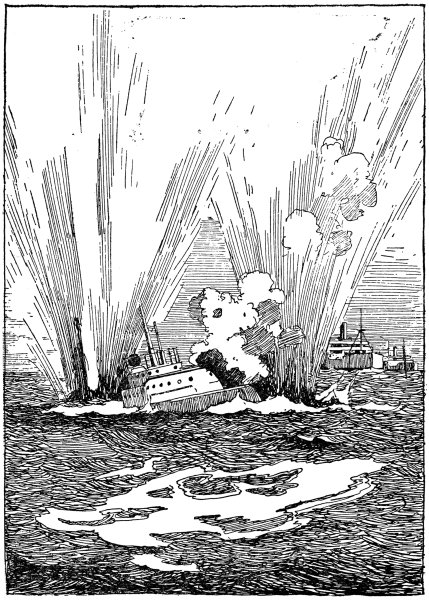
His main idea was to put certain Rickmers steamers
out of action, and perhaps the actual object of his
pursuit was the Lily Rickmers. He did not get her,
but he got something quite as attractive. It was
9.40 A.M., or rather more than four hours from the
start, when at last he put his periscope above water,
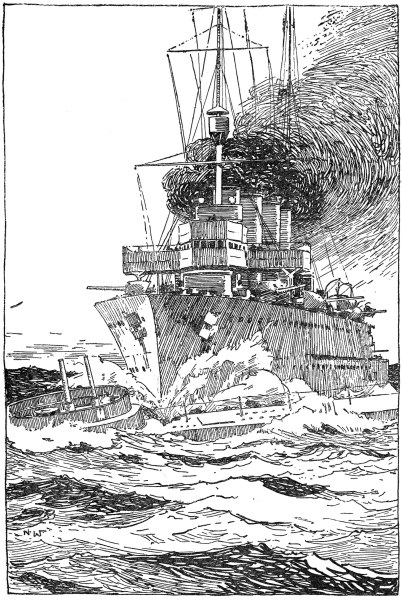
and saw immediately on his starboard beam a large
two-funnelled vessel, painted grey and flying the
Turkish ensign. At 600 yards he fired his starboard
torpedo, put his helm hard a-starboard, and dipped
to avoid remonstrances. The explosion was duly
audible a few seconds later, and as B. 11 came quietly
up of her own motion her commander took a glimpse
through the periscope. The grey ship (she was the
battle-ship Messudiyeh) was still on his starboard beam,
and firing a number of guns. B. 11 seemed bent on
dipping again, but Lieutenant Holbrook was still
more bent on seeing what he had done. He got her up
once more and sighted his enemy, on the port bow
this time. She was settling down by the stern and her
guns were no longer firing.
At this moment the man at the helm of B. 11 reported
that the lenses of the compass had become
fogged, and the instrument was for the time unreadable.
Lieutenant Holbrook took a careful survey of his
surroundings, calculated that he was in Sari Siglar
Bay, and dived for the channel. The boat touched
bottom and for ten minutes went hop, skip and jump
along it, at full speed, until she shot off into deeper
water. Her commander then brought her up again,
took a sight of the European shore, steadied her by
it, and ran for home. By 2 P.M. he had cleared the
entrance. His feat was not only brilliant in itself; it
was an act of leadership, an invaluable reconnaissance.
In ten hours he had proved all the possibilities of the
situation—he had forced a strongly guarded channel,
surprised and sunk a battle-ship in broad daylight,
and returned safely, though he had gone up without
information and come down without a compass. The
V.C. was his manifest destiny.
In the following spring, after the guns of the Allied
fleets had failed to reduce the Turkish forts, the submarine
campaign was developed. It began with a
defeat—one of those defeats which turn to honour,
and maintain the invincibility of our Service. On
April 17, while attempting a difficult reconnaissance
of the Kephez minefield, E. 15 ran ashore in the Dardanelles
within a few hundred yards of Fort No. 8.
Her crew were captured while trying to get her off,
and there was a danger of her falling into the enemy’s
hands in a serviceable condition. The only remedy
was to blow her up. She was no sort of a mark for
the battle-ships at long range; so during the night of
the 18th an attack was made by two picket boats,
manned by volunteer crews. The boat of H.M.S.
Triumph was commanded by Lieut.-Commander Eric
Robinson, who led the expedition, with Lieut. Arthur
Brooke Webb, R.N.R., and Midshipman John Woolley,
and that of H.M.S. Majestic by Lieut. Claud Godwin.
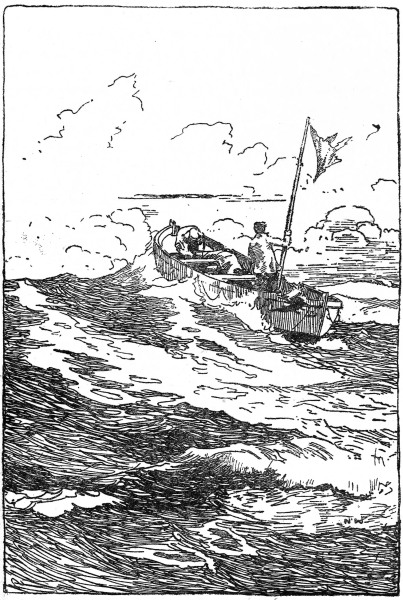
The fort gave them over two hundred rounds at
short range, mortally wounded one man and sank the
Majestic’s boat; but Lieut.-Commander Robinson succeeded
in torpedoing E. 15 and rendering her useless.
He brought both crews off, and left even the Germans
in Constantinople admiring the pluck of his little
enterprise. One officer is reported by Mr. Lewis
Einstein, of the American Embassy there,1 to have
said, ‘I take off my hat to the British Navy.’ He
was right—this midnight attack by a handful of boys
in boats has all the heroic romance of the old cutting-out
expeditions, and on Admiral de Robeck’s report
the leader of it was promoted to commander.
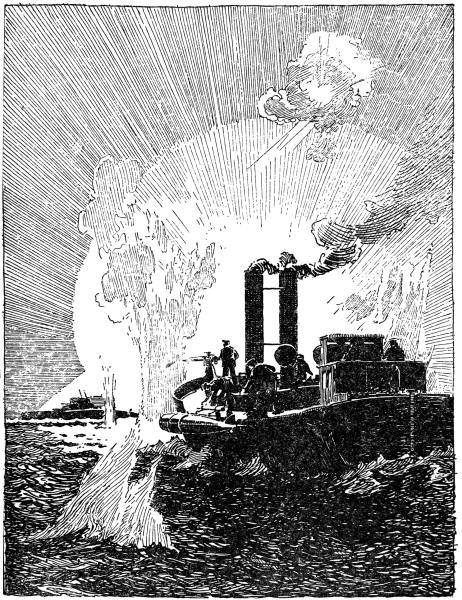
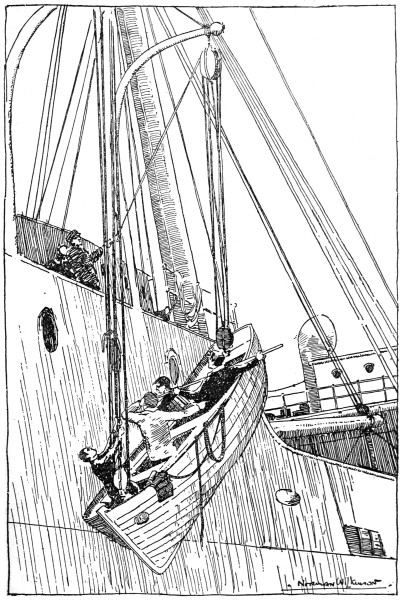
‘The Fort gave them 200 rounds at short range.’
On April 25, A.E. 2 went successfully up and entered
the Sea of Marmora; on the 29th, Lieut.-Commander
Edward Courtney Boyle followed in E. 14. He started
at 1.40 A.M., and the searchlight at Suan Dere was still
working when he arrived there at 4 o’clock. The fort
fired, and he dived, passing clean under the minefield.
He then passed Chanak on the surface with all the
forts firing at him. Further on there were a lot of small
ships patrolling, and a torpedo gunboat at which he
promptly took a shot. The torpedo got her on the
quarter and threw up a column of water as high as her
mast. But Lieut.-Commander Boyle could not stop
to see more—he became aware that the men in a small
steamboat were leaning over and trying to catch hold
of the top of his periscope. He dipped and left them;
then rounded Nagara Point and dived deep. Again
and again he came up and was driven down; destroyers
and gunboats were chasing and firing in all directions.
It was all he could do to charge his batteries at night.
After running continuously for over fifty hours, the
motors were so hot that he was obliged to stop. The
steadiness of all on board may be judged from the
record of the diving necessary to avoid destruction.
Out of the first sixty-four hours of the voyage, the
boat was kept under for forty-four hours and fifty
minutes.
On the afternoon of the 29th, he sighted three destroyers
convoying two troopships; fired and dipped—for
the destroyers were blazing at his periscope, and
he had only that one left—the other had stopped a
shot the day before. But even down below a thud
was audible, and the depth gauges flicked ten feet; half
an hour afterwards he saw through the periscope his
own particular transport making for the shore with
dense columns of yellow smoke pouring from her.
And that was her last appearance. A few hours later
he sighted A.E. 2 and spoke her. She had sunk one
gunboat, but had had bad luck with her other torpedoes
and had only one left. Lieut.-Commander Boyle
arranged to meet her again next day; but next day
the gallant A.E. 2 fell to a Turkish gunboat.
During these days the Sea of Marmora was glassy
calm, and the patrol ships were so troublesome that
Lieut.-Commander Boyle decided to sink one as a
deterrent. He picked off a small mine-laying boat, and
fired at a larger one twice without success, as the wake
of the torpedoes was too easily seen in the clear water.
The first four days of May he spent mainly in being
hunted. On the 5th, he got a shot at a destroyer
convoying a transport, and made a fine right-angle
hit at 600 yards, but the torpedo failed to explode.
This only whetted his appetite, and for three days he
chased ship after ship. One he followed inshore, but
troops on board opened fire on him and hit the boat
several times. At last, on the evening of May 10, after
being driven down by one destroyer, he sighted another
with two transports, and attacked at once. His
first torpedo missed the leading transport; his second
shot hit the second transport and a terrific explosion
followed. Debris and men were seen falling into the
water; then night came on rapidly, and he could not
mark the exact moment at which she sank.
Inside Constantinople they were already telling
each other yarns about E. 14, and for her incredible
activity they even promoted her to the plural number.
‘One of the English submarines in the Marmora,’
Mr. Einstein wrote on May 11, ‘is said to have called
at Rodosto, flying the Turkish flag. The Kaimakam,
believing the officers to be German, gave them all the
petrol and provisions they required, and it was only after
leaving that they hoisted their true colours.’ The
story will not bear examination from our side; but
no doubt it very usefully covered a deficiency in the
Kaimakam’s store account, whether caused by Germans
or by the Faithful themselves.
On May 13, Lieut.-Commander Boyle records a rifle
duel with a small steamer which he had chased ashore
near Panidos. On the 14th he remarks the enemy’s
growing shyness. ‘I think the Turkish torpedo-boats
must have been frightened of ramming us, as several
times, when I tried to remain on the surface at night,
they were so close when sighted that it must have been
possible to get us if they had so desired.’ The air
was so clear that in the daytime he was almost always
in sight from the shore, and signal fires and smoke
columns passed the alarm continually. He had no
torpedoes left and was not mounted with a gun, so
that he was now at the end of his tether. On the 17th
he was recalled by wireless, and after diving all night
ran for Gallipoli at full speed, pursued by a two-funnelled
gunboat, a torpedo-boat and a tug, who shepherded him
one on each side and one astern, ‘evidently expecting,’
he thought, ‘to get me caught in the nets.’ But he
adds,’did not notice any nets,’ and after passing another
two-funnelled gunboat, a large yacht, a battle-ship and
a number of tramps, the fire of the Chanak forts and
the minefield as before, he reached the entrance and
rose to the surface abeam of a French battle-ship of the
St. Louis class, who gave her fellow crusader a rousing
cheer. Commander Boyle reported that the success
of this fine and sustained effort was mainly due to
his officers, Lieutenant Edward Stanley and Acting-Lieutenant
Lawrence, R.N.R., both of whom received
the D.S.C. His own promotion to Commander was
underlined by the award of the V.C.
Within twelve hours of E. 14’s return, her successor,
E. 11, was proceeding towards the Straits. The commanding
officer of this boat was Lieut.-Commander
M. E. Nasmith, who had already been mentioned in
despatches for rescuing five airmen while being attacked
by a Zeppelin in the Heligoland Bight during the action
on Christmas Day, 1914. He had been waiting his
turn at the Dardanelles with some impatience, and as
E. 11’s port engine had been put completely out of
action by an accident on the voyage from Malta, he
had begged to be allowed to attempt the passage into
the Marmora under one engine. This was refused,
but his repairs were finished in time for him to take the
place of E. 14.
He made the passage of the Straits successfully,
reconnoitred the Marmora and made a neat arrangement,
probably suggested by the adventures of E. 14, for
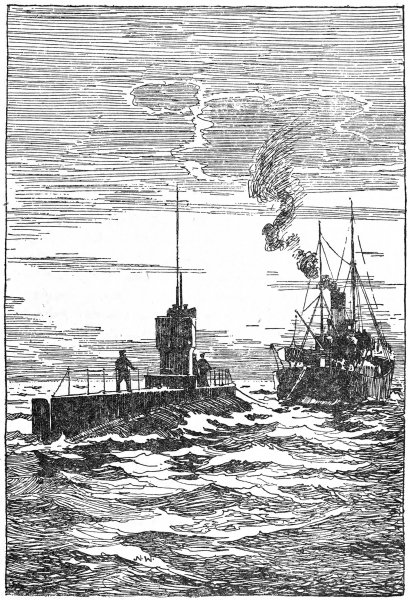
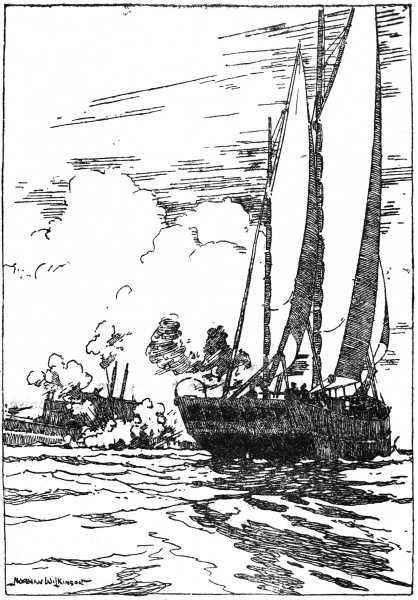
saving the enemy the trouble of so much hunting. He
stopped a small coastal sailing vessel, sent Lieut. D’Oyly
Hughes to search her for contraband, and then trimmed
well down and made her fast alongside his conning-tower.
Being now quite invisible from the eastward,
he was able to proceed in that direction all day without
interruption. At night he released his stalking-horse
and returned westward.

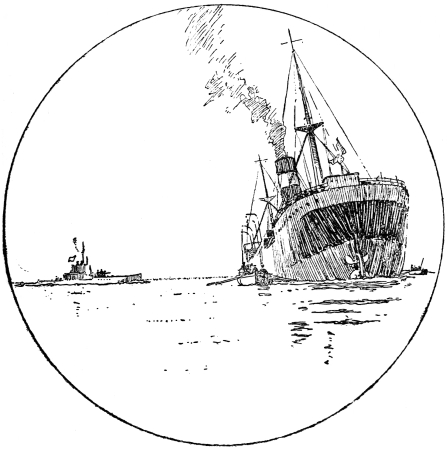
‘Made her fast alongside his conning-tower.’
Early on the 23rd, he observed a Turkish torpedo-boat
at anchor off Constantinople and sank her with
a torpedo; but as she sank she fired a 6-pounder gun,
the first shot of which damaged his foremost periscope.
He came up for repairs, and all hands took the chance
of a bathe. Five hours later he stopped a small steamer,
whose crew did a ‘panic abandon ship,’ capsizing all
boats but one. ‘An American gentleman then appeared
on the upper deck, who informed us that his name was
Silas Q. Swing of the Chicago Sun and that he was
pleased to make our acquaintance.... He wasn’t sure
if there were any stores on board.’ Lieut. D’Oyly
Hughes looked into the matter and discovered a 6-inch
gun lashed across the top of the fore hatch, and other
gun-mountings in the hold, which was also crammed
with 6-inch and other ammunition marked Krupp. A
demolition charge sent ship and cargo to the bottom.
Lieut.-Commander Nasmith then chased and torpedoed
a heavily laden store-ship, and drove another
ashore, exchanging rifle fire with a party of horsemen
on the cliff above. Altogether the day was a lively one,
and the news, brought by Mr. Silas Q. Swing and his
friends, shook Constantinople up severely. Mr. Einstein
records that ‘the submarine came up at 20 minutes to
2 o’clock, about three hundred yards from where the
American guardship Scorpion lay moored, and was
immediately fired at by the shore batteries. It shot off
two torpedoes; the first missed a transport by about
fifty yards, the second struck the Stamboul fair, passing
under a barge moored alongside, which blew up. The
Stamboul had a gap of twenty feet on her water-line
but did not sink. She was promptly towed toward
Beshiktash to lie on the bottom in shallow water. The
submarine meanwhile, under a perfect hail of fire,
which passed uncomfortably close to the Scorpion, dived
and got away, steering up the Bosphorus. At Galata
there was a panic, everyone closing their shops; the
troops, who were already on two transports, were
promptly disembarked, but later re-embarked, and
still later landed once more. The total damage was
inconsiderable, but the moral effect was very real.’
On the following day he adds, ‘S.’ (Swing, no doubt—Silas
Q. Swing of the Chicago Sun) ‘came in with an
exciting tale. On his way to the Dardanelles the steamer,
which carried munitions and a 6-inch gun, had been
torpedoed by an English submarine, the E. 11. They
allowed the crew to leave, and then sank the ship.
The English officer told him there were eleven submarines
in the Marmora, and these are holding up all
the ships going to the Dardanelles. They had sunk
three transports full of troops, out of four which had
been sunk, and various other vessels, but do not touch
those carrying wounded.’
So, between Lieut. D’Oyly Hughes and Mr. Silas
Q. Swing, the E. 11 became eleven submarines, and
may go down the ages like the eleven thousand virgins of
Cologne. Her commander evidently hoped to create
a panic, and Mr. Einstein leaves us no doubt that the
plan succeeded to the full. On May 27 he writes again:
‘The Marmora is practically closed by English submarines.
Everyone asks where their depot is, and
how they are refurnished.’ May 28: ‘The submarines
in the Marmora have frightened the Turks, and all the
remaining transports, save one, lie tranquilly in the
Golden Horn. Otherwise I have never seen the port so
empty. One wonders where the submarines have their
base, and when and how it was prepared.’ He adds,
with some shrewdness: ‘Probably, if at all, in some
island of the Marmora, though the newer boats can
stay out a long time.’ E. 11 was far from new, as
we have seen, but she was in hands that could make
her stand for quality as well as quantity.
Lieut.-Commander Nasmith brought his boat safely
back to Mudros on June 7. The last hour of his trip
was perhaps the most breathless, for while rushing
down by Kilid Bahr he found his trim quite abnormal,
and ‘observed a large mine preceding the periscope at
a distance of about twenty feet; which was apparently
hung up by its moorings to the port hydroplane.’ He
could not come to the surface, as the shore batteries
were waiting for him; but when outside Kum Kale, he
emptied his after-tanks, got his nose down, and went
full speed astern, dropping the mine neatly to the
bottom. This was good work, but not better than
the skill shown in navigating shoal water, or ‘the
resource displayed in the delicate operation of recovering
two torpedoes’ without the usual derrick to hoist
them in—an operation which may as well remain for
the present undescribed. Admiral de Robeck, in
recommending Lieut.-Commander Nasmith for the
V.C., speaks of his cruise as one ‘which will
surely find a place in the annals of the British Navy.’
It will—there can be no forgetting it. The very log
of E. 11 deserves to be a classic. ‘Having dived
unobserved into Constantinople ...,’ says her Commander
soberly, and so, without a thought of it, adds
one to the historic despatches of the Service.
It was now E. 14’s turn again. Commander Courtney
Boyle took her up on June 10, against a very
strong tide. At 9 o’clock next morning he stopped
a brigantine, whose crew abandoned ship ‘and then
all stood up and cursed us. It was too rough to go
alongside her, so Acting-Lieut. R. W. Lawrence, R.N.R.,
swam off to her, climbed aboard, and ... set fire to
her with the aid of her own matches and paraffin oil.’
On the 12th one of the Rickmers steamers was torpedoed.
Shortly afterwards there was a big explosion close to
the submarine. ‘And I think,’ says her commander,
‘I must have caught the moorings of a mine with my
tail as I was turning, and exploded it.... The whole
boat was very badly shaken.’ But Lily Rickmers and
her sister were now both removed from the Turkish
service, for E. 11 had evidently accounted for one of
them already. Mr. Einstein writes on June 13: ‘The
German Embassy approached us to cable Washington
to protest about the torpedoing without warning of
the two Rickmers steamers in the Marmora. One of
these was said to be filled with wounded, but their
note neglected to say that these had been discharged
from hospital and were on their way back to the Dardanelles.’
Only a German diplomatist could speak of
a ship carrying troops to the front as ‘filled with
wounded’; and Mr. Einstein adds, ‘One cannot but
be struck by the German inability to understand our
position over the Lusitania.’ The point is plain, and
goes deep. To the modern German mind all such considerations
are only a matter of words, useful for argumentative
purposes—that there should be any truth
of reality or feeling behind them is not imaginable.
The rest of this log is a record of destruction, but
destruction on thoroughly un-German methods. ‘June
20.—Boarded and sank 3 sailing dhows ... towed the
crew inshore and gave them some biscuit, beef, rum,
and water, as they were rather wet.’ ‘June 22.—Let
go passenger ship.’ 23.—‘Burnt two-master, and started
to tow crew in their boat, but had to dive. Stopped
two dhows: they were both empty and the crews looked
so miserable that I only sunk one and let the other go.’
24.—‘Blew up 2 large dhows: there was another one
about a mile off with no boat ... and thought I saw
two heads in the water. Turned round and found that
there were 2 men in the water at least half a mile from
their dhow. Picked them up: they were quite exhausted:
gave them food and drink, and put them on
board their ship. They had evidently seen the other
two dhows blown up and were frightened out of their
wits.’ There is nothing here to boast about—to us,
nothing surprising. But it brings to mind inevitably
the evidence upon which our enemies stand convicted.
We remember the long roll of men and women not only
set adrift in stormy seas, but shot and drowned in
their open boats without pity and without cause. We
admit the courage of the Hun, but we cannot admire
it. It is too near to animal ferocity, and stained with
a cruelty and callousness which are not even beast-like.
On June 21, Commander Boyle had rendezvoused
with E. 12, Lieut.-Commander K. M. Bruce. ‘I got
her alongside, and we remained tied up for 3 hours.’
From this time onward the reliefs were arranged to
overlap, so that there were nearly always two boats
operating at the same time in the Marmora. Lieut.-Commander
Bruce came up on June 19, and found,
like others, that the chief difficulty of forcing the passage
was the heating of the main motors on so long and
strenuous a run.
The one great day of his nine days’ patrol was
June 25, when he brought off a hand-to-hand fight on
the surface with three enemy ships. At 10.45 in the
morning he sighted, in the Gulf of Mudania, a small
two-decked passenger steamer. ‘She looked,’ he says,
‘rather like a tram-car, and was towing two sailing-vessels.
In the distance was a sister of hers, towing
three more.’ He chased, and soon stopped the nearer
steamer. He could see, as he steamed round her, that
she was carrying a lot of stores. She had no boat, and
all the crew appeared to be on deck in lifebelts. He
could see no sign of guns, so he ran his bow up alongside
and sent his first-lieutenant, Tristram Fox, to board
her. But guns are not the only risk a submarine has
to take on such occasions. As the boarding party
stepped on board the steamer, a Turk heaved a bomb
over the side. It hit E. 12 forward, but did not explode,
and no second one followed. The Turks, however, meant
fighting, and they opened fire with rifles and a small
gun, concealed somewhere aft. The situation was a
very anxious one, especially for Lieutenant Fox and
his boarding party; for they knew their own ship must
open fire in return, and it was difficult to take cover on
an enemy ship in action. Lieut.-Commander Bruce
was in a very tight corner, but he kept his head and
played his game without a mistake. He did not
hesitate to open fire with his 6-pounder, but he began
upon the enemy’s stern, where the gun was concealed,
and having dealt with that he turned to her other end
and put ten shots into her from fore to aft. His men
shot steadily, though under gun and rifle fire at a range
of only ten yards, and his coxswain, Charles Case,
who was with him in the conning-tower, passed up the
ammunition. Spare men, with rifles, kept the Turks’
heads down, and all seemed to be going well, when the
two sailing-ships in tow began a new and very plucky
move of their own. They came in to foul the submarine’s
propellers, and at the same time opened fire
with rifles, taking E. 12 in flank. But by this time the
steamer was beaten, and the British rifles soon silenced
those in the sailing-ships. Then, as soon as Lieut.-Commander
Bruce had cleared the steamer, he sank
the three of them. The steamer had probably been
carrying ammunition as well as stores, for one of the
shots from the 6-pounder touched off something explosive
in her forward part. In fifteen minutes she was
at the bottom.
Lieut.-Commander Bruce was already thinking of
the other steamer with the three sailing-ships in tow.
She was diligently making for the shore, and he had
to open fire at her at 2000 yards. As he closed, the fire
was returned, not only from the ship but from a gun
on shore; but by this time he had hit the enemy aft,
and set her on fire forward. She beached herself,
and as the three sailing-ships had been slipped and were
also close under the shore, he had no choice but to
leave them. E. 12’s injuries were miraculously slight—her
commander’s account of them is slighter still. ‘I
was very much hampered,’ he says, ‘in my movements
and took some minutes to get clear of the first steamer.
But only one man was hurt, by a splinter from the
steamer.’ This was quite in accordance with the old
English rule of the gun-decks: to hit and be missed
there’s nothing like closing. The story of this fine
little scrimmage ends with the special recommendation
by Lieut.-Commander Bruce of his first-lieutenant,
Tristram Fox, ‘who behaved exceedingly well under
very trying circumstances,’ and of his coxswain, Charles
Case, and three seamen—they all received the Distinguished
Service Medal. Of the commander himself
we shall hear again presently.
E. 12 was recalled on June 28, leaving E. 14 still
at work; and on the 30th her place was taken by
E. 7, Lieut.-Commander Cochrane. On the way up, a
torpedo from a tube on shore passed over him, and a
destroyer made two attempts to ram him, but he got
safely through and rendezvoused with E. 14 on the
following evening. His misfortunes began next day,
when Lieut. Hallifax and an A.B. were badly burned
by an explosion in the hold of a captured steamer.
Then dysentery attacked the two remaining officers
and the telegraphist. Work became very arduous,
but work was done notwithstanding. Ship after ship
was sunk—five steamers and sixteen sailing-ships in
all. One of the steamers was ‘a Mahsousie ship, the
Biga,’ of about 3,000 tons. She was lying alongside
Mudania Pier, with sailing-vessels moored outside
the pier to protect her. But Lieut.-Commander
Cochrane saw daylight between this barrage and his
prey; he dived under the sailing-ships, and up went
the Biga with a very heavy explosion.
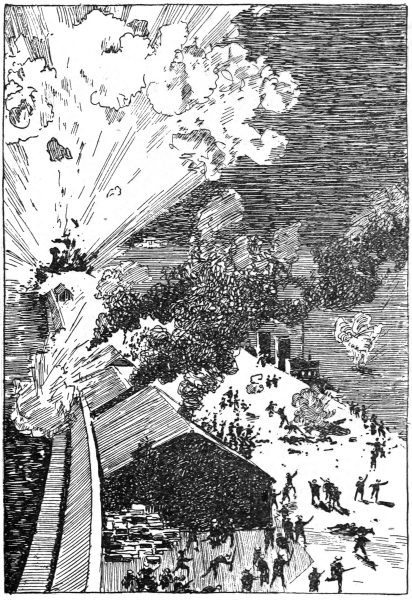
On July 17, he tried a new method of harassing the
Turkish army. He came up opposite Kara Burnu
and opened fire on the railway cutting west of it,
blocking the line—then dived, and went on to Derinjie
Burnu. The shipyard there was closed, but he observed
a heavy troop train steaming west, towards the block
he had so carefully established just before. He followed
up at full speed, and after twenty minutes of anxious hope
saw the train returning baffled. It eventually stopped
in a belt of trees at Yarandji Station; this made
spotting difficult, but E. 7’s gunnery was good enough.
After twenty rounds the three ammunition cars of the
train were definitely blown up, and E. 7 could move
back to Kara Burnu, where she shelled another train
and hit it several times.
All this was very disturbing to the Turks, and they
tried every means to stop it at the source. They had
already a net in the channel, but it was quite ineffectual.
‘Now,’ says Mr. Einstein on July 15, ‘it turns out that
they have constructed a barrage of network to keep
out the submarines from the Dardanelles, and this
explains the removal of the buoys all along the Bosphorus.
They need these, and especially their chains,
to keep it in place.’ A week later, Lieut.-Commander
Cochrane saw these buoys on his way down. They
were in a long line, painted alternately red and black,
and stretching from a position a mile north of Maitos
village to a steamer moored in Nagara Liman. He
dived under them and went on his way; but later on,
below Kilid Bahr, the boat fouled a moorings forward
and was completely hung up, swinging round, head
to tide. By admirable management she was got clear
in half an hour, and then the same thing happened
again. ‘This time,’ says her commander coolly, ‘I
think the boat carried the obstruction with her for
some distance. I was expecting to see something foul
when we came to the surface, but everything was clear
then.’ What he and his men saw, during those two
half-hours, might also be described as ‘something
foul.’
The cruise of E. 7 lasted for over three weeks, from
June 30 to July 24. On July 21, Commander Courtney
Boyle brought up E. 14 once more. He, too, saw the
new net near Nagara, ‘a line of what looked like lighters
half-way across, and one small steamship in the vicinity.’
But he passed through the gate in it without touching
anything. This was lucky, as he had already scraped
against an obstruction off Kilid Bahr and cut his guard
wire nearly through. Once up, he got to work at
once, and in a busy and adventurous three weeks he
sank one steamer, one supply ship, seven dhows and
thirteen sailing-vessels. In short, he made himself
master of the Marmora. The complete interruption
of the Turkish sea communications was proved by the
statements of prisoners. The captain of one ship
stated that Constantinople was full of wounded and
short of food, and that the troops now all went to
Rodosto by rail and then marched to Gallipoli—six
hours in the train and three days and nights marching,
instead of a short and simple voyage. All the Turkish
war-ships were above the second bridge in the Golden
Horn, and they never ventured out. There were no
steamers going to sea—all supplies to Gallipoli went in
sailing craft, towed by destroyers under cover of darkness.
It is clear that, to the Turkish imagination,
E. 14 was like E. 11—very much in the plural number.
On August 5, E. 11 herself came on duty again, and the
two boats met at rendezvous at 2 P.M. next day. Half
an hour afterwards, Commanders Boyle and Nasmith
started on their first hunt in couples. Their quarry
was a gunboat of the Berki-Satvet class. The chase
was a lively one, and it was E. 11, in the end, who
made the kill with a torpedo amidships. Then the two
boats came alongside again and their commanders
concerted a plan for shelling troops next day.
They took up their positions in the early morning
hours, and waited for the game to come past. Commander
Nasmith had been given the better stand of the
two; at 11.30 A.M. he observed troops going towards
Gallipoli, rose to the surface and fired. Several of
his shots dropped well among them and they scattered.
In less than an hour another column approached
along the same road. E. 11 had retired, so to speak,
into her butt; she now stepped up again, raised her
gun, and made good shooting as before. ‘The column
took cover in open order.’
In the meantime Commander Boyle had been diving
up and down all the morning between Fort Victoria
and a point four miles up the coast to the east, about
a mile from shore. Three times he came to the surface,
but each time the troops turned out to be bullocks.
At 1.30 P.M. (when he came up for the fourth time) more
dust was coming down the road, and this time it was
the right kind of dust. As he opened fire he heard
E. 11 banging away. She had left the place where he
had stationed her, to the N.E. of Dohan Aslan Bank,
and had come down to join him in his billet. The two
boats then conducted a joint action for the best part
of an hour. Commander Boyle got off forty rounds,
of which about six burst on the road among the troops,
and one in a large building. But the distance was
almost beyond his 6-pounder’s reach. He had to put
the full range on the sights, and then aim at the top
of the hill, so that his fire was less accurate than
that of Commander Nasmith with his 12-pounder. E. 11
had strewed the road with a large number of dead
and wounded, when guns on shore came into action
and forced her to dive. She came up again an hour
and a half later and dispersed the troops afresh, but
once more had to dive for her life.
Next day, Commander Boyle ordered E. 11 to
change billets with him, and both boats had luck, Commander
Boyle destroying a 5,000-ton supply steamer with
torpedo and gunfire, and Commander Nasmith bagging
a battle-ship. This last was the Haireddin Barbarossa.
She was passing about five miles N.E. of Gallipoli,
escorted by a destroyer. E. 11 was skilfully brought
into position on her starboard beam, and the torpedo
got home amidships. The Barbarossa immediately
took a list to starboard, altered course towards the
shore, and opened a heavy fire on the submarine’s
periscope. But she was mortally hit. Within twenty
minutes a large flash burst from her fore part, and she
rolled over and sank. To lose their last battleship,
and so near home, was a severe blow for the Turks, and
they made every effort to conceal the depressing details.
Mr. Einstein, however, heard them and makes an
interesting entry. ‘The Barbarossa was sunk in the
Marmora and not in the Dardanelles, as officially announced.
She was convoying barges full of munitions
and also two transports, when she found herself surrounded
by six submarines.’ It is creditable to Commander
Nasmith that he did so well with only six of
his E. 11 flotilla. Einstein continues: ‘The transports
were supposed to protect her, but the second torpedo
proved effective and she sank in seven minutes. One
of the transports and a gunboat were also sunk, the
other ran aground. Of crews of 700, only one-third
were saved.’ And on August 15 he records further
successes by Commander Nasmith—a large collier, the
Ispahan, sunk while unloading in the port of Haidar
Pasha, the submarine creeping up under the lee of
another boat; and two transports with supplies, the
Chios and the Samsoun, sunk in the Marmora.
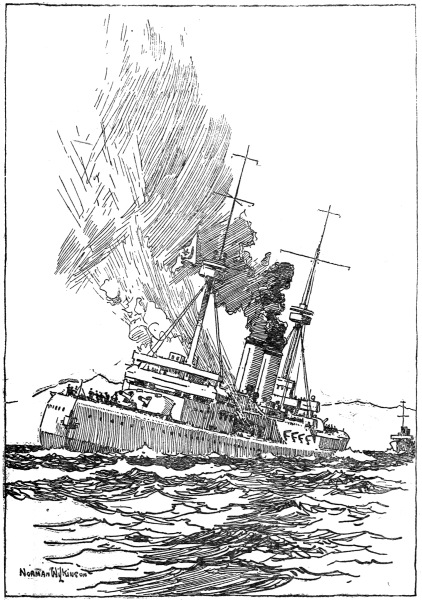
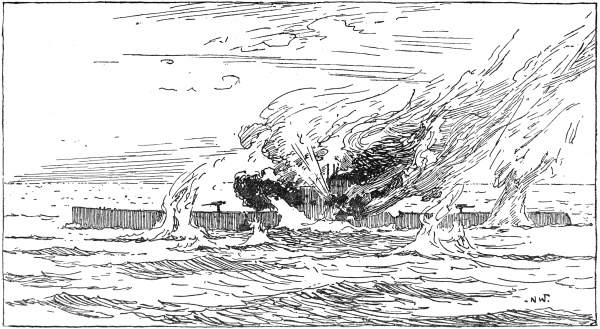
‘She was mortally hit.’
Commander Boyle returned to his base on August 12,
with no further difficulty than a brush against a mine
and a rough-and-tumble encounter with an electric
wire obstruction, portions of which he carried away
tangled round his periscope and propellers. His boat
had now done over 12,000 miles since leaving England
and had never been out of running order—a magnificent
performance, reported by her commander to be
primarily due to the excellence of his chief engine-room
artificer, James Hollier Hague, who was accordingly
promoted to warrant rank, as from the date of the
recommendation.
E. 14 was succeeded on August 13 by E. 2, Commander
David Stocks, who met Commander Nasmith
at 2 P.M. next day, and handed over a fresh supply
of ammunition for E. 11. He also, no doubt, told him
the story of his voyage up. Off Nagara his boat had
fouled an obstruction, and through the conning-tower
scuttles he could see that a 3½-inch wire was wound with
a half turn round his gun, a smaller wire round the
conning-tower itself, and another round the wireless
standard aft. It took him ten minutes’ plunging and
backing to clear this and regain control; and during
those ten minutes, small explosions were heard continuously.
These were apparently from bombs thrown
by guard boats; but a series of loud explosions, a little
later, were probably from shells fired by a destroyer
which was following up, and was still overhead an
hour afterwards.
The two boats parted again, taking separate beats,
and spent a week in sinking steamers, boarding hospital
ships, and bombarding railway stations. When they
met again on the evening of August 21, Commander
Nasmith had a new kind of yarn to tell. His lieutenant,
D’Oyly Hughes, had volunteered to make an attack on
the Ismid Railway, and a whole day had been spent
behind Kalolimno Island in constructing a raft capable
of carrying one man and a demolition charge of gun-cotton.
Then the raft had been tested by a bathing
party, and the details of the plan most carefully laid
out.
The object was to destroy the viaduct if possible;
but, in any case, to blow up part of the line. The risk
involved not only the devoted adventurer himself,
but the boat as well, for she could not, so long as he had
still a chance of returning, quit the neighbourhood or
even conceal herself by submerging. The approach
was in itself an operation of the greatest delicacy.
Commander Nasmith took his boat slowly towards the
shore until her nose just grounded, only three yards
from the rocks. The cliffs on each side were high enough
to prevent the conning-tower being seen while in this
position. At 2.10 A.M. Lieut. D’Oyly Hughes dropped
into the water and swam off, pushing the raft with his
bale of gun-cotton, and his clothes and accoutrements,
towards a spot some sixty yards on the port bow of the
boat. His weapons were an automatic service revolver
and a sharpened bayonet. He also had an electric torch
and a whistle. At the point where he landed he found
the cliffs unscalable. So he relaunched his raft and
swam along to a better place. He reached the top
after a stiff climb, approached the railway line by a
careful prowl of half an hour, and went along it for five
or six hundred yards, hugging his heavy and cumbersome
charge. Voices then brought him up short.
He peered about and saw three men sitting by the side
of the line. After watching them for some time he
decided that they were not likely to move, and that
he must make a wide detour in order to inspect the
viaduct. He laid down his gun-cotton, and crept
inland, making good progress except for falling into a
small farmyard, where the fowls, but luckily not the
household, awoke and protested. At last he got within
three hundred yards of the viaduct. It was easy to see,
for there was a fire burning at the near end of it;
but there was also a stationary engine working, and
a number of workmen moving about. Evidently it
would be impossible to bring up and lay his charge
there.
He crept back therefore to his gun-cotton and
looked about for a convenient spot to blow up the
line. The best place seemed to be a low brick-work
support over a small hollow. It was only 150 yards
from the three men sitting by the line; but there was
no other spot where so much damage could be done,
and Lieut. D’Oyly Hughes was a volunteer, prepared
to take risks. He muffled the pistol for firing the fuse
as tightly as possible, with a piece of rag, and pulled
off. On so still a night it made a very loud noise.
The three Turks heard it and he saw them instantly
stand up. The next moment they were running down
the line, with Lieutenant D’Oyly Hughes going his
best in front of them. But a chase of this kind was
not what he wanted. His present object was to find a
quiet spot on the shore where he could take to the water
undisturbed, and he had no time to lose. He turned
on his pursuers and fired a couple of shots; the Turks
were not hit, but they remembered their own weapons
and began firing too, which was just the relief Lieut.
Hughes needed.
He had already decided against trying to climb
down by the way he had come up; but after a considerable
run eastward, he struck the shore more
conveniently about three-quarters of a mile from the
small bay in which E. 11 was lying. As he plunged
into the water, he had the joy of hearing the sound of
a heavy explosion. His charge had hung fire for a
long time, but when it went it went well; fragments
were hurled between a quarter and half a mile, and
fell into the sea near the boat. There could be no
doubt that the line was effectively cut; and he could
now give his whole attention to saving an officer to
the Service.
This was the most desperate part of the affair.
After swimming some four hundred or five hundred yards
out to sea, he blew a long blast on his whistle; but the
boat was behind the cliffs in her little bay and failed to
hear him. Day was breaking rapidly; the time of
waiting for him must, he knew, be limited. With a
decision and coolness beyond comment he swam ashore
again and rested for a short time on the rocks—then
swam off once more, directly towards the boat. Before
he reached the bay, he had to discard in turn his pistol,
his bayonet, and his electric torch. At last he rounded
the point and his whistle was heard; but, at the same
moment, shouts came from the cliffs overhead, and
rifle fire opened on the boat.
She immediately backed, and came slowly astern
out of the bay, intent only upon picking up Lieut.
D’Oyly Hughes. But now came the most extraordinary
part of the whole adventure. In the early
morning mist the bow, the gun, and the conning-tower
of the submarine appeared to her distressed officer to be
three small rowing-boats advancing towards him, and
rowing-boats could only mean enemies. He turned,
swam ashore, and tried to hide himself under the cliffs.
But he did not lose his head, and after climbing a few
feet he looked back and realised his mistake. He
shouted and plunged in again. Forty yards from the
rocks he was at last picked up, nearly done, for he had
run hard for his life and swum a mile in his clothes. But
he had done his work and E. 11 was proud of him, as
appears from the concluding sentence in her log: ‘5.5
A.M. Dived out of rifle fire, and proceeded out of the
Gulf of Ismid.’
Commander Nasmith ended his cruise with a brilliant
week’s work. On August 22 he fought an action with
three armed tugs, a dhow, and a destroyer; succeeded
most adroitly in evading the destroyer, sinking the
dhow and one of the tugs by gunfire, and capturing a
number of prisoners, among whom was a German bank
manager with a quantity of money for Chanak Bank.
The prisoners willingly helped to discharge the cargo
of another captured ship—they were apparently much
surprised at being granted their lives. On the 25th,
two large transports were sunk with torpedoes; on
the 28th, E. 11 and E. 2, in company, bombarded
the magazine and railway station at Mudania. On
September 1, Commander Nasmith had an hour’s
deliberate shooting at the railway viaduct, scoring a
large number of hits; and on the 3rd he returned
without misadventure to his base.
Left to herself, E. 2 now found that she also possessed
a heroic lieutenant. Under the date September 7
there stands the brief record: ‘Lieutenant Lyon swam
to and destroyed two dhows.’ The story, so well begun,
ends next day. At 2.15 A.M. this adventurer, like the
other, swam off with a raft and bag of gun-cotton. His
object, like the other’s, was to destroy a railway bridge.
His friends watched him until, at seventy yards’ distance,
he faded into the dusk. From that moment onwards
no sound was ever heard from him. The night was
absolutely still, and noises on shore were distinctly
audible; but nothing like a signal ever came. It had
been agreed that if any trouble arose he should fire his
Webley pistol, and the submarine should then show
a red light and open fire on the station, which was
300 yards distant. For five hours she remained there
waiting. An explosion was heard, but nothing followed,
and broad daylight found Commander Stocks still
waiting with desperate loyalty. At 7.15 he dived out
to sea. An hour later he came to the surface and cruised
about the place, hoping that Lyon had managed somehow
to get into a boat or dhow. There were several
near the village, and he might be lying off in one. But
no boat drifted out, then or afterwards. Commander
Stocks came again at dawn next day—perhaps, as he
said, to bombard the railway station, perhaps for another
reason. Six days later he dived for home, breaking
right through the Nagara net, by a new and daring
method of his own.
It was now Lieut.-Commander Bruce’s turn again,
and he passed all records by patrolling the Marmora
successfully in E. 12 for forty days. He had two other
boats in company during part of this time—E. 20 and
H. 1—and with the latter’s help he carried out a very
pretty ‘spread attack’ on a gunboat off Kalolimno, on
October 17. The intended manœuvre was for E. 12 to
rise suddenly and drive the enemy by gunfire over H. 1,
who dived at the first gun. The first drive failed, the
second was beautifully managed; but, in the bad light
of an approaching squall, H. 1’s torpedo missed. In a
third attempt the bird was reported hit by several
shells, but she escaped in the darkness. Lieut.-Commander
Bruce also did good shooting at a powder
factory near Constantinople; sank some shipping, and
made some remarkable experiments with a new method
of signalling. But his greatest experience was his
return journey.
He had passed through the net, he thought, but
suddenly observed that he was towing a portion of it
with him. The boat began to sink quickly, bows down;
the foremost hydroplane jammed. He immediately
forced her nose up, by blowing ballast tanks and driving
her at full speed. But, even in that position, she continued
to sink till she reached 245 feet. At that
depth the pressure was tremendous. The conning-tower
scuttles burst in, and the conning-tower filled with water.
The boat leaked badly, and the fore compartment had
to be closed off to prevent the water getting into the
battery, where it would have produced the fatal fumes
of chlorine gas.
For ten mortal minutes the commander wrestled
with his boat. At last, by putting three men on to
the hydroplane with hand-gear, he forced the planes
to work and the boat rose. He just managed to check
her at twelve feet and got her down to fifty, but even
at that depth six patrol vessels could be heard firing
at her—probably she was still towing something which
made a wake on the surface.
Blind, and almost unmanageable, E. 12 continued to
plunge up and down, making very little way beyond
Nagara. The conning-tower and its compass were out
of action, but the commander conned his boat from the
main gyro compass, and when both diving gauges failed
he used the gauge by the periscope. The climax was
reached when at eighty feet, just to the south of Kilid
Bahr, another obstruction was met and carried away.
But this was a stroke of luck, for when the commander,
by a real inspiration, put on full speed ahead and worked
his helm, the new entanglement slid along the side
of the boat and carried away with it the old one from
Nagara. The boat rose steeply by the bow and broke
surface. Shore batteries and patrols opened fire, and
a small shell cracked the conning-tower; others hit the
bridge, and two torpedoes narrowly missed her astern.
But she came safely through to Helles, and reached her
base after a cruise of over 2,000 miles.
H. 1 also put nearly 2,000 miles to her credit, though
her cruise lasted only thirty days, as against E. 12’s
forty. Lieutenant Wilfred Pirie, her commander, took
a hand in Lieut.-Commander Bruce’s signalling experiments
and co-operated in several of his military
enterprises, as we have already seen. He also worked
with E. 20 and was the last to meet her. This was on
October 31, the day before he dived for home. After
that, nothing more was heard of her till December 5,
when Commander Nasmith, who was once more in the
Marmora with E. 11, captured a Shirket steamer and
obtained much information from the captain, a French-speaking
Turk. According to his statement, E. 20 had
been ambushed, and her officers and crew taken prisoners.
He also gave details of the German submarines based
at Constantinople—he thought there were ten of them,
including three large ones. Before accepting this,
we shall do well to refer again to Mr. Einstein, who
reports four small boats coming from Pola, of which
only three arrived; and one larger one, U. 51, of which
he tells an amusing story. U. 51 had been at Constantinople,
but during August she went out and did
not return; it was rumoured that she had gone home,
or been sunk. Then the Turks were electrified by
news of the arrival of a new German super-submarine,
over two hundred feet long. All Constantinople
crowded to see her go out on August 30. ‘Departure
from Golden Horn of a new giant German submarine,
the U. 54, over 200 feet long and with complete wireless
apparatus.’ Next day: ‘The U. 54 turns out to be our
old friend U. 51, with another number painted.’ On
September 2 Mr. Einstein adds sarcastically: ‘Report
that U. 54 was badly damaged by a Turkish battery
at Silivri.... To mask this, they are spreading the
rumour that an English submarine ran aground, and
will doubtless bring in the German boat under a false
number as though she were a captured prey.’ And
two days later he was justified—‘U. 54 lies damaged
in the Golden Horn from the fire of a Turkish battery.
The reported sinking of an English boat is a downright
lie.’
Commander Nasmith went down the Straits on
December 23, after a record cruise of forty-eight days.
In that time he sank no less than forty-six enemy ships,
including a destroyer, the Var Hissar, and ten steamers.
A fortnight before he left, E. 2, Commander Stocks,
came up, and did good work in very bad weather,
until she was recalled on January 2, 1916. The season
was over, and she found, in passing down the Straits, that
the Turkish net had apparently been removed, either
by the enemy themselves, or perhaps by the wear and
tear of British submarines repeatedly charging it and
carrying it away piecemeal.
So ended our Eastern submarine campaign—a
campaign in which our boats successfully achieved
their military objects—in which, too, the skill of our
officers and men was only surpassed by their courage,
and by their chivalrous regard for the enemies whom
they defeated.