TRADITION plays a more important part, perhaps, in the interpretation
of the classic composers’ writings for the voice than it does in their
purely instrumental works. The old masters left few—sometimes not
any—indications as to the manner in which their music should be
rendered. Thus its proper performance is largely determined by
received oral tradition. The printed scores of the classics, except
those that have been specially edited, throw little light on their
proper interpretation, or even at times on the actual notes to be
sung. To perform exactly as written the operas of Gluck, notably
Armide and Orphée, the operas of Mozart, the Italian operas and
English oratorios of Handel, the oratorios of Bach, Haydn, and
Mendelssohn, would be to do the greatest injustice to these composers
and their works.
It is a prevalent idea that all departures from the published text are
due either to caprice, or to vanity and a desire for personal display
on the part of the soloist. As though singers had a monopoly of these
defects!
Let us consider some of the principal causes of such changes in the
text, and the reasons why these modifications do not always appear in
the published versions.
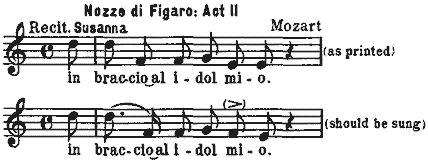
In the original editions of many of the earlier operas, as those of
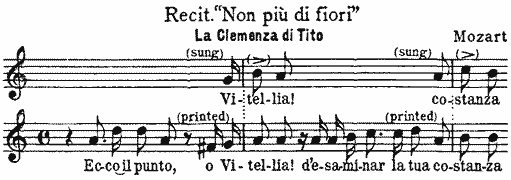
Mozart, etc., the unaccompanied recitative (recitativo secco) is
not barred. As with the plain-chant of the church, only the pitch of
the tone is indicated. Its length was left to the discretion of the
artist, who was supposed to be familiar with the accepted style of
delivery termed “recitativo parlante.” The example is from the
recitative “Dove sono,” in Act III of Le Nozze di Figaro, by Mozart:

[Listen]
This should be sung as below:

[Listen]
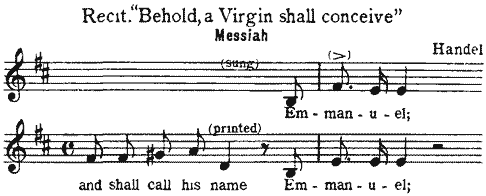
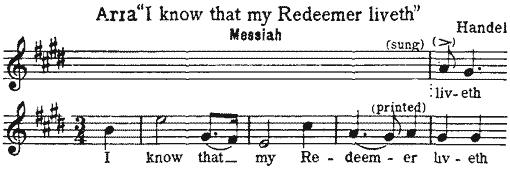
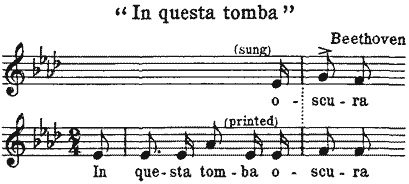
The substitution of another note for the one actually written, both in
Recitative and Aria, was also strictly regulated under the system or
convention then in vogue, one perfectly understood both by composer
and singer.
In all the earlier Italian operas, and in the English oratorios of
Handel, this system was followed:
[Listen]
[Listen]
[Listen]
[Listen]
This substitution, therefore, of another note—a tone or semitone
higher or lower, according to the phrase—is not only legitimate but
essential in all music written in the Italian manner.
Another cause of changes being necessary in the vocal part of many of
the older classic writers, particularly of oratorio, is the frequently
faulty syllabic accentuation. I have already mentioned this defect in
the chapter on Accent. Handel, for instance, although living nearly
all his life in England, never became quite master of its language;
hence the numerous cases of the misplacing of syllables in his
oratorios. This defect is also noticeable, but not in the same degree,
in his Italian operas. The books of Elijah and St. Paul
(Mendelssohn), and The Creation (Haydn), were originally written in
German, and therefore suffer somewhat in this respect when the
translated English version is given. This fault is also noticeable in
the English versions of Bach’s Passion (St. Matthew), and
Mendelssohn’s Psalm CXIV. In the first quoted of these two works, in
the response for Double Chorus to the question, “Whether of the twain
will ye that I release unto you?” the accent falls on the first
syllable “Ba-rab-bas”; in the second of the two works (114th
Psalm), the accent is placed on the last syllable, thus:
“Hal-le-lu-jah.” Neither of these accentuations is in accordance
with English custom.
A singer, therefore, is perfectly justified in rearranging the
syllables in order that, as far as possible, the musical and verbal
accents shall coincide. But there are rigorists, unaware of the usages
and conventions previously spoken of, who are very severe in their
judgment when any deviation is made from the printed score with which
they follow the performance of classic works. Such severity is
unmerited, because unjust. Although such persons sometimes inveigh
against any and every change from the strict letter of the printed
music—ignorant of the possibility, that only in this way can its
spirit be respected—the changes in a multitude of cases are essential
because due (1) to reverential deciphering of an obsolete musical
notation, (2) to improvements in musical instruments, or (3) to the
sanction and authority of the composer himself.
Sometimes it is an orchestral conductor who reproaches the solo
singers with their want of respect for the composer, because he hears
at times interpolations or changes which find no place in his own
score. The singers are accused of “altering the composer,” of “taking
liberties with the text.” And yet these very changes may be
traditionally correct; they may be in accordance with rules and
conditions prevalent at the time the music was written, and employed
on account of a desire to interpret the composer’s own intentions, and
not from mere vanity or caprice.
Nor are these necessary changes and departures from the printed scores
of the classics confined to the vocal parts of the music composed by
the old masters. As a matter of fact, the deviations which, in
performance, are sometimes made from the printed edition of a musical
composition, arise from a variety of causes.
One of these is the discrepancy that exists between various editions
of the same work; and sometimes the confusion is complicated by
different versions having been prepared by the composer himself. This
is notably the case with Gluck’s Orphée, first written to an Italian
libretto by Calzabigi and produced at Vienna. When Marie Antoinette
called her former Viennese singing-master, Gluck, to Paris, she gave
him an opportunity of displaying his genius by facilitating the
production of his Iphigénie en Aulide at the Opéra, in 1774. Its
enthusiastic reception recalled to the composer the like success which
had attended the production of his Orfeo at Vienna. He immediately
set to work to revise it for the Paris Opéra, and fit it to a new
French text, the latter supplied him by Moline.[2]
But the title-rôle in the original Italian version was written for,
and sung by, Guadagni, an artificial contralto (contralto musico).
In its newer French dress the part was transposed and rearranged for
the tenor Legros; who, judging from the extreme altitude of the
tessitura employed, must have possessed either a haute-contre, or
a very high light-tenor voice, and who may have employed the falsetto.
This high tessitura, combined with the fact that the pitch has risen
considerably since it was composed, renders the French version
impracticable for tenors of the present day. Here are the concluding
bars of the famous air as written in the original Italian version, and
the same phrase as altered by Gluck, when produced in Paris.
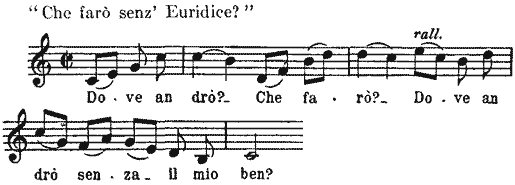
(As originally written by Gluck for the Italian version, Vienna.)
[Listen]
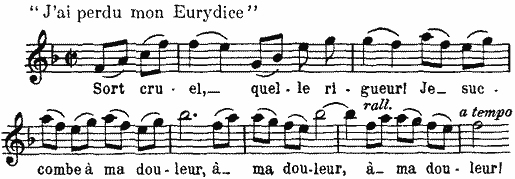
(As altered by Gluck for Paris; sung by the tenor Legros. From a manuscript
copy, Bibliothèque de l’Opéra.)
[Listen]
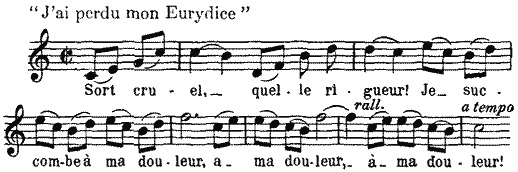
(As sung by Mme. Viardot-Garcia, Théâtre-Lyrique, Paris; the part being
restored to the original voice and key, but the change at the end, made for
Legros, retained.)
[Listen]
The finale to the first act was also changed; a tumultuous “hurry” for
strings, evidently designed to accompany the change of scene to Hades,
being now replaced by a florid air, probably introduced at the desire
of the principal singer as a medium for the display of his vocal
virtuosity; a concession often exacted from composers of opera. This
interpolated air was for a long time attributed to a
composer—Bertoni—who had himself composed an opera on the subject of
Orphée. Later researches have, however, proved that this air is by
Gluck himself, taken from Aristeo, one of his earlier works. When
the famous revival of Orphée took place at the old Théâtre-Lyrique
in Paris, the rôle of Orphée was restored to the type of
voice—contralto—for which it was originally composed, and confided
to Mme. Pauline Viardot-Garcia. She retained the air introduced for
the tenor Legros, but of course transposed, and with a reorchestration
by Camille Saint-Saëns; the now famous composer having at that time,
by the request of Berlioz, undertaken to continue and complete the
revision of Gluck’s complete works, known as the Pelletan Edition.[3]
Other changes from the first Italian score were also made by Gluck in
the later French version. Here is an example; being the recitative
immediately preceding the great air of Orpheus in the last act:
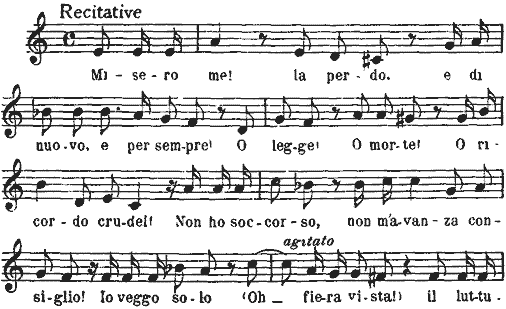
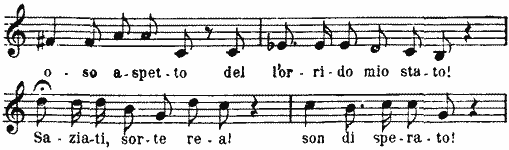
(Original Italian version, as written for Vienna.)
[Listen]
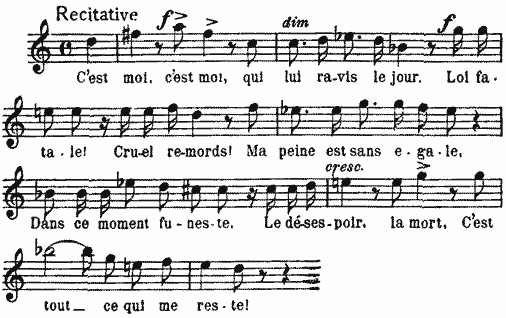
(As written for the Paris version, the rôle of Orphée being then sung by a
tenor.)
[Listen]
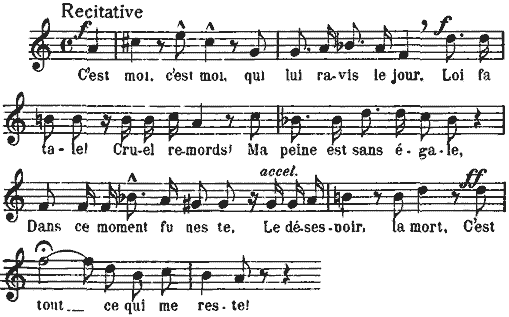
(As sung by Mme. Viardot-Garcia, the rôle being then restored to the
contralto voice as in the Italian version, while the changes made by
Gluck for the Paris version were retained. This is now definitively
adopted at the Opéra-Comique.)
[Listen]
Again, discrepancies exist between various published copies of the
same work, arising from the fact that sometimes the editors of these
revisions may have mistaken the intentions of the composer. Or,
influenced by pardonable human vanity, they may have felt impelled to
collaborate more directly with the composer, by adding something of
their own.
There is valid reason for the additional accompaniments, with which
Mozart has enriched the original scores of Handel’s Messiah and
Alexander’s Feast; and we have evidence of the skill, and can divine
the reverence, with which these additions were accomplished. But how
fatal would have been the results, had the delicate task been
attempted by one in whom these qualities were lacking! Also, there is
every excuse for the additions made to Gluck’s Armide by Meyerbeer
for the Opera of Berlin; and we have the direct testimony of
Saint-Saëns, who has examined this rescoring, as to the rare ability
and artistic discretion with which the work has been done.[4]
From this evidence it appears that in the score as left by Gluck, the
trombones do not appear at all in Armide. The drums, and stranger
still, the flutes, are heard only at rare intervals; while the whole
orchestration—sometimes a pale sketch of the composer’s
intentions—shows a haste and lack of care in marked contrast with the
pains bestowed on the scoring of Alceste, Iphigénie, and Orphée.
The revisions and additions spoken of were undertaken by highly
competent authorities, actuated only by the wish to restore in its
purity the idea of the composer; and who to zeal, added the more
valuable quality of discretion.
Ancient music, owing to the development of and changes in the
instruments for which it was composed, can rarely be given as written
by the author. Even if the instruments of modern invention be
eliminated, the orchestra of to-day is not the orchestra of Handel.
The oboe, for example, has so gained in penetrating power that one
instrument to each part now suffices; in Handel’s time the feeble tone
of the oboe rendered a considerable number necessary. The perfection
of certain instruments, too, is the cause of modifications in the
music written for them. The limited compass of the pianoforte, for
example, was certainly the sole reason why Beethoven failed to
continue in octaves the entire ascending scale in one of his sonatas.
Had the piano in his day possessed its present compass, he would
undoubtedly have written the passage throughout in octaves, i.e., as
modern pianists play it. If a rigid adherence to the printed letter of
ancient music is to be strictly observed, without consideration of the
many causes that render this procedure undesirable, let consistency be
observed by pushing the argument to its logical conclusion, viz.,
returning to the instruments used, and the composition of the
orchestra that obtained, when these works were written. Those who
accuse artists of introducing changes, of not performing the music as
the composer wrote it, should be quite sure as to what the composer
really did write, since many changes are made both before and after
the work is printed. They should also be certain that these changes
are not such as the composer may have, or would have, sanctioned,
seeing that by their use his meaning is more clearly expressed.
At the Concerts Spirituels, given at the Church of the Sorbonne,
Paris, may be heard very excellent performances of Oratorio by ancient
and modern composers, from Handel and Bach to Claude Debussy; though I
do not know whether or no l’Enfant prodigue (The Prodigal Son), by
Debussy, is properly styled an oratorio, seeing that it was recently
given in London on the stage as an opera. These performances at the
Sorbonne are marked by a reverential attention to detail; the
soloists, chorus and orchestra being very competent, and the
conductor—M. Paul de Saunières—a musician of ability and experience.
In spite of these great advantages, however, the works of several of
the old classic composers suffer somewhat, by certain authentic
traditions and conventions being either unknown or ignored. To cite
only one instance out of many: At the Sorbonne, the opening bars of
the second movement of the Recit. in The Messiah, “Comfort ye my
people,” etc., are performed as printed:
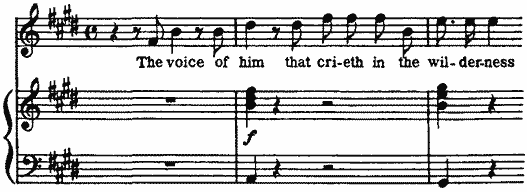
[Listen]
This music is written in the Italian “manner,” consequently its
performance should be in conformity with the usages and conventions
which obtained when the work was composed. One of these, as I have
pointed out, was the substitution of one note for another in certain
places; another, that in declamatory recitative, or recitativo
parlante, the chord in the orchestra should come after the voice
(“dopo la parola”). These words appear in many scores of the Italian
operas, even of the present day. But when they do not, the musical
director is supposed to be familiar with the custom. The following,
therefore, is the authentic mode of performing the passage in
question:
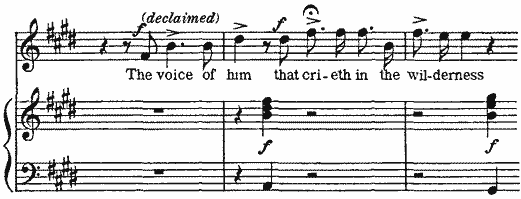
[Listen]
Apart from these defects in the rendering of the ancient classics, it
would be unjust not to acknowledge the great artistic merit and value
of the performances, given—as Oratorio should be—in the church. To
hear l’Enfance du Christ (Berlioz) as performed at the Sorbonne,
with its particular facilities for obtaining the ppp effects of the
distant or receding angelic chorus, is to be impressed to a degree
impossible of attainment in the concert-room.
Let those purists who resent any “tampering”—as they term it—with
the composers’ music listen to the following phrase, sung as it is
printed in the ordinary editions:

[Listen]
Then let them hear it given according to the authentic and accepted
tradition, and say which of the two versions most faithfully
interprets the composer’s meaning.

[Listen]
Let us now consider alterations which do not appear in the printed
editions, and yet may have been made or sanctioned by the composer.
In comparison with painting and sculpture, music and the literature of
the theatre are not self-sufficing arts. They require an interpreter.
Before a dramatic work can exist completely, scenery, and actors to
give it voice and gesture, are necessary; before music can be anything
more than hieroglyphics, the signs must be transmuted into sound by
singers or instrumentalists. Wagner embodied this truth in his
pathetic reference to Lohengrin: “When ill, miserable and
despairing, I sat brooding over my fate, my eye fell on the score of
my Lohengrin, which I had totally forgotten. Suddenly I felt
something like compassion lest the music might never sound from off
the death-pale paper.” In other words, Lohengrin, though finished in
every detail, was merely potential music. To make it anything more,
the aid of singers and orchestra are essential.
Composers and dramatic authors, in fact, create their art-works; but
it is their interpreters—actors, singers, instrumentalists—who
animate them, who breathe life into them. One of the inevitable
consequences is, that the composer’s ideal can never be fully
attained.
But changes in performance from the printed text of a composition are
frequently the work of the composer himself. If really an artist, he
is rarely perfectly satisfied with his completed work. The difference
between his ideal and his materialization of it, is a source of
anguish for him. The journey made by a vision of art from the brain
that conceives it to the hand that imprisons it in marble, or depicts
it in colour, or pens it in words or music, is a long one. And much
grace or power, beauty or grandeur, is inevitably lost on the way.
This is the explanation of the disappointment of all true artists with
their creations. This is the origin of their endless strivings to
perfect their works; the first embodiment is not a perfect
interpretation of the artist’s inspiration, and further reflection
has revealed to him an improvement. The process is endless.
A man’s reach should exceed his grasp,
Or what is Heaven for?
If one wishes to surprise genius labouring to give birth to
perfection, one should consult the later editions of Victor Hugo’s
works and note the countless emendations he made after their first
publication—here a more fitting word substituted, there a line
recast, elsewhere an entire verse added, or excised, or remodelled.
This work of incessant revision is not restricted to poets. Composers
of genius are also inveterate strivers after perfection, are
continually occupied in polishing and revising their music. And not
all the modifications they make, or sanction, are recorded in the
printed versions. For many are the outcome of after-thoughts, of ideas
suggested during the process of what I have called transmuting musical
hieroglyphics into sound. Such modifications, usually decided upon in
the course of a rehearsal—I am now considering particularly operatic
works—are frequently jotted down, a mere scanty memorandum, on the
singer’s part or the conductor’s score. But they are the work of the
composer, or have received his approval, and, although not noted in
the printed editions of his compositions, are transmitted orally from
conductor to conductor, singer to singer, master to pupil. And thus a
tradition is perpetuated.
But the question of changes goes even further.
Prior to the advent of Wagner, the singer was allowed great license
in operatic works. This license was principally manifested in a
two-fold form. The first is called pointage (French), puntatura
(Italian), and means the changing of the notes or contour of a musical
phrase; the second is termed changements or variantes (Fr.),
abbellimenti or fioriture (It.), and refers to the interpolation
and addition of ornaments, i.e., embellishments and cadenzas.
THIS, as I have said, is the technical term given to the modification
or rearrangement of the notes of a phrase, so as to bring it within
the natural capabilities of the artist singing the rôle. A few
illustrations will make the nature of pointage clear.
In Rossini’s Guillaume Tell, although it is written in a different
style from his former works, whence less necessity for interpolations
and modifications, occurs the following terrible passage for the
principal baritone:

[Listen]
Every vocalist knows the difficulty experienced in singing very high
tones to different syllables, each requiring a different conformation
of the buccal cavity. The passage quoted—expressing Tell’s bitterness
at the recollection of his past sufferings in prison, “Well I know the
weight of galling chain”—has to be declaimed with great energy. So
far as the relative value of the notes is concerned, it is entirely
ad libitum, the rhythmical figure in the orchestra having ceased one
half-bar before. It is said that Dabadie, a basso cantante rather
than baritone, to whom was entrusted the rôle of Tell on the first
production of the work at the Opéra, Paris, on August 3, 1829, finding
it impossible to sing the phrase as written, had recourse to a
professor. He advised the pointage given later. This change became
traditional, and has since been followed, except, it is said, in the
case of Massol, who succeeded Dabadie. He, being possessed of a very
sonorous voice of exceptional compass, was able to give the phrase as
written. This change, or pointage, must have been heard by Rossini,
and so must have been tacitly approved by him. This is the change made
by Dabadie:

[Listen]
In Italian lyric theatres, pointage becomes necessary in many French
operas, owing to the prevalent custom of allotting to contraltos
certain rôles written for soprano and known as “dugazon rôles” (from
Madame Dugazon, who created the type). The parts of Siebel in Faust
(Gounod), Urbain in Les Huguenots, Stéphane in Roméo et Juliette
(Gounod), are all written for soprano, and when sung in Italian
require not only transposition of the principal airs, but the use of
pointage in passages where transposition is impossible owing, for
instance, to the participation of other characters in the scene. Thus
the air sung by the page Urbain (Les Huguenots) on his entrance is
sung in the French theatres as written by Meyerbeer, i.e., in B
flat. In theatres where the Italian version is given, this air is
transposed a third lower into G, necessitating later numerous
pointages, for the reason already given.
I said that many deviations from the printed text are the work of the
author, or are authorized by him. A moment’s reflection will convince
one of the truth of this statement. The singer chosen—usually by the
composer himself—to “create” a rôle, i.e., to interpret for the
first time some part in a new opera, generally studies it with the
composer, or under his direct supervision, and thus learns, directly
or indirectly, his ideas as to the meaning, style of execution, tempi,
etc., of the music. Very often during rehearsals, when the composer
begins really to hear his own work, he makes modifications in certain
passages, alterations of the words or suppressions of the notes that
are either ineffective, or lie awkwardly for the voice. But the opera
has already been printed for the convenience of the singers and
choristers studying the rôles and choruses; consequently, such
modifications, rearrangements, and “cuts” (as excisions are termed),
do not find their way into the published scores.
Meyerbeer, as I have been informed by competent authorities, was
constantly modifying his compositions. With him, the work of revision
and emendation was never finished. It is said that this was more
especially the case with his last opera, l’Africaine, which he was
continually altering and revising, never being able to satisfy
himself. Two versions of the libretto were prepared for him by Scribe,
and two distinct settings of the music are published, although only
one is performed.[5]
In Nelusko’s first air occurs the following passage, in which a great
crescendo is marked, culminating ff on the word rien:

[Listen]
Although the opera was produced after the composer’s death,
Jean-Baptiste Faure, the great baritone chosen to create the rôle of
Nelusko, studied it with Meyerbeer, who authorized several verbal and
musical changes in it.

[Listen]
Without the first alteration it is impossible to realize the
composer’s wish for a climax on the word “rien”; the second change
is due to the fact that the tessitura of the phrase is somewhat
high, and Faure, who was a low rather than high baritone, dreaded the
high f♯.
Indeed, it was for this latter reason that this most accomplished
singer never sang in Verdi’s operas. According to his own statement,
he had to deny himself this pleasure, because most of the baritone
parts in the Italian composer’s operas are written in a high
tessitura.
When Gounod wrote his Faust for the Théâtre-Lyrique, Paris, spoken
dialogue was used in place of the recitatives subsequently added by
the composer when the work passed, ten years later, into the
répertoire of the Opéra. In its earlier form, therefore, it belonged
to the category of opéra-comique, in which tenors were then
permitted to use the falsetto voice for their very highest tones. This
custom, though sanctioned in opéra-comique, was not permitted or
accepted in grand opéra, to which Gounod’s work in the revised form
now belongs. At the beginning of the sixth bar from the end of the
tenor cavatina in the Garden Scene: “Salut! demeure chaste et
pure,” occurs the high sustained c.
Not all tenors who sing the rôle are possessed of the much-coveted
“do di petto,” so a discreet pointage becomes a necessity, since
the tone was originally intended, as I have said, to be sung in
falsetto. Those robust tenors who, possessing this tone, launch it out
at full voice, unheeding the delicate accompaniment with violin
obbligato in the orchestra, and the calm, mystic serenity of the
surroundings, are surely more desirous of drawing the attention of the
public to themselves, than actuated by an artistic desire to interpret
faithfully the scene as intended by composer and librettist.
It was owing to the use by light tenors of the so-called falsetto
voice, now no longer in favor with the public, that such of the
opéras-comiques by Boiëldieu, Halévy, Auber, etc., which still keep
the stage, necessitate frequent pointage, in order to render their
execution compatible with existing requirements. Sometimes a composer
utilizes an exceptional voice, as was the case with the rôles written
for Martin. This singer must have possessed either a strong tenor
voice with exceptional low tones, or a baritone voice with perhaps an
unusual command of the falsetto—history furnishes but vague
information on this point. In any case, the rôles written for
him—called Martin-tenor or Martin-baritone parts—are now assigned to
the ordinary baritone. Pointage then becomes inevitable, as in the
case of Hérold’s Zampa, the compass required as printed being from
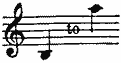
[Listen]
In the rôles, such as Mignon (Thomas) and Carmen (Bizet), written
for Madame Galli-Marié, their respective composers themselves have so
arranged the parts that they may be sung by either mezzo-soprano or
soprano. The rôle of Mignon has alternatives, in order that it may be
sung by three types of female voices. The roulades and cadenzas were
subsequently added by the composer for Madame Christine Nilsson.
If the rôle is sung by a high soprano, Mignon’s first air, “Connais-tu
le pays,” is transposed a tone higher into E flat.
In the famous duet between Raoûl and Valentine in the fourth act of
Les Huguenots, the composer has given alternative notes for those
tenors who do not possess the exceptional altitude required for the
higher of the two:
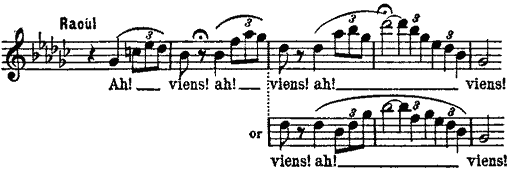
[Listen]
I heard recently, however, a performance of this opera, in which the
tenor sang the whole of the music as written, without either
transposition or pointage. So it was sung, I should imagine, by the
famous Adolphe Nourrit, who created the rôle; but the pitch at that
time (1836) was lower than it is at present.
Thus composers have recognized the necessity at times of pointage in
certain rôles written for exceptionally gifted singers, in order to
render possible to the many that which was originally written for the
few.
Changes from the published version have also been made—and proving
effective have passed into tradition—by singers who, exercising the
liberty then accorded them by composers, have slightly modified
certain passages for several reasons: for instance, to augment the
effect by making the phrase more characteristic of the vocal
instrument, or to express more forcibly the composer’s idea.
The following illustrations will render my meaning clearer. The
changes originated in the causes I have mentioned, and are attributed
to Madame Dorus-Gras:
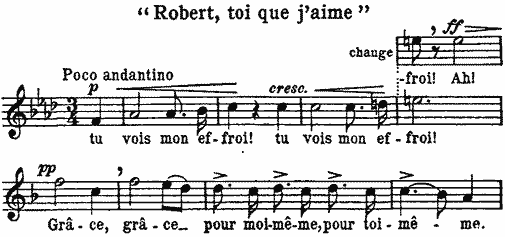
[Listen]
The phrase “Grâce, grâce,” in which Isabelle implores Robert of
Normandy’s forgiveness, occurs three times. When it recurs for the
last time, a change from the printed text is not only justifiable; it
is demanded, in order to give additional intensity and power to the
phrase, and to avoid the monotony caused by mere repetition. This
modification is all the more defensible, as the composer has
substituted the orchestra, with the strings tremolo, for the
rhythmical harp-figure with which he accompanies the phrase on its
first and second presentations. Here is the accepted traditional
change:

[Listen]
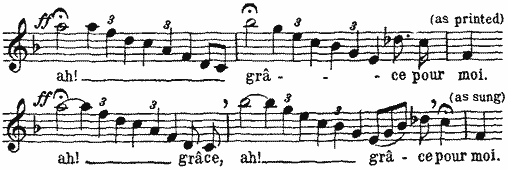
Again, to sing the final cadenza of this air as Meyerbeer briefly
indicated it, would be impossible and absurd:
[Listen]
Other changes have their origin in the fact that sometimes a great
climax is rendered impossible of realization because the musical
phrase culminates on a vowel-sound difficult of emission on that note,
and devoid of sonority; another word has sometimes to be substituted.
For this reason, in the first air of Alice in the same opera
(Robert), “Va, dit-elle,” a verbal rearrangement is always
resorted to:
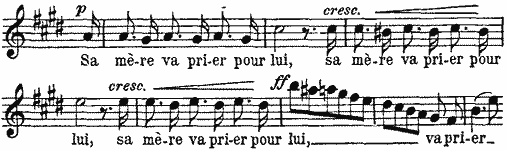
[Listen]
To avoid the disagreeable and ineffective result produced by the high
descending passage on the word “lui” (pronounced in English as
“lwee”), the last few bars are performed thus:

[Listen]
When La Tosca (Puccini) was produced in French at the Opéra-Comique,
Paris, the unfortunate artist to whom was allotted the tenor rôle was
expected by the translator to sing at full voice, and after a crashing
chord from the entire orchestra, marked ffff in the score, the
following words:
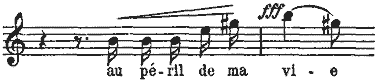
[Listen]
As it was found to be out of the question to produce the effect
desired with the words as they stood, the phrase was afterwards
changed to:
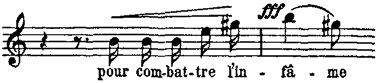
[Listen]
Frequently modifications, most happy in their effect, are due to the
inspiration of a particularly gifted artist.
Madame Viardot-Garcia, finding the phrase of the cabaletta in the aria
“Se Romeo t’uccise” (Romeo e Giulietta, Bellini) somewhat weak and
ineffective, made the skilful pointage here given:
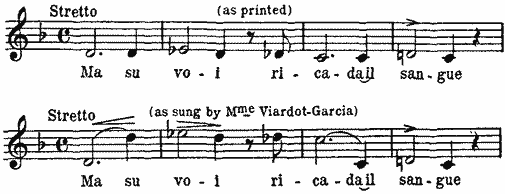
[Listen]
A great artist may feel at times the inadequacy of the phrase as it
stands to convey justly the composer’s idea. Take, for instance, the
well-known change which every soprano who sings the rôle of Leonora
introduces in the Miserere scene of Il Trovatore. The passage
occurs four times in succession, and as printed becomes commonplace
and monotonous.

[Listen]
The accepted traditional change certainly conveys the impression of
Leonora’s gradually increasing anguish and terror; not the idea that
it is introduced merely to exploit a high tone:

[Listen]
That this departure from the text must have been sanctioned by Verdi,
is, I think, proved by the fact that it has always been sung thus, and
the composer himself must often have heard the substitution. He would
certainly have forbidden its use, had he not approved of it, for he
was particularly averse to having changes made in his music. The
following anecdote illustrates this trait in his character. It was
related by the late Mme. Marie Saxe, better known under her
Italianized name of Marie Sasse. This distinguished soprano singer, a
member of the Paris Opéra for a number of years, was engaged to give a
certain number of performances at the Opera of Cairo. Aida was one
of the operas stipulated for in her contract. She had never sung the
rôle, and in studying it found the tessitura of the music, at one or
two points, a little too high for her natural means. As she was
compelled by her contract to sing the opera, she asked Verdi to make
some slight changes to bring the music within her reach. But he
refused absolutely to make the least alteration.
Madame Saxe was specially selected by Meyerbeer to create the rôle of
Sélika in l’Africaine. She studied the part for three months with
the composer, and sang it when the work was first given at the Paris
Opéra. She was also chosen by Richard Wagner for the part of Elisabeth
when Tannhäuser was given its stormy performances, with Niemann in
the title-rôle, at the same theatre in 1861.
Madame Saxe possessed a score of Tannhäuser with the inscription in
the composer’s handwriting:
“A ma courageuse amie
Mademoiselle Marie Saxe.
L’Auteur
RICHARD WAGNER.”
The slight modifications, or pointages, asked from Verdi, were not,
I was assured by Madame Saxe, of a character to alter either the rôle
or the opera, and she remarked (I quote her own words): “Why should
Verdi have shown himself more unreasonable or less yielding than
Meyerbeer or Wagner?” (plus intransigeant, plus intraitable que
Meyerbeer ou Wagner?).
In tradition, however, there is the true or accepted tradition—so
called because believed to have been sanctioned by the composer
himself, or approved of by competent authorities and its use warranted
by time—and the false. This latter is simply an accumulation of
excrescences superimposed on the original by individual whim or
personal fancy. These have been invented by singers desirous of
bringing into relief certain special and peculiar gifts, or who have
mistaken, perhaps forgotten, the original and authentic tradition.
Thus their artistic heritage has become so altered and disfigured by
successive additions, or “machicotage,” as to bear no resemblance to
the original, this being buried under a heap of useless complications.
But it may be asked, are there no authoritatively correct printed
editions of such classics with the accepted traditions and the proper
mode of their performance expressed in modern musical notation? Yes:
but they are incomplete, being for the most part confined to airs and
other excerpts, instead of the complete works themselves. In this
connection, I may cite the admirable edition of the “Gloires
d’Italie” by the late erudite musician and authority, Gevaert, for so
many years Director of the Conservatoire at Brussels. These editions
are characterized by a scrupulous fidelity to the composers’ text as
it was understood when written, as well as by great taste and musical
sense of what is appropriate and fitting, in such ornaments as the
editor has introduced, when these have been left to the discretion of
the singer. The solo parts for the principal singers in Mozart’s
operas of Don Giovanni and Le Nozze di Figaro, edited and revised
for performance by the well-known singing-master and excellent
musician, Signor Randegger, are also admirable. But other editions
exist which do not bear the same imprint of authority, or
conscientious care in their revision, as do the versions just
mentioned.
In the edition of the well-known air “J’ai perdu mon Eurydice” (che
farò senza Euridice?) from Orphée (Gluck), revised by Madame
Pauline Viardot-Garcia, no mention is made of two traditions which
have been used and handed down by a number of the most famous singers
of the rôle of Orphée. I give them here:
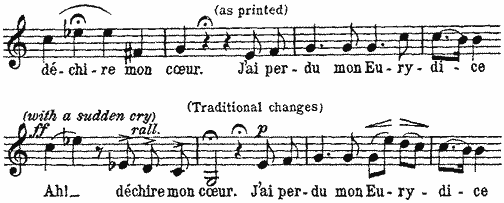
[Listen]
The change on the third repetition of the principal theme is quite in
accordance with the license then accorded in such airs.
In a special version of the opera Armide (Gluck), revised and edited
by the late Sir Charles Hallé, the first bars of the great air of
Armide in the first scene of the fourth act, “Ah! si la liberté”
(Ah! if my liberty must from me then be taken), are printed thus:
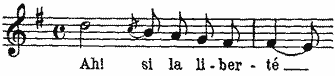
[Listen]
The situation is where Armide perceives the knight Renaud in the
gardens of her enchanted palace, whither he has come to destroy the
sorceress on account of her magic arts. Although the enchantress knows
that the mission of the knight is to deprive her of liberty, she
herself succumbs to the fatal passion of love. I have briefly
described the scene in order that my meaning may be clear. In the
second half of the first bar, the acciaccatura was never intended by
the composer to be actually sung as printed. It was his only way of
indicating the sob or sigh whereby Armide finishes her exclamation,
“Ah!” The effect is called “the Dramatic sob,” and is known to every
opera-singer. Here is the composer’s meaning, as far as it is possible
to convey it in writing:
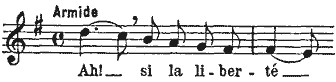
[Listen]
(A portamento must be made from the first note to the next, when the
breath must be taken quickly to give the idea of a sob or sigh.)
Again, in a recent edition of the same air by the distinguished
composer Vincent d’Indy (Nouvelle Édition Française de Musique
Classique), occurs the following:
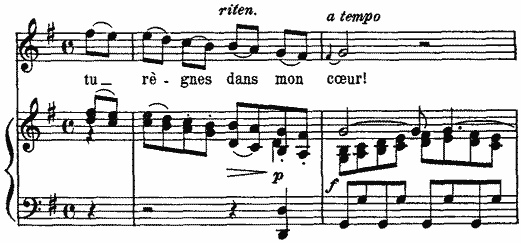
[Listen]
The effect of the F sharp in the last bar, if sung against the
harmony given, in which the preceding chord is resolved, would be
intolerable. Surely, the composer intended a pronounced rallentando
on the latter half of the bar, and a carrying of the voice by a
portamento to the last note. Thus:
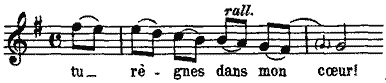
[Listen]
In the edition of the immortal air in the opera of Xerxes,
universally known as the “Largo of Handel,” also revised and edited by
d’Indy, may be noticed the following:
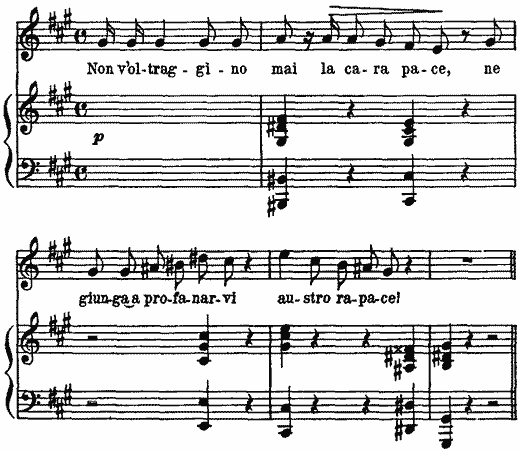
[Listen]
Of course, every operatic conductor knows that the chord in the
orchestra must be played “after the voice,” as the technical phrase
has it. But not every pianist or organist is familiar with this usage,
and the effect would be very disagreeable if given as written. It
should be performed thus:
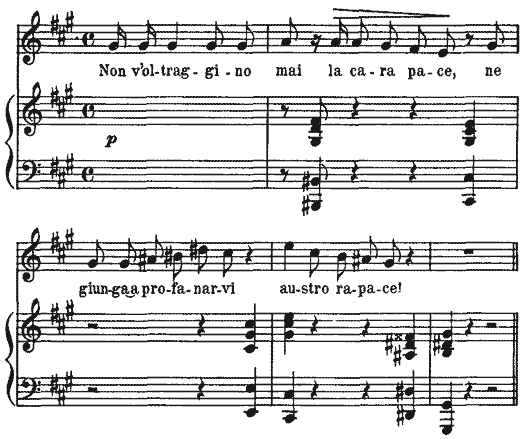
[Listen]
Besides, why claim that a certain edition is “revised and edited,”
when all the care and musical knowledge seem to have been expended on
the harmonies only? Surely, the voice-part in these classics is not
without its need of elucidation.
An edition of The Messiah, revised for performance, can scarcely be
called accurate when such defects as the following occur:
“And they —
’ were sore afraid.”
—
’ were sore afraid.”
The following is the authentic mode of performing the phrase:
“And ——’
they were sore afraid.”
In the same edition for the solo singers occurs: (“Behold and see”):

[Listen]
But by a slight syllabic rearrangement, the disagreeable accent on the
last syllable of “un-to” is avoided, and the accent placed on the
word “His,” to which it belongs, while the composer’s music remains
untouched.
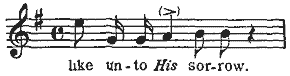
[Listen]
Again, in the same air occurs:
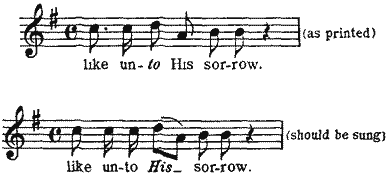
[Listen]
While recognizing the benefits conferred by some of these specially
prepared editions, there remains still more to be accomplished in this
direction before the work is complete. A flood of light has been
thrown on the dark and nebulous places of the instrumental classics by
various distinguished and highly competent musicians. It is sincerely
to be hoped, in the interests of this branch of the æsthetics of vocal
art, that those competent to speak with authority will do so, in order
that in this direction also “the crooked shall be made straight, and
the rough places plain.”
I admit that this question of revising the composer’s written text is
an exceedingly delicate and difficult one. It should be attempted only
by those possessed of the requisite authority, those who combine tact
and taste with judgment and experience. To these qualities should be
added a sincere and reverential desire to place in the highest relief
the meaning of both poet and composer.
I have said that the license formerly accorded by composers to
singers—particularly operatic singers—manifested itself in a twofold
form. The second of these phases was the introduction in the body of a
theme or melody, and also at its close, of embellishments. Sometimes
the composer briefly sketched these ornaments; at other times their
places only were indicated. The ornaments in the body of an air are
known as abbellimenti or fioriture; those at its close, as
cadenze.
Here is an example of the former, taken from the duet in Elisa e
Claudio by Mercadante:
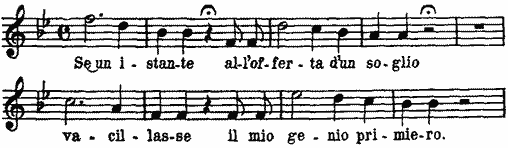
[Listen]
The following is the same passage ornamented:
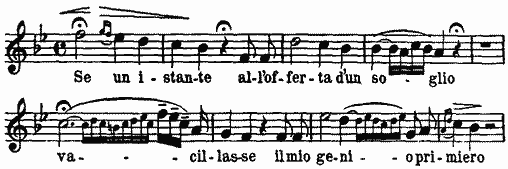
[Listen]
(As sung by Mme. Malibran. Quoted from “Mécanisme des Traits,” by de
La Madelaine, 1868.)
The rôle of Rosina in Rossini’s Il Barbiere has long been a
favourite peg with prime donne on which to hang interpolated ornaments
for the display of their vocal agility. Some of these are not always
in good taste, being trivial or banal in character, thus concealing
the natural charm of the original melody under a species of Henri Herz
variations. Others, however, such as those used by the Patti and the
Sembrich, for instance, are of great originality and excellent effect.
Here are some of the traditional ornaments and cadenzas sung by
certain famous singers of the past in Rosina’s entrance cavatina:
“Una voce poco fa.” This air was originally written by Rossini in
E major, the part of Rosina being intended for a mezzo-soprano, and
was thus sung by the late Paulina Viardot-Garcia. This exceptionally
gifted artist, possessing a voice of very great compass, was enabled
to sing not only the rôles assigned to mezzo-soprano contraltos, such
as Orphée, or Fidès (Le Prophète), which she created, but also the
parts given to dramatic sopranos. Mme. Viardot was thus able, with
some slight modifications, to sing Norma, Desdemona (Otello:
Rossini), Rachel (La Juive), etc.
The rôle of Rosina has now definitely passed into the possession of
florid or coloratura sopranos; much, therefore, of the music is of
necessity transposed, the air in question being now sung one half-tone
higher, in the key of F.
Here is a change used by Mme. Cinti-Damoreau, who sang the music in
the original key. The composer wrote:

[Listen]
Mme. Cinti-Damoreau sang thus:

[Listen]
In the same bar Mlle. Henrietta Sontag, who sang the air a semitone
higher, introduced the following:
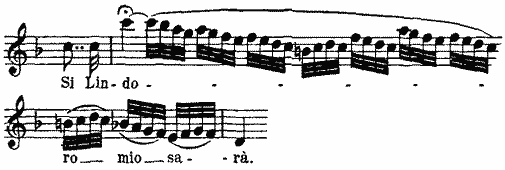
[Listen]
Rossini wrote no cadenza to the air:
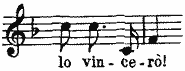
[Listen]
Cadenza of Mlle. Sontag:
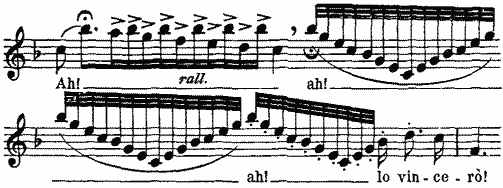
[Listen]
I have already spoken of the bad taste exhibited by some mediocre
singers in covering a coloratura air with so many roulades, etc., as
to render it barely recognizable. It was after hearing one of his own
arias overloaded and disfigured in this manner that Rossini, who was
noted for his biting wit and stinging sarcasms, is said to have
remarked: “What charming music! Whom is it by?”
Bellini, Donizetti, and composers of their school, sometimes did
little more than hand over to the singer engaged to create their works
a rough sketch, as it were, which the artists were supposed to fill in
and perfect. Singers were expected to add such fioriture, or
“flowers,” as would best display their salient points of style and
individual characteristics. The Cavatina, or slow movement of the
aria, was the medium which called for the qualities of expressive
singing, while the Cabaletta was a vehicle for the display of
virtuosity and technical mastery. In this latter movement, the
equivalent of the Rondo in instrumental music, the performer was left
perfectly free to use such embellishments as set forth his own gifts
to the greatest advantage. Some singers excelled in bold and rapid
flights of scales, chromatic and diatonic; others, in the neat and
clean-cut execution of involved traits or figures. It must be
remembered, that the great singers of the past were perfectly
competent to add these ornaments themselves, as they possessed a
complete and sound musical education.
More: sometimes these singers even collaborated with the composers.
Crescentini, the last famous male sopranist, is reputed by history or
legend—the two are not infrequently synonymous—to have been himself
the composer of the well-known aria “Ombra adorata,” introduced by
him in Zingarelli’s opera Romeo e Giulietta, as also of the prayer
sung by Romeo in the same work. His singing of it is said to have
moved his audience to tears, and gained for him the decoration of the
Iron Crown, conferred upon him by Napoleon I. The Emperor also
induced him, by the offer of a large salary, to settle in Paris as
professor of singing.
When these great artists—their career as public singers being
ended—began in turn to form pupils, they were admirably fitted for
the task of imparting instruction, being excellent musicians, and, as
I have said, composers of no insignificant merit. They had a sound
theoretical knowledge, compared with which that of many of our modern
singers seems but a pale and feeble reflection.
The collaboration of composer and interpreter is not altogether
unknown in the domain of instrumental music. Is it not historical that
Mendelssohn profited largely from the wise counsels of the celebrated
violinist Ferdinand David in the composition of his concerto for
violin and orchestra? This does not mean that David contributed any
musical phrases or ideas to the work; but that his practical knowledge
of the special characteristics and capabilities of the solo instrument
enabled him to suggest how the composer’s thoughts might be most
fittingly presented.
Returning to the question of the introduction of ornaments, etc., into
a composer’s work, the following extract may be of interest to the
musical student. It is from a volume of criticism, now out of print, a
copy of which is possessed by the present writer. The article appeared
in La Patrie more than forty years ago, and was called forth by the
ornaments written by the then well-known singer and teacher of great
ability, Stéphan de La Madelaine. These changes were for the great
air of Agathe in the second act of Der Freischütz, and were the
cause of much discussion among the music-critics of the time.
“Following the example of celebrated vocal virtuosi whom he had
formerly known, and availing himself of the license then permitted,
the master (de La Madelaine) has introduced several alterations
(changements). These, however, in no sense clash with the original
character of the air itself.
“That the introduction of such ornaments has caused an outcry, is not
surprising. We should remember, however, that the Freischütz was
written at a period when, in certain places, the composer left the
field entirely open to the singer, permitted him to make such changes
as he might deem necessary. It must not be thought that in so doing
the interpreter corrects the composer: he simply seeks to express, to
the utmost of his abilities, the intention of the author.
“The operas of Bellini, of Rossini, and, in general, of all the
Italian masters, are full of these intentional gaps (lacunes) which
were filled in by the singers. Nay, in the earliest days of the
Neapolitan school, still greater liberty was allowed; the recitatives
were all improvised by the executants, and were not even noted down.
Each singer made his own, which the maestro al cembalo accompanied
with a few simple chords.
“In the cavatina in Norma, each cantatrice introduces her own
changes on the recurrence of the principal theme, and the public
applauds. Why then this outcry against the same procedure in Der
Freischütz?
“That this custom or practice might lead to great abuse and that it
is necessary to uproot it gradually, is our opinion. But this radical
reform can be realized only in forthcoming works; those of the ancient
school ought to be interpreted by following the conventions which the
composer himself has respected.
“That the changements written by M. de La Madelaine for the air of
the Freischütz are permissible, is proved by the fact that Weber
himself has sanctioned and approved them, as, if need be, a great
number of contemporaries can attest.” (Franck-Marie.)
Whoever has had the good fortune to hear Mme. Marcella Sembrich in the
rôle of Amina, in Bellini’s La Sonnambula, will have heard an
excellent example of remarkable technical skill or virtuosity, with
irreproachable taste regulating its display. The ornaments and changes
used by her in the rondo finale, “Ah, non giunge,” are models of
their genre. What else could be expected of an artist so gifted as to
be able to perform the lesson-scene in Rossini’s Il Barbiere
(introducing therein the air with variations by Proch) in Italian; and
in the course of the same scene sing, in German, “Ich liebe dich,”
by Grieg, and play the Andante and Rondo Russe, for violin, by de
Bériot, and a valse by Chopin on the piano?
The opera, La Sonnambula, requires much rearrangement both of the
music and of the verbal text, to which it is badly fitted. The greater
part of the music written for Elvino has to be transposed, mostly a
third lower, in order to make it practicable under existing
conditions.
No effect whatever could be made were a cantatrice to follow
implicitly the written notes of this opera, such being merely a rough
sketch, as it were, of the composer’s ideas, which the singer is
supposed to complete. Several instances from the andante “Ah! non
credea mirarti,” will suffice to prove this. The following is the
printed version.
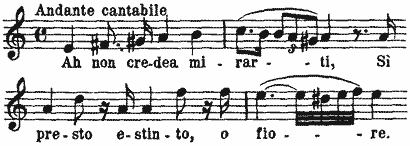
[Listen]
This is but a suggestion of the composer’s idea. The artist will
therefore not follow too closely the printed version; but following
the evident indications for a pathetic and expressive cantabile will
perform it thus:
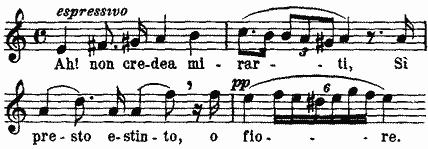
[Listen]
Again a brief outline, as printed:
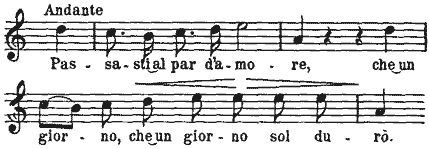
[Listen]
which, if sung as follows, fills in the details:
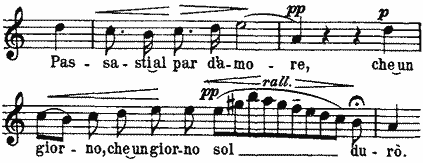
[Listen]
Also the passage in the same aria, where Amina sobs as she slowly lets
fall to the ground the blossoms given her in the first act by Elvino,
requires an entire rearrangement of the syllables to bring out the
composer’s meaning.
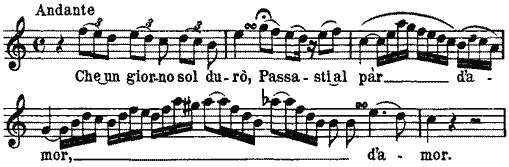
[Listen]
Let any one go over this passage carefully, and he will be convinced
that it is, as I have said, merely a sketch of the composer’s idea. As
it stands in the published version it is impossible of execution, and
if it were possible, would be devoid of all effect: the syllables
being wrongly placed, no opportunity for breathing is given the
singer, and the final cadenza is marred by being allotted to the word
“amore.” Here is a revision of the latter, the cadenza being one I
wrote for a pupil, Mme. Easton-Maclennan, of the Royal Opera, Berlin:
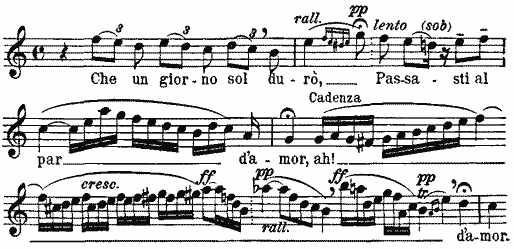
[Listen]
It will thus be seen, from the numerous foregoing examples, that these
ornaments and interpolations are not added from a vulgar idea of
correcting or improving the composer’s music, but are strictly in
accordance with certain conventions thoroughly understood by both
composer and singer. To omit them, or follow too closely the printed
text, would be to ignore the epoch, school and character of the music;
a careful study of which forms one of the cornerstones of
Interpretation. A skilled artist will always strive to analyze and
interpret the intentions of the author. If one to whom is confided the
vocal part of a composer’s work were to limit himself to a
mathematically correct reproduction of the written notes only, instead
of searching below the surface for the author’s meaning, his
performance would merely resemble the accurate execution of a
solfeggio by a conscientious scholar. It would have the same
relation to high artistic effort as the photographic reproduction of
a landscape bears to the same scene as viewed and transmitted to
canvas by a great painter.
The sincere artist will carefully consider every detail. He will not
be content to study his own part only, but will study the orchestral
score which accompanies it. He will, in fact, follow the example set
by good string-quartet players, who listen attentively to the other
instruments during rehearsals, so that the perfect welding together of
the different parts may form a homogeneous whole. Such an artist, in
complete possession of the mechanical resources of his art, will
utilize them all to embody perfectly that which, with the composer,
existed only as a mental concept, inadequately transcribed, owing to
the limitations of his media—pen, ink and paper.
And it is only when in possession of the authentic traditions of
Oratorio and Opera that the singer, such as I have supposed, will be
able to vivify these great creations, will be able to invest them with
warmth and colour, and thus make clear all their meaning, reveal all
their beauty.
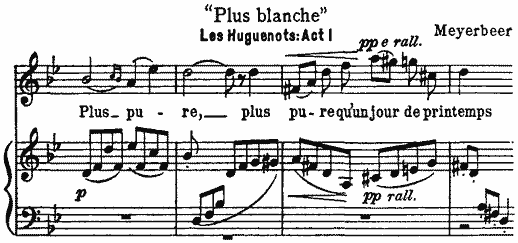

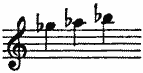
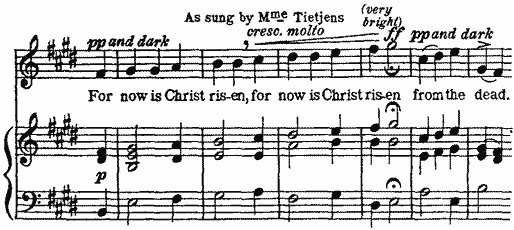
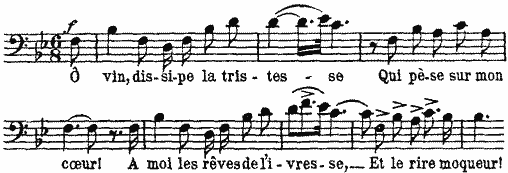



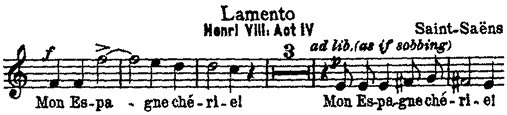
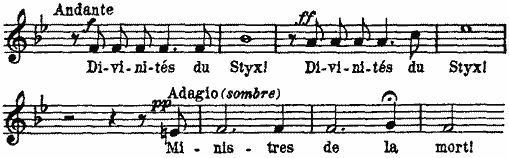
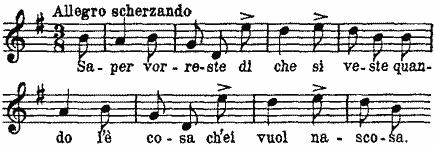
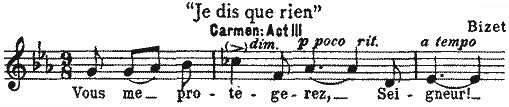
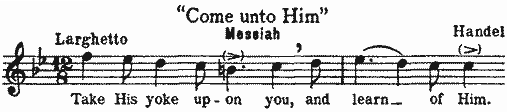
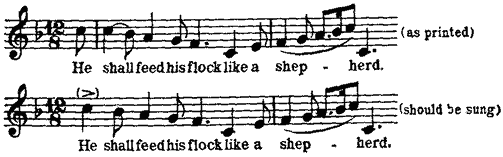
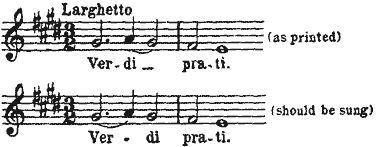
 ) give to the musical phrase a
piquancy that is admirably in keeping with the gay and careless
character of the page, Oscar, who sings it. In fact, as regards Style,
Musical accent is particularly valuable in song for the purpose of
setting forth the true character of the music. Hence, it may be
regarded as a means of characterization.
) give to the musical phrase a
piquancy that is admirably in keeping with the gay and careless
character of the page, Oscar, who sings it. In fact, as regards Style,
Musical accent is particularly valuable in song for the purpose of
setting forth the true character of the music. Hence, it may be
regarded as a means of characterization.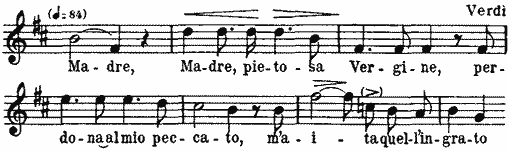




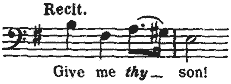
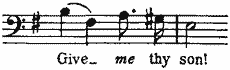
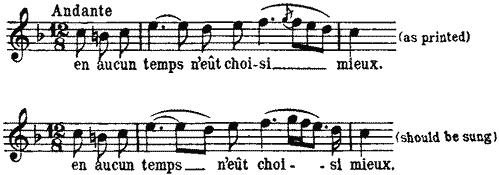
 f
f  p. This exercise
invariably formed a part of each day’s study, and was practised on
several vowels throughout the scale, except the extreme tones, save in
rare instances. It was, in fact, indispensable that the singer should
be able to colour every tone in three forms of graduated intensity:
Soft to loud p
p. This exercise
invariably formed a part of each day’s study, and was practised on
several vowels throughout the scale, except the extreme tones, save in
rare instances. It was, in fact, indispensable that the singer should
be able to colour every tone in three forms of graduated intensity:
Soft to loud p