I. AGORÈ. THE POLITIES OF THE HOMERIC AGE.
It is complained, and perhaps not without foundation,
that the study of the ancient historians does not supply
the youth of England with good political models: that,
if we adjust our sympathies and antipathies according
to the division of parties and classes offered to our
view in Rome, Athens, or Sparta, they will not be cast
in an English mould, but will come out in the cruder
forms of oligarchic or democratic prejudice. Now I do
not wait to inquire how far these defects may be supplied
by the political philosophers, and in particular by
the admirable treatise of Aristotle. And it certainly is
true, that in general they present to us a state of political
ideas and morals greatly deranged: the choice lies
between evil on this side in one form, and on that side in
another form: the characters, who can be recommended
as examples, are commonly in a minority or in exile.
Nor do I ask how far we ought to be content, having an
admirable range, so to speak, of anatomical models in our
hands, to lay aside the idea of attaching our sympathies
to what we see. I would rather incite the objector to
examine and judge whether we may not find an admirable
school of polity, and see its fundamental ideas
exhibited under the truest and largest forms, in a quarter
where perhaps it would be the least expected, namely,
in the writings of Homer.
As respects religion, arts, and manners, the Greeks
of the heroic age may be compared with other societies
in the infancy of man. But as respects political science
in its essential rudiments, and as respects the application
of those principles by way of art to the government
of mankind, we may say with almost literal truth
that they are the fathers of it; and Homer invites those
who study him to come and view it in its cradle, where
the infant carries every lineament in miniature, that we
can reasonably desire to see developed in manhood.
Strong development of political ideas.
I cannot but deprecate the association established,
perhaps unintentionally, by Grote, where, throwing
Homer as he does into hotch-pot, so to speak, with the
‘legendary age,’ he expresses himself in his Preface[1],
as follows. ‘It must be confessed that the sentimental
attributes of the Greek mind—its religious and poetical
vein—here appear in disproportionate relief, as compared
with its more vigorous and masculine capacities—with
those powers of acting, organizing, judging, and
speculating, which will be revealed in the forthcoming
volumes.’ If the sentimental attribute is to be contra-distinguished
from the powers, I will not say of speculating,
but of acting, organizing, and judging, then I
know of nothing less sentimental in the after-history of
Greece than the characters of Achilles and Ulysses,
than the relations of the Greek chiefs to one another
and to their people, than the strength and simplicity
which laid in those early times the foundation-stones of
the Greek national character and institutions, and
made them in the social order the just counterparts of
the material structures that are now ascribed to the
Pelasgians; simple indeed in their elements, but so
durable and massive in their combination, as to be the
marvel of all time. The influences derived from these
sources were of such vitality and depth, that they
secured to an insignificant country a predominating
power for centuries, made one little point of the West an
effective bulwark against the East, and caused Greece
to throw out, to the right and left, so many branches
each greater than the trunk. Even when the sun of her
glory had set, there was yet left behind an immortal
spark of the ancient vitality, which, enduring through
all vicissitudes, kindled into a blaze after two thousand
years; and we of this day have seen a Greek nation,
founded anew by its own energies, become a centre of
desire and hope at least to Eastern Christendom. The
English are not ashamed to own their political forefathers
in the forests of the Northward European Continent;
and the later statesmen with the lawgivers of
Greece were in their day glad, and with reason glad, to
trace the bold outline and solid rudiments of their own
and their country’s greatness in the poems of Homer.
Nothing in those poems offers itself, to me at least, as
more remarkable, than the deep carving of the political
characters; and what is still more, the intense political
spirit which pervades them. I will venture one step
farther, and say that, of all the countries of the civilized
world, there is no one of which the inhabitants ought
to find that spirit so intelligible and accessible as the
English: because it is a spirit, that still largely lives and
breathes in our own institutions, and, if I mistake not,
even in the peculiarities of those institutions. There
we find the great cardinal ideas, which lie at the very
foundation of all enlightened government: and then we
find, too, the men formed under the influence of such
ideas; as one among ourselves, who has drunk into
their spirit, tells us;
Sagacious, men of iron, watchful, firm,
Against surprise and sudden panic proof.
And again,
The sombre aspect of majestic care,
Of solitary thought, unshared resolve
[2].
It was surely a healthful sign of the working of
freedom, that in that early age, despite the prevalence
of piracy, even that idea of political justice and public
right, which is the germ of the law of nations, was
not unknown to the Greeks. It would appear that war
could not be made without an appropriate cause, and
that the offer of redress made it the duty of the injured
to come to terms. Hence the offer of Paris in the
Third Iliad is at once readily accepted: and hence,
even after the breach of the Pact, arises Agamemnon’s
fear, at the moment when he anticipates the death of
Menelaus, that by that event the claim to the restoration
of Helen will be practically disposed of, and the
Greeks will have to return home without reparation
for a wrong, of which the corpus, as it were, will have
disappeared[3].
Before proceeding to sketch the Greek institutions
as they are exhibited in Homer, I will give a sketch
of the interesting account of them which is supplied
by Grote. I cite it more for contrast than for concurrence;
but it will assist materially in bringing out
into clear relief the points which are of the greatest
moment.
Grote’s account of the Heroic Polities.
The Greek States of the historic ages, says Grote,
always present to us something in the nature of a constitution,
as the condition of popular respect towards
the government, and of the sense of an obligation to
obey it[4]. The man who broke down this constitution,
however wisely he might exercise his ill gotten power,
was branded by the name of τύραννος, or despot, “as an
object of mingled fear and dislike.” But in the heroic
age there is no system, still less any responsibility[5]:
obedience depends on personal reverence towards the
king or chief. Into those ‘great individual personalities,
the race or nation is absorbed[6].’ Publicity indeed,
through the means of the council and assembly,
essentially pervades the whole system[7]; but it is a
publicity without consequences; for the people, when
they have heard, simply obey the orders of the king[8].
Either resistance or criticism is generally exhibited as
odious, and is never heard of at all except from those
who are at the least subaltern chiefs: though the
council and assembly would in practice come to be restraints
upon the king, they are not so exhibited in
Homer[9], but are simple media for supplying him with
information, and for promulgating his resolves[10]. The
people may listen and sympathize, but no more. In
the assembly of the Second Iliad, a ‘repulsive picture’
is presented to us of ‘the degradation of the mass of
the people before the chiefs[11].’ For because the common
soldiery, in conformity with the ‘unaccountable
fancy’ which Agamemnon had propounded, made ready
to go home, Ulysses belabours them with blows and
covers them with scornful reproofs[12]; and the unpopularity
of a presumptuous critic, even when he is in substance
right, is shown, partly by the strokes that Ulysses
inflicts upon Thersites, but still more by the hideous
deformities with which Homer has loaded him.
It is, I think, in happy inconsistency with these representations,
that the historian proceeds to say, that
by means of the Βουλὴ and Ἀγορὴ we are enabled to
trace the employment of public speaking, as the standing
engine of government and the proximate cause of
obedience, ‘up to the social infancy of the nation[13].’
But if, in order to make this sentence harmonize with
what precedes and follows it, we are to understand that
the Homeric poems present to us no more than the dry
fact that public speaking was in use, and are to infer
that it did not acquire its practical meaning and power
until a later date, then I must include it in the general
protest which I beg leave to record against the greater
part of the foregoing propositions, in their letter and in
their spirit, as being neither warranted in the way of
inference from Homer, nor in any manner consistent
with the undeniable facts of the poems.
Their use of Publicity and Persuasion.
Personal reverence from the people to the sovereign,
associated with the duties he discharges, with the high
attributes he does or should possess, and with the divine
favour, or with a reputed relationship to the gods, attaching
to him, constitutes the primitive form in which
the relation of the prince and the subject is very commonly
cast in the early stages of society elsewhere
than among the Greeks. What is sentimental, romantic,
archaic, or patriarchal in the Homeric polities
is common to them with many other patriarchal or
highland governments. But that which is beyond every
thing distinctive not of Greece only, but of Homeric
Greece, is, that along with an outline of sovereignty and
public institutions highly patriarchal, we find the full,
constant, and effective use, of two great instruments of
government, since and still so extensively in abeyance
among mankind; namely, publicity and persuasion. I
name these two great features of the politics and institutions
of the heroic age, in order to concentrate upon
them the marked attention which I think they deserve.
And I venture to give to this paper the name of the
Ἀγορὴ, because it was the Greek Assembly of those
days, which mainly imparted to the existing polities
their specific spirit as well as features. Amid undeveloped
ideas, rude methods, imperfect organization,
and liability to the frequent intrusion of the strong
hand, there lies in them the essence of a popular principle
of government, which cannot, I believe, plead on its
behalf any other precedent so ancient and so venerable.
As is the boy, so is the man. As is the seed, so is
the plant. The dove neither begets, nor yet grows into
the eagle. How came it that the prime philosophers
of full-grown Greece gave to the science of Politics
the very highest place in the scale of human knowledge?
That they, kings in the region of abstract
thought, for the first and perhaps the only time in the
history of the world, came to think they discerned in
the turbid eddies of state affairs the image of the
noblest thing for man, the noblest that speculation as
well as action could provide for him? Aristotle says
that, of all sciences, Πολιτικὴ is ἡ κυριωτάτη καὶ μάλιστα
ἀρχιτεκτονική[14]; and that ethical science constitutes but
a branch of it, πολιτική τις οὖσα. Whence, I ask, did
this Greek idea come? It is not the Greece, but it is
the Rome of history, which the judgment and experience
of the world has taken as its great teacher in the
mere business of law and political organization. For so
lofty a theory (a theory without doubt exaggerated)
from so practical a person as Aristotle, we must assume
a corresponding elevation of source. I cannot help
believing that the source is to be found rather in the
infancy, than in the maturity, of Greek society. As
I read Homer, the real first foundations of political
science were laid in the heroic age, with a depth and
breadth exceeding in their proportions any fabric, however
imposing, that the after-time of Greece was able
to rear upon them. That after-time was in truth infected
with a spirit of political exaggeration, from
which the heroic age was free.
We shall have to examine the political picture presented
by the heroic age with reference to the various
classes into which society was distinguished in its normal
state of peace: to the organization of the army in
war, and its mixture of civil with military relations:
to the institutions which embodied the machinery of
government, and to the powers by which that machinery
was kept in motion.
Functions of the King.
Let us begin with the King; who constituted at
once the highest class in society, and the centre of its
institutions.
The political regimen of Greece, at the period immediately
preceding the Trojan war, appears to have been
that described by Thucydides, when he says that the
tyrannies, which had come in with the increase of
wealth, were preceded by hereditary monarchies with
limited prerogatives[15]: πρότερον δὲ ἦσαν ἐπὶ ῥητοῖς γέρασι
πατρικαὶ βασιλεῖαι. And again by Aristotle;
βασιλεία ... ἡ περὶ τοὺς ἡρωικοὺς χρόνους ... ἦν ἑκόντων
μὲν, ἐπὶ τισὶ δὲ ὡρισμένοις· στρατηγὸς γὰρ ἦν καὶ δικαστὴς
ὁ βασιλεὺς, καὶ τῶν περὶ τοὺς θεοὺς κύριος. The threefold
function of the King was to command the army, to
administer justice chiefly, though not exclusively, between
man and man, and to conduct the rites of
religion[16].
Independently of sovereignties purely local, we find
in Homer traces of a maritime Cretan empire, which
had recently passed away: and we find a subsisting
Pelopid empire, which appears to have been the first
of its kind, at least on the Greek mainland. For the
Pelopid sceptre was not one taken over from the Perseids:
it was obtained through Mercury, that is, probably
through contrivance, from Jupiter: and the
difference probably consisted in one or both of these
two particulars. It comprehended the whole range of
continental Greece, πᾶν Ἄργος, to which are added,
either at once or in its progressive extension, the
πολλαὶ νῆσοι (Il. ii. 108) of the Minoan empire. Besides
this, it consisted of a double sovereignty: one, a
suzerainty or supremacy over a number of chiefs, each
of whom conducted the ordinary government of his
own dominions; the other, a direct, though perhaps
not always an effective control, not only over an hereditary
territory, but over the unclaimed residue of
minor settlements and principalities in the country.
This inference may, I think, be gathered from the fact
that we find the force of Agamemnon before Troy
drawn exclusively from his Mycenian dominions, while
he had claims of tribute from towns in the south-west
of Peloponnesus, which lay at some distance from his
centre of power, and which apparently furnished no
aid in the war of Troy.
The Pheræ of Diocles lay on the way from Pylos to
Sparta: and Pheræ is one of the towns which Agamemnon
promised to Achilles. It should, however, be
borne in mind that, as the family of names to which
Pheræ belonged was one so largely dispersed, we must
not positively assume the identity of the two towns.
Degrees in Kingship and in Lordship.
Kingship in Homer is susceptible of degree; it is
one thing for the local sovereignties, such as those of
Nestor or Ulysses, and another for the great supremacy
of Agamemnon, which overrode them. Still the Greek
βασιλῆες in the Iliad constitute a class by themselves;
a class that comprises the greater leaders and warriors,
who immediately surround Agamemnon, the head of
the army.
Of by much the greater part even of chiefs and
leaders of contingents, it is plain from the poem that
though they were lords (ἄνακτες) of a certain tribe or
territory, they were not βασιλῆες or kings.
These chiefs and lords again divide themselves into two
classes: one is composed of those who had immediate
local heads, such as Phœnix, lord of the Dolopes, under
Peleus at Phthia, probably Sthenelus under Diomed,
and perhaps also Meriones under Idomeneus: the other
is the class of chieftains, to which order the great majority
belong, owning no subordination to any prince
except to Agamemnon. Among these, again, there is
probably a distinction between those sub-chiefs who
owned him as a local sovereign, and those who were
only subject to him as the head of the great Greek
confederation.
It is probable that the subordination of the sub-chief
to his local sovereign was a closer tie than that of the
local sovereign to the head of Greece. For, according
to the evidence supplied by the promises of Agamemnon
to Achilles[17], tribute was payable by the lords of
towns to their immediate political superior: not a
tribute in coined money, which did not exist, nor one
fixed in quantity; but a benevolence (δωτίνη), which must
have consisted in commodities. Metals, including the
precious metals, would, however, very commonly be
the medium of acquittance. Again, we find these sub-chiefs
invested with dominion by the local sovereign,
residing at his court, holding a subaltern command in
his army. All these points are combined in the case of
Phœnix. On the other hand, as to positive duty or
service, we know of none that a sovereign like Nestor
owed to Agamemnon, except it were to take a part in
enterprises of national concern under his guidance. But
the distinction of rank between them is clear. Evidently
on account of his relation to Agamemnon,
Menelaus is βασιλεύτερος, higher in mere kingship, or
more a king, than the other chiefs: Agamemnon
boasts[18] that he is greatly the superior of Achilles, or
of any one else in the army; and in the Ninth Book
Achilles seems to refer with stinging, nay, rather with
slaying irony, to this claim of greater kingliness for
the Pelopids, when he rejects the offer of the hand of
any one among Agamemnon’s daughters; No! let him
choose another son-in-law, who may be worthy of him,
and who is more a king than I[19];
ὅστις οἷ τ’ ἐπέοικε, καὶ ὃς βασιλεύτερός ἐστιν.
But although one βασιλεὺς might thus be higher
than another, the rank of the whole body of Βασιλῆες
is, on the whole, well and clearly marked off, by the
consistent language of the Iliad, from all inferior
ranks: and this combination may remind us in some
degree of the British peerage, which has its own internal
distinctions of grade, but which is founded essentially
upon parity, and is sharply severed from all the
other orders of the community. We shall presently
see how this proposition is made good.
It thus far appears, that we find substantially, though
not very determinately, distinguished, the following
forms of larger and lesser Greek sovereignty:
I. That held by Agamemnon, as the head of Greece.
II. The local kings, some of them considerable enough
to have other lords or princes (ἄνακτες) under them.
III. The minor chiefs of contingents; who, though
not kings, were princes or lords (ἄνακτες), and governed
separate states of their own: such as Thoas for Ætolia,
and Menestheus for Athens.
IV. The petty and scattered chiefs, of whom we can
hardly tell how far any account is taken in the Catalogue,
but who belonged, in some sense, to Agamemnon,
by belonging to no one else.
First tokens of change in the Heroic Polities.
There are signs, contained in the Iliad itself, that
the primitive monarchies, the nature and spirit of which
will presently be examined, were beginning to give
way even at the time of the expedition to Troy. The
growth of the Pelopid empire was probably unfavourable
to their continuance. In any case, the notes of
commencing change will be found clear enough.
Minos had ruled over all Crete as king; but Idomeneus,
his grandson, is nowhere mentioned as the king
of that country, of which he appears to have governed
a part only. Among obvious tokens of this fact are
the following. The cities which furnish the Cretan
contingent are all contained in a limited portion of
that island. Now, although general words are employed
(Il. ii. 649.) to signify that the force was not drawn
from these cities exclusively, yet Homer would probably
have been more particular, had other places made
any considerable contribution, than to omit the names
of them all. Again, Crete, though so large and rich,
furnishes a smaller contingent than Pylos. And, once
more, if it had been united in itself, it is very doubtful
whether any ruler of so considerable a country would
have been content that it should stand only as a province
of the empire of Agamemnon. In the many
passages of either poem which mention Idomeneus, he
is never decorated with a title implying, like that of
Minos (Κρήτῃ ἐπίουρος), that he was ruler of the whole
island. Indeed, one passage at least appears to bear
pretty certain evidence to the contrary. For Ulysses,
in his fabulous but of course self-consistent narration
to Minerva, shows us that even the Cretan force in
Troy was not thoroughly united in allegiance to a
single head. ‘The son of Idomeneus,’ he says, ‘endeavoured
to deprive me of my share of the spoil,
because I did not obey his father in Troas, but led
a band of my own:’
οὕνεκ’ ἄρ’ οὐχ ᾧ πατρὶ χαριζόμενος θεράπευον
δήμῳ ἔνι Τρώων, ἀλλ’ ἄλλων ἦρχον ἑταίρων
[20].
So likewise in the youth of Nestor, two generations
back, Augeias appears as the sole king of the Epeans;
but, in the Catalogue, his grandson Polyxeinus only
commands one out of the four Epean divisions of ten
ships each, without any sign of superiority: of the other
three, two are commanded by generals of the Actorid
family, which in the earlier legend appears as part of
the court or following of Augeias[21]. And wherever we
find in the case of any considerable Greek contingent
the chief command divided among persons other than
brothers, we may probably infer that there had been
a breaking up of the old monarchical and patriarchal
system. This point deserves more particular inquiry.
Shown by analysis of the Catalogue.
In the Greek armament, there are twenty-nine contingents
in all.
Of these, twenty-three are under a single head;
with or without assistants who, where they appear, are
described as having been secondary.
| 1. Locrians | with 40 | ships. |
| 2. Eubœans | 40 |
| 3. Athenians | 50 |
| 4. Salaminians | 12 |
| 5. Argives | 80 |
| 6. Mycenians | 100 |
| 7. Lacedæmonians | 60 |
| 8. Pylians | 90 |
| 9. Arcadians | 60 |
| 10. Dulichians &c. | 40 |
| 11. Cephallenians | 12 |
| 12. Ætolians | 40 |
| 13. Cretans | 80 |
| 14. Rhodians | 9 |
| 15. Symeans | 3 |
| 16. Myrmidons | 50 |
| 17. Phthians of Phylace | 40 |
| 18. Phereans, &c. | 11 |
| 19. Phthians of Methone &c. | 7 |
| 20. Ormenians &c. | 40 |
| 21. Argissans &c. | 40 |
| 22. Cyphians &c. | 22 |
| 23. Magnesians | 40 |
| 966 | ships. |
Under brothers united in command, there were four
more contingents:
| 1. Of Aspledon and Orchomenus, | with 30 | ships. |
| 2. Of Phocians | 40 |
| 3. Of Nisuros, Cos &c. | 30 |
| 4. Of Tricce &c. | 30 |
| 130 | ships. |
In all these cases, comprising the whole armament
except from two states, the old form of government
seems to have continued. The two exceptions are:
1. Bœotians; with 50 ships, under five leaders.
2. Elians; with 40 ships, under four leaders.
It is quite clear that these two divisions were
acephalous. As to the Elians, because the Catalogue
expressly divides the 40 ships into four squadrons, and
places one under each leader, two of these being of
the Actorid house, and a third descended from Augeias.
As to the Bœotians, the Catalogue indicates the equality
of the leaders by placing the five names in a series
under the same category.
An indirect but rather strong confirmation is afforded
by the passage in the Thirteenth Book[22], where five
Greek races or divisions are engaged in the endeavour
to repel Hector from the rampart. They are,
1. Bœotians.
2. Athenians (or Ionians), under Menestheus, seconded
by Pheidas, Stichios, and Bias.
3. Locrians.
4. Epeans (of Dulichium &c.) under Meges, son of
Phyleus, with Amphion, and Drakios. The addition of
the patronymic to Meges seems in this place to mark
his position; which is distinctly defined as the chief one
in the Catalogue, by his being mentioned there alone.
5. Phthians, under Medon and Podarces. These
supplied two contingents, numbered 17 and 19 respectively
in the list just given; and they constituted separate
commands, though of the same race.
It will be remarked that the Poet enumerates the
commanders of the Athenians, Epeans, and Phthians;
but not of the Locrians and Bœotians. Obviously, in the
case of the Locrians, the reason is, that Oilean Ajax, a
king and chief of the first rank, and a person familiar
to us in every page, was their leader. Such a person
he never mixes on equal terms with secondary commanders,
or puts to secondary duties; and the text immediately
proceeds to tell us he was with the Telamonian
Ajax[23]. But why does it not name the Bœotian leader?
Probably, we may conjecture, because that force had
no one commander in chief, but were an aggregation
of independent bodies, whom ties of blood or neighbourhood
drew together in the armament and in action.
Having thus endeavoured to mark the partial and
small beginnings of disorganization in the ancient form
of government, let us now observe the character of the
particular spots where they are found. These districts
by no means represent, in their physical characteristics,
the average character of Greece. In the first place, they
are both on the highway of the movement between
North and South. In the second, they both are open
and fertile countries; a distinction which, in certain local
positions, at certain stages of society, not only does not
favour the attainment of political power, but almost
precludes its possession. The Elis of Homer is marked
by two epithets having a direct reference to fertility
of soil; it is ἱππόβοτος, horse-feeding, and it is also
εὐρύχορος, wide-spaced or open. Again, the twenty-nine
towns assigned in the Catalogue to the Bœotians far
exceed in number those which are named for any other
division of Greece. We have other parallel indications;
such as the wealth of Orchomenos[24]; and of Orestius with
the variegated girdle. He dwelt in Hyle, one of the
twenty-nine, amidst other Bœotians who held a district
of extreme fertility[25], μάλα πίονα δῆμον ἔχοντες. Now
when we find signs like these in Homer, that Elis and
Bœotia had been first subjected to revolution, not in the
shape of mere change of dynasty, but in the decomposition,
so to speak, of their ancient forms of monarchy,
we must again call to mind that Thucydides[26], when he
tells us that the best lands underwent the most frequent
social changes by the successions of new inhabitants,
names Bœotia, and ‘most of Peloponnesus’ as examples
of the kind of district to which his remark applied.
Upon the whole, the organization of the armament
for Troy shows us the ancient monarchical system intact
in by far the greater part of Greece. But when we
come to the Odyssey, we find increasing signs of serious
changes; which doubtless were then preparing the way,
by the overthrow of old dynasties, for the great Dorian
invasion. And it is here worth while to remark a
great difference. The mere supervention of one race
upon another, the change from a Pelasgian to an Hellenic
character, does not appear to have entailed alterations
nearly so substantial in the character and stability
of Hellenic government, as did the Trojan expedition;
which, by depriving societies of their natural heads, and
of the fighting men of the population, left an open
field to the operation of disorganizing causes.
Strabo has a remarkable passage, though one in
which he makes no particular reference to Homer, on
the subject of the invasions and displacements of one
race by another. These, he says[27], had indeed been
known before the Trojan war: but it was immediately
upon the close of the war, and then after that period,
that they gained head: μάλιστα μὲν οὖν κατὰ τὰ Τρωικὰ,
καὶ μετὰ ταῦτα, τὰς ἐφόδους γένεσθαι καὶ τὰς μεταναστάσεις
συνέβη, τῶν τε βαρβάρων ἅμα καὶ τῶν Ἑλλήνων ὁρμῇ
τινὶ χρησαμένων πρὸς τὴν τῶν ἀλλοτρίων κατάκτησιν. Of
this the Odyssey affords some curious indications.
Extended signs in the Odyssey.
Among many alleged and some real shades of difference
between the poems, we may note two of a
considerable political significance: the word King in
the Odyssey has acquired a more lax signification, and
the word Queen, quite unknown to the Iliad, has come
into free use.
Altered meaning of ‘King.’
It will be shown how strictly, in the Iliad, the term
βασιλεὺς, with its appropriate epithets, is limited to the
very first persons of the Greek armament. Now in the
Odyssey there are but two States, with the organization
of which we have occasion to become in any degree
acquainted: one of them Scheria, the other Ithaca.
Of the first we do not see a great deal, and the force
of the example is diminished by the avowedly mythical
or romantic character of the delineation: but the fact
is worthy of note, that in Scheria we find there are
twelve kings of the country, with Alcinous[28], the thirteenth,
as their superior and head. It is far more important
and historically significant that, in the limited
and comparatively poor dominions of Ulysses, there are
now many kings. For Telemachus says[29],
ἀλλ’ ἤτοι βασιλῆες Ἀχαιῶν εἰσὶ καὶ ἄλλοι
πολλοὶ ἐν ἀμφιάλῳ Ἰθάκῃ, νέοι ἠδὲ παλαιοί.
His meaning must be to refer to the number of nobles
who were now collected, from Cephallonia and the
other dominions of Ulysses, into that island. The observation
is made by him in reply to the Suitor Antinous,
who had complained of his bold language, and
hoped he never would be king in Ithaca[30]:
μὴ σέ γ’ ἐν ἀμφιάλῳ Ἰθάκῃ βασιλῆα Κρονίων
ποιήσειεν, ὅ τοι γενεῇ πατρώϊόν ἐστιν.
It is, I think, clear, that in this place Antinous does
not mean merely, ‘I hope you will not become one of
us,’ which might be said in reference merely to the
contingency of his assuming the controul of his paternal
estates, but that he refers to the sovereignty properly so
called: for Telemachus, after having said there are
many βασιλῆες in Ithaca, proceeds to say, ‘Let one of
them be chosen’, or ‘one of these may be chosen, to
succeed Ulysses;’
τῶν κέν τις τόδ’ ἔχῃσιν, ἐπεὶ θάνε δῖος Ὀδυσσεύς.
‘but let me,’ he continues, ‘be master of my own house
and property.’ Thus we have βασιλεὺς bearing two
senses in the very same passage. First, it means the
noble, of whom there are many in the country, and it
is here evidently used in an improper sense; secondly, it
means the person who rules the whole of them, and it
is here as evidently employed in its original and proper
signification. It seems very doubtful, however, whether,
even in the Odyssey, the relaxed sense ever appears as a
simple title in the singular number. The only signs of
it are these; Antinous is told that he is like a king[31] in
appearance; and he is also expressly called βασιλεὺς in the
strongly and generally suspected νεκυΐα of the Twenty-fourth
Book[32]. So again, the kingly epithet Διοτρεφὴς
is not used in the singular for any one below the rank
of a βασιλεὺς of the Iliad, except once, where, in addressing
Agelaus the Suitor, it is employed by Melanthius,
the goatherd, one of the subordinate adherents
and parasites of that party[33].
This relaxation in the sense of βασιλεὺς, definite and
limited as is its application in the Iliad, is no inconsiderable
note of change.
New name of Queen.
Equally, or more remarkable, is the introduction in
the Odyssey of the words δέσποινα and βασίλεια, and
the altered use of ἄνασσα.
1. δέσποινα is applied, Od. iii. 403, to the wife of
Pisistratus, son of Nestor; to Arete, queen of the
Phæacians, Od. vii. 53, 347; to Penelope, Od. xiv. 9,
127, 451; xv. 374, 7; xvii. 83; xxiii. 2.
2. ἄνασσα is applied in the Iliad, xiv. 326, to Ceres
only; but in the Odyssey, besides Minerva, in Od. iii.
380, Ulysses applies it twice to Nausicaa, in Od. vi.
149, 175; apparently in some doubt whether she is a
divinity or a mortal. I would not however dwell
strongly on this distinction between the poems; for we
seem to find substantially the human use of the word
ἄνασσα in the name of Agamemnon’s daughter, Ἰφιάνασσα,
which is used in Il. ix. 145.
3. Βασίλεια is used many times in the Odyssey; and
is applied to
a. Nausicaa, Od. vi. 115.
b. Tyro, daughter of Salmoneus, Od. xi. 258; but
only in the phrase βασίλεια γυναικῶν, which seems to resemble
δῖα γυναικῶν.
c. Arete, queen of the Phæacians, Od. xiii. 59.
d. Penelope, Od. xvi. 332, 7: and elsewhere.
Now it cannot be said that the use of the word is
forborne in the Iliad from the want of fit persons to
bear it; for Hecuba, as the wife of Priam, and Helen,
as the wife of Paris, possibly also Andromache, (though
this is much more doubtful[34],) were all of a rank to have
received it: nor can we account for its absence by their
appearing only as Trojans; for the title of βασιλεὺς is
frequently applied to Priam, and it is likewise assigned
to Paris, though to no other member of the Trojan
royal family.
We have also two other cases in the Iliad of women
who were queens of some kind. One is that of Hypsipyle,
who apparently exercised supreme power[35] in
Lemnos, but we are left to inference as to its character:
the other is the mother of Andromache[36],
ἣ βασίλευεν ὑπὸ Πλάκῳ ὑληέσσῃ.
She was what we term a Queen consort, for her husband
Eetion was alive at the time. In the Odyssey we are
told that Chloris, whom Neleus married, reigned at
Pylos; ἡ δὲ Πύλου βασίλευε, Od. xi. 285. In this place
the word βασιλεύειν may perhaps imply the exercise of
sovereign power. Be this as it may, the introduction of
the novel title of Queen betokens political movement.
There are other signs of advancing change in the
character of kingship discernible from the Odyssey,
which will be more conveniently considered hereafter.
In the meantime, the two which are already before us
are, it will be observed, exactly in the direction we
might expect from the nature of the Trojan war, and
from the tradition of Strabo. We have before us an
effort of the country amounting to a violent, and also an
unnaturally continued strain; a prolonged absence of
its best heads, its strongest arms, its most venerated
authorities: wives and young children, infants of necessity
in many cases, remain at home. It was usual
no doubt for a ruler, on leaving his country, to appoint
some guardian to remain behind him, as we see from
the case of Agamemnon, (Od. iii. 267,) and from the
language of Telemachus, (Od. xv. 89); but no regent,
deputy, or adviser, could be of much use in that stage
of society. Again, in every class of every community,
there are boys rapidly passing into manhood; they form
unawares a new generation, and the heat of their young
blood, in the absence of vigorous and established controul,
stirs, pushes forward, and innovates. Once more,
as extreme youth, so old age likewise was ordinarily a
disqualification for war. And as we find Laertes and
Peleus, and Menœtius, with Admetus, besides probably
other sovereigns whom Homer has not named to us, left
behind on this account, so there must have been many
elderly men of the class of nobles (ἀριστῆες, ἔξοχοι ἄνδρες)
who obtained exemption from actual service in the war.
There is too every appearance that, in some if not all
the states of Greece, there had been those who escaped
from service on other grounds; perhaps either from belonging
to the elder race, which was more peculiarly
akin to Troy, or from local jealousies, or from the love
of ease. For in Ithaca we find old men, contemporaries
and seniors of Ulysses, who had taken no part in
the expedition; and there are various towns mentioned
in different parts of the poems, which do not appear
from the Catalogue to have made any contribution to
the force. Such were possibly the various places bearing
the name of Ephyre, and with higher likelihood
the towns offered by Agamemnon to be made over to
Achilles[37].
Disorganization caused by the War.
Again, as Cinyres[38] the ruler of Cyprus, and Echepolus[39]
the son of Anchises, obtained exemption by
means of gifts to Agamemnon, so may others, both
rulers and private individuals, have done. But the two
main causes, which would probably operate to create
perturbation in connection with the absence of the
army, were, without much doubt, first, the arrival of
a new race of youths at a crude and intemperate
manhood; and secondly, the unadjusted relations in
some places of the old Pelasgian and the new Hellenic
settlers. Their differences, when the pressure of the
highest established authority had been removed, would
naturally in many places spring up afresh. In conformity
with the first of these causes, the Suitors as a
body are called very commonly νεοὶ ὑπερηνορέοντες[40],
‘the domineering youths.’ And the circumstances
under which Ulysses finds himself, when he has returned
to Ithaca, appear to connect themselves also with
the latter of the above-named causes. But, whatever
the reasons, it is plain that his position had become
extremely precarious. Notwithstanding his wealth,
ability, and fame, he did not venture to appeal to the
people till he had utterly destroyed his dangerous enemies;
and even then it was only by his promptitude,
strength of hand, and indomitable courage, that he
succeeded in quelling a most formidable sedition.
Nothing, then, could be more natural, than that, in
the absence of the sovereigns, often combined with the
infancy of their children, the mother should become
the depositary of an authority, from which, as we see
by other instances, her sex does not appear to have
excluded her: and that if, as is probable, the instances
were many and simultaneous, this systematic character
given to female rule should have its formal result on
language in the creation of the word Queen, and its
twin phrase δέσποινα, or Mistress. The extension of the
word ἄνασσα from divinities to mortals might result
from a subaltern operation of the same causes.
In the very same manner, the diminished force of
authority at its centre would increase the relative prominence
of such among the nobles as remained at
home. On reaching to manhood, they would in some
cases, as in Ithaca, find themselves practically independent.
The natural result would be, that having,
though on a small scale, that is to say, so far probably
as their own properties and neighbourhoods respectively
were concerned, much of the substance of sovereignty
actually in their hands, they should proceed to arrogate
its name. Hence come the βασιλῆες of Ithaca and the
islands near it; some of them young men, who had
become adult since the departure of Ulysses, others of
them old, who, remaining behind him, had found their
position effectively changed, if not by the fact of his departure,
yet by the prolongation of his absence.
The relaxed use, then, of the term βασιλεὺς in the
Odyssey, and the appearance of the term βασίλεια and
of others in a similar category, need not qualify the proposition
above laid down with respect to the βασιλεὺς
of the Iliad. He, as we shall see from the facts of the
poem, stands in a different position, and presents to
us a living picture of the true heroic age[41].
Altered idea of the Kingly office.
This change in the meaning of the word King was
accompanied by a corresponding change in the idea of
the great office which it betokened. It had descended
from a more noble to a less noble type. I do not mean
by this that it had now first submitted to limitations.
The βασιλεὺς of the Greeks was always and essentially
limited: and hence probably it was, that the usurper of
sole and indefinite power in the state was so essentially
and deeply odious to the Greeks, because it was felt
that he had plundered the people of a treasure, namely,
free government, which they and their early forefathers
had possessed from time immemorial.
It is in the Odyssey that we are first startled by
meeting not only a wider diffusion and more lax use of
the name of king, but together with this change another
one; namely, a lower conception of the kingly office.
The splendour of it in the Iliad is always associated
with duty. In the simile where Homer speaks of
corrupt governors, that draw down the vengeance of
heaven on a land by crooked judgments, it is worthy
of remark, that he avoids the use of the word βασιλεύς[42]:
ὅτε δή ῥ’ ἄνδρεσσι κοτεσσάμενος χαλεπήνῃ,
οἳ βίῃ εἰν ἀγορῇ σκολίας κρίνωσι θέμιστας.
The worst thing that is even hinted at as within the
limits of possibility, is slackness in the discharge of the
office: it never degenerates into an instrument of oppression
to mankind. But in the Odyssey, which evidently
represents with fidelity the political condition of
Greece after the great shock of the Trojan war, we find
that kingship has come to be viewed by some mainly
with reference to the enjoyment of great possessions,
which it implied or brought, and as an object on that
account of mere ambition. Not of what we should
call absolutely vicious ambition: it is not an absolute
perversion, but it is a clear declension in the idea, that
I here seek to note
ἦ φῂς τοῦτο κάκιστον ἐν ἀνθρώποισι τετύχθαι;
οὐ μὲν γάρ τι κακὸν βασιλευέμεν· αἶψά τέ οἱ δῶ
ἀφνειὸν πέλεται, καὶ τιμηέστερος αὐτός.
[43] This general view of the office as one to be held for
the personal enjoyment of the incumbent, is broadly
distinguished from such a case as that in the Iliad,
where Agamemnon, offering seven cities to Achilles[44],
strives to tempt him individually by a particular inducement,
drawn from his own undoubtedly rather
sordid mind;
οἵ κέ ἑ δωτίνῃσι θεὸν ὣς τιμήσουσιν.
The moral causes of this change are in a great degree
traceable to the circumstances of the war, and we
seem to see how the conception above expressed was
engendered in the mind of Mentor, when he observes[45],
that it is now useless for a king to be wise and benevolent
like Ulysses, who was gentle like a father to his people,
in order that, like Ulysses, he may be forgotten: so
that he may just as well be lawless in character, and
oppressive in action. The same ideas are expressed by
Minerva[46] in the very same words, at the second Olympian
meeting in the Odyssey. It would therefore thus
appear, that this particular step downwards in the character
of the governments of the heroic age was owing
to the cessation, through prolonged absence, of the influence
of the legitimate sovereigns, and to consequent
encroachment upon their moderate powers.
Instance of a bad King.
And it is surely well worthy of remark that we find
in this very same poem the first exemplification of the
character of a bad and tyrannical monarch, in the person
of a certain king Echetus; of whom all we know
is, that he lived somewhere upon the coast of Epirus,
and that he was the pest of all mortals that he had to
do with. With great propriety, it is the lawless Suitors
who are shown to be in some kind of relation with him;
for in the Eighteenth Odyssey they threaten[47] to send
Irus, who had annoyed them in his capacity of a beggar,
to king Echetus, that he might have his nose and ears
cut off, and be otherwise mutilated. The same threat
is repeated in the Twenty-first Book against Ulysses
himself, and the line that conveys it reappears as one of
the Homeric formulæ[48];
εἰς Ἔχετον βασιλῆα, βροτῶν δηλήμονα πάντων.
Probably this Echetus was a purchaser of slaves. It
is little likely that the Suitors would have taken the
trouble of sending Irus away, rather than dispose of
him at home, except with the hope of a price; as they
suggest to Telemachus to ship off Theoclymenus and
Ulysses (still disguised) to the Sicels, among whom
they will sell well[49].
Kingship in the age of Hesiod.
The kingship, of which the features were so boldly
and fairly defined in the Homeric age, soon passed
away; and was hardly to be found represented by any
thing but its φθορὰ, the τυραννὶς or despotism, which
neither recognised limit nor rested upon reverence or
upon usage, but had force for its foundation, was essentially
absolute, and could not, according to the conditions
of our nature, do otherwise than rapidly and
ordinarily degenerate into the positive vices, which
have made the name of tyrant ‘a curse and a hissing’
over the earth. In Hesiod we find what Homer nowhere
furnishes; an odious epithet attached to the
whole class of kings. The θεῖοι βασιλῆες of the heroic
age have disappeared: they are now sometimes the
αἰδοῖοι still, but sometimes the δωρόφαγοι, the gift-greedy,
instead. They desire that litigation should increase,
for the sake of the profits that it brings them[50];
μέγα κυδαίνων βασιλῆας
δωροφάγους, οἳ τήνδε δίκην ἐθέλουσι δικάσσαι.
The people has now to expiate the wickedness of these
corrupted kings;
ὀφρ’ ἀποτίσῃ
δῆμος ἀτασθαλίας βασιλέων·
A Shield of Achilles, manufactured after the fashion
of the Hesiodic age, would not have given us, for the
pattern of a king, one who stood smiling in his fields
behind his reapers as they felled the corn[51]. Yet while
Hesiod makes it plain that he had seen kingship degraded
by abuse, he has also shown us, that his age
retained the ideas both that justice was its duty, and that
persuasion was the grand basis of its power. For, as he
says in one of his few fine passages[52], at the birth of a
king, the Muses pour dew upon his tongue, that he
may have the gift of gentle speech, and may administer
strict justice to the people. He then, or the ancient
writer who has interpolated him, goes on to describe
the work of royal oratory, in thoughts chiefly borrowed
from the poems of Homer. But the increase of wealth,
and the multiplication of its kinds through commerce,
mocked the simple state of the early kings, and tempted
them into a rapacity, before which the barriers of ancient
custom gave way: and so, says Thucydides[53], τὰ πολλὰ
τυραννίδες ἐν ταῖς πόλεσι καθίσταντο, τῶν προσόδων μειζόνων
γιγνομένων. The germ of this evil is just discernible
in the Agamemnon of the Iliad: and it is marked by
the epithet of Achilles, who, when angry, still knows
how to strike at the weakest point of his character, by
calling him δημόβορος βασιλεὺς[54], a king who eat up, or
impoverished, those under his command. Whether the
charge was in any great degree deserved or not, we can
hardly say. Helen certainly gives to the Achæan king
a better character[55]. But however that may be, the
reproach was altogether personal to the man. The
reverence due and paid to the office must have been
immense, when Ulysses, alone, and armed only with
the sceptre of Agamemnon, could stem the torrent of
the flying soldiery, and turn them back upon the place
of meeting.
Veneration long adhering to the name.
Even in the Iliad, indeed, we scarcely find the strictly
patriarchal king. The constitution of the state has
ceased to be modelled in any degree on the pattern of
the family. The different classes are united together
by relations which, though undefined and only nascent,
are yet purely political. Ulysses, in his character of
king, had been gentle as a father[56]; but the idea which
makes the king even metaphorically the father of his
people is nowhere, I think, to be found in Homer: it
was obsolete. Ethnical, local, and dynastic changes,
often brought about by war, had effaced the peculiar
traits of patriarchal kingship, with the exception of the
old title of ἄναξ ἀνδρῶν; and had substituted those
heroic monarchies which retained, in a larger development,
so much of what was best in the still older system.
As even these monarchies had begun, before the
Trojan war, to be shaken here and there, and as the
Odyssey exhibits to us the state of things when apparently
their final knell had sounded, so, in the age of
Hesiod, that iron age, when Commerce had fairly settled
in Greece, and had brought forth its eldest-born child
Competition[57], they had become a thing of the past. Yet
they were still remembered, and still understood. And
it might well be that, long after society had outgrown
the forms of patriarchal life, men might nevertheless
cling to its associations; and so long as those associations
were represented by old hereditary sovereignties,
holding either in full continuity, or by ties and traditions
not absolutely broken, much of the spirit of the
ancient system might continue to subsist; political freedom
respecting the tree, under the shadow of which it
had itself grown up.
It should be easier for the English, than for the nations
of most other countries, to make this picture real
to their own minds; for it is the very picture before our
own eyes in our own time and country, where visible
traces of the patriarchal mould still coexist in the national
institutions with political liberties of more recent
fashion, because they retain their hold upon the general
affections.
And, indeed, there is a sign, long posterior to the
account given by Hesiod of the heroic age, and distinct
also from the apparently favourable notice by Thucydides
of the πατρικαὶ βασιλεῖαι, which might lead to the supposition
that the old name of king left a good character
behind it. It is the reverence which continued to attend
that name, notwithstanding the evil association,
which events could not fail to establish between it and
the usurpations (τυραννίδες). For when the office of the
βασιλεὺς had either wholly disappeared, as in Athens, or
had undergone essential changes, as in Sparta, so that
βασιλεία no longer appears with the philosophical analysts
as one of the regular kinds of government, but
μοναρχία is substituted, still the name remained[58], and
bore for long long ages the traces of its pristine dignity,
like many another venerable symbol, with which we
are loath to part, even after we have ceased either to
respect the thing it signifies, or perhaps even to understand
its significance.
Such is a rude outline of the history of the office.
Let us now endeavour to trace the portrait of it which
has been drawn in the Iliad of Homer.
Notes of Kingship in the Iliad.
1. The class of βασιλῆες has the epithet θεῖοι, which
is never used by Homer except to place the subject of
it in some special relation with deity; as for (a) kings,
(b) bards, (c) the two protagonists, Achilles and Ulysses,
(d) several of the heroes who predeceased the war,
(e) the herald in Il. iv. 192; who, like an ambassador
in modern times, personally represents the sovereign,
and is therefore Διὸς ἄγγελος ἠδὲ καὶ ἀνδρῶν, Il. i. 334.
2. This class is marked by the exclusive application
to it of the titular epithet Διοτρεφής; which, by the
relations with Jupiter which it expresses, denotes the
divine origin of sovereign power. The word Διογενὴς
has a bearing similar to that of Διοτρεφὴς, but apparently
rather less exclusive. Although at first sight
this may seem singular, and we should perhaps expect
the order of the two words to be reversed, it is really
in keeping; for the gods had many reputed sons of
whom they took no heed, and to be brought up under
the care of Jupiter was therefore a far higher ascription,
than merely to be born or descended from him.
3. To the βασιλεὺς, and to no one else, is it said that
Jupiter has intrusted the sceptre, the symbol of authority,
together with the prerogatives of justice[59]. The
sceptre or staff was the emblem of regal power as a
whole. Hence the account of the origin and successive
deliveries of the sceptre of Agamemnon[60]. Hence
Ulysses obtained the use of it in order to check the
Greeks and bring them back to the assembly, ii. 186.
Hence we constantly hear of the sceptre as carried by
kings: hence the epithet σκηπτοῦχοι is applied to them
exclusively in Homer, and the sceptre is carried by no
other persons, except by judges, and by herald-serjeants,
as their deputies.
4. The βασιλῆες are in many places spoken of as a
class or order by themselves; and in this capacity they
form the βουλὴ or council of the army. Thus when
Achilles describes the distribution of prizes by Agamemnon
to the principal persons of the army, he says[61],
ἄλλα δ’ ἀριστήεσσι δίδου γέρα, καὶ βασιλεῦσιν.
In this place the Poet seems manifestly to distinguish
between the class of kings and that of chiefs.
When he has occasion to speak of the higher order
of chiefs who usually met in council, he calls them the
γέροντες[62], or the βασιλῆες[63]: but when he speaks of the
leaders more at large, he calls them by other names, as
at the commencement of the Catalogue, they are ἀρχοὶ,
ἡγεμόνες, or κοίρανοι: and, again, ἀριστῆες[64]. In two
places, indeed, he applies the phrase last-named to the
members of that select class of chiefs who were also
kings: but there the expression is ἀριστῆες Παναχαιῶν[65],
a phrase of which the effect is probably much the same
as βασιλῆες Ἀχαιῶν: the meaning seems to be those
who were chief over all orders of the Greeks, that is
to say, chiefs even among chiefs. Thus Agamemnon
would have been properly the only βασιλεὺς Παναχαιῶν.
The same distinction is marked in the proceedings
of Ulysses, when he rallies the dispersed Assembly:
for he addressed coaxingly,
ὅντινα μὲν βασιλῆα καὶ ἔξοχον ἄνδρα κιχείη,
whatever king or leading man he chanced to overtake[66].
5. The rank of the Greek βασιλεῖς is marked in the
Catalogue by this trait; that no other person seems
ever to be associated with them on an equal footing in
the command of the force, even where it was such as
to require subaltern commanders. Agamemnon, Menelaus,
Nestor, Ulysses, the two Ajaxes, Achilles, are each
named alone. Idomeneus is named alone as leader in
opening the account of the Cretans, ii. 645, though,
when he is named again, Meriones also appears (650, 1),
which arrangement seems to point to him as only at
most a quasi-colleague, and ὀπάων. Sthenelus and
Euryalus are named after Diomed (563-6), but it is
expressly added,
συμπάντων δ’ ἡγεῖτο βοὴν ἀγαθὸς Διομήδης.
Thus his higher rank is not obscured. Again, we know
that, in the case of Achilles, there were five persons,
each commanding ten of his fifty ships (Il. xvi. 171), of
whom no notice is taken in the Catalogue (681-94),
though it begins with a promise to enumerate all those
who were in command of the fleet (493),
ἀρχοὺς αὖ νηῶν ἐρέω νῆάς τε προπάσας;
and in the case of the Elians he names four leaders
who had exactly the same command, each over ten
ships (618). It thus appears natural to refer his silence
about the five to the rank held by Achilles as a king.
So much for the notes of this class in the Iliad.
Though we are not bound to suppose, that Homer
had so rigid a definition of the class of kings before his
mind as exists in the case of the more modern forms
of title, it is clear in very nearly every individual case
of a Greek chieftain of the Iliad, whether he was a βασιλεὺς
or not.
The Nine Greek Kings of the Iliad.
The class clearly comprehends:
1. Agamemnon, Il. i. 9, and in many places.
| 2. Menelaus | | from Il. xix. 310, 311, where they remain with Achilles, while the other βασιλῆες, ver. 309, are sent away. Also for Ulysses, see xiv. 379; and various places in the Odyssey. |
| 3. Nestor |
| 4. Ulysses |
| 5. Idomeneus |
6. Achilles, Il. i. 331. xvi. 211.
7. Diomed, Il. xiv. 27, compared with 29 and 379.
8. Ajax Telamonius, Il. vii. 321 connected with 344.
9. Ajax, son of Oileus.
Among the indications, by which the last-named chief
is shown to have been a βασιλεὺς, are those which follow.
He is summoned by Agamemnon (Il. ii. 404-6)
among the γέροντες ἀριστῆες Παναχαιῶν: where all the
abovenamed persons appear (except Achilles), and no
others. Now the γέροντες or elders are summoned before
in ver. 53 of the same book, and are called in ver.
86 the σκηπτοῦχοι βασιλῆες. Another proof of the rank
of Oilean Ajax is the familiar manner in which his
name is associated on terms of equality, throughout the
poem, with that of Ajax Telamonius.
But the part of the poem, which supplies the most
pointed testimony as a whole with respect to the composition
of the class of kings, is the Tenth Book.
Here we begin with the meeting of Agamemnon
and Menelaus (ver. 34). Next, Menelaus goes to call
the greater Ajax and Idomeneus (53), and Agamemnon
to call Nestor (54, 74). Nestor awakens Ulysses (137);
and then Diomed (157), whom he sends to call Oilean
Ajax, together with Meges (175). They then conjointly
visit the φύλακες or watch, commanded by Thrasymedes,
Meriones, and others (ix. 80. x. 57-9). Nestor
gives the watch an exhortation to be on the alert, and
then reenters within the trench, followed by the Argeian
kings (194, 5);
τοὶ δ’ ἅμ’ ἕποντο
Ἀργείων βασιλῆες, ὅσοι κεκλήατο βουλήν.
The force of the term βασιλῆες, as marking off a certain
class, is enhanced by the lines which follow, and which
tell us that with them, the kings τοῖς δ’ ἅμα, went
Meriones and Thrasymedes by special invitation
(196, 7);
αὐτοὶ γὰρ κάλεον συμμητιάασθαι.
Now in this narrative it is not stated that each of
the persons, who had been called, joined the company
which visited the watch: but all who did join it are
evidently βασιλῆες. But we are certain that Oilean
Ajax was among them, because he is mentioned in ver.
228 as one of those in the Council, who were anxious
to accompany Diomed on his enterprise.
Ajax Oileus therefore makes the ninth King on the
Greek side in the Iliad.
These nine King-Chiefs, of course with the exception
of Achilles, appear in every Council, and appear either
absolutely or almost alone.
The line between them, and all the other chiefs, is on
the whole preserved with great precision. There are,
however, a very few persons, with regard to whom the
question may possibly be raised whether they passed it.
Certain doubtful cases.
1. Meges, son of Phyleus, and commander of the
Dulichian Epeans, was not in the first rank of warriors;
for he was not one of the ten who, including Menelaus,
were ready to accept Hector’s challenge[67]. Neither was
he a member of the ordinary Council; but on one occasion,
that of the Night-council, he is summoned. Those
who attended on this occasion are also, as we have
seen, called kings[68]. And we have seen that the term
has no appearance of having been loosely used: since,
after saying that the kings followed Nestor to the
council, it adds, that with them went Meriones and
Antilochus[69].
But when Diomed proceeds to ask for a companion
on his expedition, six persons are mentioned (227-32) as
having been desirous to attend him. They are the two
Ajaxes, Meriones, Thrasymedes, Menelaus, and Ulysses.
Idomeneus and Nestor are of course excepted on account
of age. It seems plain, however, that Homer’s intention
was to include the whole company, with those exceptions
only. He could not mean that one and one
only of the able-bodied warriors present hung back.
Yet Meges is not mentioned; the only one of the persons
summoned, who is not accounted for. I therefore
infer that Homer did not mean to represent him as
having attended; and consequently he is in all likelihood
not included among the βασιλῆες by v. 195.
2. Phœnix, the tutor and friend of Achilles, is caressingly
called by him Διοτρεφὴς[70] in the Ninth Book; but
the petting and familiar character of the speech, and
of the whole relation between them, would make it
hazardous to build any thing upon this evidence.
In the Ninth Book it may appear probable that he
was among the elders who took counsel with Agamemnon
about the mission to Achilles, but it is not positively
stated; and, even if it were, his relation to that
great chieftain would account for his having appeared
there on this occasion only (Il. ix. 168). It is remarkable
that, at this single juncture, Homer tells us that
Agamemnon collected not simply the γέροντες, but the
γέροντες ἀολλέες, as if there were persons present, who
did not belong to the ordinary Council (Il. ix. 89).
Again, in the Nineteenth Book, we are told (v. 303)
that the γέροντες Ἀχαιῶν assembled in the encampment
of Achilles, that they might urge him to eat. He
refused; and he sent away the ‘other kings;’ but there
remained behind the two Atreidæ, Ulysses, Nestor, and
Idomeneus, ‘and the old chariot-driving Phœnix.’ The
others are mentioned without epithet, probably because
they had just been described as kings; and Phœnix is
in all likelihood described by these epithets, for the
reason that the term βασιλῆες would not include him
(xix. 303-12).
On the whole then, and taking into our view that
Phœnix was as a lord, or ἄναξ, subordinate to Peleus,
and that he was a sub-commander in the contingent of
Achilles, we may be pretty sure that he was not a βασιλεύς;
if that word had, as has I think been sufficiently
shown, a determinate meaning.
3. Though Patroclus was in the first rank of warriors
he is nowhere called βασιλεὺς or Διοτρεφής; but only
Διογενὴς, which is a word apparently used with rather
more latitude. The subordinate position of Menœtius,
the father of Patroclus, makes it improbable that he
should stand as a king in the Iliad. He appears to
have been lieutenant to Achilles over the whole body
of Myrmidons.
4. Eurypylus son of Euæmon[71], commander of a
contingent of forty ships, and one of the ten acceptors
of the challenge, is in one place addressed as Διοτρεφής.
It is doubtful whether he was meant to be exhibited
as a βασιλεὺς, or whether this is a lax use of the epithet;
if it is so, it forms the only exception (apart from
ix. 607) to the rule established by above thirty passages
of the Iliad.
Upon the whole, then the evidence of the Iliad clearly
tends to show that the title βασιλεὺς was a definite one
in the Greek army, and that it was confined to nine
persons; perhaps with some slight indistinctness on the
question, whether there was or was not a claim to that
rank on the part of one or two persons more.
Conditions of Kingship in the Iliad.
Upon viewing the composition of the class of kings,
whether we include in it or not such cases as those of
Meges or Eurypylus, it seems to rest upon the combined
basis of
1. Real political sovereignty, as distinguished from
subaltern chiefship;
2. Marked personal vigour; and
3. Either, a. Considerable territorial possessions, as
in the case of Idomeneus and Oilean
Ajax;
b. Extraordinary abilities though with
small dominions, as in the case of
Ulysses; or, at the least,
c. Preeminent personal strength and valour,
accepted in like manner as a
compensation for defective political
weight, as in the case of Telamonian
Ajax.
Although the condition of commanding considerable
forces is, as we see, by no means absolute, yet, on the
other hand, every commander of as large a force as fifty
ships is a βασιλεὺς, except Menestheus only, an exception
which probably has a meaning. Agapenor indeed
has sixty ships; but then he is immediately dependent
on Agamemnon. The Bœotians too have fifty; but they
are divided among five leaders.
Among the bodily qualities of Homeric princes, we
may first note beauty. This attribute is not, I think,
pointedly ascribed in the poems to any person, except
those of princely rank. It is needless to collect all the
instances in which it is thus assigned. Of some of them,
where the description is marked, and the persons insignificant,
like Euphorbus and Nireus[72], we may be the
more persuaded, that Homer was following an extant
tradition. Of the Trojan royal family it is the eminent
and peculiar characteristic; and it remains to an observable
degree even in the case of the aged Priam[73].
Homer is careful[74] to assert it of his prime heroes;
Achilles surpasses even Nireus; Ulysses possesses it
abundantly, though in a less marked degree; it is expressly
asserted of Agamemnon; and of Ajax, who, in
the Odyssey, is almost brought into competition with
Nireus for the second honours; the terms of description
are, however, distinguishable one from the other.
Again, with respect to personal vigour as a condition
of sovereignty, it is observed by Grote[75] that ‘an
old chief, such as Peleus and Laertes, cannot retain
his position.’ There appears to have been some diversity
of practice. Nestor, in very advanced age, and when
unable to fight, still occupies his throne. The passage
quoted by Grote to uphold his assertion with respect
to Peleus falls short of the mark: for it is simply an
inquiry by the spirit of Achilles, whether his father is
still on the throne, or has been set aside on account
of age, and the question itself shows that, during the
whole time of the life of Achilles, Peleus, though old,
had not been known to have resigned the administration
of the government. Indeed his retention of it
appears to be presumed in the beautiful speech of
Priam to Achilles (Il. xxiv. 486-92).
Custom of resignation in old age.
At the same time, there is sufficient evidence supplied
by Homer to show, that it was the more usual custom
for the sovereign, as he grew old, either to associate his
son with him in his cares, or to retire. The practice
of Troy, where we see Hector mainly exercising the
active duties of the government—for he feeds the
troops[76], as well as commands them—appears to have
corresponded with that of Greece. Achilles, in the
Ninth Iliad, plainly implies that he himself was not, as
a general, the mere delegate of his father; since he invites
Phœnix to come and share his kingdom with him.
But the duties of counsel continued after those of
action had been devolved: for Priam presides in the
Trojan ἀγορὴ, and appears upon the walls, surrounded
by the δημογέροντες, who were, apparently, still its principal
speakers and its guides. And Achilles[77], when in
command before Troy, still looked to Peleus to provide
him with a wife.
I find a clear proof of the general custom of retirement,
probably a gradual one, in the application to
sovereigns of the term αἴζηοι. This word is commonly
construed in Homer as meaning youths: but the real
meaning of it is that which in humble life we convey
by the term able-bodied; that is to say, those who are
neither in boyhood nor old age, but in the entire
vigour of manhood. The mistake as to the sense of
the term has created difficulties about its origin, and
has led Döderlein to derive it from αἴθω, with reference,
I suppose, to the heat of youth, instead of the
more obvious derivation form α and ζάω, expressing
the height of vital power. A single passage will, I
think, suffice to show that the word αἴζηος has this
meaning: which is also represented in two places by
the paraphrastic expression αἰζήιος ἀνήρ[78]. In the Sixteenth
Iliad, Apollo appears to Hector under the form
of Asius (716):
ἀνέρι εἰσάμενος αἰζηῷ τε κρατερῷ τε.
Now the Asius in question was full brother to Hecuba,
the mother of Hector and eighteen other children; and
he cannot, therefore, be supposed to have been a youth.
The meaning of the Poet appears clearly to be to prevent
the supposition, which would otherwise have been
a natural one in regard to Hector’s uncle, that this
Asius, in whose likeness Apollo the unshorn appeared,
was past the age of vigour and manly beauty, which is
designated by the word αἴζηος.
Force of the term αἴζηος.
There is not a single passage, where this word is
used with any indication of meaning youths as contra-distinguished
from mature men. But there is a particular
passage which precisely illustrates the meaning
that has now been given to αἴζηος. In the Catalogue
we are told that Hercules carried off Astyoche[79]:
πέρσας ἄστεα πολλὰ Διοτρεφέων αἰζηῶν.
Pope renders this in words which, whatever be their
intrinsic merit, are, as a translation, at once diffuse and
defective:
‘Where mighty towns in ruins spread the plain,
And saw their blooming warriors early slain.’
Cowper wholly omits the last half of the line, and
says,
‘After full many a city laid in dust’....
Chapman, right as to the epithet, gives the erroneous
meaning to the substantive:
‘Where many towns of princely youths he levelled with the ground.’
Voss, accurate as usual, appears to carry the full
meaning:
‘Viele Städt’ austilgend der gottbeseligten Männer.’
This line, in truth, affords an admirable touchstone for
the meaning of two important Homeric words. The
vulgar meaning takes Διοτρεφέων αἰζήων as simply illustrious
youths. What could Homer mean by cities of
illustrious youths? Is it their sovereigns or their fighting
population? Were their sovereigns all youths?
Were their fighting population all illustrious? In no
other place throughout the Iliad, except one, where
the rival reading ἀρηιθόων is evidently to be adopted,
does the Poet apply Διοτρεφὴς to a mass of men[80]. If,
then, the sovereigns be meant, it is plain that they
could not all be youths, and therefore αἴζηος does not
mean a youth. But now let us take Διοτρεφὴς in its
strict sense as a royal title only; then let us remember
that thrones were only assumed on coming to manhood,
as is plain from the case of Telemachus, who,
though his father, as it was feared, was dead, was not
in possession of the sovereign power. ‘May Jupiter,’
says Antinous to him, ‘never make you the βασιλεὺς
in Ithaca: which is your right,’ or ‘which would fall to
you by birth[81]:’
ὅ τοι γενεῇ πατρώϊόν ἐστιν.
When Telemachus answers, by proposing that one of the
nobles should assume the sovereignty. Lastly, upon
declining into old age, it was, for the most part, either
as to the more active cares, or else entirely, relinquished.
Then the sense of Il. ii. 660 will come out with Homer’s
usual accuracy and completeness. It will be that
Hercules sacked many cities of prince-warriors, or
vigorous and warlike princes.
Thus, then, it was requisite that the Homeric βασιλεὺς
should be a king, a könig, a man of whom we could
say that actually, and not conventionally alone, he can,
both in mind and person. Such was the theory and
such the practice of the Homeric age. There is not a
single Greek sovereign, with the honourable exception
of Nestor, who does not lead his subjects into battle;
not one who does not excel them all in strength of
hand, scarcely any who does not also give proofs of
superior intellect, where scope is allowed for it by the
action of the poem. Over and above the work of
battle, the prince is likewise peerless in the Games.
Of the eight contests of the Twenty-third Book, seven
are conducted only by the princes of the armament.
The single exception is remarkable: it is the boxing
match, which Homer calls πυγμαχίη ἀλεγεινὴ[82], an epithet
that he applies to no other of the matches except
the wrestling.
But his low estimation of the boxing comes out in
another form, the value of the prizes. The first prize
is an unbroken mule: the second, a double-bowled
cup, to which no epithet signifying value is attached.
But for the wrestlers (a contest less dangerous, and not
therefore requiring, on this score, greater inducement
to be provided,) the first prize was a tripod, worth twelve
oxen; and the second, a woman slave, worth four.
What, then, was the relative value of an ox and a
mule not yet broken? Mules, like oxen, were employed
simply for traction. They were better, because
more speedy in drawing the plough[83]; but, then, oxen
were also available for food, and we have no indication
that the former were of greater value. Without therefore
resting too strictly on the number twelve, we may
say that the prize of wrestling was several times more
valuable than that of boxing. Again, the second prize
of the foot-race was a large and fat ox, equal, probably,
to the first prize of the boxing-match[84]. Epeus, who
wins the boxing-match against the prince Euryalus, third
leader of the Argives, was evidently a person of traditional
fame, from the victory he obtains over an adversary
of high rank. But Homer has taken care to balance
this by introducing a confession from the mouth of
Epeus himself, that he was good for nothing in
battle[85];
ἦ οὐχ ἅλις, ὅττι μάχης ἐπιδεύομαι;
an expression which, I think, the Poet has used, in
all likelihood, for the very purpose of shielding the
superiority of his princes, by showing that this gift of
Epeus was a single, and as it were brutal, accomplishment.
Accomplishments of the Kings.
As with the games, so with the more refined accomplishments.
There are but four cases in which we
hear of the use of music and song from Homer, except
the instances of the professional bards. One of these
is the boy, who upon the Shield of Achilles plays and
sings, in conducting the youths and maidens as they
pass from the vineyard with the grapes. It is the bard,
who plays to the dancers; but his dignity, and the
composure always assigned to him, probably would not
allow of his appearing in motion with such a body, and
on this account the παὶς may be substituted; of whose
rank we know nothing. In the other cases, the three
persons mentioned are all princes: Paris is the first,
who had the lighter and external parts of the character
of a gentleman, and who was of the highest rank, yet
to whom it may be observed only the instrument is
assigned, and not the song. The second is the sublime
Achilles, whose powerful nature, ranging like that of
his Poet through every chord of the human mind and
heart, prompts him to beguile an uneasy solitude by the
Muse; and who is found in the Ninth Iliad[86] by the
Envoys, soothing his moody spirit with the lyre, and
singing, to strains of his own, the achievements of bygone
heroes. Again, thirdly, this lyre itself, like the
iron globe of the Twenty-third Book, had been among
the spoils of King Eetion.
But the royal and heroic character must with Homer,
at least when exhibited at its climax, be all comprehensive.
As it soars to every thing above, so, without
stooping, must it be master of every thing beneath it.
Accordingly, the Poet has given it the last touch in the
accomplishments of Ulysses. As he proves himself a
wood-cutter and ship-builder in the island of Calypso,
so he is no stranger to the plough and the scythe; and
he fairly challenges[87] Eurymachus the Suitor to try
which of them would soonest clear the meadow of its
grass, which drive the straightest furrow down a four-acre
field.
So much for the corporeal accomplishments of the
Greek kings and princes; of their intellectual powers
we shall have to treat in considering the character of
the governments of the heroic age.
The Kings as Gentlemen.
But these accomplishments, mental and bodily, are
not vulgarly heaped upon his characters by Homer, as
if they were detailed in a boarding-school catalogue.
The Homeric king should have that which incorporates
and harmonizes them all: he should be emphatically a
gentleman, and that in a sense not far from the one
familiar to the Christian civilization of Europe. Nestor,
Diomed, Menelaus, are in a marked manner gentlemen.
Agamemnon is less so; but here Homer shows his
usual discrimination, for in Agamemnon there is a
sordid vein, which most of all mars this peculiar tone of
character. It is, however, in the two superlative heroes
of the poems, that we see the strongest development of
those habits of feeling and action, which belong to the
gentleman. It will be admitted that one of these traits
is the love of that which is straightforward, truthful,
and above-board. According to the vulgar conception
of the character of Ulysses, he has no credit for this
quality. But whatever the Ulysses of Virgil or of
Euripides may be, the Ulysses of Homer, though full
of circumspection, reserve, and even stratagem in dealing
with enemies and strangers, has nothing about him
of what is selfish, tricky, or faithless. And, accordingly,
it is into his mouth that Homer has put the few and
simple words, which rebuke the character of the informer
and the tale-bearer, with a severity greater
perhaps even than, under the circumstances, was necessary.
When he is recognised by Euryclea, he strictly
enjoins upon her the silence, on which all their lives at
the moment depended. Hurt by the supposition that
she could (in our homely phrase) be likely to blab, she
replies that she will hold herself in, hard as stone or
as iron. She adds, that she will point out to him which
of the women in the palace are faithful, and which are
guilty. No, he replies; I will observe them for
myself; that is not your business[88]:
μαῖα, τίη δὲ σὺ τὰς μυθήσεαι; οὐδέ τί σε χρή·
εὖ νυ καὶ αὐτὸς ἐγὼ φράσομαι καὶ εἴσομ’ ἑκάστην·
ἀλλ’ ἔχε σιγῇ μῦθον, ἐπίτρεψον δὲ θεοῖσιν.
Achilles as a Gentleman.
As Homer has thus sharply exhibited Ulysses in the
character of a gentleman with respect to truth[89], so he
has made the same exhibition for Achilles with respect
to courtesy: protesting, as it were, in this manner
by anticipation against the degenerate conceptions of
those characters, which were to reproduce and render
current through the world Achilles as a brute, and
Ulysses as a thorough knave. But let us see the residue
of the proof.
In the first Iliad, when the wrath is in the first flush
of its heat, the heralds Talthybius and Eurybates are
sent to his encampment, with the appalling commission
to bring away Briseis. On entering, they remain awe-struck
and silent. Though, in much later times, we
know that
The messenger of evil tidings
Hath but a losing office,
he at once relieves them from their embarrassment,
and bids them personally welcome;
χαίρετε, κήρυκες, Διὸς ἄγγελοι, ἠδὲ καὶ ἀνδρῶν·
And he desires Patroclus to bring forth the object
of their quest. More extraordinary self-command and
considerateness than this, never has been ascribed by
any author to any character.
Again, when in the Ninth Book he is surprised in
his seclusion by the envoys Phœnix, Ulysses, and Ajax,
though he is prepared to reject every offer, he hails them
all personally, without waiting to be addressed and with
the utmost kindness[91], as of all the Greeks the dearest
to him even in his wrath; he of course proceeds to order
an entertainment for them. But the most refined of all
his attentions is that shown to Agamemnon in the
Twenty-third Book. Inferior to Ajax, Diomed, and
Ulysses, Agamemnon could not enter into the principal
games, to be beaten by any abler competitor, without
disparagement to his office: while there would also
have been a serious disparagement of another kind in
his contending with a secondary person. Accordingly,
Achilles at the close makes a nominal match for the
use of the sling—of which we never hear elsewhere in
the poems—and, interposing after the candidates are
announced, but before the actual contest, he presents
the chief prize to Agamemnon, with this compliment;
that there need be no trial, as every one is aware
already how much he excels all others in the exercise.
Yet these great chiefs, so strong and brave and wise,
so proud and stern, so equipped in arts, manners, and
accomplishments, can upon occasion weep like a woman
or a child. Ulysses, in the island of Calypso daily pours
forth his ‘waterfloods’ as he strains his vision over the
sea; and he covers up his head in the halls of Alcinous,
while Demodocus is singing, that his tears may flow
unobserved. And so Achilles, fresh from his fierce
vengeance on the corpse of Hector, yet, when the
Trojan king[92] has called up before his mind the image
of his father Peleus, at the thought now of his aged
parent, and now of his slaughtered friend, sheds tears
as tender as those of Priam for his son, and lets his
griefs overflow in a deep compassion for the aged suppliant
before him. Nor is it only in sorrow that we
may remark a high susceptibility. The Greek chieftains
in general are acutely sensible of praise and of
blame. Telemachus[93] is delighted when Ægyptius commends
him as a likely looking youth: and even Ulysses,
first among them all in self-command, is deeply
stung by the remark of the saucy Phæacian on his appearance,
and replies upon the offender with excellent
sense, but with an extraordinary pungency[94]. A similar
temper is shown in all the answers of the chieftains to
Agamemnon when he goes the round of the army[95].
Rights of Hereditary Succession.
The hereditary character of the royal office is stamped
upon almost every page of the poems; as nearly all the
chiefs, whose lineage we are able to trace, have apparently
succeeded their fathers in power. The only
exception in the order, of which we are informed, is one
where, probably on account of the infancy of the heir,
the brother of the deceased sovereign assumes his
sceptre. In this way Thyestes, uncle to Agamemnon,
succeeded his father Atreus, and then, evidently without
any breach of regularity, transmitted it to Agamemnon.
And such is probably the reason why, Orestes being
a mere child[96], a part of the dignity of Agamemnon is
communicated to Menelaus. For in the Iliad he has
a qualified supremacy; receives jointly with Agamemnon
the present of Euneus; is more royal, higher
in rank, than the other chieftains: we are also told of
him[97], μέγα πάντων Ἀργείων ἤνασσε; and he came to the
second meeting of γέροντες in the Second Book αὐτόματος,
without the formality of a summons.
In a case like that of Thyestes, if we may judge
from what actually happened, the uncle would perhaps
succeed instead of the minor, whose hereditary right
would in such case be postponed until the next turn.
The case of Telemachus in the Odyssey is interesting
in many ways, as unfolding to us the relations of
the family life of the period. Among other points
which it illustrates, is that of the succession to sovereignty.
It was admitted by the Suitors, that it descended
to him from his father[98]. Yet there evidently
was some special, if not formal act to be done, without
which he could not be king. For Antinous expresses
his hope that Jupiter will never make Telemachus
king of Ithaca. Not because the throne was full, for,
on the contrary, the death of Ulysses was admitted or
assumed to have occurred[99]; but apparently because
this act, whatever it was, had not been performed in his
case.
Perhaps the expressions of Antinous imply that such
a proceeding was much more than formal, and that the
accession of Telemachus to the supreme dignity might
be arrested by the dissent of the nobles. The answer
too of the young prince[100] (τῶν κέν τις τόδ’ ἔχῃσιν) seems
to be at least in harmony with the idea that a practice,
either approaching to election, or in some way involving
a voluntary action on the part of the subjects or of a
portion of them, had to be gone through. But the
personal dignity of the son of Ulysses was unquestioned.
Even the Suitors pay a certain regard to it in the midst
of their insolence: and when the young prince goes
into the place of assembly[101], he takes his place upon his
father’s seat, the elders spontaneously making way for
him to assume it.
Rights of primogeniture.
It may, however, be said with truth, that Telemachus
was an only son, and that accordingly we cannot judge
from his case whether it was the right of the eldest to
succeed. Whether the rights of primogeniture were
acknowledged among the Greeks of the heroic age, is a
question of much interest to our own. For, on the one
hand, there is a disposition to canvass and to dispute
those rights. On the other hand, we live in a state of
society, to which they probably have contributed more
largely than any other specific cause, after the Christian
religion, to give its specific form. Homer has supplied
us with but few cases of brotherhood among his greater
characters. We see, however, that Agamemnon everywhere
bears the character of the elder, and he appears
to have succeeded in that capacity to the throne of
Atreus, while Menelaus, the younger, takes his inheritance
in virtue of his wife. Tyro, in the Eleventh
Odyssey, is said to have borne, on the banks of the
Enipeus, the twins Pelias and Neleus. In this passage
the order in which the children are named is most probably
that of age[102]. We find Pelias reigning in Iolcus,
a part of the original country of the Æolids:
while Neleus emigrates, and, either by or before
marrying Chloris, becomes king of Pylos in the south
of Greece[103]. Of the two brothers Protesilaus and
Podarces, the former, who is also the elder, commands
the force from Phylace. He was, however,
braver, as well as older. This statement of the merits,
ages, and positions of the two brothers raises a question
applicable to other cases where two brothers are joined
without ostensible discrimination in command. Of these
there are four in the Catalogue. The first is that of
Ascalaphus and Ialmenus, whom their mother Astyoche
bore clandestinely to Mars, ὑπερώϊον εἰσαναβᾶσα. The
expression seems to imply, that it was at a single
birth. But even by this supposition we do not get rid
of the idea of seniority in this case; nor can we suppose
all the pairs to have been twins. We naturally
therefore ask, whether this conjunction implied equality
in command? We may probably venture to answer,
without much doubt, in the negative. On the one
hand, there is nothing unlikely in the supposition that
the first named of two brothers was the eldest, and had
the chief command. While on the other hand it is
certain, that there is no case of two coequal commanders
except it be among these four, which are all cases of brothers;
and which, under the interpretation which seems
the most natural one they can receive, would bear fresh
testimony to the prevalence of the custom of primogeniture.
Again, among the sons of Nestor, who are
exhibited to us as surrounding him in the Third Odyssey,
we may perhaps find, from the offices assigned to them
at the solemn sacrifice and otherwise, decisive signs
of primogeniture. Pisistratus steps forward to greet
Telemachus on his arrival, and leads him to his seat[104],
sleeps near him under the portico, and accompanies
him on his journey. But these functions appertain to
him because he was the bachelor (ἠΐθεος) of the family,
as we are appropriately told in reference to his taking
a couch near the guest, while the married persons always
slept in some separate and more private part of the
palace[105]. Pisistratus, therefore, was probably the youngest
son. But it is also pretty clear that Thrasymedes was
the eldest. For in the sacrifice he strikes the fatal blow
at the ox: while Stratius and Echephron bring it up,
Aretus holds the ewer and basin, Perseus holds the
lamb, Pisistratus cuts up the animal and Nestor performs
the religious rites of prayer and sacrifice[106].
And again, when Pisistratus brings up Telemachus
and the disguised Minerva, he places them, evidently as
in the seat of honour, ‘beside his brother Thrasymedes
and his father.’
This is in perfect consonance with our finding Thrasymedes
only, together with Antilochus who fell, selected
for service in the Trojan war.
Upon this question, again, an important collateral
light is cast by Homer’s mythological arrangements.
They are, in fact, quite conclusive on the subject of
primogeniture among the Hellenes. The Olympian
order is founded upon it. It is as the eldest of the
three Kronid brothers, and by no other title, that
Jupiter stands at the head of the Olympian community.
With respect to the lottery, he is but one of three.
His being the King of Air invests him with no right
to command the King of Sea. In the Fifteenth Book,
as he is of nearly equal force, Neptune declines to
obey his orders until reminded by Iris of his seniority.
The Erinues, says the Messenger Goddess, attend upon
the elder. That is to say, his rights lie at the foundation
of the moral order. Upon this suggestion, the
refractory deity at once succumbs[107]. And, reciprocally,
Jupiter in the Thirteenth Odyssey recognises the claim
of Neptune to respect as the oldest and best (of course
after himself) of the gods[108].—
Thus exalted and severed in rank, thus beautiful
in person, thus powerful in hand and mind, thus associated
with the divine fountain of all human honours,
the Greek Βασιλεύς of the Iliad has other claims, too,
to be regarded as representing, more nearly perhaps
than it has ever been represented by any other class of
monarchs, a benignant and almost ideal kingship. The
light of these great stars of heroic society was no less
mild than it was bright; and they might well have
supplied the basis of that idea of the royal character,
which has given it so extraordinary a hold over the
mind of Shakspeare, and led him to adorn it by such
noble effusions of his muse.
Function of the King as Priest.
The Homeric King appears before us in the fourfold
character of Priest, Judge, General, and Proprietor.
It has already been remarked, that no priest appears
among the Greeks of the Troic age; and, in conformity
with this view, we find Agamemnon in the Iliad, and
Nestor in the Odyssey, charged with the actual performance
of the rite of sacrifice; nor is it apparently
committed to any other person than the head of the
society, assisted by his κήρυκες, officers who acted as
heralds and as serjeants, or by his sons.
But while this was the case in regard to what may
be called state sacrifices, which were also commonly
banquets, we likewise learn, as to those of a more
private character, that they must have been performed
by the head of the household. To slay an animal
for food is in every case to sacrifice him (ἱερεύειν)
whether in the camp, the palace of Nestor, the unruly
company of the Suitors, or the peaceful cottage of
Eumelus; and every animal ready for the knife was
called an ἱερήϊον[109].
As Judge and as General.
The judicial office of the king is made known to us,
first, by the character of Minos. While on earth, he
had direct communications from Jupiter, which probably
referred to the administration of justice; and, in
the Shades beneath, we find him actually exercising the
office of the judge. Nothing with which we become
acquainted in Homer has the semblance of criminal
justice, except the fines for homicide; and even these
have no more than the semblance only. The punishment
was inflicted, like other fines, as an adjustment or
compensation[110] between man and man, and not in satisfaction
of the offence against public morality, peace, or
order.
In the Second Iliad, the remonstrance of Ulysses
with the commonalty declares that it is the king, and
to the king alone, to whom Jupiter has committed the
sceptre and the administration of justice, that by these
he may fulfil his regal office[111]:
εἷς κοίρανος ἔστω,
εἷς βασιλεὺς, ᾧ ἔδωκε Κρόνου παῖς ἀγκυλομήτεω
σκῆπτρόν τ’ ἠδὲ θέμιστας, ἵνα σφίσιν ἐμβασιλεύῃ.
Now the sceptre is properly the symbol of the judicial
authority, as we know from the oath of Achilles[112]:
νῦν αὖτέ μιν υἷες Ἀχαιῶν
ἐν παλάμῃς φορέουσι δικασπόλοι, οἵτε θέμιστας
πρὸς Διὸς εἰρύαται.
From the combined effect of the two passages it
is clear that the duties of the judicature, the determination
of relative rights between the members of the
community, constituted, at least in great part, the
primary function of sovereignty. Still the larger conception
of it, which includes the deliberative office, is
that presented to us in the speech of Nestor to Agamemnon,
on the occasion of the Council which followed
the Night-assembly[113].
καί τοι Ζεὺς ἐγγυάλιξεν
σκῆπτρόν τ’, ἠδὲ θέμιστας, ἵνα σφίσι βουλεύῃσθα.
The judicial function might, however, even in the
days of Homer, be exercised by delegation. For in
the Assembly graven on the Shield, while the parties
contend, and the people sympathize some with one and
some with the other, it is the γέροντες, or elders, who
deliver judgment[114]. Of these persons each holds the
sceptre in his hands. The passage, Il. i. 237, seems to
speak of one sceptre held by many persons: this scene
on the Shield exhibits to us several sceptres. In the
simile of the crooked judgments, a plurality of judges[115]
are referred to. But as we never hear of an original and
independent authority, like that of Il. ii. 204, in the
senators or nobles, it seems most likely that they acted
judicially by an actual or virtual delegation from the
king.
The duty of the king to command his troops is
inscribed on every page of the Iliad; and the only
limit to it seems to have been, that upon the approach
of old age it was delegated to the heir, or to more than
one of the family, even before the entire withdrawal of
the sire from public cares. The martial character of
the sovereign was indeed ideally distinguishable from
his regal one; for Agamemnon was[116]
ἀμφότερον, βασιλεύς τ’ ἀγαθὸς, κρατερός τ’ αἰχμητής.
Still, martial excellence was expected of him. When
Hippolochus despatched his son Glaucus to Troy, he
enjoined him always to be valiant, and always to excel
his comrades in arms[117].
Lastly, the king was a proprietor. Ulysses had very
large landed property, and as many herds and flocks,
says Eumæus in a spirit of loyal exaggeration, as
any twenty chiefs alive[118]. And Homer, who always
reserves his best for the Lycians, has made Sarpedon
declare, in an incomparable speech, the virtual condition
on which estates like these were held. He desires
Glaucus to recollect, why it is that they are honoured
in Lycia with precedence at banquets, and with greater
portions than the rest, why looked upon as deities, why
endowed with great estates of pasture and corn land by
the banks of Xanthus; it is that they may the more
boldly face the burning battle, and be great in the eyes
and in the minds of their companions. So entirely
is the idea of dignity and privilege in the Homeric
king founded upon the sure ground of duty, of responsibility,
and of toil[119].
What Hippolochus taught, and Sarpedon stated, is
in exact correspondence with the practical part of the
narrative of Glaucus in the Sixth Book. When Bellerophon
had fully approved himself in Lycia by his
prowess, the king of the country gave him his daughter
in marriage, together with one half of his kingdom;
and the Lycians presented him with a great and fertile
demesne.
As proprietor; the τέμενος.
This estate is called τέμενος; a name never applied
in Homer but to the properties of deities and of rulers.
He uses the word with reference to the glebe-lands of
Spercheius, Il. xxiii. 148.
Venus, Od. viii. 362.
Ceres, Il. ii. 696.
Jupiter, Il. viii. 48.
And to the domains of
Bellerophon, Il. vi. 194.
Æneas (promised by the Trojan community if he should slay Achilles), Il. xx. 184.
Meleager, Il. ix. 574.
Sarpedon and Glaucus, Il. xii. 313.
The βασιλεὺς on the Shield, Il. xviii. 550.
Iphition (πολέων ἡγήτωρ λαῶν), Il. xx. 391.
Alcinous, Od. vi. 293.
Ulysses, Od. xi. 184, and xvii. 299.
On the other hand, the merely rich man (Il. xi. 68)
has an ἄρουρα, not a τέμενος; and the farm of Laertes is
called ἀγρὸς, not τέμενος. And why? Because it was a
private possession, acquired by him apparently out of
savings (Od. xxiv. 206);
ὅν ῥά ποτ’ αὐτὸς
Λαέρτης κτεάτισσεν, ἐπεὶ μάλα πόλλ’ ἐμόγησεν.
The word τέμενος is probably from τέμνω, or from
the same root with that verb, and signifies land which,
having been cut off from the original common stock,
available for the uses of private persons, has been set
apart for one of the two great public purposes, of
government or of religion.
Revenues and burdens on them.
Besides their great estates, the kings appear to have
had at least two other sources of revenue. One of
these was not without resemblance in form to what we
now call customs’-duties, and may have contained their
historical germ. In the Book of Genesis, where the
sons of Jacob go down to buy corn in Egypt, they
carry with them a present for the ruler; and doubtless
the object of this practice was to conciliate the protection
to which, as foreigners, and perhaps as suspected
persons, avowedly seeking their own gain, they would
not otherwise have had a claim. ‘Take of the best
fruits of the land in your vessels, and carry down the
man a present; a little balm, and a little honey, spices,
and myrrh, nuts, and almonds[120].’ In conformity with
the practice thus exemplified, when Euneus in the
Seventh Iliad despatches his ships from Lemnos to
sell wine to the Greek army, in return for which they
obtain slaves, hides, and other commodities, he sends
a separate supply, χίλια μέτρα, as a present to the
two sons of Atreus[121]. Agamemnon indeed is, in the
Ninth Book, slily twitted by Nestor with the largeness
of the stores of wine, that he had contrived to accumulate.
So likewise we find that certain traders, sailing to
Scheria, made a present to Alcinous, as the sovereign,
of the captive Eurymedusa. When we compare this
with the case of Euneus, the gift obviously appears to
have been a consideration for permission to trade[122].
The other source of revenue traceable in the Iliad
was one sure to lead to the extensive corruptions, which
must already have prevailed in the time of Hesiod. It
consisted in fees upon the administration of justice.
In the suit described upon the shield, the matter at
issue is a fine for homicide. But quite apart, as it
would seem, from this fine, there lie in the midst, duly
‘paid into court,’ two talents of gold, to be given at
the close to him, of all the judges, who should deliver
the most upright, that is the most approved, judgment[123]:
τῷ δόμεν ὃς μετὰ τοῖσι δίκην ἰθύντατα εἴποι.
However righteous the original intention of a payment
in this form, it is easy to estimate its practical tendencies,
and curious to remark how early in the course of time
they were realized.
On the other hand, the great possessions of the king
were not given him for his own use alone. Over and
above the general obligation of hospitality to strangers,
it was his duty to entertain liberally the principal persons
among his subjects. Doubtless this provided the excuse,
which enabled the Suitors to feast upon the stores
of Ulysses, without the shame, in the very outset, of
absolute rapine. And it would appear from the Odyssey
that Alitherses[124] and other friends of the royal house,
frequented the table there as well as its enemies,
though not perhaps so constantly.
In the Seventh Iliad, after his fight with Hector,
Ajax[125] repairs, not invited, but as if it were a matter
of course, to share the hospitality of Agamemnon. In
the Ninth Book, Nestor urges Agamemnon to give a
feast to the elders, as a duty of his office:
ἔοικέ τοι, οὔτοι ἀεικές
[126],
adding,
πολέεσσι δ’ ἀνάσσεις[127],
and then to take their counsel. But perhaps the
ordinary exercise of this duty is best exhibited in the
case of Alcinous, who is discovered by Ulysses on his
arrival entertaining his brother kings in his palace[128].
I have not here taken specific notice of the δώτιναι,
or tributes, which, as Agamemnon promised, Achilles
was to receive, from the seven cities, that it was proposed
to place under his dominion. The expression is[129],
οἵ κέ ἑ δωτίνῃσι θεὸν ὣς τιμήσουσιν,
καί οἱ ὑπὸ σκήπτρῳ λιπαρὰς τελέουσι θέμιστας.
The connection of the ideas in the two lines respectively
would appear to show, that the δώτιναι may be no
more than the fees payable to the sovereign on the administration
of justice.
Thus then the king might draw his ordinary revenues
mainly from the following sources:
First and principally, the public τέμενος, or demesne
land.
Next, his own private acquisitions, such as the ἀγρὸς
of Laertes.
Thirdly, the fees on the administration of justice.
Fourthly, the presents paid for licenses to trade.
The position of Agamemnon.
The position of Agamemnon, the greatest king of
the heroic age, constitutes in itself too considerable a
feature of Greek polity at that period to be dismissed
without especial notice.
He appears to have united in himself almost every
advantage which could tend to raise regal power to its
acmè. He was of a house moving onward in its as yet
unbroken career of accumulating greatness: he was
the head of that house, supported in Lacedæmon by his
affectionate brother Menelaus; and the double title of
the two was fortified with twin supports, by their marriages
with Clytemnestra and Helen respectively. This
family was at the head of the energetic race which
ruled, and deserved to rule, in the Greek peninsula; and
which apparently produced such large and full developments
of personal character, as the world has never
seen, either before or since, at so infantine a stage of
civilization. There were various kings in the army before
Troy, but among them all the race of Pelopids was
the most kingly[130]. Agamemnon possessed the courage,
strength, and skill of a warrior, in a degree surpassed
only by the very greatest heroes of his nation; and
(according to Homer) evidently exceeding that of
Hector, the chief Trojan warrior opposed to him. He
must have been still in the flower of his age; and
though neither gifted with extraordinary talents, nor
with the most popular or attractive turn of character,
yet he possessed in a high degree the political spirit, the
sense of public responsibility, the faculty of identifying
himself with the general mind and will. Avarice and
irresolution appear to have been the two most faulty
points in his composition.
His dominions were the largest which, up to that
time, had been known in that portion of the world: including
Greece, from Mount Olympus to the Malean
Cape, reaching across to the islands on the coast of Asia
Minor, and even capable of being held to include the
island of Cyprus. Before Troy, his troops were πολὺ
πλεῖστοι καὶ ἄριστοι (Il. ii. 577), which must imply, as
his ships were not greatly more numerous than those
of some other contingents, that they were of large size;
and he also supplied the Arcadians, who had none of
their own, (v. 612.) Lastly, he bore upon him the
mellow brightness of the patriarchal age, signified by
the title ἄναξ ἀνδρῶν.
Thucydides was not an antiquarian, or he would have
left on his history more marks of his researches in that
department. But he seems to have formed with care
the opinions which he expresses on archaic Greece, in
the admirable introduction to his great work. Among
them he says that, as he conceives, the fear of Agamemnon
operated more powerfully than the oath given
to Tyndareus[131], or than good will, in the formation of
the confederacy which undertook the war of Troy.
It seems clear from Homer, that the name and fame
of Agamemnon were known far beyond the limits of
Greece, and that the reputation of being connected
with him was thought to be of value. For Menelaus,
on his return from Pharos to Egypt, erected there a
funeral mound in his honour[132], ἵν’ ἄσβεστον κλέος εἴη;
which he would not have done in a country, to whose
inhabitants that monarch was unknown. And again,
when Ulysses is challenged by the Cyclops to declare,
to what and to whom he and his crew belong, he makes
the reply, that they are the subjects of Agamemnon,
the son of Atreus[133]:
λαοὶ δ’ Ἀτρείδεω Ἀγαμέμνονος εὐχόμεθ’ εἶναι,
τοῦ δὴ νῦν γε μέγιστον ὑπουράνιον κλέος ἐστίν.
Ulysses evidently conceives the fame of the great monarch,
thus enhanced by success, to have been likely to
supply any one who belonged to him with a defence
against the formidable monster, before whom he stood.
Governing motives of the War.
The statements of Homer respecting the position of
Agamemnon and the motives of the war, fall short of,
but are not wholly at variance with, the opinion which
has been expressed by Thucydides. Of the oath to
Tyndareus Homer knows nothing: but he tells us of the
oath, by which the Greek chieftains had bound themselves
to prosecute the expedition. Before setting out,
they had a solemn ceremonial at Aulis; they offered
sacrifices, they made libations, they swore, they pledged
hands[134], they saw a portent, and had it interpreted by
Calchas[135]. But all this only shows that the Atreidæ were
conscious how formidable an enterprise they were about,
and how they desired accordingly that their companion
kings should, after having once embarked, be as deeply
pledged as possible to go forward. It does not tell us
what was the original inducement to enter into the
undertaking. Again, it does not appear that the Greeks
in general cared much about the abduction or even the
restoration of Helen. The only passage directly touching
the point is the one in which Agamemnon[136] expresses
his opinion that, if Menelaus should die of his wound,
the army would probably return home. It seems as
if Agamemnon thought, that without doubt they
would then be in honour released from their engagement,
and that they would at once avail themselves
of their freedom. The hope of booty, however, would
do much; and the members of a conquering race
unite together with great facility for purposes of war,
through a mixture of old fellow-feeling and the love
of adventure, as well as through anticipation of spoil.
On the other hand, it was evidently no small matter
to organize the expedition: much time was consumed;
a friendly embassy to Troy had been tried without
success; the ablest princes, Nestor and Ulysses, were
employed in obtaining cooperation. The general conclusion,
I think, is, that a combination of hope, sympathy,
respect, and fear, but certainly a very strong
personal feeling, whatever its precise ingredients may
have been, towards the Pelopid house, must have operated
largely in the matter. And it is in this spirit
that we should construe the various declarations of
Homer respecting those who came to the war, as
courting the Atreidæ, and as acting for their honour;
namely these,
χάριν Ἀτρείδῃσι φέροντες. Od. v. 307.
Ἀγαμέμνονι ἦρα φέροντες. Il. xiv. 132.
τιμὴν ἀρνύμενοι Μενελάῳ σοί τε, κυνῶπα. Il. i. 159.
Before Troy, Agamemnon is always regarded by
others as responsible for the expedition, and it is plain
that he so regards himself. The use of his sceptre by
Ulysses in the great effort to stem the torrent of the
retiring multitude, is highly significant of the influence
belonging to his station; and when Ulysses argues with
the leaders, he rests his case on the importance of
knowing the whole mind of Agamemnon, while he
strongly dwells on his royal authority, and on the
higher authority of heaven as its foundation.
His position, however, did not place him above the
influence of jealousy and fear: for he was gratified
when he saw Achilles and Ulysses, the first of his chieftains,
at variance[137]. And his weight and authority depended
for their efficacy on reason, and on the free will
of the Greeks. Agamemnon takes Briseis from Achilles
by an act of force; but he nowhere seeks to move the
army, or the individuals composing it, upon that principle;
nor does the prolongation of the service appear to
have been placed beyond the judgment of the particular
chiefs and of the troops. Achilles not only declares that
he will go, but says he will advise others to go with
him[138], and asks Phœnix to remain in his tent for the
purpose. The deference paid to the Head is a deference
according to measure; and the measure is that of
his greater responsibility, his heavier stake in the war[139].
His functions in regard to the host are, to think for
and advise it in council, and to stimulate it by exhortation
and example in the field. If we may rely on
Homer, it was essentially, so far as regarded the relation
between the general in chief and the rest of the
body, a free military organization.
Personal Character of Agamemnon.
The Agamemnon of Homer does not appear to be
intended by the Poet for a man of genius. But on
this very account, the dominance of political ideas in
his mind is more remarkable. On political grounds he
is ready to give up Chryseis[140]. On political grounds he
quells his own avarice, and slays Trojans instead of
taking ransom for them[141]. He deeply feels the responsibilities
of his station, and care banishes his sleep. The
amiable trait in his character is his affection for Menelaus,
and in this, as in many other respects, he recalls
the Jupiter of Homer, whose selfishness is nowhere relieved,
except by paternal affection.
Further, Agamemnon, though without genius, is a
practitioner in finesse. In his love of this art, I fear,
he resembles the tribe of later politicians. He resembles
them, too, in outwitting himself by means of it:
he is ‘hoist upon his own petard.’ This seems to be,
in part at least, the explanation of his unhappy device in
the Second Iliad, to prepare the people for an attack on
Troy, by counselling them to go home forthwith. The
breakdown of his scheme is, as it were, the first-fruits
of retribution for his ἄτη in the First Book.——
As, upon the whole, there is no idea of selfishness
involved in the prerogatives of the Homeric king, so is
it clear that, except as against mere criminals, there is
no general idea of coercion. The Homeric king reigns
with the free assent of his subjects—an assent indeterminate,
but real, and in both points alike resembling
his kingly power. The relation between ruler and ruled
is founded in the laws and condition of our nature.
Born in a state of dependence, man, when he attains
to freedom and capacity for action, finds himself the
debtor both of his parents and of society at large; and
is justly liable to discharge his debt by rendering service
in return. Of this we have various indications in
Homer, with respect to parents in particular. Those
who die young, like Simoeisius by the hand of Ajax[142],
die before they have repaid to their parents the cost,
that is the care, of their education (θρεπτρά). In a most
remarkable and characteristic passage. Phœnix describes
how, when he was young, some deity restrained his
wrath against his father, and shows the infamy that
would attend the taking away of that life, in a country
where voluntary homicide, in general, was regarded
more as a misfortune than a crime[143]:
ὅς ῥ’ ἐνὶ θυμῷ
δήμου θῆκε φάτιν, καὶ ὀνείδεα πόλλ’ ἀνθρώπων,
ὡς μὴ πατροφόνος μετ’ Ἀχαιοῖσιν καλεοίμην.
The reciprocal obligations of father and son are
beautifully shown by Andromache in her lament over
Hector, when she speaks of her child[144]:
οὔτε σὺ τούτῳ
ἔσσεαι, Ἕκτορ, ὄνειαρ, ἐπεὶ θάνες, οὔτε σοὶ οὗτος.
The relation of sovereign and subject free.
As to the relation between the subject and the sovereign
authority, it seems everywhere to be taken for
granted. In the Twenty-fourth Odyssey, the object of
those who march against Ulysses is not to put down
authority, but to avenge the deaths of their sons and
brothers. But there appears nowhere in Homer the
idea that in this relation could be involved a difference
of interest, or even of opinion, between class and class,
between governors and governed. The king or chief
was uplifted to set a high example, to lead the common
counsels to common ends, to conduct the public and
common intercourse with heaven, to decide the strifes
of individuals, to defend the borders of the territory
from invasion. That the community at home, or any
regularly subsisting class of it, could require repression
or restraint from the government, was an idea happily
unknown to the Homeric times.
Those classes, indeed, were few and simple. There
was, first of all, the king; and round him his family
and his κήρυκες, the serjeants or heralds, who were his
immediate, and apparently his only immediate, agents.
They conveyed his orders; they assisted him in the
Assembly, in sacrifice, and in banquets. They appear
to be the only executive officers that are found in Homer.
With these was the Bard, apparently also an indispensable
member of royal households. Both were
recognised among the established professions.
Next to the kings and other sovereigns, we must
place the chief proprietors of the country. In the
Odyssey, we find the members of the aristocracy having
their own estates and functions, and sustaining the
part of γέροντες, or leaders in the Assembly. The judicial
office, as we have seen from the Shield and otherwise,
was in their hands, probably by delegation. But
it would appear, that the distinction between them and
the sovereign family was rather a broad one; since, in
almost every case, we seem to find the prince contracting
a marriage beyond his own borders. Laertes brings
Anticlea[145] from the neighbourhood of Parnassus; Theseus
marries Ariadne from Crete; Agamemnon and
Menelaus, belonging to Mycenæ, are united to the
daughters of the king of Sparta; of the two daughters
of Icarius, Ulysses in Ithaca married Penelope, and Eumelus
in Pheræ married Iphthime (Od. iv. 797); one of
the two, at least, and perhaps both, must have married
from a considerable distance; Menelaus sends his beautiful
daughter Hermione to be the wife of Neoptolemus
in Thessaly: and the only instance, even apparently in
the opposite sense, seems to be that of his son Megapenthes,
who married a Spartan damsel, the daughter
of Alector. But then Megapenthes was not legitimate;
he was born of a slave-mother, and therefore he was
not a prince[146]. All these facts seem to show us that
the royal houses formed a network among themselves,
spread over Greece, and keeping pretty distinct from
the aristocracy: a circumstance which may, in some
degree, help to explain the wonderful patience and
constancy of Penelope.
Other classes of the community.
Next to the nobles, and in the third place, we
may class what we should now call trades and professions:
observing, however, that, in Homer’s time, both
the useful arts and the fine arts had a social dignity,
as compared with that of wealth and station, which
the former have long ago lost, and which the later
have not retained in as full manner as perhaps might
be desired, not for their own advantage merely, but to
secure due honour for labour, and the humanizing effect
of this kind of labour in particular for society at large.
I draw the proof of their estimation in the heroic age,
first, from the manner in which they are combined
under the common designation of δημιοεργοὶ, and arranged
in a mixed order, the preference being only given
by a more emphatic description to the bard[147]:
τῶν, οἳ δημιοεργοὶ ἔασιν,
μάντιν, ἢ ἰητῆρα κακῶν, ἢ τέκτονα δούρων,
ἢ καὶ θέσπιν ἀοιδὸν, ὅ κεν τέρπῃσιν ἀείδων;
Here I take τέκτονα δούρων to represent the entire
class of artificers, of whom many are named in Homer;
in a poor country like Ithaca, depending very much on
the use of boats for fishing and for its communications,
the carpenters might naturally represent the whole.
And next, from the manner in which these arts
were practised by princes, it seems plain that there was
nothing in the pursuit of them inconsistent with high
rank. The physicians, or surgeons rather, of the Greek
army, Podaleirius and Machaon, were themselves princes
and commanders of a contingent: and even Paris, who
was not the man to demean himself by employments
beneath his station, seems to have taken the chief share
in the erection of his own palace[148]:
τά ῥ’ αὐτὸς ἔτευξε σὺν ἀνδράσιν, οἳ τότ’ ἄριστοι
ἦσαν ἐνὶ Τροίῃ ἐριβώλακι τέκτονες ἄνδρες.
Again, the bard of Agamemnon was appointed quasi-guardian[149]
to Clytemnestra in her husband’s absence:
and Phemius, the bard of Ulysses[150], proceeded to the
Assembly of the Twenty-fourth Odyssey in order to
prevent any tumult, together with Medon the herald,
who addressed the people accordingly. The heralds, or
serjeants, are also recognised as δημιοεργοί[151]. Again, Alitherses,
being the μάντις or seer of the island, and apparently
the only one, takes part in the debates both
of the Second and of the Twenty-fourth Books.
The professions, then, thus far are five:
1. Seers.
2. Surgeons.
3. Artificers.
4. Bards.
5. Heralds.
We may remark the absence of priests and merchants.
Not that merchants were unknown: we find
them mentioned by Euryalus the Phæacian, as πρηκτῆρες,
but their business was esteemed sordid; it too
much resembled that of the kidnapper or swindler,
and it is the reproach of seeming to belong to this class
that smartly stings Ulysses[152]. And even the merchant
Mentes, whose form was assumed by Pallas, belonged to
the Taphians, a tribe of pirates[153]. As yet, neither the
order of priests would seem to have been completely
taken over from the Pelasgians, nor the class of merchants
formed in imitation of the Phœnicians.
Slaves in the Homeric age.
After the classes we have named, come the great mass
of the population, who till the ground and tend the live
stock for themselves or their employers, if free, and for
their lords if slaves. The fisherman, too, is distinctly
noticed[154] in Ithaca. Mr. Grote classes with the free
husbandmen the artisans[155], and separates both of them
from the θῆτες, or hired labourers, and the slaves. It
appears to me, however, that we ought to distinguish
the artisans from the mere husbandmen, as having been
in a higher station. On the other hand, I see no passage
in Homer which clearly gives to the husbandmen as a
class a condition superior to that of the hired servants,
or even, perhaps, the slaves. The evidence of the
poems is not clear as to the existence or extent of a
peasant proprietary. We must beware of confounding
those conceptions of a slavery maintained wholesale
for the purposes of commerce, which our experience
supplies, with its earliest form, in which the
number of slaves would seem to have been small, and
their ranks to have been recruited principally by war,
with slight and casual aid from kidnapping. In those
times, the liability to captivity would seem to have
affected all men alike, independently of all distinctions
whether in rank or in blood. The sons of Priam were
sold into slavery like any one else: the only difference
was, that, in proportion to the wealth of the parents,
there was a better chance of ransom. It would appear
that the slaves of Homer were properly, even when
not indoor, yet domestic. The women discharged the
indoor and household offices: except that a few men
performed strictly personal services about their masters,
as δρηστῆρες and as carvers[156] (θεράποντε δαήμονε δαιτροσυνάων).
But the men-slaves were more largely employed
out of doors in the care of flocks and herds,
fields and vineyards. Thus, the slaves were in a different
position apparently from the freemen, for they seem
to have been gathered as servants and attendants round
the rich. It would appear, however, from the case of
Eumæus, who had a slave of his own, Mesaulios[157], that
they might hold property for themselves. Again, not
Eumæus only, but in the Twenty-fourth Odyssey Dolius
and his six sons, sit down to table together with Ulysses,
and fondly clasp his hands. They bear arms too; and this
could not have been very strange, for Homer describes
the arming of the sons without remark, while he calls
both the father and Laertes, on account of their old age[158],
ἀναγκαῖοι πολεμισταί. The moral deterioration of slaves
is noticed very strongly by Eumæus himself[159], though
not with reference to himself. We have, however, no
reason to suppose that their outward condition was
inferior to that of the free labouring population in any
thing, except that we must presume they did not take
part in the assemblies or in war. When Achilles[160] in
the infernal regions compares the highest condition
there with the lowest on earth, he does not choose the
slave, but the labourer for hire (θητεύεμεν is his expression),
as the type of a depressed condition upon earth.
The state of the hired servant probably resembled that
of the slave in being dependent upon others, and fell
beneath it in the point of security. This is the more
likely, because the point of the passage turns on the
poverty of the employer,
ἀνδρὶ παρ’ ἀκλήρῳ, ᾧ μὴ βιοτὸς πολὺς εἴη,
as constituting the misery of the servant.
Indeed, if we consider the matter a little further, we
shall perhaps see the greater reason to think, that the
expression θητεύεμεν has been chosen otherwise than at
random. What do we mean by a hired servant, at a
period in the movement of society when money did not
exist? We can only mean one who was paid by food,
clothes, and lodging, like a slave, but who was not, like
a slave, permanently attached to his master or his master’s
estate. The difference between the two would
thus lie in the absence of the permanent tie: a difference
much more against the θὴς, than in his favour.
The position, then, of the slaves was probably analogous
to that of domestic servants among ourselves, who
practically forfeit the active exercise of political privileges,
but are in many respects better off than the
mass of those who depend on bodily labour. It doubtless
grew out of the state of things in which slaves
were practically servants, and servants of the rich, that
masters, or ἄνακτες[161], were regarded as constituting the
wealthy class of the community.
Supply of military service.
I stop for a moment to observe, that the view here
taken of the comparatively restricted numbers and
sphere of the slaves in heroic Greece may serve in some
degree to answer the question, why do we not hear of
them in the army of the Iliad? As men of equal blood
with the Greeks themselves, they would perhaps be
dangerous comrades in arms. As persons established
in charge of the property of the lord, there would be a
strong motive to leave them behind for its care. It is
very difficult to judge how far the state of heroic
Greece bore any resemblance to the feudal system of
the later middle ages, and whether it did not present a
more substantial correspondence with the allodial system
of the earlier. We have before us a large number
of independent proprietors, each bound by usage probably
to render personal service, but we have nothing
that resembles the obligation to bring so many retainers
into the field with reference to the size of the
estate. And accordingly, in the Iliad we do not find
many merely personal retainers. The menial services in
the tent of Achilles are performed by the women-captives,
or by Patroclus in person. After Patroclus was
dead, his tent was attended only by Automedon, his
charioteer, and by one other warrior. Agamemnon had
no other male attendants that we hear of, except his
two herald-serjeants, Talthybius and Eurybates, who
discharged a double function[162]:
τώ οἱ ἔσαν κήρυκε καὶ ὀτρηρὼ θεράποντε.
We may infer from the poems, that each independent
family furnished one or more of its members, drawn by
lot, to serve in the expedition[163]. Such is the declaration
of the pseudo-Myrmidon to Priam: and again, in
the Odyssey we find Ægyptius[164] of Ithaca had sent one
son to Troy, while he kept three at home. The inference
is strengthened[165] by the negative evidence of the
Twenty-fourth Odyssey. There[166] Dolius the slave appears
with no less than six sons: but no mention is
made of any member of his family as having attended
Ulysses to Troy, although, if there had been such a
person, some reference to him here, in the presence of
Ulysses just returned, would have been most appropriate.
Indeed, the six are introduced as ‘the sons’ of
Dolius, which of itself almost excludes the idea of his
having sent any son to the war.
Again, we see that the whole mass of the soldiery
attended the assemblies, and were there addressed by
kings and chiefs in terms which seemed to imply a
brotherhood. They are ‘friends, Danaan heroes, satellites
of Mars[167],’ and it is hard to suppose such words
could be addressed to persons held in slavery, however
mild, familiar, or favourable. The employment of these
terms may suggest a comparison with our own modes
of public address, according to which the word ‘Gentlemen’
would be commonly used, though the audience
should be composed in great part of the humbler class.
But all these words are so many proofs of that political
freedom, pervading the community and the spirit of its
institutions as a whole, which exacts this kind of homage
from the great and wealthy on public occasions.
It was a natural and healthful sign of the state of
political society, that slavery was held to be odious.
But it was odious on account of its effects on the
mind, and not because it entailed cruelty or oppression.
There is not, I think, a single passage in the
poems which in any degree conveys the impression
either of hardship endured, or of resentment felt, by
any slave of the period.
As to a peasant proprietary.
Neither, as has been said, is there any thing in Homer,
which clearly exhibits to us a peasant-proprietary; or
entitles us positively to assert that the land was cultivated
to a great extent by small proprietors, each
acting independently for himself. On the one hand,
as has been remarked, we do not find large numbers of
personal retainers and servants about the great men: but,
on the other hand, Homer does not paint for us a single
picture of the independent peasant. In the similes, in
the legends, on the Shield of Achilles, in Ithaca, we hear
much of large flocks and herds, of great proprietors, of
their harvest-fields and their vineyards, but nothing of
the small freeman, with property in land sufficient for
his family, and no more. The rural labour, which he
shows us in action, is organized on a large scale.
The question, what after all was the actual condition
of the Greek people in the age of the Troica, is thus
left in great obscurity. It is indeed at once the capital
point, and the one of which history, chronicle, and
poem commonly take the least notice. Upon the
whole it would appear most reasonable, while abstaining
from too confident assertion, to suppose,
1. That, as respected primogeniture and the disposition
of landed property, society was aristocratically
organized.
2. That this aristocratic organization, being founded
on military occupation, embraced a rather wide range
of greater and of smaller proprietors.
3. That these proprietors, by superior wealth, energy,
and influence, led the remainder of the population.
4. That there may have existed a peasant-proprietary
class in considerable numbers, neither excluded from
political privilege nor exempt from military service,
but yet not combined, under ordinary circumstances,
by any community of interest or of hardship; led, not
unwillingly, by the dominant Achæan race; and by no
means forming a social element of such interest or attractiveness,
in the view of the Poet, as to claim a
marked place or vivid delineation, which it certainly
has not received, on his canvass.
5. That the cultivation of the greater estates was
carried on by hired labourers and by slaves, between
which two classes, for that period, no very broad line of
distinction can be drawn.
It is not within the scope of this work to enter
largely upon the ‘political economy’ of the Homeric
age. But, as being itself an important feature of
polity, it cannot be altogether overlooked; and this
appears to be the place for referring to it.
Political Economy of the Homeric age.
There has been, of late years, debate and research
respecting the name given to the important science,
which treats of the creation and distribution of wealth.
The phrase ‘political economy,’ which has been established
by long usage, cannot be defended on its
merits. The name Chrematistic has been devised in its
stead; an accurate, but perhaps rather dry definition,
which does not, like the names Πολιτικὴ and Ἠθικὴ,
and like the exceptionable title it is meant to displace,
take the human being, who is the real subject of the
science, into view. Homer has provided us beforehand
with a word which, as it appears to me, retrenches the
phrase ‘economy’ precisely in the point where retrenchment
is required. The Ulysses of the Fourteenth
Odyssey, in one of his fabulous accounts of himself as
a Cretan, states[168],
ἔργον δέ μοι οὐ φίλον ἔσκεν
οὐδ’ οἰκωφελίη, ἥτε τρέφει ἀγλαὰ τέκνα.
And I believe that, were it not too late to change a
name, ‘political œcophely’ precisely expresses the idea
of the science, which, having its fountain-head in good
housekeeping, treats, when it has reached its expansion
and maturity, of the ‘Wealth of Nations.’
It was not surprising, that the Greeks of the heroic
age should have a name for the business of growing
wealthy; for it was one to which Hellenes, as well as
Pelasgians, appear to have taken kindly. Of this we find
various tokens. Though the spirit of acquisition had not
yet reached the point, at which it becomes injurious to
the general development of man, we appear to have in
the distinguished house of the Pelopids at least one
isolated example of its excess. We have the friendly
testimony of Nestor, as well as the fierce invective of
Achilles[169], to show that in Agamemnon it constituted a
weakness: and he is distinguished in war from the other
great chieftains[170], by his habit of forthwith stripping
those whom he had slain. But Ulysses also, to whom we
may be certain that Homer did not mean in this matter
to impute a fault, was, according to Eumæus[171], richer
than any twenty; and after making every allowance
for friendly exaggeration, we cannot doubt that Homer
meant us to understand that, in the wealth of those
days, he was very opulent. The settlement from time
to time of Phœnicians in Greece, and the ready docility
of the Hellenes in the art of navigation, are signs to the
same effect. The idea of wealth again is deeply involved
in the name of ὄλβος, which appears to mean a
god-given felicity: and μάκαρ is the epithet in common
of the gods, the rich man, and the happy man[172]. Not
that the Greeks of those times were, in a greater
degree than ourselves, the slaves of wealth, but that
they spoke out in their simplicity, here, as also with
other matters, what we keep in the shade; and thus
they made a greater show of particular propensities,
even while they had less of them in reality.
But, even more than from particular signs, I estimate
the capacity of the Homeric Greeks for acquisition
from the state of facts in the poems. Here we observe
a remarkable temperance, and even a detestation of
excess, in all the enjoyments of the senses, combined
with the possession, not only of a rude abundance in
meat, corn, and wine, but with the principle of ornament,
largely, though inartificially, established in their
greater houses and gardens; with considerable stores of
the precious as well as the useful metals, and of fine
raiment; and with the possession of somewhat rich works
of art, both in metal and embroidery. This picture
seems to belong to a stage, although a very early one,
in a process of rapid advance to material wealth and
prosperity. The wealth and the simplicity of manners,
taken together, would seem to imply that they had not
yet had time to be corrupted by it, and consequently
that, by their energy and prudence, they had gathered
it promptly and with ease.
The precious metals not a measure of value.
The commercial intercourse of the age, however, was
still an intercourse of barter. There can hardly be a
stronger sign of the rudeness of trading relations, than
the Homeric use of the word χρεῖος. It signifies both
the obligation to pay a debt regularly contracted for
value received (Od. iii. 367), and the liability to sustain
retaliation after an act of rapine (Il. xi. 686, 8). The
possession of the precious metals was probably confined
to a very few. Both these, and iron, which apparently
stood next to them in value, formed prizes at the
Games; in which, speaking generally, only kings and
chiefs took part. A certain approximation had been
made towards the use of them as money, that is, as the
measure of value for other commodities. For, as they
were divided into fixed quantities, those quantities
were in all likelihood certified by some mark or stamp
upon them. Nor do we ever find mere unwrought
gold and silver estimated or priced in any other commodity.
The arms of Glaucus are indeed ἑκατομβοῖα[173],
and they are χρύσεα. But this means gilded or
adorned with gold; an object made of gold would
with Homer be παγχρύσεος. Such are the θύσανοι, the
gold drops or tassels of Minerva’s Ægis; each of which
is worth an hundred oxen. Thus gold, when manufactured,
even if not when in mass, had its value expressed
in oxen[174].
It is possible that gold and silver may, to a limited
extent, have been used as a standard, or as a medium
of exchange. The payment of the judge’s fee in the
Eighteenth Iliad suggests, though it does not absolutely
require, this supposition. Like writing in the
Homeric age, like printing when it was executed from
a mould among the Ancients, the practice may have
existed essentially, but in a form and on a scale that
deprived it of importance, by limiting its extent.
Oxen in some degree a measure of value.
The arms of Glaucus and Diomed, and the drops of
Minerva’s Ægis, are, as we have seen, valued or priced
in oxen. The tripod, which was the first prize for the
wrestlers of the Twenty-third Book, was valued at
twelve oxen: the captive woman, who was the second,
accomplished in works of industry, was worth
four[175].
But Laertes gave for Euryclea no less than twenty
oxen, or rather the value of twenty oxen (ἐεικοσάβοια δ’
ἔδωκεν, Od. i. 431). We need not ascribe the difference
in costliness to the superior merit of Euryclea;
but we may presume the explanation to be, that Laertes,
in time of peace, paid for Euryclea the high
price of an importing market; whereas the Greeks, in
a state of war before Troy, had probably more captives
than they knew how to feed. They were, at any rate,
in the country of production: and the price was low
accordingly.
When we find it said that a woman slave was estimated
at four oxen, we are not enabled at once to judge
from such a statement whether oxen were a measure of
value, or whether the meaning simply was, that a man,
who wanted such a slave, would give four oxen for
her. But the case of Euryclea clears up this point.
For what Laertes gave was not the twenty oxen, but
something equal to them, something in return for
which they could ordinarily be had. Again, Lycaon
brought Achilles the value of a hundred oxen, a hundred
oxen’s worth[176]. In this case, then, oxen are used
as a medium for the expression of value.
In a passage of the Odyssey, we find that the Suitors,
when they try to make terms with Ulysses in his wrath,
promise as follows by the mouth of Eurymachus[177];
τιμὴν ἀμφὶς ἄγοντες ἐεικοσάβοιον ἕκαστος,
χαλκόν τε χρυσόν τ’ ἀποδώσομεν, εἰσόκε σὸν κῆρ
ἰανθῇ.
This has been rendered as a double engagement to
pay the oxen and the metals. It seems to me, from
the construction of the passage, as if it would be more
properly understood to be a declaration, that they
would each of them bring him a compensation of the
value of twenty oxen in gold, and in copper. If Eurymachus
had meant to express the restoration of the live
stock of Ulysses, it is not likely that he would have
spoken of oxen only, especially in the goat-feeding and
swine-feeding Ithaca.
There is another passage in the poems, which seems
to carry a similar testimony one point further. When
Euneus sends ships with wine to the Greek camp, the
Greeks pay him for his wine, some with copper, some
with iron, some with hides, some with slaves, and some
with oxen. Slaves, as we have seen, would probably
be redundant in the camp. The same would be eminently
the case with respect to hides; since they would
be redundantly supplied by the animals continually
slaughtered for the subsistence of the army. Even as
to the metals, we need not feel surprise at the passage;
for they were acquired largely by spoil, and not greatly
needed by the force, since wear and tear scarcely constitute
an element in the question of supply for those
times. But it is certainly more startling that any of
the Greeks should have sold oxen to the crews of
Euneus. Neither in that age nor in this would any
merchants carry away oxen from a vast and crowded
camp, where they would be certain to be in the highest
demand. I therefore presume the meaning to be as
follows; that those particular Greeks, who happened
to have more oxen than they wanted at the moment,
sold them to the people of the ships; and that the
people of the ships took these oxen, in exchange for
wine, not intending to carry them away, but to sell
them again, perhaps against hides or slaves on the
spot, as the live cattle would be certain to find a
ready and advantageous market among other Greeks
of the army.
Oxen therefore, in that age, seem to have come
nearer, than any other commodity, to the discharge of
the functions now performed by the precious metals:
for they were both used to express value, and probably
purchased not for use only, but also with a view to
re-sale. Thus the Homeric evidence, with respect to
them, is in conformity with the testimony of Æschylus
in the Agamemnon, who seems to represent the ox as
the first sign imprinted upon money[178].
The precious metals themselves were much employed
for both personal ornament and for art. This was, no
doubt, their proper and established application; and
when they are stored, they are stored in common with
other metals not of the same class, and with a view, in
all likelihood, to manufacture.
Relative scarcity of metals.
It appears clear, from the Homeric poems, that silver
was more rare than gold. It is used, when used at all,
in smaller quantities: and it much more rarely appears
in the accounts of stored-up wealth. A like inference
may be drawn, perhaps, from the books of Moses; and
it corresponds with the anticipations we should reasonably
form from the fact that gold is found in a native
state, and, even when mixed with other material, is
more readily fitted for use. The extensive employment
of silver only arrives, when society is more advanced,
and when the use of money is more familiar and minute.
Payments in the precious metals on a somewhat
large scale precede those for smaller transactions. We
are not however to infer, from the greater rarity of
silver, that it was more valuable than gold: the value
depending, not on the comparative quantities only, but
upon the compound ratio of the quantities as compared
with the demand. It would however appear from a
passage in the account of the funeral games, that gold,
if not silver, was then much less esteemed than it now
is. For, while a silver bowl was the first prize of the
foot-race, a large and fat ox (perhaps worth three ordinary
ones) was the second, and a half talent of gold
was only the third[179].
The position of iron, however, relatively to the other
metals, was very different in the heroic age from what
it now is: and probably its great rarity was due, like
that of silver, to the difficulty of bringing the metal
into a state fit for use; which could more readily be
effected with copper, with tin, or with κύανος, in whatever
sense it is to be interpreted. Iron, however, would
appear to have been more valuable than these metals;
greatly more valuable, in particular, than copper, which is
now worth from fifteen to twenty times as much as iron.
A mass of crude iron is produced at the funeral games
as a prize; and iron made into axe-heads forms another.
No other metal, below the rank of gold and silver, is ever
similarly employed in an unmanufactured state.—
Let us now turn to a brief view of the polity and
organization of the army.
We perceive the organization of the Greek communities
in a double form: both as a community, properly
so called, in time of peace, a picture supplied by the
Odyssey; and likewise as an army, according to the delineations
of the Iliad.
Mode of government of the army.
The differences are worth noting: but they do not
seem to touch fundamental principles. Agamemnon
governed the army by the ordinary political instruments,
not by the rules of military discipline. Aristotle[180]
quotes from the Iliad of his own day and place,
and as proceeding from the mouth of Agamemnon,
the words,
and Grote founds upon this citation the remark, that
‘the Alexandrian critics effaced many traces of the old
manners.’ But was this really a trace of the old manners?
Is there a single passage now remaining of the
Iliad, a single thought, a single word, which at all corresponds
with the idea that Agamemnon had in his
own hands, in the shape of a defined prerogative, the
power of capital punishment? Aristotle certainly accepts
the passage, and contrasts this military power of
Agamemnon with the restraints upon him in the
peaceful sphere of the ἀγορή; but I am by no means
sure that English institutions do not afford us the
aid of far more powerful analogies for appreciating the
real political spirit of the Homeric poems, than any
that even Aristotle could draw in his own day from
the orientalizing government of Alexander. I do not,
however, so much question the passage, as the construction
put upon it. The prerogatives of the Greek
kings were founded in general duty and feeling, not in
law. When Ulysses belaboured Thersites, it was not
in the exercise of a determinate right, but in obedience
to the dictates of general prudence, which, upon a high
emergency, the general sense approved. Doubtless,
if Agamemnon had caught a runaway from the ranks,
he might have slain him; but is it supposed that
Ulysses might not? What was the meaning of the
advice of Nestor, to put the poltroons in the middle of
the ranks, but that their comrades about them should
spear them if they should try to run? There is no
criminal justice, in the proper sense of the term, though
there is civil justice, in either of the Homeric poems;
the wrongs of man to man are adjusted or requited by
the latter form of remedy, but the ideas on which the
former rests were unknown: there is no king’s peace,
more than there is a king’s highway: the sanctions of
force are added upon occasion to the general authority
of office by those who bear it, according to the suggestions
of their common sense. Had it been otherwise,
Ulysses would never have put the wretched women in
his household, who could not, like the Suitors their
paramours, be politically formidable, to a death, which
fully entitled him to say with the Agamemnon of the
citation, πὰρ γὰρ ἐμοὶ θάνατος. The general reverence
for rank and station, the safeguard of publicity, and the
influence of persuasion, are the usual and sufficient instruments
for governing the army, even as they governed
the civil societies of Greece. In the Assembly of the
army, the quarrel with Achilles takes place: in the Assembly
arises the tumultuary impulse to return home:
in the Assembly, that impulse having been checked, it
is deliberately resolved to see what they can do by
fighting: in the Assembly it is determined to ask a
truce for burials, and to erect the rampart: in the nocturnal
Assembly that Council is appointed to sit, which
sends the abortive mission to Achilles. Every great
measure affecting the whole body is, as we shall find,
adopted in the Assembly: and, finally, it is here that
Agamemnon explicitly confesses and laments his fault,
and that the reconciliation with Achilles is ratified.
We may therefore take the polity, so to speak, of
the Greek army into a common view with that of the
Ithacan ἀγορή; but first it will be well to sketch its
military organization.
Its military composition.
Next to the βασιλῆες came the ἔξοχοι ἄνδρες (Il. ii.
188), or ἀριστῆες, of the Greek army. They are pretty
clearly distinguished from the kings in the speech of
Achilles (ix. 334); when, after describing the niggardliness
of Agamemnon with respect to booty, he goes
on to say,
ἄλλα δ’ ἀριστήεσσι δίδου γέρα καὶ βασιλεῦσιν·
which I understand to mean, he gave to these two
classes prizes different, i. e. proportioned to their respective
stations.
The language of the Catalogue pointedly marks the
same distinction in other words. At the beginning, the
Poet invites the Muses to tell him (ver. 487),
οἵτινες ἡγεμόνες Δαναῶν καὶ κοίρανοι ἦσαν,
and at the close he says (ver. 760),
οὗτοι ἄρ’ ἡγεμόνες Δαναῶν καὶ κοίρανοι ἦσαν.
These two verses appear to be in evident correspondence
with each other: and if so, we may the more confidently
rely on the language as carefully chosen to describe
the two classes, first the kings as κοίρανοι (cf. Il.
ii. 204, 207), and, secondly, the ἀριστῆες as ἡγεμόνες.
This class, it is probable, consisted,
First, of the leaders of the minor and less significant
contingents.
Secondly, of lieutenants, or those who are named in
the Catalogue as holding inferior commands under the
great leaders (such as Meriones, Sthenelus, and Euryalus).
But, below the ἡγεμόνες of the Catalogue, there
would appear to have been several grades of minor
officers, in command of smaller subdivisions of the
army. These would seem to have been described by a
general name, ἡγεμόνες. When Nestor (ii. 362) advises
the distribution of the army according to φῦλα and
φρήτραι, it will, he says, have the advantage of showing
not only which of the soldiers, but which of the officers
were good, and which bad. Probably therefore there
were officers of each φῦλον, if not even, under these,
of each φρήτρη.
Of the Greeks nine are named in Il. xi. 301-3, who
were slain by Hector at once, before he went among
the privates (πληθύς). Of these nine no one is mentioned
in any other part of the poem; and since at the
same time they are expressly declared to be ἡγεμόνες,
we may safely look upon them as examples of the class
of minor or secondary officers. From their names,
which have a strong Hellenic colour[181], we may venture
at least to conjecture, that this class was chiefly
Achæan, or of Achæan rank, and that the Pelasgian
blood of the army was principally among the common
soldiers.
The maritime order of the armament, which required
a commander for each vessel, necessarily involved
the existence of a class of what we may call
subaltern officers.
When Helen describes the chieftains to Priam from
the tower, of whom Idomeneus is one, she proceeds
(Il. iii. 231);
ἀμφὶ δέ μιν Κρητῶν ἀγοὶ ἠγερέθονται.
Again, when Achilles went with fifty ships to Troy,
he divided his 2500 men under five ἡγεμόνες, whom
he appointed to give the word of command (σημαίνειν)
under him. The force thus arranged formed five στίχες
or ranks, Il. xvi. 168-72: and here the private persons
are expressly called ἑταῖροι (ver. 170). Most probably
these ἀγοὶ of the Cretans, and these five Myrmidon
leaders, are to be considered as belonging to a class
below the ἀριστῆες, yet above the subalterns.
Lastly, we have to notice the privates, so to speak,
of the Greek army, who are called by the several
names of λαὸς (Il. ii. 191. i. 54), δῆμος (ii. 198), and πληθὺς
(ii. 278).
In their military character they are indeed a mass of
atoms, undistinguishable from one another, but yet distinguished
by their silence and order, which was founded
probably on confidence in their leaders.
The descriptions of fighting men.
No private or nameless[182] person of the Greek army,
however, on any occasion performs any feat, either great
or small: these are always achieved by the men of
birth and station: and the three designations we have
mentioned, the only ones which are used to designate
the whole mass of the soldiery, represent them to us as
a community bearing arms, rather than as an army in
any sense that is technical or professional.
All these were entitled to attend the ἀγορὴ, or Assembly,
if they pleased. And accordingly, on the first
Assembly that Achilles attended after renouncing his
wrath, we find that, from the great interest of the occasion,
even those persons were present who did not
usually appear: namely, the pilots of the ships, and
others who probably had charge of them while ashore,
together with those who managed the provisioning of
the force (ταμίαι), or, in our language, the commissariat
(Il. xix. 42-5).
In their strictly military capacity they were, however,
divided into
1. ἱππῆες, who fought in chariots, commonly (Il.
xxiii. 334-40) with two horses. When there were
three (xvi. 467-75), the outrunner was called παρήορος.
The chariot of Hector was drawn by four horses (viii.
185), but we have no such case among the Greeks.
Two persons went in each chariot; of whom the inferior
(ἠνίοχος) drove, and the superior (παρέβασκε) stood
by him free to fight. But probably none of these ἱππῆες
were of the mere πληθὺς of the army, or common
soldiery.
2. ἀσπισταί, the heavy-armed, of the σταδίη ὑσμίνη.
These use the longer spear, the axe, the sword, or the
stone.
3. ἀκοντίσται, using the lighter spear (Il. xv. 709.
xxiii. 622. Od. xviii. 261).
4. τοξόται (Il. ii. 720. iii. 79).
Again, the men are distinguished by epithets according
to merit; each being ἔξοχος, μεσήεις, or χερειότερος
(Il. xii. 269), or even κακός; and with the last-named
the precaution is taken to place them in the midst of
their comrades.
The policy of Nestor, which recommended the muster
of the whole army, with a view to stronger mutual
support among those who had peculiar ties, was entirely
in harmony with what we meet elsewhere in the
poems. For instance, in the defence of the rampart
in the Thirteenth Book, we find Bœotians, Athenians,
and Locrians[183], who were neighbours, all mentioned as
fighting side by side.
All ranks apparently went to the Assemblies as freemen,
and were treated there by their superiors with
respect. It was not those of the common sort in general,
but only such as were clamorous for the tumultuary
breaking up of the Assembly, that Ulysses went
so far as to hit (ἐλάσασκε) with the staff he bore, the
supreme sceptre of Agamemnon. In addressing them
he used the word δαιμόνιε, the same word which he
employed to their superiors, the kings and chiefs (Il. ii.
190, 200). When they heard a speech that they approved
of, they habitually and immediately shouted in
applause[184],
Ἀργεῖοι δὲ μέγ’ ἴαχον ...
μῦθον ἐπαινήσαντες Ὀδυσσῆος θείοιο·
and they commented freely among themselves on what
occurred (Il. ii. 271 and elsewhere).
The modes of warfare in the heroic age were very
simple: the open battle was a battle of main force, as regarded
both the chieftains and the men, relieved from
time to time by a sprinkling of panics. But besides
the battle, there was another and a more distinguished
mode of fighting: that of the λόχος or ambuscade.
And the different estimate of the two, which reverses
the popular view, is eminently illustrative of the Greek
character.
The λόχος or ambuscade.
In that epitome of human life, which Homer has
presented to us on the Shield of Achilles, martial operations
are of course included. The collective life of
man is represented by two cities, one for peace and the
other for war. Two armies appear beneath the walls
of the latter; and one of these takes its post in an
ambush[185]. Whenever persons were to be appointed out
of an army for this duty, the noblest and bravest were
chosen. Hence Achilles launches the double reproach
against Agamemnon, that he has never had spirit enough
to arm either with the soldiery at large for battle, or
with the chiefs and prime warriors for ambuscade[186].
And the reason why the ambuscade stood thus high
as the duty and the privilege of the best, is explained
in an admirable speech of Idomeneus. It is simply
because it involves a higher trial, through the patience
it requires, of moral as opposed to animal courage.
The Cretan leader supposes the case to have occurred,
when all the flower of the army are picked for
an ambush. ‘There,’ he says, ‘is the true criterion of
valour;
ἔνθα μάλιστ’ ἀρετὴ διαείδεται ἀνδρῶν·
and there it soon appears who is the hero, and who the
coward; for the flesh of the poltroon turns to one
colour and another, nor can he settle his mind so as to
sit quiet, for his knees yield under him, and he shifts
from resting on one foot to resting on the other; his
heart is fluttering in his breast, and his teeth chatter,
as he gives himself up for lost: but the brave man,
from the moment when he takes his place in the ambush,
neither changes colour, nor is over nervous; but
only prays that the time may soon come for him to
mingle in the fearful fight[187].’ Then he goes on to commend
Meriones as one suited for such a trial.
In exact conformity with what we should expect
from these descriptions, it appears that Ulysses was
the warrior who was preeminent in the λόχος, while
Achilles towered so immeasurably above all others in
the field. When the Greeks were concealed in the
cavity of the Horse, and Helen came down from the
city imitating the voices of their wives, Menelaus and
Diomed were on the point of either going forth, or
answering; but Ulysses restrained them. One Anticlos
was still unwilling to be silent; and Ulysses, resolutely
gagging him with his hand, ‘saved the lives of all the
Achæans[188].’ In all this we again see how the poems
of Homer are, like the Shield, an epitome of life. All
the points of capital and paramount excellence, for
which he could find no place in the hero of the one
poem, he has fully represented in the hero of the other;
and he has so exhausted, between the two, the resources
of our nature, and likewise its appliances as
they were then understood, that, had he produced yet
a third Epic, not even he could have furnished a
third protagonist to form its centre, who should have
been worthy to count with Achilles and Ulysses among
the undying ideals of human greatness.
We have now considered the Greek community of
the heroic age, as it was divided in time of peace into
classes, and as in time of war it resolved all its more
potent and energetic elements into the form of a military
order.
We have also examined the position and functions
of the king; who was at once a person, a class, and a
great political institution. It remains to consider two
other political institutions of heroic Greece, which not
only, with the king, made up the whole machinery both
of civil and military administration for that period, but
likewise supplied the essential germ, at least, of that
form of constitution, on which the best governments of
the continent of Europe have, two of them within the
last quarter of a century, been modelled, with such
deviations as experience has recommended, or the
change of times has required. I mean the form of
government by a threefold legislative body, having for
one of its members, and for its head, a single person,
in whose hands the executive power of the state is
lodged. This form has been eminently favoured in
Christendom, in Europe, and in England; and it has
even survived the passage of the Atlantic, and the transition,
in the United States of America, to institutions
which are not only republican, but highly democratic.
The Greek Βουλὴ or Council.
Of these two Greek institutions, we will examine
first the βουλὴ, or Council.
It was the usage of the Greeks to consider, in a small
preliminary meeting of principal persons, which was
called the βουλὴ, of the measures to be taken in managing
the Assembly, or ἀγορή.
To the persons, who were summoned thither, the name
of γέροντες appears to have been officially applied. It had
thus become dissociated from the idea of age, its original
signification: for Nestor was the only old man among
the Greek senators. Idomeneus, indeed, was near upon
old age: Ulysses was elderly (ὠμογέρων[189]), apparently
not under fifty. The majority would seem to have been
rather under middle life; so that γέρων was, when thus
employed, a title, not a description. The βουλὴ was
composed of the men of greatest rank and weight; and
no more required an advanced age among the qualifications
for it, than does the presbyterate of the Christian
Church, though it too signifies eldership.
Before the great assembly of the Second Book, we
are told, not that Agamemnon thought it would be well,
as it were for the nonce, to consult the kings or seniors
of the expedition; but, in language which indicates a
fixed practice, that the choice of the place for the
meeting was on this occasion by the ship of Nestor,
whose great age possibly either made nearness convenient,
or entitled him to this mark of honour:
βουλὴ δὲ πρῶτον μεγαθύμων ἷζε γερόντων
Νεστορέῃ παρὰ νηῒ Πυλαιγενέος βασιλῆος. Il. ii. 53.
These γέροντες were summoned[190] again by Agamemnon
before the sacrifice of the Second Book, which preceded
the enumeration. On this occasion they are not
called a βουλή; probably because they were not called
for consultation.
The Council meets again in the Ninth Book[191], by appointment
of the Assembly, and sends the mission to
Achilles[192]. In the same night, and perhaps under the
same authority, the expedition of Ulysses and Diomed
is arranged.
There is no βουλὴ indeed in the First Book, and none
in the great Assembly of the Nineteenth: but then
both of these were summoned by Achilles, not by Agamemnon,
and neither of them were called for properly
deliberative purposes[193].
Again, Ulysses, in urging the Greeks not to quit the
assembly of the Second Book prematurely, reminds them
that they ought to know fully the views of Agamemnon,
and that they have not all had the advantage of
learning those views in the βουλή.
In the Seventh Book, the Council held under the
roof of Agamemnon forms the plan for a pause to bury
the dead, and erect the rampart. Accordingly, when
just afterwards a herald arrives with a proposal from
Troy, he finds the Greeks in their Assembly, doubtless an
Assembly held to sanction the project of the kings.
That this amounted to an institution of the Greeks,
we may further judge from the familiar manner, in
which Nestor mentions it in the Odyssey to Telemachus,
on seeing him for the first time, (Od. iii. 127).
‘Ulysses and I,’ he says, ‘never differed:’ οὔτε ποτ’ εἰν
ἀγορῇ δίχ’ ἐβάζομεν, οὔτ’ ἐνὶ βουλῇ[194].
Among other causes, which might tend to promote
the establishment of the Greek βουλὴ or Council, we
may perhaps reckon with propriety the inability of the
old to discharge the full duties of sovereignty in the
heroic age. Bodily force usually undergoes a certain
amount of decay, before the mind has passed out of its
ripeness; and both kings and subordinate lords, who
had ceased to possess the strength that was requisite
for bearing the principal burdens of government, might
still make their experience available for the public good
in the Council; even as we find that in Troas the brothers
of Priam, with others advanced in life, were the
principal advisers of the Assembly[195].
The βουλὴ in time of peace.
I admit that we have no example to give of the use
of the βουλὴ by the Greeks during peace, so precise as
those which the Iliad supplies for time of war. But
even in war we do not find it except before Assemblies,
which had deliberative business to transact. Now the
only deliberative Greek ἀγορὴ which we meet with in
time of peace is that of the Twenty-fourth Odyssey.
The absence of a sovereign and a government in Ithaca
at that time, and the utter discord of the principal persons,
made a Council quite impossible, and left no measure
open except a direct appeal to the people.
It appears however clear, that the action of the βουλὴ
was not confined to war. For we not only find the
γέροντες on the Shield[196], who sit in the ἀγορὴ, exercising
exclusively the office of judges, but they are also distinctly
noticed as a class or order[197] in the Ithacan Assembly,
who had a place in it set apart for themselves. Nor
are we without a proof which, though conveyed in few
words, is complete, of the conjunction of the Council
with the sovereign in acts of government. For when
Ulysses in his youth undertook the mission to Messene,
in the matter of the sheep that had been carried off
from Ithaca, he did it under the orders of Laertes, together
with his council[198]:
πρὸ γὰρ ἧκε πατὴρ ἄλλοι τε γέροντες.
And Nausicaa meets her father Alcinous, on his way
to the βουλὴ of the Phæacians.
Upon the whole, the βουλὴ seems to have been a
most important auxiliary instrument of government;
sometimes as preparing materials for the more public
deliberations of the Assembly, sometimes intrusted, as a
kind of executive committee, with its confidence; always
as supplying the Assemblies with an intellectual and authoritative
element, in a concentrated form, which might
give steadiness to its tone, and advise its course with a
weight adequate to so important a function.
Opposition in the βουλή.
The individuals who composed this Council were
of such a station that, when they acted separately,
King Agamemnon himself might have to encounter
resistance and reproof from them in various instances.
Accordingly, upon the occasion when Agamemnon
made a survey of the army, and when he thought fit
to rebuke Ulysses for slackness, that chieftain remonstrated
with him something more than freely (ὑποδρὰ
ἰδὼν) both in voice and manner. So far from trusting
to his authority, Agamemnon made a soothing and
even an apologetic reply[199]. Again, when on the same
occasion he reproved Diomed[200], Sthenelus defended his
immediate Chief in vainglorious terms. These the more
refined nature of Diomed himself induced him at once
to disclaim, but they do not appear to have been considered
as involving any thing in the nature of an
offence against the station of Agamemnon. Again,
though Diomed on this occasion restrained his lieutenant,
yet, when he meets Agamemnon in the Assembly
of the Ninth Book, he frankly tells him that Jupiter,
who has given him the honours of the sceptre, has not
endowed him with the superior power that springs
from determined courage[201]; and even the passionate invectives
of Achilles in the First Book bear a similar
testimony, because they do not appear to have been
treated as constituting any infringement of his duty.
In the βουλὴ[202], Nestor takes the lead more than Agamemnon.
As to the Assembly, the whole plan in the
Second Iliad is expressly founded upon the supposition,
that the army was accustomed to hear the chiefs
argue against, and even overthrow, the proposals of
Agamemnon. His advice that they should return
home, which Grote[203] considers only an unaccountable
fancy and a childish freak, is however capable of being
regarded in this view, that, before renewing active
operations without Achilles, it was thought wise to
test the feeling of the army, and that it could not be
more effectually tried than by a recommendation from
the commander-in-chief that they should re-embark for
Greece. The plan was over-refined; and it may even
seem ridiculous, because it failed, and simply kindled an
ungovernable passion, which would not listen to debate.
But the proposal does not bear that character in the
Ninth Book, where the same suggestion is renewed,
without the previous knowledge of the chiefs, in the
same words, and at a time when the Greeks were in far
worse condition.
When Agamemnon made it in order to be overruled
it took effect: when he made it in good earnest,
it failed. If then the Greeks could be retained contrary
to his wish in the Ninth Book, it might be misjudged,
but could hardly be absurd, to expect a similar
result in the Second, when they had less cause for discouragement.
And why did it take effect? Simply because the Assembly,
instead of being the simple medium[204] through
which the king acted, was the arena on which either
the will of the people might find a rude and tumultuary
vent, or, on the other hand, his royal companions in
arms could say, as Diomed says, ‘I will use my right
and resist your foolish project in debate; which you
ought not to resent.’
Ἀτρείδη, σοὶ πρῶτα μαχήσομαι ἀφραδέοντι,
ἣ θέμις ἐστὶν, ἄναξ, ἀγορῇ· σὺ δὲ μή τι χολωθῇς.
The proposal of Agamemnon had been heard in
silence[205], the mode by which the army indicated its
disinclination or its doubt. But the counter proposal
of Diomed, to fight to the last, was hailed with acclamation[206];
οἱ δ’ ἄρα πάντες ἐπίαχον υἷες Ἀχαιῶν,
μῦθον ἀγασσάμενοι Διομήδεος ἱπποδάμοιο·
so that the Assembly was then ripe for the plan of
Nestor, which at once received its approval[207]:
ὣς ἔφαθ’· οἱ δ’ ἄρα τοῦ μάλα μὲν κλύον, ἠδ’ ἐπίθοντο.
Subsequently, in the βουλὴ of the same Book, Nestor
tells Agamemnon that it is his duty to listen as well as
to speak, and to adopt the plans of others when they are
good (100-2). At the same time, the aged chieftain
appears to submit himself to the judgment of Agamemnon
in the Council[208]. His expressions are perhaps matter
more of compliment than of business; and at any rate
we do not find any like terms used in the Assembly.
It was a happy characteristic of heroic Greece, that
while she abounded in true shame, she had no false
shame. It was not thought that a king, who had done
wrong, compromised his dignity by atonement; but, on
the contrary, that he recovered it. So says Ulysses, in
the Assembly of the Nineteenth Iliad[209];
οὐ μὲν γάρ τι νεμεσσητὸν βασιλῆα
ἄνδρ’ ἀπαρέσσασθαι, ὅτε τις πρότερος χαλεπήνῃ.
This passage at once establishes in the most pointed
manner both the right to chide the head of the army,
and the obligation incumbent on him, as on others, where
he had given offence to make amends.
Thus then a large liberty of speech and judgment on
the part of the kings or chiefs, when they differed from
Agamemnon, would appear to be established beyond
dispute, a liberty which in certain cases resulted in his
being summarily overruled. I cannot therefore here
subscribe even to the measured statement of Mure, who,
admits the liberty of remonstrance, but asserts also the
sovereignty of the will of Agamemnon. Much less to
the very broad assertions of Grote, that the resolutions
of Agamemnon appear uniformly to prevail in the
Council, and that the nullity of positive function is
still more striking in the Agorè[210].
To that institution it is now time for us to turn.
Influence of Speech.
The trait which is truly most worthy of note in
the polities of Homeric Greece, is also that which is so
peculiar to them; namely, the substantive weight and
influence which belonged to speech as an instrument
of government; and of this power by much the most
remarkable development is in its less confined and
more popular application to the Assembly.
This power of speech was essentially a power to
be exercised over numbers, and with the safeguards of
publicity, by man among his fellow-men. It was also
essentially an instrument addressing itself to reason
and free will, and acknowledging their authority.
No government which sought its power in force, as
opposed to reason, has at any time used this form of
deception. The world has seen absolutism deck itself
with the titles and mere forms of freedom, or seek shelter
under its naked abstractions: but from the exercise of
free speech as an instrument of state, it has always
shrunk with an instinctive horror.
One mode of proving the power of speech in the
heroic age is, by showing what place it occupied in the
thoughts of men, as they are to be gathered from their
language. Another mode is, by pointing to its connection,
in practical examples, with this or that course
of action, adopted or shunned. A third is, by giving
evidence of the earnestness with which the art was
prosecuted, and the depth and comprehensiveness of
the conceptions from which it derived its form.
We shall presently trace the course of public affairs,
as they were managed by the Greeks of the heroic age
in their public assemblies. For the present, let us
endeavour to collect the true sense of Homer respecting
oratory from his language concerning it, from the
characters with whom he has particularly connected it,
and from the knowledge which he may be found to
have possessed of its resources.
Although it is common to regard the Iliad as a poem
having battle for its theme, yet it is in truth not less a
monument of policy than of war; and in this respect it
is even more broadly distinguished, than in most others,
from later epics.
The adjectives in Homer are in very many cases the
key to his inner mind: and among them all there is
none of which this is more true, than the grand epithet
κυδιάνειρα. He confines it strictly to two subjects,
battle and debate, the clash of swords and the wrestling
of minds. Of Achilles, he says in the First Book[211], (490)
οὔτε ποτ’ εἰς ἀγορὴν πωλέσκετο κυδιάνειραν,
οὔτε ποτ’ ἐς πόλεμον.
In every other passage where he employs the word, it
is attached to the substantive μάχη. Thus with him
it was in two fields, that man was to seek for glory;
partly in the fight, and partly in the Assembly.
The intellectual function was no less essential to the
warrior-king of Homer, than was the martial; and the
culture of the art of persuasion entered no less deeply
into his early training. How, says Phœnix to Achilles,
shall I leave you, I, whom your father attached to you
when you were a mere child, without knowledge of the
evenhanded battle, or of the assemblies, in which men
attain to fame,
οὔπω εἰδόθ’ ὁμοιΐου πολέμοιο
οὐτ’ ἀγορέων, ἵνα τ’ ἄνδρες ἀριπρέπεες τελέθουσιν.
So he sent me to teach you the arts both of speech
and fight[212],
μύθων τε ῥητῆρ’ ἔμεναι, πρηκτῆρά τε ἔργων.
Even so Ulysses, in the under-world, relates to
Achilles the greatness of Neoptolemus in speech, not
less than in battle, (Od. xi. 510-16.)
Nay, the ἀγορὴ of little Ithaca, where there had been
no Assembly for twenty years, is with Homer the
ἀγορὴ πολύφημος[213]. In a description, if possible yet
more striking than that of Phœnix, Homer places before
us the orator at his work. ‘His hearers behold
him with delight; he speaks with tempered modesty,
yet with confidence in himself (ἀσφαλέως); he stands
preeminent among the assembled people, and while he
passes through the city, they gaze on him as on a god[214].
From a passage like this we may form some idea, what a
real power in human society was the orator of the heroic
age; and we may also learn how and why it was,
that the great Bard of that time has also placed himself
in the foremost rank of oratory for all time.
It is in the very same spirit that Ulysses, in the same
most remarkable speech given in the Odyssey[215], sets
forth the different accomplishments by which human
nature is adorned. The three great gifts of the gods to
man are, first, corporeal beauty, strength and bearing,
all included in the word φύη; secondly, judgment or
good sense (φρένες), and thirdly, the power of discourse,
or ἀγορητύς. To one man, the great gift last named is
the compensation for the want of corporeal excellence.
To another is given beauty like that of the Immortals;
but then his comeliness is not crowned by eloquence:
ἀλλ’ οὔ οἱ χάρις ἀμφιπεριστέφεται ἐπέεσσιν. For χάρις
in Od. xi. 367 we have μορφὴ ἐπέων.
Varied descriptions of Oratory.
In full conformity with this strongly developed idea,
the Poet places before us the descriptions of a variety of
speakers. There is Thersites[216], copious and offensive, to
whom we must return. There is Telemachus, full of
the gracious diffidence of youth[217], but commended by
Nestor for a power and a tact of expression beyond his
years. There is Menelaus, who speaks with a laconic
ease[218]. There are the Trojan elders, or δημογέροντες,
who from their experience and age chiefly guide the Assembly,
and whose volubility and shrill small thread of
voice[219] Homer compares to the chirping of grasshoppers.
Then we have Nestor the soft and silvery, whose
tones of happy and benevolent egotism flowed sweeter
than a stream of honey[220]. In the hands of an inferior
artist, Phœnix must have reproduced him; but an absorbing
affection for Achilles is the key-note to all he
says; even the account in his speech of his own early
adventures is evidently meant as a warning on the effects
of rage: this intense earnestness completely prevents
any thing like sameness, and thus the two garrulities
stand perfectly distinct from one another, because
they have (so to speak) different centres of gravity.
Lastly, we have Ulysses, who, wont to rise with his
energies concentrated within him, gives no promise of
display: but when his deep voice issues from his chest,
and his mighty words drive like the flakes of snow in
winter[221], then indeed he soars away far above all competitors.
It is very unusual for Homer to indulge thus largely
in careful and detailed description. And even here he
has left the one superlative, as well as other considerable,
orators, undescribed. The eloquence of Achilles is left
to describe itself; and to challenge comparison with
all the choicest patterns both of power and beauty in
this kind, that three thousand years since Homer, and
all their ebbing and flowing tides, have brought within
the knowledge of man. Although he modestly describes
himself as beneath Ulysses in this accomplishment, yet
in truth no speeches come near to his. But Homer’s
resources are not even now exhausted. The decision of
Diomed, the irresolution of Agamemnon, the bluntness
of Ajax, are all admirably marked in the series of
speeches allotted to each. Indeed Homer has put into
the mouth of Idomeneus, whom he nowhere describes as
an orator at all, a speech which is quite enough to establish
his reputation in that capacity. (Il. xiii. 275-94.)
In reviewing the arrangements Homer has made, we
shall find one feature alike unequivocal and decisive.
The two persons, to whom he has given supremacy in
oratory, are his two, his only two godlike heroes (θεῖοι),
the Achilles and the Ulysses, each of whom bears up,
like the Atlas of tradition, the weight of the epic to
which he principally belongs.
How could Homer have conceived thoughts like these,
if government in his eyes had rested upon either force or
fraud? Moreover, when he speaks of persuasion and of
strength or valour, of the action of the tongue and that
of the hand, he clearly does not mean that these elements
are mixed in the ordinary conduct of a sovereign
to his subjects: he means the first for peace, the latter
for war; the first to be his sole instrument for governing
his own people, the latter for their enemies alone.
If, again, we endeavour to estimate the importance
of Speech in the heroic age by the degree in which the
faculty was actually cultivated, we must take the
achievements of the Poet as the best indicators of the
capacities of the age. The speeches which Homer has
put into the mouths of his leading orators should be
tolerably fair representatives of the best performances
of the time. Nor is it possible that in any age there
should be in a few a capacity for making such speeches,
without a capacity in many for receiving, feeling, and
comprehending them. Poets of modern times have
composed great works, in ages that stopped their ears
against them. ‘Paradise Lost’ does not represent the
time of Charles the Second, nor the ‘Excursion’ the first
decades of the present century. The case of the orator
is entirely different. His work, from its very inception,
is inextricably mixed up with practice. It is cast in the
mould offered to him by the mind of his hearers. It is
an influence principally received from his audience (so to
speak) in vapour, which he pours back upon them in
a flood. The sympathy and concurrence of his time is
with his own mind joint parent of his work. He cannot
follow nor frame ideals; his choice is, to be what his
age will have him, what it requires in order to be
moved by him, or else not to be at all. And as when
we find the speeches in Homer, we know that there
must have been men who could speak them, so, from
the existence of units who could speak them, we know
that there must have been crowds who could feel them.
The orations of the Poems.
Now if we examine those orations, we shall, I think,
find not only that they contain specimens of transcendent
eloquence which have never been surpassed,
but likewise that they evince the most comprehensive
knowledge, and the most varied and elastic use, of all
the resources of the art. If we seek a specimen of invective,
let us take the speeches of Achilles in the
debate of the First Iliad. If it is the loftiest tone of
terrible declamation that we desire, I know not where
(to speak with moderation) we can find any thing that
in grandeur can surpass the passage (Il. xvi. 74-9)
beginning,
οὐ γὰρ Τυδειδέω Διομήδεος ἐν παλάμῃσιν
μαίνεται ἐγχείη, κ. τ. λ.
But if it is solemnity that is sought, nothing can, I think,
excel the ναὶ μὰ τόδε σκῆπτρον. (Il. i. 233-44.)
What more admirable example of comprehensive
statement, which exhausts the case, and absolutely
shuts up the mouth of the adversary, than in the speech
of Ulysses to Euryalus, who has reproached him with
looking like a sharper? That speech consists of twenty
lines: and I think any one who attempts to give a
really accurate summary of it will be apt to find that
his epitome, if it be at all complete, has become unawares
a paraphrase. Nor is Homer less successful in
showing us, how he has sounded the depths of pathos.
For though the speeches of Priam to Achilles in the
Twenty-fourth Iliad are spoken privately, and from
man to man only, and are therefore not in the nature
of oratory properly so called, they are conclusive, a
fortiori, as to his knowledge of the instruments by
which the human affections might be moved so much
more easily, when the speaker would be assisted at
once by the friendliness and by the electric sympathies
of a multitude.
Repartee and Sarcasm.
All these are direct instruments of influence on the
mind and actions of man. But of assaults in flank
Homer is quite as great a master. He shows a peculiar
genius for that which is properly called repartee;
for that form of speech, which flings back upon the opponent
the stroke of his own weapon, or on the supplicant
the plea of his own prayer. There was one Antimachus,
a Trojan, who had grown wealthy, probably by the bribes
which he received from Paris in consideration of his
always opposing, in the Trojan Agorè, the restoration of
Helen to the Greeks. His sons are mastered by Agamemnon
in the field. Aware that he had a thirst for
money, they cry, ‘Quarter, Agamemnon! we are the
sons of rich Antimachus: he will pay well for our
lives.’ ‘If,’ replies the king, ‘you are the sons of that
Antimachus, who, when Menelaus came as envoy to
Troy, advised to take and slay him, here and now shall
ye expiate your father’s infamy[222].’ Compare with this
the yet sharper turn of Ulysses on Leiodes in the
Odyssey: ‘Spare me, Ulysses! I have done no ill in
your halls; I stopped what ill I could; I was but
Augur to the Suitors.’ Then follows the stern reply.
‘If thou dost avow that thou art Augur to the Suitors,
then often in prayer must thou have augured my destruction,
and desired my wife for thine own; wherefore
thou shalt not escape the painsome bed of death[223].’
But the weapons of sarcasm, from the lightest to the
weightiest, are wielded by Homer with almost greater
effect than any others. As a sample of the former,
I take the speech of Phœnix when he introduces, by
way of parable, the Legend of Meleager. ‘As long as
Meleager fought, all was well; but when rage took
possession of him—which (I would just observe) now
and then bewilders other great minds also—then,’ and
so onward.
But for the great master of this art, Homer has chosen
Achilles. As with his invectives he grinds to powder,
so with the razor edge of the most refined irony he
cuts his way in a moment to the quick. When Greece,
in the person of the envoy-kings, is at his feet, and he
has spurned them away, he says, ‘No: I will go home:
you can come and see me depart—if you think it worth
your while.’
ὄψεαι, ἢν ἐθέλῃσθα, καὶ αἴ κέν τοι τὰ μεμήλῃ.
Of this passage, Il. ix. 356-64, the following translation
may give a very imperfect idea[224]:
Of fight with Hector will I none;
Tomorrow, with the rising sun,
Each holy rite and office done,
I load and launch my Phthian fleet;
Come, if thou thinkest meet,
See, if thou carest for the sight,
My ships shall bound in the morning’s light,
My rowers row with eager might,
O’er Helle’s teeming main.
And, if Poseidon give his grace,
Then, with but three revolving days,
I see my home again;
My home of plenty, that I left
To fight with Troy; of sense bereft!
The plenty of his house (ἔστι δέ μοι μάλα πολλὰ) is the
finishing stroke of reply on Agamemnon, who had
thought that his resentment, unsatisfied in feeling,
could be appeased with gifts.
In the same speech occurs the piercing sarcasm[225]:
ἦ μοῦνοι φιλέουσ’ ἀλόχους μερόπων ἀνθρώπων
Ἀτρεῖδαι;
The Greeks had come to Troy to recover the wife of
Menelaus: and while they were there, Agamemnon
took for a concubine the intended wife of Achilles.
Was it, he asks, the privilege of the sons of Atreus
alone among mankind to love their wives? Agamemnon,
too, being the chief of the two; who had laid hold
on Briseis, as he had meant to keep Chryseis, in disparagement
of his own marriage bed. Nor can the
reader of this passage fail, I think, to be struck with
the wonderful manner in which it combines a stately
dignity, and an unimpeachable solidity of argument,
with the fierceness of its personal onslaught.
The faculty of debate in Homer.
If the power of oratory is remarkable in Homer, so
likewise is the faculty of what in England is called debate.
Here the orator is a wrestler, holding his ground from
moment to moment; adjusting his poise, and delivering
his force, in exact proportion to the varying pressure
of his antagonist. In Homer’s debates, every
speech after the first is commonly a reply. It belongs
not only to the subject, but to the speech that went
before: it exhibits, given the question and the aims of
the speaker, the exact degree of ascent or descent, of
expansion or contraction, of relaxation or enhancement,
which the circumstances of the case, in the state up to
which they were brought by the preceding address, may
require. In the Assembly of the First Book, five, nay,
six, successive speeches of Achilles and Agamemnon
[226]
bring their great contention to its climax. But the
discussion with the Envoys deserves very particular notice.
The discussion of the Ninth Iliad.
Ulysses begins a skilled harangue to the offended
hero with a most artful and well-masked exaggeration
of the martial fury of Hector. He takes care only to
present it as part of a general picture, which in other
parts is true enough; but he obviously relies upon it as
a mode of getting within the guard of Achilles. He next
touches him upon the point, to which Priam afterwards
made a yet higher appeal; the tender recollection of his
father Peleus, who had warned him how much more
arduous was the acquisition of self-command, than that
of daring. He then recites the gifts of Agamemnon:
and, encouraged perhaps by the kind greeting that,
with his companions, he had received, he closes by urging
that, however hateful Agamemnon may be, yet, in pity
for the other Greeks, both high and low, and in anticipation
of their gratitude, he ought to arm. I shall not
attempt to analyse the wonderful speech of Achilles
which follows, and to which some references have
already been made. Suffice it to say, that it commences
with an intimation to Ulysses that it will, in
the opinion of the speaker, be best for all parties if he
tells out his mind plainly: an indirect and courteous
reproof to Ulysses for having thought to act upon him
by tact and by the processes of a rhetorician. After this
follows such a combination of argument, declamation,
invective, and sarcasm as, within the same compass, I
do not believe all the records of the world can match.
But the general result of the whole is the announcement
that he will return to Phthia the very next
morning; together with an absolute, unconditional rejection
of all gifts and proffers, until the outrage of
Agamemnon is entirely wiped away
[227]:
πρίν γ’ ἀπὸ πᾶσαν ἐμοὶ δόμεναι θυμαλγέα λώβην.
When he has concluded, all his hearers, abashed by his
masculine wrath, are silent for a while. Then Phœnix, in
the longest speech of the poem, pours forth his unselfish
and warm, but prolix and digressive affection. This
speech displays far less of rhetorical resource, than that
of Ulysses. Ulysses had conceded, as it were, the
right of Achilles to an unbounded resentment against
Agamemnon (300): Phœnix, on the contrary, by
parable, menaces him with retribution from the Erinūs,
unless he shall subdue the mighty soul within him.
But Achilles, touched in his better nature, gives way a
little to the more ethical appeal, where he had been
inflexible and invulnerable before the intellectual and
rhetorical address. He now bids Phœnix come himself,
and sleep in his encampment: there they can consider
together, in the morning, whether to go or to stay (618).
Still he announces, that nothing will induce him to
quit the ships for the field (609). Next comes blunt
Ajax into the palæstra; deprecates the wasting of
time; is for taking back the answer, bad as it may be:
Achilles has evidently made up his mind; and cares
not a rush for all or any of them. ‘What,’ says the
simple man-mountain, ‘the homicide of a brother or
child is atoned for by a fine, and yet here is all this
to-do about a girl. Aye, and a single girl; when we
offer seven of the very best, and ever so much besides.’
Having thus reached the acmè of his arts, he now aims
at the friendly feeling of Achilles, and in a single word
bids him be placable to men whom he has admitted
beneath his roof, and whom he owns for as loyal friends
as the whole army could find him.
The leverage of this straightforward speech, which is
only saved by kindliness from falling into rudeness,
again produces an initial movement towards concession
on the part of the great hero. He replies in effect to
Ajax, ‘You have spoken well: I like your way of going
to work: but my heart swells and boils with the shame
inflicted on me before the Greeks by Agamemnon.
Tell them then’—there is now no announcement of
setting sail; nay, there is no longer any need for debate
in the morning whether to set sail or not—‘tell
them that I fight no more, till Hector, carrying
slaughter and fire, shall reach this camp, these ships.
Keen as he may be, it will then be time enough for
ME to stay his onward path.’
Such is the remarkable course of this debate. But
Ulysses, when they return to Agamemnon—meaning
probably to bring him and all the Greeks fairly to bay—takes
no notice of the partial relaxations of the iron
will of Achilles, but simply reports that he has threatened
to set sail. Then comes the turn of Diomed.
‘You were wrong to cringe to him. Of himself, he is
arrogant enough: you have made him worse. Let
him alone; he will come when he thinks proper, or
when Providence wills it; and no sooner. My advice
is that we sleep and eat now, and fight at dawn. I,
at any rate, will be there, in the foremost of the
battle.’
Function of the Assembly.
We will now proceed to consider the nature and
place of the ἀγορὴ or Assembly, in the heroic age:
and a view of the proceedings on several occasions will
further illustrate the great and diversified oratorical resources
of the Poet.
A people cannot live in its corporate capacity without
intermission, and the king is the standing representative
of the community. But yet the ἀγορὴ, or
Assembly, is the true centre of its life and its vital motion,
as the monarch is of its functional or administrative
activity; and the greatest ultimate power, which
the king possesses, is that of influence upon his subjects
collected there, through the combined medium of their
reverence for his person, and of his own powers of persuasion.
In the case of the army before Troy, to the strength
of these ordinary motives is added, along with a certain
spirit of resentment for injury received in the person
of Helen, the hope of a rich booty on the capture of the
city, and the principle of pure military honour; never
perhaps more powerfully drawn than in the Iliad, nor
with greater freedom from extravagances, by which it
is sometimes made to ride over the heads of duty and
justice, its only lawful superiors.
First, it would appear to have belonged to the Assembly,
not indeed to distribute the spoil, but to consent
to its distribution by the chief commander, and his
brother-leaders. To the former it is imputed in the
Ninth Book. But in the First Book Achilles says to
him in the Assembly, We the Greeks (Ἀχαιοὶ) will requite
you three and four-fold, when Troy is taken[228]. It
is probable that he here means to speak of the chiefs
alone, (but only so far as the act of distribution is concerned,)
because Thersites uses the very same expression
(ἅς τοι Ἀχαιοὶ πρωτίστῳ δίδομεν[229]) in the Second
Book. Therefore the division of booty was probably
made on the king’s proposal, with the aid of the chiefs,
but with the general knowledge and consent of the
army, and in right of that consent on their part.
It must be remembered all along, that the state of
political society, which Homer represents to us, is that
in which the different elements of power wear their
original and natural forms; neither much altered as
yet by the elaborate contrivances of man, nor driven
into their several extremes by the consequences of
long strife, greedy appetite, and furious passions, excited
by the temptations which the accumulation of
property presents.
In those simple times, when the functions of government
were few, and its acts, except perhaps the trial
of private causes, far between, there was no formal distribution
of political rights, as if they could be made
the object of ambitious or contentious cupidity: but
the grand social power that moved the machine was in
the determinations of the ἀγορὴ, however informally
declared.
Grote has observed, that in the Homeric ἀγορὴ no
division of affirmative and negative voices ever takes
place. It would require a volume to discuss all that
this remark involves and indicates. I will however
observe that the principle surely cannot be made good
from history or in philosophy, that numbers prevail by
an inherent right. Decision by majorities is as much
an expedient, as lighting by gas. In adopting it as a
rule, we are not realizing perfection, but bowing to
imperfection. We follow it as best for us, not as best
in itself. The only right to command, as Burke has
said, resides in wisdom and virtue. In their application
to human affairs, these great powers have commonly
been qualified, on the one hand by tradition and
prepossession, on the other hand by force. Decision by
majorities has the great merit of avoiding, and that by
a test perfectly definite, the last resort to violence; and
of making force itself the servant instead of the master
of authority. But our country still rejoices in the belief,
that she does not decide all things by majorities.
The first Greeks neither knew the use of this numerical
dogma, nor the abuse of it. They did not employ
it as an instrument, and in that they lost: but they
did not worship it as an idol, and in that they greatly
gained. Votes were not polled in the Olympus of
Homer; yet a minority of influential gods carry the
day in favour of the Greeks against the majority, and
against their Head. There surely could not be a grosser
error than to deny every power to be a real one, unless
we are able both to measure its results in a table of
statistics, and to trace at every step, with our weak and
partial vision, the precise mode by which it works towards
its end.
Great decisions all taken there.
We have seen, in the first place, that all the great
decisions of the War were taken in the Assembly of
the Greeks. And here the first reflection that arises
is, how deeply this method of political action must
have been engrained in their habits and ideas, when it
could survive the transition from peace to war, and,
notwithstanding its palpable inconveniences in a camp,
form the practical rule of its proceedings under the eye
of the enemy.
The force of this consideration is raised to the utmost
height by the case of the Night Assembly in the Ninth
Book. The Trojans, no longer confined to their walls,
are lying beside a thousand watch-fires, just outside
the rampart. Some important measure is absolutely
demanded on the instant by the downcast condition of
the less than half-beaten, but still thoroughly discouraged
army. Yet not even under these circumstances
would Agamemnon act individually, or with the kings
alone. He sends his heralds round the camp (Il. ix. 11),
κλήδην εἰς ἀγορὴν κικλήσκειν ἄνδρα ἕκαστον,
μηδὲ βοᾶν·
to summon an Assembly noiselessly, and man by man.
Can there be a more conclusive proof of the vigour,
with which the popular principle entered into the idea
of the Homeric polities? If it be said that such an
operation could hardly be effected at night without
stir, I reply that if it be so, the argument for the
power and vitality of the Assembly is but strengthened:
for Homer was evidently far more careful to
speak in harmony with the political tone of his country
than to measure out time by the hour and minute,
or place by the yard, foot, and inch; as valuing not the
latter methods less, but the former more.
The Greek army, in fact, is neither more nor less
than, so to speak, the State in uniform. As the soldier
of those days was simply the citizen armed, so the
armament was the aggregate of armed citizens, who, in
all except their arms and the handling of them, continued
to be what they had been before. But when
we find that in such great emergencies political ideas
did not give way to military expediency, we cannot, I
think, but conclude that those ideas rested on broad
and deep foundations.
It further tends to show the free nature of the relation
between the Assembly and the Commander-in-chief,
that it might be summoned by others, as well as
by him. We are told explicitly in the First Book, that
Achilles called it together, as he did again in the
Nineteenth for the Reconciliation. On the second of
these occasions, it may have been his purpose that the
reparation should be as public as had been the insult:
at any rate there was a determination to make the reconciliation
final, absolute, and thorough. But, at the
former time, the act partook of the nature of a moral
appeal from Agamemnon to the army. It illustrated,
in the first place, the principle of publicity so prevalent
in the Greek polities. That which Calchas had to declare,
he must declare not in a ‘hole and corner,’ but
on his responsibility, liable to challenge, subject to the
δήμου φάτις if he told less than the truth, as well as to
the resentment of the sovereign if he should venture
on divulging it entire. But secondly, it shows that
Achilles held the Greeks at large entitled and bound
to be parties to the transaction. He meant that the
Greeks should see his wrong. Perhaps he hoped that
they would intercept its infliction. This at any rate is
clear: he commenced the debate with measured reproofs
of Agamemnon[230]; but afterwards he rose, with
a wider scope, to a more intense and a bitterer strain[231].
When he found that the monarch was determined,
and when he had repressed the access of rage which
tempted him to summary revenge, he began to use
language not now of mere invective against Agamemnon,
but of such invective as tended to set him at
odds with the people. Then further on, perhaps because
they did not echo back his sentiments, and become
active parties to the terrible fray, he both taunts
and threatens them. For he begins[232], ‘Coward that
thou art! Never hast thou dared to arm with
the people for the fight, or with the leaders for the
ambush.’ And then[233]. ‘Devourer of the people! over
what nobodies thou rulest! or surely this would be the
last of your misdeeds.’ Again, in the peroration[234], ‘By
this mighty oath, every man among you shall lament
the absence of Achilles.’
Opposition in the Agorè.
It has often been asserted that the principle of
popular opposition in debate is only represented by
Thersites. But let us proceed step by step. It is at
any rate clear enough that opposition by the confederate
kings is at once sufficiently represented in
Achilles; and that it is not represented by him alone,
since in the Assembly of the Ninth Book, Diomed
both strongly reprehended Agamemnon, and proposes
a course diametrically the reverse of his; which
course was forthwith adopted by the acclamations of
the army.
The case of Thersites.
Let us now pass on to Thersites. There is no more
singular picture in the Iliad, than that which he presents
to us. It well deserves examination in detail.
Homer has evidently been at pains to concentrate
upon this personage all that could make him odious to
the hearers of his song, while nevertheless he puts into
his mouth not only the cant of patriotism, but also a
case that would perhaps have been popular, had he not
averted the favour of the army by his insolent vulgarity.
Upon its merits, too, it was a tolerable case, but not
a good one; for he was wrong in supposing Achilles
placable; and again wrong in advising that the Greeks,
now without Achilles, should give way before the Trojans,
to whom they were still superior in war.
He is in all things the reverse of the great human
ideals of Homer. As, in the pattern kings and heroes,
moral, intellectual, and corporeal excellences, each in
the highest degree, must be combined, so Thersites
presents a corresponding complication of deformities to
view. As to the first, he is the most infamous person
(αἴσχιστος) in the army; and he relies for his influence,
not on the sense and honour of the soldiers, but on a
vein of gross buffoonery; which he displays in the only
coarse allusion that is to be found in all the speeches
of the poems. As to the second head, his voluble
speech is as void of order as of decency[235]. As to the
third, he is lame, bandy-legged[236], hump-backed, round-shouldered,
peak-headed, and lastly, (among the καρηκομόωντες,)
he is bald, or indeed worse, for on his
head a hair is planted here and there[237]. Lastly, hateful
to all[238], he is most of all hateful to, as well as
spiteful against, the two paramount heroes of the
poems, Achilles and Ulysses: an observation inserted
with equal ingenuity and significance, because Homer,
by inserting it, effectually cuts off any favour which
Thersites might otherwise have gained with his hearers
from seeming to take the side of the wronged Achilles.
It is also worthy of note, as indicating how Homer felt the
strength of that bond which unites together all great
excellences of whatever kind. Upon a slight and exterior
view, the two great characters of Achilles and
Ulysses appear antagonistic, and we might expect
to find their likes and dislikes running in opposite
directions. But as, in the Ninth Book, Ulysses is
declared by Achilles to be one of those whom he loves
best among the Greeks[239], so here they are united in
carrying to the highest degree a common antipathy to
Thersites.
While depriving the wretch of all qualities that could
attract towards him the slightest share of sympathy,
Homer has taken care to leave Thersites in full possession
of every thing that was necessary for his trade;
an ample flow of speech (213), and no small power of
vulgar invective (215).
Again, the quality of mere scurrility assigned to Thersites,
and well exemplified in his speech, stands alike
distinguished in Homer from the vein of fun, which he
can open in the grave Ulysses of the Odyssey, even
while he is under terror of the Cyclops; and from
that tremendous and perhaps still unrivalled power
of sarcasm, of which we have found the climax in
Achilles.
In the short speech of Thersites, Homer has contrived
to exhibit striking examples of malice (vv. 226, 234),
coarseness (232), vanity (vv. 228, 231, 238), cowardice
(236); while it is a tissue of consummate impudence
throughout. Of this we find the finest stroke at the
end of it, where he says[240],
ἀλλὰ μάλ’ οὐκ Ἀχιλῆϊ χόλος φρεσὶν, ἀλλὰ μεθήμων·
ἦ γὰρ ἂν, Ἀτρείδη, νῦν ὕστατα λωβήσαιο[241].
For here the wretch apes Achilles, whom (for the sake
of damaging Agamemnon) he affects to patronize, and,
over and above the pretension to speak of his feelings as
if he had been taken into his confidence on the occasion,
he actually closes with the very line which Achilles,
at the moment of high passion, had used in the Assembly
of the First Book (i. 232).
If we consider the selection of topics each by themselves,
with reference to effect, the speech is not without
a certain εὐστοχία: he hits the avarice of Agamemnon
hard (226); and his responsibility as a ruler
(234): while pretending to incite the courage of the
Greeks (235), he flatters their home-sickness and faint-heartedness
by counselling the return (236); and, in
supporting Achilles, he plausibly reckons on being
found to have taken the popular side. But if we
regard it, as every speech should be regarded, with
reference to some paramount purpose, it is really senseless
and inconsequent. Dwelling as he does upon the
wrong done to Achilles, and asserting the placability of
that chieftain, he ought to have ended with recommending
an attempt to compensate and appease him;
instead of which he recommends the Return, which had
been just abandoned. But the real extravagance of
the speech comes out only in connection with his self-love;
when, like many better men, he wholly loses
whatever sense of the ridiculous he might possess. It
is not only ‘the women whom we give you’ (227);
‘the service which we render you’ (238), but it is also
‘the gold[242] that some Trojan may bring to ransom his
son, whom I, or else some other Greek, may have led
captive.’ I, Thersites, or some other Greek! The
only Greek, of whom we hear in the Iliad as having
made and sold on ransom captives during the war, is
Achilles[243]; and it is with him that Thersites thus
couples himself. Upon this, Ulysses, perceiving that
he stands in opposition to the prevailing sentiment
of the Assembly, silences him by a judicious application
of the sceptre to his back and shoulders: yet not even
Thersites does he silence by force, until he has first
rebuked him by reasoning[244].
Such are the facts of the case of Thersites. Are we
to infer from it, with Grote, that Homer has made him
ugly and execrable because he was a presumptuous
critic, though his virulent reproaches were substantially
well founded, and that his fate, and the whole circumstances
of this Assembly, show ‘the degradation of the
mass of the people before the chiefs[245]?’
In rallying the Greeks, says the distinguished historian[246],
Ulysses flatters and soothes the chiefs, but drives
the people with harsh reprimand and blows. Now
surely, as to the mere matter of fact, this is not quite
so. It is not the people, but those whom he caught
carrying the matter by shouts, instead of returning to
hear reason in the Assembly, that he struck with the
sceptre[247]:
ὃν δ’ αὖ δήμου τ’ ἄνδρα ἴδοι, βοόωντά τ’ ἐφεύροι·
and it may be observed, that he addresses all classes
alike by the word δαιμόνιε[248]; which, though a term of
expostulation, is not one of disrespect.
If Thersites represented the principle of reasoning in
the public Assembly, we might well see in the treatment
of him the degradation of the people. But it is
railing, and not reasoning, that he represents; and
Homer has separated widely between this individual
and the mass of the army, by informing us that in the
general opinion Ulysses had rendered a service, even
greater than any of his former ones, by putting down
Thersites. ‘Ulysses has done a thousand good things
in council and in war: but this is the best of all, that
he has stopped the scoundrel in his ribaldry[249].’
Thersites spoke not against Agamemnon only, but
against the sense of the whole army (212); and the
ground of the proceeding of Ulysses is not laid in the
fact of his having resisted Agamemnon, or Agamemnon
with the whole body of the kings; but in the manner of
his speech, and in his having acted alone and against the
general sentiment. Above all, we must recollect the
circumstances, under which Ulysses ventured to chastise
even this rancorous and foul-mouthed railer. It was at
a moment of crisis, nay, of agony. The rush from the
Assembly to the ships did not follow upon an orderly
assent to a proposal, such as was generally given; but
it resulted from a tumultuous impulse, like that of
blasts tossing the sea, or sweeping down upon the cornfield
(Il. ii. 144-54). If therefore Ulysses employs the
sceptre of Agamemnon to smite those who were shouting
in aid of this ruinous tumult (ii. 198), we need not
take this for a sample of what would be done in ordinary
circumstances, more than the fate of Wat Tyler for
a type of British freedom under the Plantagenets.
Odious too as was Thersites, yet the army, amidst a
preponderating sentiment of approval, still appear to
have felt some regret at his mishap[250];
οἱ δὲ, καὶ ἀχνύμενοί περ, ἐπ’ αὐτῷ ἡδὺ γέλασσαν·
for the first words would suggest, that they knew how
to value the liberty of thought, which had been abused,
disgraced, and consequently restrained, in his person.
Surely it would be most precipitate to conclude, from a
case like this, that the debates of the Assemblies were
formal, and that they had nothing to do but to listen
to a sham discussion, and to register or follow decrees
which were substantially those of Agamemnon only.
I believe that the mistake involved in the judgment we
have been canvassing is a double one: a mistake of the
relation of Agamemnon to the other kings and chiefs;
and a mistake of the relation of the sovereigns generally
to their subjects. Agamemnon was strong in influence
and authority, but he had, as we have already seen,
nothing like a despotic control over the other kings.
The kings were strong in personal ability, in high
descent, in the sanction of Jupiter, in possession, and
in tradition: but all their strength, great as it was, lay
as a general rule in the direction of influence, and
not in that of violence.
I do not think, however, that we ought to be contented
with the merely negative mode of treatment
for the case of Thersites. I cannot but conceive that,
upon an impartial review, it may teach more, than is
drawn from it by merely saying that it does not prove
the Assembly to have been an illusion. We must
assume that Homer’s picture, if not historical, at least
conformed to the laws of probability. Now, what is the
picture? That the buffoon of the army, wholly without
influence, capable of attracting no respect, when the
mass of the people had overcome their homeward
impulse, had returned to the Assembly, and were awaiting
the proposition of the kings, first continues to rail
(ἐκολῴα) while every one else is silent, and then takes
upon himself the initiative in recommending the resumption
of the project, which they had that moment
abandoned. If such conduct could be ascribed by
the Poet to a creature sharp-witted enough, and as
careful as others of his own back, does not the very
fact presuppose that freedom of debate was a thing in
principle at least known and familiar?
Agorè on the Shield in Il. xviii.
In the scene depicted on the Shield of Achilles, new
evidence is afforded us that the people took a real part
in the conduct of public affairs. The people are in
Assembly. A suit is in progress. The matter is one
of homicide; and the guilty person declares that he has
paid the proper fine, while his antagonist avers that he
has not received it. Each presses for a judicial decision.
The people sympathizing, some with one, and some
with the other, cheer them on.
Λαοὶ δ’ ἀμφοτέροισιν ἐπήπυον, ἀμφὶς ἀρωγοί·
κήρυκες δ’ ἄρα λαὸν ἐρήτυον[251].
I understand the latter words as declaring, not that
the heralds forbade and put a stop to the cheering of the
people, but either that they kept it within bounds, or
rather that, when the proper time came for the judges to
speak, these, the heralds, procured silence. According
to the meaning of ἐρητύω in Il. ii. 211,
ἄλλοι μέν ῥ’ ἕζοντο, ἐρήτυθεν δὲ καθ’ ἕδρας.
Now of the cheering of the people I venture to say,
not that it raises a presumption of, but that it actually
constitutes, their interference. The rule of every
tolerably regulated assembly, charged with the conduct
of important matters, is to permit no expressions of
approval or otherwise during the proceedings, except
from the parties immediately belonging to the body.
The total exclusion of applause in judicial cases belongs
to a state of mind and manners different from that of
the heroic age. But the exclusion of all applause by
mere strangers to the business rests upon a truth common
to every age; namely, that such applause constitutes
a share in the business, and contributes to the decision.
It will be remembered how the cries of the Galleries
became one of the grievous scandals of the first revolution
in France, and how largely they affected the determinations
of the National Assembly. The irregular
use of such a power is a formidable invasion of legislative
or judicial freedom: the allowed possession of the
privilege amounts to participation in the office of the
statesman or the judge, and demonstrates the substantive
position of the λαὸς, or people, in the Assemblies
of the heroic age.
But apparently their function was not completed by
merely encouraging the litigant, with whom each man
might chance to sympathize. For we are told not only
that the Judges, that is to say, the γέροντες, delivered
their opinions consecutively, but likewise that there lay
in the sight of all two golden talents, to be given to him
who should pronounce the fairest judgment (xviii. 508);
τῷ δόμεν, ὃς μετὰ τοῖσι δίκην ἰθύντατα εἴποι.
Thus it is plain that the judge who might do best was
to get the two talents: but who was to give them?
Not the γέροντες or elders themselves, surely; for
among them the competition lay. There could be but
one way in which the disposal of this fee could be settled:
namely, by the general acclamation of the people,
to be expressed, after hearing the respective parties, in
favour of him whose sentiments they most approved.
And those, to whom it may seem strange to speak of
vote by acclamation, should remember, that down to
this day, in all deliberative assemblies, an overpowering
proportion of the votes are votes by acclamation, or by
the still less definite test of silence. The small minority
of instances, when a difference of opinion is
seriously pressed, are now settled by arithmetic; they
would then have been adjusted by some prudent appeal
to the general will, proceeding from a person of
ability and weight. Indeed even now, in cases when
the numbers approximate to those of the Greek army,
there can be no bonâ fide decision by arithmetic.
The demand, however, that dissension shall be the only
allowed criterion of liberty, is one which really worsens
the condition of human nature beyond what the truth
of experience requires.
Decisions in Assemblies of Il. vii. and ix.
And finally, what shall we say to the direct
evidence of Agamemnon himself? Idæus[252], the Trojan
herald, arrives with the offer to restore the stolen
property, but not Helen. He is received in dead silence.
After a pause, Diomed gives utterance to the
general feeling. ‘Neither will we have the goods
without Helen, nor yet Helen with the goods. Troy
is doomed.’ The Assembly shouts its approbation.
Agamemnon immediately addresses himself to the messenger;
‘Idæus, you hear the sense of the Achæans,
how they answer you; and I think with them.’ At
the least this is a declaration as express as words can
make it, and proceeding out of the mouth of the rival
authority, to the effect that the acclamation of the Assembly
was, for all practical purposes, its vote, and that
it required only concurrence from the king, to invest it
with the fullest authority. In the Ninth Iliad, as we
have seen, the vote held good even without that concurrence[253].
We may now, I hope, proceed upon the ground that
we are not to take the ill success of a foulmouthed
scoundrel, detested by the whole army, as a sample of
what would have happened to the people, or even a
part of them, when differing in judgment from their
king. But what shall we say to the argument, that no
case is found where a person of humble condition takes
part in the debates of the Assemblies? No doubt the
conduct of debates was virtually in the hands of those
whose birth, wealth, station, and habits of life gave
them capacity for public affairs. Even in the nineteenth
century, it very rarely happens that a working man
takes part in the proceedings of a county meeting: but
no one would on that account suppose that such an
assembly can be used as the mere tool of the class who
conduct the debate, far less of any individual prominent
in that class. If we cannot conceive freedom without
perpetual discord, the faithful performance of the duty
of information and advice without coercion and oppression,
it is a sign either of our narrow-mindedness, or of
our political degeneracy; but a feeble eye does not impair
the reality of the object on which it may happen
to be fixed.
Still we may admit that among the numerous assemblies
of the Iliad, there is no instance where assent
is given by one part of the Assembly, and withheld
by the other. There is, as we have seen, a clear
and strong case where the opinion of the commander-in-chief
is rejected, and that of an inferior commander
adopted in its stead. This in my opinion goes far to
prove all that is necessary. We have from the Odyssey,
however, the means of going further still.
Only, before leaving the Iliad, let us observe the
terms in which the Greek Assemblies are addressed by
the kings: they are denominated friends and heroes;
names which at least appear to imply their title to
judge, or freely to concur, at least as much as such a
title was recognised in the ancient councils and assemblies
of the Anglo-saxons. Was this appearance a
mockery? I do not say we should compare it with the
organized, secure and regular privileges of a few nations
in modern days. But it would be a far greater mistake to
treat it as an idle form, or as otherwise than a weighty
reality.
Division in the Drunken Assembly.
From what is related in that poem to have occurred
after the capture of Troy, it becomes abundantly clear
that the function of the Greek Assembly was not confined
to listening. The army met in what, for the sake of
distinction, we may call the Drunken Assembly[254]. Now,
the influence of wine upon its proceedings is amply
sufficient to show that its acts were the acts of the
people: for Homer never allows his chiefs to be moved
from their self-possession by the power of liquor.
There was a marked difference of opinion on that
occasion: the people took their sides; δίχα δέ σφισιν
ἥνδανε βουλή (Od. iii. 150). One half embarked; the residue
staid behind with Agamemnon (155-7). The moiety,
which had sailed away, split again (162); and a portion
of them went back to Agamemnon. We see, indeed,
throughout the Odyssey, how freely the crews of Ulysses
spoke or acted, when they thought fit, in opposition to
his views. If it be said, we must not argue from the unruly
speeches of men in great straits at sea, the answer
is, first, that their necessities might rather tend to induce
their acquiescence in a stricter discipline; and secondly,
that their liberty, and even license, are not out of
keeping with the general tone of the relations between
freemen of different classes, as exhibited to us elsewhere
in the Homeric poems.
It may, indeed, be said, that the divisions of the
Greeks in the final proceedings at Troy were divisions,
not of the men, but of the chiefs. This, however, upon
the face of the text, is very doubtful. We see from the
tale of the Pseudo-Ulysses, in the Thirteenth Odyssey
(265, 6), that there were parties and separate action in
the Greek contingents: and it is probably to these that
Nestor may allude, when he recommends the Review
in order that the responsibility of the officers may be
brought home to them individually. Now, in the case
before us, the first division is thus described. Menelaus
exhorted all the Greeks (πάντας Ἀχαιοὺς) to go home:
Agamemnon disagreed (141, 3): while they were contesting
the point, the Assembly rose in two parties
(vv. 149, 50);
οἱ δ’ ἀνόρουσαν ἐϋκνήμιδες Ἀχαιοὶ
ἠχῇ θεσπεσίῃ· δίχα δέ σφισιν ἥνδανε βουλή.
There is no intimation here that the people in dividing
simply followed their chiefs. Nay, the tone of the
description is such as obliges us to understand that the
movement was a popular one, and took its rise from the
debate: so that, even if the chiefs and their men kept
together respectively, as they may have done, still the
chiefs may probably have followed quite as much as they
led. Again, when the second separation takes place, it
is thus described, ‘One portion returned, under Ulysses,
to Agamemnon. Prognosticating evil, I made sail homewards
with the whole body of my ships, which followed
me. Diomed did the same, and (ὦρσε δ’ ἑταίρους) invited
his men (to do it). And after us at last came Menelaus.’
(vv. 162-8). Now here instruction is given us on three
points:
1. Diomed urged his men; therefore it was not a
mere matter of course that they should go.
2. Nestor mentions especially that his division all
kept together (σὺν νηυσὶν ἀολλέσιν); therefore this did
not always happen.
3. It is very unlikely that the part, which is first
named as having returned with Ulysses, should have
been confined to his own petty contingent.
Thus it is left in great doubt, whether the chiefs and
men did uniformly keep together: and the tenour of
the narrative favours the supposition, that the men at
least contributed materially to any joint conclusions.
Ithacan Assembly of Od. ii.
As, in the first Assembly of the Iliad, Achilles acts
his personal quarrel in the public eye, and lodges a
sort of tacit appeal against Agamemnon, so, in that of
the Odyssey, Telemachus does the like with reference to
the Suitors. It is there that he protests against their
continued consumption of his substance; that he rejects
their counter-proposal for the dismissal of his
mother on their behalf, and that he himself finally propounds
the voyage to the mainland[255]. There too we
find a most distinct recognition by Mentor, his guardian,
of the powers and rights of the people; for he
loudly complains of their sitting silent, numerous as
they are[256], instead of interposing to rebuke the handful
of Suitors that were the wrongdoers. But if, according
to the genius and usages of the heroic age, the
people had nothing to do but to listen and obey their
betters, the expectation that they should have risen to
defend a minor against the associated aristocracy of the
country would have been absurd, and could not have
been expressed, as we find it expressed, by Mentor.
It is true indeed, as has been observed by Tittmann[257],
that this Assembly makes no effective response
to the appeal of Telemachus; and that the Suitor Antinous
is allowed to declare in it his own intention, and
that of his companions, to continue their lawless proceedings.
But what we see in the Odyssey is not the normal
state of the heroic polities: it is one of those polities
disorganized by the absence of its head, with a people,
as the issue proves, deeply tainted by disloyalty. Yet
let us see what, even in this state of things, was still
the weight of the Agorè. First, when Telemachus desires
to make an initial protest against the acts of the
Suitors, he calls it to his aid. Secondly, though at the
outset of the discussion no concession is made to him,
yet he gains ground as it proceeds. The speech of Antinous,
the first Suitor who addresses the Assembly
(Od. ii. 85-128), is in a tone of sheer defiance, and
treats his attempt as a jest and as an insult (v. 86). The
next is that of Eurymachus; who, while deriding the
omens, yet makes an advance by appealing to Telemachus
to take the matter into his own hands, and induce
his mother to marry one among them (178-207). The
third, that of Leiocritus, contains a further slight approximation;
for it conveys an assent to his proposed
voyage, and recommends that Mentor and Alitherses
shall assist him in making provision for it (242-56).
Thus even here we see that progression, which may
always be noticed in the Homeric debates; and the
influence under which it was effected must surely have
been an apprehension of the Assembly, to which both
Telemachus, and still more directly Mentor, had appealed.
Thirdly, however, we perceive in this very account
the signs of the disordered and distracted state of the
public mind. For, beyond a sentiment of pity for
Telemachus when he bursts into tears (v. 81), they
make no sign of approval or disapproval. We miss
in Ithaca the well-known cheers of the Iliad, the
οἱ δ’ ἄρα πάντες ἐπίαχον υἷες Ἀχαιῶν.
They are dismissed without having made a sign; just as
it is in the Assembly of the First Iliad (an exception in
that poem); where the mind of the masses, puzzled and
bewildered, is not in a condition to enable them to interfere
by the distinct expression of their sympathies[258].
There are, however, two other instances of Assemblies
in the Odyssey.
Phæacian Assembly of Od. viii.
The first of these is the Assembly of the Phæacians
in the Eighth Book; which we may safely assume to be
modelled generally according to the prevailing manners.
The petition[259] of Ulysses to Alcinous is, that he may
be sent onwards to his home. The king replies, that
he will make arrangements about it on the following
day[260]. Accordingly, the Assembly of the Phæacian
people is called: Minerva herself, under the form of
the herald, takes the pains to summon the principal
persons[261]. Alcinous then proposes that a ship shall be
got ready, with a crew of fifty-two picked men[262]. For
his part he will give to this crew, together with the
kings, an entertainment at the palace before they set
out[263]. This is all done without debate. Then comes
the banquet, and the first song of Demodocus. The
company next return to the place of assembly, for the
games. It is here that Ulysses is taunted by Euryalus[264].
In his reply he appeals to his character as a
suppliant; but he is the suppliant of the king and all
the people, not of the king, nor even of the king and
his brother kings, alone[265];
ἧμαι, λισσόμενος βασιλῆά τε, πάντα τε δῆμον.
We must therefore assume that Alcinous, in his proposal,
felt that he was acting according both to precedent
and the general opinion. He does not order any
measure to be taken, but simply gives his opinion in
the Assembly about providing a passage, which is
silently accepted (ver. 46). Yet I cannot but take it
for a sign of the strong popular infusion in the political
ideas of the age, when we find that even so slight a
measure, as the dispatch of Ulysses, was thought fit to
be proposed and settled there.
But we have weightier matter disposed of in the
Twenty-fourth Odyssey, which affords us an eighth
and last example of the Greek Assembly, its powers,
and usages.
The havock made of the Suitors by Ulysses is at
last discovered after the bodies have been disposed of;
and upon the discovery, the chiefs and people repair in
a mass to the open space where Assemblies were held,
and which bears the same name with them[266]. Here
the people are addressed on the one side by Eupeithes,
father of the leading Suitor Antinous, on the other, by
Medon the herald, and Alitherses, son of Mastor the
Seer. And here we are supplied with further proofs,
that the Assemblies were not wholly unaccustomed to
act according to their feelings and opinions. There is no
sign of perplexity or confusion; but there is difference
of sentiment, and each party acts upon its own. More
than half the meeting loudly applaud Alitherses, and
break up, determined not to meddle in the affair[267]. The
other party keep their places, holding with Eupeithes;
they then go to arm, and undertake the expedition
against Ulysses. Having lost their leader by a spear’s
throw of Laertes, for which Minerva had supplied him
with strength, they fall like sheep before the weapons
of their great chief and his son. Yet, though routed,
they are not treated as criminals for their resistance;
but the poem closes by informing us that Minerva, in
the form of Mentor[268], negotiated a peace between the
parties[269].
Councils or Assemblies of Olympus.
Since the Assemblies of Olympus grow out of the polytheistic
form of the Greek religion, we must treat them
as part of its human element, and as a reflection of the
heroic life. There will therefore be an analogy perceptible
between the relation of Jupiter to the other
Immortals in the Olympian Assembly, and that of the
Greek Sovereign to all or some of those around him.
But as the deities meet in the capacity of rulers, we
should seek this analogy rather in the relation between
Agamemnon and the kings, or between the local sovereign
and his elders (γέροντες), than between either of
the two respective heads, and the mass of those whom
he ruled. This analogy is in substance sustained by
the poems. The sovereignty of Jupiter undoubtedly
stands more elevated, among the divinities of Olympus,
than that of Agamemnon, or any other of his kings, on
earth. It includes more of the element of force, and
it approximates more nearly to a positive supremacy.
Accordingly, whatever indicates freedom in Olympus
will tend a fortiori to show, that the idea of freedom
in debate was, at least as among the chiefs, familiar
here below. Yet even in Olympus the other chief
deities could murmur, argue, and object. The power
of Jupiter is exhibited at its zenith in the Assembly of
the Eighth Iliad, when he violently threatens all that
disobey, and challenges the whole pack to try their
strength with him. The vehemence with which he
spoke produced the same intimidatory effect upon the
gods, as did the great speech of Achilles upon the envoys:
and the result upon the minds of the hearers in
the two cases respectively, is described in lines which,
with the exception of a single word, precisely correspond[270].
Still, immediately after Jupiter has given the
peremptory order not to assist either party, Minerva
answers, Well, we will not fight—which she never had
done—but we will advise; and this Jupiter at once
and cheerfully permits[271]. But there is more than this.
Be the cause what it may, the personal will of Jupiter,
fulfilled as to Achilles[272], is not fulfilled as to
Troy. The Assembly of the Fourth Book is opened
with a proposal from him, that Troy shall stand[273].
From this he recedes, and it is decided that the city
shall be destroyed; while the only reservation he makes
is not at all on behalf of the Trojans, but simply on behalf
of his own freedom to destroy any other city he
may mislike, however dear it may chance to be to
Juno.
The position of Agamemnon, of which Jupiter is in
a great degree a reflection, bears a near resemblance to
that of a political leader under free European, and,
perhaps it may be said, especially under British, institutions.
Its essential elements are, that it is worked in
part by accommodation, and in part by influence.
Besides its grand political function, the ἀγορὴ is, as
we have seen, in part a judicial body. But the great
safeguard of publicity attends the conduct of trials, as
well as the discussion of political affairs. The partialities
of people who manifest their feelings by visible
signs is thus prevented, on the one hand, by the cultivation
of habitual self-respect, from passing into fury,
and on the other hand, from degenerating into baseness.
It is perhaps worthy of notice, as assisting to indicate
the substantive and active nature of the popular interest
in public affairs, that where parties were formed
in the Assemblies, those who thought together sat
together. Such appears to be the intimation of the
line in the Eighteenth Iliad (502),
λαοὶ δ’ ἀμφοτέροισιν ἐπήπυον, ἀμφὶς ἀρωγοί.
As the ἀμφὶς ἀρωγοὶ expresses their sentiments, ἀμφοτέρωθεν
can hardly signify any thing other than that they
sat separately on each side of the Assembly. A similar
arrangement seems to be conveyed in the Twenty-fourth
Odyssey, where we find that the party of the
Suitors remained in a mass (τοὶ δ’ ἀθρόοι αὐτόθι μίμνον,
v. 464.) I think this circumstance by no means an
unimportant one, as illustrative of the capacity, in which
the people attended at the Assemblies for either political
or judicial purposes.
Judicial functions of the Assembly.
The place of Assemblies is also the place of judicature.
But the supremacy of the political function is
indicated by this, that the word ἀγορὴ, which means
the Assembly for debate, thus gives its own designation
to the place where both functions were conducted. At
the same time, we have in the word Themis a clear indication
that the original province of government was
judicial. For that word in Homer signifies the principles
of law, though they were not yet reduced to the
fixed forms of after-times; but on the other hand Themis
was also a goddess, and she had in that capacity the office
of summoning and of dissolving Assemblies[274]. Thus the
older function, as often happens, came in time to be
the weaker, and had to yield the precedence to its
more vigorous competitor.
But in Homer’s time, though they were distinguished,
they were not yet divided. On the Shield of
Achilles, the work of Themis[275] is done in full Assembly:
and this probably signifies the custom of the time. But
in the Eleventh Iliad, Patroclus passes by the ships of
Ulysses[276],
ἵνα σφ’ ἀγορή τε θέμις τε
ἤην.
And, in the description of the Cyclopes, the line is yet
more clearly drawn; for it is said[277],
τοῖσιν δ’ οὔτ’ ἀγοραὶ βουληφόροι, οὔτε θέμιστες.
In that same place, too, the public solemnities of
religion were performed: and though in the Greek
camp it was doubtless placed at the centre of the line
with a view to security, its position most aptly symbolized
also its moral centrality, as the very heart of
the national life. At the spot where the Assemblies
were held were gathered into a focus the religious, as
well as the patriotic sentiments of the country.
The fact is, that everywhere in Homer we find the
signs of an intense corporate or public life, subsisting
and working side by side with that of the individual.
And of this corporate life the ἀγορὴ is the proper
organ. If a man is to be described as great, he is
always great in debate and on the field; if as insignificant
and good for nothing, then he is of no account
either in battle or in council. The two grand forms of
common and public action are taken for the criteria of
the individual.
When Homer wished to describe the Cyclopes as
living in a state of barbarism, he says, not that they
have no kings, or no towns, or no armies, or no country,
but that they have no Assemblies, and no administration
of justice, which, as we have seen, was the primary
function of the Assemblies. And yet all, or nearly all
the States had Kings. The lesson to be learned is, that
in heroic Greece the King, venerable as was his title,
was not the fountainhead of the common life, but only
its exponent. The source lay in the community, and
the community met in the Agorè. So deeply imbedded
is this sentiment in the mind of the Poet, that it seems
as if he could not conceive an assemblage of persons
having any kind of common function, without their
having, so to speak, a common soul too in respect of it.
The common Soul or Τὶς in Homer.
Of this common soul the organ in Homer is the Τὶς
or ‘Somebody;’ by no means one of the least remarkable,
though he has been one of the least regarded,
personages of the poems. The Τὶς of Homer is, I apprehend,
what in England we now call public opinion.
We constantly find occasions, when the Poet wants to
tell us what was the prevailing sentiment among the
Greeks of the army. He might have done this didactically,
and described at length the importance of
popular opinion, and its bearings in each case. He has
adopted a method more poetical and less obtrusive. He
proceeds dramatically, through the medium of a person,
and of a formula:
ὧδε δέ τις εἴπεσκεν, ἰδὼν ἐς πλήσιον ἄλλον.
It may, however, not seem worthy of remark, considering
the amount of common interest among the
Greeks, that he should find an organ for it in his Τίς.
But when he brings the Greeks and Trojans together
in the Pact, though it is only for the purpose of a
momentary action, still he makes an integer pro hâc vice
of the two nations, and provides them with a common
Τὶς (Il. iii. 319):
ὧδε δέ τις εἴπεσκεν Ἀχαιῶν τε Τρώων τε.
We find another remarkable exemplification in the
case of the Suitors in the Odyssey. Dissolute and
selfish youths as they are, and competitors with one
another for a prize which one only can enjoy, they are
nevertheless for the moment banded together in a
common interest. They too, therefore, have a collective
sentiment, and a ready organ for it in a Τὶς of the
Odyssey (Od. ii. 324), who speaks for the body of
Suitors:
ὧδε δέ τις εἴπεσκε νέων ὑπερηνορεόντων.
All these are, in my view, most striking proofs of the
tenacious hold, which the principle of a public or corporate
life for all aggregations of men had taken upon
the mind of Homer, and upon Greece in the heroic
age. Nor can I help forming the opinion, that in all
probability we may discern in the Homeric Τὶς the
primary ancestor of the famous Greek Chorus. It is
the function of the Chorus to give utterance to the
public sentiment, but in a sense apt, virtuous, and
pious. Now this is what the Homeric Τὶς usually
does; but of course he does on behalf of the community,
what the Chorus does as belonging to the body
of actors.
It is then surely a great error, after all we have seen,
to conclude that, because the political ideas and practices
of those times did not wear the costumes now in
fashion, they were without their own real vitality, and
powerful moral influence upon the minds and characters
of men.
Imperfect organization of the Heroic Polities.
But, on the other hand, in repelling these unsound
and injurious notions, we must beware of assuming too
much of external resemblance between the heroic age
and the centuries either of modern Christendom or
even of historic Greece and Rome. All the determinate
forms of public right are the growth of long time,
of dearbought experience, and of proved necessity.
Right and force are supplements to one another; but
the proportions, in which they are to be mingled, are
subject to no fixed rule. If the existence of rights, both
popular and regal, in the heroic age is certain, their
indeterminateness is glaring and conspicuous. But the
shape they bore, notwithstanding the looseness of its
outline, was quite adequate to the needs of the time.
We must not, in connection with the heroic age, think
of public life as a profession, of a standing mass of public
affairs, of legislation eternally in arrear, of a complex
machinery of government. There were no regular
regencies in Greece during the Trojan war. There
was no Assembly in Ithaca during the long absence of
Ulysses[278], before the one called by Telemachus, and
reported in the Second Book of the Odyssey. We
have seen, however, in what way this lack of machinery
told upon the state of Greece by encouraging faction,
and engendering revolution. The strain of the Trojan
expedition was too great for a system so artless and inorganic.
The state of Ithaca in the Odyssey is politically
a state almost of anarchy; though the symptoms of that
disease were milder by far then, than they could now
be. The condition of the island shows us what its polity
had been, rather than what it was. But for all ordinary
occasions it had sufficed. For Assemblies met
only when they had something to do; and rarely
indeed would such junctures arrive. Infractions of
social order and social rights, which now more commonly
take place by fraud, were then due almost
wholly to violence. And violence, from its nature,
could hardly be the subject of appeal to the Assembly:
as a general rule, it required to be repaid on the instant,
and in the same coin. Judicial questions would not
often be of such commanding interest, as to divide a
people into two opinions; nor the parties to them
wealthy enough to pay two talents to the successful
judge. Great controversies, affecting allegiance and the
succession, must of necessity in all ages be rare; and
of a disputed succession in Greece the poems can
hardly be said to offer us an instance. We find, however,
in the last Book of the Odyssey, that, according
to the ideas of that period, when a question as to the
sovereignty did arise, the people needed no instructor
as to the first measure they were to take. They repaired,
as if by a common and instinctive impulse, to the
Agorè; in which lay deposited their civil rights and
their old traditions, like the gems of the wealth of
Greece in the shrine of the Archer Apollo[279].
II. ILIOS. THE TROJANS COMPARED AND CONTRASTED WITH THE GREEKS.
We have perhaps been accustomed to contemplate
the Trojans too exclusively, either as enemies of the
Greeks, or else as constituting, together with them,
one homogeneous chapter of antiquity, which we might
be content to examine as a whole, without taking
notice of specific differences. Let us now endeavour
to inquire what were the relations, other than those of
mere antagonism in the war, between the two nations;
what points they embraced, and what affinities or
discords they disclose. The direct signs of kindred
between Troy and Greece have already been considered;
but the examination into points of contrast
and resemblance as respects religion, polity, and character,
will assist us in judging how far a key to those
affinities and discords is to be found in the different
interfusion and proportion, in the two cases, of ethnical
elements which they possessed in common.
We have seen in another place[280] that the Greeks, or
Achæans, and the Trojans, were akin by the Hellic
element, which appears to establish a connection chiefly
as regarded the royal house, and other ruling houses, of
Troy. On the other hand it has seemed clear, from
many sources, that the main affinity between the bulk
of the two nations was Pelasgian. As respects the
ethnological question, the supposition most consonant
to the evidence as a whole appears to me to be, that
in Troas we find Hellic families, possessed of dominion
over a Pelasgian people: in Greece we find Hellic
tribes, placed in dominant juxtaposition with Pelasgic
tribes, of prior occupancy; constituting, as is probable,
whole classes of the community, and mingling with
and powerfully modifying the aggregate composition so
as to produce a mixed result; while in Troy, though
the ruling houses are probably a different order, and
there may be found here and there the tokens of this
influence, yet the general face of society, and the substance
of manners and institutions, are Pelasgian. It
will be recollected, that even in Greece we trace two
forms of Hellic diffusion. Sometimes the descendants
of the Helli appear as single families, like the Æolids;
sometimes as races, like the Achæans. The state of
facts here supposed as to Troy is in accordance with the
former class of indications within Greece itself.
Upon the footing supplied by these assumptions, I
shall treat the comparison of the two countries as to
religion, policy, social usages, and moral ideas and
practice.
We have already been obliged, in considering the
respective shares of the Hellenic and Pelasgian factors
in the compound Greek character, to anticipate in
some degree the conclusions with regard to the religion
of the Trojans in its general character, which I will
now proceed more fully to explain and illustrate.
We have found three conspicuous deities, of worship
apparently supreme and universal: Jupiter, Minerva,
and Apollo. After these comes Neptune, of a more
doubtful position when we pass out of the Hellenic
and Phœnician circles; and Latona with Diana, who,
doubtless from the vantage ground of early tradition,
take rank alike with an Hellenic and a Pelasgian people.
We have also supposed Ceres to be of immemorial
standing as a deity of the Pelasgians; and Venus to have
made great way among them.
Greek names of deities found also in Troas.
Passing on from the consideration of Pelasgian religion
at large, it will now be requisite to show, with
particular reference to Troy, how far we find the names
of the Greek divinities recognised there; nor must we
omit to consider, in what degree identity of name implies
identity of person and function.
1. Jupiter had a τέμενος, or portion of consecrated
land, on Mount Gargarus; and there Onetor was his
priest[281]. He is, with the Trojans as with the Greeks,
the first and greatest of the gods[282]. He himself attests
their abundant liberality in sacrifices offered to himself[283].
The Greek Jupiter is Olympian; the Trojan
Jupiter is Jupiter of Ida. Except as to abode, there
is no difference to be discerned between the features
of the two.
2. We have no direct indication, in the Iliad, of the
worship of Neptune by the Trojans. But the legend
of his employment under Laomedon must be taken to
imply that his divinity was acknowledged in that
country: confirmed as it is by his sharing with Jupiter
and Apollo the destruction of the Greek rampart after
the conclusion of the war[284].
3. In the case of Juno, I have elsewhere noticed[285]
the three passages, which alone appear to establish a
faint connection between her and the Trojans.
4. Minerva had a temple on Pergamus; and was
served there by a priestess, Theano; who, as the wife of
Antenor, was of the very next rank to Priam and his
house. The goddess is addressed, on the occasion of
the procession of the Sixth Book, in a strain which
seems to acknowledge her possession of supreme
power[286]: the defender of cities, excellent among goddesses,
she is entreated to have pity on Troy, to break
the lance of Diomed, and to grant that he himself may
fall.
5. Apollo would appear to be the favourite among
the great deities of the country. He, like Minerva,
has a temple in the citadel[287]. Chryses is his priest at
Chryse, and there too he has a temple. He is the
special protector of Cilla and of Tenedos[288]. With Minerva,
he is indicated as the recipient of supreme
honour[289]. The Lycian name, so prevalent in Troas,
establishes a special connection with him. In the
Iliad, he seems to be the ordinary and immediate Providence
to the Trojan chiefs, as Minerva is to the
Greek ones. At the same time, he carries no sign of
exclusive nationalism; he bears no hatred to the
Greeks; but, after the restitution and propitiation, he
at once accepts the prayer, and stays the pestilence[290].
6. Latona must have been known among the Trojans;
because Homer has represented her as contending
on the Trojan side in the war of the gods, and as engaged
in tending the wounded Æneas within the temple
of Apollo on Pergamus.
7. The same reasons apply also to Diana: and we
moreover find, that she instructed the Trojan Scamandrius
in the huntsman’s art[291].
8. Venus is eminently Trojan. Her relation to this
people is marked by her favour towards Paris: her
passion for Anchises: her sending a personal ornament
as a marriage gift to Andromache; her ministerial
charge over the body of Hector (Il. xxiii. 184-7); her
being chosen as the model to which Trojan beauties
are compared, while Diana is the favourite standard for
the Greek woman. It is also marked by her zealous,
though feeble, partizanship in favour of Troy among
the Immortals: and by the biting taunts of Pallas, of
Helen, and of Diomed[292].
9. Vulcan is not only known, but has a cult in Troy:
for Dares is his priest, and is a person of great wealth
and consideration; one of whose sons he delivers from
death in battle, to comfort the old man in his decline[293].
10. Mars. Of this deity it would seem, that he has
been given by Homer to the Pelasgians, mainly because
of his so strongly marked Thracian character,
and his want of recognition among the Hellenes, who
had a higher deity of war in Minerva. I have touched
elsewhere upon his equivocal position as between the
two parties to the war. It corresponds with that of
the Thracians, who appear to form a point of intersection,
so to speak, for the Hellic and Pelasgian races.
Those of the plain of Adrianople are, like the Pelasgi,
horse-breeders, dwelling in a fertile country: the ruder
portion are among the mountains to the north and
west.
11. Mercury. One sign only of the ordinary agency
of this deity in Troas is exhibited; he gives abundant
increase to the flocks of Phorbas[294].
12. Earth (Γαῖα) would appear to have been recognised
as an object of distinct worship in Troas: for
when Menelaus proposes the Pact, he invites the Trojans
to sacrifice a black lamb to her, and a white one
to the Sun; while the Greeks will on their part offer
up a lamb to Jupiter. The proposal is at once accepted;
and the heralds are sent by Hector to the city for the
lambs[295], which seems to be conclusive as to the acknowledgment
of these two deities in Troy.
13. The Sun. Besides that the passage last quoted
for Earth is also conclusive for the Sun, we have another
token of his relation to Troy, in the unwillingness with
which he closes the day, when with his setting is to end
the glory of Hector and of his country[296].
We have thus gone through the list of the greater
Greek deities, and have found them all acknowledged
in Troas, with the following exceptions: 1. of Ceres,
whom we may however suspect, from her Pelasgian character,
to have been worshipped there under some name
or form; 2. of Aidoneus; and 3. of Persephone. These
exceptions will be further noticed.
Again, among the thirteen who have been identified
as objects of Trojan worship, we find one, namely, Γαῖα,
of whom we can hardly say that she was worshipped in
Greece; though she was invoked, as by Agamemnon in
the Nineteenth Book, and by Althea in the Ninth, to
add a more solemn sanction to oaths.
14. Together with her, we may take notice of a fourteenth
deity, apparently of great consideration in Troy,
namely, the River Scamander. He bears a marked
sign of ancient worship, in having a divine appellation,
Xanthus, as well as his terrestrial one, Scamander. He
had an ἀρήτηρ, by name Dolopion. To him, according
to the speech of Achilles, the Trojans sacrificed live
horses. He enters into the division of parties among
the gods about the war, and fights vigorously against
Achilles, until he is at length put down by Hephæstus,
or Vulcan. As a purely local deity, however, he has
of course no place in the Greek mythology.
15. Though we have no direct mention of the translation
of Tithonus by Ἠὼς, or Aurora, yet, as Homer
gives Tithonus a place both in the genealogy of the
Dardanidæ, and likewise by the side of Aurora, we may
consider that, by thus recognising the translation, he
also points out Aurora as an acknowledged member of
the supernatural order in Troas.
Several among these names call for more particular
notice: especially those of Vulcan, Earth, and Scamander.
Worship of Vulcan in Troas.
The case of Vulcan, and his place in Troy, may
serve to remind us of a proposition somewhat general
in its application; this namely, that, in classifying the
Trojan divinities, Homer need not have intended to
imply that the same name must in all cases carry exactly
the same attributes. We must here bear in mind,
that probably all, certainly almost all, of the properly
Olympian gods, were Greek copies modified from Oriental
or from traditive originals. But as these conceptions
were propagated in different quarters, each country
would probably add or take away, or otherwise alter,
in conformity with its own ruling tendencies. Hence
when we find a Vulcan in Greece, and a Vulcan in
Troas, it by no means follows, that each of them presented
the same features and attributes. If Homer
believed them to be derived from a common original
in Egypt or elsewhere, that would be a good and valid
reason for his describing them by the same name,
though the Trojan Vulcan might not present all the
Hellenic traits, nor vice versâ. In some cases, such as
those of Jupiter, Apollo, Minerva, Diana, and Venus,
there is such a correspondence of attributes entering
into the portraiture of the respective deities in the two
countries, that their identity, at least so far as the evidence
goes, seems quite unimpaired and unequivocal.
But we have no means of showing from the poems,
that the Trojan Hephæstus corresponded with the Greek
one. Indeed when we find no mention of his being
actually worshipped in Greece, and at the same time
learn that he had a priest in Troas, the presumption
arises, that different conceptions of him prevailed in
the two countries. Again, there is nowhere assigned
to him as a Greek deity any such exercise of power, as
that by which he saves Idæus, a son of his priest Dares,
from imminent death on the field of battle.
These general considerations, which tend to show that
the identity of name in a Trojan and a Greek deity
may be compatible with much of dissimilarity in the
popular development of the functions, will relieve us
from difficulties, which we should otherwise have had
to meet, in accounting for the place of some of the
Olympian divinities in Trojan worship. We have
found reason to suppose, that Vulcan may have come
into Greece through Phœnicia. But the Trojans appear
to have had very little connection with Phœnicia.
The precious κειμήλιον of Priam, the cup that he carried
to Achilles, was not Phœnician but Thracian[297].
The only token of intercourse mentioned is, that Paris
brought textile fabrics from Sidon[298]. Again, Vulcan
was especially worshipped in Lemnos, and had his terrestrial
abode there. But this goes more naturally to
account for the works of metal in Thrace, than for the
position of Vulcan in Troas; higher as it was, apparently,
than in Greece. Again, it is worth notice, that
the Vulcan of the Romans was, like their Mars, one of
the old gods of Etruria, a country stamped with many
Pelasgian characteristics. It may be, that we ought to
look back to Egypt for the origin of all these Vulcans.
In the time of Herodotus[299], the Egyptian priests claimed
him as their own: and Phtah, the principal deity of
Memphis, was held by the later Greeks to correspond
with their Ἥφαιστος. Even the two names carry tokens
of relationship. From that fountain-head might be
propagated diverging copies of the deity: and, as far as
we can judge, the Vulcan worshipped in Troy was
much more like the common ancestor, than the highly
idealized artificer of Olympus, upon whom the Poet
has worked out all his will[300].
Worship of Juno and Gaia in Troas.
There is another of its points of contact with the
Olympian system, in which this list of Trojan deities is
remarkable. While investigating the Greek mythology,
we have found reason to suppose that Juno,
Ceres, and Gaia are but three different forms of the
same original tradition of a divine feminine: of whom
Ceres is the Pelasgian copy, Juno the vivid and powerful
Hellenic development, and Gaia the original skeleton,
retaining nothing of the old character, but having
acquired the function of gaol-keeper for perjurors
when sent to the other world[301]. In the retention however
of all three within the circle of religion, we see
both the receptiveness and the universalism of the
Greek mythology. Now, in Troy, where there was less
of imaginative power, the case stands very differently.
Of Ceres, who represents the Pelasgian impression of
the old earth-worshipping tradition, we hear nothing in
Troas. Probably she was not there, because Gaia, her
original, was still a real divinity for the Trojans. But
how are we to explain the fact that Gaia and Juno are
both there? I venture to suggest, that it is because
these are different names, the foreign and the domestic
one, for the same thing. When Hector swears to
Dolon, it is by Jupiter, ‘the loud-thundering husband
of Here:’ which almost appears as if Juno held, in the
Trojan oath, a place more or less resembling the place
occupied in the Greek oaths (where Juno does not
appear at all) by Gaia.
Again, it is obvious that, if this relation exists between
Gaia and Juno, it explains the fact that we do
not find both, so to speak, thriving together. In Troas
Gaia is worshipped, but Juno scarcely appears. In
Greece Juno is highly exalted, but Gaia has lost all
body, and has dwindled to a spectral phantasm. It is
the want of imagination in the Trojan mythology, which
makes it a more faithful keeper of traditions, stereotyped
in the forms in which they were had from their
inventors.
Worship of Mercury in Troas.
Next, as to Mercury. I have already adverted to
the fact that Priam[302], notwithstanding his obligations
to Mercury in the Twenty-fourth Iliad, takes no notice
of his divinity. I think that a close examination of the
narrative tends to show, that the Greek Mercury was
not worshipped in Troy; and leaves us to conclude
that Homer uses a merely poetical mode of speech in
saying that this god gave increase to the flocks of
Phorbas[303]: even as when he makes Priam call Iris an
Olympian messenger[304].
He appears before Priam and his companion Idæus,
when they are on their way to the Greek camp, in the
semblance of a young and noble Myrmidon. There
were, we know[305], certain visible signs, by which deities
could in general be recognised or, at least, guessed as
such. Both Idæus, however, and Priam himself, saw
nothing of this character in Mercury, and simply took
him for a Greek enemy[306]. Mercury, after some genial
conversation, conducts his chariot to the quarters of
Achilles, and then, before quitting him, announces
himself. Not, however, like Apollo to Hector (Il. xv.
256), and Minerva to Ulysses (Od. xiii. 299), simply by
giving his name: but he also declares himself to be an
Immortal, θεὸς ἄμβροτος (460). This unusual circumstance
raises a presumption, that he was not already
known as a divinity to Priam; and the presumption
seems to become irrefragable, when we find that
Priam, though given to the observances of religion,
uses no act or expression of reverence or even recognition
to his benefactor, either on his first declaration
and departure (460, 7), or upon his second nocturnal
appearance (682), followed by a second and final flight
to Olympus (694).
The case of Scamander will require particular notice:
because it is immediately connected with the question,
whether the Trojans partook of that tendency to a
large imaginative development of religion, which so
eminently distinguishes the Grecian supernaturalism.
We will therefore consider carefully the facts relating
to this deity, and such other kindred facts as
Homer suggests.
He speaks of Dolopion as follows[307];
ὑπερθύμου Δολοπίονος, ὅς ῥα Σκαμάνδρου
ἀρητὴρ ἐτέτυκτο, θεὸς δ’ ὣς τίετο δήμῳ.
This is entirely in keeping, as to particulars, with
the Pelasgian and Trojan institutions. The ἀρητὴρ of
Homer is apparently always the priest. Dolopion was a
man in very high station and honour, like the priests of
Rome, and of early Ætolia[308]; but not like those of later
Greece. And he had been ‘made’ or ‘appointed’ priest;
as Theano was chosen to be priestess by the people.
The priesthood of the Homeric age never appears as a
caste in these latitudes. The only approximation to
caste is in the gift of the μάντις, which, as we find from
the Odyssey, was hereditary in the family of Melampus[309].
Thus far, then, the evidence respecting Scamander certainly
would appear to belong to the category of Homer’s
historical statements.
Beyond this, everything assumes a figurative stamp.
Scamander fights as a deity with Achilles, and his waters
are so powerful that they can only be subdued by the
immediate action of the god of fire. The hero, too, is
aided by the powerful blasts of Zephyr and of Notus,
whom Juno rouses up to scorch the Trojans[310]. As we can
hardly doubt, that the plague in the First Book represents
some form of marsh-fever, so here it appears likely
that the Poet takes very skilful advantage of a flood,
caused by summer rains, which had annoyed the
Greeks, and which had been followed by the subsidence
of the waters upon the return of hot weather.
Scamander is very great in the Iliad, but with a
purely local greatness. As a person, he speaks both to
men and to gods. He addresses Simois as his beloved
brother; but it is entirely on the affair of the deluge
and the heat. Though he takes part in the war, the
distinction is not awarded to him of being a member of
the smaller and select Olympian community: he merely
stands included by presumption in the general category
of Rivers[311].
Worship of Scamander.
We have a description from the mouth of Achilles
of certain sacrifices, as belonging to the worship of
Scamander[312]:
οὐδ’ ὑμῖν ποταμός περ ἐΰῤῥοος ἀργυροδίνης
ἀρκέσει, ᾧ δὴ δηθὰ πολέας ἱερεύετε ταύρους,
ζωοὺς δ’ ἐν δίνῃσι καθίετε μώνυχας ἵππους.
This offering of live horses is peculiar, and unlike
anything else represented to us in the Homeric poems.
Not only the youths, but even the dogs, whom Achilles
offers to the Shade of Patroclus, are slain before they
are cast into the fire. The same thing is not mentioned
with respect to the four horses, who are also among
the victims; but it is probably, even from the physical
necessities of the case, to be presumed.
It may, perhaps, be argued, that this speech of Achilles
partakes of the nature of a sarcasm. The fine Trojan
horses were reared and pastured on the river banks;
taunts often pass between the warriors of the two
sides: the δὴ δηθὰ may have had the force of forsooth.
Some doubt may attach to the evidence, which the
passage gives, on this ground; and also from the singularity
of the practice that is imputed. It is, on the
whole, however, safest to assume that it is trustworthy.
The case will then stand thus; that we have apparently
one single case in Troy of a pure local impersonation
of a power belonging to external nature.
Now this might happen under peculiar circumstances,
and yet a very broad distinction might subsist between
the religion of the two nations as to imaginative development.
Scamander was indeed a great power for the Trojans;
it was the great river of the country, the μέγας ποταμὸς
βαθυδίνης. The child of the great Hector was named
by him Scamandrius, while Simoeisius[313] was the son of a
very insignificant person. Another Scamandrius was a
distinguished huntsman, taught by Diana, in a country
where the accomplishment was rare[314]. His floods, however
useful in time of war, would in time of peace do
fearful damage. It is possibly the true explanation of
the last among the lines quoted from the speech of
Achilles, that he carried away, in sudden spates, many
of the horses that were pastured on his banks. The
Trojans, then, may have had strong motives for deifying
Scamander, and particularly for providing him with
a priest, who might beseech him to keep down his
waters. And it will be remembered, from the case of
Gaia, that the Trojan religion was, without doubt,
favourable to the idea of purely elemental deities:
what lacked was the vivid force of fancy, that revelled
in profuse multiplication.
Different view of Rivers in Troas.
For we cannot fail to perceive, that the idea of a
river-god did not enter into the Trojan as it did into
the Greek life. Ulysses, when in difficulty, at once invokes
the aid of the Scherian river[315], at whose mouth
he lands. Now the Trojans are driven in masses into
the Scamander by the terrible pursuit of Achilles, and
they hide and sculk, or come forth and fight, about its
banks and waters. Yet no one of them invokes the
River, although that River was a deity contending on
their side. So entirely was he without place in their
consciousness as a power able to help, even though he
may have been publicly worshipped in deprecation of a
calamity, which he was known to be able to inflict.
With this remarkable silence we may compare, besides
the prayer and thanksgiving of Ulysses, the invocation
of Achilles to Spercheius[316]. On his leaving home,
his father Peleus had dedicated his hair as an offering
to be made to the River on his return, and to be accompanied
by a hecatomb. This would have been a thank-offering;
and as such, in accordance with the prayer of
Ulysses, it implies the power of the River deity to
confer benefits. Nor is that power rendered doubtful
by the fact, that in the particular case the prayer is not
fulfilled, and that the hair is therefore devoted to the remains
of Patroclus. We may remark, again, the sacrifice
offered, apparently almost as matter of course, by the
Pylian army to Alpheus, on their merely reaching his
banks[317]. And, as a whole, the multitudinous impersonations
of natural objects in the Greek mythology are,
both with Homer and in the later writers, of a benign
and genial character. This bright and sunny aspect is
in contrast with the formidable character of Scamander,
and of the worship offered to him.
There is, perhaps, enough of resemblance between
the Scamander of the Trojan mythology, and the Spercheus
or Alpheus of the Greek, to suggest the question,
whether the deification of this river may possibly have
been due to the Hellic influences, which resided in the
royal houses of the country. There are not wanting signs,
that the family of Priam was closely connected with
the river and its banks. The name given to Hector’s
child is one such token; and we know that the mares
of Erichthonius were fed upon the marshes near Scamander[318].
It is also worth observation that the Priest of
Scamander was called Dolopion, while Dolops was the
name of a son of Lampus, a Trojan of the highest
rank, brother to Priam, and one of the δημογέροντες of
Troy[319].
But though there may be a special relation between
the worship of Scamander, and the influence of the
royal family, I think the explanation is chiefly to be
sought in the specific differences which separate it from
River-worship, as generally conceived in the Olympian
system.
There is another aspect of River-worship in Greece,
with which it seems to have more affinity. There is
the terrible adjuration of Styx, which implies its
vindictive agency[320]. This river is represented on earth
by a branch from itself, called Titaresius, near the Perrhæbian
Dodona[321]. The Rivers are expressly invoked,
in this character, by Agamemnon in the adjuration of
the Pact: and are associated with the deities that
punish perjury after death. Moreover, it is curious
that, when Agamemnon makes an adjuration before
Greeks alone, he omits the appeal to the Rivers, whom
he had named when he was acting for the two peoples
jointly[322]. This seems to show that the invocation of
Rivers, or of some class of Rivers, in a retributive capacity,
was familiar, and may have been peculiar, to the
Trojans.
True aspect of Trojan River-worship.
In effect, then, the grand distinction seems to be this.
The worship of Scamander in Troas belonged to the
elemental system and earth-worship, which the Greeks,
for the purposes of their Olympus, had refined away
into a poetical vivifying Power, replete with more bland
influences: retaining it, more or less, for the purpose of
adjuration, in the darker and sterner sense. Accordingly,
while Scamander, who is also called Xanthus, has,
as a god, a mark of antiquity in the double name[323], he
shows none of the Greek anthropophuistic ingredients.
Even for speech and action, he does not take the human
form; but he is, simply and strictly, the element alive.
The species of deification, implied in earth-worship,
scarcely lifted the objects of it in any degree out of the
sphere of purely material conceptions. Thus, while
Scamander, from his superior power, is no more than
Nature put in action, all the other Rivers of Troas exhibit
to us Nature purely passive, a blind instrument
in the hand of deity. The total silence and inaction
of Simois[324], after the appeal of Scamander, makes his
impersonality more conspicuous, than if he had not been
addressed. Again, when the Greeks have quitted the
country, Apollo takes up the streams of the eight rivers
that descend from Ida, including great Scamander, like
so many firemen’s hose, and turns them upon the rampart
to destroy it. We have no example in Homer of
this mechanical mode of handling Greek rivers.
The distinction of treatment seems to be due to a
difference in the mythology of the two countries as its
probable source. And I find an analogous method of
proceeding with reference to the Winds. In the Iliad
they are deities, addressed in prayer, and capable of
receiving offerings. In the Odyssey they are mere
senseless instruments of nature, under the control of
Æolus. But then in the Iliad Homer deals with them for
a Greek purpose (for I do not except the impersonation
of Boreas, Il. xx. 203, where the Dardanid family
is concerned): it is Achilles who prays to them: it is
the Greek war-horse that they beget. In the Odyssey
he introduces them amidst a system of foreign, that is
to say, of Phœnician traditions.
Turning now to other objects, let us next see whether
further inquiry will confirm the suggestions, which I
have founded on the cases of Gaia and of Scamander.
At the head of Scamander are two fountains, and
hard by them are the cisterns, which the women of the
city frequent for washing clothes. Thus the spot is one
of great notoriety; yet there is not a word of any
deity connected with these fountains. This is in remarkable
contrast with what we meet in Homer’s Greek topography.
Ulysses[325], immediately on being aware that he
has been disembarked in Ithaca, prays to the Nymphs of
the grotto, which was dedicated to them. There they
had their bowls and vases, and their distaffs of stone,
with which they spun yarn of sea-purple[326]. And the
harbour, in which he was landed, was the harbour of
Phorcys, the old man of the sea[327]. So again at the
fountain, where the people of the town drew water,
there was an altar of the Nymphs that presided over it,
upon which all the passers-by habitually made offerings[328].
Nor could this be wonderful, as all groves, all
fountains, all meadows, and probably all mountains, had
their proper indwelling Nymphs according to the
Greek mythology; while the Rivers were impersonated
as deities, and the sea too teemed at every point with
preternatural life.
Trojan impersonations from Nature rare.
Homer has named many, besides Scamander, of the
rivers of Mount Ida; but to none, not even to Simois,
nor again to Ida or Gargarus themselves, does he assign
any of these local inhabitants.
There are, however, three curious cases of Nymphs
assigned by him to Troas. The νύμφη νηῒς, called Abarbaree,
bears two sons to Bucolion[329], a spurious child of
Laomedon; and another nymph of the same class bears
Satnius to Enops[330]. A third similar case is recorded in
the Twentieth Book[331]. These would appear to be
simple cases of spurious births, and to have no proper
connection with mythology. For the mother of Satnius
is called ἀμύμων; a name never applied by Homer
to the Immortals. If, however, the Nymphs be deities,
they mark another difference between Greece and Troy:
for Homer never attributes lusts to the Nymphs of the
Greek Olympus.
Amidst the whole detail of the Iliad, in one instance
only have we Trojan Nymphs conceived after the Greek
fashion: it is when those of the mountains, according
to the speech of Andromache, planted elms round about
the fresh-made tomb of her father Eetion.
As a general rule, no Trojan refers in speech either
to any legend, or to any intermediate order, of supernatural
beings. Destiny, named by Hecuba, is, as we
have seen, a metaphysical idea, rather than a person[332].
The very name of Olympus itself is a symbol of nationality;
and around it are grouped the forms, which
either the popular belief, or the imagination of the
Poet, incorporated into the company of objects for
worship. They form a body wonderfully brilliant and
diversified. They pervade the Greek mind in such a
way, as to appear alike in its didactic, and its most
deeply pathetic moods. The speech of Phœnix gives us
the Parable of Ἄτη and the Λιταί: then the episode
of Meleager, which is founded on the wrath of Diana:
but into this legend itself, inserted into the speech, is
again interpolated the separate legend of Apollo and
Alcyone[333]. The speech of Agamemnon, in the Nineteenth
Book, affords us another example[334]. The case is
the same in the most pathetic strains. Achilles, in
the interview with Priam, exhorts him to take food by
the example of Niobe, and appends her tale[335]: Penelope,
praying to Diana in the extremity of her grief,
recites the tale of the daughters of Pandareus[336]. Even
the Suitor Antinous points his address to Ulysses with the
semi-divine legend of the Centaurs and Lapithæ[337]. Everywhere,
and from all the receptacles of thought, mythology
overflows. But in Troy the case is quite different.
There the human mind never seems to resort to it,
either for food or in sport. We find deities, priests,
prophets, ceremonial, all apparently in abundance: in
all of these, except the first, the Greeks are much
poorer; but each of them, in and for himself, is in contact
with an entire supernatural world, the creation of
luxuriant and energetic fancy, which ranges alike over
the spheres of sense and of metaphysics. Andromache,
virtuous and sincere as Penelope, has no such mental
wealth; her thoughts, and those of Hecuba and Priam,
both ordinarily and also on the death of Hector, are
limited to topics the most obvious and primitive, with
which society, however undeveloped, is familiar. From
this limitation, and from the nature of those legends
respecting deities, of which the scene is laid in Troas,
it seems reasonable to believe that the mythological
dress is of purely Hellenic origin.
The dedication to Jupiter of the lofty and beautiful
chestnut-tree[338] near Troy, is in correspondence with the
oak of Dodona, and indicates quite a different train
of thought from those which conceived the Greek
Olympus. It is probably both a fragment of nature-worship
in its Oriental form, and likewise a portion of
the external and ritual development, in which the
religion of Troy was evidently prolific enough. And in
this case the negative evidence of Homer is especially
strong; because the great number of the particular
spots on the plain of Troy, which he has had occasion
to commemorate, constitute a much more minute topography
there, than he has given us on any other scene,
not even excepting Ithaca: so that he could hardly
have avoided showing us, had it been the fact, that the
religion of Troy entered largely into what Mr. Grote
has so well called ‘the religious and personal interpretation
of nature.’
Next as to those divine persons of the second order,
who are so abundantly presented to us by Homer in
relations with the Greeks. Iris visits the Trojans thrice.
First, she repairs to their Assembly in the form of
Polites. Secondly, she appears to Helen, as her sister-in-law
Laodice. She delivers her message to Priam in
the Twenty-fourth Book without disguise; perhaps because
it was necessary[339] that he should have the assistance
of a deity seen and heard, in order to embolden
him for a seemingly desperate enterprise. But there is
nothing in his account of the interview, which requires
us to suppose that the person Iris was known to
Priam. The expression he uses is[340]
αὐτὸς γὰρ ἄκουσα θεοῦ καὶ ἐσέδρακον ἄντην.
And again, he calls her an Olympian messenger[341] from
Jupiter. Another passage carries the argument a point
further, by showing us that the appearance of this
benignant deity was alarming, doubtless because it was
strange, to him. When she arrives, she addresses him
very softly τυτθὸν φθεγξαμένη (170): but he is seized
with dread;
τὸν δὲ τρόμος ἔλλαβε γυῖα·
an emotion, which I do not remember to have found
recorded on any apparition of a divinity to a Greek
hero.
Poverty of Trojan Mythology.
Thus far then it would appear probable, that in the
Trojan mythology the list of major deities was more
contracted than in Greece, and that the minor deities
were almost unknown. But perhaps the most marked
difference between the two systems is in the copious
development on the Greek side of the doctrine of a
future state, compared with the jejune and shadowy
character of that belief among the Trojans.
Jejune doctrine of a Future State.
In the narrative of the sack of Hypoplacian Thebes,
and again in her first lament over Hector, Andromache
does indeed speak of her husband, father, and brothers,
respectively, as having entered the dwellings of
Aides[342]. But these references are slight, and it may
almost be said perfunctory. Not another word is said
either in the Twenty-second Book, or in the whole of
the Twenty-fourth, about the shade of Hector.
When Pope closed his Iliad with the line
And peaceful slept the mighty Hector’s shade,
it probably did not occur to him, that he was not
merely altering the poetry of Homer, but falsifying
also his picture of the Trojan religion; which had
indeed its funeral rites, but so described as to leave us
no means of concluding, that they were in any degree
directed to procuring the comfort and tranquillity of
the dead. The silence observed about the spirit of
Hector is remarkable from the contrast with the case
of Patroclus. Both are mourned for passionately, by
those who love them best: but the shade of Patroclus
is the great figure in the mourning of Achilles, while
Hector’s existence after death is but once owned, faintly
and in the abstract. Nor, as we see from the Odyssey,
was this homage to the shade of Patroclus a thing
occasional or accidental. We there meet the souls of
all the great departed of the War, in the under-world.
That region, opened to Ulysses, had formerly been
opened to Hercules. Even the dissolute Suitors cannot
be dismissed from life, without our being called to
accompany their spirits past the Leucadian rock to the
place of their destination. The warriors slain in battle
with the Cicones are thrice invoked by the survivors[343].
Nay Elpenor himself, most insignificant of men, is duly
brought before us in his last home[344].
We are, however, enabled to open another chapter
of evidence, that bears upon this interesting subject. It
is obtained through the medium of the oaths of the
two nations respectively.
Displacing the elemental powers from their ordinary
religion, the Greeks made them gaolers, as it were, of
the under-world, and gave them this for their proper
business. Hence they are paraded freely in the Greek
oaths[345]. Agamemnon before the Pact invokes, with Jupiter,
the Sun, the Rivers, the Earth, the infernal gods.
In the Nineteenth book, the same; omitting however
the Rivers, and naming, instead of simply describing,
the Erinües[346]. In the Fourteenth Iliad, Juno apparently
swears by Styx, Earth, Sea, and the infernal
gods[347]. In the Fifteenth, by Earth, Heaven, Styx, the
head of Jupiter, and their marriage bed[348]. Calypso
swears, for the satisfaction of Ulysses, and according to
his fashion as the imponens, by Earth, Heaven, and
Styx[349]. Thus the Greeks made an effective use of
these earthy and material divinities, in connection with
their large development of the Future State, by installing
them as the official punishers of perjury. Now the
Trojans appear, from what we have seen, to have worshipped
this class of deities; but as super-terranean, not
as sub-terranean gods. Had they not been thus worshipped
at the least, Agamemnon could not have included
them in the Invocation of the Pact, where he had to
act and speak for both nations[350]. And while we see they
sacrificed lambs to Earth and Sun, still we have a
curious proof that these deities were not worshipped in
Troy as avengers of perjury. For when in the Tenth
Book Hector swears to Dolon, he invokes no divinity,
except Jupiter the loud-thundering husband of Juno.
There may, as we have seen here, be a faint reference
to the earthy character of the Trojan Juno; but there
is no well-developed system, which uses a particular
order of powers for the punishment of perjurors in a
future state. We can hardly doubt that this was primarily
because the doctrine of the Future State was
wanting in deep and practical roots, so far as we can
see, among the Trojans. A materializing religion seems
essentially hostile to the full development of such a
doctrine. And it is not a little curious to find that in
this same country, where the oath was less solemn
than in Greece, and the life after death less a subject
of practical and energetic belief, perjury and breach of
faith should have been, as we shall find they were, so
much more lightly regarded.
For the sake of realizing to ourselves the contrast
between the religious system of Troy, as we thus at
least by glimpses seem to perceive it, and the wonderful
imaginative richness of the preternatural system of
the Greeks as exhibited in Homer, it may be well to
point briefly to a few cases, which are the more illustrative,
because they are the accessories, and not the main
pillars of the system. Take, then, the personifications
of all the forms of Terror in the train of Mars: the
transport, by Sleep and Death, of the body of Sarpedon
to his home; the tears of blood wept by Jupiter;
the agitation of the sea in sympathy with Neptune’s
warlike parade; the dread of Aidoneus lest the crust
of earth should give way under the tramp of the gods
in battle; the mourning garb of Thetis for the friend
of her son’s youth; the long train of Nymphs, rising
from the depths of the sea to accompany her, when she
mounts to visit the sorrowing Achilles; the redundant
imagery of the nether world; the inimitable tact with
which he preserves the identity of his great chieftains
when visited below, but presents each under a deep
tint of sadness. All this makes us feel not only that
war, policy, and poetry, are indissolubly blended in the
great mind of Homer, and of his race, but that the
harmonious association of all these with the Olympian
religion was the work of a vivifying imagination, which
was a peculiar and splendid part of their inheritance.
Worship from the hills.
There is a more marked trace in the Trojan worship,
than is to be found among the Greeks, of the practice
of the Persian; who paid homage to the Deity,
To loftiest heights ascending, from their tops,
With myrtle-wreathed tiara on his brow
[351].
For Hector offered to Jupiter sometimes (which may
be referred to a different cause) on the highest ground
of the city, sometimes on the tops of Ida[352]:
Ἴδης ἐν κορυφῇσι πολυπτύχου, ἀλλότε δ’ αὖτε
ἐν πόλει ἀκροτάτῃ.
At all events we may say, that the only sign remaining
in Greece of this principle of worship, was one common
to it with Troy, and seen in the epithet ὑψίζυγος
applied to Jupiter, as well as in the association between
the seats of the gods, and the highest mountains.
On the other hand, the religion of the Trojans appears
to have abounded more in positive observance
and hierarchical development, than that of the Greeks.
This subject may be considered with reference to the
several subjects of
1. Temples.
2. Endowments (τεμένεα).
3. Groves.
4. Statues.
5. Seers or Prophets.
6. The Priesthood.
Troy and Greece as to Temples.
It has been debated, whether the Greeks of the
Homeric age had yet begun to erect temples to the
gods.
The only case of a temple, distinctly and expressly
mentioned as existing in Greece, is in the passage of
the Catalogue respecting the Athenians, on which
there hangs a slight shade of doubt. But another passage,
though it does not contain the word, seems to
be conclusive as to the thing. It is that where Achilles
mentions treasures, which lie within the stony threshold
of Apollo at Pytho[353]:
οὐδ’ ὅσα λάϊνος οὐδὸς ἀφήτορος ἐντὸς ἐέργει,
Φοίβου Ἀπόλλωνος, Πυθοῖ ἔνι πετρήεσσῃ.
Though there may have been treasuries which were not
temples, they could hardly have been treasuries of the
gods: for in what sense could treasures be placed
under their special protection, unless by being deposited
in places which were peculiarly theirs?
In the Odyssey, Eurylochus promises to build a temple
to the Sun, on getting safe to Ithaca[354]; and Nausithous[355],
the father of Alcinous, built temples of the
gods in Scheria. Now Scheria was not Greece; yet it
was more akin to Greece than to Troy.
It is, on the other hand, observable that, though
under these circumstances we can hardly deny that
temples existed among the Greeks, yet we have no
case in Homer of a temple actually erected to a purely
Hellic deity.
Our clear instances are, in fact, confined to the temples
of Minerva at Troy and Athens, and the temples of
Apollo at Troy, Chryse[356], and Pytho: and when we see
old Nestor performing solemn sacrifice in the open air
at Pylos, himself, too, a reputed grandchild of Neptune,
we cannot suppose that it was usual with the
Hellenes to worship Hellenic gods in temples. It is
possible, though I would not presume to say more, that
Apollo and Minerva may have been the only deities to
whom it was usual in that age to erect temples, whether
in Greece or Troy.
I must not, however, presume to dismiss this subject
without noticing the line, Od. vi. 266;
ἔνθα δέ τέ σφ’ ἀγορὴ, καλὸν Ποσιδήϊον ἄμφις.
This verse is often interpreted as ‘the place of assembly
round about the beautiful temple of Neptune.’ So
Eustathius[357]: so one of the scholiasts: the other interprets
it to mean a τέμενος only. Nitzsch, Terpstra[358] and
Crusius take it for a temple. The word Ποσιδήϊον
without a substantive is a form found nowhere else in
Homer: so that we have only the aid of reason to interpret
it. Now, this ἀγορὴ was the place of the public
assemblies for business. It is surely improbable, that
there could have been a roofed temple in the midst of
it, which would interrupt both sight and hearing. On
the other hand, we know that before Troy the altars
were in the ἀγορὴ of the camp[359]: and this would cause
no inconvenience. It would seem then, that Ποσιδήϊον
means not a covered temple, but a consecrated spot, in
all likelihood inclosed, on which an altar stood.
I would not, however, argue absolutely upon the
word νηὸν, in cases where it is found without a word
signifying to construct, or other signs marking it as a
building. For its resemblance to νήϊον raises the question,
whether it may not originally have meant the
consecrated land which passed under the name of τέμενος.
If so, it may have had this sense in a passage
like that of the Catalogue; where the epithet joined
to it (ἑῷ ἐνὶ πίονι νηῷ) is one more suitable to the idea of
a piece of ground, than of a temple; though applicable
by Homeric usage to the latter too, and though sufficiently
supported by μάλα πίονος ἐξ ἀδύτοιο. (Il. v. 512.)
2. The derivation of τέμενος is supposed, by some philologists,
to be the same with that of templum. And if
so, there is a marked analogy between this association
and that of νηόν with νήϊον. Each would seem to indicate
the customs of a race, which had both dedicated lands
and a priesthood, before it began to raise sacred edifices.
As to endowments in land.
As respects the endowment in land, which was sometimes
consecrated to the gods, and was called τέμενος,
I presume we must conclude that, wherever such an endowment
was found, there must have been a priesthood
supported by it. For it is difficult to conceive what other
purpose could have been contemplated, at such a time,
by such an appropriation of land. And again we may
assume that, where the τέμενος or glebe existed, there
would be if not a temple yet at least an altar, something
which localized the worship in the particular spot.
It is indeed much more easy to suppose a temple without
a priesthood, than a glebe. And here it is again
remarkable, that we meet with no example in Homer of
a glebe set apart for an exclusively Hellic god.
The cases of glebes, with which he supplies us, are
these:
1. Of Ceres, a Pelasgian deity, in Thessaly, Il. ii.
696;
2. Of Jupiter, on Mount Gargarus in Troas, together
with an altar, Il. viii. 48;
3. Of Venus, a Pelasgian deity, at Paphos in Cyprus,
with an altar, Od. viii. 362;
4. Of Spercheius in Thessaly, with an altar, Il. xxiii.
148. As respects this case, we have indeed found,
that the imaginative deification of Nature appears to
have been Hellenic, and not Pelasgian. Still, with the
case of Scamander before us, and considering that we
find the τέμενος attached to Spercheius in an eminently
Pelasgian district, while there is no example of such
an inheritance for the deities among the Hellic tribes,
it seems most rational to consider the appropriation of
it as belonging to the Pelasgian period, and as having
simply lived over into the Hellenic age.
3. The ἄλσος of Homer appears to be quite different
from the τέμενος: and to mean rather what we should
call a site for religious worship, as distinguished from an
endowment which, as such, would produce the means
of subsistence. Such places were required by the spirit
of Hellenic religion, as much as by the Pelasgian worship,
and we find them accordingly disseminated as
follows: we have
1. In Scheria, the ἄλσος of Minerva, Od. vi. 291, 321.
2. At Ismarus, the ἄλσος of Apollo, in which dwelt
Maron the priest, Od. ix. 200.
3. In Ithaca, the ἄλσος of the Nymphs, with an
altar, beside the fountain, where all passers-by offered
sacrifice, Od. xvii. 205-11.
4. In Ithaca again, the ἄλσος of Apollo, where
public sacrifice was performed in the city on his feast-day,
Od. xx. 277, 8.
5. In Bœotia, Onchestus is called the ἄγλαον ἄλσος
of Neptune, Il. ii. 506.
6. The ἄλσεα of Persephone are on the beach beyond
Oceanus, and are composed of poplars and willows,
Od. x. 509.
7. In the great Assembly of gods before the Theomachy,
all the Nymphs are summoned, who inhabit
ἄλσεα as well as fountains and meadows, Il. xx. 8. But
here the meaning includes any grove, dedicated or not.
And again,
8. The attendants of Circe are such as inhabit ἄλσεα,
groves, or fountains, or rivers, Od. x. 350.
Thus the ἄλσος, when used in the religious sense,
means a grove or clump of trees, sometimes with turf,
or with a fountain; set apart as a place for worship, and
inhabited by a deity or his ministers, yet quite distinct
from a property capable of supporting them. These
clumps appear to be so appropriated more commonly
by Hellenic, than by Pelasgian practice.
As to statues of the gods.
4. We will take next the case of statues of the gods.
In the opinion of Mure, the metaphor which represents
human affairs as resting in the lap of the gods (θεῶν
ἐν γούνασι), gives conclusive evidence that the custom of
making statues of the deities prevailed among the
Greeks. I do not however see why this particular
figure should bear upon the question, more than any
of the other very numerous representations which treat
them as endowed with various members of the body.
If this evidence be receivable at all, it is overwhelming.
But it is open to some doubt, whether, because
gods are mentally conceived according to the laws of
anthropomorphism, we may therefore assume that they
were also materially represented under the human form.
We have, I believe, no more than one single piece
of direct evidence on the subject, and it is this; that,
when the Trojan matrons carry their supplication to the
temple of Minerva, together with the offering of a robe,
they deposit it on her knees (Il. vi. 303), Ἀθηναίης ἐπὶ
γούνασιν ἠϋκόμοιο. This appears to be quite conclusive
as to the existence of a statue of Minerva at Troy: but
it leaves the question entirely open, whether it was an
Hellenic, as well as a Pelasgian, practice thus to represent
the gods.
It is quite plain, I think, that the practice was not
one congenial or familiar to the mind of Homer. Had
it been so, he surely must have made large poetic use
of it. Whereas on the contrary it is by inference
alone, though certainly by unavoidable inference, from
language which he uses without that intention, that
we become assured even of their existence in his time.
He speaks, indeed, more than once of placing ἀγάλματα
in temples, or of suspending them in honour of the
gods[360]: but our title to construe this of statues appears
to be wholly conjectural.
It would seem inexplicable that a poet, who enlarges
with so much power, not only on the Shield of Agamemnon
and the Arms of Achilles, but on the ideal
Ægis of Minerva, the chariot of Juno, the bow of
Apollo, and the metallic handmaids of Vulcan, should
entirely avoid description of the statues of the Olympian
gods, if they were habitually before his eyes.
I have argued elsewhere that we see in Homer the
Hellenic, not the Pelasgian, mind. And if it be so,
then I think we are justified in associating with his
Hellenism, as one among many signs, this remarkable
silence. The ritual and external development of Pelasgian
religion would delight in statues as visible
signs: the Hellenic idealism would not improbably
eschew them. Hence we may treat this practice of the
period as belonging to Pelasgian peculiarities.
If this be so, then I think we may pass on to the
conclusion, that the original tendency to produce visible
forms of the Divinity was not owing to, and formed no
part of, the efforts of the human imagination, so largely
developed in Homer, to idealize religion, and to beautify
the world by its imagery. But, on the contrary,
so far as we can judge from Homer, it first prevailed
among a race inclined to material and earthy conceptions
in theology, and from them it spread to others
of higher intelligence. It was a crutch for the lameness
of man, and not a wing for his upward aspirations.
And indeed, as it appears to me, this proposition is
sustained even by the past experience and present state
of Christendom. When faith was strongest, images were
unknown to the faithful. Nor is it art, which produces
them: it is merely a kind of corporal and mechanical
imitation. No considerable work of art is at this moment,
I believe, in any Christian country, an object of religious
worship. The sentiment which craves for material
representations of such objects in order to worship
them, appears also commonly to exact that they should
be somewhat materialized. The higher office of art,
in connection with devout affection, seems to be that
it should point our veneration onwards, not arrest it.
It holds out the finger which we are to follow, not the
hand which we are to kiss.
As to Seers or Diviners.
The order of Seers or Diviners was common to
Greeks, Trojans, and probably we may add, from its
being known among the Cyclopes, to all contemporary
races. It is singular that we should find here, and not
among the priesthood, the traces of caste, or the hereditary
descent of the gift. In all other points, this
function stands apart from hierarchical developments.
For the μάντις, except as to his gift, is like other men.
Melampus engages to carry off oxen. Polypheides
migrates upon a quarrel with his father. Cleitus is
the lover of Aurora. Theoclymenus has committed
homicide[361]. Teiresias is called ἄναξ, a lord or prince[362].
We do not know that Calchas fought as well as prophesied,
but it may have been so, since Helenus, the
son of Priam, and Eunomus, the Mysian leader, were
seers or augurs not less than warriors. But the most
instructive specimen of this order among the Greeks is
the Suitor Leiodes[363], who was also θυοσκόος, or inspector
of sacrifices, to the body of Suitors. Now Ulysses had,
in consideration of a ransom, spared Maron the priest
of Apollo at Ismarus[364]. But, far from recognising in
the professional character of Leiodes a title to immunity,
he answers the plea with characteristic and deadly
repartee. And this, notwithstanding that Leiodes was,
as we learn, distinguished from the rest of the Suitors
by the general decency of his conduct.
The θυοσκόος apparently inspected sacrifices, but did
not offer them; for this character is clearly distinguished
in the Iliad[365] from that of the priest. Indeed, the
word θύειν in Homer appears properly to apply to those
minor offices of sacrifice, which did not involve the
putting to death of victims; as in Il. ix. 219, where, it
may be observed, the function is not performed by the
principal person, but is deputed by Achilles to Patroclus.
The inspection of slain animals would probably
stand in the same category, among divine offices, as the
interpretation of other signs and portents.
The members of this class are, upon the whole, as
broadly distinguished from the priests in Homer, as
are the prophets of the Old Testament from the Levitical
priesthood.
They were called by the general name of μάντις, or
by other names, some of them more limited: such as
θεόπροπος, ὑποφήτης, οἰωνόπολος, ὀνειρόπολος. They
sometimes interpreted from signs and omens; sometimes,
as in Il. vi. 86, and vii. 44, without them.
The diffusion of the gift among the royal house of
Troy, where Polydamas had it as well as Helenus, and
possibly also Hector, is less marked than the great case
of the family of Melampus. The augur was in all
respects a citizen, while possessed of a peculiar endowment:
and the ὑποφῆται[366] mentioned in the invocation
of Achilles, whether they were the royal house, or
persons dispersed through the community, evidently
formed a more conspicuous object among the Helli
than we find in any Pelasgian race. Again; in Greece
we find the oracles of Delphi and Delos, as well as of
Dodona; but there is no similar organ for the delivery
of the divine will reported to us in Troy.
As to the Priesthood.
We come now to the last and most important point
connected with the outward development of the religious
system, that of the priesthood: and here I shall
endeavour to describe distinctly the evidence with regard
to both nations. First, let us consider the case
of priesthood as it respects the Greeks.
We have at least one instance before us in the
Iliad, where a combined religious action of Greeks and
Trojans is presented to us. In the Third Book, Priam
comes from Troy to an open space between the armies,
and meets Agamemnon and Ulysses. The honour of
actually offering the sacrifice is allotted to the Greeks.
No priest appears; and the function is performed by
the King, Agamemnon. It is therefore natural to suppose
that the Greeks have with them in Troas no sacrificing
priest. On every occasion, the Greek Sovereign
offers sacrifice for himself and for the army. So also do
the soldiery[367] at large for themselves;
ἄλλος δ’ ἄλλῳ ἔρεζε θεῶν αἰειγενετάων.
There was an altar[368] for the very purpose in the part
of the camp appropriated for Assemblies; a fact which,
though it does not demonstrate, accords with the union
of the regal and sacerdotal functions. Nor can we account
for the absence of priests from the camp, on the
same principle as for that of bards; since poems
were a luxury, but sacrifices a necessity. And we find
Calchas representing the class of religious functionaries
that the Greek nation did acknowledge; namely, the
Seers, who interpreted the divine will, without any
fixed ministry belonging to any particular place, although
the gift was generally derived from Apollo, as
one among his peculiar attributes.
In the remarkable passage, which enumerates for us
the principal trades and professions of Greece in the
heroic age[369], we find mentioned the prophet, the physician,
the artificer, the divinely prompted bard; but
not the priest. Yet, had such an order existed, it could
not well, on account of its importance, have been omitted.
For in truth this enumeration is, as we have before
seen, nearly exhaustive, as applied to an age when there
was no professional soldier, when the husbandman,
fisherman, or herd, could not be called a δημιοεργὸς, for
he had no relation to the public, and when commerce
was confined to foreigners like the Phœnicians, or
pirates like the Taphians, and formed no part of the
business of the settled communities of Greece.
On the other hand, in the Legend of Phœnix concerning
Meleager, we have a notice of priests as having
existed at that time in Ætolia. The embassy, which
was sent to conciliate Meleager, consisted of elders and
of the best, or most distinguished, among the priests;
τὸν δὲ λίσσοντο γέροντες
Αἰτωλῶν, πέμπον δὲ θεῶν ἱερῆας ἀρίστους. Il. ix. 574.
Now, the word Αἰτωλὸς, I apprehend, indicates an
Hellenic race, for Tydeus is Αἰτώλιος; and it is worth
notice, that in this passage the elders are called Ætolian,
but not the priests.
Again, this event took place during the reign of
Œneus, two generations before the Trojan war[370]. At
that time the Hellenic influence was quite recent in
Middle and in Southern Greece. The family of Sisyphus
had indeed arrived there at least two generations
before, but it disappeared, and it had never risen to
great power. It was the date of Augeias, of Neleus,
and of Pelops; all of them, apparently, the first of their
respective families in Peloponnesus. So again the name
Portheus, assigned to the father of Œneus, probably
marks him as the first Hellenic occupant of the
country.
Plato observes, that new settlers might naturally
remain for a time without religious institutions[371] of
their own.
The Hellenes, then, had recently come into Ætolia
at the time, and even on this ground were less likely
to have had priests of their own institution. But it is
not to be supposed that, finding a hierarchy among the
Pelasgian tribes, devoted to the worship of such deities
(Minerva and Apollo for example) as they themselves
acknowledged, they would extirpate such a body. The
most probable supposition is, that it would continue in
all cases for a time. The person of Chryses, the priest
of Apollo, was respected, at least for the moment, even
by Agamemnon[372] in his displeasure. Fearless of his
threats, the injured priest immediately appealed to his
god for aid. We cannot doubt that interests thus defended
would be generally left intact. Still, as priests
were, in the language of political economy, unproductive
labourers, and as they seem to have held their offices
not by descent but by election, we can easily perceive a
road, other than that of violence, to the extinction of the
order among a people that set no store by its services.
There is yet another place, in which the name is
mentioned among the Greeks. It is in the Assembly
of the First Iliad, held while the plague is raging.
Achilles says, ‘Let us inquire of some prophet, or
priest, or interpreter of dreams (for dreams too are
from Jupiter), who will tell us, why Apollo is so much
exasperated[373].’ But the allusion here seems plainly to
be to Chryses, who had himself visited the camp, and
had appeared with the insignia of his priestly office in
a previous Assembly of the Greeks[374]. Being now in
possession of the whole open country, they of course
had it in their power to consult either him or any
other Trojan priest not within the walls. We cannot,
therefore, argue from this passage, that priesthood was
a recognised Hellenic institution at the period.
In the Odyssey, we find Menelaus engaged in the
solemn rites of a great nuptial feast; and Nestor in like
manner offering sacrifice to Neptune, his titular ancestor,
in the presence of thousands of the people. In
neither of these cases is there any reference to a priest:
and on the following day Nestor with his sons offers a
new sacrifice, of which the fullest details are given.
Again, had there been priests among the Homeric
Greeks, it is hardly possible but that we must have
had some glimpse of them in Ithaca, where the order
of the community and the whole course of Greek life
are so clearly laid open.
An important piece of negative evidence to the same
effect is afforded by the great invocation of Achilles in
the Sixteenth Iliad. It will be remembered, that we
there find the rude highland tribe of the Helli in possession
of the country where Dodona was seated, together
with the worship of the Pelasgian Jupiter; and
themselves apparently exercising the ministry of the
god. Now that ministry was not priesthood, but interpretation;
for they are ὑποφῆται, not ἱερῆες[375].
It therefore appears clear, that the Hellenic tribes of
Homer’s day did not acknowledge a professional priesthood
of their own; that there was no priest in the
Greek armament before Troy; that the priest was not
a constituent part of ordinary Greek communities:
and that, if he was any where to be found in the
Homeric times, it was as a relic, and in connection with
the old Pelasgian establishments of the country.
At a later period, when wealth and splendour had
increased, and when the increased demand for them extended
also to religious rites, the priesthood became a
regular institution of Greece. It is reckoned by Aristotle,
in the Politics, among the necessary elements of
a State; while he seems also to regard it as the natural
employment of those, who are disqualified by age from
the performance of more active duties to the public,
either in war or in council. The priest was, even in
Homer’s time, a distinctly privileged person. Like
other people, he married and had children: but his
burdens were not of the heaviest. He would live well
on sacrifices, and the proceeds of glebe-land: and it is
curious, that Maron the priest had the very best wine of
which we hear in the poems[376]. The priest formed no part
of the teaching power of the community, either in this
or in later ages. Döllinger makes the observation[377], that
Plutarch points out as the sources of religious instruction
three classes of men, among whom the priests are
not even included. They are (1) the poets, (2) the
lawgivers, and (3) the philosophers: to whom Dio
Chrysostom adds the painters and sculptors. So that
Isocrates may well observe, that the priesthood is anybody’s
affair. Plato[378] in the Νόμοι requires his priests,
and their parents too, to be free from blemish and from
crime: but carefully appoints a separate class of ἐξηγηταὶ,
to superintend and interpret the laws of religion;
as well as stewards, who are to have charge of the consecrated
property.
The priest of the heroic age would however appear
to have slightly shared in the office of the μάντις, although
the μάντις had no special concern with the offering
of sacrifice. The inspection of victims would fall to
priests, almost of course, in a greater or a less degree;
and there is some evidence before us, that they were
entitled to interpret the divine will. It is furnished by
the speech of Achilles[379], which appears to imply some
professional capacity of this kind: and, for Troy at least,
by the declaration[380] of Priam, who mentions priests
among the persons, that might have been employed to
report to him a communication from heaven.
We have now seen the case of priesthood among the
Greeks. With the Trojans it is quite otherwise. We
are introduced, at the very beginning of the Iliad, to
Chryses[381] the priest (ἱερεὺς) of Apollo. In the fifth Iliad
we have a Trojan[382], Dares, who is priest of Vulcan; and
we have also Dolopion, who, as ἀρητὴρ[383] of the Scamander,
filled an office apparently equivalent. Chryses the
priest is also called an ἀρητήρ[384]; and though, on the
other hand, it was the duty of Leiodes in the Odyssey
to offer[385] prayer on behalf of the Suitors, yet he is never
termed ἀρητήρ. In the Sixth Iliad appears Theano,
wife of Antenor, and priestess of Minerva[386]. And in the
Sixteenth, we have Onetor[387], priest of Idæan Jupiter.
Again, while Eumæus in the Odyssey does not recognise
the priest among the Greek professions, but substitutes
the prophet, Priam, on the contrary, in the Twenty-fourth
Iliad, says he would not have obeyed the injunction
to go to the Greek camp if conveyed to him by
any mortal, of such as are in these professions[388],
ἢ οἳ μάντιές εἰσι, θυοσκόοι, ἢ ἱερῆες,
where it might be questioned, whether μάντις and θυοσκόος
are different persons, or whether he speaks of the
μάντις θυοσκόος; but in either case it is equally clear
that he names the priest, ἱερεὺς, apart from either. The
speech of Mentes, in Od. i. 202, probably suffices to
draw the line between the μάντις and the θυοσκόος.
It further appears that among the allies of Troy, as
well as in the country, the priest was known; for in
the Ninth Odyssey we find Maron, son of Euanthes
the priest of Apollo at Ismarus[389], among the Cicones.
The city they inhabited was sacked by Ulysses on his
way from Troy, and on this account we must infer that,
as they were allies of Troy (Il. ii. 846), so likewise they
belonged to the family of Pelasgian tribes.
To these priests, personally engaged in the service of
the deities, a personal veneration, and an exemption
from military service, appear to have attached, which
were not enjoyed by the μάντιες. This is plainly developed
in the case of Chryses. The offence is not that
of carrying off a captive, for there could be no guilt in
the act, as such matters were then considered, but
rather honour: it is the insult offered to Apollo in the
person of his servant, by subjecting his daughter to the
common lot of women of all ranks, including the
highest, that draws down a frightful vengeance on the
army. So, again, the priest never fought; Dolopion,
Dares, and Onetor, all become known to us through
their having sons in the army, whose parentage is mentioned.
And as to the priest Maron, Ulysses says he
was spared from a feeling of awe towards the god, in
whose wooded grove, or portion, he resided[390]:
οὕνεκά μιν σὺν παιδὶ περισχόμεθ’ ἠδὲ γυναικὶ
ἁζόμενοι· ᾤκει γὰρ ἐν ἄλσεϊ δενδρήεντι
Φοίβου Ἀπόλλωνος.
But it does not appear that the μάντις, though he was
endowed with a particular gift, bore, in respect of it,
such a character, as would suffice to separate him from
ordinary civil duties, and to make him, like the priest,
a clearly privileged person.
Upon the other hand, we should not omit to notice
that we are told in the case of Theano, though she was
of high birth and the wife of Antenor, that she was made
priestess by the Trojan people. The same fact is probably
indicated in the case of Dolopion, who, we are
told, had been made or appointed ἀρητὴρ to Scamander
(ἀρητὴρ ἐτέτυκτο Il. v. 77). And the appearance of the
sons of priests in the field appears to show, that there
was nothing like hereditary succession in the order;
which was replenished, we may probably conclude, by
selections having the authority or the assent of the public
voice. Thus the body was popularly constituted, and
was in thorough harmony with the national character.
It does not, on that account, constitute a less important
element in the community, but rather the reverse.
Now, whatever might be the other moral and social
consequences of having in the community an order of
men set apart to maintain the solemn worship of the
gods, it must evidently have exercised a very powerful
influence in the maintenance of abundance and
punctuality in ritual observances. There can be no
doubt, that the priest lived by the altar which he served,
and lived the better in proportion as it was better supplied.
Besides animals, cakes of flour too, and wine,
were necessary for the due performance of his office[391];
and in the case of Maron this wine was so good, that
the priest kept it secret from his servants, and that it
has drawn forth the Poet’s most genial praise[392]:
ἡδὺν, ἀκηράσιον, θεῖον ποτόν·
He was rich too; for he had men and women servants
in his house. So was Dares, the priest of Vulcan[393].
So probably was Dolopion, priest of Scamander; at
any rate his station was a high one; as we see from
the kind of respect paid to him (θεὸς δ’ ὡς τίετο δήμῳ);
and we have another sign in both these cases of the
station of the parents, from the position of the sons in
the army, which is not among the common soldiery
(πληθὺς), but among the notables. The sons of Dares
fight in a chariot; and the name of Hypsenor, son of
Dolopion, by its etymology indicates high birth.
Comparative observance of Sacrifice.
In point of fact the Homeric poems exhibit to us,
together with the existence and influence of a priestly
order, a very marked distinction in respect to sacrifice
between the Trojans and the Greeks: a state of things
in entire conformity with what we might thus expect.
In no single instance do we hear of a Trojan chief,
who had been niggardly in his banquets to the gods.
Hector[394] is expressly praised for his liberality in this
respect by Jupiter, and Æneas by Neptune[395]. The
commendation, however, extends to the whole community.
In the Olympian Assembly of the Fourth
Book, Jupiter says that, of all the cities inhabited by
men, Troy is to him the dearest; for there his altar
never lacked the sacrifice, the libation and the savoury
reek, which are the portion of the gods[396]:
οὐ γάρ μοί ποτε βωμὸς ἐδεύετο δαιτὸς ἐΐσης,
λοιβῆς τε κνίσης τε· τὸ γὰρ λάχομεν γέρας ἡμεῖς.
But the Greeks, thus destitute of priests, often fail,
as we might expect, in the regularity of their religious
rites. Ulysses[397], indeed, is in this, as in all the points of
excellence, unimpeachable. But his was not the rule
of all. Œneus, two generations before the Troica,
while sacrificing to the other deities, either forgot or
did not think fit (ἢ λάθετ’ ἢ οὐκ ἐνόησεν) to sacrifice to
Diana[398]; hence the devastations of the Calydonian boar.
Nor is his the only case in point.
The account given by Nestor to Telemachus in the
Third Odyssey is somewhat obscure in this particular.
He says that, after the Greeks embarked, the deity
dispersed them; and that then Jupiter ordained the
misfortunes of their return, since they were not all
intelligent and righteous[399]. It appears to be here
intimated, that the Greeks in the first flush of victory
forgot the influence of heaven; and that an omission
of the proper sacrifices was the cause of the first
dispersion.
After they collect again in Troas, the Atreid brothers
differ, as Menelaus proposes to start again, and
Agamemnon to remain, and offer sacrifices in order to
appease Minerva; but, as Nestor adds, the deities are
not so soon appeased. Agamemnon, therefore, seems to
have been too late with his celebration; and Menelaus,
again, to have omitted it altogether.
The party who side with Menelaus offer sacrifices on
their arrival at Tenedos, seemingly to repair the former
error: but Jupiter is incensed, and causes them to fall
out anew among themselves. A portion of them return
once more to Agamemnon[400].
Menelaus finds his way to Lesbos, and then sails as
far as Malea. Here he encounters a storm, and with
part of his ships he gets to Egypt: where he is again
detained by the deities, because he did not offer up the
proper hecatombs[401]. Such remissness is the more remarkable,
because Menelaus certainly appears to be one
of the most virtuous characters in the Greek host.
The course, however, of the siege itself affords a
very marked instance, in which the whole body of
the Greeks was guilty of omitting the regular sacrifices
proper to be used in the inauguration of a great undertaking.
In the hasty construction of the trench and
rampart, they apparently forgot the hecatombs[402]. Neptune
immediately points out the error in the Olympian
Court; and uses it in aid of his displeasure at a work,
which he thinks will eclipse the wall of Troy, executed
for Laomedon by himself in conjunction with Apollo.
Jupiter forthwith agrees[403], that after the siege he shall
destroy it. And the Poet, returning to the subject at
the commencement of the Twelfth Book, observes that
the work could not last, because it was constructed
without enlisting in its favour the good will of the
Immortals[404]. This omission of the Greeks is the more
characteristic and remarkable, because the moment
when they erected the rampart was a moment of apprehension,
almost of distress.
Thus, then, it appears that, as a nation, the Trojans
were much more given to religious observances of a
positive kind, than the Greeks. They were, like the
Athenians[405] at a later epoch, δεισιδαιμονέστεροι. And,
again, as between one Greek and another, there is no
doubt that the good are generally, though not invariably,
scrupulous in this respect, and the bad commonly
careless. Thus much is implied particularly in Od. iii.
131, as well as conclusively shown in the general order
of the Odyssey. But, as between the two nations, we
cannot conceive that the Poet had any corresponding
intention. Although a more scrupulous formality in
religion marks the Trojans than the Greeks, and
although in itself, and cæteris paribus, this may be the
appropriate sign of piety, yet it is a sign only; as a
sign it may be made a substitute, and, as a substitute, it
becomes the characteristic of Ægisthus and Autolycus,
no less than it is of Eumæus and Ulysses. As between
the two nations, the difference is evidently associated
with other differences in national character and morality.
We must look therefore for broader grounds,
upon which to form an estimate of the comparative
virtue of the two nations, than either the populousness
of Olympus on the one side, or the array of priests and
temples on the other.
Nowhere do the signs of historic aim in Homer
seem to me more evident, than in his very distinct
delineations of national character on the Greek and the
Trojan part respectively. But this is a general proposition;
and it must be understood with a certain reservation
as to details.
Two modes of handling for Greece and Troy.
It does not appear to me that Homer has studied
the more minute points of consistency in motive and
action among the Trojans of the poem, in the same
degree as among the Greeks. He has (so to speak)
manœuvred them as subsidiary figures, with a view to enhancing
and setting off those in whom he has intended
and caused the principal interest to centre; not so as to
destroy or diminish effects of individual character, but
so as to give to the collective or joint action on the
Trojan side a subordinate and ministerial function in the
machinery of the poem. As Homer sung to Greeks, and
Greeks were his judges and patrons as well as his theme,
nay rather as his heart and soul were Greek, so on the
Greek side the chain of events is closely knit; if its
direction changes, there is an adequate cause, as in the
vehemence of Achilles, or the vacillation of Agamemnon.
But he did not sing to Trojans; and so, among
the Trojans of the Iliad, there are as it were stitches
dropped in the web, and the connection is much less
carefully elaborated. Thus they acquiesce in the breach
of covenant after the single combat of the Third Book,
although the evident wish among them, independent of
obligation, was for its fulfilment[406]. Then in the Fourth
Book, after the treachery of Pandarus, the Trojans not
only do not resent it, but they recommence the fight
while the Greek chiefs are tending the wounded Menelaus[407];
which conduct exhibits, if the phrase may be
permitted, an extravagance of disregard to the obligations
of truth and honour. Hector, in the Sixth Book,
quits the battle field upon an errand, to which it is
hardly possible to assign a poetical sufficiency of cause,
unless we refer it to the readiness which he not unfrequently
shows to keep himself out of the fight. Again,
there is something awkward and out of keeping in his
manner of dealing with the Fabian recommendations of
Polydamas when the crisis approaches. Some of these
he accepts, and some he rejects, without adequate reason
for the difference, except that he is preparing himself as
an illustrious victim for Achilles, and that he must act
foolishly in order that the superior hero, and with him
the poem itself, may not be baulked of their purpose.
Thus, again, Homer has given us a pretty clear idea
even of the respective ages of the Greek chiefs. It can
hardly be doubted that Nestor stands first, Idomeneus
second, Ulysses third: while Diomed and Antilochus
are the youngest; Ajax and Achilles probably the next.
But as to Paris, Helenus, Æneas, Sarpedon, Polydamas,
we find no conclusion as to their respective ages
derivable from the poem.
Yet though Homer may use a greater degree of
liberty in one case, and a lesser in another, as to the
mode of setting his jewels, he always adheres to the
general laws of truth and nature as they address themselves
to his poetical purpose. Thus there may be reason
to doubt, whether he observed the same rigid topographical
accuracy in dealing with the plain of Troy, as he
has evinced in the Greek Catalogue: but he has used
materials, all of which the region supplied; and he has
arranged them clearly, as a poetic whole, before the
mental eye of those with whom he had to do. Even
so we may be prepared to find that he deals with the
moral as with the material Troas, allowing himself
somewhat more of license, burdening himself with
somewhat less of care. And then we need not be surprised
at secondary or inferential inconsistencies in the
action, as respects the Trojan people, because it has
not been worth his while to work the delineation of
them, in its details, up to his highest standard; yet we
may rely upon his general representations, and we are
probably on secure ground in contemplating all the main
features of Trojan life and character as not less deliberately
drawn, than those of the Greeks. For, in truth,
it was requisite, in order to give full effect among his
countrymen to the Greek portrait, that they should be
able, at least up to a certain point, to compare it with
the Trojan.
Moral superiority of his Greeks.
Regarding the subject from this point of view, I
should say that Homer has, upon the whole, assigned
to the Greeks a moral superiority over the Trojans,
not less real, though less broad and more chequered,
than that which he has given them in the spheres of
intellectual and of military excellence. But, in all cases
alike, he has pursued the same method of casting the
balance. He eschews the vulgar and commonplace
expedient of a formal award: he decides this and
every other question through the medium of action.
The first thing, therefore, to be done is, to inquire into
the morality of his contemporaries, as it is exhibited
through the main action of the poems.
It is admitted on all hands that, in the ethical picture
of the Odyssey, the distinctions of right and
wrong are broad, clear, and conspicuous. But the case
of the Iliad is not so simple. The conduct of Paris,
which leads to the war, is so flagrant and vile, and the
conduct of the Greeks in demanding the restoration of
Helen before they resort to force, so just and reasonable,
that it is not unnaturally made matter of surprise
that any war could ever have arisen upon such a subject,
except the war of a wronged and justly incensed
people against mere ruffians, traitors, and pirates. The
Trojans appear at first sight simply as assertors of a
wrong the most gross and aggravated, even in its original
form; their iniquity is further darkened by obstinacy,
and their cause is the cause of enmity to every
law, human and divine. Yet the Greeks do not assume
to themselves, in connection with the cause of
the war, to stand upon a different level of morality:
and the amiable affections, with the sense of humanity,
if not the principles of honour and justice, are exhibited
in the detail of the Iliad as prevailing among the Trojans,
little less than among the Greeks.
Now, let us first endeavour to clear away some misapprehensions
that simply darken the case: and after
this let us inquire what exhibition Homer has really
given us of the moral sense of the Greeks and the
Trojans respectively, in connection with the crime of
Paris.
In the first place, something is due to the falsification
by later poets of the Homeric tradition: and to
the reflex affiliation upon Homer of those traits which,
through the influence first of the Cyclic poets, probably
exaggerating the case in order to conceal their relative
want of strength, and then of the tragedians and
Virgil, have come to be taken for granted as genuine
parts of the original portraiture.
According to the Argument of the Κύπρια Ἔπη, as it
has been handed down to us, Paris, having been received
in hospitality by Menelaus, was left by him
under the friendly care of his wife, on his setting out
for Crete. He then corrupted Helen; and induced
her, after being corrupted, to elope with him, and with
the greater part of the moveable goods of Menelaus.
Upon this tale our ideas have been formed, and, this
being so, we marvel why Homer does not make the
Greeks feel more indignation at a proceeding which
simply combined treachery, robbery, and adultery. As
he prizes so highly the rights of guests, and pitches
their gratitude accordingly, we cannot understand how
he should be so insensible to the grossest imaginable
breach of their obligations.
Homer’s account of the abduction.
Homer is here made responsible for that which, in
part, he does not tell us, and which is positively, as well
as inferentially, at variance with what he does tell us.
He tells us absolutely, that Helen was not inveigled
into leaving Sparta, but carried off by force: and that
the crime of adultery was committed after, and not before,
her abduction.
This difference alters the character of the deed of
Paris, in a manner by no means so insignificant according
to the heroic standard of morality, as according
to ours. As it seems plain from Homer’s expression,
ἁρπάξας[408], that Paris carried off Helen in the first instance
by an act of violence, so also it is probable that,
when the first adultery was committed in the island of
Cranae, he was her ravisher much more than her corrupter.
Her offence appears to have consisted mainly
in the mere acceptance, at what precise date we know
not, of the relation thus brought into existence between
them, and in compliances that with the lapse
of time naturally followed, such as the visit to the
Trojan horse. It would have been, however, under all
the circumstances, an act of superhuman rather than
of human virtue, if she had refused, through the long
years of her residence abroad, to recognise Paris as a
husband: and accordingly the light, in which she is
presented to us by the Poet, is that of a sufferer infinitely
more than of an offender[409].
When we regard Helen from this point of view, we
perceive that Homer’s narrative is at least in perfect
keeping with itself. The Greeks have made war to
avenge the wrongs of Helen not less than those of
Menelaus: nay, Menelaus himself, the keenest of them
all, is keen on her behalf even more than on his own[410].
He regards her as a person stolen from him: and the
Greeks regard Paris only as the robber.
We have no reason to suppose the Cyprian Epic to be
a trustworthy supplement to the narrative of Homer.
We have seen some important points of discrepancy
from the Iliad. And there are others. For instance, this
poem makes Pollux immortal and Castor only mortal,
while Homer acquaints us in the Iliad with the interment
of both, and in the Odyssey with their restoration
on equal terms to an alternate life. It gives Agamemnon
four daughters, the Iliad but three. It brings Briseis
from Pedasus, the Iliad brings her from Lyrnessus. And
there is other matter in the plot, that does not appear
to correspond at all with the modes of Homeric conception[411].
Had Homer told us the same story as the
Cyprian Epic, he would perhaps have made his countrymen
express all the indignation we could desire.
And now let us consider what is the view taken of
the abduction in the Iliad by the various persons whose
sentiments are made known to us: and how far that
view can be accounted for by the general tone of the
age, or by what was peculiar to the character and institutions
of each people respectively.
Helen herself nowhere utters a word of attachment
or of respect to Paris. Even of his passions she appears
to have been the reluctant, rather than the willing instrument.
She thinks alike meanly of his understanding[412]
and of his courage[413]: and he shares[414] in the
rebukes which she everywhere heaps upon herself;
though, with the delicacy and high refinement of her
irresolute but gentle character, she never reproaches
him in the presence of his parents, by whom he continued
to be loved.
To the Trojan people he was unequivocally hateful[415].
They would have pointed him out to Agamemnon, if
they could: for they detested him like black Death.
It was by a mixture of bribery and the daring assertion
of authority, that he checked those movements in the
Assembly, which had it for their object to enforce the
restoration of Helen to Menelaus[416]. Of all his countrymen,
Hector appears to have been most alive to his guilt,
and is alone in reproaching him with it[417]. It is under
the influence of a sharp rebuke from Hector, that he
proposes to undertake a single combat with Menelaus[418].
The Greek estimate of Paris.
The only persons on the Greek side, who utter any
strong sentiment in respect to Paris, are Diomed and
Menelaus. This is singular; for when we consider
what was the cause of war, we might have expected,
perhaps, that recurrence to it would be popular and
constant among the Greeks. Nor is this all that may
excite surprise. Diomed is unmeasured in vituperating
Paris, but it is for his cowardice and effeminacy. The
only word, which comes at all near the subject of his
crime, is παρθενοπῖπα: and by mocking him as a dangler
after virgins, the brave son of Tydeus shows how small
a place the original treachery of Paris occupied in his
mind.
Menelaus, indeed, has a keen sense of the specific
nature and malignity of the outrage. He beseeches
Jupiter to strengthen his hand against the man who
has done such deadly wrong, not to him only, but to
all the laws which unite mankind:
ὄφρα τις ἐρρίγῃσι καὶ ὀψιγόνων ἀνθρώπων
ξεινοδόκον κακὰ ῥέξαι, ὅ κεν φιλότητα παράσχῃ[419].
But then Homer has already, in the Catalogue, introduced
Menelaus to us as distinguished from the rest of
his countrymen, by his greater keenness to revenge the
wrongs and groans of Helen[420]. Accordingly, the injured
husband returns on other occasions to the topic: calls
the Trojans κακαὶ κύνες, and invokes upon them the anger
of Ζεὺς ξείνιος, the Jupiter of hospitality[421];
οἵ μευ κουριδίην ἄλοχον καὶ κτῄματα πολλὰ
μὰψ οἴχεσθ’ ἀνάγοντες, ἐπεὶ φιλέεσθε παρ’ αὐτῇ.
Thus it is plain, that Menelaus resents not only a privation
and an act of piracy, but a base and black breach
of faith. It is quite plain, on the other hand, that in
this respect he stands alone among his countrymen.
They, regarding the matter more crudely, and from a
distance, appear to see in it little beyond a violent abduction,
which it is perfectly right, for those who can,
to resent and retrieve, but which implies no extraordinary
and damning guilt in the perpetrator.
Hence probably that singular appearance of apathy
on the part of the Greeks, which might at first sight
seem to entail on them a moral reproach, in some
degree allied to that which justly attaches itself to the
Trojan community. It is not possible, indeed, to take a
full measure of their state of mind in regard to the
crime of Paris, without condemning the views and propensities
to which it was due. But the causes were
various: and the blame they may deserve is both very
different from that which must fall upon the Trojans,
and is also different in a mode, which may help to
illustrate some main distinctions in the two national
characters.
I speak here, as everywhere, of the adjustment of
acts and motives in the poem as poetical facts, that is
to say, as placed relatively to one another with care and
accuracy in order to certain effects; and as liable to be
tried under the law of effect, just as, in a simple history,
all particulars alleged are liable to be tried under
the law of fact. The assumption of truth or fable in
the poem does not materially widen or narrow the field
of poetical discussion. The critic looks for consistency
as between motive and action, causes and effects, in the
voyage to Lilliput or Laputa, as well as in Thucydides
or Clarendon. The difference is that, in the one case,
our discussion terminates with the genius of the inventor;
in the other we are verifying the life and condition
of mankind.
If then we admit the abduction, and inquire for
what probable cause it is that the wrong, being so obvious
and gross, was not more prominent in the mind
of the people who had endured it, a part at least
of the answer is this. We do not require to go back
three thousand years in the history of the world in
order to learn how often it happens that, when a conflict
has arisen between nations, the original causes of
quarrel tend irresistibly to become absorbed and lost
in its incidents. As long as honour and security are
held to depend more on strength than on right, relative
strength must often prevail over relative right in the decision
of questions, where the arbitrement of battle has
been invoked. Both the willingness of the Trojans to
restore, and the willingness of the Greeks to accept
the atonement, may be expedients of the Poet to give
a certain moral harmony to his work; of which it is a
marked feature that it artfully divides our sympathies
throughout, so far at least as is needed for the interest
of the poem. On the one side, the ambition and rapacity
of Agamemnon may have induced him not only
not to seek, but even to decline or discourage accommodation;
which, we may observe, he never promotes
in the Iliad. Having got a fair cause of war, he
may have been bent on making the most of it, and
confident, as Thucydides believes he was, in his power
to turn it to account. While, on the other hand,
Troy was not so far from or so strange to Greece, as
to be exempt from the fear of appearing afraid; and,
until it had become too late, she may have thought
her safety would be compromised by the surrender of
Helen.
Here may be reasons why restitution was neither
given on the one side, nor steadily kept in view on the
other: especially as it was of course included in the idea
of the capture of the city. But it is not clear that this
was enough to account for the apathy of the Greeks in
general with respect to the crime of Paris, which we
might have expected to find a favourite and familiar
topic with his enemies at large, instead of being confined,
as it is, to the immediate sufferer by the wrong.
Its relation to prevailing views of marriage.
Now, the answer to this question must after all be
sought partly in the prevalent ideas of the heroic age;
and partly in those which were peculiar more or less to
the Greek people.
According to Christian morality, the abduction and
appropriation of a married woman is not simply a crime
when committed, but it is a crime that is aggravated
by every day, during which her relation with her seducer
or ravisher is continued. This was not so in the
heroic age.
We have examples in the poems of what Homer considers
to be a continued course of crime. Such is the
conduct of the Suitors in the Odyssey, who for years
together waste the substance of Ulysses, woo his wife,
oppress his son, and cohabit with the servants. This
was habitual crime, crime voluntarily and deliberately
persevered in, when it might at any time have been
renounced.
This vicious course of the Suitors is never called by
Homer an ἄτη; it is described by the names of ἀτασθαλίαι
and ὑπερβασίη[422]. So likewise the series of enormities
committed by Ægisthus, the corruption of Clytemnestra,
the murder of her husband, the expulsion of
Orestes and prolonged usurpation of the throne; these
are never called by the name of ἄτη; but ἄτη, and not
one of the severer names quoted above, is the appellation
always given by Homer to the crime of Paris.
The ἄτη of a man is a crime so far partaking of the
nature of error, that it is done under the influence of
passion or weakness; perhaps excluding premeditation,
perhaps such that its consequences follow spontaneously
in its train, without a new act of will to draw them, so
that the act, when once committed, is practically irretrievable.
Something, according to Homer, was evidently
wanting in the crime of Paris, to sink it to the lower
depths of blackness. Perhaps we may find it partly in
the nature of marriage, as it was viewed by his age.
Having taken Helen to Troy, he made her his wife,
and his wife she continued until the end of the siege.
We should of course say he did not make her his wife,
for she was the wife of another man. But the distinction
between marriage de facto and marriage de jure,
clear to us in the light of Divine Revelation, was less
clear to the age of Homer. Helen was to Paris the
mistress of his household; the possessor of his affections,
such as they were; the sole sharer, apparently, of
his dignities and of his bed. To the mind of that period
there was nothing dishonourable in the connection itself,
apart from its origin; while, to our mind, every day of its
continuance was a fresh accumulation of its guilt. The
higher wrong of wounded and defrauded affections was
personal to Menelaus. In the aspect it presented to the
general understanding, the act of Paris, once committed,
and sealed by the establishment of the de facto conjugal
relation, remained an act of plunder and nothing else.
And to Greek views of homicide.
To comprehend these notions, so widely differing from
our own, we may seek their further illustration by a
reference to the established view of homicide. He, who
had taken the life of a fellow creature, was bound to
make atonement by the payment of a fine. If he offered
that atonement, it was not only the custom, but the
duty, of the relations of the slain man to accept it. So
much so, that the blunt mind of Ajax takes this ground
as the simplest and surest for argument with Achilles,
whom he urges not to refuse reparation offered by Agamemnon,
in consideration that reparation (ποίνη) covers
the slaughter of a brother or a son. Beforehand, the
Greek would have scorned to accept a price for life.
But, the deed being done, it came into the category of
exchangeable values. Even so the abstraction of Helen,
once committed, assumed for the common mind the
character of an act of plunder, differing from the case
of homicide, inasmuch as the thing taken could be given
back, but not differing from it as to the essence of its
moral nature, however aggravated might have been the
circumstances with which it was originally attended.
Now, wherever the moral judgment against plunder
has been greatly relaxed, that of fraud in connection
with it is sure to undergo a similar process; because,
in the same degree in which acts of plunder are acquitted
as lawful acquisition, fraud is sure to come into
credit by assuming the character of stratagem. We may,
I think, find an example of this rule in the Thirteenth
Odyssey; where, with an entire freedom from any consciousness
of wrong, Ulysses feigns to have slaughtered
Orsilochus at night by ambush, in consequence of a
quarrel that had previously occurred about booty[423].
Here then we reach the point, at which we must
take into view the peculiar ideas and tendencies of the
Greek mind in the heroic age, as they bear necessarily
upon its appreciation of an act like that of Paris. The
Greeks, of whom we may fairly take Diomed as the
type, detest and despise him for affectation, irresolution,
and poltroonery: these are the ideas uppermost
in their mind: we are not to doubt that, besides seeking
reparation for Menelaus, they condemned morally
the act which made it needful; what we have to account
for is, that they did not condemn it in such a
manner as to make this moral judgment the ruling
idea in their minds with regard to him.
We have seen that, according to Homer, instead of
Helen’s having been originally the willing partner of
the guilt of Paris, he was, under her husband’s roof, her
kidnapper and not her corrupter. Her offence seems
to have consisted in this, that she gave a half-willing
assent to the consequences of the abduction. Though
never escaping from the sense of shame, always retaining
along with a wounded conscience her original
refinement of character, and apparently fluctuating
from time to time in an alternate strength and weakness
of homeward longings[424], the specific form of her
offence, according to the ideas of the age, was rather
the preterite one of unresisting acquiescence, than the
fact of continuing to recognise Paris as a husband
during the lifetime of Menelaus. It was the having
changed her husband, not the living with a man who
was not her husband; and hence we find that she was
most kindly treated in Troy by that member of the
royal house, namely Hector, who was himself of the
highest moral tone.
The offence of Paris, though also (except as to the
mere restitution of plundered goods) a preterite offence,
was more complex. He violated the laws of hospitality,
as we find distinctly charged upon him by
Menelaus[425]. He assumed the power of a husband over
another man’s wife. This he gained by violence. Now,
paradoxical as it may appear, yet perhaps this very ingredient
of violence, which we look upon as even aggravating
the case, and which in the view of the Greeks
was the proper cause of the war, (for their anxiety was
to avenge the forced journey and the groans of Helen,)
may nevertheless have been also the very ingredient,
which morally redeemed the character of the proceeding
in the eyes of Greece. This it might do by lifting it
out of the region of mere shame and baseness, into that
class of manful wrongs, which they habitually regarded
as matters to be redressed indeed by the strong hand,
but never as merely infamous. Hence, when we find
the Greeks full of disgust and of contempt towards
Paris, it is only for the effeminacy and poltroonery of
character which he showed in the war. His original
crime was probably palliated to them by its seeming to
involve something of manhood and of the spirit of adventure.
So that we may thus have to seek the key to
the inadequate sense among the Greeks of the guilt of
Paris in that which, as we have seen, was the capital
weakness of their morality; namely, its light estimation
of crimes of violence, and its tendency to recognise
their enterprise and daring as an actual set-off
against whatever moral wrong they might involve.
The chance legend of Hercules and Iphitus, in the
Odyssey, affords the most valuable and pointed illustration
of the great moral question[426] between Paris and
Menelaus, which lies at the very foundation of the
great structure of the Iliad. For in that case also, we
seem to find an instance of abominable crime, which
notwithstanding did not destroy the character of its
perpetrator, nor prevent his attaining to Olympus; apparently
for no other reason, than that it was a crime
such as had probably required for its commission the
exercise of masculine strength and daring.
There remained, however, even according to contemporary
ideas, quite enough of guilt on the part of
Paris. The abduction and corruption of a prince’s wife,
combined with his personal cowardice, his constant
levity and vacillation, and his reckless indifference to
his country’s danger and affliction, amply suffice to
warrant and account for Homer’s having represented
him as a personage hated, hateful, and contemptible.
But while the foregoing considerations may explain
the feelings and language of the Greeks, otherwise
inexplicable, there still remains enough of what at first
sight is puzzling in the conduct, if not in the sentiments,
of the Trojans.
The Trojan estimate of Paris.
We ask ourselves, how could the Trojans endure, or
how could Homer rationally represent them as enduring,
to see the glorious wealth and state of Priam, with
their own lives, families, and fortunes, put upon the die,
rather than surrender Helen, or support Paris in withholding
her? The people hate him: the wise Antenor
opens in public assembly the proposal to restore Helen
to the Greeks: Hector, the prince of greatest influence,
almost the actual governor of Troy, knew his
brother’s guilt, and reproached him with it[427]. How is
it that, of all these elements and materials, none ever
become effective?
We must, I think, seek the answer to the questions
partly in the difference of the moral tone, and the
moral code, among Greeks and Trojans; partly in the
difference of their political institutions.
We shall find it probable that, although the ostensible
privileges of the people were not less, yet the
same spirit of freedom did not pervade Trojan institutions;
that their kings were followed with a more
servile reverence by the people; that authority was of
more avail, apart from rational persuasion; that amidst
equally strong sentiments of connection in the family
and the tribe, there was much less of moral firmness
and decision than among the Greeks, and perhaps also
a far less close adherence to the great laws of conjugal
union, which had been violated by the act of Paris.
Indeed it would appear from the allusion of Hector to
a tunic of stone[428], that Paris was probably by law subject
to stoning for the crime of adultery: a curious
remnant, if the interpretation be a correct one, of the
stern traits of pristine justice and severity, still remembered
amidst a prevalent dissolution of the stricter
moral ties.
Although it results from our previous inquiries that
the plebeian substratum, so to speak, of society, was
perhaps nearly the same in both countries, yet the
opinions of the masses would not then have the same
substantiveness of character, nor so much independence
of origin, as in times of Christianity, and of a more elaborate
development of freedom and its main conditions.
Then, much more than now, the first propelling power
in the formation of public opinion would be from the
high places of society: and in the higher sphere of the
community, if not in the lower, Greece and Troy were,
while ethnically allied, yet materially different as to
moral tone. It is remarkable, that there is no Τὶς in
Troy.
The Trojans more sensual and false.
If we may trust the general effect of Homer’s representations,
we shall conclude that the Trojans were
more given to the vices of sensuality and falsehood,
the Greeks, on the other hand, more inclined to crimes
of violence: in fact, the latter bear the characteristics
of a more masculine, and the former of a feebler,
people. In the words of Mure, the contrast shadows
forth ‘certain fundamental features of distinction,
which have always been more or less observable, between
the European and Asiatic races[429].’
On looking back to the previous history of Troy, we
find that Laomedon defrauded Neptune and Apollo of
their stipulated hire: and Anchises surreptitiously obtained
a breed of horses from the sires belonging to
Laomedon, who was his relative[430]. The conditions of
the bargain, under which Paris fought with Menelaus,
are shamelessly and grossly violated. Pandarus, in the
interval of truce, treacherously aims at and wounds
Menelaus with an arrow; but no Trojan disapproves
the deed. Euphorbus comes behind the disarmed
Patroclus, and wounds him in the back; and even
princely Hector, seeing him in this condition, then
only comes up and dispatches him. That these were
not isolated acts, we may judge from the circumstance
that Menelaus, ever mild and fair in his sentiments,
when he accepts the challenge of Paris, requires that
Priam shall be sent for to conclude the arrangement,
because his sons—and he makes no exceptions—are
saucy and faithless, ὑπερφίαλοι καὶ ἄπιστοι[431]. This must,
I think, be taken as characteristic of Troy; though he
mildly proceeds to take off the edge of his reproach by
a γνώμη about youth and age. But the most scandalous
of all the Trojan proceedings seems to have been the
effort made, though unsuccessfully, to have Menelaus
put to death, when he came on a peaceful mission to
demand the restoration of his wife[432].
Nothing of this admiration for fraud apart from
force appears either in the conduct of the Greeks
during the war, or in their prior history: and the
passage respecting Autolycus, which, more than any
other, appears to give countenance to knavery, takes
his case out of the category of ordinary human action
by placing it in immediate relation to a deity; so that
it illustrates, not the national character as it was, but
rather the form to which the growing corruptions of
religion tended to bring it. Yet, while Homer gives
to the Trojans alone the character of faithlessness, he
everywhere, as we must see, vindicates the intellectual
superiority of the Greeks in the stratagems of the war.
And if, as I think is the case, I have succeeded in
proving above that the doctrine of a future state was
less lively and operative among the Trojans than among
the Greeks, it is certainly instructive to view that deficiency
in connection with the national want of all regard
for truth. This difference teaches us, that the imprecations
against perjurers, and the prospects of future
punishment, were probably no contemptible auxiliaries
in overcoming the temptations to present falseness, with
which human life is everywhere beset.
As respects sensuality, the chief points of distinction
are, that we find a particular relation to this subject
running down the royal line of Troy; and that, whereas
in Greece we are told occasionally of some beautiful
woman who is seduced or ravished by a deity, in Troas
we find the princes of the line are those to whose
names the legends are attached. The inference is, that
in the former case a veil was thrown over such subjects,
but that in the latter no sense of shame required
them to be kept secret. The cases that come before
us are those of Tithonus, who is said to become the
husband of Aurora; of Anchises, for whom Venus conceives
a passion; and of Paris, on whom the same deity
confers the evil gift of desire[433], and to whom she promises
the most beautiful of women, the wife of Menelaus.
All these are stories, which seem to have tended
to the fame of the parties concerned on earth, and by
no means to their discredit with the Immortals. And
again, if, as some may take to be the case, we are to
interpret the three νύμφαι[434] of Troas as local deities, how
remarkable is the fact that Homer should thus describe
them as tainted with passions, which nowhere appear
among the corresponding order within the Greek
circle! There, male deities alone are licentious. Juno,
Minerva, Diana, and Persephone, whom alone we can
call properly Greek goddesses of the period, have no
such impure connection with mortals, as the goddesses
both of the Trojan and of the Phœnician traditions.
We hear indeed of Orion[435], who was also the choice
of Aurora: but we cannot tell whether he belonged
more to the Trojan than to the Greek branch of the
common stem. To the Greek race he cannot have been
alien, as he is among Greek company in the Eleventh
Odyssey: but then he is not there as an object of
honour; he appears in a state of modified suffering,
engaged in an endless chase[436]. We also find Iasion,
probably in Crete, who is reported to have been loved
by Ceres[437]: but he was immediately consumed for it by
the thunderbolt of Jupiter. And so the detention of
Ulysses by the beautiful and immortal Calypso is not
in Homer a glory, but a calamity; and it allays none of
the passionate longings of that hero for his wife and
home.
The marked contrast, which these groups of incidents
present, is perhaps somewhat heightened by the
enthusiastic observation of the Trojan Elders on the
Wall in the Third Iliad[438]. Though susceptible of a
good sense, yet, when the old age of the persons is
taken into view, the passage seems to be in harmony
with the Trojan character at large, rather than the
Greek: and perhaps it may bear some analogy to the
licentious glances of the Suitors[439]. If so, it is very
significant that Homer should assign to the most
venerable elders of Troy, what in Greece he does not
think of imputing except to libertines, who are about
to fall within the sweep of the divine vengeance.
The difference between the races in this respect
seems to have been deeply rooted, for there is evidently
some corresponding difference between their
views and usages in respect to marriage.
Trojan ideas and usages of marriage.
The character of Priam, which has been so happily
conceived by Mure[440], undoubtedly bears on its very
surface the fault of over indulgence, along with the
virtues of gentleness and great warmth and keenness
of the affections. But it may be doubted, whether the
poems warrant our treating him as individually dissolute.
His life was a domestic life: but the family was
one constructed according to Oriental manners. According
to those manners, polygamy and wholesale
concubinage were in some sense the privilege, in another
view almost the duty, of his station; confined, as
these abuses must necessarily be from their nature (and
as they even now are in Turkey), to the highest ranks
wherever they prevail. The household of Priam, notwithstanding
his diversified relations to women, is as regularly
organized as that of Ulysses: and when he speaks
of his vast family, constituted as it was, he makes it
known to Achilles, in a moment of agonizing sorrow,
and evidently by way of lodging a claim for sympathy[441],
though the effect upon modern ears may be somewhat
ludicrous. ‘I had,’ he says, ‘fifty sons: nineteen from
a single womb: the rest from various mothers in my
palace.’ He might have added that he had also twelve
daughters[442], whom he probably does not need to mention
on the occasion, as in this department he was not
a bereaved parent.
Hecuba, the mother of the nineteen, was evidently
possessed of rights and a position peculiar to herself.
The very passage last quoted distinguishes her from
the γυναῖκες, and throughout the poem she moves
alone[443].
The family of Priam.
Of the children of Priam we meet with a great number
in various places of the poem.
There are, I think, five expressly mentioned as
children of Hecuba.
Hector, Il. vi. 87.
Helenus, ibid.
Laodice, vi. 252.
Deiphobus, Il. xxii. 333.
Paris, (because Hecuba was ἑκυρὴ to Helen,) Il. xxiv.
Next, we have two children of Laothoe, daughter of
Altes, lord of the Lelegians of Pedasus.
Lycaon, Il. xxi. 84.
Polydorus, ibid. 91.
Next Gorgythion, son of Kastianeira, who came from
Aisume, (Il. viii. 302).
Then we have, without mention of the mother,
| Agathon | | Il. xxiv. 249-51. |
| Pammon |
| Antiphonos |
| Hippothoos |
| Dios |
Cassandra, xxiv. 699.
Mestor, xxiv. 257.
Troilos, Il. xxiv. 257.
Echemmon[444], v. 159.
Chromios[444], ibid.
Antiphos, iv. 490. xi. 101.
Cebriones, viii. 318.
Polites, ii. 791.
And, lastly, illegitimate (νόθοι),
Isos, Il. xi. 101.
Doryclos, xi. 489.
Democoon, iv. 499.
Medesicaste, xiii. 173.
The most important conclusion derivable from the
comparison of the names thus collected is, that the children
of Priam, and consequently their mothers, fell into
three ranks:
1. The children of Hecuba.
2. The children of his other wives.
3. The children of concubines, or of chance attachments,
who were, νόθοι, bastards.
The name νόθος with Homer, at least among the
Greeks, ordinarily marks inferiority of condition.
The mothers of the four νόθοι are never named. This
may, however, be due to accident. At any rate
Lycaon appears to have the full rank of a prince:
he was once ransomed with the value of a hundred oxen,
and, when again taken, he promises thrice as much;
again, in describing himself as the half-brother of Hector,
he avows nothing like spurious birth. The reference
to him by Priam explains his position more clearly, and
places it beyond doubt that Laothoe was recognised as
a wife, for she brought Priam a large dowry[445]; and if
her sons be dead, says the aged king, ‘it will be an
affliction to me and to their mother.’ The language
used in another passage about Polydorus is also conclusive[446].
He is described as the youngest and dearest
of the sons of Priam, which evidently implies his being
in the fullest sense a member of the family. Again,
in the palace of Priam there were separate apartments,
not for the nineteen only, but for the fifty. Thus they
seem to have included all the three classes. So that
it is probable enough that the state of illegitimacy did
not draw the same clear line as to rank in Troy, which
it drew in Greece.
Laothoe, mother of Lycaon and Polydorus, was a
woman of princely rank: and when Lycaon says that
Priam had many more besides her[447],
τοῦ δ’ ἔχε θυγατέρα Πρίαμος, πολλὰς δὲ καὶ ἄλλας,
he probably means many more of the same condition,
wives and other well-born women, who formed part of
his family.
So that Homer, in all likelihood, means to describe
to us the threefold order,
1. Hecuba, as the principal queen.
2. Other wives, inferior but distinctly acknowledged.
3. Either concubines recognised as in a position
wholly subordinate, or women who were in no permanent
relation of any kind with Priam.
Beyond the case of Priam, we have slender means of
ascertaining the usages and ideas of marriage among
the Trojans. We have Andromache, wife of Hector;
Helen, a sort of wife to Paris; Theano, wife to Antenor,
and priestess of Minerva; who also took charge of and
brought up his illegitimate son Pedæus[448]. The manner
in which this is mentioned, as a favour to her husband,
certainly shows that the mark of bastardy was not wholly
overlooked, even in Troy. But, besides this Pedæus, we
meet in different places of the Iliad no less than ten
other sons of Antenor, all, I think, within the fighting
age. This is not demonstrative, but it raises a presumption
that some of them were probably the sons of
other wives than Theano; who is twice described as
Theano of the blooming cheeks, and can hardly therefore
be supposed to have reached a very advanced
period of life[449].
But it is clear from the important case of Priam,
even if it stands alone, that among the Trojans no
shame attaches to the plurality of wives, or to having
many illegitimate children, the birth of various mothers.
It is possible that the manners of Troy, with regard to
polygamy, were at this time the same (unless as to the
reason given,) with those which Tacitus ascribes to the
Germans of his own day: Singulis uxoribus contenti
sunt; exceptis admodum paucis, qui, non libidine, sed ob
nobilitatem, plurimis nuptiis ambiuntur[450]. We must add
to this, that Paris, in detaining as his wife the spouse
of another man still living, does an act of which we
have no example, to which we find no approximation,
in the Greek manners of the time. Its significance
is increased, when we find that after his death she is
given to Deiphobus: for this further union alters the
individual trait into one which is national. Her Greek
longings, as well as her remorse for the surrender of
her honour to Paris, afford the strongest presumption
that the arrangement could hardly have been adopted
to meet her own inclination; and that it must have
been made for her without her choice, as a matter of
supposed family or political convenience.
We seem therefore to be justified in concluding that,
as singleness did not enter essentially into the Trojan
idea of marriage, so neither did the bond with them
either possess or even approximate to the character of
indissolubility. The difference is very remarkable between
the horror which attaches to the first crime of
Ægisthus in Greece, the corruption of Clytemnestra,
though it was analogous to the act of Paris, and the
indifference of the Trojans to the offence committed by
their own prince. We have no means indeed of knowing
directly how Ægisthus was regarded by the Greeks
around him, during the period which preceded the return
and murder of Agamemnon. But we find that
Jupiter, in the Olympian Court, distinctly describes
his adultery as a substantive part of his sin[451];
ὡς καὶ νῦν Αἴγισθος ὑπέρμορον Ἀτρείδαο
γῆμ’ ἄλοχον μνηστὴν, τὸν δ’ ἔκτανε νοστήσαντα.
And I think we may rest assured, that Jupiter never
would give utterance on Olympus to any rule of
matrimonial morality, higher than that which was observed
among the Greeks on earth.
So again, it was a specific part of the offence of the
Suitors in the Odyssey, that they sought to wed Penelope
while her husband was alive[452]; that is to say, before his
death was ascertained, though it was really not extravagant
to presume that it had occurred.
Stricter ideas among the Greeks.
From both these instances, and more especially from
the last, we must, I think, reasonably conclude that the
moral code of Greece was far more adverse to the act
of Paris, considered as an offence against matrimonial
laws, than the corresponding rule in Troy.
In connection with this topic, we may notice, how Homer
has overspread the Dardanid family, at the epoch
of the war as well as in former times, with redundance of
personal beauty. Of Paris we are prepared to hear it as a
matter of course; but Hector has also the εἶδος ἀγητόν[453];
and, even in his old age, the ὄψις ἀγαθὴ of Priam was
admired by Achilles[454]. Deiphobus again is called θεοείκελος
and θεοειδὴς[455], and on two of Priam’s daughters
severally does Homer bestow the praise of being each the
most beautiful[456] among them all. With this was apparently
connected, in many of them, effeminacy, as well
as insolence and falseness of character; for we must
suppose a groundwork of truth in the wrathful invective
of their father, who describes his remaining
sons as (Il. xxiv. 261.)
ψευσταί τ’ ὀρχησταί τε, χοροιτυπίῃσιν ἄριστοι,
ἀρνῶν ἠδ’ ἐρίφων ἐπιδήμιοι ἁρπακτῆρες.
An invective, which completely corresponds with the
Greek belief concerning their general character in the
Third Book[457]. The great Greek heroes are also beautiful;
but their mere beauty, particularly in the Iliad, is for
the most part kept carefully in the shade.
Trojan polity less highly organized.
We will turn now to the political institutions of
Troy. Less advanced towards organization, and of a
less firm tone than in Greece, they will help to explain
how it could happen that a people should bear prolonged
calamity and constant defeat, and could pass on
to final ruin, for the wicked and wanton wrong of an
individual prince.
It has been noticed, that the idea of hereditary succession
was definite, as well as familiar, in Greece. In
Troy it appears to have been less so. And this is certainly
what we might expect from the recognition in
any form, however qualified, of polygamy. It tends to
confound the position of any one wife, although supposed
supreme, with that of others; and in confounding
the order of succession, as among the issue of
different wives, it altogether breaks up the simplicity
of the rule of primogeniture.
And again, if, as we shall presently see, the Trojan
race had a less developed capacity for political organization,
they would be less likely to establish a clear
rule and practice of succession, which is a primary element
of political order in well-governed countries.
The evidence as to the Asiatic rule of inheritance
is, I admit, indirect and scanty: nor do I attempt to
place what I have now to offer in a rank higher than
that of probable conjecture.
1. Sarpedon was clearly leader of the Lycians, with
some kind of precedence over Glaucus.
The general tenour of the poem clearly gives this
impression. He speaks and acts as the person principally
responsible[458]. But by birth he was inferior to
Glaucus; for he was the grandson of Bellerophon only
in the female line through Laodamia, while Glaucus
stood alone in the male line through Hippolochus. I
do not venture to rely much on the mere order of the
names; and therefore I do not press the fact, which
indeed is not needed for the argument, that it makes
Laodamia junior to Hippolochus. It will be said that
Sarpedon was in chief command, because he was of
superior merit. But among the Greeks we have no
instance in which superior merit gives preeminence as
against birth. And the reputation of divine origin clearly
could not put aside the prior right of succession.
Again, both Sarpedon and Glaucus are both expressly
called βασιλῆες[459], kings. Now, they were first cousins,
and they belonged to the same kingdom. Hippolochus
was perhaps still alive[460]; for he gave Glaucus a parting
charge, and his death is not mentioned. In Greece we
find the heir apparent called king, namely, Achilles:
but the title is never given to more than one person
standing in the line of succession. A possible explanation,
I think, is, that the Lycian kingdom had been
divided[461]: but if this be not so, then the use of the term
seems to prove that in Asia all the children of the
common ancestor stood, or might stand, upon the same
footing by birth: and as if it was left to other causes,
instead of to a definite and single rule, to determine
who should succeed to the throne.
2. In a former part of this work[462], I have stated reasons
for supposing that Æneas represented the elder
branch of the house of Dardanus. But, whether he
did so or not, it is sufficiently clear from the Iliad that
he was not without pretensions to the succession. The
dignity of his father Anchises is marked by his remaining
at Dardania, and not appearing in the court of
Priam. Æneas habitually abstains from attending the
meetings or assemblies for consultation, in which
Priam, where they are civil, and Hector, where they
are military, takes the lead. Achilles taunts him expressly
with looking forward to the succession after
the death of Priam, and with the anticipation of public
lands which he was to get from the Trojans forthwith,
if he could but slay the great Greek warrior. The particular
succession, to which the taunt refers, is marked
out; it is the dominion, not over the mere Dardanians,
but over the Τρῶες ἱππόδαμοι[463]. In following
down the genealogy, Æneas does not adhere to either
of the two lines (from Ilus and Assaracus respectively)
throughout, as senior, and therefore supreme; but, after
putting the line of Ilus first in the earlier part of the
chain, he places his own birth from Anchises before
that of Hector from Priam.
Apart from the question which was the older line,
the effect of all these particulars, taken together, is to
show an indeterminateness in the rule of succession, of
which we have no indication among the Greeks. Even
the incidental notice of the right of Priam to give it to
Æneas, if he pleased, is as much without example in
anything Homer tells us of the Greek manners, as the
corresponding power conferred by the Parliament on
the Crown in the Tudor period was at variance with the
general analogies of English history and institutions.
Succession to the Throne of Priam.
3. The third case before us is one in the family of
Priam itself. It appears extremely doubtful whether
we can, upon the authority of the poems, confidently
mark out one of his sons as having been the eldest, or as
standing on that account in the line of succession to the
throne of Priam. The evidence, so far as it goes, seems
rather to point to Paris; while the question lies between
him and Hector.
Theocritus[464] indeed calls Hector the eldest of the
twenty children of Hecuba. But this is an opinion,
not an authority; and the number named shows it to
be unlikely that he was thinking of historic accuracy,
for Homer says, Hecuba had nineteen sons, while she
had also several daughters[465].
There can be no doubt whatever, that Hector was
the most conspicuous person, the most considerable
champion of the city. He was charged exclusively
with the direction of the war, and with the regulation
of the supplies necessary to feed the force of Trojans
and of allies. Polydamas, who so often takes a different
view of affairs, and Sarpedon, when having a
complaint to make, alike apply to him. Æneas is the
only person who appears upon the field in the same
rank with him, and he stands in a position wholly distinct
from the family of Priam. As among the members
of that family, there can be no doubt of the preeminence
of Hector. He was, indeed, in actual exercise
of the heaviest part of the duties of sovereignty. Æneas,
in the genealogy, finishes the line of Assaracus with
himself; and, to all appearance, as not less a matter of
course, the line of Ilus with Hector[466]. Again, the name
Astuanax, conferred by the people on his son, appears
to show that the crown was to come to him. But all
this in no degree answers the question, whether Hector
held his position as probable king-designate by birth,
or whether it was rather due to his personal qualities,
and his great and unshared responsibilities and exertions.
There are several circumstances, which may lead
us to incline towards the latter alternative.
(1.) When his parents and widow bewail his loss, it
is the loss of their great defender and chief glory[467], not
of one who by death had vacated the place of known
successor to the sovereignty.
(2.) Had Hector been by birth assured of the seat
of Priam, his right would have been sufficient cause
for giving to his son at once the name of Astuanax.
But this we are told the people did for the express
reason, that Hector was the only real bulwark of Troy.
It seems unlikely that in such a case his character as
heir by birth would have been wholly passed by. The
name, therefore, appears to suggest, that it was by proving
himself the bulwark of the throne that Hector had
become as it were the presumptive heir to it[468].
When Hector takes his child in his arms, he prays,
on the infant’s behalf, that he may become, like himself[469],
ἀριπρεπέα Τρώεσσιν,
ὧδε βίην τ’ ἀγαθὸν, καὶ Ἰλίου ἶφι ἀνάσσειν·
that is, that he may become distinguished and valiant,
and may mightily rule over the Trojans. This seems to
point to succession by virtue of personal qualities rather
than of birth.
Paris most probably the eldest-born.
There are also signs that Paris, and not Hector, may
have been the eldest son of Priam, and may have had
that feebler inchoate title to succession, which, in the
day of necessity, his brother’s superior courage and character
was to set aside.
This supposition accords better with the fact of his
having had influence sufficient to cause the refusal of
the original demand for the restitution of Helen, peacefully
made by the Greek embassy; and the endurance
of so much evil by his country on his behalf.
It explains the fact of his having had a palace to
himself on Pergamus; a distinction which he shared
with Hector only[470], for the married sons as well as
daughters of Priam in general slept in apartments within
the palace of their father[471]. And also it accords with
his original expedition, which was evidently an affair of
great pains and cost; and with his being plainly next in
military rank to Hector among the sons of Priam.
Further, it would explain the fact, otherwise very
difficult to deal with, that alone among the children of
Priam, Paris or Alexander is honoured with the significant
title of βασιλεύς. Helenus is called ἄναξ, and
Hector ποίμην λαῶν, but neither expression is of the
same rank, or has a similar effect. This exclusive application
of the term βασιλεὺς is a very strong piece of
evidence, if, as I believe to be the case, it is nowhere
else applied in the Iliad to a person thus selected, without
indicating either the possession, or the hereditary
expectancy of a throne.
And indeed, even if we could show that Homer had
applied the name βασιλεὺς to two brothers in one
family, the result would be the same, as far as the
main argument is concerned, for there is no such pronounced
mark of equality found among brothers in any
of the royal families of Greece.
Again; in considering the law of succession among
the Greeks, we have found four cases in the Catalogue,
where contingents were placed under the command of
two leaders seemingly co-ordinate; they are in every
instance brothers, and the four dual commands occur
in a total of twenty-nine. Or let us state the case in
another form, so as to include the cases of Bœotia and
Elis. Among sixteen Trojan contingents, there are but
six where the chief authority is plainly in a single hand;
out of twenty-nine Greek contingents, there are twenty-three,
and, of the remaining six, four are the cases of
brothers. This fact is material, as tending to show a
looser and less effective military organization in the
ranks of the Trojans and their allies, than in those of
the Greeks; a circumstance which does not prove, but
which harmonizes with, the hypothesis that they were
wanting also in a defined order of succession to the seat
of political power.
There are other reasons, immediately connected with
Hector, for supposing that Homer intended to represent
Paris as older than his brother[472]. Paris had been in
manhood for at least twenty years, according to the
letter of the poem, which must at least represent a long
period of time. But Hector has one child only, a babe
in arms, which is in itself a presumption of his being
less advanced in life. Again, we must suppose his age
probably to be not very different from that of Andromache.
But it is quite plain that she was a young
mother; since after the slaughter of Eetion, her father,
Achilles shortly took a ransom for her mother, who
thereupon went back to the house of her own father,
Andromache’s maternal grandfather, and subsequently
died there[473]. If then the grandfather of Andromache
was alive when Thebe was taken, and Hector’s age was
in due proportion to her own, he must in all likelihood
have been younger than Paris. Again, it may be noticed
that the term ἥβη is nowhere ascribed to Paris, but it is
assigned to Hector at his death[474]. Notwithstanding its
complimentary use for Ulysses in Od. viii. 135, that word
has a certain leaning to early life. But we have a
stronger, and indeed I think a conclusive argument in
the speech of Andromache after his death[475];
ἆνερ, ἀπ’ αἰῶνος νέος ὤλεο.
Thus he is distinctly called young. And we may consider
it almost certain, under these circumstances, that
Paris was the first-born son of Priam[476], but that his right
of succession oozed away like water from a man’s hand.
The relations of race between the Trojans and the
Greeks have already been examined, in connection
with the great Homeric title of ἄναξ ἀνδρῶν[477]; under
some difficulties, which resolve themselves into this, that
Homer, on almost every subject so luminous a guide,
is in all likelihood here, as it were, retained on the
side of silence; and that we have no information, except
such as he accidentally lets fall. But he was under no
such preoccupation with regard to the institutions of
Troy; so that, while he had no occasion for the same
amount of detail as he has given us with reference to the
Greeks, or the same minute accuracy as he has there
observed, enough appears to supply a tolerably clear
and consistent outline.
We have been accustomed too negligently to treat
the Homeric term Troy, as if it designated only or
properly a single city. But in Homer it much more
commonly means a country, with the city sometimes
called Troy for its capital, and containing many other
cities beside it. The proper name, however, of the city
in the poems is Ἴλιος, not Τροίη. Ilios is used above an
hundred and twenty times in the Iliad and Odyssey,
and always strictly means the city. The word Τροίη is
used nearly ninety times, and in the great majority of
cases it means the country. Often it has the epithets
εὐρεῖα, ἐρίβωλος, ἐριβώλαξ, which speak for themselves.
But more commonly it is without an epithet; and then
too it very generally means the country. When the
Greeks speak, for example, of the voyage Τροίηνδε, this
is the natural sense, rather than to suppose it means a
city not on the sea shore, and into which, till the end
of the siege, they did not find their way at all[478].
Priam and his dynasty in Troas.
According to the genealogical tree in the Twentieth
Iliad, Dardanus built Dardania among the mountains:
his son Erichthonius became wealthy by possessions in
the plain; and Tros, the son of Erichthonius, was the
real founder of the Trojan state and name[479].
Τρῶα δ’ Ἐριχθόνιος τέκετο Τρώεσσιν ἄνακτα.
Thus the name of Troes at that time covered the
whole race. But the town of Ilios must, from its name,
have been built not earlier than the time of Ilus, the son
of Tros. And now the dynasty separates into two lines,
as Assaracus, the brother of Ilus, continues to reign in
Dardania. Thus the local existence of the Dardanian
name is prolonged; for it is plain that the Dardanian
throne was associated, at least in dignity, with a rival,
and not a subordinate, sovereignty. Still it does not
extend beyond the hills. It was over these that Æneas
fled from Achilles[480]. But even the Dardanians did not
wholly cease to be known by the appellation of Trojans;
for not only does Homer frequently use the
dominant name Troes for the entire force opposed
to the Greeks, which is naming the whole from the
principal part, but he also uses the word Troes to signify
all that part of the force, which was under the
house of Dardanus in either branch; and he distinguishes
this portion from the rest of the force described
under the name ἐπίκουροι, at the opening of the Trojan
Catalogue:
ἔνθα τότε Τρῶές τε διέκριθεν, ἠδ’ ἐπίκουροι[481].
This line is followed by an account of the whole
force opposed to the Greeks, in sixteen divisions. Of
these the eleven last bear each their own national
name, beginning with the Pelasgians of Larissa, and
ending with the Lycians; and they are under leaders,
whom the whole course of the poem marks as not
being Trojan, but independent. These eleven evidently
were the ἐπίκουροι of ver. 815.
The five first contingents are introduced and commanded
as follows:
1. Troes under Hector[482]:
Τρωσὶ μὲν ἡγεμόνευε μέγας κορυθαίολος Ἕκτωρ.
2. Dardanians, under Æneas, with two of the (ten)
sons of Antenor, Archelochus and Acamas, for his
colleagues[483]:
Δαρδανίων αὖτ’ ἦρχεν ἐῢς παῖς Ἀγχίσαο.
3. Trojans of Zelea, at the extreme spur of Ida,
under Pandarus[484]:
οἳ δὲ Ζέλειαν ἔναιον ὑπαὶ πόδα νείατον Ἴδης
Τρῶες.
4. People of Adresteia and other towns, under
Adrestus and Amphius, sons of Merops of Percote[485]:
οἳ δ’ Ἀδρήστειάν τ’ εἶχον, κ. τ. λ.
5. People of Percote and other towns, under Asius:
οἳ δ’ ἄρα Περκώτην, κ. τ. λ.
And then begins the enumeration of the Allies, each
under their respective national names.
It seems evident, that these five first-named contingents
comprise the whole of the subjects of the race of
Dardanus. First come the Trojans of the capital and
its district, under Hector. Then, taking precedence on
account of dignity, the Dardanian division of Æneas.
In the third contingent the Poet returns to the name
Troes, which, I think, plainly enough overrides the
fourth and fifth, just as in the Greek Catalogue the
name Pelasgic Argos[486] introduces and comprehends a
number of contingents that follow, besides that of
Achilles.
There are several reasons, which tend plainly to this
conclusion. The sense of διέκριθεν (815) and the reference
to the diversity of tongues spoken (804) almost require
the division of the force between Troes and allies;
it is also the most natural division. The fourth and
fifth contingents are not indeed expressly called Troes,
but this name, already given to the third, may include
them. We must, I think, conclude that it does so,
when we find clear proof that they were not independent
national divisions: for the troops of Percote
were in the fifth, but the sons of Percosian Merops
command the fourth, a fact inexplicable if these were
the forces of independent States, but natural enough
if they were all under the supremacy of Priam and his
house.
In the great battle of the Twelfth Iliad, the Trojans
are πένταχα κοσμηθέντες (xii. 87). Sarpedon commands
the allies with Glaucus and Asteropæus (v. 101), thus
accounting for eleven of the sixteen divisions in the
Catalogue. Æneas, with two sons of Antenor, commands
the Dardanians, thus disposing of a twelfth.
Again, Hector, with Polydamas and Cebriones, commands
the πλεῖστοι καὶ ἄριστοι, evidently the division
standing first in the Catalogue. This makes the number
thirteen. The three remaining contingents of the
Catalogue are
1. Zelean Troes, under Pandarus, (since slain,) Il. ii.
824-7.
2. Adresteans &c. under Adrestus and Amphius,
(828-34,) both slain, Il. v. 612. vi. 63.
3. Percotians &c. under Asius (835-9).
These three remaining divisions of the Catalogue evidently
reappear in the second and third of the five
Divisions of the Twelfth Book. The Second is under
Paris, with Alcathous, son-in-law of Antenor, and Agenor,
one of his sons. In the command of the Third,
Helenus and Deiphobus, two sons of Priam, are associated
with, and even placed before, Asius. The position
given in these divisions to the family of Priam appears
to prove, that the troops forming them were among his
proper subjects.
Again, the territorial juxtaposition of these districts,
between Phrygia, which lay behind the mountains of
Ida, on the one side, and the sea of Marmora with the
Ægæan on the other, perfectly agrees with the description
in the Twenty-fourth Iliad[487] of the range of country
within which Priam had the preeminence in wealth, and
in the vigour and influence of his sons. Strabo quotes
this passage as direct evidence that Priam reigned
over the country it describes, which is rather more
than it actually states; and he says that Troas certainly
reached to Adresteia and to Cyzicus.
Again, we have various signs in different passages of a
political connection between the towns we have named
and the race of Priam. Melanippus, his nephew, was
employed before the war at Percote[488]. Democoon[489], his
illegitimate son, tended horses at Abydus; doubtless,
says Strabo[490], the horses of his father.
The partial inclusion of the Dardanians within the
name of Troes is further shown by the verse[491],
and by the appeal of Helenus to Æneas and Hector
jointly, as the persons chiefly responsible for the safety
of the Troes and Lycians: the name Lycians being
taken here, as in some other places[492], to denote most
probably a race akin to and locally interspersed with
the Trojans.
But the Dardanians have more commonly their proper
designation separately given them. It never includes
the Troes. And we never find the two appellations,
Troes and Dardans, covering the entire force.
Whenever the Dardans are named with the Troes,
there is also another word, either ἐπίκουροι, or Λύκιοι.
The word Troes, it is right to add, is sometimes confined
strictly to the inhabitants of the city: but the
occasions are rare, and perhaps always with contextual
indications that such is the sense.
Another sign that Priam exercised a direct sovereignty
over the territory which yielded the five contingents
may perhaps be found in the fact, that we do not
find any of his nephews in command of them. They were
led by their local officers, while the brothers of Priam
constituted a part of the community of Troy, and chiefly
influenced the Assembly: and their sons, though apparently
more considerable persons than most of those
local officers in general, simply appear as acting under
Hector without special command. The brothers of
Priam are Lampus, Clytius, and Hiketaon. His nephews
and other relatives are Dolops the son of
Lampus; Melanippus the son of Hiketaon; Polydamas,
Hyperenor, and Euphorbus, the sons of Panthous and
his wife Phrontis.
Had the senior members of the family held local
sovereignties, we should have found their sons in local
commands. But we find only two sons of Antenor in
command, as either colleagues or lieutenants of Æneas,
over the Dardans, whom we have no reason to suppose
they had any share in ruling.
Strabo, indeed, contends, that there are nine separate
δυναστεῖαι immediately connected with Troy[493], besides
the ἐπίκουροι. Of these states one he thinks was Lelegian,
and was ruled over by Altes, father of Laothoe,
one of Priam’s wives. Another by Munes, husband of
Briseis. Another, Thebe, by Eetion, father of Andromache.
Others he considers to be represented by Anchises
and Pandarus: but this does not well agree with
the structure of the Catalogue. He refers also to Lyrnessus
and Pedasus; which are nowhere mentioned by
Homer as furnishing contingents, but they had apparently
been destroyed, as well as taken, by Achilles.
He places several of the dynasties in cities thus destroyed:
and they all, according to him, lay beyond the
limits marked out in the Twenty-fourth Iliad.
This assemblage of facts appears to point to a very
great diversity of relations subsisting between Priam,
with his capital, and the states, cities, and races, of
which we hear as arrayed on his side in the war.
There are first the cities of Troas, or Troja proper, furnishing
the five, or if we except Dardania four out of
the five, first contingents of the Catalogue. Over these
Priam was sovereign.
There are next the cities, so far as they can be traced,
under the δυναστεῖαι mentioned by Strabo, such as
Thebe, and the cities of Altes and Munes. These
were probably in the same sort of relation to the
sceptre of Priam, as the Greek states in general to
that of Agamemnon.
Thirdly, there are the independent nations. Of these
eleven named in the Catalogue; others are added as
newly arrived in the Tenth Book[494], and further additions
were subsequently made, such as the force under
Memnon, and the Keteians under Eurypylus[495]. Nothing
perhaps tends so much, as the powerful assistance lent
to Priam by numerous and distant allies, to show how
justly in substance Horace has described the Trojan
war as the conflict between the Eastern and the Western
world. The two confederacies, which then came
into collision, between them absorbed the whole known
world of Homer; and foreshadowed the great conflicts
of later epochs.
Political institutions of Troy.
We may now proceed to consider the political institutions
of the kingdom of Priam, which has thus
loosely been defined.
The Βασιλεὺς of the Trojans is less clearly marked,
than he is among the Greeks: for (as we shall find) they
had no Βουλὴ, and therefore we have not the same opportunities
of seeing the members of the highest class
collected for separate action in the conduct of the war.
Still, however, the name is distinctly given to the following
persons on the Trojan side, and to no others.
1. Priam, Il. v. 464, xxiv. 630.
2. Paris, iv. 96.
3. Rhesus, x. 435.
4. Sarpedon, xii. 319. xvi. 660.
5. Glaucus, xii. 319.
Among the Trojans, as among the Greeks, it was the
custom for the kings, as they descended into the vale
of years, to devolve the more active duties of kingship
on their children, and to retain, perhaps only for a
time, those of a sedentary character. Hence Hector
at least shares with Priam the management of Assemblies,
as it is he[496] who dissolves that of the Second
Book, and calls the military one of the Eighth. Hence,
too, he speaks of himself as the person responsible for
the burdens entailed by the war upon the Trojans. ‘I did
not,’ he says to the allies, ‘bring you from your cities
to multiply our numbers, but that you might defend
for me the wives and children of Trojans; with this
object in view, I exhaust the people for your pay and
provisions[497].’ Hence we have Æneas leading the Dardanians,
while his father Anchises nowhere appears,
and, as it must be presumed, remains in his capital.
Hence, while ten or twelve sons of Antenor bear arms
for Troy, and two of them are the colleagues of Æneas
in the command of the Dardanian contingent, their
father appears among the δημογέροντες, who were
chief speakers in the Assembly within the city. We
do not know that Antenor was a king; more probably
he held a lordship subordinate to Priam, in a relation
somewhat more strict than that between Agamemnon
and the Greek chieftains, and rather resembling that
between Peleus and Menœtius; but the same custom
of partial retirement seems to have prevailed in the case
of subaltern rulers, as indeed it would be dictated by
the same reasons of prudence and necessity.
The βασιλήϊς τιμὴ of Troy was not, any more than
those of Greece, an absolute despotism. In Troy, as
in Greece, the public affairs were discussed and settled
in the Assemblies, though with differences, which will
be noticed, from the Greek manner of procedure. It
was in the Assembly that Iris, disguised as Polites,
addressed Priam and Hector to advise a review of the
army[498]. And it was again in an Assembly that Antenor
proposed, and that Paris refused, to give up Helen:
whereupon Priam proposed the mission of Idæus to
ask for a truce with a view to the burial of the dead,
and the people assented to the proposal[499];
οἱ δ’ ἄρα τοῦ μάλα μὲν κλύον ἠδ’ ἐπίθοντο.
It was in the Assembly, too, that those earlier proposals
had been made, of which the same personage
procured the defeat by corruption.
Lastly, in the Eighth Book, Hector[500], as we have
seen, holds a military ἀγορὴ of the army by the banks of
the Scamander. At this he invites them to bivouac
outside the Greek rampart, and they accept his proposal
by acclamation. This Assembly on the field of
battle is an argument a fortiori to show, that ordinary
affairs were referred among the Trojans to such meetings.
We have, indeed, no detail of any Trojan Assembly
except these three. But we have references to them,
which give a similar view of their nature and functions.
Idæus, on his return, announces to the Assembly that
the truce is granted[501]. It is plain that the restoration
of Helen was debated before, as well as during the war,
in the Assembly of the people; because Agamemnon
slays the two sons of Antimachus on the special ground
that the father had there proposed that Menelaus, if
not Ulysses, should be murdered[502], when they came as
Envoys to Troy, for the purpose of demanding her
restoration. This Antimachus was bribed by Paris, as
the Poet tells us, to oppose the measure[503]. Again,
Polydamas, in one of his speeches, charges Hector with
having used him roughly, when he had ventured to differ
from him in the Assemblies, upon the ground that
he ought not, as a stranger to the Trojan δῆμος, to promote
dissension among them[504].
Trojan institutions do not, then, present to our view
a greater elevation of the royal office. On the contrary,
it is remarkable, that the title of δημογέρων,
which Homer applies to the chief speakers of the
Trojan Assembly, not being kings, is also used by him
to describe Ilus the founder of the city[505]. It is, however,
possible, perhaps even likely, that this title may
be applied to Ilus as a younger son, if his brother
Assaracus was the eldest and the heir[506].
But although it thus appears that monarchy was
limited in Troy, as it was in Greece, and that public
affairs were conducted in the assemblies of the people,
the method and organization of these Assemblies was
different in the two cases.
1. The guiding element in the Trojan government
seems to have been age combined with rank; while
among the Greeks, wisdom and valour were qualifications,
not less available than age and rank.
2. The Greeks had the institution of a βουλὴ, which
preceded and prepared matter for their Assemblies.
The Trojans had not.
3. The Greeks, as we have seen, employed oratory as
a main instrument of government; the Trojans did not.
4. The aged members of the Trojan royal family
rendered their aid to the state, not as counsellors of
Priam in private meetings, but only in the Assembly of
the people.
A few words on each of these heads.
The greater weight of Age in Troy.
1. The old men who appear on the wall with Priam,
in the Third Book, are really old, and not merely titular
or official γέροντες; they are[507],
γήραϊ δὴ πολέμοιο πεπαυμένοι.
There are no less than seven of them, besides Priam.
Three are his brothers, Lampus, Clytius, Hiketaon;
the others probably relatives, we know not in what
precise degree: Panthous, Thymœtes, Ucalegon, Antenor.
They are called collectively the Τρώων ἡγήτορες,
as well as the ἀγορηταὶ ἐσθλοί; and they were manifestly
habitual speakers in the Assembly.
There is nothing in the Greek life of the Homeric
poems that comes near this aggregation of aged men.
Now we have no evidence, that their being thus collected
was in any degree owing to the war. Theano, wife of
Antenor, was priestess of Minerva in Troy; which makes
it most probable that he resided there habitually, and
not only on account of the war.
The only group at all approaching this is, where we
see Menœtius and Phœnix at the Court of Peleus; but
we cannot say whether this was a permanent arrangement.
Phœnix, as we know, was lord of the Dolopians,
and if so, could not have been a standing assistant at
the court of Peleus; we do not know that the Trojan
elders held any such local position apart from Troy,
even in any single case; and on the other hand, we
have no knowledge whether Phœnix and Menœtius,
even when at the court of Peleus, took any share in the
government of his immediate dominions. The name
γέροντες, as usually employed among the Greeks to describe
a class, had no necessary relation to age whatever.
Of the respect paid to age in Greece, we have abundant
evidence; but we find nothing like this gathering
together of a body of old men to be the ordinary guides
of popular deliberation in the Assemblies.
It is true that we hear by implication of both Hector
and Polydamas, who were not old, as taking part in
affairs: but all the indications in the Iliad go to show
that Hector’s share in the government of Troy, though
not limited to the mere conduct of the forces in the
field, yet arose out of his military office, and probably
touched only such matters as were connected with the
management of the war. Polydamas evidently was
treated as more or less an interloper.
But even if it were otherwise, and if the middle-aged
men of high station and ability took a prominent part
in affairs, the existence of this grey-headed company,
with apparently the principal statesmanship of Troy in
their hands, forms a marked difference from Greek
manners. For in Greece at peace we have nothing
akin to it; while in Greece at war upon the plain of
Troy, we see the young Diomed as well as the old
Nestor, and the rather young Achilles and Ajax, as
well as the elderly Idomeneus, associated with the middle-aged
men in the government of the army and its
operations.
The absence of a Βουλὴ in Troy.
First then, I think it plain that the Trojans had no
βουλὴ, for the following reasons:
1. That although we often hear of deliberations and
decisions taken on the part of the Trojans, and we
have instances enough of their holding assemblies of
the people, yet we never find mention of a βουλὴ, or
Council, in connection with them.
2. In the Second Book, Homer describes the Trojan
ἀγορὴ thus (Il. ii. 788, 9):
οἱ δ’ ἀγορὰς ἀγόρευον ἐπὶ Πριάμοιο θύρῃσιν
πάντες ὁμηγερέες, ἠμὲν νέοι ἠδὲ γέροντες.
This latter line is only to be accounted for by the supposition,
that Homer meant to describe a difference
between the usages of the Trojans, and those of the
Greeks; whose γέροντες were recognised as members of
the βουλὴ, even when in the Assemblies.
Of the separate place of the Greek γέροντες in the
Assemblies, we have conclusive proof from the Shield
of Achilles (xviii. 497, 503):
λαοὶ δ’ εἰν ἀγορῇ ἔσαν ἄθροοι·
and afterwards,
οἱ δὲ γέροντες
εἵατ’ ἐπὶ ξεστοῖσι λίθοις, ἱερῷ ἐνὶ κύκλῳ.
And again, where the Ithacan γέροντες make way for
Telemachus, as he passes to the chair of his father.
But in Troy the γέροντες (such is probably the
meaning of Il. ii. 789.) have no separate function: the
young and the old meet together: while in Greece,
besides distinct places in the Assembly, the γέροντες
had an exclusive function in the βουλὴ, at which they
met separately from the young.
3. It would appear that the ἀγορὴ was with the
Trojans not occasional, as with the Greeks, for great
questions, but habitual. And this agrees with the description
in Il. ii. 788. For when Jupiter sends Iris to
Troy, she finds the people in Assembly, but apparently
for no special purpose, as she immediately, in the likeness
of Polites, begins to address Priam, and we do not
hear of any other business. So, when Idæus came back
from the Greeks, he found the Trojan Assembly still
sitting. All this looks as if the entire business of administering
the government rested with that body only.
I draw a similar inference from the remarkable expression
in Il. ii. 788, ἀγορὰς ἀγόρευον. This seems to
express that there was a standing, probably a daily,
assembly of the Trojans, not formally summoned, and
open to all comers, which acted as the governing body
for the state. The line would then mean, not simply
‘the Trojans were holding an assembly,’ but ‘the Trojans
were holding their assembly as usual.’
The names βουλευτὴς and ἀγορητὴς appear to have
been merely descriptive, and not titular. Both are
applied to the Trojan elders.
And so βουλαὶ, βουλεύειν, βουληφόροι, are constantly
used without any, so to speak, official meaning. In
Il. x. 147, the expression βουλὰς βουλεύειν can hardly
mean ‘to attend the βουλὴ,’ for the singular number
would be the proper term for the βουλὴ specially convoked:
and I interpret it as meaning, to attend at or to
hold the usual council. This is among the Greeks.
Among the Trojans, in Il. x. 415-17, Dolon says,
Ἕκτωρ μὲν μετὰ τοῖσιν, ὅσοι βουληφόροι εἰσὶν,
βουλὰς βουλεύει θείου παρὰ σήματι Ἴλου,
νόσφιν ἀπὸ φλοίσβου.
Now the word βουληφόρος is applied, Il. xii. 414, to
Sarpedon, as well as in xiii. 463 and elsewhere to Æneas.
Neither were among the γέροντες βουλευταί. But further,
it is applied, Od. ix. 112, to the ἀγορὴ itself:
τοῖσιν δ’ οὔτ’ ἀγοραὶ βουληφόροι, οὔτε θέμιστες
And therefore the word, though it means councillor in
a general sense, does not mean officially member of a
βουλὴ, as opposed to an ἀγορὴ or Assembly.
The phrase βουλὰς βουλεύει, in the passage Il. x.
415-17, does not oppose, but supports what has now
been said. It is quite plain that this of Hector’s was
a small military meeting, or council of war, just as in
viii. 489 he held an ἀγορὴ, or assembly of the army, both
Trojans and allies; it was not a meeting of a βουλὴ of
Troy, because it was held in the field, far from the city,
and without any of the Elders, who were the great
ἀγορηταὶ and βουλευταὶ of Troy; for Hector had already
arranged (Il. viii. 517-19) that the old men should
remain in the city, to defend the walls from any night
attack: most of all however because, as we hear of no
βουλὴ before the military Assembly in the Eighth
Book, so we hear of no Assembly following the meeting
for deliberation in the Tenth. Generals in modern
times hold councils of war: but no parallel can be
drawn between them, and Councils for dispatching the
affairs of a State.
As we never have occasion to become acquainted
with Trojan politics in peace, we can only argue the
case as to the nonexistence of a council from the state
of war. But in Greece, it will be remembered, both
war and peace present their cases of the use of this
institution, as one regularly established, and apparently
invested with both a deliberative and an executive
character.
The greater weight of oratory in Greece.
It is next to be inquired, whether the Trojans, like
the Greeks, employed eloquence, detailed argument as
furnishing, and the other parts of oratory, a main instrument
of government.
I think it is plain, that the decisions of their Assemblies
were governed rather by simple authority; by
the ἀναποδεικταὶ φάσεις, the simple declarations, of persons
of weight.
The report of the re-assembled ἀγορὴ of the Greeks
in the Second Book begins with the 211th line, and
ends with the 398th: occupying 188 lines. But the
Trojan ἀγορὴ of the same Book is despatched in twenty-one
lines (788-808).
A more remarkable example is afforded by the second
Trojan Assembly (Il. vii. 345-379). For this ἀγορὴ
is described as δεινὴ, τετρηχυῖα; and well it might be, in
circumstances so arduous. The Elders in the Third
Book were of opinion that, beautiful as Helen was, it
was better to restore her, than to continue the sufferings
and dangers of the war. Accordingly, Antenor
urged in this Assembly that she should be restored,
together with the plundered property. He referred
also to the recent breach of a sworn covenant on the
Trojan side, and said no good could come of it. This
he effects in a speech of six lines; the first of which is
the mere vocative address to the Assembly, and the last
is marked as surplusage with the obelos (348-53).
Paris, the person mainly concerned, replies. He does
not address himself to the Assembly at all, but to Antenor:
and he disposes of the subject of debate in eight
lines (357-64). Four of them are given to the announcement
of his intentions, and four to abuse of
Antenor.
It was impossible to conceive a subject more likely
to cause debate; and excitement we see there was, but
after the speech of Paris, nothing more was said about
Helen, either for or against the restoration. Priam
then arose, and in a speech of eleven lines (368-78) laid
down another plan of proceeding, namely, by a message
to the Greeks for a truce with a view to funeral obsequies,
which was at once accepted.
Oratory of greater weight in Greece.
Nowhere, in short, among the Trojans have we any
example, I do not say of multiplied or lengthened
speeches, but of real reasoning and deliberation in the
conduct of business: though Glaucus tells his story at
great length to Diomed on the field of battle (Il. vi.
145-211), and Æneas to Achilles (Il. xx. 199-258)
nearly equals him. Indeed, it may almost be said, the
Trojans are long speakers when in battle, and short
when in debate: the Greeks copious in debate, but very
succinct in battle.
Again, we may observe the different descriptions
which the Poet has given of the elocution of Nestor,
and of that of the Trojan δημογέροντες in their respective
ἀγοραί. To Nestor (Il. i. 248, 9) he seems to
assign a soft continuous flow indefinitely prolonged.
Theirs he describes as resembling the ὄπα λειριόεσσαν
of grasshoppers (Il. iii. 151, 2), a clear trill or thread of
voice, not only without any particular idea of length
attached to it, but apparently meant to recall a sharp
intermittent chirp. Yet there is an odd proof that to
Priam at least, as one of these old men, there was attached,
by the younger ones, the imputation of favouring
either too many or else too long orations. For,
in the ἀγορὴ of the Second Book, Iris in the character
of Polites, though there is no account of what had
preceded her arrival, objurgates Priam as both then
encouraging what may be called indiscriminate speaking,
and as having formally, before the war, been addicted
to the same practice[508];
ὦ γέρον, αἰεί τοι μῦθοι φίλοι ἄκριτοί εἰσιν,
ὥς ποτ’ ἐπ’ εἰρήνης.
Upon the whole, I think it must have been Homer’s
intention, while representing both Trojans and Greeks
as carrying on public affairs in their public Assemblies,
to draw a very marked distinction between them in regard
to the use of that powerful engine of oratory,
which played so conspicuous a part in the former, as
well as in the later stages of the Greek history.
And it is important, that nowhere does a sentiment
escape the lips of a Trojan chieftain, which indicates a
consciousness of the political value of oratory. Ulysses,
in a state of peace, describes before the Phæacians
beauty and eloquence as the noblest gifts of the gods to
man[509]: and employs ἔπεα and νόος, eloquence and intelligence,
as convertible terms. Polydamas, when rebuking
Hector in the Thirteenth Iliad, delivers a passage
in many respects strikingly analogous. He speaks,
however, of νόος and βουλὴ, mind and counsel[510]; he
does not drop a word relating to public speech or to
eloquence as instruments of government, though he
describes the mental quality and the habit which he
names as of priceless value for the benefit of States.
The phrases applied to the Trojan elders appear to
indicate, that they derived their political character
from taking a prominent part in the Assembly, and
from that alone. For the word δημογέρων indicates an
elder acting in and among the δῆμος, or people. And
this name the Poet uses but twice: once in Il. iii. 149,
where he enumerates the eight persons, who bore that
character in Troy; and once with reference to Ilus (Il.
ii. 372). Homer nowhere employs this term for any of
the Greeks.
The want of the βουλὴ shows us, that there was no
balance of forces in the Trojan polity, less security
against precipitate action, more liability to high-handed
insolence and oppression of the people, and, on the
other hand, unless the danger had been neutralized by
mildness or lethargy of character, likewise in all likelihood
to revolutionary change.
Trojans less gifted with self-command.
Again, on the Trojan side we do not find the silence
and self-possession of the Greeks. After the enumeration
in the Third Book, at its opening, we find that
the Trojans marched with din and buzz:
Τρῶες μὲν κλαγγῇ τ’ ἐνοπῇ τ’ ἴσαν, ὄρνιθες ὥς·
but as to the Greeks, we are told that they marched
in profound silence: and the Poet skilfully heightens
the contrast by mentioning that they breathed forth
what they did not articulate, and that they were steeled
with firm resolution to stand by one another[511]:
οἱ δ’ ἄρ’ ἴσαν σιγῇ μένεα πνείοντες Ἀχαιοὶ,
ἐν θυμῷ μεμαῶτες ἀλεξέμεν ἀλλήλοισιν.
We are finally told that each leader indeed gave the
word to his men, while all beside were mute[512]:
οἱ δ’ ἄλλοι ἀκὴν ἴσαν, οὐδέ κε φαίης
τόσσον λαὸν ἕπεσθαι ἔχοντ’ ἐν στήθεσιν αὐδὴν,
σιγῇ δειδιότες σημάντορας·
but from the Trojans there arose a sound, like that of
sheep bleating for their lambs[513]:
ὣς Τρώων ἀλαλητὸς ἀνὰ στρατὸν εὐρὺν ὀρώρει.
And, again, we find the relation of the burning of
the dead given with the usual consistency of the Poet.
The men of the two armies met: and on both sides
they shed tears as they lifted their lifeless comrades on
the wagons: but, he adds, there was silence among the
Trojans,
οὐδ’ εἴα κλαίειν Πρίαμος μέγας·
and it was because the king had felt that there would
be indecency in a noisy show of sorrow: while the
Greeks needed not the injunction (Il. vii. 426-32),
from their spontaneous self-command.
When the Poet speaks of the Trojan Assembly in
the Seventh Book as δεινὴ τετρηχυῖα, he evidently
means to describe an excitement tending to disorder:
and one contrasted in a remarkable manner with the discipline
of the Greeks, who were summoned to meet
silently in the night, that they might not, in gathering,
arouse the enemy outside the ramparts. Even in their
respective modes of expressing approbation, Homer
makes a shade of difference. When the Greeks applaud,
it is ἐπίαχον υἷες Ἀχαιῶν, or what we call loud
or vehement cheering: but when the Trojans, it is ἐπὶ
δὲ Τρῶες κελάδησαν, which signifies a more miscellaneous
and tumultuous noise.
In short, it would appear to be the intention of Homer
to represent the Greeks as possessed of a higher
intelligence throughout. In the Odyssey, we find that
Ulysses made his way into Troy disguised as a beggar,
communicated with Helen, duly informed himself
(κατὰ δὲ φρόνιν ἤγαγε πολλήν[514]), and contrived to despatch
certain of the Trojans before he departed. In
the Iliad we are supplied with abundant instances of
the superior management of the Greeks, and likewise
of their auxiliary gods, in comparison with those of the
Trojans. Juno outwits Venus in obtaining from her
the cestus, and then proceeds to outwit Jupiter in the
use of it. Minerva, on observing that the Greeks are
losing, (Il. vii. 17) betakes herself to Troy, where Apollo
proposes just what she wants, namely, a cessation of
the general engagement, with a view to a personal encounter
between Hector and some chosen chieftain:
she immediately adopts the plan; and he causes it to
be executed through Helenus. It both stops the general
havoc among the Greeks, and redounds greatly
to the honour of their champion Ajax. At the end of
the day, however, Nestor suggests to the Greek chiefs,
on account of their heavy losses (Il. vii. 328), that they
should, on the occasion of raising a mound over their
dead, likewise dig and fortify a trench, which might
serve to defend the ships and camp. In the mean time
the Trojans are made to meet; and they send to propose
the very measure, namely, an armistice for funeral
rites, which the Greeks desire, in order, under cover of
it, to fortify themselves (Il. vii. 368-97). And this
accordingly Agamemnon is enabled to grant as a sort
of favour to the Trojans (Il. vii. 408):
ἀμφὶ δὲ νεκροῖσιν κατακαιέμεν οὔτι μεγαίρω.
This superior intelligence is probably meant to be
figured by the exchange of arms between Glaucus and
Diomed. And, again, when Hector attempts anything
in the nature of a stratagem, as the mission of Dolon
by night, it is only that he may fall into the hands of
Diomed and Ulysses. But there does not appear to be
in any of these cases a violation of oath, compact, or
any absolute rule of equity by the Greeks.
Of all these traits, however, it may be said, that they
are of no value as evidence, if taken by themselves.
They are means which would obviously occur to the
Poet, zealous for his own nation. It is their accordance
with other indications, apparently undesigned,
which warrants our relying upon them as real testimonies,
available for an historic purpose.
Difference in pursuits of high-born youth.
Although, on the whole, we seem to have the signs
of greater wealth among the Trojans than the Greeks,
yet in certain points also their usages were more primitive
and simple. Thus we find the youths of the
house of Nestor immediately about his person; and
Patroclus, as well as Achilles, was apparently brought
up at the court of Peleus. Again, the youthful Nestor
travels into Thessaly for a campaign: Ulysses goes to
hunt at the Court of his grandfather Autolycus. The
Ithacan Suitors employ themselves in manly games.
But we frequently come upon passages where we are
incidentally informed, that the princes of the house of
Dardanus were occupied in rustic employments. Thus
Melanippus, son of Hiketaon, and cousin of Hector,
who was residing in Priam’s palace, and treated as one
of his children, had before the war tended oxen in
Percote[515]. Æneas, the only son and heir of Anchises,
had been similarly occupied among or near the hills, at
the time when he had a narrow escape from capture by
Achilles[516]. Lycaon, son of Priam, was cutting the
branches of the wild fig for the fellies of chariot-wheels
when Achilles took him for the second time: on
the first occasion, he had been at work in a vineyard[517].
Antiphos and Isos, sons of Priam, had been captured
by Achilles whilst they were acting as shepherds[518].
Anchises was acting as a herdsman, when he formed
his connection with Venus[519]. The name of Boucolion,
an illegitimate son of Laomedon, seems to indicate that
he was bred for the like occupation[520].
From the force, variety, and extreme delicacy of his
uses of the word, it is evident that Homer set very
great store by the sentiment which is generally expressed
through the word αἰδώς, and which ranges through
all the varieties of shame, honour, modesty, and reverence.
Though a minute, it is a remarkable circumstance,
that he confines the application of this term
to the Greeks; except, I think, in one passage, where
he bestows it upon his particular favourites the Lycians[521],
and a single other one, where Æneas[522] employs
it under the immediate inspiration of Apollo, with another
sense, in an appeal to Hector and his brother
chiefs, not to the soldiery at large.
With the Greeks it supplies the staple of military
exhortation[523] from the chiefs to the army; Αἰδὼς,
Ἀργεῖοι.
But quite a different form of speech is uniformly addressed
to the Trojans proper: it is
ἀνέρες ἔστε, φίλοι, μνήσασθε δὲ θουρίδος ἀλκῆς,
which is below the other, and appeals to a less peculiar
and refined frame of intelligence and of sentiment.
Summary of differences.
Whatever may be thought of the degree of detail
into which (guided as I think by the text) I have ventured
to carry this discussion, and of the particularity
of some of the inferences that have been drawn, I venture
to hope few will quit the subject without the conviction
that Homer has worked with the purpose and
precision which are his wont, in the diversities which
mark the general outline of his Greeks and his Trojans,
and of the institutions of each respectively; and that he
has not altogether withheld from his national portraits
the care, which he is admitted to have applied to his individual
characters on both sides with such extraordinary
success. If we look to the institutions of the two countries,
although the comparison is diversified, we must
upon the whole concede to the Greeks, that they had
laid more firmly than their adversaries those great corner
stones of human society, which are named in their
language, θέμις, ὅρκος, and γάμος. In the polity of Troy
we find more scope for impulse, less for deliberation and
persuasion; more weight given to those elements of authority
which do not depend on our free will and intelligence,
less to those which do; less of organization and
of diversity, less firmness and tenacity of tissue, in
the structure of the community. We are told of no
φῦλα and no φρῆτραι, no intermediate ranks of officers
in the army; no order of nobles or proprietors, such
as that which furnished the Suitors of Ithaca. There
are, in short, fewer secondary eminences; it is a state
of things, more resembling the dead level of the present
Oriental communities subject to a despotic throne,
though such was not the throne of Priam. Among the
people themselves, there is more of religious observance
and apparatus, but not more of morality: less tendency
indeed to crimes of violence and turbulence, but also
less of truth, of honour, above all of personal self-mastery
and self-command. The Greeks never would
have produced the Paris of the Iliad; for on behalf of
no such dastard would they have been induced to bleed.
But if they had engendered such a creature, they
would not have paid the penalty: for man in the Trojan
type would not have had the energy to recover it from
the warrior-statesmen of the Achæan race, and under no
circumstances could the really extravagant sentiment
put by Virgil into the mouth of Diomed[524] have been
fulfilled:
ultro Inachias venisset ad urbes
Dardanus, et versis lugeret Græcia fatis.
III. THALASSA. THE OUTER GEOGRAPHY OF THE ODYSSEY.
The legendary Geography of the Odyssey may in one
sense be compared with that of Ariosto, and that of
Bojardo. I should be the first, indeed, to admit that
a disquisition, having for its object to establish the delimitation
of the Geography of either of those poets,
and to fix its relation to the actual surface of the earth,
was but labour thrown away. For two thousand years,
however, perhaps for more, the Geography of the
Odyssey has been a subject of interest and of controversy.
In entering upon that field I ask myself, why
the case of Homer is in this respect so different from
that of the great Italian romancers? It is not only
that, great as they were, we are dealing with one before
whom their greatness dwindles into comparative littleness.
Nor is it only, though it seems to be in part,
because the adventures of Ulysses are, or appear to be,
much more strictly bound up with place, than those of
Orlando, Rinaldo, or Ruggiero. The difference, I
think, mainly lies in this, that an intense earnestness
accompanies Homer every where, even through his
wild and noble romance. Cooped up as he was within
a narrow and local circle—for such it was, though it
was for so many centuries the centre of the whole
greatness of the world—here is his effort to pass the
horizon ‘by strength of thought;’ to pierce the mist;
to shape the dim, confused, and conflicting reports
he could pick up, according to the best of his knowledge
and belief, into land and sea; to people its
habitable spots with the scanty material he could command,
every where enlarged, made good, and adorned
out of the wealth of his vigorous imagination; and to
form, by effort of the brain, for the first time as far as
we know in the history of our race, an idea of a certain
configuration for the surface of the Earth.
Hence, perhaps, may have flowed the potency of the
charm, which has attended the subject of Homer’s
Outer Geography. The subject has, however, in my
belief, its utility too. It is rarely otherwise than well
worth while to trace even the erroneous thoughts of
powerful minds. But, moreover, in the present instance,
I apprehend we can learn, through the Outer Geography
of Homer, important and interesting matter of history,
which is not to be learned from any other source. For
the Poet has embedded into his imaginative scheme a
multitude of real geographical and physical traditions;
and by means of these, upon comparing them with
their proper originals, we can judge with tolerable
accuracy what were the limits of human enterprise on
the face of earth in the heroic age.
The question before us is, what map of the earth did
Homer shape in his own mind, that he might adjust to
it the voyages and tours of his heroes Menelaus and
Ulysses, particularly the latter? And in order to a
legitimate inquiry the first step to be taken is negative.
Do not let us engage in the vain attempt to construct
the Geography of the Odyssey upon the basis of the
actual distribution of the earth’s surface. Such a
process can lead to no satisfactory result. Whatever
materials Homer may have obtained to assist him, we
must consider as so many atoms; I speak of course, as to
all that lay beyond the narrow sphere of his Greek knowledge
and experience. He had no adequate means of
placing the different parts of the accounts which reached
him in their true geographical relations to one another.
The outer world was for him broken up into fragments,
and these fragments were rearranged at his pleasure,
with the aid of such lights only, as his limited physical
knowledge could afford him.
Principal heads of the inquiry.
Assuming for the present that the Phœnicianism
of the Outer Geography has been on the whole sufficiently
proved, I proceed to a more exact examination
of the subject itself; and I propose to inquire into the
following questions.
1. Has Homer two modes of dealing with the subject
of locality, considered at large? if so, can it be shown
that he applies them to two distinct geographical
regions; one the circumscribed central tract of land
and sea within which he lived, the other a wider and
larger zone, which lay beyond it in all directions; and
can a line be drawn with reasonable confidence and precision
between these geographical regions accordingly?
2. If it be established that Homer has a system of
Outer Geography, severed by a sufficiently-defined
barrier from his Inner Geography, then are there any,
and if so what, keys, or leading ideas of local arrangement
for the former scheme, which, themselves derived
from the evidence of his text, should be used for the
adjustment of its details?
3. Under the system thus ascertained, what was the
route of Menelaus, and more especially of Ulysses, as
these presented themselves to the mind of Homer?
I set out from the proposition, which, as I conceive,
rests upon universal consent, that within a certain
sphere the poems may be considered as a record of experimental
geography; and one sometimes carried down
into detail with so much of accuracy, that it embraces
even the miniature of that branch of knowledge, to
which we usually give the name of topography.
By way of example for the former, I should say that
when Homer describes the Bœotian towns, when he
measures the distance over the Ægean, nay, when he
makes Ulysses represent that he floated in ten days
from some point near Crete to the Thesprotian coast,
he is a geographer. Again, in his variously estimated
account of the interior of Ithaca, he is a topographer. He
is the same on the whole, though probably with greater
license, when he is dealing with the Plain of Troy.
The two spheres of Geography.
In speaking of the experimental geography of
Homer, of course I do not intend to imply that he
had, even within his narrow sphere, the means that
later science has afforded of establishing situations and
distances with absolute precision. He could only proceed
by the far ruder testimony of the senses, trained
in the school of experience. Neither do I mean that
the experience was in every case his own, though to a
great extent his geographical information was probably
original, and acquired by him principally in the exercise
of his profession as an itinerating Bard. But by the
experimental and real geography of Homer, I mean
these two things; first, that the Poet believed himself
to be describing pro tanto points upon the earth’s
surface as they actually were; secondly, that his means
of information were for practical purposes adequate.
The evidence of the passage containing the simile of
the Thought (Il. xv. 580) would suffice, were there none
other, to show that he was himself a traveller; he also
lived among a people already accustomed to travel, and
familiar with the navigation of a certain portion of the
earth’s surface. In a former part of this work I have
given several instances to illustrate the disposition
of the early Greeks with respect to travel[525]. A people
of habits like theirs was well qualified to supply a
practical system of geography for the whole sphere
with which it was habitually conversant.
But the boldness and maturity of navigation may be
measured pretty nearly by the length of its voyages.
The geographical particulars of the Wanderings, however
dislocated and distorted, show us that the people
who had supplied them had acquired a considerable
acquaintance with all the waters within, and probably
also, nay, I should be disposed to say certainly, some
that were without, the Straits of Gibraltar. But in all
the poems of Homer we find the traces of Greek
knowledge and resort become fainter and fainter, as
we pass beyond certain points. On the Greek Peninsula,
to the south of the Ambracian gulf on the west
and of Mount Olympus on the east, we have the signs
of a constant intercourse to and fro. The same tokens
extend to the islands immediately surrounding it, and
reaching at least as far as Crete. Indeed, apart from
particular signs, we may say that, without familiar and
frequent intercourse among the members that composed
it, the empire of Agamemnon could not have
subsisted.
But, at certain distances, the mode of geographical
handling becomes faint, mistrustful, and indistinct.
Distances are misstated, or cease to be stated at all.
The names of countries are massed together in such a
way as to show that the Poet had no idea of a particular
mode of juxtaposition for them. Topographical or local
features, of a character such as to identify a description
with some particular place or region as its prototype
in nature, are erroneously transposed to some
situation which, from general indications, we can see
must be upon a different and perhaps distant part of
the surface of the globe. Again, by ceasing to define
distances and directions, he shows from time to time
that he has lost confidence in his own collocation, that
he is not willing to challenge a comparison with actual
nature, and that, from want of accurate knowledge, he
feels he must seek some degree of shelter in generalities.
It is obvious that, under the circumstances as they
have thus far been delineated, the geography of the
poems, with a centre fixed for it somewhere in Greece,
say at Olympus or Mycenæ, might be first of all
divided into three zones, ranging around that centre.
The first and innermost would be that of the familiar
knowledge and experience of his countrymen. The
second would be that of their rare and occasional
resort. The third would be a region wholly unknown
to them, and with respect to which they were wholly
dependent on foreign, that is on Phœnician, report;
much as a Roman, five hundred years ago, would
practically depend upon the reports of Venetians and
Genoese mariners for all or nearly all his ultra-marine
knowledge.
Now, though we may not be able to mark positively
at every point of the compass the particular spot at
which we step from the first zone to the second, and
from the second to the third, yet there is enough of
the second zone discernible to make it serve for an
effectual delimitation between the first and the third;
between the region of experience and that of marvel;
of foreign, arbitrary, unchecked, and semifabulous report.
Just as we are unable to fix the moment at which
night passes into dawn, and dawn into day; but yet
the dawn of morning, and the twilight of evening are
themselves the lines which broadly separate between
the day and the night, lying respectively at the extremities
of each. So with the poems of Homer, it
may be a question whether a given place, say Phœnicia,
is in the first or the second zone; or whether
some other, such as Scheria, or as the Bosphorus, is in
the second or the third; but it will never be difficult
to affirm of any important place named in the poems
either that it is not in the zone of common experience,
or else that it is not in the zone of foreign fable.
Limits of the Inner Geography.
Let me now endeavour to draw the lines, which
thus far have been laid down only in principle.
1. And first it seems plain, that the experimental
knowledge of Homer extended over the whole of the
continental territory embraced within the Greek Catalogue,
including, along with the continent, those islands
which he has classed with his mainland, and not in his
separate insular group[526].
2. It may be slightly doubtful whether he had a
similar knowledge of the islands forming the base of the
Ægean. There is a peculiarity in the Cretan description
(Il. ii. 645-52), namely, that after enumerating certain
cities he closes with general words (649),
ἄλλοι θ’, οἳ Κρήτην ἑκατόμπολιν ἀμφενέμοντο.
Still he uses characteristic epithets: and in another
place (Od. xiv. 257), he defines (of course by time) the
distance from Crete to Egypt. So again in Rhodes
(656), Camirus has the characteristic epithet of ἀργινόεις.
On the whole we may place this division within
the first zone of Homeric geography.
3. Homer would appear to have had an accurate
knowledge of the positions of the islands of Lemnos,
Samothrace, Imbros, Lesbos, Samos, and Chios[527]. These
we may consider, without further detail, as answering
practically for the whole Ægean sea.
4. Homer knew the positions of Emathia and Pieria,
relatively to one another and to Greece; and the
general course of the southern ranges of the Thracian
mountains[528]. The Trojan Catalogue appears to show
that he also knew the coast-line westward from the
Dardanelles, as far as to the river Axius. There we
may consider that his Pieria begins, with Greece upon
its southern and western border.
5. It would appear that Homer had a pretty full knowledge
of the southern coast-line of the Propontis. He
seems to place the Thracians of the Trojan Catalogue
on the northern side of that sea, but his language is
quite general with respect to this part of it. On the
south side, however, and in the whole north-western
corner of Asia Minor, we appear to find him at home[529].
Thus much we may safely conclude from the detail of
the Trojan Catalogue; from the particular account of
the Idæan rivers in the Twelfth Iliad[530]; from the latter
part of the journey of Juno in the Fourteenth[531]; and
from the speech of Achilles in the Twenty-fourth[532],
which fixes the position of Phrygia relatively to Troy.
6. From the point of Lectum to the southward, Homer
shows a knowledge of the coast-line as far as Lycia
in the south-western quarter of Asia Minor. But here
we must close his inner sphere. The Solyman mountains
supply the only local notice in the poems which can be
said to belong to the interior country, and of these his
conceptions are evidently as far as possible from geographical.
In the Sixth Iliad[533] he appears to conceive
of the Solyman people as bordering upon Lycia. Although
the name has suggested to some a connection
with Jerusalem, we ought to consider it as representing
that for which it stands in geography, a part of the grand
inland mass of Asiatic mountains. But from the proximity
of the Solymi to Lycia, Homer would appear to
have moved them greatly westward. Again, when
Neptune in the Fifth Odyssey sees Ulysses from the
Solyman mountains on his way from Ogygia, we must
suppose that Homer conceived them to command
some point of a neighbouring and continuous line of
sea, which would allow of such a prospect. He would
hardly have made Neptune see Ulysses from Lycia, or
from a point across the mountains of Thrace, or from
one on the other side of the actual Mount Taurus.
We have now, I think, made the circuit of the
whole zone, and it is a small one, of the real or experimental
geography of Homer.
The intermediate or doubtful Zone.
Let us take next the intermediate zone, which marks
the extreme and infrequent points of Greek resort.
Beginning in the west and north-west, we have
found Sicania (now Upper Calabria), Epirus, and the
country of the Thesprotians[534], marking the points of
this intermediate region. To the northward, we may
fix it at Emathia. In the north-east, it seems to be
bounded by the northern shore of the Sea of Marmora.
The Thracians of Homer inhabit a country which he
calls ἐριβώλαξ, Il. xx. 485, and which the Hellespont
enclosed (ἐέργει), that is to say, washes on two sides at
least. The Hellespont, as in this place it is termed
ἀγάῤῥοος, signifies to the Eastern part of its waters in
particular; and the name probably includes the Propontis
(which he might well suppose to have a strong
current throughout, like the Straits of Gallipoli), together
with the northern Ægean between Chalcidice
and the Thracian Chersonese. He has described these
Thracians in very vague terms[535], and without any local
circumstance, in the Catalogue: but the form of the
coast-line apparently implied in the word ἐέργει, and
the epithet of fertility, appear to indicate the plain of
Adrianople and the Maritz. But this inclosure on two
sides terminates when the northern shore begins to
trend directly to the eastward: and the Πλαγκταὶ, or
Bosphorus, which no man but Jason ever succeeded in
passing, are to be considered as in the zone of a semifabulous
or exterior chorography.
When we pass into the south-east, we find that
Cyprus, Phœnicia, and Egypt may perhaps most properly
be placed in the doubtful zone. We have seen
that Cyprus was known as a stage on the passage to the
East, and as within the possible military reach of Agamemnon.
But its lord did not join in the war: and
Homer has no details about the island, beyond the
specification of Paphos as the seat of the residence, and
of the principal worship, of Venus.
We have no instance of any visit paid by Greeks
to Phœnicia under ordinary circumstances. The tour
of Menelaus is, like that of Ulysses, outside the sphere
of ordinary life. He describes himself in it to Telemachus
as πολλὰ παθὼν καὶ πόλλ’ ἐπαληθεὶς[536], which may be
compared with Od. i. 4. respecting Ulysses. We hear
of the Taphians there; for it was at Sidon that they
kidnapped the nurse of Eumæus. Piracy in those
times probably reached somewhat further than trade.
These same Taphians appear to be of doubtful Hellenism.
On the one hand, Mentes their leader was a
ξεῖνος to Ulysses[537]. But (1) we thus find them in Phœnicia[538],
which is not a place of usual Greek resort.
(2) They sail to Temese in foreign parts, ἐπ’ ἀλλοθρόους
ἀνθρώπους (Od. i. 183), which we do not find elsewhere
said of Greeks. The case of the pseudo-Ulysses cannot
stand as a precedent for the rest of Greece, nor
even for the rest of Crete[539]. (3) The father of Mentes
had given Ulysses poison for his arrows, which Ilus, the
Hellene, had from motives of religion refused him.
This at once supplies a particular reason for the xenial
bond between them, and suggests that this Taphian
prince may have been, though a ξεῖνος, yet of a different
religion and race. (4) The absence of the Taphians
from the war, especially as a tribe so much given to
navigation, further strengthens the presumption that
they were not properly Greeks.
Phœnicia, then, hangs doubtfully on the outer verge
of the Greek world, and belongs to the intermediate
zone. Yet more decidedly is this the case with Egypt.
For Ulysses means something unusual, when he describes
the voyage as one lasting for five days across
the open sea, even with the very best wind all the way,
from Crete; and it is elsewhere described as at a
distance formidably great. Such is the idea apparently
intended by the statement, that the very birds do but
make the journey once a year over so vast a sea[540]. No
ordinary Greek ever goes to Egypt: and when the
pseudo-Ulysses planned his voyage thither, it was under
a sinister impulse from Jupiter, who meant him ill[541]:
αὐτὰρ ἐμοὶ δειλῷ κακὰ μήδετο μητίετα Ζεύς.
Again, the Poet appears to have entirely misconceived
the distance of Pharos from the coast. He
places it at a day’s sail from Αἴγυπτος, meaning probably
by that name the Nile. Vain attempts have
been made to get rid by explanation of this geographical
error. Nitzsch[542] says truly, that for the geography
of this passage Homer was dependent on the gossip of
sailors, and compares it with that of Ogygia, Scheria,
and the rest. When Menelaus went to Egypt, it was
involuntarily, as we are assured by Nestor[543];
ἀτὰρ τὰς πέντε νέας κυανοπρῳρείους
Αἰγύπτῳ ἐπέλασσε φέρων ἄνεμός τε καὶ ὕδωρ.
Beyond the circumscriptions which have thus been
drawn, lie the countries of the Outer Geography. Outwards
their limit in the mind of Homer was either the
great River Ocean, or else the land immediately bordering
upon it. Their inner line, that is, the line
nearest to the known Greek or Homeric world, may
be defined by a number of points specified in the
poems. We have, for example, the Lotophagi and
Libya in the south; the land of the Cyclops on the
west; (I pass by Sicily, because it can, I think, be
shown, that Homer transplanted it into another
quarter;) Scheria to the north-west, the Abii, Glactophagi,
and Hippemolgi, to the north. Then come
the Strait of the Πλαγκταὶ, or Bosphorus, pretty accurately
conceived as to its site; next towards the east, the
Amazons and the Solymi with their mountains; in the
south-east the Ἐρεμβοὶ, and then the widely spread
Αἰθίοπες. All the places and people visited by Ulysses
after the Lotophagi, that have not been named, must
be conceived to lie yet further outwards.
I have now explained the grounds on which I assume
the existence of two great zones, the one of a real, the
other of an imaginative, fluctuating, and semi-fabulous
Geography in Homer; and of a third zone, drawn as a
somewhat indeterminate border-ground between them.
Sphere of the Outer Geography.
I come now to consider what are the keys or leading
ideas of local arrangement which we can first obtain
from the particulars of the Outer Geography of Homer,
and which we may then apply to the solution of such
questions of detail as it presents.
It is plain that we have real need of some such keys.
To ascertain the general direction of the movements
of the Wanderings of Ulysses, and the general idea
entertained by the Poet of the distribution of land and
sea, is an essential preliminary to the solution of such
questions as, Where were the Sirens? or, Where were
the Læstrygones? According to the statement I have
recently given, many of the points, that Ulysses in the
Wanderings visited by sea, would appear to have been so
fixed by Homer, as to imply his belief that the chieftain
sailed over what we know to be the European continent.
The two propositions, which I have already ventured
to state as being the keys to the Outer Geography of
the Odyssey, are in the following terms[544]:
1. That Homer placed to the northward of Thrace,
Epirus, and the Italian peninsula, an expanse, not of
land, but of sea, communicating with the Euxine; or,
to express myself in other words, that he greatly extended
the Euxine westwards, perhaps also shortening
it towards the East; and that he made it communicate,
by the gulfs of Genoa and Venice, with the southern
Mediterranean.
2. That he compounded into one two sets of Phœnician
traditions respecting the Ocean-mouth, and fixed
the site of it in the North-East.
In the first place, I assume that it would be a waste
of time to enter upon an elaborate confutation of the traditional
identifications, which the pardonable ambition
of after-times has devised for the various points of the
wanderings. According to those expository figments, we
must believe that the land of the Cyclops is an island,
that it is the same island which reappears at a later
date as Thrinacie, that Æolia is Stromboli in sight of
that island of the Cyclops, (though it took Ulysses nine
days of fair wind to sail from it to within sight of
Ithaca,) and that Ulysses could sail straight across the
sea from Æolia to Ithaca. We must look for the
Læstrygones and their perpetual day in the latitudes of
the Mediterranean. We must either place the ocean
northward, (but wholly without any prototype in nature,)
and the under-world on the west coast of Italy, where
there is no stream whatever, and seek, too, for fogs
and darkness in the choicest atmospheres of the world;
or else we must remove the Ocean-mouth to a distance
about four times as far from the island of Circe, as that
island is from Greece, whereas the poem evidently presumes
their comparative proximity. But in truth, it is
useless to go on accumulating single objections, for it is
not upon these that the confutation principally depends.
The confutation of these pardonable but idle traditions
rests on broader grounds. The grounds are such as really
these, that in no one particular do these Italian fables—for
such I must call them, notwithstanding the partial
countenance they receive from the chaotic and seemingly
adulterated parts of the Theogony of Hesiod[545]—satisfy
the letter of the text of Homer; that in the attempt
to give it a geographical character, they misconceive
its spirit; and that they oblige us to override and
nullify not only the facts of actual geography, for that
we might do without violating any law of reason and
likelihood under the conditions of the case, but also
the positive indications which Homer has given us from
phenomena that lay within his knowledge and experience.
In fact, they would oblige us to condemn
Homer as geographically unworthy of trust, within the
sphere of the every day life and resort of the Greeks,
as well as in regions, which he and his countrymen
never visited.
And the result of all the violence thus done to
Homer would be, that we should have sacrificed at
once his language and his imagination, in the attempt
to struggle with contradictions to the actual geography
which defy every attempt at reconciliation.
At the outset, according to my view, both admissions
must be made, and principles must be laid down,
as cardinal and essential to the conduct of the inquiry
we have now in hand.
Dislocation of actual nature.
It must, I think, be admitted,
1. That Homer has dislocated or transplanted the
traditions he had received. For example, he has either
carried the Bosphorus westwards[546], or else the Straits of
Messina eastwards.
2. That therefore as we are on this occasion inquiring
not into the geographical information Homer can give
us, but into the errors he had embraced, we must not
be surprised if we fail to arrive at any conclusions, either
wholly self-consistent or demonstratively clear. We
must exact from his text, with something less than geographical
rigour, even the conditions of inward harmony.
It may then reasonably be asked, if this be so, how
are we to find any clue to his meaning.
My answer is, by laying down rules which will
enable us to discriminate between his primary and his
secondary statements; between the results of his knowledge,
and the fruits of his fancy.
By his knowledge I mean, what he had seen, what
he had travelled over, what was familiarly and habitually
known to his countrymen, so as to give him ample
opportunities of refreshing recollection, of enlarging
knowledge, and of correcting error.
By the fruits of his fancy I mean, the forms he has
thought fit to give to statements of geography lying
outside the world of his own experience, and that of
the Greeks in general. These statements, gathered
here and there as time and opportunity might serve, he
could hardly have moulded into a correct and consistent
scheme. Emancipating himself wholly from
obligations which it was impossible for him to fulfil, he
has treated them simply as the creatures of his poetic
purpose, and has analysed, shifted, and recombined them
into a world of his own, in the creation and adjustment
of which, the principal factor has of necessity been his
own will.
Postulates for the inquiry.
I therefore lay down the following postulates:
1. That, Homer having an Inner or known and an
Outer or imagined world, between which a line may be
drawn with tolerable certainty, the voyage of Ulysses,
from the Lotophagi to Scheria inclusive, lies in the
Outer world.
2. That we may not only implicitly accept the geographical
statements of Homer, when they lie within
his own horizon or the Inner world, but may fearlessly
argue from them.
3. That arguments so drawn are available and paramount,
as far as they go, for governing the construction
of passages relating to the geography of the Outer world.
4. That we have no title to argue, when we find a
point in the Outer world described in such a manner as
to correspond with some spot now known, that Homer
gave to that tract or region in his own mind, the site
which we may now know it to occupy, but that he is
quite as likely to have placed it elsewhere.
5. That arguments grounded on the physical knowledge
of the Poet are to be trusted. I would name
by way of example, (subject only to a certain latitude
for inexactness,) such arguments as are drawn from the
directions of winds, and from other patent and cardinal
facts of common experience, for example, the distances
which may be traversed within given times.
6. So likewise are the indications, which harmonize
with known or reasonably presumed historical and
ethnological views, to be trusted as good evidence on
questions relating to his geographical meaning.
In order, however, to be in a condition to make use
of indications supplied by the Winds, we must consider
what the Winds of Homer are.
The Winds of Homer.
The Winds of Homer are only four in number, and
the manner of their physical arrangement is rude. It
by no means corresponds with our own, but varies
from it greatly, just as his points of the compass varied
from ours. And though he names only four winds,
yet I apprehend we must consider that upon the
whole he uses them with such latitude, as to express
under the name of some one of them every gale that
blew.
As to some of these winds, Homer has provided us
with an abundance of trustworthy data for their point
of origin: and through them the evidence as to the
rest may be enlarged.
Homer’s governing points, from which to measure
arcs of the horizon were, as is evident, the sunrise and
the sunset. This is clearly shown by his expressions,
such as πρὸς ἠῶ τ’ ἠέλιόν τε, for the east, and then in
opposition to this, ποτὶ ζόφον ἠερόεντα[547] for the west.
Again, when Ulysses urges upon his companions that
he has lost all means of forming a judgment of their
position, his mode of expression is this, that he does
not know where is dusk or where is dawn; where the
joy-giving sun rises, or where he sinks[548]. We must
therefore dismiss from our minds the four cardinal
points to which we are accustomed. They were not
cardinal points for Homer. We must also remember
not only (1) that Homer had only two[549], but also
(2) that his two did not correspond with any of our
four, and (3) that from the variation of sunrise and sunset
with the seasons of the year a certain amount of vagueness
was of necessity introduced into his conceptions
of the point of origin for each of the different winds.
We should not, however, exaggerate this vagueness.
It had its cause in the variations of the ecliptic, and,
like its cause, it was limited. I suppose, however, that
the eye guesses rudely at the deviations of the ecliptic,
and that we must take N.W. and S.E. for the two cardinal
points of Homer.
Homer’s west then ranged to the north of west, and
Homer’s east to the south of east. But although this
must be borne in mind when we translate his winds
into our language, yet of course the winds themselves
were arranged, not technically so as each to cover a
certain arc on the horizon, but with reference to the
directions in which they were found by experience commonly
to blow. And in associating each wind with a
particular point of the horizon, we must bear in mind
that such a point is to be regarded as its centre, and
that the same name would be given to a wind within a
number of points on either side of it.
As to the respective prevalence of the different
winds, the criterion is certainly a rude one, still it is
a criterion, which is provided for us by the comparative
frequency of the occasions on which they are
mentioned. Eurus is mentioned in the poems seven
times, Notus fifteen; Boreas twenty-seven, subject to a
small deduction for cases where he is simply a person;
and Zephyr twenty-six. The latter pair are the leading
Winds of the poem: not necessarily that they indicated
the prevailing currents of air, but that they represented
such currents of air as usually prevailed with
force sufficient to make them good poetical agents.
We may also learn, from the epithets given to the
winds, the impressions which they respectively made
upon the mind of Homer.
Eurus never has a character attached to it. Notus
seldom has any epithet; but still it is mentioned, by the
comrade of Ulysses in Od. xii. 289, as one of the most
formidable winds. This may probably have been on
account of its direction relatively to the place of the
speaker; because from that point it blew right upon
Scylla[550]. Again, as Zephyr and Notus are nowhere
else associated by the Poet, the presumption arises on
that ground also that here Notus is put in for a special
and local reason. It is called ἀργέστης, and is so essentially
allied with the idea of moisture, that νότιος stands
simply for wet (νότιος ἱδρὼς, Il. xi. 810).
The characteristic epithets of Boreas are μέγας, ὀπώρινος,
and αἰθρηγένης. The first of these indicates that
he blew hard: and we know the same thing from the
facts, that Achilles desired him to contribute towards
rapidly consuming the pyre of Patroclus, and that he is
often used for a storm[551].
But, of all the winds, the Zephyr evidently was the
most prominent in the view of Homer. It is μέγας
(Od. xiv. 458), λαβρὸς ἐπαιγίζων (Il. ii. 148), κελαδεινὸς
(Il. xxiii. 208), δυσαὴς (Il. xxiii. 200, and Od. xii. 289),
κεκληγὼς (Od. xii. 408); and it alone of the winds roars,
ζεφύροιο ἰώη (Il. iv. 276). In Od. xii. 289, it is mentioned
with Notus: they are the winds most apt to
destroy ships even despite or without the gods. For
Notus, as I have said, this character seems to be local:
but the Zephyr is here called δυσαὴς, and the sense of
the passage is in accordance with his general reputation.
He, with Boreas, is invoked for the pyre of
Patroclus: and these two are the only winds which
are ever employed singly to make foul weather. Homer’s
other modes of creating a tempest by the agency
of the winds are (1) to make a combination of all or
several of them, (2) to cover the matter in a generality
by speaking of the ὀλοοὶ ἄνεμοι without distinction.
There is, however, in Homer a faint trace of the milder
character, which was afterwards more fully recognised
in Zephyr, when he had moved down from the north,
and become a simple west wind. In the description of
the Elysian plain, we find that it is never vexed with
tempest or with rain, but that the happy spirits dwelling
there are incessantly refreshed with the Zephyrs which
spring from Ocean[552]. But even here the breezes are
λιγυπνείοντες: and this word means what is called blowing
fresh. And the conception of the wind here is
rather as a sea-wind, and therefore not a cold one, than
as being soft and gentle.
Of these four Winds, Homer has made, on various
occasions, two couples. He repeatedly associates Boreas
and Zephyr in the same work[553]:
ὡς δ’ ἄνεμοι δύο πόντον ὀρίνετον ἰχθυόεντα,
Βορέης καὶ Ζέφυρος, τώτε Θρῄκηθεν ἄητον.
And again, for the purposes of Achilles, the two
come together over the sea, and quickly fall to, that
the pyre may be consumed; even as the prayer of the
hero had been addressed to them in common[554].
In the same way, Eurus and Notus are associated
together as exciting the Icarian Sea. This passage is
curiously illustrative of Homer’s distinctions between
the winds. He has two successive similes, both describing
the agitation of the same Assembly[555]. In the
first it is compared to the Icarian Sea lashed by Eurus,
and by Notus charging from the clouds. In the second,
to a corn-field, on which Zephyr powerfully
sweeps down[556].
From a just consideration of these passages, it becomes
clear that the four winds of Homer were not at
equidistant points of the compass, but that each two
of them were capable of association, while neither
member of one pair is ever described, except in a
single passage, which I will presently notice, as cooperating
with one of the other. Of course I do not
refer to those cases, where the Poet raises all the four
winds at once, simply to create a hurricane; no bad
conjecture, I will add, for those times, in anticipation
of the modern discovery that hurricanes are eddies, and
that it is their circular motion which makes them seem
to blow almost simultaneously in all directions[557].
Let us now inquire what can be done towards ascertaining
more particularly the leading points of these
winds, of which we have surveyed the general descriptions.
Points of origin for Zephyr and Boreas.
I begin with the more prevailing pair, Zephyr and
Boreas.
There can, I think, be no hesitation in deriving
Ζέφυρος from ζόφος. It may be well to remind the
reader that ζόφος is the same word in substance with
κνέφας and νέφος[558].
Thus the north-west is his cradle. But he is so
closely associated with Thrace and with Boreas, the
former being his residence, and the latter[559] his companion,
that though he may mean any wind from west
up to north, we must consider him as usually leaning
from the north-west towards the north, while he properly
belongs to the north-west rather than any other
given point of the compass.
The position of Boreas is the best defined of all the
winds of Homer. He cannot come from any point to
the west of due north: for all that space is appropriated
to Zephyr. He is equally well defined on the
other side. For he blows from Thrace, both generally,
as in Il. ix. 5, and particularly on the Plain of Troy[560].
I hold to be of no authority, as fixing the direction of
this wind, the Boreas which carries the pseudo-Ulysses
from Crete to Egypt[561]: for there Homer is already
beyond the Inner World, and he only knows the position
of Egypt from Phœnician report. But we have
other trustworthy indications from within the sphere
of Greek nautical knowledge, in his carrying Hercules
from Ilium to Cos[562], in his preventing a voyage from
Crete to Ilium[563], and in the fate of Ulysses, who, in
rounding Malea, is carried off by Boreas to the westward
of Cythera[564]. All these operations can be performed
only by a wind blowing from the quarter between
east and north-east.
Putting together these indications, I think we must
conclude that the Boreas of Homer is a wind to the east
of north. But it seems plain that he does not embrace
nearly the whole quadrant from north to east. For,
like and even more than Zephyr on the other side of
the pole, he has a leaning towards the polar side, and,
in the absence of more particular marks, Homer should
be taken to mean by him a N.N.E. wind, that is, a
wind ranging principally or wholly from N. to N.E.
I take the line Il. ix. 5, which many have treated as
a difficulty, for a sound and valuable geographical indication.
Boreas and Zephyr blow from Thrace. To a
Greek, say at Mycenæ, Thrace, which reaches from the
Adriatic to the Euxine, covers more than ninety degrees
of the horizon. It is from within those ninety
degrees that every Boreas, and probably every Zephyr,
of Homer can be shown to blow. These are facts
which we may hold in deposit, ready for service in the
explanation of the movements of the Outer Geography.
And along with them we must keep in mind the
Homeric affinity and sympathy established between
Boreas and Zephyr. It is so considerable, and they
are especially in such local proximity, that practically
we should not go far wrong were we to say Homer
divides the whole circumference of his horizon into
three nearly equal arcs of 120 degrees, more or less. The
first of these, beginning from due west, is given to
Zephyr and to Boreas. The next, reaching to within
30° of the South Pole, to Eurus: and the third, embracing
the residue of the circle, to Notus.
Points of the Compass for Notus and Eurus.
Notus is the great southern wind, Eurus being comparatively
of little account. Now, one of the chief
data applicable to determining the direction of these
winds is the passage Il. ii. 144-6. Here they are
described as disturbing the Icarian Sea, which was
within the sphere of Greek navigation. Now the position
of that sea, on the coast of Asia Minor to the
south of Samos, shows,
1. That both these winds in Homer have a decidedly
southern character.
2. That one, of course Eurus, must come from the
east, and the other, Notus, in that place, from the west
of south. Because the conflict of the two winds presumes
a considerable space between the points from
which they blow, while the position of the Icarian Sea
requires both to be southern. But in the Fifth
Odyssey, too, Notus is treated as the proper antagonist
of Boreas. His centre therefore lies a little to
the westward of due south; but Eurus does not approach
the South Pole, and every wind from about
S.S.E. to W. will probably fall within the Homeric
description of Notus.
The associations of Notus and Eurus are frequent[565]. On
one occasion, however, Notus is combined with Zephyr,
though there is no corresponding case of junction between
Eurus and Boreas. Notus and Zephyr are sent
from the sea by Juno to blast the Trojan army with
heat. Boreas would of course be a cold wind: and
Eurus would be cold on the plain of Troy, from passing
over the chain of Ida: though in Greece he melts the
snow that Zephyr has brought. Differences of season,
as well as of situation, may have to do with these
varieties of operation.
Though less strong than Zephyr and Boreas, Notus
is a stronger wind than Eurus. And though generally
the counterpart of Boreas, his power of cooperating with
Zephyr shows that he must reach over the quadrant
from the South pole to West, whereas we have no
Boreas coming down from the North pole as far as
East.
As the opposite of Zephyr, Eurus blows principally
from the south-eastern quarter; and hence is in frequent
cooperation with Notus, but never with any
other wind. He must, however, be understood to
cover the whole space from the rigidly northern Boreas
down to Notus, or from about N.E. to within 30° of
the South pole. Boreas is inflexibly confined by all
the evidence of the poems to a very narrow space:
and Eurus, his neighbour eastward, does not much
frequent those points of the compass that lie nearest
to him.
The accompanying sketch expresses what I believe to
be in the main Homer’s arrangement of the Winds. At
the same time, I do not know that we have any practical
example of any wind in Homer which blows from
within forty-five degrees on either side of due East, or
from within about the same number of degrees on
either side of due West. Perhaps it was from their
local infrequency, that he does not appear to have put
such winds in requisition[566].
The name Eurus is further attached to the point of
sunrise by the root ἔως, to which it is traced[567]. The
tracts of Aides are with Homer σμερδάλεα εὐρώεντα (Il.
xx. 65). May not this εὐρωεὶς come from the same
source? The Cimmerian darkness of Homer is close
to the mouth of Ocean, and near that chamber of the
Sun, which is at Ææa[568]. Viewing dawn as the middle
point between night and day, Homer possibly connected
it with each. It seems further possible, that
he connected the Eastern with the Western darkness:
both because this would bring his two regions of the
future world into relations with each other, and because
he makes the Sun disport himself with his
oxen on the same spot in Thrinacie after his setting in
the evening, and before his rising in the morning: a
passage, which for its full explanation might require
the supposition, that Homer believed the earth to be
cylindrical in form, and thus the extremes of East and
West to meet[569]. There will shortly be occasion to revert
to this subject, in further considering what were
the constituent parts of Homer’s East.
Homeric distances and rates of speed.
I shall trust mainly then to winds, thus ascertained
from Homer’s Inner world, as the means of indicating
the directions of the movements described in his Outer
one. But besides directions, we have distances to consider.
And here too we have some evidence, supplied
by his experimental knowledge, to guide us.
By combining the inner-world data of distance with
those of direction, we shall obtain the essential conditions
of decision for the outer-world problems. Conditions
both essential and sufficient, when we can lay
hold upon them; but we shall still have to contend
with this difficulty, that in one or two remarkable cases
the Poet takes refuge in language wholly vague, and
leaves us no guide for our conjectures, except the rule
of making the unascertained conform in spirit to what
has been made reasonably certain.
The distances of which I now speak are sea-distances.
It is a somewhat remarkable fact, that Homer scarcely
gives us land-distances at all. Telemachus and Pisistratus
drive in two days from Pylus to Sparta: but
it is not the wont of the Poet to describe places, which
communicate over land, by the number of days occupied
in travelling between them. This circumstance is illustrative
of a trait, which assumes great importance in
Homer’s Outer Geography, namely, the miniature scale
of his conceptions as to all land-spaces; a trait, I may
add, to which we shall have occasion to revert.
The sea-distances of Homer are performed in no less
than six different modes.
1. By ordinary sailing.
2. By ordinary rowing.
3. By rafts, Od. v. 251.
4. By drifting on a timber, Od. xiv. 310-15.
5. By floating and swimming, Od. v. 374, 5, 388, 399.
Sixthly, and lastly, the ships of the Phæacians perform
their voyages by an inward instinct, and with a
rapidity described as marvellous.
Evidence as to rates of motion.
The language of the poems nowhere takes cognizance
of any difference in speed as between sailing and
rowing. For example, when Achilles speaks of the
time of his voyage to Phthia as dependent upon
εὐπλοίη, which the favour of Neptune could give, he
evidently means a good sea and the absence of tempest,
and does not at all bargain for a wind from a particular
quarter, which was not a matter lying within Neptune’s
especial province. Nor does there seem to be, on
general grounds, any cause for assuming a difference
between the average speeds of rowing and of sailing,
when we consider, in favour of the first, that the crew
rowed almost to a man, with little cargo to carry;
and, to the prejudice of the second, that the science and
art of building quick sailers could not then have been
understood. I therefore take rowing and sailing as
equal in celerity. So that we have in reality no more
than five different cases to consider.
But, again, I think there is no reason why we should
assume a difference in speed between drifting on a
piece of timber, and making way by floating and swimming
only. In practicability there may be a considerable
difference: but that is not the point before us.
The four methods now remaining seem to require the
assumption of different speeds respectively.
Now Homer has supplied us with the times necessary
for performing known distances in two cases; and has
also given us a third case, which may be used for
checking one of the other instances.
A case of known distance is that from the mouth of
the Straits of Gallipoli to Phthia. This, according
to Achilles in the Ninth Iliad[570], would, with favourable
weather, be performed so as to arrive on the third day.
It may amount to a little more than three degrees,
and may be taken at two hundred and twenty miles.
The time is three days and two nights. So that, for
ordinary sailing or rowing, a day and a night may be
taken at about ninety miles, of course without any
pretension to minute accuracy.
Secondly. With a good passage, a ship sailing from
Crete to Egypt arrives on the fifth day (Od. xiv. 257).
But we cannot consider Homer’s opinion of the distance
between Crete and Egypt as entitled to the full
weight of his experimental knowledge. Again, it is to be
borne in mind, that here the north wind, which carries
the ship, was a prime one (ἀκραὴς καλὸς, 253). Lastly,
much might depend on the part of Crete, from which
we suppose the vessel to have sailed.
As respects the last-named question, we must, from
the habits of ancient navigation, suppose the eastern
extremity of the island to have been the point of departure;
because no sailor would have committed
himself to Boreas on the open sea, as long as he could
make way under cover of a shore lying to windward.
The distance between the eastern point of Crete
and the western mouth of the Nile is about three
hundred and fifty miles; the time five days and four
nights. This would give a somewhat less rate of
progress per diem than the last case; but then it is
likely that Homer took the distance to be greater
in that almost unknown sea (see Od. iii. 320.) than
it really is; so that we have cause to view the two
computations as in substance accordant. And even if
they had clashed, the former would still be entitled to
our acceptance.
What, however, does appear to be the case is, that
Homer mistook the course from Crete to Egypt. It is
really S. W.: he has defined it by the wind Boreas, which
never blows from a point westward, or at the very uttermost
never from one materially westward, of N. So
that the course must have been about S. Now, as
Homer knew the position of Crete, this would show
that he brought Egypt too much to the westward,
by shortening the eastern recess or arm of the Mediterranean;
an error in exact conformity, I conceive,
with all his operations in imagining the geography of
the east. But this by the way.
The third test of sea-distances is supplied by the
pretended passage of Ulysses, on a mast, from a point
just out of sight of Crete[571] to Thesprotia[572]. He arrives
on the tenth night. The distance exceeds, by about
one half, the voyage from Troas to Phthia. The time
is nearly four times as long. But then some allowance
may be made for delay on the score of the irregular
winds (ὀλοοὶ ἄνεμοι) which prevailed. We may therefore
justly calculate the rate of a floating or drift-passage
at about one half that of a sailing passage, or
two miles an hour instead of four. And here our direct
evidence closes.
At an intermediate point between these, we may
place the mode of passage by raft, which brought
Ulysses from Ogygia. For merchant ships were built
broad in the beam; and the raft was as broad as a merchant
ship[573]. Thus constructed, and with its flat bottom,
it must have been very greatly slower than an
ordinary sailing vessel, and I venture to put it by conjecture
as low as two and a half miles an hour.
Lastly, we have to consider the rates of the Scherian
ships. About these the only thing that is clear is, that
Homer meant to represent them as far exceeding all
known speed of the kind. They went, says Alcinous,
to Eubœa, or as the verse may be rendered, to Eubœa
and back, in a day[574]: they are like a chariot with four
horses scouring the plain; the hawk, swiftest of birds,
could not keep up with them[575]. We cannot, I think,
pretend to appreciate with great precision Homer’s
meaning in this point; but it is plain that, as he had
a map of some kind in his head, he must have had some
meaning with respect to the distance performed by the
ship from Scheria, though probably a vague one. I
think we may venture to take it at three times the
speed of the ordinary sailing vessel, or at about twelve
miles an hour.
Thus, taking drift-speed for our unit, we have the
following scale approximately established:
1. Drift = 2 miles per hour = 48 miles per day of
24 hours.
2. Raft = 1¼ drift = 2½ miles per hour = 60 miles
per day of 24 hours.
3. Sailing or rowing ship = 2 drift = 4 miles per
hour = 96 miles per day of 24 hours.
4. Hawk-ship of Scheria = 3 sailing ship = 6 drift =
12 miles per hour = 288 miles per day of 24 hours.—
Let us next proceed to consider, whether there are
any cardinal ideas of particular places or arrangements
in the Outer Geography of Homer, which govern its
general structure. For such ideas may, together with the
data that we have now drawn from the circle of his Inner
or Experimental Geography, assist us in the examination
of what undoubtedly at first sight appear to be
almost chaotic details.
Northward sea-route to the Euxine.
Setting out from this point, my first business is to
show, that Homer believed in a sea-route from the
Mediterranean to the Euxine, other than that of the
Straits of Gallipoli and the Bosphorus. This route was
formed in his mind, as I shall endeavour to prove, by
cutting off the land from east to west, a little to the
north of the Peninsula of Greece, all the way from the
Adriatic to the Euxine. Thus we practically substitute an
expanse of sea for the mass of the European continent;
and we must not conceive of any definite boundary to this
θάλασσα, other than the mysterious one which may finally
separate it from Ocean. Or, in other words, we must give
to the Black Sea an indefinite extension to the west and
north-west, perhaps also shortening it in the direction of
the East. This is the one master variation from nature
in Homer’s ideal geography[576]; and, when his belief on
this subject has been sufficiently proved, almost every
thing else will fall into its place with comparative
ease.
I will endeavour to illustrate and sustain this hypothesis
from the positive evidence, either direct or inferential,
of the poems: and I hope to show that it
stands upon grounds independent of the negative argument,
that it is absolutely necessary in order to supply
a key to the Wanderings. At the same time, I hold
that that negative argument, if made good, would suffice:
for, though we do no violence to probability in
imputing to the geography of the Odyssey any amount
of variance, however great, from actual nature, yet we
should sorely offend against reason, if we supposed that
Homer had constructed a route so elaborate and detailed,
without laying it out before his own mental
vision, and presenting it to that of his hearers, after
the fashion of something like a map. This was alike
demanded by the realism (so to speak) of the time,
and needful for the complete comprehension and easy
enjoyment of the romance.
The indications on this subject, apart from the evidence
of the Wanderings themselves, are as follows:
1. When, in the Thirteenth Iliad[577], Jupiter turns away
his eyes from the battle by the Ships, he turns them
towards the north-east: in the direction, that is, in
which, according to the hypothesis above stated, there
was for Homer not, as we now know to be the case, a
wide expanse of land capable of containing a countless
multitude of tribes, but, after a certain interval, a vast
and unexplored sea. Now the Poet tells us, not that Jupiter
looked over an indefinite mass of continent, or the
ἀπείρονα γαῖαν; but that he looked over the country of
the Thracians, the Mysians, the Hippemolgi, the Glactophagi,
and the Abii. Moreover, he indicates, by
giving characteristic epithets to each of these nations,
that they lay more or less within the sphere of contact
with Greek intercourse and experience, and therefore
at no great distance to the northward: for not only are
the Thracians riders of horses, but the Mysians are
fighters hand to hand, the Hippemolgi are formidable
or venerable, and the Abii are the most righteous of
men. The Glactophagi are defined by their name as
feeders upon milk. This limited and characteristic enumeration
is in conformity, at the very least, with the
hypothesis, that Homer imagined in that direction no
continuous succession of land and of inhabitants, but a
sea circumscribing the country of Thrace to the north.
2. A more marked indication is, I think, yielded by
the passage of the Odyssey, in which Alcinous says to
Ulysses, ‘We will convey you to your home, even
though it should be more distant than Eubœa, the
furthest point that has been visited by our people; of
whom some saw it, when they carried Rhadamanthus
thither, in the matter of Tityus, son of the Earth[578].’
It appears to me evident, that Homer means in this
place to suppose a maritime route between Scheria and
Eubœa, to the North of Thrace. He is not, we must
remember, experimentally informed as to the position
of Scheria itself, and probably he conceived it to lie
quite outside the sphere of Greece, at a considerable
distance to the northward. Though he brings Ulysses
from thence to Ithaca in a day, this is effected by the
privileged and miraculous rapidity of passage, which was
the distinguishing gift of the Phæacians, as the kin of
the Immortals. They are indeed in contact, according
to the poem, with the habitable world, but they are
strictly upon the outer line of it. They are of the race
of Neptune: related to the Cyclops and the Giants:
their ordinary life and their maritime routes could not,
without doing utter violence to the conceptions of the
Poet, be brought within the sphere of ordinary Greek
experience. We cannot, therefore, be intended to suppose
them to have carried the ancient Rhadamanthus
past every known town, port, and point in Greece;
past Ithaca, Dulichium, the Cephallenes, Pylus, and the
rest. Nor would Eubœa, thus approached, be to Ulysses,
who had himself visited Aulis on his way to Troy, a
good type of remoteness: nor does it answer that description
for the Phæacians themselves, if we consider
it according to geographic prose; for though the way
to it is long, it is not so distant in a direct line as other
parts of Greece, Crete for example; and any people
who had made a voyage to Eubœa by sea, round the
peninsula, would know very well that the proper way
to it was by land. We must, in short, presume such
a position for the Scheria of Homer, as to imply a
communication by sea between it and Eubœa, other
than that through the known waters of Greece.
But if we suppose a maritime passage from the
Adriatic round Thrace to exist, then we keep the Phæacians
entirely in their own element, as borderers between
the world of Greek experience, and the world of
fable. They still, when they carry Rhadamanthus, as
in all other cases, hang upon the skirt, as it were, of
actual humanity. And, thus viewed, Eubœa might
fairly stand for a type of extreme remoteness.
3. Another passage of Homer, when understood according
to its geographical bearings, appears to me, of
itself, nearly conclusive upon this question.
When Mercury is ordered to carry the message of
the gods from Olympus to Calypso[579], his proceedings
are carefully described. He equipped himself with his
foot-wings (Od. v. 44), took in hand his wand (47),
and got upon the wing (49). The next step in the
narrative is,
Πιερίην δ’ ἐπιβὰς, ἐξ αἰθέρος ἔμπεσε πόντῳ· (50.)
He then bounded along the wave (51), reached the
remote island (55), landed on the beach (56), and
finally arrived at the cave (57). I think no one can
read this description, which extends over sixteen
verses, without feeling that it is meant to convey to
us, that Mercury moved with great rapidity in a right
line, the shortest by which he could reach his destination.
But now, if this be so, then, as Pieria lies to
the northward of Olympus, we have only to ask how
does he pursue his further route? From Pieria he
sweeps down upon the sea, and rides upon the waves
(54) all the way to Ogygia. It is hopeless to fit this
even by a moderate deviation either way to any existing
sea: we have only, therefore, to conclude, in conformity
with the other indications, that Homer believed
in a θάλασσα to the northward of Pieria. We cannot
take refuge in the plea, that Homer did not know where
Pieria lay. First, because it was on the Olympian border
of Thessaly, and as Homer knew that region well, he
must have known that Pieria lay to the north of it.
Secondly, it was probably within the circle of Greek
traditions; since it is sometimes read for Πηρείῃ in Il. ii.
766, and at any rate they seem to be in all likelihood
different forms of the same word. Thirdly, a complete
proof is given by the route of Juno in the Fourteenth
Iliad. She passes, in accordance with the actual geography,
from Olympus to Pieria, from Pieria (apparently
verging eastwards) to Emathia, and so by the Thracian
mountains, evidently of Chalcidice, to Lemnos[580].
4. There is another passage which may be cited in
direct corroboration of these views[581]. The spirits of
the Suitors passed (1) the stream of Ocean, and (2) the
Leucadian rock; and also passed (3) the gates of the
Sun, and (4) the people of Dream Land.
Northward route to the Euxine.
Now it may be observed, that to pass the Leucadian
rock is not the way from Ithaca to the Straits of Gibraltar:
the course would lie round either the north or
the south point of Cephallonia. Neither is it the way
to the Bosphorus and Black Sea; which must be sought
by steering first in a southerly direction. But it is the
way to Ocean, and the nether Shades, if I am correct
in my belief that Homer believed the route to lie
along the Adriatic, and round the north of Thrace.
Nor am I aware of any other view of his geography,
on which this passage can be explained. The evidence,
which it affords, is at first sight conclusive in support of
the proposition, that Homer’s route to the Ocean-mouth
lay up the Adriatic. But there are two grounds, on
which a scruple may be felt about its reception. First,
it stands in the second Νεκυΐα, the only considerable
portion of either poem which appears, to me at least,
open to the suspicion that it may have been seriously
tampered with. Secondly, the order of the passage is
singular, as it runs thus: they passed, or they went
towards, the channels of Ocean, and the Leucadian
rock, and the gates of the Sun: while, according to
Homer’s geography, the Leucadian rock would come
first, the gates of the Sun second, and Ocean-mouth
would be the last of the three points.
But in answer to the first, the suspicions affecting
this passage are too vague and indeterminate to warrant
our rejecting its evidence, where it is in harmony
with the general testimony of Homer. Even if these
lines were interpolated, they would be remarkable as
embodying an ancient, probably a very ancient opinion,
as to Homer’s geographical view on the point at issue.
As regards the second, we may cite the parallel case
of Menelaus in his narrative of his own tour. After
Cyprus and Phœnicia, he describes his visits in the
following order: (1) Egypt, (2) Ethiopians, (3) Sidonians,
(4) Erembi, (5) Libya. It is evident that this
cannot be intended to be understood as the order in
which the several places were actually visited[582].
We have thus, I hope, secured for Ulysses, without
drawing upon the Wanderings for testimony, what seamen
call a good or wide berth; room enough for the disposition
of his marvels, and the mystery of the distances
between them. In this northern division of the θάλασσα
we may imagine Homer to have placed, without
any impropriety, or any violence done to his experience
of his own latitude, both the double day of the Læstrygones,
and the fogs of the Cimmerians. Into it he might
well drive Ulysses by the force of the south wind[583], and
from it bring him back by the strength of Zephyr or
of Boreas[584]. Lastly, by means of this θάλασσα, we
can avoid placing Circe and the Sunrise to the west of
Homer’s own country; and we are not obliged to find
his representation of the Πλαγκταὶ involving him in the
hopeless absurdity of contradiction to his own experimental
knowledge of the general direction of Jason’s
course with the ship Argo.
Amalgamated reports of the Ocean-mouth.
I now pass on to the second of the two propositions,
on which it appears to me that a reasonable interpretation
of the Outer Geography is to be founded.
It is this: that the Poet has compounded into one
two sets of Phœnician traditions respecting the Ocean-mouth,
one of them originally proceeding from, or belonging
to, the West, and the other to the North-east:
and that he has chosen the north-eastern site as the
ground on which to fix the scene of his amalgamated
representation.
The argument, which has recently been adduced for
another purpose from the Twenty-fourth Odyssey, is
available to show that the Ocean-mouth of Homer is
towards the north: but it does not suffice to decide the
question between North-east and North-west, nor does
it decide whether Homer simply transplanted the
Straits of Gibraltar, or whether he mixed together the
accounts of it and of some other strait, and welded
them into one.
This question we must examine from the evidence
concerning the Ocean-mouth supplied by the Wanderings
themselves.
Ulysses and his companions, when they enter the
great River Ocean, enter it at a point far north, by the
city and country of the Cimmerians, who are enveloped
in cloud and vapour[585]: and they are carried up or
against the stream (παρὰ ῥόον), by the breath of Boreas[586],
to the mouth of the Inferno. Returning from thence,
they come down the stream (κατὰ ῥόον Od. xi. 639) back
to the sea (θάλασσα); and they there find themselves
at the isle of Circe, where is the dwelling of Ἠὼς, and
where is also the couch, from which the sun rises in
the morning.
In this account it is not difficult to trace certain
outlines of truth. The ideas of Homer respecting the
gates of Ocean would be drawn from reports which
may have related primâ facie to any one of several
geographical points; to the Straits of Gibraltar, to the
Bosphorus, to the Straits of Yenikalè leading into the
Sea of Azof, or to all the three. At one and all of these
there appears to be a continual stream flowing inwards
in the direction of the Mediterranean or θάλασσα. One
and all, as sea-straits, present the character of a vast
marine river. In exact accordance with these physical
facts, Homer makes the ship of Ulysses, entering the
great River Ocean, sail up the stream. We may observe
in passing, that he describes his θάλασσα as εὐρύπορος,
in evident contrast with the Ocean, which is
marked, therefore, by a contraction of shores.
Further, Homer had conceived the existence of what
we may call ultra-terrene parts, both westwards and
eastwards. On the one hand, Menelaus, after death, is
to be carried to the Elysian plain, where Zephyrs continually
blow, springing fresh from the bed of western
Ocean. On the other hand, the groves of Persephone
are on the beach of Ocean, but in the furthest East.
Still it does not at all follow from this, that he had
in his mind the idea of a double egress from the Mediterranean,
or, the θάλασσα at large, to the Ocean. On
the contrary, we never hear of any mode of access to
it except one; and his placing the point where Ulysses
enters it amidst mist and cloud, and his calling in the
aid of Boreas to carry the ship to the groves of Persephone
and mouth of the Shades (which he probably
intended to be the exact counterpart in position of the
Elysian plain), lead to the belief that his egress from
sea to Ocean was in the north, and that the further
route to the Shades lay, for the most part, in a southerly
direction.
Open-sea Passage to Ocean-mouth.
The reader of the Odyssey will observe, that Ulysses
encounters on his passage tempests indeed, but yet
nothing in the nature of a dangerous maritime passage,
before he has entered the Ocean-river, and then, completing
his excursion to the nether world, has returned
to the island of Circe[587]. Therefore we may say with
certainty, that the mouth of Oceanus is, according to
the ideas of Homer, accessible by the broad and open
sea. Thus we have attained a first condition for the
determination of its site.
But, before he sets out a second time from Ææa,
Circe, now his friend, directs him as to his onward and
homeward course. First, he was to reach the island of
the Sirens[588]. After passing beyond this, the deity no
longer lays before him a single and continuous route[589]:
but indicates to him two alternatives, each involving a
most dangerous passage. The first is described in the
lines Od. xii. 59-72, beginning ἔνθεν μὲν γάρ. The second,
which she recommends in vv. 73-110, begins
with οἱ δὲ δύω σκόπελοι: where the δὲ is the apodosis
to the μὲν of v. 59. Now, it must be remembered, that
physically there was nothing to prevent his returning
by the way he came, and thus avoiding both of these
passages. Why then does Homer expose him to such
extraordinary danger, leaving him no option but either
total destruction, or the certain loss, at the least, of six
men of his crew[590]?
The voyage of Ulysses might have been given us by
the Poet as the execution of a divine plan, comprehensively
premeditated as a whole: but it is not so: it is
shown us as simply prolonged from time to time by
some error of his own or of his companions, or by the
spite of Neptune, or by the vengeance which the Sun
demanded and obtained[591]. At Ææa he has nothing to
do, but to take the best way home. Tiresias had indeed
prophesied that he would come to Thrinacie[592],
but nowhere intimates that he was to be divinely compelled
to do this, or that he would take that route for any
other reason than according to his own best judgment.
Why then does he not return, as he had come, by the
open sea, instead of tempting either of the two passages
of peril?
The answer I believe to be this. He was subject to
the resentment of Neptune, who operates by storm in
the open sea. Otium divos rogat in patenti prensus
Ægæo. As in the heroic age, every wound, generally
speaking, is death, so storm either invariably or commonly
means foundering or shipwreck. Thus then Ulysses
might prudently keep to landlocked waters and narrow
seas, even with a crisis of great danger before him,
rather than face the angry Sea-god on the long passages
over the open main, by which he had come to the land
of the Cyclops, and so onwards to Ææa.
Rationalized, and reduced to its simplest form, this
seems to imply that the routes pointed out to him by
Circe, and perhaps especially that which he was to prefer,
were short cuts either to his home, or at least back
into the Inner or Greek world. And in conformity
with this supposition, the whole prediction of Circe
appears to presume that a passage of moderate length
would bring him back within the known world; for it
never speaks of the breadth of any unknown sea to be
crossed, which to the navigators of that day was always
its most formidable feature.
In the mental view of Homer, then, the passage of
Scylla could not lie much beyond the horizon of his own
Greek world and of geography proper. This was the
more eligible of the two routes. The other was that
of the Πλαγκταὶ, or Bosphorus. It was rejected as involving
certain destruction: for only Jason had safely
passed it by the aid of Juno, and Pallas was not now
at hand to succour Ulysses; since he was outside that
Greek world, to which her action has been restricted,
generally speaking, and in all likelihood for poetical
reasons, in the Odyssey. Now, since both these passages
are spoken of as apparently lying near the island of the
Sirens, which is itself separated, as far as we can judge,
by no long interval from Ææa and Circe, the next inferences
we have to draw are two of very great importance.
The first is, that although the one strait of
Homer physically corresponds with the Straits of Messina,
while by the other he plainly means the Bosphorus,
yet he conceived of these as within no great distance
of one another. The second inference is that,
according to the belief of Homer, the waters beyond
the Bosphorus were accessible by some channel other
than that of the Dardanelles and Sea of Marmora: for
otherwise Ulysses could not have placed himself on the
farther side of those terrible narrows, except by navigating
one of them.
Three maritime routes to Ocean-mouth.
There were therefore three maritime routes by which
Homer conceived that mouth of Ocean, which Ulysses
entered, to be approachable:
1. The route by which the hero actually arrived
there:
2. The route of Scylla and Charybdis, by which he
returned from it:
3. The route of the Bosphorus, by which Jason had
passed, and which Ulysses might, according to the description
of Circe, have attempted.
But now, what in the view of Homer was this mouth
of Ocean? that is, on what geographical basis rested the
reports or descriptions which he adopted for the groundwork
of his picture? We cannot but admire, as we
pass along, the manner in which the Phœnicians guarded
the treasures of their distant markets: no way lay to
them except through a choice of terrors; terror in the
boundless expanse of devouring waters; terror in shipwreck
by the Πλαγκταὶ, which none but Jason (so says
Circe, the Phœnician witness) had escaped; terror in certain
loss of men by the voracious maw of Scylla. What,
however, was this Ocean-mouth that lay beyond them?
My answer is, that there are two mouths of Ocean,
either of which might tolerably correspond with the
Homeric picture, if tried only by its relation to the intermediate
points that are represented by these dangerous
passages.
Firstly, the Straits of Gibraltar, leading to the Atlantic.
Secondly, the Straits of Kertch or Yenikalè, leading
to the Sea of Azof.
Straits of Gibraltar as Ocean-mouth.
1. As regards the Straits of Gibraltar, they correspond
with the Homeric description in respect of their
great distance from Ithaca: of their current ever setting
inwards to the Mediterranean: of their being accessible,
without previously leaving the wide or open sea for
any narrow passage: of their being, we may confidently
believe, within the maritime experience of the Phœnicians.
Further, on the route to them there lies an
island triangular in form, which was already described
by the name Thrinacie[593]. Again, it would appear that
there were other islands between Thrinacie and this
Ocean-mouth. For both Circe and the Sirens inhabit
islands. Even the nearest of the Balearic isles, namely,
Ibiza, is from the Straits of Gibraltar about as far as
Crete from Egypt, which we know to have been estimated
by the Poet at five days’ sail. It seems, however,
not unlikely that Homer, having received a notice
of the Balearic isles in the Phœnician reports concerning
the Pillars of Atlas, carried them over, together
with Atlas himself, into the eastern situation, where
he blends two sets of traditions into one. He may
therefore have been supplied from this source with
materials for his island of Circe and island of the
Sirens.
Lastly, although the misty Cimmerians are close by
the Ocean-mouth, while the atmosphere of Gibraltar is
warm and sunny, yet even the fogs may find their prototype
in St. George’s Channel[594], or in the Straits of
Dover, and it may also be said that, in the hazy distance
of a Phœnician captain’s tale, they might from Homer’s
point of view seem to stand nearly together. But still
this is a difficulty. There are other more serious impediments,
which make it absolutely impossible for us
to say that the Homeric mouth of Ocean corresponds
with the Straits of Gibraltar. This one especially: that
he has, by a multitude of ties, fastened down his mouth
of Ocean to an eastern rather than a western site; for
there, at least hard by, is the dwelling of Aurora; there
is the morning couch of the Sun; there is Circe, sister
of Æetes, to whose country Jason sailed through the
Bosphorus; and these both have had the Sun for their
father, and Perse, daughter of Ocean, without doubt an
eastern and not a western personage, for their mother[595].
The site of Ææa will, however, together with that of
Ogygia, receive presently a fuller consideration.
Straits of Yenikalè as Ocean-mouth.
Let us turn then to the other alternative in the inquiry.
2. As the Straits of Gibraltar offer a resemblance to
the Homeric picture, by their lying beyond the Straits
of Messina, so do the Straits of Yenikalè, by their lying
beyond the Bosphorus. The perpetual current inwards[596]
is another feature of correspondence, such as may apply
to both the cases, and such as probably assisted the
process at which I shall presently glance. The whole
group of Oriental conditions, attaching to Homer’s
Ocean-mouth, appear to be exactly realized in the
straits of Yenikalè.
The Cimmerian country of Homer is represented
down to the present day by the Crimea, one of the
most ancient passages from Asia into Europe, and
probably known to the Phœnicians, who could well
enough pass the Bosphorus themselves, while making
it a bugbear to others. The cloud, in which these Cimmerians
are wrapped, finds its counterpart in the notoriously
frequent winter fogs of the Euxine. The peninsula,
lying on the very Straits themselves, is in exact
correspondence with the passage (Od. xi. 13),
ἡ δ’ εἰς πείραθ’ ἵκανε βαθυρρόου Ὠκεανοῖο·
ἔνθα δὲ Κιμμερίων ἀνδρῶν δῆμός τε πόλις τε.
The only point of the description which is less faithfully
represented at this point than at the other, is the
epithet βαθύρροος. This agrees better with the deep
water of Gibraltar, than with the (now at least) shallow
current of Yenikalè[597].
Nor is it unnatural, that near the Cimmerian darkness
he should place the home of Aurora and the
Eastern Sun: for it is out of darkness that dawn and
day must ever rise; and we have occasion to notice, in
various forms, the association in Homer’s mind of ideas
belonging to darkness with the East. Again, there is
a combination of a northerly with an easterly direction
in the conditions of the Homeric description, which is
exactly met by the position of these Straits relatively
to Greece.
But if we say, that these Straits form the single prototype
of the Homeric description, we are again met
by hopeless contradictions. For there does not lie any
triangular island close by the Bosphorus, which might
answer to Thrinacie: and there is no free maritime
passage whatever, other than the Bosphorus, by which
the Ocean-mouth, that is, the mouth of the Palus Mæotis,
can be attained by a person who has Troy for his
point of departure.
These facts appear to direct us plainly towards one
satisfactory, and as it seems inevitable, conclusion. It
is exhibited in the sentences that immediately follow.
First, it seems at once clear that Homer either
knew, or else dimly figured to himself by Phœnician
report, certain geographical facts, including those which
follow:—
1. That there was an island, whose figure was defined
by a word signifying three promontories, and which was
accessible by a passage on the western side of Greece.
2. That near this island, there lay on one side the
jaw of a dangerous narrow.
3. That either on the other side of it or in some
other neighbouring quarter lay the open sea, and a route
along it, by which the further side of the island might
be reached, without traversing the narrow.
4. That at a point beyond both these openings (I say
nothing for the present of the points of the compass)
there lay a great stream such as he called Ὠκεανὸς,
flowing always inwards to the θάλασσα, which he supposed
to be fed by it (Il. xxi. 196).
5. That there was likewise a passage, which Homer
called the Πλαγκταὶ, accessible from the eastern side of
Greece; and through which Jason, and as he believed
Jason alone, had sailed.
6. That at a point beyond this passage too, there lay
an expanse of sea, θάλασσα, and again a great stream,
such as he called Ὠκεανὸς, flowing always inwards to
the θάλασσα.
Now we have seen that he gives us in the poem
one mouth, and one mouth only, of Ὠκεανὸς, which
corresponds with every one of these propositions taken
singly: it is, according to him, beyond Thrinacie, beyond
the Straits of Scylla and Charybdis, attainable by an open
sea passage, and beyond the Πλαγκταὶ or Bosphorus.
It seems to follow almost mathematically, that he
believed in an open sea route, which must have lain to
the north, and which established a communication, independent
of the Bosphorus, between the Mediterranean
and the Euxine.
He blends two sets of reports into one.
It also hereby appears that he had received from the
Phœnicians two sets of reports, one relating to western,
and the other to north-eastern navigation, but both involving
a description of a great inward flowing stream
as an ultimate point, agreeably to his idea of the River
Ocean. These two ulterior points, obtained respectively
from each set of reports, Homer, led by the
similarity of features, has blended into one. We can
even now take his untrue representation to pieces, and
can see where and how it separates into two, each of
them geographically true. In his one mouth of Ocean
he has combined the conditions, that in nature belong
to two separate geographical points. Both the north-eastern
report and the western report he has amalgamated,
by carrying the remote point of the former
round, so to speak, in order to meet the latter: and
having thus made his Ocean-mouth northern, as well
as eastern, he consistently calls in Boreas to take the
ship of Ulysses to the mouth of the Shades below, so
as to fix that point in the east, because it was the
counterpart to his Elysian fields which lay in the west.
The two sets of Phœnician reports are in this way
oddly brought to integrate one another. The Ocean
mouth in the Euxine gets the benefit of the open sea
route; and the Ocean mouth at Gibraltar has credit
for being placed in a northern latitude and eastern
longitude; each report thus throwing its own separate
attributes into the common stock.
The effect of thus forcing Yenikalè and Gibraltar
to meet, naturally enough brings the Faro of Messina
and the Bosphorus near to one another: and hence
Circe, in the Twelfth Book, names them to Ulysses
as alternative routes, both apparently lying in the same
region.
But again I say, that in order to comprehend the
Outer or imaginary geography of the Odyssey, we must
entirely dismiss from our minds the map of Europe as
it is. We must treat as having been a real map to
Homer only the little sphere which was embraced
within the resort of ordinary Greek navigation. Beyond
that narrow range, we must consider him as
distributing land and sea in the manner he best could,
by the aid of reports, necessarily in that age most indistinct,
and in all likelihood exaggerated, and even
wilfully darkened to boot, by trading craft. Sometimes
therefore he puts a people upon poetical terra firma
at points, where it fortunately but accidentally turns
out that nature has provided an antitype for the
imagery of the Poem. Sometimes he lodges them
where there is none; ubi nîl nisi pontus et aer. But
though details are to be thus disposed of, still the one
master variation from actual nature is this; the sea extended
from the Mediterranean to the Euxine, behind,
i. e. to the north of, the Bosphorus and of Thrace. This
gives us that open passage into the Euxine, by which
Homer supposed Ulysses to have reached the maritime
region, that Jason had sought and found through the
Bosphorus.
In sum; it is too plain to require much of the detailed
proof which I have tried to give, that Homer
believed in a great expanse of waters lying somewhere
to the north. The probability is, that from some Phœnician
source he had heard rumours of the great German
Ocean. It need not to us appear strange that
his mind did not readily conceive an extent of land
like that of the continent of Europe, when we notice
that his experience made him conversant partly with
islands, partly with countries in minute subdivisions,
and of small breadth from sea to sea. This great imaginary
mass of waters he included within the θάλασσα,
to which everything belonged as far as the point where
the great River Oceanus was reached.
I think then that we have now found the two keys
to the Outer Geography,
1. In the sea-route north of Thrace;
2. In the amalgamation of the western with the
north-eastern report of the Ocean-mouth.
From the site of the Ocean-mouth of Homer, we
may most naturally proceed to examine the site of
Ææa; which, as being within one day’s sail, is a kind
of porter’s lodge to it[598], and is a point of the utmost
importance in the system. Hitherto I have proceeded
only by assertion, so far as the site of the Homeric
Ææa is conceived. But to defend the second main
proposition or key to the system, in the face of counter-theories,
it will be necessary to examine, with as much
care as may be, all the Homeric evidence that bears
either upon this question, or upon the kindred one
of the site of Ogygia.
We have then to inquire, subject to the rules which
have been laid down, first, whether Ææa, the island of
Circe, is to be placed, its northward direction being
generally admitted, in the north-west or in the north-east?
Secondly, as dependent very much upon the prior
question, and as entering at the same time largely into
the proof of it, what is the site of Ogygia, the island of
Calypso?
North-western hypothesis for the site of Ææa.
Now I think that the arguments, which have been
used for the north-western theory, have been principally
founded,
1. Upon precipitate inferences, drawn from some
one or more of Homer’s outer-world statements, and
then illegitimately used in order to govern the rest
of them;
2. Upon the course of the later tradition, which was
led, probably by the course of colonization, to identify
and appropriate the particulars of the Outer Geography
rather in the West than in the East. For Sicily and
Italy became at an early period familiar to the Greeks;
but it was long before they grew to be well acquainted
with the more dangerous, remote, and isolated navigation
of the Black Sea[599]. Perhaps, indeed, the main reason
for placing the tour of Ulysses all along in the West
has been no better than this; that Homer has given
us an account of an island apparently corresponding in
form with Sicily; which it may very well do, and yet
the conception of the site may be totally erroneous.
Again, with respect to traditional authority, I apprehend
it may be asserted, that the Fragment of Mimnermus[600],
which carries Jason to the East, to the chamber of the
Sun, and to the city of Æetes, as to one and the same
point, expresses an universal tradition, so far as the
voyage of the Argonauts is concerned. And I would also
observe, that the current local appropriations about the
coast of Italy seem to be given up on all hands as geographically
worthless: the only question is, not so much that
of removal, as into which of two quarters they shall be
transplanted. On the other hand, the principal arguments
for the north-eastern hypothesis are, as I conceive,
founded upon legitimate inferences, drawn from
the inner-world or experimental statements of Homer,
and then applied, by a law essentially sound, to determine
the cardinal problems of his Outer Geography.
North-eastern hypothesis.
For example, much will depend upon the answer
to the question, whether we are to carry the Straits
of Messina, or rather the fable of Scylla and Charybdis,
taken to represent them, eastwards, or whether we are
in preference to move the Bosphorus westwards.
I answer without hesitation, that it is much more
reasonable to construe Homer as shifting essentially
the site of Scylla and Charybdis, than the site of
the Bosphorus; and for the following reasons.
We have not the slightest reason to suppose that
either Sicily or the Scylla passage came within the
experimental knowledge of Homer and the Greeks of
his time, either as to the island and the Strait themselves,
or as to the direction in which they lay.
We find indeed that a continuance of winds, which
ranged between E. and S. W. detained Ulysses in Thrinacie
or Trinacria. It has from this been, as I think
by much too hastily, inferred that Thrinacie lay to the
north-west of Ithaca[601]. Even if it did so, we should
still miss the true bearing of Sicily, which is west, with
all inclination to the south, and not north-west, from
Ithaca. But the assumption is in fact unwarranted. The
wind, which principally held Ulysses fast in Thrinacie,
was, as is evident from the passage, Notus, a southerly
wind. Eurus plays a secondary part there[602]. Besides
this, the wind, which Ulysses needed, may have been
needed to bring him not to Ithaca, but to some
point on his way to Ithaca, from whence his bearings
would be known; to some point at which, from
the Outer, it would have been practicable for him to
re-enter the Inner or Greek world. The needful conditions
would be satisfied if, for instance, Thrinacie lay
either north-west or north-east from the Dardanelles;
and then Ulysses would want either Zephyr or else
Boreas to get there. And the opposite theory proceeds
upon the entirely arbitrary, nay, untrue, assumption,
that the way back through the Narrows was, like
the way by which Ulysses had come to Ææa, an open-sea
route, and not one in which the course would have
to be governed by fixed points of land lying along the
course.
There is then no middle term between Thrinacie
and any fixed point of the Inner Homeric world, from
which we can by direct inference argue as to its site.
And the winds, which detain Ulysses in Thrinacie, go
far of themselves to show that this island is not on the
site of Sicily.
The case is far otherwise in regard to the Bosphorus,
or Πλαγκταὶ, of the Odyssey. For here we know,
1. That Homer was familiar with the Dardanelles, a
stage on the way to it, and not very far from it:
2. That he makes Jason pass the Bosphorus:
3. That he also makes Jason settle at Lemnos, and
become sovereign of the island, evidently in connection
with his route from Thessaly to the East.
But Thessaly, and Lemnos too, are places of the
inner world: with Lemnos the Poet appears to have
been accurately acquainted; and the line between that
island and the home of Jason determines absolutely so
much as this; that the general direction of his voyage was
known by Homer, at least up to this point, to have lain
to the north-eastward through the Straits of Gallipoli.
I hold therefore that the passage of the Πλαγκταὶ is
fixed immovably, by known-world evidence, as to its
general direction: that to transplant it to the west, is to
break up the foundations of Homer’s experimental
knowledge, which is always to be trusted: whereas to
move his Thrinacie eastward is merely to suppose that
he gave the site which was poetically most convenient
to a tradition which, as it came to him, had no site at
all, no positive local or geographical determination.
Character and site of Thrinacie.
Again, I take the island Thrinacie by itself; and I
contend that, although the report on which this delineation
was founded may probably have had its origin
in Sicily, yet the Thrinacie of Homer is associated
rather with the East than with the West.
For, though he has given us no geographical means
for directly determining the site, he has supplied us
with other means that belong, not to Phœnician rumour
or fireside tale, but to his own knowledge and
experience. Since nothing can be more certain, than
that the leading local association of the Sun, for Homer
as for all mankind, is with the east. It is true that he is
in the west just as often as in the east; but we certainly
hold Napoleon to belong more to Corsica than to Saint
Helena; and so the mind connects the Sun with the
place of his daily birth, and not with that of his daily
death. Now, without entering upon any other question
for the present, I only observe, that in Thrinacie
are the oxen with which the Sun disports himself when
not engaged in his daily labours; that is, as he himself
supplies the explanation, both before they begin, and
after they are ended[603]. In deference, then, to those
associations, founded on actual nature, which for the
present purpose are strictly facts, I cannot hesitate to
maintain, that the island of Thrinacie is upon the whole,
relatively to Greece, an eastern island.
A like inference may be drawn from the names
Lampetie (λάμπειν) and Phaethusa (φάος), which he
has given to the Nymphs of the Sun. Had the island
been in his intention western, he would have called
them by names of a different etymology.
And as the Scylla passage, which is on its coast, is
near the Πλαγκταὶ, I think we shall pretty closely conform
to the views of Homer, if we make Thrinacie
form the western side of the Bosphorus, and if we separate
it by an imaginary or poetical Scylla from the main
land of Turkey in Europe.
Again, it is admitted that Αἰήτης has his name from
Αἰαίη. From the personal relations of Æetes, as well
as from those of his daughter Circe, we may therefore
argue respecting the site of Ææa, provided we can attach
them to any known and fixed point of the system
of Homeric ideas.
Now their parentage furnishes a point of this kind,
on both the father’s and the mother’s side. Their
father is the Sun: a divinity not, like the Apollo or
Minerva[604], de-localized, but one having his daily sojourn
(out of work-hours) in the east. The mother is Perse:
and enough, I think, has been shown with respect to
the import of this name for the Achæan mind[605], to
make it pretty certain that, when Homer gives a
residence to the children of Perse, he intends it to be
in the east.
It is now time to bring more directly into the discussion
a point much contested—the situation of the island
of Calypso. The usual modes of solution, which place
the original of this picture on the Bruttian coast or in
Malta[606], are inadmissible in spirit as well as in the
letter. For very great remoteness is the most essential
point in the description, and to bring it near would
wholly change its character. It requires eighteen days
of favourable wind[607] to come by raft within sight of
Scheria from Ogygia: while even the distance from
Crete to Egypt, a greater one than from the Bruttian
coast to Greece, might be performed, as Homer thinks,
in five[608]. It is the midpoint, or ὄμφαλος[609], of a vast
expanse of sea: and Mercury, passing thither from
Olympus, mentions the route as one which traverses a
mighty space of water, without habitations of men between[610].
Again, the name of Calypso (καλύπτειν) places
it wholly beyond the circle of Greek maritime experience:
as does her relation to Atlas, who holds the
pillars, that is, stands at the extremity, of earth and sea.
The first and cardinal point to be fixed therefore is its
decided, if not extreme remoteness.
Next, if it is thus remote, we find by a process of
exhaustion that it must be in the north. As far as we
know, Homer recognised the African coast by placing
the Lotophagi upon it, and the Ethiopians inland from
the East all the way to the extreme West. In that
direction there is no more θάλασσα, or sea. And again,
as Nitzsch truly remarks, Scheria is on the proper
homeward line of the voyage of Ulysses[611]. Consequently
he cannot pass, nor can he even approach, Ithaca while
on his way to Scheria: I add, he must come to it down
the Adriatic on his way to Ithaca.
Site of Ogygia to the East of North.
Now we are provided with an important argument,
drawn, like some preceding ones, from what we may
fairly call Homer’s experience, and tending to fix the
site of Ogygia in the north or north-east. It is derived
from the route taken by Mercury, when he carries the
message of the Immortals to Calypso, which in another
point of view we have already had to examine[612]:
Πιερίην δ’ ἐπιβὰς, ἐξ αἰθέρος ἔμπεσε πόντῳ.
We are obliged to suppose, as has been observed, that
Mercury, who does not march, but flies like a bird wont
to hunt for fish[613], must move in a direct line towards
his object. But Pieria is a district stretching along
the shore of Macedonia; it begins in the south, to the
eastward of Olympus, and then extends due north of it.
Its limits are variously defined[614]; but the only question
about it could be, whether it verges, not to the westward,
but to the eastward of North. Again, from the
route of Juno in the Fourteenth Iliad[615], no question
can arise, except what would tend to give Pieria an
eastward turn.
A line drawn from Olympus over the centre of
Pieria would carry Mercury to the North. It might,
consistently with the condition of crossing Pieria, diverge
a little either to the east or the west of due
North, but only a little. Consequently the island of
Calypso may be affirmed to be, according to the intention
of Homer, in the North, and not very far from
due North.
This conclusion is confirmed by two other arguments;
which are both of the class which I have described as
legitimate, because they are founded on Homer’s physical
knowledge of the direction of the winds.
After the storm has destroyed the ship of Ulysses to
the south of Thrinacie, Notus, a wind of decidedly
southerly character, carries him back again to Scylla,
Od. xii. 426: and again, when he has passed it, he
proceeds thus[616]:
ἔνθεν δ’ ἐννῆμαρ φερόμην, δεκάτῃ δέ με νυκτὶ
νῆσον ἐς Ὠγυγίην πέλασαν θεοί.
Now there is no mention between these two passages
either of any change of wind, or of any particular wind.
Consequently it seems rational to assume that Homer
meant us to understand a continuance of the wind just
named, namely Notus. Even independently of this
collocation, we should be thrown back upon the general
rule of the Wanderings, which is that southerly winds
blow Ulysses away from home, while northerly ones
bring him back again.
Consequently, the natural construction to put upon the
passage is, that it was a south wind, whether a little
east or west of south matters not much, which continued
to blow, and which drifted Ulysses away from Ithaca
to the island of Calypso. This is in entire accordance
with the passage which describes him as windbound
by Eurus and Notus at Thrinacie; since the way from
home is presumably the exact reverse of the way towards
it. But it will be said, this implies that he made westing
on his way to Ogygia from Ææa. I answer, that this is
probably so: for Circe is described as immediately connected
with the east, while Calypso is far, as Mercury
complains, from all land and habitation: so that apparently
her island is, in the intention of Homer, materially
to the westward, as well as greatly to the
northward, of Ææa. But the main direction taken
from Scylla is northward; and, since Scylla is near the
Πλαγκταὶ, and the Πλαγκταὶ are the Bosphorus of actual
nature, it must be taken from a point near the Bosphorus,
along the imaginary expanse of an enlarged and
westward-reaching Euxine.
According to this argument, then, Ogygia might lie
upon a line drawn from Mount Olympus in a direction
not very wide either way of St. Petersburgh.
Nor are we wholly without means of measuring the
distance. He floats (from Scylla) for nine days, and arrives
on the tenth. Now this is just what happened
to the pseudo-Ulysses[617], who in the same space of time
drifted from a point near Crete to the country of the
Thesprotians. We may therefore fix Ogygia as (in the
intention of the Poet), at about the same distance from
Scylla, which we measure from the south of Epirus to
a point near, yet not in sight of, Crete. But this in
passing.
The corresponding argument is derived from the
homeward passage of Ulysses, and stands as follows:
For seventeen days Ulysses pursues his raft-voyage
from Ogygia to Scheria; and the raft threatens to
founder on the eighteenth. He then floats, by the aid
of the girdle he had received from Ino. Up to this point
there is no positive indication of the wind; the argument
from the relation between his course and the stars
I will consider shortly. But after he has put on the
girdle, and when Neptune withdraws his persecution,
since he is now approaching the horizon of the Inner
world again, Minerva’s agency revives, and she sends a
north wind or a north-north-east wind, Boreas, to bring
him to Scheria.
Now there is no reason for our supposing that Homer
meant to represent Ulysses as changing his general
direction at this particular point. The orders of Circe
with respect to the stars all indicate a single right line
from Ogygia to Scheria, and neither the wind nor his
course alter, until he has seen the island on the far horizon.
The natural inference therefore is, that Boreas, the
N. or N. N. E. wind, which at last drifted him in, was
the wind which had brought him all the way from the
island of Calypso, over an unbroken and unincumbered
expanse of sea.
We appear to have seen, thus far, that Ogygia is
greatly to the northward, and probably somewhat to
the westward, of the Strait of Scylla. We shall obtain
further light upon the site of that island, if we can
more precisely define the position of Scylla with regard
to what lay southward, as well as with respect to what
lay northward, from it.
Our data are as follows:
1. Thrinacie appears to be close to Scylla, for it is
reached αὐτίκα (xii. 261).
2. The comrades of Ulysses, when they arrive at the
island, and when he attempts to dissuade them from
landing, reply by asking what is to become of them if
they set sail at night, and are then caught by a squall
of Eurus or of Zephyr (284-93).
3. The ship is windbound in Thrinacie for a month
by Eurus and Notus; which may be taken in Homer as
the winds that cover the whole horizon from a point
north of east to the western quarter[618].
4. When they finally set sail, we are not told with
what wind it was: but, after they have got out of
sight of the island, the sky darkens, and mischief
follows[619];
αἶψα γὰρ ἦλθεν
κεκληγὼς Ζέφυρος, μεγάλῃ σὺν λαίλαπι θύων·
and the ship goes to pieces in the tempest. At length
Zephyr ceases, and Notus blows Ulysses back upon
Scylla.
5. If it was the intention of Homer to place Thrinacie
by the Bosphorus, then the next point which Ulysses
had to make was the Dardanelles.
Scylla and the Dardanelles.
The question therefore is, what conclusion can we
draw from the evidence now before us as to the position
of Scylla relatively to the Dardanelles? I think a
pretty clear one.
We have at least two of those statements, which may
be called experimental, now before us. Homer knew the
position of the mouth of the Dardanelles. He knew
the nature of the wind Notus. And there is a third
piece of evidence not unimportant, which we may here
properly bring into view. We have seen that, in Il. ii.
845, Homer confines or contains his Thracians (ἔντος
ἐέργει) by the Hellespont: and the Hellespont with him
means all the waters from the Sea of Marmora to the
northern Ægæan inclusive. Now by this he intends
only a part of the Thracians, those, say, of the plain of
Adrianople. It is presumable therefore that he believed
the configuration of the coast at the two extremities
of the Dardanelles to be something like at
least two of the sides of a square, running N. and W.
respectively: for unless it formed a portion of some
marked figure, it would not answer his description of
including a certain district, and the words would become
applicable to the whole of Thrace alike. Therefore
it appears that Homer thought the northern coast
of the Sea of Marmora trended, from its western point,
more rapidly to the north, than is really the case.
The most decisive evidence, however, is that which
had been previously named.
When the storm came, which shattered the ship,
Ulysses was on the true course from Thrinacie to the
Dardanelles. But if we know the point for which he
was making in a right line from point x, and if we
also know the wind which carried him back to point x,
then the line on which point x itself lies is also known.
In other words, as Notus, or say the S.S.W. wind, carried
him back upon Scylla, Scylla lies to the N.N.E. of
the inner mouth of the Dardanelles: and the unnamed
wind which takes him back to Scylla is Notus, which we
are entitled to consider as blowing (even as Boreas, its
counterpart, blows from due N. to the eastward) from
any point between the limit of Eurus on the East of
South, and 45 or even 90 degrees beyond South to the
westward.
Ææa, then, is in the East; with somewhat of an inclination,
as measured from Greece, towards the north.
Ulysses has much westing to make, in order to get to
Scheria. Part of this is made on his passages between
Ææa and Ogygia in the farther north. The rest in the
course of his long seventeen days’ voyage from the north,
which is propelled, as it would appear, by Boreas, and
therefore includes also a slight westerly inclination.
All these arguments converge towards the same conclusions,
and all of them are mainly founded, not on
Homer’s outer-world representations, but upon indications
drawn from his knowledge of nature, or else
from his experimental or otherwise familiar acquaintance
with the Inner world: that is, they are built not
on the figures of his fancy, but on the facts of his own
and his countrymen’s every-day experience.
And now let us consider the adverse construction
put upon the text of the Odyssey; particularly with
regard to the island of Ææa.
Why Ææa cannot lie North-westward.
It is quite plain, from the accounts given of the
route both ways, that the Ocean-mouth is meant by
Homer to be near the island of Ææa; that is, within
a day’s sail[620] of that island. How is this reconcilable
with the doctrine, which places the island in the far
north-west? In the north-east we have an Ocean-mouth,
the situation of which the Poet, guided up to
a certain point by his inner-world knowledge, has not
very inaccurately conceived. In the north-west there
is no Ocean-mouth. The Straits of Gibraltar, though
they lie rather to the south of west from Ithaca, must
be carried far into the north for the purpose; in what
form, or with what accompaniments, it is hard to conceive.
To attempt such a transposition would involve
the complete abandonment of all actual geography, and
would after all leave us involved in hopeless confusion
in the effort to construct any tolerable scheme from the
text of Homer.
Construction of Od. xii. 3, 4.
At the mere transportation, indeed, we need not
scruple overmuch, if we could justify the proceeding
by other clear indications of Homer’s intention. But
there is no such justification. It is hardly possible to
exaggerate the violence done to the text of Od. xii. 3, 4,
by the interpretation which Nitzsch (following, as I admit,
Eustathius), puts upon it. The ship, leaving the
stream of Ocean, reaches the sea and the island[621]:
νῆσόν τ’ Αἰαίην, ὅθι τ’ Ἠοῦς ἠριγενείης
οἰκία καὶ χοροί εἰσι, καὶ ἀντολαὶ Ἠελίοιο.
The ἀντολαὶ, the rising, or rising-point of the sun,
does not, he says, mean the east, but only the first appearance
of the sun on their return from darkness, which
is a kind of dawning on them. And the dwelling of
the early-born Dawn, and the place (such appears to
be the meaning of χόροι) of the Dances of her kindred
or attendant Nymphs—who in later mythology became
the virgin train of Hours, that now delight us in the
frescoes of Guido and Guercino—not only do not mean
anything eastern, but apparently in this place are conceived
to have no meaning whatever, and to be an
idle, indeed a most inconvenient and bewildering, pleonasm.
And thus the magic poetry of this passage
and all the curious traditions it involves, are destroyed,
in order to make room—for what? For the hypothesis
that Homer places the dwelling of Morning and the
chamber of the rising Sun far to the westward of the
country that he himself inhabited[622]!
There is, I confess, something almost of naïveté in
the confession of Nitzsch, that ‘it sounds rather strange
to interpret ἀνατολαὶ without any reference to sunrise,
since it is the customary counterpart to δύσις, the sunset.’
But fortunately there is no Homeric evidence
against it: as indeed there cannot well be, since the
word occurs in no other passage. With respect to Ἠὼς,
Nitzsch contends that it means not dawn, but light:
and he quotes the passages which say, ‘your glory
shall reach as far as Ἠὼς,’ and ‘horses, the best to be
found beneath the Sun and Ἠώς.’ Certainly it is most
allowable, (though I by no means think the sense of
dawn inadmissible in these two passages,) especially as
day goes nowhere except preceded by dawn, to generalize
the word Ἠὼς so as to make it equivalent to light.
But the fatal flaw in the interpretation is this, that when
Ἠὼς is thus used, it is invariably apart from any circumstances
which can give a local colour to its meaning.
But wherever there is any thing local implied, as is
admitted to be in the case before us, the ἠὼς uniformly
means the east, though with a certain indefiniteness
perhaps as to northward and southward inclination.
For instance, when Homer speaks of omen-birds flying
eastwards, he describes them as flying πρὸς ἠώ τ’ ἠέλιόν
τε, and the opposite movement as ποτὶ ζόφον, which
here evidently means north-west, although it too may
signify darkness in general. The whole aim of the
passage (Od. xii. 1-5) is, to fix locality; and it is in
the teeth of all Homeric usage to deprive ἠὼς in such
a passage of local force, while it confessedly can have
no local meaning but an eastern one.
To me, I confess, it appears that Homer has nowhere
done more, and rarely so much, in a single passage, as
in this, with a view of declaring his intention. The
island Ææa, irrespective of all geographical argument,
is, as we have seen, directly bound and fastened to an
eastern site by four separate cords. First, as the rising
point of the Sun. Secondly, as the residence of Dawn.
Thirdly, because Circe, its mistress, has the Sun, the
most eastern of all mythological conceptions except
the Dawn, for her father. Fourthly, because she has
also Perse, whose name indicates a trans-Phœnician
origin, for her mother. And further, I am convinced
we cannot alter the place of Ææa without uprooting
the whole Phœnician scheme of the Outer Geography.
The scope and range thus given to the adventures
of Ulysses confines them without doubt to the northern
semi-circle, but allows them to reach, within that semi-circle,
to its eastern and to its western extremities, as
they are imagined by the Poet. Æolus and the Læstrygonians
are evidently placed by him in the north-west.
The hypothesis, which has here been maintained for
Ææa and Calypso, supplies an effectual counterpart,
and properly fills up the eastern corner. But, independently
of all other objections, the north-western hypothesis
for these islands jumbles them, if I may so
speak, in one heap with the others, and leaves the
eastern quarter towards the North wholly unoccupied.
And yet that East was, for a Greek, the source and the
scene of the richest legendary and mythological representations.
Such an incongruous view of the question
would not, I think, be at all in keeping with Homer’s
ordinary modes of conceiving, handling, and presenting
his materials.
Construction of Od. v. 276, 7.
But I am aware that, up to this time, we have left
out of view a passage, of which I freely admit that the
prevailing, and in so far the most obvious, interpretation
is against me. Ulysses sails over the sea from Ogygia,
governing the rudder of his raft with art, and watching
the stars, especially the Great Bear; which at that
period, I believe, was nearer the Pole, and was a more
conspicuous and splendid astronomical object, than it
now is. It was with respect to this constellation that
he had received a particular order from Calypso[623]:
τὴν γὰρ δή μιν ἄνωγε Καλυψὼ, δῖα θεάων,
ποντοπορευέμεναι ἐπ’ ἀριστερὰ χειρὸς ἔχοντα.
Or, according to the common construction of the words,
he was to keep that constellation on the left during
his voyage. But if his course lay in the direction of
a right line drawn from St. Petersburgh to Corfu, it
appears that Arctus, when visible to him, would be
visible on the right, and not on the left.
I could not, however, accommodate myself to this passage
at such a cost as that of oversetting an interpretation
of the general scheme, which is so deeply rooted
both in the letter and spirit of the poem, as is the
eastern, and likewise somewhat north-eastern, hypothesis
for Ææa, together with a northern site for Ogygia.
These two, it may be observed, stand together. It is
plain, from the times occupied by the several stages
between Ææa and Ogygia, and from the language
used where no precise time is stated, that the Poet
conceived the distance between them to be limited,
though very considerable. And indeed the north-western
hypothesis for Ææa would do nothing for the
passage I have quoted, unless we also carry Ogygia
into the north-west, in order that Ulysses, on his way
home from it, may have Arctus on his left. Inasmuch,
however, as the admission of the received sense for the
lines would involve us in a new series of the most complicated
and hopeless contradictions, we must look for
relief in some other direction.
On the genuineness of the passage.
I desire to eschew, as a general rule, the dangerous
and seductive practice of questioning the genuineness
of the text because it seems to stand in conflict with
a favoured interpretation. I may however state, without
unduly relying on them, one or two particulars
which, drawn from the poem itself, may show that
these two lines are not unjustly open to the suspicion
of interpolation.
1. The two lines are wholly void of any necessary
connection with what precedes and follows them, and
the text is complete without them. We should not
break up the passage generally by removing them.
This argument, however, is one purely negative.
2. These lines tell us, that Calypso had bid Ulysses keep
Arctus on his left. Now Homer has given us a speech
of Calypso[624] on the subject of this voyage, in which she
promises to send, from behind him, a breeze which shall
carry him home. But there is in this speech no order
to him whatever about observing the stars; and the
promise of the wind in some degree, though not perhaps
quite conclusively, tends to show that no such injunction
was needed. For it is plain that, if the wind blew
fair across the open sea, he did not depend at all upon
the helm, and noticing the stars would be of no assistance
to him. I rely, however, more upon this, that
there is here a sort of patchwork, very unlike Homer’s
usual method, in the mode in which the injunction is
recorded. Clearly, if Calypso gave a direction respecting
the stars, the proper place for it was in the speech
where she delivered to Ulysses what may be called his
general instruction for the voyage. And I am not sure
whether another instance can be found in the whole of
the poems, where an omission of something relevant
and material in one of the speeches is supplied by a
recital in the subsequent narrative. It is wholly contrary
to the manner of Homer, who so uniformly throws
into speech and the dramatic form whatever is susceptible
of being thus handled.
3. The expression ἐπ’ ἀριστερὰ χειρὸς is found nowhere
else in Homer, though the phrase ἐπ’ ἀριστερὰ
occurs many times.
4. There is no other passage in the Wanderings, or
elsewhere in the poems, which describes the conduct
of navigation by means of the stars. In the Iliad we
have the mention of a star in connection with sea-travelling;
but it is simply as a portent, (ναύτῃσι τέρας,
Il. iv. 76). On this, however, if it stood alone, I should
place no commanding stress: and it should also be observed
that the objection is one which, if admitted,
would displace eight lines.
So much for the genuineness of the passage.
As respects the grammatical meaning of the phrase,
I have endeavoured to discuss it at large in a separate
paper; and to show that its real sense is in fact the reverse
of that which is ordinarily assumed. It means, I
believe, a star looking towards the left, and therefore
a star looking from and situated on the right hand in
the sky.
In no case, however, can I admit it to be the true
meaning of Homer, that Ulysses is to follow a south-westward
course from Ogygia to Scheria; because this is
at variance with all the trustworthy, I must add with the
consentient, indications of Homer’s intention in the whole
arrangement of the tour, as well as in the particular description
of Circe’s island. It is also in contradiction to
those indications, drawn from his inner or experimental
geography, which determine at certain points the bearings
applicable to the Outer or Phœnician sphere.
Before proceeding to draw up in propositions the
whole outline of the interpretation which I venture to
give to the route of Ulysses, I would call attention to
the means, which the Poet has adopted to signify to us
his own doubt and incertitude respecting its actual
bearings at several important points.
By means of the wind Boreas he indicates to us the
direction, not however the distance, of the Lotophagi.
After leaving them, he tells us nothing either of distance
or direction between their country and that of
the Cyclopes. From this point he provides us with
certain aids until we reach Æolia. When in Æolia,
Ulysses is to the north-west of Ithaca: for the Zephyr
given by Æolus, he says, would have carried him home.
From this isle, six days of rowing take him to Læstrygonia.
Another passage of indefinite length next carries
him to Ææa; and, arriving here, he is entirely out of
his bearings; he cannot tell where is east or west[625], the
point of dusk or the point of dawn, until he has been
duly instructed by Circe: but he sees an unbounded
sea (πόντος ἀπείριτος) on every side of him.
Homer’s geographical misgivings.
This expression of ignorance, put into the mouth of
Ulysses, probably conveys the true sense of the Poet;
who, more or less puzzled with even his own method of
harmonizing the Phœnician reports, and suspecting that
it might not bear the test of application to actual nature,
shielded himself by anticipation, through giving us to
understand that he did not mean to submit Circe’s isle
to the strict rules of geographical measurement.
And indeed it was no wonder that he felt some diffidence,
when we recollect that he had to concentrate
in a single point facts or traditions that embraced east,
north, and west. Eastern his site must be to allow of
the rising of the sun, and the accompanying legends:
he may have had misgivings, lest his Thrinacie, and also
other traditions of which he had to work up the materials,
should in reality lie westward from Greece:
lastly, an appreciable northern element was involved in
the general direction of the navigation through the
Bosphorus, which in fact supplies a kind of meeting-point
for the two former. The remedy is, thus to
hang the island of Circe in a vague and shadowy distance,
which gives the nearest practicable approach to
an exemption from the laws imposed by any determinate
configuration of the earth.
Nor are these the only cases, in which Homer has
afforded us tokens of his own want of clear knowledge
and confidence in regard to the scenes through which he
has carried his hero. On the contrary, he has indicated
the haziness of his views, and the insecurity of the
ground he trod, by forbearing in several other instances
to fix with precision the particular winds which favoured
or opposed the voyage of Ulysses, or to particularize the
distances he travelled.
Homeward route of Ulysses.
We are now at liberty to approach the last portion
of our subject. We have, I trust, fixed the distinction
of the Inner and Outer Geography; ascertained the
keys of the outer system, and fixed its governing points.
It remains to inquire what, according to the data ascertained,
did the Poet intend to be the route of Ulysses
over the face of his ideal map; and then, finally, to show
its relation to that of Menelaus, and to Homer’s general
conception of the configuration and distribution of the
surface of the earth.
I. His first halting-place, after quitting Troy, is with
the Cicones, in Thrace. This visit was paid with scarcely
a deviation from his homeward route: and therefore it
does not belong to the Outer Geography. The Cicones
of the Odyssey were probably placed near the northernmost
point of the Ægæan sea (Od. ix. 39).
II. From the country of the Cicones, he sails southward,
under a heavy north-north-east gale (Od. ix. 67),
which lasts for three days. He has then fair weather,
till he gets to Cape Malea. But, as he is rounding
Cape Malea, the north-north-easter returns, and drives
him down the west coast of Cythera (now Cerigo), and
so out to sea (79-81). After nine days’ sail, with ὀλοοὶ
ἄνεμοι, he reaches the land of the Lotophagi (82-4).
Now, as it took five days of the best possible wind to
sail from Crete to Egypt (Od. xiv. 253), we may perhaps
assume that, in the ten days of veering gales,
about an equal distance was made in the general direction
of south-south-east indicated for us by the Boreas
of v. 82. This will place the Lotophagi on the
Syrtis Major, now the Gulf of Sidra. Here the region
of the marvel-world begins: and the mention of
the ὀλοοὶ ἄνεμοι, in lieu of the pure Boreas, may be
taken as fair notice from the Poet, that he had no precise
knowledge on what portion of the coast of Africa
Ulysses was to set his foot.
The Lotophagi are full of Egyptian resemblances:
and it appears that, as Egypt and Phœnicia were for
Homer the two greatest border-lands between the real
and the imagined worlds, therefore Ulysses makes his
first step into the Outer world through a quasi-Egyptian
people, and his last step out of it among a quasi-Phœnician
people.
III. The voyage from the land of the Lotophagi to
the next stage, the country of the Cyclopes, is without
the smallest indication either of distance or direction
(103-5). But as, within the Outer sphere, northern
winds are always homeward, and southern ones carry
Ulysses outward, we may assume that Homer here
intended some southern wind; though, as he breaks at
this juncture the last link with the known world, he
could not venture to state any thing like the precise
point of the compass.
Shall we place the Cyclopes of Homer on any point
of terra firma, or must we imagine a country for them?
Tradition has answered this question by commonly
placing them in Sicily. But a vague tradition, as we
have seen, is of little authority in regard to Homeric
questions; and in this instance, I think, it may be shown
to be in error, for the following reasons:
1. The country of the Cyclopes is not an island: it is
mainland (γαίη Κυκλώπων, 106), with an island near to
it, 105. By the expression γαίη, Homer sometimes means
a great island such as Crete: but we have no authority
for supposing he would apply it to Sicily.
2. It can hardly be doubted that the little which
Homer probably did know of Sicily is represented to
us by his Thrinacie. And all this consists in two points:
the first, that it was an island (Od. xii. 127): the
second, that it was triangular, and derived its name
from its form. But his Thrinacie he has given to the
oxen of the Sun: and therefore he certainly does not
mean it to be the land of the Cyclopes, or he would
have given it the same name on both occasions. Indeed,
on the contrary, he has actually given another name to
the land of the Cyclopes: it is the εὐρύχορος Ὑπέρεια of
Od. vi. 4. I may add, that the epithet εὐρύχορος is not
generally applicable to Sicily, which is channelled all
through with hill and dale, and which nowhere, unless
perhaps between Syracuse and Catania, seems to present
any great breadth of plain.
3. Besides this, Ulysses traverses very long distances[626],
in order to reach Ææa from Hypereia: but
Thrinacie, on the other hand, is very near Ææa, so that
he has not retraced his distance, and therefore cannot
be in Sicily.
Where then were situated these Cyclopes, to whose
country Ulysses came after quitting the Lotophagi? It
is plain that they were not within the Greek maritime
world, or Homer would, we may be sure, have indicated
their position by the time of the voyage, or by the
quarter from which the wind blew to take him there.
I submit that Homer meant to place the Cyclopes in
Iapygia, the heel of Italy; a region nearly corresponding,
on the west of the Ionian sea, with the position of
Scheria on the east. This hypothesis is consistent with
the whole evidence in the case, and might well stand
on that ground only. But it is, I think, also sustained
by a separate argument from the migration of the
Phæacians[627].
The Phæacians, descended like the Cyclopes from
Neptune, were recent inhabitants of Scheria; they formerly
dwelt near the Cyclopes in Hypereia, and were
dislodged from thence by the violence of their brutal
neighbours. They removed under Nausithous, and
settled in Scheria.
They were flying from a race who had no ships with
which to follow them. If Hypereia in which they lived
was Iapygia, any place in the situation of Scheria, or
near it, would be a natural place of refuge for them.
But if they had been in Sicily, Homer in all likelihood
would not have carried them beyond the neighbouring
coast of Italy, which would have afforded them the security
they desired.
IV. From Iapygia or Hypereia, the country of the
Cyclopes, Ulysses proceeds to pay his double visit to
Æolia. We are not assisted in the first instance (Od.
ix. 565. x. 1.) by any indication of wind or distance.
It is not unfair to presume that Stromboli, with its
active volcano, was the prototype of this gusty island.
But, like other places, it is not on the site of its prototype.
For Æolus gives Ulysses a Zephyr or north-west
wind, which would have carried him home, had it not
been for the folly of his comrades (Od. x. 25, 46). The
Æolia of Homer then must conform to these two
conditions:
1. It must lie north-west of Ithaca.
2. There must be a continuous open sea between
them; and one uninterrupted by land, so that one
and the same wind may carry a ship all the way.
To meet these conditions, we have only to move
Æolia northward. For the northern part of Italy has
no existence in the Outer Geography. It is swept
away, along with the great mass of the European continent,
and the θάλασσα covers all.
After the opening of the bag (x. 48, 54) the ship is
driven back by a θύελλα upon Æolia. But here we
have had another valuable indication. They had enjoyed
the Zephyr nine full days, and they were in sight
of home on the tenth (v. 28, 9), when the folly was
committed. Therefore Æolia is between nine and ten
days’ sail to the north-west of Ithaca: or, with an allowance
of fifty miles for the distance to the horizon, there
will be about one thousand miles between them.
V. The fifth stage is Læstrygonia: and it is reached
after seven days’ rowing (x. 80). There is no indication
of direction in the voyage: but we have a sure
proof that the prototype of this place was far north;
namely, that there is here perpetual day;
ποιμένα ποιμὴν
ἠπύει εἰσελάων, ὁ δέ τ’ ἐξελάων ὑπακούει.
It cannot, I think, be doubted that Homer obtained
information of a region displaying this natural peculiarity
from Phœnician mariners, who had penetrated
into the German Ocean to the northward of the British
Isles. His retentive mind has, then, made an early record
of this, along with so many other singular reports,
out of which a large proportion have been verified.
There is another proof that we are here nearly, or rather
quite, at the furthest bound of distance ever reached
by Ulysses. For the united distances (1) from within
sight of Ithaca to Æolia, and (2) from Æolia to Læstrygonia,
make seventeen days, the same number occupied
in a much slower craft on the voyage from Ogygia
to Scheria.
It will be found, under the rules of calculation which
have been adopted, that we may place Læstrygonia at
near seventeen hundred miles from Iapygia. If we are to
suppose that by the name Artacie, given to the fountain
in Læstrygonia, he means an allusion to a place of that
name in the Euxine, I take this as a new sign of his dim
and confused extension of that sea to the westward.
The name Læstrygonia appears to belong to a city,
not to a country. It is τηλέπυλος, and it is also Λάμου
αἰπὺ πτολίεθρον. Homer avoids calling it either a land
(γαίη) or an island (νῆσος). By the former term he
sometimes designates large islands as well as portions
of a continent. The epithet αἰπὺ points to a steep and
rocky site: but his forbearing to fix it as continent or
island seems to show, that he was himself in doubt
upon the point. The trait of perpetual day, however,
speaks most explicitly for the bona fides of the tradition
on which the Poet proceeds, and for the latitude
from whence it came: and it seems far from improbable
that Iceland may have been the dimly perceived
original of Læstrygonia; of which the site in the Odyssey
is near the actual site of Denmark.
VI. The sixth stage is Ææa. This could only be
reached by a long passage from Læstrygonia. The
Poet has not ventured to define its extent or direction.
But he leaves himself an ample margin by the declaration
from the mouth of Ulysses, that he knew nothing
on his arrival of the latitude or longitude (Od. x. 190-2):
and he is content with planting it immovably near the
point of sunrise, though with a great vagueness of conception
(Od. x. 135-9; xii. 1-4).
There is indeed something near a verbal contradiction
between the declaration of Ulysses in Od. x., that
he, being then at Ææa, did not know where to look for
sunrise or for sunset, and his narrative in xii. 3, 4,
where he so directly associates the island with the
land of sunrise. But he had remained there a full year
in friendly company with Circe (x. 466-9), and he was
instructed by her as to his movements, so that we
may, I presume, fairly consider that during that time he
learned what on his first arrival was strange to him.
The course from Læstrygonia to Ææa is primâ facie
conjectural: but it is not really so, for Læstrygonia is
fixed by the times and winds from Hypereia; and Ææa
is practically determined by its local relations to Ocean-mouth,
Thrinacie, and the Bosphorus.
The Euxine does not abound in islands, such as we
might appropriate to Circe and the Sirens: for it is
little likely that a rock like the Isle of Serpents, which
on a recent occasion acquired a momentary notoriety,
should have been noticed particularly in the navigation
of the heroic age. It is much more likely, that Homer
brought his islands for the Euxine from among the
materials provided by his western traditions. We may
however reasonably presume that Homer meant to place
Ææa at the east end of the Euxine, not far perhaps
from the Colchis of Æetes: and in that neighbourhood
I shall venture to deposit three islands, vaguely corresponding
with the Baleares, which may have been
transplanted into this vicinity together with the other
traditions of the western Ocean-mouth.
(1) From hence, under the directions of Circe, they
sail for one day with a toward breeze, to the Ocean-mouth,
hard by that abode of the Cimmerians, which is
wrapt in perpetual mist and night (Od. xi. 1-19). Circe
promised them the aid of Boreas, when Ulysses, alarmed
at the unusual journey he was to make, asked who would
guide him. I therefore infer that Boreas was to blow
not before, but after, they had entered the Ocean-mouth,
and was to carry them up the stream. Before reaching
it, we may assume that, as usual on his way outwards, he
was sailing with a wind from some southern quarter.
(2) In the Ocean-river, they haul their vessel high
and dry, and proceed by land up the stream to the
mouth of the Shades or under-world (Od. xi. 20-2).
(3) From the mouth of the Shades they return to
their ship, and in it down (κατὰ) the Ocean stream,
and to the Ææan island. They go first by rowing, and
then by a favourable breeze, of which the direction is
not mentioned (Od. xi. 638-40; xii. 1-3: also xxiii.
322-5.)
VII. Σειρήνων νῆσος. This island is reached with an
ἴκμενος οὖρος; the quarter is not named, nor is the distance,
but from the terms of the passages it would appear
to have been very short. (Od. xii. 149-54, 165-7;
also 39, and xxiii. 326.)
VIII. Avoiding the Πλαγκταὶ, the hero passes between
Scylla and Charybdis, to Thrinacie, the island
of the Sun. The strait is reached forthwith, αὐτίκα
(Od. xii. 201), after leaving the island, and Thrinacie
is reached forthwith in like manner (αὐτίκα v. 261)
after leaving the strait (Od. xi. 106, 7; xii. 262;
xxiii. 327-9. The last passage appears to place the
Πλαγκταὶ and the Scylla passage close together, as it
says that he came to them both, though he passed only
through Scylla).
In Thrinacie he is detained by Notus, blowing for a
month, and by the total absence of any wind but Notus
and Eurus. The common point of these winds is, that
they are chiefly in the southern hemisphere. Also it
would seem from this part of the Fourth Book that
Boreas was evidently the wind that Ulysses required
to help him forward on his way home, rather than
Zephyrus: for it was the latter wind that caught them
when they were already on their passage, and brought
the hurricane in which the ship went to pieces (Od.
xii. 408).
Accordingly, as the Bosphorus is geographically fixed,
I place Thrinacie beside it, and Scylla beside Thrinacie.
It will be observed that, after allowance is made for
too much northing in the north coast of the Propontis,
the mouth of Scylla will be at the point, from which a
N. N. E. wind would have brought Ulysses to the
Dardanelles, and would thus have placed him, by the
shortest cut, at the very gate of the Ægæan, and of
the known route to his home.
The Crimea has so much the character of an island,
and its south-eastern face appears to be both in scenery
and climate so delightful, while again its proximity to
the Ocean-mouth of the Odyssey is so suitable, that
we might be tempted to consider it as representing
the abode of the Sirens. But it is too large for one
of Homer’s νῆσοι. Probably, too, the isle of Sirens should
lie on the direct route from Ææa to the Straits.
IX. When out of sight of the island (403), the ship
encounters a violent Ζέφυρος, and founders. Ulysses
mounts on a couple of spars (424). In one night Notus
drifts him upon the passage of Scylla and Charybdis,
which he traverses in safety (427-30, 442-6), and then
drifting on, apparently with the same wind, he reaches,
on the tenth day, the island of Calypso, Ὠγυγίη νῆσος
(xii. 447, 8; xxiii. 333), which is the ὄμφαλος or central
point of the θάλασσα (Od. i. 50): that is to say which,
as nearly due north from Greece, not only is conceived
to be alike removed from the supposed eastern and
western Ocean, but also if not equidistant, yet very
distant, at all points from main land.
X. The next stage to Ogygia is Scheria, Σχερίη (Od.
vi. 8), or the γαίη Φαιήκων (Od. v. 345). Leaving Ogygia
on his raft (v. 263 and seqq.), he keeps Arctos set
on his right, and looking towards his left hand, till on
the eighteenth day (v. 278), he arrives in sight of
Scheria. Neptune, coming up from among the Ethiopians,
discerns him afar, from the Solyman mountains
(282). The storm rises, and the raft is tossed in a
hurricane of all the winds (293 and 331, 2). At length
it founders (370): Minerva sends a brisk Boreas, and
the hero drifts to Scheria, arriving on the third day
(382-98). Homer gives to Scheria the name of ἤπειρος
(Od. v. 348, 50); and it does not appear clear that he
considered it as an island. At the same time, the term
ἤπειρος may mean the shore: and the word γαίη may
be used, like Κρήτη τις γαί’ ἐστιν, for an island, if it be
presumed to be of extraordinary size.
XI. Ἰθάκη. The living ship of the Phæacians leaves
somewhat early in the day, after the proper rites; the
goods having been stowed at daybreak (Od. xiii. 18,
and seqq.) No wind is named: but, with a speed
more rapid than that of a hawk, the vessel, propelled
by oars, reaches Ithaca before the next dawn. Od. xiii.
78, 86, 93-5.
Directions and distances from Ææa.
We have however still to consider the directions and
distances of the tour, from Ææa onwards, on the way
home.
Homer plainly intends to describe very short passages,
first to the island of the Sirens, next from that
island to Scylla, and then from Scylla to the landing
on the coast of Thrinacie. They are not defined: but
they by no means correspond with the very considerable
eastward stretch of the Euxine from the Bosphorus.
It has already been observed that Homer shortens
the eastern recess of the Mediterranean, and brings
Egypt nearly to the southward of Crete: and that this
is part of a system of compression which abbreviates
all the distances of his Outer geography eastward from
Lycia. We have now come to another example of the
working of this idea in his mind: placing Ææa and
the Sirens so near the Bosphorus, he plainly curtails the
eastward Euxine, like the eastward Mediterranean.
Ten days floatage northwards from Scylla would give
us a distance of nearly five hundred miles in that direction,
up to the point where we should fix the island of
Calypso.
But from Ogygia to within sight of Scheria, Ulysses
occupies eighteen days in sailing by raft: which will
give us for the whole distance at sixty miles per diem,
with an allowance of fifty miles, as the distance from
which Ithaca had become visible, about eleven hundred
and thirty miles. We have also to consider the further
question, how far Scheria is to be placed from Ithaca.
We must reckon the time occupied by the hawk-like
ship at not less than sixteen hours; and we cannot
reckon the distance below one hundred and eighty or
ninety miles. Thus Ogygia ought to be reckoned at
fully thirteen hundred miles from Ithaca. Læstrygonia
is, as we have found, nearly seventeen hundred from
Ithaca. And the site of Ogygia will be upon the point
which is both at the distance of five hundred miles
from the Homeric or transposed Scylla, and of eleven
hundred and thirty miles from the Homeric Scheria.
This point will, I think, lie a little to the west of the
real site of Kieff.
The actual distance from Ithaca to the middle point
of Corfu may be about eighty miles. Corfu is said to
resemble in its natural features the Scheria of Homer.
But if this be admitted, we must remove the site of
the island in the direction of Dalmatia to more than
double its real distance from Ithaca, so as to satisfy
the conditions of the Phæacian voyage. It will then
be near the point where we may, consistently with all
the representations of Homer, cut off the Greek peninsula,
and substitute for the northward land the great
spaces of his sea.
The island of Calypso, thus determined, will satisfy
in a great degree the conditions of the ὄμφαλος θαλάσσης.
It may be nearly equidistant from Ææa and the
Cimmerian country in the south-east, from Scylla in
the south, and from the possible extension of the Cimmerian
country to the north. Towards Æolia and
Læstrygonia on the west the distances will indeed be
greater; but as among very great distances Homer
may naturally fail to maintain the close measurements
of small ones.
Tours of Menelaus and Ulysses compared.
Thus, then, we have brought Ulysses home; and
now let us proceed to examine the undeveloped, but
still rather curious, relation between the tours of the
two chieftains, Ulysses and Menelaus.
The readers of Dante will recollect with what complex
precision, as a poetical Architect, he has actually,
for the purposes of his work, built an Universe of Hell,
Purgatory, and Paradise. Every line of his poem has
a determinate relation to a certain point in space, fixed
in his own mind; but whether every such point be fixed
or not in nature is no more material, than if it were
simply one to be determined by axes of coordinates.
Intricate as the fabric is, this great brother of Homer
in his art never for a moment lets drop the thread
of his labyrinth, but holds it steadily from the beginning
of the first canto to the end of the hundredth.
Homer, composing for a younger world, had to deal
with all ideas whatsoever in simpler forms; but, I
think, it is discernible that in his way he, too, made
a systematic distribution of the Outer Earth, as he had
rather vaguely conceived it in his teeming imagination.
We are apt to forget, from the comparatively summary
manner in which the subject is dismissed by the
Poet, that the voyages and travels of Menelaus occupy
a time almost as long as those of Ulysses. He has but
recently returned, says Nestor to Telemachus, in the
last year of his father’s wanderings[628]: and Menelaus
himself states, that he came home only in the eighth
year after the capture of Troy[629]. And as in point
of time, so likewise they are geographically in correspondence.
To Menelaus Homer has given, in outline,
the southern world from east to west, and to
Ulysses, in detail, the northern world from west to
east. It is true that he made Ulysses begin his
Wanderings, properly so called, with the Lotophagi in
Africa: but this is because it was necessary to throw
him at Malea, by some wide and irrecoverable deviation,
off his route to Ithaca. So Menelaus loses his course at
the very same critical point, the Malean Promontory[630].
Then the two strike off to the opposite ends of the diameter:
Menelaus to Crete, for Cyprus, Phœnicia, and
Egypt, in the south-east; Ulysses to Africa, for the Cyclopes,
Æolia, and Læstrygonia, in the north-west. Again,
Menelaus visits Libya to the westward, where, it will
be remembered, he is to find his home after death in
the Elysian fields. The counterpart of this is in the
eastward movement of Ulysses along a northern zone
to the isle of Circe, and in his visit to the Shades.
Again, it is Phœnicia, which in the south-east forms
a kind of boundary line between the known and the
unknown world. Accordingly Homer has given us an
idealized Phœnicia on the north-western line. Perhaps
only partial, but still perfectly real, resemblances of
character establish a poetical relation between the
Φοίνικες and the Φαίηκες. Other parts of the Phæacian
character might seem to have been borrowed from the
Egyptians. No one, I think, can doubt that Homer
had the Phœnicians to some extent in his mind, when
he invented the Phæacians. But he has given us
another etymological sign of the connection. The
Φοίνικες stand in evident connection with Συρίη[631]. Who
but they could give that name to the island where
Eumæus was born? an island with which we see them
to have been in relations by a double token; the first,
a Phœnician slave carried thither by the Taphians; and
the second, Eumæus as a boy carried off thence by the
Phœnicians, who had paid it a visit with a cargo of
fine goods. The island of Ψυρίη, lying north-west
from Chios, probably owed its title to the same
source: if not also Σκῦρος, corrupted from Συρός.
Surely then, like Φαίηκες from Φοίνικες, so Homer made
Σχερίη from Συρίη. It being always remembered that
Scheria is for Homer, like Phœnicia, a maritime land.
It is nowhere called an island; from which we know,
that Homer either believed it to be attached to the
continent, or to form, like Crete[632], a continent of itself.
The Erembi of Menelaus are generally understood
to be the Arabians. The Æthiopes, whom he also
visits, extend from the extreme east to the furthest
west of the surface of the earth; and they possibly may
have a counterpart in the Cimmerians of the north. In
the same zone with the Æthiopes, on the borders of
Ocean to the south, a passage of the Iliad places the
ἄνδρες Πυγμαῖοι[633]. Herodotus supports Homer in this,
as in most other particulars. And the researches of the
most recent travellers sustain the assertion of these
two old ethnologists of Greece, that there are dwarfed
races in the interior of Africa, accessible from Egypt.
Thus, then, it would appear in general that the
voyage and travels of Menelaus, together with those of
Ulysses, including in the former his final passage to
Elysium, cover the entire surface of the earth, such as
Homer had conceived it. This, however, can only be
taken generally, and tells us little of what Homer
thought concerning the actual form of the earth’s
surface, while it leaves untouched various questions
regarding its distribution in detail. With some of
these let us now endeavour to deal.
And first, what was Homer’s belief concerning the
form of the earth?
Earth of Homer probably oval.
The passage of the poems which bears most directly
upon the solution of this question is that which describes
the Shield of Achilles. We here learn that, in
finishing his work, Vulcan gave it the great River
Ocean for a border[634]. From this it follows conclusively,
that the form of the Shield was that which Homer
also conceived to be nearest to the form of the surface
of the Earth.
The question then arises, what was the form of the
Shields treated of by Homer? And it is one not easy
to answer. Homer compares the light of this very
Shield of Achilles in a subsequent passage to that of
the moon[635]: but he does not say the full moon, and
the moon in certain stages might suggest the oval,
although when full it would require the circular shape.
The epithets which he uses do not solve the question:
for some of them appear to agree better with the one
supposition, and some with the other. The ἄσπις
ἀμφιβρότη, for instance, in Il. xi. 32, suggests a shape
adapted in a great degree to that of the human form.
The ποδηνεκὴς of Il. xv. 646 appears absolutely to require
it. No circular shield, which reached down to
the feet, could have been carried on the arm. But, on
the other hand, Homer calls the shield εὔκυκλος[636] and
παντόσε ἴση, which certainly at first sight favour the
idea of a circular form. Shall we then suppose that
both forms prevailed? And if so, which of the two
shall we assign to the Shield of Achilles?
It appears that in the military system of historic
Greece the round shield chiefly prevailed; but for the
time of Homer I cannot help leaning to the supposition
that the Shield was oval. For I do not know any
explicit testimony, with respect to its primitive form,
that can weigh against the lines of Tyrtæus[637];
μήρους τε, κνήμας τε κάτω, καὶ στέρνα, καὶ ὤμους
ἀσπίδος εὐρείης γαστρὶ καλυψάμενος.
Another strong testimony to the same effect is borne
by the ancient custom of bearing the dead warrior
upon his shield, whence came the old formula of the
Spartan mothers, ἢ τὰν, ἢ ἐπὶ τάν; Bring it, or be
brought upon it[638].
With respect to the Homeric epithets, it is impossible
to reconcile those which favour the oblong form
with the rival sense: but the παντόσε ἴση might apply
to any regular figure, and the εὔκυκλος is hardly strained
if we understand it of an oval pretty regularly formed.
To a certain extent, the natural form of the hides
of animals affords an indication; they were worn as
cloaks coming down to the heels, and they would properly
cut into the oblong form[639]. Again, in the expression
σάκος σακέϊ προθελύμνῳ[640], I understand the epithet
to mean that the shields were rested on the ground in
front of the bearers of them. The meaning common
to it, in the three places where Homer uses it,
seems to be ‘from the ground,’ or ‘from the base.’
It would not be satisfactory to assume that the two
forms prevailed, but that they had, though different,
been confounded by Homer; and on the whole we
shall perhaps do best to consider the σάκος as an oval.
It follows that such was, in Homer’s estimation, the
form of the world. And this interpretation agrees with
the other Homeric indications on the subject.
We must, I think, take Homer to have supposed
something like an equal extension of the earth northward
and southward from Greece. But, whether we
judge from the Tours of the Odyssey or from the general
indications of the poems, we have, I think, no sign
of an extension correspondingly great either eastward
or westward. The flights of migratory birds, and the
prevailing winds, are both evidently from the poles or
from the quarters near them. The only great positive
developments of distance in the Odyssey are those
towards Læstrygonia and Ogygia, both of which lie in
the north; the latter, as an ὄμφαλος, with a sea stretching
far beyond it. All appearances, too, go to show
that the Eastern Ocean was in Homer’s view at no
great distance; and I apprehend we should consider
the Western one as being on his map about equally
remote from Greece. Now the oval figure will give
us what we thus appear to want, namely a shorter
diameter of the earth from east to west, than the
diameter from north to south. Some other particulars
of evidence will appear as we proceed.
Points of contact with Oceanus.
In conformity with his declaration, that the Ocean-River
surrounds the earth, he as it were realizes his
belief in it, by giving us instances of actual contact
with it at very many points of the compass. Thus the
Pigmies in the South are visited by the cranes, on their
way to the Ocean in the South[641]. The gods feast with
the Ethiopians by the Ocean, and this must be in the
S. E., as Neptune takes the Solyman mountains (which
are in immediate association with Lycia, a point of the
inner world) on his way back to the Thalassa[642]. Ulysses
visits Ocean, as we have seen, in the East. The
Great Bear escapes dipping into its waters in the
North[643]. Menelaus is destined to the Elysian plain
beside the Ocean, at the point from which Zephyr
blows, therefore between West and North[644].
The Caspian Sea and Persian Gulf.
This noble conception of a great circumfluent River
was doubtless founded upon reports of two classes
which had reached Homer. One class would be reports
of streams flowing from some great outer water
into the Thalassa, and seeming to feed it. The other
class might be formed by reports of waters outside the
Thalassa, and not known to communicate with it,
which Homer would at once very naturally reckon as
portions of his great world-embracing Stream. With
the former class we have already dealt largely in discussing
the Ocean-mouth. To the latter one, Phœnician
sailors might contribute reports of the Atlantic
and German Oceans. And particularly in the east, I
think, we cannot doubt that, along with the rumours
and traditions of Arabians, Ethiopians, Persians, and
Cimmerians, Homer cannot but have received other
vague rumours of waters as well as lands; of waters
exterior to his Thalassa (which included the Mediterranean
and the Euxine), waters of which two would clearly
be the Caspian Sea, and the Persian Gulf. On these
two I wish to fix attention; and indeed the only other
water he was likely to have heard of would probably
be the Red Sea. Now it will be observed upon any
map, 1. that the Caspian lies north and south; 2. that
a line prolonged from N. to S. down the Caspian will
strike the Persian Gulf. In conjunction with this, let
the reader observe the course of Ulysses. Quitting
the Euxine at the Ocean-mouth, or Straits of Yenikalè,
he turns round to the right by the Sea of Azof, enlarged
so as to join the Caspian. In the interval between
them there is still a low salt valley, which may
in Homer’s time have been a water-way[645]. He is thus
in a condition to proceed southward towards the dwelling
of Persephone, which I have already shown some
cause for placing in the east and to the south. Now the
provision of wind, which Homer has made for his hero,
is precisely that which this hypothesis requires[646]:
τὴν δέ κέ τοι πνοιὴ Βορέαο φέρῃσιν.
In other words, from Homer’s use of Boreas in this
place it appears that he meant to describe the course
of his Ocean-stream at this quarter as from south to
north, or thereabouts; and this is the line actually
formed by the junction of the Persian gulf and the
Caspian, which I submit that we may accordingly with
propriety consider as genuine fragments of geography,
incorporated into his fabulous conception of the Ocean-stream.
It is indeed true that the vague accounts, which had
probably reached Homer of these two waters, must be
supposed not to have included the indispensable element
of a current. The same remark, however, will apply
to whatever he may have heard of the German or Atlantic
Oceans. But in dealing with these shadowy
distances, his inference would be amply warranted,
without the means of complete identification, if he had
heard of any waters in positions agreeing with that of
his ideal Ocean, capable of communicating easily with
its mouth, and, above all, independent of the Thalassa.
One word before we finally quit the subject of the
enchanted River; in order to complete the chain of
connection between the Persephone of Homer and the
waters of the Persian gulf, in the character of a part
of Ocean, at that point upon the beach, which so well
balances the Elysian plain in the west.
I have already endeavoured to make use of the
names Perseus, Perse, and Persephone, as evidences
which attach the Persians to the eastern extremity of
Homer’s ideal world, and which connect the Greek
race with a Persian origin. But here we have a geographical
trait, which deserves further consideration.
The groves of Persephone are on the shore of Ocean,
in the east, and to the south of the sunrise. What is
the meaning of these groves? We are compelled, by
unvarying analogies of signification, to understand them
as both the symbols and the sites of a certain organized
worship, which was paid to Persephone. But if paid,
then paid by whom? Certainly not by the nations of
the dead: for the place, where these groves were, was
not within the kingdom of the goddess, but it was on
the shore of Ocean. Ulysses, too, was to haul up his
ship there, and only then to enter into the abode of
king Aidoneus. It therefore seems to follow, that the
Poet meant us to understand this as a place where
Persephone was habitually worshipped by a portion of
the human race, which could only be his Persians or
his Ethiopians. I do not say that the two were sharply
severed in his mind; but here the race to which he
chiefly points appears to be the Persian race[647].
There are even etymological signs, independent of
Homer, which deepen the association between the East
and the Under-world. Some writers have compared
the name Cimmeria with the Arabic word kahm,
black, and ra, the mark of the oblique case in Persian:
Mæotis with the Hebrew Maweth, meaning death: and
have treated the ancient Tartarus as equivalent to the
modern Tartary, and as formed by the reduplication of
Tar, in Tarik, the Persic word for darkness[648].
Contraction of the Homeric East.
Next let me wind up what relates to the contraction
and compression of the Homeric East.
Homer’s experience did not supply him with any example
of a great expanse of land: but the detail and
configuration of the countries, with which he was acquainted,
was minute. This probably was the reason
why he so readily assumed the existence of that sea
to the northward of Thrace, in which he has placed
the adventures of Ulysses. To that sea, as we perceive
from the terms of days which he has assigned to the
passages of Ulysses, he attached his ideas and his epithets
for vastness; epithets, which he never bestowed
on regions of land; and ideas, which were sure, indeed,
to form a prominent feature in the Phœnician reports,
that must have supplied him with material. Acting
on the same principle, it would appear that he greatly
shortens the range of Asia Minor eastwards. Through
the medium of the Solymi (Il. vi. 184, 204) he appears
to bring the Solyman mountains close upon Lycia. A
chain now bearing that name skirts the right bank of
the Indus: but it is probable that Homer identified,
or rather confounded, them with the great chain of the
Caucasus between the Euxine and the Caspian, and
with the Taurus joining it, and bordering upon Lycia:
for, on the one hand, we cannot but connect them
with the Solymi, the warlike neighbours of the Lycians:
and on the other, since Neptune, from these
mountains, sees Ulysses making his homeward voyage
from Ogygia, it follows that they must have been conceived
by Homer to command a clear view of the
Euxine, and of its westward extension. Thus he at once
brings Egypt nearer to Crete (helping us to explain
the Boreas of Od. xiv. 253), and Phœnicia nearer to
Lycia: and it is in all likelihood immediately behind
Phœnicia that he imagined to lie the country of the
Persians and the ἄλσεα Περσεφονείης (Od. x. 507), on
the shore of that eastern portion of Oceanus, for which
the reports both of the Caspian and of the Red Sea,
probably, as we have seen, have formed parts of his
materials. Thus we find much and varied evidence converging
to support the hypothesis, that Homer greatly
compressed his East, and brought Persia within moderate
distance of the Mediterranean.
In the obscure perspectives of Grecian legend, we
seem to find various points of contact between Egypt,
Phœnicia, and Persia; and each of these points of contact
favours the idea that Persia and Phœnicia were
closely associated in Homer’s mind.
Proteus, a Phœnician sea-god, is placed only at a
short distance from the Egyptian coast. Helios,
strongly associated with Egypt through his oxen, is
associated with Phœnicia and with the remoter east
by his relationship to Circe, and by his residence, the
ἀντολαὶ Ἠελίοιο. And again, from the family of Danaus,
a reputed Egyptian, descends Perseus, in whose
name we find a note of relationship between the
Persians and the Greeks. Lycia, too, is near the Solymi,
and the Solyman hills are really Persian. Here
is a new ray of light cast on Homer’s passion for the
Lycians of the War[649].
A few words more will suffice to complete a probable
view of the terrestrial system of Homer.
The Ocean surrounds the earth. On its south-eastern
beach are the groves of Persephone, and the descent
to the Shades: on its north-western, the Elysian plain.
The whole southern range between is occupied by the
Αἰθίοπες, who stretch from the rising to the setting
sun[650]. The natural counterpart in the cold north to
their sun-burnt swarthy faces is to be found in the
Cimmerians, Homer’s Children of the Mist[651]. Accordingly,
they are placed by the Ocean mouth, hard by the
island of Circe and the Dawn; nearly in contact, therefore,
with the Ethiopians of the extreme east. Two
hypotheses seem to be suggested by Homer’s treatment
of the north. Perhaps Homer imagined that
the Cimmerians occupied the northern portion of the
earth from east to west, as the Ethiopians occupied
the southern: a very appropriate conjecture for the disposal
of the country from the Crimea to the Cwmri.
On the other hand, it seems plain that Homer must
have received from his Phœnician informants two reports,
both ascribed to the North, yet apparently contradictory:
the one of countries without day, the other
of countries without night. The true solution, could
he have known it, was by time; each being true of
the same place, but at different seasons of the year.
Not aware of the facts, Homer has adopted another
method. While preserving the northern locality for
both traditions, he has planted the one in the north-west,
at the craggy city of Lamus; and the other in
the north-east, together with his Cimmerians.
Outline of his terrestrial system.
On the foundation of the conclusions and inferences
at which we have thus arrived, I have endeavoured to
construct a map of the Homeric World. The materials
of this map are of necessity very different. First, there
is the inner or Greek world of geography proper, of
which the surface is coloured in red.
Next, there are certain forms of sea and land, genuine,
but wholly or partially misplaced, which may be
recognised by their general likeness to their originals
in Nature.
Thirdly, there is the great mass of fabulous and imaginative
skiagraphy, which, for the sake of distinction,
is drawn in smooth instead of indented outline.
The Map represents, without any very important
variation, the Homeric World drawn according to the
foregoing argument. To facilitate verification, or the
detection of error, I have made it carry, as far as possible,
its own evidences, in the inscriptions and references
upon it.
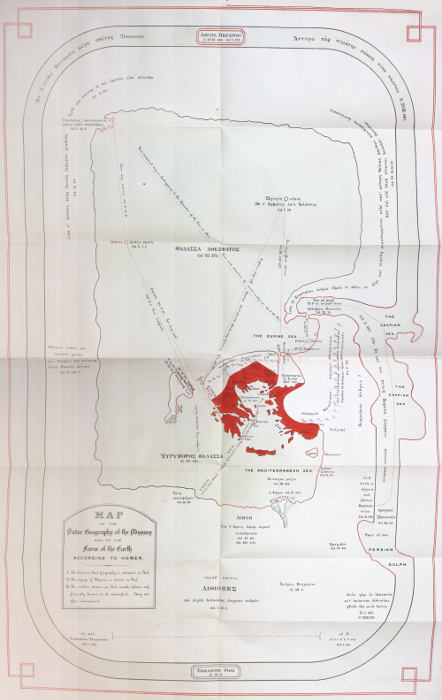
MAP
of the
Outer Geography of the Odyssey
AND OF THE
Form of the Earth
ACCORDING TO HOMER.
IV. AOIDOS. — Sect. I. On the Plot of the Iliad. — SECT. II. The sense of Beauty in Homer; human, animal, and inanimate. — SECT. III. Homer’s perceptions and use of Number. — SECT. IV. Homer’s Perceptions and Use of Colour. — Note on the meaning of κύανος and χαλκός . — SECT. V. [875] Homer and some of his Successors in Epic Poetry: in particular, Virgil and Tasso. — SECTION VI. Some principal Homeric characters in Troy. Hector: Helen: Paris. — SECT. VII. The declension of the great Homeric Characters in the later Tradition [1046] . — FOOTNOTES — Transcriber's Note
Theory of Grote on the Iliad.
Although the hope has already been expressed at
the commencement of this work, that for England at
least, the main questions as to the Homeric poems have
well nigh been settled in the affirmative sense; yet I
must not pass by without notice the recently propounded
theory of Grote. I refer to it, partly on account
of the general authority of his work; for this
authority may give a currency greater than is really
due to a portion of it, which, as lying outside the domain
of history proper, has perhaps been less maturely considered
than his conclusions in general. But it is partly
also because I do not know that it has yet been treated
of elsewhere; and most of all because the discussion
takes a positive form; for the answer to his argument,
which perhaps may be found to render itself into a
gratuitous hypothesis, depends entirely upon a comprehensive
view of the general structure of the poem, and
the reciprocal relation and adaptation of its parts.
Grote believes, that the poem called the Iliad is
divisible into two great portions: one of them he conceives
to be an Achilleis, or a poem having for its subject
the wrath of Achilles, which comprises the First Book,
the Eighth, and all from the Eleventh to the Twenty-second
Books inclusive; that the Books from the Second
to the Seventh inclusive, with the Ninth and Tenth, and
the two last Books, are portions of what may be called
an Ilias, or general description of the War of Troy, which
have been introduced into the original Achilleis, most
probably by another hand; or, if by the original Poet,
yet to the destruction, or great detriment, of the poetic
unity of his work.
In support of this doctrine he urges,
1. That the Books from the Second to the Seventh
inclusive in no way contribute to the main action, and
are ‘brought out in a spirit altogether indifferent to
Achilles and his anger[683].’
2. That the Ninth Book, containing a full accomplishment
of the wishes of Achilles in the First, by
‘atonement and restitution[684],’ is really the termination
of the whole poem, and renders the continuance of his
Wrath absurd: therefore, and also from the language
of particular passages, it is plain that ‘the Books from
the Eleventh downwards are composed by a Poet, who
has no knowledge of that Ninth Book, (or, as I presume
he would add, who takes no cognizance of it[685].’)
3. The Jupiter of the Fourth Book is inconsistent
with the Jupiter of the First and Eighth.
4. The abject prostration of Agamemnon in the
Ninth Book is inconsistent with his spirit and gallantry
in the Eleventh.
5. The junction of these Books to the First Book is
bad; as the Dream of Agamemnon ‘produces no effect,’
and the Greeks are victorious, not defeated[686].
6. For the latter of these reasons, the construction
of the wall and fosse round the camp landwards is out
of place.
7. The tenth Book, though it refers sufficiently to
what precedes, has no bearing on what follows in the
poem.
Grote has argued conclusively against the supposition
that we owe the continuous Iliad[687] to the labours
of Pisistratus, and shows that it must have been
known in its continuity long before. He places the
poems between 850 and 776 B. C.[688]; admits the splendour
of much of the poetry which he thus tears from
its context[689]; yet he apparently is not startled by the
supposition, that the man, or the men, capable of composing
poetry of the superlative kind that makes up
his Achilleis, should be so blind to the primary exigencies
of such a work for its effect as a whole, that he
or they could also be capable of thus spoiling its unity by
adding eight books, which do not belong to the subject,
to fifteen others in which it was already completely
handled and disposed of. And though our historian
leans to the belief of a plurality of authors for the
Iliad, he does not absolutely reject the supposition that
it may be the work of one[690].
Offer of Il. ix. and its rejection.
As to the Ninth Book[691], he refers it more decisively
to a separate hand; and he makes no difficulty about
presuming that the Homerids could furnish men capable
of composing (for example) the wonderful speech of
Achilles from the 307th to the 429th line. Happy
Homerids! and felix prole virûm, happy land that could
produce them!
It appears to me that these are wild suppositions.
Against no supposition can there be stronger presumptions
than against those which, by dissevering the prime
parts of the poem, produce a multiplication of Homers;
and however Grote may himself think that enlargements
such as he describes, do not imply of necessity
at least a double authorship, few indeed, I apprehend,
will be found, while admitting his criticisms on the
poem, to contend that it can still be the production of a
single mind. Still less can I think that any one would
now be satisfied with the sequence of Books proposed, or
with the mutilated proportions, any more than with the
reduced dimensions, of the work as a whole.
I will say not that the propounder of such a theory,
but that such a propounder of any theory, is well entitled
to have the question discussed, whether those
proportions are indeed mutilated by the change, or
whether they are, on the contrary, restored. Let me
observe, however, at the outset, that it is the general
argument with which only I shall be careful to deal.
I do not admit the discrepancies[692] alleged; but neither
is it requisite to examine each case in detail, since
Grote concedes, that his own theory does not relieve
him from conflict with particular passages of the poem.
As respects the Ninth Book, this theory seems to
proceed on a misconception of the nature of the offence
taken by Achilles; as respects the others, upon a
similar misconception of the measure which the Poet
intends us to take of his hero’s greatness, and of the
modes by which he means us to arrive at our estimate.
It takes time to sound the depths of Homer. Possibly,
or even probably, many may share the idea that what
Achilles resents is the mere loss of a captive woman,
and that restitution would at once undo the wrong.
But they misconceive the act, and the man also, to whom
the wrong was done. The soul of Achilles is stirred
from its depths by an outrage, which seems to him to
comprehend all vices within itself. He is wounded in
an attachment that had become a tender one; for
he gives to Briseis the name of wife (ἄλοχον θυμάρεα),
and avows his care and protection of her in that
character. A proud and sensitive warrior, he is[693] insulted
in the face of the army; and to the Greeks,
whose governing sentiment was αἴδως, or honour, insult
was the deadliest of all inflictions. Further, he is
defrauded by the withdrawal of that which, by the
public authority, presiding over the distribution of
spoil, he had been taught to call his own; and he
keenly feels the combination of deceit with insolence[694].
Justice is outraged in his person, when he alone among
the warriors is to have no share of the booty. In
this he rightly sees an ingratitude of threefold blackness;
it is done by the man, for whose sake[695] he had
come to Troy without an interest of his own; it is
done to the man, whose hand, almost unaided, had
earned the spoil which the Greeks divided[696]: lastly, it is
done to him, on whose valour the fortunes of their host
with the hopes of their enterprise principally depended,
and whose mere presence on the field of itself drives
and holds aloof the principal champions of Troy[697]. And,
lastly, while the whole army is responsible by acquiescence
and is so declared by him, (ἐπεί μ’ ἀφέλεσθέ γε
δόντες, Il. i. 299,) the insult and wrong proceed from
one, whose avarice and irresolution made him in the
eyes of Achilles at once hateful and contemptible[698].
Such is the deadly wrong, that lights up the wrath
of Achilles. And, as he broods over his injuries,
according to the law of an honourable but therefore
susceptible, and likewise a fierce and haughty nature,
the flame waxes hotter and hotter, and requires more
and more to quench it. Thus there is a terrible progression
and expansion in his revenge: and by degrees
he arrives at a height of fierce vindictiveness, that
minutely calculates the modes in which the suffering
of its object can be carried to a maximum, yet so as to
leave his own renown untouched, and open the widest
field for the exercise of his valour. It is not vice, nor
is it virtue, which Homer is describing in his Achilles;
it is that strange and wayward mixture of regard for
right and justice with self-love on the one side, and
wrath on the other, which are so common among us men
of meaner scale. The difference is, that in Achilles all
the parts of the compound are at once deepened to a
superhuman intensity, and raised to a scale of magnificence
which almost transcends our powers of vision.
We must, indeed, no more look for a didactic and
pedantic consistency in the movement of his mind, than
in shocks from an earthquake, or bursts of flame from a
volcano. But a real consistency there is; and doubtless
it could be measured by the rules of every day, if only
every day produced an Achilles.
Let us now follow his course with close attention.
Restitution not the object of Achilles.
It can hardly fail to draw remark, that the spirit
of Achilles never from the first moment fastens on
mere restitution, or on restitution at all, as its
object. With his knowledge of his own might, which
was enough to prompt him, had he not been restrained
from heaven, to assail and slay Agamemnon on the
spot, he nevertheless does not so much as entertain the
thought of fighting to keep Briseis. His thought is
far other than this: ‘I will not lift a finger against
one of you for the girl, since you choose to take from
me what you gave (298, 9). I will not hold what you
think fit to grudge.’ While he adds, that they shall
not touch an article of what is properly his own[699].
Not that he cares for mere possession or dispossession.
Were that his thought, he would have lifted up the
invincible arm for the retention of Briseis. But his
thought is this, ‘One outrage you have done to justice
and to me, and, encouraged as well as commanded
by great deities, I bear it; but not even under their
promises and injunctions will I endure that you shall
sin again.’ The loss he had suffered now became quite
a subordinate image in his mind; punishment of the
offenders, and not restitution, was ever before his view.
His first threat is that of withdrawal (Il. i. 169): which,
he conceives, will put a stop to Agamemnon’s rapacious
accumulations. Next (233) he swears the mighty
oath that every Greek shall rue the day of his wrong,
and look in vain to Agamemnon for protection against
the sword of Hector. Again, in his prayer to Thetis,
he intreats that she will induce Jupiter to drive the
Greeks in rout and slaughter back upon the ships and
the sea. He never dreams of the mere reparation of
his wrong: when he refers to Briseis in the great
oration of the Ninth Book, it is for the purpose of
a slaying sarcasm against the Atreidæ; his soul utterly
refuses to treat the affair in the manner of an action at
law for damages; he looks for nothing less than the
prostration of the Grecian host and its being brought
to the very door of utter and final ruin, with the
compound view of avenging wrong, glorifying justice,
enhancing the sufferings of his foe, and magnifying the
occasion and achievements of his own might, to be put
forth when the proper time shall come.
The offer radically defective.
The hero withdraws, and remains aloof. The Greeks,
after a panic and a recovery, determine to carry on the
war without him. But the hostile deities, less under
restraint than the friendly ones, give active encouragement
to the Trojan chiefs and army in the fight. They
are discerned by the Greeks, who accordingly recede[700].
Finding that, instead of driving the Trojans to the city,
on the contrary, even before the single fight of Hector
and Ajax, they themselves had suffered loss, they
supply their camp with the defences, which it had
never needed while the name of Achilles and his
prowess kept the enemy either within their walls, or in
the immediate vicinity of the city. This happens in
the Seventh Book, and it is the first note of the consequences
of the Wrath. In the Eighth, they are more
decidedly worsted under a divine influence, and are
driven back upon their works, while the Trojans bivouac
on the place of battle. The army had suffered no heavy
loss: yet the infirm will of Agamemnon gives way:
and, portending greater evils, he a second time counsels
flight[701]. The advice is warmly repudiated by Diomed
and the other chiefs. Still the course of their affairs
is now by undeniable signs altered for the worse.
Hereupon, Nestor advises an attempt to conciliate
Achilles by offers of restitution and of gifts, with close
union and incorporation into the family of Agamemnon.
Now it is most important that we should observe,
that gifts and kind words were the beginning and the
end of this mission. There was no confession of wrong
authorized by Agamemnon, or made by the Envoys, to
Achilles. The woes of the Greeks are described:
Achilles is exhorted to lay aside his Wrath: he is told
of all the fine things he will receive upon his compliance:
but not one word in the speech of Ulysses
conveys the admission at length gained from Agamemnon
in the Nineteenth Book, that he has offended.
Therefore Achilles is not appeased: but, I must add,
neither is justice satisfied, nor right re-established.
Apology needed also.
Presents and promises were not what Achilles wanted.
On the contrary, to his inflamed and inexorable spirit,
being less than and different from the thing he sought,
the very offer of them was matter of new exasperation.
The very offer of them thus made seemed, and in some
degree rightly seemed, to imply that they who tendered
it must take him for a man, whose mind was cast in
the same sordid mould as that of the king, who had
given the offence. Gifts indeed Achilles must have,
and abundance of them, when he is at last to be appeased:
but it is not in order to swell an inventory of
possessions: it is that the memory of them may dwell
in his mind, and stand upon the record of his life, like
the golden ornaments that he wore upon his manly
person, namely, to exhibit and to make felt his glory.
I do not indeed presume to say we have evidence to
show that Achilles would have relented at the period
of the mission, if a frank confession of wrong, and
apology for insult, had been made together with the
proffer of the gifts. On the contrary, with his higher
sentiments there mingled a towering passion of a vindictive
order. It was as it were the corruption or
abuse, not the basis, of the mood of the estranged
Achilles: but it was there, and there, like everything
Achillean, in colossal proportions. Still I think it has
not been sufficiently observed that, as matter of fact,
the proceeding of the Ninth Book was radically defective,
because it treated the affair as (so to call it) one
of mere merchandize, to be disposed of like the balance
of an account.
When Achilles finds that the desire to avenge the
death of Patroclus has become paramount within him,
and in consequence renounces the Wrath[702], it is true
that he does not stipulate for an apology. But neither
does he stipulate for the gifts. Both however
are given, and the apology comes first in the faltering
speech of Agamemnon[703], who distinguishes between
two kinds of atonement;
ἂψ ἐθέλω ἀρέσαι, δόμεναί τ’ ἀπερείσι’ ἄποινα.
Were there any doubt about the reality of this distinction,
it might be removed by evidence which the Odyssey
supplies. Eurualus, who appears to have been one
of the secondary kings in Scheria, had not yet atoned
for his insult to Ulysses, when Alcinous recommended
that all the twelve, who belonged to that order, should
make a present to the departing stranger. But from
Eurualus, he observes, something more is requisite; he
must offer an apology as well as a gift[704];
Εὐρύαλος δέ ἑ αὐτὸν ἀρεσσάσθω ἐπέεσσιν
καὶ δώρῳ· ἐπεὶ οὔτι ἔπος κατὰ μοῖραν ἔειπεν.
And this is done accordingly, in the amplest and
frankest manner.
All this should be borne in mind, when we estimate
the consistency of the Poet through the medium of the
conduct of Achilles.
It was not a moment’s light apprehension, suffered
by Agamemnon and the army, that could avail to
obliterate his resentment. They had scarcely tasted of
the cup of bitterness; he required that they should
drain it to the dregs. He will not hear of the return
of Briseis: τῇ παριαύων τερπέσθω[705]. With a mixture of
close argument, terrible denunciation, and withering
sarcasm, he overpowers and silences the Envoys. Only
Phœnix can address him, and that after a long pause
and in tears.
Yet the mighty spirit of Achilles sways to and fro
in the tempest of its own emotions. Again he has
threatened to depart: bidding them, with a bitterness
that mounts far away into the region of the sublime,
come the next day and see, if they think such a sight
can be worth their seeing, his fleet speeding homeward
across the broad Hellespont; or north Ægean.
But this course of action would have balked his appetite
for glory; which, as he knew[706], he could only buy,
and that with his life, at Troy. Perhaps, too, he was
softened by the respect of the Envoys, who were personally
agreeable to him; perhaps grimly pleased with
the awe that his Titanic passion had inspired; perhaps
affected with a sympathetic feeling of regard by the
straightforward bluntness of Ajax. At any rate it is
plain that there followed upon the speech of the Telamoniad
chief[707] a greater sign of yielding, than any which
the paternal exhortations of Phœnix, or those most artfully
drawn pictures by Ulysses[708] of the rage and fury of
Hector, had sufficed to produce. In answer to Ulysses,
to the bottom of whose astuteness his clear eye had
pierced, he says, ‘I shall go[709].’ In answer to Phœnix[710],
‘To-morrow we will decide, whether to go or stay.’ In
answer to Ajax, he makes a more sensible advance.
He now so far relents as to tell them, he will bethink
himself of battle; yet it shall only be when the hand
of Hector, dealing death to Greeks, and flame to their
vessels, shall have reached the tents and ships of the
Myrmidons. Then it will be time enough: for then, at
his encampment and by his dark ship, he trows that he
will stay the course of Hector, however keen for fight[711].
Consistency maintained in and after Il. ix.
Thus far, then, we surely have no pretext for saying
that Homer has departed from the purpose of his
poem, of which the man Achilles is the centre and
animating principle, and his Wrath with its terrible
effects the theme. These effects are now developed
up to a certain point: not such a point as really to endanger
the army, or excite strong sympathy or apprehension
on its behalf, but yet such a point as entirely
to tame the irresolute egotism of Agamemnon, and
drive his but half-masculine character into efforts again
to lay hold upon the prop, which he had so rashly and
lightly, as well as selfishly and unjustly, put away.
If we were to consider Achilles as engaged in a mere
personal quarrel, we must condemn him, without any
qualification whatever, for not accepting the reparation
now tendered by Agamemnon. But if we bear in
mind that the wrong done was a public wrong, that no
confession of this wrong was made, that the other
kings and leaders, and the whole army, became in some
degree parties to it by their acquiescence, and that he
was thus as much or more the vindicator of great
public rights than the mere avenger of a personal
offence, it is not so clear that the conduct of Achilles
after the mission of the Ninth Book is incapable in
principle of justification, according to the moral code
of Greece. It must, however, undoubtedly remain
amenable to severe censure on the score of excess: a
culpability, for the penal notice of which Homer has
made abundant provision in the sequel of the poem.
But this question is by the way: the main issue
raised is as to the poetical consistency and effect of the
structure, which Homer has chosen for his work. Upon
this there is surely little room for doubt.
From the Ninth Book we commence afresh: Achilles
in his moody seclusion, the Greeks in a manful determination
to do their best; even Agamemnon is now roused
to feel what he has brought upon the army, thrown back
from his moral irresolution as a chief upon his personal
courage as a soldier, and resolved to appear in the field,
that he too may earn his laurels there.
And these intentions are gallantly fulfilled. The
night foray of Diomed and Ulysses stands well, as one
of the minor but safe measures, by which a skilful generalship
often makes its first efforts to raise the spirits
of a downcast army. Agamemnon then appears, and
shows himself to be a warrior of a high, nay of the
highest order of strength and valour. The other kings
exert themselves with their wonted chivalry. But the
decree of Jove, working through the accidents of war,
drives three of the four great champions from the field,
and leaves only Ajax; who, invincible wherever he is
found, yet cannot be everywhere, nor, single handed,
govern the result of battle along the whole extent of
the line. And now come the great exertions and successes
of the Trojans, especially Sarpedon and his Lycian
contingent, Hector playing rather a conventional
than a real part. Now it goes hard indeed with the
Greeks; the fire touches the ships; Patroclus must go
forth and die; and the Wrath is at an end, for it is
drowned in the bitterness of the tears of Achilles.
With reference, then, to the main purpose of the
poem, it proceeds regularly to its climax, and there is
no limb of the Iliad separable from the body without
destroying the symmetrical, masculine, and broad development
of its general plan. I speak now of the
principal fabric of the poem. Few who are not prepared
to pull that in pieces will, I apprehend, accede
to the proposal to shear it of the two last Books, which
therefore hardly require a separate defence.
Skilful adjustment of conflicting aims.
To me it appears well worthy of remark, with what
extraordinary skill Homer has contrived to adjust his
poem to the several aims which he had to keep in
view. The grand one doubtless was the glory of his
country in the person of Achilles[712]. Still he was bound
not to sacrifice poetically the martial fame of the rest of
Greece even to the first among them, whatever calamities
he might make the army suffer on his account. To avoid
this sacrifice, he was obliged to uphold the military
character and power of the Greeks in their struggle
with the Trojans, even when deprived of the prowess
of their great champion Achilles. And yet he could
not degrade Hector and the Trojans, or he would have
reached the lame conclusion of adorning his own country’s
heroes with a poor and unworthy triumph. Thus
his course was to be steered among a variety of difficulties,
all pressing upon him from opposite quarters.
We see at once how steadily he kept in view his pole-star;
how he handled the events and characters of his
poem so as to give the most powerful, or rather it may
be said the most overpowering, impression of the greatness
of his hero, which is lifted higher and higher by the
whole movement of the work as it proceeds. Let us
now examine whether, in giving full scope to his main
purpose, he has been obliged to sacrifice others which
were also important, nay, if the highest excellence was
his aim, even indispensable.
The paramount glory of Achilles is established by this:
first, that in the Ninth Book the whole army, as it were,
lies at his feet, and is spurned from thence: secondly, that
when he finally comes forth, it is not in deference to
those who have insulted him, but it is under the burning
impulses of his own heart. Let us now proceed to inquire
whether the Poet has or has not satisfied two other
great demands. Has he, as a Greek, done all that was
required to glorify Greece, and is Achilles its crown
only, or is he its substitute? Has he, as a man, vindicated
the principles of the moral order, and of that retributive
justice which, even in this world, visibly maintains
at least a partial balance between human action
and its consequences to the agent?
Glory given to Greece.
We should look in vain, I think, for a finer and
subtler exercise of poetic art, than in the mode in
which Homer has contrived to convey to us, both the
general, and in particular the military inferiority of
the Trojans, as compared with the Greeks. Hardly
any reader can be so superficial in his observation of
the poem, as not to rise from it with this inferiority
sufficiently impressed upon his mind. Yet there is not
a passage or a word throughout, in which it is asserted.
And why? Because every direct assertion that the
Trojans were less valiant or less strong than their antagonists,
would have been so much detracted from the
glory of overcoming them. It was essential to the work
of the Poet, that he should represent the contest as an
arduous one. He might have done this in the coarse method,
for which his theurgy would have afforded the materials:
that is, by converting his Trojans into mere puppets,
whose arm, at every turn of the narrative, merely
represented the impelling force of some deity or other,
and, independently of such extraneous aid, was powerless.
But this would have destroyed the full-flushed
humanity of Homer’s poem.
As it is, he has availed himself of the divine element
to make up by its assistance for the comparative weakness
of the Trojan chiefs: but it is only a subdued and
occasional assistance, so that there is no glaring difference
in point of free agency between the two parties. Nor
can it be without a purpose, that the two deities, who
appear in the field on behalf of the Trojans, namely,
Venus and Mars, are sent off it both wounded, the one
whining, and the other howling, by the prowess of
Diomed. If the Greeks are to suffer by the gods, he
takes care that it shall not be by those gods who are
the mere national partisans of Troy, but by a higher
agency; by the decree of Jupiter, now temporarily indeed,
but effectively, set against them.
It is by an indefinitely great number of strokes and
touches each indefinitely small, that Homer has gained
his object. The Trojan successes are always effected with
the concurrence of supernatural power; the Greeks not
unfrequently without, and sometimes even against it[713].
He as it were sets up the Trojans, so to speak, by
generalities; but he gives to the Greeks, with certain
occasional exceptions, the whole detail of solid achievement.
Sometimes he allows a panic of doubt and fear
to seize their host, but he takes care to make the sentiment
only flit like a momentary shade over the sun.
Thus, when the assembled chieftains of the Greek army
hesitate to accept the challenge of Hector[714],
αἴδεσθεν μὲν ἀνήνασθαι, δεῖσαν δ’ ὑποδέχθαι.
But after a short interval, and a proper appeal, nine
champions appear, each and all burning to meet Hector
in single combat. Sometimes he contrives to direct
his praises to martial appearance and exterior, but
carefully avoids the real touches of heroic character; as
when he bestows on Paris the noble simile of the
στάτος ἵππος. Generally he pays off, as it were, the
Trojans with high-sounding words, and reserves nearly
all the true qualities of heroes, as well as their exploits,
for the Achæans. With them are the sagacity, consistency,
firmness, promptitude, enterprise, power of
adapting means to ends, comprehensiveness of view, as
well as main strength of hand. But by the expedients
I have mentioned, the Trojans are raised to, and kept
at and no more than at, the level necessary to make
them worthy and creditable antagonists. One other
engine for the purpose has been employed by him,
namely, the real valour and manhood of the Lycian
kings and forces[715], with whom he had evidently a strong
and peculiar sympathy; whose chief, Sarpedon, is really
a better man in war than Hector, though much less
pretentious; and who, under this prince, achieve the
only real, great, and independent success that is to be
found on that side throughout the whole course of the
poems, namely, the first forcing of the Greek entrenchments[716].
The Trojan inferiority indeed lies very much more
palpably in the chiefs, than in the common soldiers.
Between the bulk of the army on the one side and on
the other, Homer represents no great—at least no
glaring difference. Sometimes the fight is carried on
upon terms purely equal[717], as during the forenoon of
the day in the Eleventh Book: where there is superiority,
it is assigned to the Greeks[718] or to the Trojans[719],
according as the exigencies of the poem may require.
Still he contrives some note of difference so as to
draw a line between the merit of the respective successes;
thus, when the Trojans turn the Greeks to flight,
there is commonly an intimation, in more or less general
terms, of a divine agency stimulating them. Hostile
weapons are indeed often turned aside on behalf of
Greeks: but only in one instance, I think, do the
Greeks derive decided advantage from a panic divinely
inspired: it is when, in the Sixteenth Book, Jupiter
instils into Hector the spirit of fear[720].
This absence of broad contrast between the two soldieries
is in entire accordance with what we have seen
reason to presume as to their composition; namely,
that the rank and file on both sides was in all likelihood
composed from kindred and Pelasgian races.
Yet a strong jealousy on behalf of his country is ever
the predominant sentiment in the Poet’s mind; and
accordingly he insinuates, with much art, suggestions
which keep even the Trojan soldiery somewhat below
the Greeks; while to the chieftains of the Greek army,
though his laudatory epithets are nearly as high on the
one side as on the other, he assigns in action an enormous
superiority, both military and intellectual. Accordingly,
when we come to cast up the results of the actual
encounters, we are astounded at the littleness, the
almost nothingness, of the Trojan achievements, and at
the large havock wrought by their opponents, even during
the period when Achilles was in estrangement[721].
As regards the armies at large, observe the similes
used in the Fourth Book[722]. The Greeks move in silence
and discipline, like the swelling waves when the tempest
is just beginning to gather: the Trojans, like innumerable
sheep, who stand bleating in the fold while
they are being milked[723]. In the Fifth Book, while it is
mentioned, as if casually, that Apollo, Mars, and Eris,
were stirring and keeping up the Trojans, it is subjoined,
without ostensible reference to this intimation,
but plainly in artful contrast with it, that the Greeks
found sufficient incentives in the exhortations of the
two Ajaxes, of Ulysses, and of Diomed[724]. Again, when
Hector returns, after his battle with Ajax[725], to his comrades,
we are told that they rejoiced in finding him
restored to them in safety, contrary to their expectation,
ἀέλπτοντες σόον εἶναι. On the other hand, it is added,
the Greeks led Ajax to Agamemnon, exulting in his
victory over Hector (κεχαρηότα νίκῃ). The Greeks feel
no thankfulness, because they had, we are evidently to
understand, felt no fear. And the chief rejoices in his
victory, which it really was. It was, indeed, ended as a
drawn battle, though Ajax had had the best of it at every
stage; but not so much for the honour of Hector, as for
the purposes of the poem, since Hector had to meet
Achilles in the field, and he would have been degraded
by encountering an antagonist that anybody else had palpably
worsted. To state the paradox as Homer had to
confront it, the problem was to make Ajax conqueror,
without letting Hector be conquered.
Inferiority glaring in the Chiefs.
When we look to the case of the chieftains as a
whole, the contrast is glaring. No first rate, or even
second rate, Greek chieftain is ever killed in fair field:
Tlepolemus, slain by Sarpedon, comes the nearest to that
rank, but is not in it. Patroclus is only slain after
being disarmed by Apollo: and here it seems to me
as if for once the Poet had a little overshot his mark;
for the artifice is gross, and covers the pretended exploit
of Hector with indelible disgrace. In fact, Hector
never once achieves a considerable success in the field:
though only Achilles, the first Greek warrior, is allowed
completely to overcome him[726], yet he is decidedly inferior
in fight to both Diomed and Ajax, who jointly
occupy the two next places, but as between whom
Homer has not decisively marked the claim to precedence.
In general terms, he gives it to Ajax more
emphatically[727], but he details more and greater acts of
prowess in favour of Diomed.
Even with Agamemnon Hector is admonished, on
the part of Jupiter, not to contend: and he follows the
advice. Of the Trojan chiefs who really fight, a large
proportion are slain; Glaucus, Æneas, Deiphobus, and
Polydamas are the most considerable who survive. No
eminent Trojan in fact is ever allowed to display real
heroism, except under circumstances where the issue is
quite hopeless: accordingly Homer has never surrounded
Hector with true heroic grandeur, in deed as
well as word, until his final battle against Achilles,
when he is at last brought to bay, and when his doom
is certain. All the considerable injuries inflicted upon
great Greek chieftains are from causes not implying
personal prowess in their rivals: from the arrows of
Pandarus or of Paris, or by the chance hit of some
insignificant, or at the least secondary, but desperate
Trojan, such as Socus, or such as Coon, struck even as
he is himself receiving or about to receive his own
death-blow[728]. But for these ignoble wounds, which were
inflicted on many chiefs, including three prime heroes,
Agamemnon, Diomed, and Ulysses, the Greeks, according
to the agency of the poem as it stands, never would
have been driven back upon their ships at all.
Conflicting exigencies of the plan.
Now Homer’s difficulty in this matter was not simply
that which has been heretofore pointed out, or which
has been commonly supposed. His aim, says Heyne[729],
in representing the disasters of the Greeks is, ut per eas
Achillis virtus insigniatur, quippe quâ destituti Achivi
succumbunt, eâdem redditâ vincunt. But this is surely
a misstatement of the case. Homer has not represented
the Greeks plus Achilles as superior to the
Trojans, and the Greeks minus Achilles as inferior to
them. This was what a vulgar artist, whose mind
could only hold one idea at a time, would have done;
nay, what it was difficult to avoid doing, for it was vital
to Homer’s purpose that the vengeance of Achilles
should be completely satiated: it was not to be thought
of that this transcendent character, this ideal hero,
should be balked by man of woman born; the whole web
of the Poet’s thought would have been rent across, had
there been failure in such a point. What was needful in
this view could only be accomplished by the extremest
calamities of the Greeks. These calamities he had to
bring about, and yet to give to the Greeks a real superiority
of military virtue. We have seen already
how he effected the latter: how did he manage the
former? Partly by giving Achilles, in right of his
mother Thetis, such an interest in the courts of
heaven, as to throw a preponderating divine agency
for the time on the side of the Trojans; partly by a
skilful use of the chances of war, in assigning to Troy
a superiority in the comparatively ignoble skill (as it
was then used) of the bow. Thus he causes the Greeks
to be worsted, notwithstanding their superiority: by
their being worsted, he satisfies the exigencies of his
plot; by exhibiting their superiority, he fulfils the conditions
of his own office as a national poet. To speak
of the ingenuity of Homer may sound strange, for we
are accustomed to associate his name with ideas of
greater nobleness; but still his ingenuity, in this adjustment
of conflicting demands upon him, appears to
be such as has never been surpassed.
Greeks superior even without Achilles.
And here I, for one, cannot but admire the way in
which Homer has made purposes, which others would
have found conflicting, to serve as reciprocal auxiliaries.
The Embassy of the Ninth Book certainly glorifies
Achilles: but let us ask, does it not help also to
glorify Greece? Let us consider what had happened.
The withdrawal of Achilles was at once felt as a great
blow; and it acted on the whole tone of the army.
This appears in various ways. We read it in the home-sick
impulses of the Second Assembly (b. ii.); in the
advice of Nestor to take measures for securing the responsibility
of officers and men (ii. 360-8); in the
slackness of various chiefs during the Circuit of Agamemnon
(b. iv.); in its being recorded to the honour of
that leader (iv. 223) that he did not flinch from his duty;
lastly, in the momentary reluctance of the Greek heroes
to encounter Hector (vii. 93). All this is thoroughly natural.
Having leant upon a prop, they were not at once
aware of their remaining and intrinsic strength. They,
like all persons who have not learned the habit of self-reliance,
required to learn it with pain. Hence, after
the very first touch of comparative weakness in the
field, they conceive the idea of the rampart. They
had not really been worsted: but their enemies had
learned to face them; their position was now no longer
what it had used to be, when Hector did not venture
out in front of the Dardanian Gate. But the building
of the rampart produced, as was natural, an increased
weakness. Besides this, Jupiter, seeing that the tendency
of events was not to give a sufficiently rapid and
decisive triumph to Achilles, now inhibited those deities,
who were friendly to Greece, from taking part, while he
himself (viii. 75) alarmed and abashed the Greeks with
his thunder. They thus feel themselves thrown one full
stage further into weakness. What more natural, than
that they should turn to Achilles, and try his disposition
towards them? This is effected in the Ninth Book.
They then become acquainted practically, for the first
time, with the fierceness of the seven times heated
furnace of the Wrath. This experience teaches them,
that they must do or die. So at last, the bridge behind
them being broken, Greece is put upon her
mettle. The gallant Diomed becomes the spokesman
at once of chivalry and of common sense. ‘You should
not have asked him. By asking, you have emboldened
and hardened him. Let him alone. Rely upon yourselves.
Refresh yourselves with sleep and a good meal,
and then, order out the troops, and have at them: I
for my part will be found in the van[730].’ Then it is that
the Greeks understand their position, and, casting off
hope from Achilles, place it in themselves. Hence
that great development of valorous energies in the
Eleventh Book, which proves that in equal fight, even
though Achilles were absent, Troy had not a hope: so
that the expedient of chance-wounds, disabling all the
prime warriors but Ajax, is absolutely necessary in
order to bring about the required amount of disaster.
It appears to me, I confess, that this is a masterly adjustment,
alike true in nature, and high in art.
But first, after the great repulse, comes the pilot-balloon,
the tentative effort, of the Doloneia.
Next to the skill and power with which the Poet
has discriminated the characters of his greater Greek
heroes, I am tempted to admire the circumspection and
precision, with which he has assigned their relative degrees
of prominence in the action. To those who complain
of the Doloneia for want of a purpose, I would
reply that, in the first place, besides its merits as an
operation with reference to the circumstances of the
moment, (for it feeds the army, as it were, with milk,
when they were not yet ready for strong meat,) it remarkably
varies the tenour of the action, which without
it would have fallen into something of sleepy sameness,
by substituting stratagem for force, and night-adventure
for the conflicts of the day. Let those who
doubt this strike out the Tenth Book, and then consider
how the course of the military transactions of the poem
would stand without it: how much more justly the first
moiety of the military action of the poem would stand
liable to the imputation of monotony, which even now
is of necessity the besetting danger of the whole poem.
But more; I contend that the Doloneia constitutes, in
the main, the ἀριστεῖα of Ulysses. His distinguished
part in the Second Book is political only, and has no
concern with his military qualifications. His ordinary
military exploits elsewhere are secondary, and also
scattered. To assign to him a great share in the field
operations would have been a much less fine preparation,
than the Iliad now affords, for his appearance in
the Odyssey; and it would also have hazarded sameness
as between his achievements and the other ἀριστεῖα
of the great chiefs. Besides, there was little room
in the field, as the martial art was then understood, for
his distinctive qualities, self-reliance, presence of mind,
fertility in resource. But military distinction, even
in the time of Homer, lay in two great departments,
one known as the fight (μάχη), the other as ambush
(λόχος). The latter was of fully equal, nay, on account
of its sharper trial of moral courage[731], it was even of
still greater honour. To this class the night adventure
essentially belonged. Here Ulysses is thoroughly at
home. In the Doloneia, Diomed is merely the sword
in the hand of Ulysses; who directs the operation, and
overrules his brave companion when he thinks fit, as,
for example, in the matter of the slaughter of Dolon.
In what other way could Homer have given us an
equally characteristic illustration of the military qualities
of Ulysses?
Harmony in relative prominence of the Chiefs.
Now this view of the Doloneia fills up, I think, what
must otherwise be admitted to be a gap in the poem.
It being thus filled up, let us observe the accuracy
with which shares in the action of the poem are assigned
to the respective chiefs. Nestor has his own
place apart as universal counsellor. Ulysses also, who,
as the great twin conception to Achilles, must never
be allowed to appear in a light of inferiority to any one,
is so managed as not to eclipse the might of Ajax or
the bravery of Diomed; and yet he has all his attributes
kept entire for the great part he had to play in the
Odyssey, and is never beaten, never baffled, never excelled.
Then Ajax, Diomed, Agamemnon, Menelaus,
even elderly Idomeneus, have each the stage made
clear for them at different times, and with scope proportioned
to their several claims upon us. The very
intervals between their several appearances are made
as wide as possible: for Diomed is in the Fifth and
Eleventh Books, Ajax in the Seventh, Agamemnon in
the Eleventh, Idomeneus in the Thirteenth[732], Menelaus
in the Seventeenth. Ajax excels in sheer might, Diomed
in pure gallantry of soul, and what is called dash;
Agamemnon’s dignity as a warrior is most skilfully
maintained, yet without his being brought into rivalry
with those two still greater heroes, by Hector’s being
counselled to avoid him. Menelaus, secondary in mere
force, though with a spirit no less brave than gentle, is
carried well through by the care taken that he shall
only meet with appropriate adversaries, and the same
pains are employed on behalf of Idomeneus. For
Patroclus, as the friend and second self of Achilles,
Homer’s fertile invention has secured a kind of distinction,
which does not displace that of others, and which,
notwithstanding, is eclipsed by none of them. He turns
the Trojan host; he slays the great Sarpedon; he is
himself slain only by foul play. I cannot vindicate the
clumsy intervention of Apollo, and the meanness of
the part played by Hector in this cardinal passage of
his career; still I find it curious and instructive to observe
in all this a new instance of the intense care, with
which the Poet watches over the character especially
of his Achilles. He exalts him, by exalting first those
secondary eminences, far above which he keeps him
towering. Therefore he would have Patroclus slain
indeed, but not defeated, by Hector; and to this capital
object he appears to have made, perhaps unavoidably,
considerable sacrifices.
Upon the whole, then, it would seem that Homer
had to maintain a complex regard to a variety of objects.
First of all there was the relation to observe
between Achilles and all the other personages of his
poem on both sides of the quarrel. Then in distributing
his minor Alps, the other prime or distinguished
Greek warriors, about this great Alp, he had to keep
in mind and provide for their relations to one another,
as well as to him. Lastly, he had to carry Hector
and the Trojans so high, that to overcome their chief
should be his crowning exploit, and yet so low, that
they should not stand inconveniently between the
Greeks and the view of such national heroes as Ulysses,
Diomed, Ajax, and Agamemnon. Like Jupiter on Ida[733],
from none of these objects has he ever removed his
bright and watchful eye; for all of them he has made
a provision alike deliberate and skilful.
It only remains to consider the outline of the plot
in reference to the Providential Government of the
world, and the administration of retributive justice; a
subject which has been ably handled by Mr. Granville
Penn[734].
I am not able to admit that broad distinction, which
is frequently drawn between the provision made for
satisfying this great poetical and moral purpose in the
Iliad and in the Odyssey respectively. In each I find
it not only remarkable, but even elaborate. In each
poem, Homer exhibits, above all things else, one chosen
human character with the amplest development. But
diversity is the key-note of the development in the
Odyssey, grandeur or magnitude in the Iliad. The
hurricane-like forces, that abound in the character of
Achilles, entail a greater amount of aberration from the
path of wisdom. But there is not wanting a proportionate
retributive provision. Ulysses, after a long course
of severe discipline patiently endured, has awarded to
him a peaceful old age, and a calm death, in his Ithaca
barren but beloved, with his people prospering around
him. Achilles, on the other hand, is so loaded with
gorgeous gifts that, wonderful as is their harmony in
all points but one, that one is the centre. He has not
the same unfailing and central solidity of moral equipoise.
In himself gallant, just, generous, refined, still
indignity can drive him into an extremity of pride and
fierceness, which call for stern correction. Hence it
comes about that, while the adversity of Ulysses is
the way to peace, the transcendent glory of Achilles is
attended by a series of devouring agonies; the rival
excitements of fierce pain and fiercer pleasure accompany
him along a path, which soon and suddenly descends
into the night of dismal death. Alike in the
one case and in the other, the balance of the moral
order is preserved; and that Erinūs, who, in so many
particular passages of the poems, makes miniature appearances
in order to vindicate the eternal laws, such as
the heroic age apprehended them, likewise presides in
full development over the general action of each of
these extraordinary poems.
Retributive justice in the two poems.
Retributive justice, inseparably interwoven with human
destiny (for thus much the Erinūs signified) tracks
and dogs Achilles at every stage. Take him, for instance,
as the Ninth Book shows him, at the very
summit of his pride. It is in no light or joyous mood,
that he repels the Envoys. Who among readers does
not seem to see his spirit writhe, when he describes the
hot and bursting resentment in his breast, the stinging
recollection of the outrages he has undergone[735]. Even by
the irrepressible curiosity, which compels him to mount
upon his ship for view, and to send out Patroclus to
learn the course of the battle, Homer has shown us how
false was any semblance of peace, that he could even
now enjoy in his giddy elevation.
The rampart is pierced, the ships are reached, the
firebrand is hurled, and the first Greek ship burns.
Achilles must not depart from his word: but his restlessness
now conceives an expedient, the sending forth
of Patroclus to the fight. At the same time, he takes
every precaution that sagacity can suggest: he clothes
his friend in his own armour, exhorts the Myrmidons
to support him, above all enjoins him to confine himself
to defensive warfare, and not to follow the Trojans,
when repulsed, to the city. What then happens to
him? That which often befalls ourselves: that when
we have turned our back upon wisdom, wisdom turns
her back upon us. Achilles insisted upon the disaster
of his countrymen. When it came, it constrained him
to send out his friend: and the calamity he had himself
invoked was death to the man that he loved better
than his own soul.
And why did Patroclus die? It was not that Achilles
imprudently exposed him to risks beyond his strength.
He was abundantly able to encounter Hector. Hector
had no care, so long as the battle was by the ships, to
encounter this chief. And Achilles had enjoined him to
fight by the ships only, lest, if he attempted the city, a
deity should take part against him[736]. Patroclus disobeyed,
and perished accordingly. As Achilles had refused
to follow the laws of wisdom for himself, so, when
he carefully obeyed them, they were not to avail him
for the saving of his friend. Heaven fought against
Patroclus; Jupiter, after deliberation, tempted him
from the ships, by causing Hector to fly towards the city;
and the counsel of Achilles was now baffled as he had
baffled the counsels of others, the dart was launched
that was to pierce his soul to the quick.
Double conquest over Achilles.
Thus his proud will was doomed to suffer. The suffering
is followed by the reconciliation, and by the climax of
his glory and revenge in the death of Hector. How in
these Books we see him moving in might almost preternatural,
with the whole world as it were, and all
its forces, in subjection to his arm! But he has only
passed from one excess of feeling into another: from
a vindictive excess of feeling against the Greeks, to
another vindictive excess of feeling against Hector.
The mutilation and dishonour of the body of his slain
antagonist now become a second idol, stirring the
great deep of his passions, and bewildering his mind.
Thus, in paying off his old debt to the eternal laws, he
has already contracted a new one. Again, then, his
proud will must be taught to bow. Hence, as Mr. Penn
has well shown, the necessity of the Twenty-fourth
Book with its beautiful machinery[737]. Achilles must
surrender the darling object of his desire, the wreaking
of his vengeance on an inanimate corpse. On this
occasion, as before, he is subdued: and both times it is
through the medium of his tender affections. But in
both cases his evil gratification is cut short: and the
authority of the providential order is reestablished.
The Greeks pursue their righteous war: the respect
which nature enjoins is duly paid to the remains of
Hector, and the poem closes with the verse which
assures us that this obligation was duly and peacefully
discharged.
With these views, I find in the plot of the Iliad
enough of beauty, order, and structure, not merely to
sustain the supposition of its own unity, but to bear
an independent testimony, should it be still needed, to
the existence of a personal and individual Homer as
its author.
The idea of Beauty, especially as it is connected
with its most signal known manifestation in the human
form, and again the φθορὰ, or corruption of that idea,
have each their separate course and history in the religion
and manners, as well as in the arts, of Greece. By
the idea of Beauty, I mean here the conception of it in
the human mind as a pure and wonderful essence,
nearly akin to the Divine; derived from heaven, and
both continually and spontaneously tending to revert
to its source. By the corruption of that idea, I mean
the conception of it either mainly or wholly with reference
to animal enjoyment; sometimes within, and
sometimes beyond, the laws of Nature.
In the works of Homer, we find the first of these
conceptions exceedingly prominent and powerful. It
approaches almost to a worship: and yet is scarcely at
all tainted with the second, scarcely presents the
smallest deflection from the very loftiest type. In
Homer, that is to say, in the Homeric descriptions of
human characters and life, we never find Beauty and
Vice pleasurably associated: he seems to have felt in
the sanctuary of his mind as much at least as this, if
not more; that a derogation from purity involved of
itself a descent from the highest to a lower form of
beauty: and therefore he never associates his highest
descriptions of beauty with vice: differing in this not
only from so many heathen, but even from many
Christian authors.
The Dardanid traditions.
But yet it is most remarkable that, even in Homer’s
time, the level of popular tradition on the subject of
beauty had begun to descend, and though he had
escaped the taint, yet it had touched his age. Let us,
for example, take that most striking series of traditions
in the Dardanian royal family, which are recorded in
the poems of Homer. That family appears to have
had personal beauty for an almost entailed inheritance.
Not only Hector, Deiphobus, Æneas, as well as Paris,
possessed it, but Priam, even in his old age and affliction,
was divinely beautiful as he entered the apartment
of Achilles; and, as they sat at meat, and he
admired Achilles, Achilles returned his admiration[738].
The line of traditions in this family, to which I now
refer, affords the best illustration of the idea of beauty
as ever striving, by an inner law, to rise to a heavenly
life. There are four of these traditions: and as we
pass from the older to the more recent, at each step
that we make, we lose some grain of the first ethereal
purity. The earliest of them all is the translation,
since coarsely and without ground called the rape, of
Ganymede: consistently indeed so called, according to
the idea of the fable which has prevailed in later ages,
but most absurdly, if it be applied to the tradition in
the shape in which it stands with Homer. With him
the tale of Ganymede is the most simple and perfect
assertion of the principle that beauty, heavenly in its
origin, is heavenly also in its destiny; and that the
heaven-born and heaven-bound should contract no
taint upon its intermediate passage. There were three
sons, says Homer, born to Tros; Ilus was one, Assaracus
another: and the third was Ganymede, a match
for gods. Ganymede, the most beauteous of men,
whom, for his beauty, and seemingly before he had
come to maturity for succession, the gods snatched up
and made the cupbearer of Jupiter, that he might
dwell for ever among the Immortals[739]:
ὃς δὴ κάλλιστος γένετο θνητῶν ἀνθρώπων·
τὸν καὶ ἀνηρείψαντο θεοὶ Διὶ οἰνοχοεύειν
κάλλεος εἵνεκα οἷο, ἵν’ ἀθανάτοισι μετείη.
The idea of sanctity, indeed, is not to be discovered
here; its traces can only be found among the inspired
records; the resemblance to the deity does not reach
beyond the flesh and mind; yet the sum of the tale is
full of interest. The other sons grew up, and became
kings; he, that he might not linger, might not suffer,
might not contract taint or undergo decay on earth, was
taken up to that sphere, which is the proper home of
all things beautiful and good.
The thought is somewhat related to that of the following
remarkable lines by Emerson:
Perchance not he, but nature ailed;
The world, and not the infant, failed.
It was not ripe yet to sustain
A genius of so fine a strain,
Who gazed upon the sun and moon
As if he came unto his own:
And pregnant with his grander thought,
Brought the old order into doubt.
His beauty once their beauty tried;
They could not feed him, and he died,
And wandered backward, as in scorn,
To wait an Æon to be born.
Far as the tradition of Ganymede, according to Homer,
is below that of Enoch, it is set by a yet wider distance
above the later version of the same tale. Thus, in
Euripides, we find him the Διὸς λέκτρων τρύφημα φίλον
(Iph. Aul. 1037): and what is more sad is to find, that
this utterly debased and depressed idea prevailed over
the original and pure one, even to its extinction, and
was adopted and propagated by the highest and the
lowest poets of the Italian romance[740].
Next in order to the tradition of Ganymede comes
that of Tithonus, who, on account of his beauty, was
carried up, not by the gods at large, to be as one of
them, but by Aurora to become her husband, in which
capacity he remained in the upper regions[741]. This is a
step downwards; but the next is a stride. In the third
tradition, so far as is known from the authentic works
of Homer, Æneas is the son of Venus and Anchises,
but without their standing in the relation of husband
and wife. The particulars of the narrative are supplied
in the early Hymn, which perhaps was the more
readily ascribed to Homer, because it was believed to
embody a primitive form of the tradition. Jupiter inspired
Venus with a passion for Anchises, and, after
having arrayed herself in fine vestments and golden
ornaments, she presented herself to him as he was
playing the lyre in solitude on Ida; when the connection
was formed that gave birth to Æneas[742].
The next fall is the greatest of all: according to the
later tradition, Venus, to obtain a favourable judgment
from Paris (of the next generation to Anchises), promised
him a wife of splendid beauty and divine extraction,
whom he was to obtain by treachery and
robbery, as well as adultery; and filled him with what
Homer pronounces an evil passion[743].
The Poet, indeed, tells us nothing of this promise,
which appears to imply powers far greater than any
that the Homeric Aphrodite possessed. But he mentions
the contest, informs us that Venus was the winner,
makes Paris boast of her partiality, and introduces her
as mentioning her own favours to Helen[744].
Such was the downward course of all in the nature
of man that belonged to the moral sphere, apart from
the cherishing power of Divine Revelation; for the
chronological order of these legends is also that of their
descent, step by step, from innocence to vice.
Homer, as we have already seen, represents a very
early and chaste condition of human thought. We
have now to observe how strong and genuine, as well
as pure, was his appetite for beauty.
Since here, as elsewhere, it is not the Poet’s usage
to declare himself by express statements and elaborate
descriptions, we must resort in the usual manner to
secondary evidence; which, however, converging from
many different and opposite quarters upon a single
point, is perhaps more conclusive than mere statement,
because it shows that we are not dealing with a simple
opinion, but with a sentiment, a passion, and a habit,
which penetrated through the Poet’s whole nature.
I shall notice Homer’s sense of beauty with reference,
first and chiefly, to the human countenance and
form; next, with respect to animals; and thirdly, with
respect to inanimate objects and to combinations of
them.
As regards the first and chief branch of this inquiry,
we must notice to what persons, and in what degrees,
Homer assigns beauty, from whom he withholds it;
and how far he considers it to give a title to special
notice, in cases where no other claim to such a distinction
can be made good.
We may then observe that Homer does not commonly
assign personal beauty to any human person,
who is morally odious. In any questionable instance
where he does so assign it, he seems to follow an historical
tradition, or to be constrained by his subject.
He has covered Thersites with every sort of deformity;
and in the description of the persons and of the twelve
dissolute women among the fifty domestic servants of
Ulysses, there is barely a word that implies beauty[745].
Melantho indeed, the most conspicuous offender, is
called in the Eighteenth Odyssey[746] καλλιπάρῃος. But it
seems probable, that he followed a local tradition concerning
her; for, if she had been simply a creation of
his own, he certainly would not have represented her
as the daughter of the old and faithful Dolius[747], who,
with his six sons, bore arms for Ulysses.
Treatment of the beauty of Paris.
So also the beauty of Paris was an inseparable incident
of the Trojan tale. Yet it is remarkable how
little it is brought into relief. Where he is called
beautiful, it is by way of sarcasm and reproach[748],
The only passage, in which his beautiful appearance is
described at all, is from the mouth of Venus[749], to
whom Homer never intrusts anything, to be either
said or done, that he wishes us to regard with favour.
Compelled, however, to set off the imposing exterior
of this prince, if only for the purpose of heightening
the contrast with his cowardice in action, he introduces
him flourishing his pair of spears at the commencement
of the Third Iliad; and what is more, when he
again goes forth in his newly burnished arms at the
close of the Sixth, bestows upon him one of the very
noblest of his similes, that of the stall-kept horse,
high fed and sleek in coat, who having broken away
from his manger rushes neighing over the plain[750].
It was necessary, in order to make up the true portrait
of Paris, that his exterior should be thus splendid, and
his movements imposing; and it was also a part of the
subtle plan, by which Homer made use of words and
appearances to bring up the Trojan chieftains and
people to some kind of level with the Greek. Yet
there is something singular in the fact that Homer,
who does not, I think, repeat his similes in any other
remarkable case, reproduces the whole of this splendid
passage in the Fifteenth Iliad for Hector[751]. There
is here, we may rely upon it, some peculiar meaning.
Possibly he grudged the exclusive appropriation of so
splendid a passage to so despicable a person. There is
also another singularity in his mode of proceeding.
The simile is given to Hector without addition, and
the poem proceeds
ὣς Ἕκτωρ λαιψηρὰ πόδας καὶ γούνατ’ ἐνώμα.
But where he applies it to Paris, immediately after the
conclusion of the noble passage he subjoins (Il. vi. 512.),
ὣς υἱὸς Πριάμοιο Πάρις κατὰ Περγάμου ἄκρης
τεύχεσι παμφαίνων, ὥστ’ ἠλέκτωρ, ἐβεβήκει.
What is the meaning of ἠλέκτωρ? It is commonly
taken as equivalent to ἠλέκτωρ Ὑπερίων, which means
the Sun. I cannot but believe that Homer means by
it to signify the cock, called in Greek ἀλέκτωρ. The
ἠλέκτωρ Ὑπερίων, is used as a simile for Achilles; and it
would be much against the manner of Homer to use the
same simile for a Trojan, and that Trojan Paris. Whereas
by the strut of the cock he may mean to reduce and
modify the effect of the noble figure of the stall-horse.
Beauty of the Greek chiefs and nation.
Achilles, who is not only the bravest but by far the
most powerful man of the host, is also by far the
most beautiful; and the very strongest terms are used
to describe the impression which his appearance produced
on Priam amidst the profoundest sorrow[752];
θαύμαζ’ Ἀχιλῆα,
ὅσσος ἔην, οἷός τε· θεοῖσι γὰρ ἄντα ἐῴκει.
It may be doubted, whether any other Poet would
have ventured to combine the highest and most
delicate beauty, with a strength and size approaching
the superhuman. It was requisite for Achilles, as the
ideal man, not only to want no great human gift, but
also to have in unmatched degrees whatever gifts he
possessed. The beauty of Achilles is the true counterpart
to the ugliness and deformity of Thersites.
It appertains to the character of Ulysses, who comes
next to Achilles, that he too should not be wanting in
any thing that pertains to the excellence of human
nature; while completeness and manifoldness is the
specific character of his endowments, as unparalleled
splendour is of those possessed by Achilles. Ulysses[753],
therefore, is also beautiful. Again, the office and function
of Agamemnon require him to be an object capable of
attracting admiration and reverence. He, accordingly,
is of remarkable beauty, but of the kind of beauty that
has in it most of dignity[754];
καλὸν δ’ οὕτω ἐγὼν οὔπω ἴδον ὀφθαλμοῖσιν,
οὐδ’ οὕτω γεραρόν.
Homer never absolutely withholds beauty from any of
his Greek heroes, yet he does not always expressly state
that they possessed it. This endowment is, for instance,
never given to Diomed, but it is ascribed to Ajax in
the Eleventh Odyssey[755];
ὃς ἄριστος ἔην εἶδός τε, δέμας τε,
τῶν ἄλλων Δαναῶν, μετ’ ἀμύμονα Πηλείωνα.
It is probably because Diomed equals Ajax in chivalry,
and very far excels him in mental gifts, that Homer
has thrown weight into the scale of Ajax by assigning
to him expressly, while he is silent about Diomed, the
gift of a beautiful person.
As with individuals, so does Homer deal with masses.
It may be observed that he has a lower class of
epithets for the Trojans than the Greeks, and never
allows them the benefit of the same national designations.
Individual beauty in men is confined on both
sides to the higher ranks; but no Trojan, however
beautiful, is ever honoured with the title of ξανθός.
Again, while he never gives to the Trojans as a body
any epithet which describes them as possessed of
beauty, he has assigned several expressions of this order
to the Greek race. Such are the epithets καρηκομόωντες
and ἑλίκωπες, and the phrase εἶδος ἀγητοὶ, (Il. v.
787. viii. 228.)
Beauty of Nireus and others.
We have yet to examine how far Homer makes
beauty a title to distinguished notice on behalf of
those who have no other claim. The passage in the
Catalogue, where Nireus is named[756], is highly curious
with reference to this part of the subject. It is as
follows:
Νιρεὺς αὖ Σύμηθεν ἄγε τρεῖς νῆας ἐΐσας,
Νιρεὺς, Ἀγλαΐης υἱὸς Χαρόποιό τ’ ἄνακτος,
Νιρεὺς, ὃς κάλλιστος ἀνὴρ ὑπὸ Ἴλιον ἦλθεν
τῶν ἄλλων Δαναῶν, μετ’ ἀμύμονα Πηλείωνα·
ἀλλ’ ἀλαπαδνὸς ἔην, παῦρος δέ οἱ εἵπετο λαός.
These five lines form the largest of the merely personal
descriptions contained in the Catalogue. Yet they
are given to a man, of whom we are frankly told that he
was a poor creature, and that he had but a small following.
Even this does not show the whole strength of
the case.
1. His ships were only three: no other commander,
having so few, is named at all. The next smallest number
is seven: these were the vessels of Philoctetes, and
they seem to be named on account of his peculiar history
and great merit.
2. This is the only instance, in which the contingent
supplied by a single and wholly insignificant place is
named by itself.
3. This is also one among very few cases of an
ordinary birth, where the mother (Aglaïe) is named as
well as the father (Charopos): the others are usually
cases of reputed descent from deities or heroes.
4. The names given to both parents are taken from
their personal beauty. They thus enhance the title of
the son; and, as we cannot well suppose them connected
with history, they were probably invented by the Poet
for that purpose.
5. The repetition of the name of Nireus thrice, and
in each case at the beginning of the verse, the most
prominent and emphatic part of it according to the
genius of the Greek hexameter, is plainly intentional.
6. All this care is taken in the most ingenious
manner to mark a man, who did nothing to enable
Homer to name him in any other part of the Iliad.
One and one only key is to be found, which will lay
open the cause of these singular provisions: it is Homer’s
intense love of beauty, which made it in his eyes
of itself a title to celebrity. So he determined, apparently,
that the paragon of form should be immortal;
and he has given effect to his determination, for no
reader of the Iliad can pass by the place without remembering
Nireus.
In a less marked manner, he has given a kindred
emphasis to the case of Nastes, who wore golden ornaments,
and therefore was presumably of strikingly
handsome person. With his brother Amphimachus
he commanded the Carians, and his name is mentioned
thrice (but that of his brother twice only), together
with the fact that he wore gold like a girl[757].
There is something, as it appears to me, most tender
and refined, in this mode used by Homer of fastening attention
through repetition of the word, which he wishes
gently but firmly to stamp upon the memory. We have
another instance of it in Il. xxii. 127,
ἅτε παρθένος ἠΐθεός τε,
παρθένος ἠΐθεός τ’ ὀαρίζετον ἀλλήλοιϊν.
There is yet another passage which affords a striking
proof of what may be called the worship of beauty in
Homer. In the Seventeenth Iliad, Euphorbus, the son
of Panthoos, falls by the hand of Menelaus. Homer
gives him great credit for charioteering, the use of the
spear, and other accomplishments; but he performs no
other feat in the poem than that of wounding in the
back the disarmed, and astounded, and heaven-deserted
Patroclus. At best, we must call him a very secondary
personage. Though his personal comeliness was not
defaced like that of Paris by cowardice or vice, still he
was of the same race that in Italy has taken its name
from Zerbino. Yet Homer adorns his death with a
notice, perhaps more conspicuous than any which he
has attached to the death of any warriors of the Iliad,
with the exceptions of Hector, Sarpedon, and Patroclus.
Ten of the most beautiful lines of the poem
are bestowed in lamenting him, chiefly by an unsurpassed
simile, which compares the youth to a tender
olive shoot, the victim, when its blossoms are overcharged
with moisture, of a sudden hurricane. The
Poet was moved to this tenderness by the remembrance
of his beauty, of his hair, like the hair of the Graces, in
its tresses bound with golden and silver clasps[758].
Beauty placed among the prime gifts.
Although it is true that Homer eschews with respect
to beauty, as well as in other matters, the didactic mode
of conveying his impressions, yet he has placed them
distinctly on record in the answer of Ulysses to Euryalus.
Speaking not at all of women, but of men, he
places the gift of personal beauty among the prime endowments
that can be received from the providence of
the gods, in a rank to which only two other gifts are
admitted, namely, the power of thought (νόος or φρένες),
and the power of speech (ἀγορητύς). In the idea of
personal beauty, conveyed under the names εἶδος, μορφὴ,
and χάρις, evidently included vigour and power, for
it is to his supposed incapacity for athletic exercises[759],
that the discourse has reference. Nor can it be said,
that this full and large appreciation by Homer of the
value of bodily excellence, was simply a worldly or a
pagan, as opposed to a Christian, view.
It is not true, on the one hand, that when we cease
to entertain sufficiently elevated views of the destiny
and prerogatives of the soul, our standard for the body
rises either in proportion or at all. Nor is it true, on the
other, that when we think highly of the soul, we ought
in consequence to think meanly of the body, which is
both its tabernacle and its helpmate. In truth, a somewhat
sickly cast seems to have come over our tone of
thought now for some generations back, the product,
perhaps, in part of careless or emasculated teaching in
the highest matters, and due also in part to the overcrowding
of the several functions of our life. But Homer
distinctly realized to himself what we know faintly or
scarce at all, though nothing is more emphatically or
conspicuously taught by our religion, namely, that the
body is part and parcel of the integer denominated man.
But the quality of measure ran in rare proportion
through all the conceptions of the Poet. Stature was a
great element of beauty in the view of the ancients for
women as well as for men: and their admiration of
tallness, even in women, is hardly restrained by a limit.
But Homer, who frequently touches the point, has
provided a limit. Among the Læstrygonians, the
women are of enormous size. Two of the crew of
Ulysses, sent forward to make inquiries, are introduced
to the queen. They find her ‘as big as a mountain,’
and are disgusted at her[760]:
τὴν δὲ γυναῖκα
εὗρον ὅσην τ’ ὄρεος κορυφὴν, κατὰ δ’ ἔστυγον αὐτήν.
The large humanity of Homer is also manifested,
among other signs, by his sympathy with high qualities
in the animal creation. There is no passage of deeper
pathos in all his works, not Andromache with her child,
not Priam before Achilles, than that which recounts
the death of the dog Argus[761]. The words too are so
calm and still, they seem to grow faint and fainter,
each foot of the verse falls as if it were counting out
the last respirations, and, in effect, we witness that last
slight and scarcely fluttering breath, with which life is
yielded up:
Ἄργον δ’ αὖ κατὰ Μοῖρ’ ἔλαβεν μέλανος θανάτοιο,
αὐτίκ’ ἰδόντ’ Ὀδυσῆα, ἐεικοστῷ ἐνιαυτῷ.
We may also trace the same sympathy in minor
forms. As, for instance, where he says Telemachus
went to the Ithacan assembly not unattended[762]:
βῆ ῥ’ ἴμεν εἰς ἀγορὴν, παλάμῃ δ’ ἔχε χάλκεον ἔγχος,
οὐκ οἶος.
We are certainly prepared to hear that some adviser,
either divine or at the least human, some friend or
faithful servant, was by his side: but no—it is simply
that some dogs went with him:
ἅμα τῷγε κύνες πόδας ἀργοὶ ἕποντο.
There is no sign, however, that Homer attached the
peculiar idea of beauty to the race of dogs in any
remarkable degree. Indeed, it is only in certain breeds
that the dog can be called by comparison a beautiful
animal. What he always commends is their swiftness;
and Homer’s ideas of beauty were nowhere more lively
than in regard to motion. But we see the Poet’s
feeling for form much more characteristically displayed
in the case to which we shall now proceed.
Beauty in animals, especially horses.
Among other inferences which the poems raise in
respect to Homer himself, it can hardly be doubted that
he was a great lover of horses, and felt their beauty,
partially in colour, much more in form, and in movement
most of all.
This was quite in keeping with the habits of his
country and his race. Both the Trojans and the Greeks
appear not only to have employed horses in such uses
as war, journeys, races, and agricultural labour, but to
have given attention to developing the breeds and
points of the animal. In his Catalogue, Homer, at the
close, invokes the Muse to inform him which were the
best of the horses, as well as of the heroes, on the
Greek side. He constantly uses epithets both for
Trojans and Greeks connected with their successful
care and training of the animal: εὔιππος, εὔπωλος, ταχύπωλος,
ἱππόδαμος.
He not only treasures the traditions connected with
the animal, but treats them as a part of history. Accordingly,
when Diomed desires Sthenelus to make sure
of the horses of Æneas he carefully proceeds to state,
that it is because their sires were of the race that Jupiter
gave to Tros. To them Anchises, without the knowledge
of their owner Laomedon, brought his own mares,
and so obtained a progeny of six: of whom he kept
four himself, and gave two to his son Æneas (Il. v.
265-73) that he might take them to Troy.
Nay he goes back further yet: where, except in
Homer, should we find a tradition like that of the
mares of Erichthonius, fetched from a time five generations
before his subject? Their children had Boreas
for their sire. Three thousand mothers ranged over the
plains of the Troad, and made their lord the wealthiest
of men. So light was their footstep, that if they skimmed
the sea it touched the tips only of the curling foam;
and if they raced over the cornfield, the ripe ears sustained
their tread without one being broken[763].
As to movement, form, and colour.
In other places Homer describes with no less of
sympathetic emotion the vivid and fiery movements of
the animal. The most remarkable of all is the noble
simile of the stall-kept horse, whom every reader seems
to see as with proud head and flowing mane, when he
feels his liberty, he scours the boundless pastures.
That adaptation, or effort at adaptation, of sound to
sense, which with poets in general (always excepting
especially Dante and Shakespeare,) is a sign that they
have applied their whole force to careful elaboration,
is with Homer only a proof of a fuller and deeper flow
of his sympathies: wherever we find it, we may be sure
that his whole heart is in the passage. In this very simile
how admirable is the transition from the fine stationary
verse that describes the charger’s customary bathe,
εἰωθὼς λούεσθαι ἐϋρρεῖος ποταμοῖο,
to his rapid and easy bounding over the plain, when
every dactyl marks a spring[764];
ῥίμφα ἑ γοῦνα φέρει μετά τ’ ἤθεα καὶ νόμον ἵππων.
For this adaptation of metre to sense in connection
with the movement of horses, we may take another
example. To describe Agamemnon dealing destruction
among the routed Trojans on foot, we have a line and
a half of somewhat accelerated but by no means very
rapid movement[765];
ὣς ἄρ’ ὑπ’ Ἀτρείδῃ Ἀγαμέμνονι πῖπτε κάρηνα
Τρώων φευγόντων.
But when he comes to the Trojan horses in their flight,
we have two lines, dactylic to the utmost extent that
the metre will allow, except in one half-foot;
πολλοὶ δ’ ἐριαύχενες ἵπποι
κείν’ ὄχεα κροτάλιζον ἀνὰ πτολέμοιο γεφύρας,
ἡνιόχους ποθέοντες ἀμύμονας.
Then, coming back to the dead charioteers, he visibly
slackens again;
οἱ δ’ ἐπὶ γαίῃ
κείατο, γύπεσσιν πολὺ φίλτεροι ἢ ἀλόχοισιν.
To exhibit numerically the relative distribution of
times in these members of the sentence, we have these
three very different proportions;
In the first, 13 long syllables to 8 short.
In the second, 16 long syllables to 22 short.
In the third, 11 long syllables to 10 short.
He has imparted much of the same glowing movement
to the speech, which in the Nineteenth Iliad is assigned
to the Immortal horses of Achilles; though the subject
includes a reference to the death of their master[766].
In nearly every line, throughout the passage, that relates
to their own motion, the number of dactyls is at
the maximum, and in the ten lines there are eighty-six
short syllables to sixty long ones; a proportion, which
I doubt our finding elsewhere in Homer, except it be
among the similes, to which Homer seems in many
cases to give a peculiarly elastic prosodial movement.
Rhesus, king of the Thracians, who arrives at Troy
after the commencement of the Wrath, becomes sufficiently
distinguished for the central point of interest
in the Doloneia, by virtue chiefly of his horses. They
are the most beautiful, says Dolon, and the largest that
I have ever seen[767];
λευκότεροι χιόνος, θείειν δ’ ἀνέμοισιν ὁμοῖοι.
The justice of this panegyric is corroborated by the
emphatic expression of Nestor, who pronounces them,
αἰνῶς ἀκτίνεσσιν ἐοικότες ἠελίοιο·
and their unparalleled excellence forms the subject
of the speech of the old king, on the return of Ulysses
and Diomed to the camp[768].
It is not only, however, in elaborate pictures that
Homer shows his feeling for horses, but also, and not
less markedly, in minor touches. Does he not speak
with the manifest feeling of a skilled admirer of the
animal, when he describes the pair driven by Eumelus,
rapid as birds, the same in shade of colour, the same
in years, the same to a hair’s breadth in height across
their backs[769]?
ποδώκεας, ὄρνιθας ὣς,
ὄτριχας, οἰέτεας, σταφύλῃ ἐπὶ νῶτον ἐΐσας.
Again, we are met by the same feeling which, in a
bolder flight, made the horses of Rhesus weep, when
Pandarus falls headlong from the chariot of Æneas,
and his arms rattle over him in death. The horses,
instead of plunging or starting off, with a finer feeling
tremble by the corpse[770];
παρέτρεσσαν δέ οἱ ἵπποι
ὠκύποδες.
We may trace the same disposition, under a lighter
and more amusing form, in what had already passed
between Æneas and Pandarus. Pandarus had excused
himself for not having brought a chariot and horses to
Troy, on account of his fears about finding forage for
them where such crowds were to be gathered into a
small space; at the same time describing, rather boastfully,
his father Lycaon’s eleven carriages with a pair
for each. (Il. v. 192-203.) Æneas replies by inviting
him into his chariot when he will see what Trojan
horses are like. Then, he continues, do you fight, and I
will drive; or, as you may choose, do you drive, and I
will fight. Pandarus immediately replies, that Æneas
had better by all means be the driver of his own horses.
Then again, Homer will have the utmost care taken
of them; and, so to speak, he looks to it himself. When
he describes them as unemployed, he specifies their
food; those of Achilles during the Wrath stand[771],
λωτὸν ἐρεπτόμενοι ἐλεόθρεπτόν τε σέλινον.
But those of Lycaon, which had remained at home,
were[772]
κρῖ λευκὸν ἐρεπτόμενοι καὶ ὀλύρας.
To each he gives the appropriate provender: to the
former, in an encampment, what the grassy marsh by
its side afforded: to the latter, in a king’s palace, the
grain, or hard food, of their proper home.
And so in the night-adventure of the Tenth Book,
when Ulysses drags away the bodies of those Thracians
whom Diomed has slain, it is to make a clear
path for the horses of Rhesus which were to be carried
off, that they may not take fright from treading on
corpses[773];
νεκροῖς ἀμβαίνοντες· ἀήθεσσον γὰρ ἔτ’ αὐτῶν.
Throughout the chariot-race, in the Twenty-third Book,
we find them uppermost in the Poet’s mind, though
the drivers, being his prime heroes, are not wholly
forgotten.
Even as to colour, of which Homer’s perceptions
appear to have been so vague, it may be remarked,
that he employs it somewhat more freely with reference
to horses, than to other objects having definite form
or powers of locomotion.
But his liveliest conceptions of them are with respect
to motion, form, and feelings: and I suppose there is
no poem like the Iliad for characteristic touches in respect
to any of the three.
Beauty in inanimate nature.
It has been much debated whether the ancients
generally, and whether Homer in particular, had any
distinct idea of beauty in landscape.
It may be admitted, even in respect to Homer, that
his similes, to which one would naturally look for
proof, less commonly refer to the eye than to other
faculties. They commonly turn upon sound, motion,
force, or multitude: rarely, in comparison, upon colour,
or even upon form; still more rarely upon colour or
form in such combinations as to constitute what we
call the picturesque.
It seems to me, that we may draw the best materials
of a demonstration in this case from comparing his descriptions
of the form of scenery by means of the
outlines of countries, with his use of other epithets
which he employs to denote beauty.
The country of Lacedæmon was mountainous, and
it is hence termed by Homer in the Odyssey and in
the Catalogue, κοιλή. (Il. ii. 581, Od. iv. 1.)
But it is also termed by him ἐρατεινὴ (Il. iii. 239),
and this, it may be observed, in a speech of Helen’s;
to whom, while she was at Troy, the image of it in
memory could hardly, perhaps, be agreeable from any
moral association. We are, therefore, led to refer it
to the physical conformation or beauty of the district.
Next, we have pretty clear proof that in Homer’s
mind the epithet ἐρατεινὴ was one proper to describe
beauty in the strictest sense. For he says of Helen,
with regard to her daughter Hermione[774]:
ἐγείνατο παῖδ’ ἐρατεινὴν,
Ἑρμιόνην, ἣ εἶδος ἔχε χρυσῆς Ἀφροδίτης.
‘She had a lovely (ἐρατεινὴν) daughter, endowed with
the beauty of golden Aphrodite.’ And I observe but
few passages in Homer, perhaps only one (Od. xxiii.
300), when ἐρατεινὸς does not naturally and properly
bear this sense. A sense etymologically analogous to
our own use of the word lovely, which we employ to indicate
not only beauty, but a high degree of it.
It therefore appears to be clear that Homer called
Lacedæmon ἐρατεινὴ, because it was shaped in mountain
and valley, and because countries so formed present
a beautiful appearance to the eye, as compared
with countries of other forms less marked. It is applied
to Emathia (Il. xiv. 225) and to Scheria (Od. vii.
79), both mountainous; to the city Ilios, (Il. v. 210),
which stood on ground high and partially abrupt near
the roots of Ida; and I do not find it in any place of
the poems associated with flat lands.
The other instance which I shall cite seems to present
the argument in a complete form, within the compass
of a single line.
When describing Ithaca in the Odyssey, Telemachus
says it is[775],
αἰγίβοτος, καὶ μᾶλλον ἐπήρατος ἱπποβότοιο.
Here we may assume that by αἰγίβοτος, goat-feeding, he
means mountainous, and even sharp and rocky; moreover
consequently, in comparison, barren, so that it
could not be agreeable in the sense of being profitable.
On the other hand, the horse is an animal ill-suited to
range among rocks; and by ἱππόβοτος Homer always
means a district or country sufficiently open and plain
to be suitable for feeding horses in numbers. Now, in
saying that Arran is more ἐπήρατος than southern Lancashire,
we should leave no doubt upon the mind of
any reader as to the meaning; which must surely be
that it offers more beauty to the eye. Just such a
comparison does Homer make of the scenery of Ithaca
as it was with what it would have been, if the island
had been flat.
I ought however to notice the very forced interpretation
of Damm, which is this: μᾶλλον ἐπήρατος, sc.
ἐμοὶ, nam est patria mea; et ad μᾶλλον subintelligit τοῦ
σοῦ Ἄργεος φίλη μοι ἔστι.
Homer was better versed in the art of wedding
words to thought, than such an interpretation supposes.
For, according to it, the thought of Homer was this;
‘Though you rule over broad and open Argos, my mountainous
Ithaca is dearer to me, because it is my country.’
So that he has left out the point of the sentence, without
the faintest trace to guide his reader. The idea of
the sentence, which is prolonged through many verses,
turns entirely on the difference between an open and a
steep rocky country as such, and not in the least on
native attachments. And Telemachus, who is lauding
the richness and fertility of Argos, and apologizing for
the barrenness of Ithaca, not ungracefully, in passing,
throws in, by way of compensation, the element of
beauty, as one possessed by Ithaca, and as one which it
must miss if it were flat.
Indeed, we here trace the usual refinement of Homer
in this, that Telemachus does not say, True, your Argos
is rich, but my Ithaca is picturesque: but, after commending
the fertility of broad Argos, he says, ‘In
Ithaca we have no broad runs[776], and nothing like a
meadow: it will feed nothing but goats, yet it is more
picturesque than if it, a little speck of that kind, were
flat and open.’
The word ἐπήρατος is less frequently used in Homer
than ἐρατεινός; but we have it in six places besides this.
There is only one of them where it is capable of meaning
dear, in connection with the idea of country[777]. In another
it means enjoyable or splendid, being applied to
the banquet[778]. In the other places it is applied to a
town on the Shield, a cavern in Ithaca (twice), and the
garments put upon Venus in Cyprus; and in those four
places it can only mean fair or beautiful.
We are not, then, justified in limiting Homer’s sense
of natural beauty to what was associated with utility[779].
On the contrary, it appears plainly to extend to beauty
proper, and even to that kind of beauty in nature
which we of the present day most love.
I have dealt thus far with the most doubtful part of the
question, and have ventured to dissent from Mr. Ruskin,
whose authority I admit, and of whose superior insight,
as well as of his extraordinary powers of expression, I
am fully conscious.
Germ of feeling for the picturesque.
Mr. Ruskin thinks[780] that ‘Homer has no trace of
feeling for what we call the picturesque’; that Telemachus
apologizes for the scenery of Ithaca; and that
rocks are never loved but as caves. I think that the
expressions I have produced from the text show that
these propositions cannot be sustained. At the same
time I admit that the feeling with Homer is one in the
bud only: as, indeed, until within a very few generations,
it has lain undeveloped among ourselves. Homer may
have been the father of this sentiment for his nation,
as he was of so much besides. But the plant did not
grow up kindly among those who followed him.
I assent entirely, on the other hand, to what Mr.
Ruskin has said respecting his sense of orderly beauty
in common nature. The garden of Alcinous is truly
Dutch in its quadrangular conceptions; but it is plain
that the Poet means us to regard it as truly beautiful[781].
Symmetry, serenity, regularity, adopted from the forms
of living beauty which were before him, enter largely
into Homer’s conceptions of one form, at least, of inanimate
beauty.
The scenery of the cave of Calypso[782] is less restrained
in its cast, than is the garden in Scheria; but even
here Homer introduces four fountains, which compose
a regular figure, and are evidently meant to supply
an element of form which was required by the fashionable
standard.
Another element of landscape, as we understand it,
is, that the natural objects which it represents should
be in rather extensive combination; and our established
traditions would also require that the view of them
should be modified by the rendering of the atmosphere,
especially with reference to the scale of distances.
It is very difficult to find instances of extended landscape
in Homer. But I think that we have at least
one, in the famed simile, where he compares the Trojan
watchfires on the plain to the calm night, which
by the light of moon and stars exhibits a breadth of
prospect to the rejoicing shepherd’s eye. Here are certainly
tranquillity and order; but with them we seem
also to have both extent and atmosphere; to which
even bold and even broken outline must be added by
those who, like myself, are not prepared to surrender to
the destroying ὄβελος the line[783]
ἔκ τ’ ἔφανεν πᾶσαι σκοπιαὶ, καὶ πρώονες ἄκροι.
Upon the whole, considering Homer’s early date,
and the very late development among the moderns of
a taste for scenery of the picturesque and romantic
order, I do not know that we are entitled even at
first sight to challenge him as inferior to any modern
of analogous date in this province. Yet we may fairly
pronounce that he is inferior to himself; that is to say,
he appears to have a sense of beauty, in the region of
inanimate nature, certainly less keen in proportion than
that, with which he looked upon the animated creation.
What is deficient in him with respect to landscape
may however, in all likelihood, be more justly referred
to positive than to negative causes.
Causes adverse to a more developed feeling.
It may be questioned whether the disposition to
appreciate still nature, especially in large and elaborated
combinations, may not in part depend upon conditions
that were not to be found in the age of Homer. I
should say, if the expression may be allowed, that we
of this generation take landscape medicinally. Human
life grows with the course of ages; and, especially in
our age, it has grown to be excited and hurried. But
nature has a reacting tendency towards repose; and,
even in the case of the grosser stimulants, it seems to
be their soothing power which most helps to recommend
them. Besides the fact, however, that we have
wants which the Greeks had not, this subject may be
regarded in a broader view.
The mind of Homer and the mind of his age were
not addicted even to contemplation, far less to introspection.
Of ideas properly subjective there are very
few indeed to be found in the poems. We have
one such furnished by the passage where he equates
thought to a wing, in a simile for the swift ships of the
Phæacians,
And another, the most remarkable that he supplies,
when in more detail he uses the motion of a thought
for an illustration of the rapid flight of Juno[784].
Even when it became speculative, the Greek mind did
not give a subjective turn to its speculations. It was
probably Christianity which, by the stimulus it applied
to the general conscience, first gave mankind the introspective
habit on a large scale; and mixed causes may
often render the tendency excessive and morbid. But
the tendency of the heroic age, standing at its maximum
in Homer, was to pour life outward, nay almost to force
it into every thing. The fountain from within overflowed;
and its surplus went to make inanimate nature breathe.
The profuse and easy fertility of Homer in simile surely
of itself demonstrates a wonderful observation and appreciation
of nature; but, as has been remarked, these
similes are very rarely indeed still similes. They delight
in sound, in multitude, above all in motion. The
automatic chairs of Vulcan, the living theatre of the
Shield of Achilles, that oldest mirror of our world, the
bounding armour of the same hero, what are all these
but the proofs of that redundant energy of life, whose
first resistless impulse it was to carry the vital fire
of Prometheus into every object that it encountered,
and which, not yet having felt the palsying touch of
exhaustion, lay under no necessity of curative provisions
for repose? Therefore, while admitting the defect of
Homer with respect to colour, and admitting also that
landscape (if we are to understand by it the elaborate
combination of natural objects reaching over considerable
distances) is a great addition to the enjoyment
and wealth of mankind, I think the capital explanation
of the question raised is to be found, not in the want
of any space, or of any faculty, in the mind of Homer,
but in the fact that the space and the faculties were
all occupied with more active and vivifying functions;
that the beautiful forms in nature, which we see as
beautiful forms only, were to him the hem of the
garments, as it were, of that life with which all nature
teemed. Accordingly, the general rule of the poems is,
that where we should be passive, he is active; that which
we think it much to contemplate with satisfaction, he is
ever at work, with a bolder energy and a keener
pleasure, to vivify. We deal with external nature, as
it were unrifled; he saw in it only the residue which
remained to it, after it had at every point thrown off
its cream in supernatural formations. His uplifting and
vitalizing process is everywhere at work. Animate
nature is raised even to divinity; and inanimate nature
is borne upward into life.
If, then, Homer sees less in the mere sensible forms
of natural objects than we do, it probably is in a great
degree because the genius of his people and his own
genius had taught him to invest them with a soul, which
drew up into itself the best of their attractions. Mr.
Ruskin most justly tells us, with reference to the sea,
that he cuts off from the material object the sense of
something living, and fashions it into a great abstract
image of a sea-power[785]. Yet it is not, I think, quite true,
that the Poet leaves in the watery mass no element of
life. On the contrary, I should say the key to his
whole treatment of external nature is to be found in
this one proposition: wheresoever we look for figure,
he looks for life. His waves (as well as his fire) when
they are stirred[786], shout, in the very word (ἰάχειν) that
he gives to the Assembly of Achæans: when they
break in foam, they put on the plume of the warrior’s
helmet[787] (κορύσσεσθαι): when their lord drives over
them, they open wide for joy[788]: and when he strides
upon the field of battle, they, too, boil upon the shore, in
an irrepressible sympathy with his effort and emotion[789].
While the faculties of Homer were in many respects
both intense and refined in their action, beyond
all ordinary, perhaps we might say beyond all modern,
examples, there were other points in which they bear
the marks of having been less developed than is now
common even among the mass of many civilized nations.
In the power of abstraction and distinct introspective
contemplation, it is not improbable that he was inferior
to the generality of educated men in the present day.
In some other lower faculties, he is probably excelled by
the majority of the population of this country, nay even
by many of the children in its schools. I venture to
specify, as examples of the last-named proposition, the
faculties of number, and of colour. It may be true of
one or both of these, that a certain indistinctness in the
perception of them is incidental everywhere to the early
stages of society. But yet it is surprising to find it
where, as with Homer, it accompanies a remarkable
quickness and maturity not only of great mental powers,
but of certain other perceptions more akin to number
and colour, such as those of motion, of sound, and of
form. But let us proceed to examine, in the first place,
the former of these two subjects.
It may be observed at the outset, that probably none
of us are aware to how great an extent our aptitudes
with respect to these matters are traditionary, and dependent
therefore not upon ourselves, but upon the
acquisitions made by the human race before our birth,
and upon the degree in which those acquisitions have
circulated, and have been as it were filtered through and
through the community, so as to take their place among
the elementary ideas, impressions, and habits of the population.
For such parts of human knowledge, as have
attained to this position, are usually gained by each
successive generation through the medium of that insensible
training, which begins from the very earliest
infancy, and which precedes by a great interval all the
systematic, and even all the conscious, processes of education.
Nor am I for one prepared by any means to deny
that there may be an actual ‘traducianism’ in the case:
on the contrary, in full consistency with the teaching
of experience, we may believe that the acquired aptitudes
of one generation may become, in a greater or
a less degree, the inherited and inborn aptitudes of
another.
We must, therefore, reckon upon finding a set of
marked differences in the relative degrees of advancement
among different human faculties in different stages
of society, which shall be simply referable to the source
now pointed out, and distinct altogether from such variations
as are referable to other causes. It is not difficult
to admit this to be true in general: but the question,
whether in the case before us it applies to number and
colour, can of course only be decided by an examination
of the Homeric text.
Yet, before we enter upon this examination, let us endeavour
to throw some further light upon the general
aspect of the proposition, which has just been laid down.
Of all visible things, colour is to our English eye the
most striking. Of all ideas, as conceived by the English
mind, number appears to be the most rigidly definite,
so that we adopt it as a standard for reducing all other
things to definiteness; as when we say that this field
or this house is five, ten, or twenty times as large as
that. Our merchants, and even our schoolchildren, are
good calculators. So that there is a sense of something
strikingly paradoxical, to us in particular, when we
speak of Homer as having had only indeterminate ideas
of these subjects.
Conceptions of Number not always definite.
There are however two practical instances, which
may be cited to illustrate the position, that number is
not a thing to be as matter of course definitely conceived
in the mind. One of these is the case of very young
children. To them the very lowest numbers are soon
intelligible, but all beyond the lowest are not so, and only
present a vague sense of multitude, that cannot be severed
into its component parts. The distinctive mark of a clear
arithmetical conception is, that the mind at one and the
same time embraces the two ideas, first of the aggregate,
secondly of each one of the units which make it
up. This double operation of the brain becomes more
arduous, as we ascend higher in the scale. I have
heard a child, put to count beads or something of the
sort, reckon them thus: ‘One, two, three, four, a hundred.’
The first words express his ideas, the last one
his despair. Up to four, his mind could contain the
joint ideas of unity and of severalty, but not beyond;
so he then passed to an expression wholly general, and
meant to express a sense like that of the word multitude.
But though the transition from number definitely conceived
to number without bounds is like launching into
a sea, yet the conception of multitude itself is in one
sense susceptible of degree. We may have the idea of
a limited, or of an unbounded, multitude. The essential
distinction of the first is, that it might possibly be
counted; the notion of the second is, that it is wholly
beyond the power of numeration to overtake. Probably
even the child, to whom the word ‘hundred’ expressed
an indefinite idea, would have been faintly sensible of
a difference in degree between ‘hundred’ and ‘million,’
and would have known that the latter expressed something
larger than the former. The circumscribing outline
of the idea apprehended is loose, but still there is
such an outline. The clearness of the double conception
is indeed effaced; the whole only, and not the whole
together with each part, is contemplated by the mind;
but still there is a certain clouded sense of a real difference
in magnitude, as between one such whole and
another.
And this leads me to the second of the two illustrations,
to which reference has been made. That loss of
definiteness in the conception of number, which the
child in our day suffers before he has counted over his
fingers, the grown man suffers also, though at a point commonly
much higher in the scale. What point that may
be, depends very much upon the particular habits and
aptitudes of the individual. A student in a library of a
thousand volumes, an officer before his regiment of a
thousand men upon parade, may have a pretty clear
idea of the units as well as of the totals; but when we
come to a thousand times a thousand, or a thousand
times a million, all view of the units, for most men,
probably for every man, is lost: the million for the
grown man is in a great degree like the hundred for
the child. The numerical term has now become essentially
a symbol; not only as every word is by its essence
a symbol in reference to the idea it immediately
denotes; but, in a further sense, it is a symbol of a
symbol, for that idea which it denotes, is itself symbolical:
it is a conventional representation of a certain
vast number of units, far too great to be individually
contemplated and apprehended. As we rise higher
still from millions, say for example, into the class of
billions, the vagueness increases. The million is now
become a sort of new unit, and the relation of two
millions to one million, is thus pretty clearly apprehended
as being double; but this too becomes obscured
as we mount, and even (for example) the relation of
quantity between ten billions of wheat-corns, and an
hundred billions of the same, is far less determinately
conveyed to the mind, than the relation between ten
wheat-corns and one. At this high level, the nouns of
number approximate to the indefinite character of the
class of algebraic symbols called known quantities.
In proportion as our conception of numbers is definite,
the idea of them, instead of being suited for an address
to the imagination, remains unsuited for poetic handling,
and thrives within the sphere of the understanding only.
But when we pass beyond the scale of determinate into
that of practically indeterminate amounts, then the
use of numbers becomes highly poetical. I would quote,
as a very noble example of this use of number, a verse
in the Revelations of St. John. ‘And I beheld, and I
heard the voice of many angels round about the throne,
and the beasts and the elders: and the number of them
was ten thousand times ten thousand, and thousands of
thousands[790].’ As a proof of the power of this fine passage,
I would observe, that the descent from ten thousand
times ten thousand to thousands of thousands,
though it is in fact numerically very great, has none of
the chilling effect of anticlimax, because these numbers
are not arithmetically conceived, and the last member
of the sentence is simply, so to speak, the trail of light
which the former draws behind it.
Now we must keep clearly before our minds the idea,
that this poetical and figurative use of number among
the Greeks at least preceded what I may call its calculative
use. We shall find in Homer nothing that
can strictly be called calculation. He repeatedly gives
us what may be termed the factors of a sum in multiplication;
but he never even partially combines them, even
as they are combined for example in Cowper’s ballad,
John Gilpin’s spouse said to her dear,
Though wedded we have been
These twice ten tedious years, yet we
No holiday have seen.
Reference has been made to the convenience which
we find in using number as a measure of quantity, and
as a means of comparing things of every species in
their own kind. But we never meet with this use of
it in Homer. He has not even the words necessary to
enable him to say, ‘This house is five times as large as
that.’ If he had the idea to express, he would say, Five
houses, each as large as that, would hardly be equal to
this. The word τρὶς may be called an adverb of multiplication;
but it is never used for these comparisons. Indeed,
Damm observes, that in a large majority of instances
it signifies an indefinite number, not a precise
one. Τετράκις is found only once, and in a sense wholly
indeterminate: the passage is[791] τρισμάκαρες Δαναοὶ καὶ
τετράκις. Πεντάκις does not even exist. Ajax lifts a
stone, not ‘twice as large as a mortal of to-day could
raise’, but so large that it would require two such mortals
to raise it. All Homer’s numerical expressions are
in the most elementary forms; such forms, as are without
composition, and refuse all further analysis.
Greek estimate of the discovery of Number.
His use of number appears to have been confined to
simple addition: and it is probable that all the higher
numbers which we find in the poems, were figurative and
most vaguely conceived. If we are able to make good
the proof of these propositions from the Homeric text,
we shall then be well able to understand the manner
in which Numeration, or the science of number, is
spoken of by the Greeks of the historic age as a marvellous
invention. It appears in Æschylus, as among the
very greatest of the discoveries of Prometheus[792]:
καὶ μὴν ἀριθμὸν, ἔξοχον σοφισμάτων,
ἐξεῦρον αὐτοῖς·
he goes on to add,
So that the use of numbers by rule was to the Greek
mind as much a discovery as the letters of the alphabet,
and is even described here as a greater one: much as in
later times men have viewed the use of logarithms, or
of the method of fluxions or the calculus. In full conformity
with this are the superlative terms, in which
Plato speaks of number. Number, in fact, seems to be
exhibited in great part of the Greek philosophy, as if it
had actually been the guide of the human mind in its
progress towards realizing all the great and cardinal
ideas of order, measure, proportion, and relation.
Up to what point human intelligence, in the time of
Homer, was able to push the process of simple addition,
we do not precisely know. It is not, however,
hastily to be assumed that, in any one of his faculties,
Homer was behind his age; and it is safer to believe
that the poems, even in these points, represent it advantageously.
Now, in one place at least, we have a primitive
account of a process of addition. The passage is in
the Fourth Odyssey, where Menelaus relates, how Proteus
counted upon his fingers the number of his seals[793].
That it was a certain particular number is obvious,
because when four of them had been killed by Eidothee,
their skins were put upon Menelaus and his three comrades,
and the four Greeks were then counted into the
herd, so that the word ἀριθμὸς here evidently means a definite
total. This addition by Proteus, however, was not
addition in the proper arithmetical sense, and would be
more properly called enumeration: it was probably
effected simply by adding each unit singly, in succession,
to the others, with the aid of the fingers,
(proved through the word πεμπάσσεται,) but not by the
aid of any scale or combination of units, either decimal
or quinal. In the word δεκὰς we have, indeed, the first step
towards a decimal scale; but we have not even that in
the case of the number five, there being no πεντὰς or
πεμπτάς. The meaning of πεμπάσσεται evidently is,
not that he arranged the numeration in fives, but that,
by means of the fingers of one hand, employed upon
those of the other, he assisted the process of simple
enumeration.
Highest numerals of the poems.
Homer’s highest numeral is μύριοι. He describes
the Myrmidons as being μύριοι[794], though, if we assume a
mean strength of about eighty-five for their crews, the
force would but little have exceeded four thousand:
and at the maximum of one hundred and twenty for
each ship, it would only come to six thousand. Again,
Homer uses the expression μύρια ᾔδη, to denote a
person of instructed and accomplished mind[795].
Next to the μύρια, the highest numerals employed in
the poems are those contained in the passage where the
Poet says that the howl of Mars, on being wounded by
Diomed, was as loud as the shout of an army of nine
thousand or ten thousand men[796]:
ὅσσον τ’ ἐννεάχιλοι ἐπίαχον ἢ δεκάχιλοι
ἀνέρες ἐν πολέμῳ.
But it is clear that the expressions are purely poetical
and figurative. For he never comes near the use of
such high numbers elsewhere; and yet it obviously lay
in his path to use these, and higher numbers still, when
he was describing the strength of the Greek and Trojan
armies.
The highest Homeric number, after those which have
been named, is found in the three thousand horses of
Erichthonius. This we must also consider poetical,
because it is so far beyond the ordinary range of the
poems, and in some degree likewise because of the obvious
unlikelihood of his having possessed that particular
number of mares[797].
Only thrice, besides the instances already quoted, does
Homer use the fourth power of numbers; it is in the
case of the single thousand. A thousand measures of
wine were sent by Euneos as a present to Agamemnon
and Menelaus. A thousand watch-fires were kindled
by the Trojans on the plain. Iphidamas, having given
an hundred oxen in order to obtain his wife, then
promised a thousand goats and sheep out of his countless
herds[798]. In all these three cases, it is more than
doubtful whether the word thousand is not roughly
and loosely used as a round number. The combination
of the thousand sheep and goats with the hundred
oxen, immediately awakens the recollection that even
the Homeric hecatomb, though meaning etymologically
an hundred oxen, practically meant nothing of the kind,
but only what we should call a lot or batch of oxen.
Again, it is so obviously improbable that the Trojans
should in an hurried bivouac have lighted just a thousand
fires, and placed just fifty men by each, that we
may take this passage as plainly figurative, and as conveying
no more than a very rude approximation, of such
a kind as would be inadmissible where the practice of
calculation is familiar. It is then most likely, that in the
remaining one of the three passages, the Poet means only
to convey that a large and liberal present of wine was
sent by Euneus, as the consideration for his being allowed
to trade with the army. There is certainly more of approximation
to a definite use of the single thousand,
than of the three, the nine, or the ten: but this difference
in definiteness is in reality a main point in the
evidence. Most of all does this become palpable, when
we consider how strange is in itself the omission to
state the numbers of the combatants on either side of
this great struggle: an omission so strange, of what
would be to ourselves a fact of such elementary and
primary interest, that we can hardly account for it otherwise
than by the admission, that to the Greeks of the
Homeric age the totals of the armies, even if the Poet
himself could have reckoned them, would have been
unintelligible.
Among all the numbers found in Homer, the highest
which he appears to use with a clearly determinate
meaning, is that of the three hundred and sixty fat
hogs under the care of Eumæus in Ithaca[799];
οἱ δὲ τριηκόσιοί τε καὶ ἑξήκοντα πέλοντο.
The reason for considering this number as having a
pretty definite sense in the Poet’s mind (quite a different
matter, let it be borne in mind, from the question
whether the circumstance is meant to be taken as
historical) is, that it stands in evident association with
the number of days, as it was probably then reckoned,
in the year. It seems plain that he meant to describe
the whole circle of the year, where he says, that for
each of the days and nights which Jupiter has given,
or, in his own words[800],
ὅσσαι γὰρ νύκτες τε καὶ ἡμέραι ἐκ Διός εἰσιν,
the greedy Suitors are not contented with the slaughter
of one animal, or even of two. Eumæus then gives an
account of the wealth of Ulysses in live stock, both
within the isle and on the mainland, from whence the
animals were supplied: and adds, that from the Ithacan
store a goatherd took down daily a fat goat, while he
himself as often sent down a fat hog. I have dwelt
thus particularly on the detail of this case, because it
may fairly be inferred from the correspondence between
the number of the hogs and the days of the
year, that for once, at all events, the Poet intended to
speak, though somewhat at random, yet in a degree
arithmetically, and that of so high a number as 360.
There are other cases of lower numbers in different
parts of the poems, where it may be argued, with varying
measures of probability, that Homer had a similar
intention.
The ἑκατομβὴ and numerals of value.
The word ἑκατομβὴ, without doubt, affords a striking
proof of vagueness in the ideas of the heroic age
with respect to number: and this vagueness extends,
yet apparently in varying degrees, to the adjective
ἑκατομβοῖος. I have elsewhere[801] referred to adjectives of
this formation as indicative of the fact, that for those
generations of mankind oxen may be said to have constituted
a measure of value; and this fact certainly involves
an aim at numerical exactitude. It seems, indeed,
on general grounds far from improbable, that the
business of exchange may have been the original guide
of our race into the art, and thus into the science, of
arithmetic.
In the description of the Shield of Minerva, which
had an hundred golden drops or tassels, we are told
that each of them was ἑκατομβοῖος, or worth an hundred
oxen. This use of the word must be regarded as
strongly charged with figure. Minerva was arming to
mingle among men upon the plain of Troy[802], and it is not
likely, therefore, that the Poet would represent her in
dimensions utterly inordinate. He judiciously reserves
this license of exaggeration without bounds for scenes
where he is beyond the sphere of relations properly
human, as for example, the Theomachy and the Under-world.
Now we may venture to take the Homeric
value of an ox before Troy at half an ounce of gold.
In the prizes of the wrestling match, where a tripod
was worth twelve oxen, a highly skilled woman (πολλὰ
δ’ ἐπίστατο ἔργα) was worth four[803]. Two ounces of gold
would be a low price for such a person in almost any age.
According to this computation, each drop on the Ægis
of Minerva would weigh fifty ounces: the whole would
weigh above 300 lbs. avoirdupois, and if we were to assume
the purely ornamental fringe in a work of this
kind to weigh one tenth part of the whole, the Ægis
itself would weigh nearly a ton and a half. Primâ
facie, this is susceptible of explanation in either of two
ways: the one, that the numbers are used poetically and
not arithmetically; the other, that of sheer intentional
exaggeration in bulk. The rules of the Poet, as they are
elsewhere applied, oblige us to reject the latter solution,
and consequently throw us back upon the former.
The numerals of value.
Again, we are told that, when Diomed obtained the
exchange of arms from Glaucus, he gave a suit of
copper, and obtained in return a suit of gilt[804];
χρύσεα χαλκείων, ἑκατόμβοι’ ἐννεαβοίων.
Here there seems to be a mixture of the metaphorical
and the arithmetical use. For, on the one hand, it is
singular that he should have chosen numbers which
require the aid of a fraction to express their relation
to one another. He could certainly not have meant to
say that the values of the two suits were precisely as
100:9, or as 11⅑:1. And yet, on the one hand, he
could scarcely use the term ἐννεαβοῖα, except with reference
to the known and usual value of a suit of
armour, while the ἑκατομβοῖα, from its use in other
places, must be suspected of having no more than a
merely indeterminate force.
With this fractional relation of 100:9, may be compared
the arrangement at the feast in Pylos, where
each division of five hundred persons was supplied
with nine oxen. These numbers, however, are probably
less vague than in some other cases: for the
provision stated, though large, is not beyond what a
rude plenty might suggest on a great public occasion.
Again, Lycaon, when captured for the second time
by Achilles, reminds that hero of what he had fetched
or been worth to him on the former occasion[805]: ἑκατόμβοιον
δέ τοι ἦλφον. Here we have a decisive proof of
the figurative use of number. Had the young prince
been ransomed by Priam, a great price, no doubt,
would have been given. But Achilles sold him into
Lemnos, ἄνευθεν ἄγων πατρός τε φίλων τε: and to the
Lemnians he could hardly have value but as a labourer,
although indeed it chanced that he was afterwards redeemed,
by a ξεῖνος of Priam[806], at a high price. We cannot,
then, suppose that he had brought any such return
as would be represented by a full hundred of oxen.
The evidence thus far, I think, tends powerfully to
support the hypothesis, that there is an amount of
vagueness in Homer’s general use of numbers, unless
indeed as to very low ones, which cannot be explained
otherwise than as metaphorical or purely poetical: and
that his mind never had before it any of those processes,
simple as they are to all who are familiar with
them, of multiplication, subtraction, or division.
I admit it to be possible, that his manner of treating
number may have been owing to his determination to
be intelligible, and to the state of the faculties of his
hearers, as much as, or even more than, his own. But
to me the supposition of the infant condition even of his
faculties with respect to number, though at first sight
startling, approves itself on reflection as one thoroughly
in conformity with analogy and nature. Indeed the
experience of life may convince us that to this hour
we should be mistaken, if we supposed arithmetical
conceptions to be uniform in different minds; that the
relations of number are faintly and imperfectly apprehended,
except by either practised or else peculiarly
gifted persons; and that, in short, there is nothing
more mysterious than arithmetic to those who do not
understand it. As one illustration of this opinion, I will
cite the difficulty which most educated persons, when
studying history, certainly feel in mastering its chronology;
while to those who are apt at figures it is
not only acquired with ease, but it even serves as the
nexus and support of the whole chain of events.
There were several occasions, upon which it would
have been most natural and appropriate for Homer to
use the faculty of multiplication; yet on no one of
these has he used it. He constantly supplies us with
the materials of a sum, but never once performs the
process.
Silence as to the numbers of the armies.
The first example in the Iliad is supplied by that
passage of the unhappy speech of Agamemnon to the
Assembly in the Second Book, which causes the fever-fit
of home-sickness. He compares the strength of the
Greek army with that of the Trojans; and he only
effects the purpose by this feeble but elaborate contrivance.
‘Should the Greeks and Trojans agree to be
numbered respectively, and should the Trojans properly
so called be placed one by one, but the Greeks in tens,
and every Trojan made cupbearer to a Greek ten,
many of our tens would be without a cupbearer[807].’ In
the first place, the fact that he calls this ascertaining
of comparative force numbering ἀριθμηθημέναι is remarkable;
for it would not have shown the numbers
of either army; nor even the difference, by which the
Greeks exceeded a tenfold ratio to the Trojans; but
simply, by leaving an unexhausted residue, the fact
that they were more, whether by much or by little,
than ten times as many as the besieged. Secondly,
it seems plain that, if Homer had known what was
meant by multiplication, he would have used the process
in this instance, in lieu of the elaborate (yet
poetical) circumlocution which he has adopted; and
would have said the Greeks were ten times, or fifteen
times, or twenty times, as many as the inhabitants of
Troy.
After this, Ulysses reminds the Assembly of the apparition
of the dragon they had seen at Aulis. The
phrase χθιζά τε καὶ πρώιζα, which he employs, may
grammatically either belong to the epoch of the gathering
at Aulis, or to the time of the plague, which had
carried off a part of the force a fortnight or three weeks
before. In whichever connection of the two we place it,
it affords an instance of extreme indefiniteness in the
use of two adverbs which are at once expressive of
time and of number; for on one supposition he must
use them to express whole years, and on the other
they must mean near a fortnight, and therefore a certain
number of days.
The next case is remarkable. It is that of the Catalogue.
The resolution, which introduces it, was not a resolution
to number the host; but simply to make a careful
division and distribution of the men under their leaders,
with a view to a more effective responsibility, both of
officers and men[808]. But when the Poet comes to enumerate
the divisions, it is evidently a great object with
him to make known the relative forces, and thus the
relative prominence and power, of the different States
of Greece. Yet nothing can be more imperfect than
the manner in which the enumerating portion of his
task is executed. In the first place, we trace again the
old habit of the loose and figurative use of numbers.
For Homer could hardly mean us to take literally all
the numbers of ships, which he has stated in the Catalogue:
since, in every case where they come up to or
exceed twenty, they run in complete decades without
odd numbers; subject to the single exception of the
twenty-two ships of Gouneus. Podalirius and Machaon
have thirty, the Phocians forty, Achilles fifty, Menelaus
sixty, Diomed eighty, Nestor ninety, Agamemnon
an hundred: the only full multiple of ten omitted
being the utterly intractable ἑβδομήκοντα. But again,
he gives us no effectual clue to the numbers of the
crews. Each of the fifty ships of the Bœotians had one
hundred and twenty men, and each of the seven ships
of Philoctetes had fifty[809]. Thus he supplies us with the
two factors of the sum, which would find the number of
men, in each of these two cases; but in neither case
does he perform the sum; and such is the uniform
practice throughout the poems. For the Greek force
generally, he has not even given us the factors. It has
indeed been conjectured, that fifty may have been the
smallest ship’s company, and one hundred and twenty
the largest: but this is mere conjecture; and even if
it be well founded, still we do not know whether the
generality of the ships were about the mean, or nearer
one or the other of the extremes. Again, it would appear
probable from the Odyssey, that these numbers, of
fifty and one hundred and twenty, are exclusive at least
of pilots and commanders, if not also of the stewards[810]
and the minor officers[811]; for the number mentioned by
Alcinous[812] is fifty-two; and although he says that all
were to sit down to row, the texts when compared
cannot but suggest, that the number fifty was an usual
complement of oars, and that the two were the captain
and pilot respectively[813].
Plainly, there must have been very great inequalities
in the crews of the Greek armament; or Homer could
not have said, after giving Agamemnon an hundred
ships, that he had by far the largest force of all the
chiefs[814];
ἅμα τῷγε πολὺ πλεῖστοι καὶ ἄριστοι
λαοὶ ἕποντ’.
For Diomed and Idomeneus have each eighty ships,
and Nestor has ninety, so that their numbers would
come very near Agamemnon’s, unless their ships were
smaller. But to sum up this discussion. It is evident
that, if only we suppose the Greeks of Homer’s time to
have had a definite and well developed sense of number,
the mention by Homer of the amount of force in
the Trojan expedition would have been a fact of the
highest national interest and importance. Yet he has
left us nothing, which can be said even definitely to
approximate to a record of it, though the enumeration
of the Catalogue appears almost to force the subject
upon him. The fair inferences seem to be, that he did
not understand the calculative use of numbers at all,
or beyond some very limited range; and that, even
within that range, he for the most part employed them
poetically and ornamentally; they were decorative and
effective, like epithets to his song, but they were not
statistical; as expressions of force they were no more
than (as it were) tentative, and that but very rudely.
I am further confirmed in the belief of Homer’s indeterminate
conception of number, from the strange
result to which the contrary opinion would lead. He
tells us of the Trojan bivouac[815];
χίλι’ ἄρ’ ἐν πεδίῳ πυρὰ καίετο· πὰρ δὲ ἑκάστῳ
εἵατο πεντήκοντα.
In this case he has given us again the factors of a sum
in multiplication, though not the product. Did he
mean them to be taken literally? If he did, then it is
indeed strange that, although he says nothing whatever
on the subject of number in the Trojan Catalogue, yet
he has here supplied us with all the particulars necessary
for estimating the Trojan force, while as to the Greek
army, we remain unable to say whether it amounted to
fifty thousand, or to half, or to twice or thrice that
number. But it is quite plain from the total absence of
specified numbers in the Trojan Catalogue, that he had
no desire, as indeed he had no occasion, to give an accurate
account of the Trojan force. On the other hand
it appears, from the details of the Greek Catalogue,
that he did wish to describe the amount of the force on
that side, as far as he could conceive or convey it. If
all this be so, then nothing can show more clearly than
the thousand Trojan watch-fires, with their fifty men at
each, Homer’s figurative manner of employing numerical
aggregations. If however we admit the figurative
use, we at once find everything harmonious. He describes
the Trojans by the method of bold enhancement,
at a juncture of the poem where it is his purpose to
make them terrible to the Greek imagination.
The instance of Proteus in the Odyssey has already
been referred to: but one more marked is afforded by
the description that Eumæus gives of the herds and
flocks of Ulysses. This, again, is one of the instances
where the spirit and gist of the passage almost required
that a total should be stated. For the object is to give
a telling account. The wealth of this prince, says the
Poet, was boundless; none of the heroes, whether of
Ithaca or of the fertile continent, had so much; no, nor
had any twenty of them. Then he mentions how many
herds of cattle, goats, and swine, and flocks of sheep
there were, but gives no numbers of any of the herds,
nor any total: though, shortly before, the poem had mentioned
the three hundred and sixty fat hogs under the
care of Eumæus, and had also given us the sows in the
usual manner, stating that there were twelve sties with
fifty in each; but not specifying anywhere the total of
six hundred which these figures yield when multiplied
together[816].
Again, then the result of all these passages, as well as
of more which might be quoted, is, I think, to show
that Homer’s conceptions of number, and his use of
number, especially when beyond a very low limit, were
so indeterminate, that they may not improperly be called
figurative.
Hesiod’s age of the Nymphs.
In support and in illustration of this belief with respect
to Homer, I would once more refer to the curious
fragment ascribed to Hesiod respecting the age of the
Nymphs with beauteous locks, which begins,
ἐννέα τοι ζώει γενεὰς λακέρυζα κορώνη
ἀνδρῶν ἡβώντων.
In the Etymol. Magn. 13. 36, the reading is γερώντων;
and Ausonius, following this authority in his
Eighteenth Idyll, makes the γενεὴ no less than 96 years.
But the sense of γενεὴ is fixed by Homer’s account of
Nestor, and otherwise, in such a way as greatly to favour
the reading ἡβώντων. The word therefore means the
term between birth and the prime of life, which may
well be taken at thirty years. Then comes a table as
follows.
The age of the daw = 9 ages of men.
The age of the stag = 4 of daws = 36 of men.
The age of the crow = 3 of stags = twelve of daws =
108 of men.
The age of the palm = 9 of crows = 27 of stags = 108
of daws = 972 of men.
The age of the Nymph = 10 of palms = 90 of crows =
270 of stags = 1080 of daws = 9720 of men.
And if the γενεὴ be 30 years, the age of the Nymphs
= 30 × 9720 = 291,600 years. But the point most remarkable
for us is, that while Hesiod, if Hesiod it be,
supplies us with the whole of the first factors after the
γενεὴ, for this long sum, he does not actually perform
one single multiplication; nor does he even define the
γενεὴ, which is the first and most vital element of all.
He has thus given us at once a very pretty poetical
invention for expressing approximately the age of
Nymphs, who are Jove-born indeed, yet are not immortal,
and a remarkable proof of the indefiniteness
of numerical conceptions, and of total unacquaintance
with the rules of arithmetic[817].
One consequence of the proposition I have advanced
with respect to Homer is, to destroy altogether a supposed
discrepancy between the Iliad and the Odyssey,
which has often been paraded as a reason, among
others, for assigning them to different authors. It is
truly alleged that, in the Catalogue[818], Crete is called
ἑκατόμπολις; and that in the Nineteenth Odyssey[819] we
are told of it,
ἐν δ’ ἄνθρωποι
πολλοὶ, ἀπειρέσιοι, καὶ ἐννήκοντα πόληες.
Each of these words appears to be interpreted as strictly,
as it would be if caught by an auditor in the accounts
of some delinquent Joint-Stock Company; and thus,
forsooth, a diversity of authors for the two poems is to
be made good. Now it is not a little odd, if both these
poets looked at the subject with the eye of statisticians,
that while each found a different number of cities in
Crete, yet each found an even, and more or less a round
number. But why is ἑκατόμπολις to be more strictly
interpreted than ἑκατομβή? And again, if we are to
construe ἐννήκοντα statistically, what are we to do with
the very word that precedes it, namely, ἀπειρέσιοι? The
simple fact of the juxtaposition of that word with the
ἐννήκοντα πόληες should surely have sufficed to show, that
the whole manner of speech was (what we now call)
poetical. So regarding it, I venture even to say that
the effect of a comparison with the epithet in the
Catalogue is to establish, not a discrepancy in point of
fact, but rather a similarity in the measure of figurative
conception and expression: so that in consequence, as
far as it is worth any thing, it rather tends to prove
the identity, than the diversity, of authorship between
the two poems.
A second consequence, which must be drawn from
the foregoing conclusions, is this; that we shall do wrong
to search the poems of Homer for any scheme of chronology.
The minute enumerations of the Mosaic books
have perhaps given the tone to our ordinary historical
inquiries: but, at least with respect to Homer, it must
appear an erroneous course to use his numerical statements
as literal, when they are applied to time, after
we have had so much evidence of their generally ornamental
and figurative character.
When Homer has occasion to define distance, he
does not attempt to do it by a fixed measure, but by
reference always to human or other action: it is as far
as a man can throw a spear, (δουρὸς ἐρώη); or as far as
a man’s cry can be heard (ὅσον τε γέγωνε βόησας); or as
far, when we come to larger spaces, as we can sail
within a certain time; if I make a good passage, says
Achilles[820], I may get to Phthia on the third day: and
again, we hear of the distance that a ship can perform
within the day[821]. The horses of the gods in Homer
clear, at each bound, a space as large as the eye can
cover along the surface of the sea. As he comes to
speak of points more remote and less known, he becomes
greatly more vague, and says of Egypt, that even
the birds do not get back from it within the year[822]:
without doubt drawing his idea from those birds which
periodically migrate.
No scheme of Chronology in Homer.
As with spaces, so with times. The year indeed by
its revolution forms itself into a natural whole, and is
thus in a manner self-defined. So the waxing and
waning moon defines the month. But even with these
well marked terms Homer deals loosely; for the birth
of infants is promised to take place after the revolution
of a year from the time of conception[823].
Case of the three decades of years.
I do not remember that he ever mentions a very
high number of days or of years, but his use of both
days and years, when it does not embrace terms defined
by custom, has the marks of being highly poetical. Take
for instance the principal and almost only statements
of the poem, that can claim to be called chronological.
They are those which represent the period of the siege
as a decade of years, preceded by a decade of preparation,
and followed by a third decade for the vicissitudes
of the Return. Here are three terms of years, all found
in a Poet, who does not elsewhere deal in terms of
years at all. Of history, or what purports to be such,
Homer has given us a great deal, and he has placed it
in the exactest and clearest order. But in no one instance,
out of all his prior history, does he found himself
on any numerical definitions of time. Moreover, these
three terms of years are all exactly equal, which heightens
the unlikelihood of their being historical. Lastly,
the three terms are just of the number of years required
to make up what was, according to all appearances, the
Homeric term of a γενεὴ, or generation of men.
The passage, on which the proof of this last assertion
must principally be founded, is that in the First Book[824],
which describes the age of Nestor;
τῷ δ’ ἤδη δύο μὲν γενεαὶ μερόπων ἀνθρώπων
ἐφθίαθ’, οἵ οἱ πρόσθεν ἅμα τράφεν ἠδ’ ἐγένοντο
ἐν Πύλῳ ἠγαθέῃ, μετὰ δὲ τριτάτοισιν ἄνασσεν.
I take the word γενεὴ to mean here, ‘the term of
thirty years,’ but with the necessary qualification of ‘or
thereabouts;’ and for the following reasons:
Nestor is represented in the Iliad as the oldest of
the Greek chieftains of the first order. Yet Ulysses[825]
was elderly, ὠμογέρων. Idomeneus, again, was older
than Ulysses, as is plain from the more marked manner
in which his advance in years is described. He is
μεσαιπόλιος[826], and not fully ablebodied, as appears from
his somewhat limited share in military operations; but
Nestor is evidently older than Idomeneus, as he always
addresses the whole body with the authority that belongs
to the most extended experience, and as he never
takes an active part, either in battle or in the games.
We must, accordingly, suppose Nestor to be represented
as at this time an old man of seventy, or from that to
seventy-five.
Now the passage implies that he was in the third
γενεὴ, and in the midst, i. e. not at either extremity, of
it: the words are μετὰ τριτάτοισιν. No lower number
than thirty years will place Nestor fairly among, or in
the midst of, the third generation from his birth. If,
for example, we take five and twenty years as the
term, he would have been not so much among the
third as on the eve of arriving within the fourth
generation. But neither can we assign to γενεὴ any
meaning, which shall make it sensibly exceed thirty
years. For as we may say with confidence that the
Nestor of the Iliad is over seventy, so, on the other
hand, we may fairly compute that he is under eighty;
inasmuch as, though he takes no part in exertions
actually athletic, he spares himself nothing else. He
is found by Agamemnon, when the commander in chief
goes his rounds, on the field and at the head of his division:
he is wakeful for the night council, and he goes
about awaking others[827]. Retaining so large a share of
bodily activity, he is still not represented as possessed
of strength in such a degree as to border upon the
marvellous; he is simply, in regard to corporal qualities,
what would now be called a remarkably fine old
gentleman. But if instead of thirty we were to take
forty years, then, in order to have well entered into
the third term he must have been already much beyond
eighty, indeed, probably beyond ninety, in the Iliad,
and above an hundred in the Odyssey; an age, which,
as he retains in that poem all his mental powers, we
may be quite sure Homer did not mean to assign to
him. If, then, γενεὴ meant any term of years, it must, in
all likelihood, have been somewhere about thirty years.
Homer has been careful, in the case of Nestor, to
mark, by an appropriate change of expressions, the
difference between his age in the two poems respectively.
In the Iliad he is exercising the kingly office
among the third generation since his birth. In the
Odyssey he is said to have exhausted the three terms[828];
τρὶς γὰρ δή μίν φασιν ἀνάξασθαι γενε’ ἀνδρῶν.
That lucidity and accuracy in Homer’s expressions,
to which we are so often beholden, may stand us yet
further in good stead. Two γενεαὶ had passed, not of
men at large, but of the men οἵ οἱ πρόσθεν ἅμα τράφεν
ἠδ’ ἐγένοντο, of those who were bred and born with
him, of his contemporaries. Now this proves that by
γενεὴ Homer does not mean the full duration of human
life, but that average interval between the successions
of men, which general experience places at about thirty
years. For if Homer had meant by γενεὴ the whole
time required for the dying out of a generation, Nestor
could not have outlived two generations of contemporaries.
In this sense, his contemporaries were manifestly
not two generations, but one, or little more. But
if the Poet meant the usual interval at which child succeeds
to, or rather follows upon, father, the expression is
clear; for the meaning is, that he had seen two of these
terms of years, or successions, pass over those who were
born at the same time with himself. And in fact this sense
of the term γενεὴ is much closer to its etymology than
any other. We may, then, on the whole, pretty safely
assume it to be a term of years, having the number
thirty, so to speak, for its pivot. And thus the three
decades of the war become yet more inadmissible as
historical expressions, because they are under the
strongest suspicion of being poetically employed in
order to make up the γενεὴ, so far at least as they
and it can be considered to approximate to an actual
number at all.
In full conformity with this reasoning, it has been
shown by Mure, that the events of the third decade,
with their times, instead of ten years only, make up
eight years and seven months[829]: and he proceeds in the
same direction with the foregoing argument so far, at
least, as to observe, that the decades and their arrangement
are conceived ‘in a mixed spirit of hyperbole
and method,’ which commonly marks the genius of
heroic romance[830].
That, however, which enables me with great confidence
at once to urge Homer’s historical authority, and
yet to decline recognising him as a chronologist at all,
is the fact, that he nowhere founds his history at all in
chronology, or in the numbering of events by years,
more than he numbers distances by miles, but that he
arranges the succession of occurrences by the γενεαὶ or
succession of human generations. On these generations
we must look as the real time-keeping organism of his
works: and the time with its elastic periods, although
indeterminate in its details, is kept by him most accurately
and effectually as a whole; so that his generations,
which are dispersedly recorded in various parts of the
poems, always tally when they meet. This is not the
place for the proof of the assertion: I only refer to it,
because it may help to dispel the illusion apt to possess
the mind with respect to Homer’s decades. We, with
our definite numerical ideas, may naturally consider
that if an author of our own day had said a war lasted
in preparation, action, and return, each ten years, and
if it was afterwards found perhaps to have lasted (say)
only for ten years altogether or little more, such an author
would have proved himself unworthy of belief:
he would have broken faith with us. But Homer does
not break faith with us in using numbers poetically;
they belong to his pictorial and not to his historical
apparatus, and in connection with this pictorial apparatus
it is that he constantly employs them. I doubt if
there is any exception to be made to the broad assertion,
that, unless in the single case of the war, with the preceding
and following decades, Homer never applies
number to narrative. And yet the poems are full of
independent narratives. Of all these, very few indeed
are left unfixed in date; and in every case the date,
when found, is found, of course with a certain margin,
by means of the order of generations.
Difficulties of the literal interpretation.
Now this view of Homer’s mode of chronology will
serve, I think, to explain some difficulties that have
heretofore led to much of needless perplexity. If I
am right, it will follow that we must not adopt these
decades as a guide to determine arithmetically the
order of events, because Homer has never conceived
them arithmetically, but has conceived them rather as
we conceive millions or billions. Hence they are more
justly to be viewed as a drapery thrown loosely over his
action, than as a rigid framework into which it must at
all costs be made to fit. Let us apply this to various
cases; and among them to those of Telemachus and
Neoptolemus respectively. Ulysses left Telemachus a
mere child, νέον γεγαῶτ’ ἐνὶ οἴκῳ[831]. He comes back and
finds him not a full man, for if he had been a full man,
he would have been guilty of a rooted cowardice beyond
excuse, which there is no sign that Homer meant
to impute to him; but yet he was approaching manhood.
Still he is contemptuously called νέος παῖς[832] by
Antinous. Upon the whole, the case of Telemachus
would perhaps, according to the analogy of the poems,
best fall in with an absence of not more than fifteen
years, though it does not absolutely exclude nineteen.
Here there may be a slight, yet there is not a glaring,
discrepancy. But in another case, that of the number
of the days for which Telemachus was absent, Mure
has shown how little Homer cares to follow the lapse
of time, in a case where it does not essentially touch the
general order of the poem, with the precision that he
observes in everything that he treats historically[833]. I
cannot treat this as a difficulty with respect to the question
of authorship, or admit it to be one: it is his childlike
and indeterminate but poetical habit of handling
numbers for effect, just as a painter handles colour. On
the other hand, in the case of Argus, on whom dark
death laid hold[834],
αὐτίκ’ ἰδόντ’ Ὀδυσῆα ἐεικοστῷ ἐνιαυτῷ,
he precisely coincides with his own decades. Yet I
believe he does this not from any sense of the necessity
of such coincidence, but because in that incomparable
passage he had the extreme old age of a dog
to represent, and to this the expression of the twentieth
year was suited. When, however, we come to the case of
Neoptolemus, we find this to be one extremely difficult
of adjustment for any critic, who would insist upon a
merely numerical precision in Homer. We must indeed
dismiss from our minds the tales about the concealment
of a beardless Achilles at Scyros, under a female disguise;
from which he was extracted by the art of
Ulysses. Of these stories Homer knows nothing;
though it seems probable that the grace and beauty of
the great warrior, as he stands in Homer, may have
been connected with, or may have suggested, them. But
what the Poet does represent is, that Achilles went to
Troy when without experience in war, that he was put
under a certain tutelage of Phœnix his original teacher,
and now one of his lieutenants, that Patroclus as his
senior was desired by Peleus to give him good advice,
and that he is called νήπιος[835]. Yet his son Neoptolemus
succeeds him in command before the close of
the war, and attains to very high distinction. It is yet
more needful to be observed, that his distinction is in
council, as well as in the field[836]. The age of Achilles is,
indeed, presumably somewhat raised by the fact, that
Phœnix seems to represent himself as a good deal
younger than Peleus, who, he says, treated him as a father
might have done[837]. And again, Achilles is never represented
as a young man in the Iliad, while Diomed is so
represented. Still there is a decided incompatibility in
the statements as to Achilles and his son, if we suppose
that Homer carried in his mind the effect of his three
decades, as determining precisely the growth of Neoptolemus
in years and strength; for Neoptolemus is
more advanced at the end of the war, than his illustrious
father had been at its beginning. Mure has been
at the pains[838] to arrange all these matters which depend
on the decades chronologically, without, I think, removing
the impression that mere chronology is considerably
strained by them, and that if strictly judged, the
narrative is, to all appearance, chargeable with some few
years of maladjustment. It seems to me more near the
truth to consider the three decades, together making up
a γενεὴ, as a distribution of time which the Poet adopted
for its symmetry and grandeur, since it represented
the war as absorbing an age or generation of men: but
not to hold him bound to adjust the relations of all the
events he narrates with reference to a minute regularity
of progression, which he seems not to have taken into
account, and which his hearers were probably quite incapable
of appreciating. If we wish to test his historical
credit, we may try him by his own scheme of chronology,
namely, his genealogies. His legends embrace some
seven generations. The same characters are produced
and reproduced in many of them; but they are nowhere
presented in such a way as to be inconsistent
with their order of succession according to the ordinary
laws of human nature.
Uses of the proposed interpretation.
The application of these considerations to the poems
will assist in explaining difficulties, which it has been
thought worth while by learned men to raise.
For instance; while we take the three decades of
years historically, we are perplexed by such questions
as, How it came about that the Greeks[839] never had
been mustered till nine years had passed. Secondly,
how it was that the Trojans had never until then seen
them in such force[840]; whereas we know that multitudes
of the Greek army had died[841]; and there is no sign that
any such communication with their native country took
place during the course of the war, as might have sufficed
to replenish their ranks. Thirdly, why the Trojans had
remained so closely shut within the walls, and yet at
the same time the Greeks had so seldom come near
them, that Priam should not have learnt to know Agamemnon
and his compeers by sight during so long a
period; and this although Achilles may probably have
been absent, for considerable intervals, on his predatory
expeditions. Fourthly, how it came about that the
great number of allies speaking various tongues, who
had gathered round Priam to assist him, should, like
the Greek army, not have been marshalled at an earlier
time.
But if we suppose the term of ten years to be in the
main a figurative expression for conveying the idea of
effort lengthened in duration, as well as extraordinary
in intensity, difficulties like these, which at the worst are
perhaps not very serious, either wholly vanish, or are
reduced to insignificant proportions. We are then at
liberty to suppose that, without at all departing from
the general truth of history, Homer felt himself authorized
to compress, to expand, or to group the events
of the war, in such a manner as he thought best for the
concentration of interest, and for the production of
adequate poetical and national effect.
The subject of the Homeric numbers has been discussed
at considerable length, on account of its connection
with important questions of history. That of
colours may, even on its own merits, deserve a careful
examination. This inquiry will resemble, however, the
former discussion in the appearance of paradox, which
the argument may seem to present. Next to the idea
of number, there is none perhaps more definite to the
modern mind generally, as well as in particular to the
English mind, than that of colour. That our own country
has some special aptitude in this respect, we may judge
from the comparatively advantageous position, which
the British painters have always held as colourists
among other contemporary schools. Nothing seems
more readily understood and retained by very young
children among us, than the distinctions between the
principal colours. In regard to one point, the case of
numbers is here reversed. There the idea becomes
indefinite as we ascend in the scale, here it is as we
descend. Colour becomes doubtful as it becomes
faint, more and more clear as it is accumulated and
heightened. But the facility with which we discriminate
colour in all its marked forms, is probably the
result of traditional aptitude, since we seem to find, as
we go far backward in human history, that the faculty
is less and less mature.
I am conscious that the subject, which is now before
us, in reality deserves a scientific investigation, which I am
not capable of affording to it: and also that we are, as
yet, far from being able to render the language of the
ancients for colour into our own with the confidence,
which we can feel in almost every other department of
interpretation. My endeavours will be limited, firstly,
to a collection of ‘realien,’ or facts of the poems, in the
case of Colour: and, secondly, to pointing out what
appears to be the basis of the ideas and perceptions of
Homer respecting it, and the relation of that basis to
the ideas of the later Greeks.
Among the signs of the immaturity which I have
mentioned, the following are found in the poems of
Homer:
I. The paucity of his colours.
II. The use of the same word to denote not only
different hues or tints of the same colour, but colours
which, according to us, are essentially different.
III. The description of the same object under epithets
of colour fundamentally disagreeing one from the
other.
IV. The vast predominance of the most crude and
elemental forms of colour, black and white, over every
other, and the decided tendency to treat other colours
as simply intermediate modes between these extremes.
V. The slight use of colour in Homer, as compared
with other elements of beauty, for the purpose of poetic
effect, and its absence in certain cases where we might
confidently expect to find it.
Each of these topics will deserve a distinct notice.
Homeric adjectives of Colour.
I. First, then, with respect to the paucity of his
colours. We find, I think, scarcely more than the following
words which can with certainty be described as
adjectives of colour properly so called:
1. λευκός.
2. μέλας.
3. ξανθός.
4. ἐρυθρός.
5. πορφύρεος.
6. κυάνεος.
7. φοίνιξ.
8. πόλιος.
There are other words which are taken from objects
that have colour, and to most of which I shall hereafter
refer: but which can hardly, in consistency with the
whole evidence from the text of Homer, be classed as
adjectives of definite colour.
Now we must at once be struck with the poverty of
the list which has just been given, upon comparing it
with our own list of primary colours, which has been
determined for us by Nature, and which is as follows:
1. Red.
2. Orange.
3. Yellow.
4. Green.
5. Blue.
6. Indigo.
7. Violet.
To these we are to add—
8. White, the compound of all colours;
9. Black, the negative or absence of them all.
Out of these nine, three at least stand unrepresented.
For πόλιος can mean none of them: and φοίνιξ can do
no more than double either πορφύρεος, or ξανθὸς, or
ἐρυθρός. The most favourable presumptions would perhaps
arrange the Homeric list as follows:
1. λευκὸς, white.
2. μέλας, black.
3. ξανθὸς, yellow.
4. ἐρυθρὸς, red.
5. πορφύρεος, violet.
6. κυάνεος, indigo.
And thus orange, green, and blue would remain without
any corresponding terms. But, in truth, when we
examine further into Homer’s mode of employing his
adjectives of colour in detail, we shall perceive that he
is by no means so rich as this classification would allow.
The other words which will presently be considered,
but which have very slight claims indeed to be treated
as adjectives of definite colour, are as follows:
1. χλωρός.
2. αἰθαλόεις.
3. ῥοδόεις.
4. ἰόεις.
5. οἴνοψ.
6. μιλτοπάρηος.
7. αἴθων.
8. ἀργός.
9. αἴολος.
10. γλαυκός.
11. χάροπος.
12. σιγαλόεις.
13. μαρμάρεος.
Along with each of these adjectives, which are the
chief though not quite the only ones of their class in
Homer, I shall take the cognate words, such as verbs
or compounds, which may belong to them.
Applications of them.
II. Let us now review the particular applications
which Homer has made of these words respectively.
Among them, however, it will not be necessary to include
λευκὸς and μέλας, because those epithets indicate
ideas which have at all times been used, to a considerable
extent, by way of approximation only.
1. ξανθὸς is applied by Homer to the following objects:
a. horses, ἵππων ξανθὰ κάρηνα, Il. ix. 407.
b. hair of men, ξανθὸς Μενέλαος, passim: Achilles, Il.
i. 197.
c. hair of women, ξανθὴ Ἀγαμήδη, Il. xi. 739; Δημήτηρ,
Il. v. 500.
2. ἐρυθρὸς is evidently the same word with the Latin
ruber, and with our own ‘ruddy,’ as well as probably
the German roth.
It is used by Homer for
a. Copper in Il. ix. 365.
b. Nectar, Il. xix. 38.
c. Wine, Od. v. 93.
d. Blood: in ἐρυθαίνω, Il. x. 484.
3. πορφύρεος again is the Latin purpura, and our
‘purple,’ as well as our ‘porphyry.’ In the uses of this
word we shall find for the first time a startling amount
of obvious discrepancy: and it will require to be considered
in the proper place, whether this discrepancy is
to be referred to a bold exercise of the Poet’s art, or
to an undeveloped knowledge and a consequently defective
standard of colour.
The word πορφύρεος is employed as follows for objects
of sense:
a. Blood, Il. xvii. 361.
b. Dark cloud, ibid. 551.
c. Wave of a river when disturbed, Il. xxi. 326.
d. Wave of the sea, Il. i. 482; and the disturbed sea,
Il. xvi. 391.
e. The ball with which the Phæacian dancers played,
Od. viii. 373.
f. Garments, as Il. viii. 221; Od. iv. 115.
g. Carpets, as Od. xxi. 151; Il. xxiv. 645.
h. The rainbow, Il. xvii. 547.
i. Metaphorically it is applied to Death, Il. v. 83: and,
as it would appear, to bloody death only.
Further, the verb πορφύρω is applied
a. to the sea darkening, Il. xiv. 16.
b. to the mind brooding, Il. xx. 551.
Again, the compound ἁλιπόρφυρος is applied
a. to wool, Od. vi. 53.
b. to garments woven of it, Od. xiii. 108.
In this epithet we have the additional idea of the
sea introduced; and it literally means ‘sea-purple.’
But I postpone any remark with respect to Homer’s
particular intention in the use of the word, until we
come to the epithets derived from ἴον, a violet.
Three forms of colour at least seem to be comprehended
under this group of words;
1. The redness of blood.
2. The purple proper, as of the sea in Il. i. 482. To
this also probably belongs the rainbow, of whose seven
colours three may be said to belong to the family of
blue: and which is termed blue by Shakespeare.
3. The grey and leaden colour of a dark cloud
when about to burst in storm, and of a river when disturbed.
We shall hereafter see reason to suppose that the
word may also and often mean what is tawny or brown.
Of κύανος and κυάνεος.
4. The word κυάνεος is very important in this inquiry;
and unfortunately it is not less obscure.
It at once throws us back on the prior question,
what was κύανος? But this question remains almost
wholly undetermined[842]; so that we must follow, as well
as we can, the Homeric applications of the word itself,
together with its adjective and its compounds. These
are very numerous. First we have the substantive
κύανος introduced in three places: in each of which it
evidently belongs to a combination of colours as well
as of substances.
a. Once it is κύανος simply. The interior wall of the
hall of Alcinous is covered with sheets of copper[843];
and round the top is a θριγκὸς or fringe of κύανος. Od.
vii. 87.
b. Twice it is μέλας κύανος. On the breast-plate of
Agamemnon there are twenty stripes or layers of tin,
twelve of gold, and ten μέλανος κυάνοιο. Il. xi. 24, Also;
c. Upon his shield there were ten rounds of copper;
and then, apparently on the face of the shield within
these, twenty white bosses (ὄμφαλοι λευκοὶ) made of
tin, if such be the meaning of κασσίτερος: in the centre
of all, there was one boss μέλανος κυάνοιο. Il. xi. 35.
Passing now to κυάνεος, we come next to three passages
where it may be questioned whether they describe
colour only, or substance only, or both.
d. Upon the breastplate of Agamemnon, which has
ten layers of black κύανος, there are on either side three
κυάνεοι δράκοντες (Il. xi. 26). These are compared to
the rainbow, which, as we have already seen, is described
elsewhere as πορφυρεή.
e. On the silver-plated belt of Agamemnon there is
a κυάνεος δράκων. Il. xi. 38, 9.
f. Around the golden vineyard on the shield of
Achilles, with its silver stakes, there is a fence of κασσίτερος
and a trench (κάπετος) described as κυανέη. Il.
xviii. 564.
The other applications at once appear to have reference
to colour only.
g. To the eyebrows of Jupiter and Juno. Il. i. 528.
xv. 102. xvii. 209.
h. To a dark cloud of vapour; but not to a storm-cloud.
Il. xxiii. 188. v. 345. xx. 418.
i. To the hair of Hector, Il. xxii. 402; and to the
beard of Ulysses, when he is restored to beauty by
Minerva. Od. xvi. 176. With this we may compare
the hyacinthine hair of Ulysses in Od. vi. 231.
j. To the serried masses of the Greeks: πυκιναὶ κίνυντο
φάλαγγες κυάνεαι. Il. iv. 281. Now this epithet
must have been derived from their arms, and these
would probably be composed in the main of two elements,
not easy to combine in a common idea of colour;
firstly, copper, which is ruddy; and secondly, the hides
of oxen upon the shields and elsewhere. Homer never
(except in Il. xiii. 703, and Od. xiii. 32) describes these
animals by any epithet of colour. In those two passages
they are βόε οἴνοπε. This epithet will be considered
presently. In the meantime, we may assume it
as probable, that a dark colour would predominate, and
that accordingly we should so understand κυάνεαι: but
the leaning towards blue, which so often characterizes
the epithet, thus entirely escapes. The word is also applied
to the Trojan host, in Il. xvi. 66.
k. Thetis puts on mourning garments for Patroclus,
when about to appear to Achilles, Il. xxiv. 93.
κάλυμμ’ ἕλε δῖα θεάων
κυάνεον· τοῦ δ’ οὔτι μελάντερον ἔπλετο ἔσθος.
Here Homer is careful to inform us that the κάλυμμα,
or hood and mantle, was the blackest garment possible;
and, since in Il. iv. 287 we find that he was acquainted
with pitch, we need not scruple to assume that here he
speaks literally, and either means a real black, which,
nevertheless, he also calls κυάνεον, or sees no difference
between the genuine black and the colour of κύανος.
l. When the wave of Charybdis retires, the shore
appears ψάμμῳ κυανέῃ. Now the colour of sea-sand,
when it has just been left by the wave, is a dull but
also rather a light brown.
We take now the compounds.
1. κυανοχαίτης is applied
a. To Neptune, e. g. Il. xv. 174.
b. To a mare, Il. xx. 224.
2. κυανῶπις is applied to Amphitrite, or the sea,
beating on rocks, Od. xii. 60.
3. κυανόπεζα is used for the foot of a beautiful table
(Il. xi. 628). Here possibly substance may be designated
rather than colour. Metal at the foot would
give steadiness to a table.
4. We have κυανόπρωρος and κυανοπρώρειος for the
prow of a ship. Evidently it is the coloured prow: for
otherwise the prow would be of the same hue with the
rest of the ship. (Il. xv. 693, et alibi.) So the prows
of ships are called μιλτοπάρηοι, in Il. ii. 637, and Od.
ix. 125. Now μίλτος was red earth or ochre; and yet
it seems that Homer uses μιλτοπάρηος as equivalent to
κυανόπρωρος. For the first epithet is applied in the
Catalogue to the ships led by Ulysses; and the second
in Od. x. 127 to the vessel in which he sailed.
The uses of this group of words thus appear to exhibit
a degree of indefiniteness, hardly reconcilable
with the supposition that Homer possessed accurate
ideas of colour. There is no one colour that can cover
them all. The hood of Thetis is closely akin to black;
the prow of a ship to at least a dull red; the sand is of
russet or a lightish brown; the cloud a leaden grey; the
hair and eyebrows are of a deep but not a dull colour;
the cornice in the hall of Alcinous must have been in
relief and contrast as compared with the copper wall,
and sufficiently light or clear to strike the eye at a distance,
in an interior lighted at night only from the
ground. With perhaps this exception, the word ‘dark’
will cover all the uses of κυάνεος: but dark derives its
force from a relation to light, and not to colour.
Of φοίνιξ, πόλιος.
5. Φοίνιξ in Homer is clearly a word descriptive of
colour: but it as clearly partakes of the indefinite character
attaching to the other words of the class.
a. The blood drawn by Pandarus from Menelaus is
compared to the colour φοίνιξ, used for staining ivory.
In this simile, the sense leans to red, especially as the
hue of ivory is so near to that of flesh (Il. iv. 141). It
is mentioned in other places, probably with the same
sense, as an ornamental dye.
b. In Il. xxiii. 454, we learn that one of the horses
of Diomed was φοίνιξ, with a round white mark on his
forehead. Whether we render this bay or chestnut, it
is materially different from the red colour of blood.
c. Φοίνιος is used for blood, Od. xviii. 96.
d. As is φοινὸς in Il. xvi. 159.
e. And φοινικόεις in Il. xxiii. 716. This word is also
applied to a cloak, Il. x. 133.
f. A dragon or serpent, borne by an eagle, is φοινήεις,
apparently because dappled or streaked with his own
blood, Il. xii. 200-6, 218-21.
g. Ships are φοινικοπάρηοι, Od. xi. 123, and xxiii.
272: this word is apparently synonymous with μιλτοπάρηοι.
h. The serpent is δάφοινος ἐπὶ νῶτα, Il. ii. 308. And
we have the δάφοινον δέρμα λέοντος, Il. x. 23.
On the whole, we trace here not less than three senses:
that in which φοίνιξ is applied to the horse, which
appears to be the equivalent of ξανθὸς, the more prevailing
word: next, that of the tawny and dull-coloured
lion’s hide: then that of the brighter but yet deep
colour of blood, which is freely called πορφύρεος. So
that φοίνιξ merely renders other words, and does not
at all assist to make up deficiencies in the Homeric
vocabulary for the expression of colour.
Considered as an epithet of colour, the word δάφοινος,
meaning blood-red, is inappropriate to the dragon or
serpent, and further serves to illustrate that vagueness,
of which the signs multiply as we proceed.
6. πόλιος is applied in Homer as follows:
a. To human hair in connection with old age, Il.
xxii. 74 et alibi.
b. To the sea, Il. i. 350 et passim. It remains to inquire,
whether this refers to the sea, or to the foam
upon it.
c. To iron, Il. ix. 366. xx. 261. Od. xxi. 3, 81. xxiv.
167.
d. To the hide of a wolf, which Dolon put on for his
nocturnal expedition, Il. x. 334. The meaning of the
word here appears to be not ‘gray’ but ‘white.’ It is
Homer’s evident intention to exhibit Dolon as a sort
of simpleton[844] (x. 316, 17); and accordingly he takes a
white covering, which makes him visible to the eye by
night, so that Ulysses saw him (φράσατο, 339).
The last, then, of these four uses is white. The first
clearly inclines to the same idea. The second might
bear either of two senses. But iron cannot be brought
nearer to white, even if we assume it to be always
polished, than a bluish grey; which, in truth, is somewhat
distant from white. It will, moreover, be seen,
that Homer also describes iron as αἴθων, and as ἰόεις.
The quasi-adjectives of colour.
I now come to the class of words, in dealing with
which it will be shown that they have not in general
even the pretensions of those that have preceded to be
treated as adjectives of definite colour.
7. χλωρὸς is used in Homer,
a. Chiefly in a metaphorical sense, as directly descriptive
of fear.
b. For the paleness of the face derived from fear, as
in χλωροὶ ὑπαὶ δείους, Il. x. 376 and xv. 4. This use
discloses to us the basis of the last-named metaphor.
c. For twigs, apparently when fresh-pulled by Eumæus
to make a bed for Ulysses, who was an unexpected
guest; Od. xvi. 47.
d. For honey, Il. xi. 630: where it must mean either
pale, or fresh.
e. For the olive-wood club of the Cyclops in Od. ix.
320, 379. Here, for the first time, we find the word
applied to an object that might perhaps be called green.
But still there are two observations to be made. First,
even the leaf of the olive is rather grey than green:
and this is the bark, not the leaf, which is yet more
grey, and yet less green. Secondly, the governing idea
is not the greenness, but the newness: for Ulysses says
that he heated it in the ashes until it was about to
take fire, χλωρός περ ἐών; although freshly cut, and still
seething with the sap.
f. The derivative χλωρηῒς is applied to the nightingale
in Od. xix. 518, as a lover of the woods: and
here the idea of greenness seems to be rather less
faintly indicated.
Upon the whole, then, χλωρὸς indicates rather the
absence than the presence of definite colour, although
it is derived from χλοὴ, meaning young herbage. If
regarded as an epithet of colour, it involves at once an
hopeless contradiction between the colour of honey on
the one side, and greenness on the other. Again, the
more we assume it to mean green, the more startling
it becomes that it could have taken paleness, as is manifestly
the case, for its governing idea. Next to paleness,
it serves chiefly for freshness, i. e. as opposed to
what is stale or withered: a singular combination with
the former sense. The idea of green we scarcely find,
unless once, connected with this word in the poems of
Homer: and yet it is a remarkable fact that there is
no other word in the poems that can even be supposed
to represent a colour, which, not the rainbow only, but
every day nature, presents so largely to the eye.
8. I take next the word αἰθαλόεις. The Homeric
sense of this word seems somewhat to resemble that
of κυάνεος; although there is the difference between
them, that the derivation here is from αἰθάλη, soot.
This epithet is applied by Homer, in sufficient conformity,
as is contended, with the idea of soot,
a. To the interior of the palace of Ulysses, Od. xxii.
239, and to that of Priam, Il. ii. 415. In the latter
case the word will, as it appears from the context,
bear to be construed with reference to the state of a
house blackened by a conflagration.
b. To the dark ash κόνις αἰθαλόεσσα, which Achilles
poured over his head, Il. xviii. 23, and which, in ver. 25, is
called μέλαινα τέφρη: this material Laertes also used for
the same purpose in Od. xxiv. 315. Yet the propriety
of the second of these two applications depends, first,
upon the rather hardy supposition, that both Achilles
and Laertes had by them, at the moment of their sorrow,
the remains of a wood-fire; and, secondly, upon
the assumption that the word κόνις may mean fire-ashes
as well as dust in general. But we may doubt both of
these assumptions; while, if κόνις means ‘dust,’ and
αἰθαλόεις ‘sooty,’ it becomes plain that this epithet is
used, like others, with very great latitude.
9. It may be admitted that, at a first view, the
words ῥοδόεις and ῥοδοδάκτυλος would appear to be in
the strictest sense epithets of colour. But it still
would seem that they add nothing to Homer’s defective
means of expressing it: and not only so, but, in
fact, scanty as is their use, it is so little congruous, that
we are driven to suppose he must have employed these
words in a sense not only elastic, but altogether indeterminate
and purely figurative.
Ῥοδοδάκτυλος, or rosy-fingered, has become, through
Homer’s example and authority, a classical epithet for
the morning. It is, however, more open to criticism
than is usually the case with the Homeric epithets.
There is nothing strange in personifying Morn, in order
to embellish her with an epithet belonging to personal
beauty; but redness, applied to the fingers, and not
merely to their tips, is more than equivocal in this respect,
since that colour is only even admissible in the interior
of the hand, which is the part not seen, and therefore
presumably the part not intended in ῥοδοδάκτυλος.
There are certain very fugitive tints of the sky,
which approach to the hue of the rose: but if Homer
had the colour of that flower definitely in his view, it
is most singular that he should never use it, either
for the human form or otherwise, except on this and
one other occasion only.
The nature of that other occasion is yet more
strange. Hector’s corpse is anointed, in Il. xxiii. 186,
with rosy oil, ῥοδόεντι ἐλαίῳ. It does not appear allowable
to follow Damm in rendering this as oil made from
roses: for we have no such thing as ἔλαιον in Homer,
except from the olive-tree. It therefore applies to the
hue of olive oil: and no conceivable use of an epithet
could be more conclusive to show an extreme vagueness
in the Poet’s ideas of colour, as well as probably
in those of his age.
10. The violet, no less than the rose, has supplied
Homer with epithets, which he has used in such a manner
as to deprive them of all specific force as vehicles
for the expression of a peculiar colour.
There is certainly a great temptation, when we find
in Homer the ἰοειδέα πόντον, to give him credit for the
full meaning of this very beautiful epithet, which he
uses thrice for the sea (Il. ix. 298, Od. v. 55, xi. 106),
and never in any other connection. But when we
examine his employment of cognate words, it is obvious
that he can mean little more by the epithet, than to
convey a rather vague idea of darkness.
For he uses ἰόεις as an epithet for iron (Il. xxiii.
850): and ἰοδνεφὴς, first for the wool (Od. iv. 135) with
which Helen is spinning. Here we might be tempted
to presume a purple dye. Yet it would be a somewhat
strained supposition: for what title have we to say
that dyeing was in use among the Greeks of the Homeric
age? Do we hear of any dye except that of the
φοίνιξ, a name which tends to indicate a foreign character?
And does not the introduction of the Mæonian
or Carian woman in the simile of Il. iv. 141, to stain
the ivory—a most simple example of the art, or scarcely
an example at all—afford a strong presumption, that the
art was foreign to Greece? Such is apparently the true
inference: but, if it be the true one, then we at once
lose the specific force of purple for all the mantles,
carpets, and the like, in the poems; and we are only
entitled to presume them to have been woven of a
dark wool.
This construction is supported by the second and
only other passage, in which Homer has used the word
ἰοδνεφής. For here (Od. ix. 426) he speaks of the
living sheep of Polyphemus as
καλοί τε μεγάλοι τε, ἰοδνεφὲς εἶρος ἔχοντες.
This passage appears evidently to apply to what we term
black sheep, which are more strictly of a dark brown.
So viewed, it affords another most striking token of the
indeterminateness of Homeric colours, that the name
of the violet can be employed with such a signification.
And it also seems to carry forward the proof that the
πορφύρεαι χλαῖναι, the ῥήγεα, and all other woven objects
with that epithet annexed, were in reality either black
or brown.
11. Homer employs the word οἴνοψ with evident
relation to colour; but it is for two objects only, viz.
a. For oxen, in Il. xiii. 703, and Od. xiii. 32.
b. For the sea, without reference to any peculiar
state of it, in Il. i. 350, et alibi.
There is no small difficulty in combining these two
uses by reference to the idea of a common colour.
The sea is blue, grey, or green. Oxen are black, bay,
or brown. I do not refer to their lighter colours,
which are excluded by the nature of the epithet. It is
remarkable that, among colours properly so called,
Homer has none whatever, derived from the name of
an object, that are light, unless it be in the case of the
rose. The violet, the unknown κύανος, the φοίνιξ, the
αἰθαλὴ, the ἁλιπόρφυρος, the πορφύρη, whatever else they
may be, are all dark. And to this class οἴνοψ evidently
belongs.
Wine is mentioned by Homer in nearly one hundred
and forty places: in the majority of them it has
an epithet: but only ten times is it described by an
epithet of colour. Of these two are used for it, ἐρυθρὸς
and μέλας; so that he plainly conceived of it as dark,
but probably without a determinate hue. He more
frequently calls it αἴθοψ: but this word, which fluctuates
between the ideas of flame and smoke, either
means tawny, or else refers to light, and not to colour,
and bears the sense of sparkling.
Thus then οἴνοψ, like so many other words that we
have gone through, vaguely indicates a dark hue, but
cannot be referred to any one of the known principal
colours.
12. The word μιλτοπάρηος has already been disposed
of in connection with κυάνεος and φοίνιξ.
13. αἴθων is applied in Homer
a. to horses, as in Il. ii. 839; viii. 185.
b. to iron, as in Od. i. 184.
c. to a lion, as in Il. x. 23.
d. to copper utensils, as in Il. ix. 123; xxiv. 233.
e. to a bull, Il. xvi. 488; and to oxen, Od. xviii. 371.
f. to an eagle, Il. xv. 690.
With this word we may take its compound αἴθοψ.
It is used
a. for wine, as we have seen.
b. for copper, Il. iv. 495 et alibi.
c. for smoke, Od. x. 152.
We have also the Αἰθίοπες, men of the tawny or
swarthy countenance, beneath the Southern sun.
In what manner are we to find a common thread
upon which to hang the colours of iron, copper, horses,
lions, bulls, eagles, wine, swarthy men, and smoke? We
must here again adopt the vague word ‘dark,’ a word
of light and not of colour, for the purpose. But as
the idea of αἴθω includes flame struggling with smoke,
so there may be a flash of light upon the dark object.
Ψολόεις, sooty or smutty, belongs to the same group
with αἰθαλόεις and αἴθων, and need not, therefore, be
separately discussed.
All the remainder of the words noted for examination
are to be dealt with in two groups, each referable
to a single idea: the first that of motion, and the second
that of light.
14, 15. Among adjectives of motion, which have
sometimes been improperly treated as adjectives of
colour, are ἄργος and αἴολος. The former acquires an
affinity to white, because it may signify an object which,
from being rapidly moved, assumes in the light the
appearance of whiteness[845], and along with it may be
placed its derivatives ἀργεννὸς, ἀργεστὴς, ἀργὴς, ἀργινόεις,
ἀργιόδους, ἀργίπους, and ἀργικέραυνος. The latter,
as in αἴολος ὄφις, αἴολος ἵππος, κορυθαίολος, πόδας αἴολος,
seems to mean whatever from the same cause appears
to shift its hues.
16. Of those adjectives of light in Homer, which
have also been taken for adjectives of colour, the most
important is γλαυκός. Its uses, however, are only as
follows:
a. γλαυκὴ θάλασσα, Il. xvi. 34.
b. Γλαυκῶπις, the standing epithet, and even a proper
name, of Minerva, Il. viii. 406.
c. γλαυκιόων; applied to the eye of a lion, when,
reaching the height of his wrath, he makes his rush at
the hunters, Il. xx. 172.
The last of these passages seems effectually to fix
the sense of the term. The word γλαυκιόων describes
a progression. The lion does not enhance the colour
of his eye as he waxes angry. If, for example, γλαυκὸς
can be taken as blue, it certainly does not become
more blue: on the contrary, rage, when kindling fire
in the eye, rather subdues its peculiar tint by flooding
it with a vivid light. So the word seems clearly to
refer to the brightening flash of the eye under the influence
of passion. Of light and its movement, as also
of sound, and of beautiful form, Homer’s conceptions
are even more distinct and lively, than those of colour
are, if not dull, yet at least indeterminate.
Γλαυκὸς is derived from γλαύσσω; and has for its
root λάω, to see. The meaning of bright or flashing
will suit the sea, as well as the epithet blue. And it
suits Minerva far better. ‘Blue-eyed’ would be for
her but a tame epithet. The luminous eye, on the
contrary, entirely accords with her character, and belongs
to a marked trait of those primitive traditions,
which she appears to represent[846].
17. Χάροπος is applied to the lion in Od. xi. 611;
and it is the proper name of the father of Nireus in
the Catalogue, while his mother is Ἀγλαΐη. From
this latter use we see that χάροπος is not in Homer an
epithet of colour; since he never describes the face by
means of colour. Its etymology refers us to gladsomeness;
and this is much more connected, in the Poet’s
mind, with light than with colour.
18, 19. Besides these we have
σιγαλόεις, glossy, like σίαλος, or fat; and
μαρμάρεος, applied
a. to a web, Il. iii. 126.
b. to the Ægis, Il. xvii. 594.
c. to the sea, Il. xiv. 273.
d. to the rim of the Shield, Il. xviii. 480.
We have also the μαρμαρυγαὶ ποδῶν (Od. viii. 265), or
twinkling of the feet in the dance: and the verb μαρμαίρω
is applied to the eyes of Venus (Il. iii. 397), to arms
(Il. xii. 195 et alibi), and to the golden palace of Neptune
(Il. xiii. 22). The marble, from which the words
are derived, was white: but that signification would
not suit any of the uses of the words, except the
web of Helen. The sense, that will suit them, is one
derived from the idea of light, that of glittering or
sparkling.
Lastly: ἠεροειδὴς (Il. v. 770; Od. xiii. 103) is so evidently
an atmospheric epithet only, that it requires no
detailed discussion. It is worthy of note, as it indicates
the idea of atmospheric transparency.
Conflict of colours in the same object.
III. We might have attained to some nearly similar
results, by taking the names of substantives in Homer,
and considering the differences in the epithets of colour
by which he describes them.
Thus, for example, iron is violet, grey, and αἴθων or
tawny. There is a certain opposition between the first
and second: a very marked one between the second and
third. When considered as names of colour, they cannot
be reconciled, but they may perhaps be made in some
degree to harmonize by introducing the element of
light. Iron is dark or tawny if in the shade: while
under light it may appear grey.
Again, the dragon, or serpent, which is δάφοινος in
Il. ii. 308, is also κυάνεος in Il. xi. 26; and is compared
to the rainbow, which is πορφυρέη in Il. xvii. Δάφοινος,
being applied to the lion’s hide in Il. x. 23, is essentially
of a dull colour, but the rainbow is as essentially bright.
Here, again, the only mode of harmonizing is by the
supposition that Homer really regulates the use of
those epithets according to light; and thus the same
object may be dull and bright in different positions.
Again, κέραυνος is in composition white (ἀργικέραυνος):
but it is also ψολοεὶς, smutty. In truth it is neither:
but its near connection both with light and with darkness
will admit of its being referred to either.
Great predominance of white and black.
IV. I have next to notice the vast predominance in
Homer of the two simple opposites, white and black,
which may be called, perhaps, the elemental forms of
colour: white being the compound of the seven prismatic
colours in their natural proportions, and black
the absence, or simple negative, of them all.
The adjective μέλας, or ‘black,’ is used, in its different
degrees, cases, and numbers, about one hundred
and seventy times. Besides this, we have the verb
μελαίνω, and several compounds from the adjective. It
also forms a very frequent element in proper names.
The word λευκὸς, or ‘white,’ is used nearly sixty
times: its compound λευκώλενος forty more, but almost
all of these as the stock-epithet of Juno, which should
not be taken into the account. We have also λευκαίνω,
λεύκασπις, and some proper names. But this by no
means exhausts Homer’s means of expressing whiteness.
For that purpose he also uses μαρμάρεος, σιγαλόεις,
perhaps πόλιος, and an extensive group of words
having ἀργὸς for its centre. In all, whiteness, or something
intended for it, may perhaps be thus expressed
one hundred times or more.
Now assuming for the moment that adjectives of
colour, in the prismatic sense of the word, are found in
Homer, still it is remarkable how rarely they are found,
in comparison with whiteness and blackness.
For example: except as a proper name, and as the
stock-epithet of Menelaus, ξανθὸς is, I think, hardly
found ten times in Homer. Ἰόεις, and its cognate
words, come but six times: ῥοδόεις is an ἅπαξ λεγόμενον:
μίλτος is only introduced in its compound twice;
yet it is probably the best red in Homer: ἐρυθρὸς and
ἐρυθαίνω come but thirteen times: πορφύρεος and the
kindred words are found in all twenty-three times; but
it has, I think, been shown that this word was wanting,
with Homer, in the ingredient of specific colour, and
only implied what was dark, whether brown, crimson,
purple, or even black.
Omissions to specify colour.
V. It remains to complete this circle of evidence,
by adducing cases where Homer’s omission to name
colour, or to describe by means of it, is deserving of
remark.
1. Homer’s similes are so rich in the use of all sensible
imagery, that we might have expected to find
colour a frequent and prominent ingredient in them.
But it is not so. They turn chiefly, I think, upon the
following ideas:
1. Motion.
2. Force.
3. Form.
4. Sound.
5. Symmetry.
6. Number.
7. Light and Darkness.
8. Very rarely, upon Colour.
In the greater part of them colour is not even mentioned.
I have seen the similes of the poems reckoned
at two hundred: and I have found it difficult to note
more than three which turn upon colour, even when it
is vaguely conceived.
The first is the blood of Menelaus, compared to a
crimson dye, on the cheek-piece of a horse, Il. iv. 141.
The second, the meditations of Nestor, likened to
the darkening of the sea before a storm, Il. xiv.
16-22.
Thirdly, the cloud in which Minerva is wrapped is
compared to the rainbow, Il. xvii. 547-52.
Of these the second is very indefinite: the idea of
the first, as we have seen, was inaccurately and loosely
conceived: and the third is one of the most striking
proofs of the want of a close discrimination of colours
in Homer.
Yet here again we may find life and beauty in the
passage, if only we construe it of a cloud illuminated by
the rays falling on it. Indeed, generally the element of
light brings us back to Homer’s usual definiteness, when
his use of colour makes him obscure.
2. Again, in the numerous and very exact epithets
by which the Poet has described the form and appearance
of different countries, we scarcely find any epithet
of colour. Out of about sixty of these epithets in the
Greek Catalogue, there are but three that refer to
colour, and these all mention whiteness only (ἀργινόεις,
Il. ii. 647, 656, and λευκός, ibid. 735).
In the case of the horse.
3. It is most singular that, though Homer so loved
the horse that he is never weary of using him with his
whole heart for the purposes of poetry, yet in all his
animated and beautiful descriptions of this animal,
colour should be so little prominent. It is said, indeed,
that Homer tells us the horses of Eumelus corresponded
in colour (ὅτριχες Il. ii. 765); but what the
colour was we know not; and the question may also
be raised, whether the epithet employed does not more
properly indicate similarity in the fineness of their coat.
Perhaps the only cases, where colour is distinctly assigned
to horses, are the following two:
First, that of the horses of Rhesus. There the
colour is the negative one of whiteness, which seems,
with its counterpart blackness, to have been so much
more present to the mind of Homer than any intermediate
colour. These horses were (Il. x. 437) λευκότεροι
χιόνος. And afterwards Nestor in a noble line declares
them like, not to anything having colour, but to the
rays of the sun (Il. x. 547). Thus reappears the old
identification in Homer’s mind of light and colour.
There is, however, another reason to which it may be
suspected that we owe the mention of colour in this
instance: namely, that the whiteness is intended to
make them visible in the gloom, and thus to assist the
capture by night.
The second case is, that of the horse of Diomed in
the chariot-race. Here Idomeneus mentions the bay
or chestnut colour (Il. xxiii. 454) with the white mark,
but then it is the only means of identifying the master,
which is essential to his purpose in the speech.
Apart from these special reasons, Homer speaks indeed
twice of the ξανθὰ κάρηνα of horses; this, however,
is of horses in the abstract. Nestor (Il. xi. 680)
mentions a set of one hundred and fifty mares all with
colour, that is to say, ξανθαί: a new proof of the lax use
of the word, as they would hardly be all alike.
Among the four horses of Hector (Il. viii. 185), the
two of the Atreidæ (Il. xxiii. 295), and the three of
Achilles (xvi. 475) we find only the name Xanthus
which is clearly referable to colour: and this is in
truth the only colour which, besides white, he ever
gives to his horses. For it is more probable that by
the name Βάλιος he meant to refer to the effect of light
from rapidity of motion: while Αἴθη in Il. xxiii. 409,
Αἴθων and Λάμπος (Il. viii. 485) may signify brightness
or darkness indeed, but neither of these is colour.
Again, in the magnificent simile of the στάτος ἵππος
there is no colour. The three thousand horses of Erichthonius
(Il. x. 221) have no colour. The horses of Diomed
(Il. v. 257) have none. Nor have the heaven-born
horses of Tros, nor those which Anchises bred from them
(Il. v. 265. et seqq.). None of the teams for the race
in Il. xxiii. have colour. Lastly; Homer abounds in
characteristic and set epithets for horses, such as ὠκὺς,
ὠκύπους, ποδώκης, μώνυξ, ἐριαύχην, ἀερσίπους, ἐΰσκαρθμος,
ὑψήχης, καλλίθριξ, ταχὺς, and others; but none of them
are taken from colour.
Yet colour is in horses a thing so prominent that it
seems, wherever they are at all individualized, almost to
force itself into the description. Let us take two examples
allied in their beauty, although separated in
birth by twenty-two hundred years. The first is from
Euripides, where the Chorus in Iphigenia in Aulide
describes the Grecian host before embarcation[847].
ὁ δὲ διφρηλάτας βοᾶτ’
Εὔμηλος Φερητιάδας,
ᾧ καλλίστους εἰδόμαν
χρυσοδαιδάλτους στομίοισι πώλους
κέντρῳ θεινομένους, τοὺς μὲν μέσ-
σους ζυγίους, λευκοστίκτῳ τριχὶ
βαλιοὺς, τοὺς δ’ ἐξὼ σειραφόρους,
ἀντήρεις καμπαῖσι δρόμων
πυῤῥότριχας, μονόχαλα δ’ ὑπὸ σφυρὰ
ποικιλοδέρμονας.
The second, also eminently beautiful, is from Macaulay,
where in the ‘Battle of the Lake Regillus’, after
the deadly conflict of Mamilius and Herminius, he describes
what then happened to their steeds.
Fast, fast, with heels wild spurning,
The dark-grey charger fled;
He burst through ranks of fighting men,
He sprang o’er heaps of dead....
But like a graven image
Black Auster kept his place,
And ever wistfully he looked
Into his master’s face.
How characteristically the element of colour enters
into these admirable descriptions.
4. It is not, however, the case of the horse alone, on
which an argument may be founded. Homer abounds
with notices of other animals, both domesticated and
wild. We have oxen, dogs, goats, hogs, and sheep.
None of his stock epithets for them are drawn from
colour; and we have seen that by his wine-coloured
oxen, and his violet-coloured sheep, he, in all likelihood,
means no more than dark or tawny. His epithets for
wild animals are of the same character when they occur,
and similarly depend on the scale of degrees between
light and darkness, not upon colour. Once he mentions
a white goose (Od. xv. 161); but it is borne on high in
the talons of an eagle, and the object evidently is to
create a clear visual image.
5. I would not lay overmuch stress on the fact, that
Homer never refers to colour in connection with the
human frame, unless as regards the hair, which is
either ξανθὸς or κυάνεος: expressions which, as we shall
see, are apparent exceptions, and not real ones. The
olive hue of the Mediterranean latitudes makes colour
a less prominent element in human beauty for a Greek
climate, than it is for ours. Still its almost entire exclusion
is an element in the case. One instance that I
have noticed, which introduces it, adds to the general
mass of testimony. When Minerva (Od. xvi. 175) restores
the beauty of Ulysses, the expression is ἂψ δὲ μελαγχροιὴς
γένετο. Now this certainly does not mean that
his flesh became black again. It can only signify that
he resumed the olive tint, which was associated with
personal vigour and beauty. So that even the μέλας of
Homer means dark, and is indefinite: as might indeed
be shown by many other instances.
6. Lastly, it seems to deserve remark, that there is
not one single epithet of Iris taken from colour. She
is once, and only once, χρυσόπτερος (Il. viii. 398); but
this is in virtue of her office, and has no relation to
the rainbow; as, indeed, gold with Homer always
belongs to light rather than to colour. All her other
epithets, without exception, are taken from motion only.
She is swift (ὠκέα and τάχεια), swift of foot (πόδας
ὠκέα), swift as the wind (ποδήνεμος), storm-footed (ἀελλόπους[848]),
but from colour she derives no part whatever
of her Homeric costume. Now though the chain of
traditions which identified Iris with the rainbow was
broken[849], yet the traces of it were not wholly lost.
For Homer treated the rainbow, physically, as a prophet
of storm (Il. xvii. 548): and again, we find that she was
still tempest-footed. This epithet can only be derived
from her original relation to the rainbow. It is therefore
highly instructive, that none of her traits of colour
should have been preserved.
Lastly, let us take the case of the sky, or the heavens.
Here Homer had before him the most perfect example
of blue. Yet he never once so describes the sky.
His οὐρανὸς is starry (Il. i. 317), or broad (Il. iii. 364),
or great (Il. i. 497), or iron (Od. xv. 328), or copper
(Od. iii. 2. Il. xvii. 425); but it is never blue. This is
an important piece of negative testimony.
We have now before us a pretty large, though I by no
means venture to suppose it a complete, collection of
the facts of the case.
Causes of this peculiar treatment.
I submit that they warrant the two following propositions:
1. That Homer’s perceptions of the prismatic colours,
or colours of the rainbow, which depend on the decomposition
of light by refraction, and a fortiori of their
compounds, were, as a general rule, vague and indeterminate.
2. That we must therefore seek another basis for
his system of colour.
But a few words may be permitted on the cause
which has led to his treatment of the subject in a
manner so different from that of the moderns.
Are we justified in referring it to his reputed blindness?
Are we to suppose a defect in his organization, or in
that of his countrymen?
Or are we to reject altogether the idea of defect, and
to treat his use of colour as one conceived in the spirit
which, with even the most perfect knowledge, would
properly belong to his art?
The mere tradition of Homer’s blindness is hardly
relevant. The presumption of it drawn from the
poems, because they make Demodocus blind, is inappreciably
minute. The testimony of the Hymn to
Apollo is ancient[850]; but, as his blindness (if he really
was blind) allowed of the most vivid conceptions of light,
it will not account for defectiveness in his conceptions
of colour. The vigorous apprehension and accurate description
of sensible objects in the poems demonstrate,
that we cannot seek in this hypothesis for an explanation
of what may be either singular, crude, or irregular.
Neither can we resort to the supposition of anything,
that is to be properly called a defect in his organization;
when we bear in mind his intense feeling for form, and
when we observe his effective and powerful handling
of the ideas of light and dark.
License of Poetry as to colour.
Our answer to the third question must also, I think,
be in the negative. It is true, indeed, that much of
merely literal discrepancy as to colour might be understood
to appertain to the license of poetry. There is
high poetical effect in what may be called straining
epithets of colour. But it seems essential to that
effect,
(1.) That the straining should be the exception, and
not the rule.
(2.) That there should be a fixed standard of the
colour itself, so that the departures from it may be
measured. Otherwise the result is not license, but
confusion. Shakespeare with high effect says[851],
Here lay Duncan,
His silver skin laced with his golden blood.
Here the idea is not that silver is of the same colour
as skin, nor gold as blood; but that the relation of
colour between silver and gold may be compared with
that between skin and blood: the skin throws the
blood into relief, as a ground of silver would throw out
a projection of gold. In license of this kind we can
always trace both a rule and an aim. The rule is relaxed
only for the particular occasion. The effect produced
is that of tenderness, dignity, and purity. Had
Shakespeare been describing the horrible carnage of a
battlefield, he probably would have spoken of black or
foul gore instead of using a brightening figure.
Now this purpose is not traceable in Homer’s use of
certain words, if we are required to treat them as adjectives
of colour. There is no Poet, whose rationale is
commonly more accessible; but these cases, upon such
a principle, do not admit of a rationale at all.
Take for instance his use of the rainbow. It is
(1) πορφυρέη, and (2) like a δράκων, which is κυάνεος. Of
these, the first may be construed dark with a hue of
crimson; the second, dark with a hue of deep blue or
indigo. Surely we have here, viewing it as a whole, a
most inadequate treatment of the colours of the rainbow.
Shakespeare indeed says[852],
His crest, that prouder than blue Iris bends;
and again, in the Tempest, Ceres addresses Iris thus[853];
And with each end of thy blue bow dost crown
My bosky acres....
But (1) blue differs from πορφύρεος, which is essentially
dark, and is not blue. (2) Blue, taken largely, represents
three of the seven prismatic colours: i. e. indigo
and purple along with itself. (3) In the last quoted
passage, Iris is also called ‘many-coloured messenger,’
and with ‘saffron wings.’ How different an effect do these
words give, as they form a whole, from that of the simile
in Il. xvii. In what manner then are we to understand
Homer? I answer, in the way of metaphor; and with reference
to light and dark, not to prismatic colour. The
δράκοντες on the buckler and belt are dark and terrible:
so is the storm of which Iris is the type, and it is in
viewing the rainbow as a type of what is awful, that we
are to find the reason of Homer’s simply treating it as
dark, and not as a series and system of colours. Perhaps
we ought not to overlook the possibility that Homer
may also mean to compare the shifting hues of the serpent
with the varied appearance of the rainbow.
Again, let us take his use of μελαγχροίης. Now the
question is, did Homer mean by this simply to express
darkness, that is to say was dark his idea of μέλας, or
did he, with the specific idea of black in his mind, use
the term which denoted it poetically for the olive complexion
of Ulysses? Surely the former: for the latter
use of it would have been bad. It would have been
straining the figure in the wrong direction. For blackness
would be a fitting trope only where the object was
to describe something awful or repulsive.
But beauty of form in Homer always leans to light
hues and not to dark ones, whence the Greeks are ξανθοὶ,
and the Trojan Hector, though beautiful, is κυάνεος only.
Therefore it was not Homer’s object to give an enhanced
idea of darkness in the tints of Ulysses. And yet, if
μέλας for him meant specifically black, then μελαγχροίης
was the height of exaggeration in the wrong sense. But
if by μέλας he only understood dark, that was a fair
description of the olive tint, as compared with the
withered and shrivelled skin of old age.
We have other proofs from the poems that Homer
conceived of μέλας as dark, and not specifically as
black. The former idea accords best with his calling
earth μέλας, when it is fresh behind the plough (Il.
xviii. 548): and his calling blood μέλας, not stagnant
gore, but blood fresh as it comes spurting from the
wound (Il. i. 303),
αἶψά τοι αἷμα κελαινὸν ἐρωήσει περὶ δουρί·
and again, the fresh blood of Venus herself: μελαίνετο δὲ
χρόα καλόν (Il. v. 354). It would be bad poetry to call
the blood of Venus black, for the same reasons which
make it good poetry in Shakespeare to call the blood of
Duncan golden. So the μέλας πόντος of Il. xxiv. 79 is
evidently no more than dark; though in vii. 64 we may
properly say the sea blackens.
So again with wine-coloured oxen, smutty thunder-bolts,
violet-coloured sheep, and many more, it is surely
conclusive against taking them for descriptions of prismatic
colours or their compounds, that they would be
bad descriptions in their several kinds.
Homer’s means of training in colour.
We must then seek for the basis of Homer’s system
with respect to colour in something outside our own.
And it may prepare us the more readily to acknowledge
such a basis elsewhere, if we bear in mind, that many of
the great elements and sources of colour for us presented
themselves differently to him. The olive hue of the skin
kept down the play of white and red. The hair tended
much more uniformly, than with us, to darkness. The
sense of colour was less exercised by the culture of
flowers. The sun sooner changed the spring-greens of
the earth into brown. Glass, one of our instruments of
instruction, did not exist. The rainbow would much
more rarely meet the view. The art of painting was
wholly, and that of dyeing was almost, unknown; and
we may estimate the importance of this element of the
case by recollecting how much, with the advance of chemistry,
the taste of this country in colour has improved
within the last twenty years. The artificial colours,
with which the human eye was conversant, were chiefly
the ill-defined, and anything but full-bodied, tints of
metals. The materials, therefore, for a system of colour
did not offer themselves to Homer’s vision as they do to
ours. Particular colours were indeed exhibited in rare
beauty, as the blue of the sea and of the sky. Yet these
colours were, so to speak, isolated fragments; and, not
entering into a general scheme, they were apparently
not conceived with the precision necessary to master
them. It seems easy to comprehend that the eye
may require a familiarity with an ordered system of
colours, as the condition of its being able closely to appreciate
any one among them.
I conclude, then, that the organ of colour and its impressions
were but partially developed among the Greeks
of the heroic age.
In lieu of this, Homer seems to have had, firstly some
crude conceptions of colour derived from the elements;
secondly and principally, a system in lieu of colour,
founded upon light and upon darkness, its opposite or
negative. We have seen that the μέλας of Homer,
which is applied to fine olive tints in the skin, and
which joins hands with κυάνεος and πορφύρεος, means
dark, the absence of light. On the other hand, the
basis of whiteness is clearly indicated to us in the etymology
of λευκὸς, which is the same as that of λεύσσω
to see, and of λύκη light in λυκαβὰς the year, the walk
or course of light; as well as in the cognate words,
which appear to have their root in the Sanscrit loch,
from whence lochan, an eye[854].
His system one of light and dark.
As a general proposition, then, I should say that the
Homeric colours are really the modes and forms of
light[855], and of its opposite or rather negative, darkness:
partially affected perhaps by ideas drawn from the
metals, like the ruddiness of copper, or the sombre and
dead blue of κύανος, whatever the substance may have
been; and here and there with an inceptive effort, as it
were, to get hold of other ideas of colour.
Under the application of this principle, I believe that
all, or nearly all, the Homeric words will fall into their
places: and that we shall find that the Poet used them,
from his own standing-ground, with great vigour and
effect. We can now see why λευκὸς and μέλας with
their kindred words have such an immense predominance:
though white and black are the limiting ratios
of colour, rather than colour itself.
Of the transparent and opaque, or chiaroscuro, we
cannot expect to hear from Homer: yet, as has been
observed, a rudiment of it may be contained in the
highly poetical ἠεροειδὲς of the cave or sea; and again
in the δνοφερὴ νὺξ (Od. xiii. 269), since νέφος is the basis
of the epithet.
When we speak of colour proper, we speak of
an effect which is produced by the decomposition of
light, and which, so long as the eye can discharge its
function, is complete, whatever the quantity, or the incidence,
of light upon the object said to have colour
may happen to be.
When we speak of light, shade, and darkness, we
refer to the quantity of light, not decomposed, which
falls upon that object, and to the mode of its incidence.
Of light, shadow, and darkness thus regarded, Homer
had lively and most poetical conceptions. This
description of objects by light and its absence tax his
materials to the uttermost. His iron-grey, his ruddy,
his starry heaven, are so many modes of light. His wine-coloured
oxen and sea, his violet sheep, his things
tawny, purple, sooty, and the rest, give us in fact a
rich vocabulary of words for describing what is dark
so far as it has colour, but what also varies between
dull and bright, according to the quantity of light playing
upon it. Here (for example) is the link between his
αἴθοψ κάπνος and his αἴθοψ οἶνος.
As these words all follow in the train, so to speak, of
μέλας, even so λευκὸς is attended by its own family, all
falling under the meaning of the English adjective
light. On the one hand χλωρὸς and πόλιος; on the
other μαρμάρεος, ἀργὸς, and σιγαλόεις, all mean light;
but the first two are dull, and represent the twilight of
colour, or debateable ground between it and its negative,
while the last three are bright and glistering.
Nothing can be more poetical than Homer’s ideas of
dark and light. It was a redundancy of life in these
ideas, that made him associate light with motion; as in
those fine lines (Il. ii. 437),
ὣς τῶν ἐρχομένων ἀπὸ χαλκοῦ θεσπεσίοιο
αἴγλη παμφανόωσα δι’ αἰθέρος οὐρανὸν ἷκεν.
And, again, in the Arming of Achilles (Il. xix. 362),
αἴγλη δ’ οὐρανὸν ἷκε, γέλασσε δὲ πᾶσα περὶ χθών.
So, on the other hand, the idea of darkness went to
animate metaphysical conceptions, as in black fate,
black death, black clouds of death, black pains (Il. ii.
859, 834. xvi. 350. iv. 117).
Naturalists tell us, that there exist kinds of creatures
respecting which it is known, that their organs are
sensitive to light and darkness, but with no perception
whatever either of colour or of form[856]. So far as
respects form, Homer perceived keenly such forms as
were beautiful: but of mere geometrical form he may
have had very indistinct ideas, if we are to judge from
his epithets for the form of a shield. The parallel is
nearer in the case of colour; for even his perceptions
were as yet undigested; as if they were novel, not
aided by tradition, acquired very much by himself, and
fixed as yet neither by custom nor nomenclature.
From the remains which have reached us of the
colours of the ancients, it has been found practicable
to treat of them in precise detail[857]. But, in examining
the question from the works of Homer, we must bear
in mind, first, their very early date, and, secondly, the
likelihood that heroic Greece may probably have been
far behind some countries of the east in the use and in
the idea of colour, which has always had a privileged
home there.
Colour in the later Greek language.
The tendency, however, to a mixture of the two
questions of light and colour appears to be traceable
more or less in the popular language, and likewise in
the philosophy, of the later Greeks.
In the classical period, the hues of the eye were
divided, as μέλας the darkest, χάροπος the intermediate,
and γλαυκὸς the lightest.
The word πράσινος, leek-green, appears to be quite
adequate to the expression of the colour. It is used
by Aristotle; but I do not know that it is found in the
poets or writers of the best age. For the classical
Greek the idea of greenness is expressed by χλωρὸς, as
far as it is expressed at all. Now this word seems
inadequate on two grounds. First, its predominant
idea is that of ‘fresh’ or ‘recent;’ which is but accidentally,
and not invariably, the property of those
objects in nature that are green.
When we find the word χλωρὸς applied alike to
objects of a green colour, and to others that have no
colour, (or else not in respect of their colour,) but yet
which are fresh or newly sprung, we are led to conclude
that it was for freshness, and not for greenness, that the
word was generally used. This idea is confirmed by two
circumstances. First, that when χλωρὸς does signify
colour, as in the case of paleness, (where it cannot
mean what is fresh,) it signifies the most indefinite and
feeble colour, little more indeed than a negative.
The meaning of χλωρὸν δεός is probably ashy-pale
fear. In the green of the olive we see the point of
connection between this use of the term on the one
hand, and natural verdure on the other. So that the
image of the colour green, to the Greeks, was neither
lively and bright on the one hand, nor was it strong
and deep on the other.
The second circumstance is this: that the word
χλωρὸς is applied by the later Greeks to objects that
have a colour, but a colour which is not green: and
this by authors who had the full use of sight. Thus,
in Euripides, (Hecuba 124,) we have αἵματι χλωρῷ for
blood freshly shed. It seems plain that, when the epithet
could be thus used, colour could only be very carelessly
and faintly conceived in the minds either of those who
used the expression, or of those to whom it was addressed.
I shall not open the general subject of the treatment
of colour by the later Greeks, or by the Latin poets.
But that it continued to be both faint and indefinite
down to a very late period, and in a degree which
would now be deemed very surprising, we may judge
both from the general tenour of the Æneid, and from
the remarkable verse of Albinovanus, an Augustan poet,
which applied the epithet ‘purpureus’ to snow;
Brachia purpureâ candidiora nive.
Neither do I enter into the question, whether the
shadows of white may afford any ground for this
epithet: because an answer, drawn from the secrets as
it were of science or art, could not avail for the interpretation
of the works of a poet, who must describe for
the common eye.
So we may note the ‘cervix rosea’ of Horace[858], and
of Virgil[859].
Greek philosophy of colour.
Such examination as I have been able to make
would lead me to suppose whatever of this kind was
crude or defective in the common ideas of Greece was
not without points of correspondence in its philosophy.
The treatise Περὶ χρωμάτων, popularly ascribed to
Aristotle, would appear to belong to some other author.
It, however, in conformity with Greek ideas[860], bases the
system of colour not, as we do, upon the prismatic
decomposition of light, but upon the four elements; of
which it declares air, water, and even earth when dry,
to be white, fire to be ξανθὸς or yellow; from the
mixtures of these arise all other colours, and σκότος, or
black, is the absence of light.
Dr. Prantl, a recent editor of this Treatise, has, in
a learned Essay of his own, gathered together the systems
of the various Greek writers upon colour; and
especially that of Aristotle, from the testimony afforded
by his Meteorologica and other works. It exhibits a
curious combination of the aim at scientific exactness,
with the want of the physical knowledge which is, in
such matters, its necessary basis. Its leading ideas
appear to be as follows.
If we pass by the mere metaphysical portion of the
subject, the basis of colour is laid theoretically in transparency
and motion. With the idea of whiteness are
associated dryness and heat; and with blackness their
counterparts, wet and cold[861]. The air is white, fire the
highest form of white; water is black[862], earth the highest
negation of colour, and blackest of all. All other
colours are treated as intermediate between white and
black[863]. An analogy prevails between the intervals of
the principal colours, and those of sound, taste (χυμὸς),
and other sensible objects. There are seven colours[864]:
namely,
1. μέλαν black.
2. ξανθὸν gold.
3. λευκὸν white.
4. φοινικοῦν red.
5. ἁλουργὸν violet.
6. πράσινον green.
7. κυανοῦν blue.
The φαιὸν or grey is a mode of black (μέλαν τι); and
the ξανθὸν is ingeniously described as having the same
relation to light, which richness (λιπαρὸν) has to sweetness
(γλυκύ). Red, φοινικοῦν or πορφυροῦν, is light seen
through black. This is the most positive colour after
ξανθόν; then comes green, and then (ἁλουργὸν) violet[865].
He proceeds, ἔτι δὲ τὸ πλεῖον οὔκετι φαίνεται; meaning,
I suppose, that the κυανοῦν (the same thing is said by
Prantl of ὄρφνιον, which he translates brown) is so
closely akin to the negative, or blackness, as to be indistinguishable
from it. Thus Aristotle appears to
treat grey as outside his scale altogether; he gives
πορφυροῦν sometimes to red and sometimes to blue[866];
and ὄρφνιον or brown is wholly omitted. His order
likewise varies: for, in different passages, ἁλουργὸν and
πράσινον change places.
Nature of our advantage over Homer.
This condition of the philosophy of colour, so many
centuries after Homer, and in the mind of such a man
as Aristotle, may assist in explaining to us the undeveloped
state of Homer’s perceptions in this particular
department.
There appears to be a remarkable contrast between
such undigested ideas, and the solidity, truth, and firmness
of the remains of colour that have come down to
us from the ancients. The explanation, I suppose, is,
that those, who had to make practical use of colour, did
not wait for the construction of a philosophy, but added
to their apparatus from time to time all substances
which, having come within their knowledge, were
found to produce results satisfactory and improving to
the eye. And even so Homer, though his organ was
little trained in the discrimination of colours, and
though he founded himself mainly upon mere modifications
of light apart from its decomposition, yet has
made very bold and effective use of these limited materials.
His figures in no case jar, while they never
fail to strike. Nor are we to suppose that we see in
this department an exception to that comparative profusion
of power which marked his endowments in general,
and that he bore, in the particular point, a
crippled nature; but rather we are to learn that the
perceptions so easy and familiar to us are the results of
a slow traditionary growth in knowledge and in the
training of the human organ, which commenced long
before we took our place in the succession of mankind.
We exemplify, even in this apparently simple matter,
the old proverbial saying: ‘The dwarf sees further than
the giant, for he is lifted on the giant’s shoulders.’
The first impression from the Homeric text is likely to be that
κύανος is a metal. For the substantive is mentioned but thrice in
Homer; and always in immediate connection with metals.
1. Il. xi. 24. Upon the buckler of Agamemnon there are, with
twelve οἶμοι, folds, rims, or plies, of gold, and twenty of tin, ten of
κύανος (μέλανος κυάνοιο).
2. Il. xi. 34. On the shield of the king, there were twenty white
bosses of tin, and, in the middle, one of κύανος (μέλανος κυάνοιο).
3. Od. vii. 86. The walls of the palace of Alcinous were coated
with χαλκὸς within, and round about them there was a cornice or
fringe (θριγκὸς) of κύανος.
There is no doubt that, in later Greek at least, the word acquired
other significations: such as lapis lazuli, the blue cornflower, the
rockbird (also as being blue), and, lastly, a blue dye or lacquer[867].
But, moreover, it seems impossible to identify the κύανος of Homer
with any metal in particular.
Some have asserted the κύανος of Homer to be steel[868]. But to
this there seem to be conclusive objections. It appears very doubtful,
whether the Greeks were acquainted with the process of making
steel in masses by the immersion of iron in water. The English
translation of Beckmann’s History of Inventions ascribes the knowledge
of the process to Homer; but apparently in error[869]. There is
no allusion whatever to it: for it is not at all implied by the elementary
process of the manufacture of a tool in Od ix. 391-3. It
was only by fire that iron could be made malleable at all: and no
doubt it was known that by its immersion in water hardness was
restored or increased (τὸ γὰρ αὖτε σιδήρου γε κράτος ἐστίν). But we
have no trace either of the repetition of the process on the same
piece of metal, or of its application to unmanufactured iron, or of a
new denomination for iron when thus heated and cooled. On the
contrary, in this passage the metal when fully hardened is still declared
to be σίδηρος: and we have nowhere in Homer any trace of a
relation between κύανος and σίδηρος, except the merely negative one,
that neither of them is cast into the furnace for making the Shield
of Achilles.
Again, the hardness of iron was such as apparently met all their
wishes, and almost of itself constituted a difficulty. Hence it is used
along with stones as a symbol of hardness; ἐπεὶ οὔ σφι λίθος χρὼς ἠὲ
σίδηρος[870]. Again, we do not find it worked up with other metals; for
example, on the buckler or shield of Agamemnon. As we have
seen, it is not used by Vulcan in making the shield of Achilles.
The god casts into the fire gold and silver, copper and tin; lead
being apparently excluded as too soft, and iron as too hard for
working in masses with the other metals. But the idea of hardness
is never associated with κύανος; and, if it had been hard like steel,
certainly it would not have been a suitable material for the intricate
forms of dragons.
Again, the adjective κυάνεος means in colour what is blue and what
is deep; and by no means corresponds with the ordinary colour of
steel. All this, besides the strength of the negative evidence, seems
inconsistent with the idea that κύανος can have been steel.
The Compiler of the Index to Eustathius makes κύανος (in voc.)
simply a dark metal. But Millin argues that κύανος without an
epithet is tin, and that with the epithet μέλας it is lead. He observes
that Pliny[871] appears to call tin by the name of plumbum
simply, and lead by the name of plumbum nigrum: so that the
double use of κύανος and κασσίτερος for tin would be like that of
plumbum and stannum for the same metal in Latin. This idea
treats the substance as taking its name from the colour: and is so
far sustained by the use of the German blei, which I presume is the
same word as blau, for lead. But it would be singular that Homer
should thus have double names for two metals, which of all classes
of objects have perhaps been most commonly designated by single
ones. And this hypothesis is not in accordance with the evident
meaning of κυάνεος in Homer; since the word indicates a dark and
deep hue very far from that of tin, which Homer describes as white.
The after use of κύανος is equally adverse to the interpretation
suggested.
The most probable interpretation for this difficult word appears to
be that which is also in accordance with its subsequent use and description
as a colour. From Linton’s ‘Ancient and Modern Colours,’
(p. 21,) it appears that there was a κύανος αὐτοφυὴς, which was a
native blue carbonate of copper: and that, according to the express
testimony of Dioscorides, this was obtained by the ancients from the
copper-mines: κύανος δὲ γεννᾶται μὲν ἐν Κύπρῳ ἐκ τῶν χαλκουργῶν μετάλλων,
v. 106. This interpretation would account for our finding
κύανος in Homer: for the rarity of its use: for the dark colour and
the affinity to πορφύρεος. Such a substance would make a good
relief for the cornice in the palace of Alcinous, against the copper-plated
walls: and would stand well in the rest of the passages where it
appears to be placed in relief with other metals, Il. xviii. 564, xi. 39,
and even on the buckler of Agamemnon, xi. 24. For on this
buckler, though the serpents, called κυάνεοι, are evidently placed in
contrast with the οἶμοι, and though among the οἶμοι there are ten of
κύανος, yet, as they are combined with twelve of gold and twenty of
tin, the general effect would be one such as we need not suppose
Homer to have rejected. This blue carbonate is still found among
other copper-ores, but less in our deep mines, than in the shallow
ones worked by the ancients. I understand from a gentleman
versed in metallurgy, that in its purest form it is crystalline, rarely
massive or earthy, of a deep azure, brittle, easily powdered, and thus
readily converted to use as a pigment.
I should therefore suppose that the κύανος is not a metal: that
the οἶμοι on the buckler mean lines or bands coloured in pigment: and
that the boss on the shield is probably a nodule of the substance in its
native state. We can thus understand why κύανος is not used either
with the gold, silver, χαλκὸς, and tin, in the forge of Vulcan, or with
the gold, silver, iron, and χαλκὸς of the chariot of Juno[872]. We can
also understand why, though κύανος is not used in the forge, yet the
trench round the vineyard on the shield of Achilles is κυανεή[873]. This
interpretation is also in conformity with the Homeric employment
of the adjective κυάνεος.
I understand that there is, in the Museo Borbonico at Naples,
a spoon or ladle, with a boss on the end of the handle, which is
formed of this native blue carbonate of copper bored through for
the purpose.
Of the four significations given to χαλκὸς in Homer (copper,
brass, bronze, and iron[874]), I adhere to the first. It cannot be iron,
(1) because it is never mentioned as hard in the same way with it,
(2) because it is so much more common, (3) because these metals
are expressly distinguished one from the other, as in Il. v. 723.
Neither can the χαλκὸς of Homer be bronze. Not, however, from
absolute want of hardness: for I learn from competent authority
that very good cutting instruments (not, of course, equal to steel)
may be made in a bronze composed of 87½ parts copper, and 12½
parts tin. But for the following reasons:
1. Homer always speaks of it as a pure metal along with other
pure metals, even where Vulcan casts it into the furnace to be
wrought; Il. xviii. 474.
2. Again, because, although we must not argue too confidently
from Homer’s epithets of colour, yet in this case we may lay considerable
stress not only on his χαλκὸς ἐρυθρὸς (since the ἐρυθρὸς of
Homer leans to brightness), but upon the ἤνοψ and νώροψ, which
mean bright and gleaming. These epithets of light would not apply
to bronze: nor would Homer plate with bronze the walls of the
palace of Alcinous. Neither does it appear likely that he would
give us a heaven of bronze among the imposing imagery of battle,
Il. xvii. 424.
3. It does not appear that Homer knew anything at all of the
fusion or alloying of metals.
We have, then, to conclude that χαλκὸς was copper, hardened by some
method; as some think by the agency of water: or else, and more
probably, according to a very simple process, by cooling slowly in
the air. (See Millin, Minéralogie Homérique, pp. 126-32.)
Milton and Dante in relation to Homer.
The great Epic poets of the world are members of a
brotherhood still extremely limited, and, as far as appears,
not likely to be enlarged. It may indeed well be disputed,
with respect to some of the existing claimants, whether they
are or are not entitled to stand upon the Golden Book. There
will also be differences of opinion as to the precedence among
those, whose right to appear there is universally confessed.
Pretensions are sometimes advanced under the influence of
temporary or national partialities, which the silent action of the
civilized mind of the world after a time effectually puts down.
Among these there could be none more obviously untenable,
than that set up on behalf of Milton in the celebrated Epigram
of Dryden, which seemed to place him at the head of the poets
of the world, and made him combine all the great qualities of
Homer and of Virgil. Somewhat similar ideas were broached
by Cowper in his Table Talk. The lines, as they are less
familiarly remembered, may be quoted here:
Ages elapsed ere Homer’s lamp appeared,
And ages ere the Mantuan swan was heard;
To carry Nature lengths unknown before,
To give a Milton birth, asked ages more.
But this great master is also subject to undue depreciation, as
well as flattered by extravagant worship. I myself have been
assured in a company composed of Professors of a German
University, who were ardent admirers of Shakespeare, that
within the sphere of their knowledge Milton was only regarded
as of equal rank with Klopstock. It is not, I trust, either
national vanity or religious prejudice, nor is it the mere wonder
inspired by the wide range of his attainments and performances,
which makes England claim that he should be numbered in the
first class of epic poets; in that class of which Homer is the
head, distinguished before all competitors by a clear and even
a vast superiority.
It would be difficult to institute any satisfactory comparison
between Milton and Homer; so different, so wanting in points
of contact, are the characters partly of the men, and even
much more of their works. Perhaps the greatest and the
most pervading merit of the Iliad is, its fidelity and vividness
as a mirror of man and of the visible sphere in which he lived,
with its infinitely varied imagery both actual and ideal. But
that which most excites our admiration in Milton is the elasticity
and force of genius, by which he has travelled beyond the
human sphere, and bodied forth to us new worlds in the unknown,
peopled with inhabitants who must be so immeasurably
different from our own race. Homer’s task was one, which admitted
of and received what we may call a perfect accomplishment;
Milton’s was an undertaking beyond the strength of man,
incapable of anything more than faint adumbration, and one of
which, the more elevated the spectator’s point of view, the
more keenly he must find certain defects glare upon him.
The poems of Milton give us reason to think that his conceptions
of character were masculine and powerful; but the subject
did not admit of their being effectually tested. For his
nearest approaches to perfection in his art, we must look beyond
his epics.
A comparison between Milton and Dante would be somewhat
more practicable, but it would not accord with the composition
of the group, which I shall here attempt to present, and which
has Homer for its centre. On the other hand, Dante might,
far better than Milton, be compared with Homer; for while he
is in the Purgatorio and Paradiso far more heavenly than Milton,
he is also throughout the Divina Commedia truly and profoundly
human. He is incessantly conversant with the nature
and the life of man; and though for the most part he draws
us, as Flaxman has drawn him, in outline only, yet by the
strength and depth of his touch he has produced figures, for
example, Francesca and Ugolino, that have as largely become the
common property of mankind, if not as Achilles and Ulysses, yet
as Lear and Hamlet. Still the theological basis, and the extra-terrene
theatre, of Dante’s poem remove him to a great distance
from Homer, from whom he seems to have derived little, and
with whom we may therefore feel assured he could have been
but little acquainted.
The poets, whom it is most natural to compare with Homer,
are those who have supplied us in the greatest abundance with
points of contact between their own orbits and his, and who at
the same time are such manifest children of genius as to
entitle them to the honour of being worsted in such a conflict.
These conditions I presume to be most clearly fulfilled by
Virgil and Tasso; and we may begin with the elder of the
pair.
Perhaps Chapman has gone too far when he says ‘Virgil
hath nothing of his own, but only elocution; his invention,
matter, and form, being all Homer’s[876].’ Yet no small part of
this sweeping proposition can undoubtedly be made good.
With an extraordinary amount of admitted imitation and of
obvious similarity on the surface, the Æneid stands, as to almost
every fundamental particular, in the strongest contrast
with the Iliad. As to metre, figures, names, places, persons
and times, the two works, where they do not actually concur,
stand in as near relations one to another, as seem to be attainable
without absolute identity of subject; yet it may be doubted
whether any two great poems can be named, which are so profoundly
discordant upon almost every point that touches their
interior spirit; upon everything that relates to the truth of our
nature, to the laws of thought and action, and to veracity in the
management of the higher subjects, such as history, morality,
polity, and religion.
Contrast between form and spirit in the Æneid.
The immense powers of Virgil as a poet had been demonstrated
before he wrote the Æneid. He had shown their full
splendour in the Georgics; though the ἦθος, or (so to speak)
the heart, even of that great work was touched with paralysis
by his Epicurean and self-centring philosophy. The Æneid
does not bear a fainter impression of his genius. The wonderfully
sustained beauty and majesty of its verse, the imposing
splendour of its most elaborate delineations, the power of the
author in unfolding, when he strives to do it, the resources of
passion, and even perhaps the skill which he has shown in the
general construction of his plot, cannot be too highly praised.
But while its general nature as an epic (for the epic poem is
preeminently ethical) brought its defects into fuller view, the
particular object he proposed to himself was fatal to the attainment
of the very highest excellence. While Homer sang for
national glory, the poem of Virgil is toned throughout to a
spirit of courtierlike adulation. No muse, however vigorous,
can maintain an upright gait under so base a burden.
Catalogue in the Iliad and in the Æneid.
And yet, in regard to its external form, the Æneid is perhaps,
as a whole, the most majestic poem that the European
mind has in any age produced. We often hear of the lofty
march of the Iliad; but though its versification is always appropriate
and therefore never mean, it only rises into stateliness,
or into a high-pitched sublimity, when Homer has occasion to
brace his energies for an effort. He is invariably true to his
own conception of the bard[877], as one who should win and delight
the soul of the hearer; and so, when he has strung himself,
like a bow, for some great passage of his action, ‘has
brought the string to the breast, the iron to the wood,’ and has hit
his mark, straightway he unbends himself again. Thus he ushers
in with true grandeur the marshalling of the Greek army in the
Second Book, partly by the invocation of the Muses, and partly
by an assemblage of no less than six consecutive similes, which
describe respectively the flash of the Greek arms, the resounding
tramp, the swarming numbers, the settling down of the
ranks as they form the line, the busy marshalling by the
commanders, the majesty of Agamemnon preeminent among
them[878]. Having done this, he sets himself about the Catalogue,
with no contempt indeed of poetical embellishment by epithets,
and with an occasional relief by short legends, but still in the
main as a matter of business, historical, geographical, and topographical.
And thus he proceeds, with perfect tranquillity,
for near three hundred lines, until his work is done. We then find
that he has given us, together with a most minute account of the
forces, a living map of the territories occupied by the Greek
races of the age. But Virgil, in his imitation of the Homeric
Catalogue (upon which there will be further occasion to comment
hereafter, with reference to other matters), has pursued a
course quite different. Waiving Homer’s gorgeous introduction,
which pours from a single point a broad stream of splendour
over the whole, Virgil with vast, and indeed rather painful,
effort, carries us through his long-drawn list at a laboriously-sustained
elevation. To vary the wearisome task, he uses
every diversity of turn that language and grammar can supply[879].
He passes from nominative to vocative, and from vocative
to nominative. Somebody was present, and then somebody
was not absent. Arms and accoutrements are got up as minutely,
as if he had been a careful master of costumes dressing
a new drama for the stage. That we may never be let down
for a moment, he distributes here and there the similes, which
Homer accumulated at the opening, and introduces, between the
accounts of military contingents, legends of twenty or more lines.
Upon the whole, the level of his verse through the Catalogue,
instead of being, like Homer’s, decidedly lower, is even higher
than is usual with him. There is not in it, I think, a single
verse approaching to the sermo pedestris. His reader misses
that tranquillizing relief so agreeable in Homer, which varies
as it were the play of the muscles, and freshens the faculties
for a return to higher efforts. Virgil seems to treat us, as horses
at a certain stage of their decline are treated by experienced
drivers, who keep them going from fear that, if they once let them
stop or slacken, they will be unable to get up their pace again.
He never unbends his bow. But a table-land may be as flat,
and even wearisome, as a plain; and the ornaments in the
Æneid frequently are not, and indeed could hardly be, more
ornamental than the passages which they purport to embellish.
The difference of the two Catalogues cannot be more clearly
exhibited than by comparing Homer’s description of the very
first contingent, that from Bœotia[880], with Virgil’s opening paragraph
about Mezentius; or Homer’s last and nearly simplest,
on the Magnesians[881], with the description of Camilla, (certainly
a description of remarkable beauty,) with which is closed the
glittering procession of the Italian army in the Æneid.
The sustained stateliness of diction, metre, and rhythm in
the Æneid is a feat, and an astounding feat; but it is more
like the performance of a trained athlete, between trick and
strength, than the grandeur of free and simple Nature, such
as it is seen in the ancient warrior, in Diomed or Achilles; or
in Homer, the ancient warrior’s only bard. Different persons
will, according to their temperaments, be apt to treat this augustness
of diction as a merit or a fault: all, however, must
acknowledge it to be a wonder. In this respect Virgil has
been followed with no ordinary power, but yet not equalled,
by Tasso. And the impression, created in this respect by the
Æneid as it stands, must be heightened when we remember
that it is still an unfinished poem, and that the author had at
his decease by no means brought it, and the later books of it
in particular, up to what he considered the proper standard.
The immense and untold amount of imitation in Virgil has
perhaps tended to make us less than duly sensible of his vast
original powers; and the mean and feeble effects produced by
the character, if we can call it a character, of his Æneas, cheat
us into an untrue supposition that he could not have possessed
a real power of this the highest kind of delineation.
Character of Æneas.
It is perhaps hardly possible to exhaust the topics of censure
which may be justly used against the Æneas of Virgil. His
moral deficiencies are not (so to speak) hidden amidst the accomplishments
of a manly intellect, nor his intellectual mediocrity
redeemed by any fresh and genuine virtues. He is not,
to our knowledge, a statesman; nay more, he is not a warrior;
for we feel that his battles and feats of war are the poet’s, and
not his: and when he appears in arms we are tempted to ask,
‘Son of Venus, what business have you here?’ The violent
exaggerations, by which Virgil attempts to vamp up his hero’s
martial character, only produce the ψυχρὸν of Longinus; a cold
reaction, approaching to a shudder, through the reader’s mind.
As, for instance, when in the Shades below, the poet represents
the Greek chieftains[882] as trembling and flying at the sight of
him, the nobleness of the verses cannot excuse either the tasteless
solecism of the thought, or the profanation offered to the
memory of Homer in the person of his heroes, who indeed often
made Æneas tremble, but never trembled at him themselves.
But Virgil goes further yet, when he makes Diomed assert[883] that,
having been engaged in single combat with Æneas, he knows
by experience how terrible a warrior he will prove; and that,
had there been two more such men, Troy would have conquered
Greece, and not Greece Troy. Now, Æneas never in
the Iliad even once executes a real feat of war; and as to the
single combat between the two chiefs, Diomed first knocked
him down with a stone[884], and then, after he had been carried
off and apparently set to rights by his mother, he was thrice
saved from the deadly charge of the same warrior by the single
intervention of Apollo, who by divine force arrested the attack.
In passing, it may be observed that, since Virgil could, with
impunity, as it appears, so far as his popularity was concerned,
thus mutilate and falsify the author from whose wealth he so
largely borrowed, either the knowledge of Greek literature in
its head and father, Homer, must have been very low among
even the educated Romans, or else their standard of taste must
have been seriously debased before they could accept such compliments.
It is common to find fault with Æneas for his vile conduct
to Dido, and for the wretched excuse he offers in his own behalf,
when he encounters her offended spirit in the regions of
Aidoneus and Persephone. But the truth is, that this fairly
exhibits and illustrates not only the total unreality of this particular
character, but, as will be further noticed presently, the
feeble and deteriorated conception of human nature at large,
which Virgil seems to have formed. Man has been treated by
him as, on the whole, but a shallow being: he had not sounded
the depths of the heart, nor measured either the strength of
good or the strength of evil that may abide in it. The
Virgilian Æneas is a made up thing, far fitter to stand among
the νεκύων ἀμένηνα κάρηνα, than among men of true flesh and
blood.
Thy bones are marrowless, thy blood is cold;
Thou hast no speculation in those eyes
Which thou dost glare with
[885].
Nor can we draw an apology for the defects of this primary
character in Virgil from the Æneas of Homer. The Dardanian
Prince is indeed in the Iliad, as to everything essential, a taciturn
and background figure. He is placed very high in station
and authority, and, as we have seen[886], he may probably have
been, by the dignity of lineal descent, the head of the whole
Trojan race. But Homer pays him off with generalities; for,
as no Poet is greater in the really creative work of character,
so none better understands how, where the purpose of his
poem requires it, to take a lay figure, and stuff him out with
straw. In what may be called the vital action of the Iliad,
Æneas has no considerable share, either martial or political.
He is very far indeed behind the noble Sarpedon in the first
capacity, and Polydamas in the second, as well as Hector in
both. Still, if there is in the Homeric Æneas nothing grand,
nothing vigorous, nothing profound, there is on the other hand
nothing over-prominent or pretentious, and therefore nothing
mean, nothing inconsistent, nothing untrue. All the Homeric
characters, down to Thersites, are drawn each in its way with a
master’s hand; Æneas forms no exception: on the contrary, we
have to admire the skill with which, in a kind of middle distance,
his outline is filled up, and he is kept entirely clear of any confusion
with either those greater characters on the Trojan side,
who have been named, or with the effeminate Paris. This is
the more worthy of note, because, as the favourite child of
Venus, he bore a qualified and dim resemblance to her chief
minion; as we may see by certain traits of his very negative
bearing in the field, and by Apollo’s putting him (if the phrase
may be allowed) to bed in Pergamus[887], when he had been rescued
from Diomed, just as Venus had done with Paris, after she had
saved him in the Third Book from Menelaus[888].
Neither did Virgil fail in the delineation of his hero, or
‘protagonist,’ from simple want of power to portray human
character. No such want can be ascribed to the poet of the
Fourth Book of the Æneid. And if it be true that, amidst all
the stormy wildness and intensity of the passion of Dido,
there is something not quite natural—something that recalls
the very remarkable imitation of it in the ‘Duchesse de la
Vallière’ of Madame de Genlis, and leaves us almost at a loss
to say which of the two has most the character of a copy,
and which of an original—what are we to say of the genuine
and manly character of Turnus? The whole of that sketch
is as good and true as we can desire; and the noble speech
in particular, in which he rebukes the trim cowardice of
Drances, is a work of such extraordinary power and merit,
that it is fit (and this I take for the summit of all eulogies)
even to have been spoken by the Achilles of Homer. In vigorous
reasoning, in biting sarcasm, in chivalrous sentiment,
and in indignant passion, it presents a combination not easily
to be matched; and it is, as a whole, admirably adapted to
the oratorical purpose, for which it is presumed to have been
delivered. But, indeed, from our first view of Turnus to
our last, we do not find in him a single trait feeble in itself, or
unworthy of the masculine idea and intention of the portrait, except
where, in the very last passage of his life, his free agency
seems to be taken, as it were by force, out of his hands.
The false position of Virgil.
The failure in the Æneas of Virgil cannot be compared with
the case of any modern romance, such as the Waverley or Old
Mortality of Scott, where the hero may be an insipid person.
All the greater modern inventors have been compelled to lay
their foundations in the palpable breadth of some historic event:
it was the prouder distinction of the Homeric epic, that it had a
living centre; it hung upon a man; there was enough of vital
power in Homer for this end: his Achilles and his Ulysses
were each an Atlas, that sustained the world in which they
also moved. Virgil made his poem an Æneid, instead of following
the example of the Cyclic poets; he thus pledged himself
to his readers, that Æneas should be its centre, its pole,
its inward light and life. But he did not keep his word: he
had drawn the bow of Homer without Homer’s force. He
marks perhaps the final transition from the old epic of the
first class to the new. After him we have the epics of fact,
the Pharsalia, the Thebaid, and so forth. But Æneas stands
before us with the pretensions of Achilles and Ulysses; and
the failure is great in proportion to the gigantic scale of the
attempt. When, in the Italian romance, the character of the
ideal man, as shown in Orlando, again became the basis of
new epic poems, we again find in the protagonist great weakness
indeed, as compared with Achilles and Ulysses; but
strength and success as compared with the Æneas of Virgil.
Upon the whole we are thrown back on the supposition that
this crying vice of the Æneid, the feebleness and untruth
of the character of Æneas, was due to the false position of
Virgil, who was obliged to discharge his functions as a poet in
subjection to his dominant obligations and liabilities as a courtly
parasite of Augustus. As the entire poem, so the character of
its hero, was, before all other things, an instrument for glorifying
the Emperor of Rome. It at once followed, that in all
respects must that character be such as to avoid suggesting a
comparison disadvantageous to the person whose dignity, for
political ends, had already been elevated even into the unseen
world; nay, whose forestalled divinity was to be kept in a
relation of absolute and broad superiority to the image of his
human ancestor. Æneas is himself addressed in the action of
the Æneid, as
Dîs genite, et geniture deos.
In order to arrive at the disastrous effects of this mental
servitude, take, first, the measure of the cold and unheroic
character of Augustus; then estimate the degree of relative
superiority, which it was essential to Virgil’s position that
he should preserve for him throughout; and thus we may
come to some practical conception of the straitness of the space
within which Virgil had to develop his Æneas, or, in other
words, to run his match against Homer. All the faults, and
all the faultiness, of his poem may be really owing, in a degree
none can say how great, to this original falseness of position.
On account of the personal principle on which the ancient
epic was constructed, failure in the character of the hero must
almost of necessity have entailed failure in the poem. Most of
all would this follow in a case where, as in the Æneid, the hero
is never out of view, and where the action does not, as in the
Iliad, travel away from his person, in order then to enhance the
splendour and effectiveness of his reappearance. Thus the falseness
of Virgil’s position was not confined to an individual character,
but extended to his entire work. Living, too, in an age
less natural and more critical than that of Homer, he provided
against criticism, so far as regarded its merely technical
functions, more, and he studied nature less. He had to construct
his epic for a court, and a corrupt court, not for mankind
at large; it followed, that he could not take his stand
upon those deep and broad foundations in human nature itself,
which gave Homer a position of universal command. Hence
as a general rule he does not sing from the heart, nor to the
heart. His touches of genuine nature are rare. Such of them
as occur have been carefully noted and applauded, for he is
always studious to set them off by choice and melodious diction.
For my own part, I find scarcely any among them so true as
the simile of the mother labouring with her maidens at night,
which he owes to Homer[889]:
Castum ut servare cubile
Conjugis, et possit parvos educere natos[890].
As to religion, liberty, and nationality.
With rare exceptions, the reader of Virgil finds himself utterly
at a loss to see at any point the soul of the poet reflected in his
work. We cannot tell, amidst the splendid phantasmagoria,
where is his heart, where lie his sympathies. In Homer a genial
spirit, breathed from the Poet himself, is translucent through
the whole; in the Æneid we look in vain almost for a single
ray of it. Again, Virgil lived at a time when the prevailing
religion had lost whatever elements of real influence that of
Homer’s era either possessed in its own right, or inherited
from pristine tradition. It was undermined at once by philosophy
and by licentiousness; and it subsisted only as a machinery,
a machinery, too, already terribly discredited, for civil ends.
Thus he lost one great element of truth and nature, as well as
of sublimity and pathos. The extinction of liberty utterly deprived
him of another. Homer saw before him both a religion
and a polity young, fresh, and vigorous; for Virgil both were
practically dead: and whatever this world has of true greatness
is so closely dependent upon them, that it was not his
fault if his poem felt and bears cogent witness to the loss.
Even the sphere of personal morality was not open to him;
for what principle of truth or righteousness could he worthily
have glorified, without passing severe condemnation on some
capital act of the man, whom it was his chief obligation to exalt?
And once more. Homer sang to his own people of the
glorious deeds of their sires, to whom they were united by
fond recollection, and by near historic and local ties. This
was at once a stimulus and a check; it cheered his labour,
and at the same time it absolutely required him to study
moral harmony and consistency. Virgil sang to Romans of
the deeds of those who were not Romans, and whom only a
most hollow fiction connected with his hearers, through the
dim vista of a thousand years, and under circumstances which
made the pretence to historical continuity little better than
ridiculous. Or rather, he sang thus, not to Romans, but to
their Emperor; he had to bear in mind, not the great fountains
of emotion in the human heart, but his town-house on
the Esquiline, and his country-house on the road from Naples
to Pozzuoli. In dealing with Greeks, with Trojans, with
Carthaginians, he again lost Homer’s double advantage: he
had nothing to give a healthy stimulus to his imagination, and
nothing to bring him or to keep him to the standard of truth
and nature. And here, perhaps, we hit upon some clue to the
superior character and attractions of Turnus. The Poet was
now for once upon true national ground: he was an Italian
minstrel, singing to Italians, whether truly or mythically is of less
consequence, about an Italian hero. Thus he had something like
the proper materials to work with; and the result is one worthy
of his noble powers, though it has the strange consequence
of setting all the best sympathies of his readers, and of implying
that his own were already set, in direct opposition to the
ostensible purpose of his poem.
It appears, however, as if this great and splendid Poet,
being thrown out of his true bearings in regard to all the
deeper sources of interest on which an epic writer must depend,
such as religion, patriotism, and liberty, became consequently
reckless, alike in major and in minor matters, as to all the
inner harmonies of his work, and contented himself with the
most unwearied and fastidious labours in its outward elaboration,
where he could give scope to his extraordinary powers of versification
and of diction without fear of stumbling upon anything
unfit for the artificial atmosphere of the Roman court.
The consequence is, that a vein of untruthfulness runs throughout
the whole Æneid, as strong and as remarkable as is the
genuineness of thought and feeling in the Homeric poems.
Homer walks in the open day, Virgil by lamplight. Homer
gives us figures that breathe and move, Virgil usually treats us
to waxwork. Homer has the full force and play of the drama,
Virgil is essentially operatic. From Virgil back to Homer is a
greater distance, than from Homer back to life.
Homer is misapprehended through Virgil.
But more. Virgil is at once the copyist of Homer, and,
for the generality of educated men, his interpreter[891]. In all
modern Europe taken together, Virgil has had ten who read him,
and ten who remember him, for one that Homer could show.
Taking this in conjunction with the great extent of the ground
they occupy in common, we may find reason to think that the
traditional and public idea of Homer’s works, throughout the
entire sphere of the Western civilization, has been formed, to a
much greater degree than could at first be supposed, by the
Virgilian copies from him. This is only to say, in other
words, that it has been sadly impaired, not to say seriously
falsified; for there is scarcely a point of vital moment, in
which Virgil follows Homer faithfully, or represents him either
fairly or completely. Now this traditional idea is not
only the stock idea that governs the indifferent public, but it
is likewise the idea with which the individual student starts,
and which governs him until he has reached such a point in
his progress as to discover the necessity, and be conscious moreover
of the strength, to throw it off. This, however, is a point
that, from the nature of human life and its pursuits, very few
students indeed can reach at all. Elsewhere we shall see,
with what evil and untrue effect Virgil has handled some of
the Homeric characters. It is the same in every minor trait;
and it seems strange that so great a Poet should not have had
enough of reverence for another Poet, greater still and enshrined
in almost the worship of all ages, to have restrained him from
such constant and wanton, as well as wilful, mutilations of the
Homeric tradition. It would, however, appear that Virgil’s
miscarriages are not all due to carelessness, in the common
sense of it. In many instances, unless so far as they can be
referred to the necessities that press upon a courtier, it would
seem as if they must be ascribable to torpor in the faculties, or
defect in the habit of mind, by which Homer should have been
appreciated. Nay, sometimes he appears to have been moved
simply by metrical convenience to alter the traditions of
Homer. Let us take first a minor instance to test this assertion.
Nothing can be more marked than the prominence of the
Scamander as compared with the Simois in Homer. The
Simois is named by him only six times, and none of the
passages show it to have been a considerable stream. In the
Twenty-first Book[892], Scamander invites Simois to join him in
pouring forth the flood which was to bear away Achilles, but
his ‘brother’ neither replies, nor takes part in the action. It
would appear, indeed, from geographical considerations, which
belong to the topography of the Troad, that in the summer
Simois was probably dry. This entirely accords with the passage
in which this river supplies ἀμβροσίη[893], a figure, as may be
presumed, of grass, for the horses of Juno. At any rate, that
passage is at variance with the idea of the river as a tearing
torrent. Again, Homer mentions[894] that many heroes fell,
he does not say in, but about, the stream: above all, he does
not say they fell into its waters, but in the dust of it, or
near it:
καὶ Σιμόεις, ὅθι πολλὰ βοάγρια καὶ τρυφάλειαι
κάππεσον ἐν κονίῃσι.
Again, Scamander is personified as the god Xanthus, and
plays a great part in the action: Simois is not personified at
all. Scamander is δῖος, διοτρεφὴς and much besides: Simois
has no epithets. Simoeisius is the son of Anthemion, a person
of secondary account; but Scamandrius is the name given by
Hector to his boy. Simois, for all we know, may have been
either a dry bed, or little better than a rivulet; but armed men
are thrown into Scamander, and whirled by him to the sea.
Lastly, the plain where the Greek army was reviewed is λειμὼν
Σκαμάνδριος, πέδιον Σκαμάνδριον. Now a right conception of
these rivers is not altogether an insignificant affair, but is material
to the clearness of our ideas upon the military action of the
poem. What then has Virgil done with them? He has simply
reversed the Homeric representation. Xanthus is with him the
unmarked river, Simois is the mighty torrent. Witness these
passages:
Mitto ea, quæ muris bellando exhausta sub altis,
Quos Simois premat ille viros. (Æn. xi. 256.)
Again:
Victor apud rapidum Simoenta sub Ilio alto. (Æn. v. 261.)
And most of all, the passage which he has directly carried off
from Homer, and corrupted it on his way (Æn. i. 104):
Ubi tot Simois correpta sub undis
Scuta virûm galeasque et fortia corpora volvit.
And why all this? Plainly, I apprehend, because, while Scamander
was a word disqualified from entering into the Latin
hexameter, Xanthus also was somewhat less convenient than
Simois for the march of his resounding verse. Now this is a
sample in small things of what Virgil has done in nearly all
things, both small and great.
Νεκυΐα of Homer and Virgil.
There are instances in which Virgil is popularly thought to
profit by the comparison with Homer, and where, notwithstanding,
a full consideration may lead to a reversal of the sentence.
The νεκυΐα of the Eleventh Odyssey, for example, is thought
inferior to that of the Sixth Æneid. To bring them fairly
together, we should perhaps put out of view the philosophical
and prophetical part of the latter[895]; but whether we do it or
not is little material in the comparison. In either way, the
Inferno of Virgil is, upon the whole, a stage procession of stately
and gorgeous figures; but it has no consistent or veracious relation
to any idea of the future or unseen state actually operative
among mankind. Yet there existed such an idea, at least
in the times of which Virgil was treating, if not at the period
when he lived. It was surely a subject of the deepest interest,
and of the most solemn pathos. What we are as men here depends
very much on our conception of what we are hereafter to
be. There is nothing more touching in all the history of the
race of Adam, than its blind and painful feeling after a future
still invisible. There is no witness to the comparative degradation
of a race or age, so sure as its having ceased to yearn
towards any thing beyond the grave. Homer has shown us
in the Eleventh Odyssey[896], that, together with his keen sense
of the present and visible, he felt the full force of this mysterious
drawing towards the unseen. He is plainly as much in
earnest here, as in any part of the poems. Virgil, on the other
hand, succeeds in investing his hell with almost unequalled
pomp, approximating at times to splendour. Homer attempts
nothing of the kind; but he produces a perfect and profound
impression of those regions, according to the idea in his own
mind: they are shadowy, gloomy, cold, above all, and in one
word, dismal. Virgil contrives to leave the reader convinced
that he is a very great artist: Homer lets all such matters
take care of themselves. But while Virgil creates no impression
at all on the mind as to the World of Shades, no image of
the timid, vague, and dim belief that was entertained respecting
it, Homer has set it all before us with a truthfulness never
equalled or approached. And yet Virgil abounds in details
and measurements which Homer avoids. Tartarus is twice as
deep as the distance from earth to sky[897], and the Hydra has
fifty mouths. Yet the details of the one give no impression of
reality, while the utter local vagueness and dreaminess of the
other is far more definite in its effect, because it is made to
minister to the appropriate ideas of sadness, sympathy, and
awe. As to particular passages, the appearance of Dido is
full of grandeur; but her silence, the basis of it, is borrowed
from that of Ajax; while in the Odyssey the striding of Achilles
in silence over the meadow of asphodel, when he swells with exultation
upon hearing that his son excelled in council and in
war, is perhaps one of the most sublime pieces of human representation,
which Homer himself ever has produced.
Ethnological dislocations.
Let us now give an instance of Virgil’s utter indifference to
historic truth and consistency. It is the more remarkable,
because as he was pretending to derive the Julian family from
the stock of Æneas, there would apparently have been some
advantage in adhering strictly to the Homeric distinctions as
to races on both sides in the Trojan war. But this appears to
be entirely beneath his attention. For instance, he calls the
Homeric Greeks Pelasgi[898]. It may be said he was guided by
the Italian traditions, which connected the Greek and Pelasgian
names as early colonists of that country. But first, some
regard should be paid to Homer in matters which concern
Troy; and it is rather violent to call the Greeks Pelasgi,
when the only Pelasgi named in the war by the Poet are
placed on the side of their enemies. Secondly, as it was his
purpose throughout to depress the Greeks, why should he thus
thrust them into view as one with an Italian race? Above all,
why do this in a case, where Homer had himself supplied a
link between Italy and Troy? Again, Virgil calls the Greek
camp Dorica castra[899]. But the Dorians at the period of the
Trojan war were utterly insignificant, and are never once
named by Homer in connection with the contest. Again,
Virgil calls Diomed, and the city of Arpi founded by him,
Ætolian, and makes him complain that he was not allowed to
go back to Calydon[900], simply because his father Tydeus, as a
son of Œneus, had been of Ætolian extraction; though he
commanded the Argives, and had nothing whatever to do with
the Ætolians of Homer. Again, following a late and purposeless
tradition, he calls Ulysses Æolides[901], though Homer has
given the descent of Ulysses[902] without in any manner attaching
it to the line of the Æolids, a collection of families whose descent,
on account probably of their historical importance, he is
more than ordinarily careful to mark.
With cases of simple inaccuracy, to which I do not seek to attach
undue weight, we may connect the manner in which he confounds,
on the other side, the distinctions of the Trojan races, so
accurately marked by Homer. In the Twentieth Iliad, the genealogy
of the reigning families of Troy and of Dardania is given
with great precision. The distinction between Trojans and Dardanians
is preserved through the Iliad, though the Trojan name
is sometimes, but rarely, used to include the whole indigenous
army, and sometimes it even signifies the entire force, including
the allies, which opposed the Greek army. We might here,
however, suppose that it would have been in the interest of
Virgil’s aim to maintain, or even sharpen, the distinction
between the Dardanian line, which was at most but indirectly
worsted by the Greeks, and the line of Ilus, which fatally
both sinned and suffered in the conflict of the Troica. But, on
the contrary, he is still less discriminating in the use of names
here, than he has been for the Greeks. The companions of
Æneas are sometimes Teucri, Trojani, or Trojugenæ—sometimes
Æneadæ, sometimes Dardanidæ. In the first of these names
he entirely contravenes Homer, who produces a Teucer eminent
among the Greeks, but nowhere connects the name with Troy,
while Virgil makes a Cretan Teucer[903] the founder of the Trojan
race. I grant that he here founds himself upon what may be
called a separate tradition, though it is vague and slender, of
a Teucrian race in Troas. In the two last appellations, without
any authority, he wholly alters the effect of the Greek patronymic,
and changes the mere family-name into a national appellation.
Then again they appear as the Pergamea gens[904].
But Pergamus in Homer was simply the citadel of Troy, and is
a correlative to πύργος[905]: the English might almost as well be
called the people of the Tower. Not content yet, he will also
have the Trojans to be Phryges:
Phrygibusque adsis pede, diva, secundo[906];
though in Homer the Phrygians are a people both ethnologically
and politically separate[907] from the Trojan races. Again as
to Æneas himself. He is called Rhæteius heros[908]; but if Virgil
chose thus to designate his hero by reference to a single point
of the Trojan territory, it should have been one with which he
was locally connected, whereas the dominions of his family
were not near the promontory or upon the coast, but among
the hills at the other extreme of the country. Then again
Æneas is Laomedontius heros[909]; but Laomedon was of the
branch of Ilus, while Æneas belonged to that of Assaracus;
and was moreover perjured, while the line of Assaracus was
marked with no such taint. So we have again—
Dardanus, Iliacæ primus pater urbis et auctor[910];
but Dardanus founded Dardania, while Ilium did not exist
until the time of his great grandson Ilus. And here Virgil
seems wholly to forget that he had himself made Teucer the
head of the race[911]. In describing the migration of this hero
from Crete to Troas, he says:
Nondum Ilium et arces
Pergameæ steterant; habitabant vallibus imis[912].
Here he not only rejects Homer, who places Dardanus and the
original settlement among the mountains, but likewise represents
what is in itself improbable, since eminences, and not
bottoms, were commonly sought by the first colonists with a
view to security. Choosing to depart from Homer, he does not
even agree with Apollodorus[913]. Lastly, he is not less neglectful
of the actual topography; for he implies that Ilium is among
the hills, while it was, according to Homer’s express words and
according to universal opinion, on the plain as opposed to the
hills. Again we have from Virgil the allusion—
quibus obstitit Ilium, et ingens
Here is another case of metre against history, and in all such
cases history must go (as is said) to the wall. Ilium would
not satisfactorily admit the genitive case; there could therefore
be no glory of Ilium, and on this account Virgil liberally
assigns vast renown to Dardania, which was a place of no renown
whatever. But he is quite as ready, it must be admitted,
to contradict himself as he is to contradict Homer. In Æn. ii.
540, he gives it to be understood that the city of Troy alone
was the kingdom of Priam, and that the Greek camp was
beyond it, for he makes Priam say of his return from the
camp,
meque in mea regna remisit.
But a very little further on he calls Priam (v. 556),
tot quondam populis regnisque superbum
Regnatorem Asiæ.
Each account is alike inaccurate: Priam had more than a city,
but his dominions were confined to a mere nook of Asia Minor.
And again, before quitting this part of the subject, let us observe
how, in the case of Anchises, he departs from Homer,
even where it would have served the purpose of his story to
follow him closely. The Anchises of Homer is an ἄναξ ἀνδρῶν;
he does not appear at Troy among the δημογέροντες of the
city, or of Priam’s court, which would have made him a
secondary figure; he resides at Dardania as an independent
sovereign, and it seems not unlikely that in lineal dignity, at
least, he was even before Priam. But the Anchises of Virgil
is resident in Troy[915]; and is therefore, of course, to be taken
for a subject of Priam. Here the alteration very much lowers
the rank of Æneas, and so far, therefore, of Augustus.
The effect of all this is, without any real gain either moral
or poetical, entirely to bewilder the mind of the reader of the
Æneid, in regard to a subject of real interest both historical
and ethnological, with respect to which Homer has left on record
a most careful and clear representation. It must indeed be
admitted, that the intervening poets had set many examples of
similar license; indeed they had made irregularity a rule; but
they had no such powerful reasons as Virgil had for imitating,
in some points at least, the precision of Homer, and besides, he
has perhaps exceeded them all in the multitude and variety of
his departures from it. On the other hand, some allowance, I
admit, should be made for the less flexible character of the Latin
tongue, which might have made the peculiar accuracy of Homer
a real difficulty to Virgil.
I have thus minutely traced out this course of inconsistency
and contradiction in particular instances, because they are
highly illustrative of the character of Virgil’s work, if not of
his mind. After the political and courtly idea of the poem, he
seems to have abandoned all solicitude except for its form and
sound, and to have been totally indifferent as to presenting any
veracious, or if that word imply too much credulity, any self-consistent
pattern, of manners, places, events, or characters.
Virgil must, materially at least, have saturated himself with
the Iliad before he planned the Æneid, for his borrowing is
alike incessant and diversified; and this it is which renders it
so singular that he should at once have exposed himself to the
double charge of servilely imitating and of gratuitously disfiguring
his original.
If we look to the action of the Twelfth Book of the Æneid,
it is all made up from Homer cut in pieces and recast. It
begins with the idea of the single combat, borrowed from the
Third and Seventh Iliads. Then come the pact and the breach
of it by Juturna, under Juno’s influence, which are borrowed
from the treachery of Pandarus, prompted by Minerva, under
the same instigation. Next, the flight of Turnus before Æneas
is borrowed from that of Hector before Achilles. After this,
Turnus is disabled by a divine agency, like Patroclus before
Hector; a downfall brought about in the one case, as in the
other, without peril and without honour, so that here we have
a copy even of one among the few points where the Iliad was
little worthy to be imitated. Lastly, the thought of Pallas in
the mind of Æneas (more highly wrought, however, and very
effective), plays the part of the recollection of Patroclus[916] in the
mind of Achilles.
Unfaithful imitations of detail.
Both here and elsewhere, the imitations in detail are too
numerous to be noted. Some of them even descend to a character
which, independently of their minuteness, approaches the
ludicrous. The very dung, in which the Oilean Ajax loses his
footing[917], in the Twenty-third Iliad, is reproduced in the Fifth
Æneid, that Nisus may flounder in it. But even here we may
note two characteristic differences. Homer trips up a personage,
whom he has no particular occasion to set off favourably. Virgil
chooses for the object of derision Nisus, on whom, in the beautiful
episode which soon after follows, he is about to concentrate all
the tenderest sympathies of his hearers. And again, Homer
makes Ajax slip where, as he says, the oxen had just been slain
over Patroclus: Virgil has no such probable cause to allege for
the presence of the obnoxious material[918], but says cæsis forte
juvencis. Now the Trojans had in fact left the tomb of Anchises,
and had gone to a chosen spot to celebrate the foot-races[919];
so that even his gore and ordure are quite out of place.
So again, of all the formulæ in Homer, it is not very clear
why Virgil should have chosen to recall the rather commonplace
line
αὐτὰρ ἐπεὶ πόσιος καὶ ἐδήτυος ἐξ ἔρον ἕντο
in his own more ambitious and resounding verse,
Postquam exemta fames, et amor compressus edendi[920];
but it is still more singular that, instead of saying that hunger
and thirst were satisfied, he should leave out thirst altogether,
and fill up his hexameter by mentioning hunger twice over.
Still it seems not a little strange, notwithstanding the power
of the disabling causes which have been enumerated, that, with
so vast an amount of material imitation, Virgil should not have
acquired, even by accident or by sheer force of use, some traits
of nearer resemblance in feeling, and in ethical handling, to his
great original.
His maltreatment of the Homeric characters is most conspicuous,
perhaps, in the instance of Helen. This case, indeed,
deserves a separate consideration of the causes which have
reduced a beautiful, touching, and remarkably original portrait
to a gross and most common caricature. But Ulysses, as the
prince of policy, had perhaps a better claim to be comprehended
by a Roman at the court of Augustus. Yet the Ulysses
of Virgil simply represents the naked ideas of hardness, cunning,
and cruelty. He is never named but to be abused; and, though
the mention of him is not very frequent, it is easy to construct
from the poem a pretty large catalogue of vituperative epithets,
unmitigated by any single one of an opposite character. He is
durus, dirus, sævus, pellax, fandi fictor, artifex, inventor scelerum,
and scelerum hortator. Even physical circumstances,
however, and those too of the broadest notoriety, Virgil entirely
overlooks. Nothing can be more at variance with the effeminate
character of the Homeric Paris, his impotence in fight, and his
distinction limited to the bow, which was then the coward’s
weapon, than to represent him as possessed of vast physical
force. Yet even on this Virgil has ventured. In the games of
the Fifth Book, when Æneas invites candidates for the pugilistic
encounter, the huge Dares immediately presents himself, and
he is described as the only person who could box with Paris[921]!
Solus qui Paridem solitus contendere contra.
Heyne urges by way of apology the authority of Hyginus,
who was no more than the contemporary of Virgil himself;
and presumes that Virgil followed authorities now lost: a
sorry defence, because the representation is inconsistent not
merely with the facts, but with the essential idea of the Paris
of Homer, and therefore proves that Virgil did not try or care
to understand the character, or to be faithful to his master.
Maltreatment of Mythology and Ethics.
But it is time to give some instances, which show an utter
disregard of either mythological or moral consistency.
In the Eighth Æneid, Æneas and Anchises are much troubled
in mind; and so it appears they must have continued,
Nî signum cœlo Cytherea dedisset aperto;
Namque improviso vibratus ab æthere fulgor
This idea of a Cytherea tonans is as incongruous as it is
novel. To preserve the characteristic attributes of the several
deities of the Pagan mythology contributes to beauty, and was
therefore at least an obligation imposed by the poetic art; but
Virgil is not content with simply departing from it by taking
the management of thunder and lightning out of the hands of
Jupiter and the highest deities; he cannot be satisfied without
giving it to Venus. With her Homeric character, and with any
consistent conception of her attributes, it is utterly irreconcilable.
But again, in the Second Æneid, Virgil makes Venus address
to her son the following majestic lines, when he was about to
slay Helen amidst the conflagration of Troy:
Non tibi Tyndaridis facies invisa Lacænæ
Culpatusve Paris: Divûm inclementia, Divûm
Has evertit opes, sternitque a culmine Trojam[923].
In which he plainly imitates the words of Priam,
οὔτι μοι αἰτίη ἐσσὶ, θεοί νύ μοι αἴτιοί εἰσιν,
οἵ μοι ἐφώρμησαν πόλεμον πολύδακρυν Ἀχαιῶν[924].
Now, even with reference to the acquittal of Helen, the cases
are quite dissimilar. What Homer puts into the mouth of Priam,
Virgil stamps with the authority of a deity: what Priam says
of the Homeric Helen, who had been carried off by Paris, and
whose general character was very far from depraved, the Venus
of Virgil says of a hardened traitress as well as adulteress.
Again, what Priam says relative to himself, ‘I do not blame
thee,’ seems in the Æneid to resemble the unlimited enunciation
of an abstract proposition. But, above all, let us notice
how lamentably Virgil has mauled the sentiment by introducing
Paris into the passage, of whose moral guilt, if there be such
a thing as moral guilt upon earth, there could be no doubt,
and whom Homer, with true poetic justice, has taken care to
punish by making him the object of the general reprobation
and hatred of his countrymen[925]. In acquitting such an offender,
and throwing the charge of his crimes upon the Immortals, by
the mouth, too, of one belonging to their number, Virgil has
given into the worst form of fatalism, that namely which annihilates
all moral sanctions and ideas as applicable to human
conduct.
And this he has done with no plea whatever which might
have been drawn, valeat quantum, from the exigencies of his
poem. Paris was not before the eye of Æneas: Venus was
not dissuading her son from taking vengeance upon Paris; he
is forced into our sight; the allusion is as irrelevant with reference
to the purpose of the passage, as it is blameworthy in
an ethical point of view; and in all probability the mention of
him is introduced for no other reason than that it supplied
Virgil with a hemistich to fill up a gap in an extremely fine
passage, and to secure its prosodial equilibrium, to which the
balance of moral sanctions is sacrificed without remorse.
As it is with the management of his gods, so with his conception
of human nature; Virgil seems to have lost the sight of
its higher prerogatives, and especially of the great and noble
truth, that it is susceptible of divine influences without the loss
of its free agency. The poems of Homer, notwithstanding
their copious theurgy, are throughout eminently and entirely
human. Their human agency is adorned and elevated (as well
as unhappily lowered and darkened), it is even modified and
controlled, but never inwardly mutilated, curtailed or superseded,
by the interference of the Immortals. But, in regard
to his relations with the deities, Æneas is a mere puppet; and
the gallant spirit of Turnus on his last battlefield is, as it were,
put down within him by main force from heaven.
Æneas and Dido in the Shades.
Thus for example, Virgil is not ashamed to introduce to us
Æneas in the shades below apologizing to Dido for his black
desertion of her by saying, ‘he could not help it, the gods
compelled him; and really he never thought she would take it
so much to heart.’
Invitus, regina, tuo de litore cessi;
Sed me jussa deûm ...
Imperiis egere suis; nec credere quivi
Hunc tantum tibi me discessu ferre dolorem[926].
Compare with this the extraordinary truth, beauty, and
manfulness of the speech, in which Ulysses takes his farewell
of Calypso[927]. This is its tenour: ‘Be not incensed; I know
Penelope is less beautiful than thou; yet is my desire, from day
by day, towards my home; and if I be wrecked upon my way,
this too I will endure, even as I have endured much before.’
In Virgil’s hands, the chief would probably have shuffled off
the responsibility from himself upon the shoulders of the gods.
Never shall we find one of Homer’s heroes doing this, either
beforehand, as by saying, ‘I do not wish to do it, but I am
ordered,’ or retrospectively. There is one exception; it is
when Agamemnon says that Ἄτη, the goddess of Mischief, with
Jupiter, had misled him[928], and that he was not himself to blame.
But Agamemnon, alone among the Greek heroes, had in his
character a strong element of what we call shabbiness; and
what is more, he uses this plea only after making reparation,
and not, as Æneas does, in lieu of any. To resume, however,
the thread. Sometimes the Homeric heroes are pious, sometimes
disobedient; sometimes bold, and sometimes fearful;
sometimes they submit to overpowering force, sometimes they
struggle even against destiny; but they never appear before
us shorn of the first attribute of manhood, its free will.
It seems then that Virgil really did not care to form the habit,
and thus commonly failed in the power, of working the higher
springs of our nature. He puts the clay into the fire, but the
pitcher does not always come out such as he intended it; not
even when, instead of trusting, like Homer, to simple action as
the vehicle of his meaning, he uses the precautionary measure
of describing it.
Thus he prepares us to expect in Mezentius a monster of
impiety, cruelty, and brutality, from the account and the epithets
by which he is introduced to us[929]. In words scattered here
and there, this ‘contemptor divûm’ is made to sustain his impious
character. Dextra mihi deus, he says; and again nec divûm
parcimus ulli[930]. But these are really mere black patches, set
upon a character with which they do not accord; they remain
patches still, and not parts of it. Practically, Mezentius proceeds
in the poem only as an affectionate father, and as a gallant
warrior, should do; and there is no more of real impiety in him,
than there is of real piety in Æneas. Nay, here again Virgil
shows his contempt of consistency. For, when Mezentius slays
Orodes, who prophesied that his conqueror would meet with
a similar fate upon the field of battle, Mezentius replies in the
most decorous manner (copying the very language of Achilles
to the dying Hector[931]),
Nunc morere. Ast de me divûm pater atque hominum rex
Woman characters of Homer and Virgil.
Though Virgil is esteemed a woman-hater, he has availed
himself of the use of female characters to a degree only exceeded,
so far as I recollect, by the highly susceptible Tasso.
His celestial machinery is principally worked by Juno and by
Venus: we miss altogether in him that jovial might of the
Homeric Jupiter, which is recalled in the historic portraits of
king Henry the Eighth of England. Of mortals we have, besides
the mute Lavinia, and minor or transitory personages,
Dido, Juturna, Amata, Camilla. All these play very marked
parts in the poem; indeed, they supply the mainsprings of
the action; and the characters of all are drawn with great
spirit and success, while the Passion of Dido will probably
always be quoted as the most magnificent witness, which the
whole range of the poem affords, to the original power and
genius of its author. Yet even in these, his signal successes, it
is curious to notice the dissimilarity between Virgil and Homer.
Homer, too, has been eminently successful in his women. His
greater studies of Helen, Andromache, and Penelope are fully
sustained by the truth and force of all the less conspicuous
delineations: Hecuba, Briseis, the incomparable Nausicaa, the
faithful Euryclea, the pert and heartless Melantho. But how
different are the works of the two poets! In all Virgil’s women
(as on the other hand his men are apt to be effeminate) there is
a tinge of the masculine. Many a woman would stab herself
for love like Dido; but none, not even in France, with her pomp,
apparatus, and self-consciousness. Their fates, too, are all of
a violent character. Amata, as well as Dido, commits suicide;
Camilla is slain; Juturna is immortal indeed, but is dismissed
from earth with what for her comes nearest to an image of
death; with defeat, mortification, shame. But on the contrary,
the feminineness of Homer’s women has never been surpassed.
In Hecuba alone, at one single point in the story, there is an
apparent exception; yet it is no great violence done to nature,
if we find in her after Hector’s death the wild ferocity of the
dam deprived of her offspring, and if revenge then drives her
for a moment into the temper of a cannibal. Elsewhere beyond
doubt, even in Melantho, the feminine character is not wholly obliterated,
but is left at the point where in actual life licentiousness
and vanity might leave it. In Helen, Andromache, Nausicaa,
it reaches a perfection which has never been surpassed, unless
by Shakespeare, in human song. There is, however, something
to be observed, which is more striking and characteristic. The
Virgilian delineations of women tell us absolutely nothing, or
next to nothing, of the social position of womankind either at
the epoch of Æneas or at any other; a matter which has stood
so differently in different ages and states of mankind, yet which
has at all times been one of the surest tests for distinguishing
a true and healthy from a hollow civilization. But the Homeric
poems furnish a picture of this interesting subject not a whit
less complete than any other picture they contain. The Woman
of the heroic age of Greece stands before us in that immortal
verse no less clear, no less truly drawn, no less carefully shaded,
than the Warrior, the Statesman, and the King.
These are great matters: but Virgil is also as careless, as
Homer is careful, of minor proprieties. For instance, he describes
the Italian smiths engaged in preparing suits of armour
upon the invasion of Æneas. Some, he says, make breastplates
of brass; and he continues,
Aut leves ocreas lento ducunt argento[933].
Here, we presume, his purpose was to represent the hammering
process by a heavy spondaic line—in evident imitation of
Homer, who has done it still more completely in the
θώρηκας ῥήξειν δηΐων ἀμφὶ στήθεσσιν[934].
But Homer always gains his metrical objects without injuring
the sense; Virgil, on the contrary, has committed an error, by
representing silver (a most rare and valuable metal, especially
in the Trojan times) as used in large masses for making
armour; and a grosser solecism, by representing the greaves as
made of far finer material than the breastplates. Perhaps he
was helped into this error by a careless reminiscence, that
Homer had in some way connected silver with the greaves.
This is not, however, in armour as generally used, but in the case
of some of the greatest chiefs, including Paris, whose dandyism,
we know, extended particularly to his arms. Nor are even his
greaves made of, or even plated with, silver, but only the
clasps of them:
κνημῖδας μὲν πρῶτα περὶ κνήμῃσιν ἔθηκεν
καλὰς, ἀργυρέοισιν ἐπισφυρίοις ἀραρυίας[935].
Virgil is careful enough as to geography, when he deals with
countries under the eye of his hearers. But he can scarcely
be excused for inverting the Homeric order of the mountains
piled up by the giants. Homer places Mount Pelion on Ossa,
and Ossa on Olympus:
Ὄσσαν ἐπ’ Οὐλύμπῳ μέμασαν θέμεν, αὐτὰρ ἐπ’ Ὄσσῃ
Πήλιον εἰνοσίφυλλον[936].
This description is in conformity with the proportionate heights
of the mountains, among which Olympus is the highest, Ossa
the next, Pelion the least. But Virgil makes Pelion the base,
and Olympus the apex:
Ter sunt conati imponere Pelio Ossam
Scilicet, atque Ossæ frondosum involvere Olympum
[937].
It is not simply that Homer is here geographically accurate,
and Virgil the reverse. Homer has adopted the pyramidal
structure, which satisfies the eye, and lays a firm and obvious
road, so to speak, to the skies. Virgil does not. He subjoins
to his description the verse,
Ter pater extructos disjecit fulmine montes.
But Jupiter might have spared himself the trouble: the mountains
would have tumbled of themselves.
Confusion of natural Phenomena.
Before parting from the subject, it may be well to give another
example of the indifference of Virgil to the association
between poetry, and the order of external nature as such. In
the Fourth Æneid, he speaks of Mercury as passing over
Mount Atlas on his way to Carthage; from what point I do
not now inquire. The lines are these[938];
Atlantis, cinctum assidue cui nubibus atris
Piniferum caput et vento pulsatur et imbri;
Nix humeros infusa tegit: tum flumina mento
Præcipitant senis, et glacie riget horrida barba.
His pine-bearing head, girt with clouds, is beaten by wind
and rain. So far so good. But while such is the temperature
of the air at the summit, it grows colder, not warmer, as we
descend: for snow covers his shoulders. This is the second
image. Next, we mount again to his mouth, which discharges
rivers over his chin: and not even here have we done with incongruity,
for his beard, although thus watered from above,
is rough and stiff with ice. Now such a confusion, as is here
exhibited, of images which nature always exhibits in a fixed
and very imposing order, is, we may be assured, no mere
casual error, but indicates a rooted indifference about matters
which the poets of nature study, not only with accuracy, but
with an accuracy which is the fruit of their reverence and love.
The Dolopes of Homer are a part of the Myrmidons, for they
are the subjects of Phœnix[939], and Phœnix commands the fifth
division of the Myrmidons: they are named by Virgil as a
separate race[940]. The Rhadamanthus of Homer appears to have
been conceived by the Poet as a mild and benevolent character,
for he is placed in the Plains of the Blest, while Minos administers
severer justice in the under-world. But the Rhadamanthus
of Virgil is the judge of the infernal regions, and is the
image of rigour; while his Minos[941] has the very mild and also secondary
function of dealing, in the vestibule of the Shades, with
the cases of such persons as had been unjustly condemned on
earth[942]. Again, where Homer uses exaggeration to enhance
effect, Virgil carries it far into caricature. In the Iliad, Diomed[943]
heaves a stone, of a weight that ‘two men such as are nowadays
(οἷοι νῦν βροτοί εἰσι) could scarcely lift.’ He allows for a short
interval since the Trojan war, and says that two ordinary men
of his day could scarcely lift what warriors of extraordinary
strength, by an extraordinary effort, then raised and hurled. In
another place, Ajax flings a stone, such as even a man in the fullest
vigour could now scarcely hold[944]. Again, Hector discharges
against the Greek rampart one which two strong men could
hardly raise with a lever; but then he is specially aided by Jupiter[945].
Now in the Fifth Æneid, Æneas gives to Mnestheus, as a
prize, a breastplate which he himself had won, the spoil of Demoleos.
This Demoleos[946] was no hero, for he is never named by
Homer; again, the Demoleos of Virgil wore the breastplate when
he chased the Trojans flying in all directions (‘palantes,’ Æn. v.
265), so that it must have been light to him: there was no time
at all for human degeneracy, since they are still his contemporaries
that are on the stage; and yet such was the weight of
this breastplate, that two men together could scarcely carry it
on their shoulders.
‘Vix illam famuli Phegeus Sagarisque ferebant
Multiplicem, connixi humeris[947].’
Let it not be thought that the varied examples, which have
here been quoted, are either irrelevant or without serious significance.
There cannot, surely, be a more decided error than
to treat accuracy in matters of this kind as a matter of sheer
indifference. It is not only inseparable from the function of
the primitive Poet as the historian of his subject, but it appertains
also to the perfection of his poetic nature, that he should
have a nice sense of proportion even in figurative language. I
have dwelt, however, upon minor points, not for their own
sake, but because the manner in which Virgil handles them
appears to throw no unimportant light upon the frame and
temper of his work at large, and of the later as compared with
the earliest poetry.
Contrast of principal aims.
In diction, Virgil is ornate and Homer simple; in metre,
Virgil is uniform and sustained, Homer free and varied; in the
faculty of invention, for which the historical office of early
poetry still leaves ample room, Homer is inexhaustible, while,
from the needless accumulation of imitations in every sort and
size, Virgil gives ground to suspect that he was poor, at least
by comparison. The first thought of Homer was his subject,
and the second his nation; the first thought of Virgil was his
Emperor and the court around the throne, the second the elaboration
of his verse. Characters, feelings, facts, were used by
Virgil for producing on the mind the effect of scenic representation;
the end of Homer, on the contrary, was to give
adequate vent, in and through these things poetically conceived
and handled, to his own yearnings, and to the sympathies of his
hearers[948]. The intercommunion of spirit between the poet and
those to whom he sang, was not in him a sordid quest of popularity;
it was only an expression of the truth that he founded
both his composition and his hopes upon the basis of a great
effort to be the organ of the general heart of mankind. All
this we may discern in his notices, informal as they are, of the
profession of the minstrel:
ἢ καὶ θέσπιν ἀοιδὸν, ὅ κεν τέρπῃσιν ἀείδων[949]·
in the names he assigns to them, where they were not historical
characters, Δημόδοκος, and Φήμιος Τερπιάδης; in the moral uprightness
with which he invests them; for, though it was the
office of Phemius to delight, his heart was never with the licentious
and guilty band that held the palace of Ulysses:
ὅς ῥ’ ἤειδε μετὰ μνηστῆρσιν ἀνάγκῃ[950].
And again, in the offices of guardianship which they exercised;
for Agamemnon, when he left his home for Troy, carefully enjoined
upon the bard of his palace the care of Clytemnestra;
and his advice, with her own right sense, for a time stood her
in good stead[951]. Such was the bard in the living description
of Homer; such he was represented in the Poet himself, never
thrust into view, but ever understood, ever perceived, through
his works. On the other hand, the character of the bard, as
exhibited in Virgil, is what may be termed professional: the
fire and power of genius may be in him, but they must work
only under conventional forms, and for ends prescribed according
to the spirit of that lower and narrower utility which
is, not logically perhaps, but yet very effectively, denominated
utilitarianism. A remarkably high form of exterior art, with a
radical inattention to substance, both of facts and laws, has
been the result in the case of Virgil. And it is rather significant,
that this great Poet has nowhere placed upon his canvass
the figure of the bard amidst the abodes of man; as if the very
type had perished from the earth in those degenerate days, and
the memory of him could not be recalled. An effete and corrupted
age could no longer conceive a mind like the mind of
Homer; an Æolian harp so finely strung, that it answers to
the faintest movement of the air by a proportionate vibration:
with every stronger current its music rises, along an almost
immeasurable scale, which begins with the lowest and softest
whisper, and ends in the full swell of the organ.
Change in the idea of the Poet’s office.
By a false association of ideas, we have come to place accuracy
and genius in antagonism to one another. It is Homer
who may best undeceive us: except indeed that most complete
solution which the mind gladly perceives when, ascending to
the Author of all being, it finds in Him alone the source and
the perfection, alike of Order and of Light; alike of the most
minute, and of the most gigantic operations. But among men
Homer best exemplifies this union. It is not indeed the precision
of dry facts, terminating upon itself: it is the precision
of sympathies, of sympathies with nature and with man, to
which the minute and scrupulous adjustments of Homer are to
be referred; and this precision is probably due by no means to
conscious effort, but to the spontaneous operations of the soul.
In this view his far-famed, but not even yet fully fathomed,
accuracy is no deduction from his greatness, but is in truth a
proof of the near approach to perfection in the organization of
his faculties. The later poets have too often torn asunder, what
in him was harmoniously combined. They have conferred upon
their art a deadly gift, in claiming first an exemption ad
libitum from the laws, not only of dry fact, but of Truth in its
higher sense, of harmony and self-consistency, and of all, except
a merely external beauty, which was meant to be the vehicle
and not the substitute for all those great and discarded qualities.
In this work of laceration, Virgil has borne no secondary
share.
Upon the whole, though it is doubtless natural that Virgil
should be compared with Homer, the mind is astonished at
finding that he should so often even have gained a preference.
We may account for his being chosen as Dante’s guide, by
their being countrymen, and by the almost universal ignorance
of Greek when Dante wrote. It is far more staggering to find
Saint Augustine emphatically call him[952] Poeta magnus omniumque
præclarissimus atque optimus; for he was no stranger to
Greek influences, inasmuch as the philosophy of Plato had a
very high place in his estimation[953]. Nor can this be readily accounted
for, except by the advantage which Virgil had through
writing in the Latin tongue, and by the very great decay of
poetical tastes and perceptions.
Still let us not do wrong to the memory of him, who thrilled
with an immeasurable love, as he bore the sacred vessels of the
Muses; and who has received so unequivocally the seal of that
approbation of mankind, prolonged through ages, which comes
near to an infallible award. It is but fair to admit, that we
must not measure the relative rank of Homer and Virgil
simply by the comparative merits of their epic works. Homer
lived in the genial and joyous youth of a poetic nation and a
poetic religion, and amid the influences of the soul of freedom:
Virgil among a people always matter-of-fact rather than
poetical, in an age and a court where the heart and its emotions
were chilled, where liberty was dead, where religion was
a mockery, and the whole higher material of his art had passed
from freshness into the sear and yellow leaf. Whether Virgil,
if he had lived the life of Homer in Homer’s country and Homer’s
time, could have composed the Iliad and the Odyssey, may be
more than doubtful; but it is indisputably clear that Homer
could not have produced them, if it had been his misfortune to
live at the date and in the sphere of Virgil.
I pass on now to make some attempt at comparison between
the work of Tasso and the Iliad of Homer. But although the
relation between the subjects appears to recommend the choice
of Tasso for this purpose rather than any other Italian poet, I
have to confess, that as far as the qualities of the men are concerned,
both Bojardo and Ariosto are in my estimation more
Homeric than Tasso; as being nearer to nature in its truest
sense, as not conveying the same impression of perpetual effort
and elaboration, as exempt from the temptation to the conceits
so unhappily frequent in the Gerusalemme, and generally as
working with a freer and broader touch, and exhibiting a more
vigorous and elastic movement.
The War of Troy and the Crusades.
There is, however, a striking resemblance between the relation
in which the Trojan war stood to Greece, and that of the
Crusades to Western Europe. The political unity and collective
existence of Greece was greatly due to the first, that of Christendom
to the second. The combination of races and of chiefs, the
arduous character and extraordinary prolongation of the effort,
the chivalry displayed, the disorganizing effects upon the
countries which supplied the invading army, the representation
in each of Europe against Asia, of Western mankind meeting
Eastern mankind in arms, and the proof of superior prowess in
the former, establish many broad and deep analogies between
the subjects of these poems. In both struggles, too, the object
purported to be the recovery of that which the East had unrighteously
acquired: and into both what is called sentiment
far more largely entered, than is common in the history of the
wars which have laid desolate our earth.
Exaggeration as used by Homer and by Tasso.
As Godfrey is Tasso’s version of Agamemnon, so the Rinaldo
of Tasso occupies a place in the Jerusalem, similar to that of
Achilles in the Iliad. Now the whole character of Achilles,
mental and corporeal, which ranks at least among the most
wonderful of all the works of Homer, is colossal and vast, but
is not unduly exaggerated. Although the son of Peleus evidently
was of great bodily size, yet Homer never calls him by the epithets
μέγας and πελώριος, but reserves them for Ajax, because
they suggest a predominance of the animal over the incorporeal
element, which, in the case of Achilles, the Poet utterly
eschews. The character of Rinaldo as a warrior (and in no
other respect does he present any salient point) is, as will be
shown, exaggerated unduly, but yet does not leave the impression
of the vast or colossal, because the excess beyond common
nature is not in harmony with the rest of the delineation.
Thus the strength of Achilles is the very highest; none can
use his spear. But Rinaldo, in the assault of the Tower, does
the work of a battering-ram. He takes up and carries a beam,
of which we are told,
Nè così alte mai, nè così grosse
Spiega l’ antenne sue ligura nave[954].
With this he breaks the bars, and beats down the gates; and
the stanza proceeds:
Non l’ ariète di far più si vanti,
Non la bombarda, fulmine di morte[955].
No such excess of muscular power as this is ascribed to
Achilles; and yet a much more lively impression of grandeur
in his martial character is left upon the mind of the reader;
the fact being that mere exaggeration freezes, while the adjusted
representation of greatness warms.
The largest size assigned by Homer to any even of his mythological
personages who are in relations with man, and this
only in the Shades below, is in the case of Otus and Ephialtes.
At nine years old, when they were put to death, they were nine
cubits broad, nine fathoms (fifty-four feet) high[956]. These were
they, who piled the mountains up to heaven. They are among
the few figures absolutely gigantic, which appear in Homer;
but they hover only in the distance through the mists of the Under-world,
and in describing even them he has adhered strictly
to the limits of what may be termed the gigantesque. Further
on, he describes Tityus as reaching over nine acres; but he
nowhere presents any such person to us in active motion, or in
any relation with man on earth. In Il. xxi. however, occurs a
passage which it is more easy to impugn; for Mars, who had
marched about among the Trojans and the Greeks in battle
without driving either friends or foes from their propriety by his
bulk, and had fought with Diomed in the plain of Troy on
terms favourable to that hero, when overthrown by Minerva in
the battle of the gods, covers seven acres (407). Although
Homer has skilfully avoided localizing the conflict, this may be
thought to wear the aspect of a poetical incongruity; because in
the Mars of the Theomachy we cannot wholly forget the Mars
of the plain. As a general rule, however, Homer does not
employ vast size, except in cases where it can suggest no comparison
with objects of ordinary dimensions, and where, accordingly,
it in no way jars with our customary standard.
But if there be incongruity in the dimensions of the prostrate
Mars of Homer, what shall we say to Tasso, who, carefully
setting out in detail that his infernal assembly is held
within the four walls of the palace of Pluto, describes the sub-terranean
monarch, when he sits in actual council, as exceeding
in mass, and that immeasurably, any mountain whatever?
Nè tanto scoglio in mar, nè rupe alpestra,
Nè pur Calpe s’ innalza, o ’l magno Atlante,
Ch’ anzi lui non paresse un picciol colle[957].
Thus, where Homer is in excess, Tasso multiplies upon him by a
thousandfold. This is not grandeur, but extravagance; nor is
it vastness, but indistinctness, of which an impression is left
upon the mind. The passage is followed by a description of
the countenance and gorge of Pluto, which all readers must
remember, but which all readers must likewise wish they could
forget. In general it is curious to compare the very sparing
use which Homer has made of mere bulk as a poetical engine,
with the boundless redundance of it, not only even to nausea in
such writers as Fortiguerra, who vulgarize everything they
touch, but even in a patriarch of Italian romance like Bojardo.
It would not, however, repay the trouble to be entailed by the
perusal, were I to draw out in detail a comparison between the
diction, taste, figures, and all other incidents of poetic handling,
in Tasso, and those of Homer. It is better to direct attention
to what more easily admits of being brought into juxtaposition—that
is, the general structure and movement of the poems,
and the manner in which the greater laws of the poetic art
are applied to the respective subjects.
Mr. Hallam adopts an opinion of Voltaire, that in the choice
of his subject Tasso has been superior to Homer; and adds,
that ‘in the variety of occurrences, in the change of scenes
and images, and of the trains of sentiment connected with
them in the reader’s mind, we cannot place the Iliad on a level
with the Jerusalem;’ that, by unity of subject and place, the
poem of Tasso has a coherence and singleness not to be found
in the Æneid; and that, while we expect the victory of the
Christians, ‘we acknowledge the probability and adequacy of
the events that delay it[958].’
Of the Italians themselves, some place the work of Tasso at
the very head of all Epic compositions: others maintain, that
it was surpassed by the Orlando Furioso. Tiraboschi, while
declining to weigh the poems against each other generally, yet
compares the poets, and gives the higher place to Ariosto[959].
Neither the agitated, struggling, and dependent life of Tasso,
nor the character of the time in which he lived, were favourable
to the attainment of the very summit of poetic excellence.
The freshness of the morning of Christian civilization in Italy
had worn away. The romantic poetry, which seemed so congenial
to that country, and which had attained to such high
perfection, had now run its course: it was rather an effort
against nature, than a movement in the line of it, when Tasso
wrought upon a subject which required him to bridle his country’s
freer Muse, and train her to historic grandeur and severity.
He has left us the undoubted work of a great mind, adorned
with abundant and, in some respects, extraordinary beauties;
yet many would own themselves not to have experienced from
the Jerusalem that peculiar sort of satisfaction, which any work
of simple tenour, if nearly approaching perfection in its kind,
even though that kind be somewhat below the epic, never fails
to impart to the mass of its readers.
Granting it to be true, that the Siege of Jerusalem is a nobler
subject than the Wrath of Achilles, together with all that it
includes of the siege of Troy, yet neither is the Siege of Jerusalem,
with the high elements it comprehends, really the staple
of the subject matter of Tasso, nor is the Siege of Troy the
real subject of the poem of Homer. Tasso had evidently
studied with attention the Iliad as well as the Æneid; and he
has taken largely from, or worked largely after, both, but a
great deal more, as far as I have seen, from the former than
the latter. In which selection, doubtless, he chose well. The
copy of a copy is pretty sure to be a vulgar work. Without noticing
at present anything except what governs the main action,
it may be observed, that the Wrath of Achilles is reproduced in
the Offence, given and taken, of Rinaldo: and the relation of
the one to Godfrey is evidently suggested by that of the other
to Agamemnon.
Achilles the subject of the Iliad.
It is needful here to return to a topic, which I have already
more lightly touched. We may reckon it among the chief distinctions
of Homer, that he has been able to make of the individual
man the broad basis of the most heroical among epic songs.
The weak thread of the Æneid is really sustained by something
that lies behind the figure of Æneas, namely, by its hanging
on the splendid fortunes of Rome; the Odyssey is toned more
nearly to the colour of a domestic painting; but in the Iliad,
the man Achilles is the power whose action propels, and whose
inaction stops, the world-wide conflict before Troy. The Poet
has accomplished this great feat by dint of powers, that have
given to the character of his hero on the one hand dimensions
absolutely colossal, and, on the other, the finest lines that miniature
itself could require.
For efforts of such a range as this, after-poets had not the
necessary strength. They had not such command over the
high-born material, of which man is formed, as to make their
mode of treating it in one single figure the main stake, on
which the fortune of their entire works was to depend. Men
like Tasso sought and found a basis, less elevated indeed and
splendid, but equally solid, and far more accessible, in the great
events of history, or in the multitude of associations, alike noble
and familiar, which belonged to them. These, which with
Homer had been organically, and not mechanically alone,
grouped about the one great Humanity of his poem, now became
the central stem of the epic; and the properly and strictly
personal element, which had been primary, became no more
than accessory. But events are made for man, and not man
for events; and we can scarcely doubt that the transition from
the older epic, which gathered all its interests around the human
soul as a centre, to the newer, which exhibits the human
soul itself in a subordinate relation to external history or fortune,
has been a transition downwards. It may be said, that
Achilles is not the subject of the Iliad, in the same sense as Ulysses
of the Odyssey. It is at any rate true that the action of the
Odyssey is more directly related to the hero, than that of the
Iliad. And so precise is the working of Homer’s intellect in
all that appertains to poetical consistency, that a distinction of
shade, just proportioned to this difference, is perhaps perceptible
in the very exordia of the two poems, μῆνιν ἄειδε Θεὰ, and ἄνδρα
μοι ἔννεπε, Μοῦσα, πολύτροπον. The one seems to propose the
Wrath of the Man: the other the Man himself. But substantially
the proposition is questionable: Achilles is in effect, as
truly as Ulysses, the life and strength, the chief glory and
beauty, of his own poem.
It might perhaps be doubted, whether even the Liberation of
Jerusalem was a finer subject for Christendom, than the siege
of Troy for the Greek race. For it is a mistake to suppose
that because the Redemption of mankind infinitely transcends
all other transactions, the poetry which is composed about it will
therefore be excellent in proportion. But at any rate this is
not the question. Homer’s subject is, indeed, the Titanic passion
of Achilles, and to this subject every Book of the Iliad,
some of them positively and some negatively, but every one of
them effectively, contributes; but is the Liberation of Jerusalem
the true subject of the poem of Tasso?
Subject of the Gerusalemme more doubtful.
The three first Cantos, with the ninth, the eleventh, and the
nineteenth, are the only ones, which are in strictness occupied
with the proper theme of the Jerusalem. The fifth, fifteenth, and
sixteenth, and large portions at the least of the other eleven,
are taken from the Siege, and are given to the truancy, or erratic
and separate adventures, of those who ought to have
carried it on; mainly of the two principal Christian warriors,
Rinaldo and Tancredi. In short, near a moiety of the work is
occupied, not with the Liberation of Jerusalem at all, but with
the events which draw away the champions pledged to it, upon
errands of a character the most incongruous with the grand
design.
Will it be answered, that in the same manner Achilles disappears
from the eye of the spectator during one moiety of the
Iliad? The apparent parallel is wholly false. For the subject
of the Iliad is the passion of Achilles; and the whole movement
of the poem in his absence bears directly upon the enhancement
and elevation of that subject. It exhibits to us the successive
efforts of the Greeks, and of their most redoubted chieftains, one
by one, to make up for the seclusion of Achilles from the fighting
host. It was impossible for Homer more effectually to magnify
his hero, than by recounting fully these exploits and their
failure. In showing the perils and calamities brought about
by his absence, they deeply impress us with the grandeur and
efficacy of his presence, and prepare us for the reappearance of
something more than man: of something which, but for a most
skilful preparatory mechanism, we should probably have repelled
as an unnatural exaggeration. But the love-born vagaries of
the warriors of Tasso are mere impediments to the conquest of
Jerusalem, and have no effect whatever in enhancing the poetical
greatness of the achievement which was to crown the work,
while they seriously deduct from the power and effectiveness,
already in the case of Rinaldo but moderate, of the characters
assigned to the warriors themselves.
It may therefore be true, as Mr. Hallam has said, that the
events in Tasso spring naturally one from another; but so may
a series of successive turnings off the line of a road we have
been travelling, when taken singly, produce no serious, and
even no sensible, deviation; yet their effect, when taken together,
may be wholly to change our direction, and prevent us
from making any way at all towards our point. Without doubt,
each incident of an epic poem ought to follow naturally in the
train of that which directly precedes it; but it is far more important
that it should bear a legitimate relation to the central
design, and should magnify, not detract from, the grandeur of
that on which the whole fabric principally depends.
But there are surely many other objections to the mode,
which Tasso has adopted, of impeding and retarding the accomplishment
of his main action. Considering the nature of his
theme, and the solemnity of the sanctions under which the
Crusades were undertaken, although we have no right to ask
that passion and infirmity should be banished from the camp,
yet the wholesale entanglement of the very first warriors in
love affairs, their rushing in a mass, with few exceptions besides
greyheads of the camp, upon the track of Armida, their
compelling Godfrey to allow the interests of this treacherous
beauty to interrupt the august purpose of their undertaking,
and then the very large proportion of the poem occupied in
unravelling the web thus tangled, form, to my view at least, a
bad poetical mixture of the intrusive with the Christian elements
of the design.
Nor let it here be said, that even so our great Achilles stays
the progress of the Greeks towards triumph for the love of a
weak woman. We need not dwell on such distinctions as that
Briseis was a noble and worthy, but Armida an unworthy object
of attachment; that Achilles was but one, while Tasso
touches all, who by age were capable, with the same phrensy.
It is not even this worthy attachment alone, that acts upon
Achilles: that is not the main stress of the tempest which so
rends the strong heaving oak when he cries,
ἀλλά μοι οἰδάνεται κραδίη χόλῳ, ὁππότ’ ἐκείνων
μνήσομαι, ὥς μ’ ἀσύφηλον ἐν Ἀργείοισιν ἔρεξεν
Ἀτρείδης, ὡσεί τιν’ ἀτίμητον μετανάστην[960].
In Achilles, baffled love is surmounted by the image of agonizing
pride, pierced through and through; and high over this
again towers his hatred of the meanness of Agamemnon, and
his sense of Justice, stung to the very inmost quick. Even supposing
the question to be open, whether Homer has mixed his
ingredients in due or in undue proportions, at all events there
is no essential conflict among them. But such a conflict becomes
visible and glaring, when a scope is assigned to the impulses and
sway of personal passion upon an army devoted to God and to
the highest aim, such as it is quite impossible to exemplify, nay
to suppose, in any army that has ever been banded together for
any even of the meaner ends of earthly policy.
Again, although Tasso’s poem is eminently Christian in its
general intention, who does not feel that, instead of gathering
our main sympathies and interest by means of his accessory
circumstances round his principal subject, he has too effectually
severed them from it, and has left it so bare and naked, that
his liberation of Jerusalem is after all very like a common capture
and sack; very like what, mutatis mutandis, the capture
of it by the Saracens must have been? We leave him with our
minds full of Tancredi and Clorinda, of Rinaldo and Armida,
of Gildippe and Odoardo; but the associations, which these
names suggest, connect themselves with any subject, rather than
with the liberation of the Holy Sepulchre; and the respected
Godfrey, with his plans, has, at most points of the poem, little
more share in our thoughts than the Jupiter of the Iliad, as he
feasts remotely grand on Olympus, or sits on Ida for the convenience
of a nearer view.
Relative places of Rinaldo and Tancredi.
Besides these objections of irrelevant interpolation, incongruous
mixture, and divided interests, it may be observed that
the relative prominence of the heroes of Tasso is not clearly
pronounced. No one can doubt as to the question, who is the
first, and by far the first, figure of the Iliad. Achilles ever
haunts us, either in recollection or by sight; at any rate, he
stands among and above his brother chieftains, as Saul out-topped
by head and shoulders the people of Israel. But it is
not easy to say who is the hero or protagonist of the Jerusalem.
Although the interest which he attracts is inferior, yet
the virtues, intellect, and moral force of Godfrey stand high
and clear beyond those of all the other more prominent personages:
he bears himself so meekly in his high office, and yet
so perfectly and so exclusively exhibits the political spirit, that
by mere moral and official greatness he stands, in any general
view of the poem, an inconvenient neighbour and a dangerous
rival to the two other figures, for one of whom the title of hero
must have been designed. Taking, next, the yet more serious
question between Tancredi and Rinaldo, which of this pair is intended
to command the chief interest? Apparently, in Tasso’s
intention, it is Rinaldo; because without him the main action
stops, with him it proceeds. And yet the poet has assigned to
Tancredi the deadly single combat with, and the triumph so
powerfully described over, Argante, the only really great and
terrible champion on the Mahometan side. How would the Iliad
stand, if Diomed had killed Hector, and had left to Achilles
only Æneas or Sarpedon?
Tasso here seems himself to have felt an incongruity, and to
have sought to compensate Rinaldo in quantity for the (comparatively)
deficient quality of his conquests. In the final
assault he slays a multitude of the enemy like sheep[961]; when,
as the poet says, in a manner surely far beneath his theme, the
taste of victory had excited in him the appetite of carnage[962].
Nor is it only in the distribution of military glory, that Rinaldo
appears to have suffered for the advantage of Tancred.
On one occasion indeed, immediately after the death of Gernando,
Tasso has degraded Tancred for the advantage of
Rinaldo. For the poet makes this warrior plead, that the
offence of Rinaldo should be considered according to the
quality of him who committed it, and that there can be no
such thing as true justice without respect of persons:
Or ti sovvegna
Saggio signor, chi sia Rinaldo, e quale;
... non dee chi regna
Nel castigo con tutti esser uguale.
Vario è l’ istesso error ne’ gradi vari;
E sol l’ egualità giusta è co’ pari[963].
It was acting on an opinion of this kind, in the case of the
Master of Stair after the Massacre of Glencoe, that left uneffaced
a deep stain on the memory of William III. and of Scotland.
Doubtless there have been periods when, even in Christian
countries, such sentiments have been professed as well as practised;
but can there have been any period when the utterance
of them from the mouth of a knight, who is exhibited to us as
a pattern, would not have caused a revulsion in the minds of
ordinary hearers or readers?
The Woman-characters of Tasso.
The Jerusalem is greatly overstocked with interesting
couples; so much so, that at times we almost seem to be reading
a Pastoral poem. Taken singly, the details of these love-stories
are worked up with infinite art and beauty, and are the
most effective and successful portions of the whole Epic; but
the aggregate is so much too large, that it chills the general
tone, as well as weakens the broader effects. The excess of
quantity is, indeed, gross and glaring. Tasso has followed the
Christian Romancers in employing largely the idea of the
woman-warrior, practically unknown to Homer, introduced
with great spirit but no very elevated moral effect in Virgil,
carried by Bojardo and Ariosto to its perfection; and, without
doubt, a conception far more suitable to the standard of those
great poets of fancy, than to the lofty level of the Epic or the
higher drama, which deal with the greatest powers and the deepest
problems of our nature. Still, as to the manner of employing
it, we need not deny that high praise must be accorded
to the Clorinda of Tasso. It is indeed easy to criticize the religious
incidents of her death, and not easy to understand what
business she has after death in a tree of the enchanted wood;
or why, when that wood becomes the prey of the carpenters,
she is so unceremoniously overlooked in her uncomfortable
abode. But as to the main exhibition of the character, she
follows Bradamante without degeneracy: pure, upright, chivalrous,
thoroughly martial, and yet not grossly masculine. She
falls to the lot of Tancred. But besides the Sofronia, the Erminia,
and the Gildippe, in the second degree of prominence,
there is projected on the picture another person yet more conspicuous
than even Clorinda, namely, Armida; so different
that they can hardly be compared, and yet inconveniently
jarring from the similarity of their relations to the great
heroes of the poem. Both, too, are lovely; both figure in the
camp. Notwithstanding, however, the profusion of charms,
which Tasso has called into existence to set off the person and
the powers of Armida, nothing can be more unsatisfactory than
her character itself, except its place in the poem, and her particular
relation to Rinaldo. When every one else is ravished
by her overpowering attractions, he remains insensible: and
yet afterwards, with no poetical justification for the change, he
becomes desperately enamoured of her. Here we see that feebleness
in the conception and exhibition of character, which
depresses the flight of Tasso, which excludes him from a
place in the class, quite as open to poets as to philosophers, the
class of the greatest masters of thought and of human nature.
The Armida of Tasso.
We become acquainted with Armida, the beautiful enchantress,
first in the guise of a forlorn damsel, who implores succour
from the Christian heroes; and this is perhaps the most
successful portion of the rôle assigned to her. Then she appears
as the Circe of her own gardens: then she is a Dido without
an Æneas, for the escape of Rinaldo from the disgraceful servitude
into which she had inveigled him bears no resemblance
to the fond and deep passion of the Carthaginian queen, which
grew out of an honourable hospitality afforded to the Trojans
in distress. With a disagreeable amount of likeness in detail,
the copy still misses the original, and loses all that force and
majesty of intense passion to which here, and here alone, Virgil
has been enabled to ascend. Then instead of that tragic end
of Dido, in which, though with an attitude somewhat theatrical,
softness and fierceness are so wonderfully blended, so that she
does not forfeit sympathy even in her keenest longings for revenge,
Armida has recourse to an expedient which is wholly
debased and vulgar. She simply offers herself for sale, promising
to be the prize of any warrior of the Egyptian camp,
who shall execute her vengeance on Rinaldo for the offence of
having escaped out of her toils.
Nor have we yet done with the doublings of her tortuous
path. She sees Rinaldo pass her in the battle; and, not without
infinite doubting, shoots an arrow at him. It is perhaps
difficult to define in language what it is, that constitutes the
difference between the mental struggles of genuine passion,
and mere incongruous vacillation. We see the former in Dido;
and one sign of it is a certain progression. Where the law of
nature is followed, perpetual fluctuation is not allowed; by degrees,
though they may be slow and many, the mind is worked
up to a strong resolve, where it abides: its agitation and seeming
reflux is but the receding wave of the advancing tide; and
when once a strong purpose is full-formed after struggle in a
truly powerful nature, whether of man or woman, it must not
be changed. Now this is what we miss in Armida. She is ever
playing at backwards and forwards. Thrice she draws the
bow, thrice she relaxes it: at last she discharges the arrow,
but with it a wish that it may miss:
Lo stral volò; ma con lo strale un voto
Subito uscì, che vada il colpo a voto[964].
Not unnaturally, this unsatisfactory passage leads us to one of
the worst of all the provoking conceits that disfigure from time
to time the beautiful pages of this poem:
Tanto poteva in lei, benchè perdente,
(Or che potria vittorioso?) amore[965].
Yet, after all this, revenge again gets the upper hand, and her
eye follows the arrow with avidity, hoping it may strike. She
then repeats the shot again and again, and while doing it is
again herself shot in return by love:
E mentre ella saetta, Amor lei piaga[966].
Again the same alternation is reiterated; but her champions
fail. She flies. She resumes the part of Dido; apostrophizes
her own weapons in a speech of near thirty lines, entreating
them to despatch her. Rinaldo then arrests her arm; and yet
once more, in stanzas replete with beauty of diction, we have
the same unsatisfactory and indecisive mixture of ill-assorted
emotions, without the strength either of harmony or of contrast,
founded on no natural law, connected by no moral or
mental tie, ordered to no end or consummation. However,
he vows himself her adorer, and she gives herself up to his
disposal:
Ecco l’ ancella tua; d’ essa a tuo senno
Dispon, gli disse; e le fia legge il cenno[967].
And so we leave them. But unhappily we cannot, in leaving
them, forget that she is a Mahometan and a sorceress; that
her frauds have been the great scandal of the army, and the
main obstacle to the completion of its design; that she has
never throughout the whole poem exhibited a single quality
containing in it the elements of just moral attraction; and that
this triumph of mere corporeal form, without one solitary note
of inward loveliness, is achieved over the greatest of the warriors
of Christ, when engaged, under the immediate and special direction
of the Almighty, in the recovery of the Holy Sepulchre
from infidel dominion. With all these circumstances before us,
it must be admitted that a more lame and unsatisfactory contribution
to the climax of a great Christian poem could hardly
have been contrived. Nor is the impression much amended by
the dedication of the eight last stanzas of the work to the completion
of the victory by Godfrey. A reader may, on the contrary,
well feel perturbed by the sharpness of the transition,
and by the air of unconsciousness with which, in gathering up
the threads of the action, Tasso has brought into close neighbourhood
matters so heterogeneous, that they form a kind of
moral chaos. And the observation applies to the close of the
poem, which may well have accompanied it throughout its
course; that the sympathies of the reader are not evoked and
managed with due, or with any, reference to the greatness and
nobleness of the objects, but, on the contrary, are allured into
the wrong quarter. Homer has carefully contrived, in the case
of Paris, that even his extraordinary personal attractions shall
do nothing to give him a hold upon our favour, while he has
given his warmest sympathies to the beauty of the innocent,
though comparatively insignificant, Euphorbus[968]. How tame
and flat, on the contrary, has Tasso made the stainless Erminia,
whom indeed he altogether forgets before the poem
closes; and what efforts of art has he not used to gather admiring
interest around the character and fate of the heartless,
even when enamoured, Armida. Nay, more, with some brilliant
exceptions, especially that noble one of the first view of Jerusalem,
how cold and slack, how uninteresting to the reader, is
the movement of the main action of the poem, compared with
that of the love-stories which invade and engross so inordinate
a portion of the ground. We seem to feel that, after all, the
Siege of Jerusalem is not the principal business in hand; it is
the task which must somehow or other be got through, but it is
not the life and pulse, the light and joy of the poem. As the
Siege of Troy was the instrument of Homer, to enable him to
develop his Achilles, so the much higher subject of the Crusade
is the tool of Tasso to enable him to exhibit his workmanship,
chiefly in connection with love-stories, upon very inferior persons
and performances. The relative values of the setting and the
jewel are totally different in the two cases.
The affront of Gernando.
Besides the first great hindrance to the prosecution of the
siege in the seductive power of Armida when she appears in
the camp, there is a second, namely, the slaughter of Gernando
by Rinaldo, upon a personal affront. It has here been objected
to the first, that the effect assigned to it is out of proportion to
all example and to all likelihood, though it may be suitable to
the passionate susceptibilities of Tasso’s individual mind; and
that this disproportion jars peculiarly from the more than usual
elevation of the subject. Is the second obstacle more happily
conceived?
Rinaldo, in the Fifth Canto, unlike his companions, has
proved impregnable to the assaults of Armida’s mingled beauty
and art:
Ma perch’ a lui colpi d’ amor più lenti
Non hanno il petto oltra la scorza inciso,
Nè molto impaziente è di rivale,
Nè la donzella di seguir gli cale[969].
He rather aspires to succeed to the fallen Dudone in the immediate
command of the forces. Yet even with respect to this,
his ambition purports to be under the guidance of high principle:
I gradi primi
Più meritar che conseguir desio[970].
Presently the Norwegian Prince Gernando, moved by jealousy,
insults him; on which Rinaldo there and then gives
him the lie, and slays him.
It is hardly possible to measure the inferiority of this combination,
as respects poetic art and effect, to the scene of the
First Book of the Iliad, with which it must naturally be compared:
where Achilles is stung, and stung at once in every
fibre of his deep, proud, and impassioned nature, by the
mingled meanness and tyranny of Agamemnon. The affront
in Homer is so contrived that it shall contain all the highest
elements of provocation: avarice, tyranny, injustice, ingratitude,
on the one side are made to exacerbate the wounds inflicted
by public degradation, and by the sudden loss of a beloved
object, on the other. But the insult of Gernando to Rinaldo is
an every-day insult of the streets: yet an American duellist
could not have been more summary in his proceedings, than is
the great Christian champion. The brutal provocation instantly
breaks down both the piety and the moral firmness of
Rinaldo. It is not so with Achilles. In him there is a conscious
force of self-command, which absolutely, though not relatively
to his passion, is even beyond that of other men; and
though unequal, indeed, yet is all but not unequal to controlling
that tempestuous flood of wrath. Nothing can be grander than
the picture of this his first great mental convulsion. We must
quote the lines:
ὣς φάτο· Πηλείωνι δ’ ἄχος γένετ’, ἐν δέ οἱ ἦτορ
στήθεσσιν λασίοισι διάνδιχα μερμήριξεν,
ἢ ὅγε φάσγανον ὀξὺ ἐρυσσάμενος παρὰ μηροῦ
τοὺς μὲν ἀναστήσειεν, ὁ δ’ Ἀτρείδην ἐναρίζοι,
ἠὲ χόλον παύσειεν, ἐρητύσειέ τε θυμόν[971].
Then, while the strong current eddies to and fro within him,
and while his fingers, playing instinctively on the handle of his
sword, cause its blade to be seen, comes the warning vision of
Pallas to him, and to him alone. This admonition restores the
disturbed balance of his mind; and, his inward wound assuaged
with the promise of a future revenge, to be wrought
out for him by the self-condemning hands of the inflicters and
abettors of the wrong, he moodily foregoes the reckoning of
blood.
Such is the solid, the Cyclopian structure of the fabric, into
which Homer has built his characters. Had the hero of Tasso
indeed been endowed with a sublimity of passion beyond or
like that of Achilles, we might not have been entitled to call
him strictly to account for the slaughter of Gernando. But
the truth is, that he is a somewhat jejune and feeble character;
and his offence in this instance is not from the excess of the
impelling, but from the defect, or rather the utter absence, of
the restraining power.
Gioberti, in a posthumous work[972], remarks that the heroes of
Paganism are more effective than those of Christianity, because
the standard by which they are measured is lower, the idea
imperfect instead of perfect. There is, I believe, much both of
truth and of depth in this observation. It is no more than
justice that Tasso should have the benefit of it, which is not
inconsiderable.
Differing modes of describing personages.
Such, however, as his heroes are, he takes the precaution to
describe them in outline at a very early stage indeed of his
proceedings, namely, in the stanzas 8-10 of the First Canto.
He here places before us Godfrey, Baldwin, Tancred, Boemondo,
and Rinaldo; and he resumes from time to time the
business of describing them. Bojardo and Ariosto avoid this;
but it is probably because they were dealing with characters of
well-known type, already familiar to their audience. Homer,
who drew so much more powerfully, had more to describe than
any of them. And yet it may be said he never describes characters
at all, with the very slight exceptions of Nestor, in a
few words, and Thersites with somewhat more detail: the
latter, it is evident, because he wanted to concentrate contempt
and disgust upon his qualities, for exhibiting which in action
he could not afford to such a wretch any extended space: the
former, perhaps because he has thought it better for effect to
abstain from marking him through the poem by distinctive
epithets, and could produce a certain roundness of figure,
highly suitable to the personage, in this way with more convenience.
But, in general, Homer’s characters are described by
their actions only, with the aid of choice and characteristic
epithets, and here and there of some small but pointed allusion,
not from themselves nor from the Poet, but in the
speeches of others. Thus he grapples with the full scale of
the demands of the dramatic art. Others could not follow
him. We must not blame Tasso for a proceeding quite necessary
by way of clue to his poem; rather, indeed, we should
praise the ingenious manner in which he has effected his purpose,
by a survey which the Almighty takes of the Christian
camp; a proceeding alike conducive to the religious character
of his poem, not always so well cared for, and to the supply of
the first necessities of his readers.
In the details of his battles, Tasso is a great and skilful describer.
Perhaps in this point alone, out of so many, he may
be termed superior to Homer. At least we may be disposed to
think he has nothing so unsatisfactory under this head as the
death of Patroclus. It may be another question how far he is
indebted for instruction in this department to his great countrymen,
especially Ariosto, and also whether he has anywhere
equalled the magnificent account of that terrible contest with
Rodomonte, which, in the Furioso, sums up Ruggiero’s triumphs.
As nearly all the greater situations and combinations of the
Gerusalemme, and its general framework, have been suggested
by the ancients, so the minor imitations are too numerous for
notice. Many of Tasso’s similes are extremely beautiful and
finished; and he has followed Homer in employing them to
relieve the narrative of battle; but he has not observed the
same judicious parsimony in other parts of his poem; he has
apparently not perceived, certainly not followed, the general
rules of Homer in the distribution of this ornament, and the
result has been that they produce a somewhat cloying effect.
Like Virgil, he has been betrayed into imitating Homer in
certain cases, where the whole reason of the case was changed:
as, for instance, in the Invocation before the Catalogue, and in
the wish expressed for multiplied organs of speech. To Homer,
a reciting poet, the Catalogue was a great effort of memory,
and it therefore justified the special application to the Muse:
to Tasso it must have been one of the easier parts of his performance.
As respects the second point, what can be more
reasonable in the case of an unwritten composition? what less
so, when the poet works with pen and ink? Nor is the case
much mended by supposing that Tasso had in mind his recitations,
unless the recitation had been, not the accident, but the
rule, so that the poem would itself, in the ordinary course of
thought, be conceived of as associated with the act of reciting.
Tasso seems, however, to have fallen into a more serious
error in introducing a Second Catalogue into his poem. The
first may be defended by the same reasoning, which so amply
warrants that of Homer. But what interest could Christendom
or Italy feel in the detailed muster-roll of the Egyptian
army?
The Return of Rinaldo.
If in the Jerusalem the Wrath is beneath the standard of
the Iliad, so is the Return. On the side of Rinaldo, indeed, it
is most just and right, that he should be extricated from the
entanglements of the seductive Armida: but, on the side of
Godfrey, there is the same sorry management of all the moral
elements of the case. In Homer, Achilles was justly and most
deeply offended: on every principle known to the creed of
Paganism, or to Greek life and experience, he justly resented
the offence: the utmost that can be imputed to him is a decided
excess in the indulgence of a thoroughly righteous feeling: and
this was terribly expiated by the bloody death of that friend,
who was to him as a second self. But the gross offence of Agamemnon
is dealt with according to the most righteous rules;
and he is compelled by word and gift to appease the man whom
he had robbed, insulted, and striven to degrade. While he is
brought both to restitution and to apology, how different is the
arrangement of Tasso’s poem! Rinaldo was wronged by Gernando:
but Godfrey had done no more than his duty: he was
the minister of public justice, of lawful authority, and of military
discipline: in respect to him, and likewise in respect to
the army, Rinaldo was the offender, Godfrey and public right
were only the sufferers; yet Godfrey and public right give way
under the pressure of adversity, and the offender comes back
in a kind of triumph.
If it has been found possible in the case of Virgil to institute
a more minute comparison with Homer, this cannot be attempted
in the case of Tasso, for his work hardly admits of
juxta-positions in detail. We have already noticed the abundant
stock of real analogies between the subject of the Trojan
expedition, and that of the Crusades. Tasso himself, in his
anxiety to follow Homer, even added to them, by feigning a
centralization of the Christian enterprise, which I fear did not
really exist. But to imitate is one thing, to be like is another;
and it still remains hard really to compare the poems, far
harder the poets. In order to see this clearly, let us ascend a
height, and view the scene which lies before us. How vast a
deluge of time and of events has swept away the very world
in which Homer lived, and the worlds that succeeded his: the
place of nativity is changed, the great gulf of time is stretched
between, the language is another, the religion new, all the
chains of association have been taken to pieces and re-forged,
all the old chords of feeling are now mute, and others that give
forth a different music are strung in their stead. And there is
also, it must be confessed, a great and sharp descent from the
stature of Homer, as a creative poet, to that of Tasso. Yet he
too is a classic of Italy, and a classic of the world; and if for a
moment we feel it a disparagement to his country that she
suffers in this one comparison, let her soothe her ruffled recollection
by the consciousness, that though Tasso has not become
a rival to Homer, yet he shares this failure with every
epic writer of every land. On the other hand, no modern poet,
dealing with similar subject-matter, has been equal to Tasso.
None has erected, upon similar foundations to his, a fabric so
lofty and so durable, so rich in beauty and in grace: so well
entitled, if not to vie with the very greatest achievement of the
ages that went before him, at least to challenge or to win the
admiration of those generations that have succeeded. But his defeat
is, after all, his greatest victory. To lose the match against
Homer is a higher prize than to win it from his other competitors.
Few indeed are the sons of genius, and elect among
the elect, who can be brought into comparison with that sire
and king of verse; and Tasso, we are persuaded, would bear
against none a grudge for thus far, in his own words, limiting
his honours:
e ciò fia sommo onore;
Questi già con Gernando in gara venne[973].
To one only among the countless millions of human beings
has it been given to draw characters, by the strength of his
own individual hand, in lines of such force and vigour, that they
have become, from his day to our own, the common inheritance
of civilized man. That one is Homer. Ever since his time,
besides finding his way into the usually impenetrable East, he
has provided literary capital and available stock in trade for
reciters and hearers, for authors and readers of all times and
of all places within the limits of the Western world;
Adjice Mæoniden, a quo, ceu fonte perenni,
Vatum Pieriis ora rigantur aquis.
Like the sun, which furnishes with its light the close courts
and alleys of London, while himself unseen by their inhabitants,
Homer has supplied with the illumination of his ideas millions
of minds that were never brought into direct contact with his
works, and even millions more, that have hardly been aware of
his existence. As the full flow of his genius has opened itself out
into ten thousand irrigating channels by successive subdivision,
there can be no cause for wonder, if some of them have not
preserved the pellucid clearness of the stream. Like blood
from the great artery of the heart of man, as it returns through
innumerable veins, it is gradually darkened in its flow. The
very universality of the tradition has multiplied the causes of
corruption. That which, as to documents, is a guarantee, because
their errors correct one another, as to ideas is a new
source of danger, because every thing depends upon constant
reference to the finer touches of an original, which has escaped
from view. And this universality is his alone. An Englishman
may pardonably think that his great rival in the portraiture
of character is Shakespeare—a Briton may even go
further, and challenge, on behalf of Sir Walter Scott, a place
in this princely choir, second to no other person but these.
Yet the fame of Hamlet, Othello, Lady Macbeth, or Falstaff,
and much more that of Varney, or Ravenswood, or Caleb Balderston,
or Meg Merrilies, has not yet come, and may never
come, to be a world-wide fame. On the other hand, that distinction
has long been inalienably secured to every character
of the first class, who appears in the Homeric poems. He has
conferred upon them a deathless inheritance.
But, through waywardness and infirmity, mankind corrupts
that with which it sympathizes, and undermines what it obeys.
The same law of waste and decomposition, which from day
to day corrodes the works of nature, operates also in divers
manners and degrees upon the creations of mind. As the portraitures
of individual character, to be found in the works of the
great masters of the imaginative faculty, are among the very
highest of these creations, so, because they are the greatest,
they are the most difficult to render into other forms, and to
transfuse through new media. Among the ancient sculptures
it is easier to find a good Faun than a good Venus, while again
those works, which embody the very highest ideals, are not
only rare, but are in most instances unique. In like manner the
Punch and the Harlequin, the broad characters of primitive
spectacle and farce, readily become national, and are transmitted,
spontaneously as it were, through ages without substantial
change; but the finer and nobler representations of
man, requiring greater effort, and a different order of mind
to comprehend, as well as to project them, rapidly degenerate
in the very points on which their peculiar excellence
depends.
Other causes, besides mental impotence in the recipient,
contribute towards this result. One main agent is, the inability
or the disinclination of mankind to go back to originals. For
the mass, a modernizing process is commonly in demand, is
readily furnished, and is itself again and again varied from age
to age. It is always easier to derive from what is itself derivative,
than to go up to the fountain-head. Into the business
of every profession, including (now more than ever) that of
letters, necessity drives her adamantine clamps: and the βάναυσον
and the φορτικὸν, or slang and the clap-trap, maintain
a too successful struggle to depress its higher and more genial
aims.
Causes of injury to Homeric characters.
It is not difficult to point out reasons why the characters of
Homer should have been peculiarly exposed to injury from the
lapse of time. Most of all from two causes; because they were
of such extraordinary and refined merit, and because of the
form in which they were conveyed. Not only did they bear
the stamp that the highest genius alone could affix, but nothing
less than care, sympathy, and manly effort, could enable men to
comprehend them. For they were not exhibited in the set forms
of descriptive passages, which might be learnt by rote, but they
were wrought out in the fine, as well as deep and strong lines of
life and action; and none of them could be defined in terms,
until they had first been profoundly felt within. We were to
become acquainted with them as friends, by living with them
through their varied fortunes; not as strangers, by some letter
of introduction, that sets forth their birth, parentage, calling,
and qualifications. For earnest and hearty attention they provided
the richest possible reward; by the careless they were to
be enjoyed indeed, but scarcely to be apprehended. To the
eyes of such men there is little or nothing to discriminate, as
between Agamemnon, Ajax, Diomed, Menelaus, and Patroclus;
and if Nestor is a good deal older, Ulysses a good deal more
cunning, and Achilles even more valiant than the rest, a single
touch disposes of these differences, and enables us to reduce all
the eight nearly to a common type. A prior examination of
particular instances will best prepare us for weighing the force
of those other causes, besides the weakness of human nature,
and the excellence of the works in the general sense of the words,
that contributed to depress and deface the Homeric characters.
In the present Section, then, I propose to invite attention to
a few Homeric characters, as they stand in the poems, which,
as far as I am able to judge, stand in need as yet of further
elucidation.
Perhaps there is no one particular in which Colonel Mure
has rendered such important service to the modern Homeridæ,
as in his account of the Homeric characters. In general, I
shall best discharge my duty by simply referring the reader to
his pages. I venture, however, to think, that while the paramount
subject of the great Grecian characters is incomparably
handled by him throughout, some exception may be taken to
his representation of a part of the Trojan personages; of Hector,
for example, and more particularly (if she may be placed in this
class) of Helen. At least, I presume to regard some of them as
fairly capable of being presented in another light, and I shall
proceed at once to make the attempt with Hector.
Relation of Orlando to Hector.
I. ‘In the character of this hero,’ says Mure, ‘good and
evil are so curiously blended that it is hard to say which element
predominates[974].’ Is there not a different view of the composition
of qualities, which Mure has thus placed in equipoise?
It is indeed eminently true, as in the same place he proceeds
to observe, that in order to maintain what may be called the
conventional balance, or stage-equality, which was necessary in
order to give interest to his poem, Homer has magnified the
prowess of Hector, in general terms, as of the highest transcendental
order: but that in actual achievement he is greatly
surpassed by the leading Greek heroes. Indeed, in many places
of the Iliad it even seems questionable, whether Hector is a
hero at all.
How successful Homer’s art has been in thus paying off the
Trojan champion with generalities, while he nevertheless reserved
the true palm of military virtue to his own countrymen,
we may, perhaps, best judge from considering the effect which
the picture has had upon the poets of Italy, and upon European
opinion at large, in more recent times. With the former, the
name of Hector seems to be the prime type of the heroic character.
Thus Tasso celebrates—
‘
Il buon Foresto, dell’ Italia Ettorre[975].’
And further. Beyond the Alps, Orlando was the prime warrior
or protagonist, as well as the finest character, of the mediæval
romance, until it was modified by Ariosto, whose courtly object
it was to elevate Ruggiero above him. But with the poets
who followed Ariosto, Ruggiero seems to have been put by as
an interpolation, and Orlando to have resumed his paramount
place. Now the character of Orlando is plainly modelled upon
the traditional idea of Hector, with the Christian element attached
to and pervading it. That Hector was thus chosen, in
preference to Achilles or any Greek hero, may be owing,
among other causes, to these. First, that the Roman poets,
Virgil especially, had taught Italians to look to Troy as the
cradle of their grandeur. Secondly, that the character of Hector,
from the large infusion into it of moral and of passive ingredients,
was better fitted for coalescing with the Christian
ideas. And thirdly, that, as the part assigned to Italian
patriotism in the middle ages was commonly defensive, in this
point also Hector offered a more appropriate model. There is
more, however, to observe; for it may be thought that, among
the Trojans, Æneas would have offered a better groundwork
for Italian poets. But here we may remark how the genuine
and masculine birth outlives the spurious. The natural Hector
of Homer thrust aside the pale and sickly automaton of the
Æneid, even in Italy, its adopted country. The latter was so
artificial and effete, that it would not even bear copying: the
former had a foundation in truth, upon which the structure of
exaggeration could be reared. Thus Hector became, after
two thousand years, the central power of a new and splendid
literature.
But when we turn back to the verse of Homer, and put together
the evidence in the case piece by piece, surprise is
excited by the contrast between the pretensions of Hector,
having its basis in general descriptions and in the later tradition,
on the one side, and on the other the actual performances, in
the Iliad itself, of the Trojan champion. First, there is Achilles,
his known superior; of whom, as a warrior, he comes within
no measurable distance. But besides this, he suffers virtual
defeat at the hands, once of Diomed, and twice of Ajax;
glaringly as to the former, and not doubtfully as to the latter:
for though the first battle is interrupted, and is taken for a
drawn one, yet Ajax has had the best of it at every point, and,
while the Trojans are too happy upon the mere escape of his opponent
without bodily harm, Homer carries him to the tent of
Agamemnon rejoicing in his victory (κεχαρηότα νίκῃ[976]). It is yet
more worthy of note, that Hector is never permitted in actual
fight to overcome any one considerable Greek. In the case of
Patroclus, the Poet has even laid this fact much too barely
open; for he makes Hector little, if anything, more than the
mere executioner of death upon an unarmed man. Menelaus,
who stood in what we may call the third rank of Grecian
heroes, is indeed, on one occasion, withdrawn from conflict
with him, as being too greatly inferior to risk the fight; but
the conflict for the body of Patroclus[977] is so contrived as to
show even this prince holding the field with success in despite
of the Trojan chief; and, during the absence of Achilles
and Patroclus from the contest, no less than nine other Greek
warriors offer themselves to meet him in single combat[978].
The greatest exploit of Hector, in the whole Iliad, is the
bursting open of the gates of the Greek rampart[979]. But if we
compare this with the feat of Sarpedon, who had just before
opened a breach by tearing down the battlement[980], we must
give a decided preference to the Lycian hero; for he performs
his achievement in the teeth of Ajax and Teucer, who are on
the spot; while there is not a single Greek commander present
when Hector breaks through the gates. The comparative
feebleness of Hector’s military character is, however, most
pointedly shown in the Eleventh Book, when Jupiter determines
to give effect to the decision that honour shall be done
to him[981]. In the first place, he receives a friendly warning to
keep out of the way as long as Agamemnon remains on the
field. He accordingly enters the battle only when Agamemnon
has retired; but he is forthwith driven out of it by Diomed[982].
When he again returns to it, the Greeks under
Machaon baffle all his efforts, until that very secondary chieftain
has been disabled by an arrow from the bow of Paris[983].
And according to all human appearances, the Trojans must
have been defeated and shut up in the city by the Greeks even
without Achilles, such was the superiority of Achæan arms, had
not Homer called in the inferior agency of stones and arrows
to wound three of the four chief remaining Grecian warriors,
namely Diomed, Agamemnon, and Ulysses; besides Eurypylus
and Machaon[984].
The only occasion when Hector comes out as a really great
and gallant warrior is that one when he is certain to be,
and is accordingly, worsted by the overpowering might and
divine arms of Achilles. For here Homer could safely give
him ample scope without endangering or obscuring the fame
of that hero, to whom, with art never surpassed, he has given
an immeasurable, but yet not a forced or unnatural, preeminence.
Hector second-rate as a hero.
The place of Hector, then, as a fighting hero, is certainly no
more than second-rate; but so far, I venture to think, is Homer
from having almost equally weighted in his character the scales
of good and evil respectively, that, with the exception of his
boastfulness, it is hard to fasten on him so much as a single
fault. This boastfulness, and the disproportion between pretension
and performance, is not altogether confined to him, but
extends in some measure to the other Trojan warriors, except
Sarpedon; for example, to Polydamas, Æneas, and Paris. Some
of the best Greeks too, particularly Diomed, are touched with
it[985]. And perhaps, in our more elaborated and artificial condition
of society, we are not quite fair judges how far this practice,
which may seem to stand in sharp contrast with the prevailing
modesty of the Homeric heroes, may have been with them not
a substitute for, but a kind of embellishment and auxiliary to,
their strength of soul and hand. With us it is justly suspected
of implying a tendency to fall short in performance: with
them it may have appertained to that straightforwardness in
the expression of inward emotions, which made them (for example)
weep so freely whenever the chord of sorrow was touched
within them.
So conspicuous is this quality, says Mure, that the name of
the Trojan chief is to this day synonymous in our own tongue
with ‘bluster’ or ‘swagger[986].’ But it is remarkable that the
very same thing has happened in the case of the word ‘rodomontade,’
which is derived from Rodomonte, the most powerful,
next to Ruggiero, of all the heroes of the Furioso. This
circumstance seems to make probable, what, without it, would
be only possible, namely, that we misconstrue the phrases;
and that, according to the true meaning, a rodomontader is
a man passing himself off for a Rodomonte: and one who
hectors is a man falsely pretending to be a Hector.
Another very high authority, Lord Grenville, intimately
acquainted with the poems of Homer, supplies a marked
example of the blinding force of literary traditions. For in his
‘Nugæ Metricæ[987],’ he says: ‘A hectoring fellow is ... strangely
distorted in its use to express a meaning almost the opposite of
its original.’ And he adds in a note: ‘The Hector of Homer
unites, we know,
The mildest manners with the bravest mind.’
The disposition of the Trojan chief to brag is, however, the
more offensive, because it vents itself so much in the first
person singular; because in the case of Patroclus it seems to
be associated with an act at least unmanly; and because upon
many occasions Hector shows even more than a prudential
regard to his personal safety.
What is more strange is, that his ordinary strain of boasting
is chequered with passages of more genuine modesty and
humility than are to be found in the speech of any other
chieftain on either side. As for example, when he acknowledges
his marked inferiority to Achilles;
οἶδα δ’ ὅτι σὺ μὲν ἐσθλὸς, ἐγὼ δὲ σέθεν πολὺ χείρων[988].
But above all, in the incomparable verse of his prayer over his
infant son;
καὶ ποτέ τις εἴπῃ, πατρός γ’ ὅδε πολλὸν ἀμείνων[989].
Hector’s moral character.
Homer is of all poets the most free from any thing that can
be called trick; but perhaps it may be that the same necessity
of his position, which obliged him to magnify Trojan prowess
in words, while it falls so short in deeds, has found its way
from the narrative into the dramatic part of the poem. If so,
then in Hector’s boasts we may recognise Homer working out
his own general purpose rather than conforming with perfect
fidelity to tradition, or finishing an ideally perfect portrait
with the power and exactitude, which he has applied to his
greater Grecian heroes. Yet, be the cause what it may that has
led Homer to exhibit in Hector the disagreeable gift of a
bragging disposition, Mure appears to show less than his usual
precision when he ascribes to Hector in one place a partial[990],
and in another a total, indifference to the moral guilt of his
brother Paris.
Whatever may be the reason, the fact undoubtedly is, that
neither on the Trojan, nor even on the Greek side, do we find
displayed such a sense of the shameful crime of Paris as we
might have anticipated from a first view of the manners and
feelings of the age. As far as regards the Poet himself, we
may read his indignant sense of it in the portraiture he has
been careful to give of Paris himself, and of his ill fame among
his countrymen; but, undoubtedly, although his act is everywhere
described as the cause of war, it is nowhere spoken of,
among those who had suffered by it, with the passion and
indignation which we might suppose it would have aroused. Of
all the Greeks, only Menelaus alludes to it as an act of guilt.
Various causes may be assigned for this with more or less
confidence. A probable one is, as we have seen[991], that the act
partook of the character of an abduction or rape, in which
enterprise and force gild or hide the ugly features of crime. An
unpopular form of criminality might then, as now, come off the
more easily from being covered by another which is popular. It
also without doubt appears, that another reason may be the
length of time which, in any view of the case, must have
elapsed since the act had taken place. But perhaps the solution
of the question is to be mainly found in this consideration, common
to modern with ancient times, that the causes of war are
apt to be swallowed up in its circumstances. In entering upon
the arbitrement of the sword, men do not choose a fixed
position, but they embark upon a stream, always powerful and
often ungovernable. When once the armament was on the
shores of the Hellespont, there would be on both sides the
motive of military honour, and, besides this, with the Trojans,
the defence of their families and homes, with the Greeks the
hope of plunder and of license. Hence, even after the Greeks
are weakened and discouraged by the secession of Achilles, it
is not from them, but from the Trojans, that a proposal proceeds
for deciding the case of Helen by single combat.
Hence, upon the shameful escape of Paris from fulfilling this
engagement, after his defeat by Menelaus, we find little expression
of indignation on one side, and no confession of wrong
on the other. But the criticism of Mure seems to amount to
this; that it was a capital fault on the part of Hector, not to
have his mind constantly full of a question, which was rarely
thought of at all by any one on either side, except Paris and
Menelaus, the persons most directly interested.
It is plain, however, that Homer has represented Hector as
keenly feeling and resenting, not only his brother’s cowardice,
but his sensuality. Twice does he address him as mad with lust,
and as a deceiver of women[992]: out of his five speeches addressed
to Paris, only one is not reproachful; and in the only one which
extends beyond a few lines he barbs his reproaches on the
score of cowardice by fully setting forth his guilt, both morally
and as towards his country, in that, being a coward, he was
also a ravisher[993]. The charge, however, also takes a more
specific form. We see that Hector was greatly delighted,
ἐχάρη μέγα when his rebuke[994] had stirred up Paris to offer
to stake the whole issue on a single combat with Menelaus.
But it is said, why, when the battle had been lost, did not
Hector enforce the terms of the bargain? The answer seems
to be this. We stand here at a juncture in the poem, where
its theurgy supersedes its human mechanism. It is presumable
that this very thing was about to be done, when the order
of events was interrupted by the counsel of the gods. Agamemnon
had at the close of the Third Book in due course
demanded Helen. Jupiter immediately apprehended the consequences;
he saw that if faith were kept, Achilles would
neither be avenged nor glorified; and he accordingly invited
the assembly on Olympus to determine, whether Helen should
be rendered back or not. When this had been settled in the
negative, the question was how to prevent it; and it was done,
on the suggestion of Juno, by causing Pandarus to renew the
war without the privity of Hector. This shows pretty clearly
that the restoration of Helen was about to take place, had not
the gods interfered; and therefore amply suffices to relieve
Hector from reproach, who, it may be observed, takes no part
until, when the armies have been long in conflict, he has been
stung by the reproaches of Sarpedon (v. 493). If censure be
due to the arrangement, it must be lodged against the Poet,
and not against one of his personages, who simply does not
appear because there is no part for him to play.
His responsibilities beyond his strength.
Let us now proceed to a somewhat more general view of the
character of Hector.
He occupies in the Homeric tradition a place altogether
peculiar, as, at the time of the poem, the sole eminently warlike
member of an unwarlike family; as the general of a divided
and incongruous army; and as singly responsible in chief for
the safety of his country, while he has not been invested with
the dignity and power of king. As to the first of these points,
we have the direct testimony of Homer:
οἶος γὰρ ἐρύετο Ἴλιον Ἕκτωρ[995].
Of his brothers, Deiphobus alone is represented as in any
degree deserving or sharing his confidence. Of his relatives,
Polydamas appears to have been a rival in the council, Æneas
in the succession to political supremacy: and these were the
two most considerable persons of the class. It has, I conceive,
been shown to be probable, that Paris was his senior[996]; and that
he held his place in Troy by merit against age. His uneasy
relations with his allies might be inferred from their constituting
the great bulk of his force, even were they not more distinctly
betokened by the reproach of Sarpedon, and by the speech in
which he himself enters on the subject. Together with his
power over the army, he had the virtual charge of the safety
of the state, and we see signs of his influence there; but yet
he did not direct the policy of Troy: for the only important
measure, which is recorded as having been taken by the Trojans,
namely the rejection of the proposals of Antenor to give
back Helen to the Greeks, was taken in his absence and without
his knowledge. Thus we see in Hector’s case, abundantly
accumulated, the elements of a false position. And, in a word,
in order to estimate his character aright, we must keep in full
view that inferiority of the Trojans, subjects not less than
princes, as respects political genius and organization, to which
the Iliad, when carefully examined, bears ample testimony.
Under the weight of public charge, as Agamemnon in the
Greek camp, so, and yet more, Hector on the Trojan side, appears
to reel; so, and yet more; for, in Hector’s case, political
power is crippled by his not being in actual possession of the
supreme station, while responsibility is edged and enhanced by
his being not only the head to devise, but also the right hand
to execute. In neither of the two, however, do we find strong
will, definiteness, and constancy of purpose, or unfailing courage.
But Agamemnon has the advantage of both wiser counsels
around him, and stronger arms than his own near his side. Hector
has little aid. Sarpedon alone of the Trojan commanders
(for Æneas really does nothing) can be called a warrior of
note; and his inferiority to Patroclus, notwithstanding his
thorough gallantry, is decorated rather than hidden by the
stage machinery of divine consultations on the subject of his
death. But as Sarpedon in the field plays a part much inferior
to the corresponding one of Diomed or Ajax, so Polydamas,
the Nestor of the Trojans, is not equal to his kindly and
genial counterpart. Four times he gives his counsel in the
field. Twice he prefaces it with personal imputations (xii.
211, and xiii. 726); and when, in the Twelfth Book (211), he
recommends the abandonment of the assault on the ships in
deference to an omen, feeling and judgment are alike on the
side of Hector’s reply, who overturns his augury by the known
(though, as they proved, deceitful) counsels of Jupiter, and
emphatically pleads against doubtful signs the indubitable dictates
of patriotism.
His bright side in the affections.
The prophetic gift, for whatever reason, is assigned pretty
largely by Homer to the Trojans. Without entering into the
case of Cassandra, it attaches to Helenus, and also (xii. 238)
apparently to Polydamas, who undertakes to interpret a sign.
Hector himself had the weight of prescience on his breast, for
he tells Andromache[997] that he well knows the day of ruin is at
hand; and, when he is at the point of death, he prognosticates
the coming fate of Achilles. The concentrated strain of his
duties and his previsions is too much for the strength of a character
which, from the intellectual or dramatic point of view,
is impulsive, fluctuating, and unequal, and which must therefore
undoubtedly be set down as so far secondary. But when
we pass from intellect to moral tone, from διάνοια to ἦθος, we
certainly find in Hector one among the most touching, the
most human, of all the delineations of masculine character in
the Iliad. In him alone has Homer presented to us that most
commanding and most moving combination, of a woman’s gentleness
and deep affection with warlike and heroic strength.
If the hand of Hector was far weaker than that of the son of
Peleus, the tempestuous griefs of Achilles do not open to us a
character nearly so attractive as the depth of the gentle affections
of Hector, and the mildness warmed into such brilliancy
by his martial fame. ‘Thy love to me was wonderful; passing
the love of women[998].’ The constancy and tenacity of the attachments
of Ulysses come out in his relations to Penelope and
Telemachus: but, dwelling harmoniously in a character of far
broader scope and more varied sensibilities, the peculiar element
of a tenderness matching that of woman is the only one
they do not contain. Hector is neither a warrior nor a statesman
after the primary, that is the Achæan, type: but for a
model of intensity and softness in the love of a father and a
husband, it is to him that we must repair, in the incomparable
scene by the Scæan gate; incomparable, unless we may compare
it with that other scene, so near at hand, where the sight of
young Polydorus slain, piercing him to the heart, raised him
in his last hour to the heights of heroism; and where the interest
and sympathy, that he has attracted all along, are absorbed
into admiration of the real sublimity of that closing
hour, when he resolved to be for ever famous at least in his too
certain death.
Probably a main reason why Hector has become the groundwork
of the modern Orlando is, that no one of the Homeric
heroes exhibits a combination of qualities supplying so appropriate
a basis for the character of a Christian hero; a tone so
sensibly approximating to that of the gospel. Partly because
of those acts of piety towards the Immortals, which can hardly
receive in the case of Hector any but a favourable construction,
and which drew down the all but unanimous compassion of the
Olympian assembly on his remains; but partly also, and yet
more, in that mild, just, and tender estimate of character,
which not only secured his constant gentleness of demeanour
towards Helen, but made him her protector against the acrimony
of others, and rendered him considerate and kind even to
Paris[999], so soon as he saw him disposed at length to be personally
active in the mortal struggle he had brought upon his country.
There is, perhaps, no virtue more especially Christian, than
the temper which thus equitably and gently makes allowances
for human weakness, particularly if it be weakness by the
effects of which we ourselves have suffered.
The employment, however, of Hector for the purposes of
Christian poetry has certainly had the effect of perverting for
us the true Homeric tradition. But, in order to understand this,
we must throw aside the Hector of our proverbs or our plays,
travel back to the Iliad, and set out anew from the starting-point
of its great author. We must there be content to take him
not as a pure effort of imagination aimed at the production of an
ideal man, but as a part of the poem of Homer, subordinated
like every other part of it to its main purpose, as well as to the
general laws of historical consistency. In modelling the several
heroes, he made the exigencies of his Hector yield to the exigencies
of his Achilles, who could have no real competitor.
Nor, with the fine characteristic sense he has everywhere
shown of the national differences between Greek and Trojan,
could he build up his Hector on the same foundations with his
Greek heroes, or give him that strength and tenacity of tissue
which belongs to the European and Achæan character. He
could not equip him with either the dauntless chivalry in battle,
or the profound unswerving sagacity in council, which were reserved
for the kings of his own race, and for those most nearly
allied to them. He has imparted to the character of the chief
Trojan hero, no less than to that of the Trojan people at large,
a decided Asiatic tinge, which modifies their community of
colour with the properly European races. In such characters,
instinct and sentiment take oftentimes the place of inquiry and
reflection, and impulse does the work of conviction: the ideas
of right, order, consistency, moral dignity and self-respect, are
less clearly, less symmetrically, conceived. Though in particular
cases, such as that of Hector, the deficiency may be made
up by a liberal and full development of the most affectionate
emotions, we feel, in comparing it with the Greeks, that we are
dealing with a more contracted type of manhood: as if morally,
no less than locally, we had gone back with Homer one full
stage nearer to the cradle of our race, and had arrested and
fixed the human character at the very point where it is neither
child nor man.
Inequality of his character.
The character of Hector, as it has been here interpreted,
does not give that satisfaction to the mind, which thorough
clearness and oneness would impart. His intellectual qualities
and his affections are not on the same scale; his martial character
jars even with itself. Yet perhaps in these very
circumstances we may upon consideration find but fresh reason
to admire the skill of Homer, and that rarely erring instinct
which forbade him to forget his whole in running after his
details.
His first object seems to have been to give the fullest and
boldest prominence to the colossal shape, moral as well as
physical, of Achilles, and therefore to tone down whatever
could diminish its effect. And here the point of danger evidently
lay in Agamemnon; the chief of the army was too
likely to be the chief of the poem. Accordingly he has broken
the unity of that character, and has chequered it with weakness
in various forms. But this was not all: he had to keep
the Greeks before the Trojans, as well as Achilles before the
Greeks; not only that he might consult his popularity, but
that he might indulge the genial vein of his poesy, and follow
the impulses of his patriotism, in maintaining high above all
question their intellectual and martial superiority. Had this,
however, been all, his task would have been easy; he would
then have had only to depress their opponents in all the properties
that attract admiration. But if he had simply done
this, if he had cut off the interest and sympathies of his readers
from the Trojans by general disparagement, he would have deprived
Greek valour of its choicest crown. It is a noble necessity
of war that, even in the interest of countrymen, we cannot
do injustice to adversaries, without feeling the offence recoil on
our own heads.
Thus it was impossible for Homer to make his Trojan hero at
once great and consistent; and if he has made Hector unequal,
it was to avoid making him mean. By chequering his martial
daring with boastfulness, and with occasional weakness of purpose,
he has effectually provided against any interference, from this
quarter, to the prejudice of those chieftains whose praises he was
to sing in the courts and throngs of Greece. Thus he has left the
field quite clear for expatiating on their military virtues; and if,
for sufficient reasons, he has departed from his rule in the case
of Agamemnon, who receives his compensation in superiority of
rank and power, all his other Greek characters, bearing forward
parts in the poem, are constructed in faultless conformity
to the idea, or modification of an idea, which he had selected
for the basis of each. There is not a flaw in the picture of
Achilles, Diomed, Ajax, Nestor, Menelaus, or Ulysses. Not that
all these are of a type equally elevated, or alike wonderful; but
that there is no one thing in any of them which does not manifestly
conform to its type, and no one thing consequently which
jars with any other. Having thus given to his countrymen a
clear and marked ascendancy in what then at least were the
only great and governing elements of human society, the strong
mind, and the strong hand, he does his best for the Trojans
with what remained, that is to say, with the softer affections of
domestic life, adding only so much of the martial element as
was needful to make them no discreditable adversaries for his
countrymen. Thus, consistently with all his poetic objects, he
has been enabled to present us, to say nothing of the highly
respectable character of Hecuba, with the three unsurpassed
pictures of Priam, of Andromache, and perhaps even most, of
Hector.
The character of Helen.
II. Let us now pass on to a production never surpassed by
the mind or hand of man.
The character of Argeian Helen occupies a large place in
Grecian history, and is of extreme importance to the entire
structure of the Iliad. On behalf of the first of these propositions,
we call as witnesses her temple at Sparta, and the Encomium
of Isocrates. As to the second, the reason is expressed
in some of Homer’s noblest oratory:
τί δὲ δεῖ πολεμιζέμεναι Τρώεσσιν
Ἀργείους; τί δὲ λαὸν ἀνήγαγεν ἐνθάδ’ ἀγείρας
Ἀτρείδης; ἢ οὐχ Ἑλένης ἕνεκ’ ἠϋκόμοιο[1000];
Was she a vicious woman and a seductress, or was she more
nearly a victim and a penitent? Do the laws of poetical verisimilitude
and beauty, as they were understood by Homer, allow us to
suppose that he intended to represent his countrymen, of whom
he has presented to us so lofty a conception, as agitating the
world, forsaking home, pouring forth their blood, and throwing
their country into certain confusion, for the sake of a vile and
worthless character? Certainly there were periods, when in
the Greek mind the worship of beauty was so thoroughly dissociated
from all which beauty ought to typify, that an Iliad
so constructed might have been approved. But these were
periods long after Homer’s flesh had mouldered in the grave.
The present inquiry has nothing to do with the opinion that
Helen was, or that she was not, an historical personage. For
my own part, I know of no reason except discrepancies of mere
traditional chronology for disbelieving her existence. These
seem to arise entirely from the practice of putting on a par
with Homer tales of very inferior authority to his. But even
apart from this, considering what, under ordinary circumstances,
the chronology of pre-historic times is likely to be,
and how many more chances there are for the preservation of
great events in outline, than for a careful adjustment of their
relative times, I cannot but think that difficulties arising from
other legends as to Helen, and bearing simply upon time, form
a very insufficient reason for the wholesale rejection of belief
in her existence. Even if, however, she never existed at all,
it still is not one whit the less reasonably to be presumed, that
Homer in fictions concerning her would be governed here and
elsewhere by all the laws, including the moral laws, of his art.
Neither is it now the question, whether Helen was the model
of an heroic character. That is probably inconsistent, for the
earliest times of Greece, with her adulterous relation to Paris
and afterwards to Deiphobus. But there is a vast space between
a faultless and a worthless woman. The idea of Helen
represented by the later tradition, from the Greek tragedians
downwards, is strictly the latter idea: and this representation
has naturally occupied the popular mind, which is deprived of
the power of access to the remote Homeric picture. Now it
seems to be plain that, if this representation be substantially
true, it is a great reproach to the bard of the Iliad as a bard,
and stamps him as one, who has done his best to poison morality
at its fountain-head. For there can be no question,
that he has made his Helen highly attractive, and that he intends
her to possess our sympathies. Is it then true, or is it
false? Let us proceed to examine the evidence.
In the Iliad we meet more than once with the line,
τίσασθαι δ’ Ἑλένης ὁρμήματά τε στοναχάς τε[1001]·
and expositors, in order to avoid ascribing to Helen any personal
wrongs, or the representation of her as rather a sufferer
than an offender, have resorted to a forced construction of the
passage, and have interpreted the words as referring to the expedition
undertaken, and the griefs suffered, on account of Helen[1002].
Homer’s intention with respect to it.
Unless this forced construction be the one intended by
Homer, the popular conception of her must at once explode.
According to the direct and natural construction, the Greeks
made war to avenge the wrong she had suffered, and the
groans which that wrong had drawn from her. And it is to
be observed that this line[1003] is put into the mouth of Menelaus,
whom it is very natural to represent as most eager to avenge
the wrongs of his wife, but somewhat far-fetched to represent
as thinking of revenge for the trouble of the expedition he
had so keenly promoted. The line, in fact, unless justifiably
strained by these expositors, is conclusive in support of the
belief that the only evil which can justly be imputed to the
Homeric Helen simply amounts to this, that she was not a
woman of perfect virtue backed by absolute and indomitable
heroism. Pope has rather rudely approximated towards rectifying
the prevalent impression in a note[1004], where he observes
that in all she says of herself ‘there is scarce a word that is not
big with repentance and good nature.’
Before examining the direct evidence with respect to the
Homeric Helen, let us advert to some which is indirect. And
in the first place it may be observed, that Menelaus never expresses
the slightest resentment against her, or appears to
have considered her as having in any manner injured him.
Next, Priam, whose character is evidently intended to attract
a good deal of our sympathy and respect, treated her as a
daughter:
ἑκυρὸς δὲ, πατὴρ ὣς, ἤπιος αἰεί[1005].
Nor was this a mere figure; for in the Third Book he addresses
her as φίλον τέκος[1006], and makes her sit down by his
side. In conformity with this picture, her sister-in-law Laodice
addresses her as νύμφα φίλη[1007]. Priam goes on to acquit her of
all responsibility in his eyes with regard to the war:
οὔτι μοι αἰτίη ἐσσὶ, θεοί νύ μοι αἴτιοί εἰσιν.
And that this was not meant to cover Paris, we may learn
from the many passages, which show us how the general sentiment
of Troy detested him. Had Helen been of the character
which is commonly imputed to her, such an absolution as this
would probably not have been ascribed to Priam; while most
certainly it would not have been recorded to the honour of
Hector that he always restrained those, who were disposed
to taunt her on account of the woes she had brought upon
Troy[1008].
She describes herself indeed as the object of general horror
in Troy (πάντες δέ με πεφρίκασιν[1009]). But these words do no more
than state the impression, at a moment of agony, on her own
humbled and self-mistrusting mind: while, even had they given
a faithful picture of the manner in which she was regarded by
the Trojans, still they might well be explained with reference
to the woes of which she had been at least the occasion, and
the sentiment they describe might as naturally have been felt,
even had she been the lawfully obtained wife of Paris.
There are two other passages, which may seem at first sight
to betoken a state of mind adverse to her among the Greeks.
But the explanation of them is simply this, that the cause of woe
is naturally enough denounced on account of the misfortunes it
has entailed, irrespective of the question whether or in what
degree it may be a guilty cause[1010]. Thus Achilles calls Helen
ῥιγεδάνη, ‘that horrible Helen;’ but it is only when her abduction
has produced to him the bitter and harrowing affliction of
the death of Patroclus. When he mentions her in the magnificent
speech of the Ninth Book to the envoys, she is Ἑλένη
ἠΰκομος, ‘the fair-haired Helen.’ Now, if she had been vile,
the course of his argument must have constrained him then to
state it. For he was reasoning thus: May I not resent the loss
of Briseis, who was dear to me (θυμαρής[1011]), when the sons of
Atreus have made their loss of Helen the cause of the war?
Had Helen been worthless, it would have added greatly to the
stringency of his argument to have drawn the contrast in that
particular, between the woman whom Agamemnon had taken
away, and the woman that he was seeking, by means of the
convulsive struggle of a nation, to recover.
The other passage is in Od. xxiii., where Penelope, after the
recognition of her husband, speaks of Helen in these words:—
τὴν δ’ ἤτοι ῥέξαι θεὸς ὤρορεν ἔργον ἀεικές[1012].
But even in this only passage where the act of Helen is so described,
several points are to be observed. First, it is referred
to a preternatural influence, which is not the manner of this
Poet in cases at least of deep and deliberate crime; secondly, no
epithet of infamy is applied to her; thirdly, we must observe
the drift of the speaker. Penelope is excusing herself to
Ulysses, for her own extreme caution and reserve in admitting
his identity. Therefore she is naturally led to enhance the
dreadful nature of the occurrence where a wife gives herself
over into the power of any man, other than one known to be
her husband; and this, whether the act be voluntary or involuntary.
Accordingly she refers to the act of Helen rather
than to the agent, and treats it as horrible; but avoids charging
it as wilful.
Homer’s Epithets for Helen.
On the other hand, we may observe that the general tenour
of the epithets bestowed upon Helen leans on the whole towards
the laudatory sense.
She is
εὐπατέρεια, the high-born; Il. vi. 292; Od. xxii. 227; most
probably agreeing in sense with the next phrase.
Διὸς ἐκγεγαυῖα, the child of Jupiter; Il. iii. 199; et alibi.
κούρη Διὸς, the daughter of Jupiter; Il. iii. 426.
δῖα γυναικῶν, the excellent, or flower of women; Il. iii. 171, 228;
and Od. iv. 305; xv. 106.
καλλιπάρῃος, of the beautiful cheeks; Od. xv. 123.
καλλίκομος; Od. xv. 58; ἠΰκομος; Il. iii. 329, et alibi, the fair-haired.
λευκώλενος, the white-armed; Il. iii. 121; Od. xxii. 227.
τανύπεπλος, the well-rounded; Il. iii. 228; et alibi.
And lastly, Ἀργείη, the Argive; Il. ii. 161; and in no less than
twelve other places.
No one of these appellations carries the smallest taint or
censure. The epithet δῖα in all probability applies to her personal
beauty and majesty, as we find it used of Paris and of
Clytemnestra. It would appear, however, that the use of the
term Argive or Argeian, in many passages where it is not required
for mere description, has a special force. For Homer
never exhibits that which is simply Greek in any other than
an honourable light; and in calling Helen Argeian, he certainly
expresses something of general sympathy towards her.
No other person, except only Juno, is called Argeian. Plainly
the effect of his epithets for her as a whole is quite out of harmony
with the ideas, which the later tradition has attached to
her name. A yet more marked indication in her favour, than
any of them taken singly will supply, may be derived from his
likening her, in the palace of Menelaus, to Diana:
ἤλυθεν, Ἀρτέμιδι χρυσηλακάτῳ εἰκυῖα[1013].
He certainly would not have associated by this comparison one,
of whom he meant us to think ill, with the chaste and even
severe majesty of his ever-pure Diana (Ἄρτεμις ἁγνή).
So much with regard to the designations applied to Helen in
the Iliad and Odyssey. Next, with regard to her demeanour.
It is admitted to be, so far as the matter of chastity is concerned,
without any fault other than the inevitable one of her
position. Besides other qualities that will be noticed presently,
she appears in the light of a refined and feeling, a
blameless and even matronly person; a character, which, as
we shall see, her abduction by Paris from Menelaus did not
disentitle her to bear.
We must beware of applying unconditionally, to women
placed under conditions widely different, ideas so specifically
Christian as those that belong to the absolute sanctity of the
marriage tie. We must rather look for the moral aspect of
the case in the opinions of the period, and in the particular
circumstances which attended the rupture of the bond in the
given instance, than assume it from the naked fact that there
was a rupture.
The case of Bathsheba.
It may seem not unfair to compare the case of Helen with
the somewhat similar case of Bathsheba among the Jews. If
on the one hand we are bound to bear in mind the inferior
station of the latter personage, on the other it is to be remembered
that the Greeks were further removed from the
light of Divine Revelation. Now we are not accustomed to
look upon the character of Bathsheba as infamous, though she
lived with King David as one among his wives, while Uriah,
her former husband, who had been robbed of her, was sent to
certain death on her account; and this, so far as we are informed,
without awakening in her any peculiar emotions of sympathy,
sorrow, reluctance, or remorse. And this, as I take it,
mainly for two reasons—first, that we have no signs of any
passion, and in particular of any antecedent passion, for the
offending king on her part; secondly, that she does not appear
to have been otherwise than passively a party to the abduction.
It is in the capacity of wife, and only wife, to Paris that
Helen appears to us in the Iliad: where she herself speaks of
Menelaus as her πρότερος πόσις[1014].
Now the presumed reasons for not regarding the character of
Bathsheba as infamous apply with nearly equal force to Helen.
Indeed the character of Helen in one point stands higher in
Homer than that of Bathsheba in the Old Testament, because
she lived with Paris as a recognised and only wife, and because
of her gentleness, and especially of her repentance. Of these as
to Bathsheba, we know nothing; but such pleas as tell for her
tell in the main also for Helen. We have no indication, either
in the Iliad or in the Odyssey, of her having at any time felt
either passion or affection towards the worthless Paris. Above
all, as it will be attempted to prove, the language of the poems
not only does not sustain the idea that she willingly left the
house of her husband Menelaus, but it shows something which
closely approaches to the direct contrary.
But there is no method of measuring so accurately the view
and intention of Homer as to the impression we were meant
to receive of Helen, as by comparing the language he applies
to her with the widely different terms in which he describes
the conduct of Clytemnestra, in conjunction with Ægisthus,
during the absence of Agamemnon:
τὴν δ’ ἐθέλων ἐθέλουσαν ἀνήγαγεν ὅνδε δόμονδε[1015].
In speaking of her own abduction, Helen indeed uses the
word ἤγαγε[1016]. And again in her sharp expostulation with Aphrodite,
she says, ‘What, will you take me (ἄξεις) to some other
Phrygian or Mæonian city, where you may have a favourite[1017]?’
Now this by no means implies her having acted freely; the
word ἄγειν is that commonly applied to the carrying off captives
from a conquered city, as φέρειν is to the removal of inanimate
objects. Undoubtedly in one of her passages of self-reproach
she says[1018]:
υἱέϊ σῷ ἑπόμην, θάλαμον γνωτούς τε λιποῦσα.
But, in the first place, it is neither here nor anywhere else said
that her flight was voluntary; and on the other hand, without
doubt, it is not to be pretended that she had resisted with the
spirit of a martyr. The real question is as to the first and
fatal act of quitting her husband, whether it was premeditated,
and whether it was of her free choice. Now both branches of
this question appear to be conclusively decided by the word
ἁρπάξας in the following passage[1019], spoken by Paris:
οὐ γὰρ πώποτέ μ’ ὧδέ γ’ Ἔρως φρένας ἀμφεκάλυψεν,
οὐδ’ ὅτε σε πρῶτον Λακεδαίμονος ἐξ ἐρατεινῆς
ἔπλεον ἁρπάξας ἐν ποντοπόροισι νέεσσιν.
And the rest of the passage corroborates the evidence, by showing
that she was free from any act of guilt at the time when
the voyage was commenced. The representation of Menelaus
himself, in the Thirteenth Iliad, accords with the speech of Paris.
He charges that Prince and his abettors not with having corrupted
his wife, but with having carried her off,
οἵ μευ κουριδίην ἄλοχον καὶ κτήματα πολλὰ
μὰψ οἴχεσθ’ ἀνάγοντες, ἐπεὶ φιλέεσθε παρ’ αὐτῇ[1020].
Again, in the only place where Helen refers jointly to her
own share and to that of Paris in the matter[1021], she distinguishes
their respective parts, saying to Hector, ‘You have had to toil
on account of me, shameless that I am, and Ἀλεξάνδρου ἑνεκ’
ἄτης, on account of the sin of Paris.’
Picture of Helen in Il. iii.
Let us now follow the character of Helen, as it is exhibited
in life and motion before us by the Poet. In the Third Book,
when Paris is about to encounter Menelaus, Iris, in the form of
her sister-in-law Laodice, announces the fact to Helen, and lets
her know that her own fate is suspended on the issue, which
will decide whether she is to be the wife of Paris or of Menelaus.
Laodice finds her busied in embroidery, which is to represent
the War of Greeks and Trojans. The expression, νύμφα
φίλη, with which the disguised goddess addresses her, is a sign
that she was held in respect, and that when she speaks[1022] in the
last Book of the taunts and skits of which she was the object,
we must understand her to use the natural exaggeration of impassioned
grief. At the call of the seeming Laodice, moved
apparently by tenderness towards her former husband[1023], Helen
goes forth, clad in a robe of simple white[1024]. On her reaching
the walls Priam calls her to his side, that she may tell him the
name of a kingly warrior, who proves to be Agamemnon. In
doing this, he gently acquits her of all responsibility for the
war. She answers in a speech of uncommon grace, ‘that she
dreads while she reveres and loves him: would that she had
miserably died rather than leave her family, her nuptial bed,
her infant, and her friends. But this could not be; so that she
ever pined away in tears.’ She designates herself here and
elsewhere[1025] as κύων, and also as κύνωπις, brazen-faced or shameless;
but yet she appears at all times to have retained the
fond recollection of her home and friends[1026], and to have lived
in grave and sorrowful retirement. Everywhere she seems not
only not to avoid, but to search for, the opportunity of bitter
self-accusation. Thus, when she has pointed out the Greek
chieftains whom she knew personally, she proceeds, ‘but I do
not see my brothers, Castor and Polydeuces: perhaps they
came not from Greece; perhaps, though here, yet on account
of my infamy and reproach, they will not appear in fight[1027].’
Paris, after his defeat, is removed by Aphrodite from the
field: Menelaus remains as victor. But Helen still tarries upon
the wall, evidently hoping that the hour of her restoration had
now at last arrived. The goddess Venus then appears to her,
disguised in the form of an aged servant; and endeavours to
attract her by a glowing description of Paris, in his beauty and
his splendid garments. By this address Helen was alarmed[1028]:
and her alarm almost became stupefaction, when she perceived
the features of the deity. But a strong reaction followed: so
that she made a bitter and stinging reply. Gentle on all other
occasions, she is here sharp and sarcastic. She[1029] reproaches
Venus with having come to prevent Menelaus from taking her
home in right of his victory; then bids her assume to herself
the odious character she sought to force on one who had too
long borne it, and utterly refuses to go. Venus hereupon intimidates
her, by a threat of making her hateful alike to Greek
and Trojan, and so bringing her to miserable destruction. She
then obeys, covering her face in shame and indignation; and
when placed by the goddess in front of Paris in their chamber,
she sharply reproaches him; but the real delicacy of her character
is maintained in this, that she does it ὄσσε πάλιν κλίνασα,
with averted and downcast eyes. In what follows, she is but
the reluctant instrument of a passion, which Homer seems to
have described in this place, contrary to his wont, with the distinct
purpose of raising indignation to the highest pitch, and
covering Paris with a contempt and shame proportioned to the
crime he had committed, and to the miseries of which by crime
he had been the cause.
Upon the whole, this delineation of Helen in the Third Book
may well be taken as one of the most masterly parts of the
Iliad. The extreme fineness and delicacy of its shading mark
it as an immortal work of genius, and the gentleness of Helen
towards Priam, with her severity to herself, and her sternness
both to the corrupter, and to the goddess that aided and inspired
him, form a moral picture of the most striking truth
and beauty. Indeed, if the question be asked, where does
Paganism come nearest to the penitential tone and the profound
self-abasement that belong to Christianity, we might find
it difficult to point out an instance of approximation so striking
as is, here and elsewhere, the Helen of Homer.
In Il. vi. Il. xxiv. Od. iv.
In three other places of the poems, Helen is put prominently
forward.
In the Sixth Book, before Hector repairs to the field, he
goes to the palace of Paris to summon him forth. He finds the
effeminate prince handling uselessly his arms, while Helen is
superintending the beautiful works of her women[1030]. By and by
it appears that, sensible of the shame of her husband’s cowardice,
though without interest in his fame, she has been persuading
him to go forth and fight; and she takes the opportunity of
Hector’s presence to offer him a chair that he may rest from
his fatigues; to revile herself as, next to her husband, the cause
of them; and, while grieving that she had outlived her infancy,
to lament also that, if she was to live at all, she had not been
united to one less impervious to the sentiment of honour.
Again, Homer has thought her not unworthy of the third
place, with Andromache and Hecuba, as mourners over the
mighty Hector, in the deeply touching description of the return
of his remains to Troy[1031]. The tenour of this speech is
kept in the exactest harmony with what has gone before.
We now bid adieu to the Helen of Homer in her sorrow
and shame among the Trojans. But the Poet presents her to
us again in prosperity and domestic peace, as the Queen of
Menelaus; who, though not the heir of the high throne of
Agamemnon, yet held a station in Greece, after the Return, of
highly elevated influence. This is a picture, which it would not
have been in accordance with the usual course of Homer to set
before us, had his mind attached to Helen the character given
to her by the later tradition; for where does he represent to us
the wicked in prosperity, without bringing down on them subsequently
the vengeance of heaven? But on the Helen of the
Odyssey he has left no note of sorrow, except the most moving
and appropriate of all, namely this, that the gods gave her no
child after Hermione, the daughter of her early youth[1032].
From her stately chamber she comes forth into the hall,
after the feast. She is attended by three maidens, who bear
respectively the first her seat, the second its covering, the
third her work-basket and distaff. She remarks on the likeness
of Telemachus to Ulysses, and humbly recollects to confess,
that she herself has been the cause of the sufferings of the
Greeks. The allusions then made to Ulysses cause her, with
the rest, to weep tenderly; and when her husband with his
friends resumes the banquet, she infuses into their wine the
soothing drug, supposed to have been opium, which she had
obtained from Egypt, to make them forgetful of their sorrows.
Then she begins to tell tales in honour of Ulysses: and how,
when in his beggar’s dress he escaped scatheless from Troy,
and left many of the Trojans slaughtered behind him, she
alone, amidst the wailings of the women, was full of joy, for her
heart had been yearning towards her home.
There is indeed a trait that deserves notice in the speech
of Menelaus, which has been lately mentioned. Helen came
down to detect, if possible, the Greeks concealed within the
Horse: therefore, to act in the interest of the Trojans. Now
if, on the one hand, she looked back on her country and
her first husband with many yearnings, yet it was not to be
wondered at that as a woman, nowhere pretending to the character
of a heroine, she should be so far pliable to the wishes
or subject to the compulsion of the Trojans—especially when
we remember her love and reverence for their head, and for
Hector, who had but lately died in their defence—as to make
this effort to defeat the stratagem of the besiegers. But
Menelaus, in referring to the incident, carefully spares Helen’s
feelings by another of those strokes of exceeding tact and refinement
for which Homer’s writings are so remarkable, both
generally, and as to the chivalrous character of this hero in particular.
‘Thither,’ he says, that is to the Horse, ‘thou camest;
and no doubt,’ he adds, ‘it was the influence of some celestial
being, favourable to Troy, that prompted thee;’ thus preventing
by anticipation the sting that his words might carry:
ἦλθες ἔπειτα σὺ κεῖσε· κελευσέμεναι δέ σ’ ἔμελλεν
δαίμων, ὃς Τρώεσσιν ἐβούλετο κῦδος ὀρέξαι[1033].
Her marriage to Deiphobus.
Tradition has assigned Deiphobus to Helen, as a husband
after the death of Paris. This tradition is supported, though
not expressly, yet sufficiently, by the Odyssey; for, says Menelaus,
when the Greeks had constructed the Horse, and when
Helen was brought down to detect those who were within it,
by imitating the voices of their wives respectively, it is added,
καί τοι Δηΐφοβος θεοείκελος ἕσπετ’ ἰούσῃ[1034].
And by the further passage in Od. vii. 517, which represents
Ulysses as repairing straight from the Horse to the house of
Deiphobus, in company with Menelaus.
Presuming therefore that this tale was well founded, it may
be remarked, that the selection of Deiphobus, as the person who
should take Helen to wife, was probably founded on his superior
merit[1035]. It was under his image, that Minerva came upon
the field to inveigle Hector into facing Achilles: and Hector then
described him as the one whom he loved by far the best amidst
his full brothers, the children of Priam and of Hecuba. This
therefore thoroughly accords with the idea, that Helen was
held in respect. Nor let it be thought strange, that she was
not permitted to remain single. The idea of single life for
women, outside their fathers’ home, seems to have been wholly
unknown among the Greeks of Homer. When marriageable,
they married; when their country was overcome, they became,
as of course, the appendages of the couch of the captor. Penelope
herself never dreamt of urging that, when once the return of
Ulysses was out of the question, she could have any other
option than to make choice among the Suitors whose wife she
would become. Telemachus contemplates her immediate restoration
to her father’s home when he, her son, should assume
the full prerogatives of manhood.
The whole Homeric evidence, then, appears to show that,
from the moment of her removal, neither the usages of society,
nor the ideas of religion or the moral code, could allow Helen
to remain in the single state. But it may be said this seems to
prove too much on her behalf; namely, that both the abduction
and the subsequent life were against her will. It is, however,
entirely in keeping with the testimony of the poems, to suppose
that her whole offence lay in having permitted at the first,
perhaps half unconsciously, the attentions of a flatterer, who
became at once a paramour and a tyrant to his victim. In
order to comprehend the heroic age, it is indispensable that we
should recollect that the responsibilities of women were contracted
in proportion to her strength; and that the heroism
of endurance, in which she has since excelled, is a Christian
product.
That element of weakness and lightness in a character otherwise
beautiful, which the incident of the Horse betrays, was
probably at once the source and the measure of her offending
in reference to the cause of war. It was a mind of relaxed
fibre, and vacillated under pressure. Less than this we cannot
suppose, and there is no occasion to suppose more. The respect
felt, within certain limits, for women in the heroic age, and so
powerfully proved by the Odyssey, may perhaps be adverse
to the supposition that Paris carried her away without some
degree of previous encouragement. I confine myself to ‘perhaps,’
because it is nowhere indicated in the poems, and we
can at most have only a presumption to this effect. On the
other hand, it seems certain that what she expiated in life-long
sadness was, at any rate, no more than the first step in the
ways of folly, the thoughtless error of short-sighted vanity,
which the state of manners did not permit her subsequently
to redeem. Repent she might: but to return was beyond her
power.
On the whole, it may be said with confidence that the Helen
of the Homeric poems has been conceived, by an author himself
of peculiar delicacy, with great truth of nature, and with
no intention to deprive her of a share in the sympathies of his
hearers; that he has made her a woman, not cast in the mould
of martyrs, nor elevated in moral ideas to a capacity of comprehension
and of endurance above her age, but yet endowed with
much tenderness of feeling, with the highest grace and refinement,
and with a deep and peculiar sense of shame for having
done wrong. Probably her appreciation of virtue and of honour,
though beneath that of the highest matronly characters,
may have been in no way inferior to that of society at large in
her own time, and superior to the standard of many following
epochs; nay superior also to that which has prevailed, at least
locally, even at some periods of the Christian era: as, for example,
when Ariosto wrote the remarkable passage—
Perche si de’ punir donna o biasmare
Che con uno, o più d’ uno, abbia commesso
Quel, che l’ uom fa con quante n’ ha appetito
E lodato ne va, non che impunito[1036]?
General estimate of the Homeric Helen.
The degradation of Helen by the later tradition will be
treated of hereafter. Meantime it will be seen how much on
this subject I have the misfortune to differ from Mure, who has
been usually so great a benefactor to the students of Homer.
With him ‘Helen is the female counterpart of Paris[1037].’ Paris
and Helen are respectively ‘the man of fashion and the woman
of pleasure of the heroic age.’ ‘Both are unprincipled votaries
of sensual enjoyment; both self-willed and petulant, but not
devoid of amiable and generous feeling.’ He finds indeed in
her a ‘tenderness of heart and kindly disposition;’ and says
that ‘traces of better principle seem also to lurk under the general
levity of her habits.’ This petulance, this general levity, I
do not find; but rather the notes of a fatal fall, continually and
deeply felt under the general grace and beauty of her character.
What Mure calls her ‘petulant argument with her patron
goddess,’ we take to be the noble and indignant reaction of a
soul under the yoke of conscious slavery, and still quick to the
throb of virtue. Indeed I derive some comfort from the closing
words of his criticism, in which, after expressing his pity and
condemnation, he says that still ‘we are constrained to love
and admire.’ In the whole circle of the classical literature, as
far as it is known to us, there is, I repeat, nothing that approaches
so nearly to what Christian theology would term a
sense of sin, as the humble demeanour, and the self-denouncing,
self-stabbing language of the Argeian Helen.
The character of Paris.
III. The character of Paris is as worthy, as any other in the
poems, of the powerful hand and just judgment of Homer. It
is neither on the one hand slightly, nor on the other too elaborately,
drawn; the touches are just such and so many, as his
poetic purpose seemed on the one hand to demand, and on the
other to admit. Paris is not indeed the gentleman, but he is
the fine gentleman, and the pattern voluptuary, of the heroic
ages; and all his successors in these capacities may well be
wished joy of their illustrious prototype. The redeeming, or
at least relieving point in his character, is one which would
condemn any personage of higher intellectual or moral pretensions;
it is a total want of earnestness, the unbroken sway of
levity and of indifference to all serious and manly considerations.
He completely fulfils the idea of the poco-curante, except as to
the display of his personal beauty, the enjoyment of luxury,
and the resort to sensuality as the best refuge from pain and
care. He is not a monster, for he is neither savage nor revengeful;
but still further is he from being one of Homer’s heroes,
for he has neither honour, courage, eloquence, thought,
nor prudence. That he bears the reproaches of Hector without
irritation, is due to that same moral apathy, and that narrowness
of intelligence, which makes him insensible to those of his wife.
No man can seriously resent what he does not really feel. He
is wholly destitute even of the delicacy and refinement which
soften many of the features of vice; and the sensuality he shows
in the Third Book[1038] partakes largely of the brutal character
which marks the lusts of Jupiter. No wise, no generous word,
ever passes from his lips. On one subject only he is determined
enough; it is, that he will not give up the woman whom
he well knows to be without attachment to him[1039], and whom he
keeps not as the object of his affections, but merely as the instrument
of his pleasures. One solicitude only he cherishes; it
is to decorate his person, to exhibit his beauty, to brighten
with care the arms that he would fain parade, but has not the
courage to employ against the warriors of Greece.
There are other greater achievements in the Iliad, but none
finer, or more deserving our commendation, than the manner
in which Homer has handled the difficult character of Paris.
It was quite necessary to raise him to a certain point of importance;
had he been simply contemptible, his place in the
early stages of the Trojan tale, and the prolongation of the
War on his account, would have involved a too violent departure
from the laws of poetical credibility. This importance Homer,
whether from imagination or from history, has supplied; in part
by his very high position. Even if I were wrong in the opinion
that the Poet meant to represent him as the eldest son, or
the eldest living son, of Priam, it would still at least be plain
that he is more eminent and conspicuous than any other member
of the royal house after Hector; while he is so much less
worthy than Deiphobus, for example, that no one, I think,
could doubt that his distinction is due to his being senior to
that respectable prince and warrior, and to the rest of his
brothers. Further, the Poet has raised him to the very highest
elevation in two particulars; one the gift of archery, the other
the endowment of corporeal grace and beauty. But neither of
these involves one particle of courage, or of any other virtue;
for the archer of Homer’s time was not like the British bowman,
who stood with his comrades in the line, and discharged
the function in war which has since fallen to musketry; he
was a mere sharpshooter, always having the most deliberate
opportunity of aim at the enemy, and always himself out of
danger. No archer is ever hit in the Iliad; but Pandarus, so
skilled in the bow, is slain, and Paris is disgraced, when they
respectively venture to assume the spear. Again, the Poet
has contrived that the accomplishments of Paris, though in
themselves unsurpassed, shall attract towards him no share,
great or small, of our regard. This prince really does more,
than even Hector does, to stay the torrent of the Grecian war;
for in the Eleventh Book, from behind a pillar, he wounds
Diomed, who had fought with the Immortals, Eurypylus, who
had also been one of the nine accepters of Hector’s challenge,
and Machaon, one of the two surgeons. Thus Homer[1040] has
been able to make him most useful in battle, most lovely to the
eye, and yet alike detestable and detested.
This aim he attains, not by that tame method of description
which he so much eschews, but by the turn he gives to narrative,
and by the colour he imparts to it in one or a few words.
Paris, though effeminate and apathetic, is not gentle, either
to his wife or his enemies; and, when he has wounded Diomed,
he wishes the shot had been a fatal one. The reply of Diomed
cuts deeper than any arrow when he addresses him as,
Bowman! ribald! well-frizzled girl-hunter
[1041]!
Again, the Poet tells us, as if by accident, that when, after the
battle with Menelaus, he could not be found, it was not because
the Trojans were unwilling to give him up, for they hated him
with the hatred, which they felt to dark Death[1042]. And again
we learn, how he uses bribery to keep his ground in the Assembly;
how he refuses to recognise even his own military
inferiority, but lamely accounts for the success of Menelaus by
saying that all men have their turn[1043]; and how he causes
shame to his own countrymen and exultation to the Greeks,
when they contrast the pretensions of his splendid appearance
with his miserable performances in the field[1044].
Homer, full as he is of the harmonies of nature, differs in
this as in so many points from most among later writers, that
he does not set at nought the due proportion between the
moral and the intellectual man, nor combine high gifts of mind
with a mean and bad heart. He never varies from this rule;
and he has been careful to pay it a marked observance in the
case of Paris. No set of speeches in the Iliad are marked by
greater poverty of ideas. If he cleans his arms and builds his
house, which are honourable employments, they are employments
immediately connected with the ostentation to which he
was so much given. More than this, the Poet informs us,
through the medium of Helen, that he was but ill supplied
with sense, and that he was too old to mend:
τούτῳ δ’ οὔτ’ ἂρ νῦν φρένες ἔμπεδοι, οὔτ ἄρ’ ὀπίσσω
The immediate transition, in the Third Book, from the field
of battle, where he was disgraced, to the bed of luxury, is
admirably suited to impress upon the mind, by the strong
contrast, the real character of Paris. Nor let it be thought,
that Homer has gratuitously forced upon us the scene between
him and his reluctant wife. It was just that he should mark
as a bad man him who had sinned grossly, selfishly, and
fatally, alike against Greece and his own family and country.
This impression would not have been consistent and thorough
in all its parts, if we had been even allowed to suppose that, as
a refined, affectionate, and tender husband, he made such
amends to Helen as the case permitted for the wrong done
her in his hot and heady youth. Such a supposition might
excusably have been entertained, and it would have been
supported by the very feebleness of the character of Paris and
by his part in the war, had Homer been silent upon the
subject. He, therefore, though with cautious hand, lifts the
veil so far as to show us that in our variously compounded
nature animal desire can use up and absorb the strength which
ought to nerve our higher faculties, and that, as none are
more cruel than the timid, so none are more brutal than the
effeminate.
One hold, and one only, Paris seems to retain on human
affection in any sort or form. The paternal instinct of Priam
makes him shudder and retire, when he is told that Paris
is about to meet Menelaus in single combat. This trait would
have been of extraordinary and universal beauty, had the
object of the affection been even moderately worthy: it is a
remarkable proof of the debasement of Paris, and of the strong
sense which Homer gives us of that debasement, that the tender
father seems in a measure tainted by the very warmth and
strength of his love.
Physical conditions of the Greek Theatre.
One legitimate mode of measuring the true greatness of
Homer is, by observing what has become of the materials and
instruments he worked with, upon their passing into other
hands. Acting on this principle, let us now pass on to consider
the murderous maltreatment, which the most remarkable of all
the Homeric characters have had to endure in the later tradition;
partly, as I have already observed, from general, and
partly from special causes. On the more general influence of
this kind I have already touched. Among the special causes, we
should place the declension in the fundamental ideas of morals
and of politics between the time of Homer and the historic age.
With this we may reckon one which, though it may appear to
be technical, must, in all likelihood, have been most important,
namely, the physical necessities imposed by the fixed conditions
of dramatic representation among the Greeks[1047]. Their theatres
were constructed on a scale, which may be called colossal as
compared with ours. Both polity and religion entered into
the institution of the stage. The intense nationality of their
life required a similar character in their plays, and likewise in
the places where they were to be represented. Not therefore
a particular company of auditors, but rather the whole public
of the city, where the representation took place, was to be
accommodated. In consequence, the dimensions of the buildings
exceeded the usual powers of the human eye and ear; so
that the figure was heightened by buskins, the countenance
thrown into bolder and coarser outline by masks, and the voice
endowed with a great increase of power by acoustic contrivances
within the masks, as well as aided by the construction of
the buildings. All this was the more strictly requisite, because
the plays were acted in the open air.
Now this general exaggeration of feature beyond the standard
of nature had an irresistible tendency to affect the mode in
which characters were modelled for representation; to cause
them to be laid out morally as well as physically in strong
outline, in masses large and comparatively coarse. The fine and
careful finishing of Homer required that those, who were to
recite him, should retain an entire and unfettered command
over the measure in which the bodily organs were to be employed.
The τύνη δ’ ὠμοΐιν of Achilles to Patroclus might bear
to be spoken in a voice of thunder, and would absolutely require
the bard to use considerable exertion of the lungs; but the
scenes of Helen with Priam in the Third Book, of Hector with
Andromache in the Sixth, of Priam with Achilles in the Twenty-fourth,
would admit of no such treatment; and as these
passages could not themselves be rendered, so neither could
anything bearing a true analogy to Homer be given, unless
the actor had enjoyed full liberty to contract as well as expand
his own volume of sound, or unless he had enjoyed both easy
access, on any terms he pleased, to the ears of his audience,
and the full benefit of that most important assistance, which
the eye renders to the ear by observing the play of countenance
that accompanies delivery. King Lear, King John,
or Othello, could not have been represented more truly and
adequately in a Greek theatre, than the Achilles, or than the
Helen, of Homer. Those who have ever happened to discuss
with a deaf person a critical subject, requiring circumspect and
tender handling, will know how much the necessity for constant
tension of the voice restrains freedom in the expression of
thought, and mars its perfectness. The Greek actors lay under a
somewhat similar necessity, and to their necessities of course the
diction of the tragedians was, whether consciously or unconsciously,
adapted.
Let it, however, be borne in mind, that when we criticize the
conceptions of the Homeric characters by the later Greek
writers, it need not be with the supposition that we have eyes
to discern in Homer what they did not see. Their reproductions
must be taken to represent not so much the free dictates
of the mind and judgment of the later poets, as the conditions
of representation to which they were compelled to conform,
and the popular sentiments and opinions which, in the
character of popular writers, they could not but take for their
standard. The invention of printing has given a liberty and
independence to thought, at least in conjunction with poetry
and the drama, such as it could not possess while the poet,
in Athens for example, could sing in no other way but one,
namely, to the nation collected in a mass. The poet of modern
times may write for a minority of the public, nay, for a mere
handful of admirers, which is destined, yet only in after-years,
to grow like the mustard-seed of the parable. But the Athenian
dramatist was compelled to be the poet of the majority at
the moment, and to be carried on the stream of its sympathies,
however adverse its direction might be to that in which, if at
liberty to choose, he would himself have moved.
Obliteration of the finer distinctions.
Accordingly, when we come to survey the literary history of
those great characters which the Poet gave as a perpetual possession
to the world, we find, naturally enough, that the flood
of the more recent traditions has long ago come in upon the
Homeric narrative, like the inundation brought by Neptune
and Apollo over the wall and trench of the Greeks. Like
every other deluge, in sweeping away the softer materials,
which give the more refined lines to the picture, it leaves the
comparatively hard and sharp ones harder and sharper than
ever. Thus it is with the Homeric characters, transplanted
into the later tradition. The broader distinctions of his personages
one from another have been not only retained, but exaggerated:
all the finer ones have disappeared. No one, deriving
his ideas from Homer only, could confound Diomed with Ajax,
or either with Agamemnon, or any of the three with Menelaus,
or any of the four with Achilles; but when we come down to
the age of the tragedians, what remains to mark them, except
only for Agamemnon his office, and for Achilles his superiority
in physical strength? In the Homeric poems, the strong and
towering intellectual qualities even outweigh the great physical
and animal forces of his chief hero: by the usual predominance
in man of what is gross over what is fine, the principal and
higher parts of his character are afterwards suppressed, and it
becomes comparatively vulgarized. In the Ulysses of Homer,
again, the intellectual element predominates in such a manner,
that not even the most superficial reader can fail to perceive it.
He and Helen stand out in the Iliad from among others with
whom they might have been confounded; the first by virtue of
his self-mastery and sagacity, the second, not only by her beauty
and her fall, but by the singularly tender and ethereal shading
of her character. The later tradition, laying rude hands upon
the subtler distinctions thus established, has degraded these
two great characters, the one into little better than a stage
rogue, the other into little more than a stage voluptuary, who
adds to the guilt of that character the further and coarse enormities
of faithlessness, and even of bloodthirstiness.
Even so soon as in the time of the Cyclical writers the character
of Helen had begun to be altered. In Homer she is the
victim of Paris, carried off from her home and country, and
only then yielding to his lust. In the Κύπρια ἔπη, as we have
that poem reported by Proclus, she begins by receiving his
gifts, that is to say, his bribes; she is an adulteress under her
husband’s roof; and she joins in plundering him, in order to
escape with her paramour.
It is in Euripides that we find the largest and most diversified
reproduction of the old Homeric characters, and to him, therefore,
among the three tragedians, we should give our chief attention.
When we consider them as a whole, according to his
representation of them, we find that their entire primitive and
patriarchal colouring has gone. The manners are not those of
any age in particular; least of all are they the manners of a
very early age. And, as the entire company has lost its distinctive
type, so have the members of it when taken singly.
In the Troades, for example, Menelaus is simply the injured
and exasperated husband; Helen is the faithless wife; and she
is kept up to a certain standard of dramatic importance in the
eye of the world only by another departure from the Homeric
picture, for she is armed with an enormous power of argument
and sophistry. By a similar appendage of ingenious disquisition,
the essentially plain and matronly qualities of Hecuba
have been overlaid and hidden. Achilles, in the Iphigenia, is
a gallant and a generous warrior; but we have neither the
grandeur of his tempestuous emotions as in Homer, nor, on the
other hand, any of that peculiar refinement with which they
are in so admirable a manner both blended and set in contrast.
Agamemnon has lost, in Euripides, his vacillation and misgivings,
and is the average and, so to speak, rounded king and
warrior, instead of the mixed and particoloured, but in no
sense common-place, character that Homer has made him.
Though Andromache is a passionately fond mother, she has
nothing whatever that identifies her as the original Andromache.
Indeed, of the Homeric women, it may be said that in
Euripides they have ceased to be womanly; they have in general
nothing of that adjective character (if the phrase may be
allowed), that ever leaning and clinging attitude, to which support
from without is a moral necessity, and which so profoundly
marks them all in Homer. Again, Iphigenia, Cassandra,
Polyxena, who are either scarcely or not at all Homeric, have
now become grand heroines, with unbounded stage-effect; but
there is no stage-effect at all in Homer’s Helen, or in his Andromache.
Andromache, for example, is not elaborately drawn.
She is rather a product of Homer’s character and feeling, than
of his art. She is simply what Tennyson in his ‘Isabel’ calls
‘the stately flower of perfect wifehood.’ In her simplicity, the
true idea of her might easily have been preserved by the later
literature, had the conception of woman as such remained
morally the same. But the Andromache of Homer was doomed
to deteriorate, on account of her purity, as his Achilles, his
Ulysses, his Helen degenerated, because the flights of such high
genius could not be sustained, and weaker wings drooped down
to a lower level. As Hecuba was the aged matron of the
Iliad, and Helen its mixed type of woman, so Andromache was
the young mother and the wife. Her one only thought lay in
her husband and her child; but in the Troades, wordy and
diffuse, she discusses, in a most business-like manner, the question
whether she shall or shall not transfer her affections to the
new lord, whose property she has become. She ends, indeed, by
deciding the question rightly; but it is one that the Homeric
Andromache never could have entertained.
Three, however, among the Homeric characters, have been
mangled by the later tradition much more cruelly than any
others; they are those prime efforts of his mighty genius,
Helen, Achilles, and Ulysses. The first, most probably, on
account of the wonderful delicacy with which in Homer it is
moulded: the others on account of their singular comprehensiveness
and breadth of scope. Each of these three cases well
deserves particular consideration.
Mutilation of the Helen of Homer.
In the case of Helen, the extreme tenderness of the colouring,
that Homer has employed, multiplied infinitely the chances
against its preservation. Among all the women of antiquity,
she is by nature the most feminine, the finest in grain, though,
as in many other instances, a certain slightness of texture is
essentially connected with this fineness. Her natural softness is
very greatly deepened by the double effect of her affliction and
her repentance. A quiet and settled sadness broods over her
whole image, and comes out not only when she weeps by the
body of Hector, or when her husband’s presence reminds her
of her offence, but even under the genial smiles and soothing
words of old Priam on the wall. Vehement and agonizing passion
draws deep strong lines, which, even in copies, may be easily
caught and easily preserved; it is quite different with the profound
though low-toned suffering, of which the passive influence,
the penetrating tint, circulates as it were in every vein,
and issues into view at every pore.
Helen of Euripides, Isocrates, Virgil.
Let us now consider how the character of Helen reappears
in Euripides, in Isocrates, and in Virgil.
In the Agamemnon, Æschylus had designated her under the
form of a pun, as ἑλέναυς ἑλεπτόλις; and these phrases, as they
stand, cannot be said in any manner to force us beyond the
limits of the Homeric tradition. But in the Hecuba she is
cursed outright by the Chorus, and represented by Hecuba
herself as having been the great agent, instead of the passive
occasion and the suffering instrument, in the calamitous fall of
Troy[1048]. In the Troades she is the shame of the country, the
slayer of Priam, the willing fugitive from Sparta[1049]. Andromache
denounces her in the fiercest manner, and gives her for
her ancestors not Jupiter, but Death, Slaughter, Vengeance,
Jealousy, and all the evils upon earth[1050]. Menelaus is furiously
enraged, calls on his attendants to drag her in by her blood-guilty
hair, will not give her the name of wife, will send her to
Lacedæmon[1051], there herself to die as a satisfaction to those
whose death she has guiltily brought about. When she asks
whether she may be heard in defence of herself, he answers
summarily, no:
οὐκ ἐς λόγους ἐλήλυθ’, ἀλλά σε κτενῶν[1052].
She then delivers a sophistical speech[1053], and pleads, that she
could not be guilty in yielding to a passion which even Jupiter
could not resist, while she retaliates abuse on Menelaus for
leaving her exposed to temptation. Quantum mutata! As respects
Deiphobus, however, she declares that she only yielded
to force, and that she was often detected, after the death of
Paris, in endeavours to escape over the wall to the Greeks.
We have moreover an example, in the Helen painted by
Euripides, of the rude manner in which characters not understood,
and taken to be inconsistent by an age which had failed
to understand them, were torn in pieces, and how the several
fragments started anew, each for itself, on the stream of tradition.
In Homer we have the touching contrast between the
chastity of Helen’s mind, and the unlawful condition in which
she lived. The latter, taken separately, was presumed to imply
an unchaste soul; the former a lawful condition. Instead therefore
of the one narrative, we have two; a shade or counterfeit
of Helen plays the part of the adulteress with Paris, while the
true and living Helen remains concealed in Egypt, keeping
pure her husband’s bed, so that, though her name has become
infamous, her body may remain untainted. This latter tradition
is chiefly valuable, because it marks the mode of transition
from the Homeric to the spurious representations, and the consciousness
of the early poets, that they were not preserving the
image drawn by Homer. No scheme, however, constructed of
such flimsy materials, could live; and, naturally enough, the
character of Helen the wife was forgotten, that of Helen the
voluptuary was preserved.
From the vituperation and disgrace of Helen in most of the
plays of Euripides, we pass to the elaborate panegyric handed
down to us in the Ἐγκώμιον of Isocrates. The falsehood eulogistic
is not less unsatisfying than the falsehood damnatory.
For now, with the lapse of time, we find a further depression
of the moral standard. We have here, in its most absolute
form, the deification of beauty[1054]; ὃ σεμνότατον, καὶ τιμιώτατον,
καὶ θειότατον τῶν ὄντων ἔστιν[1055]. But it is totally disjoined from
purity. He does not warrant and support his eulogy upon
Helen, by recurring to the true Homeric representation of
her; but he boldly declares the high value of sensual enjoyment[1056],
commends the ambition of Paris to acquire an unrivalled
possession and thereby a close affinity with the gods, and sees
in the war only a proof of the immense and just estimation in
which both parties held so great a treasure[1057], without the
smallest scruple as to the means by which it was to be acquired
or held. From this picture we may pass on to the Helen of
Virgil, which represents the destructive process in its last stage
of exaggeration, and leaves nothing more for the spirit of
havoc to devise.
In Æn. i. 650, Helen is declared to have sought Troy and
unlawful nuptials, instead of having been carried off from home
against her will. In Æn. vi. 513, she is represented as having
made use of the religious orgies on the fatal night, to invite
the Greeks into Troy; and, after first carefully removing all
weapons for defence, she is said to have opened the apartment
of her sleeping husband Deiphobus to Menelaus, in the hope
that, by becoming accessory to a treacherous murder, she might
disarm the resentment of one whom she had so deeply wronged.
But even this passage has probably done less towards occupying
the modern mind with the falsified idea of Helen, than one
of most extraordinary scenic grandeur in the second Æneid;
where Æneas relates how he saw her, the common curse of her
own country and of Troy, crouching beside the altar of Vesta,
amidst the lurid flames of the final conflagration, in order to
escape the wrath of Menelaus.
Illa sibi infestos eversa ob Pergama Teucros
Et pœnas Danaûm et deserti conjugis iras
Præmetuens, Trojæ et patriæ communis Erynnis,
Abdiderat sese, atque aris invisa sedebat.
And then, in language, the glowing magnificence of which
serves to hide the very paltry character of the sentiment,
Æneas proceeds to announce that he was about to slay the
woman who, according to himself, had lived for ten years as
a friend among his friends; when, at the right moment, his
mother Venus appeared, and reminded him that on the whole
he might do rather better to think about saving, if possible, his
own father, wife, and boy.
Thus, in the Helen of Virgil, we have splendid personal
beauty combined with an accumulation of the most profoundly
odious moral features. She is lost in sensuality, a traitress
alike to Greece and to Troy, willing to make miserable victims
of others in the hope of purchasing her own immunity: all her
deep remorse and sorrow, all her tenderness and modesty, are
blotted out from her character, and the void places in the
picture are filled by the detestation, with which both Greeks
and Trojans regarded, as indeed they might well regard, such
a monster. But let us pass on.
Achilles and Ulysses.
Among the many proofs of the vast scope of Homer’s mind,
one of the most remarkable is to be found in the twin characters
of his prime heroes or protagonists. It seems as if he
had taken a survey of human nature in its utmost breadth and
depth, and, finding that he had not the means to establish a
perfect equilibrium between its highest powers when all in full
development, had determined to represent them, with reference
to the two great functions of intellect and passion, in two immortal
figures. In each of the two, each of these elements
has been represented with an extraordinary power, yet so, that
the sovereignty should rest in Achilles as to the one, and in
Ulysses as to the other. But the depth of emotion in Ulysses
is greater than in any other male character of the poems, except
Achilles; only it is withdrawn from view because so much
under the mastery of his wisdom. And in like manner on the
other hand, a far greater power, directed to the purpose of
self-command and self-repression, is shown us in Achilles than
in any other character except Ulysses; but this also is under
partial eclipse, because the injustice, ingratitude, scorn, and
meanness which Agamemnon concentrates in the robbery of
a beloved object from him, appeal so irresistibly to the passionate
side of his nature as to bring it out in overpowering
proportions.
These being the leading ideas of the two characters, Homer
has equipped each of them with the apparatus of a full-furnished
man; and in apportioning to each his share of other qualities
and accomplishments, he has made such a distribution as on
the whole would give the best balance and the most satisfactory
general result. Thus it is plain that the character of Achilles,
covering as it did volcanic passions, was in danger of degenerating
into phrensy. Homer has, therefore, assigned to him a
peculiar refinement. His leisure is beguiled with song, consecrated
to the achievements of ancient heroes; he has the
finest tact, and is by far the greatest gentleman, of all the
warriors of the poems; even personal ornaments to set off his
transcendent beauty[1058] are not beneath his notice, a trait which
would have been misplaced in Ulysses, ludicrous in Ajax, and
which is in Paris contemptible, but which has its advantage in
Achilles, because it is a simple accessory subordinate to greater
matters, and because, so far as it goes, it is a weight placed in
the scale opposite to that which threatens to preponderate,
and to mar by the strong vein of violence the general harmony
of the character.
In the same way, as Ulysses is distinguished by a never-failing
presence of mind, forethought, and mastery over emotion,
so the danger for him lies on the side of an undue predominance
of the calculating element, which threatens to reduce
him from the heroic standard to the low level of a vulgar utilitarianism.
Here, as before, Homer has been ready with his
remedies. He exhibits to us this great prince and statesman as
bearing also a character of patriarchal simplicity, and makes
him, the profoundest and most astute man of the world, represent
the very childhood of the human race in his readiness to
ply the sickle or to drive the plough[1059]. Above all—and this is
the prime safeguard of his character—he makes Ulysses a model
for Greece of steady unvarying brightness in the domestic affections.
The emotion of Hector in the Sixth Iliad, and of Priam
in the Twenty-fourth, are not capable of comparison with those
of Ulysses, because theirs constitute the central points of the
characters, and likewise are the products of great junctures of
danger and affliction respectively, while his exhibit and indeed
compose a settled and standing bent of his soul. He alone, of
all the chieftains who were beneath the walls of Troy, is full of
the near recollection of his son, his Telemachus[1060]; his desire
and ambition never pass indeed beyond barren Ithaca, and his
daily thought through long years of wandering and detention
is to return there[1061], to see the very smoke curling upward from
its chimneys, so that the charms of a goddess are a pain to him,
because they keep him from Penelope[1062].
Such was the care with which, in each of these great and
wonderful characters, Homer provided against an exclusive
predominance of their leading trait. But in vain. Achilles too,
more slowly however than his rival, passed, with later authors,
into the wild beast; Ulysses descended at a leap into the mere
shopman of politics and war; and it is singular to see how,
when once the basis of the character had been vulgarized, and
the key to its movements lost, it came to be drawn in attitudes
the most opposed to even the broadest and most undeniable of
the Homeric traits.
Mutilation of the Ulysses of Homer.
There is nothing in the political character of Ulysses more
remarkable, than his power of setting himself in sole action
against a multitude; whether we take him in the government
of his refractory crew during his wanderings; or in the body
of the Horse, when a sound would have ruined the enterprize
of the Greeks, so that he had to lay his strong hand over the
jaws of the babbler Anticlus[1063]; or in the stern preliminaries to
his final revenge upon the Suitors; or in his war with his rebellious
subjects; or, above all, in the desperate crisis of the Second
Iliad, when by his fearless courage, decision, and activity he
saves the Greek army from total and shameful failure. And
yet, much as the Mahometans[1064] were railed at by the poets of
Italy, indeed of England, in the character of image-worshippers,
so Ulysses is held up to scorn in Euripides as a mere waiter
upon popular favour. Thus in the Hecuba he is
ὁ ποικιλόφρων,
κόπις, ἡδύλογος, δημοχαρίστης.
Now, when the most glaring and characteristic facts of the
narrative of Homer can be thus boldly traversed, there is
scarcely room for astonishment at any other kind of misrepresentation.
As when Hecuba laments, in the Troades[1065], that
her lot is to be the captive of the base, faithless, malignant, all-stinging
maker of mischief. Such is the standing type of
Ulysses in the after-tradition. Whenever anything bad, cruel,
and above all mean, is to be done, he is the ever-ready, and
indeed thoroughly Satanic, instrument.
The Second Epistle of the First Book of Horace is full of
interest with reference to this subject, because in it he gives us
the result of his recent re-perusal of the Homeric poems at
Præneste. And, accordingly, we find here a great improvement
upon the Ulysses of the Greek drama. He seems to have
struck Horace at this time more forcibly, or more favourably,
than any other Homeric character; for, after describing in
strong terms what was amiss both within and without the walls
of Troy, he makes this transition[1066];
Rursus, quid virtus et quid sapientia possit,
Utile proposuit nobis exemplar Ulyssen.
He considers this hero as the conqueror of Troy, and notices
his self-restraint and indomitable courage in adversity. Such
was the advantage of an impression fresh from the Homeric
text, instead of those drawn from the muddy source of the
current traditions. It does not diminish but enhances the
compliment, when the acute but Epicurean writer goes on to
intimate, in more than half-earnest, that these virtues of
Ulysses were too high for imitation, and that he himself was
content rather to emulate the suitors of Penelope, and the
easy life of the youths about Alcinous[1067].
But if some small instalment of justice was thus done by
Horace to the Homeric Ulysses, Virgil withdrew the boon,
and was careful to reproduce, without mitigation or relief, the
worst features of the worst form of the character. With him
it is Ulysses who is chosen to play the slayer of Palamedes
and the betrayer of Sinon[1068], and to lead the party which,
conducted by Helen, was to massacre Deiphobus in his chamber[1069].
On account of his fierce cruelty, even the ‘ground is cursed
for his sake;’ poor Ithaca is loaded with imprecations by
Æneas as he passes near it. Once he is called infelix, the
greatest compliment that he anywhere receives; but his name
in few cases escapes the affix of some abusive epithet, drawn
alike from inhumanity or from cunning, it seems to matter
little from which[1070].
Of the Achilles of Homer.
The character of Achilles was more fortunate, in the handling
it experienced from the Greek drama, than that of Ulysses.
In the Iphigenia of Euripides, the hero of the Iliad appears as
a faithful lover, and as a gallant and chivalrous warrior. At
the same time, it has lost altogether the breadth of touch and
largeness of scope, with which it is drawn in Homer. We miss
entirely that unfathomable power of intellect, of passion, and
also of bodily force, all combined in one figure, which carry the
Achilles of Homer beyond every other human example in the
quality of sheer grandeur, and make it touch the limits of the
superhuman. There is nothing said or done by the Achilles
of Euripides, nothing reported of him or assigned to him, no
impression borne into a reader’s mind concerning him, which
would not have been perfectly suitable to other warriors; for
example, to the Diomed of Homer. He falls back into a class,
and becomes a simple member of it, instead of being a creation
paramount and alone; alone, like Olympus amidst the mountains
of Greece; alone for ever in his sublimity, amidst the famous
memories of other heroes, no less truly than he was alone in his
solitary encampment during the continuance of the Wrath.
With Pindar Achilles appears in a different dress. He is
here conceived without mind, as a youth marvellous in strength,
hardihood, and swiftness of foot, growing up into a mighty
warrior[1071]. The Achilles of Pindar is but as a pebble broken
away from the mountain-mass of Homer.
Catullus, in his beautiful poem on the Nuptials of Peleus
and Thetis, had a rare opportunity of setting forth the glories
of Achilles. And he is in fact made the main subject of the
nuptial song, properly so called; yet nothing of him is really
celebrated by the poet[1072], except his valour and his swiftness;
all the rest is simple amplification and embellishment. It
seems by this time to have been wholly forgotten, that the
Homeric Achilles had a soul.
The discernment of Horace did not here enable him, as it had
enabled him before, to escape from the popular delusions,
Scriptor honoratum si forte reponis Achillem,
Impiger, iracundus, inexorabilis, acer,
Jura neget sibi nata, nihil non arroget armis[1073].
The character is exhibited here in a light at once feeble and
misleading, for its cardinal point is made to be the supremacy
of force over right. Now in Homer it is a sense that right has
been deeply violated, which serves for the very groundwork
out of which his exasperation rises. He does not view the question
as one of meum and tuum only, or even mainly. His eye
is first upon the gross wrong done, and only then upon himself
as the subject of it. He resists Agamemnon’s claim[1074] for a compensation
at the very first, when it is urged, not against him,
but against the Greeks at large[1075]; and he bursts out into indignant
vituperation of the greedy king before Agamemnon has
threatened to take Briseis, and when he has only insisted that,
if the Greeks do not compensate him, he will then help himself
to the prize either of Achilles or of Ajax or of Ulysses. In
truth he is the assertor of the supremacy of law over will,
much more than of force over law; and there is the greatest
difference between pushing a sound and true principle even to
gross excess, and proceeding from the outset upon a false one.
The former, not the latter, is the case of the Achilles of the
Iliad.
The Achilles of Statius.
The poet Statius observed, with sagacity enough, that the
Achilles of Homer was but a torso; that the Iliad had only
allowed him to be exhibited in one light, as it were, and at
a single juncture of his career. So he resolved to profit by the
ungotten mine, and to found a poem on the whole Achilles, child
and man, in his rising, at his zenith, and in his setting blaze;
Nos ire per omnem
(Sic amor est) heroa velis ...
... sed totâ juvenem deducere Trojâ[1076].
We are therefore perhaps entitled to expect from him a fuller
and more comprehensive grasp of the character than was
usual, even although the narrative is broken off. The five
books which remain of this work do not bring him so far as to
the plains of Troy; but we leave him on the voyage from
Scyros to Troas. They are chiefly occupied, therefore, with
his residence there in the disguise of a maiden, and with the
incidents of his sojourn.
Now the story of Achilles at Scyros, and of his connexion
with Deidamia, harmonizes with one side of his character as it
is drawn in Homer. It is evident that his personal beauty was
not less graceful than manful; and he alone of the Greek chieftains
is related to have worn ornaments of gold. Therefore
that in the days of his boyhood he should wear the dress of
maidens, and pass for one of them, is at any rate in accordance
with a particular point of the Homeric tradition, though little
adequate to its lofty tone as a whole. But this particular
point is just what Statius contrives wholly to let drop. He
shows us Achilles like the sham Anne Page, in the Merry Wives
of Windsor[1077], ‘as a great lubberly boy,’ neither careful nor able
to give any grace to the movement of his limbs. For, in the
dance, he would break the heart of any rightminded master of
the ceremonies:
Nec servare vices, nec jungere brachia, curat:
Tunc molles gressus, tunc aspernatur amictus
Plus solito, rumpitque choros, et plurima turbat.
Nor does this writer appear at all to have apprehended the
main ideas of the Homeric character. In the Iliad, the education
which Achilles receives is the ordinary education of men
of his rank, and his transcendent powers in after-life are due
to a just, yet no more than a just, development of his extraordinary
original gifts. But in Statius he is represented as
having owed everything to the peculiar training of Chiron;
whose semiferine life he shared, so that his diet in childhood
consisted of the raw entrails of lions, and the marrow of half-dead
she-wolves! His mind, indeed, was not overlooked
amidst these brutalities, for he exhausts a long catalogue of
acquirements; but Statius, as might be expected, completely
drops out of his political education what is its one grand element
in Homer, namely, the art of government over man by
speech. Instead of this, Chiron the Centaur merely teaches
him those abstract rules of right, by which he had himself
been wont to govern Centaurs[1078].
To the same age with the Achilleis of Statius belongs the
Troades of Seneca. However this play may be criticized, as a
study, like the others of the same author, for the closet only,
and however it may betray the choice of Euripides for a model,
it seems to be by some degrees better, in the conception and use
of some famous Homeric characters, than any production since
the time of Æschylus. The delineation of Andromache, if it has
not ceased to be theatrical, is full at least of intense affection,
all still centring in Hector. Ulysses, though reviled by that
matron in her passionate grief, at least does the humane action
of allowing her a little time to weep before the sentence of Calchas
is executed upon Astyanax, and shows something too of
the intellect of his antitype[1079]. Helen is exhibited not as vicious,
but as wanting in firmness of character. She is driven by solicitation
into the offence of alluring Polyxena to her immolation,
under the name of a bridal with Neoptolemus; commences the
performance of this false part with self-reproach, and then,
challenged by Andromache, quits it and avows the truth[1080].
But here we find a new form of departure from the ancient
and genuine tradition. The principal motive, assigned by Seneca
to the Greeks for putting Astyanax to death, is a terrified
recollection of his father Hector, and a dread lest, upon attaining
to manhood, he should avenge his own country against
Greece. Again, Andromache, as it were, intimidates Ulysses,
by invoking the shade of her husband:
Rumpe fatorum moras;
Molire terras, Hector, ut Ulyssen domes!
A strange inversion of the relations drawn by Homer.
During all the time, however, in which we moved among the
Greeks and among the earlier Romans, the corrupting process
acted only upon each of the Homeric creations by itself, and
there was no cause at work, which went to alter and pervert
wholesale their collective relations to one another.
New relative position of Trojans and Greeks.
But from the period when the Æneid appeared, or at least
so soon as it became the normal poem of the Roman literature,
a new cause was in operation which, without mitigating in any
degree the previous depraving agencies, introduced a new set
of them, and began to disturb the positions of the two grand
sets of characters, Greek and Trojan, relatively to one another.
Virgil had sought to give to the Cæsars the advantage of a
hold upon royal antiquity by fabulous descent. He had before
him the choice between Greece and Troy, which alike and
alone enjoyed a world-wide honour. He could not hesitate
which to select. The Greek histories were too near and too
well known. Besides, the Greek dynasties generally had
dwindled before they disappeared. The splendour of the Pelopids
in particular had been quenched in calamity and crime,
and no other of the Homeric lines had attained to greatness in
political influence or historic fame. But the family of Priam
had fallen gloriously in fighting for hearth and altar: it had
disappeared from history in its full renown, ‘Magna mei sub
terras ibat imago.’ Virgil chose too the house which was most
ancient, and which traced link by link, as that of Agamemnon
did not, a known and a named lineage up to Jupiter.
From this cause, both in the Æneid itself and afterwards,
the Trojan characters were set upon stilts, and the Greeks
were left to take their chance. Besides the loss of equilibrium,
and the allowed predominance of coarser elements, which we
have to lament in the Greek handling of them, we now see
them pass, with the Romans, even into insignificance. The
Diomed of Arpi is a person wholly unmarked; and he, like all
the rest of his countrymen, is treated by Virgil simply as an
instrument for obtaining enhanced effect, in the interest that
he endeavours to concentrate on his Trojan characters; whereas
the key to all Homer’s dispositions in the Iliad is to be found
in the recollection, that he dealt with everything Trojan in the
manner which was recommended and required by his Greek
nationality. From this time forward, we find the palm both of
valour and of wisdom clean carried over from the Greek to the
Trojan side: the heroes of Homer remain, like unhewn boulders
on the plain, crude, gross, and reciprocally almost indistinguishable
masses of cunning or ferocity.
Virgil gave the tone in this respect, not only to the literature
of ancient Rome, but to that of Christian Italy. For this
reason, we may presume, among others, Orlando, the prime
hero of the Italian romance, is, as I have before observed, modelled
upon Hector. He is in many respects a very grand
conception. Pulci, in describing his death, rises even to the
sublime when he says there is
‘Un Dio, ed una Fede, ed uno Orlando.’
Which we may render in prose ‘One God, one way to God,
one true type of manhood.’ Still it is remarkable that in
Bojardo, as well as in Ariosto, the purer traces of the Homeric
arrangement thus far at least remain, that Orlando, although
he is the type of the Christian chivalry, yet, as he resembles
Hector in piety and virtue, so likewise retains his likeness in
this respect, that he is not the most formidable or valiant warrior
of the poems. In Ariosto particularly, he is made inferior
to Mandricardo, to Rodomonte, and most of all, but this for
personal and prudential reasons, to Ruggiero. These three
perhaps may be considered as being respectively the Ajax, the
Diomed, and the Achilles of the Orlando Furioso.
And now the fancy for derivation from a Trojan stock, of
which Virgil had set the fashion, was fully developed. Ariosto,
at great length and in the most formal manner, establishes this
lineage for his patrons, the family of Este. Others followed
him. The humour passed even beyond the limits of Italy, into
these then remote isles. A Trojan origin was ascribed to the
English nation, and the authority of Homer, as to characters
and history, was openly renounced by Dryden.
‘My faithful scene from true records shall tell
How Trojan valour did the Greek excel:
Your great forefathers shall their fame regain,
And Homer’s angry ghost repine in vain
[1082].’
In Oxford, at the revival of classical letters, the name of Trojans
was assumed by those who were adverse to the new Greek
studies, and who, having nothing but a name to rely on, doubtless
chose the best they could.
The Imitations by Tasso.
Throughout the ‘Jerusalem’ of Tasso, we find imitations which
are invested with greater interest than the remote copies commonly
in circulation, because, from the large infusion of many
leading arrangements, copied from Homer, into the plot of the
poem, we may conclude with reason that they were in all likelihood
drawn immediately from the original. Some of these
personages, too, are in so far closely imitated from Homer, that
Tasso has spent little or nothing of his own upon them, but has
simply equipped them with as much of the Homeric idea as he
thought available.
The most successful among them is Godfrey, modelled, but
also perhaps improved, upon Agamemnon, who is by no means
in my view one of the greater characters of the Iliad, though
he has been incautiously called by Mitford ‘ambitious, active,
brave, generous, and humane[1083].’ Agamemnon has indeed that
primary and fundamental qualification for his office, the political
spirit, so to term it, and the sense of responsibility, which are
so well developed in Godfrey; but it is doubtful whether he is
entitled to be called either thoroughly brave, or at all generous
or humane. Agamemnon’s character is admirably adapted to
its place and purpose in the Iliad; in any more general view,
Godfrey’s both stands higher in the moral sphere, and perhaps
forms by itself a better poetic whole.
While the action of Achilles in the Iliad is apparently assigned
to Rinaldo, there is room to doubt whether Tasso meant
the person or character of his hero to carry corresponding
marks of resemblance. In what may be called a by-place of
his poem, he has made a passing attempt to reproduce both
Achilles and Ulysses under the names of Argante and Alete,
who appear as envoys from the Sultan of Egypt to the
Frankish camp. For the benefit of the former, Tasso has
translated the two lines that describe Achilles in Horace, and
has added a spice of the Virgilian Mezentius:
Impaziente, inesorabil, fero,
Nell’ arme infaticabil ed invitto,
D’ ogni Dio sprezzatore, e chi ripone
Nella spada sua legge e sua ragione[1084].
Accordingly, Argante proves to be the prime warrior on the
Pagan side, and his character, described in these lines, is consistently
carried through.
It is perhaps not to be regretted, that Tasso has left on record
no other mark that Achilles was in his mind; for it is only the
most debased edition of Achilles to whom Argante bears the
slightest resemblance. The same is the case with Alete. Of
humble origin, he rises to high honours by his powers of invention
and of speech, and by the pliability of his character. Prompt
in fiction, adroit in laying snares, a master of the disguised calumnies
‘che sono accuse, e pajon lodi[1085],’ he evidently recalls the
caricatures, which for two thousand years had circulated under
the name of the Homeric Ulysses. Thus Tasso’s acquaintance
with the text, whatever it may have been, did not avail to open
his eyes, darkened by corrupt tradition, or to bring him nearer
to the truth as regarded those sovereign creations of the genius
of Homer. So sure it is, both in this and in other matters,
that when long-established falsehoods have had habitual and
undisturbed possession of the public mind, they form an atmosphere
which we inhale long before consciousness begins.
Hence the spurious colours with which we have thus been surreptitiously
imbued, long survive the power, or even the act, of
recurrence to the original standards. For that recurrence
rarely takes place with such a concentration of the mind as is
necessary in order to the double process, first, of disentangling
itself from the snares of a false conception, and secondly, of
building up for itself, and this too from the very ground, a
true one.
Shakespeare and Chaucer.
In the Troilus and Cressida, of which Shakespeare had at
least a share, we see, perhaps, one of the lowest and latest pictures
of mere mediæval Homerism. The sun of the ancient criticism
had set; that of the modern had not risen. It must be admitted
that, in this play, although it shows the clear handiwork
of Shakespeare in some splendid passages, and much of beautiful
and of characteristic diction, we scarcely find one single
living trait of the father of all bards preserved. Our incomparable
dramatist, by no fault of his own, came in at the very
end of that depraved lineage of copyists, for which progressive
degeneracy is the necessary law. As is said[1086], he followed
Lydgate; Lydgate drew from a Guido of Messina, who in the
thirteenth century founded himself on Dictys Cretensis and
Dares Phrygius.
Before his time Chaucer, we may presume, had drawn from
the same sources. Yet his poem of ‘Troilus and Cressida’
bears a token of the familiarity of the English mind with free
institutions under the Plantagenets. The fidelity with which
traditions are preserved, and also the facility with which they
are revived, no doubt often depends more upon moral sympathies,
than upon any cause operating simply through the intellect
of man. Though dealing with un-Homeric persons, or
events, or both, and copying again from copies probably very
corrupt, yet Chaucer, as an Englishman accustomed to English
ideas of government, brings out with much more freshness and
freedom the notion of public deliberation in Troy, (nay, even
the very word parliament is not wanting,) than do the poets
of the literary age of Greece.
For which delibered was by Parliment
For Antenor to yielden out Cresside,
And it pronounced by the President
Though that Hector may full oft praid;
And finally, what wight that it withsaid
It was for nought, it must ben, and should,
For substaunce of the parliment it would
[1087].
But let us return to the so-called Shakespeare.
Thersites is converted into the modern fool. Diomed struts
upon his toes, while in Homer his modesty among the Greeks
is the peculiar ornament of his valour. Ajax, whom Homer
has made lumpish and goodnatured, is full of haughty follies,
the coxcomb of warriors; while the mere bulk which, combined
with bravery and bluntness, formed his peculiar note, is made
the distinctive characteristic of Achilles. It is still more
grievous to find the relation of this hero to Patroclus degraded
by foul insinuations, entirely foreign to the Iliad, to its author,
and even to its age. Agamemnon is a mere stage king; and it
can be no wonder that Nestor’s character, which requires a fine
appreciation from its gently rounded construction, should have
become thoroughly commonplace and vapid. The same lot
befalls Ulysses, who is made to play quite a secondary part.
Paris, without any mending of his moral qualities, is allowed to
present a much more respectable figure: the Helen of Homer
reproaches his cowardice; but here he says, ‘I would fain
have armed to-day, but my Nell would not have it so[1088].’ She
appears as the mere adulteress; and those, who remember
how she is treated in Homer, will be able to measure the declension
that time and unskilled hands had wrought, when they
read the speech of Diomed describing her as follows:
She’s bitter to her country: hear me, Paris!
For every false drop in her bawdy veins
A Grecian’s life hath sunk: for every scruple
Of her contaminated carrion weight
A Trojan hath been slain: since she could speak
She hath not given so many good words breath
As, for her, Greeks and Trojans suffered death
[1089].
The palm of pure heroism is now become so entirely Hector’s
property, that Achilles only slays him by means of the swords
of his Myrmidons, not by his own proper might; and that, too,
does not happen until, wearied and disarmed, he applies to
Achilles to forego his vantage[1090]: so that Ajax says with very
great propriety indeed,
Great Hector was as good a man as he
[1091].
Shirley’s ‘Contention of Ajax and Ulysses,’ independently
of other merits, deserves notice for a partial return towards
just conception of the Homeric characters. Yet even here the
claim of Ajax to the arms of Achilles is founded principally
on the impeachment of Ulysses as a coward; and the reply of
that chieftain rests much too exclusively on setting up his
political merits and achievements, as if he were strong in no
other title.
The description of Ajax may deserve to be quoted:
And now I look on Ajax Telamon,
I may compare him to some spacious building;
His body holds vast rooms of entertainment,
And lower parts maintain the offices;
Only the garret, his exalted head,
Useless for wise receipt, is fill’d with lumber.
Dryden followed Shakespeare in the portion of this field which
he had selected; and cast afresh the subject of Troilus and
Cressida. He departed alike from Shakespeare and from
Chaucer by making Cressida prove innocent, a supposition, says
Scott, no more endurable in the preceding age, than one ‘which
should have exhibited Helen chaste, or Hector a coward.’ All
the incongruities of Shakespeare’s play are here reproduced,
including the mixture of the modern element of love with the
Greek and Trojan chivalry; Ajax and Achilles are depressed
to one and the same low level.
Ajax and Achilles! two mudwalls of fool,
That differ only in degrees of thickness
[1092],
says Thersites; and Ulysses answers in a similar strain. Troilus
fairly slays Diomed in single combat, and is then himself slain
by Achilles in the crowd. Hector is dispatched, behind the
scenes, under the swords of a multitude of men[1093].
Racine’s Andromaque and Iphigénie.
A short time before this play of Dryden’s, Racine had taken
the characters of the Trojan war in hand. His ‘Andromaque’
and ‘Iphigénie,’ however, afford us no new lights, and might
very well have been conceived by a person who had never read
a line of Homer, though in various passages there are imitations
which must have filtered from the Homeric text. He
was content in general to copy the traditions as given by Euripides;
and it may provoke a smile to read an apology of
one of his editors, Boisjermain, for the manner in which
Ulysses is handled in the ‘Iphigénie.’ Appearing, near the
outset of the piece, as a personage of very high importance,
he notwithstanding plays in the plot a part wholly insignificant,
instead of assuming, as he does in Euripides, the important
function of urging the slaughter of Iphigenia for the
honour and benefit of Greece. Speaking of the critics who
blame this arrangement, the editor says, they have failed to
observe that Racine has adopted the jealousy and intrigues of
Hermione as the prime movers against Iphigenia, and that these
produce the same result as might otherwise (forsooth) have
been brought about by the reasonings of Ulysses. The work
of literary profanation could hardly be carried further: it was
not to be thus capriciously bandied about from pillar to post,
that Homer constructed his deathless masterpieces. In the
‘Andromaque,’ much as it is praised, we miss, still more
egregiously than in the ‘Iphigénie,’ all the simplicity and
grandeur of the Greek heroic age, and find ourselves environed
by the infinite littleness of merely passionate personal
intrigues, which have self only for their pole and centre.
Nothing can be more unsatisfactory than to see these archaic
Grecian characters dressed in the very last Parisian fashions,
with speech and action accordingly. The total want of
breadth and depth of character, and of earnestness and resolution,
as opposed to mere violence, is such that at parts of
the ‘Andromaque’ we are almost compelled to ask, whether
we are reading a tragedy or a burlesque? As, for instance,
when, with the Sixth Iliad yet lingering upon our mental
vision, we hear Andromache say to her confidante,
Tu vois le pouvoir de mes yeux[1094];
and when Hermione threatens her pis-aller lover, Orestes, with
respect to Pyrrhus,
S’il ne meurt aujourd’hui—je puis l’aimer demain
[1095].
It is here, too, that we see carried perhaps to the very highest
point of exaggeration the misstatement of the relative martial
merits and performances of Hector and his adversaries. The
Greeks Hermione, herself a Spartan, describes as
Des peuples qui dix ans ont fui devant Hector;
Qui cent fois, effrayés de l’absence de l’Achille,
Dans leur vaisseaux brûlants ont cherché leur asyle;
Et qu’on verroit encore, sans l’appui de son fils,
Redemander Hélène aux Troyens impunis[1096].
It was well that the handling of Homer should cease altogether
for a time, when the characters and scenes belonging to
his subject had become so thoroughly anti-Homeric, that they
only falsified what they ought to have assisted to perpetuate.
An interval has followed, during which they have been allowed
to repose. It would be hazardous to conjecture, after the
failures of so many ages, how far they can hereafter be satisfactorily
reproduced. It has been reserved for Goethe, with
his vigorous grasp of classical antiquity, to tread regions bordering
upon that of the Iliad and Odyssey with the consciousness
of a master’s power. In his ‘Iphigenie,’ for example, he
has given to his scenes, events, and characters the tone and
colouring, with which alone they ought to be invested. And,
if the study and investigation of Homer shall henceforward be
carried on with a zeal at all proportioned to the advantages
of the present age, they cannot fail to accumulate materials,
which it may be permitted us to hope that future genius will
mould into such forms as, if only they are faithful to the
spirit of their original, must alike abound in beauty, truth, and
grandeur, and alike avail for the delight and the instruction of
mankind.
Conclusion.
We have now walked, in the train and in the light
of the great Poet of antiquity, through a long, yet, so
far at least as he is a party, not a barren circuit. We
have begun with his earliest legends, faintly glimmering
upon us from the distance of an hundred generations.
We have seen the creations of his mind live
and move, breathe and almost burn before us, under
the power and magic of his art. We have found him
to have shaped a great and noble mould of humanity,
separate indeed from our experience, but allied through
a thousand channels with our sympathies. We have seen
the greatness of our race at one and the same time
adorned with the simplicity of its childhood, and built
up in the strength of its maturity. We have seen it
unfold itself in the relations of society and sex, in
peace and in war, in things human and things divine;
and have examined it under the varied lights of comparison
and contrast. We have seen how the memory
of that great age, and of its yet greater Poet, has been
cherished: how the trust which he bequeathed to mankind
has been acknowledged, and yet how imperfectly
it has been discharged. We have striven to trace the
fate of some among his greatest creations; and having
accompanied them down the stream of years even to
our own day, it is full time to part. Nemesis must not
find me[1097],
ἢ νῦν δηθύνοντ’, ἢ ὕστερον αὖθις ἰόντα.
To pass from the study of Homer to the ordinary business
of the world is to step out of a palace of enchantments
into the cold grey light of a polar day. But the
spells, in which this sorcerer deals, have no affinity with
that drug from Egypt[1098], which drowns the spirit in effeminate
indifference: rather they are like the φάρμακον
ἐσθλὸν, the remedial specific[1099], which, freshening the understanding
by contact with the truth and strength of
nature, should both improve its vigilance against deceit
and danger, and increase its vigour and resolution for
the discharge of duty.
Page headers in the printed book have been converted to sidenotes.
The map at the back of the book has been moved to accompany its description in the text.
The following apparent errors have been corrected:
- p. 7 "ἀρχιτεκτονική[14]; and that ethical"—footnote marker added
- p. 9 "βασίλεια" changed to "βασιλεία"
- p. 20 "Βασιλεία" changed to "Βασίλεια"
- p. 26 "αὐτός.[43]"—footnote marker added
- p. 28 "no where" changed to "nowhere"
- p. 31 "βασίλεια" changed to "βασιλεία"
- p. 44 "πυγμαχίη ἀλεγείνη" changed to "πυγμαχίη ἀλεγεινὴ"
- p. 52 "Iaolcus" changed to "Iolcus"
- p. 61 "ἀεικές[126]·" changed to "ἀεικές[126],"
- p. 62 "ἄγρος" changed to "ἀγρὸς"
- p. 64 "κλεός" changed to "κλέος"
- p. 70 "δημιόεργοι" changed to "δημιοεργοὶ"
- p. 96 "βούλη" changed to "βουλὴ"
- p. 96 "βούλη" changed to "βουλή"
- p. 96 (note) "408-8" changed to "408-9"
- p. 97 "ἀγόρη" changed to "ἀγορὴ"
- p. 98 "ἦκε" changed to "ἧκε"
- p. 100 "ἀγόρῃ" changed to "ἀγορῇ"
- p. 103 (note) "24, 391" changed to "24. 391"
- p. 104 "ἀγόρη" changed to "ἀγορὴ" (two instances)
- p. 110 "μαλὰ" changed to "μάλα"
- p. 117 "ἀγόρην" changed to "ἀγορὴν"
- p. 119 "Coward that that" changed to "Coward that"
- p. 121 "slighest" changed to "slightest"
- p. 123 "render you”" changed to "render you’"
- p. 131 "ἤνδανε" changed to "ἥνδανε"
- p. 140 (note) "497" changed to "497."
- p. 151 "Ἤως" changed to "Ἠὼς"
- p. 153 (sidenote) "in Troas" changed to "in Troas."
- p. 153 "Ἤφαιστος" changed to "Ἥφαιστος"
- p. 162 (note) "Ibid" changed to "Ibid."
- p. 172 "ἀγόρη" changed to "ἀγορὴ"
- p. 172 "μαλὰ" changed to "μάλα"
- p. 179 "the the same" changed to "the same"
- p. 180 "δημιόεργος" changed to "δημιοεργὸς"
- p. 211 "ἐκυρὴ" changed to "ἑκυρὴ"
- p. 216 "αἶδος ἀγητόν" changed to "εἶδος ἀγητόν"
- p. 226 "colleagues[483]." changed to "colleagues[483]:"
- p. 236 "βούλη" changed to "βουλὴ"
- p. 237 "ἀγόρῃ" changed to "ἀγορῇ"
- p. 237 "ἀγόρας" changed to "ἀγορὰς"
- p. 237 "βουλεύτης" changed to "βουλευτὴς"
- p. 239 "twenty one" changed to "twenty-one"
- p. 239 "βούλη" changed to "βουλὴ"
- p. 239 "ἀγόρη" changed to "ἀγορὴ"
- p. 246 "Ἀϊδὼς" changed to "Αἰδὼς"
- p. 251 "rout" changed to "route"
- p. 254 "arbitary" changed to "arbitrary"
- p. 279 "ἀνέμοι" changed to "ἄνεμοι"
- p. 287 "Ἤως" changed to "Ἠὼς"
- p. 294 the footnote marker after "current of Yenikalè" had no matching footnote in the printed book; the footnote attached to the preceding quotation from Od. xi. 13 appears to correspond to this marker.
- p. 320 "(7981)" changed to "(79-81)"
- p. 330 "or Corfu" changed to "of Corfu"
- p. 353 "(95-673)" changed to "(495-673)"
- p. 355 "415" changed to "415."
- p. 357 "εὖρεν" changed to "εὗρεν" (two instances)
- p. 358 "141." changed to "141,"
- p. 359 (sidenote) "xii, 239" changed to "xii. 239"
- p. 363 "θωρρήσσεσθαι" changed to θωρήσσεσθαι
- p. 375 "the speech" changed to "speech"
- p. 384 (note) "persongaes" changed to "personages"
- p. 393 "gallant just" changed to "gallant, just"
- p. 410 "βῆ ῥ" changed to "βῆ ῥ’"
- p. 413 "short," changed to "short."
- p. 418 "Though" changed to "‘Though"
- p. 430 "Τετρακὶς" changed to "Τετράκις"
- p. 437 "ἑκατόμβοῖον" changed to "ἑκατόμβοιον"
- p. 459 "and violet" changed to "and blue"
- p. 465 "Od x." changed to "Od. x."
- p. 483 "οὔρανος" changed to "οὐρανὸς"
- p. 514 "thown" changed to "thrown"
- p. 546 "exchantress" changed to "enchantress"
- p. 578 "passage," changed to "passage"
- p. 613 "Boisjermain,’" changed to "Boisjermain,"
Inconsistent spelling, hyphenation, italics and punctuation have otherwise been kept as printed.
The following are used inconsistently in the book:
- ablebodied and able-bodied
- abovenamed and above-named
- anything and any thing
- battlefield and battle-field
- bonâ and bona
- breastplate and breast-plate
- commonplace and common-place
- control and controul
- cornfield and corn-field
- farfetched and far-fetched
- foulmouthed and foul-mouthed
- fountainhead and fountain-head
- later and latter
- Outer Geography and Outer geography
- pseudo-Ulysses and Pseudo-Ulysses
- reenter and re-enter
- reestablished and re-established
- S.E. and S. E. (etc.)
- semifabulous and semi-fabulous
- tomorrow and to-morrow
- watchfires and watch-fires