Scope of the Inquiry.
I now proceed to attempt, in a series of inquiries, the
practical application of the principles which have been
stated in the preliminary Essay. The first of these
inquiries might on some grounds be deemed the most
hazardous. It is an inquiry into the Early Ethnology
and Ethnography of Greece: or the Composition of
the Greek nation, and the succession and Distribution
of its races, according to the text of Homer. The
religion, the politics, the manners, the contemporary
history, of the Iliad and Odyssey, may justly be considered
to form essential parts of the plan of the Poet, and
to have been distinctly contemplated by his intention.
But into anterior legends he only dips at times: and
of the subject of the succession and distribution of races
it probably formed no part of his purpose to treat at
all; so that in the endeavour to investigate it we are
entirely dependent, so far as he is concerned, upon
scattered and incidental notices.
But here it is, that the extraordinary sureness and
precision of the mind of Homer stands us in such admirable
stead. Wherever, amidst the cloud and chaos
of pre-Homeric antiquity, he enables us to discern a
luminous point, that point is a beacon, and indicates
ground on which we may tread with confidence. The
materials, which at a first glance appear upon the face
of the poems to be available for our purpose, may indeed
be but slender. But the careful gathering together
of many dispersed indications, and the strict observation
of their relative bearings has this effect, that
each fragment added to the stock may both receive
illustration from what is already known, and may give
it in return, by helping to explain and establish relations
hitherto doubtful or obscure. And as the total
or gross accumulation grows, the nett result increases
in a more rapid ratio: as a single known point upon a
plane tells us of nothing besides itself, but two enable
us to draw a line, and three a triangle, and each further
one as it is added to construct a multitude of figures:
or as in the map-puzzles, constructed to provoke the
ingenuity of children, when once a very few countries
have been laid in their right places, they serve as keys
to the rest, and we can lay out with confidence the
general order. Even so I am not without hope that,
as to some parts at least of this ethnical examination,
the Homeric indications may, when brought together,
warrant our applying to them words used by Cicero
for another purpose: est enim admirabilis continuatio
seriesque rerum, ut aliæ ex aliis nexæ, et omnes inter se
aptæ conligatæque videantur[122].
I must not, however, step over the threshold of the
investigation without giving warning, that we have to
meet at the outset an opinion broadly pronounced, and
proceeding from a person of such high authority as
Mr. Grote, our most recent historian of Greece, to the
effect that these inquiries are futile. This intimation is
so important that it shall stand in his own words. “In
going through historical Greece,” says Mr. Grote, “we
are compelled to accept the Hellenic aggregate with
its constituent elements as a primary fact to start
from, because the state of our information does not
enable us to ascend any higher. By what circumstances,
or out of what pre-existing elements, this aggregate
was brought together and modified, we find no
evidence entitled to credit[123].” And then, in condemnation
particularly of Pelasgic inquiries, he resumes: “if
any man is inclined to call the unknown ante-Hellenic
period of Greece by the name of Pelasgic, it is open to
him to do so: but this is a name carrying with it no
assured predicates, no way enlarging our insight into
real history, nor enabling us to explain—what would
be the real historical problem—how or from whom the
Hellens acquired that stock of dispositions, aptitudes,
arts, &c. with which they began their career.... No
attested facts are now present to us—none were present
to Herodotus and Thucydides even in their age,
on which to build trustworthy affirmations respecting
the ante-Hellenic Pelasgians.”
In answer to these passages, which raise the question
no less broadly than fairly, it may first be observed,
that at least Herodotus and Thucydides did not think
what we are thus invited to think for them, and that
of the judgment of the latter, as an inquirer into matters
of fact, Mr. Grote has himself justly expressed the
highest opinion[124]. Mr. Grote, placing in one category
all that relates to the legendary age, finds it as a whole
intractable and unhistorical, with a predominance of
sentimental attributes quite unlike the practical turn
and powers of the Greek mind in later times[125]. But
has not this disturbance of equilibrium happened chiefly
because the genuine though slender historic materials
of the heroic age, supplied by the poems of Homer,
have been overborne and flooded by the accumulations
made by imagination, vanity, resentment, or patriotism,
during a thousand years? Even of the unsifted mass of
legend, to which the distinguished historian refers, it
may be doubted, whether it is not, when viewed as a
whole, bewildering, formless, and inconsistent, rather
than sentimental. It has been everywhere darkened
by cross purposes, and by the unauthorized meddling
of generations, which had ceased to sympathize with
the heroic age. At any rate, I crave permission to try
what we can make of that age in the matter of history,
by dealing first and foremost with him who handled it
for the purposes of history, apart from those, I mean
the after poets, tragedians, and logographers, to whom
it was little more than a romance.
I trust that the recent examples of men so learned
and able as Bishop Thirlwall and K. O. Müller, neither
of whom have thought subjects of this kind too uninviting
to reward inquiry, may avail both to prevent the
interposition of a preliminary bar to the discussion, and
to protect it against an adverse prejudgment. By anticipation
I can reasonably make no other answer to a
condemnatory sentence, than that which is conveyed in
the words ‘let us try.’ But at any rate, est operæ pretium:
the stake is worth the venture. He would be
indeed a worthless biographer who did not, so far as
his materials carried him, pursue the life of a hero back
to the nursery or even the cradle: and the same faithful
and well-grounded instincts invest with a surpassing
interest all real elucidation of the facts and ideas, that
make up the image of the Greek nation either in its
infancy or even in its embryo.
There are three and only three names of ordinary
use in the Iliad, by which the poet designates the
people that had been banded together against Troy.
This same people afterwards became famous in history,
perhaps beyond all others, first by the name of Hellenes,
which was self-applied; and secondly by the name
of Greeks, which they acquired from their Italian conquerors
and captives. Greece is now again become
Hellas.
These names, prominent far beyond all others, are,
1. Δαναοὶ, Danaans.
2. Ἀργεῖοι, Argeians or Argives.
3. Ἀχαιοὶ, Achæans.
They are commonly treated as synonymous. It appears
at least to have been assumed that they are incapable
of yielding any practical results to an attempt at
historic analysis and distribution. To try this question
fully, is a main part of my present purpose. Thus much
at least is clear: that they seem to be the equivalents, for
the Troic period, of the Hellenic name in later times.
But there are other names, of various classes, which
on account of their relations to the foregoing ones it is
material to bring into view.
First, there are found in Homer two other designations,
which purport to have the same effect as the
three already quoted. They are
1. Παναχαιοὶ, Panachæans.
2. Πανέλληνες, Panhellenes.
Next come three names of races, whose relations
to the foregoing appellations will demand scrutiny.
These are
1. Πελασγοὶ, Pelasgians.
2. Ἕλληνες, Hellenes.
3. Θρῇκες, Thracians, or rather Thraces.
Lastly, there are a more numerous class of names,
which are local in this sense, that Homer only mentions
them in connection with particular parts of Greece,
but which being clearly tribal and not territorial, stand
clearly distinguished from the names which owed, or
may have owed, their origin to the different cities or
districts of the country, such as Phocian (Il. ii. 517),
Rhodian (654), Elian (Il. xi. 670), or Ithacan (Odyssey
passim): and likewise from the names which already
were, or afterwards came to be, in established connection
with those of districts, though they have no appearance
of having been originally territorial: such as
Arcadian (Il. ii. 603, 611), Bœotian (Il. ii. 494), Athenian
(Il. ii. 546, 551).
Of the class now before us there are some which are
of importance in various degrees with regard to the
views of primitive history to be gathered from the
Homeric poems. As such I rank
1. Καδμεῖοι, Cadmeans, in Thebes, Il. iv. 388 and
elsewhere: and with this, as an equivalent, Καδμείωνες,
Il. iv. 385 and elsewhere.
2. Ἰάονες, Ionians, in Athens, Il. xiii. 685.
3. Δωριέες, Dorians, in Crete, Od. xix. 177. A town
Dorion is also mentioned in the Catalogue as within
the territories of Nestor, Il. ii. 594.
4. Κεφάλληνες, Cephallenes, in the islands under
Ulysses, Il. ii. 631.
5. Ἐφυροὶ, Ephyri, in Thessaly, Il. xiii. 301.
6. Σελλοὶ or Ἑλλοὶ, Helli, in northern Thessaly, Il.
xvi. 234.
7. Καύκωνες, Caucones, in southern Greece, Od. iii.
366: (and among the Trojan allies, Il. x. 429, xx. 329.)
8. Ἐπεῖοι, Epeans, in Elis, Il. ii. 619, and on the opposite
or northern coast and islands of the Corinthian
Gulf: compare Il. ii. 627, and xiii. 691.
9. Ἄβαντες, Abantes, in Eubœa, Il. ii. 536.
10. Μυρμίδονες, Myrmidones, in Phthia, Il. ii. 684.
11. Κουρῆτες, Curetes, in Ætolia, Il. ix. 529.
12. Φλεγύαι, Phlegyæ, in Thessaly, Il. xiii. 301.
13. Φῆρες, in Thessaly, Il. i. 267, 8, ii. 733, 4.
And lastly it may be mentioned that in the single
word Γραῖα, used (Il. ii. 498) to designate one of the
numerous Bœotian towns, we have an isolated indication
of the existence in the heroic times of the germ
of the names Greece and Greek, which afterwards ascended
to, and still retain, such extraordinary fame.
The Homeric text will afford us means of investigation,
more or less, for the greater part of these names,
but the main thread of the inquiry runs with these five;
Pelasgians, Hellenes, Danaans, Argeians, Achæans.
In conjunction with the present subject, I shall consider
what light is thrown by Homer on the relations of
the Greeks with other races not properly Greek: the
Lycians, the Phœnicians, the Sicels, the Egyptians, the
people of Cyprus, and finally the Persians. The name
of the Leleges will be considered in conjunction with
that of the Caucones.
The Pelasgians; and with these,
a. Arcadians. b. Γραικοὶ or Græci. c. Ionians.
d. Athenians. e. Egyptians. f. Thraces.
g. Caucones. h. Leleges.
It will be most convenient to begin with the case of
the Pelasgians: and the questions we shall have to investigate
will be substantially reducible to the following
heads:
1. Are the Pelasgians essentially Greek?
2. If so, what is their relation to the Hellenes, and
to the integral Greek nation?
3. What elements did they contribute to the formation
of the composite body thus called?
4. What was their language?
5. What was the derivation of their name?
6. By what route did they come into Greece?
The direct evidence of the Homeric poems with
respect to the Pelasgians is scattered and faint. It
derives however material aid from various branches of
tradition, partly conveyed in the Homeric poems, and
partly extraneous to them, particularly religion, language,
and pursuits. Evidence legitimately drawn from
these latter sources, wherever it is in the nature of circumstantial
proof, is far superior in authority to such
literary traditions as are surrounded, at their visible
source, with circumstances of uncertainty.
The Pelasgians.
I. The first passage, with which we have to deal, is
that portion of the Catalogue of the Greek armament,
where Homer introduces us to the contingent of Achilles
in the following lines:
Νῦν αὖ τοὺς ὅσσοι τὸ Πελασγικὸν Ἄργος ἔναιον,
Οἵ τ’ Ἄλον οἵ τ’ Ἀλόπην οἵ τε Τρηχῖν’ ἐνέμοντο,
Οἵ τ’ εἶχον Φθίην ἠδ’ Ἑλλάδα καλλιγύναικα,
Μυρμιδόνες δὲ καλεῦντο καὶ Ἕλληνες καὶ Ἀχαιοὶ,
Τῶν αὖ πεντήκοντα νεῶν ἦν ἀρχὸς Ἀχιλλεύς[126].
All evidence goes to show, that Thessaly stood in a
most important relation to the infant life of the Greek
races; whether we consider it as the seat of many most
ancient legends; as dignified by the presence of Dodona,
the highest seat of religious tradition and authority
to the Greeks; as connected with the two
ancient names of Helli and Pelasgi: or lastly in regard
to the prominence it retained even down to and during
the historic age in the constitution of the Amphictyonic
Council[127]. All these indications are in harmony with
the course of Greek ethnological tradition.
Now the Catalogue of the Greek armament is divided
into three great sections.
The first comprises Continental Greece, with the
islands immediately adjacent to the coast, and lying
south of Thessaly. The second consists of the Greek
islands of the Ægean. The third is wholly Thessalian:
and it begins with the lines which have been quoted.
The Pelasgians: Pelasgic Argos.
What then does Homer mean us to understand by
the phrase τὸ Πελασγικὸν Ἄργος in this passage? Is it
1. A mere town, or town and district, like Alos,
Alope, and others which follow; or is it
2. A country comprising several or many such?
And if the latter, does it describe
1. That country only over which Peleus reigned, and
which supplied the Myrmidon division; or
2. A more extended country?
First let us remark the use of the article. It is not
the manner of Homer to employ the article with the
proper names of places. We may be sure that it carries
with it a distinctive force: as in the Trojan Catalogue
he employs it to indicate a particular race or
body of Pelasgians[128] apart from others. Now the distinctive
force of the article here may have either or
both of two bearings.
1. It may mark off the Argos of the Pelasgians from
one or more other countries or places bearing the name
of Argos.
2. Even independently of the epithet, the article
may be rightly employed, if Argos itself be not strictly
a proper name, but rather a descriptive word indicating
the physical character of a given region. Thus ‘Scotland’
is strictly a proper name, ‘Lowlands’ a descriptive word
of this nature: and the latter takes the article where
the former does not require or even admit it. And
now let us proceed to make our selection between the
various alternatives before us.
Whichever of the two bearings we give to the
article, it seems of itself to preclude the supposition
that a mere town or single settlement can be here intended:
for nowhere does Homer give the article to a
name of that class.
Secondly, in almost every place where Homer speaks
of an Argos, he makes it plain that he does not mean
a mere town or single settlement, but a country including
towns or settlements within it. The exceptions
to this rule are rare. In Il. iv. 52 we have one of
them, where he combines Argos with Sparta and
Mycenæ, and calls all three by the name of cities.
The line Il. ii. 559 probably supplies another. But in a
later Section[129] the general rule will be fully illustrated.
It will also clearly appear, that the name Argos is in
fact a descriptive word, not a proper name, and is
nearly equivalent to our ‘Lowlands’ or to the Italian
‘campagna.’
Thirdly: in many other places of the Catalogue,
Homer begins by placing in the front, as it were, the
comprehensive name which overrides and includes the
particular names that are to follow; and then, without
any other distinctive mark than the use of the faint
enclitic copulative τε, proceeds to enumerate parts included
within the whole which he has previously named.
Thus for instance
οἱ δ’ Εὔβοιαν ἔχον ...
Χαλκίδα τ’ Εἰρετρίαν τε κ.τ.λ.
v. 535, 6.
‘Those who held Eubœa, both Chalcis and Eretria’....
Or in the English idiom we may perhaps write more
correctly, ‘Those who held Eubœa, that is to say Chalcis,
and Eretria’ ... and the rest.
Again,
οἱ δ’ εἶχον κοιλὴν Λακεδαίμονα κητώεσσαν
Φᾶρίν τε Σπάρτην τε ...
v. 581, 2.
‘Those who held channelled Laconia, abounding in wild
beasts, namely, the several settlements of Pharis and
Sparta,’ and the rest.
So with Arcadia, v. 603, and Ithaca, v. 631.
We may therefore consider the verse 681,
Νῦν αὖ τοὺς, ὅσσοι τὸ Πελασγικὸν Ἄργος ἔναιον·
as prefatory, and I print it, accordingly, so as to mark
a pause.
But, again, is it prefatory only to the division of
Achilles, and is it simply the integer expressing the
whole territory from which his contingent was drawn,
or is it prefatory to the whole remainder of the Catalogue,
ending at v. 759, and does it include all the nine
territorial divisions described therein? There is no
grammatical or other reason for the former alternative,
while various considerations recommend the latter.
There is no sign in the poems of any connection
between Achilles with his Myrmidons, or between the
kingdom of his father Peleus, and any particular part
of Thessaly under the name of Argos, or Pelasgic
Argos. Although the division of Achilles did not
embrace the whole of the Phthians[130], yet Phthia appears
to be the proper description of his territory, so
far as it has a collective name: and there are signs,
which will be hereafter considered, that the name of
Phthia itself was embraced and included within the
wider range of another name.
Again, the Pelasgic name, as will be further observed,
is not in Homer specially connected with the South of
Thessaly, where the realm of Peleus lay, but rather
with the North, the towns and settlements of which
are enumerated, not in the first, but in the later paragraphs
of this portion of the Catalogue.
In the invocation of the Sixteenth Book, to which
reference will shortly be made, Achilles at once addresses
Jupiter as Pelasgic, and as dwelling afar (τηλόθι
ναίων): therefore, the special Thessalian seat of the god
could not be in the dominions of Peleus.
We have observed, again, in the earlier parts of the
catalogue various collective names, afterwards explained
distributively, for the various contingents: but there is
not one of this class of names employed for any of the
Eight Divisions which follow that of Achilles. They
all seem to bear the form of particular distributive
enumerations, belonging to the comprehensive head of
Pelasgic Argos or Thessaly.
There is also something in the obvious break in the
Catalogue, signified by the words
which indicate, as it were, a completely new starting
point. There is nothing else resembling them. They
form the introduction to a new chapter of the lists,
after a geographical transition from the islands: and
there is no reason for these marked words, if Pelasgic
Argos was either a mere town district, or a local
sovereignty, but a very good reason, if Pelasgic Argos
meant that great integral portion of the Greek territory,
the vale of Thessaly, the particular parts of which
the Poet was about to set forth in so much detail.
It may therefore be inferred, that the epithet Πελασγικὸν
is applied by Homer to the Thessalian vale
collectively, as it is contained between the mountains
of Pindus to the west, Œta and Olympus to the north,
Othrys to the south, and Ossa or the sea to the east.
We might, without geographical error, translate the
phrase τὸ Πελασγικὸν Ἄργος of the second Iliad by that
name of Thessaly[131], which the country afterwards acquired:
but the idea which it properly indicates to us, is,
that Argos which had been settled by the Pelasgians.
It is the only geographical epithet which, applied to
the name Argos, belongs to the north of Greece: and
it is so applied by way of distinction and opposition
to other uses of the name Argos in other parts of the
poems, which we shall hereafter have to examine,
namely, the Achaic and the Iasian Argos.
The Pelasgians: Dodona.
II. Perhaps the most solemn invocation of Jupiter
as the great deity of the Greeks in the whole of the
Poems is where Achilles, sending forth Patroclus to
battle, prays that glory may be given him. It runs
thus (Il. xvi. 233-5):
Ζεῦ ἄνα, Δωδωναῖε, Πελασγικὲ, τηλόθι ναίων,
Δωδώνης μεδέων δυσχειμέρου· ἀμφὶ δέ σ’ Ἕλλοι
σοὶ ναίουσ’ ὑποφῆται ἀνιπτόποδες χαμαιεῦναι.
It seems not too much to say upon this remarkable
passage, that it shows us, as it were, the nation pitching
its first altar upon its first arrival in the country. It
bears witness that those who brought the worship of
Dodonæan Jupiter were Pelasgians, as well as that the
spot, which they chose for the principal seat of their
worship, was Dodona. For the appeal of Achilles on
this occasion is evidently the most forcible that he has
it in his power to make, and is addressed to the highest
source of Divine power that he knew.
It has been debated, but apparently without any
conclusive result, what was the site of the Dodona so
famous in the after-times of Greece[132]. It seems clear,
however, that it was a Dodona to the westward of
Pindus, and belonging to Thesprotia or Molossia. But
this plainly was not the position of the Dodona we have
now before us. For in a passage of the Catalogue
Homer distinctly places this Dodona in Thessaly, giving
it the same epithet, δυσχείμερος, as Achilles applies to it
in Il. xvi. Gouneus, he says, was followed by the
Enienes and Perrhæbi,
οἱ περὶ Δωδώνην δυσχείμερον οἴκι’ ἔθεντο,
οἵ τ’ ἀμφ’ ἱμερτὸν Τιταρήσιον ἔργ’ ἐνέμοντο[133].
Both the name of the Perrhæbi and that of the river
Titaresius fix the Dodona of Homer in the north of
Thessaly. And the character assigned to this Titaresius,
so near Dodona, as a branch of Styx, ‘the mighty adjuration
of the gods,’ well illustrates the close connection
between that river, by which the other deities were to
swear, and Jupiter, who was their chief, and was in a
certain sense the administrator of justice among them.
In the Odyssey, indeed, Ulysses, in his fictitious narrations
to Eumæus and Penelope, represents himself as
having travelled from Thesprotia to consult the oracle
of Jupiter, that was delivered from a lofty oak[134]. But no
presumption of nearness can be founded on this passage
such as to justify our assuming the existence of a separate
Dodona westward of the mountains in the Homeric
age: and there was no reason why Ulysses should
not represent himself as travelling through the passes
of Mount Pindus[135] from the Ambracian gulf into Thessaly
to learn his fate. Nor upon the other hand is there
any vast difficulty in adopting the supposition which
the evidence in the case suggests, that the oracle of
Dodonæan Jupiter may have changed its seat before the
historic age. The evidence of Homer places it in Thessaly,
and Homer is, as we shall see, corroborated by Hesiod.
After them, we hear nothing of a Dodona having
its seat in Thessaly, but much of one on the western side
of the peninsula. As in later times we find Perrhæbi
and Dolopes to the westward of Pindus, whom Homer
shows us only on the east, even so in the course of
time the oracle may have travelled in the same direction[136].
It is highly improbable, from the manner in
which the name is used, that there should have been
two Greek Dodonas in the Homeric age.
However, the very passage before us indicates, that
revolution had already laid its hand on this ancient seat
of Greek religion. For though the Dodona of Homer
was Pelasgic by its origin, its neighbourhood was now
inhabited by a different race, the Selli or Helli, and
these Helli were also the ὑποφῆται or ministers of the
deity. While their rude and filthy habits of life mark
them as probably a people of recent arrival, who had
not themselves yet emerged from their highland home,
and from the struggle with want and difficulty, into
civilized life, still they had begun to encroach upon the
Pelasgians with their inviting possessions and more
settled habits, and had acquired by force or otherwise
the control of the temple, though without obliterating
the tradition of its Pelasgic origin. The very fact, that
the Helli were at the time the ministers of Jupiter,
tends to confirm the belief that the Pelasgians were
those who originally established it; for how otherwise
could the name of the Pelasgian race have found its
way into an Hellenic invocation?
Thus, as before we found that what we term Thessaly
is to Homer ‘the Argos of the Pelasgians,’ so we
now find that people associated with the original and
central worship of the Greek Jupiter, as having probably
been the race to whom it owed its establishment.
And thus, though the Pelasgians were not politically
predominant in Thessaly at the epoch of the Troica, yet
Thessaly is Pelasgian Argos: though they were not
possessed of the Dodonæan oracle, yet Jupiter of Dodona
is Pelasgian Jupiter: two branches of testimony,
the first of which exhibits them as the earliest known
colonisers of the country, and the second as the reputed
founders of the prime article of its religion.
We must not quit this subject without referring to
the evidence of Hesiod, which, though second in importance
to that of Homer, is before any other literary
testimony. He refers twice to Dodona. Neither time
does he appear to carry it to the westward. In one
passage he connects it immediately with the Pelasgians;
Δωδώνην, φῆγόν τε, Πελασγῶν ἕδρανον, ἧκεν[137].
In the other passage, he associates it with the Hellic
name through the medium of the territorial designation
Hellopia:
ἐστί τις Ἑλλοπίη πολυλήϊος ἠδ’ εὐλείμων,
ἔνθα τε Δωδώνη τις ἐπ’ ἐσχατίῃ πεπόλισται[138].
Thus, in exact accordance with Homer, he associates
Dodona with two and only two names of race, the same
two as those with which it is associated in the invocation
of Achilles.
Thessaly and the Southern Islands.
III. Next, we find in Homer a widely spread connection
between Thessaly and the islands which form
as it were the base of the Ægean sea.
From these islands he enumerates four contingents
furnished to the Greek army:
1. From Crete, under Idomeneus (Il. ii. 645).
2. From Rhodes, under Tlepolemus (653).
3. From Syme, under Nireus (671).
4. From Nisyrus, the Calydnæ, and other minor
islands, under Pheidippus and Antiphus (676).
1. As to Crete. Universal tradition connects the
name of Deucalion with Thessaly. But he was the son,
according to Homer, of Minos, who was the ruler or
warden of Crete (Κρήτῃ ἐπίουρος, Il. xiii. 450): and he
was also the father of Idomeneus, leader of the Cretans
before Troy (Il. xiii. 452), and ruler over many of them
(ibid.), but not, so far as appears, over the whole island.
Now Minos was not only king of all Crete, but son
of Jupiter (ibid., and Od. xi. 568) by a Phœnician
damsel of great note (Il. xiv. 321); we must therefore
regard him, or his mother, as having come from Phœnicia
into Crete. The inference would be, that Deucalion came
from Crete to Thessaly, and that he, or Idomeneus his
son, re-migrated to Crete. Homer does not indeed state
that Deucalion was ever in Thessaly: but he indirectly
supports the tradition both by placing Idomeneus in
a different position in Crete from that of his grandfather
Minos, and otherwise[139]. This supposition would
at once reconcile the later tradition with Homer, and
explain to us why the grandson of Minos only filled an
inferior position.
Again, as we see that Thessaly is Pelasgic, and that
the Thessalian Myrmidons are called Achæans, so likewise
we find among the five nations of Crete both Pelasgians
and Achæans[140]. Here, according to Strabo,
Staphylus described these two races as inhabiting the
plains, and Andron reported them, as also the Dorians,
to have come from Thessaly: erroneously, says Strabo
(x. 4., p. 476), making the mother city of the Dorians
a mere colony from the Thessalians. And the ancient
tradition which places the infant Jupiter in Crete (‘Jovis
incunabula Creten’), concurs with the idea which the
above-named facts would suggest, that the Pelasgians
may have come, at least in part, from the southern
islands of the Ægean.
2. As to Rhodes. Tlepolemus, its chieftain, is the
son of Hercules, and of Astyochea, whom, in the course
of his raids, he took from Ephyra by the river Selleeis.
It is questioned which Ephyra, and which Selleeis, for
of both there were several, these may have been. If
they were in Thessaly[141], we have thus a line of connection
established between Thessaly and Rhodes.
3. As to the contingent from Nisyrus, the Calydnæ,
and Cos. Firstly, it was commanded by Pheidippus
and Antiphus (678), sons of Thessalus, the son of Hercules.
The connection between Hercules and Thessaly,
which is agreeable to the general course of tradition,
also harmonises with the most natural construction
which can be put upon this passage of Homer: namely,
that this Thessalus was the person who afterwards became
the eponymist of Thessaly, that he was a native
or inhabitant of the country, and that either he, or
more probably his sons, were emigrants from it to the
islands.
His name, latent for a time, may afterwards have
attained to its elevation, as a means of connecting
Thessaly with Hercules, when the descendants of that
hero had become predominant in the South. Perhaps
the appearance of the post-Homeric name ‘Doris’ may
be explained in the same manner.
Secondly, Cos is described as the city of Eurypylus.
This may mean a city which he had founded; or a city
which was then actually under his dominion. Beyond
all doubt, it indicates a very special connection of some
kind between Cos and Eurypylus. Now, his name is
mentioned without adjunct. Had he been a deceased
founder of the city, he would probably have been called
θεῖος like Thoas (Il. xiv. 230). If he was living, who
was he? We have in the Iliad one very famous Eurypylus,
who appears among the nine foremost of the
Greek heroes (Il. vii. 167), and whose rank entitled
him (xi. 818) to be called Διοτρεφής; an epithet confined,
as is probable, to Kings[142]. Now although Homer
allows himself, when he is dealing with secondary
persons, to apply the same name to more than one
individual, without always caring to discriminate between
them, there is no instance in which he does this
for a person of the class of Eurypylus. This probably,
therefore, is the same Eurypylus, as meets us in other
parts of the poem, the son of Euæmon. But from the
Catalogue[143], it appears that he commanded the contingent
from Ormenium in Thessaly. If then, the same
person, who founded or had some special relation to
Cos, was also the commander of a Thessalian force, here
we have a new track of connection between Thessaly
and the islands to the southward.
4. Nireus, named by Homer for his beauty alone,
with his three ships from Syme, can scarcely be said to
make an unit in the Greek catalogue.
With this one inconsiderable exception, we find in
all the cases of island contingents a connection subsisting
between them and Thessaly, and this connection
not appearing to be mediate, along the line of mainland
which reaches from Thessaly to within a short distance
from Crete, but apparently maintained directly by the
maritime route: a fact of importance in considering the
probable extension and movement of the Pelasgic race,
which we find existing in both regions. We know from
Homer[144] that the southern islands were a common
route connecting Greece with the East. There are also
abundant traces of migration by the northern coast of
the Ægean. Thus it is at both those gates of Greece,
that we find the Pelasgian name subsisting in the time
of Homer, when in the nearer vicinity of the centre of
Achæan power it was already extinct.
The Pelasgians.
IV. Again, I think we may trace the near connection
between the Pelasgians and the Greek nation in
the laudatory epithets with which the former are mentioned
by Homer. We must here keep in mind on
the one hand the extraordinary skill and care with
which the Poet employed his epithets, and on the other
hand, his never failing solicitude to exalt and adorn
every thing Greek.
Homer names the Pelasgians only thrice, and each
time with a laudatory epithet.
In Il. x. 429, where they form part of the Trojan
camp, and again in Od. xix. 177, where they are stated
to be found in Crete, they are δῖοι. Homer never
applies this word except to what is preeminent in its
kind: in particular, he never attaches it to any national
name besides the Pelasgi, except Ἀχαιοὶ, which of itself
amounts to a presumption that he regarded his
countrymen as in some way standing in the same class
with the Pelasgians.
In the remaining passage where he names the
Pelasgians, that in the Trojan Catalogue (Il. ii. 340), he
calls them ἐγχεσίμωροι. He uses this epithet in only
three other places. Of itself it is laudatory, because it
is connected with the proper work of heroes, the σταδίη
ὑσμίνη. In one of the three places he applies it individually
to two royal warriors, one Munes the husband
of Briseis, and the other Epistrophus (Il. ii. 693), a
warrior associated with Munes. In the second (Il. vii.
134), he gives it to the Arcadians; whom in the Catalogue
(ii. 611), he has already commended as ἐπιστάμενοι
πολεμίζειν. In the third passage (Od. iii. 188), he applies
the epithet to the Myrmidons themselves. From
each of these uses, the last especially, we may draw fresh
presumptions of his high estimate of the Pelasgian name.
V. Again. In the case of a race, unless when it can
be traced to an Eponymus or name-giver, the plural
name precedes the singular in common use. There
must be Celts before there can be a Celt, and Pelasgians
before there can be a Pelasgian. The use therefore
of the singular, in the names of nations, is a proof
of what is established and long familiar.
For example, Homer never calls a single Greek
Δαναός, nor Ἀργεῖος (though in the particular cases of
Juno and of Helen he uses the singular feminine, of
which more hereafter), but only Ἀχαιός; and we shall
find, that this fact is not without its meaning. It is
therefore worthy of note, that he uses the term Πελασγὸς
in the singular. The chiefs of the Pelasgian
ἐπίκουροι at Troy were Hippothous and Pulæus, (Il. ii.
843,) who were
υἷε δύω Λήθοιο Πελασγοῦ Τευταμίδαο.
And again, (xvii. 288),
Λήθοιο Πελασγοῦ φαίδιμος υἷος.
‘The illustrious son of Lethus the Pelasgian.’ It seems
uncertain, from their place in the Trojan Catalogue,
whether these Pelasgians were European or Asiatic;
nor is it material to which region they belonged.
The Pelasgians and Larissa.
VI. It is further observable, that Homer implies distinctly
the existence of various tribes of Pelasgi under
that same name in various and widely separated places.
He says,
Ἱππόθοος δ’ ἄγε φῦλα Πελασγῶν ἐγχεσιμώρων
τῶν, οἱ Λαρίσσην ἐριβώλακα ναιετάουσιν.
Strabo justly observes upon the use of the plural φῦλα
in this passage as implying considerable numbers.
And the words τῶν οἱ in the following line, signifying
“namely those Pelasgi, who,” show that the poet found
it necessary to use a distinctive mark in order that
these Pelasgi might not be confounded with other Pelasgi.
Again, as this is in the Trojan Catalogue, where
as a matter of course no Greeks would be found, he
could hardly need to distinguish them from any Pelasgi
connected with the Greeks, and we may assume it as
most probable that he meant thus to distinguish them
from other Pelasgi out of Greece rather than in Greece.
At the same time, he may have had regard to other Pelasgians
of Pelasgic Argos. In that country, as we may
conclude with confidence from the appellation itself,
they were known to form the bulk of the population,
and as we hear of no such Pelasgian mass elsewhere in
Homer, he may possibly have had them particularly in
his mind, when he described the Trojan Pelasgians as
Pelasgians of Larissa.
Some light is also thrown upon the character and
habits of nations by the epithets attached to their
places of abode. Homer mentions Larissa but twice:
once here, and once where he relates the death of
Hippothous, τῆλ’ ἀπὸ Λαρίσσης ἐριβώλακος (Il. xvii. 301).
The fertility of Larissa tends, as far as it goes, to mark
the Pelasgi as a people of cultivators, having settled
habits of life.
There is some difficulty, however, connected with
the particular sign which Homer has employed to distinguish
these Pelasgians. ‘Hippothous led the Pelasgi,
those Pelasgi, I mean, who inhabit productive Larissa.’
From this it would appear that in the days of Homer,
though there were many Pelasgi in various places, there
was but one Larissa. And, accordingly, the name
never appears within the Greece of Homer, either in
the Catalogue, or elsewhere. Yet tradition hands down
to us many Larissas, both in Greece and beyond it: and
critics hold it to be reasonably presumed, wherever we
find a Larissa, that there Pelasgi had been settled. But
this name of Larissa apparently was not, and probably
could not have been, thus largely employed in Homer’s
time; for if it had been so, the poet’s use of the term
Larissa would not have been in this case what he meant
it to be, namely, distinctive. Yet the Pelasgians were
even at that time apparently falling, or even fallen, into
decay. How then could they have built many new cities
in the subsequent ages? And, except in that way, how
could the name Larissa have revived, and acquired its
peculiar significance?
In six places of the Iliad we hear of a particular
part of the city of Troy which was built upon a height,
and in which the temple of Apollo was situated (v. 446).
This affords us an example of a separate name, Πέργαμος,
affixed to a separate part of a city, that part apparently
being the citadel. In like manner the citadel of Argos
(which stood upon an eminence) had, at a later date, a
distinct name, which was Larissa[145], and was said to have
been derived from a daughter of Pelasgus so called[146].
Now it may have been the general rule to call the
citadels of the Pelasgian towns Larissa. If so, then
we can readily understand that so long as the towns
themselves, or rather, it might be, the scattered hamlets,
remained, the name of the citadels would be rarely
heard: but when the former fell into decay, the solid
masonry which the Pelasgi used for walls and for
public buildings, but which did not extend to private
dwellings, would remain. Thus the citadels would
naturally retain their own old name, which had been
originally attached to them with reference to their fortifications.
This hypothesis will fully account for the
absorption of the particular and separate names of towns
in the original and common name of their citadels.
Where an agricultural settlement was made upon
ground, some particular spot of which afforded easy
means of fortification, convenience would probably dictate
the erection of a citadel for occasional retreat in
time of danger, without any attempt to gather closely
into one place and surround with walls the residences
of the settlers: a measure which, as entailing many disadvantages,
was only likely to take place under the
pressure of strong necessity. Such I have presumed
to have been the ordinary history of the Pelasgian Larissas.
That which, while it flourished as a Pelasgian
settlement, might be an Argos[147], would, perhaps, after a
conquest, and the changes consequent upon it, become
at last a Larissa.
But cases might arise in which the most fertile lands,
lying entirely open and level, would, on the one hand,
offer peculiar temptations to the spoiler, and, on the
other, offer no scarped or elevated spot suitable for a
separate fortification. In such a case the name ἐριβώλαξ
would be best deserved, and in such a case too
the probable result would be, to build a walled town
including all the habitations of the colonists. This
walled town would, for the very same reason as the
citadels elsewhere, be itself a Larissa: and thus this
Pelasgian name might be a distinctive one in the time of
Homer, and yet might become a common one afterwards.
All this corresponds with the general belief on the
two points, (1) that the Pelasgians dwelt, as in Attica,
κωμηδὸν, and (2) that the Larissas are Pelasgian.
But moreover it is supported by particular instances.
Troy, for example, had its Pergama on a lofty part of
the site where it stood: and from the epithets αἰπείνη, ὀφρυόεσσα,
ἠνεμόεσσα, applied to the name Ἴλιος but
never to Τροίη (of course I mean when this latter word is
used for the city, the only class of cases in point), it may
justly be inferred that Ilus[148] built the Pergama when he
migrated into the plain. But the wall surrounding the
entire city was only built in the next generation, under
King Laomedon, who employed Neptune and Apollo
for the purpose.
Another, and perhaps more marked instance, is to be
found in the case of Thebes. We know from Thucydides[149]
that Bœotia was, from its openness and fertility,
more liable to revolutions from successive occupancy
than other parts of Greece. With this statement a
passage of the Odyssey[150] is in remarkable accordance.
Homer tells us that Amphion and Zethus, probably
among the very earliest Hellic immigrants into Middle
Greece, first settled on the site of Thebes; and, he
adds specially, that they fortified it. But apparently
it could not have been the usual practice of the time
to surround entire cities, at least, with fortifications, because
he goes on to assign the special reason for its
being done in this case, namely, that, even powerful as
they were, they could not hold that country, so open
(εὐρύχορος, Od. xi. 265) and rich, except with the aid of
walls. This would appear to be a case like the Λαρίσση
ἐριβώλαξ of the seventeenth Iliad, and both alike were
probably exceptions to the general rule.
I have now done with the direct notices of the Pelasgi
in Homer. But we have still a considerable harvest
of indirect notices to gather. Particularly, in
discussing the meaning of the name Ionians, we shall
hereafter find reason to suppose that Homer’s Athenians
were Pelasgic: and I propose here to refer to
some similar indications with respect to the Arcadians.
The Arcadians Pelasgian.
Like the Pelasgians, the Arcadians are, as we have
seen, happy in never being mentioned without Homer’s
commendation. In Il. ii. 611 they are ἐπιστάμενοι πολεμίζειν.
In Il. vii. 134 they are ἐγχεσίμωροι.
In the Catalogue he also throws some light upon the
habits of the Arcadians: first, by describing them as
heavy armed, ἀγχιμάχηται: secondly, by stating that
they had no care for maritime pursuits. In both respects
their relation to the Trojans is remarkable.
With the exception of the Arcadians, the epithet ἀγχιμάχηται
is nowhere used except for the substantive
Δάρδανοι, and the position of the Dardanians in Troas
very much corresponded with that of the Arcadians in
Greece. Again, the Trojans, as we know, were so entirely
destitute of ships, that Paris had to build them by
way of special undertaking. These resemblances tend
to suggest a further likeness. As the Trojans appear to
have been peculiarly given to the pursuits of peace, it
is reasonable to suppose the poet had the same idea of
the Arcadians. The ἀγχιμάχηται is connected with
the habits of settled cultivators. A peasantry furnishes
heavy infantry, while light troops are best formed from
a population of less settled habits and ruder manners.
And as the use of ships had much less to do with
regular commerce than with piracy and war,[151] so the
absence of maritime habits tends, for the heroic age, to
imply a pacific character. In those days the principal
purpose of easy locomotion was booty: and there
was no easy locomotion for bodies of men, except by
ships. Though inclosed by hills, Arcadia was a horse
feeding[152], therefore relatively not a poor country. In
later times it was, next to Laconia[153], the most populous
province of the Peloponnesus; and even in Homer,
although its political position was evidently secondary,
it supplied no less than sixty ships with large crews to
each[154]. All this is favourable to the tradition which
gives it a Pelasgian character.
Again, the Arcadians were commanded by Agapenor
the son of Ancæus[155]. He would appear not to have
been an indigenous sovereign. For we learn from a
speech of Nestor in the twenty-third Book[156], that games
were celebrated at the burial of Amarynceus by the
Epeans, in which he himself overcame in wrestling
Ancæus the Pleuronian. Ancæus therefore was not an
Arcadian but an Ætolian: and his son Agapenor was
probably either the first Arcadian of his race, or else a
stranger appointed by Agamemnon to command the
Arcadians in the Trojan war. Their having ships from
Agamemnon, and a chief either foreign or of non-Arcadian
extraction, are facts which tend to mark the
Arcadians as politically dependent, and therefore pro
tanto as Pelasgian: for it cannot be doubted that whatever
in Greece was Pelasgian at the epoch of the
Troica, was also subordinate to some race of higher
and more effective energies.
Again. It will hereafter (I think) be found that the
institution of all gymnastic and martial games was
Hellenic and not Pelasgic[157]. In the passage last quoted
there is a very remarkable statement, that there were
present at the games Epeans, Pylians, and Ætolians:
that is to say, all the neighbouring tribes, except the
Arcadians. Thus we have a strong presumption established
that these games were not congenial to Arcadian
habits: and if the same can be shown from other
sources with respect to the Pelasgians, there is a strong
presumption that the Arcadians were themselves Pelasgian.
Once more. In the sixth book Nestor relates, that
in his youth the Pylians and Arcadians fought near the
town of Pheiæ and the river Iardanos. The Arcadians
were commanded by Ereuthalion, who wore the armour
of Areithous. Areithous had met his death by stratagem
from Lycoorgos, who appropriated the armour, and
bequeathed it to his θεραπών, or companion in arms,
Ereuthalion. Nestor, on the part of the Pylians, encountered
Ereuthalion, and by the aid of Minerva defeated
him.
From this tale it would appear, first, that Lycoorgus
was king of Arcadia. His name savours of Pelasgian
origin, from its relation to Λυκαών of the later tradition
respecting Arcadia, and to Lycaon son of Priam, descended
by the mother’s side from the Leleges; again,
to Lycaon the father of Pandarus; possibly also to
the inhabitants of Lycia. The allusion to his having
succeeded by stratagem only, is very pointed (148),
τὸν Λυκόοργος ἔπεφνε δόλῳ, οὔτι κράτεΐ γε,
and the terms employed appear to indicate a military
inferiority: which accords with the probable relation of
the Arcadians, as Pelasgi, to their Hellenic neighbours.
And this again corresponds with the close of the story;
in which Nestor, fighting on the part of the Pylians
who were Achæan, and therefore Hellenic, conquers
the Arcadian chieftain Ereuthalion (Il. vi. 132-56).
It may be remarked once for all, that this military
inferiority is not to be understood as if the Pelasgi
were cowards, but simply as implying that they gave
way before tribes of more marked military genius or
habits than themselves; as at Hastings the Saxons did
before the Normans; or as the Russians did in the late
war of 1854-6 before the Western armies.
Lastly, the δῖος applied to Ereuthalion (Il. v. 319),
accords with the use of that epithet for the Pelasgi
elsewhere.
Thus a number of indications from Homer, slight
when taken separately, but more considerable when
combined, and drawn from all the passages in which
Homer refers to Arcadia, converge upon the supposition
that the Arcadians were a Pelasgian people.
They are supported by the whole stream of later tradition;
which placed Lycaon, son of Pelasgus, in Arcadia,
which uniformly represented the Arcadians as
autochthonic[158], and which made them competitors with
the Argives for the honour of having given to the Pelasgians
their original seat in the Peloponnesus.
Here too philology steps in, and lends us some small
aid. The name of Προσέληνοι, which the Arcadians
took to themselves, and which is assumed to mean older
than the moon, appears, when so understood, to express
a very forced idea: it is difficult indeed to conceive
how such a name could even creep into use.
But if we refer its origin to πρὸ and Σελλοὶ or Σέλληνες,
it then becomes the simple indication of the historical
fact we are looking for, namely, that they, a Pelasgic
population, occupied Arcadia before any of the Hellic
or Sellic races had come into the Peloponnesus.
From its rich pastures, Arcadia was originally well
adapted for Pelasgian inhabitants. Defended by
mountains, it offered, as Attica did through the poverty
of its soil, an asylum to the refugees of that race, when
dispossessed from other still more fertile, and perhaps
also more accessible tracts of the Peloponnesus[159]. Hence
it is easy to account both for its original Pelasgian character,
and for the long retention of it.
We seem then to find the Arcadians of Homer
(first) politically dependent, and (secondly) commanded
by a foreigner, but yet (thirdly) valiant in war. It
would thus appear that what they wanted was not animal
or even moral courage, but the political and governing
element, which is the main element in high martial
talent. All this we shall find, as we already have in
some degree found, to be a Pelasgian portraiture. And
if it should seem to have been drawn with the aid of
conjecture, let it at any rate be observed that it is
supported by the Arcadian character in the historic
ages. They appear from various indications to have
been for many generations the Swiss of Greece: not
producing great commanders, and obscure enough, until
a very late date, in the political annals of the country,
but abounding in the materials of a hardy soldiery, and
taking service with this or that section of the Greeks
as chance might dictate. For in Xenophon they boast
that when any of the Greeks wanted auxiliaries (ἐπίκουροι)
they came to Arcadia to obtain them: that the
Lacedæmonians took them into company when they invaded
Attica, and that the Thebans did the very same
when they invaded Lacedæmon[160]. And Thucydides tells
us that, in the Sicilian war, the Mantineans, with a portion
of their brother Arcadians, fought for hire with
the Athenians on one side, while another contingent
from the very same State assisted the Corinthians, who
had come in force to aid in the defence of Syracuse
against them[161].
The Graians: the Pelasgians and Ceres.
Two other circumstances, slight in themselves, still
remain for notice.
1. It was through the authority and practice of the
Romans that the name of Greeks or Graians came ultimately
to supplant that of Hellenes. Out of this fact,
which is the most important piece of evidence in our
possession, arises the presumption, that as it was the
Pelasgians who may be said to have supplied the main
link between Greece and Italy, and between the Hellenic
and the Roman language, the Graians could not
but have been a branch or portion of that people.
Now we know that the Pelasgians were cultivators of
the plains. Bœotia is, as we have seen, indicated by
Thucydides[162] as the richest plain[163] of Greece, and on
that account among the parts most liable to the displacement
of their inhabitants. It was therefore probably a
plain where the Pelasgi would have settled early and in
numbers: and it deserves notice, that the Catalogue[164]
placing the town of Graia in Bœotia, places it where we
naturally assume a large, though now, as in Thessaly,
subordinate Pelasgian population to have existed.
Nor is the passage in which Aristotle notices the
Γραικοὶ adverse to the belief that they were a Pelasgian
race. He states that the deluge of Deucalion was in the
ancient Hellas: which is the country reaching from Dodona
to the Achelous (αὕτη δ’ ἐστὶν ἡ περὶ τὴν Δωδώνην
καὶ τὸν Ἀχελῷον). This may include either great part,
or the whole, of Thessaly: whether we understand it of
the little and Thessalian Achelous, near Lamia, which
was within thirty stadia of the Spercheus[165]: or of the
great Achelous, which skirted the western border of
that country, and whose line of tributaries was fed from
the slopes of Pindus. If we understand the Dodona of
Epirus, this will give a considerable range of country,
all of it outside Thessaly. Aristotle proceeds to
say, that there dwelt the Selli, and those then called
Γραικοὶ but now Hellenes (καὶ οἱ καλούμενοι τότε μὲν
Γραικοὶ νῦν δὲ Ἕλληνες). Thus he describes as Γραικοὶ
those who, together with the Selli, were the inhabitants
of the country that Homer calls Pelasgic Argos: so that
according to him the Γραικοὶ were not Sellic: and the
time, when they were thus neighbours of the Selli, was
the pre-Hellenic time. This is nearly equivalent to an
assertion by Aristotle that the Graians were Pelasgic,
for we know of no other pre-Hellenic race in Thessaly[166].
2. In vv. 695, 6 we find that (Πύρασος) Pyrasus in
Thessaly (probably deriving its name from πυρὸς wheat,
grain), is described as Δήμητρος τέμενος: and it is the
only ground consecrated to Ceres that Homer mentions.
It is material that this should be in Thessaly,
the especially Pelasgic country: for both slight notices
in Homer, and much of later tradition, connect the
Pelasgi in a peculiar manner with the worship of that
deity. For example, Pausanias mentions a temple of
Δημήτηρ Πελασγὶς[167] at Corinth even in his own time.
This connection in its turn serves to confirm the character
of the Pelasgi as a rural and agricultural people.
So far as this part of the evidence of Homer is concerned,
it goes to this only, that with the aid of Hesiod
it serves to exhibit Ceres in direct relations with two
countries; both with Thessaly, and, as will now be shown,
with Crete; in which also, as we know from Homer
(brought down by Hesiod to a later date), the Pelasgian
name still remained when it had apparently been
submerged elsewhere in Greece; and in which therefore
it may be inferred that the Pelasgian element was
more than usually strong and durable.
In the fifth Odyssey[168] we are told that Ceres fell in
love with a son of Iasus (Iasion, in Hesiod Iasios), whom
she met νειῷ ἐνὶ τριπόλῳ; in what country Homer does
not say, but Hesiod, repeating the story, adds it was in
Crete, Κρήτης ἐν πίονι δήμῳ[169]. Thus the double connection
is made good.
Over and above this, the name Iasus goes of itself
to establish a Pelasgian origin.
1. Because Ἴασον Ἄργος is an old name for the Peloponnesus,
or else a large portion of it; whereas the
Hellenic name was, as we know, Ἀχαικὸν Ἄργος. And
the Ἰασίδαι reigned in Orchomenus[170] two or three generations
before the Neleids. This probably touches a
period when no Hellic tribes had, as far as we know,
found their way into the Peloponnesus[171], and when the
dynasties even of the middle and north were, as is probable,
chiefly Pelasgian.
2. Because Ἴασος[172] was the name of one of the Athenian
leaders, and the Athenians were, as we shall find,
manifestly Pelasgian. His father Sphelus is also the
son of Boucolus, a name which will be shown to be of
Pelasgic and not Hellenic character[173].
3. Because Dmetor the son of Iasus was the ruler
of Cyprus at the epoch of the Troica, and that island
seems to have stood in an anomalous relation of half-dependence
to Agamemnon, which is best capable of
explanation if we suppose it to have been inhabited by
a population still retaining its Pelasgian character. To
this question I shall shortly have occasion to return in
a more full consideration of the case of Cyprus.
Of later tradition, there is abundance to connect
Ceres with the Pelasgians: their character as tillers of
the soil, and hers as the giver of grain: the worship of
her at Eleusis, dating from time immemorial, and purporting
to be founded upon rites different from those
in vogue at a later epoch: this too taken in connection
with the Pelasgian origin of Athens, and its long retention
of that character. In the ancient hymn to
Ceres, estranged from Jupiter and the other gods, she
comes to Eleusis, and there herself founds the worship;
and she announces in her tale that she was come from
Crete:
νῦν αὖτε Κρήτηθεν, ἐπ’ εὐρέα νῶτα θαλάσσης,
ἤλυθον, οὐκ ἐθέλουσα[174].
I even venture to suggest it as possible that the
existence of a τέμενος (or land devoted to the service of
any deity) at all, affords a presumption of a Pelasgic
population and institutions. For we find only three
other cases of such endowments: all in places strongly
marked with a Pelasgic character. One is that of the
river Sperchius in Thessaly: a second that of Venus in
Cyprus; and the third that of Jupiter in Gargarus[175].
The Ionians.
The notices of the Ionians contained in Homer are
faint and few: but they are in entire contradiction with
the prevailing tradition.
The word Ἰάονες occurs only once in the poems,
where we find the five contingents of Bœotians, Ionians,
Locrians, Phthians, and Epeans, united in resisting, but
ineffectually, Hector’s attack upon the ships. They are
here termed ἑλκεχίτωνες[176], an epithet which is unfortunately
nowhere else employed by the poet. The order
in which they are named is,
1. Bœotians,
2. Ionians,
3. Locrians,
4. Phthians,
5. Epeans.
A description thus commences in three parts, of which
the first is (689-91),
οἱ μὲν Ἀθηναίων προλελεγμένοι· ἐν δ’ ἄρα τοῖσιν
ἦρχ’ υἷος Πετεῶο, Μενεσθεύς· οἱ δ’ ἅμ’ ἕποντο
Φείδας τε Στιχίος τε, Βίας τ’ ἐΰς·
The second describes the leaders of the Epeans: the
third of the Phthians, and these, it says, meaning apparently
the Phthian force, fought in conjunction with
the Bœotians, μετὰ Βοιωτῶν ἐμάχοντο (700). No Bœotian
leaders are named: the absence of Oilean Ajax,
who officially led the Locrians, is immediately accounted
for by saying that he was with his inseparable friend,
the Telamonian chief.
These Ἰάονες ἑλκεχίτωνες then were the προλελεγμένοι,
a chosen band of the Athenian force; or else they were
the force composed of men picked among the Athenians.
But no distinguished quality or act of war is recounted
of the Athenians, either here or elsewhere in the
Iliad. They are simply called μηστῶρες ἀüτῆς,[177] but this
is a mere general epithet, has no reference to any particular
conduct, and is not sustained by any relation of
their feats in arms. The five divisions above named
fight in order to be beaten by the Trojans: and we
may be sure that Homer does not produce the flower of
the Greeks for such a purpose. Nor has the Athenian
chief Menestheus any distinction whatever accorded to
him, even in the much questioned passage of the Catalogue,
except that of being excellent at marshalling forces.
The Athenians in the Catalogue.
The passage Il. ii. 546-56, describing the Athenians
in the Catalogue, is of so much historical interest
through the various points it involves, as to deserve a
particular consideration, which it may best receive in
this place. Upon it depends some part of the Homeric
evidence relating to the signs of a Pelasgian origin.
Three lines of it must in any case be allowed to remain,
in order to describe the Athenian contingent and
its commander.
οἱ δ’ ἄρ’ Ἀθήνας εἶχον, ἐϋκτίμενον πτολίεθρον ... (v. 546.)
τῶν αὖθ’ ἡγεμόνευ’ υἷος Πετεῶο Μενεσθεύς. (552.)
τῷ δ’ ἅμα πεντήκοντα μέλαιναι νῆες ἕποντο. (556.)
To the supposition that this jejune minimum represents
the passage in its original form, it is certainly an
objection, that in no other place of the whole Catalogue
has Homer dispatched quite so drily and summarily any
important division of the force.
The remainder of the passage falls into three portions,
of which the first is separable from the two
others, and the first with the second is also separable
from the third. They are as follows:
(1)—vv. 546-9.
οἱ δ’ ἄρ’ Ἀθήνας εἶχον, ἐϋκτίμενον πτολίεθρον,
δῆμον Ἐρεχθῆος μεγαλήτορος, ὅν ποτ’ Ἀθήνη
θρέψε Διὸς θυγάτηρ, τέκε δὲ ζείδωρος Ἄρουρα,
κὰδ δ’ ἐν Ἀθήνῃσ’ εἷσεν, ἑῷ ἐνὶ πίονι νηῷ.
There is a reading of Ἀθήνης for Ἀθηνῃσ’: it is disputed
whether τέκε applies to δῆμον or to Erechtheus;
whether ἑῷ is to be understood of Erechtheus or of
Minerva; and again, what is the meaning of πίονι as
applied to νηῷ? The variety of lection is not material:
the application of τέκε is clearly to Erechtheus, as seems
also that of ἑῷ to Minerva[178]. Again, the application of the
epithet πίονι to the temple is perhaps sufficiently supported
by Od. xii. 346, πίονα νηὸν, and Il. v. 512, μάλα
πίονος ἐξ ἀδύτοιο.
It does not appear that these lines, or the two which
follow, were rejected by the Alexandrian critics, but
the Pseudo-Herodotus, in the Life of Homer, c. 28,
states that they were interpolated.
The objections from internal evidence are stated by
Payne Knight[179].
1. That the Greeks had no temples at the time of
the Troica.
2. That as Ἄρουρα is superficies non orbis Terræ, so
it was not a known personification at the time of
Homer.
As to the first of these, we hear of Trojan temples
in the Iliad; probably also of the Greek temple of
Apollo in Il. ix. 404; and of Greek temples in the
Odyssey, beyond all reasonable doubt. We hear of
Ætolian priests in Il. ix. 575; while it is not likely that
there should have been priests without temples.
Again, the circumstances of the Greeks in the Iliad
were not such as to lead to the mention of temples
usually or frequently. Therefore this is not a ground
of suspicion against the passage.
As to the second objection, it should be borne in
mind that the Earth, Γαῖα, as well as Ἄρουρα, was
apparently to Homer, not less than to the other ancients,
a surface, not a solid (κυκλοτερὴς ὡς ἀπὸ τόρνου,
Herod. iv. 36.) The objection really is, that Ἄρουρα
means a particular class of ground, namely, arable or
cultivable land; and that to personify this class of land
by itself is artificial, far-fetched, and not in the manner
of Homer.
To me it appears clear that it would be unnatural for
us, but very doubtful whether it was so for Homer. We
could not in poetry well treat Corn-field or Garden as
a person: but the corn-bearing Earth (ζείδωρος Ἄρουρα)
had for the Greeks in their early days a vividness of
meaning, which it has not for us. To us, to the modern
European mind, the gifts of Ceres are but one item in
an interminable list of things enjoyable and enjoyed:
to man when yet youthful, while in his first ruder contact
with his mother Earth and the elements, while
possessed of few instruments and no resources, this idea
was as determinate, as it was likewise suggestive and
poetical. The Latins have no word by which to render
the word Ἄρουρα in its full meaning, though arvum
must have been taken from it, or from the same root
with it. It nearly corresponds with the English ‘glebe’
in its proper use[180]. It signifies not only corn land, but
all productive land, for instance, vine land, in Il. iii. 246.
But to them, so pregnant was the idea, that besides a
crop of epithets such as πολύφορβος and τραφέρη, it
threw off its own inverted image in the epithet, habitual
with Homer, of ἀτρύγετος for θάλασσα, the un-cornbearing
sea. Now when the idea of corn land
had been thus vividly conceived, the next step, that of
viewing Ἄρουρα as Γαῖα, was one not very hard to take.
The objection seems to arise out of our unconsciously
reading Homer in the false light of our own familiar
associations.
His text affords evidence in support of these views.
May it not be said that the phrase πάτρις Ἄρουρα[181] for
patria shows us a great step towards personification?
In the Νεκυία (Od. xi. 489), ἐπάρουρος is equivalent to
‘alive;’ compare Il. xvii. 447. Again, Ulysses, the moment
he escapes from the river mouth to the shore,
kisses the ζείδωρος Ἄρουρα[182] among the reeds: which
seems to show an use of the term nearly synonymous
with Γαῖα or earth. And again, praying for the glory
of Alcinous[183], he says,
τοῦ μέν κεν ἐπὶ ζείδωρον ἄρουραν
ἄσβεστον κλέος εἴη.
The fame of Alcinous could not be confined to fields.
So the setting sun casts shadows on the ἐρίβωλος Ἄρουρα[184].
In both cases the term so approximates to the meaning
of Earth, doubtless by metonymy, as to be indistinguishable
from it. Again Il. iv. 174, σέο δ’ ὄστεα πύσει
Ἄρουρα. Surely the meaning here is Earth, for we
are not to suppose Homer meant to say the bodies of
his warriors would lie on the cultivable land only. But
another passage brings us up to actual personification,
that respecting Otus and Ephialtes
οὓς δὴ μηκίστους θρέψε ζείδωρος Ἄρουρα[185].
This objection to Ἄρουρα therefore will not hold good:
and the passage cannot be condemned upon internal
evidence. It is referred to by Plato, in the first Alcibiades[186].
(2)—Vss. 550, 1.
ἐνθάδε μιν ταύροισι καὶ ἀρνείοις ἱλάονται
κοῦροι Ἀθηναίων, περιτελλομένων ἐνιαυτῶν.
Some refer μιν to Minerva, and construe the passage
with reference to the Panathenaic celebration. When
so interpreted, as it is contended, the words betray a
palpable anachronism.
Again it is alleged, (1) Homer does not in the Catalogue
introduce general descriptions of the religious
rites of Greece, and it is scarcely likely he should mention
here a celebration, which he does not report to
have had anything peculiar in its character. (2) From
xi. 729 it appears that cows were sacrificed to Minerva,
not bulls: (3) the tenour of the sentence directs us to
Erechtheus, and it involves worship offered to a local
hero.
With respect to the Panathenaica, a difficulty would
undoubtedly arise, if we were obliged to suppose that
it contained a reference to gymnastic games, which we
have every reason to treat as having borne in the age
of Homer a marked Hellenic character[187]. But the words
imply no such reference. They speak, at the most, of
no more than periodical sacrifices. This implies an
established festival, and nothing beyond it. Now such
a signification raises no presumption whatever against
the genuineness of the passage: because we have one
distinct and unquestionable case in Homer of an established
festival of a deity, that namely of Apollo in the
Odyssey. The day of the vengeance of Ulysses was
the ἑορτὴ τοῖο Θεοῖο ἁγνή[188].
So considering the passage, let us next examine the
objection taken to it, that it involves hero-worship[189],
which was not known in the Homeric age.
Now we have in the Odyssey, as well as here in the
Iliad, cases of mortals translated to heaven and to the
company of immortals.
In the Odyssey we have, for example, the case of
Castor and Pollux, who enjoyed a peculiar privilege of
life after death, and revisited earth in some mysterious
manner on alternate days[190]. And this, too, although
they were buried[191].
Their τίμη πρὸς Ζηνὸς was such that, as the passage
in Od. xi. proceeds to state, they vied with deities;
τίμην δὲ λελόγχασ’ ἶσα θεοῖσιν.
This τίμη must have included honour paid on earth:
to be in heaven, unless in connection with earth and
its inhabitants, was not of itself a τίμη, much less was
it the τίμη of the gods. The subject of hero-worship
will be further examined in a later portion of
this work: but for the present it appears sufficiently,
that this comes near to hero-worship. The passage
about Erechtheus is no more than a development of
the expression relating to the Tyndarid brothers; and,
though by some steps in advance of it, can hardly be
rejected on this ground alone as spurious. All passages
cannot be expected to express with precisely the same
degree of fulness the essential ideas on which they are
founded; and we are not entitled to cut off, on that
ground alone, the one which happens to be most in
advance.
But although the application to Erechtheus might
not convict the passage, I very much question whether
we ought so to apply it. It is quite against the
general bearing of the passage, which would much more
naturally refer it to Minerva. The reason for it is that
cows or heifers were offered to her, and not rams or
bulls. No doubt, in the particular cases mentioned to
us, (Il. vi. 94, x. 292, xi. 729, and Od. iii. 382,) cows or
heifers only are spoken of. But in Od. iii. 145 we are
told that ἑκατομβαὶ were to be offered to her, which we
can hardly limit so rigidly: and considering that the
cases of cows mentioned by Homer are all special,
while this passage speaks of what was ordinary and
periodical, I think we should pause before admitting
that the application of the lines to Minerva is on this
ground indefensible.
The word περιτελλομένων[192] is taken to mean not annual
revolutions, but the revolutions of periods of years.
I question the grounds of this interpretation: but, if it
could be established, it would certainly rather weaken
the passage; for Homer nowhere else mentions periodical
celebrations of any kind divided by any number of
years, and I doubt whether such an idea does not involve
greater familiarity with numerical combinations
than the Poet seems to have possessed.
Leaving these two lines subject to some doubt, but
by no means fully convicted, let us proceed to the third
and last of the contested portions of the passage.
(3)—Vss. 553-5.
τῷ δ’ οὔπω τις ὁμοῖος ἐπιχθόνιος γένετ’ ἄνηρ
κοσμήσαι ἵππους τε καὶ ἀνέρας ἀσπιδιώτας·
Νέστωρ οἶος ἔριζεν· ὁ γὰρ προγενέστερος ἦεν.
These lines were condemned by Zenodotus[193] upon
the ground that we have no other mention of these
gifts of Menestheus, and no example of his putting
them in exercise. Mr. Payne Knight[194] also urges that
Menestheus, here so commended with respect to chariots
as well as infantry, does not even appear as a
competitor in the chariot-race at the funeral games of
Patroclus, although, in order to enlarge the competition,
even the slow horses of Nestor are put in requisition.
The Scholiast answers, with regard to the first objection,
and Heyne[195] accepts the defence as sufficient,
that other persons are praised in the gross, of whom no
details are given anywhere: as Machaon is called ἀριστεύων
in Il. xi. 506. But a mere general epithet is
very different from a set passage of three lines expressing
extraordinary preeminence in particular accomplishments.
Again, the word applied to Machaon is by no means
one of abstract panegyric, but is itself a description of
the activity in the field by which he was at the moment
baffling the energies of Hector, and would, says the
Poet, have continued to baffle them, had not Paris
wounded him. Thus the word is not a vague epithet:
the words παῦσεν ἀριστεύοντα Μαχάονα simply mean, that
the manful exertions of Machaon were arrested.
There is another objection to the passage in the rather
inflated character of its compliment to an undistinguished
man. Even Nestor[196], it says, did not beat
him, but only (ἔριζεν) vied with him: and this not as
an abler, but only as an older, man.
On the other hand, some of the Scholiasts ingeniously
suggest that these verses are given to Menestheus by
way of compensation; τοῦτο χαρίζεται αὐτῷ, ἐπεὶ μὴ εὐδοκιμήσει
ἐν ταῖς μάχαις[197]. But Homer does not usually
deal out compensation, among the Greeks, by abstract
praises, for the want of the honour earned by deeds:
and all the other martial eulogies on chiefs in the
Catalogue are well borne out in the poem.
On the whole, Mr. Payne Knight’s objection, and
the judgment of the Alexandrine Critics, seem to leave
this part of the passage in a state so questionable, that
nothing ought to be rested on it. The best point in
its favour is, that the Athenian Legates before Gelon
are represented by Herodotus as confidently relying on
it, when there would have been an interest on his part
in demurring to its authority, for it was a question of
military precedence that was at issue: τῶν καὶ Ὅμηρος
ὁ ἐποποιὸς ἄνδρα ἄριστον ἔφησε εἰς Ἴλιον ἀπικέσθαι, τάξαι
τε καὶ διακοσμῆσαι στράτον[198].
On the other hand, it may be observed with justice
that the compliment here paid to Menestheus is the
very best of which the case admitted; perhaps the only
one that an interpolator would have been safe in selecting.
For he would have known that any panegyric
relating to strength or prowess in action would be conclusively
belied by the rest of the poem in its entire
tenour.
But while we cannot confidently rely upon these
three lines, there appears to be no reason why we
should not use the evidence supplied by the rest of the
passage as most probably good historic matter. It undoubtedly
represents a strong course of old local tradition[199]:
for there was in Athens a most ancient temple
dedicated to Minerva and Erechtheus in conjunction.
Review of the Homeric evidence.
The Homeric evidence then up to this point stands
as follows with reference to Athens and the Athenian
contingent, or the principal and picked men of it, whichever
be the best term for the passage. They were
1. Ionians, Il. xiii. 685.
2. ἑλκεχίτωνες, ibid.
3. Autochthonous, Il. ii. 547.
4. Undistinguished in the war.
5. Under the special patronage of Pallas or Minerva,
Il. ii. 546, and Od. xi. 323, where the epithet ἱεράων,
given to Athens, indicates a special relation to a deity.
The epithet ἑλκεχίτωνες suggests unwarlike habits,
and, though more faintly, it also betokens textile industry.
It stands in marked contrast with the ἀμιτροχίτωνες[200]
of the valiant Lycians, whose short and spare
tunic required no cincture to confine it. It corroborates
the negative evidence afforded by the Iliad of
some want of martial genius in the primitive Athens.
It coincides with the tutelage of Pallas, for the Minerva
of Homer has no more indisputable function than as
the goddess of skilled industry[201]. All this tends to
betoken that the inhabitants of the Homeric Attica
were Pelasgian.
Again, the autochthonic origin, ascribed to the Athenians
in the person of Erechtheus, amounts to an assertion
that they were the first known inhabitants of the
country: in other words, that they were Pelasgian.
The negative evidence is also important. There is
nothing in Homer that tends to associate Athens with
the Hellenic stem. The want of military distinction
deserves a fuller notice.
It can hardly be without meaning, that of all the
chiefs, considerable in the Iliad by their positions and
commands, there are but two who are never named as
in actual fight, or with any other mark of distinction,
and these two are the heads of the two (as we suppose)
emphatically Pelasgian contingents, from Athens and
Arcadia respectively. Agapenor, who (being however
of Ætolian extraction) leads the Arcadians, is named
nowhere but in the Catalogue: Menestheus is repeatedly
named, but never with reference to fighting. In
the only part of the action of the poem where he is
put forward, he shudders[202], and shows an anxiety for his
personal safety, much more like a Trojan leader than a
Greek one. Yet they were sole commanders, the first
of no less than sixty ships, the second of fifty. There are
no similar cases. The nearest to them are those (1) of
Prothous[203], who commands 40 ships of the Magnesians,
and Gourieus[204], who leads 22 of the Enienes and Perrhæbi:
both of these are remote, Thessalian, and very
probably Pelasgian tribes: (2) of Podarkes, who commands
40 ships, but only as deputy for his deceased
brother Protesilaus, who is said to have been not only
the elder, but the more valiant[205].
Agapenor, indeed, was evidently dependent in a peculiar
sense on Agamemnon, in whose ships he sailed:
but this could not affect his position as to personal
prowess. The case of Menestheus is the more remarkable
from this circumstance, that he is the only independent
and single commander in charge of so many as
fifty ships, who is not invested with the supreme rank
of Βασιλεὺς or King. His father Peteos is however
called Διοτρεφὴς Βασιλεὺς (Il. iv. 338), which marks him
as having probably been a person of greater importance.
And what is true of the commanders is true also of
the troops. Athens, and with her Arcadia, may justly
be regarded as the only two undistinguished in Homer
among those states of Greece which afterwards attained
to distinction. For among the States which acquired
fame in the historic ages, Argolis, Achaia, and Laconia
hold through their chiefs very high places in the poem:
Elis and Bœotia are conspicuous in the anterior traditions
which it enshrines. Only Attica and Arcadia
fail in exhibiting to us signs of early pre-eminence in
the arts of war: which in a marked manner confirms
the suppositions we have already obtained, as to the
Pelasgian character of their inhabitants.
A sign, though a more uncertain one, that points in
the same direction, is afforded by the choice of Athens,
on the part of Orestes[206], as his place of habitation during
the tyranny of Ægisthus in Mycenæ. The displaced,
if they do not fly to the strong for protection,
go among those who are weaker, and where they may
most easily hold their ground, or even acquire power
afresh. In other words, in the case before us, an Hellenic
exile would very naturally betake himself among
a Pelasgian people.
While however the indications of a predominating
Pelasgian character among the Athenians at the epoch
of the Troica appear to be varied and powerful, I must
admit that they are crossed by one indication, which is
at first sight of an opposite character, I mean that
which is afforded by their name. Even though we
were to surrender the entire passages in the Catalogue
respecting them, it would still be difficult to contend
that the name of Athens and of Athenians is forged in
six other places of the poems where one or the other
of them is found, besides that there is a second allusion
to Erechtheus in the Odyssey. Here we have then,
attached to a people whom we suppose Pelasgian, a
name connecting them immediately with a deity commonly
reputed to be of strong Hellic propensities:
connecting them, indeed, in a manner so special as to
be exclusive, because no other city or population in
Homer takes its name from a deity at all. This indicates
a relation of the closest description: and it is
quite independent of the suspected passage, which represents
Minerva as the nurse or foster-mother of
Erechtheus.
Athenian relations with Minerva.
Now it will be found, upon close examination, that
Minerva plays a very different part in the Iliad from
Juno, the great protectress of the Greeks, and from
Neptune, their actual comrade in fight. The difference
even at first sight is this, that theirs appears to be a
national, hers more a personal and moral sentiment.
In Juno, it is sympathy with the Greeks as Greeks;
in Neptune, antipathy to the Trojans as Trojans: but
both cases are plainly distinguishable from the temper
and attitude of Minerva.
Her protection of Ulysses, whose character is the
human counterpart of her own, is the basis of the whole
theurgy of the Odyssey, and is also strongly marked in
the Δολώνεια. Again, she comes, in the first book[207], at
the instance of Juno, to restrain and guide Achilles: for
Juno, it is stated, loved both Agamemnon and Achilles
alike; which may imply, that this was not the exact case
with Minerva. So again, she inspires Diomed[208] for the
work of his ἀριστεῖα, with a view to his personal distinction[209].
On each of the two occasions when the two
goddesses come down together from heaven, it is Juno
that makes the proposal. When Minerva prompts
Pandarus to treachery, it is by the injunction of Jupiter,
issued on the suggestion of Juno[210]. In the seventh
book, however, she descends of herself on seeing that
the Greeks lose ground, tells Apollo that she was come,
as he was, with the intention to stay the battle[211], and the
result of their counsel is one of the single fights (that
between Hector and Ajax), which were sure to issue in
glory to the Greek heroes. Still she has not the rabid
virulence against Troy which distinguishes Juno, which
makes her exact the decision for its destruction in the
Olympian assembly, and which leads Jupiter to say to
her sarcastically, that if she could but eat Priam and
his children and subjects raw, then her anger would be
satiated.
In fact, Juno has all the marks of a deity entirely
Hellic: both in the passionate character of her attachment,
and in the absence of all signs whatever of any
practical relation between her and the Trojan people.
It is not so with Pallas. Pitilessly opposed to the
Trojans in the war, she is nowhere so identified with
the Greeks as to exhibit her in the light of one of those
deities, whose influence or sympathies were confined to
any one place or nation. Her enmity to Troy is mythologically
founded on the Judgment of Paris[212]: but it
has a more substantive ethical ground in the nature of
the quarrel between the two countries.
Unlike Juno and Neptune, she was regularly worshipped
at Troy, where she had a priestess of high
rank, and a temple placed, like that of Apollo, on the
height of Pergamus.
Distinct proof, however, that Minerva was neither
originally at war with the Trojans, nor unknown to
them by her beneficial influences, is afforded by the
case of Phereclus son of Harmonides, the carpenter;
this Phereclus was the builder of the ships of Paris,
and was a highly skilled workman[213] by her favour,
ἐξόχα γάρ μιν ἐφίλατο Πάλλας Ἀθήνη.
The name of Harmonides may be fictitious; but the
relation to Pallas deserves remark, if we assume Troy
to have been fundamentally Pelasgian; and it affords
a strong presumption, that there was nothing in the
character of Minerva to prevent her being propitious
to a Pelasgian country. Her attributes as the goddess
of industry, or more strictly, in our phrase, of manufacture,
were indeed in no special harmony with the
character of the Pelasgians, as she had nothing to do
with works of agriculture: but neither was there any
antagonism between them.
There is also something that deserves notice in the
speech in which Minerva expresses to Juno her resentment
at the restraint put upon her by Jupiter. She
accuses him of forgetting the services she had so often
rendered to Hercules when he was oppressed by the
labours that Eurystheus had laid upon him, and declares
that it was she who effected his escape from
Hades[214]. Now this has all the appearance of being the
fabulous dress of the old tradition, which reports that
the children of Hercules had taken refuge in Attica,
and had been harboured there; that Eurystheus invaded
the country in consequence of the protection thus
given, and that he was slain while upon the expedition.
It seems therefore possible, that this reception of the
Heraclids may have had something to do with the
special relation, at the epoch of the Troica, between
Athens and Minerva as its tutelary goddess? In connection
with Hercules personally, the Iliad affords us
another mark that friendly relations might subsist between
Troy and Pallas. She, in conjunction with
them,
Τρῶες καὶ Πάλλας Ἀθήνη[215],
erected the rampart in which Hercules took refuge
from the pursuing monster.
But the full answer to the objection is of a wider
scope, and is to be found in the general character of
this deity, which did not, like inferior conceptions,
admit of being circumscribed by the limits of a particular
district or people.
It will hereafter be shewn, that, like Latona and
Apollo in particular, Minerva in Pagan fiction represents
a disguised and solitary fragment of the true
primeval tradition[216]. All such deities we may expect
to find, and we do find, transmitted from the old Pelasgians
into the mythologies both of Greece and Rome,
or those common to Pelasgian and Hellene. We expect
to find, and we do find, them worshipped both among
the Greeks and among the Trojans as gods, not of this
or that nation, but of the great human family. In theory,
exclusive regard to the one side or the other comports
far better with the idea of such deities as represent
unruly passions or propensities of our nature like Mars
and Venus, or Mercury; or chief physical forces like
Neptune; or such as, like Juno, are the sheer product
of human imagination reflected upon the world above,
and have no relation to any element or part of a true
theology. But the Homeric Jupiter, in so far as he is
a representative of supreme power and unity, and the
Pallas and Apollo of the poems by a certain moral elevation,
and by various incidents of their birth or attributes,
show a nobler parentage[217].
In the capacity of a traditive deity, Minerva is with
perfect consistency worshipped alike among Trojans
and Greeks, Hellenic and Pelasgian tribes. There is
nothing strange, then, in our finding her the patroness
of a Pelasgian people. The only strangeness is her
being (if so she was) more specially their patroness than
of any other people. The very fact that, for the purposes
of the war, Homer gives her to the Greeks, might
perhaps have prepared us to expect that we should find
her special domicile among the Hellic portions of that
nation: but it supplies no absolute and conclusive reason
for such a domicile. But I close the discussion with
these observations. In the first place, the Pelasgian
character of the Athenians in early times is established
by evidence too strong to be countervailed by any such
inference as we should be warranted in drawing to a
contrary effect from the special connection with Minerva.
Again, it may be that the connection of both
with Hercules may contain a solution of the difficulty.
But lastly, if, as we shall find reason to believe, the
traditive deities were the principal gods of ancient
Greece, and if the entrance of the Hellic tribes brought
in many new claimants upon the divine honours, it may
after all seem not unreasonable that we should find, in
one of the most purely Pelasgian States, the worship of
this great traditive deity less obscured than elsewhere
by competition with that of the invaders, and consequently
in more peculiar and conspicuous honour.
An examination of the etymology of certain names
in Homer will hereafter, I trust, confirm these reasonings
on the Athens of the heroic age: with this exception,
we may now bid adieu to the investigation of the
Homeric evidence of Pelasgianism in Attica.
Post-Homeric evidence.
That evidence certainly receives much confirmation,
positive and negative, from without. In the first place,
though Hesiod supplies us with an Hellen, and with a
Dorus and Æolus among his sons, he says not a word
of an Ion; and the tradition connecting Ion with
Hellen through Xuthus is of later date: probably later
than Euripides, who makes Ion only the adopted son
of Xuthus an Achæan[218], and the real son of Creusa, an
Erectheid; with Apollo, a Hellic, but also a Pelasgian
deity, for his father. Again, in the legendary times
we do not hear of the Athenians as invaders and conquerors,
which was the character of the Hellic tribes,
but usually as themselves invaded; for example, by Eurystheus
from the Peloponnesus.
In ancient tradition generally, the Athenians appear
on the defensive against Bœotians[219], Cretans, or others.
And the reputed Pylian and Neleid descent of the Pisistratid
family is a curious illustration of the manner in
which Attica was reported to have imported from
abroad the most energetic elements of her own population[220],
and also of the (so to speak) natural predominance
of Hellic over Pelasgic blood.
Thucydides[221] informs us, that the Athenians were
first among the Greeks to lay aside the custom of bearing
arms, and to cultivate ease and luxury. Of this we
have perhaps already had an indication in the words
ἑλκεχίτωνες.
He also states that, on account of the indifferent
soil[222], which offered no temptation comparable to those
supplied by the more fertile portions of Greece, there
was no ejection of the inhabitants from Attica by
stronger claimants. Τὴν γοῦν Ἀττικὴν, ἐκ τοῦ ἐπὶ πλεῖστον
διὰ τὸ λεπτογέων ἀστασίαστον οὖσαν, ἄνθρωποι ᾤκουν
οἱ αὐτοὶ ἀεί. This is simply stating in another form
what was usually expressed by declaring them autochthons.
It is part of their Pelasgian title.
A remarkable passage in Herodotus covers the whole
breadth of the ground that has here been taken; and
it is important, because no doubt it expresses what
that author considered to be the best of the current
traditions, founded in notoriety, and what Crœsus likewise
learned upon a formal inquiry, undertaken with a
view to alliances in Greece, respecting the origin of
the Athenians. Herodotus, like Homer, makes the
Athenians Ionian; and in conformity with the construction
here put upon Homer, he declares the Ionians
not to be Hellenic, but to be Pelasgian[223]. The Attic
people, he goes on to say, having once been Pelasgian
became Hellenic[224]. According to some opinions[225], this
change occurred when the Ionians came into Attica:
but the evidence of Homer, I think, makes Athens
Ionian at the same epoch when it is Pelasgian. I
therefore construe the statement of Herodotus as signifying
that the Athenians, in the course of time, received
among themselves Hellenic immigrants from the more
disturbed and changeful parts of Greece, and these immigrants
impressed on Attica, as they had done on other
states[226], the Hellenic character and name; only with the
difference that, instead of a conflict, and the subjugation
of the original inhabitants, there came a process of more
harmonious and genial absorption, and in consequence,
a development of Greek character even more remarkable
for its fulness than in any other Grecian race.
Even in the case of Attica, however, the Hellenic
character was not finally assumed without a collision,
though perhaps a local and partial one only, which
ended in the ejectment of the Pelasgians. This conflict
is reported to us by Herodotus from Hecatæus[227], and if
we find that in it, according to the Athenian version of
the story, the Pelasgians were the wrong-doers, it is
probably upon the ground that the winner is always in
the right: and the Athenians had the more need of a
case, because their policy demanded a justification,
when, under Miltiades, they followed the Pelasgians to
Lemnos, and again subdued them there. Each version
of the Attican quarrel contains indications of being related
to the truth of the case: for the Pelasgians are
made to declare, that the Athenians drove them out
from the soil of which they were the prior occupants,
and which they cultivated so carefully as to arouse
their envy, while the Athenians alleged that when,
before the days of slavery, their children went to draw
water at the Nine-Springs (Ἐννεάκρουνοι), the Pelasgians
of the district insulted them. What more likely
than that, when the Hellenic part of the population
was coercing the other portion of it into servitude, their
resentment should occasionally find vent in rustic insolence
to boys and maidens?
The doctrine thus propagated by Herodotus concerning
Attica is even more strongly represented in Strabo
as respects its Ionian character. Τὴν μὲν Ἰάδα τῇ παλαίᾳ
Ἀτθίδι τὴν αὐτὴν φαμέν· καὶ γὰρ Ἴωνες ἐκαλοῦντο οἱ
τότε Ἀττικοὶ, καὶ ἐκεῖθεν εἰσιν οἱ τὴν Ἀσίαν ἐποικήσαντες
Ἴωνες, καὶ χρησάμενοι τῇ νῦν λεγομένῃ γλώττῃ Ἰάδι[228].
The poverty of their soil kept them, he adds, apart
as of a different race (ἔθνος), and of a different speech
(γλώττη).
And thus again Herodotus reports that the same
letter which the Dorians called San, the Ionians called
Sigma. Is not this more than a dialectic difference,
and does it not indicate a deeper distinction of race?[229]
The connection of the Pelasgians with ancient Attica
will receive further illustration from our inquiry hereafter
into the general evidence of the later tradition
respecting that race.
Egypt and the Pelasgians.
If we are to venture yet one step further back, and
ask to what extraneous race and country do the Pelasgic
ages of Greece appear particularly to refer us as their
type, the answer, as it would seem, though it can only
be given with reserve, must be, that Egypt and its
people appear most nearly to supply the pattern. A
variety of notes, indicative of affinity, are traceable at a
variety of points where we find reason to suspect a Pelasgian
character: particularly in Troy, and in the early
Roman history, more or less in Hesiod and his school,
and in certain parts of Greece. Many of these notes,
and likewise the general character that they indicate,
appear to belong to Egypt also.
The direct signs of connection between Egypt and
Greece are far less palpable in Homer, than between
Greece and Phœnicia. We have no account from him
of Egyptians settled among the Greeks, or of Greeks
among the Egyptians. The evidence of a trading intercourse
between the two countries is confined to the
case of the pseudo-Ulysses, who ventures thither from
Crete under circumstances[230] which seem to show that
it was hardly within the ordinary circle of Greek communications.
He arrives indeed in five days, by the
aid of a steady north-west wind: but a voyage of five
days[231] across the open sea, which might be indefinitely
prolonged by variation or want of wind, was highly
formidable to a people whose only safety during their
maritime enterprises lay in the power of hauling up their
vessels whenever needful upon a beach. It was near
twice the length of the voyage to Troy[232]. Hence we
find that Menelaus was carried to Egypt not voluntarily,
but by stress of weather: and Nestor speaks with
horror of his crossing such an expanse, a passage that
even the birds make but once a year[233]. If this be
deemed inconsistent with the five days’ passage, yet
even inconsistency on this point in Homer would be a
proof that the voyage to Egypt was in his time rare,
strange, and mysterious to his countrymen, and so was
dealt with freely by him as lying beyond experience
and measurement.
There is nothing in Homer absolutely to contradict
the opinion that Danaus was Egyptian; but neither is
there anything which suffices conclusively to establish it.
And if he considered the Egyptians to approach to the
Pelasgian type, this may cast some slight doubt on the
Egyptian origin of Danaus. The Poet certainly would
not choose a Pelasgian name, unless fully naturalized,
for one of the characteristic national designations of the
Achæans. But he is too good a Greek to give us particular
information about any foreign eminence within his
fatherland. It seems, however, possible that in the
name ἀπίη, given to Peloponnesus, there may lie a relation
to the Egyptian Apis. Apis was the first of the four
divine bulls of Egypt[234]; and the ox was the symbol of
agriculture which, according to the tradition conveyed by
Æschylus[235], Danaus introduced into the Peloponnesus.
The paucity of intercourse however between Greece
and Egypt in the time of Homer does not put a negative
on the supposition that there may have been early
migration from the latter country to the former.
It has been questioned how far the ancient Egyptians
were conversant with the art of navigation. The affirmative
is fully argued by Mr. M’Culloch[236] in his
commentaries on Adam Smith’s Wealth of Nations.
But it is plain that the Egyptians were not known to
Homer as a nautical people. Not only do we never
on any occasion hear of them in connection with the
use of ships, but we hear of the plunder of their coast
by pirates, when they confined themselves to resistance
by land. This want of nautical genius agrees with all
that we learn of them in Holy Scripture. And it
places them in marked resemblance to the Pelasgian
races generally: to the Arcadians[237]; to the Trojans;
to the early Romans, who paid no serious attention to
the creation of a fleet until the second Samnite War
B.C. 311, or, as Niebuhr thinks, then only first had a
fleet at all[238]: and again, to the landsmanlike spirit of
Hesiod, who calls himself
οὔτε τι ναυτιλίης σεσοφισμένος, οὔτε τι νηῶν,
limits it entirely to a certain season, never was at sea
except crossing from Aulis to Eubœa, and considers the
whole business of going to sea one that had better be
avoided[239].
That with Homer the fabulous element enters into
his view of the Egyptians seems plain, from his calling
them the race of Paieon, in the same way as he calls
the Phæacians the race of Neptune: and in some degree
also from the place which he gives them in the wanderings
of Menelaus, since they lay, like those of Ulysses,
in the exterior and unascertained sphere of geography.
Proteus is called Αἰγύπτιος, but in all probability the
meaning is Proteus of the Nile, which is the proper
Αἴγυπτος in the masculine gender; while the country,
derivatively called from it as the γῆ Αἴγυπτος, takes the
feminine. We shall hereafter see how Proteus belongs
to the circle of nautical and therefore Phœnician tradition[240].
That deity has upon him all the marks of the
outer and non-Grecian world. He is no less an admirable
type of the πρωκτής, than a regular servant of
Neptune, Ποσειδάωνος ὑποδμώς (Od. iv. 386). This connection
with Neptune by no means makes him Greek:
Neptune was the god of the θάλασσα, which extended
beyond the circle of Greek experience, even to the
borders of Ocean. We see set upon the whole of this
adventure the same singular religious token as upon the
remote adventures of Ulysses, namely this, that Menelaus
passes beyond the ordinary charge of the Hellenic
deities. The means of deliverance are pointed out to
him, not by Minerva, but by Eidothea, daughter of
Proteus himself, whose name, function, and relationship
alike remind us that it was Ino Leucothea, daughter of
the Phœnician Cadmus, who appeared to Ulysses for
his deliverance, in a nearly similar border-zone of the
marine territory lying between the world of fable and
the world of experience; for the position of Egypt was
in this respect like that of Phæacia. It would seem,
then, as if Homer himself knew Egypt mainly through
a Phœnician medium.
Of the Phœnician intercourse with that country we
may safely rest assured, from their proximity, from their
resort thither mentioned in Homer[241], and from the
traces they left in Egypt itself.
It seems a probable conjecture that they had from
a very early date a colony or factory in Egypt, by which
they carried on their commerce with it. In the time
of Herodotus, there was at Memphis a large and well-cared-for
τέμενος or demesne of Proteus, whom the
priests reported to be the successor of Sesostris on the
Egyptian throne. This demesne was surrounded by
the habitations of the ‘Tyrian Phœnices,’ and the whole
plain in which it stood was called the Τυρίων στρατόπεδον.
There is another tradition in Herodotus, according
to which the Phœnicians furnished Egypt with the
fleet, which in the time of Necho circumnavigated
Africa[242].
Homer affords us little or no direct evidence of a connection
between the religion of Greece and an Egyptian
origin, to which Herodotus conceived it to be referable;
but yet it may very well be the case, that Egypt
was the fountain-head of many traditions which were
carried by the Phœnicians into Greece. In Homer, for
example, we find marks that seem to connect Dionysus
with Phœnicia: but the Phœnicians may have become
acquainted with him in Egypt, where Diodorus[243] reports
that Osiris was held to be his original. There are two
marks, however, of Egyptian influence, which seem to
be more deeply traced. One is the extraordinary sacredness
attached to the oxen of the Sun. The other, the
apparent relation between the Egyptian Neith and the
Athene of Attica, taken in conjunction with the Pelasgian
character of the district[244]. But certainly our positive
information from Homer respecting the Egyptians may
be summed up in very brief compass. They would appear
to have been peaceful, rich, and prosperous: highly
skilled in agriculture, and also in medicine, if we are
not rather to understand by this that they knew the
use of opium, which might readily draw fervid eulogiums
from a race not instructed in its properties. But
the testimony to their agricultural excellence cannot
be mistaken. Twice their fields are mentioned, and
both times as περικάλλεες ἀγροί: in exact correspondence
with the tradition which we find subsisting in
Attica respecting those fields which were tilled by the
Pelasgians[245]. And this case of the Egyptians is the
only one throughout the Poems in which Homer bestows
commendation upon tillage. Again, they fought
bravely when attacked[246]. We find also the name Ægyptius
naturalized in Ithaca. Lastly, they appear to have
been hospitable to strangers, and placable to enemies[247].
This is a faint outline: but all its features appear to be
in harmony with those of the Pelasgian race.
It is worthy of remark, that the Lotophagi visited
by Ulysses correspond very much with the Egyptians,
such as Homer conceived them. Locally, they belonged
to the Egyptian quarter of the globe: they received
the companions of Ulysses with kindness[248]; and
they gave them to eat of the lotus, which appears in its
essential and remarkable properties exactly to correspond
with the νήπενθες[249] that Helen had obtained from
Egypt. As every figure of the Phœnician traditions,
except perhaps Æolus, is essentially either hard, or cruel,
or deceitful, even so, whether on account of neighbourhood
or otherwise, it seems to have been the poet’s intention
to impress the less energetic but more kindly
character of the Egyptians on this particular people,
which perhaps he conceived to be allied to them.
There is indeed one suggestive passage of the Odyssey
from which it is open to us to conjecture that there
was more of substantive relation between Greece and
Egypt than Homer’s purpose as a national poet led him
fully to disclose. Menelaus, when he returns to Egypt
after hearing from Proteus of the death of Agamemnon,
raises in Egypt a mound in honour of his brother[250], ἵν’
ἄσβεστον κλέος εἴη. But this mound could not contribute
to the glory of the slain king, unless Greece and
its inhabitants were tolerably well known in Egypt.
Upon the whole, the evidence of the Homeric poems
does not correspond with those later traditions which
refer principally to Egypt as the origin of what is Greek.
In considering this subject, we ought indeed to bear in
mind Homer’s systematic silence as to the channels by
which foreign influences found their way into Greece.
For it throws us entirely upon such indirect evidence as
he may (so to speak) involuntarily afford. And we
must also recollect firstly that the Egyptian influence,
whatever it may have been, may perhaps have operated
more in the Pelasgian period, than in that Achæan age
to which the representations of Homer belong. Secondly,
that much may have reached Greece, as to
religion or otherwise, in a Phœnician dress, which the
Phœnicians themselves may have derived from Egypt.
There are other features, well known from all history
to be Egyptian, though not traced for them by the
hand of Homer, which tend strongly to confirm their
relationship to the Pelasgian race, partly as it is delineated
in the Homeric outlines, and partly as it is
known from later tradition. One of these points is the
comparatively hard and unimaginative character of its
mythology, conforming to that of the race. It is interesting
to notice how the Greeks, with their fine sense
of beauty, got rid at once, in whatever they derived
from Egypt, of the mythological deformities of gods
incarnate in beasts, and threw them into the shapes
of more graceful fable.
A second point of Pelasgian resemblance is the strong
ritual and sacerdotal development of religion. A third is
the want of the political energies which build and maintain
extensive Empire. With all its wealth, and its early
civilization, this opulent state could never make acquisitions
beyond its own border, and has usually been in
subordination to some more masculine Power. A fourth
is, the early use of solid masonry in public edifices.
The remains in Greece and Italy which are referred to
the Pelasgians are indeed of much smaller dimensions
than those of Egypt: but the Pelasgians of these countries,
so far as we know, had not time to attain any
higher political organization than that of small communities,
with comparatively contracted means of commanding
labour. A fifth is their wealth itself, which
causes Egyptian Thebes to be celebrated both in the Iliad
and in the Odyssey, perhaps the only case in which the
poet has thus repeated himself, Il. ix. 381, and Od. iv. 126.
Lastly, the reputed derivation of the oracle at Dodona
from Egypt harmonises with the Pelasgian character
assigned to that seat of worship by Homer. The
tradition to this effect reported by Herodotus[251] was
Greek, and not Egyptian: it was obtained by him on
the spot: and if Homer’s countrymen partook of the
poet’s reserve, and his dislike of assigning a foreign
source to anything established in Greece, a presumption
arises that this particular statement would not
have been made, had it not rested on a respectable
course of traditionary authority.
Silence of the Iliad.
It may however be asked, if the Pelasgians are to be
regarded as Greeks, and as the base of the Greek
nation, and if Homer was familiar with their name and
position in that character, how happens it that he never
calls the Greeks Pelasgians, as he calls them Danaans,
Argeians, and Achæans, and never even gives us in the
Iliad a Pelasgian race or tribe by name as numbered
among the Greeks?
Now it is not a sufficient answer to say, that the
Pelasgian race and name were falling under eclipse in
the age of Homer; for we shall see reason hereafter
to suppose that the appellations of Danaan and Argeian
were likewise (so to speak) preterite, though not
yet obsolete, appellations; still Homer employs them
freely.
Their case is essentially different, however, as we
shall find, from that of the Pelasgians, since those two
names do not imply either any blood different from
that of the Achæan or properly Greek body, or any
particular race which had supplied an element in its
composition: one of these the Pelasgian name certainly
does imply. Those names too, without doubt, would
not be used, unless they shed glory on the Greeks: the
Pelasgian name could have no such treasure to dispense.
It should, however, here be observed, that an examination
presently to be made of the force of the Argeian
name will help us to account for the disappearance from
Greece of the Pelasgian name, which it may perhaps
have supplanted.
Let me observe, that if the Pelasgians did, in point
of fact, supply an element to the Greek nationality,
which had, while still remaining perceptibly distinct,
become politically subordinate in Homer’s time, that is
precisely the case in which he would be sure not to
apply the name to the Greeks at large, nor to any
Greek state, as its application could not under such
circumstances be popular. His non-employment of it,
therefore, for Greeks is pro tanto a confirmation to the
general argument of these pages.
If, again, there were a distinct people of Pelasgians
among the Trojan auxiliaries, and on the Greek side a
large but subordinate Pelasgic element, this would be
ample reason both for his naming the Pelasgic allies of
the Trojans, with a view to the truth of his recital, and
for his not using the Pelasgic name in connection with
the Greeks; for in no instance has he placed branches
of the same race or tribe on both sides in the struggle.
Glaucus and Sarpedon, the transplanted Æolids, cannot
be considered as exceptions, first, from the old date
of their Greek extraction: and secondly, because they
are individuals, whereas we now speak of tribes and
races. The name, too, was more suited to the unmixed
Pelasgians of the Trojan alliance, than to a
people, among whom it had grown pale beneath the
greater splendour of famous dynasties and of more
energetic tribes.
The application of this reasoning to the Pelasgi is fortified
by its being applicable to other Homeric names.
Thraces and Threicii.
It can hardly be doubted that the name Θρῇξ is akin
to Τραχὶν and τρῆχυς[252], that it means a highlander, or
inhabitant of a rough and mountainous country, and
that it included the inhabitants of territories clearly
Greek. This extended signification of the term explains
the assertion of Herodotus[253], that the Thracians were
the most numerous of all nations, after the Indians.
Now Homer makes Thamyris the Bard a Thracian;
yet it is clear from his having to do with the Muses,
and from the geographical points with which Homer
connects his name, that he must be a Greek[254]. They
are, Δώριον in the dominions of Pylos, where he met his
calamity, and the Œchalia of Eurytus in Thessaly, from
whence he was making his journey[255]. Strabo tells us
that Pieria and Olympus were anciently Thracian[256], and
moreover, that the Thracians of Bœotia consecrated
Helicon to the Muses. Orpheus, Musæus, Eumolpus,
were held to be Thracians by tradition, yet it also made
them write in Greek. I think we may trace this descriptive
character of the name Θρῇκες, and its not yet
having acquired fully the force of a proper name with
Homer, in his employment of it as an adjective, and
not a substantive. It is very frequently joined in the
poems with the affix ἄνδρες, which he does not employ
with such proper names as are in familiar and established
use, such as Danaan, Argive, or Achæan. He
says Achæan or Danaan heroes, but never joins the
names to the simple predicate ‘men.’ When he says
Ἀχαιὸς ἄνηρ, it is with a different force; it is in pointing
out an individual among a multitude. Indeed in
Homer it is not Θρῇξ but Θρηίκιος which means Thracian,
of or belonging to the country called Thrace,
Θρῄκη. There is then sufficient evidence that Greeks
of the highlands might be Thraces; and there may
very probably have been whole tribes so called among
the Greeks. Yet we never have Thracians named by
Homer on the Greek side, while on the Trojan side
they appear as supplying no less than two contingents
of allies: one in the Catalogue, and another which had
just arrived at the period of the Δολώνεια[257].
These two appear to be entirely distinct tribes: because
no connection is mentioned between them; because
the first contingent is described as being composed
not of all the Thracians, but of all the Thracians within
the Hellespont: and lastly, because the new comers
have their own βασιλεὺς with them, as the first contingent
had its leaders, Acamas and Peirous. The Hellespont
meant here seems to be the strait, because it
is ἀγαρρόος. And it is therefore possible, that while
the first contingent was supplied by the nearer tribes,
the second may have been composed of those Thracians
who lay nearer the Greek border.
Notwithstanding that Mars, who is so inseparably
associated with Thrace, fights on the Trojan side, we
have no evidence from Homer which would warrant
the assumption that he intended to connect the Thracians
more intimately with the Pelasgians than with the
Hellenes. It may be that the poet’s ethnical knowledge
failed him. The wavering of Mars seems to indicate
a corresponding uncertainty in his own mind. Perhaps
with both the Thracian and Pelasgian names it was the
breadth of their range that constituted the difficulty.
Some part of Thrace is with him ἐριβώλαξ[258]; it is the
part from which the first contingent came, as the son
of Peirous belonged to it. And that part is less mountainous
than the quarter which I have presumed may
have supplied the contingent of Rhesus. The epithet
is the very same as is applied to the Pelasgian Larissa[259]:
and the Larissan Pelasgians are placed next to the first
Thracian contingent in the Trojan Catalogue.
The most probable supposition for Thracians as well
as Pelasgians is, that they had affinities in both directions;
that they existed among the Greeks diffusively,
and were absorbed in names of greater splendour: but
that on the Trojan side they still had distinct national
existence, and therefore they are named on that side,
while to avoid confusion silence is studiously maintained
about them on the other. The whole race, says Grote,
present a character more Asiatic than European[260].
Caucones and Leleges.
Many other races have been recorded in the later
traditions as having in pre-historic times inhabited
various parts of Greece. Such are Temnices, Aones,
Hyantes, Teleboi. Of these Homer makes no mention.
But there are two other races whom he names, the
Leleges and Caucones, and with respect to whom
Strabo[261] has affirmed, that they were extensively diffused
over Greece as well as over Asia Minor.
Homer has proceeded, with respect to the Caucones,
exactly in the same way as with respect to the Pelasgi.
In the Iliad he names them[262] among the Trojan allies,
and is wholly silent about them in dealing with the
Greek races. But in the Odyssey, where he had no
national distinctions to keep in view, he names them as
a people apparently Greek, and dwelling on the western
side of Greece. The pseudo-Mentor is going among
them on business, to obtain payment of a debt[263]: and
the manner in which they are mentioned, without explanation,
shows that the name must have been familiar
to Nestor and the other persons addressed. Probably
therefore they were a neighbouring tribe: certainly a
Greek tribe, for we do not find proof that the Homeric
Greeks carried on commerce except with their
own race.
The poet names them with a laudatory epithet: they
are the Καύκωνες μεγάθυμοι. This may remind us of his
bounty in the same kind to the Pelasgians: and it
seems as though he had had a reverence for the remains
of the ancient possessors of the country.
We have abundant signs of the Leleges on the
Trojan side in the war. In the Tenth Book they
appear as a contingent: but besides this, Priam had
for one of his wives Laothee, daughter of Altes, king
of the Lelegians, who are here called φιλοπτόλεμοι[264].
What is more important, we find the expressions Λέλεγες
καὶ Τρῶες[265] used together in such a way, as implies
the wide extension of the former as a race. In the
Twentieth Iliad, Æneas in speaking of Achilles refers
to his former escape from the great warrior. He
fought, says Æneas, under the auspices of Minerva:
who shed light before him, and bid him slay Lelegians
and Trojans,
ἠδ’ ἐκέλευεν
ἔγχεï χαλκείῳ Λέλεγας καὶ Τρῶας ἐναίρειν.
The Trojan force was in two main portions, each
with many subdivisions: first, the army of Priam, with
those of his kindred or subordinate princes: and, secondly,
the allies, with their numerous and widely dispersed
races. In the passage just quoted, the word Leleges
must either mean the great body of allies, or else it
must, conjointly with Troes, signify the whole mass of
what we may call the indigenous troops. Now the
former is highly improbable. Such differences as are
implied in the combination of Thracians, Lycians, and
Pelasgians, could not well be, and nowhere else are
comprehended by Homer under a single name as one
race or nation, though the Lycians, on account of their
excellence, are sometimes[266] taken to represent the
whole body of the allies. And again, if the Leleges
meant the whole body of allies, the Pelasgians would
appear as a branch of them, which is contrary to all
evidence and likelihood. If then the two words together
represent those indigenous troops, as contradistinguished
from the allies, who were arrayed in the five
divisions that are enumerated in vv. 816-39 of the
Second book, the question is, how is the sense to be
distributed between them. And here there is not
much room for doubt. The name Τρῶες had been
assumed four generations before the war from King
Tros, and was therefore a political or dynastic name,
not a name of race. It most probably therefore indicates
either the inhabitants of Priam’s own city and
immediate dominions, or else the ruling race, who held
power here, as elsewhere, among a subject population.
In either case we must conclude that the word Leleges
is meant to indicate the blood, and also the blood-name
(so to speak) of the bulk of the population through a
considerable tract of country: and it will be observed
that in the fourth and fifth of the divisions[267] in the
Trojan Catalogue Homer specifies no blood-name or
name of race whatever.
This being so, we find an important light cast upon
the meaning of the word Leleges. As we proceed
with these inquiries, we shall find accumulating evidence
of the Pelasgianism of the mass of the population
on the Trojan side: and thus when it appears that
that mass or a very great part of it was Lelegian, it
also appears probable that the Leleges were at least
akin to the Pelasgians, though some have taken them
to be distinct[268].
In answer therefore to the question, who were these
Caucones and these Leleges, while we are deficient in
the means of detailed and particular reply, we may, I
think, fall back with tolerable security upon the words
used by Bishop Thirlwall in closing an ethnological
survey:
“The review we have just taken of the Pelasgian
settlements in Greece appears inevitably to lead to the
conclusion that the name Pelasgians was a general one,
like that of Saxons, Franks, or Alemanni: but that each
of the Pelasgian tribes had also one peculiar to itself[269].”
Upon our finding, as we find, the Pelasgian name in
certain apparent relations with others, such as Leleges
and Caucones, it appears more reasonable to presume
a relationship between them, than the reverse: for
nothing can be more improbable than the simultaneous
presence at that early period of a multitude of races,
radically distinct from each other, and yet diffused intermixedly
over the same country upon equal terms,
and if there was a relationship, it would most probably
be that of subdivision, under which Leleges and Caucones
might be branches of the widely spread Pelasgian
family.
This opinion is supported, not only by presumptions,
but by much indirect evidence. It is indisputable that
various names were applied, by the custom of the
Homeric age, to the same people, and at the same
period. The poet calls the inhabitants of Elis both
Elians and Epeans. The people of Ithaca are Ithacesians
(Ἰθακήσιοι), but there are also Ἀχαιοί[270], and in
the Catalogue they are included under the Cephallenians[271].
The Dolopians in the speech of Phœnix[272] are
included under the Phthians; and are also within the
scope of the other names applied by the Catalogue to
the followers of Achilles, who were called by the name
of Myrmidons, or of Hellens, or of Achæans. Of these
the first seems to be the denomination, which the ruling
race of that particular district had brought with it into
the country. The third probably belongs to the Myrmidons,
as members of that tribe, of Hellic origin, which
at the time predominated in Greece generally. The
second, as we shall find, was the common name for all
Greek tribes of that origin, and was the name which
ultimately gained a complete ascendancy in the country.
Of the five nations of Crete in the Seventeenth Odyssey[273],
either all or several are probably included in the
Κρῆτες of the Second Iliad[274]. Nay, we may now declare
it to be at least highly probable[275], that the Ionian
name was a sub-designation of the Pelasgians. Thus
we have abundant instances of plurality in the designations
of tribes. On the whole, we shall do best to
assume that the names in question of Leleges and
Caucones indicated Pelasgian subdivision. The inquiry
is, however, one of ethnical antiquarianism only; these
names are historically insignificant, for, apart from the
Pelasgian, they carry no distinctive character or special
function in reference to Greece.
Erratum.—I have inadvertently, in p. 103, rendered κητώεσσαν ‘full
of wild beasts.’ It ought to have been translated ‘deep-sunken.’
See Buttmann’s Lexilogus, in voc.
a. Crete. b. Lycia. c. Cyprus.
Crete and the traditions of Minos.
This appears to be the place for a more full consideration
of the testimony of Homer with respect to,
probably, the greatest character of early Greek history,
and one who cannot be omitted in any inquiry concerning
the early Pelasgians of Greece: in as much as
they stand in a direct Homeric relation to Crete, of
which he was the king.
In the poems of Homer, Minos appears to stand
forth as the first great and fixed point of Greek
nationality and civilization. He is not indeed so remote
from the period of Homer himself as others,
even as other Europeans, whom the poet mentions,
and whom he connects by genealogy with the Trojan
period, particularly the Æolids. But the peculiarities
meeting in his case, as compared with most of them,
are these:
1. That he is expressly traced upwards as well as
downwards.
2. That he is connected with a fixed place as its
sovereign.
3. That so much is either recounted or suggested
of his character and acts.
4. That the Homeric traditions as to Minos are so
remarkably supported from without.
Minos is mentioned, and somewhat largely, in no
less than six different passages of the Iliad and Odyssey.
Homer has given us a much fuller idea of him,
than of the more popular hero Hercules, although he
is not named in nearly so many passages; and it is
singular, that the more ancient of the two personages
is also by much the more historical. Again, the poet
has told us more about Minos, although he is of foreign
extraction, than he has said about all the rest of the
older Greek heroes put together. Of Theseus, Pirithous,
Castor, Pollux, Meleager, Perseus, Jason, and the
rest, his notices are very few and meagre. In dealing
with Homer, I should quote even this fact of the
greater amount of his references, which in the case of
most other poets would be immaterial, as a strong presumption
of the superior historical importance of the
person concerned.
Minos, according to Homer, had Jupiter for his
father, a Phœnician damsel for his mother, and Rhadamanthus
for his younger brother. The name[276] of his
mother is not recorded, but Jupiter calls her far-famed.
This fame, if due to her beauty, would probably have
kept her name alive; but as it has not been preserved,
it is more probably a reflection from the subsequent
greatness of her son.
The story thus far appears probably to indicate that
Minos was a Phœnician by birth, but without a known
ancestry, and raised into celebrity by his own energies
and achievements.
The mode, by which he rose to fame, was by the
government of men and the foundation of civil institutions.
At nine years old he received, such is the
legend, revelations from Jupiter,[277] and reigned, in the
great or mighty city (μεγάλη πόλις) of Cnossus, over
Crete: such was the form, copied by the politic legislator
of Rome, in which a title to veneration was
secured for his laws. No other city, besides this capital,
is described in Homer by the epithet μεγάλη, or by any
equivalent word.
A further vivid mark of his political greatness is afforded
us by that passage in the Odyssey, which exhibits
him not simply as exercising in the world beneath[278] the
mere office of a judge, but rather as discharging there
a judicial function in virtue of his sovereignty. Such
is the force of the word θεμιστεύειν,[279] which signifies
rather to give law than to administer it: or, at least,
to exercise the function of a king rather than of a
judge[280] (ἵστωρ). He is described as still the illustrious
son of Jupiter, Διὸς ἀγλαὸς υἱός. Even there he appears
not as one of the suffering or bewildered inhabitants
of that lower world, but in the exercise of power as an
actual ruler among the spirits of the departed;
οἱ δέ μιν ἀμφὶ δίκας εἴροντο ἄνακτα.
He only is invested with any character of this kind.
Every other apparition below is either in actual suffering,
or gloomy and depressed.
The epithet ὀλοόφρων, applied to Minos in an earlier
passage of the Νεκυία, might perhaps convey the same
idea as Virgil has rendered by his durissima regna,[281] in
the description of Rhadamanthus: and we may also
compare the address of Menelaus in the Third Iliad to
Jupiter,
Ζεῦ πάτερ οὔτις σεῖο θεῶν ὀλοώτερος ἄλλος.[282]
A reasonable construction would refer the word to the
commercial character of the Phœnician people, at once
cunning and daring[283]; and there is much probability in
the opinion of Höck, who interprets the word as meaning
‘exactor of tribute,’ or as alluding to the exaction
by Minos of a tribute from Attica[284]. On this we shall
shortly have to enlarge.
Power of Crete.
As to the family and kingdom of Minos, we should
gather in the first place from Homer, that Crete had
under him been preeminent in power. He was king
of the island (Κρήτῃ ἐπίουρος)[285], and he reigned, at the
age of nine years only (ἐννέωρος βασίλευε), in Cnossus
over the five nations. The island had ninety, or in the
rounder numbers, an hundred cities. Two generations
had passed since Minos; Idomeneus his grandson did
not apparently reign, like Minos himself, over the whole
of it: for if this had been the case, it is very improbable,
presuming that we may judge by the analogies
which the order of the army in general supplies, that
Meriones would have been made his associate, which
in some manner he is, in the command; and again,
the feigned story of Ulysses in the Odyssey, though it
introduces Idomeneus, does not represent him as king
of the whole island, but rather implies that his pretended
brother, Æthon, also exercised a sovereignty
there[286]. But even then the Cretan contingent, although
the towns named as supplying it do not extend over
the whole island[287], amounted to eighty ships, and thus
exceeded any other, except those of Agamemnon and
of Nestor. And then, when Minos had so long been
dead, it was still the marked and special distinction of
the country, that it was the seat of his race. So Eumæus,
describing the disguised stranger to Penelope, says[288],
φησὶ δ’ Ὀδυσσῆος ξεῖνος πατρώïος εἶναι,
Κρήτῃ ναιετάων, ὅθι Μίνωος γένος ἐστίν.
A passage which perhaps testifies that the family of
Minos had been ξεῖνοι to the predecessors of Ulysses.
But perhaps there is no country in Greece which
Homer so rarely mentions without a laudatory epithet.
Though (περίρρυτος) sea-girt, it is not with him an
island: it is Κρήτη γαῖα, Κρήτη εὐρεῖα, Κρήτη ἑκατόμπολις[289],
and in the principal description, Homer exalts
it more highly, I think, than any other territory,
Κρήτη τις γαῖ’ ἐστὶ, μέσῳ ἐνὶ οἴνοπι πόντῳ
καλὴ καὶ πίειρα, περίρρυτος· ἐν δ’ ἄνθρωποι
πολλοὶ, ἀπειέσιοι, καὶ ἐννήκοντα πόληες[290].
If it should be thought that the evidence to the
character of Minos as a lawgiver is slight, we must
call to mind that even the word law is not found in
Homer. The term afterwards used by the Greeks to
express what we mean by a law, νόμος, only occurs
with Homer in a sense quite different. He tells us
of nothing more determinate than δίκαι and θέμιστες.
But relatively to his pictures of other governors, the
legislatorial character of Minos is as strongly marked
as that of Numa is in Livy, relatively to other kings
of Rome.
In conclusion, as to the region of Crete, it was inhabited
by five races: namely,
1. Ἀχαιοί.
2. Ἐτεοκρῆτες.
3. Κυδῶνες.
4. Δωριέες.
5. Πελάσγοι.
Pelasgianism in Crete.
Of these the Achæans and Dorians are evidently Greek.
We are now examining at large the title of the Pelasgi
to the same character. With respect to the Cydones, we
may draw an inference from the facts, that they lived (Od.
iii. 292), on a Cretan river Iardanus, and that this was
also the name of a river of Peloponnesus (Il. vii. 133). I
should even hold that this stream, which is not identified,
was most probably in Arcadia: first, because in the contest
with the Hellic tribes of Pylos, the Arcadians as
Pelasgians would be on the defensive, and would therefore
fight on their own ground: secondly, because the
battle was on the ὠκύροος Κελάδων. These words are most
suitable to some mountain feeder of the Iardanus, with
its precipitate descent, rather than to the usually more
peaceful course of a river near the sea, especially near
the sea coast of sandy Pylus, which reached to the
Alpheus[291]. This supposition respecting the Celadon will
also best account for what otherwise seems singular;
namely, that the battle was at once on the Celadon,
and also about the Iardanus (Ἰαρδάνου ἀμφὶ ῥεέθρα[292]).
Again, the battle was between Arcadians and Pylians,
and therefore, from the relative situation of the territories,
was probably on some Arcadian feeder of the
Alpheus, lying far inland. Now if Iardanus was an
Arcadian river, and if the Arcadians were Pelasgi, it
leads to a presumption that the Cydonians of Crete,
who dwelt upon an Iardanus, were Pelasgian also.
There remain the Ἐτεοκρῆτες, apparently so called,
to distinguish them as indigenous from all the other
four nations, who were ἐπήλυδες, or immigrant. This is
curious, because it refers us elsewhere for the origin of
the Pelasgi. It is the only case in which we hear of
any thing anterior to them, upon the soils which they
occupied. Lastly, Crete lay between Greece and Cyprus,
and Cyprus is clearly indicated in the Odyssey as
on the route to Egypt[293].
But we hear also of Rhadamanthus as the brother of
Minos, of Deucalion as his son, and of Ariadne as his
daughter[294]. And the notices of these personages in
Homer all tend to magnify our conception of his power
and his connections.
Theseus, who is glorified by Nestor as a first rate
hero[295], and described as a most famous child of the
gods[296], whom both Homer, and also the later legends
connect with Attica, marries Ariadne, who dies on her
way to Athens[297]. The marriages of Homer were generally
contracted among much nearer neighbours. This
more distant connection cannot, I think, but be taken
as indicating the extended relations connected with the
sovereignty of Minos and his exalted position.
Traditions of Deucalion.
The genealogy of Idomeneus runs thus[298]; ‘Jupiter
begot Minos, ruler of Crete. Minos begot a distinguished
son, Deucalion. Deucalion begot me, a ruler
over numerous subjects in broad Crete.’
Here it is to be remarked,
1. That while Minos and Idomeneus, the first and
third generations, are described as ruling in Crete, Deucalion
of the second is not so described.
2. That Idomeneus is nowhere described as having
succeeded to the throne of his grandfather Minos, but
only as being a ruler in Crete: and that, as we have
seen, from the qualified conjunction of Meriones with
him in the command, perhaps also from the limited
range of the Cretan towns in the Catalogue, there
arises a positive presumption that he had succeeded
only to a portion of the ancient preeminence and power
of his ancestor.
Now there is no direct evidence in Homer connecting
Deucalion with Thessaly. The later tradition,
however, places him there: and this tradition may
probably claim an authority as old as that of Hesiod.
A fragment of that poet[299], with the text partially corrupt,
speaks of Locrus, leader of the Leleges, as among
those whom Jupiter raised from the earth for Deucalion.
This reference to Locrus immediately suggests
the name of the Locrian race, and so carries us into
the immediate neighbourhood of Thessaly; and the
general purport of the words is to express something a
little like the later tradition about Deucalion, which
had that country for its scene. Combining this with
the negative evidence afforded by the Homeric text,
we thus find established a communication seemingly
direct between Crete under Minos, and Thessaly, to
which country we have already found it probable
that Deucalion immigrated, and where he may have
reigned.
The usual statement is, that the name Deucalion
was common to two different persons, one the son of
Minos, and the other the king of Thessaly. But we
must be upon our guard against the device of the later
Greek writers, who at once unravelled the accumulated
intricacies that had gradually gathered about
their traditions, and enlarged the stock of material for
pampering vanity, and exciting the imagination, by
multiplying the personages of the early legends. As regards
the case now before us; the tradition, which makes
Hellen son of the latter of these Deucalions, would certainly
make him considerably older than he could be if a
son of Minos. It must be admitted, that Homer repeats
the name of Deucalion, for a Trojan so called is slain by
Achilles in Il. xx. 478. It has pleased the fancy of the
poet there to use the names of a number of dead heroes
to distinguish the warriors who fell like sheep under the
sword of the terrible Achilles: we find among them a
Dardanus, a Tros, and a Moulius; and it is so little
Homer’s practice to use names without a peculiar
meaning, that we may conjecture he has done it, in
preference to letting Achilles slaughter a crowd of
ignoble persons, in order that in every thing his Protagonist
might be distinguished from other men. But
the poet seems to take particular care to prevent any
confusion as to his great Greek, and indeed as to all
his great living, personages. I am not aware of more
than one single passage in the Iliad[300], among the multitude
in which one or other of the Ajaxes is named,
where there can be a doubt which of the two is meant.
It is exceedingly unlikely that if a separate Deucalion
of Thessaly had been known to Homer, he should not
have distinguished him from the Deucalion of Crete.
This unlikelihood mounts to incredibility, when we remember
(1) that this other Deucalion of Thessaly is
nothing less than the asserted root of the whole Hellenic
stock, and (2) that the poet repeatedly uses the
patronymic Deucalides as an individual appellation for
Idomeneus, whereas the adverse supposition would
make all the Achæans alike Δευκαλίδαι. We may
therefore safely conclude at least, that Homer knew of
no Deucalion other than the son of Minos.
Of Rhadamanthus and the Phæacians.
We come now to Rhadamanthus, who is thrice mentioned
by Homer. Once[301], as born of the same parents
with Minos[302]. Once, as enjoying like him honours from
Jupiter beyond the term of our ordinary human life:
for he is placed amidst the calm and comforts of the
Elysian plain. The third passage is remarkable. It is
where Alcinous[303] promises Ulysses conveyance to his
home, even should it be farther than Eubœa, which
the Phæacian mariners consider to be their farthest
known point of distance, and whither they had conveyed
Rhadamanthus,
ἐποψόμενον Τίτυον, Γαιήιον υἱόν·
on his way to visit, or inspect, or look after, Tityus.
This Tityus we find in the νεκυία suffering torture for
having attempted violence upon Latona[304], as she was
proceeding towards Pytho, through Panopeus. Panopeus
was a place in Phocis, on the borders of Bœotia,
and on the line of any one journeying between Delos
and Delphi.
There is in this legend the geographical indistinctness,
and even confusion, which we commonly find where
Homer dealt with places lying in the least beyond the
range of his own experience or that of his hearers, as
was the case with Phæacia. If Tityus was in Panopeus,
the proper way to carry Rhadamanthus was by
the Corinthian gulf. But from various points in the
geography of the Odyssey, it may, in my opinion, be
gathered, that Homer had an idea, quite vague and
indeterminate as to distance, of a connection by sea
between the north of the Adriatic, and the north of
the Ægean, either directly, or from the sea of Marmora:
and it suited his representation of the Phæacians,
and best maintained their as it were aerial
character, to give them an unknown rather than a
known route. However that might be, if we look
into the legend in order to conjecture its historic
basis, it appears to suggest the inferences which follow:
1. That according to tradition, the empire or supremacy
of Minos, which may in some points have resembled
that afterwards held by Agamemnon, embraced
both Corcyra and likewise middle Greece, where Panopeus
and Pytho or Delphi lay.
We must, however, presume the empire of Minos to
have been in great part insular. There were contemporary
kingdoms on the mainland, which give no sign
of dependence upon it.
2. That the Phæacians acted as subjects of Minos in
carrying Rhadamanthus by sea from one part of the
dominions of that king to another.
3. That Rhadamanthus went to punish Tityus as an
offender within the realm of Minos, and did this on the
part and in lieu of Minos himself.
4. That though he was not Greek by birth, his person,
and family, and empire were all Greek in the view
of Homer.
This conjectural interpretation of the legend derives
support from many quarters.
It is in thorough harmony, as to the extended rule
of Minos, with the Eleventh Odyssey, which represents
Minos as acting in the capacity of a sovereign in the
shades below; which also exhibits, as suffering judicially
the punishments that he awarded, offenders connected
with various portions of Greek territory, and
among them this very Tityus.
Minos: post-Homeric tradition.
It is now time to look to the post-Homeric traditions.
The extent of the sway of Minos is supported by the
tradition of Pelasgus, in the Supplices of Æschylus[305],
which represents the whole country from (probably)
Macedonia to the extreme south of the peninsula, as
having been formerly under one and the same sway.
The empire of Minos may have been magnified into
this tradition.
The authority of Thucydides is available for the following
points[306]:—
1. That Minos was the earliest known possessor of
maritime power: thus harmonising with the hypothesis
that the Phæacians, whose great distinction was in
their nautical character, were acting as his subjects
when they carried Rhadamanthus.
2. That his power extended over the Grecian sea, or
Ægean (Ἑλληνικὴ θάλασσα) generally (ἐπὶ πλεῖστον);
thus indicating a great extent of sway.
3. That he appointed his children to govern his dominions
on his behalf (τοὺς ἑαυτοῦ παῖδας ἡγεμόνας ἐγκαταστήσας):
which supports the idea that his brother
Rhadamanthus may have acted for him at a distance.
4. That he drove the Carians out of the islands of
the Ægean. This statement receives remarkable confirmation
from Homer, who makes the islands up to
the very coast of Caria contributors to the force of the
Greek army: while Lesbos and others, situated farther
north, and more distant from Crete, appear to have
been, like Caria itself, in the Trojan interest.
In the Minos ascribed to Plato[307] we find the tradition
of his direct relations with Attica, which were
well known to the theatre. This supports the notice
in Homer of the marriage contracted between Theseus
and his daughter Ariadne.
Aristotle[308], like Thucydides, asserts the maritime
power of Minos and his sovereignty over the islands,
and adds, that he lost or ended his life in the course of
an expedition to conquer Sicily[309].
Herodotus[310], like Thucydides, treats Minos as the
first known sovereign who had been powerful by sea.
He states, that Minos expelled his brother Sarpedon
from Crete, and that Sarpedon with his adherents
colonised Lycia, which was governed, down to the time
of the historian himself, by laws partly Cretan[311]: and
he also delivers the tradition that Minos was slain in
an expedition against Sicily at Camicus, afterwards
Agrigentum. A town bearing his name remained long
after in the island.
Euripides laid the scene of his Rhadamanthus in Bœotia:
and a Cretan colony is said to have established the
Tilphosian temple there[312]. Höck finds traces of a marked
connection between Crete and that district[313].
Minos: Laconian and Cretan laws.
More important, however, than any isolated facts are
the resemblances of the Lacedæmonian and Cretan
politics, noticed by Aristotle[314], in combination with the
admission always made by the Lacedæmonians, that
their lawgiver Lycurgus initiated the Cretan institutions[315],
and with the universal Greek tradition that in
Crete, first of all parts of Greece, laws and a regular
polity had been established by Minos. Again, in the
Dialogue printed among the works of Plato, the author
of it seeks to establish the fundamental idea of law:
puts aside the injurious statements of the tragedians
who represented Minos as a tyrant, declares his laws to
have been the oldest and the best in Greece, and the
models from which the prime parts of the Laconian
legislation had been borrowed[316].
Among the resemblances known to us appear to be
1. The division between the military and the agricultural
part of the community.
2. The περίοικοι of Crete, holding the same relation
to the Cretans, as the Helots to the Spartans, and like
them cultivating the land.
3. The institution of συσσίτια in both countries.
4. The organism of the government: the five ephors
corresponding with the ten κοσμοὶ of Crete, and the
βουλὴ being alike in both.
There also still remain etymological indications
that Minos was the person who raised some tribe or
class to preeminence in Crete, and depressed some
other tribes or classes below the level of the free community.
In Hesychius we read,
μνοῖα, οἰκετεία.
μνῆτοι, δοῦλοι.
μνῶα, δουλεία.
And Athenæus quotes from the Cretica of Sosicrates,
τὴν μὲν κοινὴν δουλείαν οἱ Κρῆτες καλοῦσι μνοίαν· τὴν δὲ
ἰδίαν ἀφαμιώτας· τοὺς δὲ περιοίκους, ὑπηκόους[317]. He also
says, that, according to Ephorus, the general name for
slave in Crete was κλαρώτης, and that it was derived
from the custom of apportioning the slaves by lot.
This remarkably fixes the character of Cretan slavery
as owing its rise to some institutions public in the
highest sense, for merely private slavery could not, it
would appear, have had an origin such as to account
for the name. It thus indirectly supports the idea
implied in μνοία and μνῆτοι, that it was derived from
Minos. Athenæus[318] again, quoting the Creticæ glossæ
of Hermon, gives us the words μνώτας, τοὺς εὐγενεῖς
(otherwise read ἐγγενεῖς) οἰκέτας, and thus pointing to
the reduction to servitude of some of the previously
free population of the country.
There can be little doubt that it was the Pelasgic
part of the population which thus succumbed before
the more active elements of Cretan society, and which
continued in the manual occupation of husbandry,
while war, policy, and maritime pursuits became the
lot of their more fortunate competitors. For is it
difficult to divine which were those more active elements,
since Homer points out for us among the inhabitants
of Crete at least two tribes, the Achæans and
the Dorians, of Hellic origin. Bishop Thirlwall points
also to a Phœnician element in Crete, and to Homer
as indicating the Phœnician origin of Minos. This is
suggested not only by his birth, and by his maritime preeminence,
but by Homer’s placing Dædalus in Crete[319].
For that name directly establishes a connection with
the arts that made Sidon and Phœnicia so famous.
The later tradition, indeed, places Dædalus personally
in relations with Minos, as having been pursued by him
after he had fled to Sicily[320].
Elsewhere I have shown reason for supposing that a
second of the five Cretan nations, namely, the Κύδωνες,
was Pelasgian: and there is a curious tradition, which
supports this hypothesis. According to Ephorus[321], there
were solemn festivals of the slave population, during
which freemen were not permitted to enter within the
walls, while the slaves were supreme, and had the right
of flogging the free; and these festivals were held in
Cydonia, the city of these Κύδωνες.
Our belief in a Cretan empire of Minos, founded on
the evidence of the Poems, and sustained by the statement
of Thucydides, need not be impaired by the fact
that we find little post-Homeric evidence directly available
for its support. In early times the recollection of
dynasties very much depended on the interest which
their successors had in keeping it alive. Now the
Minoan empire was already reduced to fragments at
the time of the Troica. The supremacy over Greece
was then in the hands of a family that held the throne
of the Perseids and the Danaids, a throne older than
that of Minos himself, though in his time probably less
distinguished: a throne whose lustre would have been
diminished by a lively tradition of his power and greatness.
And it was from the Pelopids that the Dorian
sovereigns of Sparta claimed to inherit. Therefore the
great Greek sovereignty, from the Troica onwards, had
no interest in cherishing the recollection of this ancient
part of history; on the contrary, their interest lay in
depressing it; and under these circumstances we need
not wonder that, until the inquiring age of Greek
literature and philosophy, when Athens gained the
predominance, the traces of it should have remained
but faint. But the traces of Cretans have been found
extensively dispersed both over the islands, and on the
coasts of the Ægean[322].
The Lycians.
To complete the statement of this part of the case,
it is necessary to turn to another country, holding, with
its inhabitants, a very peculiar position in the Iliad.
The attentive reader of the poem must often inquire,
with curiosity and wonder, why it is that Homer everywhere
follows the Lycian name with favour so marked,
that it may almost be called favouritism. At every
turn, which brings that people into view, we are met
by the clearest indications of it: and few of Homer’s
indications, none of his marked indications, are without
a cause and an aim.
Sarpedon, the Lycian commander in chief, performs
the greatest military exploit on the Trojan side that is
to be found throughout the poems[323]. That he does not
obscure the eminence of Hector is only owing to the
fact, that his share in the action of the poem is smaller,
not to its being less distinguished. Everywhere he
plays his part with a faultless valour, a valour set off
by his modesty, and by his keen sense of public duty
according to the strictest meaning of the term[324]; Jupiter,
his father, sheds tears of blood for his coming death;
and he is in truth the most perfect as well as the
bravest man on the Trojan side. Glaucus, his second
in command, is inferior to no Trojan warrior save Hector,
though in the exchange of the arms with Diomed
Homer has, as usual, reserved the superiority to the
Grecian intellect.
The distinctions awarded to the Lycian people are in
full proportion to those of their king Sarpedon. They
formed one only among the eleven divisions of the
auxiliary force, but the Lycian[325] name, and theirs only[326],
evidently on account of their eminence, is often used
to signify the entire body. In the great assault on the
Greek trench and rampart, Sarpedon their leader commands
all the allies, and chooses as his lieutenants
Glaucus, and Asteropæus a Pæonian, but not the Pæonian
general[327]. They are never mentioned with any
epithet except of honour: and to them is applied the
term ἀντίθεοι[328], which is given to no other tribe or nation
in the Iliad, and in the Odyssey only to the Phæacians[329];
to these last it appertains doubtless on account
of their relationship to the immortals. The Lycian
attack in the Twelfth Book is the one really formidable
to the Greeks[330], and in the rout of the Sixteenth Book
we are told, that ‘not even the stalwart (ἴφθιμοι) Lycians’
held their ground after the death of Sarpedon[331].
They alone are appealed to in the name of that peculiar
and sacred sentiment of military honour called αἰδὼς,
which, with this single exception, seems to be the exclusive
property of the Greeks[332].
It is difficult to account for this glowing representation,
so consistently carried through the poem, except
upon the supposition, that Homer regarded the Lycians
as having some peculiar affinity or other relation with
the Greeks; and that he on this account raised them
out of what would otherwise more naturally have been
a secondary position.
There are many signs of a specific kind, that this was
actually his view of them.
1. To make Sarpedon the son of Jupiter was at once
to establish some relationship with the Greek races.
2. The legend of Bellerophon, delivered on the field
of battle, was not required, nor is it introduced, merely
to fill up the time during which Hector goes from the
camp to the city. It required no filling up: but Homer
turns the interval to account by using it to give us this
interesting chapter of archaic history, doubtless in order
to illustrate, as all his other legends do, the beginnings
and early relations of the Hellenic races. Accordingly
we find that Antea, wife of Prœtus the Argive king, was
a Lycian: that a familiar intercourse subsisted between
the two courts, such as probably and strongly implies
that the nations had other ties: and lastly that an
Æolid line of sovereigns, descended through Sisyphus,
were the actual governors of Lycia at the period of the
Troica.
3. The very same ideas of kingship and its offices,
which prevailed in Greece, are expressed by Sarpedon
in his speech to Glaucus[333], and there is an indication of
free institutions which enlarges the resemblance. The
force of this circumstance will be more fully appreciated,
when we shall have examined the Asiatic tinge which is
perceptible in the institutions of Troy itself.
4. Besides the Æolid sovereignty, the etymology of
the names of Lycian warriors connects itself not only
with the Greek race, but with the Hellic element in
that race[334].
5. On the other hand Apollo, whom we shall hereafter
find to be the great Pelasgian, though also universal,
god, is even, according to Homer, in close and
peculiar connection with Lycia, although he is not
localized there by Homer as he is in the later tradition.
First as being λυκηγενής. Secondly as the great bowman:
while Lycia was so eminent in this art, that
Æneas, addressing Pandarus with a compliment on his
skill, says no man before Troy can match him, and
perhaps even in Lycia there may not be a better archer[335].
Thirdly, this Pandarus the archer, and son of Lycaon,
received the gift of his bow from Apollo himself[336]: and
says, that Apollo prompted or instructed him, as he
came from Lycia[337]. It may, however, be reasonably
questioned, whether we are here to understand the
Lycia of the South, or the district of kindred name in
Troas. In any case, Apollo in Lycia would be no more
than the counterpart of Minerva in Pelasgian Athens.
6. The prevalence of that Lycian name in other
quarters, such as Arcadia, of a marked Pelasgian character,
further supports the supposition that Lycia had
probably a Pelasgian race for the bulk of its population,
holding the same subordinate relation to another
race as we find in corresponding cases. In Arcadia[338]
Pausanias reports a Lycaon son of Pelasgus; a Lycosura,
the city he founded; Lyceon, the hill where it
stood; and Lycea, the games he established.
All this evidence combines to show some correspondence
between Lycia and Greece, as to the constituent
elements of the population. The agreement could
not have been perfect: for the records of the Lycian language,
I believe, show a prevalence of other elements
than the Greek. But we have thus a reason to suppose,
that the community of architecture and other arts
which has been found to subsist between the two countries,
was not merely dependent on later colonisation,
but was owing to an affinity of races and similarity of
manners which dates from the heroic age.
Lastly, the fragments of Homeric evidence respecting
the Lycians are combined by a later tradition, which
links them to Crete, the main subject of our recent
inquiry. According to this tradition, there was a Sarpedon
earlier than the Sarpedon of the Troica, who,
besides being son of Jupiter, was brother to Minos.
He is said to have been expelled, with his adherents,
by that sovereign from Crete; to have repaired to
Lycia, and to have colonised that country, or a part of
it. In the time of Herodotus, as we have seen, it retained
laws of Cretan, that is to say of Greek, origin.
And at two later periods of its history, far remote from
Homer and from one another, its inhabitants signalised
themselves by the most desperate valour in defence of
Xanthus, its capital[339].
For the origin of the group of names, having Λύκος
or some similar word for their root, it seems most natural
to infer its identity with the Latin lucus, essentially
the same with lupus, and to presume that it had a Pelasgic
source, but that the word corresponding with it,
probably Λύκος, meaning a wood or grove, had become
obsolete in the later Hellenic tongue. There is every
reason for a supposition of this kind, as these words,
etymologically connected, evidently hang round some
common centre, which centre has reference to primitive
and to Pelasgic life, as well as to the somewhat specially
Pelasgic deity Apollo. Nor is it strange that
the root of a name associated with the Pelasgi should
have been lost to the Greek tongue, while the name
itself remains: we have another example in Larissa.
But if there was such a word, with such a meaning,
the link, which may perhaps connect it with Pelasgic
life, is evident. For the first agricultural settlers must
often be, as such, in a greater or less degree, dwellers in
woods. It may be said that in the United States, at
the present day, the proper name for an agricultural
settler is ‘backwoodsman.’ In British colonies of Australia,
they, who pass beyond the limits of existing settlement,
in order to extend it, are said to go into the bush.
Thus the idea at the root of the Lycian name is in all
probability twin, or rather elder brother, to that which
properly would indicate the agricultural settler.
It is however plain, that we cannot look to any thing
simply Pelasgian in the Lycian population, as supplying
the motive which has induced Homer to give the Lycians
a marked preference over other populations, themselves
of a Pelasgian character. This preference must
be due to the other element, which associates them
especially with the Hellenic race. And we may not
irrationally suppose it to be founded on any one of
such causes as these: the special connection in the
royal line between the two countries: a larger infusion
of the more lordly blood into a subordinate Lelegian
or Pelasgian body in Lycia, just as in Greece, than
in Troas and Asia Minor generally: or lastly, a more
palpable and near connection between the dominant
caste in Lycia and those Persian highlanders, from
among whom may have proceeded[340] the forefathers of
the Hellenic tribes. Everywhere we see this race
branching forth, and, by an intrinsic superiority, acquiring
a predominance over the races in prior occupation.
Whether the stock came to Lycia by land, or from the
eastern coast of the Mediterranean, it may be hard even
to conjecture: but there is one particular note of relationship
to Persia, which Lycia retains more clearly than
Greece, and that is the high estimation in which, to judge
from the connection with Apollo and from Il. v. 172, the
use of the bow was held in that country. The case was
the same in Persia. According to Herodotus, one of the
three essential articles of education in Persia was the
use of the bow[341]; and he is not contradicted by Ctesias,
who calls him in most things a liar and a fabulist[342]. We
must not, indeed, rely too strongly upon a circumstance
like this. Cyaxares the Median had the art taught to
his sons by Nomad Scythians[343]. We may however observe
that alike on the Trojan and the Grecian side we
never hear of the bow except in the hands of highborn
persons, such as Paris, Pandarus, Teucer: and, in the
games, Meriones[344].
In passing, it may deserve remark, that the Lycians
alone, of all tribes or nations on either side, appear not
under two leaders merely, but two kings, in the strict
sense. I do not however believe that this indicates a
political peculiarity. The origin of it may probably be
found in the legend of Bellerophon, to whom, after his
high exploits and great services, the reigning sovereign
gave half his kingdom[345]. Now that king is nowhere
stated to have had a son: and if we suppose a failure
of issue in his own direct line, and the succession of
one of the two descendants of his daughter to each
moiety of the realm, it at once accounts for the exceptional
position of Sarpedon and Glaucus.
The suppositions then towards which we are led are,
that Minos was of Phœnician origin, that he came to
Crete and acquired the sovereignty, that he ruled over
a mixed population of Cretans, Pelasgians, and Hellic
tribes, that he organised the country and established
an extended supremacy, especially maritime and insular,
beyond its limits; which however we must not
consider as involving the consistent maintenance of
sovereignty according to modern ideas, and which is in
no degree inconsistent with the rule of Danaids or
Perseids in Peloponnesus. Lastly, that in giving form
to his social institutions, he depressed the Pelasgian
element of Cretan society, and laid, in political depression,
the foundations of their subsequent servitude.
Cyprus.
If this be so, it is worth while further to observe,
that there are traces of a somewhat analogous history
in Cyprus, another acknowledged stepping-stone, according
to Homer[346], between Greece and the East.
In the Seventeenth Book of the Odyssey[347], Ulysses,
in one of his fictitious narrations, states to the Suitors,
that the Egyptians, who had taken him prisoner and
reduced him to slavery, then made a present of him to
their ξεῖνος Dmetor, a descendant of Iasus, who ruled
‘with might,’ that is, with considerable power over
Cyprus (ὃς Κύπρου ἶφι ἄνασσεν); the same expression
as he uses in the Eleventh Book with respect to Amphion,
the Iasid, in Orchomenus. From all we know
of the Iasian name[348], it may be inferred that this was
a Pelasgian dynasty, and if so, then without doubt that
it ruled over a Pelasgian people.
Ulysses does not mention the time of this transaction;
and it must be remembered, that he spoke in the
character of an aged person, so that the scene might
be laid (so to speak) thirty or forty years back, and
therefore long before the expedition to Troy.
But in the Eleventh Book of the Iliad[349], we find
Agamemnon putting on a breastplate, which was evidently
a marvel of workmanship, with its plates on
plates of different metals, and its six dragons flashing
forth the colours of the rainbow. Now we must observe,
first, that this was evidently meant to be understood
as a Sidonian or Phœnician work: secondly, that
it was presented to Agamemnon by Cinyres of Cyprus,
to conciliate his favour (—χαριζόμενος βασιλῆï, perhaps
we might render it, to win the favour of his king—)
upon the occasion of his hearing that the king was
collecting an armament against Troy. That is to say,
it was to compound with him for not appearing in person
to join the Greek forces. Here then we must infer
that there was some vague allegiance, which was due,
or which at least might be claimed, from Cyprus to
Agamemnon, under the πολλῇσιν νήσοισι[350].
Now we know nothing of the Pelopids before the
Troica as conquerors: and especially, it would be difficult
to apply the supposition that they were such in
relation to a place so distant. Therefore the political
connection, whatever it may have been, could probably
rest upon an ethnical affinity alone; and, as we know
nothing of any Hellic element in this quarter, that
affinity seems to presume the Pelasgian character of
the population. The inference, which may thus be
drawn, coincides with that already suggested by the
name of Iasus.
We may however justly be curious to learn what
conditions they were which gave to Cinyres, and so far
as we know to Cinyres alone, among princes, this very
peculiar attitude at a critical juncture. It is obvious,
that in proportion as his situation was remote from the
Greek rendezvous, and from the scene of action, the
service became more burdensome: but on the other
hand, in proportion as he was distant from the centre
of Achæan power, he was little likely to be coerced.
How comes it then that Agamemnon had over Cinyres
an influence which he does not seem to have possessed
over the tribes of Macedonia and Thrace, though these
lay nearer both to him, and to the way between him and
the Troad, which he had to traverse by sea?
The hypothesis, that the population of Cyprus was
purely or generally Pelasgian, appears to square remarkably
with the facts. For then, upon the one
hand, they would naturally be disinclined to interfere
on behalf of the Greeks in a war where all purely
Pelasgian sympathies would (as we must for the present
take for granted) incline them towards Troy.
But further, we find among other notes of the
Pelasgians this, that they were characterised by a
want of nautical genius, while the more enterprising
character of the Hellenes at once made them, and has
kept them down to this very day, an eminently maritime
people; and Homer himself, with his whole soul,
evidently gloried and delighted in the sea. If then
the population of Cyprus was Pelasgian, we can readily
understand how, notwithstanding its sympathies and
its remoteness, it might be worth the while of its ruler
to propitiate Agamemnon by a valuable gift in order
to avert a visit which his ships might otherwise be expected
to pay; and how the Pelopid power over Cyprus,
as an island, might be greater than over nearer tribes,
which were continental.
It may aid us to comprehend the relation between
Cyprus and Agamemnon, if we call to recollection the
insular empire which Athens afterwards acquired.
There is another sign, which strongly tends to connect
Cyprus with the Pelasgian races, especially those
which belong to Asia. It is the worship of Venus,
who had in that island her especial sanctuary, and who,
upon her detection in the Odyssey[351], takes refuge there.
In the war, she is keenly interested on the Trojan
side: and the Trojan history is too plainly marked
with the influence of the idea, that exalted her to
Olympian rank. That Venus was known mythologically
among the Hellenic tribes, we see from the lay of
Demodocus. That she was worshipped among them,
seems to be rendered extremely improbable by the
fact, that Diomed wounds her in his ἀριστεῖα[352]. We
must consider her as a peculiarly, and perhaps in
Homer’s time almost exclusively Pelasgian deity; and
her local abode at Paphos may be taken as a marked
sign, accordingly, of the Pelasgianism of Cyprus.
We have already seen Agapenor, a stranger, placed
by Agamemnon in command of the Pelasgian forces of
Arcadia; and Minos, a stranger, acquire dominion over
the partially, and perhaps mainly, Pelasgian population
of Crete. It seems probable, that Cyprus in this too
affords us a parallel. We have the following considerations
to guide us in the question. First, the
Pelasgians, not being a maritime, were consequently
not a mercantile people. Secondly, from the description
of the gift sent by Cinyres, we must understand it,
on account of the preciousness of its materials and its
ornaments, to have been a first rate example of the
skill of the workers in metal of the period. Such
things were not produced by Pelasgians; and we must,
to be consistent with all the other Homeric indications,
suppose this breastplate to have been of Sidonian
or Phœnician workmanship. This supposition
connects Cinyres himself with Phœnicia, while his
people were Pelasgian. Again, on examining his name
we find in it no Pelasgian characteristics; but it appears
to be Asiatic, and to signify a musical instrument
with strings, which was used in Asia[353]. All this makes
it likely, upon Homeric presumptions, that he was a
Phœnician, or a person of Phœnician connections, and
that into his hands the old Pelasgic sovereignty of Minos
had passed over from the Iasid family, which had reigned
there shortly before the Troica.
The Homeric tradition with respect to Cinyres is
supported to some extent from without[354]. Apollodorus
so far agrees with it as to report, that Cinyres migrated
from the neighbouring Asiatic continent into Cyprus
with a body of followers, founded Paphos, and married
the daughter of the king of the island. Apollodorus,
Pindar, and Ovid, all treat Cinyres in a way which
especially connects him with the worship of Venus, as
though he had introduced it into the island; and it is
observable, that the points at which we find this deity
in contact with the race are all in Asia, or on the way
from it, that is to say, Troas, Cyprus, and lastly, Cythera:
as if it were not original to the Greeks, but
engrafted, and gradually taking its hold. Sandacus
was, according to Apollodorus, the father of Cinyres,
and had come from Syria into Cilicia.
The process which we thus seem to see going forward
in the Pelasgian countries, and which was probably
further exemplified in the Greek migrations to
the coast of Asia Minor, was grounded in the natural,
if we mean by the natural the ordinary, course of
things. In the last century, John Wesley said, that
the religious and orderly habits of his followers would
make them wealthy, and that then their wealth would
destroy their religion. So in all likelihood it was the
peaceful habits of the Pelasgians that made their settlements
attractive to the spoiler. They thus invited
aggression, which their political genius and organization
were not strong enough to repel; and the power of
their ancient but feeble sovereignties passed over into
the hands of families or tribes more capable of permanently
retaining it, and of wielding it with vigour and
effect.
Negative argument from Homer.
I must not, however, pass from the subject of Homeric
testimony respecting the Pelasgi, without adverting
to one important negative part of it.
It must be observed, that, as anterior to the three
appellatives which he ordinarily applies to the Greeks
of the Trojan war collectively, Homer uses no name
whatever other than the Pelasgic, which is not of
limited and local application. Neither Ἀχαιοὶ, Ἀργεῖοι,
nor Δαναοὶ, bear any one sign of being the proper designation
of the original settlers and inhabitants of all
Greece: and if the name for them be not Πελασγοὶ,
there certainly is no other name whatever which can
compete for the honour, none which has the same
marks at once of great antiquity, and of covering a
wide range of the country. And if, as I trust, it shall
hereafter be shown, that all these came from abroad as
strangers into a country already occupied, there then
will be a presumption of no mean force arising even
out of this negative, to the effect that the Pelasgians
were the original base of the Greek nation, while
we are also entitled to affirm, upon the evidence of
Homer, that their race extended beyond the limits of
Greece.
Such is the supposition upon which we already begin
to find that the testimony of the poems as a whole
appears to converge. It is, I grant, indirect, and fragmentary,
and much of it conjectural; we may greatly
enlarge its quantity from sources not yet opened: but
I wish to direct particular attention to its unity and
harmony, to the multitude of indications which, though
separate and individually slight, all coincide with the
theory that the Pelasgi supplied the substratum of the
Greek population subsisting under dominant Hellic influences;
and to the fact, I would almost venture to
add, that they can coincide with nothing else.
The Pelasgians; post-Homeric evidence.
We must proceed, however, to consider that portion
of the evidence in the case, which is external to the
Homeric Poems.
Besides what has been up to this point incidentally
touched, there is a great mass of extra-Homeric testimony,
which tends, when read in the light of Homer, to
corroborate the views which have here been taken of
the Pelasgi, as one of the main coefficients of the Greek
nation.
In the first chapter of the able work of Bishop Marsh,
entitled, Horæ Pelasgicæ[355], will be found an ample collection
of passages from Greek writers, which, though
many of them are in themselves slight, and any one if
taken singly could be of little weight for the purpose of
proof, yet collectively indicate that the possession of
the entire country at the remotest period by the Pelasgi
was little less than an universal and invariable tradition.
I will here collect some portion of the evidence
which may be cited to this effect.
Coming next to Homer in time and in authority,
Hesiod supports him, as we have seen above[356], in associating
Dodona both with the Pelasgic and with the
Hellic races; placing it, just as Homer does, in the midst
of the latter, and more distinctly than Homer indicating
its foundation by the former. It may be observed that,
in a Fragment, he questionably personifies Pelasgus[357].
Next we find the very ancient poet Asius, according
to the quotation of Pausanias[358], assigning the very
highest antiquity to the Pelasgian race, by making Pelasgus
the father of men;
ἀντίθεον δὲ Πελασγὸν ἐν ὑψικόμοισιν ὄρεσσι
γαῖα μέλαιν’ ἀνέδωκεν, ἵνα θνητῶν γένος εἴη.
Among the Greek writers, not being historians themselves,
of the historic period, there is none whose testimony
bears, to my perception, so much of the true
archaic stamp, as Æschylus. It seems as if we could
trace in him a greater piety towards Homer, and we certainly
find a more careful regard both to his characters
and his facts, than were afterwards commonly paid to
them. Nay he excels in this respect the Cyclic poets.
They were much nearer in date to the great master,
but he, as it were, outran them, by a deeper and nobler
sympathy. In him, too, the drama had not yet acquired
the character, which effaces or impairs its claims to historical
authority: which earned for it the ἐκτραγῳδεῖν
of Aristotle[359] and Polybius[360], and on which was founded
the declaration of Socrates in the Minos, Ἀττικὸν λέγεις
μῦθον καὶ τραγικόν[361]. Even where he speaks allegorically,
he seems to represent the first form of allegory,
in which it is traceably moulded upon history, and
serves for its key. It is not therefore unreasonable to
attach importance to his rendering of the public tradition
respecting the Pelasgi, which we find in a remarkable
passage of the Supplices;
τοῦ γηγενοῦς γάρ εἰμ’ ἐγὼ Παλαίχθονος
ἶνις Πελασγὸς, τῆσδε γῆς ἀρχηγέτης.
ἐμοῦ δ’ ἄνακτος εὐλόγως ἐπώνυμον
γένος Πελασγῶν τήνδε καρποῦται χθόνα[362].
Pelasgus, himself the speaker, then describes his
dominions as reaching from Peloponnesus (χώρη Ἀπίη)
in the south to the river Strymon in the north (πρὸς
δύνοντος ἡλίου), and declares how Apis, coming from
Acarnania, had fitted the country for the abode of man
by clearing it of wild beasts. Acarnania marks the
line of country, which formed the ordinary route from
Thessaly to Peloponnesus. Taken literally, Pelasgus is
the son of the Earthborn, and the name-giver of the
Pelasgian race. What the passage signifies evidently is,
that by ancient tradition the Pelasgians were the first
occupants of the country, and that they reached from
the north to the south of Greece. It is in the reign of
this mythical Pelasgus, that Danaus reaches the Peloponnesus.
Of such an eponymus Thessaly, Argos, and Arcadia
had each their separate tradition in its appropriate
dress. Pausanias reports the Arcadian one very fully:
and according to its tenour Pelasgus taught the use of
dwellings and clothes, and to eat chestnuts instead of
roots, grass, and leaves[363]. The tomb of Pelasgus was
pretended to be shown at Argos.
Herodotus states that the Hellas of his day was formerly
called Πελασγία[364]: gives to the Peloponnesian
women of the era of Danaus the name of Πελασγιωτίδες
γυναῖκες[365]: he denominates the Arcadians Πελασγοὶ
Ἀρκάδες[366], the people of what was afterwards Achaia
Πελασγοὶ Αἰγιαλέες[367], the Athenians Πελασγοὶ Κραναοὶ[368],
whom also he describes as autochthonic[369]: and
he shows, that recollections of the Pelasgian worship
were preserved in his day at Dodona[370]. He furthermore
mentions the Πελασγικὸν τεῖχος[371] at Athens; and
he places the Pelasgian race in Samothrace, and Lemnos,
and mentions their settlements upon the Hellespont,
named Placia and Scylace.
Thucydides describes the spot or building called Πελασγικὸν
under the Acropolis at Athens, the very situation,
in which the original town would in all likelihood
be placed for safety. This historian also sustains, with
the weight of his judgment, the opinion that in pre-Hellenic
times the prevailing race and name in Greece
were Pelasgic; κατὰ ἔθνη δὲ ἄλλα τε καὶ τὸ Πελασγικὸν
ἐπὶ πλεῖστον[372].
It is true, that in another passage[373], among the races
of the βάρβαροι, he enumerates the Pelasgi: but the
epithet itself, which was wholly inapplicable to the
heroic age, shows that he spoke with reference to the
demarcation established in his own time, which made
every thing barbarous that was not Greek, either geographically
or by known derivation. Barbarian with him
and his contemporaries meant simply foreign, with the
addition of a strong dash of depreciation. The full-grown
Hellenic character no longer owned kindred with
the particular races, which nevertheless might have
contributed, each in its own time and place, to the
formation of that remarkable product. The relationship
is, however, established by Thucydides himself;
for he says these Pelasgi were of the same Tyrseni, who
occupied Athens at an earlier period.
Theocritus, who flourished early in the third century
B. C., has a passage where he distinguishes chronologically
between different persons and races. He begins
with the heroes of the Troica, and then goes back to
the ἔτι πρότεροι, in which capacity he names the Lapithæ,
the Deucalidæ, the Pelopids, and lastly the
Ἄργεος ἄκρα Πελασγοί[374]. The word ἄκρα might mean
either (1) the flower of Greece, or (2) the very oldest
and earliest inhabitants of Greece[375]. Now as the Pelasgians
were by no means the flower of Greece, we
can only choose the latter meaning for this particular
passage. The word Ἄργος is perhaps taken here in its
largest sense[376].
Apollonius Rhodius, nearly a century later, adheres
to part at least of the same tradition, and calls Thessaly
the πολυλήïος αἶα Πελασγῶν[377]. The Scholiast on this
passage adds an older testimony, stating that Sophocles,
in the Inachus, declared that the Πελασγοὶ and Ἀργεῖοι
were the same.
According to Strabo, the Pelasgi were the most
ancient race which had held power in Greece: τῶν
περὶ τὴν Ἑλλάδα δυναστευσάντων ἀρχαιότατοι[378]. In the
same place he calls the oracle of Dodona Πελασγῶν
ἵδρυμα, a Pelasgian foundation. He expressly supports
the construction which has been given above to the
Πελασγικὸν Ἄργος of Homer[379], in the words τὸ Πελασγικὸν
Ἄργος ἡ Θετταλία λέγεται, and he defines the
country by the Peneus, Pindus, and Thermopylæ. He
traces the Pelasgi in a multitude of particular places,
and, on the authority of Ephorus, mentions Πελασγία
as a name of Peloponnesus. He also gives us that
fragment of Euripides, which states, in harmony with
the testimony of Æschylus, that Danaus came to
Greece, founded the city of Inachus, and changed the
name of the inhabitants from Pelasgiotes to Danaans.
Πελασγιώτας δ’ ὠνομασμένους τὸ πρὶν
Δαναοὺς καλεῖσθαι νόμον ἔθηκ’ ἀν’ Ἑλλάδα.
And Strabo considers that both the Pelasgiote and the
Danaan name, together with that of the Hellenes, were
covered by the Argive or Argeian name on account of
the fame, to which the city of Argos rose[380].
The writings of Dionysius of Halicarnassus probably
represent all, that a sound judgment could gather from
the records and traditions extant in his time[381]. He
pronounces confidently, that the Pelasgian race was
Hellenic; which I take to mean, that it was one of the
component parts of the body afterwards called Hellenic,
not that the early Pelasgi were included among
the early Hellenes. He considers that the race came
from Peloponnesus, where many believed it to be
autochthonic, into Thessaly, under Achæus, Phthius,
and Pelasgus. It was unfortunate, as in other respects,
so in being driven to frequent migrations. This idea
of the frequent displacement of the Pelasgians was probably
the product in the main of the two facts, first,
that traces of them were found at many widely separated
points, and secondly, that, according to tradition,
they had sunk into a position of inferiority.
K. O. Müller, proceeding chiefly on the post-Homeric
tradition, has strongly summed up the evidence as to
the Pelasgi, to the following effect.
They were the original inhabitants of the plains and
flat bottoms of the valleys, any one of which the
ancients called by the name Ἄργος, as we see by the
plains of the Peneus, and of the Inachus. If, as Strabo
holds, this use of the word was in his time modern, and
Macedonian or Thessalian, it may still have been a
revival of a primitive usage, even as the very old word
Γραικὸς had come back into use with the Alexandrian
poets, through the old common tongue of Macedonia.
Their oldest towns were the Larissæ[382], and the
number of these points out the Pelasgians as a city-founding
people, expert in raising considerable and
durable structures. These Larissæ were upon alluvial
soils by rivers, and the Pelasgians were early diggers of
canals[383]. Their pursuits were agricultural; hence they
occupy the richest soils: hence Pelasgus is the host of
Ceres, and the inventor of bread: hence Tyrrhenian
Pelasgi convert the stony ground by Hymettus into
fruitful fields. The shepherd life of the Pelasgians is
an Arcadian tradition, but Arcadia was not their only
original seat, and, when displaced by Achæans and
Dorians, they may have been driven to the hills. Such
seats we find in Argos, Achaia, Peloponnesus generally,
Thessalia, Epirus, and Attica, where they may be
traced in the division of the tribes.
Treating as an error the tradition of their vagrant
character, he conceives them to be generally and above
all autochthonic. He quotes from Asius in Pausanias
the lines which have already been quoted.
There is no record, he says, of their coming into
Greece by colonization. They are a people distinct, he
thinks, from Lelegians and Carians, as well as from the
northern immigrants, Achæans, and Thessalians: and
they are the basis and groundwork of the Greek
nation[384].
In Niebuhr[385] will be found a comprehensive outline
of the wide range of Pelasgian occupancy in Italy: and
Cramer supplies a similar sketch for Asia Minor and
for Greece[386].
I forbear to quote Latin authorities as to the Pelasgi
of Greece. The strong Pelasgian character of Magna
Græcia will of itself naturally account for the free use
of the name by Romans to designate the Greek nation,
and cannot therefore greatly serve to show even the
later tradition concerning the ancient position of the
Pelasgians in Greece, and their relations to its other
inhabitants.
Marsh appears to assert too much, when he says
that we may set down as peculiarly Pelasgian those
places which retained the Pelasgian name in the
historic ages. It does not follow from this retention,
that Placia and Scylace were more genuinely Pelasgian
than Thessaly, any more than we are entitled to say
from Homer, that Thessaly was originally more Pelasgian
than Attica or Peloponnesus, though it retained
the name longer. The reason may have been, that no
such powerful pressure from a superior race was brought
to bear in the one class of cases, as in the other[387].
In holding that the Pelasgians were the base, so to
speak, of the Greek nation, I mean to indicate it as a
probable opinion, that they continued to form the mass
of the inhabitants throughout all the changes of name
which succeeded the period of their rule. But it would
appear, that a succession of other more vigorous influences
from the Hellic stock must have contributed far
more powerfully in all respects, excepting as to numbers,
to compose and shape the nationality of the
people. The chief part of the Pelasgians of Attica
may perhaps have lain among the 400,000 slaves, who
formed the unheeded herd of its population; much as
in Italy the serfs of the Greek colonists bore the Pelasgian
name[388]. So large a body could scarcely have
been formed in that limited territory, except out of the
original inhabitants of the country. In early stages of
society the bulk of society takes its impress from one,
or from a few, of superior force: and the ruling families
and tribes of a smaller, but more energetic and warlike
race, finding for themselves a natural place at the head
of societies already constituted, assume the undisputed
direction of their fortunes, and become, by a spontaneous
law, their sole representatives in the face of the
world, and in the annals of its history.
Language of the Pelasgians.
We may, however, find no inconsiderable proof of the
presence of a strong Pelasgian element in the Greek
nation, in that portion of the evidence upon the case
which is supplied by language. Those numerous and
important words in the Latin tongue, which correspond
with the words belonging to the same ideas in Greek,
could only have come from the Pelasgian ancestry common
to both countries; and, if coming from them, must
demonstrate in the one case, as in the other, the strong
Pelasgian tincture of the nation.
And as the language of a country cannot be extensively
impregnated in this manner, except either by
numbers, or by political and social ascendancy (as was
the case of the French tongue with the English), or by
literary influence (as is now the case with us in respect
to the Greek and Latin tongues), we must ask to which
of these causes it was owing, that the Pelasgians so
deeply marked the Greek language with the traces of
their own tongue. It was not literary influence, for we
may be sure that there existed none. It was not political
ascendancy, for they were either enslaved, or at the
least subordinate. It could only be the influence of
their numbers, through which their manner of speech
could in any measure hold its ground; and thus we
arrive again at the conclusion, that they must have supplied
the substratum of the nation.
It is true that Herodotus, as well as Thucydides,
spoke of the Pelasgians as using a foreign tongue. So
a German writer would naturally describe the English,
and yet the English language, by one of its main ingredients,
bears conclusive testimony to the Saxon element
of the English nation, and also illustrates the relative
positions, which the Saxon and Norman races are known
in history to have occupied. The tongue of the Pelasgians
had been subject within Greece to influence and
admixture from the language of the Hellic tribes: beyond
Greece it had received impressions from different
sources; and naturally, after the consequences of this
severance had worked for centuries, the speech of the
Pelasgians would be barbarous in the eyes of the Greeks.
Again, Marsh[389] observes that, in the very chapter where
he distinguishes Pelasgic from Hellenic, Herodotus (i.
56) declares the Ionians to belong to one of these
stocks, the Dorians to the other: both of which populations
were in his time undoubtedly Greek. And the
historian gives another strong proof that the Pelasgians
were Greek, where he assigns to this parentage (ii. 52)
the Greek name of the gods: θεοὺς δὲ προσωνόμασάν σφεας
ἀπὸ τοῦ τοιούτου, ὅτι κόσμῳ θέντες τὰ πάντα πρήγματα κ.τ.λ.
Even if we suppose, as may have been the case, that
the Pelasgi mentioned by Herodotus, and by Thucydides,
spoke a tongue as far from the Greek actually
known to either of them, as is German from the English
language at the present day, yet by its affinities
that tongue might still remain a conclusive proof, that
the ancestors of those who spoke it must have formed
an essential ingredient in the composition of the nation.
The evidence, which we know to be good in the one
case, might be equally valid in the other.
There is abundance of testimony among authors, both
Greek and Roman, to establish the relation of the
Pelasgi to the old forms of the language of both countries.
It is enough for the present to refer to the
Second Chapter of Bishop Marsh’s Horæ Pelasgicæ for
a very able and satisfactory discussion of the question.
I shall presently have to consider the particular complexion
of the words which the Greek nation appear to
have derived from Pelasgic sources, and the inferences
which that complexion suggests. But this will best be
done, when we have examined into the Homeric import
of the Hellenic and Pelasgian proper names.
Pelasgian route into Greece.
We have next to examine the question,
By what route is it most probable that this Pelasgian
nation came into Greece?
On this subject there can hardly be any other than
one of two suppositions: the first, that by Thrace, or
by the islands of the north, they reached Thessaly: the
other, that they crossed from Asia, to the south of the
Ægean, by the islands which divide the spaces of that sea.
It is observed by Cramer[390], that the prevailing opinion
among those ancient writers, who have discussed the subject,
places the Pelasgians first in the Peloponnesus: this
being maintained by Pherecydes, Ephorus, Dionysius of
Halicarnassus, and Pausanias, without any dissentients
to oppose them. This tradition evidently favours the
opinion of a passage by the south.
Dionysius, who may be regarded as summing up the
general results of Greek tradition, says[391] it placed the
Pelasgians first in the Peloponnesus as autochthons;
and represented them as having migrated to Thessaly
in the sixth generation. In six generations more, they
were, he conceives, expelled by the Ætolians and Locrians,
then called Curetes and Leleges, and were dispersed
into various quarters: indeed, here the tradition
seems to become wholly vague or mythical, and to have
gathered into one mass most of the places in which
there appeared signs of Pelasgic occupancy: it includes
the report of a great migration to Italy.
Marsh[392] considers Thrace as the original seat in Europe
of the Pelasgi; but the data on which he proceeds
are too narrow; they have reference only to the islands
of Lemnus, Imbrus, and Samothrace. There is no evidence
of Pelasgians on the Continent to the north of
the Ægean except what places them at a distance from
Troy (τῆλε Hom. Il. xvii. 301), and if so, at a point
which they may have reached from those islands, more
probably, than by the continental route. It is on the
whole more likely, however, that Pelasgians may have
found their way into Greece both by the north (and if so,
probably through the islands), and also by the south.
Homer affords no materials for conclusively determining
the question. He gives us the Pelasgic name
established in Thessaly, which favours our supposing
the one passage, and likewise in Crete, which favours
the other. He gives us the Pelasgic Jove of Dodona
(a very weighty piece of testimony), and the τέμενος of
Ceres in Thessaly, telling rather for the first; and he
likewise gives us a perceptible connection between
Ceres and Crete, and between Jupiter and king Minos,
verging to the latter. But it is to be observed that,
with the exception of Attica, the chief Homeric tokens
of Pelasgianism lie in Northern and in Southern, but
not in Middle, Greece: which favours the opinion, that
there may have been a double line of entry.
The extra-Homeric tradition is on the whole most favourable
to the supposition of a southern route. Hesiod
makes Dodona in Thessaly Pelasgian, but distinctly associates
Ceres with Crete: and the Theogony (479, 80)
sends Jupiter as an infant to be reared in Crete. The
Hymn to Ceres, as we have seen, brings her from thence
to Eleusis; and the popular mythology in general treats
that island as the cradle of Jupiter, therefore manifestly
as the place from which the Greeks derived his worship.
More than this; the tradition makes Peloponnesus the
seat and centre of Pelasgic power, as we see from
Æschylus, who makes Pelasgus reside in Peloponnesus,
but rule as far as Macedonia. So likewise the names
both of Ἀπίη γαῖα and of Ἰασὸν Ἄργος connect themselves
originally with this part of Greece: especially
when we consider that Apis in Egypt is the sacred bull,
and that agriculture, the characteristic pursuit of the
Pelasgians, was also the business of oxen. Again, Herodotus[393]
reports that the local tradition of Dodona
assigned to that oracle an Egyptian origin; and as
Dodona was Pelasgic, this tradition somewhat favours
the hypothesis of entry by the south.
There are several allusions in Homer to Crete, to
Cyprus, or to both, as marking the route between
Greece and Asia. Menelaus, after quitting Troy, and
nearing Crete (Od. iii. 285-92), sailed afar
Κύπρον Φοινίκην τε καὶ Αἰγυπτίους ἐπαληθεῖς[394].
The pseudo-Ulysses sails from Crete to Egypt[395], and returns
thence to Phœnicia, in one tale, and afterwards
starts for Libya by Crete; in another legend, he is given
over from Egypt to Cyprus; and Antinous[396], in the
Seventeenth Odyssey, replying to the supposed beggar-man,
says, Get out of the way,
μὴ τάχα πικρὴν Αἴγυπτον καὶ Κύπρον ἵκηαι.
We already know the connection of Crete with Greece
from the Iliad: and thus it appears as on the high road
from Greece to Phœnicia, and by Phœnicia to Egypt. The
unexampled populousness of that island would, as a matter
of course, beget migration; and, of all the tracts lying
to the west of the Ægean, the Thessalian plain would,
from its extent, offer perhaps the greatest encouragement
to agricultural settlers. The traditions reported
by Herodotus from Dodona connect that place closely
with Egypt and the East, and the route now supposed
by Crete establishes that connection in what is probably
the simplest and most obvious line.
The continental country from Thessaly to the north
and east was held as it would appear to a great extent
by a martial and highland race Θρῇκες and Θρηίκιοι. It
is not likely that the Pelasgians had much in common
with that people, or could make their way to Greece
either with or in despite of them. Perhaps the coast
where we find Cicones and Pæones apart from the
Thracians, may have afforded a route, and we must remember
the traditional traces of them both on the coast
of the Hellespont and in the islands[397].
This may be the place most convenient for observing,
that there can be little hesitation in regarding the
northern route as that by which the Hellic tribes came
into Greece. They, a highland people, came along a
mountain country. They left their name upon the
Hellespont, the sea of Helle, which means not the
mere strait so called in later times, but the whole
northern Ægean[398]; and upon the river Selleeis, which
discharges itself into the sea of Marmora. We first hear
of them in Homer at the extreme north of Thessaly:
then we find them giving their name, Hellas, to that
country, or to some part of it. The people of Hellas,
when their connection with their sires of the mountain
had become faint in comparison with their relation to
the territory they occupied, called themselves Hellenes,
from the region they inhabited; and lost sight, as it
were, of the ruder parent tribe. In the meantime, they
had struck out offshoots through Greece, and the name
Hellas had, as will be seen[399], probably come, even in the
time of Homer, to be applied in a secondary and comprehensive
sense to the whole northern and central parts
of it.
Peloponnesus the seat of power.
It is remarkable and undeniable, with reference both
to Pelasgic and to Hellenic times, that in whatever part
of the country ruling tribes or families might first
make their appearance, the permanent seat of power
for Greece was uniformly in the Peloponnesus. Every
movement of political importance appears to direct
itself thither, and there to rest in equilibrium. The
old tradition of Pelasgus, the dynasties of Danaids,
Perseids, and Pelopids, the great Heraclid and Doric
invasion, evidently aiming at laying hold on the centre
of dominion, and yet more, that Spartan primacy (ἡγεμονία),
which endured for so many centuries, all tell the
same tale; finally the train of evidence is crowned by the
strong local sympathies of Juno. It was only in the
fifth century before the Christian era that Athens acquired
the lead: nor did she keep it long. Her sway,
after an interval, was followed by another shortlived
ascendancy, that of Thebes, in the fourth century. But
Greece ended as she had begun: and the last splendours
of her national sentiment and military courage were
flung from its pristine seats in Peloponnesus: from Lacedæmon,
and Achaia. The old Amphictyonic Union
alone remained, throughout the historic times of Greece,
to bear witness to the fact that it was in the north of the
Isthmus, and above all in Thessaly, that the Hellic tribes
first organised themselves as distinct political integers,
united in substance, if not in form, in respect of their
common religious worship, and their common blood.
It was probably greater security, which gave this advantage,
in early times, to Southern over Northern and
Midland Greece. Only one narrow neck of land led
into the Peloponnesus, and that passage was so circuitous,
or dangerous, or both, that it was not the highway
of immigrant tribes, who seem usually to have crossed
the Corinthian gulf into Elis. This tract of land had
not indeed the whole, but it had much, of the advantage
enjoyed by England. It was not quite, but it was
almost,
A precious stone, set in the silver sea,
Which serves it in the office of a wall,
Or as a moat defensive to a house[400].
When reached, it was the highway to nothing. The fat
lands of Bœotia were a road onwards for all who came
from Thessaly: there was here a choice between barrenness
and poverty, on the one hand, like those of
Attica in early times, and insecurity of tenure in the
rich soils, which were the object of desire to each tribe
as it went upon its march. The Peloponnesus was
richer than the one, far more secure than the other: it
throve accordingly; and in the Trojan war this small
territory supplied four hundred and thirty ships, probably
including the greatest number of large vessels,
while the other two divisions of continental Greece together
gave no more than five hundred and thirty.
And it seems to have had altogether a more vigorous
and concentrated political organisation; for while the
five hundred and thirty were in fifteen divisions, under
twenty-six leaders, the Peloponnesian force was in six
divisions, under nine leaders only, and of the six three
at least, namely, those of Mycenæ, Lacedæmon, and
Arcadia, were virtually under the direct command of
Agamemnon.
Derivation of the Pelasgian name.
Various derivations have been suggested for the
name of the Pelasgi. Some will have it to come from
Peleg, mentioned in the tenth chapter of Genesis,
whose name, said to mean division, is taken to allude
to the partition of the earth’s surface among the various
tribes of the human race. Marsh well observes, that
this amounts to no more than possibility: that the
meaning of the word will not serve to attach it to the
Pelasgi in particular, as in the early ages of the world
migration, with partition and repartition, was a continuous
process: and that, even if true, it tells us nothing of
them antecedent to their European settlement[401]: nothing,
that is to say, of a material kind, except what
we know independently of it, viz. their being, in common
with all other races, of eastern origin. Clinton
gives other reasons for rejecting this etymology[402], while
he sees force in the reference of the names of Iapetus
and Ion to Japheth and Javan respectively. It seems
plain that we could not safely build upon even a complete
similarity of name, in a case where the interval
of time that separates Peleg and Pelasgi, the terms we
are to compare, is so vast and so obscure.
So also the name πελαργοὶ, meaning storks, has been
taken to be the foundation of Πελασγοί; and the explanation
has been given, that the stork is a migratory
bird, and that the Pelasgi were called after it on
account of their wanderings.
This explanation, which seems worse than the former,
rests in part upon a statement of Herodotus misconstrued.
He calls the Dorians ἔθνος πουλυπλάνητον
κάρτα[403], and this has been erroneously applied to the
Pelasgians, of whom, on the contrary, he says, οὐδαμῆ κω
ἐξεχώρησε. This statement from a writer of the age of
Herodotus, fully neutralises the statement of Dionysius,
who describes them as itinerant, and never securely
settled[404]. He may, indeed, mean no more than Thucydides
means, when he says (i. 2), that the occupants of good
soils were the most liable to dispossession. But does
this idea of itinerancy correspond with the migrations
of the stork, which seem to have reference to the
steady periodical variations of climate, and to be as far
as possible from the idea implied in ‘much-roving?’
It appears to have been the understood characteristic
of that bird, to draw to and dwell about the settled habitations
of men. It seems highly improbable, and without
precedent, that a widely spread nation should take
its name from a bird: but may not the bird have taken
its name from the nation? If it were a nation emphatically
of settlers, as opposed to pirates, robbers, nomads,
and rovers of all kinds, dwelling with comfort in fixed
abodes, as opposed to the ἀνιπτόποδες χαμαίευναι[405], might
not birds, which seemed to share these settlements, be
reasonably named after the people?
It by no means appears as if Aristophanes, in the
passage where he uses the term, intended a mere pun.
It is in the comedy of the Birds[406], and is an allusion to
that law of the Athenians, evidently here signified
under the name of storks, which required children to
provide for their parents[407]. The passage is clearly a testimony
to the Pelasgic origin of the Athenians: and it
may be based upon the belief, that the storks took their
name from the Pelasgi, and that the similarity lay in their
habit of settling on the roofs of houses and the like,
almost as if inhabitants, in the villages of which the
Pelasgi were the first Greek founders. It also gives
room for the conjecture that Πελαργοὶ may have been
the old form of the name. The stork, it may be remembered,
was one of the sacred birds of the Egyptians.
Again, the word πέλαγος has been suggested as
supplying the true derivation of the Pelasgian name.
Marsh[408] rejects it, because he conceives it is founded
upon the hypothesis that the Pelasgi came across the
Ægean, which he thinks improbable. But the evidence
appears to be in favour of their having come principally
by the islands, if not at once across the Ægean. It
may also be questioned, whether the etymology must
rest on this hypothesis exclusively. For, in the first
place, the more natural construction would be, not
that they came by sea, but that they came from beyond
sea, an idea which might very well attach to any people
of Asiatic origin. So it was that the too famous Pelagius,
who is known to have been a Welshman, came by
his classical name; a name bearing that very signification[409].
But is it not also possible, that πέλαγος may at one
time have had the meaning of a plain? It properly
signifies a wide open level surface, corresponding with
the Latin æquor, and with our main. Hence Homer
never attaches to the word πέλαγος any of his usual
epithets for the sea, such as οἴνοψ, ἠχηεὶς, μεγακήτης,
ἀτρύγετος, πολύφλοισβος; but only μέγα, great: and he
uses the phrase ἅλος ἐν πελάγεσσι[410], which would be mere
tautology, if πέλαγος properly and directly meant the
sea. So Pindar has πόντιον πέλαγος, Æschylus ἃλς πελαγία,
and Apollonius Rhodius πέλαγος θαλάσσης[411].
There were in Macedonia, as we learn from Strabo, a
people called Pelagones[412], and in Homer we find the
names Πελάγων and Πηλέγων. Again, we have in Hesychius,
among the meanings of πελαγίζειν, ψεύδεσθαι
μεγάλα, and for πέλαγος he gives μέγεθος, πλῆθος, βύθος;
as well as πλάτος θαλάσσης. It seems not impossible
that the Pelasgi may owe their name to the word πέλαγος,
in its primary sense of plain and open surface:
as the word Θρῇξ, in this view its exact counterpart,
was derived from τρῆχυς, and at one time meant simply
the inhabitant of a rough and rocky place, a mountaineer
or highlander.
There is, however, another mode in which Πελασγοὶ
may bear the sense of inhabitants of the plain, or rather
(for it is in this that the word will most comprehensively
apply to them, and most closely keep to its proper
meaning), of the cultivable country, which would include
valleys as well as plains properly so called: and
indeed this derivation, suggested by K. O. Müller, is
the simplest possible, if only we can clear the first step,
which assumes the identity of Πελασγοὶ and Πελαργοί.
He says it is compounded of πέλω and ἄργος. The first
meaning of πέλω seems to imply motion with repetition
or custom. Afterwards it is to be, and especially to be
wont to be. Thus it will, while yet very near its fountain,
have the sense, to frequent or inhabit. To the
same origin he refers πόλις, πολέω; and also the πελώρια,
the harvest feast of Thessaly, taken as the feast of
inhabitation[413] or settlement.
The subject of this name will again come into view,
when the later name of Ἀργεῖοι is examined. In the
mean time, let it be observed, that if the Pelasgi were
thus called from being, or if only they in fact were, inhabitants
of the plains, we find in this some further
explanation of the tradition, which can hardly have
been an unmixed error, of their vagrant character.
For the plains contained the most fertile soils: and,
especially as they were of limited extent, their inhabitants
could not but rapidly increase, so as to
require more space for the support of their population.
Further, these rich tracts offered a prize to all the
tribes who were in want of settlements; according to
the just observation of Thucydides[414], already quoted,
that the most fertile parts of Greece, namely, Bœotia,
Thessaly, and much of Peloponnesus, most frequently
changed hands. This would be more and more
applicable to a given people, in proportion as it might
be more addicted to peaceful pursuits. Manifestly, it
is as inhabitants of the plains, or the cultivable country,
that Homer especially marks the Pelasgi: both by calling
the great plain of Thessaly Pelasgic, and by the epithet
ἐριβώλαξ which he applies (Il. ii. 841, and xvii. 301), to
their Larissa, on the only two occasions when he mentions
it. And the etymological inquiry seems, upon the
whole, to direct us, although the particular path be
somewhat uncertain, towards a similar conclusion.
The Phœnicians.
The text of Homer appears to afford presumptions,
if not of close affinity between the Phœnician and Hellenic
races, yet of close congeniality, and of great capacity
for amalgamation; although the former were of
Semitic origin.
The Phœnician name, as may be seen from Strabo,
was widely spread through Greece: even in Homer we
find the word Φοίνιξ already used, (1) for a Phœnician,
(2) for a Greek proper name, (3) for purple, and (4) for
the palm tree (Od. v. 163).
We find the ancient family of Cadmus established as
a dynasty in Bœotia, about the same time, according to
the common opinion, with the earliest appearances of
the Hellenic race in the Greek peninsula. We have
no reason to suppose that they were themselves of Hellic
extraction: but we find them invested with the same
marks of political superiority as the Hellenic families,
and figuring among the Greek sovereigns in successive
generations. They must have ejected previous occupants:
for Amphion and Zethus first settled and fortified
Thebes, and they were the sons of Jupiter and
Antiope[415].
Ino Leucothee, the daughter of Cadmus, was already
a deity in the time of Homer. She appears in that capacity
to Ulysses, when he is tossed upon the waters between
Ogygia and Phæacia; that is to say, when he was
still beyond the limits of the Greek or Homeric world,
and within the circle of those traditions, lying in the
unknown distance, which the Greeks could only derive
from the most experienced and daring navigators of
the time; namely, the Phœnicians. This appears to
mark Ino herself, and therefore her father Cadmus, as
of Phœnician birth. And accordingly we may set
down the position of this family in Greece, as the
earliest token of relations between Phœnicia and
Greece.
It is followed by one more significant still, and more
clearly attested in Homer. Minos, a Phœnician, appears
in Crete and founds an empire: he marries his
daughter Ariadne to the Athenian hero Theseus; and
so quickly does this empire assume the national character,
that in the time of the Troica, Hellenic races
are established in the island, the Cretan troops are
numbered without distinction among the followers of
Agamemnon; and Idomeneus, only the grandson of
Minos, appears to be as Grecian as any of the other
chiefs of the army. The grandfather himself is appointed
to act as judge over the shades of Greeks in
the nether world[416]: and his brother Rhadamanthus has
a post of great dignity, if of inferior responsibility, in
being intrusted with the police of Elysium[417].
Nowhere is Homer’s precision more remarkable,
than in the numerous passages where he appears before
us as a real geographer or topographer. Indeed, by
virtue of this accuracy, he enables us to define with
considerable confidence the sphere of his knowledge
and experience; by which I mean not only the countries
and places he had visited, but those with respect
to which he had habitual information from his countrymen,
and unrestricted opportunities of correcting error.
In the direction of the west, it seems plain that he
knew nothing except the coast of Greece and the coastward
islands. Phæacia hangs doubtfully upon his horizon,
and it is probable that he had only a very general
and vague idea of its position. Towards the north,
there is nothing to imply, that his experimental knowledge
reached beyond the Thracian coast and, at the
farthest, the Sea of Marmora. He speaks of Ida, as if
its roots and spurs comprised the whole district, of
which in that quarter he could speak with confidence[418].
To the east, he probably knew no region beyond Lycia
on the coast of Asia Minor, and to the south Crete
was probably his boundary: though he was aware, by
name at least, of the leading geographical points of a
maritime passage, not wholly unfrequented, to the almost
unknown regions of Cyprus, Phœnicia, and Egypt.
The apparent inconsistency however of his statements[419]
respecting the voyage to Egypt, affords proof that it lay
beyond the geographical circle, within which we are to
consider that his familiar knowledge and that of his
nation lay.
While he is within that circle, he is studious alike
of the distances between places, the forms of country,
and the physical character of different districts: but,
when he passes beyond it, he emancipates himself from
the laws of space. The points touched in the voyage
of Ulysses are wholly irreconcilable with actual geography,
though national partialities have endeavoured
to identify them with a view to particular appropriation.
Some of them, indeed, we may conceive
that he mentally associated with places that had been
described to him: nay, he may have intended it in
all: but the dislocated knowledge, which alone even
the navigators of the age would possess, has suffered,
by intent or accident, such further derangement in its
transfer to the mind of Homer, that it is hopeless to
adjust his geography otherwise than by a free and large
infusion of fictitious drawing. This outer sphere is,
however, peopled with imagery of deep interest. For
the purposes of the poem, the whole wanderings both
of Menelaus and Ulysses lie within it, and beyond the
limits of ordinary Greek experience. And throughout
these wanderings the language of Homer is that of a
poet who, as to facts, was at the mercy of unsifted information;
of information which he must either receive
from a source not liable to check or scrutiny, or else
not receive at all: and who wisely availed himself of
that character of the marvellous with which the whole
was overspread, to work it up into pictures of the imagination,
which were to fill both his contemporaries and
all succeeding generations with emotions of interest
and wonder.
Limits of Greek navigation.
In Homer we find that Greek navigation already
extends, yet it is very slightly, beyond the limits of
Greek settlement. The Pseudo-Ulysses of the Fourteenth
Odyssey made nine voyages[420], ἀνδρὰς ἐς ἀλλοδάπους;
and at length, inspired as he says by a wild
impulse from on high, he planned and executed a
voyage to Egypt. But he is represented as a Cretan,
and the early fame of Crete in navigation is probably
due to its connection through Minos with Phœnicia.
Here too the representation is, that he is a Cretan of
the highest class, the colleague of Idomeneus in his
command[421], and thus, according to the law of poetical
likelihood, to be understood as probably of a family
belonging to the Phœnician train of Minos. The
Thesprotian ship of the Fourteenth Odyssey trades for
corn to Dulichium only. The Taphians, indeed, who from
the xenial relation of their lord, Mentes[422], to Ulysses,
must in all likelihood have lived in the neighbourhood
of Ithaca, are represented as making voyages not only
to an unknown Temese, which was in foreign parts (ἐπ’
ἀλλοθρόους ἀνθρώπους[423]), but likewise to Phœnicia; the
latter voyage, however, is only mentioned in connection
with the purpose of piracy[424]. But these Taphians appear
to have formed an insignificant exception to the general
rule: we do not hear any thing of them in the great
armament of the Iliad. Speaking generally, we may
say that the Achæans had no foreign navigation: it was
in the hands of the Phœnicians.
The Outer Geography Phœnician.
It is to that people that we must look as the
established merchants, hardiest navigators, and furthest
explorers, of those days. To them alone as a body, in
the whole Homeric world of flesh and blood, does
Homer give the distinctive epithet of ναυσικλυτοὶ ἄνδρες[425].
He accords it indeed to the airy Phæacians, but in all
probability that element of their character is borrowed
from the Phœnicians[426], and if so, the reason of the derivation
can only be, that the Phœnicians were for that
age the type of a nautical people. To them only does
he assign the epithets, which belong to the knavery of
trade, namely, πολυπαίπαλοι and τρωκταί. When we
hear of their ships in Egypt or in Greece, the circumstance
is mentioned as if their coming was in the usual
course of their commercial operations. Some force
also, in respect to national history, may be assigned
to the general tradition, which almost makes the Mediterranean
of the heroic age ‘a Phœnician lake:’ to
their settlements in Spain, and the strong hold they
took upon that country; and to the indirect Homeric
testimony, as well as the judgment of Thucydides, respecting
the maritime character of the Minoan empire.
Again, Homer knew of a class of merchants whom
he calls πρηκτῆρες in the Eighth Odyssey (v. 152). But
where Eumæus enumerates the δημιόεργοι, or ‘trades
and professions’ of a Greek community, there are no
πρηκτῆρες among them[427]. Again, as the poet knew of
the existence of this class on earth, so he introduced them
into his Olympian heaven, where gain and increase had
their representative in Mercury. From whence could
the prototype have been derived, except from intercourse
with the Phœnicians?
But the imaginative geography of the Odyssey goes
far beyond the points, with which Homer has so much
at least of substantive acquaintance, as to associate
them historically with the commerce or politics of the
age. The habitations of the Cyclops, the Læstrygones,
the Lotophagi, of Æolus, the Sirens, Calypso, and
Circe, may have had no ‘whereabout,’ no actual site,
outside the fancy of Homer; still they must have been
imagined as repositories in which to lodge traditions
which had reached him, and which, however fabulously
given, purported to be local. Again, with respect to
the tradition of Atlas, it is scarcely possible to refuse to
it a local character. He knows the depths of every
sea, and he holds or keeps the pillars that hold heaven
and earth apart. This must not be confounded with
the later representations of Atlas carrying the globe, or
with his more purely geographical character, as representing
the mountain ranges of Northern Africa. Here
he appears[428] as the keeper of the great gate of the outer
waters, namely, of the Straits of Gibraltar: that great
gate being probably the point of connection with the
ocean, and that outer sea being frequented exclusively
by the Phœnicians, who in all likelihood obtained from
Cornwall the tin used in making the Shield of Agamemnon,
or in any of the metal manufactures of the
period. Rocks rising on each side of a channel at the
extreme point of the world, as it was known to Greek
experience, or painted in maritime narrative, could not
be represented more naturally than as the pillars
which hold up the sky. This figure follows the analogy
of the pillars and walls of a house, supporting the
roof, and placed at the extremities of the interior of its
great apartment[429]. With equal propriety, those who are
believed alone to have reached this remote quarter, and
to frequent it, would be said to hold those pillars[430].
Even in a less imaginative age than that of Homer,
the love of the marvellous, both by the givers and by
the receivers of information, would act powerfully in
colouring all narratives, of which the scene was laid in
tracts unknown except to the narrator. But a more
powerful motive might be found in that spirit of monopoly,
which is so highly characteristic of the earlier
stages, in particular, of the development of commerce[431].
To clothe their relations in mystery and awe, by the
aid both of natural and supernatural wonders, would
be, for a people possessed of an exclusive navigation,
a powerful means of deterring competitors, and of
maintaining secure hold upon profits either legitimate
or piratical.
We have before us these facts in evidence: on the
one hand, a people who in maritime enterprise had far
surpassed all others, and had a virtual monopoly of the
knowledge of the waters and countries lying beyond a
certain narrow circle. Then, on the other hand, we have
a multitude of adventures laid by Homer in this outer
sphere, and associated wholly with the persons and
places that belong to it. Upon these grounds it seems
hardly possible to avoid the conclusion, that the Phœnicians
must have been the people from whom Homer
drew, whether directly or mediately, his information
respecting the outer circle of the geography of the
Odyssey. Such is the judgment of Strabo. He says
τοὺς δὲ Φοίνικας λέγω μηνυτάς; he considers that even
before the time of Homer they were masters of the
choice parts of Spain and Africa: and it appears that
the traces of their colonization remained until his day[432].
Traditions of the Outer Geography.
But further; the traditions themselves bear other
unequivocal marks, besides their lying in parts known
to Phœnicians only, of a Phœnician character; and
whether these marks were attached by Homer, or
came ready made into his hands, has no bearing upon
the present argument.
I have spoken of the tradition of Atlas; and of the
likelihood that the Phœnicians would cast a veil over
the regions of which they knew the profitable secrets.
In conformity with these ideas, the island of Ogygia is
the island of Calypso, the Concealer: and this Calypso
is the daughter of Atlas.
Phæacia is, in the Odyssey, the geographical middle
term between the discovered and the undiscovered
world; Ogygia is the stage beyond it, and the stage on
this side of it is Ithaca. I do not understand the Phæacians
to be a portrait of the Phœnicians[433]: but the very
resemblance of name is enough to show that Homer
had this people in his eye when he endowed his ethereal
islanders with the double gift, first, of unrivalled
nautical excellence, and, secondly, of forming the medium
of communication between the interior space bounded by
the Greek horizon, and the parts which lay beyond it.
Minos the ὀλοόφρων.
But in many instances we find Homer’s peculiar and
characteristic use of epithets the surest guide to his
meaning. Now in Minos we have, according to Homer,
a firmly grounded point of contact with Phœnicia. Of
Minos, as the friend of Jupiter, and the Judge of the
defunct, we must from the poems form a favourable
impression. Yet is Ariadne Μίνωος θυγάτηρ ὀλοόφρονος.
What is the meaning of the word ὀλοόφρων? I think
an examination of the use of kindred words will show,
that in the mind of Homer it does not mean anything
actually wicked or criminal, but hard, rigid, inexorable;
or astute, formidable to cope with, one who
takes merciless advantage, who holds those with whom
he deals to the letter of the bond; and, in consequence,
often entails on them heavy detriment.
In this view, it would be an epithet natural and appropriate
for a people, who represented commerce at a
time when it so frequently partook of the characters of
unscrupulous adventure, war, and plunder; and an
epithet which might pass to Minos as one of the great
figures in their history, or as a conqueror. Again, it is
worth while to review Homer’s use of the adjective ὀλοός.
This epithet is applied by him to the lion, the boar,
and the water-snake[434]. Achilles, when complaining of
Apollo for having drawn him away from the Trojan
wall, calls him θεῶν ὀλοώτατε πάντων[435]. Menelaus, combating
with Paris, when his sword breaks in his hand,
complains of Jupiter that no god is ὀλοώτερος[436]. Philætius,
in the Twentieth Odyssey, astonished that Jupiter
does not take better care of good men, uses the
same words[437]. And Menelaus applies the same epithet
to Antilochus, who has stolen an advantage over him
in the chariot-race[438]. In the positive degree, it is applied
to old age, fire, fate, night, battle, to Charybdis
(Od. xii. 113), and even to the hostile intentions of a
god, such as the ὀλοὰ φρονέων of Apollo (Il. xvi. 701),
and in θεῶν ὀλοὰς διὰ βουλὰς (Od. xi. 275).
But the characteristic force of the epithet applied to
Minos becomes most clear, and its effect in stamping a
Phœnician character upon certain traditions undeniable,
when we examine the remaining instances of its
use; and likewise that of the cognate, indeed nearly
synonymous, phrase ὀλοφώïα εἰδώς.
Only two persons besides Minos receive in Homer
the epithet ὀλοόφρων[439]. One of them is Atlas, the father
of Calypso: the other is Æetes, the brother of
Circe. Again, the phrase ὀλοφώïα εἰδὼς is applied to
Proteus[440]; and it is used nowhere else except by Melanthius,
where he means to describe Eumæus as a person
dangerous and to be suspected[441]. Again, the ὀλοφώïα of
Proteus are his tricks[442]: and moreover we have the
ὀλοφώïα δήνεα of Circe[443]. Thus it would appear that
Homer virtually confines these epithets within one particular
circle of traditions; for Proteus, Æetes, Circe,
Atlas, all belong to the Outer Geography of the Odyssey[444]:
and the use of one of them for Minos, with his
already presumable Phœnician extraction[445], leads us, in
concurrence with many other signs, to conclude that the
epithet is strictly characteristic, and the circle of traditions
Phœnician. One of the slightest, is also perhaps
one of the most curious and satisfactory signs of the
Phœnicianism of the whole scheme. Tiresias is employed
in the Eleventh Odyssey to predict to Ulysses his coming
fortunes: and in doing it he uses many of the very
lines, which are afterwards prophetically spoken by
Circe. Now why is Tiresias made the informant of
Ulysses? He is nowhere else mentioned in the poems;
yet he is introduced here, in possession of the only gift
of prophecy permitted in the nether world. Why have
we not rather Amphiaraus, or Polupheides, those Seers
at the top of all mortal renown[446]? Surely there can be
but one reason; namely, that Tiresias was a Theban, a
native of the only Greek State, except Crete, where
he could have been the subject of a Phœnician dynasty[447].
It was doubtless this Phœnician connection,
which qualified him to speak of regions, of which a
Greek Seer would, in right of his nation, have possessed
no knowledge.
Nor is it only upon the epithets that we may rely;
but upon the characters, too, of those to whom they are
appropriated. They are full of the elements of cunning
and deception. Proteus, Circe, Calypso, the Sirens, the
Læstrygones, the Cyclopes, all partake of this element,
while in some it is joined with violence, and in others
with refinement or sensuality. In all of these we recognise
so many variations of the one Phœnician type.
It has been observed, that Virgil seems to recognise
Proteus as an eastern counterpart of Atlas, in the lines
Atrides Protei Menelaus ad usque columnas, &c.
This is a recognition by Virgil of the Phœnician character
of the tradition: but I see no evidence that Homer
meant to place Proteus and Atlas in relations to one
another as representing the East and West of the Mediterranean,
though this theory is adopted by Nägelsbach[448]
and others.
The office of the god Mercury, and his relationship
to Calypso, will be found to confirm these conclusions[449].
Commercial aptitude of modern Greeks.
The moral signs of the Greek character, though not
identical with those of the Phœnician, yet establish a
resemblance between them; in so far that both possessed
vigour, hardihood, and daring, and that the intelligence,
which directed and sustained these great
qualities, was susceptible of alliance with craft. In the
censure upon the πρηκτῆρες, which Homer has conveyed
through the mouth of Euryalus, we may read a genuine
effusion of his own nature: but the gifts of Mercury to
Autolycus appear to show, that the Phœnician character
easily amalgamated with the Greek by its cunning, as
well as by its strength. And certainly we may well
marvel at the tenacity of tissue, with which these characters
were formed, when we find that still, after the
lapse of three thousand years, one race is distinguished
beyond all others for aptitude and energy in prosecuting
the pursuits of honourable commerce; that in England,
now the centre of the trade of the whole world, the
Greeks of the present day alike excel all other foreigners
who frequent her great emporia, and the children of
her own energetic and persevering people; themselves
perhaps the offspring of the Thesprotians, who went for
corn to Dulichium; of the Taphians, who carried swarthy
iron to Temese; of the Cretans, who made much money
in Egypt; and of the Lemnians, who obtained metals,
hides, captives, and even oxen, in return for their wine,
from the jovial Greeks of the army before Troy.
The more we attempt an examination of the geography
of the Odyssey, the more we find that, impossible
as it is to reconcile with the actual distribution of
earth and sea, it has marks of being derived from the
nation, who navigated in the remote waters where its
scenes are laid. The fundamental article of the whole
is the circumscription of the known seas by the great
river Ocean, which, alike in the Iliad and the Odyssey,
flows round and round the earth, returning upon itself,
ἀψόρροος[450], like what is called an endless rope. And the
two keys, as I believe, to the comprehension of it are to
be found in the double hypothesis,
(1) That Homer placed to the northward of Thrace,
Epirus, and the Italian peninsula, an expanse, not of
land, but of sea, communicating with the Euxine. Or,
to express myself in other words, that he greatly extended
the Euxine westwards, perhaps also shortening
it towards the east; and that he made it communicate,
by the Gulfs of Genoa and Venice, with the southern
Mediterranean.
(2) That he compounded into one two sets of Phœnician
traditions respecting the Ocean-mouth, and fixed
the site of them in the North East.
It would carry us too far from the line of ethnological
inquiry, were I now to examine the extensive
question with which these propositions are connected.
I will only observe in this place, that all the features
of this outer geography, when viewed at large, are of
such a nature as to favour, or perhaps rather to compel,
the supposition, that it was founded on foreign, that is
to say, on Phœnician information. Its extended range,
its reach, by the routes of Menelaus on the one side,
and of Ulysses on the other, over all the points of the
compass, its vague, indeterminate, and ungeographical
character as to distances and directions, and yet its frequent,
though inconsistent and confused, resemblances
at almost every point to some actual prototype, of
which the poet may have had possibly or probably a
vision in his eye;—all this agrees with the belief, that
it represents a highly manufactured work, made up
from Phœnician materials, and can scarcely agree with
any thing else.
Reserving this much agitated subject for a fuller
separate discussion, I will here only proceed to consider
that limited portion of it which bears upon ethnology;
I mean the evidence afforded us by Homer in the
Odyssey, and particularly in connection with the Wanderings,
as to the site and character (1) of the Siceli and
of Sicania: (2) of the Thesprotians and Epirus: and
(3) with respect to the family of Cadmus, which general
tradition connects immediately with Phœnicia in the
person of its founder, and which Homer, by indirect
testimony, I think, justifies us in considering as derived
from that source.
The Siceli and Sicania.
Notwithstanding his use of the name Thrinacie, the
poet appears to have had no geographical knowledge
of Sicily, at least beyond its shape; for I think it may
be shown that he places the site of the island in the
immediate neighbourhood of the Bosphorus. But he
might still have heard of the eastern coast of Italy
immediately adjoining, afterwards the country of the
Bruttii, which forms the sole of the foot rudely described
by the configuration of southern Italy. For this coast
is much nearer to Greece; it probably would be taken
by mariners on their way from Greece to Sicily, and
might be visited by them before they had pushed their
explorations to the more distant point. The Athenian
fleet in the Peloponnesian war touched first at the
Iapygian promontory, and then coasted all the way[451].
This possibility grows nearly into a certainty, when we
find that Homer speaks of a race, evidently as transmarine,
which from history would appear probably to
have inhabited that region at some early period.
I venture to argue that this Bruttian coast, the sole
of the Italian foot, reaching from the gulf of Tarentum
down to Rhegium, is the country which appears to us
in the Odyssey under the name of Sicania.
In the fabulous account which Ulysses gives of himself
to his father Laertes before the Recognition, he
speaks as follows:
εἶμι μὲν ἐξ Ἀλύβαντος, ὅθι κλυτὰ δώματα ναίω,
υἷος Ἀφείδαντος Πολυπημονίδαο ἄνακτος·
αὐτὰρ ἐμοί γ’ ὄνομ’ ἐστὶν Ἐπήριτος· ἀλλά με δαίμων
πλάγξ’ ἀπὸ Σικανίης δεῦρ’ ἐλθέμεν οὐκ ἐθέλοντα·
νηὺς δέ μοι ἥδ’ ἕστηκεν ἐπ’ ἀγροῦ νόσφι πόληος[452].
In this passage Ulysses represents himself as a mariner,
driven by some cross wind out of his course into
Ithaca. Now this implies that his point of departure
should be one from which by a single change of wind
he could easily be driven upon Ithaca. Again, Sicania
must have been a region known to the Ithacans, or else,
instead of merely naming it, he would have described it
to Laertes, as he describes Crete to Penelope[453].
Now, to fulfil these conditions, no other country than
the one I have named is available. It has only an
open sea between it and Greece, and a passage of some
two hundred or two hundred and fifty miles, so that a
wind driving him from his course might readily carry
him across. And there is no other tract on the western
side of the Adriatic, which is so likely to have been
intended by Homer. Iapygia, beyond the Tarentine
gulf, lies northward even of Scheria; and, like Scheria,
so Iapygia was, we may be assured, in the Outer or
unknown sphere of geography for Homer.
On the other hand, the Bruttian coast might well be
known in Greece, though by dim rumour, yet better
than Sicily: first, because it was nearer; and secondly,
inasmuch as it did not in the same manner present the
appearance of an island, its bearings would be more
easily determined, and therefore its site was less likely
to be mistaken. Lastly, history assures us that the
Sicanian name prevailed in Italy, before it passed over
into Sicily. Therefore the country of the Bruttii is in
all likelihood the Homeric Sicania.
But again, we hear in Homer of Σικελοὶ, though not
of a Σικελία. The Suitors advise Telemachus to send
his guests to the Σικελοὶ[454] for sale: adding that a good
price, a renumerating price (ἄξιον), would thus be obtained
for them. On the other hand, a Sicelian female
slave is the wife of Dolios, and looks after Laertes in
his old age[455].
From these passages we may infer,
1. That the country of the Σικελοὶ was within the
remoter knowledge of Ithacan seamen.
2. That they were a rich people; since they were able
to pay a good price for slaves.
The first point, as we have seen, would make the
Σικελοὶ suitable inhabitants of Sicania.
But likewise as to the second, Homer has given us
some indications of their wealth: (a) in the name Ἀφείδας
(the open-handed) ascribed by Ulysses to his father;
(b) in that of Ἐπήριτος (object of contention) assumed
for himself; (c) perhaps also in the name Ἀλύβας, akin
to that of Ἀλύβη[456], where there was silver, and to that
of Ἀρύβας a rich Sidonian[457]. This name probably indicates
the possession of metallic mines, which for that
period we may consider as a special sign of advancement
and opulence.
Then if we turn for a moment to the historic
period, it is in this very country that we find planted
the great and luxurious cities of Sybaris and Crotona[458].
Now as the people called Siceli, and the country
called Sicania, are thus placed in relations of proximity
by Homer, so they continue throughout all antiquity.
The reports collected by Thucydides represent the
Sicanians as giving their name to Sicily, and displacing
the former name Trinacria, which is identical with the
Homeric Thrinacie. At a later time, the Sicilians passed
from Italy into Sicily, and, as was said, upon rafts;
that is to say, across the strait, and consequently from
the country which, as I contend, is the Homeric Sicania.
These Siceli were rumoured to have overcome
the Sicani, and to have again changed the name of the
island to Sicily. It is yet more material to note, that
Thucydides says there were still Siceli in Italy when he
himself lived: and he adds the tradition that Italus, a
king of theirs, gave his name to the Peninsula[459].
To these reports, which form a part of the account
given by Thucydides, we may add the statement of
Dionysius, that the Σικελοὶ were the oldest inhabitants
of Latium, and were displaced by the Pelasgi[460]. This
implies their movement southward, and makes it probable
that we should meet them in Bruttium, on their
way to Sicily, perhaps pressing, in that region, upon
the Sicani.
Such an hypothesis would be in entire agreement with
Homer, who evidently represents the Sicanian as older
than the Sicelian name: for the first had become territorial,
when the latter was only tribal or national. And
all this is in agreement with Thucydides in the essential
point, that he makes the Sicanians precede the
Siceli: while, though the tradition he reports brings the
Sicani from Spain under pressure from the Ligures[461],
he need not mean to exclude the supposition, that they
may have come by land down the Italian peninsula.
Though it is probably wrong to confound the Siceli
with the Sicani[462], it would thus on all hands appear,
that they were but successive waves of the tide of immigration
advancing southward.
There is a further evidence that Homer meant to
place Sicania within the Greek maritime world, and
not beyond it. It is this. In his fabulous narrative to
Laertes, Ulysses apprises the old man, that he had seen
his son five years before in Sicania, hopeful of reaching
his home[463]. Now this is a proof that the place was
in the Inner or known sphere of geography: for in the
outer circle, as for instance at Æolia, he never has any
knowledge or reckoning of his own as to the power of
reaching home: it was Æolus who gave him the
Zephyr to take him home, not he who knew that if he
got a Zephyr he would reach home. And in like
manner he is supplied with express directions by Calypso:
while Menelaus, not being absolutely beyond
the known world, has no instructions for his voyage
from Proteus, who plays for him the part of divine informant.
Thus then it appears, that Homer knew something of
that part of the Italian continent, which we may term
the sole of the foot. Again, if we look onward to the
heel, Iapygia or Apulia, and observe its proximity to
Corcyra or Scheria, we shall perceive that mariners in
the time of Homer might take the route, which was
afterwards pursued by the Athenian fleet under Nicias
and his colleagues. But this is conjectural; and as
Scheria was so faintly known, we must suppose Apulia
to have been still more faintly conceived. Beyond
Apulia Homer gives no sign of any acquaintance whatever
with Italy. It therefore at once appears possible
that he had no idea of the junction by land between
the Greek and Italian peninsulas, and that he had
imaged to the northward only an expanse of sea. I postpone,
however, the further discussion of this subject.
Epirus in Homer.
The Ithacan Suitors threaten to send Irus (Od. xviii.
84, 115), and again Ulysses (Od. xxi. 307), to a certain
lawless and cruel king named Echetus; and in the two
first passages we have the additional indication ἤπειρόνδε.
This expression used in Ithaca can refer to no other
mainland than that of the Greek Peninsula: of which
even the nearer parts[464] pass by that name.
As on the one hand Echetus is savage, and evidently
foreign (for we never find a Greek sold by Greeks as a
slave to a Greek), he must be beyond the Greek limit:
doubtless beyond the Thesproti, who were allies (ἄρθμιοι,
Od. xvi. 427) of Ithaca. On the other hand, he could
not be remote, or the Suitors would not have spoken so
glibly of sending persons there. Hence we can hardly
doubt, that this Echetus was a sovereign in the region
of Epirus, between Scheria and the Thesproti: and the
territorial name Ἤπειρος may thus be at least as ancient
as the Poet.
In like manner we find in the Sixth Odyssey a
female slave named Eurymedusa, in the household of
Alcinous, the old nurse of Nausicaa. She was brought
by sea Ἀπείρηθεν, and is described as γρηῢς Ἀπειραίη[465].
This is probably meant to indicate some part of the
same region.
Thus Epirus would appear to form, along with Scheria
and Sicania, Homer’s line of vanishing points, or
extreme limits of actual geography, towards the north-west
and west of Greece. To trace these vanishing
points all round the circuit of his horizon, whenever it
can be done, is most useful towards establishing the
fundamental distinction between his Inner and Outer,
his practical and poetical geography. In order to mark
that distinction more forcibly, I would, if I might venture
it, even call the former of these alone Geography,
and the latter his territorial Skiagraphy.
More nearly within the circle of every day intercourse
with Greece than the barbarous Echetus and his
Epirus, and yet hovering near the verge of it, are the
Thesprotians of the Odyssey.
Ulysses, in the Fourteenth Book, in the course of his
fabulous narrative to Eumæus, relates that, when he
was on his way from Crete to Libya, the ship in which
he was sailing foundered, but that, by the favour of
Jupiter, he floated on the mast for nine days, and, on
the tenth, reached the land of the Thesprotians.
Thesproti in Homer.
This statement suffices to fix that people to the north
of the gulf of Ambracia (Arta). For had they lain to
the south of that gulf, this would not have been the
first land for him to make, as it would have been
covered by the islands.
The narrative which follows is very curious. The Thesprotian
king Pheidon, according to the tale of Ulysses,
took good care of him without making him a slave (ἐκομίσσατο
ἀπριάτην); which, as he was cast helpless on the
shore, common usage would apparently have justified,
and even suggested. The king’s son, who found him
in his destitute condition, had his share in this great
kindness; for he took him home, like Nausicaa, and
clothed him. Here, says the tale, he heard news of
Ulysses, who had proceeded from thence to Dodona to
inquire about his fate, and had left much valuable property
in trust with these hospitable and worthy people.
But he goes on to relate, still in the assumed character,
that, instead of keeping him to wait for Ulysses, the
Thesprotian king took advantage of the opportunity
afforded by a Thesprotian ship about to sail to Dulichium
for corn, and dispatched him by it as a passenger to his
home. The crew, however, infected with the kidnapping
propensities of navigators, maltreated and bound
him, with the intention of selling him for a slave: but,
when they landed on the Ithacan beach to make a
meal, he took advantage of the opportunity, and made
his escape[466].
This ingenious fable is referred to, and in part repeated
in subsequent passages of the poem[467], with no
material addition, except that the country is called
(πίων δῆμος xix. 271) a rich one.
But another passage[468], quite independent of all the
former, adds a highly characteristic incident. Antinous,
the insolent leader of the Suitors, is sharply rebuked
by Penelope, and is reminded that his father
Eupeithes had come to the palace as a fugitive from
the Ithacan people, dependent on Ulysses for deliverance
from their wrath. The reason of their exasperation
was, that Eupeithes had joined the buccaneering
Taphians in a piratical expedition against the Thesprotians,
who were allies of Ithaca.
We have here a very remarkable assemblage of characteristics,
which all tend to prove, and I think very
sufficiently prove, the Pelasgianism of the Thesprotians.
The humane and genial reception of the stranded sea-farer
is in exact accordance with the behaviour of the
Egyptian king[469], and his people to him on a previous
occasion. The fact that he was not enslaved, suggests
it as most probable, that there were no slaves in the
Thesprotian country: which would entirely accord with
the position of the Pelasgians, as themselves not the conquerors
of a race that had preceded them, but the first
inhabitants of the spots they occupied in the Greek peninsula.
The richness of their country is further in harmony
with the account of Egypt, and with their addiction
to agricultural pursuits. The feigned deposit by Ulysses
of his metallic stores with them proves, that they were
not a predatory, and therefore proves, for that period,
that they were not a poor people. The name Pheidon,
or thrifty, given to the king, agrees with the character
which, as we shall elsewhere find, attaches in a marked
manner to Pelasgian proper names. And lastly, they
were the subject of attack by Taphian buccaneers;
which tends to show their unoffending and unaggressive
character.
On the other side, we find them trading by sea to
Dulichium: and we find the crew of the trader attempting
to kidnap Ulysses. But as the Pelasgians
were not in general navigators, it may very well have
happened that the trade of the country had fallen into
the hands of some distinct, possibly some Lelegian, or
even some Hellenic race, which may have settled there
for the purpose of carrying on a congenial employment,
and which, like other traders of the time, would be
ready upon occasion to do a turn in the way of piracy.
It is to be remembered that there was a Thesprotian[470]
Ephyre; which proves, as I believe, an early infusion of
some race connected with the Hellenic stem.
I conclude, therefore, from Homer, that the Thesprotians
were Pelasgian. And this conclusion is strongly
sustained by the extra-Homeric tradition. Herodotus
states, that they were the parent stock from whence
descended the Thessalians[471], a report which I only follow
to the extent of its signifying an affinity between the
early settlers on the two sides of Mount Pindus. And
Dionysius[472] appears to imply the opinion, that they were
Thesprotian Pelasgians who settled in Italy.
I have already stated, that I can hardly think Homer
points out to us more than one Dodona in the Iliad
and Odyssey respectively. At the same time, if the
supposition of two Dodonas be admissible, the circumstances
suggested by him would help to account for it.
For the Dodona of the Iliad is described as Pelasgic
and also Hellic: that is, as we must I think suppose,
having been Pelasgic, it had become Hellic. The Dodona
of the Odyssey (on this supposition) is Thesprotian,
that is to say Pelasgic, only. The solution would
then be, that the Pelasgians of the original Dodona,
when displaced, claimed to have carried their oracle along
with them, while the Hellic intruders in like manner set
up a counter-claim to have retained it in its original
seat. The history of Christendom supplies us with cases
bearing no remote analogy to this, in connection with
the removal of a great seat of ecclesiastical power.
Cadmeans in Homer.
We have seen that the name of Ino Leucothee is sufficiently
identified with a circle of Phœnician and outer-world
traditions. And, as her name and position give
us directly, or by suggestion, the principal testimony
borne by Homer to Cadmus her father, this will be the
most convenient place for considering his connection
with Greece.
We are justified, I think, in at once assuming, first,
from his relation to Ino, that he was Phœnician;
secondly, from the deification of his daughter, that he
was a ruler or prince. And thirdly, Ino appears to
Ulysses in his distress as a protecting deity. Now as,
when mortal, she had been Phœnician by extraction,
and as she thus shows her sympathies with the Hellenic
race, we must assume a link between these two
facts. They would be associated in an appropriate manner,
if the family of Cadmus her father had become
naturalized in the possession of a Greek sovereignty.
Diodorus Siculus has handed down a tradition respecting
Cadmus[473], which is important from its combination
with circumstantial evidence; and which is in
harmony with Homer, as it appears to represent the
Phœnician immigrant at a well known and natural
resting-place on his way towards Greece. It is to the
effect, that Cadmus put into Rhodes, built there a
temple of Neptune (and here we should remember the
worship, and, as some think, the temple of Neptune[474]
in Scheria), established a line of hereditary priests, and
deposited offerings to Minerva of Lindos. Among
these, there remained in after-times a finely wrought
kettle or caldron, executed in an antique style of
art, and bearing an inscription in the Phœnician character.
In connection with the name of Cadmus, we have
the Homeric designations of Καδμεῖοι and Καδμείωνες.
They appear to be synonymous: but the patronymical
form of the latter corroborates the opinion that there
was an individual Cadmus from whom the names proceeded,
that they were properly dynastic, and not
names taken from a nation or extended race.
We have next to inquire as to the period within
which this race of Cadmeans held sway in Bœotia, the
district where alone we hear of them. When did they
begin, and when did they close?
The extra-Homeric tradition would throw Cadmus
back to one of the very earliest periods, which would
appear to be included within Homer’s knowledge upwards.
The generations are arranged as follows:
1. Cadmus.
2. Polydorus.
3. Labdacus.
4. Laius.
5. Œdipus.
6. Eteocles and Polynices.
The last-named brothers are contemporaries of Tydeus.
It follows that Cadmus is placed seven generations
before the Trojan war; he is made contemporary with
Dardanus, and he appears in Greece about three and
a half generations before Minos came to Crete.
Now this is not the presumption, to which the
Homeric text would give rise. For it does not seem
likely that, if a family of an active race like the Phœnicians
made their way into Greece, and managed to
establish a sovereignty within it seven generations
before the Troica, upwards of a century should elapse
before any other adventurer was found to repeat so advantageous
a process.
Further, the Cadmeans were in Thebes. But Cadmus
was not its founder. It was founded, as we are
told in the Eleventh Odyssey[475], by Zethus and Amphion,
sons of Jupiter and of Antiope, daughter of
Asopus: two persons who have thus, on both sides
of their parentage, the signs of being the first known of
their own race in the country. From the appearance
of Antiope in the Νεκυΐα, where none but Hellenic and
naturalized Shades are admitted, we may infer that
Amphion and Zethus were not Pelasgian but Hellene.
Again, as they first founded and fortified Thebes, they
must have preceded Cadmus there. What then was
their probable date?
In the Νεκυΐα, so far as regards the women, Homer
gives some appearance of meaning to introduce the
persons and groups in chronological order.
The first of them all is Tyro[476], who seems to have
been of the family of Æolus, and to have lived about
four generations before the Troica.
The next is Antiope, mother of Amphion and Zethus.
After her come (1) Alcmene, mother of Hercules,
(2) Epicaste, mother of Œdipus, and
(3) Chloris, mother of Nestor.
All of whom belong to a period three generations before
the war.
After these follow Leda and Ariadne, with others
whose epoch the text of Homer does not enable us to
fix. But Ariadne, the bride of Theseus, and aunt of
Idomeneus (the μεσαιπόλιος), stands at about one generation
and a half before the war: and Leda, as the
mother of Castor and Pollux who were dead, and of
Helen whose marriageable age dated from so many
years before the action of the Iliad, as well as of Clytemnestra,
belongs to about the same date.
On the whole therefore it would appear, from the
signs of chronological order, that Antiope can hardly have
been older than Tyro, and therefore can only have been
about four, and her sons about three generations before
the War. We have no vestiges of their race in Homeric
history, except that, in the Nineteenth Odyssey[477], there
is recorded the death of Itylus, the son of Zethus, in
his boyhood. The Amphion Iasides of Od. xi. 283,
must be another person. But, if this reasoning be
sound, Cadmus, who succeeds to them in Thebes, was
probably much more recent than the later tradition
makes him, and may have come into Greece only a
short time before Minos.
His name appears to have been given as a dynastic
name to his subjects, or the ruling class of them, and
to have continued such under his descendants. For
not only does it appear to have begun with him, but
with the fall of the family it at once disappears.
In five different places of the poems, Homer has
occasion to refer to occurrences, which took place at
Thebes under the Cadmean dynasty, in the time of
Œdipus and of his sons: and in these five passages he
employs the names Καδμεῖοι and Καδμείωνες no less
than eight times for the people, while he never calls
them by any other name[478].
But when we come down to the time of the war,
this dynasty has disappeared with Eteocles and Polynices:
the country of Bœotia, which it had once governed,
seems to have lost its cohesion, and its troops
are led by a body of no less than five chiefs. And now,
whenever Homer has occasion to refer to the inhabitants
of the country, they are never Καδμεῖοι or Καδμείωνες,
but they are Βοιωτοί. The words Βοιωτὸς and Βοιώτιος
are found nine times in the Iliad.
Nations called by a name which is derived from a
national source, are likely to retain it longer than those
which are designated dynastically from the head of a
ruling family: as they must change their dynasties
more frequently than they can receive new infusions
of race and blood, powerful enough to acquire a predominance
over the old.
Strabo indeed says[479], that Homer calls the Cadmeans
of the Troic war by the name of Minyæ. But no
Minyæ are named in Homer at all, although he speaks
of the Ὀρχόμενος Μινυήïος, and of the ποταμὸς Μινυήïος
in Peloponnesus, and though there was perhaps there
also a Minyan Orchomenos. Even if Minyæ were
named in Homer as a race, it would be strange that
Homer should without a reason alter, for the period of
the war, that use of the Cadmean name, to which he
adheres elsewhere so strictly, as to show that he is
acting on a rule. Whereas the transition to Βοιωτοὶ
is not only intelligible, but politically descriptive.
Upon the foregoing facts we may found several observations:
1. The Cadmean name would seem to be strictly
dynastic: as it makes its first appearance on the spot
where Cadmus has reigned, and disappears at the same
point, along with the extinction of his family.
2. The use of the Cadmean name by Homer, compared
with his departure from it, each having appropriate
reference to the circumstances of different
epochs, appears to be a marked example of a careful
and historic manner of handling local names with reference
to the exact circumstances of place, time,
and persons, and not in the loose manner of later
poetry.
3. Our whole view of Cadmus and the Cadmeans
from Homer has been attained by circuitous inference:
and, presuming it to be a just one, we have here a very
singular example of the poet’s reticence with respect
to all infusion of foreign blood and influence into his
country.
The Catalogue in the Second Book belongs more
properly to the Geography, than to the Ethnology of
the poems. But I advert to it here on account both
of the historic matter it contains, and of the manner in
which it illustrates the general historic designs of the
Poet.
It is perhaps, in its own way, nearly as characteristic
and remarkable a performance, as any among the loftier
parts of the poem. Considered as a portion of the Iliad,
it would be more justly termed the Array than the
Catalogue; for it is a review, and not a mere enumeration.
Considered with respect to history, its value can
scarcely be overrated: it contains the highest title-deeds
of whatever ancient honour the several States
might claim, and is in truth the Doomsday Book of
Greece.
We may consider the Greek Catalogue in three parts:
First, the Invocation or Preface.
Secondly, the Catalogue Proper.
Thirdly, the Postscript, so to call it, 761-779.
Before and after, he has graced the work with splendid
similes. When all is concluded and, as it were, marked
off, he proceeds to append to it the Trojan Catalogue;
a work of less extent and difficulty, as also of less
penetrating interest to his hearers, but yet constructed
with much of care, and with various descriptive embellishments.
The Preface contains the most formal invocation of
the Muses among the few which are to be found in
the poems. The others are,
Il. i. 1. Introduction to the Iliad: addressed to Θεά.
Il. ii. 761. In the Postscript to the Catalogue.
Il. xi. 218. Before the recital of the persons who were
slain by Agamemnon.
Il. xiv. 508. Before the recital of the Greek chiefs,
who, on the turn of the battle, slew various
Trojans.
Il. xvi. 112. Before proceeding to relate, how the
Trojans hurled the firebrands at the Grecian ships.
Od. i. 1. Introduction to the Odyssey: addressed to
Μοῦσα.
In the cases of the Eleventh and Fourteenth Books,
the invocation of the Muse stands in connection with
a particular effort of memory; for the recitals prefaced
by it consist of names not connected by any natural tie
one with the other. But it is here that the Poet’s appeal
to the Muse most deserves attention.
If Homer was composing a written poem, the invocation
is ill-timed and unmeaning. He has already, by
a series of fine similes, elevated the subject to a proper
level. Considered as a mere written Catalogue, it does
not deserve or account for the prayer for aid: in this
point of view, it was of necessity among the sermoni
propiora, and was one of the easiest parts of the poem
to compose. But if we consider the poem as a recitation,
then the Catalogue was very difficult; because of
the great multitude of details which are included in it,
and which are not in themselves connected together by
any natural or obvious link.
It is true that he begs the Muses to inform him, because
they were omnipresent and omniscient, whereas
he is dependent on report only (κλέος) for information.
Now this was equally true of the whole material of the
poem: but the reason why he introduces the statement
of this truth in so marked a manner, must be from the
arduous nature of the task he was beginning; nor could
it be arduous in any other way, than as an effort of
memory.
The invocation contains another proof that the
poems were composed for recitation in the words (vv.
489, 90)
οὐδ’ εἴ μοι δέκα μὲν γλῶσσαι, δέκα δὲ στόματ’ εἶεν
φωνὴ δ’ ἄρρηκτος, χαλκέον δέ μοι ἦτορ ἐνείη.
Nothing can be more proper than to refer to the insufficient
ability of the bodily organs of recitation, if
he were about to recite: but nothing less proper, if he
were engaged on a written poem. It has been a fashion
however with poets to copy Homer in this passage,
although the reason and circumstances on which
it is founded had become wholly inapplicable: and their
abusive imitation has blinded us to the significance of
the passage as it stands in the Iliad.
Now as regards the list itself.
The Greek Array.
In this Catalogue, he had to go through the different
States of Greece, furnishing twenty-nine contingents of
various strengths, all indicated by the number of ships,
to the army. These contingents are under forty-five
leaders, many of them with genealogies, and coming
from one hundred and seventy-one Greek towns. The
proper names of the Greek Catalogue, strictly so called,
are three hundred and ninety-six, and those of the
Trojan one hundred and five, making in all five hundred
and one. These must have been a selection from
a larger number, for there were Greek towns (for example
Φηραὶ of the Peloponnesus, Od. iii. 488, and the various
towns named Ἐφύρη) not named in the Catalogue;
and this again increased the difficulty of keeping by
memory to the list throughout. Again, it was difficult
to adopt any arrangement that should not be wholly
arbitrary, in displaying to us the parts of an army which
comprised so many divisions, and which was drawn from
sources so numerous, and dispersed over a territory of
such extremely irregular formation.
The principle of arrangement.
Homer has however with great ingenuity adopted
a geographical arrangement in the Greek Catalogue,
which, so far as the various divisions were concerned,
has enabled him to combine them into a kind of
whole.
The territory, which supplied the army, consisted
partly of continent, and partly of islands: and the islands
again were partly such as, lying about the coast of the
mainland, might be most conveniently remembered in
conjunction with it, partly such as formed a group of
themselves.
If we take the continent and islands together, we
shall find that they form part of a curvilinear figure,
not indeed circular, but elliptical, and more nearly approaching
a circle than that group of islands in the
Ægean, which afterwards obtained the name of Cyclades.
This name, taken from the rude approximation to a
geometrical figure, may possibly have been at first suggested
to the Greeks by Homer’s geometrical arrangement
in the Catalogue. I speak of Homer’s arrangement
as geometrical, because the principle he has
adopted is that of mental figure drawing: it is of course
of the rudest kind, and he perhaps did not even know
the correct mode of constructing a circle.
The proportion of the figure formed by the mainland
and islands is about two-thirds of a complete circumference:
the ends of the curve being Thessaly to the
north, and Calydnæ, with the other small islands, in the
south-east.
Let us now proceed to notice, firstly, the primary
division of the Catalogue into principal parts, and secondly,
the subdivision in each of those parts.
It is worth while to remark, that the Poet has not
adopted the mode of enumeration which might have
been thought most obvious: namely, to begin at one of
the extremities of this semicircle (so to call it), and then
proceed towards the other. If the territorial subdivisions
had been regular, this would have been convenient:
but from their utter irregularity it would in this
case have been wholly useless.
Again, he might have begun with Agamemnon, his
immediate forces and dominion; and might then proceed
through the States according to the political importance
of their respective contingents. But to this
course there were two objections. First, their order could
not on this principle have been easily decided, especially
after passing a few of the most considerable. But, secondly,
he appears to have avoided, with a fixed purpose
and with an extraordinary skill, both here and
elsewhere, whatever could have excited feelings of jealousy
as between the several States of Greece. Of
course I do not refer to the admitted supremacy of
Agamemnon: but if he had attempted to place the
forces of Nestor, Diomed, Menelaus, of the Athenians,
the Arcadians, the Phthians, in an order thus regulated,
it would have been at variance with obvious prudence,
and with his uniform rule of action. Perhaps,
however, we may rightly consider, that if Homer had
been writing his poems, he could not have failed to
give Agamemnon the first place in this description.
He has not then followed the general form of the territory,
nor has he begun with the chief political member
of the armament. Nor, lastly, has he even treated the
Peloponnesus as a separate division of Greece: but he
has introduced it, though it was the most important part
of the country, between the eastern parts (Bœotia, with
six other States) and the western parts (Ætolia, with
two other States) of Middle Greece.
There are therefore various modes of arrangement,
which either politically or geographically might be
termed obvious, but which the Poet has passed by.
Why has he passed them by? and why has he begun
the Catalogue with the Bœotians? who were neither
powerful, nor ancient, nor distinguished in a remarkable
degree; nor did they lie at any one of the geographical
extremities of the country.
Again, it might be asked, why has he not either divided
all the islands from Continental Greece, or none?
Instead of that, he reckons Eubœa, Cephallenia, Zacynthus,
and Ithaca, in the same division with Continental
Greece, but begins a new division with Crete.
Let us now carefully note what he has done, and
see whether it does not suggest the reasons.
The three principal divisions of the Catalogue would
appear to lie as follows:
I. Continental Greece south of mount Œta, including
the Middle and the Southern division, with the islands
immediately adjacent. This section furnishes sixteen
contingents. (Il. ii. 494-644.)
II. Insular Greece, from Crete to Calydnæ: these
islands furnish four contingents. (645-680.)
III. Thessalian Greece, from Œta and Othrys in the
south, to Olympus in the north: which furnishes nine
contingents. (681-759.)
These three divisions completely sever the line of
the semicircular curve. It follows that in recitation he
would be able to dispose of each part severally, as each
forms a compact figure of itself: and this he could not
have done, had he followed the seemingly more natural
division into continent and islands. At the interval between
the first and the second, he makes a spring from
Ætolia to Crete: and another between the second and
the third, from the Calydnæ to Thessaly.
The desideratum obviously was, to assist memory by
such a geographical disposition, that the different parts
might be made by association each to suggest that
which was immediately to follow. So distributed, they
would supply a kind of memoria technica.
We see how he prepares for this operation by his distribution
in chief, which gives him the three sections of
Greece, as they succeed one another on the line of the
(completed) figure.
And, though we may not yet have in view a reason for
his beginning with the Bœotians, we seem now at least
to have a reason before us for his beginning with the
middle section instead of one of the extremes; namely,
that it was the principal one, as it not only supplied the
largest number of ships and men, and nearly all the
greater commanders, but also as it contains the seat
of sovereignty, and supplied the forces of the Chief of
the army.
Having the three sections before us, let us now observe
the manner in which he manages the sub-distribution,
so as to make each district of territory lead him
on to the next.
And here he seems evidently to proceed upon these
two rules: first, never to pass over an intervening territory,
though he may cross a strait or gulf.
And secondly, to throw the several States into rude
circles or other figures, round the arc or along the line
of which his recollection moves from point to point.
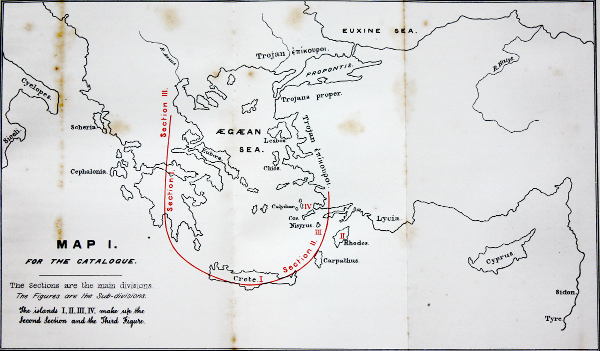
MAP I.
FOR THE CATALOGUE.
The Sections are the main divisions.
The Figures are the Sub-divisions.
The islands I, II, III, IV, make up the
Second Section and the Third Figure.
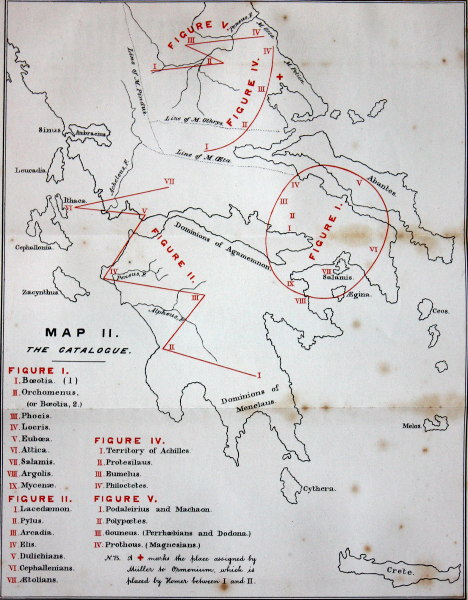
MAP II.
THE CATALOGUE.
FIGURE I.
- I. Bœotia. (1)
- II. Orchomenus, (or Bœotia, 2.)
- III. Phocis.
- IV. Locris.
- V. Eubœa.
- VI. Attica.
- VII. Salamis.
- VIII. Argolis.
- IX. Mycenæ.
FIGURE II.
- I. Lacedæmon.
- II. Pylus.
- III. Arcadia.
- IV. Elis.
- V. Dulichians.
- VI. Cephallenians.
- VII. Ætolians.
FIGURE IV.
- I. Territory of Achilles.
- II. Protesilaus.
- III. Eumelus.
- IV. Philoctetes.
FIGURE V.
- I. Podaleirius and Machaon.
- II. Polypœtes.
- III. Gouneus. (Perrhœbians and Dodona.)
- IV. Prothous. (Magnesians.)
N.B. A ✚ marks the place assigned by
Müller to Ormenium, which is
placed by Homer between I and II.
His first figure may be called a circle, being elliptical[480];
and it includes nine contingents.
1. Bœotia.
2. Minyeian Orchomenus.
3. Phocis.
4. Locris.
5. Eubœa.
6. Attica.
7. Salamis.
8. Argolis.
9. Mycenæ.
His second is a zigzag, and includes seven contingents[481].
1. Lacedæmon.
2. Pylus.
3. Arcadia.
4. Elis.
5. The Dulichians.
6. The Cephallenians.
7. Ætolia.
We now part with the first section.
His third figure embraces the second section, or
insular division of the Catalogue, and is again part of
a rude circle or ellipse[482].
1. Crete.
2. Rhodes.
3. Syme.
4. Cos and other islands. Carpathus is included,
which lay between Crete and Rhodes; being apparently
in political union with Cos and the Calydnæ, and
contributing to the same contingent, it could not but
stand with them. Strabo observes that this principle of
political division, according to what he terms δυνάστειαι[483],
has been adopted by the Poet in his account of the Thessalian
contingents.
By reference to the rude maps annexed, which mark
the several contingents by figures, the nature of this
contrivance will be clearly seen.
The order for Thessaly.
It is more difficult to trace Homer’s method of proceeding
with respect to Thessaly.
This country furnishes nine contingents, which may
best be described by the names of their leaders. There
is no difficulty as to the first four, except that some of
the boundaries are indeterminate. They form, like the
last or insular group, an incomplete circle[484]. The leaders
are;
I. Achilles (681-94).
II. Protesilaus (695-710).
III. Eumelus (711-15).
IV. Philoctetes (716-28).
There is more difficulty in describing the arrangement
of the remainder. Strabo, who has followed the
Catalogue in Thessaly with great minuteness, seems to
have noticed the circular arrangement: at least he
speaks of the κύκλος τῆς Θετταλίας, and the περιόδεια
τῆς χώρας[485]. But when he comes to the sixth division,
that of Eurypylus, he appears to find it impossible to
fix with any confidence the site of Ormenium: and
says, καὶ ἄλλα δ’ ἐστὶν ἃ λέγοι τις ἂν, ἀλλ’ οὖν ὀκνῶ διατρίβειν
ἐπὶ πλέον[486]. And further on he observes, that
the displacements and changes of cities, and mixtures
of races, have confounded the names and tribes[487], so
as to make them in part unintelligible to men of his
day: where we are anew reminded of the passage of
Thucydides, in which he tells us, that the most fertile
tracts underwent the most frequent changes of population[488].
The δυναστεία of Eurypylus is in our maps commonly
placed on the sea coast, but as it appears, with little
authority of any kind: while, after all the proof we
have seen of continuous arrangement, it seems incredible
that, in this instance alone, Homer could have
followed an order such that the δυναστεία should not
march either with that which precedes, or that which
follows, but should be severed from them by a line of
territories intervening, which he has already disposed of.
To judge from analogy with the otherwise uniform
rule of the Catalogue, the dominions of Eurypylus must
have been somewhere conterminous both with those of
the Asclepiads, and with those of Polypœtes. Waiving
however any effort to fix positively their site, we find
the other four remaining contingents connected by a
zigzag line[489], like that which was used in southern
Greece. The leaders are as follows:
I. Podaleirius and Machaon (729-33). (Eurypylus
734-7, omitted.)
II. Polypœtes (738-47).
III. Gouneus (Enienes, Perrhæbi, and Dodona,
748-55).
IV. Prothous (the Magnesians, 756-9).
In this view Homer appears to subdivide Thessaly
into two figures, as he had done Southern Greece: and
in both cases one of them is curvilinear, in which the
eastern parts are arranged: the other a zigzag, which
includes the western portions.
I have described this geometrical arrangement, as of
great interest in connection with the question, whether
the poems were written or recited; and also as it seems
to be in itself highly ingenious.
It seems to distribute in rude but real symmetry
before the eye of the mind, an assemblage of objects
between which it would at first sight appear almost
impossible to frame any link of connection.
But in Homer, though there is much that is ingenious,
there is nothing that is far-fetched: and the
order he has followed might well, as to many parts at
least of Greece, have been that of his own itinerancy
as a minstrel. And, though complex in other respects,
yet if it reduces a complex physical arrangement to the
form, in which it becomes practically more manageable
than in any other way for his purposes, it is evidently
the one which may best be justified on the principles
of common sense.
Fresh proofs of historical intention.
The Greek Catalogue is also full of proofs of the
historical intention of Homer.
In the first place, such proof is afforded by the
immense amount of its details, which are prima facie
a load upon his verse, and which Homer seems to
have so regarded, from the care he has taken to relieve
the subject by the cluster of similes at the beginning.
He must have had a purpose in facing this disadvantage.
It is quite at variance with his own spirit, and
the spirit of his age, to suppose that this purpose was
merely to flatter the vanity of hearers by wholesale
fiction.
The use of supernatural machinery is agreeable to
the genius of the poet and his age, but not so the
vulgar falsification of plain terrestrial facts. If the
supposition of wholesale fiction cannot be maintained,
there is no other alternative but that of an historical
purpose.
Viewed at large, the Catalogue is an answer to that
normal question, which expresses the anxiety of every
Greek to make the acquaintance of a man first of all
through what are colloquially termed his ‘belongings.’
Τίς; πόθεν εἶς ἀνδρῶν; πόθι τοι πόλις; ἠδὲ τοκῆες[490];
The chief indication of departure from this purpose
is in the case of Nireus[491]. This paltry leader is almost
the only person of legitimate birth, both of whose
parents are named: and while he is evidently introduced
for his beauty only, it is most suspicious that his
father should be named Χάροψ, and likewise his mother
Ἀγλαΐη. This savours of the names Δημόδοκος and
Τερπιάδης, which Homer has given to his Bards in the
Odyssey. And again of his Phronius, son of Noemon,
whom he introduces to play the part of a considerate
and serviceable Ithacan citizen[492]. With the insignificant
island of Syme Homer might, for a special object,
well take this liberty. And we may observe here, as
elsewhere, that what is probably a departure from
literal truth, may also be in a higher view historical:
for doubtless his object is to commemorate impressively
the wonderful beauty of Nireus, and this he does by inventing
appropriate accessories.
Again, though an accurate geography would not of
itself have proved the personal parts of the narrative
to be historical, it is scarcely conceivable that he would
have adopted one so minute and elaborate, as well as
exact, if he had meant to combine with it a string of
merely fictitious personalities.
Genealogies of the Catalogue.
Thirdly, besides many simple patronymics, there are
found thirteen minor genealogies in the Catalogue, ten
of them Greek, and three foreign. They are of three
generations only in every case, with the single exception
of the Orchomenian leaders, who have four:
and in every case they attach to secondary heroes, who
are thus treated in a mass, while provision is made in
other parts of the poem for making known to us the
descent (with the exception of Ajax) of all the greater
heroes, as occasion serves to state it for each of them
singly. Now it is inconceivable, even on general
grounds, that the poet should have invented this mass of
names; for they could surely have excited no sort of interest
among his hearers, except upon one ground. They
must have been true genealogical records of persons, who
had played a part in the great national drama; one not
perhaps of high importance, yet sufficient to be the basis
of such traditions, as are justly deemed worthy of local
record among a people eminently strong in their municipal,
as well as their general patriotism. Over and
above this, many points of these minor genealogies
coincide with, and illustrate other historical notices in
other parts of the poem.
Again, there are in all eight cases in the Catalogue,
where the name of a mother is mentioned. These are,
1. Astyoche, mother of Ascalaphus and Ialmenus,
Mars being the father, v. 513.
2. Aroura mother of Erechtheus, no father being
mentioned, v. 548.
3. Astyochea mother of Tlepolemus, Hercules being
the father, v. 658.
4. Aglaie mother of Nireus, Charops the father,
v. 672.
5. Alcestis mother of Eumelus, Admetus the father,
v. 715.
6. Rhene mother of Medon, Oileus the father, v. 728.
7. Hippodamia mother of Polypœtes, Pirithous the
father, v. 742.
8. Venus is mentioned as the mother of Æneas,
Anchises being the father, v. 820.
The second of these cases, if we are to regard the
passage containing it as Homeric, must not be considered
as an account of parentage, but simply as a
mode of asserting autochthonism. Again, the parents
of Nireus, whether true persons or not, are evidently
named with reference to the consideration of beauty
only, which is the key to the whole passage.
And the parentage of Æneas may also perhaps be
named for the sole purpose of embellishment.
Described by the words θεὰ βροτῷ εὐνηθεῖσα, it does
not appear to stand in the same class, or to be susceptible
of the same explanations, as those Greek cases
where Greek chieftains born out of wedlock have gods
for their fathers; nor is there any case, among the
Greeks, of illegitimate birth from a goddess. Of the
five other cases three (1, 3, and 6), are obviously illegitimate
births, one at least of them with a fabulous father.
This raises the presumption that the name of the
mother was mentioned as the only remaining means of
recording the descent: inasmuch as the persons would
otherwise have been οὐτίδανοι. It may reasonably be
conjectured, that all these births were out of wedlock.
The epithets of the Catalogue are so accurately descriptive
of the country, that they have always been
used as tests of the traditions respecting the situations
of the places to which they refer. They are not less
exactly in harmony with the descriptions in other parts
of the poem, and this in minor cases, where purposed
fiction can hardly be supposed, not less than in the
greater ones. For instance, the Arcadians of Il. vii.
134, are ἐγχεσίμωροι: those of the Catalogue are ἀγχιμάχηται
(604), and ἐπιστάμενοι πολεμίζειν (611). The
Pelasgi of Il. x. 429 are δῖοι, those of the Catalogue
(840) are ἐγχεσίμωροι. The Cephallenians of the Catalogue
are μεγάθυμοι (631), those of Il. iv. 330 are
στίχες οὐκ ἀλαπαδναί. The Crete of the Odyssey (xix.
174) has ἐννήκοντα πόληες, the Crete of the Catalogue
(v. 649) is ἑκατόμπολις[493].
Single commands are in every instance assigned to
those who in the rest of the poem appear as chiefs of
the first order. In the case of Idomeneus alone is this
in any way obscured; as the passage (645-51) runs:
‘Idomeneus led the Cretans.... Idomeneus led
them, with Meriones.’ But it is very remarkable that
Meriones holds just this sort of ambiguous relation to
Idomeneus in the poem at large: sometimes he is
called his θεράπων (xxiii. 113 et alibi), and his ὀπάων
(x. 58 et alibi), while he stands among the nine first
warriors of the army, who (vii. 161), volunteer for single
combat with Hector; and when Idomeneus leads the
van, he manages the rear (iv. 251-4). Again, though
the opportunities afforded by the Catalogue are of
necessity narrow, yet Homer has contrived within its
limits to mark distinctly the character and position of
nearly every great chieftain: certainly of Agamemnon,
Achilles, Menelaus, Telamonian Ajax (v. 668), and
Ulysses.
The Epilogue.
The third portion, or epilogue, appears to be ascribable
chiefly to the genial love of Homer for the horse.
His arrangement of the army according to the number
of ships, which conveyed each division, had shut out the
mention of the chariots and the coursers who drew
them, and he appears to have devised this closing invocation
for the purpose of supplying the defect. It
was certainly not necessary in order to fix the position
of Achilles in the army, which the First Book had
completely developed; and the passage is chiefly occupied
with the horses of Eumelus, together with those of
Achilles and his force.
It contains, however, two remarkable notes of historical
veracity. The horses of Eumelus, a Thessalian, are
proclaimed to have been by far the best (μέγ’ ἄρισται):
and the Myrmidons, again a Thessalian contingent, are
here spoken of as having a number of separate chariots
and horses; we are told (773), ‘the soldiers played at
games.... The horses stood feeding, each near his own
chariot, and the chariots were in their sheds.’ This is
never said of any other contingent in the army. In
strict harmony with this picture, Thessaly was conspicuous
throughout the historic times of Greece, for the
excellence of its breeds of horses, and the high character
of its cavalry.
If all this be so, we cannot wonder at the high estimation
in which the Catalogue of Homer was held by
the Greeks of after-ages, as the great and only systematic
record of the national claims of the respective states.
This was not merely literary or private estimation:
the Catalogue had the place of an authoritative public
document. Under the laws of Solon, for example, it
received the honour of public recitation on solemn
occasions. It was also quoted for the decision of controversies.
In the critical moment, which preceded the first
Persian war, the Athenian and Spartan envoys apply
on the part of Greece to Gelon for his aid. He claims
the command. In resisting this claim and urging their
own right to lead the fleet, unless that post be claimed
by the Lacedæmonians, the Athenians found their pretensions
on the magnitude of their fleet, their autochthonism,
and, finally, the testimony of Homer to the
merits of Menestheus[494].
The Trojan Catalogue.
The Trojan Catalogue has less of organic connection
than the Greek with the structure of the poem at large.
In proceeding to this portion of his work, the poet
does not renew his ornamental similes, or his invocation
to the Muse. He evidently meant to lower the
tone of his strain: and moreover he was not about to
tax memory as he had done in the former operation, the
proper names being only about one fourth in number
of those used for the Greeks, and none of them being
arranged in long strings like the towns of Bœotia.
He now begins in what may be called a natural
order: taking first that section of the army, which
was supplied by the Troic sovereignties, principal and
subordinate; and among these giving the first place to
the troops of Ilion itself, as the most considerable, and
as those chiefly concerned. The next is given to the Dardan
forces, which were connected with the original seat
of the race, and the following ones to the contingents
supplied by the subordinate sovereigns of the rest of
Troas.
His pursuit of this order reminds us, that the geographical
distribution was in the case of the Trojan
list simple, and did not require the aid of mental
geometry, as he had only to follow, almost throughout,
a single line of States along the European and Asiatic
coasts. It also strengthens the presumption that, when
Homer chose an order so different, and so much less
natural and obvious, in the case of the Greeks, he must
have been governed by some peculiar reason.
It will be observed that, of the eleven divisions of
the Allies, the two first are the Pelasgians and the
Thracians. As the blood of these two races flowed
likewise in the veins of the Greeks, the precedence
given to them may have been founded on this relationship.
But this presumption is qualified by our
finding that, doubtless on the ground of geographical
order, the Lycian contingent, which had, at any rate,
strong Greek affinities, comes last of all.
For a reason given elsewhere, we must consider the
numbers assigned to the Greek contingents as approximate
representations of their respective force: but the
omission to particularize numbers at all in the Trojan
Catalogue is itself an evidence of its historical character.
The Trojan army was of a miscellaneous
character: we also know that the allied contingents
went and came, and that their absence from home, not
prompted by the same powerful motives as that of the
Greeks, was shortened by reliefs. Thus we find Rhesus
with his Thracians just arrived in the Tenth Book[495]:
Memnon comes to Troy after the death of Hector[496]:
and we are told of the sons of Hippotion (Il. xiii. 792),
who ἦλθον ἀμοιβοί, had come as reliefs, on the preceding
day. An army thus collected piecemeal, and thus fluctuating
in its composition, could not leave behind it the
same accessible traditions. Again, the destruction of
Troy itself obliterated what alone could have been their
depository; nor had Homer, as a Greek bard, either the
same motives or the same means for gathering detailed
information, as he would naturally possess with reference
to his own countrymen.
Hence, as the Trojan Catalogue is shorter, so also
its scope is more limited. It contains no specification
of forces: no anecdotes going farther back than the
existing generation: scarcely any of what may be
called specialties of character or position as to the
chiefs. It shows a good deal of knowledge of the
geography and products of the countries, but this
knowledge is of a much more general and vague character,
than that which he has displayed in almost
every portion of the Greek Array. He gives here very
few lists of towns at all, and never uses epithets requiring
us to believe that he had a personal knowledge
of their site and character. Only Ariste is δῖα, and
Larissa is ἐριβώλαξ. In two or three cases he speaks
of commercial products; a characteristic which it is
obvious that he might have learned without any personal
experience of the countries. He does not use
this particular kind of sign at all in the descriptions of
the Greek Catalogue: and we may perhaps correctly
interpret it, where it appears, as a token of his want of
vivid and experimental knowledge.
He also occasionally names a mountain or a river.
But there is a general avoidance of particular and characteristic
epithets, such as, (to refer to the Bœotian
list alone,) πετρήεσσα given to Aulis, πολύκνημος to Eteonos,
εὐρύχορος to Mycalesos, ἐϋκτίμενον to Medeon and
Hypothebæ, πολυτρήρων to Thisbe, ποιήεις to Haliartos,
πολυστάφυλος to Arne, ἐσχατόωσα to Anthedon, with
perhaps one or two other cases.
Another material inference is suggested by the very
different texture of the Trojan Catalogue.
Upon the whole, this vagueness of description cannot,
I think, but be regarded as much in conflict with the
belief that Homer was a Greek of Asia Minor, if at least
his comparative knowledge of the two countries on the
opposite sides of the Ægean is to be taken as a sign,
either positive or negative, of his nativity.
The Hellas of Homer.
We have next to inquire into the force of the Hellenic
name in the poems of Homer.
It meets us not, like the Pelasgic, in a single form,
but in a group of words; among which, the principal
are as follows:
| 1. Ἕλληνες, Il. ii. 684. | |
| 2. Πανέλληνες, ibid. 530. | National or tribal names. |
| 3. Σελλοὶ, Il. xvi. 234. |
And, lastly, the territorial name of
4. Ἕλλας.
Observing the order of derivation as it has been
pointed out by Mure[497], we shall naturally look to the
word Ἕλλας as a guide to the meaning of its derivatives,
Ἕλληνες and Πανέλληνες. It is itself drawn from
Ἑλλοὶ or Σελλοί: but as that name is only once used
in the Poems, and as by far the largest body of evidence
tells upon the word Ἕλλας, the decision upon the whole
group of words will turn mainly upon the inquiry we
shall have to make into the use of that word by Homer.
With it therefore we shall commence. Is there, we have
to ask, clear proof, that it went beyond the dominions of
Peleus? If it went beyond them, how far did it go? and
did it include that division of Greece, in which Locris
lay, whose inhabitants a particular line of the Catalogue
classes with the Panhellenes? For no suspicion of spuriousness
can justly arise out of the fact (if it be one),
that Homer calls by the name of Hellenes the inhabitants
of any country, which was itself within the scope
of the territorial name Hellas: inasmuch as this is little
more than, the word Yorkshire being given, to make
use also of the word Yorkshiremen.
At the outset, however, it is essential to observe,
that a certain elasticity in the use of geographical as
well as political names could not but belong to the age,
in which Homer lived: first, because of the successive
movements of tribes, like wave on wave, so that the
use of any such name would ordinarily be either growing
or declining, but not stationary: secondly, because
of the indeterminate forms which political authority
assumed, as resting on a mixture, in unknown proportions,
of the various elements of custom, compact, reverence,
and force: and, thirdly, because of the want
of well-defined geographical boundaries.
We are not entitled to assume that the territory,
which we call Greece, was, in Homer’s time, subdivided
with precision between a given number of territorial
names. We hear of Phthia, Ægialus, Elis, Arcadia:
but these seem to be the exceptions rather than the
rule. For many parts of it there are no local names
whatever; and we must not look for any thing resembling
the manner in which England is made up of
its counties, France of its departments, or the later
Greece of its individual states.
The passages in which the word Hellas is used by
Homer stand as follows in the order of the Poems:
1. A verse in the Catalogue, Il. ii. 683:
οἵ τ’ εἶχον Φθίην ἠδ’ Ἑλλάδα καλλιγυναῖκα.
2. (Achilles loquitur), ix. 395:
πολλαὶ Ἀχαΐιδές εἰσιν ἀν’ Ἑλλάδα τε Φθίην τε.
3. (Phœnix loq.), ibid. 447:
οἷον ὅτε πρῶτον λίπον Ἑλλάδα καλλιγυναῖκα.
4. (Phœnix loq.), ibid. 478:
φεῦγον ἔπειτ’ ἀπάνευθε δι’ Ἑλλάδος εὐρυχόροιο,
Φθίην δ’ ἐξικόμην ἐριβώλακα.
5. (In the narrative), Il. xvi. 595:
Χάλκωνος φίλον υἱὸν, ὃς Ἑλλάδι οἴκια ναίων
ὄλβῳ τε πλούτῳ τε μετέπρεπε Μυρμιδόνεσσιν.
6. (Penelope loq.), Od. i. 344:
μεμνημένη αἰεὶ
ἀνδρὸς, τοῦ κλέος εὐρὺ καθ’ Ἑλλάδα καὶ μέσον Ἄργος.
7. (Penelope loq.), Od. iv. 724:
ἣ πρὶν μὲν πόσιν ἐσθλὸν ἀπώλεσα θυμολέοντα,
παντοίῃς ἀρέτῃσι κεκασμένον ἐν Δαναοῖσι,
ἐσθλὸν, τοῦ κλέος εὐρὺ καθ’ Ἑλλάδα καὶ μέσον Ἄργος.
8. Penelope repeats the same lines, Od. iv. 814-16.
9. (Achilles loq.), Od. xi. 494:
εἶπε δέ μοι, Πηλῆος ἀμύμονος εἴ τι πέπυσσαι·
ἢ ἐτ’ ἔχει τιμὴν πολέσιν μετὰ Μυρμιδόνεσσιν
ἤ μιν ἀτιμάζουσιν ἀν’ Ἑλλάδα τε Φθίην τε.
10. (Menelaus loq.), to Telemachus, Od. xv. 80:
εἰ δ’ ἐθέλεις τραφθῆναι ἀν’ Ἑλλάδα καὶ μέσον Ἄργος,
ὄφρα τοι αὐτὸς ἕπωμαι, ὑποζεύξω δέ τοι ἵππους,
ἄστεα δ’ ἀνθρώπων ἡγήσομαι.
Of these passages, there are some which admit for the
word Hellas the contracted sense of the dominions of
Peleus, or even of a simple portion of them. Namely
the following:
In (1) we are reading part of the description of the
country, from which the force of Achilles was drawn.
Beginning from the line which precedes it, we may
translate thus: ‘the inhabitants of Alos, and of Alope,
and of Trachin, and those who occupied Phthia, and
the Hellas of fair women.’ It is clear, on the face of
the passage, that, whatever it may mean, the sense does
not require it to mean more in this place than a particular
district, forming part of the dominions of Peleus.
In (2), where Achilles says, there are many Achæan
maids through Hellas and Phthia, any one of whom he
can have for a wife.
In (5), where we are told that Bathycles, son of
Chalcon, dwelt in Hellas, preeminent among the Myrmidons
in prosperity and wealth.
And in (9), where the shade of Achilles asks whether
his father Peleus is still in the enjoyment of kingly
power in the populous country of the Myrmidons, or
whether he is deprived and despised through the range
of Hellas and Phthia.
But among these four passages there is a distinction.
In (1), (5), and (9) Hellas is combined with Phthia.
Now we have seen, that there were Phthians beyond the
dominions of Peleus: if the territorial name Phthia was
similarly extended, then the presumption would arise
that Hellas also might mean something more than lay
within those dominions. But there are many passages
where Phthia is used without Hellas; and in them all
it is used to express the district where Peleus reigned.
It is not unlikely therefore, at first sight, that Hellas
has the limited sense of a part of the kingdom in these
passages. And in the passage relating to Bathycles,
the son of Chalcon, the limited sense is yet more
strongly suggested; yet, as we may hereafter see more
clearly, it is by no means positively required either in
that or in any of these four places.
And it is abundantly clear, from the remainder of
the passages, that the name Hellas had already, in
Homer’s time, begun to bear a more extended sense.
In proof of this, let us take, firstly, the two passages
in which it stands alone. In Il. ix. 444-8, Phœnix tells
us that nothing would induce him to quit Achilles; no,
not even if the gods, brushing off his old age, were to
make him young and vigorous again, such as he was
when first he left Hellas, the land of fair women, flying
from his feud with his father Amyntor. Now this passage
absolutely proves that the word Hellas was used by
Homer, at least occasionally, for some limited district,
and not (as in after times) for the entire country; inasmuch
as Phœnix could not otherwise have said he left
Hellas on this occasion. But on the other hand it demonstrates,
that the limits of Hellas were not so narrow,
as the passages heretofore considered might permit us to
suppose. For Phœnix goes on to describe the cause of
quarrel; and (478-80) says he took his course through
broad open Hellas, and came into fertile Phthia, to
Peleus the king. The supposition most consistent with
the wording of these passages is, that Phthia comprised
the principal district of the dominions of Peleus, while
a portion of them may have fallen (as we elsewhere see
was perhaps the case) under the name of Hellas: but
they absolutely place the abode of Amyntor outside the
realm of Peleus; and therefore, in saying that Phœnix
left Hellas, and that he fled from his home through
Hellas, they imply necessarily that Hellas, the region
from which he fled, was, in part at least, outside of that
realm to which he fled.
But these passages will harmonise perfectly with each
other, and with those formerly examined, if we suppose
that Hellas meant the whole of Northern Greece generally,
but that a particular portion of it had been
more definitely stamped with the name of Phthia, as
the chief seat of Peleus and the Myrmidons. For then
the original abode of Phœnix might be in Hellas, as he
says (in ix. 447) that it was: and yet he would pursue
his way through Hellas, as he says (ibid. 478) that he
did: and he would also leave Hellas, namely by coming
into Phthia: and moreover the dominions of Peleus
might go beyond what was commonly known by the
particular designation of Phthia, and might include
some portion of Hellas, as, from Il. ii. 683, they evidently
did.
This supposition is recommended to us, not only by
its conforming to all the requisite conditions, and furnishing
a convenient construction for all the passages
we have examined, but by the fact that Phthia, and
Phthia alone, is commonly mentioned in the poem as
the home of Achilles and the Myrmidons: which shows
that they had a more special relation to the territory
known by that name, than to Hellas.
If any thing be still wanting, the proof is brought to
completeness by two other passages: the one (Il. x.
261-7), which tells us that this Amyntor, son of Ormenus,
dwelt in Eleon; dwelt there permanently, since
Autolycus stole from him an helmet, by breaking into
his substantial well-built house,
πύκινον δόμον ἀντιτορήσας[498]:
and the other the verse of the Catalogue[499], which places
Eleon in Bœotia. These passages therefore clearly appear
to carry the name Hellas as far as Bœotia, and to
make it reach continuously from thence to Phthia.
And if Hellas comes down to Bœotia, then it includes
Locris; and the various tribes of these regions may be
included in the general name of Hellenes, though to
all appearance they were not as yet familiarly and ordinarily
so called. And if Locris and Bœotia, with
part of Southern Thessaly (the dominions of Peleus),
are included within the range of the name Hellas, we
can have no difficulty in supposing that it included
Northern Thessaly also, which must have been the pathway
of the Helli to the South.
But we find Ἕλλας in another combination besides
that with Phthia, in the four passages of the Odyssey,
(one of them being a simple repetition of another,)
which we have still to examine.
Now the line Od. iv. 726, repeated 816, is under suspicion,
of which it is not worth while to scrutinise the
justice: as the idea and force of it is just the same with
that of Od. i. 344,
Ἀνδρὸς, τοῦ κλέος εὐρὺ καθ’ Ἑλλάδα καὶ μέσον Ἄργος.
This passage describes the fame of Ulysses as spread
through the breadth of Hellas and mid-Argos; (or,
from the heart of Argos to its extremities, right through
or all over Argos.) And again in Od. xv. 80, when
Telemachus has proposed to return home forthwith from
the court of Menelaus, his host gently dissuades him
from haste, and counsels a more extended tour, καθ’
Ἑλλάδα καὶ μέσον Ἄργος; offering to take charge of
his horses, and to shew him ‘the cities,’ or secured dwellings,
‘of men.’
The signification of the word Ἄργος will be considered
hereafter: for the present purpose it is enough
to observe that the word μέσον, as used by Menelaus,
in combination with Hellas, of itself prevents our applying
it simply to the narrow corner of the Peloponnesus
in which the city of Argos was placed; and
therefore that it can scarcely mean less than Peloponnesus.
And it is not less plain, that whatever may be
the force of the words when taken singly, their effect
when taken together can hardly be less than this:
Menelaus must mean to point to Greece at large, as the
scene of the proposed excursion. For there is no assignable
portion of Greece to which, consistently with
the words and the sense, he can be held to confine his
meaning. If we could suppose him to mean Peloponnesus
only by the two names Hellas and Argos, which
he employs in this place, we should but enlarge
thereby the Homeric capacity of the word Hellas; for
we have already brought it down from the north to
Bœotia; and we should, in the way now proposed, carry
it through the isthmus, and over Peloponnesus, or, at
the least, over some part of it. But even if Menelaus
means Peloponnesus only, which is most improbable, it
is plainly incredible that such should be the meaning
of Penelope in Od. i. 344. As a Greek, she cannot
mean to limit the renown of her husband to any sphere
less wide than Greece.
We have already seen, that Hellas sometimes includes
certainly the territory from Southern Thessaly
to Bœotia, and probably Thessaly at large: and it is
quite plain that, if it comes to Bœotia, it does not stop
there, but applies to the whole of Middle Greece, the
region between Thessaly and the isthmus: for the application
of the term Hellas could not stop except at
some great natural division of the country, and the
isthmus is here the only one possible.
Now the name Argos is related to Thessaly[500], but
much more specially related to the Peloponnesus, as
we shall see from a number of passages. It has no relation
at all in Homer to that division of the country
in particular which we call Middle Greece.
Assuming it, then, to mean Peloponnesus, in that
case Hellas means Middle with Northern Greece: and
the two names of Hellas and Argos, taken together,
completely and conveniently express the whole country.
The only alterations are such as would assign to Hellas
a larger sense; in no case can it, as to this passage, admit
of a more restricted one.
The foregoing argument is supported to a certain
extent by the fact, that while territorial names are frequent
for the Peloponnesian part of Greece, (we have
Achaic Argos, Iasian Argos, Elis, Arcadia, Lacedæmon,)
the continent to the north of the isthmus is generally
without territorial names: Phthia and Pelasgic Argos
are, I think, the only exceptions. There is thus before
us a gap, which the name Hellas, as it has been here
construed, seems conveniently to fill.
This construction of certain passages, in which the
word Hellas is contained, is not one which should be
adopted by the reader unawares. But if, like myself,
after examining into it strictly he assents to its justice
and necessity, then he will find that it is of the utmost
importance to the elucidation of Homeric history; for
it supplies a key to other much contested uses of the
Hellenic name.
In the first place, I submit that if we now review the
ten passages in which Homer speaks of Hellas, and
bear in mind that in some among them it cannot be
construed as meaning less than, with a certain amount
of indeterminateness as to boundaries, Northern and
Middle Greece generally, we shall also find, that there
is not one of all those passages, in which it will not at
least admit of the same sense. I do not deny that it is
open to us to hold that the Hellas, in which Chalcon
dwelt, was a mere district of Thessaly, and that Homer
attaches in different places different senses to the word.
But if there is a sense, substantially one, which will
suit the word in every place where it is used, it seems
most reasonable to adhere generally to that sense. Such
a meaning we have, I think, found for Hellas, in concluding
that it is used to signify Northern and Middle
Greece. In this sense it overrides and includes Phthia,
as France overrides Alsace or Burgundy. But as there
was a time when Alsace and Burgundy might, before the
present state of incorporation, have been either said to be
in France or not in France, without an outrageous license
of speech either way, so perhaps the land of Phthia was
for Homer either a part of Hellas, or a province carved
out of Hellas by the special occupation of the Myrmidons,
as occasion might chance to demand. Not that
he did not conform to the facts, but that the facts were
themselves indeterminate. To our habits, under which
every inch of ground belongs to somebody, this indefiniteness
is wholly strange; but in times when only spots
here and there were appropriated, and there was no universal
occupation, it was thoroughly natural, and the
thing really strange would be the absence of it. Accordingly,
when Phœnix says he left Hellas, he gives to
Phthia, the name of the place he reached, its exclusive
force. When he says Chalcon dwelt in Hellas among
the Myrmidons, he probably means in Phthia, but now
regards Phthia as covered by the larger designation.
When Homer tells us the soldiers of Achilles were those
who inhabited Alos, and Alope, and Trachin, and who
occupied Phthia and Hellas, we understand by the
three first, particular spots which the Myrmidons had
settled, by Phthia a larger district which they had so far
dotted with their occupancy as to make it peculiarly
theirs, and by Hellas the surrounding country, into
which they had more or less ramified.
Assuming then the sense of the word Hellas to be
now sufficiently ascertained, the next question is, how
came this country, which has been described, to bear the
name of Hellas? And the question admits of but one
answer. It could only be called Hellas because tribes
of Helli had become its masters, its governing race, the
depositaries, through its various regions, of political and
military power.
We must therefore understand that, according to
Homer, tribes reputed to be of Hellic origin were so
far distributed over this country, as to have begun at
least to affix their name to it: though without having
absolutely effaced every older name, like Πελασγικὸν
Ἄργος and though not precluding the introduction of
names perhaps more recent, certainly more specific,
such as Phthia.
The Hellenes of Homer.
We may now proceed to consider the force, according
to Homer’s use, of the names derived from Hellas.
These are, as commonly understood,
1. Ἕλληνες,
2. Πανέλληνες,
and to these I shall presume to add,
3. Κεφάλληνες.
The first of these is found only in Il. ii. 684. Here,
after the description of the places from which the forces
of Achilles came, the poet proceeds to give them their
designation:
Μυρμίδονες δὲ καλεῦντο καὶ Ἕλληνες καὶ Ἀχαιοί.
We find an exclusive use[501] of the word Myrmidons
for the force of Achilles throughout the Iliad, except in
this one place; notwithstanding that Phœnix, who was
lord of the Dolopes, commanded one of the five divisions[502],
and that we may therefore presume a certain part of
the force to have been Dolopian. From this exclusive
use, we cannot doubt that the name of Myrmidons was
that which appertained to them in particular, as the
ruling tribe among the subjects of Peleus.
Had we found reason to construe the word Ἕλλας
in the preceding line as meaning only a district of his
dominions, it would have followed, that Ἕλληνες meant
the inhabitants of that district; and that a part of the
soldiers of Achilles were Hellenes rather than Myrmidons,
in virtue of a local name. But it follows from
what we have already concluded about Hellas, that the
name of Hellenes was applicable to all the Myrmidons
as being themselves inhabitants of Hellas, that is, of
Phthia, which belonged to Hellas.
And in passing it should be noticed that, although
the Myrmidons inhabited Phthia, they are never called
Phthians; nor do we ever hear of Phthians at all in
Homer, except only in that passage where they are described
as engaged with Locrians and others in repelling
the Trojan assault[503]. They are there described as
under the command of Medon and Podarces. But in
the Catalogue Podarces and Medon[504], as substitutes for
Protesilaus and Philoctetes respectively, command the
second and fourth Thessalian contingents, which came
from districts lying near the kingdom of Peleus. Either
therefore the Phthian name extended beyond the limits
of Phthia, or the Phthians were those whom the
Myrmidons had recently driven out, and whose lands
they had occupied.
We cannot conclusively settle the sense of the word
Ἀχαιοὶ in this passage, except by anticipating the results
of an examination, on which we have not yet entered.
But it may be observed even at this point, that the bearings
of the passage are somewhat adverse to a merely
local construction for it. If Myrmidon was the strictly
proper name, then Achæan must have been a designation
which was not proper to the Myrmidons only, but
which they enjoyed in common with others. And yet,
on the other hand, not in common with all the Greeks,
but in some sense more restricted than that, in which it
is habitually applied to the whole army. For in that
large and general sense every contingent of the army
was Achæan, and Homer would certainly therefore not
have mentioned the Achæan name with respect to one
in particular. It can hardly escape observation that, studying
great clearness and precision in the Catalogue,
he systematically avoids the introduction of his general
names for the army. We never read of Danaans or
Argeians in it at all, and of Achæans only twice[505]. So
far then as the passage itself guides us, it points to the
supposition that those who were called Myrmidons properly,
to distinguish them from all others, and Hellenes
because they were (in common with others) inhabitants
of Hellas, belonged likewise to a particular class or
race of Greeks, to whom the name of Ἀχαιοὶ was applicable
in some distinctive sense. The three appellations,
accordingly, are not so many synonyms; but each
has probably its own proper scope.
Thucydides[506] speaks with his usual accuracy, when he
says that Homer has given the name of Hellenes to no
portion of the army except the troops of Achilles from
Phthiotis. He does not however go beyond the assertion
that this word had not yet grown into an appellation
for the Greeks universally, an assertion which, as
far as Homer’s evidence goes, is undeniable. But it
does not require us also to deny that the Hellas of
Homer extends beyond Phthia, and that the name of
Hellenes may even then have been beginning to attach
to the inhabitants of other parts of Hellas, though perhaps
less fixedly, as yet, than to the Myrmidons.
The Panhellenes of Homer.
With these facts in view, I am wholly unable to
follow those who have condemned, upon internal evidence,
that verse of the Catalogue in which we find
mention of the Panhellenes.
Speaking of Oilean Ajax, commander of the Locrians,
the poet says (Il. ii. 530),
ἐγχείῃ δ’ ἐκέκαστο Πανέλληνας καὶ Ἀχαιούς.
It is not grammatically necessary that we should make
these two words coextensive; and I do not believe
that either of them separately, as here used, conveys
the whole force of the two, though perhaps conjointly
they may carry the assertion that he was the best spearman
in the army.
If there was a Hellas in the time of Homer, which
was inhabited by a variety of tribes, then, as these
tribes dispersedly might be called with propriety Hellenes,
even apart from the authority of constant use, so
they might with equal propriety be combined into the
term Panhellenes, which would mean all the tribes, including
the Locrians, that inhabited Hellas, or Northern
and Mid-Greece. Thus, as the Achæan name was
at this time more prominent and distinguished in the
Peloponnesus[507] than in any other part of the country,
the poet may in this place by Ἀχαιοὶ mean the Southern
or Peloponnesian Greece; so as, by the two epithets
conjointly, to signify the whole army. Or he may mean
all those who, in Hellas or beyond it, were of the pure
Achæan race (assuming, for the moment, that such a race
existed); and thus may here assert, that Ajax excelled
all Hellas, and even all Achæans in or out of Hellas,
using the last of the two words by way of climax. I do
not deny that he may also be construed to mean the
whole host in the gross by Ἀχαιοὶ, agreeably to the
common use of it; but this is less likely; as the name,
so understood, would not be distinctive.
Nor do I see any reason to hesitate about treating
the Homeric name Κεφάλληνες as one of his Hellenic
group of names. As in the case of Πελασγοὶ, so here
we have a name formed by a combination of different
words. The word head seems to have been represented
by a root of flexible structure. In Sanscrit it is kapâla[508],
in Greek κεφάλη, in Latin caput: but it also appears in
the German kopf, and in the Greek κόπτειν, ‘to butt,’ and
in κύβη, κυβιστάω, κυβερνάω. The word Κεφάλληνες seems,
then, to be formed in the most direct manner from the
root κεφ, signifying ‘head,’ and Ἕλληνες: and thus it
both attaches Ulysses, with at least the dominant race
among his subjects, to the Hellic stock, and indicates
the tendency of the Hellenic name, even in Homer’s
time, to reproduce itself and to spread abroad.
Again, we observe in his rare use of Κεφάλληνες the
same signs as in Ἕλληνες and Πανέλληνες, that the
power of the name was only growing up from its infancy.
For the word is used but twice in the Iliad, and no
more than four times in the Odyssey, where there is
constant occasion for addressing, or for speaking of, the
subjects of Ulysses. We find in that poem Ἰθακήσιοι
eleven times, and Ἀχαιοὶ constantly.
Having dealt with the Homeric derivations of Hellas[509],
let us now ascend to the word, from which it is itself
derived; Hellas being evidently, in the Greek tongue,
the country which had been occupied by the Helli.
Of the people who are so termed, either under the form
beginning with the aspirate, or else under that of Σελλοὶ,
we find obvious Homeric vestiges in the Hellespont,
Ἑλλήσποντος; in various rivers termed Σελληείς; and
in the invocation of Achilles to Jupiter, which places
the Selli in the north of Thessaly, about wintry Dodona,
and seems to stamp them as then still remaining a
people of the rudest habits in their mountain home[510];
Δωδώνης μεδέων δυσχειμέρου· ἀμφὶ δὲ Σελλοὶ
σοὶ ναίουσ’ ὑποφῆται ἀνιπτόποδες, χαμαιεῦναι.
The Σελλοὶ of Homer.
The word Ἕλλοι would appear to be not the most
probable reading of the text of this invocation; for it
presumes an inconvenient loading of the sentence with
the double pronoun σε and σοι. But there can be no
doubt whatever as to its identity with Σελλοί. Independently
of philological argument, there is the
strongest presumption that in this place Achilles intends
to name his own national ancestry, as being the
ministers of the god; who give him, as it were, the
right to invoke the aid of the Pelasgic indeed, but
therefore genuine and original, Jupiter of Dodona. But
no circumstance seems to be better established by philological
research, than that in many cases of Greek
words, which now begin with the aspirate, there was
one (or more than one) initial letter, and that frequently
that letter was the sigma. Much obscurity
has hung about this subject, from the fact that discovery
has proceeded piecemeal, and that for a length of
time the word digamma was used to signify what had
originally filled the void now existing in so many places
of the Homeric versification. What this digamma
might have been was disputed; but it was, almost insensibly
perhaps, assumed to be some one letter or
sound only. But as inquiry has made further advances,
many forms of a lost letter or letters have been discovered:
and it has also been made clear that the gaps
ought to be filled up variously, and not by any one
uniform expedient. To take very simple examples,
there can be no doubt about the identity of ἓξ, ἕπτα, ὓς,
with sex, septem, sus: nor any doubt about the essential
identity of ὕδωρ and sudor, ἡδὺς and suavis, ἑκυρὸς and
socer: none therefore that the σ ought to be supplied,
and not f, w, or v, in the passage φίλε ἑκυρέ[511]. While
indeed a presumption arises[512] from the German words
schwieger and schwäger, that a double or even treble
loss may have occurred, and that the passage may have
run φίλε σϝεκυρέ. Under these circumstances, in the
case before us, where we have both forms represented,
there can be no hesitation as to the identity of Ἑλλοὶ
and Σελλοί: the first represented in Ἕλλας, Ἕλληνες,
Ἑλλήσποντος, and the Ἑλλοπία of Hesiod: the other
and older one supported by Σελληείς.
There is another curious and instructive case, in
which we have the older form of the word Σελλοὶ still
remaining: besides that of Προσέληνοι, to which allusion
has already been made in considering the case of
the Pelasgian Arcadians. In the Birds of Aristophanes,
the dramatist satirizes Athens and the Sicilian
Expedition, under the name of a city in the clouds,
called Νεφελοκοκκυγία; the object being to expose the
arrogance of great pretensions, without adequate means
to support them. There, he says, lie most of the goods
of Theagenes, and all those of Æschines. This Theagenes
was called κάπνος, smoke, because he promised much,
and did nothing. Æschines was a pauper, who pretended
to wealth. The Scholiast adds, ἦν δὲ Αἰσχίνης
Σελλοῦ. Ἔλεγον δὲ ἐκ μεταφορᾶς τοιούτους Σελλούς· καὶ
τὸ ἀλαζονεύεσθαι δὲ, σελλίζειν[513]. Cary thinks the term σελλίζειν
came from a Sellus, the father of this Æschines.
But in the first place, it seems difficult to rely on the
Scholiast for knowing, still less for recording with accuracy,
the name of the father of an obscure person, who
had lived in the age of Aristophanes. In the second
place, if Æschines was an obscure fellow, it is most improbable
that his father’s name should have become the root
of a Greek word descriptive of a particular habit or propensity.
Such words (for example) as hectoring and rhodomontading
presuppose a great celebrity in the person
on whose name they are based. Lastly, the derivation
from the ancient Σελλοὶ seems a perfectly natural one,
and also adequate to the case. It is in some degree characteristic
of those who in reduced circumstances trace
back their lineage to a very ancient stock, instead of
relying simply on the substantial honour of their descent,
still to affect the possession of the wealth which
has passed away from them: to play for themselves the
part, which Caleb Balderstone desires to play, on behalf
not of himself, but of the Master of Ravenswood, in
Scott’s ‘Bride of Lammermoor’; and altogether to be sensitive,
or what is called touchy on the subject, and to lean
on the whole towards a certain boastfulness, in common
with the νεοπλοῦτοι at the other extremity of the scale.
There is a broad distinction between treating the Scholiast
as a witness to the existence and force of a current
phrase, and the taking his word for the parentage
of a nobody, like this Æschines, who had lived long
before him. It may, however, not be necessary to construe
σελλίζειν solely, or even specially, with reference
to a pride in wealth which had passed away. If we shall
hereafter show for the Selli[514] a Persian ancestry, then,
even without any regard to change of circumstances,
the phrase at once leads us back to the description
given by Herodotus of the Persians their forefathers.
Πέρσαι, φύσιν ἐόντες ὑβρισταὶ, εἰσὶν ἀχρήματοι[515].
I shall also have occasion to notice hereafter one or
two other words apparently akin to Σελλοί.
Contributions to the mythology.
In this attempt at an ethnological survey, we have
now come down to the point, at which the Greek
Peninsula passes over from its old Pelasgian character,
and becomes subject to predominating Hellenic
influences.
Now therefore, and before we examine the relations
and succession of the great Homeric appellations for
the Hellenes, appears to be the time for considering
how the account stands between these tribes and the
Pelasgians, and what were, so far as by probable evidence
we can ascertain it, the respective contributions
from the two sources to the integral character of the
Greeks and of their institutions.
In the case of Greece, as it is known to us in history,
we have the most remarkable disproportion between
moral and physical power, and between the
green and the full grown product, which is offered to
view in the whole range of human experience. A circumscribed
country, with a small population, throws
forth, without loss of vital power, to the East and to
the West, colonies greatly transcending itself, as would
appear, in wealth and population; continues for many
centuries to exercise a primary influence in the world;
at one time resists and repels, at another invades and
terrifies, at a third overthrows and crushes to atoms
the great colossus of Eastern empire, and continues to
exercise, through the medium of mind, a singular mastery,
enduring down to our own time, and likely still to
endure, over civilized man. And even the miniature
organization of Greece presents to us, within its own
limits, diversities of character almost enough for a
quarter of the globe.
Many of these diversities connect themselves with
the ethnological formation of the different communities.
In the course of that process, so far as can be
discerned, certain admixtures of foreign influence were
supplied direct from Phœnicia, Egypt, or elsewhere:
but the grand component parts or factors in this composite
product are two, the Hellenic and the Pelasgic.
To this dual combination, perhaps the double invocation
of Achilles (Il. xvi. 233, 4) is a witness.
The development of the national character is the most
large and varied in Attica, where the population, from
successive immigrations of bodies of refugees, and from
the free general resort and reception of strangers, presented
also the largest and most varied ethnical compound.
In analysing that national character which thus resulted
from the amalgamation of ingredients chiefly
Hellic and Pelasgic, we have now to ask how far its
different elements are referable to the Pelasgic or to
the Hellic root respectively? We have traced in some
degree the course and local circumscription of the races:
can we affiliate upon them any of the contributions
which they severally made to the varied manners and
to the institutions of Greece?
The proof, as far as it is specific, can be only that
which probable and conjectural evidence afford: but
that evidence is supported by the fact, that it tends, as
a whole, to an orderly result.
While they proceed from different sources, and present
visible and even permanent distinctions of character,
there is no violent disparity between the Hellic and
the Pelasgic races: they afford a good material for coalescence.
We are not to suppose that whatever the
one had, the other had not. Of what belongs historically
to the Pelasgi, much may stand as theirs only
through their priority of entrance into the country.
I propose to inquire what evidence can be drawn,
either from philological sources, or from the text of
Homer, to throw light on the several pursuits and tendencies
of these races, under the heads of Religion,
Policy, War, the Games, Poetry, the Chase, and Navigation.
Under some of these heads, however, we must in a
measure anticipate results which will be only obtained
in full from later inquiries.
The Poems afford us no complete and decisive test
for discriminating between the Hellene and the Pelasgian
contributions respectively to the Greek religion.
We shall, however, hereafter find many details of
evidence bearing upon this subject.
For the present I must confine myself to two very
general propositions, which are founded on the relations
of the Greek religion with those of Troy and of Italy.
First, there seems to be a presumption, which may
weigh with us to a certain extent in the absence of
counter-evidence, that those parts of the Greek religion
which were common to the Greeks with the Trojans
were Pelasgian, and that those which were not common,
were not Pelasgian. But of the parts which were common,
and therefore Pelasgian, many may have been originally
Hellene too.
Again, a relationship subsists between Greece and
Italy, as to the component parts of their respective
populations, which, without being unduly strained, will
throw considerable light upon the question of Hellic
and Pelasgic attributes.
The Greek or the Italian of the classic times could
not be expected to own relationship with what lay to
the northward, on each of those two peninsulas. The
Roman, therefore, whose investigations led him to
suppose there were Pelasgians in Italy, would only derive
them from Greece. For us the case stands far
otherwise; and we must simply consider the Pelasgians
of Greece, and the Pelasgians of Italy, as two among
a variety of branches, which struck out at different
times from the main trunk of an extended race, probably
diffusing itself over many parts of Asia and
Europe. In Greece and Italy respectively these Pelasgic
tribes entered into new combinations, probably
not wholly different, nor, on the other hand, by any
means in exact correspondence.
We may perhaps be found not to go beyond the limits
of the modesty which the case requires, when we simply
lay down this rule: that correspondences in religion or
in language between Greece and ancient Italy raise a presumption,
that those features of each country, in which
the correspondence is observed, are of Pelasgic origin.
Something of such correspondence we may perceive
in regard to religion. The religion of Homeric
Greece differs from that of Rome, not only as to minor
deities, but in the names given to many of the greater
deities, and especially in the far more imaginative character
of its traditions.
Those parts of the religion of Greece and Rome
which were common to both were probably Pelasgian.
Let us take first the names which correspond, and
then those which are different.
(I.) Names of deities that correspond in the Greek
and Latin tongues:
1. Ζεύς Deus.
2. Ζεὺς-πάτηρ Jupiter.
3. Ἀπόλλων Apollo.
4. Ἱστιή Vesta.
5. Λήτω Latona.
6. Περσεφόνη Proserpina.
7. Ἄρης Mars or Mavors.
(II.) Names of deities which do not in any manner
correspond in the Greek and Latin tongues:
1. Ἥρη Juno.
2. Ποσειδὼν Neptune.
3. Ἀιδώνευς Pluto.
4. Ἀθήνη Minerva.
5. Ἥφαιστος Vulcan.
6. Ἑρμῆς Mercury.
7. Ἀφροδίτη Venus.
8. Ἄρτεμις Diana.
9. Δημήτηρ Ceres.
10. Διόνυσος Bacchus.
Two remarks may be made on the deities of the first
list.
First, that it comprehends generally the gods whom
we shall find to bear marks of being the most ancient
among the Greek deities; with the marked exception,
however, of Minerva[516].
Secondly, that in it we find no deity who takes part
on the Greek, that is, the Pelasgian side, in the war of
Troy. The only two names which do not appear on
the Trojan side, are Vesta, who with Homer is not
personified at all: and Proserpine, who from the seat
of her dark dominion could not share in the wars waged
upon earth.
On the other hand, when we turn to the second list
of exclusively Greek names, we find that it contains all
the deities who took part against Troy: and only two
very secondary names of deities friendly to it.
Mars and Venus, both engaged on the Trojan side,
and one standing in the first list, are the deities after
whom, according to Ovid[517], the two first months of the
Roman year were named in the first age of the city.
It would not, however, be safe to depend implicitly
upon the apparent reappearance of certain names in
the Latin language, without a fuller knowledge of the
laws of discrimination between the early mythology of
the Romans, and the form which their religious system
assumed at the period when they came into free communication
with Greece and its colonies, from which,
as they certainly borrowed some names of deities, such
as Pallas and Phœbus, so they may have assumed others
too. We have no proof, for example, that Apollo was
prominent, or even that he was known, in the earliest
Roman worship. Cicero[518] says, Jam Apollinis nomen est
Græcum. Still, a temple was raised to him in Rome[519]
as early as 430 B. C.; and the Trojan sympathies of
most of the deities in the first list tend in some degree
to show both that they were well known in the Pelasgian
religion, and that many of the older portions of
the mythology were common to the Trojans, the early
Romans, and the Pelasgians of Greece.
Pelasgian Religion less imaginative.
We may more boldly rely upon a general indication,
which is offered to us by the religious systems both of
Rome and of Troy, in comparison with that of Greece.
The large account of Roman deities furnished by
Saint Augustine, in his ‘De Civitate Dei,’ constitutes
for us the principal representation of the great work of
Varro, now lost, on the ‘Antiquitates Rerum Divinarum.’
Notwithstanding the multitudinous development
of the theurgic system, the ‘De Civitate’ tends to support
the belief that it was not vivified, like the system
of the Greeks, by the intense pervading power of a
vigorous and prolific imagination. The ‘Fasti’ of Ovid
may perhaps be referred to as sustaining the same
opinion. And Heyne in his commentary on Virgil has
observed upon the comparative dulness and dryness of
the early mythology of Rome: Italici mythi longe a
Græcæ fabulæ suavitate absunt; nec varietas grata
inest[520].
In a later portion of this work[521] I shall endeavour to
show, that a similar character apparently attaches to
the religious system of Troy: not so much a purity or
simplicity, as a comparative poverty and hardness; and
an indisposition in the inventions to assume those
graceful forms, of which the Grecian Theo-mythology,
as exhibited in Homer, is so full.
And again, when we pass from Homer to Hesiod, we
find a great mass of religious fable, either added by the
later poet, or grown up in the interval between the
two. Hesiod’s depositories are much more numerously
peopled: but we have passed at once from the poetry
of a theogony to its merest prose, when we compare his
manner of touch or handling, and his ideas on these
subjects, with those of Homer. And, as on other
grounds we may consider Hesiod to represent the Pelasgian
side of the Greek mind, we seem justified in
referring the distinctive tone of his mythology in some
degree to his Pelasgian characteristics.
But independently of confirmation from the case of
Troy, and from the tone of Hesiod, the character of the
old Italian mythology, so devoid of imagination, force,
and grace, leads us to ascribe these properties, when we
find them abound in the Greek supernaturalism, to its
non-Pelasgian, that is, to its Hellenic source.
Its ritual development fuller.
When, however, we turn to another form of development
in religious systems, we find the case entirely different:
I mean the development in positive observances
of all kinds, and in fixed institutions of property and
class. Here the religion of Rome was large and copious.
Polybius has left upon record, in a most remarkable
passage, his admiration of the Roman system of δεισιδαιμονία,
which had, he says, been so got up, and carried
to such a point, that it could not be exceeded. It was
all done, in his opinion, on account of the multitude.
Were States composed of the wise, the case would have
been different: but as the people are full of levity and
passion, λείπεται τοῖς ἀδήλοις φόβοις καὶ τῇ τοιαύτῃ τραγωδίᾳ
τὰ πλήθη συνέχειν[522].
Not less remarkable is the testimony of Dionysius;
who, while he praises Romulus for the severe simplicity
of what he caused to be taught and held concerning
religion, and for the expulsion of immoral fables and
practices, says that he arranged for his people all that
concerned the temples of the gods, their consecrated
lands, their altars, their images, their forms, their insignia,
their prerogatives and their gifts to man, the
sacrifices in which they delight, the feasts and assemblies
to be celebrated, and the remissions of labour to
be granted in their honour. In no other newly founded
city could be shown such a multitude of priests and
ministers of the gods[523], who were chosen, too, from the
most distinguished families[524].
The Fasti of Ovid give an idea of the manner in
which the Roman Calendar brought the ceremonial of
religion to bear upon the course of life. For some
centuries an acquaintance with the Calendar was the
exclusive property of the sacred order[525]; and the priesthood
turned to its own power and profit the knowledge,
which afterwards filled the pages of that characteristic
work.
Again, we shall have occasion, when considering the
distinctive character of Troy, to notice that the political
and ritual forms of religion appear to have been much
more advanced there, than with the Greeks. This difference
will naturally connect itself with the stronger
Pelasgian infusion in the former case. We shall then
find that of the two great kinds of sacred office, one
only, that of the μάντις, and not that of the priest,
seems at the time of Homer to have appertained to the
Hellenic races.
And it is not a little curious to observe that, when
Saint Paul arrives among the Athenians, the point
which he selects for notice in their character and
usages, after all the intermixtures they had undergone,
is still this, that they are δεισιδαιμονέστεροι[526], peculiarly
disposed to religious observances; and that, not contented
with the gods whom they suppose themselves to
know, they have likewise a supernumerary altar for ‘the
Unknown God.’ Nor are we the less warranted to connect
this peculiarity with the original and long preserved
Pelasgian character of Athens, because that city had, for
centuries before, become a peculiarly apt representative
of the full Greek compound: for a system of ritual observance
has a fixity, which does not belong to mere
opinion; and, when once rooted in a country, has powerful
tendencies to assume such a solidity as survives vicissitude:
perhaps in some degree on account of its neutral
and pacific character, and of the power it leaves
to men of separating between outward observance and
inward act.
Although the opinion has been entertained, that
from the earliest ages it was the exclusive privilege of
the first-born to offer sacrifice, it appears most probable
that the separate function of priesthood was, like other
offices and professions, one of gradual formation.
Whether the primitive institution of sacrifice was
spontaneous or commanded, every man, that is to say,
every head of a family, was, I shall assume, at first his
own offerer or priest[527]. Then, as the household developed
into the community, the priestly office, in the first
stages of political society, as a matter of course appertained
to the chief.
He, by the necessity of natural order, originally
united in his own person the great functions of
1. Father.
2. Teacher.
3. Priest.
4. King.
5. Proprietor.
6. Commander.
The severance of these offices successively would arrive
sooner or later, according as the progress made in
numbers and wealth was rapid or slow. Concentration
of employments in a single hand marks the primitive
condition or retarded movement of society, while the
division of labour is the sign of more speedy and more
advanced development. Even the annals of the people
of Israel furnish instances in which we trace, at periods
when these offices had undergone division under divine
authority, vestiges of their former union. It appears
that, besides Moses, who consecrated Aaron and his
sons by divine command, Joshua, Samuel, and Saul[528]
on certain occasions offered sacrifice. The exclusive
character of priesthood has been impressed upon it,
under Divine Revelation, by positive ordinance, and
for a special purpose[529].
Order of Priests not Hellenic.
The Hellenes in Homer appear to exhibit it in its
earlier state of union with the office of civil government;
and the Pelasgians to display it as a function
which has indeed become special and professional, but
only on that self-acting principle which, in the progress
of society, leads to division of labour.
If we suppose the case of two races, one of them
inhabiting a rude and barren country in a state of perpetual
poverty and warfare, and then recently, by a descent
upon more fertile soils, brought into contact with
civilised life: the other of them addicted from a much
earlier period to pursuits of peace and industry, inhabiting
plains, and accustomed to form agricultural settlements;
there will be no cause for wonder upon our
also finding that the latter of these races has a professional
priesthood, while the former has none; but that
the sacrificial office remains in the private dwelling
with the father of the family, and on public occasions
with the head of the civil government.
This appears to have been the state of facts as between
the Trojans of Homer who had a priesthood, and
the Hellenes who had none: and the difference may be
principally referable to the different condition and history
of the Pelasgian and the Hellic races: while other
causes, belonging to the respective characters of the
races, may have contributed their share towards the
production of this curious result. Partly the greater
personal energy and self-reliance of the Hellic tribes,
but partly also the earlier and older ease, wealth, and
fixity of the Pelasgians, are the probable reasons why,
at the point of time exhibited in the writings of Homer,
we find priesthood properly a Pelasgian, but not yet
properly an Hellenic, and only to a limited extent an
adoptive, institution.
Thus far, then, we have a presumption, to be greatly
strengthened as I trust hereafter, that the Greek religion
owed to the Hellenes its imaginative, and to the
Pelasgians its sacerdotal and ceremonial development.
And this presumption is, I think, in entire accordance
with what we should reasonably anticipate, from relations
otherwise known to have subsisted between the
two races. I now pass on to the subject of language.
Contributions to language.
In attempting to illustrate the relations of Pelasgians
to Hellenes through the medium of the affinities
and contrasts between the Greek and Latin languages,
I am aware that I venture upon ground which requires
to be trodden with great circumspection. For the
Latin nation may possibly have contained within itself
some ethnical element not dissimilar to the Hellenic,
as well as one substantially corresponding with the
Pelasgian, factor of the Greek people. And again,
there is a very extended relation of the two languages
to a common root in the Sanscrit. The number of
words traceable to such a root has recently been stated
at 339 in the Greek, and 319 in the Latin tongues[530].
We must not then, it will justly be observed, infer
from the simple fact of resemblance between a Greek
and a Latin word, that the one has been borrowed or
directly modified from the other.
Let us begin by considering the just effect of these
remarks, and inquiring whether they do not still leave
space enough for an useful examination.
I begin from the assumption, that there was a deep
and broad Pelasgian substratum both in the Greek and
the Roman nations. It is thought, and it may perhaps
be justly thought, that a dominant tribe of Oscans, who
were a nation of warriors and hunters, came among the
Pelasgi of Italy, as the Hellenes came among the Pelasgi
of Greece. But while we may properly assume the
identity of the Pelasgian factor in the two cases respectively,
it is quite plain that the compounds or aggregate
characters are broadly distinguished, and represent
an assemblage and admixture either of different qualities,
or else of the same qualities in very different proportions.
Therefore we are justified in laying it down as
a general rule, that whatever is found in the language
of the two countries alike was most probably Pelasgian:
since, if that portion of the aggregate language
had been supplied from those elements in which the
nations differed, it is likely that a corresponding difference
would have been found to prevail between
their modes of speech.
Again, I think we must distinguish between the
simple fact of derivation from an original source in
common, and those degrees or descriptions of resemblance
which show that any given words not only had
one source at first, but that they continued together up
to a certain point in the formative process, so as to be
capable, from their shape, of derivation, not only from
that root, but also one from the other. For instance,
the Greek ἐγὼ and the Latin ego are both stated to be
derived from the Sanscrit aham. But here it is quite
plain that they have not only set out from the same
point, but travelled along the same road to their journey’s
end, as the Greek and Latin words are identical.
On the other hand, if we take the Greek τέσσαρες, and
the Latin quatuor, both are referred to the same Sanscrit
root, chatur: but neither of them can well have
been derived from the other, and each is more nearly
related to the root than it is to the other. Or if we
take the Latin anser, the Greek χὴν, and the English
‘goose,’ these words scarcely appear to have a connecting
link: but it is found, and a remote or mediate
connection established, by means of the German
gans. Instances might easily be multiplied.
In single cases, where the relationship of words is
only of the kind last exemplified, it would not be safe
to draw inferences to the effect of their being respectively
due to this or that element in the composition
of the nation.
But where there is such a similarity as to show
either that the word has advanced nearly to its mature
state before the Greek and Latin forms began to divaricate,
or that the Latin form may have been derived
from the Greek in an early stage of the history of the
language, or vice versâ, then it seems just to refer the
resemblance of terms to the existence of a powerful
common element in the two peoples.
And further, if we shall find that the words standing
in close kindred are capable of classification with reference
to their sense, then, when we have once constituted
a class of such words, it may be justifiable to add
fresh words to it on the strength of a more remote
affinity, in virtue of the presumption already created.
For instance, if the names of the commonest objects
and operations of inanimate nature are generally in
close correspondence, we may infer a relation between
other words which are in the same class as to meaning,
though they may be not so nearly alike, with more confidence
than if the reasoning as to this latter section
were not supported by the former. On this principle
I proceed in the collections of words given below.
Of course the utmost care must be taken to exclude
those words which have been copied from Greek into
Latin, after the literary ages of Rome had begun, and
according to the practice which Horace has described
and recommended[531].
Niebuhr’s propositions.
Niebuhr was, I believe, the first person to draw from
philological sources a conclusion as to the character
and habits of the Pelasgians. He proceeded upon the
threefold assertion, (1) that the words common to the
two tongues are presumably Pelasgian, (2) that they for
the most part refer to tillage and the gentler ways of
life, and (3) that we may hence conclude that the Pelasgians
were a people given to peace and husbandry.
And conversely, that the words which widely differ in
the two tongues are not Pelasgian, and that the pursuits
which they indicate must have been more peculiarly
characteristic of some other race, that contributed to
make up the composition of the Roman nation. The principles
thus assumed by Niebuhr[532] appear, when placed
under due limitation, to be sound; and the only question
is, whether they are supported by the facts of the
case. If in a given language we find the words indicative
of a certain turn of life to have been derived from
a particular race, which forms part of the nation speaking
that language, while other words, referable to other
habits and pursuits, have been supplied by other races
also numbered among its constituent parts, it is just to
read the characters of those races respectively through
the character of the words that they contribute to the
common tongue. For the question is really one of
forces which may have been adjusted with as much
accuracy, as if they had been purely mechanical. The
ordinary reason why a word of Pelasgian origin prevails
over a word of Hellenic origin with the same signification,
or the reverse, is that it is in more or in less
common use: and the commonness of use is likely to be
determined by the degree in which the employment or
state of life, with which the word is connected, may
belong to the one race or the other.
The survey taken by Niebuhr appears to have been
rapid; and the list of words supplied by him is very
meagre. Bishop Marsh[533] and other authors have, with
a variety of views, supplied further materials. The
most comprehensive list, to which my attention has
been directed, is in the ‘Lateinische Synonyme und
Etymologieen’ of Döderlein[534]. The subject is essentially
one which hardly admits of a fixed criterion or authoritative
rule, or of a full assurance that its limits have
been reached. Mindful of the reserve which these considerations
recommend, I should not wish to lay down
inflexible propositions. But I venture to state generally,
that those words of the Latin and Greek tongues,
which are in the closest relationship, are connected
1. With the elementary structure of language, such
as pronouns, prepositions, numerals.
2. With the earliest state of society.
3. With the pursuits of peaceful and rural industry,
not of highly skilled labour.
Classes of words which agree.
Examples, numerous enough to show a most extensive
agreement, will readily suggest themselves under
the first head. To illustrate the other propositions,
though it can only be done imperfectly, I will follow
both the positive and the negative methods. The first,
by comparing words which denote elementary objects,
both of animate and inanimate nature, or the simplest
products of human labour for the supply of human
wants, or the members of the human body, or the
rudiments of social order. The second, by contrasting
the words which relate (1) to intelligence and mental
operations, (2) to war, and (3) to the metals, the extended
use of which denotes a certain degree of social
advancement. It will I hope be borne in mind, on the
one hand, that these lists are given by way of instance,
and have no pretension to be exhaustive: and, on the
other hand, that exceptions, discovered here and there,
to the rule they seem to indicate, would in no way disprove
its existence, but should themselves, if purely exceptions,
be treated, provisionally at least, as accidental.
ἔρα, terra
ἀήρ, aer
αἴθηρ, æther
αὖρα, aura
| ἀστήρ | | astrum |
| ἀστέρος | stella |
| sterula |
κοίλον, cælum
ἥλιος, sol
σε-λήνη, luna
νὺξ, nox
(Ζεὺς) Διὸς, dies
πόντος, pontus
πόλος, polus
| λυκὴ in λυκάβας, | | lux |
| λεύσσειν |
χείμων, hyems
ἔαρ, ver
ὥρη, hora
ἑσπέρα, vesper
(νιψ) νιφος, nix, nivis
δρόσος, ros
ῥῖγος, frigus
χάμαι, humus
πευκὴ, pix
| λακκὸς | | (a pit), lacus |
| λάχυς |
ἄμπελος, pampinus
ὕλη, sylva
φύλλον, folium
ῥόδον, rosa
λαὰς, lapis
ἄγρος, ager
ἄρουρα, arvum
ἄντρον, antrum
φῦκος, fucus
ἴον, viola
σκόπελος, scopulus
ὕδωρ, sudor.
θὴρ, fera
λύκος, lupus
καπρὸς, aper
λέων, leo
ἔγχελυς, anguilla
ἴχθυς, piscis
ὠκύπτερος, accipiter
κύων, κύνος, canis
ὄϊς, ovis
βοὺς, bos
ταῦρος, taurus
ὓς, sus
ἵππος, equus
πῶλος, pullus
οὖθαρ, uber
ἄμνος, agnus
κριὸς, aries
ἀλώπηξ, vulpes.
1. DWELLINGS.
δόμος, domus
οἶκος, vicus
θύραι, fores
κληΐς, clavis
ἕδος, sedes
αἰθάλη, favilla
θάλαμος, thalamus
λέχος, lectus.
2. FOOD.
οἶνος, vinum
ἔλαια, olea
ἔλαιον, oleum
ὦον, ovum
μῆλον, malum
σῦκον, ficus
τρύγη, fruges
ἀ-τρύγετος, triticum
σῖτος, cibus
| γλάγος, | | lac, lactis |
| γάλα, γάλακτος |
κάλαμος, calamus
κρέας, caro
μέλι, mel
δαὶς, dapes
κοινὴ, cœna.
3. CLOTHING.
ἐσθὴς, vestis
χλαῖνα, læna.
4. TOOLS AND IMPLEMENTS.
ἄροτρον, aratrum
5. NAVIGATION.
ναῦς, navis
λίμην, limen
ἐρετμὸς, remus
κυβερνήτης, gubernator
ἀγκύρα, ancora
ποὺς, pes.
1. THE HUMAN BODY.
κεφαλὴ, caput
κόμη, coma
ὦμος, armus[535]
μῆρον, fe-mur, moris
παλάμη, palma
ποὺς, pes
ὄδους, οντος, dens, dentis
λάπτω, labrum
δείκνυμι, digitus
λὰξ, calx
ἦπαρ, jecur
ἔντερον, venter
ἕλκος, ulcus
γόνυ, genu
μύελος, medulla
ὄστεον, os (ossis)
ὤψ, os (oris).
2. THE FAMILY.
πατὴρ, pater
μήτηρ, mater
υἷος, filius
ἕκυρος, socer
3. SOCIETY.
(ῥέζειν) ῥέξας, rex[536]
ἐλεύθερος, liber
τέκτων (στέγω), cf. tectum (tego)
φὼρ, fur
παλλακὶς, pellex.
4. GENERAL IDEAS.
νεύω, numen
θεὸς, deus
ὄνομα, nomen
μόρφη, forma
ἲς, vis
ῥώμη, Roma, robur
κνίσση, nidor
ὄδμη, odor
φήμη, fama
βίος, vita[537]
μόρος, mors
ὕπνος, somnus
ὀδύνη[538], odium
ἄλγος, algor
ἦνις, annus
δόσις, dos
δῶρον, donum
αἴων, ævum.
μέγας, magnus
πλατὺς, latus
| ἄγχος | |
| ἄγκιστρον | | | uncus |
| or | angustus |
| ἄγοστος |
κυρτὸς, curtus
γῦρος, curvus
πυρρὸς, furvus
παχὺς, pinguis
βραχὺς, brevis
χαὸς, cavus
τέρην, tener
πλέος, plenus
μείων, minor
μάσσων, major
νέος, novus
ἄλλος, alius
ὄρθος, ordo[539]
ὕπτιος, supinus
γραῦς, gravis
λεῖος, lævis
γενναῖος, gnavus
δέξιος, dexter
ὅλος, solus
ἡδὺς, suavis
πικρὸς, acris[540].
Classes of words which differ.
A very extensive list of perhaps one hundred or more
verbs might be added, which are either identical or
nearly related in the Greek and Latin languages: but
it would not, I think, materially enlarge or diminish
the general effect of those words which have been enumerated.
We have before us about one hundred and
eighty words in the classes of substantive and adjective
only. They might nearly form the primitive vocabulary
of a rustic and pacific people. Two exceptions
may be named, which may deserve remark. It will be
observed, that the senses are inadequately represented,
only two of them, smell and taste, being included.
The other three are also connected in the two languages
as follows: touch, by the relation of θιγγάνω
and tango: sight, by εἴδω and video: hearing, by the
evident connection of the Latin audire with the Greek
αὔδη, the proper name in Homer for the voice.
The other marked exception is that of religion. With
slender exceptions, such as θεὸς = deus, the connection
of rex with ῥέζω, of numen with νεύω, of λοιβὴ with libo,
and that of ἀράομαι, ἀρητὴρ with orare, orator, ara, there
is a considerable want of correspondence in the leading
words, such as ἱερὸς, ἅγιος, θύω, βῶμος, νῆον, ἄγαλμα, σέβω,
μάντις, of the one tongue, and sacer, sanctus, pius, templum,
vates, macto, mola, of the other. The greater part
of the Pelasgian vocabulary must have been displaced on
the one side or on the other: and as it is in Greece that
we have much fuller and clearer evidence of the advent
of a superior race, which gave its own impress to life
and the mind in the higher departments of thought, we
must conclude that this substitution probably took place
in Greece, and was of Hellenic for Pelasgian words.
The proposition of Niebuhr with respect to terms of
war, appears to me to be in the main well sustained by
the facts. Let us take for example the following list:
which appears to show that, in this department, with
the exception of a pretty close relation between βέλος
and telum, and a more remote one between πόλεμος and
bellum, possibly also between lorica and θώρηξ, there is
hardly in any case the faintest sign of relationship between
the customary terms employed in the two languages
for the respective objects.
| telum | | βέλος |
| ensis | | | | ξίφος |
| gladius | φάσγανον |
| |
| cuspis | |
| mucro | | αἰχμή |
| acies |
| galea | | κυνέη |
| hasta | | | δόρυ |
| ἔγχος |
| |
|
scutum[541] | | | | ἄσπις |
| clypeus | σάκος |
| lorica | | θώρηξ |
| ocrea | | κνημίς |
| vagina | | κολεός |
| bellum | | | Ἄρης |
| πόλεμος |
| |
|
prælium | | | | ὑσμίνη |
|
pugna | μάχη |
| |
|
currus | | | | δίφρος |
|
rheda | ἅρμα |
|
rota | | κυκλός (Hom.) |
|
terno | | ῥυμὸς |
| tuba | | | σάλπιγξ |
| classicum |
| castra | | κλισίαι |
| tabernaculum[542] | | κλισίη |
| arcus | | | βιὸς |
| τόξον |
| |
| sagitta | | | ἰὸν |
| ὀϊστός. |
It can hardly, I think, be questioned, that this class
of words presents on the whole a very marked contrast
to those which were before exhibited. And as we see
the highest martial energies of Greece manifestly represented
in the Hellenes, we may the more confidently
adopt that inference as to the habits of Hellenes
and Pelasgians respectively, which the contrast between
the two languages of itself vividly suggests.
Before quitting this head of the subject, let us notice
the wide difference in the channels by which the two
languages arrive at the words intended to represent the
highest excellence. For ‘better’ the Greeks have βέλτερος,
from βέλος, ‘a dart,’ and for ‘best,’ ἄριστος, from
ἄρης, ‘war;’ while the Latins are contented with optimus,
formed from a common root with opes, ‘wealth.’
There is almost as remarkable a want of correspondence
between the two languages in respect to the higher
ideas, both intellectual and moral, as in regard to war.
In three words indeed we may trace a clear etymological
relationship, but in two of the cases with a
total, and in the third with an important change in the
meaning.
1. The μένος of the Greeks becomes the Latin mens;
so that a particular quality, and that one belonging to
the πάθη rather than the ἤθη of man, comes to stand
for the entire mind.
2. The Greek ἄνεμος is evidently the Latin animus:
or, that word which remains the symbol of a sensible
object in Greek becomes the representative of mind in
Latin. The adjective ἀνεμώλιος is indeed capable of a
metaphysical application: but it means ‘of no account[543].’
3. The θυμὸς of the Greeks is the fumus of the
Latins: and the case last described is exactly reversed.
The three great words in the early Greek for the
unseen or spiritual powers of man’s nature are νόος,
φρὴν, and ψυχή. They perhaps correspond most nearly
with the three Latin words mens, indoles, and vita[544].
There is not the slightest sign of conformity or common
origin in any of the cases; although νόος is akin to nosco[545].
In two other very important words we find perhaps
derivation from a common root, but nothing like a near
or direct relationship. The Greek ἀρετὴ
may proceed
from the same stock with the Latin virtus, and in like
manner ἄτη may have the same source as vitium.
Upon the whole we may conclude, that in this
important class of words the resemblances are scanty
and remote. It will be seen that under the head of
general ideas there is not included any clear case of
correspondence in a mental quality; and all the resemblances
appear to rest, mediately or immediately,
upon sensible objects and phenomena.
As respects the terms employed in navigation, it will
have been observed, that they are all connected with
its rudest form, that of rowing; and that they do not
include the words for mast, yard, or sail, in all of which
the two tongues appear to be entirely separated.
Again, it may be stated generally, that society in its
very earliest stages has little to do with the use of
metals. This rule will be of various application,
according to their abundance or scarcity in various
countries, and according to the facility with which they
are convertible to the uses of man. As the objects of
enjoyment multiply with the continuance and growth
of industry, the precious metals become more desirable
with a view to exchange. But the principal metal for
direct utility is iron: and of that, the quantity known
and used by the Greeks would appear, even in the
time of Homer, to have been extremely small. The
use of metal for works of art, and probably also for
commercial exchange, would seem to have been derived
from Phœnician, not Pelasgian sources; and we have
no proof that when Homer lived they had acquired the
art in any high degree for themselves.
The absence of any great progress in the use of
metals may thus be set down as a sign of Pelasgianism.
And now let us compare the Greek and Roman names
for the metals respectively:
1. χρυσὸς, aurum.
2. ἄργυρος, argentum.
3. χαλκὸς, æs.
4. σίδηρος, ferrum.
5. μόλιβος, plumbus: in later Greek μόλυβδος, the
form nearest to the Latin.
6. κασσίτερος, stannum.
Here also there is a great want of correspondence.
Only in iron and lead, and possibly in silver, are there
signs of relationship: but in all it is remote. In the
other metals it is entirely wanting; and in those which
are nearest, it amounts only to presumptive derivation
from a common root. The want of community in this
class of terms seems to show, that the race which was
the common factor of the two nations, was probably
not advanced in the use of metals beyond their elementary
purposes.
I will only further observe, that while so many
names indicative of social and domestic relations are
akin, nothing can be more clearly separate than the
Greek δοῦλος and the Latin servus. From this fact it
would be no improbable inference, that slavery was
unknown to the Pelasgians: and their ignorance of it
would, on the other hand, be in the closest harmony
with their slight concern in warlike and in maritime
pursuits; since captivity in the one, and kidnapping
through the other, were the two great feeders of the
institution. It is also in close correspondence with the
further hypothesis, which represents the Pelasgians as
probably the race that first occupied the Greek soil,
and found no predecessors upon it over whom to
establish political or proprietary dominion[546].
It may, I think, deserve notice in confirmation of the
general argument, that almost all those Greek words,
which are in close affinity with the Latin, are found in
Homer. For there can be little doubt that, after his
time, the Greek tongue became more and more Hellenic:
and the fact that a word is Homeric supplies the
most probable token of a link with a Pelasgian origin.
And now let us sum up under this head of discussion.
It may be said with very general truth, that the
words which have been quoted, and the classes to
which they belong, have reference to the primary experience
and to the elementary wants and productions
of life: but that they do not touch the range of subjects
belonging to civilization and the highest powers of
man, such as war, art, policy, and song.
But if the evidence goes to show, that the Pelasgian
tongue supplied both the Latin and the Greek nations
with most of the principal elementary words, and with
those which express the main ideas connected with
rural industry, the inference strongly arises, 1. That
they constituted the base of the Greek nation; and,
2. that, originally cultivators of the soil for themselves,
there came upon them a time when other tribes acquired
the mastery among them, so that thenceforth
they had to cultivate it under the government of
others. The case of the Pelasgian vocabulary in the
Latin and in the Greek languages would thus appear to
resemble the Saxon contribution to the English tongue:
and it is likely that something like the general position,
which we know to be denoted in the one case, is also
similarly to be inferred in the other.
Evidence from names of persons.
No inconsiderable light may, I think, be thrown
upon the character and pursuits of the Pelasgian and
Hellenic races respectively, from an examination of the
etymology of the names of persons contained in the
Homeric poems. For the names of men, in the early
stages of society, are so frequently drawn direct from
their pursuits and habits, that the ideas, on which they
are founded, may serve to guide us to a knowledge of
the character and occupations of a people.
By way of summary proof that a connection prevailed
(whether the names be fictitious or not, I care
not, for this purpose, to inquire,) between the Homeric
names, and the pursuits and habits of those who bear
them, I may refer to the names of Phæacians and
Ithacans. Of the latter, which are numerous, not
one is derived from the horse; and we know[547] that no
horses were used in Ithaca. The former are chiefly
composed of words connected with the sea: in conformity
with the fact that the pursuits of the people
are represented by Homer as thoroughly maritime.
The names of persons in Homer are extremely numerous,
amounting to many hundreds. It would be
hazardous, as a general rule, to assume for them an historical
character, except in the cases of such individuals
as, from general eminence or local connection, or from
some particular gift or circumstance, were likely to be
held in remembrance. In some cases, as we have
already seen[548], they bear the marks of invention upon
them. But this question is little material for the present
purpose: and indeed the probability that we ought,
as a general rule, to regard the less distinguished names
as fabricated for the purposes of the poem, makes it
the more reasonable that we should turn to them to
see how far they connect themselves with distinctions
of pursuit, character, and race, and what properties and
characteristics, when so connected, they appear to indicate
as having been assigned by Homer to one race or
to another.
We must not expect to arrive at anything better
than general and approximate conclusions; for particular
circumstances, unknown to us, may have varied
the course of etymological nomenclature, and it may
also happen, that in a great number of cases we cannot
securely trace etymology at all.
Subject to these cautions, I would observe, first, that
the evidence from other sources generally tends to show,
1. That the Trojans, except as to the royal house[549],
and perhaps a few other distinguished families, were
Pelasgian.
2. That the base of the Greek army and nation were
Pelasgian: with an infusion of Hellenic tribes, not
families merely, who held the governing power and probably
formed the upper, that is, the proprietary and military,
class of the community, in most parts of Greece.
3. That some parts of the Greek peninsula present
little or no mark of Hellenic influences; particularly
Attica and Arcadia.
4. That the Lycians appear to approximate more
than the other races on the Trojan side to the high
Greek type, and to present either the Hellenic element,
or some element akin to it, in a marked form.
The investigation of individual names occurring
singly would be endless, and often equivocal: but
Homer frequently unites many names in a group under
circumstances, which authorize us to assume a common
origin and character for the persons designated: and
others, though he may not collect them together in
the same passage, are yet associated in virtue of palpable
relations between them.
An examination of Homeric names, in the groups thus
gathered, has brought me to the following results:
1. Where we have reason to presume an Hellenic
extraction, a large proportion of those names, of which
the etymology can be traced, appear to express ideas
connected with glory, political power, mental fortitude,
energy and ability, martial courage and strength, or
military operations.
2. But where we may more reasonably suppose, in
part or in whole, a Pelasgic stock, ideas of this kind
are more rarely expressed, and another vein of etymology
appears, founded on rural habits, abodes, and
pursuits, or the creation and care of worldly goods, or on
other properties or occupations less akin to political
and martial pursuits, or to high birth and station.
It is at the same time worth remark that, among the
slaves of the Odyssey, we find names of a more high-born
cast than those most current among the Pelasgians.
Such as Eumæus (μάω, to desire eagerly and
strive after), Euryclea, (who moreover is daughter of
Ops the son of Peisenor,) Eurymedusa (in Scheria),
and Alcippe (at Sparta[550]). There were two causes, to
which this might be referable: first, that high-born
slaves were often obtained both by kidnapping and by
war; Eumæus, as we know, was of this class. And secondly,
that the names of their lords may then, as now,
have been occasionally given them. So that the high
significations connected with servile names do not constitute
an objection to the rules which have been stated.
There is another class of names, which requires especial
notice. They are those which have reference to
the horse. The rearing and care of the horse are in
Homer more connected with the Trojans, than with
the Greeks: and his standing epithet, ἱπποδάμος, is more
largely employed on the Trojan side[551]. The horse was
not exclusively, perhaps not principally, employed in
war and games. He was used in travelling also: he
may have been employed as a beast of burden: he
certainly drew the plough, though Homer informs us
that in this occupation the mule was preferable.
The points at which we may expect to find names
chiefly Pelasgian, besides those which are expressly
given us as such, will be these three:
1. In connection with some particular parts of Greece,
especially Attica or Arcadia.
2. Among the masses of the common Greek soldiery.
3. Still more unequivocally among the masses of the
Trojan force, and of the auxiliaries generally; except
the Lycians, whom we have seen reason to presume to
have been less Pelasgian, and more allied, or at least
more similar, to the Hellic races.
On the other hand we may presume Hellic blood, or
what in Homer’s estimation was akin to it, among the
Lycians, and likewise wherever we find, especially on
the Greek side, any considerable collection of names
appertaining to the higher class or aristocracy of the
army, or of the country.
Names of the Pelasgian Class.
The Homeric names, which are given us as expressly
Pelasgian, are four only; and they belong to the Pelasgian
force on the Trojan side.
1. Hippothous.
2. Pulæus.
3. Lethus.
4. Teutamus[552].
The etymology of the three first names seems obvious
enough: and, though the persons are all rulers among
their people, not one of them unequivocally presents
the characteristics which we should regard as appropriate
in Hellic names: although, from their being
of the highest rank, we should be less surprised if the
case were otherwise.
As regards the first of the four, upon examining the
class of names relating to the horse in the poems, we
find, as far as I have observed, only Hipponous[553] among
the Greeks. This rank does not clearly appear: but
νόος, the second factor of the word, supplies the higher
element.
On the other side, in addition to Hippolochus, a name
meaning horse-ambush, who was both Lycian and royal,
we have Hippasus, Hippodamas, Hippodamus, Hippocoon,
Hippomachus, and Hippotion. We have likewise,
Melanippus, (Il. xvi. 695.)
Echepolus, (Il. xvi. 417.)
Euippus, (Il. xvi. 417.)
Take again Pulæus, from πύλη. This name may mean
porter or gate-keeper: it is scarcely susceptible of a
high sense. In connection with the character of the
Pelasgians as masons and builders of walled places, it
is appropriate to them. Homer has three other names,
and no more, which appear to be founded simply upon
the term gate: Πύλων, Πυλάρτης, and Πυλαιμένης. They
are all on the Trojan side.
Next, we have a larger class of names, where a strong
infusion of the Pelasgic character may be expected:
namely, those connected with Attica.
Among these, three belong to its royal house, and in
them we find no certain features of the Pelasgian kind.
They are,
| 1. Erechtheus, | |
| 2. Peteos, | From Il. ii. 547-52. |
| 3. Menestheus, |
The last of the three, however, seems, if derived from
μένος, to belong to the higher class of names.
Besides these three there are,
| 4. Pheidas, | |
| 5. Stichius, | Il. xiii. 690, 1. |
| 6. Bias, |
| 7. Iasus, | |
| 8. Sphelus, | Il. xv. 332, 7, 8. |
| 9. Boucolus. |
Now the whole of these are commanders or officers;
and yet four of them, Pheidas (φείδω), Stichius (στείχω),
Sphelus (σφάλλω), and Boucolus (βούκολος), are in a
marked manner of the Pelasgian class: Bias (βίη), may
perhaps belong to it, as meaning mere physical force:
and on the etymology of the ancient name Iasus I do
not venture to speculate. Boucolus, like Boucolion,
which we shall meet presently, deserves particular attention:
we find nothing at all resembling it among the
names which are (on other grounds) presumably Hellic.
Other names in the poems, which there may be some
reason, from their local connection, to presume Pelasgian,
are,
| 1. Lycoorgus, | | From Il. vii. 136, 149, where they are described as Arcadians. |
| 2. Ereuthalion, |
3. Dmetor, Lord of Cyprus, from Od. xvii. 443.
And perhaps we may add,
4. An Ion or Ian, as head of the Ἰάονες.
5. An Apis, the early eponymist of the Peloponnesus, or a part of it[554].
Now, though these are all rulers and great personages,
the name Dmetor is the only one among
them which seems in any degree to present Hellenic
ideas: nor need that mean a subduer of men; it may as
well mean simply a breaker of horses. Apis, we have
every reason to suppose, means the ox. Lycoorgus,
from Λυκὸς and ἔργον or its root, has all the appearance
of being characteristically Pelasgian.
Let us now inquire if the rules laid down will bear
the test of being applied to the lower order of the
Greek soldiery.
In the Fifth Iliad Hector and Mars slay a batch of
apparently undistinguished persons[555]. They are,
1. Teuthras.
2. Orestes.
3. Trechus.
4. Œnomaus.
5. Helenus (son of Œnops).
6. Orestius.
And again in the Eleventh Iliad Hector slays nine
more;
1. Asæus.
2. Autonous.
3. Opites.
4. Dolops (son of Clytus).
5. Opheltius.
6. Agelaus.
7. Æsymnus.
8. Orus.
9. Hipponous.
Now out of the seventeen names here assembled,
Four, namely, Autonous, Clytus, Agelaus, and Æsymnus
(from its connection with the word αἰσυμνητὴς,
ruler), belong to what I term the Hellic class.
Three, namely, Teuthras, Asæus, and Helenus, do
not immediately suggest a particular derivation.
Of Hipponous I have already spoken. The other
nine appear to conform to the Pelasgian type. Œnomaus
corresponds with the Latin Bibulus.
Again; the names of ordinary Trojans appear to belong
generally to the same type.
When Patroclus commences his exploits in the Sixteenth
book, he slays in succession,
1. Pronous.
2. Thestor, son of
3. Enops.
4. Erualus.
5. Erumas.
6. Amphoteros.
7. Epaltes.
8. Tlepolemus, son of
9. Damastor.
10. Echios.
11. Puris.
12. Ipheus.
13. Euippus, and
14. Polumelus, son of
15. Argeas.
Of these only Tlepolemus and Pronous can with certainty
be assigned to the higher class. Damastor is doubtful,
like Dmetor; but perhaps from its connection with
Tlepolemus, we ought to place it in the same category.
Still it must be observed that Homer takes care to
bring into action against Patroclus and the Myrmidons
his favourites the Lycians, as well as the Trojans[556]: and
that therefore we are to presume in this list an intermixture
of Lycian names.
The names of ordinary Trojans are for the most part
of the same colour. But we must bear in mind that
we cannot so easily trace the Trojan as the Greek commonalty.
Homer rarely allows a Greek of high station
or distinction to be slain: whereas the Greeks continually
destroy Trojans of eminence. We may therefore
be prepared to find names of the higher type somewhat
more freely sprinkled among the Trojan than
among the Greek slain.
In the Sixth Iliad[557] a number of the Greek heroes
dispatch consecutively a list of Trojans, which supplies
the following names:
1. Dresus.
2. Opheltius.
| 3. Æsepus | | These two were sons of Boucolion, an illegitimate son of Laomedon, who apparently never was acknowledged, but was brought up in the lower class by his mother Abarbaree. |
| 4. Pedasus | I add these names to the list: |
5. Boucolion.
6. Abarbaree (mother of Boucolion).
7. Astualus.
8. Pidutes.
9. Aretaon.
10. Ableros.
11. Elatus.
12. Phylacus.
13. Melanthius.
14. Adrestus.
Among all these names there is not one which we
can with confidence place in the higher category except
Aretaon. Dresus (compare δρήστηρ, a domestic servant),
Opheltius, Boucolion, Melanthius (from its use in
the Odyssey, supported by Melantho, and both belonging
to servants), are unequivocally of the Pelasgian class:
probably Elatus (which however is found among the
Ithacan suitors), Phylacus, Adrestus, should be similarly
interpreted. Astualos (ἄστυ, ἃλς) has no contrary
force: and of the rest the derivation is not obvious.
If we take the second batch of Trojans slain by Patroclus,
it gives a somewhat different result. They are[558],
1. Adrestus.
2. Autonous.
3. Echeclus.
4. Perimus, son of Megas.
5. Epistor.
6. Melanippus.
7. Elasus.
8. Moulius.
9. Pulartes.
Of these Autonous and Epistor would seem clearly
to belong to the higher class; to which we may add
Echeclus, if it is derived (like Echecles, a Myrmidon
chieftain) from ἔχω and κλέος: but even this is not a
large proportion.
Now when we turn to the Lycians[559] slain consecutively
by Ulysses, we find a material change. These are,
1. Koiranos.
2. Alastor.
3. Chromius.
4. Alcandros.
5. Halios.
6. Noemon.
7. Prutanis.
Of the higher or Hellenic Class.
All of these seven visibly belong to the higher or
Hellenic order of names, except Χρόμιος, which I presume
may be akin to χρῶμα, and Ἅλιος, ‘mariner.’ But
this last named designation is also somewhat Hellic:
I doubt if we find among Pelasgian names any taken
from maritime ideas or pursuits.
Again, when Achilles comes forth, there is provided
for him a list of victims bearing distinguished names[560],
though practically unknown as characters in the poem.
At the end of the Twentieth book he slays,
1. Druops.
2. Demouchus, son of
3. Philetor.
4. Laogonus, and
5. Dardanus, sons of
6. Bias.
7. Tros, son of
8. Alastor.
9. Moulius.
10. Echeclus, son of
11. Agenor.
12. Deucalion.
13. Rigmos, son of
14. Peiroos, one of the Thracian leaders.
15. Areithous.
Now of these fifteen names none, if judged by the
rules which we have laid down, would clearly fall into
the Pelasgian, or more plebeian, class, except Dryops,
perhaps Laogonus, and Bias: three only. Peiroos and
Rigmos (probably akin to ῥῖγος) are Thracian, and may
be put aside. Six, viz., Demuchus, Philetor, Alastor
(contrast with this Lethus), Echeclus, Agenor, and
Areithous, are of the Hellic class. The others, Dardanus,
Tros, Moulius (Il. xi. 739), and Deucalion are repeated
from eminent historical personages.
In this set of names we observe, in conjunction with
a new instance of Homer’s ever wakeful care in doing
supreme honour to Achilles, unequivocal evidence, as I
think, that the poet did distribute his names with some
special meaning among his minor, and, (so we must suppose,)
generally or frequently, non-historical personages.
And the further inference may perhaps be drawn of
a probable affinity of race between the highest Trojans
and the Hellic tribes.
This inference may be supported by another example.
The numerous sons of Antenor, whose names are collected
from different parts of the poem, are as follows:
1. Agenor, Il. xi. 59.
2. Acamas, ii. 823. xi. 60. xii. 100, et alibi.
3. Archelochus, ii. 823. xiv. 464.
4. Coon, xi. 248.
5. Demoleon, xx. 395.
6. Echeclus, xx. 474.
7. Helicaon, iii. 123.
8. Iphidamas, xi. 221.
9. Laodamas, xv. 516.
10. Laodocus, iv. 87. and
11. Pedæus (νόθος), v. 70.
I apprehend Laodocus should be construed, after the
manner of Demodocus, to signify having fame or repute
among the λαός. If so, then of the ten legitimate
sons, eight have names with an etymology that directly
connects them with the higher signification. The name
of the Bastard only is more doubtful.
Among the Suitors in Ithaca, who are the princes and
chief men of the island, with their connections, and
others of the same class, we have the following list of
names of the high class:
Mentor.
Elatus. (cf. Il. xi. 701.)
Euryades.
Eurydamas.
Eurymachus.
Eurynomus.
Amphinomus.
Peisander.
Eupeithes.
Antinous.
Leiocritus.
Leiodes.
Agelaus.
Damastor.
Demoptolemus.
Euryades.
Mastor.
Euenor.
Phronius.
Noemon.
Nor are the names which have not been placed in
this list of an opposite character. They are chiefly
such as have not an obvious etymology. Two of them,
Ægyptius and Polybus, were, as we know, great names
in Egypt, and they probably indicate a Pelasgian or an
Egyptian extraction. Others are, Halitherses, Melaneus,
Ctesippus, Nisus, Antiphus, Peiræus. Of these,
the two, or even the three, first may perhaps be regarded
as properly Hellic.
Take again the six sons of Nestor:
1. Antilochus.
2. Stratius.
3. Thrasymedes.
4. Echephron.
5. Perseus.
6. Aretus (akin to ἀρέσκω, ἀρετή, and the Arete of Scheria).
Of these only Perseus would not at once fall within
the class; and this is evidently a most noble name,
taken from a great Greek hero. Indeed it must itself
stand as a conspicuous example of the rule, if we shall
hereafter be able to show[561] a relationship between the
Hellic races and Persia as their fountain-head.
Lastly, let us take the Myrmidon leaders and commanders.
These were,
1. Patroclus;
son of | | and after him the heads of the five divisions. |
2. Menœtius.
3. Menesthius.
4. Eudorus.
5. Peisander, son of
6. Maimalus, from μαιμάω.
| 7. Phœnix. | This name may represent, (1) Phœnician extraction or connection;
(2) The palm tree; (3) The colour of red or purple, akin to φόνος, and
to blood, which the colour φοίνιξ is supposed to betoken. In any of these
three aspects, it will fall into the Hellic class. |
8. Alcimedon, son of Laerces.
9. Automedon.
All these names belong to the higher categories. It
is therefore the general result of our inquiry, that
wherever we have reason on other grounds to presume
a Pelasgian origin, we find in the proper names of persons,
unless they chance to be merely descriptive of the
country they inhabited, a decided tendency to represent
peaceful, profitable, and laborious pursuits, or the
lower qualities and conditions of mankind. But wherever
from other causes we are entitled to presume an
Hellic relationship, there, so far as a simple etymology
will carry us, the personal appellatives appear to run
upon ideas derived from intellect, power, command,
policy, fame, the great qualities and achievements of
war; in short, apart from religion, which does not appear
to enter into the composition of nomenclature at
all, all the ideas that appeal most strongly to those
masculine faculties of our race, in which its perfection
was so vividly conceived by the Greeks to reside.
Evidence from political and martial ideas.
One among the most remarkable features of the Homeric
Poems is, their highly forward development of
political ideas in a very early stage of society[562]. It
seems hardly necessary to argue that these were of
Hellic origin; because the fact is before us, that they
make their appearance in Homer simultaneously with
the universal ascendancy of the Hellic over the Pelasgian
tribes wherever they were in contact; and because,
in comparing the two nations together, we shall have
occasion to note the greater backwardness, and indocility,
so to speak, of the Trojans[563] in this respect. I
assume, therefore, without detailed argument, the peculiar
relation between the Hellic stock and the political
institutions of Greece.
For similar reasons I shall touch very briefly the
relation of the Hellic tribes to the martial character of
Greece.
We may consider the whole Iliad, which represents
a conflict between less Pelasgic and more Pelasgic
races, and which gives a clear superiority to the former,
as a general but decisive testimony to this fact.
We find another such testimony, with a well established
historical character, in the comparison between
the secondary military position of Athens in the Iliad, and
its splendid distinctions in later times. It is true indeed,
that the Athenian troops are mentioned specifically in
the attack upon the ships, together with the Bœotians,
Locrians, Phthians, and Epeans[564]. Of these the two
latter are called respectively μεγάθυμοι and φαιδιμόεντες;
the Athenians are the Ἰάονες ἑλκεχίτωνες, an epithet of
most doubtful character as applied to soldiers. It
seems to me plain that Homer by no means meant the
particular notice of these five divisions for a mark of
honour: they fought to be defeated, and he does not
use his prime Greeks in that manner. No Peloponnesian
forces are named as having been engaged on this
occasion. Those probably were the flower of the army;
and it is mentioned in the Catalogue that the troops of
Agamemnon were the best[565]. Again, it will be seen,
on reference to the Catalogue, that the whole force of
Middle Greece is here in battle except the Ætolians,
the contingent of Ulysses, and the Abantes (for whom
see 542-4). These three are all distinguished races,
whom he seems purposely to have excluded from a contest,
where honour was not to be gained. The military
contrast, then, between the earlier and the later Athens,
may be taken to be established: and with it coincides
that very marked, though normal and pacific, transition
of Attica from the exclusively Pelasgic to the fullest
development of the composite Greek character[566].
The passage of the seventh Iliad, which describes
the war of the Pylians with the Arcadians, suggests a
like conclusion.
Upon the whole, however, the de facto Hellic ascendancy
in Greece at the time is, with reference to war and
the strong hand even more than to policy, a full presumption
of their title to be regarded as having given
birth to the splendid military genius of Greece.
When, for the business of the Trojan war, Homer
divides the two great traditive deities[567], and assigns to
the Greeks Pallas, the more political, energetic, and
intellectual of the two, to the Trojans Apollo, we may
take this as of itself involving an assertion, that the
high arts of policy and war were peculiarly Hellenic.
Evidence from Games.
We come now to the principle of what may be called
corporal education, which found a development among
the Greeks more fully than among any other nation;
first, in gymnastic exercises, generally pursued, and, secondly,
in the great national institution of the Games.
“There were,” says Grote[568], “two great holding points
in common for every section of Greeks. One was the
Amphictyonic Assembly, which met half yearly, alternately
at Delphi and at Thermopylae; originally and
chiefly for common religious purposes, but indirectly
and occasionally embracing political and social objects
along with them. The other was, the public festivals
or games, of which the Olympic came first in importance;
next, the Pythian, Nemean, and Isthmian: institutions,
which combined religious solemnities with recreative
effusion and hearty sympathies, in a manner so
imposing and so unparalleled. Amphictyon represents
the first of these institutions, and Aethlius the second.”
This passage places in an extremely clear light the
relative position of the Games and the Amphictyonic
Assembly. The Council represented a religious institution,
partaking also of a political character. The
Games, on the other hand, were a gymnastic celebration,
made available for national gatherings: placed, as
a matter of prime public moment, under the guardianship
of high religious solemnities, and referred for greater
effect, in the later tradition, to some person of the highest
rank and extraction, as their nominal founder. As
the objects of the Games and the Council were distinct,
so were their origin and history different; and this difference
mounted up into the very earliest ages. This
is clearly proved by the extra-historic and mythical
names assigned to their founders, whose faint personality
does not even serve to repress the suggestion of
fiction, conveyed with irresistible force by etymological
considerations. But the legend, though a legend only,
conformed to the laws of probability, by assigning to
Amphictyon a Thessalian birth, and by vindicating at
the same time to Aethlius the higher honour of the
immediate paternity of Jupiter; while, by placing him
in Elis it secures his function as the institutor of the
oldest, namely, the Olympic Games. In this legend,
too, we see Hellenic imagination providing for its own
ancestral honours in competition, as it were, with those
of the sister institution, which may have been Pelasgian.
The foundation of Games in genere appears to be
traceable, with sufficient clearness and upon Homeric
evidence, to the Hellic tribes.
The lengthened detail of the Twenty-third Iliad is of
itself enough to prove their importance, as an institution
founded in the national habits and manners.
We must not, however, rely upon the absence of any
similar celebrations, or even allusions to them, among
the Trojans; since their condition, in the circumstances
of the war, will of itself account for it. But we may
observe how closely it belonged to the character of the
greatest heroes to excel in every feat of gymnastic
strength, as well as in the exercises of actual warfare.
The kings and leading chiefs all act in the Games, with
the qualified exception of Agamemnon, whose dignity
could not allow him to be actually judged by his inferiors,
but yet who appears as a nominal candidate, and
receives the compliment of a prize, though spared the
contest for it; and with the exception also of Achilles,
who could not contend for his own prizes. Again, it is
a piece of evidence in favour of the Hellic character of
public Games, that, though there were three Athenian
leaders alive during the action of the Twenty-third
Book, none of them took any part. They were Menestheus,
Pheidas, and Bias. Again, the speech of Ulysses
to Euryalus, the saucy Phæacian[569], with the acts which
followed it, strengthen the general testimony of the
Iliad upon the point. So does the prosecution of these
exercises, to the best of their power, even by the Phæacians,
the kindred of the gods.
So much for the general idea of Games in Homer;
but, to draw the distinction with any force between
what is Hellic and what is Pelasgic, we must refer to
those passages which afford glimpses of the earlier
state of Greece, and see what light they afford us.
According to the Homeric text, Elis and Corinth
were the portions of the Peloponnesus, where the early
notes of the presence of the Hellenic races are most
evident. Now of these Elis had the greatest and
oldest Greek Games, while the Isthmian festival at
Corinth was held to stand next to them.
The invention of these gymnastic exercises was
ascribed in the later mythology to Mercury, who is in
Homer a Hellenic, as opposed to Pelasgian, deity.
Mercurî, facunde nepos Atlantis,
Qui feros mores hominum recentum
Voce formasti catus, et decoræ
More palæstræ[570].
It has been observed, that the Hermes of Homer
bears no trace of this function: but we have no proof
in Homer of the formal institution of Games at all,
although we have clear signs of them as a known and
familiar practice; and the Mercury of the poems is
even yet more Phœnician than he is Hellenic. Aristophanes[571]
produces the Ἑρμῆς Ἐναγώνιος, and supplies
a fresh link of connection by referring to ἀγῶνες in
music, as well as in feats of corporal strength and skill.
So does Pindar[572].
In truth, these Games were the exercise and pleasure
of the highest orders only. For we see that, in Homer’s
Twenty-third Book, not a single person takes a part in
any of the eight matches that is not actually named
among the ἡγεμόνες and κοίρανοι of the Catalogue, with
three such exceptions as really confirm the rule. They
are Antilochus, the heir apparent of Pylos, Teucer the
brother of Ajax, and Epeus, (only however in the boxing
match,) who appears from the Odyssey[573] to have been a
person of importance, as he contrived the stratagem of
the horse. Even the σόλος αὐτοχόωνος, the iron lump,
part of the booty of Achilles, had formerly been used
for the sport only of a king[574].
ὃν πρὶν μὲν ῥίπτασκε μέγα σθένος Ἠετίωνος.
The Greek Games presuppose leisure, and therefore
the accumulation of property, or the concentrated possession
of lands: but this comports much more with Hellenic
than with what we know of Pelasgic society, in
which we do not find the same signs as in the former, of
an aristocracy occupying the middle place between the
people at large, and the royal house. Let us now examine
another part of the Homeric evidence.
In the Eleventh Iliad, Nestor’s legend acquaints us
that, at the time of the war between Pylians and
Elians, Neleus the king appropriated a part of the
Pylian spoil, in respect of a ‘debt’ owed him in Elis,
the nature of which he explains[575]:
τέσσαρες ἀθλοφόροι ἵπποι αὐτοῖσιν ὄχεσφιν,
ἐλθόντες μετ’ ἄεθλα· περὶ τρίποδος γὰρ ἔμελλον
θεύσεσθαι· τοὺς δ’ αὖθι ἄναξ ἀνδρῶν Αὐγείας
κάσχεθε, τὸν δ’ ἐλατῆρ’ ἀφίει, ἀκαχήμενον ἵππων.
There were then, it is plain, chariot races regularly
established (for the Games are here spoken of without
explanation, as a matter familiarly known) in Olympia:
and this was during the boyhood of Nestor, or about two
generations before the Trojan war. The tribes, which
we here see concerned in these Games, are first, the
Pylians, and next the Elians, of whom Augeas was king.
It will be seen in a subsequent part of this inquiry[576],
that both of these tribes were Hellic, and not Pelasgian.
Yet certainly there is nothing here to show directly
the non-participation of Pelasgians in the games.
There is however another passage of our useful friend
Nestor in the Twenty-third Book, which supplies in some
degree even this form of evidence. ‘Would,’ says he
in his usual phrase, ‘would I were young and strong[577],’
ὡς ὅποτε κρείοντ’ Ἀμαρυγκέα θάπτον Ἐπειοὶ
Βουπρασίῳ, παῖδες δ’ ἔθεσαν βασιλῆος ἄεθλα·
Here is a distinct testimony to the custom of funeral
Games in Elis, nearly two generations before the Troica.
They embraced, as we find further down in the record,
1. Chariot races, with the best prize; 2. Boxing;
3. Wrestling; 4. Running; and 5. Hurling the spear.
But we have a further most valuable passage. There
was no person present, says Nestor, equal to myself;
and then he adds an exhaustive enumeration of the
races that furnished the company:
οὔτ’ ἄρ’ Ἐπεῶν,
οὔτ’ αὐτῶν Πυλίων, οὔτ’ Αἰτώλων μεγαθύμων.
For the Epeans (or Elians) and Pylians, I repeat the reference
already made. Nor can I doubt that the Ætolians,
the subjects of Œneus and his illustrious family, belonged
to the same stock. I do not inquire whether, as they
were always in later times held to belong to the Æolian
branch of the Greeks, so their name may have been
radically akin to, or identical with, the name of Æolus,
which is often with Homer Αἴωλος. But we find Meleager
(independently of the reference to him, evidently as
a great national hero, in the Catalogue[578],) selected by
Phœnix for the subject of an episode of great length, and
held out as a warning and example to Achilles[579]. It
may safely be assumed he would have chosen no character
for this purpose, except that of an hero of pure Hellic
origin. And the description of Tydeus, the father of
Diomed, by the epithet Αἰτώλιος[580], again serves to identify
the Ætolian name with the Hellic races.
The tribes present, then, at the Games were all Hellic,
and they were all conterminous: the Epean inhabitants,
the Pylians, neighbours on the South, the Ætolians
from the other side of the narrow strait, which was the
most frequented passage into Peloponnesus. In fact, it
was evidently an assemblage of the neighbouring tribes;
but with a most remarkable exception, that of the
eastern neighbours of Elis, those same Arcadians, whom
by many signs we are enabled to conclude to have been
Pelasgian.
A third instance in which Homer notices gymnastic
exercises, is in Il. iv. 389. Here Tydeus, having gone to
Thebes, finds a solemn banquet proceeding in the palace
of Eteocles. Alone among many, and on questionable
terms with his hosts, he nevertheless at once challenges
them to gymnastic games, and beats them all.
ἀλλ’ ὅγ’ ἀεθλεύειν προκαλίζετο, πάντα δ’ ἐνίκα
ῥηιδίως· τοίη οἱ ἐπιρρόθος ἦεν Ἀθήνη.
Achæan, that is Hellene, himself, he is, if not among
Hellenes, yet among the members and adherents of
that Phœnician dynasty which had established itself, to
all appearance, in Bœotia, at a somewhat early date:
even as, at a period slightly later[581], Minos established
from Phœnicia a Throne in Crete, which soon became
wholly Greek in character.
And again, in Il. xxiii. 678-80, we are told, that
Mecisteus, on the death of Œdipus, went to Thebes to
the even then customary funeral Games, and there was
victor over all the Καδμείωνες who opposed him, by the
aid of Minerva. Euryalus, the son of Mecisteus, was
an Argive, and was the colleague of Diomed and
Sthenelus. The same observations are applicable here,
as in the last case.
There is therefore nothing in any one of these cases
to connect the gymnastic celebrations with the Pelasgian,
but every thing to associate them with the Hellic
races.
Of the Greek Games, the Pythian are those which,
as being under Apollo, might most be suspected of
Pelasgic origin. But these did not apparently begin
as a national gymnastic festival until about 586 B. C.[582]
The Olympic contests had then been regularly recorded
for nearly two hundred years, since 776 B. C.
And in the laws of Solon there was a reward of 500
drachms for every Athenian who should gain an
Olympic prize, of 100 only for an Isthmian: while of
the Nemean and Pythian Games, as being merely local,
they take no notice. So these Games, besides being secondary,
belonged to times much later, and also purely
Hellenic.
The Panathenaic Games are apparently of similar date.
And with this evidence from the earlier historic times
before us, no importance can attach to a tradition so late
as that of Pausanias, who makes Theseus found the Panathenaica,
and Lycaon, son of Pelasgus, the Λύκαια[583].
But it is well worthy of remark, that in reporting this
tradition he adds, that the Olympic Games were much
older, that they mounted to the very highest antiquity
of the human race, and that Κρόνος and Jupiter were
said to have contended at them for prizes. Again,
great fame attached to the Games said to have been
celebrated by Acastus on the death of his father
Pelias. Stesichorus, who lived in the seventh century,
wrote a poem upon them; but Pelias, the brother of
Neleus, and son of Tyro, (having Neptune for his
father,) was of undoubted Hellic origin[584].
Minor instances of the addiction of the Hellic races
to Games may be found in the constant practice of the
Ithacan Suitors, and in the resort of the Myrmidons
before Troy, during the seclusion of Achilles, to this
method of beguiling their time[585].
The case stands only a little less distinctly as to song.
There is an ἀοιδὸς in the palace of Priam, as well
as in that of Ulysses; one in that of Agamemnon,
and one in that of Alcinous. The Muses are Olympian
Muses. Olympus geographically was quite as much
Hellic as Pelasgian, and in every other sense, as I
believe, far more. We may perhaps most fairly estimate
its national character, by contrasting the Jupiter
of Olympus with the Jupiter of Dodona, and the home
of the large and varied group of Grecian gods with the
solitary grandeur which affords a trace of the old Pelasgian
worship. In this view Olympus and the Muses
will be clearly Hellic. Further[586], Thamyris in his boast
supposes the Muses to be contending against him at the
public matches. If I have been correct in tracing such
matches to an Hellic source, Thamyris must have regarded
the Muses as Hellic when he made this supposition.
Again, Thamyris himself is a Θρὴξ, that is to
say, a highlander: this connects him with the Helli of
the hills, not with the Pelasgians of the more open
country. The place, too, where the punishment is
inflicted upon Thamyris, is in the dominions of Pylus:
which, at any rate for a term equal to three generations
before the Troica, had been Achæan, that is, Hellic[587].
Apollo was doubtless an object of Pelasgian worship:
the Apollo of Homer however is not confined to the
Pelasgians, but is by many signs, scattered throughout
the poems, placed in close as well as friendly relations
with the whole Greek nation. Among these may be
reckoned his acceptance of the propitiation and prayer
offered by Calchas. In truth, though it is his business,
as the organ of Jupiter, to assist the Trojans, he no
where shows any of that hostility to their opponents,
which Neptune and Juno show to them.
As to poetry and music.
In later times, the traditions of Orpheus, Musæus,
and Eumolpus, always Θρῇκες, supported the tradition
which derives Greek song from the mountain tribes.
Why has Arcadia a muse of her own, but because
the Pelasgian poetry is not the Hellic? and does not
the reputed character of that muse oblige us to assign
a Hellic origin to the higher national poetry?
Hesiod, as author of the Works and Days, is so
enormously different from Homer in his frame of mind,
as well as his diction, that it is hard to trace, even in
the most general form, a complete national affinity
between them. The Theogony, by its subject, brought
him nearer to Homer, but it is quite destitute of the
heroic power and fire: a calm and low-toned beauty, as
in the legend of the Ages, is all to which Hesiod ever
rises. To my conjecture, he seems to personify the
one-stringed instrument which might suffice for Pelasgian
song: while the Diapason of Homer, embracing
with its immeasurable sweep things small and things
great, things sublime and things homely, all objects
that human experience had suggested, and all thoughts
that the soul of man had imagined or received, presents
to us that Greek mind, full, varied, energetic, lively,
profound, exact, which was destined to give form for so
many ages to the genius of the world.
I cannot however part from this subject, and leave
the Hellenic races in possession of the honour of having
principally contributed to mould the powerful imagination
of the Greeks, without noticing the opposite conclusion
of Mr. Fergusson, in his admirable ‘Handbook
of Architecture.’
He treats the Greek nation as made up chiefly of two
ingredients, the Dorian and the Pelasgian. He takes
the Greeks of the Trojan Epoch to have been Pelasgian,
and so to have continued until the return of the
Heraclidæ. Then, according to him, began the Hellenic,
which he treats as synonymous with the Doric,
preponderance; and, having Sparta before him as the one
great Hellic type, he observes that the race was far
better adapted “for the arts of war and self-government,
than for the softer arts of poetry and peace[588].”
But the supposition of a Pelasgic supremacy in Homeric
Greece, is contrary to all the evidence afforded
by the text of Homer, and, I think we may add, to the
belief alike of ancient and of modern times. Even the
limited part of the Homeric evidence which is connected
with the names Ἕλλας and Ἕλληνες, seems large
enough to overthrow any such hypothesis. Though the
Dorian race was Hellenic, it was apparently a late outgrowth
from the stock, and has no pretension whatever
to be considered as the universal type of its products.
In Sparta, the excessive development of policy was
doubtless unfavourable to human excellence in other
forms; among others, to poetry and art. Still, neither
verse, music, nor architecture are disconnected from the
Dorian name and race. It seems quite impossible to
refer the war-poetry of the Iliad, the grandest in the
world, for its origin to a people so unwarlike, in reference
especially to the changeful, romantic, and poetic
side of war, as the Pelasgi.
The adventurous tone and tenour of the Odyssey,
and its wide range over the world, and over the sea,
are as little in keeping with what we can see of Pelasgic
habits in the heroic age. Above all, that largeness
and unimpaired universality of type, which belongs to
human character as drawn by Homer, and especially
to Achilles and Ulysses, demonstrate (I cannot use a
weaker word) that all the materials of Grecian greatness
were in his time fully ripened.
Pelasgian sense of beauty.
At the same time it is not necessary to deny, that
the Pelasgians may have been endowed with a high
sense of beauty. Not that Homer appears to have had
a vivid conception of beauty in connection with architecture,
their great reputed accomplishment; for he
seems, on the contrary, to have had little idea of ornament
in buildings, beyond the blaze of plates of polished
metal: far different here from what he shows himself
to be in dealing with dress, or armour, or the forms
of men and horses. But we have before us the fact that
through Athens itself preeminently, and likewise through
its colonies to the east, the Greek race earned in after-times
the very highest honours in poetry and the fine
arts. On the one hand, however, a large share of these
honours, especially in early times, fell to the share of
the race called Æolian, which was clearly Hellic, and a
principal part of the Hellic family. On the other hand,
Arcadia, which remained more purely Pelasgian, while
Athens received all sorts of mixtures, never attained to
high distinction in art, nor rose above a modest and tranquil
strain of verse. The great tragedians and the great
artists were of a race the most composite in all Greece.
The natural inference would seem to be, that whatever
the Pelasgians may have contributed to the general result,
however they may have afforded for poetry and
art (as also they did for war) a good raw material, it
was only when in combination with other elements from
other sources, that they could attain to great practical
excellence. A lively sense of beauty is, doubtless, not only
a condition, but even a foundation: yet a great organising
power is as necessary for the production of the
great works of imagination, as it was to Lycurgus for
the Spartan constitution, or to Aristotle for philosophical
analysis and construction; and this was the commanding
and sovereign faculty in a mind such as that
of Homer.
The connection between the Homeric Greeks and
the traditions of huntsmen is, I think, sufficiently evident
from Homer. His hunting legends, and the multitude
of his hunting similes, are so many signs of it;
and many indications, I think, concur towards forming
a belief that the Greeks owed their fondness for the
chace to their Hellic, not to their Pelasgic habits and
blood.
I take first the relation between Achilles and his
instructors. Chiron was the teacher of Achilles in the
surgical art, while Phœnix had charge of his higher
education. Surgery and war would obviously go together.
But Chiron too gave his father the ashen
spear from Pelion, which none but Achilles could wield:
he was the most civilized (δικαιότατος) of the Centaurs,
the one to whom the ideas of right, on which society is
founded, were most congenial. But he seems to dwell
on Mount Pelion, not like Phœnix, in the court of Peleus;
he is, therefore, without doubt, a huntsman, and
is in fact a link between the old and rude, and the new
and more civilized life of the Hellic tribes.
Again. Of the Hellic legends of Homer, which are
not in all very numerous, two have hunting for their
subject: as,
1. That of the Calydonian Boar in Il. ix.
2. That of the visit of Ulysses to the court of Autolycus,
in Od. xix.
Now these two legends are the only ones in the
poems, that do not relate to war. Though the Trojans
dwelt by Ida, we never hear of their hunts: but their
princes feed sheep upon its slopes, or tend horses in the
plain below.
Evidence as to hunting.
Even apart from particular evidence, we might presume
that, if the nation derived its warlike turn from
a Hellic source, so it must likewise have been with
hunting, which was next of kin to war.
Lastly, if this supposition be correct, it helps to account
for what is otherwise an anomaly in the poems.
Diana fights on the Trojan side: yet we find no evidence
that she was worshipped among the Trojans, or
even known to them in the character, in which she has
the greatest mythical celebrity. She is mentioned but
once, I think, among them; it is by Andromache, and that
is as having put a period to her mother’s life[589], nowhere
in her character as a huntress. But among the Greeks
she constantly appears otherwise than as in connection
with death. Her epithets, ἀγροτέρη, κελαδεινὴ, ἰοχέαιρα,
are far more suitable to the huntress, than to the more
solemn function of the ministry of Death among human
beings. Again, Helen is compared to her in appearance.
The calamities of the Kalydonians came upon
them in consequence of their neglect as to her worship
on a particular occasion[590]; and the particular punishment
inflicted is the sending a wild boar upon them.
Nausicaa[591] is elaborately compared to her, and in this
simile she is described as hunting in Taygetus and
Erymanthus. Thus while among the more Pelasgic
Trojans, she appears only in virtue of the relation to
death which (we shall find) she holds from a traditive
source[592]; it is the Hellic influence, which superadds the
mythical and imaginative attributes of the beautiful
huntress: and which, in so doing, supplies a marked
proof of the addiction of the Hellic tribes to that pursuit.
Evidence as to navigation.
It is not easy to judge whether the turn of the Greeks
for navigation ought to be referred in any degree to a
Pelasgian source. Plainly, if there was such a source,
it was not the main one. We have seen that only the
most elementary words connected with propulsion by
rowing, appear to bear any sign on them of proceeding
from that stock. We cannot argue from the maritime
excellence of the Athenians at a much later date to
their nautical character in the time of Homer, on account
of the important ethnical changes, which in the
mean time they had gradually, but most thoroughly, undergone.
On the other hand, our finding the pure Pelasgian
population of Arcadia resorting to the inland
country, and wholly destitute of ships, affords a negative
indication. A stronger, and indeed very remarkable
one, is supplied by the total want of ships among
the Trojans, notwithstanding that their situation was
one highly favourable to the acquisition of maritime
power. Yet Paris needed to have ships built for him
in order to effect his tour[593], and the building of them
appears in the Iliad as having been an event of much
note in Troy. On the other hand, Homer is full of indications
of the locomotive tendencies of the Hellic
races. Among these may be mentioned, the wide circle
embraced in the adventures of Hercules: the offer of
Menelaus[594] to accompany Telemachus on a journey about
Greece: the sojourn of Neoptolemus[595] in Scyros: the frequent
visits of Idomeneus[596] to Sparta before the war: the
marriage of Theseus[597] to a daughter of the king of Crete:
the journey of Nestor[598] into Thessaly: the pleasure
visits of Autolycus to Ithaca, and of the young Ulysses[599]
to Autolycus: the evident familiarity of the Poet with
the idea of travelling to recover debts[600]: the existence
of places of wide resort for Games and Oracles[601]: the
custom of assembling from a group of districts at the
funerals of great men[602]: nay, the very choice of the
voyages of Ulysses for the subject of so great a part
of the Odyssey, and the lengthened tour of Menelaus.
And while the Pelasgians appear to be akin to the
land-loving Egyptians, we have found the Hellenes to be
strongly sympathetic in character with the Phœnicians,
the great masters of navigation in the heroic age.
From the speech of the Pseudo-Ulysses in the
Fourteenth Odyssey, we have the strongest evidence
that navigation and agricultural pursuits, which were
those of the Pelasgians, stood in sharp opposition to
one another. He could not bear tillage, but loved
ships and war[603].
ἔργον δέ μοι οὐ φίλον ἦεν,
οὐδ’ οἰκωφελίη, ἥτε τρέφει ἀγλαὰ τέκνα·
ἀλλά μοι αἰεὶ νῆες ἐπήρετμοι φίλοι ἦσαν
καὶ πόλεμοι καὶ ἄκοντες ἐΰξεστοι καὶ ὀïστοί.
It is also plain, from two circumstances at least, that
Homer regarded travelling as one great means of mental
and practical culture. One is, that he describes this
benefit as attained in the case of his great hero Ulysses;
ὃς μάλα πολλὰ
πλάγχθη ...
πολλῶν δ’ ἀνθρώπων ἴδεν ἄστεα, καὶ νόον ἔγνω[604].
The other is that, in the very remarkable simile of the
Thought, he treats travelling as the great stimulus to
the growth of the mind of man:
ὡς δ’ ὅτ’ ἂν ἀΐξῃ νόος ἀνέρος, ὅς τ’ ἐπὶ πολλήν
γαῖαν ἐληλουθὼς φρεσὶ πευκαλίμῃσι νοήσῃ·
ἔνθ’ εἴην, ἢ ἔνθα· μενοινήῃσί τε πολλά[605].
Both as to navigation then, and as to locomotion,
which stand nearly related to each other, it would seem
that we ought probably to regard the Hellic stock as
the parent of the Greek accomplishment.
Summary of the case.
After this laborious and microscopic investigation,
we may now be justified in taking a survey more at
ease of the ground which we have traversed so slowly,
and in endeavouring to embody our general results in
a rude sketch of the succession, places, and functions of
the two great races of early Greece.
Relying, therefore, upon what has been produced in
the way of proof, I will proceed to fill up its interstices
with such conjectures as probable reasoning will
supply.
The Greek nation was originally formed of two great
coefficients, the Hellic and Pelasgic races respectively:
and there is no evidence, that any other race entered
largely into its composition, or modified it sensibly:
although individual foreigners or companies of emigrants,
which left little impression on the names of
districts or races, may notwithstanding have exercised
a powerful influence from time to time. We may consider
the Leleges, Caucones, and other pre-Hellenic
tribes as branches of the Pelasgian family, or as akin
to it rather than to the Hellic stem.
There is Homeric and post-Homeric evidence, which
seems to shew us the Pelasgians established through
Greece from Macedonia in the north, to Crete in the
south: as well as in Italy, and elsewhere beyond the
borders of Greece.
It is on the whole most probable, that the Pelasgians
principally entered Greece from the south by Crete;
but they may have entered it in both directions. In
either case, there is no other people to dispute with
them in continental Greece the title of its first regular
settlers. They chose their habitations in the plains,
and were essentially a lowland people. It is even likely
that they derive their name from this characteristic,
and that it marks them at once as agriculturists.
As respects the religion of Greece, its most essential
features were probably common to the two races: a
principle illustrated by the fact that the Helli, by a
kind of natural succession, become the wardens and
interpreters of the great Pelasgian shrine of Jupiter at
Dodona.
The first form of the religion of Greece was probably
due to the Pelasgians; and moreover it would appear
to be from them that it received, in the main, its ritual
and hierarchical, as contradistinguished from its imaginative,
development. They appear to have incorporated
it in visible institutions, and to have given social
order to the country; probably in that form in which
men live sparsely, and not in the large aggregations of
considerable cities. But social order in any form implies
some means of defence against the lawless: and
we must view the Pelasgians as having introduced the
construction of works of this class, which were then of
prime necessity to the existence of communities. Their
standing pursuit was evidently that of agriculture: the
only link of connection established by Homer between
them and the beautiful in art, is the doubtful one of the
epithets περικαλλέα and καλὰ[606] applied to the architecture
of the palaces of Priam and Paris respectively.
In general, the Pelasgian race, though without the
vivid temperament of the Hellic tribes, yet would appear
to have been both brave and solid in character.
The stream of Pelasgic immigration, flowing chiefly
northward, is met by the counter-stream of Hellic
tribes, proceeding from the highland nation of the Helli,
which had taken its seat in the mountains to the north
of Thessaly.
They in their southward course overspread the same
countries which the Pelasgi had already occupied; successive
tribes of immigrants going forth from the parent
stock at different times, as the pressure of population
on the means of subsistence required it, and under
different names, taken in all likelihood from their
leaders.
In the nest of mountaineers, barbarism, or at least
rudeness, continues: but as the young broods go forth,
and make their way into more favourable conditions of
physical and social life, their great capacities for development
find scope, and they rapidly assume a new
character.
By their greater energy and activity, they became
everywhere the dominant race. Policy and war fell
into their hands: they supplied the more vigorous, intellectual,
and imaginative element in the wonderful
composition of the Greek mind. Of the Pelasgian
imagination it is difficult to speak in a definite manner:
but it probably had not that masculine tone, and
energetic movement, when alone, which marks the
mind of Greece.
Far more expansive than their Pelasgian antecessors,
the Hellic tribes availed themselves of the great advantages
which the country offers for extended navigation,
which was so essential as a means both of communication,
and of attracting the elements of civilization from
abroad. They were apt pupils under apt instructors,
the Phœnician mariners. They developed the Pelasgic
religion into their more enlarged and diversified mythology:
they idealized the visible world together with
human nature, and established those peculiar and pervasively
poetical relations between the seen and the unseen
spheres of existence, which are the basis of the Greek
mythology. Their keen sense of the beautiful led them
to adorn both the body and the mind of man with the
attributes of deity, while their imaginative power continually
prompted them both to clothe celestial objects
in shapes borrowed from the visible world, and to equip
the gods with sentiments and passions drawn from the
sphere of every day experience.
They likewise brought with them the gymnastic element
of the Greek system, the education of the body;
and they made provision for this education, in conjunction
with a powerful means of national union, in the
Games which became so famous through so many
ages.
The same qualities which found employment in
fashioning the relations of earth to heaven, were likewise
busy in uniting the past with the present, by the
agency of history in the form of song.
Of this race were the Achæans, who by their power
and extension through Greece, gave to it and to its
people their first famous designation, that which they
bore in the Homeric times. From the same source proceeded
all the Hellenes, derivatively so called, and the
Myrmidons. Under the great Achæan name, understood
in its special sense, are probably included with the
Pelopids, the Pylians, Cephallenians, Epeans, Myrmidons,
Loerians. Nor can we be certain that it did not
also include those Æolid families whose power and extension
subsequently impressed large portions of Greece
with the Æolian name.
While imperial cares and aims, and the refinements
and enjoyments, together with the stir, movement, and
solicitude of life, fell to the Hellic portion of the Greek
societies, and took its form from them, the Pelasgian
element, though depressed below the surface, continued
to live and act with vigour; it predominated in the
classes which form the solid substratum of society, those
on which rural industry, if not those on which mechanical
pursuits depended, and from which the upper surface,
when exhausted by the prolonged performance of
its functions, may draw in every society successive
stocks of new materials to renovate its vital forces.
While Homer himself seems to represent the unbounded
wealth and fulness, and the manifold and
versatile power, of the composite Greek mind, we
appear to have, in the rural strains of Hesiod, if not in
the unenlivened theogonic traditions ascribed to him,
the just and natural exemplification of all that we
might expect in a Pelasgic poet.
States especially Hellic or Pelasgic.
In later, as well as in Homeric times, the Arcadians
seem in the most marked manner to have exhibited
the Pelasgic aspect of the Greek mind and life: and
they show it much in the same relation to the Hellic
races, as that of the Saxons to the Norman chivalry.
Like the Saxons, it was not in bravery that they failed:
they were ἐγχεσίμωροι and ἐπιστάμενοι πολεμίζειν: but
in energy and passion, and likewise in governing and
organizing powers, they were beneath the competing
race, and therefore they gave way: while, from their
enduring and solid qualities, they were well qualified in
after generations to supply the greater waste caused by
a more vivid temperament and keener action in the
soil above them.
Among the Spartans we find developed, in a very
peculiar degree, two of the imperial elements of the
Greek character. The first is that political faculty of
the Hellic races, by which, as Strabo says, they preserved
their ἡγεμονία from the time of Lycurgus, down
to the fifth century.
And the second is, the idea of the education of the
body, as an essential and main part of human training:
a sentiment which to us may seem narrow, but we
must remember that the Greeks kept fully in their
view what we have dropped from our theories, though
it may be hoped, not wholly from our practice, namely,
the influence of bodily exercise and discipline in forming
mental qualities and habits.
It was to Attica, however, that was reserved the
offices of exhibiting in the fullest degree the manysidedness
of the Greek character: and the efficient cause,
by which she was fitted to fulfil this function, probably
may have been that constant infusion of new blood by
the successive immigrations of the different Greek
races, without the absolute displacement of any of
them on a large scale, which, as we have seen, Thucydides
remarks to have been her special characteristic.
Hence she always exhibited both the ancient and the
fresh; both, too, in the highest degree; urging, like Arcadia,
the autochthonic origin of her population, which
must refer to its Pelasgic element; contending with that
state, and with Argos[607], for the honour of the traditions
touching Pelasgus and the worship of Ceres; but richer
at the same time than any other Greek State, in the
varied aggregate of the qualities, which the composite
or entire Greek mind appears to have owed to Hellic
infusion. Hence the breadth of the transition which,
according to Herodotus[608], she had made from the Pelasgic
to the Hellenic character: and yet she had made
it without any visible breach in the continuity of her
social and political traditions.
Though Thessaly was the country in which, to all
appearance, the Hellic tribes, coming down from the
poverty and rudeness of their highland life, first began
to develope their amazing powers, and to acquire civilization,
yet it was rather, so to speak, their caravansera
or halting house, than their abode.
The Helli, thus travelling through Hellas, give it a
name, and receive from it one in return; so that when
they pass on to the southward, they are no longer Helli
but Hellenes, and have only a secondary and derivative
relation to their original home and stock. It is intelligible,
that they should not wish to claim too close a
kindred with the ἀνιπτόποδες χαμαίευναι of Homer[609],
although most ready to own the relationship in solemn
appeals to the ancient seat of Jupiter. Even in Homer’s
time, they had advanced very far ahead of the
habits thus ascribed to them: for when the Greek
chiefs return from the Doloneia, they first wash in the
sea, then pass into the bath, and thirdly are anointed,
before they begin their well-earned meal[610].
The rapidity of their growth in numbers, and of their
propagation southwards, might be due to their having
settled on a fertile plain; while necessities, arising from
the vicissitudes of climate, would be the probable and
less copious cause of migration from the hills. But in
any case, whether from the rapidity of their passage
through Thessaly, or from their having actually occupied
no more than a small portion of it, they left it in
the Homeric, and apparently also in the Hesiodic period,
still partly impressed, as they must have found it,
with the Pelasgic name[611]. The prolonged existence
of this appellation indicates in part perhaps the predominance
of the Pelasgic element in this country,
in part the fugacious character of the Hellic settlement,
of which only the Achæan portion lived through
the historic times in such a degree of force as to maintain
its visible identity: this, too, according to post-Homeric
tradition, was peopled by the Myrmidons from
the south, and not directly from the region of the
Helli.
Thessaly, then, was the nursery or cradle of the Hellic
or Hellenic races, but it was no more. Consequently
with the lapse of time, as it wanted the true mixture
of ingredients, Thessaly became less and less Greek in
its essential habits and sympathies: while from its
preserving a federal constitution, under a federal head,
the τάγος, we may also refer to its more Pelasgian
character the apparent fact, that it was not so liable to
political change, or νεωτέρισις, as were the less Pelasgian
parts of Greece. When, after centuries of vicissitude,
the outward notes of its original blood were almost
gone, Pelasgian feeling still survived: for Thucydides
relates that, when Brasidas entered Thessaly at the
head of the Lacedæmonian army, he found the mass of
the people attached by affection to the Athenian cause,
and had to rely on aristocratic influence to furnish him
with guides[612].
a. Danaans. b. Argives. c. Achæans.
We now come to the great Homeric appellatives,
Danaan, Argive, and Achæan. As Thucydides has said
(i. 3), Δαναοὺς δὲ ἐν τοῖς ἔπεσι, καὶ Ἀργείους, καὶ Ἀχαιοὺς
ἀνακαλεῖ. Why has the great historian arranged the
three names in this order? It cannot be with reference
to the comparative frequency of their use: for the first
is employed the smallest number of times, and the
third is by far the most frequent. For the present let
us postpone seeking after the cause; and simply note
it as probable, even if no more than probable, that there
is a cause.
Modes of formation for Names of Peoples.
Let me, by way of preface to the examination of
these names, consider the various ways in which, so
far as we have the means of tracing them (which is
but to a limited extent), the names attached by Homer
to the inhabitants of particular countries are
derived.
They appear to come either
1. From an eponymist directly, who is also an original
founder, as Δαρδανοὶ, Τρῶες, from Dardanus, and
Tros, in relation to Dardania and Troja respectively.
2. From the land they live in: and thus from an
eponymist, if there has originally been one for the territory.
For example, we find Ἰθακήσιοι from an island Ἰθακὴ,
which again was derived from Ἰθακός. In a case like
this, when the appellation of the people comes not
directly, but mediately from the name-giver, a territorial
designation intervening, we can draw no inference
as to the oneness of race between them and him. Thus
in the case before us, Ἰθακήσιοι, though connected with
Ἰθακὴ, has not as of necessity, any connection whatever
with Ἰθακὸς personally.
3. From the land they live in, as described by its
most prominent physical characteristic.
For example, the Thracians (Θρῇκες), must evidently
be so called from the roughness of the country, as a
cognate word to τρῆχυς, which is thus applied to
Ithaca,
τρηχεῖ’, ἀλλ’ ἀγαθὴ κουρότροφος. Odyss. ix. 27.
Again, from Αἰγίαλος, the district afterwards called
Achæa, we have, in later Greek[613], the name Αἰγιαλεῖς for
the inhabitants. This does not occur in Homer, but we
have what is equivalent to it in the name of Αἰγιάλεια,
who was wife of Diomed, and daughter of Adrastus, the
former king of Sicyon in Ægialus. This is an instance
of the application of the principle, not to the inhabitants
at large, but to an individual inhabitant.
4. The name of a population may be derived secondarily
from that of another population. Thus while
we must derive Ἕλληνες from Ἕλλας, this in its turn
can only be drawn from the Ἕλλοι.
5. In the single case of the Athenians, we find the
name of a population derived from that of a deity.
6. It is presumable, though not certain, that entire
populations took their name from ruling individuals or
races. It seems hardly possible to explain, for example,
the name Καδμεῖοι, which nowhere connects
itself with any of the foregoing sources of eponymism,
otherwise than by reference to an individual Cadmus,
whom Homer mentions in Od. v. 333.
The idea prevails extensively, at least by sufferance,
that these three great names are in Homer mere synonyms,
and have no reference to any actual and historical
differences, either existing when Homer wrote, or
known by him to have existed at a previous period.
This question it is proposed now to examine. I commence
by making a broad admission. It is this.
Upon the face of the poems, and on almost all ordinary
occasions, Homer seems at first sight to use, and
he very frequently does use, as equivalent and interchangeable,
those three principal designations which he
applies to the Greeks in common.
Homer’s use of them distinctive.
It is a very important question, however, whether
Homer knew of and observed any distinctions between
these names. For if he did, then these mere commonplace
words, as they are taken to be, may involve in
them the germ of much early history.
In this investigation, we have the advantage of dealing
in great part, not with mere traditional assertion,
but with facts. The use of particular names, at particular
epochs, for particular tribes, affords (if the text
can be trusted for genuineness) a class of evidence
analogous to that supplied by coins and inscriptions for
history, or that afforded by geological phænomena with
respect to the formation of the globe.
The poems of Homer, particularly the Iliad, abound
in passages relating to prior occurrences. These passages
are not in general of a high order of poetical
beauty, as compared with the rest of the poem; they
often cause the action to hang rather heavily; many of
them make up the speeches of old men, whose natural
leaning to loquacity it appears that the Poet has, with
his usual skill, made to minister to the accomplishment
of his own marked historic aims. But they are repositories
stored, we may almost say packed, with the most
curious and suggestive information.
Some of them may be without date: but the time is
generally fixed within limits sufficiently close, either by
genealogies, or by the period in the lives of the narrators,
to which the tales belong. The war of the Elians
and Pylians in the Eleventh Book took place in the
boyhood of Nestor: probably from fifty to sixty years
before the war of Troy. The birth of Eurystheus, related
in the Nineteenth Book, was probably earlier still
by ten or twenty years. The other legends fall into
the interval between these events and the Troica.
Now if we can trace a difference in the application by
Homer of his appellatives, either as to the times or the
places, he may hereby conclusively, though unconsciously,
tell us a good deal about his view of the succession,
and the local distribution, of ruling races in
Greece.
Such a rule of difference is easy to be traced.
For example. In the Catalogue[614] and elsewhere, if
in the course of the action he refers to the soldiers who
proceeded from the country afterwards called Bœotia,
he calls them Βοιωτοί. But where Agamemnon has,
or rather makes, occasion to tell a story of the same
people acting in prior history, he calls them, not Βοιωτοὶ,
but once Καδμεῖοι, and once by the equivalent name
Καδμειῶνες[615]. The tale is an account of the mission
of Tydeus from Thebes to Mycenæ, in company with
Polynices, which had occurred under the Pelopid dynasty.
In this story it appears, that Tydeus and Polynices,
first obtained a promise of the help they wanted; but
that, after they had departed, there was a change of
resolution. Hence messengers were sent to acquaint Tydeus,
and apparently to recall the force. The expression
is (Il. iv. 384),
ἔνθ’ αὖτ’ ἀγγελίην ἐπὶ Τύῃ στεῖλαν Ἀχαιοί.
An allusion to this occurrence is again put into the
mouth of Minerva in Il. v. 800-7. The resemblance in
the names used is so precise as to be almost precisian.
Again, the Mycenians are named once, and named as
Ἀχαιοί. Again, the Thebans are named twice, and
once it is as Καδμεῖοι, once as Καδμείωνες.
Proofs of the distinctive use.
These two instances fortify one another to such a
degree by their concurrence, that, as I would submit,
they would, even if they stood alone, amount to a demonstration
that Homer had regard to the times and
circumstances under which the several races prevailed,
in those passages of his work which refer to particular
incidents of prior history, personal and local. But there
is no lack of other evidence.
First, we have other pieces of prior history, which
affect the same portion of Greece. The first of these
probably preceded the Troica by only two, or, at the
utmost, two and a half generations. It is the account
of the birth of Eurystheus, given by Agamemnon himself
in the Nineteenth Book. The scene of it is described
as Ἄργος Ἀχαιïκόν. He calls it indeed by the
name, which it still bore at the time when he spoke,
and which was understood by the hearers, for it remained
the same country as it had been in former
times. But the same people, who in the time of
Tydeus, living under the Pelopids, were Ἀχαιοὶ, in the
time of Eurystheus, and therefore before the predominance
of the Pelopids, are described as Ἀργεῖοι. In
Il. xix. 122, Juno thus speaks of the birth of Eurystheus
ἤδη ἀνὴρ γέγον’ ἐσθλὸς, ὃς Ἀργείοισιν ἀνάξει.
And again, v. 124, the same term is used.
Again, it appears from the Sixth Iliad that Prœtus,
who expelled Bellerophon about the same time, was
king of the Ἀργεῖοι (Il. vi. 158);
ὅς ῥ’ ἐκ δήμου ἔλασσεν, ἐπεὶ πολὺ φέρτερος ἦεν
Ἀργείων.
According to extra-Homeric tradition, Prœtus was
the brother of Eurystheus. According to Homer, his
power extends over Ephyre, and over the Argives: and
as Æolid dynasties were then ruling in the west, it is the
country afterwards called the Argos of the Achæans,
within some part of which he must have ruled. But in
telling both the story of Prœtus, and the story of
Eurystheus, with reference to the same side of Peloponnesus,
and entirely out of connection with one another,
the text of Homer, true to itself, calls the subjects
of each at that period, only by the name Ἀργεῖοι,
never Δαναοὶ or Ἀχαιοί.
Thus, one generation before the Troica he calls
people Achæans, and calls them by that name only,
whom one or two generations earlier he describes, and
repeatedly and uniformly describes, as having been
Argives. There can hardly be stronger circumstantial
evidence of the fact, that to each term he attached its
own special meaning.
And yet it is not simply that Homer has made the
Argive the more ancient, and the Achæan the more
recent, name. On the contrary, he uses both the one
and the other with marked respect to place as well as
to time. For at the great Argive epoch he has
Achæans: and at the great Achæan epoch, that of the
poems, he has Argive associations, and a local Argive
designation, still remaining.
In the Eleventh Book, Nestor detains Patroclus with
a speech of great length. In the beginning of this
harangue, he refers to the circumstances of the moment,
and, having ended his preface, he travels back to his
own early youth, indeed almost his childhood, to give
the story of a war, or foray, between the Epeans and
the Pylians. When he has ended this tale, he returns
to the actual position of affairs before Troy.
In the narrative of this raid[616], he commonly terms
the one side Epeans, and the other Pylians. But he
once calls the Epeans, who were inhabitants of Elis,
Elians. This is natural enough: for as the Elian name
afterwards (and so soon as in the time of Homer) prevailed
in that race and country, it might very well have
been already beginning to come into use. But he also
calls the Pylians Achæans; and he uses the name distinctively,
for it is where he is speaking of them as the
conquering party[617]. For this there is clearly no corresponding
reason. It is equally clear that Homer does
not call the Pylians Ἀχαιοὶ, simply in the sense of being
Greeks, for then the name would not have been distinctive:
the enemy too would have been included with
them, which would turn the passage into nonsense.
Homer, then, (there is no other alternative) means to
say that the Pylians were, in some particular sense, of
the Achæan race.
This is the more worthy of remark, when we look
to the preamble and peroration of the speech. For in
both of these, which refer to the whole body of the
Greeks and to the Trojan epoch, he employs his usual
names, and calls them both Danaans (Δαναῶν οὐ κήδεται,
v. 665, also vid. 797), and Argives (Ἀργείων ἀέκητι,
v. 667): finally Achæans (υἷες Ἀχαιῶν, 800).
Thus then he calls the Pylians Achæans at the time
of the Argive predominance: for this local war could
hardly have been more than ten or twenty years after
the birth of Eurystheus, and must therefore have been
before, or else during his reign; that is to say, at a
time when his own subjects are called Ἀργεῖοι.
Again. Homer uses the word Ἀργεῖος in the feminine
singular fifteen times. Twice it is with reference
to Juno. Of course this application of the term is
figurative. But though it be figurative, the figure is
evidently founded on her close and intimate relation,
not to the Greeks at large only, but to the Argive name;
and to the persons, but more particularly to the place,
that was so specially associated with it[618].
In all the other thirteen places, the epithet is joined
with the name of Helen. Does it for her mean simply
Greek, or something special and beyond this? Now if
it meant simply Greek, it would be strange that she is
never called, I will not say Δαναὴ, because the Danaan
name has no singular use in Homer, but certainly Ἀχαιὴ
or Ἀχαίïς. Especially as the word Ἀχαιὸς is used as an
epithet, be it remembered, many times oftener, than is
Ἀργεῖος: and it alone is used to describe the women of
Greece generally.
Again, if the epithet Argive, as applied to Helen,
meant simply Greek, it might be suitable enough in the
mouth of a Trojan speaking among Trojans, but it would
have been weak and unmeaning, and therefore most
unlike Homer, in the mouth of a Greek or a friend of
Greeks; or when, as in the Odyssey[619], Helen is no
longer among strangers, but at home. Yet it is used
in the following passages among others, (1) by Juno to
Minerva, Il. ii. 161, (2) by Minerva to Ulysses, Il. ii. 177;
and here in a near juxtaposition with the Achæan appellative,
which goes far to prove of itself that Ἀργείη has
a meaning more specific than merely Greek. The passage
is,
Ἀργείην Ἑλένην, ἧς εἵνεκα πολλοὶ Ἀχαιῶν
ἐν Τροίῃ ἀπόλοντο.
I doubt whether Homer ever places in such proximity
the two epithets with the same meaning for each[620].
The tautology would be gross, if Achæan and Argeian
each meant neither more nor less than Greek: but if
Ἀργείη have the local sense, nothing awkward remains.
(3) It is used by Agamemnon, Il. iii. 458, in addressing
the Trojans; (4) Il. iv. 174, in addressing Menelaus;
(5) Il. ix. 140, in addressing the Greek Council. It
seems quite clear, from even this enumeration, that
Ἀργείη, as applied to Helen, must mean something different
from the mere fact that she belonged to the
Greek nation at large.
Nor is it difficult to find a meaning. Homer indeed
leaves us but narrow information as to the extraction of
Helen. He calls her sometimes εὐπατέρεια[621], and many
times Διὸς ἐκγεγαυῖα[622]. In the Third Iliad he shows her
to be the sister of Castor and Pollux, and in the Eleventh
Odyssey he shows them to be the children of
Tyndareus and Leda[623]. Who Tyndareus was we do not
know from him. But the common tradition, which
makes him a sovereign in Eastern Peloponnesus, is
thoroughly accordant with the slight notices in Homer.
For, as we see from the cases of Eurystheus and Prœtus,
it was in Eastern Peloponnesus that the Argive
power and name prevailed; and Helen, the daughter of
Tyndareus is, as we have also seen, characteristically
with him the Argive Helen. Thus then it may now
be lawful to say, we are supplied with a meaning for
the name which makes it especially appropriate in the
mouth of Agamemnon, the head of the Pelopids. For
they were the race who, coming in at the head of the
Achæans, had from the West overpowered and superseded
the Argive power of the East, while they also held
as heirs to it by marriage: and if a royal Argive house
at the epoch of the war survived only in Helen and her
sister Clytemnestra, she in part at least represented its
title, and, as a lawful wife of Menelaus, added to his
throne whatever authority the name and rights of her
race were capable of conferring.
Having, I trust, seen enough to justify the belief that
some at least of these names in the mind of Homer had
a definite as well as a more general meaning, let us
now, taking them in succession, proceed to examine
what that meaning is.
The Danaans of Homer.
Among the three great Homeric appellatives, let us
direct our attention first to the one, which is presumably
the oldest. The word Δαναοὶ, from the comparative
paucity of the signs and indications connected with it,
evidently answers to this description.
We will take first the Homeric, and then the later,
evidence respecting it. Of the former, the greater
number of particulars are negative. Indeed we have
but two positive notes to dwell upon; both of these,
however, are of great importance.
1. The Danaan name is with Homer a standing appellation
of the Greeks. I think, however, it can be
shown that it never means the Greek nation, but
always the Greek armament or soldiery.
It is used in the Iliad one hundred and forty-seven
times. The name Ἀργεῖοι is employed oftener, namely,
one hundred and seventy-seven times in the plural, besides
eleven times in the singular as a personal epithet:
and Ἀχαιοὶ much more frequently still.
His epithets for the three designations.
If we observe the shadings, attached to these words
respectively by means of the epithets which Homer annexes
to them, we shall find they establish perceptible
distinctions.
The epithets of Δαναοὶ are exclusively military
epithets:
1. ἥρωες.
2. θεράποντες Ἄρηος.
3. φιλοπτόλεμοι.
4. αἰχμηταί.
5. ἀσπισταί.
6. ἴφθιμοι.
7. ταχύπωλοι.
The epithets of Ἀργεῖοι are as follows:
1. ἰόμωροι, Il. iv. 242. xiv. 479.
2. ἀπειλάων ἀκόρητοι, Il. xiv. 479.
3. θωρηκτοί, Il. xxi. 429.
4. φιλοπτόλεμοι, Il. xix. 269.
5. ἐλεγχέες, Il. iv. 242.
Upon these we may observe, first, that they are few
in number; secondly, that they are used with extreme
rarity; being only applied in four passages altogether,
whereas the word Δαναοὶ has epithets in twenty-two.
Thirdly, this word only twice in the whole of the
poems has a military epithet attached to it. For I
must follow those, who do not translate ἰόμωροι as corresponding
with ἐγχεσίμωροι: (1) because the Greeks
were not archers, (2) because the derivation from ἴα,
‘the voice,’ giving the sense of braggart, harmonises
exactly with the accompanying phrase ἀπειλάων ἀκόρητοι:
as well as (3) for the presumptive, but in Homer
by no means conclusive, reason, that ἴον in composition
is long.
The epithets of Ἀχαιοὶ are numerous, highly varied,
and of very frequent use. They are these:
1. ἀπειλητῆρες.
2. μάχης ἀκόρητοι.
3. ἀνάλκιδες.
4. δῖοι.
5. ἑλικῶπες.
6. εὐκνήμιδες.
7. ἥρωες.
8. καρηκομόωντες.
9. μεγάθυμοι.
10. μένεα πνείοντες.
11. χαλκοκνήμιδες.
12. χαλκοχίτωνες.
13. ὑπερκύδαντες.
14. ἀρηίφιλοι.
15. φιλοπτόλεμοι.
These epithets are used in nearly one hundred and
thirty passages, and they may be classified as comprising,
(1) One or two words of sarcastic reproach, very
rarely used.
(2) Words descriptive of courage and spirit: such are
μεγάθυμοι, μένεα πνείοντες.
(3) Words indicating that disposition to brag, which
is more or less traceable in the military conduct
of the Greeks, as well as glaringly palpable
among the Trojans.
(4) Words descriptive of personal beauty: ἑλικῶπες
and καρηκομόωντες.
(5) The word δῖοι, which signifies generally the possession
of some kind of excellence.
(6) Words relating to well made and well finished
armour: εὐκνήμιδες, χαλκοκνήμιδες, χαλκοχίτωνες.
And of the epithets of the three appellatives respectively
we may say,
(1) Those of Ἀχαιοὶ are highly diversified, extended,
and elevated in meaning: and are not suitable
for soldiers exclusively.
(2) Those of Ἀργεῖοι are so slight and rare that they
may be passed over.
(3) Those of Δαναοὶ are most properly neither those
of chiefs, nor of a nation at large, but of a
soldiery.
In the Odyssey the Danaan name is used thirteen
times: but it never signifies either the Greeks contemporary
with the action of that poem, or the Greek
nation in its prior history: it is employed always retrospectively,
and always of the soldiery in the Trojan
war.
It will be observed by readers of the poems, that
Homer often brings two of the three great appellatives,
or even all the three, into juxtaposition so near, as would
be inconvenient upon the supposition that they are
purely synonymous. For instance, in Il. i. 71, we have
Ἀργεῖοι and Ἀχαιοὶ in the same line, and in Il. i. 90, 91,
Δαναοὶ and Ἀχαιοὶ in two successive lines. It is, I think,
obvious, that this inconvenience will be mitigated or
removed, if it can be shown that each of these three
names, though they were most commonly applied to
mean the same body of persons, nevertheless had its
own shade of meaning. And we shall presently have
to examine cases, where a determination of this kind
appears to be required by the sense[624].
All the rest of the Homeric evidence connected with
the name Δαναοὶ is of a negative character.
It is never used in the singular number, either as an
adjective, or as a substantive. Nor is it ever applied
to women: a point not immaterial, in connection with
the question, whether with Homer it does not mean
the Greeks of the army exclusively. There is, again,
nothing in his use of it which associates it with a particular
class of the army, either the lower or the higher;
but it appears to be essentially general, comprehensive,
and, I may add, likewise invariable in its meaning.
Still less should we expect to find it, nor do we find
it, connected with the inhabitants of any particular
part of the country: it has not, like the Cadmean or
Cephallenian name, a local habitation within Greece.
Nor has it in itself any root, or any derivative, which
would associate it with any territory, as Αἰγιαλεῖς refers
us to Αἰγίαλος, or even as Ἄρκαδες is related to Ἀρκαδίη.
Its use in the Iliad is in exact harmony with that in
the Odyssey: it is never associated with the history of
the Greeks or any part of them: in short, there is no
clear evidence of its existence or application beyond the
limits of the camp.
Neither has it any thing related to the physical character
of the country, or to any of the races known to
have inhabited it, or to any employment or habit of
life, or to any deity. It floats before us like Delos on
the Ægean, without any visible or discoverable root.
And the only question is, whether the slight positive evidence
at our command is not so limited, and so hemmed
in on all sides by negatives, as to determine the hypothesis
that may be drawn from it to one particular
form, by forbidding us to move, except in one particular
direction.
It is quite plain that the Danaan name must have
had some root, lying very deep in the history or legends
of Greece: since it would not have been possible for
Homer, as a poet of the people, handling a subject the
most profoundly national, to describe the Greek army
under any name, except one associated with some of
the most splendid, or the most venerable, traditions of
the country.
Danaan name dynastic.
In one way alone could this name fulfil the required
condition. If its root was not territorial, nor tribal,
nor religious, it could only be personal. Was there, then,
a Danaus known to the early history of Greece, who
founded a dynasty in its centre of power, at a period
anterior to the Hellenic history of the country, so as
not to be in competition with the honours of that race?
If so, then it is intelligible that the Greeks might be
called Δαναοὶ by Homer. If that dynasty had passed
away, we can well understand why Δαναοὶ should not be
a name of contemporary Greeks as such: just as Καδμεῖοι
was not an admissible designation for contemporary Bœotians.
Further, if it had never been an historical appellative
at all, but was the mere reflection cast by the
figure of a great primitive personage, and incorporated,
for the Poet’s purpose, in a designation made national by
him, then we can see how natural it was, that he should
limit the word altogether to an heroic and martial
sense; just as Cambrian for Welshman, or Caledonian
for Scotchman, or Gael for Highlander, or son of Albion
for Englishman, would be an appellation naturally
appropriated to romance, or war, or any strain impregnated
with a strong vein of imagery or passion, but yet
would not be suitable for the purposes of pure history.
In this inquiry concerning the Danaan name, we
must, I think, carry along with us, as a cardinal element
in the case, that which we know from other
sources respecting the manner in which Homer was wont
to veil all traces of the entry from elsewhere of races,
persons, or influences into Greece. It must never be
forgotten, that, throughout the whole of the poems,
there is apparently not one single statement, made to us
with the intention of conveying information respecting
the colonization of Greece from abroad. It seems to be
the Poet’s intention that we should assume all Greek
manners, institutions, and races, to have sprung out of
the very soil: and it is only accidentally that he imparts
to us any information or suggestion on this subject,
when he is in quest of some other purpose, and unawares
lets fall a gleam of light upon some foreign settlement
or immigration.
All this is conformable to the course of natural feeling.
Shakespeare found it worth his while to sing of
Lear, but not of Hengist and Horsa; of the English in
France, not of the Normans in England. And though
Danish invasions have not robbed our great Alfred of
his fame, yet for a long time, in order to guard its brilliancy,
it may have been that we coloured in our own favour
the military history of the period. Arrivals from
abroad, in the early periods of the life of a nation, are
usually the conquests, in one form or another, of foreigners
over natives: of what is strange to the soil over
what is associated with it. It can hardly be, that such
narratives should be popular. An abnormal instance
to the contrary may be found in the fable, which deduced
the Julian line in Rome from Æneas: but this was
for poetry composed a thousand years after the date of
its narrative; composed when the line of national continuity
with those, whom Æneas was taken to have conquered,
had been completely broken; and composed for
the ears of a court, when the pulse of national life had
become almost insensible. Even the process, by which
Hellenes mastered Pelasgians, is nowhere professedly
related by Homer; whose purpose it was to unite more
closely the elements of the nation, and not to record
that they had once been separate.
Compared with the Cadmean.
Except in the one point, that the name Καδμεῖοι had
had a clear and undeniable place in prior history, there
is a marked analogy between the modes in which
Homer treats the Cadmean and the Danaan stories.
In each of the two cases, general tradition tells us of a
foreigner, who enters Greece and founds a dynasty. This
dynasty, after acting powerfully on the destinies of the
country for some generations, in the course of time
disappears, the name dying with it. All this, in the
first of the two instances, we have seen to be sufficiently
supported by inference and suggestion from Homer.
Yet Homer never mentions Cadmus, except as it were
by chance, in the act of giving the extraction of Leucothee[625];
nor states that he came from abroad; nor that
he founded a dynasty at all. He gives us Cadmus, father
of Leucothee, and Cadmeans, and lets us make of
them what we can. So here he gives us Danaans, and
not indeed a Danaus, but a Danae, who is presumably
related to Danaus.
2. In Iliad xiv., Jupiter renders an account of his
passion for various women, all of them persons in the
very highest positions; and among these for Danae[626].
Δανάης καλλισφύρου Ἀκρισιώνης,
ἣ τέκε Περσῆα, πάντων ἀριδείκετον ἀνδρῶν.
The line of Danae.
In this passage we have Danae exhibited as the head
of a line of sovereigns through Perseus, who occupied the
most ancient and most distinguished seat of power in
Greece, that of the Eastern Peloponnesus. From her,
indeed, the derivation of sovereignty is locally continuous
down to the time of Homer. Perseus is the father
of Sthenelus[627], and Sthenelus of Eurystheus. Next to
him, we find Pelops in possession of the throne, with a
new sceptre, betokening a new sovereignty. That is to
say, he was no longer a merely local sovereign, whose
highest honour it was to be first in that class, primus
inter pares; but he had also acquired an extensive
supremacy, reaching beyond his own borders, or those
of the Achaic Argos, and embracing all Greece, with
a multitude of islands[628].
Such is the line of Danae downwards: beginning
with a son, whose paternal extraction we shall consider
hereafter[629]. And her epoch, as we shall see, is six
generations before the Trojan war. For tracing her
upwards, we have no means from Homer, except such
as are afforded by the word Ἀκρισιώνη. The use of a
patronymic which describes Danae as the daughter
(most probably) of Acrisius, in some degree makes it
likely that Acrisius either was the brother of Danaus,
or otherwise collaterally related, rather than directly descended
from him. For, had Danae herself been descended
from Danaus, it seems improbable that she would
have drawn her patronymic from the less distinguished
Acrisius, unless Danaus was a very remote ancestor.
But this is very improbable: for seven generations
before Troy form the utmost limit of Homer’s historical
knowledge; and where all besides falls within that
line, it is improbable that there should be a single
exception reaching greatly beyond it. And again, from
the course of migration, it is likely that we should find
his oldest traditions in Asia, and not in Europe. On
the other hand, that Homer should stop short in tracing
the lineage onwards, just before he came to the foreign
immigrant, is in exact conformity with what he has
done in omitting to connect Œdipus and Epicaste[630]
with Cadmus, or Pelops with Tantalus. In the former
of these two cases, the omission all the more cogently
suggests design, because Epicaste is the only woman
introduced in the Νεκυΐα without mention of her husband,
among all those, eight in number, of whose cases
he gives us the detail. It is most probable, therefore,
that Homer meant the genealogy to stand as follows:
and at the least, it must not be thought that the text
of Homer gives countenance either directly or indirectly
to those later fables, which throw back the first
Greek dynasties into a very remote antiquity.
1. Danaus = Acrisius
|
2. Danae
3. Perseus
4. Sthenelus
5. Eurystheus (= Hercules) = Pelops
6. Atreus = Thyestes
7. Agamemnon = Ægisthus.
Epoch of the dynasty.
According to these presumptions, Danaus is contemporary
with Dardanus[631]: and also is just such a person
as Homer’s poetic use of the name Δαναοὶ would lead
us to expect; one who came from abroad, and is on
that account kept in majestic shadow; one who founded
a throne, but did not introduce a race: one who may
have given his people the name of Δαναοὶ, as Cadmus
gave that of Καδμεῖοι, for the time while his dynasty
was in power, but whose name disappeared, together
with its sway. We have, it will be remembered in
Homer, no Homeric legends of the period of the Danaids,
so that we do not know whether the name Δαναοὶ
was then in any degree national or not.
According to the post-Homeric tradition, Danaus
was an Egyptian[632], brother of Ægyptus. He migrated
into Greece, and became king of Argos. Acrisius and
Prœtus were reputed to be his great-grandsons.
In Homer, too, we have an Acrisius and a Prœtus:
but Prœtus is contemporary with Bellerophon, two
generations before the Troica, so that he is later by
four generations than Acrisius, and later by at least
four than Danaus.
The more recent tradition, contradicting Homer positively
in this, as in so many instances, carries Prœtus
back to the time of Acrisius, and then, paying some
respect to the interval between Prœtus and Danaus,
gives compensation by thrusting Danaus himself three
generations further back.
Of the posterity of the Homeric Prœtus we hear
nothing, and with him the Danaid line, prolonged in a
junior branch, may have expired. Tradition places him
on the throne of Tiryns. His holding a separate sovereignty
in Argolis is not of itself in conflict with the
Homeric account of the Perseids, who reigned at Mycenæ;
because we find in Argos itself a separate sovereignty
under Diomed at the epoch of the Troica.
But the terms used are peculiar. Prœtus ruled over
Ἀργεῖοι;
πολὺ φέρτερος ἦεν
Ἀργείων· Ζεὺς γάρ οἱ ὑπὸ σκηπτρῷ ἐδάμασσεν[633].
The account of Eurystheus in the Nineteenth Book
may, however, imply that he was king of all the Ἀργεῖοι:
and at first sight there is some conflict here, because both
Eurystheus and Prœtus may be said to date two generations
before the Troica. The solution is probably as
follows. The passion of Antea, wife of Prœtus, for
Bellerophon, suggests that her husband was more advanced
in life than Bellerophon, whom, as the grandfather
of Glaucus, we may take as justly representing
in time the second generation before the war. On the
other hand, as Eurystheus was the contemporary of
Hercules, and Hercules had a son, as well as grandsons
in the war, we may assume Eurystheus to have been
junior to the generation, as Prœtus was its senior; so
that they need not have been contemporary princes.
The historic place assigned to Danaus, either as we
might fix it from Homer, or as the later tradition
would determine it, keeps him clear of the earliest
Hellic traditions in southern Greece. None of these
can well be carried back beyond Sisyphus; and Sisyphus
stands at five generations before the war, while Danaus
cannot be less than seven. Had Homer made Danaus
synchronise with the earlier Hellic sovereignties, it would
have been, in my view, a presumption against his Egyptian
origin, or his existence altogether. For an Egyptian
stranger was little likely to attain to power, where
Hellenes were already in the field: the more energetic
genius would subdue the less vigorous. The expulsion
of the Hellenic Bellerophon, and the plot against his
life, may really have been connected with the political
jealousies of the Danaids towards the formidable new-comers
of the Æolid stem: nor do I read the fable of
Jupiter with Danae otherwise than as a veil, used to give
dignity to the commencement of an Hellic sovereignty,
which, in the person of Perseus, partly succeeded,
partly supplanted, the Danaid throne.
Danaus has been mentioned by Hesiod, the first
among the later authorities. This poet states, that he
relieved Argos from drought: an operation which harmonises
well with the tradition that brings him from a
country dependent on the irrigation of the Nile, as the
conditions of cultivation there could not but lead at an
early date to care in the management of water. He
likewise calls Perseus by the name of Δαναίδης, and also
terms him the son of Danae[634].
The only point of connection between the Danaids
and the Argive or Argeian name is, that Prœtus, the
last of the Danaids, reigns over Argeians. But this is at
a period when the Perseid house, which was evidently
Hellenic, has already become the first in rank among the
Greek thrones, and has given, as is probable, the Argeian
name to the people of Eastern Peloponnesus. The whole
evidence, therefore, throws the Danaan name, with all
its incidents, back to a period anterior to that of Argeians
and of Achæans.
But if the Danai were thus before the Ἀργεῖοι and
before the Ἀχαιοὶ, whom did they follow?
Post-Homeric tradition.
The evidence of Æschylus in the Supplices supports
the tradition which makes them immediately follow the
Pelasgi[635], or which, more strictly, represents their name
as the first of those borne by the Greek nation after it
had ceased to be simply Pelasgic.
By Euripides was conveyed a kindred tradition, that
Danaus, having come to Argos, colonized the city of
Inachus; and that the Peloponnesians, previously called
Pelasgiotes, were thereafter called Danai[636].
Πελασγιῶτας δ’ ὠνομασμένους, τὸ πρὶν
Δαναοὺς καλεῖσθαι νόμον ἔθηκ’ ἀν’ Ἑλλάδα.
These traditions, received through the tragedians, coincide
with the evidence of the Homeric text. For this
text, in the first place, clearly throws the Danaan line farther
back than that of any of the Hellic tribes. Secondly,
by negative evidence, no where employing the Danaan
name in the pre-Troic legends, he leaves us to infer that
it must have been the oldest, and the most remote from
common use, of his three great appellations. Thirdly,
Homer supplies us with no other name which there is
the smallest ground for inserting between the Danaans
and the ancient Pelasgi, of whom we have found traces,
direct and indirect, in so many places of the poems.
Thus, then, although we can plead little but conjecture
from Homer with respect to the person Danaus, we
seem to be justified in concluding from his testimony,
that the appellation was dynastic, that the dynasty was
pre-Hellenic, and that it stands in chronological order
next to the Pelasgic time.
The name Ἀργεῖοι is the next with which we have
to deal: and this name, applicable to persons, is so
evidently founded on the name Ἄργος, applicable to
territory, that with this latter word we must of necessity
begin the investigation; just as in order to arrive
at the meaning of the term Hellenes, we were obliged
to begin with Hellas.
Applications of the name Argos.
And the word Ἄργος is so important, and as it were
central, in the geography of Homer, that we had better
first consider what are the various forms of expression
which Homer uses when he wants to express in words
the entire territory of the Greek nation:
1. We have already seen that he appears to use for
this purpose the combined force of the names Hellas
and Argos;
ἀνδρὸς, τοῦ κλέος εὐρὺ καθ’ Ἑλλάδα καὶ μέσον Ἄργος[637].
2. He employs other combinations for the like purpose.
The first is that of Ἄργος, extended by the epithet
πᾶν, and joined with the islands. These words taken
together embrace the whole Empire of Agamemnon:
πολλῇσιν νήσοισι, καὶ Ἄργει παντὶ ἀνάσσειν[638].
3. And again, with the proper name Ἀχαïὶς,
Ἄργος ἐς ἱππόβοτον, καὶ Ἀχαïίδα καλλιγύναικα[639].
This is spoken by the Trojan herald of the possible adjustment
of the quarrel, upon which, he says, we shall
dwell quietly in Troy, and they will return to Argos and
Achæis. By “they” he means all the Greeks, therefore
the country to which they return means all Greece.
4. It may be a question whether Ἄργος, in combination
with μέσος, includes the whole of Greece, as in
the speech of Diomed to Glaucus:
τῷ νῦν σοι μὲν ἐγὼ ξεῖνος φίλος Ἄργεï μέσσῳ
εἰμὶ, σὺ δ’ ἐν Λυκίῃ[640].
5. It is also a question, what is the geographical force
of Argos, even when standing alone. It is manifestly
wide in certain passages. Thus Paris mentions the
κτήματα,
ὅσσ’ ἀγόμην ἐξ Ἄργεος ἡμέτερον δῶ[641]:
and Polydamas, speaking of the possible destruction of
the Greek army,
νωνύμνους ἀπολέσθαι ἀπ’ Ἄργεος ἐνθάδ’ Ἀχαιούς[642].
a line repeated elsewhere. On the other hand, the word
in some places has undoubtedly a limited meaning only.
6. Again, we find the word Ἀχαίïς γαῖα, used apparently
with the intention of signifying the whole Greek
country; as in the first Iliad by Nestor;
ὦ πόποι, ἢ μέγα πένθος Ἀχαίïδα γαῖα ἱκάνει[643].
7. And we have the same word Ἀχαίïς without γαῖα,
both in the Iliad and the Odyssey.
For instance, when Nestor and Ulysses were collecting
the Greek forces, they were
λαὸν ἀγείροντες κατ’ Ἀχαίïδα πουλυβότειραν[644].
And Ulysses, addressing his mother in the Shades beneath,
says,
οὐ γάρ πω σχέδον ἦλθον Ἀχαίïδος, οὐδέ πω ἀμῆς
γῆς ἐπέβην[645].
To proceed first with what is most clear, I think it
may be taken for certain that Ἀχαίïς, with or without
the affix γαῖα or αἶα[646], means nothing less than the
whole of Greece in the passages where Homer uses this
appellative alone. One passage, indeed, taken alone,
affords decisive proof for itself that even the islands are
included. Telemachus[647] thus describes his mother as
unrivalled in Greece:
οἵη νῦν οὐκ ἔστι γύνη κατ’ Ἀχαίïδα γαῖαν
οὔτε Πύλου ἱερῆς, οὔτ’ Ἄργεος, οὔτε Μυκήνης,
οὔτ’ αὐτῆς Ἰθάκης, οὔτ’ ἠπείροιο μελαίνης.
For here are clearly enumerated as among the parts of
Ἀχαίïς, several Peloponnesian states, the island of Ithaca,
and the continent, evidently meaning that to the North
of the Corinthian gulf.
And yet it may remain true that, though commonly
meaning Greece at large, Ἀχαίïς may still have a more
special connection with the South, as the whole of this
island is called Britain, whereas the name has been derived
especially from its southern inhabitants.
But in the passages numbered (1) and (3) we find
the whole of Greece designated by the use, not of one,
but of two expressions: in the first case they are,
1. Ἕλλας.
2. μέσον Ἄργος.
In the second they are,
1. Ἄργος.
2. Ἀχαίïς.
And with these we may compare the expression, evidently
meant to cover all the Greeks, in Il. ii. 530, under
the names
1. Πανέλληνες.
2. Ἀχαιοί.
Now there are here three ways in which the words
may be used so as to convey their joint sense, which I
assume to be that of Greece entire: viz.
1. That each word should cover a part, the two parts
together making up the whole, i.e. that the words should
be used distributively.
2. That each should cover the whole, and that the
words should be used cumulatively.
3. That one of the words should apply to a part of
Greece only, and should be overlapped as it were by
the other, that other meaning the whole.
Now as Ἀχαίïς uniformly means all Greece in eight
passages where it stands alone, this will naturally govern
its sense in the two passages, where it is joined copulatively
with Ἄργος. We shall also hereafter see the
local use of the Ἀχαιοὶ so diffused, that it would hardly
be possible to suppose any other meaning. Thus, then,
we have one point fixed, from which to operate upon
others.
But what does the Ἄργος ἱππόβοτον mean?
It is demonstrable that in Homer the word Ἄργος
has several meanings.
1. It is a city, as in Il. iv. 51,
ἤτοι ἐμοὶ τρεῖς μὲν πολὺ φίλταται εἰσὶ πόληες
Ἄργος τε, Σπάρτη τε, καὶ εὐρυάγυια Μυκήνη.
τὰς διαπέρσαι κ.τ.λ.
2. It is a limited territory, probably such as was
afterwards the State of Argolis. For when Telemachus
is quitting Sparta, Theoclymenus joins him[648], φεύγων ἐξ
Ἄργεος. And again, when Melampus quitted Pylos, he
came to Argos:
ὁ δ’ ἄλλων ἵκετο δῆμον
Ἄργος ἐς ἱππόβοτον[649].
The first proves that Sparta was not included in the
geographical name Ἄργος: the second proves the same
of Pylos: and this too is the Ἄργος ἱππόβοτον.
The same phrase is used in Od. iii. 263, of Ægisthus,
who endeavours to corrupt Clytemnestra,
Here Mycenæ is plainly meant by the μυχὸς, and the
Ἄργος ἱππόβοτον is Argolis, or something like it.
This district, including Mycenæ, was the head quarter
of the Greek power. Now we find that the whole
dominion of Priam was named Τροίη, while including
many cities and much territory, and the name Τροίη
was also sometimes applied to the capital, of which the
proper name was Ilion. So Venezia at the present day
means both a city and a territory, even though the city
is outside the territory; the only distinction lying in the
use or non-use of the article. Therefore it was sufficiently
natural, that the Trojan herald should name the
whole from the most excellent part, and so identify
them: and on the other hand, it would not be otherwise
than natural, were he to name the most excellent
part, and likewise to name the whole, without verbally
distinguishing them.
So that in Il. iii. 75, 258, the phrase Ἄργος ἐς ἱππόβοτον,
according to what has preceded, may either
mean,
1. The part of the Peloponnesus containing Argos
and Mycenæ as its head quarter, (and then the line must
be interpreted in the third of the modes above pointed
out; as we might now say, ‘we visited Rome and
Italy.’)
2. Or it may mean the whole of Greece, by transfer
from its capital part, and then the line must be interpreted
in the second mode, as might now be said, ‘to
our Green Erin, our Ireland mother of the brave.’
The English ‘and’ would indeed mar the sense: but
the Greek καὶ is much more elastic, and may be equivalent
to the Italian ossia, or to the sign =.
I doubt if there be any passage in Homer where the
word Argos stands alone, or with a characteristic epithet
such as ἱππόβοτον, and where it requires any other
sense than one of the three just given—the city—the
north east of Peloponnesus—and (by metonymy) all
Greece.
When Nestor (Il. ii. 348) denounces those Greeks
who should think of returning home before the mind
of Jupiter is known, and calls returning Ἄργοσδε ἰέναι,
it seems indisputable that we must construe Ἄργος
Greece.
When Paris says he brought the κτήματα from Argos,
the most natural construction is, as the place was
Sparta, and therefore not Argos in the narrow sense,
from which he took them, that he means by Argos to
signify Greece.
When Sisyphus dwells at Ephyre, μυχῷ Ἄργεος
ἱπποβότοιο, the word means the north eastern district
Peloponnesus[650].
The word Ἄργος in the Catalogue (ii. 559) most
probably means the city only.
As it is plain that in some passages it cannot mean
the Peloponnesus, and as that meaning does not appear
to be supported by superior probability in any place,
such a meaning ought not to be admitted.
Achaic and Iasian Argos.
It is another question how we ought to construe the
phrases μέσον Ἄργος—Ἀχαιïκὸν Ἄργος, used four times—and
Ἴασον Ἄργος.
The two latter are evidently analogous to Πελασγικὸν
Ἄργος, which we have already found to mean
Thessaly.
Of the four passages where we read the phrase
Ἀχαιïκὸν Ἄργος, the two first[651] relate to the return of
Agamemnon and the Greeks, and appear to admit
therefore either of the limited sense of a portion of
Peloponnesus as the most eminent part, or of the extended
one of all Greece, better than of the intermediate
one of Peloponnesus itself, with which neither
Agamemnon, nor the whole body of the Greeks, had
any separate and defined relation, as they had with the
dominions of Agamemnon in the capacity of their supreme
Chief, and perhaps with those of the Pelopid
family jointly, so as to include Menelaus.
In the third case it is used of Juno, as she goes to
hasten the birth of Eurystheus[652],
καρπαλίμως δ’ ἵκετ’ Ἄργος Ἀχαιïκὸν, ἔνθ’ ἄρα ᾔδη
ἰφθίμην ἄλοχον Σθενέλου Περσηïάδαο.
This passage evidently admits the sense of the city,
or a limited district, better than that of the Peloponnesus
at large. Indeed, as the seat of the Perseid dominion
is evidently intended, and as that dominion did
not reach over all Peloponnesus, we may say that this
could not be the meaning of the words.
But the fourth passage requires a larger signification
for this phrase. It is the question of Telemachus, asking
where Menelaus had been during all the time that
Ægisthus was about his crime[653];
ποῦ Μενέλαος ἔην;
ἢ οὐκ Ἄργεος ἦεν Ἀχαιïκοῦ, ἀλλὰ πῇ ἄλλῃ
πλάζετ’ ἐπ’ ἀνθρώπους;
This seems clearly to include Sparta in Achaic
Argos; and, this being so, no meaning is so suitable
to it in this place as Eastern Peloponnesus. This construction
is also eminently suitable to the relation
between Eastern Peloponnesus and the Achæan power,
which had its central seat there.
Undoubtedly Strabo treats Ἀχαιïκὸν Ἄργος as meaning
the whole of Peloponnesus (viii. 5. p. 365, ibid. 6.
p. 369), but the argument from Homer’s text seems to
be against him: and even he admits from Od. iii. 249,
that the term applied also to Laconia in particular:
ἀλλὰ καὶ ἰδίως τὴν Λακωνικὴν οὕτω προσαγορευθῆναι[654].
As then it appears that the sense of Eastern Peloponnesus
will suit the phrase Ἄργος Ἀχαιïκὸν in all
the four passages where it is employed, while the more
extended meaning of the whole Peloponnesus is required
by none, and could only be even admissible in
one (Od. iii. 249), we may conclude that Eastern Peloponnesus
is the proper meaning of the phrase.
Iasian Argos.
We now come to Ἴασον Ἄργος.
In Od. xviii. 245, Eurymachus the Suitor, in paying a
compliment to the beauty of Penelope, says to her, you
would have more suitors than you have,
εἰ παντές σε ἴδοιεν ἀν’ Ἴασον Ἄργος Ἀχαιοί.
Now it must first be admitted, that this does not
refer to any country out of the Peloponnesus. For
in the first place, that was the most distinguished
part of the country, and the chief Achæan seat; so that
the intention of this speech therefore most naturally
bears upon it. But also we have nothing in Homer to
connect any local use of the word Ἄργος with Middle
Greece.
But if Eurymachus means nothing to the North of
Peloponnesus, it is again most probable that he refers
to that part of Peloponnesus with which Ithaca had
most intercourse, where lay its relations of business,
and of hospitality. Now this part was Western Peloponnesus,
as we see from the journey of Ulysses to Ephyre
(Od. i. 260); from the journey of Telemachus which, as
it were, spontaneously takes that direction; from the
course of public transactions implied in his speech
(Od. iii. 82, cf. 72); from the χρεῖος, which Ulysses went
to recover in Messene (Od. xxi. 15); from Nestor’s
being the person to visit Ithaca in the matter of the
great Trojan quarrel; and from the apprehension felt by
the party of the Suitors, that Ulysses would forthwith
repair to Elis, or to Pylos for aid. (Od. xxiv. 431.)
Just so the relations of Crete were with Eastern
Peloponnesus; and therefore Helen at Troy recognises
Idomeneus, because she has often seen him in Sparta.
And this, I may observe in passing, is probably the
reason why Ulysses, in the fictitious accounts which he
gives of himself in Ithaca, is so fond of making himself
a Cretan, namely that he may avoid any risk of detection,
by placing his own proper whereabout at a distance
beyond the ordinary range of intercourse.
Nor are we wholly without information from Homer
on the subject of the original Iasus himself, from
whom the name appears to be derived; and whose
name we find still subsisting in Attica at the time of
the Troica[655].
For a passage in the Eleventh Odyssey informs us
that Amphion, son of Iasus[656], was a powerful prince in
Minyeian Orchomenus: that his youngest daughter,
the beautiful Chloris, was queen of Pylos: and that
Neleus, marrying her, founded there the dynasty of
the Neleids. Thus through Pylos we connect a powerful
Iasid family with Western Peloponnesus, possibly five
generations before the Trojan war, and at a time when
we find from Homer that the Danaids or Perseus must
have been reigning in Eastern Peloponnesus. This seems
enough to justify putting the sense of Western Peloponnesus
upon the phrase Ἴασον Ἄργος in the speech
of Eurymachus.
We may justly inquire whether it is so certain, as
seems to be taken for granted, that the Minyeian Orchomenus,
where Amphion reigned, was the Orchomenus
of Bœotia. For his daughter Chloris was sovereign of
Pylos, and we must suppose that sovereignty to have
been not acquired by herself, but inherited from her
father. Now it is very improbable that Amphion could
have been sovereign at the same time of Pylos and of
the northern Orchomenos: between which intervened
an Æolid family settled at the Isthmus, another race of
Hellenic chiefs, the line of Portheus, in Ætolia, and perhaps
also the dynasty of Cadmus in Bœotia. We have no
instance in Homer of the possession by the same prince of
territories not continuous. Now there was there a river
Minyeius, between Pylos and Elis; in Arcadia as well as
in Bœotia there was an Orchomenos at the period of
Homer; it seems then probable, that the name of that
town should be combined with the Minyeian name in
Peloponnesus as well as in Bœotia. If it were so, the
political connection with Pylos is natural, and the application
of the Iasian name to Western Peloponnesus
becomes still more easy of explication. But even
though the Orchomenos here named be Bœotian, the
case remains sufficiently clear. For it was once, or
formerly (τότε) that Amphion reigned in Orchomenus;
and the meaning may well be, that having in earlier
life reigned there, he had afterwards accompanied the
southward movement of the time, perhaps being expelled
from his fat soil; and that he established, or re-established
the connection between Western Peloponnesus
and the Iasian name.
Lastly, the place μέσον Ἄργος seems to be equivalent
to the English expression, ‘through the breadth of Argos,’
or all over Argos; and though we may think that
Ἄργος alone means one side of the Peloponnesus, μέσον
Ἄργος may very well mean the whole. In the speech
of Diomed[657] to Glaucus, it cannot mean less than this:
on the other hand, from its being the counterpart of
Lycia, it may perhaps not less probably signify the
whole of settled Greece, and thus be the equivalent of
πᾶν Ἄργος in Il. ii. 108. But the more convenient
sense for Od. xv. 80 is plainly the Peloponnesus, because
then it squares precisely with Hellas in the same
passage, and the two together make up the whole of
Greece. But without disturbing the signification of
the word Hellas, as meaning Northern and Middle
Greece, we might still give to μέσον Argos the force of
‘all Greece.’ The words of Menelaus would then stand as
if an inhabitant of London said to his friend a foreigner,
‘I will take you through Scotland and all Britain.’ It
is difficult, however, to decide absolutely between these
two senses of μέσον Ἄργος. What we see plainly is, that
the word Ἄργος had taken the deepest root, and a very
wide range, in connection with Greek settlements, and
with such settlements only.
And now with respect to the line so much criticised,
ἐγχείῃ δ’ ἐκέκαστο Πανέλληνας καὶ Ἀχαιούς[658].
The word Πανέλληνες may, we have seen, either mean
the tribes of Greece beyond the Isthmus, or those of
all Greece: in which latter and more likely sense it is
coextensive with Ἀχαιοί. I here finally touch upon
this verse along with those properly geographical, on
account of the important combination which it involves.
The Apian land.
We find in Il. i. 270, iii. 49, and in Od. vii. 25, xvi. 18,
the expression ἀπίη γαίη, which some of the grammarians,
and the common opinion mentioned by Strabo[659],
have explained to mean the Peloponnesus, while modern
scholars render it simply distant[660]. In the two
passages of the Iliad, the former construction is certainly
more suitable: and the combination with τηλόθεν
in Il. i. 270, is tautological, flat, and un-Homeric, if
ἀπίη mean merely distant. In Od. xvi. 18 either sense
will serve the passage. In Od. vii. 25 (when we again
have τηλόθεν) Ulysses states himself to have come ἐξ
ἀπίης γαίης. As he had not come from Peloponnesus,
it is assumed that this is not the meaning. I question
the reasoning. Ulysses everywhere, when questioned,
shows an immense fertility in fiction about himself: in
every case, however, carefully reporting himself to be
come from a distant spot. I see no reason therefore why
we should not construe Ἀπίη γαῖα to mean the Peloponnesus;
in conformity with the tradition which Æschylus[661]
reports concerning Apis, and with the undoubted
usage of the tragedians. As I interpret the Outer
or Romance-geography of the Odyssey, the Peloponnesus
would be understood by the Phæacians of Homer
to be extremely remote from their country. The difference
of quantity is no sufficient reason against this construction.
Plainly Ἀπίη γαίη, if it be a proper name
at all, means the whole Peloponnesus, and not a part
of it, for Nestor in Il. i. 270 uses it so as to include the
Western side, and Hector, Il. iii. 49, so as to include
the Eastern.
Geographical definitions.
I will now sum up the conclusions to which this inquiry
has brought us, either by certain or by probable
evidence, with respect to Homer’s geographical nomenclature
for Greece at large, and for its principal members.
| 1. | Ἀχαïὶς | |
| Ἀχαïὶς γαῖα | | invariably mean the whole of Greece. |
| Ἀχαιῒς αἶα | |
2. Ἄργος either alone, or with epithets other than
those which concern geographical extension, means
(1) The city only, as in Il. iv. 52, and probably in
Il. ii. 559.
(2) The immediate dominions of Agamemnon in
the north and north-east of Peloponnesus, as in
Od. iii. 263.
But it is possible, though by no means certain,
that Ἄργος in this sense should be held to include
the whole Pelopid dominions, which were
looked upon as having a certain political unity,
and thus to be the equivalent of Ἄργος Ἀχαιïκόν.
(3) By metonymy from this supreme and metropolitan
quarter of Greece, it means the whole
country.
3. The phrase πᾶν Ἄργος in Il. ii. 108 means the
whole of Continental Greece.
4. The phrase μέσον Ἄργος means most probably the
whole of Greece, or Greece at large; possibly the Peloponnesus
only.
5. Πελασγικὸν Ἄργος is Thessaly, from Macedonia to
Œta.
6. Ἀχαιïκὸν Ἄργος means the Pelopid dominions of the
Troic time, or in general words, Eastern Peloponnesus.
7. Ἴασον Ἄργος means Western Peloponnesus.
8. The word Ἕλλας means
(1) probably a portion of the dominions of Achilles,
as in Il. ii. 683, ix. 395;
(2) certainly the country outside them to the southward
of Phthia, down to the Isthmus of Corinth,
and probably reaching northward through the
rest of Thessaly: Il. ix. 447 and elsewhere;
(3) it is possible that Ἕλλας may mean all Greece
in Od. i. 344, and xv. 80; but more likely
that the sense is the same as in (2).
9. The phrase Ἀπίη γαίη most probably, though not
certainly, means the entire Peloponnesus.
What then was this name Ἄργος, which Homer uses
so much more frequently, and with so much more elasticity
and diversity of sense, than any other territorial
name whatever?
In the first place let us remark how rarely it is used
for a city; in the strict sense of the word, we cannot
be said to find it more than once. Its proper meaning
is evidently a tract of country.
From this it is limited to the city to which the tract
of country belonged: or it is extended to the country
at large, of which the particular tract was the capital
or governing part. Both these significations are what
are termed improper: the latter is also political, and
has no relation to race, or to an eponymist, or to any
physical features of soil or scenery, whether the word
Ἄργος may have had such reference or not, when used
in its original, proper, and usual application, to mean a
district.
As previously with populations, let us now set out
the various descriptions of source, to which the Homeric
names of countries and places owe their origin.
They appear to be derived either
1. From an individual eponymist, as Ithaca from
Ithacus, Od. xvii. 207; Dardania from Dardanus, Il. xx.
216; Ascanie from Ascanius, Il. ii. 863; while we see
the intermediate stage of the process in the name Ἀπίη,
joined with γαῖα, supposed to indicate the Peloponnesus,
and to be derived from Apis.
2. From a race in occupation: as in the case of
Ἀχαïὶς γαῖα and Ἀχαïὶς simply, from the Achæans;
Ἕλλας from the Ἕλλοι; Κρήτη or Κρηταὶ (Od. xiv. 199)
from the Κρῆτες.
3. From its physical features or circumstances directly,
such as Αἰγίαλος from being a narrow strip along
the shore of the Corinthian gulf, between the mountains
and the sea: there is also a town Αἰγίαλος of the Paphlagonians,
Il. ii. 855. Probably we may add Εὔβοια,
Eubœa, from the adaptation of that fertile island to tillage,
which afterwards made it the granary of Athens.
4. From some race occupying it: and in the cases
where that race has been named from any feature of
the country, then, not directly but derivatively, from the
country itself.
For instance, Θρῄκη from Θρῇκες, Thracians, which
word again must come from a common root with τρᾶχυς.
The name Τρηχῖν has obviously a similar origin.
So again in the later Greek we find the old Αἰγίαλος
named Αἰγιάλεια from the intermediate formation Αἰγιαλεῖς:
and perhaps Ἄργολις from the Ἀργεῖοι, who
inhabited it, and took their name from Ἄργος.
And so in Homer we have Φθίη; from that apparently
comes Φθῖοι, and from this again, in the later
Greek, Phthiotis.
Such then are the ordinary sources, as far as we
know, of the territorial names of Homer.
The three aids which we have for judging of the
meaning of the name Ἄργος are, the Homeric text,
etymology, and the later tradition.
Etymology of the word Argos.
None of these in any manner connect the name
Ἄργος either with an eponymist, or with a race of inhabitants,
either mediately or immediately, as its root.
We can only therefore look for its origin in something
related to the physical features of the country, or countries,
to which it was applied.
The word ἄργος itself is frequently found in Homer
otherwise than as a proper name. It is used as an
adjective in the following combinations:
1. κύνες ἀργοὶ Il. i. 50.
2. βόες ἀργοὶ Il. xxiii. 30.
3. ἀργὴν χῆνα Od. xv. 161.
So also we have the compounds ἀργὴς (κέραυνος)
ἀργικέραυνος, ἀργεστὴς (Νότος), ἀργενναὶ (ὀΐες, ὀθόναι),
ἀργινόεις (Κάμειρος), ἀργιόδοντες (ὕες), ἀργιπόδες (κύνες),
Ποδάργης (horse of Achilles).
And it is usual to give to the word ἀργὸς[662] in these
several forms the several senses of
1. Swift, as in swift dogs, swift thunderbolt.
2. White, as in white goose, white (chalky) Cameirus.
3. Sleek, shining, as in sleek oxen, with glistening
coats.
It is said truly, that what is swift in motion gives an
appearance of shining: and what shines is in some degree
akin to whiteness. But it is neither easy to say, in
this view of the matter, which is the primary, and
which the secondary, meaning of the word, nor what is
its etymology. Nor does it show the slightest resemblance
to the local name Ἄργος, which, from the
variety of its applications, apart from any question of
race or political connection, must have had some etymological
signification.
Nor, as regards the βόες ἀργοὶ in particular, is it very
easy to believe in the sleekness of the oxen in Homer’s
time, (this seems to be rather an idea borrowed from
the processes and experience of modern times,) or of
the camp oxen of any time. Nor is the matter mended
by two forced attempts, one to construe βόες ἀργοὶ as
oxen having white fat within them, or again, as slow
oxen. From these sources, then, we can at present
obtain no light.
Now I submit that the just signification of the proper
name Ἄργος is to be found by considering it as akin
to the word ἔργον, which plainly appears in Homer to
have agricultural labours for its primary object. And
it seems pretty clear, that by the transposition of
letters which so commonly occurs in popular speech,
especially during the infant state of languages, the
word ἄγρος, ‘a field,’ is no more than a form of Ἄργος.
K. O. Müller, as we have seen, considers that Ἄργος
with the ancients means a plain[663]: I would add a
plain, not as being a flat surface, but as being formed
of cultivable ground, or else it means a settlement
formed upon such ground.
In speaking of the word plain as applied to Greece,
we use it relatively, not as it would be employed in
reference to Russia or Hungary, but as meaning the
broader levels between the hills, and commonly towards
the sea: such as those valleys of Scotland which are
called carses, or those called straths.
Now in the first place I know no other meaning of
the word Ἄργος which will suit its various uses in
Homer as Pelasgic Argos, Achaic Argos, Iasian Argos.
What is the one common physical feature of the
several regions that accounts for the common factor in
these three compound expressions, if it be not that
of plain, that is to say, cultivable, and cultivated, or
settled country?
Again, look at the relation of Ἄργος to Ἀργεῖοι.
What except a physical and geographical meaning,
still adhering to the word, and holding it somewhat
short of the mature and familiar use of a proper name,
can account for the fact that we have in the history
and geography of Greece so many cases of an Argos,
without Argives, that is local or provincial Argives,
belonging to it? Achaic Argos indeed has Ἀργεῖοι
belonging to it, but Pelasgic and Iasian Argos have
none. Just so we might speak of the Highlands of
Saxony, or of the Lowlands of Switzerland; but the
inhabitants of the first are not known as Highlanders,
nor those of the latter as Lowlanders[664].
I believe there are no phrases, which more nearly
translate the words Ἄργος and Ἀργεῖοι, than Lowlands
and Lowlanders respectively. For the word Lowlands
means land not only lying low, but both lying low, and
also being favourable for cultivation: and these ideas
more truly represent the land fitted for the sort of
settlement called Ἄργος, than the mere idea of level
plains.
If this be the idea of the word Argos, we see the
propriety of its application to the city of Argos and its
district. For this city stood, as a city of the town and
more open country, in a certain opposition to Mycenæ,
which nestled among the hills; and which bore geographically
much the same relation to Argos, as Dardania
to Ilion. It afterwards fell also into the same political
analogy.
In the phrase Ἀχαιïκὸν Ἄργος, Homer deals with a
case where, as it is sometimes applied without an
epithet, Ἄργος may justly be called a proper name,
like the European Pays-bas; but there is no evidence
of this in his ‘Pelasgic Argos,’ and ‘Iasian Argos,’
and it seems likely that he rather intends in those
phrases to employ the term Argos as a word simply
descriptive, and to speak of the Pelasgian Lowlands,
and the Iasian Lowlands. The difference of sense is
just that which we should indicate in English by the
absence of the capital letter.
There is evidence that the name had not exhausted
its elasticity even after Homer’s time. In later ages
we find an Argos of Orestis in Macedonia; an Argos
of Amphilochia in Western Greece; an Argos near
Larissa in Thessaly[665], and other cases more remote.
Nothing but a geographical force still adhering to the
word will account for this extension.
The same is the inference to be drawn from the epithets
and quasi-epithets, or descriptive phrases, applied
to it by Homer. With the exception of one passage,
where he gives it the political epithet[666] κλυτὸν, they are
all physical; being ἱππόβοτον, πολυδίψιον, πολύπυρον,
and οὖθαρ ἀρούρης. Of these four epithets, the first is in
Homer peculiarly connected with the specific form and
character of the country: accordingly, while it is the
standing epithet of Argos, being used with it eleven
times out of only fifteen in which the word has any
epithet or quasi-epithet attached to it, it is never found
with Achæis, or with Hellas. And the proof of its
physically descriptive character lies in the passage
where Telemachus gives to Menelaus an account of
Ithaca;
ἐν δ’ Ἰθάκῃ οὔτ’ ἀρ’ δρόμοι εὔρεες, οὔτε τι λείμων·
αἰγίβοτος, καὶ μᾶλλον ἐπήρατος ἱπποβότοιο[667].
The ἱππόβοτος of Homer, again, does not point merely
to fertility, but also to labour and its results; not
merely to pasture, but also to grain, for the horses of
Homer are fed on this as well as on herbage,
κρῖ λευκὸν ἐρεπτόμενοι καὶ ὀλεύρας[668].
Now, in referring the word Ἄργος to a common root
and significancy with ἔργον, we are not bound to hold
that it attains its initial vowel by junction with the particle
ἀ used in its intensive sense. For we have the
word, and also its derivatives, in this form, coming down
to us from the old Greek. Among the four tribes of
Attica which subsisted until the time of Cleisthenes[669],
one was that of the Ἄργαδες or husbandmen: and in
the Elian inscription supposed to date about the Fortieth
Olympiad[670], or more than 600 years B. C., we
have the very word ἔργον in the form ἄργον, with the
digamma, in a passage which I copy,
ΑΙΤΕϜΕΠΟΣ ΑΙΤΕϜΑΡΓΟΝ
This inscription, says the Article in the Museum Criticum,
is of older date than any other which has either
been brought in copy from Greece, or is to be found on
the marbles. The matter of it is a public treaty, between
the Elians and some of their neighbours, concluded
for an hundred years.
Another good example of the interchange of the
vowels α and ε is in the word ἀρόω, which it is obvious
to derive from ἔρα, the earth. In the Latin we see
both forms preserved, the one in aro to plough, the
other in sero to sow. And this latter suggests the
derivation of the Greek σπείρω from a similar source.
If then the meaning of Ἄργος be an agricultural settlement,
and its root the same with that of ἔργον, we
need not now discuss at large whether that root be the
old word ἔρα or terra, which however appears to be probable,
and which accounts both for the especial reference
of the word ἔργον in Homer to tillage, the oldest
industry, and for the subsequent extension of its meaning
to labour and its results in general.
The etymology tested by kindred words.
Now, having this view of the words Ἄργος and ἔργον,
we shall find, in the fundamental idea of labour
itself, a meaning which will furnish a basis for the
Homeric adjective, and for all its compounds in all
their varied applications. That idea is always in relation
with what is earnest, and (so to speak) strengthful;
sometimes this takes the form of keenness, and then
comes in the idea of swiftness in conjunction with
labour: sometimes, again, it takes the form of patience,
and then labour suggests slowness. The labour of a
dog is swift, that of an ox is patient: hence the κύνες
ἄργοι are laborious dogs, therefore swift; and hence too
the βόες ἄργοι are laborious oxen, therefore slow; the
office of the one being to cover space, and of the other
to overcome resistance. We may bring the two senses
near without any loss in either case, by calling the oxen
sturdy or sedulous, and the dogs strenuous or keen.
The third sense of whiteness legitimately attaches to
the effect of rapid motion upon the eye.
The sense of sleekness does not appear to be required
in Homer: but it may be a derivative from that of
whiteness.
By one or more of the three first senses, or by the
original sense of labour in its (so to speak) integral
idea, all the Homeric words may be justly rendered.
Some of them will bear either the sense of swift, or
that of white: for instance, ἀργὴς with κεραυνός. In
Aristotle[671], de Mundo, c. 4, we have τῶν κεραυνῶν ... οἱ
ταχέως διάττοντες, ἀργῆτες λέγονται. And again, ἀργεστὴς
with Νότος. This may mean the fleet Notus: it
may also mean white, as carrying the light white cloud
from over the sea, in the sense taken by Horace, who
appears to have been an accurate and careful observer
of Homeric epithets; and who says,
Albus ut obscuro deterget nubila cœlo
Sæpe Notus[672].
This sense of the word Argos will suit other uses of
it which have not been yet named.
For instance, it will suit the ship Argo, which we may
consider as swift, or, and perhaps preferably, as stout,
strong, doing battle with the waves: as we now say, a
good ship, or a gallant ship. Again, it suits the noble dog
Argus of the Odyssey, whose character would be but
inadequately represented by either patient, swift, or
white. Considering this word as the adjective of the
word which describes what has been well called by a
writer of the present day, “noble, fruitful labour,” we
at once see him before us, swift as he had been, and
patient as he was, but also brave, faithful, trustful, and
trustworthy. Argus the spy, named in the Ἀργειφόντης
of Homer, represents one side of the early meaning of
the word[673]. The adjective ἀργαλέος, exaggerating as well
as isolating that element of difficulty which the root
comprises, represents another: and the later word ἀργοῦντες[674],
the idle, catching the idea of slowness at the
point where it passes into inertness, similarly represents
yet another.
Such being the case in regard to the name Ἄργος,
we shall now have an easy task in dealing with Ἀργεῖοι.
Homer employs this word in four places (to speak
in round numbers) for three in which he uses Δαναοί.
He employs it as an epithet, sometimes with the name
of Juno, and frequently with the name of Helen.
The Danaan Argives of Od. viii. 578.
In the Odyssey[675] we have this singular and rare juxtaposition
of the words:
Ἀργείων Δαναῶν ἠδ’ Ἰλίου οἶτον ἀκούων.
Nitzsch[676] observes, that we might almost suppose the
word Ἀργείων to be an epithet, and this observation is
quoted by G. Crusius. Eustathius, the Scholiast, Barnes,
Payne Knight, do not notice it. It seems to me more
agreeable to Homeric laws to treat Ἀργείων as the substantive,
and Δαναῶν as the adjective. For as Homer
knows of an Achaic, an Iasian, a Pelasgic Argos, so he
may consistently speak of Danaan Argives, with the
latent idea that there might be, and were, other Lowlanders
out of Greece. But there were not, so far as we
know, any other Danaans than a single Greek dynasty.
Homer also in other places uses Δαναοὶ[677] as an adjective,
with the substantives ἥρωες and αἰχμηταί. He has
no corresponding use of Ἀργεῖοι: thus the old idea of
a colonus or farming settler seems still to colour the
word, and lingers in it, even after it has grown to be in
common use a proper name.
In the application of the word Ἀργείη as an epithet
to Juno and Helen, he appears not to mean simply
Greek but Argive Juno, Argive Helen, so that the
word here is not properly the singular of Ἀργεῖοι the
national name, but simply the adjective formed from
Ἄργος, in the sense of that part of Peloponnesus which
formed the Pelopid dominions. To these Helen belonged:
and for that family, as previously for the Perseid
race, Juno felt her chief anxiety, evidently because
they were the political heads of Greece.
Thus the use of Argeian as an adjective seems to be
quite clearly limited to a local sense of the word: and
this being the case, it seems remarkable that the attention
of the commentators before Nitzsch should not
have been directed to the line in the Eighth Odyssey,
and that Nitzsch, with ἥρωες Δαναοὶ and αἰχμηταὶ Δαναοὶ
to guide him, should suggest the sense of Argive Danaans,
instead of Danaan Argives.
The local use, however, of the Argeian name must
not be dismissed without a more full investigation.
Let us first dispose of its use for Juno and Helen.
The proof that Helen is meant to be described as
not merely Greek, but as connected with Achaic Argos
or Eastern Peloponnesus, has already been sufficiently[678]
set forth.
As respects Juno, we shall find that her affections
always centre in the house that was paramount in the
chief seat of Hellenic power, the Eastern Peloponnesus.
Her tenacious attachments are constantly directed to
the nation, and they survive dynastic changes. Hence
her keen and venturesome feeling for Eurystheus;
her never dying, never sleeping hatred to his rival
Hercules; her esteem for Agamemnon equally with
Achilles[679], though they were so unequal in fame and
valour: perhaps suggesting that Achilles was regarded
by her either because he was necessary for the purposes
of Agamemnon, or because he was closely allied
to the chief Achæan stock[680]. Hence it is that, when
he has assumed his arms[681], she thunders in his honour:
and hence her especial love for the three cities, which
were the symbols of Greek power, Argos, Sparta, and
Mycenæ[682]. So intense is her attachment, that she
could wish to be the actual mother of the Greeks,
even as she would readily devour the Trojans upon
occasion[683]. Hence, once more, even in the Odyssey,
where she is almost a mute, it is mentioned, that Agamemnon[684]
came safe across the sea, for Juno protected
him. This is quite enough to fix the sense of Ἀργείη,
when it is applied to Juno, as a local sense.
In fact, Homer’s use of this word with a restrained
and local sense is not only clear, but most carefully defined,
both as to time and as to place.
While in the army before Troy he freely interchanges
Danaan, Argive, and Achæan, as they are near
enough to identity for his purpose, he never applies
Danaan at all to the Greeks at home, and employs the
other two names with the most accurate discrimination.
Transition from Argeians to Achæans.
The Argeian name is confined in place to the Eastern
Peloponnesus, and in time to the Perseid epoch.
Upon the transfer of the sovereignty to the Pelopid
house, the Argeian name ceases to be applied to their
immediate subjects. Let us now examine passages
which may illustrate the case.
1. Two or nearly three generations before the Troica,
in the time when Bellerophon was young, Prœtus ruled
over the Ἀργεῖοι,
πολὺ φέρτερος ἦεν
Ἀργείων· Ζεὺς γὰρ οἱ ὑπὸ σκηπτρῷ ἐδάμασσεν[685].
Now Prœtus was certainly not lord of Greece. There
was no lord paramount of Greece before the Pelopids:
and near the time of Prœtus we have Eurystheus, Œneus
and his line, Cadmus and his line, Neleus and his
line, Minos and his line, as well as probably other
thrones, each in its own place. But Prœtus falls within
the period of the Perseids, and within the local circumscription
of the Eastern Peloponnesus where they
reigned.
2. But neither is Eurystheus spoken of by Homer
as sovereign of Greece; though he is king of the
Argives[686],
For when Juno fraudulently asks and obtains from
Jupiter the promise that the person to be born that
day shall enjoy a certain sovereignty, it is not over the
Argives, but over the περικτίονες:
ἦ μὲν τὸν πάντεσσι περικτιόνεσσιν ἀνάξειν
ὅς κεν ἐπ’ ἤματι τῷδε πέσῃ μετὰ ποσσὶ γυναικός.
Thus the promise is the babe shall reign over περικτίονες,
a word clearly inapplicable to the whole of that
straggling territory, which was occupied irregularly by
the Greeks. But when the fulfilment is claimed, it is
that he shall reign over Ἀργεῖοι. Therefore the two
names are coextensive, and accordingly Ἀργεῖοι does
not mean all Greeks; for example, it does not include
the line of Cadmus then ruling in Bœotia.
3. But we come down to the time of Tydeus, who
was lord of Argos during the epoch of the Pelopid
sovereigns. And now we find that his subjects cease
to be called Ἀργεῖοι (see Il. v. 803. iv. 384) in the
legends, where Homer observes a peculiar nicety in the
application of these important words.
Local sense of the former name retained.
4. Still the Argeian name continues to preserve its
local application to the inhabitants of Argos and its district,
or of Achaic Argos.
At the games on the death of Patroclus, Idomeneus
thinks he discerns Diomed coming in as the winner,
and he describes him thus:
δοκέει δέ μοι ἔμμεναι ἀνὴρ
Αἴτωλος γενέην, μετὰ δ’ Ἀργείοισιν ἀνάσσει[687].
It is plain that here Idomeneus means among Argives,
and not among Greeks.
1. Because not Diomed was lord among the Greeks,
but Agamemnon.
2. Because Diomed was lord over a part of the
Argives.
3. Because the word is used in evident contradistinction
to, and correspondence with, the foregoing
word Αἴτωλος, which is undoubtedly local.
Again, when we are told that Orestes made a
funeral feast for the Ἀργεῖοι[688], we may probably presume
that we have here again the local sense.
Thus we see plainly enough the history of the rise of
the Argive name. Belonging to the subjects of the
ruling part of Greece, it grows so as to be applicable to
all Greeks, in cases where no confusion can arise from
its being thus employed. Thus the Roman name became
applicable to Campanians or Calabrians as subjects of
Rome, in contradistinction to Germans, Dacians, or Parthians;
but if the subject in hand were domestic and
Italian, the domestic distinction would naturally revive.
Even so Homer’s Greeks are all Argeians in the Troica:
but at home they have their local meaning, like Cadmeans,
Ætolians, Pylians, Elians, Epeans, Arcadians,
Locrians, and also, as we shall find, Achæans.
It is at the very period of the local prevalence of the
Argive name, that we find also from Homer unequivocal
appearances of a Cretan empire, circumscribing it
by sea, and possibly more or less by land, though perhaps
the Minoan power and dynasty may not at once
have acquired its Grecian character. If then, with respect
to the word Ἀργεῖοι, we see that it was originally
of limited and local application; we have no reason
whatever to suppose that the Danaan name could ever
have been of wider scope. Two questions then arise.
First, why does Homer use the Danaan and Argive
names as national, when they were only local?
Secondly, the priority of the Danaan name being
clear, as we see that the Danaan dynasty preceded that
one whose subjects were called Argives, why did the
Argive name supplant or succeed the Danaan?
The first question will be resumed hereafter, but I
will now touch upon the second.
The name Danaan, in all likelihood, was that of a
dynasty originating beyond seas; and if so, it could not
well, until softened by the mellow haze of distance, be
more popular with the Greeks, when they had awakened
under Hellic influence to a full consciousness of national
life, than it would have been with the English in the
last century to be called Hanoverians or Brunswickers.
The Danaid line ceased, when Perseus came to the
throne, as he was descended on the father’s side from
another source.
Nothing could be more natural, than that with this
change of dynasty an old and merely dynastic name
should disappear. But why should it be succeeded by
the name Ἀργεῖοι?
Relation of Argeian and Pelasgian names.
I hope it will not be thought too bold, if, founding
myself on the probable, perhaps I might say, plain
resemblance of meaning between Πελασγοὶ and Ἀργεῖοι,
I conjecture that on the disappearance from use
of the name Δαναοὶ, instead of falling back upon the
old agricultural name Πελασγοὶ, which had by a Danaan
conquest become that of a subordinate, if not
servile class, the people may have come to bear the
name Ἀργεῖοι; borrowed, like the other, from the region
they inhabited, and from their habits of life in it, and of
equal force, but without the taint which attached to
the designation of a depressed race.
In this view, the name Ἀργεῖοι may be defined to be
the Hellic equivalent of the old Pelasgic appellation of
the people of the country: and it naturally takes root
upon the passing away of the Danaan power, within
the dominions of those to whom that power had been
transferred.
I shall hereafter have occasion to consider further,
what was the first historic use of the Argeian name.
There are signs in the later Greek of the affinity,
which I have here supposed, between the Pelasgian and
Argeian names, and of the assumption of the functions
of the former by the latter. I do not enter on the
question of etymological identity, but I refer to similarity
of application alone.
Illustrations of the Etymology.
In Suidas we find the proverb Ἀργείους ὁρᾷς, with this
explanation; παροιμία ἐπὶ τῶν ἀτενῶς καὶ καταπληκτικῶς
ὁρώντων. Now we know nothing of the Argives, that
is, the inhabitants of Argolis, which would warrant the
supposition that they were of particularly savage and
wild appearance. But if Ἀργεῖοι, as has been shown,
originally meant settlers in an agricultural district,
and if in process of time the population gathered into
towns, in lieu of their old manner of living κωμηδὸν,
then, in consequence of the change, Ἀργεῖοι would
come to mean rustics, as opposed to townspeople, and
from this the transition would be slight and easy to the
sense of a wild and savage aspect, as in the proverb.
Let us compare with it the Latin word agrestis. This
I take to be precisely similar, indeed identical, etymologically,
with Ἀργεῖος. The point of divergence is
when Ἄργος by transposition becomes ἀγρὸς, whence
are ager and agrestis. Materially this Latin word is in
still closer correspondence with ἀργηστὴς, a Greek
derivative of ἄργος. Ideally, it passes through the very
same process as has been shown in the case of Ἀργεῖος,
and here it is strongly supported by the common
Homeric word ἄγριος, rude or savage, which comes
from ἄγρος, made ready by transposition to yield such
a derivative.
This name we find not only as an adjective, but
likewise as a proper name. It is applied to a brother
of Œneus and Melas, a son of Portheus[689]: and in these
names we appear to see described the first rude Hellic
invaders of Ætolia, at an epoch three generations before
the Troica. The agrestis, or agricultural settler,
next comes to mean the class of country folk, as opposed
to the inhabitants of towns or urbani; and then,
while urbanus, with its Greek correlative ἀστεῖος, passes
on to acquire the meaning of cultivated and polished,
agrestis, on the other hand, following a parallel movement
with Ἀργεῖος, and in the opposite direction, comes
to mean uneducated, coarse, wild, barbarous. Thus Ovid
says of the river Achelous, when he had been mutilated
by the loss of his horn in the combat with Hercules,
Vultus Achelous agrestes
Et lacerum cornu mediis caput abdidit undis[690].
Thus Cicero, in the Tusculans, after a description of
the battles of the Spartan youths, carried on not only
with fists and feet, but with nails and teeth, asks, Quæ
barbaria India (al. barbaries Indica) vastior atque agrestior?
We also find in Suidas the phrase Ἀργεῖοι φῶρες,
and this explanation: Ἐπὶ τῶν προδήλως πονηρῶν· οἱ
γὰρ Ἀργεῖοι ἐπὶ κλοπῇ κωμῳδοῦνται. Ἀριστοφάνης Ἀναγύρῳ.
No part of this play remains, so that we are left to
general reasoning: but it seems a most natural explanation
of this proverb or phrase, that the word Ἀργεῖος,
meaning wild and savage, should be applied to banditti:
theft in the early stages of society, always frequenting
solitary places, as in the later ones, it rather draws to
the most crowded haunts of men.
Again, Æschines, in the Περὶ Παραπρεσβείας, brings
the grossest personal charges against Demosthenes, for
offences, which he says had brought upon him various
nicknames. Among these, he thus accuses him: Ἐκ
παιδῶν δὲ ἀπαλλαττόμενος, καὶ δεκαταλάντους δίκας ἑκαστῷ
τῶν ἐπιτρόπων λαγχάνων, Ἄργας ἐκλήθη. This passage
is noticed by both Suidas and Hesychius under Ἀργὰς,
and it is explained ὄνομα ὀφέως. A serpent, either
generally or of some particular kind, had, it seems, the
name of Ἀργὰς, which we can easily derive from ἄργος,
taken in the same sense as that in which it became the
name of Argus the spy. ‘Now the serpent was more
subtil than any beast of the field[691].’ But this does
not seem to satisfy the intention of the highly vituperative
passage in Æschines. This imputation of extreme
cleverness or craft would not have been perhaps a very
effective one in Greece. I think he more probably means
to call Demosthenes a swindler or plunderer, homo trium
literarum, from whom his guardians were trying to
recover, and who was likely to be exposed, not like the
serpent, to get off: and in this sense the word Ἀργὰς
at once attaches itself to the reported passage in Aristophanes,
and through that to the old meaning of
agrestis or Ἀργεῖος. Nor is Ἀργεῖος, a thief, more
remote in sense from Ἀργεῖος, a rural settler, than is
paganus, an idolater, from paganus, a villager.
I will take yet one more illustration, Hesychius
under Ἀργεῖοι gives this explanation; ἐκ τῶν Εἱλώτων
οἱ πιστευόμενοι οὕτως ἐλέγοντο, ἢ λαμπροί. Now the
sense of λαμπροὶ might easily be derived from the
primitive sense, in the same way as that of whiteness.
But it is quite distinct from the explanation respecting
that select and trusted class of Helots, who were called
Ἀργεῖοι. This usage both serves to explain history, and
is explained by it. Ἀργεῖοι was the name of the Greek
citizen in Eastern Peloponnesus under the Perseids; it
appears in part to have retained its local force throughout
the period of the Pelopids; for though in the legend
of Tydeus the inhabitants of Argolis we at least find the
name Ἀχαιοὶ among them, yet in the Twenty-third Iliad,
and in the Third Odyssey, they are called Ἀργεῖοι. In the
local usage, then, the Helot meaning a serf, the emancipated
Helot would be a citizen, an Ἀργεῖος. But neither
serfship nor citizenship were in those days rigidly defined,
and the one ran into the other. What could under such
circumstances be more natural, than that any Helot
who was separated from his brethren, by being taken
into the confidence of his master, and living on easy
terms with him, should acquire the name of Ἀργεῖος,
and, that the class who had thus obtained it in a somewhat
peculiar sense, that is to say, the sense of a free
rural settler, or (so to speak) freeholder, should continue
to bear it as descriptive of their own position,
even when it had ceased to be generally applicable to
the free Greeks of that particular district? which of
course it could no longer be when the family and dynastic
tie between Argolis and Lacedæmon came to be
dissolved.
And if I am right in supposing that even in Homer[692]
the name Ἀργεῖοι evidently leans towards the masses,
and that of Ἀχαιοὶ towards the select few or chiefs,
such a distinction is in marked harmony with the whole
of this inquiry respecting the force of the former
phrase.
Different extent of Ἀργεῖοι and Ἄργος.
According to the view which has been here given,
we must carefully distinguish between the sense of Ἀργεῖοι,
as a national name in Homer, and that of Ἄργος,
in this respect. The name Ἀργεῖοι was raised to the
distinction of a national name apparently in consequence
of the political ascendancy of a house that reigned
over territories specially named Ἄργος, and over subjects
named from the region Ἀργεῖοι. I say this without
undertaking to determine whether there actually
was a period in which the Greeks were as a nation
called Ἀργεῖοι, a supposition which seems to me improbable:
or whether it was a name which Homer
applied to them poetically, like the name Δαναοὶ, because
it had once been the proper designation of those
who held the seat of Greek supremacy. In either
view, however, the case of the name Ἄργος is different.
That name had not its root in political power, actual
or remembered: it kept its place, as being founded in
a good physical description, so far as it went, of the
general character of the principal habitable parts of
the peninsula which the Hellic tribes, swarming downwards
from their hills, successively and gradually occupied.
Hence the substantive was, as we see, capable of
spreading beyond the adjective in space, since, while
we have an Iasian and a Pelasgian Ἄργος, we have no
Iasian or Pelasgian Ἀργεῖοι. Thus they were detached
one from the other. In Homer the epithet has a
larger range of clear signification than the substantive.
But apart from Homer the substantive appears from
etymology to have been the older, and from history
either to have reached points at which the adjective
never arrived, or to have long survived its desuetude.
Particulars of the use of the Achæan name.
The lights, which we have already obtained in considering
the Danaan and Argive names, will assist the
inquiry with respect to the Achæans. At the same
time, the fullest view of that name and race cannot be
attained, until we shall have succeeded in fixing what
we are to understand by the Homeric ἄναξ ἀνδρῶν.
I now proceed, however, to show from the text of
the poems,
1. That of the three great appellatives of the nation,
the name Ἀχαιοὶ is the most familiar.
2. That the manner of its national use indicates the
political predominance of an Achæan race, in the Homeric
age, over other races, ranged by its side in the
Troic enterprise, and composing along with it the
nation, which owned Agamemnon for its head.
3. That, besides its national use, the name Ἀχαιοὶ
has also an important local and particular use for a
race which had spread through Greece, and which exercised
sway among its population.
4. That the manner of its local and particular use
points out to us, with considerable clearness, the epoch
at which it acquired preponderance, namely that
when Pelops and his family acquired ascendancy in
Greece.
As respects the first of these propositions, the numerical
test, although a rude one, yet appears to be conclusive.
We find that Homer uses the name Ἀργεῖοι
in the plural two hundred and five times, of which
twenty-eight are in the Odyssey; besides fifteen passages
in which the singular is used. And the name
Δαναοὶ about one hundred and sixty times, of which thirteen
are in the Odyssey. But we find the name Ἀχαιοὶ,
employed from seven to eight hundred times: that is
to say, five hundred and ninety-seven times in the
Iliad, and one hundred and seventeen times in the
Odyssey; all these in the plural number, besides thirty-two
places of the poems in which it is used in the singular,
or in its derivatives Ἀχαίïς or Ἀχαιïκός.
The particulars next to be stated will bear at once
upon the first and upon the second proposition.
Homer very rarely attaches any epithet to the name
Ἀργεῖοι, more frequently by much to Δαναοὶ, and still
oftener to Ἀχαιοί. To the first only six times in all:
to the second twenty-four: and to the third near one
hundred and forty times. It is not likely that metrical
convenience is the cause of this diversity. We have
already seen that Ἀργεῖοι is susceptible of a substantive
force, which will carry one at least of the other names
by way of epithet, as if it indicated an employment,
and not properly the name of a race. A like inference
may be drawn from the greater susceptibility of carrying
descriptive epithets, which we now find the Danaan
and Achæan names evince. For example, the name of
the Scotts, Douglasses, or Grahams, four centuries ago,
would have afforded larger scope for characteristic epithets
than such a name as Farmers or Colonists, when
used to point out a particular people, or than such a
name as Lowlanders, while it still retained its descriptive
character, and had not yet become purely titular or
proper. We must probably look, then, to political
significance for the basis of the use made by Homer of
the Achæan name.
When we examine the character of the epithets, this
presumption is greatly corroborated. Homer uses with
the word Ἀχαιοὶ, and with this word only, epithets
indicating, firstly, high spirit, secondly, personal beauty,
and thirdly, finished armour[693]. I take these to be of
themselves sufficient signs, even were others wanting,
to point to the Achæans as being properly the ruling
class, or aristocracy, of the heroic age.
The Achæan name, again, attains with Homer to a
greater variety of use and inflexion than the Danaan
or Argeian names.
He has worked it into the female forms Ἀχαιΐδες,
Ἀχαιïάδες, Ἀχαιαὶ, as on the other side he has done
with the names Τρῶες into Τρωὲς, Τρωάδες, and Τρωαὶ,
and Δάρδανοι into Δαρδανίδες: but he has not made
any such use of the names Ἀργεῖοι and Δαναοί. The
female use of the former appears indeed in the singular
with the names of Juno and of Helen, but never
as applicable to Greek women in general, or to a Greek
woman simply as such.
He uses it in the singular to describe ‘a Greek’
Ἀχαιὸς ἄνηρ, Il. iii. 167, 226: which he never does for
the two other names. In the same manner he uses
Δάρδανος ἄνηρ, Il. ii. 701. This form seems to indicate
the full and familiar establishment of a name; and the
Dardanians had, we know, been Dardanians for seven
generations before the Troica (Il. xx. 215-40).
In the opening passage of the First Iliad, not less
than in that of the Odyssey, Homer has, as it is generally
observed by critics, intentionally given us a summary
or ‘Argument’ of his poem. But I doubt whether
sufficient notice has been taken of the very effective
manner in which he has given force to his purpose, by
taking care in that passage to use the most characteristic
words. Achilles is there the son of Peleus, for his
extraction, as on both sides divine, but especially as on
the father’s side from Jupiter, is the groundwork of his
high position in the poem. Agamemnon is likewise
here introduced under the title which establishes the
same origin for him, and more than any thing else enhances
the dignity of his supremacy before men[694]. And
the Greeks too, if I am correct, are not without significancy
here introduced to us, as is right, under their
highest and also their best established designation, that
of Achæans. Nor is it until they have been five times
called Achæans[695] that he introduces the Danaan name[696]
at all. The Argive name, as if the weakest, when it is
first employed, is placed in an awkward nearness to the
title of Achæans, perhaps by way of explanation:
ὃς μέγα πάντων
Ἀργείων κρατέει, καὶ οἱ πείθονται Ἀχαιοί[697].
Again the paramount force of the Achæan name may
justly be inferred from its being the only territorial
name which had clearly grasped the whole of Greece
at the epoch of the Troica[698].
Turning now entirely to what indicates more or less
of peculiar character in the Achæans, I would observe,
that the adjective δῖοι appears to be the highest of all
the national epithets employed by Homer; and this he
couples, as has been observed by Mure[699], (who recognises
a peculiar force in the term,) with the Achæan
designation alone among the three. He also applies it
to the Pelasgi; for whom, as we have found, he means
it to be a highly honourable epithet. Probably the
Achæans are δῖοι because of preeminence, the Pelasgians
because of antiquity. To no other nation or
tribe whatever does he apply this epithet. His very
chary use of it in the plural is a sign of its possessing in
his eyes some peculiar virtue.
Signs of its leaning to the aristocracy.
Of its feminine forms one has been selected to convey
the most biting form of reproach to the army, in
the speech of Thersites. Now it is remarkable that in
that speech, of which an inflated presumption is the
great mark, the Achæan name is used five times within
nine lines, and neither of the other names is used at
all. I do not doubt that the upstart and braggart uses
this name only because it was the most distinguished
or aristocratic name, as an ill-bred person always takes
peculiar care to call himself a gentleman. And doubtless
it is for the same reason that he takes the feminine
of Ἀχαιὸς, instead of using Δανααὶ or Ἀργειαὶ for his interpretative
epithet, when he wants to sting the soldiery
as ‘Greekesses and not Greeks.’
Somewhat similar evidence is supplied by the Homeric
phrase υἷες Ἀχαιῶν, which has nothing corresponding
to it under the Danaan or Argive names.
This is an Homeric formula, and the form υἷες seems to
belong exclusively to the Achæan name. To the
Greeks who always asked the stranger who were his
parents, this phrase would carry a peculiar significance.
What addressed them as the sons of honoured parents
would be to them the sharpest touchstone of honour or
disgrace. And what the patronymic was to the individual,
this form of speech was to the nation, an incentive
under the form of an embellishment. It is a
principle that runs throughout Homer; it is every
where μηδὲ γένος πατέρων αἰσχύνεμεν. The poet could
not say sons of Danaans, for their forefathers were not
Danaan: nor sons of Argeians, for this would recall the
ploughshare and not the sword: though the army are
addressed from time to time as ἥρωες Δαναοὶ, and ἥρωες
Ἀχαιοὶ, they are never ἥρωες Ἀργεῖοι. But to be sons
of the Achæans was the great glory of the race, even
as to degenerate from being Achæan warriors into
effeminacy would have been its deepest reproach: and
the fact that he calls a mixed race sons of the Achæans
is conversely a proof that the Achæan element was the
highest and most famous element in the compound of
their ancestry.
But, unless I am mistaken, we have many passages
in Homer where the use of the simple term Ἀχαιοὶ is
shown from the context to have a special and peculiar,
sometimes perhaps even an exclusive reference to the
chiefs and leaders of the army. I think it may be
shown that the word has in fact three meanings:
1. That of a particular Greek race, which extended
itself from point to point, acquiring power everywhere
as it spread, by inherent superiority.
2. That of the aristocracy of the country, which it
naturally became by virtue of such extension and assumption.
3. That of the whole nation, which takes the name
from its prime part.
We have now to examine some passages in support
of the second meaning: and I know not why, but certainly
these passages appear in the Iliad to be most
abundant near the opening of the poem.
Chryses solicits ‘all the Achæans and most the two
Atridæ[700].’ All the Achæans assent, except Agamemnon.
Now the priest could not solicit the army generally
except in an assembly: and there is no mention of
one, indeed the reply of Agamemnon[701] is hardly such
as would have been given in one. It is likely, then,
that those whom he addressed were Agamemnon’s habitual
and ordinary associates; in other words, the
chiefs.
When Calchas proceeds to invoke the vengeance of
Apollo, which is to fall upon the army at large, it is
no longer the Ἀχαιοὶ of whom he speaks, but his
prayer is,
τισείαν Δαναοὶ ἐμὰ δάκρυα σοῖσι βέλεσσιν[702].
Although I do not concur with those, who find no
element of real freedom in the condition of the Greek
masses, whether at home or in the camp, yet it seems
plain enough, from the nature of the case, that the questions
relating to the division of booty, as being necessarily
an executive affair, must have been decided by the
chiefs. Now whenever questions of this class are handled,
we generally find such an office ascribed to Ἀχαιοί.
Agamemnon says[703], ‘Do not let me alone of the Argeians
go without a prize;’ and in conformity with this we
find Nestor stimulating the host at large with the
expectation of booty[704]. But Achilles replies to Agamemnon,
‘that the Achæans have it not in their
power to compensate him there and then, for they
have no common stock:’ but ‘when Troy is taken,
then we the Achæans will repay you three and four
fold[705].’ The same subject is again touched in i. 135, 162,
392. ii. 227: and both times with reference to the Ἀχαιοὶ
as the distributors of the spoil. In Il. ii. 255 it is allotted
by the ἥρωες Δαναοί.
In the same way we find a decided leaning to the
use of the word Ἀχαιοὶ, when reference is made to
other governing duties.
For instance, in the adjuration of Achilles by the
staff or sceptre. ‘It has been stripped of leaf and bark,
and now the υἷες Ἀχαιῶν, who are intrusted by Jupiter
with sovereign functions, bear it in hand[706].’ It is hardly
possible here to construe the phrase without limiting it
to the chiefs.
I have referred to the passage where Homer introduces
the word Ἀργεῖοι for the first time, under the
shadow, as it were, of Ἀχαιοί. Now, if we examine
that passage, we shall perceive that unless there be
some shade whatever of difference in the meaning, the
words are tautological, an imputation which Homer
never merits. But if we admit in the Achæan name
a certain bias towards the nobles of the army, then the
sense and expressions are alike appropriate. ‘I fear
the resentment of him, who mightily lords it over (all)
the Greeks, and to whom even the Achæans (or chiefs)
submit themselves[707].’
Again the phrase Ἀχαιὸς ἄνηρ[708], twice used by Homer,
and both times in the mouth of Priam from the
Trojan wall, both times also refers to noble and chieftainlike
figures, which his eye, keen for beauty, discerns
among the crowd. The second case is particularly
worthy of notice:
τίς τ’ ἄρ’ ὅδ’ ἄλλος Ἀχαιὸς ἀνὴρ ἤυς τε μέγας τε,
ἔξοχος Ἀργείων κεφάλην ἠδ’ εὔρεας ὤμους;
Of which the effect seems to be expressed in these
words:
Who is th’ Achæan Chieftain
So beautiful and tall?
His shoulders broad surmount the crowd,
His head outtops them all.
Here again, if Achæan and Argeian be synonymous,
the use of the latter word is in the highest degree insipid,
but if the reference be to the chief, excelling in
height the mass of the soldiery, a perfect propriety is
maintained.
I need not extend these illustrations to other passages,
such as Il. ii. 80, 346. ix. 670. And, on the other
hand, it is easy to point to passages where the force of
the Achæan and Argeian names is obviously identical,
such as Il. ix. 521: or again where Achæan and Danaan
must agree, as in Il. ix. 641, 2. The most frequent
use of the Achæan name is, I believe, for the
nation, and not the race or class: yet a number of passages
remain to show the native bias and primitive
meaning of the word.
I will however point out two more places, one in
each poem, where that shading of the sense, for which
I contend, will either greatly facilitate the rendering
of the text, or even may be called requisite in order to
attain a tolerable construction.
1. It deserves particular notice, that Homer sometimes
places the words in very close proximity, as in the
following passage;
νηῶν ἐπ’ ἀρίστερα δηιόωντο
λαοὶ ὑπ’ Ἀργείων· τάχα δ’ ἂν καὶ κῦδος Ἀχαιῶν
ἔπλετο· τοῖος γὰρ Γαιήοχος Ἐννοσίγαιος
ὤτρυν’ Ἀργείους·
This is in Il. xiii. 676-8, and Δαναῶν follows in 680.
The nearness of the words, and the place of Ἀχαιοὶ,
between the twice used Ἀργεῖοι, is highly insipid and
un-Homeric, if they are pure equivalents. But now it
seems by no means impossible, that the Poet may in this
passage have in view a distinction between the leaders
and the mass. He may have meant to say, ‘Hector
had not yet learned that his men were suffering havock
on the left from the Greek troops. But so it was; and
the chiefs might now perhaps have won fame, such was
the might with which Neptune urged on their forces,’
but that, &c.
2. It is difficult, except upon the supposition of a
different shade of meaning in these appellatives, to
construe at all such a passage as
ἐξερέεινεν ἕκαστα,
Ἴλιον, Ἀργείων τε νέας, καὶ νόστον Ἀχαιῶν[709].
Here the juxtaposition of the words, if they are synonymous,
becomes absolutely intolerable. But the sense
runs easily and naturally, if we render it ‘he inquired
(of me) all about (the fall of) Troy, and the fleet (or
armament) of the Greeks, and the adventures of the
chiefs while on their way home.’
The Odyssey, however, appears to offer a larger contribution
towards our means of comprehending the
Homeric use of Ἀχαιοὶ, than can be supplied by the
mere citation of particular passages.
Its application within Ithaca.
There is considerable evidence of a division of races
in Ithaca: and also of the application of the Achæan
name to the aristocracy of the country.
The length of time during which Ulysses had been
absent, will account for much disorganization in his
dominions: and their lying chiefly in separate insular
possessions would tend to aggravate the evil. Still
not only Nestor, Idomeneus[710], Philoctetes, Neoptolemus,
but also Menelaus, who was absent almost as
long as Ulysses himself, appear to have resumed their
respective thrones without difficulty; so that we are
led to suppose there must have been much peculiarity
in the case of Ithaca. Part of this we may find in the
fact, that the family of Ulysses may but recently have
attained to power, and that the consolidation of races
was imperfect. Besides his force of character, he had
accumulated[711] great wealth, following in the footsteps
of his father Laertes, who was both a conqueror and
an economist[712]. His power, thus depending on what
was personal to himself, could not but be shaken to
its very base by his departure, and by his long detention
in foreign parts.
So far as we can learn from the text of Homer, the
family of Ulysses had come, like the other Hellic
families, from the north: and it had only reigned in
Ithaca at most for two generations. His extraction is
not stated further back than his paternal grandfather
Arceisius[713]. But his connections all appear to be in the
north. His maternal grandfather, Autolycus[714], lived by
Parnesus, or Parnassus, in Phocis, near to Delphi. And
his wife’s father, Icarius, had a daughter Iphthime,
who was married to Eumelus[715], heir-apparent of Pheræ
in the south of Thessaly: a circumstance which affords
a presumption of proximity in their dominions. Thus
it is probable that Laertes may have married in Thessaly;
and, as we have no mention of the sovereignty of
Arceisius, it is highly probable that Laertes was the
first, either to acquire the Ithacan throne, or at least to
hold it for any length of time.
The fountain near the city, which supplied it with
water, and which probably marks its foundation, was
constructed, as we are told, by Ithacus, Neritus, and
Polyctor[716].
The first must have been the Eponymist of the island:
the second of its principal mountain[717].
Peisander, called ἄναξ and Πολυκτορίδης[718], is one of
four principal Suitors, whose gifts to Penelope are specifically
mentioned in the Eighteenth Odyssey. Thus
he would appear to have been most probably nephew
to the Eponymist of the island. Sometimes indeed
the patronymic is derived from a grandfather, or even,
as in the case of Priam (Δαρδανίδης, Il. xxiv. 629, 631),
from a remote ancestor; but then he must apparently
be a founder, or one of the highest fame. But Peisander
at the least may have been the son of Polyctor; and he
was probably the representative of the family, which had
been displaced from the Sovereignty by the house of
Laertes. He afterwards appears among the leaders in
the struggle of the Suitors with Ulysses[719].
The names applied to the subjects of Ulysses in the
Odyssey are three: Κεφαλλῆνες, Ἰθακήσιοι, and Ἀχαιοί.
In accordance with its use in the Iliad, the first of
these, which is but four times[720] used, appears to be a
name of the whole people of the state; and, judging
from what we have seen of the force of the word, it
implies that the Hellenic element was dominant. The
difference in the use of the other two is very marked.
In the first place, the Suitors are commonly called
Ἀχαιοὶ[721], never Ἰθακήσιοι, nor ever Δαναοὶ or Ἀργεῖοι.
Either, being the aristocracy, they were an Achæan
race; or else, without all being of Achæan race, they
were called Achæan, because they were the aristocracy.
Of that class they are stated to have constituted the
whole[722].
The more probable of these two suppositions is, that
they were by no means exclusively of Achæan blood,
but took the name from their birth and station. It is
most natural to suppose that the displaced family of
Peisander, and probably others, were not Achæan, but
belonged to an older stock. This stock may have been
Hellenic; for, as we know, there were Hellenic, and in
particular Æolid, families in Greece long before we hear
of the Achæans there.
The house of Ulysses still indeed had friends in the
island, like Mentor, like Noemon, son of Phronius, (or
the class represented by these names, if they be typical
only,) or like Peiræus, who took charge of Theoclymenus
at the request of Telemachus[723]. But the bulk
of the people were neutral, or else unfriendly. The
best that Telemachus can say is, that the whole people
is not hostile[724]. And in the last Book, whilst more
than one half the Assembly take up arms against
Ulysses the rest simply[725] remain neutral: so that he has
no one to rely upon but his father, his son, and a mere
handful of dependents.
While the Achæan name is thus exclusively applied
to the Suitors, and apparently to them because they
formed the aristocracy, the people, when assembled,
are invariably addressed as Ἰθακήσιοι. It is said indeed,
that the Achæans[726] were summoned by the heralds to
the Assembly of the Second Book: but it seems to
have been customary to send a special summons only
to principal persons, as we find in Scheria[727]; though all
classes were expected to attend, and did attend.
I do not, however, venture to treat it as certain, that
the word Ἀχαιοὶ is not applied to the population of
Ithaca generally. When Euripides addresses the Assembly,
and incites the people to revenge the death of
the Suitors, we are told that οἶκτος δ’ ἕλε πάντας
Ἀχαιούς. This may mean the aristocratic party in the
Assembly, as we know that there were two sections
very differently minded. At any rate, if the whole
people be meant, it is by the rarest possible exception.
The name is applied, as we should expect, to the soldiers
who sailed with Ulysses to Troy: but within Ithaca
it seems clear that the name properly denotes the nobles.
And upon the whole it seems most probable, that these
Ἀχαιοὶ, in the Twenty-third Book, are the party of the
Suitors, with reference rather to their position in society
than their extraction: while the minority, who do not
join in the movement against Ulysses, are probably the
old population of the island, who have no cause of
quarrel to make them take up arms against him, and
yet no such tie with him, either of race or of ancient
subordination, as to induce them to move in his favour.
Ithaca was ill fitted for tillage, or for feeding anything
but sheep and goats. And Ithacus, its eponymist,
being a very modern personage, it seems highly probable
that, whether Achæan or not, he and his race
were Hellenic, and gave to the population that peculiar
name of Cephallenes, under which Laertes describes
them as his subjects. But there were probably anterior
inhabitants of the old Pelasgian stock, submerged beneath
two Hellenic immigrations, caring little which of
their lords was uppermost, and forming the supine
minority of the final Assembly.
The use of the Achæan name in Ithaca, in broad
separation from the Ithacesian, must then prove either
its connection with a race, or its bias towards a class,
and may prove both. But quitting the latter as sufficiently
demonstrated, I now proceed to trace the local
use of the Achæan name.
And, first of all, we find it locally used in the
North; in that Thessaly, where the name of Hellas
came into being, and from whence it extended itself to
the Southward; therefore in the closest connection
with the Hellic stem.
We are told in the Catalogue, with respect to the
division under Achilles, after the names of the districts
and places from which they came,
Μυρμίδονες δὲ καλεῦντο, καὶ Ἕλληνες, καὶ Ἀχαιοί[728].
Now we find throughout the Iliad, that the local or
divisional name of this body is unchanging: the troops
of Achilles are uniformly denominated Myrmidons.
Therefore Homer does not mean that one part were
Myrmidons, another Hellenes, another Achæans, but
that the three names attached to the whole body, of
course in different respects. They were then Myrmidons,
whatever the source of that name may have
been, by common designation. They were Hellenes,
because inhabitants of Hellas, of the territory from
whence the influence and range of that name had
already begun to radiate, more properly and eminently
therefore Hellenes, than others who had not so positively
acquired the name, though they may have been
included in the Πανέλληνες. And manifestly they could
only be called Ἀχαιοὶ, because known to be under
leaders of the pure Achæan stock, who were entitled
to carry the name in their own right, instead of bearing
it only in a derivative sense, and because it had spread all
over Greece. Of this peculiar and eminent Achæanism
in the Peleid stock, we have, I think, two other signs
from the poems: one in the possible meaning of the
love of Juno, which we have seen extended to Achilles
in an equal degree with Agamemnon; the other in the
marriage of Hermione to Neoptolemus, which was
founded upon a promise given by Menelaus her father
while before Troy. Doubtless the eminent services of
Neoptolemus might be the sole ground of this promise:
but it may also have had to do with kin, as some special
relation, of neighbourhood or otherwise, appears commonly
to accompany these matrimonial connections.
In conformity with this passage, the name Ἀχαίιδες is
applied by Achilles in the Ninth Book to the women
of Hellas and Phthia.
Local uses of the Achæan name.
It is wonderfully illustrative of the perspicacity and
accuracy of Homer, to find that in this very spot,
which he has so especially marked with the Achæan
name, it continued to subsist as a local appellation,
and to subsist here almost exclusively, all through the
historic ages of Greece. On this subject we shall have
further occasion to touch.
2. Of the five races who inhabited Crete at the time
of the Troica, one was Achæan[729]:
ἐν μὲν Ἀχαιοὶ
ἐν δ’ Ἐτεοκρῆτες μεγαλήτορες, ἐν δὲ Κύδωνες,
Δωριέες τε τριχάïκες, δῖοί τε Πελασγοί.
The presence of an Achæan tribe in Crete may have
been due to its constant intercourse with Eastern Peloponnesus[730],
where the Achæans had for some time
been dominant: or to those relations with Thessaly, to
which the name of Deucalion in Homer bears probable
witness. In any case, the passage clearly establishes
the local virtue of the name. It also exhibits to us
Achæans as distinct from Dorians, and shows us that
there were a variety of branches, known to Homer, of
the Hellenic tree. And the enumeration of the Achæan
and Pelasgian races with others in this place, compared
with the uniform description in the Iliad of the whole
force of Idomeneus as Cretan, shows us how careful
Homer was to avoid such confusion as the juxtaposition
of Achæans and Pelasgians would have caused
with reference to the main ethnical division in the
Iliad.
3. In the Pylian raid of the Eleventh Book, Nestor
carefully distinguishes between the parties, as Epeans,
also called Elians, on the one side, and Pylians, also
called Achæans, on the other[731]. This raid took place in
his early youth, perhaps forty or fifty years before the
Troica, and within the Achæan epoch. And as he
withholds the Achæan name from the other party, they
plainly were not Achæan in the limited sense. And
yet they were Hellenic: for, among other Hellenic
signs, Augeas, the king of the Epeans, was an ἄναξ ἀνδρῶν.
Thus again we have Achæan fixed as a subdivision,
though probably the principal subdivision, of
the Hellenic race.
4. A fourth case, in which the Achæan name appears
clearly to have a limited signification, is in a second
passage of the Greek Catalogue, where a part of the
forces of Diomed are described as those,
οἵ τ’ ἔχον Αἰγίνην, Μάσητά τε, κοῦροι Ἀχαιῶν[732].
Although Mases has been taken to be a town, yet its
junction here with Ægina perhaps rather points to it
as an island. It appears to be admitted that its site is
unknown. And an extra-Homeric tradition[733] reports,
that the small islands off the Trœzenian coast were
called after Pelops. It is impossible not to observe
the correspondence between this tradition, and the indirect
traditions afforded us by Homer’s language in
this verse. For in the Catalogue he seems carefully to
avoid repeating the general Greek appellatives in connection
with the inhabitants of particular places, and to
give them local and special names only. It follows irresistibly,
that therefore he must be understood here to
speak of the distinct race and local name of Achæans:
to which race and name would naturally belong any
settlers brought by Pelops into Southern Greece.
And, as Homer does not discontinue altogether the
application of the Argeian name to the inhabitants of
Argolis, he probably in this place means to distinguish
Achæans not only from other Greek races, but even
from other subjects of Tydeus and of Diomed, who
would most properly be called Argeians.
It thus appears, that twice in the Catalogue Homer
has occasion to use the Achæan name locally, and in
its original or, so to speak, gentile sense. And accordingly
he has been careful not to risk confusion by employing
it in its wider signification either at the commencement
of the Catalogue or at the close. In both
cases he uses the word Δαναοί; the only one of his
great appellatives which nowhere takes a local or
otherwise varied meaning. When he begins he invites
the Muse to tell him, v. 487,
οἵτινες ἡγεμόνες Δαναῶν καὶ κοίρανοι ἦσαν.
So also at the close, v. 760, he sums up in these words,
οὗτοι ἀρ’ ἡγεμόνες Δαναῶν καὶ κοίρανοι ἦσαν.
5. As Nestor applies the Achæan name to the inhabitants
of Pylos, so from the time of the Pelopid sway
it becomes applicable to those of Eastern Peloponnesus
generally, in a sense wider than that of Il. ii. 562, but
yet narrower than the national one. In Il. iv. 384, and
Il. v. 803, those, from among whom Tydeus set out for
Thebes, are called Ἀχαιοί. So also in the colloquy
with Glaucus, Diomed calls the comrades of his father
on that occasion by the same name (Il. vi. 223). He
repeats the name in his prayer to Minerva, Il. x. 286, 7;
and here he is careful to distinguish them from the Thebans
of that epoch, who are Καδμεῖοι (288).
The name Παναχαιοι.
6. In further prosecution of the same subject, we
have yet to consider the force of the kindred Homeric
word Παναχαιοί.
This is undoubtedly a term that challenges particular
notice. No writer is so little wont as Homer to vary
his expressions without a reason for it. But since the
word Ἀχαιοὶ is used many hundred times as the simple
equipollent of Greek, it cannot require the prefix παν
to enable it to convey this sense effectually. Therefore
to suppose that Παναχαιοὶ means Greeks and nothing
more, would render the prefix unmeaning, and I
conclude that such cannot be an adequate explanation
of its purpose. But if we construe the word as having
a specific reference not only to the aggregate, but to
the parts of which it is made up, then the prefix παν
becomes abundantly charged with meaning. The word
Παναχαιοὶ will in this view mean what we should call
‘all classes of the Greeks,’ ‘the Greeks from the highest
to the lowest.’
It is used, in all, eleven times. Of these eleven
passages, seven times it appears in the expression ἀριστῆες
Παναχαιῶν. Here the preceding word ἀριστῆες
at once directs the mind to this notice of the different
classes, and receives much force from the distinctive particle
παν: as we may judge from the fact that Homer
never but once (ἀριστῆες Δαναῶν, Il. xvii. 225) appends
the appellative in its simple form to ἀριστῆες. The
prefix παν seems to strip the idea of conventionality,
and to make it real: the chiefs are the pick and flower
of the whole Greek array.
Only in one other passage of the Iliad do we find
Παναχαιοί; it is in the peroration of the speech of
Ulysses to Achilles[734]:
εἰ δέ τοι Ἀτρείδης μὲν ἀπήχθετο κηρόθι μᾶλλον,
αὐτὸς καὶ τοῦ δῶρα, σὺ δ’ ἄλλους περ Παναχαιοὺς
τειρομένους ἐλέαιρε κατὰ στρατόν.
‘Still, if you detest (the king) Atrides from your heart
ever so much, him and his gifts, yet pity the Greeks
throughout the army, now suffering from the highest
to the lowest.’ The force of the Παναχαιοὶ κατὰ στρατὸν
is here very marked.
Lastly, in the Odyssey we find the line thrice repeated,
τῷ κέν οἱ τυμβὸν μὲν ἐποίησαν Παναχαιοί,
and always in the same connection with the death of
some select and beloved hero of the army. Its obvious
sense is, ‘all classes of the Greeks would have joined
to do him honour, by lending a hand to raise his
funeral mound.’
In every one of these cases therefore the word Παναχαιοὶ
seems to express the combination of all classes,
and thus to point distinctly to the word Ἀχαιοὶ as capable
of signifying something less than all classes, namely,
one, that is, the ruling class.
The construction thus put upon Παναχαιοὶ is in conformity
with Homer’s usual mode of employing such
words as the adjective πᾶς and the preposition σὺν in
composition. We have previously seen the intensive
force of πᾶς in πᾶν Ἄργος and Πανέλληνες. And πᾶς
itself receives additional power from σύν. As in Il. i.,
where Achilles, having just before reminded Calchas of
his office as Seer to the Δαναοὶ, proceeds to assure him
that no one of the Greeks shall hurt him for doing his
duty, it is now no one, not of the Δαναοὶ merely, but of
the σύμπαντες Δαναοί; no, not even if he name Agamemnon
himself as the guilty person[735].
It is hardly necessary to point out how accurately
all this coincides with the general results to which we
have been already led. According to these, the bulk of
the Greeks were a Pelasgian population, under the
sway of ruling tribes and families, belonging to another
race; among which the most powerful were those belonging
to the Achæan stock; and whose Argeian name
was etymologically, and perhaps practically, a sort of
substitute for the older Pelasgian one.
Nor is there difficulty in conceiving how, if the
Achæans became the dominant race in the most important
parts of Greece, they might, without constituting
a numerical majority, give their name to the mass
of the people, and to the country itself, as Britain and
Britons became England and English from the Angles,
or as Lombardy took its name from the Lombards,
and, unhappily, European Turkey, once the civil head
of Christendom, from the Turks.
The Æolid and Æolian names.
It has been customary to speak of the question whether
Homer was an Æolian Greek: to give the Æolian
name to the forms of the Greek language prevailing in
his time: and to describe the Achæans as a branch of
the Æolians. With certain exceptions, says Strabo[736],
the Æolian name still prevails outside the Isthmus;
and it also covered the Peloponnesus, till a mixture
took place. The Ionians from Attica had occupied
Ægialus; and when the Heraclids, with the Dorians,
became masters of many Peloponnesian cities, the
Ionians were expelled in their turn ὑπὸ Ἀχαιῶν, Αἰολικοῦ
ἔθνους, after which two ἔθνη only remained in Peloponnesus,
the Æolian and the Dorian.
Again, as respects the digamma, Heyne[737] most justly
observes that it may much more justly be called Pelasgic
than Æolic; since the Æolians, as far as we know,
only retained it, after having found it in use with the
Pelasgi. But in general, to those who ground their judgments
on the Homeric text, the whole view of the relation
of Achæans and Æolians, as it is commonly given,
will appear a false one. In the first place the Æolians
as a nation or tribe are wholly post-Homeric: unless
we are bold enough to find some modification of their
name in the Αἴτωλοι. The Æolid families, indeed, of
Homer have evidently a great position, which we shall
further discuss[738]: but they simply fall for the time
under the general name of Achæans, as much as any
other families, and more than families like the Æacidæ,
who were in close political relations with a race bearing
a designation of its own, namely, the Myrmidons.
This nowhere appears to have been the case with the
Æolians. On the contrary, the Neleids, though they
were of illegitimate birth, may perhaps be considered as
belonging to the Æolidæ; but their subjects actually
bore the name of Achæans, besides their territorial
name of Pylians[739]. With respect to the epoch of the
Troica, instead of calling the Achæans an Æolic race,
it would be more reasonable to call the Æolids (as
there was nothing more extensive than a patronymic
connected with that name) Achæan houses. I do not
however mean that they were properly such: for the
Æolid name appears in Southern Greece before the
Achæan, and was probably an older branch from the
same trunk.
The subsequent prevalence of the Æolian as compared
with the Achæan name, (the Hellenic, however,
overlying and soon absorbing both,) appears to point to
one of two suppositions. Either there was an original
Æolian tribe, which has escaped notice altogether in
Homer, as the Dorians have all but escaped it: or else,
and more probably, it may have happened that part at
least of these Æolian houses held their ground in
Greece, while the Achæan name, which had been elevated
by the political predominance of the Pelopid
sovereigns, collapsed upon the loss of that predominance.
It was to be expected that the name should
share in the downfall of the race, when the Heraclid
and Dorian invasion expelled the bearers of it from the
seat of their power, and reduced them first to be fugitives,
and then to settle in a mere strip of the Peloponnesus;
a single region of narrow scope, and, as is
remarked by Polybius[740] after many centuries, of small
weight and influence, which from them was called
Achæa. The fact that the Dorian name is all but
unknown to Homer, while the Achæan one is at its
zenith, not only heroically, as in the Iliad, but in the
every day familiar use of Ithaca throughout the Odyssey,
is to me one of several strong presumptions, not
countervailed by any evidence of equal strength, that
Homer could not have lived to see that great revolution,
which so completely effaced the ethnical landmarks,
and altered the condition, of Southern Greece.
The Heraclids in Homer.
There is certainly a striking analogy between the
relation of the Æolid houses named in Homer to the
afterwards prevalent and powerful Æolian race, and
that of the Heraclid families, also named by him,
to the Dorian race, which in like manner grew
from obscurity in the Homeric period to such great
after-celebrity. Hercules himself appears before us in
the ancient legend as the great Dorian hero, ‘everywhere
paving the road for his people and their worship,
and protecting them from other races[741].’ The only
Heraclids mentioned nominally by Homer are Tlepolemus,
Pheidippus, Antiphus; and there are others
without names specified[742]; none of these, or of the
Greeks of the expedition, are called Dorians, while,
again, none of the Heraclids of Homer are called by
the Achæan or Æolid names. They may have been
Dorian houses, like the Æolid houses; and the name
may have become tribal afterwards, when they rose to
power. The tradition of the reception of certain Heraclids
in Attica appears to have been recognised by
the Lacedæmonians in the historic ages[743], and in the
supposition of a friendship thus established, we may
perhaps find the true explanation of the Decelean privilege
mentioned by Herodotus[744].
In arranging chronologically the Danaan, Argeian,
and Achæan names of Homer, we give the first place
to Danaan, and the next to Argeian, so as to bring the
Danaans nearest to the Pelasgi. But the real meaning
of this is simply that the three names were suggested to
Homer by three periods of Greek history, which stand in
the order given to the names. If, however, instead of
tracing the purpose of the Poet, we are to look for ethnical
history, then we must state that the Danaan name
does not denote a change of race, but it is a mere foreign
affix to the closing portion of the Pelasgian period.
Nor does the Argeian name, if we suppose it to have
been a sort of translation or reconstruction of the Pelasgian,
directly indicate the Hellenic infusion; but the
mere fact of its substitution for a preceding appellation
appears to presuppose a cause. Homer, indeed, gives
us no Greek stories of the Danaid period, so that we
do not certainly know that he might not have described
the Greeks of that period also as Argeian. All we can
say positively is, that his use of the Argeian name
de facto begins with the epoch of the first Hellenic
throne in Greece, that of the Perseids. I hope to
show that the Achæan name and that of Perseus belong
in truth to the same stock and origin[745]: but it is
with the Pelopids only that the Achæan name appears,
and it denotes the second stage of the Hellenic preponderance,
as the Argeian name marks the first, and
the Dorian the third. The first, or Argeian, stage belongs
partly, as I believe, to the house of Perseus, but
partly, as is clear from the Homeric text, to the houses
descended from Æolus.
Descent of the Æolids.
Æolus himself is nowhere mentioned in Homer.
The oldest Αἰολίδαι given to us as such are Sisyphus
and Cretheus. The patronymic does not of itself
enable us to determine whether these were sons of
Æolus, or were more remotely descended from him.
But indirectly we may perhaps be enabled to fix his
date, as follows:
1. Bellerophon the grandson of Sisyphus[746], is called
by the contemporary Lycian king, the offspring of the
deity, that is, of Jupiter:
γίγνωσκε θεοῦ γόνον ἠῢν ἐόντα[747].
The meaning of this can only be that the person, whom
Homer has indicated as the founder of the race, namely
Æolus, was a reputed son of Jupiter.
2. In the Νεκυΐα of the Eleventh Odyssey we are
introduced to Tyro, the daughter of Salmoneus, and
the wife of Cretheus[748]. She is decorated with the epithet
εὐπατέρεια, never given elsewhere by Homer except
to Helen, and apparently an equivalent with him for
Διὸς ἐκγεγαυῖα.
It is by no means unlikely, I would venture to suggest,
that a similar force may lie in the epithet Salmoneus,
who is here called ἀμύμων. That epithet is
indeed sometimes applied on the ground of personal
character. But Homer also gives it to the villain
Ægisthus, which appears quite inexplicable except on
the ground of the divine descent of the Pelopids[749].
The later tradition has loaded Salmoneus with the
crime of audacious profanity: and it has also, beginning
with Hesiod[750], made him a son of Æolus. The
word ἀμύμων, combined with the εὐπατέρεια of Tyro,
leaves little room for doubt that perhaps both, and certainly
the latter of these representations are agreeable
to the sense of Homer. If so, then Tyro was a granddaughter
of Æolus; and we can at once fix his date
from Homer, as follows:
1. Æolus.
2. Salmoneus, Od. xi. 235-7.
3. Tyro = Cretheus, ibid.
4. Pheres, Od. xi. 259.
5. Admetus, Il. ii. 711-15, 763.
6. Eumelus, ibid. and Od. iv. 798.
From which last cited passage I set down Eumelus as the
contemporary of his brother-in-law Ulysses, and half a
generation senior to the standard age of the war.
We have also the collateral line of Sisyphus from
Æolus as follows: 1. Sisyphus; 2. Glaucus (1);
3. Bellerophon; 4. Hippolochus; 5. Glaucus (2), contemporary
with the war[751]. According to this table
Sisyphus might be either the son or the grandson of
Æolus.
And again, Cretheus, who like Sisyphus is Αἰολίδης,
may have been either the uncle or the cousin of his
wife Tyro. The Fragment of Hesiod would make both
him and Sisyphus sons of Æolus, and therefore uncles
to Tyro.
These genealogies are in perfect keeping with what
Homer tells us of the Neleid line. Tyro, he says, fell
in love with Enipeus. In the likeness of that river,
Neptune had access to her, and she bore to him two
sons, Pelias and Neleus. Neleus is the father of
Nestor: and Nestor stands one generation senior to
Eumelus; for he was in his third tri-decadal period[752],
if the expression may be allowed, during the action of
the Iliad. Thus we have (as before), 3. Tyro; 4. Neleus;
5. Nestor; 6. Nestor. The maternal genealogy
of Eumelus brings us exactly to the same point: for
Alcestis, the daughter of Pelias, was married to his
father Admetus[753].
Thus the Æolid genealogies are laid down by Homer
with great clearness, except as to the first interval, and
with a singular self-consistency. Perseus[754], as we have
seen, belongs to the fifth generation before the war.
This is nearly the same with Sisyphus, and with Cretheus:
and we are thus enabled to determine with
tolerable certainty the epoch of the first Hellenic infusion
into Greece. It precedes the arrival of Portheus
in Ætolia by one generation, and that of Pelops
by two.
Of Sisyphus we know from Homer, that he lived at
an Ephyre on or near the Isthmus of Corinth. It is
not so clear whether Cretheus ever came into the
Peloponnesus. There is an Enipeus of Elis: but there
is also one[755] of Thessaly, which was doubtless its original.
The name, however, of the Thessalian stream
appears to have been written Eniseus. Nitzsch[756] determines,
on insufficient grounds as far as I can judge,
that the passage of Od. xi. cannot mean the Enipeus
of Pisatis. I can find no conclusive evidence either
way: but Sisyphus was certainly in Southern Greece
at or before this time, so that we need not wonder if
Cretheus, another Æolid, was there also. His reputed
son Neleus founded, without doubt, the kingdom of
Pylos. Post-Homeric tradition places even Salmoneus,
the father of Tyro, in Elis.
Earliest Hellenic thrones in Greece.
We have now before us an outline of the first
entrance of Hellic elements into Greece, south of
Thessaly. It seems to have been effected by five
families;
1. The house of Perseus.
2. That of Sisyphus.
3. The illegitimate line of Cretheus, or the Neleids.
4. Probably the legitimate line of Salmoneus, represented
in Augeas.
5. Next to these will come Portheus, the head of the
Œneidæ in Ætolia: and only then follows the great
house of the Pelopids, not alone, but in conjunction
with a race, to whose history we now must turn.
Of the Danaid and Perseid princes we have no reason
to suppose, that they enjoyed the extended power
which was wielded by Agamemnon. Not only would
they appear to have been circumscribed, latterly at least,
by the Minoan empire founded in Crete, but Homer
gives us no intimation that their dominion at any time
included the possession of a supremacy over a number
of subordinate princes beyond their own immediate
borders, or reached beyond the territory which may be
generally described as the Eastern Peloponnesus.
A direct inference bearing on this subject may be
obtained from the passage concerning the sceptre of
Agamemnon[757]: for the Pelopids do not succeed to that
of Eurystheus and the Perseids, but they hold from
Jupiter: which seems to imply that they acquired
much more, than had been under the sway of their
predecessors. Probably therefore we shall do well to
conclude that Eurystheus, for example, had a limited
realm, and that by land only: Agamemnon, a certain
supremacy by land and sea, within the range of which
the old Minoan empire had now fallen. Still the
kingdom of Eurystheus was probably in its own day
the greatest, and was also probably the oldest, of all
properly Hellenic kingdoms.
If, then, neither of the prior dynasties of Danaus and
Perseus reigned over all Greece, it is unlikely that
either of them could give a name to the whole nation:
though they might give a name to the part of the
country which, having in their time been particularly
famous and powerful, became under the Pelopids a
metropolis, supreme throughout the rest of the country;
and whose people then not only took the name of
Ἀχαιοὶ for itself, but extended it over the whole of
Greece.
Use of the Danaan and Argeian names poetical.
It is thus more than probable that the scope of the
name Danai, (if we are to assume that it was then a
name in actual use,) under the Danaids, and of the name
Ἀργεῖοι under the Perseids, was local, and confined in
the main to Eastern Peloponnesus, where those princes
ruled; with the addition of any other parts of the country,
over which they might for the time have extended
their power. And if so, then we have to suppose that
Homer, having received the traditions of the Danaan
and Argeian princes as having been at the head in
their own time of Greek history or legend, gave to the
nation by way of a poetical name, but of a poetical
name only, the appellation which their subjects respectively
had borne, and which had never before been,
and never became by any other title than his poetical
authority, applicable to all the Greeks.
The Achæan name, on the other hand, differs from
these, first, in denoting the extension of a particular
race, though not over the whole country, yet through
very many of its parts, and secondly, in the fact that
the ruling house of those who bore the name enjoyed
a real political supremacy over both the continent and
the islands. So that it became the most legitimate
exponent of Greek nationality, until it had lost both its
extension and its power; the one by compression of its
principal tribes into a narrow space: the other by the
transfer of its political prerogatives to the great Dorian
family of the Spartan kings, after the conquest of the
Heraclidæ.
When the Achæans had ceased to predominate, there
could be no reason why their name should remain
stamped upon their brethren, who boasted of the same
descent, and who had attained to greater force.
As in the Homeric times, while the Achæans were
the leaders of Greece, they might claim to represent
the whole Hellenic stock, so, when the Dorians had dethroned
them and occupied the seat of power, when the
Æolian name was widely diffused, and, again, when Athens
with its mixed race became great, and claimed, along
with its vaunts of antiquity and continuity, to pass over,
as Herodotus says, to the Hellenic class, but without
an Achæan descent, then the Achæan name could no
longer adequately represent the title to nationality, and
the various races naturally fell back on the designation
which gave no exclusive right or preeminence to any
of them, and which they were all entitled to enjoy in
common. They apparently however chose to be connected
with the rich plains of Thessaly, where they
first learned civilization, and organized their collective
or national life, rather than with the rude and coarse
manners of their more remote ancestors in the hills.
They were therefore not Helli, but Hellenes.
This may be considered as the rationale of the common
and palpably manufactured tradition respecting
Hellen and his family, of which we have the earliest
form in Hesiod.
Summary of the Evidence.
Our conclusions respecting the names by which Homer
describes the inhabitants of Greece may now be
summed up as follows:
1. We set out from the point at which Greece is,
probably for the first time, settled by a race given to
tillage and pacific habits, under the general name of
Pelasgians, with subdivision under minor names of particular
tribes, or partially and locally intermixed with
fragments of other races.
2. A dynasty of foreign origin, in a portion of
Greece which then became, and ever after continued
to be most famous, leads the march of events; and, apparently
without displacing the Pelasgians themselves,
yet seems to have displaced, in a certain quarter, the Pelasgic
by the Danaan name; at any rate, it attains to such
celebrity, that its history, in the eye of Homer, fills the
whole breadth of its own epoch, and its name stands in
after time, poetically at least, for a national title.
3. An Hellenic dynasty of Perseids, belonging to the
Greek Peninsula, follows this dynasty; and, effacing the
trace of foreign rule, governs its subjects under the
Argeian or Argive name; which, without reviving the
title of the Pelasgi, a word now becoming or become
subordinate, yet like that title is founded on the physical
character of the regions in which the population
was settled, and upon the employments suited thereto.
4. Next appears upon the scene the Achæan name,
which bears no mark of relationship to the soil, or to
any particular employment, or to any particular eponymist,
but appears to be the designation of a race, not
indeed foreign, yet new to the Peloponnesus.
5. A warlike and highly gifted race gradually pervade
different parts of Greece under this name: the
Pelopids, its ruling family, possessing themselves of the
throne of the Perseids, attain, perhaps through the extended
sympathy of Achæan blood, to a national supremacy.
The Achæans are, in fact, become the Greeks of
the Troic age. They include Æolids and Æacids, Argives,
Bœotians, Ætolians, Epeans, Abantes, Dorians, Arcadians,
Ionians, and all the other local tribes, as well as the
mass of old Pelasgians, who constitute the working
population (so to speak) of the country; some of them
by virtue of blood, and the rest by that political union,
in which the Achæans had an undisputed ascendancy.
6. All the characteristics of this race, social and religious,
and its close geographical proximity to, if not
indeed its identity with, the first-named or Myrmidon
Hellenes of Homer, appear to derive it from the North,
to dissociate it from the Pelasgic, and to unite it with
the Hellic stock.
7. Time passes on; we lose the guiding hand of
Homer; but universal tradition assures us that the
Dorians, emerging, like those who had preceded them,
from the cradle of the nation, lead another and the
last great Hellenic migration southward; the Pelopids
are driven from the throne of that which may be
termed the metropolitan region of Greece; they migrate
to an inferior seat, with their followers, and
become the obscure heads of a secondary State: and
the name of Hellenes, belonging to all the great Greek
tribes in common, whether of Achæan, Æolid, or Dorian
blood or connection, becomes the grand historical
designation of the nation at large.
8. After perhaps eight hundred years of fame and
freedom for Hellas, the iron hand of Roman power
descends upon her at a time when the old Achæan
name has revived by means of a democratic confederacy,
and has once more overspread[758] the Peloponnesus.
From this time, Hellas takes her place in
history only as a minor portion of the Roman empire,
even while, by an inward process, she is asserting her
intellectual supremacy[759], and moulding the literature
and philosophy of her conquerors. But to them politically
she is no more than an appendage of the
Magna Græcia, whose glory it is to be a part of imperial
Italy, and whose name the land of Homer’s song
must now assume in virtue of a double relationship;
the first, that of their common social base, the old
Pelasgi, of whom the Greeks (Γραïκοὶ) were probably
a part; and the second, that of a more recent colonization.
Thus the Graic or Greek name, having
existed, but never having emerged to what may be
called visibility in Hellas, travels round to it again by
the route of Italy, and finally becomes predominant in
this its earliest seat.
Of this intermixture and succession of names dependent
on the fusion of races, and on political supremacy,
we have sufficient example in our own island. It
has been inhabited by Britons, Romans, Angles, Saxons,
Jutes, Danes, and Normans. All came more or less as
conquerors, one following upon the other. But two
names only have left their mark, Britons and Angles:
all the others, including the last or Norman conquerors,
are submerged. So it has been with the succession of
Pelasgians, Achæans, Hellenes, Greeks. Each of these
names historically superseded the one before it.
Apart from them, by the high privilege of Poetry,
stand their names in another combination: the Iliad
and Odyssey shew us Danaans, Argeians, and Achæans,
as in the main synonymous before Troy: yet each with
its own leaning, which makes Δαναοὶ most properly
and by preference ‘the soldiery,’ Ἀργεῖοι, ‘the masses,’
and Ἀχαιοὶ, ‘the chiefs.’
It still remains to observe the immediately subsequent
literary history of these three great appellatives,
which the fiat of Homer made so famous.
Hesiod and the minor Greek poets afford us the
only satisfactory illustration of actual usage, because
the tragedians may probably have sought, in treating
heroic subjects, to employ the nomenclature of the
heroic age. The other poets spoke, of course, according
to their own respective ages.
In Hesiod we do not find Δαναοὶ at all: Ἀργεῖος only
in the singular for Juno: Ἀχαιοὶ is once used for the
Greeks collectively, in a retrospective passage referring
to the assembly at Aulis[760]. He uses Πανέλληνες[761] in the
same poem with the same sense. An important passage
of Strabo[762] testifies, that both Hesiod and Archilochus
were acquainted with the use of the names Ἕλληνες
and Πανέλληνες for the Greeks at large; and
refers to works of theirs, now lost, by way of example
as to the latter term. Both Ἕλλας and Ἕλληνες are
freely used in Simonides, who also has Ἀργεῖοι for the
Argives only. And generally these old writers, coming
next after Hesiod, knew nothing of the use of Ἀργεῖοι,
or even of Ἀχαιοὶ, for the whole nation, while the
word Δαναοὶ is not found in them at all.
This is strongly confirmatory, as it appears to me, of
the propositions I have endeavoured to establish.
Among the tragedians the name Ἀχαιὸς, with its
derivatives, used to some extent by Æschylus, progressively
declines: the Danaan name holds its ground
rather better, and Ἀργεῖος better still; though all are
eclipsed by the great historical name of Hellenes,
which probably had enjoyed an undisputed prevalence
from the time of the Dorian conquest. Thus, for poetical
use, dealing with the events and characters of the
heroic age, they properly fall back upon the names
which Homer employed.
Its value as primitive history.
From these successions of name, whether the particular
appellation be founded upon lineage or upon
physical incidents, it is not unreasonable to hold that
we may draw the outlines of a primitive history, at
least with more confidence and satisfaction than by
efforts to compound and piece together the miscellaneous
and promiscuous traditions of many ages and
places, set wide apart from one another; in respect to
which, even where we have not to lament the gnawing
power of Time, we, at least, know that the faculties
both of exaggeration and of invention, stimulated by
vanity, rivalry, and self-interest in many other forms,
have been at work. It is better to deal with slighter
relics, of which we know the bona fides, than with an
abundance of such as have been falsified. Besides,
when we have effectually exhausted the power of the
first, we may much more profitably use the subsidiary
lights which the second will afford us. And the tendency
of an attempt to invest the Homeric text with an
unequivocal supremacy, is to substitute for complete
and symmetrical systems, in which the hewn stone and
the trash are not distinguishable one from another,
very slight and partial indeed, but yet authoritative
fragments and outlines, all the intervals of which are
filled up by avowed conjecture. This conjecture is
without a pretence to authority properly so called, but
it is, at any rate, both kept visibly apart from what is
authoritative, and likewise founded upon the suggestions
which even fragmentary testimony, when genuine
and near the source, is well qualified to make.
And the succession of names is in effect of itself
almost a political history. For the names of nations
are not arbitrarily changed, though such things have
been done to particular cities within the dominion of
particular states. The names of races, especially of
races disposed, like the Greeks, to knit themselves
closely with the past, are cherished as a material portion
of their patrimony. When they alter, it is for
some great and commanding political reason. Such
as, for example, if some tribe or family, previously not
advanced beyond its fellows, in some great national
exigency becomes invested with the responsibility of
acting for the whole body, and thus grows to be as
well its representative and organ in all external relations,
as also the representative of its inward life: or
when some conquering dynasty and host have by the
strong hand entered in upon prior occupants of the
soil, and, reducing them to dependence or to servitude
more or less qualified, or narrowing the circle of their
possessions, have taken into their own custody, together
with the best lands of the country, the whole
range of public affairs, and have imposed laws upon the
vanquished, and imparted to them manners. In this
case, the different elements are welded into a political
unity, by a power proceeding from that race which
among them has possessed the greater physical and martial
force. But unless there be more than the merely
convulsive effort of conquest, unless deep roots be
struck into the soil, and sharper furrows drawn upon
it than the spear alone can carve, or than the wave of
a mere deluge traces, unless, in a word, there be a
predominant organizing faculty, the effect will not be
permanent; and the crude mass of mere strength will
sink down amid the surrounding milder, but more
enduring and more prevailing impulses. In some
instances it has been so: the body, which has been
stronger in the hand, has proved weaker in the intellectual
and moral, that is to say, the enduring, elements
of power. The undying yet daily influences
and sympathies of peace wear down the convulsive
vibrations, which the shock of war and conquest have
communicated to the social fabric. Victory must end
in possession, like toil in sleep. Possession implies the
dispersion of the conquerors, and, in such cases as these,
their free intermixture with the vanquished. Ties
of neighbourhood, of commerce, of marriage, ties belonging
to all the transactions of life, are gradually multiplied
between the new comers and the old; and by a
gentle process, experience and opinion gradually decide,
not imperiously in the spirit of party, but insensibly
for the benefit of all, what laws, what manners,
what language[763], what religion shall predominate. The
fate of the name follows that of the institutions and
habits with which it was connected; and the old designation
prevails ultimately over the new, or the new
over the old, in proportion as the older inhabitants have
contributed a larger or a smaller share towards the common
national life resulting from the combination; in
proportion as the newly arrived receive more of impression
than they impart, or impart more than they receive.
Difference between Epithets and Titles.
Both in modern society, and in the forms of modern
language, the distinction is a familiar one, which separates
between descriptive affixes or epithets, and titles
properly so called.
A descriptive affix, be it substantive, like Δαναοὶ
αἰχμηταὶ, or adjective, like Δαναοὶ φιλοπτόλεμοι, describes
a quality, and challenges from the reader, like
any other phrase conveying an idea, assent to the justice
of its description. These descriptive affixes have a
tendency, from repeated use, to grow into formulæ, and
then at length they approximate to the nature of titles.
But a title is quite a different thing from a descriptive
affix. A title is the current coin of language,
which is intended to pass from mouth to mouth without
examination. It is like a pronoun, having for its
office simply to indicate, or to stand for, a particular
person. It is the index of a rank or office, a thing determinate
in its nature, like an unit of number: and it
has no relation, when once fixed as a title, to personal
character, though in its origin it may have been
founded on the real or presumed existence of personal
qualities. Like a descriptive affix, a title may be either
adjective, as ‘most noble,’ or substantive, as ‘marquis.’
Titles evidently presume a certain progress in the
organization of political society; while descriptive epithets
must be used, in order to meet the purposes of
human speech, even in its first stages.
This degree of progress must have been attained in
the time of Homer; for the use of titles in the poems,
as well as of descriptive epithets, can be clearly made
out.
Among the descriptive epithets of Homer we find,
of substantives, ἡγεμόνες, ἀριστῆες, and also βασιλεῖς,
ἀοιδοί. Of adjectives, applied to classes, σκηπτοῦχοι
(βασιλῆες), ὑπερμενέες (βασιλῆες), θεῖοι (ἀοιδοί): and applied
to persons, ἐχεφρὼν Πηνελόπεια, Τηλέμαχος πεπνυμένος,
πολύμητις Ὀδύσσευς: and many more.
In modern phraseology, duke, earl, baron, knight,
esquire, are titles: nobles, clergy, freeholders, burgesses,
are descriptive phrases. Of a descriptive epithet
or affix which has grown to be a title, we may
find instances among those just cited; knight (knecht)
meant originally a servant, then a person performing
particular service to the king; and esquire (scudiero,
écuyer) meant a person who bore the arms of a knight,
particularly his shield. In process of time these became
titles. Again, words may hang doubtfully upon
the confine between title and epithet; as the much
criticised expressions of the English Common Prayer
Book, ‘(our) most religious and gracious (king).’
We find in Homer that the word βασιλεὺς, a king, had
already begun to pass from the function of a mere descriptive
word towards that of a title; for, though rarely,
he attaches it to the names of individuals, besides freely
using it without them; and it is an usual note of titles
properly so called, that they can, even if substantives,
either be combined with the name of the person, or, in
addressing them, substituted for it. In the Iliad we
find Ἀλεξάνδρῳ βασιλῆι, and in the Odyssey Ἔχετον
βασιλῆα. Again, we find βασίλεια used in the Odyssey
in the vocative[764], which in like manner marks it as a
title.
The word ἄναξ, again, in Homer, which must on no
account be confounded with βασιλεὺς[765], is commonly a
descriptive epithet, nearly equivalent to our word lord,
and, like it, having an extraordinary elasticity of sense;
for as a person may now be lord, so he might then be
ἄναξ, of a kingdom, a people, a field, a mine, a slave, a
horse, or a dog. Instances are countless. Sometimes
the meaning is lord, or master, relatively to a particular
object, as of the horses of Nestor,
οἱ δὲ ἄνακτος ὑποδδείσαντες ὁμοκλὴν....[766]
Sometimes it means in the abstract a class of persons,
οἷοί τε ἀνάκτων παῖδες ἔασιν.[767]
where the ἀνάκτων παῖδες nearly corresponds with our
‘children of the higher orders,’ i.e. the masters of slaves.
On the other hand, in reference to the immortals,
ἄναξ is sometimes a title: as in Il. xvi. 233,
Ζεῦ ἄνα, Δωδώναιε, Πελασγικέ.
Examples of titles.
There are, however, in Homer various words which
are undoubtedly and uniformly titular. Such are in
particular the adjectives Διοτρεφὴς and Διογενὴς, which
are very nearly equivalent in power to the phrase
‘Royal Highness’ of the present day. They commonly
accompany the name of the individual, or of the class,
to which they belong: and they are confined, with one
single exception, in the Iliad, to persons of the highest
known rank, that of βασιλεὺς or king. The exception
is Phœnix, who is in one place addressed by Achilles
as γέραιε Διοτρεφές. But Achilles says this χαριζόμενος,
when petting and coaxing the old man, and therefore
the instance does not destroy the force of the general
rule.
In one place we have ὁ Διογενὴς[768] used for Achilles
in the third person without his name: which still more
strikingly marks the word as a title. Also Διοτρεφὴς
is not unfrequently used in the vocative, without, as
well as with, the name of the person to whom it is addressed.
It may possibly be worth notice, that these
words, Διοτρεφὴς and Διογενὴς, are never applied to Agamemnon,
as if they had, again like the phrase ‘Royal
Highness,’ a limit upwards as well as downwards, and
were not applicable to the supreme head of the nation.
There is indeed one passage where Agamemnon
is addressed as Διοτρεφὴς, but it is in the universally
suspected[769] νεκυΐα of the Twenty-fourth Odyssey. Plainly
this fact cannot be referred to metrical considerations,
even as to Διοτρεφὴς, because either in the genitive, or
in the vocative, it would easily have been made available:
especially in the latter inflexion, for Agamemnon
is addressed vocatively some five and twenty times in
the poems. I admit that Ulysses may allude to him in
the line,
θυμὸς δὲ μέγας ἐστὶ Διοτρεφέος βασιλῆος[770].
But the phrase here is more abstract than personal: it
is perhaps as we should say, ‘our royal master.’
The word βασιλεὺς may have borne originally a merely
descriptive character. But it has only partial traces of
that character still adhering to it, as it is used in the
Iliad. The chief note of such a sense, that I can find,
is, that it is used in the comparative and superlative to
distinguish the Pelopid house from the other kings.
Agamemnon is βασιλεύτατος, Il. ix. 69, and Menelaus
is evidently intended in the βασιλεύτερος of Il. x. 239;
where Diomed is bidden to choose the best man, irrespectively
of rank, and not to tie himself to the βασιλεύτερος.
As the Odyssey represents a period of political disorganization,
brought about by the long absence of the
chiefs, it is not surprising that we find the word βασιλεὺς,
and its proper epithet Διοτρεφὴς, used in this poem
with greater laxity. The βασιλῆες and the Διοτρεφεῖς[771],
are here not the kings but the aristocracy of Scheria,
and of the dominions of Ulysses: and it is a compliment
paid to Telemachus by Theoclymenus, when he
says[772],
ὑμετέρου δ’ οὐκ ἔστι γένος βασιλεύτερον ἄλλο
ἐν δημῷ Ἰθάκης.
Yet even here the special and official sense of βασιλεὺς
remains: no one is ever called individually a βασιλεὺς
unless he is on the throne, though Antinous is said to
resemble one of the king-class,
βασιλῆι γὰρ ἀνδρὶ ἔοικας[773].
And the same Antinous sarcastically expresses his hope,
that Jupiter will not make Telemachus βασιλεὺς in
Ithaca, notwithstanding his right of succession by
birth[774]. If βασιλεὺς only indicated a certain station,
Telemachus without doubt was βασιλεὺς already.
The sense proper to it in Homer is that in which, for
some thousands of years, it appears to have maintained
a world-wide celebrity.
Common interpretations of ἄναξ ἀνδρῶν.
And now as respects the constructions which have
been put upon the phrase ἄναξ ἀνδρῶν. It is not
noticed by Heyne or by Crusius. Of the translators I
have already spoken. As regards the Lexicographers,
Scott and Liddell say ‘Agamemnon as general-in-chief
is specially ἄναξ ἀνδρῶν, while Orsilochos is called ἄναξ
ἄνδρεσσιν in Il. v. 546;’ but the phrase is πολέεσσ’ ἄνδρεσσιν
ἄνακτα, which I take to be simply equivalent to
ἀνάσσοντα, and to have no relation to a phrase or formula.
Damm[775] says it indicates supreme dignity united with
military command.
Again; Mure[776] remarks, that in common with ποιμὴν
λαῶν and κρείων, ‘it denotes the office of any king or
chieftain, but more particularly that of a supreme ruler
or commander.’
That these explanations are entirely beside the
mark, I am convinced after a somewhat minute consideration.
In answer to Damm, I would observe that the phrase
was applied to Æneas, who was a commander, but not
a sovereign: it was applied to Anchises, who was a
sovereign, but not a commander; it was applied to
Eumelus, who was neither a sovereign, nor a warrior
of any note, and who commanded no more than eleven
ships.
It does not then depend upon the highest degree
either of military or of civil elevation.
Nor does it in all cases attach to divine descent,
even though that descent be from Jupiter; nor even
if it be immediate or next to immediate: as among
the living, Sarpedon the son of Jupiter has it not,
neither has Polypœtes his grandson (Il. ii. 740). So,
among the dead, it is not given either to Hercules or
to Rhadamanthus[777], sons of Jupiter. If, as is probable,
reputed extraction from Jupiter in all cases attached
to it, it was a remote and not a near extraction, and
thus the title was the ornament of an antique lineage;
certainly divine descent was not the immediate qualification
for the particular dignity.
I do not dispute, that an idea of divine descent attaches
generally and immediately to sovereigns as such,
at least in the Iliad. But this is represented by the
words Διοτρεφὴς and Διογενὴς, as they bear witness by
their etymology, and not by ἄναξ ἀνδρῶν. Indeed we
seem to find the word Διοτρεφὴς used for heaven-born,
without reference to political power, in that line of the
Odyssey (v. 378), where Neptune applies it to the
Phæacians:
εἰσόκεν ἀνθρώποισι Διοτρεφέεσσι μιγείης.
But of those Homeric titles which are specifically
Greek, by far the most remarkable is the title of ἄναξ
ἀνδρῶν.
Particulars of its use.
It is used by the Poet fifty-two times: fifty times in
the Iliad, twice only in the Odyssey.
It is applied forty-six times to Agamemnon, and six
times to five other persons, once for each in four cases,
and twice in one. The persons are,
Eumelus, a living Greek.
| Augeias, | | dead Greeks. |
| Euphetes, |
| Anchises, | | living Trojans. |
| Æneas, |
It appears and perishes with Homer, not being found
in the writings of any other Greek author.
It is never used in any of the cases, except the nominative:
never separated from the proper name of
the person to whom it is applied, except once (Il. i. 7),
and then only by the particle τε: it always precedes
the name except in that single passage: it always ends
with the first half of the fifth foot of the verse, except
in that same passage: and again, the word ἄναξ is
never separated from the word ἀνδρῶν, except once in the
Odyssey by the word δέ.
It is applied to no person whose name does not
begin with a vowel, and to no person whose name is
not of the metrical value necessary to enable it to form
the last foot and a half of the hexameter: as, Agamemnon,
of two short syllables and two long ones;
Euphetes, three long ones; Eumelus, two long and
one short. Circumstances, these last, which, if they
stood alone, would raise a presumption that the use
of it was determined by metrical considerations only.
That metrical considerations had some degree of influence
on the use of phrases in Homer, we may sufficiently
judge, by observing that while Homer uses the
name of Achæans four times for that of Argeians once,
he uses the forms Ἀχαίοισι and Ἀχαίοισιν but twelve
times, whereas he uses Ἀργείοισι and Ἀργείοισιν more
than sixty times.
But we may observe that no metrical considerations
could have prevented Homer from applying the phrase
to Diomedes, Polypœtes, or others, whose names differ
from that of Agamemnon only in having a consonant
at the beginning of them: and yet he has not done
this: the names of all his six ἄνακτες ἀνδρῶν begin with
a vowel. Thus as he restrains himself beyond what
metre requires, he may have had some reason other
than metre to govern his use of the title.
The question is, whether there are, evidently or probably,
other conditions of substance, which, besides these
of sound, meet in the persons designated by the title,
and which enable us to trace and fix its purport?
With reference to Mure’s explanation I observe,
that it does not appear to take account of the difference
between descriptive words in general, and titles,
as applicable to Homer; but rather to assume that
the Homeric phrases are simply of the former class.
It is plain that the word κρείων is a term of that class
only: which, pro tanto, is indicated by its relationship
to the established and ordinary epithet of comparison
κρείσσων. It clearly describes the class of those, who
bore single-handed rule, in the address to Jupiter,
ὕπατε κρειόντων[778]; and it answers to the epithet princely
in Il. xxiv. 538.
ὅττι οἱ οὔτι
Παίδων ἐν μεγάροισι γονὴ γένετο κρειόντων.
‘For he had not as yet a princely offspring in his home.’
Lower than Βασιλεὺς, which corresponds to the rank
implied by our term ‘majesty,’ and less wide in sense
than ἄναξ, which corresponds very nearly with ‘lord,’
it is generally the equivalent as to rank of prince or
princely, according to the English sense of the terms;
but it is in Homer always a descriptive word only, and
never a title. Accordingly it is found in the later
Greek writers, when both ἄναξ ἀνδρῶν, and even ποιμὴν
λαῶν have disappeared.
The ποιμὴν λαῶν of Homer.
The phrase ποιμὴν λαῶν is more largely used than
κρείων, and with more appearance of approximation to
that substantive character, and susceptibility of individual
application, which belongs to a title. Thus in
Οἱ δ’ ἐπανέστησαν, πείθοντό τε ποιμένι λαῶν,
σκηπτοῦχοι βασιλῆες[779],
the βασιλῆες are the members of the Greek βουλὴ, and
ποιμὴν λαῶν means Agamemnon. Like κρείων, it was
applicable to those who held secondary sovereignties,
the feudatories, so to speak, of the principal chiefs: as
for instance, we find among the secondary commanders
of the Pylian division,
Αἵμονά τε κρείοντα, Βίαντά τε, ποιμένα λαῶν[780].
It reaches down to persons, of whom we know and can
infer nothing, but that they may probably have held
small fiefs (so to call them) with derivative sovereignty
of some kind, such as were, among the Trojans[781], Bienor,
Hypeiron, Apisaon, Hypsenor: and it is also applied to
the sons of the greater chiefs, for example, Thrasymedes
and Agenor[782], as well as to the chiefs themselves,
including Agamemnon. It is likewise given to Ægisthus,
when he was, de facto, in possession of the throne
of Agamemnon[783]. It is therefore applicable to the idea
of political rule in the very widest sense, differing however
from ἄναξ in so far that, while it is assigned to personages
of smaller note politically, it is confined to the
expression of that kind of superiority, and has nothing
whatever to do with property.
I find it, on the whole, impossible to detect in this
phrase any thing of a definite character, except that it
expresses political rule at large, and expresses it under
the form of a figure adapted to the early and patriarchal
state of society. I hesitate then to call it with
confidence a title, because the class to which it applies
is somewhat indeterminate, and therefore it is wanting
in specific meaning: yet it may partake somewhat of
that character. We must, however, distinguish broadly
between the element of subordination to Agamemnon,
such as we see it in Nestor and Diomed, and that of
the class to which the lower ποιμένες λαῶν belonged.
These were as widely separated as the great feudatories
of mediæval France, from the petty lords who so much
abounded in this island.
In its form, the phrase bears an external, rather
than a real resemblance to ἄναξ ἀνδρῶν. For ποίμην
figuratively used expresses no more than the office of a
ruler in his political relation to his subjects; while
ἄναξ ἀνδρῶν is much more peculiar in character, since
ἄναξ exhibits the idea of master as well as ruler, and he
is not merely ἄναξ of a people, but ἄναξ of individual
men, in respect to something appertaining to man as
such, of which he is the possessor or usufructuary. The
ποιμὴν λαῶν expresses a relation, which implies that political
society is already formed, for λαὸς means a body
united in that form.
Again, we are scarcely entitled to presume that ἄναξ
ἀνδρῶν denotes the office of ‘any king or chieftain,’ when,
though it is used in some fifty passages, it is only applied
to six persons: nor is it less hazardous to say that it means
especially the office of a supreme ruler or commander,
when out of these six persons only one at all answers
to that description, and when at least three are persons
of insignificant power, as well as individually obscure.
Once more, it is the manner of Homer, where he
applies an epithet or phrase characteristically to one of
his greater personages, to give them the exclusive use
of it, such as the ποδωκὴς δῖος for Achilles, κορυθαίολος
for Hector, πολύμητις and πολυτλὰς δῖος for Ulysses.
For example, κορυθαίολος is used thirty-eight times for
Hector, never for any other hero: though it is used
once for Mars, in Il. xx. 38. It would be strange if he
departed from this usage in the case before us. But if
ἄναξ ἀνδρῶν be a mere phrase of description, as Mure
supposes, he does depart from it in the strangest manner;
for while he applies it forty-six times to Agamemnon,
he likewise gives it to the very insignificant Eumelus.
If it be a phrase simply serving the purpose, as an
epithet would, of denoting the great political position
of Agamemnon, how can its force be more utterly shattered
than by bestowing it not only upon Eumelus, who
does nothing except drive a chariot, but upon Euphetes,
who is mentioned but once in the poems of Homer,
without any epithet or circumstance whatever except
this to distinguish him, and who is named nowhere
else at all? If it describes a ruler as supreme among
rulers, why is it thus debasingly, as well as loosely,
applied? But if it describes a ruler generally, then why
is it employed so restrictedly? The actual mode and
conditions of its use require us to examine whether it
does not in fact cover some specific idea, derived from
a form of society which, even in the days of Homer,
had become, or, at the least, was becoming obsolete;
perhaps already in some part a monument of the past,
and cutting across, rather than fitting into, the arrangements
and usages of his time.
Ἄναξ ἀνδρῶν has a specific meaning.
The peculiar formula ‘lord of men’ appears well
adapted to mark the period of transition from the patriarchal
to the political construction of society; in the
family, sovereignty and the possession of property are
united, and the βασιλεὺς naturally follows after and grows
out of the ἄναξ. Authority is here clothed in a form
more extended than that of a mere family connection,
yet the idea of it remains indeterminate: there is no distinct
formation of class; superiors are not yet viewed
under the formal political notion of kings, nor (as in
λαὸς) have men yet come to conceive of themselves as
subjects. There are human beings with a superior: but
there is no society with a head. In that state of things,
power, if less secure and rooted, was more absolute:
witness the projected sacrifice by Abraham of his son
Isaac.
To sum up, however, what we have said upon the
other phrases, it appears that we have in Homer four
words commonly used to express the ruling office, from
the highest form of that office downwards: they are,
1. βασιλεὺς, the most limited: confined in the Iliad
to those who both were practically supreme, and ruled
over considerable territory, or else were of primary importance
from personal prowess or other qualities.
2. κρείων, the next; embracing the very highest, but
descending to secondary princes, though commonly
confined to the more considerable.
3. ποιμὴν λαῶν, which, also capable of application to
the highest, yet, as expressing political dominion in the
widest form, embraces the subordinate, derivative, and
petty principalities even of persons who do not appear
to have been in any sense independent sovereigns.
4. More varied in its application than any of these,
perhaps older, and related to the time when the only
known form of sovereignty implied indeterminate, and
so far absolute powers of disposal, the word ἄναξ involves
the double idea of political authority and of
ownership; it accompanies them both, like our word
lord, when they separate, and it adheres to each of
them in all its forms.
I admit that the construction which it is now proposed
to put upon ἄναξ ἀνδρῶν has not, so far as I am
aware, been heretofore propounded; and that this is,
pro tanto, a presumption against it. But in lieu of pro
tanto, I would in this case crave to write pro tantillo;
for it seems to be the fact, that, as only of late has Ethnology
been systematically studied, so only of late have
the text and diction of Homer been subjected to minute
investigation; and it is reasonable to expect, that the
further application of critical attention to it may yet
disclose to our view much, which has heretofore been
unsuspected. It is the more allowable to proceed upon
this view in the case of ἄναξ ἀνδρῶν, because so few
readers of Homer appear even to have observed that it
is ever applied to any person besides Agamemnon, and
therefore the common opinion rests upon an inaccurate
impression as to the elementary facts. My purpose, accordingly,
may more justly be described as an attempt
to open a new question, than as an attack upon a critical
verdict regularly delivered.
Let us now proceed to examine what the facts
really are respecting the use of the phrase ἄναξ ἀνδρῶν
in Homer.
Persons to whom it is applied.
It is applied to Agamemnon in the following passages:
Il. i. 7, 172, 442, 506.
ii. 402, 434, 441, 612.
iii. 81, 267, 455.
iv. 148, 255, 336.
v. 38.
vi. 33.
vii. 162, 314.
viii. 278.
ix. 96, 114, 163, 672, 677, 697.
x. 64, 86, 103, 119, 233.
xi. 99, 254.
xiv. 64, 103, 134.
xviii. 111.
xix. 51, 76, 146, 172, 184, 199.
xxiii. 161, 895.
Od. viii. 77.
xi. 396.
It is also applied to
Anchises, Il. v. 268.
Æneas, Il. v. 311.
Augeias, Il. xi. 701, 739.
Euphetes, Il. xv. 532.
Eumelus, Il. xxiii. 288.
Now although, as we have seen, the term is in fact
employed only with names nearly akin to one another
in point of metrical value, yet the Poet has given us
the most distinct evidence that the employment of it
was not a mere metrical expedient to assist him in the
use of names otherwise unmanageable. This we learn
in the two following forms:
1. The name Eumelus is one of those to which he
applies the phrase: but the metrical conjunction of it
with this name is by no means particularly convenient,
for out of five places in which Homer mentions Eumelus
in the nominative case, he only once gives him his
title of ἄναξ ἀνδρῶν. Again, it is evident that he has no
preference for the end of the verse as a place for the
name of Eumelus; for he places it elsewhere, at the beginning,
and in τὴν Εὔμηλος ὄπυιε (Il. ii. 714. Od. iv.
798), on the only two occasions when he uses the nominative
without a title annexed. He only puts it at
the end of the verse in order to couple it with ἄναξ
ἀνδρῶν, and with κρείων (Il. xxiii. 288, 354). So far then
from being a metrical convenience, this phrase rather
forces him out of his way in order to introduce it. So it
is with Æneas. Homer uses his name very many times,
but never once places it at the end of a verse, except in
the single case in which he attaches it to the title ἄναξ
ἀνδρῶν. Again, then, the phrase compels him to adopt a
position which he is uniformly careful to avoid elsewhere
for Æneas, and this in little short of forty instances.
Persons to whom it might have been applied.
2. Besides the names to which Homer applies the
phrase, he employs a great number of names, of persons
having high or the very highest rank, which possess
exactly the same metrical value as one or another
of the six names above quoted; but yet to none of
these does he at any time give the title of ἄναξ ἀνδρῶν.
Of such names I have observed the following: and I
exclude from the list the merely local characters of the
Odyssey, and all persons in inferior station.
(1) Of the same metrical value with Eumelus:
Patroclus.
Pheidippus.
Euneus.
Eudorus.
Euphemus.
Ægisthus.
Admetus.
Amphius.
Euphorbus.
And of the dead,
Isandros.
Adrestus.
(2) Of the same metrical value with Augeias, Euphetes,
Æneas, Anchises:
Antenor.
Sarpedon.
Pyræchmes.
Hercules (Heracles).
Eurystheus.
(3) Of the same metrical value with Agamemnon:
Diomedes.
Polypœtes.
Megapenthes.
Thrasymedes.
Eteoneus.
Agapenor.
Euphenor.
Prothoenor.
Hyperenor.
(4) Of the same metrical value with Agamemnon,
except having the last syllable short:
Menelaus.
Echepolus.
Melanippus.
Polydorus.
And of the dead,
Rhadamanthus.
Meleagros.
Here are thirty-five names as susceptible of conjunction
with the phrase ἄναξ ἀνδρῶν as the six to which
he attaches it. How comes it to be attached, significant
as it is primâ facie, to the six, and never to the
thirty-five? Did it come and go by accident, or had
Homer a meaning in it?
Moreover, I would by no means be understood to
admit, that metrical obstacles would have sufficed to
prevent Homer from applying almost any title to
almost any name: such were the resources of his
genius and his ear, and such the freedom that the
youthful elasticity of the language secured to him.
It must be remembered too that he has given us an
instance (in Il. i. 7) of a second site, so to speak, for
ἄναξ ἀνδρῶν in the Greek hexameter, which would have
enabled him at once to combine it with all such proper
names as come within the compass of a dactyl and
trochee, or a spondee and trochee. Such as Πουλυδάμας
γὰρ ... Καὶ Πρίαμος μὲν ... Καὶ γὰρ Τευκρὸς
... Θησεὺς αὐτὸς ... Δάρδανος αὐτὸς .... And
even without altering its usual position in the verse, by
a break of it, or a cæsura, which is not unfrequent with
him, he might have given us (for example) ἄναξ ἀνδρῶν
γὰρ Ἐρεχθεύς. Or he might by tmesis, more liberally
used, have further widened the field for its employment.
Or again, he would have been free, by the rules of
his own usage, to have said in the vocative, ἀνδρῶν ἄνα.
Homer’s reverence for this title.
His abstinence from inflexion absolutely, and from
tmesis almost entirely, in the use of ἄναξ ἀνδρῶν, I think
deserves remark. We might be struck, even in another
author, by finding a word fifty-six times in the nominative
singular, and never in any other form: but in
Homer these slight circumstances have a value and
significance, which in ordinary cases it would be more
dangerous to assign to them. It seems to me possible,
that this restraint in the use of the name, which always
assigns to it the most commanding place in the sentence,
was not unconnected with a sense of reverence
towards it. I think that if we were to examine the
correspondence, for example, between British Ministers
and their Sovereign, we might find that the phrase
‘Your Majesty’ was placed, under a sort of natural and
unconscious bias, by the writers, in the nominative
case, in a proportional number of instances far exceeding
that which the pronoun ‘you’ would supply in an
ordinary letter.
It is difficult to define this delicate and subtle sentiment:
but it may perhaps be illustrated by the feeling
on which is founded the prevailing usage of addressing
among ourselves the very highest ranks, and in some
languages all persons of consideration, in the third
rather than the second person. And again, it is the
same description of sentiment, which, when carried
into the sphere of religion, has led Dante invariably to
forbear, when he introduces the name ‘Cristo’ at the
close of a verse, from placing any other word in rhyme
with it, so that he makes it its own echo (so to speak),
and repeats it thrice, in no less than four passages, to
meet the full demand of his metre[784].
Or again, as Homer appears to have possessed a fineness
of ear which is not only wonderful, but by us in
some part inappreciable, it may be that he attached an
importance, which we cannot measure, to preserving a
perfect uniformity in this dignified and sonorous title,
as a means of producing popular impression, not less
than of satisfying his own taste.
Other instances might be given from Homer, bearing
upon the case.
Ἐνοσίχθων is used forty times, and only once out of
the nominative, though metrical reasons could not
hamper the poet with respect to any of the cases of
this noun. Διογενὴς is used in the nominative and
vocative only. Κύδιστος is used sixteen times, and in
the vocative alone. The feminine form however is
found in the nominative, but only in two passages (one
of them with a rival reading) applied to Minerva.
Εὐρυκρείων is found twelve times, and only in the nominative.
Perhaps again the rarity and slightness of his use of
tmesis may be accounted for, not by euphony alone,
but by the circumstance that these two words had
grown by titular use almost into one.
The fact that the phrase ἄναξ ἀνδρῶν should have
disappeared with Homer himself, while his heroes were
incessantly sung by later poets, of itself raises a presumption
that it belonged to a state of things which,
when after a wide interval the race of his successors
began, had wholly ceased to exist.
That stage of society, in the closing stages of which
Homer lived, and which we know through him alone
of classical authors, was the patriarchal stage in its last
phasis. By the patriarchal stage of society, I mean the
stage in which rights on the one hand, and powers and
duties on the other, were still indeterminate, and were
gradually passing from the state of nebula into that of
body. Now, if the phrase ἄναξ ἀνδρῶν belonged to it,
without doubt it must at the outset have exhibited its
unvarying characteristic, the union of sovereign political
power not only with hereditary descent, but with a
reference to some original stock as an object of deep
veneration, if not to a relationship of blood more or
less remote between the royal family and their subjects,
or to the dominant race among them.
Its relation to Patriarchal Chieftaincy.
The chieftaincies of the Celtic tribes in our own
island, such as they existed until within only one century
back, afford us a partial analogy. The primary idea
is that of the headship of an extended family, sometimes
approximating to the character of a nation;
sometimes more limited, so that many of such families
or tribes may be regarded as belonging to the same
nation. One marked characteristic of these chieftaincies
is that the preeminence and power, which they
attached to birth, is separable from, though capable of
union with, sovereignty strictly so called, that is, an absolute
political supremacy, and subsists in its main particulars
even after the division; neither does it become
ambiguous or indefinite, where the field for its exercise
is a narrow one. The splendour of the name increases
with the range of dominion, but its integrity subsists
even in the most contracted sphere, so long as the organization
on which it is dependent remains.
It is at least conceivable, that the Greek and the
Celtic chieftaincies thus far agree. They differ in this,
that the Hellenes, whenever we hear of them, appear
more or less clearly as the subjugators of some race in
prior occupancy of the soil, and as the masters of slaves:
so that, while the relation of the Highland Chief to
his clan was elevated and softened by union in blood,
a Greek chieftaincy rather affected the relation between
the head of the tribe and, not the whole, but only a privileged
part, of the community.
The fundamental idea of this chieftainship would lie
in the possession of the powers of government, patriarchally
organized, by lineal descent, and traced up to
the point which was the recognised fountain-head of
the traditions of the race.
Where the idea of succession by primogeniture was
well defined, there probably would be but one line in
existence at a time that could hold the title for any
one race. But there might be cases where the rule of
primogeniture was unknown, or not consistently applied,
or where the fact of elder descent was contested,
or where common descent from some one acknowledged
race and period might confer the title on a
variety of families, situated at remote points from one
another, in each of which it might afterwards be confined
to the lineal heir. In such cases there would be
a plurality of lines, all running up into the stem of a
common ancestor, and all bearing in their own separate
successions the title of chieftainships.
Again, among these chieftains one might be politically
supreme over the rest within a given country.
Such were the Macdonalds, Lords of the Isles, in Scotland,
who claimed to be kings as well as chieftains:
and such in Ireland were the Kevanaghs, O’Ruarcs,
and O’Briens.
If therefore I am right in interpreting the phrase
ἄναξ ἀνδρῶν to mean properly (together with something
more) Chieftain, in a sense including the main elements
of Celtic chieftaincy, or Patriarch, (but the
latter phrase is less applicable from its conventional
connection with advanced age), then it need excite no
surprise if we find an ἄναξ ἀνδρῶν on each side, and not
in the supreme command. At the same time, though
there are vast differences in power between one Homeric
ἄναξ ἀνδρῶν and another, they are all, so far as
we see, strictly in the position of princes ordinarily independent
within their dominions, though owning, it
might be, the prerogatives of a qualified political supremacy
lodged in other hands.
Mode of its use for Agamemnon.
It is very worthy of remark, that Homer scarcely
ever describes Agamemnon by personal epithets. In a
few passages (I see seven noticed) he uses the word
δῖος in connection with the name: but this is one of
the least specific among the Homeric epithets for individuals,
and is employed not only for Achilles, Hector,
Ulysses, Nestor, and others, but for a crowd of inferior
personages, so that, as a word of the most general
purport, it has little or no defining or individualizing
power. It means preeminence in some particular kind,
among a class, and it is applicable to any class; to Agamemnon
greatest among sovereigns, and to Eumæus
worthiest among swineherds. A few times Homer
calls him ἥρως, a word which he also applies to the
entire Greek army (Il. ii. 110). In all other places, (I
omit, of course, the invectives of Achilles,) he is characterised
only by words taken from his position or
descent. The principal of these are Ἀτρείδης, which
he enjoys in common with Menelaus: κρείων, applied
to him and to various other chiefs: ποιμὴν λαῶν, yet
more largely and loosely used: εὐρυκρείων, which is exclusively
his own among men, and which is the epithet
used by Homer as properly descriptive of his wide-reaching
sway. It is also applied to Neptune among
the immortals, because vastness was with Homer a
principal feature of the θάλασσα, his domain. Lastly,
Agamemnon is ἄναξ ἀνδρῶν, which, as I hold, describes
his position by birth as the head or chieftain of the
Achæans properly so called.
There are two remarkable passages, which are evidently
intended to supply the key-note, as it were, for
our conception of the material power of Agamemnon:
the first, Il. ii. 108, respecting the sceptre: the second,
in the Catalogue, Il. ii. 576-80: in both of these he is
called κρείων, in neither ἄναξ ἀνδρῶν. This fact entirely
accords with the supposition that neither a determinate
form of political power, nor military command, is the
vital idea of the phrase.
On the other hand, although the Poet does not seem
to connect this phrase with imperial power, yet that he
intended to use it as one highly characteristic, we may
at once deem probable from his having employed it in
that remarkable passage[785] with which the poem begins,
and which so succinctly, yet so broadly opens the subject
of it. For here he has taken the phrase ἄναξ ἀνδρῶν
out of its usual, and elsewhere its only place in
the verse, and has subjoined it, contrary in this likewise
to his uniform practice elsewhere, to the name
of the person described by it. The line is
Ἀτρείδης τε, ἄναξ ἀνδρῶν, καὶ δῖος Ἀχιλλεύς.
Evidently this is done for greater emphasis: as ‘great
Alexander’ is less emphatic than ‘Alexander the Great,’
and ‘king Darius’ than ‘Darius the king.’ It may be
admitted that the epithet δῖος, used in this place for
Achilles, is not one of the most characteristic: but
Achilles had already been described (in v. i.) by that distinguished
patronymic which formed his chief glory[786], as
it connected him, through his father and his grandfather,
with Jupiter.
All these presumptions drawn from the case of Agamemnon
converge upon a point: they tend to show,
that ἄναξ ἀνδρῶν means preeminence indeed, but yet
a particular kind of preeminence; and one distinct
from, and more specific than, the general idea of sovereignty.
Extraction and station of Agamemnon.
The so-called genealogy of Agamemnon differs from
every other one given by Homer in this, that it does
not describe the descent in a right line. For as Thyestes,
one of his three predecessors on the Pelopid
throne was the father of Ægisthus, who was the contemporary,
but yet not the brother of Agamemnon, he
must without doubt have been brother to Atreus, Agamemnon’s
father. It is in fact not a genealogy simply,
but rather a succession in dignities. The dignity of ἄναξ
ἀνδρῶν may have combined with that of the political
supremacy to lead Homer into this unusual course. If,
as I suppose, ἄναξ ἀνδρῶν required the double derivation
both of lineage and of sovereignty, this was the
way, and the only way, in which Homer could attain
his end. And his having pursued this method seems
to imply that such was his end.
I cannot therefore under the conditions of the definition
given above, explain the application of the phrase
to Agamemnon by mere reference to his political supremacy.
It will be necessary to prove, either by
direct or by presumptive evidence, his lineal connection
with the primitive Grecian or Hellenic stock, the
trunk of the tree from which other Achæan families
were branches and offshoots only.
I propose to do this by showing,
First, that no appreciable value is to be attached to
the notions which represent him as the grandson of an
Asiatic immigrant; while even if this descent could be
made good, we should not on that account be justified
in at once proceeding to deny that the Pelopids were
of pure Hellenic blood.
Secondly, that he was not merely at the moment
the political head of Greece, but that he was also the
hereditary chief of the Achæans, then the ruling tribe
of the country.
Thirdly, that this Achæan tribe was in all likelihood
derived from Thessaly, where it was especially rooted
and distinguished: as Thessaly was itself fed from the
Helli of the mountains, and constituted the secondary
and immediate source from whence the Hellenic races
successively issued, and spread themselves over the peninsula.
I do not pretend to carry the proof of a patriarchal
position or lineal chieftaincy in the case of Agamemnon
further. We do not know what was the strictly
original royal stock of the Hellenic tribes. The current
tradition of Hellen and his sons would be very
convenient, but it is too obviously accommodated to
after-times, and too flatly at variance with the earliest,
that is to say with the Homeric accounts, to be in the
slightest degree trustworthy as an historic basis. We
may take the Hesiodic tradition as affording evidence
of the belief that there was a primitive royal stock, and
that the ruling families had been derived from it, since
within these limits it does not contradict Homer; but
we can justly build upon it nothing further. Undoubtedly
the very employment of the phrase ἄναξ ἀνδρῶν, if
the proposed construction of it can be made good, will
greatly fortify this belief. But this can only be made
good in a presumptive manner: as by showing that the
phrase was only given in ruling families: and only in
the representative lines of ruling families: and only in
families which ruled over tribes of the dominant race;
and which had so ruled from time immemorial—that
is to say, they must be families of which it cannot
be shown that at any time they had acquired their
position in their own tribe. If a first ancestor, apparently
the channel of the title, is indicated, he must be
one from whom history begins: there must be nothing
before him, nothing to show that he or his line had
ever been less than what he came to be. Lastly, the
tribes, over which the ἄναξ ἀνδρῶν rules, must be in visible
or presumable connection locally with the original
seat or cradle of the nation; and it will be a further
confirmation of the argument if, as we ascend the
lineal lines, we find in them a tendency to converge
towards an unity of origin, which we shall find poetically
expressed as the divine parentage of Jupiter, and
thus covered with the golden clouds of a remote antiquity,
that not even the sun can pierce[787]. Perhaps we
may even find reason to suppose it likely that descent
from Jupiter was an essential qualification for the title
of ἄναξ ἀνδρῶν.
Arguments against his Hellenic descent.
First, then, let us deal with the negative or adverse
presumptions, which would go to prove that Agamemnon
was not Hellenic at all.
It may be urged,
1. That we see, even from Homer, that Pelops was
a recent hero, only two generations before the Troica,
so that Agamemnon has no antiquity to boast of.
2. That, according to extraneous tradition, there is
no connection between Agamemnon and the Hellic
stock: as Pelops is reputed to be the son of Tantalus,
and Tantalus the king of Phrygia.
To the first I answer, that the list of names in Il. ii.
101-8, is not simply a genealogy, for it includes Thyestes,
who is not in the right line; but it is a succession
of kings on a common throne, and can only therefore
begin with Pelops, as the first who sat upon that
throne.
But, further, even if it were a genealogy, yet Homer
seems usually to begin his genealogies not with the
first known ancestor of a person, but with the first ancestor
of his who settled in the place where he exercises
power. Thus Nestor, though we acquire indirectly
a knowledge of his earlier descent through the
Νεκυΐα, has no genealogy beyond Neleus his father,
because he was the ancestor that migrated into Peloponnesus,
or, at least, that first acquired the Pylian throne,
by marriage into a prior, and perhaps a Pelasgian house[788].
Ulysses has none beyond Arceisius; and it is plain, from
the records of the earlier dynasty in Ithaca, that there
could have been no king of that house before him.
Dardanus and Minos, heads of genealogies, were also
the founders of sovereignties. Again, Portheus is
given us as the head of the Œneid line in Ætolia: and
we have found it probable that he was the first of his
race[789] who migrated into that country. The same considerations,
in all likelihood, hold good with regard to
Pelops.
Now with respect to the second objection.
We are to remember that Homer has nowhere asserted
the connection between Pelops and Tantalus, or
between Tantalus and Phrygia.
But not even the latter connection, and far less the
former, would disprove the title of Agamemnon to
represent lineally the character of ἄναξ ἀνδρῶν. For, as
we have seen, that title subsisted in the line of Dardanus,
and the causes which planted it there might also
have planted it in Phrygia; which is not irrationally
supposed to have been the line of march for the Hellic
race in its original movement westwards[790]. Moreover,
Phrygia is not a name confined to Asia.
Connection of Tantalus with the Greeks.
There are, however, many indirect Homeric indications,
as well as much extra-Homeric tradition, which
tend to connect Pelops both with Tantalus and with
Greece.
First, even if Tantalus were known to Homer as
the father of Pelops, he could not have been named in
the tradition of Il. ii. 101-8, unless he had occupied,
like Pelops, the throne to which Agamemnon succeeded.
From the appearance of Tantalus in the Νεκυΐα, it is
probable that Homer regarded him as Greek, either by
birth or by what we may call naturalization. This he
might be in the Poet’s view, if the traditions concerning
him, without assigning to him Greek birth or even residence,
made him the father of one who became a great
Greek sovereign. If, for instance, we take the name
of Æolus; it is the source of some of the most famous
Greek houses, yet Homer never mentions it, except in
the patronymic, and gives us no means of absolutely
attaching it to any part of Greece. Æolus may have
been known only as the father of Greeks. So Minos was
not of Greek birth; but was naturalized, and therefore
appears in the Νεκυΐα as the judge of the nether world.
All the other personages, without exception, who are
introduced there, are apparently Greek: Sisyphus,
Hercules, Tityus, Theseus, Pirithous, from clear marks
of residence: even Orion, since he is made the hero of
a scene in Delos[791], appears, whatever his origin, to have
been already Hellenized by tradition. Nor is it easy to
avoid the same assumption with respect to Tantalus.
Again, we may be quite sure, that Tantalus was a person
of the highest rank and position. None others seem
to have been distinguished by an express notice of their
fate after death. Orion was the object of the passion
of Aurora (Od. v. 121). Tityus was an offender so lofty,
that he became the occasion of a voyage of Rhadamanthus
himself to deal with his crime[792]. Sisyphus was, as we
have found reason to believe[793], of the most exalted stock.
The punishment of Tantalus in the nether world is
probably, as in other cases, the reflection of a previous
catastrophe, certainly of a previous character, upon
earth. The nature of his punishment is a perpetual
temptation, of irresistible force, presented to the appetites
of hunger and thirst, while the gratification of it
is wholly and perpetually denied. This shews that his
offence on earth must have been some form of πλεονεξία,
of greediness, presumption, or ambition. It is
therefore not unlikely that by restless attempts at
acquisition, he may have convulsed his dominions, and
caused his son to migrate.
Now this supposed vein of character in Tantalus would
thoroughly accord with that of the Pelopid line. He is
punished for covetousness or acquisitiveness. His son
gains a kingdom through Mercury, who is the god of
increase by fair means or foul. His grandson Thyestes
gathers wealth (πολύαρς, Il. ii. 106): his great-grandson
Agamemnon is deeply marked by the avarice everywhere
glanced at in the Iliad: and finally we have the
reckless and guilty cravings of the ambition of Ægisthus.
We are by no means without reasons from the poems
for placing Tantalus, as the later tradition places him,
among the heroes of the stock of Jupiter. One ground
is afforded us by the text of the Eleventh Odyssey for
supposing that he was, I do not say a son, but at
least a descendant of Jupiter. It is this; that apparently
all the heroes, to whom we are thus introduced,
were at least of divine extraction. They are, besides
Tantalus, as follows:—
1. Minos, who was a son of Jupiter. (Od. xi. 568.)
2. Orion: he was of divine extraction according to
the later tradition. In Homer he has no parentage, but
he had at least attained to divine honours, inasmuch as
he was translated into a star. (Od. v. 274 et alibi.)
3. Tityus, son of Γαῖα. (Od. xi. 596, and vii. 324.)
4. Sisyphus, son of Æolus; therefore descended from
Jupiter.
5. Hercules, son of Jupiter (ibid. 620.)
But I rely specially upon the passages towards the
end, where these are all called ἄνδρες ἥρωες, and where
Ulysses says he might have seen others, namely, Θήσεα
Πειρίθοόν τε, θεῶν ἐρικύδεα τέκνα, illustrious children of
the gods: as if to be a child of the gods were a condition
of appearing in this august, though mournful,
company.
Hereas, a Megarian author of uncertain age, is
quoted by Plutarch[794] as having declared that the last
cited verse was among the interpolations of Pisistratus.
But Hereas was as likely to be wrong in this statement,
through Megarian antipathy, as Pisistratus to
have interpolated the verse in favour of Athenian
vanity. The internal evidence is, I think, in its favour.
For the phrase θεῶν ἐρικύδεα τέκνα is, according to the
view here given, really characteristic. It is, at the
same time, characteristic through the medium of an
idea which, though it can be deduced fairly from the
text, is not obvious upon its surface; namely the idea
that all the heroes of the Νεκυΐα were divine. The
verse is therefore supported by something in the nature
of a spontaneous or undesigned coincidence.
The post-Homeric tradition makes Niobe the daughter
of Tantalus; and, if this be so, then we may derive
from her very high position a further support to the
presumption that Tantalus was of the race of Jupiter,
as also to the hypothesis of his personal connection
with Greece. For that the tradition of Niobe is
Greek we see, from its being cited by Achilles; and
that she was a sovereign is clearly implied by the
combined effect of various circumstances. The first is
her being compared by Achilles with Priam. The
second, that the vaunt of an inferior person would
hardly have been noticed by the direct intervention of
the gods. The third is the singular extent and dignity
of that intervention: Apollo slays the sons, Diana the
daughters; Jupiter converts the people to stone; the
Immortals at large bury the dead. The fourth is the
use of the term λαοὺς, which means plainly the subjects
of the kingdom where Niobe was queen.
We cannot now carry farther the presumptions that
Tantalus was the descendant of Jupiter, and Agamemnon
of Tantalus: but if, in considering the cases
of the other members of his class, we shall sufficiently
shew that they were all descended in common repute
from Jupiter, we shall then perhaps be warranted in
relying more decidedly upon the connection, which is
suggested by the text in the case of Agamemnon
through his presumed ancestor Tantalus.
It is difficult to find more than slight traces of the
seat of the power of Tantalus from Homer.
He mentions a mountain called Sipylus[795], near the
Achelous, and thus near the principal passage from
Northern and Middle into Southern Greece. Here it is
that he places the mourning Niobe. But Pausanias
places the tomb of Pelops on the summit of Mount
Sipylus, meaning, apparently, the hill of that name in
Lydia[796]. Again, the Phryges, over whom the later tradition
reports him to have reigned, are also made
known to us as a Thracian people[797]: a designation quite
capable of embracing any of the hill tribes in the
neighbourhood of Thessaly. We have another sign of
the extension of this name in the Phrygians of Attica,
mentioned by Thucydides (ii. 22): and the Phrygian
alphabet is closely akin to that of Greece.
Strabo, however, observes, that the state of these
traditions is so greatly confused, so as to make them
scarcely tractable for the purposes of history[798].
Place of Pelops in Greek history.
The connection of Pelops with Southern Greece is
well supported by the ancient name of Peloponnesus.
No notice of this name is found in Homer; but we
need not be surprised, if Pelops was the first of his race
in that part of the country, at finding him sparely recognised
by the Poet: it is the uniform manner of the
poet with strangers or novi homines.
The Homeric notices of Pelops are not more liberal
than of Tantalus. 1. We find him called πλήξιππος[799]
in such a way as shows that something connected with
the driving of a chariot must have been attached either
to the known habits, or to some great crisis of his life,
or to both. In either mode, it agrees with the common
tradition, according to which, by success in the chariot
race, he won the hand of Hippodameia, daughter of
king Œnomaus, and therewith the throne of Pisa. We
have another fact from Homer which tends to support
this tradition, namely, that in the earliest youth of
Nestor there were, as we have seen, public games, which
included chariot-races, in Elis.
2. The common tradition is also further supported
by the passage in the Second Iliad, which gives us the
line of Pelopid sovereigns. For we are there told that
Vulcan wrought the Pelopid sceptre for Jupiter: that
Jupiter gave it to Mercury, and Mercury to Pelops the
horse-driver, who handed it on to Atreus and the rest.
From this statement two things clearly appear. First,
that the throne of Pelops was gained either by craft, or
at least by enterprise, of his own. Secondly, that it
was a new power which he erected, and that he was
not merely the transferee of the power of the Perseid
line.
Nor is it difficult to discern wherein the novelty
consisted. This sceptre carried the right of paramount
lordship over all Greece—
πολλῇσιν νήσοισι καὶ Ἄργεϊ παντὶ ἀνάσσειν[800]—
whereas the Perseids had been local sovereigns, though
probably the first in rank and power among their contemporaries
of Continental Greece.
Now this sovereignty, thus extended, was plainly an
Achæan sovereignty. For we have seen that, contemporaneously
with its erection, Homer drops the marked
and exclusive use of the word Ἀργεῖοι for the inhabitants
of that quarter, and calls them by preference
Ἀχαιοὶ, the older name falling into the shade. Thus,
then, the Achæans rose with the house of Pelops: and
this being the case, we can the better understand why
it was that that house rose to so great an elevation. It
was because the Achæan race had now acquired extension
in the North and in the South of Greece, in
Eastern and Western Peloponnesus, and because it
usually predominated wheresoever it went. Thus the
house of Pelops had an opportunity of gaining influence
and power, which had not been enjoyed by the
preceding dynasties, though they ruled from the same
sovereign seat. They were families only: the Pelopids
were chiefs of a race.
What we have thus seen from Homer, with respect
to the high position attained by Pelops, is confirmed
by the later tradition.
Pausanias notices the local traces of Tantalus, as well
as of Pelops, in Elis. A harbour there bore the name of
Tantalus[801]: and Pelops was worshipped in a sanctuary
hard by the temple of Jupiter Olympius. It was on
the right hand, in front of that temple, a very marked
situation in all likelihood: and Pausanias says, that the
Elians reverenced Pelops among heroes, like Jupiter
among gods. It was probably on this account, and as
a memorial of the worship from high places, that the
θρόνος, or seat of Pelops, was, as he says, not only in
Sipylus, but on the summit of the mountain.
Another tradition makes Pelops the original king of
Pisa, the rival town to Elis, which at length succumbed
to it. And a further tradition reports, that he became
the son-in-law of Œnomaus, king of Pisa, by conquering
him in the chariot-race: and together with this, that he
restored the Olympian Games. Another tradition reports
him to have come from Olenos in Achaia: and as the
Dorians, with the Heraclids, came into Peloponnesus by
that route, probably as the easiest, so, and for the same
reason, may Pelops probably have done. Lastly, while
Homer places Achæans in Ægina and in Mases, (of
which the site is unknown,) Pausanias (b. ii. c. 34)
states that nine islands (νησίδες) off the coast of Methana,
which lies directly opposite Ægina, were in his
time called the Islands of Pelops.
Before quitting the subject of Pelops, I would observe,
that his worship in Olympia with such peculiar
honours is connected with a tradition, that he raised the
Olympian Games to a distinction which they had never
before attained. Now if we view him as the principal
chief who brought the Achæans into Peloponnesus, this
tradition tends to support the view which has been
taken in a former section of the relation between the
Hellic race and the institution of public Games. Nor
is there any thing more intrinsically probable, than that
a chief from the great breeding region of Thessaly should
have either founded the chariot or horse-races of
Olympia, or should have raised them to an unprecedented
celebrity, and secured for them the truly national
position that they for so long a time maintained.
We have seen thus far,
1. That the title of ἄναξ ἀνδρῶν is employed by
Homer as the chief distinction of Agamemnon.
2. That most probably Agamemnon was descended
from Tantalus, as well as from Pelops, that the line was
a line of sovereigns all along, and Tantalus in all likelihood
a reputed descendant of Jupiter himself.
3. That the Achæans emerge in company with the Pelopids,
from the cavern of pre-historic night, and that
the Pelopids are therefore to be taken as in all likelihood
the chief and senior house of the Achæan tribe.
But we have still to ask, whence came the Achæans
themselves? and how are we to prove their connection
with the Hellenic name and stock?
And first, as to Homeric evidence.
Achæans from Thessaly.
We have already seen, in considering Homer’s account
of the contingent of Achilles, and also from
Il. ix. 395, that the Achæan race appears to have been
the dominant one in the proper and original Hellas of
Thessaly: which appears to place it beyond doubt, that
the Achæans were they who first carried with them
extensively into Greece the Hellenic name, a name
always following in the wake of the Achæan one, and
in Homer extending to all Greece, unless we except that
part which was the sovereign seat of Achæan power.
The first form of the name is with the Helli of Northern
Thessaly: the second is developed into the Hellas
proper of Southern Thessaly; we find the third in the
more large and less determinate use of the word for
Greece to the northward of the Isthmus. The name
gains this extension apparently just during the period
while the Achæans are moving southward, as the house
of Ulysses to Ithaca, the house of Neleus, perhaps with
an Achæan train, to Pylos, the Pelopids to Mycenæ and
Sparta, Tydeus from Ætolia to Argos.
And again, we must observe this distinction. We see
the Achæans come into the Peloponnesus, and we can,
from the text of Homer, point out the time when they
were not there. But we do not see them come into
Thessaly from among the Helli of the mountains. We
simply find their name prominent there; from which
we must conclude, that Homer meant to point them
out as the first representatives on an adequate scale of
Hellas in that country.
All this is strongly confirmed by the later tradition
as to the connection of Pelops with the Achæans of
Thessaly, and by the clear historical proofs in our possession
of the profound root which the Achæan name
had taken there.
Strabo, in a passage where he chooses a particular
tradition from among many, as peculiarly worthy of
record, says[802],
Ἀχαιοὺς γὰρ τοὺς Φθιώτας φασὶ συγκατελθόντας Πέλοπι εἰς τὴν
Πελοπόννησον, οἰκῆσαι τὴν Λακωνικὴν· τοσοῦτον δ’ ἀρετῇ διενεγκεῖν,
ὥστε τὴν Πελοπόννησον, ἐκ πολλῶν ἤδη χρόνων Ἄργος
λεγομένην, τότε Ἀχαϊκὸν Ἄργος λεχθῆναι.
Thus he at once asserts the connection of Pelops
with the Achæans, and of the Achæans with Thessaly.
He proceeds to say, that Laconia was considered to
have a peculiar title to the name of Achaic Argos[803];
that some construed Od. iii. 251 as supporting it, and
that the Achæans, driven by the Dorians out of Laconia,
in their turn displaced an Ionian race from
Achaia, and took possession of the district.
Herodotus[804], in treating of the Peloponnesus, describes
the Arcadians and Cynurians as αὐτόχθονες, who
had never changed their habitation; four other races,
including the Dorians, as ἐπήλυδες, and the Achæans as
having migrated about the Peloponnesus, but never
left it. He does not explicitly place the Achæans in
either class; and this tradition does not throw much
light on the origin of the Achæans, which would seem
not to have been within his knowledge, but only deals
with matter subsequent to their entry into Peloponnesus.
Pausanias[805], again, would seem rather to draw the
Thessalian Achæans from Peloponnesus than vice versa.
He tells us that, after the death of Xuthus, Achæus
went with an army from Ægialus, and established himself
in Thessaly. But with Homer before us, we may
boldly say, that there was no such person as either the
Xuthus or the Achæus of the later tradition, and that
there were, on the other hand, Achæans in Thessaly long
before the time assigned to this Achæus, namely, the
epoch when the race took refuge in Ægialus. This tradition,
then, is late and worthless, and, even if it directly
contradicted that of Strabo, which it does not, could
not be put in competition with it.
The tradition which made Phthiotis in Southern
Thessaly the cradle of the Achæan race, where it first
grew into conscious life, seems to have been an undying
one.
Duration of the name in Thessaly.
Here again history comes in to our aid. Throughout
the historic times of Greece, and down to the era of
Polybius, there were Achæans of Phthiotis. When,
205 years before Christ, Quintius, the Roman general,
examined into the origin of the Greek cities, and made
a classification of them[806], the Achæans of Phthiotis
were declared to be Thessalians: and he appears to use
the name for all Phthians, since he calls Phaxidas[807] an
Achæan, seemingly for no other reason than that he
was an inhabitant of Melitea, a city of Phthiotis.
I take it then to be sufficiently proved, that Agamemnon
and his house were the proper heads of the
Achæan race, which rose with them. The proof is
doubled by the fact that they fell with it: for in the
post-Homeric literature, all of which follows the Dorian
conquest, the Achæan name has ceased to be a living
name for the nation of the Greeks.
And as the Pelopids were the leaders of the Achæans,
so I now assume it to be sufficiently shown from Homer,
that the Achæans were in his time at the head of all
the Hellenic families and tribes; of the Dorians, the
Æolids, the Cephallenes, and whatever others came
from the same stock, and were in fact, for their age,
the proper type of Hellenism itself.
That most remarkable supremacy of Agamemnon
over the Greek nation, which is so strongly marked on
the page of Homer, and to the force of which Thucydides
ascribes the wonderful movement of the Trojan
war, left behind it a tradition which it was thought
worth while by the ruling race of Dorians to appropriate,
even after the shipwreck of the old political
system.
Orestes came to the throne of Agamemnon, and
Tisamenus to that of Orestes. He was cast out by
the Heraclids with the Dorians, and they made Sparta
the chief seat of their power. Thus established in the
primacy of Greece, they held it, under the name of
Ἡγεμονία, contested sometimes, but only after the
lapse of several ages, by Athens: never absolutely
taken away, until it passed, as Polybius says, unexpectedly,
into the hands of the Thebans, in the fourth century
before the Christian era.
Tisamenus and his Achæans went into Ægialus, and
gave it their own name. But the imperial Spartans
found it for their interest to put in their claim to the
old Agamemnonian title. So, as Pausanias[808] informs
us, even down to his day, the Tomb of Tisamenus was
shown in Sparta, and hard by it the Lycurgian feast of
Pheiditia was kept; with a tradition that their fathers,
admonished by an oracle, had fetched the remains of
the last Pelopid sovereign from Helice in Achæa. On
the other hand, the Achæans, who in the time of Polybius[809]
had not yet ceased to keep the image of their legendary
ancestor Achæus, and whose claim to that
image was recognised by the Roman general, likewise
cherished a tradition that the family of Tisamenus had
been continued, and had reigned among them down to
the time of Ogygus[810], when their League was formed
upon the basis of democratic institutions.
Dorians appropriate the Pelopid succession.
Now it is no more than we might expect, that the
Achæans should, in their depressed fortunes, fondly
cherish the recollections of their glory, by preserving
and honouring the memory of the last of that race,
who, through being their sovereigns, were also the
heads of the Greek nation. But why did the Dorians
exhibit an anxiety of a kind in their position so remarkable?
Such a feeling could hardly have existed,
had there not been a special character attaching to the
Pelopid race, as possessed not only of an actual supremacy,
but of some peculiar title by descent, to
which it was worth the while of the Dorian sovereigns
to lay claim, as a kind of heirs by adoption. We do
not find that when the Pelopids came in with their
Achæans, they had shown any corresponding solicitude
to connect themselves with the memory of Danaids or
of Perseids: on the contrary, Homer expressly disconnects
the dynasties, by assigning to the Pelopids a new
sceptre, fresh by the hands of Mercury from Jupiter.
It seems to follow, that in all likelihood the Pelopids
had something which neither Danaids nor Perseids possessed
before them, and which the Dorians too did not
hold at all, or did not hold by so clear a title: the
honour, namely, not of Hellenic blood alone, but of
being ruled by a family which represented an original
and primitive sovereignty over the Hellenic nation,
through its foremost, or Achæan tribe.
This is the more remarkable, because the Dorian
sovereigns of Sparta claimed Hercules, and through
him Jupiter, for their progenitor. But the patriarchal
chieftaincy, though not more directly connected with a
divine stock, had superadded to it that accumulation of
dignity, which depends upon the unbroken transmission
of power from the most remote historic origin: and
Hercules was modern in comparison with those to
whom some of the Hellenic families were able (as we
have seen) to trace their ancestry.
Were we to give credit to the common tradition
respecting Hellen and his sons, I admit that it would
raise a new difficulty in the way of the construction,
which I propose to attach to the ἄναξ ἀνδρῶν. Instead
of seeing Agamemnon invested with it because he is
head of the Achæans, and highly favoured by a special,
nay by an almost exclusive appropriation of it, because
they are the foremost Hellenic tribe, we should have to
own in them the youngest of all the branches from
that stem, with Dorians, Æolians, and Ionians too,
taking precedence of them: and we should have to
look, and look in vain, for any trace or presumption
whatever of his descent from that Achæus, whom the
tradition feigns to have existed.
But with the acknowledgment of Homer’s historical
authority, the credit of that tradition falls; as indeed it
is etymologically self-convicted by the formation of its
cardinal name Hellen.
The Achæan prominence in Homer rests on grounds
sufficiently clear: over the Ionians, who appear to be
not even an Hellenic race; over the Dorians, latent in
the Pylian town of Dorion, or among the sister races
of Crete, where they are as yet wholly undistinguished:
over the Æolids, (for there are no Æolians,) because
these are single shoots only, while the Achæans are a
branch, a principal section of the Hellenic race; and
also, as I think may be shown[811], because of all Hellenes
they appear really to have had the most normal connection
with the true fountain-head of their race.
Nowhere among the Dorians, and (of course, if the
Ionians are Pelasgian,) nowhere among the Ionians,
have we any trace of the name ἄναξ ἀνδρῶν, or of the
thing indicated by it. May not this be the reason that
the Dorian kings of Sparta sought (so to speak) to
serve themselves heirs to the house of Agamemnon?
I may observe in passing, as to the Ionians, that it
has recently been held that they are not only Hellenic,
but the oldest Hellenes: that they parted from the
rest of the race in Asia, came into Greece by the
islands, and were its great sea-faring race. This
theory, ably as it has been supported, is but doubtfully
agreeable to the positive or negative evidence of
Homer: still it is not less fatal to the current tradition
of Hellen and his family, than that which views the
Ionians as more nearly connected with the Pelasgians[812].
Only among Achæans, Æolids, and Dardanians, do we
find the patriarchal title of ἄναξ ἀνδρῶν. The Dardan
house fell with the Trojan war. The throne of Augeias
had given way even before that great crisis. It is probable
that the line of Euphetes was then no longer in
existence; else we must have heard of it in the Catalogue,
or during the action. The realm of Eumelus was
remote and small, and if it had been wrecked in the
convulsions of the period, it would leave nothing upon
which the Dorians could lay hold as a point of junction
with the past. But they had come into the very dominions
of the family of Pelops, though with a transfer
of the metropolis from Mycenæ to Sparta. Here was the
true Greek Patriarchate, of which for purposes of policy
they might well desire to become the ostensible representatives.
Spurious Tradition of the Hellenidæ.
The legend of the Hellenidæ might probably be meant
to cooperate towards the same end. Its determinate form
I have ventured to discard: but its spirit and intention
have their importance in connection with the subject of
the extraction of the Greeks. It affords early witness to
the general belief in the derivation of the Greek races
from Thessaly: and though it does not suffice of itself
to prove that a Dorus or an Ion came from thence, yet
it is of great importance as a testimony to their general
connection with Thessaly, and it powerfully corroborates
evidence such as Homer affords to that effect
in the case of the Achæans. Nor are we entirely
without Homeric evidence of a connection between
the Dorians and the Achæans, and thus between the
Dorians and Thessaly. For the Dorians are found in
Crete together with the Achæans (Od. xix.), and in the
dominions of Nestor peopled by Achæans we find the
town called Δώριον, Il. ii. 594. As, however, the great
Dorian mass came into Peloponnesus not under a family
of Dorian rulers, but under Heraclids, their connection
with the old Hellas was not maintained by any regal
tradition, and hence perhaps the need of the legend
of Hellen to revive the memory of it.
Let us now endeavour to gather together the threads
of the argument.
It is plain that Agamemnon was not called ἄναξ
ἀνδρῶν on account of his great monarchy; because other
great monarchs want the title, and, again, other insignificant
lords hold it.
Nor did he possess it on the ground of autochthonism:
for the Achæans were immigrants into the Peloponnesus,
and not autochthons, and they had been preceded
by other races.
Neither was it borne by him on the ground of a
divine descent more direct or more illustrious than
that of others: for his divine descent would in that case
at least have been specifically stated, instead of being
left to remote and hazardous inference. Nor is the title
borne by Achilles, who was the great grandson of Jupiter,
or by Hercules or Minos, who were his sons.
If sovereignty and antiquity be connected with the
title, they are not of themselves sufficient to confer it:
and if divine descent be a condition of it, this must be
joined with other conditions.
These negatives, established in the case of Agamemnon,
leave room, I believe, for but one supposition;
namely, that the ἄναξ ἀνδρῶν must indicate chieftaincy,
or in other words, the lineal headship, passing by seniority,
of one among the ruling or royal houses, who
represent the stem of a particular race, in his case the
Achæan branch of the Hellenic family; and who
govern, and have continuously governed, those of their
own name or branch. Of these royal houses there
might be many, allied together by common derivation,
at the same or different epochs, from a common stem.
Summary of the Evidence.
In sum, the Homeric picture appears to be as follows.
First we have the remote and wintry Dodona of
Thessaly, the most ancient and most awful seat of the
religious worship of the Greeks; in connection with
which Achilles invokes Jupiter for the success and safe
return of Patroclus.
Around Dodona dwell the Selli or Helli. The special
veneration paid to the place points it out as the
oldest site of the national worship; and the possession
of this oldest site again points out the tribe as the
mother-tribe of that wonderful Greek race, whose fame
is graven ineffaceably upon the rock with a pen of iron.
From among the Helli of the mountains, who nowhere
appear among the contingents of the Greek
army, must have proceeded the migratory bands who
gave to the Thessalian plain the name of Hellas. Their
descendants fix themselves as settlers there. Beguiled
into civilization, they become Hellenes; they spread,
by their inborn elastic energies, towards the south, and
carry with them, only a little in their rear, the very
title of their Hellenic origin, as well as their own peculiar
name.
The ruling families of their septs or clans give each
to its actual head, if not to its heir, the dignity of ἄναξ
ἀνδρῶν, and this title they carry forth with them to the
southern provinces in which they plant themselves.
One of these ruling families, the head of the great
sept of the Achæans, carries the right to this title in
the case of Agamemnon: and inasmuch as it betokens
what is both oldest and highest in descent and in civil
authority in the whole group of the Hellenic tribes, it
forms an appropriate and characteristic designation for
their chief ruler and leader.
Having thus considered the case of Agamemnon, the
great Achæan chieftain, in this view, we may proceed
to the other cases of Anchises and Æneas, of Augeias,
Euphetes, and Eumelus.
In none of these cases, however, have we the same
right to assume in limine the character of chieftainship
by known lineage from an Hellenic family, as in the
case of the Achæans. The cases of Anchises and
Æneas may indeed be treated on grounds of their own.
In the other instances, we must inquire what ground
Homer furnishes for especially connecting these persons
with the headship of ruling families, and with
Hellas or Thessaly.
This I shall do, subject to the general rule, that if in
any particular case there can be found a special mark
of connection with Thessaly or Hellas in or about a
particular spot, it is thereupon to be inferred that in
that particular place the connection was known and
commemorated. If, for example, we find at a given
point an ἄναξ ἀνδρῶν, reason binds us to presume that,
as the local name might show the derivation from
the first seat of the race, so by this title the lineal
descent from a ruling family there was meant to be
commemorated and marked.
But first for Anchises and Æneas.
Homer is the historian as well as the poet of Greece:
but he is neither the poet nor the historian of Troy,
further than as it was necessary for him to describe
generally to the Greeks the race with whom they had
been engaged in a death-struggle.
The strong resemblance between the two nations,
and especially their partaking, to a certain extent, of a
common lineage, seems to have constituted a difficulty
in his way. Already in his time the sentiment of
Greek nationality was strong. Whether he chiefly
found or made it so, is nothing to the present purpose.
This sentiment of nationality required to be circumscribed
by a clear line, marking the extent of the
Greek political organisation; and if it was unfavourable
to the acknowledgment of relationship to any race
beyond that line, especially was it so in the case of a
race that the Greeks had conquered. Probably therefore
the purpose of Homer required that he should
instinctively as it were keep in special obscurity the
notes of kindred between the two countries.
In the case of the Greeks, Homer has intelligibly
pointed out the origin of the race among the hills of
Northern Thessaly round the ancient Dodona, and near
Olympus, its poetical counterpart, and the residence of
Jupiter with his gorgeous train. Yet more clearly has
he in the case of the Trojans enabled us to trace them
to their fountain-head, again in the mountains, and
beside the roots, of Ida, where they worshipped the
Idæan Jove[813]. We have here the race without predecessors,
residing in the very spot where they were
planted by their divine progenitor, and coming down
by a clear line of seven generations to the cousins
Hector and Æneas.
Cases of Anchises and Æneas.
But although the conditions of chieftaincy are thus
obviously fulfilled in the race of Dardanus, yet difficulty
presents itself in a new form. Why is the term ἄναξ ἀνδρῶν
applied to Anchises and to his son Æneas, but never
to Priam, or to his son Hector, or to any of his family?
The answer to this question opens a curious chapter
of Homeric history and speculation. In going through
it I shall endeavour carefully to separate between positive
statement, and interpretation or conjecture.
These facts then are on the face of the poem.
1. Anchises nowhere personally appears in it. And
yet there was at Troy an assembly of δημογέροντες
(Il. iii. 146-8). Of the persons there mentioned, Lampus,
Clytius, and Hiketaon were brothers of Priam;
others, for example, Panthus and Antenor, were in the
exercise of at the very least a subaltern sovereignty.
They were present at Troy, while their sons fought in
the Trojan ranks. The reason, therefore, of the absence
of Anchises is not to be sought in his being represented
by Æneas. Nor in the immunity of his dominions,
through their being placed among the mountains, from
war: for Æneas himself, before he came to Troy, had
only been rescued by divine interposition from the
hands of Achilles[814]. Why then does Anchises never
appear? Either surely because of the high rank of
his sovereignty, or because of some unexplained rivalry
between the families.
Evidence as to Æneas.
2. It does not appear that Æneas took any part in
the councils of the Trojans. But still he is always represented
as a personage of the greatest importance.
It is said of him, as of Hector, θεὸς δ’ ὡς τίετο δήμῳ[815].
Yet his character would seem to be wholly unmarked
by any great or striking quality, such as we find in Sarpedon
and in Polydamas. Something peculiar then in
his birth and position must have been the cause of the
importance attached to him, as it is not to be found in
his personal qualities.
3. Accordingly, there are clear indications of a
jealousy between Æneas himself and the Trojan royal
family. In the great battle of B. x. 118, Deiphobus,
wanting aid, goes to seek Æneas (459-61).
τὸν δ’ ὕστατον εὗρεν ὁμίλου
ἐστάοτ’· αἰεὶ γὰρ Πριάμῳ ἐπεμήνιε δίῳ
οὕνεκ’ ἀρ’, ἔσθλον ἔοντα μετ’ ἀνδράσιν, οὔτι τίεσκεν.
Now this aversion is wholly foreign to the character of
Priam, which was genial and kindly: nor can it be accounted
for by any thing in the very neutral character
of Æneas. There is an opinion of some critics, that he
and Anchises had given offence by advising the restoration
of Helen. This, however, seems (B. iii. 159) to
have been the general wish of the δημογέροντες, to
whom it is expressly ascribed; and it is Antenor, who
proposes it in the Assembly; why then should it not,
if it existed, be mentioned by Homer in the case of
Æneas and Anchises? Yet there is not the faintest
reference to it. It would still, however, appear insufficient
to account for the feeling imputed to Priam.
Coupling it with the high position of Æneas, and the
absence of Anchises, I cannot but think there is most
probably a reference here to the headship of the family,
which is designated by the term ἄναξ ἀνδρῶν. Nothing
could be more natural than this jealousy between the
recent and wealthy city of the plain on the one hand,
and the ancient but comparatively poor city of the
hills on the other, if the ruling family of Dardania
claimed by seniority the chieftaincy of the race.
4. Another remarkable indication of the peculiar
position of Æneas is afforded by the taunt of Achilles
(Il. xx. 179-83),
ἦ σέ γε θυμὸς ἐμοὶ μαχέσασθαι ἀνώγει
ἐλπόμενον Τρώεσσιν ἀνάξειν ἱπποδάμοισιν
τιμῆς τῆς Πριάμου;
‘But you will not get it,’ he proceeds, ‘for Priam has
children of his own, and is no fool.’
To this taunt Æneas makes no reply, except by
stating his genealogy, for which Achilles had not asked.
Is not this very like justifying his expectation of the
throne? or what other connecting link can be pointed
out between the taunt of Achilles, and the genealogy
given in answer to the challenge it conveyed?
5. While Ilion, the city of Priam, was later by several
generations, probably having been founded in the
reign of Ilus, Anchises reigned in Dardania, the original
seat (Il. xx. 216) of the race. The fact of his
sovereignty there seems to be indicated by our finding
Æneas in command of the Dardanians, with two sons
of Antenor, who probably served as his lieutenants
(ii. 819-23): by the connection which that passage
establishes between Anchises and the hill country, inhabited
(Il. xx. 216) by the Dardanians; by the division
of the royal line at the point where the Ilian
name first appears (Il. xx. 231); and by a number of
places showing the high position in the army which
Æneas held, as head of the Dardanian force.
6. The rank of Æneas was without any rival or parallel
in the Trojan army, except Hector. Though strictly
speaking Dardanian, he is addressed as
His name is often combined with that of Hector, and
when so combined frequently precedes it. Thus we
have (vi. 75),
εἰ μὴ ἄρ’ Αἰνείᾳ τε καὶ Ἕκτορι εἶπε κ.τ.λ.
To this are subjoined, by Helenus, words which assign
to Æneas a parity of command with Hector:
Αἰνεία τε καὶ Ἕκτορ, ἐπεὶ πόνος ὔμμι μάλιστα
Τρώων καὶ Λυκίων ἐγκέκλιται[816].
If it be thought that metrical considerations had to do
with putting Æneas in these places as well as in xx.
240, before Hector, so they might have to do with
placing Ilus before Assaracus in the genealogy.
It is asserted of him by Mars in the person of Acamas,
Il. v. 467,
κεῖται ἀνὴρ ὅντ’ ἶσον ἐτίομεν Ἕκτορι δίῳ,
Αἰνείας, υἱὸς μεγαλήτορος Ἀγχίσαο.
Lastly, we have the prophecy of Neptune that the
sceptre of Dardanus should continue in the line of
Anchises (Il. xx. 302-8).
And, as regards the application to Æneas of the title
which properly belonged to Anchises, this seems to
connect itself with the practice of the heroic age as to
a devolution of sovereignty, either partial or total, by
aged men upon their heirs. We seem to find another
example of this in the case of Eumelus; and the instances
of Achilles, and especially of Ulysses, are also in point.
7. As the character of Æneas does not account for
the jealousy felt towards him, so neither does his conduct.
He nowhere thwarts Hector by opposition, or tries
him by advice that he is not inclined to take. Of this
course of proceeding we have an instance; but it is
in Polydamas. If, then, neither the character nor the
conduct of Æneas supply the explanation, we must look
for it in some claims that he was entitled to make in
virtue of lineage, and that consequently attracted
jealousy towards him.
8. Although it has been assumed that Priam was the
head of the Trojan race and federation, this is not
stated by Homer. In Il. xxiv. 544 it is only said that
he excelled the other princes of that region, (1) in his
wealth, and (2) in the number, or possibly it may mean
the excellence of his sons. On the contrary, it is doubtful,
by the mere words of the poem, whether Priam
represented the senior or the junior line, and when we
compare and draw inferences from the text, we may
arrive at the conclusion that it was the junior line,
quite as easily as at an opposite one; especially if we
shall find, that the rights of seniority itself were less
determinate in Troas, than in Greece.
In the genealogy of the Twentieth Book, we find no
assistance towards elucidating this question, except in
the precedence given to names. The three sons of
Tros stand in the following order:
1. Ilus.
2. Assaracus.
3. Ganymedes.
Then (1) the fate of Ganymedes is described;
(2) the line of Ilus is traced down to Priam;
(3) that of Assaracus is traced to Anchises.
Here the line of Priam has precedence: but on the
other hand, lastly, Æneas proceeds to state his own birth
from Anchises, before that of Hector from Priam,
αὐτὰρ ἔμ’ Ἀγχίσης, Πρίαμος δ’ ἔτεχ’ Ἕκτορα δῖον[817].
9. In the Fifth Iliad we learn, that Jupiter presented
some horses of a particular breed to Tros, as a compensation
for the loss of his son Ganymedes. Anchises brought
his mares to them in the time of Laomedon without
leave, and thus got possession of the breed. And it
is in this place that Homer calls him ἄναξ ἀνδρῶν[818]. It
may also be observed that this was the act of a young
man; for Laomedon, on whom he played this trick, was
one generation higher in the family tree. It is here
shown undoubtedly that the horses of Tros, the common
ancestor, descended to the line of Priam; which
was the more wealthy and powerful, and occupied the
plain country, where the horses fed in great numbers
(xx. 221); but again, does it not seem as if this very proceeding
of Anchises may have had reference to a rivalry
between the two houses, and a claim on his part to
the headship of the family? especially from the use in
this very narrative of the phrase ἄναξ ἀνδρῶν for Anchises
(v. 268), and shortly after for his heir Æneas (v. 311).
Summary of the Evidence.
To sum up the evidence. We find the phrase ἄναξ
ἀνδρῶν applied to two persons only among the Trojans.
Those two are a father advanced in years, and his heir
apparent. The father is plainly enough the sovereign of
Dardania, as well as descended from Dardanus; and Dardania,
though secondary in power, was the original seat
of the race. We cannot say positively whether Anchises
represented the elder or the younger branch of
the family: for precedence of name is sometimes given
to one, and sometimes to the other line. But as Troy
was powerful, and Dardania poor, we can understand
the precedence of the Trojan line, even although it be
supposed junior: whereas it seems difficult to account
for the fact that the precedence is sometimes given to
Æneas, or for the jealousy felt both towards him, and by
him, except on the supposition that his family in its
humbler circumstances either were the rightful representatives
of Dardanus, whose sceptre, after the fall of
Troy, Æneas and his sons were undoubtedly to transmit[819];
or at least were in a condition, whether by primogeniture
in Assaracus, or whether by holding the
original seat of the race, to make fair and plausible
pretensions to the distinction.
It is important to bear in mind, that we have not
the same clear assertion of the right of the elder
branch to succeed to power in Asia, which the cases
of Agamemnon, Protesilaus, Thrasymedes, and perhaps
others, supply in Greece. On the contrary, we shall
find Sarpedon first leader of the Lycians, though of a
junior branch to Glaucus, and likewise representing
only the female line. We shall also find great reason
to question whether Hector, even if he was the heir
expectant of the succession, was not, nevertheless, junior
to Paris. This want of definiteness in the rule of
succession is exactly what would bring it into dispute,
and perhaps into prolonged dispute. And if the right of
seniority was not fully acknowledged in Asia, this would
at once explain, why Homer did not observe an uniform
order in the genealogy: perhaps it might also explain
his not being historically aware what that order was.
If this be so, the apparent anomaly of the application,
on the Trojan side, to secondary persons only of
the title so constantly given to the highest Greek, disappears,
and becomes the consistent application of a
rule. And Anchises with Æneas may then offer the
most perfect model of the ἄναξ ἀνδρῶν, as uniting with
continued sovereignty not only known lineal descent
from the first ancestor, and from Jupiter, but also the
continued possession of the original seat.
It may however be asked, why, even if we allow that
ἄναξ ἀνδρῶν is among the Greeks a title of patriarchal
chieftaincy, should we therefore assume that it had the
same defined meaning among a people of different blood
and institutions?
Let me briefly answer this question.
It is to the Helli that we have looked back as the
most probable source of those ideas and institutions of
clanship, which gave rise to the title of ἄναξ ἀνδρῶν. But
the Helli were a mountain people, (for they were
around the wintry Dodona,) and so were the Dardanians:
and the institutions of highlanders in different parts,
even at wide intervals of space and time, often present
strong mutual resemblances. The limited means and
pursuits of man in such a physical position check development,
and tend to maintain uniformity.
The Dardan highlanders worshipped Jupiter on Ida,
as the Helli worshipped him at Dodona. That it was
the same Jupiter, we may infer with the greatest confidence,
from the fact that Homer makes one formula
of invocation common to his Trojans and his Greeks[820].
ὧδε δέ τις εἴπεσκεν Ἀχαιῶν τε Τρώων τε·
Ζεῦ πάτερ, Ἴδηθεν μεδέων, κύδιστε, μέγιστε, κ.τ.λ.
The bulk of the religion was nearly the same on both
sides, as far as the principal deities were concerned.
Signs of kin between Trojans and Greeks.
As the first among the proofs of affinity in blood, I
should be inclined to cite that very visit of Paris to Menelaus,
which gave occasion to the war. We have no
other instance recorded in Homer of a foreign prince,
received as such in domestic hospitality by a Greek chieftain.
Nor can we, inversely, find that Greek chieftains
were similarly entertained by foreigners. We have indeed
an account of gifts received by Menelaus in Egypt[821];
and we have the kindly reception by the Egyptian
king and his people of the Pseudo-Ulysses as a suppliant[822];
and the similar entertainment of Ulysses, again
as a suppliant, in Scheria. But these cases fall greatly
short of the case of Paris. Again, Homer calls the
Egyptians ἀλλόθροοι ἄνθρωποι[823]: and that phrase is an
usual one with him, evidently representing a familiar
idea. But he never calls the Trojans ἀλλόθροοι, nor
speaks of them as having different manners or religion
from the Greeks. The strongest word applied to them
is ἀλλοδάπος[824]. But this word seems to mean simply
‘from another place,’ and does not convey the proper
and full idea of a foreigner. For not only the Lycian
Sarpedon is an ἀλλοδάπος to the Trojans, but Greek pirates
are usually said to attack ἀλλοδάποι, whereas they
evidently were wont to plunder those of their own nation,
even down to the time of Thucydides: and above
all Eumæus, disgusted and worn out with the profligate
misdeeds of the Suitors, thinks of moving off ἄνδρας ἐς
ἀλλοδάπους, together with his oxen (ἰόντ’ αὐτῇσι βόεσσιν),
by which he could not have meant more than a short
passage to the Greek continent[825]. On the whole, I think
that all this permits the supposition that the Trojans
were admitted to be a kindred, though they were not
a Greek people.
But further, the poems are full of testimony to the
affinities between the Trojans and the Greeks. It is
true they also bear witness to considerable differences:
but both nations had been settled in the plain country
for several generations before the Trojan War; and,
with the growth of agriculture and trade, arts and
wealth, they might well have diverged from the close
parallelism of a ruder age.
At this point, however, we must call to mind some
matters, which have been more largely discussed already.
Among these resemblances of a general character it
may be observed, that there evidently are Pelasgi on
both sides of the great quarrel. The Πελασγοὶ of the
Trojans are among the ἐπίκουροι (Il. ii. 840): the Πελασγοὶ
of the Greeks appear as one of the Cretan
races, distinct from the Dorians and Achæans, and
probably as the first founders of those lowland settlements
in Thessaly (ii. 681), over which the Hellenic
and Achæan names seem principally to have prevailed.
Thus the Pelasgian name forms a decided bond
of union between the two races: though, from the Poet’s
mentioning it on the Trojan, and suppressing it on the
Greek side, we at once infer that the Pelasgian element
was stronger and more palpable among the
Trojans.
Signs connected with the Helli.
Next, it may be recollected that, according both to
antecedent probability and to tradition, those Helli
who colonized the tract about Dodona must have come
from, that is, come by way of, Dardania. There is thus
every likelihood of a similarity, either of race or of
manners, between those who passed onwards, and those
who dropped off the movement, and remained behind.
Nor are there wanting some indications, small in
amount, but trustworthy in their nature, of primitive
identity between the Dardans, or some portion of them,
and the Helli.
The Trojan Catalogue divides itself into two principal
parts. The latter of these (840-877) recites the
names of the allied nations. The former (816-39) mentions
no names of races but the Trojan and Dardanian;
which were really one, and were even in name
sometimes treated as identical: for Æneas is addressed,
though commander of the Dardans[826], as
This division of the Catalogue is clearly indicated by
the verse which introduces it,
ἔνθα τότε Τρῶές τε διέκριθεν ἠδ’ ἐπίκουροι·
where the word Τρῶες evidently includes the Dardanians.
And that every thing is Trojan, or Dardan, which lies
within the division, vv. 816-839, may further be inferred
from Dolon’s description of the bivouac of the
ἐπίκουροι in Il. x. 428-31. He enumerates nine nations,
some of whom appear among the eleven described in
Il. ii. 840-77, but not one among those portions of the
force which are described 816-839. I therefore gather,
that every thing in this part of the Catalogue is strictly
Trojan or Dardan. But here we have
Ἄσιος Ὑρτακίδης, ὃν Ἀρίσβηθεν φέρον ἵπποι
αἴθωνες μεγάλοι, ποταμοῦ ἀπὸ Σελλήεντος.
The mention of this river is repeated in Il. xii. 96, 7.
Now the name of a river Selleeis at once suggests a
connection with the tribe of Selli or Helli: and further
on we shall find, that Ephyre is a sign of the Helli, as
Larissa is of the Pelasgi, and that one at least of the
Ephyres of Greece, probably one situated in Thessaly,
was by a river Selleeis. In later times Sicyon[827], and in
Homer Elis, if not Thessaly, show each their Ephyre
with a river Selleeis.
It has been already noticed, that in the Games of
the Twenty-third Iliad, Homer tells us that the σόλος,
or ball of iron given by Achilles as a prize, had previously
been hurled by the strong arm of king Eetion.
And as all the traces of gymnastic exercises in Homer
lead us to refer them to Hellic families, we may perhaps
be justified in taking this as an indication that
Eetion, the father of Andromache, belonged to this
stock.
The Hellespont of Homer.
Another trace of the name of the Helli is found in
the grammatical structure of the ancient Homeric
word Hellespont. Its composition declares it to be the
sea of Helle. Helle would be the descriptive name of
a woman of the tribe of Helli. Nor could any thing
be more natural, than that the Strait and neighbouring
water should take its appellation from the tribe of
Helli, or even from a person of that tribe, when we
have every reason to believe they made the passage in
the course of their migration westward.
In later times, the name Hellespont has been restricted
to the narrow strait between the Sea of Marmora
and the Archipelago. In Homer it bore this
sense, at least occasionally or inclusively, because he
calls it ἀγάῤῥοος[828]. At other times he calls it πλατὺς,
and the commentators have been much puzzled to
show how a narrow strait could be a broad one, while
the interpretation salt has also been suggested for the
epithet. It is just possible, that this adjective might
apply to what was afterwards known as the Hellespont,
and might describe it as broad, in comparison with the
bay in which lay the Greek ships: but it is much more
natural to construe it more freely, and to understand
by it the broad Hellespont, in opposition to the narrow
Hellespont; that is, the open sea, in opposition to the
ἀγάῤῥοος, which signifies the Strait. The expression
πλατὺς Ἑλλήσποντος is used but thrice; once[829] for the
water near the part of the camp occupied by Achilles,
which we know was by the open sea[830], and twice[831] with
reference to the sepulchral mounds which were to be
erected there, and for which the most conspicuous spot
would of course be chosen. What πλατὺς suggests,
another epithet, ἀπείρων[832], surely requires: for it is incredible
that this word should be applied to the mere
Strait. And in truth, independently of epithets, it is
demonstrable that the word in Homer sometimes
means, not the strait, but the Archipelago. For Achilles,
announcing his intention to sail home, says he will be
seen passing Ἑλλήσποντον ἐπ’ ἰχθυόεντα[833], over the Hellespont,
which, having his vessels already at the mouth
of it, he clearly could not do if it meant the strait only.
And, in truth, the etymology of the word speaks for
itself: the Greeks never would have given the name
πόντος at all to a narrow strip of water. The connection,
which was thus established between this
quarter and Greece through the medium of the
name Helle, was recognised by the later Greeks: but
they naturally altered its form, by keeping to their
own country the honours of the fountain-head, while
they made the eastward traces of the name to be
secondary and derivative. In Apollonius, Phryxus and
Helle are the children of Athamas, and grandchildren
of Æolus: and they are carried from Thessaly on the
back of a ram to the Troic sea, where she is dropped,
and gives her name to it. This tradition is summed up
in the argument to the Argonautica, and exhibits the
belief of the Greeks in the early relationship of the
countries.
All this marks the Helli not only as a people who
had crossed the straits, but as one which had left its
name associated with the northern coast of the Ægean,
and moreover upon the country in the neighbourhood of
the straits, up to the river Selleeis; a stream which we
see must have been at a considerable distance beyond
Troy, because all the rivers that descended from Mount
Ida were employed in clearing away the Greek earthworks,
and this one is not among them[834].
The gift of Echepolus.
We find an insulated yet remarkable note of kin
between the Dardan house and the Greeks in the case
of Echepolus. He was a son of Anchises, and he resided
in Sicyon. He was possessed of great wealth,
and apparently he had also the fine breed of horses
which was in his family: for he presented Agamemnon
with the mare Αἴθη[835], as a consideration for not being
required to follow him against Troy.
Now there was evidently at this time no commercial
class formed in Greece. Echepolus must therefore have
had a territorial fortune. To find a wealthy member of
the Dardan house domesticated in Greece, and peacefully
remaining there during the expedition, must excite
some surprise. It seems to supply a new and strong
presumption of the Hellic origin of the royal families
of Troas. The name too, and the gift of a horse, are
in remarkable conformity with the horse-rearing and
horse-breaking pursuits of the highest Trojans.
We have already seen stray signs of the Pelasgic
affinities between the two contending parties: but it
would now appear, that there were affinities in the Hellic
line also: and if so, then this institution of chieftaincy,
standing above merely political supremacy, and indicated
by the phrase ἄναξ ἀνδρῶν, may probably have
subsisted among Trojans as well as Greeks.
The less warlike character of the Trojans, their more
oriental manners, and their less multiform and imaginative
religion, all point to considerable differences in the
composition of the people. The Pelasgic ingredient
was probably stronger in Troy: it appears to have had
more influence over religion, manners, and institutions.
But the circumstances mentioned above are tokens of an
infusion of Hellic blood in the populations that inhabited
Troas. Now this was nowhere so likely to be found as
in the royal family; for we see the governing faculty
everywhere accompanying the Hellic tribes through
Greece, and asserting itself both by the acquisition of
political power, and by the energetic use of it. Everywhere
it rises, by a natural buoyancy, to the summit of
society; and gives their first vent, in miniature, to those
energies, which were afterwards to defy, or even to
subdue the world.
At the same time, though it is in connection with
the Hellic families alone that we find the ἄναξ ἀνδρῶν
among the Greeks, we need not proceed so far as to
deny the possibility that it might also have been a Pelasgic
institution, and that its non-appearance, in connection
with their name, might be sufficiently accounted
for simply by their loss of political power. We have
no reason to suppose the Pelasgi and Helli to have
been families of mankind whose characters were in radical
and absolute opposition to one another: the completeness
of their fusion after a short period seems to
prove, that, though with a different distribution of capacities
and tendencies, they must have had many and
important points of contact.
Let us take next the case of Augeias.
He appears in three passages of the Iliad.
1. The Epeans, who inhabited Elis, with Bouprasium
and other towns enumerated in the Catalogue, and
lying in the north-western corner of the Peloponnesus,
sent to the Trojan war forty ships, in four divisions,
under four separate leaders, and without any head over
the whole contingent. The fourth named of these is
Polyxeinus, son of Agasthenes, himself a lord (ἄναξ),
and the son of Augeias.
2. In the Eleventh Book, Nestor gives the curious
history of the war of his boyhood or earliest youth, between
the Elians (v. 671), called also Epeans (688),
and the Pylians.
Neleus had sent to Elis a chariot with four horses
to contend in the games, of which a tripod was the
prize. The horses were detained by Augeias (v. 701).
τοὺς δ’ αὖθι ἄναξ ἀνδρῶν Αὐγείας
κάσχεθε.
Nestor and the Pylians invaded Elis in return, and
brought off an immense booty. The Elians then took
arms and besieged Thryoessa (in the Catalogue Thryon),
the border city of Pylos, at the ford of the Alpheus.
Minerva brought the tidings to Pylos. The Pylian
forces spent one night on the boundary river Minyeius,
and marched to the Alpheus, beside which they spent
a second night.
3. In the morning the battle was fought: the Epeans
were defeated, and driven all the way to Bouprasium
and the Olenian rock, upon the sea shore, in the
western part of what was afterwards Achæa. There
Pallas turned them back. The Pylians, who returned
home, are called Achæans[836].
The case of Augeias.
Nestor in the first fight had slain a warrior named
Μούλιος. He was the son-in-law of Augeias, married
to his eldest daughter Agamede, who was profoundly
skilled in drugs (v. 741);
ἣ τόσα φάρμακα ᾔδη, ὅσα τρέφει εὐρεῖα χθών.
K. O. Müller (Orchomenus, p. 355) infers from the
Catalogue, that Augeias was lord only of a fourth part
of Elis. But this assumption seems quite gratuitous in
connection with the passage in the Catalogue, and
utterly in contradiction to the tenour of the history of
the Pylian raid in B. xi. On the contrary, I infer with
considerable confidence, from the acephalous state of
the Elian division of the army, in which it differs from
the other divisions, that there had been a revolution in
that state since the time of Augeias; and if so, then
indirectly the Catalogue confirms the Elian monarchy
described in the Eleventh Book.
Thus then we find this ἄναξ ἀνδρῶν, Augeias, lord of
Elis two generations before the Trojan war. He is
neighbour to Achæans, whom we have already traced
in Hellas: and he appears to have belonged to the
same national origin with them, because they sent
their chariots to run races at his games. Again, the
fact of his holding these games at all, and at a place
which subsequently contended for and obtained the
superintendence of the great national assemblages celebrated
at Olympia, testifies to his known connection
with the cradle of the race whose custom it was to
celebrate them; because these festivities had a religious
and national character, and as such could not
but have depended very greatly upon traditionary title.
This race we have previously found to be the Hellenic
race.
Notes of connection between Elis and the North.
We may however find other indications of the descent
of Augeias from a ruling Hellenic family, in
local and personal notices which connect Elis, his own
territory, with the north, and with Thessaly in particular.
For example: it was at the Alpheus in Elis that
Thamyris suffered his calamity: and he was coming at
the time from Œchalia[837], in the valley of the Upper
Peneus, a part of the Homeric Thessaly or Hellas
proper. (Il. ii. 730.)
The name Θρῂξ, too, which is applied to him, never
seems to have spread farther southwards than the hills
about Thessaly.
Further, he was coming from Eurytus of Œchalia,
who is again named as the lord, apparently, of that
city, in ii. 730. But the name Eurytus was one current
among the descendants of Actor[838], for a descendant of
Actor who bore it is named in the Catalogue a little
below: and this latter Eurytus was an Epean chief:
and the descendants of Actor are found in the Epean
or Elian army of the Eleventh Book. (xi. 709, 739.)
Again, they are found in Thessaly or Phthiotis, for
when Mercury had deflowered Polymele, the daughter
of Phylas a Thessalian, Echecles, a descendant of
Actor, married her; and yet again, they are found
near Aspledon[839] and the Minyeian Orchomenos, between
Bœotia and Phocis[840].
Again, the Pylian army halted, at a day’s march
from the Alpheus, on the Minyeius, a river evidently
named from the Minyæ of Peloponnesus. But there
was a Minya also in Thessaly[841], of which the site was
not precisely known in historic times: and the northern
Orchomenos was called Minyeius[842].
There is no part of Middle or of Southern Greece
which so abounds in the local and personal notes of
connection with Thessaly and the North as Elis and its
neighbourhood. Some indications of it have already
been given, and many more might be added. As for
example, there was an Enipeus[843], a river of Elis, so
there was of Pieria and of Phthiotis. Doris, beneath
Œta, is reflected or prefigured in the Homeric Dorium
of the Pylian territories: the Thessalian Larissa in a
Larissa, and a river Larissus, of Elis. The Thessalian
name Œchalia is repeated in the district, over which
Nestor ruled at the epoch of the Troica; and there is
an Arcadian Orchomenos as well as a northern one.
Cyparissus in Elis corresponds, again, with a Cyparissus
in Phocis. Some other more doubtful indications may
close the list. The Parrhasie of Arcadia may be from
the same root with the Πύρασος[844] of the dominions of
Protesilaus. Perhaps the Thessalian Helos and Pteleos
may be akin to Alos in the country of Peleus[845]. The
resemblance of names is not confined to the extremities
of the line, but is scattered along the path of migration
from north to south. It extends also to Laconia.
Nestor in his youth is summoned all the way from
Pylos (τηλόθεν), to fight with Pirithous and others in
Thessaly; (from whence Polypœtes, the son of Pirithous,
led a division of the Greek army,) against the Φῆρες.
Thus far we find some presumptions as to the descent
of Augeias, as to his connection with the Hellic institution
of the games, and as to the relation between
Elis, over which he reigned, and the line northwards
into Thessaly; all tending, together with the evidently
Hellic character of the Epeans, to shew that he was the
representative of one of their ruling tribes.
But he also bears a distinct local mark, the nature
of which I shall now endeavour to investigate.
The chieftainship of Agamemnon has been traced
and identified by means of his Achæan connection,
without any assistance from local or territorial names
connected with the abode of his family.
In such a case as his, we could not look for aid of
that description: for his house had only been possessed
for two generations of their dominions: we have no precise
knowledge before that time of the place of their
sojourn: and when they rose to power, it was in a territory,
and in cities, which appear to have been already
of historic fame. It was not therefore likely that their
abodes should bear names such as, if they had come in
the characters of founders and not of inheritors, they
would probably have affixed to them.
In the case of the Dardan house, we have found,
among other indications of their Hellic affinities, the
two evidently Hellic names of the Hellespont and the
River Selleeis.
The name of Ephyre.
There is another local name in Homer of paramount
importance as a key to the question respecting the
ruling Hellic tribes, the name of Ephyre (Ἐφύρη).
Let us endeavour to collect the scattered lights
which either the etymology, or the use and associations
of the term in Homer, may supply.
Its cognate names.
And, first, we may notice in Homer a large cluster
of names which are found running over Greece, and
which are evidently in etymological association with
one another: I will bring these together, before endeavouring
to estimate their relation to the name
Ephyre.
1. Φᾶρις, Il. ii. 582. In Lacedæmon.
2. Φεραὶ, Il. ii. 711. In Thessaly.
3. Φήρη, Il. v. 543. Between Pylus and Sparta.
4. Φήραι, Il. ix. 151, 293. Od. iii. 488. The same.
5. Φεαὶ, Od. xv. 296[846]. Otherwise read Φεραὶ, and,
according to the Scholiast, the same with Φῆραι. The
site is on the sea, between Pylus and Sparta.
6. Φεῖα, Il. vii. 135. On the Iardanus: and probably
also on the Arcadian frontier towards Pylus: but, in
the opinion of the Scholiast[847], the same with Φεαί.
Besides these names of places, we have also,
1. Φηρητιάδης, Il. ii. 763. xxiii. 376, the name of Eumelus;
who was the son of Admetus, the lord of Φεραὶ
in Il. ii. 711.
2. Φέρης, one of the sons of Cretheus, a Thessalian
king, Od. xi. 259.
3. The Φῆρες, termed ὀρέσκῳοι in Il. i. 268, and λαχνηέντες
in Il. ii. 743; the shaggy mountaineers, on whom
Pirithous made war, when he was attended by Nestor.
With respect to the six local names, and the two
first of the three personal names, there can be little
doubt of their identity in root. It is directly probable
from the text, that Φήρη and Φηραὶ were the same place.
The name of Eumelus, who lives at Φεραὶ, and who is
the grandson of Φέρης, yet is called Φηρητιάδης, clearly
establishes the etymological relationship. Thus there
is, again, no difficulty whatever in recognising between
Φεραὶ and Φεαὶ, or again between Φεαὶ and Φείαι; and it
is in the manner of Homer to give the name of the
same country both in the singular and in the plural, as
Μυκήνη, Il. iv. 52, and Μυκηναὶ, Il. ii. 569. Φᾶρις, the
only remaining name, gives us the Doric or Æolic α for
η, and an altered form of declension. This however is not
at all incompatible with the manner of Homer, who not
only uses Πηνελόπη and Πηνελόπεια, Ἀστυόχη and Ἀστυόχεια,
Πηρείη (according to one reading), Il. ii. 766, and
Πιερίη, Od. v. 50, but Ἑρμῆς and Ἑρμείας, Πατροκλέης
and Πατρόκλος; and for towns, the Θρύον of Il. ii. 591
appears again as Θρυόεσσα in Il. xi. 711.
In general it is to be remembered that the instrument
of language, at the time when Homer lived was
as yet in a highly elastic state: it was in the state as
it were of gristle; it had not yet hardened into bone,
nor assumed the strict conventional forms which a formed
literature requires. And for the same reasons that it
has presented variations as between one time and another,
it could not but do the like as between one
place and another.
The very same causes which made change a law of
language would give to that course of change in one
place a greater, and in another a less velocity, older
forms succumbing at a given time in one place, and
yet surviving in another. Such a state of facts around
him would give great liberty to a poet, independently
of the exigencies of his verse; which appear indeed to
have caused to such a man, and with such a language,
little difficulty.
But we hardly require the benefit of these general considerations
to cover the case of a varying declension for
the name of a town. The true explanation probably is
the very simple one, that in one declension it has been
used substantively, and in the other adjectively. And
this will be the more plain if we consider that the
name of the town would usually be the representative
of an idea, either in conjunction with a person, or directly.
Thus θρύον is a rush, and θρυοεὶς rushy. The
town Θρύον in the Catalogue is at the ford of the Alpheus,
and in Il. xi. 711 it is τις Θρυόεσσα πόλις, αἰπεῖα
κολώνη, which exhibits to us the adjective use in an
actual example. So again by analogy we might have
Φῆρις from Φήρα or Φήρη, as πάτρις from πάτρα, ἀναλκὶς
from ἄλκη.
We have a curious extra-Homeric remnant of geographical
evidence with respect to this Pharis. Pausanias[848]
relates to us, that the place where it was reported
to have stood was in his time called Alesiæ, and that near
it there was a river bearing the peculiar name of Phellias;
which it seems most natural to regard as a corrupted
form of the Homeric name Σελληείς. This connection
of Pharis with Selleeis becomes in its turn an
argument for relationship between Pharis and Ephyre,
with which Selleeis is associated in the places where
Homer mentions it as the name of a Greek river.
Nor are we without other traces, in this region, of
that name which so often attends upon Ephyre: for
Laconia had for its key on the north the town of Sellasia[849].
The Προέληνοι of Arcadia should also here be
borne in mind.
Thus then we appear to find the name of Ephyre according
to one or other of its forms in Laconia, in Pylus,
and in that part of Thessaly which was ruled by Admetus.
The ruling race in the two former was Achæan,
and therefore Hellic. Admetus was himself an ἄναξ
ἀνδρῶν, and his Hellic origin will be shown presently.
So far, therefore, we have a presumption established that
the name of Ephyre signifies some peculiar connection
with the Helli.
Etymologically it is obvious to connect these words
with ἔρα as their root, and to suppose that they retain
the prefix, which it had lost in the common Greek
usage even before the days of Homer, as he employs
ἔραζε without the digamma: and which prefix we find
reproduced in the Latin terra.
The Φῆρες.
Let us now pass on to the Φῆρες.
The Φῆρες of Homer are, like the Ἕλλοι, a mountain
people, Il. i. 268, rude in manners (ii. 743), and aggressive
upon the inhabitants of the plains; for the war in
which Nestor engaged was evidently retributive, as the
expression used is ἐτίσατο[850], Pirithous ‘paid them off;’
and he was sovereign of a part of the plain country,
called Pelasgic Argos. Nor does any adverse presumption
arise from our finding a Hellic tribe (if such they
were) of the mountains, making war on tribes of similar
origin in the plain: any more than we are surprised at
war between the Pylians and the Epeans, both apparently
Hellic, though probably not both Achæan.
It may be well to remember, that the Dardans of
Homer are often included in Trojans; as well as often
separately designated: and that the Cephallenians are
also apparently included among his Ἀχαιοί. Neither
of these pairs of names are territorial: while in each
pair one probably indicates a subdivision of the other.
The Φῆρες thus resembling the Ἕλλοι, we are led by
their designation to another link between the name of
Φῆραι with its cognates and the Hellic race. It seems
thus far as if Φηραὶ were the appropriate name of a
settlement formed by Φῆρες.
Having proceeded thus far, we may now observe the
relation of the word Φὴρ,
1. To the Greek ἔρα, which evidently, from its passing
into the Latin terra, had at one time a Greek
prefix. With this we may probably associate the Greek
ἔαρ, and the Latin ver.
2. To the Greek θὴρ, a wild beast.
3. To the Latin fera, with the same meaning.
4. To the Latin terra, meaning the earth.
5. To the Italian terra, the old classical name, in that
beautiful tongue, not for a district, but for an inclosed,
walled, or fortified place. This word seems in Italian
to be rarely, if at all, used for a district, but so generally
for a town, that it is difficult to suppose the signification
was derived in the same manner as Argos in
Greek, from the tract of country in which it was situated.
In Italian terra seems often to mean tellus,
often humus, very rarely ager, constantly oppidum or
castrum. Thus in Dante (Inferno, C., v. 97), ‘Siede
la terra, dove nata fui.’
This being so, it is natural to suppose that, while the
correlative of the Greek ἔρα became in Latin terra, so as
directly to signify tellus or humus, that of the Greek
Φηρὰ became in Italian terra, so as to signify a walled
place; or, in other words, that the original word, whatever
it was, of the common mother language, which became
Φηρὰ in Greek, in Italy became terra for this latter
purpose. The exchange of θ for t we see in ἐσθὴς
becoming vestis: and of t for f (= φ) in τρυγάω compared
with fruges.
This sense of terra seems to have dropped altogether
out of the Latin, and especially Pelasgian, branch of
the old Italian tongue.
The relation between Φὴρ and θὴρ, the one applicable
to men, and the other to wild beasts, appears evidently
to throw us back upon that which the mountain
tribes of men had in common with animals, namely, a
wild and savage life, and the free possession of the
earth. Thus the two stand in a common and near
relation to the word ἔρα, the earth, and they seem to
have ἐρ or ἠρ for their common root.
Before passing on to Ἐφύρη, I would remark that in
this instance again we seem to derive light from Homer’s
unequalled point and precision in the use of
epithets. His Φῆρες appear to be in fact the rude and
uncombed mountaineers, who also have the name of
Ἕλλοι in the same or other tribes. These Φῆρες are
λαχνηέντες, shaggy. They come down to the plains, and
acquire settled and civilised habits: from Φῆρες they
are become Ἀχαιοὶ, but their long hair has not left
them, and from λαχνηέντες they are now καρηκομόωντες.
Now we find the word Ἐφύρη used many times in
Homer: and once we have the name Ἔφυροι, applied
to a people apparently Thessalian, on whom Mars[851],
with his son Φόβος, makes war from out of Thrace.
Etymology of Ἐφύρη.
Can we then presume an etymological connection
between the word Ἐφύρη, and that group of words
which we have been discussing, and which we have
found to show marks of connection with the Helli?
For if so, then we shall be supported by various
other reasons, which, as we shall find, connect the word
Ephyre with the Hellic races in a very remarkable
manner.
What we have here to consider is,
1. The prefix ε.
2. The change of ε or η for υ.
Dr. Donaldson[852] has given a list of Greek words which
have, as prefixes unconnected with the root, sometimes
the letter α, sometimes ε, sometimes ο.
Such in the second class are
ἐ-ρέφω, whence roof.
ἐ-λεύθερος, whence liber.
ἐ-ρυθρὸς, whence ruber, rufus.
ἐ-ρετμὸς, whence remus.
This point being disposed of, how are we to account
for finding φυρη, instead of φερη or φηρη?
Can it be because, in cases of Greek syllabic augment,
there is a tendency to avoid reduplication, as in
ἀτιτάλλω for ἀτατάλλω? In but a small proportion of
the cases given in Dr. Donaldson’s table is the vowel
prefix the same with the vowel following.
Can it be from that tendency of what we call comprehensively
the digamma to lapse into the υ, which
Heyne has observed[853]?
Or, shall we found it on the principles laid down by
Bopp[854], in his Comparative Grammar, that the α has a
tendency to weaken itself into υ, and that liquids having
a preference for that latter vowel, influence the generation
of it? the conditions of interchange between α
and υ resting, as he says, upon the laws of gravity or
vocal equilibrium.
It must be observed that the original vowel of the
root may, in this case, have been the α which we find
in φᾶρις.
It is not only α that we may find supplanted by υ.
The ε suffers the same fate in the Italian Siculus, which
appears as the representative of the Greek Σίκελος.
Again we have, in the Latin, the kindred words furo
and fera. Perhaps I am wrong in dealing thus scrupulously
with the variation from ε to υ, as if capable of affecting
vitally the question of identity in the root. For
in examining another root (that of κεφάλη), we have
seen that its derivatives appear to include the whole, or
nearly the whole range of the vowels of the alphabet.
Its probable signification.
Upon the whole it appears not unsafe, without pretending
to any authoritative solution of a question
fitted for philological scholars, among whom I cannot
pretend to rank, to suppose that Ἐφύρη and Φηραὶ may
be drawn etymologically from the same root. If so, that
root will be probably the same with that of ἔρα, and of
φῆρ of which we have ascertained that it is related to
the Hellic races: and upon these suppositions we may
already be prepared, I do not say to conclude, but to
suspect that Ἐφύρη and Φεραὶ may properly denote,
and may be the original and proper Hellic name for
the terre (Ital.), or walled places, founded by the
Hellic races; as Ἄργος signifies the open districts in
which the Pelasgians were given to settling κωμηδὸν, for
agricultural purposes.
I do not mean by this that the Pelasgian settlements
contained no aggregations of houses, or that the Hellic
were not connected with the cultivation of the soil.
On the contrary, as the Pelasgians apparently built
their Larissas for defence, so we seem to have indications
connecting the name Ephyre with a fertile soil.
When Homer represents the Ἔφυροι as objects of invasion
by Mars from Thrace, he probably means by the
name the inhabitants of a settled country in the plains,
on whom predatory incursions were made by the Thracian
highlanders. So that if we shall succeed in shewing
a special connection between the local name Ephyre
and the Hellic tribes, we may, by the reflected light of
that conclusion, even venture to understand the word
Ephyri as meaning Helli, who had come down into the
low country, made settlements, and acquired something
at least of the habits of civilized life.
Nor are we without further Homeric evidence to
the effect that, wherever an Ephyre is found, there is
usually an abundance of rich pasture and cultivable
land, so that the name is well adapted to mark those
spots which a conquering race would be apt to choose
for its abodes.
For example, Elis has its Ephyre: and from the fact
that Elis was the scene of the national chariot-races,
we might at once conclude that it was famous for its
horses, and if so, that it abounded in good soil and
pasture, and in open country. Wherever in Homer
we find the horse conspicuous, we find also good lands
and opulence, whether it be in Troas, in the Thrace
called ἐριβώλαξ[855], in Thessaly, or in Elis. For Homer
gives us, as to the last, direct evidence of the fact, by
his epithets εὐρύχορος, open, and ἱππόβοτος, horse-pasturing[856].
Elis, in fact, was most probably for Peloponnesus
what Bœotia was for Middle Greece: the first
halting place, from its fertile soil, of those who entered
the region; the scene, accordingly, of rapid successions,
and therefore frequent revolutions, but also the place
bearing the strongest marks, through nomenclature, of
the country from which the new-comers had proceeded.
Again, the Ephyre of the Odyssey is expressly called
(Od. ii. 328), πίειραν ἄρουραν. And when Hercules took
Astyoche from Ephyre (Il. ii. 659), after despoiling that
with many other cities, we may clearly infer, that they
were rich, and not poor places which he plundered, therefore
that this Ephyre also was rich, and if so, rich in its
soil, the only wealth, for regions, then known to Greece.
Again, the Ephyre of Sisyphus (Il. vi. 152) became
Corinth, and Corinth was even in Homer’s time called
ἄφνειος. This epithet is referred by some to its favourable
position for commerce. But such an explanation
is wholly unsuited to the age of Homer. For the
commercial prominence of Corinth belongs to a later
period; and we have nothing to support the idea, that
commercial opulence existed in Greece at this period
at all. The natural explanation seems to be, the fertility
of the soil of the plain between the rock of
Corinth and Sicyon. This seems to have become, in
after-time, the subject of a proverb. Hence the χρησμόλογος
in the Aves of Aristophanes says (Av. 968),
ἀλλ’ ὅταν οἰκήσωσι λύκοι πολιαί τε κορώναι
ἐν ταυτῷ τὸ μεταξὺ Κορίνθου καὶ Σικυῶνος.
In the same sense as where Shakespeare says,
When Birnam wood shall move to Dunsinane.
The Scholiast gives two explanations, of which the
best is εὔφορος γὰρ αὕτη ἡ χώρα.
Again, it is certainly confirmatory of the supposition
that Ἐφύρη was the name of the primitive Hellic, as
Ἄργος was of the Pelasgic settlement, when we find
that the first, though clearly meaning a settled place,
has etymologically no reference to agricultural labour,
while the second is entirely based upon that idea;
since these significations of the word chosen to denote
settlement, in the two cases agree, in their reciprocal
difference, with the different specific character of the
Hellic and Pelasgic tribes, the former emerging from
the mountains, predatory and poor, ardent, bold, and
enterprising; the latter peaceful in their habits, and
looking to nothing beyond the cultivation of the soil.
So much for the root of Ephyre and Pheræ, and for
the relation between the two.
Places bearing the name in Homer.
Now the Homeric testimony to the prevalence of
these names is exactly such as most effectually establishes
the connection between them on the one hand,
and Thessaly with the Hellic races on the other.
First as to Ephyre.
1. Five generations before the Trojan war, Sisyphus,
a son or descendant of Æolus, was settled, apparently as
a subordinate prince or lord, in an Ephyre, which was
near the territory of Prœtus, and was situated μύχῳ
Ἄργεος ἱπποβότοιο. Bellerophon, the grandson of Sisyphus,
was driven out by Prœtus, king of the Argives;
and was a ξεῖνος of Œneus, the ancestor of Diomed.
These circumstances, combined with the tradition that
attached the name of Ephyre to the site of Corinth,
leave no doubt that Homer means to place Sisyphus in
what was afterwards Corinth[857]. There was no other
known Ephyre in a nook of Ἄργος, or what may be
termed within reach of Prœtus and Œneus: whereas
this Ephyre lay upon the pass that communicated with
the North from that part of the Peloponnesus.
But the line of Sisyphus had been displaced in the
person of Bellerophon, two generations before the Trojan
war. Together with this line the old name of
Ephyre had disappeared: we hear of it in the Iliad
only as Corinth, and as part of the Mycenian dominions.
Now tradition connects the Æolid title particularly
with Thessaly, the Æolids always having been
recognised as one of the great primitive Greek races.
And Homer gives us Æolids in Thessaly, as well as in
Peloponnesus. In the time of Sisyphus then we see
this Æolid name, which is Eteo-Hellenic, conjoined
with the local name Ephyre: at the epoch of the Trojan
war, both have disappeared from the spot.
The traditional name Ephyre remained, indeed, in
many parts of Greece down to later times. Strabo
(p. 338) reckons one in Elis, one in Thesprotia, and
one in Thessaly, besides Corinth: and also five κωμαὶ
of the name. But even in Homer’s time, either these
settlements had decayed, or else, which is more likely,
the particular form Ἐφύρη had never acquired the precise
force of a proper name, but remained rather in the
category of a descriptive word: for otherwise it could
hardly have happened, but that one or other of the
Ephyres must have been named in the Catalogue of
Homer. If a descriptive word, it was in all likelihood
simply descriptive of primitive settlement for the Hellic
race. Probably these Ἐφύραι were rude and small; and
were, properly speaking, collections of a few buildings,
rather than cities regularly formed.
2. That passage of the Thirteenth Iliad has already
been mentioned, which places this name in the North.
The Poet says, speaking of Mars and his son Φόβος,
τὼ μὲν ἄρ’ ἐκ Θρῄκης Ἐφύρους μέτα θωρήσσεσθον,
ἠὲ μετὰ Φλέγυας μεγαλήτορας[858].
Two circumstances warrant our placing these Ἔφυροι
in Thessaly: the first, that the name of Thrace does
not extend farther southward: and the second, that
here is the only known seat of the Phlegyæ.
3. It may be convenient next to take the Ephyre,
which is mentioned twice in the Odyssey.
In the first of these passages Pallas, in the character
of Mentes, Lord of the Taphians, remembers Ulysses in
the days when he undertook other journeys before his
Trojan one: remembers him,
ἐξ Ἐφύρης ἀνίοντα παρ’ Ἴλου Μερμερίδαο.
ᾤχετο γὰρ καὶ κεῖσε θοῆς ἐπὶ νηὸς Ὀδυσσεὺς
φάρμακον ἀνδροφόνον διζήμενος[859].
And again, when the Suitors apprehend that Telemachus
meditates mischief, they ask whether he will
bring allies from Pylus, or even from Sparta (which
was more remote).
ἤ τινας ἐκ Πύλου ἄξει ἀμύντορας ἠμαθόεντος
ἢ ὅγε καὶ Σπάρτηθεν, ἐπεί νύ περ ἵεται αἰνῶς·
ἠὲ καὶ εἰς Ἐφύρην ἐθέλει, πίειραν ἄρουραν·
ἐλθεῖν, ὄφρ’ ἔνθεν θυμοφθόρα φάρμακ’ ἐνείκῃ[860].
For several reasons it appears probable that the
Ephyre here meant was in Elis, and was therefore the
Ephyre of Augeias.
1. Geographically it would appear likely to be in the
Peloponnesus. Telemachus was little likely to make
any more extended voyage. The intercourse of his
family was generally with the Iasian Argos, or Western
Peloponnesus. Hence it is said of Penelope[861], ‘Could
all the Achæans of Iasian Argos see thee.’ And
hence, in the Twenty-fourth Odyssey[862], the enemies of
Ulysses anticipate that, unless prevented by them, he
will resort either to Pylus or to Elis, where are the
Epeans, for assistance. Hence, again, it is that, in the
Second Odyssey, we find Ephyre joined with Pylus and
Sparta (which last is mentioned as an extreme point, ἢ
ὅγε καὶ Σπάρτηθεν,) as the quarters to which he might
repair for aid. The names of Elis and the Epeans do
not appear: and this of itself amounts nearly to a demonstration
that Ephyre not only lay in, but actually
stands in lieu of, Elis in this place.
We may however note one or two secondary points.
2. Corinth had now lost the name of Ephyre, that
is to say, a new name had overshadowed the old one.
But this Ephyre, if not Corinth, could only be the Elian
Ephyre.
3. Post-Homeric tradition places an Ephyre in Elis.
We have already seen that Augeias was lord of Elis,
that he ruled over an Hellenic race, that he is an ἄναξ
ἀνδρῶν: was this Ephyre the seat of his empire?
Even from the bare fact of being in Elis, it stands
in significant connection with Augeias: but more especially,
it seems impossible not to connect the peculiar
knowledge of drugs, preserved at the Ephyre to which
Ulysses repaired, with the former fame of Agamede,
the daughter of Augeias (Il. xi. 740), from whom it
had, in all probability, been handed down to the next
following generation.
It may be asked, what place had Ilus, the son of
Mermerus[863], in an Ephyre, where Augeias had been king
or lord? We can give at least this negative answer:
the Catalogue shews that Elis, in the time of the
Trojan war, was no longer patriarchally ruled; for the
Epeans had four coordinate leaders; of whom the
grandson of Augeias was but one. Therefore an Ilus
may have been in the time of Ulysses possessed of the
place, which belonged to Augeias in Nestor’s boyhood:
and we may observe, that no Epean or Elian chief, contemporary
with the Troica, appears in Homer under the
title of ἄναξ ἀνδρῶν.
Upon combining all these circumstances, we appear
to have the strongest warrant for believing that Augeias
was lord of Ephyre; that he was the head of one
of the ruling families which derived themselves by a
known and recorded lineage from Hellas and a Hellic
tribe; and consequently that the archaic title of ἄναξ ἀνδρῶν
was applied to him, not casually, but with a definite
meaning, and in conformity to an established rule.
Summary of the evidence for Augeias.
The following brief synopsis will, after what has
been said, serve to indicate the chief presumptive
grounds of the title of Augeias to ἄναξ ἀνδρῶν.
1. Augeias is connected with the φάρμακα, Il. xi.
739-41.
2. The φάρμακα with Ephyre, Od. i. 259.
3. Ephyre with Sisyphus, Il. vi. 152, 3.
4. Sisyphus is the son of Æolus, Il. vi. 154.
5. Æolus is Eteo-Hellenic, as the common ancestor
of several of the great Greek houses, and the lineal ancestor
of at least one ἄναξ ἀνδρῶν[864].
6. Æolus is also of divine descent, for his descendant
Bellerophon is θεοῦ γόνος, Il. vi. 191.
7. That is to say, he is a son of Jupiter; for θεὸς commonly
means Jupiter, when there is no particular reference
to any other deity in the context, and when a
personal act or attribute is described.
The extra-Homeric tradition entirely supports this
belief, for it makes Augeias the son of Salmoneus, and
Salmoneus the son of Æolus.
And now, after we have considered so fully the term
Ἐφύρη and its kindred words, we shall do well to
notice that at least the dominions of Agamemnon are
not void of some relation to this family of names;
inasmuch as Φᾶρις, in the Catalogue, is one of the
towns that provide his forces, and Φῆραι, in the Ninth
Iliad, is one of the towns of which he promises to
make Achilles lord. Of Phellias and Sellasia we have
already treated.
Case of Euphetes.
I proceed to the case of Euphetes.
He is mentioned only once in the Homeric Poems.
It is when, in the Fifteenth Iliad, Dolops strikes at
Meges, son of Phyleus, who is saved by his stout breastplate:
by that breastplate,
τόν ποτε Φύλευς
ἤγαγεν ἐξ Ἐφύρης, ποταμοῦ ἀπὸ Σελλήεντος.
ξεῖνος γάρ οἱ ἔδωκεν ἄναξ ἀνδρῶν Εὐφήτης[865].
This case, as it stands, is very simple. Euphetes is
manifestly the king of Ephyre: the name of the place
supplies the connection with the cradle of the Hellenes;
the link is doubled by the name of the river
Σελληείς, and his rank presumably stamps him as of a
ruling race in the country; for he is a ξεῖνος to a sovereign,
and the xenial relation appears to have been
always one between persons equal, or nearly so.
The passage, however, affords us no aid towards
determining where this Ephyre lay; for it does not
tell us where to look for the residence of Phyleus.
Was it the Ephyre of Elis, or was it another Ephyre,
mentioned in a passage that we have not yet examined?
To this passage let us now turn.
In the Greek Catalogue, Tlepolemus, the son of
Hercules, commands nine ships from Rhodes, whither
he had migrated, on account of having slain his grand
uncle Licymnius. His birth is described as follows,—
ὃν τέκεν Ἀστυόχεια βίῃ Ἡρακληείῃ·
τὴν ἄγετ’ ἐξ Ἐφύρης, ποταμοῦ ἀπὸ Σελληέντος,
πέρσας ἄστεα πολλὰ Διοτρεφέων αἰζηῶν[866].
Hercules then led off Astyocheia from Ephyre beside
Selleeis, after having devastated many cities. The
opinion may perhaps be sustained from this passage,
that the Ephyre mentioned in it is not the Ephyre of
Elis, for the following reasons.
1. Tlepolemus[867] emigrates to Rhodes in consequence
of homicide. He is more likely to have done this
from Thessaly than Elis, for we see no signs of communication
between western Peloponnesus and the
islands of Asia Minor near the base of the Ægean.
2. If Astyocheia, the mother of Tlepolemus, was
also the Astyoche who bore to Mars Ascalaphus and
Ialmenus (Il. ii. 513), then he was more likely to be Thessalian
than Elian; for Mars, dwelling in Thrace, bordered
upon Thessaly, but is not heard of in Southern Greece;
and these princes ruled over the Minyeian Orchomenus,
which is far from the Peloponnesus, but near
Southern Thessaly.
3. Again, Nestor, in the Eleventh Book[868], where he
sets forth the depression into which the Pylians had
fallen, through the depredations of their neighbours
the Elians, states that they had been unable to defend
themselves against those ravages, because Hercules had
devastated their country and slain their princes. Now
he would hardly have said this, if the Elian Ephyre and
its neighbourhood had likewise been devastated by Hercules,
since his account would then have failed to explain
the relative inferiority of the Pylians. But if it
was not the Elian Ephyre, and since the situation of
the Isthmus and its state make the passage inapplicable
to the Corinthian Ephyre, then, still looking for some
country known in connection with the exploits of Hercules,
we must naturally take it to be the Ephyre of
Thessaly, where the name Selleeis, as that of a neighbouring
stream, would most naturally of all be looked
for.
It is true that the geographers give us no record of
a river Selleeis near the Thessalian Ephyre. But the
fugitive character of the name Ephyre is manifest
from the fact that, though there were several Ephyres
in Homer’s time, none of them was of sufficient importance
to furnish a military contingent worth
naming. If by Ephyre was meant the first site of a new
colony, that name might naturally disappear, not only
with a removal to a more secure or convenient spot,
but even perhaps on the growth of a mere group of
inclosed buildings into a walled town. It is therefore
no wonder if the site of many of these towns has been
forgotten, or if the neighbouring streams in consequence
cannot be identified.
The site of his Ephyre.
There is a tradition, external to Homer, but not at
variance with him, that the Astyocheia whom Hercules
carried off was the daughter of Phylas; and if so,
Phylas was of course lord of the Ephyre, from which
she was carried off. If we assume the veracity of this
tradition, we can determine the seat of the Ephyre of
Astyocheia to have been in Thessaly. For the five
commanders under Achilles were of course all drawn
from that country. But among them is Eudorus, the
son of Polymele and grandson of Phylas[869].
It may here be asked, by the way, why is not this
Eudorus an ἄναξ ἀνδρῶν? even his name is of the form
to which the phrase is so well suited. The answer is
that, though he was the son of Polymele, and the grandson
of Phylas on the female side, his reputed father was
Mercury, and he was therefore not descended in the
male line from, and could not be called, the chieftain
of a tribe.
If then Phylas was lord of the Thessalian Ephyre,
and Euphetes was also lord of the Thessalian Ephyre,
in what relation to one another are we to presume them
to have stood as to time? There is here no appearance
of discrepancy. Phyleus, as the father of Meges,
was the ξεῖνος of Euphetes one generation before the
Trojan war. Tlepolemus, contemporary of Meges, was
by our supposition the grandson of Phylas. Phylas,
lord of Ephyre, was therefore probably one generation
earlier than Euphetes, and may have been his father.
Nor is it an objection to this reasoning, that Meges,
son of Phyleus, was lord of Dulichium, and that we
cannot suppose Phyleus to have been the ξεῖνος of one
dwelling so far off as the Thessalian Ephyre. For first,
Nestor the Pylian had fought in Thessaly. And next,
Meges had been a fugitive from his father’s dwelling
on account of a feud with him: which makes it even
probable that he would remove to a distance, as we see
that Tlepolemus went on a similar account from Thessaly,
or at least from some part of Greece, to Rhodes.
If then Euphetes, who was an ἄναξ ἀνδρῶν, governed
an Ephyre, and particularly if it was in Thessaly,
the special seat of the Helli, we can have little
difficulty in concluding that he bore the title as a patriarchal
one, in right of his descent.
On the other hand, the Ephyre of Tlepolemus is
certainly in the general opinion presumed to be the
Ephyre of Elis. If this opinion be correct, it is still
more easy to connect him with the title of ἄναξ ἀνδρῶν.
Augeias lives two generations before the Trojan war,
rules in Ephyre, and is ἄναξ ἀνδρῶν. Euphetes is contemporary
with the father of Meges, who fights in the war;
and he is therefore one generation after Augeias, while
he rules in the same place, and bears the same title.
If then the Ephyre of Euphetes was Elian, it seems
impossible to escape the presumption that Euphetes
was the son of Augeias.
This view as to the Ephyre of Euphetes on the
whole will more completely satisfy the Homeric text.
For we find Meges in the Thirteenth Book fighting at
the head of Epean troops[870]. But the troops he led to
Troy were from Dulichium and the Echinades[871]. So we
can only conclude one of two things. Either Meges
commanded the Epeans of Elis in virtue of the connection
of his family with that country; or he commanded
Epeans, whom his father Phyleus had taken
with him from Elis across the Corinthian gulf. Either
way a relation between Elis and the family of Meges is
made good, which tends to place Euphetes, as the
friend of that family, in the Ephyre of Elis.
There is yet another supposition open. Homer has
told us that Phyleus was Διὶ φίλος,—a distinction he
very rarely confers,—and that he migrated, as he implies
rather than asserts, from Elis, on account of a
quarrel with his father:
ὃς πότε Δουλίχιόν δ’ ἀπενάσσατο πατρὶ χολωθείς.
He does not mention the cause; but this abrupt allusion
to the father of Phyleus implies that he was a
person of note. Strabo[872] may therefore only be filling
up a void in Homer, when he tells us, of course from
some tradition, that Augeias was the father of Phyleus.
If this were so, we have to ask, why is not Phyleus
an ἄναξ ἀνδρῶν? and who, upon this supposition, could
Euphetes be?
As we must infer from the Catalogue that the Elian
kingdom of Augeias was broken up at the epoch of the
Troica, and as in consequence we do not find Polyxeinus,
his grandson, called by the title in question, so
neither need we expect it of Phyleus.
If Phyleus was the son of Augeias, Euphetes cannot
have been sovereign of the Elian Ephyre, for they
would in this case not have been ξεῖνοι, but brothers.
But he might still have been sovereign either of the
Ephyre mentioned by Homer, μυχῷ Ἄργεος, which
appears as Corinth in the Catalogue: or possibly of the
Thesprotian Ephyre with which we become acquainted
in Strabo.
If Euphetes represented, with the title of ἄναξ ἀνδρῶν,
one of the old Hellic chieftaincies at either of those
places, nothing could be more natural than that the
tie of hostship should subsist between him and Phyleus,
the son of another Hellic chieftain of the same
class.
In any case, though the Homeric evidence is palpably
incomplete, yet by connecting the title of ἄναξ ἀνδρῶν
with the highly characteristic local title of Ephyre, and
the name of the river Selleeis, it unequivocally supports
the interpretation of that title as one indicating an original
and purely Hellic chieftaincy.
Case of Eumelus.
It now only remains to consider the case of Eumelus,
the last of the six persons to whom Homer gives
the peculiar title of ἄναξ ἀνδρῶν.
He is introduced to us in the Catalogue as the φίλος
παῖς[873] (φίλος meaning probably either the eldest or only
son) of Admetus, who is never mentioned except in
the oblique cases, and to whom therefore, consistently
with his usage, Homer never applies the title ἄναξ ἀνδρῶν.
He is in command of his father’s forces; and,
as Pheræ is the city first named in this list, we may
infer that this was his principal city.
In the first place I would remark, that we have for
this Pheræ a sign of wealth, which has been already
noticed, the excellence, namely, of its breed of horses.
There is also abundant evidence of the wealth and importance
of Pheræ in the historic times[874]. This mark
then accords with the hypothesis, that it was probably
one of the primitive lowland settlements made by the
Hellic race in Thessaly. In fact, Pheræ stands relatively
to Admetus, as Ephyre does relatively to Augeias, Euphetes,
and the older Æolid, Sisyphus.
Through the medium of the name Pheræ we connect
this family with Ἐφύρη, as its cognate name, and as
the name which we have found, in the cases of Euphetes
and Augeias, to be eminently characteristic of settlements
under an ἄναξ ἀνδρῶν.
Next it appears, that the father or ancestor of Admetus
took his name from the place which he inhabited,
and was called Pheres, for says the poet,
Ἵπποι μὲν μέγ’ ἄρισται ἔσαν Φηρητιάδαο,
τὰς Εὔμηλος ἔλαυνε[875].
The union between the names of the place and the
person affords another sign of primitive settlement.
Pheres was probably the founder of the town Φηραί.
Next, a passage in the Odyssey gives us an account
of this Pheres[876]. He was the son of Cretheus, by
Tyro:
τοὺς δ’ ἑτέρους Κρηθῆϊ τέκεν βασίλεια γυναικῶν,
Αἴσονά τ’ ἠδὲ Φέρητ’ Ἀμυθάονα τ’ ἱππιοχάρμην.
Now Cretheus was a son or descendant of Æolus:
Φῆ δὲ Κρηθῆος γυνὴ ἔμμεναι Αἰολίδαο[877].
And we have already seen the Æolids of Homer directly
connected with the characteristic name of Ephyre
in the person of Sisyphus (Il. vi. 152, 211). Outside
the Homeric text, all tradition ascribes to the Æolians,
not less than the Achæans, an Eteo-Hellenic origin.
Again, we may observe, that among the Greek genealogies
of Homer, the longest are those of the Æolids.
From Æolus to Glaucus II, in the Sixth Iliad, are six
generations: and here in like manner from Cretheus
to Eumelus are four, which number will be increased to
five or to six, according as we take Cretheus to be the
son or the grandson of Æolus, or estimate the age of
Eumelus. According to the Homeric force of the patronymic,
he may be either. Eumelus, however, himself
was, as we have seen, presumably not young at the
time of the Troica; since he was wedded to Iphthime,
the sister of Penelope, who must be taken to stand,
with her husband Ulysses (Il. xxiii. 791), as above the
average age of the army.
To sum up; it thus far appears,
1. That Eumelus was heir to Admetus, a reigning
prince of Thessaly or Hellas.
2. That the capital of this prince bore testimony
by its name to its primitive or Eteo-Hellenic character.
3. That Eumelus was a descendant in the male
line from Æolus, of whose lineage several, according to
Homer, seem to have possessed the character and borne
the title of the ἄναξ ἀνδρῶν.
4. In virtue of his descent from Æolus, he is sprung
from Jupiter.
To estimate fully the force of the evidence, it may
be well to observe, that a great many Thessalian
princes and leaders are noticed in the Catalogue besides
Eumelus; to the last alone, however, the title of
ἄναξ ἀνδρῶν is applied. But no one of the others bears
any mark, personal or local, of the peculiar descent and
social position to which this title appears to belong:
although among them are found Podaleirius and Machaon,
the sons of Asclepius; Polypœtes, the son of
Pirithous, and grandson of Jupiter; Eurypylus, the distinguished
warrior; Protesilaus and Philoctetes, each
the subject of distinct historical notices.
Again, I would, from the case of Eumelus, illustrate
the phrase ἄναξ ἀνδρῶν in another point of view.
He was descended by his mother Alcestis from Neptune.
She was the daughter of Pelias, the son whom
Tyro bore to the fabled ruler of the seas. This descent
on the mother’s side is mentioned in the Catalogue,
where a total silence is observed as to his paternal
lineage from Æolus and Cretheus.
Εὔμηλος, τὸν ὑπ’ Ἀδμήτῳ τέκε δῖα γυναικῶν,
Ἄλκηστις, Πελίαο θυγατρῶν εἶδος ἀρίστη.
But it is plain that his descent from Jupiter by the
father’s side was more worthy of notice than his descent
from Neptune through the bastard Pelias. Yet
Homer has nowhere taken notice of the descent from
Jupiter, in the case of Eumelus, unless it is implied in
the meaning of the term ἄναξ ἀνδρῶν, though we know
the descent as a fact: surely a strong proof that it is
part of the meaning of the phrase ἄναξ ἀνδρῶν, and is a
thing not only inseparable from it, but conveyed by it.
The ἄναξ ἀνδρῶν descended from Jupiter.
With regard to the divine descent of the Homeric
chieftains bearing this title, our direct evidence from
the Poet stands as follows:
1. That the Dardan line springs originally from
Jupiter.
2. That Tyro, being called εὐπατέρεια in common
with Helen only, is evidently meant to be described as
sprung from that deity.
3. That Bellerophon, also an Æolid, is also θεοῦ
γόνος, therefore himself a descendant of Jupiter.
4. And if so, then Eumelus, who was Æolid too, falls
within the same description.
5. Augeias in like manner attains to the same honour
by the Homeric presumptions which make him an
Æolid, as well as by all extra-Homeric tradition.
6. With regard to Euphetes and Agamemnon, we
have no direct evidence. But we have seen strong
reason to suppose, that Euphetes was himself an Æolid:
and no inconsiderable presumption that Tantalus was
according to Homer what the later tradition makes
him, a son of Jupiter, and that Agamemnon was descended
from Tantalus.
Perhaps also, without venturing to attach any conclusive
weight to such a sign, we may interpret the
annexation of Διοτρεφὴς and Διογενὴς to Hellic kingship,
as a sign that the earliest Hellic kingship, being
also that which conveyed the title of ἄναξ ἀνδρῶν, was
always associated with divine descent.
Among those who bear the title of ἄναξ ἀνδρῶν, we
find no case of a descent from Jupiter reputed to be
recent. The two lines in which the title is most
clearly transmitted, those of Æolus and of Dardanus,
are among the oldest genealogies in Homer. That of
Agamemnon, apparently the shortest, interposes at the
least four generations between Jupiter and him.
The line of Dardanus is apparently by one generation
longer than any of the others belonging to an ἄναξ ἀνδρῶν.
But nothing can be more natural: for any settlement,
made by the Helli on the Hellespont during
their eastward movement, would naturally precede by
some time their descent from Olympus and the Thracian
hills into Thessaly; so that the earlier date of the
primary ancestor is a witness for, rather than against
the relationship.
It cannot, however, be too carefully borne in mind,
that the divine descent of the ἄναξ ἀνδρῶν from Jupiter
is widely different from that of the more recent heroes,
like Sarpedon or Hercules. We may suppose that in
such cases as these the divine parent either screens the
result of unlawful love, or perhaps indicates the sudden
rise into eminence of a family previously obscure: with
the ἄναξ ἀνδρῶν the case is quite distinct. The poetical
meaning here is, that backward there lay nothing of family
history beyond the ancestor from whom he claimed
descent, whether it were Dardanus, or Æolus, or Tantalus:
as if aiming at the effect legitimately produced by
those words in the Gospel of St. Luke, with which the
upward line of the genealogy given by him closes;
‘which was the son of Adam, which was the son of
God[878].’ And the historic basis of the allegory may
probably be this, that the person indicated was one of
some ruling house, who, with his followers or kindred,
separated from the migratory race of Helli as it swept
westward along the hills, and founded a stable settlement,
and a society more or less organized in orders
and employments, in which his name became the
symbol at once of sovereign rank, of the national point
of origin, and of affinity in blood with a ruling race.
Four notes of the ἄναξ ἀνδρῶν.
To conclude then: the notes of the ἄναξ ἀνδρῶν in
Homer, probable or demonstrative, are these:
1. He must be born of Jupiter ab antiquo.
2. He must hold a sovereignty, either paramount or
secondary, and either in whole, or, like Æneas, by devolution
in part, over some given place or tribe.
3. His family must have held this sovereignty continuously
from the time of the primary ancestor.
4. He must be the head of a ruling tribe or house of
the original Hellenic stock: and must be connected
with marks of the presence of Hellenic settlement.
These marks may, as in the case of Agamemnon, be
supplied by a race or tribe: or they may be territorial,
such as those afforded by the name of the river Selleeis,
and more especially by the name Ephyre, and the
family of cognate words.
Now each of the six persons, to whom alone Homer
gives the title ἄναξ ἀνδρῶν, partakes, by evidence either
demonstrative or probable, of every one of these
notes.
Negative proofs.
Among negative evidences that the title ἄναξ ἀνδρῶν
conveys a peculiar sense, we may place the following:
1. The position of Priam in Troas, where he was the
greatest man of North-western Asia, Il. xxiv. 543-6,
and of Hector, or else Paris, as his heir, were such as
called for the highest epithets of dignity. He had even
a regular court of γέροντες, of whom it seems plain, that
some at least, such as Antenor, were invested with some
kind of sovereignty. Yet none of the Ilian family are
called by the name of ἄναξ ἀνδρῶν.
2. Alcinous in the Odyssey affords another example
of a lord over lords, who does not belong to the
historical Greek stem, and who therefore is not called
ἄναξ ἀνδρῶν. The example may appear weak, because
of the divine descent of the Phæacians. But if this
phrase had, like κρείων, been one of merely general ornament,
why should it not have been applied to him as
κρείων is, or to his brother Rhexenor, or his father Nausithous?
If the divine descent of the Phæacians from
Neptune renders the phrase inapplicable to them, this
is of itself a proof of its very specific nature.
3. Again; it may be asked why Glaucus was not an
ἄναξ ἀνδρῶν, as he was descended from an Æolid sovereign.
The answer is, he was no longer the chieftain
of any Hellenic clan. His grandfather Bellerophon had
migrated simply as an individual fugitive into a South-Asian
country, of which the people had no immediate
ties of race with him; and, while apart from his original
tribe, he could not inherit a title as its head.
4. Sarpedon was under the same disqualification as
Glaucus his brother king. Besides this, he was not
descended in the male line from Æolus, but only
through his mother Hippodamia.
5. Again, among the Greeks. Why, it may be asked,
was not Peleus, or why was not Achilles an ἄναξ ἀνδρῶν?
Here was a throne above thrones: for Patroclus
was not only an ἄναξ, but was called Διογενὴς, which implies
sovereignty; therefore Menœtius his father was the
same: but Menœtius was in attendance at the court of
Peleus. Phœnix again was tutor to that chief, though
he ruled over the Dolopians by the gift of Peleus, as
he tells us,
καί μ’ ἀφνειὸν ἔθηκε, πολὺν δέ μοι ὤπασε λαὸν,
ναῖον δ’ ἐσχατίην Φθίης, Δολόπεσσιν ἀνάσσων[879].
Besides that he occupied a great position, and was of
the highest descent, I think it is clear from the Catalogue
that the Myrmidons, over whom Peleus reigned,
were Achæans, and therefore a strictly Hellic race.
And again, the character of Achilles makes it quite
clear that his family were from the Hellic stock. For
it is in him that Homer has chosen to exhibit the
prime and foremost pattern of the whole Greek nation:
and he could surely never have chosen for such a purpose
any family of foreign, or of doubtful blood.
It is not however in every Hellic race or family,
but only among the known representatives by descent
of the principal or senior branches, that we are justified
in expecting to find the patriarchal title. And still less
do we know whether the Myrmidons, even though
Hellic and Achæan, were a principal tribe of that stock.
The evidence as to the descent of Achilles may throw
further light upon this part of the subject.
In those cases where a long line of ancestry purported
to begin with Jupiter, as, for instance, the
Trojan genealogy, it is doubtless natural to treat this as
a sort of necessary introduction to a period, beyond
which the memory of man, unaided as it was, did not
run.
But when we find the paternity of a person contemporary
with the Trojan war, or of some near ancestor of
his, referred to Jupiter, the most proper interpretation
of this legendary statement seems to be, that they were,
so to speak, novi homines, who having come suddenly
into the blaze of celebrity, and living among a nation
accustomed to ask of every passing stranger who were
his parents, yet having no parents to quote, or none
worth quoting, gilded their origin by claiming some
great deity for their father. I do not speak now of the
distinct and yet cognate case, where a similar pretext
was used to shield illegitimacy: as for example, not to
travel from the line before us, in the instance of the son
of Polydora[880], sister to Achilles himself. But the same
principle applies to both: divine progenitorship was
used to keep from view something that it was desirable
to hide, whether this were the shame of a noble
maiden, or the undistinguished ancestry of a great
house or hero. Such a hero perhaps, according to this
rule, was Hercules: such a house more clearly was
that of the Æacids; for Æacus, grandfather of Achilles,
was son of Jupiter[881]. He did not therefore represent a
patriarchal family, and could not bear the title.
According to extra-Homeric tradition, the Myrmidons
fled from Ægina to Thessaly under Peleus[882].
6. Further examples may be taken from the Pelopid
family. The Menelaus of the Iliad belongs to the
highest order: he is more kingly than the other kings[883].
In the Odyssey he desires to transplant Ulysses to a
portion of his dominions (Od. iv. 174). And Ægisthus
actually occupies for years, during the exile of Orestes,
the Pelopid throne: the name of either Menelaus or
Ægisthus is of the metrical value most convenient for
union with the ἄναξ ἀνδρῶν: but neither the one nor
the other was the representative of the great Achæan
house of Pelops, and accordingly neither the one nor
the other receives the title.
7. Diomed is a Greek of the very highest descent:
of him alone, among the kings before Troy, we may
confidently say, that he was himself a hero, had a hero
for his father, a hero for his uncle, and a hero for his
grandfather. Œneus, Tydeus, Meleager, are three
names not easily to be matched in early Greek story.
They were likewise near the stock, as we may probably
infer from the name of the founder of the race, Portheus,
the Destroyer. He was father of Œneus and also
of Ἄγριος the Rude, and Μέλας the Swarthy, all names
indicating that the first stage of arrival within the precinct
of civilization had not yet been passed. He
commanded, too, one of the largest contingents: yet
neither he nor his uncle Meleager, the Achilles of his
day, is ever called ἄναξ ἀνδρῶν.
The reason doubtless is that, in the case of the
Œneid family, there is no connection with a leading
Greek ancestry. They are neither Æolid nor Pelopid;
and they stand in no relation to the characteristic
names of Ephyre and the Selleeis.
8. Let me notice, lastly, the case of Nestor. He
had been a warrior of the first class. His rich dominions
supplied a contingent of ninety ships to the war;
larger even than that of Diomed, or of any chief whatever,
except Agamemnon, who had one hundred. His
father, Neleus, was of great fame. He had actually
more influence in council than any other chief, and
always took the lead there. He was descended from
Neptune, who indeed was but his grandfather: while
his grandmother, Tyro, was probably, as we have found,
a granddaughter of Æolus.
But he could not be ἄναξ ἀνδρῶν, because not in
lineal male descent from the primary ancestor Æolus:
nor was he the tribal head of the Hellenic race
among which he ruled, which was an Achæan one (Il.
xi. 759), since the Achæans owned the Pelopids for
their chiefs. Also his father Neleus, apparently the
younger twin, had migrated from the North, leaving
Pelias the elder, as is probable, in possession. Thus
Nestor presents none of the four notes of the ἄναξ
ἀνδρῶν. Yet this title attached to an insignificant relative,
Eumelus, his first cousin once removed, doubtless
because he possessed them.
Persons with the notes yet without the title.
It is certainly true that there are a few cases where
Homer has not applied the title of ἄναξ ἀνδρῶν to particular
persons, to whom he might have given it consistently
with the suppositions, as to its meaning, of
which I have attempted to show the truth. They are,
in one word, the ancestors of the persons to whom he
has actually given the title. But all of these, such as
Pelops and his line, Dardanus with his line as far as
Tros, and the earlier descendants of Æolus, are persons
mentioned in the poems for the most part but once,
and rarely more than twice or thrice. Now, as Homer
mentions frequently without the prefix, ἄναξ ἀνδρῶν,
those to whom on other occasions he gives it, we are
not entitled to require its application to all persons
capable of bearing it, whom he mentions but once.
And again, if I am right in holding that this was
strictly a title attaching to lineage, then it was wholly
needless, when he had designated a particular person,
as an ἄναξ ἀνδρῶν, to grace his predecessors also with the
title, because, as a matter of course, inasmuch as they
were his predecessors, it attached to them. No historic
aim then was involved, and no purpose would have
been gained if Admetus, for example, had been mentioned
with this title as well as his son Eumelus.
But, I confess, it appears to me to afford no small
confirmation to the arguments and the conclusions of
these pages, when we remember that not only do the
four rules for the sense of the phrase suit, as far as we
can tell, all the six persons to whom it is applied, but
that there is absolutely no other living person named
in the poems, whom they would not effectually exclude,
with the insignificant exceptions, first of Admetus,
who has just been mentioned, and next of Orestes.
In the Iliad, Orestes is only named in one single passage
(twice repeated), of the Ninth Book[884]. In the Odyssey
he is named several times, but the title of ἄναξ ἀνδρῶν
is less suitable to the political state of Greece as it appears
in this poem, and also to the subject. It never
appears, except retrospectively.
A few words may perhaps be due to the case of
Polyxeinus, grandson of Augeias, who, it is just possible,
though unlikely, may have retained the position of
his grandfather. It is just possible, because we are not
assured of the contrary; but most unlikely, because
Augeias appears as lord of the Epeans, Polyxeinus only
as commanding a division of them. Again, Polyxeinus
is only once mentioned. It is also evident that the
loss of his grandfather’s throne, by a revolution in Elis,
might naturally put an end to the application of the
title in his particular case, by a process exactly the
same with that to which its general and final extinction,
now so speedily to arrive, was due.
It might indeed be of some interest to inquire why
it is that, when Homer makes no practical or effective
use of the phrase for any one except Agamemnon, he
has notwithstanding been careful to register, as it
were, a title to it on behalf of five other persons? Nor
can I doubt that the just answer would be, that he did
this because, with his historic aims, he may have deemed
it a matter of national interest to record a title of such
peculiar and primitive significance.
Its disappearance with Homer.
But of all the negative arguments that tend to show
ἄναξ ἀνδρῶν not to have been a merely vague title,
there is none on which I dwell with more confidence
than its total disappearance with the Homeric age.
For it was not so with the other less peculiar forms,
βασιλεὺς, ἄναξ, and κρείων. Although they were supplanted
in actual use by the term τυραννὸς, which became
for the Greeks the type of supreme power in the
hands of a single person, yet the idea of them was
traditionally retained. Accordingly, even the name
βασιλεὺς was applied by Greek writers to contemporary
kings out of Greece, and to the old bygone Greek
monarchies: and Thucydides has given it to them as a
class, where he describes the πατρικαὶ βασιλεῖαι[885]. But
the phrase ἄναξ ἀνδρῶν, the most specific of them all,
disappears even from retrospective use: and the inference
is, that its proper meaning had ceased to be
represented in the institutions either of Greece or of
the known world beyond the Greek borders; that it
had passed away with the archaic system, of which it
was the peculiar token.
Even independently of direct testimony, we might be
assured that the patriarchal and highland constitution
of society could not very long survive the multiplication
of settlements in the plains. For the wealth,
which these settlements created through the increased
efficiency of labour, the greater bounty of the earth, and
the augmented means of communication and exchange,
could not but bring with it at once new temptations,
and new sources of disturbance; whereas the art of controlling
these evils was but painfully and slowly, and
most incompletely learned. Among highland tribes,
there might be war and pillage with a view to immediate
wants: but stored wealth could not be stolen,
where, except in its simplest forms, it did not exist:
and men do not overturn hereditary power, or drag
society into revolutions, without an object.
But the Catalogue, as well as other parts of the
Homeric poems, show us how the causes thus indicated
had already worked. Of the Greek States comprised
in that invaluable enumeration, some were, as is plainly
asserted or implied, monarchically governed: for example,
the Mycenians, the Spartans, the Pylians, the
Myrmidons, the Arcadians, the Eubœans[886], and the
Ætolians. We may reasonably infer the same with
regard to the followers of those great chiefs, who are
treated as Βασιλεῖς in the body of the poems: the Salaminians
and Locrians, each under their Ajax, the
Cephallenians under Ulysses, the Cretans, or else a portion
of them, under Idomeneus, the Argives under
Diomed. In each of these cases, either there is but a
single leader, or, as in the two last, the text makes it obvious
that the chief first named is supreme in rank. We
may probably infer that monarchy prevailed in all the instances,
including the Athenians, when only a single general
appears. The expression δῆμος, applied to Athens, is
perfectly compatible with kingship in Homer. But there
remain six cases, where there are a plurality of leaders,
apparently on an equal footing. These are the cases of
1. The Bœotians.
2. The people of Aspledon and the Minyeian Orchomenus;
who are in fact a second Bœotian contingent.
3. The Phocians.
4. The Elians or Epeans: who differ from the
others in being formally distributed into four divisions,
under four leaders, and who are therefore strictly acephalous.
5. The Nisurians, &c.
6. The people of Tricce, Ithome, and Œchalia, under
the sons of Asclepius.
It is observable with respect to the four first of
these, that they were all in the comparatively open, and
rich country; liable, therefore, to the influences which,
as Thucydides observes[887], made Bœotia, Thessaly, and
most of Peloponnesus peculiarly liable to revolutions;
and whence doubtless it is, that Homer has been led to
tell us that Amphion and Zethus built walls for Thebes,
because they could not hold it without them.
With respect to the Nisurians, in stating that they
were under Pheidippus and Antiphus, Homer adds
that these were (Il. ii. 679)
Θεσσαλοῦ υἷε δύω Ἡρακλείδαο ἄνακτος.
On which we may observe
1. That the power divided between them had apparently
been monarchical in the preceding generation.
2. That the name of their father points to his having
been born in Thessaly[888], which from its richness was
peculiarly open to revolutions.
3. That he was the son of Hercules, with whose
name disturbance and convulsion are so much associated.
In the case of the sons of Asclepius, there is the
same presumption that they divided a power which
had been monarchical: and although the epithet κλωμακόεσσα
given to Ithome, the site of which is unknown[889],
may suggest rough and broken ground, yet the
territory is within the limits of Thessaly[890], and on the
river Peneus. Tricce was known in the historic times;
and it is mentioned in Homer with the epithet ἱππόβοτος,
indicating fertility.
Signs of political disorganisation.
Here, then, and particularly in the Bœotian and
Elian cases, we have considerable signs of the weakening
and gradual breaking up of the old highland institutions:
I distinguish between those two and the
rest, because where the division is only between two
brothers, it may have implied little deviation from the
monarchical form. Still that little might be the first
stage of a deviation which was soon to grow indefinitely
large.
There are other signs to the same effect, both in the
Iliad, and to a greater extent in the Odyssey.
For example: the dynasty of the Œneids had disappeared
among the Ætolians[891]: the dynasty of the Æolids,
and the name Ephyre, from Corinth[892]: Polyxeinus,
the grandson of Augeias, an ἄναξ ἀνδρῶν, is not described
as an ἄναξ, or lord, at all: Hercules had laid waste the
cities about Ephyre, and the cities about Pylos[893]: Tlepolemus,
at war with his Heraclid relations, had been
driven to emigrate to Rhodes: and all this since the
family of the Perseids had disappeared before the
Pelopids.
The changes observable in the Odyssey are such as
connect themselves with a species of deluge, which had
apparently overspread the face of the political society
of Greece. They would merit a full examination, in
connection with a view of the relation of that poem
to the Iliad. Here it need only be observed, that the
ἄναξ ἀνδρῶν appears nowhere in the action of the Odyssey:
the phrase is used but twice, and then only with
reference to the dead Agamemnon: and that the partial
disappearance of the word from the later work of
Homer evidently accompanies a great approach towards
disorganisation of the old order of things and ideas in
the political state of Greece.
Summary of the whole.
I may now collect the results, as far as they are
related to the present subject, of our whole ethnological
inquiry.
1. From the Homeric text, the phrase ἄναξ ἀνδρῶν
appears not to have belonged to political preeminence
or power, or to personal heroism, or to the distinction
of wealth, or to divine descent as such; but to the
archaic form of sovereignty which united it continuously
with the headship in blood of a ruling family
or clan, inhabiting the country which was the reputed
cradle of the nation, or able to trace lineally its derivation
from that country. A tradition of original descent
from Jupiter attached in all cases essentially to the
possession of the title.
2. In each of the six instances where Homer employs
it, he appears to do so in strict conformity with the
rules thus indicated.
3. The immediate cradle of those Greek races, which
possessed this primitive title and descent, was Thessaly;
and of Thessaly Hellas was either a synonym, or a
part.
4. The origin of the races thus ruling Hellas is to be
sought among the Helli, who dwelt in the mountains
around Dodona, apparently with those institutions
which have ever been characteristic of mountaineers;
and who represent, more faithfully than the inhabitants
of lowlands, the earliest type of human society, cast
at a time when its relationship to the family was still
palpable and near.
5. The resemblances of the Helli and the Dardans
afford, together with the probabilities of the case, strong
evidence of their having some common affinity to the
same branch of the great stem, from which a large
part of Europe was peopled with its ruling race.
6. Finally, we may with reasonable grounds conjecture,
that the patriarchal system denoted by the
patriarchal chieftaincies, which had been shaken before
the Trojan war, was further and violently disturbed by
it, and by its direct and indirect political consequences;
and that this system had vanished before the line of
the post-Homeric Greek poets, to be reckoned from
Hesiod, had begun. Thus, the basis of the title being
removed, the title itself naturally disappeared from
literature as well as history; and if we find, that in
later times the key to its meaning had been lost, it is
but a new mark of the abruptness and width of the
breach that lies between Homer and his successors,
of the paucity of continuous traditions, and of the
limited means possessed by the Greeks of the historic
ages for research into the earlier periods of their
national existence.
We have reached the close of this inquiry, so far as
it regards the origin, character, and pursuits of the
Pelasgians; the character of the Hellenic tribes, and
their relations to the Pelasgians; and the position of
the Achæans among the Hellenes, as the first national
representatives of the Hellenic stock. But who were
these Achæans, and whence did they come? We have
at present been able only to describe them by negatives.
They were not the descendants of a legendary
Achæus: they did not take their name from a Greek
territory, nor from any pursuit that they followed; and
the word has no apparent root in the etymology of the
Greek tongue.
But we have seen manifest indications that the
Hellic name did not first come into being on the
western side of the Dardanelles: and if the Achæi were
the first leaders of the Helli, why should we not trace
them too beyond the Straits, and thus follow perhaps
the Helli also, by their means, and as represented in
them, up to a fountain-head?
At the same time, if I presume to affiliate the Hellic
nation upon any Eastern parentage, and, again, to suggest
relationships between that nation and others, which
had also migrated from the first nurseries of man towards
the West, it will, I hope, be understood, that all such
propositions are asserted, not only as not demonstrable,
but as likewise being, even within their own limits,
those of merely probable truth, subject, by an admission
tacitly carried all along, to every kind of qualification.
The succession and intermixture of races, the combinations
of language, the sympathetic and imitative communication
of ideas and institutions, form a mass of
phenomena complex enough, and difficult to describe,
even by contemporaries; how much more so by the aid
only of those faint and scattered rays that we can now
find cast upon them.
Let us then proceed to consider what aid can be had
from other sources in support of those presumptions,
arising out of the text of Homer, which tend to connect
the Hellenes of his day, and the Achæans as their
leading tribe, with the East.
And here we may look first, as far as regards the
general outlines of race and language, to the ethnological
evidences afforded by the course of migration
from Central Asia over Europe.
Next, to the evidence of those among ancient authors,
who have taken notice of this diffusion in such
a manner as in any degree to guide us towards the
sources of the great factors of the Greek nation.
After that, we will inquire whether the names themselves,
which are employed in Homer for the contemporary
Greeks, can, by comparison with cognate names
elsewhere, afford us any light.
And lastly, whether in the quarter to which these
lines of information would lead us, we can discover any
of those resemblances of manners and character with the
Greeks which, if found, would afford the most satisfactory
corroboration to the argument in favour of the
derivation of one from the other.
The labours of ethnologists have associated together
in one great family, at first called Indo-Germanic, and
then Indo-European, but threatening to expand even
beyond the scope of that comprehensive name, a mass
of leading languages from the Celtic regions in the
west to the plains of India in the east.
High German and Low German races.
This great family, says Dr. Donaldson[894], divides itself
into two groups. To these two groups respectively
belong the Low German and the High German
tongues: the former spoken in the plain countries to
the north of Europe, the latter in the more mountainous
countries to the south. The Low German
languages contain evidence of greater antiquity, and
those who speak them appear to have been driven onward
in their migrations by the High Germans following
them: the latter entering Europe by Asia Minor,
the former to the north of the Euxine.
The distinction runs back to the earlier seat of the
race in Ariana or Iran, a portion of Asia which may be
loosely defined as lying between the Caspian and the
Indian ocean to the north and south, the Indus and the
Euphrates to the east and west. Within these limits
are to be found two forms of language, holding the same
relation to one another as that which subsists between
the High German and Low German tongues; the first,
corresponding with the High German, was spoken among
the countries of the south-west, where lies Persia proper,
and the other in its more northern and eastern
portions, of which Media formed a central part. The
population of this great tract issued forth in the direction
of the south-east, over the northern parts of India;
and again towards Asia Minor and Europe, in the direction
of the north-west. Those who came first proceeded
from Media, and supplied the base of what have
been called, the Low German nations: Sarmatians,
Saxons, Getæ (or Scythians or Goths). The language
of these emigrants was that which, when it assumed an
organized or classical form, and with due allowance for
changes which the lapse of time must have introduced,
became the tongue now best represented, at least as a
literary language, by the Sanscrit.
The whole course of history seems to indicate a
struggle of races in that quarter of the world, which
may be used to illustrate the present inquiry. To a certain
extent the scene of that struggle may be pointed
out on the map. From the Caspian towards the south,
and from the head of the Persian Gulf towards the
north, the land soon rises to a great general elevation,
but with marked and also highly diversified inequalities.
Media would appear to have occupied the principal
part of the great central space, defined by the
mountains which form the outer line of this elevation.
It corresponds with what is now the Province of Irak,
and Ispahan is its principal city. Here, says Malcolm[895],
we find the happiest climate that Persia can boast. To
the south, near the Gulf, the summer heat is overpowering:
as the country rises towards Shiraz the climate
becomes temperate, and further improves as we
advance northward, until we approach the hills that
divide Irak from Mazenderan on the Caspian, where it
deteriorates.
The Province of Fars or Persia proper.
Immediately to the south of Irak, and touching the
Persian gulf, a little to the east of the Karoon and
Jerokh, which are the eastern tributaries of the great
central rivers, Tigris and Euphrates, is the Province of
Fars, which ascends the hills to its capital town Shiraz,
and then extends in a north-easterly direction towards
the sandy deserts. This is the province[896] where the
Persian race is still to be found in its greatest purity;
and from this tract the name of Persia, attached by
Europeans to the empire of Iran, is supposed to be derived[897].
From Fars or Pars, for both forms are understood
to exist, is drawn the name Parsee, borne by the
fire-worshippers, who migrated for safety into India: and
the same root appears to be clearly traceable in the great
Persian tribe of Pasargadæ, named by Herodotus[898] as the
leading tribe of the country. But though the province
of Fars now embraces a considerable range of country
and diversity of climate, all that is recorded of the ancient
Persians would seem to connect them particularly
with its ruder and more mountainous parts: for we
have every reason to believe that Herodotus spoke
truly when he described the Persians, properly so
called, as poor, and their country as hard and barren
in comparison with the rich valleys of Media, which at
an early date attracted and repaid the labours of agriculture.
It was inhabited, as Herodotus[899] says, κατὰ
κώμας, that is, in the Pelasgian fashion, at the time
when Dejoces acquired the throne.
The conflict of race between a bold highland people
of superior energies, and the more advanced, but also
more relaxed inhabitants of the more favoured district,
is indicated even amidst the indistinctness of the earliest
efforts of history. Ethnologically the general
character of the movement is that of a pressure, to
adopt the language of Dr. Donaldson[900], of the High
upon the Low Iranians; I would be understood, however,
to signify by the terms High and Low a distinction
in language and not one in altitude of site. The
overthrow of the Median empire by the Persians, related
in different forms by Ctesias and Herodotus, and
again in Holy Scripture, whatever be its chronological
epoch, may be taken as a great crisis in the struggle, at
which the High Iranians established themselves in the
country of the Low, and in permanent political ascendancy
among them. The Magian revolution, doubtless
a great reaction against this ascendancy, was of short
duration. The invasion of Media by the Scythians,
which Herodotus has reported as proceeding from beyond
the Euxine and the Palus Mæotis, but which was
more probably from the east of the Caspian[901], indicates,
it is probable, another form of this reaction. This invasion
took place under Cyaxares, the grandson of Dejoces:
and we may perhaps consider Media as having
at this time received Persian influences, possibly by
the immigration of groups of Persian families, before
the general ascendancy of that race, just as we see
the Æolid houses, and the family of Perseus, finding
their way into Southern Greece before the days of the
Achæan race, and of the general Hellenic ascendancy
in the country.
The resemblance of the modern Persian to the modern
High German language has been observed[902]: and
it has even been thought probable, for reasons which
will presently be considered, that the German name
may have been derived from that quarter. The Hellic
ingredient of the Greek tongue is referred to a similar
origin. On the other hand, we are told that a traveller[903],
taking a popular rather than a scientific view of language,
has noticed the strong resemblance between the
Latin and the modern Sclavonian forms. Again, the
structure of the Latin language, from its repelling certain
more modern tendencies of the Greek, is taken to
indicate an antiquity beyond that of the Greek: and
there is also an opinion that the older Greek forms,
like the Latin, bear marks of correspondence with the
Sclavonic. All this would tend to sustain the belief
that the Pelasgians, who formed the older portion, and
the basis, of the population of Italy and Greece, were
offshoots from the old, or Low Iranian tribes: and
that the more recent element was High Iranian or
Persian.
Relation of Germans to Celts.
Ethnological affinities, illustrative of what has here
been advanced, have not escaped the attention of the
Greek and Roman writers. What Strabo has said on
this subject is particularly deserving of notice. His
derivation of the German name from the Latin word
Germanus may indeed be passed by as a notion which
cannot be maintained, although it is supported by the
opinion of Tacitus[904], that the name was recent: since
even Roman inscriptions show, that it existed three
hundred years before that historian. It is however very
remarkable, that Strabo asserts the Germans and the
Celts to have been nearly associated: μικρὸν ἐξαλλάττοντες
τοῦ Κελτικοῦ φύλου τῷ τε πλεονασμῷ τῆς ἀγριότητος,
καὶ τοῦ μεγέθους, καὶ τῆς ξανθότητος, τἄλλα δὲ
παραπλήσιοι καὶ μορφαῖς, καὶ ἤθεσι, καὶ βίοις ὄντες[905].
And to Hellenes.
Now, the result of all that we have drawn from
Homer thus far would be to connect the Celts with the
Pelasgi, with Media, and with the Low Iranian countries:
the ‘Germans’ with the Helli and with Persia.
Observe, then, how the differences, noted by Strabo between
Celts and ‘Germans,’ correspond with the Homeric
differences between Helli and Pelasgi. First, as
to ἀγριότης: let us call to mind the history of the name
Ἀργεῖος; the use of Ἄγριος as an early Hellic proper
name; the absence of names of this class among the
Pelasgians; the rude manners of the Helli and the
Pheres; the pacific habits, wealth, and advanced agriculture
of the Pelasgian populations. Then as to
stature: how this gift has Diana for its goddess, how it
is a standing and essential element of beauty for women
as well as men, how the Greek Chiefs in the Third Iliad
are distinguished from the crowd by size,
ὥς μοι καὶ τόνδ’ ἄνδρα πελώριον ἐξονομήνῃς,
ὅστις ὅδ’ ἐστὶν Ἀχαιὸς ἀνὴρ ἠΰς τε μέγας τε[906],
and how Achilles, the bravest and mightiest chief of
this army, was the first also in beauty and in size; for
Ajax is always recorded as next to him, and at the
same time as before all others[907]; except Nireus, who
was beautiful, but who as a soldier was mere trash.
And, lastly, as to the auburn hair, which was with
Homer in such esteem. Menelaus is ξανθός (passim);
so is Meleager (Il. ii. 642); so is Rhadamanthus (Od.
iv. 564); Agamede (Il. xi. 739); Ulysses (Od. xiii. 399,
431); lastly, Achilles (Il. i. 197). But never once, I
think, does Homer bestow this epithet upon a Pelasgian
name. None of the Trojan royal family, so renowned
for beauty, are ξανθοί: none of the Chiefs, not even
Euphorbus[908], of whose flowing hair the Poet has given
us so beautiful and even so impassioned a description.
Nothing Pelasgian, but Ceres[909] the καλλιπλόκαμος, is
admitted to the honour of the epithet. It could hardly
be denied to the goddess of the ruddy harvest:
Excutit et flavas aurea terra comas[910].
Now Tacitus, describing the Germani, gives them
truces et cærulei oculi, rutilæ comæ, magna corpora[911].
His treatise supplies many other points of comparison.
It is obvious, to compare the names of Scythæ, Getæ,
Gothi, Massagetæ, Mœsi, Mysi, as carrying the marks
of their own relationship; and the reader will find in
Dr. Donaldson’s New Cratylus[912] the various indications
recorded by ancient writers of the extension of the
Medians over Northern Egypt: namely, from Herodotus
(v. 9), Pliny (Hist. Nat. vi. 7), and Diodorus (ii. 43). The
last of these authors recognises the similarity of tongue
between Greeks and Hyperboreans (ii. 47): and Clemens
Alexandrinus, after reciting a series of inventions
which the Greeks owed to the barbarians, records
among them the saying of Anacharsis, whom some of
the Greeks placed among their ‘seven wise men,’ and
adds ἐμοὶ δὲ πάντες Ἕλληνες Σκυθίζουσι[913].
And again, Herodotus (i. 125) gives us a list of
names belonging to the different tribes of Persia: the
Persia, that is to say, of his own day. Six of these are
settled or agricultural, and four nomad. Of the six,
the Pasargadæ are the first. Then come the Μαράφιοι
and Μάσπιοι. Three more follow, of whom one is
named Γερμάνιοι. The precise correspondence of name
immediately suggests that the modern Germans derive
their appellation from this Persian tribe. But it is
customary to derive that name from wehr and man, or
from heer and man, thus giving it a military sense: and
it is also observed[914] that, if it had borne this sense in the
time of Herodotus, he would probably have assigned to
it a higher place in his list. But he does not give us to
understand, that he means to point out these tribal names
as being the descriptive names of the various classes in
one and the same homogeneous community, or as having,
in any degree, the character of caste. To the first three,
indeed, he assigns a political supremacy: for they were
the tribes by whose means Cyrus effected his designs. But
the idea of particular employments, and social duties,
does not seem to belong even to these, and there is no
sign of it with the others. It may have been that the
Γερμάνιοι meant martial, as Κεφάλληνες seems to have
meant Head or Chief Hellenes, and yet that, as the latter
were not the chiefs of all the Hellenes, so the former
were not the soldiery of all Persia. Again, as the Δωριέες
of Homer lay undistinguished in the Hellenic mass,
yet afterwards, and on the very same arena, attained to
a long-lived supremacy, so, and yet more naturally,
may it have happened that a tribe, secondary in Persia
itself, may have taken or acquired the lead in a northward
and westward migration from it, and may have
given its name to the people, which afterwards coagulated
(so to speak) around that migration.
Traces in Homer of the Persian name.
There are not wanting either Homeric or post-Homeric
traces of a connection between early Greece and
Persia. In Homer, Perseus, father of a line of Peloponnesian
kings, is the son of Jupiter and Danae[915]. A
son of Nestor bears the same name[916]. We have also
the name Περσεφόνεια, wife of Aidoneus or Pluto, and
Perse, daughter of Oceanus, who bears Circe and
Æetes to Ἠέλιος, the Sun[917].
When Homer makes Perseus the son of Jupiter, he
certainly implies of this sovereign, as of Minos, that he
had no known paternal ancestry, and perhaps that he
falsely claimed a maternal one, in the country where
he attained to fame. But further, it very decidedly
appears from the use of the word Ἀργεῖοι for the subjects
of the Perseids, and from the intense attachment
of the Homeric Juno to that family, that they were an
Hellenic house, following upon the probably Egyptian
dynasty of the Danaids. With them appears to begin
what Homer esteems to be the really national history.
Perseus therefore probably may have brought his name
direct from among the Hellenes of the north. Why
should it not have come to the Helli from Persia?
Let it be recollected that we have two other links
with the east supplied: one in Perse, daughter of the
Eastern Oceanus, and bride of the Sun, the other in
Persephoneia, whose ἄλσεα, as I hope to show in treating
of the Outer Geography, are in the same quarter.
In Herodotus we find a tradition that Perseus visited
Cepheus[918], the Persian king, at the period when the
people were called by the Greeks Cephenes; that he married
his daughter Andromeda, and had a son, Perses, who
remained behind him, succeeded Cepheus, and gave his
name to the country. This tale has the appearance of
a palpable fiction, intended to cover what may have
been a fact; that Perseus—who in Homer has himself
all the appearance of an immigrant into Peloponnesus—was
a stranger, and derived his name from that of the
Persians. Now this was the version current among
the Persians; who reported that Perseus, born one of
themselves, became an Hellene, but that his ancestors
had not been Hellenes. To this Persian account Herodotus
appears to give his own adhesion: and he states
that the Greeks reckoned Hellenic kings up to Perseus[919],
but that before him they were Egyptian. This is in entire
harmony with what can be gathered from the indirect,
but consistent and converging, notices supplied by
Homer. And again, the whole mass of the later reports
concerning Perseus keep him in close relation with
that outer circle of traditions, which I have designated
as Phœnician; with the Gorgons of Hades, with Tartessus
on the Ocean, with Æthiopia and Atlas. Lastly;
the continuance of the name as a royal name, down
to the very extinction of nationality in Greece—for the
last Macedonian king was a Perseus—may probably be
connected with a stream of tradition, that drew from
Persia the oldest of the national monarchs.
The Achæan name in Persia.
Again, we find that the name Ἀχαιοὶ was the great
descriptive name of the Hellic races in the Homeric age.
Yet it is without any note of an Hellic or European
origin. Let us therefore see, whether in the East we
can find anything that stands, even though at first
sight disguisedly, in affinity with it. Now Herodotus
tells us, that in the leading tribe of Pasargadæ there
was a family (φρήτρη), from which came the Persian
kings; the family of the Ἀχαιμενίδαι. Even if it were
not easy to trace the mode of the relationship, it would
seem inevitable to recognise a connection between the
name Ἀχαιμένης, or whatever is the proper Persian
root of this Greek patronymic, and those Ἀχαιοὶ whom
we find at the head of the Greek races. This connection
receives a singular illustration from Strabo, who
in describing the Asiatic country called Aria, which
gives a name to the Arian race, states that it has three
cities called after their founders, Artacaena, Alexandria,
and Achaia. Artacaes was a distinguished Persian, of
the army of Xerxes. The name of Alexander speaks
for itself. With respect to either of these, Strabo
may be understood to speak of what may, from the
respective dates, have been genuine historical traditions.
But he knew and could know nothing of a Persian
Achæus, as the founder of the third city. And the
Greek Achæus, if he existed at all, belonged to another
country, and to a pre-historic antiquity. The real force
of the tradition which reports that these cities bore the
names of their founders, seems, however, to be pretty
obvious. It must surely mean this: that they had borne
the same names at all times within the memory of man.
Thus we have the Achæan name thrown back, by a local
testimony subsisting in Strabo’s time, to a remote antiquity:
there it finds a holding-ground in the Achæmenidæ
of Herodotus: and both these authors become
witnesses, I think, to the derivation of the Ἀχαιοὶ of
Homer from Persia[920]. I do not mean that the Achæmenes,
who, according to the Behistun Inscription, gave
his name to the Achæmenidæ, was the father of the
Achæans of the poems, for he appears to have lived
only five generations before Darius. But the coincidence
of name between the ruling family in Persia,
and the dominant race in Greece, bears witness, in
harmony with other testimonies, to a presumptive
identity of origin.
It appears, too, that the name thus viewed may well
have had its root in the ancient Arian language, if we
judge from its extant forms. The word signifying
‘friends,’ according to Sir H. Rawlinson, is in Sanscrit
sakhá, and in Persian hakhá.
“The name Achæmenes signifies ‘friendly,’ or ‘possessing
friends,’ being formed of a Persian word hakhá, corresponding
to the Sanscrit sakhá, and an attributive affix equivalent to the
Sanscrit mat, which forms the nominative in man. H. R.[921]”
The word, then, if we may rely on this high authority,
undergoes no other change, on passing into the Greek
tongue, than the loss of the initial aspirate, (while the
second is retained in χ,) and the addition of the Greek
termination ος or ιος. In this description of a ruling
race by their common bond as associates, there is
something that resembles the European and feudal
name of peers.
There is indeed another name still existing in Persia,
that of the Eelliats or itinerant tribes, the form of
which, and the circumstances under which it appears,
will shortly be noticed[922].
We have now obtained various lights, which point
out to us the Persians as the probable ancestry of the
Greeks. It still remains to learn, whether from the
history of ancient Persia we can raise a presumption
that there were, through resemblances subsisting there,
marked signs of affinity between the two.
The Persians according to Herodotus.
Herodotus has given us a remarkable, and apparently
a careful, account of the ancient Persians, both as to
religion and as to manners, which upon the whole both
exhibits striking points of resemblance to Greece, and
likewise tends to attach that resemblance to the Hellic
rather than the Pelasgian race.
In making the comparison, we must allow specially
for two sources of error. The Hellic tribes of Homer’s
time had been probably for not less than eight or ten
generations (since we trace the Dardanians on their
own ground for seven generations, the Perseids and
Æolids for six) detached from the parent stock, and
might well have modified their character and customs,
especially since they had mingled with the Pelasgians
in the plains. And again, the account of Herodotus is
later probably by 500 years or more, than the manners
described in Homer. The Persians of his day had long
been mixed with the Medes: and had, as he tells us[923],
adopted their costume: probably much else along
with it.
The comparison as to religious belief.
The Persians, says Herodotus[924], have no temples,
altars, nor statues of the gods. Tacitus[925] gives a like
account of the Germans. Of these Homer only enables
us to trace altars with clearness as having been adopted
by the Hellenic races at the period of the Troica. But
the tendency to sacerdotal development among the
Pelasgi may have had its counterpart in ‘the symbolism
and complicated ceremonial of Media[926].’
They worship Jupiter from high places. So did Hector.
We have no reason to make the same assertion of
the Trojans generally: but the place given to Jupiter
on Ida, and the whole Olympian fabric, probably also
the plan of scaling heaven by heaping mountains one on
another, all belong to the same train of thought.
They, if we are to adopt the statement, call the
whole circuit of the heaven by the name of Jupiter.
This same is the share of the universe, which, in the
Homeric mythology, falls to the lot of Jupiter, and the
name Ζεὺς is said to be identical with the Sanscrit
Dyaus, meaning ‘the sky[927]:’ a sense which we find in
the sub dio and sub Jove of the Latin writers, belonging
to the Augustan age. This elemental conception of
him, however, is probably more Median than Persian.
They did not originally worship Venus (ἀρχῆθεν); but
they learned the worship of her from others, apparently
the Medes or Assyrians. This remarkably accords with
the case of the Hellenes of Homer, who seem only to
have been drawing towards, rather than to have accepted
fully, the worship of Venus in his time[928].
They considered fire to be a god[929]: differing in this
from the Egyptians, who held it to be an animal.
So we find that the worship of Vulcan appears to be
Hellic more than Pelasgian, and that the fable of his
origin distinctly points to what was for Homer the farthest
east[930].
They paid a particular reverence to rivers[931]. Of this we
have the amplest evidence in Homer among the Greeks
as to Alpheus, Spercheus, and the River of Scheria:
rivers, too, were honoured by a more distinct personification
than was attributed to other natural objects. The
Scamander is, indeed, similarly treated. But this is an
exception to the general mode of representation: and
no other Trojan River is actively personified[932]. Simois
is addressed (Il. xxi. 308) by Scamander; but is himself
a mute.
These, however, are particular points: let us also
consider more at large the general outline which
Herodotus has given us of the Persian religion.
They did not, he says, consider as the Greeks did
that the gods were (ἀνθρωποφυέας) anthropophuistic[933].
They called the entire circle of heaven by the name of
Jupiter. They originally worshipped no gods except
the sun, the moon, the earth, fire, water, and the
winds. Afterwards they learned from the Assyrians
and Arabians to worship Οὐρανίη under the name of
Mitra.
I shall not attempt in this place to discuss the difficult
subject of the Persian or Magian religions as they
are in themselves; farther than to observe, that they
appear to have been different. Here we have only to
consider the relation, if any, between that system which
the sketch by Herodotus describes, and the religion
of heroic Greece.
It appears that the religion of the Persians[934], either
as anterior to, or as independent of that of Zoroaster
and the Magi, embraced, (1) the belief in one Supreme
and incorporeal God, and (2) the worship of the host
of heaven.
The sketch of Herodotus appears to be a representation
of this religion: it contains no evidence of dualism,
and fire-worship appears in it only as a subordinate
characteristic. Only it would appear as if the historian
had reflected upon Persia the leading idea of the Greek
mythology, namely, that which invested Jupiter, as the
supreme deity, especially with the charge of the sky
and atmosphere: and that when he says the Persians
call the heavens Jupiter, he probably means that they
consider the Supreme Being not to be circumscribed,
but to pervade all space. The powers of outward
Nature were doubtless worshipped by them, in the first
instance, as organs of the Supreme Being.
In this sketch there is something to remind us of a
primitive religion, or at least to suggest the traditional
forms in which that religion was conveyed: it teaches
the unity of God, and then steps only into the most
natural and proximate form of deviation. It is well
called by Dr. Döllinger ‘a monotheism with polytheistic
elements[935].’
It is unlike the Homeric religion, inasmuch as it
does not contain any evidences of traditive derivation
nearly so abundant or so specific as, I think, we shall
find manifest in the Homeric system[936]. But then we
must remember that it is junior, by many centuries, to
the system of Homer: and that these evidences had
become far less palpable, at the epoch when Herodotus
lived, in the contemporary religion of Greece.
On the other hand, with respect to its human, inventive,
and polytheistic element, it is evidently akin
to the Homeric religion; under which Nature is everywhere
animated and uplifted, and teems at every pore
with some expression of divinity. The Greek scheme
is indeed still more human, (for it takes everywhere the
human dress,) more poetical and imaginative, than the
Persian one; but the generative principle is one and
the same, namely, the impersonation, though not necessarily
in both cases alike under human conditions,
of all powers observed and felt in outward nature. The
whole group may well remind us, both in letter and in
spirit, of the invocation of Agamemnon, which after
Jupiter enumerates the sun, the rivers, and the earth:
though it also adds the infernal gods[937]. We find from
another place in Herodotus, that he knew the Persians
to believe in an infernal deity, to whom they offered
human sacrifices[938].
If we conceive the Persians moving westward, and
gathering mental and imaginative, as well as warlike
and political energy, on their way, we shall see that
they are only enlarging the scheme reported in Herodotus
by a consistent application of its principles, and
following them out in an imaginative and dramatic
spirit to their results, when they people every meadow,
wood, and fountain with deity, and when they construct
the great Olympian court for heaven, with its
several reflections; in the sea, around the throne of Nereus,
and, in the nether world, under the gloomy sway
of Aidoneus and Persephone.
As to ritual and other resemblances.
Herodotus[939] also gives us a sketch of the Persian
system as to ritual. Each person sacrificed for himself:
without libation, music, garlands, or cakes: only
in a becoming spot, and having the tiara wreathed
usually with myrtle. When he had performed the
essential part of the function, a Magus recited a religious
chant; and no one could perform sacrifice except
in presence of a Magus. It is plain that we see here,
if not, as Mr. Blakesley thinks[940], the confusion, at any
rate the combination, of the genuine Persian with the
Median ritual. The presence of the Magian was required,
or let us suppose that it was simply usual: yet
he did not offer the sacrifice. This was perhaps the
compromise between the sacerdotal system of the
Pelasgians, and the independent or patriarchal principle
of the Hellenes, who exhibit to us first ὑποφῆται,
then μάντιες and θυοσκόοι, but who seem to know nothing,
as among themselves, of priests.
Like the Hellic races, the Persians of old were remarkable
for personal modesty. They did not practice
any unnatural vice, until they learned it from Greece[941].
They placed an extremely high value on their own
race, which they esteemed far before all others[942].
Different social relations among those who were intimate
were marked by differences in the kiss[943]. Equals
kissed with the mouths, unequals by the mouth of one
on the cheek of the other: while persons greatly inferior
fell prostrate. In the Odyssey, Ulysses kisses his
son Telemachus (doubtless on the face) (Od. xvi. 190),
and Penelope kisses Telemachus on the head and eyes
(xvii. 39); but Ulysses kisses the king of Egypt, when he
is a suppliant (xiv. 279) on the knees, and the slave Dolius
on the hands (xxiv. 398): he kisses Eumæus and Philœtius
on the head and hands, while they embrace, but
do not kiss him (xxi. 224, 5). Dolius held the hand, and
no more, of Ulysses. But the chief is kissed on the
head and eyes by his grandmother (Od. xix. 417.)
Like the Greeks, the Persians shore the hair in
mourning. They held lying to be the most disgraceful
of all things. It was also disgraceful to be called a
woman[944]. Again, the Persians in the time of Crœsus
were highlanders[945], destitute of all the comforts of life,
just as Achilles describes the Helli round Dodona.
Like the καρηκομόωντες Ἀχαιοὶ, they wore their hair
long[946].
All these are points of similarity. Upon the other
hand, there are two points of discrepancy, which may
be noticed. The Persians had many wives and concubines:
and they did not burn their dead. Upon the
first of these points of discrepancy with the Greeks,
the Persians were in harmony with, at least, the ruling
race of Troas; and polygamy must always be an affair
of ruling races, or of a select few.
A fragment of the old historian Xanthus[947] would
lead us to suppose that they derived this habit from
the Medes, who, according to that author, had no law
of incest, and freely exchanged their wives.
On the second point, they differed from Troy: for
the Trojans, like the Greeks, burned their dead.
It was also the Persian custom to introduce women
to their banquets[948]. There is, however, a trace of this
last-named practice at least in the Olympian banquets
of Homer. And it is plain that Arete, the queen of
Alcinous, was at the Phæacian banquet (Od. vii. 49, 50,
147, 8): but this may have been due to the unusual
honour in which she was held (Od. vii. 67). More
ordinarily the Greek women do not appear at meals
with men.
Thus far we seem to be carried by the text of Herodotus
standing alone. And it should be borne in
mind, that Ctesias, as he is reported in Photius[949],
though he condemns Herodotus as a teller of untruth,
and contradicts him in his narrative, does not question
his account of religion and manners.
Evidence of the Behistun Inscription.
But the discovery and deciphering by Rawlinson of
the Behistun Inscription throws an additional light
upon this question, and one highly confirmatory of the
general conclusions towards which we have tended. The
Magian, called Smerdis[950] by Herodotus, appears in this
Inscription under the name of Gomates: and it is now
demonstrated, that the revolution which he wrought,
or of which he took advantage, and which was reversed
by Darius, was religious as well as political. For, says
the Inscription, ‘when Cambyses had proceeded to
Egypt, the state became irreligious.’ It is then related
that Gomates obtained the empire. But, says Darius,
‘I adored Ormuzd. Ormuzd brought me aid.’ ‘Then
did I, with faithful men, slay Gomates the Magian....
By the grace of Ormuzd I became king. Ormuzd gave
me the empire.... The rites which Gomates the
Magian had introduced I prohibited. I restored the
chants, and the worship, to the State, and to those
families, which Gomates the Magian had deprived of
them.’ Thus Darius represents in this great transaction
the Persian party and its religion, as against the
Medians and the Magi. Hence arises a direct presumption
that the Magi were properly a Median class,
and were adopted into the Persian system, only in
consequence of the connection and political amalgamation
of the Persians with the Medes.
Again, in a political point of view, we have the Persians
clearly exhibited as standing in the same relation
to the Medes, which the Helli held to the Pelasgi. The
needy highlanders[951] come down upon and overpower
the richer and more advanced inhabitants of the central
valleys: under the Magian upstart, the latter take advantage
of the absence of the sovereign to rebel, but
they are, after a short interval, finally put down.
The political system of Darius.
Darius, having obtained the throne, and established
the Persian supremacy, proceeded to organize the empire;
and he appears to have displayed in this great
sphere the same thoroughly political mind as the Hellenic
races exhibited in their diminutive, but still extraordinary
polities. He divided the empire by a cadastral
system, under provincial governors; and he established
everywhere fixed rates of tribute. These were great departures
from the old Greek form of sovereignty: but
we are now five centuries later than the heroic age:
and, besides, we must remember that the paternal and
everywhere fixed forms of government, which will suffice
for very small states, are not always applicable to large
ones. Yet, as we learn from Herodotus, the innovations
of Darius were much resented by the Persians,
who under Cyrus, and even under Cambyses, knew nothing
of fixed rates of taxation, but offered benevolences
(δῶρα) to the throne[952]; and a saying came into vogue,
that Cyrus was a father, Cambyses an autocrat (δεσπότης),
and Darius a tradesman (κάπηλος).
‘Landlord of England art thou now, not King[953].’
We seem to have here an emphatic testimony to the
original identity of the Persian and Hellic, or Hellenic
ideas of government.
It is also worthy of remark, that in the case of
Minos, who seems to have held a large and disjointed
empire, we have traditional, and even Homeric indications
of some proceeding not wholly unlike this of Darius.
For this prince, according to Thucydides, governed
the islands through his sons, that is, by a provincial
organization under local officers[954]; in Homer we find
Rhadamanthus acting at a distance, probably on his
behalf; and we may perhaps hence conceive, that there
was truth in the tradition, afterwards so odious, that he
imposed tribute upon the then Pelasgian Attica.
Minos indeed was a reputed Phœnician: but in Homer
the Phœnician and Persian traditions are closely combined,
and the poet appears to have treated Phœnicia
as the medium, perhaps even the symbol, of much that
was Persian. Even geographically I believe that he
placed the two countries in very close proximity.
It seems probable also, that we may consider the
long continued application of the term Βασιλεὺς by the
Greeks to the Persian kings, as having reference to an
original identity of race and manners. It had been
their own original name for a monarch. When the ancient
monarchies passed away, so did the name from
their usage; and the possessor of singlehanded power
among the Greeks, having in all cases obtained it by
the suppression of liberty, came to be called τύραννος;
but the word Βασιλεὺς continued to be used with reference
to Persia, where the chain of traditions had not
been broken, and where monarchy had never ceased to
prevail; so that there had been no reason for a change
of usage, or for a deviation from the ancient respect
and reverence towards the possessor of a throne. Again,
the traditional throne of Lacedæmon continued to be
held by Βασιλεῖς[955].
For the word Βασιλεὺς was one of no ordinary force;
and down to a very late date it must have been surrounded
with venerable recollections. It was borne by
the emperors of Constantinople, and even at times
stickled for by them, as a title distinguishing them from
the emperors of the West. Though essentially Greek, it
was also written in the Latin character. Unlike the
word Rex, it appears never to have been applied to any
ruler who exercised a merely derivative power. It travelled
so far westward as to our own island: and King
Edgar, in a charter, calls himself Anglorum Basileus,
omniumque Regum, Insularum, Oceanique Britanniam
circumjacentis, cunctarumque nationum, quæ infra eam
includuntur, Imperator et Dominus[956].
Hellenic traits in modern Persia.
Even now, after so many centuries of vicissitude, the
Persian presents numerous points of resemblance, perhaps
more than we can find in Modern Greece itself,
to the primitive and heroic Greek of Homer. Upon
the whole, without doubt, he stands upon a lower level.
Lying, drunkenness, unnatural vice[957], the degradation of
women, are all now rife in Persia. But such things
were to be expected after so many ages of estrangement
from the revealed knowledge of God, of moral
contamination, and of political depression and misgovernment.
But with allowance on these accounts,
and on the score of the changes to Magianism and
Mahometanism, the old features are still retained, and
they present to our view abundant presumptions of
identity.
The Persians[958] are still noted for hospitality and love
of display: for highly refined manners and great personal
beauty. They have still an intense love of poetry,
of song, and also of music, while their practice of this
art is rude and simple: they still associate poetry
(sometimes licentious, as in the Eighth Odyssey) with
recitation and the banquet; and, when Malcolm wrote,
printing was still unknown among the useful arts of the
country. They are passionately fond of horses, much
given to the chase and to the practice of horse-racing[959].
Men of letters are esteemed, and their society valued,
even as in the Odyssey the Bard is among those whom
men are accustomed to invite to dinner[960]. On the
occasion of a marriage they celebrate prolonged feasts
of three days for the poor, and from that up to thirty or
forty days for the highest classes. Amidst great depravity,
much of filial piety and of maternal influence
remains[961]. It is observed that they do not usually allude
to women by name[962]. There is an approach to this abstinence
in the Homeric poems; where names of men,
and likewise of goddesses, in the vocative are frequent,
but I am not sure that we have any instances of a
woman addressed by her proper name throughout the
Iliad or Odyssey. But certainly one of the most curious
notes of similarity is that, together with their high and
refined politeness, they retain a liability, when under
great excitement, to a sort of cannibal ferocity. A
recent writer states[963] the following anecdotes. A few
years ago, the chieftain of a tribe slew in a feud the
chieftain of another. Shortly afterwards he was attacked
while on a journey, taken after vigorous resistance, and
put to death. His heart, if we may believe the recital,
was then roasted, and was eaten by the mother of his
former victim. And again; the husband of a beautiful
young woman had been slain by a rival chief. The
widow, who had been much attached to the dead warrior,
would minutely describe the incidents of the catastrophe,
and then, lifting up her hands to heaven,
would pray to Ali to deliver the murderer into her
hands, ‘that having cut out his heart, I may make it
into kibabs, and eat it before I die.’ These are
certainly most pointed proofs that Homer has proceeded
with his usual veracity, as an observer and
chronicler of man, when he shocks us by making
Achilles wish he could eat Hector, and Hecuba wish
she could eat Achilles; nay, even when he yet further
proves that this idea was familiar to his race and age,
by making Jupiter tell Juno, she would, he believes, be
well content to eat Priam and all his sons.
The Eelliats: Media and the Pelasgi.
To appreciate fully, however, the resemblances of
Greek and Persian, we must take the latter as he is
found in the military tribes of the province of Pars or
Fars. The members of these tribes are chiefly horsemen,
all soldiers, and all brigands. But they abhor
the name and character of thief; plunder is redeemed
by violence in their eyes, and it is evidently accompanied
with the practice of a generous and delicate
hospitality. Elsewhere in Persia many degrading customs
prevail, and women are regarded chiefly with a
view to sensual use; but among these military tribes
they are more highly valued, and are of remarkable
modesty and chastity; yet they have an innocent freedom
in their good offices to strangers[964], which at once
recalls the Greek maidens of the Odyssey. Adultery
is capitally punishable. Alexander the Great endeavoured
to bring these tribes to settle, and to adopt agricultural
habits; but they have defied his efforts, and still
remain like the old Helli of the hills, when they hung
over the Pelasgians of the valleys. It is to be observed,
that they are particularly mentioned in the Eteo-Persian
province of Fars: and further, that they bear the
name Eelleat[965], which at least presents a striking resemblance
to that of the Helli. The aspirate would pass
into the doubled ε, like ἡλιος into ἠελιος, or ἕδνα into
ἔεδνα. So Helli is the equivalent of Eelli.
In sum, the ancient Persians, like the Helli, were of
Arian race, of highland character and habits, inhabitants
of a rude country: apparently children of Japhet,
akin closely to the Hellenes, and less palpably to the
Osci and Umbri.
The Medians were civilly in a more advanced stage
of social life, and were possessed of greater wealth, but
endowed with inferior energies. They are presumed by
many to have been of the race of Ham: to have peopled
Egypt, and to be akin to the ancient Sicani, to the
Basques, the Esthonians, the Lapps, and the Finns of
modern Europe. For the purposes of this inquiry, they
are to be regarded as in all likelihood the immediate
fountain-head of the wide-spread Pelasgian races.
We began under the warning of Mr. Grote: and I
fear that we end under the implied ban of another
very able and recent writer, Dr. Latham[966]. He considers
that we have been put in possession of no facts with
respect to the Pelasgi more than those three, so slight
and so incapable of effective combination, which are
recognised by Mr. Grote[967]. But the principle he lays
down is that, by which I wish to be tried. He says,
the scholar finds a ποῦ στῶ in the dictum of this or
that author, but the sound ethnologist ‘on the last testified
fact:’ he demands for his basis ‘the existing
state of things as either known to ourselves, or known
to contemporaries capable of learning them at the
period nearest the time under consideration.’ It appears
to me that the text of Homer, so far as it goes,
answers this demand: that his accounts of Pelasgian,
Hellene, and Achæan, when we can get at them, and
when we take into view his epoch and means of information,
come clearly within the meaning of ‘testified facts’
in regard to that particular subject matter. I admit that,
from their incidental and often unconscious nature, there
is a great liability to error in the attempt to elicit them:
but my assertion is, that the ground under foot is sound;
and that, though we may go astray while travelling it,
yet we are not attempting to tread upon a quicksand.
As to the success with which this principle has here
been applied, I am not too sanguine; but I contend
earnestly for the principle itself, because I believe that
it will, when admitted, legitimately work out its own
results, and that they will make no unimportant addition
to the primary facts of that great branch of philosophy,
the history, and most of all the early history, of
man.