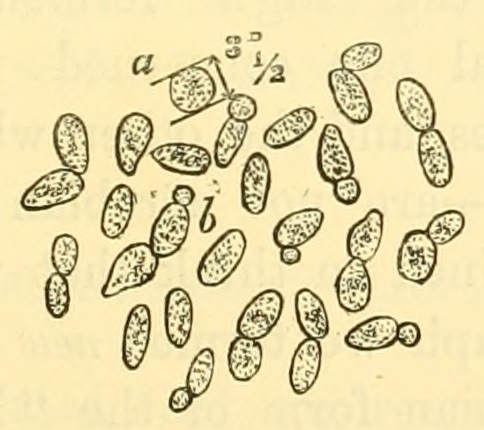
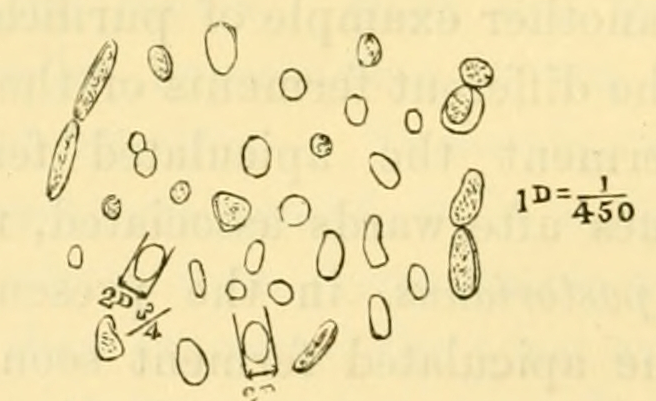
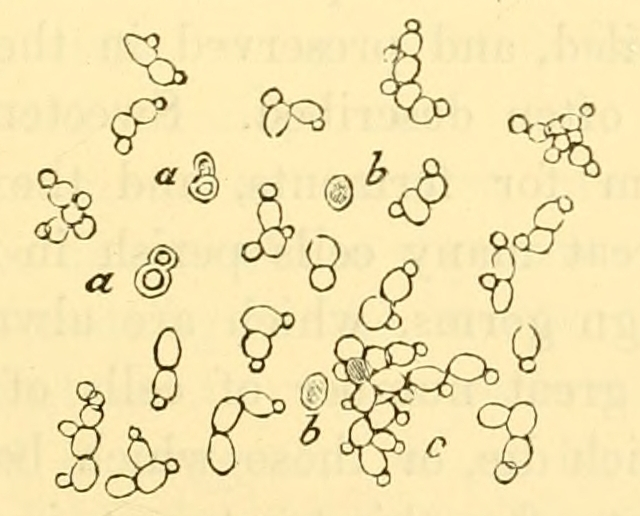
MEMBER OF INSTITUTE OF FRANCE, THE ROYAL SOCIETY OF LONDON, ETC.
A TRANSLATION, MADE WITH THE AUTHOR’S SANCTION, OF
“ÉTUDES SUR LA BIÈRE,” WITH NOTES, INDEX, AND ORIGINAL
ILLUSTRATIONS
BY
FRANK FAULKNER
AUTHOR OF “THE ART OF BREWING,” ETC.
AND
D. CONSTABLE ROBB, B.A.
LATE SCHOLAR OF WORCESTER COLL., OXFORD
London
MACMILLAN & CO
1879
PARDON AND SONS, PRINTERS, PATERNOSTER ROW, LONDON.
TO
THE MEMORY OF
MY FATHER,
FORMERLY A SOLDIER UNDER THE FIRST EMPIRE,
AND
KNIGHT OF THE LEGION OF HONOUR.
THE LONGER I LIVE, THE BETTER DO I UNDERSTAND THE KINDNESS OF
THY HEART AND THE EXCELLENCE OF THY MIND.
TO THY EXAMPLE AND COUNSELS DO I OWE THE EFFORTS THAT HAVE
BEEN DEVOTED TO THESE STUDIES, AS WELL AS TO ALL THE WORK
I HAVE EVER DONE. AND NOW, HOW CAN I BETTER HONOUR THESE
FILIAL REMEMBRANCES THAN BY DEDICATING MY BOOK TO THY MEMORY?
L. PASTEUR.
AUTHOR’S PREFACE.
vii
Our misfortunes inspired me with the idea of these researches.
I undertook them immediately after the war of 1870, and have
since continued them without interruption, with the determination
of perfecting them, and thereby benefiting a branch of
industry wherein we are undoubtedly surpassed by Germany.
I am convinced that I have found a precise, practical solution
of the arduous problem which I proposed to myself—that of a
process of manufacture, independent of season and locality,
which should obviate the necessity of having recourse to the
costly methods of cooling employed in existing processes, and
at the same time secure the preservation of its products for
any length of time.
These new studies are based on the same principles which
guided me in my researches on wine, vinegar, and the silkworm
disease—principles, the applications of which are practically
unlimited. The etiology of contagious diseases may, perhaps,
receive from them an unexpected light.
I need not hazard any prediction concerning the advantages
likely to accrue to the brewing industry from the adoption of
viiisuch a process of brewing as my study of the subject has
enabled me to devise, and from an application of the novel facts
upon which this process is founded. Time is the best appraiser
of scientific work, and I am not unaware that an industrial
discovery rarely produces all its fruit in the hands of its first
inventor.
I began my researches at Clermont-Ferrand, in the laboratory,
and with the help, of my friend M. Duclaux, professor of
chemistry at the Faculty of Sciences of that town. I continued
them in Paris, and afterwards at the great brewery of Tourtel
Brothers, of Tantonville, which is admitted to be the first in
France. I heartily thank these gentlemen for their extreme
kindness. I owe also a public tribute of gratitude to M.
Kuhn, a clever brewer of Chamalières, near Clermont-Ferrand,
as well as to M. Velten, of Marseilles, and to MM. de Tassigny,
of Reims, who have placed at my disposal their establishments
and their products, with the most praiseworthy willingness.
L. PASTEUR.
Paris, June 1, 1876.
PREFACE TO ENGLISH EDITION.
ix
My first idea of placing before English brewers a translation
of “Études sur la Bière” was meagre in the extreme, compared
with the final realization of it as it appears in the following
pages.
Seeing the vast importance of Pasteur’s work from a practical
point of view, after writing a review of it for the Brewers’
Journal, I determined to procure, at any rate for the use of my
pupils, a literal translation, illustrated by photo-lithographic
copies of the original plates, the thankless task of executing
this preliminary translation for so limited a number of readers
being most kindly and generously carried out for me by my
friend Mr. Frank U. Waite, who, being engaged with me at
the time in practical brewing operations, shared my views as
to the value of the original work.
It was on the completion of this translation that my views
and desires expanded. The more I studied the work, the more
I was convinced of its immense value to the brewer as
affording him an intelligent knowledge of the processes
and materials with which he deals, but over and above all
this, it was impossible not to feel that the researches of such
xa devoted and accomplished savant as Pasteur, possessed a
scientific interest much wider than their mere relation to the
art of brewing would imply. As the work of a skilful chemist
and a laborious and accurate observer, such a protracted and
careful study of the lowest and simplest forms of life, must
necessarily be of first importance to the biologist—to the
beginner as an admirable introduction to the study of practical
physiology in general, as well as to the more advanced student,
from the suggestive light which it throws on the nature of
analogous phenomena in more complex organisms.
I determined accordingly to publish the work if I could
secure the consent of its distinguished author, but at the same
time I felt that the publication of M. Pasteur’s “Studies” in
the form in which Mr. Waite had, at my request, translated it,
and illustrated only with inferior copies of the original plates,
would not be either advisable or just; but that I was bound rather
to put the book before the English public in as satisfactory and
complete a form as lay within my power. Under these circumstances
I was induced to seek the aid of Mr. D. Constable
Robb, B.A., of The Oxford University Museum, who, in taking
Mr. Waite’s version as a basis, has so elaborated, annotated, and
recast it, that I feel bound to say that much of the value of
“Studies on Fermentation,” as it now appears, is due to the
care that Mr. Robb has bestowed upon the revision that he so
kindly undertook; a revision the result of which has created a
feeling of confidence in the success of the translation as it now
stands, which I could not have had in any mere literal version.
To the practical worker the original illustrations alone, which
appear in this version, cannot but be of immense value in the
microscopical study of the changes in the liquids with which
he deals; whilst the many notes and additions, which are a
xifeature peculiar to the English edition, more particularly the
rendering into the equivalents, with which, unfortunately,
practical men on this side of the channel are still most at home,
of the metric weights and measures and centigrade temperatures,
as well as the Index which Mr. Robb has compiled, will,
I trust, render the book of still greater service than it otherwise
would have been to many of those who may favour it
with their attention.
The debt which we English brewers owe to M. Pasteur can
hardly be over-estimated, and I must be allowed here to express
my personal obligations to that distinguished worker for the
permission which allows this translation; and to the French
publishers for their help with regard to the interleaved
illustrations.
The author’s preface and dedication are, of course, reproduced,
the former making it unnecessary for me to refer more in detail
to the contents of the translation.
FRANK FAULKNER.
The Brewery, St. Helen’s, Lancashire, September, 1879.
§ I. On the conditions which cause variations in the nature of the
organized products existing in infusions 33
xiv§ II. Experiments on blood and urine taken in their normal state,
and exposed to contact with air that has been deprived of
the particles of dust which it generally holds in suspension 40
§ III. Experiments on the juice contained in grapes 54
§ V. New comparative studies on the germs held in suspension by
the air of different places which are near each other, but
subjected to different conditions affecting the production and
diffusion of the particles of dust found in them 72
§ VI. Yeast may become dry and be reduced to dust without losing
its faculty of reproduction 81
THE GROWTH OF DIFFERENT ORGANISMS IN A STATE OF PURITY:
THEIR AUTONOMY.
§ I. Growth of Penicillium glaucum and Aspergillus glaucus in a
state of purity.—Proofs that these fungoid growths do not
become transformed into the alcoholic ferments of beer or
wine.—Preliminary inquiry into the cause of fermentation 86
§ II. Growth of Mycoderma vini in a state of purity.—Confirmation
of our original conjectures as to the cause of fermentation.—Mycoderma
vini does not change into yeast, although it may
give rise to fermentation 108
§ III. Growth of Mycoderma aceti in a state of purity 121
§ IV. Growth of Mucor racemosus in a state of purity.—Example of
life more active and lasting when removed from the influence
of air 127
IV. Mycoderma vini functioning as an alcoholic ferment.—Right
half, showing appearance of spores just sown; left half, their
appearance after an interval of submerged life 116
V. Mucor, vegetating submerged, in deficit of air 136
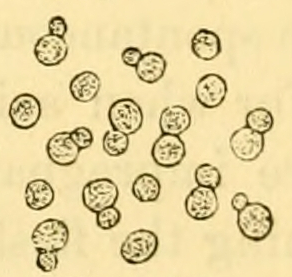
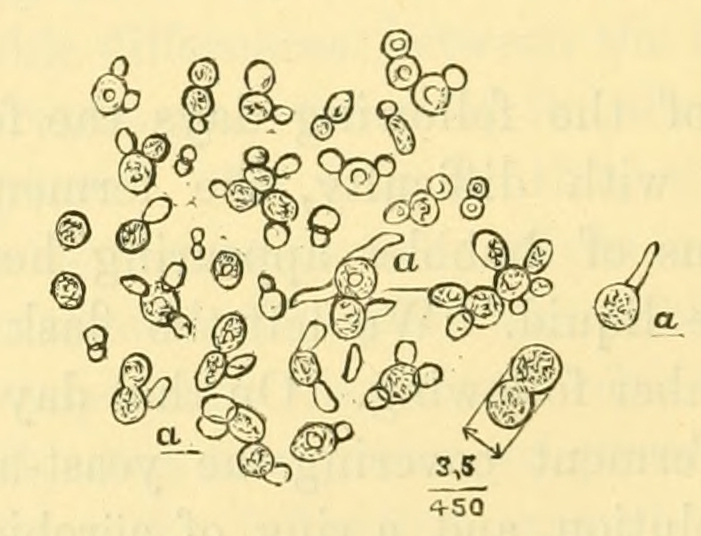
VII. Yeast-cells—worn out and dissociated (left), after revival in a
sweet wort (right) 148
VIII. Fertile mould-cells from the outer surface of grapes 152
IX. Various examples of the mode of growth of mould-cells from
the outer surface of grapes 154
X. One of the ferments of acid fruits at the commencement of
fermentation in its natural medium166
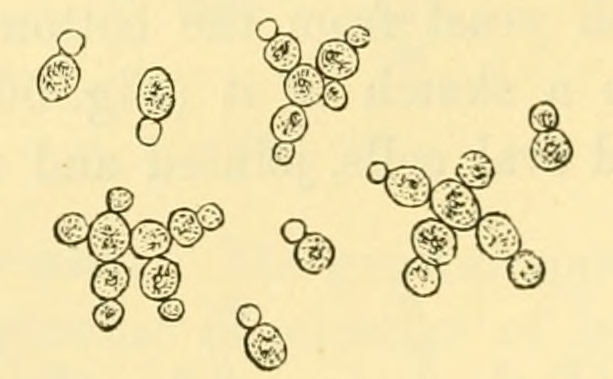
XI. Saccharomyces pastorianus, in course of regular growth 168
XII. Ferment-cells from a spontaneous fermentation just starting 184
CHAPTER I. On the Intimate Relation existing between the Deterioration of Beer, or the Wort from which it is Made, and the Process of Brewing.
1
At the outset of these “Studies,” let us briefly consider the
nature of beer and the methods of its manufacture.
Beer is a beverage which has been known from the earliest
times. It may be described as an infusion of germinated
barley and hops, which has been caused to ferment after having
been cooled, and which, by means of “settling” and racking,
has ultimately been brought to a high state of clarification. It
is an alcoholic beverage, vegetable in its origin—a barley wine,
as it is sometimes rightly termed.[1]
Beer and wine, however, differ widely in their composition.
Beer is less acid and less alcoholic than wine; it holds more
ingredients in solution, and the nature of these ingredients is
by no means similar to that of those which are found in wine.
These differences in the component parts of wine and beer give
rise to corresponding differences in the keeping qualities of the
2two liquids. The small amount of acidity in beer, its poverty in
alcohol, and the presence of matter that is saccharine, or liable
to become so, all operate in imparting to beer a tendency to
change, which wine does not possess. That this unequal resistance
to the aggression of diseases is due to such differences,
may be proved by the fact that wine could be made much
more liable to change than it actually is, by a diminution of
its acidity and its usual proportion of alcohol, or by increasing
the proportion of viscid or saccharine matters,[2] modifications
which would tend to assimilate its composition to that of beer.
We have remarked elsewhere that the pains devoted to the
rearing of vines, and to the ordinary operations of vinification,
such as ouillage,[3] sulphuring, and repeated rackings, as well as
the use of cellars and vessels hermetically closed, are entailed
by the necessity of counteracting and preventing the diseases to
which wine is liable. The same may be said, a fortiori, of beer,
inasmuch as it is more liable to change than wine. Manufacturers
and retailers of this beverage have to strive constantly
with the difficulty of preserving it, or the wort used in its
manufacture. We may readily be convinced of this by reviewing
the usual processes of the art of brewing.
When the infusion of malt and hops, which is termed wort, is
completed, it is left to cool. It is next put into one or more casks
or vats, in which it is made to undergo alcoholic fermentation—the
most important of all the processes in brewing.
The cooling must be as rapid as possible. This is a condition
of success; otherwise, the wort may deteriorate, which will
necessarily lead to deterioration in the quality of the beer. As
long as the wort is at a high temperature it will remain sound;
3when under 70° C. (158° F.), and particularly when at a temperature
of from 25° C. to 35° C. (77° F. to 95° F), it will be
quickly invaded by lactic and butyric ferments. Rapidity in
cooling is so essential that to secure it recourse is had to special
apparatus.[4] Even in the preparation of wort, especially when
it is effected by successive mashings, in summer, deterioration
is imminent: in fact, it is not rare to see the wort becoming
acid during the mashes, if these are not accomplished with all
possible celerity.
After the wort has been cooled, it is mixed with yeast.
This is obtained from a previous fermentation, and, after being
thoroughly pressed, is added at the rate of from one to two
thousandth parts of the weight of the wort, that is, from 100 to
200 grammes per hectolitre (about 4 oz. to 8 oz. average for
every 25 gallons). At first sight, this yeast seems free from
the possible diseases of the wort and beer; but this is by no
means the case.
Now, why do we add yeast to our wort? This practice is
unknown in the art of vinification. The must is always left
to spontaneous fermentation. Why should we not leave the
wort to operate in the same manner?
It would be a mistake to suppose that in the brewing of
beer yeast is added with the sole object of accelerating fermentation,
and making it more rapid. Rapidity in fermentation
is a very questionable advantage, and one which is not
desired by brewers, who rather agree in pronouncing it injurious
to the quality of beer. It is in the easy deterioration of the
wort, or what is tantamount to it, in the facility it affords to
various spontaneous fermentations, that we find an answer to
these questions. The must, through its acidity, due to the
presence of bitartrate of potash—which seems to promote
alcoholic fermentation—through its proportion of sugar, and
perhaps in consequence of some other peculiarity of its composition,
always undergoes regular alcoholic fermentation. The
4diseases of wine, at the commencement of its manufacture,
show themselves, so to say, in a latent state only. Therefore
a vintage can be left, without inconvenience, to spontaneous
fermentation.
With wort the case is quite different. Under certain
accidental circumstances it is possible that alcoholic fermentation
alone may take place in a wort left to ferment spontaneously,
and the quality of the beer remain unimpaired, but such an
event would be exceptional, and of very rare occurrence. In
most cases we should obtain an acid or putrid liquid resulting
from the production and multiplication of alien ferments.
The addition of yeast is made in consequence of the necessity
of exciting through the whole bulk of wort, as soon as it is
cold, a single fermentation—viz., the alcoholic, the only one
that can produce beer properly so called.
The alcoholic ferments concerned in the production of beer
will be found represented in several of the engravings in this
work. Other ferments we may term “diseased”; these include
all those that may occur spontaneously—that is, whose germs
have not been directly and intentionally introduced—amongst
the actual alcoholic ferments.
The expression, “diseased ferments,” is justified by the circumstance
that the propagation of these ferments is always
accompanied by the production of substances which are acid,
putrid, viscous, bitter, or otherwise unpalatable, a consideration
of commercial rather than scientific importance. From a physiological
point of view, all these ferments are of equal interest
and importance. The botanist, as a man of science, in contemplating
nature, must give equal attention to all plants, whether
useful or noxious, since they are all governed by the same
natural laws, among which no order of merit could be established.
The exigencies of industry and health require, however,
wide distinctions.
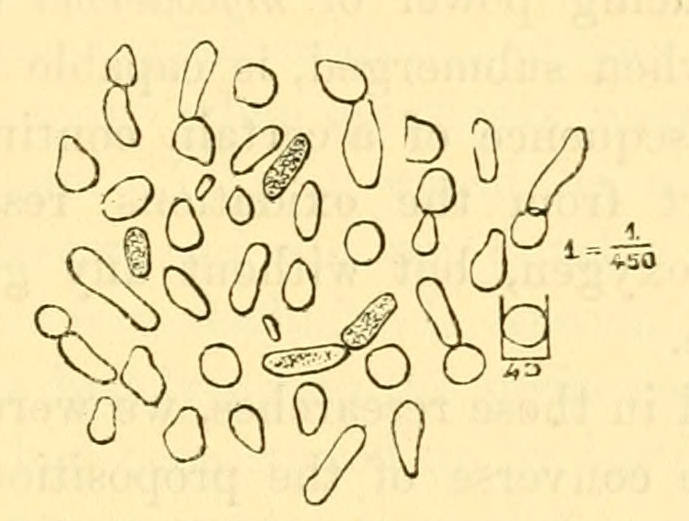
Plate 1. Principal Disease-ferments met with in Wort and Beer.
The first engraving (Plate I.) represents the different diseased
ferments, together with some cells of alcoholic yeast, to show
the relative size of these organisms.
5No. 1 of the engraving represents the ferments of turned
beer, as it is called. These are filaments, simple or articulated
into chains of different size, and having a diameter of about
the thousandth part of a millimetre (about 1/25000 inch). Under
a very high power they are seen to be composed of many series
of shorter filaments, immovable in their articulations, which
are scarcely visible.
In No. 2 are given the lactic ferments of wort and beer. These
are small, fine and contracted in their middle. They are
generally detached, but sometimes occur in chains of two or
three. Their diameter is a little greater than that of No. 1.
In No. 3 are given the ferments of putrid wort and beer. These
are mobile filaments whose movements are more or less rapid,
according to the temperature. Their diameter varies, but is
for the most part greater than that of the filaments of Nos. 1
and 2. They generally appear at the commencement of fermentation,
when it is slow, and are almost invariably the result of
very defective working.
In No. 4 are given the ferments of viscous wort, and those
of ropy beer, which the French call filante. They form
chaplets of nearly spherical grains. These ferments rarely
occur in wort, and still less frequently in beer.
No. 5 represents the ferments of pungent, sour beer, which
possesses an acetic odour. These ferments occur in the shape
of chaplets, and consist of the mycoderma aceti, which bears a
close resemblance to lactic ferments (No. 2), especially in the
early stages of development. Their physiological functions are
widely different, in spite of this similarity.
The ferments given in No. 7 characterize beer of a peculiar
acidity, which reminds one more or less of unripe, acid fruit,
with an odour sui generis. These ferments occur in the form of
grains which resemble little spherical points, placed two together,
or forming squares. They are generally found with the filaments
of No. 1, and are more to be feared than the latter,
which cause no very great deterioration in the quality of beer,
when alone. When No. 7 is present, by itself or with No. 1,
6the beer acquires a sour taste and smell that render it detestable.
We have met with this ferment existing in beer, unaccompanied
by other ferments, and have been convinced of its fatal effects.
No. 6 represents one of the deposits belonging to wort. This
must not be confounded with the deposits of diseased ferments.
The latter are always visibly organized, whilst the former is shapeless,
although it would not always be easy to decide between the
two characters, if several samples of both descriptions were not
present. This shapeless deposit interferes with wort during its
cooling. It is generally absent from beer, because it remains in
the backs, or on the coolers; or it may get entangled in the
yeast during fermentation and disappear with it.
Among the shapeless granulations of No. 6 may be discerned
little spheres of different sizes and perfect regularity. These are
balls of resinous and colouring matter that are frequently found
in old beer, at the bottom of bottles or casks; sometimes they
occur in wort preserved after Appert’s method. They resemble
organized products, but are nothing of the kind. We have
remarked before, in “Studies on Wine,” that the colouring
matter of wine would settle, in course of time, in that form.
It is evident that the different ferments delineated in Plate I.
are worthy of thorough study, in consequence of the fermentations
to which they may give rise. Care must be taken to isolate
the action of each of them in fermentations which we may call
pure—a condition of some difficulty, but one that may be carried
out by an adoption of the methods explained in this work.
All these diseased ferments have a common origin. Their
germs, infinitesimal and hardly perceptible as they are, even
with the aid of the microscope, form a part of the dust conveyed
through the air. This dust the air is continually taking from
or depositing upon all objects in nature, so that the dust that
clings to the ingredients from which our beer is manufactured,
may teem with the germs of diseased ferments.
During the process of fermentation, the occult power of
diseased ferments, although it may escape the observation of the
brewer, is manifested in a high degree.
7During the last thirty years, or so, the art of brewing has
undergone a radical change, at least in Europe. This change
has been effected by a partial abandonment of the process of
fermentation formerly used. Thirty years ago only one kind
of beer was known; there are nowadays two distinct kinds—beer
fermented at a high temperature, and beer fermented at a
low temperature. Each of these is subdivided into many varieties,
to which different names are given, according to their strength
or colour. This is the case in England, where we find porter,
ale, pale ale, stout, bitter beer, and other varieties of beer,
although, as a matter of fact, the English have but one kind of
beer, all the English beers being fermented at a high temperature.
Let us briefly examine the differences existing between the
two kinds of beer.
Formerly all beer was fermented at a high temperature. The
wort, after having been cooled in the backs, was run into a
large vat, at a temperature of about 20° C. (68° F.). Yeast
was then added to it, and when the fermentation began to show
itself, in the formation of a light, white froth, upon the surface
of the liquid, the wort was run into casks, having a capacity
of from 50 to 100 litres (11 to 22 gallons)—75 litres being the
commonest size. These casks were placed in cellars, having a
temperature of from 18° C. to 20° C. (64° F. to 68° F.). The
activity of fermentation soon produced a froth that grew thicker
and more and more viscous in proportion to the quantity of
yeast it contained. The yeast worked out of the bung-holes
and dropped into a vessel placed under the casks; there it was
gathered for subsequent operations. It always exceeded the
quantity used in the first instance, the ferment increasing
greatly during the process of fermentation. The increase in
its weight varied with the weight of yeast used and the composition
of the wort. Under the ordinary conditions of brewing,
where the weight of the pitching yeast was about one thousandth
part of the weight of the wort, the increase is said to
have been from five to seven times the weight of the yeast;
8but such increase must naturally have been determined by the
quality of the wort, the quantity of hops used, the action of
oxygen, and the proportion of barm employed. The process of
fermentation lasted from three to four days. By that time the
beer was finished, and had become limpid, the fermentation
having been completed. The bungs could then be placed in
the casks, and the beer be delivered to the customer.[5] A certain
amount of yeast still remained in the casks, and caused the
beer to become thick, in transit; but a few days’ rest sufficed to
restore its brilliancy, and render it fit for drinking or bottling.
Here we have an explanation of the term “high fermentation,”
which has been applied to the foregoing process. This
process is conducted at a high temperature, which, commencing
at 19° C. or 20° C. (66° F. or 68° F.), is raised to 20° C. or 21° C.
(68° or 70° F.) by the action of fermentation, which is always
accompanied by an increase of heat.[6]
9This is not, however, the only reason for the use of the term
“high fermentation.” We have just seen that the fermenting
casks were so arranged that most of the yeast produced during
the process of fermentation would rise to the upper part
of the casks and work out of the bung-holes. In this
practical fact we have the actual origin of the expressions
“high fermentation” and “high beer,” which are used to
distinguish this peculiar fermentation and the quality of beer
derived from it.
As we have already observed, all beer was formerly produced
by this mode of fermentation, which even at the present time
is still practised in the breweries of Great Britain, where beer
fermented at a low temperature is absolutely unknown.
“Low fermentation” is a slow process, effected at a low
temperature, during which the yeast sinks to the bottom of the
vats or casks. The wort, after cooling, is run into open wooden
vats. In cooling, the wort is brought to as low a temperature
as 8° C. (47° F.), or even 6° C. (43° F.), at which point it is
maintained by cones or cylinders (styled nageurs, i.e., floats, by
the French) floating in the fermenting vats. These floats may
be filled with ice if the outside temperature requires it, as is
invariably the case in summer.
10The duration of this fermentation is ten, fifteen, or even
twenty days. The yeast, which is produced less abundantly
than in the case of beer fermented at a high temperature, is
gathered after the beer has been drawn off, and is partly used in
subsequent fermentations.
The term “low fermentation” is derived partly from the
lowness of the temperature during the fermenting process, and
partly from the fact that the yeast is gathered at the bottom,
and not at the upper part of the fermenting vessels.[7]
Beer fermented at a low temperature, of which there are
several varieties, differing in colour and quality, is of Bavarian
origin.[8] The preference of the public for this kind of beer, and
the increased facilities that such a beer affords the trade, are
the two reasons why its manufacture has so greatly increased.
In Austria, Bavaria, Prussia, and other Continental countries
this new method of brewing is almost exclusively adopted.
In the Moniteur de la Brasserie of the 23rd April, 1871, may
be found the following significant remarks on the increase in
the production of beer fermented at a low temperature on the
Continent: “The number of breweries manufacturing high beer
is rapidly decreasing, whilst the number of those producing low
beer is still more rapidly increasing. There were in Bohemia,
in 1860, 281 breweries in which high fermentation was practised;
in 1865, only 81 of these remained; in 1870, the number had
declined to 18. On the other hand, the number of breweries
practising low fermentation increased from 135 in 1860 to 459
in 1865, and in 1870 had risen to 831. In 1860 there were
620 breweries in which the two methods were employed; in
1865 there were 486; in 1870 only 119 remained. The number
of breweries at present existing in Bohemia amounts to 968.”
11In France, we are still in a period of transition; but year by
year the manufacture of “low beer” is increasing, to the evident
detriment of its competitor.
It is unnecessary to dwell upon certain differences existing
between the two kinds of beer, such as may be traced
to the preparation and composition of their respective worts.
The brewing of “high beer,” by hand or machinery, is
effected in one operation; the brewing of “low beer” is
accomplished by successive mashings, the temperatures of which
are gradually raised. These differences, and others that result
from the longer boiling of the wort, in the “high fermentation”
process, give rise to diversities in the composition and colour of
the worts, from which circumstance “low beers” are sometimes
termed white beers, in contradistinction to the others, which
have a deeper colour, and are known as dark beers (bruns). The
name of Strasburg is generally given to “low beer” in France,
but sometimes it is called German beer.
It is easy to account for the changes introduced into the
construction and working of breweries by the new process of
“low fermentation.” A low temperature is essential not only
to the manufacture but also to the preservation of “low beer,”
and must be secured by the use of ice-cellars in which the
temperature may be maintained at 5° R. or 6° R. (43° F. or 45° F.),
and even at 1°, 2°, or 3° R. (35° to 39° F.) throughout the year.
This necessitates an accumulation of ice and the construction of
cellars of enormous extent, for the storage of the beer. “Low
beer” is essentially a stock beer, especially if brewed in winter,
when due advantage is taken of the low temperature of the
season. It is kept in cold cellars until the spring or summer,
when beer is consumed in larger quantities. It is calculated
that 100 kilos. (1·96 cwt.) of ice is the average quantity used
per hectolitre (22 gallons) of good beer, between the cooling of
the wort and the day of sale.[9]
12In the manufacture of “high beer” we find none of these
complications, nor have we in that manufacture any similar
difficulty of working or expense of construction to contend
against. The whole process of brewing, including the delivery
of the beer, does not take more than eight days. Why should
a mode of brewing so simple, so rapid, and comparatively so
inexpensive, have been abandoned by the greater part of Europe
in favour of a system disadvantageous to the brewer in so many
respects? It would be a mistake to suppose that the sole reason
for such a change might be found in the superior quality of
“low beer.” That such a superiority does exist is admitted as a
fact by the majority of beer drinkers; but taken by itself, this
fact is not sufficient to account for the radical transformation
that has taken place in the manufacture of beer, as is proved
by the example of England, which, we believe, does not possess
as yet one single “low beer” brewery, from which circumstance
we may fairly suppose that the English have a decided preference
for “high beer.”
The principal advantage of working at a low temperature
lies in the fact that “low beer” is less liable to deterioration,
and is less prone to contract diseases than “high beer,” especially
whilst it remains in the brewery—a circumstance that places
the brewer in a position vastly superior to that which he
occupied in former times. With the help of ice the brewer
can manufacture beer during winter and the early part of
spring, for consumption in summer.[10] “High beer,” on the
13other hand, must be consumed within a short time of its production.
The brewer is thus compelled to manufacture it as
it is wanted, and as orders are sent in, the demand for it being
in a great measure dependent upon the state of the weather.
Conditions so unfavourable as these must necessarily operate
prejudicially against trade. Industry requires more stability
and uniformity, both in the production and the sale of its goods.
“Low beer” can be brewed in large quantities at any time to
be delivered at any other time, according to requirements; its
manufacture, therefore, is unattended by the inconveniences
which we have just noticed.[11]
How is it that the use of ice and yeast operating at a low
temperature so greatly facilitates the preservation of our beer
14and enables us to secure such striking advantages? The explanation
is simple: the diseased ferments, which we have pointed
out, rarely appear at a lower temperature than 10° C. (50° F.),
and at that temperature their germs cease to be active. The
adoption of low temperatures by brewers is mainly due to this
physiological fact. On one occasion only have we met with
active vibrios (No. 3, Plate I.), at a very low temperature; these
were forming with great difficulty in wort fermenting at 5° C.
(41° F.).
From this we see that the changes which the manufacture of
beer has undergone during the present century have been based
mainly on the diseases to which beer is liable, either during or
after the process of brewing. The fact that English brewers
have not as yet adopted “low fermentation” may be accounted
for, in a great measure, by the difficulty of enlarging existing
breweries, in cities like London, to the extent required for the
new method of manufacture. Even in the event of public taste
demanding a “low beer,” English brewers will hesitate a long
time before converting their breweries. Such conversion would
impose upon them expenses and difficulties of a very serious
nature. If ever such a change should take place, it will probably
be inaugurated out of London. It is, however, worthy of remark
that English brewers, without adopting “low fermentation,”
have introduced considerable improvements in brewing, especially
in the management of the temperature during fermentation;
this must be preserved within narrow and exact limits, for fear
of injury to the product. It might easily be shown that these
improvements have resulted from the liability of the beer to
contract diseases, although this fact may not have been recognized
by the brewers who have introduced them.
Besides the yeasts which belong to the two principal kinds
of fermentation, there exist many varieties of alcoholic ferment
that produce, each of them, a special kind of beer. Among these
special beers some are deficient in taste, others in aroma, others
in brilliancy. Let us suppose that in the manufacture of a
beer with one of these yeasts, from which a peculiar flavour
15is derived, a different and inferior variety is accidentally
mixed with that which we intend to use; in such a case,
the inferior variety, the product of which will possess an inferior
quality, will exercise such an influence on the brewing as to
induce the belief that disease must be present. The microscope,
if consulted, will reveal no special organism, nor any of those
diseased ferments of which we have given specimens. It is in
the study of yeast that we must endeavour to find the cause of
the results we observe. This point, which is of the greatest
importance to brewers, will become clearer as we proceed.
If we examine the practices of the beer trade, in its
retail as well as in its export branches, we shall find that
many of them afford evidence of the liability of the beer to
deteriorate. We may cite some of these. When taken out of
the ice-cellars, the beer is kept in casks of small capacity, that
it may be the sooner consumed; when exposed to a high temperature,
the beer will not keep sound for any length of time,
but will speedily effloresce with mycoderma vini or mycoderma
aceti.
Beer which is intended for bottling should not be kept for
more than a month or six weeks. Even in bottling we may
perceive the tendency of the liquid to deteriorate.[12] It is necessary
that the bottles, immediately after being filled, should be
laid on their sides for twenty-four or forty-eight hours; they
may then be placed upright; the reason for this is that the air
16left between the cork and the beer might give rise to the production
of efflorescence. If we lay the bottles down on their
sides, the oxygen of this air will be absorbed by the oxidizable
substances in the liquid, and there will be little fear of germs
developing themselves when the bottles are placed upright. The
bottles should not, however, be left on their sides longer than
forty-eight hours; otherwise the supplementary fermentation
may force the corks out. Moreover, when the bottles stand
upright the products of fermentation collect at the bottom, and
not at the sides.
Beer which is intended for keeping, if exported or conveyed
some distance off, must be surrounded with ice. Without this
precaution it will ferment too much or contract some disease.
“High beer” cannot stand travelling. This kind of beer
should not be exported unless the ordinary proportion of hops
has been greatly increased—hop oil acting in some respects as an
antiseptic, and preventing the beer from contracting diseases.[13]
The export of English beer to India and the Continent has
fallen off of late years, or rather, has not increased to the extent
that was anticipated; in fact, this trade has entailed great losses
upon those engaged in it. It is said that an English firm lost
as much as £48,000 on one consignment, which on its arrival
in India was found to be all turned.
There are no breweries in hot countries, where beer would
command a very large sale. It is a well-known fact that beer
is a remarkably pleasant drink in tropical climates, provided its
temperature be a few degrees below that of the atmosphere, but
the expenses of its production would be enormous, on account
of the immense quantity of ice that would be required in its
manufacture and for its preservation. It is in hot countries
that beer is most liable to deterioration.
Beer is said to be the beverage of northern regions, which
17are deprived of the vine, by the rigour of their climate. In
these regions man has sought in the abundance of grain-fruit
a substitute for grapes. To a certain extent this is true; nevertheless,
it is an undoubted fact that beer was first brewed in
Egypt, a very hot country, whence its manufacture has spread
over Europe. It was called Pelusian wine, from Pelusium, a
city on the banks of the Nile, which produced a beer that was
held in high esteem.[14]
Beyond a doubt, hot countries, even those in which the vine
is cultivated, would consume much beer, could it but stand their
high temperature.[15] A considerable quantity of beer is now
brewed in British India, but its manufacture entails an enormous
outlay for ice.
The complications which result from the tendency of wort
and beer to deteriorate, underlie almost all the details of the
process of brewing and the sale of beer, and have been the
cause of most of the changes and improvements that have been
effected in brewing, during the present century.
CHAPTER II. On the Causes of the Diseases which affect Beer and Wort. — § I.—Every Unhealthy Change in the Quality of Beer coincides with a Development of Microscopic Germs which are alien to the Pure Ferment of Beer. — § II.—The Absence of Change in Wort and Beer Coincides with the Absence of Foreign Organisms.
18
From our preceding observations it will be evident that the
manufacture of beer, the arrangement of breweries, and all the
processes practised by the brewer immediately depend upon this
fact, that beer and wort are fluids essentially liable to change.
Thus it becomes a matter of extreme importance that we should
have an exact knowledge of the causes and nature of the
changes which affect our produce, and it may be that this
knowledge will lead us to regard the conditions of the brewing
industry from a novel point of view, and bring about important
modifications in the practices of the trade. We might vainly
search the numerous works which have been written on brewing
for information respecting the proposed subject of these studies.
At the most we should find the diseases to which beer is liable
in the course of its manufacture, or afterwards, vaguely hinted
at; perhaps we might be favoured with certain empirical
recipes for disguising the evil effects of those diseases.
It will be our endeavour to demonstrate the truth of the
proposition we have already laid down, that every change to
which wort and beer are liable is brought about solely by the
development of organic ferments, whose germs are being perpetually
wafted to and fro in the dust floating through the
air, or distributed over the surface of the different materials and
utensils used in brewing, such as malt, yeast, water, coolers,
19vats, tubs, casks, shovels, workmen’s clothes, and innumerable
other things.
It is evident that this proposition bears a marked resemblance
to the one which we have demonstrated concerning the diseases
of wine.[16]
By the expression diseases of wort and beer, we mean radical
changes which so affect the nature of those liquids as to make
them unpalatable, especially if they are kept; such changes
produce beer which is sharp, sour, turned, oily, putrid, and
otherwise bad. It would be unreasonable to apply the term
disease to certain modifications in the quality of beer, which
may be produced by practices more or less commendable. Such
modifications, too, may result from want of skill in the brewer,
from the composition of the wort, from the specific nature of
the yeast, or from the inferior quality of ingredients. It is a
well-known fact that “low beer,” if manufactured according to
the ordinary process, has not that same delicacy of flavour
which characterizes beer fermented at a lower temperature than
10° C. (50° F.). Fermented at 10° C. (50° F.), or 12° C. (53° F.)
or at a higher temperature, it loses the peculiar properties
which consumers prize. Nevertheless, in point of soundness it
may be as good a beer as one which has been fermented at 6° C.
(43° F.), or 8° C. (46° F.). One might say of the former beer
that it is inferior to the latter in estimation; but we could not
rightly call it diseased, for we are supposing a case in which
disease does not actually exist.
Our proposition concerning the causes of the diseases of wort
and beer might be demonstrated in several ways. The following
is one of the simplest:—Take a few bottles of sound beer,
20say, for instance, that which is known in Paris as Tourtel’s,
Grüber’s, or Dreher’s, from the name of the brewer who manufactures
it. Place some of these bottles in a hot-water bath and
raise the temperature to about 60° C. (140° F.). Permit them to
cool, and then place them by the side of the other bottles that
have not been heated. In every case, especially if we conduct this
experiment in summer, we shall find that in the course of a few
weeks—the length of time varying according to the temperature
and the quality of the beer—all the bottles which have not
been heated will have become diseased, in some cases even to
the extent of being undrinkable. Let us next examine, by
way of comparison, the deposits in the heated and non-heated
bottles. We shall find associated with the pure alcoholic ferment
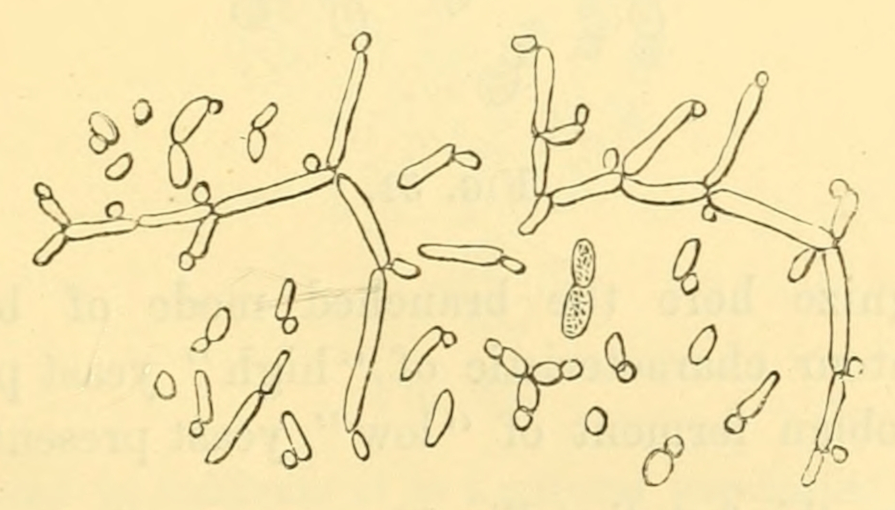
other organisms, filiform and for the most part very slender,
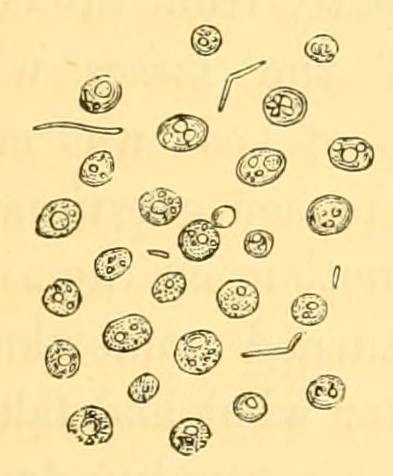
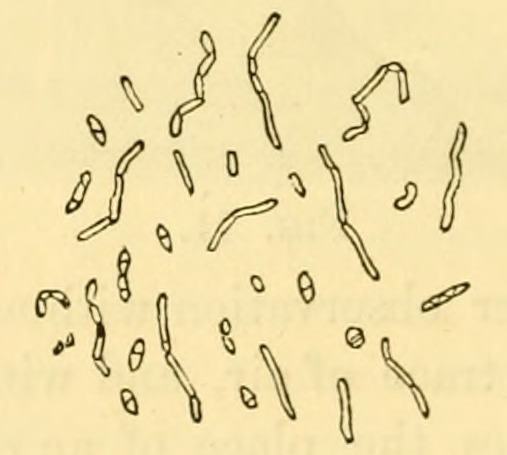
and either simple or articulated, as represented in Plate II., the
design of which is taken from actual deposits occurring in beer
that had been kept for some time at the ordinary temperature.
A number of bottles of beer which had been heated on October
8th, 1871, were compared with those of an equal number of
bottles of the same beer which had not been heated. The
examination took place on July 27th, 1872. The beer, which
had been heated to 55° C. (131° F.), was remarkably sound,
well flavoured, and still in a state of fermentation. As a matter
of fact, we have proved by exact experiments that alcoholic
ferments, heated in beer, can endure a temperature of 55° C.
(131° F.), without losing the power of germination; but the
action is rendered somewhat more difficult and slower. Diseased
ferments, however, existing in the same medium, perish at this
temperature, as they do in the case of wine. The beer which
had not been heated, had undergone changes which rendered it
quite undrinkable. Its acidity, due to volatile acids, was higher
than that of the other beer in the proportion of 5 to 1. The
beer which had been heated contained ½ per cent. of alcohol
more than the other.
Plate 2. Appearance under the Microscope of the Deposit from “Turned” Beer.
The deposits in the heated bottles also showed filaments of
disease, but in such minute quantity that it was necessary to
21search many fields of the microscope to discover their existence.
Those which we found after the heating must have existed in
the beer before that operation; the heat had destroyed them,
without sensibly altering their shape or size; they could neither
multiply nor continue to exert any influence upon the components
of the beer.[17]
From these experiments we may easily perceive, on the one
hand, that beers apparently sound to the taste do not contain
these or any other filiform ferments, save in a scarcely appreciable
quantity; and, on the other hand, that these same ferments
appear with the first unfavourable change in the quality of the
beers, and that they exist more or less abundantly in proportion
to the intensity of disease.
In certain extremely rare cases it may happen—so, at least,
we have been assured, but we have not proved the fact ourselves—that
beer may keep sound in bottle, even without the preliminary
heating. This exception can only occur in the case of
certain beers of a peculiar composition, which are highly
hopped, and are made during the favourable months of November
or December, out of the choicest materials, and fermented
with yeast that happens to be pure. In the deposit of such beer,
even after a lapse of several months or several years, we should
find only the ordinary alcoholic ferment, the slow action of
which would merely cause a gradual increase in the quantity
of alcohol existing in the beer, and a diminution in the proportion
of dextrine. This beer might grow old, as wine does, and
remain perfectly sound.
Very often the whole work of the brewer is jeopardized by
the unsuspected presence of diseased ferments, a remedy for
22which is only devised after the evil has evoked the complaints
of customers. In such a case the brewer avails himself of the
kindness of some other brewer to obtain a change of yeast—a
custom which is recognized and valued in the trade, since all
managers of breweries have an interest in keeping it up. The
brewer whose produce is most satisfactory recognizes the fact
that unforeseen circumstances may compel him at any moment
to change his yeast.
We have frequently had occasion to show that this necessity
for a change of yeast depends, in most cases, on some change
brought about by the presence of diseased ferments, the multiplication
of which has resulted fortuitously from some unconscious
neglect during the process of brewing, or from climatic
influences. When we reflect that yeast is a living being, and
that the medium which serves as its aliment, and the water in
which it lives, are remarkably well adapted for the development
of a vast number of other microscopic beings, the comparative
purity of yeast should surprise us even more than its deterioration
does.
Now by means of microscopical observations we might often
detect the existence of the evil long before we are warned
of it by a defective working, which invariably entails great
losses.[18]
In proof of this remark we may cite the following facts. In
the month of September, 1871, we were permitted to go through
a large London brewery, in which the microscopical study of
yeast was altogether unknown. We were allowed to make
certain experiments in the presence of the managers of the
establishment. We first examined porter yeast, which was
collected in a channel that received the yeast as it worked out
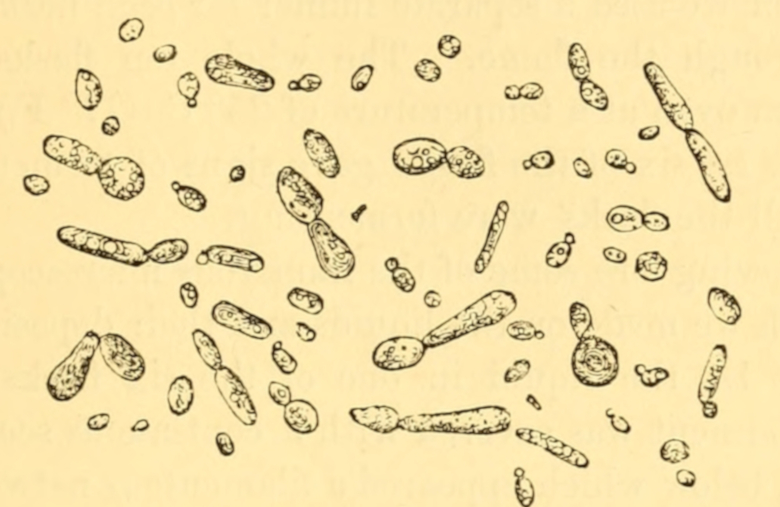
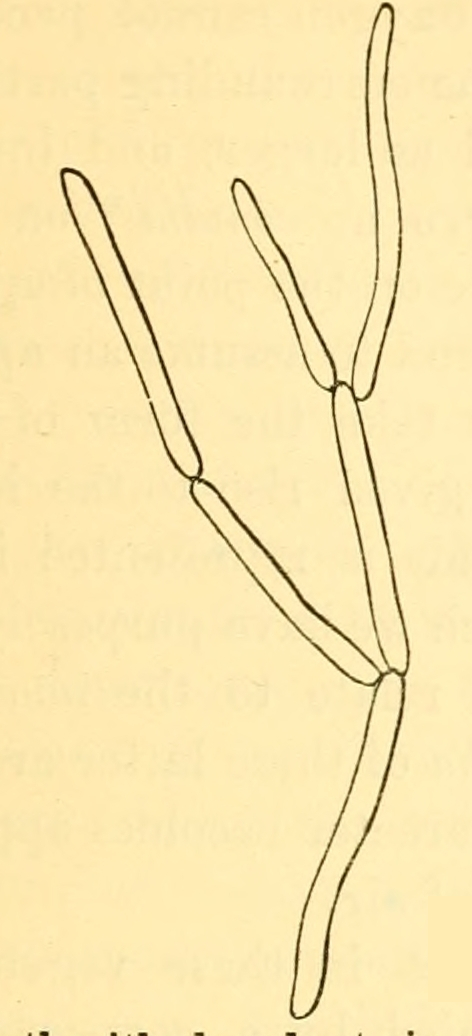
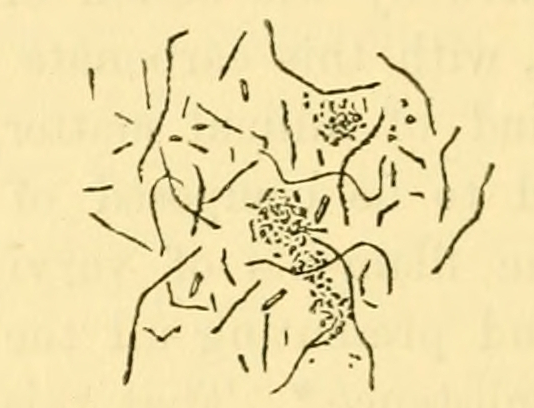
of the fermenting vessels. One of the ferments of disease
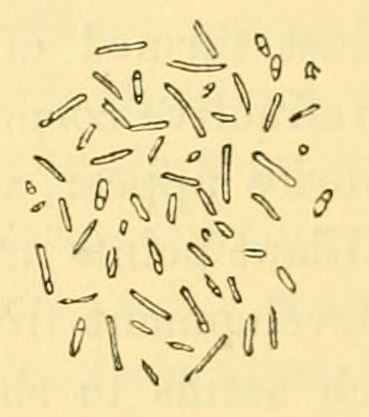
abounded in this yeast, as may be seen in the accompanying
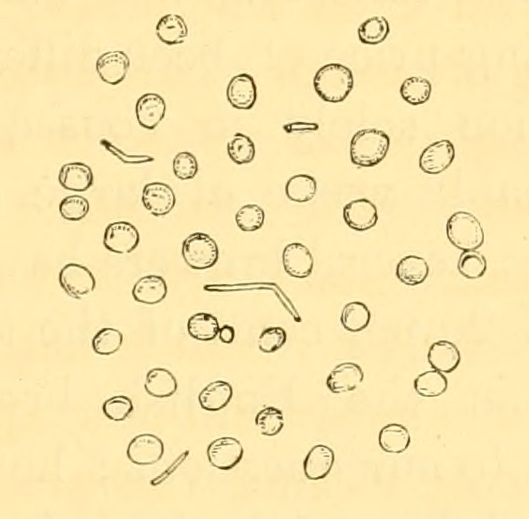
23sketch, which was taken on the spot (Fig. 1). It was evident
that the working of the porter was extremely unsatisfactory,
and had, perhaps, been so for a long time; indeed, we were told
that they had obtained a change of yeast from another London
brewery that same day. We made a point of examining this
yeast with the microscope. It was beyond comparison purer
than the preceding yeast.
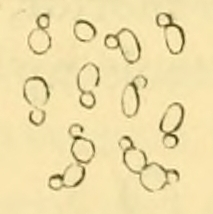
Fig. 1.
It is evident that if these brewers had been in the habit of
using the microscope they might have detected the unsoundness
of their produce before the time when they actually made the
discovery, which, no doubt, was forced upon them by the complaints
of their customers, or some other annoying circumstance,
that led to their obtaining a change of yeast.
We next obtained permission to examine the yeast of the
other beers undergoing fermentation, especially those of white
beers, such as ale and pale ale.
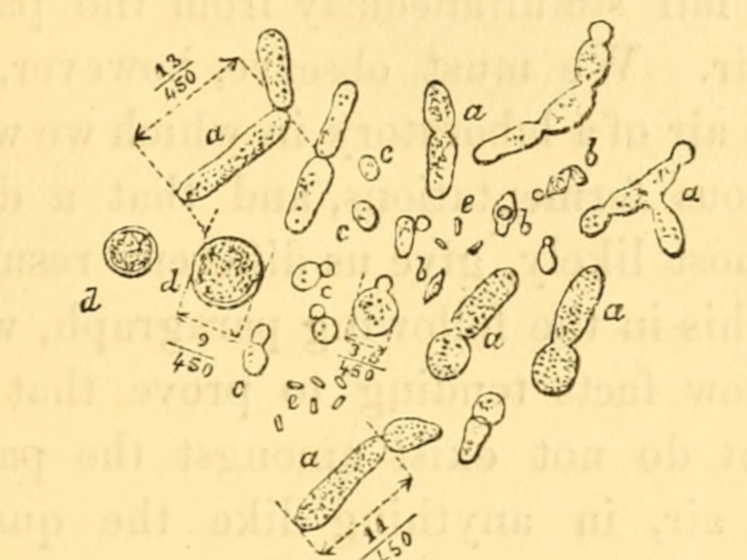
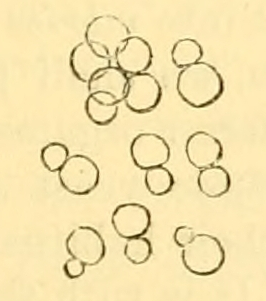
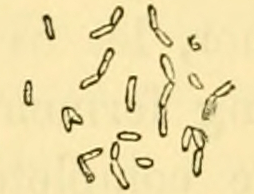
In the sketch which we made of these yeasts one may detect
the presence of the filaments peculiar to turned beer (Fig. 2).
Fig. 2.
We examined with much interest the ales which had immediately
preceded those undergoing fermentation, the yeast of
which we had just inspected. We were furnished with two
kinds, both in casks, the one fined, the other not fined. The
latter was visibly turbid, and, examining a drop of it, we discovered
three or four filaments present in every field of the
microscope. The ale which had been fined was nearly clear,
but wanting in brilliancy; it contained about one filament to the
field. We asserted in the presence of the head brewer, who
24had been summoned, that these ales were extremely liable to
change, that it was highly necessary to dispose of them without
delay, and that they were necessarily already faulty in flavour—a
fact which all admitted after some hesitation—attributable,
of course, to the natural reluctance which every manufacturer
feels to own that his produce is not above reproach. We
were shown some of the finings used in the brewery; they
were swarming with the same filaments of disease-organisms.
We then propounded to the managers certain questions on
the subject of the losses which a brewery may sustain from
changes in its beer. We had heard from several brewers that
the selling price of beer differed so greatly from the cost of its
production solely in consequence of the losses which the
unavoidable waste of large quantities of beer was constantly
causing; several brewers have in our presence estimated these
losses at 20 per cent. of the total production, on the average.
At first the English brewers returned somewhat vague
answers to our questions; however, after what had taken place,
they doubtless recognized the fact that a mutual understanding
between a savant and a practical man may often be of considerable
benefit to the latter, and in the end they confessed
to us that they had stowed away in their brewery a large
quantity of beer which had gone bad in cask a fortnight or so
after it was brewed. Having avowed thus much they expressed
their great anxiety to learn the cause of so serious a change in
their beer, which was quite undrinkable. We examined it
under the microscope, without being able to detect immediately
any diseased ferments, but being aware that the beer had
probably been clarified, by remaining undisturbed for a very
long time, and that these ferments might have become inert and
precipitated to the bottom of the enormous vats containing the
beer, we examined the deposits which had formed at the bottom
of these vats. They were composed solely of filaments of disease-organisms,
without even the least trace of the globules of alcoholic
yeast. The supplementary fermentation of this beer had
evidently been nothing but a diseased fermentation.
25The resemblance between these filaments and those which, in
considerably smaller proportion, accompanied the globules of
alcoholic ferment in our preceding observations, the change
in the beer, which was almost as bad as beer could possibly be,
along with an abundance of filaments, and the change, to
a minor extent, in that beer which only presented a few
filaments in a field of the microscope, impressed those managers
of the brewery who were present with an entire belief in the
theory which we had been endeavouring to impress on their
minds concerning the causes of the badness of their beer.
Some eight days afterwards we paid another visit to this same
brewery, and learnt that the directors had lost no time in
acquiring a microscope, and in procuring changes of yeast for
all the varieties of beer, which they had put in working since
our first visit.
There are some periods of the year—early spring, summer,
and autumn, for instance—when the working of a brewery
is a matter of great difficulty. The preservation of yeast
becomes a subject requiring the most delicate treatment, in
consequence of the increase in the temperature. In the early
part of autumn the most important ingredients used in brewing
are of inferior quality; the deteriorating influences which have
been at work have covered them with a variety of parasites.
All these circumstances contribute to facilitate the development
of diseased ferments.
The method which we have just pursued in demonstrating
the existence of a relation between the diseases of beer and
certain microscopic organisms can scarcely leave a doubt, it
seems to us, as to the correctness of the principles which we are
advocating. In every case where the microscope reveals in a
yeast, especially a yeast which is in a state of activity, products
26which are foreign to the composition of alcoholic ferment,
properly so called, the flavour of the beer is more or less unsatisfactory,
according to the abundance or nature of these
minute organisms. Moreover, when a finished beer of superior
quality loses in the course of time its agreeable flavour, and
becomes sour, it may readily be shown that the alcoholic
ferment in the deposit existing in bottles or casks, although
originally pure, at least in appearance, becomes gradually
intermixed with these same filiform ferments or other ones.
These facts may be deduced from what precedes; nevertheless,
some prejudiced minds might perhaps urge that these foreign
ferments are the consequence of some diseased condition,
produced by circumstances of which we know nothing.
Although this gratuitous supposition may be difficult to
sustain, we shall endeavour to corroborate our preceding observations
by the method of experiment which will be seen to be
the more decisive.
This method consists in proving that beer never possesses any
unpleasant flavour, so long as the alcoholic ferment, properly
so called, is not associated with foreign ferments; that this also
holds good in the case of wort, and that wort, liable to change
as it is, may be preserved in a state of purity, if it is kept under
conditions that protect it from the invasion of microscopic
parasites, to which it presents not only favourable nutriment,
but also a field for development.
By employing this second method we shall, moreover, have
the advantage of proving with certainty a proposition that we
just advanced, and showing that the germs of these organisms
proceed from the particles of dust which the common air wafts
about and deposits on every object, or which are spread over
the utensils and materials used in a brewery, materials that
are naturally charged with microscopic germs, which various
changes in the store-houses and maltings may multiply to an
indefinite extent.[19]
27
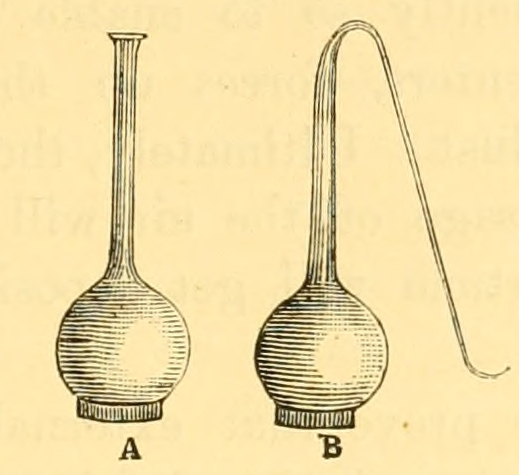
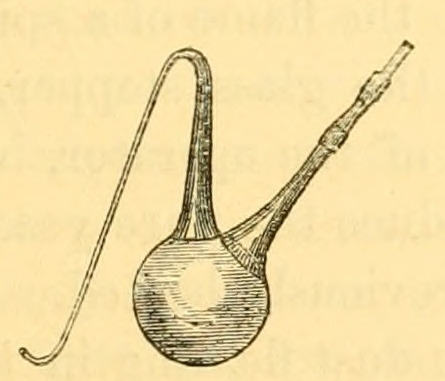
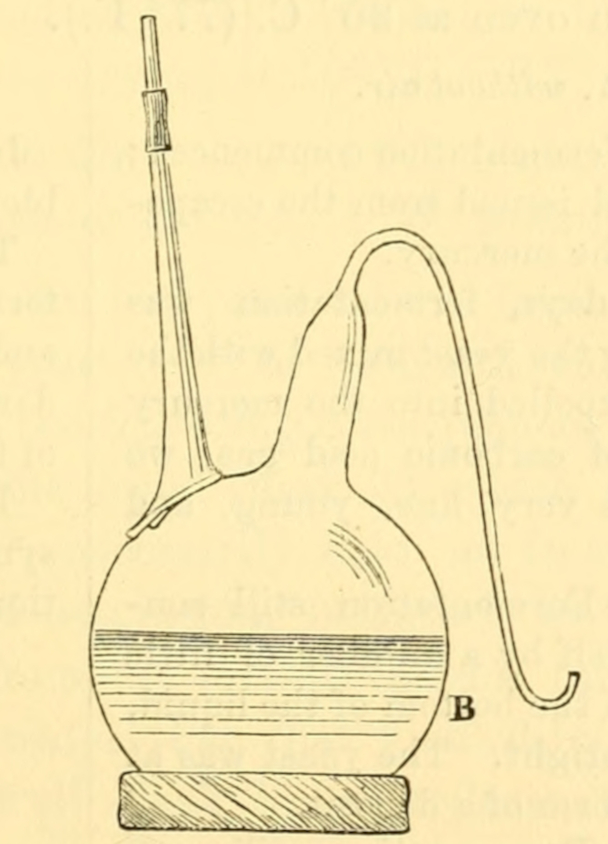
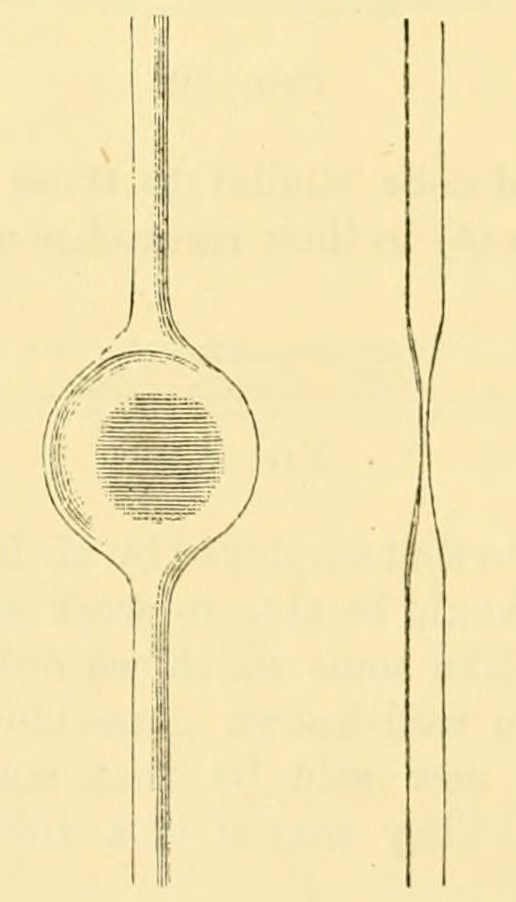
Fig. 3.
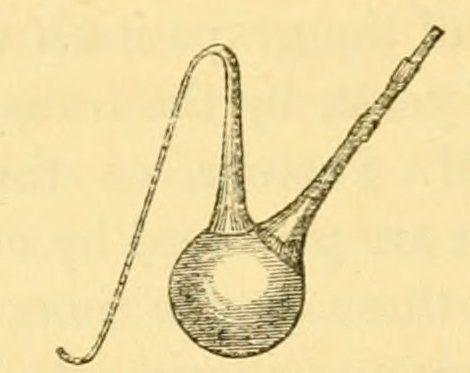
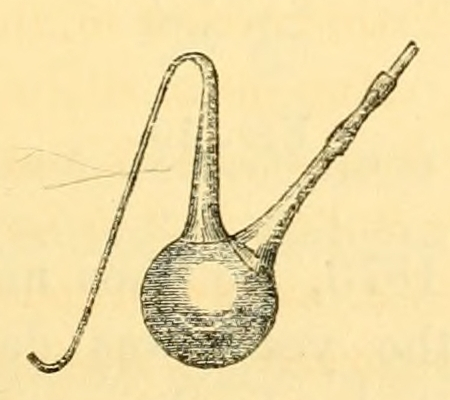
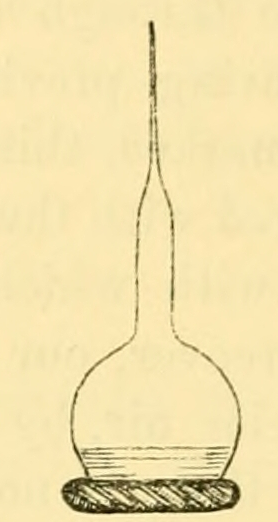
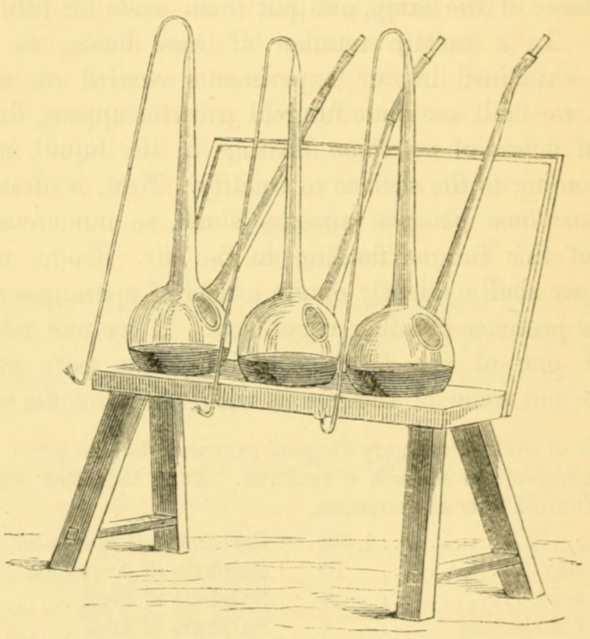
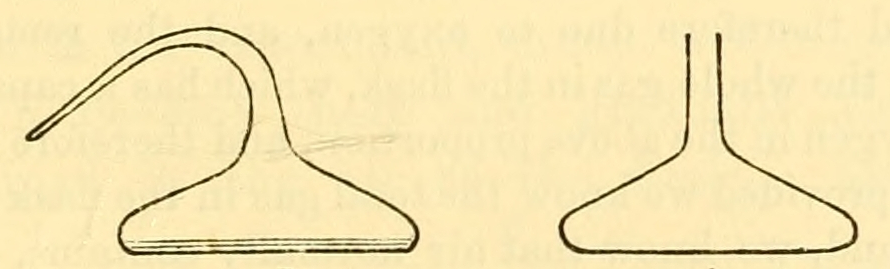
Let us take a glass flask having a long neck (Fig. 3A), and
holding from 250 c.c. to 300 c.c. (i.e., about 9 or 10 fl. oz.);
let us put into it some wort, hopped or not, and then draw
out the neck of the flask in the flame of a lamp, so as to
give to it the shape B (Fig. 3); let us next heat the liquid
to the boiling point, when the steam will rush with a
hissing sound out of the curved end. We may then,
without further precaution, permit our flask to cool, or, as
an additional safeguard, we may introduce a small quantity of
asbestos into the open extremity, at the very moment when the
flame is taken away from the flask. Before introducing the
asbestos, we may pass it through the flame, and we may repeat
this after it has been placed in the end of the tube.[20] The air
which first re-enters the flask must come in contact with the
28heated glass and the hot liquid, and these will destroy the
vitality of any germs existing in such particles of dust as this
air may introduce. The re-entrance of the air will be effected
very gradually—sufficiently so to enable the drop of water
which the air, as it enters, forces up the curved tube, to
catch all particles of dust. Ultimately, the tube will become
dry, but then the passage of the air will proceed so slowly
that every foreign particle will get deposited on its interior
sides.
Experience tends to prove that external particles of dust
cannot find their way into flasks of this pattern, having free
communication with the air, at all events within ten or twelve
years—the longest time that has been devoted to experiments of
this kind; the liquid in the flasks, if originally clear, will not
become in the least degree contaminated, either upon its
surface or throughout its bulk, although the outside of the flasks
may be covered with a thick coat of dust. This is an undeniable
proof of the impossibility of particles of dust finding their
way inside such flasks.
Wort treated thus will preserve its purity for an indefinite
time, notwithstanding its extreme liability to rapid change
when exposed to the air, under conditions which cause it to
come in contact with the particles of dust that air contains.
This also holds good in the case of wine, beef-tea, the must of
grapes, and, generally speaking, of all liquids which are subject
to putrefaction or fermentation, and which possess the faculty,
when their temperature is raised to about 100°C. (212°F.),
of destroying the vitality of those microscopic germs that are
found in dust.
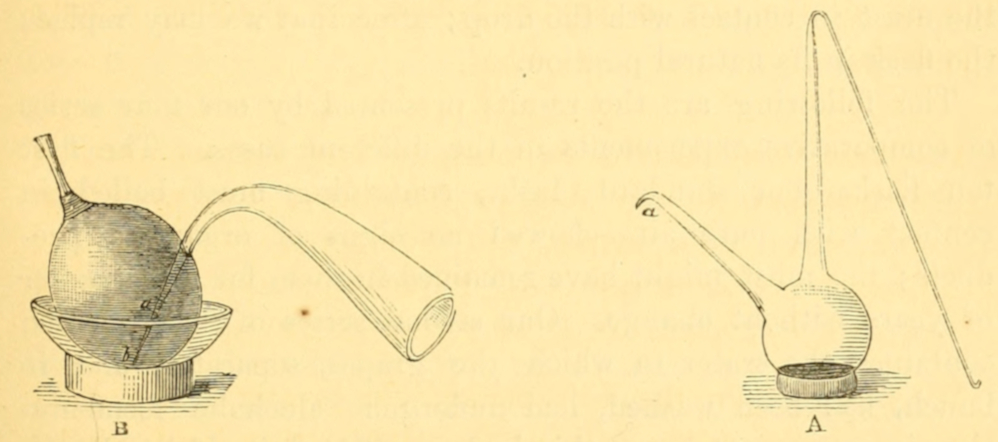
A flask such as we have described (Fig. 3) is all that we
require when we have to demonstrate the facts that we have
29just reviewed, a more detailed account of which may be
found in our Memoir published in the Annales de Chimie et
de Physique, for 1862, under the title Mémoire sur les corpuscules
organisés en suspension dans l’atmosphère. Examen de la doctrine
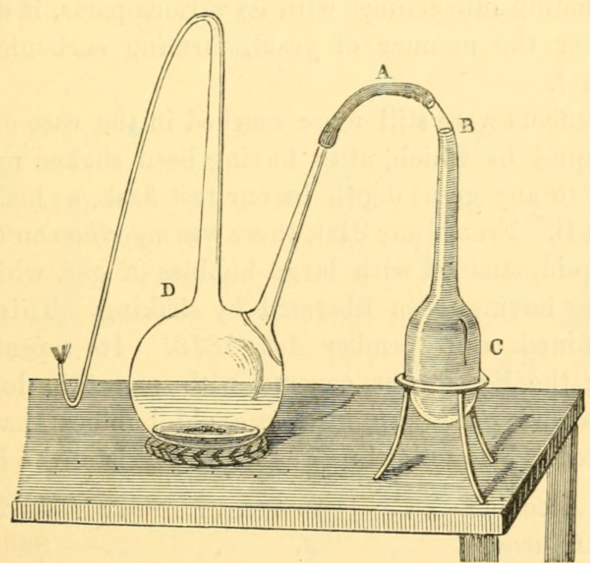
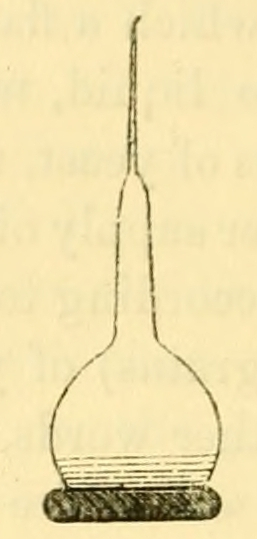
des générations spontanées. The shape of the flask represented
in Fig. 4 only differs from that of the preceding one in having
a second little tube attached to the globular part of the flask;
this presents great advantages for different objects of study, and
it was adopted in the subsequent investigations detailed in
this work.
This flask will permit us to study without difficulty every
separate kind of microscopic organism in the liquid best adapted
to it without fear, if we take reasonable precautions, that the
subject of our study may become associated with other organisms,
the accidental presence of which cannot fail to seriously affect
the results of our observations.
Let us use one of those flasks in our experiment on yeast, at
the same time expressly assuming that the minute germs of
yeast are free from all contamination by foreign germs, an
object which we shall learn how to realize by a variety of
methods in a subsequent chapter.
Fig. 4.
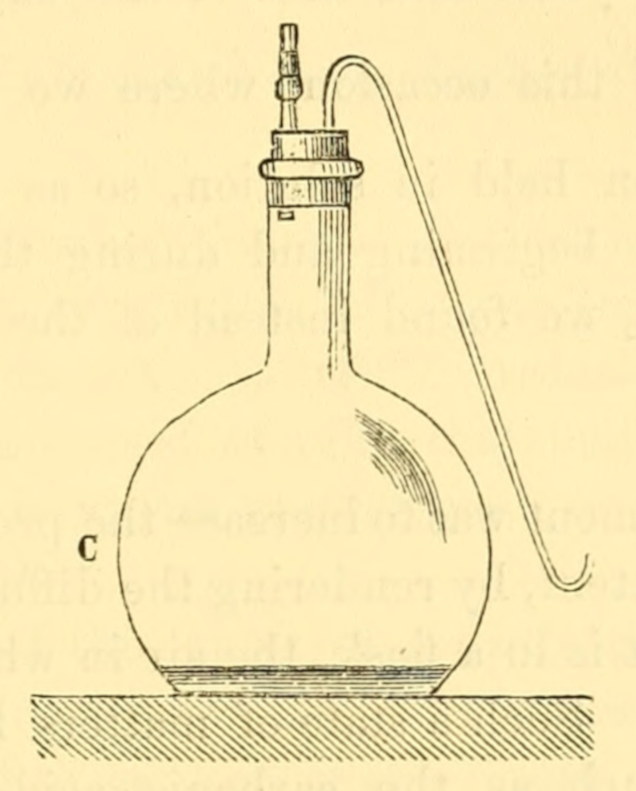
Let us introduce some wort into our flask (Fig. 4); then,
after we have fitted an india-rubber tube to the little supplementary
tube, let us boil the liquid; the steam, finding an
easier exit through the india-rubber opening than through the
drawn-out tube, will rush out through the india-rubber tube, and
thus, as it passes, destroy any germs which may be adhering to
the sides of the little supplementary tube. If we close the india-rubber
tube by means of a glass stopper, the steam will immediately
30issue through the bent tube. On permitting the flask to
cool, it will then be ready for impregnation. If there were any
fear that some foreign germ of an unknown nature might have
effected an entrance during cooling, or had not been destroyed by
the steam (which is always a little super-heated, in consequence
of the resistance which it meets in escaping), we need only
place the flasks on a warm stove, and leave them there for a few
days or a few weeks to ascertain whether the liquid in them
has undergone any change. We should then only use those
flasks which contain a sound liquid.
At the same time we must warn our readers that this cause of
error does not exist once in a thousand times, especially if we use
an asbestos stopper to prevent the entrance of little insects which
are attracted by the odour of the liquid, and which instinctively
seek to enter at the extremity of the tube, and to pass through
it into the flask. In going so far, and incurring such labour in
search of their food, they condemn themselves to certain death,
for they are sure to be drowned, since it would require an
intelligence superior to that which they possess to enable them
to get out of the flask; the liquid, morever, could not fail to
undergo some change, in consequence of the particles of dust
that the insects would introduce into it.
After having passed the flame of a spirit-lamp quickly over
the india-rubber tube, the glass stopper, the curved tube, and
even over the fingers of the operator, we may withdraw the
glass stopper, and introduce the pure yeast by means of a glass
pipette that has been previously heated. This yeast is kept in a
vessel also free from the dust floating in the air. However few
globules of yeast the glass tube may take up, it is sure to
introduce a hundred or a thousand times more than is necessary
for the impregnation of the liquid. The glass stopper must then
be replaced immediately, after having been again quickly passed
through the flame. In transferring our yeast from the vessel
containing it to the flask, by means of a glass pipette, it is
exposed to another cause of impurity, since we cannot avoid
bringing it in contact with the common air. If this risk
31frequently troubled us in our experiments, we might banish it
or minimize it by some new arrangement; but this is unnecessary.
We have suffered no inconvenience from this cause, as
there does not exist in the atmosphere anything like a continuous
supply of that from which the so-called spontaneous
generation arises, as was erroneously believed to be the case
before the publication of our Memoir in 1862, to which we
have already alluded.
The following are the results of the experiments conducted
in the manner just described.
The yeast which we sowed, in ever so small a quantity,
seemed to acquire vigour, to bud, and to multiply. Soon, that
is to say in the course of twenty-four or forty-eight hours or
longer, according to the temperature, and, more especially, the
degree of vitality in the globules, we found that the sides of our
flasks were covered with a white yeasty deposit, and noticed on
the surface of the liquid a fine froth, which at first appeared
like little islets formed by groups of bubbles so minute that they
would have been imperceptible had they not been joined together.
These patches increased in size, and gradually attached
themselves to each other, finally forming a thick froth. In the
course of two or three days this froth fell, the fermentation proceeded
less rapidly, and then ceased completely. The beer was
finished. This beer might be preserved for an indefinite period
in the flask without undergoing any change. The external air
passes freely into and out of the flask, as the pressure of the
atmosphere and the temperature vary, and the beer in the
course of time becomes flat; it acquires age in much the same
manner as wine does, but it never contracts any taste of disease,
it never becomes sour, or sharp, or bitter, or putrid; it does not
even become covered with mycoderma vini as is usually the
case with all beer exposed to the common air in the course of
trade.
After some weeks, or perhaps months, a white ring may show
itself on the surface of the liquid on the glass. This is a crown
formed by a mass of young yeast globules, which grow there
32like a mould, by absorbing the oxygen of the air as it enters
the flask. The bulk of the yeast which has been fermenting
remains at the bottom of the liquid in the form of an inert
deposit. This inertness, however, is apparent rather than
real; the globules may be internally active, without any
development of new buds, and the effects of this working may
cause them to become more and more languid, and in the course
of time may even destroy them.
The case is quite different when the yeast with which our
wort is impregnated, instead of being pure, is mixed to any
extent whatsoever with diseased ferments. Should there be
any of these in the yeast with which we impregnate our wort,
even though their quantity were so infinitesimal that the most
skilful observer could scarcely discover them with the microscope,
they would multiply in the flask after the beer had been
finished, especially if the beer were left for a short time on a
stove. In this manner we may secure an excellent test of the
original purity of the yeast which we employ in the impregnation
of our wort.
Thus it may be seen that the absence of microscopic organisms
that are foreign to the nature of pure yeast may invariably
be noticed in the case of a beer which is sound, and which will
remain sound for any length of time, when in contact with pure
air, at any temperature. We may see, too, that the presence
of these organisms may invariably be detected in an unsound
beer, the peculiar unsoundness of which depends upon the
peculiar species of the organisms contained in it. It would be
difficult to adduce clearer proofs than those which we have
given as to the intimate relation existing between these organisms
and the deterioration of beer. The relation between cause
and effect, in the succession of physical phenomena in general,
is established by proofs that are by no means more decisive.
CHAPTER III. On the Origin of Ferments properly so called. — § I.—On the Conditions which cause Variations in the Nature of the Organized Products existing in Infusions. — § II.—Experiments on Blood and Urine taken in their Normal State, and Exposed to Contact with Air that has been Deprived of the Particles of Dust which it Generally holds in Suspension. — § III.—Experiments on the Juice contained in Grapes. — § IV.—Wort and Must Exposed to Common Air. — § V.—New Comparative Studies on the Germs held in Suspension by the Air of Different Places which are near each other, but Subjected to Different Conditions affecting the Production and Diffusion of the Particles of Dust found in them. — § VI.—Yeast may become Dry and be Reduced to Dust without losing its Faculty of Reproduction.
33
The new process of brewing, which it is the principal object of
this work to explain, and which will follow as an immediate and
inevitable deduction from the novel facts herein demonstrated,
cannot be fully understood without a knowledge of all the
principles upon which it is founded. One of the most essential
of these has reference to the purity of our fermentation. We
should gain but little from the use of a yeast uncontaminated
by any foreign germs if natural organic substances had the
power of organizing themselves by means of spontaneous generation,
or by some transformation which took place amongst
them, or even by a conversion of certain microscopic beings
into certain others. Theories of this kind are still warmly advocated,
but, to our thinking, rather from sentimental considerations
or prejudice than from any basis of serious experimental
proofs.
Be this as it may, we must free our minds from all suppositions
which might qualify the exactness of the principles upon
which our new process is founded, or cause any doubt in the
minds of our readers as to the possibility of its application and
the benefits to be derived from its adoption.
We have proved by experiment, in the preceding chapter,
34that a few minutes’ boiling renders liquids, and more especially
wort, absolutely free from liability to change when in contact
with pure air, that is, air which contains none of the germs of
organisms that are continually floating about in the atmosphere.
What is true in the case of wort is equally so in the case of
all organic liquids; there is not a single one that could not
be rendered inaccessible to any subsequent change if it were
brought, first of all, to a suitable temperature, which would vary
with the nature of the liquids. Amongst them there are some
which, like vinegar, lose their tendency to change after having
been rapidly raised to a temperature of not more than 50° C.
(122° F.); others, like wine, require a greater heat. Wort,
to which no hops have been added, should be subjected to a
temperature of not more than 90° C. (194° F.); milk to about
110° C. (230° F.).[21]
It is easy to show that these differences in temperature, which
are required to secure organic liquids from ultimate change,
depend exclusively upon the state of the liquids, their nature,
and, above all, on the conditions that affect their neutrality,
whether towards acidity or alkalinity; for it is not difficult to
observe that the least changes in these respects lead to considerable
variations in the temperatures which we must employ.[22]
We could adduce many examples of this. The only difference
between the nature of must and that of wine is caused by
fermentation. We may say the same thing of wort and beer,
and, better still, of new milk and sour milk. Must, to be
secured from change, requires a much higher temperature than
wine does; similarly, wort requires a much higher temperature
than beer. Milk must be heated to about 110° C. (230° F.), as
we have just stated, but sour milk would require 20° C. or 30° C.
35(36° F. or 54° F.) less. Wine, when fresh, ceases to be liable to
change after it has been brought to a temperature below
100° C. (212° F.); it requires a temperature of more than
100° C. in the presence of carbonate of lime.
As regards the explanation of the influence which acidity or
alkalinity exerts in diminishing or increasing the temperature
required to protect infusions and organic matters from
ultimate change, although this is a subject which claims special
study, we are inclined to believe that acidity permits, and
alkalinity prevents, the penetration of moisture into the interior
of the cells of the germs belonging to infusions, so that in
heating the outer cases of these cells in an alkaline medium we
heat the germs in a dry state; and in heating the outer cases in
an acid medium we heat the germs when they are moist. We
all know that these conditions make a great difference in the
resistance which bodies offer to the action of heat. A particle
of mould which, in a moist state, cannot survive a temperature
of from 60° C. to 100° C. (140° to 212° F.), will preserve its
fecundity even if heated to 120° C. (248° F.), if it has been
previously well dried.[23]
The nature of the spontaneous productions which we see
appear in organic liquids is affected to a remarkable extent by
the smallest change in the compositions of those liquids.
Generally speaking, as we have often proved in our former
works, a feeble acidity is unfavourable to the development of
bacteria and infusoria, and, on the other hand, favourable to the
growth of mould. A liquid which is neutral or of feeble alkalinity
behaves in an exactly inverse manner.
Those who support the theory of spontaneous generation
seek to find in the natural differences between the organic productions
of various liquids which are simultaneously exposed to
the same atmosphere, an argument in favour of their doctrine.
These differences, however, are only an effect of the greater or
less fitness of a peculiar liquid for a certain kind of growth.
When an acid organic liquid, such as the must of grapes for
36example, is exposed freely to the air, it is besieged simultaneously
by spores of mucedines, as well as germs of bacteria,
leptothrix, vibrios, &c., but the latter germs are checked in their
development, if, indeed, they are not actually destroyed, by the
acidity of the liquid; and we should never find them there in
their adult state.
Most moulds, on the other hand, thrive in acid liquids, and
therefore they are generally found alone. If we began by
saturating must with carbonate of lime, previously dried or
otherwise, we should observe opposite phenomena; bacteria,
lactic ferments and butyric vibrios would invade our fields long
before the spores of mould had time to grow, since the germination
of these proceeds very languidly in neutral or alkaline
liquids, and an infusion once occupied by a living organism has
much trouble in nourishing others; the early developments
consume the alimentary substances, especially the oxygen.
Differences as marked as these in the adaptability of certain
liquids to certain growths give rise to innumerable illusions, and
are one of the chief sources of error in the study of this subject.
If we sow in an acid liquid, such as must, an alcoholic ferment,
the development of which is not arrested by the acid character
of our medium, it will multiply there, and we shall have no
difficulty in growing it over and over again in the same acid
medium. This being the case, let us suppose that our alcoholic
ferment is impure—let us say, mixed with filaments of turned
wine, which are due to a ferment checked in its development
by the peculiar qualities of the must. In repeating the growth
of this alcoholic ferment in the must the filaments which were,
by supposition, present in our first sowing, and which cannot
reproduce themselves in the must, or do so with great difficulty,
will become very scarce in the fields of our microscope; they
will not, however, cease to exist, for the repetition of our attempts
to grow them only serves to spread the original germs over a
larger surface; and, although the eye fails to detect them, they
will only have become more difficult to discover. At this point
the experimentalist is in danger of falling into error, for when
37he no longer perceives the foreign ferment he will be inclined
to believe that it has vanished, and that he may regard the
alcoholic ferment as being free from all impurity, without testing
for the purity by a direct experiment.
An example of this mistake is to be found in a recent work
by M. Jules Duval. This writer has published a theory according
to which yeast becomes transformed into lactic ferment,
and likewise into other ferments—that of urea, for example—the
only condition of change, according to M. Jules Duval,
being that we should cultivate it in suitable mediums. The
proofs by which he supports his conclusion are altogether
inadmissible, and a simple glance at his experiments enables
us to detect innumerable causes of error. M. Duval believes
that yeast becomes transformed into lactic ferment from
the fact that he obtained a fermentation which furnished
lactate of lime and lactic ferment from some sour milk to
which he had added some glucose, chalk, and phosphate
of ammonia before impregnating it with yeast; but he took
no steps to secure himself against introducing into his medium—which
was, as a matter of fact, well adapted to lactic fermentation,
inasmuch as it was a little alkaline—an alcoholic
ferment containing impurities. This was the crucial point in
his experiments. M. Duval recognizes this, but he deceives
himself when he says, without proof:—“My alcoholic ferment
is pure, for I have grown it over and over again in must, preserved
in flasks prepared after the manner of those which M.
Pasteur uses in his experiments.” Here we have merely a
simple assertion; a direct experimental test might have proved
that the yeast was impure.
Yeast cannot transform itself into lactic ferment. No matter
what the medium may be in which it is sown, if it is actually
pure it will never present the least trace of lactic ferment or of any
other ferments. By certain changes in the nature of the medium,
the temperature, and other conditions, the cells of the ferment
may become oval, elongated, spherical, and larger or smaller in
size, but they will never produce the most minute quantity of
38lactic ferment or lactic acid. The whole theory of the transmutation
of ferments, which M. Duval has published, is imaginary.[24]
We have asserted that the source from which we obtain
our supply of the substances that we expose to contact with
the air may likewise furnish a reason for the development
of vegetable or animal organisms which make their appearance
in our infusions. This may be easily understood.
If we expose the infusions to temperatures more or
less high, with the object of destroying the vitality of the
germs which they may contain, we completely suppress
all germs originating from two different sources—those
which the infusions may have acquired directly from the
atmospheric air, or from the dust upon our utensils, and those
which may have been introduced by the materials used in
manufacturing our infusions or decoctions, which materials must
have been brought from some distance. An infusion, after
having been heated to a sufficient degree, can harbour and
nourish only such germs as are conveyed to it by the air after
the heating. These floating germs are far from being as varied
in their nature as it pleases those to believe who are tied down
by their arbitrary and faulty interpretation of the knowledge
that we have acquired, and the discussions in which we have
taken part, during the last fifteen years. Air, unless in violent
agitation, can hold only the most minute particles in suspension.
The observations which have been recorded concerning
organisms of spontaneous growth found in infusions, have
always been made in sheltered places—in rooms or laboratories,
the atmosphere of which is, relatively speaking, very still.
For this reason, in liquids that have been subjected to heat,
the flora and fauna—if we may use such an expression—are
very poor, and all the more so because, as we have recently
39had occasion to remark, a great number of the organisms which
would spring into existence of their own accord, if they were
allowed sufficient time for germination, are kept back by others
of a more rapid development. The truth of this is evident
from the fact that we may observe greater variations in the
nature and number of species of living organisms, if we divide
one infusion amongst several vessels which are immediately
closed up again, than if we leave our infusion in contact with an
unlimited volume of surrounding air. By this means we expose
each portion of the liquid to no other germs than those existing
in a state of suspension in the volume of air introduced into the
vessels; and it so frequently happens that we obtain a variety
of germs which, coming into contact with a liquid adapted to their
nutrition, without having mixed with others, finally multiply
there, in consequence of no other organisms of greater activity
occurring to impede their slow and laborious propagation.
The nature of the products resulting from raw infusions—that
is, those obtained, without heating, from the maceration
of organic substances, such as leaves, fruits, grains, or the organs
of plants or animals—is much more varied. The reason of this
is that such substances generally carry with them not only the
particles of dust existing in air that is in motion, but also microscopic
parasites, which find a congenial resting-place on their
surface or its vicinity. We may cite a few accurate observations
on this point, for the subject is one of great interest.
If we boil an infusion of hay, and then expose it to contact
with the air in a room, all its productions will be derived from
such germs as a comparatively still air can carry about; thus,
we shall very rarely find any colpoda in our infusion, for the
germs of these infusoria, consisting of rather large cells, can
scarcely exist in a state of suspension in motionless air, in spite
of their extraordinary diffusion in nature. On the other hand,
we almost invariably find colpoda in macerations of raw hay.
This difference is easily accounted for; the particles of dust
adhering to the surface of hay, especially that which comes
from marshy districts, contain the germ-cells of colpoda in
40abundance. The reason is obvious; rain falls on a meadow
and forms little pools of water about the roots of the herbs that
grow there; this water remains for some time, and very soon
swarms with a multitude of infusoria, especially colpoda. Dryness
follows; the colpoda becomes encysted, and forms a dust
that is wafted by the winds on to the blades of grass, so that
the mower will carry away not only his hay, but also myriads
of colpoda, as well as spores of mucedines and other organisms.[25]
The maceration of pepper will give us some infusoria hardly
ever found in other infusions, the reason of this being that such
infusoria exist where the pepper grows—in other words, their
germs are exotic. That the infusion of a special plant should
give us special infusoria, is scarcely more surprising than the
discovery of a particular parasite or insect existing on a
particular plant, and not on others of a different species that
grow near it. Thus it happens that the ferment-germs of must
exist on the surface of grapes, whether detached or in clusters.
It is only natural that we should find the organ or the plant
that is destined later on to become the food of a parasite serving
as a habitation for the germs of that parasite.
Recourse to the application of heat, in the first place, is an
excellent means, as we have just seen, of procuring organic
liquids free from all disturbing germs; but there is a still more
remarkable and instructive, we may even say more unlooked
for, method of securing this result, which may be described as
in some measure borrowed from the nature of things. It consists
in seeking purity in the natural liquids of animals and plants.
It is difficult to understand how the liquids circulating in the
organs of animal bodies, such as blood, urine, milk, amniotic
41fluid, and so on, can possibly secrete the germs of microscopic
organisms. There would be excellent opportunities for these
germs to propagate themselves if they actually did exist in the
liquids appertaining to the animal economy. Life in all probability
would become impossible in the presence of such guests.
A proof of this is to be found in the multitude of diseases which
many of the greatest minds of modern times attribute to parasitic
developments of this nature. Medical men of high authority
agree in thinking that the questions of contagion and infection
will find solutions from the obscurity in which they are now
involved in a careful study of ferments, and that hygienists and
physicians should labour to secure by every possible means the
destruction of the germs of ferments, and should strive to check
their development, and prevent the evils which they cause when
developed. Great progress has already been made in this
direction, and we deem it a signal honour that our researches
on the subject have been considered, even by those by whom
this progress has been accomplished, as the source from which
they derived their first inspirations. We shall, doubtless, be
excused by our readers if we recall this fact in relating certain
historical details which are especially necessary in order that
they may comprehend the principles that we are endeavouring
to explain in these “studies.”
It is a matter of regret to us, however, that the facts which
we have established should have been accredited with any
importance beyond that which is their due. The exaggeration
of novel ideas invariably leads to a reaction, which, again,
overshooting the mark, brings into disrepute even those points
in which such ideas are perfectly just, or, at all events, worthy
of serious consideration. There are certain symptoms of such
a reaction in the case of our theories: they are evident in the
tendency of unreflecting minds to give a total denial to the
fact that certain diseases may be derived from certain ferments—organized
and living ferments—of the nature of those which
have been discovered in the course of the last twenty years.
We should be guided by facts, whichever side of the question
42we espouse, and by facts alone we should test the truth of
doubtful discoveries. We are but on the threshold of the
exploration of our subject, and we should strive to discover new
facts in connection with it, and should deduce from these, whatever
they may be, only such conclusions as they may strictly
warrant. Unfortunately, there is amongst physicians a tendency
to generalize by anticipation. Many of them are men of rare
natural or acquired talent, endowed with keen powers of intellect,
and the art of expressing themselves fluently and persuasively;
but the more eminent they are, the more they are occupied by
the duties of their profession, and the less leisure they have for
the work of investigation. Urged on by that thirst for knowledge
which belongs to superior minds, and perhaps, in some
measure, through associating with the upper classes of society,
which are becoming more and more interested in science, they
eagerly seize upon easy and plausible theories, readily adapted for
statement which is general and vague just in proportion to the
unsoundness of the facts on which they are based. When we see
beer and wine undergo radical changes, in consequence of the
harbour which those liquids afford to microscopic organisms that
introduce themselves invisibly and unsought into it, and swarm
subsequently therein, how can we help imagining that similar
changes may and do take place in the case of man and animals?
Should we, however, be disposed to think that such a thing must
hold true, because it seems both probable and possible, we must,
before asserting our belief, recall to mind the epigraph of this
work: the greatest aberration of the mind is to believe a thing
to be, because we desire it.
One of the most distinguished members of the Academy of
Medicine, M. Davainne, who was the first to give his attention
to rigorous experiments on the influence that organic ferments
exercise on the production and propagation of infectious
diseases, declares that the idea of his researches on splenic
fever and malignant pustule was suggested to him by his
perusal of our work on butyric fermentation, published in 1861.
In 1850 this gentleman and M. Rayer discovered in the blood
43of animals attacked by these diseases minute filiform bodies, to
which they paid little attention, and which M. Davainne
recollected, when he came across our Memoir. He had the foresight
to conjecture—a conjecture that was soon confirmed most
decisively by his researches—that the former disease, known
under the name of sang de rate, might be the production of a
fermentation analogous to the butyric, in which the minute filiform
bodies observed by Rayer and himself, in 1850, played the
part which vibrios fill in butyric fermentation. Within two years
of this the first works of Messrs. Coze and Feltz appeared. These
clever and courageous experimentalists avowed that their beautiful
researches had been suggested to them by the perusal of
my work on putrefaction, published in 1863. We might also
quote the striking and admirably conceived experiments of Dr.
Chauveau, on castration.[26] We cannot, however, refrain from
reproducing here a letter addressed to us in 1874 by the celebrated
Edinburgh surgeon, Mr. Lister:—
“Edinburgh, Feb. 10, 1874.
“Dear Sir,—Will you permit me to beg your acceptance of
a pamphlet which I forward to you by this post, and which
describes certain inquiries into a subject upon which you have
thrown so much light—the theory of germs and fermentation?
It gives me pleasure to think that you will peruse with some
interest what I have written about an organism that you
44were the first to study in your Memoir on lactic fermentation.
I do not know if you ever see the records of British surgery.
If you have perused them you may have observed from time to
time notices of the antiseptic system which I have been
endeavouring for the last nine years to bring to perfection.
Permit me to take this opportunity of offering you my most
hearty thanks for having demonstrated by your brilliant
researches the truth of the theory of putrefactive germs, and
for having afforded me in this manner the sole means of perfecting
the antiseptic system.
“Should you ever come to Edinburgh I am sure that you
will be truly gratified to see in our hospital the extent to which
the human race has profited by your work. I need hardly add,
that I should have great satisfaction in showing you how
greatly surgery is indebted to you.
“Excuse the freedom which I have taken in addressing you,
on the grounds of our common love for science, and believe in
the profound esteem of yours, very sincerely, Joseph Lister.”
The wad dressing of Dr. Alphonse Guérin, surgeon at the
Hôtel-Dieu, Paris, which has already rendered great assistance
to surgery, and has been the subject of a very favourable report
at the Academy of Sciences in Paris, was invented by its author
in consequence of certain reflections suggested to him by the
perusal of our researches. The commission which framed the
report made, through M. Gosselin, some wise reservations in the
case of certain theoretical ideas which M. Guérin had not
sufficiently proved by experiment. We have no doubt, however,
that when the matter is thoroughly examined, facts will
confirm the truth of the wide views entertained by the surgeon
of the Hôtel-Dieu.
Dr. Déclat has founded quite a new system for the treatment
of infectious diseases, which is based upon the use of one of the
best known antiseptics, phenic acid. His theory, which he
affirms was suggested to him by our studies on fermentations,
is, that the diseases which transmit themselves are, each of
45them, the product of a special ferment, and that both medical
and surgical professors of therapeutics should make it their
study to prevent exterior ferments from penetrating into the
liquids of our economy, or in the event of these ferments
having found their way into the system, to discover antiferments
for their destruction, without effecting any change in the
vitality of the histological elements of the liquid or tissues.
There is no doubt that extreme caution must be exercised in
dealing with questions of this kind, as M. Sédillot has authoritatively
remarked; but at the same time it cannot be denied
that the more such questions are discussed with exactness, the
more those celebrated practitioners who originated them are
confirmed in the ideas which first guided them. We may give
another example of this.
In 1874, in consequence of a communication addressed to the
Academy of Sciences by Messrs Gosselin and A. Robin, on the
subject of ammoniacal urine, we made the observation that we
should endeavour to ascertain if, in all such cases, the urinary
fluids were not rendered ammoniacal by the presence of the
little ferment of the urea, which we have previously noticed,[27]
and which has since then been discussed with remarkable intelligence
by M. Van Tieghem, in the thesis which he maintained
for his doctor’s degree. The suggestion and the
considerations that justified it led to a discussion before the
Academy of Medicine, in which contrary opinions were maintained.
We lost no time in submitting these to the test of facts.
We could not find a single person suffering from ammoniacal
urine, in whose case the little ferment which we mentioned was
not to be detected. Our predictions were thus completely justified.
As early as 1864 the Gazette Hebdomadaire de Médecine et de
Chirurgie published an account of urine made ammoniacal in
the bladder, the author of which, Dr. Traube, makes the following
observations:—“It was believed that, in consequence of the
46retention of the liquid, and the resulting distension of the
bladder, that organ became irritated and produced a larger
quantity of mucus, and that this mucus was the ferment
which caused the decomposition of the urea, by virtue of a
chemical action peculiar to itself. This belief can no longer be
held in presence of M. Pasteur’s discoveries. This observer
has demonstrated, in the most conclusive manner, that ammoniacal
fermentation, like alcoholic and acetic, is produced by
living beings, whose pre-existence in the fermentable liquid is
a necessary condition of the process. The preceding fact
offers a remarkable proof of M. Pasteur’s theory. In spite of
the long duration of the retention, alkaline fermentation was
not produced by an excessive secretion of the vesical mucus or
of pus: it only began from the moment when the germs of
vibrios passed from the outside into the bladder.”[28]
Finally, we may conclude with perfect truth that the liquids
of our economy, blood and urine, for instance, may afford a
47harbour to different ferments, even in the inmost parts of the
organs, when external causes enable such ferments to find their
way into those liquids, and that diseases of greater or less
gravity result from this cause. On the other hand, it must be
admitted that the bodies of animals in a state of health afford
no means of entrance to these external germs. At the same
time, direct experiment alone can convince the mind as to the
truth of this latter assertion. Let us take some of the substances
that are to be found inside living animals in perfect
health, and expose them, in the same condition in which life
has formed them, to contact with pure air.
Fig. 5.
Fig. 6.
For this purpose we must provide ourselves with a glass flask,
joined to a copper tap by means of an india-rubber tube, as
shown in Fig. 5. The two branches of the tap should be about
48twelve centimetres long (about ½-in.), the one which is free
tapering off like the end of a pipe. In order to destroy all germs
which may exist in the flask, we must join the free end of the
copper tube to a platinum tube kept at a very high temperature,
after having carefully introduced into the flask a small quantity
of water, and expelled all the air by converting the water into
steam. Then as we allow the flask to cool, the air which re-enters
it will necessarily pass through the hot tube (Fig. 6).
Fig. 7.
We may cause the water in the flask to boil at a temperature
of more than 100° C. (212° F.) by fitting to the free end of the
platinum tube a glass tube bent at right angles, which we plunge
to any depth in a deep vessel filled with mercury (Fig. 7).
Whilst the water is boiling under pressure, we must separate the
tube which is plunged in the mercury; the water in the flask will
49continue to boil at the ordinary pressure. We must then leave
the flask to cool. It will gradually become filled with air that
has been heated to a high temperature, more than sufficient to
burn up all the organic particles of dust which that air could
have contained. When the flask is cold we must close the tap
and detach it, and proceed to prepare other similar flasks. It
will be advisable to close the tap when the temperature of the
flask is still a few degrees above that of the surrounding atmosphere:
this precaution will cause the air in the cooled flask to
have a lower pressure than that of the external atmosphere.
During the interval which must elapse between the preparation
and the use of a flask, it is a good thing to keep the free
branch of the tap inclined towards the ground, to secure the
inside of its tube from the deposit of external particles of dust.
Whether this precaution be adopted or not, we must take care
to heat this branch in the flame of a spirit lamp just before we
bring our flask into requisition.
If we have to study blood, we must take it from a living
animal—a dog, for example. We must expose a vein or an
artery of the animal, and make an incision into which the end
of the free tap-branch, which has previously been heated and
allowed to cool, must be introduced and fixed by a ligature in
the vein or artery. On opening the tap, the blood will
rush into the flask; it must then be closed, and the flask placed
in an oven at a certain temperature. We have successfully
accomplished these manipulations, thanks to the kind help of
our illustrious colleague and friend, M. Claude Bernard.
The operation is nearly the same in the case of urine. The
end of the free branch of the tap is introduced into the passage
of the urethra; the tap is turned at the moment when the
urine is emitted, which is then allowed to pass into the flask,
until it is a third or half filled.
The following were the results of our experiments:—Blood
underwent no putrefactive change even at the highest temperatures
of the atmosphere, but retained the odour of fresh blood,
or acquired the smell of lye. Contrary to what we might have
50expected, the direct oxidation of the constituents of blood by
slow combustion was rather sluggish. After subjecting our
flasks to a temperature of 25° C. or 30° C. (77° F. to 80° F.) in
an oven for several weeks, we observed an absorption of not
more than 2 or 3 per cent. of oxygen, which was replaced by
a volume of carbonic acid gas of about an equal bulk.[29]
Nearly the same results were obtained in the case of urine;
it underwent no radical change; its colour merely assumed a
reddish brown tint; it formed some small deposits of crystals,
but without becoming at all turbid or putrefying in any way.
The direct oxidation of the urinary substances was likewise
very sluggish. An analysis of the air in one of the flasks,
made forty days after the commencement of the experiment,
gave the following results:—
Oxygen
19·2
Carbonic acid
0·8
Nitrogen
80·0
——-
100·0
51These experiments on blood and urine which we have just
mentioned date from 1863.[30] Ten years afterwards, in 1873,
they were confirmed in an important and striking manner by
the results of a very able series of experiments, which were
carried out in our laboratory, by M. Gayon, who was formerly
a pupil in the École Normale Supérieure. M. Gayon proved that
what held good in the case of blood and urine, also held good in
the case of the substances contained in eggs. He found that
the whites of eggs might be exposed for any length of time to
contact with air, as also might the yolks, or the white and yolks
mixed, without any putrefactive change or fermentation resulting,
and without the smallest microscopic germ showing itself,
the sole condition being that the air must be freed from all
organic particles of dust, germs of mould, bacteria, vibrios, and
other organisms which it holds in suspension. This was only
a part of the important facts brought to light by M. Gayon.
Amongst other things, he proved that spontaneous putrefaction
in eggs is invariably caused by the development of organized
ferments, thereby correcting the opposite statements announced
by M. Donné and M. Béchamp, who were led by
their observations to believe that the change in eggs took
place quite independently of the action of vibrios and
mucedines.[31]
It is almost superfluous to remark how greatly the results of
these experiments on blood, urine, and the components of the
egg are opposed to the doctrine of spontaneous generation, as
also to most modern theories on the generation of ferments.
As long as experiments relating to the question of so-called
spontaneous generation were made on heated substances, the
advocates of heterogenesis had some grounds for asserting that
such materials could not satisfy the conditions of spontaneous
life, and that we should obtain different results by using natural
organic liquids, which, if exposed to contact of pure air would
52doubtless serve for the production of new beings which did not
issue from parents which resembled them. This novel enunciation
of the hypothesis of spontaneous generation, the only one,
we think, that could be defended after the publication of our
Memoir, in 1862, is condemned by the preceding facts.
The same facts completely upset the hypothesis recently
maintained by Messrs. Fremy and Trécul on the subject of the
causes of fermentation.
“Side by side with the immediate, definite principles which
may be formed by synthesis,” says M. Fremy, “such as
glucose, oxalic acid, and urea, other substances of greatly inferior
stability exist, the constitution of which is considerably
more complicated, containing all the elements of living organs,
such as carbon, hydrogen, oxygen, nitrogen, and even phosphorus
and sulphur; and often salts of lime and of the alkalies
besides. These bodies are albumen, fibrin, casein, the congeners
of vitellin and others. Chemical synthesis cannot reproduce
them. It is impossible, in my opinion, to regard them as immediate,
definite principles. I designate them by the general
name of semi-organized bodies, because they hold an intermediate
place between the immediate principle and the organized tissue.
“These semi-organized bodies, which contain all the elements
of organs, have the power, like a dry seed-grain, of existing
in a state of organic immobility, and of becoming active under
circumstances which favour organic development. By reason of
the vital energy that they possess they undergo a succession of
decompositions, giving origin to new derivatives, and to the
advent of ferments, not by any process of spontaneous generation,
but by a vital energy, which pre-exists in the semi-organized
bodies, and is simply carried on, when this energy manifests
itself, in these most varied organic changes.”
After having expressed these hypothetical and confused
opinions, M. Fremy continues:—“I do not consider, then,
that these semi-organized bodies serve merely as nourishment
for certain animal and vegetable organisms, which may be the
sole agents of fermentations, but I give them a direct rôle and
53admit that, under the influences which I have already cited[32]
they may assume a real and complete organization, and produce
ferments which are not derived, as we have seen, from a germ
or an ovum but from a semi-organized body, the vital energy of
which has become active.[33] It will be seen that these opinions
are quite different from those which M. Pasteur has maintained
in his works, since they attribute the origin of alcoholic and
lactic ferments to an albuminous substance. Taking the case
of alcoholic fermentation alone, I assert that, in the production
of wine, it is the juice of the grape itself which, in contact with
air, produces grains of yeast, by the transformation of the albuminous
substances. M. Pasteur, on the contrary, maintains
that the grains of yeast are produced by certain germs.”[34]
We have combated these propositions, so extraordinary and
unsupported by any rigorous experiments, before the Academy of
Sciences, where they were first enunciated. On that occasion we
related the facts in connection with blood and urine, which we
have just discussed. Could there be any more forcible argument
against the theory of our honourable colleague than those
facts? Here we had natural albuminous substances, forming
part of matter eminently liable to putrefactive change and
fermentation, which produced no ferments of any sort whatsoever
when brought into contact with air deprived of its organic
particles of dust.
Under no known circumstances is albuminous matter transformed
into grains of yeast or any other organized ferment, and,
to our thinking, nothing can be more chimerical than the
gratuitous hypothesis of hemi-organism.
We shall proceed to new proofs of this, dealing this time
with a liquid formed by the life of a vegetable.
54
In the course of the discussion which took place, at the
Academy, on the subject of the generation of ferments, properly
so called, much was said about the oldest known fermentation,
that of wine. We at once resolved to demolish M. Fremy’s
theory, by a decisive experiment on the juice of grapes.
Fig. 8.
We prepared forty flasks, capable of holding from 250 c.c. to
300 c.c. (from 9 to 11 fl. oz.) and shaped as represented in
Fig. 8. These we filled with filtered must, which was perfectly
bright, and which, like all acid liquids, would remain sound,
after having been boiled for a few seconds, although the ends
of the long curved necks of the flasks containing the must
might remain constantly open for months or years.
We washed, in a few cubic centimetres of water, part of a
bunch of grapes, washing the grapes separately, or the grapes
and the wood together, or even the wood of the bunch alone.
This washing was easily accomplished by means of a perfectly
clean badger’s-hair brush, the water receiving all the particles
of dust adhering to the surface of the grapes and the wood of
the bunch. By means of a microscope we easily proved that
this water held in suspension an infinite number of organized
corpuscles, some of them bearing a very close resemblance to
the spores of fungoid growths, others to alcoholic ferment,
others to mycoderma vini, and so on.[35]
55
Fig. 9.
We next proceeded to put on one side ten of our forty flasks,
to serve for subsequent corroboration; in ten others, by means
of the tube which is represented on the right hand side of the
flask (Fig. 8), we put a few drops of the water in which the
bunch of grapes had been washed; in a third series of ten flasks
we put a few drops of the same liquid, after having previously
boiled it. Lastly, we introduced into the ten remaining flasks
a drop of grape-juice, taken from the inside of an uninjured
grape. To do this we had to bend the right-hand tube of
each of our last ten flasks, drawing it out to a fine point and
closing it in the flame, as represented in Fig. 9 A. This
fine closed point was filed round near its extremity and then
thrust, as represented in Fig. 9 B, into a grape placed on a hard
substance; when the point b was felt to touch the substance
supporting the grape it was broken off by a slight pressure
sideways at the point a, where the file marks had been made.
We had taken care to secure a slight vacuum in the flask
56beforehand; this now caused a drop of the juice to be drawn
into the flask. We then drew out the fine point, and closed it
immediately in the flame of a spirit lamp. The vacuum was
produced by heating the flasks in our hands, or over the flame
of a lamp, thus causing a little air to be forced out through the
end of the bent tube, which we then closed up with the lamp.
When the flask was cool, the slight difference of pressure sufficed
to force into it some of the juice contained in the grape, as we
have just described. The drop of juice that is sucked into the
flask generally remains in the curved part of the fine tube; to
mix it with the must we must incline the flask so as to bring
the must in contact with the drop; after that we may replace
the flask in its natural position.
The following are the results presented by our four series
of comparative experiments in the different cases. The first
ten flasks—our standard flasks, containing must boiled in
contact with pure air—showed no signs of organized products;
the must might have remained in them for any number
of years without change. Our second series of flasks, which
contained the water in which the grapes, separately and in
bunch, had been washed, had undergone alcoholic fermentation
in every instance; this had manifested itself in all the
flasks in the course of about forty-eight hours, the temperature
being at about summer heat. At the same time that
the yeast made its appearance in the form of little white lines,
which gradually joining together formed a deposit on the
sides of the flask, we perceived minute flakes of mycelium
forming; sometimes as a single fungoid growth, sometimes
combined with another, or with many together—these growths
being quite independent otherwise of the yeast or alcoholic
ferment. In several cases, too, mycoderma vini showed itself
on the surface of the liquid in the course of a few days.
Vibrios and lactic ferments, properly so called, could not make
their appearance, on account of the nature of the liquid.
The flasks of our third series, containing the water in which
the bunch of grapes had been washed, and which we boiled
57before our experiment, remained as free from change as the
flasks of our first series had done.
Lastly, our fourth series of flasks, containing the drops of
juice taken from inside the grapes, remained equally free from
change, although we could not be certain of having removed, in
every case, without exception, all causes of error which must
inevitably occur sometimes in so delicate an experiment.
These experiments cannot leave the least doubt on our minds:
That must, if boiled, will never ferment when in contact with
air that has been freed from the germs which exist in it in a
state of suspension.
That must may be fermented, after boiling, by introducing
into it a very small quantity of water, in which a bunch of
grapes has been washed.
That must will not ferment if we introduce into it some of
this same water which has been boiled and afterwards cooled.
That must will not ferment if we introduce into it a small
quantity of the juice contained in a grape.[36]
It follows, then, that the ferment which causes grapes to
ferment in the vintage tub must come from the exterior, and
not the interior of the grapes. Thus, the hypothesis of
MM. Trécul and Fremy, according to which albuminous
substances transform themselves into grains of yeast by the
action of a peculiar vital force, is annihilated; à fortiori, there
can no longer be a question concerning Liebig’s theory, on the
58transformation of albuminous substances into ferments, by
a process of oxidation.
Our readers may be curious to know what M. Fremy has
been able to oppose to such crucial experiments; they could
scarcely have imagined the following:—
“In my experiments, which I have varied in every possible
manner,” says that gentleman, “I have found that it is almost
impossible to discover alcoholic fermentation, appreciable by its
results, in a single drop of grape juice, and I may add that this
fermentation must be still more difficult to discover when this
drop has been drowned in a large quantity of juice that has
been previously boiled.”[37]
It will be admitted that we were justified in saying, at the
commencement of this paragraph, that we should demolish the
theory which was opposed to ours, and which its advocates have
been constrained to defend by hypotheses manifestly false.
At the meeting following the one in which M. Fremy declared
that minute quantities do not ferment, we had the malicious
satisfaction of showing a great many very small closed flasks,
into each of which we had caused a single drop of the must of
crushed grapes to be introduced by suction. We broke the thin
points of many of them, in the presence of the Academy, and
every one of them showed by a sharp hissing, which was
audible at a distance, that fermentation was proceeding in the
drop of liquid they contained. M. Fremy was there, but he
made no remark.
We may cite some very curious facts on the subject of the
period at which the germs that develop yeast are in a condition
to be able to cause fermentation.
On July 25th, 1875, in the neighbourhood of Arbois (Jura),
the grapes were still green and of the size of peas. We went
to a vine that was far from paths and roads, and there, with a
pair of small scissors, cut some grapes from off a bunch and
let them fall with their short stalks into tubes half filled with
59gooseberry must, previously rendered unalterable by boiling.
These tubes we closed again with all possible precautions, using
corks which had been passed through the flame of a spirit-lamp
and carried them to our laboratory, where we left them to
themselves. Some days afterwards we saw diverse fungoid
growths appear in most of the tubes, but not one of them then,
or subsequently, presented the least appearance of fermentation.
The germs of yeast at that period of the year did not exist
either upon the woody part of the bunch, or upon the grapes.
In Chapter V. we shall return to observations on this subject.
If the principles which we have laid down possess all the
value that we attribute to them, if the cause of change in
natural or artificial organic liquids does not exist in those
liquids themselves, if change considered in itself depends upon
the nature and number of the particles of dust in various places,
if it is, besides, radically affected by the composition of the
liquids, it must necessarily follow that wort or must, whilst,
under certain circumstances of exposure to air, it remains
absolutely free from life and its results, will, under other
circumstances, give rise to a variety of organisms and their
corresponding fermentations. This is, in fact, the lesson which
direct proofs will teach us. Before entering upon these new
observations in detail, we must call the reader’s attention to the
difficulty, as experience has shown, of interpreting correctly the
facts connected with the spontaneous impregnations of organic
liquids.
Gay-Lussac crushed some grapes under a bell-jar filled with
mercury, after having washed them in hydrogen, to expel the
air adhering to the grapes and the sides of the jar. Having
waited for several weeks without detecting any signs of fermentation,
he introduced some bubbles of oxygen, and fermentation
showed itself the following day. Gay-Lussac concluded that
60the fermentation of must could not commence without the help
of oxygen.[38]
Under the conditions of his experiment nothing could be
truer, and we must admire the diffidence with which this great
natural philosopher interpreted the fact that he had observed.
Another French natural philosopher, however, M. Cagniard-Latour,
observed that the ferment of alcoholic fermentation was
a little cellular plant. What was its origin in Gay-Lussac’s
experiment?
The advocates of the doctrine of spontaneous generation were
ready with their explanation, and we have seen how MM.
Trécul and Fremy, following many others, did not hesitate to
maintain that the little plant with all its particles was produced
by the action of oxygen on the albuminous substances contained
in the juice of the grapes. The experiments, which we have
given in the preceding paragraph, show us positively that
germs of the ferment of must exist on the surface of the grape,
and that, consequently, Gay-Lussac’s experiment has a more
simple and natural explanation. The germs of the ferment
existing on the surface of the grape become mixed with the
juice of the grape when the latter is crushed; these germs
remain inactive in the presence of hydrogen; they vegetate as
soon as oxygen is introduced to them.
Moreover, the results of our labours in connection with
spontaneous generation, in 1862, teach us that in Gay-Lussac’s
experiment the germ of the ferment might also have had its
origin either in certain particles of dust adhering to the sides of
the glass bell, or upon the mercury; and, in a laboratory
where alcoholic fermentation is studied, dust invariably
contains dry cells of ferment. The necessity of oxygen for the
success of the experiment is surprising, when we reflect that
61alcoholic fermentation often takes place in liquids that are not
exposed to contact with air; but we shall prove by experiment
that, notwithstanding what may happen during fermentation,
oxygen has the greatest influence on the readiness with which
ferment develops itself, and that this gas is indispensable to the
revival of withered cells, and still more so to the germination of
special cells, which we may consider to be the true germs of the
little plant.
The advocates of the doctrine of spontaneous generation
have based most of the objections which they vainly urge
against their opponents upon erroneous interpretations of certain
facts relating to the spontaneous impregnation of organic
infusions. Taking a very wrong view of the essential conditions
of the phenomena, they require that the assertors of the
diffusion of the germs of microscopic organisms should be compelled
to place at any one point of space, so to say, all the
germs of the products of infusions; a demand which really borders
on absurdity. They believe, or feign to believe, that we are
bound to admit the existence of germs of must in all places and
at all times, on the banks of rivers and on the loftiest mountains,
and so on. “Fermentations,” said one of these gentlemen
one day, before the Academy, “cannot depend upon chance
particles of atmospheric dust. How is it possible that germs of
yeast can be present everywhere throughout the universe, ever
ready to fall upon must?” It is an established fact that grapes
crushed in any part of the globe whatsoever, even on a glacier or
at the highest elevations, can set up a fermentation. The explanation
of this pretended impossibility is most simple, for we
know, from the facts related in the preceding paragraph, that
grapes carry on their skins the germs of their own ferments.
In experiments relating to the kind of organisms which we are
discussing we must never fail to take into account the action of
the particles of dust spread over the articles that are used. Very
often an effect that should be attributed to germs adhering to
the vessels and utensils used in experiments, the origin of which
may be altogether special, is erroneously imputed to the dust-forming
62germs—that is to say, to those germs which exist in a
state of suspension in the air.
In our Memoir of 1862, which we have quoted several times,
we have explained that it is almost impossible to draw any
serious conclusions from experiments made in a basin of
mercury, because of the organic particles of dust which always
exist in that metal, and which, without the knowledge of
the operator, pass into the interior of the vessel, where they
produce certain changes which one is tempted to impute to
heterogenesis.
In all classical works an experiment of Appert’s, reproduced
by Gay-Lussac, is given. This, through a faulty interpretation,
led to the hypothesis of the continuity of the causes of fermentation,
if we may use such a term, in the atmospheric
air.[39]
When we decant bottles of must, which has been preserved
by Appert’s method, into other bottles, all the latter soon set
up a fermentation: this constitutes the experiment. If it were
proved that the must, whilst being decanted, came in contact
with atmospheric air alone, as Gay-Lussac believed, we should
be compelled to admit, according to the theory of germs, that
the must had come in contact with some particles of ferment
in the air during decanting. And again, if it were shown that
the experiment could succeed in any place whatsoever, we must
come to the conclusion that germs of ferment exist everywhere
in a state of suspension in the air.
“I have taken,” writes Gay-Lussac, “a bottle of must that
had been preserved for a year and was perfectly transparent,
and have decanted the must into another bottle, which I then
carefully corked and exposed to a temperature of 15° C. to
30° C. (59° F. to 86° F.). Eight days afterwards the must has
lost its transparency; fermentation has taken place in it, and
soon my must has become transformed into a vinous liquor,
sparkling like the best champagne. A second bottle of must
that had been preserved for a year, like the preceding one,
63but which had not been brought into contact with the air, has
presented no signs of fermentation, although placed under
conditions most favourable to its development.”
The result of this experiment, when roughly made, is correctly
described by Gay-Lussac; in other words, it may be
proved that if, at the time of vintage, we prepare some bottles
of must, after Appert’s process, and, in the course of time, open
them and decant their contents into other bottles, we shall
soon see the must ferment and deposit yeast. It is, nevertheless,
equally certain that the inferences which have been
drawn from this celebrated experiment have been founded
on error, and that the germs of yeast are very rarely
derived from the particles of dust floating in the air with
which the must comes in contact. The germs in question are,
in our opinion, generally derived, not from the air, but from the
sides of the bottles, from corks, from the string employed in
corking, from corkscrews, and from a variety of other things.
The reason for this is that any room, vault, cellar, or laboratory
where the grapes, or must, or vintage, are handled—unless
special precautions, of which Appert and Gay-Lussac
certainly never thought, are taken—all the utensils, as well as
all articles of clothing, and all the sides of the bottles which
the hands have touched, are contaminated by cells of ferment
derived from must that has fermented, or by germs from
the surface of grapes and clusters. Thus, at the moment of
decanting the must, a thousand accidental circumstances may
lead to the introduction of those germs, the origin of which,
as we have seen, may be actually traced to the very grapes
which served for the manufacture of the must. In other words,
we believe the inference that the germs of yeast which cause
the experiment to succeed, are derived from particles of dust
floating in the air of the place where we decant the contents
of our bottles, to be altogether an erroneous one.
Since the preceding remarks were written, we have endeavoured
to repeat this experiment of Gay-Lussac’s in such a
manner as we believed would confirm our views, by varying the
64conditions in such a way as would cause it to succeed or fail,
according to the circumstances of the manipulation employed.
On December 7th, 1874, we took two bottles of must which
we had preserved, after Appert’s process, in our laboratory
from the beginning of October, 1873. Both of these were
covered with dust—the dust that floated about in our laboratory.
We decanted them as follows:—One bottle, which we
handled without special precautions, we uncorked by means of
an ordinary corkscrew, and decanted into another bottle that
had been well washed, as bottles are washed when they are to
be used subsequently. This bottle was taken from a number
that had been standing upside down on a drainer for a fortnight.
We took no precaution to remove the dust which covered the
exterior of the bottle of must, or to purify the washed bottle.
The second bottle of must, on the other hand, was decanted
after we had removed the dust that covered it; its cork was
cut off close to the string, and the flame of a spirit lamp was
passed over the string and the surface of the cork; and, as a
final precaution, the corkscrew was passed through the flame.
As for the bottle into which we subsequently decanted the
must, we first plunged it in a hot-water bath kept at 100° C.
(212° F.), then took it into a garden to cool upside down in the
open air. After these precautions we removed it, and immediately
decanted into it the must from the second bottle.
The first bottle showed signs of growths, both on the surface
and at the bottom of the must, the day after the operation, and
manifested the first symptoms of alcoholic fermentation on
December 16th. The contents of the second bottle remained
perfectly unchanged after being exposed to the warmth of a
stove for several months.
Can anything be more conclusive than these facts? They
are in perfect keeping with the views that we have recently
expressed, and with the principles that we have maintained for
nearly twenty years, on the subject of the causes of change in
organic liquids.
It is by no means our intention to assert that in the atmospheric
65air there exist no germs of ferment in a state of suspension,
as fine dust. Beyond all doubt they do so exist in that
state; but, as a rule, in comparatively small number, their
abundance or scarcity being dependent upon circumstances
which control their multiplication, favouring or restricting it, as
we are about to prove.
On May 2nd, 1873, we uncorked two ordinary bottles filled with
wort, prepared in December, 1872, after Appert’s process. To
avoid the causes of error which we have mentioned, we uncorked
the bottles in the following manner:—The cork was cut off to
the level of the neck; the cork and string were next passed
through flame, regardless of burning and charring them; we
then gently extracted the cork by means of a corkscrew which
also had been passed through the flame.
The bottles thus prepared were placed on the table of an
underground room, in which we were continually making experiments
on alcoholic fermentation.
1st bottle.—On May 7th we observed little particles of fungoid
growth on the surface of the liquid, and at the bottom were
large flakes of mycelium.
On May 11th a veil of mycoderma vini had formed: there
were no signs of fermentation.
On May 13th vigorous fermentation commenced; it lasted
until May 23rd. The microscope revealed yeast in globules of
two sizes, the larger of which were considerably less numerous
than the others. There were no signs of lactic or butyric
ferment.
2nd bottle.—May 7th, particles of fungoid growth on the surface
of the liquid, and also a veil of mycoderma vini. On May 11th,
13th, and up to the 23rd, no signs of fermentation were visible.
On May 30th fermentation was active. The microscope showed
us yeast mixed with butyric vibrios.
In this case, alcoholic ferments had come into existence, and
from the precautions taken at the moment when the liquid was
brought into contact with the external air, it is certain that the
advent of the germs of those ferments, as also those of the
66other organisms which made their appearance—the fungoid
growths, mycoderma vini and vibrios—could only be accounted
for by the fall of particles of dust floating about in the room. It
follows, then, that under certain circumstances germs of alcoholic
ferment may be found floating in the air; but we can readily
show that the peculiar conditions of the place had a large share
in bringing about the results obtained by the foregoing experiment.
The same day, May 2nd, 1873, we uncorked, with the precautions
that we have already described, four other bottles of
the same must. These were placed in a room which was used
less frequently than the preceding one, and in which experiments
relating to fermentation were seldom conducted.
1st bottle.—On May 8th we observed on the surface of the
liquid large, frothy pieces of mycelium (mucor mucedo or mucor
racemosus). The liquid was perfectly bright.[40]
May 30th.—No signs of actual fermentation yet visible.
2nd bottle.—On May 8th we noticed a thin, greasy-looking
scum on our liquid, which had become turbid and acquired a
sour smell. The microscope showed that this scum was formed
of mycoderma aceti. On May 30th the scum had assumed a
whitish appearance, and seemed to be dead; there was a green
spot of penicillium glaucum upon it. No signs of fermentation.
3rd bottle.—May 8th, patches of fungoid growth on the surface
of the liquid. May 30th, thick and abundant fungoid
growth, but no fermentation.
4th bottle.—May 8th, little patches of fungoid growth, and a
scum of mycoderma vini. May 30th, still no fermentation.
Up to the month of August, 1873, not one of these bottles
gave the least sign of alcoholic or other fermentation.
On December 16th, 1872, we uncorked four bottles of wort,
which also had been preserved by Appert’s process; these we
67placed on an oven, where there were always vessels fermenting,
at about 25° C. (77° F.), but where none of the manipulations
required for the starting or final study of fermentations were
practised. The next day a fungoid growth, but unaccompanied
by any signs of fermentation, made its appearance, and this
state of things lasted for five months, after which we ceased
to keep these bottles under observation.
On May 26th, 1873, we uncorked, with all the necessary precautions,
ten bottles of wort, which had been preserved from
April 9th, and then left them undisturbed in a room where we
were constantly engaged in the study of fermentation.
On the following day, some patches of fungoid growth appeared
on the surface of the liquids.
May 30th.—Fermentation commenced in one of the bottles.
May 31st.—A second bottle likewise began to ferment.
June 9th.—Four bottles, including the two preceding ones,
were now in a state of fermentation. The six bottles that had
not fermented were thereupon covered with caps of paper, taken
from the centre of a ream of paper and passed through a flame.
After this, and up to August 1, when our observations were
discontinued, these six bottles underwent no fermentation.
From these examples, which are confirmed by many others
that we shall have occasion to mention in the course of this
work, it will be seen that the germs of alcoholic ferment are not
present in every little point of space, constantly ready to fall
upon any object, not even in those places where one is perpetually
dealing with that kind of growth.[41] If we conduct
our experiments with exactness, we very soon learn that all
that has been written on the facility with which saccharine
68musts may be made to ferment, by being rapidly brought
into contact with the surrounding air, is greatly exaggerated.
The germs of ferments, especially of alcoholic ferments—the
yeast of beer and the yeast of wine—are not nearly as
abundant in atmospheric air, or in the particles of dust spread
over the surface of things, as are the spores of fungoid growths.
It is easy to understand this, for spores are generally borne
by aerial organs in a state of dryness, so that the least breath
of wind catches them up and carries them away, whilst
ferments are composed of moist cellules that do not readily
become dry.
The vacuous flasks, partly filled with organic liquids, which
are opened and closed again immediately, frequently give us
fungoid growths, but very rarely alcoholic fermentation, although
in the latter respect they may not be absolutely sterile. We
may cite some proofs of this.
On June 19th, 1872, we prepared seven flasks of saccharine
liquid, impregnated with yeast—our flasks were of 300 c.c.
capacity (about 10 fl. oz.)—and contained 100 c.c. of the
liquid; we then drew out their necks to a small opening, which
was sealed during boiling, after the steam had expelled all the
air.
On June 29th we opened them in the principal room of
our laboratory.
On July 9th, two of the seven flasks gave no sign of organized
products; the others were swarming with mycelia, submerged
or fruiting on the surface of the liquid, and either with or
without bacteria entangled in their flakes. In two of the flasks
there were visible at the bottom of the liquid some white streaks,
which is an indication sometimes of the presence of alcoholic
ferment, but much more frequently of a little cellular plant
resembling it in appearance, but purely aerial in its growth,
that is to say, taking no part in fermentation. Some days
afterward, we saw bubbles of gas rising from the bottom of
one of these flasks, and then fermentation proceeded so rapidly
69that we were obliged to open the neck to avoid an explosion.
We append a sketch of its ferment (Fig. 10).
Fig. 10.
The other flask with the white streaks showed no signs of
any fermentation.
In this kind of observation we rarely succeed in obtaining
active ferments, the reason being that we deal with volumes of
air that are too limited for the few germs of ferment that exist
in a state of suspension in it.
We are more sure of success if we expose a tolerably large
surface of saccharine liquid to the open air, because, under such
circumstances, even if the exposure is of short duration, a considerable
volume of air will pass over the surface of the liquid.
On May 29th, 1873, at five o’clock in the afternoon, we placed
in the underground room previously mentioned, at a height of
about two feet, ten porcelain dishes having surfaces of from
thirty-five to forty square inches. We had just taken them
from boiling water, and after allowing them to cool we placed
in each quantities of wort to about one-third of an inch deep,
which we poured from bottles uncorked with every precaution
against the chance of the wort coming into contact with anything
besides the floating particles of dust. On May 30th, at five o’clock,
that is after twenty-four hours of exposure to the air of the room,
we emptied the contents of the basins separately into glass
flasks with long necks, which had been treated with boiling
70water and then cooled, necks downwards. The beak of the
basin, by means of which the liquid was poured, and the
funnels—for we used a separate funnel for each flask—had been
passed through the flame. The whole ten flasks were then
placed in an oven at a temperature of 25° C. (77° F.).[42]
On June 1st six of the flasks gave signs of fermentation, and
next day all the flasks were fermenting.
The following are some of the numerous microscopic observations
which we made on the liquids and their deposits.
On June 1st the liquid in one of the six flasks which had
begun to ferment was covered with a continuous scum of mycoderma
vini, below which appeared a filamentous network belonging
to a mycelium, or other fungoid growth. But neither in the
liquid itself nor in the deposit could we perceive any cells of the
ferment of beer; the field, however, was swarming with active
butyric vibrios, rather thick and short, their length being
about twice their diameter. This fermentation was exclusively
butyric.
On June 2nd another of the flasks showed no vibrios, but
alcoholic ferment in small quantity, much lactic ferment, consisting
of little particles contracted at the middle and non-mobile,
and, finally, some slender filaments, resembling those
represented in Plate I., Nos. 1 and 2.
On June 3rd we examined the liquid in the flask which
showed the most marked fermentation. In addition to the
flakes of fungoid growths, checked in their development through
want of air, we found at least five distinct productions, which
are represented in the accompanying sketch (Fig. 11).
aaa.—Thick cells of alcoholic ferment, the size of which is given
in our sketch: thus, 13/450 indicates that the corresponding
figure is 13/450 millimetre in length (rather more than
1/1000 inch).
bbb.—Small alcoholic ferment, such as we generally see in the
71must of acid and sugared fruits—especially in filtered
grape must. Its dimensions varied from 1 to 1-½, or
2, 450ths of a millimetre.[43]
Fig. 11.
ccc.—“Low” yeast, of a type resembling that existing in other
preparations fermenting in the room.
ddd.—Enlarged, distended spores of mucor racemosus. These
are scarce, and have an old appearance. We shall come
to them again in a subsequent chapter, where we shall
explain their real significance.
eee.—Short vibrios, occurring either contracted or not near
the middle. Some were motionless, others vibrating to
and fro and executing other movements. These forms
belong to the butyric and lactic ferments shown on
Plate I.
72The preceding series of experiments shows us that, in the
case of wort exposed to the air, germs of divers organisms,
amongst which various ferments—butyric, lactic, and alcoholic—are
to be found, fall simultaneously from the particles of dust
floating in the air. We must observe, however, that we were
dealing with the air of a laboratory in which we were constantly
studying analogous fermentations, and that a different atmosphere
would, most likely, give us different results. We shall
see a proof of this in the following paragraph, where we shall
also find some new facts tending to prove that the germs of
alcoholic ferment do not exist amongst the particles of dust
floating in the air, in anything like the quantity usually
supposed.
We may compare the character and the greater or less abundance
of similar germs existing in neighbouring localities, by
studying the changes which take place in similar liquids exposed
simultaneously to the action of the air in those localities. To
do this, we must prepare a large number of flasks of the same
size, free from air, and containing about equal quantities of a
particular liquid—the same being used for all. We must open
the same number of these flasks in each of the localities we
have selected, and permit the air with all its particles of dust
to rush into them; then we must close our flasks again, and
observe, day by day, the appearances they present. The
results obtained by these means will not furnish us with conclusions
applicable to every kind of germ that the air contains
at any given moment, but only with conclusions which apply to
those germs which can develop in the particular liquid employed.
Thus, for example, we could draw no inference as to
the nature and relative number of bacteria or vibrios, in the
73case where we employ an acid liquid; for organisms of that
kind we must have recourse to neutral or slightly alkaline infusions.
On the other hand, liquids having a feeble acid
reaction would favour the growth of mucedines, mycoderms, and
certain ferments, as for example, the alcoholic.
On November 26th, 1872, we opened and reclosed thirty
flasks containing must kept from the last vintage.
Ten flasks were opened at the bottom of the garden of the
École Normale.
Ten on the landing of the second floor.
Ten in the principal room of our laboratory, which had been
swept out shortly before, by which operation the dust of the
floor had been raised and put in motion.
Different objects made their appearance in a certain number
of the thirty flasks on the following days; but from December
17th, things remained stationary. The following observations
were made at that date:—
Of the ten flasks from the bottom of the garden, only one had
undergone any change.
Of the ten flasks from the interior of the building, four had
undergone change.
Of the ten flasks from our laboratory, all had undergone
change.
The difference in the number of germs held in suspension in
the three different places whence we had taken our air was,
therefore, considerable.
The difference in the nature of the germs was equally marked.
Those flasks of our first two series which had undergone change
presented no trace of torulæ, or anything besides fungoid
growths, whilst three of the last ten contained torulæ associated
with fungoid growths.[44]
Plate 3. Torulæ in Process of Development.
74On May 29th, 1873, eighteen flasks, free from air and with
necks drawn out to a fine point, containing must, were taken
into one of our rooms at the École Normale. A jet of gas from an
ordinary burner was passed over the surface of the glass down to
the surface of the liquid, with the object of burning any particles
of dust that might have been deposited from the atmosphere of
the laboratory; the points of the flasks were then broken with
a pair of ordinary scissors that had been passed through the
flame of a spirit lamp; and, lastly, the tops of the flasks were
taken off, just above the surface of the liquid, and the eighteen
flasks thus became transformed into eighteen basins, each containing
about 100 c.c. (about 3-½ fluid ounces) of grape must.
These eighteen basins were placed on a table in the room, and
left there for five days, precautions being taken to prevent any
one from entering the room.
The basins were examined on June 2nd: they all contained
little flakes of floating mycelium, but none of them had any
white streaks on their sides—a proof that they were destitute of
torulæ—the liquid had remained very bright. With the contents
of nine of the basins we filled two long-necked flasks that we had
prepared for our purpose—that is to say, had heated to a
certain point, just before using them, with the object of removing
from their sides any foreign germs which they might
have picked up in the laboratory. Up to July 10th, when we
deemed it useless to carry our observations further, these flasks
presented no signs of fermentation whatever. With the contents
of the remaining nine basins, we filled two other long-necked
flasks, but before doing so, we kept the basins for twenty-four
hours (June 2nd to 3rd) in the basement of our laboratory.
These two flasks soon set up an active fermentation, and deposited
an abundance of yeast—an additional proof of the great
difference in character of the germs floating about the room
and those floating about the laboratory.
On June 3rd we exposed, simultaneously, in the aforementioned
room and also in our laboratory, seven basins prepared as
just described. On June 8th all the basins in the room showed
75signs of fungoid growths, without any trace of mycoderma vini, or
lines indicative of the presence of torulæ, whilst six of the seven
in our laboratory had their sides covered with a white precipitate,
and on the surface of the liquids a layer of isolated patches of
fungoid growth. The liquid in these latter basins was poured
into a long-necked flask, which it nearly filled, and in the
course of forty-eight hours it began to show signs of alcoholic
fermentation.[45] This is another striking proof of the difference
between the number of germs of ferment and torulaceæ in the
air of our laboratory and that of an ordinary room.
Fig. 12.
We append drawings of the torulæ found in the six laboratory
basins (see Sketches I., II., III., IV., V., VI. of Fig. 12). The
abundance of the germs of these organisms in our laboratory
is very striking, and is doubtless due to the nature of the work
76carried on there, as well as to the power of endurance peculiar
to the germs, or the minute vegetative cells of these microscopic
plants—a tenacity of life which prevents them from losing
their reproductive powers, even after being dried up into dust.
But varied as are the formations represented in Fig. 12—and
it will be observed that in IV. and VI. we have shown four
distinct forms, marked a, a; b, b; m, m; n, n respectively—it
must not be supposed that they correspond necessarily to distinct
species. From the ends of a compound organism like
those in No. III, a little spherical cell may detach itself and
then, by a process of budding, give rise to a series of other
77minute spherical cells reproducing the form shown in Nos. I.
and II.
The forms figured in No. III. represent one of the types of
mycoderma vini, which is often found in this branching arborescent
state; but it frequently also occurs in short forms, and it is
in this shape that it is generally met with on the surface of wines.
It is true that the nature of the substratum has a great
influence on the changes of aspect in the organisms which we
are describing, but this is not the sole cause of their morphological
modifications. We are strongly inclined to believe that
each of the cells, or vegetating forms so represented, differing so
greatly as they do in aspect, and begotten, all of them, spontaneously
in certain appropriate liquids, in a laboratory where
researches on fermentation are pursued, is capable of furnishing
a distinct variety. In fact, there is not a single one of the
cells in the six varieties in Fig. 12, which, taken alone, has not
its own peculiar characteristics, which, by hereditary transmission,
it can impart, in a greater or less degree, to all the
individuals of the generations that succeed it.
We may remark, on the other hand, that nothing can be
more favourable to the isolation of different varieties of torulæ
or mycoderma vini than the spontaneous impregnations to which
we submit our liquids. For when suitable liquids contained in
flasks exhausted of air are impregnated with the particles of
atmospheric dust, by opening the flasks for a moment and then
immediately re-sealing them, it must generally happen that we
admit only one species of reproductive organism, so that we
shall have a vegetation exclusively of one kind, as being derived
from the same mother-cell. If we could take from a crowd
composed of men and women separate couples, and forthwith
transport each couple to a separate isolated and unpeopled
island, they would, in the course of time, beyond doubt form so
many distinct tribes.
It is very remarkable that some of the torulæ in Fig. 12 are
not ferments; they do not cause sugar to decompose into
alcohol and carbonic acid, any more than the mycoderma vini78does; but, nevertheless, there may be an absolute similarity in
aspect, development, shape, and size between the alcoholic
ferment, properly so called, and these torulaceæ.
We must here cite a case in proof. On May 28th, 1872, in
one of the rooms of our laboratory, we broke the fine points of
a series of flasks, similar to those used in our previous experiments,
containing must of grapes and deprived of air. We
then closed up the ends immediately after the sudden entrance
of the exterior air. One of these flasks developed only one kind
of organism, which belonged to the torulaceæ. On June 7th
this was sufficiently abundant to cover all the sides with a
white deposit, and the surface of the liquid appeared quite free
of any mycoderma vini. To assure ourselves that we were
actually dealing with one kind of torulæ, unattended by
fungoid growths, we waited until June 14th, but the aspect of
things remained unchanged. On that day we opened the flask;
there was no escape of gas to indicate that the interior pressure
was greater than the exterior. We then subjected the plant
to microscopic examination. It was quite homogeneous, and
formed of a mass of cells, absolutely identical in aspect and
size with old cells of ordinary yeast (Fig. 13).
Fig. 13.
We distilled all the liquid, of which there was about 100 c.c.,
(3-½ fl. oz.) without obtaining any trace of alcohol in our distillate;
we collected 33 c.c. (about an ounce) of the distillate, which we
distilled again, and we submitted the distillate a third time to
distillation; but even then there were no more signs of the
presence of alcohol than there had been in our first distillate.[46]
79We may safely conclude that our torula, in the course of its
development in must, with a weight that would have been
very appreciable, did not produce, by its action of multiplication
1/10,000 of 1 c.c. of alcohol.
Under the following conditions we obtained a slightly
different result, which, nevertheless, confirmed the preceding one.
On July 5th, 1872, we opened and closed twelve flasks similar
to those we had used before, the sole difference being that they
contained yeast water[47] sweetened with ten per cent. of sugar.
One of these flasks furnished us similarly with one kind of
torula, which bore the greatest resemblance to the ferment of
beer. When this torula was beginning to spread all over the
bottom of our flask, we shook up the liquid, and turned the
flask upside down, with the object of submerging the torula and
depriving it of air, at least at the bottom of the neck. For
some days, and even months, there were no signs of the liberation
of gas. On July 22nd, 1873, after the interval of a year,
we opened the flask (which gave no indication of the existence
of an interior pressure) and endeavoured to discover the presence
of alcohol, by means of successive distillations, as just
described. In the two first distillates there seemed to be no
alcohol, but in the third we detected its presence in very small
quantity. We shall see, later on, that the formation of such a
small quantity of alcohol may be attributed to the fact of the
plant having been submerged when in full growth, and to its
having continued to live for some time after its submersion quite
independently of the oxygen contained in the air of the flask.
80From the previous facts it is obvious that there exist certain
productions of various aspects, the germs of which are particularly
abundant in the dust of a laboratory where the phenomena
of fermentation are studied, productions essentially aerial,
and incapable of giving rise to fermentation, although it may
be impossible for the microscope to distinguish their forms from
those of true alcoholic ferments.
The idea of some physiological bond between these plants and
the ferments which resemble them in so remarkable a manner,
is one that impresses itself forcibly and, so to say, instinctively
upon the mind. This remark holds good also in the case of
mycoderma vini, properly so called, when compared with
alcoholic ferments. There appears to be no other difference
between the mycoderma vini and the torulæ of which we are
speaking, than that afforded by peculiarities of physical structure
and a certain greasiness in the cells of the former which permits
it to exist, in the form of a scum, upon the surface of liquids,
that is to say unsubmerged.[48]
We have frequently, but without success, endeavoured to
bring about the conversion of these unsubmerged torulæ and
mycoderma vini into alcoholic ferments; in other words, we
have never succeeded in imparting to these torulæ or to mycoderma
vini, which bear so striking a resemblance to alcoholic
ferments, the permanent fermentative character peculiar to the
latter. At one period of our researches, in 1862, and more
recently, in 1872, we thought that we had discovered the conditions
under which such conversion might be possible, but, as
we shall explain in a subsequent chapter, our experiments
were affected by certain errors that had escaped our notice.
81
In the preceding paragraphs we have given examples of
liquids becoming impregnated with self-sown alcoholic ferments.
We shall proceed to show that this little cellular plant may
actually exist in the form of dust, floating in the air, after
the manner of spores of fungoid growth and the encysted forms
of certain infusoria, without losing its powers of reproduction.
On December 16th, 1872, we collected and pressed all the
yeast resulting from a brewing of about one hectolitre (about
22 gallons). From the centre of the cake we took a few
grammes (50 or 60 grains) of yeast, which we mixed in a
porcelain mortar with five times its weight of plaster—both
mortar and plaster having been heated, just before, in an oil bath,
to a temperature of about 200° C. (392° F.), and then cooled
rapidly. The powder thus prepared was immediately done up
in a twist of paper, which had been passed through the flame
of a spirit lamp, and the twist and its contents were then
placed in an oven at a temperature of from 20° C. to 25° C.
(about 75° F.). The object of these several precautions was
to free the powder composed of the yeast and plaster, if not
from the germs contained in floating particles of dust, at all
events from those contained in the dust existing on the surface
of the articles we used—the mortar, plaster, and paper.
Fig. 14.
On December 18th, we took up with a platinum spatula,
previously passed through the flame, a pinch of the yeast-and-plaster
powder, and sowed it in a two-necked flask (Fig. 14)
82containing some pure wort. We then placed the flask in an
oven, at 20° C.
On December 21st, three days after we had sown the powder,
fermentation began to manifest itself by the appearance of
patches of froth on the surface of the wort. On December 19th
and 20th the yeast was sensibly developing, although there was
no liberation of gas to denote the presence of actual fermentation.
The yeast, examined under the microscope, appeared very pure.
On March 5th, 1873, we took another pinch of the yeast-and-plaster
powder from the twist of paper, and placed it in
a flask of pure wort, as in the foregoing experiment.
On March 9th, that is, after having been subjected to a heat
of 20° C. (68° F.) in the oven for four days, fermentation began
to manifest itself by the appearance of patches of froth on the
surface of the wort. From this it was evident that the yeast
had not been destroyed, but only retarded in its revival.
On July 25th, 1873—that is, after a lapse of seven months
and a half—we resumed our experiments, and sowed some
more of the yeast-and-plaster powder in another flask of wort.
On August 2nd, eight days from the time of our sowing, the
little islets of froth appeared on the surface of the liquid.
Observed under the microscope, the yeast still seemed pure,
and resembled the original yeast; we append a sketch, which
will give an idea of its shape (Fig. 15).
Fig. 15.
On November 7th, 1873, we once more sowed some of the
powder. This time the yeast was dead; we observed the
flask which contained it, day by day, until February 1st, 1874,
without detecting the slightest sign of fermentation or development
of the yeast that we had sown. On February 1st,
we made a microscopical examination of the yeast, and found
83it mixed with the plaster and absolutely inert at the bottom
of the saccharine liquid; its cells were isolated, very old-looking
and granulated, without any appearance that might denote the
possibility of their ever budding again.
Thus we determined that alcoholic ferment may be dried
at the ordinary temperature of the atmosphere, and preserved,
in the form of dust, for a period of seven months or longer,
without losing its faculty of reproduction. This faculty evidently
diminishes in the course of time, for our dried yeast,
after having been kept for seven months and a half—all the
other conditions of the two experiments having been precisely
the same—required about eight days to develop sufficiently
to reveal fermentation, whilst, immediately after the drying,
it only required three or four days to accomplish the same thing.
Fig. 16.
Side by side with these experiments on alcoholic ferment,
we carried on exactly similar ones with yeast obtained from
“high fermentation” breweries. On December 16th, 1872, we
prepared a powder of this yeast and plaster as before. Our
last sowing took place on July 25th, 1873, in a flask of pure
wort, which showed signs of fermentation on July 27th. We
append a sketch (Fig. 16) which gives the general aspect of
this “high ferment,” when revived after such a lapse of time;
it had preserved the distinctive features of the cells of “high
ferment.”
These facts can leave no doubt whatever as to the possibility
of cells of yeast existing, in a state of suspension in the
air, in the form of fine dust, particularly in a laboratory
where researches on alcoholic fermentation are pursued.
CHAPTER IV. The Growth of Different Organisms in a State of Purity: Their Autonomy . [49] — § I.—Growth of Penicillium Glaucum and Aspergillus Glaucus in a State of Purity—Proofs that these Fungoid Growths do not become Transformed into the Alcoholic Ferments of Beer or Wine.—Preliminary Enquiry into the Cause of Fermentation. — § II.—Growth of Mycoderma Vini in a state of Purity—Confirmation of our original Conjectures as to the cause of Fermentation—Mycoderma Vini does not Change into Yeast, although it may give rise to Fermentation. — § III.—Growth of Mycoderma Aceti in a State of Purity. — § IV.—Growth of Mucor Racemosus in a state of Purity—Example of Life more active and lasting when removed from the influence of Air.
84
Our observations in the preceding chapter will have shown
that organic liquids, natural or artificial—the wort of beer
amongst others—if exposed to contact with the air, rapidly
develop various forms of life. This is a natural consequence
of the mode of impregnation. The fertility of the liquid
depends on the various microscopic germs which are deposited
85in it by the common air, and these, again, as regards their
nature and number, are dependent upon the situation of the
vessel containing them, its height above the ground, the
time of year, the disturbance of the atmosphere, and other
causes.
The fortuitous association of other forms, in growths which
we believe to be uniform and independent, constitutes one of
the principal difficulties that occur in the study of the lower
organisms, particularly that of fungoid growths. The fact that
the germs of many of these little beings exist in the atmosphere
in the form of dust, invisible to the naked eye, or,
as such, spread over the surface of the different materials and
objects used in experiments, exposes the student to constant
risk of wrongly interpreting the results which come under
his notice. He has sown a plant, and is observing the course
of its development. Without his knowledge, spores of another
plant have got mixed with his growth, and germinated. In
his ignorance, he will attribute all that he sees, all the changes
which he describes and which he sketches, and all the conclusions
which he draws, to the one plant which engages his
attention. If he is dealing with bacteria, vibrios, and, generally
speaking, the infinite variety of mobile microscopic organisms,
his embarrassment will be greater still. Again, inasmuch as
the medium which serves as substratum for growths has a
considerable influence on the fertility of the germs in contact
with it, as well as on their ulterior development, it often
happens that germs deposited fortuitously by the particles of
dust which fall from the atmosphere or collect on objects are
fertile and multiply with rapidity, whilst those which have
been directly sown, no matter in what number, remain sterile,
or multiply very slowly. If we place in a young wine some
mycoderma aceti, we shall obtain mycoderma vini; by placing
some mycoderma vini in an old wine, especially if it is a little
acid, we shall obtain mycoderma aceti.[50] It is from facts of
86this kind, wrongly interpreted, that many errors have crept into
our knowledge of the lower organisms, and that we are constantly
seeing old discussions crop up, both on the subject of
so-called spontaneous generation and on that of the theory of
fermentation. At every step in the course of this work we
shall see the trace of these complications, as well as the
influence they have had on the progress of our knowledge.
In opposition to these results, we will study the case of wort
sown directly with germs distinctly of one kind, unmixed with
any other.
Let us again take one of the flasks furnished with two necks
such as we have already described, and let it be supposed that
this flask contains a quantity of saccharine wort, brewed some
considerable time ago, which has undergone no change whatever,
except in colour, the slow process of oxidation having
gradually darkened the original colour of the liquid. What
we have to do is to drop into this unchanged and fertile liquid
some grains or spores of penicillium which are free from the
slightest trace of the spores or germs of other microscopic
organisms.
One means of effecting this consists in taking up with a pair of
metallic forceps, previously heated, a piece of platinum wire, one
or two centimetres (about 3/4 in.) in length, which we also pass
through the flame of a spirit lamp, and with which, as soon as it is
cold, we touch a mass of sporanges of a growth of penicillium.
No matter how few spores may be taken up on the end of the
platinum wire, we shall have far more than we require for the
impregnation of the liquid. At the moment of charging the
87point of the wire we withdraw the glass stopper which closes
the india-rubber tube on the right-hand neck of the flask
(Fig. 14) and drop the wire through that tube; we then replace
the glass stopper, after having, by way of additional precaution,
passed it rapidly through the flame of the lamp. There is no
doubt that we expose ourselves to error in consequence of
having to convey the wire through the surrounding air, and
also, in consequence of having previously to open the flask;
but, as we have already remarked, this double cause of error has
never, we may say, interfered with the exactness of our experiments,
the volume of air with which we are concerned being
exceedingly limited. Moreover, our flask being in free communication
with the exterior air, by means of the opening in
the curved, slender tube, there is no inrush of air when we
withdraw the stopper. The chance of encountering a spore or
fecund germ and introducing it into the flask on the wire that
is charged with the others, is so remote that we have considered
it unnecessary to adopt a more perfect apparatus, which might
easily have been devised had we felt that it was necessary.
A more serious cause of error may occur in the preceding
method; resulting from the possible impurity of the spores
taken from a field of penicillium which has developed in contact
with common air. This field receives, every instant, and has
received throughout its growth, particles of dust which have
fallen from the atmosphere; thus, it may not be, and, as a
matter of fact, is not, free from the germs of other fungoid
growths.[51]
88The operator, without knowing it, may frequently sow,
besides the penicillium, which is all he can see, spores of mucor
mucedo and mycoderma vini, in short, of all the most common
fungoid growths.
Fig. 17.
This process of impregnation, therefore, does not afford us
sufficient safeguards, but by means of the following device we shall
render it more satisfactory. Let us take a series of flasks shaped as
in Fig. 17, containing an organic liquid suitable to the development
of fungoid growths, that is to say, slightly acid—yeast-water,
plain or sugared, the wort of beer, or Raulin’s fluid[52]89will answer our purpose; let us boil the liquid, and having previously
drawn out the necks, let us close the ends in the flame of
a lamp whilst the steam is escaping, as soon as we judge that
the air has been nearly all expelled. Having prepared ten or
twenty of these flasks in this manner, when they are cold we
may break their points in any place we may be in. The air
will rush into the flasks, and we must then seal them up again
in the flame of the lamp, and put them aside for future observations.
In a certain number of these flasks, as we have
already explained in our experiments carried on after this
fashion, we shall see some fungoid growths appear, first in the
shape of flakes of mycelium floating in the liquid, and afterwards
coming to the surface to fructify. Now, it often happens
that penicillium glaucum appears alone, so numerous are the
spores of this fungus floating in the air. Under such conditions,
we shall evidently obtain a field of sporanges quite free
from the presence of other organisms. If we now take off the
neck of one of the flasks containing the pure penicillium,
and take out some of the germs with our platinum wire,[53] we
90shall thus obtain with most certainty spores of penicillium free
from impurities.
Our readers will excuse the length of these details and the
minutiæ of our precautions, but we shall again and again see
that to neglect them, or any part of them, is to expose ourselves
to hazard in drawing sure conclusions from facts which come
under our observation.
Fig. 18.
On June 17th, 1872, we placed some pure spores of penicillium
in a series of three flasks containing wort (Fig. 18), observing all
the precautions that we have indicated. We shall designate
91these flasks by the letters A, B, C. On the following day
the spores germinated, and the liquid became full of flakes
of mycelium, some of which came to the surface to fructify.
The temperature varied between 25° C. and 30° C. (77° to
86° F.).
On June 22nd, small patches, with whitish borders and green
centres, developed on the liquids. We then shook up the flask
A, in order to submerge the plant and the spores.[54] We also
shook the flask B, after observing the precaution of sealing up
the slender bent tube.[55] The flask C was attached on one side
to an aspirator, on the other to a tube filled with cotton, and
every day we renewed the air in it.
During the weeks and months over which our observations
extended, there was not the least formation of yeast in these
flasks; moreover, we have frequently repeated this and other
experiments of a similar kind, without ever detecting the
appearance of either ordinary yeast or any other true alcoholic
ferment. The experiments may be made with saccharine juices
that are highly favourable to the development of bacteria and
lactic ferment. These latter appear equally incapable of transformation
into yeast, which has never been seen to develop in
experiments where they were used, if proper precautions have
been taken to secure a pure growth. Should we neglect any of
the precautions that are necessary to secure the purity of our
spores, we may of course obtain different results. If, for
instance, we sow spores of penicillium grown in free contact with
92the atmosphere, and consequently exposed to the particles of
dust floating therein, we shall frequently observe, mixed with
the fruiting hyphæ of the fungoid growth, yeast and mycoderma
vini and torulæ, or even bacteria and lactic ferment. Thus we
shall be led to believe, in all good faith, that we have under our
eyes examples of the changes of spores of fungoid growth into
cells of ferment, or proofs of the conversion of bacteria or lactic
ferment into the same cells.
Causes of error of this nature have induced some German
naturalists to believe that they have succeeded in proving,
beyond the possibility of doubt, that a number of fungoid
growths may produce alcoholic ferment, and that they have
clearly demonstrated that spores of these fungi may become
transformed into yeast. In 1856 M. Bail, and, about the same
time, Berkeley, and, later on, H. Hoffmann and Hallier, have
successively entertained these views, which were introduced into
science by M. Turpin. We have combated them since the year
1861.[56] Since that period they have lost rather than gained
ground abroad, in spite of the growing favour bestowed on the
Darwinian system. One of the mycologists who enjoy the most
legitimate authority beyond the Rhine, M. de Bary, has arrived,
as we have, at absolutely negative results.
A simple perusal of what has been written in favour of the
transformations which we are discussing causes us to entertain
the gravest doubts as to the correctness of results which are
quoted as decisive. We need only give one example, which we
extract from a paper by M. H. Hoffmann.
“In some cases,” this author writes, “and under favourable
circumstances, I have been able to see the ferment produce filaments,
both small specimens that could be examined immediately
under the microscope, and also large specimens, and I have
recognized, amongst other varieties, penicillium glaucum, ascophora
mucedo, ascophora elegans, and periconia hyalina, sometimes
isolated, sometimes intermixed. This result is most easily to be
93obtained by the following method:—Pour a small quantity
of water into a test-tube, which should then be placed slantingly:
introduce some fresh yeast into the middle part of the
tube, and close the tube with a wad of cotton, to prevent the
entrance of exterior particles of dust. In this vapour-filled
receptacle we shall sometimes see flakes develop. It seems
that Messrs. Berkeley and G. H. Hoffmann have also obtained
penicillium from ferment, by a similar process.”[57]
Why, however, should it not be admitted that penicillium
found under such conditions may be derived from spores of
that growth, adhering to the sides of the tube before it is
closed with the wad, or mixed with the yeast that is put into
the tube?
The facts alleged during the last few years by M. Bail, who
persists in his views, in spite of their apparently greater exactness,
are also far from being satisfactory.[58]
M. Trécul, who is almost the only one in France, besides
Messrs. Ch. Robin and Fremy, to participate in these errors,
does not confine himself to affirming the change of the spores
of penicillium into yeast, and vice versâ; his system is a far more
extensive one. “According to my observations,” he says, “there
would be the following series of changes; albuminous matter
changed into bacteria, or directly into alcoholic ferment, or into
mycoderma; bacteria into lactic ferment, there becoming immoveable;
lactic ferment into alcoholic ferment; alcoholic
ferment into mycoderma cerevisiæ; finally, mycoderma cerevisiæ
into penicillium.[59]”
M. Trécul does not stop here. He goes on to explain the
94principal of these changes, as though his testimony were quite
beyond refutation:
“If we use a perfectly filtered wort, containing no granulations,
and prepared at a temperature between 60° C. and 70° C.
(140° F. and 160° F.), there will first of all appear a multitude
of fine granules that will develop into active bacteria, which,
losing the faculty of motion, will constitute lactic ferment, as I
have repeatedly pointed out. A few days after the appearance
of the first granules, we shall perceive others rather larger
in size and isolated. These will increase in size, and, in the
course of time, assume the form of little globuloid, or elliptic
cells; they will not commence to bud before they have attained
a comparatively large size, approaching that of ordinary yeast,
consequently, there will be a considerable interval of time,
during which the young cells will present no buds, especially if
we work at a low temperature, as from 20° C. to 35° C. (68° F.
to 95° F.)
“As for the transformation of the spores of penicillium into
alcoholic ferment, the possibility of which M. Pasteur also
denies, I have very often obtained it by using liquids, such as
boiled wort and sugared barley water, which had stood for a
month or six weeks without setting up an alcoholic fermentation.
These liquids, sown with spores of different forms of penicillium,
chosen when young and in full growth, fermented after a varying
number of days, even at a temperature of 12° C. (54° F.),
the condition of fermentation being that the flasks were closed
with very elastic corks, which had been boiled for a quarter or
half an hour; these corks, as I have already pointed out, it is
best to keep for a month after the boiling, to make sure, by drying
them thoroughly again, of destroying any mycelia adhering
to them. It is necessary to keep the flasks stoppered that the
corks may be always moist, and it is also advisable to shake the
flasks once or twice a day, to secure the submersion of the spores.
If these conditions are carried out, we shall soon see the spores
increase in size, gradually lose their green colour and then bud,
and often a very active fermentation will manifest itself. All
95the spores will be transformed, if the flasks are perfectly
air-tight.”[60]
Such is the manner in which M. Trécul regards these changes.
His is entirely a system of spontaneous generation, worked out
into minutest detail, from the transformation of the albuminous
substances to the formation of cells of the higher organisms,
passing from the disintegration of the original substances to the
formation of very fine granules, from these to the creation of
active bacteria, which last, in their turn, become lactic ferment
through the simple cessation of their faculty of moving and so
on. We regard all this as purely imaginary. As a matter of
fact, M. Trécul’s argument is based on the successive phenomena
which manifest themselves in filtered wort “containing no
granulations.” As M. Trécul reasons, this condition is a necessity,
for he starts with the assertion that the albuminous substances
in the wort become changed into granulations “that will
develop into active bacteria.” This is another of M. Trécul’s
illusions. No doubt we may filter hopped wort to almost perfect
clearness, but we can only do this when it is cold. If we
filter it warm, it will be bright as long as it remains warm, but
as soon as cold it will appear turbid, in consequence of the great
number of minute granules floating in it. Again, cold wort,
however little it may be or has been in contact with air, undergoes
a process of oxidation, and this oxidation, which acts
principally on the colouring or resinous matter, causes a deposit
of fine granules, the number of which is constantly increasing
as oxidation goes on. These granules form an absolutely inert
precipitate which, under no possible circumstances, can become
96transformed into active bacteria. Nothing can be easier than to
prove this fact, by taking some of our two-necked flasks (Fig.
4) and preparing pure wort in them, by boiling, and then
leaving it to cool and undergo the process of oxidation. In
wort thus exposed to the air—the air being pure and free from
germs—there will be formed a granular deposit, which will never
become active or transform itself into any kind of organism
whatever.
We may also remark that whilst M. Trécul used wort in his
experiments, he does not tell us if it was hopped or not. Had
M. Trécul informed us that the facts which he described applied
to unhopped wort, we should reply that a temperature of 60° C.
or 70° C. (140° F. or 160° F.) is quite insufficient to kill the
germs of bacteria existing in such a wort. Hopped wort
should be heated to 70° C. or 75° C. (160° F. to 170° F.), that
it may remain inert after having cooled down in contact
with pure air; unhopped wort must be heated to about 90° C.
(194° F.).
In short, whatever may be the case, it must be evident to
our readers that the active bacteria observed by M. Trécul existed
in the form of germs in the wort that he used, and that what
he observed was nothing more than the development of these
germs when brought into contact with the air held in solution
in the liquid.
As for the success of M. Trécul’s experiments on the
penicillium, we have no doubt that that gentleman has sown
germs of yeast or torulæ, which bear so striking a resemblance
to yeast, at the same time that he sowed spores, since he took
his spores from sporangia of penicillium that had been exposed
to contact with ordinary air. The conditions under which M.
Trécul conducted his experiment rendered it difficult for the
spores—although, relatively, much more numerous than the
contaminating germs of ferment with which they happened to
be associated—to make way against these latter, since the spores
were unable to continue their development in a medium that
was deprived of oxygen. On the other hand, the cells of
97ferment might easily have multiplied to such an extent as to
make the discovery of the spores that had been sown a matter
of some difficulty, since those spores would have been lost
amongst the great number of cells of ferment. This was, probably,
one of the causes which led to the mistaken notion that
such spores underwent conversion into cells of ferment. Now
although botanists describe several varieties of penicillium
glaucum, we do not suppose that the cause of the difference
between our results and those obtained by M. Trécul can be
attributed to our having operated upon a different variety of
penicillium from that which he used. Supposing that there
had been a great difference between our two varieties, still
M. Trécul declares that he has realized the phenomenon with
numerous varieties of this fungus.
M. Trécul expresses himself as follows: “I have used spores
of penicillium of several varieties in these experiments: Firstly,
thick, green, elliptic spores of a variety of penicillium that grows
on lemons; secondly, elliptic spores of a bluish colour and
smaller than the preceding, of another variety of penicillium found
on lemons; thirdly, spherical spores of the variety termed penicillium
crustaceum; fourthly, spores of the penicillium that develops
on the yeast of beer.[61]”
This criticism of M. Trécul’s opinions was written on the
occasion of a discussion at the Academy, after we had been
induced to read over again the remarks which he had published
on the subject. We were so impressed by the positive manner
in which his conclusions were stated, that we asked ourselves,
once more, which of us could be mistaken, and once more, also,
we applied ourselves to fresh experiments, which we conducted
with every possible precaution, following, as far as we could
without falling into the errors of which we accuse the learned
botanist, the mode of procedure that he adopted. As his descriptions
struck us as being at times insufficient, we resolved to ask
him for certain explanations vivâ voce (November 3rd, 1873),
which he gave us with the greatest willingness.
98“Every variety of penicillium,” said M. Trécul, “especially
when young and vigorous, is amenable to transformation into
ferment. This is the way in which I operated; I had some
little flasks of 30 c.c. to 40 c.c. (about 1-½ fluid ounces)
in capacity, filled quite full with wort, or, at least, containing
very little air, closed perfectly air-tight with corks
which I had kept for a quarter of an hour in boiling water.
These flasks when corked were heated to 60° C. or 70° C. (140°
to 158° F.). After they had cooled I uncorked them, and introduced
into them the spores which had been prepared as follows:
I placed on a piece of glass some spores of the variety of penicillium
that I wished to study, taken with a pair of forceps
from a mouldy lemon, and I mixed these spores with a drop
of wort and observed them under the microscope to assure
myself that they contained nothing of a foreign nature; then
I poured my drop of wort from the piece of glass into one of
the flasks, which I recorked and laid down. The transformation
into ferment took place next day.”
Provided with these new data we set to work again and prepared
a series of little flasks which were filled quite full with
hopped wort, or contained but very little air, as M. Trécul had
recommended. These we heated in a hot water bath to 70° C.
(158° F.) at least; we then impregnated them, observing the
necessary precautions, which we described at the commencement
of this paragraph—not working in the evidently defective
manner in which M. Trécul had done. Taking his spore-seeds
from a field of sporanges exposed to the air, and afterwards
manipulating them, in contact with the air, in water on a
piece of glass, before he made his microscopical examination, his
experiments were conducted under circumstances in every way
conducive to the introduction of causes of error. One of the
most serious of those causes is that which results from the substratum
of the spores as taken from a mouldy lemon. If M.
Trécul will examine under the microscope the water in which
any lemon has been washed—even a sound lemon, unattacked
by any fungoid growth—he will immediately see the cause of
error to which his method of working exposes him. Germs of
99microscopic organisms exist abundantly on the surface of all
fruits.
Having impregnated the liquids in our flasks with spores
from a quantity of pure sporangia grown in a closed vessel,
gathered on the point of a platinum wire, which had first been
heated and then allowed to cool, we found that in each case,
without exception, germination took place, then a mycelium was
developed, which soon, however, ceased to grow from want of
a proper supply of air; but not in any single case was there the
faintest trace of fermentation, formation of yeast, or appearance
of bacteria or lactic ferment.
We repeated these experiments, using unhopped wort instead
and obtained similar negative results. We had previously
determined that it was necessary to heat flasks of hopped
wort to 70° C. (158° F.), at least, and those of unhopped wort to
90° C. (194° F.) to secure them from further change.
In short, contrary to the assertions of M. Trécul, M. H.
Hoffmann, and other naturalists, it is not true that the spores of
penicillium can change into alcoholic ferment.
Regarded from another point of view, growths of pure
penicillium will give us some remarkable results, the interpretation
of which seems to us to be intimately connected with the
physiological theory of fermentation that we shall discuss in a
subsequent chapter. It is a question as to the production of
alcohol whilst the life of the plant is carried on under certain
conditions of growth.
If we distil saccharine liquids on the surface or in the body
of which we have grown penicillium, and repeat the distillation
in the manner that we have already described for the detection
of the minutest quantities of alcohol, we shall readily find that
those liquids frequently do contain a little ordinary alcohol.
Moreover, if we regard the quantities of alcohol produced,
which are always very minute, seldom exceeding 1 or 1·5
thousandth of the total volume of the liquids, we shall find
that there is no fixed proportion between this alcohol and the
weights of the plants formed. It is possible, for instance, that
100we may obtain more alcohol from one plant than from another
weighing a hundred times as much. Often, however, when the
vegetation is abundant we cannot make out the occurrence of
alcohol in spite of the sensitiveness of the process described
(p. 78).
What can be the cause of these varying results relating to
the production or non-production of alcohol in the vegetation
of the little plant? The numerous experiments that we have
made seem to demonstrate positively that they are dependent
upon variations in the amount of air or oxygen that is supplied
to the fungoid growths, whether, that is, the vegetating mycelium
alone be submerged, or the whole plant with its organs
of fructification. When the plant has at its disposal an excess
of oxygen, as much as its vitality can dispose of, there is no
alcohol, or very little, formed. If, on the other hand, the plant
vegetates with difficulty, in presence of an insufficiency of
oxygen, the proportion of alcohol increases; in other words,
the plant shows a certain tendency to behave after the manner
of ferments.
Some time ago, wishing to assure ourselves that the spores
of penicillium could not become transformed into ferment, we
sowed some pure spores in small flasks, holding from 50 c.c. to
100 c.c. (from 2 to 4 fl. oz.), which contained very little air,
and which were sealed hermetically after the sowing. Under
these conditions, the germination and growth of the spores
proceeded with great difficulty, and soon ceased through
want of air. The total weight of the little plant was too
small to be determined. In cases of this kind, if we distil the
whole of the liquid we shall often see the alcohol appear in the
second distillation, even though the weight of the plant may
have been scarcely appreciable. If, on the other hand, side by
side with experiments of this kind, we grow pure penicillium in
flasks containing air and having quantities of saccharine liquids
equal to the quantities in the small flasks of which we have been
speaking, the plant, in consequence of the large volume of air
at its disposal, will develop vigorously, and in the course of even
101a few days will have become perceptibly heavier. In distilling
the subjacent liquid, however, we shall generally find
that it contains no alcohol at all, even though the weight of the
plant be half a gramme, or more (6 or 7 grains).
These results apply to all the fungoid growths that we have
studied, but they vary considerably with the nature of the
organisms. Aspergillus glaucus is, in this respect, one of the
most curious.
On June 15th, 1873, we impregnated three flasks of wort,
A, B, C, with pure spores of aspergillus glaucus. The development
was rapid and the fructification abundant. On June 20th, we
shook up the liquid and the supernatant fungoid growths in
the three flasks; the flasks A and B were then treated as
follows:—
We distilled the Liquid in A to discover the presence of
alcohol; but could find none.
Fig. 19.
The flask B was connected with a test flask (Fig. 19), into
which the liquid, together with its fungoid growth, was transferred
from B. The next day, June 21st, the mycelium which
102was on the surface of the liquid, in the neck of the flask, was
studded with bubbles of gas; these we dispersed by shaking.
On June 22nd, many others had formed again, and a large flake
of mycelium that had risen from the bottom of the test flask
had been stopped at the bottom of the neck, quite distended by
gas bubbles. We liberated the gas by shaking, but the bubbles
formed again by the next day, and this effect continued for
several days; nevertheless the liberation of gas was not continuous,
as is the case in an ordinary fermentation.
On July 20th we drew off the liquid and distilled it; it was
still very sweet, but though it contained a sensible quantity of
alcohol, the microscope failed to detect a single cell of ordinary
alcoholic ferment.
These results show that the aspergillus when in full growth,
with plenty of air at its disposal, does not yield alcohol, and that
if we submerge it, so as to prevent the oxygen of the air from
readily coming into contact with its various parts, it decomposes
sugar, after the manner of yeast, forming carbonic acid gas
and alcohol.
These effects were still more marked in the case of the flask
C, the liquid in which, after having been shaken up, was not
decanted to any great depth in our test flask, as had been the
case with B. From June 21st, there was mycelium on the surface
of the liquid, studded with large bubbles of gas, which formed
again after having been liberated by shaking. This last flask
was examined on November 1st, 1873. Its aspect was unchanged;
the liquid was covered with mycelium loaded with
sporanges and borne up by large old bubbles that had not
disappeared. The following was the analysis of the liquid:—
Alcohol
1·2
Glucose
84·0
Dextrine (?)
32·0
The liquid was very bright, and contained an amorphous
granular deposit, formed by the wort after it had been boiled,
at the time when we prepared our flasks. We crushed a small
103quantity of mycelium that had risen to the surface of the liquid,
and obtained a field such as is represented in Fig. 20. Amongst
the ordinary filaments of mycelium belonging to the plant, which
are not represented in our engraving, and which were not more
104than 1/300 of a millimetre (nearly 1/7500 in.) in diameter, we perceived
much larger ones, swollen and contorted in the
most singular manner, and measuring as much as 1/50 of
a millimetre across their broadest parts. There was also a
multitude of the ordinary spores of aspergillus mixed with
others of larger size, and big, inflated cells, with irregular or
spherical protuberances, full of granular matter. As there are
all the stages between the normal spores of the plant and the
big cells, and between these latter and the filaments, it must be
admitted that the whole of this strange vegetation results from
spores which change their structure under the influence of
special conditions to which they are exposed.[62] Beyond all
doubt these cells and irregularly shaped segments, in vegetating
with difficulty, gave rise to the fermentation, which, although
insignificant, was sufficiently marked to produce more than a
gramme (15 grains) of alcohol. The oxygen of the air failing,
or existing in insufficient quantity for the regular development
of the filaments of mycelium belonging to the plant, and
for the germination of its submerged spores, filaments and spores
vegetated as the yeast of beer might have done if deprived
of oxygen.
Fig. 20.
If we study the vegetation of aspergillus glaucus with this
preconceived idea, we shall soon recognize the fact that these
spherical forms of mycelium are the result of a greater or less
deprivation of air. The filaments of this mycelium which
develop freely in the aerated liquid are young and transparent,
small in diameter, and exhibit the ordinary ramifications.
Those which are situated about the centre, in the denser or
105more complicated parts, to which the oxygen cannot penetrate
in consequence of its absorption by the surrounding parts, are
more granular in appearance as well as larger, and inclined
to develop swellings. We can observe no conidia[63] on these
filaments, but we may say that they are on the point of appearing,
for the spherical segments often tend to assume an appearance
of close jointing, as when they take the form of those
rows of swelling, or cells, which has given rise to the idea of
the chaplets of the conidia-cellules. This is represented in the
accompanying sketches (Fig. 21), which we have purposely contrasted
with two similar ones which relate to the mucor, of
which we shall soon speak. The conidia of these latter are very
remarkable, and their fermentative character becomes apparent
as soon as their growths are deprived of air.
Fig. 21 A. Growth with abundant air-supply at the edge of the mycelium crust.
Fig. 21 B. Growth with reduced air-supply in the central and deeper parts of the mycelium.
Fig. 21 C. Growth with abundant air-supply at the edge of the mycelium tuft.
Fig. 21 D. Growth with reduced air-supply in the central and deeper parts.
It is scarcely necessary to add that in these vegetations
of aspergillus, which were accompanied by a corresponding
alcoholic fermentation, it was impossible to find cells of yeast;
and that, notwithstanding this, the liquid was so adapted to
ordinary alcoholic fermentation, that, when we added a small
quantity of yeast to it, in the course of a few hours, a most active
alcoholic fermentation declared itself.
We may give some other facts relating to a crop of
aspergillus glaucus which was also grown in ordinary hopped
wort, and which was left to itself for a year.
A two-necked flask, holding 300 c.c. (rather more than 10
fl. oz.) was prepared and impregnated on December 21st,
1873, and was then placed in an oven at a temperature of
25° C. (77° F.). The fungoid growth developed in isolated
tufts, which subsequently united, but without entirely covering
the surface of the wort. A few tufts also vegetated at the
bottom of the liquid; those on the surface soon became
surrounded by large bubbles of gas.
On December 12th, 1874, we examined the liquid and the plant,
which for a long time had appeared dead. Its mycelium was
106formed of aged, granulated filaments, with few swellings. The
weight of the dry fungoid growth was 0·50 gramme (about 8
grains) for a total volume of liquid of 122 c.c. (4-1/4 fluid ounces).
We obtained 4·4 c.c. of alcohol of 15°, which was about seven times
the weight of the plant. Finally, we determined the acidity of
the liquid, and found 2·8 grammes, in equivalents of sulphuric
acid, a quantity greatly in excess of the total acidity of an
equal volume of wort, a fact which shows us that fermentation
caused by aspergillus glaucus is accompanied by the formation
of an organic acid, the nature of which it would be interesting
to determine. M. Gayon has commenced the study of
this subject in our laboratory.
In concluding our observations on the aspergillus glaucus,
we may give the comparative results of two growths that were
obtained under precisely similar conditions, in flasks of exactly
the same size, but differing in this respect—that one of them
was constantly subjected to a current of pure air that played on
the liquid. In the course of a few days, when the fungoid
growth in the flask that had been aerated had attained a considerable
size, in comparison with the other, we broke the
flasks in order that we might take out the two growths and
compare their weights. After drying them at 100° C. (212° F.)
we found:—
Growth in the aerated flask
0·92
Growth in the closed flask
0·16
Ratio of weights, 92/16 = 5·75.
Again, although we had taken the precaution of condensing
in a U tube, over which cold water played, the vapours carried
away by the current of air, the liquid in the aerated flask
gave no evidence of alcohol. That in the other flask contained
a very appreciable quantity, although the weight of fungoid
growth in that flask was scarcely a sixth part of what it
was in the other.
The preceding facts taken altogether, seem to us to demonstrate
once more, in the most conclusive manner:—
107Firstly, That neither penicillium nor aspergillus glaucus can
change into yeast, even under conditions that are most favourable
to the life of that ferment.
Secondly, That a fungoid growth which vegetates by using
the oxygen of the air, and which derives from the oxidating
action of that gas, the heat that it requires to enable it to perform
the acts necessary to its nutrition, may continue to live,
although with difficulty, in the absence of oxygen; that, in such
a case, the forms of its mycelian or sporic vegetation undergo a
change, the plant, at the same time, evincing a great tendency
to act as alcoholic ferment, that is to say, decomposing sugar
and forming carbonic acid gas, alcohol, and other substances
which we have not determined, and which probably vary with
different growths.
Such, at least, is one interpretation of the facts that we have
reviewed. The observations in the following paragraphs and
chapters may the more incline our readers to accept it as the
true one.
The efflorescence of wine, cider, and beer is pretty generally
known.[64] Fermented liquors cannot be exposed to the air without
soon becoming covered with a white film, which grows thick
and becomes wrinkled in a marked manner in proportion as it is
deprived of room wherein to spread horizontally, in accord with
the extraordinary multiplication of the cellules that compose it.
The rapidity of this multiplication is sometimes astounding.
During the heat of summer, when the medium is well adapted
to the life of the plant, we may count the number of cells which
grow in the course of a few hours by millions. The absorption
108of the oxygen necessary to the activity of this growth, and the
heat developed in the film, as well as the liberation of carbonic
acid gas, that result from it are considerable. A piece of glass
covering the mycoderma, at some distance above it, becomes wet
with moisture, that soon accumulates to form large drops of
water. The quantity of oxygen absorbed is so great that we
never see any other fungoid growth on the surface of this film,
although the air is constantly depositing on it, as dust, spores of
an entirely different character; for, notwithstanding that the
warm and moist surface is in contact with an atmosphere
that is being continually renewed, yet the mycoderma appropriates
to itself all the oxygen contained in the air.
When, however, the vegetation begins to languish, we often
find, on the other hand, that the plant becomes associated
with other species of mycoderma, notably mycoderma aceti,
as well as other fungi, amongst which penicillium glaucum
generally appears. This is one of the facts which, wrongly
interpreted, have led to the belief that mycoderma vini or
cerevisiæ may possibly, or even readily, become transformed into
penicillium, and vice versâ.[65] As the study of the growth of
109mycoderma vini on the surface of saccharine liquids and in their
depths, unaccompanied by any other species, has the most
important bearing on the theory of alcoholic fermentation, we
may pursue it through a few examples with all the detail that
it allows of.
Fig. 22.
On June 21st, 1872, we sowed some mycoderma vini in three
flasks, with double necks, A, B, C (Fig. 22), containing some
wort. The spores employed for the purpose were obtained from
plants growing on sweetened yeast-water in an ordinary closed
flask. This had been impregnated with spores from plants
grown on wort, which in turn had sprung from spores taken
directly from mycoderma vini growing on wine.
The several impregnations were effected by means of a platinum
wire, held by forceps, both having been first cleaned by
passing through flame, and then smeared with the fungoid
films.
By this series of growings in closed vessels, which were but
momentarily open at the time when we dropped the spores into
them, we secured the separation of the mycoderma from all
foreign organisms; and more particularly from germs of mycoderma
110aceti, which is generally found along with it, but which
propagates with difficulty in neutral saccharine liquids.
On the following days films of mycoderma vini had spread
over the surface of the liquid in the three flasks. To all appearance
they were very pure; and the microscope showed the complete
absence of any mixture of mycoderma aceti, lactic ferment,
or other foreign growths.[66]
On June 26th we decanted and distilled the liquid in A
without finding any trace of alcohol. We shook up the liquids
in B and C, with all due precautions, so as to submerge their
films as much as possible, and then we raised the temperature
of the flasks to 26° C. or 28° C. (82° F.). For some days afterwards
we saw a constant succession of minute bubbles of
carbonic acid gas rising through the liquid, which remained
bright under the part of the film that had not fallen in. It had
all the appearance of a slow but continuous fermentation.
On June 29th we decanted and distilled the liquid in B, and
found in it an appreciable quantity of alcohol, which showed
itself in the first distillation. The flask C, which was shaken
afresh, continued to give signs of fermentation, but, some days
later, the evolution of the bubbles ceased.
On July 15th, 1873, we examined the flask with its film and
its deposit of mycoderma vini, without finding a trace of any
foreign growths, either in the shape of penicillium glaucum, or
mucor mucedo, or rhyzopus nigrans, or mycoderma aceti, or, in
short, any of the organisms which could not have failed to
appear on the surface of a substratum so peculiarly adapted to
their development, had it been in the nature of mycoderma vini111to transform itself into one or other of those common fungoid
growths. The liquid, moreover, still remained sweet, and did
not contain any cells of actual yeast. We may conclude then
that when one or more of these fungi occur, after an interval of
some days, in a growth of mycoderma vini conducted in contact
with common air, it does so in consequence of that air having,
without the knowledge of the observer, impregnated the liquid
spontaneously with germs of these foreign organisms.
There might perhaps be room for some fear that the conditions
of growth in our flasks were not favourable to the simultaneous
appearance of these common fungoid growths along with the mycoderma
vini. On June 24th, 1872, we sowed, in three flasks of
sugared yeast-water, prepared as before—in the first, mycoderma
vini, together with penicillium glaucum; in the second, mycoderma
vini, together with mucor mucedo; in the third, mycoderma vini
alone.
We effected this by plunging the platinum wire, which we
used for impregnating the liquids, into the pure film of
mycoderma vini, and then touching with the wire the sporanges
of the other fungus. On June 29th, we saw on the surface
of our first flask some green patches of penicillium, along with
some spots of mycoderma vini; in the second flask a voluminous
mycelium of mucor mucedo, distended by large bubbles, had
risen to the surface of the liquid, and was entirely covered by
a film of mycoderma vini. As for the liquid in the third flask,
there were only a few spots of very pure mycoderma vini. This
last flask, after being kept in an oven at 25° C. (77° F.) for
several months, still contained nothing but mycoderma vini,
unmixed with any other fungoid growth whatever.
We may therefore be sure that mycoderma vini, vegetating on
the surface of liquids adapted to its nutrition, in contact with
air deprived of its germinating dust, will not present the least
sign of a transformation into any of these other common fungi,
or into yeast, however long may be the duration of its exposure
to contact with that pure air.
We may now return to that feeble and limited production of
112carbonic acid gas and alcohol, the formation of which we have
shown experimentally to take place at a high temperature, after
submerging the film of mycoderma vini.[67] There can be no
doubt that we have here a phenomenon similar in every point
to that presented by penicillium and aspergillus, which we
studied in the preceding paragraph. When the germs or jointed
filaments of mycoderma vini, growing on a saccharine substratum
in contact with the air, are in the full activity of life, this
activity is carried on at the expense of the sugar and other
materials in the liquid, in the same way that animals consume
the oxygen of the air and evolve carbonic acid.
The consumption of the different materials is attended with
a proportionate formation of new materials, development of
structure, and reproduction of organisms.
Under these conditions, not only does the mycoderma vini not
form a sufficiency of alcohol for analytical determination, but,
if any alcohol exists in the subjacent liquid, the mycoderma consumes
it, converting it into water and carbonic acid gas, by
113fixation of the oxygen of the air.[68] If, however, we suddenly
submerge the mycoderma, we shall obtain a different result. If,
on the one hand, the conditions of life of this fungus are
incompatible with the altered circumstances in which it is
placed, the plant must perish, just as an animal does when
deprived of oxygen. But if, in spite of these changed conditions
of nutrition, it can still continue in life, we should expect
to see marked changes in its organic structure, or chemical
metamorphoses. The result of our observations points to the
continuance of life, in a distinct though sluggish and fugacious
activity, accompanied by the phenomena of alcoholic fermentation,
that is, the evolution of carbonic acid gas, and the production
of alcohol.
If we take a drop of liquid charged with disjointed cells of
mycoderma, a day or two immediately after the submersion of
the film, we shall observe changes, small but appreciable, in the
aspect of a great number of these cells; they will show increase
in size, their protoplasm will be in process of modification, and
many of them will have put forth little buds. It will be quite
evident, however, that these acts of interior nutrition and the
changes of tissue resulting from them, proceed with difficulty;
the buds when they form will soon wither, and there will be no
multiplication of new cells. These changes will, nevertheless,
be accompanied by the decomposition of sugar into alcohol and
carbonic acid.
In comparing these facts with those which we have pointed
out in connection with the cultivation of penicillium and aspergillus,
we are compelled to admit that the production of alcohol
and carbonic acid gas from sugar—in one word, alcoholic fermentation—is
a chemical action, connected with the vegetable life
of cells which may differ greatly in their nature, and that it
takes place at the moment when these cells, ceasing to have the
power of freely consuming the materials of their nutrition by
respiratory processes—that is, by the absorption of free oxygen—continue
114to live by utilizing oxygenated matters which,
like sugar or such unstable substances, produce heat by their
decomposition. The character of ferment thus presents itself
to us, not as being peculiar to any particular being or to any
particular organ, but as a general property of the living cell.
This character is always ready to manifest itself, and, in reality,
does manifest itself as soon as life ceases to perform its functions
under the influence of free oxygen, or without a quantity of that
gas sufficient for all the acts of nutrition. Thus we should
see it appear and disappear concomitantly with that mode of
life; feeble and fugacious in its action when the conditions of
this vitality are of a similarly restricted character; intense, on
the other hand, and of long duration and productive of large
quantities of carbonic acid gas and alcohol, when the conditions
are such that the plant or cell can multiply with facility
in this novel manner. To this we may attribute all possible
degrees of activity in fermentation, as well as the existence of
ferments of every variety of form and of very different species.
It may readily be imagined that sugar may undergo decomposition
in a quite different manner from that of which we have
spoken, that instead of alcohol, carbonic acid gas, glycerine, and
similar substances, it may yield lactic, butyric, acetic, and other
acids. It would be only one definite class of cellular organisms,
the members of which resembled each other more or less, that
decomposed sugar into alcohol and carbonic acid; others, specifically
different, would act in a different manner. In short, we
may say that the number of these living organisms is a measure
of the number of different ferments.
Plate IV. represents in its two halves the condition of the
mycoderma vini at two different and unequal periods after its
submersion. In the left-hand semi-circle, it is evident that
many of the figures are swollen, that modification of their
protoplasm has taken place, and incipient budding is going on
in several of them. A budding of this kind would not wither;
the buds would grow and, detaching themselves, would form
new cells capable of budding in their turn. We should have
115under our eyes all the characteristics of a yeast, which, beyond
doubt, would give rise to a very active fermentation, inasmuch
as it would belong to the order of phenomena of nutrition and
vital energy of which we are speaking. Instead, however, of
insisting upon the acceptance of our interpretations, based on a
few facts merely, let us go on to accumulate facts, varying the
conditions as much as possible. Our examples, taken singly,
may seem insufficient to establish the theory that it will be our
endeavour to substantiate, but taken together we trust that they
will secure our readers’ confidence.
We may now, perhaps with advantage, introduce two new
expressions to embody the preceding facts, by the help of which
we may often shorten our subsequent explanations. Since life
can continue, under certain conditions, away from contact with
the oxygen of the air, and since the altered nutrition is accompanied
by a phenomenon which is of great scientific as well as
industrial importance, we may divide living beings into two
classes, aërobian, that is those which cannot live without air,
and anaërobian, which, strictly speaking, and for a time, can do
without it; these latter would be ferments, properly so called.
Again, since we can conceive, in an entire organism, some organ
or even a cell capable of existing, at least momentarily, apart from
the influence of the air, and endowed at a given moment with the
character of a ferment, we may, in like manner, make use of the
expression anaërobian cell, in opposition to a cell that is aërobian.
As long ago as 1863, in our work on putrefaction, we proposed
to adopt the preceding expressions, and since then we
have had the satisfaction of seeing them used by different authors
in France and other countries.
One of the principal assertions in this paragraph relates to
the non-transformation of mycoderma vini into other moulds or
into yeast.[69]
Plate 4. Mycoderma Vini functioning as an Alcoholic Ferment.—Right Half, showing Appearance of Spores just Sown; Left Half, their Appearance after an Interval of Submerged Life.
For a long time, like Turpin and many other observers, although
we had no belief in the transformation of mycoderma vini into any
117one of the common moulds, yet we did believe in its transformation
into alcoholic ferment. In the course of more elaborate
researches, however, we at last discovered that our previous
experiments had been vitiated from the same source of error
which we have so often had occasion to point out as affecting
the observations of our opponents, namely, the fortuitous and
spontaneous introduction, unknown to the experimentalist, of
germs of the very plant for whose appearance by way of
transformation he is seeking.
When we consider that every fermented vinous liquor, when
put on draught, is liable to efflorescence, it is difficult to avoid
the supposition that this efflorescence is primarily due to cells
of the yeast that has caused the liquid to ferment, from which
cells the liquid could not be completely freed, no matter how
bright it might have been, and which come to the surface of
the liquid to live after the manner of fungoid growths. We
wished to test this supposition by means of experiments. So
great, however, was the resemblance between the forms possible
to yeast and mycoderma, of which latter efflorescence is really
composed, that we quite despaired of being able to solve the
question by microscopical examination, that is, by observing the
actual conversion of a cell of yeast into a cell of mycoderma.
In order, then, to overcome that difficulty, we endeavoured to
produce an inverse transformation—that of mycoderma into
yeast. We imagined that we should doubtless obtain this
result by submerging some of the efflorescence of wine or beer
in a saccharine liquid well adapted to alcoholic fermentation.
By submerging the mycoderma we would do away with the
ordinary conditions of life in this kind of fungoid growth; for
we would thus prevent the supply of oxygen from the air, since
that oxygen would always be excluded, in the most effectual
manner possible, by the portion of mycoderma that would
remain on the surface of the liquid, even after the submersion
process; and on the other hand, we would be subjecting our
growth to the ordinary conditions of ferment life, which acts at
the bottom or in the bulk of liquids fermenting.
118Our experiments were conducted in the following manner:—In
some flat porcelain basins, we grew some pure mycoderma
vini[70] on fermented liquids, such as wine or beer, or on artificially
vinous liquids, such as alcoholized yeast-water, taking
care to boil these liquids previously to kill any germs of yeast
or other organism that they might contain. The basins themselves,
as well as the plates of glass with which they were to be
covered, were plunged into boiling water just before they were
wanted for use. As soon as the film of mycoderma had become
well developed and thick, and even wrinkled—a process requiring
not more than two or three days during summer heat—we
decanted the subjacent liquid, by means of a siphon, so as to
leave the film on the bottom of the basin. We then diffused
the whole mass of efflorescence in a saccharine liquid that had
been boiled and afterwards cooled down in a closed vessel;
generally, we used wort or must preserved by Appert’s process.
After that, we emptied the mixture of saccharine liquid and
efflorescence into long-necked flasks that had likewise been
previously heated, as also had the funnels used in the process of
transference.
It seemed to us that experiments conducted with all these
precautions must be free from causes of error. It was true that
we were working more or less in contact with atmospheric air,
but all that we had to fear for the soundness of the conclusions
which we might draw was the presence of germs of alcoholic
ferment, and we considered how few of these there are amongst
floating particles of dust. Consequently, if we succeeded in
observing the advent of yeast in each of the long-necked flasks,
accompanied by an active alcoholic fermentation, we thought
that we might, without danger of error, admit as a fact the
transformation of cells of mycoderma into cells of yeast.
Again, we thought that we should probably find in the forms of
the cells of yeast which were directly derived from the cells of
119mycoderma, a more or less elongated structure, which would be
a convincing proof of the transformation that we were seeking,
if, indeed, such transformation were possible.
Strange to say, everything happened in a manner that seemed
to realize our expectations. The saccharine worts in the flasks
in which we had mixed and submerged the mycoderma, fermented
in the course of a few days; the yeast first appeared in
elongated shapes; lastly, we could see under the microscope that
many of the cells or jointed filaments of mycoderma were inflated
and presented the appearance of undoubted gradations between
their natural state and that of the cells of yeast which soon
formed part of the deposit in the vessels. In spite of all this,
however, we were the victims of an illusion.
In experiments conducted as we have just described, the
yeast which appears, and which soon sets up an active alcoholic
fermentation, is introduced in the first place by atmospheric air,
from which germs are constantly falling either upon the film
of mycoderma or upon the objects that are employed in the
successive manipulations. Two peculiarities in these experiments
first opened our eyes to the existence of this cause of error. We
sometimes found at the bottom of the flasks in which we had
submerged the efflorescence, along with the cells of mycoderma,
large, spherical cells of mucor mucedo or racemosus, ferment-cells
that we shall soon learn to recognize in studying this curious
fungoid growth. The existence of mucor mucedo or racemosus,
where we had only sown mycoderma vini, was to us a proof that one
or more spores of that mucor had been introduced by the surrounding
air. If then, we reasoned, the air can introduce spores of
mucor into our field of operations, why should it not introduce
cells of yeast, especially in our laboratory? Again, it sometimes
happened that a negative result was obtained. Harassed by
doubts about the reality of this transformation, which accorded
so well with, the physiological theory of fermentation we had
been led to adopt, we repeated the experiments many times,
and in some cases we failed to detect any appearance whatever of
a transformation of mycoderma into yeast cells, although the
120conditions under which each of the experiments was conducted
had been as similar as could be.
We were at a loss to account for this inactivity in the cells
of the mycoderma. Even in the most favourable cases of the supposed
fermentation, it was evident that a host of cells of
mycoderma vini did not become cells of yeast; but how could it
possibly be admitted that amongst the millions of submerged
cells, none were adapted for transformation, if that transformation
were at all possible?
Thereupon, to find a way out of the difficulty, we resolved to
modify completely the conditions of our experiments, and to
apply to the research that we had in view a mode of cultivation
that might completely, or nearly so, obviate the sole cause of error
that we suspected, namely, the possible fall of cells or germs of
yeast during the manipulations. We secured this by the use
of flasks with two tubes, the right hand one of which was closed
by means of a piece of india-rubber tubing with a glass stopper,
the other one being drawn out in the shape of a swan’s neck.
The use of these flasks, which was then new to us, permitted us to
grow mycoderma and to study it under the microscope without
fear of disturbance from exterior particles of dust. This time we
obtained the results given in the first part of this paragraph.
We no longer observed yeast or alcoholic fermentation following
the submersion of the efflorescence, either in the flasks themselves,
or in the test-flasks attached to them, as represented in
Fig. 19. We observed, however, that kind of alcoholic fermentation
of which we have already spoken and which is due
to the mycoderma itself, a fermentative action that is still more
instructive than the one which we thought we had determined,
and certainly not less calculated to support the theory of
fermentation which we have already briefly sketched.
In an age when ideas involving transformation of species are
so readily accepted, perhaps in consequence of their requiring
no rigorous experimental work, it is not without interest to
consider that, in the course of our researches upon the growths
of microscopic plants in a state of purity, we once were
121inclined to believe in the transformation of one organism into
another—the transformation of mycoderma vini or cerevisiæ into
yeast, and that, on that occasion, we were altogether wrong,
through having ourselves fallen a victim to the identical source
of error which confidence in our theory of germs had led us so
frequently to detect as affecting the observations of others.
The study of mycoderma aceti has not escaped the numerous
causes of error which are apt to attend all observations made on
microscopic organisms. This little fungus is still believed by
many authors to be one of those polymorphous species capable
of great modifications, according to the conditions of their cultivation—it
could be, in turns, bacterium, vibrio, yeast, &c.
Respecting it, we have seen resuscitated under a modern name,
in the course of the last few years, the old hypothesis of Buffon
concerning organic molecules, that of Turpin concerning the
punctiform globulines of barley, milk, and albumen, and the
theory maintained by Dr. Pineau, of Nancy, and by Pouchet
concerning proliferous pellicles.[71]
M. Béchamp, Professor in the Faculty of Medicine at Montpellier,
disdaining to adopt the expressions which we have just
used, has substituted for them that of microzyma, whilst
adhering to the opinions and errors represented by the other
expressions. This savant designates under the name of
microzyma all those punctiform globulines that are met with in
most organic liquids when submitted to the microscope; and
attributes to them, with Turpin, the faculty of playing the part
of ferments, as well as of transforming themselves into yeast
122and various other organisms. They are contained in milk,
blood, eggs, the infusion of barley, and such like; nay, we may
even find them in chalk, and so we have the fine discovery of
Microzyma cretae as a distinct species!
Those who, like ourselves, cannot see in these granulations of
organic liquids ought besides things whose nature is still
undetermined, term them molecular granules, or, in reference to
their Brownian movements, mobile granules. Indefinite expression
is the best exponent of imperfect knowledge; when a precise
terminology is invented, without any basis of precise ideas
derived from a rigid observation of facts, sooner or later the
hypothetical facts disappear, but the terminology prematurely
created to explain them, hangs about the Science, and, bearing
an erroneous interpretation, retards rather than promotes real
progress.
We may here introduce a summary of Turpin’s system, as
given by himself. It forms a complete biogenesis, which leaves
far behind it M. Béchamp’s theory of microzymata, M. Fremy’s
descriptions of hemi-organism, and M. Trécul’s account of the
genesis of bacteria and lactic ferment:—
“When a mucous substance presents nothing visible through
the microscope, as, for example, gelatinous matter, dissolved
gum, the white of eggs, or plant-sap, simply thickened on its
way to cambium, we call it organic matter or organizable matter.
We attribute to it the fecundating power of organic life in the
simplest degree; we consider it as material still isolated from
organization. We suppose that the invisible molecules, of which
this organizable matter is composed, come together, combine and
serve through this association in the construction of the different
elementary forms of future tissues.
“May we not with greater truth believe that organizable
matter is of varied origin, formed of innumerable globulines,
too minute and transparent as yet to be observed by our present
microscopical means, and that these globulines which are
always endowed with motion and a special vital centre, are all
capable, although many of them do abort, of separate development
123either into a formative element of tissue or into a
mucedinous plant?
“Organizable matter may, according to its successive states of
development or age, and according to the different forms it
takes in the tissues, be distinguished by special names:—
“1.—We may term matter organizable as long as the globulines
composing it are not yet visible to microscopes of existing power.
“2.—We may speak of amorphous or globuline tissue when even
the globulines, previously invisible, have increased so as to be
seen under the microscope, the term amorphous, or shapeless,
being here applied to the association of globulines, and not to
the globulines themselves.
“3.—Then we have vesicular tissue, when the globulines, continuing
to increase, have developed in such a manner as to
present a mass of continuous vesicles, still empty or already
containing a new generation of globulines.
“4.—Lastly we have filamentous or tubular tissue, when the
globulines, instead of vesiculating, form threads or tubes.”[72]
124Such are the purely hypothetical and exploded ideas which
MM. Fremy, Trécul, Béchamp, H. Hoffmann, Hallier, and
others would revive in our own day, in opposition to a theory so
clear and so well supported by facts as that of germs floating in
the air, or spread over the surface of objects, as fruits, dry or
green wood, and so on.
M. Béchamp believes that he has discovered that mother of
vinegar, introduced into various saccharine liquids, in the presence
of carbonate of lime, generates bacteria, which, with the
sugar or dregs, produce butyric, lactic, and acetic acids, and that
this same mother of vinegar, without the addition of the carbonate
of lime, “generates, on the other hand, the fine cells, which
produce the normal alcoholic fermentation of cane sugar.”
Further, M. Béchamp advances the hypothesis that mother of
vinegar is a conglomeration of microzymata, and, as he fails to
see in the experiments on which he bases the conclusions which
we have just given, that bacteria and ferment cells are the
result of spontaneous impregnation, having no connection with
the presence of mother of vinegar, on which he experimented,
he arrives at this conclusion: “In the experiments which I
have just described, things happened as though the microzyma,
under some peculiarly favourable conditions, had been the
parent both of the bacteria and the cells.”[73] ...
The object of the following experiments was the study of
these assumed transformations of the mycoderma aceti in saccharine
liquids, in the presence and in the absence of carbonate
of lime.
We prepared some two-necked flasks, containing as a growing
medium a liquid composed of one-third of Orleans vinegar, and
two-thirds of a white wine used by vinegar-makers in Orleans.
This liquid is peculiarly adapted to the development of mycoderma
aceti.
On December 13th, 1872, we sowed the little plant in a state
125of purity, by means of a piece of platinum wire, in the manner
already explained in connection with propagation of other
fungoid growths. On December 19th a young and thin film of
mycoderma aceti covered the surface of the liquid. We then
poured out the liquid through the right-hand tube, at the same
time heating the end of the bent tube, to purify the air that
passed into the flask. The whole film of mycoderma aceti remained
adhering to the interior sides of the flask during this
decanting. The question then was how to convey this film of
the little plant into a saccharine liquid of a particular kind.
We effected this easily by the following means: After having
emptied the flask, as just described, instead of re-closing the
india-rubber nozzle on the end of the right-hand tube, we
attached it to a test-flask containing the saccharine liquid on
which we wished to operate. This had been previously boiled
in the test-flask, and when we attached the neck of the
test-flask, previously slightly drawn out and curved, to the
india-rubber tube, the liquid was still very warm. We permitted
the liquid in the test-flask to cool down, and, then,
taking up the test-flask, we decanted its contents into the other
flask, in which, as we have already said, the film of mycoderma
aceti had been left. In this way the film became partly submerged,
partly spread over the surface of the new liquid. Experiments
were made with two saccharine liquids, must and wort.
In the case of the latter, from December 22nd the whole surface
of the liquid was covered by a film of mycoderma aceti, which
even spread up the moist sides of the flask above the level of the
liquid. In the case of the must, on the other hand, the plant
for some time did not seem to be developing; on December 24th,
however, it was visibly spreading over the surface of the must.
The following days we frequently shook up the films to separate
them, and spread them over the subjacent liquid. There were
no signs of alcoholic fermentation.
On December 30th we introduced several grammes (50 or 60
grains) of carbonate of lime into each of the flasks, an operation
of little difficulty, which we effected in a manner similar to
126that just described. We substituted for the test-flask another
flask—or, better still, a simple glass tube—containing carbonate
of lime that had been subjected to great heat in the flask or
tube, and there left to cool down. When cold, we poured the
powdered carbonate of lime into the liquid in the flask, in this
way avoiding the possibility of any error from the introduction
with the carbonate of lime of any foreign germ.
In neither case did we obtain alcoholic fermentation, nor was
there any appearance of lactic fermentation, or bacteria, or
vibrios, properly so called. The flasks remained in the oven, at
a temperature of about 25° C. (77° F.), until the end of January,
1873, when we made a microscopical examination of their
deposits, exercising greater care and precaution than we had
adopted in the case of those examinations which we had made
from time to time in the course of the experiment to assure ourselves
of the nature of the organisms present.[74] The result was
that we never found anything besides the mycoderma aceti,
which had developed, although with great difficulty, on the surface
of the liquids neutralized with carbonate of lime. The
beaded filaments had, under these circumstances, only become
a little larger than they had been in the unsweetened acid
liquids.
Mycoderma aceti, then, grown on sweetened acid or neutral
liquids, grown in the absence or in the presence of carbonate of
lime, undergoes no transformation into bacteria or vibrios or
yeast, if only we operate with pure germs, free from the dust
floating in the air, and from that which, unknown to the
operator, may be introduced by means of the vessels and
materials employed. It may be asked, do we, therefore, absolutely,
reject the theory of the polymorphism of mycoderma aceti?
127On the contrary, we have endeavoured to prove the existence of
this polymorphism again and again in a variety of ways. We
have been mostly concerned with physiological polymorphism;
that is, our efforts have been directed to ascertain if mycoderma
aceti might be, for example, the aërobian form of a ferment from
which it differed physiologically, as, for instance, lactic ferment,
which, in shape, sometimes bears a striking resemblance to
mycoderma aceti. We have not succeeded in discovering anything
of the kind up to the present time.
What, in view of the positive proofs to the contrary, we do
absolutely reject in the matter of this mycoderma, is the theory
of polymorphisms, advocated by M. Béchamp and other authors,
which, in our judgment, can only be founded on incomplete and
erroneous observations.
Side by side with the facts explained in the last paragraph,
the study of varieties of the genus mucor, grown in
natural or artificial saccharine liquids, is of great importance to
the establishment of the physiological theory of fermentation,
which we shall explain later on. There is a very remarkable
work on the subject of this mucedinous fungus by a German
botanist, M. Bail, who, in 1857, declared that mucor mucedo
caused alcoholic fermentation, and could change into ordinary
yeast. The first assertion, relating to the alcoholic fermentation
that this fungoid growth which is everywhere so abundant may
cause, is quite correct; the second which relates to its faculty of
changing into yeast is erroneous.[75]
128On June 13th, 1872, we sowed by the help of a platinum
wire in some wort, contained in two-necked flasks, A, B, and C,
several of the minute sporange-bearing filaments of mucor along
with the heads containing the spores.
On June 14th, there was no mycelium visible to the naked
eye in the liquids.
129On June 15th mycelium was very abundant, and was borne up
by bubbles of gas. In addition to this there were a few scattered
patches of bubbles on the surface of the liquid, showing that
fermentation had commenced.
On June 16th fermentation continued to show itself by the
frothy state of the crusts of mycelium buoyed up by the
bubbles of gas.
On June 17th we attached B and C separately, as indicated
in Fig. 19 (p. 101) to test-flasks, into which we transferred
nearly all their contents. Some clusters of entangled filaments of
mycelium remained on the surface of the liquids in the test-flasks.
On June 18th a very slow fermentation commenced in the
test-flasks; it continued for some days without becoming more
active. A little bubble would slowly rise from the bottom of
the vessel, succeeded after a short interval by another, and so
on. The temperature of the oven was 24° C. (75° F.). On
June 22nd we raised it to 28° C. (82° F.). The fermentation
became more rapid, a constant succession of bubbles rose
quickly from the bottom of the test-flasks; still there was none
of the vivacity of an alcoholic fermentation produced by yeast.
On June 25th the fermentation was in much the same condition,
if anything rather less active.
On June 28th temperature 25° C. (77° F); fermentation
had stopped.
On June 29th we raised the temperature to 27° C. (81° F.)
again, and some slight revival of fermentation manifested itself.
The increase in temperature, therefore, as might have been
expected, exercises a considerable influence on this kind of
fermentation.
The vessels were then left to themselves, and during the
course of three months they did not show the least sign of
fermentation; moreover, we did not observe, either on the
interior walls of the empty flasks, or on the surface or throughout
the body of the liquid in the test-glasses, any fungoid production
or organism whatever different from mucor itself.
The same observations apply to the vessel A; in this case the
130liquid that remained in the flask was covered with a gelatinous
and frothy mycelium.
On October 20th, 1872, after a lapse of three months and a
half, we poured the liquid from the test-flask attached to flask
C back again to that flask. The test-flask connected with flask
B we left untouched alongside the other flasks to serve as a
means of comparison.
On October 21st, 22nd, 23rd, we observed nothing; on succeeding
days, however, some patches of bubbles appeared on the surface
of the liquid in flask C, and clusters of mycelium buoyed up by
the bubbles of gas which they imprisoned. Life had resumed
its course, and with life fermentation had recommenced.
What had been the cause of this change in the condition of the
liquid, after an absolute quiescence of three months? There
can be but one answer to this question: for in the other vessels
there was no corresponding movement, or sign of life to be
detected. In this vessel, however, an aeration of the plant had evidently
taken place, consequent on the decantation and contact with
the atmosphere of the flask, which communicated with the exterior
air through the curved tube. This aeration had been absent or
ineffective before decantation, in consequence of the great depth
of liquid in the test-flask, the surface of which, too, was covered
by a mass of mycelium filaments, itself effectually opposing any
aeration of the liquid. Moreover, the surface of the liquid in
the narrow neck of the test-flask had necessarily been covered by a
layer of carbonic acid gas. We may investigate more thoroughly
the influence of aeration, and its relation to the resumption of
life in the mycelium of mucor, by restoring the liquid to its
previous condition of depth and so cutting off again contact
with the air.
For this purpose, on October 31st we decanted once more the
liquid and its deposit from the flask into the test-glass. The
same evening a slight but continuous fermentation, with formation
of froth, appeared on the surface of the liquid in the neck
of the test-glass. Fermentation although never vigorous, continued
the following days, and until December 20th.
131Between December 20th and 23rd, it ceased altogether to manifest
itself by liberation of gas. As for the flask B, during all this
time it had remained quite inactive and in the same state in
which it had existed since June 29th, although the oven had on
several days been heated to 28° C. (82° F.).
On December 23rd, 1872, wishing to assure ourselves of the
state of the plant in flask B, we subjected it to the same operation
to which the flask C had been subjected on October 20th:
that is to say, we poured the contents of the test-glass back into
the connected flask, with the object of supplying the plant with
oxygen.
On December 24th, 25th, 26th, 27th, there was no apparent
change.
On December 28th bubbles of gas began to be evolved carrying
up clusters of mycelium to the surface of the liquid. It was
evident, therefore, that the quiescence in the test-glass attached
to flask B, was solely due to deprivation of air, as had happened
in the case of the test-glass attached to flask C, up to the date of
October 31st.
On this day, December 28th, we re-decanted the contents of
the flask into the test-glass, and the following day a continuous
but feeble fermentation proceeded. This lasted until January
22nd, although very sluggish in character; it is evident that
these effects were exactly the same as those which took place in
flask C.[76]
We should observe before we proceed further, that we took
132specimens from the flasks A, B, C, at different times between
June and January, and that the microscope never revealed the
least trace of yeast in them. We may note besides that, during
this interval, we impregnated fresh flasks of wort with
specimens taken from the deposits in the flasks A, B, C, and
that we always obtained reproduction of the mucor and its
peculiar fermentation without the least appearance of ordinary
ferment.
The inferences from the results that we have just detailed follow
readily, and are besides of great interest. In the first place, it is
evident that even if the mucor mucedo may be able to produce
alcoholic fermentation, it is totally incapable of changing into
yeast. The two plants are necessarily and radically distinct,
and, if different authors have succeeded in obtaining them mixed
one with another in growths of mucor, this intermixture was
doubtless the result of a spontaneous sowing of the yeast, the
germs of which abound, particularly in the particles of dust
existing in the atmosphere of any laboratory in which studies
relating to fermentation are pursued.
This, however, is not the most striking inference from the
facts which the cultivation of these organisms revealed. The
mucor is evidently a plant, at the same time aërobian and
anaërobian. If we had sown the spore-bearing filaments of
mucor on slices of pear, lemon, or similar fruit, we should
have seen the spores germinate, tubes of mycelium ramifying
on the surface of the substratum, and reproducing sporiferous
aerial hyphae. In this case the plant would have effected all
its phenomena of nutrition by absorbing oxygen and emitting
carbonic acid, after the manner of animals, as, in our essay on
the organic corpuscles which exist in a state of suspension in
the atmosphere, we have shown to be the case generally with
fungoid growths. Under these circumstances, the only sugar
decomposed would have been a quantity equivalent to that
assimilated in forming the cellulose of the young tissues of
the fungus, or in entering into combination, either with the
elements of ammonia or with the sulphur of the sulphates, or
133the phosphorus of the phosphates, to form the albuminous substances
of the interior of the cells.[77] In this case the sugar
used up would furnish no alcohol, or at least, if alcohol were
formed, it would be decomposed immediately. All aerial
growths take place in the same manner; and such is the nature
of nutrition and life in all the larger forms.
In our flasks, on the other hand, the life of the little plant
functions quite differently. Deprived of oxygen, or having at
its disposal but an insufficient quantity of that gas, after a life
of activity in contact with air, it can, nevertheless, live apart
from the direct action of that element, and the combinations to
which it gives rise. On the other hand, we see all the signs of
alcoholic fermentation appear; that is, a notable proportion of
sugar, in comparison with the weight of solid matter assimilated
and fixed by the plant, is decomposed into alcohol and
carbonic acid gas; and this decomposition continues as long as
life itself continues in the cells, and they remain submerged,
this last condition being effected by the decantation of the
liquid and its deposit into the test-glass. Along with the
disappearance of the phenomena of vital activity in the cells,
the fermentation ceases absolutely, or at least is no longer
visible externally, by reason of its extreme feebleness. The
cells then assume an old, shrivelled, worn-out appearance, with
irregular outlines and granular markings. Their life is merely
suspended, however, not extinct; for if they be supplied once
more with oxygen, and suffered to exist under the influence of
that gas, they will vegetate again, and become capable of producing
fermentation afresh, even after having been excluded
from the air for a considerable time.
Oxygen then presents itself to us as being endowed with a
certain determining stimulus in the matter of nutritive action
enabling this action to be prolonged beyond the point where
134the direct influence of oxygen ceases. In time the energy that
has been imparted to the cells will die away, and then also
fermentation will cease, to be resumed, however, when the
plant is once more submitted to the revivifying action of the
gas. It seems as though the vital energy derived from the
influence of gaseous oxygen were capable of effecting an
assimilation of oxygen, not in the gaseous state, but existing
in some state of combination, and hence its power of causing the
decomposition of sugar. Looking at the matter in this light,
it seems to us that we may discover in it a fact of general
occurrence, that this peculiar action of the oxygen and the cells
is to be seen in all living beings. For indeed is there any cell
which, if suddenly and completely deprived of air, would perish
forthwith, and absolutely? Probably there is not a single one
that would do so. With certain modifications of greater or
less amount the assimilative and excretive acts which have
taken place during life must be carried on after the suppression
of oxygen, resulting in fermentations ordinarily obscure and
feeble, but in the case of the cells of ferments, properly so
called, manifesting an activity both greater in amount and
more enduring.
Let us now proceed to compare the weight of alcohol formed
by the mucor during fermentation with the weight of the plant
itself.
First experiment.—One of the double-necked flasks contained
at starting 120 c.c. (about 4 fl. oz.) of wort.
On January 2nd, 1873, we attached this flask to a test-glass,
containing a deposit of mucor ferment (Fig. 19, p. 101), a
few drops of which we poured into the wort in the flask, to
impregnate it. On January 3rd we decanted the wort from
the flask into the test-glass; under these conditions we have
seen that the wort must ferment.
On January 18th the fermentation in the test-glass ceased. On
July 31st, 1873, we transferred the liquid from the test-glass
back to the flask. On August 4th, 1873, we again decanted
this same liquid from the flask into the test-glass. On December
13525th, 1873, we once more removed the liquid from the test-glass
to the flask, and allowed it to remain so until December
23rd, 1874, on which day we submitted it to examination.
It was found to contain per 100 c.c. (3-½ fl. oz.)
Acidity, estimated in its equivalent of sulphuric acid
1·7
0·11
Sugar, determined by cupric solution
82·2
5·2
Dextrine (?)
24·6
1·6
The total weight of fungoid growth being 0·37 gramme,
and the total weight of absolute alcohol for the 120 c.c. of
fermented liquid being 4 grammes, we had, consequently,
from ten to eleven times by weight more alcohol than
fungus.
Second experiment.—On June 13th, 1872, we sowed two or
three sporiferous heads of mucor in some wort contained in one
of the double-necked flasks. The temperature of our oven
varied between 23° C. and 25° C. (73° F. to 77° F.) The total
volume of liquid was 120 c.c., as before.
June 15th, mycelium had developed, buoyed up on bubbles of
gas.
June 16th, patches of bubbles, due to fermentation, covered
the surface of the liquid.
June 17th, we transferred the liquid to the test-glass.
June 28th, fermentation in the test-flask had ceased.
June 28th, fermentation recommenced, the temperature of
the oven being raised to 27° C. (80° F.).
October 20th, the liquid was transferred back from the test-glass
to the flask.
October 24th, mycelium had developed, supported by big
bubbles on the surface of the liquid in the flask.
October 31st, we retransferred the liquid to the test-glass.
136November 1st, a feeble, but continuous fermentation commenced.
This was kept up until January 2nd, 1873, on which
day we transferred the liquid, with its deposit from the test-glass
to the flask, when it now seemed to be quite inert. We
left it in this flask until December 24th, 1874, without its manifesting
during this long interval any sign of fermentation; nor
did the fungus appear to grow at all.
We then submitted the liquid to analysis, and found in it,
per 100 c.c.—
Acidity, estimated in its equivalent of sulphuric acid
0·12
Sugar, determined by copper solution
6·2
Sugar, determined after treatment by boiling with sulphuric acid, and deduction of amount of sugar already obtained (dextrine)?
1·0
The total weight of absolute alcohol for the 120 c.c. of
fermented liquid was 4·1 grammes—that is, the weight of the
alcohol was sixteen or seventeen times that of the plant.
Plate 5. Mucor, Vegetating Submerged, in Deficit of Air.
The structure of the plant differs considerably when it lives
surrounded by air, and when it is more or less completely
deprived of that fluid. If it has an abundance of air at its
disposal, if it vegetates on the surface of a moist substance or
in a liquid in which the air held in solution may be renewed
without being incessantly displaced by carbonic acid gas, we
shall see it develop as an ordinary fungoid growth, with a
mycelium consisting of filaments more or less slender, branching,
and entangled, sending up from the surface of the liquid aerial
organs of fructification. This is the well-known form of vegetation
of the common mucor. On the other hand, if we compel
the mucor to live in a saccharine liquid with insufficiency of air, at
least for some of its parts, the mode of vegetation will change
completely, as we have seen in the case of penicillium, aspergillus,
137and mycoderma vini when submerged, but with this difference,
that in the case of the mucor the changes in question, and the
activity of nutrition under these new conditions, are much more
marked than in the case of those other organisms. The spores
grow larger and the filaments of mycelium which do develop
are much stronger than those in the normal plant. These filaments
put forth, here and there, other filaments which detach
themselves and vegetate at the side of the others, being terminated
or interrupted by chains of large cells, species of
spores which can live by budding and reproducing cells similar
to themselves or by elongating into filaments.
Plate V. represents the living plant submerged at a little
depth, and having, consequently, still at its disposal a certain
quantity of air, insufficient, however, to supply the oxygen
needed for all the acts of nutrition. In this case the mucor
appears very different, morphologically, from what it is when
in free contact with air. Here it forms short filaments, having
a diameter double or triple that of the filaments of the ordinary
mycelium with branches and buds all over, and what is
especially characteristic, forming a network of chains of cells,
sometimes spherical, sometimes oval or pear-shaped, which are
the actual spores. These, as soon as they are detached, bud in
their turn, and reproduce either cells or branching tubes; these
cells or the chaplets which they form being known under the
name mycelian spores or conidia. Our plate gives these different
aspects very correctly, and affords us a good idea of the
luxuriant state of this remarkable vegetation.
Plate VI. represents the plant living at a greater depth with
less air, expending, by means of sugar as source of heat, the
energy which it acquired in vegetating under the influence of
the oxygen of the air. The filaments are fewer and older in
aspect, and the number of cellular forms is proportionately
larger than in the former case, the budding giving rise by
preference to spherical or oval cells. On a single cell we often
see two, three, four, five, six, and even more buds.
138When the buds of the oval or spherical cells detach themselves
whilst young, they often resemble in form and size cells
of ordinary yeast, nor can even considerable experience in this
kind of observation always enable us to distinguish them.
Hence we may easily understand how many have come to
believe, with so skilful a botanist as Dr. Bail, in the transformation
of mucor into yeast.
With the forms represented in Plates V. and VI., the plant is
more of a ferment than of a fungoid growth. In such cases
the weight of sugar decomposed in comparison with the weight
of new cell-globules formed is very considerable, an effect
which is more marked the less air the plant has at its disposal.
Under the latter conditions, however, vegetation is slow and
laborious, and the ferment very soon assumes an aspect of age,
and we must constantly rejuvenate the cells by bringing them
into contact with oxygen, and subjecting them to the action of
limited quantities of that gas, and so promote their vegetation
and prolong their fermentative activity. This effect we brought
about when we retransferred the liquid and its deposit of mucor
from the test-glass to the flask, thus bringing them into contact
with fresh air. We saw cells that appeared old, dark, and
highly granulated, become inflated, grow more transparent, and
fill with a gelatinous protoplasm, the few granulations which
they still exhibited assuming a brilliant appearance when we
succeeded in distinguishing them; and finally, a very active
budding was set up. Under this reviving influence life could
continue once more away from the air, although with difficulty,
so that fermentation would be most intense if the large filaments
and their conidia were constantly being removed from
and to the action of air.
The preceding plates show several instances of this rejuvenescence
of the old cells of mucor ferment.
Plate 6. Ferment of Mucor.
We have omitted to represent amongst the old cells some
cells which have their granulations collected about the centre,
with an empty space between the granulations and the exterior
139borders.[80] In this state, cells are generally dead and incapable
of any revival. It is impossible to avoid being impressed by
the striking analogies which exist between all these facts and
those presented by cells of yeast.
In concluding our study of the vegetation of mucor as a
mould and mucor as a ferment, we may again remark that
the most striking analogies also exist between the preceding
observations and those we have seen in the case of penicillium,
aspergillus, and mycoderma vini. These latter plants do not
furnish alcohol or carbonic acid gas by direct fermentation
of the sugar, as long as we let them vegetate with plenty
of air at their disposal. Once submerged, however, their vital
aspect changes; on the one hand the cells or filaments of
the mycelia evince a tendency to become larger; on the other
hand there is a tendency to greater closeness in these latter,
and, consequently, a transition to the state of conidia. Lastly,
there is a correlative budding of cells, accompanied by a
140formation of alcohol and liberation of carbonic acid gas; in
short, all the ordinary signs of alcoholic fermentation.
The principal difference in the case of mucor consists in this,
that the vegetation of this latter, under the conditions of
insufficient aeration or none at all, is more decided, both as to
extent and duration.
It may be thought that all the varieties of mucor are capable
of yielding the kind of ferment that we have just mentioned.
But this is not the case; and here we have another striking
proof of the great physiological differences presented by forms
of vegetation so intimately connected with each other that, in
botanical classifications, they must be put as closely as possible
together. Of this fact we have the most striking example in
mycoderma vini and the alcoholic ferments, properly so called,
which so closely resemble each other in form and development
that they might be supposed to be identical, at least, according
to our present knowledge, but which differ so widely in their
physiological aspects.
On November 17th, 1873, we found a very beautiful specimen
of mucor mucedo on a pear, under a glass bell jar. It was a mass
of perfectly straight filaments, simple and isolated, very large
in comparison with those ordinarily met with, each terminating
in a sporange, identical to that of mucor mucedo, and proportionately
well developed. We are able to distinguish mucor
racemosus from mucor mucedo only by the circumstance of its
having on its sporange-bearing hyphæ lateral branches which
also terminate in sporanges.
We sowed only one of the terminal heads of the large erect
hyphae in some wort, in which it soon produced an abundant
mycelium, but without the least appearance of gas. For a very
long time, up to January 7th, 1875, we studied the developments
of this organism, which remained all the time perfectly pure, in
consequence of our having cultivated it in one of our two-necked
flasks on pure wort.
The total volume of liquid, which was 130 c.c., (4·57 fl. oz.)
contained 2·3 grammes (35·3 grains) of alcohol. In spite of
141this rather large proportion of alcohol, a clear sign of undoubted
fermentation, the plant had yielded no conidia at all, nor any
cell-globules of ferment. Some of the filaments, however, were
larger than the rest, and exhibited irregularly-shaped swellings,
which in some cases were of enormous size. Whilst the natural
mycelial filaments, by which we mean the vegetating part of
mucor, which were supplied with abundance of air, only measured
3/450 of a millimetre[81] in diameter, the filaments that had grown
probably with an insufficiency of oxygen, and performed the
functions of ferment, measured 8/450, and the swellings as much
as 30/450 of a millimetre in diameter, as represented in Fig. 24.
Fig. 24.
In concluding this paragraph, we may mention a very able
research on fermentation which we have lately studied, the
142author of which, Dr. Fitz, communicated it to the Chemical
Society of Berlin in 1873. In section II., page 48, this author
explains his observations in a manner conformable to our
own views, as may be seen from the following passage of the
memoir:—
“In the presence of oxygen, the ferment of mucor develops
into a mycelium and consumes the sugar; in the absence of
oxygen, on the other hand, the spores develop into ferment of
mucor, that buds and decomposes the sugar into the products of
fermentation.
“The properties of mucor mucedo in a fermentable liquid, in
the presence or in the absence of oxygen, accord perfectly with
the theory of fermentation established by Pasteur in 1861
(Comptes rendus de l’Académie des Sciences, t. lii., p. 1260).
According to this theory a fermentative fungus needs oxygen
for its development; if it finds any free oxygen it utilizes the
whole of it, assimilating one part of the sugar and burning
the other; whilst in the absence of free oxygen, the fungus
appropriates what it requires from the sugar.”
CHAPTER V. The Alcoholic Ferments. — § I.—On the Origin of Ferment. — § II.—On “Spontaneous” Ferment. — § III.—On “High” and “Low” Ferments. — § IV.—On the Existence and Production of Other Species of Ferment. — § V.—On a New Race of Alcoholic Ferments: Aërobian Ferments. — § VI.—The Purification of Commercial Yeasts.
143
Amongst the productions that appear spontaneously, or, we
should rather say, without direct impregnation, in organic
liquids exposed to contact with the air, there is one that more
particularly claims our study. It is that one which, by reason
of its active energy as an agent of decomposition, has been distinguished
and utilized from the earliest times, and is considered
as the type of ferments in general; we mean the ferment of
wine, beer, and more generally, of all fermented beverages.
Yeast is that viscous sort of deposit which takes place in the
vats or barrels of must or wort that is undergoing fermentation.
This kind of ferment presents for consideration a physical fact
of the most extraordinary character. Take a morsel of the
substance and put it in sweetened water, in must, or in dough,
which always contains a little sugar; after a time, the length
of which varies, a few minutes often sufficing, we see these
liquids or the dough rise, so to speak. This inflation of the
mass, which is due to a liberation of carbonic acid gas,
may cause it to overflow the vessels containing it, if their
capacity is not considerably greater than the volume of the
matters fermenting. It is equally remarkable that these phenomena
are natural and spontaneous; that is to say that the must,
the wort, and the dough are able to rise, as we have termed it,
when left to themselves, without the least addition of foreign
144substances. The only difference that may occur in these phenomena
is a certain amount of retardation, in cases where the
yeast does not reach the saccharine matters in a perfectly
natural form, inasmuch as it then requires a certain time to get
itself together before it can begin to act.
It is necessary, indeed, that sugar should be present; for if
we abstracted by some means or other from the must or dough
all the sugar contained in it, without touching the other
constituents, the addition of yeast would produce no gas. Everything
would remain quiet until the moment when signs of a
more or less advanced putrefaction showed themselves. Yeast
is one of the most putrescible of substances, and it is worthy of
notice that its alteration is also the consequence of the formation
of one or more ferments, very different, however, from that of
which we are speaking. As for the nature of yeast, the microscope
has taught us what it is. That marvellous instrument,
although still in its infancy, enabled Leuwenhoeck, towards the
close of the 17th century, to discover that yeast is composed of
a mass of cells. In 1835 Cagnard-Latour and Schwann took
up Leuwenhoeck’s observations, and by employing a more perfect
microscope, discovered that these same cells vegetate and
multiply by a process of gemmation. Since then the physical
and chemical phenomena already mentioned, such as the raising
of the mass, the liberation of carbonic acid gas, and the formation
of alcohol, have been announced as acts probably connected
with the living processes of a little cellular plant, and subsequent
researches have confirmed these views.
In introducing a quantity of yeast into a saccharine wort, it
must be borne in mind that we are sowing a multitude of
minute living cells, representing so many centres of life, capable
of vegetating with extraordinary rapidity in a medium adapted
to their nutrition. This phenomenon can occur at any temperature
between zero and 55° C. (131° F.), although a temperature
between 15° C. and 30° C. (59° F. and 86° F.) is the most
favourable to its occurrence.
As regards the rapidity of the budding, the following observations
145will give some idea of what it is in the case of one of the
ferments of natural must. The temperature was between 12° C.
and 13° C. (55° F.).
“On October 12, 1861, at ten o’clock in the morning, we
crushed some grapes, without filtering the juice that ran from
them; afterwards, at different times during the day, we examined
the juice under the microscope, until at last, although not before
seven o’clock in the evening, we detected a couple of cells, as
represented in Fig. 25, a.
Fig. 25.
From that time we kept these contiguous cells constantly in
view. At 7.10 we saw them separate and remove to some little
distance from each other (Fig. 25, b). Between 7 and 7.30 we
saw, on each of these cells, a very minute bud originate and
grow little by little. These buds developed very near the point
of contact, where the disjunction had just taken place. By
7.45 the buds had increased greatly in size (Fig. 25, c). By
8 they had attained the size of the mother-cells. By 9 each
cell of each couple had put forth a new bud (Fig. 25, d). We did
not follow the multiplication of the cells any farther, having
seen that in the course of two hours two cellules had furnished
eight, including the two mother-cells.”[82]
An increase like this, which would have been more rapid at a
temperature between 15° and 25° (59° and 77° F.), and still
more so between 25° and 30° (77° and 86° F.), may indeed seem
surprising. It is really, however, nothing to what sometimes
occurs. In choosing proper conditions of temperature and
medium, of state and nature of yeast, it has sometimes happened
that the bottom of a vessel has become covered with a white deposit
of yeast cells, in the course of not more than five or six hours
146after we had sown a quantity of yeast so small as to effect no
change at all in the transparency of the liquid contained in the
vessel after it had been shaken up. Such a rapidity of vegetation
reminded us of those exotic plants which are said to grow
several feet in height in the course of twenty-four hours.
Fig. 26.
Budding commences in the form of a simple protuberance on
the cell—a kind of little boss, as represented in Fig. 26, No. 1.
This protuberance goes on increasing, and assumes a spherical
or oval form. At the same time, there is a tendency in the
points of attachment in the young cell to meet—a kind of strangulation
occurs (Fig. 26, No. 2). The junction takes place a
little sooner or later, according to the species (Fig. 26, No. 3);
the two individuals then separate (Fig. 26, No. 4). In certain
cases a single cell may give rise to several protuberances, and,
consequently, to several daughter-cells. Where there is only
one protuberance or bud we generally see it originate at the
thick end and a little on one side of the apex of the oval outline,
which, in a greater or less degree, characterizes the cells of the
majority of ferments.
Certain authors have maintained that the method of budding
which we have just described, and which we think was first
promulgated by Mitscherlich, is merely an illusion, and that the
cells of yeast break up and scatter their granular contents, and
that these scattered granules eventually attach themselves to
the cells, growing there, and so giving the appearance of buds
or daughter-cells. This error has been revived quite recently.[83]
Nothing can be less admissible. We could count the number
147of yeast cells which we have seen undergo this process of
rupture in the course of some ten years of observation, every
day of which, we may say, thousands of these cells have passed
under our eyes. This breaking up of the cells is really of the
most rare occurrence, and may always be explained by some
abnormal circumstance affecting the yeast; being indeed a
mechanical accident, not a physiological fact. We may easily
convince ourselves of this by growing some yeast in a saccharine
wort, filtered perfectly clear, and, consequently, deprived of all
granular amorphous deposit that might deceive the observer.
The cells will be observed to bud and multiply without exhibiting
the most minute appearance of granulation, or disruption;
moreover, there will always be cells of all sizes, ranging from
the smallest visible up to the largest. This very simple piece of
observation may be made in all the alcoholic ferments, and with
any wort capable of fermenting, and in its presence the
hypothesis, which we have been repudiating, cannot hold its
own.
In Plate VII. (left side) there is represented a field of yeast,
magnified 400 times. We see a mass of disjointed cells, such as
appear after fermentations without sufficient aliment; of the
kind represented some are nearly spherical, others oval or
cylindrical, more or less elongated. If we mix a little of this
yeast, of about the size of a pin’s head, with wort, and put the
wort into a small, shallow, flat-bottomed basin, having a surface
of about 1 square decimetre (10 sq. ins.) exposing it to the
surrounding temperature, we shall find next day the bottom of
the basin covered with a fine white deposit, of the forms of
which we give a sketch in the right half of the plate. In this
it will at once be observed that the cells sown have lost their
interior granulations, having become more transparent and
filled with a gelatinous protoplasm. The principal difference
between the two halves of the plate consists in this, that
whereas the cells in the left half are isolated and granular, those
in the right half are more inflated, more transparent, and provided
with buds, which may be seen in every stage of development,
148from their first appearance till they become as large as the parent
cells. They continue to grow until they detach themselves;
then they bud in their turn, so that the same figure may furnish
examples of cells of the first, second, and third generations. In the
right half, the protoplasm contained in the cells exhibits circular
spots or vacuoles, which may be made to appear lighter or darker
than the rest of the cell by slight movements of the object-glass
of the microscope. These spots are due to a migration of the
protoplasm towards the sides; they commonly occur in yeast
cells the vitality of which, from deficient nourishment, has
become suppressed—the shrivelled appearance which they then
assume being due to their being forced to live upon themselves,
so to speak. However, by introducing such cells into a nutritive
and aerated liquid the vacuoles quickly disappear.
Plate 7. Yeast-cells—Worn out and Dissociated (left), after Revival in a Sweet Wort (right).
In the ordinary yeast, as met with in breweries, the
majority of cells show one or more of these vacuoles; if,
however, we place a little of this yeast in an aerated wort, and
watch under the microscope the changes that occur in the
cells, we shall witness, often in the course of a few seconds,
a kind of turgescence, a greater tension of the cell-walls, which
seem to grow thinner, and a complete disappearance of the
vacuoles. At the same time the interior gelatinous matter
will become filled with fine granulations that are scarcely
visible, but which at a certain distance appear brilliant. At
the same time protuberances begin to show themselves, and
next day the budding will have already become very active.
The newly-formed cells will have such a delicacy of aspect and
contour as to be scarcely discernible in the field of the microscope.
There will also be a tendency to ramification in the
budding, which appearance will be more or less marked according
to the kind of alcoholic ferments present, as we shall see
presently, attaining its maximum in each case when the cells
have been revived after exhaustion by rest and want of food.
In the latter case, the process of rejuvenescence may be protracted;
but this is not the case with cells of commercial yeast,
which is always used within a few days of its formation.
149And thus, as I said a little ago, speaking of these cells, they
often manifest the first signs of their budding in a few
seconds.
In our preceding remarks we have expressly assumed that
there are many kinds of alcoholic ferment. This is, beyond
doubt, the case, as we have given incontestable proofs, first in
1862, in the Bulletin de la Société chimique of Paris, and later
on, in 1864 and 1866, in a Note in the Comptes rendus, on
the diseases of wines, as well as in our “Studies on Wine.”
Moreover, we know that brewers have long recognized two
distinct methods of fermentation—“high” fermentation and
“low” fermentation—and two corresponding yeasts. It is
true that the differences presented by these fermentations were
believed to be caused by the different conditions under which
they took place, and that it was supposed that we might change
“high” yeast into “low” yeast, or inversely, by subjecting the
first to a low temperature, or the second to a high one. In our
observations of 1862, which we have just mentioned, we discovered
that must gives rise to several yeasts; that the ferment
of “high” beer cannot develop except with great difficulty in
must, whilst one of the ferments of the grape grows rapidly
and luxuriantly in wort; that it is easy to isolate the smallest
of the ferments of the grape from its congeners, by subjecting
filtered must to fermentation; and finally, that the secondary
fermentations of wines which remain sweet furnish a remarkable
ferment, very different in aspect to the ferment of beer.
We have not given specific names to these different ferments,
any more than we have to the other microscopic
organisms which we have had occasion to study. This was
not from any disregard for names, but from a constant fear
that, since the physiological functions of these minute forms
was the exclusive object of our study, we might be led to
attach too much importance to exterior characters. We have
often found that forms, having nothing apparently in common,
belong to one and the same species, whilst similarity of form
may associate species far apart. We shall give some fresh
150examples of this fact in the present paragraph. A German
naturalist, Dr. Rees, who has discovered new proofs of the
diversity of alcoholic ferments, putting aside, perhaps rightly,
such scruples, has attached specific names to the different kinds
of ferments, in his brochure published in 1870, which we have
already cited (p. 71). Indeed, we have often ourselves, for
brevity’s sake, made use of the names proposed by Dr. Rees.[84]
Fig. 27.
In a Note inserted in the Bulletin de la Société chimique de
Paris, in 1862, we figured a ferment of small dimensions,
which develops spontaneously in must, filtered or unfiltered,
and which is very different from the ordinary ferment of wine.
It is the first to make its appearance in the fermentation of the
grape, and may even appear alone if the must has been previously
well filtered, doubtless because its germs, being smaller
than those of other ferments, pass through the filter more
easily and in greater number. Fig. 27, extracted from our
Note of 1862, represents this ferment, together with some
spherical cells of high yeast, with the object of giving a more
exact idea of the relative dimensions of these two ferments
and their dissimilarities. Dr. Rees has named it saccharomyces
apiculatus.
151The same savant has given the name of saccharomyces
pastorianus to the yeast of the secondary fermentations of sweet
liquids, such as wine that has remained sweet after its principal
fermentation. We have described this yeast in a Note
published in 1864, on the diseases of wine, from which we
give the following extract:—[85]
Fig. 28.
“Fig. 6 (Fig. 28 in this work) represents a very interesting
152variety of alcoholic ferment. It happens pretty often, especially
in the Jura, where the vintage takes place about October
15th, when the season is already cold and little favourable to
fermentation, that the wine is still sweet at the moment when
it is put into casks. This is especially the case in good years,
when the sugar is abundant and the proportion of alcohol
high, a circumstance which prevents the completion of fermentation
when effected at a low temperature. The wine
remains sweet in cask sometimes for several years, undergoing
a continuous but feeble alcoholic fermentation. In such wines
we have always observed the presence of this peculiar ferment.
In form it consists of a principal stem, forming nodes at various
points, from which short branches arise, ending in spherical
or ovoid cells. These cells readily detach themselves, and act
as spores of the plant. It is rarely, however, that we see so
perfect a vegetation as we have represented, because the
different parts fall to pieces, as we have shown in the left
half of the figure.”
What is the origin of cellular plants of this remarkable
type? Where and how are the ferments of the grape generated?
In Chapter III. § 3 we were on our way to a solution of this
question. It has been shown that fermentation cannot take
place in the juice of crushed grapes if the must has not come
into contact and been mixed with particles of dust on the
surface of the grapes, or of the woody part of the bunch. It
would, however, be sufficient that a vintage vat, of any capacity
whatsoever, should receive the particles of dust existing on
a single bunch in some cases, on even a single grape, for the
whole mass to enter into fermentation.
Plate 8. Fertile Mould-cells from the Outer Surface of Grapes.
What, then, we must ask ourselves, is the nature of these
particles of dust? On September 27th, 1872, we picked from a
vine, in the neighbourhood of Arbois, a bunch of grapes, of the
variety called le noirin. The bunch selected, without any
injury to a single grape, was brought to our laboratory in a
sheet of paper that had been previously scorched in the flame of
153a spirit lamp, and the grapes were cut off with a pair of fine
scissors, which had also been passed through the flame. By
means of a badger-hair brush, thoroughly purified in water, each
grape to which a portion of its peduncle remained attached, was
washed in a little pure water. The successive washing of a
dozen grapes in 3 c.c. of water was sufficient to make the water
turbid; we then examined it under the microscope. Each
field contained many little organized bodies, accidentally
associated, now and again, with some very scarce crystalline
spicules. As a rule, the organisms consisted of simple, transparent,
colourless cells; some, indeed, of larger size had a
yellowish brown colour, and were detached or united in
irregular masses; and, lastly, there were club-shaped or bottle-shaped
vessels, full of spores ready to germinate. We repeated
this experiment with bunches of other varieties of grape, and
also submitted to examination water in which the outer surfaces
of gooseberries, plums, and pears had been washed; the
result was in each case the same, that is, we found a great
number of the same colourless cells, and the same irregular
masses of darker cells, which latter, however, we must not confound
with the masses of dead cells sometimes found covering
parts of the epidermis of certain fruits.
As we had purposely left each fruit attached to part of its
peduncle, we wished to ascertain if these corpuscles proceeded
from the grapes or from the wood of the peduncle. For this
purpose we washed separately the surface of the grapes and the
woody part of the bunch. The water in which the latter was
washed was visibly more charged with the minute organisms
than that in which the grapes was washed, although the latter
was by no means free from them.
Plate VIII. represents these corpuscles as they exist on the
surface of fruits, magnified 500 times. The groups, b, b, b, ...,
c, c, ... are of a brown colour, more or less dark,
or of a reddish yellow; the cells a, a, ... are transparent.
Amongst them are some spores of ordinary fungoid growths,
and several cells which are probably the issue of a germination
154that had commenced in certain groups which have a hard,
yellowish appearance, and which are provided with what seems
to be a double case—b, b, b, ..., c, c, ..., a result of the moisture
of the woody part of the bunch, or of rain that fell just before
the commencement of our observations.
It is an easy matter to trace the germination of these different
varieties of cells with the microscope. We put a drop of the
water in which the woody part of a bunch of grapes has been
washed into a small quantity of wort, previously boiled and
filtered bright. Plate IX. presents a series of developments
observed in the case of simple or grouped cells, A, D, G, and J.
The process is as follows: The yellowish-brown cells soften and
grow larger in the nutritive medium, and gradually become
almost transparent and colourless. At the same time we see
some very young buds appear on their margins; these rapidly
increase in size, and detaching themselves to make room for
others, move off as young cells that after a time bud in their
turn. The rapidity with which these cells bud and multiply is
often extraordinary. The group A and the cell D produced the
groups C and F within twenty-four hours, passing through the
intermediate stages represented in groups B, E. The cells A
and D did not give rise to any filamentous growths, at least
whilst under our observation. Some groups of cells, however,
put forth, from the first, long filaments, having cross-partitions
and resembling the mycelium in ordinary fungoid growths.
Together with these, and along their whole length, was an
abundance of cells, often in clusters, as represented by Fig. G,
the whole of which growth took place in less than twenty-four
hours.[86] But apart from contact with the air, there was a
complete absence of life.
Plate 9. Various Examples of the Mode of Growth of Mould-cells from the Outer Surface of Grapes.
The figures H, I, J, K, represent other aspects of developing
cells and filaments. The cells H are spherical; the cells I
have numerous buds, as also have those marked K. These
155different forms were all produced in the course of twenty-four
hours by the cell which may be observed in the centre of the
group J. In connection with this same group, J, we may
remark that on September 30, 1872, at 10 A.M., we witnessed
the detachment of three oval cells at the points a, b, c; by 10.45
other buds of the size represented in our engraving had formed
in their place; by about five o’clock that same afternoon these
buds, a, b, c, having become transformed into cells, fell off in
their turn.[87]
156It may be asked, what proof have we that amongst the
filamentous and cellular growths which spring from the small,
dark bodies existing in the particles of dust adhering to the surface
of fruits, and which we here see bud and multiply with
such marvellous rapidity, the ferment or ferments of vintage do
actually exist? A very simple experiment will prove conclusively
that this is the case. When in the course of twenty-four
or forty-eight hours, by contact with saccharine must, and in
presence of excess of air, the revival and development of the
cells has taken place on the bottom of the little troughs
employed in our observations; if then we fill up the trough with
the same must, so that there remains no free air under the
cover-glass, within a very short time—an hour, half-an-hour, or
often less—we shall see bubbles of gas rise from the bottom,
accompanied by an increase in the deposit of cells. This will be
157the must fermenting after the submersion of the cellular plants.
It follows that the cells, or groups of cells, of a dark colour
which cover the grapes, or the woody part of the clusters, are
actual germs of the cells of yeast; more correctly speaking, that
germs of yeast-cells exist amongst these groups, for it would not
be consistent with truth to say that the various germinating
forms present in the dust on the surface of grapes must all
of them give rise to actual corresponding ferments. Thus the
flask-shaped spores c, c, ... in Plate VIII., are reproductive
organs of alternaria tenuis, which have probably nothing
in common with alcoholic ferment or ferments, properly so
called, except their outward form. We may repeat, however,
and it is a point of great importance to bear in mind, that the
cells of yeast originate from some or other of the little, brownish,
organized bodies, which the microscope reveals in such numbers
amongst the particles of dust existing on the surface of fruits.
The impossibility, which we have already demonstrated
(Chapter III. § 3), of making grape juice ferment apart from
the action of external particles of dust, and the knowledge
which we have just acquired, that the particles of dust on the
surface of the grapes and woody peduncles, at the moment when
the grapes have attained maturity, contain certain reproductive
cells which give rise to certain ferments, naturally lead us to the
investigation of another point, which concerns the period at
which these germs make their appearance on the different parts
of the vine plant. The two following experiments tend to prove
that the ferment can only appear about the time when the
grapes attain maturity, and that it disappears during the winter,
not to reappear before the end of the following summer.
I. In the month of October, 1873, we procured from a vineyard
in the canton of Arbois some of the woody parts of very
ripe clusters of grapes, taking the precaution to cut off all the
grapes, one by one, with a very clean pair of scissors, whilst
still on the vine; we then wrapped up the woody parts of the
clusters, thus deprived of their grapes, in thin paper, to convey
them to Paris. Our only object at that time was to secure for
158use in our subsequent studies the ferment-bearing dust found
in October on the woody part of the vine, and, more particularly,
on the clusters themselves, as already stated. After our return
to Paris, and during the course of our experiments in October
and November, it sufficed to wash a few scraps of the bunches
in a little pure water, in order to obtain the grape-ferment in
abundance; but later on in the winter we were astonished to
find that the same procedure yielded no ferment, only some
moulds. The bunches which, when put into boiled and filtered
must, in October, very readily caused that must to ferment, at
the end of winter could no longer produce the same effect,
however favourable might be the temperature to which we
raised the must. The particles of dust on the bunches had,
therefore, become sterile, as sources of alcoholic ferments.
II. On February 17th, 1875, we purchased of Chevet, a
dealer in provisions, two bunches of white grapes, which were
perfectly sound, presenting not the slightest trace of injury or
bruise. We took an iron pot full of mercury, which had been
heated to 200° C. (392° F.), and then covered over its surface
with a sheet of paper that had also been subjected to flame.
When the mercury had cooled down we placed several of
Chevet’s grapes, singly and in small bunches, on the surface
of the metal, and, after having enclosed them in a glass
cylinder that had been previously heated with and by means
of the mercury, we crushed them in this vessel, in contact
with air, by means of a strong, crooked iron wire that had
been passed through the flame of a spirit lamp. The object of
all these precautions was to prevent any cause of error, such as
might have resulted from the accession of particles of dust
associated with the mercury, or floating about our laboratory.
We then placed our cylindrical jar in an oven, at a temperature
of 25° C. (77° F.); but though the experiment was continued
for several days following, no fermentation manifested itself.
At last, to assure ourselves that the pulp and liquid were,
notwithstanding this, well adapted to fermentation, we introduced
into the test-flask an almost imperceptible quantity
159of yeast. This readily developed, and promptly produced
fermentation.[91]
It seems possible, therefore, that the germs of ferment may
not exist on bunches of sound grapes during winter, and that
the well-known experiment of Gay-Lussac on the influence
of air on the fermentation of the must of crushed grapes
cannot succeed at all times.
The following observations will afford more than sufficient
proof of this statement, being, after all, but an easy method
of carrying out Gay-Lussac’s experiment, without having
recourse to the use of mercury.
It may already be inferred from the preceding facts that
there must be, in the course of the year, between the end of
winter and autumn, a period when the vegetation of the cellules
from which yeast proceeds undergoes a revival. When does
this period occur? In other words, how long after winter does
sterility of the plant continue, until it is again capable of yielding
ferment? To ascertain this, we conducted numerous experiments
during the summer and autumn of 1875 and the winter
of 1876. Having to conduct them in a vine-growing country—in
the vineyards of Arbois, Franche-Comté—at a distance
from our laboratory, we were compelled to adopt a simple form
160of apparatus for our experiments, which, besides being very
convenient, was at the same time sufficiently exact for the
object we had in view.
Fig. 32.
Into common test-tubes we poured some preserved must;
we then boiled it, with the object of destroying all the germs
that it might contain, and then, having passed the flame of a
spirit lamp over the upper sides of the tubes, we closed them
with corks which had been held in the flame until they began
to carbonize (Fig. 32). Having provided ourselves with a
series of tubes prepared in this manner, we carried them to a
vine, and there dropped into some of them grapes, into others
bunches, from which we had taken all the grapes, by cutting
their peduncles; into others, fragments of leaves or the wood
of the branches. The corks were again passed through the
flame and replaced successively in each tube. Some of the
grapes we dropped in whole, some we crushed at the bottom
of the tubes with an iron rod that had previously been passed
through the flame; others, again, at the same moment that we
introduced them into the tubes, were cut open with scissors,
likewise passed previously through the flame, so that a portion
of their interior juice might mix with the must in the tube.
Our experiments gave the following results:—As long as
the grapes were green, about the end of July and during the
first fortnight of August, we obtained no fermentation in our
must. Between the 20th and 25th of August a few tubes
underwent fermentation, by the action of the little apiculated
161ferment; and in the course of September the number of tubes
that fermented increased progressively. In each series of
tubes, however, we always found a few in which there was a
complete absence of fermentation.
Here are a few actual examples. In the beginning of
September we placed grapes in thirteen tubes, into some whole,
into others crushed ones, taken from bunches of the variety
known as the ploussard, the fruit being already sufficiently ripe
to be very pleasant to the taste. All the tubes of this series
failing to give us any trace of fermentation, or anything besides
ordinary moulds—which indeed appeared in all our experiments,
whether there was or was not fermentation—we began a new
series of experiments, under similar conditions, on September
28th, as follows:—
Nos. 1, 2, 3 and 4 tubes containing one uncrushed grape.
No. 5 tube containing two uncrushed grapes.
No. 6 tube containing two crushed grapes.
No. 7 tube containing two crushed grapes, in 2 c.c. of water
previously boiled.
No. 8 tube with a fragment of a bunch from which grapes
had been cut, and occupying the entire depth of liquid.
No. 9 tube with a fragment of wood from a branch.
Nos. 10, 11, and 12 tubes with a fragment of leaf.
On September 29th and 30th there was no appearance of
fermentation in any of the flasks, but all contained flakes of
fungoid mycelium. On the 1st of October fermentation more
or less marked and active occurred in 2, 3, 4, and 5, in which
uncrushed grapes were, accompanied by a general turbidity of
the liquid, and a suspension of the development of the fungoid
growths. It was still absent in 1, 6, and 7, of which the
first contained an entire, the latter crushed grapes. No. 8,
containing the woody part of the bunch, was in active fermentation.
Nos. 9, 10, 11, and 12, with fragments of branch or
leaves, showed no signs of fermentation. The following day
No. 1 was fermenting; but from October 5th onwards there
was no alteration in the number of fermenting tubes.
162In this series we determined the presence of the small
apiculated form of yeast (S. apiculatus) in the tubes that fermented,
only once finding it associated with saccharomyces
pastorianus.
We need hardly say that the grapes which we employed were
perfectly ripe, the vintage having already commenced in some
of the Jura cantons.
This experiment shows that, even when the grapes are perfectly
matured, it by no means follows that each individual
grape must carry germs of ferment, and that some grapes may
be crushed, in some instances several together may be crushed,
without being able to set up a fermentation. In the presence
of these novel facts, those who support the hypothesis of the transformation
of the albuminous matter contained in the juice of
grapes into yeast will no doubt admit the untenability of their
opinions, since their hypothesis requires that every grape or
number of grapes, when crushed, should ferment, in contact
with air.
On the same day we prepared another series of tubes, using
grapes of a variety called the trousseau.
Nos. 1, 2, 3, and 4 tubes containing one whole grape.
Nos. 5 and 6 tubes containing some of the wood of a branch.
No. 7 tube containing some of the wood of a branch from
which the grapes had been detached.
In the course of the following days fermentation took place
in 4, 5, and 7.
In this case three out of four of the uncrushed grapes did not
cause the must in which they were placed to ferment; whilst
the same must fermented in one of the two tubes containing
wood of the branch, and in the other remained unchanged; and,
lastly, the tube containing the woody peduncles of the bunch
fermented.
We have already remarked that it was more particularly the
wood of the bunch that was charged with germs of ferment.
The truth of this assertion was proved by the following series
of experiments.
163On October 2nd, 1875, we charged at the vineyard twenty-four
tubes, all of which were about a third filled with pure must
that had been previously boiled.
Nos. 1, 2, 3, 4, 5, and 6 tubes containing one crushed grape.
No. 7 tube containing two crushed grapes.
No. 8 tube containing one crushed grape.
Nos. 9, 10, 11, and 12 tubes containing some wood of a
branch of the vine.
Nos. 13, 14, 15, 16, 17, 18, 19, 20, 21, 22, 23, and 24 tubes
containing a fragment of the wood of a bunch from which the
grapes had all been detached and removed.
In the course of the following days some of these tubes
began to ferment; but in others only fungoid mycelia were
visible.
On October 7th the following tubes were fermenting: the
second of the first eight containing whole or crushed grapes;
not one of the four that contained wood of the branches; whilst,
on the other hand, of the tubes containing wood of the bunches,
15, 17, 20, 21, 22, 23, and 24 were all in full fermentation.
In short, fermentation, and therefore germs of yeast, were
present in one single tube out of eight containing grapes; in
none of the four tubes containing wood of the vine branch; but
in seven out of the dozen containing wood of the bunches. There
was no subsequent change in the number of tubes that fermented.
The same day that we arranged this series of tubes we
prepared twenty-four other similar ones, using the wood of
bunches preserved from the vintage of the preceding year. Not
one of these twenty-four tubes showed the least sign of fermentation,
although they contained grape juice in presence of
the wood of the bunches; this was a further confirmation of
the sterility of the germs of ferment in the case of bunches of
grapes preserved for a sufficient time.
The next question to be considered was, what length of time
after the vintage do the germs on the surface of the woody
part of bunches of grapes preserve the faculty of producing
164yeast? The following experiments were undertaken to
determine this point.
We have just seen that on October 2 fragments of the woody
peduncles introduced with must, on the spot, caused that must
to ferment in seven cases out of twelve. In order that we
might test the wood of these same bunches during winter we
took care to wrap some fragments up in paper previously passed
through the flame. We afterwards took occasion to test
portions of these fragments as follows:—
On December 21st, 1875, we conducted an experiment with
twelve. On the following days all began to show flakes of
mycelium, or numerous multiplying cells of mycoderms,
torulæ, and dematium; and only four subsequently produced
yeast and alcoholic fermentation. From this we may conclude
that, three months after the vintage, a large number of
the germs of yeast spread over the woody part of the bunches
lose their vitality, through desiccation by the surrounding air,
since two-thirds of the examples taken had become sterile
by that time.
On January 21st we conducted a similar experiment with
twelve other tubes. At a temperature between 20° and 25° C.
(68° to 77° F.) fermentation occurred in only two of them.
On March 2nd we undertook another experiment, again
using twelve tubes, and again fermentation occurred in two
tubes.
By the beginning of April the sterility was absolute. At
that period of the year (April and May) we made numerous
experiments of this kind, using the woody parts of fresh
bunches of grapes and white grapes preserved from the last
vintage, plenty of which were still to be had in a state of
freshness at the provision store. We also operated on some
wood obtained from a vineyard at Meudon. In a great number
of cases no fermentation occurred; it even happened that a
whole bunch of fresh black grapes, very ripe, which were bought
at Chevet’s on April 16th, and which had been grown in a hot-house,
after having been crushed, did not ferment at all.
165Up to March not one of the tubes containing the wood of
dry bunches brought from the Jura, which had fermented,
showed any signs of apiculatus or of pastorianus, or anything
besides the ordinary low yeast of wine, saccharomyces
ellipsoideus.[93]
It would be a study of much interest to determine if yeast exists
on other species of plants besides the vine. During the winter
we could discover it on no others. Once during the winter,
experimenting on box, we obtained fermentation in one of our
tubes which contained must. In a great number of other
experiments we obtained nothing besides moulds and growths
of dematium, alternaria, and torulaceæ.
Our observations in Chap. III § 6, taken in connection with
those which we have just made, prove that the yeasts of
fermentation, after being dried, preserve the faculty of
germination longer than the germ-cells which are scattered
over the dead wood of the vine.
As might be expected, a microscopical examination of the
particles of dust scattered over the surface of the fruit and
woody peduncles of grapes, reveals great differences in the
number of these fertile particles at different periods of the vegetation
of the grapes. As long as the grapes are green and the vine
in full activity we find scarcely any, or, at all events, very few
spores which seem to belong to ordinary fungoid growths.
Towards autumn, however, when the grape is ripening and the
leaves becoming yellow, fungoid growths and numerous productions
of great fertility accumulate on the vine, on the
leaves, the branches, and the bunches. At this period we
find the water in which the grapes and the woody parts of the
bunches are washed swarming with different kinds of organized
corpuscles; it is at this period, too, that the ferment-yielding
166moulds attain that phase of their vegetation in which,
when mixed with the juice of grapes, they produce fermentation.
In the Jura district a peculiar kind of wine, called straw
wine (vin de paille), is manufactured, which seems to contradict
what we have said as to the advent of sterility towards
the end of winter in the yeast-germs formed on the surface
of preserved bunches of grapes. This straw wine is made
of grapes preserved for long after the vintage on straw. From
what we have said it might be supposed that fermentation
could not occur under these circumstances. We have, in fact,
no doubt that it is often really produced by quite different
yeast-germs from those which cause fermentation in the
vintage gathered in autumn. Fermentation as effected in
the manufacture of straw wine is probably due to yeast-dust
spread over the utensils of the vine-grower, and derived from
the preceding vintage. We have seen (Chap. III. § 6) that
yeast may be dried and reduced to powder, and yet preserve
its faculty of germination for several months. It would be
useful, however, to submit this surmise to the test of experiment,
and it would be easy to do so provided we took care to
crush the grapes so preserved in very clean vessels, previously
heated to a temperature of 100° C. (212° F.), having first
rejected every bunch containing injured grapes, which might
have fermented or given occasion to the development of yeast.
Fermentation, we believe, would not then take place.
Plate 10. One of the Ferments of Acid Fruits at the Commencement of Fermentation in its Natural Medium.
Another consequence results from the various facts that we
have brought out in relation to the origin of the wine-ferments,
which is, that it would be easy to cultivate one or more vine-stocks
so that the grapes gathered from them, and crushed
to extract their juice, would be unable to ferment spontaneously
even in autumn. For this purpose it would be sufficient to
keep the bunches out of contact with particles of dust during
the vegetation of the bunches and the ripening of the grapes,
and then to effect the crushing in vessels thoroughly freed
from germs of alcoholic ferments. Moreover, every fruit and
167every vegetable might be submitted to important investigations
of this kind, the results of which, in our opinion, could
hardly be doubtful.
The following observations, which relate to the polymorphism
of saccharomyces pastorianus, seem to me to have an
important bearing on the history of alcoholic ferments, as
presenting a close analogy between the species of ferment
and fungoid growths of a higher order, for example, such fungi
as dematium, which are generally found on dead wood; and we
would say that between the vine and other shrubs there is
only this difference, that amongst the dematium forms of the
vine there occur one or more which are anaërobian, at a
certain period of the year, whilst, on the other hand, the
dematia, alternaria, &c., of other shrubs are more generally
aërobian. There would be nothing surprising in this result,
considering that amongst the mucors, for instance, we find
both aërobian and anaërobian forms, and that there are likewise
torulæ-ferments or anaërobian forms, as well as torulæ-forms
exclusively aërobian.
When saccharomyces pastorianus begins to develop from its
natural germs, such as are scattered over the surface of acid
fruits, it takes the form of elongated jointed filaments, branching,
often pear-shaped, and more or less voluminous. In
proportion as the oxygen held in solution in the liquid disappears
and the buddings are repeated, the length and diameter
of the filaments and cells diminish, and such is the transformation
that we might, at last, suppose that we were dealing with
a different ferment of smaller dimensions.
Plate X. represents this ferment, at the commencement of
fermentation in cherry juice. In the course of a short time
there is nothing to be seen but cells of comparatively small
size, disjointed and round or oval, and filaments comparatively
short and slender. This appearance is indicated in our drawing
by the cells a, a, a. As these latter forms multiply with great
rapidity, we soon have to search widely over the microscopic
field before we find any of the long forms from which they
168spring. Instead of the forms given in Plate X., we have only
those represented in Plate XI. In other words, the aspect of
these ferments changes daily, from the very commencement of
fermentation. Thus the yeast would appear to grow smaller,
coincidently with the progress of fermentation passing from a
condition in which it consists of large cells and long ramified
filaments, to a condition in which the cells are small and the
filaments short. These changes are principally due to an
alteration in the method of budding and in the life-processes of
the yeast, which speedily exhibits itself when the air supply is
reduced, and not through any intermixture of foreign ferments.
So, at least, all our observations up to the present time lead
us to believe. As soon as the oxygen has been absorbed the
cells which form are oval or globular, and the filaments do
not lengthen or become so plump.
Plate 11. accharomyces Pastorianus, in course of Regular Growth.
This is, however, not the only cause of these changes in form
and aspect, although the presence of air, in greater or less
quantity, has a marked influence on the earlier developments of
yeast; there is another circumstance to be taken into account,
difficult indeed to state shortly, but which is demonstrated
clearly by the microscope, and is connected with the actual
state of the germ cells. As a general rule the budding of a
cell is not an identical process when the cell is quite young, and
when it has become exhausted from want of nourishment.
Between these two conditions there is a difference which may
be compared with that which exists, for example, between a
newly-formed grain which would not germinate, and the same
grain matured by rest, if we may use the expression, that is,
which has been kept long enough for its germination to be
possible. In other words, and as far as our subject is concerned,
we are not to expect that, by reviving our old yeast cells and
putting them to grow with abundance of air, in a saccharine,
nutritive medium, we shall obtain the appearance of the earlier
developments of the germ-cells on the surface of sweet and acid
fruits. We see this clearly in Plate VII., the right-hand half
of which represents the recruited budding of cells, such as those
169represented in the left-hand half, in a medium peculiarly
adapted to their vitality, and in the presence of much air. As
regards the length and size of filaments and cells, there is
little appreciable difference between the two sides. The
principal difference consists in the relative freshness and the
budding going on in individuals in the right-hand half.
There is a simple means of transforming the small, disjointed
forms of the yeast as it occurs in a deposit, at the end of a
fermentation, back into the long, tubular, pear-shaped forms
peculiar to the germination of the germ-cells, which exist
amongst the particles of dust spread over the surface of fruits.
Plate X. illustrates the result of the process. For this purpose
we must effect as complete an exhaustion as possible of the
ferment saccharomyces pastorianus, by leaving it to itself for a
very long time, without aliment, in contact with pure air, in a
damp state; or, better still, in presence of sweetened water.
We cultivate some yeast in wort, in one of our two-necked
flasks, and then carefully decanting the fermented liquid
through the right-hand neck, leave the deposit of yeast on the
sides of the flask. The glass stopper which closes the india-rubber
tube must be replaced, and the moist yeast be left thus,
in contact with pure air. The cells will steadily continue their
activity, and so gradually age, without meanwhile losing their
vitality. We use the word age, as we have already observed,
because the period of rejuvenescence in the case of such a yeast
is so much the slower the longer the plant has remained in
that state.
Under these conditions the yeast rarely dies. It becomes
attenuated and shrivelled but still preserves its vitality, that
is, the power of reproducing itself after a lapse of several
months or even several years. In the end, however, it dies,
a fact which is proved by the cells, when sown in a nutritive
medium, remaining inert.
To exhaust yeast, without destroying it, sweetened water is
preferable. Having decanted the beer, we substitute in its
place water sweetened with 10 per cent. of pure sugar. By
170effecting the substitution in the following manner, we escape the
risk of introducing germs from floating particles of dust, which
would nullify all experiments of this kind. We prepare, then, a
flask containing sweetened water, free from all foreign germs,
which we attach to the other flask [i.e., two of M. Pasteur’s flasks
with two necks, one straight and wide, the other bent and narrow
(Fig. 8)]. This is done by taking the india-rubber tube off the
flask containing yeast, and removing the glass stopper from the
other india-rubber tube attached to the flask containing the
sweetened water; then, introducing the right-hand neck of the
yeast flask into the india-rubber tube connected with the
other, we raise the latter flask so as to pour the sweetened
water on to the yeast. At the same time an assistant passes
the flame of a spirit-lamp over the bent part of the curved tube
attached to the water flask, with the object of destroying the
vitality of the germs in the floating particles of dust, which
enter the flask in proportion as it is emptied into the other.
The sweetened water, which is thus brought into contact
with yeast of greater or less freshness, soon begins to ferment.
Fermentation accomplished, the vinous liquid is decanted and
replaced by fresh sweetened water, which ferments in its turn,
although even at this stage with greater difficulty than the
first; this second dose is again decanted, and again replaced by
fresh sweetened water, and this process is repeated three or four
times. The yeast becomes weaker and weaker, and eventually
is unable to cause any fermentation in sweetened water poured
on it.
This exhaustion of yeast in sweetened water may be produced
more quickly by the following means:—It is sufficient to sow a
mere trace of pure yeast in a large quantity of sweetened water,
say 100 c.c. (nearly four fluid ounces), that is, instead of pouring
the contents of a bottle of sweetened water upon the whole
deposit of yeast in the flask which contained the fermented
wort, we simply take a little yeast, by means of a fine tube,
from the deposit at the bottom of the flask, and introduce it
into the flask of sweetened water. This large proportion of
171liquid is itself sufficient to exhaust the small quantity of
yeast, quickly checking the feeble fermentation which it had
induced, so feeble indeed as frequently not to be detected by
the eye, from the fact that the amount of liquid present is
more than sufficient to dissolve any bubbles of carbonic acid gas
that might otherwise have been liberated.
It is a remarkable fact that the yeast, which during its protracted
stay in the sweetened water becomes enfeebled to such a
degree that it can no longer excite the least fermentation in
that water, but will remain in its presence for an indefinite
time in a state of inert dust, does not die. In some of my
experiments the yeast has remained alive in the sweetened
water for more than two years.[94] It is almost unnecessary to
point out that these results are altogether out of keeping with
the various properties that are usually attributed to yeast.[95]
In these experiments we may use yeast-water[96] instead of
water sweetened with sugar. Into some flasks of pure yeast-water
we put a little yeast, taking all precautions to prevent the
introduction of foreign germs. No fermentation results, there
being no sugar present; the yeast, however, begins to bud, and
this budding is more or less marked according to the quantity
172of carbohydrate food which we introduce along with the
specimen. An interior chemical action also goes on, causing a
gradual change in the aspect of the yeast. The plasma of the
cells collects about the centres, assuming a yellowish-brown
colour, becoming granular, and forming within the cells masses
more or less irregular in shape, very rarely spherical.
We may observe here that these conditions seem to be
peculiarly adapted to show the character of the interior sporulation
of the cells discovered by Dr. Rees. Notwithstanding this
we have never succeeded in finding it distinctly, under these
circumstances.
The fact which should claim all our attention, we repeat, is,
that this exhausted, shrivelled-up, aged-looking yeast preserves
its faculty of germination for several years; that, moreover,
this faculty may be aroused by placing it in aerated nutritive
media, in which case it will exhibit all the peculiarities which,
under similar conditions, characterize some of the germ-cells
found on the surface of our sweet domestic fruits. In other
words, this yeast, instead of multiplying, as it always does
in the course of several growths in saccharine musts, in the
form of cells which detach themselves readily as soon as they
have nearly attained the form and size of the mother-cells, begins
to shoot out into such beautiful forms as those of dematium
pullulans, producing like that ferment long, well-grown, branching
filaments, as well as plump and frequently pyriform cells,
as represented in Plate X.
The following figures (33 to 37) and descriptions of the observations
to which they relate will furnish fresh proofs of our
assertions. In these figures we see saccharomyces pastorianus,
which has been exhausted in sweetened water or in yeast-water,
undergo revival in saccharine musts, give rise to elongated,
branching, pear-shaped forms, such as belong to the original
ferments of fruits, and afterwards assume the most minute
forms that we find in fermentations progressing or completed.
Let us examine Fig. 33. The history of this growth is as
follows:—
173Some spontaneous yeast which, after repeated cultivation, had
acquired the aspect represented in Plate XI.—which aspect the
saccharomyces pastorianus generally assumes under these circumstances—was
exhausted in sweetened water, and subsequently
revived in must at 10° C. to 11° C. (51° F.). At this temperature
germination was not very marked before the end of eight
days; at a temperature of 20° C. (68° F.), it only took three
days, under similar conditions. The sketch includes but one
of the long branches from which the ferment cells and the
budding joints took rise, but there were a great number more.
Some of the forms represented in the figure bear a striking
resemblance, it appears to us, to some of those of dematium, in
Plate IX.; and even we may trace out the several peculiarities
of form which distinguish the figures in the latter plate.
Fig. 33.
The next figure (34) represents the earliest forms of germination
of another specimen of saccharomyces pastorianus in
174wort, after it had been exhausted by four successive growths
in sweetened water. We here see the large ferment-form
which appears at the commencement of fermentation, in acid
fruits, such as cherries and gooseberries (Plate IX.), associated
with smaller forms, which follow it and emanate from it, in
proportion as the process of budding is repeated. The field
was covered with this minute form, and we had to search
about considerably before we could find any of the large cells
and the long, branching, jointed filaments which we have
sketched. The reason of this was, that these large, extended
filaments only appear at the beginning, when there is still
an abundance of air, giving place, after repeated budding, to
minute cells or short filaments, the ever-increasing number of
which soon hides the others from sight.
Fig. 34.
Fig. 35.
Fig. 35 represents saccharomyces pastorianus again, as it
appears after having been exhausted by two years preservation
175in yeast-water, in contact with pure air. Strange to say,
it has lost its elongated appearance, and would appear to
have originated from a round ferment. The cells are much
exhausted, and most of them seem to have a double border;
their interior is very granular and of a yellowish colour.
One might readily take the specimen to be a dead old
ferment, which, however, it by no means is.
Fig. 36 represents the germination of this ferment, which
had previously been revived in a flask of wort, at the temperature
of the air, in May, 1875. The following are the details of
our observation:—
We sowed a trace of the exhausted yeast (Fig. 35) in a
flask of wort on May 16th. The sketch (Fig. 36) was made
on May 19th, but on the 18th there was a sensible revival. It
will be seen how much the little ferment had developed in
the course of three days from the time when the process commenced.
If we had waited a few days longer before taking
our sample, we should probably have had difficulty in finding
any cells or filaments of the large ferment form, as there would
have been so few of them in comparison with the others.
Fig. 36.
In the above figure we should remark the chain of large
cells and long-jointed processes, a, b, c, d : d is one of the cells
that we sowed; it has become transparent, and its contents,
which are slightly granular, have lost their brownish tint; c is
a large cell which sprang from the preceding one; its outline
176is clear, and it is full of fine, yellowish granules, which present
a perfect resemblance to the large ferment-cells of fruits, proceeding
from the germ-cells on the surface of those fruits,
when it begins to appear in sweet juices; b is a long filament,
sprung from the preceding cell; and, last of all, a is a joint
and its bud, in which the border is not yet very clearly defined;
it has scarcely any granules, and is finer than the others, belonging,
in short, to the small ferment form represented in
Plate XI. Here, then, we see the transition of the large ferment
to the small, on the same branch, after two generations from
the germination of the germ-cell d. This observation corroborates
the opinion maintained by us, that in Figs. 33, 34,
36, as in Plate X., we have not a mixture of two ferments, the
one consisting of large, elongated filaments, the other of small
cells, but one and the same ferment, the differences in the
form and size of which depend on particular conditions. The
smallest ferment-form very soon becomes the only one visible,
and it preserves its peculiar appearance in successive growths
from inability to return to the full, elongated, filamentous
forms before undergoing a prolonged exhaustion. The ferment
of mucor would probably afford similar indications: it would
be very interesting to find out.
Fig. 37. 1 Div. = 1/450th of millimetre (1/11250th of in.).
The following is one of the most curious of the forms presented
by saccharomyces pastorianus, occurring after exhaustion
in a sweet mineral liquid. The ferment, taken from a closed
vat, in which it had been used for beer, was sown in the
mineral liquid on July 4th, 1873. The following days the
ferment developed feebly, but perceptibly, and gradually increased
in bulk. The flask was left to itself in an oven at
25° C. (77° F.) until December 3rd, when we ascertained that
all the sugar had fermented. We then sowed a trace of the
deposit, which had become abundant, in a flask of pure wort.
On December 4th there was no perceptible change. On
December 5th, however, fermentation was in active progress;
a large quantity of froth covered the surface of the liquid,
and a considerable deposit of ferment had already taken
177place at the bottom. We made a microscopical examination
of this deposit, a sketch of which we append (Fig. 37). The
dark, double-bordered cells are those which were sown but
did not rejuvenesce. We may notice in different places several
of these same cells, recognizable by their granular contents,
which they are beginning to lose, to make room for germinating
cells and joints, often numerous. For instance, in
the group at the bottom of our figure one of the cells is in
course of rejuvenescence and germination, and has given rise
to no fewer than six cells, filaments, or groups of filaments.
In different fields of our microscope we met with a crowd of
branches, more or less ramified, and chains of cells, of greater
or less length, of which we have sketched a few. In proportion
as the budding of these branches is repeated, the cells
and joints become more readily disunited, grow small, and
assume the appearance of saccharomyces pastorianus in ordinary
178growths, almost as represented in Plate XI. At first, when the
old, exhausted cells begin to germinate, their appearance rather
resembles that of dematium pullulans, as seen in the germination
of many of the corpuscles on the surface of clusters of grapes or
fruits, or their woody parts, some specimens of which are to
be found in Plate IX.
We may briefly summarize the leading facts demonstrated in
the above paragraph. We have seen that there are different
alcoholic ferments. In the fermentation of natural saccharine
juices, which, especially when acid, so readily undergo a
decided alcoholic fermentation, the ferments originate in certain
germ-cells, which are spread in the form of minute spherical
bodies of a yellow or brown colour, isolated or in groups,
over the exterior surface of the epidermis of the plant, and
which are gifted with an extraordinary power of budding
with ease and rapidity in fermentable liquids. The presence
of atmospheric oxygen is indispensable to the germination of
these germ-cells, a fact which explains Gay-Lussac’s observation
that atmospheric oxygen is necessary for the commencement
of spontaneous fermentation in must.[97] Of these
179various ferments one deserves special mention—namely, the
variety termed saccharomyces pastorianus. As is the case with
all ferments, when we gather it from the deposits produced
in must that has been fermented by its action, it is composed
entirely of oval or spherical cells or of short joints. When again
placed in a similar must it buds, like all the ordinary ferments, and
the buds detach themselves from the joints or mother-cells as soon
as they have attained the size of these latter, from which time
in the new deposit is reproduced the original ferment-form
from which it sprung, and so on. Under certain conditions
of exhaustion, however, which may be easily obtained, and
which we have already accurately described, the cells undergo
an absolute change as regards their capabilities of budding
and germinating. Each cell, modified in its structure by the
conditions we have mentioned, shows a tendency to shoot out
all around its surface, with astonishing rapidity, into a multitude
of buds, from many of which spring branching chains,
covered in parts, and more especially at the internodes, with
cells and jointed filaments, which fall off and bud in their
turn, soon to present the forms of the yeast deposit. In this
way saccharomyces pastorianus seems to afford a kind of bond
of union between the race of ferments on the one hand,
and certain kinds of ordinary fungoid growths on the other.
Of these latter the plant which De Bary has named dematium,
and which is generally found on the surface of leaves or
dead wood, more especially, however, on the wood of the
vine at the end of autumn, the time of the vintage, presents
a striking example.
There seems every reason to believe that at this period of
the year one or more of the varieties of dematium furnish
cells of yeast, or even that the ordinary aërobian varieties of
180dematium produce at a certain stage of their vegetation, in
addition to aërobian cells and torulæ, other cells and torulæ
which are anaërobian, that is, alcoholic ferments.
In this manner we arrive at the confirmation of an idea
entertained by most authors who have studied yeast closely—namely,
that it must be an organ detached from some more
complex vegetable form. We may also add that in the case
of saccharomyces the chains of filaments, both tubular and
fusiform, and septate cells more or less pyriform originating
in them, when attentively observed, remind us forcibly of
the filamentous chains and spore-balls, or conidia of mucor
racemosus when submerged, so that one might suppose that
the spore-ferment of our dematium is itself an organ detached
from some still more complex vegetable form, in the same
way that conidia-ferment of mucor racemosus belongs to that
more complex fungoid growth.
In the following passage De Bary uses, for the first time,
the words dematium pullulans (Hofmeister, vol. ii. p. 182,
1866). The German naturalist begins by citing the opinions
of Bail, Berkeley, and H. Hoffmann, the first of whom maintains
that mucor mucedo becomes transformed into the yeast
of beer, the second that yeast is a peculiar state of penicillium,
and the third that it may be generated by fungi of very
different nature, and especially by penicillium glaucum and
mucor mucedo. He goes on to say: “I have taken great pains
to repeat the experiments of Bail, Berkeley, and H. Hoffmann,
but I have never been able to confirm the results which
they have stated, either in the case of growths in microscopic
cells or in experiments performed in test-tubes with
the purest possible substances—specially prepared solutions
or must of wine and spores of penicillium, mucor mucedo,
botrytis cinerea, &c.” On this point M. De Bary arrives at
exactly the same results which we communicated to the
Société Philomathique and the Société Chimique of Paris, as
already given in Chap. IV. § 4, p. 128, note.
M. De Bary goes on to say: “In researches of this kind
181it is difficult to eliminate two sources of error. On the one
hand, it is beyond doubt that cells of ferment are actually
scattered over everything, and that, consequently, they may
easily get into the experimental liquid along with the spores
that we sow, and so occasion mistakes. On the other hand,
there are a great many fungi which develop budding processes
similar to yeast, but incapable of producing fermentation,
which yet in some cases spring directly from spores
as well as from mycelium, especially we may instance exoascus.
This last observation is especially applicable to the
extraordinarily numerous variety of fungi which rank under
the Dematiei and Sphaeriacei, and which I shall term, for
convenience of naming, dematium pullulans.”[98]
We shall conclude this paragraph with a remark that has
doubtless presented itself to the minds of our readers, which
is, that it would be impossible to carry out the experiments
we have described if we could not make sure of dealing with
pure ferments, or, at least, with mixtures the components
of which are sufficiently well known for us to assign to each
the effect produced by it in the total phenomena observed.
It would be extremely difficult to continue growths of yeast-deposit
in sweetened water or in a moist atmosphere if the
little plant were mixed with spores of other fungoid growths,
a variety of ferment-forms, and germs of bacteria, vibrios, or
182infusoria in general. All these foreign organisms would tend
to develop just in proportion as the conditions of the media
were more or less favourable to their growth, and, in a very
few days, our flasks would be filled with swarms of beings
which, in most cases, would entirely conceal the facts relating
to those forms, the separate study of which it was our object
to follow out. We shall have occasion, therefore, to examine,
in a subsequent paragraph, the preparation of ferments in a
state of purity. At present we may state that yeast, which
in its ordinary condition is a mass of cells so liable to
change that its preservation in a moist state is impossible,
manifesting in the course of a few days during the winter,
and in twenty-four hours during the heat of summer, all
the signs of incipient putrefaction, thereby losing its distinctive
characteristics, is nevertheless capable, when pure, of
enduring the highest atmospheric temperatures for whole
years without showing the least signs of putrid change or contamination
with any other microscopic organisms, and without
the cells losing their power of reproduction. In the presence
of facts like these, the theory of spontaneous generation
must seem chimerical. The hypothesis of the possible transformation
of yeast into penicillium glaucum, bacteria, and
vibrios, or conversely, which the theories of Turpin, H.
Hoffmann, Berkeley, Trécul, Hallier, and Béchamp involve,
is equally refuted by these facts.
The expression spontaneous ferment may be applied to any
ferment that appears in a fermentable liquid without having
been purposely sown in it. In this respect the ferments mentioned
in the preceding paragraph, those of all saccharine
juices of fruit which ferment when left to themselves—the
ferments of wine, for example—are spontaneous. The term,
however, is not altogether appropriate, because, after all, the
process is the same as if an actual sowing had been made, since,
183as we have shown, it is absolutely necessary for the juice to
come into contact with the surfaces of the fruit, so that the
ferment may be mixed with it, and so produce subsequent
fermentation. Therefore, although we may apply the term
spontaneous ferment to the ferments of fruits, we intend that
expression to apply in this paragraph solely to those ferments
that are generated in a saccharine liquid, in which, by previous
boiling, we have destroyed all ferment germs, and which,
nevertheless, enters into fermentation after being exposed in
free contact with air. In such a case it is entirely from the
particles of dust floating in the air that the ferment germs that
appear in the liquid are derived. Such are typical spontaneous
fermentations, and it is of the ferment so obtained that we are
about to speak.
In the course of the researches which we undertook in order
to ascertain whether mycoderma vini, or vinous efflorescence,
became transformed, in the case of beer, into actual alcoholic ferment—researches
which were the more protracted and varied in
consequence of their leading to the condemnation as erroneous,
on the faith of new and more precise experiments, such as
those given in Chap. IV. § 2, of that transformation, in which
we had for long believed—we had occasion to observe several
spontaneous fermentations of this kind in various saccharine
liquids. We then proceeded to describe our method of conducting
the experiments. Having brought about the development
of a film of mycoderma vini or cerevisiæ on the surface of
a liquid, fermented or not, we submerged that film in wort,
which we afterwards put into long-necked flasks, in which
alcoholic fermentation generally took place in the course of a
few days. This fermentation in no way resulted from the transformation
of the cells constituting the efflorescence into ferment.
The mycodermic film merely acted as a receptacle of true ferment
germs, wafted thither with the particles of dust floating in the
air of the laboratory, which germs developed in the liquid into
actual alcoholic ferments amongst the cells of the submerged
mycoderma. By conducting experiments in this manner we
184brought about several spontaneous fermentations, the germs of
which could have been introduced by nothing but the particles
of dust in the air. These fermentations, which we were
obliged to follow very carefully with the microscope from the
time when they first manifested themselves, on account of the
transformation that we were seeking, which transformation we
thought might possibly be that of the cells of mycoderma vini
into cells of ferment, generally gave us during the first days
of fermentation the large, elongated, branchy ferment represented
in Plate X., which was succeeded by the small ferment
represented in Plate XI.[99]
Plate 12. Ferment-cells from a Spontaneous Fermentation just starting.
Here let me describe one of these experiments. In the beginning
of March, 1872, we grew some mycoderma vini, obtained from
wine, on some wort contained in a shallow basin. On March 6th
we submerged the efflorescence and put it all together, liquid and
film, into a long-necked flask. On March 9th we detected incipient
fermentation, and on March 12th we took a sketch of the
yeast of the deposit, as given in Plate XII. This is the large
and long branching, more or less pear-shaped form, which
occurs at the beginning of fermentation in the sweet and acid
musts of our domestic fruits. On March 16th we made another
sketch of the deposit, in which the proportion of cells, in the
form of elongated segments and filaments, reminded us, in
some measure, of the filamentous mycelium of typical fungoid
growths much diminished. In this case, however, the majority
of cells were oval, round, and in short segments. On this
day, March 16th, we added some fresh wort to that which
had fermented, with the object of prolonging the duration of
185fermentation and increasing the proportion of yeast. On March
19th we made a fresh sketch, which it is not necessary either
to reproduce; suffice it to say, that the yeast was now considerably
more regular and uniform in appearance.
Fig. 38.
Spontaneous ferment, therefore, very often occurs in this large
ferment-form, which, by repeated developments in the act of fermentation,
becomes reduced by degrees after successive generations
to the ferment which, following Dr. Rees, we have named
saccharomyces pastorianus, a polymorphous ferment which must
be studied closely that it may not be confounded with others,
inasmuch as it is so universally diffused that we very seldom
fail to find it in any ferment which has been exposed in contact
with ordinary air, at least, we may repeat, in a laboratory
devoted to researches on fermentation. We have found the
same thing occur in a brewery, being there mixed with the
ferments used in brewing.
There are, no doubt, several varieties of this saccharomyces.
We sometimes find amongst the spontaneous ferments which
repeated growths have brought to a more or less uniform state,
the forms represented in Plate XI., but the cells and segments
much smaller. Amongst others, Dr. Rees has distinguished a
saccharomyces exiguus.
Fig. 38 represents another spontaneous ferment, which
appeared in a boiled saccharine wort, which entered into fermentation
after being exposed to the air of the laboratory.
186The sketch was made directly after the fermentation had
commenced. Probably this is simply one of the earlier forms
assumed by the saccharomyces, or by one of its varieties. It
will be seen that the alcoholic ferment is associated with another
little filiform ferment, probably the lactic. The spontaneous
ferments are almost always impure, a circumstance that may be
readily understood if we bear in mind the results described in
Chapters III. and IV.
The ferments mentioned in the preceding paragraphs do not
belong, properly speaking, to industrial products; that is to say,
in actual practice there are no operations in which the ferments
of fruits and spontaneous ferments are employed for the purpose.
It is quite true that these ferments are the cause of the
fermentations from which wine, cider, gin, rum, gentiana, mead,
&c., are derived, but these fermentations are spontaneous, they
take place without the intervention of man, and without man’s
directing their production, or taking any notice of the agent
which starts them.
In the manufacture of beer, on the other hand, the practice is
quite different. We may say that the wort is never left to
ferment spontaneously, the fermentation being invariably produced
by the addition of yeast formed on the spot in a preceding
operation, or procured from some other working brewery,
which, again, had at some time been supplied from a third
brewery, which itself had derived it from another, and so on, as
far back as the oldest brewery that can be imagined. A brewer
never prepares his own yeast. We have already had occasion
to remark that the interchange of yeasts amongst breweries is a
time-honoured custom, which has been observed in all countries
at all periods, as far back as we can trace the history of brewing.
The yeasts which in the present day produce beer in the
brewery of Tourtel, near Nancy, in that of Grüber, at Strasburg,
that of Dreher, at Vienna, and others, came originally
187from breweries, where and when it would be hard to say. In
the case of the first working brewery, the yeast was, no doubt,
derived from some spontaneous fermentation, which took
place in an infusion of barley that had been left to itself, or,
from some natural spontaneous ferment, and nothing could be
easier than to realize this fact again. In the brewing industry
there are two distinct modes of fermentation:—“high” fermentation
and “low” fermentation, some of the distinctive characteristics
of which we have pointed out in Chapter I. It may
be questioned whether the spontaneous yeast employed in the
first brewery, or that which a wort left to itself in the present
day would yield, would be of the “high” or “low” type. It
may be concluded from what we have said on the subject of
spontaneous fermentations in wort, that wort, left to itself,
would furnish ferments more or less resembling those of wine.
We have never obtained in spontaneous fermentations of wort
either a distinctly “high” ferment, or a distinctly “low” one,
properly so called; nor, further, have we ever obtained either
one of these distinct kinds, with its industrial characteristics,
in experiments on the ferments of fruits. What, then, was
the origin of the “high” and “low” ferments now used by
brewers? What was the nature of their original germs?
These are questions which we are unable to answer, but we are
very much inclined to think that we have here another example
of the modifications which plants as well as races of animals
undergo, and which become hereditary in the course of prolonged
domestication. We know nothing of corn in its wild
state, we cannot tell what its first grain was like. We know
nothing of the silk-worm in its original state, and we are
ignorant of the characters of the race that furnished the first
egg.
These reflections may seem to favour the supposition that
there is a real difference between “high” yeast and “low”
yeast, and that both of these differ from spontaneous ferments
and the ferments of domestic fruits. These are propositions
demanding most careful consideration, for it is generally admitted
188that these ferments become intermixed, that their morphological
differences are merely a question of medium, and that the
transition of one to the other is a simple matter. The following
facts seem to contradict such statements.
Fig. 39.
“High” Ferment.—Fig. 39 represents some “high” yeast
taken from a deposit after fermentation, and Fig. 40 the same
yeast in course of propagation in some aerated wort. In comparing
“high” yeast with other alcoholic ferments at the same
stage of development, there are three points which are especially
striking: the diameter of its cells is relatively large, their
general aspect is rounder, and when they are undergoing propagation
their mode of budding produces a markedly ramified
appearance, so that the cells always occur in clusters and
branches. Fig. 40 gives a very exact idea of these characters.
To investigate satisfactorily the branching habit of growth
peculiar to this ferment we should examine it during the first
few hours of its propagation, when, under the influence of the
oxygen dissolved in the fermentable liquid, its vital activity is
greatest. Later on, often on the day following the sowing,
the groups become disconnected, and at the end of the fermentation
the cells have quite separated from each other, not
more than 2 or 3 per cent. remaining united, and even these
in groups of not more than two cells together. This is
represented in Fig. 39.
To give an idea of the rapidity with which this ferment
multiplies, we may state that our sketch (Fig. 40) was made
under the following conditions:—On April 28th, 1874, we
caused a flask of wort to ferment by means of a trace of
“high” yeast. On the morning of the next day, that is
189fourteen hours afterwards, an appreciable deposit of yeast had
formed, and some frothy patches appeared on the surface of
the liquid, showing that fermentation had set in. On May
1st we decanted the beer, substituting for it water sweetened
with 10 per cent. of sugar. On May 2nd we decanted the
sweetened water, and substituted a fresh quantity containing
the same percentage of sugar. On May 3rd, at mid-day, we
took some of the fermenting liquid from this flask and put it
into a flask of wort; five hours after the introduction of the
ferment we made the sketch in question. The field is covered
with branching clusters, the groups being sketched exactly as
they occurred in the field. Their activity was due to the
condition of the ferment, and to the perfect fitness of the
nutritive medium for its vegetation. In sweetened water
the budding of the cells was considerably less active; no branching
groups of cells are to be found. Budding, nevertheless,
occurs to a considerable extent, but it is limited to one bud,
or two at the most, to each cell. Fermentation in pure
sweetened water is mostly correlative with the duration of
vital activity in the globules already formed.
Fig. 40.
Let us next suffer our yeast to exhaust itself by keeping
it in a great excess of sweetened water for a very long time;
we shall then be able to observe its process of revival, and
190see if we can find any facts analogous to those presented by
saccharomyces pastorianus (Chapter V. § 1).
With this object in view, on May 6th, 1874, we impregnated
two fresh flasks of sweetened water with some of the contents of
the before-mentioned flask, which we had refilled with sweetened
water on May 2nd. On May 13th we decanted the liquid, which
was still very sweet, from one of these two fresh flasks, which
could hardly be said to have fermented at all—the quantity of
yeast in them being so small—and replaced it with some wort.
Strange to say, on the morning of the 14th we found an
appreciable growth of yeast, and a froth of carbonic acid gas
on the surface of the liquid. The yeast therefore was not dead,
although its fermentative powers had been exhausted. There
was, however, no remarkable feature in connection with its revival,
nor did we find the slightest trace of any of the elongated
ferment-form. What we got was simply the ramified groups
of “high” yeast again, in round cells, but nothing more.
Fearing that our yeast might not have remained for a
sufficient time in the sweetened water for exhaustion, we set
aside, for a whole year, the other flask which we had prepared
on May 6th. On May 16th, 1875, we decanted the sweetened
liquid and replaced it with wort. This time, however, there
was no revival of the yeast; it had perished. Fortunately, we
had also saved the flask of yeast and sweetened water which
was prepared on May 2nd, 1874, as already mentioned, and in
this case, as will be seen, the vitality of the yeast had not been
extinguished, doubtless, in consequence of the formation of
what we shall presently designate by the name of aërobian ferment.
On May 16th, 1875, we decanted the liquid from this
last flask, and replaced it with wort. On the next day the
surface of the wort was covered with a thin froth, indicating
the commencement of fermentation. The microscope revealed
nothing extraordinary, or indicative of the fermentation of any
special ferment. To assure ourselves that our ferment had
remained “high,” we sowed some of it in a fresh flask of
wort on May 19th, and then, seven hours after impregnation,
191submitting it to examination, we could find nothing but ramified
groups in fine condition, without a single elongated cell,
indeed, it would have been impossible to find a more beautiful
specimen of “high” yeast, or one of a more decided character.
It would seem, therefore, that “high” yeast cannot, under any
circumstances, assume the form and character of the ferment
saccharomyces pastorianus, or of other known ferments. We are
justified, therefore, in regarding it as a distinct species of
ferment, an opinion which is supported by other circumstances.
1. In equal quantities of saccharine wort a considerably
greater growth of “high” yeast is obtained than of other
yeasts. We need no very rigorous proofs to convince ourselves
of this fact: for by simply causing equal volumes of
the same wort to ferment, the one being pitched with saccharomyces
pastorianus, for example, the other with “high” yeast, we
shall obtain a perceptibly greater volume of “high” yeast than
of the other, in certain cases even five or six times as much.
2. “High” yeast is of a tougher texture than the others,
separating, when the fermented liquor and its deposit is shaken
up, into lumps which refuse to disappear; whereas saccharomyces
pastorianus diffuses through the whole liquid with the
greatest ease.
3. “High” yeast produces a special beer, with a peculiar
flavour, well known to consumers, but little esteemed at the
present day. Hence the gradual displacement of breweries
worked on the old “high” fermentation system by others
in which “low” yeast (of which more anon) alone is employed.
4. Lastly, one characteristic of “high” yeast, which it
shares in common with some other ferments, although not
with all, and which, from a practical point of view, deserves
special mention, is that as fermentation proceeds the yeast
rises to the surface of the liquid. Whilst the process of the
manufacture of beer by this ferment is going on, the yeast
is seen to work out of the bung-holes, flowing over in considerable
quantity. The ferment named after the author, as
well as “low” yeast, does not possess this property: it remains
192at the bottom of the vessels. When “high” fermentation
takes place in vessels that are not filled, the ferment forms a
thick layer, a kind of cap on the surface of the beer. This
characteristic may be witnessed even in the fermentation of
very small quantities of liquid. In our flasks, in which the
volume of fermenting wort does not exceed 100 c.c. or 150 c.c.
(about 4 or 5 fluid ounces), we may perceive, as the violence
of fermentation subsides, and the head falls, the sides of the
vessel covered to a height of from 1 cm. to 2 cm. (about
3/4-in.) above the surface of the liquid, with particles of yeasty
matter, in little masses, or in a thin film, raised to that height
by the head, and left behind when that fell.
“Low” Ferment.—Whilst high yeast performs its functions
in the breweries in which it is used at somewhat high
temperatures—namely, between 16° C. and 20° C. (60° F. to
68° F.)—“low” yeast is never employed at a higher temperature
than 10° C. (50° F.), and it is even thought preferable
that it should not be subjected to more than 6° C., 7° C., or
8° C. (43° F. to 46° F.). At these comparatively low temperatures
“high” yeast would have no perceptible action,
whereas it is at such temperatures that “low” yeast best
performs its functions.
In our Memoir on alcoholic fermentation, published in 1860,
in the Annales de Chimie et de Physique, the idea of the identity
of the two yeasts was accepted; but we had at that time
made no special observations of our own on the subject.
Upon closer investigation we are inclined to believe that
the two yeasts are quite distinct. We might keep our “high”
yeast at the lowest temperatures that it can bear, and repeat
our growths under these conditions; or, on the other hand,
we might subject the “low” yeast to temperatures higher
than those at which it ordinarily grows, without ever succeeding
in changing the first into the second or the second
into the first, supposing, of course, that each of our yeasts
was pure to begin with. If they were intermixed the change
in the conditions of development would cause one or the
193other to preponderate, and incline us to believe that a transformation
had really occurred.
Fig. 41.
It is true that brewers generally are of a different opinion.
Most of them assert that “low” yeast cultivated at a high
temperature becomes “high” yeast; and conversely, that
“high” yeast becomes “low” by repeated growths at a
low temperature. Many have told us that they have proved
this. Nevertheless it is our belief that the success of such
transformation has been but apparent, attributable in each case
to the fact, as we have just stated, of their having operated
on a mixture of the two yeasts.
Mitscherlich, and various authors after him, have asserted
that “high” yeast propagates by budding, and “low” yeast,
on the contrary, by spores, formed by the endogenous division of
the protoplasm of the cells, and set free by the rupture of the
cell-wall, which then, increasing in size, assume the character
of ordinary cells. But we have never been able to confirm this.
Fig. 41 represents a field of low yeast, taken from the
deposit in a vat after the fermentation of the beer was finished.
The granular matter mixed with the cells is altogether amorphous
although in many cases perfectly spherical. It is a
product in no way related to this yeast (see Plate I., No. 7).[100]
“High” yeast and all the ferments of beer have this kind
194of deposit associated with them. There is no doubt that
confused observations as regards these minute bodies have
been the cause of the error which we had to deal with in connection
with a particular mode of reproduction of low yeast,
as to which we have already fully expressed our views
(Chap. V. § 1, p. 146).
Comparing Fig. 41 with Fig. 40 (p. 189), it may be seen
that the general aspect of low yeast is distinguished, in its
early stages, although in no very decided manner, from that
of “high” yeast, by being slightly smaller and less round
or spherical in its cells than the latter.[101] These differences,
however, would escape an unpractised eye.
As to the case of “high” yeast, the deposits of “low” yeast
after fermentation appear as scattered, isolated cells; we do not
find more than two or three per cent. of united cells. Nevertheless
the two yeasts present, as we shall see, quite marked
differences in the character of their budding and multiplication.
Fig. 42.
On May 28th, 1875, we put a trace of pure, unicellular,
“low” yeast, taken at the end of a fermentation, into a flask of
wort. On May 29th, sixteen hours after impregnation, the temperature
during the night having been 15° C. (59° F.), we made
a sketch of the yeast before its development had become apparent
to the naked eye. No perceptible development, that is to say,
no visible deposit at the bottom of the liquid and formation
of patches of froth on the surface, took place before
May 30th. A mere glance at Fig. 42 will be sufficient to enable
us to detect a considerable difference between it and Fig. 40,
which represents the multiplication of the cells of “high”
195yeast. The cells of the “low” yeast are slightly smaller and
rather more oval, as we have already had occasion to notice,
and the budding processes are considerably less ramified,
in consequence of which there is a comparative absence of
globular clusters which are so striking a feature in the development
of “high” yeast, when examined early enough. Moreover,
if we cause our “low” yeast to age, by leaving it for a longer
or shorter time in the beer which it has formed, or if we
exhaust it in sweetened water by leaving it for whole months
in a volume of sweetened water considerably larger than what
it is capable of fermenting, and then proceed to revive it
and cause it to propagate in an aerated saccharine wort capable
of nourishing it, this yeast will resume its original aspect,
as sketched and described. At most we shall observe certain
minute differences in the size of the cells in successive growths.
A very remarkable industrial characteristic of this yeast is
the fact that it never rises to the surface, no matter at what
temperature it may be working, whether between 6° C. and
8° C. or 15° C. and 20° C.;[102] in other words, it is not buoyed
up by the carbonic acid gas when the fermentation is at its
height. At the end of the fermentation, the surface of the
liquid and the sides of the vessel above the level of the liquid
are clean and not covered with the yeast, which remains
altogether at the bottom of the fermented liquid. Moreover,
196the weight of new yeast which it yields is always less than
that yielded by “high” yeast, for the same quantity of
fermentable liquid, although greater than that which saccharomyces
pastorianus would give. Lastly, the beer possesses
a flavour and delicacy which cause it to be held in higher
esteem by consumers than beers produced by means of other
ferments.[103]
Our present knowledge of the alcoholic ferments embraces the
following, without taking into account the ferment-form of
mucor:—
The ferment named after the author, which is found associated
with the ferments of the grape and other domestic fruits, and
with spontaneous ferments in general.
The ferment of “high” beer.
The ferment of “low” beer.
To these must be added the ordinary ferment of wine, and
that called apiculatus, although, indeed, these last are of little
practical importance, since, in general, they soon become lost
amongst others of greater vitality, in the spontaneous fermentation
of fruits. These are not the only alcoholic ferments; a
study of the germ-cells diffused over the surface of fruits,
grains, and stalks of all vegetables in different countries, would
doubtless lead to the discovery of many new ones. We are even
inclined to believe that one ferment might give rise to a multitude
of others. The investigations which we have undertaken
in this direction are as yet not far advanced; we may, however,
be allowed merely to state the principle which governs them.
A ferment is a combination of cells, the individuals of which
must differ more or less from each other. Each of these cells
197has certain generic and specific peculiarities which it shares with
the neighbouring cells; but over and above this, certain peculiar
characteristics which distinguish it, and which it is capable of
transmitting to succeeding generations. If, therefore, we could
manage with some species of ferment to isolate the different
cells that compose it, and could cultivate each of these separately,
we should obtain as many specimens of ferments, which would,
probably, be distinct from one another, inasmuch as each of
them would inherit the individual peculiarities of the cell from
which it originated. Our endeavours are directed to realizing
this result practically, by first thoroughly drying a ferment and
reducing it to fine powder. We have seen (Chap. III. § 6) that
this mode of experiment is practicable, that in a powder composed
of yeast and plaster the ferment preserves its faculty of
reproduction for a very long time. If we now drop a small
quantity of this powder from a sufficient height, and then, at a
certain distance below the cloud of dust so formed, open several
flasks previously deprived of air and containing a fermentable
liquid that has been boiled, immediately closing them all up
again, under such circumstances it is conceivable that some of
the cells of yeast diffused in the cloud of dust, and separated
widely in the act of falling, will enter some of our flasks singly,
and there develop an appreciable weight of ferment, all the
cells of which will have sprung from the same mother-cell.
We have proved that flasks may be easily impregnated under
these conditions, and our preliminary observations, although
incomplete, seem to favour the idea that numerous varieties of
ferment are to be obtained by these means.
Spontaneous ferments, properly so called, of which we have
already spoken, are, after all, the result of sowings of this kind.
Originating in liquids which have been boiled, and then left to
themselves in contact with the air in a place where cells or
germs must have existed, these ferments must necessarily often
spring from single germs or from a limited few, and this also
would probably be a means of developing distinct varieties of
ferments.
198Without dwelling longer on the practical consequences likely
to result from the ideas which we have just expressed, we shall
proceed to describe two new alcoholic ferments, which differ
widely from those already mentioned.
New “High” Ferment.—We met with this ferment accidentally,
under the following circumstances:—On February
12th, 1873, we had brewed in the laboratory about 2-½ hectolitres
(rather over 50 gallons) of wort, 10 litres (about two
gallons) of which were set aside to cool in a white-iron trough,
and left during the night exposed to free contact with air in the
underground part of the laboratory, where we have a small
experimental brewery. Next day we put some of this latter into
a bottle; the wort soon began to show evidence of change, various
productions made their appearance on the surface of the liquid,
and a deposit of yeast settled at the bottom. On May 23rd,
perceiving bubbles of gas and a steady fermentation set up in
the wort, which remained all the time corked up, and fearing
that the bottle might burst by the increasing internal pressure,
we drew the cork. A considerable liberation of gas at once
took place, accompanied by a voluminous foam which half
emptied the bottle. A microscopical examination of the deposit
from the disturbed liquid led to the discovery of a very
homogeneous yeast, associated with various other organisms; it
was clearly a yeast which we had not hitherto met with
amongst the spontaneous ferments which we had had occasion
to study. Thinking that this might be a new species of ferment
which would probably produce a beer that was also
unknown, we set to work to purify it by cultivation in flasks of
pure wort, during the months of May, June, and July. Our
last growths, of August 4th, 1873, were preserved, in order
that we might assure ourselves of the purity of the beer, and,
consequently, of the ferment. On November 15th its purity
was established. On that date we made some beer with this
ferment, which had now been left to itself for several months
in contact with pure air. The beer which we obtained
resembled no known variety; consequently the ferment must
199itself have been a distinct one, differing from others, especially
those which we have been considering in this chapter.
Fig. 43.
Fig. 43 represents the rejuvenescence of this ferment.
Comparing this figure with Fig. 42, we see that this ferment
presents a considerable resemblance to “low” yeast in dimensions,
method of budding, and oval shape; but the feature
which distinguishes it essentially from “low” yeast is that it
rises to the surface, like “high” yeast. Buoyed up by the
gas during fermentation, it forms a layer of yeast on the
surface of the fermenting liquid, where it remains after the
head has fallen. Some of this head of yeast likewise adheres to
the sides of the vessel above the level of the liquid.
In short, by the greater regularity of its forms and the
uniform dimensions of its cells, this ferment is to be easily
distinguished from saccharomyces pastorianus; its aspect, which
is oval instead of spherical, and the ramified form of its chains
of cells, which is less marked than in the case of “high”
yeast, also prevent our confounding it with the latter ferment;
in its rising character it differs absolutely from “low” yeast;
lastly, it may be distinguished from all other ferments by the
flavour of the beer that it produces.
The ferment which we discovered in this accidental way may
be utilized. Indeed, we may ask, is it not to be found already
in our beer? We are inclined to believe that it is. After the
war of 1870, some Viennese traders established at Maisons-Alfort,
near Paris, a manufactory of yeast for bakers. They
saccharified by means of malt a mixture of the meals of rye,
200maize, and barley, which they then caused to ferment. One
day we had occasion to study the yeast produced in this establishment,
and although we did not submit it to a sufficient
number of consecutive experiments to enable us to speak
positively, we are under the impression that the yeast produced
at Maisons-Alfort is a “high” one, differing from what may
be properly termed the “high” yeast of breweries in which
“high” fermentation is practised, but presenting a great
resemblance to the “high” yeast of which we have been
speaking. It would be interesting to confirm the opinion of
their possible identity by fresh studies, and the best way of
doing this would be to compare the qualities of beer which the
two yeasts could produce.
Caseous Ferment.—We give the title caseous for a reason that
will presently appear, to a ferment which we came across also
accidentally. We were trying different methods of purifying
yeasts, and for this purpose had composed a liquid formed of:
Quantities of this liquid were placed in several of our double-necked
flasks, submitted to boiling, then, after cooling, impregnated
with different ferments, and kept in a water-bath at
50° C. (122° F.) for one hour.
In operating under these conditions with brewers’ “high”
yeast, say, for instance, with what is called Dutch yeast, a kind
well known in distilleries, fermentation shows itself in the
course of a few days, in spite of the increased temperature to
which our liquid, which is hopped and slightly acid and
alcoholic, has been subjected. The time required for the
resumption of fermentation depends both upon the degree of
temperature to which the yeast has been exposed and upon the
duration of its exposure. These, however, are not the points
201upon which we now wish to dwell. It is of greater importance
to notice that the new yeast has none of the characteristics of
“high” ferment, of which Dutch yeast seems to be exclusively
composed, if we do not take into account impurities which
cannot be avoided in a commercial product of this nature.
Other specimens of Dutch yeasts would give the same results.
Fig. 44.
Fig. 45.
Figs. 44 and 45 represent this new ferment magnified to
the same extent as the other ferments have generally been, that
is 400/1; it will readily be seen how different its form is from
that of “high” yeast, how far it is from having the spherical
aspect and mode of budding characteristic of that ferment. In
Fig. 45 the ferment is represented in a mass; in Fig. 44 we see
the ramified groups, the cells and segments of which form,
after separation, the yeast of the deposit. It thus appears to
be composed of jointed branches of greater or less length,
which, at the junctions of the segments, put forth similar cells
or segments of a round, oval, pyriform, cylindrical, or other
shape; in all its characters recalling the description of
dematium. Moreover, the cells and segments exhibit a greater
sharpness of outline, as well as a more marked transparency
and refractive power than are found in the majority of ferments;
but the most curious physical characteristic of this
ferment is its plasticity and elasticity, if we may use those
terms. It can only be made to diffuse through water with great
difficulty; when shaken up in it, it sinks to the bottom quickly
202as a clotted sediment, and the supernatant liquid appears
scarcely at all charged with globules in suspension. Again,
when placed on a microscope slide and compressed by the
cover-glass, it returns to its original form on removal of the
pressure. It is from these considerations that we have given
to it the name of caseous ferment.[105] Lastly, this ferment produces
a beer of a peculiar kind, which cannot be confounded
with other kinds of beer known in the present day. We should
add that it preserves its characteristics in repeated growths, and
that we have never found it reproduce ordinary “high” yeast.
When caseous ferment is sown in a saccharine medium
charged with mineral salts, its aspect, form, and mode of
budding differ completely from what they are when the ferment
exists in a natural medium, such as wort or other liquid adapted
to the nutrition and life of ferments.
Fig. 46.
Fig. 46 represents this ferment in course of development,
forty-eight hours after it had been sown in a saline medium
(we employed Raulin’s fluid, substituting bi-tartrate for the
203nitrate of ammonia). It will be seen how different its aspect
is from that of the preceding figures; it is still capable,
however, of resuming the forms of the latter if cultivated afresh
in natural saccharine worts.
“High” yeast from a “high” fermentation brewery in the
Ardennes, after having been exposed to heat under the conditions
given above, likewise produced caseous ferment, without
a trace of “high” ferment, just as happened in the case of the
Dutch yeast. All the “high” yeasts used in brewing seem to
behave in the same manner.
What conclusion are we to draw from these facts? Apparently
that “high” yeast is modified by heat in an acid and
alcoholic medium, giving rise to caseous ferment. On the
other hand, it might be conceived that the “high” yeasts
on which we experimented were not pure, but contained, in
a state of intermixture, some caseous ferment, and that by the
application of a temperature of 50° C. (122° F.) to our alcoholic
medium, the high ferment was all killed and the caseous
ferment alone survived. It is a remarkable fact that this latter
hypothesis, improbable as it seems, inasmuch as the microscope
revealed no intermixture of ferments, seems, nevertheless, to
be a true one. As a matter of fact, if we subject to a temperature
of 50° C. for one hour in the medium in which it acts,
not the “high” yeast of commerce but “high” yeast that is
absolutely pure, this will perish utterly, and the wort after
cooling may remain for years in an oven without either undergoing
fermentation or developing any growth whatever of
“high” ferment or “caseous” ferment.
On the other hand, if we impregnate this same alcoholic
liquid with some of the caseous ferment and then heat the
vessel to 50° C. for one hour, the caseous ferment will go on
reproducing itself after the liquid has cooled down.[106]
204It seems, therefore, impossible to admit that caseous ferment
results from a modification of “high” ferment, and we are
led to believe that in the preceding experiments it must have
been the progeny of cells of caseous ferment present in the
“high” yeasts of commerce, which cells, probably in consequence
of their scarcity, the microscope was unable to reveal,
but which, nevertheless, did exist, and went on reproducing
themselves alone after the heating.
Fig. 47.
This conclusion is supported by the following fact, which also
tends to prove that in the case of the “high” English pale ales,
caseous ferment plays a most important part. In the medium
already described, we sowed the deposit from a bottle of good
English pale ale. After having been heated the yeast went
on growing, and we obtained the very beautiful specimen of
caseous ferment represented in Fig. 47. The two dark globules
are dead cells which had been killed. Two minute segments
of lactic ferment are also visible in the sketch—the yeast
which we sowed was, of course, impure—and their presence
205proves, we may observe, by the way, that lactic ferment also
can withstand a temperature of 50° C. (122° F.) in the medium
which we here employed. The yeast as sowed is represented
in Fig. 48; it reminds us forcibly of certain forms of the
caseous ferment. Amongst the globules, which for the most
part were transparent and very young, there were some which
appeared aged and of a yellowish colour and granular. These
latter probably belonged to the yeast of manufacture. Their
shape distinguishes them from “high” yeast, properly so
called, as on the other hand it causes them to appear more
like cells of a recent growth to which, there is no doubt, beer,
after it is put in bottle, owes its effervescence and head. These
various circumstances incline us to believe that the caseous
ferment forms part of certain commercial yeasts, especially
those used in the celebrated breweries of Bass and Allsopp,
at Burton-on-Trent, in the manufacture of pale ale. Caseous
yeast is, moreover, a “high” ferment, that is to say, it rises
to the surface.
Fig. 48.
Mention has already been made of certain researches which
we undertook with the object of ascertaining whether mycoderma
vini, or efflorescence of wine, and mycoderma cerevisiæ,
or efflorescence of beer, which grow equally well in all fermented
206liquids, have the power of becoming transformed into
actual alcoholic ferment. The result of those researches was
stated to be that these mycodermata do not become transformed
into ferment, properly so called, and that whenever any such
transformation has been supposed to have taken place, the
ferment produced was derived from germs introduced by the
air or by the utensils employed. What we did ascertain of
the ferment-producing power of mycoderma vini, was merely
that this plant, when submerged, is capable of causing sugar
to ferment, in consequence of a certain continuous life possible
to its cells, apart from the oxidations resulting from the
presence of free oxygen, but without any generation of new
cells taking place.
Whilst engaged in these researches, we were pursuing others
in relation to the converse of the proposition just discussed,
that is to say, respecting the possibility of ferment becoming
transformed into mycoderma vini or mycoderma cerevisiae. Our
experiments in connection with this subject chiefly consisted
in various endeavours by way of exhausting the yeast and
subsequent revival of its growth. This exhaustion was effected
by growing the yeast in excess of sweetened water, and at
other times in unsweetened yeast-water, our efforts being directed
to deprive it of all power of fermenting. We afterwards
caused it to develop afresh in highly aerated, nutritious liquids,
in order that we might see how it reproduced itself, and if
its new form were that of a mycoderma. The yeast after
having lost its power as a ferment, and being no longer able
to act in pure sweetened water, nevertheless reproduced itself
when placed in fermentable media, holding in solution materials
adapted to its nutrition; yet we never succeeded in obtaining
any organism besides the ferment, and, indeed, the identical
variety of ferment on which we had operated. In no case
was mycoderma vini or cerevisiæ produced, and we concluded that
we were justified in stating that whenever the mycoderma vini
appeared on the surface of a fermented or fermentable liquid,
its germ must have been introduced by the surrounding air,
207or have previously existed in the liquid, and that the reason why
this germ multiplied so abundantly was because the liquid in
question had been peculiarly adapted to the vitality of the plant.
In a laboratory where alcoholic fermentations are studied,
these germs of mycoderma vini exist in great abundance on the
surfaces of different objects. This fact admits of easy proof;
we have merely to open in such a laboratory some flasks containing
yeast-water deprived of air, or yeast-water sweetened,
or any natural saccharine medium, or any fermented liquid,
which till the moment when our flasks were closed had been
kept boiling (Chap. IV.); it would be a very rare thing,
indeed, if mycoderma vini did not develop in most of these
flasks after the air was readmitted, especially if, shortly before
this operation, the dust lying on the surface of the tables or floor
of the laboratory had been stirred up by dusting or sweeping.
This series of experiments, the salient points of which we
have just given, conducted with a view to ascertain whether
yeast could be transformed into mycoderma, has led the way
to certain results of special interest, results which concern
all alcoholic ferments, and which in all probability will be
found in the long run to apply to all aërobian ferments.
It being necessary for the conduct of our experiments to
preserve our yeast in a state of purity for an indefinite period,
often for a great length of time, in contact with pure air,
we discovered that yeast was possessed of extraordinary
vitality, and that it rarely perished completely throughout,
inasmuch as we could almost invariably cause it to revive by
bringing it into contact with fresh, fermentable liquid. This
revival of the yeast—and it is to this point that we are
most anxious to direct the attention of our readers—is effected
from two distinct sources:—
1. By those cells of yeast which have not perished.
2. By cells of new formation.
We may give an example to explain this more clearly.
In one of our two-necked flasks we cause some pure wort to
ferment by employing yeast also in a state of purity. Fermentation
208completed, we leave the liquid to itself, not touching
the flask again. The fermented liquor covers a deposit of
yeast, apparently inert, and no trace of mycoderma vini makes
its appearance on the surface of the liquid. Let us suppose
that we go on daily for a considerable time introducing a little
of the yeast from this flask to a different flask of wort: the
fresh flasks will begin to ferment. The only appreciable difference
which these successive flasks will present, their impregnation
having been effected at intervals of twenty-four hours,
will be that, ceteris paribus, fermentation in them will be more
and more slow in making its appearance. This difference, as
we have already explained, will be due to the fact that the
yeast in the first flask will, in the course of time, undergo,
in each of its cells, a process which we cannot better describe
than as a progressive senescence. The cells gradually become
filled with amorphous granulations, their interior becomes
yellow, and the protoplasm collects, either at the centre or
near the borders; in short, the vitality of the yeast becomes
feeble. When, however, it is taken out of the liquid in which
it has fermented and introduced into a fresh saccharine wort,
it gradually resumes its transparency, and then begins to
germinate. These effects are the less rapidly brought about
the longer the cells remain exhausting themselves in the first
fermented liquid. They might be left in that liquid for such
a length of time that they would eventually perish, a fact
which would manifest itself in their absolute sterility and
quiescence when sown in a fresh medium. In general, however,
matters are not carried far enough for this to take place, and
the yeast, preserved in a state of purity in its fermented
liquid, retains the capacity of revival, which may then go on
indefinitely. As a matter of observation, the cells of yeast,
after causing the liquid to ferment, instead of remaining
inactive, and so by living at their own expense gradually
passing into a state of exhaustion, begin to bud again; at least
this is true of many of them. Multiplying afresh in the
fermented medium, under the influence of the air, they form
209a kind of mycodermic film on the liquid surface, or a ring
round the sides of the flask, on a level with the liquid. This
development might often be mistaken for mycoderma vini or
cerevisiæ; in reality there is not a single cell of mycoderma
formed. If we sow a trace of the new growth in a saccharine
medium it will behave exactly as yeast would, budding and
multiplying, and setting up fermentation in the liquid. And
thus, in spite of its mycodermic aspect, this growth is nothing
but yeast, since it gives rise to true alcoholic fermentation; but
it is a kind of yeast which, under the foregoing conditions,
lives after the manner of fungoid growths, absorbing the
oxygen of the air and emitting carbonic acid gas. It appears
on the surface of all fermented liquids, especially those which,
like beer, contain carbohydrates, and its quantity is the greater,
and its action the more rapid, in proportion as it has more
perfect access to the air. We have termed this yeast aërobian
ferment or fungoid ferment.
It may easily be understood how this kind of production has
escaped notice up to the present time. The conditions of our
experiment were, in many respects, novel; a saccharine liquid
had never before been caused to ferment by means of pure
yeast, absolutely free from foreign germs; a fermented liquid
had not previously been exposed to contact with pure air
for an indefinite time. On the other hand, all ordinary fermented
liquids, when left to themselves in contact with air, are
a ready prey to mycoderma vini or aceti at their surface, and
then give rise to true fungoid growths. The appearance of
these organisms, which always takes place soon, has thus constantly
concealed or prevented the development of the true
aërobian ferments. In repeating the experiment described
any alcoholic ferment may be used, and each one will be found
to produce its own peculiar fungoid form of ferment. Another
point worthy of notice is that these aërobian ferments, when they
put forth buds in the act of fermentation, reproduce the forms
of the original ferment, at least apparently so. In this respect
they cannot be distinguished, notwithstanding the fact, surprising
210as it seems, that the two kinds of ferments are not
identical. If we operate on a “low” yeast its aërobian ferment
will differ physiologically from the ferment from which it
sprung, presenting various special peculiarities which are not
to be found in the original “low” yeast. In most of our
experiments we have found the new aërobian ferment to be
similar in its action to “high” yeast, rising to the surface, and
producing a beer which possesses a greater fragrance than beer
brewed with the identical “low” yeast from which it was
derived. Lastly, the properties of an aërobious ferment are not
peculiar to first growth, but are hereditary; by repeating the
growth of the first aërobian ferment we do not cause them to
disappear, we find them again in succeeding generations.
Notwithstanding these facts, it would be difficult to discover
any very appreciable differences between the forms of the cells
of any particular yeast and those of its aërobian ferment in
course of development. So true is this, that the aërobian
ferment of saccharomyces pastorianus might even be caused to
put on the forms of dematium pullulans, which we have had
occasion to observe specially characterize this ferment after the
cells have been subjected to a prolonged process of senescence.[107]
This is evident from the following example, which will once
211again show the remarkable extent to which the forms of a
particular organism may be varied by changes in composition
of the nutritive medium:—
On August 6th, 1873, we took some of the ferment
saccharomyces pastorianus from a flask of wort that had undergone
fermentation, and sowed a scarcely perceptible quantity
of it in another flask containing a saline medium, composed as
follows:—
Water containing about 10 per cent. of sugar-candy
150 c.c. (5-1/4 fl. oz.)
Ash of yeast
0·5 gramme (8 grs.)
Ammonic bitartrate
0·2 “ (3 grs.)
Ammonic sulphate
0·2 ” (3 grs.)
In the course of the following days the ferment began to
develop, although with difficulty, the fermentation revealing
itself by collections of bubbles appearing here and there on
the surface of the liquid. We left the flask undisturbed till
the 25th of November following. On that day we found a very
white deposit of ferment covering the yeast-ash that had not
been taken into solution, and a ring of aërobian ferment on a
level with the surface of liquid; all the sugar had disappeared;
the liquid contained 5·2 per cent. of alcohol, by volume, at a
temperature of 15° C. (59° F.); and, lastly, in consequence of
the purity of the materials employed, there was no trace of the
formation of fungoid growths, whether of mycoderma vini or of
mycoderma cerevisiæ, on the surface of the liquid, or of vibrios or
lactic-ferment below the surface.
Thus then we see—and several other examples throughout
this work confirm the fact—that saccharine liquids holding
mineral salts in solution are as capable of complete fermentation
as any media of natural composition. It is true that ferment
develops slowly and with difficulty in them, and at times takes
on rather curious forms, but, nevertheless, it does develop in
the media and carry on a fermentation in which not the
212minutest particle of sugar is left undecomposed. This is true,
at least, in the case of saccharomyces pastorianus, but there are
other ferments which in such media are checked in their multiplication
and in their continued action on sugar. One condition
indispensable to the accomplishment of fermentation in such a
sweetened mineral medium, by means of saccharomyces pastorianus,
is the absolute purity of the materials and of the ferment.
It is necessary that the life and physiological action of the latter
should be in no way interfered with by the presence of other
microscopic organisms. We shall have occasion to revert to
this important detail in connection with our growths.
Fig. 49.
Fig. 49 represents the ferment as it appeared when examined
on August 11th, 1873. We can no longer recognize in it any
saccharomyces pastorianus. The general appearance is spherical,
and there are a number of clusters of budding cells which
remind one at first sight of the mode of germination of brewers’
“high” yeast. At a, a, a, we see globules from which
irregular abortive filaments have sprung, a proof of difficult
germination. No such monstrosities could ever have occurred
if we had used beer-wort or must as our nutritive medium.
On November 25th we made another examination and sketch
of the ferment, the appearance of which did not differ materially
from that given above. The general appearance was the same,
consisting mostly of globules joined together in clusters of two
or three or more. No separation, such as occurs in the case of
213ferment formed in natural worts, had taken place. The
ferment, moreover, was very irregular, and comprised cells of all
sizes. We sowed some of it in a flask of pure wort. On
November 26th there was no apparent development: on
November 27th, however, not more than forty-eight hours after
impregnation, there was a considerable deposit of white ferment
at the bottom of the liquid, and fermentation was so active that
the surface of the liquid was covered with an abundant froth.
This shows us the wonderful vitality and recuperative power
possessed by germs which, left to themselves for about four
months, revived so readily. It proves too that the reviving
influences took effect on some aërobian ferment. From the
mode of life of this latter being similar to that of a surface
fungoid growth, it does not become exhausted as the cells of
ordinary ferment do. Now the cells which, sown on August
6th, had become exhausted by prolonged stay in the mineral
liquid, and were almost inert, would have required several days
for their revival; but in the experiment described the revival
was rapid, and this rapidity proves, as we have said, that the
revival must have taken place in cells of aërobian ferment.
Fig. 50.
Taking some fresh yeast from the bottom of the liquid we
examined and made a sketch of it (Fig. 50). The field was
filled with round and oval cells, jointed and ramified filaments,
budding and multiplying in the most remarkable manner,
reminding us of the germination of the cells of yeast exhausted
214in sweetened water, and also of the germination in the form of
dematium pullulans of certain germ-cells which are spread over
the surface of sweet, domestic fruits. We could never grow
tired, as we wrote it in our original notes, of sketching this
beautiful plant, which establishes very clearly a transition
between one of the best defined cellular ferments, viz.,
saccharomyces pastorianus, and certain forms of very common
fungoid growths, those of dematium, and even of the most
common mould, mucor mucedo or racemosus, when it vegetates
beneath the surface of a liquid and acts as a ferment.[108] We
have here, as in these cases, filamentous chains branching into
other similar chains, composed of more or less elongated cells,
which at length fall off and germinate exactly as the conidia-bearing
hyphae of mucor do.
The aërobian ferment of “high” yeast, in whatever medium
we cultivated it, presented no peculiarity, as far as its forms
were concerned. It was composed of cells of spherical shape,
like ordinary “high” yeast, and germinated in the same way
as the latter.
Fig. 51.
Fig. 51 represents the revival of this aërobian ferment.
We recognize here the branched mode of budding and
spherical contour characteristic of “high” yeast proper. Nor
does the aërobian ferment of “low” yeast present any special
215peculiarities, in forms, dimensions, and mode of growth closely
resembling the “low” yeast from which it is derived. At
the commencement of its restoration, however, if this is
performed in sweetened water, the cells in the groups are
larger than those which are subsequently developed.
Fig. 52.
Fig. 52 represents the aërobian ferment of yeast used in
“low”-fermentation breweries, examined forty-eight hours
after pitching. We find that groups resembling that at a
are of very rare occurrence. They are to be seen only at the
very beginning, generally only for the first few hours of the
renewed activity. Very soon, however, they develop cells
which are of the size of the oval cells budding at b.
Fig. 53.
Fig. 53 represents the aërobian caseous yeast which forms
216rather rapidly, in thick, greasy-looking pellicles, on the surface
of liquids which have been fermented by means of caseous
ferment. The larger form of cells, a and b, is not often met
with.
Fig. 54.
On May 27th, 1875, we sowed, in a flask of wort, a trace
of a pellicle of this kind, which had formed on the surface
of a flask in which fermentation had been set up by means
of caseous yeast in May of the preceding year. On May
30th fermentation began to reveal its presence by a voluminous
froth, and the newly-formed yeast had reached the bottom
of the flask. A small quantity was taken out by a capillary
glass tube, and a sketch of the ferment made; this is given
in Fig. 54. Amongst the cells which occupy the field there
are groups of some of larger size. These are not distinct forms
mixed with the others, but simply another illustration of the
fact that old cells in course of revival, especially when they
have been exhausted in sweetened water, as we have just
observed of the aërobian ferment of “low” yeast, commence
with forms of larger diameter or more elongated than the
ordinary forms peculiar to the ferment which at a later stage
are developed from them. We have seen how marked and
exaggerated this feature was in the case of saccharomyces
pastorianus.
Let us again call attention to the forms of aërobian ferment
furnished by the yeast which we have already described under
the name of new “high” yeast. Fig. 55 represents this
217aërobian ferment, as taken on November 27th, 1873, from a
pellicle of rather greasy and moist appearance, on the surface
of a flask of fermented beer-wort which had been impregnated
on July 21st, 1872. It might readily be mistaken for
ordinary “high” yeast, yet no two ferments can be more
distinct.
Fig. 55.
Fig. 56.
On November 27th, 1873, we sowed a trace of this ferment
in a flask of wort. From the 29th, with a continuous temperature
of 25° C. (77° F.), a considerable deposit of yeast
began to form, and the froth of fermentation covered the whole
surface of the liquid. We took a little of this deposit for
examination; it is represented in Fig. 56. The field is
occupied with oval cells of great uniformity. We recognize
the aspect of the original yeast (Fig. 43). Here and there,
indeed, we come across some cells of larger size, such as those
at a and b, which is another illustration of the remark that we
have just made respecting the forms which revived exhausted
cells take on at the commencement of a new germination.
218The physical aspect of the several aërobian ferments is in
general so characteristic that we are often able by simple
inspection to distinguish between them as they occur on the
surface of liquids. Saccharomyces pastorianus in its aërobian
state forms a crown of cells round the sides of the vessel at
the surface of the liquid, which crown is broken up by the
least agitation of the liquid; its vitality continues for years.
The aërobian ferment of “high” yeast appears in the form
of small isolated teats on the surface of the fermented liquid.
It develops rather sluggishly, and has no great vitality.
The aërobian form of “low” yeast develops as a somewhat
fragile layer, the least agitation precipitating it to the bottom
of the vessel in a cloud of very small irregular flocks, that do
not diffuse through the liquid as they fall. With free access
to air it retains life for a long time.
The aërobian ferment of caseous yeast forms a continuous
greasy-looking pellicle, gradually thickening, which breaks
up into fragments when shaken. With a supply of air it
lives very long, and the pellicle gradually increases in
thickness.
In reviewing these ferments we may naturally ask ourselves
the question whether the “high” ferments of which we have
spoken—the industrial one concerned in the “high” fermentation
of breweries, and the other which we have termed
new “high” ferment—are not aërobian ferments of “low”
yeasts. We are inclined to think that the ferment which in
the preceding paragraph we termed new “high” ferment, may,
perhaps, be the aërobian form of the “low” yeast employed
by Alsatian and German brewers. We have studied this new
“high” ferment side by side with the aërobian ferment of
“low” yeast, and the result we have arrived at is, that in
appearance and mode of germination, as well as in the flavour
and quality of the beers which they produce, they greatly
resemble one another. In the last respect, however, we cannot
say that the identity is quite absolute, and hence it is with
some doubt that we suggest the possible identity of the two
219ferments. As regards the ordinary “high” yeast of breweries,
it may well be supposed, both from its power of rising to the
surface during fermentation and from the peculiar smell and
flavour of its beer, that we have in it the aërobian ferment
of some “low” yeast, as to the identity of which, however,
we can say nothing, having no knowledge as to where it is
to be found; or, indeed, any certainty that such a yeast actually
exists.
In writing these lines an idea suggests itself which might
be profitably made the subject of serious experimental study.
What would be the peculiar properties of the aërobious ferment-form
of an aërobian yeast? Certain facts incline us to believe
that these forms differ from each other just as a “low” yeast
differs from its aërobian ferment. If this were actually the
case it would be very interesting to compare the peculiar properties
of an indefinite series of aërobian ferments, all derived
from a common origin. We find recorded in our laboratory
notes that a certain aërobian ferment of the second generation
produced a beer different from that produced by the same
ferment of the first generation, being possessed of a fragrance
so marked that, on entering our laboratory, in which only a
few litres of this beer were fermenting, we were at once struck
by the powerful odour which it emitted.
We have already stated that the researches detailed in the
preceding chapter require for their successful prosecution that
the ferments on which we experiment should be absolutely free
from germs of other organisms, and we have shown how
impossible it would be, if this condition were not complied
with, to follow for weeks or months, sometimes even years,
the changes which occur in a yeast maintained in contact with
air, either in sweetened water or in a liquid which has fermented
under its influence. Equally necessary is it that the
220saccharine worts employed should also be exempt from these
impurities, as well as the air, which is being constantly renewed
at the surface of the liquids. These last conditions may be
realized by the adoption of our double-necked flasks, with
which a laboratory for research of this kind should be furnished,
always ready for use, filled with the different kinds
of liquids that may be required.
In general, the inconveniences resulting from the impurity
of a yeast employed do not immediately manifest themselves,
in consequence of the enormous preponderance of the true
yeast, which, in comparison with the foreign germs that contaminate
it, may be so great that microscopical examination
fails to reveal even the presence of these latter. Again, it is a
well-known fact that the abundance of one growth in a limited
medium operates to the prejudice of a less abundant one,
inasmuch as the first consumes the nutritive materials at the
expense of the second, and more particularly the needful
amount of oxygen. It follows, that when a saccharine liquid
is impregnated with commercial yeast, nothing but yeast may
be detected for a time, and one is led to believe in the purity
of the subsequent growth. This, however, supposes that the
external conditions, as well as those of the medium of growth,
are equally adapted to the life of the yeast and that of those
organisms present as impurities; for if these conditions rather
favoured the nutrition of the latter, we should be sure to find
their proper developments appearing at an early stage. For
example, when the growth of yeast becomes sluggish, we have
invariably the development of such after-growths. The principal
germs, having exhausted the saccharine liquid which has
fermented under their influence and is no longer adapted for
their growth, cease to develop, and have their place taken by
ferments of disease, spores of moulds, mycodermata, &c., the
growth of which proceeds more or less rapidly, in proportion as
the character of the liquid and the surrounding temperature
are more or less suited to their growth.
Here, too, we have an explanation of the rapid change that
221occurs in brewers’ yeast when left to itself after fermentation.
In such a mass of cells, kept apart from any food-supply, and
only with difficulty able to keep themselves in life by consuming
their own soluble contents, we have an excellent field for the
development of foreign germs. In this way we may have a
rapid putrefaction in yeast, to which there will be a correspondingly
rapid growth of organisms in the liquid, where they
find, as well as in the yeast-cells, appropriate nourishment.
Nothing could better confirm this view of the matter than the
array of facts, by way of antithesis, already described, in which
we have seen a pure yeast remain for an indefinite time in
contact with pure air, without undergoing any putrefaction, or
manifesting other changes than those which result from the
combustions peculiar to living cells when left to support themselves,
in a moist state, in contact with oxygen.
In the process of brewing, as soon as fermentation is finished,
or rather, as soon as certain physical effects are produced, for
instance, when the beer falls bright, or, as the French say
technically, when the yeast breaks up,[109] the beer is racked;
subsequently the yeast, which is left in a plastic layer at the
bottom of the vessels, is collected, washed, and kept under
water in a cool place, to be used again in the course of twenty-four
or forty-eight hours. Brewers never care to keep their
yeast for a longer time before using it, especially in summer.
We can understand how this practice prevents the foreign
germs which are mixed with the yeast from living and reproducing;
but although the conditions of brewing, as far as the
treatment of the yeast is concerned, may, in a certain measure,
prevent the development of these germs of disease, nevertheless
they are there, and from their extreme minuteness, pass into
the beer in greater or less number, however bright it may have
been rendered by racking. There they only await conditions
favourable to their existence to enable them to develop, and to
affect more or less injuriously the qualities of that delicate
beverage.
222On December 15th, 1872, we bought nine samples of beer in
different large cafés in Paris, which had all come from the
best breweries of Strasburg, Nancy, Vienna, and Burton. After
leaving them for twenty-four hours, we decanted all our
samples, and then sowed a drop of the deposit of each in flasks
of pure wort. On January 2nd, 1873, we examined the ferments
formed in these worts, which had been kept in an oven at a
temperature of 20° C. (68° F.), and also tasted the beers produced;
they all had an abominable taste, and each contained
diseased ferments.
At the same time, by way of comparison, we impregnated
other flasks of wort with pure ferments. None of the beers of
this series acquired a bad taste or produced foreign ferments;
they only became flat.
When we review the operations of the brewer’s art, we are
surprised by the comparative perfection to which that art has
been brought by the laborious experience of years, and the
more so when we consider that, as regards the question of the
diseases of beer, the brewer has never been guided by any such
rigorous principles as those which we have explained in this
work. We have already given proofs of this in our first
chapter.
The beer is racked and separated from its yeast before
fermentation has entirely ceased. The principal reason for
this is that it is necessary that the beer, after being run into
cask, should work again and undergo a secondary fermentation,
in order that it may not be invaded by the parasites, of which
we have already spoken, as would not fail to be the case if the
beer were suffered to remain in a state of perfect quiescence.
Not only is the beer racked before it has attained its limit of
attenuation, but in addition to this, and also with the view
of checking the development of parasites, it is placed in cellars
sensibly cooler than the temperature of fermentation, low as
that is in the case of “low” beers: the temperature of the
cellars being not higher than 2° or 3° C. (36° F.).
Unfortunately, the requirements of trade prevent our complying
223with these exigencies to the end. When the beer is
sold it is conveyed away, no matter what the season may be,
and deposited in the retailer’s cellar, for a longer or shorter
time, according to the variations of consumption. On a warm
day beer will be in great demand; the next day, if rain or cold
have come on, the demand will be very limited, since beer is,
in our climate at least, a drink for hot weather. From causes
of this nature, the beer may have to remain a long time in the
cellars of the retailers or consumers. By way of precaution,
indeed, it is put into very small casks, which permit of a
frequent renewal of the supply, and is conveyed to distances by
express trains, and during the night; it is even sent away in
wagons provided with a kind of double case, the outer jacket
being filled with ice, which keeps the air surrounding the casks
constantly cold. Such are some of the troublesome measures
taken to obviate the danger that we have pointed out. They
operate very injuriously in restricting the trade and raising the
price of beer. It is a matter of extreme importance, then, that
our produce should be better removed from the action of those
microscopic enemies which beer contains; in other words, that
this beverage should have less cause to fear circumstances
favourable to the development of the germs of impurity with
which it is always contaminated, as a natural consequence of
the methods of manufacture at present adopted. The question
of alteration in the flavour of beer should be regarded from
another point of view which merits equal attention. We have
seen that there are different kinds of beer, each of which corresponds
to a special ferment from which it derives its flavour
and aroma, and, in a word, everything which gives it a value
in the eyes of the consumer. It very often happens, especially
in badly-managed breweries, and more particularly in those in
which several beers are manufactured, that the yeast is a
mixture of different ferments. The evil effects of such a
mixture are experienced in the course of manufacture, and
still more so in the beer after manufacture. Brewers in good
“low” fermentation breweries, who brew what is called stock224beer, during the winter months, for consumption in summer,
up to August and September, are very anxious to prevent the
development of a vinous flavour in beers of this kind. According
to our observations, this vinous flavour seems to be principally
due to an intermixture with the pitching yeast of
saccharomyces pastorianus or its varieties, one of the peculiarities
of which ferment is that in the course of time it imparts
a decided vinous flavour to beer. If this ferment were not
present amongst the yeast-cells—and here we are speaking of
an absolute, so to say, mathematically absolute absence—the
beer produced would gradually grow old in the store cellars,
without ever acquiring any vinous flavour, properly so called.
This vinous flavour develops more especially in English
beers when these are kept. It is an easy matter to show
that in English beers, after their manufacture, saccharomyces
pastorianus and the ferment which we have termed caseous,
which also imparts a peculiar flavour, form almost exclusively,
notwithstanding the fact that the yeast used in the
manufacture of English beer is a ferment essentially distinct
from saccharomyces pastorianus.
The secondary fermentation which takes place in “high”
and “low” beers stored in cask after manufacture, is very
often due to this same ferment, which may be recognized
by elongated jointed cells, at times more or less ramified,
as well as by the influence which it exercises upon the flavour
of the beer.
We may add that the general result of our researches has
convinced us that “high” yeast cannot transform itself, any
more than “low” yeast can, into the ferment of which we
are speaking, and that whenever a beer produced by means
of “high” or “low” yeast develops a foreign ferment,
this ferment must have existed in the original yeast in the
form of germs, which, from their extreme scarcity, often fail
to be detected by means of the microscope. The best proof
that we can give of this is the fact that a beer produced by
means of “high” or “low” yeast, if left to itself for months
225or years, will never contain in its deposit anything besides
the yeast that was used in its manufacture, provided that
that was pure to begin with. Now this can never be the
case in dealing with actual commercial beers, no matter what
they may be or in what brewery they may be produced.
In all beers, in the course of time, in addition to diseased
ferments, ferments essentially different from those used in their
manufacture will appear, and notably saccharomyces pastorianus;
this result must be attributed to the general impurity of
commercial yeasts.
In certain cases the intermixture of ferments is to be feared
almost as much as the presence of diseased ferments, when
these latter have not developed to any great extent. We have
often seen our fermentations invaded by ferments differing
absolutely from those which we originally employed. The
repetition of growths, and more particularly changes in the
composition of our fermentable media, purposely made with
the view of attaining certain results, often produce complications
of this kind. For a long time we were unable to realize
the true significance of the results of some of our experiments,
in consequence of the facts which we have just explained, as
well as those detailed in the preceding paragraph, having
escaped our notice; indeed, our ignorance of those facts added
greatly to the difficulty and length of our researches. Our
labours from the commencement of this work to the date of
its publication have extended over not less than five years,
and no one can know better than ourselves with what advantage
we might devote a still longer time to it; but, as Lavoisier
says, one would never give anything to the world if he delayed
doing so until he fully attained unto his ideal aims, which
always seem more distant the more one increases one’s efforts
in the attempt.
Our preceding observations show how extremely important it is
to employ pure yeasts to obtain, on the one hand, well flavoured
beers, whilst adhering to the processes at present existing
in breweries, and on the other, beers of good keeping qualities,
226less liable to injury, less dependent on actual commercial
requirements, capable, that is, of withstanding conditions
favourable to the development of ferments prejudicial to the
soundness of the produce, what we have named ferments of
disease.
In the case of intermixture of alcoholic ferments, we may
sometimes manage to effect their separation by taking advantage
of their unequal vitalities in different media of cultivation.
On December 17th, 1872, we made a powder of commercial
Dutch yeast and plaster, as described in Chapter III. § 6. The
Dutch yeast was a “high” ferment.
On July 25th, 1873, we sowed a portion of this dried mixture
in a flask of pure wort. From July 27th patches of bubbles
from fermentation were visible on the surface.
On August 2nd the fermentation was completed. The
yeast, examined under the microscope, was apparently pure,
formed of spherical cells of a fine “high” ferment. We
poured away the fermented liquid, observing every necessary
precaution, and left in the flask almost all the deposit of yeast,
and not more than one or two cubic centimetres (about half
a tea-spoonful) of beer.
On November 15th following the yeast, examined afresh,
still seemed pure and still exhibited the form of round cells
of “high” yeast, only that they had taken on a very aged aspect,
showing a double contour, and filled with granulations collected
irregularly about the centre. Such are the precise characteristics
of dead cells; nevertheless it was still possible that
some living cells yet remained. To assure ourselves of this we
took some of the yeast and placed it in a flask of pure wort.
On the 19th a little froth from fermentative action appeared on
the surface. We then examined the yeast and discovered that
it was no longer “high” yeast, but a small ferment of rather
irregular appearance, in which the jointed cells of saccharomyces
pastorianus, as it usually appears after a succession of growths,
predominated. It must not be imagined here that what we
saw was a transformation of one yeast into another. The
227phenomena are to be explained much more simply. The Dutch
yeast employed being very impure must have contained traces
of foreign ferments, especially of saccharomyces pastorianus.
Reduced to a dry powder on December 17th, 1872, the two
or more varieties of cells comprising it had preserved their
vitality in consequence of the plaster, and this vitality had
continued at all events until July 25th, 1873. Subsequently,
when cultivated in wort, they had multiplied in that medium.
The saccharomyces had revived like the rest, but its quantity,
compared with the high Dutch yeast, was so small that the
microscopical observations made on August 2nd, when the flask
was decanted, failed to discover its presence. Between August
2nd and November 15th the high yeast must have perished
entirely: the cells of saccharomyces, on the contrary, still
maintained their vitality, and these alone multiplied in the
flask of wort impregnated on November 15th. Here we have
an example of the separation of alcoholic ferments, through
the unequal resistance they sometimes offer to adverse conditions
to which they may be subjected. We may also conclude
that if we had prepared a quantity of beer with the “high”
yeast, which in our experiment of August 2nd, 1873, seemed to
have developed in a state of entire purity, this beer when made
and stored in cask or bottle could not have failed to undergo
a secondary fermentation, in consequence of a development
of saccharomyces pastorianus.
Let us take, as another example of purification of the same
kind, the case of the different ferments of the vintage. When
must begins to ferment the apiculated ferment invariably
appears, and becomes afterwards associated, more or less, with
the saccharomyces pastorianus, in the presence of which the
multiplication of the apiculated ferment soon ceases. Saccharomyces
pastorianus, in its turn, is gradually displaced by the
ferment which we have termed the ordinary ferment of wine,
and which Dr. Rees has named saccharomyces ellipsoïdeus. On
the subject of these changes in the proportion of the ferments
of wine, the Note which we published in 1862 in the Bulletin
228de la Société chimique may be consulted. Now, these various
ferments mutually interfere with each other: whereas if saccharomyces
apiculatus were there alone it would multiply to
a greater extent, and with greater advantage to the fermentation
of the must. This result is obtained by filtering the
must, as we have already observed.
It is evident from what we have just said that the principal
part of the deposits of yeast in the sediment of fermented
grapes, at the time when the wine is first racked, which
in the Jura, is called l’entonnaison, is composed of the ordinary
ferment of wine, the saccharomyces ellipsoïdeus, and that the
cells of apiculated ferment are scarcely discoverable with
the microscope, being scattered amongst an infinite multitude
of other ferments.[110]
Fig. 57.
We procured from Arbois, on January 20th, 1875, some wine
yeast taken from a large barrel of the preceding vintage,
racked on January 18th. The ferment was very irregular.
Some of its cells were very old, of a yellowish colour, and full
of granulations—amongst these a certain number formed
jointed segments, rather elongated, and probably belonging
to saccharomyces pastorianus. The other cells were transparent,
and apparently still young. This mixture of the two ferments
is represented in Fig. 57. No doubt if we had searched
carefully we should also have found some cells of saccharomyces
apiculatus. On January 21st we sowed a small quantity of this
229raw yeast in a flask of sweetened water. On the 24th we
poured off the liquid, and supplied the deposit with fresh
sweetened water. The exterior temperature was 12° C. (54°
F.). On the 27th we took some of the deposit and put it
into a flask of wort. The following days there was a development
of yeast, accompanied by fermentation. We obtained,
however, neither the large forms of the ferments of fruits,
nor those of the more minute ferments represented in Plate XI.
The saccharomyces pastorianus, represented in the yeast which
we sowed by aged, granular, elongated cells, had, therefore,
not revived. Fearing that this result might have been
attributable to insufficiency of the exhaustion, which had only
lasted for a few days, we raised the temperature of the flask
of sweetened water to 25° C. (77° F.), at which we kept it until
February 20th. On that day we sowed some of this yeast in
wort. There was a very perceptible revival the next day, but
it was still impossible to detect with the microscope the forms
we have just mentioned, nor did saccharomyces pastorianus
appear in fresh, succeeding growths.
Fig. 58.
Fig. 58 represents the yeast formed, which evidently had
sprung from the transparent cells seen in Fig. 57, and
doubtless belonging to the ordinary ferment of wine, saccharomyces
ellipsoïdeus. Here we have another example of the
natural separation of ferments brought about by the death
of one or two of them, or by extreme differences in the time
of their revival.
230We cultivated this yeast (Fig. 58), to some considerable
extent, in beer-wort. It produced a peculiar beer, of vinous
character, in fact a true barley wine. This proves, we may
here remark, that ordinary wine, in its flavour and quality,
depends to a great extent on the specific nature of the ferments
which develop during the fermentation of the vintage; and
we may fairly assume that if we were to subject the same
must to the action of different ferments we should obtain wines
of different characters. With a view to the practical application
of this idea, it would be well to undertake new studies
in this direction; and the methods of cultivating and managing
ferments, explained in this work, would be of great value in
such researches.
The purification of ferments may be accomplished by various
methods, according as we have to deal with an intermixture
of ferments, or to regard as our principal object the expulsion
of ferments of disease, such as vibrio germs, lactic ferment,
the filamentous ferment of turned beer, mycoderma aceti or
mycoderma vini.
One method of easy application consists in sowing the yeast
in water sweetened with 10 per cent. of sugar. This liquid
should be first boiled, and preserved in the two-necked flasks
which we have so often described. Sweetened water is a very
exhaustive medium for ferments, and the organisms mixed
with them. A great many cells perish in it, and the chances
are that the foreign germs, which are always scarce in comparison
with the great number of cells of ferment, may be
amongst those which die, or those which become so exhausted
that when the yeast, after this treatment, is sown in wort, they
disappear, and allow those cells which have remained vigorous
enough to develop alone. The addition of a little tartaric
acid to the saccharine solution—say, from 1/1000 to 2/1000 part
by weight—often facilitates the destruction of certain germs
of impurity. Mycoderma aceti and mycoderma vini do not find
suitable life-conditions in the sweetened water; they soon
disappear if cultivated alternately in sweetened water and wort.
231In the place of flasks we may make use simply of shallow
basins, covered with sheets of glass, such as we have already
had occasion to describe, for cultivating yeast in wort after
it has been for a longer or shorter time in the sweetened water.
The success of these methods of purification is mainly due to
the fact that wort is highly aerated, and experience shows that
the principal disease-ferments of beer are as much checked
in their development by the presence of air as they are favoured
by its absence, the inverse of which holds good in the case
of alcoholic ferments. So true is this that, working with
commercial yeast, which is invariably impure, it would be impossible
in our opinion to make beer in closed vessels; and,
indeed, as a matter of fact, one has never succeeded in doing
this, although the attempt has often been made. To do so
requires, much more than in methods actually in use, the
employment of pure yeast.
There is, therefore, this advantage in cultivating yeasts in
shallow basins, that the multiplication of the alcoholic ferments
is promoted, and that of most of the disease-ferments is
checked. There is an exception, indeed, in the case of mycodermata;
but of all disease-ferments these are the most easily
got rid of, by repeating our growths before they make their
appearance. Notwithstanding this, our two-necked flasks,
which also contain much air at first, are to be preferred to
the shallow basins, inasmuch as they are a perfect safeguard
against the germs floating in the surrounding air, as well as
those of the ferment saccharomyces pastorianus.
Another method is suggested to us by the curious results
of which we have already spoken, obtained by sowing yeasts
in a wort rendered acid and alcoholic by the addition of
bi-tartrate of potash and alcohol. Experience proves that
many disease-ferments find great difficulty in withstanding
a succession of growths in wort to which 1-½ per cent. of
tartaric acid and from 2 to 3 per cent. of alcohol have been
added. Such a mixture, however, is equally well adapted to the
requirements of saccharomyces pastorianus, and we must always
232assure ourselves that this organism has not taken the place
of the yeast we are endeavouring to purify. Growths at a
very low temperature are of great help in enabling us
to get rid of all ferments that are foreign to “low” yeast,
and should be resorted to in all cases where this yeast is to
be purified.
Another method of purification, which is perhaps quicker,
although inferior in other respects, consists in the employment
of carbolic acid—that is to say, in purifying our yeast by
successive growths, we may add to every 100 c.c. (3-½ fluid
ounces) of wort that we employ from ten to twelve drops of
phenol water, containing 10 per cent. of the acid. The action
of the phenol, which at first is invariably combined with that
of the oxygen of the air, tends to destroy the vitality of many
of the cells sown, involving to some extent also the yeast which
we are interested in preserving. But amongst the number of
cells that are affected those which are less abundant, that is
to say, those which are present as impurities, are paralyzed
relatively in much greater proportion. If the acid does not
destroy them it greatly checks their development, and the cells
of yeast, which multiply continuously in vast numbers (for the
fermentation goes on in spite of the phenol, if this is added
in small quantity), gradually choke the foreign germs in a
succession of growths.
By these different means, which are employed separately or
combined with one another, we generally manage to obtain the
yeast which we wish to purify in a very pure state. We need
scarcely add that it is always well, in the case of our purifications,
to begin with specimens which are already as pure as it
is possible to obtain them. In making our choice the microscope
is our best guide, but it is not a sufficient one. We should
be strangely deceived if we believed in the purity of a yeast for
the sole reason that when examined under the microscope it
appeared to contain nothing of a foreign nature. The best
means of assuring ourselves of the purity of a yeast consists in
making some beer in one of our two-necked flasks, and leaving
233this flask, after fermentation, in an oven at a temperature of
20° or 25° C. (68° to 77° F.). If the beer, in the course of a
few weeks, does not thicken, or become covered with efflorescence,
if its deposit is microscopically pure, if, in short, it
only tastes flat, we may have every confidence in the purity
of the yeast which produced it. After we have purified a yeast
we are, unfortunately, never sure that it has not undergone
some change in the course of the manipulations to which it
has been subjected in purification. It is indispensable, therefore,
that we should test it, and see if the flavour of the beer
produced by it is really the one that we want—viz., that of the
beer from which we took the yeast that we submitted to purification.
In the course of a series of practical experiments that
we were carrying out in the large brewery of Tourtel, at
Tantonville, in 1875, in connection with the new process of
brewing, which will be explained in Chap. VII., the following
circumstance occurred. We had purified some of the yeast
of the brewery, by means of a succession of growths and
adding a few drops of phenol, and had obtained a yeast of irreproachable
purity. It happened that this yeast, which was
repeatedly cultivated in the brewery during the summer of 1875,
from six to ten hectolitres (130 to 220 gallons) of wort being
used on each occasion, always produced a beer that had a yeast-bitten
flavour and defective clarifying powers, notwithstanding
that it possessed remarkable keeping properties, which it owed
to the pureness of the ferment employed. As a matter of fact,
the beer suffered no injury from journeys of more than 300
miles, by slow trains, in ordinary casks, containing from 50 to
100 litres (10 to 20 gallons), during the great heats of June
and July, or from being subsequently stored for two months in
a cellar, the temperature of which rose during that time from
12° to 18° C. (54° to 65° F.). The temperature of fermentation
had been 13° C. (55° F.). Beer from the same brewery, made
with the same wort by the ordinary process, did not remain
sound for three weeks in this same cellar.
234To what may we attribute the peculiarity of the beer as just
described? It is probable that during our processes of purification
some ferment had taken the place of the principal yeast.
Commercial yeasts, even those with which the brewer is
thoroughly satisfied, generally contain various ferments, which
are maintained in their relative proportions, or very nearly so,
by the uniform conditions under which work is carried on in a
brewery; but these proportions, it is obvious, might be very
seriously affected by any radical change in the conditions of
growth.
CHAPTER VI. THE PHYSIOLOGICAL THEORY OF FERMENTATION. — § I.—On the Relations existing between Oxygen and Yeast. — § II.—Fermentation in Saccharine Fruits Immersed in Carbonic Acid Gas. — § III.—Reply to certain Critical Observations of the German Naturalists, Oscar Brefeld and Moritz Traube. — § IV.—Fermentation of Dextro-Tartrate of Lime. [135] — § V.—Another Example of Life Without Air—Fermentation of Lactate of Lime. — § VI.—Reply to the Critical Observations of Liebig, Published in 1870. [151]
235
The object of all science is a continuous reduction of the
number of unexplained phenomena. It is observed, for instance,
that fleshy fruits are not liable to fermentation so long
as their epidermis remains uninjured. On the other hand,
they ferment very readily when they are piled up in heaps,
more or less open, and immersed in their saccharine juice. The
mass becomes heated and swells; carbonic acid gas is disengaged,
and the sugar disappears and is replaced by alcohol.
Now, as to the question of the origin of these spontaneous
phenomena, so remarkable in character as well as usefulness
for man’s service, modern knowledge has taught us that fermentation
is the consequence of a development of vegetable cells,
the germs of which do not exist in the saccharine juices within
fruits; that many varieties of these cellular plants exist, each
giving rise to its own particular fermentation. The principal
products of these various fermentations, although resembling
each other in their nature, differ in their relative proportions
and in the accessory substances that accompany them, a fact
which alone is sufficient to account for wide differences in the
quality and commercial value of alcoholic beverages.
Now that the discovery of ferments and their living nature,
and our knowledge of their origin, may have solved the
mystery of the spontaneous appearance of fermentations in
236natural saccharine juices, we may ask whether we must still
regard the reactions that occur in these fermentations as phenomena
inexplicable by the ordinary laws of chemistry. We
can readily see that fermentations occupy a special place in the
series of chemical and biological phenomena. What gives to
fermentations certain exceptional characters, of which we are
only now beginning to suspect the causes, is the mode of life
in the minute plants designated under the generic name of
ferments, a mode of life which is essentially different from that
in other vegetables, and from which result phenomena equally
exceptional throughout the whole range of the chemistry of
living beings.
The least reflection will suffice to convince us that the
alcoholic ferments must possess the faculty of vegetating and
performing their functions out of contact with air. Let us
consider, for instance, the method of vintage practised in the
Jura. The bunches are laid at the foot of the vine in a large
tub, and the grapes there stripped from them. When the
grapes, some of which are uninjured, others bruised, and all
moistened by the juice issuing from the latter, fill the tub—where
they form what is commonly called the vintage—they
are conveyed in barrels to large vessels fixed in cellars of a
considerable depth. These vessels are not filled to more than
three-quarters of their capacity. Fermentation soon takes
place in them, and the carbonic acid gas finds escape through
the bunghole, the diameter of which, in the case of the largest
vessels, is not more than ten or twelve centimetres (about
four inches). The wine is not drawn off before the end of two
or three months. In this way it seems highly probable that
the yeast which produces the wine under such conditions must
have developed, to a great extent at least, out of contact with
oxygen. No doubt oxygen is not entirely absent from the
first; nay, its limited presence is even a necessity to the
manifestation of the phenomena which follow. The grapes are
stripped from the bunch in contact with air, and the must
which drops from the wounded fruit takes a little of this gas
237into solution. This small quantity of air so introduced into the
must, at the commencement of operations, plays a most indispensable
part, it being from the presence of this that the spores
of ferments which are spread over the surface of the grapes and
the woody part of the bunches derive the power of starting
their vital phenomena.[111] This air, however, especially when
the grapes have been stripped from the bunches, is in such
small proportion, and that which is in contact with the liquid
mass is so promptly expelled by the carbonic acid gas, which is
evolved as soon as a little yeast has formed, that it will readily
be admitted that most of the yeast is produced apart from the
influence of oxygen, whether free or in solution. We shall
revert to this fact, which is of great importance. At present
we are only concerned in pointing out that, from the mere
knowledge of the practices of certain localities, we are induced
to believe that the cells of yeast, after they have developed from
their spores, continue to live and multiply without the intervention
of oxygen, and that the alcoholic ferments have a mode
of life which is probably quite exceptional, since it is not
generally met with in other species, vegetable or animal.
Another equally exceptional characteristic of yeast and
fermentation in general consists in the small proportion which
the yeast that forms bears to the sugar that decomposes. In
all other known beings the weight of nutritive matter assimilated
corresponds with the weight of food used up, any
difference that may exist being comparatively small. The life
of yeast is entirely different. For a certain weight of yeast
formed, we may have ten times, twenty times, a hundred times
as much sugar, or even more decomposed, as we shall experimentally
prove by-and-bye; that is to say, that whilst the
238proportion varies in a precise manner, according to conditions
which we shall have occasion to specify, it is also greatly out
of proportion to the weight of the yeast. We repeat, the life
of no other being, under its normal physiological conditions,
can show anything similar. The alcoholic ferments, therefore,
present themselves to us as plants which possess at least two
singular properties: they can live without air, that is, without
oxygen, and they can cause decomposition to an amount which,
though variable, yet, as estimated by weight of product formed,
is out of all proportion to the weight of their own substance.
These are facts of so great importance, and so intimately
connected with the theory of fermentation, that it is indispensable
to endeavour to establish them experimentally, with
all the exactness of which they will admit.
The question before us is whether yeast is in reality an anaërobian
plant, and what quantities of sugar it may cause to ferment,
under the various conditions under which we cause it to act.
The following experiments were undertaken to solve this double
problem:—We took a double-necked flask, of three litres (five
pints) capacity, one of the tubes being curved and forming an
escape for the gas; the other one, on the right hand side
(Fig. 59), being furnished with a glass tap. We filled this
flask with pure yeast-water, sweetened with 5 per cent. of
sugar candy, the flask being so full that there was not the least
trace of air remaining above the tap or in the escape tube; this
artificial wort had, however, been itself aerated. The curved
tube was plunged in a porcelain vessel full of mercury, resting
on a firm support. In the small cylindrical funnel above the
tap, the capacity of which was from 10 c.c. to 15 c.c. (about
half a fluid ounce) we caused to ferment, at a temperature of
20° or 25° C. (about 75° F.), five or six cubic centimetres of the
saccharine liquid, by means of a trace of yeast, which multiplied
rapidly, causing fermentation, and forming a slight
deposit of yeast at the bottom of the funnel above the tap. We
then opened the tap, and some of the liquid in the funnel
entered the flask, carrying with it the small deposit of yeast,
239which was sufficient to impregnate the saccharine liquid contained
in the flask. In this manner it is possible to introduce
as small a quantity of yeast as we wish, a quantity the weight
of which, we may say, is hardly appreciable. The yeast sown
multiplies rapidly and produces fermentation, the carbonic acid
gas from which is expelled into the mercury. In less than
twelve days all the sugar had disappeared, and the fermentation
had finished. There was a sensible deposit of yeast adhering
to the sides of the flask; collected and dried it weighed 2·25
grammes (34 grains). It is evident that in this experiment the
total amount of yeast formed, if it required oxygen to enable it
to live, could not have absorbed, at most, more than the volume
which was originally held in solution in the saccharine liquid,
when that was exposed to the air before being introduced into
the flask.
Fig. 59.
Fig. 60.
Some exact experiments conducted by M. Raulin in our
laboratory have established the fact that saccharine worts, like
water, soon become saturated when shaken briskly with an
240excess of air, and also that they always take into solution a little
less air than saturated pure water contains under the same conditions
of temperature and pressure. At a temperature of 25° C.
(77° F.) therefore, if we adopt the coefficient of the solubility of
oxygen in water given in Bunsen’s tables, we find that 1 litre
(1-3/4 pints) of water saturated with air contains 5·5 c.c. (0·3 cubic
inch) of oxygen. The three litres of yeast-water in the flask,
supposing it to have been saturated, contained less than 16·5 c.c.
(1 cubic inch) of oxygen, or, in weight, less than 23 milligrammes
(0·35 grains). This was the maximum amount of
oxygen, supposing the greatest possible quantity to have been
absorbed, that was required by the yeast formed in the fermentation
of 150 grammes (4·8 Troy ounces) of sugar. We shall
better understand the significance of this result later on. Let us
repeat the foregoing experiment, but under altered conditions.
Let us fill, as before, our flask with sweetened yeast-water, but
let this be first boiled, so as to expel all the air it contains. To
effect this we arrange our apparatus as represented in the
accompanying sketch (Fig. 60). We place our flask, A, on a
241tripod above a gas flame, and in place of the vessel of mercury
substitute a porcelain dish, under which we can put a
gas flame, and which contains some fermentable, saccharine
liquid, similar to that with which the flask is filled. We boil
the liquid in the flask and that in the basin simultaneously, and
then let them cool down together, so that as the liquid in the
flask cools some of the liquid is sucked from the basin into the
flask. From a trial experiment which we conducted, determining
the quantity of oxygen that remained in solution in the
liquid after cooling, according to M. Schützenberger’s valuable
method, by means of hydrosulphite of soda,[112] we found that the
three litres in the flask, treated as we have described, contained
less than one milligramme (0·015 grain) of oxygen. At the
same time we conducted another experiment, by way of comparison
(Fig. 61). We took a flask, B, of larger capacity than
the former one, which we filled about half with the same
volume as before of a saccharine liquid of identically the same
composition. This liquid had been previously freed from
alterative germs by boiling. In the funnel surmounting A, we
put a few cubic centimetres of saccharine liquid in a state of
242fermentation, and when this small quantity of liquid was in full
fermentation, and the yeast in it was young and vigorous, we
opened the tap, closing it again immediately, so that a little of
the liquid and yeast still remained in the funnel. By this
means we caused the liquid in A to ferment. We also impregnated
the liquid in B with some yeast taken from the funnel of
A. We then replaced the porcelain dish in which the curved
escape tube of A had been plunged, by a vessel filled with
mercury.
Fig. 61.
The following is a description of two of these comparative
fermentations and the results they gave.
The fermentable liquid was composed of yeast-water sweetened
with 5 per cent. of sugar-candy; the ferment employed was
saccharomyces pastorianus.
The impregnation took place on January 20th. The flasks
were placed in an oven at 25° C. (77° F.).
Flask A, without air.
January 21st.—Fermentation commenced;
a little frothy liquid issued from the escape-tube
and covered the mercury.
The following days, fermentation was
active. Examining the yeast mixed with the
froth that was expelled into the mercury
by the evolution of carbonic acid gas, we
found that it was very fine, young, and
actively budding.
February 3rd.—Fermentation still continued,
showing itself by a number of little
bubbles rising from the bottom of the liquid,
which had settled bright. The yeast was at
the bottom in the form of a deposit.
February 7th.—Fermentation still continued,
but very languidly.
February 9th.—A very languid fermentation
still went on, discernible in little
bubbles rising from the bottom of the flask.
Flask B, with air.
January 21st.—A sensible
development of yeast.
The following days,
fermentation was active,
and there was an abundant
froth on the surface
of the liquid.
February 1st.—All
symptoms of fermentation
had ceased.
As the fermentation in A would have continued for a long
time, being so very languid, and as that in B had been finished
for several days, we brought to a close our two experiments on
243February 9th. To do this we poured off the liquids in A and
B, collecting the yeasts on tared filters. Filtration was an
easy matter, more especially in the case of A. Examining the
yeasts under the microscope, immediately after decantation, we
found that both of them remained very pure. The yeast in A
was in little clusters, the globules of which were collected
together, and appeared by their well defined borders to be
ready for an easy revival in contact with air.
As might have been expected, the liquid in the flask B
did not contain the least trace of sugar; that in the flask A
still contained some, as was evident from the non-completion of
fermentation, but not more than 4·6 grammes (71 grains).
Now, as each flask originally contained 3 litres of liquid,
holding in solution 5 per cent. of sugar, it follows that 150
grammes (2,310 grains) of sugar had fermented in the flask
B, and 145·4 grammes (2,239·2 grains) in the flask A. The
weights of yeast after drying at 100° C. (212° F.) were—
The proportions were 1 of yeast to 76 of fermented sugar in the
first case, and 1 of yeast to 89 of fermented sugar in the second.
From these facts the following consequences may be deduced:
1. The fermentable liquid (flask B), which since it had been
in contact with air, necessarily held air in solution, although
not to the point of saturation, inasmuch as it had been once
boiled to free it from all foreign germs, furnished a weight
of yeast sensibly greater than that yielded by the liquid which
contained no air at all (flask A), or, at least, which could only
have contained an exceedingly minute quantity.
2. This same slightly aerated fermentable liquid fermented
much more rapidly than the other. In eight or ten days it
contained no more sugar; while the other, after twenty days,
still contained an appreciable quantity.
Is this last fact to be explained by the greater quantity of
244yeast formed in B? By no means. At first, when the air has
access to the liquid, much yeast is formed and little sugar
disappears, as we shall prove immediately; nevertheless the
yeast formed in contact with the air is more active than the
other. Fermentation is correlative, first to the development of
the globules, and then to the continued life of those globules
once formed. The more oxygen these last globules have at
their disposal during their formation, the more vigorous, transparent,
and turgescent, and, as a consequence of this last
quality, the more active they are in decomposing sugar. We
shall revert hereafter to these facts.
3. In the airless flask the proportion of yeast to sugar was
1/89; it was only 1/76 in the flask which had air at first.
The proportion that the weight of yeast formed bears to the
weight of the sugar is, therefore, variable, and this variation
depends, to a certain extent, upon the presence of air and the
possibility of oxygen being absorbed by the yeast. We shall
presently show that yeast possesses the power of absorbing that
gas and emitting carbonic acid, like ordinary fungi, that even
oxygen may be reckoned amongst the number of food-stuffs that
may be assimilated by this plant, and that this fixation of
oxygen in yeast, as well as the oxidations resulting from it,
have the most marked effect on the life of yeast, on the multiplication
of its cells, and on their activity as ferments acting
upon sugar, whether immediately or afterwards, apart from
supplies of oxygen or air.
In the preceding experiment, conducted without the presence
of air, there is one circumstance particularly worthy of notice.
This experiment succeeds, that is to say, the yeast sown in the
medium deprived of oxygen develops, only when this yeast
is in a state of great vigour. We have already explained the
meaning of this last expression. But we wish now to call
attention to a very evident fact in connection with this point.
We impregnate a fermentable liquid; yeast develops and
fermentation appears. This lasts for several days and then
ceases. Let us suppose that, from the day when fermentation
245first appears in the production of a minute froth, which
gradually increases till it whitens the surface of the liquid, we
take, every twenty-four hours, or at longer intervals, a trace of
the yeast deposited on the bottom of the vessel and use it
for starting fresh fermentations. Conducting these fermentations
all under precisely the same conditions of temperature,
character, and volume of liquid, let us continue this for a
prolonged time, even after the original fermentation is finished.
We shall have no difficulty in seeing that the first signs of
action in each of our series of second fermentations appear
always later and later in proportion to the length of time
that has elapsed from the commencement of the original fermentation.
In other words, the time necessary for the development
of the germs and the production of that amount of yeast
sufficient to cause the first appearance of fermentation varies
with the state of the impregnating cells, and is longer in
proportion as the cells are further removed from the period of
their formation. It is essential, in experiments of this kind,
that the quantities of yeast successively taken should be as
nearly as possible equal in weight or volume, since, ceteris
paribus, fermentations manifest themselves more quickly the
larger the quantity of yeast employed in impregnation.
If we compare under the microscope the appearance and
character of the successive quantities of yeast taken, we shall
see plainly that the structure of the cells undergoes a progressive
change. The first sample which we take, quite at the
beginning of the original fermentation, generally gives us cells
rather larger than those later on, and possessing a remarkable
tenderness. Their walls are extremely thin, the consistency
and softness of their protoplasm is akin to fluidity, and their
granular contents appear in the form of scarcely visible spots.
The borders of the cells soon become more marked, a proof
that their walls undergo a thickening; their protoplasm also
becomes denser, and the granulations more distinct. Cells of
the same organ, in the states of infancy and old age, should not
differ more than the cells of which we are speaking, taken
246in their extreme states. The progressive changes in the cells,
after they have acquired their normal form and volume, clearly
demonstrate the existence of a chemical work of a remarkable
intensity, during which their weight increases, although in volume
they undergo no sensible change, a fact that we have often
characterized as “the continued life of cells already formed.”
We may call this work a process of maturation on the part of
the cells, almost the same that we see going on in the case
of adult beings in general, which continue to live for a long
time, even after they have become incapable of reproduction,
and long after their volume has become permanently fixed.
This being so it is evident, we repeat, that, to multiply in a
fermentable medium, quite out of contact with oxygen, the cells
of yeast must be extremely young, full of life and health, and
still under the influence of the vital activity which they owe to
the free oxygen which has served to form them, and which they
have perhaps stored up for a time. When older, they reproduce
themselves with much difficulty when deprived of air, and
gradually become more languid; and if they do multiply, it is
in strange and monstrous forms. A little older still, they
remain absolutely inert in a medium deprived of free oxygen.
This is not because they are dead; for in general they may be
revived in a marvellous manner in the same liquid if it has been
first aerated before they are sown. It would not surprise us to
learn that at this point certain preconceived ideas suggest themselves
to the mind of an attentive reader on the subject of the
causes that may serve to account for such strange phenomena in
the life of these beings which our ignorance hides under the
expressions of youth and age; this, however, is a subject that
we cannot pause to consider here.
At this point we must observe—for it is a matter of great importance—that,
in the operations of the brewer there is always a
time when the yeasts are in this state of vigorous youth of
which we have been speaking, acquired under the influence of
free oxygen, since all the worts and all the yeasts of commerce
are necessarily manipulated in contact with air, and so impregnated
247more or less with oxygen. The yeast immediately seizes
upon this gas and acquires a state of freshness and activity, which
permits it to live afterwards out of contact with air, and to act as
a ferment. Thus, in ordinary brewery practice, we find the yeast
already formed in abundance even before the earliest external
signs of fermentation have made their appearance. In this first
phase of its existence, yeast lives chiefly like an ordinary fungus.
From the same circumstances it is clear that the brewer’s
fermentations may, speaking quite strictly, last for an indefinite
time, in consequence of the unceasing supply of fresh wort, and
from the fact, moreover, that the exterior air is constantly being
introduced during the work, and that the air contained in the
fresh worts keeps up the vital activity of the yeast, as the act of
breathing keeps up the vigour and life of cells in all living
beings. If the air could not renew itself in any way, the vital
activity which the cells originally received, under its influence,
would become more and more exhausted, and the fermentation
eventually come to an end.
We may recount one of the results obtained in other experiments
similar to the last, in which, however, we employed yeast
which was still older than that used for our experiment with
flask A (Fig. 60), and moreover took still greater precautions to
prevent the presence of air. Instead of leaving the flask, as
well as the dish, to cool slowly, after having expelled all air by
boiling, we permitted the liquid in the dish to continue boiling
whilst the flask was being cooled by artificial means; the end of
the escape tube was then taken out of the still boiling dish and
plunged into the mercury trough. In impregnating the liquid,
instead of employing the contents of the small cylindrical funnel
whilst still in a state of fermentation, we waited until this was
finished. Under these conditions, fermentation was still going
on in our flask, after a lapse of three months. We stopped it
and found that 0·255 gramme (3·9 grains) of yeast had been
formed, and that 45 grammes (693 grains) of sugar had
fermented, the ratio between the weights of yeast and sugar
being thus 0·255/45 = 1/176. In this experiment the yeast developed
248with much difficulty, by reason of the conditions to which
it had been subjected. In appearance the cells varied much, some
were to be found large, elongated, and of tubular aspect, some
seemed very old and were extremely granular, whilst others were
more transparent. All of them might be considered abnormal cells.
In such experiments we encounter another difficulty. If the
yeast sown in the non-aerated fermentable liquid is in the least
degree impure, especially if we use sweetened yeast-water, we
may be sure that alcoholic fermentation will soon cease, if,
indeed, it ever commences, and that accessory fermentations will
go on. The vibrios of butyric fermentation, for instance, will
propagate with remarkable facility under these circumstances.
Clearly then, the purity of the yeast at the moment of impregnation,
and the purity of the liquid in the funnel, are conditions
indispensable to success.
To secure the latter of these conditions, we close the funnel,
as shown in Fig. 60, by means of a cork pierced with two holes,
through one of which a short tube passes, to which a short
length of india-rubber tubing provided with a glass stopper is
attached; through the other hole a thin curved tube is passed.
Thus fitted, the funnel can answer the same purposes as our
double-necked flasks. A few cubic centimetres of sweetened
yeast-water are then put in it and boiled, so that the steam may
destroy any germs adhering to the sides. When cold the liquid
is impregnated by means of a trace of pure yeast, introduced
through the glass-stoppered tube. If these precautions are
neglected it is scarcely possible to secure a successful fermentation
in our flasks, because the yeast sown is immediately held in
check by a development of anaërobian vibrios. For greater
security, we may add to the fermentable liquid, at the moment
when it is prepared, a very small quantity of tartaric acid,
which will prevent the development of butyric vibrios.
Fig. 62.
The variation of the ratio between the weight of the yeast
and that of the sugar decomposed by it now claims special attention.
Side by side with the experiments which we have just
described, we conducted a third lot by means of the flask C
249(Fig. 62), holding 4·7 litres (8-1/4 pints), and fitted up like the
usual two-necked flasks, with the object of freeing the fermentable
liquid from foreign germs, by boiling it to begin with, so
that we might carry on our work under conditions of purity.
The volume of yeast-water (containing 5 per cent. of sugar) was
only 200 c.c. (7 fl. oz.), and consequently, taking into account
the capacity of the flask, it formed but a very thin layer at the
bottom. On the day after impregnation the deposit of yeast
was already considerable, and forty-eight hours afterwards the
fermentation was completed. On the third day we collected
the yeast, after having analyzed the gas contained in the flask.
This analysis was easily accomplished by placing the flask in a
hot-water bath, whilst the end of the curved tube was plunged
under a cylinder of mercury. The gas contained 41·4 per cent.
of carbonic acid, and, after the absorption, the remaining air
contained—
Oxygen
19·7
Nitrogen
80·3
——-
100·0
Taking into consideration the volume of the flask, this shows a
minimum of 50 c.c. (3·05 cub. in.) of oxygen to have been
250absorbed by the yeast. The liquid contained no more sugar,
and the weight of the yeast, dried at a temperature of 100° C.
(212° F.), was 0·44 gramme (6·8 grains). The ratio between
the weight of the yeast and that of the sugar was, therefore,
0·44/[114]10 = 1/22·7. On this occasion, where we had increased the
quantity of oxygen held in solution, so as to yield itself for
assimilation at the beginning and during the earlier developments
of the yeast, we found instead of the previous ratio of
1/76 that of 1/23.
Fig. 63.
The next experiment was to increase the proportion of oxygen
to a still greater extent, by rendering the diffusion of gas a more
easy matter than it is in a flask, the air in which is in a state of
perfect quiescence. Such a state of matters hinders the supply
of oxygen, inasmuch as the carbonic acid, as soon as it is
liberated, at once forms an immovable layer on the surface of
the liquid, and so separates off the oxygen. To effect the purpose
of our present experiment, we used flat basins having glass
bottoms and low sides, also of glass, in which the depth of the
liquid is not more than a few millimetres (less than 1/4-inch)
(Fig. 63). The following is one of our experiments so conducted:—On
April 16th, 1860, we sowed a trace of beer yeast
(“high” yeast) in 200 c.c. (7 fl. oz.) of a saccharine liquid
containing 1·720 grammes (26·2 grains) of sugar-candy. From
April 18th our yeast was in good condition and well developed.
We collected it, after having added to the liquid a few drops of
concentrated sulphuric acid, with the object of checking the
fermentation to a great extent, and facilitating filtration. The
sugar remaining in the filtered liquid, determined by Fehling’s
251solution, showed that 1·04 grammes (16 grains) of sugar had
disappeared. The weight of the yeast, dried at 100° C. (212° F.),
was 0·127 gramme (2 grains), which gives us the ratio between
the weight of the yeast and that of the fermented sugar
Formula 1.
which is considerably higher than the preceding
ones.
We may still further increase this ratio by making our
estimation as soon as possible after the impregnation, or the
addition of the ferment. It will be readily understood why
yeast, which is composed of cells that bud and subsequently
detach themselves from one another, soon forms a deposit at the
bottom of the vessels.
In consequence of this habit of growth, the cells constantly
covering each other prevents the lower layers from having access
to the oxygen held in solution in the liquid, which is absorbed
by the upper ones. Hence, those which are covered and
deprived of this gas act on the sugar without deriving any vital
benefit from the oxygen—a circumstance which must tend to
diminish the ratio of which we are speaking. Once more
repeating the preceding experiment, but stopping it as soon as we
think that the weight of yeast formed may be determined by the
balance (we find that this may be done twenty-four hours after
impregnation with an inappreciable quantity of yeast) in this
case the ratio between the weights of yeast and sugar is
Formula 2.
This is the highest ratio that we have been
able to obtain.
Under these conditions the fermentation of sugar is extremely
languid: the ratio obtained is very nearly the same that ordinary
fungoid growths would give. The carbonic acid evolved
is principally formed by the decompositions which result from
the assimilation of atmospheric oxygen. The yeast, therefore,
lives and performs its functions after the manner of ordinary
fungi: so far it is no longer a ferment, so to say; moreover,
we might expect to find it cease to be a ferment at all if we
252could only surround each cell separately with all the air that it
required. This is what the preceding phenomena teach us; we
shall have occasion to compare them later on with others which
relate to the vital action exercised on yeast by the sugar of milk.
We may here be permitted to make a digression.
In his work on fermentations, which M. Schützenberger has
recently published, the author criticises the deductions that we
have drawn from the preceding experiments, and combats the
explanation which we have given of the phenomena of fermentation.[115]
It is an easy matter to show the weak point of M.
Schützenberger’s reasoning. We determined the power of the
ferment by the relation of the weight of sugar decomposed to
the weight of yeast produced. M. Schützenberger asserts that
in doing this we lay down a doubtful hypothesis, and he thinks
that this power, which he terms fermentative energy, may be
estimated more correctly by the quantity of sugar decomposed
by the unit-weight of yeast in unit-time; moreover, since our
experiments show that yeast is very vigorous when it has a
sufficient supply of oxygen, and that, in such a case, it can
decompose much sugar in a little time, M. Schützenberger concludes
that it must then have great power as a ferment, even
greater than it has when it performs its functions without the aid
of air, since under this condition it decomposes sugar very slowly.
In short, he is disposed to draw from our observations the very
opposite conclusion to that which we arrived at.
M. Schützenberger has failed to notice that the power of a
ferment is independent of the time during which it performs its
functions. We placed a trace of yeast in one litre of saccharine
wort; it propagated, and all the sugar was decomposed. Now,
whether the chemical action involved in this decomposition of
sugar had required for its completion one day, or one month, or
one year, such a factor was of no more importance in this matter
than the mechanical labour required to raise a ton of materials
from the ground to the top of a house would be affected by the
253fact that it had taken twelve hours instead of one. The notion
of time has nothing to do with the definition of work. M.
Schützenberger has not perceived that in introducing the consideration
of time into the definition of the power of a ferment,
he must introduce, at the same time, that of the vital activity of
the cells, which is independent of their character as a ferment.
Apart from the consideration of the relation existing between
the weight of fermentable substance decomposed and that of
ferment produced, there is no occasion to speak of fermentations
or of ferments. The phenomena of fermentation and of ferments
have been placed apart from others, precisely because, in certain
chemical actions, that ratio has been out of proportion; but the
time that these phenomena require for their accomplishment
has nothing to do either with their existence proper, or with
their power. The cells of a ferment may, under some circumstances,
require eight days for revival and propagation, whilst,
under other conditions, only a few hours are necessary; so that,
if we introduce the notion of time into our estimate of their
power of decomposition, we may be led to conclude that in the
first case that power was entirely wanting, and that in the
second case it was considerable, although all the time we are
dealing with the same organism—the identical ferment.
M. Schützenberger is astonished that fermentation can take
place in the presence of free oxygen, if, as we suppose, the
decomposition of the sugar is the consequence of the nutrition
of the yeast, at the expense of the combined oxygen, which
yields itself to the ferment. At all events, he argues, fermentation
ought to be slower in the presence of free oxygen. But
why should it be slower? We have proved that in the presence
of oxygen the vital activity of the cells increases, so that,
as far as rapidity of action is concerned, its power cannot be
diminished. It might, nevertheless, be weakened as a ferment,
and this is precisely what happens. Free oxygen imparts to
the yeast an increased vital activity, but at the same time
impairs rapidly its power as yeast—quâ yeast, inasmuch as
under this condition it approaches the state in which it can carry
254on its vital processes after the manner of an ordinary fungus; the
mode of life, that is, in which the ratio between the weight of
sugar decomposed and the weight of the new cells produced will
be the same as holds generally among organisms which are not
ferments. In short, varying our form of expression a little, we
may conclude with perfect truth, from the sum total of observed
facts, that the yeast which lives in the presence of oxygen and
can assimilate as much of that gas as is necessary to its perfect
nutrition, ceases absolutely to be a ferment at all. Nevertheless,
yeast formed under these conditions and subsequently brought
into the presence of sugar, out of the influence of air, would decompose
more in a given time than in any other of its states.
The reason is that yeast which has formed in contact with air,
having the maximum of free oxygen that it can assimilate, is
fresher and possessed of greater vital activity than that which
has been formed without air or with an insufficiency of air. M.
Schützenberger would associate this activity with the notion
of time in estimating the power of the ferment; but he forgets
to notice that yeast can only manifest this maximum of energy
under a radical change of its life-conditions; by having no
more air at its disposal and breathing no more free oxygen.
In other words, when its respiratory power becomes null, its
fermentative power is at its greatest. M. Schützenberger
asserts exactly the opposite (p. 151 of his work—Paris, 1875),[116]
and so gratuitously places himself in opposition to facts.
Fig. 64.
In presence of abundant air-supply, yeast vegetates with
extraordinary activity. We see this in the weight of new
yeast, comparatively large, that may be formed in the course
255of a few hours. The microscope still more clearly shows this
activity in the rapidity of budding, and the fresh and active
appearance of all the cells. Fig. 64 represents the yeast of
our last experiment at the moment when we stopped the
fermentation. Nothing has been taken from imagination, all
the groups have been faithfully sketched as they were.[117]
In passing it is of interest to note how promptly the preceding
results were turned to good account practically. In well-managed
distilleries, the custom of aerating the wort and the
juices, to render them more adapted to fermentation, has been
introduced. The molasses, mixed with water, is permitted to
run in thin threads through the air at the moment when the
yeast is added. Manufactories have been erected, in which the
manufacture of yeast is almost exclusively carried on. The
saccharine worts, after the addition of yeast, are left to themselves,
in contact with air, in shallow vats of large superficial
area, realizing thus on an immense scale the conditions of the
experiments which we undertook in 1861, and which we have
already described in determining the rapid and easy multiplication
of yeast in contact with air.
The next experiment attempted was to determine the volume
of oxygen absorbed by a known quantity of yeast, the yeast
living in contact with air, and under such conditions that the
absorption of air was comparatively easy and abundant.
Fig. 65.
With this object we repeated the experiment that we
performed with the large-bottomed flask (Fig. 62), employing
a vessel shaped like Fig. B. (Fig. 65), which is, in point of
256fact, the flask A with its neck drawn out and closed in a
flame, after the introduction of a thin layer of some saccharine
juice impregnated with a trace of pure yeast. The following
are the data and results of an experiment of this kind.
We employed 60 c.c. (about 2 fluid ounces) of yeast-water,
sweetened with 2 per cent. of sugar and impregnated with
a trace of yeast. After having subjected our vessel to a
temperature of 25° C. (77° F.) in an oven for fifteen hours,
the drawn-out point was brought under an inverted jar filled
with mercury and the point broken off. A portion of the gas
escaped and was collected in the jar.
For 25 c.c. of this gas we found, after absorption by potash,
20·6, and after absorption by pyrogallic acid, 17·3. Taking
into account the volume which remained free in the flask,
which held 315 c.c., there was a total absorption of 14·5 c.c.
(0·88 cub. in.) of oxygen.[118] The weight of yeast, in a state
of dryness, was 0·035 gramme.
It follows that in the production of 35 milligrammes (0·524
grain) of yeast there was an absorption of 14 or 15 c.c. (about
7/8 cubic inch) of oxygen, even supposing that the yeast was
formed entirely under the influence of that gas: this is equivalent
to not less than 414 c.c. for 1 gramme of yeast (or about
33 cubic inches for every 20 grains).[119]
257Such is the large volume of oxygen necessary for the development
of one gramme of yeast when the plant can assimilate
this gas after the manner of an ordinary fungus.
Let us now return to the first experiment described in this
paragraph (page 238), in which a flask of three litres capacity
was filled with fermentable liquid, which, when caused to ferment,
yielded 2·25 grammes of yeast, under circumstances where
it could not obtain a greater supply of free oxygen than 16·5 c.c.
(about one cubic inch). According to what we have just stated,
if this 2·25 grammes (34 grains) of yeast had not been able to
live without oxygen, in other words, if the original cells had
been unable to multiply otherwise than by absorbing free
oxygen, the amount of that gas required could not have been
less than 2·25 × 414 c.c., that is, 931·5 c.c. (56·85 cubic inches).
The greater part of the 2·25 grammes, therefore, had evidently
been produced as the growth of an anaërobian plant.
Ordinary fungi likewise require large quantities of oxygen
for their development, as we may easily prove by cultivating
any mould in a closed vessel full of air, and then taking the
weight of plant formed and measuring the volume of oxygen
absorbed. To do this, we take a flask of the shape shown in
Fig. 66, capable of holding about 300 c.c. (10-½ fluid ounces),
and containing a liquid adapted to the life of moulds. We
boil this liquid and seal the drawn-out point, after the steam
has expelled the air wholly or in part; we then open the flask
in a garden or in a room. Should a fungus-spore enter the flask,
as will invariably be the case in a certain number of flasks out
of several used in the experiment, except under special circumstances,
it will develop there and gradually absorb all the
oxygen contained in the air of the flask. Measuring the
258volume of this air, and weighing, after drying, the amount
of plant formed, we find that for a certain quantity of oxygen
absorbed we have a certain weight of mycelium, or of mycelium
together with its organs of fructification. In an experiment of
this kind, in which the plant was weighed a year after its
development, we found for 0·008 gramme (0·123 grain) of
mycelium, dried at 100° C. (212° F.), an absorption that
amounted to not less than 43 c.c. (1·5 cubic inches) of oxygen,
at 25°. These numbers, however, must vary sensibly with the
nature of the mould employed, and also with the greater or
less activity of its development, because the phenomenon is
complicated by the presence of accessory oxidations, such as we
find in the case of mycoderma vini and aceti, to which cause
the large absorption of oxygen in our last experiment may
doubtless be attributed.[120]
Fig. 66.
259The conclusions to be drawn from the whole of the preceding
facts can scarcely admit of doubt. As for ourselves, we
have no hesitation in finding in them the foundation of the
true theory of fermentation. In the experiments which we
have described, fermentation by yeast, that is to say, by the
type of ferments properly so called, is presented to us, in a
word, as the direct consequence of the processes of nutrition,
assimilation, and life, when these are carried on without the
agency of free oxygen. The heat required in the accomplishment
of that work must necessarily have been borrowed from
the decomposition of the fermentable matter, that is from the
saccharine substance which, like other unstable substances,
liberates heat in undergoing decomposition. Fermentation by
means of yeast appears, therefore, to be essentially connected
with the property possessed by this minute cellular plant of
performing its respiratory functions, somehow or other, with
oxygen existing combined in sugar. Its fermentative power—which
power must not be confounded with the fermentative
activity or the intensity of decomposition in a given time—varies
considerably between two limits, fixed by the greatest
and least possible access to free oxygen which the plant has in
the process of nutrition. If we supply it with a sufficient
quantity of free oxygen for the necessities of its life, nutrition,
and respiratory combustions, in other words, if we cause it to
live after the manner of a mould, properly so called, it ceases to
be a ferment, that is, the ratio between the weight of the plant
developed and that of the sugar decomposed, which forms its
principal food, is similar in amount to that in the case of
fungi.[121] On the other hand, if we deprive the yeast of air
260entirely, or cause it to develop in a saccharine medium deprived
of free oxygen, it will multiply just as if air were
present, although with less activity, and under these circumstances
its fermentative character will be most marked; under
these circumstances, moreover, we shall find the greatest disproportion,
all other conditions being the same, between the
weight of yeast formed and the weight of sugar decomposed.
Lastly, if free oxygen occurs in varying quantities, the ferment-power
of the yeast may pass through all the degrees comprehended
between the two extreme limits of which we have
just spoken. It seems to us that we could not have a better
proof of the direct relation that fermentation bears to life,
carried on in the absence of free oxygen, or with a quantity of
that gas insufficient for all the acts of nutrition and assimilation.
Another equally striking proof of the truth of this theory
is the fact, demonstrated in Chapter IV., that the ordinary
moulds assume the character of a ferment when compelled to
live without air, or with quantities of air too scant to permit
of their organs having around them as much of that element as
is necessary for their life as aërobian plants. Ferments, therefore,
only possess in a higher degree a character which belongs
to many common moulds, if not to all, and which they share,
probably, more or less, with all living cells, namely the power
of living either an aërobian or anaërobian life, according to
the conditions under which they are placed.
It may be readily understood how, in their state of aërobian
life, the alcoholic ferments have failed to attract attention.
Those ferments are only cultivated out of contact with air,
at the bottom of liquids which soon become saturated with
carbonic acid gas. Air is only present in the earlier developments
of their germs, and without attracting the attention
of the operator, whilst in their state of anaërobian growth
261their life and action are of prolonged duration. We must
have recourse to special experimental apparatus to enable
us to demonstrate the mode of life of alcoholic ferments
under the influence of free oxygen; it is their state of existence
apart from air, in the depths of liquids that attracts all
our attention. The results of their action are, however,
marvellous, if we regard the products resulting from them,
in the important industries of which they are the life and
soul. In the case of ordinary moulds, the opposite holds good.
What we want to use special experimental apparatus for with
them is to enable us to demonstrate the possibility of their
continuing to live for a time out of contact with air, and all
our attention, in their case, is attracted by the facility with
which they develop under the influence of oxygen. Thus the
decomposition of saccharine liquids, which is the consequence
of the life of fungi without air, is scarcely perceptible, and so
is of no practical importance. Their aerial life, on the other
hand, in which they respire and accomplish their process
of oxidation under the influence of free oxygen, is a normal
phenomenon, and one of prolonged duration which cannot fail
to strike the least thoughtful of observers. We are convinced
that a day will come when moulds will be utilized in certain
industrial operations, on account of their power of destroying
organic matter. The conversion of alcohol into vinegar in the
process of acetification, and the production of gallic acid by the
action of fungi on wet gall-nuts, are already connected with
this kind of phenomena.[122] On this last subject, the important
262work of M. Van Tieghem (Annales Scientifiques de l’École
Normale, vol. vi.) may be consulted.
The possibility of living without oxygen, in the case of
ordinary moulds, is connected with certain morphological
modifications which are more marked in proportion as this
faculty is itself more developed. These changes in the vegetative
forms are scarcely perceptible in the case of penicillium
and mycoderma vini, but they are very evident in the case
of aspergillus, consisting of a marked tendency on the part
of the submerged mycelial filaments to increase in diameter,
and to develop cross partitions at short intervals, so that they
sometimes bear a resemblance to chains of conidia. In mucor,
again, they are very marked, the inflated filaments which,
closely interwoven, present chains of cells which fall off and
bud, gradually producing a mass of cells. If we consider the
matter carefully, we shall see that yeast presents the same
characteristics. For instance, what can more closely resemble
the mucor of Plates V. and VI. than the saccharomyces of
Figs. 33 and 37? Have we not in each case ramified chains
of elongated cells or joints, more or less narrowed in the middle,
and shorter segments or cells dropping off at the constrictions,
and proceeding to bud in the liquid on their own account?
Moreover, the less oxygen there is present, the more marked is
the tendency to the formation of these budding cells, which
isolate themselves and soon drop off. Who could ever imagine,
in examining the ferment of mucor represented in Plate VI.,
that its first germ was the ordinary mucor that is found
everywhere, with fine filaments, straight or ramified according
to the variety, which send up aerial hyphae, terminating in
little round heads bearing spores. So was it that in the
ferment of Plate XI. we could scarcely recognize the ramified
filaments of Figs. 33 and 37.
It is a great presumption in favour of the truth of theoretical
ideas when the results of experiments undertaken on the
strength of those ideas are confirmed by various facts more
recently added to science, and when those ideas force themselves
263more and more on our minds, in spite of a primâ facie
improbability. This is exactly the character of those ideas
which we have just expounded. We propounded them in 1861,
and not only have they remained unshaken since, but they have
served to foreshadow new facts, so that it is much easier to
defend them in the present day than it was to do so fifteen years
ago. We first called attention to them in various notes, which
we read before the Chemical Society of Paris, notably at its
meetings of April 12th and June 28th, 1861, and in papers in
the Comptes rendus de l’Académie des Sciences. It may be of
some interest to quote here, in its entirety, our communication
of June 28th, 1861, entitled, “Influences of Oxygen on the
Development of Yeast and on Alcoholic Fermentation,” which
we extract from the Bulletin de la Société Chimique de Paris:—
“M. Pasteur gives the results of his researches on the fermentation
of sugar and the development of yeast-cells, according
as that fermentation takes place apart from the influence
of free oxygen or in contact with that gas. His experiments,
however, have nothing in common with those of Gay-Lussac,
which were performed with the juice of grapes, crushed under
conditions where they would not be affected by air, and then
brought in contact with oxygen.
“Yeast, when perfectly developed, is able to bud and grow
in a saccharine and albuminous liquid, in the complete absence
of oxygen or air. In this case but little yeast is formed, and a
comparatively large quantity of sugar disappears—sixty or
eighty parts for one of yeast formed. Under these conditions
fermentation is very sluggish.
“If the experiment is made in contact with the air, and
with a great surface of liquid, fermentation is rapid. For the
same quantity of sugar decomposed much more yeast is formed.
The air with which the liquid is in contact is absorbed by the
yeast. The yeast develops very actively, but its fermentative
character tends to disappear under these conditions; we find, in
fact, that for one part of yeast formed, not more than from four
to ten parts of sugar are transformed. The fermentative
264character of this yeast, nevertheless, continues, and produces
even increased effects, if it is made to act on sugar apart from
the influence of free oxygen.
“It seems, therefore, natural to admit that when yeast
functions as a ferment by living apart from the influence of
air, it derives oxygen from the sugar, and that this is the
origin of its fermentative character.
“M. Pasteur explains the fact of the immense activity at
the commencement of fermentations by the influence of the
oxygen of the air held in solution in the liquids, at the time
when the action commences. The author has found, moreover,
that the yeast of beer sown in an albuminous liquid, such as
yeast-water, still multiplies, even when there is not a trace of
sugar in the liquid, provided always that atmospheric oxygen
is present in large quantities. When deprived of air, under
these conditions, yeast does not germinate at all. The same
experiments may be repeated with albuminous liquid, mixed
with a solution of non-fermentable sugar, such as ordinary
crystallized milk-sugar. The results are precisely the same.
“Yeast formed thus in the absence of sugar does not change
its nature; it is still capable of causing sugar to ferment, if
brought to bear upon that substance apart from air. It must
be remarked, however, that the development of yeast is effected
with great difficulty when it has not a fermentable substance
for its food. In short, the yeast of beer acts in exactly the same
manner as an ordinary plant, and the analogy would be complete
if ordinary plants had such an affinity for oxygen as
permitted them to breathe by appropriating this element from
unstable compounds, in which case, according to M. Pasteur,
they would appear as ferments for those substances.
“M. Pasteur declares that he hopes to be able to realize this
result, that is to say, to discover the conditions under which
certain inferior plants may live apart from air in the presence
of sugar, causing that substance to ferment as the yeast of beer
would do.”
This summary and the preconceived views that it set forth
265have lost nothing of their exactness; on the contrary, time has
strengthened them. The surmises of the last two paragraphs
have received a valuable confirmation from recent observations
made by Messrs. Lechartier and Bellamy, as well as by ourselves,
an account of which we must put before our readers.
It is necessary, however, before touching upon this curious
feature in connection with fermentations to insist on the
accuracy of a passage in the preceding summary, the statement,
namely, that yeast could multiply in an albuminous liquid,
in which it found a non-fermentable sugar, milk-sugar for
example. The following is an experiment on this point:—On
August 15th, 1875, we sowed a trace of yeast in
150 c.c. (rather more than 5 fluid ounces) of yeast-water,
containing 2-½ per cent. of milk-sugar. The solution was
prepared in one of our double-necked flasks, with the necessary
precautions to secure absence of germs, and the yeast
sown was itself perfectly pure. Three months afterwards,
November 15th, 1875, we examined the liquid for alcohol; it
contained only the smallest trace; as for the yeast, which had
sensibly developed, collected and dried on a filter paper, it
weighed 0·050 gramme (0·76 grain). In this case we have
the yeast multiplying without giving rise to the least fermentation,
like a fungoid growth, absorbing oxygen, and evolving
carbonic acid, and there is no doubt that the cessation of its
development in this experiment was due to the progressive
deprivation of oxygen that occurred. As soon as the gaseous
mixture in the flask consisted entirely of carbonic acid and
nitrogen, the vitality of the yeast was dependent on, and in proportion
to, the quantity of air which entered the flask in consequence
of variations of temperature. The question now arose,
was this yeast, which had developed wholly as an ordinary
fungus, still capable of manifesting the character of a ferment?
To settle this point we had taken the precaution, on August 15th,
1875, of preparing another flask, exactly similar to the preceding
one in every respect, and which gave results identical
with those described. We decanted this on November 15th,
266pouring some wort on the deposit of the plant, which remained
in the flask. In less than five hours from the time when we
placed it in the oven, the plant had started fermentation in the
wort, as we could see by the bubbles of gas rising to form
patches on the surface of the liquid. We may add that yeast
in the medium which we have been discussing will not develop
at all without air.
The importance of these results can escape no one; they
prove clearly that the fermentative character is not an invariable
phenomenon of yeast-life, they show that yeast is a plant which
does not differ from ordinary plants, and which manifests its fermentative
power solely in consequence of particular conditions
under which it is compelled to live. It may carry on its life as
a ferment or not, and after having lived without manifesting the
slightest symptom of fermentative character, it is quite ready to
manifest that character when brought under suitable conditions.
The fermentative property, therefore, is not a power peculiar to
cells of a special nature. It is not a permanent character of a
particular structure, like, for instance, the property of acidity or
alkalinity. It is a peculiarity dependent on external circumstances
and on the nutritive conditions of the organism.
The theory which we have, step by step, evolved, on the
subject of the causes of the chemical phenomena of fermentation,
may claim a character of simplicity and generality that is
well worthy of attention. Fermentation is no longer one of
those isolated and mysterious phenomena which do not admit
of explanation. It is the consequence of a peculiar vital process
of nutrition which occurs under certain conditions, differing
from those which characterize the life of all ordinary beings,
animal or vegetable, but by which the latter may be affected,
more or less, in a way which brings them, to some extent.
267within the class of ferments, properly so called. We can even
conceive that the fermentative character may belong to every
organized form, to every animal or vegetable cell, on the sole
condition that the chemico-vital acts of assimilation and excretion
must be capable of taking place in that cell for a brief period,
longer or shorter it may be, without the necessity for recourse to
supplies of atmospheric oxygen; in other words, the cell must
be able to derive its needful heat from the decomposition of
some body which yields a surplus of heat in the process.
As a consequence of these conclusions it should be an easy
matter to show, in the majority of living beings, the manifestation
of the phenomena of fermentation; for there are, probably,
none in which all chemical action entirely disappears, upon
the sudden cessation of life. One day, when we were expressing
these views in our laboratory, in the presence of M. Dumas,
who seemed inclined to admit their truth, we added: “We
would make a wager that if we were to plunge a bunch of grapes
into carbonic acid gas, there would be immediately produced
alcohol and carbonic acid, in consequence of a renewed action
starting in the interior cells of the grapes, in such a way that
these cells would assume the function of yeast-cells. We will
make the experiment, and when you come to-morrow—it was
our good fortune to have M. Dumas working in our laboratory
at that time—we will give you an account of the result.” Our
predictions were realized. We then endeavoured to find, in
the presence of M. Dumas, who assisted us in our endeavour,
cells of yeast in the grapes; but it was quite impossible to
discover any.[123]
268Encouraged by this result, we undertook fresh experiments
on grapes, on a melon, on oranges, on plums, and on rhubarb
leaves, gathered in the garden of the École Normale, and, in
every case, our substance when immersed in carbonic acid gas,
gave rise to the production of alcohol and carbonic acid. We
obtained the following surprising results from some prunes de
Monsieur[124]:—On July 31st, 1872, we placed twenty-four of these
plums under a glass cylinder, which we immediately filled with
carbonic acid gas. The plums had been gathered on the previous
day. By the side of the cylinder we placed other twenty-four
plums, which were left there uncovered. Eight days
afterwards, in the course of which time there had been a considerable
evolution of carbonic acid from the cylinder, we
269withdrew the plums and compared them with those which had
been left exposed to the air. The difference was striking,
almost incredible. Whilst the plums which had been surrounded
with air (the experiments of Bérard have long since taught us
that, under this latter condition, fruits absorb oxygen from the
air and emit carbonic acid gas in almost equal volume) had
become very soft and watery and sweet, the plums taken from
under the jar had remained very firm and hard, the flesh was
by no means watery, but they had lost much sugar. Lastly,
when submitted to distillation, after crushing, they yielded 6·5
grammes (99·7 grains) of alcohol, more than 1 per cent. of
the total weight of the plums. What better proof could we
have than these facts of the existence of a considerable
chemical action in the interior of fruit, an action which derives
the heat necessary for its manifestation from the decomposition
of the sugar present in the cells? Moreover, and this circumstance
is especially worthy of our attention, in all these experiments
we found that there was a liberation of heat, of which
the fruits and other organs were the seat, as soon as they were
plunged in the carbonic acid gas. This heat is so considerable
that it may at times be detected by the hand, if the two sides
of the cylinder, one of which is in contact with the objects, are
touched alternately. It also makes itself evident in the formation
of vapour, which condenses in little drops on those
parts of the bell which are less directly exposed to the influence
of the heat resulting from the decomposition of the sugar of
the cells.[125]
270In short, fermentation is a very general phenomenon. It is
life without air, or life without free oxygen, or, more generally
still, it is the result of a chemical process accomplished on a
fermentable substance, i.e. a substance capable of producing heat
by its decomposition, in which process the entire heat used up
is derived from a part of the heat that the decomposition of the
fermentable substance sets free. The class of fermentations,
properly so called, is, however, restricted by the small number
of substances capable of decomposing with the production of
heat, and at the same time of serving for the nourishment of
lower forms of life, when deprived of the presence and action of
air. This, again, is a consequence of our theory, which is well
worthy of notice.
The facts that we have just mentioned in reference to the
formation of alcohol and carbonic acid in the substance of ripe
fruits, under certain special conditions, and apart from the
action of ferment, are already known to science. They were
discovered in 1869 by M. Lechartier, formerly a pupil in the
École Normale Supérieure, and his coadjutor, M. Bellamy.[126]
In 1821, in a very remarkable work, especially when we
consider the period when it appeared, Bérard demonstrated
several important propositions in connection with the maturation
of fruits:—
I. All fruits, even those that are still green, and likewise
even those that are exposed to the sun, absorb oxygen and set
free an almost equal volume of carbonic acid gas. This is a
condition of their proper ripening.
II. Ripe fruits placed in a limited atmosphere, after having
absorbed all the oxygen and set free an almost equal volume of
271carbonic acid, continue to emit that gas in notable quantity,
even when no bruise is to be seen—“as though by a kind of
fermentation,” as Bérard actually observes—and lose their
saccharine particles, a circumstance which causes the fruits to
appear more acid, although the actual weight of their acid
may undergo no augmentation whatever.
In this beautiful work, and in all subsequent ones of which
the ripening of fruits has been the subject, two facts of great
theoretical value have escaped the notice of the authors; these
are the two facts which Messrs. Lechartier and Bellamy pointed
out, for the first time, namely, the production of alcohol and
the absence of cells of ferments. It is worthy of remark that
these two facts, as we have shown above, were actually foreshadowed
in the theory of fermentation that we advocated as
far back as 1861, and we are happy to add that Messrs.
Lechartier and Bellamy, who, at first, had prudently drawn
no theoretical conclusions from their work, now entirely agree
with the theory we have advanced.[127] Their mode of reasoning
is very different from that of the savants with whom we discussed
the subject before the Academy, on the occasion when
the communication which we addressed to the Academy, in
October, 1872, attracted attention once more to the remarkable
272observations of Messrs. Lechartier and Bellamy.[128] M. Fremy,
in particular, was desirous of finding in those observations a
confirmation of his views on the subject of hemi-organism, and a
condemnation of ours, notwithstanding the fact that the preceding
explanations and, more particularly our Note of 1861,
which we have quoted word for word in the last paragraph,
furnish the most conclusive evidence in favour of those ideas
which we advocate. Indeed, as far back as 1861 we pointed
out very clearly that if we could find plants able to live when
deprived of air, in the presence of sugar, they would bring
about a fermentation of that substance, in the same manner as
yeast does. Such is the case with the fungi already studied in
Chapter IV.; such, too, is the case with the fruits employed in
the experiments of Messrs. Lechartier and Bellamy, and in our
own experiments, the results of which not only confirm those
obtained by these gentlemen, but even extend them, in so far
as we have shown that fruits, when surrounded with carbonic
acid gas, immediately produce alcohol. When surrounded with
air, they live in their aërobian state, and we have no ferment-action;
immersed immediately afterwards in carbonic acid gas,
they now assume their anaërobian state, and at once begin to
act upon the sugar in the manner of ferments, and emit heat.
As for seeing in these facts anything like a confirmation of the
theory of hemi-organism, imagined by M. Fremy, the idea of
such a thing is absurd. The following, for instance, is the
theory of the fermentation of the vintage, according to M.
Fremy.[129]
“To speak here of alcoholic fermentation alone,”[130] our
273author says, “I hold that in the production of wine it is the
juice of the fruit itself that, in contact with air, produces grains
of ferment, by the transformation of the albuminous matter;
M. Pasteur, on the other hand, maintains that the fermentation
is produced by germs existing outside the skin of the
grapes.”
Now what bearing on this purely imaginary theory can the
fact have, that a whole fruit, immersed in carbonic acid gas,
immediately produces alcohol and carbonic acid? In the preceding
passage, which we have borrowed from M. Fremy, an
indispensable condition of the transformation of the albuminous
matter is the contact with air and the crushing of the
grapes. Here, however, we are dealing with uninjured fruits in
contact with carbonic acid gas. Our theory, on the other hand,
which, we may repeat, we have advocated since 1861, maintains
274that all cells become fermentative when their vital action is
protracted in the absence of air, which are precisely the conditions
that hold in the experiment on fruits immersed in
carbonic acid gas. The vital energy is not immediately
suspended in their cells, and the latter are deprived of air.
Consequently, fermentation must result. Moreover, we may
add, if we destroy the fruit, or crush it before immersing it in
the gas, it no longer produces alcohol or fermentation of any
kind, a circumstance that may be attributed to the fact of the
destruction of vital action in the crushed fruit. On the other
hand, in what way ought this crushing to affect the hypothesis
of hemi-organism? The crushed fruit ought to act quite as
well, or even better than that which is uncrushed. In short,
nothing can be more directly opposed to the theory of the mode
of manifestation of that hidden force to which the name of
hemi-organism has been given, than the discovery of the production
of these phenomena of fermentation in fruits surrounded
with carbonic acid gas; whilst the theory, which sees
in fermentation a consequence of vital energy in absence of air,
finds in these facts the strictest confirmation of an express
prediction, which from the first formed an integral part of its
statement.
We should not be justified in devoting further time to
opinions which are not supported by any serious experiment.
Abroad, as well as in France, the theory of the transformation
of albuminous substances into organized ferments
had been advocated long before it was taken up by M.
Fremy. It no longer commands the slightest credit, nor
do any observers of note any longer give it the least attention;
it might even be said that it has become a subject
of ridicule.
An attempt has also been made to prove that we have contradicted
ourselves, inasmuch as in 1860 we published our
opinion that alcoholic fermentation can never occur without a
simultaneous occurrence of organization, development, and
multiplication of globules; or continued life, carried on from
275globules already formed.[131] Nothing, however, can be truer than
that opinion, and at the present moment, after fifteen years
of study devoted to the subject, since the publication to which
we have referred, we need no longer say “we think,” but
instead, “we affirm” that it is correct. It is, as a matter of
fact, to alcoholic fermentation, properly so called, that the
charge to which we have referred relates—to that fermentation
which yields, besides alcohol, carbonic acid, succinic acid,
glycerine, volatile acids, and other products. This fermentation
undoubtedly requires the presence of yeast-cells, under the
conditions that we have named. Those who have contradicted
us have fallen into the error of supposing that the fermentation
276of fruits is an ordinary alcoholic fermentation, identical with
that produced by beer-yeast, and that, consequently, the cells
of that yeast must, according to our own theory, be always
present. There is not the least authority for such a supposition.
When we come to exact quantitative estimations—and these
are to be found in the figures supplied by Messrs. Lechartier
and Bellamy—it will be seen that the proportions of alcohol
and carbonic acid gas produced in the fermentation of fruits
differ widely from those that we find in alcoholic fermentations,
properly so called, as must necessarily be the case, since, in the
former, the ferment-action is effected by the cells of a fruit, but
in the latter by cells of ordinary alcoholic ferment. Indeed we
have a strong conviction that each fruit would be found to give
rise to a special action, the chemical equation of which would
be different from that in the case of other fruits. As for the
circumstance that the cells of these fruits cause fermentation,
without multiplying, this comes under the kind of activity,
which we have already distinguished by the expression continuous
life in cells already formed.
We will conclude this paragraph with a few remarks on the
subject of the equations of fermentations, which have been
suggested to us principally in attempts to explain the results
derived from the fermentation of fruits immersed in carbonic
acid gas.
Originally, when fermentations were put amongst the class
of decompositions by contact-action, it seemed probable, and, in
fact, was believed, that every fermentation had its own well-defined
equation, which never varied. In the present day, on
the contrary, it must be borne in mind that the equation of a
fermentation varies essentially with the conditions under which
that fermentation is accomplished, and that a statement of this
equation is a problem no less complicated than that in the case
of the nutrition of a living being. To every fermentation may
be assigned an equation in a general sort of way, an equation,
however, which, in numerous points of detail, is liable to the
thousand variations connected with the phenomena of life.
277Moreover, there will be as many distinct fermentations brought
about by one ferment as there are fermentable substances
capable of supplying the carbon element of the food of that
same ferment, in the same way that the equation of the
nutrition of an animal will vary with the nature of the food
which it consumes. As regards fermentation producing alcohol,
which may be effected by several different ferments, there will
be, in the case of a given sugar, as many general equations
as there are ferments, whether they be ferment-cells, properly
so called, or cells of the organs of living beings functioning as
ferments. In the same way the equation of nutrition varies in
the case of different animals nourished on the same food. And
it is from the same reason that ordinary wort produces such a
variety of beers when treated with the numerous alcoholic
ferments which we have described. These remarks are applicable
to all ferments alike; for instance, butyric ferment is
capable of producing a host of distinct fermentations, in consequence
of its ability to derive the carbonaceous part of its food
from very different substances, from sugar, or lactic acid, or
glycerine, or mannite, and many others.
When we say that every fermentation has its own peculiar
ferment, it must be understood that we are speaking of the
fermentation considered as a whole, including all the accessory
products. We do not mean to imply that the ferment in
question is not capable of acting on some other fermentable
substance and giving rise to fermentation of a very different
kind. Moreover, it is quite erroneous to suppose that the presence
of a single one of the products of a fermentation implies
the co-existence of a particular ferment. If, for example, we
find alcohol among the products of a fermentation, or even
alcohol and carbonic acid gas together, this does not prove that
the ferment must be an alcoholic ferment, belonging to alcoholic
fermentations, in the strict sense of the term. Nor,
again, does the mere presence of lactic acid necessarily imply
the presence of lactic ferment. As a matter of fact, different
fermentations may give rise to one or even several identical
278products. We could not say with certainty, from a purely
chemical point of view, that we were dealing, for example, with
an alcoholic fermentation, properly so called, and that the
yeast of beer must be present in it, if we had not first determined
the presence of all the numerous products of that
particular fermentation, and that they were present in those
proportions, characteristic of that fermentation under conditions
similar to those under which the fermentation in question
had occurred. In works on fermentation, the reader will often
find those confusions against which we are now attempting to
guard him. It is precisely in consequence of not having had
their attention drawn to such observations that some have
imagined that the fermentation in fruits, immersed in carbonic
acid gas, is in contradiction to the assertion which we originally
made in our Memoir on alcoholic fermentation, published
in 1860, the exact words of which we may here repeat:—“The
chemical phenomena of fermentation are related essentially to a
vital activity, beginning and ending with the latter; we believe
that alcoholic fermentation never occurs”—we were discussing
the question of ordinary alcoholic fermentation produced by
the yeast of beer—“without the simultaneous occurrence of
organization, development, and multiplication of globules, or
continued life, carried on by means of globules already formed.
The general results of the present Memoir seem to us to be in
direct opposition to the opinions of MM. Liebig and Berzelius.”
These conclusions, we repeat, are as true now as they ever
were, and are as applicable to the fermentation of fruits, of
which nothing was known in 1860, as they are to the fermentation
produced by means of yeast. Only, in the case
of fruits, it is the cells of the parenchyma that function as
ferment, by a continuation of their vital activity in carbonic acid
gas, whilst in the other case the ferment consists of the cells
of yeast.
There should be nothing very surprising in the fact that
fermentation can originate in fruits and form alcohol, without
the presence of yeast, if the fermentation of fruits were not
279confounded completely with ordinary alcoholic fermentation,
yielding the same products and in the same proportions. It
is through the misuse of words that the fermentation of fruits
has been termed alcoholic, in a way which has misled many
persons.[132] In this fermentation, neither alcohol nor carbonic
acid gas exists in those proportions in which they are found in
fermentations produced by yeast; and although we may determine
in it the presence of succinic acid, glycerine, and a small
quantity of volatile acids,[133] the relative proportions of these
substances will be different from what they are in the case of
alcoholic fermentation.
The essential point of the theory of fermentation, which
we have been concerned in proving in preceding paragraphs,
may be briefly put in the statement that ferments, properly
so called, constitute a class of beings possessing the
faculty of living out of contact with free oxygen; or, more
concisely still, we may say, fermentation is a result of life
without air.
If our affirmation were inexact, if ferment-cells did require
for their growth or for their increase in number or weight, as
280all other vegetable cells do, the presence of oxygen, whether
gaseous or held in solution in liquids, this new theory would
lose all value, its very raison d’être would be gone, at least as
far as the most important part of fermentations is concerned.
This is precisely what M. Oscar Brefeld has endeavoured to
prove, in a Memoir read to the Physico-Medical Society of
Wurzburg, on July 26th, 1873, in which, although we have
ample evidence of the great experimental skill of its author,
he has, nevertheless, in our opinion, arrived at conclusions
entirely opposed to fact.
“From the experiments which I have just described,” he
says, “it follows, in the most indisputable manner, that a
ferment cannot increase without free oxygen. Pasteur’s supposition
that a ferment, unlike all other living organisms, can live
and increase at the expense of oxygen held in combination, is,
consequently, altogether wanting in any solid basis of experimental
proof. Moreover, since, according to the theory of
Pasteur, it is precisely this faculty of living and increasing at
the expense of the oxygen held in combination that constitutes
the phenomenon of fermentation, it follows that the whole
theory, commanding though it does such general assent, is
shown to be untenable; it is simply inaccurate.”
The experiments to which Dr. Brefeld alludes, consisted in
keeping under continued study with the microscope, in a room
specially prepared for the purpose, one or more cells of ferment
in wort, in an atmosphere of carbonic acid gas, free from the
least traces of free oxygen. We have, however, recognized the
fact that the increase of a ferment out of contact with air is
only possible in the case of a very young specimen; but our
author employed brewer’s yeast taken after fermentation, and
to this fact we may attribute the non-success of his growths.
Dr. Brefeld, without knowing it, operated on yeast in one of
the states in which it requires gaseous oxygen to enable it to
germinate again. A perusal of what we have previously
written on the subject of the revival of yeast, according to its
age, will show how widely the time required for such revival
281may vary in different cases. What may be perfectly true of
the state of a yeast to-day may not be so to-morrow, since
yeast is continually undergoing modifications. We have already
shown the energy and activity with which a ferment can vegetate
in the presence of free oxygen, and we have pointed out
the great extent to which a very small quantity of oxygen held
in solution in fermenting liquids can operate at the beginning
of fermentation. It is this oxygen that produces revival in
the cells of the ferment and enables them to resume the faculty
of germinating and continuing their life, and of multiplying
when deprived of air.
In our opinion, a simple reflection should have guarded
Dr. Brefeld against the interpretation which he has attached
to his observations. If a cell of ferment cannot bud or increase
without absorbing oxygen, either free or held in solution in
the liquid, the ratio between the weight of ferment formed
during fermentation and that of oxygen used up must be constant.
We had, however, clearly established, as far back as
1861, the fact that this ratio is extremely variable, a fact,
moreover, which is placed beyond doubt by the experiments
described in the preceding paragraph. Though but small
quantities of oxygen are absorbed, a considerable weight of
ferment may be generated; whilst if the ferment has abundance
of oxygen at its disposal, it will absorb much, and the
weight of yeast formed will be still greater. The ratio between
the weight of ferment formed and that of sugar decomposed
may pass through all stages between certain very wide limits,
the variations depending on the greater or less absorption of
free oxygen. And in this fact, we believe, lies one of the
most essential supports of the theory which we advocate. In
denouncing the impossibility, as he considered it, of a ferment
living without air or oxygen, and so acting in defiance of that
law which governs all living beings, animal or vegetable, Dr.
Brefeld ought also to have borne in mind the fact which we
have pointed out, that alcoholic yeast is not the only organized
ferment which lives in an anaërobian state. It is really a
282small matter that one more ferment should be placed in a list
of exceptions to the generality of living beings, for whom
there is a rigid law in their vital economy which requires for
continued life a continuous respiration, a continuous supply
of free oxygen. Why, for instance, has Dr. Brefeld omitted
the facts bearing on the life of the vibrios of butyric fermentation?
Doubtless he thought we were equally mistaken
in these: a few actual experiments would have put him
right.
These remarks on the criticisms of Dr. Brefeld are also
applicable to certain observations of M. Moritz Traube’s,
although, as regards the principal object of Dr. Brefeld’s
attack, we are indebted to M. Traube for our defence. This
gentleman maintained the exactness of our results before the
Chemical Society of Berlin, proving by fresh experiments that
yeast is able to live and multiply without the intervention of
oxygen. “My researches,” he said, “confirm in an indisputable
manner M. Pasteur’s assertion that the multiplication
of yeast can take place in media which contain no trace of
free oxygen.... M. Brefeld’s assertion to the contrary
is erroneous.” But, immediately afterwards, M. Traube adds:
“Have we here a confirmation of Pasteur’s theory? By no
means. The results of my experiments demonstrate, on the
contrary, that this theory has no sure foundation.” What
were these results? Whilst proving that yeast could live
without air, M. Traube, as we ourselves did, found that it had
great difficulty in living under these conditions; indeed he
never succeeded in obtaining more than the first stages of
true fermentation. This was doubtless for the two following
reasons—first, in consequence of the accidental production of
secondary and diseased fermentations, which frequently prevent
the propagation of alcoholic ferment; and, secondly, in consequence
of the original exhausted condition of the yeast
employed. As long ago as 1861 we pointed out the slowness
and difficulty of the vital action of yeast when deprived of air,
and a little way back, in the preceding paragraph, we have
283called attention to certain fermentations that cannot be completed
under such conditions without going into the causes
of these peculiarities. M. Traube expresses himself thus:
“Pasteur’s conclusion, that yeast in the absence of air is able
to derive the oxygen necessary for its development from sugar,
is erroneous; its increase is arrested, even when the greater
part of the sugar still remains undecomposed. It is in a
mixture of albuminous substances that yeast, when deprived of
air, finds the materials for its development.” This last assertion
of M. Traube’s is entirely disproved by those fermentation
experiments in which, after suppressing the presence of albuminous
substances, the action, nevertheless, went on in a
purely inorganic medium, out of contact with air, a fact of
which we shall give irrefutable proofs.[134]
284
Tartrate of lime, in spite of its insolubility in water, is
capable of complete fermentation in a mineral medium.
If we put some pure tartrate of lime, in the form of a
granulated, crystalline powder, into pure water, together with
some sulphate of ammonia and phosphates of potassium and
magnesium, in very small proportions, a spontaneous fermentation
will take place in the deposit in the course of a few days,
although no germs of ferment have been added. A living,
organized ferment, of the vibrionic type, filiform, with tortuous
motions, and often of immense length, forms spontaneously by
the development of some germs derived in some way from the
inevitable particles of dust floating in the air or resting on the
surface of the vessels or materials which we employ. The
germs of the vibrios concerned in putrefaction are diffused
around us on every side, and, in all probability, it is one or
more of these germs that develop in the medium in question.
In this way they effect the decomposition of the tartrate, from
which they must necessarily obtain the carbon of their food,
without which they cannot exist, while the nitrogen is furnished
by the ammonia of the ammoniacal salt, the mineral
principles by the phosphate of potassium and magnesium, and
the sulphur by the sulphate of ammonia. How strange to see
organization, life, and motion originating under such conditions!
Stranger still to think that this organization, life,
and motion are effected without the participation of free
oxygen. Once the germ gets a primary impulse on its living
career by access of oxygen, it goes on reproducing indefinitely,
absolutely without atmospheric air. Here then we have a fact
which it is important to establish beyond the possibility of
doubt, that we may prove that yeast is not the only organized
ferment able to live and multiply when out of the influence of
free oxygen.
285Into a flask, like that represented in Fig. 67, of 2·5 litres
(about four pints) in capacity, we put:—
Pure, crystallized, neutral tartrate of lime
100 grammes.
Phosphate of ammonia
1 gramme.
Phosphate of magnesium
1 gramme.
Phosphate of potassium
0·5 gramme.
Sulphate of ammonia
0·5 gramme.
(1 gramme=15·43 grains.)
To this we added pure distilled water, so as to entirely fill the
flask.
In order to expel all the air dissolved in the water and
adhering to the solid substances, we first placed our flask in a
bath of chloride of calcium, in a large cylindrical white iron
pot, set over a flame. The exit-tube of the flask was plunged
in a test-tube of Bohemian glass three-quarters full of distilled
water, and also heated by a flame. We boiled the liquids in
the flask and test-tube for a sufficient time to expel all the air
contained in them. We then withdrew the heat from under the
test-tube, and immediately afterwards covered the water which
it contained with a layer of oil, and then permitted the whole
apparatus to cool down.
Fig. 67.
286Next day we applied a finger to the open extremity of the
exit-tube, which we then plunged in a vessel of mercury. In
this particular experiment which we are describing, we permitted
the flask to remain in this state for a fortnight. It
might have remained for a century without ever manifesting
the least sign of fermentation, the fermentation of the tartrate
being a consequence of life, and life after the boiling no longer
existed in the flask. When it was evident that the contents of
the flask were perfectly inert, we impregnated them rapidly, as
follows:—All the liquid contained in the exit-tube was removed
by means of a fine caoutchouc tube, and replaced by about 1 c.c.
(about 17 minims) of liquid and deposit from another flask,
similar to the one we have described, but which had been fermenting
spontaneously for twelve days; we lost no time in
refilling completely the exit-tube with water which had been
first boiled and then cooled down in carbonic acid gas. This
operation lasted only a few minutes. The exit-tube was again
plunged under mercury. Subsequently the tube was not
moved from under the mercury, and as it formed part of the
flask, and there was neither cork nor india-rubber, any introduction
of air was consequently impossible. The small quantity
of air introduced during the impregnation was insignificant, and
it might even be shown that it injured rather than assisted the
growth of the organisms, inasmuch as these consisted of adult
individuals which had lived without air and might be liable to
be damaged or even destroyed by it. Be this as it may, in a
subsequent experiment we shall find the possibility removed of
any aeration taking place in this way, however infinitesimal, so
that no doubt may linger on this subject.
The following days the organisms multiplied, the deposit of
tartrate gradually disappeared, and a sensible ferment action
was manifest on the surface, and throughout the bulk of the
liquid. The deposit seemed lifted up in places, and was covered
with a layer of a dark-grey colour, puffed up, and having an
organic and gelatinous appearance. For several days, in spite
of this action in the deposit, we detected no disengagement of
287gas, except when the flask was slightly shaken, in which case
rather large bubbles adhering to the deposit rose, carrying with
them some solid particles, which quickly fell back again, whilst
the bubbles diminished in size as they rose, from being partially
taken into solution, in consequence of the liquid not being
saturated. The smallest bubbles had even time to dissolve completely
before they could reach the surface of the liquid. In
course of time the liquid was saturated, and the tartrate was
gradually displaced by mammillated crusts, or clear, transparent
crystals of carbonate of lime at the bottom and on the
sides of the vessel.
The impregnation took place on February 10th, and on March
15th the liquid was nearly saturated. The bubbles then began
to lodge in the bent part of the exit-tube, at the top of the
flask. A glass measuring-tube containing mercury was now
placed with its open end over the point of the exit-tube under
the mercury in the trough, so that no bubble might escape. A
steady evolution of gas went on from the 17th to the 18th,
17·4 c.c. (1·06 cubic inches) having been collected. This was
proved to be nearly absolutely pure carbonic acid, as indeed
might have been suspected from the fact that the evolution did
not begin before a distinct saturation of the liquid was observed.[136]
The liquid, which was turbid on the day after its impregnation,
had, in spite of the liberation of gas, again become so
transparent that we could read our handwriting through the
body of the flask. Notwithstanding this, there was still a very
active operation going on in the deposit, but it was confined to
that spot. Indeed, the swarming vibrios were bound to remain
there, the tartrate of lime being still more insoluble in water
saturated with carbonate of lime than it is in pure water. A
supply of carbonaceous food, at all events, was absolutely
wanting in the bulk of the liquid. Every day we continued to
collect and analyze the total amount of gas disengaged. To
the very last, it was composed of pure carbonic acid gas. Only
288during the first few days did the absorption by the concentrated
potash leave a very minute residue. By April 26th all liberation
of gas had ceased, the last bubbles having risen in the
course of April 23rd. The flask had been all the time in the
oven, at a temperature between 25° C. and 28° C. (77° F. and
83° F.). The total volume of gas collected was 2·135 litres
(130·2 cubic inches). To obtain the whole volume of gas
formed we had to add to this what was held in the liquid in the
state of acid carbonate of lime. To determine this we poured a
portion of the liquid from the flask into another flask of similar
shape, but smaller, up to a gauge-mark on the neck.[137] This
smaller flask had been previously filled with carbonic acid.
The carbonic acid of the fermented liquid was then expelled by
means of heat, and collected over mercury. In this way we
found a volume of 8·322 litres (508 cubic inches) of gas in
solution, which, added to 2·135 litres, gave a total of 10·457
litres (638·2 cubic inches) at 20° and 760, which calculated to
0° C. and 760 mm. atmospheric pressure (32° F. and 30 inches)
gave a weight of 19·70 grammes (302·2 grains) of carbonic acid.
Exactly half of the lime of the tartrate employed got used
up in the soluble salts formed during fermentation; the other
half was partly precipitated in the form of carbonate of lime,
partly dissolved in the liquid by the carbonic acid. The soluble
salts seemed to us to be a mixture or combination of 1 equivalent
of metacetate of lime, with 2 equivalents of the acetate,
for every 10 equivalents of carbonic acid produced, the whole
corresponding to the fermentation of 3 equivalents of neutral
tartrate of lime.[138] This point, however, is worthy of being
289studied with greater care: the present statement of the nature
of the products formed is given with all reserve. For our point,
indeed, the matter is of little importance, since the equation of
the fermentation does not concern us.
Fig. 68.
After the completion of fermentation there was not a trace of
tartrate of lime remaining at the bottom of the vessel: it had
disappeared gradually as it got broken up into the different
products of fermentation, and its place was taken by some
crystallized carbonate of lime—the excess, namely, which had
been unable to dissolve by the action of the carbonic acid.
Associated, moreover, with this carbonate of lime there was a
quantity of some kind of animal matter, which, under the
microscope, appeared to be composed of masses of granules
mixed with very fine filaments of varying lengths, studded
with minute dots, and presenting all the characteristics of a
nitrogenous organic substance.[139] That this was really the ferment
is evident enough from all that we have already said.
To convince ourselves more thoroughly of the fact, and at the
same time to enable us to observe the mode of activity of the
organism, we instituted the following supplementary observation.
Side by side with the experiment just described, we
290conducted a similar one, which we intermitted after the fermentation
was somewhat advanced, and about half of the
tartrate dissolved. Breaking off, with a file, the exit tube at
the point where the neck began to narrow off, we took some of
the deposit from the bottom by means of a long, straight piece
of tubing, in order to bring it under microscopical examination.
We found it to consist of a host of long filaments of extreme
tenuity, their diameter being about 1/1000th of a millimetre
(0·000039 in.); their length varied, in some cases being as
much as 1/20th of a millimetre (0·0019 in.). A crowd of these
long vibrios were to be seen creeping slowly along, with a
sinuous movement, showing three, four, or even five flexures.
The filaments that were at rest had the same aspect as these
last, with the exception that they appeared punctate, as though
composed of a series of granules arranged in irregular order.
No doubt these were vibrios in which vital action had ceased,
exhausted specimens which we may compare with the old
granular ferment of beer, whilst those in motion may be compared
with young and vigorous yeast. The absence of movement
in the former seems to prove that this view is correct. Both
kinds showed a tendency to form clusters, the compactness of
which impeded the movements of those which were in motion.
Moreover, it was noticeable that the masses of these latter rested
on tartrate not yet dissolved, whilst the granular clusters of the
others rested directly on the glass, at the bottom of the flask,
as if, having decomposed the tartrate, the only carbonaceous
food at their disposal, they had then died at the spot where we
291captured them from inability to escape, precisely in consequence
of that state of entanglement which they combined to
form, during the period of their active development. Besides
these we observed vibrios of the same diameter, but of much
smaller length, whirling round with great rapidity, and darting
backwards and forwards; these were probably identical with the
longer ones, and possessed greater freedom of movement, no
doubt in consequence of their greater shortness. Not one of
these vibrios could be found throughout the mass of the liquid.
We may remark that as there was a somewhat putrid odour
from the deposit in which the vibrios swarmed, the action must
have been one of reduction, and no doubt to this fact was due
the greyish coloration of the deposit. We suppose that the
substances employed, however pure, always contain some trace
of iron, which becomes converted into the sulphide, the black
colour of which would modify the originally white deposit of
insoluble tartrate and phosphate.
But what is the nature of these vibrios? We have already
said that we believe that they are nothing but the ordinary
vibrios of putrefaction, reduced to a state of extreme tenuity by
the special conditions of nutrition involved in the fermentable
medium used; in a word, we think that the fermentation in
question might be called putrefaction of tartrate of lime. It
would be easy enough to determine this point by growing the
vibrios of such a fermentation in media adapted to the production
of the ordinary forms of vibrio; but this is an experiment
which we have not ourselves tried.
One word more on the subject of these curious beings. In a
great many of them there appears to be something like a clear
spot, a kind of bead, at one of their extremities. This is an
illusion arising from the fact that the extremity of these vibrios
is curved, hanging downwards, thus causing a greater refraction
at that particular point, and leading us to think that the
diameter is greater at that extremity. We may easily undeceive
ourselves if we watch the movements of the vibrio,
when we will readily recognize the bend, especially as it is
292brought into the vertical plane passing over the rest of the
filament. In this way we will see the bright spot, the head
disappear, and then reappear.
The chief inference that it concerns us to draw from the preceding
facts is one which cannot admit of doubt, and which we
need not insist on any further—namely, that vibrios, as met
with in the fermentation of neutral tartrate of lime, are able to
live and multiply when entirely deprived of air.
As another example of life without air, accompanied by
fermentation properly so called, we may lastly cite the fermentation
of lactate of lime in a mineral medium.
In the experiment described in the last paragraph, it will be
remembered that the ferment-liquid and the germs employed in
its impregnation came in contact with air, although only for a
very brief time. Now, notwithstanding that we possess exact
observations which prove that the diffusion of oxygen and
nitrogen in a liquid absolutely deprived of air, so far from
taking place rapidly, is, on the contrary, a very slow process
indeed; yet we were anxious to guard the experiment that we
are about to describe from the slightest possible trace of oxygen
at the moment of impregnation.
We employed a liquid prepared as follows: Into from 9 to
10 litres (somewhat over 2 gallons) of pure water the following
salts[140] were introduced successively, viz:—
293
Pure lactate of lime
225 grammes
Phosphate of ammonia
0·75 grammes
Phosphate of potassium
0·4 grammes
Sulphate of magnesium
0·4 grammes
Sulphate of ammonia
0·2 grammes
[1 gramme=15·43 grains.]
Fig. 69.
On March 23rd, 1875, we filled a 6 litre (about 11 pints)
flask, of the shape represented in Fig. 69, and placed it over a
heater. Another flame was placed below a vessel containing
the same liquid, into which the curved tube of the flask was
plunged. The liquids in the flask and in the basin were raised
to boiling together, and kept in this condition for more than
half-an-hour, so as to expel all the air held in solution. The
liquid was several times forced out of the flask by the steam,
and sucked back again; but the portion which re-entered the
flask was always boiling. On the following day, when the flask
had cooled, we transferred the end of the delivery tube to a
294vessel full of mercury and placed the whole apparatus in an
oven at a temperature varying between 25° C. and 30° C.
(77° F. and 86° F.); then, after having refilled the small
cylindrical tap-funnel with carbonic acid, we passed into it
with all necessary precautions 10 c.c. (0·35 fl. oz.) of a liquid
similar to that described, which had been already in active
fermentation for several days out of contact with air and now
swarmed with vibrios. We then turned the tap of the funnel,
until only a small quantity of liquid was left, just enough to prevent
the access of air. In this way the impregnation was accomplished
without either the ferment-liquid or the ferment-germs
having been brought in contact, even for the shortest space,
with the external air. The fermentation, the occurrence of
which at an earlier or later period depends for the most part
on the condition of the impregnating germs, and the number
introduced in the act, in this case began to manifest itself by
the appearance of minute bubbles from March 29th. But not
till April 9th did we observe bubbles of larger size rise to the
surface. From that date onward they continued to come in
increasing number, from certain points at the bottom of the
flask, where a deposit of earthy phosphates existed; and at
the same time the liquid, which for the first few days remained
perfectly clear, began to grow turbid in consequence of the
development of vibrios. It was on the same day that we first
observed a deposit on the sides of carbonate of lime in crystals.
It is a matter of some interest to notice here that, in the
mode of procedure adopted, everything combined to prevent
the interference of air. A portion of the liquid expelled at the
beginning of the experiment, partly because of the increased
temperature in the oven and partly also by the force of the gas,
as it began to be evolved from the fermentative action, reached
the surface of the mercury, where, being the most suitable medium
we know for the growth of bacteria, it speedily swarmed
with these organisms.[141] In this way any passage of air, if such
295a thing were possible, between the mercury and the sides of
the delivery-tube was altogether prevented, since the bacteria
would consume every trace of oxygen which might be dissolved
in the liquid lying on the surface of the mercury. Hence it
is impossible to imagine that the slightest trace of oxygen
could have got into the liquid in the flask.
Before passing on we may remark that in this ready
absorption of oxygen by bacteria we have a means of depriving
fermentable liquids of every trace of that gas
with a facility and success equal or even greater than by the
method of preliminary boiling. Such a solution as we have
described, if kept at summer heat, without any previous boiling,
becomes turbid in the course of twenty-four hours from a
spontaneous development of bacteria; and it is easy to prove
that they absorb all the oxygen held in solution.[142] If we
completely fill a flask of a few litres capacity (about a gallon)
(Fig. 67) with the liquid described, taking care to have the
delivery-tube also filled, and its opening plunged under
mercury, and, forty-eight hours afterwards, by means of
a chloride of calcium bath, expel from the liquid on the
surface of the mercury all the gas which it holds in solution,
this gas, when analyzed, will be found to be composed of a
mixture of nitrogen and carbonic acid gas, without the least
trace of oxygen. Here, then, we have an excellent means of
depriving the fermentable liquid of air; we have simply to
296completely fill a flask with the liquid, and place it in the oven,
merely avoiding any addition of butyric vibrios before the
lapse of two or three days. We may wait even longer; and
then, if the liquid does not become impregnated spontaneously
with vibrio germs, the liquid, which at first was turbid from
the presence of bacteria, will become bright again, since the
bacteria when deprived of life, or, at least, of the power of
moving, after they have exhausted all the oxygen in solution,
will fall inert to the bottom of the vessel. On several occasions,
we have determined this interesting fact, which tends to prove
that the butyric vibrios cannot be regarded as another form of
bacteria, inasmuch as, on the hypothesis of an original relation
between the two productions, butyric fermentation ought in
every case to follow the growth of bacteria.
We may also call attention to another striking experiment,
well suited to show the effect of differences in the composition
of the medium upon the propagation of microscopic beings.
The fermentation which we last described commenced on
March 27th and continued until May 10th; that to which we
are now to refer, however, was completed in four days, the
liquid employed being similar in composition and quantity to
that employed in the former experiment. On April 23rd,
1875, we filled a flask of the same shape as that represented
in Fig. 69, and of similar capacity, viz., 6 litres, with a liquid
composed as described at page 293. This liquid had been
previously left to itself for five days in large open flasks, in
consequence of which it had developed an abundant growth of
bacteria. On the fifth day a few bubbles, rising from the
bottom of the vessels, at long intervals, betokened the commencement
of butyric fermentation, a fact, moreover, confirmed
by the microscope, in the appearance of the vibrios of this
fermentation in specimens of the liquid taken from the bottom
of the vessels, the middle of its mass, and even in the layer
on the surface that was swarming with bacteria. We transferred
the liquid so prepared to the 6-litre flask arranged over
the mercury. By evening a tolerably active fermentation had
297begun to manifest itself. On the 24th this fermentation was
proceeding with astonishing rapidity, which continued during
the 25th and 26th. During the evening of the 26th it
slackened, and on the 27th all signs of fermentation had ceased.
This was not, as might be supposed, a sudden stoppage, due
to some unknown cause; the fermentation was actually completed,
for when we examined the fermented liquid on the 28th
we could not find the smallest quantity of lactate of lime. If
the needs of industry should ever require the production of
large quantities of butyric acid, there would, beyond doubt, be
found in the preceding fact valuable information in devising an
easy method of preparing that product in abundance.[143]
Before we go any further, let us devote some attention to
the vibrios of the preceding fermentations.
On May 27th, 1862, we completely filled a flask, capable
of holding 2·780 litres (about five pints), with the solution of
lactate and phosphates.[144] We refrained from impregnating it
with any germs. The liquid became turbid from a development
298of bacteria, and then underwent butyric fermentation.
By June 9th the fermentation had become sufficiently active to
enable us to collect in the course of twenty-four hours, over
mercury, as in all our experiments, about 100 cc. (about 6 cubic
inches) of gas. By June 11th, judging from the volume of gas
liberated in the course of twenty-four hours, the activity of the
fermentation had doubled. We examined a drop of the turbid
liquid. Here are the notes accompanying the sketch (Fig. 70)
as they stand in our note-book:—“A swarm of vibrios, so
active in their movements that the eye has great difficulty in
following them. They may be seen in pairs throughout the
field, apparently making efforts to separate from each other.
The connection would seem to be by some invisible, gelatinous
thread, which yields so far to their efforts that they succeed in
breaking away from actual contact, but yet are, for a while, so
far restrained that the movements of one have a visible effect
on those of the other. By and by, however, we see a complete
separation effected, and each moves on its separate way with
an activity still greater than it had before.”
Fig. 70.
One of the best methods that can be employed for the microscopical
examination of these vibrios, quite out of contact with
air, is the following:—After butyric fermentation has been
going on for several days in a flask, A (Fig. 71), we connect
this flask by an india-rubber tube with one of the flattened
bulbs previously described, page 156 (Fig. 31), which we then
place on the stage of the microscope (Fig. 71). When we wish
to make an observation we close, under the mercury, at the
point b, the end of the drawn-out and bent delivery-tube.
The continued evolution of gas soon exerts such a pressure
within the flask, that when we open the tap r, the liquid is
299driven into the bulb l l, until it becomes quite full and the
liquid flows over into the glass V. In this manner we may
bring the vibrios under observation without their coming into
contact with the least trace of air, and with as much success as
if the bulb, which takes the place of an object glass, had been
plunged into the very centre of the flask. The movements and
fissiparous multiplication of the vibrios may thus be seen in
all their beauty, and it is indeed a most interesting sight. The
movements do not immediately cease when the temperature is
suddenly lowered, even to a considerable extent, 15° C. (59° F.)
for example; they are only slackened. Nevertheless, it is
better to observe them at the temperatures most favourable to
fermentation, even in the oven where the vessels employed in
the experiment are kept at a temperature between 25° C. and
30° C. (77° F. and 86° F.).
Fig. 71.
300We may now continue our account of the fermentation which
we were studying when we made this last digression. On June
17th that fermentation produced three times as much gas as it
did on June 11th, when the residue of hydrogen, after absorption
by potash, was 72·6 per cent.; whilst on the 17th it was only
49·2 per cent. Let us again discuss the microscopic aspect of
the turbid liquid at this stage. Appended is the sketch we
made (Fig. 72) and our notes on it:—“A most beautiful object:
vibrios all in motion, advancing or undulating. They have
grown considerably in bulk and length since the 11th; many of
them are joined together into long sinuous chains, very mobile
at the articulations, visibly less active and more wavering in proportion
to the number that go to form the chain, or the length of
the individuals.” This description is applicable to the majority of
the vibrios which occur in cylindrical rods and are homogeneous
in aspect. There are others, of rare occurrence in chains, which
have a clear corpuscle, that is to say, a portion more refractive
than the other parts of the segments, at one of their extremities.
Sometimes the foremost segment has the corpuscle at one end,
sometimes at the other. The long segments of the commoner
kind attain a length of from 10 to 30 and even 45 thousandths
of a millimetre. Their diameter is from 1-½ to 2, very rarely 3,
thousandths of a millimetre.[145]
Fig. 72.
301
Fig. 73.
On June 28th, fermentation was quite finished; there was
no longer any trace of gas, nor any lactate in solution. All
the infusoria were lying motionless at the bottom of the flask.
The liquid clarified by degrees, and in the course of a few days
became quite bright. Here we may inquire, were these
motionless infusoria, which from complete exhaustion of the
lactate, the source of the carbonaceous part of their food, were
now lying inert at the bottom of the fermenting vessel—were
they dead beyond power of revival?[146] The following experiment
leads us to believe that they were not perfectly lifeless,
and that they behave in the same manner as the yeast of beer,
which, after it has decomposed all the sugar in a fermentable
liquid, is ready to revive and multiply in a fresh saccharine
medium. On April 22nd, 1875, we left in the oven, at a
temperature of 25° C. (77° F.), a fermentation of lactate of
lime that had been completed. The delivery tube of the flask,
302A, (Fig. 73) in which it had taken place had never been withdrawn
from under the mercury. We kept the liquid under
observation daily, and saw it gradually become brighter; this
went on for fifteen days. We then filled a similar flask, B,
with the solution of lactate, which we boiled, not only to kill
the germs of vibrios which the liquid might contain, but also
to expel the air that it held in solution. When the flask, B,
had cooled, we connected the two flasks, avoiding the introduction
of air[147], after having slightly shaken the flask, A, to
stir up the deposit at the bottom. There was then a pressure,
due to carbonic acid at the end of the delivery tube of this latter
flask, at the point a, so that on opening the taps r and s, the
deposit at the bottom of flask A was driven over into flask B,
which in consequence was impregnated with the deposit of a
fermentation that had been completed fifteen days before. Two
days after impregnation, the flask B began to show signs of
fermentation. It follows, that the deposit of vibrios of a completed
butyric fermentation may be kept, at least for a certain
time, without losing the power of causing fermentation. It
furnishes a butyric ferment, capable of revival and action in a
suitable, fresh, fermentable medium.
The reader who has attentively studied the facts which we
have placed before him cannot, in our opinion, entertain the
least doubt on the subject of the possible multiplication of the
vibrios of a fermentation of lactate of lime out of contact with
atmospheric oxygen. If fresh proofs of this important proposition
were necessary, they might be found in the following
observations, from which it may be inferred that atmospheric
oxygen is capable of suddenly checking a fermentation produced
by butyric vibrios, and rendering them absolutely
motionless, so that it cannot be necessary to enable them to
live. On May 7th, 1862, we placed in the oven a flask holding
2·580 litres (4-½ pints), and filled with the solution of
303lactate of lime and phosphates, which we had impregnated on
the 9th with two drops of a liquid in butyric fermentation.
In the course of a few days fermentation declared itself: on
the 16th it was in progress, but feebly; on the 18th it was
active; on the 30th it was very active. On June 1st it yielded
hourly 35 c.c. (2·3 cubic inches) of gas, containing ten per cent.
of hydrogen. On the 2nd we began the study of the action of
air on the vibrios of this fermentation. To do this we cut off
the delivery-tube on a level with its point of junction to the
flask, then with a 50 c.c. pipette we took out that quantity
(1-3/4 fl. oz.) of liquid which was, of course, replaced at once by
air. We then reversed the flask with the opening under
the mercury, and shook it every ten minutes for more than an
hour. Wishing to make sure, to begin with, that the oxygen
had been absorbed, we connected under the mercury the beak
of the flask by means of a thin india-rubber tube filled with
water, with a small flask, the neck of which had been drawn
out, and was filled with water; we then raised the large flask
with the smaller kept above it. A Mohr’s clip, which closed the
india-rubber tube, and which we then opened, permitted the
water contained in the small flask to pass into the large one,
whilst the gas, on the contrary, passed upwards from the large
flask into the small one. We analyzed the gas immediately,
and found that, allowing for carbonic acid and hydrogen, it
did not contain more than 14·2 per cent. of oxygen, which
corresponds to an absorption of 6·6 c.c., or of 3·3 c.c. (0·2 cubic
inch) of oxygen for the 50 c.c. (3·05 cubic inches) of air
employed. Lastly, we again established connection by an india-rubber
tube between the flasks, after having seen by microscopical
examination that the movements of the vibrios were
very languid. Fermentation had become less vigorous without
having actually ceased, no doubt because some portions of the
liquid had not been brought into contact with the atmospheric
oxygen, in spite of the prolonged shaking that the flask had
undergone after the introduction of the air. Whatever the
cause might have been, the significance of the phenomenon is
304not doubtful. To assure ourselves further of the effect of air on
the vibrios, we half filled two test tubes with the fermenting
liquid taken from another fermentation which had also attained
its maximum of intensity, into one of which we passed a
current of air, into the other carbonic acid gas. In the course
of half an hour, all the vibrios in the aerated tube were dead, or
at least motionless, and fermentation had ceased. In the other
tube, after three hours’ exposure to the effects of the carbonic
acid gas, the vibrios were still very active, and fermentation
was going on.
There is a most simple method of observing the deadly effect
of atmospheric air upon vibrios. We have seen in the microscopical
examination made by means of the apparatus represented
in Fig. 71, how remarkable were the movements of the
vibrios when absolutely deprived of air, and how easy it was to
discern them. We will repeat this observation, and at the
same time make a comparative study of the same liquid, under
the microscope, in the ordinary way, that is to say, by placing
a drop of the liquid on an object-glass, and covering it with a
thin glass slip, a method which must necessarily bring the drop
into contact with air, if only for a moment. It is surprising
what a remarkable difference is observed immediately between
the movements of the vibrios in the bulb and of those under
the glass. In the case of the latter we generally see all
movement at once cease near the edges of the glass, where the
drop of liquid is in direct contact with the air; the movements
continue for a longer or shorter time about the centre, in proportion
as the air is more or less intercepted by the vibrios at
the circumference of the liquid. It does not require much skill
in experiments of this kind to enable one to see plainly that
immediately after the glass has been placed on the drop, which
has been affected all over by atmospheric air, the whole of the
vibrios seem to languish and to manifest symptoms of illness—we
can think of no better expression to explain what we see
taking place—and that they gradually recover their activity
about the centre, in proportion as they find themselves in a
305part of the medium that is less affected by the presence of
oxygen.
Some most curious facts are to be found in connection with
an observation, the correlative and inverse of the foregoing, on
the ordinary aërobian bacteria. If we examine below the
microscope a drop of liquid full of these organisms under a
coverslip, we very soon observe a cessation of motion in all the
bacteria which lie in the central portion of the liquid, where the
oxygen rapidly disappears to supply the necessities of the bacteria
existing there; whilst, on the other hand, near the edges of the
cover-glass the movements are very active, in consequence of
the constant supply of air. In spite of the speedy death of the
bacteria beneath the centre of the glass, we see life prolonged
there if by chance a bubble of air has been enclosed. All
round this bubble a vast number of bacteria collect in a thick,
moving circle, but as soon as all the oxygen of the bubble has
been absorbed they fall apparently lifeless, and are scattered by
the movement of the liquid.[148]
We may here be permitted to add, as a purely historical
matter, that it was these two observations just described, made
successively one day in 1861, on vibrios and bacteria, that first
suggested to us the idea of the possibility of life without air,
and caused us to think that the vibrios which we met so frequently
in our lactic fermentations must be the true butyric
ferment.
We may pause a moment to consider an interesting question
in reference to the two characters under which vibrios appear
in butyric fermentations. What is the reason that some vibrios
exhibit refractive corpuscles, generally of a lenticular form,
306such as we see in Fig. 72? We are strongly inclined to believe
that these corpuscles have to do with a special mode of reproduction
in the vibrios, common alike to the anaërobian forms
which we are studying, and the ordinary aërobian forms in
which also the corpuscles of which we are speaking may occur.
The explanation of the phenomenon, from our point of view,
would be that, after a certain number of fissiparous generations,
and under the influence of variations in the composition of the
medium, which is constantly changing through fermentation as
well as through the active life of the vibrios themselves, cysts,
which are simply the refractive corpuscles, form along them at
different points. From these gemmules we have ultimately
produced vibrios, ready to reproduce others by the process of
transverse division for a certain time, to be themselves encysted
later on. Various observations incline us to believe that, in their
ordinary form of minute, soft, exuberant rods, the vibrios
perish when submitted to desiccation, but when they occur in
the corpuscular or encysted form they possess unusual powers
of resistance, and may be brought to the state of dry dust and be
wafted about by winds. None of the matter which surrounds
the corpuscle or cyst seems to take part in the preservation of
the germ, when the cyst is formed, for it is all re-absorbed,
gradually leaving the cyst bare. The cysts appear as masses of
corpuscles, in which the most practised eye cannot detect anything
of an organic nature, or anything to remind one of the
vibrios which produced them; nevertheless, these minute bodies
are endowed with a latent vital action, and only await favourable
conditions to develop long rods of vibrios. We are not, it is
true, in a position to adduce any very forcible proofs in support
of these opinions. They have been suggested to us by experiments,
none of which, however, have been absolutely decisive
in their favour. We may cite one of our observations on this
subject.
In a fermentation of glycerine in a mineral medium—the
glycerine was fermenting under the influence of butyric vibrios—after
we had determined the, we may say, exclusive presence
307of lenticular vibrios, with refractive corpuscles, we observed the
fermentation, which, for some unknown reason, had been very
languid, suddenly become extremely active, but now through
the influence of ordinary vibrios. The gemmules with brilliant
corpuscles had almost disappeared; we could see but very few,
and those now consisted of the refractive bodies alone, the bulk
of the vibrios accompanying them having undergone some
process of re-absorption.
Another observation which still more closely accords with
this hypothesis is given in our work on the silkworm disease
(vol. i., page 256). We there demonstrate that, when we place
in water some of the dust formed of desiccated vibrios, containing
a host of these refractive corpuscles, in the course of a
very few hours large vibrios appear, well-developed rods fully
grown, in which the brilliant points are absent; whilst in the
water no process of development from smaller vibrios is to
be discerned, a fact which seems to show that the former had
issued fully grown from the refractive corpuscles, just as we see
colpoda issue with their adult aspect from the dust of their
cysts. This observation, we may remark, furnishes one of the
best proofs that can be adduced against the spontaneous generation
of vibrios or bacteria, since it is probable that the same
observation applies to bacteria. It is true that we cannot say
of mere points of dust, examined under the microscope, that
one particular germ belongs to vibrio, another to bacterium;
but how is it possible to doubt that the vibrios issue, as we see
them, from an ovum of some kind, a cyst, or germ, of determinate
character, when, after having placed some of these
indeterminate motes of dust into clean water, we suddenly see,
after an interval of not more than one or two hours, an adult
vibrio crossing the field of the microscope, without our having
been able to detect any intermediate state between its birth and
adolescence?
It is a question whether differences in the aspect and nature
of vibrios, which depend upon their more or less advanced age,
or are occasioned by the influence of certain conditions of the
308medium in which they propagate, do not bring about corresponding
changes in the course of the fermentation and the
nature of its products. Judging at least from the variations
in the proportions of hydrogen and carbonic acid gas produced
in butyric fermentations, we are inclined to think that this must
be the case; nay, more, we find that hydrogen is not even a
constant product in these fermentations. We have met with
butyric fermentations of lactate of lime which did not yield
the minutest trace of hydrogen, or anything besides carbonic
acid. Fig. 74 represents the vibrios which we observed in a
fermentation of this kind. They present no special features.
Butyl alcohol is, according to our observations, an ordinary
product, although it varies and is by no means a necessary concomitant
of these fermentations. It might be supposed, since
butylic alcohol may be produced, and hydrogen be in deficit,
that the proportion of the former of these products would attain
its maximum when the latter assumed a minimum. This, however,
is by no means the case; even in those few fermentations
that we have met with in which hydrogen was absent, there
was no formation of butylic alcohol.
Fig. 74.
From a consideration of all the facts detailed in this paragraph
we can have no hesitation in concluding that, on the
one hand, in cases of butyric fermentation, the vibrios which
abound in them and constitute their ferment, live without air
or free oxygen; and that, on the other hand, the presence of
gaseous oxygen operates prejudicially against the movements
and activity of those vibrios. But now does it follow that the
309presence of minute quantities of air brought into contact with
a liquid undergoing butyric fermentation would prevent the
continuance of that fermentation, or even exercise any check
upon it? We have not made any direct experiments upon this
subject; but we should not be surprised to find that, so far from
hindering, air may, under such circumstances, facilitate the
propagation of the vibrios and accelerate fermentation. This
is exactly what happens in the case of yeast. But how could
we reconcile this, supposing it were proved to be the case, with
the fact just insisted on as to the danger of bringing the butyric
vibrios into contact with air? It may be possible that life without
air results from habit, whilst death through air may be brought
about by a sudden change in the conditions of the existence of the
vibrios. The following remarkable experiment is well known:
A bird is placed in a glass jar of one or two litres (60 to 120
cubic inches) in capacity, which is then closed. After a time
the creature exhibits every sign of intense uneasiness and
asphyxia long before it dies; a similar bird of the same size is
introduced into the jar; the death of the latter takes place
instantaneously, whilst the life of the former may still be prolonged
under these conditions for a considerable time, and there
is no difficulty even in restoring the bird to perfect health by
taking it out of the jar. It seems impossible to deny that we
have here a case of the adaptation of an organism to the gradual
contamination of the medium; and so it may likewise happen
that the anaërobian vibrios of a butyric fermentation, which
develop and multiply absolutely without free oxygen, perish
immediately when suddenly taken out of their airless medium,
and that the result might be different if they had been gradually
brought under the action of air in small quantities at a
time.
We are compelled here to admit that vibrios frequently
abound in liquids exposed to the air, and that they appropriate
the atmospheric oxygen, and could not withstand a sudden
removal from its influence. Must we, then, believe that such
vibrios are absolutely different from those of butyric fermentations?
310It would, perhaps, be more natural to admit that in the
one case there is an adaptation to life with air, and in the other
case an adaptation to life without air; each of these varieties
perishing when suddenly transferred from its habitual condition
to that of the other, whilst by a series of progressive changes
one might be modified into the other.[149] We know that in the
case of alcoholic ferments, although these can actually live without
air, propagation is wonderfully assisted by the presence of
minute quantities of air; and certain experiments, which we
have not yet published, lead us to believe that, after having
lived without air, they cannot be suddenly exposed with impunity
to the influence of large quantities of oxygen.
We must not forget, however, that aërobian torulæ and
anaërobian ferments present an example of organisms apparently
identical, in which, however, we have not yet been able
to discover any ties of a common origin. Hence we were forced
to regard them as distinct species; and so it is possible that
there may likewise be aërobian and anaërobian vibrios without
any transformation of the one into the other.
The question has been raised whether vibrios, especially
those which we have shown to be the ferment of butyric and
many other fermentations, are, in their nature, animal or
vegetable. M. Ch. Robin attaches great importance to the
solution of this question, of which he speaks as follows[150]:—“The
determination of the nature, whether animal or vegetable,
of organisms, either as a whole or in respect to their
anatomical parts, assimilative or reproductive, is a problem
which has been capable of solution for a quarter of a century.
The method has been brought to a state of remarkable precision,
experimentally, as well as in its theoretical aspects,
since those who devote their attention to the organic sciences
consider it indispensable in every observation and experiment
311to determine accurately, before anything else, whether the
object of their study is animal or vegetable in its nature,
whether adult or otherwise. To neglect this is as serious an
omission for such students, as for chemists would be the neglecting
to determine whether it is nitrogen or hydrogen, urea or
stearine that has been extracted from a tissue, or which it is
whose combinations they are studying in this or that chemical
operation. Now, scarcely any one of those who study fermentations,
properly so called, and putrefactions, ever pay attention
to the preceding data.... Among the observers to whom
I allude even M. Pasteur is to be found, who, even in his
most recent communications, omits to state definitely what
is the nature of many of the ferments which he has studied,
with the exception, however, of those which belong to the
cryptogamic group called torulaceæ. Various passages in his
works seem to show that he considers the cryptogamic organisms
called bacteria, as well as those known as vibrios, as
belonging to the animal kingdom (see Bulletin de l’Académie
de Médecine, Paris, 1875, pp. 249, 251, especially 256, 266, 267,
289, and 290). These would be very different, at least physiologically,
the former being aërobian, whilst the vibrios are
anaërobian, that is to say, requiring no air to enable them to
live, and being killed by oxygen, should it be dissolved in the
liquid to any considerable extent.”
We are unable to see the matter in the same light as our
learned colleague does; to our thinking, we should be labouring
under a great delusion were we to suppose “that it is quite
as serious an omission not to determine the animal or vegetable
nature of a ferment as it would be to confound nitrogen with
hydrogen, or urea with stearine.” The importance of the
solutions of disputed questions often depends upon the point
of view from which these are regarded. As far as the result
of our labours is concerned, we devoted our attention to these
two questions exclusively:—1. Is the ferment, in every fermentation
properly so called, an organized being? 2. Can this
organized being live without air? Now, what bearing can the
312question of the animal or vegetable nature of the ferment, of
the organized being, have upon the investigation of these two
problems? In studying butyric fermentation, for example, we
endeavoured to establish these two fundamental points:—1.
The butyric ferment is a vibrio. 2. This vibrio may dispense with
air in its life, and, as a matter of fact, does dispense with it in the
act of producing butyric fermentation. We did not consider it
at all necessary to pronounce any opinion as to the animal or
vegetable nature of this organism, and, even up to the present
moment, the idea that vibrio is an animal and not a plant is,
in our minds, a matter of sentiment rather than of conviction.
M. Robin, however, would have no difficulty in determining
the limits of the two kingdoms. According to him, “every
variety of cellulose is, we may say, insoluble in ammonia, as
also are the reproductive elements of plants, whether male or
female. Whatever phase of evolution the elements which
reproduce a new individual may have reached, treatment with
this reagent, either cold or raised to boiling, leaves them absolutely
intact under the eyes of the observer, except that their
contents, from being partially dissolved, become more transparent.
Every vegetable, whether microscopic or not, every
mycelium, and every spore thus preserves in its entirety its
special characteristics of form, volume, and structural arrangements;
whilst in the case of microscopic animals, or the ova and
microscopic embryos of different members of the animal kingdom,
the very opposite is the case.”
We should be glad to learn that the employment of a
drop of ammonia would enable us to pronounce an opinion,
with this degree of confidence, on the nature of the lowest
microscopic beings; but is M. Robin absolutely correct in his
assumptions? That gentleman himself remarks that spermatozoa,
which belong to animal organisms, are insoluble in
ammonia, the effect of which is merely to make them paler.
If a difference of action in certain reagents, in ammonia, for
example, were sufficient to determine the limits of the animal
and vegetable kingdoms, might we not argue that there must
313be a very great and natural difference between moulds and
bacteria, inasmuch as the presence of a small quantity of acid
in the nutritive medium facilitates the growth and propagation
of the former, whilst it is able to prevent the life of bacteria
and vibrios? Although, as is well known, movement is not an
exclusive characteristic of animals, yet we have always been
inclined to regard vibrios as animals, on account of the peculiar
character of their movements. How greatly they differ in this
respect from the diatomacæ, for example! When the vibrio
encounters an obstacle it turns, or after having assured itself
by some visual effort or other that it cannot overcome it, it
retraces its steps. The colpoda—undoubted infusoria—behave
in an exactly similar manner. It is true one may argue that
the zoospores of certain cryptogamia exhibit similar movements;
but do not these zoospores possess as much of an animal nature
as do the spermatozoa? As far as bacteria are concerned, when,
as already remarked, we see them crowd round a bubble of air
in a liquid to prolong their life, oxygen having failed them
everywhere else, how can we avoid believing that they are
animated by an instinct for life, of the same kind as that which
we find in animals. M. Robin seems to us to be wrong in
supposing that it is possible to draw any absolute line of
separation between the animal and vegetable kingdoms. The
settlement of this line, however, we repeat again, no matter
what it may be, has no serious bearing upon the questions that
have been the subject of our researches.
In like manner the difficulty which M. Robin has raised in
objecting to the employment of the word germ, when we cannot
specify whether the nature of that germ is animal or vegetable,
is in many respects an unnecessary one. In all the questions
which we have discussed, whether we were speaking of fermentation
or spontaneous generation, the word germ has been
used in the sense of origin of living organism. If Liebig, for
example, said of an albuminous substance that it gave birth to
ferment, could we contradict him more plainly than by replying:
“No; ferment is an organized being, the germ of which
314is always present, and the albuminous substance merely serves
by its occurrence to nourish the germ and its successive
generations.”
In our Memoir of 1862, on so-called spontaneous generations,
would it not have been an entire mistake to have attempted to
assign specific names to the microscopic organisms which we
met with in the course of our observations? Not only would
we have met with extreme difficulty in the attempt, arising
from the state of extreme confusion which even in the present
day exists in the classification and nomenclature of these
microscopic organisms, but we should have been forced to
sacrifice clearness in our work besides; at all events, we
should have wandered from our principal object, which was the
determination of the presence or absence of life in general, and
had nothing to do with the manifestation of a particular kind
of life in this or that species, animal or vegetable. Thus we
have systematically employed the vaguest nomenclature, such
as mucors, torulæ, bacteria, and vibrios. There was nothing arbitrary
in our doing this, whereas there is much that is arbitrary
in adopting a definite system of nomenclature, and applying it
to organisms but imperfectly known, the differences or resemblances
between which are only recognizable through certain
characteristics, the true signification of which is obscure.
Take, for example, the extensive array of widely different
systems that have been invented during the last few years for
the species of the genera bacterium and vibrio in the works
of Cohn, H. Hoffmann, Hallier, and Billroth. The confusion
which prevails here is very great, although we do not of course
by any means place these different works on the same footing
as regards their respective merits.
M. Robin is, however, right in recognizing the impossibility
of maintaining in the present day, as he formerly did, “that fermentation
is an exterior phenomenon, going on outside cryptogamic
cells, a phenomenon of contact. It is probably,” he adds,
“an interior and molecular action at work in the inmost recesses
of the substance of each cell.” From the day when we first
315proved that it is possible for all organized ferments, properly
so called, to spring up and multiply from their respective germs,
sown, whether consciously or by accident, in a mineral medium
free from organic and nitrogenous matters other than ammonia,
in which medium the fermentable matter alone is adapted to
provide the ferment with whatever carbon enters into its composition,
from that time forward the theories of Liebig, as well
as that of Berzelius, which M. Robin formerly defended, have
had to give place to others more in harmony with facts. We
trust that the day will come when M. Robin will likewise
acknowledge that he has been in error on the subject of the
doctrine of spontaneous generation, which he continues to
affirm, without adducing any direct proofs in support of it, at
the end of the article to which we have been here replying.
We have devoted the greater part of this chapter to the
establishing with all possible exactness the extremely important
physiological fact of life without air, and its correlation to the
phenomena of fermentations properly so called—that is to say,
of those which are due to the presence of microscopic cellular
organisms. This is the chief basis of the new theory that we
propose for the explanation of these phenomena. The details
into which we have entered were indispensable on account of the
novelty of the subject no less than on account of the necessity
we were under of combating the criticisms of the two German
naturalists, Drs. Oscar Brefeld and Traube, whose works had cast
some doubts on the correctness of the facts upon which we had
based the preceding propositions. We have much pleasure in
adding that at the very moment when we were revising the
proofs of this chapter, we received from M. Brefeld an essay,
dated from Berlin, January, 1876, in which, after describing
his later experimental researches, he owns with praiseworthy
frankness that Dr. Traube and he were both of them mistaken.
Life without air is now a proposition which he accepts as perfectly
demonstrated. He has witnessed it in the case of mucor
racemosus, and has also verified it in the case of yeast. “If,”
he says, “after the results of my previous researches, which I
316conducted with all possible exactness, I was inclined to consider
Pasteur’s assertions as inaccurate, and to attack them, I have no
hesitation now in recognizing them as true, and in proclaiming
the service which Pasteur has rendered to science in being the
first to indicate the exact relation of things in the phenomenon
of fermentation.” In his later researches. Dr. Brefeld has
adopted the method which we have long employed for demonstrating
the life and multiplication of butyric vibrios in the
entire absence of air, as well as the method of conducting
growths in mineral media associated with the fermentable substance.
We need not pause to consider certain other secondary
criticisms of Dr. Brefeld. A perusal of the present work
will, we trust, convince him that they are based on no surer
foundation than were his former criticisms.
To bring one’s self to believe in a truth that has just dawned
upon one is the first step towards progress; to persuade others
is the second. There is a third step, less useful perhaps, but
highly gratifying nevertheless, which is, to convince one’s
opponents.
We, therefore, have experienced great satisfaction in learning
that we have won over to our ideas an observer of singular
ability, on a subject which is of the utmost importance to the
physiology of cells.
In the Memoir which we published, in 1860, on alcoholic
fermentation, and in several subsequent works, we were led to
a different conclusion on the causes of this very remarkable
phenomenon from that which Liebig had adopted. The opinions
of Mitscherlich and Berzelius had ceased to be tenable in the
presence of the new facts which we had brought to light. From
317that time we felt sure that the celebrated chemist of Munich
had adopted our conclusions, from the fact that he remained
silent on this question for a long time, although it had been
until then the constant subject of his study, as is shown by all
his works. Suddenly there appeared in the Annales de Chimie
et de Physique a long essay, reproduced from a lecture delivered
by him before the Academy of Bavaria in 1868 and 1869. In
this Liebig again maintained, not, however, without certain
modifications, the views which he had expressed in his former
publications, and disputed the correctness of the principal facts
enunciated in our Memoir of 1860, on which were based the
arguments against his theory.
“I had admitted,” he says, “that the resolution of fermentable
matter into compounds of a simpler kind must be traced
to some process of decomposition taking place in the ferment,
and that the action of this same ferment on the fermentable
matter must continue or cease according to the prolongation or
cessation of the alteration produced in the ferment. The molecular
change in the sugar would, consequently, be brought
about by the destruction or modification of one or more of the
component parts of the ferment, and could only take place
through the contact of the two substances. M. Pasteur regards
fermentation in the following light:—The chemical action of
fermentation is essentially a phenomenon correlative with a vital
action, beginning and ending with it. He believes that alcoholic
fermentation can never occur without the simultaneous
occurrence of organization, development, and multiplication of
globules, or continuous life, carried on from globules already
formed. But the idea that the decomposition of sugar during
fermentation is due to the development of the cellules of the
ferment, is in contradiction with the fact that the ferment is
able to bring about the fermentation of a pure solution of sugar.
The greater part of the ferment is composed of a substance that
is rich in nitrogen and contains sulphur. It contains, moreover,
an appreciable quantity of phosphates, hence it is difficult to
conceive how, in the absence of these elements in a pure solution
318of sugar undergoing fermentation, the number of cells is
capable of any increase.”
Notwithstanding Liebig’s belief to the contrary, the idea
that the decomposition of sugar during fermentation is intimately
connected with a development of the cellules of the
ferment, or a prolongation of the life of cellules already formed,
is in no way opposed to the fact that the ferment is capable of
bringing about the fermentation of a pure solution of sugar.
It is manifest to any one who has studied such fermentation
with the microscope, even in those cases where the sweetened
water has been absolutely pure, that ferment-cells do multiply,
the reason being that the cells carry with them all the food-supplies
necessary for the life of the ferment. They may be
observed budding, at least many of them, and there can be no
doubt that those which do not bud still continue to live; life
has other ways of manifesting itself besides development and
cell-proliferation.
If we refer to the figures on page 81 of our Memoir of 1860,
Experiments D, E, F, G, H, I, we shall see that the weight of
yeast, in the case of the fermentation of a pure solution of
sugar, undergoes a considerable increase, even without taking
into account the fact that the sugared water gains from the
yeast certain soluble parts, since, in the experiments just
mentioned, the weights of solid yeast, washed and dried at
100° C. (212° F.), are much greater than those of the raw yeast
employed, dried at the same temperature.
In these experiments we employed the following weights of
yeast, expressed in grammes (1 gramme = 15·43 grains)—
2·313
2·626
1·198
0·699
0·326
0·476
which became after fermentation, we repeat, without taking
319into account the matters which the sugared water gained from
the yeast—
grammes.
grains.
2·486
[Increase
0·173 =
2·65
2·963
“
0·337 =
5·16
1·700
”
0·502 =
7·7
0·712
“
0·013 =
0·2
0·335
”
0·009 =
0·14
0·590
“
0·114 =
1·75
Have we not in this marked increase in weight a proof of life,
or, to adopt an expression which may be preferred, a proof of a
profound chemical work of nutrition and assimilation?
We may cite on this subject one of our earlier experiments,
which is to be found in the Comptes rendus de l’Académie for
the year 1857, and which clearly shows the great influence
exerted on fermentation by the soluble portion that the sugared
water takes up from the globules of ferment:—
“We take two equal quantities of fresh yeast that have been
washed very freely. One of these we cause to ferment in water
containing nothing but sugar, and, after removing from the
other all its soluble particles—by boiling it in an excess of water
and then filtering it to separate the globules—we add to the
filtered liquid as much sugar as was used in the first case along
with a mere trace of fresh yeast, insufficient, as far as its weight
is concerned, to affect the results of our experiment. The
globules which we have sown bud, the liquid becomes turbid,
a deposit of yeast gradually forms, and, side by side with these
appearances, the decomposition of the sugar is effected, and in
the course of a few hours manifests itself clearly. These results
are such as we might have anticipated. The following fact,
however, is of importance. In effecting by these means the
organization into globules of the soluble part of the yeast that we
used in the second case, we find that a considerable quantity of
sugar is decomposed. The following are the results of our experiment:
5 grammes of yeast caused the fermentation of 12·9
320grammes of sugar in six days, at the end of which time it was
exhausted. The soluble portion of a like quantity of 5 grammes
of the same yeast caused the fermentation of 10 grammes of
sugar in nine days, after which the yeast developed by the
sowing was likewise exhausted.”
How is it possible to maintain that, in the fermentation of
water containing nothing but sugar, the soluble portion of the
yeast does not act, either in the production of new globules or
the perfection of old ones, when we see, in the preceding experiment,
that after this nitrogenous and mineral portion has been
removed by boiling, it immediately serves for the production of
new globules, which, under the influence of the sowing of a
mere trace of globules, causes the fermentation of much
sugar?[152]
In short, Liebig is not justified in saying that the solution of
pure sugar, caused to ferment by means of yeast, contains none
of the elements needed for the growth of yeast, neither nitrogen,
sulphur, nor phosphorus, and that, consequently, it should not
be possible, by our theory, for the sugar to ferment. On the
contrary, the solution does contain all these elements, as a
consequence of the introduction and presence of the yeast.
Let us proceed with our examination of Liebig’s criticisms:—
“To this,” he goes on to say, “must be added the decomposing
action which yeast exercises on a great number of substances,
321and which resembles that which sugar undergoes. I have shown
that malate of lime ferments readily enough through the action
of yeast, and that it splits up into three other calcareous salts,
namely the acetate, the carbonate, and the succinate. If the
action of yeast consists in its increase and multiplication, it is
difficult to conceive this action in the case of malate of lime
and other calcareous salts of vegetable acids.”
This statement, with all due deference to the opinion of our
illustrious critic, is by no means correct. Yeast has no action
on malate of lime, or on other calcareous salts formed by vegetable
acids. Liebig had previously, much to his own satisfaction,
brought forward urea as being capable of transformation
into carbonate of ammonia during alcoholic fermentation in contact
with yeast. This has been proved by us to be erroneous.
It is an error of the same kind that Liebig again brings forward
here. In the fermentation of which he speaks (that of malate
of lime), certain spontaneous ferments are produced, the germs
of which are associated with the yeast, and develop in the mixture
of yeast and malate. The yeast merely serves as a source
of food for these new ferments without taking any direct part
in the fermentations of which we are speaking. Our researches
leave no doubt on this point, as is evident from the observations
on the fermentations of tartrate of lime previously given.
It is true that there are circumstances under which yeast
brings about modifications in different substances. Doebereiner
and Mitscherlich, more especially, have shown that yeast imparts
to water a soluble material, which liquefies cane-sugar
and produces inversion in it by causing it to take up the
elements of water, just as diastase behaves to starch or emulsin
to amygdalin.
M. Berthelot also has shown that this substance may be
isolated by precipitating it with alcohol, in the same way as
diastase is precipitated from its solutions.[153] These are remarkable
322facts, which are, however, at present but vaguely connected
with the alcoholic fermentation of sugar by means of yeast.
The researches in which we have proved the existence of special
forms of living ferments in many fermentations, which one
might have supposed to have been produced by simple contact
action, had established beyond doubt the existence of profound
differences between those fermentations, which we have distinguished
323as fermentations proper, and the phenomena connected
with soluble substances. The more we advance, the
more clearly we are able to detect these differences. M. Dumas
has insisted on the fact that the ferments of fermentation
proper multiply and reproduce themselves in the process,
whilst the others are destroyed.[154] Still more recently M.
Müntz has shown that chloroform prevents fermentations
proper, but does not interfere with the action of diastase
(Comptes rendus, 1875.) M. Bouchardat had already established
the fact that “hydrocyanic acid, salts of mercury,
ether, alcohol, creosote, and the oils of turpentine, lemon,
cloves, and mustard destroy or check alcoholic fermentation,
whilst in no way interfering with the glucoside fermentations”
(Annales de Chimie et de Physique, 3rd series, t. xiv., 1845.)
We may add, in praise of M. Bouchardat’s sagacity, that that
skilful observer has always considered these results as a proof
that alcoholic fermentation is dependent on the life of the
yeast-cell, and that a distinction should be made between the
two orders of fermentation.
M. Paul Bert, in his remarkable studies on the influence of
324barometric pressure on the phenomena of life, has recognized
the fact that compressed oxygen is fatal to certain ferments,
whilst under similar conditions it does not interfere with the
action of those substances classed under the name of soluble
ferments, such as diastase (the ferment which inverts cane sugar),
emulsin, and others. During their stay in compressed air,
ferments proper ceased their activity, nor did they resume it,
even after exposure to air at ordinary pressures, provided the
access of germs was prevented.
We now come to Liebig’s principal objection, with which he
concludes his ingenious argument, and to which no less than
eight or nine pages of the Annales are devoted.
Our author takes up the question of the possibility of causing
yeast to grow in sweetened water, to which a salt of ammonia
and some yeast-ash have been added—a fact which is evidently
incompatible with his theory that a ferment is always an albuminous
substance on its way to decomposition. In this case
the albuminous substance does not exist; we have only the
mineral substances which will serve to produce it. We know
that Liebig regarded yeast, and, generally speaking, any ferment
whatever, as being a nitrogenous, albuminous substance
which, in the same way as emulsin, for example, possesses the
power of bringing about certain chemical decompositions. He
connected fermentation with the easy decomposition of that albuminous
substance, and imagined that the phenomenon occurred
in the following manner:—“The albuminous substance on its
way to decomposition possesses the power of communicating to
certain other bodies that same state of mobility by which its
own atoms are already affected; and through its contact with
other bodies it imparts to them the power of decomposing or of
entering into other combinations.” Here Liebig failed to perceive
that the ferment, in its capacity of a living organism,
had anything to do with the fermentation.
This theory dates back as far as 1843. In 1846 Messrs.
Boutron and Fremy, in a Memoir on lactic fermentation, published
in the Annales de Chimie et de Physique, strained the
325conclusions deducible from it to a most unjustifiable extent.
They asserted that one and the same nitrogenous substance
might undergo various modifications in contact with air, so as
to become successively alcoholic, lactic, butyric, and other
ferments. There is nothing more convenient than purely
hypothetical theories, theories which are not the necessary consequences
of facts; when fresh facts which cannot be reconciled
with the original hypothesis are discovered, new hypotheses
can be tacked on to the old ones. This is exactly what Liebig
and Fremy have done, each in his turn, under the pressure of
our studies, commenced in 1857. In 1864 Fremy devised the
theory of hemi-organism, which meant nothing more than that
he gave up Liebig’s theory of 1843, together with the additions
which Boutron and he had made to it in 1846; in other words,
he abandoned the idea of albuminous substances being ferments,
to take up another idea, that albuminous substances, in contact
with air, are peculiarly adapted to undergo organization into
new beings—that is, the living ferments which we had discovered—and
that the ferments of beer and of the grape have
a common origin.
This theory of hemi-organism was word for word the antiquated
opinion of Turpin, as may be readily seen by referring
to Chapter IV., section III. of the present work. The public,
especially a certain section of the public, did not go very
deeply into an examination of the subject. It was the period
when the doctrine of spontaneous generation was being discussed
with much warmth. The new word hemi-organism,
which was the only novelty in M. Fremy’s theory, deceived
people. It was thought that M. Fremy had really discovered
the solution of the question of the day. It is true that it was
rather difficult to understand the process by which an albuminous
substance could become all at once a living and budding
cell. This difficulty was readily solved by M. Fremy, who
declared that it was the result of some power that was not yet
understood, the power of “organic impulse.”[155]
326Liebig, who, as well as M. Fremy, was compelled to renounce
his original opinions concerning the nature of ferments, devised
the following obscure theory (Memoir by Liebig, 1870, already
cited):—
“There seems to be no doubt as to the part which the vegetable
organism plays in the phenomenon of fermentation. It
is through it alone that an albuminous substance and sugar are
enabled to unite and form this particular combination, this
unstable form under which alone, as a component part of the
mycoderm, they manifest an action on sugar. Should the
mycoderm cease to grow, the bond which unites the constituent
parts of the cellular contents is loosened, and it is through the
motion produced therein that the cells of yeast bring about a
disarrangement or separation of the elements of the sugar into
other organic molecules.”
One might easily believe that the translator for the Annales
has made some mistake, so great is the obscurity of this
passage.
Whether we take this new form of the theory or the old one,
neither can be reconciled at all with the development of yeast
and fermentation in a saccharine mineral medium, for in the
latter experiment fermentation is correlative to the life of the
ferment and to its nutrition, a constant change going on
between the ferment and its food-matters, since all the carbon
assimilated by the ferment is derived from sugar, its nitrogen
from ammonia, and phosphorus from the phosphates in solution.
And even all said, what purpose can be served by the gratuitous
hypothesis of contact-action or communicated motion? The
experiment of which we are speaking is thus a fundamental
one; indeed, it is its possibility that constitutes the most effective
point in the controversy. No doubt Liebig might say,
“but it is the motion of life and of nutrition which constitutes
your experiment, and this is the communicated motion that my
theory requires.” Curiously enough, Liebig does endeavour,
as a matter of fact, to say this, but he does so timidly and
incidentally: “From a chemical point of view, which point of
327view I would not willingly abandon, a vital action is a phenomenon
of motion, and, in this double sense of life M. Pasteur’s
theory agrees with my own, and is not in contradiction with it
(page 6).” This is true. Elsewhere Liebig says:—
“It is possible that the only correlation between the physiological
act and the phenomenon of fermentation is the production,
in the living cell, of the substance which, by some special
property analogous to that by which emulsin exerts a decomposing
action on salicin and amygdalin, may bring about the
decomposition of sugar into other organic molecules; the
physiological act, in this view, would be necessary for the production
of this substance, but would have nothing else to do
with the fermentation (page 10).” To this, again, we have no
objection to raise.
Liebig, however, does not dwell upon these considerations,
which he merely notices in passing, because he is well aware
that, as far as the defence of his theory is concerned, they would
be mere evasions. If he had insisted on them, or based his
opposition solely upon them, our answer would have been simply
this: “If you admit with us that fermentation is correlated
with the life and nutrition of the ferment, we agree upon the
principal point. So agreeing, let us examine, if you will, the
actual cause of fermentation;—this is a second question, quite
distinct from the first. Science is built up of successive solutions
given to questions of ever-increasing subtlety, approaching
nearer and nearer towards the very essence of phenomena. If
we proceed to discuss together the question of how living,
organized beings act in decomposing fermentable substances,
we will be found to fall out once more on your hypothesis of
communicated motion, since, according to our ideas, the actual
cause of fermentation is to be sought, in most cases, in the
fact of life without air, which is the characteristic of many
ferments.”
Let us briefly see what Liebig thinks of the experiment in
which fermentation is produced by the impregnation of a
saccharine mineral medium, a result so greatly at variance with
328his mode of viewing the question.[156] After deep consideration
he pronounces this experiment to be inexact, and the result ill-founded.
Liebig, however, was not one to reject a fact without
grave reasons for his doing so, or with the sole object of evading
a troublesome discussion. “I have repeated this experiment,”
he says, “a great number of times, with the greatest possible
care, and have obtained the same results as M. Pasteur, excepting
as regards the formation and increase of the ferment.” It
was, however, the formation and increase of the ferment that
constituted the point of the experiment. Our discussion was,
therefore, distinctly limited to this: Liebig denied that the
ferment was capable of development in a saccharine mineral
medium, whilst we asserted that this development did actually
take place, and was comparatively easy to prove. In 1871 we
replied to M. Liebig before the Paris Academy of Sciences in
a Note, in which we offered to prepare in a mineral medium, in
the presence of a commission to be chosen for the purpose, as
great a weight of ferment as Liebig could reasonably demand.[157]
We were bolder than we should, perhaps, have been in 1860;
the reason was that our knowledge of the subject had been
strengthened by ten years of renewed research. Liebig did not
accept our proposal, nor did he even reply to our Note. Up to
the time of his death, which took place on April 18th, 1873, he
wrote nothing more on the subject.[158]
329When we published, in 1860, the details of the experiment
in question, we pointed out at some length the difficulties of
conducting it successfully, and the possible causes of failure.
We called attention particularly to the fact that saccharine
mineral media are much more suited for the nutrition of bacteria,
lactic ferment, and other lowly forms, than they are to that of
yeast, and in consequence readily become filled with various
organisms from the spontaneous growth of germs derived from
the particles of dust floating in the atmosphere. The reason
why we do not observe the growth of alcoholic ferments, especially
at the commencement of the experiments, is because of
the unsuitableness of those media for the life of yeast. The
latter may, nevertheless, form in them subsequent to this
development of other organized forms, by reason of the modification
produced in the original mineral medium by the albuminous
matters that they introduce into it. It is interesting to
peruse, in our Memoir of 1860, certain facts of the same kind
relating to fermentation by means of albumens—that of the
blood, for example, from which, we may mention incidentally,
we were led to infer the existence of several distinct albumens
in the serum, a conclusion which, since then, has been confirmed
by various observers, notably by M. Béchamp. Now, in his
experiments on fermentation in sweetened water, with yeast-ash
and a salt of ammonia, there is no doubt that Liebig had failed
to avoid those difficulties which are entailed by the spontaneous
growth of other organisms than yeast. Moreover, it is possible
that, to have established the certainty of this result, Liebig
should have had recourse to a closer microscopical observation
than from certain passages in his Memoir he seems to have
330adopted. We have little doubt that his pupils could tell us that
Liebig did not even employ that instrument without which any
exact study of fermentation is not merely difficult but well-nigh
impossible. We ourselves, for the reasons mentioned, did not
obtain a simple alcoholic fermentation any more than Liebig
did. In that particular experiment, the details of which we
gave in our Memoir of 1860, we obtained lactic and alcoholic
fermentation together; an appreciable quantity of lactic acid
formed and arrested the propagation of the lactic and alcoholic
ferments, so that more than half of the sugar remained in the
liquid without fermenting. This, however, in no way detracted
from the correctness of the conclusion which we deduced
from the experiment, and from other similar ones; it might
even be said that, from a general and philosophical point of
view—which is the only one of interest here—the result was
doubly satisfactory, inasmuch as we demonstrated that mineral
media were adapted to the simultaneous development of several
organized ferments, instead of only one. The fortuitous association
of different ferments could not invalidate the conclusion
that all the nitrogen of the cells of the alcoholic and lactic ferments
was derived from the nitrogen in the ammoniacal salts,
and that all the carbon of those ferments was taken from the
sugar, since, in the medium employed in our experiment, the
sugar was the only substance that contained carbon. Liebig
carefully abstained from noticing this fact, which would have
been fatal to the very groundwork of his criticisms, and thought
that he was keeping up the appearance of a grave contradiction
by arguing that we had never obtained a simple alcoholic fermentation.
It would be unprofitable to dwell longer upon the
subject of the difficulties which the propagation of yeast in a
saccharine mineral medium formerly presented. As a matter
of fact, the progress of our studies has imparted to the question
an aspect very different from that which it formerly wore; it
was this circumstance which emboldened us to offer, in our
reply to Liebig before the Academy of Sciences in 1871, to
prepare, in a saccharine mineral medium, in the presence of a
331commission to be appointed by our opponent, any quantity of
ferment that he might require, and to effect the fermentation
of any weight of sugar whatsoever.
Our knowledge of the facts detailed in the preceding chapters
concerning pure ferments and their manipulation in the
presence of pure air, enables us to completely disregard those
causes of embarrassment that result from the fortuitous occurrence
of the germs of organisms, different in character from the
ferments, introduced by the air or from the sides of vessels, or
even by the ferment itself.
Let us once more take one of our double-necked flasks (Fig.
22, p. 110), which we will suppose is capable of containing
three or four litres (six to eight pints).
Let us put into it the following:—
Pure distilled water.
Sugar candy
200 grammes.
Bitartrate of potassium
1·0 “
” “ ammonia
0·5 ”
Sulphate of ammonia
1·5 “
Ash of yeast
1·5 ”
[1 gramme = 15·43 grains.]
Let us boil the mixture, to destroy all germs of organisms
that may exist in the air or liquid or on the sides of the flask,
and then permit it to cool, after having placed, by way of
extra precaution, a small quantity of asbestos in the end of the
fine, curved tube. Let us next introduce a trace of ferment
into the liquid, through the other neck, which, as we described,
is terminated by a small piece of india-rubber tube closed with
a glass stopper.
Here are the details of such an experiment:—
On December 9, 1873, we sowed some pure ferment—saccharomyces
pastorianus. From December 11, that is, within
so short a time as forty-eight hours after impregnation, we saw
a multitude of extremely minute bubbles rising almost continuously
from the bottom, indicating that at this point the
fermentation had commenced. On the following days, several
332patches of froth appeared on the surface of the liquid. We left
the flask undisturbed in the oven, at a temperature of 25° C.
(77° F.). On April 24, 1874, we tested some of the liquid,
obtained by means of the straight tube, to see if it still contained
any sugar. We found that it contained less than
two grammes, so that 198 grammes (4·2 oz. Troy) had already
disappeared. Some time afterwards the fermentation came to
an end; we carried on the experiment, nevertheless, until
April 18, 1875.
There was no development of any organism absolutely foreign
to the ferment, which was itself abundant, a circumstance that,
added to the persistent vitality of the ferment, in spite of the
unsuitableness of the medium for its nutrition, permitted the
perfect completion of fermentation. There was not the minutest
quantity of sugar remaining. The total weight of ferment,
after washing and drying at 100° C. (212° F.), was 2·563
grammes (39·5 grains).
In experiments of this kind, in which the ferment has to
be weighed, it is better not to use any yeast-ash that cannot be
dissolved completely, so as to be capable of easy separation
from the ferment formed. Raulin’s liquid, the composition of
which we have already given (p. 89, footnote), may be used
in such cases with success.
All the alcoholic ferments are not capable to the same extent
of development by means of phosphates, ammoniacal salts, and
sugar. There are some whose development is arrested a longer
or shorter time before the transformation of all the sugar. In
a series of comparative experiments, 200 grammes of sugar-candy
being used in each case, we found that whilst saccharomyces
pastorianus effected a complete fermentation of the sugar,
the caseous ferment did not decompose more than two-thirds,
and the ferment which we have designated new “high” ferment
not more than one-fifth: and keeping the flasks for a longer
time in the oven had no effect in increasing the proportions of
sugar fermented in these two last cases.
We conducted a great number of fermentations in mineral
333media, in consequence of a circumstance which it may be
interesting to mention here. A person who was working in
our laboratory asserted that the success of our experiments
depended upon the impurity of the sugar-candy which we
employed, and that if this sugar had been pure—much purer
than was the ordinary, white, commercial sugar-candy, which
up to that time we had always used—the ferment could not have
multiplied. The persistent objections of our friend, and our
desire to convince him, caused us to repeat all our previous
experiments on the subject, using sugar of great purity, which
had been specially prepared for us, with the utmost care, by a
skilful confectioner, Seugnot. The result only confirmed our
former conclusions. Even this did not satisfy our obstinate
friend, who went to the trouble of preparing some pure sugar
for himself, in little crystals, by repeated crystallizations of
carefully-selected commercial sugar-candy; he then repeated
our experiments himself. This time all his doubts were overcome.
It even happened that the fermentations with the
perfectly pure sugar instead of being slow were very active,
when compared with those which we had conducted with the
commercial sugar-candy.
We may here add a few words on the non-transformation of
yeast into penicillium glaucum.
If at any time during fermentation we pour off the fermenting
liquid, the deposit of yeast remaining in the vessel may
continue there, in contact with air, without our ever being able
to discover the least formation of penicillium glaucum in it. We
may keep a current of pure air constantly passing through the
flask; the experiment will give the same result. Nevertheless,
this is a medium peculiarly adapted to the development of this
mould, inasmuch as if we introduce merely a few spores of
penicillium, an abundant vegetation of that growth will afterwards
appear on the deposit. The descriptions of Messrs.
Turpin, Hoffmann, and Trécul have, therefore, been based on
one of these illusions which we meet with so frequently in
microscopical observations.
334When we laid these facts before the Academy,[159] M. Trécul
professed his inability to comprehend them:[160]
“According to M. Pasteur,” he said, “the yeast of beer is
anaërobian, that is to say, it lives in a liquid deprived of free
oxygen; and to become mycoderma or penicillium it is above all
things necessary that it should be placed in air, since, without
this, as the name signifies, an aërobian being cannot exist.
To bring about the transformation of the yeast of beer into
mycoderma cerevisiæ or into penicillium glaucum, we must accept
the conditions under which these two forms are obtained. If
M. Pasteur will persist in keeping his yeast in media which are
incompatible with the desired modification, it is clear that the
results which he obtains must be always negative.”
Contrary to this perfectly gratuitous assertion of M. Trécul’s,
we do not keep our yeast in media which are calculated to prevent
its transformation into penicillium. As we have just seen,
the principal aim and object of our experiment was to bring
this minute plant into contact with air, and under conditions
that would allow the penicillium to develop with perfect freedom.
We conducted our experiments exactly as Turpin and Hoffmann
conducted theirs, and exactly as they stipulate that such experiments
should be conducted—with the one sole difference,
indispensable to the correctness of our observations, that we
carefully guarded ourselves against those causes of error which
they did not take the least trouble to avoid. It is possible to
produce a ready entrance and escape of pure air in the case of
the double-necked flasks which we have so often employed in
the course of this work, without having recourse to the continuous
passage of a current of air. Having made a file-mark
on the thin curved neck at a distance of two or three centimetres
(an inch) from the flask, we must cut round the neck at
this point with a glazier’s diamond, and then remove it, taking
care to cover the opening immediately with a sheet of paper
335which has been passed through the flame, and which we must
fasten with a thread round the part of the neck still left. In
this manner we may increase or prolong the fructification of
fungoid growths, or the life of aërobian ferments in our flasks.
What we have said of penicillium glaucum will apply equally
to mycoderma cerevisiæ. Notwithstanding what Turpin and
Trécul may assert to the contrary, yeast, in contact with air
as it was under the conditions of the experiment just described,
will not yield mycoderma vini or mycoderma cerevisiæ any more
than it will penicillium.
The experiments described in the preceding paragraphs on
the increase of organized ferments in mineral media of the
composition described, are of great physiological interest.
Amongst other results, they show that all the proteic matter of
ferments may be produced by the vital activity of the cells,
which, apart altogether from the influence of light or free
oxygen (unless, indeed, we are dealing with aërobian moulds
which require free oxygen), have the power of developing a
chemical activity between carbo-hydrates, ammoniacal salts,
phosphates and sulphates of potassium and magnesium. It
may be admitted with truth that a similar effect obtains in the
case of the higher plants, so that in the existing state of science
we fail to conceive what serious reason can be urged against
our considering this effect as general. It would be perfectly
logical to extend the results of which we are speaking to all
plants, and to believe that the proteic matter of vegetables, and
perhaps of animals also, is formed exclusively by the activity
of the cells operating upon the ammoniacal and other mineral
salts of the sap or plasma of the blood, and the carbo-hydrates,
the formation of which, in the case of the higher plants,
requires only the concurrence of the chemical impulse of green
light.
Viewed in this manner, the formation of the proteic substances
would be independent of the great act of reduction of
carbonic acid gas under the influence of light. These substances
would not be built up from the elements of water, ammonia,
336and carbonic acid gas, after the decomposition of this last;
they would be formed where they are found in the cells themselves,
by some process of union between the carbo-hydrates
imported by the sap, and the phosphates of potassium and
magnesium and salts of ammonia. Lastly, in vegetable growth,
by means of a carbo-hydrate and a mineral medium, since the
carbo-hydrate is capable of many variations, and it would be
difficult to understand how it could be split up into its elements
before serving to constitute the proteic substances, we may hope
to obtain as many distinct proteic substances, and even cellulose
substances, as there are carbo-hydrates. We have commenced
certain studies in this direction.
If solar radiation is indispensable to the decomposition of
carbonic acid and the building up of the primary substances in
the case of higher vegetable life, it is still possible that certain
inferior organisms may do without it and nevertheless yield
the most complex substances, fatty or carbo-hydrate, such as
cellulose, various organic acids, and proteic matter; not, however,
by borrowing their carbon from the carbonic acid which
is saturated with oxygen, but from other matters still capable
of acquiring oxygen, and so of yielding heat in the process, such
as alcohol and acetic acid, for example, to cite merely carbon
compounds most removed from organization. As these last compounds,
and a host of others equally adapted to serve as the
carbonaceous food of mycoderms and the mucedines, may be
produced synthetically by means of carbon and the vapour of
water, after the methods that science owes to Berthelot, it
follows that, in the case of certain inferior beings, life would
be possible even if it should be that the solar light was
extinguished.[161]
CHAPTER VII. New Process for the Manufacture of Beer. — § I.—Preliminary Experiments. — § II.—Method of Estimating the Oxygen held in Solution in Wort. — § III.—On the Quantity of Oxygen existing in a state of Solution in Brewers’ Worts. [174] — § IV.—On the Combination of Oxygen with Wort. — § V. On the Influence of Oxygen in Combination on the Clarification of Wort. — § VI.—Application of the Principles of the New Process of Brewing with the Use of Limited Quantities of Air.
337
The principles established in the course of this work implicitly
involve the conditions of a new process of manufacture, the
essential feature of which would consist in the production of a
beer of excellent keeping qualities, we might even say a beer
that could not undergo alteration. It will not be difficult now
to make ourselves clear on the point.
We have shown in the first place, that the changes which
take place in the ferment, the wort, and the beer itself, are
due to the presence of microscopic organisms of an entirely
different character to that of the ferment-cells properly so
called, which organisms, by simultaneously giving rise, in the
course of their multiplication in the wort, ferment, or beer, to
other products, make the materials difficult to keep or effect
their deterioration. Again, we have seen that these change-producing
organisms, the ferments of disease, never arise
spontaneously in the wort or beer, but, whenever they make
their appearance in these fluids, have been imported from
without, either in company with the yeast, or from accession of
atmospheric dust, or from contact with the vessels, or from the
materials themselves which the brewer uses in his manufacture.
Moreover, we know that these disease-ferments, or their germs,
are destroyed when the wort has its temperature raised to the
boiling-point. And, following up the inferences from such
facts, we have seen that wort exposed to pure air, after having
338been heated to boiling, remains absolutely free of any sort of
fermentation.
Inasmuch then as the disease-germs of wort and beer are
destroyed in the copper in which the wort is boiled, and as,
by employing a perfectly pure ferment, we guard against the
admission of any foreign ferment of an evil character, we have
it in our power to prepare a beer which shall be incapable of
undergoing any pernicious fermentation whatsoever. This we
shall have effected provided we can take the wort as run off
from the coppers, cool and manipulate it out of contact with
ordinary air or in contact with pure air, charge it with a pure
yeast, and, lastly, store the beer when the fermentation is
complete in vessels thoroughly purified from disease-ferments.[162]
We may readily satisfy ourselves as to the truth of these
inferences. The following is one of the earliest experiments
which I devised with a view to establish their certainty. Into
a flask with a straight neck of about a litre (1-3/4 pints) capacity,
a quantity of wort from a brewery was introduced and there
raised to boiling, and whilst the vapour still issued from the
neck of the flask, connection was made with a two-necked flask
in which the cultivation of pure yeast had been carried on.
339The cork and glass tube used for this purpose had previously
been treated with boiling water.
Fig. 75.
When the wort had cooled down in the flask and matters
were arranged as represented in Fig. 75, I raised the two-necked
flask so as to cause a little of the liquid and yeast to flow
into the wort. Thereupon fermentation was set up, and the
resulting carbonic acid gas made its escape by the drawn-out
end of the doubled-necked flask. The entire arrangement with
its supporting stand remained in this connection for eighteen
months, sometimes on a stove, sometimes in the laboratory,
exposed to all the variations of external temperature. At the
end of that time I tasted the beer in the flask; it was perfectly
sound, and the ferment, submitted to the microscope, showed not
the slightest trace of any foreign ferments: and, doubtless, the
340experiment might have been protracted over any number of
years with the same result.
The only change that occurs in course of time is the appearance
in the neck of the flask at the surface of the beer of a
deposit of small prominences resembling a crystallization, but
which really consists of those forms of ferment to which in
Chapter V. I attached the name of aërobian ferment. The beer,
after being transferred to a bottle that had been washed with
hot water, was kept for several months in the heat of summer,
without exhibiting the slightest trace of deterioration.
Fig. 76.
Fig. 77.
The essential conditions of the preceding experiment can
readily be realized on the large scale. For this purpose we may
employ the apparatus in the above sketch (Figs. 76 and 77)
constructed of tin or tinned copper. As appears from the
sketch, this consists of a cylindrical tub resting on a support,
and closed at the top by a cover, whose lower edge fits into a
gutter containing water. The wort prepared in the copper is led
into the cylinder, a process which does not materially lower its
temperature. Now we know that wort in breweries which has
341been cooled in contact with the air, and so got charged with
disease-germs, will, nevertheless, recover its faculty of keeping
for any length of time in pure air, if we again raise its temperature
to 80° C. (176° F.) or even 70° or 75° C. (158°, 167° F.)
Having filled the tub with the hot wort and put on the lid, we
then connect, by means of a caoutchouc tube c d, the metal tube
a c (which opens into one of the tubulures projecting above the
lid) with the system of tubes d e, f g, of which d e is fixed to the
cylinder; e f is a caoutchouc junction connecting e with the bent
glass tube g. We then dash over the apparatus, lid, tubulures,
and their corks a quantity of boiling water. This collects in the
gutter in which the lid rests, and any excess overflows into a
second gutter outside the first, where, however, it cannot
remain, but passes away by means of a ring of small holes
between the base of the outer trough i i and the cylinder. The
overflow is collected in a third trough at the bottom, whence it
can be removed by a pipe M. T is a bent thermometer to indicate
the temperature of the wort; its bulb is protected by an
inlet socket d d, pierced with holes; r is a stopcock for discharging
the water in the gutter, which serves as a hydraulic
junction between the cylinder and its lid; R, V, are stopcocks,
or openings for the discharge of the liquid in the cylinder and
its deposit. The next process is to cool the vessel, which may
be done either by leaving it to itself, or by introducing a current
of cold water through the tubulure E, soldered on to the
lid. This tubulure is of the form of an inverted funnel, and is
pierced at the bottom with a close row of holes, through which
the cold water issues in a sheet over the surface of the cover.
In whichever way the cooling is effected, the external air continues
all the time to enter the vessel beneath the lid by way of
the long, narrow passage g f e d c a, and must necessarily get
purified by depositing in its course all fungoid-germs, just as
happened in the case of the two-necked flask of air experiments.
This, however, may be still further secured by introducing a
small plug of cotton wool, or asbestos, into the end of the tube g.
The experiments which we have carried out with this apparatus
342have proved that, by adopting such an arrangement, beer,
a liquid peculiarly liable to change, may be kept as long as we
wish, for weeks or months, in contact with air, since the tube g
is open, without evincing the least symptom of disease. It
matters little whether the leaves and strobiles of the hops are
introduced with the hot wort or strained off; the result is the
same. On the other hand, a leak in the apparatus from which
the wort gets mixed with ordinary water from outside during
cooling, will speedily effect a change in the wort and cause it
to swarm with vibrios, or butyric ferment, lactic ferment, and
other germs of disease, whilst its taste will be rendered extremely
nauseous. It can only be through one’s own fault, that is, from
want of skill in carrying out the operation, that any change
can be brought about by the water in the gutter not being
kept out of the fermenting vessel. That water may even
become putrid without the organisms contained in it being able
to reach the wort in the fermenting vessel. The apparatus
may be of any size whatever; we have worked with vessels
containing 12 hectolitres with as much ease and certainty as
when we used an apparatus of 1 hectolitre (22 gallons).
It is easy to carry out the process of cooling in the presence
of carbonic acid gas if we fit a bent tube, similar to a c d e f g, to
the second tubulure D. Through this tube, or its companion,
the gas can be passed as it issues from an apparatus in which it
is generated, or from a gasometer filled with it, or from a vessel
of beer undergoing fermentation.
However, there is no necessity that the cooling should take
place in the fermenting vessel. It may be effected separately,
in vessels of greater or less depth, in spiral coils surrounded
with cold water, or in any kind of refrigerator, provided always
that the conditions of purity are satisfied, and that the flow of
the cooled wort takes place under the same conditions. Jets
of steam, which are already extensively used for the cleansing
of pipes in breweries, may be employed here with great
advantage.
The pitching may be effected in various ways. A two-necked
343flask of a capacity of from 200 to 300 cc. (about 7 to 10 fl. ozs.),
in which not more than 100 cc. (3-½ fl. ozs.) of wort has been
fermented, will be sufficient for an apparatus of 1 hectolitre
(22 gallons), although the flask may not contain more than
1 or 2 decigrammes (1-½ to 3 grains) of yeast. In the manufacture
of beer, as at present conducted, the employment of
so minute a quantity of yeast would lead to most disastrous
results. The fermentation would unfailingly become lactic
and butyric, since the foreign germs with which commercial
worts and yeasts are always contaminated would have ample
time to develop during the first twenty-four or forty-eight hours,
whilst the small quantity of yeast used in the pitching could
scarcely do more than begin to develop during that time. It
is simply with the object of avoiding these secondary fermentations
that the brewer uses large quantities of yeast for pitching.
After the wort and yeast have been pulled up,[163] a process which
every practical brewer adopts after pitching, every part of the
liquid is occupied by a multitude of yeast-cells, which seize
upon the oxygen in solution, germinate with activity, turn to
their own account the food-supplies most easily assimilated,
and prevent the growth of the germs of disease-ferments. In
the new process which we are now explaining, things happen
quite differently. Our wort is pure, and our yeast is pure, and
if only a single cell of yeast were introduced into the wort,
the vital activity of this would be sufficient to bring about alcoholic
fermentation, and to transform the wort into beer, without
our having the least reason to apprehend the simultaneous
development of any other organisms whatsoever. In short,
the new process enables us to pitch with as small a quantity of
yeast as we like. It is, nevertheless, inexpedient to employ
too minute a quantity, since by doing so we should retard the
commencement of fermentation.
Fig. 78.
Fig. 79.
In the case of an apparatus of 5 hectolitres (110 gallons) or
double that capacity, the pitching may be accomplished by means
344of flasks holding from 4 to 9 litres (from 7 to 10 or 11 pints),
(Fig. 79), or copper cans, tinned inside, holding from 10 to 15
litres (2-1/4 to 3-1/4 gallons), and provided at the upper conical end
345with glass tubes (Fig. 78). The vessel must be half or two-thirds
filled with wort. For this purpose it will be well always to employ
wort that has been preserved in bottles by Appert’s process.
We must use a stopper provided with tubes, as represented in
Fig. 79: a b is a glass stopper which closes the india-rubber tube
b c; m n p is a fine glass tube, or, better still, made of copper.
The tap R being closed, a long india-rubber tube is attached
to the extremity of the curved tube, and the flask is completely
immersed in a hot-water bath; the india-rubber tube projects
from the bath and keeps the interior of the vessel in communication
with the external atmosphere. If the tube m n p is of
copper, we may avail ourselves of its flexibility and bend it
upwards, so as to place its open extremity outside the bath.
The water in the bath is then gradually raised to a temperature
of 100° C. (212° F.), at which it is kept for a quarter or half an
hour. In the case of copper cans, it is more convenient to
place them over a gas-heater. They may be treated in the
same manner as the flasks with curved necks. Vessels prepared
in this manner may remain in a laboratory, or in any
part of a brewery, for an indefinite time, without the wort in
them undergoing the least change. It gradually darkens in
colour through a direct oxidation of a purely chemical nature,
but no tendency to disease will manifest itself.
Some days before we require to pitch an apparatus of several
hectolitres, we impregnate one of these flasks or cans.[164] For
this purpose we pass the flame of a spirit lamp over the tubes
c b a and m n p, to destroy the particles of dust that might pass
inside at the moment when the stopper a b is taken out, and
then by means of a long, straight glass tube we take some of
346the liquid from a flask or vessel containing pure beer in a state
of fermentation, and let a few drops of this, with the yeast that
it holds in suspension, fall into the flask or can; the stopper
a b is once more passed through the flame and then replaced;
generally in the course of one or two days the yeast develops in
the flask sufficiently for the fermentation to show itself. We
may shorten the operation still further by emptying into the
can the contents of one of those double-necked flasks. To do
this, we have simply to attach the straight tube of the flask to
the india-rubber b c, and pour the liquid in. In a similar
manner we introduce, through one of the tubulures surmounting
the lid of the fermenting apparatus, the contents of the flasks
or cans, either whilst they are still in active fermentation, or
after fermentation is over. For this purpose, the tap R is connected
by means of an india-rubber tube (Fig. 79), with a tube
passing through a cork fixed in one of the tubulures of the large
apparatus. All this may be done in considerably less time than
we have taken to describe it; and the operation may be performed
accurately and safely by any one who has witnessed it a few
times, even though he may not be skilled in chemical manipulations,
especially if he takes care to bear in mind the very simple
principles which we have explained.
Since certain parts of the apparatus—the outer opening of
the tap, or the india-rubber tubing, for example—may contract
particles of dust from the air, those parts, before being used,
must be boiled in water, or washed with boiling water, or
passed through the flame of a spirit lamp, to destroy the germs
mixed with the particles of dust that settle upon them.
The method of cooling the wort in contact with carbonic
acid prevents access of oxygen to the latter up to the time
of pitching, so that the development of the yeast takes place
apart from the influence of oxygen. Now, we know that these
conditions necessitate the employment of a very young yeast—a
yeast that is in course of active germination, such as may be
taken from an incipient preparatory fermentation. Nevertheless,
even with this, the development of the yeast under such
347conditions is extremely slow, and the fermentation takes from
fifteen to twenty-five days; whilst, under the same circumstances,
but with an aerated wort, it would be finished in from
eight to twelve days. This is a considerable drawback, but,
perhaps, a still more serious inconvenience is that the beer
takes much longer to clarify, and does so with greater difficulty
than those beers which are made with aerated worts. At the
same time, this is largely compensated by the superior quality
of the beer, which is stronger and has greater fulness on the
palate, whilst the aroma of the hops is preserved to an extent
never found in beers brewed by the ordinary process. Besides
this, the yeast deposited at the bottom of the fermenting vessel
is much less active, and, being of an older type, is revived with
greater difficulty than that which forms in aerated worts. This,
which might be considered a disadvantage, if we had to employ
the yeast afterwards for pitching, has the great advantage of
giving a beer which, when racked, undergoes its secondary
fermentation only slowly, and with difficulty.[165] A beer of this
kind is better adapted than ordinary beer to stand a long
journey without developing great pressure inside the casks,
and, if bottled, it will contain very little deposit, and will not
froth violently when uncorked. The reason is, that a yeast is
the more active, the more ready to multiply rapidly, and to
work vigorously the more highly aerated the wort was in which
it was grown. On the other hand, a yeast formed apart from
air readily gets exhausted, and may even perish in the liquid in
which it ferments, when that is kept out of contact with air;
in other words, the vital action of yeast is more restricted when
348it has not been subjected to the action of oxygen during its
formation.
If a great depth of wort, the surface of which alone is in
contact with atmospheric air, is left to cool down, it will act in
almost exactly the same manner as that which is cooled under
an atmosphere of carbonic acid gas, because the oxygen of the
air is very slow in pervading wort that is undisturbed. The
gas will be taken into solution by the upper layer only, whilst
the bulk of the liquid will remain unaffected by it. In some
experiments which we conducted in a vessel which contained
wort to a depth of 70 centimetres (27·5 inches), and which was
provided with a tap that enabled us to draw off some of the
liquid every day, until we had reduced the depth to 35 centimetres,
we found, at the end of eight days, that there was not
a trace of oxygen in solution at the latter depth. It is even
probable that, considering the slow diffusion of the oxygen, on
the one hand, and the combination that may take place between
it and certain components of the malt, on the other hand, it
would take a long time for all the wort, if undisturbed and
of a certain depth, to become saturated with oxygen. In the
vessel represented in Figs. 76 and 77 there is a considerable
depth of wort to cool down. Nevertheless, the mere fact of the
possibility of an aeration from the surface, whilst the wort is
cooling down in contact with pure air, is enough to account for
a certain effect that is produced on the yeast, later on, for the
more youthful appearance of the yeast of the deposit, compared
with that which we find in the case of wort cooled in the
presence of carbonic acid gas. The difference between the
results is particularly striking if, in both cases, we follow up
microscopically the development of the yeast during the first
few days succeeding the pitching.
The influence of the air on fermentation is considerable. In
the ordinary process of brewing, fermentations would be almost
impossible, and in every case most defective, if the wort, before
being run into the fermenting vessels, were not aerated by its
passage over the “coolers,” where the aeration is more or
349less effective, according as the liquid is more or less shallow.
Worts and yeasts being impure, that is containing the germs
of foreign ferments, those germs would have time to germinate
in the fermenting vessels during the delay that the want of
aeration in the wort would cause in the development of the
yeast. We are aware that several inventions have been proposed
to do away with the coolers, and we feel convinced
that the object has been to remedy irregularities in fermentation.
Considering the facts which we have published[166] on the
development of yeast in the presence of air, and its inactivity
in non-aerated media, such inventions ought to be supplemented
by some means of further aeration for the prevention of the
mischief that they must otherwise cause. In the existing
process of brewing, the employment of coolers is a necessity.
The influence of the air on the vital action of the yeast may
be proved in ways innumerable. The following is an experiment
which we have often carried out with surprising results.
A fermentation is going on; we draw off the liquid as rapidly
as we please, and pour it back again into the vessel immediately.
Within an hour we find a marked increase in the fermentation,
evidenced by the liberation of a greater quantity of carbonic
acid gas. This experiment may be performed with especial
ease if we use the fermenting apparatus that we have described,
for, by fitting a gas measurer to the escape tube a b c d e f g, the
number of litres produced before the drawing off of the liquid
may be compared with those obtained after. The least physical
change in the running of the fermenting liquid whilst it is being
drawn off, modifies the effect in question; such as change in
the diameter of the stream, the height from which it falls, its
greater or less scattering in falling, all influence it. Again,
as might be expected from such results, corresponding modifications
take place in the cells of yeast which come under the
influence of the air. They become firmer in aspect and outline,
their plasma becomes fuller, assumes a younger and more
350transparent aspect, and the vacuoles disappear. The molecular
granulations, too, are less apparent. At a certain focus they
disappear; at another they reappear, not as black spots, however,
but as brilliant points so small as to be scarcely
perceptible. If germination has been suspended it is resumed;
in short, everything tends to prove—and having the yeast
actually under our eyes we cannot doubt the fact—that the life
of the cells is more decided, and the work of nutrition more
active after they have been brought into contact with the oxygen
of the air, and have absorbed a greater or less quantity of that
gas.
Under the ordinary conditions of brewing, the atmospheric
air is present in very varying quantities, whether introduced
by the wort which holds more or less in solution, or by diffusion
over the surface of the vessels, so that the same cells of yeast
live by turns without air and with air. At first they absorb
all the oxygen held in solution, and multiply under the
influence of this absorption. Afterwards, when the supply has
been exhausted, and various assimilations have resulted from it,
they are deprived of it. Their life continues apart from
oxygen, and if the vessel were closed, fermentation would be
accomplished under these conditions, although more slowly.
The vessel being open, a small quantity of air diffuses continuously
through the layer of carbonic acid gas on the surface,
and supports the vitality of the cells.
It is interesting to observe that, in the working of breweries,
there are several empirical practices the explanation of which
is to be found wholly in the fact that the aeration of wort or
beer exercises a great influence on fermentation. In many
breweries we have seen the pitching performed in the following
manner: the brewer, having mixed his yeast in many times its
volume of wort, pours all the thick liquid from a height from
one bucket into another, and from that back again into the first,
and so on a great many times, until the two buckets are filled
with the froth enclosing air. In certain London breweries we
have seen a bucket suspended by a pulley over the fermenting
351tun, which is 3 or 4 metres (10 or 12 feet) in depth; this the
brewer, by means of a cord, can lower into the tun and pull up
again at will, giving it a kind of see-saw movement which
agitates the surface of the liquid and aerates it. The use of
the fermenting tun itself and the racking of the wort from that
tun into casks have the effect of aerating the beer and the yeast,
and imparting to the latter a greater vigour and activity.
The resumption of fermentation in cask, after the beer has
been run out of the tuns in “low” fermentation breweries is, in
our opinion, principally due to the aeration of the beer at the
moment when it is racked. The brewer ought to bear in mind
that, during racking, every detail is of importance; it makes a
great difference whether when the beer is run into the casks it
falls from a height or is conducted by a tube to the bottom of
the casks, whether it passes directly into the casks, or is poured
into them from buckets, and whether it runs in a stream of small
or large diameter, since these different methods cause the introduction
of corresponding different quantities of air into the beer.
We have devised a simple arrangement for bringing the
fermenting liquid into contact with various proportions of
atmospheric air. Appended is a sketch of this apparatus (Fig.
80). Instead of one tube serving alike for the entrance and
escape of gas, there are two similar ones, each of which opens into
one of the tubulures on the cover. Round the other end of one
of the tubes is fitted a kind of muff or bag, composed of a cylindrical
cage of metallic gauze, over which a layer of well-combed
cotton wool is placed, the whole being covered with a muslin
bag. The object of this arrangement is to act as an air-filter for
retaining the particles of dust. When fermentation has commenced
in the apparatus, we have simply to press momentarily
the india-rubber connection between the tube from the lid and
the tube with the bag. This will at once cause a regular stream
of carbonic acid to issue from the end of the uncovered tube,
whilst the air will enter by the filtering tube to take its place;
and this arrangement will be maintained throughout the whole
course of the fermentation, even if we omit the precaution of
352increasing the power of the syphon by making the tube for
the escape of this gas longer than the other one.[167]
Fig. 80.
It will be readily understood how, whether by this last
method, or by the diameter of the tubes, we may vary the
conditions of this circulation of air in the apparatus, on the
surface of the beer.
353
The use of carbonic acid gas and the cooling of the wort,
in contact with that gas or in contact with very limited quantities
of pure air, are by no means necessary to the application
of the new process. There is only one thing that is absolutely
essential—which is, the purity of the gases in the presence
of which the wort is cooled and treated. If, therefore, it is
well to aerate our wort, either before or during fermentation,
this may be done, on the sole condition that the air employed
does not introduce any germs of disease that are likely to
develop in the beer during fermentation or afterwards. The
question of aerating the wort is not, however, so simple a
matter as it seems at first sight. A very simple observation
will show that wort cannot be safely oxygenated by exposure,
without precaution, to the air, even leaving out of account
the germs of disease which that air may contain. It is easy
to show that finished wort has a decided flavour and aroma
of hops, as well as a sweet taste, and that it leaves a certain
pleasant, bitter after-taste on the palate. When we taste it
in this condition we cannot help thinking that a liquor
of the kind, after fermentation, ought to constitute a very
valuable beverage, as wholesome as it is pleasant. Now all
this pleasant and refreshing sensation that the wort leaves on
the palate, which is due as much to the aroma as to the bitterness
of the hop, disappears absolutely, we may say, if the wort
is left exposed to contact with air for a sufficient time, and that
whether the air be warm or cold. We may easily perform the
experiment in one of our two-necked flasks, in which we can
preserve the wort, in contact with pure air, without any fear of
change. The oxygen of the air enters into combination with
the substances that the hop introduces into the wort, and the
wort, in consequence of this oxidation, gradually becomes
transformed into a saccharine decoction, without odour, in which
even the bitter flavour is destroyed or hidden. In other words,
the wort grows weak and flat, in just the same way that beer
354and wine do, as well as all the various natural or artificial worts
which serve to produce them. Thus it is evident that considerable
care is necessary in subjecting wort and beer, whether in
course of manufacture or finished, to the action of atmospheric
air. If, therefore, it is a good thing to supply wort with
oxygen, as we have already pointed out, in order to facilitate
the fermentation and nourish the yeast, it is, on the other hand,
important that the quantity supplied to it should not be too
great, otherwise we may injure the quality of the beer, and particularly
its fulness on the palate, that is its apparent strength,
which has very little to do with the proportion of alcohol in it.
The strength of a beer is intimately connected with those substances
introduced by the hops into the wort and thus into the
beer, to which we previously alluded, and of which too little is
known; their properties and the palatableness resulting from
them are very readily affected by the oxygen of the air.[168]
We have, therefore, to ascertain the measure in which air
occurs during the process of brewing, and whether, in the
actual process, there may not be too great a proportion of active
oxygen present. The study of this subject requires that we
should know what quantities of oxygen may be held in solution
in the wort or absorbed by direct combination. Fortunately
this has been rendered a comparatively easy matter by a rapid
method of estimating the oxygen held in solution in liquids of
various kinds, devised by M. Schützenberger in 1872. As soon
as this method was made known, we requested M. Raulin,
who was attached to our laboratory as assistant-director, to
apply it to the determination of oxygen in wort. This he did
with his accustomed skill, devising certain alterations of details
355which rendered the method at the same time surer and more
expeditious.
The principal feature in M. Schützenberger’s process consists
in the employment of a salt, the properties of which that
chemist was the first to recognize; he has named it hydrosulphite
of soda, and it is obtained by the action of zinc filings on a
solution of bisulphite of soda, out of contact with air.
Hydrosulphite of soda S2O2,NaO,HO, which is isomeric with
hyposulphite of soda, only differs from the bisulphite by two
equivalents of oxygen.[169] When brought into contact with free
oxygen, it absorbs that gas instantaneously and becomes converted
into bisulphite; similarly when mixed with water, it
immediately absorbs the oxygen held in solution. Again there
are colouring matters, such as M. Coupier’s soluble aniline blue,
that are instantaneously decolourized by hydrosulphite of soda,
whilst they resist the action of the bisulphite. If, taking care to
avoid the access of air, we add hydrosulphite of soda to a certain
volume of water—a litre, for example—that has been deprived of
air and faintly coloured with Coupier’s blue, we shall see that
a few drops will be sufficient to effect the decoloration. If, on
the contrary, the water is aerated, the decoloration will not be
effected before a sufficient quantity of the hydrosulphite has
356been added to absorb the oxygen in solution, and the volume
of the reagent required is in proportion to the quantity of
oxygen in solution in the water. To render the process
sensitive, we must dilute the hydrosulphite to such an extent
that 10 c.c., for example, may correspond very nearly with
1 c.c. of oxygen. If the reagent would keep we should only
have to determine directly, once for all, the volume of oxygen
that a known volume of the liquid could absorb; but, in consequence
of its extreme liability to change through contact
with air, it is necessary to titrate the liquid every time before
using it. This is easily done in the following manner:—
According to the observations of Messrs. Schützenberger and
Lalande, the hydrosulphite decolourizes an ammoniacal solution
of sulphate of copper, reducing the copper to a lower state of
oxidation; the sulphite and bisulphite having no action as long
as there is an excess of ammonia. We prepare a strongly
ammoniacal solution of sulphate of copper, containing such a
quantity of copper that 10 c.c. of the liquid will correspond, as
far as action on the hydrosulphite is concerned, with 1 c.c. of
oxygen. Calculation by equivalents gives us the correct value
verified by direct experiment.[170]
The object of the modification which M. Raulin has introduced,
is to avoid the loss of time thus occasioned by the changes
which take place in the titrated liquids by long keeping,
as well as certain errors which may arise from the acidity of
the wort. On this latter point M. Schützenberger has remarked
that the quantities of hydrosulphite of soda corresponding with
one and the same volume of oxygen vary with the acidity of the
liquid operated upon, a phenomenon which that skilful chemist
explains by the formation of oxygenated water, of varying
stability in media of different acidity.
Instead of determining the strength of the titrated solution
of hydrosulphite before each operation, we take the solution as
it happens to be, and determine its strength by causing it to
357act on a known volume of pure water saturated with oxygen
at a certain temperature. The tables of solubility of oxygen in
water give the exact volume of oxygen on which the measured
volume of hydrosulphite used has acted. According to Bunsen,
about one minute’s brisk shaking in a closed bottle, with excess
of air, will be sufficient to effect the maximum saturation of
the water at the temperature at which we operate.
For experiments on wort we require:—
1. A 2-litre (3-½ pints) flask, A, containing saturated hydrosulphite
of soda,[171] of such strength that 2·5 c.c. will be sufficient
to absorb almost all the oxygen in 50 c.c. of water saturated
with air at the ordinary temperature (that is, 1 volume of hyposulphite
must equal 20 volumes of water).
2. A 2-litre flask, B, containing a solution of indigo-carmine,
50 c.c. of which will be decolourized by about 20 c.c. of the
hydrosulphite. This solution contains about 20 grammes (30·7
grains) of commercial indigo-carmine per litre (1·76 pints).
3. An apparatus, C, for the production of hydrogen.
4. An experimental apparatus composed of a burette, D,
graduated in tenths of a cubic centimetre, and a three-necked
Wollf’s bottle, E.
5. A flask, F, holding about 100 c.c. provided with a straight
tube divided into tenths of a cubic centimetre, and containing a
358solution of ammonia of such strength that about ten drops of it
will neutralize the acidity in 50 c.c. (1·76 fl. oz.) of wort.
To perform the operation we shake about 150 c.c. (5·3 fl. oz.)
of distilled water, at the existing temperature, in a 1-litre flask
for a minute or so; this saturates it with air, and we must at
the same time note the temperature. To be extremely precise,
we should note also the barometrical pressure.
Fig. 81.
Into the bottle E we introduce about 50 c.c. of the indigo
solution, and 200 c.c. of water at about 60° C. (140° F.), and
fill the tube e to the point b with water saturated with air; we
then expel the air from the bottle E by a current of hydrogen.
359The blue colour of the liquid in the bottle is then very carefully
brought to a yellow tint, by running in, drop by drop, the
hydrosulphite with which the burette D is filled.
We next pour 50 c.c. of distilled water saturated with air
into the funnel a, and pass it into the flask; the blue colour
reappears. We must then bring back the colour to exactly the
same tint of yellow. Let n represent the number of divisions
on the burette denoting the volume of hydrosulphite employed
for this purpose.
We repeat this last operation immediately, taking 50 c.c. of
the wort, the oxygen of which we wish to determine, having
first introduced into the funnel a a sufficient number of drops
of the ammoniacal solution to neutralize the acidity of the
wort. Let n´ represent the number of divisions of hydrosulphite
employed to restore the yellow tint in the case of the wort.
We once more perform the experiment with 50 c.c. of saturated
water; let n´´ be the number found.[172]
The ratio which the quantity of oxygen held in solution in
the wort bears to the quantity of oxygen contained in the same
volume of water saturated with air, at the temperature t, and
under the pressure H, will be
Formula 3.
it will be sufficient in
most cases to bear in mind this ratio.
When we want to deduce the absolute quantity of oxygen
held in solution in a volume V of the wort, we have merely to
multiply this ratio by the quantity of oxygen contained in the
same volume of water saturated with air, at the temperature t
and under the pressure H, a very simple problem if we know
the coefficients of the solubility of oxygen in water at different
temperatures. These coefficients are given for ordinary temperatures
in the following table, which was compiled by Bunsen.
We have restricted the numbers to three places of decimals:—
360
Temperatures.
Coefficients.
0° C. (32° F.)
0·040
1° C. (33·8° F.)
0·040
2° C. (35·6° F.)
0·039
3° C. (37·4° F.)
0·038
4° C. (39·2° F.)
0·037
5° C. (41·0° F.)
0 036
6° C. (42·8° F.)
0·035
7° C. (44·6° F.)
0·035
8° C. (46·4° F.)
0·034
9° C. (48·2° F.)
0·033
10° C. (50·0° F.)
0·033
11° C. (51·8° F.)
0·032
12° C. (53·6° F.)
0 031
13° C. (55 4° F.)
0·031
14° C. (57·2° F.)
0·030
15° C. (59·0° F.)
0·030
16° C. (60·8° F.)
0·029
17° C. (62·4° F.)
0·029
18° C. (64·4° F.)
0·029
19° C. (66·2° F.)
0·028
20° C. (68·0° F.)
0·028
The primary condition which enables us to rely on the exactness
of this method is the fact which we have mentioned above,
that a liquid if shaken up with air for one minute will become
perfectly saturated with oxygen. Substantially this is the case.
In estimating the oxygen in different parts of a liquid treated
thus, we have invariably obtained the same figures to within
about 1/50th.
It is true that the variable quantity of the oxygen held in
solution in the liquid contained in the part of the tube eb, as
well as the oxygen absorbed during the treatment of the liquid
in contact with air, constitute causes of error. Experience,
however, proves that these causes of error are insignificant, as
long as we have to deal with a liquid the aeration of which is
not very far removed from the point of saturation, and whose
solubility-coefficient for oxygen is not widely different from
that of water for the same gas. Under such conditions we have
always found a constant ratio, to within about 1/40th between the
same liquid and air-saturated distilled water, placed under the
same circumstances.
If, on the other hand, we have to deal with a liquid which
holds but a minute quantity of oxygen in solution, the causes of
error mentioned may very seriously affect our results, and it
will be absolutely necessary to avoid them. The liquid experimented
361on must be treated out of contact with air, by aspirating
it directly from the vessel that contains it into the pipette H,
which is graduated for 50 c.c., and causing it to pass thence
into the flask E, by substituting the pipette for the funnel a.
Finally, before arranging the pipette, we cause a small quantity
of the liquid in the flask, which has been previously brought to
the exact yellow tint, to pass, by pressure, through the tube eb,
so as to avoid the cause of error that is likely to result from the
air held in solution in the liquid of that tube.
The liquid, the oxygen of which has to be determined, may
also be passed directly from the vessel containing it into the
flask E; the rest of the operation being performed as already
described.
It was by this method that the oxygen held in saturate solution
in wort was determined. The following are the principal
results obtained by M. Raulin:—
1. At different pressures the ratio between the quantities of
oxygen held in solution in water and in wort is, all other conditions
being similar, constant. This ratio has been found equal
to 1·20 in the case of wort and water saturated with air at the
ordinary pressure, and 1·24 in the case of wort and water
saturated with pure oxygen.
2. The ratio between the coefficient of the solubility of
oxygen in water and that of its solubility in wort is very nearly
constant at different temperatures, increasing, however, slightly
as the temperature diminishes.
This ratio has been found to be—
Temperatures.
26° C.
(78·8° F.)
1·20
19·5° C.
(67·1° F.)
1·25
4° C.
(39·2° F.)
1·37
Another wort gave the following results:—
Temperatures.
9° C.
(48·2° F.)
1·15
21° C.
(69·8° F.)
1·10
25° C.
(77·0° F.)
1·07
3623. The ratio between the quantities of oxygen held in solution
in water and those held in solution in wort increases with
the concentration of the wort. By evaporating the same wort
to different degrees of concentration, and afterwards saturating
it with air, at the same temperature, we obtained the following
figures for the ratio in question:—
Weak wort
1·06
The same evaporated to half
1·15
“ ” “ 2/5
1·27
” “ ” 3/10
1·45
“ ” “ 1/6
1·96
4. Worts of different origin, but of the same density and
temperature, when saturated with oxygen, always contain very
nearly the same quantity of that gas.
Two portions of the same wort, shaken up with air, one being
hot the other cold, then left to themselves for some time, and
afterwards saturated with air, at the same temperature, gave
the figures 1·22 for the ratio between the oxygen in the water
and that in the wort.
Different worts of the same density, saturated at a temperature
of 15° C. (59° F.), gave the following ratios:—
Wort kept in a bottle with air for 19 months
1·140
Wort recently prepared
1·142
Wort kept in a bottle without air for 20 months, aerated for 18 days
1·142
Wort evaporated to dryness and made up with water
1·126
5. The solubility of oxygen in wort differs very little from
the solubility of oxygen in sweetened water of the same
density.
An experiment was made with a solution of sugar on the
one hand, and with wort more or less diluted with water on the
363other hand, at the same temperature of 11° C. (51·8° F.).
The following figures were obtained for the ratios of solubility:—
6. From the preceding results it is easy to deduce a
general formula which shall give the coefficient of solubility
of oxygen in any wort, marking B° by Balling, and at temperature
t°.
From the figures of (2) it follows that above and below the
temperature of 15° C. (59° F.), the ratio which the coefficient
of solubility of oxygen in water bears to that of the solubility
of the same gas in wort varies about 0·006 for each degree of
the thermometer. From the figures of (3) it follows that the
same ratio varies about 0·002 for each degree of Balling above
and below the 15th degree on the instrument.
By taking c for the coefficient of solubility of oxygen in
water at t° C., and c´ for that of oxygen in wort also at t° C.,
and having a density B, by Balling at 15° C.; and taking X
for the ratio c/c´, at 15° C. and 15° Balling, we shall have
c/c´ = X + (B - 15) 0·022 - (t - 15) 0·006.
By carefully ascertaining the ratio c/c´ for different worts, and
adopting the preceding formula, we have found for X a mean
value of 1·16.
The coefficient c of the solubility of oxygen in water will be
found in the table given a few pages back.
The wort, when it comes from the copper in which it is
boiled with the hops, remains exposed upon the coolers for a
time, the length of which varies according to circumstances,
the most important of which is the exterior temperature. The
average time is from seven to eight hours, during which the
volume of the wort diminishes, whilst its density increases; at
the same time, it deposits its proteinaceous matters and absorbs
oxygen from the air, either by way of solution or of combination.
In the present paragraph we shall confine ourselves to the
uncombined oxygen held in a state of solution in wort, recognizable
by the change of colour produced by its action on white
indigo.
The use of the coolers enables the brewer to obtain his wort in
two distinct states of limpidity—filtered wort and unfiltered
wort. At the same time there is a further difference between
these worts, namely, in the quantity of oxygen held in solution.
The unfiltered wort comes direct from the coolers; the wort to
be filtered, mixed with a part of the deposit, is run into a
special vessel, from which it is distributed over the filtering
surfaces, which are generally of felt; filtered bright, it is then
received in a reservoir, from which it is distributed amongst
special fermenting vessels. Falling through the air in a thin
stream of drops, it must necessarily have become charged with
365a greater quantity of oxygen than ordinary wort. In good
breweries it is put apart by itself to ferment, and the yeast
which it yields is firmer and deposits more easily than that of
unfiltered wort. As for the fermentation, it is, under similar
conditions, quicker by a day or a day and a half than in the
case of ordinary wort. The difference in the quantity of
oxygen held in solution in the two kinds of wort is greater in
proportion as the external temperature is lower; in winter it
may be twice as great as in summer. The reason is that in
summer a boiling wort does not obtain a minimum temperature
of 20° C. (68° F.), on the best coolers, in less than six or
seven hours. After leaving the coolers it is passed over a refrigerator.
In winter it attains that temperature in about three
hours, or less, which then goes on sinking on the coolers.
During the last two or three hours which are employed in
bringing the temperature still lower, as also during the running
off, the wort absorbs an appreciable quantity of oxygen. In
other words, wort in winter remains for a longer time at low
temperatures, in free contact with air.
Another circumstance unites with this exposure upon the
coolers to increase the aeration of the wort; the wort is run into
the fermenting tuns through pipes of large sectional area, more
or less bent, and carries with it by suction considerable quantities
of air, which, from the continual agitation, gets well
mixed with it. The effect of this mixing in the pipes is to
considerably increase the proportion of air in solution in the
wort, especially in winter, when the temperature of the wort is
lower; and from the figures given below we may, although it
is very variable, put the average increase at a quarter of the
whole amount. The calculation has been made by comparing
the quantities of air held in solution in two samples of the same
wort, one of which was taken from the coolers at the moment
of “turning out,”[175] and the other from the fermenting vessel
after it was filled.
366Let us call the ratio between the quantity of oxygen held in
solution by a wort, and that which the same wort would hold in
solution if saturated at the same temperature, the degree of
saturation of that wort at the temperature t.
The determination of degrees of saturation is reduced to a
comparison of the number of divisions of hydrosulphite n
which satisfies the wort in the first case, with the number n´
corresponding with the same wort saturated at the same temperature.
The ratio n/n´ gives the degree of saturation at the
temperature t.
In experiments made with a wort at 14·5° Balling as mean
density, we found the following results:—
In summer, in the case of worts reduced to the temperature
of 5° C. (41° F.) by a refrigerator, the degrees of saturation
may be set down as—
For unfiltered worts
0·500
For filtered worts
0·800
In winter, in the case of some worts which were racked at a
temperature of from 3° to 4° C. (37·4° to 39·2° F.), without the
use of a refrigerator, we found the saturation complete in both
worts. In the case of a very low external temperature, however
(-10° C., 14° F.), we have failed to determine the saturation
in an unfiltered wort. As regards the mean winter figures,
in the case of worts racked at a temperature of 5° C. (41° F.),
they may be fixed at these:—
For unfiltered wort
0·850
For filtered wort
0·950
In autumn and spring we find the mean figures to be intermediate
between those given above:—
For unfiltered wort
0·500 to 0·850
For filtered wort
0·800 to 0·950
From these ratios it is easy to find the quantity of oxygen
contained in brewers’ worts, if we also refer to Bunsen’s Tables
367and the formula (2) given in the preceding section. At the
temperature of 5° C. (41° F.), at which the above worts were
“gathered,”[176] and not taking into account the very small correction
that should be made for the difference of half a degree
on Balling, we find, by this formula, as the ratio of the
coefficients of the solubility of oxygen in saturated wort and in
water—
c´/c = 0·82
Now, at the temperature of 5° C., the quantity of oxygen
held in solution in 1 litre of water is, according to Bunsen,
0·036 litre, at the atmospheric pressure, and therefore at the
pressure of 1/5th atmosphere, which is that of the oxygen in
atmospheric air, it will be—
0·036/5 litre = 7·2 c.c.—[that is, 2 cubic inches per gallon.]
And, consequently, in the case of saturated wort, it will be—
7·2 c.c. × 0·82 = 5·904 c.c.—[that is, 1·62 cub. inches per gall.]
Multiplying this last number of c.c. by the different degrees
of saturation found, we shall obtain the volumes of oxygen held
in solution in 1 litre of different worts:—
It is important to notice that we are here dealing with wort
taken from the fermenting vessel just before it was pitched;
368that is to say, when the quantity of oxygen held in solution
was as large as the treatment to which it had been subjected
allowed of its being. The mode of taking it for examination
is as follows:—A burette, H (Fig. 81), is plunged into the
fermenting vessel, the temperature of which at the time is
ascertained very exactly, the upper part of the burette being
fitted with an india-rubber tube, a b, longer than itself. The
liquid is then sucked up the tube, and soon completely fills the
apparatus and runs out at b (Fig. 82). By lowering the tube
the whole arrangement thus forms a syphon, and enables us to
let the wort that we are experimenting on flow for some
minutes; when every trace of air has been thus expelled, the
lower tap is closed and the liquid is introduced into Schützenberger’s
apparatus.
Fig. 82.
As for the saturated wort, the value of which in oxygen
serves to determine one of the elements of the degree of saturation,
369it is readily obtained by introducing a volume of from
100 c.c. to 150 c.c. of wort into a 2-litre or 3-litre flask, and
shaking it briskly so as to saturate it with air; it is then poured
into a settling-glass, to separate it from the great quantity of
froth formed in the shaking, and then, by means of a graduated
pipette, 50 c.c. is taken for examination.
We have spoken of the influence that oxygen has on the
activity of yeast, on its development and, consequently, on the
progress of fermentation. Moreover, we know, from experiments
already mentioned, which we communicated to the
Academy and the Chemical Society in 1861, that the rapid
development of yeast in contact with air is in reciprocal relation
to the disappearance of the oxygen from the air. Knowing
the conditions of the aeration of wort from the moment when it
arrives on the coolers until the moment when, in the fermenting
tun, it is about to be pitched, it would be interesting to ascertain
what happens to the oxygen dissolved in the wort at the
moment of pitching, how yeast is affected when suddenly
brought into contact with that oxygen; what part, in short,
that gas plays in fermentation.
Let us therefore follow up, hour by hour, the degree of saturation
after pitching, in Tourtel’s brewery. On November 4th,
1875, some wort at 14° Balling was pumped on to the coolers at
7 p.m., and at 4 a.m. went down to a 32-hectolitre (700 gallons)
tun, its temperature then being 6° C. (42·8° F.) The pitching,
in which about 100 grammes (3·2 oz. troy) of pressed yeast was
used per hectolitre (22 gallons), took place at 5 a.m. The
following is the curve of the degrees of saturation of the
oxygen, as drawn by Messrs. Calmettes and Grenet.
Fig. 83.
The abscissæ represent the time expressed in hours, and the
ordinates give the degrees of saturation of the wort with
oxygen. It will be seen that about twelve hours after the
pitching, and at a temperature of 6° C., all the oxygen had
disappeared, absorbed by the yeast. We shall find that wort
by itself, unassociated with yeast, would also have combined
with oxygen; but in the course of twelve hours, at 6° C., this
370combination would have been scarcely appreciable in absence
of yeast. It follows, therefore, that the oxygen in solution is
taken up by the yeast, under the conditions of which we are
speaking. This has been proved directly by an experiment.
A double quantity of yeast was employed for a tun similar to
the preceding one, and it was found that the oxygen in solution
disappeared completely in less than half the time that it took
to disappear in the first case.[177] It is very important to notice
that in our 32-hectolitre tun, at the moment when we determined
the complete disappearance of the oxygen in solution,
the cells of yeast had assumed a younger and fuller appearance
than they had at first; but they had not multiplied at all up to
371that time, nor were there even any buds then visible on them.
The oxygen, therefore, must be stored up somehow in the cells,
taken up by their oxidizable matters to be brought into work
subsequently, or to act as a primum movens of life and nutrition,
spreading its influence over several successive generations of cells.
The atmospheric oxygen is not merely taken into solution by
wort; it also combines with it, as a very simple experiment will
suffice to show. If we place in a tinned iron vessel some boiling
wort, separated from the hops in the copper, and cool it suddenly
by plunging it into iced water, and after having cooled
it down in this manner to 15° or 20° C. (59° or 68° F.), saturate
it with oxygen, by shaking it briskly in a large flask, and then
completely fill a vessel with it and close it up for twelve hours,
we shall find at the end of that time, if we test it with the
hydrosulphite of soda, as we have described in § II., that it
does not contain a trace of free oxygen. The whole of the gas
which was originally held in solution will have entered into
combination, that is to say, the liquid, first coloured blue with
the indigo-carmine, and then brought to a yellow tint by means
of the hydrosulphite of soda, will not regain its original blue
colour through the action of this wort. The following experiments
were undertaken with the object of studying this property of
wort, and in order that we might form some idea of its importance,
and of the total quantity of oxygen that wort can absorb
under certain special circumstances. The experiments were
performed in our own laboratory on wort from Tourtel’s
brewery, which M. Calmettes had forwarded to us in bottles
prepared in the brewery at Tantonville, in the following manner:
Each bottle was filled with boiling wort taken from the
copper and closed with a bored cork, through which the neck
of a funnel passed; the funnel also was filled with the wort, and
the whole preserved from contact with air by a layer of oil. The
next day the bottles were corked full by the help of a bottling
372needle,[178] previously heated, with perfect corks that had been
passed through the flame. The bottles arrived in Paris in very
good condition, quite full of the liquid up to the corks. They
were left undisturbed for one or two days at the same temperature
as that to which they had been exposed during the
corking and the journey. The object of this was to afford time
for a deposit of the wort to form at the bottom of each bottle.
As a matter of fact, we know that wort boiling in the copper
is charged with proteinaceous matters and other floating and
insoluble substances. The wort above the deposit was turbid
and opaline; it was in this state when we used it for our experiments.
It may be taken for granted, without risk of appreciable
error, that the wort had been absolutely deprived of oxygen
in solution, inasmuch as it had been bottled when boiling, and
had cooled down out of contact with air. As for the quantity
of oxygen that it might have held in combination, this
must have been insignificant, although there must have been
some, since the wort had been exposed to the air in the copper;
the oxygen in combination, however, could have had no appreciable
influence on the results which we obtained. Let us call
this wort boiled wort.
First Experiment.—Into a straight-necked flask we introduced
a certain measured quantity of this wort by means of a syphon,
taking care that the syphon should only act on the opaque wort,
and should not reach the deposit at the bottom of the bottle.
We then drew out the neck to a fine tube in the flame and
373boiled the wort; and during ebullition we sealed the end of the
fine tube. After it had cooled, we arranged that pure air
should enter the flask. To do this we made a file mark near
the fine closed point of the flask, and connected the point by a
piece of india-rubber tubing with a glass tube containing a
column of asbestos, which we heated. We then broke off the
point of the flask inside the india-rubber tube, so that the air
entered the flask after being filtered through the asbestos. We
removed the india-rubber tube and sealed up once more the
fine end of the neck at the point where we had broken it off.
Finally, to aerate the wort to saturation, we shook the flask
briskly for some minutes, and then placed it in a hot-water
bath, where we left it for about a quarter of an hour. We
afterwards removed it to an oven at 25° (77° F.). We repeated
the same operation next day and the four succeeding days.
The wort, which at first was scarcely coloured, gradually
assumed a reddish-brown tint, and deposited an amorphous
matter, but without brightening. It became clear, however,
when filtered, which was not the case with the turbid, opaline
wort in the bottles when they arrived.
The following is an analysis of the air in the flask, made
immediately after a renewed and vigorous shaking, the object
of which was to saturate the wort with air before analyzing the
supernatant air:—
November 29th.
Temperature at which the flask was refilled with air 4° C. (29·2° F.)
Atmospheric pressure 751 mm. (29·6 ins.)
Total volume of flask 333 c.c. (20·32 cub. in.)
Volume occupied by the wort 120 “ ( 7·32 ” )
December 8th.
Volume of gas analyzed 27·6 c.c. (1·68 cub. ins.)
After treatment with potash 27·4 c.c. (1·67 “ )
” “ pyrogallol 22·4 ” (1·36 “ )
Oxygen 5·0 c.c. (0·305 cub. in.)
374Composition of the gas:— Per cent.
Oxygen 18·25
Nitrogen 81·57
The formula which we deduced above (§ II.) allows us to
conclude that at the temperature of 8° C. (46·4° F.), which was
the temperature at which the wort was saturated before the
analysis given above, the quantity of oxygen in solution in the
120 c.c. (4·2 fl. oz.) of wort was 0·84 c.c. (0·051 cub. in.).
At the moment when the flask was closed, the total volume
of oxygen, calculated to zero and 760 mm. (30 in.) pressure,
was 44·73 c.c. (2·729 cub. in.).
At the moment when the analysis was finished, the volume
of oxygen was calculated to the same conditions of temperature
and pressure, 38·86 c.c. (2·355 cub. in.); 5·87 c.c. (0·374 cub.
in.) has, therefore, disappeared. Now, as there is 0·84 c.c.
(0·051 cub. in.) in solution, there has, consequently, been an
absorption, by combination with 120 c.c. of wort, of 5·03 c.c.
(0·32 cub. in.) of oxygen, or 41·7 c.c. per litre (11·6 cub. ins.
per gallon).
Second Experiment.—In a similar experiment, in which, however,
the flask was kept for five days at a rigorously constant
temperature of 55° C. (131° F.), day and night, and in which
the supernatant air was not shaken up with the wort, we
found—
Volume of gas analyzed 28·5
After treatment with potash 28·3
“ ” “ pyrogallol 23·0
Oxygen 5·3
Composition of the gas:— Per cent.
Oxygen 18·6
Nitrogen 81·4
375Total oxygen at first 29·40
“ ” remaining 26·04
“ ” that has disappeared 3·36
“ ” in solution 0·54
“ ” in combination 2·82
Or per litre, 35·2 c.c. (9·8 cub. ins. per gallon).
The colour of the wort in this experiment had become sensibly
similar to that of the wort in the preceding experiment.
Third Experiment.—In another experiment we left the flask,
for the same length of time again, after it had been refilled
with air and reclosed, at a temperature which varied between
2° and 4°C. (35·6° and 39·2° F.). In this case we found—
Volume of air analyzed 27·8
After the action of potash 27·8
After pyrogallic acid 22·3
Oxygen 5·5
Composition of the gas:— Per cent.
Oxygen 19·7
Nitrogen 80·3
Total oxygen at first 29·40 c.c.
“ ” remaining 27·58
“ ” that has disappeared 1·82
“ ” in solution 0·44
“ ” in combination 1·38
Or per litre, 17·20 c.c. (4·8 cub. ins. per gallon).
In this last experiment the wort was scarcely darker in
376colour. Its colour, compared with that of wort cooled on the
coolers in the brewery, was slightly darker; but the difference,
although it existed, was scarcely appreciable. We shall revert
to this fact, which is of importance, presently.
Fourth Experiment.—The following series of experiments
were undertaken to enable us to form some idea of the rapidity
with which oxygen is absorbed by wort.
We employed three flasks. A, B, C, of the following capacities:—
A = 234
B = 214
C = 203
into which we introduced the following quantities of wort
(boiled wort, without air):—
Into A 96 c.c.
“ B 84 ”
“ C 84 ”
The necks of the flasks were then drawn out and sealed in a
flame, the liquid being at a temperature of 5° C. (41° F.). The
flasks were then placed in a hot-water bath and kept at 100° C.
(212° F.) for a quarter of an hour. The flask A was repeatedly
shaken during cooling, as also was the flask B, this being
omitted in the case of the flask C.
The contents of flask A were submitted to analysis as soon as
it was quite cooled—that is to say, in about three hours. The
analysis of contents of B and C was delayed for about twenty-four
hours. We took the precaution of not commencing the
analysis before we had shaken the flasks for a few minutes, so
that the wort in all of them might be saturated at a fixed
temperature, and thus enable us to ascertain the exact quantity
of oxygen in solution.
377The analyses showed that the worts in the three flasks contained:—
Flask A, oxygen in combination, per litre 20 c.c.
“ B, ” “ ” 21·4 c.c.
“ C, ” “ ” 16·8 c.c.
Several facts may be deduced from these experiments: the
shaking up of the wort with air has a marked effect on the
absorption; a very appreciable absorption immediately follows
the shaking up of the wort when warm; whereas, in the case
of cold wort that has remained undisturbed, the absorption
takes place slowly.
The results of the preceding experiments plainly show that
the wort, which is very hot when it comes on to the coolers,
where it remains for several hours, must absorb an appreciable
quantity of oxygen by combination; but these same
experiments teach us nothing definite concerning the volume of
oxygen that is actually absorbed. We can only gather from
the remark which concludes the third experiment given above,
that the total quantity of oxygen absorbed by the wort in
Tourtel’s brewery, during the time that it remains on the
coolers, must be less than 17 c.c. per litre (4·7 cubic inches
per gallon), inasmuch as the coloration effected by combined
oxygen in the proportion of 17 c.c. per litre was considerably
greater than that of the wort taken from the backs in the
brewery.
If we knew the curve of cooling on the Tourtonville coolers
we might easily, in experiments conducted in our laboratory,
assimilate the conditions of our experiments to those of the
oxidation of the wort in the brewery, by exposing wort in contact
with air in closed flasks to temperatures varying according
to the indications of the curve in question. For this purpose,
we induced M. Calmettes to study the process of cooling upon
the coolers at Tantonville. In Fig. 84 the figures found in one
of that gentleman’s experiments are given.
378The abscissæ represent the time expressed in hours; the ordinates,
the degrees of temperature. The exterior temperature
was 0° C. (32° F.); the atmosphere was calm. The wort was
pumped on to the coolers at 5.20 p.m., its temperature then
being 85° C. (185° F.), and the operation of pumping lasted
from 5.20 to 5.30 p.m. The first determination was made at
5.30 p.m., and was repeated every ten minutes until 7.30 p.m.
Between 7.30 and 8.30 p.m. it was repeated every twenty
minutes; after that, it was repeated every half-hour until
2 a.m., when the wort went down to the fermenting vessels.
The mean depth of the wort was 8·5 centimetres (3·1 inches).
Fig. 84. Curve of cooling of the wort on the coolers (December 18th, 1875).
Having determined the rate of cooling in the brewery, we
made the following experiment: a known quantity of wort
from the copper—deprived, consequently, of oxygen—in the
379same condition as when it comes on the coolers, was put into a
graduated, cylindrical vessel, which was then closed with an
india-rubber cork, and placed immediately, without being
shaken, in a hot water bath at 85° C. (185° F.). Another
vessel similar to the preceding one, and having a thermometer
passed through the cork, and immersed in the wort, enabled us
to observe the temperature. The temperature was gradually
reduced, in exact accordance with the data of the preceding
curve, until the water, in the course of eight hours and a half,
was brought down to 10° C. (50° F.). It is true, that we cannot
pretend to have realized all the conditions of the coolers, in
this manner, but we approached them very nearly; moreover,
it was an approximation rather than a rigorous determination
that we desired to obtain. We then collected over mercury the
air which remained in the flask, and analyzed it very carefully;
at the same time, with Schützenberger’s apparatus, we determined
the oxygen held in solution in the wort so treated.
From the results thus obtained we easily found the quantity of
oxygen that had disappeared—that is, the oxygen which the
wort had acquired from the atmosphere of the flask, and which
had combined with the oxidizable matters of the wort.
The volume of the flask being 815 c.c., that of the wort
391 c.c., and the depth of the liquid 8 cm., we found an absorption
by combination of 9·49 c.c. of oxygen per litre of wort
(2·63 cub. ins. per gallon). Another flask treated in the same
manner gave us similar results.
As the oxygen in solution has so great an influence on fermentation,
it is important that we should, likewise, know the
effect produced by the oxygen in combination. The following
considerations and experiments may throw some light on this
subject:—
We have already remarked that natural saccharine worts
oxidize, and acquire colour in contact with air, and that this
coloration disappears when these worts are caused to ferment.
This furnishes one presumption, that the oxygen in combination
disappears then, from, being abstracted by the ferment. A
380similar phenomenon is observable in the case of wort. After
having acquired a marked dark shade by remaining in contact
with pure air, it loses this colour very appreciably during
fermentation; and if the wort does not quite regain the
colour which it originally had when it came from the copper,
this circumstance is probably owing to the fact that the quantity
of oxygen in combination with the wort is larger than that
which is abstracted by the yeast. We have seen that yeast
absorbs oxygen, since, in the case of a saccharine wort, more or
less saturated with oxygen in solution, when fermentation commences,
the first effect of the ferment is to cause that oxygen
to combine with its own substance. We should, therefore,
expect to find the oxygen in combination, as well as that held
in solution, in wort, abstracted by the yeast and contributing
to the activity of fermentation. As a matter of fact, this is
proved by direct experiments, for the fermentation of a wort
that has oxidized in contact with air, or of one from which all
the oxygen that was held in solution in it has disappeared by
direct combination, is much more easy, rapid, and complete than
the fermentation of the same wort when it contains no oxygen,
whether free or combined. These experiments were as follows:
we boiled some copper wort in a large double-necked flask, like
those shown in Fig. 73; all the air being expelled, pure air
was allowed to enter the flask; and when the wort was cool it
was saturated with this air, by being shaken briskly for a
quarter of an hour. The wort was then forced by a pressure of
air, applied to the extremity of the S-shaped tube, into smaller
flasks, similar to the preceding ones; these we filled completely,
and then plunged the end of their sinuous tubes under mercury.
After waiting for two or three days, a longer time than was
required for the oxygen in solution to enter into combination—a
fact which we confirmed by means of a similar flask, which
served as a standard—we caused the wort, so prepared, to ferment
in the flasks, and side by side, for the sake of comparison,
some copper wort that contained no air in solution or combination.
In other experiments we operated on pure wort, saturated
381with oxygen in combination, by being allowed to remain for one
year in an open flask in contact with pure air. This wort was
deprived of air in solution by a protracted boiling over mercury.
It was then pitched, out of contact of air, with an old
yeast. The yeast underwent no development at all, a proof
that oxygen in combination cannot act like oxygen that is free,
or simply in solution, in effecting the revival of the yeast;
nevertheless, after the revival has been once started by means
of a small quantity of air, fermentation declares itself with
much greater facility than in the case of copper wort, placed
under the same conditions, but deprived of oxygen in combination.
Oxygen in combination has another effect which it is
essentially important to point out, for it concerns the clarification
of beer. One of the most valued properties of this
beverage is its limpidity and brilliancy. We know from the
results of the fourth experiment in the preceding paragraph
that in the case of a wort shaken up when hot with air, and
examined as soon as cold, that is, after an interval of only three
hours, we find a notable volume of oxygen to have been absorbed
by combination; in the experiment to which we allude, this
volume was not less than 20 c.c. of oxygen per litre of wort.
The shaking up of the wort when cold with air saturated it with
oxygen in solution, but the quantity of oxygen which under
these conditions entered into combination, in the course of three
hours, is insignificant, although saturation by solution may be
attained in the course of one minute’s shaking. If two samples
of the same wort are shaken up with air, one of them being hot
and the other cold, and both filtered after having been left
undisturbed for twenty-four hours, or even immediately after
the agitation, we cannot fail to be struck with the great difference
382that they will present in point of brightness. The wort
that was shaken up hot will have more colour, and will be
brilliant; the other will be turbid, and will not become clear
for five or six days, when left to itself in contact with air and
filtered again. This explains a fact that may be easily verified
in practice: Boiled wort, if cooled down suddenly, or slowly
but out of contact with air, or shaken up cold in contact with
air, is opaque when filtered; whilst the same wort, cooled
down on the coolers where it has taken a certain quantity of
oxygen into combination, generally passes through the filter
very bright. The intelligent brewer is uneasy when this is not
the case, for it cannot be denied that the easy clarification of
wort has a favourable influence on the easy clarification of
beer.
It would, nevertheless, be a grave error to suppose that the
clarification of beer must necessarily follow that of wort, and
we may be permitted to make a digression here on the subject,
to prove this statement.
On February 3rd, 1874, we brewed 2 hectolitres (44 gallons) of
beer. The boiling wort, hops and all, was run into a vessel like
that represented in Fig. 80, but provided in addition with a false
bottom, pierced with holes and fixed at 1 centimetre (0·39
inch) above the true bottom of the vessel; this was meant to
retain the spent hops. The temperature of the wort in the vessel
after it was filled, February 3rd, 4 p.m., was 90° C. (194° F.),
that of the room was 10° C. (50° F.). We permitted the wort
to cool down gently, without running cold water over the
vessel. The wort indicated a density of 14° Balling.
The following temperatures were taken:—
Temp. of Wort.
Temp. of Room.
Feb. 4,
11 a.m.
38° C.
(100·4° F.)
9° C.
(48·2° F.)
7 p.m.
30° C.
( 86° F.)
9° C.
(48·2° F.)
11.30 p.m.
26·3° C.
( 79·3° F.)
9° C.
(48·2° F.)
383Feb. 5,
9 a.m.
21° C.
( 69·8° F.)
8° C.
(46·4° F.)
12 a.m.
19·75° C.
( 66·6° F.)
8° C.
(46·4° F.)
4 p.m.
18° C.
( 64·4° F.)
8·5° C.
(47·3° F.)
Feb. 6,
11 a.m.
14° C.
( 57·2° F.)
8° C.
(46·4° F.)
Feb. 7,
2 p.m.
11° C.
( 51·8° F.)
7° C.
(44·6° F.)
At the end of this time the wort drawn from the smaller
tap half-way up the vessel had already become very bright,
although it was taken from the bulk of the liquid above the
deposit of hops.
On February 8th the temperature of the wort was 9·5° C.
(49·1° F.), and that of the room 5° C. (41° F.); the wort was
again very bright. Taken from the small tap and tested by
Schützenberger’s process it gave no evidence of free oxygen
in solution, although its surface was in contact with air. It
continued absolutely pure, the arrangements of our vessel, as
we have already explained, allowing only such air to enter as
was first deprived of its disturbing germs.
Not till February 12th, after we had again determined the
purity and brilliant clearness of the wort, a brilliancy which we
can compare with nothing so well as Cognac, without the
faintest trace of cloudiness, did we set it to ferment in a vessel
similar to that in which it had cooled, but without the false
bottom. In the process of transfer we effected its aeration by
causing it to fall on a small inverted tinned iron capsule some
4 or 5 centimetres (1-½ to 2 inches) in diameter. By this
arrangement the wort took up air to the extent of rather more
than a third of its saturate capacity, that is to say, by spreading
over the capsule, and falling from it in a kind of sheet, it
absorbed a volume of oxygen more than a third of the total
amount of oxygen which it was capable of absorbing at the
existing temperature; this was 12° C. (53·6° F.) at the moment
when the wort was drawn off. The pitching was accomplished
384with a 6-litre flask containing about 4 litres (7·04 pints) of beer
that had been in “low” fermentation from February 3rd. The
beer was cleansed on February 24th, and had a density of 5-1/4°
Balling. We collected 2·345 kilos (75·39 oz. troy) of yeast,
containing 56 per cent., that is, 1·313 kilos (42·21 oz. troy) of
pressed yeast, containing 36·7 per cent. of yeast dried at 100° C.
(212° F.), that is 482 grammes (15·49 oz. troy) for the brew,
which would give 241 grammes (7·748 oz. troy) of yeast formed
per hectolitre (22 gallons).
The beer was turbid when drawn off, and the small glassful
that we removed did not brighten in twenty-four or even forty-eight
hours. The samples for some days previously had been
in the same condition. The yeast existed as a fine deposit
without any straggling yeast about the sides. The want of
brightness was dependent rather on spurious colour than on
any actual turbidity. We may here remark that if in the
preceding experiment the wort had taken up oxygen into combination
as well as into solution at the time that it was aerated,
the other conditions being the same, the beer would have
been bright and better.
It follows from this experiment that a wort may be perfectly
bright at the moment when it is pitched, yet fail to produce a
beer which shall be bright when racked, or one that will brighten
subsequently otherwise than with great difficulty. We may
add that when we repeated this same experiment, cooling the
wort, however, as rapidly as the conditions of our apparatus
permitted, and employing iced water, the beer appeared very
nearly bright when it was racked, and brightened pretty quickly
in cask and in bottle. The total duration of cooling was not
longer than two hours.
The question here arises what part does the oxygen combined
with wort play in the clarification of the latter, or in the clarification
of beer? Although it may be difficult to give a definite
answer to this question, we must bear in mind that in cases
where the beer brightens best, if we examine it under the
microscope during fermentation, we see, besides the clusters of
385yeast-cells, floating amorphous particles, which are larger and
more compact than those to which the turbidity of worts and
muddy beers is due, a circumstance which should lead us to
suppose that the oxygen in combination with the wort has the
effect of modifying the nature of the amorphous deposit which is
produced during the fermentation of the wort. During boiling,
the hop yields to the wort a variety of resinous, odorous, and
astringent substances, which, for the most part, are held in
solution by the presence of sugar and dextrin. At the moment
when, under the influence of the yeast, which is itself more or
less oxidized, the sugar becomes transformed into alcohol and
carbonic acid, a portion of the bitter and resinous matters of
the hop becomes insoluble and remains in a state of suspension
in the liquid. It is very probable that at this point it is when
the combined oxygen assumes its function of modifying the
physical structure of these insoluble particles, agglomerating
them, so that they become more easily deposited.[179]
Moreover, oxidation tends to form a special precipitate in the
wort, which precipitate contributes towards the collection and
deposition of the very fine particles suspended in the wort, by a
386mechanical action, similar to that which we notice in fining
operations. On the coolers an effect of this kind is produced.
The wort in the copper contains insoluble matters which pass on
to the coolers. Very bright when boiling, it grows turbid as it
cools, and then contains two kinds of insoluble substances:
1. Substances insoluble alike in the hot and cold liquid, some
of which even, as we have just seen, are formed under the
influence of heat and air: all these substances precipitating
rapidly to the bottom of the vessels. 2. Very fine particles
insoluble in the cold, but soluble in the hot liquid, appearing as
the wort cools down, and giving it a milky appearance. If the
air does not come into play they remain in suspension for an
indefinite time, so to say. Wort taken boiling from the copper
and cooled down, therefore, forms a considerable deposit at the
bottom of the bottles. Now, if we put this wort into bottles
without filling them, putting into some only the milky wort
from above the deposit, and into others the same wort along with
some of the deposit, then raise it to 100° C. (212° F.), and
before it has time to cool down shake it up with air a good many
times, it will be readily seen that the wort in the bottles containing
the deposit will brighten more rapidly and satisfactorily
than those in the bottles without the deposit. The deposits
which are insoluble in the copper have, therefore, an influence
on the clarification. We must add, however, that this influence
cannot be compared with that of direct oxidation.
The “turning out” of the wort and its stay upon the coolers
to a certain extent exhibit the different conditions which take
part in its clarification, inasmuch as the wort charged with its
insoluble matters is run off very hot, and with more or less
violence against the external air.
387
We have now an idea of the quantities of oxygen which
occur, free or combined, in the actual processes of manufacture.
We know, moreover, that an excess of air may be injurious,
especially to the aroma of the beer, and to that quality which
consumers prize so highly, which goes by the name of bouche.
It must, therefore, be important to ascertain whether in existing
processes the proportion of active oxygen may not be excessive.
The best practical means of determining this would consist
in comparing the products of different processes with progressively
increasing access of air, starting from none at all, as in
the case of cooling in the presence of an atmosphere of carbonic
acid gas. The following arrangement (Fig. 85) permits us to
realize these conditions:—
Fig. 85.
The wort brought to a temperature between 75° and 80° C.
(167° and 176° F.) in the double-bottomed vessel C, passes by
the tube a b into a refrigerator, such as Baudelot’s, for example,
but acting in an inverse manner to the ordinary mode of using
Baudelot’s; that is to say, the wort is made to circulate inside
the tubes, whilst the cold water plays on the outside.[180] The
388wort when cooled, its temperature being indicated by a thermometer
c, passes down by the tube cDD to fill the fermenting
389vessel A. This vessel is made of tinned iron, or, better still,
tinned copper, and has a cover provided with a man-hole and
eye-hole; m n one of the tubes for the circulation of air
during fermentation; its connecting-tube is not represented, it
would be behind the vessel.
At the point d there is a pipe for admission of pure air;
this is represented on a larger scale at T. The wort, as it runs
through the large tube, carries with it air from outside, and
this air is calcined on its way in by means of a flame which
plays on the copper tube through which it passes. This arrangement
supplies a third or more of the total quantity of oxygen
that the wort is capable of acquiring by solution at the temperature
at which we work.
F represents the arrangement of the reversed funnel in which
the tube m n terminates. Its mouth is closed with cotton-wool
held in place between two pieces of wire gauze, for the purpose
of purifying the air that enters by it into the fermenting
vessel during fermentation.
v is an entrance tap for steam, by means of which the vessel and
refrigerator are cleansed from all extraneous germs before each
fermentation, and before the wort passes into the refrigerator.
When the fermenting vessel A is at work, we may start a
fermentation in a second vessel in the following manner: opening
a small tap situated at about a third of the height of the
vessel, we pass a few litres of the fermenting beer into a can of
tinned copper, previously purified by a current of steam, and
filled with pure air. This can is then emptied into the fresh
vessel, an operation of no difficulty, since we have merely to
connect the tap of the can with the small tap of the vessel,
and lastly, the vessel is filled with wort, which then mixes
with the fermenting liquid. These various manipulations, it
is evident, are performed under conditions of complete purity,
without the slightest contact of the liquids either with the exterior
air or with utensils contaminated by disturbing germs.[181]
390It is seldom that an industry adopts at once in their entirety
new practices which would necessitate a re-arrangement of
plant, and the process of which we are speaking would require
such re-arrangement, as far as the fermenting vessels and the
method of cooling the wort are concerned. The new process
would, however, be of great value if once introduced, simply
for the manufacture of pure ferment and pure wort, or even for
that of pure ferment alone. In other words, we might retain
the ordinary methods employed in low fermentation, use the
same method of cooling or the new one, the same fermenting
vessels, and the process of fermentation at low temperatures;
the yeast, however, would be prepared in a state of purity in
the closed vessel which we have described, collected in those
vessels, aerated, and then employed after the old-established
custom; better still, the pitching might be performed with beer
in the act of undergoing pure fermentation.
Above the fermenting-stage there might be arranged a room
for the vessels used in the new process, from which the pure
beer could be run for pitching purposes into the large tuns in
the brewery below. It is true that beer prepared in this manner
would not be perfectly pure, but from the results which have
391been obtained by working on this system, there is no doubt that
it would possess keeping qualities far superior to those of beer
made with ordinary yeast, even supposing that beer to have
been treated with every possible precaution, and to be as pure
as any produced in the best regulated breweries.
In the month of September, 1874, we conducted an experiment
at Tantonville, in a closed vessel capable of holding 6
hectolitres (132 gallons). The deposit of yeast served to pitch
an open vessel, the wort of which had, moreover, been cooled
under conditions of purity. The cooling had been effected by
means of the Baudelot refrigerator, represented in Fig. 85, the
wort in the closed vessel having been similarly treated. For
shortness sake, we may designate the closed vessel and its beer
by the letter K, and use the letter M for the open vessel and its
beer, and T for the corresponding beer of the brewery. The
vessel K was pitched on September 4th, and racked on September
17th, the beer then showing a density of 5·5° Balling.
The beers K and M were sent to Paris at the same time as
some barrels of the beer T, brewed by the ordinary process;
and samples of these different beers, which arrived on October
22nd, were procured from five different cafés for purposes of
examination.
The beer M did not suffer by comparison with the beer T.
The similarity between the flavours of these two was so close as
to puzzle even experienced judges. In both cases the beer was
brilliantly clear. In two cafés the beer M was even preferred
to T, being considered softer on the palate (moelleuse) and of
more decided character (corsée) than T, a circumstance which
may be explained by the fact that its wort had been less
aerated.
The beer K, although very clear and bright, was considered
inferior to M, but the sole reason of this was that at the date
when it was tasted—November 3rd—it did not froth. As we
have already remarked, a peculiarity of the beers made in closed
vessels is that their secondary fermentation takes a longer time
to develop. The yeast held in suspension in the beer, at the
392moment when it is drawn off, is, in the case of all beers, the
yeast of a supplementary fermentation, if we may use that
expression. In the ordinary process of brewing, this yeast, in
consequence of the greater aeration of the wort at the commencement
of fermentation, is more active, or, rather, more
ready to revive and multiply than is that which develops in
closed vessels. If the barrels of the K beer had been tapped
on the 12th or 15th of November, instead of on the 3rd, it is
probable that they would have contained as much carbonic acid
gas as the beer M contained at the earlier date. This delay in
the resumption of fermentation, which characterizes beer made
in closed vessels, is an advantage, inasmuch as it facilitates the
transmission of the beer to long distances, besides giving us the
smallest deposits of yeast in cask or bottle, as we have already
pointed out.
In comparing the keeping qualities of the beer M and the
beer T (the latter being the brewery beer), we made the following
observations:—[182]
On November 25th we began to detect in the brewery beer
an unsound flavour; a large deposit, too, had formed; the beer
had lost its brilliancy, and frothed enormously. The deposit
swarmed with diseased ferments, especially those represented in
Nos. 1 and 7 of Plate I. The beer M, on the contrary, was in
brilliant condition, with an insignificant deposit, and an ordinary
froth, if anything, rather small, and beautifully bright.
On December 3rd the beer M was still good, very clear, and
in excellent preservation; it was considered by professional
brewers as remarkably sound.
December 22nd, the same beer M was still very bright and
good.
January 20th, the beer was still bright; for the first time,
however, we detected in the deposit in the bottles, which was
still small, the filaments of turned beer. This unsoundness was
393in its earliest stage. Now, comparing the relative unsoundness
of the two beers, we see that M kept at least two months
longer than the corresponding brewery beer. This example
shows us that as far as the keeping powers and the quality of
beer are concerned, the existing process would gain considerably
by the employment of pure wort and pure ferment;
and, indeed, it seems likely that the new process may be introduced
into breweries with this object in view.
In the course of the summer of 1875 we made the following
observations on the keeping qualities of a beer brewed on the
new system, all the details of which had been rigorously carried
out. The beer brewed at Tantonville during the months of
June and July, at a temperature of 13° C. (55·4° F.), in
50-litre and 80-litre casks (11 and 18-gallon), had been sent by
slow trains to Arbois (Jura), where we were staying for a time.
The temperature of the wine cellars in which these barrels were
stored was, on June 1st, 12·5° C. (54·5° F.); this rose gradually
until September 1st, when it attained 18° C. (64·4° F.). In
this cellar the brewery beer, brewed in the ordinary way,
underwent change in the course of fifteen days or three weeks,
whilst the beer brewed on the new system remained sound for
several months. It is true that some of the barrels lost their
frothiness, and that the beer in them underwent a peculiar
vinous change, but these effects in no way depend on the
conditions peculiar to the new process.
Comparing the beers K, M, T, of which we have been
speaking, we see that, however useful the aeration and oxidation
of the wort may be in quickening fermentation and facilitating
clarification, yet it is by no means indispensable to the
success of our operations that we should introduce into our
worts large quantities of oxygen, whether by solution or combination.
Beyond a certain limit—a limit which is undoubtedly
overstepped in the existing process—oxygen is injurious to the
palate characteristics and aroma of beer.
These comparisons have proved to us that the new process
can be applied to wort aerated to the third of its saturate-capacity
394for oxygen, and pitched with a good “low” yeast, taken
from the fermentation of a wort aerated in the same way, and
that the beers thus obtained not only possess vastly superior
keeping properties, but are equal in quality and superior in
palate-fulness to beers brewed with the same wort on the existing
system. We should be perfectly justified in forming this conclusion
as to the strength[183] of the beer furnished by the new
process, even if on tasting it we found that the new beer M was
merely equal in strength to Tourtel’s beer brewed in the ordinary
manner, since the wort in the new process, other conditions
being the same, is weaker than the same wort treated
in the usual way, from not having undergone that evaporation
on the coolers which concentrates it. If we were to restore to
the concentrated wort of ordinary brewing all the water lost by
it through evaporation, the beer that we should obtain would
be sensibly weakened.[184]
One thing, however, is that we must employ good varieties of
“low” yeast. We have seen how the employment of certain
forms of yeast renders the clarification of beers difficult, as well
as extremely slow, and almost prevents their falling bright at
the end of fermentation. These yeasts, moreover, frequently
impart to beer a peculiar yeast-bitten flavour, which does not
disappear even after a prolonged stay in cask. Even repeated
growth of these yeasts, whether in closed or in open vessels,
and no matter what quantity of air we may supply them with
395before fermentation, seems to have no effect in changing their
character. The only thing we can do with these varieties of
yeast is to get rid of them with all speed, and to replace them
with others.
Notwithstanding the comparative success that has attended
various trials of the new process on the commercial scale,
that process has not yet been practically adopted: and here we
must bear in mind that we have not to deal with any casual
invention or mechanical improvement that could be introduced
all at once into the working of a brewery; we are dealing with
operations of considerable delicacy, which necessitate the adoption
of a special plant to carry them out. Under such conditions
time and labour are required to effect a change in the
established processes of a great industry. This, however, cannot
diminish the confidence that we have in the future of our
process, and it is our hope that the same confidence will be
shared in by all those who may give this work an attentive
perusal.
APPENDIX.
396
Whilst this work was passing through the press there appeared
two small works on the subject of the generation of
inferior organisms.
One of them was by M. Fremy. The author’s object seems
to have been merely to give an account, under a new form, of
the part which he took in the discussion on the origin of ferments
that was carried on before the Academy of Sciences in
1871-1872. In the course of that discussion M. Fremy had
announced his intention of publishing an extensive Memoir, full
of facts, bearing on the subject. The perusal of the promised
work gave us much disappointment. Not only were our experiments,
and the conclusions which we drew from them, given
there, for the most part in a manner which we could not possibly
accept, but, moreover, M. Fremy had confined himself to
deducing, by the help of his favourite hypothesis, a series of à
priori opinions based on half-finished experiments, not one of
which, in our opinion, had been brought to the state of demonstration.
To tell the truth, his work was the romance of
hemi-organism, just as M. Pouchet’s work of an earlier date was
the romance of heterogenesis. And yet, what could be clearer
than the subject under discussion? We maintain, adducing incontestable
experimental evidence in support of our theory, that
397living, organized ferments spring only from similar organisms
likewise endowed with life; and that the germs of these
ferments exist in a state of suspension in the air, or on the
exterior surface of objects. M. Fremy asserts that these
ferments are formed by the force of hemi-organism acting on
albuminous substances, in contact with air. We may put the
matter more precisely by two examples:—
Wine is produced by a ferment, that is to say, by minute,
vegetative cells which multiply by budding. According to us,
the germs of these cells abound in autumn on the surface of
grapes and the woody parts of their bunches; and the proofs
which we have given of this fact are as clear as any evidence
can be. According to M. Fremy, the cells of ferment are produced
by spontaneous generation, that is to say, by the transformation
of nitrogenous substances contained in the juice of
the grape, as soon as that juice is brought into contact with
air.
Again, blood flows from a vein; it putrefies, and in a very
short time swarms with bacteria or vibrios. According to us
the germs of these bacteria and vibrios have been introduced by
particles of dust floating in the air or derived from the surface
of objects, possibly the body of the wounded animal, or the
vessels employed, or a variety of other objects. M. Fremy, on
the other hand, asserts that these bacteria or vibrios are produced
spontaneously, because the albumen, and the fibrin of
the blood themselves possess a semi-organization, which causes
them, when in contact with air, to change spontaneously into
these marvellously active minute beings.
Has M. Fremy given any proof of the truth of his theory?
By no manner of means; he confines himself to asserting that
things are as he says they are. He is constantly speaking of
hemi-organism and its effects, but we do not find his affirmations
supported by a single experimental proof. There is, nevertheless,
a very simple means of testing the truth of the theory of
hemi-organism; and on this point M. Fremy and ourselves are
quite at one. This means consists in taking a quantity of grape
398juice, blood, wine, &c., from the very interior of the organs
which contain those liquids, with the necessary precautions to
avoid contact with the particles of dust in suspension in the air
or spread over objects. According to the hypothesis of M.
Fremy, these liquids must of necessity ferment in the presence
of pure air. According to us, the very opposite of this must
be the case. Here, then, is a crucial experiment of the most
decisive kind for determining the merits of the rival theories,
a criterion, moreover, which M. Fremy perfectly admits. In
1863, and again in 1872, we published the earliest experiments
that were made in accordance with this decisive method. The
result was as follows:—The grape juice did not ferment in
vessels full of air, air deprived of its particles of dust—that is
to say, it did not produce any of the ferments of wine; the
blood did not putrefy—that is to say, it yielded neither bacteria
nor vibrios; urine did not become ammoniacal—that is to say,
it did not give rise to any organism; in a word the origin of
life manifested itself in no single instance.
In the presence of arguments so irresistible as these, M. Fremy,
throughout the 250 pages of his work, continues to repeat that
these results, which, he admits, seem subversive of his theory,
are, nevertheless, explicable by the circumstance that the air in
our vessels, although pure at first, underwent a sudden chemical
change when it came in contact with the blood, or urine, or
grape juice; that the oxygen became converted into carbonic
acid gas, and that, in consequence, hemi-organism could no
longer exercise its force. We are astonished at this assertion,
for M. Fremy must be aware that, since 1863, we have given
analyses of the air in our vessels after they had remained sterile
for several days—for ten, twenty, thirty, or forty days—at the
highest atmospheric temperatures, and that oxygen was still
present, often even in proportions almost identical with those
to be found in atmospheric air.[185] Why has M. Fremy made no
allusion to these analyses? This was the chief, the essential
399point in question. Besides, if M. Fremy had wished to test the
truth of his explanation, there was a very simple means of
restoring the purity of the air in contact with the liquids open
to him; he might have passed through his vessels a slow and
continuous current of pure air, day and night. We have done
this a hundred times, and we have always found that the
sterility of the putrescible or fermentable liquids remained
unaffected.
The hemi-organism hypothesis is, therefore, absolutely untenable,
and we have no doubt that our learned friend will
eventually declare as much before the Academy, since he has
more than once publicly expressed his readiness to do so as
soon as our demonstrations appear convincing to him. How
can he resist the evidence of such facts and proofs? Persistence
in such a course can benefit nobody, but it may depreciate the
dignity of science in general esteem. It would gratify us
extremely to find the rigorous exactness of our studies on this
subject acknowledged by M. Fremy, and regarded by that
gentleman with the same favour bestowed upon it everywhere
abroad. It may be doubted if there exists at the present day a
single person beyond the Rhine who believes in the correctness
of Liebig’s theory, of which M. Fremy’s hemi-organism is
merely a variation. If M. Fremy still hesitates to accept our
demonstrations, the observations of Mr. Tyndall may effect his
conversion.
The other publication to which we alluded was the work of
the celebrated English physicist, John Tyndall. It was read
before the Royal Society of London, at a meeting held on
January 13, 1876.
The following letter explains how the illustrious successor of
Faraday at the Royal Institution came to undertake these
researches:—
“London, February 16, 1876.
“Dear Mr. Pasteur,—
“In the course of the last few years a number of works
400bearing such titles as ‘The Beginnings of Life’; ‘Evolution and
the Origin of Life,’ &c., have been published in England by a
young physician, Dr. Bastian. The same author has also published
a considerable number of articles in different reviews and
journals. The very circumstantial manner in which he describes
his experiments, and the tone of assurance with which he advances
his conclusions, have produced an immense impression on
the English as well as the American public. But what is more
serious still, from a practical point of view, is the influence that
these writings have exercised on the medical world. He has
attacked your works with great vigour, and, although he has
made but slight impression on those who know them thoroughly,
yet he has succeeded in producing a very great and, I may add,
a very pernicious one on others.
“The state of confusion and uncertainty had come to be so
great that, about six months ago, I thought that I should be
rendering a service to science, and at the same time performing
an act of justice to yourself, in submitting the question to a
fresh investigation. Putting into execution an idea which I
had entertained for some six years, the details of which were
set forth in an article in the British Medical Journal, which I
had the pleasure of sending you, I have gone over a great deal
of the ground on which Dr. Bastian had taken his stand, and, I
believe, refuted many of the errors by which the public had
been misled.
“The change which has taken place since then in the tone of
the English medical journals is quite remarkable, and I am
inclined to think that the general confidence of the public in
the exactness of Dr. Bastian’s experiments has been considerably
shaken.
“In taking up these researches again, I have had occasion to
refresh my memory by another perusal of your works; they
have revived in me all the admiration which I experienced
when I first read them. It is my intention now to pursue
these researches until I have dissipated any doubts that may be
401entertained in respect to the unassailable exactness of your
conclusions.
“For the first time in the history of science, we are justified
in cherishing confidently the hope that, as far as epidemic
diseases are concerned, medicine will soon be delivered from
empiricism, and placed on a real scientific basis; when that
great day shall come, humanity will, in my opinion, recognise
the fact that the greatest part of its gratitude will be due to
you.
“Believe me, ever very faithfully yours,
“JOHN TYNDALL.”
We need scarcely say that we read this letter with the
liveliest gratification, and were delighted to learn that our
studies had received the support of one renowned in the scientific
world alike for the rigorous accuracy of his experiments as for
the lucid and picturesque clearness of all his writings. The
reward as well as the ambition of the man of science consists in
earning the approbation of his fellow-workers, or that of those
whom he esteems as masters.
Mr. Tyndall has observed this remarkable fact, that in a box,
the sides of which are coated with glycerine, and the dimensions
of which may be variable and of considerable size, all the
particles of dust floating in the air inside fall and adhere to the
glycerine in the course of a few days. The air in the case is
then as pure as that in our double-necked flasks. Moreover, a
transmitted ray of light will tell us the moment when this
purity is obtained. Mr. Tyndall has proved, in fact, that to
an eye rendered sensitive by remaining in darkness for a little,
the course of the ray is visible as long as there are any floating
particles of dust capable of reflecting or diffusing light, and
that, on the other hand, it becomes quite obscure and invisible
to the same eye as soon as the air has deposited all its solid
particles. When it has done this, which it will do very quickly
402in two or three days, if we employ one of the boxes used by
Mr. Tyndall—it has been proved that any organic infusions
whatever may be preserved in the case without undergoing the
least putrefactive change, and without producing bacteria.
On the other hand, bacteria will swarm in similar infusions,
after an interval of from two to four days, if the vessels which
contain them are exposed to the air by which the cases are
surrounded. Mr. Tyndall can drop into his boxes, at any time
he wishes, some blood from a vein or an artery of an animal,
and show conclusively that such blood will not, under these
circumstances, undergo any putrefactive change.
Mr. Tyndall concludes his work with a consideration of the
probable application of the results given in his paper to the
etiology of contagious diseases. We share his views on this
subject entirely, and we are obliged to him for having recalled
to mind the following statement from our Studies on the Silkworm
Disease:—“Man has it in his power to cause parasitic diseases
to disappear off the surface of the globe, if, as we firmly believe,
the doctrine of spontaneous generation is a chimera.”
“A treatise almost unique for its usefulness to either the grower, the vendor,
or the consumer of wine. The analyses given are the most complete we have
yet seen, exhibiting at a glance the constituent principles of nearly all the wines
known in this country.”—Wine Trade Review.
“We have little doubt that this volume will be regarded as the standard
English work on the subject by those whose business is connected with wine.”—Chemist
and Druggist.
“A perfect magazine of information, procured from first sources, and intelligently
digested.... This exhaustive treatise deserves a cordial welcome
alike from the wine grower, the wine merchant, and the consumer, all of whom
cannot fail to consult it with advantage.”—British Trade Journal.
ON THE
USES OF WINE IN HEALTH AND DISEASE.
BY
F. E. ANSTIE, M.D., F.R.C.P.
Crown 8vo. 2s.
MACMILLAN & CO., LONDON.
MACMILLAN & CO.’S PUBLICATIONS.
420
By H. CHARLTON BASTIAN, M.D., F.R.S.
THE BEGINNINGS OF LIFE: Being some Account
of the Nature, Modes of Origin, and Transformations of Lower Organisms.
In Two Volumes. With upwards of 100 Illustrations. Crown 8vo. 28s.
EVOLUTION AND THE ORIGIN OF LIFE.
Crown 8vo. 6s. 6d.
A TREATISE ON CHEMISTRY. By Professors
Roscoe and Schorlemmer.
Vol. I., The Non-metallic Elements. With numerous Illustrations, and
Portrait of Dalton. Medium 8vo. 21s.
Vol. II., Metals. Part I. With Illustrations. 8vo. 18s. (Part II. in the
Press.)
LESSONS IN ELEMENTARY CHEMISTRY, INORGANIC
AND ORGANIC. By Professor H. E. Roscoe, F.R.S.
With numerous Illustrations, and Chromo-litho of the Solar Spectrum, and
of the Alkalis and Alkaline Earths. New Edition. Fcap. 8vo. 4s. 6d.
A MANUAL OF THE CHEMISTRY OF THE
CARBON COMPOUNDS, OR ORGANIC CHEMISTRY. By C.
Schorlemmer, F.R.S., Lecturer in Organic Chemistry in Owens College,
Manchester. 8vo. 14s.
A SYSTEM OF VOLUMETRIC ANALYSIS. By
Dr. E. Fleischer. Translated from the Second German Edition by M. M.
Pattison Muir, with Notes and Additions. Illustrated. Crown 8vo. 7s. 6d.
PRACTICAL CHEMISTRY FOR MEDICAL STUDENTS.
By M. M. Pattison Muir, F.R.S.E. Fcap. 8vo. 1s. 6d.
A COURSE OF PRACTICAL INSTRUCTION IN
ELEMENTARY BIOLOGY. By T. H. Huxley, LL.D., Sec. R.S.,
assisted by H. N. Martin, B.A., M.B., D.Sc., Fellow of Christ’s College,
Cambridge. Crown 8vo. 6s.
MACMILLAN & CO., LONDON.
Footnotes
1. This expression is found for the first time, it would appear, in Theophrastus,
B.C. 371. [See, however, Herodotus, Bk. II., chap. 77. Speaking
of some Egyptians he says, “They drink a kind of wine made from
barley (ὄινῳ δ’ ἐκ κριθέων πεποιημένῳ), for the grape does not grow in that
part of the country.” Herodotus wrote about 450 B.C. Æschylus
(480 B.C.) has a similar expression, Suppl. 953.—D. C. R.]
2. One of these modifications is a real source of serious danger to the
preservation of wine; for instance, during rainy years, at the time of
vintage, the grapes may happen to be covered with earthy matter,
consisting principally of carbonate of lime; this will dissolve in wine
and partly neutralize its acidity, and the wine will thus become more
liable to disease.
3. Transferring from one cask to another for the purpose of clarifying
the wine.
4. We shall hereafter revert to this rapidity in cooling, to show that it
is also of use in the subsequent clarification of beer.
5. In some breweries (at Lyons especially) fermentation at a high temperature
is practised in large vats at about 15° C. (59° F.). The yeast
which covers the surface of the liquid is skimmed off and stored in flat
tubs.
6. The initial temperature of the wort must be regulated by the
quantity of wort subjected to fermentation. In English breweries, where
large quantities are brewed at a time, the heat created by the action of
fermentation would produce a temperature sufficiently high to affect the
quality of the beer, if the yeast were added at 19° C. or 20° C.
The following are the temperatures at which the worts are pitched, in
the principal London breweries:—For common ale, 60° F. or 15·5° C.;
for pale ale, 58° F. or 14·4° C.; for porter, 64° F. or 17·8° C. The fermentation
is commenced in large vats; from these the beer is run into
vessels of a much smaller capacity, in which it completes its fermentation
by working off the yeast and cleansing itself.
For white beer of superior quality, the temperature during fermentation
must not rise beyond 72° F. or 22·2° C.; some brewers never allow
it to exceed 18°C. (65° F.). The temperature is lowered by means of a
current of cold water, which circulates through a coil fixed in the vats
or other fermenting vessels.
In the case of porter, the initial heat of which is 64° F. or 17·8° C.,
the temperature in the vats sometimes rises to 78° F. or 25·5° C.; but
such an increase in temperature excites considerable apprehension.
We have seen a tun for pale ale, containing 200 barrels of 36 gallons,
pitched with 600 lbs. of fairly solid yeast. In forty-six hours the attenuation
was considered sufficient, and the beer, which from an initial heat
of 58·1° F. or 14·5° C., had risen to 72° F. or 22·2° C., was cleansed
to working casks. The large vats in which the fermentation is started
may be considered as equivalent to the cuves guilloires of French
breweries, the casks in which it is completed and the yeast thrown off
representing their 75-litre vessels, improperly called quarts. Notwithstanding
the enormous English beer manufacture, and although the
fermenting vat, as in making porter, for instance, sometimes attains the
capacity of 2,000 to 3,000 litres (400 to 600 gallons), the casks into
which it is run are never larger than 15 to 20 hectolitres (300 to 400
gallons); and even at Burton, in the celebrated breweries of Allsopp
and Bass, the pale ale is finished in casks of a capacity less than
10 hectolitres, and yet the average turn-out of these immense works
reaches 3,000 to 4,000 hectolitres (60,000 to 80,000 gallons) of beer
per day.
7. [The expressions “high” and “low” fermentation or beer strictly
refer to temperature, whereas the other expressions used (“top” or
“bottom”) refer to the behaviour of the yeast. The French words
haute and basse seem to look both ways.—D. C. R.]
8. It is said that the floating cones or cylinders filled with ice, which
enable brewers to manufacture beer at a low temperature, even in
summer, were first used in Alsace.
9. 45 million kilos. of ice are annually consumed in the brewery of M.
Dreher, in Vienna. The brewery of Sedlmayer, at Munich, uses about
10 million kilos. (Journal des Brasseurs, 22nd June, 1873.)
10. It should, however, be borne in mind that these remarks on the
relative preservative powers of the two beers hold true on account of
three things—differences in the respective modes of brewing, artificial
cooling during the process of fermentation, and the storing of the “low
beer” in ice-cellars. In itself, perhaps, “low beer” is more liable to
change than “high beer;” that this does not actually take place, is due
to the employment of artificial cooling. A brewery which has an average
annual production of 10,000 hect. will use 8,000 cwt. of ice. If
we add to this the ice used during the retail of the beer, which is
best drunk at 12° C. (54° F.), we shall arrive at the total of 100 kilos.
per hectolitre.
11. [In connection with the comparison here instituted by M. Pasteur
between the drinking and keeping qualities of the two kinds of beer, it
may be useful to draw the reader’s attention to a review by Dr. Charles
Graham of the French edition of this work, published in Nature for
January 11th, 1877, page 216. At the same time we must remark that
Dr. Graham appears to have overlooked M. Pasteur’s footnote, page 12,
English edition:—“His assertion, that by bottom fermentation store
beers can be produced, whereas those produced by top fermentation must
be consumed at once and cannot be transported, are certainly strange to
an Englishman. So far from these unfavourable comparisons being true
in all cases, the exact opposite is generally the case. Bavarian and
other bottom fermentation beers are in fact those which can neither be
preserved nor transported without the liberal employment of ice; even
that sent from Vienna to London must be kept cold artificially, in order
to avoid rapid destruction. As regards flavour, there are many who
think a glass of Burton pale ale, or of good old College rent ale, to be
superior to any Bavarian beer. The chief cause of the decline in the
production of top fermentation beers on the Continent has been the
want of attention in the fermentation process; whereas the English
brewer, especially the brewer of high-class ales, has been unremitting in
his attention to the temperature in fermentation and to the perfect
cleansing of the ale. Now, where such attention is given, it is not
difficult to obtain ales which will keep a few years. While objecting to
our English produce being so hastily depreciated by M. Pasteur, our
brewers will be the first to avail themselves of his biological researches,
in order to render their produce more stable and better flavoured,
without having recourse to the general adoption of the vastly more
costly system of bottom fermentation.”—D. C. R.]
12. To preserve bottled beer from deterioration, some bottlers employ,
at the moment of filling, a small quantity of bisulphite of lime. Others
heat the bottles to a temperature of 55° C. (131° F.) In the north of Germany
and in Bavaria, this practice has been widely adopted since the
publication of the author’s “Studies on Wine,” and some of M. Velten’s
writings. The process has been termed pasteurization in recognition of the
author’s discovery of the causes of deterioration in fermented liquors, and
of the means of preserving such liquors by the application of heat. Unfortunately
this process is less successful in the case of beer than in that of
wine, for the delicacy of flavour which distinguishes beer is affected by
heat, especially when the beer has been manufactured by the ordinary
process. This effect would be less felt in beer manufactured by the
process which is advocated in this work.
13. A convincing proof of the influence of hops on the ferment organisms
is contained in the fact that beer, even after being raised to 60° C. or
70° C. (140° or 160° F.), will, if unhopped, readily take on the butyric
fermentation, from which, if hopped, it would remain perfectly free.
14. For historical details, see l’Encyclopédie, Art. Bière.
15. As a wine-producing country France has been highly favoured by
nature, but the consumption of beer in France is increasing every year.
In 1873 the quantity of beer, paying excise duties, amounted to 7,413,190
hect., which yielded to the Treasury the sum of 20,165,136 fr. These
figures are taken from a report published in 1875 by M. Jacquème,
inspector of finances, who remarks that the quantity of beer upon which
excise duties are paid represents, probably, not more than one-third of
the total production: two-thirds of the quantity brewed evades the
duties.
16. A statement of this proposition, as far as it concerns beer, appeared
first in outline in the author’s Etudes sur le vin, published in 1866.
17. As the deposit in the heated bottles is, as a rule, inconsiderable, it is
necessary to exercise some precaution in collecting it. The bottles are
taken up; after some days’ rest they are decanted very carefully, with
as little shaking as possible, until not more than one or two cubic centimetres
(about a tea-spoonful) of the liquid remains at the bottom. The
bottles are then shaken vigorously, with the object of collecting the
whole of the deposit from the bottom and the sides into this small quantity
of liquid; a drop of this is then examined under the microscope.
18. Since the publication of the author’s “Studies on the Diseases of
Wine, and the Dangers resulting to Wine and Beer from the Microscopic
Parasites found therein,” some intelligent brewers have derived considerable
profit from the application of the theories laid down in that work.
19. If we put a handful of germinating barley from a maltster’s cistern into
a little water, and examine drops of the liquid, after it has become
turbid, under a microscope, we shall be amazed at the wonderful number
of strange microscopic organisms that swarm on the surface of the grains
and on the sides of the cistern. There is no doubt that their presence is
injurious to germination, inasmuch as they absorb much oxygen; moreover,
they acidify the grain and cause it to deteriorate.
20. In these experiments the asbestos is only introduced by way of
extra precaution. Originally, in his early experiments in connection
with the subject of spontaneous generation, the results of which were
published in 1860-62, the author did not use it, and he observed no
ill effects resulting from the omission; now, however, he constantly
makes use of it. In studies of this kind novel precautions are never
thrown away; moreover, the presence of this asbestos is a sure bar to
the entrance of insects. The author has preserved for a long time a
flask, in the slender neck of which an insect is contained; he killed it
with a flame just as it was approaching the liquid. Quite recently, M.
Calmettes, a young engineer from the École Centrale, when engaged, at
Tantonville, in Tourtel’s brewery, in carrying out certain practical experiments
in connection with the process that will he described in one of
the later chapters of this work, wrote complaining that his flasks had
been suddenly invaded by a swarm of aphides, scarcely larger than
phylloxeras, and that many of them had even penetrated into the
inside of the curved tubes.
21. We have heard of liquids even less sensitive than these, which required
a temperature of 120° C. (248° F.) or more, but we have had no
opportunity of studying them.
22. See Pasteur, Mémoire sur les Générations dites Spontanées (Annales
de Chimie et de Physique, t. lxiv. 3e série, année 1862).
23. See my Mémoire sur les Générations dites Spontanées, already cited.
24. Jules Duval (of Versailles), Nouveaux faits concernant la mutabilité
des germes microscopiques. Rôle passif des êtres classés sous le nom de
ferments. (See the Journal d’Anatomie et de Physiologie, edited by C.
Robin, Sept. and Oct. 1874, and Compte-rendus de l’Académie des Sciences,
Nov. 1874). M. Béchamps had previously fallen into similar errors.
25. On this subject see the observations of M. Coste (Compte-rendus de
l’Académie, t. lix. pp. 149 and 358, 1864).
26. Chauveau’s experiments were directed to show that the operation
bistournage, employed by veterinary surgeons for castrating animals by
twisting and subcutaneous rupture of the spermatic cord, an operation
which, though leading to the mortification and subsequent absorption of
the testicles, is commonly attended with no other mischief to the animal,
does, nevertheless, lead to septic effects of a serious character, provided
that septic germs—decomposing serum containing vibrios, for example—be
introduced into the blood current. From the fact that the operation
is ordinarily harmless, M. Chauveau concludes that septic organisms are
not produced by the action of the constituent gases of the atmosphere—always
present in the blood—upon albuminous matter when outside vital
influences; whilst, from the success of the direct experiment of introducing
septic germs, he concludes that the phenomena always arise from
the actual presence of such germs.—D. C. R.
27. See Pasteur, Mémoire sur les Générations dites Spontanées, pp. 51 and
52, 1862.
28. Davainne, Compte-rendus de l’Académie des Sciences, t. lvii. p. 220,
1863.
Coze and Feltz, Recherches cliniques et expérimentales sur les maladies
infectieuses, Paris, J. B. Baillière, 1872. Summary of all their works
published before 1865.
Dr. Lister, Medical and surgical journals, particularly the Lancet,
1865-67.
Dr. Guérin, Compte-rendus de l’Académie des Sciences, March 23,
1874, and May 28, 1874, also the Report of M. Gosselin, December,
1854.
Dr. Sédillot, Compte-rendus de l’Académie des Sciences, November,
1874, t. lxxix. p. 1108.
Pasteur, Mémoire sur la fermentation appelée lactique. (Annales de
Chimie et de Physique, t. lii. 3esérie, 1875.)—Animalcules infusoires,
vivant sans gaz oxygène libre et déterminant des fermentations. (Compte-rendus
de l’Académie des Sciences, t. lii. 1861.)—Recherches sur la putréfaction.
(Compte-rendus de l’Académie des Sciences, t. lvi. 1863.)
Gosselin, Robin, and Pasteur, Compte-rendus de l’Académie des
Sciences, January 5, 1874. Urines ammoniacales.
Traube, Gazette hebdomadaire de médecine et de chirurgie. Sur la
fermentation alcaline de l’urine, April 8, 1864.
Chauveau, Putréfaction dans l’animal vivant. (Compte-rendus de
l’Académie des Sciences, April 28th, 1873.)
29. We must mention one curious result, which relates to what have
been called the crystals of the blood. We could hardly have recourse to a
better method of preparing these crystals, at least in the case of dog’s
blood, which seems to yield them with the greatest facility in any quantity
we might desire to procure. Under the circumstances just recounted,
in which dog’s blood exposed to contact with pure air underwent no
putrefactive change whatever, the crystals of that blood formed with a
remarkable rapidity. From the first day that it was placed in the oven
and exposed to an ordinary temperature, the serum began gradually to
assume a dark brown hue. In proportion as this effect was produced,
the globules of blood disappeared, and the serum and the coagulum
became filled with very distinct crystals, of a brown or red colour. In
the course of a few weeks, not a single globule of blood remained, either
in the serum or coagulum; every drop of serum contained thousands of
these crystals, and the smallest particle of coagulum, when bruised under
a piece of glass, presented to view colourless and very elastic fibrine,
associated with masses of crystals, without the slightest trace of blood-globules.
Where our observations were protracted, it sometimes happened
that all the fibrine collected into one hyaline mass, which gradually
expelled every crystal from its interior.
30. Pasteur, Comptes rendus de l’Académie des Sciences, t. lvi. p. 738, 1863.
31. Gayon, Comptes rendus de l’Académie des Sciences, and Annales
Scientifiques de l’École Normale Supérieure, 1874-75.
32. Amongst these influences one of the most important, according to
M. Fremy, is “organic impulse,”—another gratuitous assumption.
33. Fremy, Comptes rendus de l’Académie des Sciences, t. lviii. p. 1167,
1864.
34. Fremy, Comptes rendus de l’Académie des Sciences, t. lxxiii. p. 1425,
1871. M. Trécul shares M. Fremy’s opinions, and extends them to the
development of different fungoid growths.
35. This observation had already been made by Anthon and H.
Hoffmann. “If we scrape the surface of a gooseberry with a blunt
knife,” says H. Hoffmann, “and put under the microscope the scrapings,
which are of a whitish colour, we shall recognize amongst many varieties
of shapeless dirt, earthy particles and other things, the same fungoid
spores that we find in the expressed juice, but we shall see them there
in infinitely larger quantities. Some of them will be of a dusky colour
(Stemphylium, Cladosporium), and others will be colourless; the shape of
these latter will be round or oval, and cylindrical. Most of them will
bear resemblance to beads of the chaplets of Oidium, Monilia, Torula
(that is to say, to spores of certain Hyphomycetes), which have been
detached and carried off by the wind, and have attached themselves to
the fruit. Some of these spores will be already provided with short
germinating filaments.” (Annales des Sciences Naturelles, Botanique, t. xiii.
p. 21, 1860).
36. The experiments that we have described give rise to a useful remark.
All the organic liquids, boiled or not, in the course of time must take up
oxygen from the air. At the same time, and certainly under this influence,
they assume an amber or brownish colour, but this effect is only
produced when the liquids are placed under conditions of unalterability.
Should fermentation or the development of fungoid growths be possible,
scarcely any change of colour will take place. Doubtless this non-coloration
may be attributed to the fact that these organisms consume
the oxygen necessary for coloration. In these experiments on must, all
the unchanged flasks assumed a pale yellowish brown colour; those
which fermented or contained fungoid growths remained colourless, or
nearly so.
37. Comptes rendus de l’Académie, séance du 28 Octobre, 1872.
38. Gay-Lussac, Annales de Chimie, t. lxxvi. p. 245; read at the
Institute, December 3rd, 1810. Long before Gay-Lussac, it had been
remarked that atmospheric air had a great influence on fermentation.
See M. Chevreul’s articles on the history of chemistry in the Journal des
Savants.
39. Gay-Lussac, Annales de Chimie, t. lxxvi. p. 247, Mémoire cité, 1810.
40. It is well to notice that under the influence of fungoid growths,
properly so called, the wort of beer speedily becomes bright. We may
say that fungoid growths, by their rapid development, clarify the must,
which serves to nourish them.
41. It has already been observed in our Memoir on spontaneous generation,
that alcoholic fermentation is not always to be obtained by sowing
wads of cotton or asbestos, charged with the particles of dust which float
through the air, in saccharine musts that are in contact with much air.
The air which furnished the particles of dust, in the experiments to
which we are alluding, was taken outside the laboratory, in a neighbouring
street.
42. The decanting into the flasks is necessary, because of the possibility
of the fermentation in the basins being masked. See further on the note
on p. 75.
43. This small ferment is very curious, although it scarcely affects
industrial fermentation. It was first described in 1862. (Pasteur,
Bulletin de la Société chimique, 1862, page 67, and following: Quelques
faits nouveaux au sujet des levûres alcooliques.) It has since been described
by Dr. Rees under the name Saccharomyces apiculatus. (Dr. Rees,
Leipzig, 1870: Sur les champignons de fermentation alcooliques. See also
Dr. Engel, Thèse pour le Doctorat, Paris, 1872.) If we carefully filter
some grape must at the time of vintage, we may be sure that we shall
see it appear in the clear liquid at the bottom of our vessel, without
intermixture with any other ferment.
Should we not filter the must this ferment will appear all the same,
but it will soon become associated with another, thicker in appearance
and more elongated, which also is one of the ferments peculiar to the fermentation
of grape must.
44. We may remind the reader that in 1862, in our Mémoire sur les
Générations dites spontanées, we applied the expression of torula to all the
little cellular plants of spontaneous growth, excepting mycelium, propagated
by budding, after the manner of the ferment of beer. At the
same time, stress was laid upon the frequent occurrence of their germs,
especially in our laboratory, where studies on fermentation were, even
then, carried on. Plate III. represents two of these ferments.
45. It is to be remarked that in this case, as in the case recorded
§ IV. p. 70, in order to detect with certainty any alcoholic ferment, the
contents of the basins were transferred to a long-necked flask; since
where, as in the basins, a liquid has a large surface exposed to spontaneous
impregnation, the strictly alcoholic fermentation may escape
observation. The reason of this is that, when a liquid of large surface
but small depth is exposed to the air it affords a suitable medium for the
active development of moulds, which, by absorbing the oxygen which
would dissolve in the liquid, checks the growth of the ferment, or even
prevents its germination altogether. As a matter of fact we shall see
that for their growth and multiplication ferment cells, and still more
ferment germs (the difference between the two will appear in Chap. V.),
require a larger supply of oxygen just in proportion to their age, state of
desiccation, and distance from the budding condition. Now, if the spores
of moulds be present and effect a settlement in the liquid, the increase of
the ferment, or even its actual germination, is prevented. But by collecting
the liquid in a deep and narrow vessel, such as a long-necked flask,
after it has been exposed to spontaneous impregnation, we deprive the
moulds almost completely of oxygen, and so allow the ferment to exert
its peculiar energies. The mere act of transferring enables the liquid to
take up a sufficiency of oxygen, and a liberation of gas very speedily
shows that fermentative action is going on. We must add further that
sometimes in a liquid of large surface and shallow depth, in which but
little ferment is formed, the evolution of carbonic acid gas may fail to be
detected, by reason of its diffusing itself into the air slowly as it is
formed.
46. Here we had to seek for a most minute quantity of alcohol, that no
alcoholometer could have indicated. A certain sign of the presence of
alcohol is contained in the first few drops distilled; these always assume
the form of little drops or striæ or, better still, oily tears, when alcohol
is present in the distillate. The distillation should be effected with a
small long-necked retort and a Liebig’s condenser. We must carefully
watch the neck of the retort at the moment of boiling; should the liquid
contain 1/1000 part of its volume of alcohol, we shall observe the indications
given above for a short, but appreciable time. 1/10,000 of alcohol is
difficult to judge, but with care and practice we may do it without failing.
Collecting a third of each distillate, and supposing the limit of
appreciation to stop at thousandths, in three distillations we may easily
detect the presence of 1/10,000 of 1 c.c. of alcohol in a total volume of 100 c.c.
47. Yeast when macerated in water imparts to it certain soluble nitrogenous
materials. The solution so obtained, filtered from yeast globules,
is known as yeast water.—D. C. R.
48. It is possible that this greasiness in the cells of the common mycoderma
vini arises simply from the composition of the liquid in which it vegetates.
It is in saccharine liquids that the submerged torulæ are found; fermented
liquids more readily give birth to the forms of torulæ and mycoderma
vini which exist as a scum. In all probability, however, there is
no radical difference between these two kinds of little cellular plants of
aerial growth, the floating torulæ and mycoderma vini.
49. In the course of this work we shall combat, by means of experimental
proofs which appear to us irrefragable, the opinions which many
writers entertain on the subject of certain transformations of organisms—that
of penicillium glaucum into ferment, or mycoderma; of bacteria
into lactic ferment; of ferment into vibrios; of mycoderma aceti into ferment,
and so on. Nevertheless, we shall pronounce no a priori opinion
on the question whether the inferior organisms, which will be the subject
of this chapter, and which include yeast and the ferments properly so
called, are perfect beings in their habitual form, or whether they are
susceptible of polymorphism. It is with this reservation that we employ
the word autonomy. If we claim polymorphism for any species, we shall
not do so without furnishing proofs. Some organs detached from higher
organisms, and some beings in a certain phase of their existence, may
reproduce themselves under a special form, with special properties, when
brought into media and under conditions that are unfit for the production
of the plant or animal under its other shape or ordinary mode of reproduction.
Modern Science affords many examples of this, and certain
alcoholic ferments present us with analogous facts; but to wish to stretch
these facts beyond their due significance, and to admit a polymorphism
that cannot be proved, in consequence of a belief that it is possible, or
on the faith of confused observations, is to indulge in gratuitous assertion
from a mere spirit of system.
50. See, on this subject, the author’s Études sur le Vinaigre, Paris, 1868,
p. 76, note; and especially Études sur le Vin, 2nd Edition, 1873, p. 19.
51. Some observations in the preceding chapter enable us to account for
the vast number of germs which are constantly falling on the surface of
everything. We may here allude to the use we have made of flasks,
shaped as in Fig. 17, and holding from 250 c.c. to 300 c.c., which are a
third part filled with an organic liquid, and are closed up when boiling.
They contain no air when cool, and are opened in series of 10, 20, &c.,
out of doors, and closed up again immediately. The air rushes violently
into the vacuum, and thus we introduce about 200 c.c. of air, with all
the particles of dust contained in that air, into each flask. It has been
proved that a certain number of these flasks undergo change in the
course of time, the number of those changing and the nature of their
changes being in close proportion to the probable number and nature
of the floating germs able to develop in the particular nutritive
liquid used. If we work at great elevations, far from houses and
the dirt of towns and inhabited plains, as we did at Montanvert,
near the Mer de Glace, change will seldom occur. The opposite will be
the case if we work in a place like the living-room of the little, dirty,
ill-kept inn at Montanvert. In a laboratory where fermentation is
studied we obtain certain kinds of germs which often differ from those
found in the air of the open country. If we desire to have organisms in
all our flasks, we have only to stir up the dust on the ground or on surrounding
objects at the moment when we open the flasks. This simple
and easy experiment clearly shows us that it is impossible for a field of
sporanges of fungoid growth, existing in an uncovered vessel or on the
surface of a fruit, to escape becoming mixed with germs that are foreign
to the little plant; in other words, the student who sows spores of
penicillium, which he has collected from one place or another on a brush,
exposes himself to serious causes of error.
52. M. Jules Raulin has published a well-known and remarkable work
on the discovery of the mineral medium best adapted by its composition
to the life of certain ordinary fungoid growths; he has given a formula
for the composition of such a medium. It is this that we call here
“Raulin’s fluid” for abbreviation.
Water
1,500
Sugar Candy
70
Tartaric Acid
4
Nitrate of Ammonia
4
Phosphate of Ammonia
0·6
Carbonate of Potassium
0·6
Carbonate of Magnesia
0·4
Sulphate of Ammonia
0·25
Sulphate of Zinc
0·07
Sulphate of Iron
0·07
Silicate of Potassium
0·07
J. Raulin. Paris, Victor Masson, 1870. Thèse pour le doctorat.
53. If we do not wish to take the chance of procuring the pure penicillium
by means of these spontaneous sowings, effected by opening and then
closing in the flame a certain number of flasks with drawn-out points,
we may utilize one of the flasks, which, having been opened and closed
again, has notwithstanding developed no organized forms, as follows:—We
impregnate the contained liquid directly, by dropping into it from a
metallic wire spores taken from any growth of penicillium exposed to the
common air; and then from the new field of sporanges formed by this
sowing in the flask that has been re-closed, we must, later on, take the
pure spores that we require. This method is quicker and almost as safe.
We should add that, if we wish to use for our purpose spores of penicillium
from a closed flask, in which the plant has fructified, we must be careful
not to leave the plant too long closed up. A few days after the sowing
the growth of the fungus is arrested, in consequence of all the oxygen
being absorbed, and its place being supplied by a mixture of carbonic
acid and nitrogen; and the spores, if kept too long in this atmosphere,
will all perish.
54. To shake the liquid without danger of introducing exterior particles
of dust, we apply the flame of the spirit lamp to the drawn-out neck of
the flask, and close up the open end; we may then shake our flask without
risk. We must afterwards reopen the end of the drawn-out neck for
the purpose of re-establishing communication with the exterior air.
55. The flask B was closed with the lamp in consequence of one of the
objects of these experiments being to test M. Trécul’s experiments on the
transformation of penicillium into ferment. Strangely enough, according
to M. Trécul, as we shall see later on, the spores of penicillium refuse to
change into ferment, if the vessels in which they are sown are not
“perfectly air-tight.”
57. Hermann Hoffmann, Études Mycologiques sur la Fermentation.
Botanische Zeitung and Annales des Sciences Naturelles, 4e série, t. xiii.
p. 24, 1860.
58. Communication sur l’Origine et le Développement de quelques Champignons.
Dantzig, 1867.
59. Trécul, Comptes rendus de l’Académie, t. lxxiii. p. 1454; December
28, 1871.
60. Trécul, Comptes rendus de l’Académie, t. lxxv. p. 1169, November 11,
1872. A proof of M. Trécul’s carelessness in experiments of this kind is
the fact that in studying the fertility of an impregnated wort, he often
obtains different productions. Our experiments give opposite results.
If we sow nothing, we obtain nothing. If we sow a plant, we obtain a
similar plant; or, should there be any difference, the change may be
traced, beyond question, to its origin in the plant sown, and is the consequence
of some alteration in the conditions of our experiment.
61. Comptes rendus des Séances de l’Académie des Sciences, t. lxxv.
p. 1220; Nov. 18, 1872.
62. Since writing the above we have experienced some doubt as to
whether the forms of development represented in Fig. 20 are actually
those of the aspergillus glaucus, which we supposed our fungoid growth
to be. In some of the later sketches of our observations we find similar
forms, which belong to a bluish kind of penicillium, with rather large
spores. Fortunately, this doubt affects our argument in no essential
particular. It matters very little what variety of fungoid growth it is
that gives rise to alcoholic fermentation attended by peculiarities of shape
that only occur in the development of its spores when air fails it.
63. By the term conidia is meant certain chains of cells, which are in
reality mycelial spores.
64. See Pasteur, Études sur le Vin, 1st Edition, pp. 20 and following.
65. Since writing this paragraph, we have found in M. Ch. Robin’s
Journal d’Anatomie et de Physiologie, an article signed by that gentleman,
and entitled Sur la Nature des Fermentations, &c. (July-August, 1875), in
which the learned microscopist says:—“The torula cerevisiæ is derived
from the mycoderma cerevisiæ. My observations leave no doubt on my
mind that penicillium glaucum is one of the forms evolved from spores
or ferments that have preceded it, as M. Trécul showed a long time ago,
and that, moreover, the spores of penicillium, germinating in suitable
media, give us the sporical form termed mycoderma.”
We take the liberty to observe that these assertions of M. Robin’s are
purely gratuitous. Up to the present time it has been impossible to
discover a suitable medium for the proof of these different transformations
or polymorphisms. From the time of Turpin, who firmly believed
that he had observed these changes, to our own, none of the microscopists
who have affirmed these transformations have succeeded in
adducing any convincing proof of them, and M. Trécul’s latest observations,
especially as regards penicillium and its transformation into
ferment or into the mycoderma of beer, have been positively disproved by
ours, supported, as they are, by proofs that we consider irrefutable.
66. It is a very easy matter to study the liquids and growths in our
flasks during the course of a single experiment. We take out the glass
stopper that closes the india-rubber tube on the straight-neck, and, by
means of a long rod or a glass tube previously passed through the
flame, take up a quantity, which we draw out immediately for microscopical
examination. We then replace the glass stopper, taking care
to pass it through the flame before doing so, to burn up any organic
particles of dust that it may have picked up from the table on which we
laid it.
67. We may prove the occurrence of alcoholic fermentation by the cells of
submerged mycoderma vini in a different manner. To do this, after
having made all our preparations as before and shaken up the film of
mycoderma vini in its liquid, we must attach our flask to a test flask
(Fig. 19), and pass the turbid liquid into the latter. On succeeding days
we shall detect a very protracted fermentation in the test flask; there
will be a succession of minute bubbles rising from the bottom, but in
small number at a time. The fermentation is very evident whilst it lasts,
but is rather sluggish, and, although of very long duration, ceases long
before the sugar is exhausted.
This experiment proves better than any other the non-transformation
of mycoderma vini into other ordinary fungoid growths. For after decanting
the liquid into the test flasks, the sides of the experimental flask remain
covered with streaks of mycoderma vini along with some of the liquid.
Moreover, the flask is refilled with air, and this air is being constantly
renewed, in part, by variations of the temperature of the oven, so that
the mycoderma remaining on the sides is thus placed under the most
favourable conditions for transformation into other fungoid growths, if
that were possible. It is still more easy to detach the experimental
from the test flask, and to pass pure air into it, once or twice a day, or
constantly. In any case, we shall never see anything besides the
mycoderma vini spring up within it.
68. See Pasteur, Comptes rendus des Séances de l’Académie des Sciences,
t. liv., 1862, and t. lv., 1862. Études sur les Mycodermes, &c.
69. In a subsequent chapter we shall prove that yeast is likewise incapable
of transformation into mycoderma vini.
70. We secured the purity of our mycoderma by the same means that we
have already described for the procuring of spores of penicillium or other
fungoid growths in a state of purity.
71. Buffon, Histoire de l’Homme, t. viii., edition 12mo, 1778; Turpin,
Mémoires de l’Académie des Sciences, t. xvii.; Dr. Pineau, Annales des
Sciences Naturelles, t. iii., 1845; Pouchet, Traité de la Génération dite
Spontanée, p. 335, 1859. See also our Mémoire sur les Générations dites
Spontanées, 1862, pp. 100 and following, in which we give a resumé of
some of these theories.
72. The following is Turpin’s application of his theory to the formation
of the ferments of fruits (Mémoires de l’Académie, t. xvii., 1840, p. 155),
where also, on p. 171 the above quotation will be found:—Ferments
Produced by the Filtered Juice of the Pulp of Different Fruits—“By the
word pulp we mean the soft and juicy cellular tissue of the fleshy part,
mesocarp or middle layer of the pericarp of certain ripe fruits. This
cellular tissue, which is very abundant in the peach and all stone-fruit,
in the apple and pear, in the orange and grape, and similar fruits, is the
same as that which forms the body of a leaf. Being in every case composed
of a simple agglomeration of contiguous mother-vesicles, which
are always filled with globulines that are more or less developed, more or
less coloured, and individually endowed with a special vital centre, it is
not surprising that its globulines when free and detached from the compound
organisms to which they belong, and from association with its
vegetable life, should, when placed in a suitable medium, themselves
vegetate and become transformed, under these new influences, into a
mucedine, with filaments and articulations. Such are the very fine, and,
consequently, very transparent globulines, which, when left to themselves
in sweetened water, grow and become vesicular, producing other
globulines in their interior, then bud, vegetate into mucedinous filaments,
decompose sugar, and produce all the effects that constitute what
we term alcoholic fermentation.”
73. Béchamp, Recherches sur la Nature et l’Origine des Ferments (Annales
de Chimie et de Physique, 4e série, t. xxiii., and Comptes rendus de
l’Académie des Sciences, Oct. 23, 1871).
74. We need scarcely here observe, having done so on previous occasions,
that whenever we opened our flasks to obtain specimens, we made use of
a fine tube, previously passed through the flame of a spirit lamp, and
that we also passed this flame over the surface of the india-rubber, glass
stopper, &c., to consume the organic particles of dust which floating
about might introduce themselves at the moment when we opened the
right-hand tube of the flask.
75. Ever since the year 1861 (see p. 92), this question of the possible
transformation of the ordinary fungi, especially penicillium and mucor
mucedo, into yeast has engaged our attention. The results attained have
been entirely negative; but hitherto only the conclusions of our work
have been published, some account of which was given at the meeting of
the Société Philomathique of March 30th, 1861. The following extract is
from the Bulletin of the society:—“Meeting of March 30th, 1861. At
this meeting a paper was read by M. Pasteur ‘On the supposed changes in
the form and vegetation of yeast-cells, depending on the external condition
of their development.’ It is well-known that Leuwenhoeck was
the first to describe the globules of yeast, and that M. Cagnard-Latour
discovered their faculty of multiplying by budding. This interesting
vegetable organism has been the subject of a host of researches by
chemists and botanists. The latter, from the days of Turpin and
Kutzing, have almost unanimously regarded yeast as a form of development
of various inferior vegetable types, especially penicillium. The
studies of this subject which seem to have won most favour during the
last few years are those of MM. Wagner, Bail, Berkeley, and H.
Hoffmann. The researches of these botanists seem to strengthen and
confirm the original observations of Turpin and Kutzing. M. Pouchet
has, quite recently, expressed the same ideas, and has determined certain
points in connection with them with much precision of detail. M.
Pasteur has long studied this important question, which is so intimately
connected with the essential nature of yeast and with those phenomena
of the polymorphism of the inferior types of vegetable life, to which
most of the remarkable works of M. Tulasne relate; he has, however,
arrived at results that are altogether negative, and he declares that he
was unable to detect the transformation of yeast into any of the
mucedines whatsoever, and, inversely, that he could never succeed in
producing the smallest quantity of yeast from ordinary mucedines.”
These same results we communicated to the Société Chimique of Paris, at
a meeting held April 12th, 1861. Throughout the investigation of which
we have just indicated the conclusions, we insisted on the necessity of
cultivating the separate organisms in a state of purity in all researches
relating to these inferior forms of life, if we desire to attain to sure
inferences about them; and the method of working, which we recommended,
did not differ essentially from that adopted in the present work.
Since then the study of these growths has been conducted with the
utmost precautions; and other apparatus, perhaps as safe as those which
we employ and better adapted than ours for the study of polymorphism
of species, have been invented by botanists of great skill—M. de Bary,
in Germany, and M. Van Tieghem, in France.
76. We found, after the lapse of another year, in December, 1873, that
the ferment of the mucor in the test glass might still be easily revived;
that it was able to propagate, both in the mycelium and in the cellular
form, in wort, and that it might produce a fermentation, more or less
active, according to the condition of aeration; in short, that it was
capable of producing all the characteristic phenomena described. By
means of the method of cultivation that we employ, our study, which was
continued for years, was pursued without the least fear of any foreign
fungoid growths being introduced into the vessels, although they remained
constantly open, and the air in them was being perpetually renewed by
the action of diffusion and variations of temperature. In 1875 nothing
remained alive in our flask, and further revival became impossible.
77. We do not here take into account certain phenomena of oxidation of
which the fungoid growths are the seat, and which remind us of those
that are presented in so remarkable a degree by mycoderma vini and
mycoderma aceti.
79. [For English equivalent see Experiment 1, p. 135.]
80. The figure given below supplies this omission. The cells that are
isolated or are in chains, b.b.b., show this state of the old cells. The
cells a.a.a. are younger, and may be more easily revived. We may see
by the dimensions of some of these how greatly, in certain cases, the
cells of mucor resemble cells of yeast; nevertheless, in the state of the
contents and the aspect of the outlines, there are always some differences
sufficiently appreciable to strike the practised observer.
Fig. 23.
The figures adjoining the cells indicate fractions of a millimetre. (A
millimetre may be taken as ½5-in.)
81. [0·000089 in., 0·00026 in. and O·00089 in. respectively.]
82. Extract from a Note which I inserted in 1862 in the Bulletin de la
Société chimique of Paris.
83. Schützenberger, in his work on “Fermentation,” following Dr. de
Vauréal. Paris, 1875, p. 278. [See pp. 61, 62 English version in
International Scientific Series (H. S. King & Co., London, 1876).
This appears to be the only reference to this subject in the English
copy.—D. C. R.]
84. The principal result of Dr. Rees’ labours consists in the discovery of
a sporulation peculiar to yeast cells, that is to say, to a formation in the
interior of these cells, and under particular conditions—such as when
the growth occurs on slices of cooked potatoes, carrots, &c.—of two,
three, or four smaller cells, which, when placed in fermentable liquids,
act like the germinating spores of ferments. The mother-cell may be
regarded as an ascus, and the daughter-cells as ascospores, and so the
genus saccharomyces may be classified among the group of fungi termed
ascomycetes. These facts have been frequently confirmed, notably by
Dr. Engel, professor of the Faculty of Medicine, at Nancy. Previously
to Dr. Rees’ discovery, M. de Seynes (Comptes rendus, t. lxvii., 1868)
had described an endogenous formation of spores in mycoderma vini,
particularly in the elongated cells, followed by the rupture of the
mother-cell, and subsequent absorption of cell-walls and other contents
after the issue of the endospores, which we have just termed ascospores.
We ourselves had also previously called attention to those refractive
corpuscles which appear amongst vibrios as probably being reproductive
corpuscles, and we had likewise witnessed the reabsorption of the parts
surrounding them. The plate on page 228 of our “Studies on the Silkworm
Disease” represents the phenomena in question.
85. See Comptes rendus de l’Académie des Sciences, vol. lviii. p. 144.
86. The plates referred to in this paragraph were exhibited at a meeting
of the Academy of Sciences, November 18, 1872, and commented upon
by the perpetual secretary, M. Dumas.
87. For these observations, we employed small glass cells, which we
made out of some St. Gobain glass by punching holes through it, and
then cementing on one side one of the little glasses used for covering
objects in microscopical examinations. In this manner we made small
troughs, in which we placed some wort that had been boiled, and a drop
of the water in which grapes had been washed. To prevent evaporation
we covered the cells with a sheet of glass. We examined the liquid in
these cells by inclining our microscope to the angle required.[88]
Fig. 29.
We also made use of cells similar to those employed by MM. Van
Tieghem and Lemonnier[89] in their researches on mucorines (Fig. 30).
Fig. 30.
An apparatus similar to that employed by M. Duclaux in 1853[90] would
do equally well. We should be able to work with even greater facility
if we employed bulbs like some which we ordered in Germany, some
twelve years ago, of the well-known glass-blower, Geissler. We have
heard that these bulbs now sold by that maker are much used by
German microscopists. They consist of a tube blown out into a flat
bulb, the sides of which, in the centre, come sufficiently close together
to enclose but a very thin layer of liquid, and to admit of microscopical
examination. We may fill these tube-bulbs completely with liquid, to
the exclusion of air or we may surround the central drop with air.
Fig. 31.
88. In our essay on acetic fermentation, published in 1864, we have already described this
apparatus, which we employed to follow the multiplication of the jointed filaments of mycoderma
aceti. See Pasteur, Etudes sur le vinaigre, p. 64, Paris, 1868.
89. Van Tieghem and Lemonnier, Annales des Sciences naturelles, 5th series, Botanique,
t. xvii. 1873.
90. Duclaux, Comptes rendus des séances de l’Académie des Sciences, t. lvi. p. 1225.
91. In experiments of this kind there is always a slight increase in the
volume of air in the jar. This increase may be very perceptible even
when the experiment made with fresh grapes, in August, for instance,
causes no fermentation due to the action of yeast. After the oxygen
of the air has been absorbed and replaced by carbonic acid gas, either by
direct oxidation or by the action of moulds, the grapes, although crushed,
act like fruits plunged into carbonic acid gas[92], and this effect is even more
marked in the case of imperfectly crushed grapes. The reason is, that the
crushing is never so perfect as to injure all the cells of the parenchyma.
We may easily convince ourselves that the experiment on the liberation of
carbonic acid gas and the formation of alcohol by grapes and fruits in
general when plunged into carbonic acid succeeds very well in the case of
fragments of fruits or grapes, and succeeds better the less the parts are
crushed.
92. See paragraph: Fermentation in saccharine fruits immersed in carbonic acid gas,
Chap. vi, § 2, p. 266.
93. Dr. Rees has given the name saccharomyces ellipsoideus to the ferment
of wine represented in Plates VIII. to XI. of our “Studies on Wine,”
which we have termed the ordinary ferment of wine, from its being the
most abundant of the ferments found at the end of the fermentation that
produces the wine.
94. The alcoholic ferments in general, subjected to these weakening
influences, have not all the same power of resistance. That one which
seems to possess this power in the highest degree is the saccharomyces
pastorianus, which ferment we had in view in writing the above.
95. The term exhaustion (épuisement), which we have just used, was,
perhaps, not altogether felicitously chosen. No doubt we exhaust the
cells of yeast when we sow an imponderable weight of them in a large
quantity of sweetened water; it might, however, be better to say that in
such a case we adopt a particular method of preserving the vitality of
the cells, without suffering them to die of exhaustion, or to multiply by
budding. We may remark that the yeast, in this case, exists in a state
of latent life, which resembles that of cells on the surface of fruit. The
cells on the surface of fruits, bunches, or barks, can no more find around
them sufficient aliment for their propagation than can our yeast-cells in
a great excess of sweetened water. We would not, however, say of the
spores on the surface of fruits, or their woods, that they are in a state of
exhaustion; the term would be misapplied.
97. M. Béchamp (Comptes rendus, November 18th, 1872) asserts that the
air has no direct influence on the production of ferment or on the process of
alcoholic fermentation. That experienced chemist deduces this erroneous
assertion from experiments on sweetened water, to which bunches of
grapes, petals of corn-poppies and petals of robinia pseudo-acacia had
been added. As may be seen in our “Studies on Wine” (p. 7, 1st edition,
1866), these experiments conducted by M. Béchamp in 1872 were merely
a reproduction of those made long before with vine leaves, petals of
elder-flowers, leaves of sorrel, &c., by the Marquis de Bullion, Fabroni,
and other experimentalists. M. Béchamp has modified his later experiments
by not adding the bunches of grapes, leaves, &c., to the sweetened
water before having introduced carbonic acid gas into the liquid. Fermentation
having still taken place in spite of this change, M. Béchamp
wrongly concluded that air has no direct influence on the production of yeast
on an alcoholic fermentation. The introduction of the carbonic acid gas
could not remove all the air imparted to the sweetened water by the
objects placed in it, and it was this air which remained adhering to these
objects that permitted the production of fermentation. We may avail
ourselves of the opportunity here presented to add that, in this same
Note of November, 1872, M. Béchamp commences by making various
assertions concerning the forms assumed by cells of the alcoholic ferment
of the grape when in process of fermentation. This question was discussed
by us ten years before, and our conclusions supported by sketches,
in a Note which appeared in the Bulletin de la Société chimique de Paris,
for 1862.
98. The germs of ferments are less widely diffused than M. de Bary supposes,
as may be seen from our observations in Chap. III. See, too, our
Memoir of 1862, Sur les Générations dites Spontanées, p. 49. It is only in a
laboratory devoted to researches on fermentation, or places such as vaults,
cellars, and breweries, that the air holds appreciably in suspension cells of
ferments, ready to germinate in saccharine media. If we except these
particular circumstances, ferment is not very largely diffused, save on the
surface of fruits and the wood of the trees which bear them, and perhaps,
also, on some other plants. The particles of dust held in suspension in
any atmosphere whatever rarely produce fermentation in pure must
even when we take all possible precautions, so that the action be not
overlooked; for true fermentation may be hidden by fungoid growths,
when there is much air and but a small quantity of saccharine liquid
present.
99. In these experiments the apiculated ferment appeared sometimes,
but much less frequently than saccharomyces pastorianus. We also met
with the ellipsoidal ferment. We should probably have a greater variety
of ferments if our experiments could be conducted in the open air, but
insects and particles of dust of all kinds brought by the wind render
experiments under such conditions difficult and untrustworthy. In a
laboratory we have not these difficulties to contend against, but, unfortunately,
the operations ordinarily carried on there cause the results of
our experiments to be of a less general character than they would be if
obtained in free contact with country air.
100. [A rather serious clerical error appears to have here crept into the
original, for on referring to Plate I. and the letterpress descriptive of No. 7
(p. 5), we find it applies to a very formidable species of diseased ferment,
whereas the author is here speaking of an amorphous deposit,
harmless in character, and more or less associated with all yeasts.
Doubtless No. 7 should stand No. 6, see p. 6.—D. C. R.]
101. [We would here call the reader’s attention to the following extract
from Dr. Graham’s appreciative review of this work in “Nature,”
January 11th, 1877. He says: “M. Pasteur seems to be in error in
stating (p. 190, Fr. ed.) that the bottom yeast may be distinguished by
being less spherical than top yeast. It is true that in London and
Edinburgh yeast, the cells will be found usually round; hard water,
however, such as that at Burton, or artificially made so, yields yeast in
which the cells are distinctly ovoid in appearance, resembling very closely
Bavarian bottom yeast.”—D. C. R.]
103. [On this point again Dr. Graham expresses some dissent (“Nature,”
loc. cit.): “Here surely M. Pasteur must be thinking rather of the inferior
products of the surface fermentation in France and Germany, than of
those of England and Scotland.”—D. C. R.]
105. [M. Pasteur has evidently employed the word “caseous” to express
the curdy nature of the ferment he is describing, its plasticity and other
peculiarities of physical character; but we are, nevertheless, tempted to
suggest that he may have had in mind also the peculiar “cheesy” odour
given off by these very yeasts, which he refers to in the text as containing
a considerable intermixture of “caseous ferment.”—F. F.]
106. The caseous ferment, however, must not be exposed to heat, under
the afore-mentioned conditions, when it is too young. At the commencement
of its development, for instance, within a few days of having been
sown. In such case, it would be in danger of perishing, probably in consequence
of the tenderness of its tissues. At the end of a fermentation,
and even several months afterwards, it might be safely heated to 50° C.
(122° Fahr.) without any harm to it. “Low” yeast also can withstand a
temperature of 50° C. in the medium in question.
107. Although we believe that the aërobian ferment of a particular yeast
may be produced by a kind of transformation of the cells of the latter,
yet we admit that this question is open to some doubt. The facts which
we unexpectedly discovered in connection with the caseous ferment
should make us extremely careful, and disposed to inquire whether
aërobian ferments do not originally, in a state of intermixture, form part
of the ferments from which they spring. One reason which might incline
us to believe this, is the fact that a ferment sometimes perishes without
the appearance of aërobian ferment on the surface. There is nothing very
natural indeed in the hypothesis that we advance, which sets aside the
supposed intermixture; but, on the other hand, if the aërobian ferment is
a particular ferment, simply intermixed with some other variety and
developed by change of conditions, how are we to account for its great
resemblance in appearance and mode of budding to the ferment on the
surface of which it appears? This resemblance, however, might be
accounted for very naturally if the two ferments were originally related.
108. We insist on this fact, that Fig. 50 represents the forms on revival
of the aërobian ferment of saccharomyces pastorianus, when this has grown
in a mineral medium. When produced on the surface of fermented wort,
the aërobian ferment of which we are speaking presents no peculiarity,
nor is there any irregularity in its forms or in its development, and
when we proceed to cultivate it in a natural saccharine medium, or in
wort, it does not produce any forms of dematium, as in the preceding case;
but the reason of this is that, in consequence of the nature of the first
medium, which is better adapted to its nutrition, it assumes at once, in
the second medium, the forms of deposit-yeast in the course of ordinary
germination.
110. We have reason to believe that the ratio of the proportions of these
ferments depends greatly on the climatic conditions preceding the period
of vintage, on the state of dryness or humidity, as well as the temperature
at the time of gathering the grapes, and also on the nature of the vines.
111. It has been remarked in practice that fermentation is facilitated by
leaving the grapes on the bunches. The reason of this has not yet been
discovered. Still we have no doubt that it may be attributed, principally,
to the fact that the interstices between the grapes, and the spaces which
the bunch leaves throughout, considerably increase the volume of air
placed at the service of the germs of ferment.
112. [NaHSO2, now called Sodium hyposulphite. See p. 355, footnote.—D.C.R.]
113. [This appears to be a misprint for 1·638 grammes = 25·3 grains.—D.C.R.]
114. [200 c.c. of liquid were used, which, as containing 5 per cent., had in
solution 10 grammes of sugar.—D. C. R.]
115. [International Science Series, vol. xx., pp. 179-182. London, 1876.—D.
C. R.]
117. This figure is on a scale of 300 diameters, most of the figures in this
work being of 400 diameters.
118. [It may be useful for the non-scientific reader to put it thus:—that
the 25 c.c. which escaped, being a fair sample of the whole gas in the
flask, and containing (1) 25 - 20·6 = 4·4 c.c., absorbed by potash and
therefore due to carbonic acid, and (2) 20·6 - 17·3 = 3·3 c.c., absorbed by
pyrogallate, and therefore due to oxygen, and the remaining 17·3 c.c.
being nitrogen, the whole gas in the flask, which has a capacity of 315 c.c.,
will contain oxygen in the above proportion, and therefore its amount may
be determined, provided we know the total gas in the flask before opening.
On the other hand, we know that air normally contains, approximately,
1/5th its volume of oxygen, the rest being nitrogen, so that, by ascertaining
the diminution of the proportion in the flask, we can find how many cubic
centimetres have been absorbed by the yeast. The author, however,
has not given all the data necessary for accurate calculation.—D.C.R.]
119. This number is probably too small; it is scarcely possible that the
increase of weight in the yeast, even under the exceptional conditions of
the experiment described, was not to some extent at least due to oxidation
apart from free oxygen, inasmuch as some of the cells were covered
by others. The increased weight of the yeast is always due to the action
of two distinct modes of vital energy—activity, namely, in presence and
activity in absence of air. We might endeavour to shorten the duration
of the experiment still further, in which case we would still more assimilate
the life of the yeast to that of ordinary moulds.
120. In these experiments, in which the moulds remain for a long time in
contact with a saccharine wort out of contact with oxygen—the oxygen
being promptly absorbed by the vital action of the plant (see our Mémoire
sur les Générations dites Spontanées, p. 54, note)—there is no doubt that an
appreciable quantity of alcohol is formed because the plant does not
immediately lose its vital activity, after the absorption of oxygen.
A 300-c.c. (10-oz.) flask, containing 100 c.c. of must, after the air in it
had been expelled by boiling, was opened and immediately re-closed, on
August 15th, 1873. A fungoid growth—a unique one, of greenish-grey
colour—developed from spontaneous impregnation, and decolorized the
liquid, which originally was of a yellowish-brown. Some large crystals,
sparkling like diamonds, of neutral tartrate of lime, were precipitated.
About a year afterwards, long after the death of the plant, we examined
this liquid. It contained 0·3 gramme (4·6 grains) of alcohol, and
0·053 gramme (0·8 grain) of vegetable matter, dried at 100° C. (212° F.).
We ascertained that the spores of the fungus were dead at the moment
when the flask was opened. When sown, they did not develop in the
least degree.
121. We find in M. Raulin’s Note, already quoted, that “the minimum
ratio between the weight of sugar and the weight of organized matter,
that is, the weight of fungoid growth which it helps to form, may be
expressed 10/3·2 = 3·1.” Jules Raulin, Études chimiques sur la végétation.
Recherches sur le développement d’une mucédinée dans un milieu
artificiel, p. 192, Paris, 1870. We have seen, in the case of yeast, that
this ratio may be as low as 4/1.
122. We shall show, some day, that the processes of oxidation due to
growth of fungi cause, in certain decompositions, liberation of ammonia
to a considerable extent, and that by regulating their action we might
cause them to extract the nitrogen from a host of organic débris, as also,
by checking the production of such organisms, we might considerably
increase the proportion of nitrates in the artificial nitrogenous substances.
By cultivating various moulds on the surface of damp bread in a current
of air, we have obtained an abundance of ammonia, derived from the
decomposition of the albuminoids effected by the fungoid life. The decomposition
of asparagus, and several other animal or vegetable substances,
has given similar results.
123. To determine the absence of cells of ferment in fruits that have been
immersed in carbonic acid gas, we must first of all carefully raise the
pellicle of the fruit, taking care that the subjacent parenchyma does not
touch the surface of the pellicle, since the organized corpuscles existing
on the exterior of the fruit might introduce an error into our microscopical
observations. Experiments on grapes have given us an explanation
of a fact generally known, the cause of which, however, had hitherto
escaped our knowledge. We all know that the taste and aroma of the
vintage, that is, of the grapes stripped from the bunches and thrown into
tubs, where they get soaked in the juice that issues from wounded
specimens, are very different from the taste and aroma of an uninjured
bunch. Now grapes that have been immersed in an atmosphere of
carbonic acid gas have exactly the flavour and smell of the vintage; the
reason is that, in the vintage tub, the grapes are immediately surrounded
by an atmosphere of carbonic acid gas, and undergo, in consequence, the
fermentation peculiar to grapes that have been plunged in this gas.
These facts deserve to be studied from a practical point of view. It
would be interesting, for example, to learn what difference there
would be in the quality of two wines, the grapes of which, in the one
case, had been perfectly crushed, so as to cause as great a separation of
the cells of the parenchyma as possible; in the other case, left, for the
most part, whole, as in the case in the ordinary vintage. The first wine
would be deprived of those fixed and fragrant principles produced by the
fermentation of which we have just spoken, when the grapes are
immersed in carbonic acid gas. By such a comparison as that which we
suggest, we should be able to form an à priori judgment on the merits of
the new system, which has not been carefully studied, although already
widely adopted, of milled, cylindrical crushers, for pressing the vintage.
124. We have sometimes found small quantities of alcohol in fruits and
other vegetable organs, surrounded with ordinary air, but always in
small proportion, and in a manner which suggested its accidental character.
It is easy to understand how, in the thickness of certain fruits,
certain parts of those fruits might be deprived of air, under which
circumstance they would have been acting under conditions similar to
those under which fruits act when wholly immersed in carbonic acid gas.
Moreover it would be useful to determine whether alcohol is not a normal
product of vegetation.
125. In these studies on plants living immersed in carbonic acid gas, we
have come across a fact which corroborates those which we have already
given in reference to the facility with which lactic and viscous ferments,
and, generally speaking, those which we have termed the disease-ferments
of beer, develop when deprived of air, and which shows, consequently,
how very marked their aërobian character is. If we immerse
beetroots or turnips in carbonic acid gas, we produce well-defined
fermentations in those roots. Their whole surface readily permits the
escape of the highly acid liquids, and they become filled with lactic,
viscous, and other ferments. This shows us the great danger which may
result from the use of pits, in which the beetroots are preserved, when
the air is not renewed, and that the original oxygen is expelled by the
vital processes of fungi, or other deoxidizing chemical actions. We have
directed the attention of the manufacturers of beetroot sugar to this
point.
126. Lechartier and Bellamy, Comptes rendus de l’Académie des Sciences,
vol. lxix., pp. 366 and 466, 1869.
127. Those gentlemen express themselves thus: “In a note presented to
the Academy in November, 1872, we published certain experiments
which showed that carbonic acid and alcohol may be produced in fruits
kept in a closed vessel, out of contact with atmospheric oxygen, without
our being able to discover alcoholic ferment in the interior of those
fruits.
“M. Pasteur, as a logical deduction from the principles which he has
established in connection with the theory of fermentation, considers that
the formation of alcohol may be attributed to the fact that the physical
and chemical processes of life in the cells of fruit continue under new
conditions, in a manner similar to those of the cells of ferment. Experiments,
continued during 1872, 1873, and 1874, on different fruits, have
furnished results all of which seem to us to harmonize with this proposition,
and to establish it on a firm basis of proof.” Comptes rendus,
t. lxxix., p. 949, 1874.
128. Pasteur, Faites nouveaux pour servir à la connaissance de la théorie
des fermentations proprement dites. (Comptes rendus de l’Académie des
Sciences, t. lxxv., p. 784). See, in the same volume, the discussion that
followed; also, Pasteur, Note sur la production de l’alcool par les fruits,
same volume, p. 1054, in which we recount the observations anterior to
our own, made by Messrs. Lechartier and Bellamy in 1869.
129. Comptes rendus, meeting of January 15th, 1872.
130. As a matter of fact, M. Fremy applies his theory of hemi-organism,
not only to the alcoholic fermentation of grape juice, but to all other
fermentations. The following passage occurs in one of his Notes (Comptes
rendus de l’Académie, t. lxxv., p. 979, October 28th, 1872):
“Experiments on Germinated Barley.—The object of these was to show
that, when barley, left to itself in sweetened water, produces in succession
alcoholic, lactic, butyric, and acetic fermentations, these modifications
are brought about by ferments which are produced inside the grains
themselves, and not by atmospheric germs. More than forty different
experiments were devoted to this part of my work.” Need we add that
this assertion is based on no substantial foundation? The cells belonging
to the grains of barley, or their albuminous contents, never do produce
cells of alcoholic ferment, or of lactic ferment, or butyric vibrios.
Whenever those ferments appear they may be traced to germs of those
organisms, diffused throughout the interior of the grains, or adhering to
their exterior surface, or existing in the water employed, or on the sides
of the vessels used. There are many ways of demonstrating this, of
which the following is one: since the results of our experiments have
shown that sweetened water, phosphates, and chalk very readily give rise
to lactic and butyric fermentations, what reason is there for supposing
that if we substitute grains of barley for chalk, the lactic and butyric
ferments will spring from those grains, in consequence of a transformation
of their cells or albuminous substances? Surely, there is no ground
for maintaining that they are produced by hemi-organism, since a
medium composed of sugar, or chalk, or phosphates of ammonia, potash,
or magnesia contains no albuminous substances. This is an indirect but
irresistible argument against the hemi-organism theory.
131. Pasteur, Mémoire sur la fermentation alcoolique, 1860; Annales de
Chimie et de Physique. The word globules is here used for cells. In our
researches we have always endeavoured to prevent any confusion of ideas.
We stated at the beginning of our Memoir of 1860, that: “We apply the
term alcoholic to that fermentation which sugar undergoes under the
influence of the ferment known as beer yeast.” This is the fermentation
which produces wine and all alcoholic beverages. This, too, is regarded
as the type for a host of similar phenomena, designated, by general
usage, under the generic name of fermentation, and qualified by the
name of one of the essential products of the special phenomenon under
observation. Bearing in mind this fact in reference to the nomenclature
that we have adopted, it will be seen that the expression alcoholic fermentation
cannot be applied to every phenomenon of fermentation in which
alcohol is produced, inasmuch as there may be a number of phenomena
having this character in common. If we had not at starting defined that
particular one amongst the number of very distinct phenomena, which,
to the exclusion of the others, should bear the name alcoholic fermentation,
we should inevitably have given rise to a confusion of language that
would soon pass from words to ideas, and tend to introduce unnecessary
complexity into researches which are already, in themselves, sufficiently
complex to necessitate the adoption of scrupulous care to prevent their
becoming still more involved. It seems to us that any further doubt as
to the meaning of the words alcoholic fermentation, and the sense in
which they are employed, is impossible, inasmuch as Lavoisier, Gay-Lussac,
and Thénard have applied this term to the fermentation of sugar
by means of beer yeast. It would be both dangerous and unprofitable to
discard the example set by those illustrious masters, to whom we are
indebted for our earliest knowledge of this subject.
132. See, for example, the communications of MM. Colin and Poggiale,
and the discussion on them, in the Bulletin de l’Académie de Médicine,
March 2nd, 9th, and 30th, and February 16th and 23rd, 1875.
133. We have elsewhere determined the formation of minute quantities of
volatile acids in alcoholic fermentation. M. Béchamp, who studied these,
recognized several belonging to the series of fatty acids, acetic acid,
butyric acid, &c. “The presence of succinic acid is not accidental, but
constant; if we put aside volatile acids that form in quantities which we
may call infinitely small, we may say that succinic acid is the only
normal acid of alcoholic fermentation.” Pasteur, Comptes rendus de
l’Académie, t. xlvii. p. 224, 1858.
134. Traube’s conceptions were governed by a theory of fermentation
entirely his own, a hypothetical one, as he admits, of which the following
is a brief summary: “We have no reason to doubt,” Traube says, “that
the protoplasm of vegetable cells is itself, or contains within it, a chemical
ferment which causes the alcoholic fermentation of sugar; its efficacy
seems closely connected with the presence of the cell, inasmuch as, up to
the present time, we have discovered no means of isolating it from the
cells with success. In the presence of air, this ferment oxidizes sugar,
by bringing oxygen to bear upon it; in the absence of air it decomposes
the sugar by taking away oxygen from one group of atoms of the molecule
of sugar and bringing it to act upon other atoms; on the one hand
yielding a product of alcohol by reduction, on the other hand a product of
carbonic acid by oxidation.”
Traube supposes that this chemical ferment exists in yeast and in all
sweet fruits, but only when the cells are intact, for he has proved for
himself that thoroughly crushed fruits give rise to no fermentation
whatever in carbonic acid gas. In this respect this imaginary chemical
ferment would differ entirely from those which we call soluble ferments,
since diastase, emulsine, &c., may be easily isolated.
For a full account of the views of Brefeld and Traube, and the
discussion which they carried on on the subject of the results of
our experiments, our readers may consult the Journal of the Chemical
Society of Berlin, vii. p. 872. The numbers for September and
December, 1874, in the same volume, contain the replies of the two
authors.
135. See Pasteur, Comptes rendus de l’Académie des Sciences, t. lvi. p. 416.
136. [Carbonic acid being considerably more soluble than other gases
possible under the circumstances.—Ed.]
137. We had to avoid filling the small flask completely, for fear of causing
some of the liquid to pass on to the surface of the mercury in the
measuring tube. The liquid condensed by boiling forms pure water, the
solvent affinity of which for carbonic acid, at the temperature we employ,
is well known.
138. The following is a curious consequence of these numbers and of the
nature of the products of this fermentation. The carbonic acid liberated
being quite pure, especially when the liquid has been boiled to expel all
air from the flask, and capable of perfect solution, it follows that, the
volume of liquid being sufficient and the weight of tartrate suitably chosen—we
may set aside tartrate of lime in an insoluble, crystalline powder,
along with phosphates at the bottom of a closed vessel full of water, and
find soon afterwards in their place carbonate of lime, and, in the liquid,
soluble salts of lime, with a mass of organic matter at the bottom, without
any liberation of gas or appearance of fermentation ever taking place,
except as far as the vital action and transformation in the tartrate are
concerned. It is easy to calculate that a vessel or flask of five litres
(rather more than a gallon) would be large enough for the accomplishment
of this remarkable and singularly quiet transformation, in the case of
fifty grammes (767 grains) of tartrate of lime.
139. We treated the whole deposit with dilute hydrochloric acid, which
dissolved the carbonate of lime, and the insoluble phosphates of calcium
and magnesium; afterwards filtering the liquid through a weighed filter
paper. Dried at 100° C. (212° F.), the weight of organic matter thus
obtained was 0·54 gramme (8·3 grains), which was rather more than
1/200th of the weight of fermentable matter.
140. Should the solution of lactate of lime be turbid, it may be clarified
by filtration, after previously adding a small quantity of phosphate of
ammonia, which throws down phosphate of lime. It is only after this
process of clarification and filtration that the phosphates of the formula
are added. The solution soon becomes turbid, if left in contact with air,
in consequence of the spontaneous formation of bacteria.
141. The naturalist Cohn, of Breslau, who published an excellent work
on bacteria in 1872, described, after Mayer, the composition of a liquid
peculiarly adapted to the propagation of these organisms, which it would
be well to compare for its utility in studies of this kind with our solution
of lactate and phosphates. The following is Cohn’s formula:—
Distilled water
20 c.c. (0·7 fl. oz.)
Phosphate of potassium
0·1 gramme (1·5 grains).
Sulphate of magnesium
0·1 gramme (1·5 grains).
Tribasic phosphate of lime
0·01 gramme (0·15 grain).
Tartrate of ammonia
0·2 gramme (3 grains).
This liquid, the author says, has a feeble acid reaction and forms a perfectly
clear solution.
142. On the rapid absorption of oxygen by bacteria, see also our Mémoire
of 1872, sur les Générations dites Spontanées, especially the note on page 78.
143. In what way are we to account for so great a difference between the
two fermentations that we have just described? Probably, it was owing
to some modification effected in the medium by the previous life of the
bacteria, or to the special character of the vibrios used in impregnation.
Or, again, it might have been due to the action of the air, which, under
the conditions of our second experiment, was not absolutely eliminated,
since we took no precaution against its introduction at the moment of
filling our flask, and this would tend to facilitate the multiplication of
anaërobian vibrios, just as, under similar conditions, would have been
the case if we had been dealing with a fermentation by ordinary yeast.
144. In this case the liquid was composed as follows:—a saturated solution
of lactate of lime, at a temperature of 25° C. (77° F.) was prepared,
containing for every 100 c.c. (3-½ fl. oz.) 25·65 grammes (394 grains) of the
lactate, C6H5O5CaO [new notation, C6H10CaO6]. This solution was
rendered very clear by the addition of one gramme of phosphate of
ammonia and subsequent filtration. For a volume of 8 litres (14 pints)
of this clear, saturated solution, we used [1 gramme = 15·43 grains]:—
Phosphate of ammonia
2 grammes.
Phosphate of potassium
1 grammes.
Phosphate of magnesium
1 grammes.
Sulphate of ammonia
0·5 gramme.
145. [1 millimetre = 0·039 inch: hence the dimensions indicated will be—length,
from 0·00039 to 0·00117, or even 0·00176 in.; diameter, from
0·000058 to 0·000078, rarely 0.000117 in.]
146. The carbonaceous supply, as we remarked, had failed them, and to
this failure the absence of vital action, nutrition, and multiplication was
attributable. The liquid, however, contained butyrate of lime, a salt
possessing properties similar to those of the lactate. Why could not
this salt equally well support the life of the vibrios? The explanation of
the difficulty seems to us to lie simply in the fact that lactic acid produces
heat by its decomposition, whilst butyric acid does not, and the vibrios
seem to require heat daring the chemical process of their nutrition.
147. To do this, it is sufficient first to fill the curved ends of the stop-cocked
tubes of the flasks, as well as the india-rubber tube c c, which
connects them, with boiling water that contains no air.
148. We find this fact, which we published as long ago as 1863, confirmed
in a work of H. Hoffmann’s published in 1869, under the title Mémoire
sur les bactéries, which has appeared in French (Annales des Sciences
naturelles, 5th series, vol. xi.). On this subject we may cite an observation
that has not yet been published. Aërobian bacteria lose all power of
movement when suddenly plunged into carbonic acid gas; they recover
it, however, as if they had only been suffering from anæsthesia, as soon
as they are brought into the air again.
149. These doubts might easily be removed by putting the matter to the
test of direct experiment.
150. Robin, Sur la nature des fermentations, &c. (Journal de l’Anatomie et
de la Physiologie, July and August, 1875, p. 386).
151. Liebig, Sur la fermentation et la source de la force musculaire
(Annales de Chimie et de Physique, 4th series, t. xxiii. p. 5, 1870.)
152. It is important that we should here remark that, in the fermentation
of pure solution of sugar by means of yeast, the oxygen originally dissolved
in the water, as well as that appropriated by the globules of yeast
in their contact with air, has a considerable effect on the activity of
fermentation. As a matter of fact, if we pass a strong current of carbonic
acid through the sugared water and the water in which the yeast
has been treated, the fermentation will be rendered extremely sluggish,
and the few new cells of yeast which form will assume strange and
abnormal aspects. Indeed this might have been expected, for we have
seen that yeast, when somewhat old, is incapable of development or of
causing fermentation, even in a fermentable medium containing all the
nutritive principles of yeast, if the liquid has been deprived of air; much
more should we expect this to be the case in pure sugared water, likewise
deprived of air.
153. Doebereiner, Journal de Chimie de Schweigger, vol. xii. p. 129, and
Journal de Pharmacie, vol. i. p. 342.
Mitscherlich, Monatsberichte d. Kön. Preuss. Akad. d. Wissen. zu Berlin,
and Rapports annuels de Berzelius, Paris, 1843, 3rd year. On the occasion
of a communication on the inversion of cane sugar, by H. Rose, published
in 1840, M. Mitscherlich observed: “The inversion of cane sugar in alcoholic
fermentation is not due to the globules of yeast, but to a soluble
matter in the water with which they mix. The liquid obtained by
straining off the ferment on a filter paper, possesses the property of converting
cane sugar into uncrystallizable sugar.”
Berthelot, Comptes rendus de l’Académie. Meeting of May 28th,
1860. M. Berthelot confirms the preceding experiment of Mitscherlich,
and proves, moreover, that the soluble matter of which that author speaks
may be precipitated with alcohol without losing its invertive power.
M. Béchamp has applied Mitscherlich’s observation, concerning the
soluble fermentative part of yeast, to fungoid growths, and has made the
interesting discovery that fungoid growths, like yeast, yield to water a
substance that inverts sugar. When the production of fungoid growths
is prevented by means of an antiseptic the inversion of sugar does not
take place.
We may here say a few words respecting M. Béchamp’s claim to
priority of discovery. It is a well-known fact that we were the first to
demonstrate that living ferments might be completely developed, if their
germs were placed in pure water, together with sugar, ammonia, and
phosphates. Relying on this established fact, that moulds are capable of
development in sweetened water, in which, according to M. Béchamp,
they invert the sugar, our author asserts that he has proved that,
“living organized ferments may originate in media which contain no
albuminous substances.” (See Comptes rendus, vol. lxxv. p. 1519.) To
be logical, M. Béchamp might say that he has proved that certain
moulds originate in pure sweetened water, without nitrogen or phosphates
or other mineral elements, for such a deduction might very well
be drawn from his work, in which we do not find the least expression of
astonishment at the possibility of moulds developing in pure water, containing
nothing but sugar without other mineral or organic principles.
M. Béchamp’s first Note on the inversion of sugar was published in
1855. In it we find nothing relating to the influence of moulds. His
second, in which that influence is noticed, was published in January,
1858, that is, subsequently to our work on lactic fermentation, which
appeared in November, 1857. In that work we established, for the
first time, that the lactic ferment is a living organized being, that albuminous
substances have no share in the production of fermentation, and
that they only serve as the food of the ferment. M. Béchamp’s Note
was even subsequent to our first work on alcoholic fermentation, which
appeared on December 21st, 1857. It is since the appearance of these
two works of ours that the preponderating influence of the life of
microscopic organisms, in the phenomena of fermentation, has been
better understood. Immediately after their appearance M. Béchamp,
who, from 1855, had made no observation on the action of fungoid
growths on sugar, although he had remarked their presence, modified
his former conclusions. (Comptes rendus, January 4th, 1858.)
154. “There are two classes of ferments; the first, of which the yeast of
beer may be taken as the type, perpetuate and renew themselves if they
can find in the liquid in which they produce fermentation food enough
for their wants; the second, of which diastase is the type, always sacrifice
themselves in the exercise of their activity.” (Dumas, Comptes
rendus de l’Académie, t. lxxv. p. 277, 1872.)
155. Fremy, Comptes rendus de l’Académie, vol. lviii. p. 1065, 1864.
156. See our Memoir of 1860 (Annales de Chimie et de Physique, vol. lviii.)
p. 61, and following, and especially pp. 69 and 70, where the details of
the experiment will be found.
157. Pasteur, Comptes rendus de l’Académie des Sciences, vol. lxxiii.
p. 1419, 1871.
158. In his Memoir of 1870, Liebig has made a remarkable admission:
“My late friend Pelouze,” he says, “had communicated to me, nine
years ago, certain results of M. Pasteur’s researches on fermentation. I
told him that, just then, I was not disposed to alter my opinion on the
cause of fermentation, and that if it were possible by means of ammonia
to produce or multiply the yeast in fermenting liquors, industry would
soon avail itself of the fact, and that I would wait to see if it did so; up
to the present time, however, there has not been the least change in the
manufacture of yeast.” We do not know what M. Pelouze’s reply was;
but it is not difficult to conceive so sagacious an observer remarking to
his illustrious friend, that the possibility of deriving pecuniary advantage
from the wide application of a new scientific fact had never been regarded
as the criterion of the exactness of that fact. We could prove,
moreover, by the undoubted testimony of very distinguished practical
men, notably by that of M. Pezeyre, director of distilleries, that upon
this point also Liebig was mistaken.
159. Pasteur, Comptes rendus de l’Académie, vol. lxxviii. pp. 213-216.
160. Trécul, Comptes rendus de l’Académie, vol. lxxviii. pp. 217, 218.
161. See on this subject the verbal observations which we addressed to
the Academy of Sciences, at its meetings of April 10th and 24th, 1876.
162. M. Galland, a brewer in Maxéville, near Nancy, published with his
name, in November, 1875, a pamphlet, which was reproduced in the
brewing journals of that date, bearing the title, It is said, “the air
being impure, let us exclude it;” I say, “The air being impure, let us purify
it.” These two aphorisms, together or apart, constitute the essential
novelty of my researches on beer, and M. Galland is mistaken in
attempting to appropriate the merit of the second alternative (see my
note in the Comptes rendus of the 17th November, 1873, and the text of
the letters-patent obtained 13th March of that year). M. Galland has
devised some arrangements for putting the latter of these two schemes
into practice; but it is possible, of course, to effect this in a variety of
ways. M. Velten, a brewer in Marseilles, had already accomplished this
in his efforts to carry out practically the procedure advocated in the
present work.
164. As stated in the paragraph on aërobian ferments, in Chapter V.,
“low” yeasts, to be preserved in their state of “lowness,” must be
submitted to often-repeated growths—every fifteen days in winter and
every ten days in summer, that is to say, they must be grown afresh after
each of these intervals. If this is done, there will be no reason to apprehend
the formation of aërobian ferments, which, as we have stated
before, may embarrass us by transforming our “low” yeasts into “high”
yeasts.
165. It has been observed by brewers that, sometimes, without any
apparent cause, a yeast suddenly becomes inactive and fermentation
ceases. Accidents of this kind may probably be explained in the same
manner as the facts of which we are speaking. If a wort has not been
aerated, or if it has been deprived of oxygen by a commencing development
of microscopic organisms, the yeast formed in it will be very
inferior, and the fermentation may stop at its commencement or soon
afterwards. In such a case, an aeration of the yeast and wort would be
the best remedy.
166. Pasteur, Comptes rendus de l’Académie des Sciences, vol. lii. p. 1260,
and Études sur le Vin, 2nd Edition, p. 277.
167. We may here remark that the system of gutters in the above
apparatus is much simpler than that described in connection with Figs.
76 and 77. The water which falls on the cover is carried off, when the
gutter is full, by a circle of grooves, inclined so that the streams running
from them meet and form more readily a sheet of water, which flows over
the exterior surface of the cylindrical vessel.
168. [It will be well for the reader to bear in mind, that the word
“strength,” used by Pasteur many times in this chapter, has a different
meaning to that which attaches to it in the minds of English brewers,
who in nearly every case use it in reference to original gravity, while the
author employs it, in this chapter, at any rate, to denote the palate
characteristic of strength, in other words palate-fulness. For this reason
we have thought it best in many cases to actually substitute the term
“palate-fulness,” or “body,” for the literal translation of the French
word “force.”—F. F.]
169. [As some confusion has existed in the nomenclature of these salts, it
may be as well to offer some explanation.
The salt here used for absorbing oxygen was discovered by Schützenberger,
and named by him hydrosulphite of soda. It no longer now goes
by that name, being called hyposulphite of soda, NaHSO2.
The salts formerly known as hyposulphites are now called thiosulphates,
as Na2S2O3.
Thus to put them together we have:—
Hyposulphite (Hydrosulphite)
NaHSO2
Bisulphite
NaHSO3
Thiosulphate (Hyposulphite)
Na2S2O3
The thiosulphates were formerly regarded as containing the elements of
water in their composition, thus:—Na2H2S2O4, which being halved would
give NaHSO2, isomeric with hyposulphite, as Pasteur says. It is
further to be observed that Pasteur uses the old notation, in which
the number of atoms of sulphur and oxygen are the double of what
they are in the new.—D. C. R.]
170. Schützenberger, Comptes rendus de l’Académie des Sciences, vol.
lxxv., p. 880.
171. M. Schützenberger applies the term saturated to a solution of hydrosulphite
prepared thus, or very nearly so; a current of sulphurous acid
is passed through a solution of commercial bisulphite of soda, to excess;
100 c.c. (3-½ fl. oz.) of this solution and 30 grammes (46 grains) of zinc
filings are put into a small flask, so as to completely fill it; the bottle is
corked up and the mixture is shaken briskly for about a quarter of an hour.
Lastly, the contents of this flask are poured into a large 2-litre flask,
with water and containing milk of lime, prepared by mixing 100 grammes
(3·2 troy oz.) of quicklime in the water just before it is used. The whole
is shaken briskly for some minutes and then left to settle. The supernatant
liquid soon becomes bright. This is the hydrosulphite; but in
this state it is too concentrated; and should be syphoned into another
2-litre flask half full of water. In the alkaline condition this salt
absorbs gaseous oxygen much less rapidly than in the acid, so that the
liquids will retain their strength much longer, if they are kept in well-corked
bottles.
172. The numbers n and n´´ will vary as the wort, or liquid which we have
to test, is perfectly neutral or otherwise. Should it be acid n´´ n, should
it be alkaline n n´´. This would be a very exact method of estimating
the acidity or alkalinity of any coloured liquid.
173. [The Balling saccharometer being almost unknown in England, we
may explain that its indications are for percentages of sugar in saccharine
solutions, or of extract in worts; 17·9° Balling, therefore, means 17·9 per
cent. of sugar or extract in the respective liquids.—F. F.]
174. Experiments made, at our request, by MM. Calmettes and Grenet, at
Tantonville; in Tourtel’s brewery.
176. [For non-technical readers we may explain the expressions
“gathered,” here used, and “turning out,” used on page 365. “Turning
out” describes the operation of emptying the copper contents into
the hop-back, or the hop-back contents on to the coolers. “Gathering”
refers to the time when the worts are finally intermixed and weighed,
prior to the commencement of vinous fermentation.—F. F.]
177. We know also from the direct experiments of M. Schützenberger,
performed on aerated water with which yeast had been mixed, that yeast
causes all the oxygen in solution to disappear very quickly, so that
hydrosulphite gives no evidence of a trace. (See Schützenberger,
Revue scientifique, vol. iii. (2), April, 1874).
178. [The bottling needle (foret â aiguille) is a contrivance for permitting a
cork to be driven into a bottle completely filled with liquid, without bursting
the bottle. It consists of a slightly-tapering iron pin about 1/8th inch
in diameter and 2 inches in length, somewhat flattened, and slightly
curved throughout its entire length, with a groove running down one side
from end to end, the pin being jointed with a ring, like a common ring
cork-screw. In using it the pin is driven into the bottle alongside the
cork, thus allowing the excess of liquid to escape as the cork advances.
When the cork is completely home, the needle is withdrawn, and the
elasticity of the cork enables it to fill up the space left, so that we
have the bottle corked air-tight, and no air left between the cork and
liquid.—D. C. R.]
179. We have remarked in our observations on No. 6 of Plate I. (p. 6)
that amongst the amorphous granular deposits of wort and beer we often
find minute balls of resinous and colouring matter, perfectly spherical
and very dense, which if the liquids be shaken up will render them very
turbid, but which readily and rapidly deposit again, without remaining
in suspension in the least. Such then is the form in which the deposits
of wort in course of fermentation are precipitated, when the wort has
been freely exposed to oxygen. One day in the laboratory we were
desirous of starting a fermentation in a vessel capable of holding 12
hectolitres (264 gallons). But as we only had at our disposal a copper
capable of holding 2-½ hectolitres, we procured the wort from a neighbouring
brewery in two barrels of 6 hectolitres each. This wort we re-heated,
in portions, in our 2-½ hectolitre copper, a treatment which had the effect
of oxidizing the wort more than it would have been in the brewery. In
this case the beer fell remarkably bright, and the cells of yeast were
accompanied by the deposit of minute agglomerations sketched in Plate I.,
No. 6. We have repeated this experiment on a smaller scale and have
obtained the same result.
180. It is evident that this arrangement may be modified in many
ways. Any of the ordinary worms, or, generally speaking, any of the
more modern refrigerators invented during the last few years, may be
adopted. The only point that is of importance is the preservation of the
purity of the wort during cooling.
The Baudelot refrigerator is extensively adopted in France; for this
reason we used it in our experiments at Tantonville. We might equally
well, by enclosing the worm in a casing of sheet iron or tinned copper,
pass our wort over the exterior of the tubes, the cold water passing
through them. The wort would cool quicker in this way than with the
arrangement described in the text, and if we arrange to admit only pure
air into the case, always under conditions of purity. The aeration,
moreover, could be made as much as we wished.
181. This arrangement limits the proportion of oxygen that may be introduced
into the wort by direct oxidation. But it would be easy to
increase this at will, by causing the wort as it comes from the copper and
the hop-back to pass into a cylinder turning horizontally on its axis and
furnished with blades fixed inside, so as to divide the wort and bring it
better into contact with the air in the cylinder. Instead of a revolving
cylinder we might use a fixed vessel, in which the wort could be stirred
up by some arrangement outside. In either case we should have to
take care that the air was pure when it came into contact with the wort,
but this would be a matter of no difficulty; we would simply have to
make communication with the outer air by means of a tube filled with
cotton wool. Any air that might be in the vessel at the moment when
the wort was introduced would be purified by the high temperature of
the wort coming from the copper. We should, moreover, gain the great
advantage of being able to bring oxygen to bear on our wort in determinate
amounts. From this vessel it would pass on to the refrigerator.
We might again raise the wort oxidized on the coolers to a temperature
of 75° C. (167° F.), to recool it in this manner and aerate it by means of
the pure-air pipe.
182. One of the barrels of the brewery beer was bottled about the end of
October, at the same time that a barrel of M was.
184. The evaporation on the coolers varies according to the arrangements
in different breweries; but in no case is it less than several hundredths
of the total volume. One special advantage of the new process is that it
gives us, ceteris paribus, a volume of beer that is 5, 6, or 7 per cent.
greater than that which we should obtain by the old process, without in
any way affecting the strength of the beer. It is easy to ascertain the
quantity that evaporates on the coolers, by determining the quantity of
water that must be added to a known volume of wort coming from the
coolers to bring its density back exactly to that of the original wort, both
being calculated to the same temperature. Bate’s English saccharometer,
which shows differences of nearly 1/1000th in density, may be employed
with advantage in this determination.