Podilymbus p. podiceps. Pied-billed Grebe.—Weights: male, 394.8 (all
weights in grams); females, 332.5, 289.7; all fat.
Butorides v. virescens. Green Heron.—Weight: 1 (unsexed), 168.6.
Anas discors. Blue-winged Teal.—Weights: 4 males, mean 421.2 (391.3-458.1);
3 females, 367.7, 371.6, 393.2; all fat.
Rallus limicola. Virginia Rail.—Weights: 3 males, 73.7, 83.2, 90.5; 1 female,
67.3; moderately fat to fat.
Porzana carolina. Sora.—Weights: 4 males, mean 76.8 (68.7-89.9); 3 females,
62.6, 63.2, 63.5; moderately fat to very fat.
Fulica americana. American Coot.—Weights: 2 females, 385.3, 530.0, both
fat. None preserved.
Zenaidura macroura marginella. Mourning Dove.—Weights: 2 adult males,
121.8, 140.2; 3 immature males, 113.1, 126.1, 130.0; 3 adult females, 122.5,
126.9, 136.0; 2 immature females, 129.4, 132.7; moderately fat to very fat.
The presence of Mourning Doves in the sample is interesting as these birds
are not generally regarded as night migrants. Conceivably the specimens were
local birds going to roost. None preserved.
Colaptes auratus luteus. Yellow-shafted Flicker.—Weights: 2 males, 126.0,
139.4, little fat. Flickers have several times been recorded as night migrants.
Empidonax flaviventris. Yellow-bellied Flycatcher.—Weight: 1 immature
male, 11.9, moderately fat. This is a rare species in Kansas, the present being
the ninth preserved specimen for the State.
Troglodytes aëdon parkmanii. House Wren.—Weights: 4 adult males,
mean 10.5 (9.8-10.9), 2 immature males, 9.0, 11.3; 1 adult female, 9.9, 1 immature
female, 7.0; no fat (im. ♀) to fat.
Telmatodytes palustris dissaëptus. Long-billed Marsh Wren.—Weights:
1 adult male, 10.8; 1 adult female, 9.2; both moderately fat. The specimens
are moderately bright and rufescent above, being typical of the populations of
the central plains.
Cistothorus platensis stellaris. Short-billed Marsh Wren.—Weights: 1 immature
male, 8.2; 1 adult female, 8.1; immature female, 8.2; all fat.
Dumetella carolinensis. Catbird.—Weights: 6 adult males, mean 37.5
(34.1-42.5), little fat to very fat; 14 immature males, mean 37.57 ± .94 (standard
error), S. D. (standard deviation) 3.37, little fat to fat; 11 adult females,
mean 39.09 ± .94, S. D. 2.97, little fat to fat; 12 immature females, mean
38.42 ± .83, S. D. 2.74, moderately fat to fat.
Toxostoma r. rufum. Brown Thrasher.—Weight: 1 immature male, 60.2,
little fat.
Hylocichla mustelina. Wood Thrush.—Weights: 1 adult male, 54.2, moderately
fat; 2 adult females, 44.6, 45.7, little fat and fat, respectively.
Hylocichla ustulata swainsonii. Olive-backed Thrush.—Weights: 6 immature
males, mean 31.0 (28.1-33.2), little fat to fat; 6 adult females, mean 29.6 (27.1-35.0),
moderately fat to fat; 3 immature females, 27.1, 33.8, 35.8, little fat to fat.
The absence of adult males in our sample of 15 birds is noteworthy but inexplicable
with our few data.
Regulus s. satrapa. Golden-crowned Kinglet.—Weights: 1 adult male,
6.7, moderately fat; 2 immature males, 6.5, 7.4, moderately fat and fat; 2 adult
females, 7.3, 7.4, moderately fat and fat; 1 immature female, 7.2, moderately
fat.
Regulus c. calendula. Ruby-crowned Kinglet.—Weights: 3 adult males,
6.2, 7.6, 8.2, little fat to fat; 1 immature male, 6.6, fat; 4 adult females, mean
6.1 (5.6-6.7), moderately fat to fat; 3 immature females, 5.8, 6.6, 7.0, moderately
fat to fat.
Vireo flavifrons. Yellow-throated Vireo.—Weight: 1 immature male, 21.5,
very fat.
Vireo s. solitarius. Blue-headed Vireo.—Weights: 9 adult males, mean
17.7 (16.6-19.5), little fat to very fat; 17 immature males, mean 17.53 ± .46,
S. D. 1.83, no fat (13.8) to very fat (21.3); 7 adult females, mean 17.6 (15.0-21.6),
moderately fat to very fat; 6 immature females, mean 17.0 (14.5-18.9),
moderately fat to fat. Surprisingly numerous in the sample.
Vireo olivaceus. Red-eyed Vireo.—Weights: 1 adult male, 16.1, moderately
fat; 38 immature males, mean 21.21 ± .43, S. D. 2.60, little fat (1
specimen) to excessively fat, mostly moderately fat or fat; 2 adult females,
18.1, 18.1, both fat; 23 immature females, mean 19.28 ± .46, S. D. 2.16, little
(2 specimens) to very fat, mostly fat.
Wing length: 1 adult male, 79.1; 38 immature males, mean 78.05 ± .30,
S. D. 1.80; 2 adult females, 76.3, 79.0, 23 immature females, mean 75.83 ±
.42, S. D. 1.99.
As mentioned below, the presence of only 3 adults in the sample of 64
Red-eyed Vireos is highly significant and their occurrence only in the earlier
samples is strong evidence of early migration by the adults.
Vireo philadelphicus. Philadelphia Vireo.—Weights: 2 adult males, 12.1,
15.9, moderately fat and very fat; 2 immature males, 11.1, 13.2, fat and very
fat; 2 adult females, 13.1, 14.2, both fat; 5 immature females, mean 14.1
(12.0-15.2), moderately fat to very fat.
This species previously has been collected in Kansas only twice. Both
records are from Doniphan County in September, 1922. Field observers occasionally
record the Philadelphia Vireo in eastern Kansas. Long (1940:450)
calls it a "very rare migrant in the extreme east." Our sample of 12 birds
killed on two nights (and probably after the peak of migration of this species)
leads us to think that this vireo is actually a regular, but overlooked, migrant
in fair numbers.
Vireo g. gilvus. Warbling Vireo.—Weights: 12 adult males, mean 15.92
± .43, S. D. 1.44, moderately fat to very fat; 8 immature males, mean 16.64
(14.2-17.8), fat to very fat; 5 adult females, mean 16.1 (13.7-18.0), fat to
very fat; 5 immature females, mean 15.4 (14.1-17.8), little fat to fat.
Wing length: 12 adult males, mean 73.08 ± .49, S. D. 1.64; 8 immature
males, mean 71.15 (69.9-72.8); 5 adult females, mean 70.0 (69.2-71.0); 5
immature females, mean 68.4 (67.7-70.3).
Tail length: 12 adult males, mean 53.33 ± .53, S. D. 1.77; 8 immature
males, mean 50.03 (47.1-51.3); 4 adult females, mean 48.6 (47.7-49.8); 5 immature
females, mean 49.2 (47.3-53.0).
There is no indication that western birds (V. g. swainsonii) make up any
part of this sample.
The sample of 34 Warbling Vireos is too small to show the significance, if
any, of the 2:1 ratio of males to females in the sample. Adequate samples of
this species, taken at intervals, would add interesting information on time of
migration of the four sex- and age-classes.
Mniotilta varia. Black and White Warbler.—Weights: 1 adult male, 12.5,
fat; 2 adult females, 10.0, 10.0, little fat, fat.
Vermivora peregrina. Tennessee Warbler.—Weights: 1 adult male, 10.9,
very fat; 1 immature male, 12.9, very fat; 2 adult females, 9.1, 12.5, moderately
fat and very fat. The relative scarcity of Tennessee Warblers in the
sample is surprising. They are common in the area in spring.
Vermivora c. celata. Orange-crowned Warbler.—Weights: 9 adult males,
mean 8.8 (7.7-10.9), little fat to fat; 13 immature males, mean 8.92 ± .15,
S. D. .53, little fat to fat; 5 adult females, mean 8.8 (8.3-10.3), little fat to
moderately fat; 17 immature females, mean 9.13 ± .08, S. D. .72, little fat to
fat. Of the 19 Orange-crowned Warblers killed on October 7, 11 had little
fat, 6 were moderately fat, and only 2 were fat. No one-night sample of any
other warbler killed at Topeka had less fat than this group of warblers. Furthermore,
our sample (including 11 males) from October 7 (all sex- and age-classes)
averaged 8.81 grams; the sample of 13 (including only 4 males) from
October 1 averaged 9.1 grams. If one can assume, for any one species, that
individuals undertake nocturnal migration only when they are physiologically
ready, and this includes a certain amount of fat as a fuel source (Wolfson,
1954), then this further assumption seems justified: birds killed in migration
with little fat must have flown longer or farther or both than birds killed with
more fat. No further speculation on this point is permissible with our data,
but the possibilities for study of future large kills, especially where actual time
of death of the birds is known, are obvious.
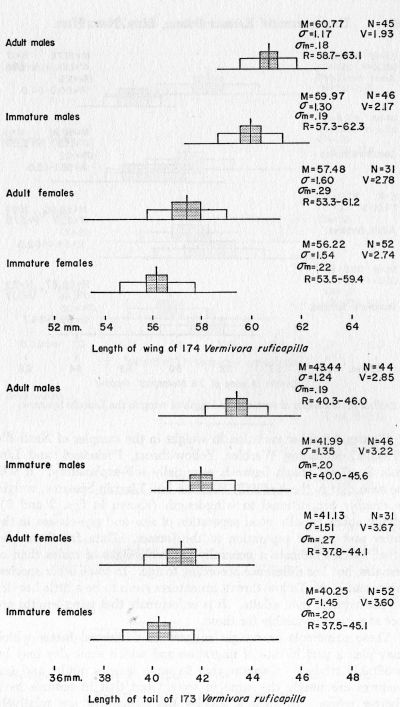
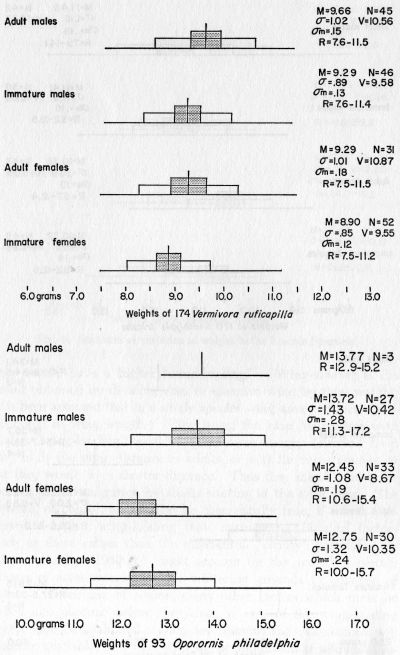
Vermivora r. ruficapilla. Nashville Warbler.—More Nashville Warblers
were picked up at Topeka than any other species and they are discussed in
detail elsewhere in this report. The four sex- and age-classes can be identified
with fair accuracy on plumage characteristics alone. Adult males have a
large amount of reddish-brown in the crown, not completely veiled by the
gray tips of the crown feathers. Immature males have a smaller but distinct
crown patch, usually completely veiled. All males, compared with females, are
grayer on the sides of the head, have a more nearly white eye-ring, and show
clearer yellow on the throat. Adult females differ from immature females in
that they more often have a trace of rufous in the crown and tend to be
brighter below than the immatures. Of 177 specimens, 20 were very fat, 108
were fat, 46 were moderately fat, and 3 had little fat.
Parula americana. Parula Warbler.—Weight: 1 adult female, 7.9, fat.
Dendroica petechia aestiva. Yellow Warbler.—Weights: 1 immature male,
10.2, fat; 3 adult females, 8.8, 9.5, 10.1, moderately fat; 2 immature females,
9.0, 9.4, little fat and fat.
Dendroica magnolia. Magnolia Warbler.—Weights: 1 adult female, 9.0,
moderately fat; 2 immature females, 7.9, 10.3, moderately fat and fat.
Dendroica c. caerulescens. Black-throated Blue Warbler.—Weights: 2
immature males, 13.8, 14.1, excessively fat; 1 immature female, 11.4, fat.
This species is rare in Kansas. Although its breeding range is almost entirely
east and north of Kansas, records in files at the University of Kansas show
that more specimens have been taken in western than in eastern Kansas.
Dendroica c. coronata. Myrtle Warbler.—Weight: 1 immature female,
11.6, fat.
Dendroica pensylvanica. Chestnut-sided Warbler.—Weights: 2 immature
females, 8.1, 10.0, little fat. Only one specimen from Kansas had been preserved
previously although the species is a regular transient in small numbers
throughout the state.
Dendroica castanea. Bay-breasted Warbler.—Weights: 1 adult male, 19.2,
excessively fat; 1 adult female, 11.7, little fat; 1 immature female, 11.2, moderately
fat. Only 5 specimens of this warbler have been taken previously in
Kansas, 4 in spring (Ruth, 1952:18-19) and 1 in fall.
Dendroica p. palmarum. Palm Warbler.—Weights: 2 immature males,
9.9, 10.9, moderately fat; 2 unsexed immatures, 9.1, 9.4, moderately fat. This
species has been taken in fall in Kansas only once before (KU 26353, taken
by Wetmore, at Lawrence, on October 5, 1907), but probably occurs regularly
in both spring and fall migration.
Seiurus a. aurocapillus. Oven-bird.—Weights: 2 adult males, 22.5, 23.8,
fat and very fat; 14 immature males, mean 21.89 ± .66, S. D. 2.46, fat to very
fat; 8 adult females, mean 21.4 (18.3-25.7), moderately fat to fat; 6 immature
females, mean 18.2 (15.6-20.0), moderately fat to fat.
Seiurus noveboracensis notabilis. Northern Water-thrush.—Weights: 3
immature males, 18.1, 18.6, 22.2, moderately fat to fat; 1 immature female,
22.2, fat. Referring these birds to notabilis is a somewhat arbitrary procedure.
They display some intermediacy of characters and probably stem from a
population, intermediate between notabilis and noveboracensis, occupying
much of central North America (cf. McCabe and Miller, 1933).
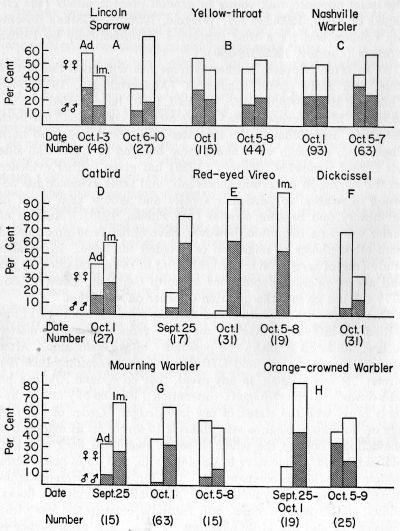
Oporornis philadelphia. Mourning Warbler.—Weight data presented elsewhere.
The birds killed at Topeka provide the latest fall dates for this species
in Kansas. Fifteen were killed on September 25, 64 on October 1, 2 on
October 5, 11 on October 6, 2 on October 7, and 1 on October 8. We find
no other records later than September 15. Of 93 specimens examined, 1 was
excessively fat, 22 were very fat, 45 were fat, 21 were moderately fat, and 4
had little fat. The abundance of this secretive species in the sample was a
great surprise. It had previously been considered a rather rare migrant in
this area.
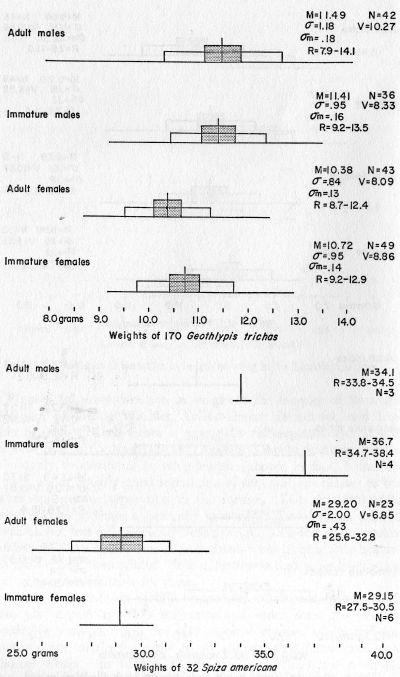
Geothlypis trichas occidentalis [>brachidactyla?]. Yellow-throat.—Weight
data presented elsewhere. This species was second in numbers only to the
Nashville Warbler in the total kill at Topeka. Of 167 birds examined, 29
were very fat, 114 were fat, 23 were moderately fat, and 1 had little fat.
The Yellow-throats are greatly in need of meaningful and comprehensive
revision, which to date has been restricted to the western subspecies (Behle,
1950). Since the appearance of the 1931 A. O. U. Check-List a great deal
of scattered taxonomic work on the species, as yet unsynthesized, has made
the picture of its geographic variation a blurry one so far as the details are
concerned. Made in the absence of adequate comparative material, the above
identification is to be regarded as tentative. Also, it is, unfortunately, based
only on those 6 of our 176 specimens preserved as skins. Five of these are
adult males, the sixth being an immature female. Compared with a series of
Kentucky specimens regarded as typical brachidactyla, these birds are paler
and brighter above (tending toward gray-green rather than brownish olive),
brighter and more extensively yellow below, with broader, more nearly white
superciliary stripes above their black masks (in males). In size they are
close to occidentalis (see Behle, 1950:202). Five males have an average
wing-length of 56.6 mm. (53-59); one female measures 53. Six males from
Kentucky: 55.1 (53-56); four females, 51.1 (48-56). Our birds may be assumed
to have stemmed from a population to the north and west which, if
not occidentalis (or campicola Behle and Aldrich, of which no comparative
material is at hand), is intermediate between brachidactyla and more western
birds. Judging from Behle's map (1950:fig. 32), these birds may have come
from an area near the confluence of three subspecies (campicola, occidentalis,
brachidactyla). Long (1940:452) reports three subspecies breeding in Kansas
(brachidactyla, northeast; occidentalis, west; trichas, southeast). The occurrence
in Kansas of G. t. trichas as currently understood is completely out of
the question.
Icteria v. virens. Yellow-breasted Chat.—Weight: 1 unsexed immature,
29.7, moderately fat.
Wilsonia p. pusilla. Wilson Warbler.—Weights: 2 adult females, 7.5, 7.8,
fat, moderately fat; 1 unsexed adult, 8.3, fat.
Wilsonia canadensis. Canada Warbler.—Weight: 1 immature female, 10.0,
little fat. We know of only five other specimens from Kansas, although this
warbler seems to be a regular migrant in small numbers in the state.
Setophaga r. ruticilla. American Redstart.—Weight: 1 immature female,
9.1, moderately fat.
Dolichonyx oryzivorus. Bobolink.—Weights: 2 adult females, 39.5, 42.9;
2 immature females, 38.8, 42.0; all excessively fat. Specimens of the Bobolink
previously have been taken in fall in Kansas only on September 20 and 24,
1933, near Lawrence, by Long and Preble (Long, 1934).
Pheucticus ludovicianus. Rose-breasted Grosbeak.—Weights: 1 adult male,
50.4, fat; one immature male, 54.5, very fat.
Passerina cyanea. Indigo Bunting.—Weights: 1 adult male, 18.4, fat; 2
immature males, 17.2, 17.2, fat and very fat; 2 adult females, 14.3, 16.9, moderately
fat and very fat; 1 immature female, 13.4, little fat. The sample was
carefully checked for Lazuli Buntings (Passerina amoena); none was found.
Spiza americana. Dickcissel.—Weight data presented elsewhere in this
paper. Dickcissels were picked up at the television tower on October 1 (31),
5 (1), 6 (3), and 7 (1). These birds, together with an adult female taken
3 miles east and 3 miles south of Lawrence, on October 11, 1953, by Tordoff,
are the only specimens of this species taken as late as October in Kansas. The
Dickcissel becomes inconspicuous in late summer and many observers here and
elsewhere have thought the species disappeared much earlier than it really
does (see Ganier, 1949). Of 34 specimens, 20 were very fat and 14 were fat.
Passerculus sandwichensis nevadensis. Savannah Sparrow.—Weights: 1
adult male, 19.4, fat; 2 immature males, 18.3, 19.0, moderately fat; 5 adult
females, mean 17.2 (14.8-19.5), little fat to fat; 4 immature females, mean
18.0 (16.9-19.6), moderately fat to fat. Many of the Savannah Sparrows migrating
through Kansas have in the past been referred to the subspecies P. s.
anthinus (= alaudinus of the 1931 A. O. U. Check-List) by various workers
(see Long, 1940:454). As Peters and Griscom (1938:464-5) have shown,
true anthinus, breeding in the far northwest, ordinarily occurs in migration
only in the western part of the country, the breeding Savannah Sparrows of
a large part of the central continental region (east to southern Wisconsin)
being P. s. nevadensis as now understood. Migrants of this pale, clay-colored
subspecies should be abundant in Kansas, and all of the specimens in the
present sample are referable to it.
Ammodramus savannarum perpallidus. Grasshopper Sparrow.—Weights:
3 adult males, 16.4, 17.6, 20.6, moderately fat, fat, fat; 5 immature males,
mean 18.1 (16.0-20.2), little fat to fat; 5 adult females, mean 17.9 (16.8-18.9),
moderately fat to very fat; 5 immature females, mean 18.1 (16.8-20.6),
fat to very fat.
Passerherbulus caudacutus. Leconte Sparrow.—Weights: 1 immature male,
11.2, moderately fat; 1 immature female, 12.2, moderately fat.
Ammospiza caudacuta nelsoni. Sharp-tailed Sparrow.—Weights: 2 adult
males, 15.2, 17.1, moderately fat and very fat; 1 adult female, 13.3, little fat.
Five specimens of this species have been taken previously in Kansas, all in
October in the eastern part of the state. Additionally, several observers have
reported birds seen but not collected. The three birds from Topeka were
picked up on October 6, 7, and 10 and are the only specimens taken since
1907. Possibly our specimens from Topeka struck the tower on the same night.
Tordoff noticed, upon preparation, that the specimens from October 7 and 10
showed progressive drying of the extremities and spoilage as compared with the
bird picked up on October 6.
Junco hyemalis cismontanus. Slate-colored Junco.—Weight: 1 immature
female, 16.4, little fat. Juncos of hybrid type, whether J. h. hyemalis × J.
oreganus subsp. or true J. h. cismontanus, are fairly common in eastern Kansas.
Spizella pallida. Clay-colored Sparrow.—Weights: 2 adult males, 11.6,
12.2, both fat; 1 immature male, 11.8, fat; 1 adult female, 12.5, fat; 7 immature
females, mean 11.1 (9.7-12.5), little fat to fat.
Passerella iliaca iliaca. Fox Sparrow.—Weight: 1 adult female, 29.4, little
fat. A trifle grayer above than any of several Kentucky specimens, this bird
nevertheless seems well within the range of variation of iliaca.
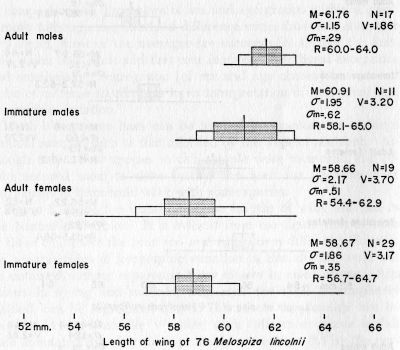
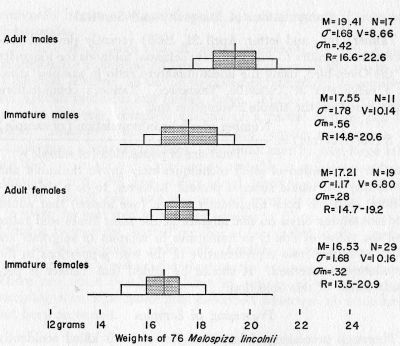
Melospiza l. lincolnii. Lincoln Sparrow.—Weights and measurements are
discussed elsewhere. Of 81 specimens, 15 were very fat, 47 were fat, 12 were
moderately fat, and 7 had little fat. Interestingly, there is no evidence that
the large southern montane subspecies (M. l. alticola) has contributed to the
present sample. No bimodality is evident in the curve of wing-length in our
birds, the largest of which barely approach, the small extreme recorded for
alticola by Miller and McCabe (1935:156).
Melospiza georgiana ericrypta. Swamp Sparrow.—Weights: 3 immature
females, 14.3, little fat, 16.7, 17.0, moderately fat. Swamp Sparrows examined
were all more or less brightly colored and seem to belong to this northern subspecies.
Melospiza melodia juddi. Song Sparrow.—Weights: 1 adult female, 19.4,
little fat; 1 unsexed immature, 16.0, little fat. A large proportion of the migrant
and wintering Song Sparrows in eastern Kansas probably originate from
the range of this subspecies in the northern plains. Melospiza melodia euphonia.—One
immature female (not weighed) was picked up below the tower
on October 27, 1954, and thus does not appear in Table 1. The specimen
proved typical of this generally more eastern subspecies upon comparison with
a large series from Kentucky. For what it may be worth we refer the single
specimen to this subspecies. Long (1940:456) reported two eastern subspecies
from Kansas ("beata," melodia). All Kansas specimens genuinely of
eastern origin probably originate from the range of euphonia, as now understood.