THE GENUS CHÆROCAMPA, DUPONCHEL.
Although by no means in favour of the excessive
subdivision of genera, I am of opinion that
Ochsenheimer’s genus Deilephila has been
correctly separated by Duponchel into the two
genera Chærocampa and Deilephila, sensû strictiori.
Such a division may appear but little necessary
if we examine the perfect insects only; but the
developmental history of the caterpillars shows
that there is a wide division between the two
groups of species, these groups however being
branches of one stem.
Chærocampa Elpenor, Linn.
Some captured females laid single eggs sparsely
on grass, wood, and especially on the tarlatan with
which the breeding-cage was covered. The eggs
are nearly spherical, but somewhat compressed,
of a grass-green colour, a little lighter, and somewhat
larger (1.2 millim.) than those of Deilephila
Euphorbiæ. During the development of the
embryo the eggs first became yellowish-green, and
finally yellowish.
First Stage.
The young caterpillars are four millimeters in
length, and immediately after hatching are not
green, but of a yellowish-white opalescent colour,
the large and somewhat curved caudal horn being
black. The caterpillars were so transparent that
under a low magnifying power the nervous,
tracheal, and alimentary systems could be beautifully
seen. As soon as the larvæ began to feed
(on Epilobium parviflorum) they became green in
consequence of the food appearing through the
skin, but the latter also gradually acquired a dark
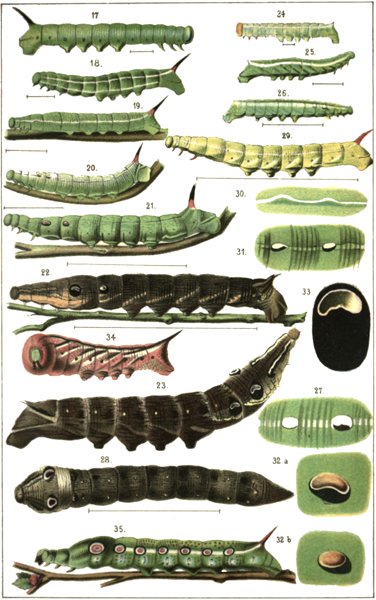
green colour (Pl. IV., Fig. 17). All the specimens
(some twenty in number) were exactly alike, and
showed no trace of marking.
Second Stage.
The first ecdysis occurred after 5–6 days, the
length of the caterpillars being from nine to ten
millimeters. After this first moult they appeared
of a shining green, the horn, which was black
during the first stage, becoming a little red at the
base, while a fine white subdorsal line extended
from the horn to the head (Fig. 18). The head
and legs were green; the divisions between the
segments appeared as fine light rings, and the
entire upper surface of the segments was also crossed
by fine transverse rings, as was also the case in the
first stage.
At the beginning of the present stage no trace
of the eye-spots could be detected; but a few days
after the first moult it was observed that the white
subdorsal line was no longer straight on the fourth
and fifth segments, but had become curved upwards
into two small crescents. The latter soon stood
out more strongly, owing to the filling up of their
concavities with darker green. These are the
first rudiments of the eye-spots (Figs. 19 and 30).
A very fine white line now connected the spiracles
(infra-spiracular line), and could be traced from
the last segment to the head. This line takes
no further part in the subsequent development of
the markings, but disappears in the following
stage. The blood-red colour of the base of the
black caudal horn is retained till the fifth stage,
and then also disappears.
Before the second moult, which occurs after
another period of 5–6 days, the caterpillars, which
were about 1.3 centimeters in length, had assumed
their characteristic tapering, slug-like form. I did
not notice that the larvæ at this stage possessed
the power of withdrawing the three foremost
segments into the two succeeding ones, as is so
frequently to be observed in the adults; neither
were these two segments so strikingly enlarged as
they are at an earlier period.
Third Stage.
After the second ecdysis the marking and
colouring only undergo change with respect to the
eye-spots. The concavities of the crescent-shaped
portions of the subdorsal line become black,70 the
remainder of this line at the same time losing
much of its whiteness, and thus becoming less
distinct, whilst the crescents assume the appearance
of small eye-spots (Fig. 20). During this
stage the curved, crescent-formed portions become
prepared for complete separation from the
remainder of the subdorsal line; and just before
the third moult the eye-spots become sharply
defined both in front and behind, whilst the black
ground-colour curves upwards, and the white spots
gradually become lenticular and commence to
enlarge (Fig. 21).
Fourth Stage.
The third moult takes place after another
interval of 5–6 days, the eye-spots then becoming
very prominent. The white nucleus of the front
spot is kidney-shaped, and that of the hind spot
egg-shaped; whilst the black ground-colour extends
as a slender border upwards along the sides of the
spots, but does not completely surround them till
towards the end of the present stage (Fig. 21). The
central portion of the white spots at the same time
becomes of a peculiar violet-brown colour inclining
to yellow above, the peripheral region alone
remaining pure white.
Of the subdorsal line only traces are now to be
recognized, and these are retained, with almost
unchanged intensity, sometimes into the last stage,
remaining with the greatest persistence on the
three front and on the penultimate segments,
whilst on those containing the eye-spots, i.e., the
fourth and fifth, not a trace remains. At the
present stage the peculiar mingling of colours
becomes apparent over the whole of the upper
surface; the green is no longer uniform, but a
mixture of short and gently sinuous, dark green
striations on a lighter ground now appear. On
the sides of the caterpillar these stripes, which
are at first indistinct, but become more strongly
pronounced in the next stage, are arranged
obliquely on the spiracles, with the lower portions
directed forwards.
Fifth Stage.
The fourth moult occurs 7–8 days after the
third, the caterpillar being 4–5 centimeters in
length. Whilst all the specimens hitherto observed
were with one exception light green, they now
mostly changed their colour and became dark brown.
In one case only did the brown colour appear
in the previous (fourth) stage. The striations
previously mentioned appear as dull and interrupted
dirty yellow streaks, the same dirty yellow
colour showing itself continuously on the sides of
the four front segments. Of the subdorsal line
only a distinct trace is now to be seen on the
eleventh and on the three front segments, whilst
on the third segment the formation of another
eye-spot commences to be plainly perceptible by
a local deposition of black (Fig. 23). This third
spot does not, however, become completely
developed, either in this or in the last stage, but
the subdorsal line remains continuous on the three
front segments. Among other changes at this
stage, there occurs a considerable shortening of
the caudal horn, which at the same time loses its
beautiful black and red colours and becomes
brownish.
The two large eye-spots have now nearly
attained complete development. The kidney-shaped
white spot has become entirely surrounded
by black; and on the brown, red, and yellow tints
present in this spot during the last stage, a nearly
black spot has been developed—the pupil of the
eye (Fig. 33). In order to establish a definite
terminology for the different portions of the eye-spot,
I shall designate the pupil as the “nucleus,”
the light ground on which the pupil stands as the
“mirror,” and the black ground which surrounds
the mirror as the “ground-area.”
In this fifth stage the larva attains a length
of six centimeters, after which the fifth moult
takes place, the caterpillar becoming ready for
pupation in the sixth stage. No striking changes
of colouring or marking occur after the present
stage, but only certain unimportant alterations,
which are, however, of the greatest theoretical
interest.
Sixth Stage.
In this stage the eye-like appearance of the
spots on the front segments becomes still more
distinct than in the fifth stage; at the same time
these spots repeat themselves on all the other
segments from the fifth to the eleventh, although
certainly without pupils, and appearing only as
diffused, deep black spots, of the morphological
significance of which, however, there cannot be
the least doubt. They are situated in precisely
the same positions on the 5–11 segments as
those on the third and fourth—near the front, and
above and below the subdorsal line. A feeble
indication of the latter can often be recognized
(Fig. 23).
In all dark brown specimens the repeated
spots can only be detected in a favourable light,
and after acquiring an intimate knowledge of the
caterpillar; but in light brown and green specimens
they appear very sharply defined.
There is one other new character which I have
never observed at an earlier period than the sixth
stage, viz. the small dots which appear in pairs
near the posterior edge of segments 5–11.
These dots cannot have been developed from
the subdorsal line, as they are situated higher
than the latter. Their colour varies according to
the ground-colour of the caterpillar, but it is always
lighter, being light green in green specimens,
dull yellow in those that are light brown, and
grey in the blackish-brown caterpillars. These
“dorsal spots,” as I shall term them, are chiefly
of interest because they are present in Chærocampa
Porcellus, in which species they appear one
stage earlier than in C. Elpenor.
Chærocampa Porcellus, Linn.
Females captured on the wing, laid in the breeding-cage
single eggs of a light green colour,
spheroidal in form, and very similar to those of
C. Elpenor.
First Stage.
The caterpillars on first hatching measure 3.5
millimeters in length, and are of a uniform light
green colour, with a fine white transverse line on
the posterior edge of each segment, precisely
similar to that which appears in the second stage
of C. Elpenor. They resemble the latter species
still further in showing a fine white subdorsal
line, which can easily be recognized by the naked
eye (Fig. 24). Although the adult larva is
distinguished from all the other known species of
Chærocampa by the absence of a caudal horn, a
distinct but very small one is nevertheless present
at this first stage, and is indeed retained throughout
the entire course of development, but does not
increase further in size, and thus gradually becomes
so small in proportion to the size of the caterpillar
that it may be entirely overlooked.
The first moult takes place after 4–5 days.
Second Stage.
The blue-green coloration remains unchanged;
but a somewhat darker green dorsal line becomes
apparent down the middle of the back (the dorsal
vessel?), and the subdorsal line now becomes very
broad and pure white, being much more conspicuous
than in any stage of C. Elpenor (Fig. 25).
The tapering of the three front segments occurs
at this stage, and oblique, dark green striations on
a lighter ground stand out distinctly on the spiracles.
As with C. Elpenor, the first traces of the
future eye-spots appear during the second stage;
not in the present case as a curvature of the
subdorsal line, but as a spot-like widening of the
latter, of a brighter white than the somewhat
greenish colour of the remainder of the line.
Third Stage.
After the second moult, the formation of the
dark “ground-area” of the eye-spots commences by
the appearance of a little brown on the under edge
of the foremost of the white spots, this coloration
gradually increasing in extent and in depth. At
the same time both spots become more sharply
distinguishable from the subdorsal line, which
becomes constantly greener (Fig. 27). The brown
colour soon grows round the white of the front
eye-spot, which becomes so far perfected; whilst
the completion of the hind spot is effected slowly
afterwards. The formation of the eye-spots does
not therefore proceed any more rapidly in this
species than in C. Elpenor.
At the end of the present stage the length of
the caterpillar is about four centimeters; the ground
colour is still sea-green; the subdorsal line is much
diminished, completely fading away at its lower
edge, but remaining sharply defined above, against
the green ground-colour (Fig. 26).
Fourth Stage.
After the third moult all the caterpillars (5)
became brown, this change occurring therefore one
stage earlier than is generally the case with C.
Elpenor. In single instances the brown colour
appeared in the third stage. The subdorsal line
had disappeared from all the segments but the three
first and the last. The eye-spots now rapidly
attained complete development; they contained a
black pupil, and gave the insect a truly repulsive
appearance when, on being threatened by danger,
it drew in the front segments, and expanded the
fourth (Fig. 28). The eye-spots of the fifth segment
are much less developed than in C. Elpenor;
they remain small, and are not readily detected.
On the other hand, there now appear on all the
segments with the exception of the last, just as in
the sixth stage of C. Elpenor, distinct rudiments of
eye-spots, which present the appearance of irregular,
roundish, black spots on the front borders of the
segments, at the height of the former subdorsal
line. In this latter region the black pigment is
disposed as a longitudinal streak, and to this a
median line is added, the whole forming a marking
which perhaps makes the caterpillar appear
still more alarming to its foes. This marking is,
however, only to be distinctly recognized on the
three first segments. The “dorsal spots” mentioned
in the case of C. Elpenor then appear very
distinctly on segments 5–11.
The caterpillars continued to feed for eleven
days after the third moult, at the end of which
period the fourth moult took place, but without
the occurrence of any change of marking. The
larvæ then buried themselves, the complete
development having taken 28–29 days.
The development of the Porcellus caterpillar
was twice followed; in 1869 in twelve, and in
1874 in five specimens. In no case did I obtain
caterpillars which remained green throughout the
entire course of development, although this colour
is stated in the books to occur occasionally in these
larvæ; neither have I been able to find any figure
of an adult green specimen, so that it must in the
meantime be admitted that such specimens, if they
occur at all, are exceptional instances.71 The
theoretical bearing of this admission will appear
later on.
Results of the development of Chærocampa Elpenor
and C. Porcellus; comparison of these with the
other known species of Chærocampa.
The first stage of Elpenor shows that the most
remote ancestor of the genus possessed no kind of
marking, but was uniformly green. At a later
period, the white longitudinal stripe which I have
designated the “subdorsal line” made its appearance,
and at a still later period this line vanished,
with the exception of a few more or less distinct
remnants, whilst, at the same time, from certain
portions of it, the eye-spots of the fourth and fifth
segments became developed. After the perfecting
of the eye-spots, weak repetitions of the
latter appeared as black spots on all the segments
except the last.
In Porcellus the caterpillar emerges from the
egg with the subdorsal line, the first stage of
Elpenor being omitted. From this fact we may
venture to conclude that Porcellus is the younger
species, or, what comes to the same thing, that
it has further advanced in development. The
whole subsequent history of Porcellus agrees with
this view, its course of development being essentially
but a repetition of the phenomena displayed
by Elpenor, and differing only in one point, viz.
that all new characters make their appearance
one stage earlier than in the latter species. This
is the case with the transformation of the green
into a brown ground-colour; with the repetition of
the eye-spots on the remaining segments in the
form of suffused black spots; and with the appearance
of the light “dorsal spots.” Only the eye-spots
themselves appear, and the snout-like tapering
of the front segments occurs in the same stage
as in Elpenor, i.e. the second.
From these data alone, we may venture to infer
the occurrence of four chief stages in the phyletic
development of the genus. The first stage was
simply green, without any marking; the second
showed a subdorsal line; the third, eye-spots on
the third and fourth segments; and the fourth
stage showed a repetition of the eye-spots, although
but rudimentary, on all the remaining segments
with the exception of the twelfth.
Now if we compare the other known species
of Chærocampa larvæ with the above, we shall
arrive at the interesting conclusion that all these
species can be arranged in three groups, which
correspond exactly with the three last phyletic
stages as just deduced from the ontogeny of C.
Elpenor and Porcellus.
Of the genus Chærocampa,72 over fifty species
have been described,73 of which the larvæ of only
fifteen are known in the form which they possess
at the last ontogenetic stage.
Group 1.—I can furnish but little information
with respect to this group. The first species with
which I became acquainted was Chærocampa
Syriaca,74 of which I saw two blown caterpillars in
Staudinger’s collection, and which I have figured in
Pl. IV., Fig. 29. The larva is green, and has the
short oblique stripes over the legs common to so
many species of Chærocampa, the only marking
besides these being a simple white subdorsal line,
without any trace of eye-spots. This species exactly
corresponds therefore with the second ontogenetic
stage of C. Elpenor and Porcellus. The account of
the species, both in the larval and perfect state, is
unfortunately so imperfect, that we cannot with
certainty infer the age of the two caterpillars from
their size. If the moth were of the same size as
Elpenor, then the caterpillar figured, having a
length of 5.3 centimeters, would not be in the last
but in the penultimate stage, and it remains doubtful
whether it may not acquire eye-spots in the last
stage.
That species exist, however, which in their last
stage correspond to the second stage of Elpenor,
is shown by two of the forms belonging to
Walker’s genus Darapsa, which was founded on
the characters of the imagines only. Ten species
of this genus are given in Gray’s catalogue, the
adult larva of two of these being known through
the excellent figures of Abbot and Smith.75 These
two caterpillars possess the characteristic tapering
form in a very marked degree; one is figured in
the attitude so often assumed by our species of
Chærocampa on the approach of danger, the three
front segments being withdrawn into the fourth.
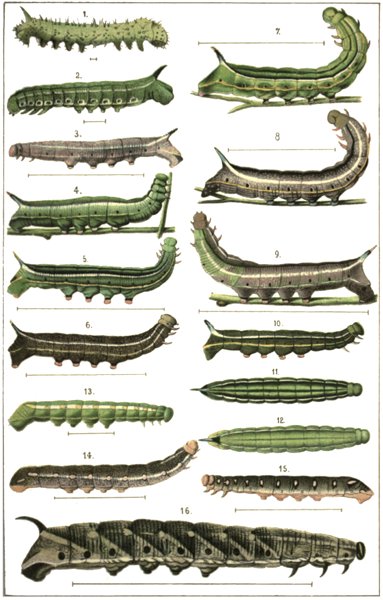
(Fig. 34, Pl. IV., is copied from this Plate).
There are no eye-spots either in D. Myron or D.
Chœrilus,76 but only a broad white subdorsal line;
underneath which, and to a certain extent proceeding
from it, there are oblique white stripes,
precisely similar to those which meet the subdorsal
line in the third stage of C. Porcellus.77
Group 2.—This group contains numerous
species which, like our native C. Elpenor and
Porcellus, show eye-spots on the fourth and fifth
segments, whilst these markings are absent, or at
most only present in traces, on the remainder. To
this section there belong, besides the two species
mentioned, five others, viz. in Europe, C. Celerio
and Alecto (not certainly known?);78 in India,
C. Nessus, Drury, and Lucasii, Boisduval;79 and
an unnamed species from Port Natal.
In the species belonging to this group the subdorsal
line may be more or less retained. Thus,
C. Celerio, according to Hübner’s figure, has a
broad yellow line extending from the horn to the
sixth segment, whilst it is completely absent on
the three front segments. In the unnamed species
from Port Natal80 the subdorsal line extends to
the front edge of the fifth segment, and on the
fourth segment only is there a perfect eye-spot,
whilst on the succeeding segments traces of such
markings can be recognized as dark spots similar
to those in Elpenor and Porcellus. The transition
to the third group is through another unnamed
species from Mozambique,81 in which
rather large eye-spots have become developed
on the fourth and fifth segments and these
are followed by a subdorsal line, which only
appears distinctly at certain places. On this
broken subdorsal line, and not completely separated
from it, there are small, roundish eye-spots,
situated near the front edge of each segment;
these being, therefore, a somewhat more
perfect repetition of the front eye-spots.82
Group 3.—In the species of this group the
eye-spots are repeated on all the segments. I
am acquainted with seven such Chærocampa larvæ,
of which C. Bisecta, Horsfield,83 shows some
affinity to the foregoing group, since the eye-spots
on segments 6–11 have not yet attained
full perfection. In C. Odenlandiæ, Fabr.,84 and in
C. Alecto from India,85 the eye-spots appear to be
perfectly alike on all the segments; whilst in
C. Acteus, Cram.,86 and in the North American
C. Tersa87 (Pl. IV., Fig. 35) they are smaller on
the other segments than on the fourth; and in
C. Celerio, Linn., from India,88 the size of the
spots diminishes from the head to the tail.
In this group also the subdorsal line is retained
in a very variable degree. In some species it
appears to have completely vanished (C. Acteus,
Celerio); in others it is present as a light stripe
extending along all the segments (C. Alecto);
whilst in others it is retained as a broad white
stripe, which extends only to the fourth segment
(C. Tersa, Fig. 35). In species possessing eye-spots,
the subdorsal line is thus a very variable
character. It is, however, an interesting fact that
even in the present group, which has made the
greatest step forward, the subdorsal line is of
general occurrence, because the eye-spots in all
these species may have almost a similar development
to those of Elpenor and Porcellus. The
ontogeny of the tropical species would alone
give a definite reply on this point, but unfortunately
we are not acquainted with any of
the young forms, so that we can but presume
that some of them at least would show only in the
first stage the simple subdorsal line without eye-spots;
that in the second stage the primary pairs
of eye-spots would be formed on the fourth and
fifth segments, whilst the transference of these
spots to the remaining segments would take place
in the last stage.
The foregoing assumption is based immediately
on the ontogeny of Elpenor and Porcellus; it is
supported by the considerable size attained by the
eye-spots in many species of the third group,
and would receive additional confirmation by
observations on the Indian C. Celerio, supposing
that Horsfield’s statements do not arise from a
confusion of species. This skilful observer, who
was the first to breed systematically a large
number of tropical larvæ, has given a figure of the
Indian caterpillar of C. Celerio, according to which
this species possesses eye-spots on all the segments
from the fourth to the tenth. The European
form of this same species has eye-spots only on
segments four and five, a fact which does not
appear to have been known to Horsfield, as no
mention of it is made in his notice of the Indian
species. If the caterpillar figured is really that
of Celerio, which I consider to be by no means
improbable, not only is it thus shown that in the
species of the third group the ocelli on the hind
segments have a secondary origin through a
repetition of the primary ones of the front
segments, but we can also establish that the same
species in two different regions may arrive at two
different phyletic stages.
If, finally, we sum up the facts taught by the
ontogeny of the two German species, and the
adult forms of the other species, we can form
therefrom a tolerably complete picture of the
course of development of the genus Chærocampa.
Of the four phyletic stages indicated by the
ontogeny of Elpenor and Porcellus, three still
form the terminus of the development of existing
species. The great differences among the
caterpillars of this genus can be very simply explained
on the view that they stand at different
levels of phyletic development; some species
having remained far behind (Group 1), others
having advanced further (Group 2), and others
having reached the highest point of development
(Group 3). The fact that the species of the third
group are only tropical accords well with this view,
since many facts prove that phyletic development
proceeds more rapidly in the tropics than in
temperate climates.
The striking markings of the Chærocampa
larvæ may, in brief, be stated to originate from a
local transformation of two portions of the subdorsal
line into eye-spots, and the subsequent
transference of these two primary ocelli to the other
segments. The eye-spots always originate on
segments four and five, and from these the transference
mostly occurs backwards, although in
certain cases it takes place at the same time
forwards. Herein, i.e. in the origin of the eye-spots,
there lies a great distinction between the
genus Chærocampa and the genus Deilephila, with
which it was formerly associated, and in which the
origin of a very similar kind of marking can be
traced to quite another source.
The Genus Deilephila, Ochsenheimer.
I am acquainted with the caterpillars of nine
European and one North American species,
these differing in marking to such a wonderful
extent that they appear to offer at first sight but
little hope of being able to trace them to a common
form. These ten species can be separated,
according to their markings, into five groups,
which I will briefly define before entering upon
their ontogeny.
The first group consists of three species, and
comprises the commonest and most widely-ranging
of all the European species, Deilephila Euphorbiæ,
as well as D. Dahlii from Sardinia and Corsica,
and D. Nicæa, a species of very restricted range,
which appears to occur only in one small district
on the French coast of the Mediterranean. These
three species agree in marking to the extent of
their possessing in the adult form two rows of
ring-spots on each side, whilst the subdorsal line is
completely absent.
The second group, consisting also of three
species, shows a great resemblance to Euphorbiæ,
but has only one row of ring-spots. It contains
D. Vespertilio, D. Galii, and the Algerian
D. Mauritanica.
For the third group I only know one representative,
D. Livornica, Esp., which possesses a
single row of ring-spots connected by a subdorsal
line.
Another group is composed of D. Zygophylli,
which occurs on the shores of the Caspian Sea,
and the North American D. Lineata; these species
possessing a strongly marked subdorsal line, associated
with more or less distinct ring-spots, which
I shall designate as “open rings,” because their
black border does not intersect the subdorsal line,
but has the form of an arch above and below it.
In the last group, represented by D. Hippophaës,
which occurs at the foot of the Alps (Wallis), and
southward as far as Andalusia, there is only a broad
subdorsal line, generally without any trace of a
row of spots.
The important differences of marking displayed
by these five groups are not in any way accidental,
but they represent different stages of phyletic
development; or, in other words, the five groups
are of different ages, the first (Euphorbiæ, &c.)
being the youngest, and the last (Hippophaës) the
oldest of the genus.
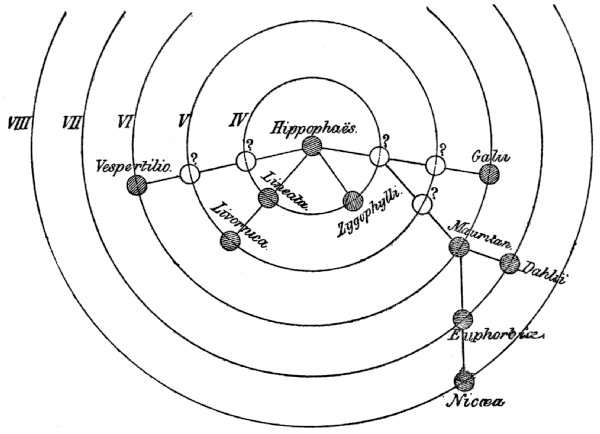
According to their phyletic age, the groups
follow each other in inverse order, the first being
Hippophaës, the second that of Zygophylli, the
third that of Livornica, the fourth that of Galii,
and the fifth and youngest that of Euphorbiæ.
Only in this last am I acquainted with the
complete development of one species, for which
reason I commence with this group, thus proceeding
from the youngest to the oldest forms,
instead of taking the more natural course from
the simplest and oldest to the youngest and most
complicated.
Deilephila Euphorbiæ, Linn.
Some captured females were at once placed in an
enclosure about the size of a small sitting-room.
It was evident that they did not feel quite at home
under these conditions, frequently beating their
heads and wings against the tarlatan, but some of
them nevertheless laid eggs at the base of the
leaves of Euphorbia Cyparissias. The eggs
much resemble those of Chærocampa Elpenor,
being spheroidal in form, but rather smaller, and
of a somewhat darker green. They were laid in
small clusters composed sometimes of as many as
seven, the single eggs being placed near together,
but never touching, and seldom at the point of the
leaf, but generally near the end of a twig, where
young shoots are in close proximity. During
the embryonic development the eggs become
coloured, first yellow and partly blackish, and
finally completely black.
First Stage.
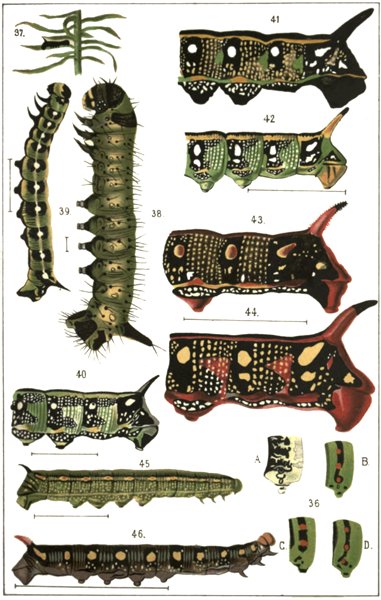
The young caterpillars (Fig. 37, Pl. V.)
immediately after hatching measure four millimeters
in length; they are at first rather light,
but in the course of half-an-hour they are seen
by the naked eye to become of a deep velvety
black; later, on increasing in size, they again
become paler, appearing of a greenish-black, and
subsequently blackish-green. On further increasing
in size (Fig. 38), they are blackish-green,
with the horn, head, legs, and a crescent-shaped
chitinous plate on the back of the prothorax
black. There are also on the last segment a
double and two single black chitinous plates. Of
the later marking of the caterpillar there is
scarcely anything present. The spiracles appear
as white spots, and on each segment there are a
number (mostly ten) of small warts, each of which
emits a single bristle.
When the young larvæ have attained a length
of seven millimeters they are olive-green, and do
not contrast so brilliantly with the green of the
Euphorbia leaves as before; neither do they as yet
possess any markings.
Second Stage.
The first ecdysis occurs after five days, and
with this there appears quite suddenly a very
complicated pattern. The ground-colour is now
a light yellowish-green (Fig. 39), and on each
of the twelve segments, near the front border, there
is a pure white round spot in the middle of a large
black transverse spot. I shall designate these, in
accordance with the nomenclature employed for
Chærocampa, as the white “mirrors” on black
“ground-areas,” both together constituting “ring-spots,”
as distinguished from “eye-spots” proper,
in which a “nucleus,” the pupil of the eye, is also
added. In many, but not in all specimens, very
distinct traces of a subdorsal line can be seen as
a light whitish stripe connecting the white spots.
The horn, the thoracic and prolegs, and some
spots on the head, are black.
The caterpillars remain unaltered till after four
days, when, having a length of 17 millimeters, the
second moult takes place, bringing with it changes
quite as great as those which occurred with the
first.
Third Stage.
The caterpillar now assumes the shagreened
appearance which it possesses in the adult state.
Small white warts are arranged in rows from the
dorsal to the spiracular line, and again underneath
this line on the abdominal legs. These dots are
not only of value as a character for differentiating
the genera Deilephila and Chærocampa, but they
also play a part in the peculiar spot-marking which
will be shown later on. The ground-colour of the
caterpillar is now light green (Fig. 40), replaced
by black on certain parts. From the black
“ground-area” of the ring-spots, two black
triangles extend towards the posterior borders
of the segments, but usually without reaching
them.
The ring-spots are not essentially changed, although
it may be observed that in most specimens
the shagreen-dots under each ring-spot are somewhat
larger, and stand closer together than in
other places. In the following stage they become
fused into a second white “mirror,” so that two
ring-spots stand one above the other, their black
ground-areas meeting. The formation of the
second ring-spot sometimes takes place in the
present stage (Fig. 42).
The subdorsal line has now completely vanished,
whilst the spiracular line89 appears as a broad stripe
above the legs. The horn is yellow with a black
point, and the black spots on the head have increased
in size.
Fourth Stage.
The third moult, which again occurs after four
days, is not accompanied by such important
changes. The green ground-colour has now
completely disappeared, and is replaced by a dull
black. The caterpillars are now, as also in the
previous stage, extremely variable. Thus, for
example, a triangular patch of the green ground-colour
may be retained on the posterior edge of
the segments (Fig. 41), those specimens which
possess this character generally having their markings
retarded in development, as shown by the
absence of the second “mirror” of the ring-spots.
In Fig. 41 the shagreen-dots from which
this second “mirror” is subsequently formed,
are distinctly larger than the others, and on the
eleventh segment two of them have already
coalesced.
Fifth Stage.
After another period of four days, the fourth
moult takes place. The marking remains the same,
but the colours become more vivid; the brick-red of
the head, horn, dorsal line and legs, changing into
a fiery red. The spiracular line, formerly green
alternating with yellow, generally becomes resolved
into a row of reddish-yellow spots. Ten
days later the caterpillar (8.5 centimeters in
length), ceases to feed, and prepares for pupation.
In this last stage also there is great variability
of colour, but although each particular character
is subject to fluctuation, the individuals of the same
brood show but little variation among themselves.90
Thus, the dorsal line is sometimes black, and
sometimes red, or again, this colour interrupted
with black, so that only small red spots mark its
course. The head may be entirely red, or this
colour mixed with black. On the under side of
the caterpillar, red generally predominates, but in
some specimens this is replaced by black. The
ground-colour is also variable, being generally
a shining brownish-black, but sometimes dull
coaly black. The shagreen-dots are sometimes
white and sometimes yellow, and the “mirrors” of
the ring-spots are also often yellowish.
The most interesting variation, however, appears
to me to be the following:—In many specimens
from Kaiserstuhl (Breisgau), the red was unusually
vivid, and was not limited to the ordinary places,
but occupied also the triangles on the posterior
edges of the segments (Fig. 44), which are green
in the third and fourth stages (Fig. 42). This
variety has also been figured by Hübner. In
one individual (Fig. 43), the under ring-spots
were wanting, whilst the upper ones possessed a
beautiful red nucleus fading away anteriorly, and
showing the first step in the formation of a complete
eye-spot.
I cannot positively assert that a fifth moult occurs
in the last ten days, although I am very doubtful
whether this is the case. It is certain, however,
that some time before pupation, and whilst the
larva is still feeding, the striking colours fade out,
and become replaced chiefly by black.
The ontogeny of this species is obviously but
a very incomplete representation of its phyletic
development. This is at once apparent from the
large gap between the first and second stages. It
is not possible that a row of ring-spots can have
arisen suddenly; in all probability they have been
developed from a subdorsal line, which in Euphorbiæ
is now only indicated in the second stage by
a faint line. This conjecture is raised to a certainty
when we call in the aid of the remaining
species of Deilephila.
Deilephila Nicæa, De Prunner.
I only know this species from blown larvæ in
Staudinger’s collection, and Duponchel’s figure, of
which Fig. 51, Pl. VI. is a copy. The adult insect
possesses two perfectly separated rows of ring-spots.
Duponchel figures also two younger stages,
of which the youngest is probably the third stage.
The larva is 18 millimeters in length, of a leaf-green
colour, and shows no trace of a subdorsal
line, but possesses the two rows of ring-spots,
which only differ from those of the succeeding
stages in the green colour of the “mirror.”
Deilephila Dahlii, Treitschke.
I am familiar with numerous specimens in various
stages, collected in Sardinia by Dr. Staudinger,
and preserved by inflation.
The first stage is blackish, and shows no kind of
marking; thus agreeing with the corresponding
stage of Euphorbiæ. The second stage is unfortunately
not represented in Staudinger’s collection.
The third stage shows a row of ring-spots, which
are, however, connected by a very distinct and
sharply defined subdorsal line. In the fourth
stage a second row of (under) ring-spots is added,
whilst the subdorsal line generally at the same
time disappears.
The caterpillar remains unchanged during the
fifth stage, when it shows a great resemblance in
marking to Euphorbiæ; neither does it appear to
differ essentially from this species in colour, so far
as can be judged from preserved specimens and
single figures (in Duponchel and Hübner). I
have, moreover, seen several larvæ in the last
stage, and the subdorsal could be distinctly recognized
as a broad light stripe.
Of the four groups, the second (that of Galii),
appears to me to be of but very little importance,
as I shall now proceed to show from the development
of D. Vespertilio.
Deilephila Vespertilio, Fabricius.
Hitherto I have unfortunately been unable to
obtain fertile eggs of this species, so that I can
say nothing about the first stage. The latter
would have been of interest, not only because of
the marking, but also because of the presence of a
residual caudal horn.
I am likewise only acquainted with the end of
the second stage, having found, at the end of June
1873, a single caterpillar on Epilobium Rosmarinifolium,
just previous to its second ecdysis. In the
case of such young caterpillars, however, the new
characters which appear in the succeeding stage
are generally perceptible through the transparent
chitinous skin at the end of the preceding stage,
so that the markings of the insect are thus caused
to change. The caterpillar found was about 16
millimeters long, and of a beautiful smooth and
shining grass-green (Fig. 13). A broad white
subdorsal line extended from the first to the penultimate
segment, from which the horn was completely
absent. On close inspection the first traces
of the ring-spots could be detected near the anterior
edge of each segment as feeble, round, yellow,
ill-defined spots, situated on the subdorsal line itself
(Fig. 13). On the first segment only there is
no spot, and here no ring-spot is afterwards
formed. Besides these markings, there was only
to be seen a yellowish-white spiracular line.
This solitary specimen unfortunately buried itself
before the moult for which it had prepared itself
had occurred; but this ecdysis is associated with
a very important transformation. This statement
is founded on a blown specimen in Staudinger’s
collection; it is only 18 millimeters in length,
but already shows the later grey colouring in
place of the beautiful green. In this, the third
stage, the broad white subdorsal line bears on
each segment a red spot enclosed between black
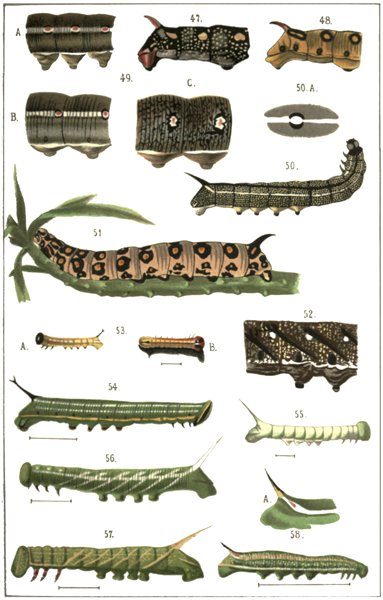
crescents above and below (Fig. 49 A). In the
fourth stage, during which I have seen many
living caterpillars, the subdorsal line is still distinctly
present in some individuals (Fig. 14), but
the spots (“mirrors”) are now completely surrounded
by a narrow black ring (“ground-area”),
which sharply separates them from the subdorsal
line (Fig. 49 B). In the fifth stage this
ring becomes a somewhat irregularly formed black
“ground-area,” whilst the subdorsal line completely
vanishes (Figs. 51 and 49 C). The mirrors
are white, but generally have a reddish nucleus,
which obviously corresponds to the primary yellow
spots from which the whole development of the
ring-spots originates. This character is, however,
sometimes absent; and many other variations also
occur in the earlier stages, all of which can be
easily explained as cases of arrested, or retarded
development. Thus, the subdorsal line often disappears
earlier, and is only present in the fourth
stage as a feeble light stripe.
Deilephila Galii, Fabricius.
The markings of this species appear to be
developed in a precisely similar manner to those
of D. Vespertilio. The adult larva, as in the last
species, shows no trace of a subdorsal line. A row
of large black spots, each having an irregular
round, yellowish-white nucleus, is situated on an
olive-green, blackish-brown, brown, or dirty yellow
ground. I have, unfortunately, also in this case
been unable to procure fertile eggs. There is,
however, one figure of a caterpillar, 2.5 centimeters
long, by Hübner, which is of a light green colour,
and has five longitudinal lines; one dorsal, two
subdorsal, and a spiracular line. The subdorsal
is white, and bears in the place of the ring-spots
small red dots, whilst the line itself is bordered
with black where the red spots are situated.
Hübner has probably figured the third stage, so
that we may venture to conclude that in the second
stage there is a subdorsal line either quite free
from spots, or only showing such feeble rudiments
as are to be seen in the second stage of
Vespertilio.
I found two specimens in the fourth stage in
the Upper Engadine. One of these (Fig. 45)
was already of a dark, blackish-green ground-colour91
with a broad, greenish-white subdorsal
line sharply defined throughout its entire length,
and containing ring-spots of a sulphur-yellow with
an orange-red nucleus; the black “ground-area”
did not encroach upon the subdorsal line, but was
confined to two faint crescents situated above
and below the “mirror.” Only the two foremost
“mirrors” (on the second and third segments)
were without nuclei.
The remaining peculiarities of coloration are
shown in the figure. I may here only point out
the shagreening present on the sides and a
portion of the under surface.
The specimen figured was 3.3 centimeters long;
a second example measured 2.8 centimeters in
length, and was essentially similar, but showed
that a considerable amount of variability must
prevail at this stage of development. It was pitchy
black, with a very indistinct subdorsal line and a
few ring-spots, the “mirrors” of which were
also sulphur-yellow, with the orange-red nucleus.
The shagreening was quite as strong as in the
first specimen, the dots being yellow instead of white.
It is specially to be observed, because of its important
theoretical bearing, that in this larva the
ring-spots were absent on the three front segments,
and on the fourth only, a faint indication of one
could be perceived. In the caterpillar figured
the ring-spots increase also in distinctness from
the tail to the head.
Fifth Stage.
The two specimens just mentioned, after moulting,
acquired the well-known markings of the adult
caterpillar already briefly described above. The
fifth is the last stage.
The larva is known to occur in several variations,
Rösel having figured it in three forms; light green,
olive-green, and dirty yellow. It has not been
since considered worth the trouble to attend to
the subject of caterpillar coloration. Thus, Wilde,92
in his well-known work, takes no notice of Rösel’s
observation, but simply describes the caterpillar
of Galii as “blackish olive-green.”
Having had an opportunity of observing twenty-five
adult specimens of this somewhat scarce
species at one time, I am able to state that it is
not in this instance di- or polymorphism, but a
case presenting a great degree of variability, with
which we have to deal. There are not several
sharply-defined types of coloration; but the
extremes are connected by numerous intermediate
forms. The extreme forms, however, certainly
preponderate.
I have never met with Rösel’s light green form;
neither was there a dark green specimen among
the twenty-five mentioned, and I only know this
variety from single individuals, found at a former
period. Among the twenty-five caterpillars; all
gradations of colour occurred, from pitchy black to
light clay-yellow, and even to an almost whitish-yellow;
some were brownish-black, others of a
beautiful chestnut-brown, and others yellowish
brown, dark clay-yellow, or brownish-red. Out
of twenty-one specimens of which the ground-colours
were noted, there were nine black, nine
clay-yellow, and three brown; each of the three
groups again showing various minor modifications
of colour. The other colours also varied somewhat.
Thus, the “mirrors” were sometimes
white, sometimes strong yellow, and occasionally
they also contained a reddish nucleus.
The variations in the shagreening were especially
interesting, inasmuch as these appeared
to have a striking connection with the general
colouring of the caterpillar. Black specimens
seldom show such sparse shagreening as that
represented in Pl. V., Fig. 46, but are generally
thickly scattered with large shagreen-dots right up
to the dorsal line (Fig. 47, Pl. VI.), then strikingly
resembling the adult larva of D. Euphorbiæ. The
light ochreous-yellow individuals, on the other
hand, were sometimes entirely without shagreening
(Fig. 48, Pl. VI.), being smooth, and much
resembling the light ochreous-yellow or yellowish-red
caterpillar of D. Nicæa (Fig. 51, Pl. VI.).
I have never seen a caterpillar of Galii which
showed traces of the subdorsal line in the last
stage, nor have I ever met with one which
possessed a second row of “mirror” spots; so that
retrogression or a sudden advance in development
does not appear to occur.
Of the North African D. Mauritanica, which
likewise belongs to the Galii group, I have not
been able to obtain specimens or figures of the
younger stages. The adult caterpillar is very
similar to that of Euphorbiæ, but differs in the
absence of the second row of ring-spots. For
this reason it must be regarded as a retarded
form at an older stage of phyletic development.
I now proceed to the Livornica group.
Deilephila Livornica, Esper.
This, the only European species here to be
considered, possesses almost the same markings
as Galii in its fourth stage, i.e., a subdorsal line
with interpolated ring-spots. The species is
known to be rare, and I have not been able to
obtain living specimens, but I have examined
several blown larvæ, all of which agree in having
the ring-spots sharply distinct from the whitish
subdorsal line, so that the latter is thereby
interrupted. Figures of the adult larva are
given in the works of Hübner, Boisduval, and
Duponchel. In most specimens the ground-colour
is brown, although Boisduval93 also figures a
light green specimen; from which it may be inferred,
from analogy with Galii and Vespertilio, that the
first stages are green. In Dr. Staudinger’s collection
there is a young larva, probably in the
fourth stage, the ground-colour of which is light
ash-grey. The dorsal and subdorsal lines are
white, the latter showing in the positions where
the ring-spots subsequently appear, small white
“mirrors” with red nuclei, exactly corresponding
to the stage of Vespertilio represented in
Fig. 49 A, Pl. VI. The “mirrors” are nothing
more than dilatations of the subdorsal line, which
is not therefore interrupted by them. The black
“ground-area” does not surround the “mirrors”
completely, but borders them only above and
below, and is much more strongly developed
above, extending in this direction to the dorsal
line.
The fourth group comprises the two species
D. Lineata, Fabr., and D. Zygophylli, Ochs., the
former being the North American representative
of our D. Livornica, but differing in remaining
permanently at the fourth stage of this last species.
I am acquainted with D. Lineata only through
the figure of the adult larva given by Abbot and
Smith, which figure, judging from the position and
form of the spots, I am compelled to believe is
not quite correct, notwithstanding the excellence
of the other illustrations. The ground-colour of
the caterpillar is green; the subdorsal yellow,
bordered with black, slightly curved, arched lines,
which nowhere interrupt its continuity. This
North American species appears therefore to be
an older form than our Livornica.
Deilephila Zygophylli, Ochsenheimer.
This species, which is the next allied form to
D. Lineata, is an inhabitant of Southern Russia.
I have seen four specimens of the caterpillar in
Dr. Staudinger’s collection, three of which are
certainly in the last ontogenetic stage. The
ground-colour appears ash-grey, ash-brown, or
blackish with whitish granulations. A broad
white subdorsal line extends to the base of the
black caudal horn, this line in one specimen
appearing at first sight not to possess a trace of
spot rudiments (Fig. 50). On closer investigation,
however, there could be observed, in the
same position where the ring-spots stand in the
other species of Deilephila, small black crescents
above and below the subdorsal line. In other
specimens the white subdorsal line had also
become expanded in these positions into distinct
spots; indeed, in one individual light white
mirror-spots, bordered above and below by black
crescents, stood on the subdorsal line (Fig. 50 A).
It is thus in this distinguishing character that
the caterpillar is extremely variable, and we may
suppose either that this species is now in a state
of transition to a higher stage of phyletic development,
or else that the ring-spots were formerly more
strongly developed, and are now degenerating.
The developmental history of the larva could alone
decide which of these two views is correct. There
would be no difficulty in procuring materials for
this purpose if one of the numerous and zealous
Russian naturalists would take up the subject.
Deilephila Hippophaës, Esper.
This is the only representative of the fifth and
oldest group known to me. The moth resembles
D. Euphorbiæ to the extent of being sometimes
confounded with it, a circumstance which is made
the more remarkable by the fact that the caterpillars
are so completely different.
The adult larva of this local moth has been
made known by the figures, more or less exact, in
the works of Hübner, Boisduval, and Duponchel.
Wilde also gives a description of it, although from
a foreign source. I will not here delay myself by
criticizing the different descriptions and figures;
they are partly correct, partly inexact, and sometimes
altogether erroneous; they were of no avail
for the question which here primarily concerns us,
and new observation had to be undertaken.
I have been able to compare altogether about
forty caterpillars, thirty-five of which were living.
All these specimens possessed nearly the same
greyish-green ground-colour, and most of them had
exactly the simple marking as represented, for
instance, in Hübner’s figure, i.e., a rather broad
greenish-white subdorsal line, somewhat faded at
the edges, and without a trace of spots on any of
the segments with the exception of the eleventh,
on which there was a yellowish, black-bordered
mirror-spot, with a broad, diffused, vivid orange-red
nucleus. Specimens also occur, and by no
means uncommonly, in which no other markings
are to be seen than those mentioned; there were
nine among twenty-eight examples compared from
this point of view.
In many other individuals of this species small
red spots appear on the subdorsal line, exactly in
the positions where the ring-spots are situated in
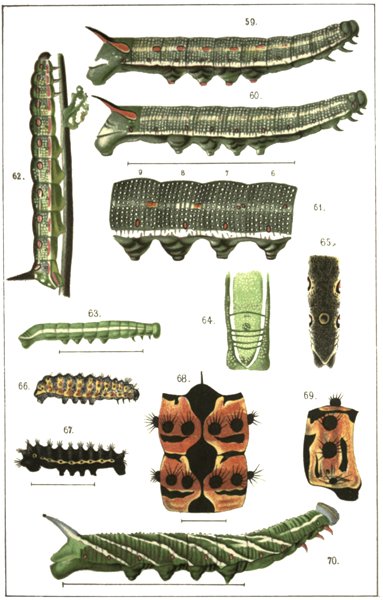
the other species of the genus (Fig. 60), so that
these spots are thus repetitions of the single ring-spot—a
fact which must appear of the greatest
interest in connection with the development of the
markings throughout the whole genus. But this
is not all, for again in other specimens, these red
spots stand on a large yellow “mirror,” and in one
individual (Fig. 59), they had become developed
into well-formed ring-spots through the addition of
a black border. We have thus presented to us in
one and the same stage of a species, the complete
development of ring-spots from a subdorsal line.
These facts acquire a still greater interest, as showing
how new elements of marking are produced.
The spots on the subdorsal line decrease from the
posterior to the anterior segments, so that they
must undoubtedly be regarded as a repetition or
transference of the ring-spot previously developed
on the eleventh segment. I will now proceed to
furnish proofs in support of this statement.
I have never met with any specimens having
ring-spots on all the segments—in the most prominent
instances these spots were present on segments
10–5. This was the case in three out of
the twenty-eight caterpillars minutely examined.
On all these segments, however, the ring-spots
were not equally developed, but increased in perfection
from the posterior towards the anterior
segments. In the larva represented in Fig. 59 for
example, there is a completely developed ring-spot
on segment 10, which, although possessing but a
feeble black “ground-area,” is still distinctly bordered;
on segment 9 this border is less sharp,
and not so dark, and it is still less sharp and
much lighter on segments 8 and 7, whilst
it has completely disappeared from segment 6,
the yellow “mirror” having at the same time lost
in size. On segment 5, only two small contiguous
reddish spots, the first rudiments of the
nucleus,94 can be recognized on close inspection.
Specimens in which the spots extend from the
eleventh to the seventh segment are of more
frequent occurrence, five having been found among
the twenty-eight. In these the spots diminish
anteriorly in size, perfection, and intensity of colour.
Still more frequently (in eleven specimens) are the
ring-spots or their rudiments restricted to the
tenth and ninth segments, the spot on the latter
being without exception less developed than that
on the former segment.
An anteriorly progressing formation of ring-spots
thus undoubtedly occurs, the spots generally
diminishing in perfection very suddenly towards
the front segments; and specimens, such as that
represented in Fig. 60, Pl. VII., in which traces of
ring-spots are to be seen on all the segments
from the tenth to the fifth, are of rare occurrence.
From what elements of marking are these
secondary ring-spots resulting from transference
developed? They do not, as in the case of the
primary eye-spots of the Chærocampinæ, originate
in the separation of one portion of the subdorsal
line, and the subsequent formation of this detached
spot into a “mirror;” but they arise from the formation
of a nucleus, first one and then two of the
shagreen-dots on the subdorsal line acquiring a
yellowish or reddish colour (Fig. 61, Pl. VII., segments
6 and 7). The ground on which these two
spots are situated then becomes yellow (Fig. 61,
Pl. VII., segment 8), and a more or less distinct
black border, having the form of two small crescents,
is afterwards formed. At a later period these two
crescents and also the two primary nuclei coalesce,
producing a ring-spot which, as in Fig. 61, Pl. VII.,
segment 9, can be distinctly resolved into two
portions.
It certainly cannot be denied that these facts
may also be theoretically interpreted in a reverse
sense. We might interpret the phenomena in this
case, as also in that of D. Zygophylli, as a gradual
disappearance from the front towards the hind
segments of ring-spots formerly present, a view
which could only be refuted by the ontogeny of
the species. I have not been fortunate enough to
procure eggs of D. Hippophaës, so that the younger
stages are unknown to me. Among my caterpillars,
however, there were two in the fourth
stage of development, but these did not show
ring-spots on all the segments, as we should expect
on the above view; on the contrary, no trace of
such spots could be seen on any of the segments
with the exception of the eleventh, on which
there was a ring-spot less perfectly developed than
in the last stage.
In this fourth stage the larva of D. Hippophaës
is of a lighter green (Fig. 58), the subdorsal
yellowish with sharp boundaries, and the infra-spiracular
line pure white, as in the next stage.
The shagreening is present, but none of the
shagreen-dots are red or reddish, and no trace of
a ring-spot can be detected on the subdorsal line
with the exception of that on the eleventh segment.
In this last position this line is somewhat widened,
and a long, diffused, rose-red spot can there be
recognized upon it (Fig. 58 A). The black “ground-area”
present in the fifth stage is as yet absent,
and the spot is not so sharply separated anteriorly
from the subdorsal line as it becomes later.
From these observations we might venture to
expect that in the third stage of Hippophaës, the
subdorsal line would also be free from this spot
on the eleventh segment, and it is possible that in
the second stage this line is itself absent.
The Genus Deilephila: Summary of Facts and
Conclusions.
Regarding only the adult larvæ of the species
of Deilephila, these represent in their five groups,
five stages in the phyletic development of the
genus; but if we also take into consideration the
developmental history, two more stages must be
added, viz., that in which the caterpillar possesses
no particular marking, as was found to be the case
in the first stage of the development of D. Euphorbiæ
and D. Dahlii; and a second stage with a subdorsal
line, but without any ring-spot formations.
Seven stages of phyletic development must therefore
be distinguished.
Stage 1.—No species with entire absence of
marking in the adult form now occurs.
Stage 2.—A subdorsal, accompanied by a spiracular
line, extends from the caudal horn to the
first segment. This also no longer forms the final
stage of the ontogeny, but is, however, undoubtedly
retained in the second stage of several
species (D. Vespertilio, Livornica, Lineata, and
perhaps also Galii).
Stage 3.—The subdorsal line bears a ring-spot
on the penultimate segment; the other markings
as in the last stage. D. Hippophaës only belongs
to this stage, a small number of specimens, however,
showing a transition to the following stage
by the transference of ring-spots from the posterior
to the anterior segments.
Stage 4.—Open ring-spots appear on the subdorsal
line on all the segments from the eleventh
to the first. D. Zygophylli and the North
American D. Lineata belong here.
Stage 5.—Closed ring-spots are situated on the
subdorsal line. Of the known species, only D.
Livornica concludes its development at this phyletic
stage.
Stage 6.—A single row of ring-spots replaces
the subdorsal line. D. Galii, Vespertilio, and
Mauritanica represent this stage at the conclusion
of their ontogeny.95
Stage 7.—A double row of ring-spots. Only
D. Dahlii, Euphorbiæ, and Nicæa attain to this
highest stage of Deilephila marking, the two first
species in the fourth stage, and Nicæa in the
third stage of its ontogeny.
Although our knowledge of the history of the
development of the individual species is still so
fragmentary, we may conclude with certainty that
the development of the markings has been uniform
throughout—that it has proceeded in the same
manner in all species. All the species appear to
be making for the same goal, and the question
thus arises whether there may not be an innate
force urging their phyletic development. The
rigorous examination of this conception must be
reserved for a later section. Here, as we are only
occupied essentially in establishing facts, it must
be remarked that retrogression has never been
observed. The young larval forms of a species
never show the markings of a later phyletic stage
than the older larval forms; the development takes
the same course in all species, only making a
greater advance in the same direction in some
than in others.
Thus, Nicæa and Euphorbiæ have advanced to
the seventh phyletic stage, Zygophylli and Hippophaës
only to the third, and some specimens of
Zygophylli to the fourth. But at whatever
phyletic stage the ontogeny of a species may
terminate, the young larval stages always display
the older phyletic stages. Thus, Galii in its last
ontogenetic stage reaches the sixth phyletic stage;
in its penultimate stage it reaches the fifth
phyletic stage; and in its third stage; the fourth
phyletic stage is represented, so that little imagination
is required to anticipate that in the second
stage the third or second phyletic stage would be
pictured.
If we tabulate the development of the various
species, indicating the ontogenetic stages by
Arabic numerals, and the stages of the phylogeny
which are reached in each stage of the ontogeny
by Roman numerals, we obtain a useful synopsis
of the series of developments, and, at the same
time, it shows how many gaps still remain to be
filled up in order to complete our knowledge even
of this small group of species.
Table of Development of the Species of Deilephila.
| Deilephila. |
Ontogeny
Stage 1. |
Ontogeny
Stage 2. |
Ontogeny
Stage 3. |
Ontogeny
Stage 4. |
Ontogeny
Stage 5. |
| 1. Hippophaës |
? |
? |
? |
III. |
III.-IV. |
| 2. Zygophylli |
? |
? |
? |
? |
III.-IV. |
| 3. Lineata |
? |
? |
? |
? |
IV. |
| 4. Livornica |
? |
? |
? |
IV. |
V. |
| 5. Galii |
? |
? |
IV. |
V. |
VI. |
| 6. Vespertilio |
? |
II. (?) |
IV. |
V. |
VI. |
| 7. Mauritanica |
? |
? |
? |
? |
VI. |
| 8. Dahlii |
I. |
? |
VI. |
VII. |
VII. |
| 9. Euphorbiæ |
I. |
V. |
VI. |
VII. |
VII. |
| 10. Nicæa |
? |
? |
VII. |
VII. |
VII. |
From this very incomplete table we perceive
that, in certain instances, the stages can be represented
as a continuous series of phyletic steps, as
in the case of D. Galii; that in others certain steps
may be omitted, as with D. Euphorbiæ, in which
grade I. of stage 1 is immediately followed by
grade V. in stage 2. In reality the gap caused
by this omission is still greater than would appear,
as grade V. is only indicated, and not actually
reached, the subdorsal not being present as a
sharply-defined line, but only as a faint stripe.
The suppression of phyletic steps increases with
the advancement in phyletic development. The
higher the step to which a species finally attains,
the greater is the tendency of the initial stages to
be compressed, or omitted altogether.
From what has thus far been seen with respect
to the development of D. Hippophaës, there may
be drawn what to me appears to be a very
important conclusion, viz. that the ring-spots
of Deilephila first originated on the segment
bearing the caudal horn, and were then gradually
transferred as secondary spots to the preceding
segments. Complete certainty would be given to
this conclusion by a knowledge of the young
forms of other phyletically retarded species, especially
those of the American D. Lineata, and
perhaps also those of Zygophylli and Livornica.
The few observations on the development of
D. Galii already recorded give support to this
view, since the absence of ring-spots on the three
front segments in the young caterpillar (one
instance), or their less perfect formation on these
segments (second instance), indicates a forward
transference of the spots.
If the foregoing view be accepted, there follows
from it a fundamental difference between the
development of the genera Chærocampa and
Deilephila. In the former the formation of the
eye-spots proceeds from a subdorsal line, but they
first appear on two of the front segments, and are
then transferred to the posterior segments. In
Deilephila, on the other hand, a single ring-spot
is formed on the penultimate segment bearing the
caudal horn, and this is repeated on the anterior
segments by secondary transference. With respect
to the origination of the ring-spot also, there is a
distinction between this genus and Chærocampa,
inasmuch as the first step towards the eye-formation
in the latter consists in the separation of
a curved portion of the subdorsal line, whilst in
Deilephila the nuclear spot first seems to originate
and the separation of the mirror-spot from the
subdorsal line appears to occur secondarily. It is
difficult here to draw further conclusions, since the
first appearance of the primary ring-spot has not
yet been observed, and no more certain inference
respecting the history of the formation of the
primary ring-spots can be drawn from the manner
in which the secondary ring-spots are formed.
Because in Hippophaës the formation of the
secondary ring-spots begins with the red coloration
of one or two shagreen-dots, it does not follow
that the primary spot on the eleventh segment also
originated in this manner; and this is not without
importance when we are concerned with the causes
which underlie the formation of ring-spots. In
Chærocampa also, the formation of the primary
eye-spots appears to differ from that of the
secondary—in the latter the black “ground-area”
first appearing, and in the former the “mirror-spot.”
The secondary eye-spots certainly remain
rudimentary in this last genus, so that the
evidence in support of this conclusion is thus much
weakened; but it must be admitted that we are
here on ground still too uncertain to admit of
wider conclusions being based thereon.
As a final result of the investigation, we may
advance the opinion that the existing species of
the genus Deilephila have reached five different
phyletic stages, and that their very different
external appearance is explained by their different
phyletic ages; the appearance from these caterpillars
of moths so extremely similar, can otherwise
be scarcely understood.
It may appear almost unnecessary to bring
forward additional proofs in support of this interpretation
of the facts, but in a field where the
data are so scanty, no argument which can be
drawn from them should be considered as superfluous.
The variations which occasionally occur
in the larvæ, however, to a certain extent furnish
a proof of the correctness of the theoretical interpretation
offered.
When, in the ontogeny of these species, we
actually see before us a series of stages of phyletic
development, we must admit that ordinary reversion
may occur, causing an adult caterpillar to
show the characters of the young. Forms
reverting to an earlier phyletic stage must, on the
whole, occur but seldom, as this stage is removed
further back in the ontogeny. Thus, indications
of the subdorsal line must occur but rarely in the
adult larvæ of Euphorbiæ, and still less frequently
in Nicæa, whilst they must be expected to be of
more common occurrence in Vespertilio, and also,
as has already been seen, in Dahlii. In this last
species, as also in Vespertilio, the completely-developed
subdorsal line is still present in the
third stage, whilst it is possessed by Euphorbiæ
only in the second stage, and then in a rudimentary
condition.
The state of affairs may in fact be thus described:
Among several hundred adult larvæ of
Dahlii found in Sardinia by Dr. Staudinger, there
were some which did not actually possess a distinct
subdorsal line, but in place thereof, and as its
last indication, a feeble light stripe. One of Dr.
Staudinger’s caterpillars showed also a distinct
line between the closed eye-spots. In the last
stage of Vespertilio this line appears still more
frequently, whilst in Euphorbiæ it is extremely
rare, and when present it only appears as a faint
indication. This is the case with one of the
specimens figured in Hübner’s work as an “aberration,”
and also with one in Dr. Staudinger’s
collection. Of Nicæa I have at most seen only
eight specimens, none of which showed any trace
of the long-vanished subdorsal line.
It must be expected that any ontogenetic stage
would most readily revert to the preceding phyletic
stage, so that characters present in the preceding
stage are consequently those which would most
commonly arise by reversion. This postulate of
the theory also finds confirmation in the facts.
Caterpillars which, when full grown, belong to the
seventh phyletic stage, e.g. D. Euphorbiæ, not
unfrequently show variations corresponding to the
sixth stage, i.e. only one instead of two rows of
ring-spots—the upper and first-appearing series.
On the other hand, forms reverting to the fifth
phyletic stage (ring-spots with connecting subdorsal
line) occur but very rarely. I have never
met with such cases in adult living caterpillars of
D. Euphorbiæ, although in one instance such a
larva was found in the fourth ontogenetic stage;
but the strikingly dark, brownish subdorsal line
which connected the otherwise perfectly developed
ring-spots, completely disappeared in the fifth stage
of the ontogeny. Those larvæ which, in the adult
state, belong to the sixth phyletic stage, not
unfrequently show the characters of the fifth stage
more or less developed, as, for example, D. Vespertilio.96
THE GENUS SMERINTHUS, LATREILLE.
The caterpillars of this genus are very similar
in appearance, and all possess extremely simple
markings. The occurrence of numerous stages of
development of these markings is thus excluded,
and the study of the ontogeny therefore promised
to furnish less information concerning the phyletic
development of the genus than in the case of the
preceding genera. This investigation has nevertheless
also yielded interesting results, and the
facts here recorded will be found of value in likewise
throwing light on the causes which have
produced the markings of caterpillars.
I shall commence, as in former cases, with the
developmental history. I have easily been able to
obtain fertile eggs of all the species of Smerinthus
known to me. Impregnated females laid large
numbers of eggs in confinement, and also bred
females of the commoner species can readily be
made to copulate, when pinned, and exposed in a
suitable place in the open air. A male soon
appears under these circumstances, and copulation
is effected as readily as though the insect were not
fastened in the way indicated.
Smerinthus Tiliæ, Linn.97
The light green eggs are nearly spherical, and
after fourteen days (beginning of July) the young
larvæ emerge. These are also of a light green
colour, and are conspicuous for the great length
of the caudal horn, which is nearly half as long as
the body. This horn is likewise of a light green
at first, but becomes dark violet in the course of
an hour. No trace of any markings can be
detected at this stage.
As soon as the caterpillars are hatched they
commence to nibble the empty egg shells; then
they run about with great activity, and after
several hours take up their position on the largest
vein on the under side of the lime leaves, where
they remain for a long period. In this situation
they have the same form and colour as the leaf-vein,
and are very difficult to discover, which
would not be the case if they reposed obliquely or
transversely to the vein. In about 4–5 days
the caterpillars undergo their first moult, and
enter upon the second stage. On each side of
the segments 11–4, there now appear seven
oblique whitish stripes on a somewhat darker
green ground; these slope in the direction of the
caudal horn. Owing to the transparency of the
skin, a dark green dorsal line appears in the position
of the underlying dorsal vessel, the green
contents of the alimentary canal being distinctly
visible through the absence of adipose matter in
the tissues. The larvæ possess also a fine whitish
subdorsal line, which extends from the horn to the
head. The horn at this stage becomes black with
a yellowish red base.
In the third stage, which occurs after six or seven
days, the oblique stripes appear darker, and the
subdorsal line disappears.
Fourth Stage.
After another period of 4–5 days the third
moult takes place, and there now commences
a dimorphism which will perhaps be better designated
as variability, since the two extremes are
connected by transitional forms. The majority of
the larvæ have, as in the preceding stage, pure
white oblique stripes, but many of them possess a
blood-red spot on the anterior side of the stripes,
this spot showing all gradations in size and depth
of colour between maximum development and a
mere trace. Special interest attaches to these
spots, as they are the first rudiments of the coloured
border of the oblique stripes which occurs in so
many Sphinx caterpillars.
In the fifth stage—the last of the larval development—the
red spots become more strongly
pronounced. Among eighty caterpillars from one
brood there were about twenty without any red
whilst the remainder were ornamented with more
or less vivid blood-red spots, often large and irregular
in form. In some specimens the spots had
become drawn out into lines,98 forming a coloured
edge to the oblique white stripes, similar to that
possessed by the larva of Sphinx Ligustri. The
caterpillar is thus represented in many figures, but
generally the coloured stripe is made too regular,
as in reality it is always irregularly defined above,
and never so sharp and even as in Sphinx
Ligustri. The character is here obviously not yet
perfected, but is still in a state of development.
Smerinthus Populi, Linn.
From green spherical eggs there emerged larvæ
6.5 millimeters in length without any markings.
They were of a light greenish-white, the large head
and long caudal horn being of the same colour.
The posterior boundary of the segments appears
as a light shining ring (Pl. VI. Fig. 55).
The characteristic markings of the genus appear
on the following day without the occurrence of any
moult: seven oblique white stripes arise from near
the dorsal line, and extend along the sides in a
direction parallel to that of the horn. On the
three front segments they are represented only by
three small white spots (Fig. 56). The caterpillar
likewise possesses a marking of which the
adult species of the genus retain only a trace,
viz., a well-developed, pure white subdorsal line,
which is crossed by the six anterior oblique stripes,
and uniting with the upper part of the seventh
extends to the caudal horn.
I long believed that the markings described were
first acquired in the second stage, as I was possessed
with the generally accepted idea that the changes
of form and colour in insects could only occur at
the period of ecdysis. I at first thought that the
moult had escaped my notice, and I was only
undeceived by close observation of individual
specimens.
Second Stage.
The first moult took place after five days, the
larvæ being 1.4 centimeters in length. Only unimportant
changes of marking are connected therewith.
The subdorsal line loses much in thickness
and definition, and the first and last of the oblique
stripes become considerably broader than the
intermediate ones (Fig. 57). The green ground
colour and also the stripes acquire a yellowish
hue.
On the other hand, there occur changes in form.
The head, which was at first rounded, becomes of
the characteristic triangular shape, with the apex
upwards, common to all the species of the genus,
and at the same time acquires two white lines,
which unite above at the apex of the angle. The
shagreening of the skin now also takes place,
and the red spot at the base of the horn is formed.
There appears to be at this stage a general
tendency for the suffusion of red, the thoracic legs
also becoming of this colour.
Third Stage.
The second moult occurs after six or eight days,
the marking only changing to the extent of the
subdorsal line becoming still more indistinct. This
line can now only be distinctly recognized on the
three front segments in a few individuals, whilst
in the majority it is completely absent. Sometimes
the ferruginous red spots on the oblique
stripes now appear, but this character is not completely
developed till the fifth stage. Out of about
ninety bred specimens in which I followed the
entire development, only one possessed such spots,
and these were situated on both sides of the sixth
segment.
Fourth Stage.
The third moult, which takes place after another
period of six days, is not associated with any change
of marking.
In this stage also I observed in one specimen
(not the one just mentioned) the ferruginous spots,
and again only on the sixth segment. On account
of the theoretical conclusions which may be drawn
from this localization of the spots—supposing it to
be of general occurrence—it becomes of importance
to institute observations with different broods, so
as to investigate their first appearance, frequency,
and local limitation. It appears to me very probable
that, with respect to frequency and time of
appearance, there would be great differences, since,
in the last stage, it is just this character which shows
a great variability. It would be more remarkable
if it should be established that the first appearance
of the spots was always limited to a certain segment;
and there would then be a great analogy
with the first appearance of the eye-spots in
Chærocampa and the ring-spots in Deilephila.
Fifth Stage.
The adult caterpillar does not differ in marking
to any considerable extent from the preceding
stages. The first and last stripes do not appear
larger than the intermediate ones, as the latter
now increase in size. Many specimens were
entirely without red spots; in others they were
present, but were small and inconspicuous, whilst
in others again there were two spots, one above
the other, of a vivid ferruginous red, these
coalescing in some cases, and thus forming one
spot of a considerable size. I have never seen
these spots formed into a regular, linear, coloured
border to the white oblique stripes—as occasionally
happens in Tiliæ—either in living specimens,
blown larvæ, or in figures.
Smerinthus Ocellatus, Linn.
The green eggs much resemble those of Populi,
as also do the newly hatched caterpillars, which, as
in the case of this last species, are entirely without
markings. As with Populi, the markings are
formed in the course of the first stage, and are
distinctly visible before the first moult. The long
caudal horn is of a red colour.
After two to three days the caterpillars moult,
their length then being one centimeter; the seven
beautiful oblique white stripes, and the fine white
subdorsal line, are more strongly pronounced, the
latter becoming broader in front. They differ
from Populi in having the oblique stripes united
in the dorsal line.
The second moult occurs after another three
days, and brings no important change; only the
fine subdorsal line becoming somewhat fainter.
Neither is the third moult, which takes place four
days later, associated with the appearance of any
essentially new character. The oblique stripes
remain as before, but their upper portions now
stand on a somewhat darker green ground-colour,
whilst the subdorsal line vanishes, leaving distinct
traces only on the three or four front segments.
The fourth moult follows after a period of seven
days, and my bred larvæ underwent scarcely any
alteration in marking. Only small differences in
coloration became perceptible in the head and
horn, these changing to bluish. Specimens occur,
although but rarely, which show in this last stage
red spots in the vicinity of the oblique stripes, just
in the same manner as with Populi, in which
species, however, they occur more commonly. I
only once found an adult larva of Ocellatus
possessing reddish-brown spots above and below
the oblique stripes,99 exactly as in one of the
specimens figured by Rösel.100
In this stage also there remains almost always
on the three to six front segments, a more or
less distinct residue of the subdorsal, which extends
backwards from the head as a whitish line
intersecting the foremost oblique stripes. (Fig.
70, Pl. VII.)
Results of the Developmental History of Smerinthus
Tiliæ, Populi and Ocellatus.
From the meagre materials furnished by these
three obviously nearly related species, we may at
least conclude that, with respect to marking, three
stages of development can be distinguished:—(1)
Simple (green) coloration without marking;
(2) subdorsal lines crossed by seven pairs of oblique
stripes; (3) more or less complete absence of the
subdorsal lines, the oblique stripes remaining, and
showing a tendency to become edged with a
red border.
Which of the three species is the oldest I will
not attempt to decide. If we might venture to
form any conclusion from the frequency of the
red spots, Tiliæ would be the youngest, i.e., the
species which has made the farthest advance. But
this does not agree with the fact that the oblique
stripes appear somewhat later in this species.
Both these distinctions are, however, too unimportant
to enable us to build certain conclusions
on them. Neither does a comparison of the adult
larvæ with other species of Smerinthus furnish any
further information of importance.
Of the genus Smerinthus, Latr., thirty species
were catalogued by Gray,101 of which I am only acquainted
with the larvæ of eight (five European,
and three North American). None of these in the
last stage possess a complete subdorsal line together
with oblique stripes. Neither, on the other
hand, do any of them show a more advanced
stage of development in having the red spots constantly
formed into coloured border-stripes. We
must therefore admit that they have all reached
nearly the same stage of phyletic development.
On turning to the doubtfully placed genus Calymnia,
Boisduval, which is represented in Gray by
only one species, figured by Westwood102 as a
Smerinthus, we first meet with an older stage of
development of the genus.
The adult caterpillar of C. Panopus, from the
East Indies, possesses, in addition to the oblique
stripes, a completely developed subdorsal line,103
and thus corresponds to the first stage of S. Populi.
This species may possibly retain in its ontogeny
a stage in which the oblique stripes are also absent,
whilst the subdorsal line is present. From the early
disappearance of the subdorsal line in the species
of Smerinthus, we may venture to conclude that
this character appeared at an early stage of the
phylogeny, whilst the oblique stripes represent
a secondary form of marking, as shall be further
established subsequently.104
THE GENUS MACROGLOSSA, OCHSENHEIMER.
The adult larvæ of five species are known, and
to these I can now add a sixth. In Gray the
genus contains twenty-six species.105 I cannot find
any figures or descriptions of the young stages of
these caterpillars, and I have myself only observed
the complete ontogeny of one species.
By placing a captured female M. Stellatarum in
a capacious breeding-cage, in the open air, I was
enabled to procure eggs. The moth hovered
about over the flowers, and laid its small, grass-green,
spherical eggs (partly when on the wing),
singly, on the leaves, buds, and stalks of Galium
Mollugo. Altogether 130 were obtained in three
days.106
First Stage.
After about eight days the caterpillars emerge.
They are only two millimeters in length, and are at
first yellowish, but soon become green, set with small
single bristles, and they possess a short greenish
caudal horn, which afterwards becomes black.
The head is greenish-yellow. The young larvæ
are entirely destitute of marking. (Pl. III.,
Fig. 1).
Second Stage.
The first moult takes place after four days, the
caterpillar now acquiring the marking which it
essentially retains to pupation.
Fine white subdorsal and spiracular lines appear,
and at the same time a dark green dorsal
line, which, however, does not arise from the deposition
of pigment, as is generally the case, but
from a division in the folds of the fatty tissue along
this position. (Fig. 2, Pl. III.)
The colour is now dirty green in all specimens,
the skin being finely shagreened.
Third Stage.
The second moult, occurring after another
period of four days, does not bring any change of
marking, the colour only becoming somewhat
darker. Length, twelve millimeters.
Fourth Stage.
The third moult (after another four days) likewise
brings only a change of colouring, which is of
such a nature that the caterpillar becomes dimorphic.
At the same time that peculiar roughening
of the skin takes place which, in the case of Chærocampa,
was designated as “shagreening.” The
colour is now light grass-green in some specimens,
and dark green in others; in these last the subdorsal
line is edged above with dark brown, and
the spiracles are also of this colour. Length,
seventeen millimeters.
Fifth Stage.
Four days later, after the fourth ecdysis, the
dimorphism becomes a polymorphism. Five chief
types can be distinguished:—
Variety I.—Light green (Fig. 7, Pl. III.); dorsal
line, blackish-green, strongly marked; subdorsal
line broad, pure white, edged above with dark
green; spiracular line, chrome-yellow; horn,
black, with yellow tip and blue sides. Spiracles,
blackish-brown, with narrow yellow border; legs,
and extremities of prolegs, vermilion-red.
Variety II.—Blackish-brown (Fig. 6, Pl. III.);
head and prothorax, yellowish-brown; markings
the same as above.
Variety III.—Blackish-green or greenish-black
(Figs. 10 and 11, Pl. III.); subdorsal line with
blackish-green border above, gradually passing into
a light green ground-colour; spiracular line, chrome-yellow;
head and prothorax, greenish-yellow.
Variety IV.—Light green (Figs. 4 and 12, Pl.
III.); dorsal line quite feeble; subdorsal broad,
only faintly edged with dark green; subspiracular
line, faint yellowish; head and prothorax,
green.
Variety V.—Brownish-violet (Fig. 8, Pl. III.);
the black dorsal line on a reddish ground either
narrow or broad.
From these five varieties we see that the different
types do not stand immediately next to
one another; they are, in fact, connected by
numerous transitional forms, the ground-colour
varying greatly, being dark or light, yellowish or
bluish. (Compare Figs. 4, 5, 7, and 12.) The
markings remain the same in all, but may be of
very different intensities. The dorsal line is often
only very feebly indicated, and the subdorsal line
is frequently but faintly edged; the latter is also
sometimes deep black above and bordered rather
darkly beneath, the sides then being of a dark
green, often with blackish dots on the yellow
spiracular line (Fig. 5, Pl. III.), this likewise
being frequently edged with black. Only the
horn and legs are alike in all forms. The green
ground-colour passes into blackish-green, greenish
or brownish-black, and again, from reddish-brown
to lilac (Fig. 3), this last being the rarest
colour.
The designation “polymorphism” may here
appear very inapplicable, since we have no sharply
distinct forms, but five very variable ground-colours
connected by numerous intermediate modes
of coloration. Should, however, the term “variability”
be suggested, I am in possession of an
observation which tends to show that the different
colours have to a certain extent become
fixed. I found a brown caterpillar, the five front
segments of which were light green on the left
side, and the fifth segment brown and green
mixed (Fig. 9, Pl. III.). Such parti-coloration can
evidently only appear where we have contending
characters which cannot become combined; just as
in the case of hermaphrodite bees, where one half
of a segment is male and the other half female,
the two characters never becoming fused so as to
produce a truly intermediate form.107 From this
observation, I conclude that some of the chief
varieties of Stellatarum have already become
so far removed from one another that they must
be regarded as intermediate fixed forms, the colours
of which no longer become fused together when
they occur in one individual, but are developed
in adjacent regions. Other facts agree with this
conclusion. Thus, among the 140 adult larvæ
which I bred from the batch of eggs above
mentioned, the transition forms were much in
the minority. There were forty-nine green and
sixty-three brown caterpillars, whilst only twenty-eight
were more or less transitional.
On these grounds I designate the phenomenon
as “polymorphism,” although it may not yet have
reached, as such, its sharpest limits. This would
be brought about by the elimination of the intermediate
forms.108
Immediately before pupation, all the caterpillars,
both green and brown, acquire a lilac coloration.
The fifth stage lasts seven days, and the whole
larval development twenty-three days, the period
from the deposition of the eggs to the appearance
of the moth being only thirty-one days.
I have treated of the polymorphism of Stellatarum
in detail, not only because it has hitherto
remained unknown, and an analysis of such cases
has been completely ignored,109 but more particularly
because, it appears to me, that important
conclusions can be drawn therefrom. Moreover,
such an extreme multiplicity of forms is interesting,
since, so far as I know, polymorphism to this
extent has not been observed in any insect.
The theoretical bearing of this polymorphism
will be treated of subsequently. It is not in any
way connected with a more advanced development
of the markings, since M. Stellatarum shows in
this respect a very low state of development. This
species displays only two stages:—(1), complete
absence of all markings; and (2), a simple subdorsal,
with dorsal and spiracular lines. We must therefore
admit that the phyletic development of the
markings has for a long time remained at a standstill,
or, what expresses the same thing, that the
marking which the adult larva now possesses is
extremely old.
In order to complete my observations on M.
Stellatarum, I now add some remarks on the
pupa, the colour variations of which it appeared of
importance to investigate, owing to the extraordinary
variability of the caterpillar. The pupa varies
but very slightly; the ochreous yellow ground-colour
sometimes passes into reddish, and sometimes
into greenish; the rather complicated blackish-brown
marking of streaky lines is very constant,
especially on the wing portions, being at
most only more or less strongly pronounced. The
minute colour variations of the pupa therefore have
no connection with the colour of the caterpillar,
both green and brown larvæ furnishing sometimes
reddish-yellow and sometimes greenish-yellow
pupæ.
The comparison of M. Stellatarum with the
other known species of the genus, brings scarcely
any addition to our knowledge of the phyletic
development. Thus, the two European species of
which the caterpillars are known, viz. M. Fuciformis
and Bombyliformis,110 show essentially the same
markings as Stellatarum, the chief element being
a well-developed subdorsal line. The Indian M.
Gilia, Herrich-Schäf., possesses also this line,111 and,
together with the East Indian M. Corythus, Walk.,112
has oblique stripes in addition; the stripes do not,
however, cross this line, but commence underneath
it, and probably originated at a later period than the
subdorsal line. Should this be the case, we must
regard M. Corythus as representing a later phyletic
stage. According to Duponchel’s figures, in both
M. Fuciformis and Bombyliformis small oblique
stripes (red) occur near the spiracles, but these
have nothing to do with the oblique stripes of M.
Gilia just mentioned, as they run in a contrary
direction. Of the two European species, I have
only seen the living caterpillar of Fuciformis, and
this possessed no oblique stripes.
To these five species I am now enabled to add
a sixth, viz. Macroglossa Croatica,113 a species
inhabiting Asia Minor and Eastern Europe, of
which a specimen and notice were kindly forwarded
to me by Dr. Staudinger. The adult caterpillar
much resembles that of M. Stellatarum in form and
marking, but the subdorsal line appears much
less distinctly defined, and the dorsal and spiracular
lines seem to be entirely absent. The colour is
generally green, but varies to red, and the subdorsal
is more distinct and sharper in the young
than in the adult larva. The markings of this
species do not therefore in any way surpass those
of Stellatarum, but are, on the contrary, much
simpler.114
THE GENUS PTEROGON, BOISD.115
Although I am acquainted with only a small
portion of the developmental history of a single
species of this genus, I will here proceed to record
this fragment, since, taken in connection with two
other species, it appears to me sufficient to determine,
at least broadly, the direction of development
which this genus has taken.
Pterogon Œnotheræ, Fabr.
The adult larva, as made known by many, and
for the most part good figures, has very complicated
markings, which do not seem derivable from any
of the elements of marking in the Sphingidæ
hitherto considered. I was therefore much surprised
at finding a young caterpillar of this
species, only twelve millimeters in length, of
a light green colour, without any trace of the
subsequent latticed marking, and with a broad
white subdorsal line extending along all the twelve
segments. (Pl. VII., Fig. 63). Judging from the
size and subsequent development, this caterpillar
was probably in the third stage.
The same colouring and marking remained
during the following (fourth) stage; but in the
position occupied by the caudal horn in other
Sphingidæ, there could now be observed the rudiment
of a future ocellus in the form of a round
yellowish spot (Pl. VII., Fig. 64). The subdorsal
line disappears suddenly in the fifth stage, when
the larva becomes dark green (rarely) or blackish-brown;
the latticed marking and the small oblique
stripes are also acquired, together with the beautifully
developed eye-spots, consisting of a yellow
mirror with black nucleus and ground-area (Pl.
VII., Fig. 65).
The North American Pterogon Gauræ and P.
Abboti116 also show markings precisely similar to
those of this European species in the adult state;
but in the two former the markings are of special
interest as indicating the manner in which the
primary Sphinx-marking has become transformed
into that of the apparently totally different adult
P. Œnotheræ. P. Gauræ is green, with a complicated
latticed marking, which closer observation
shows to arise from the dorsal line being resolved
into small black dots, whilst the subdorsal line is
broken up into black, white-bordered triangles.
This caterpillar therefore gives fresh support to
the remarkable phenomenon that the animals as
well as the plants of North America are phyletically
older than the European fauna and flora, a
view which also appeared similarly confirmed by
Deilephila Lineata, the representative form of
D. Livornica. In entire accordance with this is
the fact that the larva of P. Gauræ is without
the eye-spot on the eleventh segment, and instead
thereof still shows the original although small
caudal horn. The perfect insect also resembles
our P. Œnotheræ in colour and marking, but not
in the form of the wings.
That the caterpillars of the genus Pterogon
originally possessed the caudal horn we learn
from P. Gorgoniades, Hübn.,117 a species now
inhabiting south-east Russia, and for a knowledge
of which I am indebted to Dr. Staudinger’s collection.
There are in this about eight blown specimens,
from 3.7 to 3.9 centimeters in length, which
show a marking, sometimes on a red and sometimes
on a green ground, which unites this species
with the young form of P. Œnotheræ, viz., a broad
white subdorsal line, extending from the small
caudal horn to the head. In addition to this, however,
the caterpillar possesses an extraordinarily
broad white red-bordered infra-spiracular line, a
fine white dorsal stripe, and a similar line between
the subdorsal and spiracular, i.e. a supra-spiracular
line.
The caterpillars in Staudinger’s collection, notwithstanding
their small size, all belong to the last
stage, as the moth itself does not measure more
than 2.6 centimeters in expanse, and is therefore
among the smallest of the known Sphingidæ.
This species has therefore in the adult condition a
marking very similar to that of Œnotheræ when
young—it bears to Œnotheræ the same relationship
that Deilephila Hippophaës does to D. Euphorbiæ,
only in the present case the interval between the
two species is greater. Gorgoniades is obviously
a phyletically older species, as we perceive from
the marking and from the possession of a horn.
We certainly do not yet know whether Œnotheræ
possesses a horn in its earliest stages, although in
all probability it does so; in any case the ancestor
of Œnotheræ had a horn, since the closely allied
P. Gauræ now possesses one.
We thus see that also in the genus Pterogon
the marking of the caterpillars commences with a
longitudinal line formed from the subdorsal; an
infra-spiracular or also a supra-spiracular line
(Gorgoniades) being added. A latticed marking is
developed from the linear marking by the breaking
up of the latter into spots or small patches,
which finally (in Œnotheræ) become completely
independent, their connection with the linear marking
being no longer directly perceptible.
THE GENUS SPHINX, LINN.
Of this genus (in the narrow sense employed
by Gray) I have only been able, in spite of all
trouble, to obtain fertile eggs of one species.
The females cannot be induced to lay in confinement,
and eggs can only be obtained by chance.
I long searched in vain the literature of this
subject for some account of the young stages of
these caterpillars, and at length found, in a note to
Rösel’s work, an observation of Kleemann’s on the
young forms of Sphinx Ligustri, which, although
far from complete, throws light on certain points.
From a female of S. Ligustri Kleemann obtained
400 fertile eggs. The caterpillars on emerging
are “at first entirely light yellowish-green, but
become greener after feeding on the fresh leaves;”
the horn is also at first light green, and then
becomes “darker.” The young larvæ spin webs,
by which they fasten themselves to the leaves of
their food-plant (this, so far as I know, has not
been observed in any species of Sphingidæ).
They moult four times, the border round the head
and the purple stripes appearing after the third
moult, these stripes “having previously been
entirely white.” The ecdyses follow at intervals
of about six days, increasing to about ten days
after the fourth moult.118
From this short account we gather that in the
third stage the marking consists of seven oblique
white stripes, which acquire coloured edges in the
fourth stage, a fact which I have myself frequently
observed. On the most important point Kleemann’s
observations unfortunately give no information—the
presence or absence of a subdorsal
line in the youngest stages. That he does not
mention this character, can in no way be considered
as a proof of its actual absence. I am rather
inclined to believe that it is present in the first, and
perhaps also in the second stage. There occur,
however, species of the genus Sphinx (sensû strictiori)
which possess a subdorsal line when young,
as I think may be certainly inferred from the fact
that the remains of such a line are present in the
adult larva of S. Convolvuli.
This conclusion becomes still more certain on
comparing the markings with those of a nearly
allied genus; without such comparison the separation
of the genus Macrosila, Boisd., from Sphinx is
scarcely justifiable. If to these two genera we
add Dolba, Walk., and Acherontia, Ochs., we must
be principally struck with the great similarity in
the markings, which often reaches to such an
extent that the differences between two species
consist entirely in small shades of colour, while the
divergence of the moths is far greater.
Of the genera mentioned, I am acquainted altogether
with fourteen species of caterpillars:—Macrosila
Hasdrubal, Rustica,119 and Cingulata;119
Sphinx Convolvuli, Ligustri, Carolina,119 Quinquemaculata,119
Drupiferarum,119 Kalmiæ,119 and
Gordius;119 Dolba Hylæus;119 Acherontia Atropos,
Styx,120 and Satanas.120 With one exception all
these caterpillars possess oblique stripes of the
nature of those of the Smerinthus larvæ, and most of
them are without any trace of a subdorsal line; one
species—the North American M. Cingulata—has
a completely developed subdorsal; and the typical
European species, S. Convolvuli, has a rudimentary
subdorsal line. The ground-colour in most of
these species is of the same green as that of the
leaves of their food-plants; some are brown, i.e.
earth-coloured, and in these the markings do not
appear so prominently; others again possess very
striking colours (A. Atropos), the oblique stripes
in these cases being very vivid. Only M. Hasdrubal121
separates itself completely from this
system of classification, since this species is deep
black with narrow yellow rings, the horn and last
segment being red.
The large and most striking caterpillar of M.
Hasdrubal is the same which Wallace has made
use of for his theory of the brilliant colours of
caterpillars. The explanation of the origin of
this widely divergent mode of marking could only
be furnished by the ontogeny, in which one or
another of the older phyletic stages will certainly
have been preserved.
Strictly speaking the same should be said of
the other species—nevertheless their comparison
with the so similarly marked Smerinthinæ, together
with the circumstance that in certain species
a subdorsal line can be traced, makes it appear
correct to suppose that here also the subdorsal
was the primary marking, this line being subsequently
entirely replaced by the oblique stripes.
The Sphinginæ would therefore be a younger
group than the Smerinthinæ, a conclusion which
is borne out by the fact that in the former the
oblique stripes have reached a higher development,
being always of two, and sometimes even of three
colours (S. Drupiferarum, white, red, black), whilst
in the species of Smerinthus they only occasionally
possess uniformly coloured borders.
THE GENUS ANCERYX, BOISD.
Although this genus is not admitted into most
of the European catalogues—the solitary European
species representing it being referred to the genus
Sphinx, Linn.122—its separation from Sphinx
appears to me to be justified, not because of the
striking differences presented by the moths, but
because the caterpillars, judging from the little
we know of them, likewise show a similar degree
of difference.
I have frequently succeeded in obtaining fertile
eggs of Anceryx Pinastri and I will now give the
developmental history of this caterpillar, which has
already been figured with great accuracy in Ratzeburg’s
excellent work on forest insects. Rösel
was acquainted with the fact that the “pine moth”
laid its eggs singly on the needles of the pine in
June and July, and he described them as “yellowish,
shining, oval, and of the size of a millet seed.”
On emerging, the caterpillars are six millimeters
in length, of a light yellow colour, the head shining
black with a yellow clypeus. The caudal horn,
which is forked at the tip, is also at first yellowish,
but soon becomes black. No particular marking
is as yet present, but a reddish stripe extends
along the region of the dorsal vessel, and the
course of the spiracles is also marked by an orange-red
line. (Fig. 53, A & B, Pl. VI.)
As soon as the young larvæ are filled with food
they acquire a greenish streak. The first moult
occurs after four days, and immediately after this
there is still an absence of distinct markings, with
the exception of a greenish-white spiracular line.
In the course of some hours, however, the original
light green ground-colour becomes darker, and at
the same time a sharp, greenish-white subdorsal
line appears, together with a parallel line extending
above the spiracles, which, in Pterogon Gorgoniades,
has already been designated as the
“supra-spiracular.” The dorsal line is absent:
the head is light green, with two narrow blackish-brown
lines surrounding the clypeus; the horn
and thoracic legs are black; claspers, reddish
green; length, twelve to thirteen millimeters.
(Fig. 54.)
Third Stage.
After another period of four days the second
moult occurs, neither colour nor marking being
thereby affected. Only the horn, now no longer
forked, becomes brownish with a black tip. The
young caterpillars are now, as before, admirably
adapted to the pine needles, on which they feed
by day, and from which they can only be distinguished
with difficulty.
Fourth Stage.
The third moult also brings no essential change.
The ground-colour and marking remain the same,
only the spiracles, which were formerly dull yellowish,
are now of a vivid brick-red. The horn becomes
yellowish-red at the base.
Fifth Stage.
The marking is only completely changed in the
fifth and last stage. A broad reddish-brown dorsal
line replaces the subdorsal, more or less completely.
The supra-spiracular line also becomes broken up
into numerous short lengths, whilst the green
ground-colour in some specimens becomes more or
less replaced by a brownish shade extending from
the back to the sides. Horn, black; the upper
part of the first segment with a corneous plate,
similar to that of the Deilephila larvæ.
This stage is very variable, as shown by the
figures in various works. The variations arise on
the one hand from the struggle between the green
ground-colour and the reddish-brown extending
from above, and, on the other hand, from a more
or less complete disappearance of the associated
longitudinal lines. The latter are sometimes completely
retained, this being the case in a caterpillar
figured by Hübner (Sphinges, III., Legitimæ C, b),
where both the subdorsal and supra-spiracular lines
are continuous from segment 11 to segment 1,
an instance which may perhaps be regarded as a
reversion to the primary form.
The entire change of the marking from the
fourth to the fifth stage depends upon the fact that
the young larvæ resemble the needles of the pine,
whilst the adults are adapted to the branches. I
shall return to this later.
The ontogeny of A. Pinastri makes us acquainted
with three different forms of marking:
(1) simple coloration without marking; (2) a
marking composed of three pairs of parallel
longitudinal lines; (3) a complicated marking,
arising from the breaking up of the last and the
addition of a darker dorsal line.
Of the fourteen species placed by Gray in the
genus Anceryx, I find, in addition to the one
described, notices of only two caterpillars:—
A. Coniferarum,123 a North American species,
lives on Pinus Palustris, and was figured by Abbot
and Smith. Colour and marking very similar to
A. Pinastri.
A. Ello, Linn.,124 according to the authority of
Mérian, is described by Clemens125 as dark brown,
“with a white dorsal line, and irregular white spots
on the sides.” It lives on a “species of Psidium
or Guava.”
Most of the species of Anceryx appear to live
on Coniferæ, to which they show a general and
decided adaptation. In the absence of decisive
information, I partly infer this from the names, as
Anceryx Juniperi (Africa). It has long been
known that in our A. Pinastri the mixture of
brown and fir-green, interspersed with conspicuous
irregular light yellowish and white spots, causes
the adult larva to present a very perfect adaptation
to its environment. Of this caterpillar Rösel
states:—“After eating it remains motionless, and
is then difficult to see, because it is of the same
colour as its food, since its brown dorsal line
has almost the colour of the pine twigs; and who
is not familiar with the fact that beneath the green
needles there is also much yellow to be found?”
This adaptation to the needles and twigs
obviously explains why this caterpillar in the adult
condition is so far removed from those of the
genus Sphinx, while the moths are so nearly
related that they were only separated as a distinct
genus when we became acquainted with a large
number of species.