Like a poet, hidden
In the light of thought,
Singing hymns unbidden,
Till the world is wrought
To sympathy with hopes and fears it heeded not.
[78]
[79]
We are more accustomed in literature than in music
to find immortality conferred on artists whose total
quantity of production is slight or incomplete.
Sappho lives in a few lyrics, Villon in a few ballades,
Persius is a great satirist with some six hundred lines
of verse, Merimée a great novelist with a slender
handful of short stories. In all such cases we accept
perfection of finish, individuality of note, concentration
of effort, as more than compensating for the
narrow limits within which the writer has thought
fit to be confined: and we even impute it as a virtue
that he has not changed the gold of his thought into
the more diffuse silver of a meaner standard. But in
music, as a rule, our judgment is affected by other
considerations. For some reason the composer has
generally been more lavish than his brother artists:
he has worked more rapidly, perhaps more continuously,
and has gained, in proportion, a larger abundance
to bestow. Six weeks sufficed Mozart for his
three greatest symphonies: Handel wrote the
Messiah in less than a month: Schubert created
nine of his songs in a single day: and it is therefore
little wonder if we have learned to expect some
opulence of achievement in our musicians, or even
to estimate them, as an innkeeper discriminates his
guests, by the amount of their baggage and the
number of their retinue.
We shall find an interesting commentary on this
view if we turn to the programme of a famous
concert, given at Warsaw on February 24, 1818.
The principal work performed was a pianoforte
concerto which served to bring two names, those
of its composer and its interpreter, into a forcible
and prominent contrast. The one was a master of
established reputation and acknowledged authority,
the Hofkapellmeister at Vienna, the friend of
Beethoven, the musician whose operas were applauded
in every capital, whose symphonies were
set in the balance against Haydn's, whose quartetts
were declared by dispassionate judges to be the
equal of Mozart's. The other was planting his first
footsteps in a byway of the art which he was to tread
for thirty years with little deviation, satisfied to pluck
a posy of flowers from the hedgerow, and lay it down
as his offering at the journey's end. The one covered
the whole field of composition, and, at the end of his
career, could number a list of works which outmatches
the industry of almost all his contemporaries. The
other, cut short by an early death, has left us a few
thin volumes, curiously uniform in style, and restricted,
with scarcely an exception, to the limits of a
single instrument. Yet the one is as completely forgotten
as though he had never lived, while the other
has passed into the company of the immortals. To
our ears the name of Adalbert Gyrowetz is of the
most forlorn unfamiliarity, it has become 'fantastic,
unsubstantial—like Henry Pimpernel and old John
Naps of Greece'; but no vicissitude of fortune, no
changing fashion of art, can ever obliterate from our
memory the image of Frederick Chopin.
It must, however, be added, that Chopin's slenderness
of accomplishment in no way indicated any
poverty of invention. His work was not, as is sometimes
said of Gray's, the laborious tillage of a light
soil; rather it was like that Japanese gardening, which
intensifies the beauty of a single blossom by cutting
off all the rest. The true reason, indeed, is to be
found in a point of character, 'Il avait l'esprit écorché
vif,' said the comrade who knew him best, and in
these words may be found the whole explanation,
both of his life and of his artistic career. Delicate,
sensitive, fastidious, he would shrink from committing
himself to a decision, lest it should fall short of the
highest that he knew. Rapid and brilliant in improvisation,
he would spend weeks in writing and
rewriting a single page. A pianist of rare and exquisite
gifts, he would often feel paralysed by the
mere sight of a public audience. Generous, affectionate,
and enthusiastic, he was yet too earnest
to be forbearing, too susceptible to be tolerant, too
exacting to show indulgence, and the same acute
criticism with which he visited the actions of others,
he applied in an equal measure to his own.
Hence there is a special danger in estimating
him from a British standpoint. Our bluff, sturdy
manhood has little in common with the keenness
and mobility which mark one side of the artistic
temperament, and we have never been very successful
at comprehending alien characters or alien
nationalities. True, we have advanced beyond the
stage of unreasoning hostility towards the stranger
who presumes to be more impressionable than ourselves,
but for the most part we have only substituted
a half-contemptuous compassion which is
equally galling, and almost equally unintelligent.
A past generation looked on Shelley and wondered
that the fires of Heaven delayed their falling; the
present age insults Heine with forgiveness, in consideration
of the purgatory of his later years; and
in like manner, when we hear of Chopin, we think,
'Poor fellow! he was consumptive,' and prepare
ourselves to condone the irregularities of his life
by some rough and ready diagnosis of physical
disease. It seldom occurs to us to reflect that the
problem may be too complex for so easy a solution,
and that, before it can be solved at all, it
must at least be stated correctly. As a matter
of fact, Chopin's life was singularly blameless, and,
until its close, singularly free from the material
conditions of trouble. No doubt there is a deep
pathos in the record of a death which seems to us
premature: no doubt the pathos is intensified by
the spectacle of failing strength and encroaching
sickness; but it is an entirely false application of
perspective to let our view of the end obliterate
our view of the whole. And there is otherwise
little hardship in the case. The feeble health was
compensated, at least in part, by friendship, by
affection, and by fame such as few musicians have
enjoyed in their lifetime. It is not history to draw
fancy pictures of a querulous invalid, a continuous
burden to himself and to all who cared for him;
still less to fill page after page with unsubstantiated
rumours of ill-usage and neglect. Chopin's relation
to his friends was neither that of tyrant nor that of
victim, and his career, if, like every other, it was
traversed by heavy clouds, at least had its bursts
of sunshine and its long days of genial warmth.
He was born on 1st March 1809,[16] at the little
village of Zelazowa Wola, near Warsaw. His father,
Nicholas Chopin, was a French émigré, possibly with
Polish blood in his veins, who, after sundry vicissitudes,
had settled down as tutor in the family of
Countess Skarbek, and had there met and married
a Polish lady called Justina Krzyzanowska. Frederick,
the only son, was the third of four children,
and so was privileged to pass his earliest years in
the Oriental despotism of a nursery peopled by admiring
sisters.
In 1810 Nicholas Chopin carried off his household
to the Capital, where he had been appointed Professor
of French at the new Lyceum. At first there seems
to have been some stress of poverty: salaries were
low, life was unsettled; no one knew what quarter
of Europe would next be set ablaze by the indomitable
activity of Napoleon. However, in 1814, the
Congress of Vienna established a kingdom of Poland,
shorn, no doubt, of its border territories, and held
in check by the suzerainty of Russia, but still
governed by a Pole as viceroy, and recognising
Polish as its official language. This was far from
meeting the wishes of the 'patriotic party,' which
looked to France as its ally and to the Emperor as
its protector, but at least it ensured some measure
of independence, and, after the next year, a certain
prospect of peace and tranquillity.
As might be expected, the change of political
condition produced an immediate effect on the
national temper. Warsaw, which, in 1812, was one
of the most miserable of cities, began in 1815 to
recover the signs of material prosperity. Trade was
developed, schools were opened, the great houses
welcomed back their exiles, and the country at
large shook off its dream of disquietude and set
its face hopefully to the future. Only in secret
rose an occasional murmur that Russia was an alien
power, that the days of Suvorov had not passed
out of memory, that the Viceroy was a mere puppet
in the hands of the Emperor Alexander, and that
the new Commander-in-Chief was a truculent savage
who needed all the eloquence of his Polish wife to
keep him from open oppression. Apart from these
scattered voices of discontent, there can be no doubt
that the nation rejoiced at its deliverance from
German officialism, and, with characteristic buoyancy,
resumed the business of life, and not a little
of its brilliance.
Naturally, the Chopins bore their part in the
general advance. Even while the fate of Poland
was still in the balance, two fresh appointments had
been added to the Professorship at the Lyceum,
and the gradual restoration of the great families
opened the way for a private school, over which
no one was so capable of presiding as Count Skarbek's
old tutor. This enlargement of means was
the only thing wanted to make Chopin's childhood
a period of almost ideal happiness. His parents
seem to have been altogether worthy of the affection
which he lavished on them: the father kindly,
honourable, upright, firm in the government of his
family, and unwearied in the administration of its
resources; the mother bright, active and tender-hearted,
full of folklore and household recipes, sincere
in religion, charitable in conduct, gentle and
courteous in speech. Then the house was visited by
all manner of interesting people—poets, professors,
politicians,—who would talk to Nicholas Chopin
about his old home in half-Polish Lorraine, where
men still spoke of the good Duke Stanislaus, or
would exchange memories of the war and hopes
for the new régime. And for the more important
aspects of life there could be no better companions
than the three sisters—Louisa, who knew everything
in the lesson-books; Isabella, who was practical, and
could always find things when they were lost; and
Emily, the best of playfellows, who told the most
delightful stories, and had a special talent for making
believe. Almost every birthday there were theatricals,
almost every evening there was music for
who would listen—all around was a world of flowers
and sunshine, of pleasant looks and pleasant voices,
of 'short task and merry holiday.' It is a poignant
contrast to turn to the four children, less fortunate
but not less gifted, who during these same years
were writing their journals and acting their solitary
plays in the bleak parsonage at Haworth.
Very little can be ascertained about Chopin's musical
education. We know that his pianoforte teacher
was a Bohemian called Adalbert Zywny, and that he
learned harmony and counterpoint from Elsner, but
we have scarcely any information as to the extent
and value of the lessons. It is certain that in after
life his system of fingering was entirely original and
unorthodox, from which we may conjecture that
Zywny never really taught him to play a scale—and
indeed there is some tradition that the Professor was
a violinist who only took to the piano as a second
string, and who allowed the boy to spend most of his
time in improvisation. Elsner was a good-tempered,
easy-going old kapellmeister, who did his pupil the
greatest service by teaching him to love Bach, and
then allowed him to go his own way without further
supervision. The works which Chopin published
during his student period have little or no scope for
counterpoint, but they show beyond controversy that
he and his master were equally indifferent to what is
known as classical structure. On the other hand, his
sense of harmony was always admirable, and there
can be no doubt that he owed much of its development
to the wise care, and still wiser reticence, with
which the laws and prohibitions were explained to
him. Again, Liszt is probably right in drawing
special attention to the moral value of Elsner's teaching.
With a conscientious pupil the method of
encouragement is the easiest possible way to inculcate
a feeling of responsibility, and the most successful
teacher is he who knows how to train mediocrity
and to leave genius a free hand. It should be added
that Chopin's relation to his two masters was always
cordial and affectionate. As late as 1835, we find
him docketing a letter from Zywny, a curious,
formal, kindly note, full of good wishes and fine
language, while to Elsner he always looked with a
boy's hero-worship, as to a mentor whose advice was
never to be neglected, and whose praise was the
highest of commendations.
We may well understand that, as a pupil, he was best
left alone. His precocity was something phenomenal,
even in the decade which saw Mendelssohn at Weimar
and Liszt at Paris: before he was eight years old he
was a pianist of established reputation; before he was
nine he played one of Gyrowetz' pianoforte concertos
at a charity concert; at ten he ventured into the
presence of the Grand Duke Constantine, and offered
that awful potentate a military march for use among
the troops. Of course, every one petted and caressed
him, and called him the young Mozart. Countesses
and princesses danced to his mazurkas, or sat by the
piano while he improvised: Royalty itself sent down
a great glittering clattering chariot, and galloped
him off to play at the Belvidere: from end to end
of the brilliant, light-hearted, pleasure-loving city he
moved at his ease, like the young Prince Charming
in a fairy tale, sure of a welcome, sure of applause,
and accepting all that society offered with a child's
careless enjoyment.
An atmosphere so heavy with adulation might well
have poisoned a nature less lovable or less simple-hearted.
But its only effect on Chopin was to increase
still further his natural refinement of manner
and to accentuate his intolerance of anything like
rudeness or vulgarity. There does not seem to have
been a trace of vanity in his constitution. He played
'as the linnets sing,' without effort, without premeditation,
and without any apparent idea that his
performance was out of the common. At his début,
in the charity concert of 1818, the only feature
which struck him as exciting any admiration was
his lace collar; the watch given him two years later
by Catalani only appealed to him as a new toy of unusual
splendour: in all the record of his childhood
there is not a single indication of petulance or conceit.
We can easily reconstruct his portrait:—a little,
frail, delicate elf of a boy, with fair hair and a prominent
nose, the face redeemed from ugliness by
the wonderful brown eyes and the quick intelligence
of expression; a temperament which was keen,
nervous and changeable, a character rapid and alert,
bubbling over with effervescent spirits, playful, affectionate,
and sensitive. He was already an accomplished
actor and a born mimic, full of odd sayings
and harmless mischief, clever and imaginative, utterly
devoid of self-consciousness or affectation. His one
defect was his want of a boy's adventurousness, and
his disinclination to out-door sports and exercises.
We can hardly imagine his tearing his clothes or
getting his feet wet. But we must remember that
this disability is not always to be regarded as an
unpardonable sin, and that, ever since the days of
Euripides, there has been a feud between the poet
and the athlete. Had Chopin been more robust, he
would doubtless have taken life with the greater
equanimity—and we should have lost one of the
most characteristic figures in the history of Music.
Unfortunately many of the anecdotes which are
current about his boyhood bear the clear impress of
mythology. The utmost we can say of them is, that
they appear to contain some elements of truth which
have been overlaid by enthusiastic biographers until
they are almost unrecognisable. We can well believe
for instance, that he once made an April fool of an
irascible landowner by sending him a sham business-letter
in Yiddish; but M. Karasowski, who tells the
story, ruins it by gravely adding that the child played
his trick with the deliberate moral purpose of curing
his neighbour's temper; and, worse still, that the
sermon was successful. Again, it is quite possible
that on one insubordinate afternoon, when the pupils
had proved too many for the usher, Chopin appeared
on the scene and kept them quiet by improvising
romances; but then we are further told that his
representation of night, on the pianoforte, was so
realistic that it sent all the boys to sleep. No doubt
these embellishments are innocuous enough, though
they add nothing which it is of any moment to
preserve, but the uncritical fancy which accepts them
as historical, offers but an ominous prospect for the
discussion of the later life. That the record of
Chopin's manhood is still a fruitful theme for controversy
is mainly owing to the fact that it has been
treated by writers who, for the most part, show a
lamentable disregard of the value of evidence.
In 1824, Chopin was promoted from his father's
preparatory school to the fourth class of the Warsaw
Lyceum. There he worked hard, rose rapidly, won
two or three prizes, and gained the esteem and
respect of his school-fellows by developing a remarkable
talent for caricature. It must have been an
agonising moment when the director confiscated a
sheet of paper containing an unflattering portrait of
himself, and it says something for the young scapegrace,
that the sketch was returned with no heavier
rebuke than a sardonic comment on the excellence
of the likeness. The first holidays were spent on a
friend's estate in Szafarnia, from which the boy issued
to his parents a periodical journal, after the model
of the Warsaw Courier, and even got one of the
daughters of the house to give it an amateur imprimatur,
in imitation of the official censorship. The
same year witnessed, at some family festival, the
production of a new comedy, written in collaboration
by Frederick Chopin, aged fifteen, and Emily Chopin,
aged eleven. And all this time the dramatist, artist,
journalist, and student of Polish history is writing his
harmony exercises, playing his Kalkbrenner concertos,
composing songs, devising variations, and generally
progressing in music as though he had no other
occupation to distract him. Grant that the comedy
has no great literary value, and that the Ranz des
Vaches variations are slight and childish, it still
remains a marvel that one small head should have
exhibited such restless and versatile ability. To find
a parallel, we must go back to the golden age of
Leonardo and the two Cellini, when all arts lay open
and the common lands of knowledge had not yet
been enclosed.
Up to 1825 Nicholas Chopin does not seem to
have had any idea of making his son a professional
musician. The first essays had been so many in
number, and so various in impulse, that they might
well account for some feeling of uncertainty, but by
the end of 1824 the boy's activity had begun to take
a more settled direction, and the events of the next
year are mainly musical. First, there were two concerts,
on March 27 and June 10, at the former of
which Chopin was set to improvise on an instrument
with the amazing name of Æolopantaleon, then the
Emperor Alexander, who had come down to Warsaw
to open the Parliamentary Session, sent for the young
genius, heard him play, and dismissed him with some
august compliments and a diamond ring; while,
finally, this approbation of men and gods was succeeded
by the Horatian climax of publication. The
Rondo in C minor, which was printed this year as
Op. 1, is a singular example of Chopin's strength and
weakness in composition. The themes are clear,
pleasant and melodious, contrasted with great skill,
and admirably suited to the pianoforte; but the form
is redundant and ill-balanced, the exposition unduly
prolonged, and the subsequent treatment hurried and
inadequate. No doubt, a concert rondo should not
be criticised with the same severity as the rondo
movement of a sonata; yet even with all laxity of
concession, we can find passages and even pages,
through which Elsner ought to have drawn his pencil.
That Chopin should have written them is no crime;
youth is expected to be extravagant; but his master
might have remembered that an artist who, in the
phrase of Cherubini, 'puts too much cloth into his
coat,' spoils the result, in addition to wasting the
material.
The only other compositions which can be assigned
to this year with any certainty are the two Mazurkas
in G and B flat, which appear among the posthumous
work in Breitkopf and Härtel's Edition. Indeed, it is
pretty certain that Chopin was still attempting to do
too many things at once. By the beginning of 1826
he had shown unmistakable signs of overwork, and
in the next holidays he was ordered off to try the
whey cure at Bad Reinerz in Prussian Silesia. His
experiences of the place are recorded in a letter to
his school-fellow Wilhelm Kolberg, and consist mainly
of approval of the scenery, criticisms of the visitors,
and caricatures of the local band. The only incident,
was a concert which he organised for the benefit of
two orphans, the death of whose mother had left
them without money enough to return home. For
the rest he drank his whey, took sedate walks with
his mother and sisters, and even succeeded in persuading
himself that he was growing 'stout and lazy.'
The journey home was broken by two or three
visits, of which the most important was a short stay
at Antonin, the country residence of Prince Radziwill.
The Prince was an enthusiastic patron of music, an
able and meritorious composer, a good singer and
violoncellist, and a pleasant cultivated man, who
seemed to have been cast by Fate for the part of
Mæcenas. Apparently he had met Chopin in Warsaw,
and shared the interest which all Polish society felt
in its new genius. Liszt asserts that he paid for the
boy's education, but the statement, which is intrinsically
improbable, is categorically denied by Fontana,
while the still wilder report that he defrayed
the expenses of Chopin's Italian tour, is best answered
by the fact that Chopin never set foot inside Italy in
his life. However, the tie of hospitality is not likely
to have been weakened by the absence of a monetary
basis, and the friendship between host and guest was
quite as cordial as though they had been debtor and
creditor.
Once back in Warsaw, Chopin set himself to prepare
for his final examination at the Lyceum, which
he passed with something less than his usual distinction,
in 1827. The cause of this comparative
failure is not hard to divine, for although the compositions
of the winter are few and unimportant, there
can be no doubt that Chopin was devoting himself
more and more to music, and allowing other interests
to sink into the background. And there was another
reason. On April 10, his sister Emily, the closest
and dearest of all his companions, died of pulmonary
disease. She had accompanied her brother to
Reinerz, in the hope of checking a malady which
medical skill is almost powerless to cure, she had returned
with some alleviation of suffering and some
hopes of reprieve—and then came the end. We may
readily imagine the effect which her death must have
produced on the sensitive, affectionate boy from whom,
through all her short life, she had been inseparable.
It was his first great sorrow, and he was never of a
nature to take his sorrows lightly.
As soon as his work set him free, he tried to find
solace in some short, fitful periods of travel, and paid
a visit to his godmother's house in Posen, and a
second to the brother of his old head-master, who
was occupying some official post at Danzic. All the
winter was spent at home, sketching, revising, polishing,
and preparing his compositions for the publisher.
By the autumn of the next year he had completed
two or three Polonaises,[17] a Nocturne, a Piano Sonata,
a brilliant Rondo for two pianos, the first movement
of the G minor Trio, and, more important than all,
the variations on La ci darem, which were published
in 1830 as Op. 2. It was this last-named work which
evoked Schumann's first critical essay, and introduced
the world at large to Florestan and Eusebius.
Sixty years have passed since the essay was printed,
and we are in no mind to question its decision.
'Hats off, gentlemen, a genius,' is the only judgment
which sums up that wonderful combination of grace
and audacity, of delicacy and vigour, of technical
display and poetic invention.
The course of the year's work was interrupted by
a notable episode. One day at the beginning of
September, Dr Jarocki, the zoology professor, came
up to call; announced that he had been invited to
attend a scientific congress at Berlin, and offered to
take Chopin with him as travelling companion. The
proposal was readily accepted. Nicholas Chopin,
who had by this time entirely acquiesced in his
son's choice of a career, was beginning to doubt
whether a sufficiently wide field of action and opportunity
could be obtained at Warsaw: and, in
any case, it was advisable that the young man
should see something of the world before he settled
down to the duties of his profession. Frederick, too,
was overjoyed at the prospect. He cared little for
congresses and nothing at all for science, he refused
his ticket of admission to the meetings, on the ground
that he did not want to pose as 'Saul among the
prophets,' but the chances of increasing his musical
experience were far too precious to be lost. By the
middle of the month he was established at the Hotel
Kronprinz, hearing Fernando Cortez at the Opera,
revelling in Handel's St Cæcilia at the Singakademie,
spending his days in the music library at Schlesinger's,
and only idle when some enthusiastic scientist carried
him off to spend a reluctant hour in the Zoological
Museum.
Three of his letters, preserved by M. Karasowski,
give us an amusing picture of his impressions. We
can see him, shrinking with suppressed impatience,
while the interminable dinner goes on, and Professor
Lehmann rests an academic hand on his plate in
order to converse across him with Professor Jarocki:
we can see him at the Singakademie looking with
awe-stricken eyes at Mendelssohn and Spontini, or
burning with shame to discover that he has mistaken
Alexander von Humboldt for a footman: we
can see him making stealthy caricatures and carefully
adding the names of the originals, 'in case they should
prove to be celebrities.' Everything is noted with a
good-natured criticism, the humours of the journey,
the cleanliness and order of the streets, the bad taste
of the ladies' dresses, and the great final banquet,
at which all the sciences sat round the table singing
convivial songs, while counterpoint, in the person of
Zelter, stood behind a golden goblet and beat time.
It is unlikely that Chopin completed any musical
work at Berlin. The first we hear of his Fantasia
on Polish airs is that he played it at a little post
town on the way home, while the diligence was
changing horses, but it is more probable that he
composed it earlier in the year than that he found
time for it amid all the rush of new interests and
new distractions. The real value of his visit was that
it supplied the need, which every composer feels, of
an occasional period of pure receptiveness. Not that
the music heard presents itself in any way as a model
for imitation: a man may be stimulated to write a
string quartett by a course of opera, or be moved
to song by a series of symphonies: but the very
fact of production involves a certain wear and tear
which is often most easily repaired from outside. And
so it is not surprising that, when Chopin returned
home, after stopping a couple of days at Posen, and
paying his respects to Prince Radziwill, he at once
finished his Pianoforte Trio and wrote the Krakowiak,
which is the most carefully scored of all his orchestral
compositions. His parents gave him a little back
room, furnished with a piano and an old writing-desk,
and there he sat and elaborated his phrases,
complaining piteously when his solitude was invaded
by inopportune visitors or unwelcome invitations.
Society is the most delightful of patrons, until a
man realises that he has his work to do. After
that it tends to become something of a tyrant.
In the early part of 1829 Warsaw was visited
successively by Hummel and Paganini. For the
latter Chopin felt little more than the common admiration,
the former he had long regarded as a
special tutelary genius, whose exquisite precision of
style was at once his ambition and his despair. He
was far too modest to recognise the limitations of his
hero, and the deeper and truer note which his own
temperament was capable of sounding: as yet, if we
except the great variations of the preceding year,
he had attempted little more than the mastery of
exact expression, and in this he regarded Hummel
as the best of types with the same loyalty with which
he had accepted Elsner as the best of teachers. We
have no record of the interview between the two
artists. We only know that they met, that they made
a good impression on each other, and that their subsequent
intercourse bears witness to much cordiality
on the elder side, and to an unquestioning and unbroken
hero-worship on the younger.
It is possible that this glimpse of the ideal served
to bring into sharper relief the narrowness of the
Warsaw horizon. In any case, as the summer approached,
Chopin grew restless and began to pine
for a larger atmosphere and more congenial surroundings.
Naturally, his first thought was of
Vienna. He had already sent three or four of his
manuscripts to try their fortune with Haslinger:
and as no answer had come, he found a reasonable
excuse for going to attack the publisher in person.
He therefore started from home about the middle
of July, spent a few days in Cracow, and a few more
in Polish Switzerland and Galicia, and finally arrived
at his destination on the 31st. Haslinger received
him courteously enough, promised to print the La
ci darem Variations, and strongly urged him to give
a concert in order to familiarise the Viennese public
with his manner of composition. It is characteristic
that this obvious suggestion appeared to Chopin to
be wholly impracticable. That he should venture
to play in a city which had heard Mozart and Beethoven;
that he, a mere provincial, should expect an
audience in the metropolis of the musical world;
the bare idea seemed an act of presumption beside
which the challenge of Marsyas faded into insignificance:
and it was only after continued pressure
and reiterated encouragement that he finally nerved
himself to the attempt. Acquiescence once extorted
the arrangements went on smoothly; Würfel got out
the bills, Count Gallenberg lent the Kärnthnerthor
Theatre, and on August 11—a memorable date in
musical history—Chopin made his début before a
foreign public.
Of course there was the usual disaster at rehearsal.
Like all young composers, Chopin insisted on copying
his own band parts, and the result was that the
Krakowiak had to be cut out of the programme, and
the concert marred by an apology. However, the
evening made amends. The audience was not numerous,
but it was cordial and appreciative; applauded
the variations so lustily, that the tuttis were inaudible,
and finally 'began a regular dance in the back
benches,' when Chopin replaced his rondo with an
improvisation. The only adverse criticism, from
stalls to gallery, was an expression of disappointment,
on the part of some unknown lady, that 'the
lad had so little presence.' No doubt, like the wife
of Charles Lamb's friend, she 'had expected to see a
tall, fine, officer-looking man,' who would look well in
uniform.
Fortified by his success, Chopin gave a second
concert on August 18, at which the Krakowiak was
produced, and the variations were repeated. This
time the audience was larger, and the reception still
more encouraging. Several of the musical notabilities
of Vienna came to offer their applause—Gyrowetz,
with the queer, wrinkled face and the
kindly eyes, that belied the querulous mouth;
Lachner, young, ardent and restless; Schuppanzigh,
still chuckling at Beethoven's jests on his corpulence;
Czerny, all high forehead, big spectacles and bland
expression. Everybody was warm and friendly, full
of congratulations on the triumph which, as the
manager was careful to explain, 'could not be due
to the ballet, because that had been given before,'
and Chopin soon found himself arguing with a press
of people who wanted him to fix the date for his
third appearance. But on this point he was obdurate.
He had only given his second concert lest
the Warsaw public should think that he was dissatisfied
with the first. The Viennese had been very
kind, but he was quite sure that they had seen
enough of him for one visit. He was full of gratitude,
he had enjoyed himself immensely, but the
fact was that he had made up his mind to start for
Prague the next day, and he could not alter his
arrangements. And so, in spite of all entreaties, he
left Vienna on the evening of August 19, without
even waiting for the newspaper reports of his two
recitals.
It is interesting to compare his letters with the
various notices and critiques that appeared after
his departure. 'I was not hissed,' he writes on
August 12, 'so don't be anxious about my artistic
reputation.... My friends swear that they heard
nothing but praise, and that, until the spontaneous
outburst of applause, not one of them clapped or
uttered a bravo.... I am curious to hear what Herr
Elsner will say to all this. Perhaps he disapproves
of my playing at all. But I was so besieged on all
sides that I had no escape, and I don't seem to have
committed a blunder by my performance.' And
again, on August 19, 'My reception yesterday was
still more hearty. I know I have pleased the ladies
and the musicians. Only the thorough Germans
seem to have been dissatisfied.... When I told
the manager that I hoped to come back to Vienna
for the purpose of improving myself, he answered
that for such a reason I should never need to come,
since I had nothing more to learn. Of course these
are mere compliments; still, one does not listen to
them unwillingly. At any rate, for the future, I shall
not be regarded as a student. Blahetka tells me that
he wonders at my learning it all in Warsaw. I answered
that from Zywny and Elsner even the greatest
donkey must gain something.' In all this there is a
tone of simple, unconscious modesty which is very
pleasant to notice. There are not many men in
Chopin's position who would have taken their first
triumph so easily, and still fewer who would have
been at the pains to disclaim the assistance of a
claque.
On the other hand, the newspapers speak with a
much firmer tone. The Wiener Theaterzeitung noted
a touch of genius in the compositions, and gave special
praise to the clearness and delicacy of their interpretation.
'He plays very quietly,' it said, 'with little emphasis,
and with none of that rhetorical aplomb which
is considered by virtuosos as indispensable.... He
was recognised as an artist of whom the best may
be expected as soon as he has heard more....
He knows how to please, although, in his case, the
desire to make good music predominates noticeably
over the desire to give pleasure.' Such commendation
from the acknowledged leader of Viennese
criticism at once set the tone to the minor journals;
and the whole city swelled its voice into a full
chorus of approval. Even the distant Allgemeine
Musikalische Zeitung caught an echo of the enthusiasm,
and hailed Chopin as a 'brilliant meteor,' who
had 'appeared on the horizon without any previous
blast of trumpets.'
From Vienna he went on to Prague, where he
met Pixis, Klengel and some other celebrities; and
from Prague to Teplitz, where he spent an evening
at Prince Clary's, and electrified the company by
his improvisations. The westernmost point of his
travel was Dresden. As a devoted admirer of Der
Freischütz, he naturally felt an interest in the city
where Weber had been kapellmeister, and he bore
with him letters of introduction which would ensure
his admission into the centre of its artistic society.
It is probably in consequence of his admiration for
Weber that he writes rather cavalierly about his
interview with Morlacchi. Musical enmities have a
way of lasting, and Chopin was always more vehement
in the quarrels of his heroes than he was in
his own. For the rest, he paid his tribute of
homage to the Gallery, stayed to see a performance
of Faust at the theatre, and then hurried homeward
to supplement his letter with the thousand details
that are always lost between pen and paper.
Indeed, there was plenty to relate. He had left
Warsaw with a reputation little wider than the
limits of his native province: now, after two
eventful months, he was returning to match the
wreath of welcome with the laurels of a victorious
campaign.
A few short weeks and the conqueror is in the
dust. Nothing in all Chopin's life is more striking
than the sudden and entire change which followed
as a reaction from the excitements of the summer.
His letters grew morbid, anxious, irritable; the
clear-cut sentences wander off into vagueness and
incoherence; the rapid judgment becomes hesitating
and irresolute. Through all this dark time there
runs the golden thread of an ideal friendship; but
it is knotted and entwined with a love-story that
can only seem to us singularly unreal and purposeless.
Many of its details are absolutely unknown,
but there is little need that we should know them.
We are only concerned with its effect on Chopin's
character; with the presage through which it may
lead us to a better and fuller comprehension of
his subsequent life. And herein the story, imperfect
though it be, may serve us as a true guide.
The two tragic episodes of Chopin's career, for all
their unlikeness, have their explanation in a single
point of temperament: the weakness which, in later
years, lost the comradeship of George Sand, was
but another form of that nervous sensibility which
now called up, for its torment, the shadowy and
fugitive vision of Constance Gladkowska.
Even at the outset there is no tone of hopefulness.
'I have, perhaps to my misfortune, already found my
ideal,' he writes to his friend Woyciechowski; and a
little later, 'It is bitter to have no one with whom
one can share joy or sorrow, to feel one's heart oppressed,
and to be unable to express one's complaints
to any human soul.' All this time—it is a grotesque
touch which somehow adds to the pathos—he had
never spoken to her, and had only seen her occasionally
as she was taking her lessons at the Conservatorium.
At least six months had elapsed before he
made her acquaintance, and even then we have no
record of intimacy, no interchange of letters, no word
of lover's vows; nothing but idle conjecture and a
few wild confessions of doubt and despair. Warsaw
had become intolerable to him. Come what may, he
will not spend another winter at home. He will go to
Berlin, to Vienna, to Paris, to Italy; anywhere to escape.
And then comes a revulsion, and he fancies himself
dying in a foreign land, with the unconcerned physician
and the paid servants waiting beside his deathbed.
Plans are made only to be reversed; projects are
formed only to be abandoned; and every change is
made the occasion for some fresh complaint, or
some new exhibition of a self-inflicted wound.
This is not the manner of true passion. It is not
love which degrades a chivalrous nature, which torments
generosity with suspicion, and turns activity
into a feverish impatience. Grant that the noblest
character has its ignoble aspect; its concealed depths
which an unforeseen storm may sometimes lash to the
surface; yet we cannot look upon a current which
is wholly turbid, and characterise it by the highest
name in all man's vocabulary. Grant that every
lover has his moments of unreason, fits of groundless
ill-temper, of disproportionate remorse, of jealousy
that is roused by a look and quieted by a word, yet
we are here bidden to mistake the accidents for the
substance, and to describe as love a shadow which
is cast from no sun. The truth is that Chopin's
passion was not a cause, but a symptom; not a power
which influenced his life, but a direction of hectic
energy that must itself be traced back to a remoter
source. He was standing at the verge of manhood:
always nervous and impressionable, he was come to
the time when strength is weakest and courage the
most insecure: he had just passed through the bewilderment
of his first great enterprise, and had
emerged to breathe an atmosphere electric with
change and heavy with disquietude. It is little
wonder that he lost his true self, and strayed from
his appointed course. He would have been more
than human if he had not felt some stress of uncertainty,
or followed his restless impulses in the
absence of a surer guide.
Yet the affection which is lacking to his romance
is poured, in full and continuous profusion, upon
his friend. 'You do not require my portrait,' he
writes to Woyciecowski in November; 'I am always
with you, and shall never forget you to the end
of my life.' And later, 'You have no idea how
much I love you. What would I not give to
embrace you once again.' He suggests that they
should travel abroad together, and then, by a refinement
of sensibility, adds that it would be more
delightful if they started separately, 'and met somewhere
by chance.' All the compositions are discussed
with entire frankness, all the plans submitted
for advice and counsel; even omens and presentiments
are called in and made to bear their witness
to community of purpose. The very complaints
take a brighter tone when we realise their absolute
trust, and their certain expectation of sympathy.
It is as though Chopin shrank from the thought
of his passion as a child shrinks from the darkness,
and turned to take refuge in the strong arms that
he knew were waiting to protect him. He was
never self-reliant, never strong enough to face the
world alone. Now, in the time of his trouble, he
looked to his friend for comfort, just as, ten years
before, he would have taken some boyish sorrow to
his mother.
It must not be supposed that this period of mental
depression is entirely occupied with lamentations.
Troilus may be 'weaker than a woman's tear' when
he thinks of Cressida, yet he still has hours in
which he can shake off his lethargy and take his
place in the field or the council chamber; and even
we must add, hours when he can find solace in
the company of the white-armed Helen. Indeed,
in spite of his troubles, Chopin seems to have been
fairly busy during the autumn of 1829. By October
3, the 'Adagio' of his F minor Concerto was completed;[18]
by October 20, the Finale had been
sketched, and at least one of the Études written:
then came a week's visit to Prince Radziwill, from
whose house we hear something of a new Polonaise
for Violoncello, and something, also, about the beauty
and intelligence of Princess Wanda. 'I should like
her to practise my work,' writes this distracted lover;
'it would be delightful to have the privilege of placing
her pretty fingers upon the keys.'
The winter was spent quietly at home. Chopin
finished his Concerto, showed it to Elsner for approval,
and then set about looking for some opportunity
of performance. It was a long time since
he had played in public at Warsaw, and the newspaper
notices from Vienna had aroused fresh interest
which he thought it advisable to satisfy. So
in March 1830 he gave two concerts, both of which
were conspicuously successful. At the first, indeed,
there was some complaint that he did not play
loud enough; but, on hearing it, he sent to Vienna
for one of Graff's pianos, and disarmed even this
effort of criticism at the second. It is noticeable,
as an indication of musical taste in 1830, that at
both concerts the F minor Concerto was divided,
the Allegro given by itself as a separate piece, and
the Adagio and Rondo following later in the programme.
We may remember that even in Paris
it was the fashion of the time to give Beethoven's
symphonies piecemeal, and to intersperse the movements
with bravura songs and divertimenti for the
French horn. It seems unlikely that a stage manager
would ever present one of Shakespear's plays
with portions of the School for Scandal between the
acts; but music has always lagged behind the other
arts in its appreciation of structure, and if Berlioz
could mishandle Beethoven, we need not be surprised
at Chopin's tearing his own work in pieces
for fear that the audience should suspect it of continuity.
In any case, he seems to have lost nothing
by the sacrifice, for the house was crowded, the
applause vehement, and the receipts, after all expenses
had been paid, amounted to the respectable
figure of 5000 florins.
Summer came, with its presage of revolution. The
great wave rolling eastward from Paris did not break
on Warsaw until November; but as early as May
there were signs on the horizon, and a murmur of
expectation in the air. The Diet, which had not
met for five years, was suddenly convened; the
irregularities of the Russian administration were more
freely criticised: and although the Czar had prohibited
the publication of debates, there still remained
sufficient means to show the people at large that its
discontent was finding official utterance. Naturally
this assemblage of senators gathered after it all the
pomp and circumstance of Polish society. As the
months wore on, the city filled with a crowd of nobles,
and, while the halls of audience were busy with
political intrigue, the ballrooms opened their doors
to a music that seemed to have caught some echo
from the night before Waterloo. War was almost
certainly imminent; but until it came the hours
uplifted their burden of song and dance, lest the
silence should crave too ominously for the sound of
cannon.
To Chopin, patriot as he was, the musical aspect
of the season seems to have been the most important.
Possibly in his seclusion rumours of wars found no
space to enter: at any rate, there is no hint in his
letters that he foresaw the storm, or that he was
seriously occupied with anything more public than
his soirées and his concerts. There was, indeed,
plenty to hear and plenty to enjoy. Some of the
greatest artists in Europe presented themselves at
Warsaw:—Mdlle. de Belleville, immortalised by the
praise of Schumann; Lipinski, the famous violinist;
Henrietta Sontag, the acknowledged rival of Catalani
and Pasta. Of all these Chopin writes with his usual
generous appreciation, unaffectedly delighted with
their successes, and 'not at all surprised' that he is not
asked to play at a Court party when they are present.
Then followed Constance Gladkowska's début
as an operatic singer, and the lover is divided between
his pleasure in her triumph and his reawakened consciousness
of a hopeless passion. Once more the old
irresolution returns; he decides to go, but cannot tear
himself away; he waits on aimlessly, wondering
from day to day whether the morrow will bring
counsel, despising himself for his chain, yet not
strong enough to break it. The suspense was beginning
to tell upon his health. Heller, who passed
through Warsaw in 1830, speaks of him as pale and
hollow-eyed, little more than a shadow of his former,
brighter self. And yet it is uncertain whether he
had spent an hour with 'his Constantia' since his
return from Antonin, nearly a year before; while it
is quite clear, from his own letters, that during all
that time he had never visited her.[19]
Surely it is one of the most inexplicable of dramas.
The whole period which it occupies is of less than
two years: eighteen months have elapsed, and we
have not yet seen the heroine. We only guess at
her darkly from the hero's soliloquies, or the rare
secrets which he commends to the bosom of his confidant.
We are in the fourth act, and have advanced
to no further situation than was disclosed in the
opening scene. It is true that for a few weeks in
the autumn of 1830 the two actors are brought into
a closer relationship: that she sang for him at his
concert in October, and that she gave him a ring
on his departure from Warsaw: but then, just as
we are beginning to attain to some comprehension
of the plot, the curtain falls, and there has been
neither recognition nor catastrophe. Nor is the
epilogue any less inconclusive. The farewell gift,
which should have been the beginning of a more
intimate romance, is virtually the end of the whole
story. After Chopin had left his home, he seems to
have held no further communication, other than
indirect, with the woman whom he believed himself
to love; in a few months her name has dropped
out of his letters: and when she married, about a
year later, he is said to have heard the news with
a momentary outburst of brief anger, and then to
have dismissed it from his recollection. And even
during the days of his thraldom, he can forget his
troubles whenever he is interested in his work. It
is only when he is wearied or overwrought that the
image of his love recurs, with its invariable train of
forebodings and regrets: forebodings that he will find
inaccessible a height which he never tries to climb:
regrets for lost opportunities which he has never
attempted to seize. As to her own attitude in the
matter, we are even more at fault. We have no
means of determining to what extent she looked with
favour upon his suit, or to what extent she even
trusted in its sincerity. We have no right to impute
blame to her: we have no standpoint for imputation.
All we can say is, that if Chopin's passion had been
wholly visionary, this is the way in which it would
have expressed itself. Of the joy, the hope, the
impetus of true love there is not one recorded word:
his highest point of stimulation is the desire to 'tell
his piano' of the sorrow that she has brought him: his
brightest hope of communion with her is that when
he dies his ashes may be spread out under her feet.
It is pleasanter to look upon the more active side of
Chopin's last summer in Warsaw. In spite of the
social distractions which the season inevitably brought
in its retinue, he worked away steadily at his E
minor Concerto, finished it by the middle of August,
and produced it, with his usual good fortune, at his
third and last concert, on October 11. In addition,
he composed what he modestly calls 'a few insignificant
pieces,' and sketched or projected some works of
larger scale—a concerto for two pianos, a polonaise
with orchestra, and the like. Whether these ever
came into complete existence is a matter of dispute:
here, as elsewhere, the record of Chopin's life is too
broken and imperfect to admit any tone of certainty:
but, in either event, they testify to some acceptance
of the 'beatitude of labour.' The results of a man's
effort are a free gift to succeeding generations; it is
in the effort itself that he finds his own reward.
As the winter approached, plans for departure grew
more definite and more concrete. Chopin had cried
'Wolf' so often that his friends might well be excused
for doubting the reality of his intentions, but
this time it appeared that he was actually in earnest,
and at the beginning of November he started. Even
now he had no very clear idea of his destination. It
was to be Vienna first, so much was certain, but after
Vienna it might be Berlin, where Prince Radziwill
could ensure him introductions, or it might be Italy,
where he could bear his credentials to royalty at
Milan, or it might be Paris, which was then the goal
of almost every artist in Europe. 'I am going out
into the wide world,' he writes, with a touch of knight-errantry
foreign to his usual nature. Curiously
enough, he seems to have had from the beginning a
presentiment that he would never return to Poland;
and when, at the first stage from Warsaw, Elsner
met him with the pupils of the Conservatorium, and
presented him with a silver cup full of Polish earth,
the strange little ceremonial must have added force
and ratification to his thought. Moreover, the presentiment
came true. The nineteen years of life
which remained to him only widened his separation
from his native country; his exile, though voluntary,
proved to be none the less irrevocable; and as the
towers of Warsaw sank behind him on the horizon,
there faded with them all but the memory of a home
which he was never to see again.
After the good leisurely fashion of the time, Chopin
took nearly four weeks over his journey to Vienna.
His first halting-place was Kalisz, where he was
joined by his friend Woyciecowski, and thence the
two travelled together through Breslau, Dresden and
Prague, enjoying to the full that highest of human
pleasures which is constituted by a clear road, brisk
horses, and a single companion. The incidents, as
recorded in his letters, are not of any great importance—impressions
of the theatre at Breslau, renewal
of old acquaintanceships at Dresden, and so forth—but
the letters themselves are interesting, as showing
how entirely he had recovered his spirits under the
change of scene and circumstance. Everything is
delightful, everybody is cordial, all prospects of the
future career are painted in rose-colour, and the
darkest moments of uncertainty are caused by his
terror at the sight of the Saxon ladies, in their
panoply of knitting-needles, or by the temptation,
which he is at some pains to resist, of 'kicking out
the bottom' from his first sedan chair. In a
character so transparent, even these evanescent
bubbles of humour acquire a certain significance.
For the moment, Chopin's tone is equally free from
regret or apprehension; for the moment, this exile
from his country has succeeded in escaping from his
recent self.
And yet, it was a bold challenge to fortune. On
the one side, a world which is usually too busy to
occupy itself with new aspirants, which grants no
favour that cannot be claimed as a right, and is even
less ready to show mercy to the conquered than to
offer its applause to the conqueror: on the other,
a boy of twenty-one, with delicate and fastidious
appetites, with no experience of privation, no conception
of the value of money, no settled habits of
prudence or circumspection, equipped, it is true, with
a flashing weapon of genius, but singularly ill provided
with the ordinary armour of defence. It would
have been no wonder if he had thought the bastions
impregnable and the towers impossible to scale: if he
had looked upon the camp life as coarse and uncouth,
if he had found its discipline intolerable, its hardships
degrading, and its pleasures typified by the rude
laughter and boisterous jests of the canteen. Small
wonder, either, if his comrades had set him down as a
carpet-knight; an exquisite, better skilled to pay
compliments to the women than to bear his part
among the men; a dandy, whose chief care was the
set of his clothes and the fragrance of his violets; a
precisian, who was altogether devoid of redeeming
vices; an idealist, who spent his days in pursuit of the
unattainable, instead of taking life as it came, and
letting ready action compensate for defective strategy.
And in such an estimate there would have been a
certain measure of truth. If, in order to be a good
man, it is first necessary to be a good animal, we
may admit at once that Chopin's virility was imperfect.
There is no doubt that, to the end of his
life, he was characterised by a super-sensitive refinement,
which, fifty years ago, would have been described
as feminine. But now, at the outset of his
career, it is well to notice that he was by no means
unprovided with the means of success. He was
already one of the best pianists in Europe. He had
discovered a secret of musical expression more
readily understood and appreciated than that of
any contemporary composer, with the exception of
Mendelssohn. He was gifted with a great charm
of manner, and an unusual power of making friends.
And when it is added that he was only once in
any great stress of poverty, it will be seen that his
equipment was less incomplete than is generally
imagined. After all, the dandies have played their
part in history. Claverhouse was a dandy; Lovelace
was a dandy; Sir Philip Sydney himself was
censured by Milton for being 'vain and amatorious':
and if a man can be something of a fop, and yet
bear himself gallantly in the battle of arms, how
much more shall he do so in the battle of life.
At the same time, we must confess that, in his
first encounter with destiny, the hero was visited
with a signal defeat. Before he had been a week
in Vienna, news came that Warsaw had risen in
revolt against the Russians; there was word of riot
in the streets, of danger to the house; and Chopin,
after a few hours of irresolution, started off to follow
his friend Woyciecowski, who had gone at once to
join the insurgents. On the way his determination
broke down: his presence could avail nothing; it
would only add to the disquietude of his parents;
he had better wait for further tidings, for some
message or injunction which would relieve him from
taking the initiative. Without further thought he
changed his plans, and returned to Vienna, waiting
there in a transport of grief and anxiety for the
letters which a man of prompter courage would have
forestalled. As the days wore on, the bulletins grew
more reassuring; for a time, at any rate, the cloud of
peril rolled away from the city: the Poles had an
army of 60,000 men in the field, and, in spite of the
enormous forces of the Emperor Nicholas, were
confident of success. Still Chopin lingered on, ready
to start at the lightest summons, but not strong
enough to take the first step of his own motion,
until the noise of battle had passed to the Russian
frontier, and he could write once more about his life
and his surroundings.
Apparently the outlook was less encouraging than
it had been in 1828. Vienna, since the death of
Schubert, was passing through a period of musical
inactivity, and the prospects of concert-giving were
not very bright. Managers who had been ready
enough to welcome Chopin when he played gratuitously,
began to hang back now that he demanded
payment; and the public, after its golden age of the
classics, professed itself satisfied with the kapellmeistermusik
of Seyfried, and the dance-tunes of
Strauss and Lanner. During the whole six months
of Chopin's stay in the Austrian capital, he only gave
one concert, and that, as we learn from M. Karasowski,
was thinly attended and poorly paid. For
the rest, his letters contain little more than the diary
of a casual visitor:—operas at the Kärnthnerthor
Theatre, dinners with his friend Dr Malfatti, a few
criticisms of Thalberg, a few words of enthusiasm for
Slavik; the whole lightened, every now and again,
by some amusing story or some half-dozen lines of
quaint description. His tone changes with every
varying mood: at one moment he breaks into passionate
regret that he is still absent from his home:
at another he speaks of himself as enjoying his
enforced idleness, as wonderfully restored in health,
and as finding many acquaintances and much pleasant
companionship. But it is clear that, whatever his
temper, he was in no way to replenish his resources or
advance his existing reputation.
By the middle of 1831 he had made up his mind
to proceed to Paris. To return home would be
merely to confess himself beaten: Italy was put out
of the question by its political troubles; Berlin,
with all its opportunities, was hardly the ideal residence
for a Polish artist. All reasons pointed to
the land with which he was in the closest sympathy:
the land which had given birth to his father, which
had been the ally of his nation, which had always
shown its warmest hospitality to his countrymen.
Accordingly he started on July 20, travelled slowly
through Munich and Stuttgart, and finally arrived
at his destination about the end of the autumn.
His two halting-places are both of some moment
in the history of his life. At Munich he gave his
last public concert to a German-speaking audience,
playing his E minor Concerto and his Fantasia on
Polish Airs: at Stuttgart he heard the news that
Warsaw had been captured by the Russians, and
that the hopes of the revolution were lying under
the ruin of its walls. Fortunately his parents were
safe. There was no personal anxiety to embitter
his grief at the national disaster. But, none the
less, the blow sank deep, and left a scar which
lasted indelibly. With all his weakness, Chopin
had an intense love for his country, and the dirge[20]
in which he mourned her downfall remains as one
of the truest and saddest utterances of despairing
patriotism.
So ends a year which, on its artistic side, is little
more than a line of cleavage between the two main
divisions of the story. Before it, Chopin is a boy,
studying with his masters, secure under the protection
of his home, and looking with expectant eyes
upon a great world of which he hardly knows the
outskirts: after it, he is a man, holding his fate in
his own hands, living in a foreign city, surrounded
with new hopes, new occupations, and new friendships.
As Warsaw in the first period, so Paris in
the second is the centre on which every aspect
of the life is focussed. Poland has played her
part—she has ceased to be counted among the
nations: for the future, it is French blood that
claims its kindred, and French loyalty that offers
its allegiance.
And, indeed, Chopin could have chosen no city
which would give him less feeling of transference.
He found Paris full of a cordial sympathy with
everything Polish: dramas, founded on the insurrection,
drawing crowds to the theatres; cries of
'Vive les Polonais' echoing in the streets; ovations
to General Ramorino, who had taken arms against
Russia, and had not despaired of the Republic. A
few letters of introduction served to open the doors
of artistic society: Paër, Baillot, even Cherubini
offered a kindly welcome to the newcomer: Hiller
and Franchomme were soon among his fast friends:
and the early days were passed in a rush of concert
and opera, in admiration of the fine Conservatoire
Orchestra, or in open-eyed wonder at the
roulades of Pasta and Malibran.
A short time after his arrival, he went to call
upon Kalkbrenner, in hopes that the great teacher
would consent to give him lessons. Kalkbrenner
heard him play, approved, noted some deviations
from the established method, and offered to take
him as a pupil if he would promise to serve a full
apprenticeship of three years. The condition was
somewhat prohibitive, for Chopin had his own way
to make, and his own living to earn; but with
characteristic docility he undertook to consider the
proposal, and wrote off at once to Elsner for advice.
The old master's answer was, on the whole, dissuasive.
It was unadvisable, he said, that Chopin
should restrict himself too closely to the piano:
there were other forms of the art—quartetts, symphonies,
and, above all, operas—which might establish
his name on a more lasting foundation. Besides,
a too continuous adherence to one method, however
perfect, would tend to destroy individuality of touch
and substitute a mere mechanical proficiency for the
freedom of original thought. A genius 'should be
allowed to follow his own path and make his own
discoveries.' So, fortunately for Music, Chopin decided
to decline the offer; though the cordiality of
his relation with Kalkbrenner is testified by many
passages of intimacy, and by the dedication of the
E minor Concerto. There can be no doubt that
the proposal was made in good faith, and that it
was rejected with some hesitation. The only matters
of comment are the modesty with which Chopin
suggested a new period of studentship, and the
grounds on which Elsner recommended him to
dismiss the idea.
Early in 1832 Chopin made his first appearance
before a Parisian public. The concert, organised
for the benefit of the Polish refugees, was no great
financial success, but it served to bring into notice
the second concerto and some of the early mazurkas
and nocturnes. One of the most interesting features
in the programme was an enormous work of
Kalkbrenner's for six pianofortes, played by the
composer and Chopin in concertino, together with
Hiller, Osborne, Stamaty and Sowinski as accompanists:
a disposition of forces which plainly indicates
that the newcomer was already recognised
as a leader by some of the best executants in
Paris. We may add that, artistically speaking, the
début was a veritable triumph. The audience applauded
heartily, Mendelssohn offered his warmest
congratulations, even Fétis grew genial and appreciative;
and when, at a charity concert in March,
Chopin succeeded in scoring a second victory, it is
little wonder that he found his position established
beyond dispute. He might well write to his friends
at home,—'Me voilà lancé.' The society of Paris
lionised him with the same fervour as the society
of Warsaw: evening after evening was occupied
with visitors or filled with invitations: pupils began
to present themselves; concert managers solicited
his services; and before long he shared with Liszt
the honour of being the most fashionable musician
of the day. 'I move in the highest circles,' he
writes, 'and I don't know how I got there. But
you are credited with more talent if you have been
heard at a soirée of the English or Austrian Ambassador.
Among the Paris artists I enjoy general
esteem and friendship; men of reputation dedicate
their compositions to me even before I have paid
them the same compliment. Pupils from the Conservatoire—even
private pupils of Moscheles, Herz
and Kalkbrenner—come to me to take lessons.
Really, if I were more silly than I am, I might
imagine myself a finished artist; but I feel daily
how much I have still to learn. Don't imagine
that I am making a fortune: my carriage and my
white gloves eat up most of the earnings. However,
I am a revolutionary, and so don't care for money.'[21]
Clearly, we are some way from the timid, apprehensive
stranger, doubtful of his direction, uncertain
of his future, who entered Paris a year before, with
his country's sorrow still heavy upon his heart.
This fresh impulse of activity bore ample fruit,
also, in composition. During the winter of 1832
were published the first two sets of Mazurkas; next
year followed the first three Nocturnes, the first set
of Études,[22] and the Variations on Herold's Je vends
des Scapulaires, graceful embroideries of an exceedingly
poor texture: while in 1834 came three more
Nocturnes, another set of Mazurkas, a Grande Valse
Brilliante (Op. 18), and a Bolero. Besides these,
Chopin arranged with Schlesinger for the publication
of some of his existing manuscripts: the Pianoforte
Trio, the Concerto in E minor, the Fantasia on Polish
Airs, and the Krakowiak. Their success was almost
instantaneous. No doubt there were a few dissentient
voices: Field, the great burly Englishman,
laid aside his pipe to growl out that his new rival
had 'un talent de chambre de malade:' Rellstab,
the editor of the Berlin Iris, practised a few of the
vitriolic epigrams which he was afterwards going to
launch at Schumann: but beyond these there was
very little doubt expressed by any musician who
read the works, and none at all by any who heard
their composer play them.
In the spring of 1834, Chopin took a holiday and
went off with Hiller to attend the Niederrheinische
Musikfest at Aix-la-Chapelle. We have a very
pleasant account of this expedition: the two friends
met Mendelssohn, shared a box with him, and returned,
after the Festival, to his new home in
Dusseldorf, where they drank coffee and played
skittles, and banqueted on music to their hearts'
content. There is a characteristic picture, too, of
an evening at Schadow's: the room full of eager,
talkative art students, Hiller and Mendelssohn occasionally
quieting the hubbub with a Fantasia or
a Capriccio, Chopin sitting silent and unknown in
a remote corner until he was forced to 'drop his
disguise' and take his place at the piano. 'After
that,' says Hiller, 'they looked at him with altogether
different eyes.'
Back in Paris, he resumed his teaching, and completed
his second set of Études, published later as
Op. 25. During the winter season he appeared four
times in public, once for Berlioz at the Conservatoire,
twice in Pleyel's rooms, and once at a great charity
concert in the Italian Opera-house. But it is clear
that he was growing disinclined to face what he
calls the 'intimidation' of the crowd. He rarely
did himself full justice on the platform: he was at
his happiest in some friend's room, where he could
pour out his fancies to the dim twilight, and forget
the few motionless figures that were listening at his
side. 'More than three,' said Charles Lamb, 'and it
degenerates into an audience.' Chopin was more
liberal in fixing his limit, but he understood the degeneration.
All the best accounts which we have
received of his playing come from those who heard
him en petit comité—Heine, George Sand, Delacroix—and
it is significant that, after his appearance at
the Théâtre Italien, he allowed nearly four years to
pass before emerging again from his seclusion. It
does not appear that this distaste for the multitude
in any way embittered him. It is an excess of
eloquence to describe his preference for the drawing-room
as 'a malignant cancer,' which 'cruelly tortured
and slowly consumed his life.'[23] He was in no lack of
money, or of friends, or of reputation, and he was
the last man in the world to—
Beg of Hob and Dick
Their needless vouches,
or trouble himself because some upstart tribune could
surpass him in popularity.
In the summer and autumn of 1835, Chopin left
Paris for a more extended tour. He began with
Carlsbad, where his father was staying under doctor's
orders, and after a short stay there proceeded to
Dresden, where he met his old schoolfellows the
Wodzinskis, and took the opportunity to fall in love
with their sister Marie. We have very little certain
knowledge about this new romance. There were a
few pleasant days together, a Valse,[24] improvised at
the moment of parting, and sent afterwards from
Paris, 'pour Mademoiselle Marie,' and a later interview
at Marienbad in 1836, where, we are told, Chopin
offered marriage and was refused. But it seems
clear that he only saw her upon these two occasions,
and that his rejection, if it ever occurred, produced
no very serious effect on his spirits. There were a
great many harmless flirtations during his Paris life:
flowers that sprang up in a light soil and withered
under the next day's sun, and it is possible that this
was only a growth of the same garden, somewhat
deeper in root, and somewhat more ample in blossom.
After all, Chopin was little more than a boy,—Polish,
artistic, impressionable, fond by preference of the
society of women: it is no matter for surprise if, in
the intervals of being the Shelley of music, he found
some pleasure in posing as its Tom Moore.
From Dresden he went on to Leipsic, and there
made the acquaintance of Schumann and the Wiecks.
It was nothing less than a meeting of the Davidsbund:
Florestan, Chiarina and Félix Meritis gathered round
him at the piano, while old Master Raro, who was
in a bad temper that afternoon, stood in the next
room, with the door ajar, and listened to the party
which he would not compromise his dignity by
joining. Mendelssohn proved the most congenial
of companions, Schumann the kindest and most appreciative
of critics, and Clara Wieck, then a girl
of sixteen, convinced her sceptical visitor that there
was at least 'one lady in Germany who could play
his compositions.' The visit was all too short, but
pupils were clamouring at home, publishers had received
nothing all the year except the Scherzo in B
minor, and the rent of rooms in the Chaussée
d'Antin was a good deal higher than that in the
Boulevard Poissonnière. So Chopin had to bring
his holiday to a close, and to return to Paris with
a store of new memories and a consciousness of new
triumphs.
The chief incidents of 1836 were a couple of flying
visits: one to London in July, one to Marienbad and
Leipsic in September. The import of the latter
has already been noted; at the former, Chopin was
introduced to the Broadwoods as M. Fritz, and, as
usual, threw off his incognito at the first touch of the
pianoforte. During this year his health, which had
hitherto been good, gave way under an attack of influenza,
which was followed by a second early in 1837.
But, in spite of illness, he contrived to get through
plenty of work, and his list of publications for the year
is unusually large: the F minor Concerto in April,
the G minor Ballade in June, the Andante Spianato
and Polonaise in July, followed in the same month
by the two Polonaises, Op. 26, and the two Nocturnes,
Op. 37. No doubt many of these were of
earlier composition, but it must be remembered that
to Chopin it was not the inception of a work which
was laborious. Melodies came to him as easily as to
Mozart; it was after they had been brought to birth
that the toil began; anxious elaboration of phrase,
hesitating selection of alternatives: here a cadence to
be re-written, there a harmony to be rearranged;
often a whole round of changes rung, only that the
passage might return, after all, to its original form.
In the whole process of production, the part which
seems to have given him most trouble was the clerk's
work of correcting the proof-sheets. No composer,
except Schumann, has left us so many conjectural
readings; no composer, without exception, has allowed
so many misprints to pass unnoticed. It is a curious,
though not an inexplicable paradox that the conscientiousness
with which he revised his manuscripts
should have brought a reaction of indifference to the
printed page. He took so long making up his mind
that when he had once arrived at a decision he accepted
it as the end of his responsibilities.
It was in 1837 that he met the woman whose influence
over his life has been so fiercely attacked and so
deplorably misunderstood. His biographers, indeed,
in their treatment of George Sand, cannot easily be
acquitted of some recklessness of statement and some
unjustifiable licence of language. It is no light
matter to bring grave charges on evidence avowedly
imperfect, to give currency to idle rumour and malicious
innuendo, to aid in casting unjust aspersions on
the memory of a noble name. It is no light matter
that these calumnies, many of which are as far below
the level of quotation as they are beyond the possibility
of belief, should be employed to barb some flippant
epigram or envenom some sneering comment.
Words which had their origin in the unscrupulous
heat of political controversy[25] have been accepted as
the cool and deliberate utterances of reason and
judgment. The distortions of a false and cruel romance
have been reproduced as if they contained testimony,
not, indeed, final, but worthy of serious regard.
In the imperfection of the record opportunity has
been found for discreditable conjectures, for baseless
imputations of motive, and for an ultimate decision
which betrays itself by its eagerness to condemn.
It must be said at the outset that the record is
manifestly imperfect. All the letters which Chopin
wrote from Paris to his parents have disappeared,
burned during a popular outburst at Warsaw in 1863.
The loss of these documents is, of course, beyond calculation.
It is true that M. Karasowski, the only one
of Chopin's biographers who ever saw them, declares
that they threw little or no light upon the matter;[26] it
is also true that Chopin was a bad correspondent, with
odd fits of intermission and reticence; but, at the
same time, it is impossible to help feeling that we
have to hear the cause after the principal plea has
been withdrawn. We are therefore dependent partly
on the accounts which have been left us by George
Sand herself, partly on the testimony of third persons;
and it is needless to add that, before accepting any
statement, we must satisfy ourselves as to the credibility
of the witness. Ex parte assertions, on whatever
side they are adduced, can only be regarded as valuable
in so far as they conform to the ordinary laws of
evidence.
First, then, as to George Sand's character. Here
we have, fortunately, a complete consensus on the
part of those writers to whose name and authority
the greatest weight can be attached. Matthew Arnold
describes her as 'that great soul, simple, affectionate,
without vanity, without pedantry, human, equitable,
patient, kind,' and pours a full measure of scorn on
those 'who have degraded her cry for love into the
cravings of a sensual passion.'[27] Sainte-Beuve knew
her intimately for thirty years, and this is the way in
which he writes about her:—'Elle est femme, et très
femme, mais elle n'a rien des petitesses du sexe, ni
des ruses, ni des arrière-pensées: elle aime les horizons
larges et vastes, et c'est là qu'elle va d'abord: elle
s'inquiète du bien de tous, de l'amélioration du
monde, ce qui est au moins le plus noble mal des
âmes et la plus généreuse manie.'[28] Delacroix bears
eloquent witness to her devotion and unselfishness:[29]
Heine almost forgets to mock as he bows before the
woman 'whose every thought is fragrant':[30] Mrs
Browning, the purest and most spiritual of idealists,
bent to kiss her hand at the first interview, and
speaks of her throughout with sisterly affection and
sympathy.[31] And all this testimony is as nothing
when compared with that of her own writings. Grant
that her earlier novels contain a note of revolt, that
her generous and enthusiastic temper led her for a
time into the error of Saint-Simonism: it is yet certain
that she believed herself to be writing in defence
of Religion and humanity against a decadent Church
and a maladministered government. And it is impossible
to read her autobiography, and still more her
letters, without the conviction that she was a good
as well as a great woman, lacking, perhaps, in reticence
and self-restraint, too frank of speech in face
of oppression and wrong, but wholly devoid of any
taint of luxury, wholly free from the meaner passions,
wholly intent on helping all who needed her counsel
or assistance. The truthfulness of the Histoire de
ma Vie is attested in plain words by no less an
authority than M. Edmond de Goncourt,[32] whose verdict
in the matter will probably be accepted as
conclusive. The truthfulness of the letters will be
evident to anyone who takes the trouble to compare
them with one another, and with the independent
record of the period which they embrace. In one
word, the intrinsic probability of George Sand's
account is at least sufficient to throw the onus
probandi upon her adversaries.
And when we turn to the other side, we are at
once struck with a want of definite aim in the attack.
Animated with the belief that Chopin was ill-used,
impelled by a not unnatural desire to protect him
at all hazards, his biographers have accredited George
Sand with the incongruous vices of antagonistic temperaments,
and have given us a picture, not of a bad
woman, but of an impossible monster. Again, there
are some charges which, in themselves, it is of no
moment to prefer. It would be merely idle to accuse
St Louis of atheism, or Bayard of treachery. It
would be a waste of effort to call Nelson a coward,
or Latimer an apostate. And equally, when one of
our authors affirms that George Sand 'was never at
a loss to justify any act, be it ever so cruel and
abject,'[33] we can only condole with him on having
selected, out of all existing adjectives, the two most
entirely inapplicable to the character of which he
treats. For the grosser accusations, the best answer
is silence. They are no more worth denying than
the calumnies of 'Lui et Elle': indeed, like that
'abominable book,'[34] they stand self-refuted. It is
only a matter for regret that they have ever been
allowed to emerge from their obscurity, and to
darken, even for a moment, the intercourse of two
noble lives.
From a misunderstanding of George Sand's character,
there is but a short step to a misjudgment of
her connection with Chopin. It has been represented
as a liaison in our vulgarised English sense of the
term: it was in reality a pure and cordial friendship,
into which there entered no element of shame and no
taint of degradation. Its closest parallel may be found
in the relation between Teresa Malvezzi and Leopardi,
a relation only to be questioned by those who hold
that a sweet and gracious comradeship of man and
woman is an impossibility. She was the older in
years, she was far the older in character: her feeling
for Chopin is well expressed in her own phrase as
'une sorte d'affection maternelle': for ten years she
encouraged him in his work, tended him in his sickness,
offered him welcome in his holiday: and when
at last the rupture came, it was brought about against
her will, and maintained, by unforeseen accidents,
against her expectation. In short, to describe Chopin
as her 'discarded lover' is to make two mistakes of
fact in two words.
At first, it is true, they saw but little of each other.
For one reason, the fastidious artist was somewhat
repelled by the unconventionality of George Sand's
surroundings; for a second, they were both busy—he
with his pupils, she with her books and with the
education of her daughter, Solange. However, it is
probable that, in 1837, he formed one of the usual
summer party at Nohant, and that he forgot his
unreasoning dislike in the kindliness and hospitality
which filled that most delightful of châteaux. During
the winter he was occupied with fresh publications—the
second Scherzo, the Impromptu in A flat, and
some smaller pieces—and then came a third attack
of influenza, which for a time rendered all further
work impracticable. In February 1838, he was well
enough to accept an invitation to Court; next month
he had so far recovered as to play in a concert at
Rouen: but during the spring his illness returned in
the form of a serious bronchial affection, and the
doctor, whom he called in for consultation, peremptorily
ordered him abroad.
It happened that George Sand was also contemplating
a visit to the South of Europe. Her son
Maurice, was suffering from rheumatism: she thought
it advisable to save him from the risks of a Parisian
December: after some debate, she decided to try
Majorca, of which her friend Count Valdemosa had
given her an enthusiastic description. Chopin, who
was her guest during part of the summer, heard the
plan discussed, and, feeling somewhat disheartened at
the prospects of a lonely voyage, asked leave to make
one of the party. His proposal was accepted with
frank good-nature; and, after a few weeks of hesitation
and uncertainty, he followed the Sands to Perpignan,
crossed with them to Barcelona, and proceeded
first to Palma, and then to a little up-country villa,
where they hoped to establish themselves for the
winter.
Never, since the days of the Ten Thousand, was
there a more disastrous expedition. No doubt the
scenery was magnificent enough to justify all Count
Valdemosa's patriotism, but it was compensated by
every form of petite misère which a malicious destiny
could devise. The house was draughty and ill-constructed:
the food was detestable; the peasants were
ignorant, superstitious savages, to whom, as to most
barbarians, stranger was synonymous with enemy.
Chopin's failure to attend Mass on the first Sunday
exposed him to the gravest suspicion; and when it
was rumoured that his absence was due to ill-health,
suspicion ripened into the hostility of panic terror.
It became difficult to procure the necessaries of life;
it became almost impossible to obtain any service or
neighbourly assistance; the whole countryside passed
sentence of outlawry upon the newcomers; and as
climax of inhospitality, the landlord heard that one of
his tenants was consumptive, and immediately turned
the whole party out of doors.
All this was bad enough, but it would have been
tolerable if only the climate had remained propitious.
Unfortunately, after a fortnight's delusive sunshine,
the winter broke into a passion of wind and rain.
The woods stood dripping and shivering; the mountain
roads turned into impassable torrents; and the
exiles, driven for shelter to the cells of a disused
monastery, found their days heavy with imprisonment,
and their nights ghostly with the voices of
the storm. It is not surprising that Chopin's nerve
began to give way. His material privations he could
bear with some fortitude, but he was powerless to
banish the vague, nameless apprehensions which
spoke in every echo, and haunted every shadowy
corner. It required all George Sand's courage and
devotion to render his life endurable. It was in her
strength that his weakness found support; it was
her sympathy and kindness that soothed him, as a
mother soothes a sick child. On her, indeed, devolved
the whole administration of the household.
Overwhelmed as she was with literary work, she yet
found time to teach her children, to tend her patients,
to clothe empty rooms and bleak walls with some
appearance of warmth and comfort. She was never
weary, never despondent, never out of humour, and
whatever of brightness came to lighten those wintry
days of stress and hardship was but the reflection of
her unclouded serenity.
During these fluctuations of fear and solace, of convalescence
and relapse, Chopin can hardly have completed
any work of importance. The Preludes, which
are sometimes referred to his sojourn in Majorca,
seem to have been composed before he left Paris;
and as they are the only publications of the year
1839, we may reasonably conclude that there was
nothing else ready. It is possible that one or two of
them may have been written at Valdemosa, whence
also may have come the inception of the Ballade in
F major, the two Polonaises, Op. 40, and the Funeral
March Sonata. But none of these look like productions
of the sick-room; and it is clear that, as the
winter advanced, Chopin grew less and less capable
of any sustained effort. Unmistakable symptoms
of consumption made their appearance; the local
doctors proved wholly incompetent to deal with the
case; at last, it became only a question of waiting
until the season was warm enough for a journey
home. At the end of February, Chopin nerved himself
to face the fatigue of travel, and returned to the
shores of France in desperate search of the health,
for lack of which he had left them.
At Marseilles he stayed for nearly three months,[35]
under charge of Dr Cauvière, who, without concealing
the gravity of the disease, told his patient that,
with proper care, he might yet count on many years
of life and work. There can be no doubt that
Chopin's death-warrant had been signed, but it is
equally sure that his sentence was one which could
allow a long respite, and encourage the continued
hope of deferment. Every man stands liable to an
unread mandate of execution. Every man goes
through the world, like Hernani, waiting for the
summons of the fatal horn. Life, in all true reckoning,
is counted not by years but by actions; and it
is better to lavish the few decades of Schubert or
Mozart than to hoard a long, inglorious cycle that
has outworn its hopes and outlived its memories.
No career is unhappy, however brief it be, that does
not fail of its purpose.
And of failure in any form Chopin had unusually
little experience. Even at this dark time we hear of
rapid recovery, of regained strength and courage, of
a summer filled with pleasant days and noble achievement.
The cloud of trouble, which had hung over
the forests of Valdemosa, lay far removed from the
smooth lawns and sunny glades of Nohant; and
there, amid music and children's laughter, and a
concourse of friendly faces, the winter of discontent
was very speedily forgotten. For the next few years,
with the exception of 1840, he made a practice of
spending his summer vacation at the château. Life
looked more simple in the light of George Sand's
simplicity and goodness; beneath her example it was
easy to disregard all personal anxieties, and to turn
with fresh resolution to the service of Art. Besides,
under that hospitable roof, there were always other
comrades to share the welcome. At one time Liszt
would come, radiant with the triumphs of his last
European tour; at another, Mickiewicz, ablaze with
some fresh project of social regeneration; at another,
Delacroix, busy with his St Anne; or Louis Blanc,
intent on a new chapter of his History. Over the
whole house was spread a clear, wholesome atmosphere
of work, braced with a high seriousness of
aim, and made genial with kindly aid and brilliant
converse. We may well believe the statement of
George Sand that Chopin always wrote his best at
Nohant.
For some part of every winter, too, they were near
neighbours in Paris. At first they occupied two adjoining
houses in the Rue Pigalle; later they moved
to the Cour d'Orléans, where Chopin took No. 3 on
one side of the court; George Sand No. 5 on the
other; and their friend Madame Marliani completed
the phalanstery by installing herself between them.
Here was established that famous salon, the memory
of which recalls the better days of the Hôtel Rambouillet.
Indeed, though some few names of the
classic age are unsurpassed, at no time could
Catherine de Vivonne have gathered so notable an
assemblage of talent as that which thronged the
rooms of the new Arthenice. Chapelain, Godeau,
Voiture, the Scudérys, even Boileau himself are but
dim and uncertain lights beside Dumas and Balzac,
Gautier and Heine, Lamennais and Arago and
Sainte-Beuve. Here was something better than
madrigals and anagrams and the carte du tendre;
something which helped to mould the life of a
nation, and bore its effect on the whole course of
European thought. It was amid these surroundings—now
at Paris, now at Nohant—that Chopin lived
and worked, stimulated by all that was best in contemporary
art, encouraged by the sympathy of his
peers and the cordial admiration of his listeners.
Unlike most musicians, Chopin was fond of teaching,
and was almost uniformly popular as a master.
It is hard to understand how his finely-strung temperament
could have endured the strain and irritation
of pianoforte lessons, but we have abundant testimony
as to the gentleness and tact with which he
corrected errors or pointed out nuances of expression.
Even on 'stormy days,' his anger was nothing
more than a cry of physical pain, and he always
softened at once if the culprit showed any symptoms
of distress. When things went well, he was the most
admirable of teachers; kindly alert, suggestive,
often protracting the lesson for two or three hours,
and sometimes closing it with the best of all rewards,
an improvisation. The qualities which he regarded
as paramount were delicacy of touch, intelligence of
conception, purity of feeling: in his eyes the only
sin worse than affectation was the correct mechanical
dexterity that is too dull to be affected. Not, of
course, that he undervalued accuracy; every student,
however accomplished, had to begin with Clementi's
Gradus, and to tread the whole course of studies
and exercises; but he was far too great an artist
to see any finality in a mere Academic precision.
'Mettez y donc toute votre âme' was his injunction;
and in all education there is no better rule.
Yet it is curious that not one of his pupils has
succeeded in making a name of European mark.
Filtsch might have done so had not death cut short
his career in the early promise of boyhood, but to
the rest—Gutmann, Lysberg, Mikuli, Tellefsen—the
record of public favour has been singularly indifferent.
No doubt many members of his school
were amateurs, who, with all their training, never
entered the arena: some, like George Mathias, were
satisfied to embody in their own teaching the traditions
of their master's method; but when all allowances
have been granted, it still remains true that
Chopin never communicated his secret. Perhaps his
secret was incommunicable; perhaps, like his style
in composition, it was not so much a method as a
manner; something too intimate and personal to be
expressed in the concrete language of principle and
formula. We know that in later years he began a
systematic treatise on the pianoforte, but we may
guess that it was not ill-health alone which led him
to destroy it unfinished.
The recovery of new vigour and new interests
brought him back once more to the uncongenial
atmosphere of the concert-room. In the winter of
1839, he played for a second time at the Tuileries; in
1841 and 1842, he appeared twice in Pleyel's rooms,
where he presented some of his own most recent
compositions to an audience mainly consisting of
friends and pupils. And if his activity as a pianist
was rare and intermittent, he made up for the
deficiency by the number and importance of his
published works. The Sonata in B flat minor was
printed in May 1840, and then followed a long series of
Scherzos and Ballades, of Nocturnes and Impromptus,
of Waltzes, Polonaises, and Mazurkas, many of them
incontestable masterpieces, all of them valuable contributions
to the literature of Music. If we except
the Studies and the Preludes, there is nothing in the
whole of Chopin's previous production that may
hold comparison with the harvest of these abundant
years.
Meantime, his health was varying with an almost
mercurial instability. On his better days he would
be buoyant, gay, even extravagant, playing fantastic
tricks at the pianoforte, or mimicking his rivals with
inimitable skill and good-natured satire: on his worse
he would appear peevish and fretful, not from ill-humour,
but from sheer exaggeration of sensibility.
To his present mood there was no such thing as a
trifle. He broke into fierce anger at a stupid joke
of Meyerbeer's, which a moment's thought would
have allowed him to disregard. He quarrelled permanently
and irrevocably with Liszt over some trivial
slight which would never have ruffled the composure
of a healthier mind. Like many men of impulsive
and nervous temper, Chopin could only half forgive.
George Sand says of him, finely and truly, that 'he
had no hatreds;' but he equally lacked that broad
humane sense of pardon which obliterates the fault
as the tide obliterates a footprint upon the shore.
If he once felt himself wounded, he could wish no
ill to his adversary, but the scar remained.
At the beginning of May 1844, he was prostrated
by the sudden news of his father's death. The shock,
falling unexpectedly upon an enfeebled frame, was
too heavy for him to resist, and during a long anxious
fortnight he lay seriously, even dangerously ill.
George Sand, with ready sympathy, at once came
to the rescue. She wrote his letters to his mother.
She summoned one of his sisters from Warsaw. She
left her work to watch by his sickbed, nursed him
with maternal solicitude, and at the first sign of
recovery carried him off to Nohant for convalescence.
There he seems once more to have restored to equilibrium
the delicate balance of his life. His correspondence
with Franchomme catches something of
its old lightness of tone; he discusses, with evident
interest, the fortunes of his manuscripts and the
prospects of his coming work: best of all, he returns
to his piano, and at last charms his sorrow asleep.
The next two years passed so quietly and uneventfully
that they have left hardly any mark on the
course of his career. In 1845 he published the
Berceuse and the Sonata in B minor, in 1846 the
Barcarolle, the Polonaise-Fantasie, and a few Mazurkas
and Nocturnes; but even in his art the record is
meagre, and in his life it is almost non-existent.
We have half-a-dozen unimportant letters, we have
half-a-dozen lines of anecdote or conjecture, and the
rest is silence. It was the dead, heavy, ominous
stillness which precedes a storm.
In 1847 the storm broke, shattering in its fall the
closest and most intimate of Chopin's friendships.
Its occasion was a quarrel with Maurice Sand, the
causes of which, though they are nowhere explicitly
related, are by no means difficult to divine. A short
time before, George Sand had adopted a distant
cousin called Augustine Brault, a quiet, colourless,
inoffensive girl, whom she had rescued from the
influences of a bad home.[36] Maurice was fond of
his cousin; indeed, idle report accredited him with
a deeper feeling: Chopin disliked her, and rather
resented her appearance as an intrusion. Again, in
May 1847, occurred the marriage of Solange Sand
with M. Clesinger, a marriage of which, at the time,
Chopin alone disapproved. Given Maurice's impetuous
character and Chopin's nervous irritability,
the matter needs no more recondite explanation.
We can well imagine the words of pointed criticism
and disdainful rejoinder, the interchange of sharp
retorts, the gradual development of a contention
which, as we know, culminated in Maurice's threat
to leave his home. George Sand tried to make peace:
Chopin, barely recovered from a new attack of illness,[37]
regarded her interference as an act of hostility:
and after a few words of bitter reproach, 'the first,'
she says, 'which he ever offered me,' he turned and
left her in open anger. It is easy to bring charges
of ingratitude, of fickleness, of help forgotten and
services ill requited. We are more concerned to note
that a rage so sudden and implacable can be traced
to no other than a physical origin. Chopin's condition
was still serious enough to cause grave anxiety,
and his outburst of petulance was not an aggression
of deliberate unkindness, but a half-conscious aberration
of disease. George Sand herself had no thought
that the breach was permanent. Early in 1848 she
voluntarily sought a reconciliation, and when the
attempt failed—for busy tongues had been at work
in the meantime—she bore her trouble without a
word of complaint or a thought of rancour. Years
afterwards she could write of Chopin, 'He was always
the same to me.'
Such is the simplest and most credible version of
the story. It offends against no inductions, it violates
no probabilities, it is supported by the plain statement
of the only authority who had first-hand knowledge,
as well as by circumstantial evidence from outside.
Of the two other accounts, the more serious and
important is that of M. Karasowski. M. Franchomme,
who begins by accusing George Sand of literal assault
and battery,[38] may, perhaps, be disregarded in spite
of the uncertainty of Professor Niecks. But the
attack on Lucrezia Floriani involves such grave
issues, and contains such perilous half-truths, that it
merits some detailed consideration. We must remember
that there are two separate points at stake:
first, whether the novel had any share in bringing
about the rupture; second, whether it was or was
not unjustifiable.
To both these questions M. Karasowski returns
answer in the affirmative. George Sand, he tells us,
finding it impossible to effect a separation by cold
looks and petty slights, 'resorted to the heroic expedient'
of caricaturing Chopin in a romance. The
portrait of Prince Karol was drawn by her with the deliberate
intent to wound, with the desire of forcing
a quarrel upon the lover whose fidelity had outlasted
her own. Let the reader consider this charge for a
moment. Here is a sick man, near to death, weak,
helpless, sensitive to the least injury, and we are
asked to believe that the woman who has held unbroken
friendship with him for ten years, the woman
whose generosity and compassion are admitted even
by her enemies, has taken the opportunity to stab
him with a poisoned weapon. The crime is so base,
so wanton, so far removed not only from George
Sand's character, but from the common level of
sane humanity, that we should require the strongest
testimony before we could believe it possible. Until
it be proved, we have only one view upon the case—reclamitat
istiusmodi suspicionibus ipsa natura.
Fortunately, on the first point we have the clear
evidence of fact. Lucrezia Floriani was written
during the winter of 1846, and was read by Chopin,
chapter after chapter, as it proceeded. If, then,
Chopin had taken offence at the book, the rupture
would have occurred, as M. Karasowski positively
declares that it did, 'in the beginning of 1847.' This
is certainly not the case. Chopin, who spent the
spring at Paris, was in friendly correspondence with
George Sand in May,[39] and either paid, or at least
projected, his usual visit to Nohant in the summer.[40]
It is not credible that he, of all men, would have
offered himself as a guest to the woman whom he
believed to have held him up to ridicule. Add to
this George Sand's poignant distress at the estrangement;
add her categorical denial of the charge of
portraiture; add the fact that there is a perfectly
simple explanation outside of the whole matter, and
this side of the case may be regarded as closed.
Whatever may be said about the merits of Lucrezia
Floriani, two things are certain—one that it was not
intended by George Sand as a cause of quarrel, the
other that it was not so accepted at the time by
Chopin. Grant that, at a later period, his friends
persuaded him of a resemblance, which, but for them,
he would never have imagined. They knew that he
had broken with George Sand; they took his side
with a natural partisanship; the weapon lay ready
to their grasp; without further thought or consideration
they put it in employment. There are some
minds which always look for the 'originals' in a
work of fiction. Any chance trick of manner or
turn of phrase is sufficient for recognition—Numa
Roumestan is Gambetta, Harold Skimpole is Leigh
Hunt, Falstaff is Sir John Oldcastle, and the rest
of it. The scandal is easily set afloat, and no man
ever listens to a contradiction.
This brings us to the second point. Is Prince
Karol a portrait of Chopin? and is his relation with
Lucrezia a description of the ten-years' friendship?
To answer these questions in the negative, it is only
necessary to read the novel. Prince Karol is an idle,
disconsolate dreamer, and his story a tedious analysis
of the more unamiable aspect of passion. Their
points of resemblance with their supposed prototypes
are exhausted in a few superficial accidents;
in their essential qualities they are far removed.
Where is Chopin's humour, or his buoyancy, or his
generosity, or his genius? Where is the life of work
which it was the function of friendship to solace and
encourage? The whole book is one discordant love-duet,
full of recriminations and complaints, of selfish
affection and suspicion and jealousy. Nothing could
be more unlike the phalanstery of the Cour d'Orléans,
or the frank, free comradeship of Nohant. And
more, it is notorious that in all George Sand's novels
there is no real characterisation, much less its attendant
vice of portraiture. 'The artistic weakness of
Madame Sand,' says Mr Henry James, 'is that she
never described the actual.' Here, then, as elsewhere,
Chopin's biographers are accusing her of the one
fault which is diametrically opposite to her nature.
So far from her characters being drawn from life, they
were never even corrected by life. They breathe a
romantic atmosphere of their own, now fresh with the
purity of La Petite Fadette, now charged with the
electric passion of Valentine or Indiana, but at no
time identical with the warm vital air of true experience.
Here, then, the case may be summed up. The
novel was not conceived with the intention of describing
Chopin; the character of the hero is not Chopin's
character; the story of the hero is not Chopin's story.
At the time when the book was written, George Sand
had no expectation of a quarrel with her friend; she
had certainly no desire to provoke one. He, for his
part, read the work through 'without the least inclination
to deceive himself,' without umbrage, without
suspicion. The estrangement, to whatever cause
it was due, did not take place until after the interval
of some months; and among all conflicting explanations,
that of a breach with Maurice Sand is the most
complete and the most probable. Surely, in the face
of this evidence, it is not too much to ask that the
accusation of portraiture be withdrawn.
Another winter of illness and inaction filled the
measure of Chopin's trouble with the further anxiety
of straitened means. In February 1848, he was
forced by sheer poverty to drag himself from his
lodging, and endure once more the labour and fatigue
of a concert. It is worth noting that he had at the
time a score of manuscripts, the sale of which would
have relieved him: but they fell below his standard
of self-criticism, and he chose rather to sacrifice his
inclination than to offer to the world any work which
he regarded as unworthy of his powers. Possibly he
looked upon his recent Violoncello Sonata as the
beginning of the end: in any case, he held his hand
for the future, and allowed no other of his compositions
to be published. There is a real heroism in
this determination to give only of his best. We might
well have forgiven him if he had yielded to pressing
need, and taken the readiest means of evading an
ordeal which, even in his days of health, he had
always feared and detested. But, from first to last,
his artistic career was singularly free from any taint
of money-worship. The generosity, which had so
often aided poor dependents or exiled compatriots,
found its complement in a pride that would buy
neither ease nor comfort at the cost of reputation.
In the latter part of February came the outbreak of
the revolution, and Chopin's further stay in Paris was
rendered impossible. At no time could he have heard
the presage of war with the enthusiasm of Wagner or
the carelessness of Haydn: in his present state of
infirmity and depression it would have been mere
madness to remain. He therefore accepted a cordial
invitation to England, crossed the channel with his
pupil Tellefsen for companion, and, about the end of
April, established himself in London, where he was
soon surrounded with all the help which kindness and
sympathy can bestow. His visit to this country,
which was of little less than a year's duration, seems
at first to have been beneficial to him. His rooms in
Dover Street were crowded with visitors, his days
'passed,' as he says, 'like lightning;' he was even
persuaded to leave his retirement and give two
recitals at the house of his friend Mrs Sartoris.
From August to October he travelled northward,
giving concerts at Manchester, Glasgow and Edinburgh,
and enjoying with evident pleasure the
hospitality that met him at every stage. Yet even
here we may notice a tone of weariness in his letters,
a sense of effort, made rather to satisfy some external
claim than to answer to any inward stimulus. Now
and again he can shake it off, and write with something
of his old buoyancy of spirits; then the burden
returns, heavy with a weight of listless indifference,
or with a galling load of pain. And at the approach
of November there came an ominous change for the
worse. The stress of the summer produced an inevitable
reaction, the frail body sank back into weakness
and suffering, the ebbing life throbbed every
day with a fainter pulse. Through the winter months
he lay tossing with impatience till he could regain
strength enough to escape. London had become
unbearable. 'Another day here,' he writes in January,
'and I shall go mad or die.' The whole mind is
overstrung, jarred into discord at a touch, or relapsing,
not into quietude, but into the silence of
despair.
His friends carried him back to Paris, where he
lingered in slow wasting disease until the autumn.
A few days before his death, George Sand, whose
daughter was among the watchers at his bedside,
came to his lodging and asked to see him. We can
well imagine the yearning anxiety with which she
stood for a moment on the threshold of reconciliation,
and the bitter disappointment when Gutmann
closed the door and refused her admittance. He
was afraid, he tells us, that Chopin was too weak
to bear the agitation of such a meeting, that the
memories of past friendship and past estrangement
were too heavily fraught with peril to be recalled.[41]
It may be that the decision was right, and yet
Chopin spoke of her and wondered at her absence.
The fire of life is sacred in its lowest embers, yet a
breath of love might have fanned them into a purer
flame. In all Chopin's story, there is nothing more
pathetic than the narrow chasm which kept asunder
two severed hearts at the very point of union.
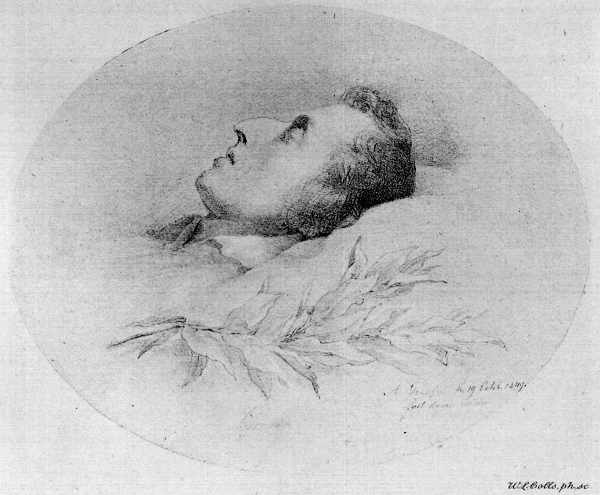 Frederick Chopin.
On the morning of October 17, it was known that
the end had come. The tidings, though they could
hardly have been unexpected, were heard through
the length and breadth of Paris with the greatest
regret and consternation. Everyone who had known
Chopin felt his death as a personal sorrow; one had
been honoured by his friendship, another enriched by
his bounty, another gladdened by some kind word
or some pleasant greeting; there was no chance
acquaintance but had felt his ray of reflection from
the master's life. For the rest, the whole world was
poorer for the loss of a genius, whose bare forty
years of time had sufficed to create a new musical
language, and uphold a new idea of art. All preparations
were made to celebrate the funeral with befitting
pomp. At the Madeleine Mozart's Requiem
was sung over the bier, the procession was joined by
almost every man of note in Paris, and at Père la
Chaise, the coffin, covered with flowers and sprinkled
with Polish earth, was laid in a place of honour
among the great French musicians. The country of
his adoption had cherished the exile in his life; in
his death, it was her privilege to show him honour.
It is intelligible that any attempt to explain the
charm of Chopin's music should provoke some attitude
of impatience and revolt. His spirit, we may be
told, is too volatile for our clumsy alembics, too intangible
for our concrete methods of investigation;
it eludes our glance, it vanishes at our touch, it
mocks with a foregone failure all our efforts at
description or analysis. The lyric gift, indeed, has
always been allowed a special immunity from criticism.
In the larger fields of epic and drama, the
poet turns more directly to ourselves: he bids us
approach, he confers with us, he interprets for our
hearing some great truth of humanity, or some
wise and searching judgment of life. But the lyric
poet stands apart, careless of our presence, oblivious
of our attention, pouring out his heart in a transport
of purely personal joy or sorrow, singing because
he must, and not because there are any to listen.
Of his voice we may say, in the truest sense of
the phrase, that it is 'not heard but overheard.'
Of his thought we may say, with most justification,
that it is self-centred, individual, characteristic. And
hence, in estimating him, it would seem that we
are confronted by a natural dilemma. Either we
sympathise with his mood, and therefore approve, or
we fail to sympathise, and therefore stand outside
the limits of fair judgment.
Upon this conclusion there are two words of comment
to offer. In the first place, the distinction
itself is of far less importance in music than in
poetry; for music, as such, has no truth of life or nature
to interpret. When we speak of a symphony as
epic, we are merely using a convenient formula by
which we may call attention to its breadth and
scale; we do not imply that it has any story to
tell, or any record of events to communicate. When
we call an overture 'Tragic,' we mean that it can
evoke certain undefined impressions of gloom and
grandeur; we do not imply that it contains any
outline of a plot or any suggestion of dramatis
personæ. No doubt there are in music differences
of style, consequent upon differences of dimension,
just as in painting the manner of a fresco will differ
from that of a miniature. But in spirit the whole
art of music is equally subjective: equally intent on
expressing, through a medium of beautiful sound,
the psychological conditions of the composer. It stands
in no direct relation to the external world; it neither
observes, nor depicts, nor criticises; its entire function
is the embodiment, so far as embodiment is possible,
of an abstract idea. If, therefore, when we apply
the name 'lyric' to a musician, we mean to lay stress
on a certain quality of style, then we are using a
term which does not preclude, but invite, the application
of the critical faculty. If we mean by it a
certain temper of mind, then the term ceases to be
distinctive as among musicians, for it belongs to all
alike.
In the second place, it is obvious that musical
criticism must attach itself primarily to questions of
form. Grant that the art has room for certain
spiritual distinctions, which bear some remote and
shadowy resemblance to those of the great poets or
of the great painters; grant that we can describe
Schumann's prevailing tone as manly, or Mendelssohn's
as tender; that we can notice a want of
sternness in Spohr, and a want of reticence in Berlioz;
yet such judgments as these are always liable to
misuse, and, at best, are speedily exhausted. We
cannot imagine ourselves asking of the musicians,
as Matthew Arnold asks of the poets, whether their
art contains an adequate criticism of life, whether
it is marked by insight and benignity. We feel at
once that such phrases are inapplicable to music,
that they make it too articulate, too definite, too
precise. Again, when we read such a line as—
In la sua voluntade è nostra pace,
there are two separate and distinct sources of our
pleasure: first, the pure serenity of the thought;
secondly, the liquid perfection of the verse. But
when we turn to a melody of Beethoven, we find
that here the two aspects are inseparable: that the
verse is the thought, that the embodiment is the
inspiration, and that it is virtually impossible to
formulate any test of the one which is not at the
same time a test of the other. The contrast will
become still clearer if we take a poem in which the
two qualities are not both present. The epilogue in
Browning's Asolando, for example, can hardly be regarded
as verse at all: but the uncouthness which
deprives it of any claim to the title of a classic, is
to most readers compensated by the spirit of sturdy
courage that animates it throughout. To this compensation
there is no parallel in Music. We may
sometimes condone a fault in a melody otherwise
admirable—the second strain, for instance, in our
ballad of 'The Bailiff's Daughter'—but in so doing
we set one portion of the form against another; we
do not set the form as a whole against some external
counterpart. In short, whatever can be said as to the
conditions of vitality in other arts, in Music, at least,
it is true that a work is great in proportion as its form
is perfect.
This perfection of form was Chopin's ostensible
ideal. No composer in the whole history of Music
has laboured with a more earnest anxiety at accuracy
of outline and artistic symmetry of detail. We have
here 'no clattering of dishes at a royal banquet,' no
casual indolence of accompaniment; no gap filled
with unmeaning brilliance or idle commonplace:
every effect is studied with deliberate purpose, and
wrought to the highest degree of finish that it can
bear. Of course, the thoughts were conceived spontaneously;
no man could have written the poorest
of Chopin's works by rule and measure: but before
they were deemed ready for presentation they were
tried by every test, and confronted with every alternative
which a scrupulous ingenuity could propose.
It is no small commendation that workmanship so
elaborate should be beyond the reach of any imitator.
As a rule, it is the dashing, daring, impetuous pioneer
in Art who distances all followers, and finds himself,
he hardly knows how, on a height that they can
never hope to attain: in this case the climber has
planted every footstep with a careful circumspection,
he has employed all his prudence, all his foresight, all
his certain command of resource, and yet, at the end
of the ascent he stands alone. The reason for this is
twofold: first, that Chopin's intuition of style was a
natural gift which few other composers have possessed
in an equal degree: second, that he brought to its
cultivation not only an untiring diligence, but a delicacy
of taste which is hardly ever at fault. His
limitations are plain and unmistakable. For the
larger types of the art, for the broad architectonic laws
of structure on which they are based, he exhibited an
almost total disregard. His works in 'Sonata form,'
and in the forms cognate to the Sonata, are, with no
exception, the failures of a genius that has altogether
overstepped its bounds. Of Choral compositions, of
Symphony, of Opera, he has not left us a single
example. But when all this has been admitted, it
still remains true that he is a great master, great in
his exquisite sense of beauty, in his almost unerring
skill, and in the deliberate and reasoned audacity
with which he has extended the range of musical
expression.
Like all modern composers of acknowledged rank,
Chopin was strongly influenced by the popular music
of his native country. As a child, he had been fond
of collecting and studying the folk-songs which he
heard at harvest field or market or village festival;
they supplied him with his first models, and in some
cases with his first themes as well. In later life, their
impression deepened rather than faded. He always
thought of himself as a national poet: 'I should like,'
he told Hiller, 'to be to my people what Uhland is
to the Germans.' No doubt the external qualities of
his music are entirely his own: the richness of harmony,
the complexity of figure, the delicate elaboration
of ornament; but the texture which these colour
and adorn is essentially of native growth and native
substance. In a word, he made precisely the right
use of national materials, taking them as a basis, and
developing them into fuller beauty by the force and
brilliance of his own personal genius.
There are three chief ways in which this national
influence affected his work. In the first place, the
popular music of Poland, unlike that of Italy or
Germany, is almost invariably founded on dance
forms and dance rhythms. Its gifts to the art
of Europe are the Polonaise, the Krakowiak, and the
Mazurka: types which, however widely they may
differ in grade of social acceptance, are all essentially
Polish in history and character. The very ballads of
the country have the same lilt and cadence; they are
primitive dances not yet differentiated from the use
of words. They move with recurrent figure, with
exact balance of melodic phrase, with that precise
symmetry which is required by a 'Muse of the many-twinkling
feet.' And it is hardly necessary to point
out that in this respect Chopin is a true Pole. More
than a quarter of his entire composition is devoted
ostensibly to dance forms; and throughout the rest
of it their effect may be traced in a hundred phrases
and episodes. Grant that his treatment of the
rhythmic figures is very different from the simple
naïvité of his models: we are here discussing not
treatment but conception, and in conception his indebtedness
to his country is incontestable. His
Mazurkas, in short, bear somewhat the same relation
to the tunes of the peasantry as the songs of
Robert Burns to those of the forerunners whom he
superseded.
A second point of resemblance is Chopin's habit
of founding a whole paragraph either on a single
phrase repeated in similar shapes, or on two phrases
in alternation. By itself this practice is primitive
almost to barbarism, and its employment in many
of the Polish folk-songs is a serious depreciation of
their artistic value. But when it is confined to an
episodical passage, especially in a composition
founded on a striking or important melody, it may
serve as a very justifiable point of rest, a background
of which the interest is purposely toned down to
provide a more striking contrast with the central
figure. Of its illegitimate use a noticeable example
may be found in the 'Spring Song,' which, it must
be remembered, Chopin never intended to publish:
its true and right employment will be seen in many
of the Mazurkas—such, for instance, as the first (in
F sharp minor), the fifth (in B flat), and the thirty-seventh
(in A flat), which is, perhaps, the most beautiful
of all. In the longer works, which are the more
varied in proportion to their greater scale, we should
hardly expect to find examples of a mannerism
which, by its very nature, stands at the opposite pole
from variation: but its influence may be noticed in
the short, clear-cut phrases and exact balance of such
compositions as the Scherzo in C sharp minor. No
doubt much of this exactitude is due to an intense
desire for clearness and precision: yet none the less
the particular way in which that desire is satisfied
may be regarded as characteristic of the national
manner. Beethoven does not attain the lucidity of
his style by such close parallelism of phraseology.
Thirdly, Chopin was to some extent affected by
the tonality of his native music. A large number
of the Polish folk-songs are written, not in our
modern scale, but in one or other of the ecclesiastical
modes: notably the Lydian, which has its
fourth note a semitone sharper, and the Dorian,
which has its third and seventh notes a semitone
flatter than the major scale of Western Europe.
Some, again, end on what we should call dominant
harmony; a clear survival of the ecclesiastical distinction
between plagal and authentic. Of this
tonal system, some positive traces may be found
in the Mazurkas, the cadences of the thirteenth,
seventeenth and twenty-fifth, the frequent use of
a sharpened subdominant, and the like; while
on the negative side it may perhaps account for
Chopin's indifference to the requirements of key-relationship.
Not only in his efforts at Sonata form
does he show himself usually unable to hold together
a complex scheme of keys, but in works
of a more loose structure his choice seems to be
regulated rather by hazard than by any preconceived
plan. Sometimes, as in the end of the F
major Ballade, he deliberately strays away from a
logical conclusion;[42] sometimes, as in the sixth
Nocturne, he forces himself back with a sudden
and inartistic violence; more often he allows his
modulations to carry him where they will, and is
so intent on perfecting each phrase and each melody
that he has no regard left to bestow on the general
principles of construction. No doubt some of
this weakness was due to defective training, some,
also, to the prevailing spirit and temper of the
Romantic movement. But, in Chopin's case, there
was a special reason beyond. As a Pole, he approached
our western key system from the outside,
and although he learned its language with wonderful
skill and facility, he never wholly assimilated himself
to the method of thought which it implies.
It is quite possible that, in any case, Chopin
would have found himself incapable of dealing with
large masses. The want of virility, which has already
been noted in his character, appears beyond question
in his music; leaving untouched all the grace and
tenderness, all the rare and precious qualities of
workmanship, but relaxing into an almost inevitable
weakness at any crisis which demands sustained
force or tenacity. When he is at his strongest, we
miss that sense of reserve power, that quiet irresistible
force, 'too full for sound or foam,' which
characterises the dignity of the noblest art. He can
be passionate, vehement, impetuous, but he expends
himself in the effort. He can express agitation,
challenge, defiance, but he lacks the royal magnanimity
that will never stoop to defy. Even his
melody is never sublime, never at the highest level.
Its more serious mood stands to the great tunes
of Beethoven as Leopardi stands to Dante, rising
for a moment on a few perfect lines to follow the
master's flight, and then sinking back to earth under
some load of weariness or impatience.
Take, for instance, the B flat minor Sonata, in
which Chopin most nearly approximates to the
'grand manner' of composition. The first movement,
regarded by itself, is a masterpiece; its exposition
clear and concise, its subjects well contrasted, one
for thematic treatment and one for melody, its free
fantasia an admirable example of an established
type, and its recapitulation, though a little too short
for perfect balance, a firm and lucid statement which
sums up its results without a bar of vagueness or
uncertainty. Not less complete is the Scherzo,
which develops the simple forms of Mozart and
Beethoven without obscuring their outline, and, despite
all its rush and vigour, never allows its themes
to get out of hand or to pass beyond the legitimate
bounds of control. But from this point the value
of the Sonata steadily declines. Schumann undoubtedly
hits the blot when he declares that the
great Funeral March ought never to have formed
part of the work at all. As a separate piece it is
of incomparable beauty; as the adagio of this particular
Sonata it is wholly out of place. Its key
is ill selected in relation to the rest of the composition;
its contrasts of theme bear too much
resemblance to those of the first movement; worst
of all, its form is precisely the same as that of the
Scherzo; and these objections, not one of which
affects the movement in itself, are no less than fatal
to it in its present context. The Finale, again, has
neither the breadth nor the dignity requisite for its
position. Its structure, though perfectly clear, is
too simple and primitive to justify it as the fitting
conclusion of an important work; and its persistent
rhythmic figure gives it somewhat the air of an
impromptu. If we had found it in the Volume of
Preludes, we should have felt for it nothing but
admiration; here, its inadequacy is so obvious that
the greater part of critical attention has been distracted
from its undeniable merits. In short, the
first half of the Sonata gives promise of a Classic
such as, with one exception, the world had not seen
since the death of Beethoven; the second half,
though almost every bar contains something that
is beautiful, is a disappointment and a failure.
Icarus has flown too near the sun, and the borrowed
wings have no longer the strength to support
him.
This want of manliness, moral and intellectual,
marks the one great limitation of Chopin's province.
It is, of course, wholly unreasonable to make it a
subject of complaint; we might as well complain
of Keats for not being Milton; or depreciate Carpaccio
because the genius of Titian has the wider
expanse. The lines of Endymion are not less musical
because the poem, as a whole, falls below the epic
level, and if they were, we have 'La Belle Dame
sans Merci,' and the Sonnets and the five Odes.
The Saint Ursula pictures are not less sweet and
gracious because they lack the majesty of the 'Assumption;'
and if they were, we could solace ourselves
with the 'St George' and the 'St Jerome.'
And similarly, if we accept from Chopin what he
has to give, we shall be in no mind to bear malice
for what he is forced to withhold. His passion is
so keen and vital, his melody so winning, his love
of beauty so single-hearted, that to demand the
sterner qualities is almost an act of ingratitude.
He knows the full secret of that mysterious power—so
easy to feel, so impossible to define—through
which music fulfils its function of suggesting and
typifying emotion. He can appeal to our sensuous
nature with a mastery which is almost irresistible,
and he never degrades the appeal into vulgarity or
sensationalism. Under his spell even the display
of technical difficulty acquires life and significance.
His Studies, avowedly classed as exercises of dexterity,
stand to those of other writers as pictures to
freehand drawing. His 'virtuoso passages' differ
from those of Herz, and Hunten, and even Thalberg,
as a pianoforte differs from a barrel-organ. In his
lightest moment he is a poet: graceful in fancy,
felicitous in expression, and instinct with the living
spirit of romance.
There is hardly need to select examples of a gift
which he exhibits on almost every page, yet a few
typical instances may serve to concentrate our attention
for a moment on the characteristic features of
his melody, and to show the particular way in which
he fulfilled the first requisite of a composer. Apart
from works already considered, some special study
may be given to the two Nocturnes, Op. 37, to the
Ballade in A flat, to the second and third Impromptus,
to the wonderful Étude in F minor, written for Moscheles,
and to the fourth, eighth, fifteenth, nineteenth
and twenty-third of the Preludes. These compositions
are chosen, not because they are more tuneful
than the rest—that is a question upon which every
hearer must consult his own judgment—but because
their elements of tunefulness seem to be in an eminent
degree central and representative. No doubt
many favourites will be found missing from the catalogue,
the Prelude in C minor, the Nocturne in D flat,
the more famous of the Waltzes and Polonaises;
they have been purposely omitted, because, with all
their beauty, they only contain tendencies of thought
and manner which the list already exemplifies. As a
rule, except for an occasional appoggiatura, Chopin
keeps his melody within the strict limits of the diatonic
scale, or of some equally diatonic ecclesiastical
mode, and uses his chromatic effects sometimes for
the accompaniment figure, sometimes for the subsequent
thematic treatment. His tunes, for the most
part, are as simple in outline as folk-songs, and the
moods which they imply, whether melancholy, tender,
playful or passionate, are an outcome of the more
direct personal emotions. Sometimes his thought is
as transparent as that of a child, and appeals to our
sympathy with all a child's unquestioning and irresistible
confidence. Sometimes he strikes a deeper
note with a no less frank, outspoken freedom of disclosure.
And always, whether severe or vehement,
whether gay or dejected, he offers for our admiration
the same perfection of curve, the same delicate balance
of rhythm, and the same plasticity of melodic
stanza.
There are two characteristics in Chopin's music
which deserve some detailed consideration,—first, his
sense of harmony; second, his use of accompaniment
figures. No doubt, as standpoints for general criticism,
they are not of parallel importance; the one
implies a habit of mind as a whole, the other denotes
a degree of technical skill and technical efficiency.
But in both respects Chopin occupies a position so
far apart from that of other composers—in both his
manner is so original, so unique, so far removed from
common or customary ways—that in his work they
assume an almost equal value and interest. Again,
in estimating their worth, we are dealing with a more
definite and concrete material than when we endeavour
to outline with words the impalpable spirit of
melody. The tunes of a musician, though they constitute
the chief part of his gift, constitute also that
part which least admits of any profitable discussion;
and the very qualities, through which alone they are
susceptible of analysis, can be more easily noted and
appraised in the secondary functions of treatment
and elaboration. We cannot gauge the success of an
effort unless we have already ascertained its intention;
and the intention, though not always obscure
in melody, is undoubtedly clearer to trace in the
polyphonic scheme by which melody is supported
and sustained.
Now, when we examine Chopin's harmony, we are
at once struck with an apparent contradiction. We
feel that, in its broader aspects, it is wonderfully pure
and lucid, flowing along an established course, deviating
but little from the simpler and more ordinary
progressions. Yet every now and again we come
across passages, the sight of which is enough to make
orthodox professors of music 'stare and gasp;'—passages
which seem to break with resolute and unflinching
defiance the elementary rules that stand at the
beginning of our text-books. Worst of all, these
apparent solecisms, the commission of which by any
other hand would be wholly intolerable, offer themselves
to our notice as though they were the most
natural and regular forms of expression. They are
not obvious slips, like the 'misprint' in the Ninth
Symphony; they are not importations from some
alien musical language, like the occasional extravagances
of Grieg or Dvořák; on the contrary, they
take our recognised system of harmonic laws, and
literally honour it more in the breach than the
observance. Are consecutive fifths and octaves forbidden?
There is, in one of the Études, a delightful
passage, which consists exclusively of the prohibited
intervals.[43] Are consecutive major thirds justly regarded
as harsh and dissonant? Chopin, at his
dreamiest and most contemplative, can employ them
with unfailing effect.[44] Is the dominant seventh a
chord which, to all well-regulated ears, demands
instant resolution? The twenty-first Mazurka rejects
the claim, and sends one floating down four
bars of chromatic scale with no hope of rest until it
reaches the bottom. And the manner of composition
which these instances exemplify can be traced in
plenty of other phrases, less extreme, perhaps, but
not less audacious. In parts of the fourth and sixth
Nocturnes we can find harmonic schemes which it is
probable no other musician would have ever dared
to devise, schemes which set at naught our established
distinctions of concord and discord, which
display in unbroken series artifices that are usually
kept for single isolated points of excitement, and
which, nevertheless, are as undoubtedly intentional
as they are undeniably successful in their aim.
There is no shirking the difficulty. Here is a
composer who is brought up on Bach, and whose
general sense of harmony is as pure and sincere
as that of his great master. Here are passages,
written by him with obvious care and deliberation,
the acceptance of which would seem impossible
without throwing discredit on the harmonic code.
And, as climax of bewilderment, the code is right
and the passages are beautiful. It may certainly
appear for the moment as though there were no
solution in view unless we take a despairing refuge
in some Hegelian identification of opposites.
Now, the impression which harmony produces is
that of a third dimension in Music. It is the element
of solidity and substance on which the melody rests.
In a Chorale, for instance, the tune describes a sort
of pattern on the superficies of the work, and the
chords sustain and support it from underneath. And
just as certain tunes can give us the effect of breadth,
that is, of wide sweep over their superficial area, so
certain harmonisations give us the effect of massiveness,
that is, of strength and bulk in its substratum.
It is not, of course, pretended that the artistic value
of a composition can be summed up in so crude a
metaphor: nothing more is attempted than to represent
the one factor in the case, which is germane
to the present purpose. Further, all the harmonic
rules have been devised with a view to making the
solid body of the Music as firm and compact as
possible. They deal with the substratum, not with
the superficies; with the perpendicular aspect, not
with the horizontal. The law of consecutives is not
held to be broken if in an orchestral piece a violin
phrase is doubled by the violoncello or the bassoon:
such a device gives us the lines of the pattern in
duplicate, and lies altogether outside the material
on which the pattern is superimposed. So in these
disputed passages of Chopin. They are not really
harmonic at all, they lie in the same plane as the
melody, and, for their support, imply a separate and
distinct scheme of chords, which the ear can always
understand for itself.
A few examples may help to make this clearer.
In the twelfth bar of the well-known Nocturne in
E flat (Op. 9, No. 2), there is a connecting passage
which, when we see it on paper, seems to consist of
a rapid series of remote and recondite modulations.
When we hear it played in the manner which Chopin
intended, we feel that there is only one real modulation,
and that the rest of the passage is an iridescent
play of colour, an effect of superficies, not an effect
of substance. Precisely the same impression is produced
in the middle section of the sixth Nocturne,
and in the return to the opening theme at the end
of the fifteenth. So it is with these apparent consecutives.
They are not ungrammatical, because,
like the Emperor Sigismund, they are 'supra grammaticam:'
they do not defy harmonic laws because
they belong to a different jurisdiction: in a word,
they are to be treated not as harmonisations of their
theme, but rather as new forms of melodic extension.
Their real harmony is implied, not expressed: a construction
to be understood from the general context
and tenour of the passage: and it is because the
general tenour is unmistakable that these 'sense
constructions' are fully justified. Chopin's harmonic
system, in short, is like a river—its surface windswept
into a thousand variable crests and eddies, its
current moving onward, full, steadfast and inevitable,
bearing the whole volume of its waters by sheer force
of depth and impetus.
Hence it is that of all musicians he is most at the
mercy of his interpreters. Beethoven's Adelaide is
'so beautiful' that not even Mr du Maurier's tenor
'can make it ridiculous:' but there are few of us
who have not seen Chopin crushed out of recognition
in the grasp of some conscientious and heavy-handed
pianist. These surface-effects lose all their charm
if they are played with stress and insistance, if they
are forced down into a third dimension, which they
were never intended to fill. There is much of Chopin's
music in which solidity of execution is as fatal as
strictness of time; in which the phrases are essentially
light, wayward, aerial, demanding for their
interpretation not only the most flexible sympathy
of feeling, but the daintiest delicacy of touch. Even
Moscheles, great musician as he was, found himself
baffled by the new style. 'Chopin has just
been playing to me,' he writes, 'and now for the first
time I understand his music. The rubato, which,
with his other interpreters, degenerates into disregard
of time, is with him only a charming originality of
manner: the harsh modulations which strike me
disagreeably when I am playing his compositions
no longer shock me, because he glides over them in
a fairy-like way with his delicate fingers. His piano
is so soft that he does not need any strong forte to
produce his contrasts: and for this reason one does
not miss the orchestral effects which the German
school requires from a pianoforte player, but allows
oneself to be carried away as by a singer who,
little concerned about the accompaniment, entirely
follows his emotion.' We of the present day
may express ourselves with more warmth of approbation;
but if we wish to understand Chopin,
this is the standpoint from which we must regard
him.
The second point for consideration is the almost
incomparable power which Chopin displays in his
use of accessory figures. By figure, in this sense,
is meant a certain group of notes, having a clearly
defined curve and rhythm, and maintained, with such
changes as the harmony necessitates, through a
phrase, or a paragraph, or even a complete work.
In the use of this device there are two difficulties
against which a composer has to contend. On the
one hand, the group, if it is to command any part
of the hearer's attention, must exhibit a distinct
character, almost a distinct melody of its own; on
the other hand, it will fail of its purpose unless it
is sufficiently plastic to be adapted to different context
and different requirements. Now, it is obvious
that the more allegiance is claimed by the first of
these conditions, the more skill is needed in order
to satisfy the second. A figure which consists merely
of simple arpeggios or of plain repeated chords can
suffer any degree of harmonic alteration without
loss of continuity; but as its intrinsic interest is
heightened, either by elaboration of curve or by
peculiarity of rhythm, so it becomes more individual,
and therefore, under a change of circumstance, more
difficult to adjust. Thus it not infrequently happens
that a composer is forced to remodel his scheme
because the group of notes which he has devised to
support the first strain of his melody proves unsuitable
to the next; or because a curve, that can
adequately fill a bar of uniform harmony, may lose
all fitness when applied to a bar in which the
harmony changes. In Schumann's Widmung, for
instance, the beautiful accompaniment figure wavers
in the third bar, and breaks down altogether in the
fourth; not because the composer wishes to put forward
a new pattern, for he retains the rhythm of
the old, but because nothing short of a total alteration
of curve will satisfy the harmonic conditions of
the tune.
But, so far as concerns this particular exhibition of
skill, we never feel that Chopin is at the mercy of
his materials. His simplest figures are interesting,
his most elaborate are moulded to his use with an
entire and unhesitating mastery. Under his hand
the stubborn edges grow smooth, the obdurate lines
become pliant and tractable, the recurrent shape
preserves its unity without appearing wearisome or
monotonous. The Prelude in F sharp minor (No. 8)
is perhaps the most astonishing instance in music
of this particular form of decorative effect; and
hardly less remarkable are the Étude in E flat
minor (Op. 10, No. 6), the Prelude in G major (No.
3), and the Prelude in F sharp major (No. 13). Indeed,
Chopin's method of ornament is altogether
his own; sensuous it may be in origin, evoked, at
any rate in part, by an imperious craving for the
pleasure of beautiful sound, but yet raised to the
true artistic level by its refinement of taste and its
finished accuracy of detail. It is no small matter
that a type of art which appeals so frequently to
sense and emotion should never be either vulgar or
trivial or commonplace; that there should be nothing
meretricious in its sentiment, nothing indolent in
its expression; that with every incentive to a lax
and careless Hedonism it should yet maintain an
ideal of unswerving labour.
So far Chopin's music has been treated from the
creative side. It now remains to add a few words on
the peculiar tact and intelligence with which he
employs his medium. In pictorial art this quality
is of acknowledged importance: oil, water, pastel,
have their own conditions and their own limitations,
to overstep which is to invite failure; and it is
recognised as an adverse criticism if we can
say of an example in any one process that its
effects could have been equally well produced by
another.
The same law is valid in musical art. The
orchestra, the string quartett, the organ, the pianoforte,
are so diverse in tone and so disparate in character,
that they admit no community of treatment,
and hardly even a close community of idea. An
arrangement may sometimes be condoned as a tour
de force, it may sometimes be allowed as a preparation
or a means of study, but to regard it as possessing
any absolute value is to convict the original work
of a serious imperfection. It is, therefore, a high
testimony to the exactitude of Chopin's writing that
it has almost entirely escaped the sacrilegious hand
of the transcriber. Some of the Mazurkas are occasionally
adapted for the voice, one or two of the
Nocturnes misused to the service of the violin or the
violoncello: but by far the greater number of
Chopin's compositions are too obviously suited to
the piano for any other medium to be regarded as
possible. His very narrowness gave him concentration:
his want of sympathy with all other instruments
enabled him to devote his whole attention to
the one that he understood. And, as a result, he
gives us Pianoforte Music which, considered as a
pure expression of technical intelligence, is almost
without rival in the history of the art. No other
composer has ever surpassed the unerring judgment
to which we owe these wide-spread arpeggios, these
wonderful liquid ripples of chromatic scale, these
showers of sparkling notes which fall, as Liszt said,
'like dew drops' on some bend of phrase or turn of
cadence. Beethoven, of course, understood the piano
as fully as he understood everything else: but since
Beethoven's time musicians, and especially romantic
musicians, have a little tended to blur and obliterate
these necessary distinctions, and to merge a due
recognition of piano technique into their overmastering
desire for emotional significance. Hence the fatal
error of trying to extract orchestral effects from the
keyboard, an error into which Schumann falls occasionally,
and Liszt habitually, but from which Chopin
may be regarded as entirely free. In a word, he
appreciates both the capacities and the limitations
of his material, and, while he draws from it every
tone that it can legitimately produce, he never strains
it beyond the due and fitting bounds of its proper
individuality. It may be noted that Mendelssohn
had something of the same gift, but in pianoforte
music, Mendelssohn's thought is shallower than that
of Chopin, and, therefore, more easily kept within
its range. Indeed, since 1827, there has been no
composer who could unite such poignancy of feeling
with so exact an estimate of the means at his
disposal.
To sum up, Chopin can claim no place among the
few greatest masters of the world. He lacks the
dignity, the breadth, the high seriousness of Palestrina
and Bach and Beethoven: he no more ranks
beside them than Shelley beside Shakespear, or
Andrea beside Michael Angelo. But to say this is not
to disparage the value of the work that he has done.
If he be not of the 'di majorum gentium,' he is
none the less of the Immortals, filled with a supreme
sense of beauty, animated by an emotional impulse
as keen as it was varied, and upholding an ideal of
technical perfection at a time when it was in danger
of being lost by the poets or degraded by the
virtuosi. In certain definite directions he has enlarged
the possibilities of the art, and though he has,
fortunately, founded no school—for the charm of his
music is wholly personal—yet in a thousand indirect
ways he has influenced the work of his successors.
At the same time, it is not as a pioneer that he elicits
our fullest admiration. We hardly think of him as
marking a stage in the general course and progress
of artistic History, but, rather, as standing aside
from it, unconscious of his relation to the world,
preoccupied with the fairyland of his own creations.
The elements of myth and legend that have already
gathered round his name may almost be said to
find their counterparts in his music; it is etherial,
unearthly, enchanted, an echo from the melodies of
Kubla Khan. It is for this reason that he can only
make his complete appeal to certain moods and certain
temperaments. The strength of the hero is as
little his as the vulgarity of the demagogue: he
possesses an intermediate kingdom of dreams, an isle
of fantasy, where the air is drowsy with perfume, and
the woods are bright with butterflies, and the long
gorges run down to meet the sea. If his music is
sometimes visionary, at least it is all beautiful; offering,
it may be, no response to the deeper questions
of our life, careless if we approach it with problems
which it is in no mind to resolve, but fascinating in
its magic if we are content to submit our imagination
to the spell. And precisely the same distinction may
be made on the formal side of his work. In structure
he is a child, playing with a few simple types, and
almost helpless as soon as he advances beyond them;
in phraseology he is a master whose felicitous perfection
of style is one of the abiding treasures of the
art. There have been higher ideals in Music, but
not one that has been more clearly seen or more
consistently followed. There have been nobler messages,
but none delivered with a sweeter or more
persuasive eloquence.


