By Edward S. Holden.
Since 1876 I have been familiar with the works of Mr. John L. Stephens
on the antiquities of Yucatan, and from time to time I have read works
on kindred subjects with ever increasing interest and curiosity in
regard to the meaning of the hieroglyphic inscriptions on the stones and
tablets of Copan, Palenque, and other ruins of Central America. In
August, 1880, I determined to see how far the principles which are
successful when applied to ordinary cipher-writing would carry one in
the inscriptions of Yucatan. The difference between an ordinary
cipher-message and these inscriptions is not so marked as might at first
sight appear. The underlying principles of deciphering are quite the
same in the two cases.
The chief difficulty in the Yucatec inscriptions is our lack of any
definite knowledge of the nature of the records of the aborigines. The
patient researches of our archæologists have recovered but very little
of their manners and habits, and one has constantly to avoid the
tempting suggestions of an imagination which has been formed by modern
influences, and to endeavor to keep free from every suggestion not
inherent in the stones themselves. I say the stones, for I have only
used the Maya manuscripts incidentally. They do not possess, to me, the
same interest, and I think it may certainly be said that all of them are
younger than the Palenque tablets, and far younger than the inscriptions
at Copan.
I therefore determined to apply the ordinary principles of deciphering,
without any bias, to the Yucatec inscriptions, and to go as far as I
could certainly. Arrived at the point where demonstration ceased, it
would be my duty to stop. For, while even the conjectures of a mind
perfectly trained in archæologic research are valuable and may
subsequently prove to be quite right, my lack of familiarity with
historical works forced me to keep within narrow and safe limits.
My programme at beginning was, first, to see if the inscriptions at
Copan and Palenque were written in the same tongue. When I say “to see,”
I mean to definitely prove the fact, and so in other cases; second, to
see how the tablets were to be read. That is, in horizontal lines, are
they to be read from right to left, or the reverse? In vertical columns,
are they to be read up or down? Third, to see whether they were
phonetic characters, or merely ideographic, or a mixture of the
two—rebus-like, in fact.
If the characters turned out to be purely phonetic, I had determined to
stop at this point, since I had not the time to learn the Maya language,
and again because I utterly and totally distrusted the methods which, up
to this time, have been applied by Brasseur de Bourbourg and others who
start, and must start, from the misleading and unlucky alphabet handed
down by Landa. I believe that legacy to have been a positive misfortune,
and I believe any process of the kind attempted by Brasseur de Bourbourg
(for example, in his essay on the MS. Troano) to be extremely
dangerous and difficult in application, and to require a degree of
scientific caution almost unique.
Dr. Harrison Allen, in his paper, “The Life Form in Art,” in the
Transactions of the American Philosophical Society, is the only
investigator who has applied this method to Central American remains
with success, so it seems to me; and even here errors have occurred.
The process I allude to is something like the following: A set of
characters, say the alphabet of Landa, is taken as a starting point. The
variants of these are formed. Then the basis of the investigation is
ready. From this, the interpretation follows by identifications of each
new character with one of the standard set or with one of its
variants. Theoretically, there is no objection to this procedure.
Practically, also, there is no objection if the work is done strictly in
the order named. In fact, however, the list of variants is filled out
not before the work is begun, but during its progress, and in such a way
as to satisfy the necessities of the interpreter in carrying out some
preconceived idea. With a sufficient latitude in the choice of
variants any MS. can receive any interpretation. For example, the MS.
Troano, which a casual examination leads me to think is a ritual, and
an account of the adventures of several Maya gods, is interpreted by
Brasseur de Bourbourg as a record of mighty geologic changes. It is next
to impossible to avoid errors of this nature at least, and in fact they
have not been avoided, so far as I know, except by Dr. Allen in the
paper cited.
I, personally, have chosen the stones and not the manuscripts for study
largely because variants do not exist in the same liberal degree in
the stone inscriptions as they have been supposed to exist in the
manuscripts.
At any one ruin the characters for the same idea are alike, and alike to
a marvelous degree. At another ruin the type is just a little different,
but the fidelity to this type is equally great. Synonyms exist; that is,
the same idea may be given by two or more utterly different signs. But a
given sign is made in a fixed and definite way. Finally the MSS. are, I
think, later than the stones. Hence the root of the matter is the
interpretation of the stones, or not so much their full interpretation
as the discovery of a method of interpretation, which shall be sure.
Suppose, for example, that we know the meaning of a dozen characters
only, and the way a half dozen of these are joined together in a
sentence. The method by which these were obtained will serve to add
others to the list, and progress depends in such a case only on our
knowledge of the people who wrote, and of the subjects upon which they
were writing. Such knowledge and erudition belongs to the archæologists
by profession. A step that might take me a year to accomplish might be
made in an instant by one to whom the Maya and Aztec mythology was
familiar, if he were proceeding according to a sound method. At the
present time we know nothing of the meaning of any of the Maya
hieroglyphs.
It will, therefore, be my object to go as far in the subject as I can
proceed with certainty, every step being demonstrated so that not only
the archæologist but any intelligent person can follow. As soon as the
border-land is reached in which proof disappears and opinion is the only
guide, the search must be abandoned except by those whose cultivated and
scientific opinions are based on knowledge far more profound and various
than I can pretend or hope to have.
If I do not here push my own conclusions to their farthest limit, it
must not be assumed that I do not see, at least in some cases, the
direction in which they lead. Rather, let this reticence be ascribed to
a desire to lay the foundations of a new structure firmly, to prescribe
the method of building which my experience has shown to be adequate and
necessary, and to leave to those abler than myself the erection of the
superstructure. If my methods and conclusions are correct (and I have no
doubts on this point, since each one has been reached in various ways
and tested by a multiplicity of criteria) there is a great future to
these researches. It is not to be forgotten that here we have no Rosetta
stone to act at once as key and criterion, and that instead of the
accurate descriptions of the Egyptian hieroglyphics which were handed
down by the Greek cotemporaries of the sculptors of these
inscriptions, we have only the crude and brutal chronicles of an
ignorant Spanish soldiery, or the bigoted accounts of an unenlightened
priesthood. To Cortez and his companions a memorandum that it took one
hundred men all day to throw the idols into the sea was all-sufficient.
To the Spanish priests the burning of all manuscripts was praiseworthy,
since those differing from Holy Writ were noxious and those agreeing
with it superfluous. It is only to the patient labor of the Maya
sculptor who daily carved the symbols of his belief and creed upon
enduring stone, and to the luxuriant growths of semi-tropical forests
which concealed even these from the passing Spanish adventurer, that we
owe the preservation of the memorials of past beliefs and vanished
histories.
Not the least of the pleasures of such researches as these comes from
the recollection that they vindicate the patience and skill of forgotten
men, and make their efforts not quite useless. It was no rude savage
that carved the Palenque cross; and if we can discover what his efforts
meant, his labor and his learning have not been all in vain. It will be
one more proof that human effort, even misdirected, is not lost, but
that it comes, later or earlier, “to forward the general deed of man.”
My examination of the works of Mr. J. L. Stephens has convinced me that
in every respect his is the most trustworthy work on the hieroglyphs
of Central America. The intrinsic evidence to this effect is very
strong, but when I first became familiar with the works of Waldeck I
found so many points of difference that my faith was for a time shaken,
and I came to the conclusion that while the existing representations
might suffice for the study of the general forms of statues, tablets,
and buildings, yet they were not sufficiently accurate in detail to
serve as a basis for the deciphering I had in mind. I am happy to bear
witness, however, that Stephens’s work is undoubtedly amply adequate to
the purpose, and this fact I have laboriously verified by a comparison
of it with various representations, as those of Desaix and others, and
also with a few photographs. The drawings of Waldeck are very beautiful
and artistic, but either the artist himself or his lithographers have
taken singular liberties in the published designs. Stephens’s work is
not only accurate, but it contains sufficient material for my purpose
(over 1,500 separate hieroglyphs), and, therefore, I have based my study
exclusively upon his earliest work, “Incidents of Travel in Central
America, Chiapas, and Yucatan,” 2 vols., 8vo. New York, 1842 (twelfth
edition). I have incidentally consulted the works on the subject
contained in the Library of Congress, particularly those of Brasseur de
Bourbourg, Kingsborough, Waldeck, and others, but, as I have said, the
two volumes above named contain all the the material I have been
able to utilize, and much more which is still under examination.
One fact which makes the examination of the Central American antiquities
easier than it otherwise would be, has not, I think, been sufficiently
dwelt upon by former writers. This is the remarkable faithfulness of the
artists and sculptors of these statues and inscriptions to a standard.
Thus, at Copan, wherever the same kind of hieroglyph is to be
represented, it will be found that the human face or other object
employed is almost identically the same in expression and character,
wherever it is found. The same characters at different parts of a tablet
do not differ more than the same letters of the alphabet in two fonts of
type.
At Palenque the type (font) changes, but the adherence to this is
equally or almost equally rigid. It is to be presumed that in this
latter case, where work was done both in stone and stucco, the nature
of the material affected the portraiture more or less.
The stone statues at Copan, for example, could not all have been done by
the same artist, nor at the same time. I have elsewhere shown that two
of these statues are absolutely identical. How was this accomplished?
Was one stone taken to the foot of the other and cut by it as a pattern?
This is unlikely, especially as in the case mentioned the scale of the
two statues is quite different. I think it far more likely that each was
cut from a drawing, or series of drawings, which must have been
preserved by priestly authority. The work at any one place must have
required many years, and could not have been done by a single man; nor
is it probable that it was all done in one generation. Separate
hieroglyphs must have been preserved in the same way. It is this rigid
adherence to a type, and the banishment of artistic fancy, which will
allow of progress in the deciphering of the inscriptions or the
comparison of the statues. Line after line, ornament after ornament, is
repeated with utter fidelity. The reason of this is not far to seek.
This, however, is not the place to explain it, but rather to take
advantage of the fact itself. We may fairly say that were it not so, and
with our present data, all advances would be tenfold more difficult.
It is impossible without a special and expensive font of type to refer
pictorially to each character, and therefore some system of nomenclature
must be adopted. The one I employ I could now slightly improve, but it
has been used and results have been obtained by it. It is sufficient for
the purpose, and I will, therefore, retain it rather than to run the
risk of errors by changing it to a more perfect system. I have numbered
the plates in Stephens’s Central America according to the following
scheme:
ENGRAVINGS OF VOLUME I.
|
Page. |
| Stone Statue, front view, I have called Plate I |
Frontispiece. |
| Wall of Copan, Plate II |
96 |
| Plan of Copan, Plate III |
133 |
| Death’s Head, Plate IIIa |
135 |
| Portrait, Plate IIIb |
136 |
| Stone Idol, Plate IV |
138 |
| Portrait, Plate IVa |
139 |
| Stone Idol, Plate V |
140 |
| Tablet of Hieroglyphics, Plate Va |
141 |
| No. 1, Sides of Altar, Plate VI |
142 |
| No. 2, Sides of Altar, Plate VII |
142 |
| Gigantic Head, Plate VIII |
143 |
| No. 1, Stone Idol, front view, Plate IX |
149 |
| No. 2, Stone Idol, back view, Plate X |
150 |
| Idol half buried, Plate XI |
151 |
| No. 1, Idol, Plate XII |
152 |
| No. 2, Idol, Plate XIII |
152 |
| No. 1, Idol, Plate XIV |
153 |
| No. 2, Idol, Plate XV |
153 |
| Idol and Altar, Plate XVI |
154 |
| Fallen Idol, Plate XVII |
155 |
| No. 1, Idol, front view, Plate XVIII |
156 |
| No. 2, Idol, back view, Plate XIX |
156 |
| No. 3, Idol, side view, Plate XX |
156 |
| Fallen Idol, Plate XXa |
157 |
| Circular Altar, Plate XXb |
157 |
| No. 1, Stone Idol, front view, Plate XXI |
158 |
| No. 2, Stone Idol, back view, Plate XXII |
158 |
| No. 3, Stone Idol, side view, Plate XXIII |
158 |
| Great Square of Antigua Guatimala, Plate XXIIIa |
266 |
| Profile of Nicaragua Canal, Plate XXIIIb |
412 |
ENGRAVINGS OF VOLUME II.
|
Page. |
| Stone Tablet, Plate XXIV |
Frontispiece. |
| Idol at Quirigua, Plate XXV |
121 |
| Idol at Quirigua, Plate XXVI |
122 |
| Santa Cruz del Quiché, Plate XXVII |
171 |
| Place of Sacrifice, Plate XXVIII |
184 |
| Figures found at Santa Cruz del Quiché, Plate XXIX |
185 |
| Plaza of Quezaltenango, Plate XXX |
204 |
| Vases found at Gueguetenango, Plate XXXI |
231 |
| Ocosingo, Plate XXXII |
259 |
| Palace at Palenque, Plate XXXIII |
309 |
| Plan of Palace, Plate XXXIV |
310 |
| Stucco Figure on Pier, Plate XXXV |
311 |
| Front Corridor of Palace, Plate XXXVI |
313 |
| No. 1, Court-yard of Palace, Plate XXXVIII |
314 |
| No. 2, Colossal Bas-reliefs in Stone, Plate XXXIX |
314 |
| East side of Court-yard, Plate XXXVII |
314 |
| No. 1, Bas-relief in Stucco, Plate XL |
316 |
| No. 2, Bas-relief in Stucco, Plate XLI |
316 |
| No. 3, Bas-relief in Stucco, Plate XLII |
316 |
| Oval Bas-relief in Stone, Plate XLIII |
318 |
| Bas-relief in Stucco, Plate XLIV |
319 |
| General Plan of Palenque, Plate XLV |
337 |
| Casa No. 1 in Ruins, Plate XLVI |
338 |
| Casa No. 1 restored, Plate XLVII |
339 |
| No. 1, Bas-relief in Stucco, Plate XLVIII |
340 |
| No. 2, Bas-relief in Stucco, Plate XLIX |
340 |
| No. 3, Bas-relief in Stucco, Plate L |
340 |
| No. 4, Bas-relief in Stucco, Plate LI |
340 |
| No. 1, Tablet of Hieroglyphics, Plate LII |
342 |
| No. 2, Tablet of Hieroglyphics, Plate LIII |
342 |
| Tablet on inner Wall, Plate LIV |
343 |
| Casa di Piedras, No. 2, Plate LV |
344 |
| Tablet on back Wall of Altar, Casa No. 2, Plate LVI |
345 |
| Stone Statue, Plate LVII |
349 |
| Casa No. 3, Plate LVIII |
350 |
| Front Corridor, Plate LIX |
351 |
| No. 1, Bas-reliefs in Front of Altar, Plate LX |
353 |
| No. 2, Bas-reliefs in Front of Altar, Plate LXI |
353 |
| Adoratorio or Altar, Plate LXII |
354 |
| Casa No. 4, Plate LXIII |
355 |
| House of the Dwarf, Plate LXIV |
420 |
| Casa del Gobernador, Plate LXV |
428 |
| Sculptured Front of Casa del Gobernador, Plate LXVI |
443 |
| Egyptian Hieroglyphics, Plate LXVIII |
441 |
| Top of Altar at Copan, Plate LXVIII=Va |
454 |
| Mexican Hieroglyphical Writing, Plate LXIX |
454 |
In each plate I have numbered the hieroglyphs, giving each one its own
number. Thus the hieroglyphs of the Copan altar (vol. i, p. 141) which I
have called plate Va, are numbered from 1 to 36 according to this
scheme—
| 1 |
2 |
3 |
4 |
5 |
6 |
| 7 |
8 |
9 |
10 |
11 |
12 |
| 13 |
14 |
15 |
16 |
17 |
18 |
| 19 |
20 |
21 |
22 |
23 |
24 |
| 25 |
26 |
27 |
28 |
29 |
30 |
| 31 |
32 |
33 |
34 |
35 |
36 |
And the right hand side of the Palenque Cross tablet, as given by Rau in
his memoir published by the Smithsonian Institution (1880), has the
numbers—
| 2020 |
2021 |
2022 |
2023 |
2024 |
2025 |
| 2030 |
2031 |
2032 |
2033 |
2034 |
2035 |
| 2040 |
2041 |
2042 |
2043 |
2044 |
2045 |
| 2050 |
2051 |
2052 |
2053 |
2054 |
2055 |
| * |
* |
* |
* |
* |
* |
| * |
* |
* |
* |
* |
* |
| 3080 |
3081 |
3082 |
3083 |
3084 |
3085 |
These are consecutive with the numbers which I have attached to the
left-hand side, as given by Stephens. Whenever I have stated any results
here, I have also given the means by which any one can number a copy of
Stephens’s work in the way which I have adopted, and thus the means of
testing my conclusions is in the hands of every one who desires to do
so.
In cases where only a part of a hieroglyphic is referred to, I have
placed its number in a parenthesis, as 1826 see (122), by which I mean
that the character 1826 is to be compared with a part of the character
122. The advantages of this system are many: for example; a memorandum
can easily be taken that two hieroglyphs are alike, thus 2072=2020 and
2073=2021. Hence the pair 2020—2021, read horizontally, occurs again
at the point 2072—2073, etc. Horizontal pairs will be known by their
numbers being consecutive, as 2020—2021; vertical pairs will usually
be known by their numbers differing by 10. Thus, 2075—2085 are one
above the other.
This method of naming the chiffres, then, is a quick and safe one, and
we shall see that it lends itself to the uses required of it.
I add here the scheme according to which the principal plates at
Palenque have been numbered.
PLATE XXIV (left-hand side).
|
|
|
|
|
|
|
|
|
|
|
|
37
See 1800 |
37
See 1800 |
38
See 1806 |
39 |
94 |
96 |
98 |
100 |
102 |
104 |
106 |
| 40 |
40 |
41 |
42 |
95 |
97 |
99=127 |
101 |
103 |
105 |
107 |
|
43=1810 |
43a=46a |
44 |
45 |
|
|
|
|
|
|
108
See 91 |
|
46=1810 |
46a=43a |
47 |
48 |
|
|
|
|
|
|
|
|
49 |
|
50 |
51 |
|
|
|
|
|
|
|
|
52 |
52a=1820? |
53 |
54 |
|
|
In the middle of the
plate at the top. |
|
| 109 |
115 |
| 110 |
116
See 2020 |
| 111 |
117 |
| 112 |
118 |
| 113 |
119 |
| 114 |
120 |
|
|
|
|
55 |
56=1840? |
57
See 1802 |
58 |
|
|
|
|
|
59 |
60 |
61 |
62=58? |
|
|
|
|
|
63 |
64 |
65† |
66
See 2025 |
|
|
|
|
|
67
See 1911 |
68 |
69 |
70 |
|
|
|
|
|
71
See 2020 |
72=281 |
73 |
74 |
|
|
|
|
|
75 |
76=67 |
77 |
78 |
|
|
|
|
|
79 |
80 |
81 |
82 |
|
|
|
|
|
|
|
|
83 |
84 |
85 |
86=56? |
|
|
|
|
|
|
|
|
86* |
86* |
87 |
88 |
|
|
|
|
|
|
|
|
89 |
90 |
91 |
92 |
|
|
|
|
|
|
|
|
93 |
|
|
|
|
|
|
|
|
|
|
* Accidental error in numbering here.
† Possibly Muluc—a Maya day; the meaning is “reunion.”
PLATE XXIV (right-hand side).
|
|
|
121
See 74, 86* |
122=86?† |
123=87 |
124=88
See 61, 1822 |
| 125 |
126‡
See 1940 |
127=99
See 1940 |
128
See (44), 64 |
| 129 |
130 |
131=147 |
132
See 50, 58, 62 |
| 133 |
134 |
135 |
136=47? |
| 137 |
138
See 39, 91 |
139
See 1811 |
140 |
| 141 |
142§
See 54 |
143 |
144
See 50, 58, 62, 132 |
| 145 |
146 |
147=131
See 71 |
148 |
| 149 |
150
See 56, 1882 |
151 |
152 |
| 153 |
154
See 53 |
155
See 50, 58, 132 |
156 |
| 157* |
158
See 68 |
159
See 38 |
160
See 46a, 49a, 52a |
|
|
161=50
See 58, 62, 132 |
162
See 56, 73, 1882 |
†163=1936
See 57 |
164
See 58, 62 |
| 165 |
166
See 81? |
167 |
168 |
169
See 68? |
170 |
171 |
172 |
| 173 |
174
See 67, 76, 90, 1910 |
175
See 57 |
176
See 126 |
| 177 |
178
See 43a |
179 |
180
See 50, 58, 62 |
| 181 |
182
See 57, 163, 1936 |
183 |
184 |
|
|
|
185 |
* Possibly Ymix—a Maya day.
† Possibly Chuen—a Maya day; meaning “a board,” “a tree.”
‡ Possibly Ahau—a Maya day; meaning “king.”
§ Possibly Ezanab—a Maya day.
PLATE LII.
| 200 |
201 |
202 |
203 |
204 |
205 |
206 |
207 |
208 |
209 |
|
Line 1. |
| 210 |
211 |
212 |
|
214 |
215 |
216 |
217 |
218 |
219
See 2020 |
220
See 2030 |
221 |
222
See 2060 |
223 |
224=2060 |
225 |
226 |
227 |
228 |
229
See 1811-2 |
|
Line 2. |
230
See 1822 |
231 |
232 |
|
234 |
235 |
236 |
237 |
238 |
239 |
| 240 |
241 |
242=2020 |
243=1951 |
244 |
245 |
246 |
247 |
248 |
249 |
|
Line 3. |
| 250 |
251 |
252
See 214 |
|
254 |
255 |
256 |
257 |
258 |
259=1943 |
|
|
|
|
|
|
|
|
|
|
| 260 |
261 |
262 |
263 |
264
See 2020 |
265
See 2021 |
266
See 2022 |
267 |
268 |
269 |
|
Line 4. |
| 270 |
271 |
|
|
274=244 |
275 |
276 |
277 |
278
See 204 |
279 |
280
See 1820 |
281=72 |
282 |
283 |
284 |
285 |
286
See 385 |
287 |
288 |
|
|
Line 5. |
| 290 |
|
|
|
294 |
295 |
296 |
297 |
298 |
299 |
300
See 203 |
301 |
302 |
303=360 |
304 |
305 |
306 |
307 |
|
|
|
Line 6. |
| 310 |
311 |
|
|
314 |
315 |
316 |
317 |
318 |
319 |
|
|
|
|
|
|
|
|
|
|
|
| 320 |
321 |
322 |
323
See 203 |
324=1824
See 204 |
325
See 285 |
326
See 305 |
327 |
328 |
329 |
|
Line 7. |
| 330 |
331 |
332
See 209 |
|
334 |
335 |
336 |
337 |
338 |
339 |
| 340 |
341 |
342
See 209 |
343 |
344
See 322 |
345 |
346 |
347 |
348 |
349 |
|
Line 8. |
| 350 |
351 |
352 |
|
354
See 267, 298 |
355 |
356=1822
See 230 |
357 |
358 |
359 |
| 360=303 |
361 |
362 |
363 |
364 |
365 |
366
See 351 |
367
See 303, 360 |
368 |
369 |
|
Line 9. |
| 370 |
371 |
|
|
|
375 |
376 |
377 |
378 |
379 |
| 380 |
381 |
382 |
383 |
384 |
385
See 286, 1822 |
386 |
387 |
388 |
389 |
|
Line 10. |
| 390 |
391 |
392 |
|
394 |
395 |
396 |
397 |
398 |
399 |
| 400 |
401 |
402
See 326 |
|
404 |
405 |
406 |
407
See 360 |
408 |
409 |
|
Line 11. |
410
See 326 |
411 |
412 |
|
414 |
415 |
416
See 324 |
417 |
418 |
419 |
| 420 |
421 |
422 |
423 |
424 |
425 |
426
See 324 |
427 |
|
|
|
Line 12. |
| 430 |
|
432 |
|
434 |
435 |
436 |
437 |
438 |
439 |
PLATE LIII.
[The upper left-hand square is No. 500, the upper right is 519, the
lower left-hand is 720, the lower right is 739. All the squares from 500
to 508, 520 to 528, 530 to 538, etc., up to 720 to 728, are obliterated
(and their numbers omitted here) except a few.]
|
|
509 |
510 |
511 |
512
See 1967 |
513 |
514 |
515
See 509 |
516
See 510 |
517 |
518 |
519 |
|
|
529
See 3012 |
530 |
531 |
532 |
533 |
534 |
535 |
536 |
537 |
538 |
539 |
|
|
549 |
550 |
551 |
552 |
553 |
554 |
555 |
556
See 162 |
557 |
558 |
559 |
|
|
|
570 |
571 |
572 |
573
See 1823 |
574 |
575 |
576 |
577 |
578 |
579 |
|
|
589 |
590 |
591 |
592 |
593 |
594 |
595 |
596 |
597 |
598 |
599 |
| 604 |
605 |
609 |
610 |
611
See 571 |
612 |
613 |
614 |
615 |
616 |
617 |
618 |
619 |
|
628 |
629 |
630 |
631 |
632 |
633 |
634 |
635 |
636
See 3054 |
637 |
638 |
639 |
|
|
649 |
650 |
651 |
652 |
653 |
654 |
655
See150, 1882 |
656 |
657 |
658 |
659 |
|
|
669 |
670 |
671=324
See 2042 |
672=322? |
673=323? |
674
See 77 |
675 |
676 |
677
See 1802 |
678 |
679 |
|
688 |
689 |
690 |
691 |
692 |
693 |
694 |
695 |
696 |
697 |
698 |
699 |
|
708 |
709 |
710 |
711 |
712 |
713=1802 |
714 |
715 |
716 |
717
See 439 |
718 |
719 |
|
|
729 |
730=1845 |
731 |
732 |
733 |
734 |
735 |
736 |
737
See 2020 |
738 |
739 |
PLATE LIV.
|
|
|
|
|
|
|
|
|
|
|
|
|
| 800 |
801 |
802 |
803 |
804 |
805 |
806 |
807 |
808
See 1882 |
809 |
810 |
811
See 26 |
812
See 1940 |
813
See 1941, 3011 |
| 900 |
901 |
902 |
903 |
904 |
905 |
906 |
907=1003 |
908
See 2020 |
909 |
910
See 1310 |
911 |
912 |
913 |
| 1000 |
1001 |
1002 |
1003=907 |
1004 |
1005 |
1006 |
1007 |
1008 |
1009
See 2021 |
1010
See 3054 |
1011
See 1811-2 |
1012 |
1013 |
|
|
|
|
|
|
|
|
|
|
|
|
|
| 1100 |
1101 |
1102=717 |
1103 |
1104
See 1820 |
1105=2020 |
1106
See 2021 |
1107
See 1840 |
1108
See 1841? |
1109 |
1110=1209 |
1113 |
1114 |
1115 |
| 1200 |
1201 |
1202=1110
See 3054 |
1203 |
1204=1008 |
1205 |
1206 |
1207
See 1823 |
1208 |
1209=1110 |
1210 |
1211 |
1212 |
1213 |
| 1300 |
1301 |
1302 |
1303=1910 |
1304 |
1305 |
1306 |
1307 |
1308 |
1309 |
1310
See 910 |
1311 |
1312 |
1313 |
| 1400=1823 |
1401 |
1402 |
1403 |
1404 |
1405 |
1406 |
1407 |
1408 |
1409 |
1410 |
1411 |
1412 |
1413 |
| 1500 |
1501 |
1502=1010 |
1503 |
|
1505 |
1506 |
1507 |
1508 |
1509 |
1510 |
1511 |
1512 |
1513 |
|
|
|
|
|
|
|
|
|
|
|
|
|
| 1600 |
1601 |
1602 |
1603 |
1604 |
1605 |
1606 |
1607 |
1608 |
1609=1304 |
1610=1305 |
1611=1010 |
1612 |
1613 |
| 1700 |
1701 |
1702=1911 |
1703 |
1704 |
1705 |
1706 |
1707 |
1708 |
1709 |
1710 |
|
1712=1708 |
1713 |
PLATE LVI (left-hand side—Palenque Cross).
|
1801 |
1802
See 163, 175 |
1803 |
1804 |
|
|
1961 |
1962 |
1963 |
1964 |
1965 |
1805
See 155 |
1806 |
1807
See 138 |
1808 |
|
|
|
|
|
|
1966 |
|
|
|
|
|
|
|
|
|
|
*1810
See 150 |
1811
See 139, 179 |
1812
See (1852) |
1813
See 131, 146 |
1814
See 126, 127, 176 |
1815 |
1816 |
|
|
|
|
1967 |
1820
See 161 |
1821 |
1822
See 124 |
1823 |
1824 |
1825 |
1826
See 122, 160 |
|
|
|
|
1968 |
1830=1820
See 161 |
1831 |
1832
See 123, 124 |
1833
See 121 |
1834
See 163 |
1835
See 182 |
1836
See 123 |
|
|
|
|
1969 |
| 1840 |
1841 |
1842
See 1835 |
1843
See 124, 1836 |
1844 |
1845=1822
See 124 |
1846
See 179 |
|
|
|
|
1970 |
| 1850 |
1851 |
1852 |
1853
See 122 |
1854=1806 |
1855 |
|
|
|
|
|
|
| 1860 |
1861 |
1862
See 126, 127 |
1863 |
1864 |
1865=2021
See 144 |
1866
See 136?, 184? |
|
|
|
|
|
1870=1820
See 160, 161 |
1871 |
1872=1842?
See 182 |
1873=1803 |
1874 |
1875 |
1876 |
|
|
|
|
|
| 1880 |
1881 |
1882
See 150, 162 |
1883
See 124 |
1884=1834
See 163, 182 |
1885
See 132, 144 |
|
|
|
|
|
|
1890
See 130, 158 |
1891
See 131?, 147? |
1892
See 132? |
1893 |
1894=1822
See 124 |
1895
See 144 |
|
|
|
|
|
|
1900
See 146 |
1901 |
1902 |
1903
See 157, 182 |
1904 |
1905=1803 |
|
|
|
|
|
1971
See 1802 |
1910
See 174 |
1911
See 174 |
1912
See 141 |
|
1914 |
1915 |
|
|
|
|
|
1972 |
|
|
|
|
|
|
|
|
|
|
|
| 1920 |
1921 |
1922
See 123 |
1923
See 124 |
1924 |
1925 |
|
|
|
|
|
1973 |
| 1930 |
1931 |
1932=1811-2? |
1933 |
1934 |
1935=1884
See 182 |
|
1975 |
|
|
|
1974 |
|
|
|
|
|
|
|
|
|
|
|
1940=1862
See 126, 127 |
1941 |
1942 |
1943 |
1944=1922
See 123 |
1945=1923
See 124 |
|
|
|
|
|
|
1950
See 164 |
1951 |
1952 |
1953 |
1954 |
1955 |
|
|
|
|
|
|
* At and after this place, in vertical columns, 1810-1-2, 1820-1-2,
1830-1-2, 1840-1-2, and 1860-1-2 may be taken as 2 or 3 symbols. I have
assumed them to be 3.
PLATE LVI (right-hand side—Palenque Cross).
|
1980 |
1981 |
1982 |
|
2020
See 131,
147, 150 |
2021
See 144 |
2022 |
2023 |
2024
See 163 |
2025=123 |
|
|
|
1983 |
|
2030
See 132 |
2031
See 134,
146, 149 |
2032
See 1811, 1812 |
2033 |
2034
See 124 |
2035 |
|
|
|
|
|
|
|
|
|
|
|
|
|
1984
131, 147 |
|
2040 |
2041 |
2042 |
2043=123 |
2044
See 131, 147 |
2045
See 132, 150 |
|
|
|
|
2000 |
2050 |
2051 |
2052 |
2053 |
2054 |
2055 |
|
|
|
|
2001
See 182 |
2060 |
2061 |
2062 |
2063 |
2064 |
2065 |
|
|
|
|
2002=122 |
2070 |
2071 |
2072 |
2073 |
2074 |
2075 |
|
|
|
|
2003=2021
See 130 |
2080 |
2081 |
2082 |
2083 |
2084 |
2085 |
|
|
|
|
2004 |
2090 |
2091 |
2092 |
2093 |
2094 |
2095 |
|
|
|
|
2005 |
3000 |
3001 |
3002 |
3003 |
3004 |
3005 |
|
1976 |
1978 |
|
2006
See 1902,
1903 |
3010 |
3011 |
3012 |
3013 |
3014 |
3015 |
| 1977 |
1979 |
|
2007
See 182? |
3020 |
3021 |
3022 |
3023 |
3024 |
3025 |
|
|
|
|
2008 |
3030 |
3031 |
3032 |
3033 |
3034 |
3035 |
|
|
|
|
2009 |
3040 |
3041 |
3042 |
3043 |
3044 |
3045 |
|
|
|
|
2010
See 184 |
3050 |
3051 |
3052 |
3053 |
3054 |
3055 |
|
|
|
|
2011
See 131, 2020 |
3060 |
3061 |
3062 |
3063 |
3064 |
3065 |
|
|
|
|
2012 |
3070 |
3071 |
3072 |
3073 |
3074 |
3075 |
|
|
|
|
2013 |
3080 |
3081 |
3082 |
3083 |
3084 |
3085 |
|
|
|
|
2014 |
|
|
|
|
|
|
* These four each side of the main stem of the cross. 1976=
Ezanab—a
Maya
day
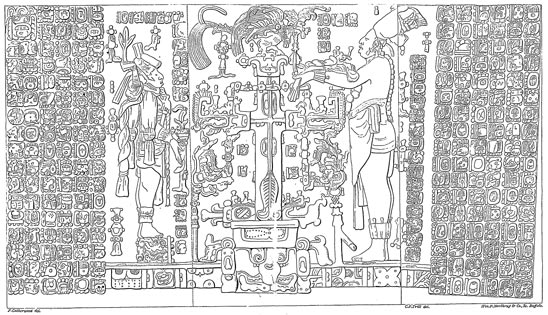 Fig. 48.—The Palenquean Group of the Cross.
Before any advance can be made in the deciphering of the hieroglyphic
inscriptions, it is necessary to know in what directions, along what
lines or columns, the verbal sense proceeds.
All the inscriptions that I know of are in rectangular figures. At Copan
they are usually in squares. At Palenque the longest inscriptions are in
rectangles. At Palenque again, there are some cases where there is a
single horizontal line of hieroglyphs over a pictorial tablet. Here
clearly the only question is, do the characters proceed from left to
right, or from right to left? In other cases as in the tablet of the
cross, there are vertical columns. The question here is, shall we read
up or down?
Now, the hieroglyphs must be phonetic or pictorial, or a mixture of the
two. If they are phonetic, it will take more than one symbol to make a
word, and we shall have groups of like characters when the same word is
written in two places. If the signs are pictorial, the same thing will
follow; that is, we shall have groups recurring when the same idea
recurs. Further, we know that the subjects treated of in these tablets
must be comparatively simple, and that names, as of gods, kings, etc.,
must necessarily recur.
The names, then, will be the first words deciphered. At present no
single name is known. These considerations, together with our system of
nomenclature, will enable us to take some steps.
Take, for example, the right-hand side of the Palenque cross tablet as
given by Rau. See our figure 48, which is Plate LVI of Stephens (vol.
ii, p. 345), with the addition of the part now in the National Museum at
Washington.
Our system of numbering is here
| 2020 |
2021 |
2022 |
2023 |
2024 |
2025 |
| 2030 |
2031 |
2032 |
2033 |
2034 |
2035 |
| * |
* |
* |
* |
* |
* |
| * |
* |
* |
* |
* |
* |
| * |
* |
* |
* |
* |
* |
| 3080 |
3081 |
3082 |
3083 |
3084 |
3085 |
Now pick out the duplicate hieroglyphs in this; that is, run through the
tablet, and wherever 2020 occurs erase the number which fills the place
and write in 2020. Do the same for 2021, 2022, etc., down to 3084. The
result will be as follows:
RIGHT-HAND SIDE OF PALENQUE CROSS TABLET (Rau).
|
2020 |
|
2021 |
|
2022 |
|
2023 |
|
2024 |
|
2025 |
|
|
|
|
|
|
|
|
|
|
|
2030 |
|
2031 |
|
2032 |
|
2033 |
|
2034 |
|
2035 |
|
|
|
|
|
|
|
|
|
|
|
|
|
2040 |
|
2041 |
|
2042 |
|
2025 |
|
2020 |
|
2021 |
|
|
|
|
|
|
|
|
|
|
|
|
2050 |
|
2051 |
|
2034 |
2053 |
|
2054 |
|
2055 |
|
|
|
|
|
|
|
|
|
|
|
|
|
2053 |
|
2061 |
|
2062 |
|
2063 |
|
2064 |
|
2065 |
|
|
2070 |
|
2071 |
|
2020 |
|
2021 |
|
2022? |
|
2024? |
|
|
|
|
|
|
|
|
|
|
|
|
2053 |
|
2020 |
|
2082 |
|
2083 |
|
2025 |
|
2053 |
|
2021 |
|
2091 |
|
2092 |
|
2025 |
|
2094 |
|
2095 |
|
|
3000 |
|
2023 |
|
2034 |
2053 |
|
2033 |
|
3005 |
|
|
|
|
|
|
|
|
|
|
|
|
|
|
|
|
|
|
|
|
|
|
|
|
3010 |
|
2083 |
|
3012 |
|
2024 |
|
3014 |
|
2091 |
|
|
2053 |
|
3021 |
|
2023 |
|
2020 |
|
3024 |
|
2024 |
|
|
2024 |
|
2025 |
|
2021 |
|
3033 |
|
2025 |
|
2034* |
|
|
|
|
|
|
|
|
|
| 2053* |
|
3021 |
|
3042 |
|
3043 |
2035 |
|
3045 |
|
|
|
|
|
|
|
|
|
|
|
|
|
|
3050
See 2082 |
|
2083 |
|
2025 |
|
2034 |
|
3054 |
|
3055 |
|
|
|
|
|
|
|
|
|
|
|
|
2024 |
|
2020 |
2035 |
|
3063 |
|
2024 |
|
2025 |
|
|
|
|
|
|
|
|
|
|
|
|
|
2021 |
|
2031 |
|
2020 |
|
2021 |
|
2035 |
|
3045 |
|
|
|
|
|
|
|
|
|
|
|
|
|
3080 |
|
3081 |
|
2091 |
|
2093 |
|
2020 |
|
2021 |
|
|
|
|
|
|
|
|
|
|
|
|
14 cases of horizontal pairs; 4 cases of vertical pairs; 102
characters in all, of which 51 appear more than once, so that
there are but 51 independent hieroglyphs.
Here the first two lines are unchanged. In the third line we find that
2043 is the same as 2025, 2044=2020, 2045=2021, and so on, and we write
the smallest number in each case.
After this is done, connect like pairs by braces whenever they are
consecutive, either vertical or horizontal. Take the pair 2020 and 2021
for example; 2020 occurs eight times in the tablet, viz, as 2020, 2044,
2072, 2081, 3023, 3061, 3072, 3084. In five out of the eight cases, it
is followed by 2021, viz, as 2021, 2045, 2073, 3073, 3085.
It is clear this is not the result of accident. The pair 2020 and 2021
means something, and when the two characters occur together they must be
read together. There is no point of punctuation between them. We also
learn that they are not inseparable. 2020 will make sense with 2082,
3024 and 3062. Here it looks as if the writing must be read in lines
horizontally. We do not know yet in which direction.
We must examine other cases. This is to be noticed: If the reading is in
horizontal lines from left to right, then the progress is from top to
bottom in columns, as the case of 3035 and 3040 shows. This occurs at
the end of a line, and the corresponding chiffre required to make the
pair is at the other end of the next line. I have marked this case with
asterisks. If we must read in the lines from right to left we must
necessarily read in columns from bottom to top. Thus the lines are
connected.
A similar process with all the other tablets in Stephens leads to the
conclusion that the reading is in lines horizontally and in columns
vertically. The cases 1835-’45, 1885-’95, 1914-’24, and 1936-’46 should,
however, be examined. We have now to decide at which end of the lines to
begin. The reasons given by Mr. Bancroft (Native Races, vol. ii, p.
782) appeared to me sufficient to decide the question before I was
acquainted with his statement of them.
Therefore, the sum total of our present data, examined by a rational
method, leads to the conclusion, so far as we can know from these data,
that the verbal sense proceeded in lines from left to right, in
columns from top to bottom; just as the present page is written, in
fact.
For the present, the introduction of the method here indicated is the
important step. It has, as yet, been applied only to the plates of
Stephens’ work. The definite conclusion should be made to rest on all
possible data, some of which is not at my disposition at present.
Tablets exist in great numbers at other points besides Palenque, and for
the final conclusion these must also be consulted. If each one is
examined in the way I have indicated, it will yield a certain answer.
The direction of reading for that plate can be thus determined. At
Palenque the progress is in the order I have indicated.
It has already been explained how a system of nomenclature was gradually
formed. As I have said, this is not perfect, but it is sufficiently
simple and full for the purpose. By it, every plate in Stephens’ work
receives a number and every hieroglyph in each plate is likewise
numbered.
This was first done in my private copy of the work. I then procured
another copy and duplicated these numbers both for plates and single
chiffres. The plates of this copy were then cut up into single
hieroglyphs and each single hieroglyph was mounted on a library card,
as follows:
| No. 2020. |
Hieroglyph. |
Plate LVI. |
| |
|
|
|
| Same as Numbers. |
Similar to Numbers. |
| |
|
| |
|
| |
|
| |
|
| |
|
| |
|
|
|
The cards were 6.5 by 4.5 inches. The chiffre was pasted on, in the
center of the top space. Its number and the plate from which it came
were placed as in the cut. The numbers of hieroglyphs which resembled
the one in question could be written on the right half of the card, and
the numbers corresponding to different recurrences of this hieroglyph
occupied the left half.
All this part of the work was most faithfully and intelligently
performed for me by Miss Mary Lockwood, to whom I desire to express the
full amount of my obligations. A mistake in any part would have been
fatal. But no mistakes occurred.
These cards could now be arranged in any way I saw fit. The simple
chiffres, for example, could be placed so as to bring like ones
together. A compound hieroglyph could be placed among simple ones
agreeing with any one of its components, and so on.
The expense of forming this card catalogue of about 1,500 single
hieroglyphs was borne by the Ethnological Bureau of the Smithsonian
Institution, and the catalogue is the property of that bureau, forming
only one of its many rich collections of American picture-writings.
In examining the various statues at Copan, as given by Stephens, one
naturally looks for points of striking resemblance or striking
difference. Where all is unknown, even the smallest sign is examined, in
the hope that it may prove a clue. The Plate I, Fig. 49, has a twisted
knot (the “square knot” of sailors) of cords over its head, and above
this is a chiffre composed of ellipses, and above this again a sign
like a sea-shell. A natural suggestion was that these might be the signs
for the name of the personage depicted in Plate I. If this is so and we
should find the same sign elsewhere in connection with a figure, we
should expect to find this second figure like the first in every
particular. This would be a rigid test of the theory. After looking
through the Palenque series, and finding no similar figure and sign, I
examined the Copan series, and in Plate IV, our Fig. 50, I found the
same signs exactly; i. e., the knot and the two chiffres.
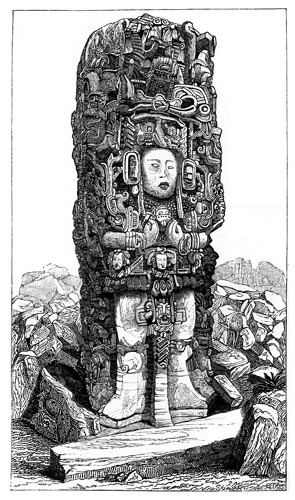
Fig. 49.—Statue at Copan. |
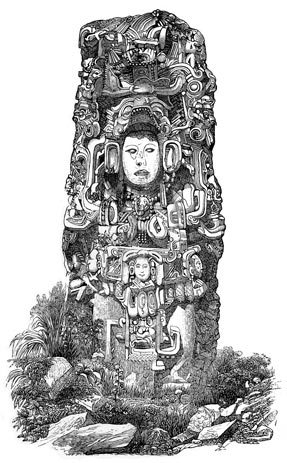
Fig. 50.—Statue at Copan. |
At first sight there is only the most general resemblance between the
personages represented in the two plates; as Stephens says in his
original account of them, they are “in many respects similar.” If he had
known them to be the same, he would not have wasted his time in drawing
them. The scale of the two drawings and of the two statues is different;
but the two personages are the same identically. Figure for figure,
ornament for ornament, they correspond. It is unnecessary to give the
minute comparison here in words. It can be made by any one from the two
plates herewith. Take any part of Plate I, find the corresponding part
of Plate IV, and whether it is human feature or sculptured ornament the
two will be found to be the same.
Take the middle face depending from the belt in each plate. The earrings
are the same; the ornament below the chin, the knot above the head, the
complicated beadwork on each side of this face, all are the same. The
bracelets of the right arms of the main figures have each the forked
serpent tongue, and the left-arm bracelets are ornamented alike. The
crosses with beads almost inclosed in the right hands are alike; the
elliptic ornaments above each wrist, the knots and chiffres over the
serpent masks which surmount the faces, all are the same. In the steel
plates given by Stephens there are even more coindences to be seen
than in the excellent wood-cuts here given, which have been copied from
them.
Here, then, is an important fact. The theory that the chiffre over the
forehead is characteristic, though it is not definitively proved,
receives strong confirmation. The parts which have been lost by the
effects of time on one statue can be supplied from the other. Better
than all, we gain a test of the minuteness with which the sculptors
worked, and an idea of how close the adherence to a type was required to
be. Granting once that the two personages are the same (a fact about
which I conceive there can be no possible doubt, since the chances in
favor are literally thousands to one), we learn what license was
allowed, and what synonyms in stone might be employed. Thus, the
ornament suspended from the neck in Plate IV is clearly a tiger’s skull.
That from the neck of Plate I has been shown to be the derived form of a
skull by Dr. Harrison Allen,225-* and we now know that this common
form relates not to the human skull, as Dr. Allen has supposed, but to
that of the tiger. We shall find this figure often repeated, and the
identification is of importance. This is a case in regard to synonyms.
The kind of symbolism so ably treated by Dr. Allen is well exemplified
in the conventional sign for the crotalus jaw at the mouth of the mask
over the head of each figure. This is again found on the body of the
snake in Plate LX, and in other places. Other important questions can
be settled by comparison of the two plates. For example, at Palenque we
often find a sign composed of a half ellipse, inside of which bars are
drawn. 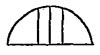 I shall elsewhere show that there is reason to
believe the ellipse is to represent the concave of the sky, its diameter
to be the level earth, and in some cases at least the bars to be the
descending and fertilizing rain. The bars are sometimes two, three, and
sometimes four in number. Are these variants of a single sign, or are
they synonyms? Before the discovery of the identity of the personages in
these two plates, this question could not be answered. Now we can say
that they are not synonyms, or at least that they must be considered
separately. To show this, examine the bands just above the wristlets of
the two figures. Over the left hands of the figures the bars are two in
number; over the right hands there are four. This exact similarity is
not accidental; there is a meaning in it, and we must search for its
explanation elsewhere, but we now have a valuable test of what needs to
be regarded, and of what, on the other hand, may be passed over as
accidental or unimportant.
I shall elsewhere show that there is reason to
believe the ellipse is to represent the concave of the sky, its diameter
to be the level earth, and in some cases at least the bars to be the
descending and fertilizing rain. The bars are sometimes two, three, and
sometimes four in number. Are these variants of a single sign, or are
they synonyms? Before the discovery of the identity of the personages in
these two plates, this question could not be answered. Now we can say
that they are not synonyms, or at least that they must be considered
separately. To show this, examine the bands just above the wristlets of
the two figures. Over the left hands of the figures the bars are two in
number; over the right hands there are four. This exact similarity is
not accidental; there is a meaning in it, and we must search for its
explanation elsewhere, but we now have a valuable test of what needs to
be regarded, and of what, on the other hand, may be passed over as
accidental or unimportant.
One other case needs mentioning here, as it will be of future use. From
the waist of each figure depend nine oval solids, six being hatched over
like pine cones and the three central ones having two ovals, one within
the other, engraved on them. In Plate IV the inner ovals are all on the
right-hand side of the outer ovals. Would they mean the same if they
were on the left-hand side? Plate I enables us to say that they would,
since one of these inner ovals has been put by the artist on that side
by accident or by an allowed caprice. It is by furnishing us with tests
and criteria like these that the proof of the identity of these two
plates is immediately important. In other ways, too, the proof is
valuable and interesting, but we need not discuss them at this time.
These statues, then, are to us a dictionary of synonyms in stone—a test
of the degree of adherence to a prototype which was exacted, and a
criterion of the kind of minor differences which must be noticed in any
rigid study.
I have not insisted more on the resemblances, since the accompanying
figures present a demonstration. Let those who wish to verify these
resemblances compare minutely the ornaments above the knees of the two
figures, those about the waists, above the heads, and the square knots,
etc., etc.
One of the first questions to be settled is whether the same system of
writing was employed at Palenque and at Copan. Before any study of the
meanings of the separate chiffres can be made, we must have our
material properly assorted, and must not include in the figures we are
examining for the detection of a clue, any which may belong to a system
possibly very different.
The opinion of Stephens and of later writers is confirmed by my
comparison of the Palenque and the Copan series; that is, it becomes
evident that the latter series is far the older.
In Nicaragua and Copan the statues of gods were placed at the foot of
the pyramid; farther north, as at Palenque, they were placed in temples
at the summit. Such differences show a marked change in customs, and
must have required much time for their accomplishment. In this time did
the picture-writing change, or, indeed, was it ever identical?
To settle the question whether they were written on the same system, I
give here the results of a rapid survey of the card-catalogue of
hieroglyphs. A more minute examination is not necessary, as the present
one is quite sufficient to show that the system employed at the two
places was the same in its general character and almost identical even
in details. The practical result of this conclusion is that similar
characters of the Copan and Palenque series may be used interchangeably.
A detailed study of the undoubted synonyms of the two places will afford
much light on the manner in which these characters were gradually
evolved. This is not the place for such a study, but it is interesting
to remark how, even in unmistakable synonyms, the Palenque character is
always the most conventional, the least pictorial; that is, the latest.
Examples of this are No. 7, Plate Va, and No. 1969, Plate LVI. The
mask in profile which forms the left-hand edge of No. 7 seems to have
been conventionalized into the two hooks and the ball, which have the
same place in No. 1969.
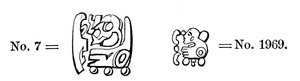 Fig. 51.—Synonomous hieroglyphs from Copan and
Palenque.
Fig. 51.—Synonomous hieroglyphs from Copan and
Palenque.
The larger of these two was cut on stone, the smaller in stucco.
The mask has been changed into the ball and hooks; the angular nose
ornament into a single ball, easier to make and quite as significant to
the Maya priest. But to us the older (Copan) figure is infinitely more
significant. The curious rows of little balls which are often placed at
the left-hand edge of the various chiffres are also conventions for
older forms. It is to be noted that these balls always occur on the left
hand of the hieroglyphs, except in one case, the chiffre 1975 in the
Palenque cross tablet, on which the left-hand acolyte stands.
The conclusion that the two series are both written on the same system,
and that like chiffres occurring at the two places are synonyms, will,
I think, be sufficiently evident to any one who will himself examine the
following cases. It is the nature of the agreements which proves the
thesis, and not the number of cases here cited. The reader will remember
that the Copan series comprises Plates I to XXIII, inclusive; the
Palenque series, Plate XXIV and higher numbers.
The sign of the group of Mexican gods who relate to hell, i. e., a
circle with a central dot, and with four small segments cut out at four
equally distant points of its circumference, is found in No. 4291, Plate
XXII, and in many of the Palenque plates, as Plate LVI, Nos. 2090, 2073,
2045, 2021, etc. In both places this sign is worn by human figures just
below the ear.
The same sign occurs as an important part of No. 4271, Plate XXII, and
No. 4118, Plate XIII (Copan), and No. 2064, Plate LVI (Palenque), etc.
No. 7, Plate Va, and No. 1969, Plate LVI, I regard as absolutely
identical. These are both human figures. No. 12, Plate Va, and No.
637, Plate LIII, are probably the same. These probably represent or
relate to the long-nosed divinity, Yacateuctli, the Mexican god of
commerce, etc., or rather to his Maya representative.
The sign of Tlaloc, or rather the family of Tlalocs, the gods of rain,
floods, and waters, is an eye (or sometimes a mouth), around which there
is a double line drawn. I take No. 26, Plate Va, of the Copan series,
and Nos. 154 and 165, Plate XXIV, to be corresponding references to
members of this family. No. 4, Plate Va, and No. 155 also correspond.
No. 4242, Plate XXII, is probably related to No. 53, Plate XXIV and its
congeners.
Nos. 14 and 34, Plate Va, are clearly related to No. 900, Plate LIV,
Nos. 127 and 176, Plate XXIV, No. 3010, Plate LVI, and many others.
Plate IIIa of Copan is evidently identically the same as the No. 75
of the Palenque Plate No. XXIV.
The right half of No. 27, Plate Va, is the same as the right half of
Nos. 3020, 3040, and many others of Plate LVI.
No. 17, Plate Va, is related to No. 2051, Plate LVI, and many others
like it.
The major part of No. 4105, Plate XIII, is the same as No. 124, Plate
XXIV, etc.
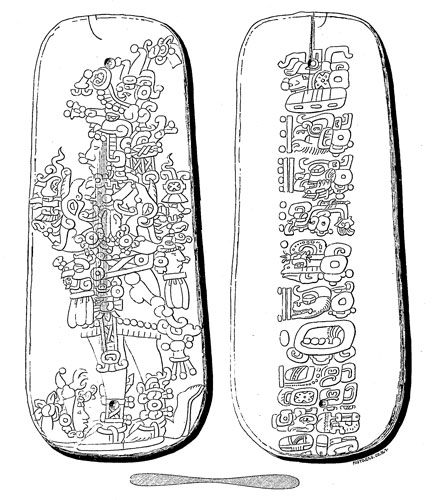 Fig. 52.—Yucatec Stone.
It is not necessary to add a greater number of examples here. The
card-catalogue which I have mentioned enables me to at once pick out all
the cases of which the above are specimens, taken just as they fell
under my eye in rapidly turning over the cards. They therefore represent
the average agreement, neither more nor less. Taken together they
show that the same signs were used at Copan and at Palenque. As the same
symbols used at both places occur in like positions in regard to the
human face, etc., I conclude that not only were the same signs used at
both places, but that these signs had the same meaning; i. e., were
truly synonyms. In future I shall regard this as demonstrated.
In the Congrès des Américanistes, session de Luxembourg, vol. ii, p.
283, is a report of a memoir of Dr. Leemans, entitled “Description de
quelques antiquités américaines conservées dans le Musée royal
néerlandais d’antiquités à Leide.” On page 299 we find—
M. G.-H.-Band, de Arnhiem, a eu la bonté de me confier quelques
antiquités provenant des anciens habitants du Yucatan et de
l’Amérique Centrale, avec autorisation d’en faire prendre des
fac-similes pour le Musée, ce qui me permet de les faire connaître
aux membres du Congrès. Elles ont été trouvées enfouies à une
grande profondeur dans le sol, lors de la construction d’un canal,
vers la rivière Gracioza, près de San Filippo, sur la frontière du
Honduras britannique et de la république de Guatémala par M.
S.-A.-van Braam, ingénieur néerlandais au service de la
Guatémala-Company.
From the maps given in Stieler’s Hand-Atlas and in Bancroft’s Native
Races of the Pacific States I find that these relics were found 308
miles from Uxmal, 207 miles from Palenque, 92 miles from Copan, and 655
miles from the city of Mexico, the distances being in a straight line
from place to place.
The one of these objects with which we are now concerned is figured in
Plate (63) of the work quoted, and is reproduced here as Fig. 52.
Dr. Leemans refers to a similarity between this figure and others in
Stephens’ Travels in Central America, but gives no general comparison.
I wish to direct attention to some of the points of this cut. The
chiffre or symbol of the principal figure is, perhaps, represented in
his belt, and is a St. Andrew’s cross, with a circle at each end of it.
Inside the large circle is a smaller one. It may be said, in passing,
that the cross probably relates to the air and the circle to the
sun.
The main figure has two hands folded against his breast. Two other arms
are extended, one in front, the other behind, which carry two birds.
Each arm has a bracelet. This second pair of hands is not described by
Dr. Leemans. The two birds are exact duplicates, except that the eye of
one is shut, of the other open. Just above the bill of each bird is
something which might be taken as a second bill (which probably is not,
however), and on this and on the back of each bird are five spines or
claws. The corresponding claws are curved and shaped alike in the two
sets. The birds are fastened to the neck of the person represented by
two ornaments, which are alike, and which seem to be the usual
hieroglyph of the crotalus jaw. These jaws are placed similarly with
respect to each bird. In Kingsborough’s Mexican Antiquities, vol. I,
Plate X, we find the parrot as the sign of Tonatihu, the sun, and in
Plate XXV with Naolin, the sun. On a level with the nose of the
principal figure are two symbols, one in front and one behind, each
inclosing a St. Andrew’s cross, and surmounted by what seems to be a
flaming fire. It is probably the chiffre of the wind, as the cross is
of the rain. Below the rear one of these is a head with protruding
tongue (the sign of Quetzalcoatl); below the other a hieroglyph (perhaps
a bearded face). Each of these is upborne by a hand. It is to be
noticed, also, that these last arms have bracelets different from the
pair on the breast.
In passing, it may be noted that the head in rear is under a cross, and
has on its cheek the symbol U. These are the symbols of the left-hand
figure in the Palenque cross tablet.
The head hanging from the rear of the belt has an open eye (like that
of the principal figure), and above it is a crotalus mask, with open
eye, and teeth, and forked fangs. The principal figure wears over his
head a mask, with open mouth, and with tusks, and above this mask is the
eagle’s head. This eagle is a sign of Tlaloc, at least in Yucatan. In
Mexico the eagle was part of the insignia of Tetzcatlipoca, “the devil,”
who overthrew the good Quetzalcoatl and reintroduced human sacrifice.
The characteristics of the principal figure, 63, are then briefly as
follows:
I. His chiffre is an air-cross with the sun-circle.
II. He has four hands.
III. He bears two birds as a symbol.
IV. The claws or spikes on the backs of these are significant.
V. The mask with tusks over the head.
VI. The head worn at the belt.
VII. The captive trodden under foot.
VIII. The chain from the belt attached to a kind of ornament or symbol.
IX. The twisted flames (?) or winds (?) on each side of the figure.
X. His association with Quetzalcoatl or Cuculkan, as shown by the
mouth with protruding tongue, and with Tlaloc or Tetzcatlipoca, as shown
by the eagle’s head.
We may note here for reference the signification of one of the
hieroglyphs in the right-hand half of Fig. 52, i. e., in that half
which contains only writing. The topmost chiffre is undoubtedly the
name, or part of the name, of the principal figure represented in the
other half. It is in pure picture-writing; that is, it expresses the sum
of his attributes. It has the crotalus mask, with nose ornament, which
he wears over his face; then the cross, with the “five feathers” of
Mexico, and the sun symbol. These are in the middle of the chiffre.
Below these the oval may be, and probably is, heaven, with the rain
descending and producing from the surface of the earth (the long axis of
the ellipse), the seed, of which three grains are depicted.
We know by the occurrence of the hieroglyphs on the reverse side of the
stone that this is not of Aztec sculpture. These symbols are of the same
sort as those at Copan, Palenque, etc., and I shall show later that some
of them occur in the Palenque tablets. Hence, we know this engraving to
be Yucatec and not Aztec in its origin. If it had been sculptured on one
side only, and these hieroglyphs omitted, I am satisfied that the facts
which I shall point out in the next paragraphs would have led to the
conclusion that this stone was Mexican in its origin. Fortunately the
native artist had the time to sculpture the Yucatec hieroglyphs, which
are the proof of its true origin. It was not dropped by a traveling
Aztec; it was made by a Yucatec.
In passing, it may be said that the upper left-hand, hieroglyph of Plate
XIII most probably repeats this name.
I collect from the third volume of Bancroft’s Native Races, chapter
viii, such descriptions of Huitzilopochtli as he was represented among
the Mexicans as will be of use to us in our comparisons. No display of
learning in giving the references to the original works is necessary
here, since Mr. Bancroft has placed all these in order and culled them
for a use like the present. It will suffice once for all to refer the
critical reader to this volume, and to express the highest sense of
obligation to Mr. Bancroft’s compilation, which renders a survey of the
characteristic features of the American divinities easy.
In Mexico, then, this god had, among other symbols, “five balls of
feathers arranged in the form of a cross.” This was in reference to the
mysterious conception of his mother through the powers of the air. The
upper hieroglyph in Fig. 52, and one of the lower ones, contain this
sign: “In his right hand he had an azured staff cutte in fashion of a
waving snake.” (See Plate LXI of Stephens.) “Joining to the temple of
this idol there was a piece of less work, where there was another idol
they called Tlaloc. These two idolls were alwayes together, for that
they held them as companions and of equal power.”
To his temple “there were foure gates,” in allusion to the form of the
cross. The temple was surrounded by rows of skulls (as at Copan) and the
temple itself was upon a high pyramid. Solis says the war god sat “on a
throne supported by a blue globe. From this, supposed to represent
the heavens, projected four staves with serpents’ heads. (See Plate
XXIV, Stephens.) “The image bore on its head a bird of wrought plumes,”
“its right hand rested upon a crooked serpent.” “Upon the left arm was a
buckler bearing five white plums arranged in form of a cross.” Sahagun
describes his device as a dragon’s head, “frightful in the extreme, and
casting fire out of his mouth.”
Herrara describes Huitzilopochtli and Tezcatlipoca together, and
says they were “beset with pieces of gold wrought like birds, beasts,
and fishes.” “For collars, they had ten hearts of men,” “and in their
necks Death painted.”
Torquemada derives the name of the war god in two ways. According to
some it is composed of two words, one signifying “a humming bird” and
the other “a sorcerer that spits fire.” Others say that the last word
means “the left hand,” so that the whole name would mean “the shining
feathered left hand.” “This god it was that led out the Mexicans from
their own land and brought them into Anáhuac.” Besides his regular
statue, set up in Mexico, “there was another renewed every year, made of
different kinds of grains and seeds, moistened with the blood of
children.” This was in allusion to the nature-side of the god, as fully
explained by Müller (Americanische Urreligionen).
No description will give a better idea of the general features of this
god than the following cuts from Bancroft’s Native Races, which are
copied from Leon y Gama, Las Dos Piedras, etc. Figs. 53 and 54 are the
war god himself; Fig. 55 is the back of the former statue on a larger
scale; Fig. 56 is the god of hell, and was engraved on the bottom of the
block.
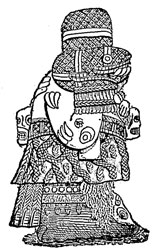
Fig. 53.—Huitzilopochtli (front). |
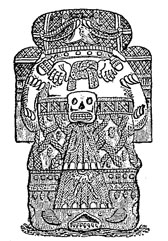
Fig. 54.—Huitzilopochtli (side). |
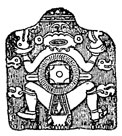 Fig. 56.—Miclantecutli.
These three were a trinity well nigh inseparable. It has been doubted
whether they were not different attributes of the same personage. In the
natural course of things the primitive idea would become differentiated
into its parts, and in process of time the most important of the parts
would each receive a separate pictorial representation.
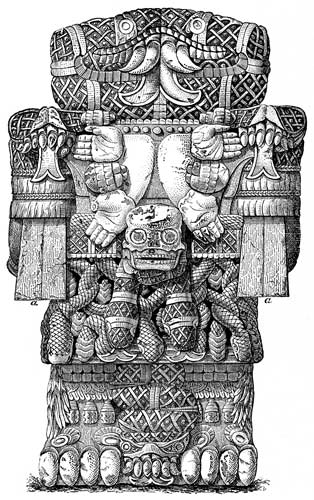 Fig. 55.—Huitzilopochtli (back).
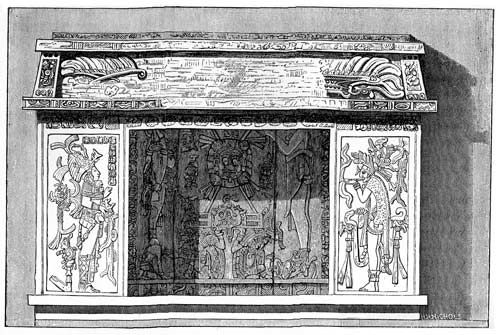 Fig. 57.—Adoratorio.
By referring back a few pages the reader will find summarized the
principal characteristics of the Central American figure represented in
Fig. 52. He will also have noticed the remarkable agreement between the
attributes of this figure and those contained in the cuts or in the
descriptions of the Mexican gods. Thus—
I. The symbol of both was the cross.
II. Fig. 52 and Fig. 55 each have four hands.233-*
III. Both have birds as symbols.
It is difficult to regard the bird of Fig. 52 as a humming bird, as it
more resembles the parrot, which, as is well known, was a symbol of some
of the Central American gods. Its occurrence here in connection with the
four arms fixes it, however, as the bird symbol of Huitzilopochtli. In
the Ms. Troano, plate xxxi (lower right-hand figure), we find this
same personage with his two parrots, along with Tlaloc, the god of rain.
IV. The claws of the Mexican statue may be symbolized by the spikes on
the back of the birds in Fig. 52, but these latter appear to me to
relate rather to the fangs and teeth of the various crotalus heads of
the statues.
V. The mask, with tusks, of Fig. 52, is the same as that at the top of
Fig. 55, where we see that they represent the teeth of a serpent, and
not the tusks of an animal. This is shown by the forked tongue beneath.
The three groups of four dots each on Huitzilopochtli’s statue are
references to his relationship with Tlaloc.
With these main and striking duplications, and with other minor and
corroborative resemblances, which the reader can see for himself, there
is no doubt but that the two figures, Mexican and Yucatec, relate to the
same personage. The Yucatec figure combines several of the attributes of
the various members of the Mexican trinity named above, but we should
not be surprised at this, for, as has been said, some writers consider
that this trinity was one only of attributes and not of persons.
What has been given above is sufficient to show that the personage
represented in Fig. 52 is the Yucatec equivalent of Huitzilopochtli, and
has relations to his trinity named at the head of this section, and also
to the family of Tlaloc. I am not aware that the relationship of the
Yucatec and Aztec gods has been so directly shown, on evidence almost
purely pictorial, and therefore free from a certain kind of bias.
If the conclusions above stated are true, there will be many
corroborations of them, and the most prominent of these I proceed to
give, as it involves the explanation of one of the most important
tablets of Palenque, parts of which are shown in Plates XXIV, LX, LXI,
and LXII, vol. ii, of Stephens.
Plate LXII, Fig. 57, represents the “Adoratorio or Alta Casa, No. 3” of
Palenque. This is nothing else than the temple of the god
Huitzilopochtli and of his equal, Tlaloc. The god of war is shown on a
larger scale in Plate LXI, Fig. 58, while Tlaloc is given in Plate LX,
Fig. 59, and the tablet inside the temple in Plate XXIV, Fig. 60. The
resemblances of Plate XXIV and of the Palenque cross tablet and their
meanings will be considered farther on.
Returning to Plate LXII, the symbols of the roof and cornice refer to
these two divinities. The faces at the ends of the cornice, with the
double lines for eye and mouth, are unmistakable Tlaloc signs. The
association of the two gods in one temple, as at Mexico, is a strong
corroboration.
Let us now take Plate LXI, Fig. 58, which represents Huitzilopochtli, or
rather, the Yucatec equivalent of this Aztec god. I shall refer to him
by the Aztec appelation, but I shall in future write it in italics; and
in general the Yucatec equivalents of Aztec personages in italics, and
the Aztec names in small capitals.
Compare Fig. 52 and the Plate LXI (Fig. 58). As the two plates are
before the reader, I need only point out the main resemblances, and,
what is more important, the differences.
The sandals, the belt, its front pendant, the bracelets, the neck
ornament, the helmet, should be examined. The four hands of Fig. 52 are
not in LXI, nor the parrots; but if we refer to Kingsborough, Vol. II,
Plates 6 and 7 of the Laud manuscript, we shall find figures of
Huitzilopochtli with a parrot, and of Tlaloc with the stork with a fish
in its mouth, as in the head-dress here. The prostrate figure of Fig. 52
is here led by a chain. At Labphak (Bancroft, Vol. iv., p. 251), he is
held aloft in the air, and he is on what may be a sacrificial yoke.
The Tlaloc eagle is in the head of the staff carried in the hand. This
eagle is found in the second line from the bottom of Fig. 52, we may
remark in passing. Notice also the crescent moon in the ornament back of
the shoulders of the personage of Fig. 58. The twisted cords which form
the bottom of this ornament are in the hieroglyph No. 37, Plate XXIV
(Fig. 60).
Turning now to Plate LX (Fig. 59).
This I take to be the sorcerer Tlaloc. He is blowing the wind from his
mouth; he has the eagle in his head-dress, the jaw with grinders, the
peculiar eye, the four Tlaloc dots over his ear and on it, the snake
between his legs, curved in the form of a yoke (this is known to be a
serpent by the conventional crotalus signs of jaw and rattles on it in
nine places), the four Tlaloc dots again in his head-dress, etc. He has
a leopard skin on his back (the tiger was the earth in Mexico) and his
naked feet have peculiar anklets which should be noticed.
Although I am deferring the examination of the hieroglyphs to a later
section, the chiffre 3201 should be noticed. It is the Tlaloc eye
again, and 3203 is the chiffre of the Mexican gods of hell.
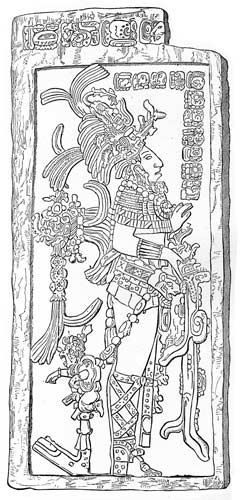
Fig. 58.—Maya War God. |
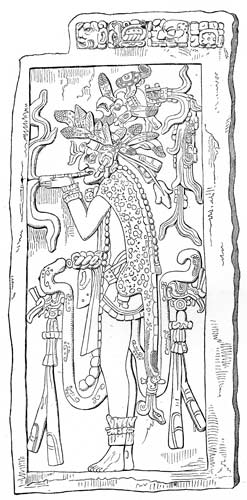
Fig. 59.—Maya Rain God. |
In passing I may just refer the reader to p. 164, Vol. ii, of Stephens’
book on Yucatan, where a figure occurring at Labphax is given. This I
take to be the same as Huitzilopochtli of Plate LXI. Also in the MS.
Troano, published by Brasseur de Bourbourg, a figure in Plate XXV and
in other plates sits on a hieroglyph like 3201, and is Tlaloc.
This is known by the head-dress, the teeth, the air-trumpet, the serpent
symbol, etc. In Plates XXVIII, XXXI, and XXXIII of the same work
Huitzilopochtli and Tlaloc are represented together, in various
adventures.
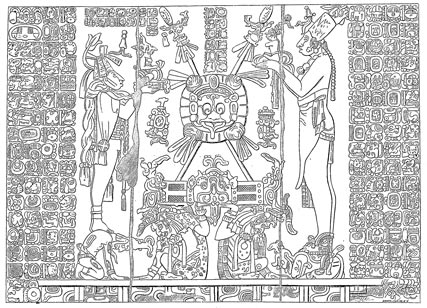 Fig. 60.—Tablet at Palenque.
In Plate LX (Fig. 59) notice also the chiffre on the tassels before
and behind the main personage.
Now turn to the Plate XXIV (Fig. 60), which is the main object in the
“Adoratorio” (Fig. 57), where the human figures serve as flankers.
First examine the caryatides who support the central structure. These
are Tlalocs. Each has an eagle over his face, is clothed in leopard
skin, has the characteristic eye and teeth, and the wristlets of Plate
LX (Fig. 59).
A vertical line through the center of Plate XXIV (Fig. 60) would
separate the figures and ornaments into two groups. These groups are
very similar, but never identical, and this holds good down to the
minutest particulars and is not the result of accident. One side (the
right-hand) belongs to Tlaloc, the other to Huitzilopochtli.
The right-hand priest (let us call him, simply for a name and not to
commit ourselves to a theory) has the sandals of Plate LXI; the
left-hand priest the anklets of Plate LX.
The beast on which the first stands and the man who supports the other
are both marked with the tassel symbol of Plate LX. There is a certain
rude resemblance between the supplementary head of this beast and the
pendant in front of the belt of Fig. 52. Four of these beasts supply
rain to the earth with Tlaloc in Plate XXVI of the MS. Troano. The
infant offered by the right-hand priest has the two curls on his
forehead which was a necessary mark of the victims for Tlaloc’s
sacrifices. The center of the whole plate is a horrid mask with an open
mouth. Behind this are two staves with different ornaments crossed in
the form of the air-cross. On either hand of this the ornaments are
different though similar.
A curious resemblance may be traced between the positions, etc., of
these two staves and those of the figure on p. 563, vol. iv, of
Bancroft’s Native Races, which is a Mexican stone. Again, this latter
figure has at its upper right-hand corner a crouching animal (?) very
similar to the gateway ornament given in the same volume, p. 321. This
last is at Palenque. I quote these two examples in passing simply to
reinforce the idea of similarity between the sacred sculptures of
Yucatan and Mexico.
I take it that the examination of which I have sketched the details will
have left no doubt but that the personage of Fig. 52 is truly
Huitzilopochtli, the Yucatec representative of Huitzilopochtli; that
Plate LXI (Fig. 58) is the same personage; that Plate LX (Fig. 59)
represents Tlaloc; and that Plate XXIV (Fig. 60) is a tablet relating to
the service of these two gods.
I have previously shown that the Palenque hieroglyphs are read in order
from left to right. We should naturally expect, then, that the sign for
Tlaloc or for Huitzilopochtli would occupy the upper left-hand
corner of Plate XXIV. In fact it does, and I was led to this discovery
in the way I have indicated.
No. 37 is the Palenque manner of writing the top sign of Fig. 52. I
shall call the signs of Fig. 52 a, b, c, etc., in order downwards.
The crouching face in a occupies the lower central part of No. 37.
Notice also that this face occurs below the small cross in the detached
ornament to the left of the central mask of Fig. 60. The crescent moon
of Plate LXI (Fig. 58) is on its cheek; back of this is the sun-sign;
the cross of a is just above its eye; the three signs for the
celestial concave are at the top of 37, crossed with rain bands; the
three seeds (?) are below these. The feathers are in the lower
right-hand two-thirds. This is the sign or part of the sign for
Huitzilopochtli. If a Maya Indian had seen either of these signs a few
centuries ago, he would have had the successive ideas—a war-god, with a
feather-symbol, related to sun and moon, to fertilizing rain and
influences, to clouds and seed; that is Huitzilopochtli, the companion
of Tlaloc. Or if he had seen the upper left-hand symbol of the
Palenque cross tablet (1800), he would have had related ideas, and so
on.
What I have previously said about the faithfulness with which the
Yucatec artist adhered to his prototypes in signs is perfectly true,
although apparently partly contradicted by the identification I have
just made. When a given attribute of a god (or other personage) was to
be depicted, the chiffres expressing this were marvellously alike.
Witness the chiffres Nos. 2090, 2073, 2021, 2045, 3085, 3073, 3070,
3032 of the Palenque cross tablet. But directly afterwards some other
attribute is to be brought out, and the chiffre changes; thus the
hieroglyph 1009 of Plate LIV, or 265, Plate LII, has the same protruding
tongue as 2021, etc., and is the same personage, but the style is quite
changed. In Fig. 52, Huitzilopochtli is the war-god, in Plate XXIV he
is the rain-god’s companion; and while every attribute is accounted for,
prominence is given to the special ones worshipped or celebrated. Scores
of instances of this have arisen in the course of my examination.
Again, we must remember that this was no source of ambiguity to the
Yucatecs, however much it may be to us. Each one of them, and specially
each officiating priest, was entirely familiar with every attribute of
every god of the Yucatec pantheon. The sign of the attribute brought the
idea of the power of the god in that special direction; the full idea of
his divinity was the integral of all these special ideas. The limits
were heaven and earth.
This, then, is the first step. I consider that it is securely based, and
that we may safely say that in proper names, at least, a kind of picture
writing was used which was not phonetic.
From this point we may go on. I must again remark that great familiarity
with the literature of the Aztecs and Yucatecs is needed—a familiarity
to which I personally cannot pertend—and that it is clear that
the method to reach its full success must be applied by a true scholar
in this special field.
Although there is no personage of all the Maya pantheon more easy to
recognize in the form of a statue than Tlaloc, there is great
difficulty in being certain of all the hieroglyphs which relate to
him. There is every reason to believe that in Yucatan, as in Mexico,
there was a family of rain-gods, Tlalocs, and the distinguishing signs
of the several members are almost impossible of separation, so long as
we know so little of the special functions of each member of this
family.
In Yucatan, as in Mexico, Tlaloc’s main sign was a double line about
the eye or mouth, or about both; and further, some of the Tlalocs, at
least, were bearded.237-*
Cukulcan was also bearded, but we have separated out in the next section
the chiffres, or certainly most of them, that relate to him. Those
that are left remain to be distributed among the family of rain-gods;
and this, as I have said, can only be done imperfectly, on account of
our slight knowledge of the character of these gods.
If we examine the plates given by Stephens, we shall find many pictorial
allusions to Tlaloc. These are often used as mere ornaments or
embellishments, as in borders, etc., and probably served only to notify,
in a general way, the fact of the relationship of the personage
represented, to this family, and probably not to convey any specific
meaning.
Thus, in Plate XXXV of Stephens’ work the upper left-hand ornament of
the border is a head of Tlaloc with double lines about eye and mouth,
and this ornament is repeated in a different form at the lower
right-hand corner of the border just back of the right hand of the
sitting figure, and also in the base of the border below the feet of the
principal figure.
Plate XLVIII (of Stephens’) is probably Chalchihuitlicue (that is, the
Yucatec equivalent of that goddess), who was the sister of Tlaloc. His
sign occurs in the upper left-hand corner of the border, and in Plate
XLIX the same sign occurs in a corresponding position.
Plate XXIV (our Fig. 60) is full of Tlaloc signs. The bottom of the
tablet has a hieroglyph, 93 (Huitzilopochtli), at one end and 185
(Tlaloc) at the other. The leopard skin, eagle, and the crouching
tiger (?) under the feet of the priest of Tlaloc (the right-hand
figure) are all given. The infant (?) offered by this priest has two
locks of curled hair at its forehead, as was prescribed for children
offered to this god.
In Plate LVI (our Fig. 48) the mask at the foot of the cross is a human
mask, and not a serpent mask, as has been ingeniously proved by Dr.
Harrison Allen in his paper so often quoted. It is the mask of Tlaloc,
as shown by the teeth and corroborated (not proved) by the way in which
the eye is expressed. The curved hook within the eyeball here, as in
185, stands for the air—the wind—of which Tlaloc was also god. The
Mexicans had a similar sign for breath, message.
The chiffre 1975, on which Huitzilopochtli’s priest is standing, I
believe to be the synonym of 185 in Plate XXIV. Just in front of
Tlaloc’s priest is a sacrificial yoke (?), at the top of which is a
face, with the eye of the Tlalocs, and various decorations. This face
is to be found also at the lower left-hand corner of Plate XLI (of
Stephens’), and also (?) in the same position in Plate XLII (of
Stephens’). These will serve as subjects for further study.
Notice in Plate LVI (our Fig. 48) how the ornaments in corresponding
positions on either side of the central line are similar, yet never the
same. A careful study of these pairs will show how the two gods
celebrated, differed. A large part, at least, of the attributes of each
god is recorded in this way by antithesis. I have not made enough
progress in this direction to make the very few conclusions of which I
am certain worth recording. The general fact of such an antithesis is
obvious when once it is pointed out, and it is in just such paths as
this that advances must be looked for.
I have just mentioned, in this rapid survey of the plates of vol. ii of
Stephens’ work, the principal pictorial signs relating to Tlaloc.
There are a number almost equally well marked in vol. i, in Plates VII,
IX, X, XIII, and XV, but they need not be described. Those who are
especially interested can find them for themselves.
The following brief account and plate of a Tlaloc inscription at Kabah
will be useful for future use, and is the more interesting as it is
comparatively unknown.
INSCRIPTION AT KABAH (Yucatan).
This hitherto unpublished inscription on a rock at Kabah is given in
Archives paléographiques, vol. i, part ii, Plate 20. It deserves
attention on account of its resemblances, but still more on account of
its differences, with certain other Yucatec glyphs.
We may first compare it with the Plate LX of Stephens (our Fig. 59).
The head-dress in Plate 20 is quite simple, and presents no resemblance
to the elaborate gear of Plate LX, in which the ornament of a leaf (?),
or more probably feather, cross-hatched at the end and divided
symmetrically by a stem (?) or quill about which four dots are placed,
seems characteristic.
Possibly, and only possibly, the square in the rear of the head of
Plate 20, which has two cross-hatchings, may refer to the elaborate
cross-hatchings in Plate LX. The four dots are found twice, once in
front and once in rear of the figure. The heads of the two figures have
only one resemblance, but this is a very important one. The tusks belong
to Huitzilopochtli and to his trinity, and specially to Tlaloc, his
companion.
Both Plate 20 and LX have the serpent wand or yoke clearly expressed. In
LX the serpent is decorated with crotalus heads; in 20 by images of the
sun (?), as in the Ferjavary MS. (Kingsborough). The front apron or
ornament of Plate 20 is of snake skin, ornamented with sun-symbols.
Comparing Plate 20 with Fig. 52 (ante), we find quite other
resemblances. The head-dress of 20 is the same as the projecting arm of
the head-dress of Fig. 52; and the tusks are found in the helmet or mask
of Fig. 52.
These and other resemblances show the Kabah inscription to be a Tlaloc.
It is interesting specially on account of its hieroglyphs, which I hope
to examine subsequently. The style of this writing appears to be late,
and may serve as a connecting link between the stones and the
manuscripts, and it is noteworthy that even the style of the drawing
itself seems to be in the manner of the Mexican MS. of Laud, rather than
in that of the Palenque stone tablets.
From the card catalogue I select the following chiffres as
appertaining to the family of the Tlalocs. As I have said, these must
for the present remain in a group, unseparated. Future studies will be
necessary to discriminate between the special signs which relate to
special members of the family. The chiffres are Nos. 3200; 1864; 1403;
811; 1107?; 1943?; 4114??; b?; 1893 (bearded faces, or faces with
teeth very prominent); 166?; 4??; 807?; 62?; 155?; 26; 154?; 165?; 164?;
805; 4109; 1915?; 675??; 635?? (distinguished by the characteristic eye
of the Tlalocs).
Here, again, the writing is ideographic, and not phonetic.
The character 2021 occurs many times in Plate LVI (Fig. 48), and
occasionally elsewhere. The personage represented is distinguished by
having a protruding tongue, and was therefore at once suspected to be
Quetzalcoatl. (See Bancroft’s Native Races, vol. iii, p. 280.) The
protruding tongue is probably a reference to his introduction of the
sacrificial acts performed by wounding that member.
The rest of the sign I suppose to be the rebus of his name,
“Snake-plumage”; the part cross-hatched being “snake,” the feather-like
ornament at the upper left-hand corner being “plumage.” It is necessary,
however, to prove this before accepting the theory. To do this I had
recourse to Plates I and IV (Figs. 49, 50), my dictionary of synonyms.
This cross-hatching occurs in Plate I. In the six tassels below the
waist, where the cross-hatching might indicate the serpent skin,
notice the ends of the tassels; these are in a scroll-like form, and as
if rolled or coiled tip. In Plate IV they are the same, naturally. So
far there is but little light.
In Plate IV, just above each wrist, is a sign composed of ellipse and
bars; a little above each of these signs, among coils which may be
serpent coils, and on the horizontal line through the top of the
necklace pendant, are two surfaces cross-hatched all over. What do these
mean? Referring to Plate I, we find, in exactly the same relative
situation, the forked tongue and the rattles of the crotalus. These are,
then, synonyms, and the guess is confirmed. The cross-hatching means
serpent-skin. Is this always so? We must examine other plates to
decide.
The same ornament is found in Plates IX, XIV, XVI, XVIII, XIX, XX, XXI,
XXXV (of Stephens’), but its situation does not allow us to gain any
additional light.
In Plate XII (Stephens’) none of the ornaments below the belt will help
us. At the level of the mouth are four patches of it. Take the upper
right-hand one of these. Immediately to its right is a serpent’s head;
below the curve and above the frog’s (?) head are the rattles. Here is
another confirmation. In Plate XVIII I refer the cross-hatching to the
jaw of the crocodile. In Plate XXII I have numbered the chiffres as
follows:
| 4201 |
4202 |
4203 |
4204. |
| 4211 |
4212 |
4213 |
4214. |
| * |
* |
* |
* |
| * |
* |
* |
* |
| * |
* |
* |
* |
| 4311 |
4312 |
4313 |
4314. |
4204 has the cross-hatching at its top, and to its left in 4203 is the
serpent’s head. The same is true in 4233-4. In 4264 we have the same
symbol that we are trying to interpret; it is in its perfect form here
and in No. 1865 of the Palenque series. In the caryatides of Plate XXIV
(Fig. 60) the cross-hatching is included in the spots of the leopard’s
skin; in the ornaments at the base, in and near the masks which, they
are supporting, it is again serpent skin. Take the lower mask; its jaws,
forked-tongue, and teeth prove it to be a serpent-mask, as well as the
ornament just above it. In Plate LX (Fig. 59) it is to be noticed that
the leopard spots are not cross-hatched, but that this ornament is given
at the lower end of the leopard robe, which ends moreover in a crotalus
tongue marked with the sign of the jaw (near the top of this ornament)
and of the rattles (near the bottom). This again confirms the theory of
the rebus meaning of the cross-hatching. In Plate XXIV (Fig. 60) the
cross-hatching on the leopard spots probably is meant to add the
serpent attribute to the leopard symbol, and not simply to denote the
latter.
Thus an examination of the whole of the material available, shows that
the preceding half of the hieroglyph 2021 and its congeners is nothing
but the rebus for Quetzalcoatl, or rather for Cukulcan, the Maya name
for this god. Brasseur de Bourbourg, as quoted in Bancroft’s Native
Races, vol. ii, p. 699, foot note, says Cukulcan, comes from kuk or
kukul, a bird, which appears to be the same as the quetzal, and from
can, serpent; so that Cukulcan in Maya is the same as Quetzalcoatl in
Aztec. It is to be noticed how checks on the accuracy of any deciphering
of hieroglyphs occur at every point, if we will only use them.
The Maya equivalents of Huitzilopochtli and Tlaloc are undoubtedly
buried in the chiffres already deciphered, but we have no means of
getting their names in Maya from the rebus of the chiffres.
In the cases of these two gods we got the chiffre, and the rebus is
still to seek. In the case of Quetzalcoatl or Cukulcan, the rebus was
the means of getting the name; and if the names of this divinity had not
been equivalent in the two tongues, our results would have led us to the
(almost absurd) conclusion that a god of certain attributes was called
by his Aztec name in the Maya nations.
Thus every correct conclusion confirms every former one and is a basis
for subsequent progress. The results of this analysis are that the Maya
god Cukulcan is named in each one of the following chiffres, viz: Nos.
1009, 265, 2090, 2073, 2021, 3085, 2045, 3073, 3070, 3032, 1865, 265,
268?, 4291? 73?? I give the numbers in the order in which they are
arranged in the card-catalogue. There is, of course, a reason for this
order.
Bancroft, vol. iii, p. 268, says of Quetzalcoatl that “his symbols were
the bird, the serpent, the cross, and the flint, representing the
clouds, the lightning, the four winds, and the thunderbolt.”
We shall find all of his titles except one, the bird, in what follows.
We must notice here that in the chiffre 2021 and its congeners the
bird appears directly over the head of Cukulcan. It is plainly shown in
the heliotype which accompanies Professor Rau’s work on the Palenque
cross, though not so well in our Fig. 48.
In what has gone before, we have seen that the characters 2021, 2045,
2073, 3073, 3085, 265, etc., present the portrait and the rebus of
Cukulcan. It will not be forgotten that in the examination of the
question as to the order in which the stone inscriptions were read we
found a number of pairs in Plate LVI, Fig. 48; the characters 2021,
etc., being one member of each. The other members of the pairs in the
Plate LVI were 2020, 2044, 2072, 3072, 3084, etc. 264-265 is another
example of the same pair elsewhere.
I hoped to find that the name Cukulcan, or 2021, was associated in these
pairs with some adjective or verb, and therefore examined the other
members of the pair.
In a case like this the card-catalogue is of great assistance; for
example, I wish to examine here the chiffres Nos. 2020, 2044, 2072,
3072, 3084, etc. In the catalogue their cards occur in the same
compartment, arranged so that two cards that are exactly alike are
contiguous. We can often know that two chiffres are alike when one is
in a far better state of preservation than the other. Hence we may
select for study that one in which the lines and figures are best
preserved; or from several characters known to be alike, and of which no
one is entirely perfect, we may construct with accuracy the type upon
which they were founded. In this case the hieroglyph 2020 is well
preserved (see the right-hand side of Plate LVI, Fig. 48, the upper
left-hand glyph). It consists of a human hand, with the symbol of the
sun in it; above this is a sign similar to that of the Maya day
Ymix; above this again, in miniature, is the rebus “snake plumage” or
Cukulcan; and to the left of the hieroglyph are some curved lines not
yet understood. No. 2003 of the same plate is also well preserved. It
has the hand as in 2020, the rebus also, and the sign for Ymix is
slightly different, being modified with a sign like the top of a cross,
the symbol of the four winds. The symbol Ymix may be seen, by a
reference to Plate XXVII (lower half) of the MS. Troano, to relate to
the rain. The figure of that plate is pouring rain upon the earth from
the orifices represented by Ymix. The cross of the four winds is
still more plain in Nos. 2072, 3084, and 3072.
The part of this symbol 2020 and its synonyms which consists of curved
lines occupying the left hand one-third of the whole chiffre occurs
only in this set of characters, and thus I cannot say certainly what
this particular part of the hieroglyph means; but if the reader will
glance back over the last one hundred lines he will find that these
chiffres contain the rebus Cukulcan, the sign of a human hand, of
the sun, of the rain, and of the four winds.
In Bancroft’s Native Races, vol. iii, chapter vii, we find that the
titles of Quetzalcoatl (Cukulcan) were the air, the rattlesnake, the
rumbler (in allusion to thunder), the strong hand, the lord of the
four winds. The bird symbol exists in 2021, etc. Now in 2020 and its
congeners we have found every one of these titles, save only that
relating to the thunder. And we have found a meaning for every part of
the hieroglyph 2020 save only one, viz, the left-hand one-third,
consisting of concentric half ellipses or circles. It may be said to be
quite probable that the unexplained part of the sign (2020)
corresponds to the unused title, “the rumbler.” But it is not rigorously
proved, although very probable. The thunder would be well represented by
repeating the sign for sky or heaven. This much seems to me certain. The
sign is but another summing up of the attributes and titles of Cukulcan.
2021 gave his portrait, his bird symbol, made allusion to his
institution of the sacrifice of wounding the tongue, and spelled out his
name in rebus characters. 2020 repeats his name as a rebus and adds the
titles of lord of the four winds, of the sun, of rain, of the strong
hand, etc. It is his biography, as it were.
In this connection, a passing reference to the characters 1810, etc.,
1820, etc., 1830, etc., 1840, etc., 1850, etc., of the left-hand side of
Plate LVI should be made. Among these, all the titles named above are to
be found. These are suitable subjects for future study.
We now see why the pair 2020, 2021 occurs so many times in Plate LVI,
and again as 264, 265, etc. The right-hand half of this tablet has much
to say of Cukulcan, and whenever his name is mentioned a brief list of
his titles accompanies it. Although it is disappointing to find both
members of this well-marked pair to be proper names, yet it is
gratifying to see that the theory of pairs, on which the proof of the
order in which the tablets are to be read must rest, has received such
unexpected confirmation.
To conclude the search for the hieroglyphs of Cukulcan’s name, it will
be necessary to collect all those faces with “round beards” (see
Bancroft’s Native Races, vol. iii, p. 250). Tlaloc was also bearded,
but all the historians refer to Quetzalcoatl as above cited. I refer
hieroglyphs Nos. 658, 651?, 650?, and 249? to this category.
Perhaps also the sign No. 153 is the sign of Quetzalcoatl, as something
very similar to it is given as his sign in the Codex Telleriano
Remensis, Kingsborough, vol. i, Plates I, II, and V (Plate I the best),
where he wears it at his waist.
In Plate LXIII of Stephens (vol. ii) is a small figure of Cukulcan
which, he calls “Bas Relief on Tablet.” Waldeck gives a much larger
drawing (incorrect, however, in many details), in which the figure, the
“Beau Relief,” is seen to wear bracelets high up on the arm. This was a
distinguishing sign of Quetzalcoatl (see Bancroft’s Native Races, vol.
iii, pp. 249 and 250), and this figure probably is a representation of
the Maya divinity. He is on a stool with tigers for supports. The tiger
belongs to the attributes which he had in common with Tlaloc, and we see
again the intimate connection of these divinities—a connection often
pointed out by Brasseur de Bourbourg.
This is the third proper name which has been deciphered. All of them
have been pure picture-writing, except in so far as their rebus
character may make them in a sense phonetic.
We have a set of signs for Maya months and days handed down to us by
Landa along with his phonetic alphabet. A priori these are more likely
to represent the primitive forms as carved in stone than are the
alphabetic hieroglyphs, which may well have been invented by the
Spaniards to assist the natives to memorize religious formulæ.243-*
Brasseur de Bourbourg has analyzed the signs for the day and month in
his publication on the MS. Troano, and the strongest arguments which
can be given for their phonetic origin are given by him.
I have made a set of MS. copies of these signs and included them in my
card-catalogue, and have carefully compared them with the tablets XXIV
and LVI. My results are as follows:
Plate XXIV (our Fig. 60).
No. 42 is the Maya month Pop, beginning July 16.
No. 54 is Zip??, beginning August 25.
No. 47 is Tzoz??, beginning September 14.
No. 57 is Tzec? beginning October 4.
No. 44-45 is Mol?, beginning December 3.
No. 39 is Yax, Zac, or Ceh, beginning January 12, February 1,
February 21, respectively.
Plate LVI (our Fig. 48).
No. 1804 is Uo????
No. 1901 is Zip????
No. 1816 is Tzoz??
No. 1814 is Tzec?
No. 1807 is Mol?
No. 1855 is Yax, Zac, or Ceh.
No. 1844 is Mac?
The only sign about which there is little or no doubt is No. 42, which
seems pretty certainly to be the sign of the Maya month Pop, which
began July 16.
No. 39, just above it, seems also to be one of the months Yax,
Zac, or Ceh, which began on January 12, February 1, and February 21,
respectively. Which one of these it corresponds to must be settled by
other means than a direct comparison. The signs given by Landa for these
three months all contain the same radical as No. 39, but it is
impossible to decide with entire certainty to which it corresponds. It,
however, most nearly resembles the sign for Zac (February 1); and it
is noteworthy that it was precisely in this month that the greatest
feast of Tlaloc took place,244-* and its presence in this tablet,
which relates to Tlaloc, is especially interesting.
In connection with the counting of time, a reference to the bottom part
of the chiffre 3000 of the Palenque cross tablet should be made. This
is a knot tied up in a string or scarf; and we know this to have been
the method of expressing the expiration and completion of a cycle of
years. It occurs just above the symbol 3010, the chiffre for a metal.
An examination of the original stone in the National Museum, Washington,
which is now in progress, has already convinced me that the methods
which I have described in the preceding pages promise other interesting
confirmations of the results I have reached. For the time, I must leave
the matter in its present state. I think I am justified in my confidence
that suitable methods of procedure have been laid down, and that certain
important results have already been reached.
I do not believe that the conclusions stated will be changed, but I am
confident that a rich reward will be found by any competent person who
will continue the study of these stones. The proper names now known will
serve as points of departure, and it is probable that some research will
give us the signs for verbs or adjectives connected with them.
It is an immense step to have rid ourselves of the phonetic or
alphabetic idea, and to have found the manner in which the Maya mind
represented attributes and ideas. Their method was that of all nations
at the origin of written language; that is, pure picture-writing. At
Copan this is found in its earliest state; at Palenque it was already
highly conventionalized. The step from the Palenque character to that
used in the Kabah inscription is apparently not greater than the step
from the latter to the various manuscripts. An important research would
be the application of the methods so ably applied by Dr. Allen to
tracing the evolution of the latter characters from their earlier forms.
In this way it will be possible to extend our present knowledge
materially.


