IMPORT OF JUDGMENTS AND PROPOSITIONS.
46. Judgments and
Propositions.—In passing to the next division of our subject
we are confronted, first of all, with a question which is partly, but
not entirely, a question of phraseology. Shall we speak of the
judgment or of the proposition? The usage of logicians
differs widely. Some treat almost exclusively of judgments; others
almost exclusively of propositions. It will be found that for the most
part the former are those who tend to emphasise the psychological or
the metaphysical aspects of logic, while the latter are those who are
more inclined to develop the symbolic or the material aspects.
To a certain extent it is a matter of little importance which of
the alternatives is ostensively adopted. Those who deal with judgments
from the logical standpoint must when pressed admit that they can deal
with them only as expressed in language, and all their illustrations
necessarily consist of judgments expressed in language. But a
judgment expressed in language is precisely what is meant by a
proposition. Hence in treating of judgments it is impossible
not to treat also of propositions.
On the other hand, so far as we treat of propositions in logic, we
treat of them not as grammatical sentences, but as assertions, as
verbal expressions of judgments. The logical proposition is the
proposition as understood; and a proposition as understood is a
judgment. Hence in treating of propositions in logic we
necessarily treat also of judgments.
In a large degree, then, the problem does resolve itself into a
merely verbal question. At the same time, reasons and counter-reasons
may be adduced in favour of the one alternative and in favour of the
other.
On the one side, it is said that the use of the term
proposition tends to confuse the sentence as a grammatical
combination of words with the proposition as apprehended and
intellectually affirmed; and it is urged that in treating of
propositions the logician tends to become a mere grammarian.
On the other side, it is submitted that the logician is primarily
concerned, not with the process of judgment, the discussion of
which belongs to the sphere of psychology, but with judgment as a
product, and moreover that he is concerned with this product only in
so far as it assumes a fixed and definite form, which it cannot do
until it receives verbal expression; and it is urged that if we
concentrate our attention on judgments without explicit regard to
their expression in language, our treatment tends to become too
psychological.
It has been said above that logically we can deal with judgments
only as expressed in propositions; and no doubt all judgments can with
more or less effort be so expressed. But as a matter of fact we
constantly judge in a vague sort of way without the precision that is
necessary even in loose modes of expression, and we find that to give
expression to our judgments may sometimes require very considerable
effort. It must be remembered that logic has in view an ideal. Its
object is to determine the conditions to which valid judgments must
conform, and it is concerned with the characteristics of actual
judgments only in subordination to this end. From this point of view
it is specially important that we should deal with judgments in the
only form in which it is possible for them to attain precision; and
this consideration appears to be conclusive in favour of our treating explicitly of
propositions in some part at any rate of a logical course.
No doubt in dealing with propositions we have to raise certain
questions that relate to the usage of language. Unfortunately the same
propositional form may be understood as expressing very different
judgments. It is therefore requisite that in any scientific treatment
of logic we should discuss the interpretation of the propositional
forms that we recognise. This problem is akin to the problem of
definition which has to be faced sooner or later in every science;
and, as is also true of a definition, the solution in any particular
case is largely of the nature of a convention. But this does not
detract from its importance as conducing to clearness of thought.
The question of the interpretation of propositional forms is as a
matter of fact one that cannot be altogether avoided on any treatment
of logic; and it is of importance to recognise explicitly that in
discussing this question we are not dealing with judgments pure and
simple. Words are like mathematical symbols, and the meaning of a
given form of words is not something inherent either in the words
themselves or in the thoughts that they may represent, but is
dependent on a convention established by those who employ the words.
In the force of a given judgment, however, there can be nothing that
is dependent on convention. This distinction is not always remembered
by those who confine their attention mainly to judgments, and they are
consequently sometimes led to express themselves with an appearance of
dogmatism on questions that do not really admit of dogmatic treatment.
But while in certain aspects of logical enquiry it is requisite to
deal explicitly with propositions, it must never be forgotten that as
logicians we are concerned with propositions only as the expressions
of judgments; and there are numerous occasions when we have to go
behind propositional forms and ask what are the fundamental
characteristics of the judgments that they express.
47. The Abstract Character
of Logic.—Reference has been made in the preceding section
to the necessity for logical purposes of making our judgments precise.
For only if they
are precise is it possible to determine with accuracy what are their
logical implications considered either individually or in conjunction
with one another. It has also been pointed out that we can make our
judgments precise only by expressing them in propositional forms, the
interpretation of which has been agreed upon.
But this is not without its disadvantages. Sometimes the full force
of an actual judgment hardly admits of being expressed in words, and
even the force of a proposition as understood may not be found
exclusively in the words of which it composed, but may depend partly
on the context in which it is placed. Hence the isolated proposition
must frequently be regarded as in a sense an abstraction, leaving
behind it some portion of the actual judgment for which it stands.
This is indeed much less true of the propositions of science than
of those of everyday life; and the more fully a statement is
independent of context the more fully may it be regarded as fulfilling
its purpose from the scientific standpoint. Still the abstract
character of logic must be frankly recognised. “Just as thought
is abstract in its dealings with reality, so logic is abstract in its
dealings with ordinary thought.”75
That they are in some degree abstractions is true not only of
propositions, but also of inferences, as we have to deal with them in
logic. Much of the reasoning of everyday life does not admit of
expression in the form of definite premisses and conclusions such as
would satisfy the canons of logic. The grounds upon which our
conclusions are based are often so complex, and the influence which
some of them exert upon our beliefs is so subtle and delicate, that
they cannot be completely set forth. This will be realised at once if
an attempt is made to apply the rules of logic to any ordinary
inference; and an explanation is herein found why the illustrations
given in logical text-books frequently appear so artificial and
unreal.
It must be admitted that the abstract character of logic detracts
to some extent from its utility as an art, though the extent of this
drawback may easily be exaggerated. Regarded as a science, however,
the value, of logic remains unimpaired. Other sciences besides logic have to proceed
by abstractions and separations that do not fully correspond to the
complexities of nature; and this often becomes the more true the
higher the stage that the science has reached. Its necessary
abstractness does not prevent logic from analysing successfully the
characteristics of the developed judgment or from determining the
principles of valid reasoning. If we were to seek to treat logical
problems without abstraction we should be in danger of destroying the
scientific character of logic without achieving any valuable result
even from the purely utilitarian point of view. It is of little value
to criticise received systems without providing any new constructive
system in their place.
48. Nature of the Enquiry
into the Import of Propositions.—Under the general head of
the import of propositions it is usual to include problems that
are really very different in character.76
(1) There is, in the first place, the fundamental problem or series
of problems as to what are the essential characteristics of
judgments, and therefore of propositions as expressing judgments.
The discussion of questions of this character must be based directly
on psychological or philosophical considerations, and in the solutions
nothing arbitrary or conventional can find a place.
Under this head are to be included such problems as the following:
Do all judgments contain a reference to reality? In what sense, if
any, can all judgments claim to possess universality or necessity?
What is the nature of significant denial? Are distinctions of modality
subjective or objective?
(2) In the interpretation of propositional forms we have an
enquiry of a very different character, an enquiry which relates
distinctively to propositions, and not to judgments considered apart
from their expression. The problem is indeed to determine what is the
precise judgment that a given proposition shall be understood to
express; and, in consequence of the uncertainty and ambiguity of
ordinary language, the solution of the problem includes an optional or
selective element.
As a simple illustration of the kind of problem that we here have
in view, we may note that in the traditional scheme of propositions,
All S is P, No S is P, Some S is P, Some S is
not P, the signs of quantity have to be interpreted. The
existential and modal import of these propositions is also partly a
question of interpretation.
In connexion with the interpretation of propositions, the
distinction between meaning and implication has to be
considered. What we do in interpreting propositions is to assign to
them a meaning; and when the meaning has once been fixed, the
implications are determined in accordance with logical principles.
The dividing line between meaning and implication is not in
practice always easy to draw, and some writers seek to ignore it by
including within the scope of meaning all the implications of a
proposition. But this is a fatal error. The assignment of meaning is
within certain limits arbitrary and selective. But if element a
necessarily involves element b, then a having been
assigned as part of the meaning of a given propositional form, it is
no question of meaning as to whether the form in question does or does
not imply b, and there is nothing arbitrary or selective in the
solution of this question.
Sometimes the elements a and b mutually involve one
another. It may then be a question of interpretation whether a
shall be included in meaning, b thus becoming an implication,
or whether b shall be included in meaning, a becoming an
implication.
A failure to recognise what is really the point at issue in a case
like this has sometimes caused discussions to take a wrong turn. Thus
the question is raised whether the import of the proposition All S
is P is that the class S is included in the class P,
or that the set of attributes S is invariably accompanied by
the set of attributes P ; and these are regarded as antagonistic
theories. If the implications of a proposition are regarded as part of
its import, then the proposition may be said to import both these
things. But if by the import of a proposition we intend to signify its
meaning only, then we may adopt an interpretation that will make
either of them (but not both) part of its import, or our
interpretation may be such that the proposition imports neither of
them. The question here raised is dealt with in more detail later on.
(3) A third problem, distinct from both those described above,
arises in connexion with the expression of judgments in propositional
form.
In ordinary discourse we meet with an infinite variety of forms of
statement. To recognise and deal separately with all these forms in
our treatment of logical problems would, however, be impracticable. We
have, therefore, in some at any rate of our discussions, to limit
ourselves to a certain number of selected forms; and in such
discussions we have to assume that the judgments with which we are
dealing are at the outset expressed in one or other or a combination
of these selected forms.
This reduction of a statement to some canonical form has been
called by Mr Johnson its formulation.
A given statement, since it involves many different relations which
mutually implicate one another, may be formulated in a number of
different ways; and it is needless to say that there is no one scheme
of formulating propositions that we are bound to accept to the
exclusion of others. Different schemes are useful for different
purposes, and several schedules of propositions (for example,
equational and existential schedules) will presently be considered in
addition to the traditional fourfold schedule. It should be added that
a given scheme may profess to cover part only of the field. Thus the
traditional schedule (All S is P, etc.) professes to be a
scheme for categorical judgments only, and (as traditionally
interpreted) for assertoric judgments only.
With reference to the reduction of a statement to a form in which
it belongs to a given schedule two points call for notice.
(a) There is danger lest some part of the force of the
original statement may be lost.
To a certain extent this is inevitable, especially if the original
statement contains suggestion or innuendo in addition to what it
definitely affirms; and this must be taken in connexion with what has
already been said about the abstract character of logic. If, however,
there is any substantial loss of import, the scheme stands condemned so far
as it professes to be a complete scheme of formulation. It may, as we
have seen, not profess to be a complete scheme, but only to formulate
statements falling within a certain category, for example, assertoric
statements or categorical statements.
It is to be added that a statement which does not admit of being
translated into any one of the simple forms included in a given scheme
may still be capable of being expressed by a conjunctive or
disjunctive combination of such simple forms. Thus, if the statement
Some S is P is made with an emphasis on some, implying
not all, then the statement cannot be expressed in any one of
the forms of the traditional schedule of propositions, but it is
equivalent to Some S is P and some S is not P.
(b) In the reduction of a statement to a form in which it
belongs to a given schedule there may be involved what must be
admitted to be inference. As, for instance, if statements are
given in the ordinary predicative form and have to be expressed in an
equational scheme.
It may perhaps be urged that this is legitimate, simply on the
ground that one of the postulates of logic is that we be allowed to
substitute for any given form of words the technical form (and in an
equational system this will be an equation) which is equivalent to it.
Have we not, however, in reality a vicious circle if a process which
involves inference is to be regarded as a postulate of logic?
The difficulty here raised is a serious one only if we suppose
ourselves rigidly limited in logic to a single scheme of formulation;
and the solution is to be found in our not confining ourselves to any
one scheme, but in our recognising several and investigating the
logical relations between them. We can then refuse to regard any
substitution of one set of words for another as pre-logical except in
so far as it consists of a merely verbal transformation: and our
postulate will merely be that we are free to make verbal changes as we
please; it will not by itself authorise any change of an inferential
character. For a change of this kind, appeal must be made to logical
principles.
We have then in this section distinguished between three problems
any or all of which may be involved in discussions concerning the
import of propositions. We have
(1) the discussion of the essential nature of judgments and of the
fundamental distinctions between judgments;
(2) the interpretation of
propositional forms;
(3) the discussion and comparison of logical
schedules or schemes of propositions, drawn up with a view to the
expression of judgments in a limited number of propositional forms.
These problems are inter-related and do not admit of being
discussed in complete isolation. It is clear, for instance, that the
drawing up of a schedule of propositions needs to be supplemented by
the exact interpretation of the different forms which it is proposed
to recognise; and both in the drawing up of the schedule and in the
interpretation we shall be guided and controlled by a consideration of
fundamental distinctions between judgments.
The problems are, however, in themselves distinct; and some
misunderstanding may be avoided if we can make it clear what is the
actual problem that we are discussing at any given point.
In particular, it is important to recognise that in the formulation
and interpretation of propositions there is an arbitrary and selective
element which is absent from the more fundamental problem. Systems of
formulation and interpretation, therefore, if only they are
intelligible and self-consistent, can hardly be condemned as radically
wrong, though they may be rejected as inconvenient or unsuitable.
When, however, we are dealing with the fundamental import of
judgments, the questions raised do become questions of absolute right
or wrong.
It should be added that in the present treatise, since it is
concerned with logic in its more formal aspects, questions of
interpretation and formulation occupy a position of greater relative
importance than they would in a treatment of the science more fully
developed on the philosophical side.
49. The Objective
Reference in Judgments.—A judgment can be formed or
understood only through the occurrence of certain psychical events in
the minds of those who form or understand it; and in this sense it may be
included amongst subjective states. It is, however, distinguished from
all other subjective states by the fact that it claims to be
true.
This claim to be true implies an objective reference. For a merely
subjective state is not, as such, either true or false; it is simply
an occurrence. Thus, the distinction between truth and falsity is
inapplicable to an emotion or a volition. An emotion may be
pleasurable or painful; it may be strong or weak; it may or may not
impel to action; but we cannot describe it as true or false.
And the same applies to a judgment regarded as no more than a
subjective connexion of ideas. The claim to truth necessarily involves
more than this, namely, a reference to something external to the
psychical occurrence involved in the formation of the judgment. Every
judgment implies, therefore, on the part of the judging mind, the
recognition of an objective system of reality of some sort. The
validity that is claimed for judgment is an objective validity.
The word “objective” is always a dangerous word to use,
and some further explanation may be given of the meaning to be
attached to it here. When we say that a judgment refers to an
objective system, we mean a system that subsists independently
of the act of judgment itself, and that is not dependent on the
passing fancy of the person who forms the judgment. An objective
system of reality in this sense may, however, include subjective
states, that is, states of consciousness. A body of psychological
doctrine consists of judgments relating to states of mind. But such
judgments have an external reference (that is, external to the
judgments themselves) just as much as a body of judgments relating to
material phenomena. Indeed the doctrine of judgment here laid down is
not inconsistent with the theory of subjective idealism that resolves
all phenomena into states of consciousness.
Even when a judgment relates to purely fictitious objects there is
still an external reference,—in this case, to the world of
convention.
The particular aspect or portion of the total system of reality
referred to in any judgment may sometimes be conveniently spoken of as the universe of
discourse. The limits, if any, intended to be placed upon the
universe of discourse in any given proposition are usually not
explicitly stated; but they must be considered to be implicit in the
judgment which the proposition is meant to express, and to be capable
of being themselves expressed should there be any danger of
misunderstanding. At the same time, it is only fair to add that
attempts to define the universe of discourse are likely to raise
metaphysical difficulties as to the ultimate nature of reality. What
is of main importance from the logical standpoint is the recognition
that there is a reference to some system of reality which is to
be distinguished from the uncontrolled course of our own ideas. And so
far as a distinction can be drawn between different systems of
reality, there is need of the assumption that, when we combine
judgments or view them in their mutual relations, the universe of
discourse is the same throughout.
50. The Universality of
Judgments.—The fundamental characteristic then of judgments
is their objective reference, their claim to objective validity. It
follows that all judgments claim universality, that is to say,
they claim to be acknowledged as true not for a given person only, or
for a limited number of persons, but for everyone; and again, not for
a given time only, or for a limited time, but for all time. In other
words, the import of a judgment is not merely to express some
connexion of ideas in my own mind; but to express something that
claims to be true. And truth is not relative to the individual,
nor is it when fully set forth limited by considerations of time.
We shall have subsequently to deal with the ordinary distinction
between universal and particular propositions; but it will be clear
that the claim to universality which we are now considering is one
that must be made on behalf of so-called particular, as well as of
so-called universal, propositions. The judgment that some men are
six feet in height claims universal acceptance just as much as the
judgment that all men are mortal.
Some judgments again contain an explicit or implicit reference to
time. But this is really part of the judgment. As soon as the judgment is
fully stated it becomes independent of time. It may perhaps be said
that the judgment France is under Bourbon rule was true two
centuries ago, but is not true now. But the judgment as it stands,
without context, is incompletely stated. That France is (or was) under
Bourbon rule in the year 1906 A.D. is for
all time false; that France is (or was) under Bourbon rule in the year
1706 A.D. is for all time true.
In regard to the nature and significance of the reference to time
in judgments, Mr Bosanquet draws a useful distinction between the time
of predication and the time in predication.77 By
the time of predication is meant the time at which some
thinking being makes the judgment; and this in no way affects the
truth of the judgment. But, as Sigwart points out, everything which
exists as a particular thing occupies a definite position in time.
Hence all judgments relating to particular things, including singular
judgments and so-called narrative judgments, relate to some definite
time, past, present, or future, with reference to which alone the
statements made are valid. This is the time in predication, and
the reference to it must be regarded as an intrinsic part of the
judgment itself, although it is not always explicitly mentioned.
It will be seen that the recognition of the universality of all
judgments in the sense here indicated is but the recognition in
another aspect of their objective character.
51. The Necessity of
Judgments.—A further characteristic that has been ascribed
to all judgments, when considered in relation to the judging mind, is
necessity. This too is connected with the claim to objective
validity. When we judge, we are not free to judge as we will. No doubt
by controlling the intellectual influences to which we subject
ourselves we may indirectly and in the long run modify within certain
limits our beliefs. This is a question belonging to psychology into
which we need not now enter. But at any given moment the judgments we
form are determined by our mental history and the circumstances in
which we are placed. We are bound to judge as we do judge; so far as
we feel a question to be an open one our judgment regarding it is
suspended. It must be granted that we not unfrequently make statements
which do not betray the doubts which as a matter of fact we feel with
regard to the point at issue; but such statements do not represent our
real judgments. The propositions we utter are the expressions of
possible judgments, but not of our judgments.
In any discussion of the modality of judgments, other senses in
which the term “necessary” may be applied to judgments
have to be considered. In here affirming necessity as a characteristic
of all judgments, we are merely declaring over again in another
aspect their objective character. The merely subjective sequence of
ideas in our minds is more or less under our own control. At any rate
we can at will bring given ideas together in our mind. But a judgment
is more than a relation between ideas. It claims to be true of some
system of reality; and hence it is not so much determined by
us, as for us by the knowledge which we have come to possess or
think we have come to possess about that system of reality.
52. “What is once true
is always true.”
“What is true to-day may be false to-morrow.”
Examine these statements. [L.]
KINDS OF JUDGMENTS AND PROPOSITIONS.
53. The Classification of
Judgments.—It is customary for logicians to offer a
classification of judgments or propositions. There is, however, so
much variation in the objects they have in view in drawing up their
classifications, that very often their results are not really
comparable.
(1) Our object in classifying propositions may, in the first place,
be to produce a working scheme for the formulation of judgments. An
illustration of this is afforded by the traditional scheme of
propositions (All S is P, No S is P, etc.), or by the
Hamiltonian scheme based upon the quantification of the predicate. A
classification of this kind is essentially formal. The different
propositional forms that are recognised must receive clearly defined
interpretations; and the resulting scheme, if it is worth anything at
all, will be orderly and compact. On the other hand, it is not likely
to be comprehensive or exhaustive; for many natural modes of judgment
will not find a place in it, at any rate until they have been
expressed in a modified, though as nearly as possible equivalent,
form.
There are many ways of formulating judgments, each of which has its
special merits and is from some particular point of view specially
appropriate. We must, however, give up the idea that any one of these
ways can hold the field as a fundamental and essentially suitable
classification of judgments looked at from the psychological point of
view.
(2) From the psychological standpoint our endeavour must be to give
rather what may be called a natural history classification of judgments. Primitive types
of judgment, which in a logical scheme of formulation are not likely
to find a place at all, will now be regarded as of equal importance
with more developed and scientific types. Our object may indeed be (as
with Mr Bosanquet) to sketch the development of judgments from the
most primitive types to those which give expression to the ideal of
knowledge.
In a classification of this kind the dividing lines are not so
clear and sharply defined as in a scheme framed for the logical
formulation of judgments. The different types, moreover, do not stand
out in marked distinction from one another, and it is difficult to
arrange the different classes in due subordination, and with complete
avoidance of cross divisions. The underlying plan is indeed apt to be
obscured by details, so that the whole discussion tends to become
somewhat cumbrous.
(3) A classification of propositions of still another kind is given
by Mill in the later part of his chapter on the Import of
Propositions. The conclusion at which he arrives is that every
proposition affirms, or denies, either simple existence, or else some
sequence, coexistence, causation, or resemblance. This classification
is certainly not a formal one; it is not a scheme for the logical
formulation of judgments. Nor, on the other hand, can it be regarded
as a psychological classification of types of judgment, designed to
illustrate the nature and growth of thought. Mill’s point of
view is objective and material. In one place he describes his scheme
as a classification of matters of fact, of all things that can be
believed; and the main use that he subsequently makes of it is in
connexion with the enquiry as to the methods of proof that are
appropriate according to the nature of the matter of fact that is
asserted.
In the pages that follow various schemes for formulating judgments
will be considered. For reasons already stated, however, no scheme of
this kind can be regarded as constituting an exhaustive classification
of judgments. The traditional scheme, for example, is ludicrously
unsatisfactory and incomplete if put forward as affording such a
classification.
We shall not attempt to give what has been spoken of above as a
natural history classification of judgments. The really important distinctions
involved in such a classification can be raised independently, and the
general plan of this work is to dwell principally on the more formal
aspects of logic. It may be added that even from a broader point of
view the problem of the evolution of thought is hardly to be regarded
as primarily a logical problem.
Again, such a classification as Mill’s involves material
considerations that are outside the scope of this treatise.
Without, however, professing to give any complete scheme of
classification, we shall endeavour to touch upon the most fundamental
differences that may exist between judgments.
54. Kant’s
Classification of Judgments.—Kant classified judgments
according to four different principles (Quantity,
Quality, Relation, and Modality) each yielding
three subdivisions, as follows:
| (1) | Quantity. |
(i) |
Singular |
This S is P. |
| | (ii) | Particular | Some S is P. |
| |
(iii) | Universal | All S is P. |
| (2) | Quality. | (i) | Affirmative | All S is P. |
| |
(ii) | Negative | No S is P. |
| |
(iii) | Infinite |
All S is not-P. |
| (3) | Relation. | (i) | Categorical | S is P. |
| |
(ii) |
Hypothetical | If S is P then Q is R. |
| |
(iii) |
Disjunctive | Either S is P or Q is R. |
| (4) | Modality. | (i) | Problematic | S may be P. |
| |
(ii) | Assertoric | S is P. |
| |
(iii) | Apodeictic | S must be P. |
This arrangement is open to criticism from several points of view;
and its symmetry, although attractive, is not really defensible. At
the same time it has the great merit of making prominent what really
are the fundamental distinctions between judgments.
The first distinction that we shall consider is that between simple
and compound judgments (replacing Kant’s distinction according
to relation). We shall then consider in turn distinctions of modality,
of quantity, and of quality.
55. Simple Judgments and
Compound Judgments.—Under the head of relation, Kant
gave the well-known threefold division of judgments into
categorical, where the affirmation or denial is absolute (S
is P); hypothetical (or conditional), where the
affirmation or denial is made under a condition (If A is B then S
is P); and disjunctive, where the affirmation or denial is
made with an alternative (Either S is P or Q is R).
These three kinds of judgment cannot, however, properly be
co-ordinated as on an equality with one another in a threefold
division. For the categorical judgment appears as an element in both
the others, and hence the distinction between the categorical, on the
one hand, and the hypothetical and the disjunctive, on the other,
appears to be on a different level from that between the two latter.
Moreover, the hypothetical and the disjunctive do not exhaust the
modes in which categorical judgments may be combined so as to form
further judgments. It is, therefore, better not to start from the
above threefold division, but from a twofold, namely, into
simple and compound.
A compound judgment may be defined as a judgment into the
composition of which other judgments enter as elements.78
There are three principal ways in which judgments may be combined, and
in each case the denial of the validity of the combination yields a
further form of judgment, so that there are six kinds of compound
judgments to be considered.
(1) We may affirm two or more simple judgments together. Thus,
given that P and Q stand separately for judgments, we
may affirm “P and Q.”
It has been held that a synthesis of two independent judgments in
this way does not really yield any fresh judgment distinct from the
two judgments themselves.79 In a sense this is true. Anyone may, however,
be challenged for holding two judgments together on grounds which would
have no application to either taken separately. Hence it is convenient
to regard the combination as constituting a distinct logical whole,
which demands some kind of separate treatment; and on this ground the
description of “P and Q” as a compound judgment may
be justified.
The synthesis involved is conjunctive. Hence P and Q may be
spoken of more distinctively as a conjunctive judgment. Its
denial yields “Not both P and Q” and this form is
more truly disjunctive than the form (P or Q) to which that
designation is more commonly applied.
(2) Without committing ourselves to the affirmation of either
P or Q we may hold them to be so related that the truth
of the former involves that of the latter. This yields the
hypothetical judgment, “If P then Q.”
It has been held that to regard this as a combination of judgments,
and to speak of it as in this sense a compound judgment, is
misleading, since P and Q are here not judgments at all, that is to
say, they are not at the moment intended as statements. Neither
P nor Q is affirmed to be true. What is affirmed to be
true is a certain relation between them.80
It is certainly the case that when I judge “If P then
Q,” P need not be my judgment, nor need Q ; my
object may even be to establish the falsity of P on the ground
of the known falsity of Q. A more impersonal view, however,
being taken, P and Q are suppositions, that is, possible
judgments, so that they have meaning as judgments; and If P then
Q may fairly be said to express a relation between judgments in
the sense of its force being that the acceptance of P as a true
judgment involves the acceptance of Q as a true judgment also.
The description of the hypothetical judgment as compound appears
therefore to be in this sense justified. Such a judgment as If P
then Q cannot be interpreted except on the supposition that
P and Q taken separately have meaning as judgments.
As we get a compound judgment when we declare two judgments to be
so related that if one is accepted the other must be accepted also, so
we get a compound judgment when we deny that this relation subsists between
them. Thus in addition to the judgment “If P then
Q,” we have its denial, namely, “If P then not
necessarily Q.”81 The best mode of describing this form of
proposition will be considered in a subsequent chapter.
(3) We have another form of compound judgment when we affirm that
one or other of two given judgments is true. This form of
judgment, “P or Q,” is usually called
disjunctive, though alternative would be a better name.
It has been already pointed out that Not both P and Q is the
more distinctively disjunctive form.
It may be denied that P or Q is a compound judgment on the
same grounds as those on which this is denied of If P then Q.
Since, however, the points at issue are practically the same as
before, the discussion need not be repeated.
The denial of “P or Q” yields “Neither
P nor Q.” This may be called a remotive judgment if a
distinctive name is wanted for it.
It should be added that not all forms of proposition which would
ordinarily be described as hypothetical or disjunctive are really the
expressions of compound judgments as above described. Thus the forms
If any S is P it is Q (If a triangle is isosceles the angles
at its base are equal). Every S is either P or Q (Every
blood vessel is either a vein or an artery), do not—like the
forms If P is true Q is true (If there is a righteous God
the wicked will not escape their just punishment), Either P or
Q is true (Either free will is a fact or the sense of
obligation is an illusion)—express any relation between two
independent judgments or propositions. This point will be developed
subsequently in a distinction that will be drawn between the true
hypothetical (If P is true Q is true) and the conditional
(If any S is P it is Q).
56. The Modality of
Judgments.—Very different accounts of the modality of
judgments or propositions are given by different writers, and the
problems to which distinctions of modality give rise are as a rule not
easy of solution. At the same time such distinctions are of a
fundamental character, and they are apt to present themselves in a
disguised form, thus obscuring many questions that at first sight
appear to have no connexion with modality at all. It is a drawback to
have to deal with so difficult a problem nearly at the commencement of
our treatment of judgments, and the space at our disposal will not
admit of our dealing with it in great detail. Moreover, it can hardly
be hoped that the solution offered will be accepted by all readers.
Still a brief consideration of modal distinctions at this stage will
help to make some subsequent discussions easier.
The main point at issue is whether distinctions of modality are
subjective or objective. In attempting to decide this question it will
be convenient to deal separately with simple judgments and compound
judgments.
57. Modality in relation
to Simple Judgments.—The Aristotelian doctrine of modals,
which was also the scholastic doctrine, gave a fourfold division into
(a) necessary, (b) contingent, (c)
possible, and (d) impossible, according as a
proposition expresses (a) that which is necessary and
unchangeable, and which cannot therefore be otherwise; or (b)
that which happens to be at any given time, but might have been
otherwise; or (c) that which is not at any given time, but may
be at some other time; or (d) that which cannot be. The point
of view here taken is objective, not subjective; that is to say, the
distinctions indicated depend upon material considerations, and do not
relate to the varying degrees of belief with which different
propositions are accepted.82
Kant’s doctrine of modality is distinguished from the
scholastic doctrine in that the point of view taken is subjective, not
objective, according to one of the senses in which Kant uses these
terms. Kant divides judgments according to modality into (a)
apodeictic judgments—S must be P, (b)
assertoric judgments—S is P, and (c)
problematic judgments—S may be P ; and the
distinctions between these three classes have come to be interpreted
as depending upon the character of the belief with which the judgments
are accepted.
The distinction between these two doctrines is fundamental; for, as
Sigwart puts it,83 the statement that a judgment is possible or
necessary is not the same as the statement that it is possible or
necessary for a predicate to belong to a subject. The former (which is
the Kantian doctrine) refers to the subjective possibility or
necessity of judgment; the latter (which is the Aristotelian doctrine)
refers to the objective possibility or necessity of what is stated in
the judgment.
58. Subjective
Distinctions of Modality.—We must reject the view that
subjective distinctions of modality can be drawn in relation to simple
judgments.84 For all judgments, as we have seen, possess
the characteristic of necessity, and hence this characteristic cannot
be made the distinguishing mark of a particular class of judgments,
the apodeictic.
We may touch on two ways in which it has been attempted to draw a
distinction, from the subjective point of view, between assertoric and
apodeictic judgments.
The assertoric judgment has been regarded as expressing what has
only subjective validity, that is, what can be affirmed to be true
only for the person forming the judgment, while the apodeictic
judgment expresses what has universal validity and can be affirmed to
be true for everyone.
This again conflicts with the general doctrine of judgment already
laid down. We hold that every judgment claims to be true, and that
truth cannot be relative to the individual. The assertoric judgment,
therefore, as thus defined is no true judgment at all, and we find that all
judgments are really apodeictic.
Another suggested ground of distinction is that between immediate
knowledge and knowledge that is based on inference, the former being
expressed by the assertoric judgment, and the latter by the
apodeictic.
There is no doubt that we often say a thing is so and so when this
is a matter of direct perception, while we say it must be so and so
when we cannot otherwise account for certain perceived facts. Thus, if
I have been out in the rain, I say it has rained ; if, without
having observed any rain fall, I notice that the roads and roofs are
wet, I say it must have rained.
It is obvious, however, that this distinction is quite inconsistent
with the ascription of any superior certainty to the apodeictic
judgment. For that which we know mediately must always be based on
that which we know immediately; and, since in the process of inference
error may be committed, it follows that that which we know mediately
must have inferior certainty to that of which we have immediate
knowledge. Accordingly in ordinary discourse the statement that
anything must be so and so would generally be understood as
expressing a certain degree of doubt.
We cannot then justify the recognition of the apodeictic judgment
as expressing a higher degree of certainty than the merely assertoric.
On the other hand, the so-called problematic judgment, interpreted
as expressing mere uncertainty,85 cannot be regarded
as in itself expressing a judgment at all. It may imply a judgment in
regard to the validity of arguments brought forward in support or in
disproof of a given thesis; and it implies also a judgment as to the
state of mind of the person who is in a state of uncertainty; but it
is in itself a mere suspension of judgment.
59. Objective Distinctions
of Modality.—We have next to consider whether, having regard
not to the judgment as a subjective product, but to the objective
fact expressed in a judgment, any valid distinction can be drawn
between the necessary, the actual (or contingent), and
the possible ; and our answer must be in the affirmative,
provided that we are prepared to admit the conception of the operation
of law.
Thus the judgment Planets move in elliptic orbits is in this
sense a judgment of necessity. It expresses something which we
regard as the manifestation of a law, and it has an indefinitely wide
application. For we believe it to hold good not only of the planets
with which we are acquainted, but also of other planets (if such there
be) which have not yet been discovered.
Now take the judgment, All the kings who ruled in France in the
eighteenth century were named Louis. This is a statement of fact,
but clearly is not the expression of any law. The proposition relates
to a limited number of individuals who happened to have the same name
given to them; but we recognise that their names might have been
different, and that their being kings of France was not dependent on
their possessing the name in question. This then we may call a
judgment of actuality.
We have a judgment of possibility when we make such a
statement as that a seedling rose may be produced different in
colour from any roses with which we are at present acquainted,
meaning that there is nothing in the inherent nature of roses (or in
the laws regulating the production of roses) to render this
impossible.
We have then a judgment of necessity (an apodeictic
judgment) when the intention is to give expression to some law
relating to the class of objects denoted by the subject-term; we have
a judgment of actuality (an assertoric judgment) when
the intention is to state a fact, as distinguished from the
affirmation or denial of a law; we have a judgment of
possibility (a problematic judgment) when the intention is
to deny the operation of any law rendering some complex of properties
impossible.86
I shall not attempt to give here any adequate philosophic analysis
of the conception of objective necessity. It must suffice to say that
we all have the conception of the operation of law, and that for our
present purpose the validity of this conception is assumed.
With regard to this treatment of modality the objection may perhaps
be raised that, whatever their value in themselves, the distinctions
involved are not of a kind with which formal logic has any concern. It
is true that, in a sense, judgments of necessity are the peculiar
concern of inductive, as distinguished from formal, logic. The main
function of inductive logic is indeed to determine how apodeictic
judgments (as above defined) are to be established on the basis of
individual observations; for what we mean by induction is the process
of passing from particulars to the laws by which they are governed.
Granting this, however, there are also many problems, with which logic
in its more formal aspects has to deal, in the solution of which some
recognition of the distinctions under discussion is desirable, if not
essential.
But it will be said that the distinctions cannot be applied
formally: that, for example, given a proposition in the bare form S
is P, or given an ordinary universal affirmative proposition
All S is P, it cannot be determined, apart from the matter of
the proposition, whether it is apodeictic (in the sense in which that
term is used in this section) or merely assertoric. This is true if we
are limited to the traditional schedule of propositions. But it is to
be remembered that the formulation and the interpretation of
propositions are within certain limits under our own control, and that
it is within our power so to interpret propositional forms for logical
purposes as to bring out distinctions that are not made clear in
ordinary discourse or in the traditional logic. Thus, the form S as
such is P might be used for giving formal expression to the
apodeictic judgment, S is P being interpreted as merely
assertoric.
Another solution, however, and one that may be made to yield a
symmetrical scheme, is to utilise the conditional (as distinguished
from the true hypothetical,87) proposition, and to
differentiate it from the categorical, by interpreting it as modal,88
while the categorical remains merely assertoric.
Thus, we should have,—
If anything is S it is P,—apodeictic;
All S is P,—assertoric;
If anything is S it may be P,—problematic.89
It is of course not pretended that the differentiation here
proposed is adopted in the ordinary use of the propositional forms in
question; we shall, for example, have presently to point out that in
the customary usage of categoricals the universal affirmative has
frequently an apodeictic force. We shall return to a discussion of the
suggested scheme later on.
60. Modality in relation
to Compound Judgments.—We may now consider the application
of distinctions of modality to compound judgments, that is, to
judgments which express a relation in which simple judgments stand one
to another. It is one thing to say that as a matter of fact two
judgments are not both true; it is another thing to say that two
judgments are so related to one another that they cannot both be true.
We may describe the one statement as assertoric, the other as
apodeictic. An apodeictic judgment thus conceived expresses a relation
of ground and consequence; an obligation, therefore, to affirm the
truth of a certain proposition when the truth of a certain other
proposition or combination of propositions is admitted. The obligation
may sometimes depend upon the assistance of certain other propositions
which are left unexpressed.90
In section 55 a threefold classification of compound judgments was
given; the distinction now under consideration points, however, to a
more fundamental twofold classification. From this point of view a
scheme may be suggested in which conjunctives (P and Q) and
so-called disjunctives (P or Q) would be regarded as
assertoric, while hypotheticals (If P then Q) would be regarded
as modal. The enquiry as to how far this is in accordance with the
ordinary usage of the propositional forms in question must be
deferred. It may, however, be desirable to point out at once that, if
this scheme is adopted, certain ordinarily recognised logical
relations are not valid. For the hypothetical If P then Q is
ordinarily regarded as equivalent to the disjunctive Either not-P
or Q, and this as equivalent to the denial of the conjunctive
Both P and not-Q. If, however, the conjunctive (and, therefore,
its denial) and also the disjunctive are merely assertoric, while the
hypothetical is apodeictic, it is clear that this equivalence no
longer holds good. The disjunctive can indeed still be inferred from
the hypothetical, but not the hypothetical from the disjunctive. This
result will be considered further at a later stage.
So far we have spoken only of the apodeictic form, If P then
Q. The corresponding problematic form is, If P then
possibly Q ; for example, If all S is P it is still possible
that some P is not S. This denies the obligation to admit that
all P is S when it has been admitted that all S is P. It
is to be observed that in any treatment of modality, the apodeictic
and the problematic involve one another, since the one form is always
required to express the contradictory of the other.
61. The Quantity and the
Quality of Propositions.—Propositions are commonly divided
into universal and particular, according as the
predication is made of the whole or of a part of the subject. This
division of propositions is said to be according to their
quantity.
Kant added a third subdivision, namely, singular ; and other
logicians have added a fourth, namely, indefinite. Under the
head of quantity there have also to be considered what are called
plurative and numerically definite propositions; and the
possibility of multiple quantification has to be recognised.
The question may
also be raised whether there are not some propositions, e.g.,
hypothetical propositions, which do not admit of division according to
quantity at all. The discussion of the various points here indicated
may, however, conveniently be deferred until the traditional scheme of
categorical propositions, which is based on the definitive division
into universal and particular, has been briefly touched upon.
Another primary division of propositions is into affirmative
and negative, according as the predicate is affirmed or denied
of the subject. This division of propositions is said to be according
to their quality.
Here, again, Kant added a third subdivision, namely,
infinite. This threefold division and the more fundamental
question as to the true significance of logical denial, will also be
deferred until some account has been given of the traditional scheme
of propositions.
62. The traditional Scheme
of Propositions.—The traditional scheme of formulating
propositions is intended primarily for categoricals, and it is based
on distinctions of quantity and quality only, distinctions of modality
not being taken into account. For the purposes of the traditional
scheme the following analysis of the categorical proposition may be
given.
A categorical proposition consists of two terms (which are
respectively the subject and the predicate), united by a
copula, and usually preceded by a sign of quantity. It
thus contains four elements, two of which—the subject and the
predicate—constitute its matter, while the remaining
two—the copula and the sign of quantity—constitute its
form.91
The subject is that term about which affirmation or denial
is made. The predicate is that term which is affirmed or denied
of the subject.
When propositions are brought into one of the forms recognised in
the traditional scheme the subject precedes the predicate. In ordinary
discourse, however, this order is sometimes inverted for the sake
of literary effect, for example, in the proposition—Sweet are
the uses of adversity.
The sign of quantity attached to the subject indicates the
extent to which the individuals denoted by the subject-term are
referred to. Thus, in the proposition All S is P the sign of
quantity is all, and the affirmation is understood to be made
of each and every individual denoted by the term S.
The copula is the link of connexion between the subject and
the predicate, and indicates whether the latter is affirmed or
denied of the former.
The different elements of the proposition as here distinguished are
by no means always separately expressed in the propositions of
ordinary discourse; but by analysis and expansion they may be made to
appear without any change of meaning. Some grammatical change of form
is, therefore, often necessary before propositions can be dealt with
in the traditional scheme. Thus in such a proposition as “All
that love virtue love angling,” the copula is not separately
expressed. The proposition may, however, be written—
| sign of quantity | subject | copula | predicate |
| All | lovers of virtue | are | lovers of angling ; |
and in this form the four different elements are made distinct. The
older logicians distinguished between propositions secundi
adjacentis and propositions tertii adjacentis. In the
former, the copula and the predicate are not separated, e.g.,
The man runs, All that love virtue love angling; in the latter, they
are made distinct, e.g., The man is running, All lovers of
virtue are lovers of angling.
The traditional scheme of propositions is obtained by a combination
of the division (according to quantity) into universal and particular,
and the division (according to quality) into affirmative and negative.
This combination yields four fundamental forms of proposition as
follows:—
(1) the universal affirmative—All S is P (or
Every S is P, or Any S is P, or All S’s are
P’s)—usually denoted by the symbol A;
(2) the particular affirmative—Some S is P (or
Some S’s are P’s)—usually denoted by the
symbol I;
(3) the universal negative—No S is P (or No
S’s are P’s)—usually denoted by the symbol
E;
(4) the particular negative—Some S is not P (or
Not all S is P, or Some S’s are not P’s, or
Not all S’s are P’s)—usually denoted by the
symbol O.
These symbols A, I, E, O, are taken
from the Latin words affirmo and nego, the affirmative
symbols being the first two vowels of the former, and the negative
symbols the two vowels of the latter.
Besides these symbols, it will sometimes be found convenient to use
the following,—
SaP = All S is P ;
SiP = Some S is P ;
SeP = No S is P ;
SoP = Some S is not P.
These forms are useful when it is desired that the symbol which is
used to denote the proposition as a whole should also indicate what
symbols have been chosen for the subject and the predicate
respectively. Thus,
MaP = All M is P ;
PoQ = Some P is not Q.
It will further be found convenient sometimes to denote
not-S by Sʹ, not-P by Pʹ, and so on. Thus we shall have
SʹaPʹ = All not-S is not-P ;
PiQʹ = Some P is not-Q.
It is better not to write the universal negative in the form All
S is not P ;92 for this form is ambiguous and would usually
be interpreted as being merely particular, the not being taken
to qualify the all, so that we have All S is not P =
Not-all S is P. Thus, “All that glitters is not
gold” is intended for an O proposition, and is equivalent
to “Some things that glitter are not gold.”
The traditional scheme of formulation is somewhat limited in its
scope, and from more points of view than one it is open to criticism.
It has, however, the merit of simplicity, and it has met with wide
acceptation. For these reasons it is as a rule convenient to adopt it
as a basis of discussion, though it is also not infrequently necessary
to look beyond it.
63. The Distribution of
Terms in a Proposition.—A term is said to be distributed
when reference is made to all the individuals denoted by it; it
is said to be undistributed when they are only referred to
partially, that is, when information is given with regard to a
portion of the class denoted by the term, but we are left in ignorance
with regard to the remainder of the class. It follows immediately from
this definition that the subject is distributed in a universal, and
undistributed in a particular,93 proposition. It can
further be shewn that the predicate is distributed in a negative, and
undistributed in an affirmative proposition. Thus, if I say All S
is P, I identify every member of the class S with some
member of the class P, and I therefore imply that at any rate
some P is S, but I make no implication with regard to
the whole of P. It is left an open question whether there is or
is not any P outside the class S. Similarly if I say
Some S is P. But if I say No S is P, in excluding the
whole of S from P, I am also excluding the whole of
P from S, and therefore P as well as S is
distributed. Again, if I say Some S is not P, although I make
an assertion with regard to a part only of S, I exclude this
part from the whole of P, and therefore the whole of P
from it. In this case, then, the predicate is distributed, although
the subject is not.94
Summing up our
results, we find that
A distributes its subject only,
I distributes neither
its subject nor its predicate,
E distributes both its subject
and its predicate,
O distributes its predicate only.
64. The Distinction
between Subject and Predicate in the traditional Scheme of
Propositions.—The nature of the distinction ordinarily drawn
between the subject and the predicate of a proposition may be
expressed by saying that the subject is that of which something is
affirmed or denied, the predicate that which is affirmed or denied of
the subject; or we may say that the subject is that which we regard as
the determined or qualified notion, while the predicate is that which
we regard as the determining or qualifying notion.
It follows that the subject must be given first in idea, since we
cannot assert a predicate until we have something about which to
assert it. Can it, however, be said that because the subject logically
comes first in order of thought, it must necessarily do so in order of
statement, the subject always preceding the copula, and the predicate
always following it? In other words, can we consider the order of the
terms in a proposition to suffice as a criterion? If the subject and
the predicate are pure synonyms95 or if the
proposition is practically reduced to an equation, as in the doctrine
of the quantification of the predicate, it is difficult to see what
other criterion can be taken; or it may rather be said that in these
cases the distinction between subject and predicate loses all
importance. The two are placed on an equality, and nothing is left by
which to distinguish them except the order in which they are stated.
This view is indicated by Professor Baynes in his Essay on the New
Analytic of Logical Forms. In such a proposition, for example, as
“Great is Diana of the Ephesians,” he would call
“great” the subject, reading the proposition,
“(Some) great is (all) Diana of the Ephesians.”
With reference to the traditional scheme of propositions, however,
it cannot be said that the order of terms is always a sufficient criterion. In
the proposition just quoted, “Diana of the Ephesians”
would generally be accepted as the subject. What further criterion
then can be given? In the case of E and I propositions
(propositions, as will be shewn, which can be simply converted) we
must appeal to the context or to the question to which the proposition
is an answer. If one term clearly conveys information regarding the
other term, it is the predicate. It will be shewn also that it is more
usual for the subject to be read in extension and the predicate in
intension.96 If these considerations are not decisive,
then the order of the terms must suffice. In the case of A and
O propositions (propositions, as will be shewn, which cannot be
simply converted) a further criterion may be added. From the rules
relating to the distribution of terms in a proposition it follows that
in affirmative propositions the distributed term (if either term is
distributed) is the subject; whilst in negative propositions, if only
one term is distributed, it is the predicate. It is doubtful if the
inversion of terms ever occurs in the case of an O proposition;
but in A propositions it is not infrequent. Applying the above
considerations to such a proposition as “Workers of miracles
were the Apostles,” it is clear that the latter term is
distributed while the former is not; the latter term is, therefore,
the subject. Since a singular term is equivalent to a distributed
term, it follows further as a corollary that in an affirmative
proposition if one and only one term is singular it is the subject.
This decides such a case as “Great is Diana of the
Ephesians.”
65. Universal
Propositions.—In discussing the import of the universal
proposition All S is P, attention must first be called to a
certain ambiguity resulting from the fact that the word all may
be used either distributively or collectively. In the proposition,
All the angles of a triangle are less than two right angles, it
is used distributively, the predicate applying to each and every angle
of a triangle taken separately. In the proposition. All the angles
of a triangle are equal to two right angles, it is used
collectively, the predicate applying to all the angles taken together,
and not to each separately. This ambiguity attaches to the symbolic
form All S is P, but not to the form All S’s are
P’s. Ambiguity may also be avoided by using every
instead of all, as the sign of quantity. In any case the
ambiguity is not of a dangerous character, and it may be assumed that
all is to be interpreted distributively, unless by the context
or in some other way an indication is given to the contrary.
A more important distinction between propositions expressed in the
form All S is P remains to be considered. For such propositions
may be merely assertoric or they may be apodeictic, in the sense given
to these terms in section 59.
It will be convenient here to commence with a threefold
distinction.
(1) The proposition All S is P may, in the first place, make
a predication of a limited number of particular objects which admit of
being enumerated: e.g., All the books on that shelf are
novels, All my sons are in the army, All the men in this
year’s eleven were at public schools. A proposition of this
kind may be called distinctively an enumerative universal. It
is clear that such a proposition cannot claim to be apodeictic.
(2) The proposition All S is P may, in the second place,
express what is usually described as an empirical law or uniformity:
e.g., All lions are tawny, All scarlet flowers are
without sweet scent, All violets are white or yellow or have a
tinge of blue in them. Many propositions relating to the use of
drugs, to the succession of certain kinds of weather to certain
appearances of sky, and so on, fall into this class. A proposition of
this kind expresses a uniformity which has been found to hold good
within the range of our experience, but which we should hesitate to
extend much beyond that range either in space or in time. The
predication which it makes is not limited to a definite number of
objects which can be enumerated, but at the same time it cannot be
regarded as expressing a necessary relation between subject and
predicate. Such a proposition is, therefore, assertoric, not
apodeictic.
(3) The proposition All S is P may, in the third place,
express a law in the strict sense, that is to say, a uniformity that we believe to hold
good universally and unconditionally: e.g., All equilateral
triangles are equiangular, All bodies have weight, All
arsenic is poisonous. A proposition of this kind is to be regarded
as expressing a necessary relation between subject and predicate, and
it is, therefore, apodeictic.
Propositions falling under the first two of the above categories
may be described as empirically universal, and those falling
under the third as unconditionally universal.97
If this distinction is regarded merely as a distinction between
different ways in which judgments may be obtained (for example, by
enumeration or empirical generalisation on the one hand, or by
abstract reasoning or the aid of the principle of causality on the
other hand), without any real difference of content, it becomes merely
genetic and can hardly be retained as a distinction between judgments considered
in and by themselves. If we are so to retain it, it must be as a
distinction between the merely assertoric and the apodeictic in the
sense already explained. In order to be able to deal with it as a
formal distinction, we must further be prepared to assign
distinctive forms of expression to the two kinds of universal
judgments respectively. Lotze appears to regard the forms All S is
P and S is P as sufficiently serving this purpose. But this
is hardly borne out by the current usage of these forms. All the
S’s are P might serve for the enumerative universal and S
as such is P for the unconditionally universal. These forms do
not, however, fit into any generally recognised schedules; and our
second class of universal would be left out. Another solution, which
has been already indicated in section 59, would be to use the
categorical form for the empirically universal judgment only, adopting
the conditional form for the unconditionally universal judgment.
The most important outcome of the above discussion is that a
proposition ordinarily expressed in the form All S is P may be
either assertoric or apodeictic. It will be found that this
distinction has an important bearing on several questions subsequently
to be raised.
66. Particular
Propositions.—In dealing with particular propositions it is
necessary to assign a precise signification to the sign of quantity
some.
In its ordinary use, the word some is always understood to
be exclusive of none, but in its relation to all there
is ambiguity. For it is sometimes interpreted as excluding all
as well as none, while sometimes it is not regarded as carrying
this further implication. The word may, therefore, be defined in two
conflicting senses: first, as equivalent simply to one at
least, that is, as the pure contradictory of none, and
hence as covering every case (including all) which is
inconsistent with none ; secondly, as any quantity
intermediate between none and all and hence carrying
with it the implication not all as well as not none. In
ordinary speech the latter of these two meanings is probably the more
usual.98 It has, however, been customary with logicians in
interpreting the traditional scheme to adopt the other meaning, so
that Some S is P is not inconsistent with All S is P.
Using the word in this sense, if we want to express Some, but not
all, S is P, we must make use of two propositions—Some S
is P, Some S is not P. The particular proposition as thus
interpreted is indefinite, though with a certain limit; that
is, it is indefinite in so far that it may apply to any number from a
single one up to all, but on the other hand it is definite in so far
as it excludes none. We shall henceforth interpret some
in this indefinite sense unless an explicit indication is given to the
contrary.
Mr Bosanquet regards the particular proposition as unscientific, on
the ground that it always depends either upon imperfect description or
upon incomplete enumeration.99 I may, for instance,
know that all S’s of some particular description are
P, but not caring or not troubling to define them I content
myself with saying Some S is P, for example, Some truth is
better kept to oneself.100 Contrasted with
this, we have the particular proposition of incomplete enumeration
where our ground for asserting it is simply the observation of
individual instances in which the proposition is found to hold good.
It is true that the particular proposition is not in itself of much
scientific importance; and its indefinite character naturally limits
its practical utility. It seems, however, hardly correct to describe
it as unscientific, since—as will subsequently be shewn in more
detail—it may be regarded as possessing distinctive functions.
Two such functions may be distinguished, though they are often
implicated the one in the other. In the first place, the utility of
the particular proposition often depends rather on what it denies than on what it
affirms, and the proposition that it denies is not indefinite. One of
the principal functions of the particular affirmative is to deny the
universal negative, and of the particular negative to deny the
universal affirmative. In the second place, the distinctive purpose of
the particular proposition may be to affirm existence; and this is
probably as a rule the case with propositions which are described as
resulting from incomplete description. If, for example, we say that
“some engines can drag a train at a mile a minute for a long
distance,” our object is primarily to affirm that there
are such engines; and this would not be so clearly expressed in
the universal proposition of which the particular is said to be the
incomplete and imperfect expression.
The relation of the particular proposition, Some S is P, to
the problematic proposition, S may be P, will be considered
subsequently.
67. Singular
Propositions.—By a singular or individual
proposition is meant a proposition in which the affirmation or denial
is made of a single individual only: for example, Brutus is an
honourable man ; Much Ado about Nothing is a play of
Shakespeare’s ; My boat is on the shore.
Singular propositions may be regarded as forming a sub-class of
universals, since in every singular proposition the affirmation or
denial is of the whole of the subject.101 More definitely,
the singular proposition may be said to fall into line, as a rule,
with the enumerative universal proposition.
Hamilton distinguishes between universal and singular propositions,
the predication being in the former case of a whole undivided,
and in the latter case of a unit indivisible. The distinction here
indicated is sometimes useful; but it can with advantage be expressed
somewhat differently. A singular proposition may generally without
risk of confusion be denoted by one of the symbols A or
E; and in syllogistic inferences a singular may ordinarily be
treated as equivalent to a universal proposition. The use of
independent symbols for singular propositions (affirmative and
negative) would introduce considerable additional complexity into the
treatment of the syllogism; and for this reason it seems desirable as
a rule to include singulars under universals. Universal propositions
may, however, be divided into general and singular, and
there will then be terms whereby to call attention to the distinction
whenever it may be necessary or useful to do so.
There is also a certain class of propositions which, while
singular, inasmuch as they relate but to a single individual,
possess also the indefinite character which belongs to the
particular proposition: for example, A certain man had two
sons ; A great statesman was present ; An English officer
was killed. Having two such propositions in the same discourse we
cannot, apart from the context, be sure that the same individual is
referred to in both cases. Carrying the distinction indicated in the
preceding paragraph a little further, we have a fourfold division of
propositions:—general definite, “All S is
P”; general indefinite, “Some S is
P”; singular definite, “This S is
P”; singular indefinite, “A certain S
is P.” This classification admits of our working with the
ordinary twofold distinction into universal and particular—or,
as it is here expressed, definite and indefinite—wherever this
is adequate, as in the traditional doctrine of the syllogism; while at
the same time it introduces a further distinction which may in certain
connexions be of importance.
68. Plurative Propositions
and Numerically Definite Propositions.—Other signs of
quantity besides all and some are sometimes recognised
by logicians. Thus, propositions of the forms Most S’s are
P’s, Few S’s are P’s, are called
plurative propositions. Most may be interpreted as equivalent
to at least one more than half. Few has a negative
force; and Few S’s are P’s may be regarded as
equivalent to Most S’s are not P’s.102 Formal logicians
(excepting De Morgan and Hamilton) have not as a rule recognised these
additional signs of quantity; and it is true that in many logical
combinations they cannot be regarded as yielding more than particular
propositions, Most S’s are P’s being reduced to
Some S’s are P’s, and Few S’s are
P’s to Some S’s are not P’s. Sometimes,
however, we are able to make use of the extra knowledge given us;
e.g., from Most M’s are P’s, Most
M’s are S’s, we can infer Some S’s are
P’s, although from Some M’s are P’s,
Some M’s are S’s, we can infer nothing.
Numerically definite propositions are those in which a
predication is made of some definite proportion of a class;
e.g., Two-thirds of S are P. A certain ambiguity may
lurk in numerically definite propositions; e.g., in the above
proposition is it meant that exactly two-thirds of S neither more
nor less are P, so that we are also given implicitly one-third
of S are not P, or is it merely meant that at least two-thirds
of S but perhaps more are P? In ordinary discourse we should no
doubt mean sometimes the one and sometimes the other. If we are to fix
our interpretation, it will probably be best to adopt the first
alternative, on the ground that if figures are introduced at all we
should aim at being quite determinate.103 Some such words
as at
least can then be used when it is not professed to state more than
the minimum proportion of S’s that are P’s.
69. Indefinite
Propositions.—According to quantity, propositions have by
some logicians been divided into (1) Universal, (2) Particular, (3)
Singular, (4) Indefinite. Singular propositions have already been
discussed.
By an indefinite proposition is meant one “in which
the quantity is not explicitly declared by one of the designatory
terms all, every, some, many,
&c.”; e.g., S is P, Cretans are liars.
We may perhaps say with Hamilton, that indesignate would be a
better term to employ. At any rate the so-called indefinite
proposition is not the expression of a distinct form of
judgment. It is a form of proposition which is the imperfect
expression of a judgment. For reasons already stated, the particular
has more claim to be regarded as an indefinite judgment.
When a proposition is given in the indesignate form, we can
generally tell from our knowledge of the subject-matter or from the
context whether it is meant to be universal or particular. Probably in
the majority of cases indesignate propositions are intended to be
understood as universals, e.g., “Comets are subject to
the law of gravitation”; but if we are really in doubt with
regard to the quantity of the proposition, it must logically be
regarded as particular.104
70. Multiple
Quantification.—The application of a predicate to a subject
is sometimes limited with reference to times or conditions, and this
may be treated as yielding a secondary quantification of the
proposition; for example, All men are sometimes unhappy, In some
countries all foreigners are unpopular. This differentiation may
be carried further so as to yield triple or any higher order of
quantification. Thus, we have triple quantification in the
proposition, In all countries all foreigners are sometimes
unpopular.105
In this way a proposition with a singular term for subject may,
with reference to some secondary quantification, be classified as
universal or particular as the case may be; for example, Gladstone
is always eloquent, Browning is sometimes obscure.
71. Infinite or Limitative
Propositions.—In place of the ordinary twofold division of
propositions in respect of quality, Kant gave a threefold
division, recognising a class of infinite (or
limitative) judgments, which are neither affirmative nor
negative. Thus, S is P being affirmative, and S is not P
negative, S is not-P is spoken of as infinite or limitative.106
It is, however, difficult to justify the separate recognition of this
third class, whether we take the purely formal stand-point, or have
regard to the real content of the propositions. From the formal
stand-point we might substitute some other symbol, say Q, for
not-P, and from this point of view Some S is not-P must
be regarded as simply affirmative. On the other hand, Some S is
not-P is equivalent in meaning to Some S is not P, and
(assuming P to be a positive term) these two propositions must,
having regard to their real content, be equally negative in force.
Some writers go further and appear to deny that the so-called
infinite judgment has any meaning at all. This point is closely
connected with a question that we have already discussed, namely,
whether the negative term not-P has any meaning. If we
recognise the negative term—and we have endeavoured to shew that we ought to
do so—then the proposition S is not-P is equivalent to
the proposition S is not P, and the former proposition must,
therefore, have just as much meaning as the latter.
The question of the utility of so called infinite propositions has
been further mixed up with the question as to the nature of
significant denial. But it is better to keep the two questions
distinct. Whatever the true character of denial may be, it is not
dependent on the use of negative terms.
72. Determine the quality of
each of the following propositions, and the distribution of its terms:
(a) A few distinguished men have had undistinguished sons;
(b) Few very distinguished men have had very distinguished
sons; (c) Not a few distinguished men have had distinguished
sons. [J.]
73. Examine the significance
of few, a few, most, any, in the following
propositions; Few artists are exempt from vanity; A few
facts are better than a great deal of rhetoric; Most men are
selfish; If any philosophers have been wise, Socrates and Plato
must be numbered among them. [M.]
74. Everything is either X
or Y ; X and Y are coextensive ; Only X is Y ; The
class X comprises the class Y and something more. Express each of
these statements by means of ordinary A, I, E,
O categorical propositions. [C.]
75. Express each of the
following statements in one or more of the forms recognised in the
traditional scheme of categorical propositions: (i) No one can be rich
and happy unless he is also temperate and prudent, and not always
then; (ii) No child ever fails to be troublesome if ill taught and
spoilt; (iii) It would be equally false to assert that the rich alone
are happy, or that they alone are not. [V.]
76. Express, as nearly as you
can, each of the following statements in the form of an ordinary
categorical proposition, and determine its quality and the
distribution of its terms:
(a) It cannot be maintained that pleasure is the sole good;
(b) The trade of a country does not always suffer, if its
exports are hampered by foreign duties;
(c) The man who shews fear cannot be presumed to be guilty;
(d) One or other of the members of the committee must have
divulged the secret. [C.]
77. Find the categorical
propositions, expressed in terms of cases of Q or non-Q
and of R or non-R, which are directly or indirectly
implied by each of the following statements:
(a) The presence of Q is a necessary, but not a
sufficient, condition for the presence of R ;
(b) The absence of Q is a necessary, but not a
sufficient, condition for the presence of R ;
(c) The presence of Q is a necessary, but not a
sufficient, condition for the absence of R.
In what respects, if any, does the categorical form fail to express
the full significance of such propositions as the above? [J.]
78. “Honesty of purpose
is perfectly compatible with blundering ignorance.”
“The
affair might have turned out otherwise than it did.”
“It
may be that Hamlet was not written by the actor known by his
contemporaries as Shakespeare.”
Employ the above propositions to illustrate your views in regard to
the modality of propositions; and examine the relations between each
of the propositions and any assertoric proposition which may be taken
to be its ground or to be partially equivalent to it. [C.]
THE OPPOSITION OF PROPOSITIONS.107
79. The Square of
Opposition.—In dealing with the subject of this chapter it
will be convenient to begin with the ancient square of opposition
which relates exclusively to the traditional schedule of propositions.
It will, however, ultimately be found desirable to give more general
accounts of what is to be understood by the terms
contradictory, contrary, &c., so that they may be
adapted to other schedules of propositions.
Two propositions are technically said to be opposed to each
other when they have the same subject and predicate respectively, but
differ in quantity or quality or both.108
Taking the propositions SaP, SiP, SeP,
SoP, in pairs, we find that there are four possible kinds of
relation between them.
(1) The pair of propositions may be such that they can neither both
be true nor both false. This is called contradictory
opposition, and subsists between SaP and SoP, and
between SeP and SiP.
(2) They may be such that whilst both cannot be true, both may be
false. This is called contrary opposition. SaP and
SeP.
(3) They may be such that they cannot both be false, but may both
be true. Subcontrary opposition. SiP and SoP.
(4) From a given universal proposition, the truth of the particular
having the same quality follows, but not vice versâ.109
This is subaltern opposition, the universal being called the
subalternant, and the particular the subalternate or
subaltern. SaP and SiP. SeP and
SoP.
All the above relations are indicated in the ancient square of
opposition.
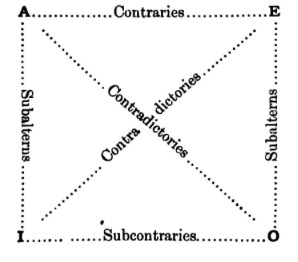
The doctrine of opposition may be regarded from two different
points of view, namely, as a relation between two given propositions;
and, secondly, as a process of inference by which one proposition
being given either as true or as false, the truth or falsity of
certain other propositions may be determined. Taking the second of
these points of view, we have the following table:—
A being given true, E is false,
I true, O false ;
E being given
true, A is false, I false, O
true ;
I being given true, A is unknown,
E false, O unknown;
O being given
true, A is false, E unknown, I
unknown;
A being given false, E is unknown,
I unknown, O true ;
E being given
false, A is unknown, I true, O
unknown;
I being given false, A is false,
E true, O true ;
O being given
false, A is true, E false, I
true.
80. Contradictory
Opposition.—The doctrine of opposition in the preceding
section is primarily applicable only to the fourfold schedule of
propositions ordinarily recognised. We must, however, look at the
question from a wider point of view. It is, in particular, important
that we should understand clearly the nature of contradictory
opposition whatever may be the schedule of propositions with which we
are dealing.
The nature of significant denial will be considered in some detail
in the concluding section of this chapter. At this point it will
suffice to say that to deny the truth of a proposition is equivalent
to affirming the truth of its contradictory ; and vice
versâ. The criterion of contradictory opposition is that of the
two propositions, one must be true and the other must be false ;
they cannot be true together, but on the other hand no mean is
possible between them. The relation between two contradictories is
mutual; it does not matter which is given true or false, we know that
the other is false or true accordingly. Every proposition has its
contradictory, which may however be more or less complicated in form.
It will be found that attention is almost inevitably called to any
ambiguity in a proposition when an attempt is made to determine its
contradictory. It has been truly said that we can never fully
understand the meaning of a proposition until we know precisely what
it denies; and indeed the problem of the import of propositions
sometimes resolves itself at least partly into the question how
propositions of a given form are to be contradicted.
The nature of contradictory opposition may be illustrated by
reference to a discussion entered into by Jevons (Studies in
Deductive
Logic, p. 116) as to the precise meaning of the assertion that a
proposition—say, All grasses are edible—is false.
After raising this question, Jevons begins by giving an answer, which
may be called the orthodox one, and which, in spite of what he goes on
to say, must also be considered the correct one. When I assert that a
proposition is false, I mean that its contradictory is true. The given
proposition is of the form A, and its contradictory is the
corresponding O proposition—Some grasses are not
edible. When, therefore, I say that it is false that all grasses
are edible, I mean that some grasses are not edible. Jevons, however,
continues, “But it does not seem to have occurred to logicians
in general to enquire how far similar relations could be detected in
the case of disjunctive and other more complicated kinds of
propositions. Take, for instance, the assertion that ‘all
endogens are all parallel-leaved plants.’ If this be
false, what is true? Apparently that one or more endogens are not
parallel-leaved plants, or else that one or more parallel-leaved
plants are not endogens. But it may also happen that no endogen is a
parallel-leaved plant at all. There are three alternatives, and the
simple falsity of the original does not shew which of the possible
contradictories is true.”
This statement is open to criticism in two respects. In the first
place, in saying that one or more endogens are not parallel-leaved
plants, we do not mean to exclude the possibility that no endogen is a
parallel-leaved plant at all. Symbolically, Some S is not P
does not exclude No S is P. The three alternatives are,
therefore, at any rate reduced to the two first given. But in the
second place, it is incorrect to speak of either of these alternatives
as being by itself a contradictory of the original proposition. The
true contradictory is the affirmation of the truth of one or other of
these alternatives. If the original proposition is false, we certainly
know that the new proposition limiting us to such alternatives is
true, and vice versâ.
The point at issue may be made clearer by taking the proposition in
question in a symbolic form. All S is all P is a condensed
expression, resolvable into the form, All S is P and all P is S. It
has but one contradictory, namely, Either some S is not P or some P
is not S.110 If either of these alternatives holds good,
the original statement must in its entirety be false; and, on the
other hand, if the latter is false, one at least of these alternatives
must be true. Some S is not P is not by itself a contradictory
of All S is all P. These two propositions are indeed
inconsistent with one another; but they may both be false.
It follows that we must reject Jevons’s further statement
that “a proposition of moderate complexity has an almost
unlimited number of contradictory propositions, which are more or less
in conflict with the original. The truth of any one or more of these
contradictories establishes the falsity of the original, but the
falsity of the original does not establish the truth of any one or
more of its contradictories.”111 No doubt a
proposition which is complicated in form may yield an indefinite
number of other non-equivalent propositions the truth of any one of
which is inconsistent with its own. It will also be true that
its contradictory can be expressed in more than one form. But these
forms will necessarily be equivalent to one another, since it is
impossible for a proposition to have two or more non-equivalent
contradictories. This position may be formally established as follows.
Let Q and R be both contradictories of P. They
will be equivalent if it can be shewn that if Q then R, and
if R then Q. Since P and Q are contradictories,
we have If Q then not P, and since P and R are
contradictories we have If not P then R. Combining these two
propositions we have the conclusion If Q then R. If R then
Q follows similarly. Hence we have established the desired result.
In connexion with the same point, Jevons raises another question,
in regard to which his view is also open to criticism. He says,
“But the question arises whether there is not confusion of ideas
in the usual treatment of this ancient doctrine of opposition, and
whether a contradictory of a proposition is not any proposition which
involves the falsity of the original, but is not the sole condition of
it. I apprehend that any assertion is false which is made without
sufficient grounds. It is false to assert that the hidden side of the
moon is covered with mountains, not because we can prove the
contradictory, but because we know that the assertor must have made
the assertion without evidence. If a person ignorant of mathematics
were to assert that ‘all involutes are transcendental
curves,’ he would be making a false assertion, because, whether
they are so or not, he cannot know it.” We should, however,
involve ourselves in hopeless confusion were we to consider the truth
or falsity of a proposition to depend upon the knowledge of the person
affirming it, so that the same proposition would be now true, now
false. It will be observed further that on Jevons’s view both
the propositions S is P and S is not P would be false to
a person quite ignorant of the nature of S. This would mean
that we could not pass from the falsity of a proposition to the truth
of its contradictory; and such a result as this would render any
progress in thought impossible.
81. Contrary
Opposition.—Seeking to generalise the relation between
A and E, we might naturally be led to characterize the
contrary of a given proposition by saying that it goes beyond mere
denial, and sets up a further assertion as far as possible removed
from the original assertion; so that, whilst the contradictory of a
proposition denies its entire truth, its contrary may be said to
assert its entire falsehood. A pair of contraries as thus defined may
be regarded as standing at the opposite ends of a scale on which there are a
number of intermediate positions.
On this definition, however, the notion of contrariety cannot very
satisfactorily be extended much beyond the particular case
contemplated in the ordinary square of opposition. For if we have a
proposition which cannot itself be regarded as standing at one end of
a scale, but only as occupying an intermediate position, such
proposition cannot be regarded as forming one of a pair of contraries.
Plurative and numerically definite propositions may be taken as
illustrations.
Hence if it is desired to define contrariety so that the conception
may be generally applicable, the idea of two propositions standing, as
it were, furthest apart from each other must be given up, and any two
propositions may be described as contraries if they are inconsistent
with one another without at the same time exhausting all
possibilities. Contraries must on this definition always admit of a
mean, but they may not always be what we should speak of as
diametrical opposites, and any given proposition is not limited to a
single contrary, but may have an indefinite number of non-equivalent
contraries. At the same time, it will be observed that this definition
still suffices to identify A and E as a pair of
contraries, and as the only pair in the traditional scheme of
opposition.
82. The Opposition of
Singular Propositions.—Taking the proposition Socrates is
wise, its contradictory is Socrates is not wise ;112
and so long as we keep to the same terms, we cannot go beyond this
simple denial. The proposition has, therefore, no formal contrary.113
This opposition of singulars has been called secondary
opposition (Mansel’s Aldrich, p. 56).
If, however,
there is secondary quantification in a proposition having a singular
subject, then we may obtain the ordinary square of opposition. Thus,
if our original proposition is Socrates is always (or in all
respects) wise, it is contradicted by the statement that
Socrates is sometimes (or in some respects) not
wise, while it has for its contrary, Socrates is never (or
in no respects) wise, and for its subaltern, Socrates
is sometimes (or in some respects) wise. It may be
said that when we thus regard Socrates as having different
characteristics at different times or under different conditions, our
subject is not strictly singular, since it is no longer a whole
indivisible. This is in a sense true, and we might no doubt replace
our proposition by one having for its subject “the judgments or
the acts of Socrates.” But it does not appear that this
resolution of the proposition is necessary for its logical treatment.
The possibility of implicit secondary quantification, although no
such quantification is explicitly indicated, is a not unfruitful
source of fallacy in the employment of propositions having singular
subjects. If we take such propositions as Browning is obscure,
Epimenides is a liar, This flower is blue, and give as
their contradictories Browning is not obscure, Epimenides is
not a liar, This flower is not blue, shall we say that the
original proposition or its contradictory is true in case Browning is
sometimes (but not always) obscure, or in case Epimenides sometimes
(but not often) speaks the truth, or in case the flower is partly (but
not wholly) blue? There is certainly a considerable risk in such
instances as these of confusing contradictory and contrary opposition,
and this will be avoided if we make the secondary quantification of
the propositions explicit at the outset by writing them in the form
Browning is always (or sometimes) obscure,
&c.114 The contradictory will then be particular or
universal accordingly.
83. The Opposition of
Modal Propositions.—So far in this chapter our attention has
been confined to assertoric propositions. For the present, a very
brief reference to the opposition of modals will suffice. The main points
involved will come up for further consideration later on.
We have seen that the unconditionally universal proposition,
whether expressed in the ordinary categorical form All S is P,
or as a conditional If anything is S it is P, affirms a
necessary connexion, by which is meant not merely that all the
S’s are as a matter of fact P’s, but that it
is inherent in their nature that they should be so. The statement that
some S’s are not P’s is
inconsistent with this proposition, but is not its
contradictory, since both the propositions might be false: the
S’s might all happen to be P’s, and yet
there might be no law of connexion between S and P. The
proposition in question being apodeictic will have for its
contradictory a modal of another description, namely, a
problematic proposition; and this may be written in the form
S need not be P, or If anything is S still it need not be
P, according as our original proposition is expressed as a
categorical or as a conditional
Similarly, the contradictory of the hypothetical If P is true
then Q is true, this proposition being interpreted modally, is
If P is true still Q need not be true.
84. Extension of the
Doctrine of Opposition.115—If we do not
confine ourselves to the ordinary square of opposition, but consider
any pair of propositions (whatever may be the schedule to which they
belong), it becomes necessary to amplify the list of formal relations
recognised in the square of opposition, and also to extend the meaning
of certain terms. We may give the following classification:
(1) Two propositions may be equivalent or
equipollent, each proposition being formally inferable from the
other. Hence if either one of the propositions is true, the other is
also true; and if either is false, the other is also false. For
example, as will presently be shewn, All S is P and All
not-P is not-S stand to each other in this relation.
(2) and (3) One of the two propositions may be formally inferable
from the other, but not vice versâ. If we are considering two given
propositions Q and R, this yields two cases: for
Q may carry with it the truth of R, but not conversely;
or R may carry with it the truth of Q, but not
conversely. Ordinary subaltern propositions with their subalternants
fall into this class; and it will be convenient to extend the meaning
of the term subaltern, so as to apply it to any pair of
propositions thus related, whether they belong to the ordinary square
of opposition or not. It will indeed be found that any pair of simple
propositions of the forms A, E, I, O, that
are subaltern in the extended sense, are equivalent to some pair that
are subaltern in the more limited sense.116 Thus All S is
P and Some P is S, which are subaltern in the extended
sense, are equivalent to All S is P and Some S is P.
All S is P and Some not-S is not P are another pair of
subalterns. Here it is not so immediately obvious in what direction we
are to look for a pair of equivalent propositions belonging to the
ordinary square of opposition. No not-P is S and Some not-P
is not S will, however, be found to satisfy the required
conditions.
(4) The propositions may be such that they can both be true
together, or both false, or either one true and the other false. For
example, All S is P and All P is S. Such propositions
may be called independent in their relation to one another.
(5) The propositions may be such that one or other of them must be
true while both may be true. A pair of propositions which are thus
related—for example, Some S is P and Some not-S is
P—may, by an extension of meaning as in the case of the term
subaltern, be said to be subcontrary. It can be shewn
that any pair of subcontraries of the forms A, E,
I, O are equivalent to some pair of subcontraries
belonging to the ordinary square of opposition; thus, the above pair
are equivalent to Some P is S and Some P is not S.
(6) The two propositions may be contrary to one another, in the
sense that they cannot both be true, but can both be false. It can as
before be shewn that any pair of contraries of the forms A,
E, I, O are equivalent to some pair of contraries
in the more ordinary sense. For example, the contraries All S is
P and All not-S is P are equivalent to No not-P is S
and All not-P is S.
(7) The two propositions may be contradictory to one another
according to the definition given in section 80, that is, they can
neither both be true nor both false. All S is P and Some
not-P is S afford an example outside the ordinary square of
opposition. It will be observed that these two propositions are
equivalent to the pair All S is P and Some S is not P.
Two propositions, then, may, in respect of inferability,
consistency, or inconsistency, be formally (1) equivalent, (2) and (3)
subaltern, (4) independent, (5) subcontrary, (6) contrary, (7)
contradictory, the terms subaltern, &c., being used in the
most extended sense. What pairs of categorical propositions (into
which only the same terms or their contradictories enter) actually
fall into these categories respectively will be shewn in sections 106 and 107.
These seven possible relations between propositions (taken in
pairs) will be found to be precisely analogous to the seven possible
relations between classes (taken in pairs) as brought out in a
subsequent chapter (section 130).
85. The Nature of
Significant Denial.—It is desirable that, before concluding
this chapter, we should briefly discuss a more fundamental question
than any that has yet been raised, namely, the meaning and nature of
negation and denial.
We observe, in the first place, that negation always finds
expression in a judgment, and that it always involves the denial of
some other judgment. The question therefore arises whether negation
always presupposes an antecedent affirmation. This question must be
answered in the negative if it is understood to mean that in order to
be able to deny a proposition we must begin by regarding it as true.
The proposition which we deny may be asserted or suggested by someone
else; or it may occur to us as one of several possible alternatives;
or it may be put in the form of a question.
It is, however, to be added that if a denial is to have any value
as a statement of matter of fact, the corresponding affirmation must be
consistent with the meaning of the terms employed. Thus if A
connotes m, n, p, and B connotes
not-p, q, r, then the denial that A is
B gives no real information respecting A. For the
affirmation that A is B cannot be made by anyone who
knows what is meant by A and B respectively. The same
point may be otherwise expressed by saying that just as the
affirmation of a verbal proposition is insignificant regarded as a
real affirmation concerning the subject (and not merely as an
affirmation concerning the meaning to be attached to the
subject-term), so the denial of a contradiction in terms is
insignificant from the same point of view. Such a denial yields merely
what is tautologous and practically useless.
For example, the denial that the soul is a ship in full sail
is insignificant regarded as a statement of matter of fact; for such
denial gives no information to anyone who is already acquainted with
the meaning of the terms involved.
The nature of logical negation is of so fundamental and ultimate a
character that any attempt to explain it is apt to obscure rather than
to illumine. It cannot be expressed more simply and clearly than by
the laws of contradiction and excluded middle: a judgment and its
contradictory cannot both be true; nor can they both be false.
Because every negative judgment involves the denial of some other
judgment, it has been argued that a negative judgment such as S is
not P is primarily a judgment concerning the positive judgment
S is P, not concerning the subject S ; and hence that a
negative judgment is not co-ordinate with a positive judgment, but
dependent upon it.117
Passing by the point that a positive judgment also involves the
denial of some other judgment, we may observe that a distinction must
be drawn between “S is P” is not true (which
is a judgment about S is P), and S is not P (which is a
judgment about S). Denial no doubt presents itself to the mind
most simply in the first of these two forms. But in contradicting a
given judgment our method usually is to establish another judgment
involving the same terms which stands to the given judgment in the
relation expressed by the laws of contradiction and excluded middle;
and when we oppose the judgment S is not P to the judgment S
is P we have reached the less direct mode of denial in which we
have again a judgment concerning our original subject.
The example here taken tends perhaps to obscure the point at issue
because the distinction between “S is P” is not
true and S is not P may appear to be so slight as to be
immaterial. That there is a real distinction will, however, appear
clear if we take such pairs of propositions as “All S is
P” is not true, Some S is not P ; “All
S is all P” is not true, Either some S is not P or
some P is not S ; “If any P is Q it is R” is
not true, P might be Q without being R.
It will be convenient if in general we understand by the
contradictory of a proposition P not its simple denial
“P is not true,” but the proposition Q
involving the same terms, which is formally so related to P,
that P and Q cannot both be true or both false.
Sigwart observes that the ground of a denial may be either
(a) a deficiency, or (b) an opposition.118
I may, for example, pronounce that a certain thing does not possess a
given attribute either (a) because I fail to discover the
presence of the attribute, or (b) because I recognise the
presence of some other attribute which I know to be incompatible with
the one suggested.
This distinction may be illustrated by one or two further examples.
Thus, I may deny that a man travelled by a certain train either
(a) because I searched the train through just before it started
and found he was not there, or (b) because I know he was
elsewhere when the train started,—I may, for instance, have seen
him leave the station at the same moment in another train in the
opposite direction. Similarly, I may deny a universal proposition
either (a) because I have discovered certain instances of its
not holding good, or (b) because I accept another universal
proposition which is inconsistent with it. Again, I may deny that a
given metal, or the metal contained in a certain salt, is copper
(a) on the ground of deficiency, namely, that it does not
answer to a certain test, or (b) on the ground of opposition, namely,
that I recognise it to be another metal, say, zinc.
The ground of denial always involves something positive, for
example, the search through the train, or the discovery of individual
exceptions. But it is clear that when we establish an opposition we
get a result that is itself positive in a way that is not the case
when we merely establish a deficiency. This may lead up to a brief
examination of a doctrine of the nature of significant denial that is
laid down by Mr Bosanquet.
Mr Bosanquet holds that bare denial has in itself no significance,
and he apparently denies that the contradictory of a judgment,
apart from the grounds on which it is based, conveys any
information.119 For the meaning of significant negation we
must, he says, look to the grounds of the negation; or else for
contradictory denial we must substitute contrary denial.
As a consequence, a judgment can, strictly and properly, “only
be denied by another judgment of the same nature; a singular by a
singular judgment, a generic by a generic, a hypothetical by a
hypothetical”;120 and, presumably, a particular by a
particular, an apodeictic by an apodeictic.
It is of course true that every denial must have some kind of
positive basis, but it is also necessary that a judgment should be
distinguished from the grounds on which it is based. We cannot say
that a judgment of given content is different for two people because
they accept it on different grounds; and if it is said that this is to
beg the question, since a difference in ground constitutes in itself a
difference in content, the reply is that such a doctrine must render
the content of every judgment so elusive and uncertain as to make it
impossible of analysis.
The view that identifies the denial of a judgment with its contrary
not only mixes up a judgment with its grounds, but also overlooks one
of the two principal grounds of denial. When the ground of negation is
an opposition, we may no doubt be said to reach denial through the
contrary, though we should still hold that the denial is in itself
something less than the contrary; but when the ground of denial is a
deficiency, even this cannot be allowed. If, for example, I have
arrived at the
conclusion that a man did not start by a given train because I
searched the train through before its departure and did not find him
there; or if I conclude that a given metal is not copper because it
does not satisfy a given test; I have obtained no contrary judgment,
and yet my denial is justified.
These would be cases of bare denial. I have gained no
positive knowledge of the whereabouts of the man in question, nor can
I identify the given metal. But surely it cannot be seriously
maintained that the denial is meaningless or useless, say, to a
detective in the first instance, or to an analytical chemist in the
second.
Of course we seldom or never rest content with bare denial. The
contrary rather than the contradictory represents our ultimate aim.
But it is often the case that, temporarily at any rate, we cannot get
beyond bare denial; and we ought not to consider that we have
altogether failed to make progress when all that we have achieved is
the exclusion of a possible alternative or the overthrow of a false
theory. Recent researches, for example, into the origin of cancer have
led to no positive results; but it is claimed for them that by
destroying preconceived ideas on the subject they have cleared the way
for future advance. Will anyone affirm that this was not worth doing
or that the time spent on the researches was wasted?
Looking at the question from another point of view, it is surely
absurd to say that we cannot deny a universal unless we are able to
substitute another universal in its place. Various algebraical
formulae have from time to time been suggested as necessarily yielding
a prime number. They have all been overthrown, and no valid formula
has been established in their place. But knowledge that these formulae
are false is not quite appropriately described as ignorance.
Elsewhere Mr Bosanquet says that mere enumerative exceptions are
futile and cannot touch the essence of the unconditionally universal
judgments they apparently oppose.121 He appears to have
in view cases where nothing more than some modification of the
original judgment is shewn to be necessary. But even so the enumerative
exceptions have overthrown the original judgment. No doubt a
scientific law which has had a great amount of evidence in its favour
is likely to contain elements of truth even if it is not altogether
true; and the object of a man of science who overthrows a law will be
to set up some other law in its place. But, says Mr Bosanquet, even if
the first generic judgment were a sheer blunder and confusion, as has
been the case from time to time with judgments propounded in science,
it is scarcely possible to rectify the confusion except by
substituting for it the true positive conceptions that arise out of
the cases which overthrew it.” Here it is admitted that the
exceptions do overthrow the law, and the rest of the argument is
surely an instance of ignoratio elenchi. It is moreover a pure,
and in many cases an unjustifiable, assumption that the cases which
suffice to overthrow a false law will also suffice as the basis for
the establishment of a true law in its place.
86. Examine the nature of the
opposition between each pair of the following propositions:—None
but Liberals voted against the motion; Amongst those who voted against
the motion were some Liberals; It is untrue that those who voted
against the motion were all Liberals. [K.]
87. If some were used
in its ordinary colloquial sense, how would the scheme of opposition
between propositions have to be modified? [J.]
88. Explain the technical
terms “contradictory” and “contrary” applying
them to the following propositions: Few S are P ; He was not
the only one who cheated ; Two-thirds of the army are
abroad. [V.]
89. Give the contradictory of
each of the following propositions:—Some but not all S is
P ; All S is P and some P is not R ; Either all S is P or
some P is not R ; Wherever the property A is found, either the
property B or the property C will be found with it, but not both of
them together. [K.]
90. Give the contradictory, and also a contrary, of each of the following propositions:
Half the candidates failed;
Wellington was always successful both in beating
the enemy and in utilising his victory;
All men are either not knaves or not fools;
All but he had fled;
Few of them are honest;
Sometimes all our efforts fail;
Some of our efforts always fail. [L.]
91. Give the contradictory,
and also a contrary, of each of the following propositions:
I am certain you are wrong;
Sometimes when it rains I find myself without an umbrella;
Whatever you say, I shall not believe you. [C.]
92. Define the terms
subaltern, subcontrary, contrary,
contradictory, in such a way that they may be applicable to
pairs of propositions generally, and not merely to those included in
the ordinary square of opposition. Do the above exhaust the formal
relations (in respect of inferability, consistency, or inconsistency)
that are possible between pairs of propositions?
Illustrate your answer by considering the relation (in respect of
inferability, consistency, or inconsistency) between each of the
following propositions and each of the remainder: S and P are
coincident ; Some S is P ; Not all S is P ; Either
some S is not P or some P is not S ; Anything that is not P is
S. [K.]
93. Given that the
propositions X and Z are contradictory, Y and
V contradictory, and X and Y contrary, shew
(without assuming that X, Y, V, Z belong
to the ordinary schedule of propositions) that the relations of
V to X, Z to Y, V to Z are
thereby deducible. [J.]
94. Prove formally that if two propositions are equivalent, their
contradictories will also be equivalent. [K.]
95. Examine the doctrine that
a judgment can properly be denied only by another judgment of the same
type. Illustrate by reference to (a) universal judgments,
(b) particular judgments (c) disjunctive judgments,
(d) apodeictic judgments. [K.]
IMMEDIATE INFERENCES.122
96. The Conversion of
Categorical Propositions.—By conversion, in a broad
sense, is meant a change in the position of the terms of a
proposition.123 Logic, however, is concerned with conversion
only in so far as the truth of the new proposition obtained by the
process is a legitimate inference from the truth of the original
proposition. For example, the change from All S is P to All
P is S is not a legitimate logical conversion, since the truth of
the latter proposition does not follow from the truth of the former.
In other words, logical conversion is a case of immediate
inference, which may be defined as the inference of a proposition
from a single other proposition.124
The simplest
form of logical conversion, and that which is understood in logic when
we speak of conversion without further qualification, may be defined
as a process of immediate inference in which from a given
proposition we infer another, having the predicate of the original
proposition for subject, and its subject for predicate. Thus,
given a proposition having S for its subject and P for
its predicate, our object in the process of conversion is to obtain by
immediate inference a new proposition having P for its subject
and S for its predicate. The original proposition may be called
the convertend, and the inferred proposition the
converse.
The process will be valid if the two following rules are observed:
(1) The converse must be the same in quality as the convertend
(Rule of Quality);
(2) No term must be distributed in the converse unless it was
distributed in the convertend (Rule of Distribution).
Applying these rules to the four fundamental forms of proposition,
we have the following table:—
Convertend. | Converse. |
| All S is P. A. | Some P is S.
I. |
| Some S is P. I. | Some P is
S. I. |
| No S is P. E. | No P
is S. E. |
| Some S is not P. O. | (None) |
It is desirable at this stage briefly to call attention to a point
which will receive fuller consideration later on in connexion with the
reading of propositions in extension and intension, namely, that,
generally speaking, in any judgment we have naturally before the mind
the objects denoted by the subject, but the qualities connoted by the
predicate. In the process of converting a proposition, however, the
extensive force of the predicate is made prominent, and an import is
given to the predicate similar to that of the subject. At the same
time the distribution of the predicate has to be made explicit in
thought. It is in passing from the predicative to the
class reading (e.g. from all men are mortal to
all men are mortals), that the difficulty sometimes found in
correctly converting propositions probably consists. We shall at any
rate do well to recognise that conversion and other immediate
inferences usually involve a distinct mental act of the above nature.
It follows from what has been said above that some propositions
lend themselves to the process of conversion much more readily than
others. When the predicate of a proposition is a substantive little or
no effort is required in order to convert the proposition; more effort
is necessary when the predicate is an adjective; and still more when
in the original proposition the logical predicate is not expressed
separately at all, as in propositions secundi adjacentis.
Compare for purposes of conversion the propositions, Whales are
mammals, Lions are carnivorous, A stitch in time saves
nine. In some cases, in consequence of the awkwardness of changing
adjectives and verbal predicates into substantives, the conversion of
a proposition appears to be a very artificial production.125
97. Simple Conversion and
Conversion per accidens.—It will be observed that in the
case of I and E, the converse is of the same form as the
original proposition; moreover we do not lose any part of the
information given us by the convertend, and we can pass back to it by
re-conversion of the converse. The convertend and its converse are
accordingly equivalent propositions. The conversion under these
conditions is said to be simple.
In the case of A, it is different; we cannot pass by
immediate inference from All S is P to All P is S,
inasmuch as P is distributed in the latter of these
propositions but undistributed in the former. Hence, although we start
with a universal proposition, we obtain by conversion a particular
proposition
only,126 and by no means of operating upon the
converse can we regain the original proposition. The convertend and
its converse are accordingly non-equivalent propositions. The
conversion in this case is called conversion per accidens,127
or conversion by limitation.128
For concrete illustrations of the process of conversion we may take
the propositions,—A stitch in time saves nine; None but the
brave deserve the fair. The first of these may be written in the
form,—All stitches in time are things that save nine stitches.
This, being an A proposition, is only convertible per
accidens, and we have for our converse,—Some things that
save nine stitches are stitches in time. The second of the given
propositions may be written,—No one who is not brave is
deserving of the fair. This, being an E proposition, may be
converted simply, giving, No one deserving of the fair is not brave.
Our results may be expressed in a more natural form as follows: One
way of saving nine stitches is by a stitch in time; No one deserving
of the fair can fail to be brave.
No difficulty ought ever to be found in converting or performing
other immediate inferences upon any given proposition when once it has
been brought into the traditional logical form, its quantity and
quality being determined, its subject, copula, and predicate being
definitely distinguished from one another, and its predicate as well
as its subject being read in extension. If, however, this rule is
neglected, mistakes are pretty sure to follow.
98. Inconvertibility of
Particular Negative Propositions.—It follows immediately
from the rules of conversion given in section 96 that Some S is not P does not admit of ordinary conversion; for S which is
undistributed in the convertend would become the predicate of a
negative proposition in the converse, and would therefore be
distributed.129 It will be shewn presently, however, that
although we are unable to infer anything about P in this case,
we are able to draw an inference concerning not-P.
Jevons considers that the fact that the particular negative
proposition is incapable of ordinary conversion “constitutes a
blot in the ancient logic” (Studies in Deductive Logic,
p. 37). There is, however, no sufficient justification for this
criticism. We shall find subsequently that just as much can be
inferred from the particular negative as from the particular
affirmative (since the latter unlike the former does not admit of
contraposition). No logic, symbolic or other, can actually obtain more
from the given information than the ancient logic does. It has been
suggested that what Jevons means is that the inconvertibility of
O results in a want of symmetry and that logicians ought
specially to aim at symmetry. With this last contention we may
heartily agree. The want of symmetry, however, in the case before us
is apparent only and results from taking an incomplete view. It will
be found that symmetry reappears later on.130
99. Legitimacy of
Conversion.—Aristotle proves the conversion of E
indirectly, as follows;131 No S is P,
therefore, No P is S ; for if not, Some individual P, say Q,
is S ; and hence Q is both S and P ; but this is inconsistent
with the original proposition.
Having shewn that the simple conversion of E is legitimate,
we can prove that the conversion per accidens of A is
also legitimate. All S is P, therefore, Some P is S ;
for, if not, No P is S, and therefore (by conversion) No S
is P ; but this is inconsistent with the original
supposition. The legitimacy of the simple conversion of I
follows similarly.
The above proof appears to involve nothing beyond the principles of
contradiction and excluded middle. The proof itself, however, is not
satisfactory; for it practically assumes the validity of the very
process that it seeks to justify, that is to say, it assumes the
equivalence of the propositions S is Q and Q is S.
A better justification of the process of conversion may be obtained
by considering the class relations involved in the propositions
concerned. Thus, taking an E proposition, it is self-evident
that if one class is entirely excluded from another class, this second
class is entirely excluded from the first.132 In the case of an
A proposition it is clear on reflection that the statement
All S is P is consistent with either of two relations of the
classes S and P, namely, S and P
coincident, or P containing S and more besides, and
further that these are the only two possible relations with which it
is consistent. It is self-evident that in each of these cases Some
P is S ; and hence the inference by conversion from an A
proposition is shewn to be justified.133 In the case of an
O proposition, if we consider all the relationships of classes
in which it holds good, we find that nothing is true of P in
terms of S in all of them. Hence O is
inconvertible.134 The inconvertibility of O can also be
established by
shewing that Some S is not P is compatible with every one of
the following propositions—All P is S, Some P is
S, No P is S, Some P is not S.
100. Table of
Propositions connecting any two terms.—There
are—connecting any two terms S and P—eight
propositions of the forms A, E, I, O,
namely, four with S as subject, and four with P as
subject. The results at which we have arrived concerning the
conversion of propositions shew that of these eight, the two E
propositions are equivalent to one another, and that the same is true
of the two I propositions, E and I being simply
convertible; also that these are the only equivalences obtainable. We
have, therefore, the following table of propositions connecting any
two terms S and P:—
| SaP, |
| PaS, |
| SeP = PeS, |
| SiP = PiS, |
| SoP, |
| PoS. |
The pair of propositions SaP and PaS are independent
(see section 84); and the same is true of the pairs SoP and
PoS, SaP and PoS, PaS and SoP. The
first pair taken together indicate that the classes S and
P are coextensive, and they may be called complementary
propositions. The second pair taken together indicate that the classes
S and P are neither coextensive nor either included
within the other; they may be called sub-complementary
propositions. The third pair taken together indicate that the class
S is included within the class P but that it does not
exhaust that class; they may be called contra-complementary
propositions. The fourth pair taken together indicate that the class
P is included within the class S but that it does not
exhaust that class; they are, therefore, also
contra-complementary.135
The above table will be supplemented in section 106 by a table of propositions connecting any two terms and their contradictories,
S, P, not-S, not-P. It will then be found that we have a symmetry that is at present wanting.
101. The Obversion of
Categorical Propositions.136—Obversion is
a process of immediate inference in which the inferred
proposition (or obverse), whilst retaining the original
subject, has for its predicate the contradictory of the predicate of
the original proposition (or obvertend). This process is
legitimate for a proposition of any form if at the same time the
quality of the proposition is changed. The inferred proposition is,
moreover, in all cases equivalent to the original proposition, so that
we can always pass back from the obverse to the obvertend.
We have the following table:—
Obvertend. | Obverse. |
| All S is P. A. | No S is
not-P. E |
| Some S is P. I. | Some S is not not-P. O. |
| No S is P. E. | All S is not-P. A. |
| Some S is not P. O. | Some S is not-P. I. |
It will be
observed that the obversion of All S is P depends upon the
principle of contradiction, which tells us that if anything is
P then it is not not-P; but that we pass back from No S is not-P to All S is P by the principle of excluded middle, which tells us that if anything is not not-P then it is
P. The remaining inferences by obversion also depend upon one
or other of these two principles.
102. The Contraposition
of Categorical Propositions.137—Contraposition may be defined as a
process of immediate inference in which from a given proposition
another proposition is inferred having for its subject the
contradictory of the original predicate. Thus, given a proposition
having S for its subject and P for its predicate, we
seek to obtain by immediate inference a new proposition having
not-P for its subject.
It will be observed that in the above definition it is left an open
question whether the contrapositive of a proposition has the original
subject or the contradictory of the original subject for its
predicate; and every proposition which admits of contraposition will
accordingly have two contrapositives, each of which is the obverse of
the other. For example, in the case of All S is P there are the
two forms No not-P is S and All not-P is not-S. For many
purposes the distinction may be practically neglected without risk of
confusion. It will be observed, however, that when not-S is
taken as the predicate of the contrapositive, the quality of the
original proposition is preserved and there is greater symmetry.138
On the other hand, if we regard contraposition as compounded
out of obversion and conversion in the manner indicated in the
following paragraph, the form with S as predicate is the more
readily obtained. Perhaps the best solution (in cases in which it is
necessary to mark the distinction) is to speak of the form with
not-S as predicate as the full contrapositive, and the form
with S as predicate as the partial contrapositive.139
The following rule may be adopted for obtaining the full
contrapositive of a given proposition:—Obvert the original
proposition, then convert the proposition thus obtained, and then once
more obvert. For given a proposition with S as subject and
P as predicate, obversion will yield an equivalent proposition
with S as subject and not-P as predicate; the conversion
of this will make not-P the subject and S the predicate;
and a repetition of the process of obversion will yield a proposition
with not-P as subject and not-S as predicate.
Applying this rule, we have the following table:—
| Original Proposition | Obverse | Partial Contrapositive | Full Contrapositive |
| All S is P. A. |
No S is not-P. E. |
No not-P is S. E. |
All not-P is not-S A. |
| Some S is P. I. |
Some S is not not-P. O. |
(None.) | (None.) |
| No S is P. E. |
All S is not-P. A. |
Some not-P is S. I. |
Some not-P is not not-S. O. |
| Some S is not P. O. |
Some S is not-P. I. |
Some not-P is S. I. |
Some not-P is not not-S. O. |
It will be observed that in the case of A and O, the
contrapositive is equivalent to the original proposition, the quantity
being unchanged,
whereas in the case of E we pass from a universal to a
particular.140 In order to emphasize this difference, and
following the analogy of ordinary conversion, the contraposition of
A and O has been called simple contraposition,
and that of E contraposition per accidens.141
That I has no contrapositive follows from the
inconvertibility of O. For when Some S is P is obverted
it becomes a particular negative, and the conversion of this
proposition would be necessary in order to render the contraposition
of the original proposition possible.
As regards the utility of the investigation as to the inferences
that can be drawn from given propositions by the aid of
contraposition, De Morgan142 points out that
the recognition that Every not-P is not-S follows from Every
S is P, whatever S and P may stand for, renders
unnecessary the special proofs that Euclid gives of certain of his
theorems.143
In consequence of his dislike of negative terms Sigwart regards the
passage from All S is P to No not-P is S as an artificial perversion. But he recognises the value of the inference
from If anything is S it is P to If anything is not P it is
not S. This distinction seems to be little more than verbal. It is
to be observed
that we can avoid the use of negative terms without having recourse to
the conditional form of proposition: for example, Whatever is S is
P, therefore, Whatever is not P is not S ; Anything that
is S is P, therefore, Anything that is not P is not S.
103. The Inversion of
Categorical Propositions.—In discussing conversion and
contraposition we have enquired in what cases it is possible, having
given a proposition with S as subject and P as
predicate, to infer (a) a proposition with P as subject,
(b) a proposition with not-P as subject. We may now enquire further in what cases it is possible to infer (c) a
proposition with not-S as subject.
If such a proposition can be inferred at all, it will be obtainable
by a certain combination of the more elementary processes of ordinary
conversion and obversion.144 We will,
therefore, take each of the fundamental forms of proposition and see
what can be inferred (1) by first converting it, and then performing
alternately the operations of obversion and conversion; (2) by first
obverting it, and then performing alternately the operations of
conversion and obversion. It will be found that in each case the
process can be continued until a particular negative proposition is
reached whose turn it is to be converted.
(1) The results of performing alternately the processes of
conversion and obversion, commencing with the former, are as
follows:—
(i) All S is P,
therefore (by conversion), Some P is S,
therefore (by obversion), Some P is not
not-S.
Here comes the turn for conversion; but as we have to deal with an
O proposition, we can proceed no further.
(ii) Some S is P,
therefore (by conversion), Some P is S,
therefore (by obversion), Some P is not
not-S ;
and again we can go no further.
(iii) No S is P,
therefore (by conversion), No P is S,
therefore (by obversion), All P is not-S,
therefore (by conversion), Some not-S is P,
therefore (by obversion), Some not-S is not not-P.
In this case either of the propositions in italics is the immediate
inference that was sought.
(iv) Some S is not P.
In this case we are not able even to commence our series of
operations.
(2) The results of performing alternately the processes of
conversion and obversion, commencing with the latter, are as
follows:—
(i) All S is P,
therefore (by obversion), No S is not-P,
therefore (by conversion), No not-P is S,
therefore (by obversion), All not-P is not-S,
therefore (by conversion), Some not-S is not-P,
therefore (by obversion), Some not-S is not P.
Here again we have obtained the desired form.
(ii) Some S is P,
therefore (by obversion), Some S is not not-P.
(iii) No S is P,
therefore (by obversion), All S is not-P,
therefore (by conversion), Some not-P is S,
therefore (by obversion), Some not-P is not not-S.
(iv) Some S is not P,
therefore (by obversion), Some S is not-P,
therefore (by conversion), Some not-P is S,
therefore (by obversion), Some not-P is not not-S.
We can now answer the question with which we commenced this
enquiry. The required proposition can be obtained only if the given
proposition is universal; we then have, according as it is affirmative
or negative,—
All S is P, therefore, Some not-S is not P (= Some
not-S is not-P);
No S is P, therefore, Some not-S is P (= Some
not-S is not not-P).
This form of immediate inference has been more or less casually
recognised by various logicians, without receiving any distinctive
name. Sometimes it has been vaguely classed under contraposition
(compare Jevons, Elementary Lessons in Logic, pp. 185, 6), but
it is really as far removed from the process to which that designation
has been given as the latter is from ordinary conversion. The term
inversion was suggested in an earlier edition of this work, and
has since been adopted by some other writers. Inversion may be defined
as a process of immediate inference in which from a given
proposition another proposition is inferred having for its subject the
contradictory of the original subject. Thus, given a proposition
with S as subject and P as predicate, we obtain by
inversion a new proposition with not-S as subject. The original
proposition may be called the invertend, and the inferred
proposition the inverse.
In the above definition it is not specified whether the inverse is
to have for its predicate P or not-P. Hence two forms
(each being the obverse of the other) have been obtained as in the
case of contraposition. So far as it is necessary to mark the
distinction, we may speak of the form in which P is the
predicate as the partial inverse, and of that in which not-P is the predicate as the full inverse.
104. The Validity of
Inversion.—It will be remembered that we are at present
working on the assumption that each class represented by a simple term
exists in the universe of discourse, while at the same time it does
not exhaust that universe; in other words, we assume that S,
not-S, P, not-P, all represent existing classes.
This assumption is perhaps specially important in the case of
inversion, and it is connected with certain difficulties that may have
already occurred to the reader. In passing from All S is P to
its inverse Some not-S is not P there is an apparent illicit process, which it is not quite easy either to account for or explain
away. For the term P, which is undistributed in the premiss, is
distributed in the conclusion, and yet if the universal validity of
obversion and
conversion is granted, it is impossible to detect any flaw in the
argument by which the conclusion is reached. It is in the assumption
of the existence of the contradictory of the original predicate that
an explanation of the apparent anomaly may be found. That assumption
may be expressed in the form Some things are not P. The
conclusion Some not-S is not P may accordingly be regarded as
based on this premiss combined with the explicit premiss All S is
P ; and it will be observed that, in the additional premiss,
P is distributed.145
105. Summary of
Results.—The results obtained in the preceding sections are
summed up in the following table:—
| |
A. | E. | I. | O. |
| i | Original proposition | SaP | SiP | SeP | SoP |
| ii | Obverse | SePʹ | SoPʹ
| SaPʹ | SiPʹ |
| iii | Converse | PiS | PiS | PeS
| |
| iv | Obverted Converse | PoSʹ | PoSʹ
| PaSʹ | |
| v | Partial Contrapositive146 | PʹeS
| | PʹiS | PʹiS |
| vi | Full Contrapositive146
| PʹaSʹ | | PʹoSʹ | PʹoSʹ |
| vii | Partial Inverse146 | SʹoP | | SʹiP | |
| viii | Full Inverse146 | SʹiPʹ | |
SʹoPʹ | |
It may be pointed out that the following rules apply to all the
above immediate inferences:—
Rule of Quality.—The total number of negatives
admitted or omitted in subject, predicate, or copula must be even.
Rules of Quantity.—If the new subject is S, the
quantity may remain unchanged; if Sʹ, the quantity must be
depressed;147 if P, the quantity must be depressed
in A and O; if Pʹ, the quantity must be depressed
in E and I.
106. Table of
Propositions connecting any two terms and their
contradictories.—Taking any two terms and their
contradictories, S, P, not-S, not-P, and
combining them in pairs, we obtain thirty-two propositions of the
forms A, E, I, O. The following table,
however, shews that only eight of these thirty-two propositions are
non-equivalent.
| (i) | | (ii) | | (iii) | | (iv) |
| Universals |
| A | SaP | = | SePʹ | = | PʹeS | = |
PʹaSʹ |
| Aʹ | SʹaPʹ | =
| SʹeP | = | PeSʹ | = | PaS |
| E |
SaPʹ | = | SeP | = | PeS | = | PaSʹ |
| Eʹ | SʹaP | = | SʹePʹ | = |
PʹeSʹ | = | PʹaS |
| Particulars |
| O | SoP | = | SiPʹ | = | PʹiS | = |
PʹoSʹ |
| Oʹ | SʹoPʹ | = |
SʹiP | = | PiSʹ | = | PoS |
| I |
SoPʹ | = | SiP | = | PiS | = | PoSʹ |
| Iʹ | SʹoP | = | SʹiPʹ | = |
PʹiSʹ | = | PʹoS |
In this table, columns (i) and (ii) contain the propositions in
which S or Sʹ is subject, and columns (iii) and (iv)
the propositions in which P or Pʹ is subject. In
columns (i) and (iv) we have the forms which admit of simple
contraposition (i.e., A and O), and in columns
(ii) and (iii) those which admit of simple conversion (i.e.,
E and I). Contradictories are shewn by identical places
in the universal and particular rows. We pass from column (i) to
column (ii) by obversion; from column (ii) to column (iii) by simple
conversion; and from column (iii) to column (iv) by obversion.
The forms in black type shew that we may take for our eight non-equivalent
propositions the four propositions connecting S and P,
and a similar set connecting not-S and not-P.148
To establish their non-equivalence we may proceed as follows:
SaP and SeP are already known to be non-equivalent, and
the same is true of SʹaPʹ and SʹePʹ ; but
no universal proposition can yield a universal inverse; therefore, no
one of these four propositions is equivalent to any other. Again,
SiP and SoP are already known to be non-equivalent, and
the same is true of SʹiPʹ and SʹoPʹ ; but
no particular proposition has any inverse; therefore, no one of these
propositions is equivalent to any other. Finally, no universal
proposition can be equivalent to a particular proposition.149
107. Mutual Relations of
the non-equivalent Propositions connecting any two terms and their
contradictories.150—We may now investigate the mutual
relations of our eight non-equivalent propositions. SaP,
SeP, SiP, SoP form an ordinary square of
opposition; and so do SʹaPʹ, SʹePʹ,
SʹiPʹ, SʹoPʹ. Reference to columns (iii)
and (iv) in the table will shew further that SaP,
SʹePʹ, SʹiPʹ, SoP are equivalent
to another square of opposition; and that the same is true of
SʹaPʹ, SeP, SiP, SʹoPʹ.
This leaves only the following pairs unaccounted for: SaP,
SʹaPʹ ; SeP, SʹePʹ ; SoP,
SʹoPʹ ; SiP, SʹiPʹ ; SaP,
SʹoPʹ ; SʹaPʹ, SoP ; SeP,
SʹiPʹ ; SʹePʹ, SiP ; and it will be
found that in each of these cases we have an independent pair.
SaP and SʹaPʹ (which are equivalent to
SaP, PaS, and also to PʹaSʹ,
SʹaPʹ) taken together serve to identify the classes
S and P, and also the classes Sʹ and
Pʹ. They are therefore complementary propositions,
in accordance with the definition given in section 100. Similarly,
SeP and SʹePʹ (which are equivalent to
SaPʹ, PʹaS, and also to PaSʹ,
SʹaP) are complementary; they serve to identify the classes
S and Pʹ, and also the classes Sʹ and
P. It will be observed that the complementary of any universal
proposition may be obtained by replacing the subject and predicate
respectively by their contradictories. A not uncommon fallacy is the
tacit substitution of the complementary of a proposition for the
proposition itself.
The complementary relation holds only between universals.
Particulars between which there is an analogous relation (the subject
and predicate of the one being respectively the contradictories of the
subject and predicate of the other) will be found to be
sub-complementary in accordance with the definition in section
100; this relation holds between SoP and SʹoPʹ,
and between SiP and SʹiPʹ. SoP and
SʹoPʹ (which are equivalent to SoP, PoS,
and also to PʹoSʹ, SʹoPʹ) indicate that
the classes S and P are neither coextensive nor either
included within the other, and also that the same is true of
Sʹ and Pʹ ; SiP and SʹiPʹ
(which are equivalent to SoPʹ, PʹoS, and also to
PoSʹ, SʹoP) indicate the same thing as regards
S and Pʹ, Sʹ and P.
The four remaining pairs are contra-complementary, each pair
serving conjointly to subordinate a certain class to a certain
other class; or, rather, since each such subordination implies a
supplementary subordination, we may say that each pair subordinates
two classes to two other classes. Thus, SaP and
SʹoPʹ (which are equivalent to SaP, PoS,
and also to PʹaSʹ, SʹoPʹ) taken together
shew that the class S is contained in but does not exhaust the
class P, and also that the class Pʹ is contained in
but does not exhaust the class Sʹ ; SʹaPʹ and
SoP (which are equivalent to SʹaPʹ,
PʹoSʹ, and also to PaS, SoP) yield the
same results as regards the classes Sʹ and Pʹ,
and the classes P and S ; SeP and
SʹiPʹ (which are equivalent to SaPʹ, PʹoS, and
also to PaSʹ, SʹoP) as regards S and
Pʹ, and P and Sʹ ; and
SʹePʹ and SiP (which are equivalent to
SʹaP, PoSʹ, and also to PʹaS,
SoPʹ) as regards Sʹ and P, Pʹ
and S.
Denoting the complementaries of A and E by
Aʹ and Eʹ, and the sub-complementaries of
I and O by Iʹ and Oʹ, the various
relations between the non-equivalent propositions connecting any two
terms and their contradictories may be exhibited in the following
octagon of opposition:
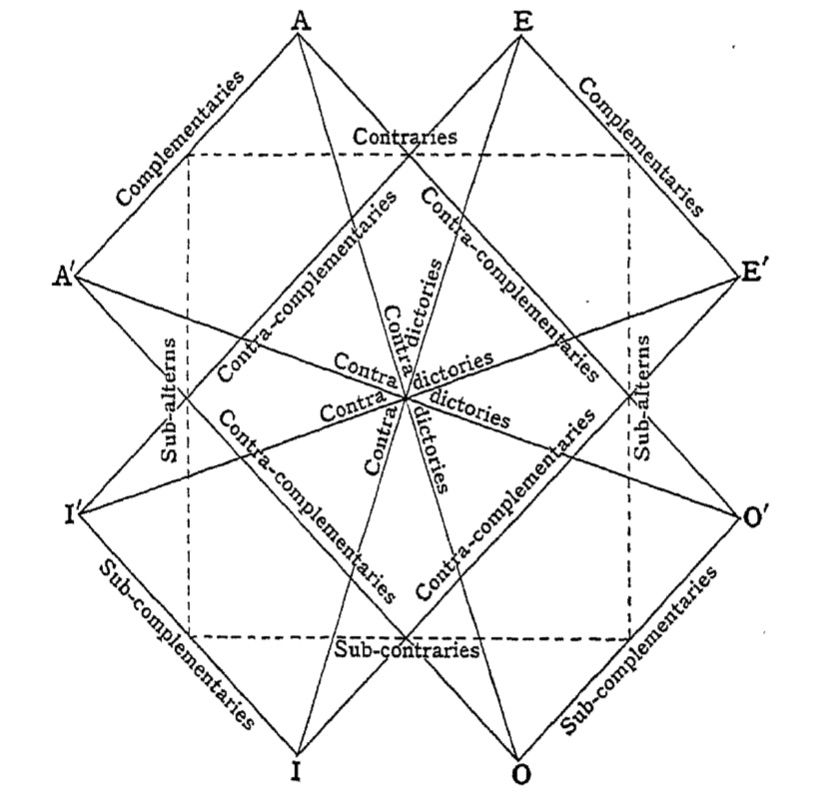
Each of the dotted lines in the above takes the place of
four connecting lines which are not filled in; for example, the
dotted line marked as connecting contraries indicates the relation
between A and E, A and Eʹ,
Aʹ and E, Aʹ and Eʹ.151
108. The Elimination of
Negative Terms.152—The process of obversion enables us by
the aid of negative terms to reduce all propositions to the
affirmative form; and the question may be raised whether the various processes of
immediate inference and the use, where necessary, of negative
propositions will not equally enable us to eliminate negative terms.
It is of course clear that by means of obversion we can get rid of
a negative term occurring as the predicate of a proposition. The
problem is more difficult when the negative term occurs as subject,
but in this case elimination may still be possible; for example,
SʹiP = PoS. We may even be able to get rid of two
negative terms; for example, SʹaPʹ = PaS. So
long, however, as we are limited to categorical propositions of the
ordinary type we cannot eliminate a negative term (without introducing
another in its place) where such a term occurs as subject either
(a) in a universal affirmative or a particular negative with a
positive term as predicate, or (b) in a universal negative or a
particular affirmative with a negative term as predicate.
The validity of the above results is at once shewn by reference to
the table of equivalences given in section 106. At least one
proposition in which there is no negative term will be found in each
line of equivalences except the fourth and the eighth, which are as
follows:
| SʹaP | = | SʹePʹ | = |
PʹeSʹ | = | PʹaS ; |
| SʹoP | = | SʹiPʹ | = |
PʹiSʹ | = | PʹoS. |
In these cases we may indeed get rid of Sʹ (as, for
example, from SʹaP), but it is only by introducing
Pʹ (thus, SʹaP = PʹaS); there is no
getting rid of negative terms altogether. We may here refer back to
the results obtained in sections 100 and 106; with two terms
six non-equivalent propositions were obtained, with two terms
and their contradictories eight non-equivalent propositions.
The ground of this difference is now made clear.
If, however, we are allowed to enlarge our scheme of propositions
by recognising certain additional types, and if we work on the
assumption that universal propositions are existentially negative
while particular propositions are existentially affirmative,153
then negative terms may always be eliminated. Thus, No not-S is not-P is
equivalent to the statement Nothing is both not-S and not-P,
and this becomes by obversion Everything is either S or P.
Again, Some not-S is not-P is equivalent to the statement
Something is both not-S and not-P, and this becomes by
obversion Something is not either S or P, or, as this
proposition may also be written, There is something besides S and
P. The elimination of negative terms has now been accomplished in
all cases. It will be observed further that we now have eight
non-equivalent propositions containing only S and
P—namely, All S is P, No S is P, Some S
is P, Some S is not P, All P is S, Some P is not
S, Everything is either S or P, There is something
besides S and P.
Following out this line of treatment, the table of equivalences
given in section 106 may be rewritten as follows [columns (ii) and
(iii) being omitted, and columns (v) and (vi) taking their places]:
| (i) | | (iv) | | (v) | | (vi) |
| SaP | = | PʹaSʹ | = | Nothing is SPʹ | = | Everything is Sʹ or P. |
| SʹaPʹ | =
| PaS | = | Nothing is SʹP | = | Everything is S or Pʹ. |
| SaPʹ | = | PaSʹ | = | Nothing is SP | = | Everything is Sʹ or Pʹ. |
| SʹaP | = | PʹaS | = |
Nothing is SʹPʹ | = | Everything is S or P. |
| SoP | = | PʹoSʹ | = | Something is SPʹ | = | There is something besides Sʹ
and P. |
| SʹoPʹ | = | PoS | = | Something is SʹP | = | There is something besides S and Pʹ. |
| SoPʹ | = | PoSʹ | = | Something is SP | = | There is something besides Sʹ and Pʹ. |
| SʹoP | = | PʹoS | = |
Something is SʹPʹ | = | There is
something besides S and P. |
Taking the propositions in two divisions of four sets each, the two
diagonals from left to right give propositions containing S and
P only.154
The scheme of
propositions given in this section may be brought into interesting
relation with the three fundamental laws of thought.155
The scheme is based upon the recognition of the following
propositional forms and their contradictories:
Every S is P ;
Every not-P is not-S ;
Nothing is both S and not-P ;
Everything is either P or not-S ;
and these four propositions
have been shewn to be equivalent to one another.
If in the above propositions we now write S for P, we
have the following:
Every S is S ;
Every not-S is not-S ;
Nothing is both S and not-S ;
Everything is either S or not-S.
But the first two of these propositions express the law of
identity, with positive and negative terms respectively, the third is
an expression of the law of contradiction, and the fourth of the law
of excluded middle. The scheme of propositions with which we have been
dealing may, therefore, be said to be based upon the recognition of
just those propositional forms which are required in order to express
the fundamental laws of thought.
Since the propositional forms in question have been shewn to be
mutually equivalent to one another, the further argument may suggest
itself that if the validity of the immediate inferences involved be
granted, then it follows that the fundamental laws of thought have
been shewn to be mutually inferable from one another. But it may, on
the other hand, be held that this argument is open to the charge of
involving a circulus in probando on the ground that the
validity of the immediate inferences themselves requires that the laws
of thought be first postulated as an antecedent condition.
109. Other Immediate
Inferences.—Some other commonly recognised forms of
immediate inference may be briefly touched upon.
(1) Immediate inferences based on the square of opposition
have been discussed in the preceding chapter.
(2) Immediate inference by change of relation is the process
whereby we pass from a categorical proposition to a conditional or a
disjunctive, or from a conditional to a disjunctive or a categorical,
or from a disjunctive to a categorical or a conditional.156
For example, All S is P, therefore, If anything is S it is
P ; Every S is P or Q, therefore, Any S that is not P is
Q. References have been already made to inferences such as these,
and they will be further discussed later on.
(3) Immediate inference by added determinants is a process
of immediate inference which consists in limiting both the subject and
the predicate of the original proposition by means of the same
determinant. For example,—All P is Q, therefore, All
AP is AQ ; A negro is a fellow creature, therefore, A suffering
negro is a suffering fellow creature. The formal validity of the
reasoning may be shewn as follows: AP is a subdivision of the
class P, namely, that part of it which also belongs to the
class A ; and, therefore, whatever is true of the whole of
P must be true of AP ; hence, given that All P is
Q, we can infer that All AP is Q ; moreover, by the law of
identity, All AP is A ; therefore, All AP is AQ.157
The formal validity of immediate inference by added determinants
has been denied on the ground of the obvious fallacy of arguing from
such a premiss as an elephant is an animal to the conclusion
a small elephant is a small animal, or from such a premiss as
cricketers are men to the conclusion poor cricketers are
poor men. In these cases, however, the fallacy really results from
the ambiguity of language, the added determinant receiving a different
interpretation when it qualifies the subject from that which it has
when it qualifies the predicate. A term of comparison like
small can indeed hardly be said to have an independent
interpretation, its force always being relative to some other term
with which it is conjoined. While then the inference in its symbolic
form (P is Q, therefore, AP is AQ) is perfectly valid,
it is specially necessary to guard against fallacy in its use when
significant terms are employed. All that we have to insist upon is
that the added determinant shall receive the same interpretation in
both subject and predicate. There is, for example, no fallacy in the
following: An elephant is an animal, therefore, A small elephant is an
animal which is small compared with elephants generally; Cricketers
are men, therefore, Poor cricketers are men who in their capacity as
cricketers are poor.
(4) Immediate inference by complex conception is a process
of immediate inference which consists in employing the subject and the
predicate of the original proposition as parts of a more complex
conception. Symbolically we can only express it somewhat as follows:
P is Q, therefore, Whatever stands in a certain relation to
P stands in the same relation to Q. The following is a concrete
example: An elephant is an animal, therefore, the ear of an elephant
is the ear of an animal. A systematic treatment of this kind of
inference belongs to the special branch of formal logic known as the
logic of relatives, any detailed consideration of which is
beyond the scope of the present work. Attention may, however, be
called to the danger of our committing a fallacy, if we perform the
process carelessly. For example, Protestants are Christians,
therefore, A majority of Protestants are a majority of Christians; A
negro is a man, therefore, the best of negroes is the best of men. The
former of these fallacies is akin to the fallacy of composition (see
section 11), since we pass from the distributive to the collective use of a term.
(5) Immediate inference by converse relation is a process of
immediate inference analogous to ordinary conversion but belonging to
the logic of relatives. It consists in passing from a statement of the
relation in which P stands to Q to a statement of the
relation in which Q consequently stands to P. The two
terms are transposed and the word by which their relation is expressed
is replaced by its correlative. For example, A is greater than
B, therefore, B is less than A ; Alexander was the
son of Philip, therefore, Philip was the father of Alexander; Freedom
is synonymous with liberty, therefore, Liberty is synonymous with
freedom.
Mansel gives the first two of the above as examples of material
consequence as distinguished from formal consequence.
“A Material Consequence is defined by Aldrich to be one in which
the conclusion follows from the premisses solely by the force of the
terms. This in fact means from some understood Proposition or
Propositions, connecting the terms, by the addition of which the mind
is enabled to reduce the Consequence to logical form…… The failure of
a Material Consequence takes place when no such connexion exists
between the terms as will warrant us in supplying the premisses
required; i.e., when one or more of the premisses so supplied
would be false. But to determine this point is obviously beyond
the province of the Logician. For this reason, Material Consequence is
rightly excluded from Logic…… Among these material, and therefore
extralogical, Consequences, are to be classed those which Reid adduces
as cases for which Logic does not provide; e.g.,
‘Alexander was the son of Philip, therefore, Philip was the
father of Alexander’; ‘A is greater than B,
therefore, B is less than A.’ In both these it is
our material knowledge of the relations ‘father and son,’
‘greater and less,’ that enables us to make the
inference” (Aldrich, p. 199).
The distinction between what is formal and what is material is not
in reality so simple or so absolute as is here implied.158
It is usual to recognise as formal only those relations which can be
expressed by the ordinary copula is or is not ; and there
is very good reason for proceeding upon this basis in the greater part
of our logical discussions. No other relation is of the same
fundamental importance or admits of an equally developed logical
superstructure. But it is important to recognise that there are other
relations which may remain the same while the things related vary; and
wherever this is the case we may regard the relation as constituting
the form and the things related the matter. Accordingly with each such
relation we may have a different formal system. The logic of relatives
deals with such systems as are outside the one ordinarily recognised.
Each immediate inference by converse relation will, therefore, be
formal in its own particular system. This point is admirably put by
Miss Jones: “A proposition containing a relative term
furnishes—besides the ordinary immediate inferences—other
immediate inferences to any one acquainted with the system to which it
refers. These inferences cannot be educed except by a person knowing
the ‘system’; on the other hand, no knowledge is needed of
the objects referred to, except a knowledge of their place in the
system, and this knowledge is in many cases coextensive with ordinary
intelligence; consider, e.g., the relations of magnitude of
objects in space, of the successive parts of time, of family
connexions, of number” (General Logic, p. 34).
(6) Immediate inference by modal consequence or, as it is
also called, inference by change of modality, is somewhat analogous to
subaltern inference. It consists in nothing more than weakening a
statement in respect of its modality; and hence it is never possible
to pass back from the inferred to the original proposition. Thus, from
the validity of the apodeictic judgment we can pass to the
validity of the assertoric, and from that to the validity of the
problematic; but not vice versâ. On the other hand, from the
invalidity of the problematic judgment we can pass to the
invalidity of the assertoric, and from that to the invalidity of the
apodeictic; but again not vice versâ.159
110. Reduction of
immediate inferences to the mediate form160—Immediate
inference has been defined as the inference of a proposition from a
single other proposition; mediate inference, on the other hand, is the
inference of a proposition from at least two other propositions.
We may briefly consider various ways of establishing the validity
of immediate inferences by means of mediate inferences.
(1) One of the old Greek logicians, Alexander of Aphrodisias,
establishes the conversion of E by means of a syllogism in Ferio.
| No S is P, |
| therefore, | No P is S ; |
for, if
not, then by the law of contradiction, Some P is S ; and we have
this syllogism,—
| No S is P, |
| Some P is S, |
| therefore, | Some P is not P, |
a reductio ad absurdum.161
(2) It may be plausibly maintained that in Aristotle’s proof
of the conversion of E (given in section 99), there is an
implicit syllogism: namely,—Q is P, Q is S,
therefore, Some S is P.
(3) The contraposition of A may be established by means of a
syllogism in Camestres as follows:—
| Given | All S is P, | |
| we have also |
No not-P is P, | by the law of contradiction, |
| therefore, |
No not-P is
S.162 | |
(4) We might also obtain the contrapositive of All S is P as
follows:—
By the law of excluded middle, All not-P is S or not-S, and, by hypothesis, All S is P,
| therefore, | All not-P is P or
not-S ; |
| but, by the law of contradiction, | No not-P is P, |
| therefore, | All not-P is not-S.163 |
(5) The
contraposition of A may also be established indirectly by means
of a syllogism in Darii:—
| All S is P, |
| therefore, | No not-P is S ; |
for, if not,
Some not-P is S ; and we have the following syllogism,—
| All S is P, |
| Some not-P is S, |
| therefore, | Some not-P is P, |
which is absurd.164
All the above are interesting, as illustrating the processes of
immediate inference; but regarded as proofs they labour under the
disadvantage of deducing the less complex by means of the more
complex.
111. Give all the logical
opposites of the proposition,—Some rich men are virtuous; and
also the converse of the contrary of its contradictory. How is the
latter directly related to the given proposition?
Does it follow that a proposition admits of simple conversion
because its predicate is distributed? [K.]
112. Point out any
ambiguities in the following propositions, and give the contradictory
and (where possible) the converse of each of them:—(i) Some of
the candidates have been successful; (ii) All are not happy that seem
so; (iii) All the fish weighed five pounds. [K.]
113. State in logical form
and convert the following propositions:—(a) He jests at
scars who never felt a wound; (b) Axioms are self-evident;
(c) Natives alone can stand the climate of Africa; (d)
Not one of the Greeks at Thermopylae escaped; (e) All that
glitters is not gold. [O.]
114. “The angles at
the base of an isosceles triangle are equal.” What can be
inferred from this proposition by obversion, conversion, and
contraposition respectively? [L.]
115. Give the
obverse, the contrapositive, and the inverse of each of the following
propositions:—The virtuous alone are truly noble; No Athenians
are Helots. [M.]
116. Give the contrapositive
and (where possible) the inverse of the following
propositions:—(i) A stitch in time saves nine; (ii) None but the
brave deserve the fair; (iii) Blessed are the peacemakers; (iv) Things
equal to the same thing are equal to one another; (v) Not every tale
we hear is to be believed. [K.]
117. If it is false that
“Not only the virtuous are happy,” what can we infer
(a) with regard to the non-virtuous, (b) with regard to
the non-happy? [J.]
118. Write down the
contradictory, and also—where possible—the converse, the
contrapositive, and the inverse of each of the following propositions:
A bird in the hand is worth two in the bush;
No unjust acts are expedient;
All are not saints that go to church. [K.]
119. Give the contrapositive
and the inverse of each of the following propositions,—They
never fail who die in a great cause; Whom the Gods love die young.
If A is either B or else both C and D,
what do we know about that which is not D? [K.]
120. Take the following
propositions in pairs, and in regard to each pair state whether the
two propositions are consistent or inconsistent with each other; in
the former case, state further whether either proposition can be
inferred from the other, and, if it can be, point out the nature of
the inference; in the latter case, state whether it is possible for
both the propositions to be false:—(a) All S is
P ; (b) All not-S is P ; (c) No P is S ;
(d) Some not-P is S. [K.]
121. Transform the following
propositions in such a way that, without losing any of their force,
they may all have the same subject and the same predicate:—No
not-P is S ; All P is not-S ; Some P is S ; Some
not-P is not not-S. [K.]
122. Describe the logical
relations, if any, between each of the following propositions, and
each of the others:—
(i) There are no inorganic substances which do not contain carbon;
(ii) All organic substances contain carbon;
(iii) Some substances not containing carbon are organic;
(iv) Some inorganic substances do not contain carbon.
[C.]
123. “All that love
virtue love angling.”
Arrange the following propositions in the three following
groups:—(α) those which can be inferred from the above
proposition; (β) those which are consistent with it, but
which cannot be inferred from it; (γ) those which are
inconsistent with it.
(i) None that love not virtue love angling.
(ii) All that love angling love virtue.
(iii) All that love not angling love virtue.
(iv) None that love not angling love virtue.
(v) Some that love not virtue love angling.
(vi) Some that love not virtue love not angling
(vii) Some that love not angling love virtue.
(viii) Some that love not angling love not virtue. [K.]
124. Determine the logical
relation between each pair of the following propositions:—
(1) All crystals are solids.
(2) Some solids are not crystals.
(3) Some not crystals are not solids.
(4) No crystals are not solids.
(5) Some solids are crystals.
(6) Some not solids are not crystals.
(7) All solids are crystals. [L.]
THE DIAGRAMMATIC REPRESENTATION OF PROPOSITIONS.
125. The use of Diagrams
in Logic.—In representing propositions by geometrical
diagrams, our object is not that we may have a new set of symbols, but
that the relation between the subject and predicate of a proposition
may be exhibited by means of a sensible representation, the
signification of which is clear at a glance. Hence the first
requirement that ought to be satisfied by any diagrammatic scheme is
that the interpretation of the diagrams should be intuitively obvious,
as soon as the principle upon which they are based has been
explained.165
A second essential requirement is that the diagrams should be
adequate; that is to say, they should give a complete, and not a partial,
representation of the relations which they are intended to indicate.
Hamilton’s use of Euler’s diagrams, as described in the
following section, will serve to illustrate the failure to satisfy
this requirement.
In the third place, the diagrams should be capable of representing
all the propositional forms recognised in the schedule of propositions
which are to be illustrated, e.g., particulars as well as
universal. One scheme of diagrams may, however, be better suited for
one purpose, and another scheme for another purpose. It will be found
that Dr Venn’s diagrams, to be described presently, are not
quite so well adapted to the representation of particulars as of
universals.
Lastly, it is advantageous that a diagrammatic scheme should be as
little cumbrous as possible when it is desired to represent two or
more propositions in combination with one another. This is the weak
point of Euler’s method. A scheme of diagrams may, however,
serve a very useful function in making clear the full force of
individual propositions, even when it is not well adapted for the
representation of combined propositions.
A further requirement is sometimes added, namely, that each
propositional form should be represented by a single diagram, not by a
set of alternative diagrams. This is, however, by no means essential.
For if we adopt a schedule of propositions some of which yield only an
indeterminate relation in respect of extension between the terms
involved, it is important that this should be clearly brought out, and
a set of alternative diagrams may be specially helpful for the
purpose. This point will be illustrated, with reference to
Euler’s diagrams, in the following section.166
126. Euler’s
Diagrams.—We may begin with the well-known scheme of
diagrams, which was first expounded by the Swiss mathematician and
logician, Leonhard Euler, and which is usually called after his
name.167
Representing
the individuals included in any class, or denoted by any name, by a
circle, it will be obvious that the five following diagrams represent
all possible relations between any two classes:—
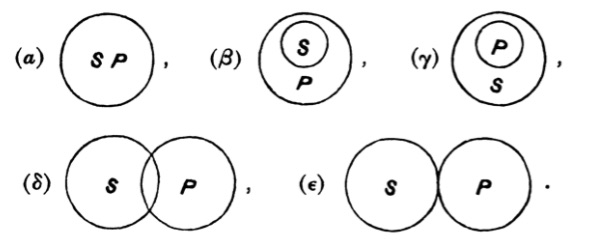
The force of the different propositional forms is to exclude one or
more of these possibilities.
All S is P limits us to one of the two α, β ;
Some S is P to one of the four α, β, γ, δ ;
No S is P to ε ;
Some S is not P to one of the three γ, δ, ε.
It will be observed that there is great want of symmetry in the
number of circles corresponding to the different propositional forms;
also that there is an apparent inequality in the amount of information
given by A and by E, and again by I and by
O. We shall find that these anomalies disappear when account is
taken of negative terms.
It is most misleading to attempt to represent All S is P by
a single pair of circles, thus
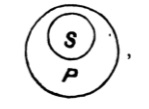
or Some S is P by a single pair, thus
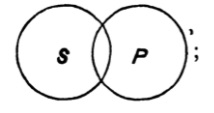
for in each
case the proposition really leaves us with other alternatives. This
method of employing the diagrams has, however, been adopted by a good
many logicians who have used them, including Sir William Hamilton
(Logic, I. p. 255), and Professor Jevons (Elementary Lessons in Logic, pp. 72 to 75); and the attempt at such simplification
has brought their use into undeserved disrepute. Thus, Dr Venn
remarks, “The common practice, adopted in so many manuals, of
appealing to these diagrams—Eulerian diagrams as they are often
called—seems to me very questionable. The old four propositions
A, E, I, O, do not exactly correspond to
the five diagrams, and consequently none of the moods in the syllogism
can in strict propriety be represented by these diagrams”
(Symbolic Logic, pp. 15, 16; compare also pp. 424, 425). This
criticism, while perfectly sound as regards the use of Euler’s
circles by Hamilton and Jevons, loses most of its force if the
diagrams are employed with due precautions. It is true that the
diagrams become somewhat cumbrous in relation to the syllogism; but
the logical force of propositions and the logical relations between
propositions can in many respects be well illustrated by their aid.
Thus, they may be employed:—
(1) To illustrate the distribution of the predicate in a
proposition. In the case of each of the four fundamental propositions
we may shade the part of the predicate concerning which information is
given us.
We then have,—
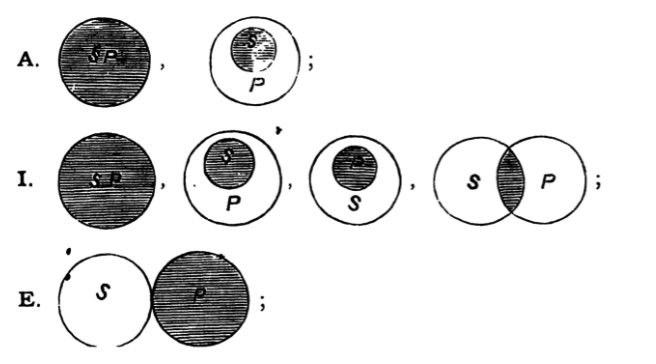
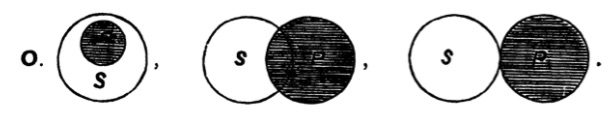
We see that with A and I, only part of P is in
some of the cases shaded; whereas with E and O, the
whole of P is in every case shaded; and it is thus made clear
that negative propositions distribute, while affirmative propositions
do not distribute, their predicates.
(2) To illustrate the opposition of propositions. Comparing two
contradictory propositions, e.g., A and O, we see
that they have no case in common, but that between them they exhaust
all possible cases. Hence the truth, that two contradictory
propositions cannot be true together but that one of them must be
true, is brought home to us under a new aspect. Again, comparing two
subaltern propositions, e.g., A and I, we notice
that the former gives us all the information given by the latter and
something more, since it still further limits the possibilities. The
other relations involved in the doctrine of opposition may be
illustrated similarly.
(3) To illustrate the conversion of propositions. Thus it is made
clear by the diagrams how it is that A admits only of
conversion per accidens. All S is P limits us to one or
other of the following,—
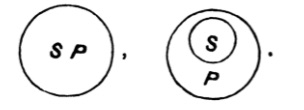
What then do we know of P? In the first case we have All
P is S, in the second Some P is S ; and since we are
ignorant as to which of the two cases holds good, we can only state
what is common to them both, namely, Some P is S.
Again, it is made clear how it is that O is inconvertible.
Some S is not P limits us to one or other of the
following,—

What then do
we know concerning P? The three cases give us
respectively,—(i) All P is S ; (ii) Some P is S and
Some P is not S ; (iii) No P is S. But (i) and (iii) are
inconsistent with one another. Hence nothing can be affirmed of
P that is true in all three cases indifferently.
(4) To illustrate the more complicated forms of immediate
inference. Taking, for example, the proposition All S is P, we
may ask, What does this enable us to assert about not-P and
not-S respectively? We have one or other of these cases,—
As regards not-P, these yield respectively (i) No not-P
is S ; (ii) No not-P is S. And thus we obtain the
contrapositive of the given proposition.
As regards not-S, we have (i) No not-S is P, (ii)
Some not-S is P and some not-S is not P.168
Hence in either case we may infer Some not-S is not P.
E, I, O may be dealt with similarly.
(5) To illustrate the joint force of a pair of complementary or
contra-complementary or sub-complementary propositions (compare
section 100). Thus, the pair of complementary propositions, SaP
and PaS, taken together, limit us to
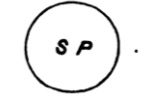
Similarly the pair of contra-complementary propositions, SaP
and PoS, limit us to the relation marked β on page 158; and the
pair of contra-complementary propositions, SoP and PaS, to γ ; while the pair of sub-complementary propositions, SoP and
PoS, give us a choice between δ and ε.
The application of the diagrams to syllogistic reasonings will be
considered in a subsequent chapter.
With regard to all the above, it may be said that the use of the
circles gives us nothing that could not easily have been obtained
independently. This is of course true; but no one, who has had
experience of the difficulty that is sometimes found by students in
properly understanding the elementary principles of formal logic, and
especially in dealing with immediate inferences, will despise any
means of illustrating afresh the old truths, and presenting them under
a new aspect.
The fact that we have not a single pair of circles corresponding to
each fundamental form of proposition is fatal if we wish to illustrate
any complicated train of reasoning in this way; but in indicating the
real nature of the information given by the propositions themselves,
it is rather an advantage than otherwise, inasmuch as it shews how
limited in some cases this information actually is.169
127.
Lambert’s Diagrams.—A scheme of diagrams was
employed by Lambert170 in which horizontal straight lines take the
place of Euler’s circles. The extension of a term is represented
by a horizontal straight line, and so far as two such lines overlap it
is indicated that the corresponding classes are coincident, while so
far as they do not overlap these classes are shewn to be mutually
exclusive. Both the absolute and the relative length of the lines is
of course arbitrary and immaterial.
We may first shew how Lambert’s lines may be used in such a
manner as to be precisely analogous to Euler’s circles. Thus, the four
fundamental propositions may be represented as follows:—
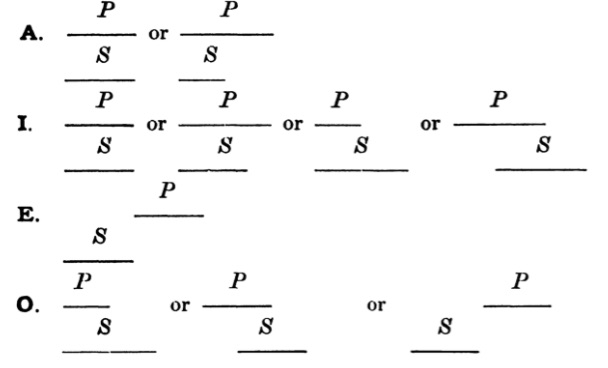
These diagrams occupy less space than Euler’s circles. But
they seem also to be less intuitively clear and less suggestive. The
different cases too are less markedly distinct from one another. It is
probable that one would in consequence be more liable to error in
employing them.
The different cases may, however, be combined by the use of dotted
lines so as to yield but a single diagram for each proposition much
more satisfactorily than in Euler’s scheme. Thus, All S is
P may be represented by the diagram
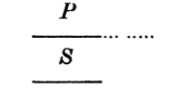
where the dotted line indicates that we are uncertain as to whether
there is or is not any P which is not S. We obviously
get two cases according as we strike out the dots or fill them in, and
these are the two cases previously shewn to be compatible with an
A proposition.
Again, Some S is P may be represented by the diagram
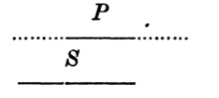
and here we get the four cases previously given for an I
proposition by
(a) filling in the dots to the left and striking out those to
the right, (b) filling in all the dots, (c) striking
them all out, (d) filling in those to the right and striking
out those to the left.
Two complete schemes of diagrams may be constructed on this plan,
in one of which no part of any S line, and in the other no part
of any P line, is dotted.171 These two schemes
are given below to the left and right respectively of the
propositional forms themselves.
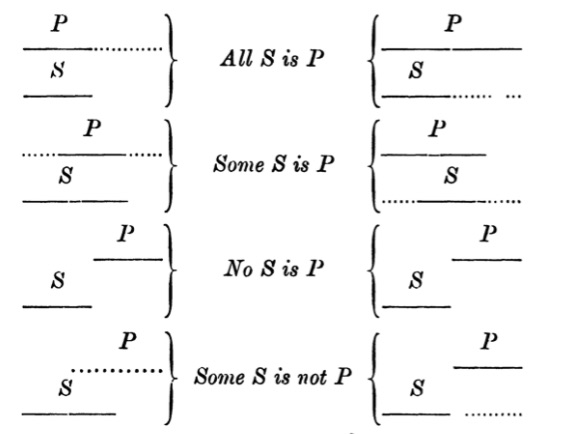
It must be understood that the two diagrams given above in the
cases of A, I, and O are alternative in the sense
that we may select which we please to represent our proposition; but
either represents it completely.
We shall find later on that for the purpose of illustrating the
syllogistic moods, Lambert’s method is a good deal less cumbrous
than Euler’s.172 An adaptation of Lambert’s diagrams in
which the contradictories of S and P are introduced as
well as S
and P themselves will be given in section 131. This more
elaborated scheme will be found useful for illustrating the various
processes of immediate inference.
128. Dr Venn’s
Diagrams.—In the diagrammatic scheme employed by Dr Venn
(Symbolic Logic, chapter 5) the diagram
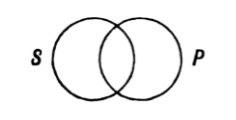
does not itself represent any proposition, but the framework into
which propositions may be fitted. Denoting not-S by
Sʹ and what is both S and P by SP,
&c., it is clear that everything must be contained in one or other
of the four classes SP, SPʹ, SʹP,
SʹPʹ ; and the above diagram shews four compartments
(one being that which lies outside both the circles) corresponding to
these four classes. Every universal proposition denies the existence
of one or more of such classes, and it may therefore be
diagrammatically represented by shading out the corresponding
compartment or compartments. Thus, All S is P, which denies the
existence of SPʹ, is represented by
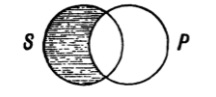
No S is P by
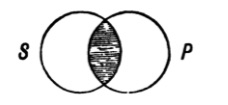
With three terms
we have three circles and eight compartments, thus,—
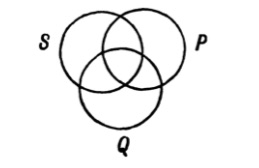
All S is P or Q is represented by
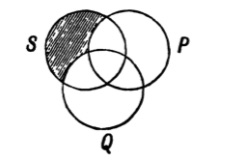
All S is P and Q by
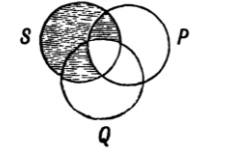
It is in cases involving three or more terms that the advantage of
this scheme over the Eulerian scheme is most manifest. The diagrams
are not, however, quite so well adapted to the case of particular
propositions. Dr Venn (in Mind, 1883, pp. 599, 600) suggests
that we might draw a bar across the compartment declared to be saved
by a particular proposition;173 thus, Some S is
P would be represented by drawing a bar across the SP
compartment. This plan can be worked out satisfactorily; but in
representing a combination of propositions in this way special care is
needed in the interpretation of the diagrams. For example, if we have
the diagram for three terms S, P, Q, and are
given Some S is P, we do not know that both the compartments
SPQ, SPQʹ, are to be saved, and in a case like this
a bar drawn across the SP compartment is in some danger of
misinterpretation.
129. Expression of the
possible relations between any two classes by means of the
propositional forms A, E, I,
O.—Any information given with respect to two classes
limits the possible relations between them to something less than the
five à priori possibilities indicated diagrammatically by
Euler’s circles as given at the beginning of section 126. It
will be useful to enquire how such information may in all cases be
expressed by means of the propositional forms A, E,
I, O.
The five relations may, as before, be designated respectively
α, β, γ, δ, ε.174
Information is given when the possibility of one or more of these is
denied; in other words, when we are limited to one, two, three, or
four of them. Let limitation to α, or β, the
exclusion of γ, δ, ε be denoted by α, β ; limitation to α, β, or γ
(i.e., the exclusion of δ and ε) by α, β, γ ; and so on.
In seeking to express our information by means of the four ordinary
propositional forms, we find that sometimes a single proposition will
suffice for our purpose; thus α, β is expressed by
All S is P. Sometimes we require a combination of propositions;
thus α is expressed by the pair of complementary propositions
All S is P and all P is S, (since all S is P excludes
γ, δ, ε, and all P is S further
excludes β). Some other cases are more complicated; thus the
fact that we are limited to α or δ cannot be
expressed more simply than by saying, Either All S is P and all P
is S, or else Some S is P, some S is not P, and some P is not
S.
Let A = All S is P, A1 = All P
is S, and similarly for the other propositions. Also let
AA1 = All S is P and all P is S, &c. Then
the following is a scheme for all possible cases:—
| Limitation to |
denoted by |
Limitation to |
denoted by |
| α | AA1 |
α, β, γ | A or A1 |
| β | AO1 |
α, β, δ | A or IO1 |
| γ | A1O |
α, β, ε | A or E |
| δ | IOO1 |
α, γ, δ | A1 or IO |
| ε | E |
α, γ, ε | A1 or E |
| α, β | A |
α, δ, ε | AA1 or OO1 |
| α, γ | A1 |
β, γ, δ | IO or IO1 |
| α, δ | AA1 or IOO1 |
β, γ, ε | AO1 or A1O or E |
| α, ε | AA1 or E |
β, δ, ε | O1 |
| β, γ | AO1 or
A1O |
γ, δ, ε | O |
| β, δ | IO1 |
α, β, γ, δ | I |
| β, ε | AO1 or E |
α, β, γ, ε | A or
A1 or E |
| γ, δ | IO |
α, β,
δ, ε | A or O1 |
| γ, ε | A1O or E |
α, γ, δ, ε | A1
or O |
| δ, ε | OO1 |
β, γ, δ, ε | O or O1 |
It will be found that any combinations of propositions other than
those given above either involve contradictions or redundancies, or
else give no information because all the five relations that are à
priori possible still remain possible.
For example, AI is clearly redundant; AO is
self-contradictory; A or A1O is
redundant (since the same information is given by A or
A1); A or O gives no information
(since it excludes no possible case). The student is recommended to
test other combinations similarly. It must be remembered that
I1 = I, and E1 = E.
It should be
noticed that if we read the first column downwards and the second
column upwards we get pairs of contradictories.
130. Euler’s
diagrams and the class relations between S, not-S, P,
not-P.—In Euler s diagrams, as ordinarily given, there is no
explicit recognition of not-S and not-P; but it is of
course understood that whatever part of the universe lies outside
S is not-S, and similarly for P, and it may be
thought that no further account of negative terms need be taken.
Further consideration, however, will shew that this is not the case;
and, assuming that S, not-S, P, not-P all
represent existing classes, we shall find that seven, not five,
determinate class relations between them are possible.
Taking the diagrams given in section 126, the above assumption
clearly requires that in the cases of α, β, and
γ, there should be some part of the universe lying outside
both the circles, since otherwise either not-S or not-P
or both of them would no longer be contained in the universe. But in
the cases of δ and ε it is different. S,
not-S, P, not-P are now all of them represented
within the circles; and in each of these cases, therefore, the pair of
circles may or may not between them exhaust the universe.
Our results may also be expressed by saying that in the cases of
α, β, and γ, there must be something which
is both not-S and not-P; whereas in the cases of δ and ε, there may or may not be something which is both
not-S and not-P. Euler’s circles, as ordinarily
used, are no doubt a little apt to lead us to overlook the latter of
these alternatives. If, indeed, there were always part of the universe
outside the circles, every proposition, whether its form were
A, E, I, or O, would have an inverse and the
same inverse, namely, Some not-S is not-P ; also, every
proposition, including I, would have a contrapositive. These
are erroneous results against which we have to be on our guard in the
use of Euler’s fivefold scheme.
We find then that the explicit recognition of not-S and
not-P practically leaves α, β, and γ
unaffected, but causes δ and ε each to subdivide
into two cases according as there is or is not anything that is both
not-S and not-P; and the Eulerian fivefold division has accordingly
to give place to a sevenfold division.
In the diagrammatic representation of these seven relations, the
entire universe of discourse may be indicated by a larger circle in
which the ordinary Eulerian diagrams (with some slight necessary
modifications) are included. We shall then have the following
scheme:—
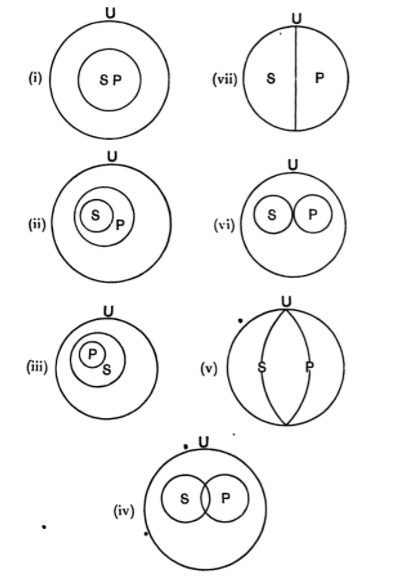
It may be
useful to repeat these diagrams with an explicit indication in regard
to each subdivision of the universe as to whether it is S or
not-S, P or not-P.175 The scheme will
then appear as follows:—
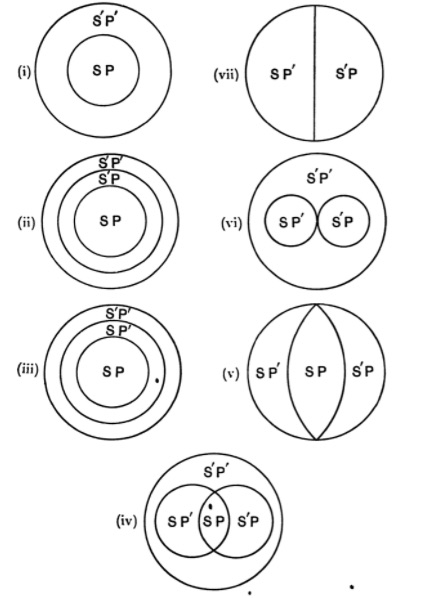
Comparing the
above with the five ordinary Eulerian diagrams (which may be
designated α, β &c. as in section 126), it will
be seen that (i) corresponds to α; (ii) to β; (iii) to γ; (iv) and (v) represent the two cases now yielded by δ;
(vi) and (vii) the two yielded by ε.
Our seven diagrams might also be arrived at as follows:—Every part of the universe must be either S or Sʹ,
and also P or Pʹ ; and hence the mutually exclusive
combinations SP, SPʹ, SʹP,
SʹPʹ must between them exhaust the universe. The case
in which these combinations are all to be found is represented by
diagram (iv); if one but one only is absent we obviously have four
cases which are represented respectively by (ii), (iii), (v), and (vi); if only two are to be found it will be seen that we
are limited to the cases represented by (i) and (vii) or we should not
fulfil the condition that neither S nor Sʹ, P
nor Pʹ, is to be altogether non-existent; for the same
reason the universe cannot contain less than two of the four
combinations. We thus have the seven cases represented by the
diagrams, and these are shewn to exhaust the possibilities.
The four
traditional propositions are related to the new scheme as
follows:—
A limits us to (i) or (ii);
I to (i), (ii), (iii), (iv), or (v);
E to (vi) or (vii);
O to (iii), (iv), (v), (vi), or (vii).
Working out the further question how each diagram taken by itself
is to be expressed propositionally we get the following results:
(i) SaP and SʹaPʹ ;
(ii) SaP and SʹoPʹ ;
(iii) SʹaPʹ and SoP ;
(iv) SoP, SoPʹ, SʹoP, and
SʹoPʹ ;
(v) SʹaP and SoPʹ ;
(vi) SaPʹ and SʹoP ;
(vii) SaPʹ and SʹaP.
It will be observed that the new scheme is in itself more
symmetrical than Euler’s, and also that it succeeds better in
bringing out the symmetry of the fourfold schedule of propositions.176
A and E give two alternatives each, I and
O give five each; whereas with Euler’s scheme E
gives only one alternative, A two, O three, I
four, and it might, therefore, seem as if E afforded more
definite and unambiguous information than A, and O than
I, which is not really the case. Further, the problem of
expressing each diagram propositionally yields a more symmetrical
result than the corresponding problem in the case of Euler’s
diagrams.
This sevenfold scheme of class relations should be compared with
the sevenfold scheme of relations between propositions given in
section 84.
131. Lambert’s
diagram and the class-relations between S, not-S, P,
not-P.—The following is a compact diagrammatic
representation of the seven possible class-relations between S,
not-S, P, not-P, based upon Lambert’s
scheme.
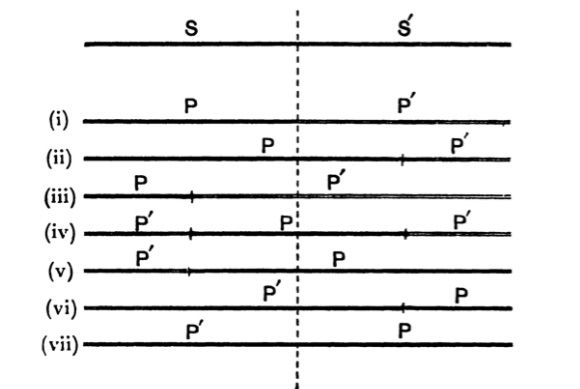
In this scheme each line represents the entire universe of
discourse, and the first line must be taken in connexion with each of
the others in turn. Further explanation will be unnecessary for the
student who clearly understands the Lambertian method.
On the same principle and with the aid of dotted lines the four
fundamental propositional forms may be represented as follows:
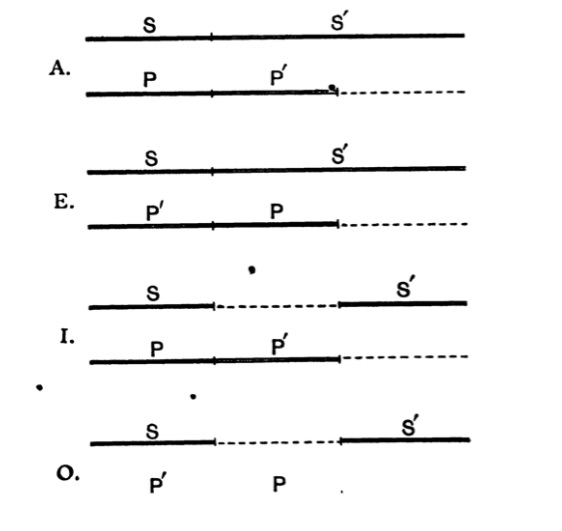
In each case
the full extent of a line represents the entire universe of discourse;
any portion of a line that is dotted may be either S or
Sʹ (or P or Pʹ, as the case may be).
This last scheme of diagrams is perhaps more useful than any of the
others in shewing at a glance what immediate inferences are obtainable
from each proposition by conversion, contraposition, and inversion (on
the assumption that S, Sʹ, P, and
Pʹ all represent existing classes). Thus, from the first
diagram we can read off at a glance SaP, PiS,
PʹaSʹ, SʹiPʹ ; from the second
SeP, PeS, PʹoSʹ, SʹoPʹ ; from
the third SiP and PiS ; and from the fourth SoP
and PʹoSʹ. The last two diagrams are also seen at a
glance to be indeterminate in respect to Pʹ and
Sʹ, P and Sʹ, respectively (that is to
say, I has no contrapositive and no inverse, O has no
converse and no inverse).
132. Illustrate by means of
the Eulerian diagrams (1) the relation between A and E, (2) the relation between
I and O, (3) the conversion of I, (4) the
contraposition of O, (5) the inversion of E. [K.]
133. A denies that
none but X are Y ; B denies that none but Y are X. Which of the five class relations between
X and Y (1) must they agree in rejecting, (2) may they
agree in accepting? [C.]
134. Take all the ordinary
propositions connecting any two terms, combine them in pairs so far as
is possible without contradiction, and represent each combination
diagrammatically. [J.]
PROPOSITIONS IN EXTENSION AND IN INTENSION.
135. Fourfold Implication
of Propositions in Connotation and Denotation.—In dealing
with the question whether propositions assert a relation between
objects or between attributes or between objects and attributes,
logicians have been apt to commit the fallacy of exclusiveness,
selecting some one of the given alternatives, and treating the others
as necessarily excluded thereby. It follows, however, from the double
aspect of names—in extension and intension—that the
different relations really involve one another, so that all of them
are implied in any categorical proposition whose subject and predicate
are both general names.177 If any one of the relations is selected as
constituting the meaning of the proposition, the other
relations are at any rate involved as implications.
The problem will be made more definite if we confine ourselves to a
consideration of connotation and denotation in the
strict sense, as distinguished from comprehension and exemplification,
our terms being supposed to be defined intensively.178
Both subject and predicate will then have a denotation determined by
their connotation, and hence our proposition may be considered from four
different points of view, which are not indeed really independent of
one another, but which serve to bring different aspects of the
proposition into prominence. (1) The subject may be read in denotation
and the predicate in connotation; (2) both terms may be read in
denotation; (3) both terms may be read in connotation; (4) the subject
may be read in connotation and the predicate in denotation.
As an example, we may take the proposition, All men are mortal.179
According to our point of view, this proposition may be read in any of
the following ways:
(1) The objects denoted by man possess the attributes
connoted by mortal ;
(2) The objects denoted by man are included within the class
of objects denoted by mortal ;
(3) The attributes connoted by man are accompanied by the
attributes connoted by mortal ;
(4) The attributes connoted by man indicate the presence of
an object belonging to the class denoted by mortal.
It should be specially noticed that a different relation between
subject and predicate is brought out in each of these four modes of
analysing the proposition, the relations being respectively (i)
possession, (ii) inclusion, (iii) concomitance, (iv) indication.
It may very reasonably be argued that a certain one of the above
ways of regarding the proposition is (a) psychologically the
most prominent in the mind in predication; or (b) the most
fundamental in the sense of making explicit that relation which
ultimately determines the other relations; or (c) the most
convenient for a given purpose, e.g., for dealing with the
problems of formal logic. We need not, however, select the same mode
of interpretation in each case. There would, for example, be nothing
inconsistent in holding that to read the subject in denotation and the predicate in
connotation is most correct from the psychological standpoint; to read
both terms in connotation the most ultimate, inasmuch as connotation
determines denotation and not vice versâ, and to read both
terms in denotation the most serviceable for purposes of logical
manipulation. To say, however, that a certain one of the four readings
alone can be regarded as constituting the import of the proposition to
the exclusion of the others cannot but be erroneous. They are in truth
so much implicated in one another, that the difficulty may rather be
to justify a treatment which distinguishes between them.180
(1) Subject in denotation, predicate in connotation.
If we read the subject of a proposition in denotation and the
predicate in connotation, we have what is sometimes called the
predicative mode of interpreting the proposition. This way of
regarding propositions most nearly corresponds in the great majority
of cases with the course of ordinary thought;181 that is to say, we
naturally contemplate the subject as a class of objects of which a
certain attribute or complex of attributes is predicated. Such
propositions as All men are mortal, Some violets are
white, All diamonds are combustible, may be taken as
examples. Dr Venn puts the point very clearly with reference to the
last of these three propositions: “If I say that ‘all
diamonds are combustible,’ I am joining together two connotative
terms, each of which, therefore, implies an attribute and denotes a
class; but is there not a broad distinction in respect of the
prominence with which the notion of a class is presented to the mind
in the two cases? As regards the diamond, we think at once, or think
very speedily, of a class of things, the distinctive attributes of the
subject being mainly used to carry the mind on to the contemplation of
the objects referred to by them. But as regards the combustibility,
the attribute itself is the prominent thing … Combustible things,
other than the diamond itself, come scarcely, if at all, under contemplation. The
assertion in itself does not cause us to raise a thought whether there
be other combustible things than these in existence”
(Empirical Logic, p. 219).
Two points may be noticed as serving to confirm the view that
generally speaking the predicative mode of interpreting propositions
is psychologically the most prominent:
(a) The most striking difference between a substantive and
an attributive (i.e., an adjective or a participle) from the
logical point of view is that in the former the denotation is usually
more prominent than the connotation, even though it may be ultimately
determined by the connotation, whilst in the latter the connotation is
the more prominent, even though the name must be regarded as the name
of a class of objects if it is entitled to be called a name in the
strict logical sense at all. Corresponding to this we find that the
subject of a proposition is almost always a substantive, whereas the
predicate is more often an attributive.
(b) It is always the denotation of a term that we quantify,
never the connotation. Whether we talk of all men or of some
men, the complex of attributes connoted by man is taken in its
totality; the distinction of quantity relates entirely to the
denotation of the term. Corresponding to this, we find that we
naturally regard the quantity of a proposition as pertaining to
its subject, and not to its predicate. It will be shewn in the
following chapter that the doctrine of the quantification of the
predicate has at any rate no psychological justification.
There are, however, numerous exceptions to the statement that the
subject of a proposition is naturally read in denotation and the
predicate in connotation; for example, in the classificatory sciences.
The following propositions may be taken as instances: All palms are
endogens, All daisies are compositae, None but solid
bodies are crystals, Hindoos are Aryans, Tartars are
Turanians. In such cases as these most of us would naturally think
of a certain class of objects as included in or excluded from another
class rather than as possessing or not possessing certain definite
attributes; in other words, as Dr Venn puts it, “the
class-reference of the predicate is no less definite than that of the
subject” (Empirical Logic, p. 220). In the case of such a
proposition as No plants with opposite leaves are orchids, the
position is even reversed, that is to say, it is the subject rather
than the predicate that we should more naturally read in connotation.
We may pass on then to other ways of regarding the categorical
proposition.
(2) Subject in denotation, predicate in denotation.
If we read both the subject and the predicate of a proposition in
denotation, we have a relation between two classes, and hence this is
called the class mode of interpreting the proposition. It must
be particularly observed that the relation between the subject and the
predicate is now one of inclusion in or exclusion from,
not one of possession. It may at once be admitted that the
class mode of interpreting the categorical proposition is neither the
most ultimate, nor—generally speaking—that which we
naturally or spontaneously adopt. It is, however, extremely convenient
for manipulative purposes, and hence is the mode of interpretation
usually selected, either explicitly or implicitly, by the formal
logician. Attention may be specially called to the following points:
(a) When subject and predicate are both read in denotation,
they are homogeneous.
(b) In the diagrammatic illustration of propositions
both subject and predicate are necessarily read in denotation, since
it is the denotation—not the connotation—of a term that we
represent by means of a diagram.
(c) The predicate of a proposition must be read in
denotation in order to give a meaning to the question whether it is or
is not distributed.
(d) The predicate as well as the subject must be read in
denotation before such a process as conversion is possible.
(e) In the treatment of the syllogism both subject
and predicate must be read in denotation (or else both in
connotation), since either the middle term (first and fourth figures)
or the major term (second and fourth figures) or the minor term (third
and fourth figures) is subject in one of the propositions in which it
occurs and predicate in the other.
The class mode of interpreting categorical propositions is
nevertheless treated by some writers as being positively erroneous. But the
arguments used in support of this view will not bear examination.
(i) It is said that to read both subject and predicate in
denotation is psychologically false. It has indeed been pointed out
already that the class mode of interpretation is not that which as a
rule first presents itself to our mind when a proposition is given us;
but we have also seen that there are exceptions to this, as, for
example, in the propositions All daisies are compositae. All
Hindoos are Aryan, All Tartars are Turanians. It is,
therefore, clearly wrong to describe the reading in question as in all
cases psychologically false. On the same shewing, any other reading
would equally be psychologically false, for what is immediately
present to the mind in judgment varies very much in different cases.
Undoubtedly there are many judgments in regard to which we do not
spontaneously adopt the class reading. Still, analysis shews that in
these judgments, as in others, inclusion in or exclusion from a class
is really implicated along with other things, although this relation
may be neither that which first impresses itself upon us nor that
which is most important or characteristic.
(ii) It is asked what we mean by a class, by the class of birds,
for example, when we say All owls are birds. “It is
nothing existing in space; the birds of the world are nowhere
collected together so that we can go and pick out the owls from
amongst them. The classification is a mental abstraction of our own,
founded upon the possession of certain definite attributes. The class
is not definite and fixed, and we do not find out whether any
individual belongs to it by going over a list of its members, but by
enquiring whether it possesses the necessary attributes.”182
In so far as this argument applies against reading the predicate in
denotation, it applies equally against reading the subject in
denotation. It is in effect the argument used by Mill (Logic,
i. 5, § 3) in order to lead up to his position that the
ultimate interpretation of the categorical proposition requires
us to read both subject and predicate in connotation, since denotation
is determined by connotation. But if this be granted, it does not
prove the class reading of the proposition erroneous; it only proves that
in the class reading, the analysis of the import of the proposition
has not been carried as far as it admits of being carried.
(iii) It is argued that when we regard a proposition as expressing
the inclusion of one class within another, even then the predicate is
only apparently read in denotation. “On this view, we do not
really assert P but ‘inclusion in P,’ and
this is therefore the true predicate. For example, in the proposition
‘All owls are birds,’ the real predicate is, on this view,
not ‘birds’ but ‘included in the class
birds.’ But this inclusion is an attribute of the subject, and
the real predicate, therefore, asserts an attribute. It is meaningless
to say ‘Every owl is the class birds,’ and it is
false to say ‘The class owls is the class
birds.’”183 This argument simply begs the question in
favour of the predicative mode of interpretation. It overlooks the
fact that the precise kind of relation brought out in the analysis of
a proposition will vary according to the way in which we read the
subject and the predicate. An analogous argument might also be used
against the predicative reading itself. Take the proposition,
“All men are mortal.” It is absurd to say that
“Every man is the attribute mortality,” or that “The
class men is the attribute mortality.”
(iv) It is said that a class interpretation of both S and
P would lead properly to a fivefold, not a fourfold, scheme of
propositions, since there are just five relations possible between any
two classes, as is shewn by the Eulerian diagrams. This contention has
force, however, only upon the assumption that we must have quite
determinate knowledge of the class relation between S and
P before being able to make any statement on the subject; and
this assumption is neither justifiable in itself nor necessarily
involved in the interpretation in question. It may be added that if a
similar view were taken on the adoption of the predicative mode of
interpretation, we should have a threefold, not a fourfold scheme. For
then the quantity of our subject at any rate would have to be
perfectly determinate, and with S and P for subject and
predicate, the three possible statements would be—All S is
P, Some S is P and some is not, No S is P. The
point here raised will presently be considered further in connexion
with the quantification of the predicate.
(3) Subject in connotation, predicate in connotation.
If we read both the subject and the predicate of a proposition in
connotation, we have what may be called the connotative mode of
interpreting the proposition. In the proposition All S is P,
the relation expressed between the attributes connoted by S and
those connoted by P is one of
concomitance—“the attributes which constitute the
connotation of S are always found accompanied by those which
constitute the connotation of P.”184 Similarly, in the
case of Some S is P,—“the attributes which constitute the
connotation of S are sometimes found accompanied by those which
constitute the connotation of P”; No S is
P,—“the attributes which constitute the connotation
of S are never found along with those which constitute the
connotation of P”; Some S is not
P,—“the attributes which constitute the connotation of
S are sometimes found unaccompanied by those which constitute
the connotation of P.”
It will be noticed that in the connotative reading we have always
to take the attributes which constitute the connotation
collectively. In other words, by the attributes constituting
the connotation of a term we mean those attributes regarded as a
whole. Thus, No S is P does not imply that none of the
attributes connoted by S are ever accompanied by any of those
connoted by P. This is apparent if we take such a proposition
as No oxygen is hydrogen. It follows that when the subject is
read in connotation the quantity of the proposition must appear as a
separate element, being expressed by the word “always” or
“sometimes,” and must not be interpreted as meaning
“all” or “some” of the attributes included in
the connotation of the subject.
It is argued by those who deny the possibility of the connotative
mode of interpreting propositions, that this is not really reading the
subject in connotation at all; always and sometimes are
said to reduce us to denotation at once. In reply to this, it must of
course be allowed that real propositions affirm no relation between
attributes independently of the objects to which they belong. The
connotative reading implies the denotative, and we must not exaggerate
the nature of the distinction between them. Still the connotative
reading presents the import of the proposition in a new aspect, and
there is at any rate a prima facie difference between regarding
one class as included within another, and regarding one attribute as
always accompanied by another, even though a little consideration may shew
that the two things mutually involve one another.185
(4) Subject in connotation, predicate in denotation.
Taking the proposition All S is P, and reading the subject
in connotation and the predicate in denotation, we have, “The
attributes connoted by S are an indication of the presence of
an individual belonging to the class P.” This mode of
interpretation is always a possible one, but it must be granted that
only rarely does the import of a proposition naturally present itself
to our minds in this form. There are, however, exceptional cases in
which this reading is not unnatural. The proposition No plants with
opposite leaves are orchids has already been given as an example.
Another example is afforded by the proposition All that glitters is
not gold. Taking the subject in connotation and the predicate in
denotation we have, The attribute of glitter does not always
indicate the presence of a gold object ; and it will be found that
this reading of the proverb serves to bring out its meaning really
better than any of the three other readings which we have been
discussing.
It is worth while noticing here by way of anticipation that on any
view of the existential interpretation of propositions, as discussed
in chapter 8, we shall still have a fourfold reading of categorical
propositions in connotation and denotation. The universal negative and
the particular affirmative may be taken as examples, on the
supposition that the former is interpreted as existentially negative
and the latter as existentially affirmative. The universal negative
yields the following: (1) There is no individual belonging to the
class S and possessing the attributes connoted by P ; (2)
There is no individual common to the two classes S and
P ; (3) The attributes connoted by S and P
respectively are never found conjoined; (4) There is no individual
possessing the attributes connoted by S and belonging to the
class P. Similarly the particular affirmative yields: (1) There
are individuals belonging to the class S and possessing the
attributes connoted by P ; (2) There are individuals common to
the two classes S and P ; (3) The attributes connoted by
S and P respectively are sometimes found conjoined; (4)
There are individuals possessing the attributes connoted by S
and belonging to the class P. We see, therefore, that the
question discussed in this section is independent of that which will
be raised in chapter 8; and that for this reason, if for no other, no solution of the general problem raised in the present chapter can
afford a complete solution of the problem of the import of categorical
propositions.
136. The Reading of
Propositions in Comprehension.—If, in taking the intensional
standpoint, we consider comprehension instead of connotation, our
problem is to determine what relation is implied in any proposition
between the comprehension of the subject and the comprehension of the
predicate. This question being asked with reference to the universal
affirmative proposition All S is P, the solution clearly is
that the comprehension of S includes the comprehension of P.
The interpretation in comprehension is thus precisely the reverse of
that in denotation (the denotation of S is included in the
denotation of P); and we might be led to think that, taking the
different propositional forms, we should have a scheme in
comprehension, analogous throughout to that in denotation. But this is
not the case, for the simple reason that in our ordinary statements we
do not distributively quantify comprehension in the way in which we do
denotation; in other words, comprehension is always taken in its
totality. Thus, reading an I proposition in denotation we
have—the classes S and P partly coincide ; and
corresponding to this we should have—the comprehensions of S
and P partly coincide. But this is clearly not what we express by
Some S is P ; for the partial coincidence of the comprehensions
of S and P is quite compatible with No S is P,
that is to say, the classes S and P may be mutually
exclusive, and yet some attributes may be common to the whole of
S and also
to the whole of P ; for example, No Pembroke undergraduates
are also Trinity undergraduates. Again, given an E
proposition, we have in denotation—the classes S and P have
no part in common ; but for the reason just given, it does not
follow that the comprehension of S and the comprehension of P have
nothing in common.
It is indeed necessary to obvert I and E in order to
obtain a correct reading in comprehension. We then have the following
scheme, in which the relation of contradiction between A and
O and between E and I is made clearly manifest:
All S is P, The comprehension of S includes the
comprehension of P ;
No S is P, The comprehension of S includes the
comprehension of not-P;
Some S is P, The comprehension of S does not include
the comprehension of not-P;
Some S is not P, The comprehension of S does not
include the comprehension of P.
LOGICAL EQUATIONS AND THE QUANTIFICATION OF THE PREDICATE.
137. The employment of
the symbol of Equality in Logic.—The symbol of equality (=)
is frequently used in logic to express the identity of two classes.
For example,
Equilateral triangles = equiangular triangles ;
Exogens = dicotyledons ;
Men = mortal men.
It is, however, important to recognise that in thus borrowing a
symbol from mathematics we do not retain its meaning unaltered, and
that a so-called logical equation is, therefore, something very
different from a mathematical equation. In mathematics the symbol of
equality generally means numerical or quantitative equivalence. But
clearly we do not mean to express mere numerical equality when we
write equilateral triangles = equiangular triangles.
Whatever this so-called equation signifies, it is certainly something
more than that there are precisely as many triangles with three equal
sides as there are triangles with three equal angles. It is further
clear that we do not intend to express mere similarity. Our meaning is
that the denotations of the terms which are equated are absolutely
identical; in other words, that the class of objects denoted by the
term equilateral triangle is absolutely identical with the
class of objects denoted by the term equiangular triangle.186
It may, however, be objected that, if this is what our equation comes to, then
inasmuch as a statement of mere identity is empty and meaningless, it
strictly speaking leaves us with nothing at all; it contains no
assertion and can represent no judgment. The answer to this objection
is that whilst we have identity in a certain respect, it is erroneous
to say that we have mere identity. We have identity of
denotation combined with diversity of connotation, and,
therefore, with diversity of determination (meaning thereby
diversity in the ways in which the application of the two terms
identified is determined).187 The meaning of
this will be made clearer by the aid of one or two illustrations.
Taking, then, as examples the logical equations already given, we may
analyse their meaning as follows. If out of all triangles we select
those which possess the property of having three equal sides, and if
again out of all triangles we select those which possess the property
of having three equal angles, we shall find that in either case we are
left with precisely the same set of triangles. Thus, each side of our
equation denotes precisely the same class of objects, but the class is
determined or arrived at in two different ways. Similarly, if we
select all plants that are exogenous and again all plants that are
dicotyledonous, our results are precisely the same although our mode
of arriving at them has been different. Once more, if we simply take
the class of objects which possess the attribute of humanity, and
again the class which possess both this attribute and also the
attribute of mortality, the objects selected will be the same; none
will be excluded by our second method of selection although an
additional attribute is taken into account.
Since the identity primarily signified by a logical equation is an
identity in respect of denotation, any equational mode of reading
propositions must be regarded as a modification of the “class”
mode. What has been said above, however, will make it clear that here
as elsewhere denotation is considered not to the exclusion of
connotation but as dependent upon it; and we again see how denotative
and connotative readings of propositions are really involved in one
another, although one side or the other may be made the more prominent
according to the point of view which is taken.
Another point to which attention may be called before we pass on to
consider different types of logical equations is that in so far as a
proposition is regarded as expressing an identity between its terms
the distinction between subject and predicate practically disappears.
We have seen that when we have the ordinary logical copula is,
propositions cannot always be simply converted, the reason being that
the relation of the subject to the predicate is not the same as the
relation of the predicate to the subject. But when two terms are
connected by the sign of equality, they are similarly, and not
diversely, related to each other; in other words, the relation is
symmetrical. Such an equation, for example, as S = P can
be read either forwards or backwards without any alteration of
meaning. There can accordingly be no distinction between subject and
predicate except the mere order of statement, and that may be regarded
as for most practical purposes immaterial.
138. Types of Logical
Equations188—Jevons (Principles of Science,
chapter 3) recognises three types of logical equations, which he calls
respectively simple identities, partial identities, and
limited identities.
Simple identities are of the form S = P ; for
example, Exogens = dicotyledons. Whilst this is the
simplest case equationally, the information given by the equation
requires two propositions in order that it may be expressed in
ordinary predicative form. Thus, All S is P and All P is
S ; All exogens are dicotyledons and All dicotyledons are
exogens. If, however, we are allowed to quantify the predicate as
well as the subject, a single proposition will suffice. Thus, All S
is all P, All exogens are all dicotyledons. We shall return
presently to a consideration of this type of proposition.
Partial
identities are of the form S = SP, and are the
expression equationally of ordinary universal affirmative
propositions. If we take the proposition All S is P, it is
clear that we cannot write it S = P, since the class P,
instead of being coextensive with the class S, may include it
and a good deal more besides. Since, however, by the law of identity
All S is S, it follows from All S is P that All S is
SP. We can also pass back from the latter of these propositions to
the former. Hence the two propositions are equivalent. But All S is
SP may at once be reduced to the equational form S =
SP. For this breaks up into the two propositions All S is
SP and All SP is S, and since the second of these is a mere
formal proposition based on the law of identity, the equation must
necessarily hold good if All S is SP is given. To take a
concrete example, the proposition All men are mortal becomes
equationally Men = mortal men. Similarly the universal negative
proposition SeP may be expressed in the equational form
S = Sp (where p = not-P).
Limited identities are of the form VS = VP,
which may be interpreted “Within the sphere of the class
V, all S is P and all P is
S,” or “The S’s and P’s,
which are V’s, are identical.” So far as V
represents a determinate class, there is little difference between
these limited identities and simple identities. This is shewn by the
fact that Jevons himself gives Equilateral triangles = equiangular
triangles as an instance of a simple identity, whereas its proper
place in his classification would appear to be amongst the limited
identities, for its interpretation is that “within the sphere
of triangles—all the equilaterals are all the
equiangulars.”
The equation VS = VP is, however, used by
Boole—and also by Jevons subsequently—as the expression
equationally of the particular proposition, and if it can really
suffice for this, its recognition as a distinct type is justified. If
we take the proposition Some S is P, we find that the classes
S and P are affirmed to have some part in common, but no
indication is given whereby this part can be identified. Boole
accordingly indicates it by the arbitrary symbol V. It is then
clear that All VS is VP and also that All VP is VS, and
we have the above equation.
It is no part
of our present purpose to discuss systems of symbolic logic; but it
may be briefly pointed out that the above representation of the
particular proposition is far from satisfactory. In order to justify
it, limitations have to be placed upon the interpretation of V
which altogether differentiate it from other class-symbols. Thus, the
equation VS = VP is consistent with No S is P
(and, therefore, cannot be equivalent to Some S is P) provided
that no V is either S or P, for in this case we
have VS = 0 and VP = 0. V must,
therefore, be limited by the antecedent condition that it represents
an existing class and a class that contains either S or
P, and it is in this condition quite as much as in the equation
itself that the real force of the particular proposition is
expressed.189
If particular propositions are true contradictories of universal
propositions, then it would seem to follow that in a system in which
universals are expressed as equalities, particulars should be
expressed as inequalities. This would mean the introduction of the
symbols > and <, related to the corresponding mathematical symbols in
just the same way as the logical symbol of equality is related to the
mathematical symbol of equality; that is to say, S > SP
would imply logically more than mere numerical inequality, it would
imply that the class S includes the whole of the class
SP and more besides. Thus interpreted, S > SP
expresses the particular negative proposition, Some S is not
P.190 If we further introduce the symbol 0 as
expressing nonentity, No S is P may be written SP =
0, and its contradictory, i.e., Some S is P, may
be written SP > 0. We shall then have the following
scheme (where p = not-P):
| All S is P | expressed by S = SP or by
Sp = 0; |
| Some S is not P | ″ ″ S > SP ″ Sp > 0; |
| No S is P | ″ ″ SP = 0 ″
S = Sp ; |
| Some S is P | ″ ″ SP > 0 ″ S > Sp. |
This scheme,
it will be observed, is based on the assumption that particulars are
existentially affirmative while universals are existentially negative.
This introduces a question which will be discussed in detail in the
following chapter. The object of the present section is merely to
illustrate the expression of propositions equationally, and the
symbolism involved has, therefore, been treated as briefly as has
seemed compatible with a clear explanation of its purport. Any more
detailed treatment would involve a discussion of problems belonging to
symbolic logic.
139. The expression of
Propositions as Equations.—There are rare cases in which
propositions fall naturally into what is practically an equational
form; for example, Civilization and Christianity are
co-extensive. But, speaking generally, the equational relation, as
implicated in ordinary propositions, is not one that is spontaneously,
or even easily, grasped by the mind. Hence as a psychological account
of the process of judgment the equational rendering may be rejected.
It is, moreover, not desirable that equations should supersede the
generally recognised propositional forms in ordinary logical doctrine,
for such doctrine should not depart more than can be helped from the
forms of ordinary speech. But, on the other hand, the equational
treatment of propositions must not be simply put on one side as
erroneous or unworkable. It has been shewn in the preceding section
that it is at any rate possible to reduce all categorical propositions
to a form in which they express equalities or inequalities; and such
reduction is of the greatest importance in systems of symbolic logic.
Even for purposes of ordinary logical doctrine, the enquiry how far
propositions may be expressed equationally serves to afford a more
complete insight into their full import, or at any rate their full
implication. Hence while ordinary formal logic should not be entirely
based upon an equational reading of propositions, it cannot afford
altogether to neglect this way of regarding them.
We may pass on to consider in somewhat more detail a special
equational or semi-equational system—open also to special
criticisms—by which Hamilton and others sought to revolutionise
ordinary logical doctrine.
140. The
eight propositional forms resulting from the explicit Quantification
of the Predicate.—We have seen that in the ordinary fourfold
schedule of propositions, the quantity of the predicate is determined
by the quality of the proposition, negatives distributing their
predicates, while affirmatives do not. It seems a plausible view,
however, that by explicit quantification the quantity of the predicate
may be made independent of the quality of the proposition, and Sir
William Hamilton was thus led to recognise eight distinct
propositional forms instead of the customary four:—
| All S is all P, | U. |
| All S is some P, | A. |
| Some S is all P, | Y. |
| Some S is some P, | I. |
| No S is any P, | E. |
| No S is some P, | η. |
| Some S is not any P, | O. |
| Some S is not some P, | ω. |
The symbols attached to the different propositions in the above
schedule are those employed by Archbishop Thomson,191
and they are those now commonly adopted so far as the quantification
of the predicate is recognised in modern text-books.
The symbols used by Hamilton were Afa, Afi,
Ifa, Ifi, Ana, Ani, Ina,
Ini. Here f indicates an affirmative proposition,
n a negative; a means that the corresponding term is
distributed, i that it is undistributed.
For the new forms we might also use the symbols SuP,
SyP, SηP, SωP, on
the principle explained in section 62.
141. Sir William
Hamilton’s fundamental Postulate of Logic.—The
fundamental postulate of logic, according to Sir William Hamilton, is
“that we be allowed to state explicitly in language all that is
implicitly contained in thought”; and we may briefly consider
the meaning to be attached to this postulate before going on to
discuss the use that is made of it in connexion with the doctrine of
the quantification of the predicate.
Giving the
natural interpretation to the phrase “implicitly contained in
thought,” the postulate might at first sight appear to be a
broad statement of the general principle underlying the
logician’s treatment of formal inferences. In all such
inferences the conclusion is implicitly contained in the premisses;
and since logic has to determine what inferences follow legitimately
from given premisses, it may in this sense be said to be part of the
function of logic to make explicit in language what is
implicitly contained in thought.
It seems clear, however, from the use made of the postulate by
Hamilton and his school that he is not thinking of this, and indeed
that he is not intending any reference to discursive thought at
all. His meaning rather is that we should make explicit in
language not what is implicit in thought, but what is explicit
in thought, or, as it may be otherwise expressed, that we should
make explicit in language all that is really present in thought in the
act of judgment.
Adopting this interpretation, we may come to the conclusion that
the postulate is obscurely expressed, but we can have no hesitation in
admitting its validity. It is obviously of importance to the logician
to clear up ambiguities and ellipses of language. For this reason it
is, amongst other things, desirable that we should avoid condensed and
elliptical modes of expression. But whether Hamilton’s
postulate, as thus interpreted, supports the doctrine of the
quantification of the predicate is another question. This point will
be considered in the next two sections.
142. Advantages claimed
for the Quantification of the Predicate.—Hamilton maintains
that “in thought the predicate is always quantified,” and
hence he makes it follow immediately from the postulate discussed in
the preceding section that “in logic the quantity of the
predicate must be expressed, on demand, in language.” “The
quantity of the predicate,” says Dr Baynes in the authorised
exposition of Hamilton’s doctrine contained in his New
Analytic of Logical Forms, “is not expressed in common
language because common language is elliptical. Whatever is not really
necessary to the clear comprehension of what is contained in thought,
is usually elided in expression. But we must distinguish
between the ends which are sought by common language and logic
respectively. Whilst the former seeks to exhibit with clearness the
matter of thought, the latter seeks to exhibit with exactness the form
of thought. Therefore in logic the predicate must always be
quantified.” It is further maintained that the quantification of
the predicate is necessary for intelligible predication.
“Predication is nothing more or less than the expression of the
relation of quantity in which a notion stands to an individual, or two
notions to each other. If this relation were indeterminate—if we
were uncertain whether it was of part, or whole, or none—there
could be no predication.”
Amongst the practical advantages said to result from quantifying
the predicate are the reduction of all species of the conversion of
propositions to one, namely, simple conversion; and the simplification
of the laws of syllogism. As regards the first of these points, it may
be observed that if the doctrine of the quantification of the
predicate is adopted, the distinction between subject and predicate
resolves itself into a difference in order of statement alone. Each
propositional form can without any alteration in meaning be read
either forwards or backwards, and every proposition may, therefore,
rightly be said to be simply convertible.
It is further argued that the new propositional forms resulting
from the quantification of the predicate are required in order to
express relations that cannot otherwise be so simply expressed. Thus,
U alone serves to express the fact that two classes are
co-extensive; and even ω is said to be needed in logical
divisions, since if we divide (say) Europeans into Englishmen,
Frenchmen, &c., this requires us to think that some Europeans are
not some Europeans (e.g., Englishmen are not Frenchmen).
143. Objections urged
against the Quantification of the Predicate.—Those who
reject Hamilton’s doctrine of the quantification of the
predicate deny at the outset the fundamental premiss upon which it is
based, namely, that the predicate of a proposition is always thought
of as a determinate quantity. They go further and deny that it is as a
rule thought of as a quantity, that is, as an aggregate of
objects, at all. We have already in section 135 indicated grounds for the view that, while in the great majority of instances the subject of
a proposition is in ordinary thought naturally interpreted in
denotation, the predicate is naturally interpreted in connotation.
This psychological argument is valid against Hamilton, inasmuch as he
really bases his doctrine upon a psychological consideration; and it
seems unanswerable.
Mill (in his Examination of Hamilton, pp. 495-7) puts the
point as follows: “I repeat the appeal which I have already made
to every reader’s consciousness: Does he, when he judges that
all oxen ruminate, advert even in the minutest degree to the question,
whether there is anything else which ruminates? Is this consideration
at all in his thoughts, any more than any other consideration foreign
to the immediate subject? One person may know that there are other
ruminating animals, another may think that there are none, a third may
be without any opinion on the subject: but if they all know what is
meant by ruminating, they all, when they judge that every ox
ruminates, mean exactly the same thing. The mental process they go
through, so far as that one judgment is concerned, is precisely
identical; though some of them may go on further, and add other
judgments to it. The fact, that the proposition ‘Every A
is B’ only means ‘Every A is some
B,’ so far from being always present in thought, is not at
first seized without some difficulty by the tyro in logic. It requires
a certain effort of thought to perceive that when we say, ‘All
A’s are B’s,’ we only identify
A with a portion of the class B. When the learner is
first told that the proposition ‘All A’s are
B’s’ can only be converted in the form ‘Some
B’s are A’s,’ I apprehend that this
strikes him as a new idea; and that the truth of the statement is not
quite obvious to him, until verified by a particular example in which
he already knows that the simple converse would be false, such as,
‘All men are animals, therefore, all animals are men.’ So
far is it from being true that the proposition ‘All
A’s are B’s’ is spontaneously
quantified in thought as ‘All A is some B.’”
A word may be added in reply to the argument that if the quantity of the
predicate were indeterminate—if we were uncertain whether the
reference was to the whole or part or none—there could be no
predication. This is perfectly true so long as we are left with all
three of these alternatives; but we may have predication which
involves the elimination of only one of them, so that there is still
indeterminateness as regards the other two. To argue that unless we
are definitely limited to one of the three we are left with all of
them is practically to confuse contradictory with contrary opposition.
A further objection raised to the doctrine of the quantification of
the predicate is that some of the quantified forms are composite not
simple predications. Thus All S is all P is a condensed mode of
expression, which may be analysed into the two propositions All S
is P and All P is S. Similarly, if we interpret some
as exclusive of all, a point to which we shall presently
return, All S is some P is an exponible proposition resolvable
into All S is P and Some P is not S. As a rule, however,
the use of exponible forms tends to make the detection of fallacy the
more difficult, and this general consideration applies with undoubted
force to the particular case of the quantification of the predicate.
The bearing of the quantification doctrine upon the syllogism will be
briefly touched upon subsequently, and it will be found that the
problem of discriminating between valid and invalid moods is rendered
more complex and difficult. It may indeed be doubted whether any
logical problem, with the one exception of conversion, is really
simplified by the introduction of quantified predicates.
Even apart from the above objections, the Hamiltonian doctrine of
quantification is sufficiently condemned by its want of internal
consistency. Its unphilosophical character in this respect will be
shewn in the following sections.
144. The meaning to be
attached to the word “some” in the eight propositional
forms recognised by Sir William Hamilton.—Professor Baynes,
in his authorised exposition of Sir William Hamilton’s doctrine,
would at the outset lead us to suppose that we have no longer to do
with the indeterminate some of the Aristotelian Logic, but that
this word is now to be used in the more definite sense of some, but
not all. He argues, as we have seen, that intelligible predication requires an absolutely determinate relation in respect of quantity
between subject and predicate, and that this ought to be clearly
expressed in language. Thus, “if the objects comprised under the
subject be some part, but not the whole, of those comprised under the
predicate, we write All X is some P, and similarly with other
forms.”
But if it is true that we know definitely the relative extent of
subject and predicate, and if some is used strictly in the
sense of some but not all, we should have but five
propositional forms instead of eight, namely,—All S is all
P, All S is some P, Some S is all P, Some S is
some P,192 No S is any P.
We have already seen (in section 126) that the only possible relations between two terms in respect of their extension are given by
the following five diagrams,—
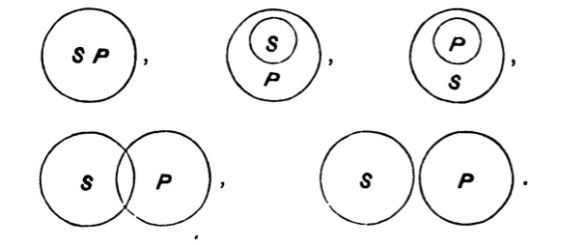
These correspond respectively to the five propositional forms given
above;193 and it is clear that on the view indicated
by Dr Baynes the eight forms are redundant.194
It is altogether doubtful whether writers who have adopted the
eightfold scheme have themselves recognised the pitfalls surrounding the use of
the word some. Many passages might be quoted in which they
distinctly adopt the meaning—some but not all. Thus,
Thomson (Laws of Thought, p. 150) makes U and A
inconsistent. Bowen (Logic, pp. 169, 170) would pass from
I to O by immediate inference.195 Hamilton himself
agrees with Thomson and Bowen on these points; but he is curiously
indecisive on the general question here raised. He remarks
(Logic, II. p. 282) that some
“is held to be a definite some when the other term is
definite,” i.e., in A and Y, η and
O: but “on the other hand, when both terms are indefinite
or particular, the some of each is left wholly
indefinite,” i.e., in I and ω.196
This is very confusing, and it would be most difficult to apply the
distinction consistently. Hamilton himself certainly does not so apply
it. For example, on his view it should no longer be the case that two
affirmative premisses necessitate an affirmative conclusion; or that
two negative premisses invalidate a syllogism.197 Thus, the
following should be regarded as valid:
| All P is some M, |
| All M is some S, |
| therefore, | Some S is not any P. |
| |
| No M is any P, |
| Some S is not any M, |
| therefore, | Some or all S is not any P. |
Such
syllogisms as these, however, are not admitted by Hamilton and
Thomson; and, on the other hand, Thomson admits as valid certain
combinations which on the above interpretation are not valid.
Hamilton’s supreme canon of the categorical syllogism
is:—“What worse relation198 of subject and
predicate subsists between either of two terms and a common third
term, with which one, at least, is positively related; that relation
subsists between the two terms themselves” (Logic, II. p. 357). This clearly provides that one
premiss at least shall be affirmative, and that an affirmative
conclusion shall follow from two affirmative premisses. Thomson
(Laws of Thought, p. 165) explicitly lays down the same rules;
and his table of valid moods (given on p. 188) is (with the exception
of one obvious misprint) correct and correct only if some means
“some, it may be all.”
145. The use of
“some” in the sense of “some only.”—Jevons, in reply to the question, “What results would follow if
we were to interpret ‘Some A’s are
B’s’ as implying that ‘Some other
A’s are not B’s’?” writes,
“The proposition ‘Some A’s are
B’s’ is in the form I, and according to the
table of opposition I is true if A is true; but
A is the contradictory of O, which would be the form of
‘Some other A’s are not B’s.’
Under such circumstances A could never be true at all, because
its truth would involve the truth of its own contradictory, which is
absurd” (Studies in Deductive Logic, 151). It is not,
however, the case that we necessarily involve ourselves in
self-contradiction if we use some in the sense of some
only. What should be pointed out is that, if we use the word in
this sense, the truth of I no longer follows from the truth of
A; and that, so far from this being the case, these two
propositions are inconsistent with each other.
Taking the five propositional forms, All S is all P, All
S is some P, Some S is all P, Some S is some P,
No S is P, and interpreting some in the sense of some
only, it is to be observed that each one of them is inconsistent
with each of the others, whilst at the same time no one is the
contradictory of any one of the others. If, for example, on
this scheme we wish to express the contradictory of U, we can
do so only by affirming an alternative between Y, A,
I, and E. Nothing of all this appears to have been
noticed by the Hamiltonian writers. Thus, Thomson (Laws of
Thought, p. 149) gives a scheme of opposition in which E
and I appear as contradictories, but A and O as
contraries.
One of the strongest arguments against the use of some in
the sense of some only is very well put by Professor Veitch,
himself a disciple of Sir William Hamilton. Some only, he
remarks, is not so fundamental as some at least. The former
implies the latter; but I can speak of some at least without
advancing to the more definite stage of some only.
“Before I can speak of some only, must I not have formed
two judgments—the one that some are, the other that
others of the same class are not? …… The some only would
thus appear as the composite of two propositions already formed…… It
seems to me that we must, first of all, work out logical principles on
the indefinite meaning of some at least…… Some only is a
secondary and derivative judgment.” (Institutes of Logic, p. 308).
If some is used in the sense of some only, the
further difficulty arises how we are to express any knowledge that we
may happen to possess about a part of a class when we are in ignorance
in regard to the remainder. Supposing for example, that all the
S’s of which I happen to have had experience are
P’s, I am not justified in saying either that all
S’s are P’s or that some S’s are
P’s. The only solution of the difficulty is to say that
all or some S’s are P’s. The complexity that this
would introduce is obvious.
146. The interpretation
of the eight Hamiltonian forms of proposition, “some”
being used in its ordinary logical sense.199—Taking the
five possible relations between two terms, as illustrated by the
Eulerian diagrams, and denoting them respectively by α,
β, γ, δ, ε, as in section 126, we
may write against each of the propositional forms the relations which
are compatible with it, on the supposition that some is
used in its ordinary logical sense, that is, as exclusive of
none but not of all:—200
| U | α |
| A | α, β |
| Y | α, γ |
| I | α, β, γ, δ |
| E | ε |
| η | β, δ, ε |
| O | γ, δ, ε |
| ω | α, β, γ, δ, ε |
We have then the following pairs of contradictories—A,
O; Y, η; I, E. The contradictory
of U is obtained by affirming an alternative between η
and O.
Without the use of quantified predicates, the same information may
be expressed as follows:—
| U = SaP, PaS ; |
| A = SaP ; |
| Y = PaS ; |
| I = SiP ; |
| E = SeP ; |
| η = PoS ; |
| O = SoP. |
What information, if any, is given by ω will be discussed
in section 149.
147. The propositions
U and Y.—It must be admitted that these
propositions are met with in ordinary discourse. We may not indeed find
propositions which are actually written in the form All S is all
P ; but we have to all intents and purposes U, whenever
there is an unmistakeable affirmation that the subject and the
predicate of a proposition are co-extensive. Thus, all definitions are
practically U propositions; so are all affirmative propositions
of which both the subject and the predicate are singular terms.201
Take also such propositions as the following: Christianity and
civilization are co-extensive; Europe, Asia, Africa, America, and
Australia are all the continents;202 The three whom I
have mentioned are all who have ever ascended the mountain by that
route; Common salt is the same thing as sodium chloride.203
Such propositions as the following, sometimes known as
exclusive propositions, may be given as examples of Y:
Only S is P ; Graduates alone are eligible for the appointment;
Some passengers are the only survivors. These propositions may be
interpreted as being equivalent to the following: Some S is all
P ; Some graduates are all who are eligible for the appointment;
Some passengers are all the survivors.204 This is, indeed,
the only way of treating the propositions which will enable us to
retain the original subjects as subjects and the original predicates
as predicates.
We cannot then agree with Professor Fowler that the additional
forms “are not merely unusual, but are such as we never do
use” (Deductive Logic, p. 31). Still in treating the
syllogism &c. on the traditional lines, it is better to retain the
traditional schedule of propositions. The addition of the forms U and Y
does not tend towards simplification, but the reverse; and their full
force can be expressed in other ways. On this view, when we meet with
a U proposition, All S is all P, we may resolve it into
the two A propositions, All S is P and All P is S, which
taken together are equivalent to it; and when we meet with a Y
proposition, Some S is all P or S alone is P, we may
replace it by the A proposition All P is S, which it
yields by conversion.
148. The proposition
η.—This proposition in the form No S is some P
is not I think ever found in ordinary use. We may, however, recognise
its possibility; and it must be pointed out that a form of proposition
which we do meet with, namely. Not only S is P or Not S
alone is P, is practically η, provided that we do not
regard this proposition as implying that any S is certainly P.
Archbishop Thomson remarks that η “has the semblance
only, and not the power of a denial. True though it is, it does not
prevent our making another judgment of the affirmative kind, from the
same terms” (Laws of Thought, § 79). This is erroneous;
for although A and η may be true together, U
and η cannot, and Y and η are strictly
contradictories.205 The relation of contradiction in which
Y and η stand to each other is perhaps brought out
more clearly if they are written in the forms Only S is P,
Not only S is P, or S alone is P, Not S alone is
P. It will be observed, moreover, that η is the converse
of O, and vice versâ. If, therefore, η has no
power of denial, the same will be true of O also. But it
certainly is not true of O.
149. The proposition
ω.—The proposition ω, Some S is not some
P, is not inconsistent with any of the other propositional forms,
not even with U, All S is all P. For example, granting
that “all equilateral triangles are all equiangular
triangles,” still “this equilateral triangle is not that
equiangular triangle,” which is all that ω asserts.
Some S is not some P is indeed always true except when both the
subject and the predicate are the name of an individual and the same
individual.206 De Morgan207 (Syllabus,
p. 24) observes that its contradictory is—“S and
P are singular and identical; there is but one S, there
is but one P, and S is P.”208 It may be said
without hesitation that the proposition ω is of absolutely no
logical importance.
150. Sixfold Schedule of
Propositions obtained by recognising Y and η, in addition to A, E, I, O.209—The schedule of propositions obtained
by adding Y and η to the ordinary schedule presents
some interesting features, and is worthy of incidental recognition and
discussion.210 It has been shewn in section 100 that in the
ordinary scheme there are six and only six independent propositions
connecting any two terms, namely, SaP, PaS, SeP (=
PeS), SiP (= PiS), PoS, SoP. If we
write the second and the last but one of these in forms in which
S and P are respectively subject and predicate, we have
the schedule which we are now considering, namely,
| SaP | = | All S is P ; |
| SyP | = | Only S is P ; |
| SeP | = | No S is P ; |
| SiP | = | Some S is P ; |
| SηP | = | Not only S is P ; |
| Sop | = | Some S is not P. |
It will be observed that the pair of propositions, SyP and
SηP, are contradictories; so that we now have
three pairs of contradictories. There are of course other additions to
the traditional table of opposition, and some new relations will need
to be recognised, e.g., between SaP and SyP. With
the help, however, of the discussion contained in section 107, the
reader will have no difficulty in working out the required hexagon of
opposition for himself.
As regards immediate inferences, we cannot in this scheme obtain
any satisfactory obverse of either Y or η, the reason
being that they have quantified predicates, and that, therefore, the
negation cannot in these propositions be simply attached to the
predicate. We have, however, the following interesting table of other
immediate inferences:—211
| Converse. | Contrapositive. | Inverse. |
| SaP | = | PyS | = | PʹaSʹ | = | SʹyPʹ |
| SyP | = | PaS | = | PʹySʹ | = | SʹaPʹ |
| SeP | = | PeS | = | PʹyS | = | SʹyP |
| SiP | = | PiS | = | PʹηS | = | SʹηP |
| SηP | = | PoS | = | PʹηSʹ | = | SʹoPʹ |
| SoP | = | PηS | = | PʹoSʹ | = | SʹηPʹ |
The main points to notice here are (1) that each proposition now
admits of conversion, contraposition, and inversion; and (2) that the
inferred proposition is in every case equivalent to the original
proposition, so that there is not in any of the inferences any loss of
logical force. In other words, we obtain in each case a simple
converse, a simple contrapositive, and a simple inverse.
151. Explain precisely how
it is that O admits of ordinary conversion if the principle of
the quantification of the predicate is adopted, although not
otherwise. [K.]
152. Draw out a table,
corresponding to the ordinary Aristotelian table of opposition, for
the six propositions, A, Y, E, I, η, O (some being interpreted in the sense of some at
least). [K.]
THE EXISTENTIAL IMPORT OF CATEGORICAL PROPOSITIONS.212
153. Existence and the
Universe of Discourse.—It has been shew in section 49 that
every judgment involves an objective reference, or—as it may
otherwise be expressed—a reference to some system of reality
distinct from the act of judgment itself. The reference may be to the
total system of reality without limitation, or it may be to some
particular aspect or portion of that system. Whatever it may be, we
may speak of it as the universe of discourse.213
The universe of discourse may be limited in various ways; for example,
to physical objects, or to psychical events, or again with reference
to time or space. But in all cases it is a universe of reality in the
sense in which that term has been used in section 49. The nature of
the reference in propositions relating to fictitious objects, for
example, to the characters and occurrences in a play or a novel, may
be specially considered. We may say that in a case of this kind the
universe of discourse consists of a series of statements about persons
and events made by a certain author; and it is clear that such
statements have objective reality, although the persons and events
themselves are fictitious. It follows that, as regards the reference to
reality, such a proposition as “Hamlet killed Polonius”
must be considered elliptical. For the reference is not to real
persons or to the actual course of events in the past history of the
world, as it is when we say “Mary Stuart was beheaded,”
but to a series of descriptions given by Shakespeare in a particular
play. These descriptions have, however, a reality of their own, and
(the different nature of the reference being clearly understood) I am
no more free to say that Hamlet did not kill Polonius (that is, that
Shakespeare did not describe Hamlet as killing Polonius) than I am to
say that Mary Stuart was not beheaded.
The substance of the above has been expressed by saying that
reality is the ultimate subject of every proposition. Every
proposition makes an affirmation about a certain universe of
discourse, and the universe of discourse (whatever it may be) has some
real content. In this sense then every proposition has an existent
subject.214 A further question may, however, be raised,
namely, whether—using the word “subject” in its
ordinary logical signification—all or any propositions should be
interpreted as implying the existence (or occurrence) of their
subjects within the universe of discourse (or particular portion of
reality) to which reference is made. It is mainly with this problem,
and the ways in which ordinary logical doctrines are affected by its
solution, that we shall be concerned in the present chapter.
In our discussion of existential import it will not be necessary
that we should make any attempt to determine the ultimate nature of
reality. The questions at issue are, however, not exactly easy of
solution, and various sources of misunderstanding are apt to arise.
There is one sense in which the existence of something
corresponding to the terms employed must be postulated in all
predication. For in order to make use of any term in an intelligible
sense we must mentally attach some meaning to it. Hence there must be
something in the mind corresponding to every term we use. Even in
cases where there cannot be said to be any corresponding mental
product, there must at any rate be some corresponding mental process. This
applies even to such terms as round square or non-human
man or root of minus one. We are not indeed able to form an
image of a round square or an idea of a non-human man, nor can we
evaluate the root of minus one. But we attach a meaning to these
terms, and they must therefore have a mental equivalent of some sort.
In the case of “round square” or “non-human
man” this is not the actual combination in imagination or idea
of “round” with “square” or
“non-human” with “man,” for such combinations
are impossible. But it is the idea of the combination, regarded as a
problem presented for solution, and perhaps involving an unsuccessful
effort to effect the combination in thought. It is apparently of
existence of this kind that some writers are thinking when they
maintain that of necessity every proposition implies logically the
existence of its subject. But our meaning is something quite different
when we speak of existence in the universe of discourse. The nature of
the distinction may be made more clear by the following considerations.
It will be admitted that whatever else is included in the full
implication of a universal proposition, it at least denies the
existence of a certain class of objects. No S is P denies the
existence of objects that are both S and P ; All S is
P denies the existence of objects that are S without also
being P. In these propositions, however, we do not intend to
deny the existence of SP (or SPʹ) as objects of
thought. For example, in the proposition No roses are blue it
is not our intention to deny that we can form an idea of blue
roses ; nor in the proposition All ruminant animals are
cloven-hoofed is it our intention to deny that ruminant animals
without cloven hoofs can exist as objects of thought. These
illustrations may help us to understand more clearly what is meant by
existence in the universe of discourse. The universe of discourse
in the case of the proposition No S is P is the universe
(whatever it may be) in which the existence of SP is
denied. The universe of discourse in the case of a universal
affirmative proposition may be defined similarly. As regards
particulars it may be best to seek an interpretation through the
universals by which the particulars are contradicted. Thus, the universe of
discourse in the case of the proposition Some S is P may be
defined as the universe (whatever it may be) in which the existence of
SP would be understood to be denied in the corresponding
universal negative. The proposition Some S is not P may be
dealt with similarly.
The question whether a categorical proposition is to be interpreted
as formally implying that its terms are the names of existing things
may then be interpreted as follows: Given a categorical proposition
with S and P as subject and predicate, is the existence of S or of P
formally implied in that sphere (whatever it may be) in
which the existence of SP (or SPʹ) is denied by the
proposition (or by its contradictory)?
The question may be somewhat differently expressed as follows. Such
a proposition as No S is P denies the existence of a certain
complex of attributes, namely, SP. But with rare exceptions,
S itself signifies a certain complex of attributes; and so does
P. Does the proposition affirm the existence of these latter
complexes in the same sense as that in which it denies the existence
of the former complex?
No general criterion can be laid down for determining what is
actually the universe of discourse in any particular case. It may,
however, be said that knowledge as to what is the universe referred to
is involved in understanding the meaning of any given proposition; and
cases in which there can be any practical doubt are exceptional.215
Thus, in the propositions No roses are blue, All men are
mortal, All ruminant animals are cloven-hoofed, the
reference clearly is to the actual physical universe; in The wrath
of the Olympian gods is very terrible to the universe of the Greek
mythology;216 in Fairies are able to assume different
forms to the universe of folk-lore;217 in Two straight
lines cannot enclose a space to the universe of spatial
intuitions.
With respect
to the existential import of propositions the following questions
offer themselves for consideration:
(1) Is the problem one with which logic, and more particularly
formal logic, is properly concerned?
(2) How should the propositions belonging to the traditional
schedule be interpreted as regards their existential implications?
(3) Can we formulate a schedule of propositions which directly
affirm or deny existence, and how will such a schedule be related to
the traditional schedule?
(4) How are ordinary logical doctrines affected by the answer given
to the second of these questions?
It is clear that the first and fourth of these questions are
connected, since if the fourth admits of any positive answer at all,
the first is thereby answered in the affirmative. Since, however, the
first question blocks the way and seems to demand an answer before we
carry the discussion further, it will be well to deal with it briefly
at the outset.
The second and third questions are also closely connected together.
Between the second and fourth questions an important distinction
must be drawn. The second question is one of interpretation, and
within certain limits the answer to it is a matter of convention.
Hence a given solution may be preferred on grounds that would not
justify the rejection of other solutions as altogether erroneous,
although they may be considered inconvenient or unsuitable. But the
answer to the fourth question is not similarly a matter of convention.
On the basis of any given interpretation of propositional forms, the
manner in which logical doctrines are affected can admit of only one
correct solution.
It is to be observed further that the fourth question can be dealt
with hypothetically, that is to say, we can work out the consequences
of interpretations which we have no intention of adopting; and it is
desirable that we should work out such consequences before deciding
upon the adoption of any given interpretation. Hence we propose to
deal with the fourth question before discussing the second. The third
question may conveniently be taken after the first.
154. Formal Logic and the
Existential Import of Propositions.—We have then, in the
first place, briefly to consider the question whether the problem of
existential import is one with which logic has any proper concern. It
may be urged that formal logic, at any rate, cannot from its very
nature be concerned with questions relating to existence in any other
sphere than that of thought. The function of the formal logician, it
may be said, is to distinguish between that which is self-consistent
and that which is self-contradictory; it is his business to
distinguish between what can and what cannot exist in the world of
thought. But beyond this he cannot go. Any considerations relating to
objective existence are beyond the scope of formal logic.
We may meet the above argument by clearly defining our position. It
is of course no function of logic to determine whether or not certain
classes actually exist in any given universe of discourse, any more
than it is the function of logic to determine whether given
propositions are true or false. But it does not follow that logic has,
therefore, no concern with any questions relating to objective
existence. For, just as, certain propositions being given true, logic
determines what other propositions will as a consequence also be true,
so given an assertion or a set of assertions to the effect that
certain combinations do or do not exist in a given universe of
discourse, it can determine what other assertions about existence in
the same universe of discourse follow therefrom.218 As a matter of
fact, the premisses in any argument necessarily contain certain
implications in regard to existence in the particular universe of
discourse to
which reference is made, and the same is true of the conclusion; it is
accordingly essential that the logician should make sure that the
latter implications are clearly warranted by the former.
Without at present going into any detail we may very briefly
indicate one or two existential questions that cannot be altogether
excluded from consideration in formal logic. Universal propositions,
as we have seen, assert non-existence in some sphere of reality; and
it is not possible to bring out their full import without calling
attention to this fact. Again, the proposition All S is P at
least involves that if there are any S’s in the universe
of discourse, there must also be some P’s, while it does
not seem necessarily to involve that if there are any P’s
there must be some S’s. But now convert the proposition.
The result is Some P is S, and this does involve that if there
are any P’s there must be some S’s.219
How then can the
process of conversion be shewn to be valid without some assumption
which will serve to justify this latter implication? Similarly, in
passing from All S is P to Some not-S is not-P, it must
at least be assumed that if S does not constitute the entire
universe of discourse, neither does P do so. It is indeed quite
impossible to justify the process of inversion in any case without
having some regard to the existential interpretation of the
propositions concerned.220
155. The
Existential Formulation of Propositions.—We may define an
existential proposition as one that directly affirms or denies
existence (or occurrence) in the universe of discourse (or portion of
reality) to which reference is made. Such propositions are of course
met with in ordinary forms of speech: for example, God exists,
It rains, There are white hares, It does not
rain, Unicorns are non-existent. There is no rose
without a thorn. Sometimes the affirmation or denial of existence
takes a less simple form, but is none the less direct: for example,
The assassination of Caesar is an historical event,
D’Artagnan is not an imaginary person, The centaur is a
fiction of the poets, The large copper butterfly is extinct.
In the formal expression of existential propositions it will be
convenient to make use of certain symbols described in the preceding
chapter. Thus, the affirmation of the existence of S may be
written in the form S > 0, and the denial of the existence of
S in the form S = 0. We shall then have an existential schedule
of propositions if we reduce our statements to one or other of these
forms or to a conjunctive or disjunctive combination of them. The
relation between the traditional schedule and an existential schedule
of this kind will be discussed in the next section but one.
It may here be pointed out that since the universe of discourse is
itself assumed to be real and hence cannot be entirely emptied of
content, any denial of existence involves also an affirmation of
existence. For if we deny the existence of S, we thereby
implicitly affirm the existence of not-S, since by the law of
excluded middle everything in the universe of discourse must be either
S or not-S. It follows that every proposition contains
directly or indirectly an affirmation of existence.221
156. Various Suppositions
concerning the Existential Import of Categorical
Propositions.—Several different views may be taken as to what
implication with regard to existence, if any, is involved in
categorical propositions of the traditional type. The following may be
formulated for special discussion:—222
(1) It may be held that every categorical proposition should be
interpreted as implying the existence both of objects denoted by the
terms directly involved and also of objects denoted by their
contradictories; that, for example, All S is P should be
regarded as implying the existence of S, not-S,
P, not-P. This view is implied in Jevons’s
Criterion of Consistency mentioned in the note on page 217. It is also
practically adopted by De Morgan.223
(2) It may be held that every proposition should be interpreted as
implying simply the existence of its subject. This is Mill’s
view (as regards real propositions); for he holds that we cannot give
information about a non-existent subject.224 This is no doubt
the view that, at any rate on a first consideration of the subject, appears to
be at once the most reasonable and the most simple.
(3) It may be held that we should not regard propositions as
necessarily implying the existence either of their subjects or of
their predicates. On this view, the full implication of All S is
P may be expressed by saying that it denies the existence of
anything that is at the same time S and not-P. Similarly
No S is P implies the existence neither of S nor of
P, but merely denies the existence of anything that is both
S and P. Some S is P (or is not P) may be
read Some S, if there is any S, is P (or is not P). Here
we neither affirm nor deny the existence of any class absolutely;225
the sum total of what we affirm is that if any S exists, then
something which is both S and P (or S and
not-P) also exists. On this interpretation, therefore, particular propositions have a hypothetical and not a purely
categorical character.
(4) It may be held that universal propositions should not be
interpreted as implying the existence of their subjects, but that
particular propositions should be interpreted as doing so.226
On this view All S is P merely denies the existence of anything
that is both S and not-P; No S is P denies the
existence of anything that is both S and P ; Some S is
P affirms the existence of something that is both S and
P ; Some S is not P affirms the existence of something
that is both S and not-P. Thus, universals are
interpreted as having existentially a negative force, while
particulars have an affirmative force. This hypothesis
will be found to lead to certain paradoxical results, but it will also
be shewn to lead to a more satisfactory and symmetrical treatment of
logical problems than is otherwise possible.227
157.
Reduction of the traditional forms of proposition to the form of
Existential Propositions.—Without at present attempting to
decide between the different possible suppositions as to the
existential import of the traditional forms of proposition, we may
enquire how on the different suppositions they may be reduced to
existential form. It will be assumed throughout that both the
traditional forms and the existential forms are interpreted
assertorically. In the case of each of the traditional forms it will
suffice to deal with the two fundamental suppositions, namely, that it
does and that it does not imply the existence of its subject.
The universal affirmative. (1) If SaP is interpreted
as not carrying with it any existential implication in regard to its
separate terms, it is equivalent to the existential proposition
SPʹ = 0. Dr Wolf denies this on the ground that SaP
contains further the implication “If there are any
S’s, they must all be P’s”; and hence
that, while on the supposition in question SPʹ = 0 is an
inference from SaP, it is not equivalent to it.
It is of course a very elementary truth that inferences are not always
the exact equivalents of their premisses. But in the above argument Dr
Wolf has apparently overlooked the fact that SPʹ = 0,
equally with SaP, contains the implication “If there are
any S’s they are all P’s.”228
By the law of excluded middle, every S (if there are any
S’s) must be P or not P, and since
SPʹ = 0, the above inference clearly follows.
SPʹ = 0 carries with it in fact the two implications If
S > 0 then P > 0, If P > 0 then Sʹ > 0.
These may also be written in the forms Either S = 0 or P
> 0, Either Pʹ = 0 or Sʹ > 0.
(2) If
SaP is interpreted as implying the existence of S, then
it may be expressed existentially S > 0 and SPʹ = 0.
These existential forms carry with them the implications P > 0,
Either Pʹ = 0 or Sʹ > 0.
The universal negative. Taking the same two suppositions the
corresponding existentials will be:—
(1) SP = 0 (carrying with it the implications Either
S = 0 or Pʹ > 0, Either P = 0 or Sʹ >
0);
(2) S > 0 and SP = 0 (with the implications
Pʹ > 0, Either P = 0 or Sʹ > 0).
These results need no separate discussion.
The particular affirmative. (1) On the supposition that
SiP does not carry with it any implication as to the separate
existence of its terms, it can be expressed existentially Either
S = 0 or SP > 0. It might also be written in the form If S > 0 then SP > 0. Complications resulting from the
introduction of considerations of modality will, however, be more
easily avoided if the hypothetical form is not made use of.
(2) On the supposition that the existence of S is implied,
SiP is reducible to the form SP > 0.
The particular negative. Here the corresponding results are
(1) Either S = 0 or SPʹ > 0; (2) SPʹ > 0.
We may sum up our results with reference to the third and fourth of
the suppositions formulated in the preceding section.
Let no proposition be interpreted as implying the existence of
its separate terms. Then corresponding to the traditional schedule
we have the following existential schedule:—
| A,—SPʹ = 0; |
| E,—SP = 0; |
| I,—Either S = 0 or SP > 0; |
| O,—Either S = 0 or SPʹ > 0. |
This represents what may be regarded as the minimum
existential import of each of the traditional propositions
(interpreted assertorically).
It must be remembered that SPʹ = 0 carries with it the
implications Either S = 0 or P > 0, Either Pʹ
= 0 or Sʹ > 0.
Let particulars be interpreted as implying, while universals are
not interpreted as implying, the existence of their subjects.
We then
have:—
| A,—SPʹ = 0; |
| E,—SP = 0; |
| I,—SP > 0; |
| O,—SPʹ > 0. |
158. Immediate Inferences
and the Existential Import of Propositions.—It has been
already suggested that before coming to any decision in regard to the
existential import of propositions, it will be well to enquire how
certain logical doctrines are affected by the different existential
assumptions upon which we may proceed. This discussion will as far as
possible be kept distinct from the enquiry as to which of the
assumptions ought normally to be adopted. The latter question is of a
highly controversial nature, but the logical consequences of the
various suppositions ought to be capable of demonstration, so as to
leave no room for differences of opinion.
We shall in the present section enquire how far different
hypotheses regarding the existential import of propositions affect the
validity of obversion and conversion and the other immediate
inferences based upon these. In the next section we shall consider
inferences connected with the square of opposition.
We may take in order the suppositions formulated in section 156.
(1) Let every proposition he understood to imply the existence
of both its subject and its predicate and also of their
contradictories.
It is clear that on this hypothesis the validity of conversion,
obversion, contraposition, and inversion will not be affected by
existential considerations. The terms of the original proposition
together with their contradictories being in each case identical with
the terms of the inferred proposition together with their
contradictories, the latter cannot possibly contain any existential
implication that is not already contained in the original
proposition.229
(2) Let
every proposition he understood to imply simply the existence of its
subject.
(a) The validity of obversion is not affected.
(b) The conversion of A is valid, and also that of
I. If All S is P and Some S is P imply directly
the existence of S, then they clearly imply indirectly the
existence of P ; and this is all that is required in order that
their conversion may be legitimate. The conversion of E is not
valid; for No S is P implies neither directly nor indirectly
the existence of P, whilst its converse does imply this.
(c) The contraposition of E is valid, and also that
of O. No S is P and Some S is not P both imply on
our present supposition the existence of S, and since by the
law of excluded middle every S is either P or
not-P, it follows that they imply indirectly the existence of
not-P. The contraposition of A is not valid; for it
involves the conversion of E, which we have already seen not to
be valid.230
(d) The process of inversion is not valid; for it involves
in the case of both A and E the conversion of an
E proposition.231
If along with an E proposition we are specially given the
information that P exists, or if this is implied in some other
proposition given us at the same time, then the E proposition
may of course be converted. In corresponding circumstances the
contraposition and inversion of A and the inversion of E
may be valid.232 Or again, given simply No S is P, we
may infer Either P is non-existent or no P is S ; and similarly
in other cases.
(3) Let no proposition he understood to imply the existence
either of its subject or of its predicate.
Having now got
rid of the implication of the existence either of subject or predicate
in the case of all propositions, we might naturally suppose that in no
case in which we make an immediate inference need we trouble ourselves
with any question of existence at all. As already indicated, however,
this conclusion would be erroneous.
(а) The process of obversion is still valid. Take, for
example, the obversion of No S is P. The obverse All S is
not-P implies that if there is any S there is also some
not-P. But this is necessarily implied in the proposition No
S is P itself. If there is any S it is by the law of
excluded middle either P or not-P; therefore, given that
No S is P, it follows immediately that if there is any S
there is some not-P.
(b) The conversion of E is valid. Since No S is
P denies the existence of anything that is both S and
P, it implies that if there is any S there is
some not-P and that if there is any P there is some
not-S ; and these are the only implications with regard to
existence involved in its converse. The conversion of A,
however, is not valid; nor is that of I. For Some P is S
implies that if there is any P there is also some S ; but
this is not implied either in All S is P or in Some S is
P.
(c) That the contraposition of A is valid follows
from the fact that the obversion of A and the conversion of
E are both valid.233 That the
contraposition of E and that of O are invalid follows
from the fact that the conversion of A and that of I are
both invalid.
(d) That inversion is invalid follows similarly.
On our present supposition then the following are valid: the
obversion and contraposition of A, the obversion of I,
the obversion and conversion of E, the obversion of O;
the following are invalid: the conversion and inversion of A,
the conversion of I, the contraposition and inversion of
E, the contraposition of O.234
(4) Let
particulars be understood to imply, while universals are not
understood to imply, the existence of their subjects.
(a) The validity of obversion is again obviously
unaffected.235
(b) The conversion of E is valid, and also that of
I, but not that of A.236
(c) The contraposition of A is valid, and also that
of O, but not that of E.
(d) The process of inversion is not valid.
These results are obvious; and the final outcome is—as might
have been anticipated—that we may infer a universal from a
universal, or a particular from a particular, but not a particular
from a universal.237
An important
point to notice is that in the immediate inferences which remain valid
on this supposition (namely, obversion, simple conversion, and simple
contraposition) there is no loss of logical force; while at the best
the reverse would be the case in those that are no longer valid
(namely, conversion per accidens, contraposition per
accidens, and inversion).
159. The Doctrine of
Opposition and the Existential Import of Propositions.—The
ordinary doctrine of opposition, in its application to the traditional
schedule of propositions, is as follows: (a) The truth of
Some S is P follows from that of All S is P, and the
truth of Some S is not P from that of No S is P
(doctrine of subalternation); (b) All S is P and Some
S is not P cannot both be true and they cannot both be false,
similarly for Some S is P and No S is P (doctrine of
contradiction); (c) All S is P and No S is P cannot both
be true but they may both be false (doctrine of contrariety);
(d) Some S is P and Some S is not P may both be
true but they cannot both be false (doctrine of sub-contrariety). We
will now examine how far these several doctrines hold good under
various suppositions respecting the existential import of
propositions.238
It should be added that, throughout the discussion, the
propositions are supposed to be interpreted assertorically, as has
always been the custom with the traditional schedule. The necessity
for this proviso will from time to time be pointed out.
(1) Let every proposition be interpreted as implying the
existence both
of its subject and of its predicate and also of their
contradictories.239
On this supposition, if either the subject or the predicate of a
proposition is the name of a class which is unrepresented in the
universe of discourse or which exhausts that universe, then that
proposition is false; for it implies what is inconsistent with fact.
It follows that a pair of contradictories as usually stated, and also
a pair of sub-contraries, may both be false. For example, All S is
P and Some S is not P both imply the existence of S
in the universe of discourse. In the case then in which S does
not exist in that universe, these propositions would both be false.
If a concrete illustration is desired, we may take the
propositions, None of the answers to the question shewed
originality, Some of the answers to the question shewed
originality, and assume that each of these propositions includes
as part of its implication the actual occurrence of its subject in the
universe of discourse. Then our position is that if there were no
answers to the question at all, the truth of both the propositions
must be denied. The fact of there having been no answers does not
render the propositions meaningless; but it renders them false, their
full import being assumed to be, respectively, There were answers
to the question but none of them shewed originality, There were
answers to the question and some of them shewed originality.
We must not of course say that under our present supposition true
contradictories cannot be found; for this is always possible. The true
contradictory of All S is P is Either some S is not P, or
else either S or not-S or P or not-P is non-existent. Similarly in
other cases. The ordinary doctrines of subalternation and contrariety
remain unaffected.
(2) Let
every proposition be interpreted as implying the existence of its
subject.
For reasons similar to those stated above, the ordinary doctrines
of contradiction and sub-contrariety again fail to hold good. The true
contradictory of All S is P now becomes Either some S is not
P, or S is non-existent. The ordinary doctrines of subalternation
and contrariety again remain unaffected.
(3) Let no proposition be interpreted as implying the existence
either of its subject or of its predicate.
(a) The ordinary doctrine of subalternation holds good.
(b) The ordinary doctrine of contradiction does not hold
good. All S is P, for example, merely denies the existence of
any S’s that are not P’s; Some S is not
P merely asserts that if there are any S’s
some of them are not P’s. In the case in which S
does not exist in the universe of discourse we cannot affirm the
falsity of either of these propositions.240
(c) The
ordinary doctrine of contrariety does not hold good. For if there is
no implication of the existence of the subject in universal
propositions we are not actually precluded from asserting together two
propositions that are ordinarily given as contraries. All S is
P merely denies that there are any S not-P’s, No S
is P that there are any SP’s. We may, therefore,
without inconsistency affirm both All S is P and No S is
P ; but this is virtually to deny the existence of S.241
(d) The ordinary doctrine of sub-contrariety remains
unaffected.
(4) Let particulars be interpreted as implying, while universals
are not interpreted as implying, the existence of their subjects.
(a) The ordinary doctrine of subalternation does not hold
good. Some S is P, for example, implies the existence of
S, while this is not implied by All S is P.
(b) The ordinary doctrine of contradiction holds good.
All S is P denies that there is any S that is
not-P; Some S is not P affirms that there is some
S that is not-P. It is clear that these propositions
cannot both be true; it is also clear that they cannot both be false.
Similarly for No S is P and Some S is P.
(c) The ordinary doctrine of contrariety does not hold good.
All S is P and No S is P are not inconsistent with one
another, but the force of asserting both of them is to deny that there
are any S’s.242 This follows just
as in the case of our third supposition.243
(d) The
ordinary doctrine of sub-contrariety does not hold good.244
Some S is P and Some S is not P are both false in the
case in which S does not exist in the universe of discourse.
The relation between contradictories is by far the most important
relation with which we are concerned in dealing with the opposition of
propositions, and it will be observed that the last of the above
suppositions is the only one under which the ordinary doctrine of
contradiction holds good.
160. The Opposition of
Modal Propositions considered in connexion with their Existential
Import.—The propositions discussed in the preceding sections
have been the propositions belonging to the traditional schedule
interpreted assertorically. Turning now to the corresponding modal
schedule, we may briefly consider how the doctrine of opposition is
affected, if at all, on the supposition that the propositions included
in the schedule are not interpreted as implying the existence of their
subjects. We find
that on this supposition S as such is P and S need not be
P are true contradictories.
S as such is P (interpreted as not necessarily implying the
existence of S) does more than deny the actual occurrence of
the conjunction S not-P, it denies the possibility of such a
conjunction; and all that is necessary in order to contradict this is
to affirm the possibility of the conjunction. This is done by the
proposition S need not be P (also interpreted as not
necessarily implying the existence of S). On the same
supposition, S as such is P, S as such is other than P,
are true contraries.
Here, however, another problem suggests itself. Leaving on one side
the question as to any implication of actuality, are modal
propositions to be interpreted as containing any implication in regard
to the possibility of their antecedents? And, further, how does
our answer to this question affect the opposition of modals? The
consideration of this problem may be deferred until we come to deal
with the opposition of conditional propositions (see section 176).
161. Jevons’s
Criterion of Consistency.—In passing to the explicit
discussion of the existential import of categorical propositions, we
may consider first the Criterion of Consistency, which is laid down by
Jevons (following De Morgan):—Any two or more propositions are
contradictory when, and only when, after all possible substitutions
are made, they occasion the total disappearance of any term, positive
or negative, from the Logical Alphabet. The criterion amounts to this,
that every proposition must be understood to imply the existence of
things denoted by every simple term contained in it, and also of
things denoted by the contradictories of such terms. If, for example,
we have the proposition All S is P, this implies that among the
members of the universe of discourse are to be found S’s
and P’s, not-S’s, and not-P’s.
In defence of this doctrine Jevons appears to rely mainly upon the
psychological law of relativity, namely, that we cannot think at all
without separating what we think about from other things. Hence if
either a term or its contradictory represents nonentity, that term
cannot be either subject or predicate in a significant proposition.245
It is clear, however, that this psychological argument falls away as
soon as it is allowed that we may be confining ourselves to a limited
universe of discourse, or indeed if we confine ourselves to any
universe less extensive than that which covers the whole realm of the
conceivable. Of course the more limited the universe to which our
proposition is supposed to relate the more easily may S or
P either exhaust it or be absent from it; but with very complex
subjects and predicates the contradictory of one or both of our terms
may easily exhaust even an extended universe. Take, for example, the
proposition, No satisfactory solution of the problem of squaring
the circle has ever been published by Mr A. Here the subject is
non-existent; and it may happen also that Mr A. has never published
anything at all.246 Further, if I am not allowed to negative
X, why should I be allowed to negative AB? There is
nothing to prevent X from representing a class formed by taking
the part common to two other classes. In certain combinations indeed
it may be convenient to substitute X for AB, or vice
versâ. It would appear then that what is contradictory when we use
a certain set of symbols may not be contradictory when we use another
set of symbols. This argument has a special bearing on the complex
propositions which are usually relegated to symbolic logic, but to
which Jevons’s criterion is intended particularly to apply.
No doubt Jevons’s criterion is sometimes a convenient
assumption to make; provisionally, for example, in working out the
doctrine of immediate inferences on the traditional lines. But it is
an assumption that should always be explicitly referred to when made;
and it ought not to be regarded as having an axiomatic and binding force, so as to make
it necessary to base the whole of logic upon it.
162. The Existential
Import of the Propositions included in the Traditional
Schedule.—We may now turn to the consideration of the
question whether the propositions SaP, SeP, SiP,
SoP should or should not be interpreted as implying the
existence of their subjects in the universe of discourse to which
reference is made. In this section it will be assumed that the import
of all the propositions under discussion is assertoric, not modal.
A brief reference may be made to two sources of misunderstanding to
which attention has already been called.
(а) All propositions contain affirmations relating to some
system of reality; and by analysis every proposition may be made to
yield an “ultimate subject” which is real, namely, the
system of reality to which the proposition relates. This system of
reality is what we mean by the universe of discourse; and, as we have
seen, the universe of discourse can never be entirely emptied of
content. It must then be understood that if we decide that certain
propositional forms are not to be interpreted as containing as part of
their import the affirmation of the existence of their subjects, it is
far from being thereby intended that propositions falling into these
forms contain no affirmation relating to reality.247
(b) We must put on one side a very summary solution of our
problem, which, if it were correct, would render any further
discussion needless. How, it may be asked, can we possibly speak about
anything and at the same time exclude it from the universe of
discourse? This question suggests a certain ambiguity which may attach
to the phrase universe of discourse, but which can hardly
remain an ambiguity after the explanations already given. The answer
is that we can certainly think and speak about a thing with
reference to a given universe of discourse without implying, or
even believing in, its existence in that universe. Suppose, for
example, that I say there are no such things as unicorns. If this
statement is to be accepted, it must be interpreted literally (not
elliptically); and it is clear that the universe of discourse referred
to is the material universe.248 I speak then of
unicorns with reference to the material universe, but deny that
such creatures are to be found (or exist) in it.
The question we have to discuss is one of the interpretation of
propositional forms,249 and the solution
will therefore be to some extent a matter of convention. We shall be
guided in our solution partly by the ordinary usage of language, and
partly by considerations of logical convenience and suitability.
As regards the ordinary usage of language there can be no doubt
that we seldom do as a matter of fact make predications about
non-existent subjects. For such predications would in general have
little utility or interest for us. “The practical exigencies of
life,” as Dr Venn remarks, “confine most of our
discussions to what does exist, rather than to what might exist” (Symbolic Logic, p. 131). We must, however, consider
whether there are not exceptional cases; and if we can find any in
which it is clear that the speaker would not necessarily intend to
imply the existence of the subject, we may draw the conclusion that
the propositional form of which he makes use is not in popular usage
uniformly intended to convey such an implication.
Universal Affirmatives. If a universal affirmative
proposition is obtained by a process of exhaustive enumeration
(e.g., All the Apostles were Jews, All the books on
that shelf are bound in morocco), or if it is obtained by
empirical generalisation based on the examination of individual
instances (e.g., All ruminant animals are
cloven-hoofed), then it is clear that the existence of the subject
is a presupposition of the affirmation. We may, however, note certain
other classes of cases in which such a presupposition is not
necessary.
(a) We may affirm an abstract connexion of attributes, based
on considerations of a deductive character or at any rate not obtained
by direct generalisation from observed instances of the subject, and
the existence of the subject is then not essential. For example,
The impact of two perfectly elastic bodies leads to no diminution of kinetic
energy ; Every body, not compelled by impressed forces to change
its state, continues in a state of rest or of uniform motion in a
straight line.
It may perhaps be said that all propositions falling within this
category will be really apodeictic, and that our present discussion
has been limited to assertoric propositions. There is some force in
this criticism. It is, however, to be remembered that the assertoric
SaP can be inferred from the apodeictic SaP, so that if
we can have the latter without any implication as to the existence of
S we may have the former also, unless indeed we decide to
differentiate between them in regard to their existential implication.
The examples that we have given are moreover expressed in ordinary
assertoric form, and not in any distinctive apodeictic form, such as
S as such is P, It is inherent in the nature of S to be
P.
(b) The proposition SaP may express a rule laid down,
and remaining in force, without any actual instance of its application
having arisen. For example, All candidates arriving five minutes
late are fined one shilling, All candidates who stammer are
excused reading aloud, All trespassers are prosecuted.
If it is argued that, in such cases as these,250 the propositions
ought properly to be written in the conditional and not in the
categorical form (e.g., If any candidate arrives five
minutes late, that candidate is fined one shilling), the reply is
that this is to misunderstand the point just now at issue, which is
whether we meet with propositions in ordinary discourse which are
categorical in form and yet are hypothetical so far as the existence
of their subjects is concerned. It is of course open to us to decide
that for logical purposes we will so interpret categorical
propositions that in such cases as the above the categorical form can
no longer be used. But for the present we are merely discussing
popular usage.
(c) Assertions in regard to possible future events are
sometimes thrown into the form SaP. For example, Who steals
my purse steals trash, Those who pass this examination an
lucky men.
The first of these propositions would not be invalidated supposing my
purse never to be stolen, and the latter, as Dr Venn remarks,251
would be tacitly supplemented by the clause “if any such there
be.”
(d) There are cases in which the intended implication of a
proposition of the form All S is P is to deny that there are
any S’s; for example, An honest miller has a golden
thumb, All the carts that come to Crowland are shod with
silver.252
Universal Negatives. It is still easier to find instances
from common speech in which universal negative propositions, that is,
propositions of the form No S is P, are not to be regarded as
necessarily implying the existence of their subjects.
(a) There are again cases in which the proposition is
reached by a process of abstract reasoning about a subject the actual
existence or occurrence of which is not presupposed; for example, A
planet moving in a hyperbolic orbit can never return to any position
it once occupied.253
(b) The import of the proposition may be distinctly to
imply, if not definitely to affirm, the non-existence of the subject;
for example, No ghosts have troubled me, No unicorns have
ever been seen.254
(c) A denial of the conjunction ABC may be expressed in the
form No AB is C without any intention of thereby affirming the
conjunction AB ; for example, No satisfactory solution of the
problem of squaring the circle has been published, No woman
candidate for the Theological Tripos has been educated at Newnham
College, No Advanced Student in Law is on the boards of Trinity
College.255
Particulars. In the case of particular propositions, it is
far less easy to give examples, such as might be met with in ordinary
discourse, in which there is no implication of the existence of the
subjects of the propositions. There may be exceptions, but at any rate
the cases are exceedingly rare in which in ordinary speech we
predicate anything of a non-existent subject without doing so
universally. The main reason for this is, as Dr Venn points out, that
“an assertion confined to ‘some’ of a class
generally rests upon observation or testimony rather than on reasoning
or imagination, and therefore almost necessarily postulates existent
data, though the nature of this observation and consequent existence
is, as already remarked, a perfectly open question. ‘Some
twining plants turn from left to right,’ ‘Some griffins
have long claws,’ both imply that we have looked in the right
quarters to assure ourselves of the fact. In one case I may have
observed in my own garden, and in the other on crests or in the works
of the poets, but according to the appropriate tests of verification,
we are in each case talking of what is.”256 If we look at the
question from the
other side, we find that when our primary object is to affirm the
existence of a class of objects, our assertion very naturally takes
the form of a particular proposition. If, for example, we desire to
affirm the existence of black swans, we say Some swans are
black. The existential implication of a proposition of this kind
in ordinary discourse is one of its most fundamental characteristics.
On the whole it cannot be said that the usages of ordinary speech
afford a decisive solution of the problem under discussion. It has,
however, been shewn (1) that we seldom or never make statements about
non-existent subjects in the form Some S is P or the form
Some S is not P ; (2) that, although it is also true that we do
not as a rule do so in the form All S is P or the form No S
is P, still there are several classes of cases in which the use of
these latter forms is not to be understood as necessarily carrying
with it the implication that S is existent. Hence we should be
departing very little from ordinary usage if we were to decide to
interpret particulars as implying the existence of their subjects, but
universals as not doing so (that is, as not doing so by their bare form).
I do not, however, regard this solution as necessitated by popular
usage. It is, for instance, still open to anyone to adopt the
convention that, for logical purposes, the categorical form shall only
be used when the implication of the existence of the subject is
intended. On this interpretation, the conditional or hypothetical form
must be adopted whenever the existence of the subject is left an open
question. Thus, if we are doubtful about the existence of S
(or, at any rate, do not wish to affirm its existence), we must be
careful to say, If there is any S, then all S is P, instead of
simply All S is P ; in other words, the hypothetical character
of the proposition so far as the existence of its subject is concerned
must be made explicit.
The problem then not being decided by considerations of popular
usage alone, we must go on to enquire how the question is affected by
considerations of logical convenience and suitability. Here again
there is no one solution that is inevitable. Reasons can, however, be
urged in favour of interpreting particulars as implying, but
universals as not implying, the existence of their subjects;257
and this, as we have seen, is a solution that derives some sanction
from popular usage.
(1) A consideration of the manner in which the validity of
immediate inferences is affected by the existential import of
propositions affords reasons for the adoption of this
interpretation.258 The most important immediate inferences are
simple conversion (i.e., the conversion of E and of
I) and simple contraposition (i.e., the contraposition
of A and of O). If, however, universals are regarded as
implying the existence of their subjects, then, as shewn in section
158, neither the conversion of E nor the contraposition of
A is valid, irrespective of some farther assumption; whereas,
if universals are not regarded as implying the existence of their
subjects, then both these operations are legitimate without
qualification. On the other hand, the conversion of I and the
contraposition of O are valid only if particulars do imply the
existence of their subjects.259
Turning to
immediate inferences of another kind, it is clear that if universal
propositions formally imply the existence of their subjects, we cannot
legitimately pass from All X is Y to All AX is Y.260
For it is possible that there may be X’s and yet no
AX’s, and in this case the former proposition may be
true, while the latter will certainly be false. Again, given that A
is X, B is Y, C is Z, we cannot infer that
ABC is XYZ. Such restrictions as these would constitute
an almost insurmountable bar to progress in inference as soon as we
have to do with complex propositions.261
(2) We may next consider the existential import of propositions
with reference to the doctrine of opposition. It has been shewn in
section 159 that if particulars are interpreted as implying the
existence of their subjects, while universals are not so interpreted,
then A and O, E and I, are true
contradictories; but that this is not the case under any of the other
suppositions discussed in the same section.262 There can,
however, be no doubt that one of the most important functions of
particular propositions is to contradict the universal propositions of
opposite quality; and hence we have a strong argument in favour of a
view of the existential import of propositions which will leave the
ordinary doctrine of contradiction unaffected.
As regards the doctrines of subalternation, contrariety, and
subcontrariety, our results (namely, that I does not follow
from A, or O from E, that A and E
may both be true, and that I and O may both be false) are no
doubt paradoxical. But this objection is far more than counterbalanced
by the fact that the doctrine of contradiction is saved. For as
compared with the relation between contradictories, these other
relations are of little importance. We may specially consider the
relation between A and I. Some S is P cannot now
without qualification be inferred from All S is P, since the
former of these propositions implies the existence of S, while
the latter does not. But as a matter of fact this is an inference
which we never have occasion to make. If their existential import is
the same why should we ever lay down a particular proposition when the
corresponding universal is at our service? On the other hand, the view
that we are advocating gives Some S is P a status relatively to
All S is P as well as relatively to No S is P which it
could not otherwise possess; and similarly for Some S is not P.
Our result as regards the relation between SaP and SiP
has been described as equivalent to saying “that a statement of
partial knowledge carries more real information than a statement of
full knowledge; since if we only possess limited information, and so
can only assert SiP, we thereby affirm the existence of
S ; but if we have sufficient knowledge to speak of all S
(S remaining the same) the statement of that full knowledge
immediately casts a doubt upon that existence.” This way of
putting it is, however, misleading if not positively erroneous. On the
view in question it is incorrect to say simply that SiP and
SaP give “partial” and “full” knowledge
respectively, for SiP while giving less knowledge than
SaP in one direction gives more in another. In other words, the
knowledge which is “full” relatively to SiP is not
expressed by SaP by itself, but by SaP together with the
statement that there are such things as S.263
(3) There is
one further point of importance to be noted, and that is, that the
interpretation of A, E, I, O propositions
under consideration is the only interpretation according to which each
one of these propositions is resolved into a single categorical
statement. For if A and E imply the existence of
their subjects they express double, not single, judgments,
being equivalent respectively to the statements: There are
S’s, but there are no SPʹ’s ; There are
S’s, but there are no SP’s ; whereas on the
interpretation here proposed they simply express respectively the
single judgments: There are no SPʹ’s ; There are no
SP’s. On the other hand, if I and O do not
imply the existence of their subjects, instead of expressing
categorical judgments, they express somewhat complex hypothetical
ones, being equivalent respectively to the statement: If there are
any S’s then there are some SP’s ; If there are any
S’s then there are some SPʹ’s ; whereas on our
interpretation they express respectively the categorical judgments:
There are SP’s ; There are SPʹ’s.264
On the whole, there is a strong cumulative argument in favour of
interpreting particulars, but not universals, as implying formally the
existence of their subjects.265 This solution
is to be regarded
as partly of the nature of a convention. We arrive, however, at the
conclusion that no other solution can equally well suffice as the
basis of a scientific treatment of the traditional schedule of
propositions, so long, at any rate, as the propositions included in
the schedule are regarded as assertoric and not modal.
163. The Existential
Import of Modal Propositions.—Of apodeictic propositions it
may be said still more emphatically than of assertoric universals that
they do not necessarily imply the existence of their subjects. For
they assert a necessary relation between attributes, the ground of
which is frequently to be sought in abstract reasoning rather
than in concrete experiences. And the same is true of the denial of
apodeictic propositions. We may on abstract grounds assert the
possibility of a certain concomitance (or non-concomitance) of
attributes without having had actual experience of that concomitance
(or non-concomitance), and without intending to imply its actuality.
Hence we should not interpret the proposition S may be P, any
more than the proposition S must be P, as by its bare form
affirming the existence of S.
It has been shewn that in order that the propositions All S is
P and Some S is not P may be true contradictories, one or
other of them must be interpreted as implying the existence of
S. It follows, however, from what has been said above that the
same condition need not be fulfilled in order that S must be P
and S need not be P may be true contradictories.266
But to this it has to be added that, in order that these two
propositions may be true contradictories, one or other of them must be
interpreted as implying the possible existence of S.
This line of thought has been suggested in section 160, and it will be pursued farther in sections 176 and 179.
164. The particular
judgment has, from different stand-points, been identified (a)
with the existential judgment, (b) with the problematic
judgment, (c) with the narrative judgment. Comment on each of
these views. [C.]
The student may find that to write a detailed answer to this
question will help to clear up his views respecting the particular
proposition. No detailed answer will here be given; but attention may
be called to one or two points.
(a) Two kinds of existential judgments may be distinguished.
(i) Those which affirm existence indefinitely, that is, somewhere in the
universe of discourse; for example, There are white hares,
There is a devil.
(ii) Those which affirm existence with reference to some definite
time and place; for example, It rains, I am hungry.
The particular may perhaps be identified with (i), hardly with (ii).
(b) We may be justified in affirming the problematical S
may be P, when we cannot affirm the particular Some S is P.
There are reasons for interpreting the latter judgment existentially
as regards its subject, which do not apply to the former judgment.
(c) The narrative judgment need not have the indefinite
character of the particular. We may, however, hold that the two kinds
of judgment have this in common that there are grounds for
interpreting both existentially as regards their subjects.
165. Discuss the relation
between the propositions All S is P and All not-S is P.
This is an interesting case to notice in connexion with the
discussion raised in sections 158 and 159.
We have
SaP = SePʹ = PʹeS ;
SʹaP =
SʹePʹ = PʹeSʹ = PʹaS.
The given propositions come out, therefore, as contraries.
On the view that we ought not to enter into any discussion
concerning existence in connexion with immediate inference, we must, I
suppose, rest content with this statement of the case. It seems,
however, sufficiently curious to demand further investigation and
explanation. We may as before take different suppositions with regard
to the existential import of propositions.
(1) If every proposition implies the existence of both subject and
predicate and their contradictories, then it is at once clear that the
two propositions cannot both be true together; for between them they
deny the existence of not-P.
(2) On the view that propositions imply simply the existence of
their subjects, it has been shewn in section 158 that we are not
justified in passing from All not-S is P to All not-P is
S unless we are given independently the existence of not-P.
But it will be observed that in the case before us the given
propositions make this impossible. Since all S is P and all
not-S is P, and everything is either S or not-S by
the law of excluded middle, it follows that nothing is not-P. In order,
therefore, to reduce the given propositions to such a form that they
appear as contraries (and consequently267 as inconsistent
with each other) we have to assume the very thing that taken together
they really deny.
(3) and (4). On the view that at any rate universal propositions do
not imply the existence of their subjects, we have found in section
159 that the propositions No not-P is S, All not-P is S,
are not necessarily inconsistent, for they may express the fact that
P constitutes the entire universe of discourse. But this fact
is just what is given us by the propositions in their original form.
Under each hypothesis, then, the result obtained is satisfactorily
accounted for and explained.
166. “The boy is in
the garden.”
“The centaur is a creation of the
poets.”
“A square circle is a contradiction.”
Discuss the above propositions as illustrating different functions
of the verb “to be”; or as bearing upon the logical
conception of different universes of discourse or of different kinds
of existence. [C.]
167. Discuss the existential
import of singular propositions.
“The King of Utopia did not die on Tuesday last.”
Examine carefully the meaning to be attached to the denial of this
proposition. [K.]
168. Some logicians hold
that from All S is P we may infer Some not-S is not-P.
Take as an illustration, All human actions are foreseen by the
Deity. [C.]
169. Discuss the validity of
the following inference:—All trespassers will be prosecuted, No
trespassers have been prosecuted, therefore, There have been no
trespassers. [C.]
170. On the assumption that
particulars are interpreted as implying while universals are not
interpreted as implying the existence of their subjects in the
universe of discourse, examine (stating your reasons) the validity of
the following inferences; All S is P and Some R is not S
therefore, Some not-S is not P ; All S is P and Some R
is not P, therefore, Some not-S is not P ; All S is P and
Some R is S, it is, therefore, false that No P is S ;
All S is P and Some R is P, it is, therefore, false that
No P is S. [K.]
171. Discuss the formal
validity of the following arguments, (i) on the supposition that all
categorical propositions are to be interpreted as implying the
existence of their subjects in the universe of discourse, (ii) on the
supposition that no categorical propositions are to be so interpreted:
(a) All P is Q, therefore, All AP is
AQ ;
(b) All AP is AQ, therefore, Some
P is Q. [K.]
172. Work out the doctrine
of Opposition and the doctrine of Immediate Inferences on the
hypothesis that universals are to be interpreted as implying, while
particulars are not to be interpreted as implying, the existence of
their subjects in the universe of discourse. [K.]
CONDITIONAL AND HYPOTHETICAL PROPOSITIONS.
173. The distinction
between Conditional Propositions and Hypothetical Propositions268—Propositions commonly written in the
form If A is B, C is D belong to two very different types. For
they may be the expression either of simple judgments or of compound
judgments (as distinguished in section 55).
In the first place, A being B and C being D may be
two events or two combinations of properties, concerning which it is
affirmed that whenever or wherever the first occurs the second will
occur also. For example, If an import duty is a source of revenue,
it does not afford protection ; If a child is spoilt, his
parents suffer ; If a straight line falling upon two other
straight lines makes the alternate angles equal to one another, the
two straight lines are parallel to one another ; If a lighted
match is applied to gunpowder, there will be an explosion ;
Where the carcase is, there shall the eagles be gathered
together. What is affirmed in all such cases as these is a
connexion between phenomena; it may be either a co-inherence of
attributes in a common subject, or a relation in time or space between
certain occurrences. Propositions belonging to this type may be called
distinctively conditional.
But again, A is B and C is D may be two propositions
of independent import, the relation between which cannot be directly resolved into
any time or space relation or into an affirmation of the co-inherence
of attributes in a common subject. In other words, a relation may be
affirmed between the truth of two judgments as holding good once and
for all without distinction of place or time or circumstance. For
example, If it be a sin to covet honour, I am the most offending
soul alive ; If patience is a virtue, there are painful
virtues ; If there is a righteous God, the wicked will not
escape their just punishment ; If virtue is involuntary, so is
vice ; If the earth is immoveable, the sun moves round the
earth. Propositions belonging to this type may be called
hypothetical as distinguished from conditional, or they may be
spoken of still more distinctively as true hypotheticals or
pure hypotheticals.269
The parts of the conditional and also of the true hypothetical are
called the antecedent and the consequent. Thus, in the
proposition If A is B, C is D, the antecedent is A is B,
the consequent is C is D.
It is impossible formally to distinguish between conditionals and
hypotheticals so long as we keep to the expression If A is B, C is
D, since this may be either the one or the other. The following
forms, however, are unmistakeably conditional: Whenever A is B, C
is D ; In all cases in which A is B, C is D ; If any P is
Q then that P is R.270 The form If A is true then C is true
is, on the other hand, distinctively hypothetical. A and
C here stand for propositions or judgments, not
terms, and the words “is true” are introduced in order to
make this explicit. It is quite sufficient, however, to write the true
hypothetical in the form If A then C.
Since a
conditional proposition usually contains a reference to some
concurrence in time or space, the if of the antecedent may as a
rule be replaced either by when or by where, as the case
may be, without any change in the significance of the proposition; but
the same cannot be said in the case of the true hypothetical. This
consideration will often suffice to resolve any doubt that may arise
in concrete cases as to the particular type to which any given
proposition belongs. Another and more fundamental criterion may be
found in the answer to the question whether or not the antecedent and
consequent are propositions of independent import, whose meaning will
not be impaired if they are considered apart from one another. If the
answer is in the affirmative, then the proposition is hypothetical.
Thus, taking examples of hypotheticals already given, we find that the
antecedents, It is a sin to covet honour, Patience is a
virtue, Virtue is involuntary, and the consequents, I am
the most offending soul alive, There are painful virtues,
Vice is involuntary, all retain their full meaning though
separated from one another. If, on the other hand, the consequent
necessarily refers us back to the antecedent in order that it may be
fully intelligible, then the proposition is conditional. Thus, taking
by itself the consequent in the first conditional given on page 249, namely, it does not afford protection, we are at once led to
ask what is here meant by it. The answer is—that
import duty. But what import duty? An adequate answer can
be given only by introducing into the consequent the whole of the
antecedent,—an import duty which is a source of revenue does
not afford protection. We now have the full force of our original
conditional proposition in the form of a single categorical. It will
be found that if other conditionals are treated in the same way, they
resolve themselves similarly into categoricals of the form All PQ
is R.271 The problem of the reduction of
conditionals and hypotheticals to categorical form will be considered
in more detail later on in this chapter, and it will be shewn that
whilst such reduction is always possible, and generally simple and
natural, in the case of conditionals, it is not possible at all (with
terms corresponding to the original antecedent and consequent) in the
case of hypotheticals.272
174. The Import of
Conditional Propositions.—It is sometimes held that the real
differentia of all propositions of the form If A is B, C is
D is “to express human doubt.” Clearly, however, there
is no intention to express doubt as regards the relation between the
antecedent and the consequent; and the doubt must, therefore, be
supposed to relate to the actual occurrence of the antecedent. But so
far at any rate as conditionals are concerned, the doubt which they
may thus imply must be considered incidental rather than the
fundamental or differentiating characteristic belonging to them. The
if of the conditional may, as we have seen, usually be replaced
by when without altering the significance of the proposition,
and in this case the element of doubt is no more prominent than in the
categorical proposition. From the material standpoint, conditionals
may or may not involve the actual occurrence of their antecedents.
Whenever the connexion between the antecedent and the consequent can
be inferred from the nature of the antecedent independently of
specific experience (and this may be the more usual case), then the
actual happening of the antecedent is not involved; but if our
knowledge of the connexion does depend on specific experience (as it
sometimes may), then such actual happening is materially involved. For
example, the statement, “If we descend into the earth, the
temperature increases at a nearly uniform rate of 1° Fahr. for every
fifty feet of descent down to almost a mile,” is based upon
knowledge gained by actual descents into the earth having been made,
and apart from such experience the truth of the statement would not
have been known.
The question of main importance in regard to the import of
conditional propositions is whether such propositions are to be
interpreted as modal or as merely assertoric. Confining ourselves for
the present to the universal affirmative, that is, to the form If
any P is Q then it is R, are we affirming a necessary relation
between P being Q and its being R, or are we
merely affirming that it so happens that every P that is
Q is also R? This is really in another form the
distinction already drawn between unconditionally universal
propositions and empirically universal propositions, and our answer
must again be that the same form of words may express the one judgment
or the other. There can be no doubt that the proposition, If the
angles at the base of a triangle are equal to one another, that
triangle is isosceles, is intended to be interpreted modally as
expressing a necessary connexion, while the proposition, If any
book is taken down from that shelf, it will be found to be a
novel, would be intended to be interpreted merely assertorically.
In ordinary discourse conditionals are as a rule modal; but this is
not universally the case. Unless, therefore, we are prepared to depart
from ordinary usage (and there is a good deal to be said for such
departure), we must recognise both assertoric conditionals and
modal conditionals, and this distinction must be borne in mind
in all that follows. We shall find that practically the same problem
arises in regard to true hypotheticals, and we shall have to consider
it further in that connexion.
175. Conditional
Propositions and Categorical Propositions.—We may go on to
consider what is the essential nature of the distinction between
conditional propositions and categorical propositions, and in
particular whether the distinction is one of verbal form only or one
that corresponds to a real distinction between judgments.
If a vital distinction is to be drawn between the two forms, it
must be on one or other of the two following grounds, namely, either
(i) that the categorical is to be interpreted assertorically while the
conditional is to be interpreted modally, or (ii) that the categorical
is to be interpreted as implying the existence of its subject while
the conditional is not to be interpreted as implying the occurrence of
its antecedent.
(i) There is much to be said for adopting a convention by which the
categorical form would be interpreted assertorically and the
conditional form modally. The adoption of this convention would,
however, necessitate some modification of the forms of ordinary
speech, for, as we have already seen, the proposition All S is
P is in current use sometimes apodeictic, while the proposition
If any S is P then it is Q may (though perhaps rarely) be
merely assertoric. Whether the one form or the other is used really
depends a good deal on linguistic considerations. Consider, for
instance, the propositions, All isosceles triangles have the angles
at their base equal to one another, If the angles at the base
of a triangle are equal to one another, that triangle is
isosceles. These propositions fall naturally into the categorical
and conditional forms respectively, simply because there happens to be
no single adjective (like “isosceles”) which connotes
“having two equal angles.” It is clear, however, that the
use of the one form rather than the other is not intended to imply any
fundamental difference in the character of the relation asserted. If
either of the propositions in its ordinary use is apodeictic, so is
the other; if either is merely assertoric, so is the other.
It is to be added that if we adopt the convention under
consideration then the universal categorical is inferable from the
universal conditional, but not vice versâ ; while, on the other
hand, the problematic conditional (which corresponds to the
particular) is inferable from the particular categorical, but not
vice versâ. Thus, All PQ is R is subaltern to If any
P is Q it
is R, while If any P is Q it may be R is subaltern to
Some PQ is R.
(ii) We may pass on to consider whether categoricals and
conditionals are to be differentiated in respect of their existential
import.
We have seen in section 163 that if categoricals are interpreted
modally they are not to be regarded as necessarily implying the
existence of their subjects; and certainly conditionals, interpreted
modally, are not to be regarded as necessarily implying the occurrence
of their antecedents. Hence if both propositional forms are
interpreted modally, we have no differentiation as regards their
existential import.
It further seems clear that, so far as universal are concerned, a
conditional proposition—even though interpreted as merely
assertoric—is not to be regarded as necessarily implying the
actual occurrence of its antecedent. Hence, whether, on the assertoric
interpretation of both, the two forms are to be existentially
differentiated depends upon our existential interpretation of the
categorical.
(a) If a universal categorical is interpreted as necessarily
implying the actual existence of its subject, then we have a marked
distinction between the two forms.273 If any P is Q
then it is also R cannot be resolved into All PQ is R,
since the latter implies the existence of PQ, while the former
does not.
(b) If, on the other hand, universal categoricals are not
interpreted as necessarily implying the existence of their subjects,
then universal conditionals and universal categoricals (both being
interpreted assertorically) may be resolved into one another. We may
say indifferently All S is P or If anything is S it is
P ; If ever A is B then on all such occasions C is B or
All occasions of A being B are occasions of C being D.
Particular conditionals, so far as they are merely assertoric, are
almost without exception based upon specific experience. Hence they
may not unreasonably be interpreted as implying the occurrence of
their antecedents, as, for example, in the proposition, “Sometimes when
Parliament meets, it is opened by the Sovereign in person.” The
existential interpretation of categoricals for which a preference was
expressed in the preceding chapter may therefore be adopted for
conditionals also, so far as they are merely assertoric; and the two
forms become mutually interchangeable.
On the whole, except in so far as we adopt the convention indicated
under (i) above, there seems no reason for drawing a vital distinction
between judgments according as they are expressed in the conditional
or the categorical form.274 Many of the
conditionals of ordinary discourse are indeed so obviously equivalent
to categoricals that they hardly seem to require a separate
consideration.275 At the same time, as we have seen, some
statements fall more naturally into the one form and some into the
other. The more complex the subject-term, the greater is the
probability that the natural form of the proposition will be
conditional.
176. The Opposition of
Conditional Propositions.—This question needs a separate
discussion according as conditionals are interpreted (a)
assertorically, or (b) modally.
(a) If
conditionals are interpreted assertorically, then the ordinary
distinctions both of quality and of quantity can be applied to them in
just the same way as to categoricals. We may regard the quality of a
conditional as determined by the quality of its consequent; thus, the
proposition If any P is Q then that P is not R may be treated
as negative.276 As regards quantity, conditionals are to be
regarded as universal or particular, according as the consequent is
affirmed to accompany the antecedent in all or merely in some cases.
We have then the four types
included in the ordinary four-fold schedule:—
If any P is Q, it is also R ; A
If any P is Q, it is not also R ; E
Sometimes if a P is Q, it is also R ; I
Sometimes if a P is Q, it is not also R. O
These propositions constitute the ordinary square of opposition,
and if conditionals are assimilated to categoricals so far as their
existential import is concerned, then the opposition of conditionals
on the assertoric interpretation seems to require no separate
discussion.277 It may, however, be pointed out that there
is more danger of contradictories being confused with contraries in
the case of conditionals than in the case of categoricals. If A is
B then C is not D is very liable to be given as the contradictory
of If A is B then C is D. But it is clear on consideration that
both these propositions may be false. For example, the two
statements—If the Times says one thing, the Westminster Gazette
says another; If the Times says one thing, the Westminster Gazette
says the same, i.e., does not say another—might be, and
as a matter of fact are, both false; the two papers are sometimes in
agreement and sometimes not.
(b) On the modal interpretation, the distinction between
apodeictic and
problematic takes the place of that between universal and particular;
and if we maintain the distinction between affirmative and negative,
we have the four following propositions corresponding to the ordinary
square of opposition:
If any P is Q, that P must be R ; Am
If any P is Q, that P cannot be R ; Em
If any P is Q, that P may be R ; Im
If any P is Q, that P need not be R. Om
It will be convenient to have distinctive symbols to denote modal
propositions, and those that we have here introduced will serve to
bring out the analogies between modals and the ordinary assertoric
forms.
In the above schedule, subject to a certain condition mentioned
below, Am and Om,
and also Em and Im,
are contradictories according to the definition given in section 84;
Am and Em are
contraries; Am and
Im, and also Em and
Om, are subalterns; and
Im and Om are
subcontraries.
The condition referred to relates to the interpretation of the
propositions as regards the implication of the possibility of their
antecedents. Thus, in order that Am and
Om (or Em and
Im) may be true contradictories it is
necessary that apodeictic and problematic propositions shall be
interpreted differently in this respect. If, for example,
Am is interpreted as not implying the
possibility of its antecedent then its full import is to deny the
possibility of the combination P and Q without R.
Its contradictory must affirm this possibility.
Om will not, however, do this unless it is
interpreted as implying the possibility of the combination P, Q.
It is necessary to call attention to this complication, but hardly
necessary to work out in detail the results which follow from the
various principles of interpretation that might be adopted. If the
student will do this for himself, he will find that the results
correspond broadly with those obtained in section 159.278
177.
Immediate Inferences from Conditional Propositions.—In a
conditional proposition the antecedent and the consequent correspond
respectively to the subject and the predicate of a categorical
proposition. In conversion, therefore, the old consequent must be the
new antecedent, and in contraposition the negation of the old
consequent must be the new antecedent.
(a) On the assertoric interpretation, the analogy with
categoricals is so close that it is unnecessary to treat immediate
inferences from conditionals in any detail. One or two examples may
suffice. Taking the A proposition, If any P is Q then it is
R, we have for its converse Sometimes if a P is R it is also
Q, and for its contrapositive If any P is not R then it is not
Q. Taking the E proposition If any P is Q then it is not
R, we have for its converse If any P is R then it is not Q,
and for its contrapositive Sometimes if a P is not R it is Q.
The validity of these inferences is of course affected by the
existential interpretation of the propositions just as in the case of
the categoricals. It will be noticed that in some immediate inferences
(for example, the contraposition of A) the conditional form has
an advantage over the ordinary categorical form inasmuch as it avoids
the use of negative terms, the employment of which is so strongly
objected to by Sigwart and some other logicians.279
(b) If conditionals are interpreted modally, then the
apodeictic form takes the place of the universal, and the problematic takes the
place of the particular. On this basis, the converse of If any P is
Q that P must be R would be If any P is R that P may be Q,
and the contrapositive would be If any P is not R that P cannot be Q.
Are these inferences legitimate? On the interpretation that a modal
proposition implies nothing as to the possibility of its antecedent,
then our answer must be in the affirmative, as regards the
contraposition of Am. The full import both of
the original proposition and of the contrapositive is to deny the
possibility of the combination P and Q without R.
On the same interpretation, however, the conversion of
Am is not valid. For the converse implies
that if PR is possible then PQ is possible, while the
possibility of PR combined with the impossibility of PQ
is compatible with the truth of the original proposition. It can be
shewn similarly that, while the conversion of
Em is valid, its contraposition is invalid.
If we were to vary the interpretation, the results would be
different.
The correspondence between the results shewn above and our results
respecting the conversion and contraposition of the assertoric
A and E propositions, on the interpretation that no
proposition implies the existence of its subject (see page 225), is
obvious. The truth is that the interpretation of modals in respect to
the possibility of their antecedents gives rise to problems
precisely analogous to those arising out of the interpretation of
assertoric propositions in respect to the actuality of their
subjects. It is unnecessary that we should work out the different
cases in detail.
Amongst immediate inferences from a conditional proposition, its
reduction to categorical form, so far as this is valid, is generally
included. This is a case of what has been called change of
relation, meaning thereby an immediate inference in which we pass
from a given proposition to another which belongs to a different
category in the division of propositions according to relation (see
section 54). The more convenient term transversion is used by
Miss Jones for this process.
How far conditionals can be inferred from categoricals and vice
versâ depends on their interpretation. If both types of propositions are
interpreted assertorically or both modally, and if they are
interpreted similarly as regards the implication of the existence (or
possibility) of their subjects (or antecedents), then the validity of
passing from either type to the other cannot be called in question.
Some doubt may, however, be raised as to whether in this case we have
an inference at all or merely a verbal change. This is a distinction
to which attention will be called later on.
If conditionals are interpreted modally and categoricals
assertorically then (apart from any complications that may arise from
existential implications) A can be inferred from
Am or E from
Em, but not vice versâ. On the other
hand, Im can be inferred from I, or
Om from O, but not vice versâ.
We have another case of transversion when we pass from conditional
to disjunctive, or from disjunctive to conditional. The consideration
of this case must be deferred until we have discussed disjunctives.
178. The Import of
Hypothetical Propositions.—The pure hypothetical may be
written symbolically in the form If A is true then C is true,
or more briefly, If A then C, where A and C stand
for propositions of independent import. It is clear that this
proposition affirms nothing as regards the truth or falsity of either
A or C taken separately. We may indeed frame the
proposition, knowing that C is false, with the express object
of showing that A is false also. What we have is of course a
judgment not about either A or C taken separately, but
about A and C in relation to one another.
The main question at issue in regard to the import of the
hypothetical proposition is whether it is merely assertoric or is
modal. The contrast may be simply put by asking whether, when we say
If A then C, our intention is merely to deny the actuality
of the conjunction of A true with C false or is to declare this
conjunction to be an impossibility.
The contrast between these two interpretations can be brought out
most clearly by asking how the proposition If A then C is to be
contradicted. If our intention is merely to deny the actuality of the
conjunction of A true with C false, then the
contradictory must assert the actuality of this conjunction; if our intention is to
deny the possibility of the conjunction, then the contradictory will
merely assert its possibility. In other words, on the assertoric
interpretation the contradictory will be A is true but C is
false ;280 on the modal interpretation it will be If
A is true C may be false.281
Hypotheticals intended to be interpreted assertorically are to be
met with in ordinary discourse, but they are unusual. There appear to
be two cases: (a) When we know that one or other of two
propositions is true but do not know (or do not remember) which, we
may express our knowledge in the form of a hypothetical, If X is
not true then Y is true, and such hypothetical will be merely
assertoric. For example, If the flowers I planted in this bed were
not pansies they were violets. Here the intention is merely to
deny the actuality of the flowers being neither pansies nor violets.
(b) We may deny a proposition emphatically by a hypothetical in
which the proposition in question is combined as antecedent with a
manifestly false consequent; and such hypothetical will again be
merely assertoric. For example, If what you say is true, I’m a
Dutchman ; If that boy comes back, I’ll eat my head
(vide Oliver Twist); I’m hanged if I know what you
mean. In these examples the intention is to deny the actuality
(not the possibility) of the conjunctions,—What you say is true
and I am not a Dutchman ; That boy will come back and I shall
not eat my head ; I am not hanged and I know what you mean;
and since the elements of the conjunctions printed in italics are
admittedly true, the force of the propositions is to deny the truth of
the other elements, that is to say, to affirm,—What you say
is not true, That boy will not come back, I do not know
what you mean. Similarly we may sometimes employ the hypothetical
form of expression as an emphatic way of declaring the truth of the
consequent (an antecedent being chosen which is admittedly true); for
example, If he cannot act, at any rate he can sing. Here once
more the hypothetical is merely assertoric.
It cannot, however, be maintained that any of the above are typical
hypotheticals; and the claim that our natural interpretation of
hypotheticals is ordinarily modal may be justified on the ground that
we do not usually consider it to be necessary to affirm the antecedent
in order to be able to deny a hypothetical. We have seen that, in order
to deny the assertoric hypothetical If A then C, we must affirm
A and deny C ; but we should usually regard it as
sufficient for denial if we can shew that there is no necessary
connexion between the truth of A and that of C, whether
A is actually true or not.
We shall then in the main be in agreement with ordinary usage if we
interpret hypotheticals modally, and the adoption of such an
interpretation will also give hypotheticals a more distinctive
character. In what follows the hypothetical form will accordingly be
regarded as modal, except in so far as an explicit statement is made
to the contrary.282
Some writers
who adopt the modal interpretation of hypotheticals speak of the
consequent as being an inference from the antecedent. There are
no doubt some hypotheticals to which this description accurately
applies. Thus, we may have hypotheticals which are formal in
the sense in which that term has been used in section 31, the
consequent being, for instance, an immediate inference from the
antecedent, or being the conclusion of a syllogism of which the
premisses constitute the antecedent. The following are
examples,—If all isosceles triangles have the angles at the
base equal to one another, then no triangle the angles at whose base
are unequal can be isosceles ; If all men are mortal and the
Pope is a man, then the Pope must be mortal.
But more usually the consequent of a hypothetical proposition
cannot be inferred from the antecedent alone. The aid is required of
suppressed premisses which are taken for granted, the premiss which
alone is expressed being perhaps the only one as to the truth of which
any doubt is regarded as admissible. It would, therefore, be better to
speak of the consequent as being the necessary consequence of
the antecedent, than as being an inference from it. When we speak of
C as being an inference from A, there is a suggestion
that A affords the complete justification of C, whereas
when we speak of it as a necessary consequence, this suggestion is at
any rate less prominent.283
179. The Opposition of
Hypothetical Propositions.—Regarding hypotheticals as always
affirming a necessary consequence, it may reasonably be held that they
do not admit of distinctions of quality. Sigwart accordingly
lays it down that all hypotheticals are affirmative. “Passing to
hypothetical judgments containing negations, we find that the
form ‘If A is, B is not’ represents the
negation of a proposition as the necessary consequence of an
affirmation, thus affirming that the hypotheses A and B
are incompatible.”284 The force of this
argument must be admitted. There is, however, some convenience in
distinguishing between hypotheticals according as they lead up, in the
consequent, to an affirmation or a denial; and in the formal treatment
of hypotheticals, we shall be better able to preserve an analogy with
categoricals and conditionals if we denote the proposition If X is
true then Y is true by the symbol Am, and
the proposition If X is true then Y is not true by the symbol
Em.
Whether or not we decide thus to recognise distinctions of quality
in the case of hypotheticals, we certainly cannot recognise
distinctions of quantity. The antecedent of a hypothetical is
not an event which may recur an indefinite number of times, but a
proposition which is simply true or false. We have already seen that
the same proposition cannot be sometimes true and sometimes false,
since propositions referring to different times are different
propositions.285
Do not distinctions of modality, however, take the place of
distinctions of quantity? Up to this point, we have practically
confined our attention to the apodeictic hypothetical, If A
then C. This proposition is denied by the proposition If A is
true still C need not be true (that is to say, The truth of C
is not a necessary consequence of the truth of A). Can this latter
proposition be described as a problematic hypothetical? Clearly
it is not a hypothetical at all if we begin by defining a hypothetical
as the affirmation of a necessary consequence. There seems, however,
no need for this limitation. We may define a hypothetical as a proposition which
starting from the hypothesis of the truth (or falsity) of a given
proposition affirms (or denies) that the truth (or falsity) of another
proposition is a necessary consequence thereof. But, whether or not we
adopt this definition, there can be no doubt that the proposition
If A then possibly C appropriately finds a place in the same
schedule of propositions as If A then necessarily C. In such a
schedule we have the four forms,—
If A is true then C is true ; Am
If A is true then C is not true ; Em
If A is true still C may be true ; Im
If A is true still C need not be true. Om
These four propositions correspond to those included in the
ordinary square of opposition; and, if we start with the assumption
that A is possibly true,286 the ordinary
relations of opposition hold good between them.
Am and Om,
Em and Im are pairs
of contradictories; Am and
Em are contraries;
Am and Im,
Em and Om, are pairs
of subalterns; Imand
Om are subcontraries.
If, however, it is not assumed that A is possibly
true, then the problem is more complicated, since the character of the
relations is affected by the manner in which the propositions are
interpreted in respect to the possibility of their antecedents. The
results are substantially the same as in the case of modal
conditionals (section 176), and correspond with those obtained in
section 159, where the analogous problem in regard to categoricals
(assertorically interpreted) is discussed. Thus, in order that
Am, and Om,
Em and Im, may be
contradictories, apodeictic and problematic propositions must be
interpreted differently as regards the implication or non-implication
of the possible truth of their antecedents; while, on the other hand,
in order that Am and
Im, Em and
Om, may be subalterns, problematic
propositions must not be interpreted as implying the possible truth of
their antecedents unless apodeictic propositions are interpreted
similarly in this respect. If we interpret neither apodeictic
nor problematic hypotheticals as implying the possible truth of their
antecedents, then the contradictory of If A, then C may be
expressed in the form Possibly A, but not C (or, as it may also
be formulated, A is possibly true, and if it is true, still C need
not be true).
It would occupy too much space to discuss in detail all the
problems that might be raised in this connexion. The principles
involved have been sufficiently indicated; and the reader will find no
difficulty in working out other cases for himself. We may, however,
touch briefly on the relation between the propositions If A then
C and If A then not C, shewing in particular that on no
supposition are they true contradictories.
If these two propositions are interpreted assertorically, then so
far from being contradictories, they are subcontraries. For, supposing
A happens not to be true, then it cannot be said that either of
them is false: the statement If A then C merely excludes
ACʹ, and If A then Cʹ merely excludes AC ;
hence two possibilities are left, AʹC or
AʹCʹ, neither of which is inconsistent with either of
the propositions.287 On the other hand, the propositions cannot
both be false, since this would mean the truth of both ACʹ
and AC.
Returning to the modal interpretation of the propositions, then if
interpreted as implying the possible truth of their antecedents, they are
contraries. They cannot both be true, but may both be false. It may be
that neither the truth nor the falsity of C is a necessary
consequence of the truth of A.288
Once more, if interpreted modally but not as implying the possible
truth of their antecedents, the propositions may both be true as well
as both false. This case is realised when we establish the
impossibility of the truth of a proposition by shewing that, if it
were true, inconsistent results would follow.
180. Immediate Inferences
from Hypothetical Propositions.—The most important immediate
inference from the proposition If A then C is If Cʹ then
Aʹ. This inference is analogous to contraposition in
the case of categoricals, and may without any risk of confusion be
called by the same name. We may accordingly define the term
contraposition as applied to hypotheticals as a process of
immediate inference by which we obtain a new hypothetical having for
its antecedent the contradictory of the old consequent, and for its
consequent the contradictory of the old antecedent. If we
recognise distinctions of quality in hypotheticals, then (as regards
apodeictic hypotheticals) this process is valid in the case of
affirmatives only. It will be observed that from the contrapositive we
can pass back to the original proposition; and from this it follows
that the original proposition and its contrapositive are
equivalents.289 The following are examples: “If
patience is a virtue, there are painful virtues” = “If
there are no painful virtues, patience is not a virtue”;
“If there is a righteous God, the wicked will not escape their
just punishment” = “If the wicked escape their just
punishment, there is no righteous God.”
From the negative hypothetical If A is true then C is not
true we can infer If C is true then A is not true. This is
analogous to conversion in the case of categoricals.
From the
affirmative If A then C, we may obtain by conversion If C
then possibly A ; but this is only on the interpretation that both
propositions imply the possibility of the truth of their
antecedents.290 The reader will notice that to pass from
If A then C to If C then A would be to commit a fallacy
analogous to simply converting a categorical A proposition; and
this is perhaps the most dangerous fallacy to be guarded against in
the use of hypotheticals.291
If distinctions of quality are admitted, then the process of
obversion is applicable to hypotheticals. For example, If A
is true then C is not true = If A is true then Cʹ is
true. It is nearly always more natural and more convenient to take
hypotheticals in their affirmative rather than in their negative form;
and hence in the case of hypotheticals more importance attaches to the
process of contraposition than to that of conversion.
If the falsity of C is assumed to be possible, then we may
pass by inversion from If A then C to It is possible for
both A and C not to be true ; or, putting the same thing in a
different way, we may by inversion pass from If A then C to
If the falsity of C is possible then the falsity of both A and C is
possible.292 It is of course a fallacy to argue from
If A then C to If Aʹ then Cʹ.
Turning to problematic hypotheticals, we find that from the
proposition If A is true C may be true, we obtain by conversion
If C is true A may be true ; and from the proposition If A
is true C
need not be true we obtain by contraposition If C is true A
need not be true. Here the analogy with categoricals is again very
close.
181. Hypothetical
Propositions and Categorical Propositions.—A true
hypothetical proposition has been defined as a proposition expressing
a relation between two other propositions of independent import, not
between two terms; and it follows that a true hypothetical is not,
like a conditional, easily reducible to categorical form. So far as we
can obtain an equivalent categorical, its subject and predicate will
not correspond with the antecedent and consequent of the hypothetical.
Thus, the proposition If A then C may, according to our
interpretation of it, be expressed in one or other of the following
forms; A is a proposition the truth of which is incompatible with
the falsity of C ; A is a proposition from the truth of which
the truth of C necessarily follows. It will be observed that,
apart from the fact that these propositions are not of the ordinary
categorical type,293 the predicate is not in either of them
equivalent to the consequent of the hypothetical.294 No doubt a
hypothetical proposition may be based on a categorical proposition of
the ordinary type. But that is quite a different thing from saying
that the two propositions are equivalent to one another.
The relation between hypothetical and disjunctive propositions will
be discussed in the following chapter.
182. Alleged Reciprocal
Character of Conditional and Hypothetical Judgments.—Mr
Bosanquet argues that the hypothetical judgment (and under this
designation he would include the conditional as well as what we have
called the true
hypothetical) “when ideally complete must be a reciprocal
judgment. If A is B, it is C must justify the inference If A
is C, it is B. We are of course in the habit of dealing with
hypothetical judgments which will not admit of any such conversion,
and the rules of logic accept this limitation … If in actual fact … AB is found to involve AC while AC does not
involve AB, it is plain that what was relevant to AC was
not really AB but some element αβ within it … Apart from time on the one hand and irrelevant elements on the other,
I cannot see how the relation of conditioning differs from that of
being conditioned … In other words, if there is nothing in A
beyond what is necessary to B, then B involves A
just as much as A involves B. But if A contains
irrelevant elements, then of course the relation becomes one-sided … The relation of Ground is thus essentially reciprocal, and it is only
because the ‘grounds’ alleged in every-day life are
burdened with irrelevant matter or confused with causation in time,
that we consider the Hypothetical Judgment to be in its nature not
reversible” (Logic, I. pp. 261–3).
The question here raised is analogous to that of the possibility of
plurality of causes which is discussed in inductive logic. It may
perhaps be described as a wider aspect of the same question. So long
as a given consequence has a plurality of grounds, it is clear that
the hypothetical proposition affirming it to be a consequence of a
particular one of these grounds cannot admit of simple conversion, for
the converted proposition would hold good only if the ground in
question were the sole ground.
Mr Bosanquet urges that the relation between ground and consequence
will become reciprocal by the elimination from the antecedent of all
irrelevant elements. It should be added that we can also secure
reciprocity by the expansion of the consequent so that what follows
from the antecedent is fully expressed. Thus, if we have the
hypothetical If A then γ, which is not reciprocal, it
is possible that A may be capable of analysis into αβ, and γ of expansion into γδ,
so that either of the hypotheticals If α then
γ, If αβ then γδ, is reciprocal. In the former case we have a more exact
statement of the ground, all extraneous elements being eliminated; in the latter
case we have a more complete statement of the consequence. Sometimes,
moreover, the latter of these alternatives may be practicable while
the former is not.
This may be tested by reference to a formal hypothetical. The
proposition If all S is M and all M is P, then all S is P is
not reciprocal. We may make it so by expanding the consequent so that
the proposition becomes If all S is M and all M is P, then whatever
is either S or M is P and is also M or not S. But how in this case
it would be possible to eliminate the irrelevant from the antecedent
it is difficult to see. Our object is to eliminate M from the
consequent, and if in advance we were to eliminate it from the
antecedent the whole force of the proposition would be lost. And the
same is true of non-formal hypotheticals, at any rate in many cases.
Instances of reciprocal conditionals may be given without difficulty,
for example, If any triangle is equilateral, it is equiangular.
Such propositions are practically U propositions. We may also
find instances of pure hypotheticals that are reciprocal; but, on the
whole, while agreeing with a good deal that Mr Bosanquet says on the
subject, I am disposed to demur to his view that the reciprocal
hypothetical represents an ideal at which we should always aim. We
have seen that there are two possible ways of securing reciprocity,
whether or not they are always practicable; but the expansion of the
consequent would generally speaking be extremely cumbrous and worse
than useless, while the elimination from the antecedent of everything
not absolutely essential for the realisation of the consequent would
sometimes empty the judgment of all practical content for a given
purpose. With reference to the case where AB involves
AC, while AC does not involve AB, Mr Bosanquet
himself notes the objection,—“But may not the irrelevant
element be just the element which made AB into AB as
distinct from AC, so that by abstracting from it AB is
reduced to AC, and the judgment is made a tautology, that is,
destroyed?” (p. 261). This argument, although somewhat
overstated, deserves consideration. The point upon which I should be
inclined to lay stress is that in criticising a judgment we ought to
have regard to
the special object with which it has been framed. Our object may be to
connect AC with AB, including whatever may be irrelevant
in AB. Consider the argument,—If anything is P it is
Q, If anything is Q it is R, therefore, If anything is P
it is R. It is clear that if we compare the conclusion with the
second premiss, the antecedent of the conclusion contains
irrelevancies from which the antecedent of the premiss is free. Yet
the conclusion may be of the greatest value to us while the premiss is
by itself of no value. If our aim were always to get down to first
principles, there would be a good deal to be said for Mr
Bosanquet’s view, though it might still present some
difficulties; but there is no reason why we should identify the
conditional or the hypothetical proposition with the expression of
first principles.
It is to be added that, if Mr Bosanquet’s view is sound, we
ought to say equally that the A categorical proposition is
imperfect, and that in categoricals the U proposition is the
ideal at which we should aim. In categoricals, however, we clearly
distinguish between A and U; and so far as we give
prominence to the reciprocal modal, whether conditional or
hypothetical, we ought to recognise its distinctive character. We may
at the same time assign to it the distinctive symbol
Um.
183. Give the contrapositive
of the following proposition: If either no P is R or no
Q is R, then nothing that is both P and Q
is R. [K.]
184. There are three men in
a house, Allen, Brown, and Carr, who may go in and out, provided that
(1) they never go out all at once, and that (2) Allen never goes out
without Brown.
Can Carr ever go out? [LEWIS CARROLL.]
185. There are two
propositions, A and B.
Let it be granted that
If A is true, B is true. (i)
Let there be another proposition C, such that
If C is true, then if A is true B is not true. (ii)
(ii) amounts to this,—
If C is true, then (i) is not true.
But, ex hypothesi, (i) is true.
Therefore, C cannot be true; for the assumption of C involves an absurdity.
Examine this argument. [LEWIS CARROLL.]
[If the problem in section 184 is regarded as a problem in
conditionals, this is the corresponding problem in hypotheticals.]
186. Assuming that rain
never falls in Upper Egypt, are the following genuine pairs of
contradictories?
(a) The occurrence of rain in Upper Egypt is always
succeeded by an earthquake; the occurrence of rain in Upper Egypt is
sometimes not succeeded by an earthquake.
(b) If it is true that it rained in Upper Egypt on the 1st
of July, it is also true that an earthquake followed on the same day;
if it is true that it rained in Upper Egypt on the 1st of July, it is
not also true that an earthquake followed on the same day.
If the above are not true contradictories, suggest what should be
substituted. [B.]
187. Give the contrapositive
and the contradictory of each of the following propositions:
(1) If any nation prospers under a Protective System, its citizens
reject all arguments in favour of free-trade;
(2) If any nation prospers under a Protective System, we ought to
reject all arguments in favour of free-trade. [J.]
188. Examine the logical
relation between the two following propositions; and enquire whether
it is logically possible to hold (a) that both are true,
(b) that both are false: (i) If volitions are undetermined,
then punishments cannot rightly be inflicted; (ii) If punishments can
rightly be inflicted, then volitions are undetermined. [J.]
DISJUNCTIVE (OR ALTERNATIVE) PROPOSITIONS.
189. The terms
Disjunctive and Alternative as applied to
Propositions.—Propositions of the form Either X or Y is
true are ordinarily called disjunctive. It has been pointed
out, however, that two propositions are really disjoined when
it is denied that they are both true rather than when it is asserted
that one or other of them is true; and the term alternative, as
suggested by Miss Jones (Elements of Logic, p. 115), is
obviously appropriate to express the latter assertion. We should then
use the terms conjunctive, disjunctive,
alternative, remotive, for the four following
combinations respectively: X and Y are both true, X and Y
are not both true, Either X or Y is true,295
Neither X nor Y is true.
Whilst, however, the name alternative is preferable to
disjunctive for the proposition Either X or Y is true,
the latter name has such an established position in logical
nomenclature that it seems inadvisable altogether to discontinue its
use in the old sense. It may be pointed out further that an
alternative contains a veiled disjunction (namely, between
not-X and not-Y) even in the stricter sense; for the
statement that Either X or Y is true is equivalent to the
statement that Not-X and not-Y are not both true. Hence,
although generally using the term alternative, I shall not
entirely discard the term disjunctive as synonymous with it.
190. Two
types of Alternative Propositions.—In the case of
propositions which are ordinarily described as simply disjunctive a
distinction must be drawn similar to that drawn in the preceding
chapter between conditionals and true hypotheticals. For the
alternatives may be events or combinations of properties one or other
of which it is affirmed will (always or sometimes) occur, e.g.,
Every blood vessel is either a vein or an artery, Every
prosperous nation has either abundant natural resources or a good
government ; or they may be propositions of independent import
whose truth or falsity cannot be affected by varying conditions of
time, space, or circumstance, and which must therefore be simply true
or false, e.g., Either there is a future life or many
cruelties go unpunished, Either it is no sin to covet honour or
I am the most offending soul alive.
Any proposition belonging to the first of the above types may be
brought under the symbolic form All (or some) S is
either P or Q, and may, therefore, be regarded as an ordinary
categorical proposition with an alternative term as predicate.
It is usual and for some reasons convenient to defer the discussion of
the import of alternative terms until propositions of this type are
being dealt with. Such propositions might otherwise be dismissed after
a very brief consideration.296
Alternative
propositions of the second type are compound (as defined in section
55). They contain an alternative combination of propositions of
independent import: and they have for their typical symbolic form
Either X is true or Y is true, or more briefly, Either X or
Y, where X and Y are symbols representing
propositions (not terms). So far as it is necessary to give
them a distinctive name, they have a claim to be called true
alternative propositions, since they involve a true alternative
synthesis of propositions, and not merely an alternative
synthesis of terms.
It will be convenient to speak of P and Q as the
alternants of the alternative term P or Q, and of
X and Y as the alternants of the alternative
proposition Either X or Y.
191. The Import of
Disjunctive (Alternative) Propositions.—The two
main questions that arise in regard to the import of alternative
propositions are (1) whether the alternants of such propositions are
necessarily to be regarded as mutually exclusive, (2) whether the
propositions are to be interpreted as assertoric or modal.
(1) We ask then, in the first place, whether in an alternative
proposition the alternants are to be interpreted as formally exclusive
of one another; in other words, whether in the proposition All S is
either A or B it is necessarily (or formally) implied that no
S is both A and B,297 and whether in
the proposition X is true or Y is true it is necessarily (or
formally) implied that X and Y are not both true. It is
desirable to notice at the outset that the question is one of the
interpretation of a propositional form, and one that does not arise
except in connexion with the expression of judgments in language.
Hence the solution will be, at any rate partly, a matter of
convention.
The following
considerations may help to make this point clearer. Let X and
Y represent two judgments. Then the following are two possible
states of mind in which we may be with regard to X and Y:
(a) we may know that one or other of them is true, and that
they are not both true;
(b) we may know that one or other of them is true, but may
be ignorant as to whether they are or are not both true.
Now whichever interpretation (exclusive or non-exclusive) of the
propositional form X or Y is adopted, there will be no
difficulty in expressing alternatively either state of mind. On the
exclusive interpretation, (a) will be expressed in the form
X or Y, (b) in the form XY or XYʹ or XʹY
(Xʹ representing the falsity of X, and Yʹ
the falsity of Y). On the non-exclusive interpretation,
(a) will be expressed in the form XʹY or XYʹ,
(b) in the form X or Y. There can, therefore, be no
intrinsic ground based on the nature of judgment itself why X or
Y must be interpreted in one of the two ways to the
exclusion of the other.
As then we are dealing with a question of the interpretation of a
certain form of expression, we must look for our solution partly in
the usages of ordinary language. We ask, therefore, whether in
ordinary speech we intend that the alternants in an alternative
proposition should necessarily be understood as excluding one
another?298 A very few instances will enable us to
decide in the negative. Take, for example, the proposition, “He
has either used bad text-books or he has been badly taught.” No
one would naturally understand this to exclude the possibility of a
combination of bad teaching and the use of bad text-books. Or suppose
it laid down as a
condition of eligibility for some appointment that every candidate
must be a member either of the University of Oxford, or of the
University of Cambridge, or of the University of London. Would anyone
regard this as implying the ineligibility of persons who happened to
be members of more than one of these Universities? Jevons (Pure
Logic, p. 68) instances the following proposition: “A peer
is either a duke, or a marquis, or an earl, or a viscount, or a
baron.” We do not consider this statement incorrect because many
peers as a matter of fact possess two or more titles. Take, again, the
proposition, “Either the witness is perjured or the prisoner is
guilty.” The import of this proposition, as it would naturally
be interpreted, is that the evidence given by the witness is
sufficient, supposing it is true, to establish the guilt of the
prisoner; but clearly there is no implication that the falsity of this
particular piece of evidence would suffice to establish the
prisoner’s innocence.
But it may be urged that this does not definitely settle the
question of the best way of interpreting alternative propositions.
Granted that in common speech the alternants may or may not be
mutually exclusive, it may nevertheless be argued that in the use of
language for logical purposes we should be more precise, and that an
alternative statement should accordingly not be admitted as a
recognised logical proposition except on the condition that the
alternants mutually exclude one another.
We may admit that the argument from the ordinary use of speech is
not final. But at any rate the burden of proof lies with those who
advocate a divergence from the usage of everyday language; for it will
not be denied that, other things being equal, the less logical forms
diverge from those of ordinary speech the better. Moreover, condensed
forms of expression do not conduce to clearness, or even ultimately to
conciseness.299 For where our information is meagre, a
condensed form is likely to express more than we intend, and in order
to keep within the mark we must indicate additional alternatives. On
this ground, quite apart from considerations of the ordinary use of
language, I should support the non-exclusive interpretation of
alternatives. The adoption of the exclusive interpretation would
certainly render the manipulation of complex propositions much more
complicated.
Mr Bosanquet and other writers who advocate the exclusive
interpretation of disjunctives appear to have chiefly in view the
expression in disjunctive form of a logical division or scientific
classification. I should of course agree that such a division or
classification is imperfect if the members of which it consists are
not mutually exclusive as well as collectively exhaustive. This
condition must also be satisfied when we make use of the disjunctive
judgment in connexion with the doctrine of probability.300
It will, however, hardly be proposed to confine the disjunctive
judgment to these uses. We frequently have occasion to state
alternatives independently of any scientific classification or any
calculation of probability; and we must not regard the bare form of
the disjunctive judgment as expressing anything that we are not
prepared to recognise as universally involved in its use.
It is of course always possible to express an alternative statement in such a way
that the alternants are formally incompatible or exclusive.
Thus, not wishing to exclude the case of A being both B
and C we may write A is B or bC ;301 or, wishing to
exclude that case, A is Bc or bC. But in neither of these
instances can we say that the incompatibility of the alternants is
really given by the alternative proposition. It is a merely formal
proposition that No A is both B and bC or that No A is both
Bc and bC. The proposition Every A is Bc or bC does,
however, tell us that no A is both B and C ; and
when from our knowledge of the subject-matter it is obvious that we
are dealing with alternants that are mutually exclusive (and no doubt
this is a very frequent case), we have in the above form a means of
correctly and unambiguously expressing the fact. Where it is
inconvenient to use this form, it is open to us to make a separate
statement to the effect that No A is both B and C. All that is
here contended for is that the bare symbolic form A is either B or
C should not be interpreted as being equivalent to A is either
Bc or bC.
(2) We may pass on to consider the second main question that arises
in connexion with the import of disjunctive (alternative)
propositions, namely, whether such propositions are to be interpreted
as modal or as merely assertoric.
In chapter 9 it was urged that the modal interpretation of the
typical hypothetical proposition If A then C must be regarded
as the more natural one, on the ground that we should not ordinarily
think it necessary to affirm the truth of A in order to
contradict the proposition, as would be necessary if it were
interpreted assertorically.302 Similarly the
enquiry as to how we should naturally contradict the typical
alternative propositions Every S is either P or Q, Either X
or Y is true, may help us in deciding upon the interpretation of
these propositions.
On the assertoric interpretation, the contradictories of the
propositions in question are Some S is neither P nor Q,
Neither X nor Y is true ; on the modal interpretation, they are
An S need not be either P or Q, Possibly neither X nor Y is
true. There
can be no doubt that this last pair of propositions would not as a
rule be regarded as adequate to contradict the pair of alternatives;
and on this ground we may regard the assertoric interpretation of
alternatives as most in accordance with ordinary usage. There is also
some advantage in differentiating between hypotheticals and
alternatives by interpreting the former modally and the latter
assertorically, except in so far as a clear indication is given to the
contrary. It is not of course meant that modal alternatives are never
as a matter of fact to be met with or that they cannot receive formal
recognition; they can always be expressed in the distinctive forms
Every S must be either P or Q, Either X or Y is necessarily
true.
192. Scheme of Assertoric
and Modal Propositions.—By differentiating between forms of
propositions in the manner indicated in preceding sections we have a
scheme by which distinctive expression can be given to assertoric and
modal propositions respectively, whether they are simple or compound.
Thus the categorical form of proposition might be restricted to the
expression of simple assertoric judgments; the
conditional form to that of simple modal judgments; the
disjunctive (alternative)303 form to that of
compound assertoric judgments; and the hypothetical form
to that of compound modal judgments.
I have not in the present treatise attempted to adopt this scheme
to the exclusion of other interpretations of the different
propositional forms; but I have had it in view throughout, and I put
it forward as a scheme the adoption of which might afford an escape
from some ambiguities and misunderstandings.
193. The Relation of
Disjunctive (Alternative) Propositions to Conditionals
and Hypotheticals.—It may be convenient if we briefly
consider this question independently of the distinctions indicated in
the preceding section, the assumption being made that these different
types of propositions are interpreted either all assertorically or all
modally. On this assumption, alternative propositions are reducible to
the conditional or the true hypothetical form according to the type to
which they belong. Thus, the proposition, “Every blood vessel
is either a vein or an artery,” yields the conditional,
“If any blood vessel is not a vein then it is an artery”;
the true compound alternative proposition, “Either there is a
future life or many cruelties go unpunished,” yields the true
hypothetical, “If there is no future life then many cruelties go
unpunished.”
It may be asked whether an alternative proposition does not require
a conjunction of two conditionals or hypotheticals in order fully to
express its import. This is not the case, however, on the view that
the alternants are not to be interpreted as necessarily exclusive. It
is true that even on this view an alternative proposition, such as
Either X or Y, is primarily reducible to two hypotheticals,
namely, If not X then Y and If not Y then X. But these
are contrapositives the one of the other, and therefore mutually
inferable. Hence the full meaning of the alternative proposition is
expressed by means of either of them.
On the exclusive interpretation, the alternative proposition
Either X or Y yields primarily four hypotheticals, namely,
If X then not Y and If Y then not X in addition to the
two given above. But these again are contrapositives the one of the
other. Hence the full import of the alternative proposition will now
be expressed by a conjunction of the two hypotheticals, If X then
not Y and If not X then Y.
This is denied by Mr Bosanquet, who holds that the disjunctive
proposition yields a positive assertion not contained in either of the
hypotheticals. “‘This signal light shews either red or
green.’ Here we have the categorical element, ‘This signal
light shews some colour,’ and on the top of this the two
hypothetical judgments, ‘If it shews red it does not shew
green,’ ‘If it does not shew red it does shew
green.’ You cannot make it up out of the two hypothetical
judgments alone; they do not give you the assertion that ‘it
shews some colour.’”304 But surely the
second of the two hypotheticals contains this implication quite as
clearly and definitely as the disjunctive does.305
Returning to
the distinctions indicated in the preceding section, it is hardly
necessary to add that if the hypothetical If not X then Y is
interpreted modally, while the alternative Either X or Y is
interpreted assertorically, then the alternative can be inferred from
the hypothetical, but not vice versâ.
194. Shew how an alternative
proposition in which the alternants are not known to be mutually
exclusive (e,g., Either X or Y or Z is true) may be
reduced to a form in which they necessarily are so. Write the new
proposition in as simple a form as possible. [K.]
195. Shew why the following
propositions are not contradictories: Wherever A is present, B is
present and either C or B is also present ; In some cases where
A is present, either B or C or B is absent. How must each of these
propositions in turn be amended in order that it may become the true
contradictory of the other? [K.]
196. No P is both Q and
R. Reduce this proposition (a) to the form of a conditional
proposition, (b) to the form of an alternative proposition.
Give the contradictory of the original proposition, of its conditional
equivalent, and of its alternative equivalent; and test your results
by enquiring whether the three contradictories thus obtained are
equivalent to one another. [K.]
 ),
 ).
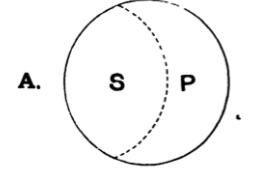
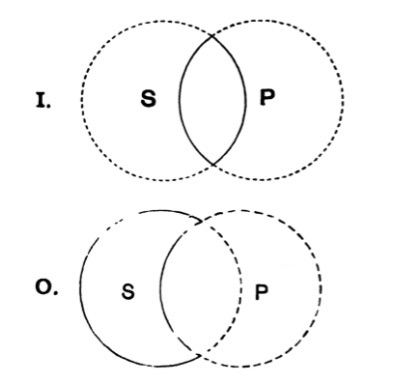
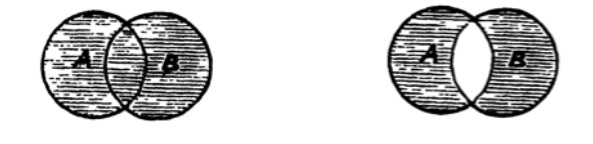
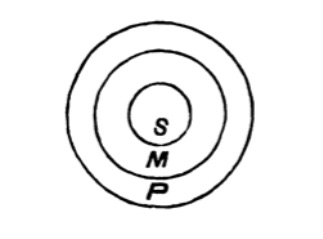
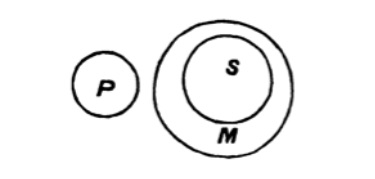
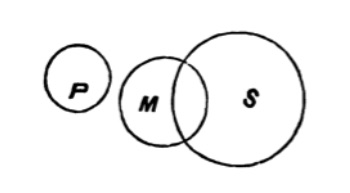
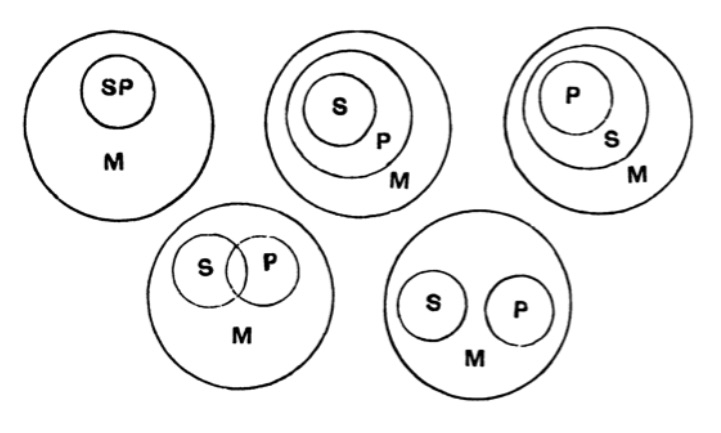
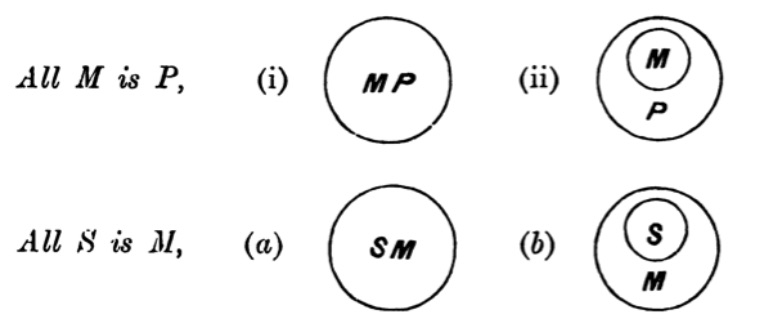
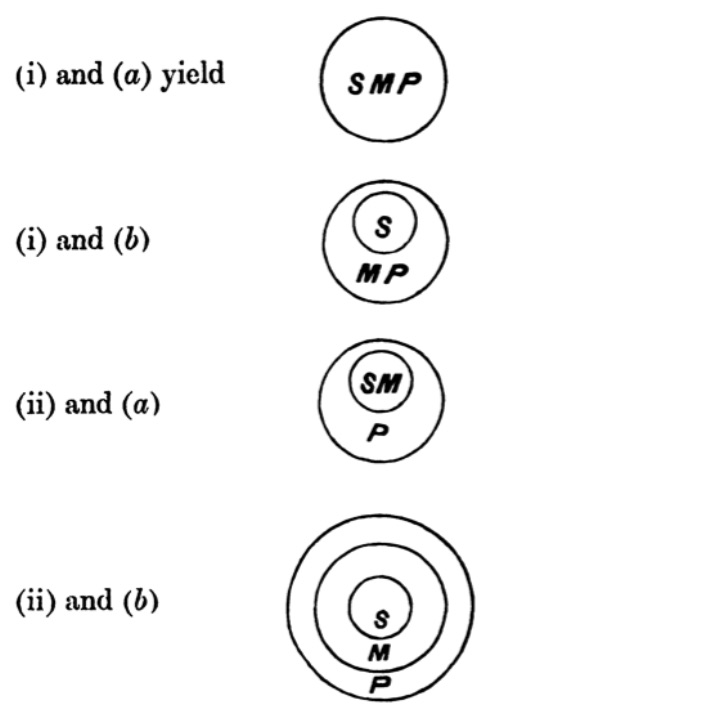
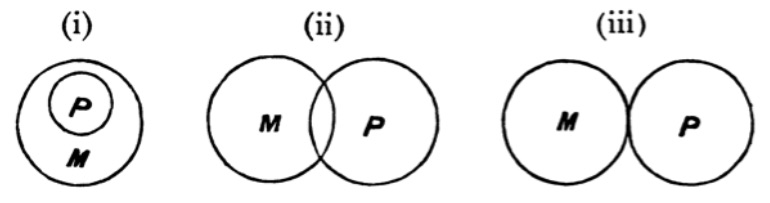
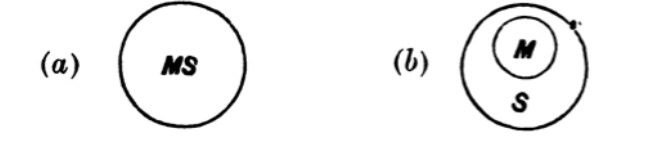
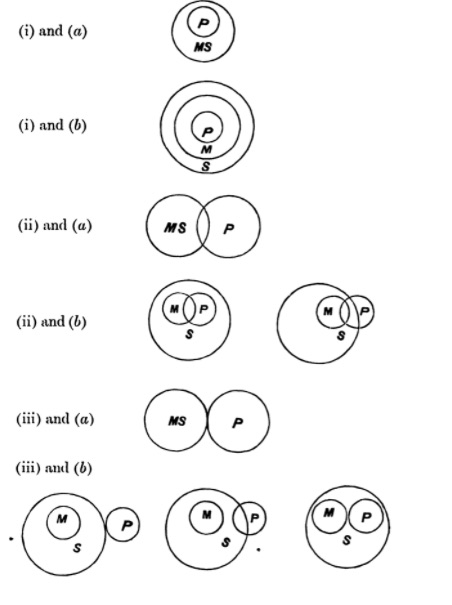
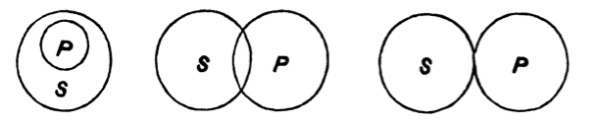
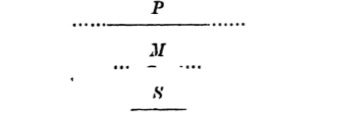
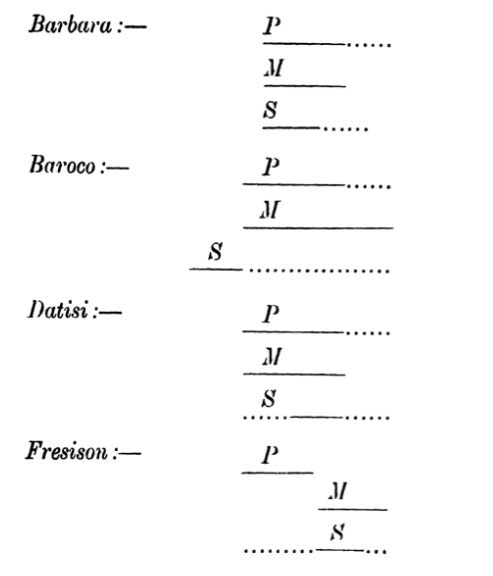
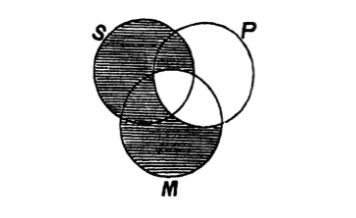
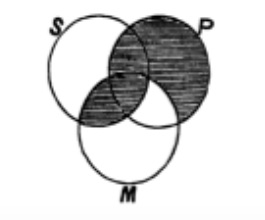
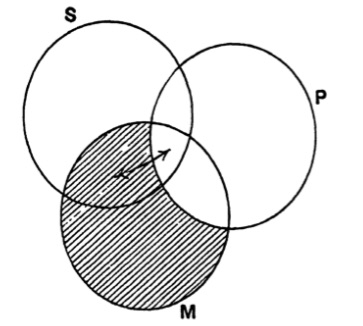
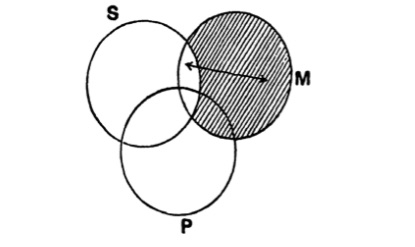
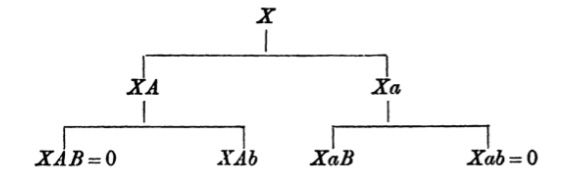
 represents AB or CD;
 represents (A or C) and (B or D). These two forms are of course not equivalent to each other. But
if contradictories are placed in a pair of diagonally opposite
corners, then the combination is the same in whichever way we read
it. Thus,
 represents AB or aC ;
 represents (A or C) and (a or B). But these are equivalent to each other; for (A or C) and (a or B) is equivalent to AB or aC or BC, and—since BC by development is ABC or
aBC—this is equivalent to AB or aC. Mr Johnson
continues as follows:—“By adopting the plan of placing
successive letter-symbols in opposite corners we may solve the
inverse problem with surprising ease. The method of solution
closely resembles the third of those adopted by Dr Keynes, and it was
this that suggested mine. I will, therefore, illustrate by taking Dr
Keynes’s three examples which are the following:—