“EVERY MAN TO HIS VOCATION” AND “NATURE WILL ASSERT HERSELF”—REST
BY THE WAYSIDE—A HALF-SHAVED PARTY—CONSTERNATION OF A
CLERGYMAN—NATIVES IN NEW YORK—DOCTORING A CORN-DOCTOR—RELIGIOUS
RAILWAYS—THE BRIGHTON BUGLE BUSINESS—CASH AND CONSCIENCE—CASTLES
IN THE AIR—A DELUDED ANTIQUARIAN—GAMBLING AND POLITICS—IRISH
WIT—ABOUT CONDUCTORS—DR. CHAPIN AS A PUNSTER—FOWL ATTEMPTS—A
PAIR O’ DUCKS—CUTTING A SICK FRIEND—REV. RICHARD VARICK DEY—HIS
CRIME AND ITS CONSEQUENCES—FORE-ORDINATION—PRACTICAL JOKING BY MY
FATHER—A VALUABLE RACE-HORSE—HOW HE WAS LET AND THEN
KILLED—AGONY OF THE HORSE-KILLER—THE FINAL “SELL”—FOREIGN AND
DOMESTIC FRENCH—COCKNEYISM—WICKED WORDS IN EXETER HALL.
AND now as a traveller, when almost home, sits down by the wayside to
rest, and meanwhile discourses to his companion about minor matters
relating to the journey, or revives reminiscenses of home and foreign
lands, so I stop to sum up in this chapter some of the incidents and
anecdotes which seem pertinent to my story.
The old adages, “Every man to his vocation,” and “Nature will assert
herself” are oftentimes amusingly illustrated. Every one knows the fable
of the man who prayed to Jupiter to convert his cat into a woman, and
Jupiter kindly gratified him and the man married the woman. This was
well enough, till one night the feline female heard a mouse scratching
at the door, when she jumped out of bed and began a vigorous hunt, to
the consternation of her husband, if not of the mouse. Something almost
as absurd and quite as illustrative of “instinct,” or “nature” occurred
during my management of the Museum.
I had brought out a play entitled “The Patriot Fathers,” or something of
the sort; it was patriotic at any rate, and required a great many
people, who had very little to do excepting to dress, group themselves,
and go on and off the stage at the proper times demanded by the
incidents or situations of the play. One night I suddenly found myself
short of supernumeraries to do these subordinate parts, so I sent up to
Centre Market for a supply of young men who were willing to be soldiers,
Indians, or anything else which the exigencies of Revolutionary times
not less than my own immediate necessities demanded.
Now, it fortunately happened that an engine company near by, the famous
“Forty” of by-gone days, had just returned from a fire, and my messenger
proposed to these men to come down and help me out of my difficulty. The
boys wanted no better fun. At least thirty of them came headed by their
foreman, Mr. William Racey. They were soon dressed, one as a woman, a
mother of the Revolution; others as Indians, British soldiers, Hessian
grenadiers, and Continentals. A very little drilling sufficed to put
these new recruits in order for presentation on the stage, for they had
little to do but to follow directions as to where they must stand, and
when they must go on and off. Numbers, not talent, were needed. They
were apt pupils, and did excellently well from the start.
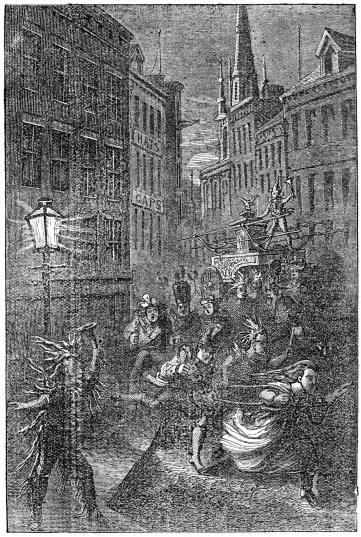
But in the very midst of one of those convulsions which threatened the
fate of the struggle for Independence, the City Hall bell sounded out
the alarm for fire. That was enough. Racey shouted out on the stage:
“Boys, there’s a fire in the Seventh! Put for ‘Forty’ ”; and the thirty
incontinently fled in post haste for “Forty,” and soon after appeared in
the street, followed by a jeering, cheering crew, the most motley
company that ever dragged a fire engine through the streets of New York.
They were in full costume as they left the Museum. The red-coated
British troops, the Hessians in their tall bear-skin caps, the Indians
in their paint and feathers, and even the “woman” helped to drag the
machine, and at the fire these strange people, including the woman,
helped to “man” the brakes. It is unnecessary to say that they succeeded
in creating in the street, what I hoped they would have done on the
stage, a positive sensation.
I confess that I am fond of story-telling as well as fun, and I inherit
this I think from my maternal grandfather, whom I have already
chronicled in these pages as a “practical joker of the old school.” One
of the best illustrations of his peculiar fondness for this amusement
appears in the following:
Danbury and Bethel were and still are manufacturing villages. Hats and
combs were the principal articles of manufacture. The hatters and comb
makers had occasion to go to New York every spring and fall, and they
generally managed to go in parties, frequently taking in a few
“outsiders,” who merely wished to visit the city for the fun of the
thing. They usually took passage on board a sloop at Norwalk, and the
length of their passage depended entirely upon the state of the wind.
Sometimes the run would be made in eight hours, and at other times
nearly as many days were required. It, however, made little difference
with the passengers. They went in for a “spree,” and were sure

 A GROTESQUE FIRE COMPANY.
to have a jolly time whether on land or water. They were all fond of
practical jokes, and before starting they usually entered into a solemn
compact, that any man who got angry at a practical joke should forfeit
and pay the sum of twenty dollars. This agreement frequently saved much
trouble; for occasionally an unexpected and rather severe trick would be
played off, and sadly chafe the temper of the victim.
Upon one of these occasions a party of fourteen men started from Bethel
on a Monday morning for New York. Among the number were my grandfather,
Capt. Noah Ferry, Benjamin Hoyt, Esq., Uncle Samuel Taylor, (as he was
called by everybody,) Eleazer Taylor, and Charles Dart. Most of these
were proverbial jokers, and it was doubly necessary to adopt the
stipulation in regard to the control of temper. It was therefore done in
writing, duly signed.
They arrived at Norwalk Monday afternoon. The sloop set sail the same
evening, with a fair prospect of reaching New York early the next
morning. Several strangers took passage at Norwalk, among the rest a
clergyman. He soon found himself in jolly company, and attempted to keep
aloof. But they informed him it was of no use, they expected to reach
New York the next morning, and were determined to “make a night of it,”
so he might as well render himself agreeable, for sleep was out of the
question. His “reverence” remonstrated at first, and talked about “his
rights”; but he soon learned that he was in a company where the rights
of “the majority” were in the ascendant; so he put a smooth face upon
affairs, and making up his mind not to retire that night, he soon
engaged in conversation with several of his fellow-passengers.
The clergyman was a slim, spare man, standing over six feet high in his
stockings; of light complexion, sandy hair, and wearing a huge pair of
reddish-brown whiskers. Some of the passengers joked him upon the
superfluity of hair upon his face, but he replied that nature had placed
it there, and although he thought proper, in accordance with modern
custom, to shave off a portion of his beard, he considered it neither
unmanly nor unclerical to wear whiskers. It seemed to be conceded that
the clergyman had the best of the argument, and the subject was changed.
Expectation of a speedy run to New York was most sadly disappointed. The
vessel appeared scarcely to move, and through long weary hours of day
and night, there was not a ripple on the surface of the water.
Nevertheless there was merriment on board the sloop, each voyager
contributing good humor to beguile the tediousness of time.
Friday morning came, but the calm continued. Five days from home, and no
prospect of reaching New York! We may judge the appearance of the beards
of the passengers. There was but one razor in the company; it was owned
by my grandfather, and he refused to use it, or to suffer it to be used.
“We shall all be shaved in New York,” said he.
On Saturday morning “all hands” appeared upon deck, and the sloop was
becalmed opposite Sawpits (now Port Chester)!
This tried the patience of the passengers sadly.
“I expected to start for home to-day,” said one.
“I supposed all my combs would have been sold at auction on Wednesday,
and yet here they are on board,” said another.
“I intended to have sold my hats surely this week, for I have a note to
pay in New-Haven on Monday,” added a third.
“I have an appointment to preach in New York this evening and
to-morrow,” said the clergyman, whose huge sandy whiskers overshadowed a
face now completely covered with a bright red beard a quarter of an inch
long.
“Well, there is no use crying, gentlemen,” replied the captain; “it is
lucky for us that we have chickens and eggs on freight, or we might have
to be put upon allowance.”
After breakfast the passengers, who now began to look like barbarians,
again solicited the loan of my grandfather’s razor.
“No, gentlemen,” he replied; “I insist that shaving is unhealthy and
contrary to nature, and I am determined neither to shave myself nor loan
my razor until we reach New York.”
Night came, and yet no wind. Sunday morning found them in the same
position. Their patience was well nigh exhausted, but after breakfast a
slight ripple appeared. It gradually increased, and the passengers were
soon delighted in seeing the anchor weighed and the sails again set. The
sloop glided finely through the water, and smiles of satisfaction forced
themselves through the swamps of bristles which covered the faces of the
passengers.
“What time shall we reach New York if this breeze continues?” was the
anxious inquiry of half a dozen passengers.
“About two o’clock this afternoon,” replied the good-natured captain,
who now felt assured that no calm would further blight his prospects.
“Alas! that will be too late to get shaved,” exclaimed several
voices—“the barber shops close at twelve.”
“And I shall barely be in time to preach my afternoon sermon,” responded
the red-bearded clergyman. “Mr. Taylor, do be so kind as to loan me your
shaving utensils,” he continued, addressing my grandfather.
The old gentleman then went to his trunk, and unlocking it, he drew
forth his razor, lather-box and strop. The passengers pressed around
him, as all were now doubly anxious for a chance to shave themselves.
“Now, gentlemen,” said my grandfather, “I will be fair with you. I did
not intend to lend my razor, but as we shall arrive too late for the
barbers, you shall all use it. But it is evident we cannot all have time
to be shaved with one razor before we reach New York, and as it would be
hard for half of us to walk on shore with clean faces, and leave the
rest on board waiting for their turn to shave themselves, I have hit
upon a plan which I am sure you will all say is just and equitable.”
“What is it?” was the anxious inquiry.
“It is that each man shall shave one half of his face, and pass the
razor over to the next, and when we are all half shaved we shall go on
in rotation and shave the other half.”
They all agreed to this except the clergyman. He objected to appearing
so ridiculous upon the Lord’s day, whereupon several declared that any
man with such enormous reddish whiskers must necessarily always look
ridiculous, and they insisted that if the clergyman used the razor at
all he should shave off his whiskers.
My grandfather assented to this proposal, and said: “Now, gentlemen, as
I own the razor, I will begin, and as our reverend friend is in a hurry
he shall be next—but off shall come one of his whiskers on the first
turn, or he positively shall not use my razor at all.”
The clergyman seeing there was no use in parleying, reluctantly agreed
to the proposition.
In the course of ten minutes one side of my grandfather’s face and chin,
in a straight line from the middle of his nose, was shaved as close as
the back of his hand, while the other looked like a thick brush fence in
a country swamp. The passengers burst into a roar of laughter, in which
the clergyman irresistibly joined, and my grandfather handed the razor
to the clerical gentleman.
The clergyman had already well lathered one half of his face and passed
the brush to the next customer. In a short time the razor had performed
its work, and the clergyman was denuded of one whisker. The left side of
his face was as naked as that of an infant, while from the other cheek
four inches of a huge red whisker stood out in powerful contrast.
Nothing more ludicrous could well be conceived. A deafening burst of
laughter ensued, and the poor clergyman slunk quietly away to wait an
hour until his turn should arrive to shave the other portion of his
face.
The next man went through the same operation, and all the rest followed;
a new laugh breaking forth as each customer handed over the razor to the
next in turn. In the course of an hour and a quarter every passenger on
board was half shaved. It was then proposed that all should go upon deck
and take a drink before operations were commenced on the other side of
their faces. When they all gathered upon the deck, the scene was most
ludicrous. The whole party burst again into loud merriment, each man
being convulsed by the ridiculous appearance of the rest.
“Now, gentlemen,” said my grandfather, “I will go into the cabin and
shave off the other side. You can all remain on deck. As soon as I have
finished, I will come up and give the clergyman the next chance.”
“You must hurry or you will not all be finished when we arrive,”
remarked the captain; “for we shall touch Peck Slip wharf in half an
hour.”
My grandfather entered the cabin, and in ten minutes he appeared upon
deck, razor in hand. He was smoothly shaved.
“Now,” said the clergyman, “it is my turn.”
“Certainly,” said my grandfather. “You are next, but wait a moment, let
me draw the razor across the strop once or twice.”
Putting his foot upon the side rail of the deck, and placing one end of
the strop upon his leg, he drew the razor several times across it. Then,
as if by mistake, the razor flew from his hand, and dropped into the
water! My grandfather, with well-feigned surprise, exclaimed in a voice
of terror, “Good heavens! the razor has fallen overboard!”
Such a picture of consternation as covered one-half of all the
passengers’ faces, was never before witnessed. At first they were
perfectly silent as if petrified with astonishment. But in a few minutes
murmurs began to be heard, and soon swelled into exclamations. “An
infernal hog!” said one. “The meanest thing I ever knew,” remarked
another. “He ought to be thrown overboard himself,” cried several
others; but all remembered that every man who got angry was to pay a
fine of twenty dollars, and they did not repeat their remarks. Presently
all eyes were turned upon the clergyman. He was the most forlorn picture
of despair that could be imagined.
 HALF-SHAVED.
“Oh, this is dreadful!” he drawled, in a tone which seemed as if every
word broke a heart-string.
This was too much, and the whole crowd broke into another roar.
Tranquillity was restored! The joke, though a hard one, was swallowed.
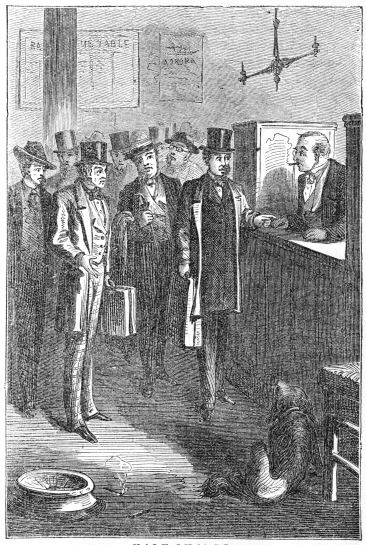
The sloop soon touched the dock. The half-shaved passengers now agreed
that my grandfather, who was the only person on board who appeared like
a civilized being, should take the lead for the Walton House, in
Franklin Square, and all the rest should follow in “Indian file.” He
reminded them that they would excite much attention in the streets, and
enjoined them not to smile. They agreed, and away they started. They
attracted a crowd of persons before they reached the corner of Pearl
Street and Peck Slip, but they all marched with as much solemnity as if
they were going to the grave. The door of the Walton House was open. Old
Backus, the landlord, was quietly enjoying his cigar, while a dozen or
two persons were engaged in reading the papers, etc. In marched the file
of nondescripts, with the rabble at their heels. Mr. Backus and his
customers started to their feet in astonishment. My grandfather marched
solemnly up to the bar—the passengers followed, and formed double rows
behind him. “Santa Cruz rum for nineteen,” exclaimed my grandfather to
the barkeeper. The astonished liquor-seller produced bottles and
tumblers in double-quick time, and when Backus discovered that the
nondescripts were old friends and customers, he was excited to
uncontrollable merriment.
“What in the name of decency has happened,” he exclaimed, “that you
should all appear here half shaved?”
“Nothing at all, Mr. Backus,” said my grandfather, with apparent
seriousness. “These gentlemen choose to wear their beards according to
the prevailing fashion in the place they came from; and I think it is
very hard that they should be stared at and insulted by you Yorkers
because your fashion happens to differ a trifle from theirs.”
Backus half believed my grandfather in earnest, and the bystanders were
quite convinced such was the fact, for not a smile appeared upon one of
the half-shaved countenances.
After sitting a few minutes the passengers were shown to their rooms,
and at tea-time every man appeared at the table precisely as he came
from the sloop. The ladies looked astonished, the waiters winked and
laughed, but the subjects of this merriment were as grave as judges. In
the evening they maintained the same gravity in the bar-room, and at ten
o’clock they retired to bed with all due solemnity. In the morning,
however, bright and early, they were in the barber’s shop, undergoing an
operation that soon placed them upon a footing with the rest of mankind.
It is hardly necessary to explain that the clergyman did not appear in
that singular procession of Sunday afternoon. He tied a handkerchief
over his face, and taking his valise in his hand, started for Market
Street, where it is presumed he found a good brother and a good razor in
season to fill his appointment.
Let me give an illustration of a “practical joke,” which is quite
professional as well as practical with the operator, and in nine cases
out of ten, no doubt, profitable withal. When I was in Paris in 1845,
there came one day to my room in the Hotel Bedford, where I was
staying, a smart little Frenchman with a case of instruments under his
arm. He announced himself as a chiropodist who could instantly remove
the worst corns, not only without pain, but he promised by means of a
mysterious liniment in his possession to immediately heal the spot from
which he removed the corn.
Now I had not a corn on my feet, but willing to test his wonderful
powers, I told him to examine my left foot, and to remove a troublesome
corn on the little toe. Surely enough he did remove and exhibit such a
corn as I am sure would have prevented my walking, had I known that I
was so grievously afflicted. He then poured some of his red oil on the
toe and triumphantly showed me that the place had already entirely
healed. Pretending to be delighted with his skill, I held out another
toe for “operation,” and watching him carefully I saw him slip a
manufactured corn into his oil bottle, which, after fumbling awhile and
pretending to pare the unoffending toe, he “extracted.” More delighted
than ever, I rang the bell, and told the servant to send up the
landlord, as I wished him to witness the extraordinary skill of the
corn-doctor. The landlord arrived, and, after a few words of eulogy upon
the chiropodist, I submitted another healthy toe, and forth came another
monstrous corn; for the same process of extraction, with the same
results, could have been performed on the foot of a marble statue.
It was now my turn, to “operate,” so I rose and bolted the door and took
off my coat, telling the “doctor” that I greatly admired his gold
mounted instruments and the brazen impudence with which he swindled the
public, but that this time he had “caught a Tartar,” and that he could
not leave the room till he had been searched.
The quack bristled up in grand style at what he termed my ungentlemanly
behavior, and threatened if I touched him to bring me before the
“Tribunal.” I remarked that I rather thought the “Tribunal” was the last
place on earth at which he desired to appear, and then assuring the
landlord that the fellow was an arrant imposter, and that if he would
assist me in searching him I would prove it and warrant that no harm
should come to the searchers, he consented, and collared the
chiropodist. The fellow seeing that we were resolved, quietly submitted.
We first searched his pockets and found nothing; but upon examining his
morocco instrument case, we discovered a drawer in which were eighty
ready-made corns and a small piece of horn which furnished the raw
material for the manufacture! Fortunately, my right foot was not bare,
and I forthwith gave the chiropodist a lesson in the shape of a warm
visitation of shoe-leather, which sent him flying down stairs, where the
dose was doubled by an attentive servant till the chiropodist reached
the street. He did not call at the Hotel Bedford again during my stay.
I was a good deal amused when I was in Brighton, England, during the
same year, to see how some people manage to reconcile cash and
conscience. Every one knows that Brighton is a fashionable
watering-place, frequented by all sorts of people; but the actual
residents, many of whom are very wealthy, are supposed to be quite
removed from the fashionable and other follies of the visitors from
abroad during the “season.” The millionnaires of Brighton, when I was
there, were great church-goers, and at the same time were extensive
owners in the stock of the railway which brought so many visitors to the
place. It was therefore for their interest that trains should run on
Sundays, as well as on other days, but as such a course would clash with
their religious professions, it was necessary that some plan should be
devised by which a compromise could be effected between profits and
profession, cash and conscience,—for the idea of ever sacrificing
interest to principle never enters the minds of those whose religion may
be in their heads while it never reaches their hearts. The compromise
between the duty and the dividends of the Brighton railway shareholders
was effected as follows:
After a great deal of talk pro and con on the subject, the trains on
Sunday were permitted to arrive and depart on the following conditions.
But little noise and confusion was manifest and there were fewer porters
employed about the station than on week-days, obliging the arriving and
departing passengers not only to look after, but to lift their baggage,
and as bell-ringing, that is, locomotive bell-ringing, would disturb the
sanctity of the Sabbath, a bugle gave notice of the incoming and
outgoing of the trains. But even this was not enough; it was expressly
stipulated that the bugle-player should play nothing but sacred music!
Thus trains came in to “Old Hundred,” or some similar Psalm tune, and
went out to the air of “Dismission” common to the hymn commencing,
“Lord, dismiss us with thy blessing.” I do not know that this custom is
still kept up at Brighton, but it certainly was so when I was there in
1845; and it was gravely recommended to others who favored a very strict
observance of Sunday, and yet liked their dividends, or were eager for
Sunday mails. In common phrase, it was whipping the Evil One round the
stump in a curious way.
It reminded me of the good old deacon in Connecticut who was in the
habit of selling milk to his neighbors on all days in the week. One
Sunday, however, his parson came home with him to tea, and while they
were at the table a little girl came in for a quart of milk. The deacon
was afraid of being scandalized in the presence of the parson, and so he
told the girl he did not sell milk on Sunday. The girl, who had been
accustomed to buy on that day as on other days, was much surprised and
turned to go away, when the sixpence in her hand was too much of a
temptation for the deacon, who called out:
“Here, little girl! you can leave the money now, and call and get the
milk to-morrow!”
During my journeyings abroad I was not wholly free from the usual
infirmity of travellers, viz, a desire to look at the old castles of
feudal times, whether in preservation or in ruins; but there was one of
our party, Mr. H. G. Sherman, who had a peculiar and irresistible taste
for the antique. He gathered trunks full of stone and timber mementos
from every place of note which we visited; and, if there was anything
which he admired more than all else, it was an old castle. He spent many
hours in clambering the broken walls of Kenilworth, in viewing the
towers and dungeons of Warwick, and climbing the precipices of
Dumbarton. When travelling by coach, Sherman always secured an outside
seat, and, if possible, next to the coachman, so as to be able to make
inquiries regarding everything which he might happen to see.
On our journey from Belfast to Drogheda, Sherman occupied his usual seat
beside the driver, and asked him a thousand questions. The coachman was
a regular wag, with genuine Irish wit, and he determined to have a
little bit of fun at the expense of the inquisitive Yankee. As we came
within eight miles of Drogheda, the watchful eye of Sherman caught the
glimpse of a large stone pile, appearing like a castle, looming up among
some trees in a field half a mile from the roadside.
“Oh, look here! what do you call that?” exclaimed Sherman, giving the
coachman an elbowing in the ribs which was anything but pleasant.
“Faith,” replied the coachman, “you may well ask what we call that, for
divil a call do we know what to call it. That is a castle, sir, beyond
all question the oldest in Ireland; indade, none of the old books nor
journals contain any account of it. It is known, however, that Brian
Borrhoime inhabited it some time, though it is supposed to have been
built centuries before his day.”
“I’ll give you half-a-crown to stop the coach long enough for me to run
and bring a scrap of it away,” said Sherman.
“Sure, and isn’t this the royal mail coach? and I would not dare detain
it for half the Bank of Ireland,” replied the honest coachman.
“How far is it to Drogheda?” inquired Sherman.
“About eight miles, more or less,” answered the coachman.
“Stop your coach, and let me down then,” replied Sherman; “I’ll walk to
Drogheda, and would sooner walk three times the distance than not have a
nearer view, and carry off a portion of the oldest castle in Ireland.”
With that Sherman dismounted, and, raising his umbrella to protect him
from the cold rain which was falling in torrents, he marched off in the
mud, calling out to me that I might expect him in Dublin by the next
train to that which would take us from Drogheda, the railroad being then
completed only to that point from Dublin.
We arrived in Dublin about five o’clock, cold and uncomfortable; but
warm apartments and good fires were in waiting for us, and in a few
hours we had partaken of an excellent supper, and were as happy as
lords. About nine o’clock in the evening, the door of our parlor was
opened, and who should come in but poor Sherman, drenched to the skin
with cold rain,—the legs of his boots pulled over the bottoms of his
pantaloons, and covered with thick mud to the very tops, and himself
looking like a half-famished, weary and frozen traveller.
“For Heaven’s sake, let me get to the fire!” exclaimed Sherman, and we
were too much struck with his suffering appearance not to heed it.
“Well, Sherman,” I remarked, “that must have been a tedious walk for
you,—eight long Irish miles through the rain and mud.”
“I guess you would have thought so if you had walked it yourself,”
replied Sherman, doggedly.
“I hope you have brought away trophies enough from the castle to pay you
for all this trouble,” I continued.
“Oh, curse the castle!” exclaimed Sherman.
“What do you mean by that?” I asked, in astonishment.
“Oh, you need not look surprised,” replied Sherman; “for I have no doubt
that you and that bog-trotting Irish coachman have had fun enough at my
expense before this time.”
I assured him that I positively had not heard the coachman speak on the
subject, and begged him to tell me what had occurred to vex him in this
manner.
“Why, if you don’t already know,” replied Sherman, “I would not have you
know for twenty pounds, for you would be sure to publish it. However,
now your curiosity is excited, you would be certain to find it all out,
if you had to hire a post-chaise, and ride there on purpose; so I may as
well tell you.”
“Do tell me,” I replied, “for I confess my curiosity is excited, and I
am unable to guess why you are so angry; for I know you love to see
castles, and that pleasure you surely have enjoyed, for I caught a
glimpse of one myself.”
“No, you have not seen a castle to-day, nor I either!” exclaimed
Sherman.
“What on earth was it, then?” I asked.
“A thundering old lime-kiln!” exclaimed Sherman; “and I only wish I
could pitch that infernal Irish coachman into it while it was under full
blast!”
It was many a long day before Sherman heard the last of the lime-kiln;
in fact, this trick of the Irish coachman rendered him cautious in
making inquiries of strangers.
One day we rode to Donnybrook, the place so much celebrated for its
fairs and its black eyes; for it would be quite out of character for Pat
to attend a fair without having a flourish of the shillelah, and a
scrimmage which would result in a few broken heads and bloody noses.
Near Donnybrook we saw something on the summit of a hill which appeared
like a round stone tower. It was probably sixty feet in circumference
and twenty-five feet high.
“I would like to know what that is,” said Sherman.
I advised him to inquire of the first coachman that came along, but,
with a forced smile, he declined my advice.
“It can’t be a lime-kiln, at any rate,” continued Sherman; “it must be a
castle of some description.”
The more we looked at it the more mysterious did it appear to us, and
Sherman’s castle-hunting propensities momentarily increased. At last he
exclaimed: “A man who travels with a tongue in his head is a fool if he
don’t use it; and I am not going within a hundred rods of what may be
the greatest curiosity in Ireland, without knowing it.”
With that he turned our horse’s head towards a fine-looking mansion on
our right, where we halted. Sherman jumped from the carriage, opened the
small gate, proceeded up the alley of the lawn fronting the house, and
rang the bell. A servant appeared at the door; but Sherman, knowing the
stupidity of Irish servants, was determined to apply at head-quarters
for the information he so much desired.
“Is your master in?” asked Sherman.
“I will see, sir. What name, if you plaze?”
“A stranger from the United States of America!” replied Sherman.
The servant departed, and in a minute returned and invited Sherman to
enter the parlor. He found the gentleman of the mansion sitting by a
pleasant fire, near which were also his lady and several visitors and
members of the family. Sherman was not troubled with diffidence. Being
seated, he hoped he would be excused for having called without an
invitation; but the fact was, he was an American traveller, desirous of
picking up all important information that might fall in his way.
The gentleman politely replied that no apology was necessary, that he
was most happy to see him, and that any information which he could
impart regarding that or any other portion of the country should be
given with pleasure.
“Thank you,” replied Sherman; “I will not trouble you except on a single
point. I have seen all that is important in Dublin and its vicinity, and
in and about Donnybrook; there is but one thing respecting which I want
information, and that is the stone tower or castle which we see standing
on the hill, about a quarter of a mile south of your house. If you could
give me the name and history of that pile, I shall feel extremely
obliged.”
“Oh, nothing is easier,” replied the gentleman, with a smile. “That
‘pile,’ as you call it, was built some forty years ago by my father; and
it was a lucky ‘pile’ for him, for it was the only windmill in these
parts, and always had plenty to do: but a few years ago a hurricane
carried off the wings of the mill, and ever since that it has stood as
it now does, a memorial of its former usefulness. Is there any other
important information that I can give you?” asked the gentleman, with a
smile.
“Not any,” replied Sherman, rising to depart: “but perhaps I can give
you some; and that is, that Ireland is, beyond all dispute, the meanest
country I ever travelled in. The only two objects worthy of note that I
have seen in all Ireland are a lime-kiln and the foundation for a
windmill!”
Upon resuming his seat in the carriage, Sherman laughed immoderately,
although he evidently felt somewhat chagrined by this second mistake in
searching for ancient castles.
Calling one day in one of the principal hotels in Dublin, I noticed
among the “rules” framed and hung in the coffee-room for the warning,
instruction, or entertainment of the guests of the house, the following:
“No Gambling or Politics will be allowed to take place in this house,
by any parties whatever.”
How politics could “take place” in an Irish hotel, or elsewhere, would
have been a mystery to me, if I did not remember that the “scrimmages”
and rows, which often follow the mere discussion of politics, seemed to
warrant the landlord in classing politics with gambling, or any other
dangerous amusement which might take place in the coffee-room of an
Irish inn.
Speaking of Irishmen, I am reminded of an illustration of ready Irish
wit, which is located on the line of the Boston and Fitchburg Railroad.
Some years ago, the Reverend Thomas Whittemore, a wealthy Universalist
minister, who was a large stockholder in the road, was appointed
president of the company; and, as he was exceedingly conscientious in
the discharge of his duty, he once took upon himself to walk over every
foot of the route, to see if every part of the road was in complete
order. Walking along in this way and alone, he came to a place where a
loose rail lay alongside of the track; and, seeing an Irishman near by,
who was apparently employed on the road, Mr. Whittemore called out to
him:
“Here, Pat, pick up this rail, and lay it alongside of the fence out of
the way, till it is wanted.”
It never occurred to Mr. Whittemore that every man whom he met did not
know him and his official position; but Pat, not dreaming that his
virtual employer, the president of the railroad company, was giving him
an order, sharply answered:
“Jist go to the divil, will ye?”
“My dear friend,” said the smiling Whittemore, who instantly
comprehended “the situation”—that is, that Pat did not know him, and no
particular wonder, either—“ ‘go to the devil?’ why, that is the last
place I should desire to go to!”
“An’ faith, an’ I think it’s the last place you will be goin’ to,”
responded Pat.
Of railroads and railroad travel and employees I have heard and told no
end of stories; but one of the latest and best, I think, is told of a
man in a town “down East,” who had some difficulty with a conductor, and
vowed that not another cent of his money should ever go into the
treasury of that company.
“But,” said the conductor of the road, “you own property in one place on
the line, and do business in another place, and are obliged to go back
and forth almost every day: how are you going to help paying something
to the company?”
“Oh! hereafter I shall pay my fare to you in the cars,” was the reply.
It may be a joke, but conductors themselves, that is, some of them, are
more or less facetious on the subject of what in the vernacular is known
as “knocking down.” Soon after the conductors on the New York and New
Haven Railroad were put in costume while on duty, and were obliged to
wear a badge bearing the initials of the company, my friend Rev. Dr.
Chapin was accompanying me over the road to my Bridgeport home, when
along came a conductor, whom we both knew well, to collect our fares.
“Ah, I see,” said Dr. Chapin, pointing to the letters on the new badge,
“N. H., N. Y.,—‘Neither Here, Nor Yonder.”
“No,” whispered the conductor confidentially in the Doctor’s ear; “it
means, ‘New House, Next Year.’ ”
It is scarcely necessary to tell the thousands who know Dr. Chapin that
he is a man of most ready wit, and an inveterate punster. One day, when
we were dining together, I was carving a chicken, which the Doctor
pronounced a “hen-ous offence,” when, having some difficulty with a
tough wing, I exclaimed:
“How shall I get the thing off, anyhow?”
“Pullet,” gravely answered the Doctor.
“Eggsactly,” said I.
Then began what the Doctor called a “battle of the spurs,”—I trying to
“crow” over the Doctor, and he endeavoring to upset my “cackle-ations”;
urging me meanwhile to “scratch away,” till at last I told him, if he
made another pun on that “lay,” he would knock me off the roost.
“Oh, then,” said the Doctor, finally feathering his nest, “Sha’n’t I
clear?!”
An equally fowl pun of the Doctor’s was perpetrated in cold blood, or
rather in very cold water, down at Rockport, Massachusetts. Thither
every summer season were wont to congregate, for their vacation, such
celebrated clergymen as Starr King, Dr. Chapin, and others, mainly for
the fine sea-bathing there. One season Dr. Chapin arrived at least a
fortnight behind the rest; and, when they went down bathing together,
the acclimated visitors pronounced the water to be “delightful,” “just
right,” and so on.
“But isn’t it cold?” asked Dr. Chapin.
“Oh, no,” replied Starr King; “you have only to go down and up twice,
and you are warm enough.”
“Ah, I see how it is,” said Dr. Chapin, who tried the experiment and
came up half frozen; “you are warm after down and up twice? Why, that’s
a pair o’ ducks!”
Fowls naturally suggest the market, and this brings to mind a neighbor
of mine in New York who keeps two things,—a boarding-house, and “bad
hours.” His wife justly suspected him of gambling; but he generally
managed to get in before midnight, and always had money enough in his
pocket to go to market with in the morning. On one occasion, however,
after gambling all night, he did not come home till six o’clock in the
morning, when, after a sound scolding from his wife for staying out all
night and “gambling,” as she insisted, he was sent to market to get
something for breakfast. Returning, he was again berated by his wife for
gambling, he protesting all the while that he had been “spending the
night with a sick friend.”
His wife might have believed him, if he had not sat down at the head of
the table, half asleep, and solemnly passed the bread to the nearest
boarder with the exclamation,—
“Cut!”
“That’s your ‘sick friend!’ ” exclaimed the wife, while a general roar
around the table woke the host to the fact that he was passing bread,
and not a pack of cards.
This story-telling carries me back to my boyhood days at Bethel, and
brings to mind an old clerical acquaintance whom I knew long before I
met Dr. Chapin. The Rev. Richard Varick Dey, who resided at Greenfield,
Connecticut, was in the habit of coming to Bethel to preach on Sabbath
evenings. He was a very eloquent preacher, and an eccentric man. He
possessed fine talents; his sermons were rich in pathos and wit; and he
was exceedingly popular with the world’s people. The more
straight-laced, however, were afraid of him. His remarks both in and out
of the pulpit would frequently rub hard against some popular dogma, or
knock in the head some favorite religious tenet. Mr. Dey was therefore
frequently in hot water with the church, and was either “suspended,” or
about to be brought to trial for some alleged breach of ministerial
duty, or some suspected heresy. While thus debarred from preaching, he
felt that he must do something to support his family. With this view he
visited Bethel, Danbury, and other towns, and delivered “Lectures,” at
the termination of which, contributions for his benefit were taken up. I
remember his lecturing in Bethel on “Charity.” This discourse overflowed
with eloquence and pathos, and terminated in a contribution of more than
fifty dollars.
It was said that on one occasion Mr. Dey was about to be tried before an
ecclesiastical body at Middletown. There being no railroads in those
days, many persons travelled on horseback. Two days before the trial was
to take place, Mr. Dey started for Middletown alone, and on horseback.
His valise was fastened behind the saddle; and, putting on his large
great-coat surmounted with a half a dozen broad “capes,” as was the
fashion of that period, and donning a broad-brimmed hat, he mounted his
horse and started for the scene of trial.
On the second day of his journey, and some ten miles before reaching
Middletown, he overtook a brother clergyman, also on horseback, who was
wending his way to the Consociation.
He was a man perhaps sixty years of age, and his silvered locks stood
out like porcupine quills. His iron visage, which seemed never to have
worn a smile, his sinister expression, small, keen, selfish-looking
eyes, and compressed lips, convinced Mr. Dey that he had no hope of
mercy from that man as one of his judges. The reverend gentlemen soon
fell into conversation. The sanctimonious clergyman gave his name and
residence, and inquired those of Mr. Dey.
“My name is Mr. Richard,” replied Rev. Richard V. Dey, “and my residence
is Fairfield.” (Greenfield is a parish in the town of Fairfield.)
“Ah,” exclaimed the other clergyman; “then you live near Mr. Dey: do you
know him?”
“Perfectly well,” responded the eccentric Richard.
“Well, what do you think of him?” inquired the anxious brother.
“He is a wide-awake, cunning fellow, one whom I should be sorry to
offend, for I would not like to fall into his clutches; but, if
compelled to do so, I could divulge some things which would astonish our
Consociation.”
“Is it possible? Well, of course your duty to the Church and the
Redeemer’s cause will prompt you to make a clean breast of it, and
divulge everything you know against the accused,” responded the excited
clergyman.
“It is hard to destroy a brother’s reputation and break up the peace of
his family,” answered the meek Mr. Richard.
“It is the duty of the elect to expose and punish the reprobates,”
replied the sturdy Puritan.
“But had I not better first tell our brother his fault, and give him an
opportunity to confess and be forgiven?”
“Our brother, as you call him, is undoubtedly a heretic, and the true
faith is wounded by his presence amongst us. The Church must be purged
from unbelief. We must beware of those who would introduce damnable
heresies.”
“Are you sure that Mr. Dey is an unbeliever?” inquired the modest Mr.
Richard.
“I have heard that he throws doubt upon the Trinity,—shrugs his
shoulders at some portions of the Saybrook Platform, and has said that
even reprobates may sincerely repent, pray for forgiveness, and be
saved; ay, that he even doubts the damnation of unregenerate infants!”
“Horrible!” ejaculated Mr. Richard.
“Yes, horrible indeed! But I trust that our Consociation will
excommunicate him at once and forever. But what do you know concerning
his belief?”
“I know nothing specially against his belief,” responded Mr. Richard;
“but I have witnessed some of his acts, which I should be almost sorry
to expose.”
“A mistaken charity. It is your duty to tell the Consociation all you
know regarding the culprit, and I shall insist upon your doing so.”
“I certainly desire to do that which is right and just; and, as I am but
young in the ministry, I shall defer to your judgment, founded on age
and experience. But I would prefer at first to state to you what I know,
and then will be guided by your advice in regard to giving my testimony
before the Consociation.”
“A very proper course. You can state the facts to me, and I will give
you my counsel. Now what do you know?”
“I know that on more than one occasion I have caught him in the act of
kissing my wife,” replied the injured Mr. Richard.
“I am not at all astonished,” responded the clergyman; “such conduct
coincides exactly with the opinion I had formed of the man. I
commiserate you, sir, but I honor your sense of duty in divulging such
important facts, even at the expense of exposing serious troubles in
your domestic relations. But, sir, justice must have its course. These
facts must be testified to before the Consociation. Do you know anything
else against the delinquent?”
“I know something more; but it is of a nature so delicate, and concerns
me personally so seriously, that I must decline divulging it.”
“Sir, you cannot do that. I will not permit it, but will insist on your
telling the whole truth before our Consociation, though your
heart-strings were to break in consequence. I repeat, sir, that I
sympathize with you personally, but personal feelings must be swallowed
up in the promotion of public good. No sympathy for an individual can be
permitted to clash with the interests of the true Church. You had better
tell me, sir, all you know.”
“Since you say that duty requires it, I will do so. I have caught him,
under very suspicious circumstances, in my wife’s bedroom,” said the
unfortunate Mr. Richard.
“Was your wife in bed?” inquired the man with the iron face.
“She was,” faintly lisped the almost swooning Mr. Richard.
“Enough, enough,” was the response. “Our Consociation will soon dispose
of the Rev. Richard V. Dey.”
The two clergymen had now arrived at Middletown. The Rev. Mr.
Vinegarface rode to the parsonage while Mr. Dey, alias “Mr. Richard,”
went to a small and obscure inn.
The Consociation commenced the next day. This ecclesiastical body was
soon organized, and, after disposing of several minor questions, it was
proposed to take up the charges of heresy against the Rev. Mr. Dey. The
accused, with a most demure countenance, was conversing with his quondam
travelling companion of the day previous, who upon hearing this
proposition instantly sprang to his feet, and informed the reverend
Chairman that providentially he had been put in possession of facts
which must necessarily result in the immediate expulsion of the culprit
from the Church, and save the necessity of examining testimony on the
question of heresy. “In fact,” continued he, “I am prepared to prove
that the Rev. Richard V. Dey has frequently kissed the wife of one of
our brethren, and has also been caught in a situation which affords
strong evidence of his being guilty of the crime of adultery!”
A thrill of horror and surprise ran through the assembly. Every eye was
turned to Mr. Dey, who was seated so closely to the last speaker that he
touched him as he resumed his seat. Mr. Dey’s countenance was as placid
as a May morning, and it required keen vision to detect the lurking
smile of satisfaction that peeped from a corner of his eye. A few
minutes of dead silence elapsed.
“Produce your witnesses,” finally said the Chairman, in an almost
sepulchral voice.
“I call on the Rev. Mr. Richard, of Fairfield, to corroborate under oath
the charges which I have made,” responded the hard-visaged Puritan.
Not a person moved. Mr, Dey looked as unconcerned as if he was an utter
stranger to all present, and understood not the language which they were
speaking.
“Where is the Rev. Mr. Richard?” inquired the venerable Chairman.
“Here he is,” responded the accuser, familiarly tapping Mr. Dey on the
shoulder.
The whole audience burst into such a roar of laughter as probably never
was heard in a like Consociation before.
The accuser was almost petrified with astonishment at such inconceivable
conduct on the part of that sedate religious assembly.
Mr. Dey alone maintained the utmost gravity.
“That, sir, is the Rev. Richard V. Dey,” replied the Chairman, when
order was restored.
The look of utter dismay which instantly marked the countenance of the
accuser threw the assembly into another convulsion of laughter, during
which Mr. Dey’s victim withdrew, and was not seen again in Middletown.
The charges of heresy were then brought forward. After a brief
investigation, they were dismissed for want of proof, and Mr. Dey
returned to Greenfield triumphant.
I have often heard Mr. Dey relate the following anecdote. A young couple
called on him one day at his house in Greenfield. They informed him that
they were from the southern portion of the State, and desired to be
married. They were well dressed, made considerable display of jewelry,
and altogether wore an air of respectability. Mr. Dey felt confident
that all was right, and, calling in several witnesses, he proceeded to
unite them in the holy bonds of wedlock.
After the ceremonies were concluded, Mr. Dey invited the happy pair (as
was usual in those days) to partake of some cake and wine. They thus
spent a social half-hour together, and, on rising to depart, the
bridegroom handed Mr. Dey a twenty-dollar bank note; remarking that this
was the smallest bill he had, but, if he would be so good as to pay
their hotel bill (they had merely dined and fed their horse at the
hotel), he could retain the balance of the money for his services. Mr.
Dey thanked him for his liberality, and went at once to the hotel with
the lady and gentleman, and informed the landlord that he would settle
their bill. They proceeded on their journey, and the next day it was
discovered that the bank-note was a counterfeit, and that Mr. Dey had to
pay nearly three dollars for the privilege of marrying this loving
couple.
The newspapers in various parts of the State subsequently published
facts which showed that the affectionate pair got married in every town
they passed through,—thus paying their expenses and fleecing the
clergymen by means of counterfeits.
One of the deacons of Mr. Dey’s church asked him if he usually kissed
the bride at weddings. “Always,” was the reply.
“How do you manage when the happy pair are negroes?” was the deacon’s
next question. “In all such cases,” replied Mr. Dey, “the duty of
kissing is appointed to the deacons.”
My grandfather was a Universalist, and for various reasons, fancied or
real, he was bitterly opposed to the Presbyterians in doctrinal views,
though personally some of them were his warmest and most intimate
friends. Being much attached to Mr. Dey, he induced that gentleman to
deliver a series of Sunday evening sermons in Bethel; and my grandfather
was not only on all these occasions one of the most prominent and
attentive hearers, but Mr. Dey was always his guest. He would generally
stop over Monday and Tuesday with my grandfather, and, as several of the
most social neighbors were called in, they usually had a jolly time of
it. Occasionally “mine host” would attack Mr. Dey good-naturedly on
theological points, and would generally come off second best; but he
delighted, although vanquished, to repeat the sharp answers with which
Mr. Dey met his objections to the “Confession of Faith.”
One day, when a dozen or more of the neighbors were present, and
enjoying themselves in passing around the bottle, relating anecdotes,
and cracking jokes, my grandfather called out in a loud tone of voice,
which at once arrested the attention of all present:
“Friend Dey, I believe you pretend to believe in foreordination?”
“To be sure I do,” replied Mr. Dey.
“Well, now, suppose I should spit in your face, what would you do?”
inquired my grandfather.
“I hope that is not a supposable case,” responded Mr. Dey, “for I should
probably knock you down.”
“That would be very inconsistent,” replied my grandfather, exultingly;
“for if I spat in your face it would be because it was foreordained I
should do so: why then would you be so unreasonable as to knock me
down?”
“Because it would be foreordained that I should knock you down,” replied
Mr. Dey, with a smile.
The company burst into a laugh, in which my grandfather heartily
joined.
My father, as well as my grandfather, was very fond of a practical joke,
and he lost no occasion which offered for playing off one upon his
friends and neighbors. In addition to his store, tavern, and
freight-wagon business to Norwalk, he kept a small livery-stable; and on
one occasion, a young man named Nelson Beers applied to him for the use
of a horse to ride to Danbury, a distance of three miles. Nelson was an
apprentice to the shoe-making business, nearly out of his time, was not
over-stocked with brains, and lived a mile and a half east of our
village. My father thought that it would be better for Nelson to make
his short journey on foot than to be at the expense of hiring a horse,
but he did not tell him so.
We had an old horse named “Bob.” Having reached an age beyond his teens,
he was turned out in a bog lot near our house to die. He was literally a
“living skeleton,”—much in the same condition of the Yankee’s nag,
which was so weak his owner had to hire his neighbor’s horse to help him
draw his last breath. My father, in reply to Nelson’s application, told
him that the livery horses were all out, and he had none at home except
a famous “race-horse,” which he was keeping in low flesh in order to
have him in proper trim to win a great race soon to come off.
“Oh, do let me have him, Uncle Phile” (my father’s name was Philo; but,
as it was the custom in that region to call everybody uncle, or aunt, or
squire, or deacon, or colonel, or captain, my father’s general title
among his acquaintances was “Uncle Phile”). “I will ride him very
carefully, and not injure him in the least; besides, I will have him
rubbed down and fed in Danbury,” said Nelson Beers.
“He is too valuable an animal to risk in the hands of a young man like
you,” responded my father.
Nelson continued to importune, and my father to play off, until it was
finally agreed that the horse could be had on the condition that he
should in no case be ridden faster than a walk or slow trot, and that he
should be fed four quarts of oats at Danbury.
Nelson started on his Rosinante, looking for all the world as if he was
on a mission to the carrion crows; but he felt every inch a man, for he
fancied himself astride of the greatest race-horse in the country, and
realized that a heavy responsibility was resting on his shoulders, for
the last words of my father to him were: “Now, Nelson, if any accident
should happen to this animal while under your charge, you could not pay
the damage in a lifetime of labor.”
Old “Bob” was duly oated and watered at Danbury, and at the end of
several hours Mr. Beers mounted him and started for Bethel. He concluded
to take the “great pasture” road home, that being the name of a new road
cut through swamps and meadows as a shorter route to our village.
Nelson, for the nonce forgetting his responsibility, probably tried the
speed of his race-horse and soon broke him down. At all events something
occurred to weaken old Bob’s nerves, for he came to a stand-still and
Nelson was forced to dismount. The horse trembled with weakness and
Nelson Beers trembled with fright. A small brook was running through the
bogs at the roadside, and Beers, thinking that perhaps his “race-horse”
needed a drink, led him into the stream. Poor old “Bob” stuck fast in
the mud, and, not having strength to withdraw his feet, quietly closed
his eyes, and, like a patriarch as he was, he dropped into the soft bed
that was awaiting him, and died without a single kick.
No language can describe the consternation of poor Beers. He could not
believe his eyes, and vainly tried to open those of his horse. He placed
his ear at the mouth of poor old Bob, but took it away again in utter
dismay. The breath had ceased.
At last Nelson, groaning as he thought of meeting my father, and
wondering whether eternity added to time would be long enough for him to
earn the value of the horse, took the bridle from the “dead-head,” and
unbuckling the girth, drew off the saddle, placed it on his own back,
and trudged gloomily towards our village.
It was about sundown when my father espied his victim coming up the
street with the saddle and bridle thrown across his shoulders, his face
wearing a look of the most complete despair. My father was certain that
old Bob had departed this life, and he chuckled inwardly and quietly,
but instantly assumed a most serious countenance. Poor Beers approached
more slowly and mournfully than if he was following a dear friend to the
grave.
When he came within hailing distance my father called out, “Why, Beers,
is it possible you have been so careless as to let that race-horse run
away from you?”
“Oh, worse than that,—worse than that, Uncle Phile,” groaned Nelson.
“Worse than that! Then he has been stolen by some judge of valuable
horses. Oh, what a fool I was to intrust him to anybody!” exclaimed my
father, with well-feigned sorrow.
“No, he ain’t stolen, Uncle Phile,” said Nelson.
“Not stolen! Well, I am glad of that, for I shall recover him again;
but where is he? I am afraid you have lamed him.”
“Worse than that,” drawled the unfortunate Nelson.
“Well, what is the matter? where is he? what ails him?” asked my father.
“Oh, I can’t tell you,—I can’t tell you!” said Beers with a groan.
“But you must tell me,” returned my father.
“It will break your heart,” groaned Beers.
“To be sure it will if he is seriously injured,” replied my father; “but
where is he?”
“He is dead!” said Beers, as he nerved himself up for the announcement,
and then, closing his eyes, sank into a chair completely overcome with
fright.
My father groaned in a way that started Nelson to his feet again. All
the sensations of horror, intense agony, and despair were depicted to
the life on my father’s countenance.
“Oh, Uncle Phile, Uncle Phile, don’t be too hard with me; I wouldn’t
have had it happen for all the world,” said Beers.
“You can never recompense me for that horse,” replied my father.
“I know it, I know it, Uncle Phile; I can only work for you as long as I
live, but you shall have my services till you are satisfied after my
apprenticeship is finished,” returned Beers.
After a short time my father became more calm, and, although apparently
not reconciled to his loss, he asked Nelson how much he supposed he
ought to owe him.
“Oh, I don’t know; I am no judge of the value of blood horses, but I
have been told they are worth fortunes sometimes,” replied Beers.
“And mine was one of the best in the world,” said my father, “and in
such perfect condition for running,—all bone and muscle.”
“Oh, yes, I saw that,” said Beers, despondingly, but with a frankness
that showed he did not wish to deny the great claims of the horse and
his owner.
“Well,” said my father, with a sigh, “as I have no desire to go to law
on the subject, we had better try to agree upon the value of the horse.
You may mark on a slip of paper what sum you think you ought to owe me
for him, and I will do the same; we can then compare notes, and see how
far we differ.”
“I will mark,” said Beers, “but, Uncle Phile, don’t be too hard with
me.”
“I will be as easy as I can, and endeavor to make some allowance for
your situation,” said my father; “but, Nelson, when I think how valuable
that horse was, of course I must mark something in the neighborhood of
the amount of cash I could have received for him. I believe, however,
Nelson, that you are an honest young man, and are willing to do what you
think is about right. I therefore wish to caution you not to mark down
one cent more than you really think, under the circumstances, you ought
to pay me when you are able, and for which you are now willing to give
me your note of hand. You will recollect that I told you, when you
applied for the horse, that I did not wish to let him go.”
Nelson gave my father a grateful look, and assented to all he said. At
least a dozen of our joke-loving neighbors were witnessing the scene
with great apparent solemnity. Two slips of paper were prepared; my
father marked on one, and after much hesitation, Beers wrote on the
other.
“Well, let us see what you have marked,” said my father.
“I suppose you will think it is too low,” replied Beers, handing my
father the slip of paper.
“Only three hundred and seventy-five dollars!” exclaimed my father,
reading the paper; “well, there is a pretty specimen of gratitude for
you!”
Nelson was humbled, and could not muster sufficient courage to ask my
father what he had marked. Finally one of our neighbors asked my
father to show his paper—he did so. He had marked, “Six and a quarter
cents.” Our neighbor read it aloud, and a shock of mirth ensued, which
fairly lifted Beers to his feet. It was some time before he could
comprehend the joke, and when he became fully aware that no harm was
done, he was the happiest fellow I have ever seen.
I might fill a volume with these reminiscences of my younger days, but
turning once more to my foreign notebooks, I find material there which
seems to claim a place in this story-chapter. I am never tired of
telling and laughing at some of my mishaps and adventures in trying to
use the French language, when I first went abroad. It was no unusual
thing to travel half a day in a “diligence,” or in the cars, with some
Englishman, as I would afterwards discover, both of us doing our best to
make ourselves intelligible to each other in French, till at last, in
despair, one or the other would utter the conventional conundrum:
“Parlez-vous Anglais?”
“Why, of course; I am an American” (or an Englishman); and then a mutual
roar would follow.
American, or English, or Dutch French is generally quite a different
thing from “French French.” Thus I could always understand the Dutchmen
who spoke to me in French in Amsterdam, and I may add, they could
perfectly understand me. We spoke the same patois. I wrote to my wife,
I remember, from Amsterdam, that I found they spoke much purer French in
that city than in Paris!
Once on arriving in Paris at the station of the Northern Railway, I,
with other passengers, was in the room devoted to the examination of
baggage. Among the rest, was a party consisting of a New York merchant
and his wife, with their daughter, a young lady of eighteen, who was at
once volatile and voluble. Undoubtedly, she had spoken the best
Madison-Avenue school French for five years or more; and with this she
fairly overwhelmed the official interpreter who was present. After
hearing her for full five minutes, the interpreter gravely asked:
“Do you speak English, Miss?”
“Certainly,” was the reply.
“Well, speak English then, if you please, for I can understand your
English better than I can your French.”
I was one evening at the house of my friend, Mr. John Nimmo, in Paris,
and while waiting for him and his family to return from the theatre, was
entertained for an hour or more by two very agreeable young ladies, to
whom I made such reply in French, from time to time, as I could. At last
came the inevitable inquiry as to the capacity of the young ladies in
the English language:
“Why, bless us, Mr. Barnum,” was the reply; “we are Scotch governesses,
who are here in Paris simply to learn French!”
The last time I went from France to England, arriving late at night, I
stopped in Dover, at the hotel nearest the custom-house, so as to look
after my luggage next day. Ringing my bell early in the morning, for
shaving-water, half asleep I called out to the serving-maid for “l’eau
chaude.”
“Please, sir,” was the reply, “I do not speak French.”
“Nor I, either,” said I, promptly; “just bring me some hot water, if you
please.”
But some of the English have a queer way of speaking their own language,
and the cockney’s management of what he would call the “haspirate” is
sufficiently familiar. Crowding into Exeter Hall, London, at an
entertainment, one evening, I heard the usher just before me shouting
out seats, as he looked at the checks, in this fashion:
“Letter Ha, first row; letter Hef, sixth row; letter He, fifth row;
letter Hi, ninth row”; and so on. Seeing that my own check was “L,” I
showed it to him, and quietly inquired:
“Where do I go to, usher?”
“You go to Hell,” was the prompt response; which was not intended to be
either profane or impolite.
But I must bring this story-telling chapter—an episode in the narrative
of graver events in my autobiography—to a close, and discourse of
Sea-side Park and Waldemere.