When the writer was a parson in Yorkshire, he had
in his parish a blacksmith blessed, or afflicted—which
shall we say?—with seven daughters and not a son.
Now the parish was a newly constituted one, and it
had a temporary licensed service room; but during the
week before the newly erected church was to be consecrated,
the blacksmith’s wife presented her husband
with a boy—his first boy. Then the blacksmith
came to the parson, and the following conversation
ensued:—
Blacksmith: “Please, sir, I’ve gotten a little
lad at last, and I want to have him baptised on
Sunday.”
Parson: “Why, Joseph, put it off till Thursday,
when the new church will be consecrated; then your
little man will be the first child christened in the new
font in the new church.”
Blacksmith (shuffling with his feet, hitching his
shoulders, looking down): “Please, sir, folks say that
t’ fust child as is baptised i’ a new church is bound to
dee (die). T’ old un (the devil) claims it. Now, sir,
I’ve seven little lasses, and but one lad. If this were
a lass again ’twouldn’t ’a’ mattered; but as it’s a lad—well,
sir, I won’t risk it.”
A curious instance this of a very widespread and
very ancient superstition, the origin of which we shall
arrive at presently.
In the first place, let us see the several forms it
takes.
All over the north of Europe the greatest aversion
is felt to be the first to enter a new building, or to go
over a newly erected bridge. If to do this is not
everywhere and in all cases thought to entail death,
it is considered supremely unlucky. Several German
legends are connected with this superstition. The
reader, if he has been to Aix-la-Chapelle, has doubtless
had the rift in the great door pointed out to him,
and has been told how it came there. The devil and
the architect made a compact that the first should
draw the plans, and the second gain the Kudos; and
the devil’s wage was to be that he should receive
the first who crossed the threshold of the church
when completed. When the building was finished,
the architect’s conscience smote him, and he confessed
the compact to the bishop. “We’ll do him,”
said the prelate; that is to say, he said something
to this effect in terms more appropriate to the century
in which he lived, and to his high ecclesiastical
office.
When the procession formed to enter the minster
for the consecration, the devil lurked in ambush behind
a pillar, and fixed his wicked eye on a fine fat
and succulent little chorister as his destined prey.
But alas for his hopes! this fat little boy had been
given his instructions, and, as he neared the great
door, loosed the chain of a wolf and sent it through.
The evil one uttered a howl of rage, snatched up the
wolf and rushed away, giving the door a kick, as he
passed it, that split the solid oak.
The castle of Gleichberg, near Rönskild, was erected
by the devil in one night. The Baron of Gleichberg
was threatened by his foes, and he promised to give
the devil his daughter if he erected the castle before
cockcrow. The nurse overheard the compact, and,
just as the castle was finished, set fire to a stack of
corn. The cock, seeing the light, thought morning
had come, and crowed before the last stone was added
to the walls. The devil in a rage carried off the old
baron—and served him right—instead of the maiden.
We shall see presently how this story works into our
subject.
At Frankfort may be seen, on the Sachsenhäuser
Bridge, an iron rod with a gilt cock on the top. This
is the reason: An architect undertook to build the
bridge within a fixed time, but three days before that
on which he had contracted to complete it, the
bridge was only half finished. In his distress he invoked
the devil, who undertook the job if he might
receive the first who crossed the bridge. The work
was done by the appointed day, and then the architect
drove a cock over the bridge. The devil, who
had reckoned on getting a human being, was furious;
he tore the poor cock in two, and flung it with such
violence at the bridge that he knocked two holes in
it, which to the present day cannot be closed, for if
stones are put in by day they are torn out by night.
In memorial of the event, the image of the cock was
set up on the bridge.
Sometimes the owner of a house or barn calls in
the devil, and forfeits his life or his soul by so doing,
which falls to the devil when the building is complete.
And now, without further quotation of examples,
what do they mean? They mean this—that in remote
times a sacrifice of some sort was offered at the
completion of a building; but not only at the completion—the
foundation of a house, a castle, a bridge,
a town, even of a church, was laid in blood. In heathen
times a sacrifice was offered to the god under
whose protection the building was placed; in Christian
times, wherever much of old Paganism lingered
on, the sacrifice continued, but was given another
signification. It was said that no edifice would stand
firmly unless the foundations were laid in blood.
Some animal was placed under the corner-stone—a
dog, a sow, a wolf, a black cock, a goat, sometimes
the body of a malefactor who had been executed for
his crimes.
Here is a ghastly story, given by Thiele in his
“Danish Folk-tales.” Many years ago, when the
ramparts were being raised round Copenhagen, the
wall always sank, so that it was not possible to get it
to stand firm. They, therefore, took a little innocent
girl, placed her in a chair by a table, and gave her
playthings and sweetmeats. While she thus sat enjoying
herself, twelve masons built an arch over her,
which, when completed, they covered with earth to
the sound of drums and trumpets. By this process
the walls were made solid.
When, a few years ago, the Bridge Gate of the
Bremen city walls was demolished, the skeleton of a
child was actually found embedded in the foundations.
Heinrich Heine says on this subject: “In the
Middle Ages the opinion prevailed that when any
building was to be erected something living must be
killed, in the blood of which the foundation had to be
laid, by which process the building would be secured
from falling; and in ballads and traditions the remembrance
is still preserved how children and animals
were slaughtered for the purpose of strengthening
large buildings with their blood.”
The story of the walls of Copenhagen comes to us
only as a tradition, but the horrible truth must be
told that in all probability it is no invention of the
fancy, but a fact.
Throughout Norway, Sweden, Denmark, and North
Germany, tradition associates some animal with every
church, and it goes by the name of Kirk-Grim. These
Kirk-Grims are the goblin apparitions of the beasts that
were buried under the foundation-stones of the churches.
It is the same in Devonshire—the writer will not say
at the present day, but certainly forty or fifty years
ago. Indeed, when he was a boy he drew up a list of
the Kirk-Grims that haunted all the neighbouring
parishes. To the church of the parish in which he
lived, belonged two white sows yoked together with
a silver chain; to another, a black dog; to a third, a
ghostly calf; to a fourth, a white lamb.
Afzelius, in his collection of Swedish folk-tales, says:
“Heathen superstition did not fail to show itself in
the construction of Christian churches. In laying the
foundations, the people retained something of their
former religion, and sacrificed to their old deities,
whom they could not forget, some animal, which they
buried alive, either under the foundation or without
the wall. The spectre of this animal is said to wander
about the churchyard at night, and is called the
Kirk-Grim. A tradition has also been preserved that
under the altar of the first Christian churches, a lamb
was usually buried, which imparted security and
duration to the edifice. This is an emblem of the
true Church Lamb—the Saviour, who is the Corner-Stone
of His Church. When anyone enters a church
at a time when there is no service, he may chance to
see a little lamb spring across the quire and vanish.
This is the church-lamb. When it appears to a person
in the churchyard, particularly to the grave-digger,
it is said to forbode the death of a child.”
Thiele, in his “Danish Folk-tales,” says much the
same of the churches in Denmark. He assures us
that every church there has its Kirk-Grim, which
dwells either in the tower, or in some other place of
concealment.
What lies at the base of all stories of haunted
houses is the same idea. All old mansions had their
foundations laid in blood. This fact is, indeed, forgotten,
but it is not forgotten that a ghostly guard
watches the house, who is accounted for in various
ways, and very often a crime is attributed to one of the
former inhabitants to account for the walking of the
ghost. By no means infrequently the crime, which, in
the popular mind, accounts for the ghost, can be demonstrated
historically not to have taken place. Again,
in a great number of cases, the spectre attached to a
building is not that of a human being at all, but of
some animal, and then tradition is completely at a
loss to explain this phenomenon.
The proverb says that there is a skeleton in every
man’s house, and the proverb is a statement of what
at one time was a fact. Every house had its skeleton,
and every house was intended to have its skeleton;
and what was more, every house was designed to
have not only its skeleton, but its ghost.
We are going back to heathen times, when we say
that at the foundation-stone laying of every house,
castle, or bridge, provision was made to give to each
its presiding, haunting, protecting spirit. The idea,
indeed, of providing every building with its spectre,
as its spiritual guard, was not the primary idea, it
grew later, out of the original one, the characteristically
Pagan idea, of a sacrifice associated with the
beginning of every work of importance.
When the primeval savage lived in a hut of poles
over which he stretched skins, he thought little of his
house, which could be carried from place to place
with ease, but directly he began to build of stone, or
raise earthworks as fortifications, he considered himself
engaged on a serious undertaking. He was disturbing
the face of Mother Earth, he was securing to
himself in permanency a portion of that surface which
had been given by her to all her children in common.
Partly with the notion of offering a propitiatory sacrifice
to the earth, and partly also with the idea of
securing to himself for ever a portion of soil by some
sacramental act, the old Pagan laid the foundations of
his house and fortress in blood.
Every great work was initiated with sacrifice. If a
man started on a journey, he first made an offering.
A warlike expedition was not undertaken till an oblation
had been made, and the recollection of this
lingered on in an altered form of superstition, viz., that
that side would win the day which was the first to
shed blood, a belief alluded to in the “Lady of the
Lake.” A ship could not be launched without a
sacrifice, and the baptism of a vessel nowadays with
a bottle of wine is a relic of the breaking of the neck
of a human victim and the suffusion of the prow with
blood, just as the burial of a bottle with coins at the
present day under a foundation stone is the faded
reminiscence of the immuring of a human victim.
Building, in early ages, was not so lightly taken in
hand as at present, and the principles of architectural
construction were ill understood. If the walls
showed tokens of settlement, the reason supposed
was that the earth had not been sufficiently propitiated,
and that she refused to bear the superimposed
burden.
Plutarch says that when Romulus was about to
found the Eternal City, by the advice of Etruscan
Augurs, he opened a deep pit, and cast into it the
“first fruits of everything that is reckoned good by
use, or necessary by nature,” and before it was closed
by a great stone, Faustulus and Quinctilius were
killed and laid under it. This place was the
Comitium, and from it as a centre, Romulus described
the circuit of the walls.[1] The legend of
Romulus slaying Remus because he leaned over the
low walls is probably a confused recollection of the
sacrifice of the brothers who were laid under the
bounding wall. According to Pomponius Mela, the
brothers Philæni were buried alive at the Carthaginian
frontier. A dispute having arisen between the
Carthaginians and Cyrenæans about their boundaries,
it was agreed that deputies should start at a fixed
time from each of the cities, and that the place of
their meeting should thenceforth form the limit of
demarcation. The Philæni departed from Carthage,
and advanced much farther than the Cyrenæans.
The latter accused them of having set out before the
time agreed upon, but at length consented to accept
the spot which they had reached as a boundary line,
if the Philæni would submit to be buried alive there.
To this the brothers consented. Here the story is
astray of the truth. Really, the Philæni were buried
at the confines of the Punic territory, to be the ghostly
guardians of the frontier. There can be little doubt
that elsewhere burials took place at boundaries, and
it is possible that the whipping of boys on gang-days
or Rogations may have been a mediæval and
Christian mitigation of an old sacrifice. Certainly
there are many legends of spectres that haunt and
watch frontiers, and these legends point to some such
practice. But let us return to foundations.
In the ballad of the “Cout of Keeldar,” in the
minstrelsy of the Border, it is said,
“And here beside the mountain flood
A massy castle frowned,
Since first the Pictish race in blood
The haunted pile did found.”
In a note, Sir Walter Scott alludes to the tradition
that the foundation stones of Pictish raths were
bathed in human gore.
A curious incident occurs in the legend of St.
Columba, founder of Iona, which shows how deep a
hold the old custom had taken. The original idea
of a sacrifice to propitiate the earth was gone, but
the idea that appropriation of a site was not possible
without one took its place. The Saint is said to
have buried one of his monks, Oran by name, alive,
under the foundations of his new abbey, because, as
fast as he built, the spirits of the soil demolished by
night what he raised by day. In the life of the Saint
by O’Donnell (Trias Thaumat.) the horrible truth is
disguised. The story is told thus:—On arriving at
Hy (Iona), St. Columba said, that whoever willed to
die first would ratify the right of the community to
the island by taking corporal possession of it. Then,
for the good of the community, Oran consented to die.
That is all told, the dismal sequel, the immuring of
the living monk, is passed over. More recent legend,
unable to understand the burial alive of a monk, explains
it in another way. Columba interred him because
he denied the resurrection.
It is certain that the usage remained in practice
long after Europe had become nominally Christian;
how late it continued we shall be able to show
presently.
Grimm, in his “German Mythology,” says: “It
was often considered necessary to build living animals,
even human beings, into the foundations on which any
edifice was reared, as an oblation to the earth to induce
her to bear the superincumbent weight it was
proposed to lay on her. By this horrible practice it
was supposed that the stability of the structure was
assured, as well as other advantages gained.” Good
weather is still thought, in parts of Germany, to be
secured by building a live cock into a wall, and
cattle are prevented from straying by burying a
living blind dog under the threshold of a stable.
The animal is, of course, a substitute for a human
victim, just as the bottle and coins are the modern
substitute for the live beast.
In France, among the peasantry, a new farmhouse
is not entered on till a cock has been killed, and its
blood sprinkled in the rooms. In Poitou, the explanation
given is that if the living are to dwell in the
house, the dead must have first passed through it.
And in Germany, after the interment of a living being
under a foundation was abandoned, it was customary
till comparatively recently to place an empty coffin
under the foundations of a house.
This custom was by no means confined to Pagan
Europe. We find traces of it elsewhere. It is alluded
to by Joshua in his curse on Jericho which he had
destroyed, “Cursed be the man before the Lord, that
riseth up, and buildeth this city Jericho: he shall lay
the foundation thereof in his firstborn, and in his
youngest son shall he set up the gates of it.” (Josh.
vi. 26.)
The idea of a sacrifice faded out with the spread of
Christianity, and when tenure of soil and of buildings
became fixed and usual, the notion of securing it by
blood disappeared; but in its place rose the notion
of securing a spiritual protector to a building, sacred
or profane, and until quite late, the belief remained
that weak foundations could be strengthened and be
made to stand by burying a living being, generally
human, under them. The thought of a sacrifice to the
Earth goddess was quite lost, but not the conviction
that by a sacrifice the cracking walls could be secured.
The vast bulk of the clergy in the early Middle
Ages were imbued with the superstitions of the race
and age to which they belonged. They were of the
people. They were not reared in seminaries, and so
cut off from the influences of ignorant and superstitious
surroundings. They were a little ahead of their
fellows in culture, but only a little. The mediæval
priest allowed the old Pagan customs to continue unrebuked,
he half believed in them himself. One
curious and profane incident of the close of the fifteenth
century may be quoted to show to how late a date
heathenism lingered mixed up with Christian ideas.
An Italian contemporary historian says, that when
Sessa was besieged by the King of Naples, and ran
short of water, the inhabitants put a consecrated host
in the mouth of an ass, and buried the ass alive in the
porch of the church. Scarcely was this horrible
ceremony completed, before the windows of heaven
were opened, and the rain poured down.[2]
In 1885, Holsworthy parish church was restored,
and in the course of restoration the south-west angle
wall of the church was taken down. In it, embedded
in the mortar and stone, was found a skeleton. The
wall of this portion of the church was faulty, and had
settled. According to the account given by the
masons who found the ghastly remains, there was no
trace of a tomb, but every appearance of the person
having been buried alive, and hurriedly. A mass of
mortar was over the mouth, and the stones were
huddled about the corpse as though hastily heaped
about it, then the wall was leisurely proceeded with.
The parish church of Kirkcudbright was partially
taken down in 1838, when, in removing the lintel of
the west doorhead, a skull of a man was found built
into the wall above the doorway. This parish church
was only erected in 1730, so that this seems to show
a dim reminiscence, at a comparatively recent date,
of the obligation to place some relic of a man in the
wall to insure its stability.
In the walls of the ancient castle of Henneberg,
the seat of a line of powerful counts, is a relieving
arch, and the story goes that a mason engaged on
the castle was induced by the offer of a sum of
money to yield his child to be built into it. The
child was given a cake, and the father stood on a
ladder superintending the building. When the last
stone was put in, the child screamed in the wall, and
the man, overwhelmed with self-reproach, lost his
hold, fell from the ladder, and broke his neck. A
similar story is told of the castle of Liebenstein. A
mother sold her child for the purpose. As the wall
rose about the little creature, it cried out, “Mother, I
still see you!” then, later, “Mother, I can hardly see
you!” and lastly, “Mother, I see you no more!” In
the castle of Reichenfels, also, a child was immured,
and the superstitious conviction of the neighbourhood
is, that were the stones that enclose it removed,
the castle would fall.
In the Eifel district, rising out of a gorge is a ridge
on which stand the ruins of two extensive castles,
Ober and Nieder Manderscheid. According to
popular tradition, a young damsel was built into the
wall of Nieder Manderscheid, yet with an opening
left, through which she was fed as long as she was
able to eat. In 1844 the wall at this point was
broken through, and a cavity was discovered in the
depth of the wall, in which a human skeleton actually
was discovered.
The Baron of Winneburg, in the Eifel, ordered a
master mason to erect a strong tower whilst he was
absent. On his return he found that the tower had
not been built, and he threatened to dismiss the
mason. That night someone came to the man and
said to him: “I will help you to complete the tower
in a few days, if you will build your little daughter
into the foundations.” The master consented, and at
midnight the child was laid in the wall, and the
stones built over her. That is why the tower of
Winneburg is so strong that it cannot be overthrown.
When the church of Blex, in Oldenburg, was
building, the foundations gave way, being laid in
sand. Accordingly, the authorities of the village
crossed the Weser, and bought a child from a poor
mother at Bremerleke, and built it alive into the
foundations. Two children were thus immured in
the basement of the wall of Sandel, one in that of
Ganderkesee. At Butjadeirgen, a portion of the
dyke gave way, therefore a boy named Hugo was
sunk alive in the foundations of the dam. In 1615
Count Anthony Günther of Oldenburg, on visiting a
dyke in process of construction, found the workmen
about to bury an infant under it. The count
interfered, saved the child, reprimanded the dam-builders,
and imprisoned the mother who had sold
her babe for the purpose. Singularly enough, this
same count is declared by tradition to have buried a
living child in the foundations of his castle at Oldenburg.
When Detinetz was built on the Danube, the
Slavonic settlers sent out into the neighbourhood to
capture the first child encountered. A boy was
taken, and walled into the foundations of their town.
Thence the city takes its name, dijete is the Slavonic
for boy.
In the life of Merlin, as given by Nennius and by
Geoffrey of Monmouth, we are told that Vortigern
tried to build a castle, but that the walls gave way as
fast as he erected them. He consulted the wise men,
and they told him that his foundations could only be
made to stand if smeared with the blood of a fatherless
boy. Thus we get the same superstition among
Celts, Slaves, Teutons, and Northmen.
Count Floris III. of Holland, who married Ada,
daughter of Henry, the son of David, King of Scotland,
visited the island of Walcheren in 1157, to
receive the homage of the islanders. On his return
to Holland he despatched a number of experienced
workmen to repair the sea-walls which were in a
dilapidated condition. In one place where the dam
crossed a quicksand, they were unable to make it
stand till they had sunk a live dog in the quicksand.
The dyke is called Hontsdamm to this day. Usually
a live horse was buried in such places, and this horse
haunts the sea-walls; if an incautious person mounts
it, the spectre beast plunges into the sea and dissolves
into foam.
The dog or horse is the substitute for a child. A few
centuries earlier the dyke builders would have reared
it over an infant buried alive. The trace of the substitution
remains in some folk-tales. An architect
promises the devil the soul of the first person who
crosses the threshold of the house, or church, or goes
over the bridge he has built with the devil’s aid. The
evil one expects a human victim, and is put off with
a wolf, or a dog, or a cock. At Aix-la-Chapelle, as
we have seen, a wolf took the place of a human
victim: at Frankfort a cock.
In Yorkshire, the Kirk-Grim is usually a huge
black dog with eyes like saucers, and is called a padfoot.
It generally frequents the church lanes; and
he who sees it knows that he must die within the
year. And now—to somewhat relieve this ghastly
subject—I may tell an odd incident connected with
it, to which the writer contributed something.
On a stormy night in November, he was out holding
over his head a big umbrella, that had a handle of
white bone. A sudden gust—and the umbrella was
whisked out of his hand, and carried away into
infinite darkness and mist of rain.
That same night a friend of his was walking down
a very lonely church lane, between hedges and fields,
without a house near. In the loneliest, most haunted
portion of this lane, his feet, his pulsation and his
breath were suddenly arrested by the sight of a great
black creature, occupying the middle of the way,
shaking itself impatiently, moving forward, then
bounding on one side, then running to the other.
No saucer eyes, it is true, were visible, but it had a
white nose that, to the horrified traveller, seemed lit
with a supernatural phosphoric radiance. Being a
man of intelligence, he would not admit to himself
that he was confronted by the padfoot; he argued
with himself that what he saw was a huge Newfoundland
dog. So he addressed it in broad Yorkshire:
“Sith’ere, lass, don’t be troublesome. There’s a
bonny dog, let me pass. I’ve no stick. I wi’nt
hurt thee. Come, lass, come, let me by.”
At that moment a blast rushed along the lane.
The black dog, monster, padfoot, made a leap upon
the terrified man, who screamed with fear. He felt
claws in him, and he grasped—an umbrella. Mine!
That this idea of human victims being required to
ensure the stability of a structure is by no means
extinct, and that it constitutes a difficulty that has to
be met and overcome in the East, will be seen from
the following interesting extract from a recent
number of the London and China Telegraph. The
writer says:—“Ever and anon the idea gets abroad
that a certain number of human bodies are wanted,
in connection with laying the foundation of some
building that is in progress; and a senseless panic
ensues, and everyone fears to venture out after nightfall.
The fact that not only is no proof forthcoming
of anyone having been kidnapped, but that, on the
contrary, the circle of friends and acquaintances is
complete, quite fails to allay it. But is there ever
any reasoning with superstition? The idea has
somehow got started; it is a familiar one, and it finds
ready credence. Nor is the belief confined either to
race, creed, or locality. We find it cropping up in
India and Korea, in China and Malaysia, and we
have a strong impression of having read somewhere
of its appearance in Persia. Like the notions of
celibacy and retreat in religion, it is common property—the
outcome, apparently, of a certain course
of thought rather than of any peculiar surroundings.
The description of the island of Solovetsk in Mr.
Hepworth Dixon’s ‘Free Russia’ might serve,
mutatis mutandis, for a description of Pootoo; and so
a report of one of these building scares in China
would serve equally well for the Straits. When the
last mail left, an idea had got abroad among the
Coolie population that a number of heads were required
in laying the foundations of some Government
works at Singapore; and so there was a general fear
of venturing out after nightfall, lest the adventurer
should be pounced on and decapitated. One might
have thought the ways of the Singapore Government
were better understood! That such ideas should
get abroad about the requirements of Government
even in China or Annam is curious enough;
but the British Government of the Straits above all
others! Yet there it is; the natives had got it into
their heads that the Government stood in need of
960 human heads to ensure the safe completion of
certain public works, and that 480 of the number
were still wanting. Old residents in Shanghai will
remember the outbreak of a very similar panic at
Shanghai, in connection with the building of the
cathedral. The idea got abroad that the Municipal
Council wanted a certain number of human bodies to
bury beneath the foundation of that edifice, and a
general dread of venturing out after nightfall—especially
of going past the cathedral compound—prevailed
for weeks, with all kinds of variations and
details. A similar notion was said to be at the
bottom of the riots which broke out last autumn at
Söul. Foreigners—the missionaries for choice—were
accused of wanting children for some mysterious
purpose, and the mob seized and decapitated in the
public streets nine Korean officials who were said to
have been parties to kidnapping victims to supply
the want. This, however, seems more akin to the
curious desire for infantile victims which was charged
against missionaries in the famous Honan proclamation
which preceded the Tientsin massacre, and
which was one of the items in the indictment against
the Roman Catholics on the occasion of that outbreak.
Sometimes children’s brains are wanted for
medicine, sometimes their eyes are wanted to compound
material for photography. But these, although
cognate, are not precisely similar superstitions to the
one which now has bestirred the population of
Singapore. A case came to us, however, last
autumn, from Calcutta, which is so exactly on all fours
with this latest manifestation, that it would almost
seem as if the idea had travelled like an epidemic
and broken out afresh in a congenial atmosphere.
Four villagers of the Dinagepore district were convicted,
last September, of causing the death of two
Cabulis and injuring a third, for the precise reason
that they had been kidnapping children to be sacrificed
in connection with the building of a railway
bridge over the Mahanuddi. A rumour had got
abroad that such proceedings were in contemplation,
and when these Cabulis came to trade with the
villagers they were denounced as kidnappers and
mobbed. Two were killed outright, their bodies
being flung into the river; while the third, after
being severely handled, escaped by hiding himself.
We are not aware whether the origin of this curious
fancy has ever been investigated and explained, for it
may be taken for granted that, like other superstitions,
it has its origin in some forgotten custom or
faded belief of which a burlesque tradition only
remains. This is not the place to go into a disquisition
on the origin of human sacrifice; but it is not
difficult to believe that, to people who believe in its
efficacy, the idea of offering up human beings to
propitiate the deity, when laying the foundations of
a public edifice, would be natural enough. Whether
the notion which crops up now and again, all over
Asia, really represents the tradition of a practice—whether
certain monarchs ever did bury human
bodies, as we bury newspapers and coins, beneath the
foundations of their palaces and temples, is a question
we must leave others to answer. It is conceivable
that they may have done so, as an extravagant
form of sacrifice; and it is also conceivable that the
abounding capacity of man for distorting superstitious
imagery, may have come to transmute the idea of
sacrificing human beings as a measure of propitiation,
into that of employing human bodies as actual
elements in the foundation itself. It is possible that
the inhabitants of Dinagepore conserve the more
ideal and spiritual view, which the practical Chinese
mind has materialised, as in the recent instance at
Singapore. Anyhow, the idea is sufficiently wide-spread
and curious to deserve a word of examination
as well as of passing record.”
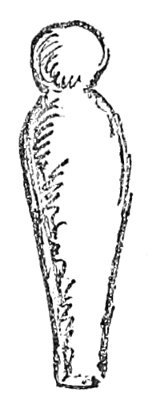
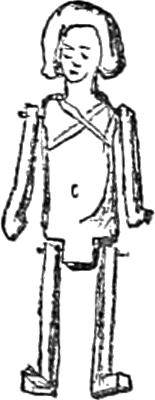
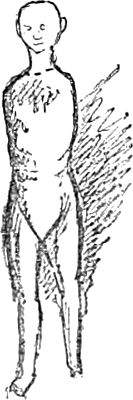
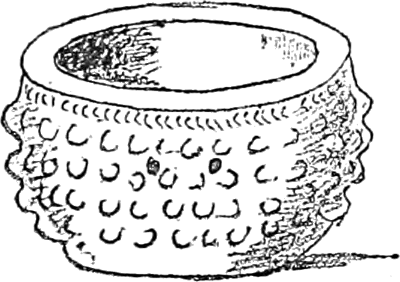
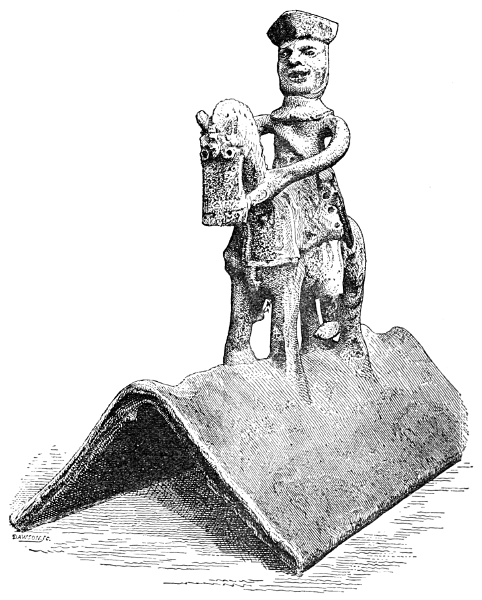
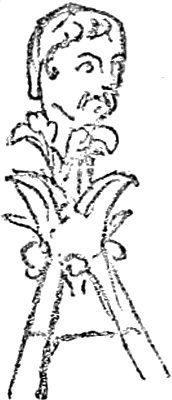
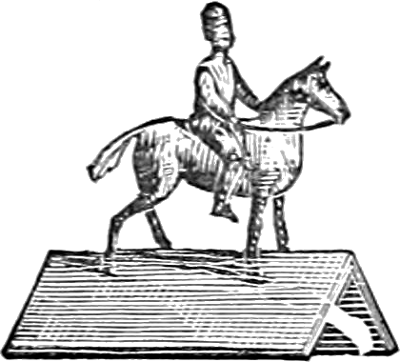
Fig. 1.—FIGURE FOUND
UNDER THE FOUNDATIONS
AT STINVEZAND.
When the north wall of the parish church of Chulmleigh
in North Devon was taken down a few years
ago—a wall of Perpendicular date—in it was found
laid a very early carved figure of Christ crucified to a
vine, or interlacing tree, such as is seen in so-called
Runic monuments. The north wall having been
falling in the fifteenth century, had been re-erected, and
this figure was laid in it, and the wall erected over it,
just as, in the same county, about the same time, the
wall of Holsworthy Church was built over a human
being. At Chulmleigh there was an advance in civilisation.
The image was laid over the wall in place
of the living victim.
When, in 1842, the remains of a
Romano-Batavian temple were explored
at Stinvezand, near Rysbergen,
a singular mummy-like object was
found under the foundation. This
was doubtless a substitute for the
human victim.
The stubborn prejudice which still
exists in all parts against a first
burial in a new cemetery or churchyard
is due to the fact that in Pagan
times the first to be buried was the victim, and in
mediæval times was held to be the perquisite of the
devil, who stepped into the place of the Pagan deity.
Every so-called Devil’s Bridge has some story associated
with it pointing to sacrifice, and sometimes to
the substitution of an animal for the human victim.
The almost invariable story is that the devil had
been invoked and promised his aid, if given the first
life that passed over the bridge. On the completion
of the structure a goat, or a dog, or a rabbit is driven
over, and is torn to pieces by the devil. At Pont-la-Ville,
near Courbières, is a four-arched Devil’s Bridge,
where six mice, then six rats, and lastly six cats, were
driven across, according to the popular story, in place
of the eighteen human souls demanded by the Evil
One.
At Cahors, in Ouercy, is a singularly fine bridge
over the Lot, with three towers on it. The lower side
of the middle tower could never be finished, it always
gave way at one angle. The story goes that the
devil was defrauded of his due—the soul of the
architect—when he helped to build the bridge, and
so declared that the bridge never should be finished.
Of late years the tower has been completed, and in
token that modern skill has triumphed, the Evil One
has been represented on the angle, carved in stone.
The legend shows that the vulgar thought that the
bridge should have been laid in blood, and as it was
not so, concluded that the faulty tower was due to
the neglect of the Pagan usage.
The black dog that haunts Peel Castle, and the
bloodhound of Launceston Castle, are the spectres of
the animals buried under their walls, and so the
White Ladies and luminous children, who are
rumoured to appear in certain old mansions, are
the faded recollections of the unfortunate sacrifices
offered when these houses were first reared, not, perhaps,
the present buildings, but the original manor-halls
before the Conquest.
At Coatham, in Yorkshire, is a house where a little
child is seen occasionally—it vanishes when pursued.
In some German castles the apparition of a child is
called the “Still child;” it is deadly pale, white-clothed,
with a wreath on the head. At Falkenstein,
near Erfurth, the appearance is that of a little maiden
of ten, white as a sheet, with long double plaits of
hair. A white baby haunts Lünisberg, near Aerzen.
I have heard of a house in the West of England,
where on a pane of glass, every cold morning, is
found the scribbling of little fingers. However often
the glass be cleaned, the marks of the ghostly fingers
return. The Cauld Lad of Hilton Castle in the
valley of Wear is well known. He is said to wail at
night:
“Wae’s me, wae’s me,
The acorn’s not yet
Fallen from the tree
That’s to grow the wood,
That’s to make the cradle,
That’s to rock the bairn,
That’s to grow to a man,
That’s to lay me.”
At Guilsland, in Cumberland, is another Cauld
Lad; he is deadly white, and appears ever shivering
with cold, and his teeth chattering.
An allied apparition is that of the Radiant Boy.
Lord Castlereagh is said to have seen one, a spectre,
which the owner of the castle where he saw it admitted
had been visible to many others. Dr. Kerner
mentions a very similar story, wherein an advocate
and his wife were awakened by a noise and a light,
and saw a beautiful child enveloped in a sort of
glory. I have heard of a similar appearance in a
Lincolnshire house. A story was told me, second-hand,
the other day, of a house where such a child
was seen, which always disappeared at the hearth,
and sometimes, instead of the child, little white hands
were observed held up appealingly above the hearthstone.
The stone was taken up, quite recently, and
some bones found under it, which were submitted to
an eminent comparative anatomist, who pronounced
them to be those of a child.
Mrs. Crowe, in her “Night Side of Nature,” gives
an account of such an apparition from an eye-witness,
dated 1824. “Soon after we went to bed, we fell
asleep: it might be between one and two in the morning
when I awoke. I observed that the fire was totally
extinguished; but, although that was the case, and
we had no light, I saw a glimmer in the centre of the
room, which suddenly increased to a bright flame. I
looked out, apprehending that something had caught
fire, when, to my amazement, I beheld a beautiful
boy standing by my bedside, in which position he
remained some minutes, fixing his eyes upon me with
a mild and benevolent expression. He then glided
gently away towards the side of the chimney, where
it is obvious there is no possible egress, and entirely
disappeared. I found myself in total darkness, and
all remained quiet until the usual hour of rising. I
declare this to be a true account of what I saw at
C—— Castle, upon my word as a clergyman.”
When we consider that the hearth is the centre
and sacred spot of a house, and that the chimney
above it is the highest portion built, and the most
difficult to rear, it is by no means improbable that
the victim was buried under the hearthstone or jamb
of the chimney. The case already mentioned of a
child’s bones having been found in this position is by
no means an isolated one.
It would be impossible to give a tithe of the stories
of White Ladies and Black Ladies and Brown Ladies
who haunt old houses and castles.
The latest instance of a human being having been
immured alive, of which a record remains and which
is well authenticated, is that of Geronimo of Oran, in
the wall of the fort near the gate Bab-el-oved, of
Algiers, in 1569. The fort is composed of blocks
of pise, a concrete made of stones, lime, and sand,
mixed in certain proportions, trodden down and
rammed hard into a mould, and exposed to dry in
the sun. When thoroughly baked and solid it is
turned out of the mould, and is then ready for use.
Geronimo was a Christian, who had served in a
Spanish regiment; he was taken by pirates and
made over to the Dey of Algiers. When the fort
was in construction, Geronimo was put into one of
the moulds, and the concrete rammed round him
(18th Sept., 1569), and then the block was put into
the walls. Don Diego de Haedo, the contemporary
author of the “Topography of Algiers,” says, “On
examining with attention the blocks of pise which
form the walls of the fort, a block will be observed in
the north wall of which the surface has sunk in, and
looks as if it had been disturbed; for the body in decaying
left a hollow in the block, which has caused
the sinkage.”
On December 27, 1853, the block was extracted.
The old fort was demolished to make room for the
modern “Fort des vingt-quatre-heures,” under the
direction of Captain Susoni, when a petard which
had been placed beneath two or three courses of pise
near the ground, exploded, and exposed a cavity
containing a human skeleton, the whole of which was
visible, from the neck to the knees, in a perfect state
of preservation. The remains, the cast of the head,
and the broken block of pise, are now in the Cathedral
of Algiers.
The walls of Scutari are said also to contain the
body of a victim; in this case of a woman, who was
built in, but an opening was left through which her
infant might be passed in to be suckled by her as
long as life remained in the poor creature, after which
the hole was closed.
At Arta also, in the vilajet of Janina, a woman was
walled into the foundation of the bridge. The
gravelly soil gave way, and it was decided that the
only means by which the substructure could be
solidified was by a human life. One of the mason’s
wives brought her husband a bowl with his dinner,
when he dropped his ring into the hole dug for the
pier, and asked her to search for it. When she
descended into the pit, the masons threw in lime and
stones upon her, and buried her.
The following story is told of several churches in
Europe. The masons could not get the walls to
stand, and they resolved among themselves to bury
under them the first woman or child that came to
their works. They took oath to this effect. The
first to arrive was the wife of the master-mason, who
came with the dinner. The men at once fell on her
and walled her into the foundations. One version of
the story is less gruesome. The masons had provided
meat for their work, and the wife of the master
had dealt so carelessly with the provision, that it ran
out before the building was much advanced. She
accordingly put the remaining bones into a cauldron,
and made a soup of vegetables. When she brought
it to the mason, he flew into a rage, and built the
cauldron and bones into the wall, as a perpetual
caution to improvident wives. This is the story told
of the church of Notre Dame at Bruges, where the
cauldron and bones are supposed to be still seen in
the wall. At Tuckebrande are two basins built into
the wall, and various legends not agreeing with one
another are told to account for their presence. Perhaps
these cauldrons contained the blood of victims
of some sort immured to secure the stability of the
edifice.[3]
A very curious usage prevails in Roumania and
Transylvania to the present day, which is a reminiscence
of the old interment in the foundations of a
house. When masons are engaged on the erection
of a new dwelling, they endeavour to catch the
shadow of a stranger passing by and wall it in, and
throw in stones and mortar whilst his shadow rests
on the walls. If no one goes by to cast his shade on
the stones, the masons go in quest of a woman or
child, who does not belong to the place, and, unperceived
by the person, apply a reed to the shadow,
and this reed is then immured; and it is believed
that when this is done, the woman or child thus measured
will languish and die, but luck attaches to the
house. In this we see the survival of the old confusion
between soul and shade. The Manes are the
shadows of the dead. In some places it is said that
a man who has sold his soul to the devil is shadowless,
because soul and shadow are one. But there
are other instances of substitution hardly less curious.
In Holland have been found immured in foundations
curious objects like ninepins, but which are really
rude imitations of babes in their swaddling-bands.
When it became unlawful to bury a child, an image
representing it was laid in the wall in its place. Another
usage was to immure an egg. The egg had in
it life, but undeveloped life, so that by walling it in
the principle of sacrificing a life was maintained
without any shock to human feelings. Another form
of substitution was that of a candle. From an early
period the candle was burnt in place of the sacrifice
of a human victim. At Heliopolis, till the reign of
Amasis, three men were daily sacrificed; but when
Amasis expelled the Hyksos kings, he abolished
these human offerings, and ordered that in their place
three candles should be burned daily on the altar.
In Italy, wax figures, sometimes figures of straw,
were burnt in the place of the former bloody sacrifices.
In the classic tale, at the birth of Meleager, the
three fates were present; Atropos foretold that he
would live as long as the brand then burning on the
hearth remained unconsumed; thereupon his mother,
Althæa, snatched it from the fire, and concealed it in
a chest. When, in after years, Meleager slew one
of his mother’s brothers, she, in a paroxysm of rage
and vengeance, drew forth the brand, and burnt it,
whereupon Meleager died.
In Norse mythology a similar tale is found. The
Norns wandered over the earth, and were one night
given shelter by the father of Nornagest; the child
lay in a cradle, with two candles burning at the head.
The first two of the Norns bestowed luck and wealth
on the child; but the third and youngest, having
been thrust from her stool in the crush, uttered the
curse, “The child shall live no longer than these
candles burn.” Instantly the eldest of the fateful
sisters snatched the candles up, extinguished them,
and gave them to the mother, with a warning to take
good heed of them.
A story found in Ireland, and Cornwall, and elsewhere,
is to this effect. A man has sold himself to
the devil. When the time comes for him to die, he
is in great alarm; then his wife, or a priest, persuades
the devil to let him live as long as a candle
is unconsumed. At once the candle is extinguished,
and hidden where it can never be found. It is said
that a candle is immured in the chancel wall of
Bridgerule Church, no one knows exactly where.
A few years ago, in a tower of St. Osyth’s
Priory, Essex, a tallow candle was discovered
built in.
As the ancients associated shadow and soul, so
does the superstitious mind nowadays connect soul
with flame. The corpse-candle which comes from a
churchyard and goes to the house where one is to
die, and hovers on the doorstep, is one form of this
idea. In a family in the West of England the elder
of two children had died. On the night of the funeral
the parents saw a little flame come in through the
key-hole and run up to the side of the cradle where
the baby lay. It hovered about it, and presently two
little flames went back through the key-hole. The
baby was then found to be dead.
In the Arabic metaphysical romance of “Yokkdan,”
the hero, who is brought up by a she-goat on a
solitary island, seeks to discover the principle of life.
He finds that the soul is a whitish luminous vapour
in one of the cavities of the heart, and it burns his
finger when he touches it.
In the German household tale of “Godfather
Death,” a daring man enters a cave, where he finds a
number of candles burning; each represents a man,
and when the light expires, that man whom it represents
dies. “Jack o’ lanterns” are the spirits of men
who have removed landmarks. One of Hebel’s
charming Allemanic poems has reference to this
superstition.
The extinguished torch represents the departed
life, and in Yorkshire it was at one time customary
to bury a candle in a coffin, the modern explanation
being that the deceased needed it to light him on his
road to Paradise; but in reality it represented an extinguished
life, and probably was a substitute for the
human sacrifice which in Pagan times accompanied a
burial. In almost all the old vaults opened in
Woodbury Church, Devon, candles have been found
affixed to the walls. The lamps set in graves in
Italy and Greece were due to the same idea. The
candle took the place of a life, as a dog or sow in
other places was killed instead of a child.
It is curious and significant that great works of art
and architecture should be associated with tragedies.
The Roslyn pillar, the Amiens rose window, the
Strassburg clock, many spires, and churches. The
architect of Cologne sold himself to the devil to
obtain the plan. A master and an apprentice carve
pillars or construct windows, and because the apprentice’s
work is best, his master murders him. The
mechanician of a clock is blinded, some say killed, to
prevent him from making another like it. Perdix,
for inventing the compass, was cast down a tower by
Daedalus.
It will be remembered that the architect of Cologne
Cathedral, according to the legend, sold himself to
the devil for the plan, and forfeited his life when the
building was in progress. This really means that the
man voluntarily gave himself up to death, probably
to be laid under the tower or at the foundation of the
choir, to ensure the stability of the enormous superstructure,
which he supposed could not be held up in
any other way.
An inspector of dams on the Elbe, in 1813, in his
“Praxis,” relates that, as he was engaged on a
peculiarly difficult dyke, an old peasant advised him
to get a child, and sink it under the foundations.
As an instance of even later date to which the
belief in the necessity of a sacrifice lingered, I may
mention that, in 1843, a new bridge was about to be
built at Halle, in Germany. The people insisted to
the architect and masons that their attempt to make
the piers secure was useless, unless they first immured
a living child in the basement. We may be very
confident that if only fifty years ago people could
be found so ignorant and so superstitious as to
desire to commit such an atrocious crime, they
would not have been restrained in the Middle Ages
from carrying their purpose into execution.
I have already said that originally the sacrifice
was offered to the Earth goddess, to propitiate her,
and obtain her consent to the appropriation of the
soil and to bearing the burden imposed on it. But
the sacrifice had a further meaning. The world
itself, the universe, was a vast fabric, and in almost
all cosmogonies the foundations of the world are laid
in blood. Creation rises out of death. The Norsemen
held that the giant Ymir was slain, that out of
his body the world might be built up. His bones
formed the rocks, his flesh the soil, his blood the
rivers, and his hair the trees and herbage. So among
the Greeks Dionysos Zagreus was the Earth deity,
slain by the Titans, and from his torn flesh sprang
corn and the vine, the grapes were inflated with his
blood, and the earth, his flesh, transubstantiated into
bread. In India, Brahma gave himself to form the
universe. “Purusha is this All; his head is heaven,
the sun is fashioned out of his eyes, the moon out of
his heart, fire comes from his mouth, the winds are
his breath, from his navel is the atmosphere, from his
ears the quarters of the world, and the earth is
trodden out of his feet” (“Rig. Veda” viii. c. 4,
hymn 17-19).
So, in Persia, the Divine Ox, Ahidad, was slain
that the world might be fashioned out of him; and
the Mithraic figures represent this myth. If we put
ourselves back in thought to the period when the
Gospel was proclaimed, we shall understand better
some of its allusions; with this notion of sacrifice
underlying all great undertakings, all constructive
work, we shall see how some of the illustrations used
by the first preachers would come home to those who
heard them. We can see exactly how suitable was
the description given of Christ as the Lamb that was
slain from the foundation of the world. As the
World-Lamb, He was the sustainer of the great
building, He secured its stability; and just as the
sacrifice haunts the building reared on it, so was the
idea of Christ to enter into and haunt all history, all
mythology, all religion.
We see, moreover, the appropriateness of the
symbol of Christ as the chief Corner-stone, and of
the Apostles as foundation stones of the Church;
they are, as it were, the pise blocks, living stones, on
whom the whole superstructure of the spiritual city is
reared.
With extraordinary vividness, moreover, does the
full significance of the old ecclesiastical hymn for the
Dedication of a Church come out when we remember
this wide-spread, deeply-rooted, almost ineradicable
belief.
“Blessèd city, heavenly Salem,
Vision dear of peace and love,
Who of living stones upbuilded,
Art the joy of heaven above.
Many a blow and biting sculpture
Polished well those stones elect,
In their places now compacted
By the heavenly Architect.
Christ is made the sure foundation
And the precious corner-stone,
Who, the twofold walls uniting,
Binds them closely into one.”

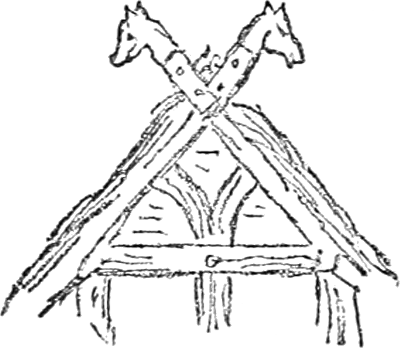
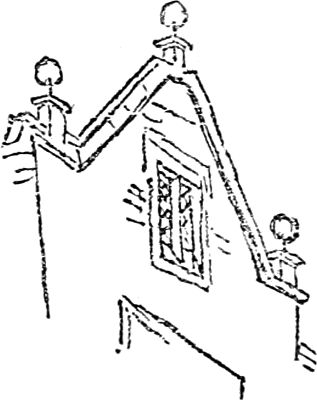
 ;
but there are just three ways in which the apex can
be treated. When the principals are first erected
they form an x,
 , the upper limbs shorter than the
lower. Sometimes they are so left. But sometimes
they are sawn off, and are held together by mortices
into an upright piece of timber. Then the gable
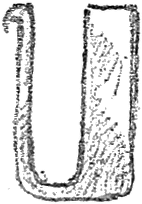
represents an inverted
 . If the ends are sawn
off, and there be no such upright, then there remains
an inverted v, but, to prevent the rotting of the ends
at the apex, a crease like a small v is put over the
juncture,
 . These are the only three variations conceivable.
The last is the latest, and dates from the
introduction of lead, or of tile ridges. By far the
earliest type is the simplest, the leaving of the protruding
ends of the principals forming

 , the
crook-legged cross found on so many monuments of
antiquity, the Svastika of India, represents an
instrument for the production of fire by friction.
But owing to the great difficulty in producing
fire by this means, the greatest possible care
was taken of the household fire, lest it should
become extinguished. This originated the worship
of Vesta. The flame once procured was
guarded against extinction in some central spot by
the unmarried women of the house, and when villages
and towns were formed, a central circular hut was
erected in which a common fire was maintained, and
watched continuously. From this central hearth all
the hearths of the settlement were supplied. Ovid tells
us that the first temple of Vesta at Rome was constructed
of wattled walls, and roofed with thatch like
the primitive huts of the inhabitants. It was little
other than a circular, covered fireplace, and was
tended by the unmarried girls of the infant community.
It served as the public hearth of Rome, and
on it glowed, unextinguished throughout the year,
the sacred fire, which was supposed to have been
brought from Troy, and the continuance of which
was thought to be linked with the fortunes of the
city. The name Vesta is believed to be derived from
the same root as the Sanscrit vas, which means “to
dwell, to inhabit,” and shows that she was the goddess
of home, and home had the hearth as its focus.
A town, a state, is but a large family, and what the
domestic hearth was to the house, that the temple of
the perpetual fire became to the city. Every town
had its Vesta, or common hearth, and the colonies
derived their fire from the mother hearth. Should a
vestal maiden allow the sacred fire to become extinguished,
she was beaten by the Grand Pontiff till her
blood flowed, and the new fire was solemnly rekindled
by rubbing together dry wood, or by focussing the
sun’s rays. It might not be borrowed from a strange
place. The circular form and domed roof of the
Temples of Vesta were survivals of the prehistoric
huts of the aborigines.