Precisely at what time the faithful and affectionate subjects of his
Majesty Ivan IV., Czar of all the Russias, conferred upon him his pet
name, "The Terrible," history neglects to inform us, but we are left in
no uncertainty as to the entire appropriateness of the title, which is
now inseparably linked with his baptismal name. He inherited the throne
at the age of three years, and his early education was carefully
attended to by his faithful guardians, who snubbed and scared him, in
the hope that they might so far weaken his intellect as to secure a
permanent control over him, and through him govern Russia as they
pleased. They made a footstool of him sometimes, and a football at
others, and, under their system of training, the development of those
qualities of mind and heart for which he is celebrated was remarkably
rapid. He was always Ivan the Terrified, and he became Ivan the Terrible
before he was old enough to have played a reasonably good game of
marbles, or to have become tolerably expert in the art of mumbling the
peg. Indeed, it seems that the young grand-prince was wholly insensible
to the joys of these and the other excellent sports in which ordinary
youths delight, and being of an ingenious turn of mind, he invented
others better suited to his tastes and character. One of these
pastimes—perhaps the first and simplest one devised by the youthful
genius—consisted in the dropping of cats, dogs, and other domestic
animals from the top of the palace to the pavement below, and
sentimental historians have construed these interesting experiments in
the law of gravitation into acts of wanton cruelty. Another of the young
czar's amusements was to turn half-famished pet bears loose upon passing
pedestrians, and it is the part of charity to suppose that his purpose
in this was to study the psychological and physiognomical phenomena of
fear. A less profitable way be had of accomplishing the same thing was
by throwing, or, as youthful Americans phrase it, "shying," stones at
passers-by, concealing himself meanwhile behind a screen. He cultivated
his skill in horsemanship by riding over elderly people, cripples, and
children. In short, his boyish sports were all of an original and highly
interesting sort.
Up to the age of thirteen Ivan was under the tutelage of a council, of
which the Prince Shnisky was chief, and it was this prince who
domineered over the boy and made a footstool and a football of his body.
At that age Ivan asserted his independence in a very positive and
emphatic way, which even the Prince Shnisky could not misapprehend. The
young czar was out hunting, accompanied by Shnisky and other princes and
boyards, among whom was Prince Gluisky, a rival of Shnisky's, who was
prejudiced against that excellent gentleman. At his suggestion, Ivan
addressed his guardian Shnisky in language which the latter deemed
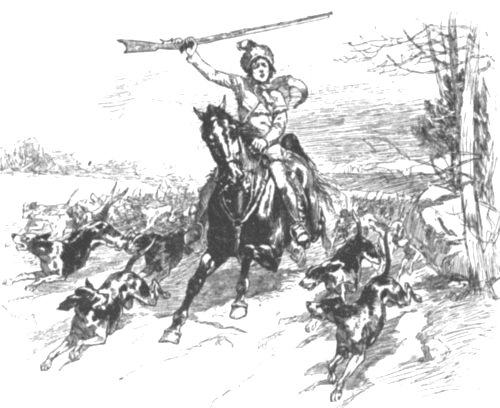
insolent. Shnisky replied angrily, and Ivan requested his dogs to
remonstrate with the prince, which they did by tearing him limb from
limb.
Having thus silenced the dictation of Shnisky, the young prince became
the ward of the no less excellent Gluisky, and was carefully taught that
the only way in which he could effectually assert authority was by
punishment. It was made clear to his budding intellect, too, that the
shortest, simplest, and altogether the best way to get rid of
disagreeable persons was to put them to death, and throughout his life
Ivan never forgot this lesson for a single moment. Power, he was told,
was worthless unless it was used, and the only way in which it could be
really used was by oppression. For three years no pains were spared to
teach him this system of ethics and politics, and the young prince, in
his anxiety to perfect himself in the art of governing, diligently
practised all these precepts.
When he was seventeen years of age he was formally crowned czar. The
citizens, ignorant of the truths of political economy and the principles
of governmental science underlying the young Czar's system, became
alarmed, and fired the city one night. When Ivan awoke, he was
terrified, being of an abnormally nervous temperament, and the
apparition of a warning monk, together with the influence of Anastasia,
the young czarina, led the czar to abandon the simple and
straightforward methods of government in which he had been bred, and for
thirteen years, under the dictation of Alexis Adascheff and the monk
Sylvester, Ivan devoted himself to the commonplace employments of
developing Russia politically and socially. He dismissed his ministers
and put others in their places. He reorganized the army; revised the
code, in the interest of abstract justice; equalized assessments;
subdued the Tartars; established forts for the protection of the
frontiers; laid the foundation for the future greatness of his empire;
began the work which was completed so grandly under Peter the Great;
introduced printing into Russia; added greatly to her possessions;
checked the abuses of the clergy; brought artists from western Europe,
and in a hundred ways made himself famous by doing those things which
historians love to chronicle.
Meanwhile, his genius for governing upon the Gluiskian system lay
dormant. It was not dead, but slept, and after its nap of thirteen years
it awoke one day, refreshed. Anastasia, the beautiful queen whose
influence had been supreme for so long a time, died, and Ivan was free
again. He recalled an old bishop who had been banished for his crimes,
and consulted him as to his future course.
"If you wish to be truly a sovereign," said this eminent prelate, "never
seek a counsellor wiser than yourself; never receive advice from any
man. Command, but never obey; and you will be a terror to the boyards.
Remember that he who is permitted to begin by advising is certain to end
by ruling his sovereign."
Here was advice of a sort suited to Ivan's taste and education, and for
reply he kissed the good bishop's hand, saying:
"My own father could not have spoken more wisely."
That the czar spoke sincerely, his faithfulness in following the
bishop's precepts abundantly attests.
His ministers and advisers being manifestly wiser than he, and therefore
not at all the proper kind of people to have about, he straightway
banished them. He then began a diligent search for their partisans, some
of whom he put to death, condemning others to imprisonment and torture.
He next turned his attention to his own household, which he was resolved
upon ruling absolutely, at least, if not well. One of the princes made
himself disagreeable by declining to participate freely in the pleasures
of the palace, and, for the sake of domestic harmony, Ivan had him
poniarded while he was at his prayers. Another so far overstepped the
bounds of courtesy and propriety as to remonstrate with one of the new
favorites upon his improper conduct, and Ivan, in order that there might
be no bickerings and hard feelings in his family, slew the discourteous
prince with his own hand.
He was in the habit of carrying an iron rod about with him, and he had a
playful way of striking his friends with it now and then, merely for his
amusement. His pleasantries of this and like sorts were endless. One day
Prince Boris, a boyard, came to pay his respects to the czar, and as be
bowed to the ground, according to custom, Ivan, seizing a knife, said,
"God bless thee, my dear Boris; thou deservest a proof of my favor," and
with that he kindly cut the nobleman's ear off.
When Prince Kurbsky, whom he had threatened with death, fled to Poland
and wrote him a letter thence, telling him pretty plainly what he
thought of him, the czar playfully struck the bearer of the missive with
his iron rod, as a preliminary to the reading of the letter, and the
blood flowed copiously from the man's wounds while Ivan pondered the
words of his rebellious subject. He then became convinced that the
boyards generally sympathized with Kurbsky, and to teach them better he
put a good many of them to death by torture, and deprived many others
of their estates. His alarm was very real, however, for he was a
phenomenon of abject cowardice. He therefore fled to a fortified place
in the midst of a dense forest, where he remained a month, writing
letters to the Russians, telling them that he had abdicated and left
them to their fate as a punishment for their disloyalty and their
crimes. Singularly enough, his flight terrified the people. He had
taught them that he was their god as God was his, and his flight to
Alexandrovsky seemed to them a withdrawal of the protection of
Providence itself. Business was suspended. The courts ceased to sit. The
country was in an agony of terror. A large deputation of boyards and
priests journeyed to Alexandrovsky, and besought the sovereign to return
and resume his holy functions as the head of the church, that the souls
of so many millions might not perish. Exacting of clergy and nobles an
admission of his absolute right to do as he pleased, and a promise that
they would in no way interfere with or resist his authority, he returned
to Moscow. Here he surrounded himself with a body-guard of desperadoes,
one thousand strong at first, and afterwards increased to six thousand,
whose duty it was to discover the czar's enemies and to sweep them from
the face of the earth. As emblems of these their functions, each member
of the guard carried at his saddle-bow a dog's head and a broom. As the
punishment of the czar's enemies included the confiscation of their
property, a large part of which was given to the guards themselves,
these were always singularly successful in discovering the disaffection
of wealthy nobles, finding it out oftentimes before the nobles
themselves were aware of their own treasonable sentiments.
Feeling unsafe still, Ivan built for himself a new palace, outside the
walls of the Kremlin, making it an impregnable castle. Then, finding
that even this did not lull his shaken nerves to rest, he proceeded to
put danger afar off by dispossessing the twelve thousand rich nobles
whose estates lay nearest the palace, and giving their property to his
personal followers, so that the head which wore the crown might lie
easy in the conviction that there were no possible enemies near on the
other side of the impregnable walls which shut him in. But even then he
could not sleep easily, and so he repaired again to his forest
stronghold at Alexandrovsky, where he surrounded himself with guards and
ramparts. Here he converted the palace into a monastery, made himself
abbot, and his rascally followers monks. He rigorously enforced monastic
observances of the severest sort, and no doubt became a saint, in his
own estimation. He spent most of his time at prayers, allowing himself
no recreation except a daily sight of the torture of the prisoners who
were confined in the dungeons of the fortress. His guards were allowed
rather a larger share of amusement, and they wandered from street to
street during the day, punishing, with their hatchets, such disloyal
persons as they encountered. They were very moderate in their
indulgences, however, in imitation of their sovereign, doubtless, and it
is recorded to their credit, that, at this time, they rarely killed
more than twenty people in one day, while sometimes the number was as
low as five.
But a quiet life of this kind could not always content the czar.
Naturally, he grew tired of individual killings, and began to long for
some more exciting sport. When, one day, a quarrel arose between some of
his guards and a few of the people of Torjek, Ivan saw at a glance that
all the inhabitants of Torjek were mutinous rebels, and of course it
became his duty to put them all to death, which he straightway did.
Up to this time the genius of Ivan seems to have been cautiously feeling
its way, and so the part of his history already sketched may be regarded
as a mere preliminary to his real career. His extraordinary capacity for
ruling an empire upon the principles taught him by the Prince Gluisky
was now about to show itself in all its greatness. A criminal of
Novgorod, feeling himself aggrieved by the authorities of that city, who
had incarcerated him for a time, wrote a letter offering to place the
city under Polish protection. This letter he signed, not with his own
name, but with that of the archbishop, and, instead of sending it to the
King of Poland, to whom it was addressed, he secreted it in the church
of St. Sophia. Then, going to Alexandrovsky, he told Ivan that treason
was contemplated by the Novgorodians, and that the treasonable letter
would be found behind the statue of the Virgin in the church. Ivan sent
a messenger to find the letter, and upon his return the czar began his
march upon the doomed city. Happening to pass through the town of Khur,
on his way to Novgorod, he put all its inhabitants to death, with the
purpose, doubtless, of training his troops in the art of wholesale
massacre, before requiring them to practise it upon the people of
Novgorod. Finding this system of drill an agreeable pastime, he repeated
it upon his arrival at the city of Twer, and then, in order that the
other towns along his route might have no reason to complain of
partiality, he bestowed upon all of them a like manifestation of his
imperial regard.
It is not my purpose to describe in detail the elaborate and ingenious
cruelty practised in the massacre of the Novgorodians. The story is
sickening. Ivan first heard mass, and then began the butchery, which
lasted for many days, was conducted with the utmost deliberation and
most ingenious cruelty, and ended in the slaughter of sixty thousand
people. Ivan had selected certain prominent citizens, to the number of
several hundred, whom he reserved for public and particularly cruel
execution at Moscow. Summoning the small and wretched remnant of the
population to his presence, he besought their prayers for the
continuance and prosperity of his reign, and with gracious words of
farewell took his departure from the city.
The execution in Moscow of the reserved victims was a scene too horrible
to be described in these pages. Indeed, the half of Ivan's enormities
may not be told here at all, and even the historians content themselves
with the barest outlines of many parts of his career. He thought himself
in some sense a deity, and blasphemously asserted that his throne was
surrounded by archangels precisely as God's is. Identifying himself
with the Almighty, he claimed exemption from the observance of God's
laws, and, in defiance of the fundamental principles of the Greek
Church, of which he was the head, he married seven wives. Believing that
he might with equal impunity insult the moral sense of other nations, he
actually sought to add England's queen, Elizabeth, to the list of his
spouses. And he was so far right in his estimate of his power to do as
he pleased, that the Virgin Queen, head of the English Church, while she
would not herself become one of his wives, consented to assist him, and
selected for his eighth consort Mary Hastings, the daughter of the Earl
of Huntingdon. She came near bringing about a marriage between the two,
in face of the fact that the two churches of which Ivan and she were
respectively the heads were agreed in condemning polygamy as a heinous
crime.
For one only of all his crimes Ivan showed regret, if not remorse. His
oldest and favorite son, when the city of Pskof was besieged by the
Poles, asked that he might be intrusted with the command of a body of
troops with which to assist the beleaguered place. Ivan was so great a
coward that he dared not trust the affection and loyalty of even his own
favorite child, and in a fit of mingled fear and rage he beat the young
man to death with his iron staff, saying, "Rebel, you are leagued with
the boyards in a conspiracy to dethrone me."
Remorse seized upon him at once, and his sufferings and his fears of
retribution were terrible. Finally he determined to abandon the throne
and seek peace in a convent, but the infatuated Russians entreated him
not to desert them. He died at last, in 1580.
Did Scheherazade herself ever imagine a stranger story than this? And
yet it is plain history, and is only a fragment of the truth.