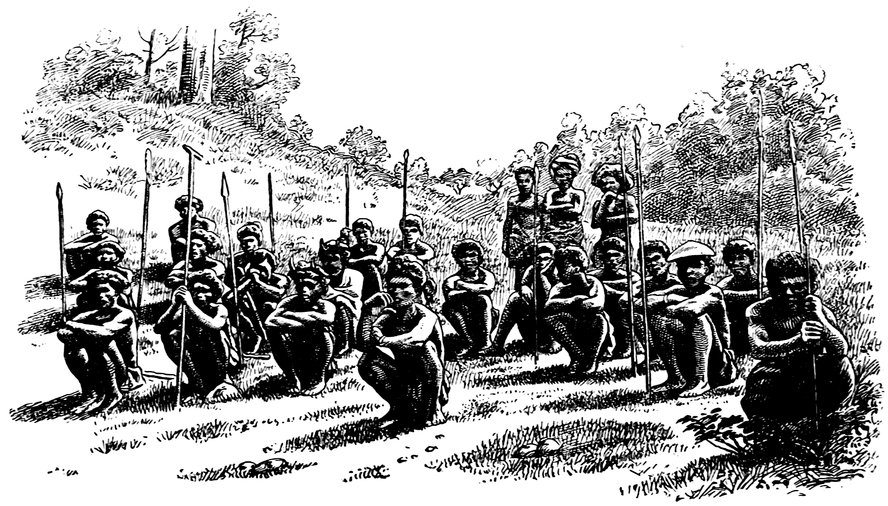
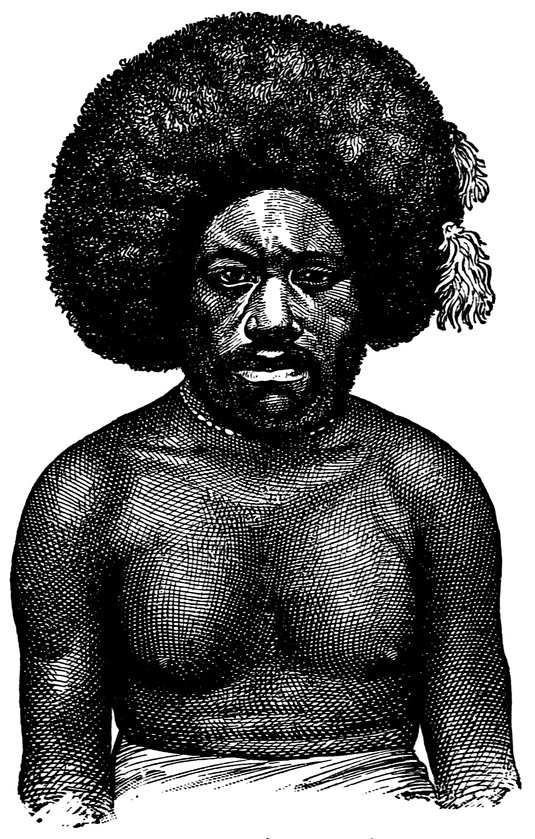
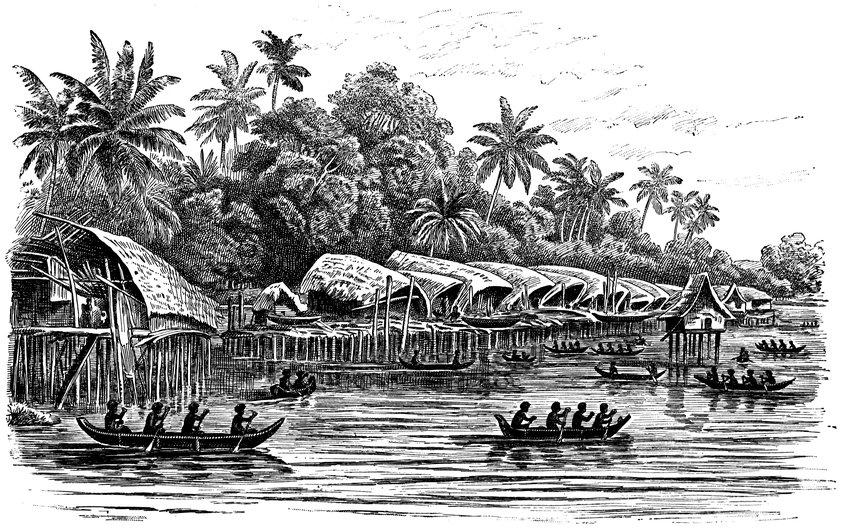
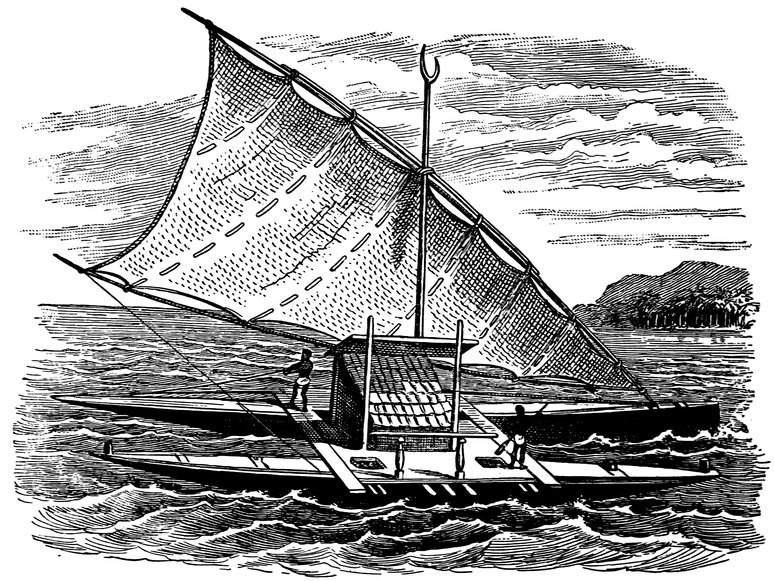
The cover image was created by the transcriber and is placed in the public domain.
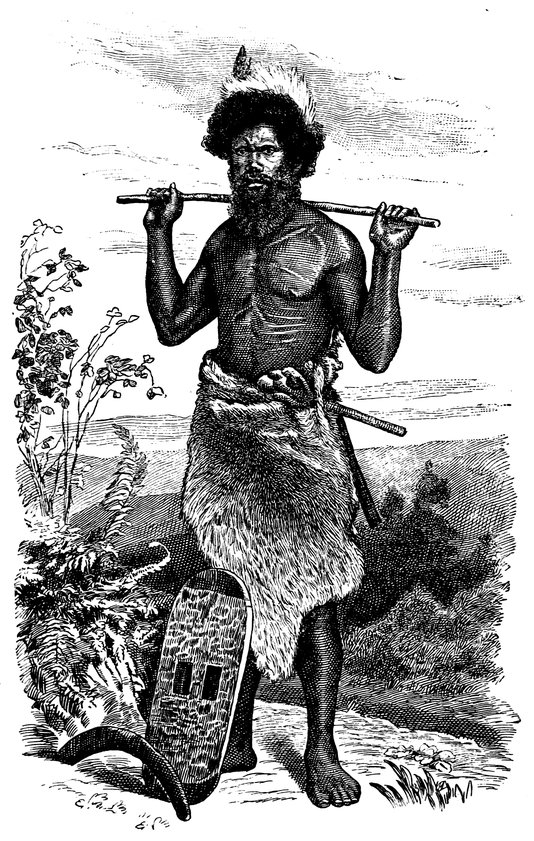
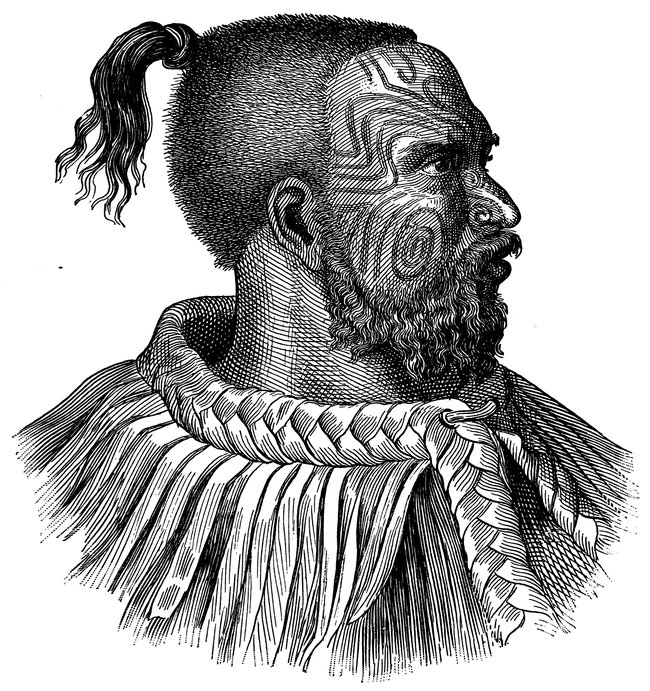
AUSTRALIAN (RATZEL).
Ethno-Geographic Reader, No. 1
BY
FREDERICK STARR
BOSTON, U.S.A.
D. C. HEATH & CO., PUBLISHERS
1901
Ethno-Geographic Readers.
BY FREDERICK STARR.
No. 1. STRANGE PEOPLES.
40 CENTS.
No. 2. AMERICAN INDIANS.
45 CENTS.
No. 3. HOW MEN DO.
IN PREPARATION.
D. C. HEATH & CO., Publishers
Copyright, 1901,
By Frederick Starr.
Plimpton Press
H. M. Plimpton & CO., PRINTERS & BINDERS
NORWOOD, MASS., U.S.A.
THIS BOOK
STRANGE PEOPLES
IS DEDICATED TO
WILLIAM FOSTER YOUNG
PREFACE.
v
The author claims no originality for the matter of
this book for young readers on Strange Peoples. He
has culled material where he could. His aim has been
to present a series of sketches which may render the
maps in the geography more interesting and give school
children a broader and deeper sympathy with other
races and peoples. Indebted to many books, he has
been under constant obligations to Verneau’s Les Races
Humaines and Ratzel’s Völkerkunde. Other books which
have been helpful will be found listed at the close of
this volume.
At first the author planned to use only original or
new illustrations. It has been, however, impossible
to carry out this plan. Less than one fourth of the
pictures are really new; it is believed, however, that
all are authentic and will prove instructive.
It would have been easy to make the book more
interesting by the introduction of descriptions, more
detailed, of the ridiculous or dreadful practices of some
races. The purpose has, however, not been to hold
other peoples up to ridicule nor to teach morality by
contrast; there are, indeed, too many matters for criticism
in our own mode of life to warrant such a treatment.
Nor would it be possible in a book for children
vito present that full discussion which might be expected
in a treatise on ethnology for students. The book
makes no pretence to systematic treatment; only a few
people are taken, here and there, almost at haphazard,
to illustrate the marvellous richness of the field for
study which, even now, is presented by the Strange
Peoples of the globe.
We are to read about some of the Strange
Peoples of the world. We shall find many curious
customs. There is an old saying,—
“Many men of many minds;
Many birds of many kinds;
Many fishes in the sea;
Many men who don’t agree.”
Peoples differ in so many ways. There are
tall Patagonians and short Bushmen. There are
white peoples, and black, yellow, and brown peoples.
There are peoples whose bodies are so
covered with hair as almost to be called furry,
and there are peoples whose faces even are hairless
except for eyebrows and eyelashes. There
are lively peoples and there are sluggish peoples;
gay peoples and sad ones. Negroes do not think
and feel like white men, and the Chinaman thinks
and feels differently from either. All peoples
have their own customs. When we speak of
other peoples as Strange Peoples, we must never
2forget that we are as strange to them as they are
to us. We think it curious that the Chinese
dwarf, by bandaging, the feet of their women;
they think it strange that we do not. To us the
Chinese face seems much too flat; the Chinese
think ours are like the face of an eagle and that
they are harsh and cruel. We think the flat,
wide nose of the negro is ugly; negroes think
it far handsomer than ours. So we will remember
that all these peoples are “strange” only
because they are unlike us: that we ourselves
are just as strange as they are. They have as
much right to their ideas and customs as we
have to ours: often indeed we might find theirs
better than our own.
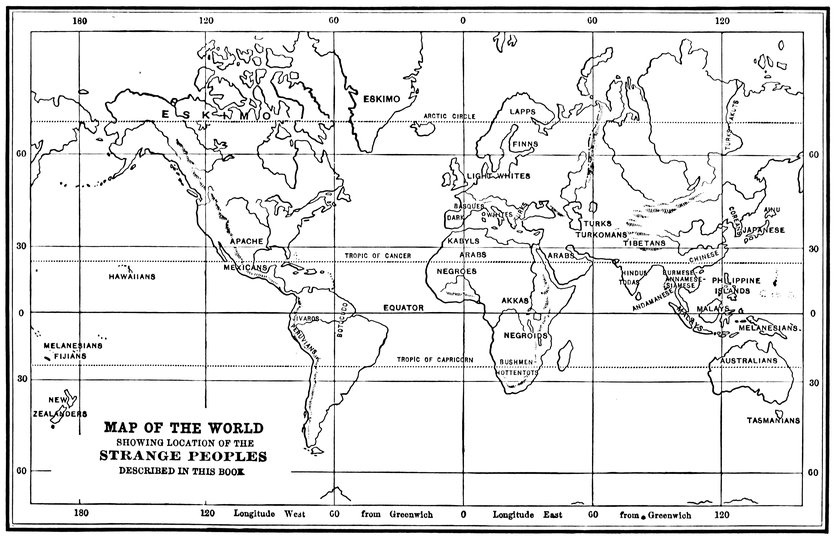
We begin with North America. We then
pass to South America; then to Europe, Asia,
Africa, and the Pacific Islands in order. We
shall find that the different peoples of the world
are not scattered haphazard; on the contrary, they
are quite regularly distributed by types. Thus
until lately the peoples living in America were all
Indians, with red-brown skin, straight and coarse
black hair, and high and wide cheek bones.
Europe and Northern Africa (which really belongs
rather to Europe than Africa) form the
land of the white peoples. South Africa—Africa
3proper—is the home of negroes and
negroids, with dark brown, almost black, skin,
narrow heads and faces, and woolly hair. The
proper population of Asia is yellow peoples, with
round heads, slant eyes, and straight, long, black
hair. In Australia are brown peoples with curly
or bushy hair. In Oceanica are several well-marked
types—the little brown Malays, the dark,
almost black, Melanesians with crinkly hair, and
the tall, well-built, fine-featured, light Polynesians.
This is, in general, the distribution of the human
races. But there has been much movement.
There are now both white and blacks in America;
the English whites have crowded in upon
the natives of Australia; in Asia there are white
peoples, like the Ainu and Todas, who have
certainly lived there a long time.
The different peoples are unlike in their culture.
Some peoples live on wild food, having
no cultivated plants or domestic animals. They
hunt animals and catch fish; they search for
birds’ eggs and honey; they grub up roots and
gather barks, leaves, fruits, seeds, and nuts for
food. To such tribes, who usually wander in
little bands from place to place, the name savage
is given. The word does not mean that
they are fierce and cruel in disposition; most
4savage tribes, to-day living, are neither. The
Eskimo and Mincopies are savages, but they are
quite kind and gentle. When peoples settle
down to cultivate the soil and build homes, or
when they raise herds of animals with which they
move from time to time for new pastures, their
life is easier. To such peoples—so long as they
do not know how to work iron by smelting, to
write by means of characters that represent
sounds, and to make animals assist them in tilling
the ground—the name barbarian is applied.
When any peoples have learned these three
great helps, they are called civilized. There are
then three great stages of culture,—savagery,
barbarism, and civilization. The Eskimo is in
savagery; the American Indians are mostly in
barbarism; the Chinese are in civilization.
The way in which the life of peoples is affected
by the lands in which they live is most interesting.
The Eskimo live in the cold north; there
is little wood there for construction; fuels such
as are used elsewhere are rare; no fibre-yielding
plants grow there. Yet the Eskimo has made
full use of what nature gives him. He builds his
house, when necessary, of the snow itself, heats
it with animal fats and oils, clothes himself in
excellent garments of skins, knows the ways of
5all the animals and birds around him for their
destruction, and has invented an ideal hunter’s
boat and devised a beautiful series of weapons
and tools. The way in which he has fitted himself
to the place in which he lives is wonderful.
The world over we notice the same thing: man
everywhere ransacks his home-land to find out
what is useful and turns it to his needs.
Often where two different peoples live in the
same district marriage takes place between them,
and mixed types arise. Where one people has
long occupied a country alone the type is very
well-marked, and all look alike. Thus in the
Andaman Islands, the little Mincopies look so
much alike that a person needs to know them
well to tell them apart. We, ourselves, are a
great mixture. Even in one family there may be
tall and short, light and dark, blue-eyed or brown-eyed
persons. Such differences are only found
where there has been much mixing between different
peoples. In Mexico, once purely Indian,
there has been since the coming of the Spaniards
much mixture, and to-day a large part of the
population is of a new type—part Indian, part
Spanish. The people range in color from almost
white to dark brown according to the amount of
Spanish or Indian blood each has.
II. THE PEOPLES OF NORTH AMERICA: ESKIMO.
6
For the larger part, North America is now
occupied by populations of our own kind. The
greater part of the people of Canada is of French
or English descent; the people of our own country
are mainly Europeans or of European descent.
There are of course many negroes, especially in
the South, who have descended from African
slaves. There are also some Chinese, Japanese,
Hindus, Malays, and others. Formerly the
United States and Canada were occupied by
Indians, but now there are few left, who mostly
live upon reservations. South of the United
States lie Mexico and Central America. They,
too, were Indian lands when first visited by
white men. In Northern Mexico a new, mixed
population live; Southern Mexico is yet quite
purely Indian. In Central America we find the
mixed Spanish-Indian in some districts, and pure
Indians in others. In the northmost part of the
continent live the Eskimo. We shall speak
about the Eskimo, wild Indians, and Mexicans.
The home-land of the Eskimo is dreary.
They live in Labrador, Greenland, and the Arctic
country stretching from Greenland west to
7Northern Alaska. Generally, it is a land of snow
and ice, where it is impossible to raise even the
most hardy plants. The people are forced to live
chiefly on animal food. Not only is the weather
usually cold, but for a large part of the year the
Eskimo do not see the sun, and for the rest of it
they see the sun all the time. In some districts
the swarms of mosquitoes in the warmer part of
the year are a great trouble. There are few trees,
and those are stunted; wood is precious, and
drift wood is carefully gathered to make into tools
and weapons. But notwithstanding his dreary
home the Eskimo are rarely ugly and ill tempered.
They are little people with yellowish brown
skin. Some Greenlanders are of fair stature.
Their faces are broad and round, with coarse
features. The eyes are small, dark, and often
oblique, like the Chinese; the nose is narrow at
the root, but fat; the cheeks are round and full;
the mouth is big, with good, strong teeth. Eskimo
are usually filthy and appear much darker
than they really are.
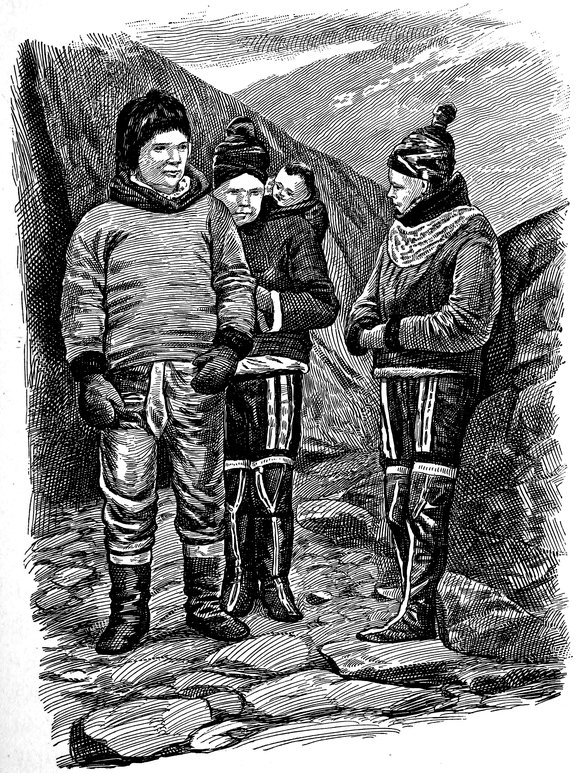
The clothing is generally made of skins with the
hair left on. Men and women dress much alike.
Trousers are worn by both: a shirt or jacket
with a hood attached is much used. That worn
8by men is often made of bird skins, and the
feather side is worn next the body. The lower
part of the legs and the feet are encased in kamiks,
skin socks and boots. The little babies are
carried naked in a great pouch at the back of
their outer jacket. This pouch makes a fine
nest for the little creatures, as it is lined with soft
sealskin or reindeer skin. Formerly—and perhaps
sometimes now—the Eskimo mothers used
to wash their babies by licking them with their
tongues.
In Greenland the Eskimo houses are usually
built of stones and earth. They are partly below
ground, and only the upper part shows outside,
like a mound of dirt. To enter the house one
crawls through a long and narrow passage, also
built of stones and earth, and which is also partly
below ground. The house is not large, and consists
of one room. It is lined with skins. Wide
benches around the sides, covered with skins and
moss, serve as beds. Several families live crowded
together in one house. One house in East Greenland,
measuring twenty-seven by fifteen feet, contained
eight families,—thirty-eight persons. The
houses are so low that a tall man cannot stand
upright in one. Until lately the only heating
was by stone lamps. These were flat and hardly
deeper than a plate: oil was burned in them.
They were kept burning day and night, and
above them were racks of poles on which wet
clothing was dried. In the middle part of the
Eskimo land they build the quaint round-topped
huts made of blocks of snow, of which you have
often seen pictures.
9
GROUP OF GREENLAND ESKIMO (NANSEN).
10The Eskimo eat the flesh of seals, whales, birds,
hares, bears, dogs, foxes, and deer. In that cold
country they like fat meat. Sometimes meat
and fish are eaten raw, but they may be boiled or
fried. Fresh, raw blubber is much loved. The
skin of whales, seals, and halibut is favorite food.
Travellers tell astonishing stories of the quantities
of candles and oil that Eskimo eat and drink
when they are supplied to them. The supply of
plant food is small: stalks of angelica, dandelion,
sorrel, berries, and seaweed are used.
The man’s great business is hunting. He has
studied the habits of the bear, deer, seal, and
walrus, and has learned just how to capture or
kill them. He has invented many curious darts,
harpoons, spears, bolas, etc. The bird spears
have several points projecting in different directions
from the shaft, so that if one misses, another
may strike, or several birds may be impaled at
once. The bolas consists of several pebbles
11attached to cords, which are knotted together
at the end. These are set to whirling and then
hurled through the air at birds to entangle them.
The point of the harpoon separates from the
shaft when an animal is struck; it remains in
the game while the shaft floats on the water; the
point is connected by a line to a bladder, which,
floating, shows where the animal goes, and helps
to tire him out. In hurling harpoons and darts
the Eskimo uses a spear-throwing stick which
enables him to send them with more force and
directness than by his hand alone.
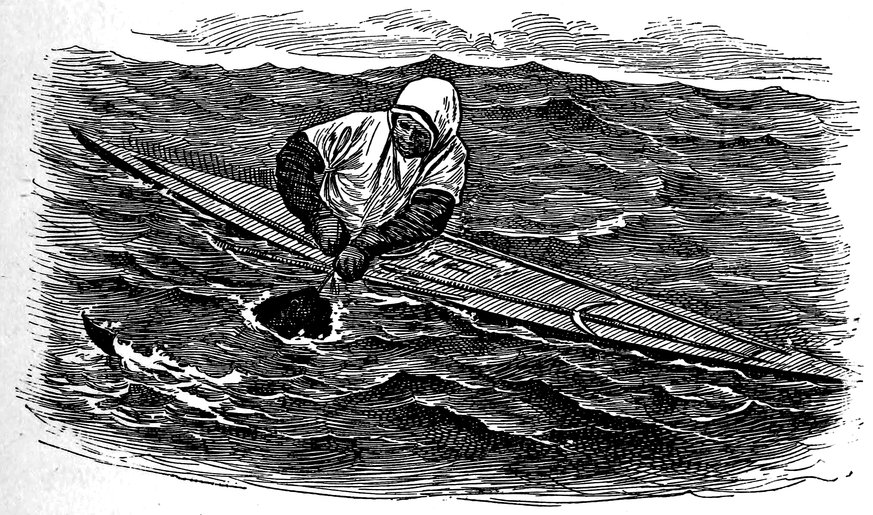
A GREENLAND ESKIMO FISHING (NANSEN).
Much of his hunting is done from his canoe
or kayak. This is narrow, sharp-pointed at both
12ends, and light. It consists of a slight framework
over which skins are tightly stretched.
The opening above is but large enough for him
to get his legs and body through. When he has
crept in, he ties a collar of skin, that surrounds
the opening, about his body, below his arms, to
prevent the water dashing into the kayak, and
paddles away. His different weapons are all
fastened in their proper places on top of the
canoe, where he can seize them when wanted.
The Eskimo are wonderful boatmen and drive
their kayaks over the waves like seabirds. If
they tip over, they easily right themselves.
Formerly the Greenland Eskimo made long
summer trips along the coast. The clumsy,
great, woman’s boat was brought out. The oldest
man, the women, children, and baggage went
in it. The younger men went in their kayaks.
In the big boat the women rowed while the old
man steered. They often went fifty miles a day.
At good spots they landed and built a tent of
thin skins. They loved these summer journeys
as our boys love their camping trips.
III. WILD INDIANS.
13
There are no really wild Indians left in the
United States. Formerly there were many tribes
of them, but some have disappeared, and others
have lost their old-time spirit. To-day our
Indians live idly on the reservations or work
their little farms with fair industry. Sometimes
a tribe, roused by new wrongs inflicted on it by
the white man, takes the war-path; sometimes
some religious idea goes from tribe to tribe creating
great excitement, like the Ghost Dance. But
such outbreaks and excitements are less and less
common.
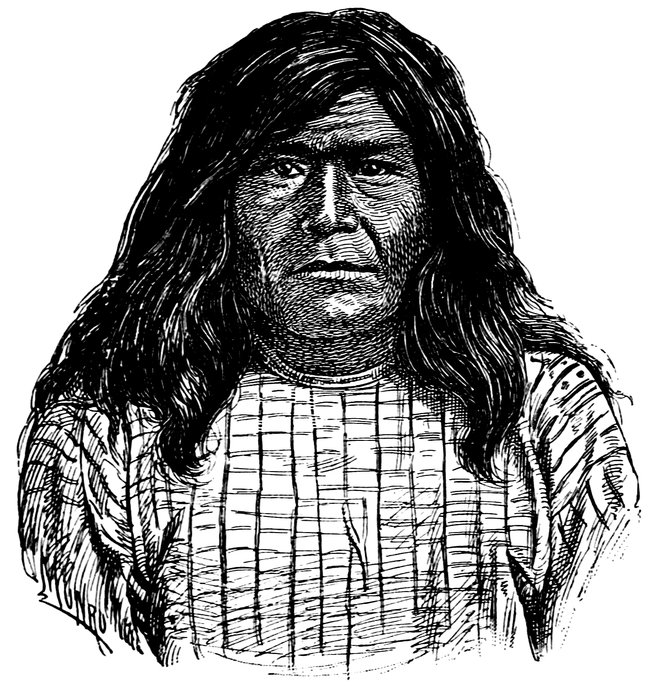
Mr. Lummis has written of the Apache warrior
and described the war led by Geronimo. It was
a daring thing. There was but a handful of the
Indians. “Thirty-four men, eight well-grown
boys, ninety-two women and children”—that
was all. Only forty-two who could be called
fighters. On May 17, 1885, the little band
broke forth from their reservation and headed
for Mexico. It took the United States a year
and a half of useless trouble and expense to
pursue them. Time after time, when it seemed
certain that the Indians were trapped, they
14vanished. They never stood for a pitched battle.
But anywhere, concealed behind rocks or hidden
in brush, they picked off the soldiers sent to
capture them. The forces of the United States
and Mexico were both kept constantly upon the
move. When a year had passed about sixty
of the Indians returned home. Twenty warriors,
with fourteen
women, kept up the
battle, when they
too went home.
During the year
and a half of fighting
more than four
hundred whites
and Mexicans were
killed; only two
of the Indian band
were destroyed.
During that time
Arizona and New Mexico and all the northern
part of Mexico were kept in constant terror.
These Apaches were truly “wild Indians.”
VICTORIO, AN APACHE WARRIOR (LUMMIS).
The Navajo are not wild Indians though they
are related to the Apaches and were formerly
bold fighters. They live near the settled Pueblos
and have learned from them many things. They
15are a prosperous tribe, numbering fully ten thousand.
They are well-to-do, having nine thousand
cattle, one hundred and nineteen thousand horses,
and one million six hundred thousand sheep and
goats. They dress well in their own way and
wear many ornaments.
A Navajo house is a simple affair. It consists
of sticks or poles stacked up so as to meet in a
point above; they are then covered over with
bark, weeds, or earth, a hole being left for an entrance
and one at the top for smoke escape: an
old blanket hung over the entrance hole serves
as a door. Near this hut there is often a little
shelter of boughs where the family spend most
of their time on fine days. The Navajo also build
sweat houses for vapor baths. These are like
the regular hut, but have no smoke hole, and are
thickly covered over with earth. Stones are
heated in a fire outside and carried into the sweat
house between sticks; water is dashed over them,
and in the steam thus made the bather sits.
The Navajo are good workers in silver and are
all the time improving in their art. They make
spherical beads, bracelets, and rings of several
sorts, breast ornaments, decorations for harness
and bridle, and many other things out of coins or
other silver furnished them. The Navajo excel
16as weavers of blankets, though they use extremely
simple looms. The yarn is home-spun from wool
taken off their own flocks; they do, however, buy
some yarn ready-made from the white man.
Formerly they dyed their yarn with dyes taken
from various plants or colored earths, but now
they mostly use white men’s dyes. Their blankets
are firm and closely woven and shed water finely.
They are woven in bright patterns. All the
Indians who live near the Navajo like their
blankets and pay good prices for them. The
Navajo greatly like turquoise beads, but they do
not find turquoise on their reservation. For these
beads and ornaments they trade their fine blankets,
and silverware, and good ponies with the Pueblo
Indians who live near the mines of this handsome
greenstone.
The Navajo are great singers and have many
songs; but it is the men who sing and not the
women. They have also many interesting stories
and curious customs, but we cannot stop to tell
about them. The Apaches and Navajo are but
two tribes out of the hundreds of American Indian
tribes. In another book, American Indians,
you may read about their manners and customs,
their songs and music, their stories and worship.
IV. MEXICANS.
17
Though Mexico is our next-door neighbor, life
and customs are greatly different there from our
own. Three different peoples make up the population.
First, are the pure-blood Spaniards, who
have been born in the country; second, there
are the Mestizos, mixed people, partly Indian,
partly Spanish; third, are the pure Indians, who
now form about five-twelfths of the whole population.
From the City of Mexico northward the
land belongs chiefly to the mestizos; from the
City of Mexico southward Indians prevail.
We will say nothing of the Spaniards nor of
the wealthy mestizos, both of whom are like European
whites generally in their life. But the poorer
mestizos in the cities and towns and the country
people generally are interesting. The dress of
the country gentleman was brilliant. It was of
broadcloth or soft-dressed leather, of a buff or
brown color. The little, close-fitting jacket, cut
square at the waist, was supplied with two lines
of silver or steel buttons, and embroidered with
patterns in gilt or silver thread. The trousers
fitted almost as a glove fits the hands, and there
was a double row of bright buttons up the sides
18of the legs and a lacing of silver cord. The
shoes, which were tan or buff, were sharp-pointed.
Unfortunately this handsome costume is not
common nowadays. All mestizos, rich and poor,
still use the serape, which is a long and narrow
blanket, usually of handsome, bright colors. In
putting it on, one corner is held with the hand at
the left shoulder, while the blanket is passed behind
the back and around the body in front; the free
end is then thrown over the left shoulder and
hangs down behind. It thus holds itself in place
and needs no tying or pinning. However poor a
mestizo may be, he wants a fine hat or sombrero.
Mexican sombreros have high, pointed crowns,
and wide brims. They are made of palm or
wool. Those of wool are of various colors—gray,
brown, black, sometimes red, blue, or green.
They are of all prices. They are decorated with
bands of silver or gilt tinsel, and true silver ornaments
are made in many forms for fastening to
them; a fine sombrero, well made and well decorated,
may weigh several pounds and cost many
dollars.
The Mexicans are highly polite in manner.
This is partly the result of Spanish training, but is
also partly due to the old Indian fondness for
ceremony. The movements of the hands and
19fingers by which they greet each other are graceful
and pretty. Friends, meeting each other,
warmly embrace. If a boy is spoken to by a
gentleman he politely removes his hat and holds
it while he is being addressed and while he answers.
Should a stranger ask a little Mexican
his name, with his hat off the boy would reply,
giving his name and adding, “Servidor de usted,
señor”—“your servant, sir.”
The houses of poor Mexicans are miserable.
The walls are usually built of great sun-dried
adobe bricks; there is but one room and that is
small. There are no windows and but one door;
the roof is flat and the floor is of dirt or stone.
Generally there is no bed and there may be no
table, and few if any chairs or stools. There are
usually some rush mats in the corner, which are
spread out upon the floor at night for sleeping on.
There are always a brasero and a metate. The
brasero is a little kettle-shaped earthenware stove,
where food is cooked over a wee fire of charcoal.
The metate is the grinding-stone, on which the
woman grinds corn-meal.
The three common foods of the Mexican poor
are corn-cakes, eggs, and beans—tortillas, huevos,
and frijoles. The corn after being well soaked
is ground on the stone; the woman, taking the
20lump of wet dough, throws it back and forth
from one hand to the other, turning it as she
does so around and around. In this way she
shapes a flat, thin, round cake which she bakes
upon a round pottery griddle. The eggs are
usually fried, so are the black beans, a great deal
of lard being used. Often they use no knives,
forks, or spoons in eating. The corn-cakes
themselves will be used in handling the eggs
and in scooping up the beans. After thus serving
as a fork and a spoon it will itself be eaten.
But rich people in Mexico have beautiful
homes. The outside, on the street, is quite plain.
The house surrounds a square court or space
which is called a patio. Passing through a great
doorway, one goes from the street into the patio.
All the rooms of the house open on the patio,
either directly or under pretty arched galleries or
corridors. The patio itself may be planted with
trees and shrubs bearing sweet flowers, and often
there is a fountain at the centre, with goldfish
in the basin.
Cages of birds are hung around the patio, or
under the corridors, and the little captives delight
with their brilliant colors or their sweet songs.
Every one in Mexico keeps birds as pets, and
you may see, even in the houses of the very poor,
21mocking-birds, doves, parrots, or clarins with
their clear, whistling note.
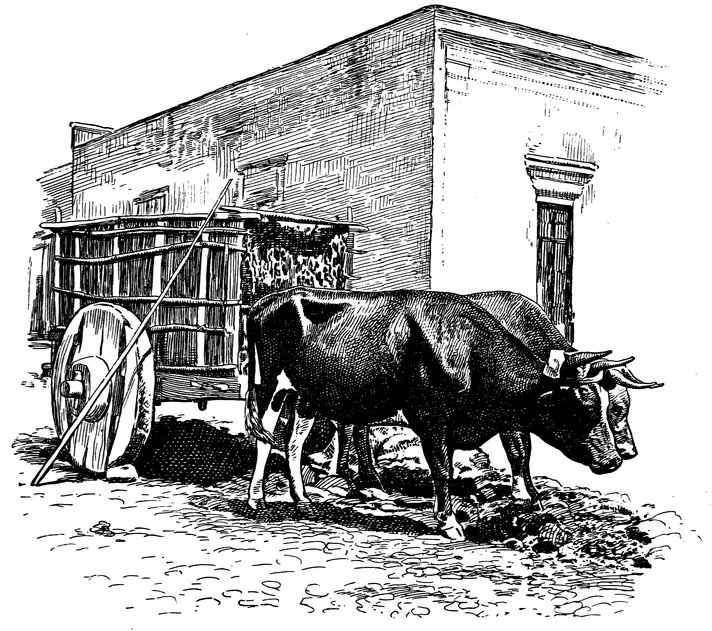
Wherever there are real roads in Mexico, there
you may see the quaint old-fashioned ox-carts with
wheels often made from solid blocks of wood cut
to shape. Two oxen are generally yoked to
each, but when heavy loads are to be dragged,
four, six, or even more are used at once.
A MEXICAN OX-CART (FROM A PHOTOGRAPH).
22
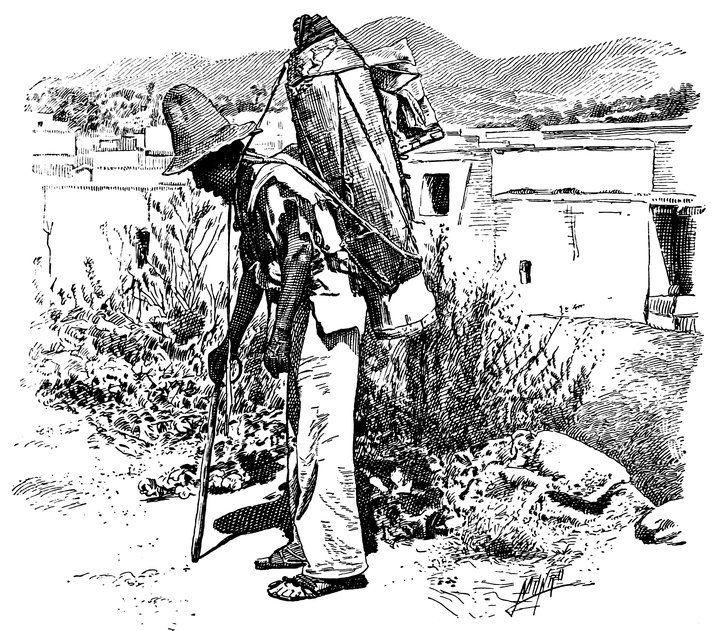
MEXICAN WATER-CARRIER (FROM A PHOTOGRAPH).
In Central Mexico water is precious, and in
the cities special men make it a business to sell
water from house to house. The water-carriers
of different towns greatly differ in the form
and size of the jars they use and in the mode
of carrying them. In the city of Mexico, where
they are becoming an uncommon sight, the
man carries two water-jars of metal, one in
front, one behind, hanging by straps from his
shoulders and cap; in Guadalajara a number of
round pottery water-jars are set into a sort of a
frame mounted on a cart or barrow; in San Luis
23Potosi there are four oval jars set into a wheelbarrow
with an enormous wheel; in Guanajuato
they use great slender jars nearly as tall as
the man himself, with a ring of wood at the
bottom to hold them when they are set on the
ground.
In the centre of every Mexican city or town of
any importance is the plaza or public square.
Sometimes this is surrounded by handsome buildings
and laid out with care as a garden. Among
orange trees laden with sweet blossoms and
golden fruit, rose bushes, banana trees, there
wind pleasant walks with benches in the shade,
where rich or poor may rest. Usually at the
centre of the plaza there is a band-stand where
on certain evenings every week fine concerts are
given.
The plaza is the pleasure-spot and gathering-place
of all. To it flock venders of all kinds,
with cakes, candies, fruits, sugar-cane, peanuts,
toys, etc. Some of the wares are strange, and
I am sure you could not guess them. There
goes a man with a lot of pretty colored balls like
wee toy balloons; they are red, white, blue, yellow;
they are chewing-gum! There is another
man with a great crumpled sheet of some whitish
brown stuff; children flock to him with their
24coppers, and he cuts off pieces which they walk
away munching; it is fried pigskin!
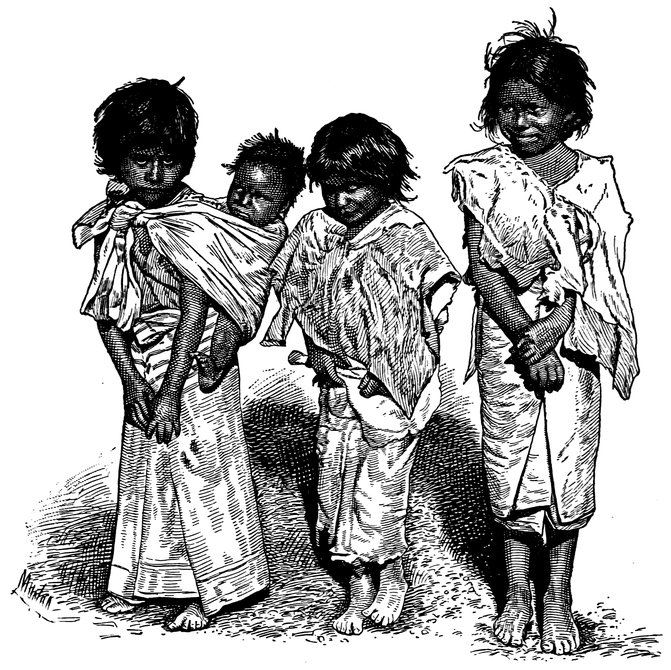
OTOMI INDIAN GIRLS (FROM A PHOTOGRAPH).
Mexicans delight in holidays, and they celebrate
a great many. The 2d of November, the
day of the dead, is a great day. For several
days beforehand thousands of strange toys have
been offered for sale. Some are skulls made
of sugar or clay; there are skeletons of various
sizes and materials, corpses, funeral processions,
25grave monuments. These are all called “deaths.”
When the day of the dead comes children expect
to receive these strange presents. When they
rise in the morning their first cry is, “Papa,
mamma, give me my death.” There is a great
excitement the day before Easter. All down the
streets may be seen figures of Judas hung up
above the heads of the passers. In the big cities
there will be hundreds of them of all sizes and
shapes. They are made of cardboard and paper,
and have fireworks inside. At a certain hour
they are all set on fire, and burn and explode at
a great rate, much to the delight of the boys and
girls. But these are only two of many occasions
during each year to which little Mexicans look
forward with delight.
We have spoken only of the mestizos. The
Indians are also interesting. There are many
tribes, all with their own customs, and many with
their old languages still in use. In the State
of Oaxaca alone there are fifteen languages still
spoken. Among the many Mexican Indian
tribes perhaps the Aztecs, Otomis, Tarascans,
Zapotecs, and Mayas are the best known.
V. SOUTH AMERICAN PEOPLES.
26
South America, like North America, was occupied
by Indians at the time of the discovery.
The tribes differed in appearance, language, and
customs, but all were true American Indians.
To be sure, some tribes were dark, others light;
some were tall, others short; some were true savages,
while others were almost civilized.
Probably the most advanced tribes lived along
the Pacific border. In Colombia, Ecuador, Peru,
Bolivia, and Chili many relics of ancient art and
many ruins of old buildings are found. Here and
there east of the mountains similar evidences of
culture are found, but they are less known. Best
known of all are those of Peru.
The ancient Indians of Peru were industrious
and hard workers. Their rulers, the Incas, were
called “the children of the sun.” The old Peruvians
had important towns and cities. They diligently
cultivated their fields and irrigated them
by great systems of canals. They wove capital
cotton cloth, from which they made good clothing.
Their cloth was often decorated with pretty inwoven
designs in colored threads. They tamed
and bred the llama, and trained it for a pack animal.
27They could not write, but kept accounts by
knotted cords called quipus. Differently colored
cords were used for different things, and knots of
varying sizes stood for varying numbers. Thus
an owner of llamas might use a white cord for
males, a reddish cord for females, and a yellow
cord for young. A simple knot might stand for
one, and larger knots might mean five, ten, or
twenty. In this way the herder might keep exact
account of his animals.
PERUVIAN ANTIQUITIES (RATZEL).
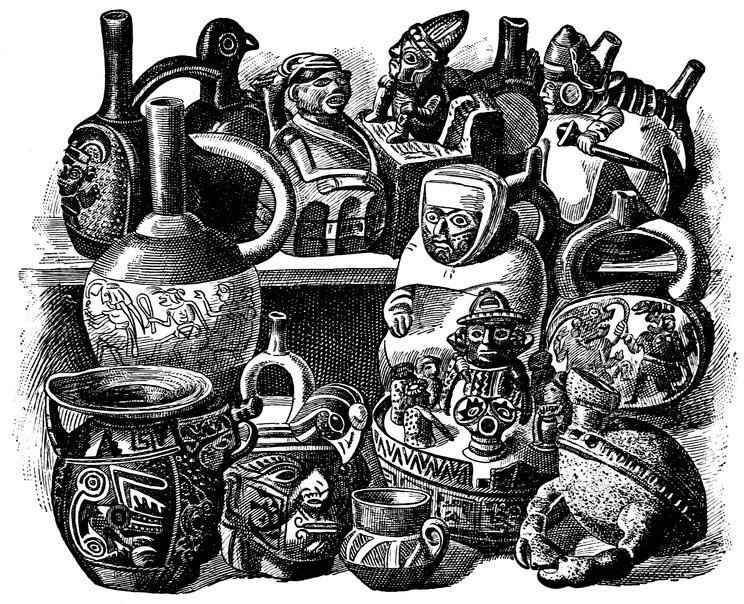
The old Peruvians were great potters and
thousands of their old water vessels and food
dishes, which were buried with the dead, have
28been dug up. These had curious forms and
were often adorned with colored patterns. Some
of these jars were shaped like human faces,
human figures, or animals. Sometimes they
were “whistling jars,” which were so made that
they whistled when water was poured in or out of
them. The old Peruvians were skilled in working
copper, silver, and gold, and made many
ornaments and figures in these metals.
They disposed of their dead carefully, and
many of the dried bodies, or “mummies” have
been found in the ancient graves. The dead
were folded into a sitting position and bound;
they were then wrapped about with fine cloths.
After the last wrapping was in place, it was
painted, a false face was marked on the cloth or
placed over the proper place, and imitation ear
ornaments were hung at the sides of the head.
Many objects were buried with the dead,—vessels
of food and drink, and the objects
they had used in life,—with a woman, cotton,
spindle, and work-basket; with a man, weapons
and ornaments. The old Peruvians built fine
public buildings, and temples of stone and some
ruins of such buildings still remain.
After the discovery of America two nations
chiefly gained possession of South America—Spain
29and Portugal. Portugal secured what is
now Brazil; Spain gained almost all the rest.
The Spaniard settled chiefly where the native
tribes had already been living a quiet and settled
life. In those districts, just as in Mexico, there
was much mixture between the two peoples, and
to-day there is a large mestizo population, whose
mode of life has been influenced by that of Spain.
In Peru, Brazil, Chili, and the Argentine Republic
we find lands which are making progress, and in
whose beautiful cities are fine buildings, handsome
parks, and artistic statuary. It is a great mistake
to think of any of the South American countries
as uncivilized.
Still, even in countries like Peru and Chili,
centres of old and interesting settled life, there
are plenty of pure-blood Indians to-day. These
still keep up much of their old life and customs.
And when, instead of looking at the old culture
centres, we examine the tribes which were truly
wild at the time of the conquest, we find little
change. On the eastern slope of the Andes, in
the valleys of those streams which unite to form
the Amazon, in the dense forests which border
that mighty river itself, are many truly savage
tribes to-day—or, when not savage, in low barbarism.
Some of these tribes use the blow-gun
30in hunting. This is a tube, eight or ten feet
long, made from a cane or bored out of wood.
It is carefully straightened and smoothed on the
inside. The shaft of the little arrow used with
this is slender and ends in a sharp point; a tuft
of cottony material, which just fits the bore of the
blow-gun, is wrapped about the upper end of the
arrow and fastened. When the arrow is placed in
the blow-gun, this is raised to the lips, and a
sharp puff of air from the mouth sends the little
weapon on its way. These arrows go a long
distance and with great force; as they make no
noise they are especially good for bird-hunting.
The arrows not only kill by their sharpness, but
by poison, which is put on their tips. Several of
these Indian tribes know how to make deadly
poisons, chiefly from plants.
Many of these wild tribes delight in bright
feathers. They make necklaces, head-dresses,
arm-rings, bracelets, leg-bands, aprons, and capes
from them. Not that a single tribe makes all
of these many ornaments; some will use the
feathers in one way, others in another. Among
the tribes of Brazil, the Botocudo are famous for
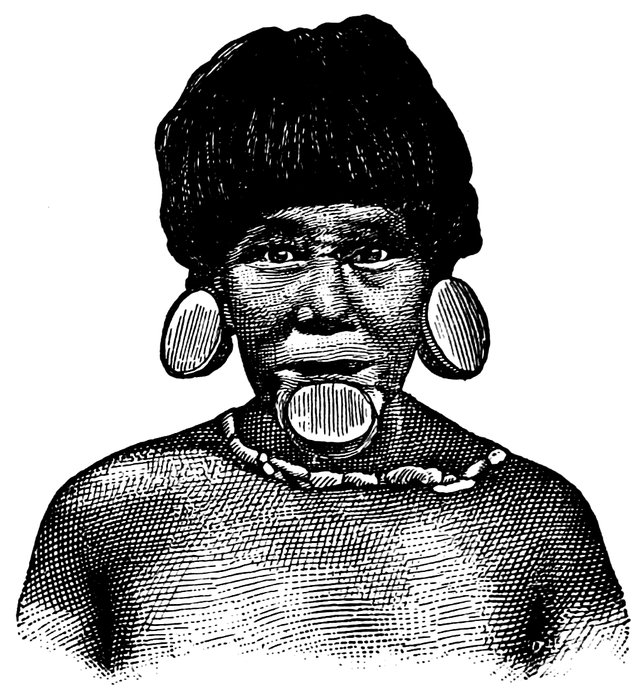
the ornaments they wear in their lips and ears.
These ornaments are mere disks or plugs of
wood, which are inserted in holes pierced in the
31ears and lower lip. Some Botocudo lip plugs
are three inches in diameter. Such a lip ornament
holds the lip out almost like a shelf.
BOTOCUDO INDIAN WITH LIP PLUG (TYLOR).
In eastern Ecuador and on the eastern slope
of the Andes, near the Amazonian headwaters,
are several tribes who cut
off the heads of slain
enemies as trophies. Best
known of these tribes are
the Mundurucus and Jivaros.
The Mundurucus,
after cutting off the heads,
paint the faces, comb the
hair, add feather ornaments,
and then so dry
the head that it retains its
natural size and form. The heads that are kept
by the Jivaros are even more curious. After
they have been cut off the bones of the skull
are removed piecemeal from below. The heads
are then shrunken by means of astringent fluids,
smoke, and pressure, until they are no larger
than the fist. The features retain their form,
but everything is reduced in size. It is hard
to believe, when seeing one of these, that it
could ever have been a full-sized human head.
Believing that the spirit of the dead man will
32curse them and thus harm them, the Jivaros
sew the lips of the trophy together with cords.
In Guiana some of the Indians make beautiful
baskets of split cane. The splints are sometimes
stained black or brown, and thus pretty patterns
are woven in color. These patterns look
like simple geometrical designs—diamonds,
meanders, etc.—but often they are really pictures
of snakes, monkeys, or human beings.
These tribes use cassava for making bread. The
roots or tubers, when first dug, are poisonous
and unfit for food. These are first grated on a
board set with sharp bits of stone. The shredded
or grated pulp is then packed into a great tube
of basketwork closed at the bottom. This is
hung to a beam and a pole is passed through a
loop at the lower end. By turning this pole the
basket tube is twisted, and the cassava pulp is
squeezed so tightly that the poisonous sap runs
out, leaving the wholesome flour.
VI. THE PEOPLES OF EUROPE: FAIR WHITES.
33
Europe is the continent of white peoples.
While there are white peoples in other continents,
they are there as invaders. But even among the
whites of Europe itself there are differences. Most
of the Northern peoples, like the Swedes, Dutch,
Russians, Germans, are light peoples, with delicate
skin, light hair, blue eyes, and rather long
heads. They are mostly tall in stature. The
Southern peoples are dark—Spaniards, Portuguese,
Italians, Greeks, are all brunettes. They
are shorter, more slender, with dark skin, dark
eyes, and black hair. In the region between these
two types of European whites there are peoples of
medium stature, rather stout, somewhat dark, with
broad, round heads. Mr. Ripley names these
three kinds of Europeans—Teutonic, Mediterranean,
and Alpine peoples. We will speak simply
of light whites and dark whites. All the
Europeans we have named speak languages that
are much alike, belonging to a group of languages
to which the name Aryan is given. There are,
however, some peoples of Europe who do not
speak Aryan languages. Such are the Basques,
Finns, Lapps, and Turks.
34All the fair whites are so like ourselves that it
will hardly do to call them Strange Peoples. Yet
we would find many curious things even in those
who are most like ourselves, as the Hollanders.
You know something about little Holland? It is
a low, flat country, and much of it was formerly
under the sea. The industrious Hollanders have
built great dikes or walls to keep the sea back,
and, by pumping out the water, reclaimed the
land. A rich and fertile land it is, intersected by
a network of little canals. Everywhere you go in
Holland you see windmills. Because the country
is so low and flat, there are no rapid streams
to furnish water-power for mills, so they must use
the wind. At some places, like Zaandam, hundreds
may be seen at once. With us windmills
are simply for pumping water, but in Holland they
do many kinds of work. Some are flouring mills,
others are sawmills for cutting timber, others run
oil presses, etc.
35
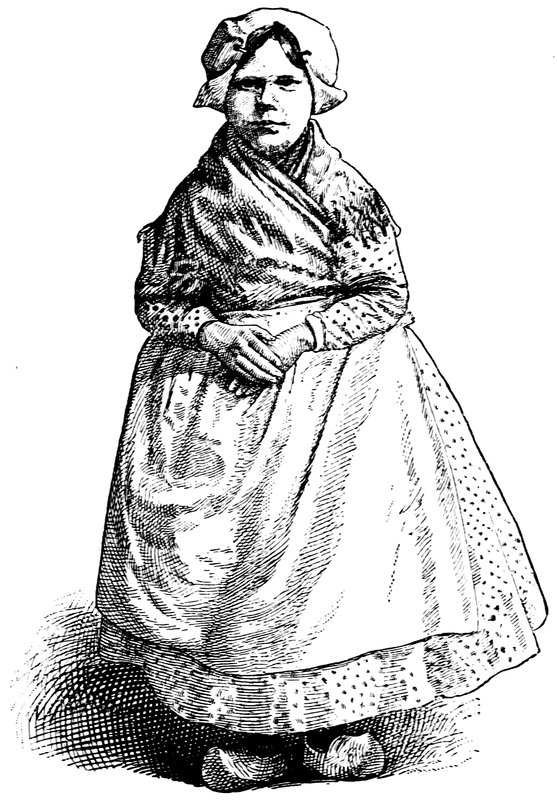
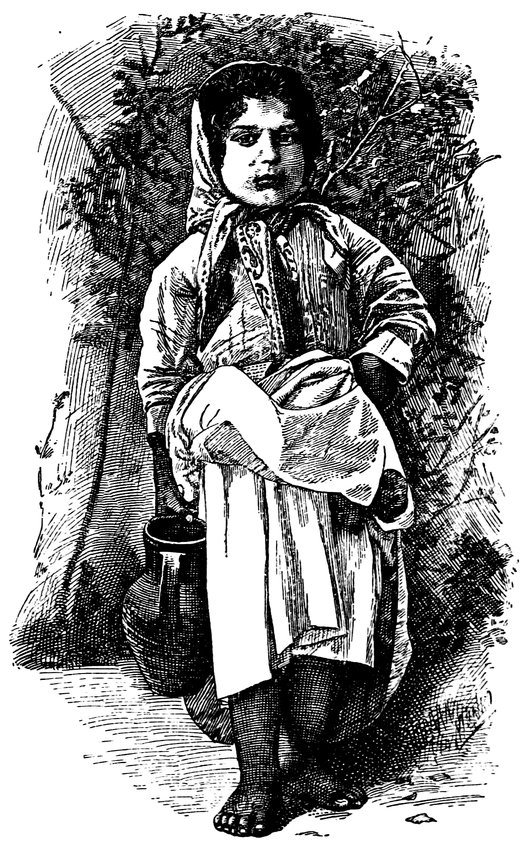
FISH-GIRL OF SCHEVENINGEN, HOLLAND (FROM A PHOTOGRAPH).
The fishing towns of Holland are interesting.
Every traveller wants to see Vollendam and
Scheveningen and the hamlets on the Island of
Marken. The men and women in these towns
are kind-hearted, simple people, who are proud of
their own village and think their own dress finer
than that of other towns. Each of these fishing
villages has its characteristic costume. The men
of the Island of Marken wear a close-fitting jacket
which ends at the waist and great, baggy, knee
pants. Marken women wear round, white caps,
fitting the head
closely, with an
open-work border,
and a bright
waist, with striped
sleeves, over the
front of which is
a square of handsomely
embroidered
cloth. Little
girls all through
Holland dress exactly
like women.
But for her child
face you would
take the little girl
from Scheveningen
to be a grown
person. She wears a dainty white cap pinned
on with two great round-headed pins. Her
ample dress quite reaches the ground; her white
apron is neatly tied, and her purple shawl, tightly
wrapped about her shoulders, is demurely crossed,
36and the ends are tucked under her apron strings.
She wears the common wooden shoes of the
country. A crowd of boys running in such
shoes over the hard paved roads makes a great
clattering. On Sunday the wooden shoes of men
and boys are usually fresh whitened; if their
owners enter a house, they leave the shoes outside
the door. I am sure you cannot guess
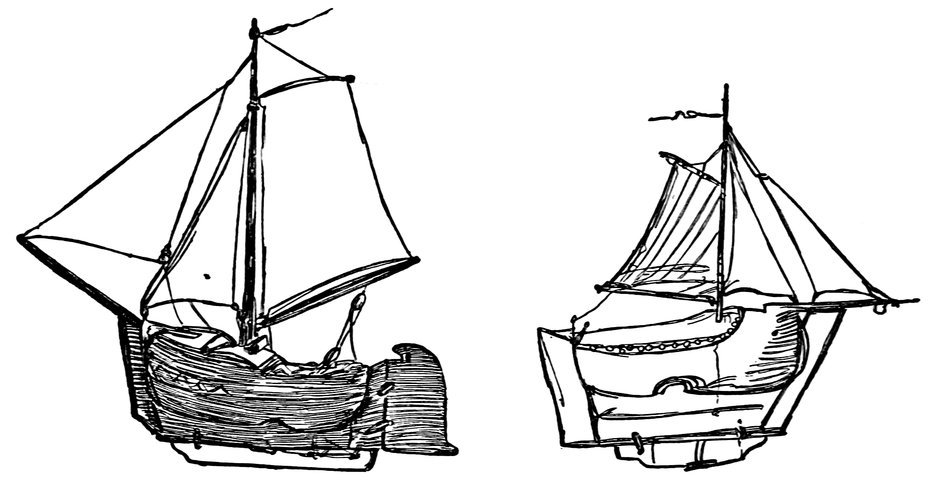
what little Dutch boys do with old wooden
shoes. They make capital little fishing boats
out of them, which they sail on the canal. The
real big fishing boats are really shaped very
much like shoes too.
BOATS MADE FROM SHOES, HOLLAND (HAITÉ).
Edam cheese is one of Holland’s famous products.
The people are wonderfully careful in making
it. They take great care of the cows; when
37the weather is wet or the flies troublesome, they
put blankets over them to protect them. The
stables where they keep them are as clean as soap
and water will make them; the stalls are made of
handsomely planed wood, and there is a window
at each one to let in light and to give the cows a
chance to look out on the green meadows. The
cheeses are made of cream and are pressed in
clean, white, earthenware moulds, into the shape
and size of cannon balls. They are then colored
and sent to market. The greatest cheese market
of Holland is at Alkmaar. Scores of boatfuls
are there unloaded every market day. The market
is at the water’s edge. The cheeses are colored
orange or red, and are oiled and wiped till they
shine. They are stacked in piles like cannon
balls.
Among famous Dutch towns is Delft, where
they make a beautiful white porcelain with blue
designs, which is a favorite everywhere: then
there is Schiedam, where they make “Schnapps,”
or gin, which is as famous probably as the Delft
ware, but not so praiseworthy; then there is
Haarlem, famous for its flower gardens, its tulips
and begonias; at Leiden there is a noble old
university and a museum where one may see
objects made and used by all the Strange Peoples
38we shall study and many more. Holland has had
many great artists, and their works are preserved
in the art galleries at Rotterdam, Leiden, The
Hague, Haarlem, and Amsterdam. Holland was
once the great commercial and naval nation of the
world: that day is past, but her ships still sail all
seas; the little kingdom is still a centre of intelligence,
industry, and education, and the thrifty and
wealthy Dutch are a worthy example of the Fair
Whites.
VII. DARK WHITES.
Among the dark whites of Europe the Portuguese,
Spanish, Italians, and Greeks are conspicuous.
In speech they are kin to each other, and
to the fair whites. How different they are otherwise!
They are handsomer in face, more lithe
and graceful in body, more quickly aroused, more
changeable in purpose, than the fair whites. Their
faces, their gestures, their movements, more emphatically
betray their emotions. They live more
in the present than the somewhat sober and sombre
northern peoples.
Just now people are apt to forget how much
we owe to the dark whites. They have done
much for the world. Greece taught Europe to
39think, developed an art and architecture which
impressed the world, formed a literature and
theatre that have never been surpassed; Rome
taught mankind government and law; Italy has
produced the greatest paintings; Spain discovered
the New World. These are a few of the
achievements of the dark whites. Nor are they
idle now; in Greece and Italy to-day, in Spain
and Portugal, art, invention,
literature,
and science are making
rapid progress.
ITALIAN CHILD (MILN).
Every one has seen
Italians. Those who
come to us are mostly
poor, and badly
represent their people.
They are dark
skinned, dark brown
or black eyed, black
and curly haired, and
have fine and regular
features. They are,
perhaps, the handsomest
of European
peoples. They love the company of others in
their work and play. They delight in bright
40colors, and the women fasten bright kerchiefs
about their dark hair, fold a brilliant cloth across
the breast, and hang gaudy earrings in their
ears. The Italian language is sweet and lively,
and the people who speak it are impulsive and
sunny in disposition, though easily angered, and
quick to resent an injury.
Perhaps old Rome was the greatest city the
world has known. The Roman people ruled the
known nations, and their armies and governors
were in all lands. Fine roads connected the city
with every part of the Empire, and fragments of
these roads still exist though almost two thousand
years have passed. Rome was a centre to
which flocked the painters, sculptors, poets, and
orators of the world; there they produced their
great works. At Rome were grand temples,
great public buildings, the mighty Coliseum
where public games were held. Ruins of these
famous structures are still visited, and show the
ancient grandeur of the dark whites of by-gone
days.
Not far from Rome are ruins of Pompeii and
Herculaneum, towns where many of the Romans
had their country homes. In the year 79, more
than eighteen hundred years ago, Vesuvius burst
forth in a terrible eruption and destroyed the two
41cities. Pompeii was buried under a sheet of
“ashes,” while Herculaneum was overflowed by
streams of lava. For centuries no one knew that
underneath these layers of “ashes” and lava a
great part of the two cities lay undestroyed.
Recently, by digging away the covering, they
have discovered many curious and interesting
things. House walls, paintings, tools, weapons,
ornaments, all remain to tell us how the ancient
Romans worked and lived.
But later Rome was also great. It was the
central city of Christendom, the seat of the Pope’s
power, the location of the Vatican. For this
reason it was the place where master minds dealt
with great problems, where great architects designed
wonderful cathedrals, where painters produced
the famous pictures of the world. Nor is
Rome small to-day. She is no longer the mistress
of the world; the temporal power of the
church has been lessened; but modern Rome is
still the capital of a great nation, a centre of
enlightenment, a hive of industry; a shrine to
which the lovers of art and beauty make their
pilgrimage.
Even the poorest and meanest in Italy love
music, painting, and statuary. Everywhere in
public places one sees sculptures in fine marble.
42Such works in our own land would run some
risk of injury or destruction, but in Italy no one
thinks of harming them. The Italians all love
music, and most of them know how to play some
instrument.
Italian mosaics and cameos are famous. At
Florence particularly the making of mosaics is
important. Mosaics are pictures made by fitting
together wee bits of stones, enamels, or glasses
of bright colors. A pair of cuff buttons or a
brooch may bear a spray of flowers, which looks
like delicate painting, but is really made by the
fitting together of these bits of stone. Cameos are
cut from shell or onyx. Many sea shells are composed
of layers of different colors of shelly matter.
Onyx is a stone which is layered with different
colors. A cameo is a piece of carving cut in
such materials so that the different colored layers
give different parts of the design. The work is
beautiful and delicate. Perhaps the finest cameo
cutting is done at Naples.
The Italian enjoys games. Several kinds of
ball games are favorites with him. He delights
in throwing dice and other games of chance.
Boys are fond of morra. There are two players:
at a given signal each extends one hand with a
certain number of fingers stretched out; at the
43same moment each calls how many fingers he
thinks both will have out. If either guesses
right, he wins. This is a very old game, and was
played in the time of Rome’s imperial grandeur.
The gayest time of the year for young and
old is the Carnival. Every one is on the streets.
They wear masks and are hideously dressed—like
clowns, deformed and distorted beings, devils,
animals. They make a great din and play all
kinds of pranks. They throw flowers and paper
cut to bits on one another and sprinkle passers-by
with water. Men, women, and children all take
part in this wild fun. The more ignorant Italians
are superstitious. They fear witchcraft and the
evil eye, and most of the lower class carry some
lucky stone or other object to protect them against
such dangers.
VIII. BASQUES.
On both sides of the Pyrenees Mountains, in
France and in Spain, there dwells a people which
does not speak an Aryan language, the Basques.
Many writers who have studied the Basque language
have wondered how it came to exist alone
in the midst of so many languages that have no
relation to it.
44The people who speak this language are called
French Basques or Spanish Basques according
to which side of the Pyrenees is their home.
They differ somewhat. The Spanish Basques
are usually short, clear-complexioned, with rather
long and narrow heads and brown or black hair.
The French Basques are frequently quite tall,
have much broader heads, and sometimes light
hair. Neither French nor Spanish Basques are
pure in blood, being much mixed with their
neighbors. Still, it is said that a Basque can
generally be known by his face. The upper,
forward part of his head is wide and bulging,
while his face is long, narrow, and ends in a
pointed chin.
The Basques are famous for their good health,
their fine forms, and their quick and graceful
movements. They are industrious, hard workers.
In the uplands the men are shepherds, in the
lowlands farmers and herders, and on the coast
fishermen and sailors. In the cities they work
at the docks, loading and unloading vessels.
Women work at this hard work just the same
as men. Formerly the men engaged much in
piracy. Basque women are much employed as
nurses in Spanish families.
They are a gay and happy people. Men play
45tennis, and women play skittles. Formerly they
had many dances; one only of these is still kept.
It is danced by men only, and though the steps
are difficult, the dance is slow and grave. They
delight in poetry and are able to compose rapidly.
Verneau says: “One may say that in the
land of the Basques every mountaineer is born
a poet, but the poetry is made up on the spur
of the moment. In the midst of the delights of
a feast, some one at the table rises. All noise
ceases. Complete silence is made about him.
He sings; the stanzas follow one another without
effort and without fatigue. His song is
grave and measured; both the air and words
are made at the moment.”
The Basques, especially those living in the mountains,
are proud, happy, and independent. They
are easily angered and quick to fight. They love
their old life and customs and dislike changes.
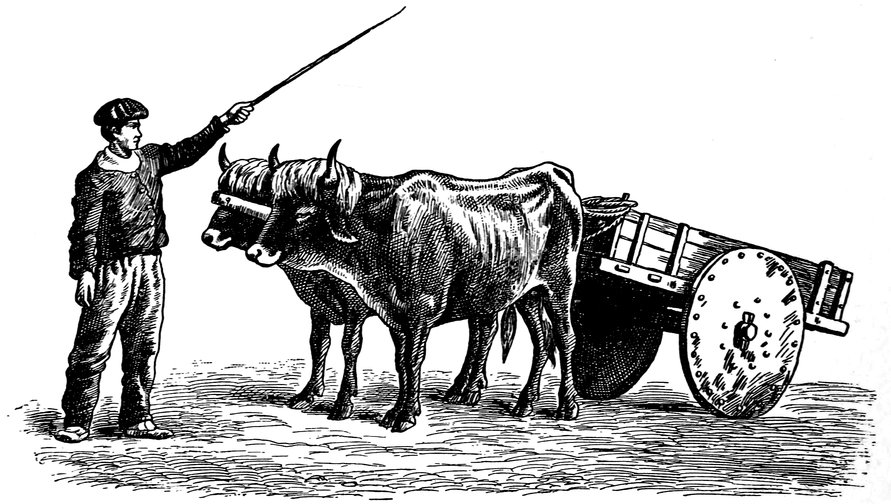
They still use many old-fashioned things such
as the clumsy ox-cart, with great, solid wooden
wheels and heavy wooden axle. The old dress has
disappeared in many places, but is picturesque.
Men wear rather loose and baggy trousers, a
close-fitting vest, a sort of blouse or jacket that
reaches only to the waist, a wide, white collar
turned down over the neck of the blouse, and
46a loose necktie with streaming ends. They wear
a loose cap jauntily on the head. Men and women
both delight in bright colors.
Their food is simple, but they are always ready
to share it with guests. Strangers are welcome
to the best the family has, which is generally
corn bread and cider, with bean soup and boiled
cabbage. They celebrate Christmas by killing a
pig, the flesh of which gives the family a feast for
a long time.
BASQUE CART (VERNEAU).
They are proud of their strange and difficult
language, which they call Euskaric. They call
themselves Euskaldanac, which means “the
speakers,” just as if other people using a different
speech did not know how to speak at all.
47The Basques have produced some famous
men. The great sailor Magellan, who circumnavigated
the globe and discovered the Philippines
in 1535, was a Basque. So were Ignacio
de Loyola and Francis Xavier, who founded the
Society of Jesus or the Jesuits. Within recent
years many of the Basques have left their old
home and gone to seek fortunes in new lands.
In all more than two hundred thousand have
migrated, some to Havana and Mexico, but many
more to Montevideo and Buenos Ayres.
IX. FINNS.
Finland, forming part of the Russian Empire,
is bordered on the south and west by the Baltic
Sea (Gulfs of Finland and Bothnia) and stretches
as a narrow band almost north and south. There
has been much discussion as to just what and
who the Finns are. Some writers think them
true white Europeans related to the long-headed,
fair whites; others believe them Mongolians who
have moved from Asia into Europe, where they
have changed their color and appearance—partly
by marrying with fair whites and partly by the
48influence of climate and other conditions—but
who retain their old Asiatic language.
Whichever is right, the Finns are an interesting
people. There are about one million and a
half of pure blood dwelling in Finland. There
are two quite unlike types,—the Tavastland and
Karelian Finns. The Tavastland Finns are
rather tall and large built, with a large and broad
head, a long and large face, light skin, light hair,
and large and light eyes. They are rather quiet,
a little morose though kindly, and have a great
love for their old life and customs. The Karelian
Finns are darker, with dark brown or black
hair and dark eyes. They were quite tall, but
less strongly built than the Tavastland Finns;
they have a longer head and smaller head and
face; they are more lively, gay, and enterprising.
It is the Karelians who more nearly resemble the
Finns of Asia, Ostiaks, and Samoyeds. Both
kinds of Finns, though differing in appearance,
speak one language, which is not Aryan, and is
related to the languages of Northern Asia. The
Lapps, Turks, and some other peoples of Southeastern
Europe speak tongues related to the
Finnish.
In the cities and towns of Finland the people
are much like their Swedish, German, and Russian
49neighbors. But in the small towns and villages
and in the country they retain many old
and curious customs. There they live in old-fashioned
houses or even older-fashioned tents.
The houses, built of logs, had low, broad, two-pitched
roofs and consisted of a single room;
there was one door and some small windows.
Only recently have they used glass in the windows.
The furniture is simple. Clothing and
other articles are hung on pegs against the wall
or over poles which are supported by hooks
from the roof. Big, ring-shaped loaves of rye
bread are hung up on these poles also. Outside
the house are several small buildings used
as store-rooms for treasures and the sweat-bath
house.
The old tents are now rarely seen. They were
circular, and their framework was made by setting
poles in the ground so that their upper ends met;
branches were worked in to fill the spaces between
these and form walls, and moss and turf
were tightly packed in to fill all openings. A
doorway was left and a smoke hole.
The sweat-bath house is found everywhere. It
is large enough to accommodate a good many
bathers at once. Two sets of wide benches run
around the inside of the house, one higher than
50the other: these are for the bathers to sit or lie
upon. They reach the higher benches or platforms
by means of a short ladder. In one corner
of this sweat-house is a dome-shaped oven or fireplace
built of stones. This is heated very hot,
and then dippers of water are thrown upon the
hot stones, until the steam fills the whole building.
The bathers bask in the vapor, rub and
strike themselves with bunches of birch twigs,
and then dash cold water over themselves. They
delight in these vapor baths, and every one—men,
women, and children—takes them. We would
not enjoy it much, for there is much smoke mixed
with the steam. Similar vapor baths are used in
Russia, and recently “Russian baths” have come
much into use among ourselves.
Like many other northern peoples the Finns
make many articles from birch bark. Boxes,
vessels, carrying sacks, and even shoes are made
from it. The climate of Finland is rather bad;
winters are long and severe. The people raise
some plants, but their agriculture is simple and
old-fashioned. They burn over the space to be
planted, work the ashes and soil with crude tools,
and plant the seed. Their crops sometimes fail
and terrible famines result. At such times they
have made bread from bark and roots crushed
51between rude grinding stones. Such bread is
called famine bread.
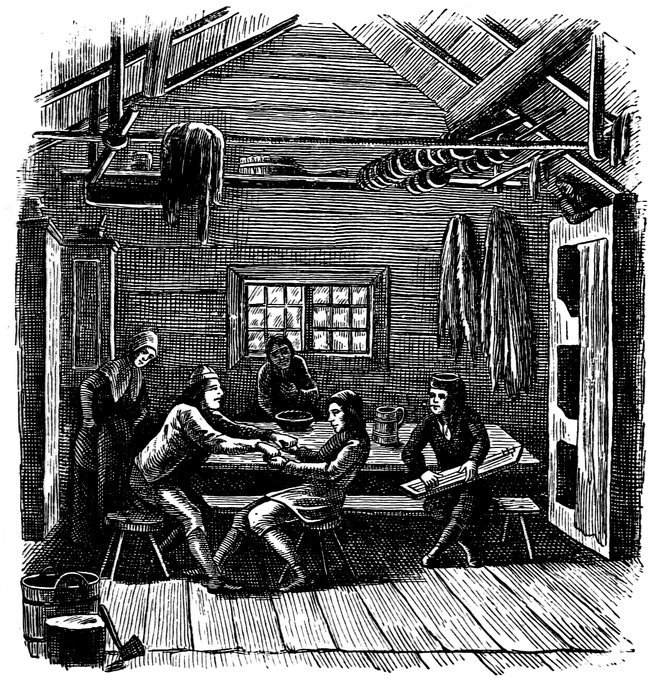
FINNS SINGING (VERNEAU).
The Finns love song and poetry. It is said
that every village has one poet, or more, and that
he prepares a new song whenever aught of importance
occurs. Besides these new songs they
have many ancient songs, of which they never
tire. When they sing the songs of the olden
time, two men seat themselves face to face upon
a bench, join hands, and rock backward and forward
in time to the song. First one sings a line
or passage, and then the other repeats the same,
52and so they continue, rocking back and forth and
singing the whole night through. Sometimes a
third man plays upon the kantele, while the
others sing. This kantele is somewhat like a
zither; it has a flat sounding-body upon which
are strung from three to eight strings of different
lengths. It is usually picked with the fingers
like a guitar. It is said that the first kantele was
made of fish-bones, though it is not easy to see
how that could be.
Until less than a hundred years ago, although
these old songs were much loved, no one had
written them down. They were learned by heart
from father to son, and thus kept alive through
the centuries. A man named Lönnrot became
interested in them and copied many of them
from the mouths of the singers. In 1825 he
printed a book of them, and later he gathered
and published still more. To this book of songs
he gave the name of the Kalevala. It is one of
the great poems of the world, and it tells of the
life and doings and beliefs of the Finns of the
old, old time. The style of the Kalevala is lively
and quite unlike most English poetry. In Hiawatha,
Longfellow copies this style; so when you
read Hiawatha again, remember that it is like the
old Finnish songs.
53The Finns are very fond of the Kalevala and
their other ancient songs. They are jealous, too,
of their old customs, and dislike to see them pass
away. They have some societies the purpose of
which is to keep alive a knowledge of the past
of Finland. But though the Finns love Finland
and its old life, they are not to-day an independent
nation. They were invaded long ago by
Sweden, and later on by Russia. For a time
Finland was a half-independent kingdom under
Russian control, but lately its power has been
again reduced, and it is part of Russia itself.
What we have said of the Finns is true of the
country people. In the cities things are much
the same as in other European cities. In Helsingfors
we should find one of the great universities
of Europe, and many educated and
distinguished men Finns by birth and language.
X. LAPPS.
In the northmost part of the Scandinavian
Peninsula and Finland live the Lapps. There
are probably not more than ten or twelve thousand,
all told. They have had much contact
with the Finns, and speak a language related to
54Finnish. In many customs they resemble them.
This is not strange, as the land they live in is
much the same.
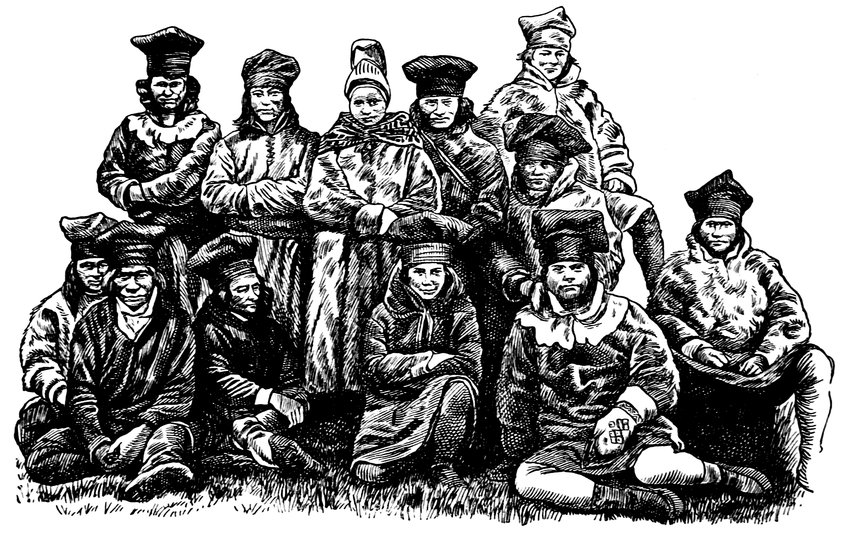
A GROUP OF LAPPS (VERNEAU).
But while all Finns are tall, the Lapps are
short. Most of the men fall below five feet.
Little and thin, they are yet strong and quick
in their movements. Their skin is dark, their
hair black and straight. Their heads are big
and broad, and they have good foreheads and
projecting cheek bones. Their eyes often seem
to slant downward at their outer corners. While
they are really dark skinned, they are not nearly
so much so as they appear, for they are usually
filthy. When their faces are washed, some of the
55women have quite fair skin and rosy cheeks.
Life is hard among the Lapps, but they often
live to be old—sometimes even to one hundred
years or more.
Those Lapps who live farthest away from the
Finns, Russians, and Swedes still wear the old
style of dress. In winter their garments are
made of reindeer hide: the hair, which is left on,
is worn next the body. Both men and women
wear big mittens of skin. They have caps on
their heads, and fishermen and herders may be
distinguished by the style of these. Fishermen’s
caps are pointed, while those of herders are square.
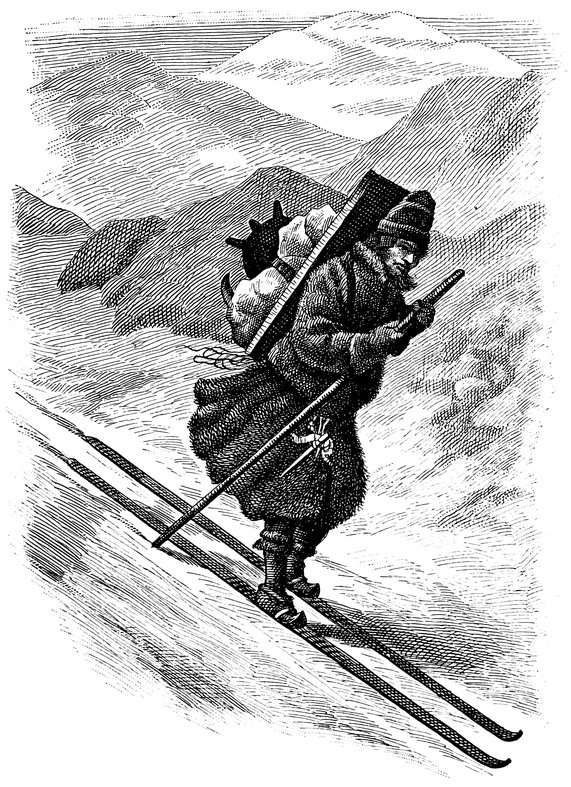
In going out over the snow in winter, Lapps have
long, narrow runners of wood fastened to their
feet, and carry a pole in their hand. These runners
are five feet or more in length, and only a
few inches wide, and on them—aided by their
poles—the Lapps glide along finely over the hard
snow.
Some Lapps are constantly wandering. Others
settle down in quite permanent homes. The wanderers
build tents similar in shape to those of our
Sioux Indians and of the Finns. A lot of poles
are set up in a circle with their upper ends meeting.
This framework is covered with a cloth or
with turfs. The settled Lapps live in houses, the
56framework of which consists of posts set upright
and poles lashed across. Small storehouses for
food are built near by, and these are set up on
four posts to keep the contents out of reach of
dogs and other animals.
When they greet each other, the Lapps rub
noses together. This mode of kissing is found
also among other northern peoples, like the
Samoyeds in Asia and the Eskimos in America.
Mothers cradle their babies in a sort of trough
hollowed out of a piece of wood. This they carry
on their backs when they journey, and hang on a
tree or set into a snowbank when they work.
Of course every one thinks of reindeer when
Laplanders are mentioned. And it is not strange,
because reindeer are useful indeed to these little
people. They furnish three useful things,—milk,
meat, and skins. The reindeer are kept in herds
and form almost the only wealth of their owners.
Some herds number perhaps a thousand reindeer.
These herds must be constantly watched. Men,
women, and children all help in the work, and the
many dogs kept by the Lapps are chiefly helpful
in guarding the herds. The women do the milking,
and each of the reindeer cows is milked twice
a day. They give little milk, hardly more than a
cupful at a milking, but it is rich and thick and
can be thinned with a good deal of water. Some
of the milk is drunk fresh, and from the rest the
women make a kind of cheese. When they wish
to milk a reindeer, they approach the animal carefully,
throw a lasso over its head and wind this
around the snout so as to hold the animal quiet.
The reindeer are also much used to carry burdens
and to drag sledges.
57
LAPLANDER ON SNOW-RUNNERS (VERNEAU).
58Besides the flesh and milk of the reindeer the
Laplanders eat its blood, which is boiled down
into a sort of pudding. The meat which is not
eaten fresh is dried and stored away. Fish are
dried and smoked. Birds and their eggs are much
eaten. Bread, much like the “famine bread” of
the Finns, is made from roots and barks. Soup
is made of pine bark mixed with fat and flour or
meal.
The Laplanders who live in settled houses depend
upon hunting during the fall and fishing
during the summer. They hunt reindeer, squirrels,
and birds. Wild reindeer they take chiefly
by pitfalls: they dig a hole, or trench, in the path
over which the reindeer is likely to pass, and carefully
cover it with branches, earth, and grass.
When the animals have fallen in, they are easily
killed. Lapps are fond of the eggs of water birds,
and to secure them they build nests for the birds
59in trees near the water, and then rob them after
the eggs have been laid.
The Laplanders are great believers in spirits.
To summon these they use drums or tambourines,
consisting of a ring of wood over which a membrane
is tightly stretched. This has jingling objects
fastened to it which make a noise when the
instrument is beaten or rattled. Upon the membrane
are rudely painted, curious figures, usually
in red. Thus the sun, animals, and human beings
are pictured, and are believed to help the drummer.
The Lapps greatly fear their god of storms.
He is believed to drive the storms forth from his
cave with a club and to bring them back with a
shovel. They fear him most at the season when
the young reindeer are born, and then pray to
him not to let loose the storms, lest the little creatures
perish. Through their sorcerers they secure
from this god, storm strings with three knots tied
in them. Each of these knots represents a storm.
If one knot is untied, a little storm is let loose; if
two are untied, a greater one; if three, there is a
fearful tempest. These strings are used against
enemies or those who have tried to do them harm.
The neighbors of the little Lapps think these can
do them much harm with their wind strings and
other magic, and they dread and hate them.
XI. TURKS.
60
With the Turks we pass from the peoples
of Europe to those of Asia, for the European
Osmanli Turks are only the most settled branch
of a large group of peoples, most of whom lead
wandering lives and live in Central and Northern
Asia. All speak almost the same language.
Formerly there was a great Turkish Empire,
which stretched from the borders of China to the
Caspian Sea. The present peoples of the Turkic
group live within this area and in European
Turkey. Among the most important of these
peoples are the Yakuts, Turkomans, Uzbegs,
Nogais, Cossacks, and Osmanli,—the latter being
the Turks of European Turkey.
We shall speak only of the Yakuts, Turkomans,
and Osmanli. The Yakuts occupy an area along
both banks of the Lena River and extending west
from it. They are wanderers and raise herds
of cattle and horses. They live chiefly on the
produce of their herds, eating horse flesh especially,
and making much cheese. Like many of
their neighbors they are fond of koumyss, a drink
prepared by fermenting mare’s milk. Those living
farthest north, near the delta of the Lena
61River, also hunt small animals for food. These
wandering herders, living in tents, are not quarrelsome;
they respect age, and the old men control
affairs and determine the time for moving camp.
Women are well treated by their husbands, but
one man may have several wives. In such cases,
the wives live each in a separate tent, and these
tents are placed about the tent of the husband.
Men pay the father of their wives, for these, with
cattle and horses. When a man among the
Yakuts dies, they dress him in his best clothing
and place in the grave with him his knife, a flint
and steel, some tinder, and a little food. The
burial is always under a tree, and two graves are
dug. In one the man is buried with his head
turned toward the west. The man’s favorite
horse is brought in his finest harness and loaded
with presents: a fat mare is also brought. These
are both killed and buried in the second grave
that they may accompany their master.
62
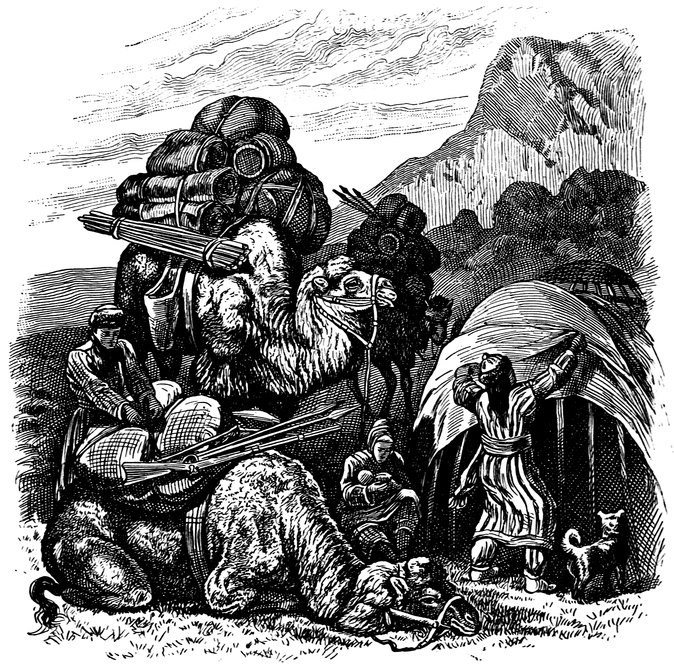
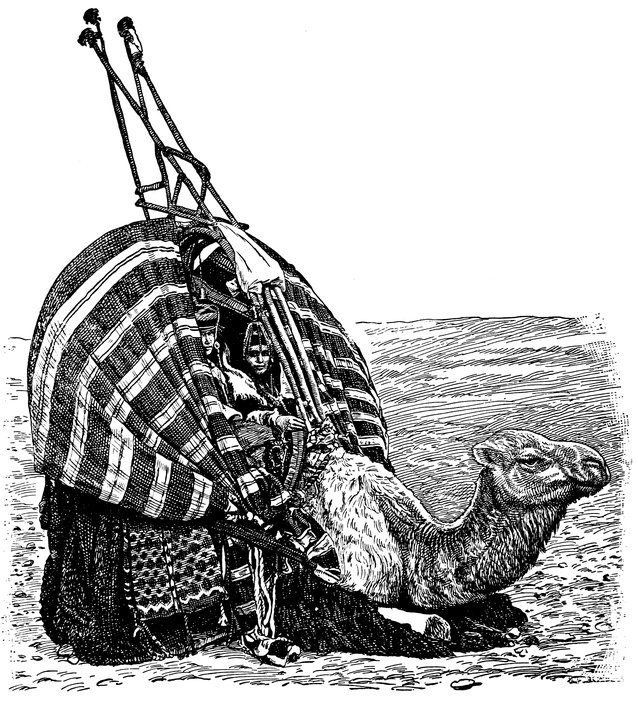
CARAVAN PREPARING TO START: ASIATIC TURKS (VERNEAU).
The Turkomans, who live in Southern Turkestan
and adjoining regions, are probably more like
the ancient Turks in appearance, than any of the
other Turkic tribes of the present. They are
somewhat tall, with a broad, rounded head, broad
face, prominent cheek bones, little slant eyes, a
low nose, rather thick lips, and projecting ears.
Their skin is yellowish, their hair is coarse and
black, and they have little beard. They delight
in bright clothing, and the women wear much
jewelry. It is said that they wear so many jingling
ornaments, that a party of passing women
make a noise almost like the tinkling of bells.
The Turkomans live in large, round, wall tents:
the light framework of poles is covered with great
pieces of felt. This felt is beaten by the women
63from sheep’s wool and camel’s hair. They are
comfortable within. The floor is often covered
with fine rugs or skins, and handsome woven
stuffs are hung upon the wall or thrown over the
sitting places. These fine articles are partly
woven by the women and partly stolen from passing
caravans—for the Turkomans are dreadful
pillagers. Until very lately they were also slave-hunters
and stole many Persian women to sell as
slaves. The Russian government has almost put
an end to this trade. The Turkomans raise
horses, sheep, and camels. They eat the flesh of
these animals and drink their fresh milk. Unlike
the Yakuts, they do not care for koumyss. When
an important man among the Turkomans dies,
they raise a heap of stones over his grave. If he
was a very pious man, they pay great respect to
his grave and consider it a holy spot. A man
who is ill or in trouble may visit this grave to
pray there; if he has an animal that suffers from
some disease, he leads it around the grave to cure
it. Such ideas about a pious man’s grave prevail
in all Mohammedan countries. All the peoples
of the Turkic group are Mussulmans, though
you would never think it from the way in which
Yakut and Turkoman women go about unveiled.
The Osmanli are the true Turks of Europe.
64Probably you would expect to see only Turks in
Turkey. That would be a great error, for really
only about one-tenth the population of Turkey is
made up of Turks. There are many Armenians
and Bulgarians, besides Greeks and others. The
Osmanli Turks do not look like Mongolians, but
their language and real blood relationship are
with the yellow Asians, rather than with the
white Europeans. It is not strange, however,
that they present so mixed a type; Turks have
long married with white slaves, and there is
much Caucasian blood—both European and
Asian—in their veins.
Constantinople is one of the most beautiful
cities of the globe, and is probably the most
important Mohammedan city. The mosques, or
places of worship, are everywhere and recognizable
by their pretty minarets. Friday and not Sunday
is the day of service. Daily prayers are required,
and the hours for prayer are called by the muezzim.
When the call is heard, no matter what he may
be doing, a good Mohammedan stops his occupation,
spreads his prayer cloth, faces the sacred
city of Mecca, and goes through his prayers.
The Turk is not industrious and lacks energy;
he enjoys ease and amusement. Perhaps a part
of this is due to his being a fatalist; he believes
65that what will happen, must happen; that he cannot
in any way change the course of events. So
why should he hurry and worry? He is fond of
trading, but even there is not in haste. In the
bazaars the seller and buyer haggle a long time
over the prices. The one never asks the price he
expects to get, but one much larger; the other
never expects to pay the price first asked, but one
much lower. Mohammedans who can afford to
keep them may marry four wives; they often own
many female slaves beside. These wives and slaves
live in a special part of the house called the harem,
where no visitors except women enter. When
Turkish women go upon the street they are closely
veiled, and none of their face except the eyes can
be seen. Mohammedanism permits polygamy, but
it forbids wine-drinking. While not all Turks
obey this command, they are usually temperate,
and drunkenness is rare.
XII. THE PEOPLES OF ASIA.
There has been much question as to where man
first lived. Some believe that the first men were
white and lived in Europe and North Africa;
others think the negroes of Africa are the oldest
66men; a few have argued that the American
Indian was the original race; most, however, have
thought that Asia was man’s first home. Whether
this is so or not, Asia to-day contains a swarming
population composed of many peoples, differing
much in appearance, dress, life, and customs.
The Asian peoples belong chiefly to the Mongolic
or yellow race. It is a well-marked type.
Medium stature, broad and round head, flat face,
with nose rather low, broad and high cheek
bones, hair coarse and straight and jet black,
skin yellowish, dark eyes apparently set slantwise
in the face, are its characters. The yellow race
includes the Chinese, Japanese, Coreans, the
peoples of Indo-China, and most of the wandering
tribes of Siberia. There are probably more
of this race than of any other on the globe; next
to them in numbers is the white race; then the
negroes; then the island peoples; last and least,
the American Indians.
Asia may justly be called the continent of
yellow peoples. But it would be a mistake to
think that no other peoples but Mongolic peoples
live there. In almost every part of the great
continent are peoples of white or Caucasic types.
Thus, in the far northeast of Asia we have the
curious Ghilyaks; in Japan, the Ainu; in China,
67various mountain tribes; in Southeastern Asia,
similar peoples; in India, the Todas. All these
tribes are white, bearded, with hairy bodies,
rather long heads, and straight eyes. These
tribes are small in numbers, rather quiet and
timid, with little energy, and quite unlike European
whites. They usually live in mountainous,
out-of-the-way places, and it almost seems as if
they are the scattered fragments of an ancient,
white population, who occupied much of Asia
before the yellow race was important, and who have
been crowded back and almost destroyed by it.
In India, Persia, and other parts of Western
Asia, are many white peoples who are like true
European whites in their Aryan languages and
in their forms and features. In Western Asia
there are, and long have been, many dark white
populations who are vigorous and active, with
features much more European than Mongolian.
These dark whites speak languages related to
each other, but not Aryan. To these peoples,
including the old Hebrews, and the modern Arabs,
and many other ancient and modern peoples, the
name Semites is applied. So you see that in
Asia there are not only the yellow, Mongolian
peoples, but three different kinds of whites,—the
ancient feeble race, the Aryans, and the Semites.
68Nowhere do we find more interesting ruins
telling of past grandeur than in Asia. We think
of Rome as old; of Greece as older; but in
Mesopotamia are ruins far older than those of
Greece and Rome. There are the ruins of Nineveh
and Babylon, so often mentioned in the
Bible. Both are old, but lately explorers have
found yet older ruins dating back six or seven
thousand years. And these are not ruins of
small and unimportant places, but of grand cities,
whose people were already civilized, with fixed
laws, curious religions, and many arts and industries.
Nowhere in the world have ruins of older
cities been found, and it is believed that the
people who built them were yellow Mongolians.
In Asia most of the great religions were born.
The oldest religious systems of which we know
were those of Mesopotamia. In India Buddhism
began. Buddha was a teacher who felt that the
old religion of India, Brahmanism, was wrong.
So he taught a new religion. There are more
believers in Buddhism to-day than in any other
religion. It is the chief religion of China, Japan,
Tibet, Southeastern Asia, and Ceylon; but in
India itself, where Buddha lived and taught, the
people are not Buddhists. In China there arose
a great teacher, Confucius. He taught no religion,
69but to-day there are Confucian temples all
through China. Judaism, the worship of Jehovah
by the Jews, began in Asia. There, too, in Judæa
also, Christianity was born. Christ dwelt and
taught there, and there the first Christian churches
were founded. But just as Buddha’s land is not
Buddhist, so Palestine to-day is not Christian.
It is a part of the Mohammedan world. Mohammedanism,
too, is Asiatic, beginning in Arabia
almost thirteen hundred years ago. Perhaps the
original home of man, Asia has certainly been
the first seat of civilization, and the cradle of
religions.
XIII. CHINESE.
Perhaps four hundred and twenty million people
dwell in the Chinese Empire and are called
Chinese. They are not, however, all true Chinese.
When the Chinese (or their ancestors) moved
eastward into what is now China, four thousand
or more years ago, they found many different
tribes living there. Some of these were driven
forth to seek new homes; many remained and
have mixed and mingled with the Chinese.
So many Chinese now live in our country that
you all know how they look and dress. The
70Chinese in America are mostly from the poorest
and meanest class, and most of them come from
Canton. Most of those here are laundrymen, but
in some of our larger cities there are merchants
and restaurant keepers, and in California hundreds
of them are gardeners. They quickly learn
our ways of doing, and many are employed in
cigar-making, shirt-making, and railroad-building.
They work hard and save their money, as they
want sometime to go home to their own country.
Chinamen who die here are buried only for a
little time: later the bones are gathered and sent
home to be buried in China.
The Chinese who come here are short or of
medium stature. In the interior and north of
China they are taller. They have yellow skin,
black straight hair, and black eyes. Their eyes
appear to slant or be set crookedly, the inner
corners being lower than the outer; they are
really almost as straight as our own, and the
appearance is due to a fold of skin at the inner
corner. The long queue that hangs down the
Chinaman’s back is not composed entirely of
hair; it is pieced out below with cord or strings
braided in. This style of wearing the hair is
not truly Chinese. Formerly the Chinese wore
their hair in a knot on top of the head, but at
71the time of the Manchu Conquest, two hundred
and fifty or so years ago, they were compelled to
wear the hair in the Manchu fashion. For a
Chinaman to cut off his queue would be almost
the same as declaring
himself
unloyal to his
Manchu rulers.
CHINESE MANDARIN (RATZEL).
Chinamen usually
have three
names. The family
name, which
we place last,
they place first.
Thus Li Hung
Chang, the great
Chinese viceroy,
belongs to the
Li family. Few
of the Chinese
laundrymen in
this country have
their true names
on their signs. The Li family is one of the
largest in China, but it is also generally poor and
despised. Most of our Chinese laundrymen are
Lis, and are related to Li Hung Chang.
72In writing, the Chinese use a brush, which
they dip into ink. A single character represents
a word, though many Chinese words are
written with compound characters, one part of
which gives the sound, and the other part pictures
the meaning. In Chinese many sounds
have several different meanings. If the character
with which the sound is written stood alone, it
would not be clear which meaning was intended.
Chinese books are printed on thin paper, which
is folded back and forth like a screen or fan and
then stitched at the back; this makes the pages
double. The Chinese book begins at what we
would consider the back and goes through to
what we would call the front. The print goes
from the top of the page down, in vertical
columns, and the first column is the one to the
right hand.
To be able to write well is considered of the
greatest importance in China. The Chinese
respect learning also, and no man can hold office
in China unless he is educated and has passed
his examinations. From the time when a boy
begins study he must keep it up for many years,
if he hopes for a government position. Often he
is a middle-aged or old man before he succeeds
in passing all the necessary examinations. To
73be able to write beautifully, to be able to compose
a poem upon any given subject, and to know the
writings of Confucius and the other old philosophers
are the things the Chinaman must learn.
The great examinations at the Capital are
attended by thousands from every part of the
Empire. The man who stands first is sure to
have an important governorship given to him at
once.
CHINESE BOY CHOOSING TOYS (DOOLITTLE).
There are many curious customs regarding
Chinese children. One takes place when a
little boy is one year old. A great bamboo sieve,
74such as farmers use, is placed upon the table.
Upon it are spread many articles—money-scales,
shears, a measure, a mirror, a pencil, ink, paper,
inkstone, books, the counting-board, objects of
gold or silver, fruits, etc. The baby, all
dressed in his best clothes, is then set in the
midst of the objects, on the sieve. His parents
and friends watch anxiously to see which of the
articles he will grasp. They believe it will show
what he will do when he is a man. If he takes
the money-scales or the gold or silver, he will
become a rich merchant; if he takes the book or
pencil, he will be a great scholar, and so on.
Chinese money consists chiefly of round brass
coins with a square hole in the middle. It takes
from eight to sixteen of them to make one cent
of ours. They are called “cash” and are often
strung on strings for convenient carrying. Many
hundreds of years ago the ancient Chinese used
clothing and tools for money. When they began
to make metal coins they made these in the
shape of shirts, knives, and spades, and called
them shirt money, knife money, and spade
money.
In eating the Chinese do not use knives and
forks, but a pair of slender sticks called “chopsticks.”
These are both taken in one hand, and
75are used to pick up bits of meat or vegetables
from the soup or to lift boiled rice or dumplings
to the mouth. For eating soup they use little
flat-bottomed spoons of chinaware, which will not
fall over when set down on the table. In making
tea the cup or bowl for each person stands
on the table with tea leaves in it; it sets into a
little ring-shaped saucer and has a little cover
over it like a saucer turned bottom upward.
The servant lifts the cover and pours boiling
water upon the leaves and then replaces the
cover to let the tea steep. The cover may be
used to stir the tea for cooling it, and when held
in proper position prevents the tea leaves from
getting into the mouth of the person who is
drinking.
But how many things are left that we cannot
speak of! The busy work in the fields, the preparation
of tea, the rearing of silkworms and making
of silk, the trades, the government, the love
and respect for parents, the respect for the graves
of ancestors, the religious ideas, the life and teachings
of Confucius—these things would need
many books like this.
XIV. COREANS.
76
Corea is often called the Hermit Nation,
because it has wanted to keep foreigners away.
In this respect it is what China, Japan, and
Tibet have sometimes been; all of them have
followed at times policies of exclusion. Still,
Corea has had a good deal of contact with other
nations; she has learned many things from China
and has passed on much that she learned to
Japan. Sometimes, too, Corea has been subject
to China, sometimes to Japan.
The dress of Corea, while somewhat like that
of China, and that of Japan, is still quite peculiar.
The common people are all dressed in
bluish white stuffs. Rich people dress in silks
of the most gorgeous colors—blue, crimson,
scarlet, orange. The chief garment worn by men
is a long, loose gown that hangs from the neck
quite to the ground. This is bound around,
high above the waist, with a stiff, broad belt.
No buttons are used in the fastening of garments,
but strips of colored ribbons. The socks
and shoes of the Coreans are like those of the
Chinese, except that the shoe soles are thick-set
with nail-heads. Nowadays these hob-nailed
77shoes are worn at all times, but formerly they
were probably used only in winter to prevent
slipping on ice and snow. About this the Coreans
tell a story: long ago there was war between
China and Corea, and the Chinese sent an army
of eight hundred thousand soldiers; Corea’s army
numbered but five thousand. It was in the
midst of winter. The two armies met at a river,
which was frozen solid, and the battle took place
upon the ice. The Chinese wore their smooth-soled
shoes, while the Coreans wore hob-nailed
ones. When they fought on the ice the Chinese
slipped helplessly, while the Coreans were able to
fight well. The result was a great victory for
the Coreans who, since then, have worn their
hob-nailed shoes constantly in memory of their
success.
But the most curious part of Corean dress is
the hat. There are many different kinds. There
are hats for young and hats for old, hats for
out-doors and hats for the house, hats for people
of different occupations. The commonest
out-door hat is round, square-topped, and with
the wide, flat, brim halfway up the crown. The
hats worn at the royal court are like high
skull-caps, with wide flaps or wings projecting
at the sides. The straw hats worn by drovers
78and people in mourning are shaped like the top
of a parasol and measure two feet and a half
across.
COREAN HAT (LOWELL).
Until lately people in Corea carried wooden
blocks to show who they were. These blocks were
carried by boys of
fifteen and all older
persons. They were
called “name-tablets,”
and were made of
pear-wood or mahogany.
They were
about two inches
long and a half inch
wide. There was
writing upon both
sides. At the top
on one side was the
name of the ward where the boy lived; below
it were the words “leisure-fellow,” meaning that
he was not a servant; then came the boy’s
name, and lastly his date of birth. On the
other side was the date on which the tablet was
issued, and the seal of the officer who gave it.
When a boy was older his “name-tablet” was of
box-wood; still later—after he had passed an
examination—his tablet was cut from black horn;
79when finally he took highest honors, it was made
of ivory. Poor people, of the lowest class, also
carried tablets, but of a different sort; upon these
the bearer was described.
In Corea there is much cold weather with ice
and snow. Much clothing is needed for warmth,
and several garments of one sort may be worn
one over another. In the houses they have kangs
for warmth at night. Under the house, or under
a certain part of it, there is built a sort of oven
or furnace; above this is a floor of stones and, perhaps,
earth upon which oiled paper is smoothly
spread. A fire is built in the furnace and the
sleepers stretch themselves upon the heated floor.
It is not a satisfactory mode of heating, but is
used not only among the Coreans but also among
their Tatar neighbors.
Everywhere in Corea, Japan, China, and Tibet
the people are Buddhists. But in all these countries
we find also much worship of demons or bad
spirits. Nowhere is there more of this than in
Corea. They believe that there are spirits everywhere,
some good, some bad. They are afraid
of these bad spirits and do many things to ward
off their mischief. Upon the roof of the king’s
palace are a lot of ugly figures of bronze that
resemble pigs and monkeys. All are different,
80but all are as terrible as their makers could shape.
These are intended to frighten bad spirits away.
No one but the king may have just these guardian
animals; other important persons have two pictures
fastened at the door; at the doors of the
poor are hung a bunch of rice straw, and a bit of old
rag. The two pictures represent two great generals,
one a Chinese and the other a Corean, who
were such valiant fighters against demons that
their very pictures scare them. As for the things
on the poor man’s door, it is believed that the
spirits will stop to eat the grains of rice, and that
they will think the rag the man’s clothing and will
do their harm to it without entering the house.
Among the Coreans the tiger is much admired
and much feared. They believe that bad men
and evil spirits can turn themselves into tigers, and
they have many strange stories of these tiger-men
magicians. Thus they say that once a man was
travelling through a lonely and desolate region.
Toward evening he was surprised to come upon
a fine house. Entering and asking shelter he
found an old man living alone there. He felt
sure things were wrong and that the old man was
a tiger-magician. He was right; it was the king
of all the tiger-magicians. If he had shown his
fear he would have been torn to pieces, but he
81pretended to be brave. When the old man asked
him who he was and where he was going, he
boldly declared he was hunting for tiger-magicians,
of whom he meant to kill two hundred, that
he might carry their skins to the king. When
the old man—who you remember was king of
the tiger-magicians—heard this bold talk he was
terribly scared. Secretly he called his subjects
together and told them of their danger. They
advised him to kill two hundred tiger-magicians
who were in jail and give their skins to the hunter,
begging him to spare the rest. The traveller gladly
accepted, and taking the skins sold them for much
money. This man had a cowardly neighbor who
heard the story and determined to try the same
trick. When he reached the tiger-king’s palace,
however, he got scared, the tigers knew his fraud,
and falling upon him they killed him.
XV. TIBETANS.
Few countries are naturally so difficult of access
as Tibet. It is a lofty plateau. To reach it from
any side frightful mountains must be passed.
Not only is the country itself difficult to reach,
but the Tibetans do not like strangers. They do
82everything in their power to keep white men out
of the country. Few travellers of our race have
ever been to the heart of Tibet. Recently the
American traveller, W. W. Rockhill, has visited
that country and written interestingly of it, and
later Walter Savage Landor claims to have had
exciting adventures there. But the journey that
is best known and has been most talked of was
made more than fifty years ago by two French
missionaries named Huc and Gabet.
Starting from China these gentlemen traversed
Mongolia and Tatary and penetrated to the sacred
Tibetan city of Lhassa. They returned to
China over a different route. It was a fearful
journey. The road led along the side of vast
cliffs, over raging torrents where the bridges were
composed of chains hung from bank to bank with
boards laid crosswise of them, through snowdrifts,
and over sheets of glacier ice.
The people of Tibet vary in stature, color, hair,
and other characters, but all are Mongolic and all
speak Tibetan. Some of the tribes are nomads—either
herders or pillagers; others are settled
and live by agriculture, notwithstanding the climate.
In Lhassa itself they are tradespeople and
traders. They are good weavers and make excellent
woollen stuffs. They are skilled goldsmiths,
83and their fine wares go to decorate the temples
and monasteries. They make the finest incense
in the world.
The most important thing in Tibet is religion.
Their religion, which is called Lamaism, is a sort
of Buddhism peculiar to Tibet. Tibet might be
called a theocracy, or a land where a god rules.
For the ruler of Tibet, called the Dalai-lama, is
considered no common man, but a real god on
earth. Many centuries ago, in India, there lived a
man named Gautama or Sakyi-muni. He was wise
and good, and the new religion which he taught
was a great improvement upon the Brahmanism
of India. On account of his wisdom and goodness,
he was called Buddha, but he never claimed
to be himself a god. Since his death, however,
many millions of people in many lands have worshipped
him as a god.
All Buddhists believe that there may be many
Buddhas—that Gautama was one Buddha, and
that there were others before him and will be
others hereafter. In Tibet, however, they think
that there are always Buddhas on earth, and that
when one Buddha dies his spirit at once enters
the body of some little babe, who becomes a
Buddha in his place. The Dalai-lama is the
greatest of living Buddhas. There are many
84others in different parts of Tibet and Tatary, all of
whom are worshipped as gods. The Dalai-lama
lives in Lhassa, the sacred city, in a beautiful
palace, and has many priests to serve him. He
is the all-powerful being in the land.
TIBETAN LAMAS BLOWING ON SHELLS (VERNEAU).
But he does not trouble himself about governing
his people. He appoints a nomekhan to rule
for him. The nomekhan has four kalons who are
appointed to assist him. These four appoint all
the other officers, most of whom are lamas or
priests. Really the lamas control everything in
Tibet. Generally they live together in great
buildings called lamaseries. These are to be seen
everywhere in the land, and are often perched upon
the summits of lofty mountains, from which they
overlook the country for miles around. Some
85lamaseries contain but a few priests, others contain
many thousands. The lamas are at once
known from the people by their dress.
The lamas receive support from the common
people, and when it is not brought to them, they
go to gather it. Huc met two lamas on horseback
gathering gifts of butter from the shepherds.
“Their course is this: they present themselves
at the entrance of each tent and thrice sound a
marine conch.[1] Thereupon some member of the
family brings out a small roll of butter, which,
without saying a word, he deposits in a bag suspended
from the saddle of each lama’s horse.
The lamas never once alight, but content themselves
with riding up to each tent, and announcing
their presence to the inmates by the sound of
the shell.”
When a Dalai-lama dies, search is made for
the new one. Prayers are said in all the lamaseries,
processions are made, incense is burned.
Even the common people everywhere pray.
There are certain signs by which a baby
shows that the spirit of a lama has entered
him. All parents who think their baby the
one send word to Lhassa and bring their babies
there. All are carefully examined, and the three
86who best show the signs of being Buddha are
taken. After fasting for six days, the priests
who decide the matter take a golden urn containing
three little fish of gold, upon each of which
is engraved the name of one of the three babies.
The urn is shaken and one of the fish is drawn.
The baby whose name is engraved on it becomes
the Dalai-lama. To the unlucky babies before
they are sent home a present of five hundred
ounces of silver is given.
MONGOLS CHOOSING A LAMA (HUC).
Every day near sunset in Lhassa, all the men,
87women, and children stop whatever they may be
doing and gather in the public squares of the
city. There, grouped by sex and age, they kneel
and chant their evening prayer. This prayer
would seem to us curious, for it asks for nothing.
The commonest prayer is—om mani padme hum,
which means “the jewel in the lotus.” By the
jewel they mean divine power. The lotus is a
water-lily. The prayer is about the same thing
as calling on the name of God. This prayer they
repeat over and over again.
To write this prayer where it will be seen is a
good act. One may see it everywhere. It is
printed on the flags that fly above the buildings.
Pious rich men pay lamas to go through the
country and chisel these sacred words on rocks
and cliffs.
Tibet is the land of prayer wheels. Prayer
wheels contain the prayer written many times:
every time the wheel is turned, so many prayers
are supposed to have been said. Prayer wheels
are of all sizes. The commonest stand near lamaseries,
and are set to turning with the hand.
Some lazy lamas, however, find it too much work
to turn the wheels themselves and so arrange
them that they are turned by wind or water.
On the twenty-fifth of each month pious lamas
88“send horses to weary travellers.” On the roads
there are many hardships, and travellers often
become weary and perish. To help them the
lamas send them horses, and the way they do it
is this. Going to some lofty summit where the
wind blows heavily, they throw strips of paper
bearing pictures of horses into the air, and the
wind carries them away. The lamas believe that
by this sacrifice of paper horses they supply real
ones to the needy travellers.
XVI. JAPANESE.
It is a great mistake to think of the Chinese
and Japanese as much alike; they are really vastly
different. The Japanese is smaller, more delicately
built, quicker, and more lively than the
Chinese; he delights in novelties and borrows
them from everywhere and from everybody. The
Chinese language consists chiefly of words of one
syllable; the Japanese have many long words of
many syllables. While unlike in body, disposition,
and language, the Chinese and Japanese are
alike in many customs, arts, and ideas. For long
centuries the Japanese borrowed much from China,
or from Corea, which had learned from China.
89The Japanese owe their writing, the cultivation
of tea, silk raising and weaving, lacquer work,
porcelain, metal working,
and many religious
ideas to China. But
lately, in their hurry to
borrow all sorts of
things from the European
and American
whites, they have become
ashamed of many
of their Chinese ideas
and customs.
JAPANESE GIRL WITH BABY (ARNOLD).
On the seventh day
of a Japanese baby’s
life, the little head is
shaved clean except for
a tuft on the nape of the
neck. From that time
on, the head is shaved
until the boy goes to
school, but tufts are left
here and there, according
to the fancy of the
mother. After a boy begins school, his hair is
left to grow. Japanese children have many sports
and games, but they are quiet and gentle in them
90all. The older children carry their baby brothers
and sisters strapped firmly on their backs. There
are many interesting things for Japanese children
to see on the streets. There is the sand painter;
he sweeps a space clean and then opens several
bags of different colored sand; he sprinkles handfuls
of it here and there on the ground until he
has made a pretty picture. There is the man
who moulds and blows rice paste into all sorts
of queer shapes, while the little buyers look
on with delight; his sweet stuff is shaped into
rabbits, foxes, monkeys, flowers, jinrikishas, fans,
umbrellas, etc. There is the man who sells
sugared peas, candied beans, and other sweets;
he beats a drum and sings a song as he walks, so
as to attract a crowd of children, and when he
stops he tells a story, or does some trick, to amuse
them. Then there is the little old woman of the
batter cakes; she carries a little earthenware
stove with a fire of charcoal in it; this she hangs
at one end of a pole balanced upon her shoulder,
and at the other end hang a griddle, ladles, cake
turners, a jar of batter, and a sauce of salt and
beans to eat with the cakes; the children pay five
cents, and the old lady sets everything down,
whereupon the children have great fun making
their own cakes and eating them on the street.
91Japanese children are ever gay and happy, but
there are two days in the year of especial joy.
The third day of the third month is the Dolls’
Festival. This is the day for the little girls. At
that time dolls and all sorts of toy tools, implements,
vessels, and dishes are for sale. The
Japanese are fond of dolls, and in some families
they have dolls that have been kept more than
two hundred years. In some families they will
have dozens or scores of dolls. Among these
there is always one that represents the Emperor,
another the Empress, and others the courtiers.
At the time of the festival all these dolls are
carefully arranged on a stepped platform. The
Emperor and Empress are given the seats of
honor, and the rest are grouped around them.
With these are arranged all the toy objects.
The fifth day of the fifth month is the Boys’
Festival. Then they are selling bows and arrows
and other toy weapons everywhere. Everywhere
they hang out great paper fishes, shaped like
carp, and brightly painted. These are hung to
tall bamboo poles of which there is one set in
front of every house where they have a boy in
the family. One fish is hung for each boy, and
it is a gay sight to see the hundreds of bright
fish waving and tossing in the wind. The reason
92why the carp is represented is because it
swims up the river against the current; so it is
hoped “the sturdy boy, overcoming all obstacles,
will make his way in the world and rise to fame
and fortune.”
BOYS’ FESTIVAL: JAPAN (BRAMHALL).
Japanese houses consist of a light framework
supporting a heavy thatched or tiled roof. The
93sides of the house are wooden slides, which are
usually removed in the daytime, leaving the
sides open. In cold weather, slides consisting of
frames covered with paper can be fitted in to
form walls. The house is divided into rooms by
sliding screens of paper, which can be easily
removed so as to join two, three, or more rooms
into one. There are no tables or chairs. The
floors are covered with thick mats. At night
quilts are brought in and laid down for beds; in
the morning these are rolled up and stored away.
Japanese gardens are curious and beautiful.
They may be small, and frequently they contain
no flowers. Sometimes a pretty landscape is built
of rocks and water: there are little mountains
and hills, valleys, streams, waterfalls, lakes.
Wonderful in such gardens are the dwarfed trees.
They may be pine trees, fifty or one hundred
years old, flourishing and perfect in form, but not
more than a foot in height.
While Japanese gardens frequently contain
none, the people are wonderfully fond of flowers.
Among the favorites are the chrysanthemum,
plum blossoms, and cherry blossoms. When
these are in bloom every one goes to the places
where they grow and delight in their beauty.
These flower picnics are looked forward to for
94months. The cherry and plum trees are covered:
“You see no leaves—only one great filmy
mass of petals. Japanese chrysanthemums are
wonderful; there are many strange or beautiful
varieties. At one place in Tokyo, these flowers
are wrought into all sorts of curious compositions—men
and gods, boats, bridges, castles, etc.”
The Japanese love to hear stories. There are
fairy stories for the little people and tales of
adventure and history for the larger ones. There
are men whose business is story telling. Some
of these wander about until they find a good spot,
when they will stop and begin the tale; a crowd
soon gathers to listen. Others are hired to tell
their stories in a story-telling house, where people
gather every evening, just as at the theatre.
We have said so much about amusements and
festivals that you may think the Japanese are
always playing. No indeed, they are hard workers.
They cultivate their fields industriously;
they have many trades; they are great traders;
they are fine artists. Their silk weaving, their
metal work, their lacquer work, and their porcelains
are famous.
In these last years Japan has made great
changes. She has borrowed so much from the
whites that they have little left to teach her. To-day
95she has all our great inventions—telegraphs
and telephones, electric lights and railroads; and
in borrowing so much that is new she has lost
and is losing much—very much—of the happy
old life.
XVII. AINU.
Before the Japanese entered what is now Japan
that country was occupied by the Ainu, among
the most interesting people of the world. There
are not many of them. In Yezo, the northern
island of Japan, there are about seventeen thousand,
and in the island of Saghalien, formerly Japanese,
but now Russian, there are others. They are not
like the Japanese, but are considered whites, not
Mongolians. The men measure about five feet
four inches; the women not more than five feet
two inches. Their color is flesh, with a tinge of
red or yellow; their eyes are large and do not
appear to slant like those of the yellow peoples;
their hair is abundant and tangled and they have
much beard. Their body is very hairy. They
are filthy and rarely wash themselves.
The women tattoo, beginning in girlhood.
The patterns are cut in the flesh with a razor
and soot is rubbed into the lines; to render the
96color permanent, water in which ash-tree bark has
been steeped is rubbed over the part tattooed. The
tattooing first done is at the centre of the upper
lip; later the lower lip. The marks are added to
from time to time until they cover the upper lip
and reach from ear to ear. Such women appear
to have a great moustache. After marriage a
woman’s forehead may be tattooed, also patterns
may be made up the backs of the hands and on the
arms, and rings may be tattooed around her fingers.
AINU: A HAIRY SPECIMEN (BATCHELOR).
97Ainu clothing is generally made of elm bark,
and that worn by men and women is much
alike. The bark is stripped from the tree in
spring, when it is full of sap. It is soaked in
water to separate the inner and outer bark.
Fibres are secured from the inner bark, which
can be woven like thread into cloth. The men’s
garments of this fibre cloth are adorned with patterns
embroidered with colored threads; those of
women are generally plain.
AINU WOMEN: SHOWING TATTOOING (FROM A PHOTOGRAPH).
The Ainu house is rectangular, with a rather
frail support and a substantial thatched roof.
The roof is built first; then the chief posts of the
walls are set and the roof is lifted up and put on
98them. Ainu houses grow as the family grows.
A young married couple build a small house; as
they have children a new and larger house is built
behind the old one, which remains as a sort of
hall; when the family is still larger and richer,
the hall is torn down and a larger house is built
behind the second one, which now becomes a hall
or porch to it. There are two windows and one
door in these houses. The windows are on the
south and east sides, while the door is at the west
end. The east end of the house and its window
are sacred; people must not throw things through
this window nor spit out of it. Sometimes the
men worship the rising sun as they see it through
this east window.
The Ainu are hunters and have ingenious ways
of capturing or killing animals. In hunting deer
they use a little squeaking whistle, the sound of
which attracts the animals. They set bows, with
arrows on the stretched cord, near trails over
which deer and bears pass; in passing, the animal
strikes a cord which lets loose a trigger, and the
arrow flies. They also set a trap consisting of a
stout bow, which, when sprung, shuts two boards
tightly together; the foot of the animal is caught
between these and held fast. Formerly the Ainu
used poisoned arrows in hunting. These had a
99broad, hollowed point, in which a little of the
poisonous paste was stuck. The poison was
made from the root of aconite mixed with
tobacco, peppers, and poisoned spiders. These,
and other substances, were carefully mixed into a
gummy paste. At present the Japanese government
forbids the Yezo Ainu to use these poisoned
arrows.
The bear hunt is looked forward to with
anxiety. It is in the spring while snow is yet on
the ground. Before starting the hunters pray to
their gods for help and direction. Dogs accompany
them. When a den is found, there is great
excitement. They try to draw the animal out
by teasing him with long poles. If he will not
come out, one of the men draws his knife, enters
the den, and faces the bear. The animal pushes
him aside, when the hunter pricks him from
behind with his knife. The angry animal then
rushes forth, growling and snarling. The hunters
and dogs waiting outside soon despatch him,
though frequently some one is hurt or killed.
The hunters then sit down near the dead bear
and say all kinds of pretty things to him, pretending
that they are sorry to have killed him, and
asking his forgiveness. They then skin him, cut
up the meat, carry it home, and have a feast.
100At Ainu feasts the men always become dreadfully
drunk from drinking rice wine. When
he drinks, the Ainu uses a little stick to lift his
moustache and keep it from the wine. These
moustache lifters are made for the purpose and
are frequently neatly carved.
Sometimes Ainu hunters secure a little bear
cub, which they carry carefully home. It is fed
with the best of food, and treated as a great pet.
When it is so big as to be rough and troublesome,
they put it in a cage. When it is quite
grown, a bear feast is planned. Many guests are
invited. The men eat millet-cakes and drink
rice wine. After feasting for some time two men
noose the bear with ropes and drag him around;
the whole company then worry and tease the
poor creature, finally choking him, after which
they eat him.
The Ainu have many gods. In praying to
them they use inao. These are little sticks
which are so whittled with knives that curls of
shavings hang from them. There are several
ways of cutting these, and they are believed to
please the gods. They are stuck up in the
ground and left where prayers are made. Ainu
men spend much time whittling these inao.
XVIII. HINDUS.
101
The Hindus are but one of the many peoples
living in India. They are considered a Caucasic,
white people, though their skin is a dark brown
and they have black hair and eyes. Their language
belongs to the Aryan family, to which most
European languages belong.
The dress of the Hindus is too well known to
need description. Hindu women are fond of jewelry,
and wear rings, arm-rings, ankle rings, earrings,
and nose rings of many kinds and made of
gold, silver, or brass. The Hindus bear marks
stamped upon themselves. Thus a round spot in
the middle of the forehead, horizontal lines across
the forehead, or perpendicular lines from the
root of the nose to the top of the forehead, show
to which of the great religious sects the man belongs.
These marks are made fresh every morning.
The Hindus are divided into four castes, or
classes. These are named Brahmans, Kshatriyas,
Vaisyas, and Sudras. There is a yet lower population
called Pariahs. The Brahmans are the
highest; they are priests or religious men; everybody
must yield to them. The Kshatriyas come
102second, and are soldiers or warriors. The Vaisyas
are the traders, or merchant class. The Sudras
are the lowest, and are the people who have trades,
or are laborers. The Hindus say that these different
classes of men came from the body of
Brahma, their great god; that the Brahmans
came from his mouth; the Kshatriyas from his
arm; the Vaisyas from his thigh; and the Sudras
from his feet. As for the poor Pariahs, they do
not seem to have come from Brahma, and no one
has anything to do with them. Each of these
castes was so much higher than the next one that
they might not even be touched by them without
being defiled and needing to be purified. People
of different castes might not drink from the same
vessel or eat from the same dish. One writer
says: “I saw a high-caste Hindu dash an earthen
jar of milk upon the ground and break it to atoms,
merely because the shadow of a Pariah had fallen
upon it as he passed.” Under English government
many of these notions in India are passing
away. The Pariah’s lot, however, is perhaps as
hard as ever.
Many trades are practised in India, some of
them most skilfully. Whatever trade a man follows
will be that of his son after him, as it was
that of his father before him. Hindus are fine
103weavers, and some of their muslins are delicate
and costly. They are glass-makers, potters, carpenters,
blacksmiths, goldsmiths, brass founders,
shell workers, shoemakers, barbers. These trades
are carried on in the open streets; the men carry
tools with them, and when they secure an order
they set up their outfit and fall to work. Among
pretty things sold in India are figures in clay representing
all sorts of tradesmen at work.
HINDU DANCING GIRLS AND MUSICIANS (VERNEAU).
Hindus tame and train elephants as beasts of
burden. The native princes, in particular, use
them. A palanquin in which the prince sits is
mounted on the elephant’s back. These royal
elephants are gorgeously decked out, and the palanquin
is brilliant with metals and precious stones.
104Elephants are also employed in caravans and in
the exciting tiger hunts.
The Hindus love amusements. They are fond
of music and have many curious instruments.
Dancing girls dance for the amusement of guests
at feasts given in the homes of the wealthy. They
usually take their own musicians with them; one
of these plays upon a little drum, the other on a
kind of guitar. Street exhibitions are frequent.
Parties of acrobats go about performing feats.
Everyone has heard of the Hindu jugglers. Mr.
Ward describes some tricks he saw done. Thus,
the juggler spreads a cloth on the ground: in a
moment a movement is seen under it: the cloth
is raised and under it are pineapples growing.
The juggler picks the fruit and presents it to the
spectators to show that it is real. Again, he takes
a large, clay jar, fills it with water, and turns it
upside down to let the water run out; when he
turns it up again, it is full of water. Again, he
puts a lean dog into a common basket; opening
it, he shows the dog with a litter of pups; covering
these and opening again, there is a goat; again
the basket is put down and raised and shows a
live pig; again—and the pig is dead with its
throat cut; then he ends the trick by again covering
and uncovering, when the pig is seen alive
105and well. How does he do it? Almost as wonderful
as these juggler’s tricks are the performances
of the snake charmers. They carry the
dreaded, poisonous cobras around in baskets and
handle them, playing at the same time on their
little flutes, quite as if the creatures were entirely
harmless.
HINDU SNAKE CHARMERS (BREHM).
Nowhere in the world are there more dreadful
religious customs than in India. People there
are so crowded that life is hard. The result of
this was that parents often destroyed their little
babies, particularly girls. Often the mothers
themselves threw the little beings into the sacred
106river, where they were drowned in its waters
or were eaten by crocodiles. At the great religious
festivals, men tortured themselves fearfully,
or threw themselves under the chariot of the god
that they might be crushed to death. The dead
among the Hindus were usually cremated—burned
upon a great open fire of wood. Formerly
the widow of the dead man mounted the
funeral pyre and was burned with his body. The
English government has put an end to many of
these practices, and among them this suttee, or
burning of the widow. It has really done little
good, as a widow’s life is so sad that she might
almost better die. A widow must shave her head,
wear miserable clothing, and serve every one like
a slave: she is despised and harshly treated.
Few peoples have caused as much wonder as
the Gypsies. With their swarthy complexions,
black hair and eyes, and handsome faces, they
are a striking type. They love out-door life, and
hate to be within walls. They wander from place
to place, pitching their tents where fancy leads
them. They are tinkers, mending pots and kettles;
they are horseshoers, jockeys, horse traders,
horse doctors; they tell fortunes, in which almost
all of us believe a little, and every one fears them a
little. There are many thousands of them in the
107United States: there are many in Great Britain,
Spain, Italy, Poland, and other European countries;
they are in North Africa, in Mexico, in Brazil,
in India. Everywhere they are the same, and
everywhere they talk their own language, the
Romany. It is believed that they first came
from India, and that they are related to the
Hindus.
XIX. TODAS.
In the “hill country” of India live many curious
brown peoples whose languages are different
from the Aryan tongue of the Hindus. These
peoples, called Dravidians, are considered the
earliest occupiers of India. Among them no
tribe is more curious than the Todas. In some
ways they are like the Ainu. Though brown,
they are probably really white or Caucasic. They
have the features, strong beards, and hairy bodies
of whites, and in these respects are like the Ainu.
The Todas live on a tableland whose surface
is covered with hills and rolling prairies. The
hills are clad with coarse grass, and in some of
the valleys are deep forests. The sunshine is
bright and warm, and the dry season is long.
The Todas think only of their cattle. They
108do not hunt—in fact, they have no weapons;
they do not cultivate any fields, getting what
plant food they use from the Badagas and other
neighboring tribes. But they do raise cattle—buffalo.
Their villages are located in the midst
of pasture land. No village is occupied for a
whole year, but the people have always at least
two villages and live first in one, then in the
other. This is to have fresh pasture for their
cattle and to be secure in the wet season. Toda
villages contain but few houses, most of which
consist of a single room eight feet square; sometimes
two or three such rooms are set side by side—these
do not open into each other, but each has
an outside door. The roofs of these houses are
thatched and project a yard or so beyond the
house walls. The people sit under the shelter of
these projecting roofs while they work or visit.
There are no windows or chimneys to the houses.
Everything in the house has its proper place—the
pestle and mortar for pounding grain, the
fireplace, and the raised bank of clay that serves
the old people as a sleeping place. Near the
house is a pen of stones and mud for the owner’s
cattle.
All the cattle of the villages are herded together.
There is one dairy for the village, and
109all the cattle are milked there by special dairymen.
After milking, these men give out so much
milk as is needed to every one in the village;
from the balance they make butter which they
divide to the men of the village according to
the number of cattle each owns. We have
already said that the Todas raise no crops. The
Badagas and Kotas live on the land of the Todas;
they are stronger and more vigorous than
the Todas, and both tribes have weapons and
could easily defeat them in battle. But they live
in peace with them and pay them, as rent for
their land, grains and other produce they need.
We have spoken of the common village herds.
There are other (sacred) herds, which are cared
for by dairymen priests, who are themselves almost
worshipped. The priest has an assistant
who cuts wood for him and otherwise serves
him. When the priest milks the sacred cows,
and he alone may do so, he repeats a prayer. He
does the same when he carries the milk into the
dairy. The village people treat him and his assistant
with great respect and may not touch them,
nor any of the implements they use. Men and
boys may go to the wall that encloses the dairy
buildings, but may not enter. Women may not
go near the place.
110The cows in the sacred herds have descended
from sacred cows of the past. In each herd there
is an especially sacred “bell-cow.” This means
that she is the owner of an ancient cow-bell
which the dairyman priest keeps in the dairy.
It belonged to her mother before her and to
her mother, and so on back. When a bell-cow
dies, the bell has to be put upon her daughter.
The priest brings it out from the dairy and waves
it around and around the head of the cow morning
and night for three days. As he does so he
says:—
The cow wears the bell for three days and nights,
after which it is taken off forever. It is not used
again until the old cow dies and her daughter is
then made bell-cow in her place.
Perhaps you would like to know how the priest
fills his time? One day is much like another
with him. When he rises he washes his face,
hands, and teeth. He makes a little lamp from a
leaf and after filling it with butter places five wicks
in it. After lighting it he sets it to burn in front
of the ancient bells and other sacred objects. He
then takes his staff and bamboo milk pail and
goes to milk the cows. He salutes them and
prays to them before milking. Carrying the milk
into the dairy, he sprinkles some drops upon the
sacred bells as an offering and repeats the names
of the gods. He then makes butter from the milk
of the preceding day. His work is now done, and
112he prepares food for himself and his assistant.
This man then drives the herd to pasture and
gathers firewood. The last thing before going to
sleep at night, the priest puts fresh butter and
wicks into the little lamp before the bells.
The Todas have other curious customs, but we
have no space to describe them. Their salutations,
the naming of children, the yearly feast,
when they eat a young buffalo bull (they rarely
eat meat at any other time), and their funeral
customs are all interesting. Every man who dies
among the Todas has two funerals, called the
green and the dry funeral, a year apart.
XX. ANDAMANESE: MINCOPIES.
East of British India and south of Cochin-China
in the Bay of Bengal are the Andaman
Islands, on which the Mincopies live. They are
small in stature, black or dark brown, with broad
round heads, and crinkly or woolly hair. They
are often called negritos, or little negroes.
An Englishman named Man lived for some
years in the Andaman Islands and became much
interested in the little blacks. He learned their
language and has described their customs.
113The Mincopies are true savages, living entirely
on wild food; they are gentle and non-savage in
disposition. The islands are well supplied with
food. “The sea which washes their coasts is full
of fish and abounds with turtles; the jungles are
filled with wild pigs; the bees furnish abundance
of wild honey.” From plants they get roots and
fruits. They have no cultivated fields and no
domestic animals. Although savages, these little
people know how to build good houses. These
are huts some thirty-five by forty feet; the framework
is of posts and poles and the firm thatch is
of palm leaves. The huts are arranged about an
oval or elliptical cleared space, where they hold
their dances. When off on long hunting trips
the Mincopies build rude shelters of branches and
leaves. In their villages boys and girls, unless
they are still babies, do not sleep in the houses
with grown persons, but there are two special
sleeping houses—one for boys and the other for
girls. In the houses of the Mincopies fires are
kept burning. It is said that these people do not
know how to kindle fire; if this is true, they are
almost the only people who are ignorant of this
important knowledge. They are careful of the
fires they have and feed them well.
Unless they think they have some reason to
114fear strangers, the Mincopies receive them kindly.
The little children are taught to respect visitors.
“They are the first served; the best dishes are
offered to them; they are accompanied at their
departure; before separating they clasp hands,
and instead of embracing they blow in each
other’s faces; then they engage in an affectionate
dialogue. Finally they separate with mutual
promises of meeting again.”
The adoption of children is common among
Mincopies. It is rare that any child remains with
its parents after it is six or seven years old. Some
friend of the family wishes to show his friendship
and asks to adopt the child. The little one goes
to his house and belongs to him. The parents
may visit him in his new home, but no longer
have any control over him. His new father may
do what he likes with him, even to giving him
away to some other person who may wish to
adopt him. When children are about twelve
years of age, they begin a fast, which is kept up
until they are almost men and women; during
that time they must not eat turtle, pork, fish, or
honey. After several years of thus fasting, they
may again eat these foods.
There are rules about foods for grown persons,
too. During certain parts of the year they must
115not eat some kinds of roots and fruits; their god
Puluga will be displeased if they do. Children
must not eat the flesh of the two water animals,
the dugong and porpoise. And to every person
there is some one kind of food which he must not
eat in all his life; this forbidden food differs with
the persons.
We have said a good deal about the kindness
of the Mincopies: they are not always good.
They have their quarrels and battles like the
rest of the world. They are quick-tempered and
often become angry for a small offence. When
a Mincopy is angry, he acts like a naughty child,
striking and breaking everything around him, even
his own choicest treasures. Trouble sometimes
breaks out between two tribes in the midst of a
feast. In their wars they destroy and carry off
property; they take no prisoners among the men,
killing the wounded, but children of the enemy
are usually kept alive and kindly treated. Sometimes
they try to harm enemies by witchcraft, or
conjuring. They think that Puluga dislikes the
smell of burning beeswax and will, in his anger,
send forth a storm. So, when they know that
their enemy is going fishing or hunting, they burn
beeswax so that the angry Puluga will send a
storm.
116
ANDAMAN MINCOPIES (TYLOR).
Most curious is the funeral of a child among the
Andamanese. When a little one dies there is
general weeping. Parents and friends paint their
bodies with clay; their heads are fresh shaved, and
upon them, over the forehead, men place a lump
of clay, while women put one upon the top of the
head. The mother prepares the little body for
burial; she shaves and paints the head, neck,
wrists, and knees with red ochre; she then folds
the little body together and wraps it in great
leaves and binds the bundle thus made with cords.
The grave is dug in the floor of the hut, under
the fireplace. After gently blowing a few times
upon the little face in farewell, the child is buried
117and the fire is rebuilt over the grave. The mother
leaves a few drops of her own milk in a cup on
the grave. The hut is then deserted, a garland
of rushes being fastened around it to show that
a death has taken place. The whole village then
moves, that the child’s spirit may not be disturbed.
After three months of mourning, they all return.
The little skeleton is dug up, the bones are painted
red or yellow and distributed as keepsakes to the
friends, who wear them as necklaces in memory
of the dead child. This seems dreadful to us, but
our people often keep locks of hair cut from a
dead child’s head; it is the same thing. At this
time the lumps of clay, signs of mourning, are
removed from the heads and foreheads. Some
days later, there is a gathering of all the friends.
The father, holding his remaining children in his
arms, sings a mourning song: the women take
part in the chorus, and all the rest cry noisily.
The parents then dance “the dance of tears,”
after which they withdraw to the hut. The visitors
keep up the dance some hours longer.
XXI. ARABS.
118
The old home of the Arabs was Arabia; to-day
they are found not only in Arabia, but over
half of Asia and all of Northern Africa. Their
great wanderings began with the founding of
Mohammedanism about the year 622 A.D. Full
of zeal, the Arabs carried the new religion in
every direction.
The Arab is a white man, but a dark one.
His language belongs to the Semitic family and
resembles the old Hebrew language. Arabic is
a soft and poetical language which is spoken to-day
by myriads of people who are not Arabs by
blood. The Arab is of moderate stature; he is
thin but muscular, and has great endurance; he
has a long head and a narrow, oval face; his
nose is long, thin, and prominent; his hair and
eyes are black.
We always think of the Arab as dwelling in
tents. This is only partly true. In Arabia
itself about one-fourth of the Arabs are wandering
tent-dwellers; in Northern Africa, especially near
the great desert, many are nomadic. But everywhere
we also find settled, town-inhabiting Arabs
also.
119The tents of the desert Arabs are large, low,
and flat; the covering is a firm wool and camel’s-hair
cloth. During the daytime, at least, the
sides are raised to permit the air to circulate.
These tents are easily taken down and packed,
and as easily set up. Desert Arabs have flocks
of sheep and herds of goats, camels, and horses.
Every one has heard of the beauty, gentleness,
and spirit of the Arabian horses—the finest
perhaps in the world. Their owners love them
and treat them as tenderly as children. Horses
are rarely used by Arabs as draught animals or
burden bearers, but only for riding. The camel
it is upon which the Arab packs his heavy burdens
for desert travel. The nomad Arab lives
chiefly on food drawn from his flocks and herds.
Mutton is his most important meat; couscous is
a favorite food (see Kabyles). The nomad Arabs
are pillagers, and fall upon caravans of traders
to rob them. Still they are hospitable to the
stranger who comes to their tent asking shelter;
in fact, they treat him with the greatest politeness.
A table is set before him; he is given
water to wash his hands; the master himself
receives the food from the servants and places it
before his guest. The Arabs admire strength
and agility, and at evening, before their tents,
120the young men of the encampment practise
tumbling, wrestling, hurling, and other feats of
strength.
CAMEL AND PALANQUIN (FROM A PHOTOGRAPH).
The town Arabs live in comfortable houses.
Most of these are of a single story, though some
are of two; they enclose a central open court;
121they are flat-roofed; a large gateway gives entrance
to the court, and is high enough for a
man on horseback to ride through. The flat
house tops make a favorite resting-place in the
cool of the day. Streets in Arab towns are
narrow, crooked, and filthy. In Arab towns
are noticed at once many domes and minarets:
the domes usually mark some famous grave; the
minarets, mosques. These graves are those of
some pious Mohammedan saint. There are
thousands of them to which the Arabs flock to
say their prayers and to be cured of disease.
Often at such tombs dervishes go through with
their strange performances. Some pierce themselves
with swords, with no signs of pain; others
spin around and around on their heels until one
wearies of watching them, and wonders why they
do not fall.
The town Arab is more particular about his
religion than the Bedouin dweller in the desert.
He must—and every good Mohammedan should—wash
his hands before eating; he must pray
five times a day with his face turned toward
Mecca. Mecca is so sacred to them because it
was the home of Mohammed; every Arab and
other good Mohammedan tries, once in his life, to
go on a pilgrimage to Mecca, where he must see
122the Kaabah, or black-stone. Arabs are much
given to pious exclamations. Thus before eating
or beginning any business they say Bismallah,
which means In God’s name, and on finishing the
meal or successfully completing the business they
say Hamdouallah, Praise God. This piety does
not interfere with the town Arab driving hard
bargains in business. He loves trade and money.
He frequently goes in caravans to trade in other
places. The Arabs, too, are the slave-traders
in Africa. This cruel business has not yet been
stopped completely. The traders buy negroes
where they can, and hunt them almost like wild
animals when they cannot buy them. In some
places the hunted beings take refuge in trees,
which have been prepared as places of safety
from which they defend themselves.
Formerly the Arabs were more important than
now. Seven or eight hundred years ago Arabia
was the world’s centre of learning—or at least
the Arab cities were. At a time, when Europe
had lost much of what she once possessed, the
Arab world was full of philosophers, physicians,
poets, and astrologers. From the Arabs Europe
gained much of the knowledge that we now possess.
But those bright days of Arabian glory
are past. To-day the boys in Arab schools learn
123little but reading, writing, and arithmetic. They
learn long passages from the Koran—the sacred
book of Mohammedanism. The little fellows—for
girls do not go to school—sit on the floor,
and all study aloud, the louder the better, because
then the teacher will know that they are
studying.
XXII. THE PEOPLES OF AFRICA: KABYLES.
We rightly think of Africa as the home of the
negroes, but it is a mistake to think that no other
peoples dwell in that continent. The peoples of
North Africa are white peoples; their complexions
are often dark, but in head, form, features,
and character they are like Europeans, rather
than negroes. There are many types in North
Africa. There are the modern Egyptians, who
look like their great and famous distant ancestors;
there are the Berbers and Kabyles, of whom
we shall say more later; there are Arabs; there
are “Jews,” especially in Algeria, Morocco, and
the other Barbary States; there are Moors also,
who are a mixed people with some negro blood.
True Negro-Africa begins near the Equator
and stretches southward. The Sudan is the
124great negro country. There are four areas in
this Sudanese negro belt: the upper Nile valley,
the Sudan proper, the Senegambian district, and
Guinea. In these four sections the people are
negroes, though here and there somewhat mixed.
Most of Africa south of this negro belt is occupied
by negroids, who consist of many tribes
and resemble negroes in their narrow heads and
woolly hair; they are, however, less dark in color,
more graceful in build, and more intelligent.
Scattered here and there in Equatorial Africa are bands of Pygmies, men and women among
whom are like boys and girls among us in size.
In far Southern Africa live the Bushmen and
Hottentots, among negroid tribes.
The Kabyles are among the most interesting
of North African peoples. There are two types,
the dark and the light Kabyles. The latter have
light skin, fair hair, blue eyes, and much resemble
the light whites of Europe. The Kabyles are
tall, well built, and active. They are industrious
and love labor. They are a mountain people
and love their home. Their towns are located
upon the slopes or on the summits. The houses
are usually of one story and have flat roofs.
There are two rooms,—one for the family and
the other for the animals. When there are two
125stories to a house, it shows that the owner has
a married son living with him; the upper story
has been built above the old house for the young
couple. A little garden always surrounds the
house. The Kabyl country is rather cold, and
the houses are not widely separated, so that they
assist in protecting each other against the winds.
In winter the family lives in a sort of cellar under
the house.
GROUP OF KABYLES: ALGERIA (FROM A PHOTOGRAPH).
The Kabyles work hard to raise their little
crops. Their fields are down in valleys or are
126terraced out on the hill slopes. They raise
barley, wheat, gourds, cucumbers, and melons;
they raise flax; they have some common cultivated
plants that have been introduced from
Mexico, as the prickly-pear cactus, maguey, maize,
tobacco, and potato. The prickly pear and maguey
are so common that landscapes in Algeria
resemble those of Mexico. The Kabyles raise
apples, pears, apricots, olives, figs, grapes, and
nuts. They keep bees, and have quite a trade
in wax. The men are good workers in metals
and leather, and trade their wares to their
neighbors.
The women, like all women in the Mohammedan
world, delight in jewelry and ornaments, and
as they are not wearers of veils they have a good
chance to display their treasures. Couscous is a
favorite food in Northern Africa, not only among
Kabyles, but Arabs and other peoples. Kabyl
women spend much of their time in its preparation.
Flour is mixed with water into a sort of
thick dough, which is divided into little masses
which are rolled between the fingers. These
little pellets, almost like seeds, they steam and
eat with bits of meat and hot, peppery sauce.
The Kabyles love horseback riding, and are
bold hunters. They fight bravely in defence of
127their homes. Among their amusements, perhaps
falconry stands first. The falcon, you know, is a
bird much like a hawk, which is trained to chase
and kill or capture smaller birds or animals. It
is carried to the field by the hunter on horseback.
The bird is perched upon its master’s
wrist, and is blinded by a hood over its head.
When the hunter sees game, he unhoods the falcon
and lets it fly after the victim.
MAKING COUSCOUS IN THE DESERT (FROM A PHOTOGRAPH).
XXIII. NEGROES.
128
We have already spoken of the district of true
negroes. In the Sudan they are at their best
and purest type. The skin is almost black;
the head long and narrow; the face narrow; the
hair kinky and woolly. The lower part of the
face projects far beyond the upper part. The
lips are thick. Negroes have an odor which is
peculiar to them, and which most white persons
dislike. Many of the negro tribes are composed
of persons who are tall, strong, and well built.
Almost all negroes are agriculturists, living in
settled villages. Their houses are usually round
huts. The Bongo of the upper Nile build huts
about twenty feet in diameter and the same in
height, which are firm and well built, though
made only of poles and thatch. The entrance is
so low that one crawls into the hut on hands and
knees. On the conical roof are built benches of
straw, on which persons sit to overlook and guard
the planted fields. The floor inside the hut is
made of hard, well-beaten clay. Skins of animals
serve as beds. The Wolofs of the Sudan make
very similar huts, but do not construct the seats
on the roof. Among both tribes they build little
129granaries near the huts; these are made of basketwork
and are set up on posts to place them out
of reach of animals.
The African negroes are fond of bright colors
and tawdry ornaments. Objects of metal and glass
beads are particularly prized. They use rings of
iron, copper, and brass of all sizes for the arms,
legs, and fingers. Sometimes so many rings will
be put upon the arms that they completely cover
them. The negroes in some tribes pierce ears,
noses, and lips for inserting ornaments. The
Bongo women, for example, pierce a series of holes
along the rim of each ear, along the edges of the
nose, and at the corners of the mouth, and through
each hole they thrust a short bit of grass stalk.
The men in negro tribes often bear a tribal mark;
this is usually the scar or scars left by cutting lines
or patterns on the face or chest. Thus the mark
of one tribe might be three cuts across each cheek;
that of another a pattern of criss-cross lines upon
the forehead; another tribe in the central lake
district had a line of wart-like swellings, at equal
distances from each other, extending from the
root of the nose to the top of the forehead. All
these tribal marks were cut in childhood, and the
cutting must have been painful. It is said that
the Bornu baby boys have one hundred and three
130cuts made on their little bodies for their tribal
sign.
African negroes often dress their hair into
strange and curious forms, as do also the neighboring
negroids. They build it up into great
horns, train it out in little strings, the ends of
which they fasten to a wooden ring, build it into
thick mats or wigs, and insert all sorts of fibres,
beads, and ornaments in it. Of course such carefully
trained hair must not be spoiled by lying on
it, so they have the same sort of wooden pillows
as the Fiji Islanders, to keep the head off the
ground.
These wooden pillows are often decorated with
carvings of human and animal figures. Many negroes
delight in wood-carving and sometimes make
strange masses of many human and animal figures
crowded together in the most curious way.
These they paint in bright colors. Near the west
coast of Africa several tribes are ivory carvers,
and their artists will cover an elephant’s tusk with
human figures, animal forms, and geometrical
designs; no space will be lost; every spot will be
filled.
131
NEGRO SMITHS AT WORK (RATZEL).
Most of the negro tribes know how to weave,
and some of their cloth made from grass or
vegetable fibres is closely and well woven. The
most remarkable art of the negroes, however, is
their working of iron. They know how to get
iron from its ore and to work it into desired forms.
They build a little conical smelting furnace or oven
of clay, into which they put their fuel and ore.
They then blow air through the fire with their
rude bellows. This consists of two earthen vessels,
or boxes of some sort, over the top of which
bladders or skin are tied; tubes lead from these
vessels and the lower end of a stick is tied to the
middle of each bladder covering. The smith
takes the upper ends of the sticks in his hands
and works them up and down, first one and then
the other. He thus forces air first into one tube
132and then into the other: these two tubes end in
a single clay tube which conducts the air into
the furnace. After the blacksmith gets his iron
from the ore he works it with heat and beating to
the forms wanted. At Benin City, which was at
the head of a dreadful negro kingdom, they had
learned how to cast bronze and made wonderful
objects in it. They made rings, bells, animal figures,
plaques with human figures represented on
them, and masks of the human head of life size.
Negroes love music and have many instruments,
not only rattles, drums, whistles, flutes,
and trumpets, but stringed instruments also. In
some tribes there are wandering minstrels, who
go from place to place playing on their three-stringed
guitar and singing songs in praise of
the chief or king whom they visit. They sing in
his praise if he pays them well; if, however, he
is stingy, their songs make bitter fun of him.
These minstrels are either men or women: they
are feared and disliked, but well treated, as no
one wishes to gain their ill will.
Some of the most brutal and cruel acts in the
world are done among negro kingdoms like
Ashanti, Dahomey, and Benin. No human life
is there safe. The king orders instant death to
those who offend him. The executioner’s knife
133is kept busy. Cruel butcheries are connected
with their religion, and sometimes the king will
have dozens, scores, or even hundreds of men
killed to carry messages to his dead father. It is
also among negroes that we find cannibalism
existing in revolting forms and frightful belief in
witchcraft. Any old man or old woman may be
accused, at any time, of being a witch: it takes
little to prove their guilt, and they are speedily
executed.
Negroes often believe that some men can
change themselves into wild animals and then
resume their own form. They are especially
afraid of man-leopards: not unfrequently men
who have been thought to be such have been
executed. We cannot, however, blame the negroes
much for such ideas. Not long ago white
Europeans generally believed in werewolves (or
manwolves), and there are still districts in Europe
where such beliefs exist.
Many African negroes wear charms to protect
themselves against harm. Such charms are
called gri-gris. Almost anything may be a gri-gri:
a part of some animal, a plant, a curious
stone. Where the negroes have had much to
do with Arabs or other Mohammedans a favorite
gri-gri is a verse from the Koran, written on
134paper done up in a little leathern pouch and
hung about the neck. Sometimes a man will be
almost covered with gri-gris. He may have so
many “as to weigh thirty pounds,” and they may
hamper him so “that he must be helped in
mounting a horse.”
We have already told you that the Arabs still
hunt negro slaves. Many of the negro tribes
themselves keep slaves—thus the Wolofs do so.
They, however, treat their slaves more kindly
than the Arabs do.
XXIV. NEGROIDS.
The negroids of Southern and Eastern Africa resemble the negroes. They are generally tall;
they have a fine dark brown color, long narrow
heads, hair less kinky and woolly than the
negroes, flat nose and thick lips. They do not
have the negro’s odor. The negroids comprise
many different tribes, but all speak related languages
known as the Bantu languages. The
tribes we shall consider are the Zulus, Kaffirs,
and Waganda.
The Zulus and Kaffirs wear generally but
little clothing. A man wears a cord about the
135waist with flaps of leather hanging from it in
front and behind; the woman wears a fringed
girdle about her waist. Sometimes they wear a
mantle of hairy skins. At great festivals the
men deck themselves finely. A traveller, describing
a young man who was going visiting, says:
“He will wear furs, among them the Angora
goat; feathers in his head-dress; globular tufts
of beautiful feathers on his forehead or at
the back of his head; eagle feathers in fine
head-dresses, as also ostrich, lory, and peacock
feathers. He ties so many tufts and tails to his
waist girdle that he may almost be said to wear a
kilt.”
The negroids, like the negroes, are agriculturists
and live in towns of huts. Some tribes are
raisers of cattle and have large herds that yield
milk, meat, and skins. They are hunters, too,
and that on a large scale. They set up long
hedges or lines of brush and stakes, which converge
toward certain points where they dig pits
and cover them. They then scatter over a large
district and beat it, scaring in the animals and
driving them between the lines of brush into the
pits, where they easily kill them.
The two great weapons of the southern negroids
are the kerry and the assegai. The kerry
136is a short wooden club with a knob at the end.
This is thrown at the game. The assegai is a
spear, the shaft of which is long and slender and
the head of which, made of iron, is long and wide.
Assegais are used all through South and Central
Africa. The form and size of the blade varies
with tribes: sometimes it is two feet in length
and several inches across. Mrs. French-Sheldon
saw the assegai maker, in one tribe she visited,
using a natural leaf as his pattern, and he was
careful to exactly copy its form. Both negro and
negroid tribes in some parts of Africa, especially
Western Central Africa, use throwing-knives; they
are made from a flat piece of iron, worked into
several blades projecting in different directions.
They are thrown through the air, and some one
of the ugly blades is quite sure to strike.
Kaffirs and Zulus make long oval shields almost
as tall as themselves, for protection in battle. A
cowskin, with the hair on, is stretched over a light
and simple wooden frame. Each great section of
Africans has its own kind of shield. The Niam-Niams
and some Congo tribes weave beautiful
close and light shields of wicker or basket work;
they are long and narrow, and protect the whole
body. The splints of which they are woven differ
in color and are worked into rather handsome
137patterns. In Nubia they use shields made of
thick and heavy hide, like elephant or rhinoceros
hide; these are circular, not very large, and have
a round or conical knob or boss raised at the
centre.
WAGANDA MUSICIANS (RATZEL).
Kaffirs and Zulus are fond of war and are brave
in battle. They have war dances in which they
are inflamed for the fray. A Kaffir who slays an
enemy may have a great gash cut in his leg on his
return home to show that fact. The scars of
such gashes are objects of great pride. The Kaffirs
are fine speakers and their speeches on important
occasions are stirring and impressive. Like
138negroes, the negroids delight in music and have
many instruments. None, however, is a greater
favorite than the noisy drum.
Among Zulus and Kaffirs, the sorcerer is much
feared and dreaded. When men are ill, or in
trouble, they go to him for help and advice. He
goes through with many strange performances.
The people believe that he can detect thieves and
find stolen property, that he can bewitch and cure
bewitchment; he is frequently, also, a rain-maker.
There is much jealousy between the sorcerers or
rain-makers in a tribe, and they sometimes challenge
each other to tests of their power. The
description of such a test between two rain-makers,
in one of Rider Haggard’s books, is probably true
to life.
XXV. PYGMIES.
Many centuries ago, the Greek writers, Homer,
Herodotus, and Aristotle, spoke of dwarf peoples,
whom they called Pygmies, living in Africa. On
an ancient Egyptian wall there is painted a queer
little dwarf-like figure with the word Akka written
near it. It is plain that little African peoples
were known both to the Greeks and Egyptians.
But for hundreds of years after the old Greek
139writers and Egyptian artists were dead, no one
believed in real Pygmies. Every one felt that
the accounts of them were “travellers’ lies,” told
to amuse people. But travellers who have been
going into Africa during the last two hundred
years and more have from time to time told us
of such tribes, and to-day there can be no doubt
of their existence. There are really Pygmies, and
they are curious and interesting.
When the great German traveller Schweinfurth
was visiting King Munza of the Monbuttus in
“the heart of Africa,” he learned that tribes of
Pygmies lived near. There were nine clusters
of them, and they were called Akkas—just like
the little creature represented on the old Egyptian
wall—and each cluster had its own chief.
At one time Schweinfurth saw several hundred
of these little people together. Munza traded
one of these Pygmies, whose name was Neevoué,
to Schweinfurth. The traveller was kind to the
little fellow, and wanted to take him to Germany,
but Neevoué died in Egypt. He was a cruel
little creature, not very bright, and had great
difficulty in learning. Later on, in Ashango
Land, much farther to the west, Du Chaillu
found the dwarf Obongos, whom he described,
and whose houses he pictured. An Italian traveller
140named Miani secured two Akkas in trade.
He planned to take them to Italy, but he died on
his journey home. His two Pygmies, however,
reached Italy, where a kind-hearted nobleman
took care of them. They were gay and happy,
though fitful, and were rather quick to learn;
they learned to speak, read, and write Italian.
HUTS OF ASHANGO-LAND DWARFS (DU CHAILLU).
So much was known about the Pygmies before
Stanley’s journey. He saw many of them, and
tells a good deal about them and their life. The
Akkas were the tribe he saw. They measure
from three feet to four feet and six inches; a full-grown
141man weighs about ninety pounds. Some
of them have long heads, long, narrow faces,
small, reddish eyes placed near together, and are
sour looking and morose. The others have
round faces with fine, large, bright eyes placed
wide apart, high foreheads, skin of a rich ivory-yellow
color. All African Pygmies seem to have
their bodies covered with short, rather stiff, grayish
hair. Stanley says the Akkas place their
villages near the towns of bigger people, and that
sometimes eight to twelve Pygmy villages will
surround one negro (or negroid) town. These
Pygmies are lively and active; they do not cultivate
any plants, but devote themselves to hunting.
They use little bows and arrows, and small
spears. The tips of the arrows and spears are
often poisoned. With these weapons these little
folk attack and kill antelopes, buffalo, and even
elephants. They dig pitfalls and make traps.
Some of their traps are like sheds, the roofs of
which are held in place by vines; bananas and
nuts are placed in these as bait; when chimpanzees
or other animals try to take the bait, the
roof falls. The Pygmies catch birds for their
feathers, and hunt for wild honey.
The Pygmies use two kinds of arrow poison.
One is dark and thick and made from the leaves
142of a plant quite like our Jack-in-the-pulpit or
Indian turnip. The other is believed to be made
from red ants,—which are dried and crushed to
powder,—mixed with palm oil. Both are said
to act quickly when fresh. Stanley mentions
one man who died within one minute from a
small wound in his right arm and chest. When
the poison is old it acts less rapidly.
These Pygmies live in low oval huts, with
doors two or three feet high. The houses are
arranged in a circle about an open cleared space,
in which the chief’s house stands. About one
hundred yards from the village, along every path
that leads to it, is a little guard house, only
big enough for two Pygmies. These are guard
houses and toll stations, and all strangers who
pass must pay toll. The Pygmies are usually on
good terms with their big neighbors, and both
are useful to the other. The little people sell
their ivory, skins, honey, and poison to their
neighbors, or trade them for vegetable food.
The Pygmies, keen and watchful, are good
pickets for the others, and often warn them of
danger from approaching enemies.
XXVI. BUSHMEN AND HOTTENTOTS.
143
Far to the south in Africa, in and about the
Desert of Kalahari, live the Bushmen. They are
somewhat like the Pygmies. They are little—full-grown
men being from four feet to four feet six
inches in stature. They are of a yellow-brown
color; their hair is black and kinky, but appears
to grow in little tufts with bare spaces between;
the jaws project and the lips are thick; they
wrinkle early. They are quick and lively in
movements, and are bold hunters.
Little bands of them wander from place to
place, without any fixed home. They build no
houses. Usually they live in holes among the
rocks; at most, they build rude, temporary shelters.
They live chiefly on game, which they kill
with the bow and arrow, or sometimes with the
spear. They sometimes trail an animal a long
distance, and when they overtake and kill it, stop
at the spot to eat it. They are wonderful at
following the trail of either animals or men, and
see signs of their having passed which a white
man would never notice. They get a hard living;
they gather seeds and roots, fruits and
gums; they hunt the honey of wild bees; they
144catch lizards and snakes. They are so fond of
the white grubs, or pupæ of ants—which we usually,
but wrongly, call ants’ eggs—that the
Boers, living near the little people, call them
“Bushmen’s rice.” They also eat the huge eggs
of the ostrich, and make water vessels out of the
empty shells.
Their bows are small and their arrows are
hardly more than a foot in length; the points of
bone, stone, or iron are poisoned, and are so
attached to the shaft that they separate and remain
in the wound. The spear and darts which
they use are also small and have poisoned tips.
In the quivers with their arrows they carry a
little sharpening stone for grinding the points
and a brush for applying the poison. For digging
roots the Bushmen use a pointed stick,
which is weighted with a stone ring. These
few simple weapons and tools are all that these
poor people possess, except a few wooden dishes
and a smoking pipe, which is said to be owned
by a whole family or band.
Livingstone says that their arrow poison comes
from a sort of caterpillar or grub, which they
crush and dip the arrow tip into. They always
clean their nails carefully after handling the poison,
as it causes damage if it comes into contact with
145any scratch or cut. The pain caused by the
poison is so great as almost to make the man
who has been wounded crazy. When a lion has
been struck with one of these poisoned arrows he
roars terribly and bites and tears the ground and
trees. To cure
a person who
has been bitten
they use an ointment
made of
the crushed caterpillar
mixed
with grease.
They believe
that the caterpillar
is hungry
for grease; when
it does not find
fat in a person
it kills him;
when they supply it the fat it wants, it does no
harm. It is said that this caterpillar is sacred
and that they pray to it, asking it to give them
plenty of game when they are hunting.
GORA-PLAYER: BUSHMAN (RATZEL).
These little people are fond of music and
drawing. Their finest musical instrument is a
gora. This is a hunter’s bow, with a ring on
146the bow string. By sliding this ring they change
the note which it gives when twanged. The
twang of a bowstring is not a very loud sound;
to increase it a gourd is hung to the lower end
of the bow. All over the country of the Bushmen
cliffs and the walls of caves are covered with
their pictures, which represent animals, birds, and
men; hunting scenes and battles are also represented.
These pictures are sometimes just
pecked out in the rock; sometimes they are
painted; sometimes they are first pecked out and
then filled with color. The colors most used in
these pictures are red, yellow, and black.
The negroid Kaffirs and the Hottentots who
live near the poor Bushmen hate them and harm
them. Meeting them on the road, they sometimes
kill them without pity. In 1804 a Kaffir
who went to Cape Town on business found a
Bushman boy eleven years old working as a servant
in the government building. He killed the
little fellow with a spear. This, of course, was
long ago, but it shows how the Kaffirs despise
the Bushmen.
The Hottentots live near the Bushmen and are
a mixture between them and the negroids. They
are taller than the Bushmen, but have much the
same yellowish brown skin color and the same
147sort of hair. Their language, too, is much like
that of the Bushmen. In both languages there
are some strange sounds, hard for white men to
pronounce, called “clicks.” These sounds come
in the middle of words, and are called “clicks”
because they sound something like the sound
made in driving horses. Among the Bushmen
there are nine different sounds of this kind; the
Hottentots have only four.
BUSHMAN ROCK PICTURE (RATZEL).
The Hottentots are cattle-raisers, but do not
cultivate plants. They gather wild fruits and
dig roots. They move with their herds from
one pasture to another; their settlements are
148called kraals. Their huts are dome-shaped and
consist of a light framework of poles over which
mattings are hung. When they move it takes
only a few minutes to take the houses to pieces
and pack them on to their cattle. The huts are
always set up in a circle, enclosing a clear space
where the cattle are herded.
Both men and women of the Hottentots wear
fur caps, and it is considered indecent for a
woman to be seen with her head bare. Hottentot
clothing consists of leather aprons and cloaks.
Hottentots rarely kill their cattle, which they
keep for milk rather than for meat.
They are quite warlike, and each tribe has a
leader. They honor brave warriors. They are
gay in disposition and like to say sharp and funny
things about each other; this often leads to quarrels
and fights. When a man is angry with another,
he takes a handful of dust and offers it to him; if
the offender is willing to fight, he seizes the hand
and scatters the dust on the ground; if he refuses
to fight, the angry man throws the dust upon him
to show that he is a coward. In fighting to settle
quarrels, they kick and club each other and even
use spears.
149
HOTTENTOT KRAAL (RATZEL).
The Hottentots have many songs and prayers
which they repeat to, or about, their sacred beings.
Among their stories are some about the rabbit and
his adventures. They worship the stars which we
call the Pleiades. When these stars rise for the
first time in the year, the people greet them.
Mothers take their babies in their arms and teach
them to stretch out their little hands toward the
friendly stars. They then have a dance and sing
a song in honor of one of their gods. There is
a large insect called the mantis, which, when it
stands still, raises its long front legs into a curious
position; the Hottentots think that it is praying.
When a praying mantis appears in a kraal every
one is pleased, as they think it brings good luck.
150No one thinks of killing it, and they make an
offering to it.
When a Hottentot man goes hunting, his wife
kindles a fire at home and does nothing while
he is gone but carefully tend it. They believe if
she lets it go out that he will fail in his hunting.
Hottentot conjurers are thought to be great snake charmers.
It is said that they can hiss in such
a way that all the snakes in the district will be
attracted to them. So much are these conjurers
feared that every one wears some object about him
to protect himself against their power.
XXVII. MALAYS.
The Malays live in the Malay Peninsula, on the
great islands near it,—Sumatra, Borneo, and Java,—and
on a host of lesser islands in that part of
the world. They also form part of the population
of the great island, Madagascar, lying east of Africa.
They are short, with brown skin, dark eyes,
straight and coarse black hair, and broad, round
heads. Their forms are slight and graceful. They
are active and gay, quick and intelligent; they are
easily offended, do not readily forgive injuries, and
are often deceitful and treacherous.
151The Malays are believed to have come from the
continent of Asia not more than three thousand
years ago.
They are fairly industrious in working their
fields, the most important crop from which is rice.
They have other crops, however, and also raise
many fruits. They use the buffalo as a help in
field work and for drawing carts. Those Malays
who live near the coast fish, and use both fresh
and salted fish for food. They are good sailors,
making journeys by water to China, Australia
and other islands. They are shrewd in trading.
Formerly, many Malays were bold pirates, as indeed
in some parts they still are.
Malay houses are usually built of boards, are
rectangular in form, and have a two-pitched roof.
They are almost everywhere, set up on posts quite
high above ground, and must be reached by means
of ladders.
The Malays are great chewers of betel nut. A
piece of the nut is mixed with a little lime, placed
in a leaf, and chewed. It colors the saliva red
and stains the teeth a brownish black. So used
are the Malays to these stained teeth that they no
longer admire white teeth. Of a man whose teeth
are not stained with betel they will say, “he has
teeth like a dog,” and seem to consider it a disgrace.
152They even chip off or file away the
enamel on the front of the teeth of children so
that they may become sooner blackened.
MALAY FAMILY: JAVA (VERNEAU).
All Malays like amusement; even the most
civilized celebrate many festivals. Animal fights
and theatrical performances are favorites. Almost
every man among the Malays keeps a fighting
cock of which he is proud and fond; while he
works in his field, the bird is tied by a cord to a
stake near him, and he stops now and again to
153stroke and pet him. Cock-fights take place frequently,
but the birds are not allowed—as in
Mexico—to kill each other. The bull-fights in
the Malay region are also much less cruel than
those of Mexico and Spain. In these countries
the bull is made to fight against a trained company
of human fighters; among the Malays he
fights another animal of his own kind. The Malay
buffalo-tiger fight is famous. A buffalo and
tiger are placed in a pen together and then excited
until they attack each other. The buffalo is quite
frequently the victor. Most curious, however, is
the battle between crickets. The contest between
these insects is watched with great interest and
excitement by the Malays. It occurs also in
Japan.
Malays delight in dances and the theatre. At the
World’s Columbian Exposition in Chicago there
was a complete Javanese village. It contained a
dance house where dances were given to the sound
of the strange gongs and other musical instruments
of the Javan people. The dancing was by
girls who were gayly dressed in velvet, silk, and
satin with gold and silver tinsel. They wore curious
gilt helmets. They did not dance with their
feet, but kept time to the music by graceful movements
of the arms, hands, head, and eyes. In the
154same building they gave plays, in which the players
wore small and curious masks of wood. In
other plays, somewhat like our Punch and Judy,
puppets were moved and played the parts. The
Javanese also have shadow plays, where jointed
human figures, cut from cardboard, are moved by
sticks and their shadows are thrown upon a screen.
BUFFALO CART: JAVA (RATZEL).
“Running amuck” is fearfully common among
Malays. Suddenly a man, on the street or in
some public place, becomes insane with a desire
to kill. Seizing a weapon, he starts down a street
filled with people and strikes right and left at
155every one as he runs. The police hurry after the
murderer and are usually compelled to kill him
before his dreadful work can be stopped. The
Malays are really a nervous and excitable people;
it is said that frequently a steady look at a person
will throw him into a trance or hypnotized state.
KRISES: JAVA (RATZEL).
Of the various weapons used by the Malays
the kris seems to be the favorite. In Java this
was often a remarkable object. A kris is a short
sword or dagger with a fine steel blade which
ends in a point, and the sides of which are wavy
instead of straight. Probably they think of this
as a stinging serpent; anyway the handle is frequently
in the form of a serpent’s head. Sometimes
this handle is finely carved and often it is
set with gems. Some that belonged to the old
Javan princes were a mass of precious stones.
The sheath for the kris might be plain, but it
156might also be decorated with carvings or encrusted
with jewels.
Strangest of the Malays are the Dyaks of Borneo
and the Battaks of Sumatra. Both are a
little larger and have longer heads than the Javanese.
The Dyaks are great “head-hunters.” No
man is respected until he has brought in a head
as a trophy. Usually only the skull is kept;
sometimes this will be engraved with patterns or
stained with coloring matter; sometimes designs
are cut in the bone and foil is set in the patterns.
The Battaks are industrious and have made progress
in many ways. They have a system of
writing. Inscriptions are usually carved upon
staves of bamboo; they also have books made
of strips of palm or other vegetable substances.
The Battaks are among the most dreadful of
cannibals.
XXVIII. THE PEOPLES OF THE PHILIPPINES.
The Philippine Islands lie northeast from the
great Malay Islands. The group extends for one
thousand miles and includes almost two thousand
islands of sizes from barren rock masses too small
for use up to the great Island of Luzon, which is
about the size of Ohio. All together the islands
157have an area equal to that of New York and the
New England States united. It is uncertain how
large a population occupy the islands, but it is
probably between seven and eight million.
Dr. Blumentritt, an Austrian who has studied
the Philippine peoples for many years, says that
fifty-one different languages are spoken among
them. He thinks that the peoples have come at
various times to the islands from various places.
He believes that the first people here were the
negritos and that they once occupied the whole
region. Perhaps three thousand years ago Malay
tribes, a good deal like the Dyaks of Borneo,
crowded in upon the unfortunate little natives,
seizing their land and driving them into the
mountains of the interior and to the more remote
parts of the coast. Later, from eighteen hundred
to fourteen hundred years ago, other Malays
crowded in, but this time they were more like
those of Java. Much later, only about five hundred
years ago, a third lot of Malays, bold and
hardy seamen, began a movement into the islands.
But just then the Spaniards discovered the Philippines
and checked these pirates before they had
gained much of a foothold. Blumentritt speaks
of these invasions of Malays as the first, second,
and third Malay migrations.
158
PHILIPPINE NEGRITO (MEYER).
The negritos, or old population, are a little
people much like the Mincopies of the Andaman
Islands. They are short, black skinned, and
crinkly haired. They do not live to be old, but a
person of thirty or forty looks as if much older.
They build no true
houses; in bad weather
they put up rude shelters.
They are wanderers
and have no
agriculture; they make
no pottery; they wear
but little clothing;
some scar or tattoo;
they are fond of ornaments.
Their chief
weapon is the bow and
arrow, though they
also have spears.
They are skilful in
throwing stones.
They make fire by
friction, sawing one sharp piece of bamboo across
another. If a negrito dies, his fellows believe he
was bewitched by some Tagal or other Malay,
and will not be satisfied until one has been killed
in revenge. When two negritos wish to swear
159friendship, they cut their arms and each sucks
blood from the other; they thus become of one
blood and are like brothers. They used to send
messages by knotting grass which either had a
meaning itself or helped the person who carried
it to remember what he had been told. There
are now perhaps twenty thousand negritos and
they live mostly on the larger islands—Luzon,
Mindanao, and Negros.
Many tribes in the Philippines represent the
first Malay invasion. They are much alike in
life and character; all are bold and cruel; most
of them are head-hunters. They depend, in part,
on agriculture, and have settled villages which
are usually in the mountains or forests. The
Igorrotes are a good example of them. They
live in North Luzon. Both men and women
tattoo; they gild their teeth and are fond of
ornaments. The men go armed with spears,
bows and arrows, and knives. Their peculiar
weapon, however, is a hatchet-knife called ligua;
the thin broad blade, set like that of a hatchet,
has a concave cutting edge which runs into a
long point above. The houses of the Igorrotes
are large, rectangular, and raised on piles. These
people are good agriculturists, tending their
fields—which they irrigate—with care. The
girls of the village are in charge of an old woman,
and they all live and sleep together in one special
house; this is unlike the other houses of the
village and is not set up on posts. The Igorrotes
have much respect for the souls of their
ancestors. In each village there is a sacred tree
in which they believe these souls abide. Though
industrious and settled the Igorrotes are dreadful
head-hunters. They organize war-parties to
attack neighboring tribes for victims. The party
shown in the picture were on such an errand.
Only a few days after the photograph was taken
they fell upon a Tingian village, killed thirty-nine
persons, and carried away twenty-five heads as
trophies.
160
HOUSES OF IGORROTES (MEYER).
161The Tagals, one of the tribes of the second
invasion, are the most important of the Philippine
peoples. They industriously work their
fields and raise rice, yams, maize, and several
fleshy-root plants. Of fruits they cultivate mangoes,
bananas, pineapples, cocoanuts, and others.
Of industrial plants they produce manila hemp,
cotton, indigo, and tobacco. Many of these
plants they have only had since the coming of
the Spaniards. They have long had domestic
animals, among them the buffalo, pig, dog, hens,
and ducks. The Tagals have towns of considerable
162size, with well-built houses perched on posts.
They are well dressed in good cloth woven by
the women. They are fond of gain and good
traders. They are active in body and mind.
They delight in poetry, and it is said “boys on
the street will improvise by the yard.” The
Tagals write their language with an alphabet
which was probably brought from India long ago.
They formerly wrote on bamboo or on the bark
of certain trees. The Tagals are passionately
fond of cock-fighting. Every one chews betel
nut.
HEAD-HUNTING PARTY: IGORROTES (MEYER).
As to the third migration, it failed to reach the
great island of Luzon. The immigrants were
Mohammedan Malays from Borneo. They were
163sea-rovers and pirates. They gained possession
of the Sulu Islands, the farthest to the southwest
of the Philippines, and had landed on Mindanao
when the arrival of the Spaniards put an end to
their movements. They are usually called Moros
or Moors, from their religion. They are polygamous
and keep slaves. Their ruler is called the
Sultan of Sulu.
Such are the people of the Philippines: at
least fifty-one tribes, speaking as many different
languages. But there are also many foreigners
there: thousands of Japanese and Chinese; descendants
of American Indians, brought by the
old Spaniards from Mexico and Peru; Spaniards
and other whites. And lastly there are all sorts
of mestizos, or mixed persons, produced by the intermarriage
of all these so many different stocks—native
and foreign.
XXIX. MELANESIANS.
Several great groups of people occupy the
vast island world of the Pacific. We have already
spoken of the Malays. In Australia live many
tribes differing in language and customs. They
are mostly dark brown with bushy or curly hair.
164They are savages in culture. South of Australia,
in Van Diemen’s Land, or Tasmania, there formerly
lived a dark brown people, not tall in stature,
with peculiar features and long curly hair; they
are now all gone. North of Australia, in Papua
or New Guinea, are many tribes with curious and
interesting arts and customs. The real Papuans
are dark brown in color and have woolly hair,
which, like that of the Bushmen, seems to grow
in tufts with bare spaces between. They are of
medium stature. The islands to the east and
south of Australia and New Guinea are occupied
by black, woolly-haired tribes, who are called
Melanesians, and who are related to the Papuans.
Among them are the natives of Fiji, New Britain,
New Ireland, and the Solomon Islands.
The Fijians of fifty years ago will well represent
the Melanesians. Thomas Williams, Fiji
and the Fijians, will give us our facts.
The Fijian hair-dressing was striking. Each
chief had a special hair-dresser, who frequently
spent several hours a day in arranging his
master’s hair. The hairs were trained to stand
out from the head so as to form a great mass
that might be trimmed into curious shapes. This
smooth, soft, solid, cushion-like mass of hair was
stained with colors—jet black naturally, it might
165be blue-black, ashy white, or shades of red. The
whole mass of hair, except a band in front, might
be black, while that was white; sometimes the hair
behind was twisted into cords ending with tassels;
one man had a knot of fiery red hair on the
crown while the rest of
his head was shaved;
sometimes the hair
mass measured four
feet or more in circumference.
Such
grand hair-dressing
would be ruined by
lying down with the
head on the ground—so
the Fijians had a
wooden head-rest or
pillow, which was set
under the neck and
held the head up, off
the ground.
FIJIAN (RATZEL).
Men wore a long sash of bark cloth, which was
anywhere from three to one hundred yards long.
This was passed between the legs and wound
around the waist any number of times; if it were
long and the man wanted to present a fine appearance
it was folded several times up against the
166upper part of his body; the ends were allowed
to trail behind. The men wore a turban of the
same material, but fine and gauzy; from four to
six feet long, it was wrapped around the head,
several times if need be; if the hair mass was
large, however, it would go little more than once.
Women wore little but a fringed waist band, which
hung to the knees.
Like the Polynesians, from whom they probably
learned it, the Fijians used much kava, a drink
which produces a stupefied or intoxicated condition.
The preparation of kava for the king was
a great occasion. The great kava bowl, made of
wood carefully polished, was placed upon the
ground. The guests seated themselves around
it. A number of young men took pieces of the
root from which the drink was to be made and
chewed them well in their mouths; they stacked
up the pellets in the dish; water was poured in
until the bowl was nearly full and the balls of
chewed root were well stirred about and squeezed
in it. Then a man, especially trained to the work,
strained them out with a bunch of fibre, in which,
by twisting, he squeezed the pellets until no more
juice or water ran out. The liquid was now ready
for drinking. Prayer and song had accompanied
the making of the kava. The king, receiving a
cupful from a servant, spilled a little to the gods,
and then drank. The others then drank in their
order. It was a high honor to drink next after
the king.
167
PILE-DWELLING VILLAGE: NEW GUINEA (RATZEL).
168
CANOE: NEW GUINEA (RATZEL).
The Fijians carved neat bowls and other vessels
from wood. The kava bowls, though usually plain,
were carefully cut and beautifully polished. The
Fijians—almost alone of Pacific Islanders—made
pottery; the vessels were in various strange though
rather graceful forms, and were somewhat glazed.
They made remarkable war clubs of fine, heavy,
dark woods which varied much in form, were
decorated with carving, and were handsomely
169polished. Fijians were not good sailors, but they
made better canoes than some of those made by
Polynesians, who were bold sailors. It is said
that the Tongans (Polynesians) gave up their
own style of canoe to adopt that of the Fijians.
The canoes were, like those of many of the Pacific
Islands, double canoes; two canoes of the same
shape and size were placed side by side—with
some little space between—and united by a platform
of boards; one sail was sometimes hoisted;
paddles were used for sculling and a great steering
oar was employed. A much larger book than
this would be needed for describing all the craft
used on the water by Malayans, Melanesians, and
Polynesians. The Fijians enjoyed music and had
two or three kinds of drums, sticks that were
beaten together, pan-pipes, a bamboo jew’s-harp,
a conch-shell trumpet, and a little flute that was
blown by the nose.
The Fijians were a polite people—that is, they
had rules about greetings, behavior, and the treatment
of superiors. One curious rule was that a
servant or inferior, in case his master fell or got
into some ridiculous position, must also fall or
place himself in a similar ridiculous position.
Afterward it was expected that he would be
rewarded for his politeness. Mr. Williams
170tells us an incident that illustrates this practice:—
“One day I came to a long bridge formed of a
single cocoanut tree, which was thrown across a
rapid stream, the opposite bank of which was two
or three feet lower, so that the declivity was too
steep to be comfortable. The pole was also wet
and slippery, and thus my crossing safely was very
doubtful. Just as I commenced the experiment
a heathen said, with much animation, ‘To-day I
shall have a musket.’ I had, however, just then
to heed my steps more than his words, and so succeeded
in reaching the other side safely. When
I asked him why he spoke of a musket, the man
replied, ‘I felt certain you would fall in attempting
to go over, and I should have fallen after you;
and, as the bridge is high, the water rapid, and
you a gentleman, you would not have thought of
giving me less than a musket.’”
The tabu is one of the most curious habits of
Pacific Islanders. Though it occurred in Fiji, it
was Polynesian, rather than Melanesian. Tabu
was forbidding persons to touch, or use, or make
some object. Chiefs and priests set most of the
tabus, but lesser people might sometimes do so.
A man might tabu all the cocoanuts in a district,
setting up some sign or mark to show that he had
171done so; no one might thereafter touch a nut
there until the tabu had been removed. A chief
might tabu a man’s working; he could not do
work of any kind until the chief removed the tabu.
A chief might tabu the building of canoes by the
people of a certain village; the people thenceforth
would need to secure canoes from others. Thousands
of tabus were set, and they made much
trouble and inconvenience. The man who broke
a tabu was punished, sometimes by death.
The Fijians were dreadful cannibals. England
governed Fiji for many years, and it was believed
that the practice had disappeared. A few old men
were considered almost as curiosities because they
had eaten flesh of men and were called “the last
of the cannibals.” Then suddenly in 1889 the
old custom broke out again. A party of Fijians
killed some victims and ate them in a cave. A
party in pursuit found evidence of the dreadful
feast. Among these were some of the curious
wooden forks used because it was not proper that
the flesh should be touched with the fingers!
XXX. POLYNESIANS.
172
The Pacific Islands lying east from the Melanesian
Islands, beginning with New Zealand and
stretching to Easter Island, were occupied by Polynesians.
The best known of their island groups
were New Zealand, the Society Islands, Samoa,
and the Hawaiian Islands. These islands are
either volcanic islands or coral islands, and the
natural animal and vegetable life occurring on
them is less varied than on the great islands lying
nearer to the Asiatic or Australian continents.
The Polynesians present a fine type. They
are often tall and well built; their skins, though
brown, are frequently light; the features are
regular and the faces handsome. They are
quick and intelligent, think and reason well, take
new ideas readily, and are fond of beauty. They
were barbarians, but had made so much progress
that they were at the border-line of civilization.
Living in a mass of islands that presented few
natural resources, they had made the most of
everything nature gave them.
173
TATTOOED NEW ZEALANDER (VERNEAU).
Many Polynesian tribes tattoo. Elaborate
patterns are pricked into the skin, with lines of
needles set side by side and dipped in color.
The New Zealanders tattooed their faces with
curious curved-line patterns, each line had its
proper place, and the patterns probably had a
meaning. The Marquesas Islanders covered
their bodies with elaborate and graceful patterns.
The process was painful and only a small space
174was done at one time; the whole work required
years.
Polynesian dress differed somewhat with the
region. In New Zealand fine, soft, and flexible
robes and blankets were woven of the native flax.
In Hawaii the king and chiefs had wonderful
feather cloaks which hung to the knees or even
to the ankles. The little feathers of which these
were composed were red and yellow; a garment
composed only of yellow feathers could be worn
only by the king; when both colors of feathers
were used, they were arranged in diamond-shaped
or other ornamental forms, with spots and lines
of dark purple or black feathers. Besides the
cloaks, there were tippets of feathers, which were
generally worn by lower chiefs, who had not, or
might not have, feather cloaks. In these feather
garments the dress was made of a sort of netted
foundation, into which these bright feathers were
worked. Chiefs also had wonderful helmets of
wickerwork which were covered with feathers.
The helmet might be simple, just fitting the
head, or large, ridged, or crested, and rising high
above the head. In some islands the clothing
consisted of a fringed girdle hanging from the
waist to the knees.
175
HELMETS AND IDOL-HEADS OF FEATHERS: HAWAII (RATZEL).
But everywhere in Polynesia the common
dress was made of tapa. This was a kind of
paper or cloth beaten out of the bark of certain
trees. The bark was removed from the tree and
soaked in water; it was laid upon a large piece
of wood and beaten with a sort of club or mallet.
This was made of hard wood and was round at
one end for being
taken in the hand;
the remainder was
squared, and the four
faces were either
smooth or ribbed by
longitudinal grooves.
By this beating the
wood was separated
into its fibres, and
these were mashed together
into a sheet of
firm paper or cloth.
This tapa differs with
the tree from the bark
of which it is made.
Some is thin and dark brown; that from the
bark of the breadfruit tree is fawn-colored; that
from the paper-mulberry, best and finest of all,
is beautifully white. The women were so expert
at beating tapa that single strips, four yards
176wide and two hundred yards long, were beaten.
Such cloth might be left plain, or it might
be stained with colors, or it might be stamped
with patterns. Wooden blocks or strips of
bamboo were carved with designs which were
smeared with color and stamped on the cloth;
sometimes ferns were laid in coloring matter,
then the form transferred to the tapa.
The two chief food supplies in Polynesia were
breadfruit and cocoanuts; yams (much like sweet
potatoes) and bananas were plenty. A favorite
food in places is poi, a sort of gruel or pudding
made from the root of taro. It was not eaten
with a spoon, but the finger was dipped into it
and stirred around to get a good load of the
sticky stuff on it, when it was stuck into the
mouth and sucked clean. Fish were much
eaten, though not all kinds nor at all times.
The Polynesian oven was a hole, three or
four feet across, and a foot deep, dug in the
ground. The bottom was lined with stones,
which were covered with dry leaves, upon which
a brisk fire was built. When the stones were
red-hot, the dust and ashes were brushed out of
the oven, and the potatoes, yams, and taro, or the
pigs, dogs, fish, and birds were wrapped in leaves,
and laid upon the hot stones. When all the food
177to be cooked had been neatly placed, leaves were
laid above them, and hot stones on these. All
was then covered in with leaves and earth, and
left until thoroughly baked through.
Many of the strange peoples we have considered
are filthy; Polynesians were unusually
cleanly, and bathed frequently. In some islands
surf bathing was the chief sport. Every traveller
to Hawaii has described the practice. Babies
were taken into the sea by their mothers within
two or three days of their birth, and could swim
as soon as they could walk. Old and young, men
and women, bathe in the surf, and the heavier the
waves the greater the sport. The surf-bathing
board was five or six feet long, and a foot wide;
it was carefully polished. Taking his board and
pushing it before him, the man swam far out to
sea, diving under the billows as he met them.
When far enough out, he lay himself on the end
of the board and waited for a great wave. When
it came, he poised himself on its very crest, and
paddling with hands and feet rode in upon it
almost to the shore.
The Polynesians were warriors, and their battles
were cruel and bloody. They rarely ventured
into battle until their gods, through their priests,
promised them success. To prepare themselves
178for war they practised in warlike arts. Thus
they slung stones at marks, threw javelins, and
wrestled. It is said that, in slinging, they were
able to strike a small stick at fifty yards’ distance,
four times out of five. In their javelin practice,
the man at whom the weapon was thrown often
caught it and hurled it back; some were so
skilled that they “would allow six men to throw
their javelins at them, which they would either
catch and return on their assailants, or so dextrously
turn aside that they fell harmless to the
ground.” In going to war, a chief summoned all
his friends and subordinates. When they had
gathered, the gods—especially the war gods—were
brought out to assist and encourage them.
During the battle there was great noise and
confusion; effort was made to kill the great
chiefs of the enemy, so that their followers might
be discouraged. Many were killed. Survivors
fled to some fortress, or the mountains, or found
safety in one of the curious “places of refuge,”
within whose sacred precincts no harm could be
done them.
For weapons, the Hawaiians had spears of
great length, javelins, clubs which were used
both for thrusting and striking, a hard wood
dagger, and slings often made of human hair.
179On the Kingsmill Islands the natives made
weapons, in many shapes or sizes, of wooden
shafts, along the sides of which great numbers
of sharks’ teeth were
securely lashed.
These weapons
were used both for
thrusting and striking,
and were fearful
things on naked
bodies. In those
same islands, and
on account of these
shark-tooth weapons,
the natives had
curious protective
clothing or armor
of cocoanut fibre.
KINGSMILL ISLANDER (TYLOR).
Many Polynesians
were cannibals:
some of them dreadful
cannibals. Their
eating of human
flesh was often connected with their religion.
They had many gods, whom they represented by
idols. The Hawaiian war god is an example.
His idol was an image four or five feet high; the
180upper part was of wickerwork covered with red
feathers; the hideous face was supplied with a
great mouth with triple rows of dog’s or shark’s
teeth; the eyes were of shell, and upon the head
was a helmet crested with long tresses of human
hair.
XXXI. CONCLUSION.
We have spoken of many Strange Peoples.
We have gone around the world in our search.
But after all we have examined but a small part.
Remember that there are fifty-one peoples at least
in the Philippines alone. We have not examined
the Australians, or the unfortunate Tasmanians,
or the many tribes of Siberia, or the sixty native
populations of India. We have omitted great
nations like the southeast Asians,—Siamese,
Burmese, Annamese. In fact there are many
times more Strange Peoples in the world whom
we have not examined, than whom we have. But
we have examined enough, I hope, to learn that
they are interesting and deserve our acquaintance
and our sympathy.
There are few unknown peoples left. Travellers
have gone to almost all parts of the world. The
181spots which represent absolutely unexplored regions
on our maps are now neither large nor
numerous. There are many peoples about whom
we know little, but there are not many who are
actually unknown. Those that may be discovered
hereafter will be interesting, but they are not
likely to be very different from those now
known.
Many of the Strange Peoples are becoming less
“strange” every year. Old customs and peculiar
practices are dying out in every part of the world.
Travellers, missionaries, and merchants from white
men’s lands are taking our ideas, our tools, our
weapons, our dress, our learning, our religion, and
our vices to the remotest parts of the world. Some
of the Strange Peoples here described have already
lost most of their old customs. The Polynesians
and Fijians have little of the old life which we
have described. Many American Indian tribes
have changed less. Some populations have still
changed little. But a tribe must indeed be remote
and difficult of access to actually escape our touch
absolutely. Usually the change is not improvement.
Other people more quickly adopt our
vices than our virtues. Many tribes have become
drunken, diseased, and depraved through the white
man’s influence. It is rare, indeed, that a lower
182people gains in happiness or virtue by contact
with “higher civilization.”
Many of the Strange Peoples will disappear.
The Tasmanians were killed off almost like so
many animals by the English. American Indian
tribes have suffered almost as badly at our hands.
Many tribes have gone; others are going. The
Lipans were once a fairly numerous tribe. In
1892 I saw all who were left in the United States—four
women and one man; six months later
I saw them again—the man was dead and only
four women remained. The Tonkaways are
dying out at the rate of one-third each eight
years. The Polynesians, strong, handsome, active,
and happy as they were when James Cook visited
their islands little more than one hundred years
ago, have dwindled, and fifty years more may blot
them from the earth. Not all American Indian
tribes are dying out; it is possible too that Polynesian
decline began before Cook’s travels. But
it is certain that on the whole the changes
brought by the newcomers sealed the doom of
the Indian and Polynesian.
There have always been movements of peoples
from place to place. We have seen the Malays
pouring three great masses of immigrants into
the Philippines. There are white peoples in
183Asia; there are yellow peoples in Europe. Recently
plenty of whites and of blacks have
poured into America. Such movements contain
some danger. The fair whites will probably
never be able to live in the tropical lands. A
certain sort of skin, hair, nose, breathing apparatus,
is necessary for men who are to live and
prosper in low, hot, marshy parts of Africa. For
Germans to try to colonize equatorial Africa is
probably a fatal blunder. So far as we know the
dark whites—Spaniards, Italians, south Frenchmen—make
better tropical colonizers than we
do; but even they are not successful. The
negro is a bad colonizer, he hardly holds his own
even in our Southern states. Of all the peoples
of the globe the Chinese seem to be the best able
to colonize differing countries. He seems to go
to hot lands and cold lands, to small islands and to
great continents, but flourishes everywhere. So
true is this that some writers have urged that
Africa be opened up for settlement to the
crowded millions of the old empire. For most
peoples, however, migration, if they must migrate,
is best along the lines of latitude into lands as
much like the old home as possible. Many
Scandinavians live to-day happily where Wisconsin,
Iowa, and Michigan join; and they may be
184expected to prosper there, for land and water,
soil and products, scenery and climate, are there
much what they were in the fatherland.
LIST OF BOOKS REGARDING STRANGE PEOPLES.
185
This list makes no pretension to completeness; a few only of
the many books of the kind are mentioned. Those with a
prefixed asterisk will be useful to teachers; those without will
interest children; those followed by an asterisk have directly
contributed to this book in reading matter or illustration.
Arnold: Japonica.*
Batcheller: The Ainu of Japan.*
Bramhall: The Wee Ones of Japan.*
*Brinton: Races and Peoples.
Du Chaillu: The Land of the Dwarfs.*
*Deniker: The Races of Man.
Doolittle: Social Life of the Chinese.*
Ellis: Polynesian Researches.*
Fielde: A Corner of Cathay.
Hearn: Glimpses of Unfamiliar Japan.
Huc: Travels in Tartary, Thibet, and China.*
*Keane: Ethnology.
*Keane: Man; Past and Present.
Lane: The Modern Egyptians.
Leonowens: The English Governess at the Siamese Court.
*Lowell: Chosön.*
*Lubbock: Origin of Civilization.
*Lummis: The Land of Poco Tiempo.*
Marshall: Phrenologist among the Todas.*
*Meyer: Album von Philippinen-Typen.*
Miln: Little Folk of Many Lands.*
Nansen: Eskimo Life.
186*Peschel: The Races of Man.
De Quatrefages: The Pygmies.
*Ratzel: History of Mankind.
*Ratzel: Völkerkunde.*
*Réclus: Primitive Folk.
Rockhill: The Land of the Lamas.
Schweinfurth: The Heart of Africa.*
Smith: Chinese Characteristics.
Stanley: In Darkest Africa.*
*Turner: Samoa.
*Tylor: Anthropology.*
*Verneau: Les Races Humaines.*
Wallace: The Malay Archipelago.
Ward: India and the Hindoos.*
Williams: Fiji and the Fijians.*
ADVERTISEMENTS
American Indians
By FREDERICK STARR, Ph.D.,
Associate Professor of Anthropology, University of Chicago.
Cloth. 240 Pages.
Fully Illustrated.
Price, 45 Cents.
D. C. HEATH & CO., Publishers,
BOSTON.
NEW YORK.
CHICAGO.
W. N. Hailman, Supt. of Schools, Dayton, O., formerly U. S. Commissioner
of Indian Schools: The book is beyond question the most attractive and
conscientious presentation of the subject I have met.
M. V. O’Shea, School of Education, Univ. of Wisconsin, Madison, Wis.:
I am glad to say that I regard Starr’s “American Indians” as one of the most
appropriate books for grammar grade reading that I have seen.
Richard E. Dodge, Prof. in Teacher’s College, Columbia Univ., in “The
Journal of School Geography”: The name of the author is a sufficient
guarantee as to the accuracy and value of the little book whose title is noted
above. We have long needed a well-written and true account of the much
misused and misunderstood American Indians, and more especially an account
that would appeal to the young, and give them different impressions from
those gathered from nursery tales, school primers or Cooper’s stories. The
book is attractive in general appearance, in typography, and illustration, and
is well divided into thirty-three short chapters, each devoted to a pertinent
topic. It deals with all the aspects of Indian life, as is shown by the following
selected chapter headings—Houses, Dress, the Baby and Child, War,
Hunting and Fishing, Picture Writing, Money, Medicine Men and Secret
Societies, Dances and Ceremonials, The Algonquins, the Six Nations, the
Creeks, the Cherokees, The Pueblos, Totem Posts, The Aztecs, etc. The
author has made good use of authorities and includes notes concerning each
author quoted. The book shows that great care has been expended in selecting
and organizing materials, and is authoritative. It should receive a hearty
welcome, and be used not only in schools, but in homes, as a book for boys
and girls, or as a book for a parent to use in selecting true facts for family
talks and conferences. Two valuable maps are included in the text, and are
both very pertinent.
Journal of Education, Boston, Mass.: The book is interesting and instructive
throughout, and should be read widely in school and out.
The American, Philadelphia, Pa.: This book, prepared especially for
younger people, is a careful, interesting history of the chief tribes of North
American Indians, their peculiarities and ways of life. The picture drawn
is good and highly instructive.
Tribune, Chicago, Ill.: Professor Starr is already a recognized authority
on Indian lore, having a personal acquaintance with some thirty tribes, from
Alaska to Yucatan. His book condenses into 240 pages the main facts
gathered by students and explorers among the red men since the discovery
of America. One cannot read many pages without feeling that the author is
deeply in sympathy with the people of whom he is writing.
Supplementary Reading
A Classified List for all Grades.
GRADE I. Bass’s The Beginner’s Reader
.25
Badlam’s Primer
.25
Fuller’s Illustrated Primer
.25
Griel’s Glimpses of Nature for Little Folks
.30
Heart of Oak Readers, Book I
.25
Regal’s Lessons for Little Readers
.35
GRADE II. Warren’s From September to June with Nature
.35
Badlam’s First Reader
.30
Bass’s Stories of Plant Life
.25
Heart of Oak Readers, Book I
.25
Snedden’s Docas, the Indian Boy
.35
Wright’s Seaside and Wayside Nature, Readers No. 1
.25
GRADE III. Heart of Oak Readers, Book II
.35
Pratt’s America’s Story, Beginner’s Book
.35
Wright’s Seaside and Wayside Nature Readers, No. 2
.35
Miller’s My Saturday Bird Class
.25
Firth’s Stories of Old Greece
.30
Bass’s Stories of Animal life
.35
Spear’s Leaves and Flowers
.25
GRADE IV. Bass’s Stories of Pioneer Life
.40
Brown’s Alice and Tom
.40
Grinnell’s Our Feathered Friends
.30
Heart of Oak Readers, Book III
.45
Pratt’s America’s Story—Discoverers and Explorers
.40
Wright’s Seaside and Wayside Nature Readers, No. 3
.45
GRADE V. Bull’s Fridtjof Nansen
.30
Grinnell’s Our Feathered Friends
.30
Heart of Oak Readers, Book III
.45
Pratt’s America’s Story—The Earlier Colonies
.00
Kupfer’s Stories of Long Ago
.35
GRADE VI. Starr’s Strange Peoples
.40
Bull’s Fridtjof Nansen
.30
Heart of Oak Readers, Book IV
.50
Pratt’s America’s Story—The Colonial Period
.00
Dole’s The Young Citizen
.45
GRADE VII. Starr’s American Indians
.45
Penniman’s School Poetry Book
.30
Pratt’s America’s Story—The Revolution and the Republic
.00
Eckstorm’s The Bird Book
.60
Heart of Oak Readers, Book IV
.50
Wright’s Seaside and Wayside Nature Readers, No. 4
.50
GRADES VIII and IX. Heart of Oak Readers, Book V
.55
Heart of Oak Readers, Book VI
.60
Dole’s The American Citizen
.80
Shaler’s First Book in Geology (boards)
.40
Goldsmith’s Vicar of Wakefield
.50
Addison’s Sir Roger de Coverley
.35
Descriptive circulars sent free on request.
Elementary Mathematics
Atwood’s Complete Graded Arithmetic. Presents a carefully graded course, to
begin with the fourth year and continue through the eighth year. Part I, 30 cts.; Part
II, 65 cts.
Badlam’s Aids to Number. Teacher’s edition—First series, Nos. 1 to 10, 40 cts.;
Second series, Nos. 10 to 20, 40 cts. Pupil’s edition—First series, 25 cts.; Second
series, 25 cts.
Branson’s Methods in Teaching Arithmetic. 15 cts.
Hanus’s Geometry in the Grammar Schools. An essay, with outline of work for
the last three years of the grammar school. 25 cts.
Howland’s Drill Cards. For middle grades in arithmetic. Each, 3 cts.; per hundred,
$2.40.
Hunt’s Geometry for Grammar Schools. The definitions and elementary concepts
are to be taught concretely, by much measuring, and by the making of models
and diagrams by the pupils. 30 cts.
Pierce’s Review Number Cards. Two cards, for second and third year pupils.
Each, 3 cts.; per hundred, $2.40.
Safford’s Mathematical Teaching. A monograph, with applications. 25 cts.
Sloane’s Practical Lessons in Fractions. 25 cts. Set of six fraction cards, for
pupils to cut. 10 cts.
Sutton and Kimbrough’s Pupils’ Series of Arithmetics. Lower Book, for
primary and intermediate grades, 35 cts. Higher Book, 65 cts.
The New Arithmetic. By 300 teachers. Little theory and much practice. An excellent
review book. 65 cts.
Walsh’s Arithmetics. On the “spiral advancement” plan, and perfectly graded.
Special features of this series are its division into half-yearly chapters instead of the
arrangement by topics; the great number and variety of the problems; the use of the
equation in solution of arithmetical problems; and the introduction of the elements of
algebra and geometry. Its use shortens and enriches the course in common school
mathematics. In two series:—
Three Book Series—Elementary, 30 cts.; Intermediate, 35 cts.; Higher, 65 cts.
Two Book Series—Primary, 30 cts.; Grammar school, 65 cts.
Walsh’s Algebra and Geometry for Grammar Grades. Three chapters from
Walsh’s Arithmetic printed separately. 15 cts.
White’s Two Years with Numbers. For second and third year classes. 35 cts.
White’s Junior Arithmetic. For fourth and fifth years. 45 cts.
White’s Senior Arithmetic. 65 cts.
For advanced works see our list of books in Mathematics.
Drawing and Manual Training.
Thompson’s New Short Course in Drawing. A practical, well-balanced system,
based on correct principles. Can be taught by the ordinary teacher and learned by
the ordinary pupil. Books I-IV, 6 × 9 inches, per dozen, $1.20. Books V-VIII, 9 × 12
inches, per dozen, $1.75. Manual to Books I-IV, 40 cts. Manual to Books V-VIII,
40 cts. Two-Book Course: Book A, per dozen, $1.20; Book B, per dozen, $1.75;
Manual, 40 cts.
Thompson’s Æsthetic Series of Drawing. This series includes the study of
Historical Ornament and Decorative Design. Book I treats of Egyptian art; Book II,
Greek; Book III, Roman; Book IV, Byzantine; Book V, Moorish; Book VI, Gothic.
Per dozen, $1.50. Manual, 60 cents.
Thompson’s Educational and Industrial Drawing.
Primary Free-Hand Series (Nos. 1–4). Each No., per doz., $1.00. Manual, 40 cts.
Advanced Free-Hand Series (Nos. 5–8). Each No., per doz., $1.50.
Model and Object Series (Nos. 1–3). Each No., per doz., $1.75. Manual, 35 cts.
Mechanical Series (Nos. 1–6). Each No., per doz., $2.00. Manual, 75 cts.
Thompson’s Manual Training No. 1. Clay modeling, stick laying, paper folding,
color and construction of geometrical solids. Illus. 66 pp. 25 cts.
Thompson’s Manual Training No. 2. Mechanical drawing, clay modelling,
color, wood carving. Illus. 70 pp. 25 cts.
Thompson’s Drawing Tablets. Four Tablets, with drawing exercises and practice
paper, for use in the earlier grades. Each No., per doz., $1.20.
Drawing Models. Individual sets and class sets of models are made to accompany
several of the different series in the Thompson Drawing Courses. Descriptive circulars
free on request.
Anthony’s Mechanical Drawing. 98 pages of text, and 32 folding plates. $1.50.
Anthony’s Machine Drawing. 65 pages of text, and 18 folding plates. $1.50.
Anthony’s Essentials of Gearing. 84 pages of text, and 15 folding plates, $1.50.
Daniels’s Freehand Lettering. 34 pages of text, and 13 folding plates. 75 cts.
Johnson’s Lessons in Needlework. Gives, with illustrations, full directions for
work during six grades. 117 pages. Square 8vo. Cloth, $1.00. Boards, 60 cts.
Lunt’s Brushwork for Kindergarten and Primary Schools. Eighteen lesson
cards in colors, with teacher’s pamphlet, in envelope. 25 cts.
Seidel’s Industrial Instruction (Smith). A refutation of all objections raised against
industrial instruction. 170 pages. 90 cents.
Waldo’s Descriptive Geometry. A large number of problems systematically arranged,
with suggestions. 85 pages. 80 cents.
Whitaker’s How to use Woodworking Tools. Lessons in the uses of the
hammer, knife, plane, rule, square, gauge, chisel, saw and auger. 104 pages. 60 cents.
Woodward’s Manual Training School. Its aims, methods and results; with
detailed courses of instruction in shop-work. Illustrated. 374 pages. Octavo. $2.00.
Sent postpaid by mail on receipt of price.
America’s Story for America’s Children
A series of history readers by Mara L. Pratt. In five books.
Book I.—The Beginner’s Book. This is introductory to the
series, and is adapted to third and fourth year classes. Its purpose is
to develop centers of interest, and to present the picturesque and personal
incidents connected with the greater events in our history.
The book contains about sixty illustrations, four of which are in
color. Cloth. 132 pages. 35 cents.
Book II.—Exploration and Discovery: 1000–1609. The
second book tells the story of the great discoverers and explorers from
the time of Leif Ericson to Henry Hudson. It portrays the pomp
and pride of the Spanish, the simple life and customs of the aborigines,
and the sturdy temper of the early English and Dutch navigators.
A large number of illustrations from authentic sources add to the
interest and value of the stories. Cloth. 160 pages. 40 cents.
Book III.—The Colonies. The story of the founding of the
first settlements on this continent, and of the beginnings of the thirteen
colonies. The style is animated and attractive; the subject matter includes
the results of the most recent research, and the most accurate
data that are available concerning the earlier colonial period.
[In press.
Book IV treats of the early settlements in the Mississippi Valley,
the French and Indian Wars, etc., and gives vivid and definite ideas
of the heroes of the later colonial period.
[In press.
Book V tells the story of the Revolution, the causes that led to
it, and of the men who guided the development of events and laid the
foundations of the Republic. The victories of peace, and the growth
of the nation in wealth and power are also set forth.
[In preparation.
D. C. HEATH & CO. Publishers
BOSTON NEW YORK CHICAGO LONDON
TRANSCRIBER’S NOTES
Silently corrected typographical errors and variations in spelling.
Archaic, non-standard, and uncertain spellings retained as printed.