By the Authors of "The Medicine Lady."
Few cases in their day interested
me more than that of Beryl
Temple, and this, not so much
from the medical point of view
as from the character of this
strong-minded and brave girl.
It was on the occasion of her mother's
death that I first became acquainted with
Beryl. She suffered keenly at the time, but
her courage and presence of mind and fine
self-suppression aroused my interest, and
when, a month afterwards, she came to me
and told me in the simple manner which
always characterized her that she was not
only friendless but without means of support,
I eagerly asked in what way I could help her.
She replied with a blush, and something
like tears in her eyes.
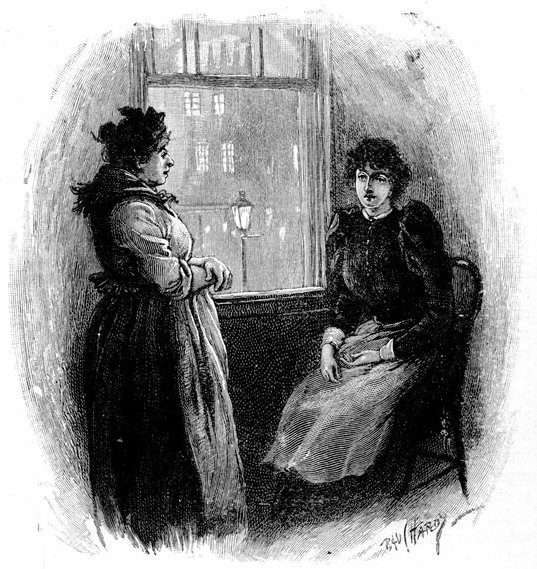
"Of all things in the world," she said, "I
should like best to be trained as a hospital
nurse—do you think I am suited to the profession?"
"Admirably," I replied. "You have
nerve and self-control; you have also good
health and, although I am sure that you
have plenty of heart, you would never
be mawkishly sentimental."
"Oh, no," she
answered; "I
am glad you
approve."
"I cordially
approve," I replied.
"In
many cases the
profession of
nursing is best
undertaken by
women who are
not too highly
cultivated, and
whose position
is below that of
the supposed
lady—but you,
Miss Temple,
will make an admirable
nurse.
Your peculiar
characteristics
fit you for this
calling."
I saw by the expression on her face that
my words pleased her. I helped her to take
the necessary steps to become a probationer
at one of the large hospitals. She entered
on her profession with enthusiasm—her time
of training passed without hitch, and in due
course I placed her on my own special staff
of nurses.
I had been by no means mistaken in Miss
Temple's qualifications—her nerve was
wonderful, her tact perfect. Although slight
and rather delicate looking, she had a great
reserve of strength, and I never knew her to
break down or fail in any way, even when the
case she had to attend to was involved in
serious difficulties.
For nervous cases in especial, I found
Miss Temple invaluable, and it so happened
that she was the first person I applied to
in the case of a very peculiar patient, Lady
Violet Dalrymple.
I was sent for to the country to see Lady
Violet in the autumn of the year 1889.
I remember the night when the telegram
came to me from her mother, the Countess
of Erstfield. Lady Violet was the only child—a
girl of seventeen. Lady Erstfield had
once brought her to see me in town. I then
considered her an overgrown, somewhat
nervous girl, had ordered change, a quiet life,
plenty of fresh air, plenty of nourishment,
plenty of congenial occupation, and had felt
assured that if these remedies were systematically
followed out, the young girl would
quickly recover from the nervous derangements
which were just then interfering with
her health and happiness.
By the tenor of Lady Erstfield's telegram,
however, I feared that this was not the case.
"I am very anxious about Violet. Come
without delay," she wired.
I replied by telegram that I would arrive
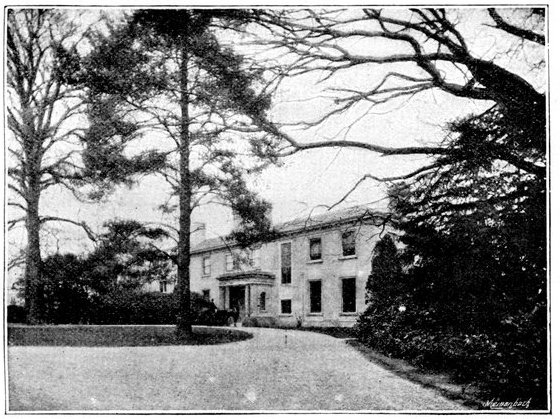
at Beeches by a late train that evening. I
did so. Lady Erstfield was up. I had a
long interview with her, and got all possible
information with regard to my patient's state
of health. I did not see Lady Violet herself,
however, until the following morning.
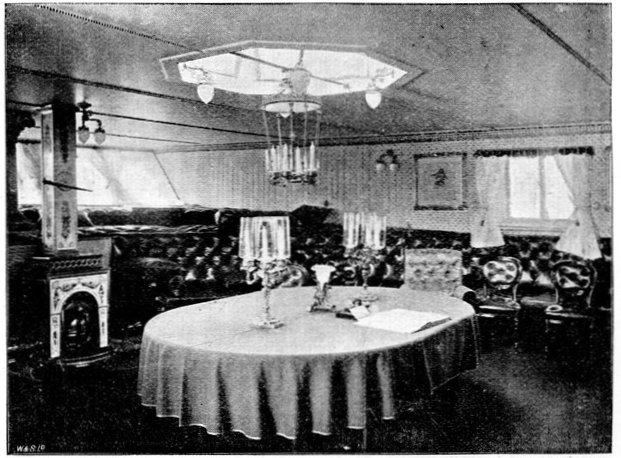
At an early hour that day, I was taken
into the pretty boudoir, where I found my
patient lying on a sofa. It was a room
furnished with all that taste, money, and love
could suggest. Books, flowers, pictures, birds
in cages, all that was gay and bright, surrounded
the lovely girl who lay pale and
languid on a sofa drawn close to the open
window. This window
commanded a perfect
view of river, wood,
and meadow, with a
distant peep of low-lying
hills against the
horizon. To my eyes,
accustomed to London
bustle and noise, this
view alone was restful
and delightful.
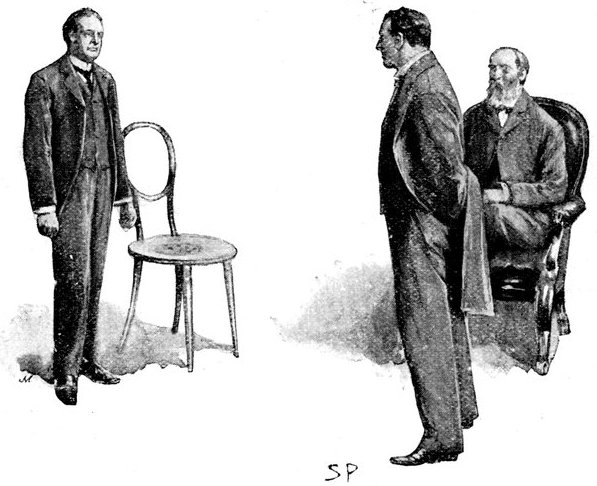
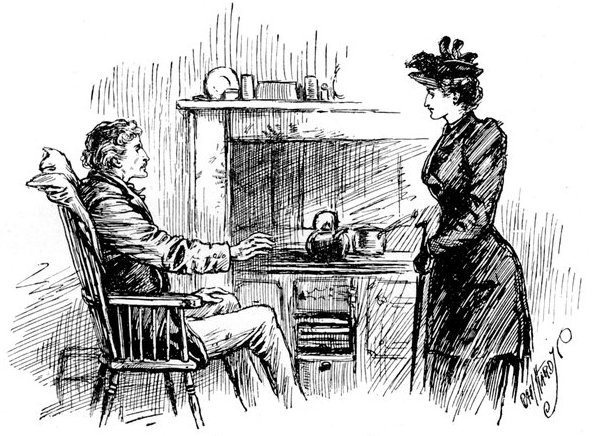
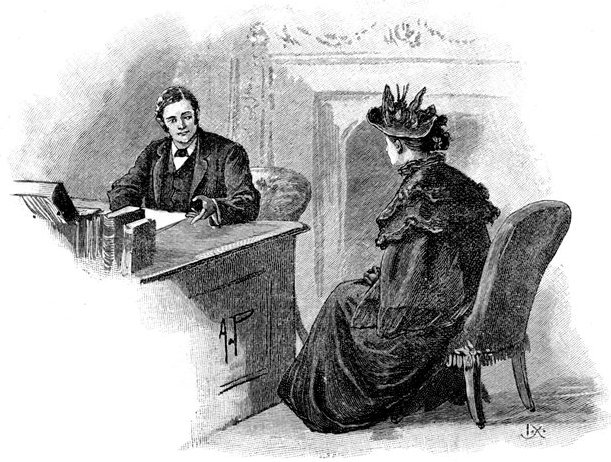
Drawing a chair forward,
I sat down by
my patient and entered
into a common-place
talk with her. I had
purposely asked Lady
Erstfield to leave us,
for I knew by experience
that in nervous
cases the patient was
far more inclined to be
confidential and to
reply truthfully to questions
when alone with
the physician.
Having carefully examined
Lady Violet,
and made certain that
she was suffering from
no organic disease, it only remained for me
to conclude that she was a victim to one of
those many ill-defined and misunderstood
nervous disorders, which, by their variety
and complexity, present the greatest difficulty
in medical practice.
The treatment I saw at once must be
moral, not medical.
"I don't find much the matter with you,"
I said, cheerfully; "your disease is more
fancy than reality—instead of lying here,
you ought to be having a gallop across those
moors yonder."
Lady Violet gazed at me with a look of
surprise and even faint displeasure in her
large brown eyes.
"I love riding," she said, in a gentle voice,
"but it is long since I have had the pleasure
of a canter over the moors or anywhere else."
"You should not give up riding," I said;
"it is a most healthful exercise and a splendid
tonic for the nerves."
"I don't think you can realize how very
weak I am," she answered, something like
tears dimming her eyes. "Did not mother
explain to you the strange symptoms from
which I suffer?"
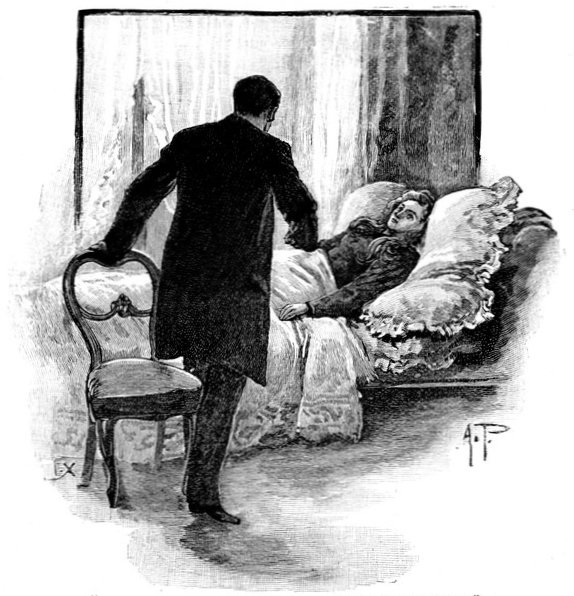
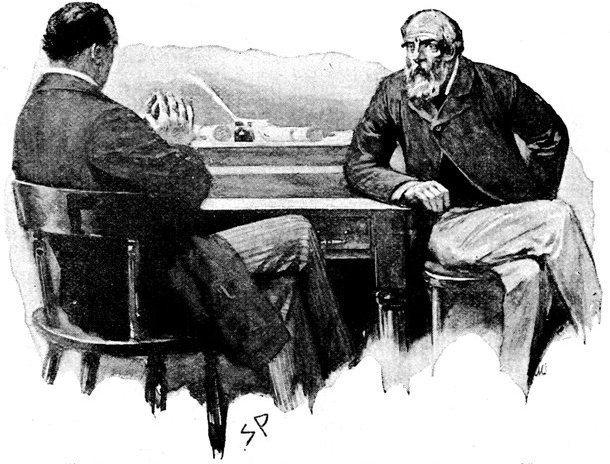
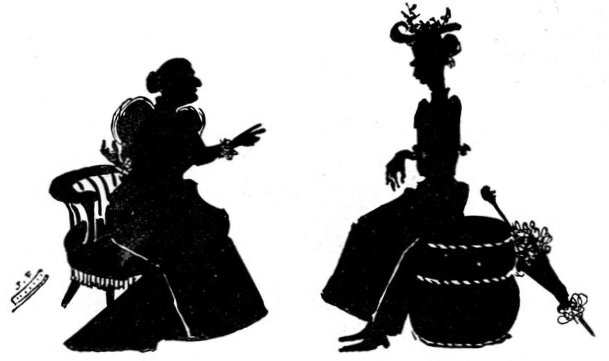
"DRAWING A CHAIR FORWARD, I SAT DOWN BY MY PATIENT."
"The symptoms of which you complain
are clearly due to an over-wrought imagination,"
I replied. "You must try to curb it
by every means in your power. I assure you
I am only telling you the true state of the
case when I say that there is nothing serious
the matter with you."
She sighed and looked away from me.
I took her slim hand in mine and felt her
pulse. It was weak, fluttering, and uneven.
I bent forward and looked into her eyes—the
pupils were slightly dilated. Still I held
firmly to my opinion that nervous derangement,
that most convenient phrase, was at
the bottom of all that was wrong.
"Now," I said, rising as I spoke, "I will
prescribe a drive for you this afternoon, and
in a day or two, I have no doubt, you will be
strong enough to get on horseback again.
Take no medicines; eat plenty, and amuse
yourself in every way in your power."
Soon afterwards I left the room, and saw
Lady Erstfield alone.
"Your daughter is an instance of that all
too common condition which we call neurasthenia,"
I said. "Although, unlike the
name, the disease is not a coinage of the
nineteenth century, still it has greatly
increased of late, and claims for its victims
those who have fallen out of the ranks of
the marching army of women, in the
advancing education and culture of their sex."
"I don't understand your placing Violet
in that position," said Lady Erstfield, with
reddening cheeks.
"My dear madam," I replied, "your
daughter is the undoubted victim of over-culture
and little to do. Were she a farmer's
daughter, or were she obliged in any other
way to work for her living, she would be
quite well. The treatment which I prescribe
is simply this—healthy occupation of every
muscle and every faculty. Do all in your
power to turn her thoughts outwards, and to
arouse an active interest in her mind for
something or someone. I assure you that
although I am not anxious about her present
state, yet cases like hers, if allowed to drift,
frequently end in impairment of intellect in
some degree, either small or great."
Lady Erstfield looked intensely unhappy.
"Violet is our only child," she said; "her
father and I are wrapped up in her. Although
you seem to apprehend no danger to her
life——"
"There is none," I interrupted.
"Yet you allude to other troubles which
fill me with terror. There is nothing Lord
Erstfield and I would not do for our child.
Will you kindly tell me how we are to
provide her with the interests and occupations
which are to restore her mind to a
healthy condition?"
I thought for a moment.
"Lady Violet is very weak just now," I
said, "her whole constitution has been so
enfeebled with imaginary fears and nervous
disorders that a little good nursing would
not come amiss for her. I propose, therefore,
to send a nurse to look after your
daughter."
Lady Erstfield uttered an exclamation of
dismay.
"A hospital nurse!" she exclaimed; "the
mere word will terrify Violet into hysterics."
"Nothing of the kind," I answered. "The
nurse I propose to send here is not an
ordinary one. She is a lady—well born and
well educated. She is extremely clever, and
is remarkable both for her tact and gentleness.
She thoroughly understands her duties—in
this case they will consist mainly in
amusing Lady Violet in the most strengthening
and invigorating manner. Her name is
Temple. I will ask you to call her Miss
Temple, and never to speak of her or to her
as nurse. She will soon win her own way
with your daughter, and I shall be greatly
surprised if she does not become more or less
indispensable to her. She is just as healthy-minded,
as bright, as strong as Lady Violet
is the reverse."
After a little more conversation with Lady
Erstfield, it was arranged that Miss Temple
was to be telegraphed for at once.
I wrote her a long letter, giving her full
directions with regard to the patient. This
letter I left with Lady Erstfield, and asked
her to deliver it to Miss Temple as soon as
ever she arrived. I then went to bid Lady
Violet good-bye.
She looked even more wan and exhausted
than when I had seen her in the morning. I
thought it well to let her know about Miss
Temple's arrival.
"She is a thoroughly nice girl," I said.
"She will nurse you when you want to be
nursed, and amuse you when you wish to be
amused, and let you alone when you want
quiet, and you will find her so fresh and
bright and entertaining that you will soon,
I am persuaded, be unable to do without
her. Good-bye, now—I hope you will soon
be much better, both for your mother's sake
and your own."
Lady Violet raised her brows.
"Is mother unhappy about me?" she
asked.
"She loves you," I replied, steadily, "and
is getting quite worn out with anxiety about
you. I wish her mind to be relieved as
soon as possible, and I think it is your
duty to do what you can towards this end."
"What can you mean?" asked Lady
Violet.
"In your mother's presence," I answered,
"you ought to endeavour as much as possible
to overcome the melancholy which has
taken such possession of you. Seem to be
gay, even when you don't feel it. Try to
appear well, even when you don't think you
are. When you are alone with Miss Temple,
you can do, of course, exactly as you please.
But when with your father and mother, you
ought to make a strenuous effort to overcome
the morbid feelings, which are due entirely
to the nervous weakness from which you are
suffering."
Lady Violet looked at me intently.
"I love my father and mother," she
exclaimed. "I would not willingly hurt
the feelings of either. But, oh! how little
you know what I suffer when you speak of
my suppressing my trouble and terrible
depression. Am I not always—always suppressing
my
fears? Oh, how
hateful life is to
me—how distasteful,
how
hollow. I should
like to die beyond
anything, and yet
I am such a
coward that the
near approach of
death would terrify
me. Why was
I born to be so
miserable?"
"You were
born to be
happy," I answered,
"or, at
least, to be useful
and contented.
Your fear of
death is perfectly
natural, and I
hope it will be
many a long day
before you are
called upon to resign
so precious a
possession as life.
Remember, you have only one life—use it
well—you will have to account for it some
day; and now, good-bye."
I returned to London, and in about a
week's time I received a letter from Miss
Temple. It satisfied me thoroughly. Lady
Violet was better. She went out for a little
daily. She read to herself, and allowed
Miss Temple to read to her. She was
interested in a fancy fair which was to be held
in the neighbourhood, and was helping Miss
Temple to work for it. The nurse had also
discovered that her patient had a love, almost
a passion, for music. Miss Temple was an
accomplished pianist before she took up her
present profession, and she and Lady Violet
spent a considerable portion of each day over
the piano.
In short, Miss Temple was doing all that
I expected her to do for the young girl whose
life was so valuable. Lady Violet was undoubtedly
already acquiring that outward view
which means health both of mind and body.
Miss Temple's first letter was followed in
the course of time by another, which was
even more hopeful than the first. Lady
Violet was devotedly attached to her, and
could scarcely bear her out of her presence.
The girls rode together, walked together,
sketched and played together. The colour of
health was coming back to Lady Violet's pale
cheeks; she would soon, in Miss Temple's
opinion, be restored to perfect health.
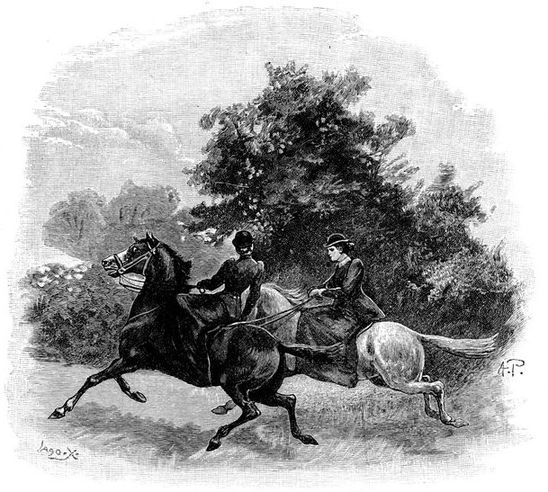
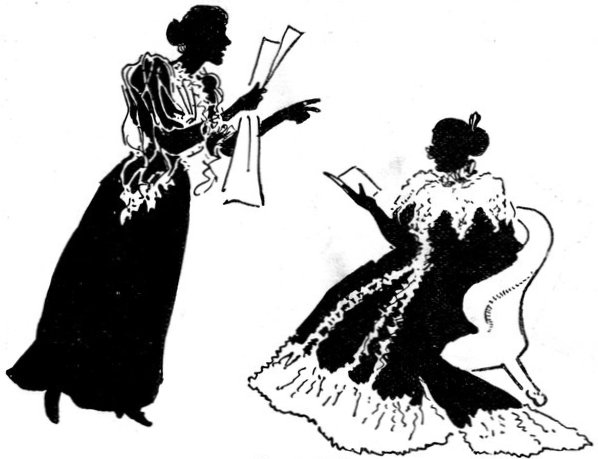
"THE GIRLS RODE TOGETHER."
Lady Erstfield also wrote to me about this
time, and spoke in rapture of the companion
whom I had secured for her daughter.
"I cannot tell you what Beryl Temple is
to us," she said; "we owe Violet's recovery
to her wonderful tact, her sympathy, her
genius. She is like no girl I ever met
before—she fascinates and subjugates us all—we
do not want ever to part with her—as to
Violet, it would almost kill her, I think, were
Beryl Temple now to leave us."
About a month after receiving these two
letters I was astonished and much pleased to
see an announcement in the Morning Post
to the effect that a matrimonial alliance was
arranged between Lady Violet Dalrymple,
only daughter of the Earl and Countess of
Erstfield, and Captain Geoffrey Ponsonby, of
the Coldstream Guards, and that the marriage
was likely to take place in December.
On reading this short paragraph I turned
to my case-book, and under Lady Violet's
name made the following note:—
"A case of neurasthenia, in which environment
with moral treatment caused recovery."
I then dismissed the subject from my mind,
with the final reflection that I should not have
much more to do with Lady Violet.
The following circumstances quickly proved
my mistake.
On the evening of that same day I had a
letter from Miss Temple, confirming the news
of the approaching marriage; telling me that
it had been contemplated for some time by
the parents of the young people, but that a
formal engagement had been deferred owing
to the state of Lady Violet's health. Captain
Ponsonby had arrived at Beeches about a
fortnight ago, had proposed for Lady Violet,
who had accepted him not without a certain
unwillingness, and the marriage was arranged
to take place immediately after Christmas.
"Lady Violet is not as well as I could
wish," continued Miss Temple, towards the
close of her letter. "At first she refused
absolutely to engage herself to Captain
Ponsonby, but yielded to the entreaties of
both her parents, who are most desirous for
the match. She is once more languid, and
inclined to be uninterested in her surroundings.
I am not satisfied about her
state, and deeply regret Captain Ponsonby's
arrival—she was really in radiant health when
he came to the house a fortnight ago.
Lord and Lady Erstfield quite fail to observe
their daughter's state of depression—they
are both in the highest spirits, and active
preparations for the wedding are going
forward."
This letter caused me uneasiness—it was
followed almost immediately by a second.
"Dear Dr. Halifax," wrote Miss Temple,
"I am in great, in dreadful, trouble—not
alone about Lady Violet, whose condition
alarms me much, but on my own account.
In short, I am bewildered by the fearful
calamity which has suddenly overtaken me.
I have not a soul to confide in, and greatly
long to see you. I know I must not expect
you to come here, and yet it is impossible
for me, under existing circumstances, to ask
for a day off duty. God help me; I am the
most unhappy girl in the world!
"Yours sincerely,
"Beryl Temple."
I received this letter by the last post one
night. It caused me some wakeful hours,
for I was greatly puzzled how to act. By the
morning I resolved to write a line to Lady
Erstfield, telling her that I had heard from
Miss Temple of Lady Violet's altered
condition, and offering to come to see her.
That letter was not destined to be written,
however. As I was sitting at breakfast a
telegram was put into my hand. It was
from Lord Erstfield, requesting me to go to
Beeches immediately.
I started off by an early train and arrived
at my destination about noon. I was shown
at once into a reception-room, where Lady
Erstfield awaited me.
"It is good of you to respond so quickly
to our telegram," she said. "We are in
terrible trouble here. Violet is in the
strangest condition. She is very feverish;
her strength seems completely gone. She
lies hour after hour moaning to herself, and
takes little notice of anyone."
"How long has this state of things gone
on?" I asked.
"The complete breakdown only took
place yesterday, but Miss Temple assures
me that Violet has been failing for some
time. Her father and I noticed on one or
two occasions that she seemed pale and
languid, but as there was a good deal to
excite her, we put her fatigue down to that
source. Under your judicious treatment and
the admirable care Miss Temple gave her,
we considered her perfectly recovered, and
it did not enter into our minds that a recurrence
of the old attack was possible."
"When you speak of Lady Violet having
much to excite her, you doubtless allude to
her engagement?" I said. "I saw it
officially announced in the Morning Post.
I judged from it that she had quite
recovered."
Lady Erstfield coloured.
"We thought so," she said; "her father
and I both thought so. We were much
pleased at the contemplated marriage, and
we imagined that our child was happy, too.
Captain Ponsonby is all that anyone can
desire."
"And you have reason not to be satisfied
now?" I asked.
"The fact is this," said Lady Erstfield,
shortly: "Violet is unhappy—she does not
wish the engagement to go on. She told
Miss Temple so this morning. I have seen
my dear child on the subject an hour ago—we
cannot account for her caprice in this
matter."
"I will see Lady Violet now, if you will
permit me," I said. "The engagement is,
doubtless, the cause of this strange breakdown.
Will you take me to her room?"
Lady Erstfield led the way without a word.
I found my patient even worse than her
mother had given me to understand. In
addition to much nervous trouble, she had
unquestionably taken a chill of some sort,
and symptoms of pneumonia
were manifesting themselves.
When I bent over her, I
noticed the deep flush on
her cheeks, her eyes were
closed—her breathing was
short and hurried. Miss
Temple was standing by the
bedside—she gave me an
earnest glance, her face was
as pale as Lady Violet's was
flushed. I noticed that Lady
Erstfield avoided speaking
to the nurse, who, on her
part, moved slightly away as
she approached. The despair,
however, which must
have filled the poor mother's
heart as she watched her
suffering child might in itself
account for her manner. I
was very anxious to see the
nurse alone, and asked Lady
Erstfield if I could do so.
"Certainly," she answered;
"I will watch here until
Miss Temple is able to
resume her duties."
"I will not be long away,"
answered Beryl. She took
me at once into Lady Violet's
pretty little boudoir and shut
the door.
"I must be very quick,"
she said, "my place is with Violet. You
think her very ill?"
"I do," I answered. "Her life is in
danger. She is threatened with pneumonia.
If the symptoms grow worse, she will not
have strength to bear up under the attack."
"Oh, then, I must not think of myself—even
now I manage to soothe her as no one
else can. Let me go back!"
"Sit down," I answered; "you will not be
fit long to nurse anyone unless you look after
yourself. What is the matter with you?
You are greatly changed!"
"Did I not tell you in my letter that I am
in great trouble?"
Miss Temple's words were interrupted by
a knock at the door of the boudoir.
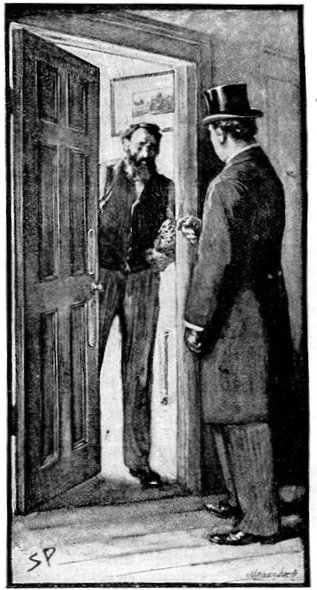
She said "Come in," and a manservant
entered. He approached Lady Violet's little
writing-table, disturbed a book or two, and
finally retreated with an "A B C" in his hand,
apologizing as he did so.
"Do you know who that man is?" asked
Miss Temple.
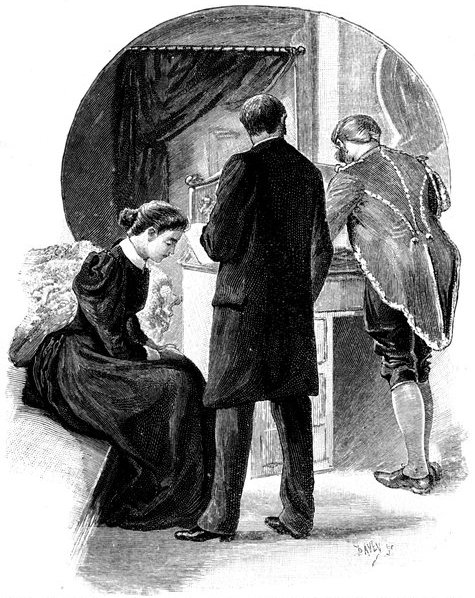
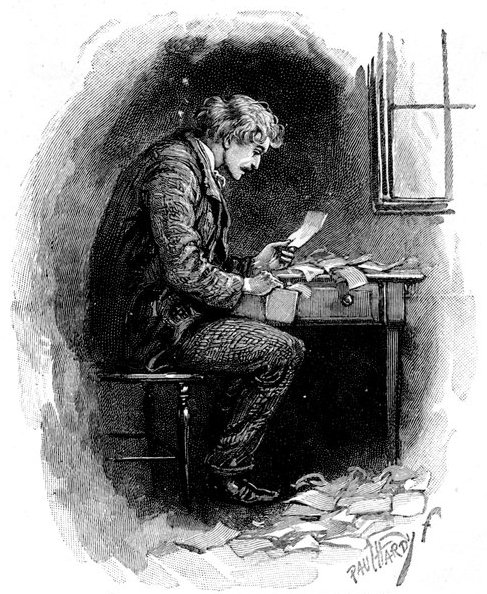
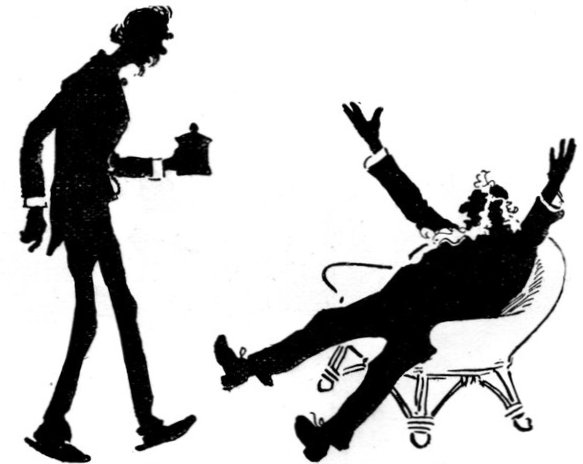
"HE APPROACHED LADY VIOLET'S WRITING-DESK AND DISTURBED A BOOK OR TWO."
"One of the servants," I replied; "never
mind him—tell me your trouble as quickly as
possible."
"He is connected with it, unfortunately.
He is not one of the usual servants of the
house, although he wears the livery. That
man is a detective from Scotland Yard, and
he came into the room just now to watch me.
He, or his fellow detective, for there are two
here, watch me wherever I go. On one
excuse or another, they enter each room
where I am found."
"What do you mean?" I asked.
"I will tell you in as few words as possible—can
you wonder that I am changed?"
"I am lost in conjecture as to what you
can possibly mean," I answered, looking at
her anxiously.
In truth I had cause for my anxiety.
Her fine face looked absolutely aged and
worn. Her eyes were almost too large—their
expression was strained—they had
heavy black lines under them. Her mouth
showed extreme dejection. When I remembered
the blooming, healthy girl who had
gone to Beeches two months ago, I was
appalled by the change.
"Speak," I said; "I am deeply interested.
You know that I will do everything in my
power to help you."
"This is my story," she said: "Lady
Violet got quite well—I was much attached
to her, we were very happy—it seemed like
the old life back again, when my mother was
alive and I had a luxurious home. Lord
and Lady Erstfield treated me more like a
daughter than a nurse; Lady Violet was my
dear sister. Then Captain Ponsonby came.
He proposed, and was accepted. Immediately
after the engagement Lady Violet
drooped; she no longer gave me her confidence;
she lost her appetite; she became
constrained and silent. Once or twice I
caught her crying—she turned away when I
tried to question her. Lord and Lady Erstfield
noticed no change, and Captain Ponsonby
came and went as an honoured guest.
No one seemed to notice the efforts Lady
Violet made to seem at home in his society.
"One morning about ten days ago Lady
Erstfield, accompanied by Captain Ponsonby,
came into this room, where I was reading
aloud to my dear little patient. I could not
imagine why they did not observe her pale
cheeks and her languor. I saw, however, at
a glance that Lady Erstfield was in a high
state of excitement and delight. She held a
jewel-case in her hand. She opened it and,
bending down, showed its glittering contents
to her daughter. I was startled at the effect
on Lady Violet. She clapped her hands in
ecstasy and sat upright on the sofa. Her eyes
had grown suddenly bright, and her cheeks
rosy.
"'How I adore diamonds,' she said, 'and
what beauties these are: oh, you lovely
creatures! But, mother, why do you show
them to me?'
"'They are my present to you, Violet,'
said Captain Ponsonby. 'These diamonds
are heirlooms in the family, and are of
great value. They will be yours when we
are married.'
"'Come and look at them, Beryl,' exclaimed
Lady Violet. 'Are they not splendid?'
As she spoke she lifted a diamond
necklace of extraordinary brilliancy and quaint
device out of the case. I knelt down by her
and examined the gems with delight almost
equal to her own. I have always had a great
love for jewels, and for diamonds in particular,
and these were quite the most magnificent
I had ever seen. The necklace was accompanied
by a tiara and earrings, and the gems
were worth, Lady Erstfield said, from fifteen
to twenty thousand pounds.
"We spent some time examining and
criticising them. Violet sent for a looking-glass
from one of the bedrooms in order
to see the effect of the jewels round her
throat. She insisted on my trying them
on as well as herself. Lady Violet is
fair, but, as you know, I am very dark. I
could not help seeing for myself that the
jewels suited me. Lady Violet uttered an
exclamation when she saw them on me. 'You
look beautiful, Beryl,' she said.
"I laughed, and was about to answer her,
when I met Captain Ponsonby's eyes. There
was something in his expression which I did
not quite like. I unfastened the necklace
quickly and laid it back in its velvet bed.
"'Thank you for letting me try it on,'
I said. 'I feel as if for one brief moment
I had imprisoned the rainbow.'
"I don't know why I said those words.
They did me no good afterwards, but I
was excited at the time. The magnificent
diamonds had really cast a spell over me.
Lady Erstfield suggested that Violet should
go out for her usual ride.
"'No, mother; I am too tired,' she
replied. 'I will drive instead, and Beryl
shall come with me.'
"'Run and get ready, then,' said Lady
Erstfield to me.
"I was leaving the room when she
suddenly called me back.
"'My dear,' she said, giving me the case
which held the diamonds as she spoke,
'will you have the goodness to take these
to my room, and lock them up in my jewel
safe? Here is the key. You must turn
the lock twice, and when the revolving
shutter moves back, use this smaller key to
unlock the inner compartment. Put the
case in there, and bring me back the keys
when you have changed your dress.'
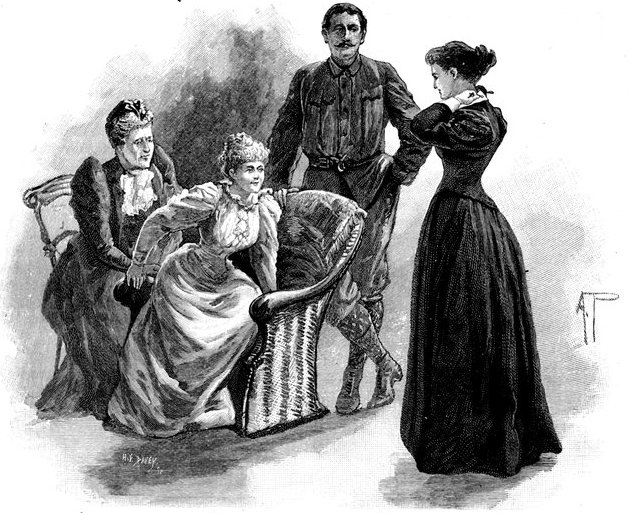
"YOU LOOK BEAUTIFUL, BERYL!"
"I promised to obey, and ran off with a
light heart.
"The safe where Lady Erstfield kept her
jewels was built into the wall, and was of a
very ingenious device. Following her directions
implicitly, I opened it, placed the case
within, and locked the safe carefully again.
I then went and changed my dress and
returned the keys to Lady Erstfield. Captain
Ponsonby, Lady Violet, and I had a pleasant
drive, and nothing more was said about
the diamonds—I really think we all forgot
them.
"The next morning Lady Violet came
down to breakfast, looking so ghastly pale and
so depressed, that even her mother uttered
an exclamation of surprise when she saw her.
"'My darling, you look positively ill,' she
said, going up and kissing her.
"Lady Violet gave her a startled and queer
look. She made some remark in a very low
voice, and with a pettish movement. She
then crossed the room to my side, and Lady
Erstfield did not question her any further.
"Just as we were leaving the breakfast-table,
Captain Ponsonby announced his
intention of running up to town for the day,
and suddenly suggested that he should take
the diamonds with him in order to give the
jeweller plenty of time to re-set them in the
most thorough manner.
"'That is a good thought, Geoffrey,' said
Lady Erstfield. Then she turned to me.
"'You know where the jewels are, Beryl,'
she said—'here are my keys—run, dear, and
fetch them. I don't allow even my own
maid to know the secret of my jewel safe,'
she continued, looking at Captain Ponsonby
as she spoke.
"I ran away, reached Lady Erstfield's
room, unlocked the safe, and put in my
hand to take out the case. It had vanished.
I searched for it at first without any
uneasiness, then in bewilderment, then in a
sort of frantic terror. There was the empty
spot on the floor of the safe where I had
placed the case—there were the other cases
of jewels pushed aside in some little confusion,
but the Ponsonby diamonds had
absolutely vanished.
"The full horror of the situation had not
yet burst upon me—I had not yet even
begun to think that anyone would suspect
me, but, nevertheless, I felt sick with a sort
of nameless terror.
"I locked the safe and returned to the
breakfast-room.
"Lord Erstfield was standing by the
hearth, talking to Captain Ponsonby—Lady
Erstfield was reading the Times, and Violet
was kneeling on the floor playing with her
favourite pug. Their peaceful faces added
to my misery. I know I must have looked
wild and frightened—I know when I spoke
that my voice must have shaken.
"'The diamonds are gone,' I said; 'they
are not in the safe.'
"It was just as if I had flung a bomb into
the midst of the cheerful party. Lord Erstfield
drew himself up with a dazed expression.
Captain Ponsonby turned white, and Lady
Erstfield, with a sharp cry, rushed from the
room, snatching the keys from my hand as
she did so.
"'There is no use in Lady Erstfield examining
the safe,' I said, 'the diamonds are
certainly not there—I have searched all
the shelves. The spot where I placed
them yesterday is empty; the case has
vanished.'
"'I don't believe it,' said Violet. 'The
diamonds must be there. You must be
mistaken, Beryl.'
"I made no reply, but when the others
left the room I followed.
"We all now went up in a body to Lady
Erstfield's room, and the safe was carefully
examined by Lord Erstfield and Captain
Ponsonby. The case containing the diamonds
was indeed missing, but not another jewel,
not even the smallest ring had been touched.
There was no mark of the safe having been
tampered with in any way, and as it was
made on a perfectly unique pattern, and
there was not supposed to be a key in the
world to fit it, except the special ones made
for it, the whole affair seemed buried in
hopeless mystery. No one accused me in
any way, and it never occurred to me, as I
stood in that room, to accuse myself. We
discussed the matter in all its bearings. We
stood round the open safe and talked until
we were tired. I described the exact position
in which I had placed the case. Lady
Erstfield was certain that from the moment I
returned her the keys they had not been out
of her possession until she had again placed
them in my hands that morning.
"Finally we left the room in a state of
hopeless bewilderment. Violet and I went
away by ourselves, and, sitting down together,
discussed the strange mystery from every
point of view. The loss of the jewels had
much excited her. She had regained her
colour and her manner was quite animated.
"'I thought, at least, I should have the
diamonds,' she said, with a queer sort of
desolate echo in her voice, 'and I love
diamonds: they seem to comfort me in the
strangest way. I feel akin to them. When
they sparkle and leap and glitter, they appear
to me to be alive; they tell me secrets of the
strange things they have witnessed in the
course of their long existence. Think, if the
Ponsonby diamonds could speak, what stories
they could tell of the queer, queer things
they have seen and heard; eh, Beryl?'
"I tried to turn the conversation—Lady
Violet was always worse after indulging in
wild talk of this sort.
"'We have now to consider how to get
the Ponsonby diamonds back,' I said. 'Who
can have stolen them?'
"We talked the matter threadbare, arriving,
of course, at no conclusion.
"At lunch we were surprised to find that
Captain Ponsonby had not gone to London.
When the servants withdrew, we were told
that the affair of the diamonds had been put
not only into the hands of the local police,
but that the authorities in Scotland Yard had
been communicated with, and that in all
probability a couple of detectives would be
sent to Beeches that night.
"'We have decided,' said Lord Erstfield,
'not to say anything of our loss to the servants.
The person who stole those diamonds
is quite clever enough to hide them if the
least alarm is raised. Our best chance of
recovering the treasure is through detectives,
who will come here, of course, in plain clothes.
We are expecting several fresh guests to-morrow,
and in consequence the servants
have heard that two new men-servants from
London are coming here to help them. We
have communicated this fact to Scotland
Yard, and the men will be provided with the
house livery.'
"After making this statement, which he
did very briefly, Lord Erstfield left the room.
"The early part of the afternoon passed
listlessly. Lady Violet was once more pale,
deadly tired, and too languid to care to do
anything. I persuaded her to lie down, and
offered to read her to sleep.
"'No,' she answered; 'I don't want anyone
to read to me. I will shut my eyes
and think of the diamonds. Go and take
a walk, Beryl; you look pale and tired
yourself.'
"I saw she did not want me, and, putting
on my hat, I went out for a stroll. I had
gone a little way from the house when I heard
footsteps behind me. I turned and saw, to
my surprise, that Captain Ponsonby was
following me.
"'I noticed that you had gone out,' he
said, 'and took the liberty of coming after
you.' He grew red as he spoke. 'I want to
say something to you,' he said; 'something
of importance. Can we go somewhere where
we can be alone?'
"I told him that I was going to walk through
the shrubbery, and that he might, if he
pleased, accompany me there; 'but,' I added,
'I shall not be out long, for I am anxious
about Lady Violet and want to return to her.'
"We entered the shrubbery as I spoke.
He did not speak at all for a moment; then
he said, with a sort of abruptness which
surprised me:—
"'I will not keep you long. I am glad
of this opportunity.'
Here he paused, and,
turning, looked me full
in the face.
"'If you will give me
back the diamonds,' he
said, 'I will faithfully promise
to arrange matters
so that not a breath of
suspicion shall rest upon
you.'
"I felt as if I were
shot. His words took
me so completely by
surprise that I could not
find either breath or
speech for a moment.
"'Do you really think,'
I said then, in a choking
voice—'is it possible that
you think, really, that I—I
have stolen the diamonds?'
"I suppose my agitation
confirmed his
suspicions.
"He looked at me with
a queer sort of pity.
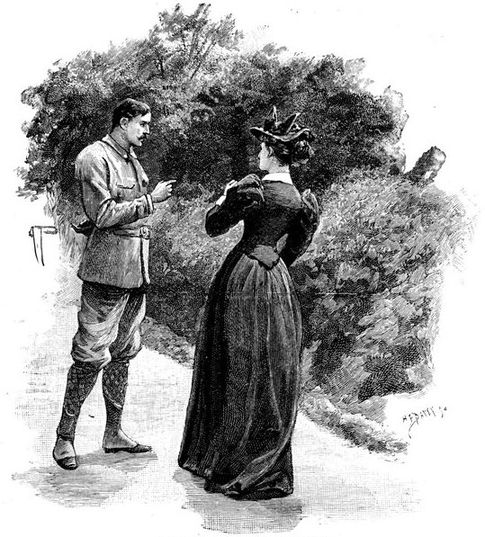
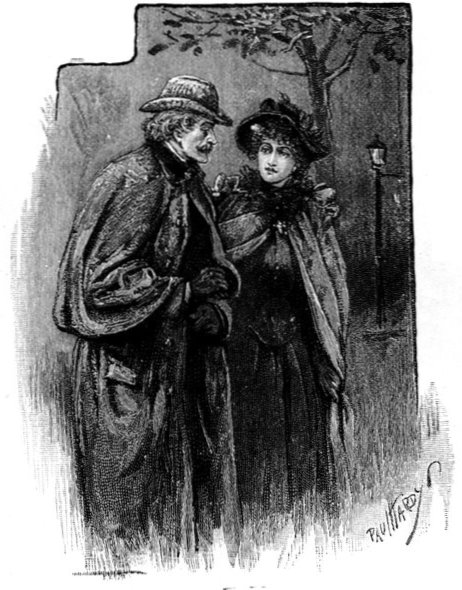
"I FELT AS IF I WERE SHOT!"
"'I could see yesterday
how struck you were
with their beauty,' he
said. 'Do you remember
what you said about imprisoning the
rainbow? The opportunity to take the
diamonds was put into your hands. You
could not resist the sudden temptation, but
I am sure you are sorry now, and would
return them if it were possible. I believe I
can manage this for you, if you will confide
in me.'
"I turned quickly; my face was hot;
my heart was beating so fast I thought it
would burst.
"'Come with me at once to Lady Erstfield,'
I said; 'say those words again in her
presence. She shall search all my possessions.
Come, don't delay a moment.'
"'You must be mad,' he said. 'For
Heaven's sake don't inculpate yourself in that
manner. As far as I am aware, I am the
only person who, at present, suspects you.
It has never, I know, even entered into
Violet's head that you could have had anything
to do with the robbery, and Lord and
Lady Erstfield, I am sure, think you as
innocent as themselves—they are the most
loyal people in the world—they believe,
and rightly, that they owe Violet's life to
you. I don't think they could harbour an
unkind thought of you. Lord Erstfield and
I have talked over the loss for a couple of
hours this morning, and your name has not
once been mentioned in connection with it—I
alone ——.'
"'You alone,' I interrupted, 'entertain
this horrible doubt against a defenceless
girl?'
"'I am very sorry,' he replied, in a steady
voice, 'but it is not even a doubt.' Here
he looked full at me. 'In my mind it takes
the form of a certainty. It is absolutely
impossible that anyone else could have taken
the diamonds. They are gone—you were
last seen with them—you put them into the
safe. You returned the keys to Lady Erstfield,
who did not let them out of her
possession until she gave them to you again
this morning. You must see for yourself
what the logical conclusion is—you are the
culprit.'
"'No one else has come to that logical
conclusion,' I answered.
"'I am a man of the world,' he replied.
"I stood perfectly still for a moment.
His cool assurance seemed to deprive me
almost of the power of thought. I turned
to walk towards the house, but he barred my
path.
"'What can I do to induce you to be
guided by my common-sense?' he said.
'I can understand the sudden temptation—if
you return the jewels to me, not a shadow
of suspicion shall ever rest upon you from
any other quarter.'
"'I think,' I said, in a trembling voice,
'that the only thing for me to do will be to
adhere to my first resolution, to see Lady
Erstfield in your presence—to ask you to
accuse me of the theft before her—to insist
upon having all my possessions searched, and
then to leave Beeches immediately.'
"'You won't screen yourself by any such
plan,' said Captain Ponsonby—'nay, your
wish to leave Beeches will seem to all
interested as a certain proof of your guilt.
I wish I could get you to understand that I
do not feel unkindly to you—that I am
sincerely anxious to be your friend in
this matter. I know you to be guilty. If
you protested from now until Doomsday,
the firm conviction in my mind would still be
unshaken. May I state the case very briefly
to you? Will you try and listen as if I were
telling you about some other girl? You
took the diamonds in a moment of acute
temptation. You are, I presume, a penniless
girl. You admired the gems, not only for
themselves but also for the effect they
produced when they shone like so many
suns round your warm, white throat. The
price of these jewels was named in your
presence. If you could sell them, you
would be rich—if you could keep them and
wear them, you would be beautiful enough to
turn any man's head. Yes, I understand—I
pity, and I am most anxious to screen
you. No one else suspects you at present
at Beeches, but that state of things will
not continue there much longer. As soon
as the detectives from London arrive, their
suspicions will naturally be fastened on you.
Your youth and apparent innocence will in no
way deceive them. They will whisper doubts
into the minds of Lord and Lady Erstfield,
and into the mind also of Lady Violet. The
Ponsonby diamonds are of immense historical
importance—they have been mixed up with
the fortunes of the family for a couple of
centuries, and it is absolutely impossible that
a girl like you can hide them successfully.
Go where you will, you will never be able to
sell that necklace and pendant. Each diamond
has a story, and can be traced by
experts into whatever hands it falls. You
can never sell the necklace, nor would you
ever dare to wear it, except in the privacy of
your own room. I beg of you, therefore, to
let me have it back, and I solemnly swear
that the secret shall never pass my lips.'
"I listened to Captain Ponsonby's speech
with great attention. The buzzing in my
ears and the great tumult round my heart
had now to a considerable extent subsided.
I was able to bring my common-sense to
bear upon the matter, and to absolutely force
myself to look the facts in the face as they
were presented to me from Captain Ponsonby's
point of view. Strange as it may
seem, my whole nature became subjected to
a sort of revulsion, and far now from being
angry with Captain Ponsonby for his accusations,
I could not but admire something
chivalrous in him which made him come as
he thought to my assistance. My only
wonder now was, that the Erstfields and
Lady Violet were not also convinced of my
guilt.
"I remained silent, therefore, for a couple
of minutes before I replied.
"'I understand,' I said then, slowly, 'you
have explained the position of affairs. I see
plainly how very black the circumstantial
evidence is against me. I am not surprised
at your suspicions, and my wonder is that
they are not shared by the rest of the family.
As it happens, I am not the thief you imagine
me.'
"When I said this, he sighed heavily,
shook his head, and, turning, began to walk
slowly back with me towards the house.
"'I am not a thief,' I continued, 'for the
simple reason that the temptation you spoke
about did not exist. The beauty of the
gems attracted me yesterday, and I looked
at them with pleasure, as I like to look at
all lovely things, but I never coveted them;
the thought never even occurred to me to wish
to possess them. I am not as other girls—my
life is consecrated—consecrated to the cause
of suffering and pain. I live to help people
who are obliged to keep on the shady side
of life. My whole mind and heart are
occupied with these people and their concerns.
I do not want money, for my profession
supplies me with plenty, and if I
had diamonds ten times as beautiful, when,
as a professional nurse, could I wear them?
I have listened to your side of the affair—I
must beg of you to listen to mine. You must
see for yourself that, the temptation not existing,
it could not be acted upon. I believe you
mean kindly by all that you have said, and
I thank you for the kindness. Now I will
go indoors.'
"I left him—he did not say another word,
but I saw by the expression of his face that I
had only puzzled without convincing
him.
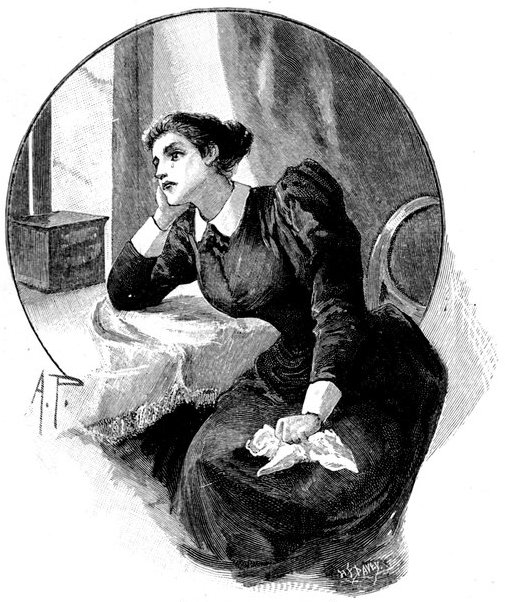
"I went straight up to my
own room, and sitting down,
thought over the queer turn of
events. The horror of the thing
grew greater and greater the
more I thought it over. I felt
torn in two—longing one
moment to rush to Lady Erstfield
and tell her everything, and
the next being kept back by the
thought that by so doing I might
only put a suspicion into her
head which did not exist.
"I was presently sent for to
attend to Violet. She had
awakened after a bad dream
and was in a very uncomfortable
and depressed condition. Notwithstanding
my own great
unhappiness, I could see that
she had something on her mind,
but although I did all in my
power to break the ice, I could
not get her to talk to me in a
free and natural manner.
"That evening the detectives
arrived from London, and the
next day several visitors came
to the house. Everything went on with
outward smoothness, and the subject of the
diamonds was by mutual consent never
alluded to. Lady Violet grew worse, and the
gay house party dispersed sooner than was
intended. Captain Ponsonby stayed on,
however. I met him occasionally, but we
scarcely exchanged a word. I could see that
he was anxious and haggard, but I set this
down to his fears with regard to Lady Violet,
who steadily refused to see him, and never
left her bedroom and boudoir. I spent
almost all my time with her, but as the days
wore on I could not but feel the horror
of my position more and more. I saw
plainly that the suspicion which Captain
Ponsonby harboured was shared by the
two detectives, and also, in process of
time, the poisonous thought was communicated
to Lord and Lady Erstfield. Lady
Erstfield's manner to me completely altered.
Instead of treating me with almost the affection
of a mother, she was cold and distant;
she avoided meeting my eyes, and never
spoke to me on any subject except what related
to Violet's health. That is the position
of affairs to-day, Dr. Halifax. I am suspected
of the most horrible theft, and have not a
chance of clearing myself. Lady Violet alone
loves me as of old. She is my dear sister,
and for her sake I——"
Here the poor girl completely broke down,
and, covering her face with her hands, sobbed
aloud.
"Take courage," I said to her. "I have,
at least, one bit of comfort for you: I also
fully believe in you. You no more stole the
diamonds than I did."
"Oh, thank you—that is like you," she
said. "God bless you for those words."
"I am glad I have come here, for every
reason," I continued. "My presence here is
necessary not only on account of Lady Violet,
but also on your account. I introduced
you to this house, and am responsible for
your conduct; I shall therefore not leave a
stone unturned to clear you, and now you
must go back to your work with as brave a
heart as you can."
She rose at once, wiping her eyes and
trying to look cheerful.
"One word before you return to Lady
Violet," I said. "Is it true that she has
broken off her engagement?"
"Yes."
"Lady Erstfield told me that she gave you
her confidence in this matter."
"Yes, she spoke to me this morning."
"Do you mind
telling me what
she said?"
"She was very
weak and had a
difficulty in using
her voice, but she
whispered to me.
Her words were
something like
these:—
"'Tell my
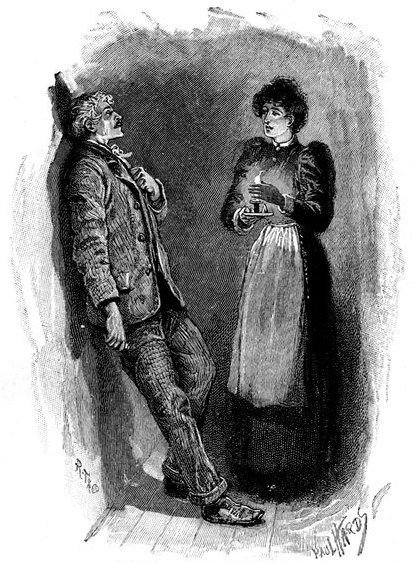
father and mother
that I do not love
Captain Ponsonby,
and will
never marry him.
From the first he
never attracted
me, and now there
is no inducement—not
even the
diamonds!'"
"Did she really
say 'not even the
diamonds'?"
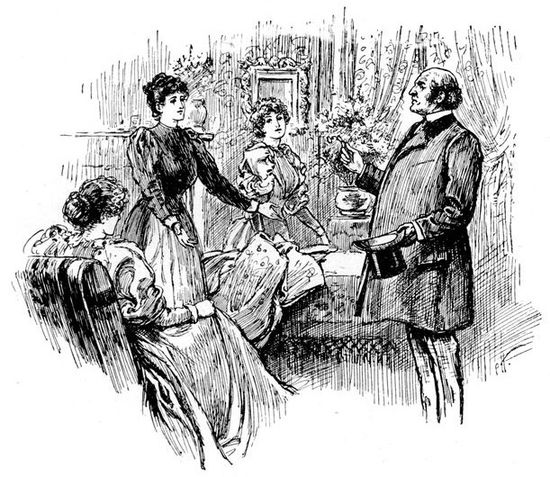
"I BEG OF YOU NOT TO GO."
"Yes, she certainly
did. I
thought it strange
at the time."
"It was undoubtedly strange. Now go
back to your patient and keep up all the
courage you can. I shall remain at Beeches
until to-morrow, and even longer if necessary.
I wish to take care of Lady Violet myself
to-night, in order to give you rest."
Miss Temple left the room, and after
thinking matters over I went downstairs.
Captain Ponsonby was still in the house.
When I abruptly entered one of the drawing-rooms,
I found him talking with Lady
Erstfield.
"Can I speak to you?" I said to the lady.
"Certainly," she replied, starting up. "Is
Violet worse? What is the matter?"
"There is no change in Lady Violet's
condition," I replied. "What I have to
speak about refers to Miss Temple."
Captain Ponsonby rose when I said this
and prepared to leave the room.
I interrupted this movement.
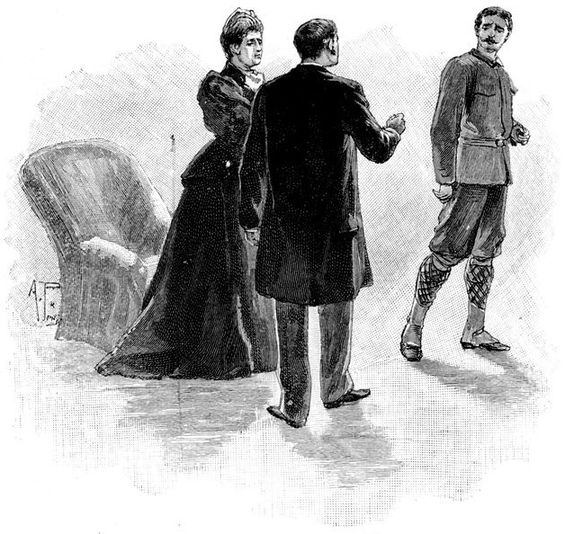
"I beg of you not to go," I said. "I
particularly want you to hear what I have
come to say."
He turned and walked slowly back to one
of the windows. I could see by the expression
of his face that he was a good deal
annoyed. He was a handsome, soldierly-looking
man, of at least five-and-thirty years
of age, with a somewhat overbearing manner.
I could understand a child like Lady Violet
shrinking from him in possible fear, and yet
there was nothing underhand about him. I
could see that he was scrupulously honourable,
although his tact would probably not
be of the finest.
"I should like you to hear what I have
got to say," I continued, "for you seem to be
mixed up in the matter. I refer to the loss
of the diamonds."
"Oh, the diamonds!" exclaimed Lady
Erstfield. "Do you suppose we, any of us,
care about them in an hour of terrible sorrow
like this?"
"Pardon me," I continued, "there is one
person who cares a great deal about them.
A young girl, who came here at my recommendation—I
allude to Miss Temple. It
seems that you, sir,"—here I turned to Captain
Ponsonby—"have accused Miss Temple in
the most unmistakable manner of having
stolen the diamonds. You accused her of
the theft nearly ten days ago, and since then
she has reason to believe that you, Lady
Erstfield, share the suspicion."
Lady Erstfield's face grew pale and
troubled.
"Beryl has told you," she exclaimed.
"Poor child, I feared that she would not fail
to see the alteration in my manner. Try
hard as I would to hide my feelings, I could
not treat her as I did before.
"Well," she continued, "I am sorry,
deeply sorry, to say that we all, with the
exception of Violet, suspect her now. She
alone had access to the safe—not a breath of
suspicion falls on anyone else. Miss
Temple has managed to hide the diamonds
with wonderful skill for the time being—but
in the end she must betray herself. We
wish if possible to avoid having her arrested;
she is closely watched, however, for there
can be little doubt of her guilt."
"And believing this," I said, in a stern
voice, "you allow this girl to continue to
nurse your daughter?"
"Certainly," replied Lady Erstfield; "in
Violet's present condition it would kill her to
part with Miss Temple."
I had some difficulty in controlling my
anger.
"I am glad I have come," I said, after a
pause, "and that not only on Lady Violet's
account. I cannot leave Beeches until this
matter is satisfactorily cleared up. It is my
firm conviction that Miss Temple no more
stole the diamonds than you did, Lady
Erstfield."
Lady Erstfield murmured something which
I could not quite hear.
"I can say with the utmost truth that we
are all only too anxious to clear Miss Temple
from this horrible suspicion if it can be
done," remarked Captain Ponsonby.
"Oh, certainly—most certainly," added
Lady Erstfield. "Anything you can suggest,
Dr. Halifax——"
Her words were interrupted—there came a
hurried message from the sick room. Lady
Violet had awakened in a high state of
delirium. Lady Erstfield and I both hurried
to her side. I saw that the case was truly
one of life or death, and nothing further was
said about the diamonds for the present.
Towards evening the sick girl seemed to
grow a little easier; she sank into another
heavy slumber, and I saw, with satisfaction,
that the remedies I had employed were
already getting the pneumonia under. I now
arranged that Miss Temple was to have a
night's rest, and that Lady Erstfield and I
should watch by the patient for the night.
Lady Erstfield lay down on a sofa at the
far end of the spacious bedroom, and I sat by
Lady Violet. Her sleep was frequently broken
by sharp cries of pain and distress, but I
generally managed by a firm word or touch
to control her wild fits of delirium. She did
not know me, however, although she submitted
immediately when I spoke to her. I
had many anxious thoughts to occupy
me during the night watches. These
were chiefly centred round Beryl Temple.
I could not help seeing that there
was abundant ground for the suspicion
which attached to her. She was, I knew
well, innocent; but unless the diamonds
were discovered, grave doubts would always
arise when her name was mentioned. I
did not think the Erstfields would prosecute
her, but I almost wished them to do
so, in order to bring the matter to an issue.
As the night wore on, I fell for a few
moments into an uneasy sleep. In my sleep
I dreamt of the diamonds. I saw them
sparkling round the neck of Lady Violet,
whose eyes shone with a strange, fierce fire,
which made them look almost as bright as
the glittering gems. I awoke with certain
words on my lips. Lady Violet had said to
Miss Temple: "Now there is no inducement
to my marriage—not even the diamonds." I
thought the words queer at the time—I
pondered over them now.
Rising from my chair, I went over to the
bed and looked at the sick girl. She was
breathing more quietly. I laid my hand on
her forehead, and knew at once that her
temperature was less high.
I went across the room to Lady Erstfield.
She had been asleep, but woke when I
approached her.
"I think my patient is a shade easier," I
said. The poor mother uttered a thankful
exclamation.
"I will go and sit by her now for an hour
or two," she answered. "I have had a long
sleep and am refreshed. Won't you lie
down, Dr. Halifax?—I will call you if Violet
requires anything."
I told her that I would go into the outer
room and lie on the sofa. I was by habit a
light sleeper, and the least word from Lady
Erstfield would bring me back to my patient.
I lay down, and in a moment was asleep.
I had not slept long when the sound of
conversation in the sick room aroused me.
I sprang to my feet, and went back there
at once. Lady Erstfield did not hear me.
She was standing, facing the bed. Lady
Violet was sitting up and speaking in an
eager voice.
"I am better," she said; "mother, I
want the diamonds—mother, get them for
me—I want to feel them and to look at them—they
will comfort me—mother, do get them
for me at once—the
Ponsonby diamonds,
you know what I
mean—do, mother,
dear, fetch me the
Ponsonby diamonds."
"You must lie
down," I said, going
to the other side of
the bed; "here, let
me cover you up."
She turned to look
at me. I forced her
back on her pillow
and put the bedclothes
over her.
"Who are you?"
she inquired, gazing
at me with her
bright, too bright,
eyes.
"Your friend and
doctor—my name is
Halifax."
"Oh, have you
come back again,
Dr. Halifax? I like
you very much.
Thank you for sending
me Beryl. I love Beryl. Where is she
now?"
"Lying down, tired out; you must not
disturb her: your mother and I will do anything
for you that you want. Now you must
not talk any more. Let me give you this
drink."
She allowed me to put my hand under her
head to raise her, and drank a little milk and
soda-water, with a sigh of relief.
"That is nice," she said; "I am so
thirsty."
"Turn on your side now and go to sleep,"
I said.
"I cannot; I cannot. Are you there,
mother? Mother, don't leave me. Mother,
won't you give me the diamonds? I shall
sleep sound, very sound, if I may wear them
round my neck! Do, mother, dear, give me
the Ponsonby diamonds—you don't know
how I long for them."
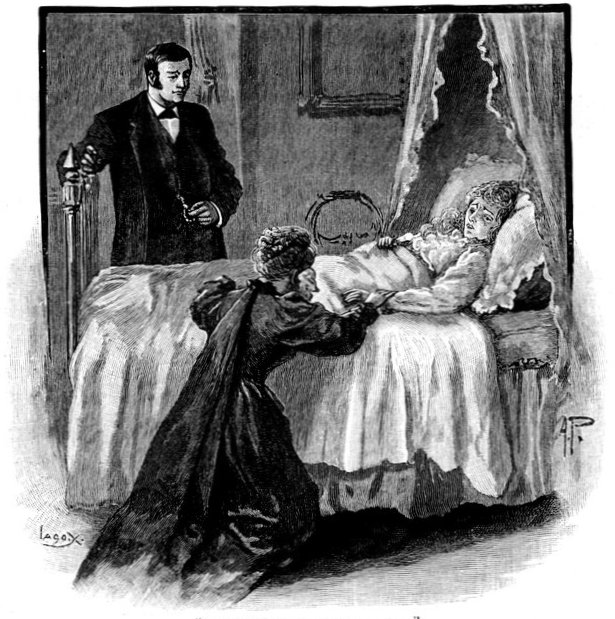
"My darling," said Lady Erstfield, falling
suddenly on her knees by the bedside, and
bursting into tears, "I would give them to
you if I could; but they are lost, Violet,
dear—the Ponsonby diamonds are lost."
"THEY ARE LOST, VIOLET, DEAR."
"Oh! no, they aren't, mother," replied the
girl, in a voice of astonishment; "they are in
my jewel-case—in the lower drawer. The case
which holds the diamonds just fits into the
lower drawer of my jewel-case. You will
find my keys on the dressing-table. Do, do
fetch the diamonds, mother."
Lady Erstfield sprang to her feet and
looked with a kind of horrified consternation
at her child.
"No, my love," she said then, in a soothing
voice, "you are dreaming—you are not well
and have had a bad dream. Go to sleep,
my sweet darling, go to sleep."
"But I am not dreaming," said Lady
Violet—"the Ponsonby diamonds are in my
dressing-case. I remember putting them
there quite well—I had forgotten, but I
remember now quite well. Dr. Halifax,
won't you fetch them?"
"Certainly," I replied. "Lady Erstfield,
will you direct me to Lady Violet's jewel-case?"
"Yes," replied Lady Erstfield.
The poor woman staggered rather than
walked across the room. She gave me the
key of the jewel-case. I opened it and lifted
out the several compartments until I came
to the bottom drawer. There lay an old-fashioned
morocco case. I opened it, and
the Ponsonby jewels in all their magnificence
lay before me.
"My God, what does this mean?" gasped
Lady Erstfield.
"Hush," I said, "don't say anything—take
them to her."
"You must do it, I cannot," she moaned.
I took the case up to the bedside. Lady
Violet gave a little cry of rapture when she
saw it. In a twinkling, she had lifted the
necklace from its bed of ruby velvet and had
clasped it round her white throat.
"Oh, my beautiful, sparkling treasures!"
she exclaimed; "how I love you—how you
comfort me!"
She lay down at once and closed her eyes.
In a moment she was in sound and dreamless
sleep.
The case was one, without any doubt, of
sudden and acute kleptomania. This strange
nervous disorder had in all probability been
developed in Lady Violet by the depression
caused by her uncongenial engagement
to Captain Ponsonby. The whole
thing was now clear as daylight—poor Lady
Violet was the unconscious thief. She had
stolen the diamonds and then forgotten all
about her theft. In her delirium memory
returned to her, and in her desire to possess
the gems she recalled where she had placed
them. How she secured the keys of the
safe was an unsolved mystery for some time,
but Lady Erstfield, in thinking matters
over, remembered how close Violet had sat
by her side on the sofa in one of the drawing-rooms
the evening before the loss was
discovered.
"She was often fond of putting her hand
into my pocket in play," said the lady; "it
was a trick of hers as a child, and I used to
be quite cross about it, sometimes. She must
have transferred the keys from my pocket to
her own on that occasion, gone upstairs and
removed the diamonds from my jewel safe
to her own jewel-case, and then once more
slipped the keys back into my pocket."
This explanation seemed sufficiently
likely to satisfy people; anyhow, no other
was ever forthcoming. Poor Beryl was, of
course, restored to higher favour than ever:
indeed, Lord and Lady Erstfield felt that
they could not possibly make enough of her.
The finding of the diamonds was the turning-point
in Lady Violet's illness. She slept for
many hours with the sparkling gems round
her neck, and when she awoke it was to
consciousness and recovery.
The diamonds were returned to Captain
Ponsonby on the following day, and the
engagement between him and Lady Violet
was at an end. There is only one strange
thing to add to this strange story. Lady
Violet has never, from the moment of her
awakening to now, alluded to the Ponsonby
diamonds. It is my belief that she has
forgotten all about them, and, as far as I can
tell, I do not think she will ever be visited
by another attack of kleptomania.