By the Authors of "The Medicine Lady."
On a certain cold morning in early
spring, I was visited by two
ladies, mother and daughter.
The mother was dressed as a
widow. She was a tall, striking-looking
woman, with full,
wide-open dark eyes, and a mass of rich hair
turned back from a white and noble brow.
Her lips were firm, her features well formed.
She seemed to have plenty of character, but
the deep lines of sadness under her eyes and
round her lips were very remarkable. The
daughter was a girl of fourteen, slim to weediness.
Her eyes were dark, like her mother's,
and she had an abundance of tawny brown
and very handsome hair. It hung down her
back below her waist, and floated over her
shoulders. She was dressed, like her mother,
in heavy mourning, and round her young
mouth and dark, deep eyes there lingered
the same inexpressible sadness.
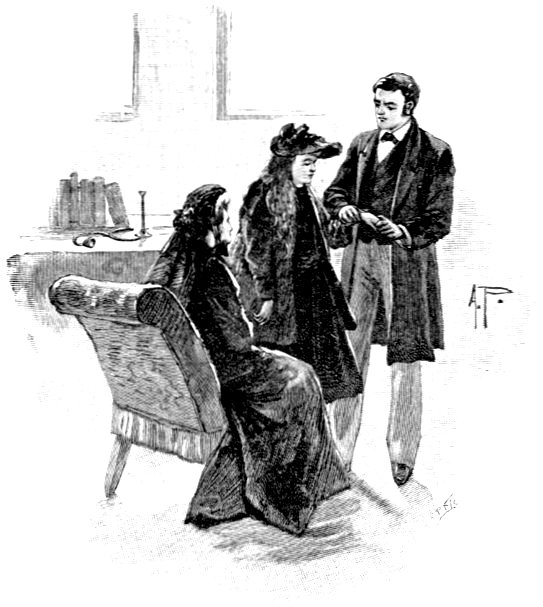
I motioned my visitors to chairs, and
waited as usual to learn the reason of their
favouring me with a call.
"My name is Heathcote," said the elder
lady. "I have lately lost my husband. I
have come to you on account of my
daughter—she is not well."
I glanced again more attentively at the
young girl. I saw that she looked overstrained
and nervous. Her restlessness, too,
was so apparent that she could scarcely sit
still, and catching up a paper-knife which
stood on the table near, she began twirling it
rapidly between her finger and thumb.
"It does me good to fidget with something,"
she said, glancing apologetically at
her mother.
"What are your daughter's symptoms?" I
asked.
Mrs. Heathcote began to describe them in
the vague way which characterizes a certain
class of patient. I gathered at last from her
words that Gabrielle would not eat—she slept
badly—she was weak and depressed—she took
no interest in anything.
"How old is Miss Gabrielle?" I asked.
"She will be fifteen her next birthday,"
replied her mother.
All the while Mrs. Heathcote was speaking,
the young daughter kept her eyes fixed on
the carpet—she still twirled the paper-knife,
and once or twice she yawned profoundly.
I asked her to prepare for the usual
medical examination. She complied without
any alacrity, and with a look on her face which
said plainly, "Young as I am, I know how
useless all this fuss is—I only submit because
I must."
I felt her pulse and sounded her heart and
lungs. The action of the heart was a little
weak, but the lungs were perfectly healthy. In
short, beyond a general physical and mental
debility, I could find nothing whatever the
matter with the girl.
After a time, I rang the bell to desire my
servant to take Miss Heathcote into another
room, in order that I might speak to her
mother alone.
The young lady went away very unwillingly.
The sceptical expression on her face was
more apparent than ever.
"You will be sure to tell me the exact
truth?" said Mrs. Heathcote, as soon as
we were alone.
"I have very little to tell," I replied. "I
have examined your daughter carefully. She
is suffering from no disease to which a name
can be attached. She is below par, certainly;
there is weakness and general depression,
but a tonic ought to set all these matters
right."
"I have tried tonics without avail," said
Mrs. Heathcote.
"Has not your family physician seen Miss
Heathcote?"
"Not lately." The widow's manner became
decidedly hesitating. "The fact is, we
have not consulted him since—since Mr.
Heathcote's death," she said.
"When did that take place?"
"Six months ago."
Here she spoke with infinite sadness, and
her face, already very pale, turned perceptibly
paler.
"Is there nothing you can tell me to give
me a clue to your daughter's condition? Is
there anything, for instance, preying on her
mind?"
"Nothing whatever."
"The expression of her face is very sad for
so young a girl."
"You must remember," said Mrs.
Heathcote, "that she has lately lost her
father."
"Even so," I replied; "that would scarcely
account for her nervous condition. A
healthy-minded child will not be overcome
with grief to the serious detriment of health
after an interval of six months. At least," I
added, "that is my experience in ordinary
cases."
"I am grieved to hear it," said Mrs.
Heathcote.
She looked very much troubled. Her
agitation was apparent in her trembling hands
and quivering lips.
"Your daughter is in a nervous condition,"
I said, rising. "She has no disease at
present, but a little extra strain might develop
real disease, or might affect her nerves,
already overstrung, to a dangerous degree.
I should recommend complete change of air
and scene immediately."
Mrs. Heathcote sighed heavily.
"You don't look very well yourself," I
said, giving her a keen glance.
She flushed crimson.
"I have felt my
sorrow acutely," she
replied.
I made a few more
general remarks, wrote
a prescription for the
daughter, and bade Mrs.
Heathcote good-bye.
About the same hour
on the following morning
I was astonished
when my servant brought
me a card on which was
scribbled in pencil the
name Gabrielle Heathcote,
and underneath, in
the same upright, but
unformed hand, the
words, "I want to see
you most urgently."
A few moments later,
Miss Gabrielle was
standing in my consulting-room.
Her appearance
was much the
same as yesterday, except
that now her face was
eager, watchful, and all
awake.
"How do you do?"
she said, holding out
her hand, and blushing.
"I have ventured to
come alone, and I haven't brought a fee.
Does that matter?"
"Not in the least," I replied. "Pray sit
down and tell me what you want."
"I would rather stand," she answered; "I
feel too restless and excited to sit still. I
stole away from home without letting mother
know. I liked your look yesterday and
determined to see you again. Now, may I
confide in you?"
"You certainly may," I replied.
My interest in this queer child was a good
deal aroused. I felt certain that I was right
in my conjectures of yesterday, and that this
young creature was really burdened with
some secret which was gravely undermining
her health.
"I am willing to listen to you," I continued.
"You must be brief, of course, for I am a
very busy man, but anything you can say
which will throw light on your own condition,
and so help me to cure you, will, of course,
be welcome."
"You think me very nervous?" said Miss
Gabrielle.
"Your nerves are out of order," I replied.
"You know that I don't sleep at night?"
"Yes."
Miss Gabrielle looked towards the door.
"Is it shut?" she asked, excitedly.
"Of course it is."
She came close to me, her voice dropped
to a hoarse whisper, her face turned not only
white but grey.
"I can stand it no longer," she said. "I'll
tell you the truth. You wouldn't sleep either
if you were me. My father isn't dead!"
"Nonsense," I replied. "You must control
such imaginings, Miss Gabrielle, or you
will really get into a very unhealthy condition
of mind."
"That's what mother says when I speak to
her," replied the child. "But I tell you, this
thing is true. My father is not dead. I
know it."
"How can you possibly know it?" I
asked.
"I have seen him—there!"
"You have seen your father!—but he died
six months ago?"
"Yes. He died—and was buried, and I
went to his funeral. But all the same he is
not dead now."
"My dear young lady," I said, in as soothing
a tone as I could assume, "you are the
victim of what is called a hallucination.
You have felt your father's death very
acutely."
"I have. I loved him beyond words.
He was so kind, so affectionate, so good to
me. It almost broke my heart when he died.
I thought I could never be happy again.
Mother was as wretched as myself. There
weren't two more miserable people in the
wide world. It seemed impossible to either
of us to smile or be cheerful again. I began
to sleep badly, for I cried so much, and my
eyes ached, and I did not care for lessons
any more."
"All these feelings will pass," I replied;
"they are natural, but time will abate their
violence."
"You think so?" said the girl, with a
strange smile. "Now let me go on with
my story: It was at Christmas time I first
saw my father. We live in an old house at
Brixton. It has a walled-in garden. I was
standing by my window about midnight. I
had been in bed for an hour or more, but I
could not sleep. The house was perfectly
quiet. I got out of bed and went to the
window and drew up the blind. I stood by
the window and looked out into the garden,
which was covered with snow. There, standing
under the window, with his arms folded,
was father. He stood perfectly still, and
turned his head slowly, first in the direction
of my room and then in that of
mother's. He stood there for quite five
minutes, and then walked across the
grass into the shelter of the shrubbery. I
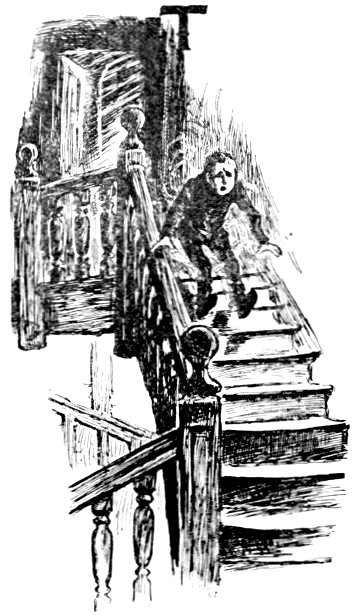
put a cloak on and rushed downstairs. I
unbolted the front door and went into the
garden. I shouted my father's name and
ran into the shrubbery to look for him, but
he wasn't there, and I—I think I fainted.
When I came to myself I was in bed and
mother was bending over me. Her face was
all blistered as if she had been crying terribly.
I told her that I had just seen father, and
she said it was a dream."
"So it was," I replied.
Miss Gabrielle's dark brows were knit in
some pain.
"I did not think you would take that
commonplace view," she responded.
"I am sorry I have offended you," I
answered. "Girls like you do have bad
dreams when they are in trouble, and those
dreams are often so vivid, that they mistake
them for realities."
"Very well, then, I have had more of those
vivid dreams. I have seen my father again.
The last time I saw him he was in the house.
It was about a month ago. As usual, I could
not sleep, and I went downstairs quite late to
get the second volume of a novel which
interested me. There was father walking
across the passage. His back was to me.
He opened the study door and went in. He
shut it behind him. I rushed to it in order
to open it and follow him. It was locked,
and though I screamed through the key-hole,
no one replied to me. Mother found me
kneeling by the study door and shouting
through the key-hole to father. She was up
and dressed, which seemed strange at so late
an hour. She took me upstairs and put me
to bed, and pretended to be angry with me,
but when I told her that I had seen father
she burst into the most awful bitter tears and
said:—
"'Oh, Gabrielle, he is dead—dead—quite
dead!'
"'Then he comes here from the dead,' I
said. 'No, he is not dead. I have just
seen him.'
"'My poor child,' said mother, 'I must
take you to a good doctor without delay.
You must not get this thing on your brain.'
"'Very well,' I replied; 'I am quite
willing to see Dr. Mackenzie.'"
I interrupted the narrative to inquire who
Dr. Mackenzie was.
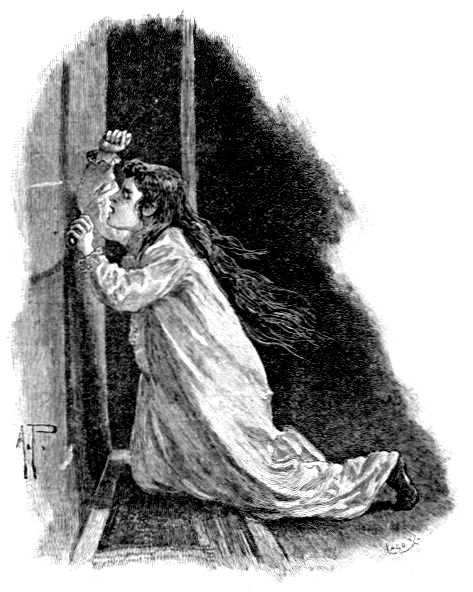
"I SCREAMED THROUGH THE KEY-HOLE."
"He is our family physician," replied the
young lady. "He has attended us for
years."
"And what did your mother say when you
proposed to see him?"
"She shivered violently, and said, 'No,
I won't have him in the house.' After a
time she decided to bring me to you."
"And have you had that hallucination
again?" I inquired.
"It was not a hallucination," she answered,
pouting her lips.
"I will humour you," I answered. "Have
you seen your father again?"
"No, and I am not likely to."
"Why do you think that?"
"I cannot quite tell you—I think mother
is in it. Mother is very unhappy about
something, and she looks at me at times
as if she were afraid of me." Here Miss
Heathcote rose. "You said I was not to stay
long," she remarked. "Now I have told you
everything. You see that it is absolutely
impossible for ordinary medicines to cure me,
any more than ordinary medicines can cure
mother of her awful dreams."
"I did not know that your
mother dreamt badly," I said.
"She does—but she doesn't
wish it spoken of. She dreams
so badly, she cries out so
terribly in her sleep, that she
has moved from her old bedroom
next to mine, to one in
a distant wing of the house.
Poor mother, I am sorry for
her, but I am glad at least
that I have had courage to tell
you what I have seen. You
will make it your business to
find out the truth now, won't
you?"
"What do you mean?" I
asked.
"Why, of course, my father
is alive," she retorted. "You
have got to prove that he is,
and to give him back to me
again. I leave the matter in
your hands. I know you are
wise and very clever. Good-bye,
good-bye!"
The queer girl left me, tears
rolling down her cheeks. I was
obliged to attend to other
patients, but it was impossible
for me to get Miss Heathcote's
story out of my head. There
was no doubt whatever that she
was telling me what she firmly believed to be
the truth. She had either seen her father once
more in the flesh, or she was the victim of
a very strong hallucination. In all probability
the latter supposition was the correct
one. A man could not die and have a
funeral and yet still be alive: but, then,
on the other hand, when Mrs. Heathcote
brought Gabrielle to see me yesterday, why
had she not mentioned this central and
principal feature of her malady? Mrs.
Heathcote had said nothing whatever with
regard to Gabrielle's delusions. Then why
was the mother so nervous? Why did she
say nothing about her own bad dreams,
dreams so disturbing, that she was obliged
to change her bedroom in order that her
daughter should not hear her scream?
"I leave the matter in your hands!" Miss
Heathcote had said. Poor child, she had
done so with a vengeance. I could not get
the story out of my thoughts, and so uncomfortable
did the whole thing make me
that I determined to pay Dr. Mackenzie a
visit.
Mackenzie was a physician in very large
practice at Brixton. His name was already
familiar to me—on one or two occasions I
had met him in consultation. I looked up
his address in the Medical Directory, and that
very evening took a hansom to his house.
He happened to be at home. I sent in my
card and was admitted at once.
Mackenzie received me in his consulting-room,
and I was not long in explaining the
motive of my visit. After a few preliminary
remarks, I said that I would be glad if he
would favour me with full particulars with
regard to Heathcote's death.
"I can easily do so," said Mackenzie.
"The case was a perfectly straightforward
one—my patient was consumptive, had been
so for years, and died at last of hemoptysis."
"What aged man was he?" I asked.
"Not old—a little past forty—a tall, slight,
good-looking man, with a somewhat emaciated
face. In short, his was an ordinary case of
consumption."
I told Mackenzie all about the visit which
I had received from Mrs. Heathcote, and
gave him a faithful version of the strange
story which Miss Gabrielle Heathcote had
told me that day.
"Miss Gabrielle
is an excitable girl,"
replied the doctor.
"I have had a good
deal to do with her
for many years, and
always thought her
nerves highly strung.
She is evidently the
victim of a delusion,
caused by the effect
of grief on a somewhat
delicate organism.
She probably
inherits her father's
disease. Mrs. Heathcote
should take her
from home immediately."
"Mrs. Heathcote
looks as if she
needed change
almost as badly as
her daughter," I
answered; "but now
you will forgive me
if I ask you a few
more questions. Will
you oblige me by
describing Heathcote's
death as faithfully
as you can?"
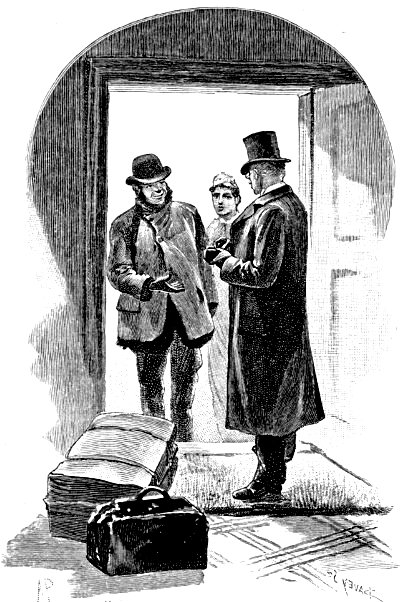
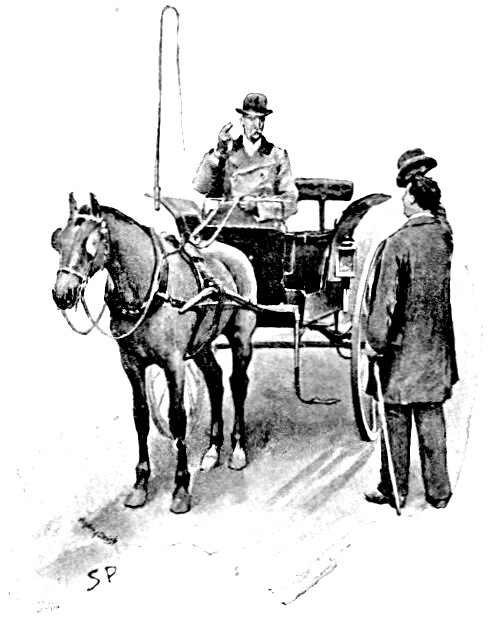
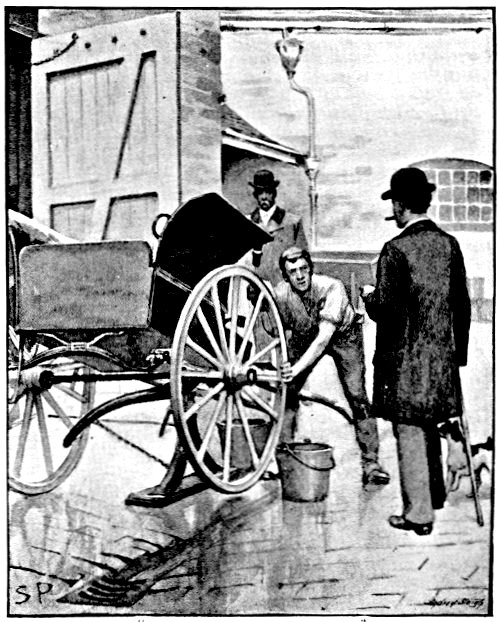
"I WAS PAYING THE CABMAN HIS FARE."
"Certainly," replied the physician.
He sank down into a chair at the opposite
side of the hearth as he spoke.
"The death, when it came," he continued,
"was, I must confess, unexpected. I had
sounded Heathcote's lungs about three
months previous to the time of his death
seizure. Phthisis was present, but not to an
advanced degree. I recommended his wintering
abroad. He was a solicitor by profession,
and had a good practice. I remember his
asking me, with a comical rise of his brows,
how he was to carry on his profession so
many miles from Chancery Lane. But to
come to his death. It took place six months
ago, in the beginning of September. It had
been a hot season, and I had just returned
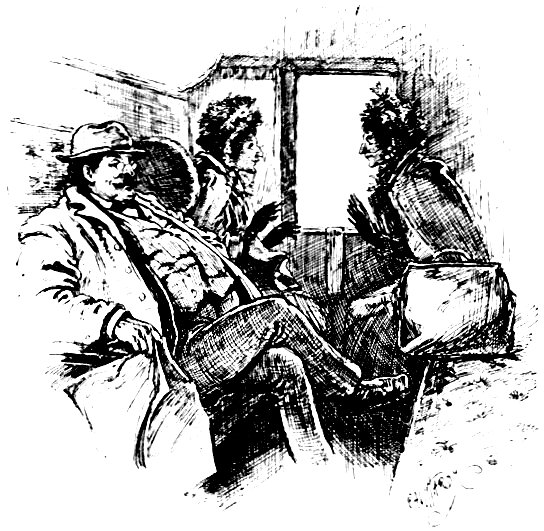
from my holiday. My portmanteau and
Gladstone bag had been placed in the hall,
and I was paying the cabman his fare, when
a servant from the Heathcotes arrived, and
begged of me to go immediately to her
master, who was, she said, dying.
"I hurried off to the house without a
moment's delay. It is a stone's throw from here.
In fact, you can see the walls of the garden from
the windows of this
room in the daytime.
I reached the house.
Gabrielle was standing
in the hall. I
am an old friend of
hers. Her face was
quite white and had
a stunned expression.
When she saw me
she rushed to me,
clasped one of my
hands in both of hers,
and burst into tears.
"'Go and save
him!' she gasped,
her voice choking
with sobs, which were
almost hysterical.
"A lady who happened
to be staying
in the house came
and drew the girl
away into one of the
sitting-rooms, and I
went upstairs. I
found Heathcote in
his own room. He
was lying on the bed—he
was a ghastly
sight. His face wore
the sick hue of death
itself; the sheet, his
hair, and even his face were all covered with
blood. His wife was standing over him,
wiping away the blood, which oozed from
his lips. I saw, of course, immediately what
was the matter. Hemoptysis had set in,
and I felt that his hours were numbered.
"'He has broken a blood vessel,' exclaimed
Mrs. Heathcote. 'He was standing
here, preparing to go down to dinner, when
he coughed violently—the blood began to
pour from his mouth: I got him on the bed
and sent for you. The hemorrhage seems
to be a little less violent now.'
"I examined my patient carefully, feeling
his pulse, which was very weak and low; I
cautioned him not to speak a single word,
and asked Mrs. Heathcote to send for some
ice immediately. She did so. I packed him
in ice and gave him a dose of ergotine. He
seemed easier, and I left him, promising to
return again in an hour or two. Miss
Gabrielle met me in the hall as I went out.
"'Is he any better? Is there any hope at
all?' she asked, as I left the house.
"'Your father is easier now,' I replied;
'the hemorrhage has been arrested. I am
coming back soon. You must be a good
girl and try to comfort your mother in
every way in your power.'
"'Then there is no hope?' she answered,
looking me full in the face.
"I could not truthfully say that there was.
I knew poor Heathcote's days were numbered,
although I scarcely thought the end would
come so quickly."
"What do you mean?" I inquired.
"Why this," he replied. "Less than an
hour after I got home, I received a brief note
from Mrs. Heathcote. In it she stated that
fresh and very violent hemorrhage had set
in almost immediately after I left, and that
her husband was dead."
"And—" I continued.
"Well, that is the story. Poor Heathcote
had died of hemoptysis."
"Did you see the body after death?"
I inquired, after a pause.
"No—it was absolutely unnecessary—the
cause of death was so evident. I attended
the funeral, though. Heathcote was buried
at Kensal Green."
I made no comment for a moment or two.
"I am sorry you did not see the body
after death," I said, after a pause.
My remark seemed to irritate Mackenzie.
He looked at me with raised brows.
"Would you have thought it necessary to
do so?" he asked. "A man known to be
consumptive dies of violent hemorrhage of
the lungs. The family are in great trouble—there
is much besides to think of. Would
you under the circumstances have considered
it necessary to refuse to give a certificate
without seeing the body?"
I thought for a moment.
"I make a rule of always seeing the body,"
I replied; "but, of course, you were justified,
as the law stands. Well, then, there is no
doubt Heathcote is really dead?"
"Really dead?" retorted Mackenzie.
"Don't you understand that he has been in his
grave for six months?—That I practically saw
him die?—That I attended his funeral? By
what possible chance can the man be alive?"
"None," I replied. "He is dead, of
course. I am sorry for the poor girl. She
ought to leave home immediately."
"Girls of her age often have delusions,"
said Mackenzie. "I doubt not this will
pass in time. I am surprised, however, that
the Heathcotes allowed the thing to go on
so long. I remember now that I have never
been near the house since the funeral. I
cannot understand their not calling me in."
"That fact puzzles me also," I said.
"They came to me, a total stranger, instead
of consulting their family physician, and
Mrs. Heathcote carefully concealed the most
important part of her daughter's malady. It
is strange altogether; and, although I can
give no explanation whatever, I am convinced
there is one if we could only get at
it. One more question before I go, Mackenzie.
You spoke of Heathcote as a
solicitor: has he left his family well off?"
"They are not rich," replied Mackenzie;
"but as far as I can tell, they don't seem to
want for money. I believe their house,
Ivy Hall is its name, belongs to them. They
live there very quietly, with a couple of maid-servants.
I should say they belonged to the
well-to-do middle classes."
"Then money troubles cannot explain the
mystery?" I replied.
"Believe me, there is no mystery," answered
Mackenzie, in an annoyed voice.
I held out my hand to wish him good-bye,
when a loud peal at the front door startled
us both. If ever there was frantic haste in
anything, there was in that ringing peal.
"Someone wants you in a hurry," I said
to the doctor.
He was about to reply, when the door of
the consulting-room was flung wide open, and
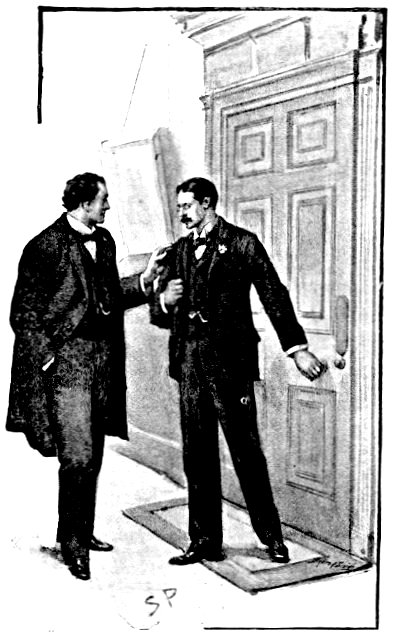
Gabrielle Heathcote rushed into the room.
"Mother is very ill," she exclaimed. "I
think she is out of her mind. Come to her
at once."
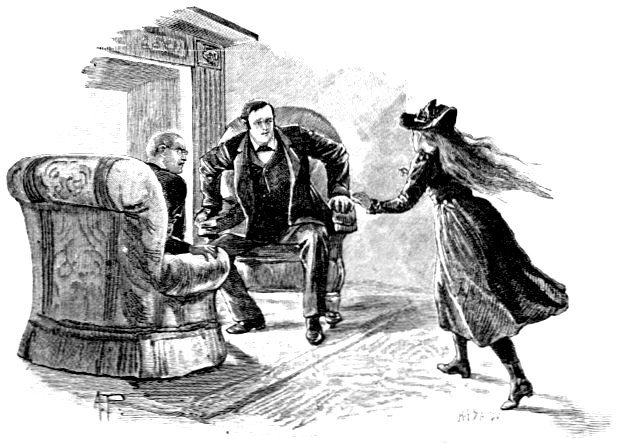
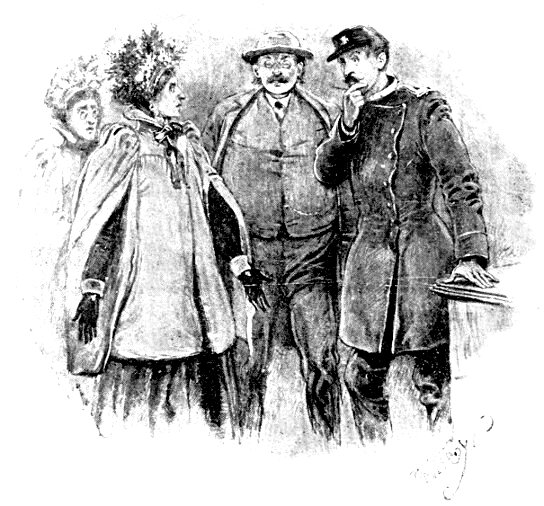
"GABRIELLE HEATHCOTE RUSHED INTO THE ROOM."
She took Mackenzie's hand in hers.
"There isn't a minute to lose," she said,
"she may kill herself. She came to me with
a carving-knife in her hand; I rushed away at
once for you. The two servants are with her
now, and they are doing all they can; but, oh!
pray, do be quick."
At this moment Gabrielle's eyes rested on
me. A look of relief and almost ecstasy
passed over her poor, thin little face.
"You are here!" she exclaimed. "You
will come, too? Oh, how glad I am."
"If Dr. Mackenzie will permit me," I
replied, "I shall be only too pleased to
accompany him."
"By all means come, you may be of the
greatest use," he answered.
We started at once. As soon as we left
the house Gabrielle rushed from us.
"I am going to have the front door open
for you both when you arrive," she exclaimed.
She disappeared as if on the wings of the
wind.
"That is a good girl," I said, turning to
the other doctor.
"She has always been deeply attached to
both her parents," he answered.
We did not either of us say another word
until we got to Ivy Hall. It was a rambling
old house, with numerous low rooms and a
big entrance-hall. I could fancy that in the
summer it was cheerful enough, with its large,
walled-in garden. The night was a dark one,
but there would be a moon presently.
Gabrielle was waiting in the hall to receive
us.
"I will take you to the door of mother's
room," she exclaimed.
Her words came out tremblingly, her face
was like death. She was shaking all over.
She ran up the stairs before us, and then
down a long passage which led to a room a
little apart from the rest of the house.
"I told you mother wished to sleep in a
room as far away from me as possible," she
said, flashing a glance into my face as she
spoke.
I nodded in reply. We opened the door
and went in. The sight which met our eyes
was one with which most medical men are
familiar.
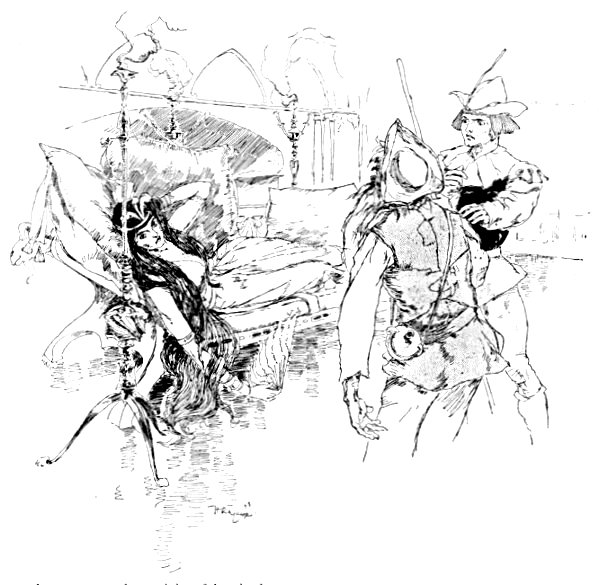
The patient was lying on the bed in a state
of violent delirium. Two maid-servants were
bending over her, and evidently much exciting
her feelings in their efforts to hold her down.
I spoke at once with authority.
"You can leave the room now," I said—"only
remain within call in case you are
wanted."
They obeyed instantly, looking at me with
surprised glances, and at Mackenzie with
manifest relief.
I shut the door after them and approached
the bed. One glance showed that Mrs.
Heathcote was not mad in the ordinary
sense, but that she was suffering at the
moment from acute delirium. I put my
hand on her forehead: it burned with fever.
Her pulse was rapid and uneven. Mackenzie
took her temperature, which was very nearly
a hundred and four degrees. While we were
examining her she remained quiet, but presently,
as we stood together and watched her,
she began to rave again.
"What is it, Gabrielle? No, no, he is
quite dead, child. I tell you I saw the men
screw his coffin down. He's dead—quite
dead. Oh, God! oh, God! yes, dead, dead!"
She sat up in bed and stared straight
before her.
"You mustn't come here so often," she
said, looking past us into the centre of the
room, and addressing someone whom she
seemed to see with distinctness, "I tell you it
isn't safe. Gabrielle suspects. Don't come
so often—I'll manage some other way.
Trust me. Do trust me. You know I won't
let you starve. Oh, go away, go away."
She flung herself back on the bed and
pressed her hands frantically to her burning
eyes.
"Your father has been dead six months
now, Gabrielle," she said, presently, in a
changed voice.
"No one was ever more dead. I tell you
I saw him die;
he was buried,
and you went to
his funeral."
Here again her
voice altered. She
sat upright and
motioned with
her hand. "Will
you bring the
coffin in here,
please, into this
room? Yes; it
seems a nice
coffin—well
finished. The
coffin is made of
oak. That is
right. Oak lasts.
I can't bear
coffins that
crumble away
very quickly. This
is a good one—you
have taken
pains with it—I
am pleased. Lay
him in gently.
"He is not very heavy, is he? You see
how worn he is. Consumption!—yes,
consumption. He had been a long time
dying, but at the end it was sudden.
Hemorrhage of the lungs. We did it to save
Gabrielle, and to keep away—what, what,
what did we want to keep away?—Oh, yes,
dishonour! The—the—" Here she burst
into a loud laugh.
"You don't suppose, you undertaker's men,
that I'm going to tell you what we did it for?
Dr. Mackenzie was there—he saw him just at
the end. Now you have placed him nicely in
his coffin, and you can go. Thank you, you
can go now. I don't want you to see his
face. A dead face is too sacred. You must
not look on it. He is peaceful, only pale,
very pale. All dead people look pale. Is
he as pale as most dead people? Oh, I
forgot—you can't see him. And as cold?
Oh, yes, I think so, quite. You want to
screw the coffin down, of course, of course—I
was forgetting. Now, be quick about it.
Why, do you know, I was very nearly having
him buried with the coffin open! Screw away
now, screw away. Ah, how that noise grates
on my nerves. I shall go mad if you are not
quick. Do be quick—be quick, and leave me
alone with my dead. Oh, God, with my
dead, my dead!"
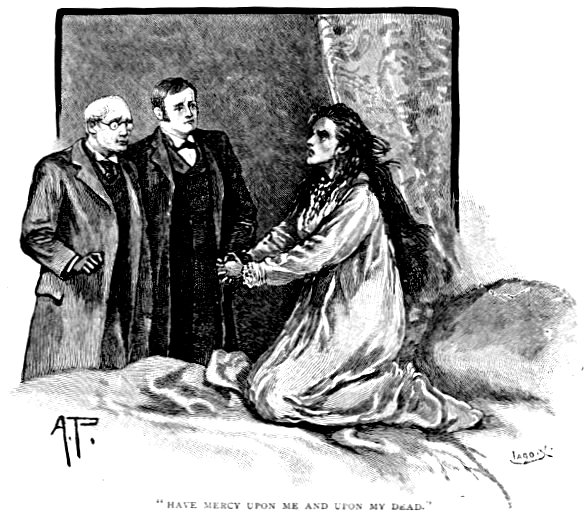
"HAVE MERCY UPON ME AND UPON MY DEAD."
The wretched woman's voice sank to a
hoarse whisper. She struggled on to her
knees, and folding her hands, began to pray.
"God in Heaven have mercy upon me and
upon my dead," she moaned. "Now, now,
now! where's the screwdriver? Oh, heavens,
it's lost, it's lost! We are undone! My God,
what is the matter with me? My brain reels.
Oh, my God, my God!"
She moaned tearfully. We laid her back
on the bed. Her mutterings became more
rapid and indistinct. Presently she slept.
"She must not be left in this condition,"
said Mackenzie to me. "It would be very
bad for Gabrielle to be with her mother now.
And those young servants are not to be
trusted. I will go and send in a nurse as
soon as possible. Can you do me the inestimable
favour of remaining here until a
nurse arrives?"
"I was going to propose that I should, in
any case, spend the night here," I replied.
"That is more than good of you," said
the doctor.
"Not at all," I answered; "the case
interests me extremely."
A moment or two later Mackenzie left the
house. During his absence Mrs. Heathcote
slept, and I sat and watched her. The fever
raged very high—she muttered constantly in
her terrible dreams, but said nothing coherent.
I felt very anxious about her. She had
evidently been subjected to a most frightful
strain, and now all her nature was giving
way. I dared not think what her words
implied. My mission was at present to do
what I could for her relief.
The nurse arrived about midnight. She
was a sensible, middle-aged woman, very
strong too, and evidently accustomed to
fever patients. I gave her some directions,
desired her to ring a certain bell if she
required my assistance, and left the room.
As I went slowly downstairs I noticed the
moon had risen. The house was perfectly still—the
sick woman's moans could not be heard
beyond the distant wing of the house where
she slept. As I went downstairs I remembered
Gabrielle's story about the moonlit
garden and her father's figure standing there.
I felt a momentary curiosity to see what the
garden was like, and, moving aside a blind,
which concealed one of the lobby windows,
looked out. I gave one hurried glance and
started back. Was I, too, the victim of
illusion? Standing in the garden was the
tall figure of a man with folded arms. He
was looking away from me, but the light fell
on his face: it was cadaverous and ghastly
white; his hat was off; he moved into a deep
shadow. It was all done in an instant—he
came and went like a flash.
I pursued my way softly downstairs. This
man's appearance seemed exactly to coincide
with Mackenzie's description of Heathcote:
but was it possible, in any of the wonderful
possibilities of this earth, that a man could
rise from his coffin and walk the earth again?
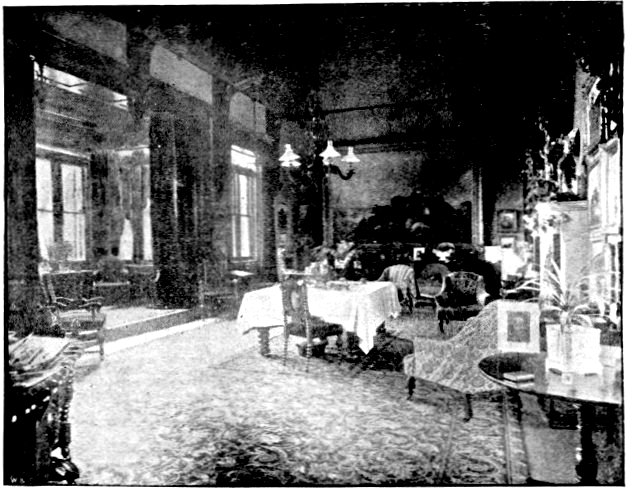
Gabrielle was waiting for me in the cheerful
drawing-room. A bright fire burned in
the grate, there were candles on brackets,
and one or two shaded lamps placed on
small tables. On one table, a little larger
than the rest, a white cloth was spread. It
also contained a tray with glasses, some
claret and sherry in decanters, and a plate of
sandwiches.
"You must be tired," said Gabrielle.
"Please have a glass of wine, and please eat
something. I know those sandwiches are
good—I made them myself."
She pressed me to eat and drink. In
truth, I needed refreshment. The scene in
the sick room had told even on my iron
nerves, and the sight from the lobby window
had almost taken my breath away.
Gabrielle attended on me as if she were
my daughter. I was touched by her solicitude,
and by the really noble way in which
she tried to put self out of sight. At last she
said, in a voice which shook with emotion:—
"I know, Dr. Halifax, that you think
badly of mother."
"Your mother is very ill indeed," I
answered.
"It is good of you to come and help her.
You are a great doctor, are you not?"
I smiled at the child's question.
"I want you to tell me something about
the beginning of your mother's illness," I
said, after a pause. "When I saw her two days
ago, she scarcely considered herself ill at all—in
fact, you were supposed to be the patient."
Gabrielle dropped into the nearest chair.
"There is a mystery somewhere," she said,
"but I cannot make it out. When I came
back, after seeing you to-day, mother seemed
very restless and troubled. I thought she
would have questioned me about being so
long away, and ask me at least what I had
done with myself. Instead of that, she asked
me to tread softly. She said she had such
an intolerable headache that she could
not endure the least sound. I saw she had
been out, for she had her walking boots on,
and they were covered with mud. I tried to
coax her to eat something, but she would not,
and as I saw she really wished to be alone,
I left her.
"At tea time, our parlour-maid, Peters,
told me that mother had gone to bed and
had given directions that she was on no
account to be disturbed. I had tea alone,
and then came in here and made the place
as bright and comfortable as I could. Once
or twice before, since my father's death,
mother has suffered from acute headaches,
and has gone to bed; but when they got
better, she has dressed and come downstairs
again. I thought she might like to do so
to-night, and that she would be pleased to
see a bright room and everything cheerful
about her.
"I got a story-book and tried to read, but
my thoughts were with mother, and I felt
dreadfully puzzled and anxious. The time
seemed very long too, and I heartily wished
that the night were over. I went upstairs
about eight o'clock, and listened outside
mother's door. She was moaning and talking
to herself. It seemed to me that she was
saying dreadful things. I quite shuddered as
I listened. I knocked at the door, but there
was no answer. Then I turned the handle
and tried to enter, but the door was locked.
I went downstairs
again, and Peters
came to ask me if I
would like supper.
She was still in the
room, and I had not
made up my mind
whether I could eat
anything or not,
when I heard her
give a short scream,
and turning round,
I saw mother standing
in the room in
her nightdress. She
had the carving-knife
in her hand.
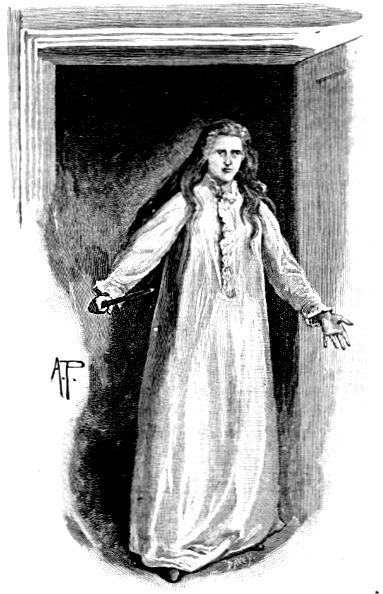
"IS THERE ANY BLOOD ON MY HANDS?"
"'Gabrielle,' she
said, in a quiet
voice, but with an
awful look in her
eyes, 'I want you
to tell me the truth.
Is there any blood
on my hands?'
"'No, no, mother,'
I answered.
"She gave a deep
sigh, and looked at
them as if she were
Lady Macbeth.
"'Gabrielle,' she
said again, 'I can't
live any longer without your father. I have
made this knife sharp, and it won't take long.'
"Then she turned and left the room.
Peters ran for cook, and they went upstairs
after her, and I rushed for Dr. Mackenzie."
"It was a fearful ordeal for you," I said,
"and you behaved very bravely; but you
must not think too much about your
mother's condition, nor about any words
which she happened to say. She is highly
feverish at present, and is not accountable
for her actions. Sit down now, please, and
take a glass of wine yourself."
"No, thank you—I never take wine."
"I'm glad to hear you say so, for in that
case a glass of this good claret will do
wonders for you. Here, I'm going to pour
one out—now drink it off at once."
She obeyed me with a patient sort of
smile. She was very pale, but the wine
brought some colour into her cheeks.
"I am interested in your story," I said,
after a pause. "Particularly in what you
told me about your poor father. He must
have been an interesting man, for you to
treasure his memory so deeply. Do you
mind describing
him to me?"
She flushed up
when I spoke. I
saw that tears were
very near her eyes,
and she bit her
lips to keep back
emotion.
"My father was
like no one else,"
she said. "It is
impossible for me
to make a picture
of him for one who
has not seen him."
"But you can at
least tell me if he
were tall or short,
dark or fair, old or
young?"
"No, I can't,"
she said, after
another pause.
"He was just
father. When you
love your father, he
has a kind of
eternal youth to
you, and you don't
discriminate his
features. If you
are his only child,
his is just the one face in all the world to you.
I find it impossible to describe the face,
although it fills my mind's eye, waking and
sleeping. But, stay, I have a picture of him.
I don't show it to many, but you shall see it."
She rushed out of the room, returning in
a moment with a morocco case. She opened
it, and brought over a candle at the same
time so that the light should fall on the
picture within. It represented a tall, slight
man, with deep-set eyes and a very thin face.
The eyes were somewhat piercing in their
glance; the lips were closely set and firm;
the chin was cleft. The face showed determination.
I gave it a quick glance, and,
closing the case, returned it to Gabrielle.
The face was the face of the man I had
seen in the garden.
My patient passed a dreadful night. She
was no better the next morning. Her temperature
was rather higher, her pulse quicker,
her respiration more hurried. Her ravings
had now become almost incoherent.
Mackenzie and I had an anxious consultation
over her. When he left the house I
accompanied him.
"I am going to make a strange request of
you," I said. "I wish for your assistance,
and am sure you will not refuse to give it
to me. In short, I want to take immediate
steps to have Heathcote's coffin opened."
I am quite sure Mackenzie thought that I
was mad. He looked at me, opened his lips
as if to speak, but then waited to hear my
next words.
"I want to have Heathcote's body exhumed,"
I said. "If you will listen to me, I
will tell you why."
I then gave him a graphic account of the
man I had seen in the garden.
"There is foul play somewhere," I said, in
conclusion. "I have been dragged into this
thing almost against my will, and now I am
determined to see it through."
Mackenzie flung up his hands.
"I don't pretend to doubt your wisdom,"
he said; "but to ask me gravely to assist you
to exhume the body of a man who died of consumption
six months ago, is enough to take my
breath away. What reason can you possibly
give to the authorities for such an action?"
"That I have strong grounds for believing
that the death never took place at all," I
replied. "Now, will you co-operate with me
in this matter, or not?"
"Oh, of course, I'll co-operate with you,"
he answered. "But I don't pretend to say
that I like the business."
We walked together to his house, talking
over the necessary steps which must be taken
to get an order for exhumation. Mackenzie
promised to telegraph to me as soon as ever
this was obtained, and I was obliged to hurry
off to attend to my own duties. As I was
stepping into my hansom I turned to ask the
doctor one more question.
"Have you any reason to suppose that
Heathcote was heavily insured?" I asked.
"No, I don't know anything about it,"
he answered.
"You are quite sure there were no money
troubles anywhere?"
"I do not know of any; but that fact
amounts to nothing, for I was not really
intimate with the family, and, as I said
yesterday evening, never entered the house
until last night from the day of the funeral.
I have never heard of money troubles; but, of
course, they might have existed."
"As soon as ever I hear from you, I will
make an arrangement to meet you at Kensal
Green," I replied, and then I jumped into
the hansom and drove away.
In the course of the day I got a telegram
acquainting me with Mrs. Heathcote's
condition. It still remained absolutely
unchanged, and there was, in Mackenzie's
opinion, no necessity for me to pay her
another visit. Early the next morning, the
required order came from the coroner.
Mackenzie wired to apprise me of the fact,
and I telegraphed back, making an appointment
to meet him at Kensal Green on the
following morning.
I shall not soon forget that day. It was
one of those blustering and intensely cold
days which come oftener in March than any
other time of the year. The cemetery looked
as dismal as such a place would on the
occasion. The few wreaths of flowers which
were scattered here and there on newly-made
graves were sodden and deprived of all their
frail beauty. The wind blew in great gusts,
which were about every ten minutes accompanied
by showers of sleet. There was a
hollow moaning noise distinctly audible in
the intervals of the storm.
I found, on my arrival, that Mackenzie was
there before me. He was accompanied by one
of the coroner's men and a police-constable.
Two men who worked in the cemetery also
came forward to assist. No one expressed
the least surprise at our strange errand.
Around Mackenzie's lips, alone, I read an
expression of disapproval.
Kensal Green is one of the oldest cemeteries
which surround our vast Metropolis,
and the Heathcotes' burying-place was quite
in the oldest portion of this God's acre. It
was one of the hideous, ancient, rapidly-going-out-of-date
vaults. A huge brick
erection was placed over it, at one side of
which was the door of entrance.
The earth was removed, the door of the
vault opened, and some of the men went
down the steps, one of them holding a torch,
in order to identify the coffin. In a couple
of minutes' time it was borne into the light of
day. When I saw it I remembered poor
Mrs. Heathcote's wild ravings.
"A good, strong oak coffin, which wears
well," she had exclaimed.
Mackenzie and I, accompanied by the
police-constable and the coroner's man,
followed the bearers of the coffin to the
mortuary.
As we were going there, I turned to ask
Mackenzie how his patient was.
He shook his head as he answered me.
"I fear the worst," he replied. "Mrs.
Heathcote is very ill indeed. The fever rages
high and is like a consuming fire. Her
temperature was a hundred and five this
morning."
"I should recommend packing her in
sheets wrung out of cold water," I answered.
"Poor woman!—how do you account for
this sudden illness, Mackenzie?"
He shrugged his shoulders.
"Shock of some sort," he answered. Then
he continued: "If she really knew of this
day's work, it would kill her off pretty
quickly. Poor soul," he added, "I hope
it may never reach her ears."
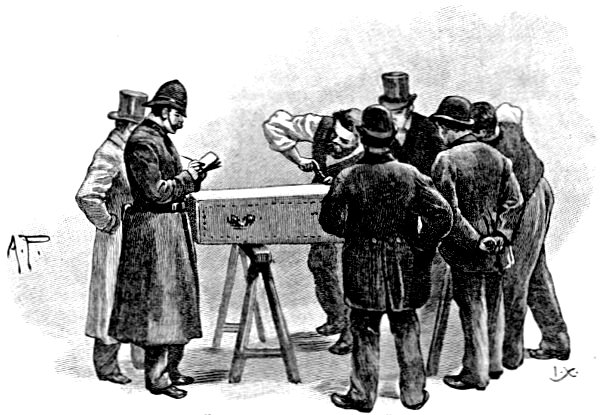
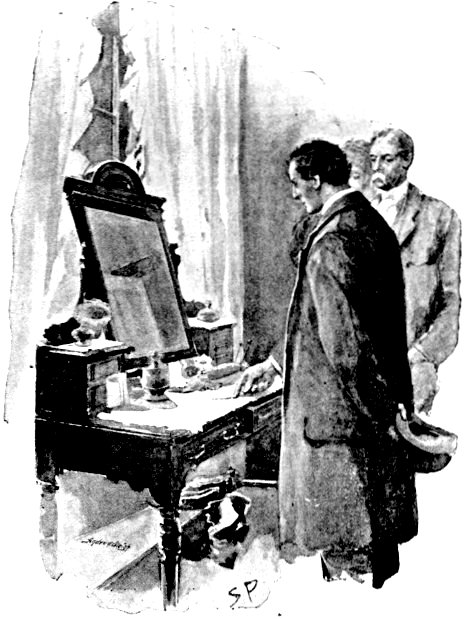
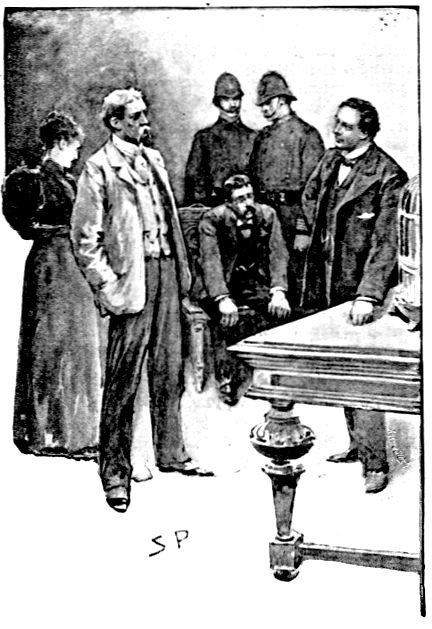
"THEY UNSCREWED THE LID."
We had now
reached the mortuary.
The men
who had borne
the coffin on their
shoulders lowered
it on to a pair of
trestles. They
then took turn-screws
out of their
pockets, and in a
business-like and
callous manner
unscrewed the lid.
After doing this
they left the mortuary,
closing the
door behind
them.
The moment
we found ourselves
alone, I
said a word to the police-constable, and then
going quickly up to the coffin, lifted the lid.
Under ordinary circumstances, such a proceeding
would be followed by appalling
results, which need not here be described.
Mackenzie, whose face was very white, stood
near me. I looked at him for a moment,
and then flung aside the pall which was
meant to conceal the face of the dead.
The dead truly! Here was death, which
had never, in any sense, known life like ours.
Mackenzie uttered a loud exclamation. The
constable and the coroner's man came close.
I lifted a bag of flour out of the coffin!
There were many similar bags there. It
had been closely packed, and evidently with
a view to counterfeit the exact weight of the
dead man.
Poor Mackenzie was absolutely speechless.
The coroner's man began to take copious
notes; the police-constable gravely did the
same.
Mackenzie at last found his tongue.
"I never felt more stunned in my life," he
said. "In very truth, I all but saw the man
die. Where is he? In the name of Heaven,
what has become of him? This is the most
monstrous thing I have ever heard of in the
whole course of my life, and—and I attended
the funeral of those bags of flour! No
wonder that woman never cared to see me
inside the house again. But what puzzles
me," he continued, "is the motive—what can
the motive be?"
"Perhaps one of the insurance companies
can tell us that," said the police-officer. "It
is my duty to report this thing, sir," he continued,
turning to me. "I have not the
least doubt that the Crown will prosecute."
"I cannot at all prevent your taking what
steps you think proper," I replied, "only
pray understand that the poor lady who is
the principal perpetrator in this fraud lies at
the present moment at death's door."
"We must get the man himself," murmured
the police-officer. "If he is alive we shall
soon find him."
Half an hour later, Mackenzie and I had
left the dismal cemetery.
I had to hurry back to Harley Street to
attend to some important duties, but I
arranged to meet Mackenzie that evening at
the Heathcotes' house. I need not say that
my thoughts were much occupied with Mrs.
Heathcote and her miserable story. What a
life that wretched Heathcote must have led
during the last six months. No wonder he
looked cadaverous as the moonlight fell over
his gaunt figure. No ghost truly was he, but
a man of like flesh and blood to ourselves—a
man who was supposed to be buried in
Kensal Green, but who yet walked the earth.
It was about eight o'clock when I reached
the Heathcotes' house. Mackenzie had
already arrived—he came into the hall to
meet me.
"Where is Miss Gabrielle?" I asked at once.
"Poor child," he replied; "I have begged
of her to stay in her room. She knows
nothing of what took place this morning, but
is in a terrible state of grief about her
mother. That unfortunate woman's hours
are numbered. She is sinking fast. Will
you come to her at once, Halifax—she has
asked for you several times."
Accompanied by Mackenzie, I mounted
the stairs and entered the sick room. One
glance at the patient's face showed me all too
plainly that I was in the chamber of death.
Mrs. Heathcote lay perfectly motionless.
Her bright hair, still the hair of quite a young
woman, was flung back over the pillow.
Her pale face was wet with perspiration. Her
eyes, solemn, dark, and awful in expression,
turned and fixed themselves on me as I
approached the bedside. Something like the
ghost of a smile quivered round her lips.
She made an effort to stretch out a shadowy
hand to grasp mine.
"Don't stir," I said to her. "Perhaps
you want to say something? I will stoop
down to listen to you. I have very good
hearing, so you can speak as low as you
please."
She smiled again with a sort of pleasure at
my understanding her.
"I have something to confess," she said, in
a hollow whisper. "Send the nurse and—and
Dr. Mackenzie out of the room."
I was obliged to explain the dying woman's
wishes to my brother physician. He called
to the nurse to follow him, and they immediately
left the room.
As soon as they had done so, I bent my
head and took one of Mrs. Heathcote's hands
in mine.
"Now," I said, "take comfort—God can
forgive sin. You have sinned?"
"Oh, yes, yes; but how can you possibly
know?"
"Never mind. I am a good judge of
character. If telling me will relieve your
conscience, speak."
"My husband is alive," she murmured.
"Yes," I said, "I guessed as much."
"He had insured his life," she continued,
"for—for about fifteen thousand pounds.
The money was wanted to—to save us from
dishonour. We managed to counterfeit—death."
She stopped, as if unable to proceed any
further. "A week ago," she continued, "I—I
saw the man who is supposed to be dead.
He is really dying now. The strain of knowing
that I could do nothing for him—nothing
to comfort his last moments—was too horrible.
I felt that I could not live without him. On
the day of my illness I took—poison, a preparation
of Indian hemp. I meant to kill
myself. I did not know that my object
would be effected in so terrible a manner."
Here she looked towards the door. A
great change came over her face. Her eyes
shone with sudden brightness. A look of
awful joy filled them. She made a frantic
effort to raise herself in bed.
I followed the direction of her eyes, and
then, indeed, a startled exclamation passed
my lips.
Gabrielle, with her cheeks crimson, her lips
tremulous, her hair tossed wildly about her
head and shoulders, was advancing into the
room, leading a cadaverous, ghastly-looking
man by the hand. In other words, Heathcote
himself in the flesh had come into his
wife's dying chamber.
"Oh, Horace!" she exclaimed; "Horace—to
die in your arms—to know that you will
soon join me. This is too much bliss—this
is too great joy!"
The man knelt by her, put his dying arms
round her, and she laid her head on his worn
breast.
"We will leave them together," I said to
Gabrielle.
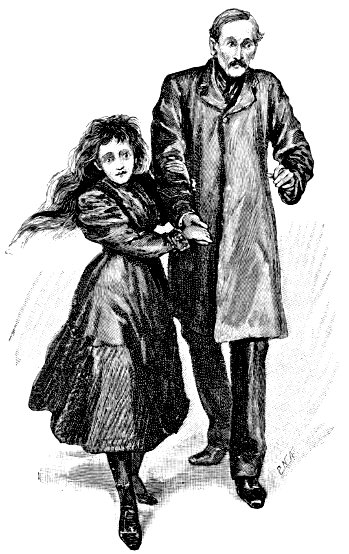
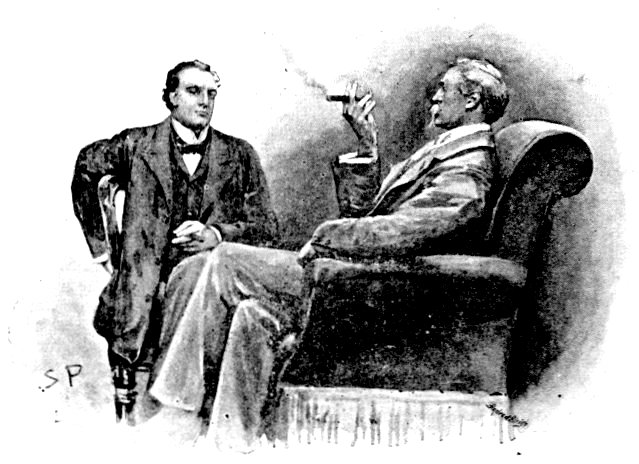
"LEADING A CADAVEROUS, GHASTLY-LOOKING
MAN BY THE HAND."
I took the poor little girl's hand and led
her from the room.
She was in a frantic state of excitement.
"I said he was not dead," she repeated—"I
always said it. I was sitting by my window
a few minutes ago, and I saw him in the
garden. This time I was determined that he
should not escape me. I rushed downstairs.
He knew nothing until he saw me at his side.
I caught his hand in mine. It was hot and
thin. It was like a skeleton's hand—only it
burned with living fire. 'Mother is dying—come
to her at once,' I said to him, and then
I brought him into the house."
"You did well—you acted very bravely,"
I replied to her.
I took her away to a distant part of the
house.
An hour later, Mrs. Heathcote died. I
was not with her when she breathed her last.
My one object now was to do what I could
for poor little Gabrielle. In consequence,
therefore, I made arrangements to have an
interview with Heathcote. It was no longer
possible for the wretched man to remain
in hiding. His own hours were plainly
numbered, and it was more than evident that
he had only anticipated his real death by
some months.
I saw him the next day, and he told me
in a few brief words the story of his supposed
death and burial.
"I am being severely punished now," he
said, "for the one great sin of my life. I am
a solicitor by profession, and when a young
man was tempted to appropriate some trust
funds—hoping, like many another has done
before me, to replace the money before the
loss was discovered. I married, and had a
happy home. My wife and I were devotedly
attached to each other. I was not strong,
and more than one physician told me that
I was threatened with a serious pulmonary
affection. About eight months ago, the blow
which I never looked for fell. I need not
enter into particulars. Suffice it to say
that I was expected to deliver over
twelve thousand pounds, the amount of
certain trusts committed to me, to their
rightful owners within three months' time.
If I failed to realize this money, imprisonment,
dishonour, ruin, would be mine.
My wife and child would also be reduced
to beggary. I had effected an insurance
on my life for fifteen thousand pounds.
If this sum could be realized, it would
cover the deficit in the trust, and also
leave a small overplus for the use of my
wife and daughter. I knew that my days
were practically numbered, and it did not
strike me as a particularly heinous crime to
forestall my death by a few months. I talked
the matter over with my wife, and at last got
her to consent to help me. We managed
everything cleverly, and not a soul suspected
the fraud which was practised on the world.
Our old servants, who had lived with us for
years, were sent away on a holiday. We had no
servant in the house except a charwoman, who
came in for a certain number of hours daily."
"You managed your supposed dying
condition with great skill," I answered.
"That hemorrhage, the ghastly expression
of your face, were sufficiently real to deceive
even a keen and clever man like Mackenzie."
Heathcote smiled grimly.
"After all," he said, "the fraud was simple
enough. I took an emetic, which I knew
would produce the cadaverous hue of
approaching death, and the supposed
hemorrhage was managed with some
bullock's blood. I got it from a distant
butcher, telling him that I wanted it to mix
with meal to feed my dogs with."
"And how did you deceive the undertaker's
men?" I asked.
"My wife insisted on keeping my face
covered, and I managed to simulate rigidity.
As to the necessary coldness, I was cold
enough lying with only a sheet over me.
After I was placed in the coffin my wife
would not allow anyone to enter the room
but herself: she brought me food, of course.
We bored holes, too, in the coffin lid. Still,
I shall never forget the awful five minutes
during which I was screwed down.
"It was all managed with great expedition.
As soon as ever the undertaker's men could
be got out of the way, my wife unscrewed
the coffin and released me. We then filled
it with bags of flour, which we had already
secured and hidden for the purpose. My
supposed funeral took place with due honours.
I left the house that night, intending to ship
to America. Had I done this, the appalling
consequences which have now ended in the
death of my wife might never have taken
place, but, at the eleventh hour, my courage
failed me. I could do much to shield my
wife and child, but I could not endure
the thought of
never seeing them
again. Contrary
to all my wife's
entreaties, I insisted
on coming
into the garden,
for the selfish
pleasure of catching
even a glimpse
of Gabrielle's
little figure, as she
moved about her
bedroom. She
saw me once, but
I escaped through
the shrubbery and
by a door which
we kept on purpose
unlocked,
before she
reached me. I
thought I would
never again transgress,
but once
more the temptation assailed me, and I was
not proof against it. My health failed rapidly.
I was really dying, and on the morning when
my wife's illness began, had suffered from a
genuine and very sharp attack of hemorrhage.
She found me in the wretched lodging where
I was hiding in a state of complete misery,
and almost destitution. Something in my
appearance seemed suddenly to make her
lose all self-control.
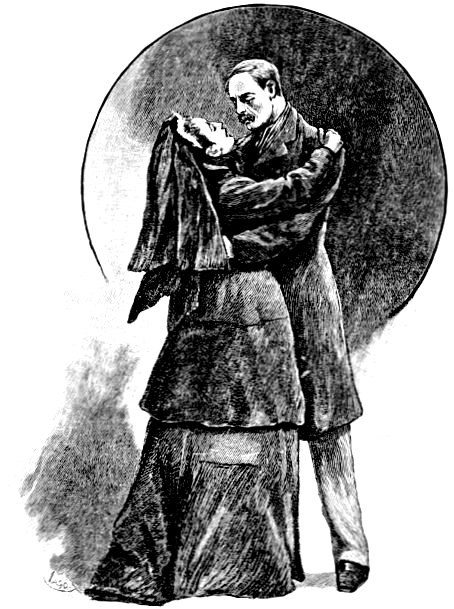
"WHEN YOU DIE, I WILL DIE."
"'Horace,' she exclaimed, 'I cannot stand
this. When you die, I will die. We will
carry our shame and our sorrow and our
unhappy love into the grave, where no man
can follow us. When you die, I will die.
Oh, to see you like this drives me mad!'
"She left me. She told me when I saw
her during those last few moments yesterday,
that she had hastened her end by a powerful
dose of Indian hemp. That is the story.
I know that I have laid myself open to
criminal prosecution of the gravest character,
but I do not think I shall live to go through
it."
Heathcote was
right. He passed
away that evening
quite quietly
in his sleep.
Poor little
Gabrielle! I
saw her once
since her parents'
death, but it is
now a couple of
years since I have
heard anything
about her. Will
she ever get over
the severe shock
to which she
was subjected?
What does the
future hold in
store for her?
I cannot answer
these questions.
Time alone can
do that.