By the Authors of "The Medicine Lady."
In the spring of 1890 I was
asked to see a patient at
Croydon with another doctor
in consultation. In this stage
of the illness it was only an
ordinary case of somewhat
severe typhoid fever, but the interest lies in
the succeeding stages, when complete recovery
seems to have taken place. I have noticed
this remarkable illness in my case-book as an
instance of perhaps the most extraordinary
psychological condition which has occurred
in my practice, or I might say in that of any
other man.
The patient was a young barrister; he had
a wife and three children. The wife was a
pretty, rather nervous-looking woman. On
the day when I went to see her husband, in
consultation with the family doctor, I could
not help noticing the intensely anxious expression
of her face, and how her lips moved
silently as she followed my words. The illness
was severe, but I did not consider
it as specially dangerous, and had, therefore,
only encouraging opinions to give her.
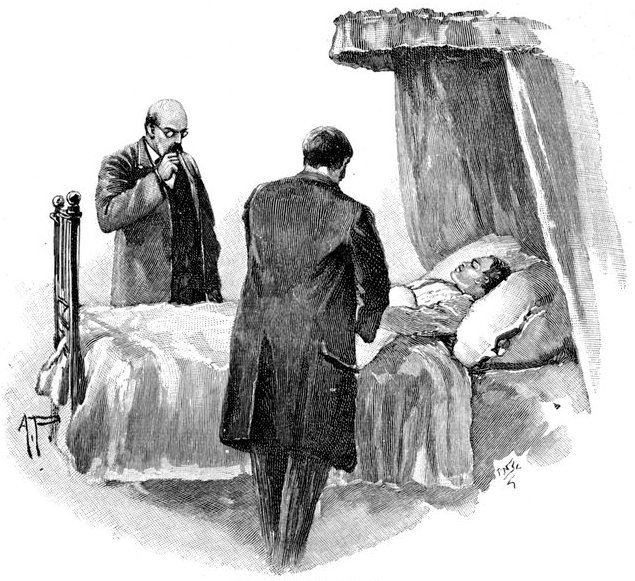
I saw Mainwaring again at the end of the
week. He was then much better, and I was
able to communicate the cheerful tidings to
his wife that he was practically out of danger.
He was a man of about three-and-thirty years
of age, tall, and rather gaunt in appearance,
with deep-set grey eyes, and a big, massive
brow. I have often noticed his peculiar
style of face and head as belonging to
the legal profession. I could quite believe
that he was an astute and clever special
pleader. Abbott, the family doctor, told me
that he was a common-law barrister, and I
could well understand his using eloquent
words when he pleaded the case of an unfortunate
client.
I did not visit him again, but Abbott wrote
to tell me that he had made an excellent
recovery without hitch or relapse. Under
these circumstances his case had almost
passed from my memory, when the following
startling incident occurred.
I came home one evening prepared to
hurry out again to see a sick patient, when
my servant informed me that a lady was
waiting in the consulting-room
to see
me.
"Did not you tell
her that I am not in
the habit of seeing
patients at this
hour?" I asked.
"I did, sir," replied
the man, "but
she would not leave.
She says she will wait
your convenience:
but, whatever happens,
she must have
an interview with you
to-night."
"I had better go
and see her, and find
out what she wants,"
I murmured to
myself.
I crossed the hall
with some impatience,
for I had
several most anxious
cases on hand, and
entered my consulting-room.
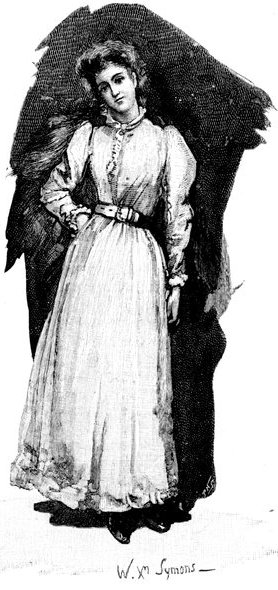
A slight, girlish figure was seated
partly with her back to me. She sprang up
when the door opened, and I was confronted
by the anxious and pleading face of Mrs.
Mainwaring.
"You have come at last," she said, with a
deep sigh. "That is a blessed relief. I have
waited for you here because I want to ask
your advice. I am in terrible anxiety about
my husband."
"Your husband?" I replied. "But I understood
Dr. Abbott to say that he had recovered
perfectly. He said he had ordered him
for a month to the seaside, and then hoped
that he might resume his professional work."
"It was so," she replied. "My husband
had a quick recovery. I am told that most
typhoid fever patients take a long time to
regain their strength, but in his case this was
not so. After the worst was over, he seemed
to get better by strides and bounds. A fortnight
ago Dr. Abbott ordered him to the seaside.
I had a fancy for Dover, and thought
of going there. I had even written about
lodgings, when my husband suddenly told me
that he did not wish to go to the seaside,
and would prefer spending a fortnight amongst
his old haunts at Cambridge. We went there.
We—we were very happy. I left the children
at home. It seemed something like our
honeymoon over again. Yesterday morning
I received a letter telling me that my eldest
child was not well. I hurried back to
Croydon to see her, telling my husband that
I would rejoin him to-day. My child's
illness turned out to be a trivial one, and
I went back to Cambridge by an early train
this morning."
Here Mrs. Mainwaring paused and pressed
her hand to her heart. Her face, excessively
pale before, now turned almost ghastly. She
had seated herself; she now stood up, the
further to emphasize her words.
"When I reached our lodgings," she said,
"my landlady met me with the astounding
intelligence that Mr. Mainwaring had packed
up all his belongings and had left Cambridge
for London by the express train that
morning.
"This news surprised me, but at first I
heard it calmly enough. I believed that
Edward had grown weary of his own society,
was anxious about our little Nancy, and had
hurried home. My landlady, however, looked
so mysterious that I felt certain she had
something further to say.
"'Come in, madam, do come in,' she said.
'Perhaps you think your good gentleman
has gone home.'
"'I am sure he has,' I said. 'Can you
get me a messenger? I will send a telegram
at once and find out. If Mr. Mainwaring
has gone home, he ought to have arrived by
now.'
"My landlady was quite silent for a minute,
then she said, gravely:—
"'Perhaps I ought to tell you that Mr.
Mainwaring behaved in a very singular way
before he left my house.'
"There was something in the woman's
manner which impressed me even more than
her words. I felt my heart beginning to sink.
I followed her into the little sitting-room
where my husband and I had spent some
happy hours, and begged of her to explain
herself.
"She did so without a moment's hesitation.
"'It all happened early this morning,' she
said. 'I brought up breakfast as usual.
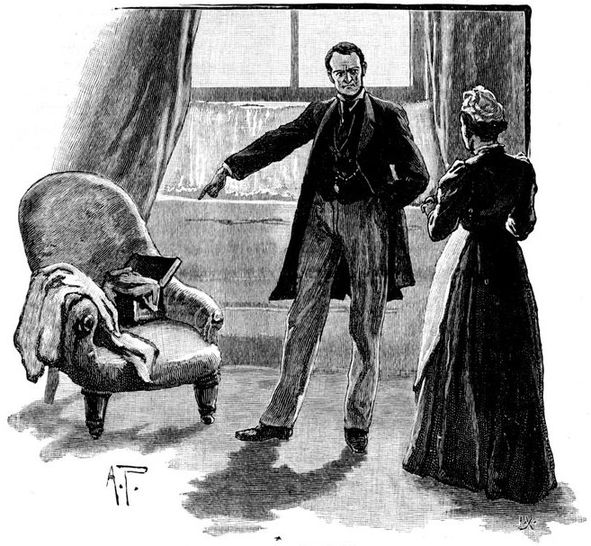
Mr. Mainwaring was standing by one of the
open windows.
"'I am going to town,' he said, 'by the
express. I shall pack my things immediately.
Bring me my bill.'
"'I was leaving the room to prepare it,
when he shouted to me.'
"'How is it those things have got into the
room?' he said. 'Take them away.'
"'What things do you mean, sir?'
"'Those woman's things,' he said, very
crossly. 'That work-basket, and that white
shawl.'
"'Why, sir,' I said, staring at him, 'those
things belong to your good lady.'
"'He looked me full in the face and then
burst out laughing.'
"'You must be mad,' he said; 'I dislike
unseasonable jokes.'
"'He then went into his bedroom and
slammed the door noisily behind him. Half
an hour later he had paid the bill, ordered a
cab, and gone off with his luggage. He left
all your things behind him, madam. Mr.
Mainwaring was collected and quiet enough,
and seemed quite the gentleman except
when he spoke of you; still I don't like the
look of affairs at all.'
"I listened to my landlady," continued
poor Mrs. Mainwaring, "while she told me
this strange and most perplexing story. Then
I glanced round the room for confirmation of
her words. Yes, my husband and all his
belongings had vanished, but my work-basket,
my new hat, my mantle, my writing-case, and
one or two little garments which I was
making for the children, were still scattered
about the drawing-room.
"I went into the bedroom and saw the
clothes I had left behind me, flung into a
heap in a corner of the room.
"While I was looking at them in a state of
mind almost impossible to describe, my landlady
tapped at the door and brought me
a note.
"'Under the circumstances, madam,' she
said, 'you may like to see this letter. I
have just found it, stamped and directed as
you see, on the davenport in the drawing-room.
I think it is in Mr. Mainwaring's
writing.'
"I took it from her and looked at it
eagerly. It was addressed in my husband's
writing to a Don of the college (Trinity)
where he had taken his degree. I did not
hesitate to open it. Here it is, Dr. Halifax;
you may like to read it. It may possibly
help you to throw some light on this awful
mystery."
Mrs. Mainwaring gave me the note as
she spoke. It contained the following
words:—
"My Dear Sir,—I much regret having
missed you when I called yesterday afternoon
to say good-bye. I must take the
present opportunity of thanking you for
your kindness to me during the whole of my
University career. I leave Cambridge by
an early train this morning, or would call
again to say farewell
in person. I hope
to call to see you on
the first occasion
when I revisit Cambridge.
"Yours sincerely,
"Ed. Mainwaring."
I read the letter
twice, and then returned
it without
comment to the wife.
"Will you redirect
it and post it?" I
said, after a pause.
She answered me
almost in a whisper.
"The strange thing
about that letter is
this," she said. "It
is addressed to a
dead person. Mr.
Grainger, Edward's
old tutor, has been
dead for many years.
My husband felt his
death keenly when it
occurred. He has
many times told me
of the personal interest Mr. Grainger took
in him. Have you no comment to make
with regard to this letter, Dr. Halifax?"
"I shall have plenty to say in a moment,"
I answered. "That letter will give us a very
important clue to our future actions, but
now to proceed: Have you nothing further
to tell me?"
"Yes; after reading the letter, I rushed to
the nearest telegraph office and sent a telegram
with a prepaid reply to my home. I
waited with what patience I could for the
answer, which came within an hour and a half.
My husband had not returned to Stanley
Villa. I then took the next train to town,
and went back to Croydon on the chance of
his having arrived there during the day. He
had not done so. Dr. Abbott happens to be
away, so I have come to you. Can you give
me advice? Will you help me in any way?"
"Yes, of course, I will help you," I said.
"Pray sit down." She had been standing
with her hands clasped tightly together during
the greater part of our interview. "Your
story is a very strange one," I continued,
"and I will give it and you my best attention
in a moment. I must run away first, however,
to give some instructions with regard
to one of my patients, then I shall be at your
service."
She sank into a chair when I told her to
sit down. She was trembling all over. Her
nerves were strung to a high pitch. I went
into the hall, thought for a moment, then,
putting on my hat, went out. As I was
leaving the house, I told my servant to take
a tray with wine and other refreshments into
the consulting-room. Then I went a few
doors off to see a brother physician. I told
him I had a peculiar case to attend to, and
asked him to see after my patients until the
following day. I then went back to Mrs.
Mainwaring; she had not touched the wine
nor the biscuits which the servant had brought
her.
"Come," I said, "this will never do. You
must have this glass of wine immediately
and one or two of these biscuits. You
will be able to think much better and, consequently,
to find your husband sooner if
you take some necessary nourishment. Come,
that is better."
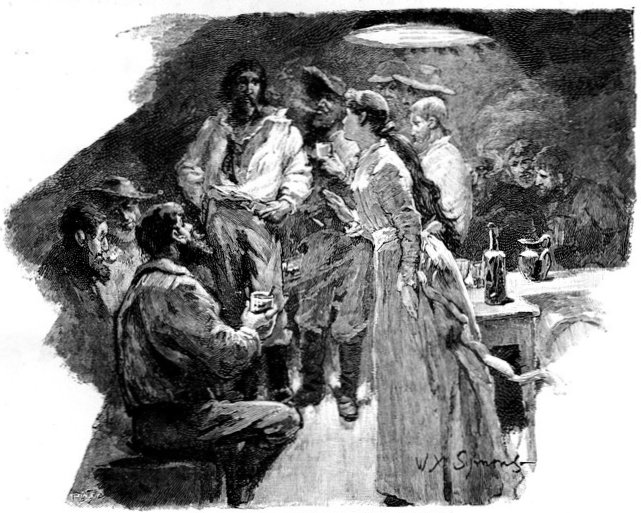
I poured out a glass of port wine and gave
it to her. She took it in her small, trembling
hand and raised it to her lips, spilling the
wine terribly as she did so.
"You will do better now," I said.
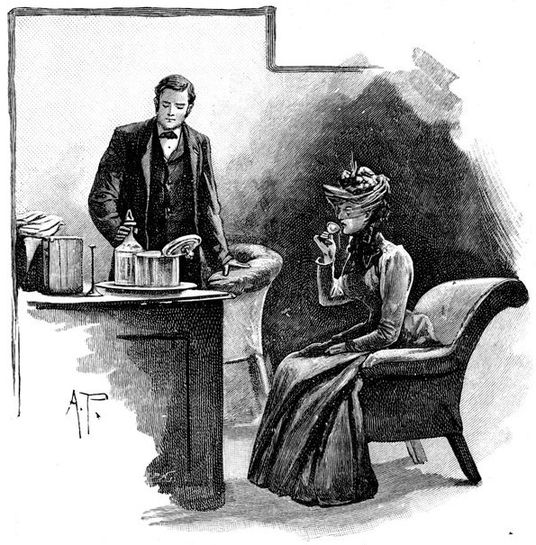
"SHE RAISED IT TO HER LIPS."
"Oh, it doesn't matter about me," she
exclaimed, with impatience; "you have not
told me what you think of my story. What
possible reason can there be to account for
my husband's most strange conduct?"
"I cannot give you a reason yet," I said.
"My impression is that Mr. Mainwaring's
mind is not quite right for the time being.
Remember, I say for the time being. Typhoid
is a very grave and terrible disease.
Your husband suffered from an exceptionally
serious attack. His apparently rapid recovery
may have induced him to do more than he
really had strength to undertake. If this
were so, many strange symptoms might
exhibit themselves. I can tell you more
particulars with regard to the exact nature of
his malady after I have seen him. The
thing now is to try and find him. Before we
begin our search, however, I should like to
ask you a few questions of a practical nature.
How old is your husband?"
"Nearly thirty-three."
"He took his degree at Cambridge, did
he not?"
"Yes—just ten years ago. We talked
much of it during the happy fortnight we
spent there. We visited all his old haunts.
He was a Trinity man, and loved his college
with an enthusiasm I
have seen in few. I
never saw anyone
happier than he was
during the last fortnight.
His spirits were gay.
He seemed scarcely to
know fatigue. He was
always hunting up old
friends."
"Were there many of
the men of his time at
Cambridge?"
"No—that was the
sad thing. He has been
unfortunate with regard
to his friends. He made
many, for he was popular
and had a sympathetic
manner which attracted
people, but some had
gone abroad and several
had died. There was a
Mr. Leigh in particular.
He had been much
attached to him in the
old days. But he only
heard of his death when
we went to Cambridge,
for he had completely
lost sight of him for a
long time. This news saddened him for a
little."
"When did he hear of Leigh's death?"
"The day before yesterday. The Dean of
his college told him. He was visibly affected
for the time, and talked of him to me all the
evening. He told me several incidents with
regard to a foreign tour they had taken
together."
"Indeed! And he seemed depressed
while he spoke?"
"Only just for a time."
"When did your husband and Mr. Leigh
go abroad?"
Mrs. Mainwaring thought for a moment.
"It was just after Edward had taken his
degree," she said. "He mentioned that fact
also when he talked over matters the evening
before last."
"From what part of England did Mr.
Mainwaring and Mr. Leigh start on their
foreign tour?"
"I think it must have been from Dover.
Yes, I remember now; Edward said that
Mr. Leigh arranged to meet him at Dover.
He failed to keep his first appointment, and
Edward had to remain at Dover waiting for
him for twenty-four hours."
I thought over this piece of information
for some time. The story was altogether
puzzling; the queer thing about it being
not so much the fact of Mainwaring's brain
having gone wrong as the strange form his
aberration seemed to have taken. It was
too evidently the fact that he was either
possessed by an active dislike to his wife, or
had forgotten her existence.
After some anxious thought I asked Mrs.
Mainwaring one or two more questions.
"Did you notice anything peculiar in your
husband the last evening and night you spent
together?"
"Nothing whatever," she replied. "My
dear husband was just his old self. His
depression about Walter Leigh soon passed
away, and he spoke cheerfully about his
own prospects and said how exceptionally
lucky he considered himself to be able to
resume his professional work so soon after
such a severe illness. The evening post,
too, brought him a letter, which cheered
him a good deal. It was from a solicitor
in large practice, offering him the brief of
a very important case which was to come
on in the criminal courts. Edward was
highly delighted at the thought of this
work, which meant large fees, badly needed
by us just at present. Early the next morning
the post brought us the news about Nancy's
illness. My husband wished to go with me
to Croydon, but I dissuaded him. I did
not consider him strong enough, notwithstanding
his boasted return to health, for
this fatigue. He saw me off at the station,
however, and promised to meet me there the
following morning, if the child were well
enough for me to return."
"Were you surprised when you did not
see him?"
"I was, for he is the sort of man who
always keeps any engagement he makes."
"A few more questions, Mrs. Mainwaring;
and first, how long have you been married?"
"Six years," she said, looking up with a
faint blush on her white face, "and Nancy
will be five in a week."
"You never happened to meet this Walter
Leigh?"
"Never."
"Did your husband ever speak of him to
you until two days ago?"
"It is strange, but he never did. He is,
as a rule, a very busy man—much occupied
with a growing practice."
"Did you happen to know any of his
college friends?"
"No."
"You were not in any way connected with
that part of his life?"
"No; we never met until, at least, three
years after my husband left Cambridge."
"Thank you," I said. "I do not think I
have anything further to ask you."
"But what do you mean to do?" she
asked. "We can't sit here quietly and allow
my unhappy husband to roam the country.
He must be found, and at once. He—he
may have——" Her lips trembled, she
lowered her eyes.
"No," I said. "He has not committed
suicide. Rest easy on that point. From
what you tell me of your husband I feel
inclined to think—of course, I may be wrong—but
I feel strongly inclined to think that
he is at Dover at the present moment."
"What can you possibly mean?"
"What I say. It is quite within the region
of probability that he may be at Dover waiting
for his friend Walter Leigh to join him."
When I said this Mrs. Mainwaring looked
at me as if she thought I, too, had taken
leave of my senses. I took no notice of her
expressive face.
"I am prepared to go with you to Dover,"
I said. "Shall we start at once?"
She looked dubious and terribly anxious.
"It seems a waste of time," she said, after a
pause.
"I do not think so," I answered. "Your
husband was in a weak state, notwithstanding
his boasted strength. From what you tell
me, he evidently exerted himself more than
was wise while at Cambridge. By doing so,
he strained a weakened frame. The brain
forms the highest part of that frame, Mrs.
Mainwaring, the highest and also the most
easily put out of
order. Your husband
exerted his body too
much, and excited
his brain by old
memories and the
regrets which must
come to a man when
he visits the scene of
vanished friendships.
You say that Mr.
Mainwaring was
visibly affected when
he heard of his great
friend's death?"
"He was, he was.
He turned white
when the Dean told
him. The death was
tragic, too. Walter
Leigh was killed on
an Alpine expedition.
The marvellous
thing was how the
news never reached
my husband before.
This can only be
accounted for by the
fact that he spent
the year of Mr.
Leigh's death in
America."
"All this confirms
my theory," I continued,
"that your husband's brain, long
weakened by serious illness, suddenly gave
way. Brain derangement, as we know,
takes all kinds of unexpected forms. I
believe that the form it has taken in Mainwaring's
case is this. He has forgotten
the recent years of his life and has gone
back again to his old college days. His
letter to the Don of Trinity College who
has so long been dead confirms this theory.
His strange conduct with regard to you,
Mrs. Mainwaring, further strengthens it. I
feel almost certain that I am right in these
impressions. They are sufficiently strong to
make me anxious to visit Dover immediately.
Now, shall I go alone, or will you come
with me?"
"Of course I'll come with you," she
answered.
She rose and began to draw on her gloves.
It was late June now, and the day had
been a hot one. The twilight had faded
into night when I assisted Mrs. Mainwaring
into a hansom and directed the driver to
take us to Victoria Station.
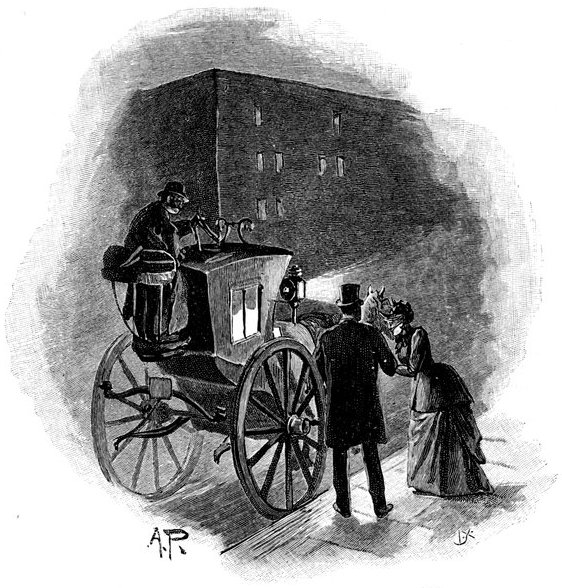
"I ASSISTED MRS. MAINWARING INTO A HANSOM."
We caught our train by a minute or
two, and in process of time found ourselves
at Dover. During the journey Mrs.
Mainwaring scarcely uttered a word. She
had drawn her veil over her face and
sat huddled up in a corner of the carriage,
as if she were turned into stone. I saw
that she was partly stunned by the shock,
and I felt anxious about her, as well as her
husband.
When we arrived at Dover, she drew up
her veil and said, impulsively:—
"What do you mean to do?"
"Before I do anything I must ask you
another question." I replied. "Have you
any idea what your husband's habits were ten
years ago? Was he extravagant or careful?
For instance, on arriving at Dover, would he
be likely to go to a good hotel?"
"He would go to the best," she answered.
"He is not careful of money now, and I am
sure he never could have been in the past."
"Then, if my surmise is correct," I said,
"we are most likely to find him at the Lord
Warden Hotel, which is, of course, the best
in the town. Anyhow, it is worthwhile to go
there first to make inquiries about him."
"Very well," she replied, in a submissive,
hopeless kind of voice.
She had yielded herself up to my directions,
but up to the present moment I had
failed to inspire her with any faith in the
success of my mission. She was evidently
oppressed with the fear that Mainwaring had
committed suicide, and seemed to think my
conjecture about him impossible.
As we were walking to the hotel, she said,
suddenly:—
"If my husband is really out of his mind,
we are ruined from a worldly point of view."
"I am sorry to hear that," I replied.
"Have you no private means?"
"No," she answered. "My husband had
his profession, and he was doing good work
as a barrister. But there is no profession in
the world which requires greater brain power
than his. We have nothing to live on except
what my husband earns."
"In case Mr. Mainwaring cannot earn
money for a time, have you no relations who
will help you?" I asked.
She shook her head.
"We have no relations who will help us,"
she said. "It is true that my husband's
father is still living—he is an old man, a
clergyman. He has a small parish, and with
difficulty makes both ends meet. It would
be impossible to expect assistance from him."
She sighed heavily as she spoke. Then she
continued, with a naïveté which touched me:
"Even at this terrible moment I cannot
help thinking of the children, and of how they
will suffer if our worst fears are fulfilled."
"Well," I said, in a cheerful tone, "we
must hope for the best. The first thing is to
find your husband. After that we must consider
what is best to be done for him."
"Oh, can anything be done?" she asked,
in a tone of supplication.
"We will see," I replied.
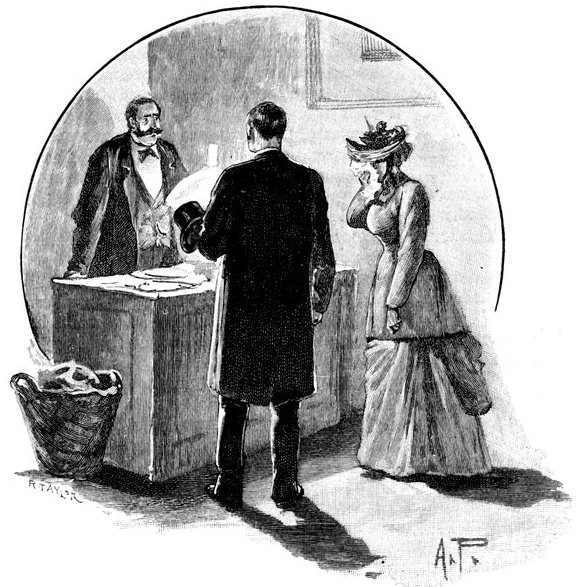
We arrived at the hotel and made inquiries.
The name of Mainwaring was not in the
visitors' book.
"That is nothing," I said, turning to Mrs.
Mainwaring; "will you please describe your
husband to the manager?"
She did so, entering into a minute and
faithful description.
"A tall gentleman, broadly made, with a
slight stoop," repeated the manager after her
"He wears glasses, does he not, madam?"
"Sometimes, not always," she replied.
"Has he a pince-nez which he puts on
whenever he wants to ask a question?" continued
the manager.
Mrs. Mainwaring turned crimson.
"Yes, yes," she exclaimed, "then he is here!
Dr. Halifax, you are right."
The manager asked further questions.
"A great many gentlemen wear glasses,"
he said. "I should like to be quite certain
that madam's husband is really one of the
visitors before I disturb any of them. The
hour is late too, close on eleven o'clock, and
a good many of the guests have gone to
their rooms. About what age is the gentleman
whom you want to find, madam?"
"He looks nearly forty," she replied at
once, "although he is not in reality nearly so
old. His hair is dark and slightly tinged
with grey."
The manager called one of the waiters and
spoke a few words to him. He then returned
to us.
"I think," he said, "that there is a gentleman
here who answers to madam's description,
but I cannot find his name. Through
an oversight it has not been entered in the
visitors' book. The hotel is very full this
evening. The gentleman who answers to
your description," he continued, looking at
Mrs. Mainwaring, "is occupying No. 39.
Do you think you would know him by his
boots?"
"Certainly," she replied.
"Then they are probably at this moment
outside his door. I will have them fetched,
and you can look at them. Will you have
the goodness to step inside the office, Mrs.
Mainwaring, and you too, please, sir?"
I gave the manager my card, and told
him that I was Mrs. Mainwaring's medical
adviser. He motioned us to chairs, and in
a short time a waiter appeared with a pair
of boots on a tray.
"I have just taken these from outside the
door of No. 39," he said, holding them up
for inspection.
A glance told me that they belonged to a
large, but well-shaped foot. Mrs. Mainwaring
rushed forward, gave utterance to a
rejoicing cry, and picked them up.
"These are undoubtedly Edward's boots,"
she exclaimed. "Yes, he is here. Thank
the merciful God we have found him!"
"The gentleman has been in his room for
some little time," exclaimed a waiter who
had now come upon the scene. "Would
madam like me to announce her arrival?"
"No," she said, turning very pale. "I
will go to him without being announced.
Will you come with me, Dr. Halifax?"
We went upstairs, and the chambermaid
conducted us to the door of No. 39. We
knocked. The door was locked from within,
but our summons was immediately answered
by the approach of a manly step. The door
was flung open and Mainwaring, with a
Baedeker's guide in his hand, stood before
us.
Mrs. Mainwaring rushed to him and impulsively
endeavoured to throw her arms round
his neck. He started back in astonishment
which was not feigned.
"May I ask?" he said, looking at me, his
eyes darkening with anger, "to what I am
indebted for this—this most extraordinary
intrusion?"
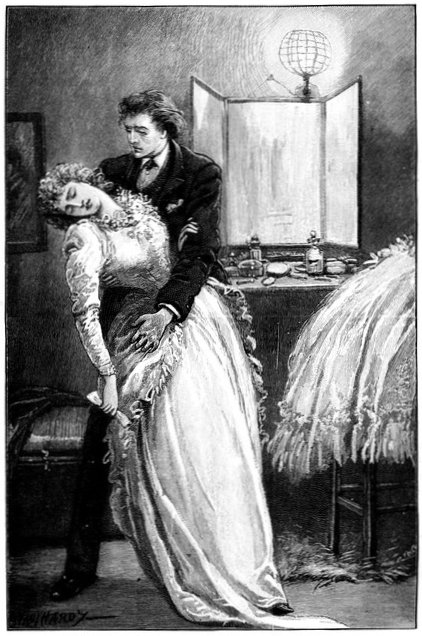
"Don't you know me, Edward?" sobbed
the poor girl. "I am your wife."
"You must be mad," he said. He looked
at her with a blank stare of undisguised
astonishment and even disgust. "I have
not the pleasure of this lady's acquaintance,"
he said, addressing me in an icy tone.
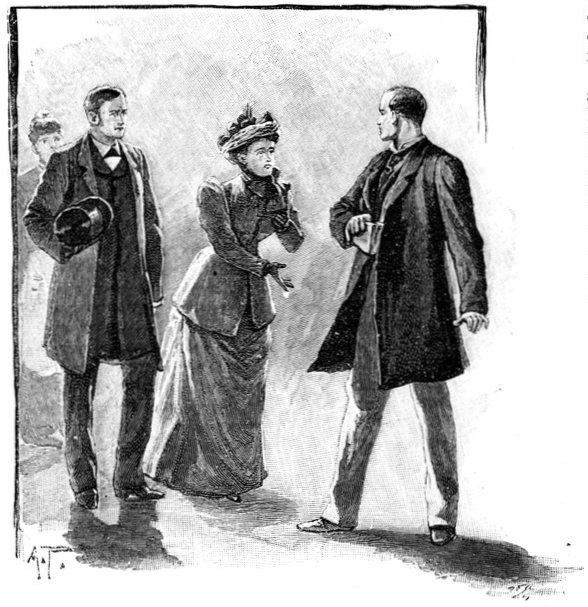
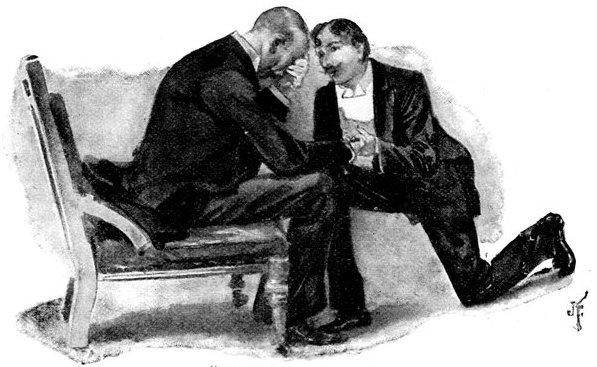
"DON'T YOU KNOW ME, EDWARD?"
"You don't know me?" she panted. "Oh,
surely that must be impossible. I am your
wife, Edward. Look at me again, and you
will remember me. I am Nancy's mother—pretty
Nancy, with her curling hair; you
know how fond you are of Nancy. Don't
you remember Nancy, and Bob, and baby?—I
am their mother. Dear, dear Edward, look
at me again and you will know me. Look at
me hard—I am your wife—your own most
loving wife."
Notwithstanding her agitation, Mrs. Mainwaring
had been quiet and self-restrained up
to this moment. The intensity of her passion
now seemed to transform her. She flung
aside her travelling hat and jacket. She was
desperate, and despair gave to her sudden
beauty.
In all my experience of the sad things of
life, I seldom saw more terrible pathos than
that which now shone out of the eyes and
trembled round the lips of this poor young
woman. She was so absorbed in trying to
get her husband to recognise her that she
forgot my presence and
that of the amazed
chambermaid who,
devoured with curiosity,
lingered near.
"Edward," she said
again, going up to her
husband, "it is impossible
that you can
have forgotten me. I am
your wife. I have been
your wife for six years."
"Good Lord,
madam!" he exclaimed,
bursting into
a terrible laugh. "If
you were my wife six
years ago, I must have
married you when I
was a boy. I had not
left school six years
ago. I am only
twenty-three at the
present moment. Do
you mean to maintain
that I married you
when I was a lad of
seventeen?"
"Edward, dear
Edward, don't you
know me?" she kept
on pleading.
Tears streamed down her cheeks. She
dropped suddenly on her knees, and taking
one of her husband's hands tried to raise it
to her lips. Her manner, her words, her
attitude, pathetic to us who stood by as
witnesses, had a most irritating effect upon
Mainwaring.
"Get up" he said. "This is all a plant.
But however long you choose to carry this
game on, you won't get anything out of me.
I must ask you, madam, to leave my room
immediately. I do not even know your
name. I never saw you before. Will you,
sir," he added, turning fiercely to me, "have
the goodness to remove this lady immediately
from my bedroom?"
Mrs. Mainwaring staggered to her feet.
The cold sarcasm of the words of denial
stung her to the quick. She approached the
door, but before she could reach it she turned
faint and would have fallen had I not caught
her and placed her in a chair.
"This is all some diabolical scheme to
ruin a respectable man," said Mainwaring.
"Will you favour me with your name, sir?"
he added, turning to me.
"Halifax," I answered. "I am a doctor.
I attended you as a consulting physician in
your late severe illness."
"Heavens, what next?" he exclaimed.
"I never had a day of serious illness in
my life."
"I think, Mrs. Mainwaring, we had better
leave him for the present," I said. "I will
speak to the manager——"
Before I could add another word Mainwaring
interrupted me hotly.
"Let it be clearly understood," he said,
"that I forbid that woman to be called by
my name. I will see this matter through
myself. I have known of such things before.
This is a scheme to ruin the character of an
honourable man. But I shall take immediate
care to nip it in the bud. Is that a chambermaid
in the passage? Come here, please.
Have the goodness to ask the manager to
come to this room immediately. Do not go,
madam, nor you either, sir, until I speak to
the manager."
Mainwaring flung the Baedeker which he
had been studying on a table. We heard some
doors opened and some feet hurrying in our
direction. Doubtless the chambermaid who
had disappeared on Mainwaring's errand had
already spread the news of our extraordinary
story. When I heard people approaching I
took the liberty to close the door of the
room.
"What are you doing that for, sir?"
exclaimed Mainwaring, whose face was now
almost purple with excitement.
"Pray don't speak so loud," I replied,
putting as much force and command into my
voice as I possibly could. "I presume you
do not wish the servants of the hotel to
become acquainted with your private affairs."
He glanced at me savagely, but did not
say anything further. A moment later the
manager's knock was heard. I opened the
door to him. He came in, looking anxious
and disturbed, and asked why he had been
sent for.
Mainwaring began to speak in an excited
voice.
"I have sent for you," he said, "to ask you
to see that this man and woman leave the
hotel immediately. They have forced their
way into my room and have endeavoured to
perpetrate a most disgraceful hoax upon me.
This lady, whom I never saw before, has had
the audacity to claim me as her husband. I
wish you to understand clearly that both these
people are impostors. They must leave this
hotel immediately if you wish it to retain its
character for respectability."
The manager looked puzzled, as well he
might. Mainwaring, although he showed
symptoms of strong excitement, must have
appeared perfectly sane to an ordinary observer.
Poor Mrs. Mainwaring, white and
trembling, stood up and looked at me to
defend her.
"This is a very extraordinary story," I said
to the manager. "I will give you my version
of it in another room."
"Come," I said, turning to Mrs. Mainwaring.
She put her hand into mine and I
led her into the passage.
The instant we left the room Mainwaring
shut and locked the door.
"That unfortunate gentleman is insane," I
said to the manager of the hotel. "He must
be watched, and on no account allowed to
leave his bedroom without being followed."
"That is all very well, sir," replied the
man, "but I must have very good evidence
of the truth of your statements before I can
allow any pressure to be put on the gentleman
who occupies No. 39. This is a very
queer story, and Mr. Mainwaring showed
no signs of insanity before you came. But,
insane or not, it isn't to be supposed that he
wouldn't know his own wife."
"Take us into a private room and let me
explain matters to you," I said.
The man did so.
"On your peril," I continued, "I must
request you to set someone to watch that
door. I am a medical man, and you cannot
trifle with my requests with impunity. That
gentleman is in a dangerous state, and he
must be closely watched."
"Very well, sir," replied the manager, in a
more civil tone, "I'll tell the night porter to
keep an eye on the door."
He left us for a moment, but quickly
returned.
"Now, sir," he said. "I hope you'll have
the goodness to explain matters a little, for,
to say the least, it's a queer story."
"It is," I replied, "a very tragic one—the
only explanation possible is that the unfortunate
gentleman whom we have just left
has become insane. I am a medical man.
You can see my name in the 'Medical Directory'
if you look for it. I am well known
in the profession. The gentleman in No.
39 has just recovered from a severe attack of
typhoid fever. Until this morning he was
apparently on the road to recovery. A fortnight
ago he went with his wife to Cambridge
to pay a short visit. They left their children
at Croydon. Yesterday morning Mrs. Mainwaring
heard of the illness of her eldest child
and went to Croydon to see her, leaving her
husband behind her at Cambridge. When
she returned to Cambridge this morning he
had vanished, leaving no trace behind him.
We conjectured that he had come to Dover,
and followed him here."
"I remember the gentleman now quite
well," said the manager. "He came here
quite early to-day and asked for a good bedroom,
which he said he might want for a
night or even two, as he was obliged to stay
here until a friend joined him."
"Did he happen to tell you the name of
the friend?" I inquired.
"Yes, sir, I remember
the name quite well. Mr.
Mainwaring said that
Mr. Leigh might arrive
at any moment, and that
when he did he was to
be shown immediately to
his room."
When the manager
mentioned Leigh's name
Mrs. Mainwaring broke
the silence which she
had maintained until
now.
"Walter Leigh is
dead," she exclaimed.
"Good Lord, dead!"
cried the manager.
"Was it sudden, madam?
Does the—does Mr.
Mainwaring know?"
"Walter Leigh is
dead," she continued.
"He has been dead for
many years. But ten
years ago my husband
stayed at this hotel and
waited for Walter Leigh
to join him. He had to
wait here for twenty-four
hours. At the end of
that time Mr. Leigh arrived, and they took
the next boat to Calais."
"Have you the books of the hotel of ten
years back?" I asked.
"Certainly, sir."
"Would you mind looking them up? It
is important for all our sakes to substantiate
the truth of this lady's words. Have you
any idea, Mrs. Mainwaring, about what month
your husband and Mr. Leigh went to the
Continent?"
"Just after their degree examination," she
replied. "They took their degrees together—that
would be about this time of year."
"June ten years back," commented the
manager. He seemed much impressed now,
and his manner showed me how greatly he
was interested.
"I will go downstairs immediately and
examine the books," he said.
He returned in about ten minutes with
a bewildered face.
"You are right, madam," he exclaimed;
"but the good Lord only knows what it all
means. I hunted up the visitors' book of ten
years back, and there were the two names
entered in the book as plain as you please:
Edward Mainwaring, Walter Leigh. Mr.
Leigh occupied No. 25 and Mr. Mainwaring
the room next to it, No. 26. Now, what
does all this mean?"
"That Mr. Mainwaring has forgotten ten
years of his life," I answered, promptly. "He
must be carefully watched during the night.
Can you give Mrs. Mainwaring a bedroom?
I shall also sleep at the hotel."
The manager was now only too anxious to
attend to our requirements. Mrs. Mainwaring
was conducted to a room on the next
floor and I occupied the bedroom next
Mainwaring's, which happened to be empty.
Nothing occurred during the night, which
was spent by me in anxious and wakeful
conjecture.
At an early hour the next morning I joined
Mrs. Mainwaring. One glance at her face
showed me through what terrible suffering
she had been passing. I told her without
preamble what I considered the best and
only thing to do.
"I have thought carefully over your
husband's case," I said. "There is to my
mind not the least doubt what has occurred.
For some extraordinary reason Mr. Mainwaring
has forgotten ten years of his life.
His memory doubtless carries him accurately
up to the date of his Cambridge degree.
He remembers going to Dover, and is now
under the impression that he is waiting for
his friend, Mr. Leigh, to join him at this
hotel. Whether he will ever recover the
ten years which he has lost is impossible at
the present moment to say. What I should
advise now is this: Let someone whom Mr.
Mainwaring knew intimately ten years ago
come and see him, and tell him as simply
and as forcibly as possible what has occurred.
He may or may not believe this person's
statement. I am inclined to hope, however,
that he will bring his common-sense to bear
on the matter, and will not doubt what he
is told; but of course I may be wrong.
Anyhow, this, in my opinion, is the only
thing to try. Has your husband any intimate
friend whom he knew well ten years back?"
"There is his father," she replied at once.
"Good. He could not possibly see a
person more likely to influence him. I think
you said that his father was a clergyman—better
and better—he is probably an excellent man,
in whose word his son would place
unbounded confidence. Does he live far
away?"
"It so happens," she answered, a faint
smile filling her eyes, "that my father-in-law's
rectory is not far from here. His parish is
close to Canterbury."
"Give me the address, and I will telegraph
immediately," I said.
She supplied me with it, and I quickly
prepared a telegram, which was to bring
the elder Mainwaring to his son's assistance.
I was writing my telegram in the
hall of the hotel when Mainwaring came
downstairs. He looked full at his wife
and me, but did not vouchsafe us the
smallest sign of recognition. He entered the
coffee-room, and I saw him sit down at a
small table and order breakfast.
I whispered to the wife to take no notice.
The poor woman's eyes were full of tears and
she was trembling excessively, but she had
the courage to do what I told her.
She and I entered the coffee-room a few
moments later. We had breakfast together.
Mrs. Mainwaring sat with her back to her
husband, but I faced him and watched him
anxiously while I ate. He had called for a
daily paper and began to read it. I watched
his face and saw that the contents of the
paper puzzled him a good deal. He passed
his hand across his forehead, took off his
pince-nez and rubbed it, finally flung the paper
on the ground and strode out of the room.
At this moment a waiter brought me a
telegram. I opened it. It was not in reply
to the one I had sent to Mainwaring's father,
but was from a patient in town. Its character
was so urgent and unexpected that I was
forced to attend to it at once. It was
necessary for me to catch the next train to
London. I told Mrs. Mainwaring what had
occurred, expressed great regret at being
forced to leave her under such trying circumstances,
assured her that I did not anticipate
any fresh development of Mainwaring's illness,
begged of her to keep out of his way as much
as possible, and to wait as patiently as she
could for her father-in-law's arrival. I then
gave some hasty directions to the manager of
the hotel and left for London. I promised
to return to Dover, if possible, that evening.
My patient in town, however, was far too
ill to make it advisable for me to leave him.
I could not go to Dover again that day. In
the evening I received a telegram from Mrs.
Mainwaring to say that her father-in-law had
arrived, that her husband had received him
with affection, but that otherwise his condition
remained absolutely unaltered.
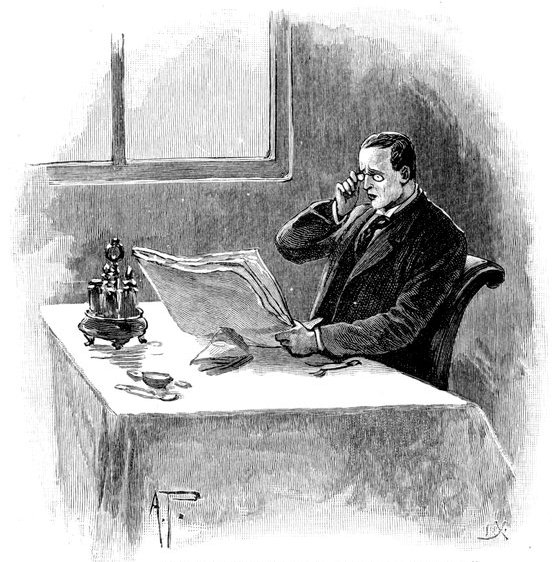
"THE CONTENTS OF THE PAPER PUZZLED HIM."
I wired back naming an early hour on the
following day for my visit to Dover, and then
tried to put these anxious circumstances out
of my head.
I had just breakfasted on the following day
and was preparing to start on my journey,
when my servant brought me a card. I
took it up and read the name with amazement:
Edward Mainwaring.
"Where is the gentleman?" I asked of the
servant.
"I have shown him into the consulting room, sir."
"Did not you say that I was just going out?"
"Yes," replied the man, "but he said he
was sure when you saw his card that you
would see him at once."
"What aged person is he?" I asked.
"Middle-aged, I should say, sir. He is a
tall gentleman, with a slight stoop. When
he looked at me he put on his pince-nez."
A startled exclamation passed my lips.
What strange new development of Mainwaring's
disease had brought him to seek
advice voluntarily from me?
I rose at once and went
to the consulting-room. My
patient was standing by one
of the windows, but when
he heard my step he turned
and walked towards me.
"I have come, Dr.
Halifax," he said, "to
apologize for my rude behaviour
towards you last
night. Under the strange
circumstances, I hope you
will forgive me."
"I forgive you a thousand
times," I replied in a hearty
voice. "I cannot tell you
with what inexpressible
relief I see that you have
already recovered your
memory. Pray accept my
warmest congratulations."
"Congratulations!" repeated
the poor fellow, with
a grim smile, "for what? I
have not recovered my
memory. At the present
moment I am an instance of
the man who lives by faith."
"What can you mean?" I said, much
puzzled in my turn by his words.
"What I say," he replied. "I live by faith.
My father, whom I have always revered and
loved as the best of men, has made a strange
statement to me—his statement confirms the
story you and—" here he hesitated slightly—"and
the lady you brought with you the other
evening told me. I believe my father—therefore
I believe you. This is a very
strong act of faith. Were I asked to describe
what I alone know about myself, I
should say that I am at the present moment
twenty-three years of age, that I have just
finished a successful academic career at
Trinity College, Cambridge; I mean to become
a barrister and am about to read for
the law, but before entering on a somewhat
severe course of study I propose to go abroad
with my special friend, Walter Leigh. This
is exactly how matters appear to me at the
present moment. With regard to my past,
I can give you chapter and verse for almost
every event which has occurred to me since
I was a young child. My boyhood, my
school days, in especial my recent life at
Cambridge, are accurately remembered by
me to the smallest detail. That, as
far as I can tell, is my history. I am
a young man with bright prospects just
beginning life. I am told, however, by one
whose word I cannot doubt, that I have a
further history of grave importance. I am
married—I have a wife and three children.
I have a house at Croydon, where I have
lived for over six years. I am a common-law
barrister, and am rising in my profession.
I have just recovered from a severe attack of
typhoid fever, during which time you visited
me twice in consultation with another doctor.
My father tells me of all these things, and
because he is my father I believe him; but,
as a matter of fact, I remember nothing
whatever of this important period of my
existence. That poor girl whom I treated so
harshly in your presence is in reality my wife.
My father says so, and I believe his word,
but I have not the most remote remembrance
of ever seeing my wife before. When did
I woo her? When did I marry her? What
was her name before she took mine? I
remember nothing. All is an absolute and
complete blank. In short, ten years, the most
important ten years of a man's life, have been
wiped out of mine. Am I insane?"
"Not in the ordinary sense," I replied;
"but there is no doubt that something has
gone wrong with a certain portion of your
brain."
Mainwaring sank into a chair while I was
speaking; now he sprang up and walked
across the room.
"Merciful heavens!" he exclaimed, turning
abruptly and facing me. "Then it is true.
What reason is left to me almost reels before
the astounding fact. It is absolutely true
that my youth is over. As far as I am aware
I never spent it. I never used it, but it is
gone. I have a wife whom I do not love. I
have children whom I care nothing whatever
about. I have a profession about which
I know nothing. I cannot give legal
advice. I cannot accept briefs.
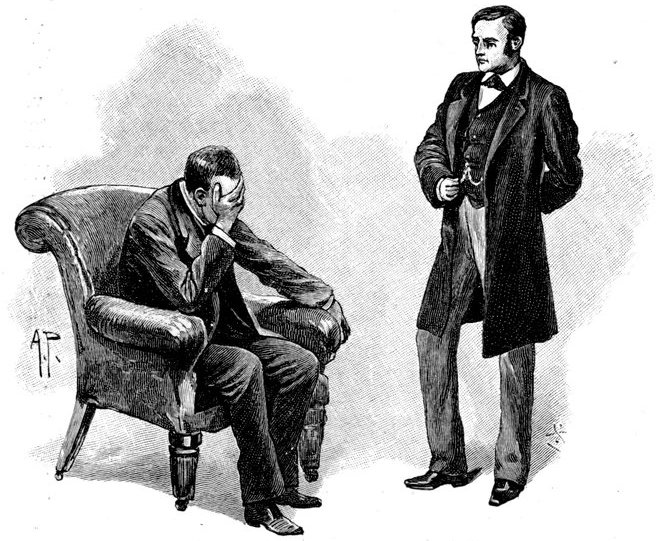
"MAINWARING SANK INTO A CHAIR."
"My father tells me that I am a married
man and a barrister. You tell me the same.
I am bound to believe you both. I do
believe you. All that you say is doubtless
true. I am surely in the most horrible
position that man ever found himself in. I
am a husband, a father, a professional man.
I do not remember my wife. I should not
recognise my own children; and what is
perhaps worst of all, from a practical point of
view, I have completely lost all knowledge of
my profession—I cannot therefore earn a
single penny for the support of my family.
I have come here to-day, Dr. Halifax, to ask
you if anything can be done to give me back
my ten years! Can you do anything for my
relief? I am willing to undergo any risk.
I am willing to submit to any suffering which
can give me back the time that has slipped
into oblivion."
"I must think carefully over your case," I
said. "I need not say that it is of the
deepest interest. I cannot tell you how glad
I am that you have come to me as you have
done. If you had chosen to doubt your
father's word, it would have been absolutely
impossible for me to have helped you. As
it is——"
"I live by faith, as I
said just now," repeated
Mainwaring. "What is
your thought with regard
to my condition?"
"Your condition is
strange indeed," I replied.
"I cannot explain
it better than by comparing
the brain to the
cylinder of a phonograph.
The nerve cells,
which can be counted
by thousands of millions,
represent the cylinder.
When certain sensations
are conveyed to
these cells they are
imprinted on them like
the impressions made by
the needle on the cylinder
of the phonograph.
Even years afterwards
the same series of
events or sounds are thus reproduced.
You have lost your cylinder for ten years.
What I have to do is to try by some
means to give it back to you again. But
before I say anything further, let me ask you
a question or two. You say you feel like a
young man of twenty-three about to enjoy a
well-earned holiday. This is equivalent to
announcing the fact that you feel in perfect
health."
"I certainly feel perfectly well in body,"
replied Mainwaring. "My mind is naturally
much disturbed and upset, but I have neither
ache nor pain, except——" Here he paused.
"The word 'except' points to some slight
discomfort, surely?" I replied, with eagerness.
"Pray tell me exactly what you feel. Any
clue, however slight, is most important."
"I have a certain numbness of my right
fore-arm and hand, but this is really not worth
mentioning. I am absolutely strong and
well. I feel twenty-three." He sighed
heavily as he spoke, and sinking into a chair,
looked fixedly at me. "What do you consider
the cause of my extraordinary condition?"
he asked, abruptly.
"The cause," I replied, "is either the
plugging of an artery or the rupture of a small
vessel in your brain. Thanks to the valuable
researches of eminent men who have made
the localization of cerebral functions the work
of their lives, I am able to tell pretty readily in
what portion of your brain the mischief lies."
"How?" asked Mainwaring, starting forward
in his chair and gazing at me with eyes
of devouring interest.
"You yourself have given me the clue,"
I answered, with a smile. "You tell me
you have a distinct feeling of numbness
in your right fore-arm and hand. We
know that some of the highest cerebral
centres are closely connected with the
centres of the nerves of that limb. I can
picture to myself—though, of course, I
may be wrong—the exact spot where this
lesion has taken place. It is certainly most
important that something definite should be
done to restore your memory and all it
entails."
"Then you will do that something?"
exclaimed Mainwaring. "You cannot hesitate.
You will not lose a moment in giving me the
relief which I earnestly crave for."
"I should like to consult Dr. Oliphant,
the great brain specialist," I replied.
Mainwaring sprang again to his feet.
"No," he said, "that I cannot permit. He
may say nothing can be done, and then you
may have scruples with regard to the right of
exposing my life to a certain risk. I will
permit no consultation. If you know what is
the matter with me, you can give me relief
without seeking for further assistance. Do
you think I value life under existing circumstances?
Not that!" He flipped some
imaginary substance away from him as he
spoke with his finger and thumb. "I put
myself absolutely into your hands, Dr.
Halifax," he said, making an effort to restrain
himself. "You say that an artery is plugged
in my brain, or that there is the rupture of a
small blood-vessel. You can surely do something
to remove the obstruction?"
"Yes," I said, "I can perform a certain
operation, which I will shortly explain to you.
I know you are a brave man; I do not,
therefore, hesitate to tell you that the operation
is of a very serious nature, also that
there is a possibility of my being wrong with
regard to the localization of the injury."
"There is also a possibility of your being
right," retorted Mainwaring. "I will accept
the risk. I wish the operation to be performed."
"I should certainly like to consult Dr.
Oliphant," I repeated.
"You cannot do so against my express
wish. I insist on the operation being
performed, even at the risk of life—can I say
more?"
"You certainly cannot," I answered. I
looked fixedly at him. He was a fine fellow.
Intelligence, resolve, endurance, were manifest
in his expressive eyes and strong, masculine
features.
"I am inclined to believe that I shall be
successful," I said, rising and speaking with
enthusiasm. "I will agree to do what you wish,
and we will leave the results in the Highest
Hands. The operation is doubtless a very
grave one, but you are a man temperate in
all things. You have also abundantly proved
that you have a good constitution. With
extreme care your life may not be even
endangered. In that case you will be,
at the worst, only as you are now. At the
best you will be yourself once again. If
what I think is the case, I can, by the
operation which I propose, remove the
obstruction which now cuts off from a
portion of your brain the necessary life blood
which alone can assure its working. In short,
I can restore your brain to its normal state.
I propose to open the cranial cavity at the
exact spot where I think the mischief is."
"Good," replied Mainwaring; "I leave
myself in your hands. How soon can you
put me right?"
"I must see your wife and your father."
"Will you return with me now to Dover?"
"No," I answered. "You are so far
yourself that you do not need me to accompany
you. Take the next train to Dover.
Tell your father and wife what you have
resolved to do. I will take lodgings for you
in a quiet street near this, and will perform
the operation to-morrow."
A moment or two later Mainwaring left
me.
The die was practically now cast. I was
going to experiment, and in a daring manner.
It was possible that the result might lead to
fatal consequences. I knew this possibility;
nevertheless, I scarcely feared that it would
arise. I had explained everything clearly to
Mainwaring—he was willing to accept the
risk. If his wife and father were also willing,
I would perform the operation on the following
day.
That afternoon I took comfortable rooms
for my patient in a street adjoining that in
which I lived. I also engaged an excellent
surgical nurse, in whom I could place perfect
confidence. There was then nothing more
to do except to await the arrival of the
Mainwarings.
Mrs. Mainwaring and her father-in-law
arrived at the rooms which I had taken for
them, late that evening. They sent me a
message at once to say they would be glad to
see me, and I hurried to pay them a visit.
Mrs. Mainwaring looked pale—her face
was haggard—her eyes disturbed and restless.
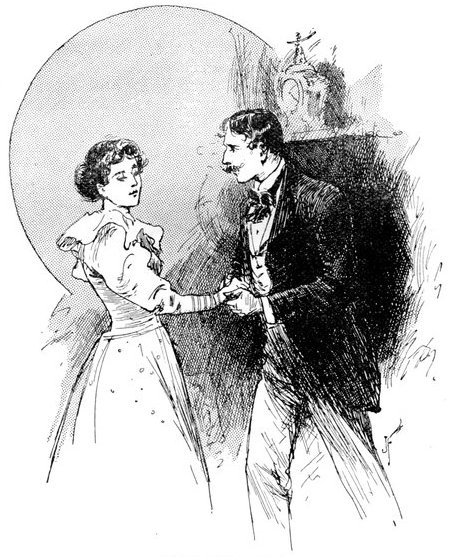
She came impulsively
to meet
me, and clasped
one of my hands
in both of hers.
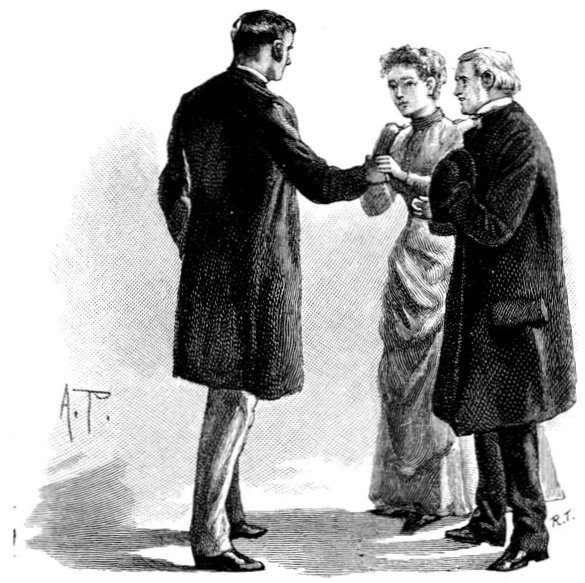
"SHE CLASPED ONE OF MY HANDS IN BOTH OF HERS."
"Edward has
told me what
you propose to
do," she exclaimed,
"and I
am willing—I am
abundantly willing
that he
should run this
great risk."
Her words
almost surprised
me. I looked
from her to her
father-in-law, who
now held out his
hand.
"I have often
heard of you, Dr.
Halifax," he said, with a courteous, old-fashioned
gesture. "I think you know some
special friends of mine. I may say that I
place absolute confidence in your skill, and am
willing to put my son's life in your hands."
I looked attentively from one face to the
other.
"I am glad you both give your consent,"
I replied. "I should not perform the operation,
which I trust will relieve Mr. Mainwaring,
without your mutual sanction. I
must tell you plainly, however, that although
I am willing to do it, it is accompanied by
grave risk, and I do not believe another
doctor in London would attempt it."
"You mean that Edward may die?" said
the wife in a low voice.
I looked her full in the eyes.
"There is a possibility," I said.
"But I do not think he will," she said, a
wonderful light leaping into her face. "I am
a woman—a woman does not always reason,
but she strongly believes in instincts—my
instinct tells me that you will save my
husband, and in short give him back to me
as he was before. At the worst, even at the
worst——" here she turned ghastly pale, "he
would know me in another world. I could
endure to be parted with him on those conditions.
I cannot—I cannot endure the
present state of things."
Her composure suddenly gave way, she
sobbed aloud.
"There is nothing more to be said," I
remarked, after a brief pause. "I have all
your consents,
and have made
full arrangements
to perform the
operation to-morrow
morning.
A clever surgeon,
whom I know
well, will assist
me, and an excellent
trained nurse
will arrive at an
early hour to get
the patient ready
for our visit. By
the way, where
is your husband,
Mrs. Mainwaring?"
She had dried
her eyes by this
time.
"He is in the
house," she said,
"but he does not wish to see you again until
the moment when you can give him relief."
I said a few more words, and soon afterwards
took my leave.
Early the next morning, accompanied by a
surgeon and an anæsthetist on whose assistance
I could depend, I arrived at Queen
Anne's Street. We were shown at once to
the room where my patient waited for me.
He was sitting in a chair near the window.
The nurse was standing in the background,
having made all necessary preparations.
"Here you are," he said, rising and greeting
me with a cheerful smile, "and here am I,
and there is a Providence over us. Now, the
sooner you put things right the better."
His courage delighted me. I was also
much relieved to find that neither his wife
nor father was present.
"With the help of God, I believe I shall
put you right," I said, in a tone of assurance,
which I absolutely felt.
An hour and a half later I went into the
sitting-room, where Mainwaring's father and
wife were anxiously waiting for my verdict.
"The operation is well over," I exclaimed,
"and my patient is at present sound asleep.
When he awakens the moment will have
arrived when we must prove whether I have
done anything for him or not. Will you
have the courage to come into the room
with me, Mrs. Mainwaring? I should like
him to see you when he opens his eyes. If
he recognises you, I shall know that I have
been successful."
To my surprise she shrank back.
"No," she said, "the ordeal is too terrible.
Failure means too much agony. I
cannot endure it; I am not strong enough."
"Then what is to be done?" I asked.
"In any case, Mainwaring will know his
father. His knowledge of you is the test
which I require to tell me whether I have
succeeded or failed."
She smiled faintly and left the room. In
a moment she returned, holding by the hand
a beautiful little girl of five years of age. She
had a wealth of red-gold hair falling almost
to her waist; her large eyes were like
sapphires.
"This is Nancy," said the mother, "her
father's pet and idol. I sent for her this
morning. When my husband awakens, take
her into the room—she is not shy. If her
father recognises her, all is well."
"Very well," I replied.
All that day I watched by Mainwaring;
in the evening I came for Nancy. "Come,"
I said. The child looked at me with her
grave eyes—she was perfectly calm and self-possessed.
I lifted her in my arms and left
the room with her.
I entered the bedroom where my patient
lay. The child's arms encircled my neck.
My heart was beating quickly, anxiously.
Little Nancy looked at me in surprise.
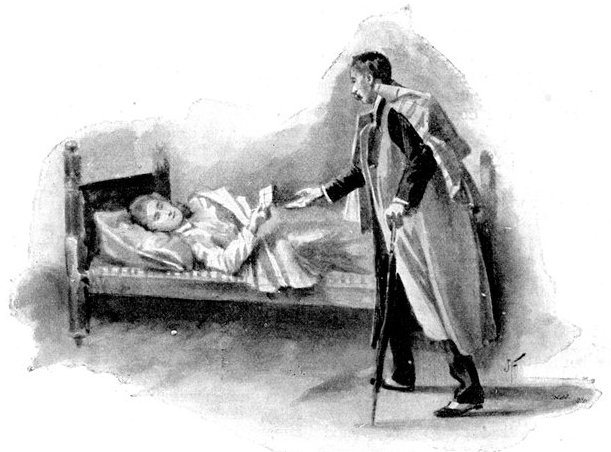
"Is father ill?" she asked.
Mainwaring's eyes were open. I put the
child on the floor.
"Go and speak to him," I said.
She ran up to the bed.
"Are you ill, dad?" she repeated, in a
clear, high voice.
"Halloa, Nan!" he said, smiling at her.
He stretched out one of his hands. The
child caught it and covered it with kisses.
"Send your mother to me, my sweet
Nan," he said, after a pause.
Then I knew that Mainwaring had got
back his ten years.