The first weeks of the competition for the crew were not exacting, and
consisted mostly of eliminating processes. Stover had consequently still
enough leisure to gravitate naturally into that necessity of running
into debt which comes to every youth who has just won the privilege of a
yearly allowance; the same being solemnly understood to cover all the
secret and hidden needs of the flesh as well as those that are outwardly
exposed to the admiration of the multitude.
Now, the lure of personal adornment and the charm of violent neckties
and outrageous vests had come to him naturally, as such things come,
shortly after the measles, under the educating influence of a hopeless
passion which had passed but had left its handiwork.
About a week after the opening of the term, Stover was drifting down
Chapel Street in the company of Hungerford and McCarthy, when, in the
window of the most predatory haberdasher's, he suddenly was fascinated
by the most beautiful thing he had ever seen adorning a window. A tinge
of masculine modesty prevented his remaining in struck admiration before
it, especially in the presence of McCarthy and Hungerford, whose souls
could rest content in jerseys and sweaters; but half an hour later,
slipping away, he returned, fascinated. Chance had been kind to him. It
was still there, the most beautiful green shirt he had ever beheld—not
the diluted green of ordinary pistache ice-cream, but the deep, royal
hue of a glorious emerald!
He had once, in the school days when he was blossoming into a man of
fashion, experienced a similar sensation before a cravat of pigeon-blood
red. He peered through the window to see if any one he knew was present,
and glanced up the street to assure himself that a mob was not going to
collect. Then he entered nonchalantly. The clerk, who recognized him,
greeted him with ingratiating unction.
"Glad to see you here, Mr. Stover. What can I do for you?"
"I thought I'd look at some shirts," he said, in what he believed a
masterly haphazard manner.
"White lawn—something with a thin stripe?"
"Well, something in a color—solid color."
He waited patiently, considering solicitously twenty inconsequential
styles, until the spruce clerk, casually producing the one thing, said:
"Would that appeal to you?"
"It's rather nice," he said, gazing at it. Entranced, he stared on. Then
a new difficulty arose. People didn't enter a shop just to purchase one
shirt, and, besides, he was known. So he selected three other shirts and
added the beautiful green thing to them in an unostentatious manner,
saying:
"Send around these four shirts, will you? What's the tax?"
"Very pleased to have you open an account, Mr. Stover," said the clerk.
"Pay when you like."
Stover took this as a personal tribute to his public reputation.
Likewise, it opened up to him startling possibilities, so he said in a
bored way:
"I suppose I might just as well."
"Thank you, Mr. Stover—thank you very much! Anything more? Some rather
tasty neckties here for conservative dressers. Collars? Something like
this would be very becoming to you. We've just got in a very smart line
of silk socks. All the latest bonton styles. Look them over—you don't
need to buy anything."
When Stover finally was shown to the door, he had clandestinely and with
great astuteness acquired the green shirt on the following terms:
| One green shirt (imported) |
$ 5 |
| Three decoy shirts |
9 |
| Four silk ties (to go with green shirt) |
8 |
| One dozen Roxburgh turndown collars (to complete same) |
3 |
| One dozen Gladstone collars (an indiscretion) |
3 |
| One half dozen silk socks (bonton style) |
12 |
|
—— |
| Total for one green shirt |
$40 |
By the time he had made this mental calculation he was half way up the
block. Then, his extravagance overwhelming him, he virtuously determined
to send back the Gladstone collars, to show the clerk that, while he was
a man of fashion, he still had a will of his own.
Refreshed then by this firm conscientious resolve, he went down York
Street, where he was hailed by Hungerford from an upper story, and went
in to find a small group sitting in inspection of several bundles of
tailoring goods which were being displayed in the center of the room by
a little bow-legged Yankee with an open appealing countenance.
"I say, Dink, you ought to get in on this," said Hungerford at his
entrance.
"What's the game?"
"Here's a wonderful chance. Little bright-eyes here has got a lot of
goods dirt cheap and he's giving us the first chance. You see it's this
way: he travels for a firm and the end of the season he gets all the
samples for himself, so he can let them go dirt cheap."
"Half price," said the salesman nodding. "Half price on everything."
"I've bought a bundle," said Troutman. "It's wonderful goods."
"How much?" said Stover, considering.
"Only twenty dollars for enough to make up a suit. Twenty's right, isn't
it, Skenk?"
"Twenty for this—twenty-two for that. You remember I said twenty-two."
"Let me see the stuff," said Stover, as though he had been the mainstay
of custom tailors all his life.
Now the crowd was a New York one, a little better groomed than their
companions, affecting the same predilections for indiscreet vests and
modish styles that would make them appreciative of the supremacy of
green in the haberdashery arts.
"This is rather good style," he said, with a glance at Troutman's
genteel trousers. "What sort of goods do you call it?"
"Imported Scotch cheviot," said the salesman in a confidential whisper.
Stover looked again at Troutman, who tried discreetly, without being
seen by the unsuspecting Yankee, to convey to him in a look the fact
that it was a crime to acquire the goods at such a price.
Thus tipped off, Dink bought a roll that had in it a distinct
reminiscent tinge of green, and saw it carried to the house, for fear
the salesman should suddenly repent of the sacrifice.
At half past eight that night, as he and Tough McCarthy were painfully
excavating a bit of Greek prose for the morrow, McNab came rushing in.
"Get out, Dopey, we're boning," said McCarthy, reaching for a tennis
racket.
"Boys, the greatest bargain you ever heard," said McNab excitedly,
"come in before it's too late!"
"Bargain?" said Stover, frowning, for the word was beginning to cloy.
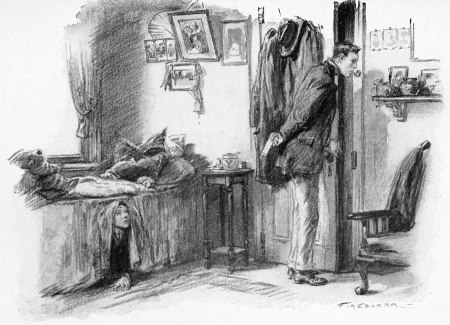
McNab, with a show of pantomime, squinted behind the window curtains and
opened the closet door.
"Look here, Dopey, you get out," said Tough, wrathfully, "you're
faking."
"I'm looking for customs officers," said McNab mysteriously.
"What! I say, what's this game?"
"Boys, we've got a couple of Cuba libre dagos rounded up and dancing
on a string."
"For the love of Mike, Dopey, be intelligible."
"It's cigars," said McNab at last.
"Don't want them!"
"But it's smuggled cigars!"
"Oh!"
"Wonderful, pure Havanas, priceless, out of a museum."
"You don't say so."
"And all for the cause of Cuba libre. You're for Cuba libre, aren't
you?"
"Sure we are."
"Well, these men are patriots."
"Who found them?"
"Buck Waters. They were just going into Pierson Hall to let the sophs
have all the candy. Buck side-tracked them and started them down our
row. Hungerford bought twenty-five dollars' worth."
"Twenty-five? Holy cats!"
"For the cause of Cuba libre! Joe is very patriotic. All the boys came
up handsomely."
"Are they good cigars?" said Dink who, since his purchases of the day,
was not exactly moved to tears by the financial needs of an alien though
struggling nation.
"My boy, immense! Wait till you smoke one!"
At this moment there came a gentle scratching at the door, and a
chocolate pair appeared, with Buck Waters in the background.
"Emanuel Garcia and Henry Clay!" said McNab irreverently.
"They smuggled the cigars right through the Spanish lines," said Waters
who, from constant recital, had caught the spirit of unconquerable
revolution.
"How do you know?" said McCarthy suspiciously, watching the unstrapping
of the cigar boxes.
"I speak French," said Waters with pride, and turning to his protégés he
continued fluently, "Vous êtes patriots, vous avez battlez, soldats
n'est-ce-pas? You see, they have had a whole family chopped up for the
cause. The Cuban Junta has sent them over to raise money—very good
family."
"Let's see the cigars," said Stover. "How much a box?"
Curiously enough this seemed to be a phrase of English which could be
understood without difficulty.
"Fourteen dollar."
"That's for a box of a hundred," said McNab, who screwed up the far side
of his face, to indicate bargaining was in order.
"Of course," said Buck Waters, "everything you give goes to the cause.
Remember that."
"Try one," said McNab.
The smaller Cuban with an affable smile held up a bundle.
"Nice white teeth he's got," said Buck Waters encouragingly.
"Don't let him shove one over on you," said McCarthy warningly.
Waters and McNab were indignant.
"Oh, I say fellows, come on. They are patriots."
"If they could understand you they would go right up in the air."
"Nevertheless and notwithstanding," said McCarthy, indicating with his
finger, "I'll take this one; it appeals to me."
"I'll worry this one," said Dink with equal astuteness.
They took several puffs, watched by the enthusiastic spectators.
"Well?" said McNab.
Stover looked wisely at McCarthy, flirting the cigar between his
careless fingers.
"Not bad."
"Rather good bouquet," said McCarthy, who knew no more than Stover.
"Let's begin at eight dollars and stick at ten," said Dink.
At that latter price, despite the openly expressed scorn of the American
allies of the struggle for Cuban independence, Stover received a box of
one hundred finest Havana cigars—fit for a museum, as McNab
repeated—and saw the advance guard of the liberators disappear.
"Dink, it's a shame," said McCarthy gleefully. "Finest cigars I ever
smoked."
They shook hands and Stover, overcome by the look of pain he had seen in
the eyes of the patriots on their final surrender at ten dollars, said,
with a patriotic remorse:
"Poor devils! Think what they're fighting for! If I hadn't been so
lavish to-day, I'd have given them the full price."
"I feel sort of bad about it myself."
About ten o'clock they rose by a common impulse and, seeking out the
cigars with caressing fingers, indulged in another smoke.
"Dink, this is certainly living," said McCarthy, reclining in that
position which his favorite magazine artist ascribed to men of the world
when indulging in extravagant desires.
"Pretty high rolling, old geezer."
"I like this better than the first one."
"Of course with a well-seasoned rare old cigar you don't get all the
beauty of it right at first."
"By George, if those chocolate patriots would come around again I'd give
'em the four plunks."
"I should feel like it," said Dink, who made a distinction.
The next morning being Sunday, they lolled deliciously in bed, and rose
with difficulty at ten.
"Of course I don't believe in smoking before breakfast, as a general
rule," said McCarthy in striped red and blue pajamas, "but I have such a
fond feeling for Cuba."
"I can hardly believe it's true," said Dink, emerging from the covers
like an impressionistic dawn. "Smoke up."
"How is it this morning?"
"Wonderful."
"Better and better."
"I could dream away my life on it."
"We ought to have bought more."
"Too bad."
After chapel, while pursuing their studies in comparative literature in
the Sunday newspapers, they smoked again.
"Well?" said Stover anxiously.
"Well?"
"Marvellous, isn't it?"
"Exquisite."
"Only ten cents apiece!"
"It's the way to buy cigars."
"Trouble is, Dink, old highroller, it's going to be an awful wrench
getting down to earth again. We'll hate anything ordinary, anything
cheap."
"Yes, Tough, we are ruining our future happiness."
"And how good one of the little beauties will taste after that
brutalizing Sunday dinner."
"I can hardly wait. By the way, I blew myself to a few glad rags," said
Dink, bringing out his purchases, "I rather fancy them. How do they
strike you?"
McCarthy emitted a languishing whistle and then his eyes fell on the
cause of all the trouble.
"Keeroogalum! Where did you get the pea-soup?"
The expression did not please. However, Stover had still in the matter
of his sentimental inclinations a certain bashfulness. So he said
dishonestly:
"I had 'em throw it in for a lark."
"Why, the cows would leave the farm."
"Rats. Wait and see," said Dink, who seized the excuse to don the green
shirt.
When Stover's blond locks were seen struggling through the collar
McCarthy exploded:
"It looks like you were coming out of a tree. What the deuce has
happened to you? Are you going out for class beauty? Holy cats! the
socks, the socks!"
"The socks, you Reuben, should match the shirt," said Stover, completing
his toilet under a diplomatic assumption of persiflage.
"Well, you are a lovely thing," said McCarthy, when the new collar and
the selected necktie had transformed Stover. "Lovely! lovely! you
should go out and have the girls fondle you."
At this moment Bob Story arrived, as fate would have it, with an
invitation to dinner at his home.
"Sis is back with a few charmers from Farmington and they're crazy to
meet you."
"Oh, I say," said Stover in sudden alarm. "I'm the limit on the fussing
question."
"Yes, he is," said McCarthy maliciously. "Why, they fall down before him
and beg him to step on them."
"You shut up," said Stover, with wrath in his eye.
"Why, Bob, look at him, isn't he gotten up just to charm and delight?
You'll have to put a fence around him to keep them off."
"In an hour," said Story, making for the door. "Hunter and Hungerford
are coming."
"Hold up."
"Delighted you're coming."
"I say—"
"There's a Miss Sparkes—just crazy about you. You're in luck. Remember
the name—Miss Sparkes."
"Story—Bob, come back here!"
"Au reservoir!"
"I can't go—I won't—" But here Dink, leaning over the banister, heard
a gleeful laugh float up and the sudden banging of the door.
He rushed back frantically to the room and craned out the window, to see
Bob Story sliding around the corner with his fingers spread in a gesture
that is never anything but insulting. He closed the window violently and
returned to the center of the room.
"Damn!"
"Pooh!" said McCarthy, chuckling with delight.
"Petticoats!"
"Alas!"
"A lot of silly, yapping, gushing, fluffy, giggling, tee-heeing,
tittering, languishing, vapid, useless—"
"My boy, immense! Go on!"
"Confound Bob Story, why the deuce did he rope me into this? I loathe
females."
"And one just dotes on you," said McCarthy, with the expression of a
Cheshire cat.
"I won't go," said Stover loudly.
"Are you going in that green symphony?"
"Why not?"
In the midst of this quarrel, Joe Hungerford entered, with a solemn
face.
"You're going to this massacre at Story's?"
"Don't I look like it?" said Dink crossly.
"We'll go over together then," said Hungerford, with a sigh of relief.
"I say, help yourself to a cigar, Joe," said McCarthy, with the air of a
Maecenas.
"Cuba Libre?" said Hungerford, approaching the box.
"And à bas Spain!"
Hungerford examined the cigars with a certain amount of caution which
was not lost on the room-mates.
"How many of these have you smoked?" he asked, turning to them with
interest.
"Oh, about three apiece."
"How do you like 'em?"
"Wonderful!" said Dink loudly.
"Wonderful!" said McCarthy.
The three lit up simultaneously.
"What did you pay for yours?" said Hungerford, with a sort of inward
concentration on the flavor.
"Ten bright silver ones."
"I paid twenty-five for two. How do they taste?"
"Wonderful!"
"Troutman only paid seven-fifty for his box."
"What!"
"And Hunter only five."
"Five dollars?" said McCarthy, with a foreboding.
"But what I can't understand is this—"
"What?"
"Dopey McNab got a box at two-fifty."
A sudden silence fell on the room, while, reflectively, each puffed
forth quick, questioning volumes of smoke.
"How do they smoke?" said Hungerford again.
"Wonderful!" said McCarthy, hoping against hope.
"They're not!" said Dink firmly.
He rose, went to the window, and cast forth the malodorous thing.
Hungerford followed suit. McCarthy, proud as the Old Guard, sat smoking
on; only one leg was drawn up under the other in a tense, convulsive
way.
"They were wonderful last night," he said obstinately.
"They certainly were."
"And they were wonderful this morning."
"Not quite so wonderful."
"I like 'em still."
"And Dopey McNab bought a hundred at two-fifty."
This was too much for McCarthy. He surrendered.
Dopey McNab, at this favorable conjunction, sidled into the room with
his box under his arm and the face of a boy soprano on duty.
"I say, fellows, I've got a little proposition to make."
A sort of dull, rolling murmur went around the room which he did not
notice.
"I find I've been cracking my bank account—the fact is, I'm strapped as
a mule and have got to raise enough to pay my wash bill."
"Wash bill, Dopey?" said McCarthy softly.
"We must wash," said Dopey firmly. "To resume. As I detest, abhor, and
likewise shrink from borrowing from friends—"
"Repeat that," said Joe Hungerford.
"I will not. But for all of which reasons, I have a little bargain to
propose. Here is a box of the finest cigars ever struck the place."
"A full box?"
"Only three cigars out."
"Three!" said Hungerford with a significant look at Stover.
"I could sell them on the campus for twenty, easy."
"But you love your friends," said Stover, moving a little, so as to shut
off the retreat.
"Who will give me seven-fifty for it?" said McNab, with the air of one
filling a beggar with ecstasy.
"Seven-fifty. You'll let it go at seven-fifty, Dopey?" said McCarthy
faintly, paralyzed at such duplicity.
"I will."
"Dopey," said Dink, with a signal to the others, "what is the exact
figure of that wash bill of yours?"
"Two dollars and sixty-two cents."
"Will you take two dollars and sixty-two cents for it?"
"You're fooling."
"I am very, very serious."
McNab struck a pose, while over his face was seen the conflict of duty
and avarice.
"Take it," he said at last, in a glow of virtue.
"I didn't say I wanted it."
"You didn't!"
"I only wanted to know what you'd really take."
"What's this mean?" said McNab indignantly.
"Dopey, would you sacrifice it at just a little less?" said Hungerford.
But here McNab, suddenly smelling danger in the air, made a spring
backwards. Hungerford, who was on guard, caught him.
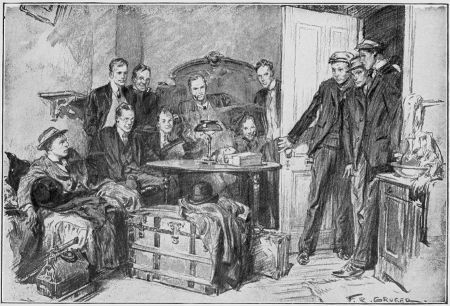
"Put him in the chair and tie him," said Stover, savagely.
Which was done.
"I say, look here, what are you going to do with me?" said McNab,
fiercely.
"You're going to sit there and smoke a couple of those museum cigars,
for our delectation and amusement."
"Assassins!"
"Two cigars."
"Never! I'll starve to death first!"
"All right. Keep on sitting there."
"But this is a crime! Police!"
"There are other crimes, Dopey."
"Hold up," said McNab, frantically, as he perceived the cigar being
prepared. "I've got to dine over at the Story's at one o'clock."
"So have we," said Hungerford, "but McCarthy will watch you for us."
"I will," said McCarthy, licking his chops.
"I've got to be there," said McNab, wriggling in a frenzy.
"Smoke right up, then. You can smoke them in twenty minutes."
"Police!"
"I say, Dink," said Hungerford, as McNab's head whipped from side to
side like a recalcitrant child's. "Perhaps we'd better get in all the
crowd who fell for the cigars—round 'em up."
"I'll smoke it," said McNab instantly.
"I thought you would."
They sat around, unfeelingly, grinning, while McNab, strapped in like a
papoose, rebelliously, with much sputtering and coughing, smoked the
cigar that Dink fed him like a trained nurse.
"Fellows, I've got to get to that dinner."
"We know that, Dopey—but there's one thing you won't do there—tell the
story of the Cuba libre cigar."
"Say, let me off and I'll put you on to a great stunt."
"We can't be bought."
"I'll tell you, I'll trust you! We're going to have a cop-killing over
in Freshman row. We've got a whole depot of Roman candles. Let me off
this second cigar and I'll work you in."
"We'll be there!"
"You bandits, I'll get even with you."
"You probably will, Dopey, but you'll never rob us of this memory."
"Curse you, feed it to me quickly."
The cigar consumed to the last rebellious puff, McNab was released in a
terrific humor, and departed hastily to dress, after remarking in a
deadly manner:
"I'll get you yet—you brutal kidnappers."
"I think it's a rather low trick of Bob Story's," said Stover,
considering surreptitiously in the mirror the effect of his new color
scheme.
"Ditto here," said Hungerford.
Now Stover was in a quandary. He was divided between two emotions. He
firmly thought that he had never looked so transcendingly the perfect
man of fashion, but he had numerous busy doubts as to whether the
exquisite costume was as appropriate at a quiet Sunday dinner as it
undoubtedly would have been in a sporting audience. Still, to make a
change now, under the malicious inspection of Tough McCarthy, would be
to invite a storm of joyful ridicule, so he said hopefully.
"Think it all right to go in this?"
"Why not?"
As this put the burden of the proof on him, Stover remained silent, but
compromised a little by exchanging a rather forward vest for one of
calmer aspect.
"Well," he said, at last, with something between a gulp and a sigh, "I
suppose we'd better push along."
"I suppose so," said Hungerford, who brought a strangle hold to bear on
his necktie and shot a last look down at the slightly wavering line of
his trousers.
At the door, the vision of McNab, like a visiting English duke, bore
down upon them.
"Where in the thunder did you get the boutonnière?" said Stover,
examining him critically.
"Why, Dopey, you're a dude!" said Hungerford disapprovingly.
"Everything is correct—brilliant, but correct," said McNab with a flip
of his fingers. "Come on now—we're late."
Half way there, when the conversation had completely fizzled out, McNab
said cheerily:
"How d'ye feel? Getting a little nervous, eh? Getting cold feelings up
and down your back? Fingers twitching—what?"
"Don't be an ass," said Hungerford huskily.
"Chump," said Stover, feeling all at once the tightness of his vest.
"'Course you know, boys, you're dressed all wrong—in shocking taste.
You know that, don't you? Thought I'd better tell you before the girls
begin giggling at you."
"Huh!"
"Joe's bad enough in a liver-colored sack, but Dink's unspeakable!"
"I am! What's wrong?"
"Fancy wearing a colored shirt—and such a color! You're gotten up for a
boating party—not for a formal lunch. You're unspeakable, Dink,
unspeakable! Look at me. I'm a delight—black and white, immaculate,
impressive, and absolutely correct."
By this time they had reached the steps.
"Now, don't try to shine your shoes on your trousers. It always shows.
Don't stumble or trip when you go in. Don't bump against the furniture.
Don't stutter. Don't hold on to your hostess to keep from falling over.
And don't, don't shoot your cuffs."
McNab's malicious advice reduced Hungerford to a panic, while only the
consciousness of his public importance prevented Stover from bolting as
he saw McNab press the button.
"Stand up straight and keep your hands out of your pockets."
"Dopey, I'll wring your neck if you don't stop!"
"Ditto."
"Say something interesting to every girl," continued McNab, in a solemn
whisper. "Talk about art or literature."
The door opened, and they stumbled into the ante-room, from which escape
was impossible.
"Dink," said McNab in a last whisper.
"What?"
"Don't ask twice for soup, and stop shooting that cuff."
The next moment Stover, who had been thrust forward by the other two,
found himself crossing the perilous track of slippery rugs on slippery
floors, and suddenly the cynosure of at least a hundred eyes.
Judge Story had him by the hand, patting him on the back, smiling up at
him with a smile he never forgot—a little lithe man bristling with good
humor and the genius of good cheer.
"Stover, I'm glad to shake your hand. We did all we could for you in
those last rushes. We rooted hard. My wife assaulted a clergyman in
front of her, and my daughter was found afterward weeping with her arms
around the man next to her. I certainly am proud to shake your hand. I
won't shake it too long, because"—here he looked up in a confidential
whisper—"because the girls have been fidgeting at the window for an
hour. Look them over and tell me which one you want to sit next to you,
and I'll fix it."
"Dad, aren't you awful?" said a voice in only laughing disapproval.
"My daughter," said the judge, passing joyfully on to Hungerford.
"Indeed, I'm very glad to meet you."
He shook hands, a trifle embarrassed, with a young lady of quiet
self-possession, gentle in voice and action, with somewhat of the
thoughtful reserve of her brother.
He followed her, only half conscious of a certain floating grace and the
pleasure of following her movements, bowing with cataleptic bobs of his
head as the introductions ran on:
"Miss Sparkes."
"Miss Green."
"Miss Woostelle."
"Miss Raymond."
Then he straightened and allowed his chin to right itself over the brink
of his mounting collar, smiling, but without hearing the outburst that
went up from the equally agitated sex:
"Isn't the Judge perfectly terrible!"
"You mustn't believe a word he says."
"Don't you think he's lovely, though?"
"We really were so excited at the game."
"Oh, dear, I almost cried my eyes out."
"We thought you were perfectly splendid."
"We did want you to score so."
"I just hated those Princeton men, they were so much bigger."
Hungerford and McNab coming up for presentation, he found himself a
little to leeward, clinging to a chair, and, opening his eyes, perceived
for the first time Hunter, with whom he shook hands with the
convulsiveness of a death grip.
Miss Sparkes, a rather fluttering brunette with dimples and enthusiastic
eyes, cut off his retreat and isolated him in a corner, where he was
forced to listen to a disquisition on the theory of football, supremely
conscious that the unforgiving McNab was making him a subject of
conversation with the young lady to whom he was rapidly succumbing.
The entrance of Mrs. Story and Bob, and the welcome descent on the
dining-room, for a moment made him forget the awful fact that he had
perceived, on his entrance, that the green shirt was, in fact, nothing
short of a social outrage.
"Every one sitting next to the person they want," said the Judge
roguishly, his glance rolling around the table. "By George, if that
body-snatcher of a Miss Sparkes hasn't bagged Stover—well, I never!
Seems to me a certain party named Hungerford has done very well indeed.
McNab, I perceive, is going to set the fashions for the class, but I
certainly do like Stover's green shirt."
At this a shout went up, and Stover's ears began to boil.
"I don't see what you're ha-ha-ing about, Mr. McNab," continued the
Judge, diverting the attack, "descending upon us, a quiet, respectable
back-woods family, with a boutonnière! I think that's putting on a good
deal of airs, don't you? Now, boys, don't let these young society ladies
from Farmington pretend they're too delicate to eat. You ought to see
the breakfast they devoured. Everybody happy all right."
In five minutes all were at ease, chattering away like so many magpies.
Stover, finding that his breath came easier, recovered himself and
listened with a tolerant sense of pleasure while Miss Sparkes rushed on.
"The girls up at Farmington will be so excited when they hear I've
actually sat next to you at the table. You know, we're all just crazy
about football. Oh, it gets me so excited! Dudley's the new captain,
isn't he? I met him last summer at a dance down at Long Island. I admire
him tremendously, don't you? He has such a strong character."
He nodded from time to time, replied in dignified monosyllables, and
became pleasurably aware that Miss Raymond, opposite, in disloyalty to
her companion, had one ear trained to catch his slightest word, while
Miss Green and Miss Woostelle, farther away, watched him covertly over
the foliage of the celery. He was a lion among ladies for the first
time—a sensation he had sworn to loathe and detest; and yet there was
in him a sort of warm growing feeling that he could not explain but that
was quite far from unpleasant.
"If Miss Sparkes, Mr. Stover, will stop whispering in your ear for just
a moment," said the Judge, on mischief bent, "you can help Mrs. Story
with the beef."
"You'll get accustomed to him soon," said his hostess, smiling. "There,
if you'll steady the platter I think we two can manage it. I am so glad
to have you here. Bob has spoken of you so often. I hope you'll be good
friends."
There was something leonine and yet very feminine in her face, a quiet
and restfulness that drew him irresistibly to her and gave him the
secret of the reserve and charm that was in her children.
Of all the delegation from school, Jean Story alone had not seemed aware
of his imposing stature. She was sitting between Hungerford and Hunter,
whom she called by his first name, and her way of speaking, unlike the
impulsiveness of her companions, was measured and thoughtful. She had a
quantity of ash-colored hair which, like her dress, seemed to be
floating about her. Her forehead was clear, a little serious, and her
eyes, while devoid of coquetry, held him with their directness and
simplicity.
He found himself only half hearing the conversation that Miss Sparkes
rolled into his ear, watching the movements of other hands, feeling a
little antagonism to Hunter and wondering how long they had known each
other.
Dinner over, he forgot his shyness, and went up to her with the quick
direction which was impulsive in him when he was strongly interested.
"I want to talk to you," he said.
"Yes?"
She looked at him, a little surprised at the bluntness of his
introduction, but not displeased.
"You are very like your brother," he said. She seemed younger than he
had thought.
"I am glad of that," she answered, with a genuine smile. "Bob and I are
old friends."
"I hope you'll be my friend," he said.
She turned, and then, seeing in his face only sincerity, nodded her
head slightly and said:
"Thank you."
He said very little more, ill at ease, a feeling that also seemed to
have gained possession of her.
Miss Raymond and Miss Woostelle came up, and he found himself restored
to the rôle of a hero, a little piqued at Miss Story's different
attitude, always aware of her movements, hearing her low voice through
all the chatter of the room.
He went home very thoughtful, keeping out of the laughing discussion
that went on, watching from the corner of his eye Hunter, and wondering
with a little unexplained resentment just how well he knew the Storys.