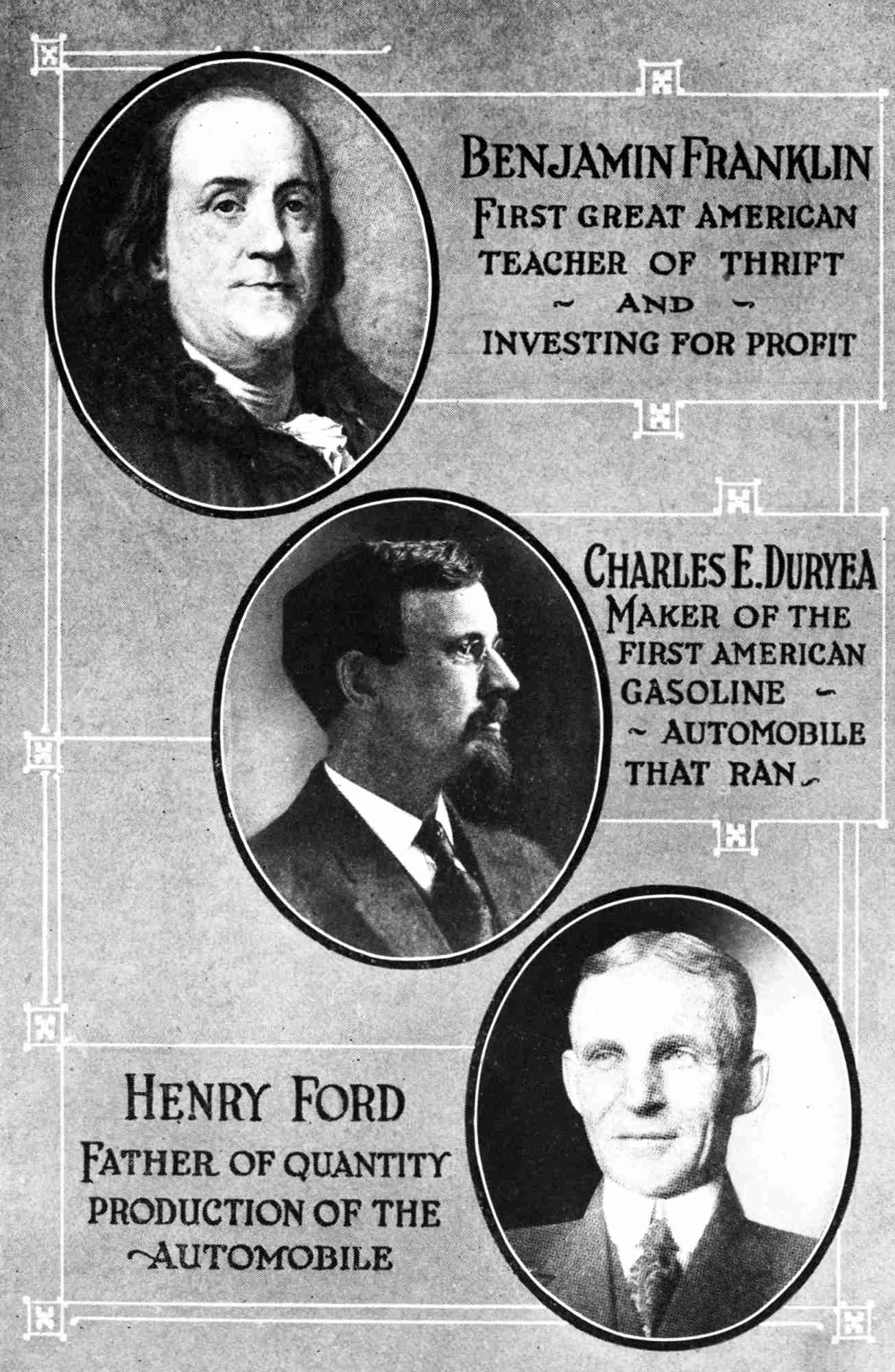
Benjamin Franklin First great American
teacher of thrift
and
investing for profit
Charles E. Duryea Maker of the
first american
gasoline
automobile
that ran
Henry Ford Father of quantity
production of the
automobile
Its History and Development
From 1760 to 1917
With an Analysis of the
Standing and Prospects of
the Automobile Industry
Economist and Financial Writer
Author of “Making Money Make Money,” etc., etc.
CHICAGO
A. J. MUNSON & CO.
1917
Copyright, 1917, by
H. L. BARBER
PREFACE.
So far as I know, there is no book in circulation
that tells, in concise form, the story of
the mechanical and commercial evolution of the
automobile, mirrors its sudden leap into popular
use, and shows how it has demonstrated, in
a most amazing way, the power of money to
make money, describes its benefits to the world,
and forecasts the future possibilities of the
automobile industry as an investment.
This book, the “Story of the Automobile,”
shows the struggle of man for one hundred and
fifty years to devise a means of propelling a
vehicle without animal power.
It describes the various stages of the evolution
of the idea of motive force other than animal
power, in France, England, Germany and
the United States, and its triumphant culmination
in a successful horseless vehicle. And it
makes clear how, when the automobile became
of practical use, its successful commercialization
became most profitable in the shortest
period of time of that of any product of man’s
ingenuity supplying an article to meet human
wants.
But if this were all that could be recorded of
the story of the automobile, this book would not
have been written. The automobile’s success
demonstrates all this, and something more—something
that would not ordinarily occur to a
person unless his attention was called to it.
The astonishing history of the automobile’s
success affords one of the most convincing and
the best modern instance of the opportunities
that are being constantly presented for investing
for profit.
It is a signal example kept in our hearing
every day by the Niagara-like roar of the cars
along our boulevards, of the fact that this is the
age of golden opportunities for making money
make money—of opportunities that disclose
themselves, sometimes unexpectedly, and, when
embraced, are apt to respond with a veritable
avalanche of profits.
For was it not an avalanche of profits that
overwhelmed the man who in thirteen years
made $200,000,000 and was offered another
$200,000,000 for only a small part of his business?
And this great fortune made by Henry
Ford did not exhaust the Ford automobile’s
possibilities, for millions are still being taken
out of the business, one investor of $2,000 having
received over half a million dollars out of it
lately.
When men who are not 40 years old today
came out of high school they either did not
know what an automobile was or, if they had
seen one of the very earliest samples, they had
no vision of what it would develop into—no
conception of what the future had in store for
the wabbly horseless vehicle, zig-zagging down
the street, as a potential money-maker.
And in the early days of the automobile’s
struggles for recognition as a promising investment,
no banker or other moneyed man could be
brought to believe that it held out any reasonable
hopes of great gain. No one could foresee,
not even the inventors of the automobile, that in
less than two decades the business done through
its comparative perfection would rank fourth
in order of the industries of the United States.
And still less was there anybody so foresighted
in the possibilities that lie in money to make
more money, as to vision the billions of dollars
of profits to be paid out by this one idea of a
horseless vehicle.
We can find few instances which so forcefully
show, as the automobile industry shows, the
chances for profitable investment in a short time
which may come from sources supplying the
needs or pleasures of the great mass of the
people.
The chapters of the “Story of the Automobile”
devoted to its commercialization make
clear that its greatest success has been due to
the production of automobiles at a price within
reach of people of ordinary means. For this
the one man most responsible is Henry Ford.
He has demonstrated in a manner of many millions
that the most money is to be made out of
things used by the greatest number of people—things
that become common needs.
The enduring truth of the profitableness of
Philip D. Armour’s apothegm, “Make and sell
things that are ‘et’ up,” is not discredited by
the automobile industry, for the use of the automobile
“eats” up steel, brass, wood, rubber,
leather, gasoline and many other natural
resources. The automobile wears out and has to
be replaced, so it properly comes in the category
of things “et” up.
This truth, that the greatest profits lie in
products that can be given general distribution,
with a consequent large sale, which is one I have
maintained in my book, “Making Money Make
Money,” in my magazine, “Investing for
Profit,” and in all my teachings on the science
of investing, finds a splendid exemplification
in the automobile industry’s success as a phenomenally
profitable form of investment, and
the circumstances of this success are but cumulative
evidence of the soundness of my doctrine.
And the success of the automobile industry in
the measure and with the speed it has achieved
verifies not only this claim I have made and
maintained, but confirms my contention of the
value of co-operation.
I have preached co-operation as urgently as
I have advocated, as the best objects of investment,
the value of things used popularly and in
quantities.
The “Story of the Automobile” could not
have had written into it the glamour of the
golden guerdons of Golconda but for Ford’s
idea of quantity production, reinforced by
co-operative standardization of parts. Co-operation
between the manufacturers produced
standardization, and standardization enabled
quantity production, and the low price which
quantity consumption warranted has caused
automobiles to be bought by millions, and the
purchase of the automobile in millions, instead
of thousands, has made the hundreds of millions
of dividends which this wonderful mine of
profits has yielded.
The “Story of the Automobile” is one of the
best and most notable proofs of two of my convictions
bedded in the concrete of experience,
namely, that the most promising investments
are those made in natural resources and enterprises
which the largest number of people can
patronize, and that co-operation is one of the
most effective forces in nature, and, therefore,
applicable to the affairs of men as a beneficent
influence, and, if efficient, the handmaiden of
success.
The story of the automobile has herein been treated in a way that
not only presents a graphic relation of the automobile’s development
as an invention, its commercialization, its benefits to man and the
position it occupies as a notable example of earning power, but in a
manner that develops the many morals taught by its success. The method
of treatment of the subject matter is uncommon, and, for this reason,
interesting, I trust, to those who read the book.
The chapter contributed by Mr. Edward G.
Westlake, automobile editor of the Chicago
Evening Post, is a resume of automobile conditions
from the intimate viewpoint of a writer
who has specialized in the automobile, and
enjoys a deserved reputation as the dean of the
automobile editors of the daily newspaper press.
Every one interested in automobiles will derive
information and entertainment through reading
Mr. Westlake’s presentation of the amazing
features of automobile industrial figures. In it
he states interesting facts not stated elsewhere
in the volume.
The book’s interest and value as a contribution
to automobile literature, of which there is
not much in book form, would be less than they
are, but for the participation in its preparation
by the Business Bourse International, Inc.,
New York, whose vice-president, Mr. J. George
Frederick, is one of the highest authorities on
business economics.
The chapter by the Business Bourse deals
with the automobile industry from the standpoint
of the financial and investment aspects of
the automobile, accessory and tire manufacturers’
securities, and Mr. Frederick’s reputation
in the financial world is a guarantee of the
authoritative accuracy of the facts presented in
this chapter.
Credit for salient facts in the history of the
automobile, obtained and used in the “Story of
the Automobile,” is given to a large volume of
nearly 500 pages, “The Romance of the Automobile
Industry,” by James Rood Doolittle,
issued lately by The Klebold Press, New York
city. This volume is the most exhaustive work
in book form yet published on the automobile,
and covers graphically every phase of its development
and popularization. It is virtually a
textbook and reference guide of facts of motor
car history, and devotes particular attention to
the personnel of the founders of the industry
and those engaged in it, and the association
features.
I can only hope that the work entailed in presenting
this, the “Story of the Automobile,” has
been done sufficiently well to make it interesting
and instructive to those who read it.
Industry reaches two billion dollar mark—optimistic of
future increase—point of saturation far off—reliability
contest a factor in popularizing automobiles—Ford, the
wizard who converted the industry to price reduction—installment
plan of payment—part machining plays in low
selling prices—women a factor in automobile buying—good
roads now the industry’s greatest aid—farmers as
available prospects.
First horseless vehicle constructed by Cugnot, a Frenchman,
over 150 years ago—invention traced in different
countries, down to the first successful gasoline automobile
made in the United States by Charles E. Duryea in 1892—prohibitive
laws in England discouraged invention there—Evans
in 1784 first American to experiment in horseless
vehicles—French and German inventors’ part in development—Selden
first patentor of gasoline motor—inventor’s
difficulties in interesting capital—electrics appear—steam
preceded both electrics and gasoline.
Steam and electric types outstripped by gasoline car—co-operation
partly popularized motor car—standardization
enabled price reduction—tungsten and other alloys, heat
treatment of steel, advertising and invalidation of Selden’s
patent, in the industry’s development—reasons for United
States’ supremacy in industry.
Industry had little original capital invested in it—present
investment largely made up of profits—difficulties in
getting capital—dealers put up money to finance distribution—production
not reached its height—commercial cars
and tractors promise great opportunities—industry a surprise
to economists—large as it is, industry still in comparative
infancy.
A medium of exchange of knowledge and ideas by bringing
people together—uproots bigotry and removes prejudice—revolutionizes
thought and habits, and liberalizes
mind—emancipates woman from drudgery of domesticity—increases
social amenities—a health giver; saves human
life; aid in eugenics—stimulates better roads—saving in
war.
Chapter VI.
Reports on Automobiles, Automobile Accessories
and Tire Manufacturers Securities
from a Financial and Investment Stand-point
Economic history, and its relation to stock trading in
the automobile industry—securities traded in on New York
stock exchange and curb—securities on exchanges in other
cities, and data for 1916—principal securities not generally
traded in—prices and terms—newer entrants—security
issues of tire companies—comparison of automobile with
other securities—present and possible future trend—graphic
charts and comparative tables.
Chapter VII.
Passenger Automobiles Manufactured in the
United States
Range of prices and other data prior to April 1, 1917.—Courtesy
of Everybody’s Magazine.
INTRODUCTION.
“What did Benjamin Franklin have to do
with the automobile?” a great many readers of
this book will ask.
Benjamin Franklin was many-sided, and he
had a great deal to do with much that affects the
birth of the American nation; and if it had not
been for what he and other patriots, statesmen
and diplomats did, the automobile business
might have been in this country today exactly
what it is in England today—and that is a very
insignificant industry.
Among other things Franklin was a signer
of the Declaration of Independence, and it was
the American Revolution that made the automobile
industry of today possible; for, had there
been no revolution, we would probably still be
a dominion of Britain beyond the seas, and it is
pretty certain that England would have had in
force in the colonies the laws she kept on her
statute books until 1896, practically prohibiting,
by the imposition of excessive road tolls, the
use of the public highways to horseless carriages.
For, strange as it may seem to us in this country,
which Emerson epitomized as another name
for opportunity, the English horse owners and
people generally resented, as early as 1840, the
progress represented by the automobile, and
stifled all development of it from that time to a
date when France, Germany and the United
States had made it a real factor in transportation.
If, therefore, Franklin had not helped to free
this land from the British yoke, the automobile
industry might have been in the United States
what it is in England today. France and Germany
might now have been doing the automobile
business of the world, with England and this
country buying from them, as England and
France are now buying from the United States,
whose automobile supremacy at this date is
unquestioned.
While the gasoline type of automobile today
is the most popular, this is not to say that the
electric type is not a success scientifically and
commercially. Indeed, the future extent of the
automobile’s use for commercial purposes is
said by experts to depend largely on the electric
driven type.
And who will deny that but for Franklin
the electric motor would not have been, for it
was he who wrested the thunderbolt from
heaven, as well as the sceptre of dominion over
our land from the tyrant. Franklin as the discoverer
of electricity may well be accorded the
credit for the electric automobile, which has
played no small part in the development of
the automobile industry, a fact which every
student of automobile history will concede.
It is, however, on an even firmer foundation
than either of the causes mentioned that Benjamin
Franklin stands as contributing to the
success of the automobile industry. The inventors
could invent and the manufacturers
could make the automobile, but who, pray, was
to buy it, if it was to be in general use, if not
the common people? And how, may we ask,
were the people going to buy it without money?
As the great teacher of frugality and thrift,
Franklin laid the cornerstone, 150 years ago,
on which the superstructure of the American
automobile industry has been erected. For,
assuredly, had the seed planted by him failed to
germinate and ripen in the American consciousness,
we could as well have been today a nation
of spendthrifts as a people self-denying, thrifty
and frugal. He inculcated those principles of
temperance and economy in the lives of our
forefathers which have been handed down to
us from one generation to another, to our advantage
and as an aid to our saving habits, by
which we are enabled to buy automobiles.
Many a motor car today owes its ownership
to the teachings of Franklin. Many an automobile
buyer would never have become one
had he not heeded Franklin’s injunction, to
“Remember, a patch on your coat and money
in your pocket is better and more creditable
than a writ on your back and no money to
take it off,” and the investor would not have
put money in stocks of automobile companies
if he had not learned the truth of Franklin’s
teaching that “Money makes money, and the
money that money makes, makes more money.”
Franklin having done what he could to prepare
American citizens to economize and save
against the day of the automobile, and to invest
their money in its manufacture, and the American
citizen having followed his teachings and
accumulated enough to buy at least a Ford, and
perhaps a few shares of automobile company
stocks, the man appeared who produced the first
gasoline automobile in the United States. That
man was Charles E. Duryea. His reputation
rests on the fact that, though there were steam
and electric automobiles in existence, and the
gasoline motor had been developed, he was the
first to put gasoline motor and buggy body into
co-ordination and make the first run the second.
To Duryea, the constructor of the “buggy-aut,”
is accorded the credit, by automobile history, of
being the father of the American gasoline car.
Following Duryea by only one year, came the
genius who put into general circulation the
universal car.
A reading of Henry Ford’s biography discloses
that his first idea, that the big money was
in production in quantity—that a million
articles sold at a profit of 50 cents each was a
better paying transaction than ten thousand
sold at $3.00 each—was in connection with a
watch. Watches and clocks were the first things
that Ford subjected to the mechanical promptings
of his boyish mind, and he had it all
planned out to make a 50-cent watch before
Ingersoll had conceived the commercial possibilities
of a dollar one.
An accident which his father met with called
him from Detroit to the Michigan farm, and
this accident deprived the country of a 50-cent
watch and gave it a $350 automobile instead.
And most people will agree that it was a fair
exchange and no robbery. Thomas A. Edison,
strange as it may sound, was responsible for
the practically universal use of the Ford automobile,
for he it was, who, by the chance remark,
“What you want to do to make money is to
make quantity,” started Ford on his downward
price career. We have it from Mr. Ford
himself that he heard this statement by Edison,
and that it so impressed him that he made it
the rule and guide of his life; that he never
renounced the idea. When, after building a
motor that was a success and commanded the
attention and capital of moneyed men in
Detroit, Ford formed his first company to build
his car, this great idea was obstinately adhered
to by him, and was the cause of his falling out
with his moneyed partners. They could not see
the light which has given Ford his halo—the
great white light of quantity production. This
light burns with steady brilliancy because it is
generated by the great principle of the greatest
good to the largest number. Ford’s associates
in his first company were not believers in this
principle, evidently, because when they fell out
with Ford about it, and Ford got out of the
company to start the one he now controls, they
went ahead making cars that sell today for
from $2,300 to $3,900. But though they have
made fair profits, they have not made the fabulous
sums that Ford has, and one can only
wonder how they feel about it, and if they
realize the error of their views. They are probably
wiser if not richer.
The success of Ford’s idea of quantity sales
demonstrates a great fact in the affairs of life.
It is that fields of human endeavor are not
exhausted or worked out until the human race
has ceased to exist. Take any line of enterprise
you will, and it has as many facets as a prism.
An idea only is needed, which, if the right one,
illustrates the enterprise as lights thrown on
the prism cause it to sparkle in many colored
rays.
We think, for instance, that the acme has been
reached in the making and marketing of bread,
but along comes a man with an idea for making
bread of bran, and he is immediately ushered
into the inner sanctum of the temple of great
profits. Or we imagine that the last word has
been said in cereal foodstuffs, when lo, and
behold, the man with the right idea proves that
the field has room and to spare for a financial
success in so simple a thing as rice dressed in
a palatable and salable form. And so it is in
everything, automobiles especially. The man
who conceives the idea of a sport car supplies
a want that others have neglected. There may
be many automobile tractors on the market, but
the human brain conceives one with some feature
lacking in others, such, for instance, as
making a Ford automobile interchangeable into
a farm tractor, and it has an immediate and
large success. And if anybody had an idea that
the profits from producing petroleum might be
limited by the use of gas and electric light, it
was because the automobile’s enormous consumption
of gasoline and the use of oil by ships
could not be foreseen.
The field for investment is kept constantly
fallow, and ready for the seed that is to fructify
into great profits, by the human brain which is
ever active—ever thinking. If its product is
not an elemental, it is a supplementary idea, as
the rubber tire, the demountable rim and the
self-starter for automobiles. Until the world
has arrived at perfection in all things, the ultimate
will not have been reached. The opportunities
of today and tomorrow are as great as
they were yesterday. It is a question whether
they are not greater, for if the quotation
ascribed to Emerson is true, that the world will
beat a path to the door, though it be in a forest,
of him who makes a mouse trap better than his
neighbor, the future possibilities of enterprise
are favored by increased population and the
element of the cumulative nature of the wants
of man. As inventions and articles of use
increase in number, new needs which demand
supplementary products are created. Each new
thing given to the world brings in its train other
new things. The crank of a Ford auto creates a
demand for a self-starter. The increase in
population and wealth brings in its train a
multiplication of human units whose use of created
things is on a crescendo scale.
The financial successes in the automobile
business, great as they are, have followed the
inexorable law that the richest returns in all
investments are the ground floor ones. The
history of no big business demonstrates more
clearly that the way to make money is to invest
in new companies when they are offering
the first authorized capitalization for investment
subscription. Money-making opportunities
for new investors are always greatest in
enterprises whose development is ahead and
in the future. If they have reached the stage
where development is already producing great
profits, the door is closed to the new investor,
or else he must pay a premium to sit in such
paying company.
In the ground floor days of the Ford money-making
machine, Miss Couzens “risked” $100
on Ford. That $100 produced $100,000 in cold
cash. But it did so only because the inception
of the Ford enterprise provided the opportunity.
Having made its half a billion, or more,
the Ford enterprise is no longer enterable on
any basis that would give such returns for each
dollar invested. When money is needed enterprise
is willing to pay liberally for its use.
When enterprise has all the money it wants,
money’s value to it is less. This is the most
natural law. It is a law that operates in other
things besides money. “He that hath, needs
not; he that hath not, wants.”
The automobile industry illustrates graphically
that when an enterprise develops to the
point where it is well grounded and has reached
a period of age and steady earning capacity,
it is not new investors who may come in and
gather the richest plums, but the old ones, those
who helped to give it its start, who stood by it
when the future was obscure, and the ultimate
outcome not certain. There is probably no business
that shows as many people in it now, who
were in it at the start, as the automobile business.
This applies to manufacturers, distributors
and investors, and is, to a certain extent,
due to the industry’s newness. The original
Ford investors are practically all intact. It is
the original investors who have reaped the
reward of their courage in embarking in new
enterprise, and who have shared in the division
of the juicy melons the automobile companies
have cut in the form of huge stock and other
dividends. We need no better proof of the fact
that ground floor investments promise the
greatest returns on money invested than the
financial history of the automobile.
While quantity production and the co-operative
spirit which led to standardization were
the keystones in the structure of the present
day automobile success, the history of the successful
development of the automobile demonstrates
another fact, which is a vital one in the
realm of investment.
This fact is that most great financial successes
are built on our natural resources. This
is peculiarly so of the automobile industry. The
steel, wood, rubber, leather and glass of which
the automobile is composed, are all products of
the ground, the forest or the farm. It could
not be said that the products of the earth
directly make the profits of a stock life insurance
company, but this can be said of the automobile
industry, and its history discloses that
the automobile business of the United States
was four times rescued from failure, first, by
petroleum, for steam and electric cars would not
sell in quantities, and the gasoline from
petroleum was needed to give the automobile
its great vogue, once by tungsten, vanadium
and chromium, again by the quantity production
theory, and finally by co-operative
standardization.
At one period of automobile development,
the manufacturers were ready to give up in
despair because cold-rolled and high carbon
steels only were available, and these made the
weight of the car and the price obstacles to its
popular adoption. At the stage when failure
to produce a car at popular price was imminent,
there entered on the scene tungsten, chromium,
vanadium and aluminum, all natural resources,
and they, combining with standardization, made
quantity production possible. Tungsten, alloyed
with steel for valves, chrome steel for springs,
vanadium in steel to impart purity, and aluminum
for lightness, reduced the weight of the
automobile 25 per cent, enabled motors to be
made smaller, tires lighter, original cost less,
and cut down upkeep cost to the users of cars.
Quantity production thus was made possible,
and natural resources again vindicated their
claim to being premier possibilities of profit.
Of the future of the automobile and of products
allied with it or sharing in its construction
and prosperity, as continuing money-makers, all
indications are that the profits already taken
out of the motor car industry in the United
States are but placer croppings, and that the
years to come will record the workings of the
real vein. This real vein, in the opinion of
the man who looks ahead, is in the use of passenger
cars, haulage trucks and motor tractors
by the fifty million of the population of this
union of states who are on or of the farm.
As yet, the farmers have not risen to the full
possibilities of motor power in economic superiority
over horse power for haulage, ground
cultivation, and other uses to which the horse
is now put. Elements which will hasten this
awakening are the scarcity of man labor and
the workings of the immutable law of economics.
There is not enough food being produced by
the world to supply the demand. If there were,
prices would be lower. Prices will remain high
as long as the supply falls below the demand.
As long as they remain high, the stimulation
to greater production will continue, and this
urge can have but one result, which is to force
the producer to adopt the most economical
method of production.
It has been determined that motor power is
cheaper than horse power. It is, therefore, only
a question of time when the horse will go from
the farm as he is disappearing from the cities.
In this evolution will be found the money-making
possibilities of investment in the motor
tractor and the motor truck. Their adaptation
to the smallest as well as the largest needs
of the tiller of the land is now being assured.
With the horse, the farmers of the United
States have been able to break up only 70 per
cent of the cultivable land not in timber. There
are over two hundred million acres of tillable
land that have never felt the cold steel of a
chilled plow. There are two hundred million
more acres in timber that will, much of it, ultimately
come under the plow. Besides crippling
the labor supply in this country, the European
war has taken a million horses out of our supply.
The case in favor of the tractor coming
ultimately into common use seems from all
this to be completely made out—its adoption
in large numbers being only a question of getting
the price down to a basis which will insure
quantity production. As this was done with
passenger automobiles, it would be folly to say
it will not be done with tractors and trucks.
Figures showing the total amount of money
that has been taken in profits out of the automobile
industry have never been compiled. It
is a business that has developed so rapidly and
feverishly that the water churned up by the
commotion it has made has not yet settled. But
there is a record of enough individual instances
of gigantic profits to prove that the largest
individual appetite for dividends should have
been satisfied by the ratio of earnings already
made in automobile manufacture.
But in every case the greatest profits were
in the stock of those companies that complied
with Edison’s rule of large money-making—“What
you want to do to make money is to
make quantity.” And they were also companies
which made an automobile that could be “‘et’
up,” as Armour put it, by time and use, in less
time than it takes time and use to eat up a
higher priced machine.
Ford, Overland, Reo—you will recognize this
trinity as the leaders in sales, and by the same
token they have been the leaders in profits.
When it is stated that Henry Ford made
$200,000,000 in thirteen years, and was then
offered a like amount for only a small part of
his enterprise, we may well believe that he
credits his own statement that “anything for
only a few people is no good. It’s got to be good
for everybody or it won’t survive.” Other Ford
investors profited on the basis of $5,000,000 for
each $10,000 invested. After the parent Ford
company had established a record of a million
dollars a week in profits in the United States
alone, Ford stepped across the river into Canada
and organized a company there which is
earning fifty per cent a year on its capital of
$10,000,000.
Profits of $52,000,000 in capital stock alone
which has been built up almost entirely of dividends
earned, is the record of the Willys-Overland
Company. John North Willys founded
the success of this great money-making business
on his personal check of $500, cashed at great
trouble during the panic of 1907, when the Overland
company was ready to go into bankruptcy.
Besides the dividends applied to increasing the
capital, an immense amount in profits has been
disbursed by this enterprise. The dividends
in 1916 were $11,000,000, over 20 per cent of
the capital. This year they will likely be nearly
double that amount. The Reo Motor Car Company
has paid over $50,000 on an investment
of $1,000. These three are not by any means
all the automobile companies which have contributed
to make the automobile industry a signal
example of the earning power of money,
but they represent the leaders of the popular
or quantity-production-through-low-price type.
There are about 150 passenger automobile companies
that are profitable in varying degrees,
proportioned to their price, not to say anything
of trucks and tractors, in the marketing of
which fortunes are also being made.
CHAPTER I. INTRODUCTORY—AUTOMOBILE INDUSTRIAL FIGURES ARE AMAZING. By Edward G. Westlake , Automobile Editor, The Chicago Evening Post . — Price Drop In One Year. — Point of Saturation Far Off. — Value of Reliability Contests. — Ford, a “Wizard” and “Genius.” — The Part Machining Plays. — Good Roads Industry’s Greatest Aid.
During the year 1916 the automobile industry
in the United States entered the “billion dollar
class,” and manufacturers who have membership
in the National Automobile Chamber
of Commerce which holds the industry, as it
were, in the hollow of its great hand, made no
more ado over this significant, almost amazing
development than to meet in the annual banquet
and reiterate their statements that the critic
did not live who could predict, with certainty,
the gain that might be made in 1917.
It was expected that the industry would
climb into the billion dollar fold—men said that
the fourth industry in the country had the financial
stage set for starring the “Big Billion,”
and they never permit themselves to see a possibility
of a recession unless steel becomes too
great to be kept within bounds—in short
material price is the only problem the venturesome
automobile maker will put down for
earnest discussion.
Accurate figures spread on the records of
the National Automobile Chamber of Commerce
indicate that retail sales of motor vehicles in
1916 totaled $1,068,028,273. This total includes
a production of 1,525,578 cars and 92,130 trucks.
The passenger cars were valued at $921,378,000
and the trucks were listed at $166,650,275. When
the statisticians of the national organization
compared figures and found the gain was 80
per cent, and paused long enough to find that
the gain the year previous had been 36 per cent,
they talked about the complete automobilization
of the country and the inevitable addition of
more than 2,000,000 to the total of cars in operation
in the United States.
Weight decreased, as the engineers had
planned, and the average price of cars decreased
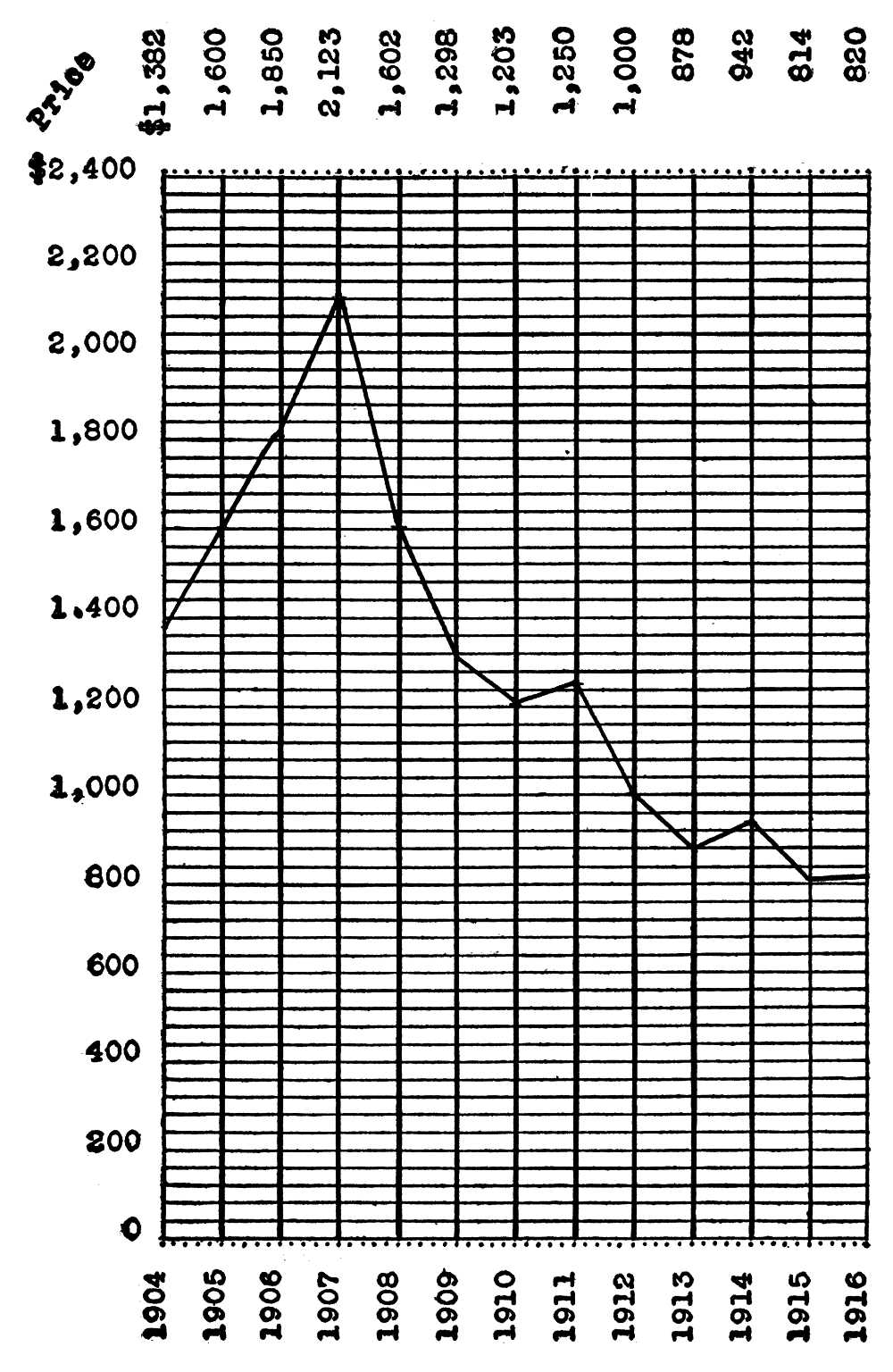
in one year from $671 to $605. In the
eight previous years the average price of automobiles
had dropped from $2,125 to $814. Wall
Street, which once had only the cold shoulder
for the automobile producer, took a permanent
seat at the table where daily the industry was
dissected, analyzed, weighed, discussed and
reviewed; and, as a result, it is as difficult to
keep from the financial eyes of Wall Street the
operations of the great automobile factories as
it would be to hide the clearing house reports.
The keenest financial and commercial experts
of the United States have learned to keep the
motor car industry constantly under surveillance—not
that they mistrust the manufacturers,
but that they have found the industrial
situation is so firmly linked to the dollars and
cents program of the country’s economy that
nothing may successfully act to deprecate the
importance of the auto industry. Time was
when General Motors sold as low as 40—what
Stock Exchange expert would expect to see this
stock sell for less than 105?—and if conditions
were to become so chaotic that General Motors,
with its prosperous units, were to break to a
point or two under par, what financial student
would not search for something akin to a Black
Friday?
Immutable laws work in the automobile
industry. The maker daily takes a course in
the University of Production, because an army
of selling factors constantly is attending to the
absorption facilities of the country’s markets
and he rarely permits himself the task of figuring
on the “probable saturation point.” It is
a wonderfully important thing to the maker
that the national Organization gets official
reports, guides the policies of standardization,
holds an indefinable influence over the engineers
of the industry, and sits as the congress of the
Republic of Motor Car Production. The auto
industry of today is, perhaps, the most intricate
thing in the country, and yet so responsive to
the law of supply and demand that there is not
an element of guesswork in it.
Although more than two hundred automobile
concerns that had entered the arena of business,
developing from the “blue print stage” to
manufacturing concerns of considerable output,
had failed in the last twelve years, the automobile
industry had been a big paying one. Pioneers
who remain and whose works annually
pay dividends, accepted the failures as the
necessary concomitant of a great business that
only showed an output of 3,700 cars in 1899
and only 11,000 vehicles in 1903, the amount
growing to 485,000 cars in the year 1913.
“Our house is a generally well ordered one,”
the maker delighted in saying. “The industry
is like a science. The engineer has brought
standardization to almost finality, the matter
of styles and body designs is an exact science,
the tire companies have been keen rivals but
beneath their terrific competition they have
permitted the stream of co-operation in tire
standardization to run smoothly, and the manufacturer
has spent his money wisely in equipping
his plant with plenty of large-quantity
type of machinery and increased his plant to
enable him to handle the large production.
Increased production in economically managed
plants spells the maximum of profit.”
And with experts bold enough to say that the
field of prospects facing the industry numbers
5,000,000 probable buyers, little thought is given
to imminence of “saturation” and a consequent
rehabilitation of the motor manufacturing and
distributing plans. In the plainest language
that it is possible for the automobile maker to
use he says today: “The maker who has an adequate
organization and builds a pleasure car or
truck that is as good as specified and who permits
no retrogression in his organization, will
succeed.”
“Luxury and necessity.” The automobile
maker is willing to have his product classed in
this way. For the early years of the industry
the car was a clear cut “luxury.” It weighed
so much that its cost was prohibitive to the big
family of “Necessity.” The car simply had
to be “had” by men of large incomes. Automobiles
were not sold by intensive salesmen in
those days—the family bought them, even as a
fine jewel was purchased at the great jewelry
houses. Tremendous prices were paid, in comparison
to the set prices of the automobile
industry at this day. The “make” of the car
that stood in front of the owner’s home often
was accepted as a basis for rating the social
position of the owner. Seat cushions, slip covers,
fine upholstery and the name plate on the
car told a big and varied story.
Immediately following the craze to buy the
high priced cars, developed the “man Friday”
of the industry—the chauffeur. And the chauffeur
worked readily with the wealthy man, often
advising the purchase of the foreign machine
upon which Uncle Sam collected a very large
duty. But the foreign made car had its stamp
of distinction, perhaps much easier to utilize
in the form of extravagant, even snobbish, style
of life that the owner of the foreign car elected
to affect, and the United States manufacturer
of cars was not at all prepared to put out a
car that would correct the desire of Americans
to drive around in an imported article.
But the domestic car had a friend in this
contingency. Economical living was that friend.
Ruin often followed the extravagance of those
who bought the high priced and, as many
experts said, inferior imported cars. Homes
were mortgaged and all the financial trails were
traversed in the effort to maintain an impossible
extravagant life. The banker began to detest
the automobile. It seemed to him that it was
undermining the life of the nation. Something
had to be done to correct, also, the tone of the
domestic automobile maker’s life. He developed
a desire for watered stock. Over
capitalization of his plant was suspected by
the banking interests, and on every hand the
motor car industry was decried. Waste and
inflation stalked arm in arm through many
plants. It even was said that the industry was
only a “game”; that incompetent executives
kept their eyes on the broker’s tape, while corps
of associates in the factories were ready to play
the “game” for all it would stand.
Few were blind to the prospects in the motor
industry at that time, if the financial interests
of the country were estranged; but no one was
able to withstand the developments. The fire
of criticism cleaned out the dross. Organization,
the big thing needed to eliminate the
“game” and give the industry the foundation
upon which the large “billion dollar business”
subsequently was built, began to come into
being. Men of energy and brains got to work.
These characters have remained. There are
those veterans of the industry who say that
the year 1907 marked the start of the business
on the basis of a real industry. In that year
44,000 cars was the total output, and the value
of the product was registered at $93,400,000.
This was the highest total of value for the output
of the industry so far reached in the United
States.
The next year the industry built 85,000 cars,
valued at $137,800,000, and quantity production,
efficient buying of material, strict attention to
cost production in the plants, effective steps
toward standardization, engineering methods
that abolished a great deal of weight, etc., began
to be set standards among car makers. The
official statements of the industry show how well
the improvements fitted in. In 1909 the production
of automobiles amounted to 126,500, valued
at $164,200,000. The following year the output
climbed above the 200,000 mark, and since then
the production figures have mounted steadily.
Automobiles were sold and competition became
keener, but the output increased.
With the new era of development in the early
nineties came into prominence farseeing manufacturers
who paid heed to the thought that the
best way to put a fit and efficient motor car into
the hands of the public was to test the car, its
material and its mechanical practices, in some
officially conducted series of reliability contests.
Besides, it was urged there was a “romance of
business” attached to the motor car industry
that would lead to a greatly increased amount
of publicity in the press.
The national annual reliability competitions
grew into wonderful favor. Makers strove
hard to win the reliability titles. The “Glidden”
tours became the tests that attracted not
only the attention of every automobile man,
but the general public. The whole country
became the testing ground. For several years
these national events did well the work they
were expected to perform. Automobile building
received, perhaps, its most practical aid.
Makers learned. They took advantage both of
the mechanical data and the publicity. A complex
but valuable adjunct of the national tours
became popular—every region in which the
American Automobile Association was a factor,
and this organization continues to be a powerful
aid to the industry, had its reliability or its
endurance classic.
It has been said that the manufacturers of
automobiles lost interest in national reliability
tours after the test of 1911. Perhaps many did.
But the truth, as told by a wonderfully efficient
engineer, is that there remained nothing more
that a national tour could teach the car builder.
He had measured the power of his steel to withstand
shock, he had calculated the efficiency of
his motor to stand its daily tasks on a strenuous
schedule, he had learned of the troubles of
his rivals and he had spent his money liberally,
at the direction of his engineering department,
to make a car that would do anything a less
skillful driver than a national tour pilot could
ask of the machine. The national tour became
a luxury. It was revived in 1913 on the long
and strenuous grind from Minneapolis to the
Rocky Mountains, and an immense amount of
valuable information was the result. But the
national tour seems to be now chiefly remembered
by the occasional discourse of an engineer
who tells of the long struggles in the mud and
the hardships of sand and dust storms.
With the added development of the plants,
came another reason why the national tour was
not necessary. Testing tracks were added to
the maker’s plant assets. Testing on the roads
followed the block tests of the motors, and it
began to be accepted as an axiom in the
industry that the engineer knew to a hair’s
breadth what his engine could do before it went
out of the secret room where the chief engineer
worked.
Meanwhile prices constantly were beaten
down. The field of opportunity to own a car
widened. It was, even then, so much bigger, in
comparison to that in the Old World, that even
the clerk and small salaried man in general
looked with a smile toward the day when he
would own a car.
It is recalled that when the manufacturer
began boldly to put the farmer in the class of
available prospects—openly declared his idea of
building a car that he could sell in the agricultural
districts as readily as cars were sold in the
city districts, one man who this year is making
750,000 automobiles, gave to the world his edict
which resulted later in the United States court
sustaining his contention that the “Selden patent”
under which the organization of makers
was maintaining its official life, “was not basic,
in fact was not worth the paper it was printed
on,” and he would refuse ever to recognize the
right of the national organization to grant
licenses to make the internal combustion engine
and the chassis that went with it.
The public read with a strange feeling, the
record of the great litigation against the “basic
patent.” It seemed like a battle of Titans, and
ordinary folk thought it might result in danger
to the industry. But only the lawyers were
strenuously engaged. They argued and submitted
briefs for more than two years, the
national organization of the makers who
accepted the license of the “Selden patent,”
honoring their national organization by paying
to the treasury their pro rata on the amount of
cars made.
An enormous fund grew. But the man who
wanted to make from 200,000 to 750,000 cars a
year was determined. He won in the Federal
court and almost immediately the “licensed
association” began to break up. The contributions
of license fees ceased and soon the association
was a thing of history. It was succeeded
by the National Chamber of Commerce which
has become the senate, house of congress—the
parliament, if you please—of the automobile
industry in the United States. Some, there
were, who had a very poorly defined idea of
the actual mission of the “licensed association,”
believing that it was a “trust,” called
its function destructive. They thought that the
officers of the association would lay an embargo
upon certain manufacturers and allot a more
liberal figure on annual output to the larger and
stronger firms in the organization.
Unfortunately at that time, the licensed association
had not the grasp on patent protective
measures, engineering work, standardization,
etc., that obtains in the present national organization,
and the real mission of the licensed
association never became wholly evident to the
public. But the organization did its part in
laying the foundations of the industry. It made
the handwriting on the wall for popular price
so large, that every man who subsequently invested
a dollar in automobile making read, pondered
and agreed. It placed popular price and
standardization of mechanism in the same category—linked
them so that the words of the
Detroit automobile manufacturing wizard became
axioms. The Detroit genius had proved
that the depth and capacity of the automobile
market was exactly in ratio to the possible price
reduction. Amazing but true, the big men said,
was the field that the lower priced car opened
to the thoughtful maker of cars. Manufacturers
began to talk of some day building and selling
as high as a million automobiles in one year.
Others calmly declared that when the motor car
sales in cities began to “slow up,” there would
be still more than 5,000,000 prospects in the
agricultural districts. Others drew diagrams
intended to show that there would be a market
for any priced cars that were built in this
country, the few persons with large incomes
assimilating all the high priced cars, and the
many with average incomes absorbing the quantity
production at popular prices. All allowances
were made for the increase in the cost
of labor, materials such as steels and other
metals, leather, etc., and some even went far enough
to include the possibility of a foreign
war on large proportions and its effect upon
the industry.
No one gave concrete thought at that time to
the possibility of a skillfully conducted partial
payment organization of a national nature that
would aid the small salaried man in buying his
automobile on time payments. But that came
about and still is working out its part in the
great economic scheme of distribution of the
factory output. The makers did not essay digging
into the dealers’ and distributors’ plans
for moving cars delivered to them for cash from
the factories, and they were not bold enough to
say they could finance any time payment and
chattel mortgage plans. But many of them
admitted the great value of the plan, if a distributer,
through a proper alliance with his banker,
could make sales in that manner and realize his
money. The public learned well, early, that
the maker of cars rarely consigned any automobiles
to a dealer. The maker sold for cash—the
draft had to be presented by the dealer or
distributer before he could unload the freight
car. It would be legitimate business, the public
said, for any automobile dealer to finance himself
so that he could sell cars on time. On time
today is a mighty big phrase in the industry.
It means many a car added to the annual output.
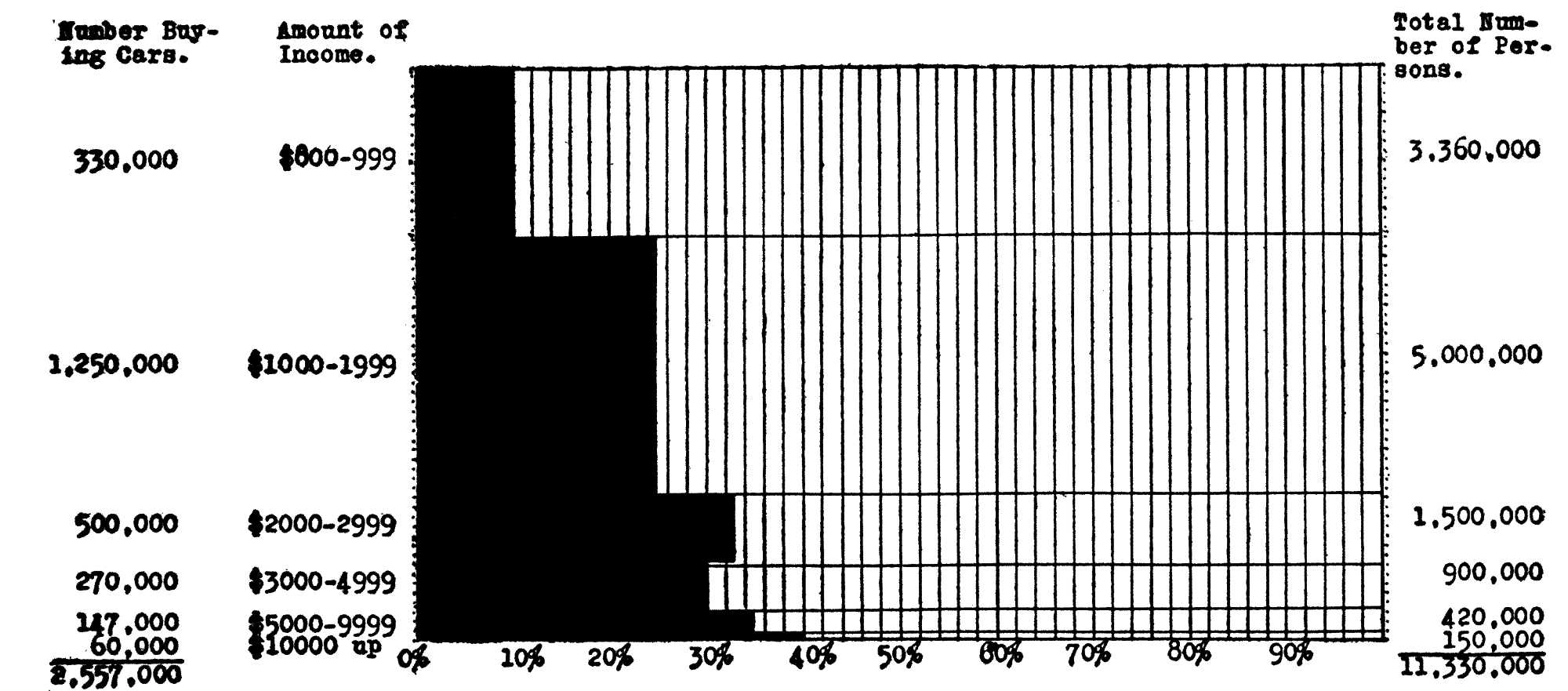
With the growth of incomes in the United
States the statisticians found there were more
than 6,000,000 people in this country with annual
incomes of more than $1,200, and 3,500,000
with annual incomes of more than $1,800. All
these things aided in installing confidence in
the big men of the motor industry. Quantity
production became the password for the manufacturer.
A new development in distribution
was wonderfully improved—dealers from all
over the country were brought to the factory
of the car maker, and after a convention of a
few days, the dealers were invited to sign up
for the coming year, nominating the number
and type of models they would buy. The maker
pored over his order blanks when the dealers
left, made his plans for material accordingly,
and there was only prosperity in each automobile
factory, as a rule, for the remainder of the
year. The orders were indicative of, safely
speaking, sixty per cent of the signed total.
Some makers took chances and built very close
to the total agreed on by the dealers, and,
except in few cases, the scheme worked out.
Today the maker studies all conditions and
accepts the orders of his dealers, setting the
figure of output after numerous factory
conferences.
Makers who could point to an annual production
of, say 400 cars, took counsel among
themselves, and some 50 increased their factory
efficiency and financial responsibility that they
can now point to an output of as many cars in
one day as they made early in their manufacturing
experience in one season.
The writer recalls one manufacturer who,
about nine years ago, had an output of about
500 cars for one season. Only recently he paid
close to a quarter of a million dollars, if indeed
his extra expenses did not bring the total to
$300,000, to conduct a twenty-one day convention
at his factory covering a site of seventy-nine
acres, at which dealers from the four
quarters of the country were entertained. He
had daily meetings in the big halls of his
administration building, and his lieutenants
carefully outlined to all the plans of the
company for the year, and exploited the line
of models.
“We have $30,000,000 in materials purchased,
and expect to get all this material when we
need it for manufacturing cars,” said the big
man to his dealers. “But the war in Europe
has caused many problems of price and quantify
to arise, and heaven only knows what the material
situation will be after July 1. I advise
you to order all the cars you need—think well
of your requirements—and stick by that number.
Then you will not be like many are bound
to be, who are indifferent to manufacturing
conditions—you will have cars to meet the
biggest demand the industry ever has known.”
That automobile president had the pleasure
of meeting thousands of dealers, speaking to
more than one thousand of them daily, and with
his factory production manager he figured the
probable needs of his country-wide organization
of dealers and branch houses for the year.
It is significant that the few changes he made
on his early winter production table, which the
writer was permitted to scan, were made only
in the “increase columns.”
It would lead to the exhaustion of the reader
were many details to be given showing how
the makers made quantity production and economy
of factory operation an assured thing. The
largest rooms of wholly automatic machinery
were equipped, so that a large amount of crude
steel wires, rods, etc., practically go into a
factory at one end and come out at the other,
fully machined and ready to go into the assembly
of a machine. Cylinder boring, all with
one operation, takes the place of operations
that required many hours. Progressive types
of assembly of the finished components of the
cars make factories look like the “last words
in manufacturing.” Machining crankcases and
work of that nature that required hours, is
done in minutes. Aluminum, that magic metal
of the early days of the automobile industry,
when it was comparatively cheap, now enters
so largely into engine and other parts that at
its greatly increased price it is more than a
magic metal. It is no uncommon thing to find
in an automobile factory that a machine costing
more than one hundred times the maker’s
cost of an automobile, has been installed to
hasten production.
In all the field of manufacturing there has
not been wrought such magic as in gear cutting.
Forges pound out tons of steel forms,
but the most important machinery of a plant
soon has these forms turned into gears and
other machined parts for the assembly.
The medium priced car of today stands as
the best exemplification of the approval of
the Society of Automobile Engineers. This is
an organization that has done so much for the
manufacturer that most of the makers of cars
are members. They point to the self-starter
and the electric lighted car as the triumph of
the Society of Automobile Engineers. And
certainly from the original starter and the
early lighting effects, enormous strides have
been made in the industry. Fully equipped
cars predominate now, where only a few years
ago even tops were not provided with the car
as sold on the floor.
The self-starter is considered one of the
greatest of the improvements added to a good
automobile. With this feature the car has become
so useful to women that the manufacturers
have realized big returns. Better than that,
say some critics, is the verdict that the self-starter
returned—the chauffeur is no longer an
indispensible feature in car driving. Women
master the handling of a car and with the machines
requiring less mechanical attention, one
might say, every season, woman accepts the
gasoline car as her own. The number of women
drivers has grown so wonderfully that the makers
of cars have registered the woman driver
as a constant factor. There’s no cranking of
the car necessary, and the wearing of fine raiment
and white shoes is Milady’s prerogative,
even if she drives her car to the party herself.
She handles a multi-cylinder car quite as readily
and with the confidence of a man. The tires,
always a problem, have demountable rims, or
they may be set in spare wire wheels, and
troubles on the road from blowouts and punctures
no longer deter the woman driver. It
would be difficult to get the details on the number
of women drivers added to the list each
season, but one of the best known automobile
makers says that it is so large that he would
make his fortune safe if he only made cars
henceforth for women pilots. The entrance of
the woman in such an important manner in the
automobile driving situation has made the gas
car maker lose all fear of the greater development
of the electric car. Woman has played
an important part in the real estate world,
distinctly due to her eagerness to drive cars,
by starting a movement towards suburbs. The
suburbs are “farther out and yet closer” as
one maker put it.
When the full effect of the work of good roads
advocates is felt in this country, and regular
appropriations are to be available in a regularly
scheduled manner in most of the states,
the biggest thing the automobile industry ever
had to help it will have taken up its task in
earnest. Less than ten per cent of the roads
in this country are improved, say the good
roads statisticians. One says that at least two-thirds
of the reasons for present road developments
are automobile reasons. When the proportion
rises and the Lincoln Highway and
scores of other long distance highways, intended
to add to the cross country touring practice,
are made into complete roads that make for
genuine touring pleasure, the automobile industry
will reap great benefits—more than the
most enthusiastic ever dreamed would come
from concrete, brick and other forms of specially
prepared highways.
The war? Makers have varied opinions on
the effect of the termination of the war in
Europe. A majority have expressed the opinion
that our exports of trucks and pleasure cars
will take a big jump soon after peace is
declared. But seeking for a peace after the
years of warfare has become the least of the
American auto maker’s trouble. Great war
orders have been received and filled by the
American makers of trucks. In 1914-15 the war
orders rose to 14,000 trucks, as compared with
only 784 in the season 1913-14. War orders
still are being filled by some American truck
makers, or were until the “ruthless submarine
warfare” broke out anew, and after millions of
dollars worth of the old models bought up in the
United States and absorbed by the European
powers had been swallowed in the mystery of
the continent, United States truck makers began
on later design models. In that way they are
able to admit that the war has been a great
blessing to the motor truck feature of the industry.
“All a part of the great scheme of economics
that makes for the approach of the
complete automobilization of the country,” is
the way one manufacturer puts it.
The automobile industry is set—it is fourth
in importance in the United States. It will
handle itself, so to speak. The makers know
they must give value for every car and truck
they build, and the people have become ready
to continue in the industry every maker who
plays the industry as it should be—not as a
“game.”
CHAPTER II. MECHANICAL EVOLUTION OF THE AUTOMOBILE. — English Make Automobiles Almost Practicable. — America’s Early Efforts in Automobile Making. — Automobile Apathy Century Old. — America Builds Steam and Electric Cars.
The history of every advance toward greater
perfection in the achievements of mankind,
whether moral or physical, has been one of
slow and laborious development.
We speak carelessly of the wonderful advance
the automobile has made in a short time.
As a matter of fact, it has taken the automobile
a hundred and fifty years to arrive
mechanically at the point it has reached today.
We thought the development of the motor
car was speedy, but we find that the measure
of time required for its evolution, when put
beside the span of human history, lengthens
as the shadows grow longer in the dying day.
It is astonishing what stages this development
has had to pass through, what problems
have confronted it, and what apparently
insuperable obstacles it has had to overcome.
In the light which our knowledge of the automobile
now sheds on the present day mechanism
of this invention, it is difficult for us to realize
why these persistent struggles toward development
of the mechanical ideas summoned to the
aid of the inventors did not produce speedier
results.
We can hardly conceive as we look upon the
perfect limousine, skimming over the smooth
asphalt with a motion that contains no more
vibration than that in the glide of the expert
ice skater, the crudeness, cumbersomeness and
racking joltiness of its first forbear, which was
the original expression of the mechanical idea
involved in making wheels revolve by a motive
power other than that exercised by man, the
bullock or the horse.
If we want to relieve our minds of the strain
of comprehending the difference between the
automobile de luxe, as we of today know it, and
the first automobile ever produced, and, by putting
the two pictures side by side, span the
period of the development of the art of automobile
making, we must journey to Paris.
For, although internal combustion to drive a
piston in a cylinder was produced with gun-powder
in 1678 by Abbe D’Hautefeuille, and
a carriage to be driven without the horse was
a chaise propelled by human foot work, first
conceived by John Vevers of England in 1769,
there is no record that the two ideas were combined
until it was done in France somewhere
between 1760 and 1770.
The first automobile ever made was that produced
by Nicholas Joseph Cugnot, a Frenchman,
and it is today on exhibition in the Conservatory
of Arts and Trades in Paris.
There is no record of how Cugnot came to
conceive the idea of his invention, but it is surmised
that he had read about James Watt, in
England, having discovered the principle of
steam as motive power. This was about 1755.
The history of Watt’s experiments in applying
steam to run engines does not, however,
disclose that any engines he produced were ever
seen by Cugnot, or that any adequate description
of them was published at the time when
Cugnot could have taken advantage of it.
So all we may actually know of Cugnot’s
reasons for thinking he could make an “animalless”
road vehicle is locked up in the rickety
century-and-a-half-old Cugnot invention which
we may see in the Paris Conservatory.
And what we would see would be:
An object which might make us laugh, did
we not soberly reflect, in the light of our superior
knowledge of today, that it was the first
step in the long, laborious journey, extending
over 157 years, that inventors had to travel to
produce our luxurious limousine, our satisfying
touring car and our terrifying speed demon
of the oval racing course.
Cugnot’s body returned to dust 113 years
ago, but his idea went marching on.
The visible expression of this idea which we
can see in the Paris Conservatory is in the form
of a tractor for a field gun, Cugnot having been
a captain in the engineering corps of the French
army.
The tractor has a single drive wheel actuated
by two single acting brass cylinders, connected
by an iron steam pipe with a round boiler of
copper containing fire pot and chimneys.
Attached to this first motor-driven road
vehicle is a wagon, on which it was Cugnot’a
idea to have a field gun mounted.
On either side of the single drive wheel of
this clumsy contrivance are located ratchet
wheels. Pistons acting alternately on these
ratchet wheels revolved the drive wheel in
quarter revolutions.
For the copper boiler of this first motor car,
additional water was needed after the machine
had travelled a few feet, the exhaust of steam
quickly leaving the boiler dry. The speed
attained was very slow, by reason of the
mechanical complications in transmitting power
to the drive wheel. As for running smoothly,
the machine wobbled, and bumped, and strained,
and groaned, and finally ran into a wall. This
was because it was overbalanced by its boiler
and engine and had no steering gear.
Having run into a wall and been partially
wrecked, that was the end of the forerunner of
the automobile, except for its subsequent rescue
from a junk heap and its installation in the
Paris Conservatory; for, disheartened by what
he regarded as his failure to make a successful
steam-driven tractor to relieve men and other
animals of the burden of transporting field
guns, Cugnot turned his attention to devising a
cavalry gun, at which he was so successful that
when he died in 1804 he was enjoying a pension
of 1,000 livres a year, given him by Napoleon.
Cugnot could not, of course, have visioned
what his first crude automobile would develop
into in the next century and a half. He probably
never thought of a car holding seven passengers—much
less of a speed for it of 60 miles
an hour and more. In truth, since he abandoned
his efforts, he probably concluded the obstacles
in the way of even a practical fulfillment of his
idea were insurmountable.
The one fact remains to keep company with
the Cugnot motor tractor in the Conservatory
of Paris, that Cugnot was the father of the
idea out of which the automobile was evolved.
He was the first to invent a motor-driven road
vehicle.
The English people have an enviable record
for successful mechanical inventions, and they
were early experimenters on lines similar to
those of Cugnot. About the time that Cugnot
ran his machine into a wall, William Murdock,
a mechanic, was working for Watt, the English
inventor of steam. Whether he knew of
Cugnot’s automobile attempt or not, there is no
evidence extant. The idea of an engine-run
road contrivance may have come to him through
inspiration, or in some other way, as it did to
Cugnot.
Murdock was quite familiar with Watt’s
engines. He helped to build them, and he was
curious to know the different forms in which
they could be used, especially as to a road
vehicle. He talked to Watt, but was sternly discouraged
by the latter. Just as Cugnot, no
doubt, concluded that his automobile would
never get anywhere, Watt opposed applying
his engine to a road travelling machine, because
he was firmly convinced that no vehicle that
could be invented could successfully negotiate,
at a speed to make it worth while, the execrable
roads of that day.
In this we have a fine illustration of the
peculiarities and uncertain nature of the human
mind. It is an organism that astounds by its
perception of possibilities in one direction, while
numb of any sensation whatever in glimpsing
the possibilities in another direction.
Watt could invent steam, but he could not
imagine good roads. Had he possessed the
vision, he might have seen that roads, which he
so abhorred as to see nothing good in them,
would be reformed if he but encouraged applying
his engines to road travelling mechanism.
In William Murdock’s way of taking the doleful
discouragement of Watt, we see an illustration
of that mental attitude that man has universally
adopted in mechanical advance, toward
the lugubrious prophet of failure. He has
matched hope and optimism against despair
and pessimism.
Despite Watt and his mournful views of the
impossibility of building an engine-run road
carriage that would advance over English
roads, Murdock went ahead and built a model
of an engine-run road carriage; but when he
had it finished, Watt’s discouraging views prevailed,
and Murdock did not attempt to enlarge
his model to a full sized form. He stopped with
the model, which is at the present day in the
British Museum.
Murdock’s invention was tested, and the
tests showed that an advance in efficiency over
the creation of Cugnot had been made. The
model was driven by a single cylinder of three
inch bore. It had a one and a half inch stroke.
A crank converted the reciprocating motion of
the steam engine into rotary motion, the service
performed in the Cugnot invention by the quarter
revolution ratchet drive. Murdock’s idea
was patented by a man named Pickard, in 1780.
The first automobile known to have been constructed
and put on the road was built by Richard
Trevithick at Camborne, England, in 1801.
It was in the form of a stage coach, accommodating
six or seven persons. The engine, boiler
and firebox were at the rear. The engine was
one of the first high pressure engines. A single
cylinder motor was employed, and spur gear
and crank axle were used to transmit the motion
of the piston rod to the drive wheels.
With this coach Trevithick carried six or
seven men over hills for a mile the first day of
the trial. The second day it made six miles.
Even with these performances, the invention’s
impracticability must have been decreed,
because it was not continued in operation.
Trevithick himself felt, no doubt, that it must
be improved upon, for, in 1803, he built another
contrivance driven by a horizontal single cylinder
with 51⁄2-inch bore and a 30-inch stroke.
But the driving wheels were ten feet in diameter.
Fatal were these great clumsy wheels to
popular approval of the invention, and no further
advance was made. Trevithick had made
one further step, and there the matter rested.
He had developed the high pressure steam
engine, and he had really made the first automobile,
if such it could be called.
Just as the English, represented by Murdock
and Trevithick, were laboring on the steam
propulsion idea, and France, in the person of
Cugnot, was experimenting with it, so America
was groping to find the solution. Cugnot’s
activities began about 1760 and ended with his
death in 1804. Trevithick’s period was from
1780 to 1803. The American experiments
started about 1784. The man whom records
show to have been the pioneer in practical
excursions into the realm of carriages driven by
steam, was Oliver Evans, born in Delaware but
living in Philadelphia.
He developed the high pressure, non-condensing
engine, although his only knowledge of
steam was derived from reading what little was
then printed about it, and his own discoveries.
It appears as if Evans, who is known to have
had knowledge of Cugnot’s construction of a
road carriage, or, more properly speaking, a
gun carriage, connected in his mind his engine
with a road travelling vehicle, because in 1787,
four years before Trevithick built his steam
coach at Camborne, England, Evans secured a
patent from the State of Maryland, giving him
the exclusive right to make and use, within its
borders, carriages propelled by steam.
That he immediately built a steam carriage
in pursuance of this authority is doubtful. The
only authentic record of an attempt is of one
that he constructed in Philadelphia seven years
later and under peculiar circumstances. It is
likely that his act in securing the Maryland
patent was done on the spur of a determination
to build an automobile, but it was not immediately
carried out. He went on perfecting steam
engines up to 1804, when he accepted an order
from the city of Philadelphia to build a steam
flat boat for dock work.
His mind appears to have then reverted back
to the time seven years before when he contemplated
applying an engine to a road vehicle
and got the Maryland patent for that purpose,
for, after building the steam flatboat and
installing a 5-horse power engine on it, he
announced his intention of mounting the flatboat
on a wagon, on which he proposed to drive the
boat about Philadelphia.
A horseless carriage, no doubt, had been a
hobby with him for years, and he saw in the
steam driven wagon, carrying a steam driven
flatboat, an ocular demonstration of the practicability
of the horseless carriage.
The four wheels of the wagon he built were
connected by belts and gearing with the engine
on the boat, and the vehicle was driven up Market
Street by steam, bearing the flatboat and its
engine in triumph. It circled the squares on
which the City Hall and the statue of William
Penn now stand, and proceeded to the Schuylkill
river. Here flatboat and wagon were separated,
and the former launched on the river.
A paddle wheel was affixed to the stern and connected
with the engine. The boat ran as well
as the wagon had done. It steamed down to
the Delaware river and all the way to Trenton.
The wagon, divorced of engine and gearing,
became only a wagon again, and whatever
became of it, history does not say.
The skepticism, the derogatory observations,
the pessimistic prophecies and the contemptuous
disapproval of the many persons witnessing
the Evans’ pilgrim’s progress up Market Street
aroused the inventor’s ire.
Had he but been philosophical, he would have
appreciated that such has been the fate and
greeting of all inventions. But Evans was choleric.
When a citizen said his wagon was only
what might now be dubbed a “flivver”—that
it would never run over five miles an hour, and
other things that the minds of the unimaginative
conceive of innovations, the inventor drew
from his wallet $3,000 that the city of Philadelphia
had just paid him for his steamboat,
and said the carping critic could transfer the
“roll” to his own pocket, if he could produce a
horse that would run faster for five miles than
a steam wagon that Evans would build. The
size of the roll was too much for the pessimist,
and he betook himself and his criticisms off.
So we see that as there was a first automobile,
so was there a first automobile enthusiast on
automobile speed. Why it is that motordom
hasn’t erected a monument to Oliver Evans for
his abiding faith in the future of the motor car
as a speed demon, is up to motordom to explain.
Oliver Evans tried but was unable to get any
one interested in developing his wagon run by
an engine into an improved horseless carriage.
The minds of that day regarded the practicability
of his invention with as much skepticism
as we would regard an invention to visit Mars,
if exhibited in our day.
So Evans gave up any idea of improving his
self-running wagon, became busy with an iron
foundry which people could understand, and
died rich.
There was a measure of justification for the
lack of popular imagination and vision toward
the automobile in both England and America
when the first samples appeared. They were
slow, noisy, erratic in performance, and positively
dangerous—threatening explosions, collisions,
and all sorts of dire things—and it was
natural that people should predict their failure.
So progress in the development of the horseless
carriage lagged. It was twenty years after
Evans’ Philadelphia exhibition when it was next
heard from. Then the scene of operations
shifted again to England.
In 1824, W. H. James, who had patented a
water tube boiler for locomotives, built a passenger
coach, of which each drive wheel was
revolved by two cylinders receiving steam by
means of a pipe from a boiler.
A pressure of 200 pounds of steam to the inch
was maintained. The equivalent of differential
action was supplied by independent application
of power to the two drive wheels. The coach
accommodated twenty persons. The contrivance
ran satisfactorily on trials, and James
secured financial backing and built another
coach weighing 6,000 pounds which ran 12 to 15
miles an hour.
But the higher the rate of speed, the worse
off the early automobile builder was. Although
James equipped his coach with laminated steel
springs, the road shocks and vibration stopped
it every few miles. Steam joints and connections
were broken as fast as they could be put
together. The great need was a method of
shock absorption, and either no one knew that
this was the key to the problem, or, if it was
realized, no one knew the remedy. So James
failed to make the auto-coach a success, and
died in the poorhouse.
A year after James built his first motor-coach
in England—in 1825—Thomas Blanchard of
Springfield, Mass., revived the horseless carriage
subject which, in America, had been last
experimented with by Oliver Evans in 1804.
Blanchard built a road vehicle that was one
of the best produced up to that time. It was
easy of manipulation and climbed hills successfully.
Blanchard took out a patent on it, but
when he started to find people who would buy
a completed carriage he could discover none.
Nobody wanted it. And so Blanchard’s efforts
ceased.
At the time James was building his two
coaches, and after Blanchard had given up trying
to interest Americans in his invention, a
Frenchman named Pecqueur was experimenting
on phases of the auto-carriage. He discovered
the principle of the “differential,” the balance
mechanism which enables one wheel to revolve
faster than the other in turning corners. He
invented a planet gearing in this connection,
which was the origin of the idea of the differential,
and applied it to a steam wagon which he
built in 1828. The differential of today is based
on the principle discovered by Pecqueur.
While Pecqueur was evolving this invention,
Goldsworthy Gurney in England made a car
which was a practical failure in about everything
except that it demonstrated that sufficient
friction between the drive wheels and the road-bed
could be created to produce propulsion. A
trip of almost 200 miles from London and
return was made in 1828 by Gurney in the
second vehicle he built, in which the engine was
concealed in the rear. His car made 12 miles
an hour for part of the trip.
From this time—1828 to 1840—the automobile
really had a vogue in England. A number of
them were made and run as passenger carriers.
For four months a motor carriage made the
nine mile trip from Gloucester to Cheltenham
four times a day. The “Infant” built by Walter
Hancock made trips between London and Stratford.
The “Era,” also made by Hancock, ran
from London to Greenwich. To such an extent
did the auto-bus business develop, that speed
of 30 miles an hour was claimed, and one conveyance
in 1834 ran over 1,700 miles without
repairs or readjustment. At least, that was the
claim made, and as a claim it has a familiar
sound. The twentieth century automobile manufacturers
who claim a run of so many thousand
miles without repairs to this and that, have
here a precedent for it that is as old as the
industry.
But there was one feature about these early
English motor busses that was their undoing.
They weighed three tons and over, and the
wheel rims were metal. The diameter of the
wheels was six feet. The rubber tire was
unthought of. The effect on roads of running a
3-ton, metal rimmed vehicle, carrying eleven to
twenty passengers, was disastrous, and parliament,
incited by horse owners and others, legislated
them out of existence by making the toll
charges prohibitive. Where the toll was $1 for
horse drawn vehicles it was made $10 for steam
auto buses. The consequence was that their
manufacture and operation ceased about 1840.
In 1878 Bollee built a steam omnibus which
ran between Paris and Vienna, making 22 miles
an hour. In this car was reached the highest
efficiency the art had attained up to that time.
Practically an identical car was built in 1880
by Bollee, which was entered by him 15 years
later and won honors in the Paris-Bordeaux
race.
In 1879 the automobile development germ
returned to America.
In this brief sketch showing the struggle of
auto-mechanism to advance, from the very first
inspiration of Cugnot about 1770, we must be
impressed by the determination with which the
idea of auto-mechanical perfection persisted.
This persistence was so determined in the face
of all obstacles and opposition that it is almost
eerie.
It was just as if some force of nature was
struggling to break through the crust of man’s
consciousness. Or shall we credit it to man,
and say, rather, that it was man’s mind that
was the impelling force in the persistent
attempts to read a mechanical riddle?
Whatever the impelling force, whether man
or nature, man heeded its behests and continued
his efforts.
In 1879 an American did a thing which has
had much to do with giving the United States
its long delayed start in the automobile industry.
This man was George B. Selden of Rochester,
N. Y. He applied for the first patent for
the gasoline motor, as the driving force of a
road vehicle. This was before any automobile
had been equipped with an internal combustion
hydro-carbon motor. This motor had, however,
been in use for some time in running
stationary engines.
The bicycle had, at that time, been an
acknowledged success, and in considerable use
for seven or eight years, and had had a great
deal of influence in improving roads. Better
roads caused people to look more favorably on
the possibilities of the motor vehicle.
Selden built a gasoline motor under the specifications
contained in his application for a patent,
and it performed satisfactorily in experiments.
But he did not build an automobile
containing the gasoline motor. He did not
secure his patent until 1895, 16 years after he
had made application for it.
In those sixteen years he was endeavoring to
interest capital, while at the same time he was
perfecting his motor. While the use of bicycles
had improved roads and this improvement
caused a more favorable popular view of the
possibility that automobiles might be made successfully,
a new motive power appeared on the
horizon just at this time.
It was electricity. It was in 1890, eleven
years after Selden had applied for a patent for
a gasoline motor, and while he was still wrestling
with the problem of getting capital to aid
him, that reports that the storage battery had
been more nearly perfected became rife.
Men to whom Selden went for financial aid
feared that even if the gasoline motor was
feasible, it might be overshadowed by the storage
battery, and held off. Selden even went
abroad to raise money, but had no more success
there than here.
Although an inventor and a skilled mechanic,
Selden lacked salesmanship ability. He was
handicapped by impatience and irascibility, and
his predictions of the success of his gasoline
motor, its general adoption, and the extent to
which automobiles would in the future be used,
were regarded by people with whom he talked
as so extravagant that they bluntly declared he
was crazy, and avoided him.
He had proceeded so far on one occasion in
interesting a Rochester business man, that he
had him in his store and was on the point of
getting him to put up $5,000, when he made a
simple remark that completely “spilled the
beans.”
He said: “Jim, you and I will live to see more
carriages on Main Street run by motor than
are now drawn by horses.”
The prospective investor looked at Selden for
half a minute, and came to a conclusion
expressed in these words:
“George, you are crazy, and I won’t have
anything to do with your scheme,” and with
this ultimatum the man stalked out of the store.
Twenty-five years later this man met Selden,
and, extending his hand, said: “Well, George,
you were right years ago when you said there
would be more automobiles in Main Street than
horses.”
But Selden ignored the man’s extended hand,
and with passion thrilling in his tones said:
“Yes, and I wasn’t so —— crazy as you and the
other fools said I was,” and walked off. And
he never spoke to the man afterward.
Selden’s patent could have been issued any
time within the sixteen years that he let it lie
dormant. He kept the application alive at the
patent office by legitimate methods, and his reason
for not bringing the matter to a head was
that at no time in those sixteen years was he
ready to manufacture under it, and he put off
the actual issuance until such time as he was
prepared to take full advantage of the privileges
it conferred.
He was alive to the fact that the years of a
patent are numbered, and he aimed to time the
issue so that the patent would not expire before
he could derive the benefits from it.
It was in 1895 that the patent was issued, and
in 1900 Selden disposed of it to the Electric
Vehicle Company of New Jersey.
In the meantime, the development of electric
motor vehicles had begun, and in 1885, Benz, a
German, built the first road vehicle to be run
by the internal-combustion, hydro-carbon motor.
It was a tricycle, and its motor was single-cylindered,
four-cycled, after the type of an engine
developed in 1876, in Germany, by Otto, and
water cooled. It had electric ignition and a
mechanical carburetor. Benz secured a patent
in 1886 on his invention and it ran successfully,
making ten miles an hour. Benz was limited to
the use of certain streets in Mannheim, Germany,
for running his machine, out of deference
to the tendency to nerves of horses and their
drivers or riders. This tricycle by Benz was
the forerunner of the Benz automobile. This
is one of the most successful and popular cars
in Germany—and before the war, in all Europe.
The first automobile imported into the United
States was a Benz car brought to the Chicago
World’s Fair in 1893. Up to 1917 the Benz car
was an entrant in most automobile speed contests.
While Benz was perfecting the gasoline motor
in its attachment to the tricycle, Gottlieb Daimler,
another German, was producing, in 1885,
the motor-cycle. Daimler had devoted himself
sedulously to the problem of reducing the
weight and increasing the power of the gas
engine, in order to adapt it to high efficiency
road vehicles. He invented the hot tube ignition
to take the place of ignition by flame. By
regulation of the heat of the tube, the compressed
charge of hydro-carbon vapor could be
fired automatically at a specific point in the
cycle. Through the increased speed thus produced
the size and weight of the motor could
be reduced.
The Daimler motor was a big step in advance,
as was proved by the supremacy which the German
and French automobile makers at once
attained. The French secured rights to the
Daimler motor and operated under them with
such success that from 1889 to 1894, before the
United States had really waked up to motor
car making, they were beginning to put out
gasoline automobiles successfully.
At this time, we, in this country, were following
the steam and storage battery fetishes. The
first steam car in the United States that might
be called modern was built by S. H. Roper of
Massachusetts, in 1889. In 1900, steam car
building in America gave promise of disputing
the gasoline car records then being made in
France, but by 1905 the gasoline car manufacturers
had taken the cue from the European
gasoline successes, and this form of motor came
to the front.
Contemporaneously with the activities in
steam car building in the United States, was the
pioneer electric car construction era.
The first electric automobile was built in
1891, and made its first exhibition appearance
in the streets of Chicago in September, 1892.
The builder of this, the first electric driven
vehicle, was William Morrison of Des Moines,
Iowa. It was bought by J. B. McDonald, president
of the American Battery Company, Chicago.
Description of the street scenes attending
the showing of this car bring home to us the
extent to which an automobile was a novelty
so short a time ago, comparatively, as 1892.
“Ever since its arrival,” said the Western
Electrician of September 17, 1892, “it has
attracted the greatest attention. The sight of
a well loaded carriage moving along the streets
at a spanking pace, with no horses in front, and
apparently with nothing on board to give it
motion, was one that has been too much, even
for the wide-awake Chicagoan. In passing
through the business section, way had to be
cleared by the police for the passage of the carriage.”
To think that this description fits a scene
enacted during the period of the present generation!
Eighty-eight years before in Philadelphia,
Oliver Evans’ steam propelled wagon,
bearing in triumph a flatboat surmounted by
an engine, moved along Market Street with no
horses in front, and was a sight that was too
much for the Philadelphian.
The world “do move,” but very slowly, and
this 88-year span of time is practically the
measure of the period consumed by automobile
development to the point where a motor
carriage would really run, and keep on running.
The date of the building of the first American
gasoline automobile that ran was 1892. The
man who performed the feat was Charles E.
Duryea. He had the assistance of his brother,
Frank Duryea, but what was more, he had the
benefit of knowledge of what had been accomplished
in Europe in the gasoline motor field.
Panhard, Levassor, Peugeot, De Dion, Bouton,
and Serpollet were Frenchmen who had
done things with gasoline cars, all (except Serpollet
and Levassor) principally through the
manufacture of finished cars. Levassor conceived
the idea of a central frame to carry the
power plant, and thus solved the problem of
road shock.
Serpollet had done more. He had invented
the flash boiler, reviving an art the English had
previously discovered, which made the use of
dry or superheated steam possible. Higher
pressure could be used, water economies effected
and weight reduced.
When Duryea and others, about 1892, gave
concentrated thought to gasoline propulsion, all
the problems of automobile making had found
solution, except two. They were a method of
cushioning wheel rims, and some method by
which the motor could be so placed that it would
be immune from shocks and vibrations.
So, when Duryea, in 1892, built the first
American gasoline car that would run successfully,
he merely “assembled” the ideas that
had then accumulated.
The first auto-race in the world was run
from Paris to Rouen, about 80 miles. It was
run in July, 1894. There were 46 cars entered,
of which twelve only were steam cars. The
Petit-Journal, a Parisian newspaper, was the
organizer and patron of the race. The winners
were all equipped with the Daimler gasoline
motor.
A little over one year later—Thanksgiving
Day, 1895—the first American automobile race
was run from Chicago to Waukegan. The
organizer and patron was a newspaper—the
Chicago Times-Herald. Of two entrants, the
“Buggyaut” of Charles E. Duryea was one.
Duryea built his first car in 1892.
Henry Ford built his in 1893.
Elwood Haynes built his in 1894.
There were but four gasoline cars in the
United States in 1896—Duryea, Ford, Haynes,
and Benz, the last being the German car which
was imported.
With the accomplishments of the builders of
steam, electric and gasoline motored vehicles at
this time—1895—the practical success of horseless
carriages had been definitely settled. Practically
all fundamental problems had been
solved. To make them finally an accepted addition
to the world’s methods of transportation in
general use, two things only were needed.
One was the development of perfecting
devices, such as rubber tires, the production of
which began about 1889; and the other was the
general acceptance of automobiles by the people—a
cordial, popular approval, manifested by
their purchase and use. And while the development
to greater perfection could be left to work
itself out, the popular approval to the point of
enthusiastic general adoption was another
matter.
Inventors could develop, even if it took over
a hundred years, a complete, perfect machine,
finally. But human doubts, mental apathy, and
man’s opposition can be overcome by only one
means—enthusiasm.
Enthusiasm is to man’s opposing mind what
the oxyhydrogen flame is to steel, and it is one
of the potent forces that will burn itself into
mentality.
Around the period of 1893-1898, the attitude
of the mass of the people in this country toward
the automobile was one of good natured toleration,
but indifference. A few of the “class”
were interested and convinced that the automobile
had arrived, but the “mass” believed it was
a passing fad, and from its practical side, of
particular interest chiefly to mechanics. If, in
its opinion, the automobile had any future, it
was as a luxury of the rich.
The people could not sense what they feel
now—the value of the automobile in time, health
and recreation, and in its possibilities as a factor
in economics. They saw the disadvantages
of owning an automobile, but were without
appreciation of its benefits.
So one of the most interesting facts in the
history of the development of the motor car is
that the first American made gasoline automobile
sold in the United States was disposed of
March 24,1898. The sale of steamers and electrics
had been going on for several years before,
but not very extensively.
This fact of the date of the first sale of a
gasoline motor car fixes clearly that the use of
automobiles in the United States practically
increased from one car to over three million, in
less than twenty years.
The first American gasoline car thus sold was
disposed of by Alexander Winton to Robert
Allison of Port Carbon, Pa.
So that, while Duryea completed his car in
1892, Ford his in 1893, and Haynes his in 1894,
it was six, five and four years, respectively,
later, that the first gasoline car was purchased
in the United States.
From 1898, the time of the sale of the Winton
car, dates substantially the development of the
automobile industry in this country.
Beginning with this date, the first real enthusiasm
was put into the sale of cars.
Enthusiasm had not existed before. Confidence,
which is the mother of enthusiasm, had
hesitated and halted. But now confidence
believed the automobile was a reality—all
doubts had been resolved—and confidence bade
enthusiasm run, not creep, crawl or walk; and
we see how enthusiasm obeyed. In the enthusiasm
displayed in the manufacture and sale of
automobiles today, we are disposed to think it
does more than run, that it actually flies.
CHAPTER III. COMMERCIALIZING THE MOTOR VEHICLE. — Advertising’s Help in Making the Automobile. — United States a Fertile Field. — Stars in Their Courses Fought for the Automobile. — A Rain of Automobile Makers. — Getting the Price of Automobiles Down. — Removing Obstacles to Automobile Production. — Gasoline Car in Popular Demand. — Automobile Demand Made Accessories Necessary. — Co-operation’s Part in the Automobile’s Commercialization. — World Yet to Learn the Lesson of Economy.
In the production of the automobile, America
did comparatively little in the fundamentals of
invention which are now found in the modern
perfected car.
Selden invented the three-cylinder gasoline
engine, by which the rapid revolution of the
crankshaft of his day was converted into slower
but higher powered motion of drive wheels.
White invented a generator for steam cars.
Haynes was responsible for a discovery that
caused alloy and specially heat-treated steel to
be introduced, and Knight produced a superior
motor.
But these were discoveries, inventions or
improvements that were supplemental and
perfecting, not elemental.
It was chiefly the English, the French and
the Germans, with the exception of Evans of
Philadelphia, who first conceived the idea of
the horseless carriage, and helped it to its final
development by a series of successive inventions.
The names of Cugnot, Trevithick, James,
Pecqueur, Hancock, Gurney, Lenoir, Bollee,
Benz, Daimler, Levassor and Serpollet should
form the nomenclative setting of commemorative
friezes on the walls of the grateful motor
clubs of the future, as those of Liszt, Beethoven,
Wagner, Gounod, Handel, Massenet, Bach, Mendelssohn,
Grieg and Chopin take honored place
in the shrines of Music, the “heavenly maid.”
Even in the production of automobiles in any
quantity for use—the commercializing of the
idea they represent—the United States did not
lead at first. This honor belongs to France, as
does the original conception by Cugnot of the
horseless vehicle.
The first steam cars manufactured in the
United States, on any basis entitling their manufacture
to the dignity of a business, were made
after 1894, and the names of Riker, White and
Stanley are the prominent ones in the steam
automobile field. Electric carriages were sold
as commercial commodities in comparatively
small quantities, beginning with 1897, and the
first American gasoline car sold in the United
States was made and sold by Alexander Winton
in 1898.
Beginning prior to 1892, the French were
selling automobiles by the hundred, while manufacturers
in America were selling them by the
dozen. Panhard and Peugeot were selling
gasoline cars, and DeDion-Bouton was putting
the steam automobile on the world’s market.
But the race is not always to the swiftest.
While France started bravely on its commercialization
of the automobile, and had in its
favor what were then good roads of an old and
well settled country to run them over, and perhaps
the thriftiest people of any nation to buy
them, there were causes existing in the United
States destined to make of it the greatest automobile
producing country in the world, and its
people the largest users of the new invention,
while at the same time operating to cause the
United States to sell more cars outside its confines,
to Europe and elsewhere, than are sold
by any other country.
And inasmuch as these underlying causes,
while explaining the supremacy of this country
to this date in the manufacture and sale of
automobiles, also explain the reason for believing
that the future of the automobile business
will dwarf the proportions it has up to this time
reached, they will bear analysis.
In the first place, European manufacturers of
automobiles, as well as of other products generally,
with the possible exception in a degree,
of the Germans, are bound hand and foot, and
therefore handicapped, by tradition and convention.
They make the automobile, especially
the French and English, so solidly, with such
fidelity to tradition and with such conscientious
care as to detail, elaboration and finish, that
the price to the buyer, when it is put beside that
of a similar American made product, will not
meet competition.
The American has a knack of turning out an
article which is mechanically correct, has the
wearing qualities, but is simpler in detail, and
hence can be sold at a lower cost. Simplicity
is the American manufacturer’s keynote.
Back of this is business organization system,
standardization of parts used in the automobile,
and that high order of constructive and executive
talent that gives the American business
man the distinctive reputation he enjoys and
enables him successfully to compete in price
and quality with the rest of the world. There
has been a rare combination of inventive and
business abilities in American automobile
manufacturers.
American mechanical genius has been given
great credit, but wherein is it any greater than
that of the German, French or English? In one
particular—its simplicity. The Europeans are
elaborate—the Americans plain and simple.
It is possible that no European manufacturer
would have conceived an automobile embodying
the essentials of small size, simplicity and speed
represented by a Ford car. His tradition and
training would have impelled him to elaboration
in size and finish. In this, he is, of course,
moulded by European needs and tastes which
differ, in many respects, from those of the
people of this country.
He does not possess the American’s practical
vision in successful salesmanship. Ford
made his car with an eye to quantity. He was
not only an inventor, but a salesman. As he
worked on his motor, he worked on the problems
of sales—producing a car that would sell to the
largest number. The larger the number sold,
the smaller the price could be made.
“Large sales and small profits” has been a
principle which has made many American
fortunes. Note how this same idea of Ford has
been followed by Willys in the Overland, Olds
in the Reo, the makers of the Maxwell, and half
a score of other manufacturers in varying
degrees, causing the gamut of prices of the most
popular cars to run from $360 to $1,200 each.
This is one reason why the American car
could invade England and her dominions beyond
the seas, why Ford has factories in the British
Isles and Canada, and why our yearly exports
of automobiles have increased in the last five
years over $100,000,000 in value.
Other reasons that make us an exporting
country of automobiles through their low prices
are our natural resources of iron, steel, lumber,
coal and alloys, enabling us, by their plentifulness
and accessibility, to manufacture at cheap
cost, thus offsetting the higher price we pay for
labor in this country than the European manufacturers
pay.
But the biggest factor in the lead which the
United States has taken in the production of
automobiles, both for export and consumption
within her own borders, is the universal method
of standardizing in manufacture, adopted by
the automobile producers of the nation.
The manufacturers of this country shine in
the field of cost production, in the economies of
purchase of raw materials, in the method of
manufacture, and in marketing their product.
The extent to which economic methods of purchase
of raw materials—getting the price down—economic
standardization of manufacture,
inventing short cuts as it were—affects production
cost, is shown in the fact that the automobile
industry ranks almost at the top in the
manufactures of the United States in the per
cent of value added by manufacture to the cost
of material.
The per cent of value added by manufacture
to cost of material in automobile production is
71 per cent, against 66 per cent in cotton goods,
55 per cent in iron and steel products, 51 per
cent in boots and shoes, 16 per cent in flour
and grist mill products, and 12 per cent in
slaughtering and meat packing.
Strange as it may sound when first stated,
advertising is primarily the base of this result.
We know that the first principle of lowered cost
is buying in quantities; that if we buy for 100,
the cost for each is lower than the cost for one;
if for 1,000 it is lower than the cost for each
of 100, and so on.
So, when Ford buys the materials for 533,921
cars, which was the number he sold in 1916, he
gets the price of the cost of each of these more
than a half million cars down to a less price
than if he bought material for 1,708 cars, the
number he made in 1904, or even 168,220, the
number he made in 1913.
This is patent to any one who ever heard of
wholesale and retail prices.
But how did Ford find a sale for 533,921 cars
in 1916?
By advertising.
The first thing a manufacturer must do to
lower the cost of production of the single unit
is to make in quantities.
How to insure the disposal of that quantity
has been the big problem that American automobile
manufacturers have had to solve. The
solution was at hand. It was advertising. The
commercializing of automobiles with the speed
and to the extent to which it was done between
1900 and 1917 could not have been successfully
accomplished before this period, because the
recognition of the value of advertising had not
become widespread up to that time.
Advertising had gone through a process of
development that was as slow as that of the
automobile business. Both arts emerged from
darkness into light at about the same time.
Here is evidence that a very bright and smart
set of men engaged in automobile production
at the very outset.
They were mechanical, they were versed in
business methods, and they were conscious of
the value of advertising.
This combination of knowledge by the men
engaged in it has made the automobile industry
a record breaker in point of the time consumed
in its development. It has made it stand out as
unparalleled by any other industry in this
country in the speed with which it progressed
from final experimentation to an established
recognized enterprise, involving mammoth
investment of capital and huge profits.
That the automobile business has been the
most extensively advertised business of any in
which we are engaged, almost anyone will concede
from knowledge gained from his own
observation.
Advertising is like the rainbow—many hued.
It may be one form, or it may be another. It
may whisper, or it may shout. We must concede
that the advertising the automobile promoters
have done was more largely of the shouting
than the whispering kind. That is not to their
discredit—rather otherwise. The distinct
injunction to advertise is contained in the Bible.
It was: “To so let your good work shine that,”
etc., and the people of scriptural days were
admonished not to hide their light under a
bushel.
Newspapers are said, somewhat carelessly,
to have made the automobile business. It is
not exactly fair to make this statement so
sweepingly. They did for it a good deal more
than they did for any other line of industry,
and are still doing it.
They never devoted the space that they gave
to the automobile to railroads, steamboats, the
telephone, street railways, oil, lumber, mining,
meat packing, or any other commercial industry.
It was not, necessarily, that the automobile
manufacturers, in all cases, asked for this
liberal treatment by the newspapers.
It was that newspapers volunteered it.
One started it, and others followed. The spell
which the idea contained in the automobile
weaves over men and women was cast equally
over the editors and publishers in the United
States. In recognition of the novelty of the
automobile, they laid liberal offerings of free
space on the altar of motordom. Its peculiar
exhilaration penetrated the editorial sanctum,
and in this distinctive exhilaration the automobile
has had no parallel except in golf.
It has been quite generally accepted as an
axiom that if you give, you receive. We see
this statement proved in a hundred ways. A
pleasant smile begets a smile. A good deed
is matched in kind. No better reason for this
exists, probably, than that it is ingrained in
us to hate to be under obligations to anybody.
So when we get a smile we promptly pay it
back and are square, just as we invite to lunch
a man who invited us to lunch. We are very
particular about this.
The automobile manufacturers were not lacking
in this trait, common to human nature.
When publishers put their stamp of approval
on the motor car and unreservedly threw open
their columns to the progress made in its
improvements and production, manufacturers
appreciated and reciprocated.
The result has been that more money has
been spent in advertising in the automobile
business in the United States than has been
spent in any other single line of enterprise.
Possibly the nearest approach to it has been
patent medicine, or the promotion of various
enterprises.
And it has paid—every automobile maker,
and every salesman will admit this as a matter
of course. They will admit it because they know
it to be so—a knowledge derived in their own
experience.
The psychology of advertising shows that
there are two principal things involved in making
advertising profitably productive. One is
that it informs, the other that it persuades. If
the mind is informed of what an automobile is,
what it does, and all the advantages and benefits
it confers, it has a basis to work on, and
from this working basis it will evolve
conclusions.
The state of the mind in the conclusive stage
is fallow field for persuasive effort.
In the advertising given in this country to the
automobile which has placed millions of motor
cars in the ownership of people in the United
States, not counting those exported, the publishers
of our journals have supplied the information,
and the manufacturer the persuasion.
It is this double teamwork which, supplementing
the business ability of our manufacturers,
has put us in the front rank as automobile producers.
But baldly to say that the newspapers
made the automobile is not giving full credit
to the other causes which contribute to our
success in this line of enterprise. It has been
a combination of causes working together which
has made the automobile.
There have been other forms of advertising
used in automobile selling, besides space in publications,
and they are forms the value of which
cannot be discounted. “A satisfied customer is
the best advertisement” is one of the oldest
slogans of advertising. And it is true. The
automobile manufacturers of the United States
know it is true, and have been guided by it.
Road races, speed and endurance contests,
employment of racing drivers with records,
automobile shows, outdoor displays—all have
been forms of advertising employed in the
industry, and all have played their part and
exerted their influence to one common end—that
of putting the industry in the United
States on the highest pinnacle it has attained
anywhere in the world in seventeen years.
And while full credit must be given the vision
and capabilities of the manufacturers, and the
productive value of advertising in all forms,
meed for the results can not be withheld from
that element, which, in the final analysis, makes
all things possible—the people, the base and
groundwork on which all successful industrial
structures are erected.
All the business ability of all the automobile
makers, however great, and all the advertising,
however convincing, that could be written, could
not have made the automobile business of today
if the people had not taken hold of the automobile
and put their stamp of approval on it.
“Power of the Press”—what is it but the
“Power of the People” expressed on paper?
Power of the People—the force that revolves
the world, revolved the wheels of millions of
automobiles, and will go on turning the wheels
of millions more.
The people of the United States supplied the
fertile field in which the American automobile
grew and blossomed.
The reason France, although it took the lead
in the commercialization of the motor car, could
not hold it in the race with this country is to be
found in the difference between the peoples of
the two countries.
France had good roads—has had them as has
Europe for hundreds of years. The French had
money—they are the greatest savers in the
world.
But if you put your money in rentes or savings
banks, you do not spend it for automobiles
or anything else. The reason the French have
money is the reason they do not buy automobiles.
No people in the world have learned, as
have Americans, to spend money to make
money. No people in the world take the chances
Americans do, and no people win as the Americans
do. In this is found one of many causes
for the commercial success of the automobile in
America.
The American is good to himself as is the man
of no other nationality. He is further advanced
in general knowledge, mostly gained by experience
through intercommunication with his fellows.
His bon camaraderie is effervescent,
giving him opportunities to learn things denied
to the self-restrained European. His school is
the broad school of the world. He doesn’t have
to travel to see the world; the world is in
America and comes to him.
So, with the opportunities natural to a new
country, with the standards of living and the
mode of thought that they are in the United
States, the 103,000,000 people of continental
United States are a market for automobiles that
dwarf the 464,000,000 people of Europe.
What such a market has been during the
last decade and a half may be gathered from
the fact that in the last sixteen years the population
of the United States increased at a
greater rate than ever in its history. The
increase of the people of the United States in
the sixteen years the automobile industry has
been commercialized, was 25,887,904. In the
previous twenty years the increase was
25,838,792.
People without money can not buy automobiles,
so what has been the increase in wealth
in the United States in this same period?
In the last twelve years it has been
$99,221,764,315.
Staggering, you say? Rather, when you know
that the increase in wealth in the United States
in the last twelve years was nearly double the
increase in the twenty years which preceded
the last twelve years.
No epoch in the world’s history, therefore,
was so favorable as the period of 1900-1917 for
commercializing the automobile. It was timed
just to the moment for quick and dramatic success.
The period was coincident with the high
water marks reached in the increase of population
and in the nation’s money-making. Advertising
had reached a stage of development it
had not attained before.
We must credit enthusiasm for some of the
influence in the success of the industry. We
will have to admit that it is present in the
factory and in the selling mart, in the shows and
on the road. A satisfied customer, the best
advertisement, finds expression in the loyal
recommendation an owner gives his own make
of car; enthusiasm of maker, of salesman, of
owner—it runs along the line, and if advertising
is the gasoline which makes the car go,
enthusiasm is the oil which keeps the bearings
of the industry lubricated.
The year 1898 saw the first real attempts of
manufacturers in the United States, either of
gasoline, electric or steam cars, to make them
in any quantity.
The gasoline cars that were pioneers were the
Duryea, the Ford and the Haynes, but until
1898 these were distinctly still in the field of
experimentation. Ford personally built a car
run by a gasoline motor of the two-cylinder,
four-cycle type of his own construction, and
this car ran 25 miles an hour. Ford was second
only to Duryea who constructed the first gasoline
car built in the United States.
Duryea persisted in producing a buggy type
of car, and failed to get any sale for it. Ford
and Haynes had no better luck in finding purchasers
for their cars.
Alexander Winton entered the field after
Duryea, Ford and Haynes, and in 1898 sold
the first gasoline car that was bought for use
in the United States.
Ford built his first car in 1893. It was not
a perfect car, but better than any which had
preceded it. He built his second car in 1895,
with a 4 × 4 two-cylinder, four-cycle motor. In
this year he organized the Detroit Automobile
Company with a capital of $50,000. Ford owned
one-sixth interest, and drew $100 a month salary
as chief engineer.
In the six years Ford remained with the
Detroit Automobile Company it put out only
two or three cars. In 1901 Ford severed his
connection with the company, which shortly
became the Cadillac Automobile Company, and
is now the Cadillac Motor Car Company. The
Cadillac has had a successful career, and is
one of the cars of which a particularly large
number has been sold.
Leaving the Detroit Automobile Company,
Ford started a machine shop of his own, and
in 1902 produced a car with a 90-inch wheel
base, and which is now regarded as standard
gauge, using the two cylinders, 4 × 4, and a
double opposed engine.
After much difficulty he got money from half
a dozen persons and organized the Ford Motor
Company with a capital of $100,000. At first he
owned only 251⁄2 per cent of the stock, but later
he borrowed $175,000 and bought 251⁄2 per cent
more, and still later by paying 700 per cent of
its face value, secured 71⁄2 per cent more, which
makes his holding in the company at this time
581⁄2 per cent of the stock.
The first Ford car to be a commercial success
was put out in 1903, and the record of production
of Ford cars to date is as follows:
Year.
No. Cars.
1904
1,708
1905
1,695
1906
1,599
1907
8,423
1908
6,398
1909
10,607
1910
18,664
1911
34,528
1912
78,440
1913
168,220
1914
248,307
1915
308,213
1916
533,921
In 1916 the Ford production was over one-sixth
of the 3,000,000 cars in use in the United
States. In that year he produced nearly one-third
of all the passenger cars made in that
year.
Ford’s car was a small, low priced car from
the start. Haynes’ was a larger and higher
priced car. Winton’s was likewise a large and
more expensive car.
The year of the Spanish-American war—1898—saw
the beginning of a veritable rain of automobile
manufacturers in the United States. In
that year the Stanley, Stearns, Thomas, Matheson,
Winton, and the Waverley Company
entered the field.
In 1899, there appeared the Locomobile Company,
Olds, Baker-Electric and Pierce-Racine
(later absorbed by J. I. Case and now the Case
car).
In 1900, Packard, Peerless, Glide, National
Electric, Lambert, Elmore, Babcock, Jackson,
Knox and Lane were entrants in the lists.
In 1901, Acme, Gaeth, Pierce-Arrow, White,
Royal Tourist, Stevens-Duryea, Waltham-Orient,
Pope-Toledo, Welch, Pullman and
Rambler.
In 1902, Cadillac, Franklin, Pope, Studebaker,
Sultan, Okey, Walter and Schacht.
In 1903, Ford, Auburn, Overland, Moline,
Premier, Corbin, Bergdall, Holsman, Columbus
and Chadwick.
In 1904, Buick, Cleveland, American Napier,
Stoddard-Dayton, Marmon, Mitchell, Jewel,
McIntyre, Pittsburgh Electric, Ranch & Lang
and Simplex.
In 1905, Alco, American, Dorris, Johnson,
Jonz, Kisselcar, Maxwell, Monarch, Reo, Studebaker,
Garford and American Mors.
In 1906, Anderson, A. B. C., Cartercar,
Brunn, Thomas-Detroit, Kearns, Sterling,
Mora, Moon, Pennsylvania, Palmer & Singer
and Staver.
In 1907, Albany, Atlas, Brush, Bertolet,
Byrider, Carter, Chalmers, Coppock, De Luxe,
Oakland, Regal, Selden, Speedwell, Interstate,
Lozier and Great Western.
In 1908, Sharp-Arrow, Pittsburgh 6, Crown
Midland, Rider-Lewis, Paige-Detroit, Velie,
Cole, E. M. F. and Hupmobile.
In 1909, Hudson, Advance, Cunningham,
Coates-Goshen, Ohio and Abbott.
Since 1909 to date new cars put on the market
include:
Stutz (1911), Chevrolet (1912), Grand,
Chandler, Saxon and Scripps-Booth (1913),
Dodge and Dort (1914), Owen Magnetic (1915),
Drexel and Elgin (1916). Other automobiles in
the field are the Maibohm, Allen, Ben-Hur,
Crow-Elkhart, Harroun, Lexington and
Madison.
A table giving a complete list of automobiles
is printed elsewhere in this volume.
The earlier manufacturers of motor cars
included many who had been engaged in manufacturing
bicycles, and following them was a
group that had successfully manufactured
wagons and carriages. Still another set of
manufacturers were machinery men.
In the list of names of automobile companies
which have been organized during the period of
the industry’s development, there are some
which have gone out of business, but not many.
The industry, generally speaking, has had
comparatively few complete failures. Mortality
has been lower with it than with many other
business enterprises.
This is chiefly due to the intelligence which
the manufacturers brought to the business, plus
the demand which sprang up for the automobile
as soon as the people, instructed with great and
liberal space by the press, realized it was the
vehicle that could give what they wanted. Never
was the value of a concerted campaign of education
better demonstrated.
That unusually intelligent study of the subject
of suiting the popular desire was given by
manufacturers is evidenced in many ways, but
in none that is so typical as was the standardization
of motor cars.
At one stage of the industry its very life was
threatened by a lack of uniformity in the
mechanical construction of the various types of
the automobile.
The big idea that has made Henry Ford’s
millions was a combination one. It was the
building of a motor and car combined which
could be constructed at a cost that would command
large quantity production. This conception
by Ford, alone, simple though it was, proclaims
him the genius he undoubtedly is.
The purchase of cars between 1898, when
sales first began to be made, and 1903, when
Ford put out his car, was practically confined
to people of wealth and leisure. It required
both to own and operate an automobile. Men
bought them at a cost of $3,000 to $12,000 each.
Purchasers were exhilarated by auto-intoxication—with
little thought of the practical uses
the invention could be put to. Snobbishness,
social impression and display of superior wealth
were back of many purchases.
But for the manufacturers’ quick recognition
that the future of the automobile did not rest
with the rich, that to be a great money-making
industry, they must make automobiles for the
mass and not for the class, the business would
probably today be no further advanced than it
was fifteen years ago. A parallel of what might
have been may be found in yachting or motor
boating—two methods of deriving pleasure and
speed which are confined to the rich, largely
because prohibitive in cost to the mass.
Popularization of the automobile demanded
standardization. Automobilization of the nation
would never be accomplished if the hundreds of
manufacturers that sprang up produced hundreds
of different cars with different sizes of
parts, and different standards, requiring
owners of cars with which something had gone
wrong, to wait indefinitely for a particular
device used by a certain company.
Early owners of cars learned by bitter experience
what it meant to have a screw loose or a
tire put out of business in a town where the
supply stores did not sell that particular screw
or that particular tire. The spread of distance,
annihilated by the auto, was threatened by
difficulties such as these.
High maintenance and repair costs ate up
many an automobile buyer in the early days of
the craze. It wasn’t the original cost, although
that was high enough; it was the upkeep.
Men of real ability—competent business men
and expert engineers—got into the business,
fortunately, largely for the rewards it promised,
and by standardization and systematization
brought the cost production down.
The engineers banded together and studied
standards of hard steel, screw threads and
wheel rims. The manufacturers, preserving
open minds, co-operated, and today automobiles
are the most interchangeable of all assembled
mechanisms.
But for this the farmer, the moderate salaried
city man, the mechanic and the small tradesman
would not today be consumers of motor
cars. But for this the average price for passenger
cars, originally in 1900 around $3,000 and
by 1911 reduced to $1,000, would never have
been gotten down in 1916 to $605.
The average price of all motor vehicles, combining
pleasure cars and trucks, was, in 1916,
$636. The preponderance of passenger cars at
the lower prices brought the average down,
since the average price of motor trucks alone
was about $1,800. For every motor truck sold,
eighteen passenger cars were disposed of
in 1916.
With standardization and the consequent
lowering of cost, the automobile industry
acquired a momentum that has carried production
forward on a constantly ascending scale,
as witness these figures of passenger cars
alone:
Year
No. of cars made
1909
80,000
1910
185,000
1911
200,000
1912
250,000
1915
842,249
1916
1,617,708
The manufacture of motor trucks almost
doubled in one year. The number produced in
1915 was 50,366. In 1916 the number made
was 92,130.
The above table, showing the rate of increase
in passenger cars made in seven years, makes
it clear that the greatest growth in the passenger
car business has been since and including
the year 1911.
That was the year in which the largest number
of medium and low priced standardized
cars with refinement of detail and added equipments,
selling from $1,500 down to $500, was
first put on the market. Ford almost doubled
his output in that year. The next years, 1912
and 1913, also he more than doubled each year
his output of the previous year. And in 1916
he made nearly one-third of all the passenger
cars produced in the entire United States in
that year.
Could anything demonstrate more conclusively
than these facts, that if you have an
article within the price of the mass of the
people, it will sell, if the people want it? The
one idea of Henry Ford—quantity sales—saved
to the United States the premiership in automobile
making. For other manufacturers
adopted it, some radically, others in a modified
form. Its influence was unquestioned in putting
the price of motor cars at a figure at which a
person happening to have less than the income
of a millionaire could afford to buy one, so
that when every one of the many values and
benefits of the existence of the modern automobile
is scheduled, let us, in giving credit for
them, place the name of Ford at the head of
the list.
When we have arrived at our destination, or
have attained an object much desired, our satisfaction
is such that we are in a forgiving mind
and prone to forget the sacrifices we had to
make, the difficulties we had to overcome, the
strenuous work we had to do. The end justified
the means, and we don’t think long about the
hardships in the means.
Preëminence of the United States in the
motor field has not been gained without hardships,
sacrifices and disappointments by those
engaged in it, nor was it reached by the
immediate and uninterrupted success of all
companies organized to commercialize the
invention.
While, as we have stated before, the number
of final failures of companies was small compared
with those in some other avenues of
enterprise in the development stage, the number
of individuals and corporations in the automobile
business that started on the wrong road and
found it impassable, was not small. But here
again it was fortunate for humanity, reckoning
the automobile as one of the greatest boons
vouchsafed the human race, that the mechanical
perfection of the automobile was reached at a
date coincident with more enlightened thought,
a liberalism of view and a clearer vision of the
possibilities of the future by our men of
business.
For automobile enterprises that took the
wrong road and got mired in the mud of
mechanical and management difficulties and
financial complications were, most of them,
lifted out of the slough by men who knew the
right road and were better drivers. Had the
automobile developed mechanically to near-perfection
a score of years before it did, not
only would the people as a mass not have been
ready for it, but it is doubtful if business at that
period had developed to the point of efficiency
where it could recognize the possibilities latent
in the motor car as a money-making machine.
Where money is, the best brains go. Capital is
timid. But brains and capital want only to be
shown.
Some of the most successful motor cars and
motor car companies of today were deeply
mired in financial difficulties a decade ago, but
were pried and towed out and made great successes
by new brains and new capital administered
by a new set of men.
Nor was the industry immune from the bane
of all invention industries—the patent right.
The man who gave it the most trouble was the
man whose name is far up toward the head of
the list of men who were responsible for the
inventive ideas involved in the motive feature of
the automobile—Selden.
He kept the industry in a ferment for ten
years or more, whether designedly or not,
through his patent, the mere existence of which
tended toward restraining its development by
discouraging inventive expansion, and ceasing
to exercise the depressing effects of a wet blanket
on automobile growth only when the influence
of his patent was neutralized by an adverse
court decision.
The earlier commercialism of the automobile
was characterized by many extravagances in
expansive plans, high financing and even recklessness,
not only on the part of manufacturers,
but buyers of automobiles as well.
In getting the price down to a figure which
is not excessive, the manufacturers removed
the cause which militated most against popularization
of the invention and provided one of
the reasons for opposition to it by many people.
To pay the prices which originally prevailed,
men mortgaged their homes and women sold
their diamonds and went bankrupt on the
upkeep of the car. Manufacturers expanded too
lavishly, overcapitalized, and attempted great
stockjobbing consolidations, while incompetent
officers were paid excessive salaries, until conservative
financiers entered a protest and the
banks called a halt.
The abuses which were co-existent with one
of the eras of the automobile’s development
caused the industry to be regarded by a class
of the people as a luxurious outlaw and a menace
to the well-being of the country.
Vice-President Fairbanks raised his voice
to protest against the new manifestation of
human nature’s appetite for joy and comfort.
James A. Patten declared a Kansas City
bank held fifty-two mortgages on as many automobiles,
and that that sort of loaning was going
to be stopped.
Certain banks blocked, as far as possible,
loans for purchases of automobiles. A prominent
banker as late as 1910 declared that the
initial cost of automobiles to American users,
being $250,000,000 a year, with as much more
for upkeep and incidental expense, was equivalent
in actual economic waste each year to twice
the value of property destroyed in the San
Francisco earthquake.
A year after this statement was made, 1911,
saw the dawn of the epoch of low priced cars,
and the low priced car has reversed the condition
from an economic waste, if such it was, to
an economic gain, which it undoubtedly is.
Through all the storms of protest and criticisms,
manufacturers went on their way, just as
the automobile inventors had done under similar
circumstances when men laughed and scoffed at
them and called them crazy.
The depression of 1893 came too early to
affect the automobile industry, but that of 1907
hit it at the time when it was by no means as
strong as it was later; and yet, while in that
year dozens of companies were bankrupted, and
in 1910, fifty-two went out of business, it should
be said that the great majority of them were
not actually starters in the race. They were
entrants that never toed the scratch. Their
failure to make a start was due to lack of capital
or inefficient organizers. A very large proportion
of automobile companies that actually
started in business have survived and are successful.
Names of automobile manufacturers who are
prominent today were familiar names in the
earlier stages of the industry, and more of the
original automobile makers have survived than
have fallen by the wayside.
One objection the old philosopher has to the
automobile is an objection that is strengthened
by the fact that he does not own one. It is that
the automobile contributes toward making the
age one in which a really short time appears to
be and is generally regarded as a long time. It
destroys proportions as it annihilates space.
Seventeen years is a shorter time in the view
of the philosopher of 60, accustomed to reviewing
events in his past life half a century back, than
it appears to a man of 34. It is just half the
length of this young man’s years. Time, as to
duration, is thus comparative to different views.
Seventeen years is not long for a commercial
industry to take the place which the automobile
business now occupies in a country as great as
this. It is a short time in which to build up a
business representing the figures of two billion
on the mark of the American dollar.
But this business, which has not been a business
for even a score of years, did not arrive at
its present estate without vicissitudes, and
without strenuous work in removing obstacles
in the way of its progress.
The seventeen years in which the industry
made its record, saw the rise and the fall of the
steamer type of car, the wresting of an Old Man
of the Sea, in the form of a discouraging patent
holder from the shoulders of the manufacturers,
the electric car largely depopularized and the
gasoline car established in wellnigh universal
favor.
The procession of the more important earlier
pioneers in the commercialization of the automobile
started with the Pope Manufacturing
Company at its head. In 1897 this company,
which had successfully made bicycles, manufactured
electric cars at Hartford, but was unable
to find a market for them in the United States.
An effort was made to get the Newport set to
take them up, but the wealthy owners of Newport
villas could not be induced to be even
mildly interested.
So the Pope company decided to send them
abroad, and shipped them on the steamer La
Bourgogne. But this ship sank at sea and the
cars were lost. The Pope company then made
electric cabs, many of which appeared on the
streets of New York in 1898 and 1899, and
finally sold its electric vehicle business to the
Columbia Automobile Company of New Jersey.
This corporation was formed by a party of
capitalists headed by William C. Whitney of
New York, and included P. A. B. Widener of
Philadelphia, A. F. Brady of Albany, and
Thomas F. Ryan of New York. All were interested
and actively engaged in street electric
traction development in the East. Whitney,
who was in public life as Secretary of the Navy
under Cleveland, was a man of far vision in
industrial possibilities, and recognized early in
its development stage that the automobile had
a future. He was as quick to see, also, that the
gasoline motor drive was the coming means of
propulsion, and he caused the Columbia Automobile
Company, whose name was changed to the
Electric Vehicle Company, to negotiate for and
finally secure complete rights to the Selden
patents for gasoline motors.
Having a sweeping license agreement with
Selden, the Electric Vehicle Company undertook
to enforce its rights, and one of the first concerns
sued for infringement was the Winton
Company, whose gasoline car, sold in 1898, was
the first gasoline car disposed of by a manufacturer
in this country. The United States court
upheld the patent, and nine of the then leading
automobile manufacturers, finding they must
pay royalties, formed an association under the
title of the Association of Licensed Automobile
Manufacturers.
For thirteen years thereafter, until 1911,
gasoline automobile manufacture in the United
States was under tribute to a royalty of from
four-fifths of one per cent to 11⁄4 per cent of the
retail price of all cars sold. The beneficiary of
this license fee was the Electric Vehicle Company,
which “split” the fees with Selden, and
the Association of Licensed Automobile Manufacturers
itself. The fees amounted to very
large sums, and the licensees wriggled and
squirmed; but the United States District Court
having upheld the Selden patent, there was no
way out, unless a deliverer appeared.
And such a deliverer did appear.
It was none other than Henry Ford.
For a pacifist, Henry Ford is about the
greatest fighter the American industrial ranks
have ever produced. His history has been a
succession of fights—fights to make a motor
that would go inside a hat box, fights to get anybody
to believe in him and invest money with
him, fights to convince people that nearly everybody
would buy an automobile if the price was
low enough, and finally the fiercest and most
prolonged fight of all—the fight to break the
Selden patent monopoly and free the industry
from serfdom, give it free rein and relieve it of
the incubus of tribute.
Ford had refused to join the Association of
Licensed Automobile Manufacturers and had
gone on making his engine and adapting it to a
car which he put out, as has before been said,
in 1903. The Electric Vehicle Company, which
held the reins and was driving all the gasoline
car makers except Ford, cracked its whip in
Henry’s direction and brought him up standing,
and bristling as well.
In the suit for infringement against Ford the
Electric Vehicle Company won in the lower
United States court, but it reckoned without its
Ford. That product of a strain of Irish-English
fighting blood didn’t consider he was whipped
because one court decided against him, as all
the other manufacturers, who submitted their
necks meekly to the Selden patent yoke, had
done.
He promptly appealed and fought the case
like a wildcat up to the United States Circuit
Court of Appeals, and through that tribunal,
and with such success that, in 1911 this court
reversed the finding of the lower court and gave
the decision to Henry Ford.
The original suit in the lower court was begun
against Ford in 1903, so that his fight against
the first and only automobile “trust” was an
eight year war.
But during it all, he never faltered in his
activities in perfecting his car and making his
elaborate preparations to build and market it.
His confidence in his final victory was not
affected in the slightest degree. He went on,
pursuing his object with unruffled mien.
It must have been a trying brand of chagrin
that the gasoline car manufacturers, who had
tamely submitted to their first setback in the
effort to slip the fetters of patent rights, had to
wear around with them. They had looked
askance at Ford. They feared he was likely to
kill the automobile “game” by putting out a
car that would make automobiling common, and
put a damper on the purchase of the cars they
made, by people who could afford to buy them.
At best, he was calculated to be a disturbing
element in the business—probably driving down
prices to a point where there would be no profit
in them.
And here he had been the savior of the automobile
business.
Many men have written letters that have been
their undoing. Selden had made an entry in a
personal notebook or diary that brought about
his downfall and the loosening of his grip on
automobile manufacturing.
The ground on which the United States Circuit
Court of Appeals decided for Ford and
against the Selden patent was that the intent
of the inventor had been to patent a motor
designed after the type of a motor invented by
Brayton of which the Ford motor was not an
infringement, and not after the type of the gas
engine of Otto the German, of which the Ford
motor would have been an infringement, and
that Selden had clearly disclosed this intent, as
evidenced by a slurring entry in his diary
regarding the four-cycle Otto engine, characterizing
it as “another of those d—d Dutch
engines.”
The Otto engine for stationary purposes was
in use before Selden filed his application for
the patent, and if he did not intend the patent
to cover an engine of that type he had no hold
on the manufacturers who, with scarcely a
single exception, were making automobiles, with
motors patterned after the Otto type. These
manufacturers could have done what Ford
did—taken the case up and got the same decision,
but they didn’t do it, thereby making
Henry Ford the emancipator of the automobile
industry.
This delivery by Ford of automobile manufacturing
from patent restraint and his quantity
production idea, without any other of the many
things he has done, would have made Henry
Ford what he is—the most commanding figure
in the automobile industry today.
There can be no doubt that the very existence
of the Selden patent with the rights it conferred
to tax every single automobile, was a deterrent
to the growth of the business, because with the
wiping out, through Ford’s court victory, of
the right of William C. Whitney’s Electric
Vehicle Company to take toll of all gasoline
autocars produced, encouragement was given to
capital to invest more largely in the business.
If, in the springtime, the season when the
grass begins to sprout, you remove an old door
that has lain flat on the grass all winter, the
grass in the space covered by that door will
literally spring up.
So when the lid—the Selden patent—was
lifted from the automobile industry, it sprang
to the front. The year 1911 was the epochal
year in volume of production in the business.
From that year dates the present era of automobile
high production. It wasn’t that many
new companies entered the field. It was that
those already in it expanded and increased
their output. There was no longer an Old Man
of the Sea, in the form of a tax on production,
clinging to their necks and shoulders. The age
of standardization had come, and the soundness
of Ford’s quantity production idea had been
demonstrated. Thence on, the automobile
industry had a clear course, if not in all cases
easy sailing, and it has traversed it on a straight
line, with a current of popular demand running
strong in the direction it has been headed.
Pioneers in manufacturing gasoline cars
during the period beginning at the time—1898—when
the first gasoline car, a Winton, was sold,
were Clarke Bros., makers of the Auto-car,
E. R. Thomas whose name the Thomas Flier
took, Stearns, Chalmers, Jeffery, Wilkinson,
who designed the Franklin car, Olds who
changed from steam to gasoline, Brush, Ford,
Leland who produced the Cadillac, Haynes and
Apperson. Many familiar cars came into the
field later, or were developed and advertised
by men who became identified with them at a
later date. Although its manufacture was
started in 1903, the Overland car, which ranks
second to Ford in quantity production, did not
become the factor in the industry it is today
until John North Willys, a salesman, became
identified with it and gave it its remarkable
vogue through his personality and spectacular
salesmanship.
The gasoline car was struggling to perfection
when the electric and steam types of cars were
reasonably well established on the market.
In 1896, New England saw its first motor
race of electric cars. The names of make or
makers of electric cars familiar from that date
on include those of Riker, Pope, Waverley,
Baker, Woods, Barrows, Studebaker, whose
first cars were electric, Columbus Buggy,
Rauch & Lang, Detroit, Ohio and Anderson.
But the electric car industry never has
reached the proportions of the gasoline car
industry. It has never advertised in the lavish
manner adopted by gasoline car makers. It has
not entered races to the extent its gasoline competitors
have. It adopted conservative methods
which have given it a slow growth. It is only
within the last five years that shaft drives have
been perfected in electric car construction, while
producing controllers that would not arc, whatever
the provocation, have been matters of slow
evolution.
But that the electric car is a perfectly balanced
piece of mechanism and the one type of
the automobile with the least fits and starts,
is conceded, and this superiority will doubtless
enable the electric type to make up in the future
in the motor truck field what it has lost to the
gasoline type in the passenger field.
If the passenger automobile has not reached
the length of its use and consumption, and it
unquestionably has not, what shall be said of
the freight automobile, the industry in which
is yet in embryo?
The greatest future field for the automobile
is without doubt in this direction, as is evidenced
by numberless indications.
The increase in motor trucks made in 1916
over 1915 was within less than 8,000 of being
double the number of the previous year. The
number produced in 1916 was 92,130, against
50,369 in 1915, with an increase in retail value
of $40,000,000. A business that nearly doubles
in product while showing an increase in total
sales of only 331⁄3 per cent, as the automobile
truck business does, is seen by analysis to be
getting the price of its units down, and that is
the surest means in commercial production to
insure increased consumption.
Perfected devices are operating in the motor
truck field as they did in the passenger car
field to lower cost, and the lower the cost of
motor trucks is gotten down, the more people
will buy them.
The field of the motor truck’s usefulness is
ever widening. The European war has demonstrated
many directions in which it can be
utilized, while its adaptation to the country is
as feasible and economical as its adoption by
the city. Its use by national, state and city
governmental departments is growing rapidly,
and the best evidence exists of its superior
economy to the horse for many purposes. And
when the high wave of motor truck use rolls in,
the electric type will be found riding on its
crest. Already there are upwards of 50,000
electric trucks alone in use.
The electric passenger car, while far behind
the gasoline car in the race of automobiles, is
distinctly in the lead of the steam type. Never
was the biblical saying, “and the first shall be
last,” truer than of the steam automobile.
First to arrive at the starting line, it was
distanced early in the quarter stretch. The
first steam car in the United States was sold in
1889, the first electric in 1892 and the first gasoline
in 1898. And though it had a start over
the gasoline car of nine years, it was never able
seriously to compete with it, and 1905 saw only
one large manufacturer left in the steam car
industry.
At one time, about 1900, it looked as though
steam and gasoline cars were running neck and
neck in popular favor, and the names of Riker,
White, C. E. Whitney and Stanley were as well
known almost as those of Ford, Chalmers and
a score of gasoline car makers are known today,
but the contest was a short one.
The gasoline car forged ahead. Its success
discouraged the steam car makers, most of
whom changed from steam car to gasoline car
manufacturing, and the business of steam car
making narrowed down to two manufacturers—Stanley
and White. Finally, in 1911, White
gave up making steam cars and devoted his
facilities to gasoline cars only, leaving Stanley
to share only with Doble in the steam field.
The reason why the car buying public gave
enthusiastic patronage to gasoline cars and
scant encouragement to steam cars was that
the use of the steam car requires more mechanical
knowledge than does that of the gasoline
car, and the work of making repairs is more
complicated. The man of today wants to do a
thing in the easiest way. His education, through
the conveniences supplied in modern life, is all
along the line of short cuts to anywhere and
anything. “Why work when you don’t have
to,” is his motto, and he has never been able
to see why he should take the time to become
a proficient mechanic to give himself pleasure,
when he can buy a gasoline car and escape doing
so—and much work in running his car and
repairing it, as well.
The steam automobile reached the zenith of
its vogue prior to 1905. Beginning with that
year, its use declined and that of gasoline cars
increased. The gasoline type is now almost
universal in passenger automobiles, and the fact
that the power units in the operation of the
gasoline motor are more economical than either
electricity or steam, has its bearing on their
general popularity.
A history of the commercializing of the automobile
which does not make mention of the
manner in which the development of the industry
called into being an almost endless list of
incidental and accessory products, is not
complete.
The production of the finished automobile
involves a multiplicity of units, and as no automobile
manufacturer makes all of these, but
depends on independent factories for certain
of them, there has been a multiplication of enterprises
supplying products entering in the construction
of automobiles, whose development
and financial success have kept pace with those
of the automobile itself.
Foremost in the list of accessories for the
automobile are tires, and the industry in this
product is of vast proportions. The production
of automobiles—passenger and freight—having
been 1,617,708 in 1916, and the manufacturers
having delivered each of these vehicles complete
with a set of four tires, the number of tires
required for 1916 sales of automobiles alone
was 6,470,832.
But the tires put out with new automobiles
form only a slight proportion of the total tires
sold by tire companies. It is stated that each
of the over three million cars in use in the
United States consumes an average of eight
tires a year, so that automobile buyers are
purchasers of probably 20,000,000 tires a year.
The pneumatic tire was one of the greatest
factors in giving the automobile business its
impetus. Charles Goodyear, in a broad sense,
laid the foundation for popularizing the automobile,
when, by accidentally dropping rubber
on a stove, he discovered the principle of
vulcanization.
The development of the automobile was
retarded for years, because, while iron shod
horses, it would not successfully shoe automobile
wheels. The greatest obstacle to the mechanical
perfection, as well as to the development
of the automobile by general adoption, were
road shock to the automobile and mutilation by
the automobile of the roads.
The pneumatic tire removed both obstacles
simultaneously.
The pneumatic tire was invented by an Englishman
named Thompson, who patented it in
1845. Dunlop, an Irishman, was the pioneer
manufacturer in 1888, and Michelin of France
first applied it to the automobile.
The manufacture of body parts is obviously
a tremendous industry, and while the body is a
prime essential to the automobile, it was a part
that existed in horse drawn vehicles, and, therefore,
did not play the part that the pneumatic
tire did in accelerating auto development.
Comparable in importance to the tire was
the nonskid chain, the invention of Parsons, an
English engineer, who patented it in 1903. As
the pneumatic tire enabled the automobile to
be used more successfully and in larger numbers
in good weather, so the nonskid chain
enabled it to be used in bad weather. Prior to
its adoption automobiles were used to only a
limited extent in wet or slippery weather. Its
adoption is credited with having added one
month a year to the possible use of every automobile,
a result which would naturally increase
the number of automobiles used, through making
them more efficient, and by decreasing the
life of a car through added use.
Next in importance in extending the field of
purchasers of automobiles was the self-starter,
the invention of Coleman, who, though little
known to the public, is the inventor of so many
things in electrical use as to be comparable to
Edison.
The electric self-starter is credited with creating
a million automobile buyers, a large proportion
of whom are women, and with having
added nearly 15 per cent to the service of the
motor car.
Other aids to the successful commercialization
of the automobile are solid tires, invented
by Grant in 1896; the demountable rim, invented
by Perlman in 1906; sliding transmission, the
invention of Dyer; the nonskid tread, and
chambered spark plugs, the latter invented by
Canfield in 1898. Of minor improvements, of
which there have been scores, the most notable
were those of side doors, introduced by Marmon
in 1902; tops to bodies, introduced in
1903; speedometer, gasoline pressure system,
carburetor, shock absorber, electric lighting and
oil gauge.
The evolution of the automobile has been
facilitated by every improvement which makes
it easier of operation, and the sale of motor
cars has been increased by them.
The more one reviews the advance made by
the automobile during the seventeen years of its
commercialization, the more one can appreciate
the feverishness characterizing its production,
which can be seen and felt by anyone who visits
the automobile manufacturing sections of
Detroit, Cleveland, Indianapolis or Toledo. The
demand is so great for automobiles, and they
are being bought in such numbers, that the
factories producing them work at a speed and
under a pressure such as are paralleled in our
industrialism only in munitions of war plants.
Busy are the cities where automobile manufacturing
forms an important industry, and
busy they are likely to continue for years to
come, for as a commercial industry the business
of making and selling automobiles has not yet
even approached high water mark, in the opinion
of those best qualified to judge.
The country districts have yet to be heard
from in louder tones. The possibilities of the
automobile in the country, from a commercial
standpoint, constitute a fascinating subject for
speculation. Although there are over 6,000,000
farm families, only 300,000 automobiles were
bought by them in 1916, indicating that the
rural element so far has not really begun to
take hold of the automobile, because the normal
yearly sales of horse drawn vehicles, most
of which were sold in the country, prior to the
automobile’s adoption, were over 1,000,000.
By far the greatest proportion of motor
driven vehicles bought in the country are now
passenger vehicles. When the farmer wakes
up to the economic superiority of the motor
truck and motor tractor over the horse, the
sales of other forms than passenger cars in
the country will scarcely have any bounds. The
best grounds for this belief lie in the fact that
at present there are 5,000,000 horse drawn
vehicles in use, against less than 300,000 motor
trucks.
In this development of the motor freight
vehicle in the rural districts, the matter of
education will play its part, as it does in all
evolution, but slowly, as it always does.
Just as the creation of farm products as a
whole is being increased by educational means,
so will the use of the motor wagon in place of
the horse be increased by the farmers’ information
and knowledge of its advantages and
saving.
When the farmers all learn and realize the
full extent to which the use of the work automobile
pays dividends on their labor, the commercializing
of this vehicle will be in quantities
probably exceeding those of the passenger car.
If there is any one idea more than another
that is productive of results in development of
large proportions, it would seem to be that
represented by co-operation.
Individuals may make successes, but they
are successes that are limited in their
proportions.
The era of greatest material development in
this country has been that in the period represented
by the last quarter century. This is
shown in the fact that our national wealth
during that period has increased in a ratio
unparalleled in any previous period of time.
Only a little reflection will show that same
period to be that period in which the value and
benefits of co-operation in business as a whole
were realized and taken advantage of.
The principle of co-operation has been known
since man learned to reason. It was applied in
the building of the tower of Babel and of the
Pyramids. The foundation of it was a fact
that man early in his evolution from the cave
stage discovered—a simple fact plainly demonstrated,
when primitive human beings found
that one man could not lift a battering-ram, but
that twenty men could make of it an instrument
with terrifying powers of destruction.
An aspect of co-operation that was slow in
imposing itself on the understanding of the
business world was that if a man conceived a
new idea, and he concealed it from others, he
was not only depriving others of its benefits,
but himself as well. In locking the door on his
idea, he locked himself in. He did not reflect
that the world rests on a foundation of co-operation;
that nature is co-operative; that without
co-ordination between the planets in space, the
cosmic void would not continue to be occupied;
that co-operation is the invisible chain linking
together the world, sun, moon and stars, and
without the binding twine of co-operation they
would fall apart like the stalks from the sheaf
when unbound.
Almost every valuable lesson might be
learned from nature if we knew and fully
understood her laws, and co-operation is one
of the most potent of these laws. But it took
man a long time to learn even the rudiments
of this law of co-operation—that it supplied a
force of a hundred horsepower where one horsepower
was used before; that its moral influence
was tremendous, and that it was to business
what the steam radiator, internal combustion,
or the electric storage battery was to the horseless
carriage—a means of propulsion, a driving
force, an agency of high power to produce
progression.
There can be no question that the automobile
industry had, in the era in which fate decreed
it should make its debut, favorable conditions.
Not only did this era happen to be the era of a
better understanding of the science and value
of advertising, but also the era in which a better
understanding has been gained of the
principle and value of co-operation.
Standardization in the automobile industry,
as has been said herein, was an important
factor in popularizing the motor car. But how
could standardization have been brought about
without co-operation?
Producers of automobiles, even, did not immediately
adopt the real spirit and practice the
true principle of co-operation. They formed
an association with that purpose, but in the
first meetings they approached the matter of
genuine co-operation like a man walking in his
bare feet on ground strewn with broken glass.
They kept up the practice of secretiveness;
each man was afraid to “put the other man
wise,” still clinging to the ancient practice of
hiding his light under a bushel—an impulse
founded on that same semi-savage selfishness
of primitive man which impelled him to hug
to his hairy breast the shin bone of his “kill,”
while eyeing his fellow man with fear, hatred
and distrust.
Gradually, through the influence of minds
more original, independent and far seeing, the
glacial reserve was thawed out, and automobile
producers began practicing co-operation in its
unrestricted, untrammelled form.
With the genial, warming rays of co-operation
turned on the industry, problems of vast
quantity production at remarkably low cost,
easy and rapid assembling, inexpensive maintenance,
and the vexatious problems of freight
movements to bring in raw material and take
out the finished product for distribution, became
no longer work, but fascinating play. Thus
does co-operation make an elysium of the workshop,
turn the darkness of gloom into the light
of day, and give grounds for the belief that if
the millennium ever comes, co-operation will be
the vehicle it will be transported in.
At one stage of the American automobile
industry, the European cars displayed a
strength and sturdiness so superior to ours that
our manufacturers nearly despaired. This was
another crisis of many in the industry. But
co-operation enabled the cause to be found and
the crisis to be met. The European manufacturers
knew why their cars stood up better than
ours, but they wouldn’t tell. This was the
same old dog-in-the-manger that has helped to
make the world’s progress slow. So our manufacturers,
co-operating, went to work and found
out for themselves. Tungsten, vanadium and
chromium spelled the reason. The Europeans
had been using these and other alloys, and with
scientific heat treatment had been producing
a special steel, and keeping it strictly to
themselves.
Trust the peeking, inquisitorial, persistent
“Yankee” to find out when he once gets well
started on the scent. And when there are a
lot of them, all peering and peeking about,
what chance has the poor European? But it
is to be doubted if one “Yankee” could have
“tumbled” to chrome steel. It took a combination
of them to do it. They didn’t discover the
secret until they were banded together by
co-operation.
Co-operation contributed to the general adoption
by the motor industry of the automatic
machining of parts. What that meant in
economic production was the saving of millions
in cost of construction, which in turn got the
automobile down to the level of the common
people’s price.
In the adoption of the system which substituted
the “machining” of automobile parts for
hand production, the industry instituted savings
of time and labor and therefore cost,
one instance of which illustrates the almost
incredible potentialities in scientific economy.
A block of cylinders, which takes eleven hours
to bore by hand, is bored in two hours by
automatic machinery.
Will the world as a whole ever learn thoroughly
the lesson of what the saving of time
means in its equivalent of money? Full realization
of this is practically confined in this day
and generation to some manufacturers, and to
most efficiency experts. But the great mass
does not acutely see it.
The farmer knows that if he takes four hours
to go to town when it is not necessary, he has
lost the money represented by four hours’ work.
That is plain to him, but it does not strike him
that taking four hours to haul a load of grain
to town by horses when it would take only one
hour to do it by motor truck is throwing money
away, and is an economic waste only in another
form. Nor does he quickly see that a motor
truck will perform service more economically
than the horse, including cheaper cost of
maintenance.
He also appears unable to get the same viewpoint
on the economic loss by bad roads, that
he does of wasting four hours to go needlessly
to town.
The farmer has long had demonstration of
the economic superiority of the mechanical
reaper over the hand cradle, that of the
mechanical thresher over the flail, and that of
the drill over sowing by hand. But he is slow
to see that the motor truck is superior to the
horse and a factor in greater economy as the
reaper, the thresher and the drill were superior
to man, while at the same time his liberator
from the hardest types of labor, and an
economic saving to boot.
When all farmers learn the full facts of the
superiority of motor mechanism over horses,
only one instance of which is that their cost
per mile haulage is 162⁄3 cents, against 307⁄10
cents for the horse, a wider use will result. It
is only the highly developed efficiency expert
who yet can count a minute of time in its equivalent
of cents, and an hour in its equivalent of
dollars. The automobile industry has had the
benefit of the highest quality of efficiency
generalship.
Chalmers was making $70,000 a year with
the National Cash Register Company when an
automobile company secured him by promising
more. Flanders was offered by Ford, in addition
to his salary, a bonus of $20,000 if, in the
first year of his administration, he would turn
out 10,000 cars. By installing the first automatic
machine tool system, which itself was
mechanical co-operation, Flanders collected the
bonus.
No industry, except perhaps oil or steel,
has paid men such salaries, bonuses and
commissions as has that of the automobile.
Co-operation by the automobile industry has
been pursued in its public shows for seventeen
years—the period of the industry’s greatest
strides—beginning with the first one in 1900 in
Madison Square Garden, New York. The Seventeenth
annual auto show was that in New
York and Chicago in January, 1917.
There are many lines of industrial production
in which to this day the factors have not
gotten together in co-operation, lines in which
each producer is working alone, and it is noticeable
in many of them that development is slow
and advancement tardy.
The automobile makers early applied the
principle of co-operation by formal association.
They organized the National Association of
Automobile Manufacturers to advertise automobiles
at the first auto show in New York, and
to “encourage general practices of mutual benefit,”
a statement of principles that is brief but
sweeping.
Stimulating influences in the formation of
this, one of the earliest, and one of the most
comprehensive and sincere co-operative industrial
associations, were the necessity for presenting
a united front, which legislation adverse
to the automobile created, and of popularizing
and inspiring confidence in an innovation.
Co-operation was further made imperative by
the necessity for better roads. Had the roads
of the United States been better than they were
when the automobile first came into being, the
industry might by now be able to write its
annual production in larger figures than
1,600,000 cars made in 1916.
That the automobile associations have the
true principle of co-operation and not the semi-true
or false variety, is evidenced by the fact
that their co-operative efforts have been from
the start for the benefit of the industry as a
whole and not for the benefit of members of
the associations alone. They have always
admitted to their councils all manufacturers,
whether association members or not, and
co-operated on a free and full basis.
Broad liberalism has been practiced. The
many young men engaged in the industry have
been credited with this. Coming into the business
arena at a late date, they were not handicapped
by prejudices and hardening of the
arteries of open-minded thought. They believed
in the principle of “one for all, and all for
one,” which is the keynote of co-operation.
As the world has these men to thank for the
constantly enlarging pleasures and comforts of
the automobile, so it has them to thank for such
good roads as there are, for it is as certain that
automobiles have improved roads as it is that
automobiles exist.
The organization of the National Association
of Automobile Manufacturers was followed
by that of the co-operative Association of
Licensed Automobile Owners, organized to
resist the tightening of the clasp of the licensor
of the Selden patent rights, and by the Society
of Automobile Engineers, and still later by the
American Motor Car Manufacturers Association.
The Automobile Board of Trade followed,
and today the trade association is the
National Automobile Chamber of Commerce.
Fostering trade, reforming abuses and promoting
harmony, were steadily the aims of all the
organizations, and how well they have done it
is attested by the fact that no association of
producers has better demonstrated and more
completely justified the valuable principle of
true co-operation.
Standardization in the automobile business
has never discouraged individuality of the
manufacturers in the essentials of form or
speed. It was confined to those directions
where appearance was not important. It never
extended to bodies, stream lines or designs
that would deprive a manufacturer of
distinctions and selling points.
It is standardization of detail—uniformity
of screws, locks, washers, spring and bearing
parts, water connections, etc. Co-operation has
been practiced intelligently, and the result has
been that standardization favored economical
manufacturing by creating a large demand,
calling for quantities that fostered specialization
in parts by manufacturers, with resulting
low cost to the automobile maker. It also left
him free to center his efforts, energy and capital
on production in quantity, and himself get down
the price of the finished automobile.
To the thinker, one of the most interesting
features of the automobile industry is this
example it has given to the world of efficiency
and co-operation. We are not surprised at
efficiency in the steel business or the oil business,
because they are industries conducted practically
by one man power; and if autocratic
rule is not efficient, its last excuse for being
might appear to have ceased to exist; but to
find several hundred different manufacturers
with divergent ambitions, ideals and interests
benevolently engaged in co-operative competition,
justifies, it would seem, that optimism
which sees the world as growing better.
Certainly if “by their works ye shall know
them,” the progress made by the automobile
industry in the short space of time it has played
the star part on the industrial stage, has been
the most splendid demonstration of the value
in commercial industrialism of the tolerant,
broad minded type of co-operation, coupled with
efficiency. It is an example of the value of harmonious
co-ordination of the differing efforts
of man in advancing the material progress of
the world, and in the case of the automobile
industry, the best assurance of its continued
advance as the moving force in the production
of one of the greatest and most beneficial forms,
not alone of transportation, but of mind culture,
of healthful relaxation and of sane recreation.
CHAPTER IV. AUTOMOBILE INDUSTRY AS AN INVESTMENT. — Little Original Capital Invested. — Difficulty in Getting Capital. — Dealers Put Up Their Own Money. — Production Not Yet at Its Height. — Tractor as a Promising Investment. — Production Ran Away From Estimates. — Earlier the Investment, Greater the Profits.
A dozen years ago dictionary publishers vied
with one another to be the first to announce that
new editions of their wordbooks contained the
word “automobile.”
Today the automobile industry is the fourth
in magnitude—only three others that are
larger.
Is your imagination equal to the task of forming
a vivid picture of the tremendous activity
that has been maintained to produce such
results in so short a time?
Do you know of any other industry in which
money could have been at work in as great a
creative capacity? We will not say in a capacity
to produce immediate profits, because so
far the automobile industry has been largely in
the building, in the creative state.
In 1899 we produced 3,700 automobiles, in
this country. In 1915 we produced 842,249 cars,
and in 1916 the production reached the
unexpected number of 1,617,708 cars.
The value of the production in 1899 was
$4,750,000, or about $1,283 a car. In 1916 the
value was $972,336,400, an average of a little
over $601 a car.
In 1916, also, we produced 92,130 commercial
vehicles, valued at $157,000,000.
And this is not all. A comprehensive survey
of the automobile industry will include the
industries that the automobile has created, as
manufacturing tires and accessories, and not
to forget the enlarged market for gasoline and
oil. As the jokesmiths have it, “It isn’t the
original cost, but the upkeep that counts.”
For illustration, in the matter of tires, C. H.
Williams, of the Goodyear Tire and Rubber
Company, who is in a position to know, said
that in 1916 the motorists of the United States
took from their wheels and replaced some
9,000,000 tires, representing an expenditure in
that year of about $300,000,000 for tires.
Any motorist can draw from his experience
and compare the expense for tires with that for
gasoline, and from these tire expense figures
arrive at a reasonably accurate estimate of the
tremendous amount of money that was used in
1916 in paying for gasoline to run automobiles.
By way of an interpolation, it may here be
remarked that these tire figures show that
there is one problem in the automobile industry
that the engineers still have to solve, and that
is to produce a wheel that will give satisfactory
service without requiring a pneumatic rubber
tire.
The remarkable thing about the automobile
industry is that, in comparison with its present
magnitude, there has been but little original
capital invested in it. Today the industry
represents a large investment, to be sure, but
the bulk of it is made up of profits on the
original small investment. Companies started
with small original capitals, made money, and
used some of it to enlarge plants and increase
outputs, until today we have the gigantic
institutions that some of these companies are.
The automobile industry has been and is one
of the most convincing of modern proofs of the
efficacy of the science of investment in operation.
During the first few years of experimenting,
before the engineers produced a car that would
run in a reasonably satisfactory manner, the
industry offered investors only what might
have been called the inventor’s chance. These
years were followed by a short period devoted
to determining whether there was a market for
the automobile.
During the time of experimenting and determining
the market the average person could not
be expected to become very enthusiastic over an
investment in the industry. The average person
has not clear vision in matters of this
kind, and, lacking vision, he can not bring
imagination to his aid.
And in those early days it required clear
vision, good imagination and exceptional ability
to reason from probability to fact to see the
coming greatness of the automobile industry.
A few courageous men had this vision and
this ability, and to them is due all credit for
the establishing of the industry. In time others
might have done it, but these men did it.
The making and marketing of automobiles
that would run had but fairly begun when their
popularity became so manifest that even an
average person could see that the automobile
industry was bound to become great and
profitable.
Here, then, was an opportunity for scientific
investment that was prodigious in possibilities.
Those who were intelligent enough to see it
and progressive and courageous enough to avail
themselves of it, and did so, today form another
set of rich men.
The industry had great difficulty in getting
capital. It was a new line, a new venture.
Bankers and other “conservatives” could see
nothing in it. They used their pet weapon of
crying “speculation”, “hazard”, “risk”, and
so on, to keep people from investing in it, and,
of course, did not invest in it themselves, or aid
it in any way to get started.
But since the beginning of this century, when
the automobile industry began growing, many
of our people have, among many other things,
built the great automobile industry into what
it is, and made money. Not only this, but they
will build it still greater, and make still more
money.
Before we get through with this little analysis
we will see that the automobile industry has not
been more than half built thus far, and that the
really big profits in it are yet to come, because
so far much of the profits have been used in
building the industry.
This industry is, therefore, a fertile field for
scientific investment. Many companies that are
quite well established need more capital to
enlarge their activities, and there are comparatively
new companies, and there will be
more, having very good propositions in which
the prudent investor can find excellent openings
for putting a little money at work under
advantageous conditions.
In speaking of the early financiering of the
automobile industry, it would be unjust not to
mention the aid that automobile dealers gave
it. It is a fact that if dealers had not supported
it in the way they did, it would not be where
it is today.
Bankers who could have furnished the money
and should have done so, did nothing. They
were too “conservative” to recognize a new
industry.
And so dealers stepped into the breach and
became bankers to the industry.
In the days when the automobile manufacturer
was confronted with the problem of getting
money to pay for making cars for which
he had or could get orders, some financiering
genius devised the plan of giving the dealer
exclusive territory for the sale of a car. In
return the dealer placed an order for a certain
number of cars to be delivered in small lots
from month to month throughout the period
of the agency.
Another consideration for this exclusive
agency was that the dealer made a cash deposit
on each car at the time of entering into the
contract. The monthly shipments were then
made C.O.D. for the balance due on the cars in
each shipment.
The advance deposit enabled the manufacturer
to make cars for the first shipment, and
the collection on the shipment enabled him to
make cars for the second shipment, and so on.
To manufacture and sell 1,617,708 cars in a
year, as we did last year, appears like an impossible
task, especially when we consider that only
a negligible number was sold abroad.
The fact is that nearly all the manufacturers,
especially those of popular cars, could have sold
many more, had they had the facilities to make
them.
In the midst of this condition some persons of
narrow vision were wondering if there was a
further market for cars, and were talking
learnedly, as they thought, about the point of
“saturation” having been reached.
In the meantime the big men in the industry
were saying nothing. Instead of talking, they
were laying their plans to make and sell twice
as many cars in 1917 as in 1916.
There will come a time when the automobile
industry will reach its height in production, but
that time has not yet arrived, nor is it within
calculable distance.
Statisticians show us that there are over
5,000,000 rich people in this country. Many of
these have, and more of them will want, each
several cars, each of a different type and for a
different purpose.
We have about 8,000,000 farms. Many farmers
already have cars, but only a few compared
with the many who will have them as soon as
they have become convinced of their utilitarian
value aside from pleasure. The farmer is a
practical person and “must be shown.” Give
it time, and the automobile will prove itself to
him.
Then we have several million persons who can
not be classed among the rich, but who are in
such reasonably comfortable circumstances that
gradually they will become owners of popular
priced cars.
And we must not forget the element that is
“keeping up with Lizzie.” Those of this class
will also pay toll to the automobile industry.
And so far only between three and four million
cars, including pleasure and commercial
cars, are registered in this country.
Talk about the point of saturation. As yet
it hasn’t begun “casting its shadow before”,
much less having arrived.
Nor does it require prophetic vision to say
at this time that the commercial car is destined
in due time to surpass the pleasure car in
number.
So far the commercial car has but fairly been
tested. In 1915 we produced 50,369 commercial
cars. In 1916 the number reached 92,130. From
now on this branch of the industry is likely to
increase more rapidly than did that of the
pleasure car.
It has already been proved that the commercial
car has a possible larger field than has
the pleasure car.
A man may not feel that he can afford a pleasure
car, but his business is such that a
commercial car is profitable in it.
Then again a man may have two or three
pleasure cars, but in his business he may have
use for two or three hundred commercial cars.
The business world is just beginning to
realize the value of the commercial car. Not
only does it cost less by the ton or trip to haul
in a motor car than with horses, but more can
be accomplished in the same time. The teamster
may require six hours to make a trip that
the motor car driver can make in less than an
hour. Business men, great and small, will soon
learn this, and the commercial car industry
will grow accordingly. In fact, the demand is
already ahead of the supply.
The tractor, a motor vehicle used to haul
other vehicles or machinery, is a product that
must also be classed as a branch of the
automobile industry.
It has already been demonstrated that a good
tractor is the lowest priced power that can be
applied in the work of hauling tools or machinery
that must move forward to do their work.
Also that it is the only form of power with
which a man can perform a prodigious amount
of work in a day.
The tractor industry is, comparatively, in its
infancy, but it has already assumed substantial
proportions. It seems destined, in one form and
another, to surpass the commercial car industry.
Recently one of the Ford Motor Company’s
leading engineers secured a patent on a device
to convert an automobile into a tractor. This
is done by substituting tractor wheels in place
of the rear wheels of the automobile, and by
reducing the power transmission gear so that
the power of the motor will be used in pulling
a load instead of giving speed. In other words,
the car in the form of a tractor will be run
very slow and the power saved in this way will
be applied to pulling the load.
The wheels may be changed in a few minutes
from pleasure to tractor, and from tractor to
pleasure. With this device the farmer can have
his car for pleasure and business trips, and
when he gets ready to do farm work he can
convert it into a tractor to do the work of half
a dozen horses or more, and at very much less
expense.
A valuable feature of this invention is that
when a car becomes worn out for pleasure use it
will still be as good as a new one to form a
tractor with this device.
The device was thoroughly tested in all kinds
of farm work throughout the season of 1916,
and found to work perfectly and highly satisfactorily
in every way.
The progress of the automobile industry has
surprised some of our ablest economists, and it
has given the long-faced, wiseacre, conservative
financier a clean knock-out blow.
Having no precedent to guide them but human
nature, the economists were unable to arrive at
satisfactory conclusions in regard to the future
of the industry and it ran away from their
estimates.
Mr. J. George Frederick, of the New York
Business Bourse, is perhaps in possession of
more business facts, figures and data of all
kinds than anyone else in this country, and is
regarded as one of the highest authorities on
business economics.
“Writing on this phase of the automobile
industry in the October, 1915, number of the
American Review of Reviews, Mr. Frederick
said:
“With 2,000,000 automobile owners today,
and every indication that the annual production
will be more than the 703,000 produced this
year, we face in plain facts a probable annual
sale of over 1,000,000 automobiles every year,
on an average, for the next five years at least.
Until the automobile became popular there were
about 1,000,000 carriages sold each year, and as
these were undoubtedly sold mainly to rural and
suburban population there is sound reason to
believe that 2,000,000 automobiles per year is
not an extravagant future prediction in the
slightly more distant future.”
Note that this was written at least three
months before the close of the year 1915. The
production of automobiles for that year, as we
have seen, was 139,249 greater than that given
by Mr. Frederick at the time he wrote.
The interesting thing in Mr. Frederick’s prediction
for the future is that the industry ran
away from his estimate the first year after he
made his prediction. He prophesied a production
of 1,000,000 automobiles a year for the next
five years. The following year, 1916, the production
reached 1,617,708 cars. This is not
against him, because the automobile industry
is going forward by such leaps and bounds as
to smash all conservatism. His estimate but
indicates that his further prediction of a probable
production later of 2,000,000 automobiles
a year is likely to be more than fulfilled.
In this connection we must take into consideration
that the earlier made cars are beginning
to wear out and are being replaced by new ones.
Also that many persons who bought so-called
cheap cars at first are discarding them and
buying higher priced new ones.
The time will come, of course, when the sale
of automobiles to new users will begin to
decrease, but as these sales decrease the sales
of cars to take the place of old ones will
increase. When we reach the time when the
decrease of the one will equal the increase of
the other we will arrive, approximately, at the
point of saturation that is now worrying timid
and unimaginative persons, and not until then.
Every feature of the industry indicates that
we have not travelled more than half the distance
to reach that point. A more rational estimate
is that we have not travelled much more
than a fourth of the distance.
Until we reach that point the automobile
industry will be in the formative period, in the
creative state. It will be growing larger and
larger, and will be earning more and more from
year to year. But some of the earnings will
have to be kept in the business to acquire additional
equipment and as a greater working
capital. But earnings used in this way will
become additional assets back of automobile
securities to enhance their values—to create
accretive values.
When the saturation point is finally reached
the industry will settle down to be one of our
most stable and profitable manufacturing lines.
Not until then can the tremendous profit
possibilities in it be definitely reckoned.
These conditions being true, it should be clear
that the earlier an investment is made in the
industry, the greater will be the profits. Spectacular
profits will be made before the saturation
point is reached, and to get all the tremendous
accretive values that accrue in this
industry the investment must be made at the
beginning. The further removed from the
beginning the investment is made, the more the
investment will cost and the lesser will be the
accretive value as well as the income on the
investment.
This is a fundamental principle in the science
of investment.
When the saturation point is reached manufacturing
automobiles will settle into an industry
to supply a daily necessity. There will be
keener competition, the price of cars will be
lowered, and the profit on each will be correspondingly
less. The industry will be similar to
those of making hats, plows and shoes. It will
carry a substantial profit, but not a spectacular
one as now and for many years to come.
It seems, then, that, large as it already is, the
automobile industry is still in its comparative
infancy—that it has before it a reasonable possibility
of more than doubling its present
proportions.
While there are several large companies that
will continue to produce large numbers of cars
each year, it is not reasonable to expect that
these companies will grow from this time
forward as they have in the past.
The expansion of the industry may rather be
looked for in younger and smaller companies
that will put out cars to meet some particular
demand.
The investor in the industry could scarcely
be said to be using good judgment if he undertook
to help to build a company to put out a
car to compete with the Ford car, for illustration;
that is, to put out a car at the same price
and that he would expect the public to buy in
preference to the Ford. It may be possible that
the thing can be done, but off hand it would
seem like taking an undue chance.
Nor is a Ford proposition necessary to make
money in the automobile industry. This has
been demonstrated sufficiently.
The Ford car fills a particular want of many
people, but in the main it is a builder of the
industry as applied to more elaborate and
higher priced cars. It prepares a market for
others.
The investor should seek to get into the business
of supplying the demand in that market.
CHAPTER V. BENEFITS CONFERRED BY THE AUTOMOBILE. — Medium of Distribution of Knowledge. — Liberalizing the People. — Factor in Promoting Sociability. — As an Element in Eugenics. — Part Played in Economics. — Influence in Getting Better Roads. — Facilitating the Passing of the Horse.
That the automobile is one of the greatest
boons to mankind will probably be admitted if
all its benefits are fully understood.
The best teacher, it has been demonstrated,
is one’s own experience. In learning anything,
the mind can never grasp the lesson it is told,
with the same understanding it receives when
the lesson is visualized by the eye.
Travel is acknowledged to be a good educator
and to broaden the mind. This is because the
eye sees and takes its own impressions, and
does not depend on the impressions of others.
Reading books of travel never instruct as does
travelling itself.
The automobile is a healthful, exhilarating
method of conveying people to persons, places
and scenes that, before the automobile, they
knew of only by hearsay, or by reading of them.
To estimate the extent to which this informs
and instructs, we need only go back in memory
to the isolated farm of a quarter of a century
ago, and vision the limited horizon of the general
knowledge at first hand of the farmer’s
family. Practically all the current knowledge
they had was from reading, occasionally going
to town or through visitors whose appearance
was rare and made at long intervals. Seeing
a new face in those days was a rarity.
The situation with a majority of the people
in the country, before the automobile, was very
much like the isolated farm family. It was like
that of the entire country before the advent
of the railroad.
No greater agencies for instruction in first
hand knowledge than the railroad, the steamboat
and the telephone had been introduced
into civilization up to the time of the automobile.
Now the motor car penetrates into places
where the railroad, the steamboat, or even the
telephone does not go.
Exchange of ideas between people is the life
of wider knowledge, as the exchange of commodities
is the life of world trade, and the
automobile is the medium of exchanging information
as money is a medium of exchange of
commodities.
From time immemorial the greatest advancement
of the human race has been made in
groups; and the larger the groups, the higher
the thought, and the more progressive the
accomplishments have been. Big cities have
surpassed small towns; small towns have been
in advance of the country.
The reason for this is the greater opportunity
afforded by numbers for the exchange of ideas
and knowledge. The citizen of Rome or of
Venice had the advantage of personal contact
with numbers of citizens which the isolated
rural Latin was denied, as the citizen of London,
Paris, New York or Chicago has, before
his own eyes, the thought and achievements
of millions which the citizens of the country
only hear of or read about.
The railroad first enabled the resident of the
country to go to the small town, and the resident
of the small town to go to the big city,
and by personal contact gather the fruits
of himself seeing the results of community
or group work, which, before, had been
monopolized by his city brother.
The automobile supplements this work of
the railroad, and is even more widespread as
it enables more frequent visits to be made, and
penetrates regions the railroad does not reach.
What was a frontier is now a suburb, while
the suburb has become the downtown. The
motor car has opened up the far reaches as
nothing else has done.
Bigotry and prejudice are the fruits of ignorance.
Where knowledge is they will not abide.
In enabling people to acquire knowledge in
their own way—the way that most impresses
knowledge on them—the automobile is changing
the thought and the habits of the denizens
of the entire country. It is broadening the
human mind, by giving it a solid foundation to
work on.
In the courts of law, among judges, lawyers
and court attendants, it is notorious that no
two witnesses ever testify exactly to the same
set of facts. There is a variation of detail, and
many times there has been such a difference in
the statement of material facts that the dispensing
of exact justice has been defeated.
This condition is ascribed to the fact that
few people are trained observers. The automobile
is correcting this popular defect more than
any other one agency—by education. It is educating
people to exact observation and precise
knowledge.
The automobile is a factor in creating open
minds. When one travels extensively, notions
and prejudices, based on false conceptions, are
amended and revised by observance of the facts.
In this respect the automobile is conferring on
the masses a benefit which, before its advent,
was confined to the classes. Time was when
broad and liberal views were generally the possession
of the rich, who alone could afford to
indulge in contact with their fellows many miles
distant. Now the automobile has aided in making
broader views the possession of anybody able
to own a motor car.
The degree in which the social life of the
world has been benefited by the automobile is
the favorite theme of the enthusiast on the automobile’s
advantage to mankind. This phase of
the automobile’s value is of less importance
than is its benefit in informing and enlarging
the horizon of the mind, but the social advantages
which the use of the motor car confers
are not to be underrated in an age when the
most favorable mental conditions are recognized
as of equal importance to a desirable
physical state.
The happiness of the human race is added
to by social enjoyment, and the automobile is
a most important link between isolation and
human intercourse. It has rendered the means
of communication between people so easy and
pleasant that it has encouraged and increased
their association. Everybody is brought into
greater accessibility to everybody else. The
farmer with his family can visit his neighbor
farmer and his family, many times now to once
formerly.
What was formerly a long, arduous journey
taken at the expense of pleasure as well as of
time, is now an exhilarating spin. The farmer’s
wife and daughters can now go to town more
frequently, and multiply the number of their
visits to friends. The automobile is the emancipator
of the farm woman, bringing the scope
of her activities out of the narrow circle of
routine drudgery and monotony into the larger
circle of inspiring activities.
Farm women’s clubs have been given an
impetus, through the fact that a woman may
attend one in the afternoon with the assurance
that by the use of the automobile she can return
home in sufficient time to get dinner, which she
could not do by the use of the horse.
The city man’s wife in the suburbs can visit
her friends oftener and more quickly, and the
facility of speedy movement has given to
suburbanites the benefit of the last acts at the
theatre and the opera, whereas, before the automobile,
they missed them in order to catch the
last train.
The benefit of clergy has been immeasurably
enhanced by the automobile, which, also, in addition
to being itself an educational agent, has
employed its speed and facilities in economizing
time to increase the attendance in the schools.
There are districts in the United States where
children can not reach school in time without
the use of the automobile.
What the automobile does for the city dweller,
in enabling him to see the last act at the theatre
or hear the last act of the opera, it does for the
people of the farm in enabling them to spare
the time to attend dances, sociables, entertainments
and motion picture shows. Where formerly
the time required to drive a horse made
it impossible to spare the time, now time is
scarcely a factor. The change must inevitably
react to the advantage and benefit of humanity,
if all work and no play makes Jack a dull boy.
The health advantage of the automobile is a
subject on which there is a difference of opinion
among medics. The ordinary layman, however,
is disposed to cast his verdict in its favor
in this respect also. Some physicians have
expressed the opinion that the only respect in
which the automobile is noticeably not a benefit
is in the matter of health. Some of them think
it does not give people enough exercise, and
that at the rate its use is increasing it will not
be long before man loses his ability to use his
legs!
It would be a catastrophe indeed if the human
race, through the automobile, reverted to the
condition when primitive man, according to the
Darwinian theory, swung by his hairy arms
from tree limb to tree limb, using his feet only
as a stabilizer. But nobody, unless a writer
for a newspaper Sunday magazine section, is
likely to maintain this seriously, and he only
pretends to be serious.
Whatever man loses in disuse of his legs by
riding, as compared with walking, may be said
to be made up for by his use of them on levers
of automobiles and in the other exercise or
operation of a car. The fresh air and the sunlight—the
great outdoors—are the big health
factors in motoring, and man will go on taking
a chance to experience these and other delights
the automobile has to give.
And as still further offsetting the possibilities
of decay of the human legs, which certain physicians
predict, more constructive medical men
have discovered that automobiling is becoming
a factor in one phase of eugenics. It may not
receive endorsement as a benefit in all eugenics
as long as the charge can be made that since
the use of the motor car the birthrate in Kansas
has decreased, the discoverer accounting for
this alleged fact on the theory that the expense
of keeping an automobile discourages Kansans
from assuming the expense of large families,
but in one direction it is attempted to prove
that the breed of certain Americans is being
improved by the automobile, and in this way:
In certain parts of the country, particularly
the Southeastern states close intermarriage is
said to have been, in part, due to the inferior
facilities for transportation, before the automobile
came into use. Young men, it is said,
courted and married their sweethearts, in the
days when the buggy was king of local communication,
within an average radius of five to
ten miles, which accounted for people in those
sections being cousins or otherwise related to
one another.
Now that the automobile makes a thirty-mile
or fifty-mile radius the equivalent of the five-mile
or ten-mile buggy radius, the swains are
seeking mates further afield, thus getting away
from alliances with relatives, and there is a
consequent decrease in the mixing of blood
strains.
If this is true, tally one more in the score of
benefits for the automobile, for it is the verdict
of science that intermarriage between those of
the same blood does not produce the best types,
any more than does the interbreeding of
other animals.
But in enumerating the benefits of the automobile
its economic value easily comes next in
importance to its service in imparting knowledge.
Its health value may be a matter of difference
of opinion, and its social benefits are
comparative, but there can be no dispute about
its educational value, and still less about its
economic worth.
The factor time has taken on a new meaning
and significance with the automobile’s accomplishments
in speed. Time is a vital element in
the affairs of life. If the automobile’s educational
value can be expressed by the adage,
“Seeing is believing”, its economic value can
be similarly expressed by the adage, “Time is
money”.
Time is likewise life under some circumstances,
and because of this fact, the professional
men who were first to make practical
use of the automobile were physicians, commandeering
it in behalf of life itself. How
many lives have been saved by the automobile,
which would have been lost through the slow
going gig or phaeton, it is not possible to say,
because there is, of course, no exact record, but
the number is large. The mortality of today
among people is greatly reduced from that of
twenty years ago. The advance of science has,
of course, brought this about, but the automobile
is an important instrument of medical
science, just as are the X-ray, the stethoscope
and the pulmotor.
And the same cause—the element of time—which
operated in the adoption of the automobile
by the physician to the human body, has
forced the veterinarian to use the automobile.
This is irony—for the horse—and another nail
in the equine coffin, but it is at the same time
another demonstration of the automobile’s
superiority in efficiency over that animal.
The farmer demands that the veterinarian
shall come in an auto to attend his sick horses or
cattle, because he will not take the chance of
death through delay. And this is scarcely
gratitude—by the farmer to the horse—but it is
economic pressure.
At every turn in the road of the automobile’s
advance, we see its economic value. We see in
cities that the big department store is able to
cut down its delivery expense from $990 to
$350 a day by using a fleet of motor trucks
instead of horse drawn wagons; that coal, ice,
groceries, feed—practically all commodities in
cities—can be delivered by motor trucks at a
large saving of cost. Contractors, plumbers,
plasterers, tinners, and craftsmen in substantially
all lines, have figured it out and concluded
that with the facilities of the automobile
available, the horse is a distinct economic waste
in their businesses.
The possibilities of similar economy by the
farmer in the substitution of motor power for
horse power have been indicated by many
progressive farmers who have by experiments
demonstrated that the cost of hauling and cultivating
with motor wagons and machinery is
less than by using horses, but the general economic
saving by the use of the motor vehicle
in hauling cannot get its fullest and conclusive
demonstration until better roads are more
numerous. Where roads are nearly perfect,
results have shown the cost of horse hauling to
be 30 cents a ton, against 14 cents a ton by motor
truck, by the mile, figuring everything.
By far the direction in which the automobile
has forced on conviction most strongly its
economic potentialities, is in the matter of better
roads. No greater tribute to the educational
value of the automobile could have been paid
than was paid to it by President Wilson when
he signed the Federal Good Roads bill which
puts $85,000,000 of national money against an
equal amount by the states, into making better
highways. It was the popular demand for better
roads, following the general use of the automobile,
that gave the country the improvements
made in roads in the last fifteen years, and it
was the demand from the same source for more
of these improvements that resulted in the
Federal Good Roads law.
Until the coming of the motor car the good
roads issue possessed little vitality. For
seventy-five years the Federal government
exercised a passive policy toward building
permanent highways. Railroads pushed into
virgin territory, cities sprang up along the right
of way, but the rural arteries of travel
remained in the same hopeless condition as
when the pioneers waded through them afoot
or on horseback.
With the first motor car came the first feeble
impulse to the good roads movement. The first
cars were sold to city men, who very quickly
found out that where city pavements ended,
there ended all hopes of further travel. Pneumatic
tires availed nothing against trackless
stretches of gumbo mud or corduroy roads.
With the mechanical improvements in motor
cars, the owners chafed at their limitations and
demanded better state roads.
As a result of the agitation, many states have
become active in promoting their own road systems,
and quite a little has been accomplished
in some localities; but the sum total of improved
roads in the United States today is only 250,000
miles out of a total of 2,275,000 miles of roads.
The Federal roads bill will give an impetus to
state work on roads, and as its appropriation
covers the next five years, 1922 should see a
large increase in the miles of improved roads
in the country.
The results in benefit to the agriculture of
the country in a general system of good roads,
will be most felt through the facility it will
give the farmer in marketing his products.
With the aid of the motor truck, the farmer
may be able to meet, in many cases, the
congestion-of-freight-by-railroad problem.
Adding to its other benefits, the automobile
promises to be an element in the reduction of
the high cost of living, and if it does aid in
this it will be in two directions, first, as a freight
carrier, and, second, by displacing the horse.
A horse, it is estimated, consumes each year
the production of five acres of land. There are
21,000,000 horses in the United States, and
therefore the fertility of 100,000,000 acres is
enlisted annually in behalf of this animal. If
this area, which is as great as Ohio, Indiana
and Illinois combined, were released from this
burden, and the products were human food, a
very large addition would be made to the food
stuffs of which the world is in such sore need.
The elimination of the horse is progressing
at a very rapid rate in cities, and the prediction
is made that it will come to an end ultimately
in the country, and that a horse in future will
be only a pet or an element in sport. Thomas A.
Edison has decreed the horse’s life for practical,
general use, to be only ten years. Those
who foresee his passing on the farm say that
automobile engineers are working on small
tractors which will be practicable in the cultivation
of farms as small as 60 acres, and that
they will ultimately be gotten down to a price
which will not exceed the original cost and
upkeep of a horse, and will do more and better
work in the field.
The list of benefits conferred by the automobile
is incomplete, if its use in war is omitted.
It has been said that it saved France twice during
its latest war. When the onrush of Germans
in 1914 brought them almost within sight of
Paris, General Gallieni, then Governor of Paris,
rushed troops by the thousands in motor
vehicles to the aid of General Foch. They
turned the tide and made possible the victory
of the Marne.
Motor trucks saved Verdun. The German
advance had cut the French railway connections.
Horse drawn wagons never could have brought
the supplies. Motor trucks did. Had there
been no such things as motor trucks, nothing,
it is claimed, could have saved Verdun.
In war or peace, then, the automobile is a
factor. As an agent in the advance of civilization
it occupies a secure place. It has doubled
the population of at least one city, and has given
new life to others.
In forcing good roads it has enhanced the
value of agricultural land. It is a well settled
fact that the increase in selling price of
farm lands through good main market roads is
from one to three times the cost of the road
improvements.
The likelihood is that with the increased use
of the automobile, benefits from it will multiply.
These benefits are, naturally, not as great with
only three and a half million automobiles in
use as we can well imagine they would be with
the use of the motor car practically universal
for passenger, hauling and farm cultivation
purposes.
Much bigger things for the automobile than
it has yet accomplished can be safely predicted.
CHAPTER VI. REPORT ON AUTOMOBILES, AUTOMOBILE ACCESSORIES AND TIRE MANUFACTURERS’ SECURITIES FROM A FINANCIAL AND INVESTMENT STANDPOINT. Compiled specially for use in this book by The Business Bourse International, Inc. New York City. — Economic History and Its Relation to Stock Trading in the Automobile Industry. — Securities of Companies Traded in on New York Stock Exchange. — New York Stock Exchange. — Securities of Companies Traded in on New York Curb Market. — Curb Market. — Securities on Various Exchanges in Other Cities and Data for 1916. — Principal Companies Whose Securities Are Not Generally Traded In. — Some Leading Examples of Prices and Terms and Promotion Plans Upon Which Securities Were Put Out. — Security Issues of Tire Companies. — Newer Entrants Into the Security Market. — Some Leading Examples of Appreciation or Depreciation in Value of Such Stocks Since They Were Put Out. — General Comparison. — Present Trend of Values. — Possible Future Trend in Automobile Industry as a Basis for the Future Outlook for 1917 on its Securities.
(1)
Economic history and its relation to stock
trading in the automobile industry.
(2)
Securities of companies traded in on
New York Stock Exchange.
(a)
Names of companies.
(b)
Amount of stocks and bonds outstanding.
(c)
Par value traded in during 1906-1909-1912-1916.
(d)
High and low prices—range of each class by
chart.
(e)
Dividends or interest paid.
(3)
Securities of companies traded in on New
York Curb Market 1906-1909-1912-1916.
(a)
Names of companies 1906-1909-1912-1916.
(b)
Amount of stocks and bonds outstanding 1906-1909-1912-1916.
(c)
Number of shares traded in during 1906-1909-1912-1916.
(d)
High and low prices—range of each class by
chart.
(4)
Securities on various exchanges in other
cities and data for 1916.
(5)
Principal companies whose securities are
not generally traded in.
(6)
Some leading examples of prices and
terms and promotion plans upon which
securities were put out.
(7)
Newer entrants into the security market.
(8)
Security issues of tire companies.
(9)
Some leading examples of appreciation
or depreciation in value of such stocks
since they were put out.
(10)
General comparison with
(a)
Railroad securities.
(b)
Steel and iron.
(c)
General industrials.
(d)
Mining.
(e)
Chart illustrating above.
(11)
Present trend of values of
(a)
Automobile securities.
(b)
Automobile accessory securities.
(c)
Tire securities.
(12)
Possible future trend in automobile
industry as a basis for the future outlook
for 1917 on its securities.
That it may be possible to comprehend the
tendencies and probable trend of activity in the
motor stock market, it will be necessary to look
back at economic conditions which prevailed at
the time of the automobile’s infancy, and at
the conditions during various periods since
then.
No industry in our times has shown such phenomenal
growth and in no country has its development
been so marked or reached such proportions
as in our own.
In the earliest stage of the industry, the automobile
was accepted as a fad, and it has been
stated that the American people took hold of
the fad as an intoxicant, paying as high as from
$6,000 to $12,000 for a car, and reveled in all
the natural resultant vices of extravagance,
snobbishness, excess and carelessness. Houses
were mortgaged and ruin was accomplished for
many who paid high prices and then could not
stand maintenance and repair cost.
The relative effect on business then became
apparent. Bankers protested and entered complaint
against the automobile as a degenerating
factor in life. Automobile manufacturers
expanded lavishly, over-capitalized, undertook
to effect great stock-jobbing consolidations,
until conservative financiers took steps to stop
the harmful waste and inflation and many
bubbles burst.
During this period, therefore, stocks of the
automobile group were looked upon skeptically,
and were scarcely known in the legitimate market
before 1912, with the exception of a few
scattered stocks, some of which are now altogether
out of existence or merged in new
companies.
While stock trading did not come into general
prominence until within the last five years, it is
agreed that economic conditions have had a big
influence in bringing about this recognition.
In further considering the outlook in this
industry, it is necessary to analyze the buying
power of the population. This will have a
decided effect upon stock activity, which the
remarkable history of this industry has placed
in a class almost by itself.
The people of the country never before
enjoyed the money earning possibilities now in
order, but to offset this is the high cost of all
articles going to make up the necessities and
luxuries of our increasingly complex modern
existence.
In 1906 there were registered (mostly by
buyers of an earning capacity of $3,000 or
more) 48,000 automobiles. Since then registration
has increased 5,000 per cent, due to the
changes in the average price of automobiles.
Investigation shows that the average price of
an automobile in 1907 was $2,123, while in
1916 it dropped to $820.
The following chart shows the changes in the
average price of automobiles since 1904:
In very few years this infant industry has
grown to rank as one of the most important in
this country, and it is plain to see how conclusively
the industry’s influence has produced an
economic effect upon our national life. The
farmer’s life has been made more attractive.
Cities have expanded into suburbs, thus affecting
and influencing values on both urban and
suburban real estate. Good highways are
demanded. Thus it can be recognized the strong
hold this industry has upon the nation at large,
nor do present signs indicate that it will cease
to grow.
In making an analysis of this subject an
expose along the following lines will disclose
a definite basis upon which to make a survey
of the history of past activity in the securities of
a given industry, comparisons with other
parallel industries, the present condition of
markets for securities of these industries, and
a forecast of what the general tendencies are
likely to be.
The securities of the companies manufacturing
automobiles, automobile accessories, and
tires which have been traded in on the New York
Stock Exchange for the years 1906, 1909, 1912
and 1916 are shown in the following tabulation,
which gives an interesting exhibit from which
it is readily seen how this young giant of modern
industry is the product of comparatively
recent growth:
1916
1912
Name
High
Low
High
Low
Ajax Rubber Co.
891⁄8
63
.....
.....
Chandler Motor Co.
131
88
.....
.....
General Motors Co.
(C)
850
405
427⁄8
30
(P)
1281⁄2
108
823⁄4
701⁄4
B. F. Goodrich Co.
(C)
80
571⁄8
81
601⁄4
(P)
1163⁄4
110
1091⁄2
105
Kelly-Springfield Tire Co.
(C)
851⁄4
56
.....
.....
(P)
101
953⁄8
.....
.....
Lee Tire & Rubber Co.
561⁄2
251⁄8
.....
.....
Maxwell Motors
( C)
99
44
.....
.....
(1-P)
93
65
.....
.....
(2-P)
607⁄8
32
.....
.....
Saxon Motors Co.
843⁄4
637⁄8
.....
.....
Stutz Motor Co.
791⁄2
481⁄2
.....
.....
Studebaker Motor Co.
(C)
167
1001⁄8
491⁄2
30
(P)
114
1081⁄4
981⁄8
901⁄2
U. S. Rubber Co.
(C)
703⁄4
473⁄4
677⁄8
451⁄4
(P)
1151⁄4
1061⁄8
116
1055⁄8
.....
.....
851⁄2
75
White Motor Co.
593⁄8
45
.....
.....
Willys-Overland Co.
(C)
811⁄4
34
.....
.....
(P)
117
94
.....
.....
Rubber Goods Mfg. Co.
.....
.....
107
105
.....
.....
.....
1909
1906
High
Low
High
Low
Ajax Rubber Co.
.....
.....
.....
.....
Chandler Motor Co.
.....
.....
.....
.....
General Motors Co.
(C)
.....
.....
.....
.....
(P)
.....
.....
.....
.....
B. F. Goodrich Co.
(C)
.....
.....
.....
.....
(P)
.....
.....
.....
.....
Kelly-Springfield Tire Co.
(C)
.....
.....
.....
.....
(P)
.....
.....
.....
.....
Lee Tire & Rubber Co.
.....
.....
.....
.....
Maxwell Motors
( C)
.....
.....
.....
.....
(1-P)
.....
.....
.....
.....
(2-P)
.....
.....
.....
.....
Saxon Motors Co.
.....
.....
.....
.....
Stutz Motor Co.
.....
.....
.....
.....
Studebaker Motor Co.
(C)
.....
.....
.....
.....
(P)
.....
.....
.....
.....
U. S. Rubber Co.
(C)
575⁄8
27
591⁄2
38
(P)
1231⁄2
98
115
1043⁄4
891⁄2
671⁄2
871⁄2
75
White Motor Co.
.....
.....
.....
.....
Willys-Overland Co.
(C)
.....
.....
.....
.....
(P)
.....
.....
.....
.....
Rubber Goods Mfg. Co.
105
105
43
42
.....
.....
1081⁄2
100
Name
Dividends Paid
Bonds Outstanding
Sales in 1,000 1916
High 1916
Low 1916
Ajax Rubber Co.
1916—10 %
None
.....
.....
Chandler Motor Co.
1916— 7 %
None
.....
.....
General Motors Co.
(C)
1915—50 %
1916—25 %
1909—150 % Stk. Div.
(P)
1911 to 1916 (inc.)—7%
None
B. P. Goodrich Co.
(C)
1912—2 %
1916—4 %
(P)
1912—31⁄2%
1913 to 1916 (inc.)—7%
None
Kelly-Springfield Tire Co.
(C)
1915— 6 %
1916—16 %
$270,000
(1-P)
1914—3%
1915-6 6 %
Lee Tire & Rubber Co.
1916—$2.25 per share
None
Maxwell Motors
(C)
1916—21⁄2 %
(1-P)
1915—5 %
1916—7 %
(2-P)
1916—11⁄2%
None
Saxon Motors Co.
1916— 31⁄4%
Stutz Motor Co.
1916— $1.25 per share
None
Studebaker Motor Co.
(C)
1915— 5%
1916— 10%
(P)
1912 to 1916 (inc.)— 7%
None
U. S. Rubber Co.
(C)
1911— 1%
1912— 4%
1913— 51⁄2%
1914— 6%
1915— 3%
$69,000,000—5%
.....
.....
.....
(1-P)
1906-16 (inc.)— 8%
16,500,000—6%
1782
1031⁄2
1013⁄4
(2-P)
1906-16 (inc.)— 6%
White Motor Co.
1916— 51⁄4%
None
Willys-Overland Co.
(C)
1913— 11%
1914— 6%
1915— 11%
1916— 14%
(P)
1913 to 1916 (inc.)— 7%
None
Rubber Goods Mfg. Co.
None
Stocks
Shares Traded in
Shares Traded in
Name
Outstanding
1916
1912
1909
1906
Chalmers Motor Co.
$ 464,000
36,566
.....
.....
.....
Chevrolet Motor Co.
23,909,000
660,550
.....
.....
.....
Emerson Motor Co.
7,000,000
116,990
.....
.....
.....
Falls Motor Co.
24,850
.....
.....
.....
Grant Motor Co.
2,000,000
93,240
.....
.....
.....
Preferred
1,000,000
........
.....
.....
.....
Hupp Motor Co.
5,000,000
130,130
.....
.....
.....
Preferred
1,500,000
........
.....
.....
.....
Imperial Carbon Chaser Co.
1,000,000
637,850
.....
.....
.....
Keystone Tire & Rubber Co.
1,000,000
137,200
.....
.....
.....
Preferred
500,000
33,800
.....
.....
.....
Mitchell Motor Co.
125,000
80,495
.....
.....
.....
National Auto Corporation
61,865
.....
.....
.....
Peerless Motor Co.
10,000,000
135,263
.....
.....
.....
Pierce Arrow Motor Co.
250,000
52,300
.....
.....
.....
Preferred
10,000,000
1,600
.....
.....
.....
Republic Motor Truck Co.
62,500
20,870
.....
.....
.....
Scripps Booth Co.
70,000
27,725
.....
.....
.....
Smith Motor Truck Co.
10,000,000
39,500
.....
.....
.....
Springfield Body Co.
1,750,000
26,481
.....
.....
.....
Preferred
750,000
11,461
.....
.....
.....
Standard Motor Co.
1,800,000
47,490
.....
.....
.....
Stromberg Carburetor Co.
50,000
72,050
.....
.....
.....
United Motors
1,195,000
1,297,355
.....
.....
.....
Studebaker Co.
.........
.........
16,973
.....
.....
Preferred
.........
.........
4,717
.....
.....
U. S. Motors Co.
.........
.........
53,393
.....
.....
Preferred
.........
.........
54,433
.....
.....
Willys-Overland Co.
.........
2,570
13,045
.....
.....
Preferred
.........
4,350
11,045
.....
.....
Goodrich B. F. Co.
.........
.........
40,846
.....
.....
Preferred
.........
.........
32,211
.....
.....
General Motors Co.
.........
.........
.....
1,406
.....
Consolidated Rubber Tire Co.
.........
.........
.....
.....
2,843
Preferred
.........
.........
.....
.....
410
Ajax Rubber Tire Co.
.........
102,065
.....
.....
.....
Alliance Rubber Tire Co.
.........
14,400
.....
.....
.....
Preferred
.........
3,200
.....
.....
.....
Electric Vehicle Co.
.........
.........
.....
.....
1,000
Preferred
.........
.........
.....
.....
3,705
American Motor Co.
.........
24,500
.....
.....
.....
Pope Mfg. Co.
.........
.........
.....
.....
1,250
1st preferred
.........
.........
.....
.....
3,790
2nd preferred
.........
.........
.....
.....
5,450
Chandler Motor Co.
.........
40,985
.....
.....
.....
Enger Motor Car Co.
.........
7,456
.....
.....
.....
Essex Motor Co.
.........
9,950
.....
.....
.....
Fisk Tire Co.
8,000,000
1,695
.....
.....
.....
Fisher Body Corporation
200,000
20,130
.....
.....
.....
Preferred
5,000,000
3,900
.....
.....
.....
General Motor Co.
.........
89,250
.....
.....
.....
Preferred
.........
13,416
.....
.....
.....
Intereon Rubber Co.
.........
76,848
.....
.....
.....
International Motors Co.
.........
8,441
.....
.....
.....
Preferred
.........
3,626
.....
.....
.....
Kelly-Springfield
.........
435
.....
.....
.....
Kelsey Wheel
.........
4,500
.....
.....
.....
Lee Tire
.........
41,175
.....
.....
.....
Met. Motors Co.
.........
2,825
.....
.....
.....
Motor Products Co.
100,000
17,370
.....
.....
.....
Perlman Rim
100,000
119,780
.....
.....
.....
Princess Motor Co.
.........
6,362
.....
.....
.....
Republic Motor Truck Co. preferred
.........
300
.....
.....
.....
Saxon Motor Car Co.
.........
102,226
.....
.....
.....
Stutz Motor Co.
.........
200,245
.....
.....
.....
Times Sq. Auto Sup.
.........
13,750
.....
.....
.....
Universal Motor Co.
.........
68,450
.....
.....
.....
White Motor Co.
.........
626,220
.....
.....
.....
The rise in average price of the automobile
securities traded in on the New York Stock
Exchange, as shown on the chart, is due to the
general expansion and increase of the automobile
industry which was naturally reflected in
the securities.
The following chart shows average price of
all automobile and automobile tire stocks traded
in on the New York Stock Exchange for years
1906-9-12-16:
The securities of companies manufacturing
automobiles, automobile accessories and tires,
which were traded in on the New York Curb
during the years 1906, 1909, 1912 and 1916 are
shown in the following tabulation. Some of
these curb stocks have graduated to the big
exchange.
1916
1912
Name
High
Low
High
Low
Chalmers Motor Co.
391⁄2
33
.....
.....
Chevrolet Motor Co.
278
114
.....
.....
Emerson Motors Co.
41⁄2
11⁄4
.....
.....
Falls Motor Co.
13
61⁄2
.....
.....
Grant Motor Co.
14
7
.....
.....
Hupp Motor Co.
113⁄4
51⁄8
.....
.....
Imperial Carbon Chaser Co.
53
121⁄2
.....
.....
Keystone Tire & Rubber Co.
195⁄8
11
.....
.....
Preferred
181⁄4
12
.....
.....
Mitchell Motor Co.
731⁄2
511⁄2
.....
.....
National Auto Corporation
441⁄2
33
.....
.....
Peerless Motor Co.
311⁄2
18
.....
.....
Pierce Arrow Motor Co.
65
42
.....
.....
Preferred
109
101
.....
.....
Republic Motor Truck Co.
74
54
.....
.....
Scripps Booth Co.
62
35
.....
.....
Smith Motor Truck Co.
61⁄8
41⁄2
.....
.....
Springfield Body Co.
551⁄2
51
.....
.....
Preferred
139
101
.....
.....
Standard Motor Co.
101⁄2
57⁄8
.....
.....
Stromberg Carburetor Co.
451⁄4
38
.....
.....
United Motors Co.
94
423⁄4
.....
.....
1909
1906
High
Low
High
Low
Chalmers Motor Co.
.....
.....
.....
.....
Chevrolet Motor Co.
.....
.....
.....
.....
Emerson Motors Co.
.....
.....
.....
.....
Falls Motor Co.
.....
.....
.....
.....
Grant Motor Co.
.....
.....
.....
.....
Hupp Motor Co.
.....
.....
.....
.....
Imperial Carbon Chaser Co.
.....
.....
.....
.....
Keystone Tire & Rubber Co.
.....
.....
.....
.....
Preferred
.....
.....
.....
.....
Mitchell Motor Co.
.....
.....
.....
.....
National Auto Corporation
.....
.....
.....
.....
Peerless Motor Co.
.....
.....
.....
.....
Pierce Arrow Motor Co.
.....
.....
.....
.....
Preferred
.....
.....
.....
.....
Republic Motor Truck Co.
.....
.....
.....
.....
Scripps Booth Co.
.....
.....
.....
.....
Smith Motor Truck Co.
.....
.....
.....
.....
Springfield Body Co.
.....
.....
.....
.....
Preferred
.....
.....
.....
.....
Standard Motor Co.
.....
.....
.....
.....
Stromberg Carburetor Co.
.....
.....
.....
.....
United Motors Co.
.....
.....
.....
.....
1916
1912
High
Low
High
Low
Studebaker
.....
.....
591⁄4
34
Preferred
.....
.....
104
94
U. S. Motors Co.
.....
.....
9
1⁄16
Preferred
.....
.....
301⁄2
3⁄4
Willys-Overland Co.
471⁄4
41
72
671⁄2
Preferred
1063⁄8
1041⁄2
1011⁄2
99
Goodrich, B. F. Co.
.....
.....
861⁄2
701⁄2
Preferred
.....
.....
1091⁄2
1063⁄4
General Motors Co.
.....
.....
.....
.....
Rubber Tire Co.
.....
.....
.....
.....
Preferred
.....
.....
.....
.....
Ajax Rubber Tire Co.
731⁄4
63
.....
.....
Alliance Rubber Tire Co.
53⁄4
5
.....
.....
Preferred
83⁄4
81⁄4
.....
.....
Electric Vehicle Co.
.....
.....
.....
.....
Preferred
.....
.....
.....
.....
American Motor Co.
651⁄2
60
.....
.....
Pope Mfg. Co.
.....
.....
.....
.....
1st preferred
.....
.....
.....
.....
2nd preferred
.....
.....
.....
.....
Chandler Motors
94
79
.....
.....
Enger Motor Car Co.
8
73⁄8
.....
.....
1909
1906
High
Low
High
Low
Studebaker
.....
.....
.....
.....
Preferred
.....
.....
.....
.....
U. S. Motors Co.
.....
.....
.....
.....
Preferred
.....
.....
.....
.....
Willys-Overland Co.
.....
.....
.....
.....
Preferred
.....
.....
.....
.....
Goodrich, B. F. Co.
.....
.....
.....
.....
Preferred
.....
.....
.....
.....
General Motors Co.
1621⁄4
155
.....
.....
Rubber Tire Co.
41⁄2
3
55⁄8
21⁄8
Preferred
23
18
16
12
Ajax Rubber Tire Co.
.....
.....
.....
.....
Alliance Rubber Tire Co.
.....
.....
.....
.....
Preferred
.....
.....
.....
.....
Electric Vehicle Co.
.....
18
13
.....
Preferred
.....
23
15
.....
American Motor Co.
.....
.....
.....
.....
Pope Mfg. Co.
.....
6
4
.....
1st preferred
.....
74
69
.....
2nd preferred
.....
21
143⁄4
.....
Chandler Motors
.....
.....
.....
.....
Enger Motor Car Co.
.....
.....
.....
.....
1916
1912
High
Low
High
Low
Essex Motor Co.
51⁄8
37⁄8
.....
.....
Fisk Tire Co.
168
115
.....
.....
Fisher Body Corporation
421⁄2
35
.....
.....
Preferred
951⁄2
93
.....
.....
General Motors Co.
175
117
.....
.....
Preferred
100
88
.....
.....
Intereon Rubber Co.
19
10
.....
.....
Inter. Motors Co.
25
3
.....
.....
Preferred
45
17
.....
.....
Kelly-Springfield
299
280
.....
.....
Kelsey Wheel
61
53
.....
.....
Lee Tire
66
44
.....
.....
Met. Motors
33⁄4
23⁄4
.....
.....
Motor Products
87
56
.....
.....
Perlman Rim
1621⁄2
111
.....
.....
Princess Motor Co.
11⁄8
1
.....
.....
Republic Motor Truck Co. pfd.
98
98
.....
.....
Saxon Motor Oar Co.
87
60
.....
.....
Stutz Motor Co.
78
533⁄8
.....
.....
Times Sq. Auto Sup.
41
281⁄2
.....
.....
Universal Motor
91⁄8
4
.....
.....
White Motor Co.
60
46
.....
.....
1909
1906
High
Low
High
Low
Essex Motor Co.
.....
.....
.....
.....
Fisk Tire Co.
.....
.....
.....
.....
Fisher Body Corporation
.....
.....
.....
.....
Preferred
.....
.....
.....
.....
General Motors Co.
.....
.....
.....
.....
Preferred
.....
.....
.....
.....
Intereon Rubber Co.
.....
.....
.....
.....
Inter. Motors Co.
.....
.....
.....
.....
Preferred
.....
.....
.....
.....
Kelly-Springfield
.....
.....
.....
.....
Kelsey Wheel
.....
.....
.....
.....
Lee Tire
.....
.....
.....
.....
Met. Motors
.....
.....
.....
.....
Motor Products
.....
.....
.....
.....
Perlman Rim
.....
.....
.....
.....
Princess Motor Co.
.....
.....
.....
.....
Republic Motor Truck Co. pfd.
.....
.....
.....
.....
Saxon Motor Oar Co.
.....
.....
.....
.....
Stutz Motor Co.
.....
.....
.....
.....
Times Sq. Auto Sup.
.....
.....
.....
.....
Universal Motor
.....
.....
.....
.....
White Motor Co.
.....
.....
.....
.....
Name
Par Value
Stock Outstanding
—Number of Shares Traded in—
1916
1912
1909
1906
Ajax Rubber Co.
$ 50
$10,000,000
107,950
.......
.......
.......
Chandler Motor Co.
100
7,000,000
291,640
.......
.......
.......
General Motors Co.
100
(C)
14,985,200
43,215
55,436
.......
.......
(P)
16,506,783
129,933
48,869
.......
.......
B. F. Goodrich Co.
100
(C)
60,000,000
604,055
65,169
.......
.......
(P)
27,300,000
25,444
15,525
.......
.......
Kelly-Springfield Tire Co.
25
(C)
4,360,100
524,329
.......
.......
.......
(P)
3,593,000
5,335
.......
.......
.......
100
(2-P)
547,100
.......
.......
.......
.......
(shares)
Lee Tire & Rubber Co.
...
100,000
477,025
Maxwell Motors
100
(C)
12,778,058
2,009,100
100
(P)
13,764,121
20,585
100
(2-P)
10,127,468
300,935
Saxon Motors Co.
100
6,000,000
17,920
(shares)
Stutz Motor Co.
...
73,301
116,900
.......
.......
.......
Studebaker Motor Co.
100
(C)
30,000,000
3,045,440
50,652
.......
.......
(P)
10,965,000
11,411
109,020
.......
.......
U. S. Rubber Co.
100
(C)
36,000,000
1,165,881
661,765
517,411
598,628
100
(P)
59,692,100
69,147
78,734
199,512
123,611
100
(2-P)
458,400
.......
35,695
61,790
59,875
White Motor Co.
50
16,000,000
89,300
.......
.......
.......
Willys-Overland Co.
25
(C)
38,655,710
1,852,745
.......
.......
.......
(P)
15,000,000
9,530
.......
.......
.......
Rubber Goods Mfg. Co.
100
..........
(C)
253
150
500
100
..........
(P)
.......
.......
625
Some of the big fluctuations shown in the
charts are accounted for by the abnormal irregularities
of one or two giants of the industry,
whose volume of trading produced a marked
effect upon the totals traded in, and their average
prices. Instances like United States Motors
Company and B. F. Goodrich Company may be
cited as examples. The accessory shares have
seen a general rise since first traded in, in 1912.
The following chart shows average price of
automobile, automobile tire and automobile
accessory manufacturing stocks traded in on
the New York Curb for 1906-9-12-16:
Securities traded in on various stock
exchanges of other cities show very little activity
or regularity.
Below is shown the trading in the great automobile
center of the world.
Detroit.
1916
High
Low
Auto Body Co.
481⁄2
32
Chalmers Motor
255
90
Chevrolet
277
1711⁄8
Continental Motors
421⁄8
71⁄2
Ford Motor Co. of Canada
415
275
General Motors
800
418
Preferred
127
1121⁄2
Maxwell Motors
951⁄8
575⁄8
Packard Motor
260
160
Preferred
1041⁄2
1001⁄4
Paige-Detroit
571⁄8
32
Reo Motor
471⁄2
321⁄4
Reo Truck
451⁄4
233⁄8
Studebaker
1611⁄8
1207⁄8
Cleveland shows greatest activity in the tire
stock on account of its proximity to the great
rubber center of Akron, Ohio.
1916
High
Low
Firestone Tire & Rubber Co.
1,700
740
Goodrich Co.
781⁄2
603⁄8
Goodyear Tire & Rubber Co.
402
198
Portage Rubber Co.
1831⁄2
621⁄2
Republic Rubber Co.
145
1281⁄2
Swinehart Tire & Rubber Co.
110
79
White Motor Co.
60
471⁄4
Until the past two or three years, motor and
motor accessory stocks were traded in but little
on the open market. Even today, when these
securities are traded in much more generally,
there is a large number of companies whose
stocks are very closely held and it requires some
unusual occurrence to loosen them for trading
on the open market.
A notable example of this is the Ford Motor
Company. The Ford car is widely distributed,
yet the two million dollar capital stock is almost
entirely held by seven men. Another case is
the H. H. Franklin Manufacturing Company, of
Syracuse. This company has $1,800,000 outstanding
capital stock which is held largely by
Mr. H. H. Franklin.
Further, out of a total of 81 companies
reported upon (including the two above mentioned)
at least 16, or practically 20 per cent,
fall into the “closely held” class. Among these
companies are the following:
Apperson Brothers
Consolidated Car Co.
Dodge Brothers
Federal Motor Truck
Ford Motor Co.
Ford Motor Co. of Canada
H. H. Franklin Manufacturing Co.
Gramm Motor Truck Co.
Haynes Auto Co.
Kissel Motor Car Co.
Mitchell Lewis Motor Co.
Mutual Motors Co.
Pierce-Arrow Motor Car Co.
Republic Motor Truck Co.
Stearns Co.
Winton Co.
Perhaps one of the most notable examples of
plans for flotation of securities was the 8 per
cent cumulative convertible preferred stock of
the Pierce-Arrow Motor Car Company, offered
by prominent brokers in 1916. This stock must
be redeemed at 125 up to the amount of cash
paid on common stock in excess of $5.00 a share
in any year. The preferred is convertible into
common stock, share for share, at the holder’s
option (preferred stock $10,000,000) earnings
five times preferred dividends; the common
shares are without par value (common 250,000
shares).
Among other issues by banking houses of
New York and other cities may be mentioned in
1912, General Motors Company’s 6 per cent first
lien sinking fund gold notes dated 1910, due
1915, $200,000,000 (since paid off); 1913 Chalmers
Motor Company of Michigan, 7 per cent
cumulative preferred stock (no bonds)
$1,500,000, redeemable at $115 a share, earnings
over 91⁄2 times preferred interest; company
taken over by new company in 1916. January,
1916, Willys-Overland Company convertible 7
per cent cumulative preferred stock, redeemable
at $110, interest 61⁄2 times earnings;
November, 1916, Chalmers Motor Corporation
of New York, shares at no par value, at $35
a share (264,000 shares), book value $29 a
share, earnings, $5.40 a share; National Motor
Car & Vehicle Company common shares at no
par value (80,000 shares), no bonds, no preferred
stock. Offered at $42.50 a share, earnings
old company equal to 121⁄2 per cent on new
stock.
Most motor companies started with a small
capitalization and business, and to provide additional
working capital, as their business
expanded, issued preferred or common stock.
Most of the better grade issues were for preferred
stock, usually carrying with it a proviso
that it could be retired at will at a stated price,
some as high as $125.
Very few companies in the motor field have
any bonded debt. Some companies which
incurred such indebtedness in the past have
paid it off; for example, the General Motors
Company, and the Pierce-Arrow Motor Car
Company.
The issues of securities by established motor
companies have, as a rule, shown large liquid
assets, and earning capacity record, and have
been of the same general class.
In the automobile accessory line many flotations
were put out in 1916 and a few in 1917,
among which were:
(a) Edmunds & Jones Corporation.
(b) Perlman Rim Corporation.
(c) Motor Products Corporation.
(d) Fischer Body Corporation.
(e) United Alloy Steel Corporation.
(f) Transue & Williams Steel Forging Co.
(a) Edmunds & Jones Corporation (manufacturers
of automobile lamps). This corporation
issued $1,000,000 worth of preferred 7 per
cent cumulative stock (no bonds), redeemable
at $120, earning over six times preferred
dividends.
(b) A somewhat unusual plan was the Perlman
Rim Corporation (manufacturers of
demountable automobile rims) which issued
100,000 shares of stock of no par value, divided
into two classes as follows:
Class “A,” having voting power.... 3,000 shares
Common, no par value or voting power 97,000 shares
The estimated earnings of this company for
1917 are $3,000,000. In addition the company
has been allowed claims for infringements sustained
by the courts, amounting to $2,000,000.
(c) The Motor Products Corporation issued
100,000 shares, divided as follows:
Class “A,” no par value, non voting . . 95,000 shares
Class “B,” no par value, voting . . . . . . . 5,000 shares
This corporation has taken over five companies
manufacturing miscellaneous products,
such as automobile radiators, windshields, etc.
Their earnings for 1916 were $788,000.
(d) A more usual form is the $5,000,000
issue of 7 per cent cumulative preferred stock
and 200,000 shares common stock, of the Fischer
Body Corporation. It is not contemplated to
pay a dividend on the common until the company
has $1,000,000 surplus earnings. Its net
profits for the year 1916 were $1,000,000 on a
total volume of business amounting to
$20,000,000. The preferred stock is redeemable
at $120.
(e) The United Alloy Steel Corporation
issued 525,000 shares without par value, of
which 500,000 were used to acquire United Steel
Company, manufacturing alloy steel parts for
the automobile trade.
For expansion purposes to provide more adequate
equipment to supply the increasing
demand for its product, $4,000,000 additional
cash capital was to be provided. The estimated
net earnings for 1916 were about $7 a share on
500,000 shares.
(f) Transue & Williams Steel Forging Company
issued 110,000 shares without par value.
One hundred thousand shares and $750,000 cash
was to be paid for company subscriptions at
$45.50 a share. The net earnings for 7 months
of 1916 were $648,026 or $12 a share.
Among the tire company stock issues a few
leading examples may be cited.
The Firestone Tire & Rubber Company issued
$5,000,000 of 6 per cent cumulative preferred
stock. A sinking fund is provided to redeem
this stock at $110, beginning 1921. There are
no bonds, and the company is required to maintain
at all times total net assets equal to 250
per cent and net quick assets equal to 150 per
cent of the aggregate par value of this stock
outstanding.
The earnings for 1916 were $4,482,554.52, or
over seven times the dividend requirements on
the total issue of preferred stock. This stock
was sold at $107.
Another representative issue was that of the
Fisk Rubber Company, which consisted of
$5,000,000 of cumulative 7 per cent first preferred
convertible stock. This is redeemable
at $110 upon 60 days’ notice.
The earnings for the year ending August 31,
1916, were $1,992,043, or three times the dividend
requirements. There are no bonds or
other form of funded debt.
One of the few instances of an issue of bonds
by a tire company is the issue of $60,000,000
of 5 per cent gold bonds by the United States
Rubber Company. Of course, tires are only a
part of this company’s output. The proceeds
of the sale of these bonds are to be used to
retire certain obligations of subsidiaries, to provide
additional working capital, etc.
While in the foregoing chapter are noted
some of the securities of representative manufacturers
attracting the most pronounced attention,
there are several others on the border line,
or that have not as yet “arrived,” and possibly
may never do so.
There has, therefore, been so little activity
in these securities, that examples of their flotations
are negligible in this report.
Those most in the public eye are perhaps:
The Harroun Motors Corporation
The Emerson Motors Company, Inc.
The Ford Tractor Company, Inc., etc. etc.
An example of depreciation in automobile
stocks of an exaggerated type was that of the
United States Motor Company, a combination
of the Maxwell-Briscoe, Columbia, Stoddard-Dayton,
Brush, and Sampson Companies. With
an issue of about $35,000,000 stock, New York
Curb prices in 1912 for the common ranged
from 9 down to 1⁄16 and for the preferred from
301⁄2 down to 3⁄4.
The properties of this company have since
been taken over by the Maxwell Motors Companys,
which issued the following securities:
$13,000,000
1st preferred
11,000,000
2nd preferred
13,000,000
common
The prices of these stocks have ranged as
follows:
1914
1917
Common
3
471⁄2
1st preferred
22
64
2nd preferred
7
32
This instance gives an extreme example of the
fluctuations possible in motor stocks in one year,
in 1912 the market values reaching as high as
7,200 per cent of the value indicated at low.
The re-organized company in less than five
years showed a market value of possibly 38,000
per cent of the market value of the old company
at its low, and 500 per cent of its value at its
high.
These great increases in volume and values
are what have made so many motor millionaires,
and, conversely, have swept away some large
fortunes.
Another instance is the stock of the Studebaker
Corporation, which sold as low as 20 in
1914 and which now brings 102. Also the Kelly-Springfield
Tire Company’s stock rose from
50 to 299, due to their great increase in business
and consequent large earnings.
The attached chart, showing the average high
and low prices of representative groups of
securities during 1916, may be used as a comparison
of the average selling price of the
motor group with that of railroads, industrials,
and mining.
It will be seen that the greatest fluctuations
occur in the mining, steel and iron stocks of the
standard list, and that a similar fluctuation
occurs in the tire and automobile stocks of the
motor group.
This comparison would tend to show that the
tire and motor stocks are still in the class which
fluctuates considerably and therefore, except
in special cases, are more or less speculative.
In this light these figures and comparisons are
very interesting and may be carefully considered
from the investment standpoint.
The following chart compares the average
high and low prices of representative groups
of stocks during 1916 with similar groups in the
automobile field:
After the great rise in prices, the trend of
values of the securities of motor accessory and
tire companies, during the first quarter of 1917,
was generally downward. During the past two
years a large number of such stocks have been
put on the market (see table 1 and 3) and a
great deal of speculation has taken place, with
the result that the market seems overloaded at
the high prices at which the public has bought
these stocks. At the time of the market reaction
at the end of 1916, under various influences,
motor stocks suffered considerable losses.
A few prominent instances may be cited.
Studebaker, which sold as high as 67 in 1916,
sold down to 102. Chevrolet Motor, whose high
mark in 1916 was 278, sold down to 120. United
Motors, which sold at 95 in 1916, sold down to
423⁄4. Similar conditions obtain through most
of the list.
Among tire companies a few instances will
show the same general downward tendency.
Lee Tire & Rubber Company’s stock, which
sold for 501⁄4 in 1915, is now selling around 23.
Goodrich stock, which brought around 80 in 1915
and 1916, ranges between 51 and 58. The Kelly-Springfield
Tire Company, which sold as high
as 851⁄4 in 1916, now sells around 60.
During the year 1916, the range of high and
of low of 25 leading railroad stocks traded in
on the New York Exchange was between 76
and 85. Twenty-five leading industrials for the
same period ranged between 90 and 113. The
range of all the motor stocks traded in during
this time was from 119 to 231; while that of the
tire companies was from 45 to 76.
On the Curb, motor stocks in 1916 ranged
from 393⁄4 to 573⁄4; tire stocks from 67 to 79;
and accessories from 58 to 73, all of these
figures representing average high and low of
each class.
As was stated in the opening introduction,
economic conditions are perhaps the greatest
factor to be considered in constructing any
forecast for the operation of such an industry
as that of the motor, motor accessory and tire
group.
These economic conditions have mainly to do
with:
(a) The increase of population, its
effect reflected in increased registration,
and automobile production.
(b) The uneven distribution of automobiles
in the United States.
(a) Following is a chart which shows
graphically the comparison between the growth
of population, increased registration, and
increased automobile production since 1911.
The following chart shows the rate of growth
of automobile production and registration compared
with increase in population:
This would indicate that, while the population
is gaining slowly and consistently, the production
of automobiles has taken a decided jump,
and a natural inference is that, even with so
remarkable an industry as the motor group,
it is beginning to prove food for speculation
as to whether or not manufacturers, at the present
increasing ratio of production and distribution,
will bring a more or less complete saturation
of the public, able to buy and support
pleasure automobiles.
Many conservative judges have figured that
this may not come for some years, possible five
or more. It may be that new conditions will
arise to put that period further ahead, or indefinitely
postpone it.
(b) In this connection, the following chart is
of interest. This shows the ratio of voting men
to each registered automobile in the United
States by states.
The following chart shows the ratio by states
of men over 21 to each registered automobile:
Attention is invited to the diverging range
of distribution. Territorial and community economics
account for this very largely. For
example, an analysis of three sections will show
a decided variation, say for New York (with
one automobile for 15 voting men); Arkansas
(with one automobile for every 54 voters); and
Alabama (with one automobile for every 43
voters).
The state of New York is very largely industrial,
and one might commonly infer that, due
to the great wealth represented in this state,
the ratio should be much smaller. States like
Arkansas, Kansas and Iowa are distinctively
rural sections—where the population is not so
clustered as in cities like New York, and automobile
transportation is more utilitarian than
a luxury or pastime. For this reason it is estimated
that practically every voter, almost, in
Kansas and Iowa is a possible prospect in figuring
future consumption.
Still another diversion notably exists in the
ratio shown for the Southern states, and this
is readily explained by reason of a paucity of
buying power, since the majority population
is negro.
To indicate how the various types of automobiles
have been distributed in three different
states, the following chart is included in this
report.
The following chart shows the distribution
of leading motor cars in different states:
The following factors may be instrumental in
the automobile industry in preventing the reaching
of an absolute saturation point:
(1) Increase in earning or buying
power of those now unable to
support an automobile;
(2) A very low average price;
(3) Production finally being held at
the point where it keeps pace with
the increase in population;
(4) Increase in the utilitarian need of
the automobile.
In making up a quota for the possible consumption
in the automobile industry, the following
chart may be considered as a conservative
basis to work on.
The following chart shows the estimated automobile
market for 1917:
There being, therefore so many elements
entering into the question of influence upon
this group of securities, it is rather venturesome
to presume any prediction for their future, for
fear such prediction may prove unfounded, as
have many former guesses on their probable
rise and fall.
The immediate outlook for 1917 is at present
somewhat baffling, aside from the economic tendencies,
charted in this chapter, but there may
be a change for improvement at any time in the
motor car industry, especially if our government
should place large orders for cars and
supplies in the event of war, or the foreign
trade should take on large quantities for the
remainder of the year.
It must be remembered that the supply of
parts for cars is now, and will be more and
more, an extensive business of the motor car
industry.
One prominent New York newspaper which
censors very carefully its advertising is very
cautious in handling offerings on motor stocks.
It might be safe to assume that motor stocks
in well managed companies making popular
cars will be as secure an investment for reasonable
earnings on products as other industrials
for some years to come and possibly indefinitely.
The future of automobile accessories is possibly
not subject to fluctuations in the same
degree, nor as apt to reach the saturation point
as might be the development in the automobile
industry, for the reason that with the increase
in the number of cars in use, the purchase of
many accessories will be made by car owners,
even though the manufacturers should not continue
to buy an increasing, or even equal,
volume.
It is natural to expect that the earnings on
and the price of automobile accessory stocks
should therefore remain firm, if conditions of
trade or competition do not unduly affect them.
The future of the tire industry and stocks
seems reasonably secure, as unless some satisfactory
substitutes for rubber tires are discovered,
apparently an increasing number of tires
for replacements, if not new cars, should be
demanded each year.
The present earnings of the tire companies
are very large and should continue favorable.
It must be remembered that the cost of material
and labor are as important considerations to
this class of manufacturers as to all industrials,
and that their undue rise in cost might affect
the industry more or less temporarily. But as
they have come to be classed as necessities, the
prices would naturally adjust themselves to the
cost of manufacture.
With all popular cars sold far in excess of
their capacity, barring the interference or lack
of transportation, labor friction, or other unexpected
or disturbing elements, it is safe to
assume that 1917 should be a record year in the
motor, motor accessory and tire industries, and
that their earnings should be reflected in the
intrinsic and probably the market values of
their securities.
CHAPTER VII. PASSENGER AUTOMOBILES MANUFACTURED IN THE UNITED STATES.
The following is, as near as possible, a complete
list of the passenger automobiles manufactured
in the United States, with the number
of cylinders and the retail price of each. New
cars are being put on the market so rapidly
that it is difficult to keep track of them.
The prices quoted may not be exact in every
case, as manufacturers are putting up prices
quite generally as this volume goes to press.
They are the prices at which the cars sold for
a long time, and they are given without the
intention to be exact to the dollar, but merely
as relative figures of retail cost.
An automobile quoted at $1,195 may have
undergone a price raise to $1,350, but the former
price quotation fixes the car’s retail price
status as compared with a car that sells for
$360 or $550.
One hundred manufacturers are said to have
raised their prices, and forty made increases
from $10 to $700 on each car, the average advance
being $146. Freight conditions and the
uncertainties of the international situation were
advanced as reasons for the increase.
Practically all the American manufacturers
of tires also raised prices a second time within
a year, the range of the last increase being from
61⁄2 to 12 per cent. Where price is not given,
it was not available.
Cylinders
Price
“Abbott-Detroit”
Abbott Corporation, Cleveland, O.
6
$1,195
to
$1,820
“Allen”
Allen Motor Car Co., Fostoria, O.
4
850
to
1,195
“Alter”
Alter Motor Car Co., Grand Haven, Mich.
4-6
675
to
850
“American”
American Motors Corporation, New York, N. Y.
6
1,285
and
845
“Ams-Sterling”
Sterling Automobile Manufacturing Co., New York, N. Y.
4
825
to
845
“Anderson”
Anderson Motor Co., Rock Hill, S. C.
6
1,250
and
1,275
“Apperson”
Apperson Bros. Auto Co., Kokomo, Ind.
6-8
1,690
to
2,000
“Arbenz”
Arbenz Motor Car Co., Chillicothe, O.
“Auburn”
Auburn Automobile Co., Auburn, Ind.
6
1,145
to
1,785
“Austin”
Austin Automobile Co., Grand Rapids, Mich.
6-12
3,400
to
5,250
“Beardsley”
Beardsley Electric Co., Los Angeles, Cal. (Electric)
....
1,285
to
3,000
“Bell”
Bell Motor Car Co., York, Pa.
4
875
“Ben-Hur”
Ben Hur Motor Co., Cleveland, O.
6
1,875
to
2,750
“Biddle”
Biddle Motor Car Co., Philadelphia, Pa.
4
2,285
to
3,900
“Bimel”
Bimel Automobile Co.,Sidney, O.
4
550
to
995
“Bour-Davis”
Bour-Davis Motor Car Co., Detroit, Mich.
6
1,250
to
1,500
“Brewster”
Brewster & Co., New York, N. Y.
4
6,500
to
7,900
“Briscoe”
Briscoe Motor Corporation, Jackson, Mich.
4-8
685
to
985
“Brunswick”
Brunswick Motor Car Co., New York, N. Y.
“Buick”
Buick Motor Co., Flint, Mich.
4-6
660
to
1,835
“Bush”
Bush Motor Co.,Chicago, Ill.
4
725
“Cadillac”
Cadillac Motor Car Co., Detroit, Mich.
8
2,240
to
3,910
“Cameron”
Cameron Car Co., Norwalk, Conn.
6
1,250
“Case”
J. I. Case Threshing Machine Co., Racine, Wis.
4
1,190
“C-B”
Carter Brothers Co., Hyattsville, Md.
6-8
700
to
1,000
“Chalmers”
Chalmers Motor Car Co., Detroit, Mich.
6
1,090
to
2,550
“Chandler”
Chandler Motor Car Co., Cleveland, O.
6
1,395
to
2,695
“Chevrolet”
Chevrolet Motor Co., Flint, Mich.
4-8
490
to
1,285
“Classic”
Classic Motor Co., Chicago, Ill.
“Coey Flyer”
Coey Motor Co., Chicago, Ill.
4
695
“Cole 8”
Cole Motor Car Co., Indianapolis, Ind.
8
1,695
to
2,295
“Columbia”
Columbia Motor Co., Detroit, Mich.
6
on application
“Crawford”
Crawford Automobile Co., Hagerstown, Md.
6
1,750
to
2,250
“Crockett”
The J. B. Co., New York City (exported only)
“Crow Elkhart”
Crow Elkhart Motor Car Co., Elkhart, Ind.
4
795
and
845
“Crowther-Duryea”
Crowther Motors Corporation, Rochester, N. Y.
4
650
“Cunningham”
James Cunningham Son & Co., Rochester, N. Y.
8
3,750
to
7,500
“Daniels”
Daniels Motor Car Co., Reading, Pa.
8
2,600
to
4,200
“Davis”
George W. Davis Motor Car Co., Richmond, Ind.
6
1,195
to
1,795
“Detroit”
Anderson Electric Car Co., Detroit, Mich. (Electric)
...
1,875
to
2,475
“Detroiter”
Detroiter Motor Car Co., Detroit, Mich.
6
1,195
to
1,495
“Dey”
Dey Electric Corporation, New York, N. Y. (Electric)
“Dispatch”
Dispatch Motor Car Co., Minneapolis, Minn.
4
1,135
to
1,400
“Dixie”
Dixie Manufacturing Co., Vincennes, Ind.
“Dixie Flyer”
Dixie Motor Car Co., Louisville, Ky.
4
840
to
1,275
“Doble”
General Engineering Co., Detroit, Mich. (Steam)
4-7
1,800
“Dodge”
Dodge Bros., Detroit, Mich.
4
785
to
1,185
“Dorris”
Dorris Motor Car Co., St. Louis, Mo.
6
2,475
“Dort”
Dort Motor Car Co., Flint, Mich.
4
695
to
1,065
“Downing”
Downing Motor Car Co., Detroit, Mich.
“Drexel”
Drexel Motor Car Corporation, Chicago, Ill.
4
985
to
1,650
“Drummond”
Drummond Motor Co., Omaha, Neb.
8
1,600
“Dunn”
Dunn Motor Works, Ogdensburg, N. Y.
4
295
“Duryea Gem”
Duryea Motors, Inc., Philadelphia, Pa. (3 wheels)
2
250
“Eagle Rotary”
Eagle-Macomber Motor Car Co., Sandusky, O.
5
700
“Economy”
Economy Motor Co., Tiffin, O.
4-8
985
to
1,350
“Elcar”
Elkhart Carriage & Motor Car Co., Elkhart, Ind.
4
845
“Elgin”
Elgin Motor Car Co., Chicago, Ill.
6
985
“Emerson”
Emerson Motors Co., New York, N. Y.
4
470
“Empire”
Empire Automobile Co., Indianapolis, Ind.
4-6
985
to
1,095
“Enger”
Enger Motor Car Co., Cincinnati, O.
12
1,295
“Erie”
Erie Motor Car Co., Painesville, O.
4
795
“Fageol”
Fageol Motors Co., Oakland, Cal. (Aviation motor)
6
9,500
to
12,500
“F. I. A. T.”
Fiat, Poughkeepsie, N. Y.
5-7
4,850
to
6,300
“Ford”
Ford Motor Co., Detroit, Mich.
4
345
to
645
“Ford”
Ford Motor Co. of Canada, Ltd., Ford, Ont.
4
345
to
645
“Franklin”
Franklin Automobile Co., Syracuse, N. Y.
6
1,800
to
3,000
“Fritchie”
Fritchie Electric Co., Denver, Colo. (Electric)
....
2,400
to
3,200
“Frontenac”
Frontenac Motor Co., Detroit, Mich. (Racing)
4
8,000
to
10,000
“F. B. P.”
Porter, Finley Robertson Co., Port Jefferson, N. Y.
4
6,000
“Glide”
Bartholomew Company, Peoria, Ill.
6
1,195
to
1,395
“Grant”
Grant Motor Car Corporation, Cleveland, O.
6
875
to
1,100
“Hackett”
Hackett Motor Car Co., Jackson, Mich.
4
888
“Hal Twelve”
Hal Motor Car Co., Cleveland, O.
12
2,600
to
5,000
“Halladay”
Barley Motor Car Co., Streator, Ill.
6
1,185
to
1,650
“Harroun”
Harroun Motors Corporation, Detroit, Mich.
4
595
“Harvard”
Harvard Pioneer Motor Car Corporation, Troy, N. Y.
4
750
“Hatfield”
Cortland Cart & Carriage Co., Sidney, N. Y.
4
875
“Haynes”
Haynes Automobile Co., Kokomo, Ind.
6-12
1,485
to
2,750
“Hewitt”
Hewitt Motor Co., New York, N. Y.
“Hollier”
Lewis Spring & Axle Co.,Jackson, Mich.
6-8
895
to
1,185
“Homer-Laughlin”
Homer-Laughlin Engineers’ Corporation, Los Angeles, Cal.
8
1,050
“Howard”
The A. Howard Co., Galion, O.
“Hudson”
Hudson Motor Car Co., Detroit, Mich.
6
1,650
to
3,025
“Hupmobile”
Hupp Motor Car Corporation, Detroit, Mich.
4
1,185
to
1,735
“Hupp-Yeats”
Hupp-Yeats Electric Car Co., Detroit, Mich. (Electric)
....
1,500
to
1,750
“Interstate”
Interstate Motor Co., Muncie, Ind.
4
850
to
1,250
“Jackson”
Jackson Automobile Co., Jackson, Mich.
8
1,295
to
1,395
“Jeffery”
Nash Motors Co., Kenosha, Wis.
4-6
1,095
to
1,630
“Jones”
Jones Motor Car Co., Wichita, Kas.
6
1,475
“Jordan”
Jordan Motor Car Co., Cleveland, O.
6
1,650
to
3,000
“Kent”
Kent Motors Corporation, Newark, N. J.
4
985
“King”
King Motor Car Co., Detroit, Mich.
8
1,350
to
1,900
“Kissel Kar”
Kissel Motor Car Co., Hartford, Wis.
6
1,195
to
2,100
“Kline Kar”
Kline Car Corporation, Richmond, Va.
6
1,175
to
1,195
“Lambert”
Buckeye Manufacturing Co., Anderson, Ind.
4-6
685
to
985
“Laurel”
Laurel Motor Car Co., Richmond, Ind.
4
850
to
895
“Lenox”
Lenox Motor Car Co., Boston, Mass.
6
on application
“Leslie”
Leslie Motor Car Co., Detroit, Mich. (Kerosene)
“Lexington”
Lexington-Howard Co., Connersville, Ind.
6
1,185
to
2,875
“Liberty”
Liberty Motor Car Co., Detroit, Mich.
6
1,095
to
2,350
“Locomobile”
Locomobile Co. of America, Bridgeport, Conn.
6
4,600
to
6,800
“Lozier”
Lozier Motor Co., Detroit, Mich.
4-6
1,695
to
4,650
“Luverne”
Luverne Automobile Co., Luverne, Minn.
6
1,500
“Lyons-Knight”
Lyons-Atlas Co., Indianapolis, Ind.
“Macon”
All Steel Motor Car Co., Macon, Mo.
4
875
to
975
“Madison”
Madison Motors Co., Anderson, Ind.
6
1,050
to
1,150
“Maibohm”
Maibohm Motors Co., Racine, Wis.
4
795
“Majestic”
Majestic Motor Co., New York, N. Y.
....
on application
“Marion Handley”
Mutual Motors Co., Jackson, Mich.
6
1,275
to
1,575
“Marmon”
Nordyke & Marmon Co., Indianapolis, Ind.
6
3,050
to
5,800
“Maxwell”
Maxwell Motor Co., Detroit, Mich.
4
620
to
985
“McFarlan”
McFarlan Motor Co., Connersville, Ind.
6
3,500
to
5,300
“Mercer”
Mercer Automobile Co., Trenton, N. J.
4
3,250
to
5,000
“Metz”
Metz Company, Waltham, Mass.
4
600
“Milburn”
Milburn Wagon Co., Toledo, O. (Electric)
....
1,285
to
1,995
“Mitchell”
Mitchell Motors Co., Racine, Wis.
6
1,150
to
2,785
“Mohawk”
Mohawk Motor Corporation, New Orleans, La.
4-6
985
to
1,150
“Moline-Knight”
Moline Automobile Co., East Moline, Ill.
4
1,450
to
2,400
“Monarch”
Monarch Motor Car Co., Detroit, Mich.
8
1,500
“Monitor”
Monitor Motor Car Co., Columbus, O.
4-6
895
to
1,095
“Monroe”
Monroe Motor Co., Pontiac, Mich.
4
565
and
985
“Moon”
Moon Motor Car Co., St. Louis, Mo.
6
1,295
to
2,350
“Moore”
Moore Motor Co., Minneapolis, Minn.
4
550
“Morse”
Morse Cyclecar Co., Pittsburgh, Pa.
2
300
and
350
“Murray”
Murray Motor Car Co., Pittsburgh, Pa.
8
2,000
to
2,500
“Napoleon”
Napoleon Auto Manufacturing Co., Napoleon, Ohio
4
735
to
845
“National”
National Motor Car & Vehicle Corporation
6-12
1,750
to
2,800
“New Era”
New Era Engineering Co., Joliet, Ill.
4
685
“Norwalk”
Norwalk Motor Car Co., Martinsburg, W. Va.
“Ogren Six”
Ogren Motor Works, Inc., Chicago, Ill.
6
2,500
“Oakland”
Oakland Motor Car Co., Pontiac, Mich.
6-8
875
to
1,585
“Ohio”
Ohio Electric Car Co., Toledo, O. (Electric)
....
2,400
to
3,250
“Oldsmobile”
Olds Motor Works, Lansing, Mich.
8
1,295
to
1,850
“Olympian”
Olympian Motors Co., Pontiac, Mich.
4
845
“Overland”
Willys-Overland Co., Toledo, O.
4-6
665
to
1,585
“Owen Magnetic”
Baker B. & L. Co., Cleveland, O.
6
3,300
to
5,200
“Packard”
Packard Motor Car Co., Detroit, Mich.
12
3,050
to
5,150
“Paige”
Paige-Detroit Motor Car Co., Detroit, Mich.
6
1,175
to
2,750
“Partin-Palmer”
Commonwealth Motors Co., Chicago, Ill.
4
495
to
695
“Paterson”
W. A. Paterson Co., Flint, Mich.
6
1,095
to
1,125
“Path-finder”
Pathfinder Co., Indianapolis, Ind.
12
3,250
“Peerless”
Peerless Motor Car Co., Cleveland, O.
8
1,890
to
3,260
“Pennsy”
Pennsy Motors Co., Pittsburgh, Pa.
4
855
“Phianna”
Phianna Motors Co., Newark, N. J.
4
5,000
to
6,000
“Pierce-Arrow”
Pierce-Arrow Motor Car Co., Buffalo, N. Y.
6
4,600
to
7,600
“Pilliod”
Pilliod Motor Co., Toledo, O.
4
1,485
“Pilot”
Pilot Motor Car Co., Richmond, Ind.
6
1,150
“Premier”
Premier Motor Corporation, Indianapolis, Ind.
6
1,885
to
3,150
“Princess”
Princess Motor Car Corporation, Detroit, Mich.
4
775
“Pullman”
Pullman Motor Car Co., York, Pa.
4
825
to
1,150
“Rauch & Lang”
Baker R. & L. Co., Cleveland, O. (Electric)
....
2,800
to
3,000
“Regal”
Regal Motor Car Co., Detroit, Mich.
4
745
“Reo”
Reo Motor Car Co., Lansing, Mich.
4-6
875
to
1,750
“Richard”
Richard Auto Manufacturing Co., Cleveland, O.
4
7,500
“Richmond”
The Wayne Works, Richmond, Ind.
6
on application
“Roamer”
Barley Motor Co., Streator, Ill.
6
1,850
“Rose”
Rose Automobile Co., Detroit, Mich.
8
1,550
“Saurer”
Saurer Motor Co., New York, N. Y.
“Saxon”
Saxon Motor Corporation, Detroit, Mich.
4-6
495
to
1,250
“Scripps-Booth”
Scripps Booth Corporation, Detroit, Mich.
4-8
825
to
2,575
“Seneca”
Seneca Motor Car Co., Fostoria, O.
4
735
“Simplicity”
Evansville Automobile Co., Evansville, Ind.
“Simplex”
Simplex Automobile Co., New York, N. Y. (Chassis only)
6
6,000
“Singer”
Singer Motor Car Co., New York, N. Y.
6
3,800
to
5,300
“Standard”
Standard Steel Car Co., Pittsburgh, Pa.
8
1,950
to
2,000
“Stanley Steam Car”
Stanley Motor Carriage Co., Newton, Mass.
(Steam)
....
2,200
to
2,300
“States”
States Motor Car Manufacturing Co., Kalamazoo, Mich.
4
845
“Stearns”
F. B. Stearns Co., Cleveland, O.
4-8
1,450
to
3,500
“Stephens”
Stephens Motor Branch, Moline Plow Co., Freeport, Ill.
6
1,150
“Studebaker”
Studebaker Corporation, Detroit, Mich.
4-6
930
to
2,600
“Stutz”
Stutz Motor Car Co., Indianapolis, Ind.
4
2,275
to
2,550
“Sun”
Sun Motor Car Co., Elkhart, Ind.
6
1,095
to
1,295
“Thomas”
E. R. Thomas Motor Car Co., Buffalo, N. Y.
6
4,000
to
5,000
“Velie”
Velie Motors Corporation, Moline, Ill.
6
1,115
to
2,200
“Waco”
Western Automobile Co., Seattle, Wash.
4
950
“Westcott”
Westcott Motor Car Co., Springfield, O.
6
1,500
to
2,190
“White”
White Motor Co., Cleveland, O.
4
4,600
up
“Willys-Knight”
Willys-Overland Co., Toledo, O.
6
1,325
“Willys-Knight”
Willys-Overland Co., Toledo, O.
4-8
1,285
to
1,950
“Winton”
Winton Co., Cleveland, O.
6
2,685
to
4,750
“Woods”
Woods Mobilette Co., Chicago, Ill.
4
380
“Wood’s Dual Power”
Woods Motor Vehicle Co., Chicago, Ill. (Electric)
....
2,650
“Yale Eight”
Saginaw Motor Car Co., Saginaw, Mich.
8
1,550
CHAPTER VIII. GASOLINE TRUCKS AND DELIVERY CARS MANUFACTURED IN THE UNITED STATES.
This chapter is reprinted from Everybody’s
Magazine through the courtesy of its publishers,
who were kind enough to grant this permission.
This list was compiled so ably by the editorial
staff of Everybody’s Magazine that it could not
possibly have been improved upon for publication
in this volume.
A part of the information in the preceding
chapter is also from Everybody’s Magazine,
and is reprinted here through the courtesy of
the publishers.
The cars and trucks listed have four cylinders,
unless stated otherwise. The prices are
those that were in effect prior to April 1, 1917.
Haynes, Elwood, builder of third successful gasoline car made in America, 74, 76, 77, 92, 93, 94, 115
High and low prices during 1916 of representative mining, steel, industrial and railroad groups of securities compared with similar groups in automobile field, 204
Horses, what each consumes and number in United States, 168
Year automobile industry entered “billion dollar class”, 27
Year of start of automobile business as a “real” industry, 33
Transcriber’s Notes:
The spelling, hyphenation, punctuation and accentuation are as the
original, except for apparent typographical errors which have been
corrected.
The wide table of Curb Market trading for years 1906, 1909, 1912 and 1916 has been split into two, vertically,
the first displays the years 1916 and 1912, the second half displays years 1909 and 1906 for each of the three folio pages.