Jerry James’s foot came down gently on the
brake pedal of Old Faithful, his cut-down, open-air
jalopy, and as the car slowed, Sandy Steele
vaulted lightly over the side onto the pavement.
With a wave of his hand and the shout, “See you
tonight, Jerry,” Sandy whirled and sprinted up
the front walk.
His long, gangling legs gobbled up the distance
with astonishing ease and catapulted Sandy up the
porch steps three at a time. But then, after the
screen door had slammed shut behind him, Sandy
Steele came to a sudden halt as though tackled
by an entire enemy football team.
“Dad!” he cried. “But I thought you’d be in
Alaska by now!”
12
“Signals off, Sandy,” John Steele said, rising
from the porch hammock and laying aside his
evening newspaper. He gazed soberly at his tall,
blond son. “You know, Sandy,” he went on, “I
believe you’ve grown another two inches in the
few days I’ve been away.”
“It’s Mom’s cooking,” Sandy said, smiling. He
brushed aside the cowlick that had flopped over
his eyes as he ran up the walk. His face resumed
its normal expression of quiet thoughtfulness, and
he said, “What happened, Dad?”
“Change of plans, Sandy. Instead of testing for
uranium in Alaska, the government has decided
that I’d better spend the summer on the Mesabi
Range.”
“Mesabi?” Sandy repeated, frowning. Then,
brightening, he exclaimed, “Oh sure. That’s in
Minnesota. The ore mines. Mr. Wilson told us all
about it in class the other day. Why are you going
there instead of to Alaska, Dad?”
John Steele’s face became grave.
“I don’t know how much your teacher told you
about the Mesabi iron-ore mines, son. But the
truth is that these ore deposits are among our
country’s greatest treasures.” His voice turned
grim. “And I’m afraid they’re running out.”
13
Sandy looked perplexed. “But I thought there
were whole mountains of ore up there. At least,
that’s what Mr. Wilson said.”
“Your teacher’s right, Sandy. But, unfortunately,
most of these deposits are of low-grade ore.
As the son of a government geologist, you should
know what that means.” Sandy nodded soberly
and automatically lifted a hand to brush back the
cowlick that had fallen forward again. His father
continued, “The average iron content of the
Mesabi ore has been dropping pretty steadily. If
it gets much below 50 per cent, it would be doubtful
if it would be worth working. And the Mesabi,
son—the Mesabi is the greatest producer of iron
ore in the world.”
“Gee,” Sandy said. “That is serious, isn’t it?”
“Couldn’t be worse, son. From iron ore comes
steel, and steel is the backbone of any modern
nation. That’s why it’s important for somebody
to uncover some high-grade deposits. And that,”
he said, smiling at the expression of deep seriousness
on the face of his son, “that explains why
John Steele will spend his summer in Minnesota
instead of Alaska.”
Suddenly he laughed. Leaning forward, he
ruffled Sandy’s hair.
14
“Come, now. There are other important things
in the world. Such as the score of this afternoon’s
game between Valley View and Poplar City. You
haven’t told me who won yet.”
Sandy grinned jubilantly. “We did,” he said.
“Three to nothing.”
“Oh, ho! Shut ’em out, eh? How many strike-outs?”
“Twelve,” Sandy said, blushing. “But you
should have seen the homer Jerry hit! Boy! It
must have traveled close to four hundred feet in
the air. Honestly, Dad, Jerry James could play
in the big leagues if he wanted to. Why, he’s got
a big-league arm already. Today he caught two
men trying to steal second and he picked another
man off third.”
Inwardly pleased at his son’s refusal to boast of
his shut-out victory, John Steele said, “Well, the
pitching helps, too, Sandy.” He turned to lead the
way into the dining room of their comfortable
home, when he was stopped in his tracks by a cry
of dismay from Sandy.
“What’s wrong, son?” he said, turning. “What
is it?”
“Alaska!” Sandy burst out. “Don’t you remember,
Dad? Jerry and I were going to join you in
Alaska this summer! That’s why we’d saved all
the money we made at Mr. James’s drugstore.”
15
Sandy’s father struck his forehead with the flat
of his hand. “By George, I’d forgotten all about
it,” he said.
“Yes,” Sandy said, dejected. “It looks as if Jerry
James and I will be the only ones around Valley
View this summer.” His face darkened. “Pepper
March is going to South America with his father.
Won’t he rub it in when he hears that our Alaska
trip is off!” He shook his head. “And Quiz Taylor’s
got a job as counselor at a boys’ camp.”
“Oh, come now,” his father said. “It isn’t that
bad. Maybe you and Jerry can use all that spare
time to sharpen up your forward-passing combination.”
Suddenly, the look of disappointment disappeared
from Sandy’s face. In an instant he was his
old high-spirited self, and he all but shouted,
“Dad! Dad! I’ve got it! Why can’t Jerry and I go
to Minnesota?”
“Minnesota! What on earth would you do
there?”
“Oh, I don’t know. Of course it isn’t as romantic
as Alaska and all that. But still—why, we
could even ride cross-country in Old Faithful—you
know, Jerry’s jalopy. We’ve got enough
money. And, maybe,” he said, growing more excited,
“maybe by the time we got there, you could
find a job for us in the ore mines!”
16
“Son,” John Steele said, “it’s an idea.”
“Sure, Dad—it isn’t as though Jerry and I
aren’t strong enough to do a man’s work.”
“Well,” his father said with a grin, “I don’t
know for sure if you can do a man’s work, yet,
son—but I do know you can put away a man’s
meal. And unless I miss my guess, that’s fried
chicken that I smell cooking in there. So let’s go
in and eat, and talk some more about this Minnesota
business.”
Jerry James was already behind the soda fountain
in his father’s drugstore when Sandy Steele
came walking through the door. Sandy put on a
long face as he moved around the counter and
began winding a white apron around his own
slender, hard-muscled waist.
“Hey, what’s wrong, Sandy?” Jerry said. “To
look at you, you’d think it was Poplar City that
won this afternoon.”
“Bad news, Jerry.”
“What?”
“The Alaska trip’s off.”
17
“Oh, no!” Jerry groaned. “And after we saved
all that money!” He slumped forward on the
counter and propped his lean, lantern jaw into
his hands. Then he ran his hands back over his
close-cropped inky-black hair and said, “I could
tear it out by the handful! What happened,
Sandy?”
“Dad’s orders were changed,” Sandy replied,
carefully making his voice sound glum. Then,
unable to contain himself any longer, he let out
a whoop and whacked his chum soundly on the
back. “But we’re going to Minnesota instead!”
“Minnesota?”
“Sure thing! Dad says he’s pretty sure he can
get us jobs in the ore mines. Honest, Jerry, it’ll
be great! Maybe it’s a chance we’d never get again
... to go east I mean. The mines are right on
the Great Lakes, you know. Who knows? We
might even take a trip on the Great Lakes.”
“Sa-ay,” Jerry breathed, his dark eyes gleaming.
“That would be something, wouldn’t it? But how
will we get there? I mean, would we have enough
money for the train fare?”
“Don’t be a chump, Jerry. Have you forgotten
Old Faithful?”
Well, Jerry James had forgotten. But the instant
he remembered it, his face lighted up with an expression
of purest joy.
18
“What a trip!” he shouted. “Driving Old Faithful
all the way from California to Minnesota!
Sleeping out at night under the stars! Boy, oh boy,
Sandy, I can hardly wait until—”
“I can hardly wait any longer,” an unfriendly
voice cut in, and, turning around, both boys
looked into the features of Stanley Peperdine
March.
“Pepper!” Jerry exclaimed. “Have you been
waiting here all this time?”
“I have,” Pepper March said coldly. “I was
wondering if you two brave explorers were ever
going to stop telling each other fairy stories.”
“I guess we were kind of charged up,” Jerry
said sheepishly. “What’ll you have, Pepper?”
“A Coke, please. And please remember not to
put cracked ice in it.”
“Why no ice, Pepper?”
“It makes my teeth chatter,” Pepper said, and
then, hearing Jerry snicker, he flushed darkly and
turned to Sandy to sneer, “So your old man’s
going to Minnesota?”
“Do you mean my father?” Sandy said, with a
quiet note of warning in his voice.
19
Sandy’s reply flustered Pepper March. He
turned away to sip his drink, pretending not to
have heard. Sandy studied his old rival. As usual,
Stanley Peperdine March was dressed in the height
of fashion. When Pepper March was around, it
was never hard to tell which boy came from the
wealthiest family in Valley View. In fact, Pepper’s
people were among the richest in the state. And
he rarely overlooked a chance to let the world
know about it.
Sandy Steele moved down behind the counter
a bit so as to look Pepper in the eye, and said, “As
I said before, Pepper, did you mean my father?”
Pepper looked deliberately at the soda jerk’s
cap and white apron that Sandy wore and said,
“It seems to me that you’re getting kind of uppity
for a hired hand.”
Sandy felt himself flushing. He fought hard to
keep control of himself, and he carefully avoided
looking into Pepper’s taunting eyes for fear of getting
angrier. Then he felt Jerry’s reassuring hand
on his arm and heard him say, “Be careful, Pepper,
I’m warning you.”
“Oh, you two. Can’t you take a little joke? Of
course, I meant his father. What’s the difference,
anyway? Father, old man—”
“Careful!” Jerry snapped.
20
“Oh, all right. All I meant was that I was wondering
if Sandy’s old, uh, if Mr. Steele was going
to Minnesota to make ore testings. Is he?” Pepper
rushed on eagerly, dropping his customary air of
superiority.
“Nosy, aren’t you?” Jerry grinned, but Sandy
stopped him before he could make further sport
of the nettled Pepper.
“Why do you want to know?” Sandy asked
evenly.
Pepper shrugged. “Just curious, that’s all.” He
finished his Coke and got off his stool with a jaunty
air, and just then, Sandy Steele had a sudden inspiration.
“I know why you want to know!” he said triumphantly.
“That’s why you’re going to South
America with your father, isn’t it? To inspect the
South American ore fields!”
Pepper whirled in anger. “Think you’re smart,
don’t you?” he snarled, and Sandy smiled and
said, “I never said it, Pepper.”
21
“Oh, yes, you do!” Pepper went on, furious by
now. “But let me tell you, Mr. Goody-Goody, maybe
we are going to South America to look for ore!
And that’s nobody’s business but ours. And furthermore,
my old man says that anybody who bothers
with the Mesabi mines any more must be crazy!
You hear that, Steele? So your old—” he stopped
short at a warning glance from Sandy, before racing
on—“so your father’s going to Minnesota on
a wild-goose chase. He isn’t going to find anything
but a lot of dirt! And while you two dopes are
sweating away in a worked-out iron mine, I’ll be
sailing up the Orinoco River on my father’s yacht.”
He smirked, threw a dime on the counter, made
a little mocking bow at the door, and went out.
For a moment, there was silence in the drugstore.
Then Jerry James picked up Pepper’s glass,
rinsed it and dried it off and returned it to the
shelf. With a wink, he turned to his friend and
said, “That Pepper’s sure a windbag, isn’t he?”
Sandy shook his head. His face was sober.
“I wish it was just talk, Jerry,” he said. “But I’m
afraid it’s true. Dad said tonight there was a possibility
of just that very thing happening. And he
said it would be a terrible thing for American industry
if we had to start buying our iron ore in
South America.”
For another moment, Sandy Steele frowned. He
pushed his cowlick back from his eyes and struck
the counter top with the flat of his hand. “Boy,”
he said grimly, “now I’ve got another good reason
for hoping that Dad finds what he’s looking for in
Minnesota!”
22
CHAPTER TWO The Long Boats
Two weeks later, Old Faithful chugged away
from the curb in front of the Steele home with the
farewells of Sandy’s mother ringing in the ears of
both boys.
“Goodbye, Sandy; goodbye, Jerry,” she had
cried, waving one hand with a gaiety that was at
odds with the tears forming in her eyes. “Be good
boys, both of you. And please be careful! Give my
love to your father, Sandy.”
“Okay, Mom,” Sandy had shouted back. “And
tell Aunt Netty I’ll send her a postcard.”
23
Mrs. Steele had nodded and brushed a hand
across her eyes. Then she waved again. For fully
another minute, she stood on the porch steps
watching until the freshly painted jalopy piled
high with luggage and other belongings at last disappeared
around a corner. Then, with a sigh, she
went inside to begin packing for her own visit
to a widowed sister who lived in northern California.
In the front seat of Old Faithful, meanwhile,
there was anything but tears. Both boys wore wide
grins on their faces as they rolled down the main
street in Valley View, waving and calling cheerfully
to friends that they passed. As they neared
the bus terminal, they saw Quiz Taylor herding a
group of boys into a big station wagon.
“So long, Quiz,” Sandy called. “See you in September.”
Quiz Taylor looked up and his round, bespectacled
face broke into an affectionate grin. “So
long, boys,” he yelled. “Hope you have an ore-full
time.”
Both Jerry and Sandy made wry faces at Quiz’s
terrible pun, but then they burst into good-natured
laughter and waved again to their stubby
friend as Old Faithful sped on down the street.
“He’s something, that Quiz,” Jerry said.
“He sure is,” Sandy said. “I kind of wish he
were coming along.”
24
“Well,” Jerry said slowly, spinning the wheel to
make the turn that would take them through the
higher part of town lying between them and the
highway, “Quiz would be okay if we were going
to write a history about ore mines. But working in
one? Nosirree!”
“I guess you’re right, Jerry. Give Quiz a week
up there and he’d have the whole history of
mining memorized, backward and for—”
“Oh, ho,” Jerry said, interrupting. “Do you see
what I see?”
Sandy leaned forward. They were passing along
Ridge Road, the finest street in town. A hundred
yards ahead of them, in front of the March mansion,
a big black Cadillac limousine was drawn up
to the curb. A uniformed chauffeur held the rear
door open while Mr. March got in. Standing on
the curb, awaiting his turn, was Stanley Peperdine
March.
“Shall we wave to the stinker?” Jerry asked with
a grin.
“Might as well,” Sandy said. “No sense in holding
a grudge.”
“Okay,” Jerry said, and as Old Faithful came
abreast of the shining, expensive March car, he
tooted the horn gaily and called out, “Hi-ya, Pepper,
old sport.”
25
“Hi, Pepper,” Sandy yelled, and lifted his hand
to wave. But Pepper March had looked up and
stiffened when he heard Jerry’s voice. He stared
straight at them both with open dislike, and then,
as Sandy Steele raised his hand in greeting, Pepper
March raised his to his nose and wiggled his fingers
at both of them!
There was a silence in the front seat of Old
Faithful. At last, it was broken by Jerry James,
saying in disgust, “See what I mean, Sandy? You’re
too nice to that stinker.”
“Oh, well,” Sandy said. “At least we can look
forward to a whole summer without Pepper.”
Then Jerry slipped his jalopy into second gear
as they descended the steep ramp leading down to
the highway. In a moment, they had reached the
broad cement strip and Jerry carefully forced the
speedometer up to a point a few miles below the
limit. Then he let out a long exultant yell. “Only
two thousand miles to go, Sandy!” he shouted
above the roar of Old Faithful’s motor.
“Yep,” Sandy said. “Minnesota, here we come!”
26
What a trip it was, from inland California east
and north to the shores of Lake Superior! The boys
alternated at the wheel during those glorious five
days. They averaged 400 miles a day. For the first
time, they got a notion of the grandeur of their
country, as Old Faithful whined patiently up the
terrific grades of the Rocky Mountains and the
boys could see the gigantic peaks rearing grandly
in the air.
Then they were rushing down again into the
valley of the Great Salt Lake in Utah and through
the clean, neat streets of Salt Lake City. After
climbing again into Wyoming, they drove across
the Bad Lands of South Dakota into Minnesota.
It was wonderful, indeed, driving by day, frequently
pausing to take in the sights, and sleeping
out under the stars.
One night they chose a farmer’s field to spread
their sleeping bags in. In the morning, Sandy
awoke suddenly. He had dreamed that his mother
had come into his bedroom and was smothering
him with kisses. “Aw, Mom,” he protested, “cut
the kissing.” When he opened his eyes, he saw
that he was really being kissed—by a big brown
cow who was busily licking his face.
“I guess the cow didn’t like your sleeping on
the best eating-grass,” Jerry laughed as they ran
from the field and jumped back into Old Faithful.
27
That was on the morning of the last day, and by
that afternoon, they had driven through Duluth
and finally come to the Lake Superior port of Two
Harbors—not far from the Mesabi pits inland.
When the two of them got their first glimpse of
the lake they couldn’t believe their eyes.
“It’s as big as the ocean,” Sandy said in amazement.
“You can’t even see the sides, let alone the other
end,” Jerry said. “It sure is different seeing a thing
than reading about it in school.”
But they really boggled when they saw the
enormous ore docks built out into the water, with
the famous “long boats” of the Great Lakes nestled
beneath them. The size of the equipment for loading
the boats with precious ore was truly unbelievable.
“They’re like skyscrapers lying on their sides,”
Sandy said. “Look, look, Jerry! See all those railroad
cars up on top of the docks. There must be
hundreds of them.”
“Railroad cars! Is that what they are? They look
like Tootsie Toys from here.”
“Yes, but how about those ore boats? I never
saw ships so long. Look at that big one over there,
will you, Jerry? It must be twice as long as a football
field.”
28
Although Sandy was not aware of it, he had
come pretty close to hitting a bull’s-eye. Some of
the ships, or boats as they call the Great Lakes
vessels, actually were 600 feet and more in length,
and a football field, as Sandy well knew, is only
300 feet long. Just then, the boys heard a terrific
clanking and clanging above them. Looking up,
they saw a gigantic crane seize a railroad car as
though it truly were a toy, turn it over in the air
and let the ore run out of it—like a boy shaking
sand from his shoes. The ore dropped down
through chutes into the holds of the freighters
below.
For a full minute, neither youth could speak.
They were too filled with admiration for the vast
industry their country had created on the shores of
the inland seas, and too full of pride in the achievement.
Then Sandy said, “We’d better go find my
father before it gets too dark.”
Jerry nodded and they climbed back into Old
Faithful and drove on. At last, when they came
to what appeared to be a series of hills filled with
puffing and panting steam shovels occupied in
slicing deep cuts into the hillside, Jerry stopped
the car in front of a sign that said:
Lake Ore Mines, Inc.
29
“That’s it!” Sandy exclaimed. “That’s where
Dad’s doing his testing. Lake Ore Mines. Come on,
Jerry, drive through the gate.”
“But, Sandy,” Jerry said in disbelief. “These
can’t be mines. I don’t see any mine shafts.”
Sandy grinned. “If you’d paid more attention to
Mr. Wilson instead of diagraming football plays
you’d know that the Mesabi doesn’t have shafts.
There’s so much ore on top of the ground here
that they don’t need them. They just skim it off
with steam shovels. Strip mining, they call it.”
With a sheepish shrug of his broad shoulders,
Jerry James let out the clutch and Old Faithful
leaped ahead. They drove along a bumpy dirt
road, raising clouds of dust. They went for about a
mile across a maze of railroad tracks over which
the ore cars passed, before they reached a rough
wooden shack.
The front door opened and a short, strongly
built man stepped out. He had the rolling gait of a
sea captain, and from this and the nautical, visored
cap that he wore, Sandy guessed that he was a
skipper of one of the ore boats. The man stopped
and looked at them, and both boys saw that he had
a small, flat nose, little brown, close-set eyes and
thin, tight lips. He needed a shave, too.
30
“Pardon me, sir,” Sandy said politely. “But can
you direct us to the Government Geologist’s station?”
The man paused and gave them a searching
look before he answered. “Back there,” he said,
jerking his finger over his shoulder—and walked
away.
Jerry and Sandy exchanged glances. Then the
shack door opened again. This time, John Steele
stepped out—trim and youthful-looking in his
leggings and whipcord breeches and open-necked
shirt and wearing the campaign hat he’d saved
from his days in the U.S. Marines.
“Dad!” Sandy shouted, overjoyed. He almost
knocked his friend down in his haste to greet his
father.
“Well, well,” John Steele said. “If it isn’t the
adventure twins from Valley View, California.
How are you, son?” he said, grasping Sandy’s hand.
Then he gave Jerry a hearty whack on the arm.
“Glad to see you again, Jerry. How was the trip
out?”
“Great, sir!” Jerry said with enthusiasm. “I’ll
never forget it.”
“That’s the ticket. Do these things while you’re
young, boys. Sort of gives you a cushion of memories
for your old age.”
John Steele’s face went grave.
31
“You didn’t get my telegram, did you, Sandy?”
“Telegram, sir?”
“I see you didn’t. Well, boys, buck up—there’s
another dose of bad news coming. I’m afraid I
won’t be able to get jobs for you.”
“No jobs!” the two youths chorused disbelievingly.
“That’s right. This low-grade ore situation has
gotten so bad that ... well, to make a long story
short, boys, there’s not as much work around here
as there used to be. And that means jobs only for
those who really need them.”
Sandy and Jerry stood as though thunderstruck.
They felt as though their world had suddenly
caved in on them. Neither of them knew what to
say, but both felt the same weary, sinking feeling
in their stomachs. For a long second, Sandy Steele
stared at his father. It had been on the tip of his
tongue to argue with him, to say that they could
do the job as well as any grown man. But Sandy
knew better.
He knew that his father would be angered by
any such suggestion. He would remind Sandy
that most of the men in the mines were family
men with responsibilities. No, Sandy thought, this
is just another one of those times where I’ve got
to “take it on the chin,” as Dad says.
32
Taking it on the chin was sort of a Steele family
motto. John Steele had no use for whiners or
whimperers, boys who complained that their
coach didn’t like them or their teacher was unfair.
He had always taught his son to be dogged. “It’s
the dogged men who get things done, Sandy,” he
would say. “Even if most of the world’s applause
often goes to the flash-in-the-pan.”
Remembering this, Sandy lifted his chin and
tried to grin. “What do we do now, Dad,” he said,
“punt?”
Mr. Steele smiled. “That’s the spirit, son,” he
said. “Now, listen. The sun will come up tomorrow
just as it always does and by then you
may be over this little disappointment. So supposing
you two walk around the mines a bit while I
finish my work, and then we can have dinner and
talk things over.”
“Okay, Dad,” Sandy said.
“Sure thing, Mr. Steele,” said Jerry.
33
Trying to hold their heads higher than they
felt like holding them, the two boys turned and
strolled off toward the lake shore. As they walked,
they hardly heard the rattle-and-bang of the steam
shovels digging ever deeper into the hillsides. Nor
were they very much aware of the railroad cars
that would receive the ore and then go clattering
out on the ore docks to fill the holds of the ships.
They were too deeply plunged into gloomy
thoughts of the long, dull summer that lay ahead
of them back home in Valley View.
34
CHAPTER THREE Bull’s-Eye
Suddenly, Sandy Steele stiffened. He grabbed
his chum by the arm and pointed in horror toward
the lake.
There, not a hundred feet away, an elderly,
white-haired, finely dressed gentleman stood
gazing at one of the loading boats. He was absolutely
unaware of the certain death that traveled
toward him in the shape of a wildly swinging ore
bucket.
“Down!” Sandy shouted. “Down, sir!”
The old man did not hear him. There was too
much clamor about him.
35
Sandy and Jerry both dug their toes into the
hard surface of the ground beneath them—like
track sprinters ready to go off their mark. But the
man was too far away. They could not have
covered twenty feet before that horrible bucket
would have done its awful work. With dreadful
speed, the huge bucket—weighing two tons or
more—was swinging closer, ever closer. And still
the old man was unconscious of the fact that perhaps
only a few seconds lay between his life and
his death.
With a cry of despair, Sandy Steele sought to
tear his eyes away. But he could not. Sandy was not
that sort of youth. In anguish, his eyes roved the
surrounding area—hunting for some means to
save the old man’s life. Then they fell upon a
chunk of ore. It was just a trifle bigger than a
baseball.
Without a second’s delay, Sandy Steele pounced
upon the piece of ore. He grasped it with his two-fingered,
pitcher’s grip and whirled and threw
with all his might. Every ounce of strength in
Sandy Steele’s lanky, cablelike muscles went into
that throw. The ore left his hand and whizzed
toward the big bucket with all the speed that had
had the Poplar City batters eating out of Sandy’s
hand only a few weeks ago.
CLANG!
The ore struck the bucket with a resounding,
echoing ring!
36
Instantly, the old man’s head turned.
He saw death but a few feet from his head.
In the next instant, he dropped to the ground
and the bucket passed harmlessly above him.
“Are you all right, sir?” Sandy Steele cried.
Both Sandy and Jerry had charged up to the
old man’s assistance immediately after Sandy had
made his splendid throw. Now, they helped him
regain his feet.
“Why, I guess I am all right, boys,” the man
said, giving just the smallest shudder as he dusted
himself off. “But one more second, and I guess I
wouldn’t be.” He looked sharply at Sandy.
“Was it you who threw that rock?”
“Yes, sir.”
“Well, son, it must have been a great throw.
Worthy of old Christy Mathewson himself. But
better than that, boy, you saved my life. And I’m
much obliged.” He held out his hand. “What’s
your name, son?”
“Steele, sir. Sandy Steele. This is my friend
Jerry James.”
37
“Pleased to meet you, boys. My name is John
Kennedy.” He adjusted his coat lapels and turned
to look out at the loading docks again. “See that
boat out there? That’s one of mine. The James
Kennedy. Named after my father, boys. He
founded the family shipping line.” A shadow
passed over the man’s normally ruddy and pleasant
features. “I guess I was too busy watching the
James Kennedy loading to notice that confounded
bucket was getting set to whack my head off.”
Mr. Kennedy shot them a sly look. “Like to go
aboard her?”
“Would we!”
“I’ll say!”
Smiling, Mr. Kennedy led the way toward the
long narrow ore freighter. Loading operations had
been completed by the time they reached the dock,
so they were allowed to proceed with little danger.
They walked in awe beneath the now silent ore
chutes, conscious as never before of their great
size. Then, when they had come abreast of the
James Kennedy’s wheelhouse and superstructure
in the after part of the ship, their host said genially,
“All right now, boys—hop to it. Down the ramp
there and wait for me.”
As Sandy’s feet struck the slightly grimy steel
deck, he noticed that the crewmen were busily
covering up the load of ore that had just been deposited
in the vessel’s holds. For a moment, he
watched them. Then he gave a start.
38
The man who was directing them was the same
short, powerfully built man that they had seen
coming out of John Steele’s field-testing shack
a little earlier.
“Oh, ho,” said Mr. Kennedy, observing Sandy’s
gesture. “So you know Captain West, eh?”
“Not exactly, sir. But I do remember seeing
him coming out of my father’s field station only a
few minutes ago.”
“Your father’s field sta—” Mr. Kennedy struck
his hands together sharply. “Why, of course! How
could I have missed the resemblance! You’re John
Steele’s son, aren’t you?” Sandy nodded proudly,
and Mr. Kennedy rambled on, beaming: “Nothing
like having your life saved by your friend’s
son. Sort of keeps it in the family. And I certainly
must tell John Steele what a fine boy he has! Ah,
that’s it—down that ladder there. Smells like we’re
just in time, boys.”
Still chuckling, Mr. Kennedy gingerly followed
Sandy and Jerry as they clambered down a narrow,
steep, iron stairway that led into a cabin fitted with
a long table having benches on either side. A few
of the crewmen in faded blue shirts and dungarees
were already seated, eating. They smiled at the two
youths.
“This is the galley, boys,” Mr. Kennedy said.
“Ah, here’s Cookie.”
39
Sandy and Jerry burst out laughing as the little
man shuffled into the galley, and then, seeing
them, threw up his hands in mock horror and
made a dive as though to save the platters of food
on the table from destruction.
“S.O.S.,” he wailed, “S.O.S. Save Our Suppers!”
“All right, Cookie,” Mr. Kennedy chuckled.
“That’ll be enough. How about rustling up a feed
for my two young friends? This lad here,” he
started to say, looking at Sandy. But then, seeing
Sandy blush, he went on: “This lad here has just
done the Kennedy Shipping Line a great favor.
Show him how we treat our friends, Cookie.”
“Aye, aye, sir,” Cookie said, bobbing his bald
head and grinning. He shuffled off, and when he
returned, he almost staggered under the burden
of the platter he held. Boy, Sandy and Jerry
thought, eying the platter hungrily, Mr. Kennedy
sure does treat his friends well!
There were thick, juicy steaks and plates of
French fried potatoes, pitchers of cold milk and
plates of hot rolls and hard, cold butter—and,
after dinner, two kinds of pie and plenty of ice
cream.
“Boy, oh, boy,” Jerry James said weakly, after
he had at last put down his fork. “I’d say that meal
was worth the drive from California—even if we
didn’t get jobs in the mines.”
40
“Jobs?” Mr. Kennedy said. “Mines?”
“Yes, sir,” Sandy put in. “You see, Dad thought
that he’d be able to land us summer jobs. That’s
why Jerry and I drove all the way from Valley
View, where we live. But when we got here, Dad
told us that work was so slow in the mines there
just weren’t any jobs.”
As he spoke, Sandy’s good spirits began to drop
a little. So did Jerry’s. For the moment, in the excitement
of the events following the incident with
the ore bucket, they had forgotten all about their
disappointment. But now they realized once more
that they were stranded 2,000 miles from home,
without a job and just enough money to take them
right back where they’d started from.
Mr. Kennedy looked at them soberly. “That is
too bad,” he said. “But what your father says about
the mines is true, Sandy.” He frowned. “How I
wish it were not! Listen, boys, and I’ll let you in
on a little business secret.” They leaned toward
him, and Mr. Kennedy went on. “This boat, the
James Kennedy, is making one of my firm’s last
runs down the lakes to Buffalo.” He shook his
head. “There’s just nothing to be done about this
low-grade-ore situation, and I’ve decided to sell
the shipping line.” He grimaced. “In fact, I’m
selling out to my worst competitor, not the sort of
fellow I’d like to sit down to dinner with, boys.
But he’s made me an offer, and I’m taking it.
41
“That’s business, boys. So, you young fellows
have the rather doubtful honor of sitting in the
galley of the last of the Kennedy boats to—”
Mr. Kennedy’s mouth came open and he
brought his clenched hand down on the table with
a crash that startled Sandy and Jerry.
“Why not?” he said, smiling at them.
“Why not what, sir?” Sandy asked in polite puzzlement.
“Why not sign on a pair of young huskies from
California as a sort of small reward for saving this
leathery old skin of mine—that’s what!”
Sandy Steele drew a sharp breath of joy and
Jerry James had to keep from jumping on the
mess table to dance a jig.
“You don’t mean it, sir!” Sandy gasped.
“Certainly, I mean it. Why, wouldn’t you boys
rather see the Great Lakes from the decks of a
long boat than from the bottom of some dusty old
ore digging?”
“I already have,” Mr. Kennedy said, chuckling.
He was obviously enjoying the sensation his offer
had created.
42
“Well, then, we accept,” Sandy Steele said
quickly. “When do we start?”
“You can come aboard tonight, if you like. In
fact, you probably should. The James Kennedy is
shoving off in the morning. You’d better not take
any chances on missing her.”
“Right,” Sandy said, grinning in delight at his
friend Jerry. Then, his face fell and he exclaimed,
“Dad! We promised Dad we’d have dinner with
him!”
Mr. Kennedy glanced at his watch. “Why, it’s
only six o’clock,” he said. “If I know John Steele,
he’ll be working well past that.” Looking up, he
said, “Don’t tell me two deck hands like yourselves
are going to object to eating a second
dinner?”
Jerry James grinned sheepishly. “Well, sir, if
you put it that way—I guess not. In fact,” he said,
rubbing his stomach gently, “I’m not quite as full
as I thought I was.”
“I thought so,” Mr. Kennedy said, getting to
his feet and leading the way out of the galley.
“Now,” he continued, puffing at the exertion of
climbing the ladder topside, “you boys had better
get your things together and report back here to
Captain West. He’ll be notified that you’re shipping
aboard. Captain West’s one of the finest skippers
on the Kennedy Line.”
43
They walked together to the lake shore. At the
end of the dock, Sandy could see a handsome,
well-kept limousine—not flashy and loaded with
chrome, like Pepper March’s.
“I’m driving back to Buffalo, boys,” Mr. Kennedy
told them. “Getting too old to weather
those Great Lakes storms, I guess. I’ve sailed the
Kennedy boats since I was fifteen, but now....”
His voice trailed off and his kindly face saddened.
“Well, now, I guess things are changing. The
Kennedy boats will soon be the Chadwick boats.
By the time I get home, I suppose Paul Chadwick
will have the whole deal drawn up and waiting for
my signature.”
He held out his hand. “Goodbye, boys. Have a
happy voyage—and remember to give your father
my best, Sandy.” He turned and walked slowly to
the car and the chauffeur who held a rear door
open for him. He was a mournful figure as he got
in the back and drove off in silence.
Sandy and Jerry waved as the car departed, and
then Sandy said through clenched teeth, “Oh, how
I hope Dad can locate some high-grade ore deposits!”
44
“Me, too!” Jerry James exclaimed. “I’d hate to
see a fine old gentleman like Mr. Kennedy forced
to sell his shipping line.”
“And to someone he doesn’t trust!” Sandy
added, his face serious and his voice grim. “Come
on, Jerry, we’d better hurry if we want to get to
Dad’s place before dark.”
45
CHAPTER FOUR A Plot Discovered
“Now, supposing I tell you my good news?”
The speaker was John Steele. He asked his
question as he and Sandy and Jerry carried their
loaded trays from the cafeteria-style mess hall to
their table on a terrace outdoors overlooking the
lake.
Ever since the two youths had rejoined Sandy’s
father—almost bumping into Captain West as he
came out of the field shack for the second time that
day—they had been eagerly recounting their good
fortune. Sandy’s father had been delighted to hear
that his old friend John Kennedy had signed on
his son and Jerry for the Duluth-to-Buffalo run.
At one point, when he asked Sandy how they had
met Mr. Kennedy, Sandy flushed and looked away.
46
Jerry James had proudly jumped into the
breach. “Sandy saved Mr. Kennedy’s life, Mr.
Steele,” Jerry had said.
Then, of course, nothing would do but that
Jerry should relate the entire episode while John
Steele listened with shining eyes. At last, Mr.
Steele had proposed dinner. Now, as he said, “Supposing
I tell you my good news?” Sandy was glad
to have someone change the subject.
“Sure, Dad,” he said. “Fire away.”
John Steele drew a deep breath. “I’ve discovered
some high-grade ore deposits,” he said.
For the second time that day, Sandy and Jerry
felt a wild thrill of joy. For a day that had started
out so badly, things were indeed looking up!
“Wonderful, Dad, wonderful! Where?”
“Not too far from Lake Superior. Of course,
they’ll have to run the railroad spur a bit farther
inland, but that’s really no problem.” John Steele’s
voice took on a note of pride. “Matter of fact, these
deposits are rather rich. Sixty per cent iron content,
I’d say—maybe even more.”
“What a day, huh, Jerry? Just think, this means
that Mr. Kennedy may not have to sell his lake
boats, after all.”
47
“That’s right, son. If this vein is as rich as I
think it is, he may even have to build a few more
boats—to take care of the load.”
Sandy Steele’s eyes sparkled with excitement.
“Dad,” he burst out, “I’ve got a great idea!”
“What’s that, Sandy?”
“Where can I get in touch with Mr. Kennedy?
He was leaving for Buffalo.”
“Why, I would say he’s heading for Minneapolis
first. He won’t be there until quite late. Why,
Sandy—what do you have in mind?”
“I’m going to put in a long-distance call and tell
him the good news! After all, he’s been pretty
good to Jerry and me. This is the least we can do
for him.”
“I’d say you’ve been pretty helpful already,
Sandy,” Mr. Steele drawled. Then, smiling, he
went on, “But you don’t need to worry. That’s all
been taken care of. Captain West has been informed,
and he will tell Mr. Kennedy.”
“Oh,” Sandy said, a note of doubt mingling
with the disappointment in his voice.
“Sandy!” John Steele’s voice was sharp. “What
did you mean by that ‘Oh’? You make it sound as
though Captain West is not to be trusted.”
48
“Oh, no, sir,” Sandy rushed on, embarrassed.
“Nothing of the kind. I don’t even know him,
Dad—except by sight. And I’ve heard Mr. Kennedy
himself say that Captain West was a very fine
skipper.”
“He is that,” Sandy’s father said, relaxing. “I
guess I misunderstood you, son.”
“Anyway,” Jerry James put in, “it will all be in
the newspapers, won’t it, Mr. Steele?”
“Not exactly, Jerry. You see, these things take
weeks, even after you’ve made your initial discovery.
Not that I’m not certain of these deposits.
Far from it! I’ve never been more so. But there
is always a certain amount of time before a report
is properly nailed down—firmly enough for
the newspapers to print it, that is.”
“But what you’ve discovered today, Dad—that’s
enough to make Mr. Kennedy change his mind
about selling?”
“It certainly is!”
“Good,” Sandy said. Then, laying down his
knife and fork, he leaned back in his chair with a
sigh. He brushed back his cowlick and looked
sorrowfully at the slice of roast beef remaining
on his plate.
“Honestly,” he said, “I don’t think I’ve got
room for another single ounce.”
49
“Well, well,” Jerry James said, apologetically,
as he reached over and speared the morsel with his
fork. “I think that I just might be able to handle it.”
The unbelievably long silhouette of the James
Kennedy lay long and dark like a great sea serpent
against the looming bulk of the ore dock as Sandy
Steele and Jerry James returned to the lake shore.
They carried suitcases in which they had hurriedly
stuffed the few things they’d be needing for shipboard
life. Each had put in soap and comb and
toothpaste and toothbrushes and two sets of dungarees
for working hours, plus a good pair of slacks
and a sport shirt for those days when they hoped
to go ashore in Great Lakes ports like Detroit or
Cleveland.
They had disposed of Old Faithful easily
enough. Sandy’s father had been pleased to take
charge of Jerry’s jalopy while they were gone. It
was just what he needed for the short trips between
his field shack and the ore borings.
As the two friends walked up the James Kennedy’s
ramp, their feet were dragging just a trifle.
They had had a long and eventful day, and they
were tired. When they stepped on deck, Jerry lost
his balance and stumbled. Sandy had to shoot out
an arm to keep him from falling. Suddenly, out of
the dark, a voice growled, “Late, ain’cha?”
50
Sandy stopped dead, his hand still grasping
Jerry’s arm. He heard a low snicker, and then the
voice said, “Jumpy, too, ain’cha?”
“Well, no,” Sandy Steele said slowly, his eyes
searching the darkness. “Where are you?”
“Over here.”
As their eyes became accustomed to the darkness,
the two youths made out the figure of a tall
man seated on a canvas chair. He leaned back
against the bulkhead and stared at them from
unfriendly eyes.
“I guess you two are Ma Kennedy’s little
chicks,” he sneered. “That right?”
Sandy Steele felt a quick rush of anger. But he
controlled himself and said, “We’re the men Mr.
Kennedy signed on, if that’s what you mean.”
“Men!” The tall man slapped his feet on the
deck and cackled. “‘Men,’ he says! Ain’t that a hot
one?” He glared at them. “Which one of you’s
named Steele?”
“I am,” Sandy said.
“Go down below and report to the skipper. He’s
waiting for you. First deck down, first cabin to
starboard.”
51
“To starboard?” Sandy repeated, and then, remembering
that he was aboard ship, he blushed in
the dark. The tall man’s cackle of derision didn’t
help his self-control any. But Sandy resolved to
ignore the man. With a reassuring squeeze of
Jerry’s arm, he left his friend and clambered below.
Going down the ladder, Sandy Steele hoped the
unfriendly tall man would not make Jerry a target
for his ridicule. Jerry James was good-natured
enough, but he did have a hair-trigger temper.
When Sandy reached Captain West’s cabin, he
stopped and knocked.
“Come in,” a gruff voice called, and Sandy
pulled the heavy bulkhead open and stepped inside
a small, dimly lighted room. Captain West
was seated at a desk. He had his back to the door,
but he swung around when Sandy entered. Sandy
noticed that he still hadn’t shaved. Apparently he
had been writing a letter, for he laid down a
fountain pen with the air of a man who has been
interrupted.
“Who are you?” Captain West growled, even
though Sandy was sure that he had recognized
him.
“Sandy Steele is my name, sir.”
“Oh, you’re one of the two kids old man Kennedy—”
Captain West stopped and ran a thick
stubby hand across his lips. “How well do you
know Kennedy?” he snapped.
52
Sandy was taken aback. “I don’t understand
you, sir.”
“Don’t play dumb with me, Steele. You know
what I mean. Are you a relative of his, or something?
A nephew, maybe?”
“No, sir. I met him today for the first time.”
Captain West showed his disbelief. His thin
lips parted and he started to laugh. It wasn’t a
friendly laugh. Listening to it made Sandy feel
anything but good-humored.
“C’mon, kid.” Captain West stared. “Let’s have
the truth. What’s your connection with Old Man
Kennedy?”
Sandy Steele was furious inwardly. He hadn’t
liked the way the tall man topside had referred
to Mr. Kennedy, but to hear Captain West—the
valued skipper of the Kennedy Shipping Line—going
on in the same disrespectful tone, well, that
was going too far.
“I am telling the truth, Captain,” Sandy said
coldly. “I only met Mr. Kennedy today, and that
was by accident.” Captain West raised his thick,
dark eyebrows quizzically, and Sandy, with great
reluctance, launched into the tale of the ore
bucket.
53
When he had finished, he found, to his amazement,
that Captain West was regarding him with
what could only be disgust!
“So that’s the answer,” Captain West muttered.
With a sort of displeasure, he swung around and
began writing again.
“All right, Steele,” he said over his shoulder.
“Mr. Briggs will show you and the other boy to
your quarters. And you can report to Cookie in
the morning.”
“Cookie!”
Sandy Steele couldn’t believe his ears. Before
he could stop himself, he had taken two quick
steps around to the side of Captain West’s desk.
With swift, reddening anger, Captain West threw
down his fountain pen and slapped two hairy paws
over the letter he’d been writing.
“Are you insubordinate already?” he shouted.
“Who do you think you are, questioning a skipper’s
orders like that? D’ya think I’m going to let
a pair of punk kids the likes of you work topside
where the men are? Not on your life! You’ll report
to the galley where you belong, and leave the
men’s work to the men. Now, get out of my sight!”
54
Sandy Steele felt himself going hot and cold by
turns. He clenched and unclenched his fists as he
stood there, looking down into the little piggish
eyes of Captain West. They seemed to gleam
wickedly in the reflected light of the desk lamp.
Finally, with a low, mumbled “Aye, aye, sir,”
Sandy Steele turned slowly around and left.
Abovedeck, he found Mr. Briggs. Apparently,
he had not bothered to make game of Jerry, for
the two of them stood against the rail gazing out
at the moon that had just begun to rise over Lake
Superior. In the light of the moonlight shimmering
on the water, Mr. Briggs got a look at Sandy’s
whitened face.
“Ho, ho,” he cackled. “Skipper gave you the
rough side of his tongue, eh? Well, you’ll get used
to it. Here, let me show you two below.”
They went down, down and down, to the lowest
hold, and as they descended the ladder, Sandy
Steele wondered to himself if he could ever possibly
get used to an insulting man like Captain
West. He was thinking the same thing as he and
Jerry tumbled wearily into the bunks which
occupied almost all the space in their tiny cabin.
Jerry slept below, and Sandy above.
55
The more Sandy thought of Captain West, the
more convinced he became that he and Jerry
should leave the ship before the James Kennedy
cast off her moorings and got under way. But, no,
he thought again, that would be too much like
quitting. Still, what were they to do? For some
unexplained reason, Captain West despised them
and was determined to make their voyage as unpleasant
as he could. But why? Sandy could not
understand it. He forced his tired brain to go over
all the events of the day. He could recall seeing
Captain West twice at his father’s field station.
Then, he had seen him again when Mr. Kennedy
brought them aboard ship. Apart from that, he
had never seen the man before.
Suddenly, in a tiny corner of Sandy Steele’s
brain, a light flashed. Astounded, unable to believe
what he remembered seeing, Sandy shot
erect. His head struck the overhead a painful
blow, and below him Jerry James sputtered out
of a sound sleep.
“Sandy! Sandy, what happened?”
“I just hit my head, but never mind that,
Jerry,” Sandy whispered. “Listen, remember when
Mr. Kennedy was saying so sadly that the Kennedy
boats would have another name soon?”
“Yes?”
“Can you remember the other name?”
“Sure. It was Chadwick. He said he was completing
a deal with Paul Chadwick.”
56
Jerry James heard a sharp hiss above him, and
then the rustling of bedclothes. Then, to his surprise,
a pair of long, lean-muscled legs dropped
down in front of his eyes. In the next instant,
Sandy Steele was crouching in his underwear
alongside Jerry’s bunk, whispering excitedly.
“Chadwick! That’s it! Listen, Jerry, when I
came in to Captain West’s cabin tonight, I interrupted
him as he was writing a letter. I didn’t
mean to see who it was addressed to, but I did.”
Sandy paused dramatically. “It was addressed to
Mr. Paul Chadwick!”
For a long second, there was a silence in the
little cabin, a silence broken only by the heavy
breathing of the two youths. Then, as Jerry James
scrambled quickly from his bunk, Sandy whispered,
“We’ve got to get out of here and warn
Mr. Kennedy, Jerry. I’m positive that Captain
West is working for the Chadwick shipping interests,
and against Mr. Kennedy. He’ll never tell
Mr. Kennedy about the deposits Dad discovered!
And Mr. Kennedy will go right ahead and sell his
boats for practically nothing!”
“You’re right, Sandy,” Jerry whispered, hastily
pulling on his dungaree pants. “Good thing you
found out about Captain West before it was too
late. Our ship doesn’t sail until to—”
57
Jerry James cut short his sentence with a groan.
In their mad rush to get dressed, Sandy and
Jerry had not noticed the steady shuddering of
the James Kennedy’s sides. They had paid no heed
to the regular throbbing of her motors.
The James Kennedy had put out on Lake Superior
ten minutes ago.
58
CHAPTER FIVE A New Friend
In the morning, there was no time to make further
plans, as the two friends had promised each
other before they finally dropped off to sleep.
They were awakened by the sound of Cookie’s
voice as the little man leaned in the door of their
cabin and cried, “Up and at ’em, boys, up and at
’em! It’s five o’clock, and that’s the time to rise
and shine!”
Still sleepy-eyed, Sandy and Jerry tumbled out
of their bunks and stood looking at Cookie with
blank expressions on their faces. Cookie returned
their stare with a toothless grin.
59
“Don’t rightly know where you are, hey, boys?
Well, you’re aboard the James Kennedy and right
now we’re out in the middle of Lake Superior.”
He cocked a twinkling eye at them and flashed
another one of his smiles, and the youths were
heartened to find someone, at least, who seemed
to want to be friendly with them.
“Go ahead and wash up,” Cookie said. “Be in
the galley in fifteen minutes and I’ll have your
breakfasts ready. In fact, you might just have the
time to go topside and see the sun come up.”
Then he was gone.
Sandy and Jerry obediently headed for the
washroom. There, they sloshed cold water on their
faces and brushed their teeth. That made them
feel better. By the time they had grasped the handrail
of the ladder leading abovedeck, they had recovered
their normal high spirits.
“Shucks,” Jerry said. “I don’t see what we got
so riled up about last night. We’ll be in Buffalo in
plenty of time to warn Mr. Kennedy.”
“You’re right, Jerry,” Sandy said. “That’s what
I was thinking, too. Funny how you forget that
a boat can make good time because it’s moving
in a straight line. Driving in an automobile, Mr.
Kennedy will have to go through six or seven
states.”
“Sure. And don’t forget that a boat keeps
moving all the time, like a railroad train. In a car,
you have to stop to get some sleep or eat.”
60
It was still dark as they came out on deck. Far
out in front of them, they could see the bulk of
the forward superstructure—the navigation bridge
and the deck gang’s quarters—rearing out of the
black. Beneath their feet they felt the steady
throbbing of the James Kennedy’s engines. All
around them, for miles and miles, stretched the
flat, black surface of Lake Superior. Ahead of
them, for they were sailing due east, there was a
light rosy glow that heralded the rising of the sun.
Even then, as they looked, a line of horizon was
beginning to take shape.
“Isn’t it something?” Sandy whispered. “Here
we are, thousands of miles inland. Yet, it’s just
like sailing on an ocean.” Sandy Steele stretched
his neck and stood on his tiptoes and turned
slowly around. “You can’t see anything but water,”
he said.
“Boy, what a country!” Jerry James breathed.
The two youths fell silent. Carefully, they
looked away from each other, for neither one
wished to betray the strong emotions that held
him at that moment. Their feelings were a mixture
of pride and love of country and a certain awe
in the presence of its beauty and grandeur.
“Hey,” Jerry said, suddenly breaking the spell.
“What’s that light out there?”
61
He pointed and Sandy Steele’s eyes followed his
finger.
“I’ll bet it’s another lake boat,” Sandy said.
“Sure! That’s what it is. And there’s another one.
There must be a half dozen of them, Jerry.”
Jerry James chuckled. “Say,” he said, “this
lake’s a regular freeway, isn’t it?”
Sandy nodded. “I think I hear Cookie calling
us, Jerry,” he said. “Let’s go below.”
On their way down, Sandy went on, “We’d
better keep what we know about Captain West a
secret. We’ll wait until we get to Buffalo to telephone
Mr. Kennedy. Of course, if we’re delayed
or a storm comes up, we’ll have to think of something
else. Who knows? Maybe we’ll stop in Detroit
or some other Great Lakes port, and we can
call him from there.”
“Right,” Jerry said, and then, “Hey, do you
smell what I smell?”
Sandy did, indeed, and the eyes of both of them
went wide with wonder at the sight of the breakfast
Cookie had set up for them on a tiny table at
the end of his gleaming, spotless, aluminum galley.
“Eat hearty, boys,” Cookie said, bobbing his
bald head in the direction of the ham and eggs
and stacks of toast and jars of jelly. “Plenty more
where that came from.”
62
“Boy,” Jerry said, “do you always eat like this?”
“On the Kennedy boats, you do,” Cookie said.
“Of course, almost all of the lake boats feed good.
But there ain’t any to compare with the old white
K Line.” Cookie’s face darkened. “Now, if you
was aboard a Chadwicker, I don’t think you’d be
chowing down so good.”
“How’s that, Cookie?” Jerry said, squaring himself
away to attack his fourth egg.
“Humph!” Cookie grunted, as he started to
sharpen a long thin knife. After a series of expert,
clashing strokes against the sharpening steel he
held in his hand, he bent over a haunch of bacon
on his board and began to slice it down. “Chadwick’s
the cheapest line on the lakes, that’s why,”
he went on. “And I ought to know. Sailed on the
Chadwickers for five years, I did. And not a night
went by that I didn’t have to count the eggs and
hand the keys to the icebox over to the skipper.”
Jerry chortled at the notion of a crestfallen
Cookie locking up his beloved icebox for the
night. “Boy,” he said, forgetting himself, “that’s
one more reason why we’ve got to stop Mr. Kennedy
from selling—”
Sandy Steele’s foot moved swiftly under the
table, and Jerry clutched his ankle with a surprised
expression of pain on his face.
63
“Hey, that hurt!” he started to say, but then,
remembering their secret, he flushed in embarrassment.
Cookie had whirled and was looking at them
with an expression of bewilderment.
“Selling?” he repeated. “Did you say selling?”
“Oh, no,” Jerry choked, his face getting redder
and redder. “I said sailing. You see,” he rushed
on frantically, trying to think of a good story,
“what I really meant was....”
Poor Jerry. He had begun to flounder, because
he wasn’t used to the strain of making up a good
lie on the spur of the moment. But just then one
of the crewmen came to his rescue.
“Hey, Cookie,” he said irritably as he poked
his head inside the galley. “When do we eat? I’ve
been sitting out here for five minutes.”
To the great relief of both Jerry and Sandy,
Cookie instantly forgot his question and turned
to covering his grill with sizzling slices of bacon
and gently popping eggs.
“All right, boys,” he said. “Turn to.”
64
For the next hour or so, Sandy and Jerry flew
back and forth between the mess hall and the
galley, bringing the breakfasts of the crewmen
and clearing the dirty dishes away. Then, when
breakfast was over, Cookie set them to work washing
the dishes. When this was done, Cookie opened
a cupboard and took out a bucket and mop together
with a long-handled, T-shaped instrument
that looked something like a window washer’s
rubber blade.
“Know what this is, Jerry?” he said, grinning.
Jerry James shook his head.
“This here’s what they call a squeegee. And
she’s going to be your sweetheart until we get to
Buffalo.”
Sandy laughed at the look of displeasure on his
chum’s face, as Cookie gave them a demonstration
of how the squeegee is handled. First he filled
the bucket with soapy water. This he sloshed over
the deck in the mess hall. Then, with the motion
of a man raking a lawn, he worked the squeegee
across the deck. The rubbery blade made squeaking
noises as it moved.
“That’s how the squeegee got its name,” Cookie
said. “Hear it? Squee ... gee ... squee ...
gee....” He winked at Sandy. “Now, you, Sandy,
you go over the deck with this mop after Jerry’s
finished. Do the same in the galley. And remember,
you do this after every meal.”
“Every meal!” Jerry exclaimed.
65
“That’s right, boy. A ship’s galley has to be as
clean as a hospital. You’ve got men living aboard
ship in close quarters and you can’t take any
chances with dirt and germs. Now, turn to!”
They turned to.
And by the time they had gotten the mess hall
and the galley sparkling again to Cookie’s liking,
it was time for lunch! They had to go through the
same process again, and Jerry James moaned,
“Honestly, Sandy, the water in this bucket is probably
the only water we’ll see until we get to
Buffalo!”
But the second time they went through their
round of chores, they moved with more speed because
they were more practiced. By a little after
four o’clock, they had finished. Cookie ran an
approving eye over their handiwork, and said,
“Good job, boys. What say we go topside and
have a talk while I smoke my pipe?”
They were only too glad to agree.
Up above, they noticed that Captain West was
standing at the starboard rail, talking to his mate,
Mr. Briggs. The skipper scowled when he saw the
boys. He spoke quickly to his mate, and Mr. Briggs
hurried over to them. As he came up, Sandy saw
that he did not look so fierce by daylight as he had
seemed at night. In fact, his chin was a trifle weak
and he had the worried air of a man who suffers
from indigestion.
66
“You,” Mr. Briggs said, aiming a dirty fingernail
at Sandy. “Skipper wants you.”
Sandy nodded and followed him to Captain
West.
“Ain’t I seen you and your friend somewheres
before?” the captain asked.
Sandy nodded. He knew that he shouldn’t have,
but he couldn’t help himself. He was not fond of
Captain West.
The skipper’s eyes flashed and his face reddened
and his hand came up involuntarily. But he held it
back, and snarled, “When I ask a question, I want
it answered out loud! And when you talk to me,
you say ’Sir.’ Now, answer my question.”
“Yes, sir,” Sandy said evenly. “You saw us in
front of my father’s testing station.”
“Your father’s testing—” Captain West began
to repeat, puzzled. But then his face cleared, and
he said, “So that’s it! Certainly, your name’s
Steele, too.” Now, a look of cunning crept into
his face. He softened his voice. “Young fellow,
perhaps I was a bit hard on you last night. Step
over here to the rail for a moment. I want to ask
you a few questions.”
Sandy followed him.
67
“Well, well, well,” Captain West said, pretending
to be jovial. “You certainly are a chip off the
old block.”
Sandy flushed, and the skipper mistook it for a
sign of pleasure. Actually, Sandy was disgusted by
the man’s attempt to fool him.
“Now, my boy,” Captain West went on. “When
did you see your old, ahem, see your father last?”
“Just before we came aboard,” Sandy said stiffly.
“Hmmm. Your father didn’t, ah, that is to say,
did your father say anything about—”
Sandy saw his chance and interrupted swiftly.
“Excuse me, sir, if you mean did he mention you,
the fact is that he did.”
“Ah?”
“He said,” Sandy told Captain West in all truthfulness,
“he said that you were one of the Kennedy
Line’s finest skippers.”
“Well, well,” Captain West said, plainly
pleased. “That was very kind of your father. Did
he, ah, by the way, say anything about his work?”
68
“In what way, sir?” Sandy asked innocently.
For a moment, Captain West hemmed and
hawed, but then, probably because he was satisfied
that Sandy knew nothing of the important information
which he was disloyally keeping from
his employer, he dropped the question. He sent
Sandy back to Cookie and Jerry with the promise
that if the two youths worked well enough in the
galley, he would bring them topside for the return
trip.
Jerry eyed Sandy questioningly upon his return,
but Sandy merely shrugged and squatted alongside
Cookie to listen to the old man talk.
“You see, boys,” Cookie said, waving his pipe in
the air, “we’re within sight of land again. That
shoreline way ahead, to either side, means that
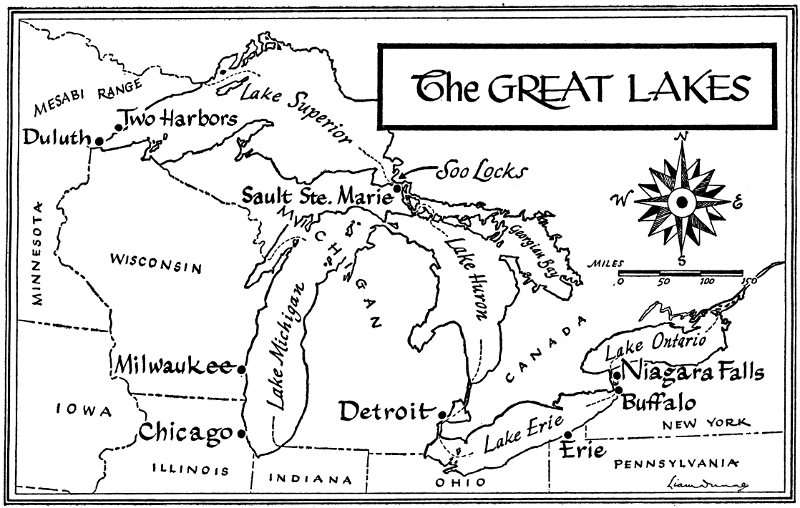
we’re getting close to the Soo.”
“The Soo?”
“Yup, the Sault Sainte Marie. They call it the
Soo, though, probably because nobody but the
Frenchies can pronounce it right. That’s where
Lake Superior empties into Lake Huron through
the St. Mary’s River. That’s where the Soo Locks
are, boys. If you’re headed downlake, they float
you down to a lower level. If you’re headed uplake,
they raise you up.”
“Like the Panama Canal?” Sandy asked.
69
“Right. Now, you take us. We’re going downlake.
So, once we’ve entered Lake Huron from
Lake Superior, we can keep on going down Huron
and through the Detroit River into Lake Erie,
past Detroit and Cleveland and on to Buffalo. Or
else, we can sort of double back, head west, that is,
and sail through the Straits of Mackinac into Lake
Michigan and hit Milwaukee and Chicago.”
Both Sandy and Jerry shook their heads in
wonder.
“You know, Cookie,” Sandy said, “it’s hard for
us to get used to the idea of Chicago and Milwaukee
and Detroit and Cleveland as port cities.
We’re from the West, and when we think of a port
we think of San Francisco or Los Angeles. Or, if
it’s in the East, we think of Boston or New York.”
“Well, that’s only natural. You think of the
ocean. But let me tell you, boys, some of these
Great Lakes ports are among the biggest in the
world! Ocean or no ocean.”
Cookie removed his pipe from his mouth and
pointed with the stem at the boat that trailed the
James Kennedy about a half mile to port. It was
not quite half as long as the Kennedy, though it
seemed to be about as wide. Its decks were loaded
with railroad cars.
70
“See that?” Cookie said. “That’s a car ferry. You
won’t see ships like that hardly anywhere else in
the world. It’s even a bit out of place on Lake Superior.
Usually, they use ’em more on Lake Michigan
to carry the new cars from the factories in
Detroit. And this,” Cookie went on, pointing his
pipe at the long row of hatches separating the
Kennedy’s stern and bow superstructures, “this is
something you’ll never see outside of the Lakes.
Put these long boats on the ocean, boys, and those
deep ocean swells would break them in two.
“But they’re just right for the Lakes. It’s what
your biology teacher might call a perfect example
of adaptation. Lake freighters are built for just
two reasons, boys—to carry bulk cargoes like ore
or coal or grain and to fit through the narrow
locks at the Soo. They can build them as long
as a city block, but they can’t be too wide or too
deep.”
“Do they have storms on the Lakes, Cookie?”
Jerry asked.
Cookie’s eyes danced merrily and he jabbed his
pipe at Jerry as he said, “Storms, hey! Let me
tell you, boy, there’s plenty of rough weather
around the Great Lakes. Four months out of the
year they’re empty, the weather’s so bad. That’s
why the boats are built to load and unload so fast.
Sometimes you don’t get more than seven months
in a season. Rest of the time, the boats stay in
port.”
Cookie puffed thoughtfully in his pipe. He
glanced downward. Below them, the dark lake
water flowed swiftly past the James Kennedy’s
hull.
71
“When a lake boat sinks,” Cookie said somberly,
“there ain’t many survivors, if any.”
“Why not, Cookie?” Sandy asked, surprised.
“That’s pretty cold water down there, that’s
why. You don’t last very long in that water if it
happens to be early spring or fall. I’ve seen ice
floating in these waters as late as it is now.” He
shivered a bit. “Cold water, boys. I remember
once a feller I knew broke his leg and we didn’t
have no medicines aboard to help ease the pain
while we was setting it. So we just hauled up a
bucket of cold Lake Superior water and stuck his
leg in it a while. By gum, it got numb in no time.
He didn’t feel a thing until after we’d got him all
fixed up with a splint and bandages.”
Cookie got to his feet. “That’s one reason I
never bothered to learn how to swim.” He looked
at the sky. “Well, time to go below again. We
ought to hit the Soo just before dark.”
He arose and walked over to the leeward, or
starboard, side of the ship and began emptying his
pipe. He leaned far over the rail to make sure that
none of the still-glowing coals would land aboard
ship.
72
As he did, a long, gathering swell from the wake
of the car ferry that had overtaken and passed the
James Kennedy struck the ship’s port stern with
savage force. The Kennedy heeled slightly to starboard,
and poor little Cookie, knocked off balance
by the force of the blow, slithered over the rail.
With a long, wailing cry of despair, the little
man plunged into the freezing-cold waters of Lake
Superior.
73
CHAPTER SIX Man Overboard!
“Man overboard!”
From fore and aft, from port to starboard, from
every quarter of the James Kennedy’s great length,
that ancient rallying cry of the sea arose.
“Man overboard!”
“Where?” they shouted. “Where?”
“Man overboard off the starboard stern!”
There was a mad scuffling of feet on the steel
decks as the crewmen rushed for the rail, some
to reach for a line and a life preserver, others
merely to stare.
74
Hardly had Cookie’s body entered the water
with a resounding splash, than there was a clanging
of bells in the engine room beneath Sandy
and Jerry. The ship’s motors roared in a rising
crescendo of power. The James Kennedy shivered
and shuddered like a live thing, and out from
beneath its stern there issued a wild, white boiling
of angry water.
“Full speed astern!” someone cried.
Then, with another great quiver, the James
Kennedy seemed to come to a halt.
All of this happened quickly, perhaps within
only a few seconds. But rapid as had been the reactions
of these trained seamen, they were still far
behind the swift decisiveness of Sandy Steele.
The moment he had seen Cookie lose his
balance, Sandy had braced his steel-muscled legs,
ready to go to his aid. When their little friend’s
body had vanished, Sandy had raced over to the
railing. Jerry was not far behind.
Sandy did not hesitate. He recalled, with dread,
what Cookie had been telling them only moments
before about the killing cold of the lake water. As
he ran, he stripped off his own shirt and threw it to
the winds. As he reached the railing, he knelt,
swiftly untied his shoes, and pulled them off.
Down below him, Cookie’s bald head had appeared
above the surface.
“Help!” he called weakly. “Help!”
75
Then, before the horrified gaze of all aboard
the Kennedy, the little man choked on a mouthful
of water, threw up his hands and sank out of
sight.
Splash!
Straight as an arrow, Sandy Steele’s body had
swept out from the ship’s side—hitting the water
only a few feet to the side of the spot where
Cookie had gone under.
Even as Sandy went beneath the surface, he felt
a shiver run through his body from the tips of his
toes to the top of his head. It was not only from
the impact of having dropped twenty feet. It was
from the terrible, numbing drop in temperature.
For a moment he felt as though his body were a
thing of stone.
But Sandy quickly got his legs and arms working.
He surfaced and looked around him. Nothing.
Sandy dove down once more.
It was as black as night under the surface. Still,
he forced himself farther and farther down,
swinging his arms in front of him in long, slow,
underwater breast strokes. He hoped to touch
Cookie in this way, if he could not see him.
Sandy’s lungs were bursting.
76
In another moment or two, he would have to
come back up. He dared not go down a second
time, either, for the cold was creeping into even
his tough young body.
Suddenly, his finger tips brushed against some
object....
Sandy felt a thrill of joy. He stretched out his
hands and felt something hard and unbending.
His heart sang. He had grasped Cookie’s shoe!
It was only just in time.
The little man had swallowed so much water
and been in the lake so long that he had lost consciousness.
When Sandy discovered him, he was
headed down in what might have been his death
dive.
Quickly, Sandy slid his hands along from
Cookie’s shoes to seize him firmly by the ankles.
With a savage, scissor kick of his long legs,
Sandy drove upward to the surface.
How happy he was when his head at last burst
into the open air and he could breathe again!
Even though his ears had begun to ring, he could
hear the great cheer that went up when he came
into view, with Cookie safely in his arms.
“He’s got him!” the crewmen cried. “He’s got
Cookie! Here, throw him a line!”
77
There was a splash beside his head and Sandy
saw a length of rope floating in the water. Weakly,
he put out his hand to grasp it. With the other, he
struggled to hold the unconscious Cookie’s head
above the water. Sandy felt himself getting weaker
and weaker.
Would he make it? He felt a tug at the other
end of the line. In despair, he felt the rope sliding
through his powerless fingers.
There came another, far heavier, splash beside
him.
Jerry James had come to his chum’s rescue.
He had jumped in!
Blowing noisily through his nose, Jerry stroked
over to Sandy’s side. There were two more thuds
in the water.
Life preservers.
“Here,” Jerry gasped, getting his hands under
Cookie’s limp shoulders. “Let’s get one of these
doughnuts over his head.”
Together, the two chums slipped the preserver
over Cookie’s head. They yanked up his arms and
draped them over the ring, to make sure that he
would not slip through it. Then, they pushed him
over to the side of the gently rolling freighter,
winding the rope about his waist.
“Okay,” Sandy called, lifting a hand weakly
from the water. “Haul away!”
78
The men at the rails pulled and Cookie slowly
left the water. As they lifted him, the pressure of
the rope around his waist acted like a kind of
artificial respiration. Water streamed from his
open mouth as he made his ascent. At last, he was
safely on deck, and then the two friends were
pulled from the lake.
Instantly, they were wrapped in warm blankets.
They were both glad that it was June, and not
November, as they realized how cold they were,
even though swathed in wool and bathed in sunlight.
Somebody forced Sandy to swallow a little
glass of burning liquid, and he guessed that it was
rum from the heat of it in his stomach and the way
his eyes began to water.
“Ugh,” Sandy said, “I’d sooner drink a gallon of
lake water.”
“You nearly did,” a harsh voice said; and, opening
his eyes, Sandy saw Captain West forcing his
way through the knot of sailors who had surrounded
him. For once the skipper had shaved,
though his eyes were bloodshot.
“That was a foolhardy stunt, boy,” Captain
West went on, growling and not noticing the rush
of color into Sandy Steele’s face. “You could have
drowned.”
“But what about Cookie, then? Did you want
me to let him drown—sir?”
79
“Mind your tongue, boy. We’ve got lifeboats
for that sort of thing. We’d have had him out of
there in no time.”
“But what about the lake cold?” Jerry James
put in hotly. “It might have killed him before you
could get to him.”
Captain West sneered. “I can see you’ve been
listening to Cookie’s sea stories. The Lakes aren’t
that cold in June.”
“Oh, n-no?” Jerry James asked wryly, pulling
his blankets closer about him. “Th-then why are
m-my t-t-teeth ch-chattering?”
A ripple of laughter ran through the onlooking
men and Captain West swung on Jerry with his
eyes sparking fiercely, furious at getting an argument
from any of his crew.
“You young whippersnapper!” he roared. “If I
had a brig aboard this ship, I’d put you in it—just
to teach you some respect for your betters.
Here,” he snarled, whirling on the men, “get
back to work, you lazy louts.” He glanced at his
watch. “You’ll hear about it if we’re late for the
locks. All this grandstanding over a ship’s cook!”
He glared at Sandy and Jerry. “You two! Down
below to the galley! And remember—jumping in
after your bald-headed friend may have made
extra work for yourselves. While Cookie’s in bed
for the next day or two, I’m going to be expecting
you to do his work!”
80
Then Captain West spun around and rolled forward
to his bridge.
As Sandy Steele and his friend went down the
ladder, hardly able to believe that any man could
be so unfair, they felt the ship’s engines begin to
throb again.
The James Kennedy was once more making for
the Soo.
81
CHAPTER SEVEN In the Locks
“Sandy, we’re sinking!”
Jerry James’s forehead was wrinkled with concern
beneath his jet-black hair as he uttered those
words. It was the first thing either youth had said
since they had returned to the galley and gone to
work preparing the evening meal.
An hour ago, they had been shivering beneath
their blankets. Now, the exertion of working in
that overheated room, where the hard aluminum
fixtures only served to refract the heat, had forced
them to strip to the waist. Even so, their bodies
glistened with sweat.
“I said we’re sinking, Sandy,” Jerry repeated,
somewhat nervously.
82
Sandy nonchalantly swung the oven door shut
as though his friend had said nothing more upsetting
than, “It’s raining outside.” Smiling, he
took off his asbestos glove and laid it on the stove
top.
“You know, Jerry, I believe you’re right.”
“But, Sandy, I’m not joking! I tell you, I can
feel the ship going down.”
“Of course you can,” Sandy said easily. “Let’s
go watch it.”
Then Sandy grinned—and Jerry James clapped
his hands to his forehead in dismay and cried, “Of
course; we’re in the locks!”
“Right the second time,” Sandy laughed. “And
I’ll bet if we had been going uplake, you would
have sworn that we were flying! Come on, let’s go
topside.”
They clambered above and feasted their eyes
on one of the strangest sights they had ever seen.
The James Kennedy was floating in what can
only be described as a long, narrow tub—almost a
quarter mile in length and with about ten or fifteen
feet clearance on either side of the sixty-foot-wide
ship. What amazed Sandy and Jerry was that
there were at least four more of these enormous,
man-made tubs, some as large, others smaller. All
of them held vessels of about the same size as the
Kennedy. Some even held two of them.
83
The tubs were formed by huge water gates at
either end. Behind their boat, Sandy and Jerry
could see the water level of Lake Superior. What
astonished them was that it seemed to be higher
than they were!
And it was.
At that very moment, as the two friends glanced
over the side, they could see that water was being
pumped out of their tub. They were, as Jerry
James had said, sinking! The level of the water
in their tub was dropping so fast that more and
more of the water gate behind them became visible.
Now, they could see, it had actually become
a dam, holding out the waters of Lake Superior
that rose above them.
One of the strangest sensations was to turn and
glance at another one of the locks—for that is
what these tubs are called—to see a boat that was
headed upstream rising higher and higher in the
air. Its tub was filling with water, making it float
higher and higher until it would reach the same
level as Lake Superior, and then it would sail out.
“Boy, oh, boy,” Jerry said, rolling his eyes. “I’m
getting the same dizzy feeling you get in a department
store. You know, Sandy—when you’re on the
down escalator and you pass somebody on the up
escalator.”
84
Sandy nodded in silence. He was too intent
upon what was happening to bother to talk.
He craned his neck over the side to see what was
happening up forward. Sandy saw that the James
Kennedy was now well over ten feet below the
level of Lake Superior. Suddenly, the water gates
at the forward end of the lock swung open.
They sailed out!
Sandy shook his head in amazement, and then
he heard a friendly voice beside him say, “Pretty
tricky, hey?” Turning around, Sandy saw one of
the seamen who had helped pull Cookie out of
the water. He was short but well-built, with dark-red
hair and warm brown eyes. Sandy knew that
the other men called him Sam.
“Did you ever sail through the Soo before?”
Sam asked.
He seemed pleased when Sandy shook his head,
as though he was delighted to have someone he
could explain things to. As he began to talk, Jerry
joined them.
“First off, boys,” Sam said, “I want you to know
that the men all feel that was a mighty brave thing
you did this afternoon. Don’t feel too bad about
what the skipper said, either. He has his good
days and his bad ones, and I guess today was one of
the bad ones.”
85
Sandy and Jerry both bobbed their heads politely,
hiding the grins that sprang to their faces
when they realized that they were both thinking it
was about time for Captain West to have one of
his good days!
“Now,” Sam said, with a note of pride in his
voice, “I’ll bet you didn’t know that you’ve just
passed through the biggest shipping highway in
the world.”
“Oh, no,” Jerry argued. “You don’t mean that
the Soo is bigger than the Panama Canal.”
“And the Suez, too?” Sandy asked.
“Bigger’n both, boys. Of course, I mean more
ships pass through these locks. Look,” he said,
turning to survey the scene that was rapidly falling
behind them. “Just look at that.”
Sandy Steele and Jerry James did take a long
look, and when they had finished, they were inclined
to agree with Sam. In all, there must have
been fifty of those peculiar long boats passing
through the locks at one stage or another, their
stubby smokestacks sending thin columns of smoke
into the darkening sky.
“Boy, oh, boy,” Jerry said. “And to think I
never knew there was such a place two weeks ago.”
86
“You weren’t the only one, Jerry,” Sam said,
smiling. “There aren’t too many Americans who
know what you mean when you say Sault Sainte
Marie.”
“What does that mean, anyway?” Sandy asked.
“Simple. It’s French for Rapids of St. Mary.
You see, where we’re sailing now, the St. Mary’s
River dropped twenty feet in less than a mile.
With all of Lake Superior pouring through here
down into Huron, that made for mighty rapid
rapids. The Indians used to carry their canoes
around the rapids. So did the Frenchies. Of course,
as soon as commerce started springing up between
the Lakes cities, and as soon as they started tapping
all that ore up north, they had to have a way
into Lake Superior that was safe for the big boats.
So they built the locks.”
Neither youth opened his mouth to speak. They
were impressed. But Sam’s reference to the ore
deposits had also recalled to their minds the fact
that this was no ordinary summer’s voyage for
them. During the hard work of the day, and the
excitement of pulling poor Cookie out of the
water, they had forgotten their resolve to inform
Mr. Kennedy of the good news that Captain West
was treacherously keeping from him.
But now that Sam had spoken of ore, they remembered
it, and Sandy asked the seaman, “Where
are we headed now, Sam?”
87
“Well, now we’re on Lake Huron. We’ll head
downlake for Detroit.”
“I didn’t know Detroit was on the Lakes.”
“It isn’t. Not properly, anyway. It’s on the
Detroit River, but that’s just the waterway where
Huron narrows and empties into Lake Erie.”
“Oh. Will we lay over there?”
“Well—” Sam grinned—“if we don’t—then I’m
going to have a mighty disappointed wife and
kids.”
“Oh, you live there. Well, thanks, Sam. Come
on, Jerry—we’d better be getting back to work.”
The two friends went below. As they entered
the galley and began setting up dinner, Sandy said
to Jerry, “Maybe Captain West will let us go
ashore in Detroit, tomorrow. If he does, we can
telephone Mr. Kennedy.”
Jerry pursed his lips. “You know, Sandy, I’ve
been thinking. We don’t really know that the
skipper is working for that rival firm. I mean,
all we have to go on is the fact that you saw him
writing a letter addressed to a Mr. Paul Chadwick.
That could just be coincidence.”
“Pretty tall coincidence.”
“Well, yes. But then again, Captain West might
just happen to know Mr. Chadwick. It might be
a personal letter.”
88
“That’s worse! Don’t you remember what Mr.
Kennedy said about Chadwick? He said he wasn’t
the sort of man he’d like to sit down to dinner
with. He said he was only selling out because it
was good business to accept his offer. If Captain
West’s a friend of Chadwick’s, then he’s no friend
of Mr. Kennedy’s!”
Sandy Steele was becoming excited. As usual,
he had to keep brushing back the cowlick that
kept falling in his eyes as he talked.
“Be reasonable, Jerry. Don’t you remember
how Mr. Briggs talked so insultingly of Mr. Kennedy
when we first came aboard? ‘Ma Kennedy’
he called him. Then, when I was in Captain
West’s cabin, he kept calling him ‘Old Man Kennedy.’
Doesn’t sound like much respect for their
employer. And this afternoon, when we came on
deck with Cookie, the skipper tried to pump me.”
Jerry’s eyes flew open.
“That’s right,” Sandy rushed on. “I didn’t have
time to tell you before. But he pretended to be
friendly, just so he could find out how much I
knew about Dad’s discovery of the high-grade ore
deposits.”
Sandy Steele’s lips tightened.
“No, Jerry,” he said grimly. “Captain West is
not to be trusted.”
89
Then, to the horror of both youths, they heard
an ugly, mocking voice saying, “You don’t say?”
Sandy Steele and Jerry James turned and looked
straight into the leering face of Captain West’s
mate.
He stood in the doorway of the galley. His
slender, tall body swayed slightly, and from the
glazed expression of his eyes, Sandy and Jerry
could guess that he was drunk. There was a bottle
bulging in his hip pocket, and Sandy recognized
it as the one from which someone had poured
that drink of rum for him abovedecks.
“So!” Mr. Briggs lisped in a drink-thickened
voice. “So Ma Kennedy’s little chicks don’t trust
their skipper, eh?”
“You’d better get some sleep, Mr. Briggs,”
Sandy said evenly.
The mate flushed angrily.
“Don’t tell me what to do, you double-crossing
little show-off!” he grated. “Here, stand aside
there, and let a man pass.”
He stepped into the galley, grinning wickedly,
plainly unaware of how he wavered on his feet
and disgusted, rather than frightened, the two
youths. He all but fell as he moved to the little
table on which Cookie had served them their
breakfasts that morning. He sat down at it and
pulled out the nearly empty bottle of rum and
stood it at his elbow.
90
“So you’re going to run and tell tales out of
school, hey? Going to tattle on us, are you?” He
brought his hand down on the table top with a
crash. “Not if I can help it!”
The rum bottle jumped and nearly fell to the
floor. But Mr. Briggs grabbed it just in time. He
threw back his head and tilted the bottle to his
lips. “Ahhhh!” he said. “Now, serve me my dinner!”
Neither Sandy nor Jerry moved.
“You hear me?” the mate yelled angrily. “I’m
mate aboard this scow. Bring me my dinner!”
Reluctantly, Jerry moved to obey. Mr. Briggs
watched him, scowling. Then he banged the bottle
on the table and said, “Have a drink, Blackie.
That’ll put some zip into those lazy legs of yours.”
“My name’s Jerry,” Jerry replied hotly. “And I
don’t drink.”
“Don’t drink, hey? Regular sissy, aren’t you?
Well, I’m mate aboard this scow, and when I tell
a man to drink, he drinks!”
Mr. Briggs lurched to his feet. Still swaying, he
seized the bottle by its neck and moved toward
Jerry.
91
Sandy Steele moved quickly to head him off. He
well knew Jerry’s split-second temper and he
wanted to stop the mate before he did something
he would regret.
“Please, sir,” he pleaded. “Don’t! He’s getting
your dinner. Now, if you’ll just sit down—”
The mate shouldered Sandy roughly aside.
“Out of my way,” he mumbled. “Here, you,”
he said to Jerry, swinging the bottle up in an arc,
“take a drink like I ordered you to.”
As Mr. Briggs brought the bottle up with a
speed that might have dug the mouth of it deep
into Jerry’s throat, the youth raised his own arm
to defend himself. The bottle struck him on the
forearm. A jet of rum came streaming out. It
fell on the open flame of the stove, and a sheet of
blue flame leaped up into the air.
It came dangerously close to the reeling mate.
Frightened, Mr. Briggs brought his right arm
around as though to shield his face from the
flames. But he had forgotten that he still held the
bottle. His gesture emptied the remainder of the
bottle onto the stove and another jet of flames
leaped toward him. This time, the fire reached
one of the roasts standing on the stove.
92
With a popping and sizzling, the roast came
alight, and now the panicky Mr. Briggs lunged
for the roasting pan to remove it from danger.
But all he succeeded in doing was to overturn a
pan of grease, into which, in terror, he dropped
the flaming roast.
In an instant, Cookie’s beloved galley had become
a roaring caldron of flames.
“Fire!” he shrieked, and charged blindly into
the passageway, covering his face with his hands.
“Fire! Fire! All hands on deck! Captain, Captain—come
quick! Those blasted boys of Kennedy’s
have set the ship on fire!”
93
CHAPTER EIGHT Fire!
For a split second, Sandy and Jerry stood rooted
in helpless anger.
It was bad enough that the drunken, clumsy
mate had set the galley ablaze. But now he had
shifted the blame to them! The injustice of it was
an outrage, and for the space of that split second,
the two youths were so stunned that they could
not move.
Then they sprang into action.
And to Jerry James’s amazement, Sandy Steele
turned and ran from the flaming room.
“Sandy!” Jerry called. “Sandy, come back!”
94
But Sandy Steele kept on running up the
passageway, and Jerry could not believe what he
saw. Then, when Sandy disappeared into the cabin
where Cookie had been placed, Jerry understood.
“Good old Sandy,” he said proudly, and then he
whirled and dashed down the passageway in the
other direction—hunting for a fire extinguisher.
Cookie was half out of his bunk when Sandy
rushed through the opened door. The little man
had heard Mr. Briggs’s shout, and he had immediately
dragged himself from his pillows. He
was going to help put out the fire!
But he was too weak to get very far, and he lay
half in, half out of his bed, panting, when Sandy
burst in on him.
“Quick, Cookie!” Sandy said. “The galley’s on
fire.”
“I know, boy,” Cookie gasped. “I heard the
mate.” His eyes were sad as he gazed at Sandy.
“How could you do it, Sandy?”
“I didn’t!” Sandy gritted between clenched
teeth, as he stooped to wrap blankets around
Cookie, before coming erect in the fireman’s carry.
“But the mate said—”
“He did it, not us!” Sandy replied. “Come on,
Cookie—there’s no time for explanations.”
95
Gently supporting the little man on his right
shoulder, Sandy hurried from the room. He took
him to the cabin farthest from the blaze. Once
inside, he placed Cookie on the bunk. The
weakened little man looked around him in astonishment.
“This is the mate’s quarters,” he burst out.
“You can’t put me in here, boy.”
“Never mind that,” Sandy said grimly. “I’d put
you in the captain’s quarters, if I thought it would
be safer. I’m not taking any chances on your
getting trapped by the fire, Cookie.”
“Is it really that bad?”
“I don’t know, but I’ll soon find out! Now, you
just stay put while I go back and help fight the
fire.”
Without another word, Sandy turned and raced
back down the passageway.
A wild scene greeted Sandy’s eyes.
Thick, greasy clouds of smoke—from the roasts
and the other cuts of meat that had caught fire—rolled
from the galley. Through the smoke, he
could see the red and yellow of the flames. Sometimes
a sheet of fire would lance out through the
smoke, and there would be a hissing and a crackling
that would warn the smoke-grimed and panting
fire fighters that another big can of lard had
exploded and caught fire and was now making
their task even harder.
96
All along the passageway lay thick lines of hose.
They were crisscrossed and intertwined, and,
sometimes, when they leaped under the pressure
of the water coursing through them, they gave
the passageway the look of a snake pit.
Crewmen wearing fire helmets dashed up and
down, helter-skelter, some of them with fire extinguishers
in their hands, others carrying fire
axes. A bucket brigade had been formed among
the spare crewmen, and Sandy saw the buckets
passing from hand to hand with the precision of
an assembly line in a factory. The empty buckets
would be passed up the ladder to be refilled by a
man who fastened them to a rope and then lowered
them into the lake.
From what Sandy could see, most of the fire
seemed to be centered in the middle of the galley,
next to the stove. Luckily, Cookie had wisely insisted
that his old grease-soaked wooden cabinets
be replaced by nonflammable metal ones, otherwise
the fire would have been uncontrollable. As
it was, it was bad enough. Flames shot higher and
higher from the meat-chopping table. Here, the
thick slab of wood had become thoroughly soaked
by the overturned grease. Beneath the terrible
roaring sound it gave off as it burned, Sandy could
hear the hissing and snapping of the grease.
97
Above all the sound and fury of the fire itself,
and the excited babble of the men as they rushed
here and there to prevent the flames from spreading
to the mess hall, Sandy could hear the booming
of Captain West’s voice.
“You, there!” he shouted at Jerry James. “You
with the fire extinguisher—over here! Now, then,
through the smoke here onto that table!”
With his head picturesquely swathed in an
undershirt which he kept removing to soak with
water, Captain West was a romantic figure as he
rushed up and down the passageway directing the
fire fighting.
“Water!” he would thunder. “More water!” Or
else: “You ax men, get busy in the mess hall! Chop
up those tables and benches and get the wood
abovedecks!”
Seeing him, hearing him, Sandy wished that
Captain West was as loyal as he was commanding.
But there was little time for Sandy to waste in
admiration of the skipper. All of these things that
he witnessed passed through his mind in one swift,
crowding instant—and then he too leaped into
action.
98
The moment that Sandy rushed up there had
been a loud explosion in the galley, and one of the
ax men was thrown back against the bulkhead by
the force of it. He slumped to the deck, unconscious,
and his ax slipped from his hand.
Quick as a flash, Sandy seized the ax and joined
the men at work in the mess hall, while two others
quickly jumped to obey the skipper’s orders to
remove the stricken man to a safe place. With a
thrilling surge of confidence in the strength of
his lean-muscled body, Sandy Steele began to
swing his ax. His first stroke went whistling
through the air and the ax blade bit deep into the
thick wood of a bench. With a wrench requiring
all of his power, Sandy yanked it free. Once again,
he drove the blade downward.
Swish! Crack!
The bench split in two. Quickly, shortening
his grip on the ax handle like a batter dragging a
hit, Sandy stroked twice, backward and forward,
and the bench had become a neatly stacked pile of
kindling. With a glance of admiration, one of the
crewmen scuttled forward, seized the bundle of
sticks in his arms and carried them topside.
99
Meanwhile, as the men with the axes steadily
demolished the mess-hall furniture, getting it
safely out of harm’s way, the fire in the galley
seemed to rage higher and higher. The heat in the
passageway was now intense. The naked torsos of
the fire fighters gleamed in the reflected light of
the flames, and rivulets of sweat marked their
course down flesh blackened by the greasy smoke.
As the roar of the flames grew louder and louder,
the expression of concern on Captain West’s face
grew deeper.
He was thinking of the coal bunkers directly
beneath the galley. If the fire should ever get to
them, that would be the end!
Anxiously, Captain West peered through the
smoke. It stung his eyes and made them water. He
had to wind a wet cloth around his mouth to keep
from choking. But he saw what he wanted to see.
That chopping table was still blazing away like
an enormous torch. In fact, it was a torch—for
the grease had prepared it for burning as completely
as any stick dipped in pitch. But Captain
West had seen that the fiery table had been
partially burned through at the point where it
was fastened to the wall. If he could chop it the
rest of the way, the table would fall down. Then
it could be pulled out into the passageway with
hooks and the hoses could play upon it with full
force.
100
In that way, Captain West reasoned, he could
attack the fire at its very heart. Immediately, the
skipper called for one of the ax-bearing crewmen
to attempt the job. There was no time to lose.
Another five or ten minutes, and the coal would
go up!
The crewman slipped quickly into a heavy
raincoat to shield his body from the flames. He
saturated a cloth with water, wound it around his
lower face, and plunged into the smoke.
In an instant, he came reeling back—choking
and sputtering.
“It’s too much, sir,” he gasped. “No man can
go into that stuff and live.”
Before Captain West could reply, Sandy Steele
had raced down the passageway from the mess
hall.
“Let me have that raincoat,” he said to the
astounded man. “I think I know a way to get that
table out.”
Still choking, the man took off his coat. Captain
West opened his mouth to protest, but then,
seeing that Sandy was dead serious, he closed it
again and let the determined youth take over.
“Jerry!” Sandy called to his chum. “Quick!
You get one on, too. Then, you protect me with
the fire extinguisher while I swing the ax.”
101
Jerry James nodded. Like his friend, he garbed
himself in one of the heavy black slickers, covered
his nose and mouth with a soaked cloth, and
preceded him into the smoke. Jerry held his extinguisher
like a soldier wielding a light machine
gun, spraying the flames with a constant stream
of thick, white chemicals.
Behind him moved Sandy Steele, grasping his
ax.
The combination that worked so well on the
playing fields of their home state of California
was now going into action far, far from home, and
in a far more serious cause. But it was working
just as well!
Choking, sputtering, staggering, all but blinded,
Sandy Steele charged to the reddish blur he could
see a few feet ahead of him in the smoke. Waves
of heat rolled against his body and he felt himself
going weak. But he lowered his head and
struck on.
Once, a tongue of flame seemed about to gather
in volume and leap toward him from the roaring
chopping-block. Just in time, a jet of thick white
liquid streamed out toward it and smothered it
before it could get started. Good old Jerry, Sandy
thought.
At last, he had made it to within a few feet of
the burning table!
It was as close as he dared go.
Without hesitation, Sandy Steele raised his ax
and brought it down, hard.
102
Crash!
The table seemed to sway. Sandy raised his arms
again, wondering if he would have the strength
for another blow. He was thoroughly sick, now—nauseated
by that sickening, grease-laden smoke.
The effort of his first mighty stroke had all but
sapped his strength. Yet, he could not falter now!
He had to do it! One more stroke would slice
through the remaining wood. Calling upon all his
reserves, Sandy Steele rocked backward on his
heels, rose on his toes and brought the ax down
upon the wood.
It was a blow that rang out even above the roar
of the flames! Even the weary men gathered in
the passageway could hear it.
And it severed the table from the thick bolt that
had held it to the bulkhead.
Sandy Steele jumped back just in time.
With a loud crash and a flashing of sparks and
a shooting of flames, the table fell toward him.
The momentum of Sandy’s jump sent him
staggering backward, off balance. That was how
he emerged from the cloud of smoke that separated
the excited, yelling crewmen from the fire
inside the galley.
103
Behind Sandy, running low and gasping, but
still clutching his fire extinguisher, came Jerry
James.
If someone had not caught Sandy, he would
have gone sprawling. As it was, he was having
difficulty keeping his legs under him. They
seemed to have gone all rubbery from his ordeal.
But he clenched his teeth and stayed erect, watching
as the crewmen began to drag the blazing
table from the galley into the direct play of
massed hoses and extinguishers. It sizzled and
smoked and sent off clouds of steam as though it
were a small volcano, but the fire was at last put
out.
Then, one by one, all of the other burning
articles within the galley were separated from the
main body of the fire and doused. The hoses sent
streams of lake water splashing against the now-smoldering
and smoking bulkheads. The bucket
brigade was disbanded, for it was no longer
needed.
And then, as Sandy Steele felt the youthful vigor
of his body swiftly returning, his eyes fell on an
object that he dearly wished to preserve for the
eyes of Captain West.
It was the rum bottle.
104
It lay beside the stove, almost at the exact point
where it had fallen from the hand of Mr. Briggs.
Here was not only the cause of the fire. Here
was proof of who really had started it!
Sandy slipped from the support of the friendly
arms that had grasped him. He bent to pick up
an asbestos glove dropped by one of the crewmen.
He slipped it on his right hand and walked
quickly forward to retrieve the bottle.
As he leaned over, he felt himself jostled aside.
He nearly fell down again. A tall man stepped in
front of him and swung the flat of an ax down on
the bottle. He did it deliberately. He shattered
the bottle into a hundred pieces.
“Why did you do that?” Sandy cried, unable to
hide his anger.
The man in front of him turned with a wicked
smile, and said, “You could have burned yourself
on that, Little Lord Show-off—and you’re in
enough hot water already.”
It was Mr. Briggs.
105
CHAPTER NINE Charged with Arson
No one was less surprised than Sandy Steele when
the order came for him and Jerry James to report
to Captain West in his cabin.
It was by then close to midnight. Once the fire
had been put out, there had remained the task of
clearing away the debris and cleaning up. This
had occupied the crew for a few more hours, and
Sandy and Jerry had not been happy to hear the
grumbles about burned suppers and lost sleep
or to see the glances of hostility that were directed
their way. Mr. Briggs, it seemed, had been as expert
in spreading his falsehoods among the crew
as he had been in taking them to Captain West.
Only Sam had remained friendly, and it had
been Sam who had brought the order.
106
“Captain says you two are to report to him
right away,” Sam said. He shook his head sadly.
“Too bad, boys,” he went on. “If I can read storm
signals right, I’d say you were in for it.”
“In for it!” Jerry burst out hotly. “Is that what
we get for putting out the fire?”
“Hold it, Jerry,” Sandy said gently, calming his
friend down. “That won’t do any good.” He
looked at Sam. “I suppose Mr. Briggs is with him?”
Sam seemed surprised. “Now, how do you know
that?”
Sandy’s answer was a grim tightening of his lips.
On the subject of Mr. Briggs, he did not trust
himself to speak. Sandy wondered how much
longer he was going to be able to control his
temper. It seemed to him that every time either
he or Jerry did something they were supposed to
do, even something they really needn’t have done,
their only reward was some penalty or a leer from
Mr. Briggs or an insult from the skipper. What
had begun as a high school boy’s dream of a
splendid way to spend the summer seemed to be
turning into a nightmare. Sandy let out his breath
in a deep sigh. He looked at Jerry and was startled
to see the sulky expression on his friend’s normally
cheerful countenance.
“I’m not going,” Jerry said sullenly.
107
“Wha-a-at?” Sam said, as though he couldn’t
believe his ears. “What did you say, young fellow?”
Before Jerry could reply, Sandy had propelled
him up the passageway and out of earshot. He
didn’t want their friend Sam to get the notion
that they were mutinous.
“Jerry,” he whispered fiercely, “you’ve got to
stop talking like that!”
“I don’t care!” Jerry said stoutly. “We’ve been
pushed around long enough, and now I’ve got to
get it off my chest. Listen, Sandy—you know very
well what’s going to happen when we get in there
with the captain. He’s going to accuse us with a lot
of lies that he’s heard from the mate. He’ll not
only forget that we risked our lives to get at that
table, but he’ll turn around and say we started
the fire.”
“Shhh!” Sandy said, looking around anxiously.
Jerry lowered his voice, but he didn’t stop
talking. “It’s true! Why, look what he said to you
after you rescued poor old Cookie from drowning!
He acted as though you’d jumped in just to
make him late for the Soo Locks. Honestly, Sandy,
I don’t know why you bother—”
108
“Because we’ve got to!” Sandy insisted, squeezing
Jerry’s arm. “Don’t you realize that a captain
aboard ship is a lot different from a teacher or a
football coach? He’s got you in his power, Jerry.
His word is law! Really. You can’t disobey him!”
“Oh, no?” Jerry said.
“If you do,” Sandy warned, “you’ll wind up in
jail. I mean it, Jerry. Now is just the time when
we’ve got to keep our heads.” He dropped his voice
to a whisper. Then he went on: “Captain West
must know by now that we’ve found out about
him. You remember that Mr. Briggs was out in
the passageway, eavesdropping, while we were
talking about it. He’s certainly told the skipper.
Now, with the fire, he’s got an excuse to do something
that will keep us from warning Mr. Kennedy.”
Jerry’s eyes widened. “Such as what?” he asked.
“Such as locking us up somewhere.”
There was a momentary silence, and then
Jerry James groaned and said, “Boy, oh, boy, we
really are in trouble, aren’t we?”
Sandy smiled in relief. He could tell by the
tone of his friend’s voice that he had gotten over
his resentment. With a reassuring squeeze of
Jerry’s arm, Sandy continued, “We are. That’s
why we’ve got to stay calm. So, whatever you do,
Jerry, don’t say or do anything foolish when we
get in there with Captain West.”
109
Jerry James’s jaw tightened and he clapped his
friend on the arm. “Right,” he said, and then
the two of them walked up the passageway and
knocked on the door of Captain West’s cabin.
“Come in,” the skipper growled.
They entered.
“What took you so long?” Captain West
snapped.
“We were delayed,” Sandy said.
“Oh,” the skipper mocked, glancing over at his
mate, who sat on the bunk. “Did you hear that,
Briggs? They were delayed, he says. Well,” he
sneered, his voice turning ugly, “you’ll have
plenty of time for delays where I’m putting you.”
The skipper peered at them with eager expectation,
as though he hoped his remarks would goad
them into losing their tempers. Observing this,
Sandy was inwardly pleased. He realized that the
skipper could not be too confident of himself, that
he was not sure of how much the youths actually
knew—no matter what Mr. Briggs had said to
him.
“Well?” the skipper roared, crashing his fist
down on his desk. “What have you to say to that?”
“Nothing, sir,” Sandy replied evenly.
A red flush began to spread over Captain West’s
face. But it was supplanted by a cunning look.
110
“Playing doggo, eh?” he muttered. “Well, we’ll
see.” He looked over at his mate with a grin, and
said, “Now, you just tell that story of yours again,
Mr. Briggs.”
The mate nodded.
“It was this way, sir,” he started, gazing up at
the overhead with an expression of shocked innocence.
“Just before suppertime, I happened to be
passing the galley and saw these two.” He lowered
his eyes and jabbed a dirty thumb in the direction
of Sandy and Jerry. Then he raised his eyes again
and said, “They were playing catch with a can of
tomatoes.”
Jerry gasped in indignation, and Sandy quickly
gave him a warning nudge.
“That’s what they were doing, sir—throwing it
back and forth like a couple of schoolkids at a picnic.
Then this black-haired fellow here, he let go
a good one and it went right through the grandstander’s
hands and hit the can of fat on the stove
and knocked it over on the fire. And then, sir,” the
mate concluded, a note of smugness in his voice,
“then, sir, the fat was really in the fire.”
With a look of gloating, the captain swung his
eyes on Sandy and Jerry—and that was when
Sandy opened his mouth and said, “He’s a liar.”
111
Almost the moment that the words dropped
from his lips, Sandy Steele wished he could have
bitten his tongue in two. But he had finally had to
give in to the resentment that had been smoldering
inside him almost from the moment he had
walked aboard the James Kennedy. But, to say
that, after all his good advice to Jerry! He glanced
over at his friend, half expecting him to be disgusted
with him.
He was grinning!
Then Sandy had to laugh, too—if not from the delight
so plain on Jerry’s saucy face, then from
the look of injury on the face of the mate. Mr.
Briggs actually acted as though he had been unfairly
accused! So, Sandy laughed—and when he
did, Captain West arose from his chair with a
roar of rage.
“Get out of here! You smooth-faced, insubordinate
little firebugs! Get back to your quarters and
stand by to face a court of inquiry on charges of
arson and insubordination! That’ll teach you to
laugh at me and call my mate a liar! Eh? How
about that, eh? How will your friend, Old Man
Kennedy, like that, eh, when he hears that his
white-faced schoolboys are headed for some Buffalo
jail? And you, Mr. Briggs, I’m ordering you to
keep these two under lock and key until we get
to Buffalo.” Then, puffing up his chest like a giant
bullfrog, Captain West issued a final roar:
112
“GET OUT!”
Their heads held high, Sandy and Jerry
marched back to their quarters.
And the door had hardly swung shut behind
them, before the skipper whirled and pounced
upon his mate with the low snarl of an enraged
puma. With a cry and a whimper, the fawning
mate who had opened his mouth for words of
toadying praise, cringed back against the bulkhead.
“No, Skipper, don’t,” he whined, but Captain
West ignored his pleas and seized him by the shirt
collar and began to shake him.
“You lying, sniveling drunk!” the skipper
growled. “Do you think you fooled me for a
moment? I saw you smash that rum bottle in front
of that Steele boy’s face tonight. I smelled your
breath when you came reeling down the passageway,
shrieking like the lily-livered ninny you are.”
He shook Mr. Briggs again, fiercely. “Do you
think I believed that cock-and-bull story of yours?
Do you? Answer me!”
Terrified, the mate babbled, “N-no, sir.”
113
“But you still took me for a fool, is that it?”
the skipper snarled, almost beside himself. Then,
seeing Mr. Briggs burst into a fit of uncontrollable
blubbering, he uttered a growl of disgust and
flung him back on the bunk like a sack of wheat.
He returned to his desk and sat down again.
“Briggs,” he said heavily, “if it wasn’t for the
fact that I can make use of you, I’d have skinned
you alive long ago. I pretended to believe you
tonight only because I saw a chance to put those
nosy brats of Kennedy’s in their place. I want
them under lock and key until that deal is signed
in Buffalo. And that’s the day after tomorrow.”
The skipper drew another deep breath. “They
belong to you, Briggs,” he said. “And you’ll
answer for them with your hide.” His voice took
on an ugly, menacing tone that raised bumps of
fear all along the mate’s spine.
114
“If something goes wrong, Briggs, if I see you so
much as look at another bottle, I’ll flay that hide
of yours from one end of the Lakes to the other.
I’ve got too much at stake to fool around! Paul
Chadwick wants those Kennedy boats and I want
him to get them. If it’s the last thing I do, I’m
going to be chief captain of the combined Chadwick
and Kennedy lines—and no high school kids
are going to get in my way by telling Old Man
Kennedy about those high-grade ore discoveries.
So, remember that, Briggs—and now get out of
here and let me get some sleep.”
Still trembling, the shaken mate crept from
Captain West’s quarters and closed the door softly
behind him. Then he slipped down the passageway
toward the tiny cabin occupied by Sandy
Steele and Jerry James.
The moment Mr. Briggs vanished from sight,
the door of the cabin adjoining the skipper’s came
stealthily open. Then, slowly, the figure of a little
bald-headed man emerged. He shut the door
carefully behind him, and then glanced swiftly
up and down the corridor.
On tiptoe, he slipped over to Captain West’s
door. He bent his head to listen. Then he backed
off carefully and raised both clenched fists to shake
them in a gesture of anger and defiance, before he
whirled silently and made his way out of sight.
The little bald-headed man was Cookie.
He had heard every word spoken in the captain’s
cabin since Sandy and Jerry had made their appearance
there. Every inch of his little frame
burned with determination to come to the rescue
of his young friends and help thwart the schemes
of the crafty Captain West.
115
In their own cabin, meanwhile, the two friends
had just climbed wearily into their bunks.
Suddenly they shot erect as they heard a rattling
and clanking outside their door. But they knew
in the next instant what the noise meant. It
was Mr. Briggs “dogging down” the heavy outside
handle.
“Well,” Jerry said, “now we’re prisoners.”
“Yes,” Sandy said, “but I have a funny feeling
that things are going to start to get better.”
“Why?”
“Because,” Sandy said grimly, “they couldn’t
possibly get any worse.”
116
CHAPTER TEN The Unsalted Seas
Unfortunately, Sandy Steele was wrong.
Things could get worse, and they did.
They worsened, not only for the two youths
from Valley View, California, but for everyone
aboard the James Kennedy—to say nothing of
all those other thousands of human souls who
sailed the lower Lakes on that memorable summer
morning.
For it was on that morning that a freak
summer storm that had been rushing down from
the north, roared like a scourge across Lake Huron
before bursting in all its fury upon the shallow
waters of Lake Erie. It was a storm that blew with
shattering force across a body of water notorious
for rough weather.
117
There are no storms so sudden and so strong as
those that fall upon the Great Lakes, and Sandy
Steele and Jerry James were about to witness one
of the worst within the memory of the grizzled
sailors of “the unsalted seas.”
There are the treacherous gales, and sometimes
hurricanes, of late fall or early winter—those
wailing winds that sheathe a ship in fresh-water
ice, before driving it to its destruction.
In the days of sailing ships, there have been
single storms upon the Lakes in which as many as
a hundred ships—with thousands of sailors and
passengers—have perished within twenty-four
hours. Steam-driven freighters, and motorships,
too, have sunk to the bottom of these cold waters—and
more than a few of the ocean liners that
have managed to make their way to the Lakes via
the St. Lawrence River have gone to a fresh-water
grave.
The very first ship to sail the Lakes was the
bark, Griffon, of the famous French explorer,
LaSalle. It set sail from Buffalo on August 7, 1679,
reached the shores of Lake Michigan, and then
disappeared completely on its return voyage.
118
From Superior to Ontario, the floors of the
Lakes are littered with all manner of ships that
have gone down in these storms—with their
cargoes, their jewels, their gold, their stacks of
currency still undamaged in safes.
And it is above the surface of Lake Erie, the
body of water toward which the James Kennedy
was placidly steaming, that the Great Lakes storms
blow the worst and the wildest. For Lake Erie is
the shallowest of all the lakes. Its average depth
is only 70 feet, compared to that of 250 for the
rest of them. At its deepest, it is only 210 feet—compared
to 1,180 feet on Lake Superior.
Erie is a shallow saucer, a basin, and when the
winds go whistling across its surface they create
something of the effect that a boy might make by
blowing onto a shallow saucer of water—but on a
much, much greater scale. The winds whip up
mountainous waves that can break a freighter in
two. There have been storms on Lake Erie as
freakish and furious as that recorded by the
veteran mariner who had moored his vessel on
the Canadian shore opposite Buffalo. To his
amazement, the wind blew so savagely that it
drove the water out and away from his ship’s hull
and left him sitting there, high and dry!
Even today, in our modern age, there have been
freighters that have ventured into Erie storms,
from whom nothing has been heard except a last,
despairing message: “We are breaking up.”
119
So it was on Lake Erie that this unusual summer
storm struck with such violence, only a few
hours after the James Kennedy had left the Detroit
River and swung its prow east by north for
Buffalo.
Oddly enough, Captain West was elated when
the storm broke.
He would not have been quite so overjoyed had
he known how terrible it would become. But his
first reaction to the gale was simply that this would
probably keep the James Kennedy, and the two
youths, out on the Lakes until well after Mr. Paul
Chadwick had finished his deal with Mr. Kennedy.
In fact, Captain West had decided against going
ashore in Detroit for much the same reasons.
He had suddenly realized that it might be risky to
place Sandy Steele and Jerry James within reach
of a big city—with its telephones and telegraphs,
and, worse, its buses and railroads. They might,
in some way, get off the ship. Then they would
be free to warn Mr. Kennedy.
So Captain West had left orders to make downriver
past Detroit and out into Lake Erie.
120
He awoke to the shudder and roll of his ship.
In his ears, he could hear the whine of a rising
wind. When he gazed out of his porthole, his eyes
fell on a slate-gray sea.
“A storm!” he cried, grinning with wicked delight.
“Oh, ho, Captain West’s luck is running
good. This’ll close that deal for good and all!”
Pleased as could be, the skipper sprang from his
bunk and began putting on his foul-weather clothing.
He strode briskly from his cabin. About to
make topside, he paused at the mate’s door. He
swung it open and leaned in.
“Briggs, I think you’d better unlock those
boys.”
The mate gawked as though he couldn’t believe
his ears, but Captain West held up a thick, hairy
paw when he opened his mouth to protest.
“Do as I say! They’re not going anywhere,
especially in this storm. It’s one thing to keep
them locked up like that under the pretext of
facing charges, Briggs. But it’s another to have
them trapped below decks during a storm.”
The mate nodded obediently, and Captain
West wheeled and headed for the ladder. Moving
along the passageway, he was surprised to find that
he had to stretch out flat against the bulkhead to
keep from falling. The James Kennedy was bucking
that much!
121
Clambering up the ladder, he needed all his
strength to keep from being thrown below. When
he got on deck, the wind seemed to whistle
through his ears, and he pursed his lips in a
whistle of his own when he observed the huge,
rising seas and the dirty clouds scudding low and
threatening above him.
Glancing over the side, Captain West whistled
again.
There was a good two feet less of freeboard
already, and the James Kennedy seemed to be
plunging deeper into the steely, rain-dimpled
waves. Captain West pulled his cap lower on his
forehead and thrust one powerful shoulder ahead
of him as he bucked into the screaming wind. The
rain came slanting at him in sheets and raked his
face. He ducked his chin deeper into his shoulder,
not quite so jubilant a skipper as he had been
upon awakening.
For this, indeed, was the start of a real blow!
122
Below decks, Sandy Steele and Jerry James were
awake, too. They had been so for perhaps a half
hour before Captain West, roused from a deep
sleep by the unfamiliar pitching of the vessel. Now
they sat on the lower bunk. Both boys had deeply
serious expressions on their faces. Sandy was not
even aware of the cowlick that hung forward on
his forehead, and Jerry James’s brow was a mass
of wrinkles. They were listening to the steady
clanking and groaning of the James Kennedy’s
steel fibers as the laden ore boat rolled in the
rising seas. Even below, they could hear the thin
wailing of the winds above.
“Sounds like a real storm, Sandy.”
“Yes, and do you realize what this could mean?”
“Well, I guess it could mean anything—that is,
if it got bad enough.”
“Oh, I don’t mean sinking or anything like
that. I mean it could keep us from reaching
Buffalo in time.”
“Oh,” Jerry said, in a small, glum voice, and
for a time neither youth spoke. Then they heard
a rattling at their door.
It opened, and the unfriendly face of Mr.
Briggs peeped in. The two youths leaped to their
feet.
“Stay where you are!” the mate snapped. “You
ain’t going anywheres.” He grunted, pushing the
door back and securing it against the bulkhead.
“Skipper says he wants your door open. Can’t say
as I agree with him, but he’s the skipper.”
“Can we go out?” Sandy asked.
“No.”
123
“How about some food?” Jerry queried, rubbing
his stomach.
The mate snickered. “You’ll get the same as the
others—biscuits and water.” He snickered again.
“That’s all the food that’s left after what you two
boobs done to the galley.”
“What we did!” they chorused, indignantly.
“Yes, you!” the mate snarled, backing into the
passageway. “And don’t try to come it over me
with that innocent-angels business.”
Sandy and Jerry exchanged glances of amazement,
and then, again, they burst out laughing.
“Boy, oh, boy,” Jerry breathed, to the annoyance
of the mate, “when our Mr. Briggs tells a
story, he sticks to it!”
The mate’s mouth flew open for an angry reply,
but then, it just remained agape and not a sound
issued forth.
The mate seemed to be rising in the air, towering
over the two youths in the cabin. He lost his
balance and fell. His mouth still yawning and his
hands frantically clawing for a hold on the smooth
steel deck, he began to slide toward them.
Then the boys were hurled backward against
the bulkhead. They struck it with a crash and
slithered to the floor, all but stunned.
124
For one long dreadful moment, it seemed to all
three of them that the James Kennedy would
never return from that sickening roll to starboard.
There was that bottomless instant when it appeared
that the heavily burdened vessel would
never stop heeling over until it had turned turtle
and plunged to the bottom.
Then, it stopped.
It seemed to hang in the air.
Sandy and Jerry drew their breath in sharply.
They had the terrible sensation that there was
nothing beneath the James Kennedy to support it,
and that once this long, hanging pause had ended—it
would drop, drop, drop. Slowly, they let their
breath out.
The vessel had begun to right itself.
With the same slow, deliberate, rolling motion,
it heeled over to port, and now it was Sandy and
Jerry who rose in the air above the mate and who
felt themselves sliding toward him. Again, it
seemed that the James Kennedy would overturn,
and the hanging sensation was repeated. But when
the vessel had righted itself this time, it seemed
merely to shiver—before plowing straight ahead.
Scrambling erect, the two youths stared at Mr.
Briggs. The mate’s face had been drained of color
and his little eyes glistened with fear.
125
“That,” he said, in a voice hoarse with awe and
disbelief, “was a wave!”
Up above, in the pilothouse, Captain West had
watched that monster swell come and go, and now
even he was a trifle shaken as he mopped his brow
in relief. He wondered what would have happened
if that wall of water had struck them fore and aft,
rather than abeam.
He gazed through his windows and wagged his
head gravely. The winds still rose in violence.
They whipped at the James Kennedy from every
quarter, seeming to change direction every other
moment like a cyclone gone mad. The seas were a
battering confusion. The waves ran this way, the
wind another. Between them, they tore at the
ship’s superstructure and thundered against her
sides. Sometimes two great waves would dash at
each other from opposite directions, colliding
with a great roar and a shattering shower of spray.
Captain West saw with alarm that the waves
were increasing in height. They were already well
past ten feet. They would go on to twenty, of that
he was disturbingly certain—and after that?
126
After that, Captain West knew, waves and running
seas of that height would batter the long, narrow,
shallow James Kennedy until she broke in
two. He no longer placed such great importance
on staying out of port to make sure of Mr. Chadwick’s
deal. He would have given anything, just
then, to be safe and snug behind the breakwater
at Buffalo.
Peering through his rain-splashed windows, the
skipper sought a glimpse of some other vessel. But
his visibility had been greatly reduced by the
sheets of rain and the darkening skies. The unearthly
light that had greeted him when he came
on deck had been slowly subsiding. Now, as the
clock raced on toward noon and the storm raged
on in unabated fury, he could see only the clashing
seas around him and hear that high-pitched
wailing of the wind.
He shook himself.
“This is bad, very bad,” he said to Sam, who
had taken over as wheelsman.
“Aye, aye, sir,” Sam said. “I’ve been through
some bad ones on the Lakes—but I’ve not seen
any worse than this one. And it’s just starting, if
I read the signals right.”
127
The captain bobbed his head in unhappy assent.
The James Kennedy staggered and seemed
to shake herself as she drove forward into a wall
of lake water, and he embraced a stanchion to
keep his feet. He waited until the vessel had
steadied herself, and then he lurched across the
pilothouse to the rear windows to stare with dismay
at the spectacle below him.
Grayish seas were swamping the decks of the
James Kennedy, and the crewmen were frantically
at work trying to secure the hatch of one of
the holds. Wind and water had torn at a corner
of the steel hatch and had peeled it back as
though a giant can opener had been at work. Each
time the Kennedy dug into one of the heavy seas
swinging toward it, the crewmen would seize the
rails and hang on for dear life while the water
swept down on them.
Then, while the vessel rose high again and the
waters ran off the sides, they would resume the
battle against the hatch—battering away at it with
sledge hammers in an attempt to seal the hold.
One look at this scene was enough for Captain
West. He could see at a glance that more men
were needed.
“Mr. Briggs!” he shouted at his mate through
the speaking tube. “Get every available man up
on deck to Number Four hatch!”
The mate’s voice wailed hollowly in reply:
“They’re all up there already, sir—every man that
can be spared.”
128
“Nonsense, Briggs! Who else have you got down
there?”
“Just myself and those two high school brats.”
Captain West fell silent. He frowned. The ship
shuddered and he was forced to grab Sam’s shoulder
for support. Below, he could see the angry
waters sweeping down the decks while the crewmen
clung in terror to the rail. Many of them, he
noticed, had wrapped lines around their waists
and secured them to the railing. But there just
weren’t enough of them—and that hatch, yawning
like a fatal hole in the ship’s armor, just had
to be closed! If it was not, if it grew larger, then
the lake water would pour through. It would
saturate the tons and tons of ore that lay in the
typical ore freighter’s single huge hold. The
weight of the James Kennedy would be at least
doubled, and the merest ripple or slightest breeze
might suffice to send her plunging to the bottom!
No, that hatch must be sealed! Every available
hand was needed to do it, and quickly, even
though they might belong to the most troublesome
pair of youths Captain West had ever known.
“Send them up, Mr. Briggs,” he ordered, and
turned to give additional orders to the wheelsman,
Sam.
129
Below, Mr. Briggs aimed a thumb at his “prisoners”
and grunted, “Get up to Number Four
hatch on the double. You heard the captain, so
you know what’s wanted. Take a crowbar there,
and you both better have a line.” He leered. “If
you want to get to Buffalo, you’d better tie yourself
to the rail up there and hang on tight.”
Without a word, Sandy Steele and Jerry James
seized coils of rope from hooks along the passageway.
Then Sandy grasped a crowbar and the two
hastened topside.
130
CHAPTER ELEVEN The Big Blow
Sandy could not suppress a gasp of astonishment
the moment he emerged on deck and felt the
smashing power of that screaming wind, and
sensed, rather than felt, the awesome force of
those mountainous seas thundering down on the
James Kennedy with the crunching sound of
huge boulders colliding. There was water everywhere,
pelting down from above in the rain and
rising in great shafts of spray and spume as the
waves cracked and crashed on the wallowing
freighter.
131
Jerry James was aghast. He opened his mouth
and shouted something at Sandy, but the wind
tore the words from his mouth. The two boys
were forced to talk in gestures. Sandy laid down
his crowbar, placing a foot on it to keep it from
rolling over the side. Then he pointed to the rail.
He wound his rope around his waist. Next, he
looped it over the railing, before fashioning a
good strong slipknot. He backed off a few feet,
the muscles of his calves straining to maintain a
purchase on the slippery, heeling decks. Carefully,
he tugged. The rope held. He nodded at
Jerry and his friend followed suit. Once, just before
Jerry had finished, the black-haired youth
looked up and saw, in fright, a huge wave bearing
down on them amidships. It struck the side
just as the James Kennedy rolled away from it—luckily
for the two youths.
The impact of that wave sent a long shiver
through the 600-foot length of their freighter and
what seemed a very wall of water shot high into
the air before it fell on them with a drenching
crash. It drove them to their knees.
So great was the shock, that neither Sandy nor
Jerry could remember the sensation of coldness
or wetness. All they could think of was that mighty
weight that flattened them, almost driving the
breath from their bodies.
132
Then the water began to wash away, and Sandy
Steele felt an almost irresistible tug. Quickly, he
wound his arms around the line he had only just
fastened to the railing. He tried to stand up, but
the rushing water knocked his legs out from under
him. He seemed immersed in a whitish, greenish
froth, but then, as his eyes and ears cleared he
saw the low clouds swinging overhead and the
lake water boiling by beneath him, and heard the
despairing cry of his friend:
“Help, Sandy! Help, I’m going!”
Too late, Jerry James had rushed to finish tying
his slipknot. But he had it only half finished when
the wave struck. The water swept him up like a
chip and now it was rushing him toward his destruction,
over the side.
Sandy Steele saw his friend’s peril.
Without hesitation, he released his own grip on
the line and dove for Jerry’s body.
He dove against the water and he struck Jerry
with a waist-high tackle.
As his wiry arms closed around his friend’s
middle, Sandy snapped his own body around in
a half-twist, whirling himself against the pressure
of the rope. It was well that he did, for the receding
wave was pushing him in the other direction.
That way, the rope would have unwound and the
two boys would have rolled over the side and
drowned.
133
But Sandy Steele’s split-second thinking applied
the pressure in the right place and the rope
held.
Gasping, the two lay on the deck. They could
see the angry, running seas beneath them, and
then, as the James Kennedy heeled away, the rim
of the lake and then only the clouds.
They were saved.
But they were too weak to congratulate each
other, and all that Jerry James could do to show
his gratitude was to flop his hand weakly on his
friend’s back. Now, as they blew lake water from
their mouths, they were aware of the cold, of their
drenched clothing clinging to their goose-pimpled
flesh, and of the chill breath of the wind.
“Let’s go!” Sandy finally shouted. “If we stand
here, we may get socked with another one.”
Jerry nodded and quickly secured himself to
the rail, glancing up every now and then as though
he expected to see another great black wave racing
toward him. Then they made their way forward
to the Number Four hatch where the little
band of lake sailors struggled bravely to keep the
lake out of the James Kennedy’s hold.
134
There were nine deck hands and one deck
officer, a tall, serious-looking man named Davis.
Through his water-filled eyes, Sandy could see
that Mr. Davis had taped his spectacles securely to
his temples, for fear they would be washed away.
He remembered Sam saying that Mr. Davis was
“as blind as a bat” without his glasses. Sam was
with the group, too—ordered down from the
pilothouse by Captain West. That was probably
because the skipper wanted to make good use of
the great strength that lay in Sam’s deep chest
and thick shoulders. Sam swung a heavy sledge
hammer, as he and two other men—one of them
a blond, Swedish giant named Gunnar—attempted
to batter the sprung steel hatch cover back into
place. Sandy could hear the metallic clanging of
their blows above the wind and sea as he and
Jerry approached, both of them side-stepping
along the rail while they clung to their ropes.
Then Mr. Davis yelled, “All hands to the rails!”
To his horror, Sandy saw that the James Kennedy’s
prow had plunged into a wall of water that
reared before it. The bow sliced into it as the V of
a plow might pierce a snowbank—and though the
boat itself remained steady, that parted wave was
now flowing around either side of the forward
cabins and sweeping down the decks!
135
Swiftly, the men whirled and scurried for the
rails. They dove for them, in fact! They curled
around them and bent and turned their heads
away from the onrushing water, and Sandy noticed
that the hammer-swingers had fastened their tools
to their wrists by thick lengths of rope.
Then the water hit.
It was far worse than the wave that had nearly
carried Jerry James to his death.
But it did not last as long. It struck with swift
savagery, lifting Sandy and Jerry and the rest of
them from their feet. It sought to tear them free of
the rail and drive them aft and into the water. But
that great crushing blow and terrible tug was only
of a few seconds’ duration, and then it was gone.
Sandy looked around. Water was spilling back
over the sides of the James Kennedy, but at the
rail, where there had been ten men, there were
now only eight.
Two men had been washed overboard, one of
them a hammer man.
But there was little time to dwell upon the
horror of those missing figures at the rail.
136
Mr. Davis had lost his glasses. The wave had
torn them from his head. The tall deck officer
peered wildly about him. He had backed from
the rail, digging furiously at his eyes to clear them
of water. Now, as he looked around him on the
deck of the heaving ship, it was plain that he had
lost his bearings. He took a step forward. Another.
Then, rapidly, two more. He was walking
toward the rail!
Involuntarily, Sandy and Jerry took two steps
toward him. But they were too far away.
Their friend Sam wasn’t.
The stocky seaman with the muscles like steel
hawsers swiftly shot out a clutching hand and
stopped his superior officer before he drowned
himself.
“You’ll have to go back, sir!” Sam shouted
above the wind. “You can’t stay out here blinded
like that. Here,” he shouted at one of the men,
“help Mr. Davis below.”
The man wound a guiding arm around the
deck officer, and together, they made their way aft
along the rail.
Sam glanced at Sandy Steele and Jerry and
shouted, “You two—we need your help. Come
over here. That’s right, pay out the line.”
The two lads let go their tight hold on their
safety lines and came over to the torn hatch, turning
around and around to unwind their ropes.
137
“Now,” Sam shouted again, cupping his hands
so that he could be heard above the storm and the
rattling of the ship. “Now, we can’t waste any
more time rushing over to the rail every time
we ship a little water. That last wave must have
poured a couple of tons of water into the hold. A
few more like that, and we’ll be down in Davy
Jones’s locker. Here’s what we’re going to do.
“We’ve got eight men left and two sledge
hammers. So, Gunnar here takes one hammer and
I take the other. While we’re hammering down
the hatch cover, you three hold Gunnar,” he said,
pointing to a trio of seamen, “and you three hold
me.” He pointed to Sandy and Jerry and a fourth
seaman. “If the water comes over the side again,
well, we’ll just have to ride it out. You men secure
yourselves to those bits. And for gosh sakes,” he
yelled, his husky voice rising to full volume,
“don’t anybody let go of Gunnar or me when the
water hits!”
Quickly, Sandy and Jerry did as they were
ordered. They fastened themselves to those stubby,
mushroom-shaped iron pegs that are called bits.
Then, Jerry and the other seaman wound their
arms around Sam’s powerful legs and Sandy, because
he was the tallest, grabbed him by the waist.
Sam and Gunnar got to work.
138
Their hammers clanged rapidly against the
stubborn steel, forcing it down at a steady but
agonizingly slow pace. Sandy marveled to feel
the strength surging through Sam’s hard torso,
as he hugged the sturdy seaman with all his might.
Sam’s chest heaved and the muscles of his back
bunched as he brought the heavy hammer up and
down, up and down.
Soon, Sandy’s own body ached from the strain
of holding Sam erect against the swaying and
staggering of the James Kennedy. And the hole
was being closed so slowly!
Once, a fair-sized wave swept suddenly over
them. Sandy felt Sam go down under its onslaught,
but he held him fast even though his body
screamed in pain from the effort. The seaman and
Jerry held on, too, and when the waters had
spilled back into Lake Erie, a grinning Sam spat
contemptuously and scrambled to his feet and
swung his hammer again.
The resumed clanging of the hammer swung by
Gunnar, the Swede, told Sandy that his crew had
held fast as well.
Now, the hatch was closed. Sam and Gunnar
were swiftly and skillfully pounding the steel
snugly into place when a sudden gust of wind
spun Sam around just as he was bringing his
hammer down for the final blow.
139
Unable to stop himself, Sam now had his whistling
sledge hammer aimed directly at the unsuspecting
head of Gunnar! In a fraction of a
second, the iron hammerhead would drive deep
into Gunnar’s skull. It would smash it open as
easily as an eggshell, with Sam’s great strength
propelling it.
In that tiny interval of time, Sandy Steele
swiftly sat down. He buckled his legs and dragged
Sam back with him, and as he did, he heard a
familiar voice beneath him yelp with pain. There
was a loud metallic clang—like the sound of a
firebell—as Sam’s sledge hammer swished harmlessly
past the back of Gunnar’s head and struck
the steel deck with terrific force. But the big
Swede had been saved, even if Sandy’s friend Jerry
seemed to have wound up a casualty.
He lay writhing on the deck and Sandy had to
bend quickly to make sure the rolling of the ship
didn’t roll him over the side.
“What’s wrong?” he shouted in Jerry’s ear.
“My ankle,” Jerry yelled back, grimacing. “I
think it’s sprained. When you fell on me, I guess.”
140
Sandy groaned. He was sorry that his friend
had been hurt, of course, but now, he realized, he
would have to go it alone. He glanced up and saw
the Swede staring down with a puzzled look on his
face. His gaze wavered from Jerry to the spot
where Sam’s hammer had struck, making him
jump in surprise. Now Sam was waving his arms
wildly and shouting an explanation of what had
happened. As he spoke, Gunnar’s mouth came
open and his blue eyes grew round.
When Sam had finished, Gunnar came over to
Sandy. He leaned down and yelled in his ear,
“Tanks. You ban safe my life. You goot poy.”
Sandy nodded, embarrassed. Then he said,
“Can you help me move my friend? I think he’s
sprained his ankle.”
Gunnar bent and lifted Valley View High
School’s husky right end as easily as a child. “Ay
take him below,” he said simply, shifting Jerry’s
weight to one side and supporting him with one
huge arm, while with the other he held fast to the
rail. He staggered off.
Sam grinned at Sandy. “Nice work, Sandy,” he
said, shouting through cupped hands again. “You
sure made a friend today.”
Sandy nodded. He had glanced up to see Captain
West staring down at him from the pilothouse.
It recalled to him that the most important
mission of his voyage still lay ahead of him, and
that his dependable friend, Jerry, probably would
no longer be of help.
141
“I sure hope so, Sam,” Sandy said. “Because I
think I may be needing one.”
Then Sandy Steele and Sam swayed aft with the
rest of the James Kennedy’s weary deck hands.
142
CHAPTER TWELVE A Web of Lies
Jerry James’s ankle seemed swollen to twice its
normal size by the time the big seaman, Gunnar,
had carried him below and gently deposited him
on the bottom bunk of Sandy’s and Jerry’s cabin.
“It’s yust a sprain, Ay tank,” Gunnar mumbled
as he peered at the ankle after having removed
Jerry’s dripping clothing and wrapped him in
blankets.
“Does it hurt much, Jerry?” Sandy asked anxiously.
143
Jerry tried to smile and shrug it off. But it was
obvious to Sandy that his friend was in great pain.
He turned around, bumping into Sam, who had
also jammed himself into the tiny room. Outside
the open door, Mr. Briggs stared in at the scene
with eyes of unpitying curiosity.
“Have you got any medicine, Sam?” Sandy
asked. “I mean, something to kill his pain a little.”
Sam shrugged. “Best thing that we can do is give
him some rest and try to get that swelling down.
He’ll need a doctor’s care when we get to port.”
He paused as the James Kennedy began to heel
over in a long roll. Everybody reached for support,
and Sam grinned and added, “If we get to port.”
“We will,” the mate butted in. “Captain just
called down to say the wind’s going down.”
“Py yiminy,” said the big Swede, beaming, “Ay
tank Ay live long enough for farm, after all.”
Sam smiled fondly at Gunnar. “You big galoot,”
he said, good-humoredly. “You can’t stand to be
ashore two days without getting landsick.” He
turned his gaze back to Jerry James. “You know,”
he said, “I think I’ve got just the thing to take
down that swelling some and ease the pain, too.”
“What’s that?” Sandy asked.
144
“Well, seeing as how you must have swallowed
a couple of bucketfuls of it yourself not long ago,
I’ll tell you. It’s lake water!” He leaned out into
the passageway and called, “Hey, one of you lads,
get up above and fetch us a bucket of lake water,
hear?” Then he grinned, plainly enjoying himself.
“All you have to do is stand on deck until the
first wave comes along!”
In another five minutes, Jerry James had been
carefully lifted into a sitting position by Gunnar
and his sprained right foot had been thrust into
a bucket of cold Lake Erie water. Jerry had
winced at his first contact with it, but he soon
grew accustomed to it. In half an hour more, the
swelling had gone down considerably and Jerry
was able to turn in with his ankle swathed in strips
of sheeting soaked with water.
“Keep dousing it with water every hour or so,”
Sam had suggested to Sandy.
Then Sam and Gunnar had trudged back to
the barren mess hall to join the rest of the crewmen
who squatted glumly against the bulkheads,
munching the hard biscuits and cold water passed
out to them by a Cookie who seemed to have lost
his usual cheerful spirits.
Up above, meanwhile, Captain West saw, to his
alarm, that he had been mistaken about the storm.
The winds had indeed died down, but only for a
time.
145
Now, with the coming of darkness, they were
again rising. What had resumed as the gentlest
of whispers was now a wild screaming and hammering
around the pilothouse that threatened to
smash in even those stoutly reinforced windows.
The seas were again pounding. The James Kennedy
seemed to be weakening. No longer did she
plow ahead, straight and true, with the passage of
each successive wave. Now she was wallowing in
the troughs—and the thundering seas battered her
mercilessly. Each time, she staggered and drove
on. But each time, she seemed to drive on a little
less powerfully.
The waves roared at her in combinations now—sometimes
two waves following quickly upon
another, frequently three.
Alone in his pilothouse, Captain West realized
that a few hours more of such punishment would
mean the end of his ship and all aboard her.
Below, in the mess hall, the veteran sailors realized
it, too. But they said nothing, merely exchanging
fearful glances. Only God could save them now,
they knew. In such a storm, even the most superb
seamanship was useless.
146
Captain West knew it, too. He wondered if he
should radio for help. But what good would that
do? Who could get to him? Besides, Captain West
had no wish to make contact with the mainland.
The storm had given him his perfect excuse for
arriving in Buffalo too late to communicate with
his employer, Mr. Kennedy. He wished to stay
out of contact with the Kennedy offices for as
long as possible.
But something had to be done. Quickly, Captain
West bent over his chart. His eyes swept over
it, eagerly searching for some island or outcropping
of land to which he might run for shelter.
All around him now were the voices of insane
power, the clashing and crashing of that surging
sea, the wailing of the wind. As Captain West
bent his head, a great wall of water gathered before
the James Kennedy’s bow.
It rose, black and awful, to the height of Captain
West’s pilothouse—and then it struck.
It fell with a roar. Captain West dove for a
stanchion. He threw his arms around it and held
on. The water burst the bulkheads of the pilothouse.
It flattened those steel walls as though they
were made of paper. It swept away the pilothouse
as easily as a wave washing away a fruit crate.
Captain West heard that wrenching roar, and
then the lake water poured over him. He clung
desperately to the stanchion. He felt that monstrous
weight—hundreds and hundreds of tons—driving
the James Kennedy down and down,
and he wondered if the vessel would ever re-emerge from it.
147
Down below, in his tiny cabin, Sandy Steele
held his breath as he felt that wave strike the ship
and drive it down.
But the James Kennedy came up.
Buried though she had been, the gallant vessel
shook herself like a soaked and weary mastiff, and
her bow popped out of the frothing white seas,
streaming water from every side—and she gave a
long shudder and drove forward again.
A concerted sigh of relief broke from the
throats of the lake sailors huddled in the mess hall.
Sandy Steele felt the light film of perspiration
that had gathered on his forehead, and he involuntarily
squeezed the arm of his friend.
Captain West slowly released his grip on the
stanchion.
They had been through the worst of it, he knew
now.
The wind was dropping as swiftly as it had risen.
Above him, the clouds were thinning out. A
ghostly glow seemed to illuminate the scene as the
moon shone palely through them. In its light,
Captain West could see the dark seas running
around him, glittering like polished black glass.
148
Captain West surveyed the damage to his pilothouse.
The compass was destroyed. The steering
gear was so badly damaged that it would be impossible
to make any headway against a strong
wind. But the wind was falling to a murmur. He
would be able to steer, and he would navigate by
hand compass from one of the lifeboats.
He decided to wait another few minutes to be
certain that the storm was over. Then he would
go below to fetch Sam and the big Swede, Gunnar.
He couldn’t call them. The speaking system was
ruined, too.
Captain West removed his hat and began to
wring it dry. If he lived to be a hundred, he told
himself, he would never see another wave like
that one.
The men in the mess hall were in an ugly mood.
They knew that the worst was over, and so they
had begun to grumble. With nothing to fear, they
had time to complain. Mr. Briggs was quick to
seize upon their discontent and turn it to his own
ends.
149
He had been listening to two of them grumble
bitterly about the fact that they had had nothing
solid to eat since lunch the day before. The
smaller of the pair, a man with sharp features and
untidy, mouse-colored hair, had begun to talk
louder and louder.
“Thirty-six hours, Dick,” he complained.
“Thirty-six hours since we’ve had a real bite or
a hot sup. Nothing but hard biscuits and stale
water.”
“Aye,” said his friend heavily. “And whose
fault is it? What are we doing out on Erie at a
time like this, when we could be ashore in Detroit?
We could be drinking our coffee nice and easy in
some restaurant right now. Whose fault is it?
That’s what I want to know.”
Mr. Briggs’s little eyes roved rapidly over the
mess hall. He saw with satisfaction that Sam and
Gunnar had dozed off. He sidled over to the two
discontented men, who had begun to cast dark,
threatening glances about them as though they
sought the author of their misfortunes.
“Who’s to blame, you say?” Mr. Briggs whispered,
glancing quickly around him. “I’ll tell
you.” He pointed down the passageway. “It’s
those snippy brats of Old Man Kennedy’s, that’s
who’s to blame!” he burst out.
150
“Oh, come, now,” the little man named Bogert
said. “Don’t tell me that a couple of vacationing
high school boys have anything to do with running
this ship.”
“Just listen to me!” Mr. Briggs said fiercely.
“Who do you think caused that fire in the galley
last night? It was those two blasted brats tomfoolin’
around, that’s who it was! If you’re wondering
who you’ve got to thank for your empty bellies,
it’s those kids down the way. Especially the blond
one. Every last scrap of decent food was burned
up in that fire. That’s why you’re getting biscuits
and water.”
The two men exchanged angry glances. Seeing
that he had convinced them, Mr. Briggs rushed
on.
“And why are we out on Lake Erie instead of
being berthed in Detroit? That’s their fault, too!
The skipper didn’t want to make for Buffalo so
soon. But he had to. With a couple of firebugs
like them aboard, he said he couldn’t take any
chances!”
The big man named Dick let out a low growl.
151
“How about Perkins, Dick?” the mate added,
deliberately attempting to goad the big man into
a rage. “Perkins was your friend, wasn’t he, Dick?
And now he’s on the bottom of Lake Erie, washed
over the side in a storm we never should have been
in! All because of a couple of dirty brats who
haven’t shaved yet!”
The big man shook his head. He got to his feet
and gazed down at the mate. He clenched and unclenched
his hamlike hands and another deep
growl rumbled from his chest.
“What are you going to do, Dick?” his friend
Bogert asked. The little man was slightly nervous.
“I’m gonna pay ’em back,” the big man said
slowly. He blinked his eyes stupidly. “I’ve been
starvin’ and I lost my best friend and I almost got
washed overboard myself and it’s all on account
of them kids. I’m gonna pay ’em back, Bogert.”
He turned to the mate and growled, “Where are
they?”
But he needn’t have asked.
At that moment, Sandy Steele walked down the
hall with a bucket. He needed more water to
freshen his friend’s bandages.
“There he is!” the mate shouted. “There’s the
wise one—the one that called me a liar!”
152
The big man whirled and pounced. Before
Sandy knew what was happening, he had been
grasped by the collar and spun around. There was
not even time to struggle. The big man held him
firmly in that left hand and drew back his big
right fist for a smashing blow.
“Wise kid,” Dick muttered. “I’m gonna give
you a good one from old Perkins.”
Sandy started to duck.
But the blow never landed.
Instead, it was Dick himself who was whirled
around now, while an angry voice said, “Ay tank
Ay give you goot wan.”
Then there was a sharp spat of bone meeting
bone. An expression of amazement came over
Dick’s face. Then his face went blank and his
knees buckled and he sank gently to the deck.
Gunnar smiled and lifted his enormous right
fist for the rest of the shocked sailors to see.
“Ay yust tell you maybe Ay hit real hard next
time.”
Murmurs of admiration came from the lips of
the onlookers, and at that moment, Mr. Briggs
sought to steal from the room. But Sam, who had
also been awakened, moved to head him off.
“What’s your hurry, mate?” he asked easily.
153
“Well, er, I was, er, just going to....” Mr.
Briggs stammered, clearing his throat. He cast a
nervous glance at the big Swede, who stood glaring
at him while, behind him, the big man, Dick,
slowly pushed himself up from the deck. “Well,
you see—” the mate stuttered, but then his eyes
lost their fear and his face grew spiteful and defiant
again as Captain West came sloshing into
the room.
“What’s going on here?” he bellowed.
Every head spun toward him and there was a
babble of excited voices in reply. But, of course,
it was Mr. Briggs who answered the skipper’s
question.
“Oh, nothing at all, sir,” he said, giving Captain
West a broad wink. “Just a bit of friendly horseplay,
that’s all, sir.”
Captain West grunted and nodded. Then he
said, “You, there, Sam and Gunnar. Get up above
to the pilothouse. A wave swept everything but
the deck away, but you can still steer by hand
compass. Get one from one of the lifeboats. The
rest of you,” he roared, whirling quickly, “the
rest of you get back where you belong. The
storm’s over! We’ll make Buffalo by tomorrow
night.”
A weak cheer followed that news. The men
shuffled down the passageway. Captain West
waited until the sailors had gotten out of earshot,
before he jerked a rude thumb at Sandy and
growled, “He making trouble again?”
154
The mate nodded. “Just before you came below,
he stirred up a fight between Dick and the
Swede.”
Sandy Steele sucked his breath in sharply.
“That’s a lie!” he burst out sharply.
Captain West ignored his protest. He merely
glared savagely at Sandy and said, “Shut up!” He
seemed to be pondering something. Then, his
forehead smoothed out and he spoke to his mate.
“Briggs, we’re only a few hours away from that
Chadwick-Kennedy deal. I’m taking no chances
on Buster, here. So, he’s yours until we dock
tomorrow night. Take him into your cabin with
you and batten down the door. Don’t come out
until I send for you. You hear me?”
The mate nodded glumly. “Don’t I get nothin’
to eat?” he whined.
“Stop bleating about your blasted belly,” the
captain snapped. “I’ll send Cookie in to you. Now,
now, hold on! Whoa! What about the other brat?
Where’s he?”
“In bed,” the mate said. “He sprained his ankle
during the storm.”
“Bad?”
Mr. Briggs grinned evilly.
“Bad enough to keep him in bed.”
155
“Good,” Captain West said. “Now, get out of
here—and don’t let me see your ugly face until
we dock in Buffalo. And as for him,” he went on,
jerking his head toward Sandy, “I don’t ever want
to see his face again!”
Sadly assuring himself that the feeling was
mutual, Sandy Steele preceded the mate down the
passageway to his cabin.
156
CHAPTER THIRTEEN Cookie to the Rescue
Sandy Steele was not a quitter, yet it seemed to
him that the game was over and he had lost.
He sat on the bunk in Mr. Briggs’s cabin, with
the mate leering at him from a corner chair, and
miserably considered his own plight. There didn’t
seem to be any way out. Jerry James could not
move from his bed for another day or two, so there
was no help there. And here he was, a prisoner!
There wasn’t any way in the world for him to
reach Mr. Kennedy.
Sandy shook his blond head mournfully. Seeing
his gesture, the mate read the feeling behind it
and said, “If you had the brains you were born
with, you’d forget about everything and go to
sleep.”
157
Sandy’s face went cold. He pretended not to
have heard, but the mate was not to be denied
his favorite pleasure of gloating.
“Ma Kennedy’s little chick’s lost its tongue, eh?”
he sneered. “Too bad you ain’t going to see Ma
Kennedy before tomorrow night. And by that
time, the skipper’ll be the chief captain of the
Chadwick-Kennedy Line, and yours truly’ll be a
full master.”
Oho, Sandy thought to himself, so that’s the
mate’s reward for his treachery. He decided to
remain quiet. The talkative Mr. Briggs might give
away some more secrets.
“Don’t think you can outwait me,” Mr. Briggs
went on. “You’re the one who needs the sleep—not
me. While you heroes was battling the storm
this afternoon, I was having myself a little rest.
So I’m fresh as a daisy.”
Sandy still said nothing.
“And furthermore,” the mate snapped, plainly
nettled, “even if I did doze off, it wouldn’t help
you.” He tapped his breast pocket. “The key to
that there door is tucked away in here. You’d have
to kill me to get it.”
Sandy smiled, and the mate lost his temper.
“Why, you—” he began, but just then there
was a knock on the door.
158
“Who’s there?” the mate called.
“It’s me. Cookie.”
Mr. Briggs relaxed. “Got some grub, hey,
Cookie?”
“Yessirree. Got a little hot coffee, too.”
“Hot coffee!” the mate exclaimed, jumping to
his feet and opening the door to let Cookie enter.
“How on earth did you ever rustle that up?”
“Oh, just a little of Cookie’s magic,” the little
bald-headed man chuckled as he slipped through
the door carrying a tray.
Sure enough! He did have hot coffee! The
aroma of it filled Sandy’s nostrils and his mouth
watered.
He smiled fondly at Cookie, and then, to his
shocked disbelief, the little man’s face went ugly
with hatred.
“Don’t smirk at me, you Jonah, you!” Cookie
shrilled. “I’ve had nothing but bad luck since you
and your friend came aboard this ship!” Sandy
recoiled from the little man as though he had been
struck, and Cookie raged on, “Yes, I mean you,
Sandy Steele! First, I nearly drown because of
you. Then, you and your stupid friend burn my
galley down. And now look at the mess everybody’s
in because of your silly meddling!” Sandy
shrank away from him, as insult after insult fell
from the little man’s trembling lips—to the
intense delight of Mr. Briggs.
159
But Cookie, who had set his tray on the table,
moved closer and closer toward Sandy, until he
had poked his wrinkled little face within a few
inches of the youth’s nose.
Then he winked and grinned.
Sandy Steele’s heart leaped for joy, and he
almost jumped up and kissed the little man. As it
was, he knew his face must have given him away,
for Cookie had quickly flashed him a warning
look, before he began backing away, still mouthing
insults.
Sandy felt better when he saw Mr. Briggs slap
Cookie on the back and heard him say, “Cookie, I
couldn’t have said it better myself. The only thing
I can add to what you’ve said is that those brats
are twice as bad as you say they are.”
Still sputtering angrily, Cookie bent to his tray
and began pouring the mate a cup of steaming hot
coffee.
Determined to play his part, Sandy put a pleading
note into his voice and said, “Aw, Cookie—how
about some coffee?”
“You?” Cookie burst out, enraged. “I wouldn’t
give you a glass of lake water if you were dying of
thirst!”
160
“Heh, heh,” the mate laughed, evidently
pleased that the little man shared his sentiments.
“You’re in a rare mood tonight, Cookie. Why
don’t you sit down and talk a bit.”
“I will,” Cookie said. He took a seat, carefully
smoothing his stained white apron. He watched
the mate take a sip. “How’s the coffee, mate?” he
asked.
“Fine, Cookie—fine.”
“Ah, yes, hot coffee’s good after a storm. Especially
with a shot of rum in it.”
“Rum? Did you say rum?”
With a sly wink, Cookie reached behind him
and under his apron. He brought out a bottle
and brandished it happily.
“Aye, rum, mate.” He cast a dark look at Sandy.
“It’s all that could be salvaged from the fire. I’d
been saving it to make mince meat.” He unscrewed
the cap and tilted it to pour it into the mate’s cup.
“Here, a little of this’ll warm your belly.”
“Oh, no, no, no!” the mate chattered, holding
up a hand to block Cookie. “I’d like to, Cookie—I
swear I would! But I’d better not.”
“Why not?” Cookie asked innocently. “A man’s
got a right to a proper drink after a storm.”
161
“Well, er,” the mate stammered, “as a matter of
fact, the skipper, er, suggested to me that I’d better
not.”
“Of course,” Cookie agreed, raising the bottle
again. “But that was before the storm. Now, you
know Captain West would never begrudge a man
a snort after coming through what we’ve been
through.”
Cookie’s voice was so easy and coaxing that
Sandy marveled to hear it. And the mate could not
resist it.
“Well, Cookie, since you put it that way, I
suppose you’re right. But, just a little, now. Whoa,
whoa! That’s plenty!”
“Oh-oh,” Cookie said, with exaggerated concern,
“I hadn’t really meant to put that much in.”
“No harm done,” Mr. Briggs said grandly. “No
harm done, really.”
“Well, I’m certainly glad to hear that.”
“Perfectly okay, Cookie, perfectly okay. By the
way, aren’t you going to have a spot yourself?”
“Well, I don’t mind if I do. Here, I’ll just try a
little in this cup here.”
They gabbed on like that for a few minutes,
their talk reaching Sandy’s ears against the background
of the mate’s noisy sipping of his coffee.
For a while, Sandy ignored their conversation. He
was too busy trying to figure out what Cookie was up to.
162
Obviously, the little man was trying to get the
mate drunk. But why? Cookie knew nothing of
the forthcoming deal between Paul Chadwick and
Mr. Kennedy. At least, so Sandy thought. So he
could not understand Cookie’s actions. But he
did see that the little man’s plan was working. As
time wore on, and the heaving of the James Kennedy
became less and less pronounced, Sandy
noticed that the words of Mr. Briggs were also becoming
less pronounced. His voice was thickening.
He was not even aware that Cookie’s drinks had
dwindled away to almost nothing, while his own
had swelled in size.
“By the way, mate,” Cookie said, as Mr. Briggs’s
head began to loll on his shoulders. “I’ve got a
funny one to tell you.”
“Whash that, Cookie, ol’ pal?”
“It’s about that big Swede, Gunnar. He told me
he was going to use the ship-to-shore telephone to
call his girl-friend back in Duluth. I told him he
was crazy because it’s against the ship’s rules to
use the ship-to-shore.”
“Right, thash right. Phone’s locked up, anyway.”
163
“But you know what that big stupe said? He
said he’d be able to make the call in spite of that,
because he knew that if he gave you five dollars
you’d give him the key.”
The mate’s brow darkened.
“He’sh a liar,” he mumbled. “Never take
bribe.”
“He said you did,” Cookie rushed on eagerly.
“In fact, he showed me the key.”
“Liar!” the mate repeated. “He’sh liar!” He
leaned forward drunkenly and with a knowing leer
on his face, he tapped Cookie on the knee. “I’ll
prove it,” he mumbled. “Prove he’sh liar.” He
fumbled in his side pocket. Then he drew out a
bunch of keys on a ring. “Here’sh key!” he gloated,
swaying as he attempted to thump his chest. “Gunnar’s
big liar. Mr. Briggs don’t take bribes.”
“Well, well,” Cookie said, shaking his head as
though grieved. “To think he’d tell me a big one
like that. Here, mate, have another drink.”
But the mate did not answer.
His head had sagged forward on his chest.
Raising his voice, Cookie repeated his request.
But the mate still did not reply.
With a glance of utmost contempt, Cookie
reached forward and grasped his shoulder and
shook him gently.
“Have a drink, mate,” he said.
164
The mate’s mouth fell open and his head
snapped back and a long, whistling snore broke
from his throat.
With a grin of triumph, Cookie got to his feet.
He walked over to Sandy and stuck out his hand.
“Shake, pal,” he whispered.
With eyes shining with gratitude, Sandy Steele
clasped his little friend’s hand. He realized, now,
that Cookie must know everything—else why all
that nonsense to find out where the key to the
radio shack was located. For that ship-to-shore
telephone was Sandy Steele’s only hope!
“Wait ten more minutes,” Cookie whispered.
“Wait until he’s so sound asleep we can get that
key away from him without waking him.”
Sandy nodded. He sat on his bunk for a time,
watching the first pale light of dawn growing
steadily brighter outside, and as the day brightened,
his spirits soared with it. At last, his chance
had come!
Cookie arose and moved softly to the snoring
mate. He put his mouth to his ear, and said in a
loud voice, “Have another drink, mate.”
Mr. Briggs’s answer was a sputtering snore.
Cookie slapped him sharply on the cheek and
cried, “Wake up, mate.” Mr. Briggs slept on as
though made of stone.
165
With another cocky grin, the little man reached
down into Mr. Briggs’s side pocket and pulled out
his set of keys. He found the one he wanted,
separated it from the rest, removed it—and then
stuck the others back where they had come from.
“Let’s go,” he said to Sandy.
“Sure you have the right key, Cookie?” Sandy
asked.
“Sure. I’d know it anywhere. Come on, follow
me.”
As they went out, Cookie removed the key that
the mate had left in the lock when he opened the
door to admit him. When they had stepped out
into the corridor, he closed the door softly behind
him and locked it.
“Just in case,” he chirped, putting the key in
his pocket.
Then the two made their way to the radio shack.
“Shhh!” Cookie said, as he quietly unlocked the
door to the radio shack. “Don’t show a light
either.” He glanced rapidly around him. “There,”
he said, pointing to an object standing alongside a
radio transmitter. “That’s it.”
166
A tingling thrill shot through Sandy Steele’s
body as his eyes pierced the dim light that filtered
through a porthole and fell on the ship-to-shore
telephone.
“You use it just like any other telephone,”
Cookie whispered, as he bent to lock the door.
“Just give the operator the letters there at the
bottom, and then give her the number you want.”
Sandy Steele groaned.
“I don’t know Mr. Kennedy’s number,” he said.
Cookie’s brow puckered. “Well, ask the operator
to locate him for you. She might help.”
She did.
“You see,” Sandy explained, once the operator
had let him know she was on the line, “all I know
about Mr. Kennedy is that he lives in Buffalo and
that he owns the Kennedy Shipping Lines. Is that
enough to go on?”
His heart sang when a pert voice replied, “I
think so. Would you hold on, please?”
“Yes,” Sandy said, and then his heart stopped
singing as another voice, neither pert nor far away,
roared from outside the door.
“Who’s in that radio shack?”
It was the voice of Captain West.
167
CHAPTER FOURTEEN Checkmated
John Kennedy was an early riser. He had been so
all his life. He had made no exception to his
custom on this warm summer morning, rising with
the first light of dawn.
But he was not happy to greet this day. It would
mark the sale of the shipping line that had been in
his family for close to a century. Though he
hurried through his bath with his usual brisk, sure
motions, Mr. Kennedy was a sorrowing man by
the time he had walked out on the sundeck of his
big stone house on Delaware Avenue.
168
Mechanically unwrapping his napkin and
spreading it on his lap, he gazed without appetite
at the breakfast laid out for him. His ears were
deaf to the morning song of the birds, and his eyes
were blind to the pleasant prospect of the gardens
and green lawns that stretched away beneath him.
With a sigh, Mr. Kennedy picked up his knife
and fork and began to eat.
There was the sound of footsteps and Mr. Kennedy
glanced up to see his valet advancing timidly
toward him.
“Well, Jenkins?”
“I, I’m sorry to disturb you, sir—but there’s
a young gentleman on the telephone.”
“Jenkins,” Mr. Kennedy said gently, struggling
to conceal his irritation, “must I repeat my very
plain orders that I am not to be disturbed at
breakfast?”
The valet’s face turned a deep red. He began
to back away apologetically.
“I beg your pardon, sir. I will inform young
Mr. Steele that he may call later.”
Mr. Kennedy’s eyebrows rose. “Steele? Did he
say his name was Steele?”
“Yes, sir. He was quite excited, sir. Something
to do with a discovery of ore, I gathered.” The
butler shrugged with an apologetic air. “However,
I will do as you say, sir.” He turned to go, and was
all but knocked off his feet by the elderly, white-haired
tornado that had shot past him.
169
Upon hearing those two words—“Steele” and
“ore”—Mr. Kennedy had not hesitated. He had
thrown down his fork, torn his napkin from his
knees and leaped from his chair to bound into his
bedroom and the telephone on his bedside table.
Jenkins was shocked. He had never seen Mr.
Kennedy run before—and never, never heard him
shout over the telephone.
“Wha-a-at? What’s that, boy? Speak up, Sandy,
I can’t hear you. What is that dreadful hammering
noise?”
Wham! Wham! Wham!
That dreadful, hammering noise which Mr.
Kennedy heard was the sound of a sledge hammer
striking the door of the radio shack. Captain West
was trying to batter it down.
He had run for a sledge hammer the moment
he realized that his shouted commands to open
the door were being ignored. Cookie stood a little
aside, staring out of frightened eyes as the door
jumped under the captain’s powerful, bludgeoning
blows.
“Hurry, Sandy,” he whispered feverishly. “Oh,
hurry! The lock’s going to give in another minute.”
170
Sandy had nodded. His own eyes were fastened
on the door; his heart seemed to thump in time
to Captain West’s hammering; he cradled the
telephone as he waited for Mr. Kennedy in an
agony of desperation.
It was at this point that Sandy Steele at last
heard the familiar voice of Mr. Kennedy come
over the line.
Now, Sandy Steele did not care whether Captain
West heard him or not. He began to shout to
make himself heard.
“Mr. Kennedy, don’t sell your boats!”
“What? What’s that, boy?”
“I said, don’t sell your boats. The ore! My
father has discovered big deposits of high-grade
ore!”
There was a long silence at the other end. Then
Sandy heard Mr. Kennedy say: “Boy, I hope you
know what you’re talking about. That’s mighty
important news.”
“Oh, I do, sir! My father told me all about it
just before we left Two Harbors.”
There was another pause, during which the
hammering outside the door became more insistent.
Sandy could hear the lock beginning to
give.
“That’s very strange, Sandy,” Mr. Kennedy
said doubtfully. “I should think I would have
heard of it before now.”
171
“You were supposed to, you were supposed to,
sir!” Sandy shouted. “That’s what all that hammering’s
about, sir. It’s Captain West trying to
break into the radio shack. He doesn’t want you
to know!” Sandy caught his breath and went on,
“I hate to tell you this, sir, but I’m afraid Captain
West has been working for Mr. Chadwick and
against you.”
This time, the silence at the other end was so
prolonged that Sandy feared he had been disconnected.
At last, Mr. Kennedy spoke again,
sadly.
“Sandy, a moment ago, you lifted my spirits as
they have seldom been lifted. But, just now, you
drove them down again with about the worst piece
of news I’ve ever heard. Let me speak to Captain
West.”
Wham! Crrrash! Snap!
At that moment, with a blow of demonic
strength, the enraged Captain West burst the last
shred of the barrier separating him from Sandy
Steele.
He charged into the room shouting threats and
with his eyes shooting sparks of hatred. As he did,
Sandy held out the telephone to him, and said,
“Mr. Kennedy would like to speak to you.”
172
All of Captain West’s bluster and bravado
seemed to vanish at the sight of that tall, blond
boy who had stood so unflinchingly in his path and
now extended the telephone toward him with that
calm announcement. The fight went out of his
eyes. The color drained from his face. His powerful
shoulders sagged and his whole body seemed to
slump.
Without a word, Captain West turned and
dragged himself from the room.
“He doesn’t want to speak to you, sir.”
“So it’s true, then! Well, get me someone else in
authority, Sandy. Put Mr. Briggs on.”
Sandy paused, awkwardly.
“I’m sorry, Mr. Kennedy, but I think the mate
was working against you, too.”
“Oh, Lord, Lord! Am I surrounded by unfaithful
employees? Goodness, is there no one on
the James Kennedy that I can trust except you,
boy? Who else is there in authority?”
“There’s Mr. Davis, sir—the next officer. But
he’s lost his glasses and can’t see. We’ve just been
through a terrible storm, sir.”
“Yes, yes, I read about it in the newspapers. But
I thought you would be in port at Detroit. Is there
no one else?”
Sandy pondered. Then his face brightened.
“There’s Sam and Gunnar.”
173
“Sam! Who on earth is Sam? Oh, no, no—never
mind, Sandy. Forget that question. Goodness
knows I have good reason to trust your judgment.
Put Sam on, whoever he is!”
Sandy grinned.
“Get Sam up here, Cookie,” he shouted. Then,
returning to Mr. Kennedy, he asked, “Anything
else, sir?”
“Anything else! My goodness, boy—what else
is there? For the second time within a week, I
find myself in your debt.”
Sandy was too embarrassed to make any comment,
and Mr. Kennedy rushed on, “I don’t know
how to thank you, boy—but I’ll think of something.
Remember, you’re to call me the moment
you arrive in Buffalo. Both you and your friend.
By the way, how is he?”
“Jerry? Oh, he’s all right, sir—just a sprained
ankle from the storm.”
“My goodness! You have had a stormy voyage,
haven’t you?”
174
Sandy grinned again, remembering the plunge
into Lake Superior to save Cookie, the fire in
the galley as the James Kennedy steamed into
Lake Huron, that spanking storm on Lake Erie—to
say nothing of the combined badgering of Mr.
Briggs and Captain West. But Sandy saw no
reason to tell Mr. Kennedy exactly how right he
was. He just felt good, that was all—so he grinned
again and said: “Yes, sir, I guess you could call it
a stormy voyage. Here’s Sam.”
Sam stepped up and took the telephone from
Sandy’s outstretched hand. His manner was hesitant,
for he had never spoken to the owner of the
line before. His face was grave, but as he listened,
his eyes grew wider and wider. Finally, with an
expression of amazement and a snappy, “Yes, sir!”
he hung up and turned to Sandy and Cookie.
“Well, what do you know?” he murmured.
“Well, what?”
“I’m in charge!”
Cookie’s mouth popped open. He began to
dance in excitement, flipping his apron in the air.
“Hooray for Sam!” he shouted. “Yippee! Yip, yip—yippeee!”
“All right, Cookie,” Sam cautioned, laughing.
“Take it easy, now. It’s only until we get to
Buffalo.”
Both Sandy and Sam had to laugh again at the
capering little man. His eyes shone when he
promised to bake a cake, but when Sandy reminded
him that he would have to do it with
burned flour, a sly look came over his face and he
pointed an accusing finger at the blond youth and
shouted, “It’s all his fault, Skipper! There’s the
culprit! That’s the landlubber who burned down
my nice, new galley!”
Sandy grinned happily. “Honestly, Cookie, you
should have been an actor. Why, I almost believed
those things you said about me, myself.” His face
turned serious. “How did you know about Mr.
Briggs and Captain West, anyway?”
“I heard ’em talking,” Cookie said simply. “The
night of the fire, you put me in the mate’s cabin,
remember? Well, it was after they called you in
that I overheard them talking about Mr. Kennedy
selling out to Chadwick.” Cookie struck his fist
into his palm savagely. “Chadwick!” he said. “Me
sail on another Chadwicker? I’d sooner die on
land! No, sir, Sandy, when I heard that, I knew I
had to help you. I told myself I’d swim all the
way to Buffalo with you on my back, if it meant
blocking that deal.”
“But you can’t swim, Cookie.”
“No matter,” the little man said grimly. “I’d’ve
done it. I’d do anything, before I’d sail a Chadwicker
again.”
176
Of course, that unhappy notion was no longer a
possibility—not after the scene which took place
in Mr. Kennedy’s office several hours after Sandy
and Cookie and Sam had gone below to break the
news to Jerry James.
Mr. Paul Chadwick had arrived and been
ushered into Mr. Kennedy’s conference room,
where the lawyers of both firms had assembled to
handle the details of the sale. Mr. Chadwick came
striding in. He was a fat, pompous man with
pouches beneath his pale eyes. He had a sharp way
of speaking and he ordered his employees around
as if he thought they belonged to him, body and
soul.
“Well, Kennedy,” he shot out as he took a seat
at the table, “I presume everything is in readiness?”
“Yes, Paul,” Mr. Kennedy said softly. “Everything
is set.”
“Good. All right, Cogswell,” he snapped, turning
to one of his lawyers. “Let’s have the papers.
Quick, man! The papers. Don’t dawdle like a
kindergarten child; give me the papers!”
177
Red-faced, the lawyer pulled a legal-looking
document from his brief case and passed it to
Mr. Chadwick. In the embarrassed silence that
followed, the only sound that could be heard
was the scratching of Mr. Chadwick’s pen as he
hurriedly signed his name.
“Here, John,” he said grandly, passing the
document across the table. “Now, you sign right
there. And, then, the Kennedy boats will belong
to me.”
“I think not, Paul,” Mr. Kennedy said easily as
he accepted the papers and tore them swiftly in
two. “I think they’ll still belong to me.”
He handed the torn contract back to his astounded
shipping rival. Mr. Chadwick stared at
the pieces in disbelief.
“But this is preposterous!” he shouted. “You
can’t do this to me! You agreed to sell, Kennedy.
Why, why,” he spluttered, his cheeks puffing out
like a frog’s, “why, I’ll sue!”
“Go ahead, Paul,” Mr. Kennedy said, getting to
his feet. “And, by the way, you may be getting
busy soon, shipping all that new, high-grade ore
down from the Mesabi—as I expect to—and you
may find yourself in need of a skipper or a mate.”
He smiled. “I know just the men for you, Paul.
Fine, dependable men—men like Captain West
or Mr. Briggs.”
A shadow of dismay passed over Mr. Chadwick’s
pale eyes. Without a word, he jumped to his feet
and hurried from the room.
178
CHAPTER FIFTEEN Safe in Port
That night, under a star-dusted sky, with the
lights of Buffalo to guide her and beckon her on,
the battered James Kennedy limped into port.
And waiting to greet her, in addition to her
owner and his personal physician, was a throng of
chattering newspaper reporters and photographers.
The tale of the James Kennedy’s ordeal at
sea had preceded her. Even as the vessel was slowly
warped into her berth, photographers raced alongside
her in excitement-eagerly snapping pictures
of her damaged superstructure with its wrecked
pilothouse. The flashing of their light bulbs added
to the general air of excitement.
The moment the ship was securely in port, the
newspapermen came hurrying up the gangplank.
179
“Where’s the skipper?” they shouted. “Where’s
Captain West?”
“There he is!” one of them shouted in dismay.
“He’s gone ashore already.”
True enough. The moment the newshawks had
come aboard the James Kennedy and spilled over
her decks, Captain West had seized the chance to
slip down the gangplank. Now he was hastening
out of sight. He all but broke into a run when he
heard the yell of the newsman who had identified
him. But he slowed again when he saw that his
path would take him past Mr. John Kennedy, the
employer he had attempted to betray. His step
faltered. He tried to lift his eyes to the level of Mr.
Kennedy’s, to brazen it out. But he could not. His
gaze fell.
He slunk by and disappeared in the darkness.
With a heavy sigh, Mr. Kennedy turned to the
man beside him and said, “Come, Doctor—we’d
better have a look at that James boy.”
The two men made their way up the gangplank.
180
“Sandy!” Mr. Kennedy exclaimed, when he
caught sight of the tall, blond youth standing at
the head of the ramp. “Goodness, boy, I’m certainly
glad to see you.” His face took on a worried
look and his eyes searched Sandy Steele’s lanky
frame. “You’re all right, aren’t you, boy? I mean,
I certainly wouldn’t want John Steele holding me
responsible for—”
“Oh, I’m fine, sir,” Sandy said, smiling. “Just a
bit hungry, that’s all.”
“We’ll fix that soon enough,” Mr. Kennedy
vowed. “But let’s have a look at your friend first.
Where is he?”
“Down below, sir. Here, I’ll lead the way.”
Sandy and Mr. Kennedy and the physician,
whose name was Dr. Hilliard, disappeared down
the hatch. As they did, a tall, thin, furtive figure
crept around the cabin. It glanced around fearfully,
before sneaking down the gangplank and
running up the wharf.
It was Mr. Briggs.
Below, meanwhile, Dr. Hilliard had gently unwrapped
the torn sheets bound around Jerry
James’s ankle. He studied the injured member
with professional concern. Both Jerry and Sandy
watched his face anxiously, for both of them were
thinking of the football season that lay ahead.
“John,” Dr. Hilliard said, with mock gravity,
“if they had more people like this young oak
stump around, I’d be out of business.”
“Hooray!” Sandy cried, and Jerry James
grinned with delight.
181
“Of course,” the doctor hurried on, “you’ll need
a cane for a week or two, young man. But otherwise
I’d say you’re none the worse for wear.”
At that remark, Jerry winked at his friend. He
rubbed his stomach sorrowfully. “Outside of being
hungry, Doctor, I’d say—”
Mr. Kennedy broke in.
“Boys,” he said, glancing at his watch, “I promise
you that in fifteen minutes you will be in my
dining room sitting down to the best meal that
was ever served up in Buffalo.”
And they were.
Less than a week later, the two friends were
back on the Great Lakes again—bound for Minnesota
once more, this time to ship aboard a load
of grain.
They had had a wonderful time as the guests of
Mr. Kennedy. They saw all the sights of Buffalo,
including Niagara Falls, that great escarpment
over which Lake Erie plunges, and they had
crossed the Peace Bridge into Canada to have one
of those famous beefsteaks at the Chinaman’s in
Fort Erie. Then, after Dr. Hilliard had pronounced
Jerry James fit to walk again without the
use of his cane, they had taken ship again.
182
Their vessel was now the Cecil Rogers (almost
all Great Lakes boats are named for shipping
leaders), for the beloved old James Kennedy was
in drydock undergoing extensive repairs.
And their new skipper was?
“Sam!” the two youths cried as they came
aboard.
Sure enough, it was their old friend, and there
was Cookie, too, grinning at them from over the
rail. And there was Gunnar towering behind him!
“Boys,” Sam said, chuckling, “meet my mate.”
There were shouts of jubilation and hand-shaking
all around as Sandy and Jerry got their
gear aboard ship and into their quarters. This
time, they had a room twice as large as the rathole
they had shared on the James Kennedy. And this
time, aboard the Cecil Rogers, they shipped as
deck hands.
“No more galley slavery for us,” Jerry exclaimed,
and Sandy nodded in agreement.
That was how the two lads from Valley View
passed the remainder of that summer. They sailed
up and down the Lakes, as the Cecil Rogers
hauled its cargoes of ore, grain and coal. Sometimes
they made Canadian ports, and once they
passed through the Welland Ship Canal into Lake
Ontario, the lake that lies the farthest east.
183
At last came the sad day when they had to reclaim
Old Faithful from the hands of Sandy’s dad
and say goodbye to their friends. School would reopen
in another week, and they had to be heading
west.
“Gootpy, poys,” Gunnar called from the rail, as
Jerry’s jalopy began to chug away from the loading
dock where the Cecil Rogers lay. “Haf goot
trip.”
“Send us a picture of your football team,”
Cookie yelled, and Sam shouted, “Keep your chin
up, boys. Maybe we’ll see you next summer.”
“Goodbye, goodbye,” Sandy Steele and Jerry
James cried, and then they were out of sight.
184
CHAPTER SIXTEEN Summer’s End
There was a hint of autumn in the air as Jerry
James swung Old Faithful off the highway and up
the ramp leading to Valley View. Both boys felt
a deep surge of pleasure run through them as they
picked out the familiar landmarks that told them
they had come home again.
The dusty old jalopy rolled along Ridge Road
and past the March mansion.
“Doesn’t look like anybody’s home,” Sandy
said.
“That’s what I thought,” said Jerry. “I wonder
what happened to our friend Pepper.”
Sandy shrugged. “I don’t know. But it sure was
good spending all those weeks without him.
Jerry!” he yelled. “Did you hear that?”
185
Jerry James had, and his eyes sparkled with
delight.
What the two boys had heard was the unmistakable
thud of a foot meeting pigskin!
“Boy!” Sandy said. “I can hardly wait for school
to open. Sounds funny, I know, but if the fall
means school, it means football, too!”
“You bet, Sandy. The only thing I missed on
the Great Lakes was not having a chance to practice.”
“Oh, we’ll be all right. At least, we stayed in
shape.”
They had. They were as hard as the decks of the
James Kennedy and their bodies were burned the
color of walnut.
“Well, here we are,” Sandy said, as Old Faithful
swung into his street. Jerry nodded. In another
instant, he had mechanically lifted his foot from
the gas pedal, as he always did when he approached
Sandy’s house, and the jalopy had
begun to slow down. Grasping his jam-packed
suitcase in one hand, Sandy Steele vaulted lightly
to the pavement. “See you tonight at the drugstore,
Jerry,” he called, and then he turned and
ran into the house.
186
“Mom!” Sandy Steele called as the screen door
slammed shut behind him. “Mom! It’s me. Sandy.
I’m home!”
The whole crowd from Valley View High had
gathered at the James drugstore that night, and,
of course, most of the talk was about how the
school’s football team would fare in the league
competition that season, and especially how its
heroes stacked up against those from the arch
rivals in Poplar City.
As usual, Quiz Taylor was the center of a
crowd as he spieled off the weight, height and past
season’s record of nearly all the boys who would be
playing for Poplar City in the coming fall.
“Honestly, fellows,” he said, his round face
gloomy, “I don’t see how we can beat them. Of
course, we have Jerry and Sandy, but we don’t
have a runner to compare with their fullback,
Tomkins.”
“What about Pepper March?” someone asked.
“He scored six touchdowns for Valley View last
year.”
“Yes, Quiz,” Sandy said. “What about Pepper?
Where is he, anyway? You’d think he’d be here,
the night before school opens.”
Quiz Taylor began to shake with laughter.
187
“D-didn’t you hear about Pepper?” he sputtered,
his face crinkling with merriment. “Haven’t
you heard about what happened to Stanley Peperdine
March?”
“No. What happened?”
“Yeah, Quiz,” someone else said. “Cut the comedy,
and let us in on the joke, too.”
Still chuckling, Quiz Taylor said, “Pepper won’t
be home for another two weeks. A couple of the
sailors aboard that ship they were on came down
with one of those rare, tropical diseases. Pepper
and his father had to spend the summer in quarantine.”
There was a roar of laughter at the expense of
the unpopular Pepper.
Sandy Steele turned to his friend and said,
“Well, Jerry, we may have had a stormy voyage,
but I’ll bet we had a better summer than Pepper
did.”
Transcriber’s Notes
Copyright notice provided as in the original—this e-text is public domain in the country of publication.
Silently corrected obvious typographical errors; left non-standard
spellings and dialect unchanged.