"Alone upon the leaping billows, lo!
What fearful image works its way? A ship!
Shapeless and wild...
Her sails dishevell'd, and her massy form
Disfigured, yet tremendously sublime:
Prowless and helmless through the waves she rocks,
And writhes, as if in agony! Like her,
Who to the last, amid o'erwhelming foes,
Sinks with a bloody struggle into death,—
The vessel combats with the battling waves,
Then fiercely dives below! the thunders roll
Her requiem, and whirlwinds howl for joy!"
Crabbe.
The boatmen, as soon as they get on board the brig, find that she is in
a very perilous position, but have hopes of getting her off.
At all events they will try very hard for it. She is a fine new and
strongly-built Portuguese brig, belonging to Lisbon, and bound from
Newcastle to Rio, with coals and iron. Her crew consists of the captain,
the mate, ten men, and a boy.
She is head on to the Sand, but the Sand does not shelve much, and her
keel is pretty even. The wind is still blowing very strongly and right
astern. The tide is on the turn, and will flow quickly: there is no time
to be lost; the first effort must be to prevent the brig driving further
on the Sand.
With this object in view the boatmen get an anchor out astern as quickly
as possible; they rig out tackles on the foreyard, and hoist the bower
anchor on deck; they then slew the yard round, and get the anchor as far
aft as they can; then shift the tackles to the main yard, and lift the
anchor well to the stern; shackle the chain cable on, get it all clear
for running out, try the pumps to see that they work; and then wait
until the tide makes sufficiently to enable the steamer, which draws six
feet of water, to get a little nearer.
They hope that the steamer will be able to back close enough to them, to
get a rope on board fastened to the flukes of the brig's anchor, and to
drag the anchor out, and drop it about one hundred fathoms astern of the
vessel. All hands will then go to the windlass, keep a strain upon the
cable, and each time the vessel lifts, heave with a will—the steamer,
with a hundred and twenty fathoms of nine-inch cable out, towing hard
all the time. By these means they expect to be able, gradually, to work
the vessel off the Sands.
But they soon lose all hope of doing this; it is about one o'clock in
the morning; the moon has gone down; heavy showers of rain fall; it is
pitch dark and very squally; the gale is evidently freshening again; a
heavy swell comes up before the wind, and as the tide flows under the
brig she begins to work very much, for now the heavy waves roll in over
the sand, and she lifts, and falls with shocks that make the masts
tremble and the decks gape open.
The boatmen begin to fear the worst. The life-boat is alongside, with
seven hands in her; she is afloat in the basin that the brig has worked
in the sands, and it takes all the efforts of the men on board to
prevent her getting under the side of the vessel and being crushed.
The wind increases as the tide flows, and the brig works with great
violence, now, as she rolls and careens over upon her bilge, she
threatens to fall upon, and destroy the life-boat The captain of the
boat hails the men on the brig to come on board the boat, and get away
from the side of the vessel as fast as they can. The boatmen try to
explain the danger to the Portuguese, but they cannot understand. Hail,
after hail, comes from the boat, for every moment increases the peril,
but the Portuguese captain still refuses to leave his vessel. Any moment
may be too late; the boatmen are almost ready to try and force the
Portuguese over the side, but they cannot persuade them to stir; and as
they will not desert them, they also wait on; wait on while the ship
rolls, and works, and groans, while the seas fly over her, and at any
moment she may break up. Suddenly a loud sharp crack, like a crashing of
thunder, peals through the ship.
The boatmen jump on the gunwale, ready to spring for the life-boat, for
she may be breaking in half; no, but one of her large timbers has snapt
like a pipe-stem, and others will soon follow.
The Portuguese sailors make a rush to get what things they can on deck;
altogether they fill eight sea-chests with their clothes. These are
quickly lowered into the life-boat. Her captain does not like having her
hampered with so much baggage, but cannot refuse the poor fellows, at
least, a chance of saving their kit. The surf flies over the brig, and
boils up all around her. The life-boat is deluged with spray, and her
lights are washed out; the vessel still lifts and thumps and rolls with
the force of the sea. Time after time the snapping and rending of her
breaking timbers are heard; at each heave she wrenches and cracks and
groans in all directions—she is breaking up fast. Make haste, make
haste! for your lives be as quick as you can! The chests are all
lowered, the boy is handed into the boat, the Portuguese sailors follow,
the boatmen spring after them, and the brig is abandoned.
We have said that it was about one o'clock in the morning when the
squalls came on again, with heavy rain and thick darkness. The steamer
had remained at anchor, waiting for the tide to rise, when, with the
water deeper, she would be able to get nearer the brig. But as the gale
freshens there is a dangerous broken sea where she is riding, and she
begins to pitch very heavily. She paddles gently ahead to ease her
cable, but it is soon evident to the men on board her, that if they are
to get their anchor at all they must make haste about it.
They heave it up, and lay to for the life-boat.
The sea increases so rapidly that the Dreadnought lugger is almost
swamped, and has to cut her cable without attempting to save her anchor,
and to make with all speed before the gale for Ramsgate. The Petrel
lugger springs her mast, which is fished with great difficulty, and she,
too, makes the best of her way to the harbour.
The wind continues to increase, the gale is again at its height, and a
fearful sea running. Wave after wave breaks over the steamer's decks,
but she is an excellent boat, strongly built and powerful; and her
captain and crew are well used to rough work.
Head to wind and steaming half power, she holds her own against the
wind, and keeps, as far as her crew can judge, in the neighbourhood of
the wreck and of the life-boat. As time passes, and the crew of the
steamer can see nothing of the boat, they get anxious. The wreck must
have been abandoned long before this; has the boat been unable to get
away from her? is the boat swamped or stove? and are all lost? They
signalize again and again, but in vain; they can obtain no answer. They
cruize up and down as near the edge of the Sands as they dare, hoping to
fall in with the boat. Now they make in one direction, and now in
another, as in their eagerness and apprehension the roar of the storm
shapes itself into cries of distress, or as a darker shadow on the sea
leads them into the hope that at last they have found the lost boat. All
hands keep steadfastly on the look-out, and get greatly excited; the
storm becomes truly terrible; but they forget their own peril and
hardships in their great anxiety for the safety of the crew of the
life-boat, and of the poor fellows who were on the wreck.
Their anxiety becomes insupportable, heightened as it is by the horrors
of the night.
Through the thick darkness, the bright light of the Goodwin light-vessel
shines out like a star. With a faint hope the crew of the steamer
wrestle their way through the storm and speak the light-vessel.
"Have you seen anything of the life-boat?" the captain of the steamer
shouts out. "Nothing! nothing!" is the answer. It seems to confirm all
their fears, and they hasten back again to their old cruising
ground—they will not lessen their exertions, or lose any chance of
rendering assistance to their comrades. It is still pitch-dark, and the
storm rages on—the hours creep by, O how slowly!
How they long for the light! All hands still on the watch! and as the
first grey light of dawning comes, it is with straining eye-balls they
seek to penetrate the twilight, and find some signs of their lost
comrades. It is almost broad daylight before they can even find out the
place where the wreck was lying.
With all speed, but little hope, they make for it; and then indeed their
great dread seems realized. The brig is completely broken up, literally
torn to pieces. They can see great masses of timber, and tangled
rigging, but no signs of life. Nearer and nearer they go and wait for
the broad daylight; but still nothing is to be seen, but shattered
pieces of wreck, moored fast by the matted rigging to the buried
remains of the hull, and tossing and heaving in the surf.
Some of the men fancy they can see fragments of the life-boat heaving
about with the other wreckage, but whether it is so or not, the end
seems the same, and after one last careful but fruitless look around, to
see whether there are any signs of the life-boat elsewhere on the Sands,
sadly they turn the steamer's head away from the dreary fatal Goodwin,
and make for the harbour.
They grieve for brave comrades tried in many scenes of danger, and think
with faint hearts of the melancholy report they have to give, and it is
but little consolation to them in the face of so great a loss, to
remember that they, at all events, have done all in their power, and
that they have nothing to reproach themselves with.
To return to the life-boat men; all hands have deserted the brig, and
there are now in the life-boat thirteen Portuguese sailors, five
Broadstairs boatmen, and her ordinary crew, consisting of thirteen
Ramsgate boatmen, altogether thirty-one souls. The small Dreadnought
life-boat has been swung against the brig by the force of the tide, and
is so damaged that no one dares venture in her. The tide is rising fast,
the gale blowing as hard as ever, the surf running very high and
breaking over the vessel, so that one constant torrent of spray and foam
is falling with no light weight, or small volume, upon the life-boat
which is under the lee of the brig, and the men have no protection from
the falling sheets of spray. The vessel is rolling heavily, she has
worked a bed in the sands, which the run of tide has somewhat enlarged,
and in this she half floats, rolling from side to side with fearful
rapidity and violence.
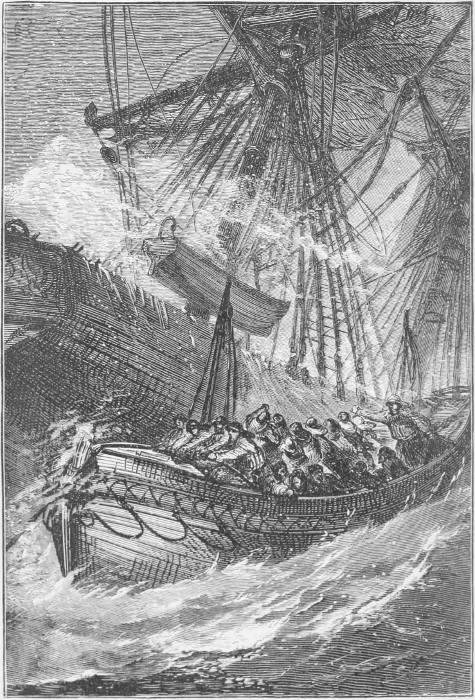
The life-boat is afloat within the circle of the bed; the brig threatens
to roll over her. "Shove and haul off, quick! Shove and haul off," are
the orders. Some with oars, pushing against the brig, others hauling
might and main upon the brig's hawser, they manage to pull the boat two
or three yards up towards the boat's anchor, and to get her a little
farther off from the side of the brig. Now she grounds heavily upon the
edge of the basin that has been worked in the sand by the brig. "Strain
every muscle, men; now, or never! now, or never! for your lives pull!"
and pull and strain they did. No! not one inch will the life-boat stir;
she falls over on her side, the surf and seas sweep over her, the men
cling to the thwarts and gunwale; all but her own crew give up all
thoughts of hope; but they know the capabilities of the boat and do not
lose heart—Crash! the brig heaves, and crushes down upon her bilge;
again and again she half lifts upon an even keel and rolls, and lurches
from side to side; each time that she falls to leeward, she comes more
and more over and nearer to the boat.
This is the danger that may well make the stoutest heart quail. The boat
is aground—helplessly aground; her crew can see through the darkness of
the night the yards and masts of the brig swaying over their heads; now
tossing high in the air as the brig rights, and now falling nearer and
nearer to them, sweeping down over their heads, swaying and rending in
the air, the blocks, and ropes, and torn fragments of sails, flying
wildly in all directions. Let but one of the swaying yards but hit the
boat, she must be crushed and all lost. The men crouch down closer and
closer, clinging to the thwarts as the brig falls to them; casting dread
glances at the approaching yards; all right once more; another pull at
the cable—hard, men, hard; over again comes the brig; stick to it, men,
stick to it, my men; crushed or drowned it will be soon over if we
cannot move the boat; another pull, all together; again, and again, they
make desperate efforts to stir the boat, but she will not move one inch;
they must wait, and if needs be, wait their doom; and as they wait the
danger each moment increases.
It is a fearful time of suspense, this waiting aground on the dread
Goodwin, in the darkness and wildness of the storm, half dead with cold
and the ceaseless rush of surf over them, and watching in the shadowy
darkness the swaying masts of the rolling brig, swinging nearer and
nearer, and how will this question of life and death be decided? Which
will happen first? will the tide flow sufficiently to float them, or
will the brig crush them with her masts and yards before they can get
beyond her reach.
The men can do nothing more in the dark wild night and terrible danger;
each minute seems an hour; they almost forget to try and protect
themselves from the wind and spray, and they watch the brig as if
spellbound, as she rolls nearer and nearer; each moment the position
gets more desperate.
Any one hit? as the flying blocks hanging from the yard-arms rattle over
the heads of the men in the boat. No! but a few feet nearer and we
should all have been crushed—a turn or two more and we shall be
finished. There is a stir among the men; the moment seems come; they
prepare for the last struggle. Some are getting ready to spring for the
flying rigging of the brig, as it sways over their heads, hoping thus to
get on board the wreck if the life-boat is crushed up. "Stick to the
boat, men! stick to the boat, men, it's our only chance," the coxswain
cries out, "the brig must soon go to pieces, while we may yet get clear;
stick to the boat!" And the brig, which had quivered while lying on her
side as if coming bodily over, while the dark yards hovered over the
crouching men, lifted again, and once more the men breathe with a sigh
of relief; for that time they quite expected the boat to be crushed and
pinned where she lay.
At this moment the boat trembles beneath them, lifts a little on the
swell of the tide that is beginning to reach her, and grounds again.
It is like a word of life to the men, and instantly all are on the
alert, they get all their strength on the hawser, and as the boat lifts
again, and comes a little more on an even keel, they draw her a yard or
two nearer to her anchor, but not any farther from the brig, and over
again the brig slowly rolls; again and again they make desperate efforts
to get beyond the reach of her dark side, and swinging yards and masts,
but it is long before they can do so: at last they succeed as the water
flows still more, and now they ride to their anchor a few yards beyond
the reach of the brig, which they watch break up, and listen to the
groaning and rending of her timbers, and the flapping of her torn sail
and tangled rigging. Both the wind and tide are setting with all their
force right upon the Sands, and the captain of the boat sees what is
before them; where they are now at anchor will soon be one wild rage of
broken sea. To get away from the sand in the face of the fierce gale and
tide is impossible; and so there is no alternative, they must beat right
across the Sands, and this in the wild fearful gale, and terrible sea,
and pitch dark night, and what the danger of this is, only those who
know the Goodwin Sands, and the dread seas that sweep over them, can at
all imagine.
They ride at anchor for some time, waiting for the tide to rise
sufficiently for them to get over the Sands. They see the lights of the
steamer shining in the distance, outside the broken and shallow water;
but there is no hope of assistance from her: their lanterns are washed
out, they cannot signalize; and if they could, the steamer could not
approach them.
The sea is breaking furiously over them. Time after time the boat fills
as the broken waves wash clean over her, but instantly she empties
herself again, and rises to her water-line. The gale sweeps by more
fiercely than ever. The men are nearly washed out of the boat, and worse
still, the anchor begins to drag. The tide has made a little, and they
are being driven each moment nearer to the wreck; there may be water
enough to take them clear; at all events, there is no help for it, they
must risk it. "Hoist the foresail; stand by to cut the cable. All
clear."—"Ay, Ay!"—"Away then."
And the boat quickly heads round, and then, under the power of the gale
and tide, leaps forward, flies along; but only for a few yards, when,
with a tremendous jerk, she grounds upon the Sands. The crew look up,
and their hearts almost fail them, as they find that they are again
within reach of the brig.
Her top-gallant masts are swaying about, her yards swing within a few
feet of them, her sails which have blown loose and are in ribbons, beat
and flap like thunder over their heads. Their position seems worse than
ever; but they are not this time kept long in suspense. A huge breaker
comes foaming along; its white crest gleams out in the darkness high
above them, a moment's warning, it breaks over them and swamps them, but
all are clinging might and main to the boat.
Another breaker comes streaming along; it swamps them again in passing,
but now the volume of the wave seizes the boat, up it seems to swing it
in its mighty arms, and to bodily hurl it forward; and then the boat
crashes down on the Sands as the wave breaks, and grounds them with a
shock that would have torn every man out of her, if they had not been
holding on.
But one great peril is passed; the mighty swing of the huge waves has
carried them yards forward, and they are clear of the wreck; but at
that moment they are threatened with another danger almost as terrible.
The small Dreadnought life-boat has been in tow all this time; it has
not been wise to have her in tow, but she belongs to the Broadstairs
boatmen, and neither they nor the Ramsgate boatmen like to abandon her.
As the Ramsgate boat now grounds, the smaller boat comes bow on to her,
sweeps round, and gets under her side; the two boats roll and crash
together; each roll the larger one gives, each lift of the sea, she
comes heavily down on the other boat; the crash and crack of timbers are
heard; which boat is it that is breaking up? Both, if this continues,
must be very speedily destroyed. Some of the men get out the oars and
boat-hooks, and push for their very lives, thrusting and striving their
utmost to free the Dreadnought, which is so dangerously thumping and
crashing under the quarter of the larger boat. It is a terrible struggle
in that boiling sea, with the surf breaking over them. But all their
efforts seem in vain, the boats still crash and roll together; one of
them is breaking up fast. "Oars in," shouts the coxswain; "over the side
half-a-dozen of you—take your feet to her;" and some of the brave
fellows spring over, clinging to the rail of the deck of the high
air-boxes that are at the bow and stern of the Ramsgate life-boat. Again
and again, all together, a fierce struggle, but without success; a big
wave comes rolling on, it washes over them, but as the larger boat
lifts, the men blindly thrust out with their feet, and the
Dreadnought is pushed clear. The men scramble, or are dragged back
into the Ramsgate boat; the tow-rope is cut, and the Dreadnought,
almost a wreck, is swept away by the tide, and is lost in the darkness,
while, most mercifully, the Ramsgate boat still remains uninjured.
A third time they are providentially saved from what seemed almost like
certain death; and yet they have only commenced the beginning of their
troubles, for is there not before them the long range of sands, with the
broken fierce waves and raging surf, and many a fragment of wreck, like
sunken rocks studded here and there, upon any one of which, if they
strike, it must be death to them all?
The boat is still aground upon the ridge of sand. She lifts, and is
swept round, and grounds again broadside to the sea, which makes a clean
breach over her. The Portuguese are all clinging together under the lee
of the foresail, and there is no getting them to move. The crew are
holding on where they can; sometimes buried in the water, often with
only their heads out. The captain is standing up in the stern, holding
on by the mizen-mast; sometimes he can see nothing of the men as the
surf sweeps over them. He orders the chests to be thrown overboard, but
most of them are already washed away; the rest are unlashed from their
fastenings, and lifted as the men can get at them, and the next wave
carries them away. Heavy masses of cloud darken the sky; the rain falls
in torrents; it is bitterly cold; the men can do nothing but hold on;
the tide rises gradually; suddenly the boat lifts again; it is caught
by the driving sea, and is flung forward. There is no keeping her
straight, the water is too broken; her stern frees itself before the
bow, and round she swings; her bow lifts a little; onward she goes a few
yards, and grounds again by the stern; round sweeps the bow, and with
another jerk she comes broadside on the Sands again, lurching over on
her side, with the terrible surf making a clean sweep over the waist. It
is a struggle for the men to get their breath, the spray beats over them
in such clouds. This happens time after time. The captain calls the men
aft, that the boat may be lightened in the bow, and thus be more likely
to keep straight. Most of the boatmen come to the stern, but the
Portuguese will not move, and even some of the boatmen are so exhausted
with the violent exertions they have made, and by the beating of the
waves, that they are almost unconscious, and only able to cling to the
gunwale and thwarts of the boat with an iron, nervous grasp, and are
thus just able to save themselves from being washed out of her. As the
coxswain notices their exhausted state, he expects each time as the big
waves wash over them to see some of them leave go their hold and be
carried away; and although he makes as light of it as he can, and tries
to cheer them up, he himself has very small hope of ever seeing land
again.
The sands on the sea shore, if there has been any surf, appear at low
tide uneven with the ridges or ripples the waves have left on them. On
the Goodwins, where the force of the sea is in every way multiplied,
and the waves break and the tide rushes with tenfold power, the little
sand ripples of the smoother shore become ridges of two or three feet
high.
It is on these ridges that the life-boat so continually grounds. As the
tide rises she is swept from one to the other by the long sweeping
waves; she is swung round and round in the swirl of the cross-seas and
rapid tide, thumping and jerking heavily each time that she strands. All
this is in the midst of darkness, of bitter cold, and of a raging wind,
surf, and sea, until the hardship and peril are almost too much to be
borne, and some of the men feel dying in the boat.
One old boatman afterwards thus described his feelings. "Well, sir,
perhaps my friends were right when they said I hadn't ought to have gone
out—that I was too old for that sort of work"—he was then about sixty
years of age—"but, you see, when there is life to be saved, it makes
one feel young again; and I've always felt I have had a call to save
life when I could; and I wasn't going to hang back then; and I stood it
better than some of them after all. I did my work on board the brig, and
when she was so near falling over us, and when the Dreadnought
life-boat seemed knocking our bottom out, I got on as well as any of
them; but when we got to beating, and grubbing over the Sands, swinging
round and round, and grounding every few yards with a jerk that bruised
us sadly, and almost tore our arms out from the sockets—no sooner
washed off one ridge, and beginning to hope that the boat was clear,
than she thumped upon another harder than ever, and all the time the
wash of the surf nearly carrying us out of the boat—it was truly almost
too much for any man to stand. There was a young fellow holding on next
to me; I saw his head begin to drop, and that he was getting faint, and
going to give over; and when the boat filled with water, and the waves
went over his head, he scarcely cared to struggle free. I tried to cheer
him a bit, and keep his spirits up. He just clung to the thwart like a
drowning man. Poor fellow, he never did a day's work after that night,
and died in a few months.
"Well, I couldn't do anything with him, and I thought that it didn't
matter much, for I felt it must soon all be over; that it couldn't be
long before the boat would be knocked to pieces. So I took my life-belt
off, that I might have it over all the quicker; for I knew that there
would be no chance whatever of life if the boat once went, and I would
have it over all the quicker, for I didn't want to be beating about
those sands alive or dead longer than I could help; the sooner I went to
the bottom, the better, I thought. When once all hope of life was
over—and that time seemed close upon us every moment—some of us kept
shouting, just cheering ourselves and one another up, as well as we
could; but I had to give that up, and I remember hearing the captain
crying out, 'We will see Ramsgate yet again, my men, if we steer clear
of old wrecks,' And then I heard the Portuguese lad crying, and I
remember that I began to think that it was a terrible dream, and
pinched myself to see if I was really awake; and I began to feel very
strange and insensible. I didn't feel afraid of death, for, you see, I
hadn't left it to such times as that to prepare to meet my God. And if
ever I spent hours in prayer, be sure I spent them in prayer that night.
And I just seemed going off in a kind of dead faint, and felt very
dream-like, and as if I couldn't hold on any longer; and as I felt this
I thought, in a feeble sort of way, of my friends ashore, and bid them
good-bye like, for I knew that I should be soon washed out of the boat,
when I looked up, and the surf was curling up both sides of the boat,
and I was going to throw myself down on the thwart, that the seas might
beat upon my back, and I should never have lifted it up again, when I
saw a bright star. The clouds had broken a little, and there was that
blessed beautiful star shining out. Yes, truly it was a blessed
beautiful star to me; as it caught my eye it seemed, in my weak state,
to lay a strange hold upon me; to gather all my attention, and to call
me back to life again. And I began to have a little thought about seeing
my home again, and that I wasn't going to be called away just yet. And I
straightened myself up a little, and laid a firmer hold upon the boat,
and lifted my head to look for the star after each time the seas beat
over us, and I kept my eye upon it whenever I could; and I cannot
explain how it was, but looking for and watching that star kept me up,
and when I got ashore, I seemed at first not much worse than the best of
them. But for seven whole days after that I lost my speech, and lay
like a log upon my bed; and I was ill a long time—indeed, have never
been right since, and I suppose at my age I never shall get over it. But
what is more, I believe something of the same sort may be said of most
of those that were in the boat that night. One poor young fellow is
dead, another has been subject to fits ever since, and not any of us
quite the men we were before, and no wonder when you think what we
passed through.
"I cannot describe it, and you cannot, neither can any one else; but
when you say you've beat and thumped over those sands, almost yard by
yard, in a fearful storm on a winter's night, and live to tell the tale,
why it seems to me about the next thing to saying that you've been dead,
and brought to life again."
The coxswain of the life-boat, brave Isaac Jarman, was chosen for that
position for his fortitude, skill, and daring, and well did he sustain
his character that night, never for one moment losing his presence of
mind, and doing his utmost to cheer the men up. The crew consisted of
hardy, daring fellows, ready to face any danger, to go out in any storm,
and to do battle with the wildest seas; but the horrors of that night
were almost too much for the most iron nerves.
The fierce freezing wind, the almost pitch darkness, the terrible surf,
and beating waves, and the men unable to do anything for their safety;
the boat driven, almost hurled, by the force of the waves from sand
ridge to sand ridge, and apparently breaking up beneath them each time
she lifted on the surf and crushed down again upon the Sands, besides
the danger of her getting foul of any old wrecks—how all this was lived
through seemed miraculous. Time after time there was a cry of "Now she
breaks up! she can't stand this! all over at last!" Another such thump,
and she is done for, and then the boat would writhe, almost on her beam
ends, while the waves beat over, until she was again lifted and thrown
forward to crash down and ground again; and all this lasted for about
two hours, as almost yard by yard they beat from ridge to ridge over the
sands.
Suddenly the swinging and beating of the boat cease; she is in a very
heavy sea, but she answers her helm and keeps her head straight. At last
they have got over the Sands and into deep water; the danger is passed,
and they are saved. With new hopes comes new life. Some can scarcely
realize their comparative safety, and still keep their firm hold upon
the boat, expecting each second another terrible lurch and jerk upon the
Sands, and the heavy rush and wash of the seas. No: that is all over,
and the boat, in spite of her tremendous knocking about, is sound, and
sails buoyantly and well.
The crew quickly get further sail upon her, and she makes way before the
gale to the westward. The Portuguese sailors lift their heads. They have
been clinging together and to the boat, crouching down under the lee of
the foresail during the time of beating over the Sands; they notice the
stir among the boatmen, and that the terrible jerking and thumping of
the boat and the rush of sea over her have ceased; and they also learn
that the worst is passed, and that the danger is at an end.
Long since did they despair of life; and their surprise and joy now know
no bounds. Bravely on goes the life-boat, making for the westward. The
Portuguese are very busy in earnest consultation. The poor fellows have
lost their kit, and only possess the things they have on, and a few
pounds that they have with them. Soon it becomes evident what the
consultation has been about. "Coxswain!" one of the boatmen cries out,
"they want to give us all their money!"
"Yes! yes!" said the interpreter, in broken English, "you have saved our
lives! Thank you! thank you! but all we have is yours; it is not much,
but you take it between you;" and he held out the money. It was about
17l.
"I, for one, won't touch any of it," said the coxswain of the boat. "Nor
I!" "Nor I!" others added; "put your money up."
The brave fellows will not take a farthing from brother sailors, whom
they know to be poor, much like themselves; and in a few words they make
them understand this, and how glad they are to have saved them.
The life-boat makes good way, and soon runs across the Sands through the
Trinity Swatch Way, and, without further adventure, she reaches the
harbour about five o'clock in the morning. The crew of the brig are
placed under the care of the Portuguese Consul, and the boatmen go to
their homes, to feel for many a long day the effects of the fatigues
and perils of that terrible night.
During all this time the steamer has been cruising up and down the edge
of the Sands, vainly searching for any trace of the life-boat; and soon
after daylight she made, as has been already described, for the harbour.
Her captain and crew are half broken-hearted, and scarcely know how they
shall be able to tell the tale of the terrible calamity that seems so
certainly to have happened. Suddenly, as the mouth of the harbour opens
to them, they see the life-boat. They stare with amazement, and can
scarcely believe their eyes. "Astonished," said the captain of the
steamer, describing his feelings, "that I was; never so much so in my
life, as when I stood looking at that boat. I could have shouted and
cried for very wonder and joy; you might have knocked me down with a
straw." Thus the captain of the steamer described his feelings. It was
the same with all the crew; and as the steamer shot round the pier and
heard that all were saved, and the life-boatmen all right, the good news
seemed to more than repay them for the dangers and anxieties of the
night.
Thus did the crew of the gallant life-boat and of the steamer help to
earn that night the noble reputation that belongs to our boatmen and
sailors at large—testimony to which was given, on one occasion, by a
foreign captain, who said, "Ah! we may always know whether it is upon
the English coast that we are wrecked, by the efforts that are made for
our rescue."