What is a book? It is an invention by
means of which thought is recorded, and
carried about in the world, and handed down from
one age to another. Almost as soon as men began
to think they began to make books and they will
probably continue to make them as long as they continue
to think. The story of the Book, therefore,
takes us back to the very beginning of human existence.
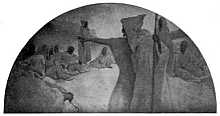
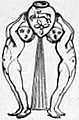
FIG. 1.—TRADITION.
A Mural Decoration in the Library of Congress.
At first thought was recorded and preserved by
tradition. An account of a nation's deeds, its laws,
the precepts of its religion were stamped, printed, on
the memory of persons specially trained to memorize
these things and hand them down by word of mouth
from generation to generation (Fig. 1). These
persons were usually priests, who underwent long
years of daily and hourly training in memorizing
what was to be handed down. The Sanskrit Vedas,
the sacred scripture of the Hindoos, were for many
centuries transmitted by tradition, and it is said it
took forty years to memorize them. It is a wonder
it did not take longer, for the Vedas make a volume
as large as our Bible. It is believed that primitive
people everywhere first adopted the method of tradition
to record and preserve the thought which they
did not wish to perish. We may say, then, that the
first book was written on the tablet of the human
memory.
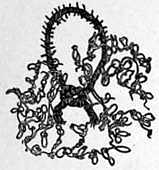
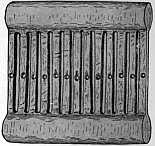
FIG. 2.—THE QUIPU OF
THE PERUVIANS.
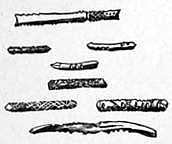
FIG. 3.—MESSAGE-STICKS.
The first step in the growth of the book was taken
when memory aids were invented. Sometimes we
tie a knot in a handkerchief to help us to remember
something. Now, it was just by tying knots that
primitive man first lent assistance to the memory.
The first material book was doubtless a series of
knots well represented by the quipu (Fig. 2) of the
ancient Peruvians. This curious-looking book was
written (tied) by one known as the officer of the
knots. It contains an account of the strength of the
Peruvian army, although it is confessed that its exact
meaning cannot be made out. It was not intended to
be read by any one who was not a keeper of the knots.
Books made of knots were used by nearly all the
ancient peoples of South America and by some of
those of Asia. Akin to the knotted cord is the
notched stick, which is still used in Australia by the
savages to assist the memory of one who has a message
to carry. Figure 3 shows a variety of such
message-sticks. The lowest one—a crooked branch
of a tree—contains an invitation to a dancing party.
The notches are read by the messenger. The
notched stick as an aid to memory is not confined
to savage races. Many a highly civilized baker has
kept his accounts by making notches in sticks and so
has many a modern dairyman, as he has delivered
milk from door to door.
Memory aids were followed by picture-writing.
To express thought by means of pictures is an instinct
shared alike by the lowest savage and the most
enlightened people. All over the earth we find examples
of early picture-writing. A beloved chief
had died, a fierce battle had been fought, an exciting
chase had occurred: promptly the event was pictured
on a stone or on the skin of some animal. Pages
might be filled with illustrations of these primitive
picture-books, but we must be
content with a single specimen
(Fig. 4). This was found
painted on a rock in California:
"We selected this as a
camping place, but we have
found nothing," say the human
figures f, g, h, i. The
upturned palms say plainly,
"nothing, nothing." "One of our comrades (d)
has died of starvation," say the three lank figures
at c pointing to their own lean bodies. "We deeply
mourn his loss," says the sorrow-stricken a. "We
have gone northward," says j, his distinguished arm
extended to the north.
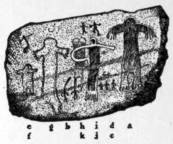
FIG. 4.—PICTURE WRITING.
Practice in picture-making was bound to lead to
shorter methods of expressing ideas. It was soon
found that reduced pictures, or picture-signs, would
suffice to express ideas. Thus, if the idea of sorrow
was to be expressed it was not necessary to draw an
elaborate picture of a sorrowful looking man like a
in Figure 4; a weeping eye would express the idea
just as well. Instead of numerous figures (e, f, g,
h, i) weeping and saying, "nothing here," a single
pair of empty palms would say the same thing just
as clearly. In this way a pair of clasped hands
came to mean "friendship"; two trees meant "a
forest"; a calf running toward water meant "thirst."
These picture-signs, of course, assumed the form in
which they could be most easily and rapidly drawn.
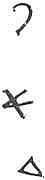
The weeping eye became
![[symbol: eye]](https://openoldbooks.sgp1.digitaloceanspaces.com/books/stories-of-useful-inventions/images/i_207a.jpg) ;
the pair of extended
palms
;
the pair of extended
palms
![[symbol: palms]](https://openoldbooks.sgp1.digitaloceanspaces.com/books/stories-of-useful-inventions/images/i_207b.jpg) ;
the forest
;
the forest
![[symbol: trees]](https://openoldbooks.sgp1.digitaloceanspaces.com/books/stories-of-useful-inventions/images/i_207c.jpg) ;
thirst
;
thirst
![[symbol: dog walking on water]](https://openoldbooks.sgp1.digitaloceanspaces.com/books/stories-of-useful-inventions/images/i_207d.jpg) .
A simple picture of this kind became a fixed conventional
sign for certain ideas; it was always drawn
in the same way and it always stood for the same
idea.
.
A simple picture of this kind became a fixed conventional
sign for certain ideas; it was always drawn
in the same way and it always stood for the same
idea.
Picture-signs (ideographs) followed picture-writing
in almost every country where the people were
progressive. China was writing its books with
picture-signs many thousands of years ago, and it is
writing them in the same clumsy way still. Even in
highly civilized countries picture-signs have not been
entirely abandoned. Examine the advertising page
of a newspaper or observe the business signs on the
street and you will find picture-signs—pictures that
are always made in the same way and that always
stand for the same thing.
Each of the great nations of antiquity had its own
peculiar system of writing, but the system that should
interest us most is that of ancient Egypt, for it is to
ancient Egypt that you must look for the origin of
the book that is in your hands. The book in Egypt
passed through the stages of tradition, memory aids,
picture-writing and picture-signs (ideographs); then
it passed into the alphabetic stage. Since the alphabet
is certainly the most wonderful and perhaps the
most useful of all inventions, and since it is an Egyptian
invention, it is well worth your while to learn
how the Egyptian picture-signs—hieroglyphics they
are called—grew into letters, but if you wish to
understand the change you will have to give the subject
very close attention.
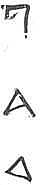
Well, here was the Egyptian system of picture-signs
consisting of several thousand pictures of birds,
beasts, reptiles, insects, trees, flowers, and objects of
almost every description. Now suppose you were
employed in writing English by means of several
thousand picture-signs and in the course of an hour
would have to write the words manage, mansion,
mantle, mandate, might it not occur to you that it
would be a good thing if that sound man could be
represented by the picture-sign for man
(![[symbol: man]](https://openoldbooks.sgp1.digitaloceanspaces.com/books/stories-of-useful-inventions/images/i_208a.jpg) )?
And if you had to write treacle, treason, treaty,
might you not feel like beginning these words with
a tree
(
)?
And if you had to write treacle, treason, treaty,
might you not feel like beginning these words with
a tree
(![[symbol: tree]](https://openoldbooks.sgp1.digitaloceanspaces.com/books/stories-of-useful-inventions/images/i_208b.jpg) )?
At some time in the remote past
Egyptian scribes—priests they usually were—noticing
that syllables identical in sound were constantly
recurring in the different words, began to
represent these syllable-sounds that occurred most
frequently by picture-signs.20 The picture-sign substituted
for a syllable-sound was placed in the word
not because it stood for an idea, but because it stood
for a sound, just as in the case supposed above you
would use the [symbol: man] or the [symbol: tree] not because it represented
a thought, but because it had a certain sound.
So certain Egyptian picture-signs began to be used
to represent the sound of certain syllables. The
picture-signs thus chosen were called phonograms.
)?
At some time in the remote past
Egyptian scribes—priests they usually were—noticing
that syllables identical in sound were constantly
recurring in the different words, began to
represent these syllable-sounds that occurred most
frequently by picture-signs.20 The picture-sign substituted
for a syllable-sound was placed in the word
not because it stood for an idea, but because it stood
for a sound, just as in the case supposed above you
would use the [symbol: man] or the [symbol: tree] not because it represented
a thought, but because it had a certain sound.
So certain Egyptian picture-signs began to be used
to represent the sound of certain syllables. The
picture-signs thus chosen were called phonograms.
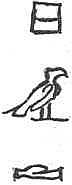
The phonogram led to the alphabet. The scribes
in seeking a way to shorten their work found that
the syllable itself could be broken up into separate
sounds. For example, when they came to the syllable
whose sound is spelled by our three letters
pad, they found that it had three distinct sounds,
namely: (1) one a lip sound which could be represented
by the first sound of the picture-sign
![[symbol: door]](https://openoldbooks.sgp1.digitaloceanspaces.com/books/stories-of-useful-inventions/images/i_209a.jpg) (a door); (2) one an open-throat or vowel sound
which could be represented by the first sound of the
picture-sign
(a door); (2) one an open-throat or vowel sound
which could be represented by the first sound of the
picture-sign
![[symbol: eagle]](https://openoldbooks.sgp1.digitaloceanspaces.com/books/stories-of-useful-inventions/images/i_209b.jpg) (an eagle); (3) one a dental
sound which could be represented by the first sound
in the picture-sign
(an eagle); (3) one a dental
sound which could be represented by the first sound
in the picture-sign
![[symbol: hand]](https://openoldbooks.sgp1.digitaloceanspaces.com/books/stories-of-useful-inventions/images/i_209c.jpg) (a hand). So the scribes
wrote the syllable (p-a-d) with the three characters
(a hand). So the scribes
wrote the syllable (p-a-d) with the three characters
![[symbols: door, eagle, hand]](https://openoldbooks.sgp1.digitaloceanspaces.com/books/stories-of-useful-inventions/images/i_209d.jpg) .
And so with all the other
sounds in the Egyptian language; each was represented
by one of the picture-signs already used.
Since there were only about twenty-five distinct elementary
sounds in the Egyptian language, twenty-five
picture-signs were sufficient to represent any
sound or any word in the language. These twenty-five
picture-sounds were the letters of the Egyptian
alphabet. Twenty-five characters instead of thousands!
Now the Egyptian youth could learn to
read in three or four years, whereas under the old
system it took fifteen or twenty years, just as it takes
fifteen or twenty years for the Chinese youth to learn
to read well.
.
And so with all the other
sounds in the Egyptian language; each was represented
by one of the picture-signs already used.
Since there were only about twenty-five distinct elementary
sounds in the Egyptian language, twenty-five
picture-signs were sufficient to represent any
sound or any word in the language. These twenty-five
picture-sounds were the letters of the Egyptian
alphabet. Twenty-five characters instead of thousands!
Now the Egyptian youth could learn to
read in three or four years, whereas under the old
system it took fifteen or twenty years, just as it takes
fifteen or twenty years for the Chinese youth to learn
to read well.
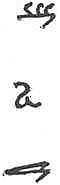
Now that its origin has been explained, the story
of the alphabet may be rapidly told. Indeed, its
whole history can be learned from Figure 5. In
column (a) are the three Egyptian picture-signs referred
to above. Column (b) shows how the rapid
writing of the priests reduced the old hieroglyphics
to script;
![[symbol: door]](https://openoldbooks.sgp1.digitaloceanspaces.com/books/stories-of-useful-inventions/images/i_210a.jpg) became
became
![[symbol: three c's]](https://openoldbooks.sgp1.digitaloceanspaces.com/books/stories-of-useful-inventions/images/i_210b.jpg) ;
;
![[symbol: eagle]](https://openoldbooks.sgp1.digitaloceanspaces.com/books/stories-of-useful-inventions/images/i_210c.jpg) became
became
![[symbol: like an 'a']](https://openoldbooks.sgp1.digitaloceanspaces.com/books/stories-of-useful-inventions/images/i_210d.jpg) and
and
![[symbol: hand]](https://openoldbooks.sgp1.digitaloceanspaces.com/books/stories-of-useful-inventions/images/i_210e.jpg) became
became
![[symbol: squiggle]](https://openoldbooks.sgp1.digitaloceanspaces.com/books/stories-of-useful-inventions/images/i_210f.jpg) .
The Phœnicians, who
were great travelers, visited Egypt at a very early
date and borrowed not only the idea of the alphabet,
but also the forms of the Egyptian letters, as column
c shows. Column d confirms the words of Herodotus,
who tells us that the Greeks borrowed their
alphabet from the Phœnicians. Column e shows
that the Greeks handed the alphabet on to the
Romans, who handed it on to us. Thus the three
letters p, a, d come straight from the Egyptians and
were originally a door, an eagle, and a hand, respectively.
As it is with these three letters, so it is
with nearly all the letters of our alphabet. If the
letters on the page before you could be suddenly
changed to their original form, you would behold a
motley collection of birds, serpents, animals, tools,
and articles of household use.
.
The Phœnicians, who
were great travelers, visited Egypt at a very early
date and borrowed not only the idea of the alphabet,
but also the forms of the Egyptian letters, as column
c shows. Column d confirms the words of Herodotus,
who tells us that the Greeks borrowed their
alphabet from the Phœnicians. Column e shows
that the Greeks handed the alphabet on to the
Romans, who handed it on to us. Thus the three
letters p, a, d come straight from the Egyptians and
were originally a door, an eagle, and a hand, respectively.
As it is with these three letters, so it is
with nearly all the letters of our alphabet. If the
letters on the page before you could be suddenly
changed to their original form, you would behold a
motley collection of birds, serpents, animals, tools,
and articles of household use.
We must look to Egypt for the origin of the material
form of our book as well as for the origin
of our alphabetical characters. Before history had
dawned the Egyptians had covered over with their
writing nearly all the available surface on their pyramids
and in their temples. At a time too far back
for a date necessity seems to have compelled them
to seek a substitute for stone. This they found in
the papyrus plant, which grew in great luxuriance
in the valley of the Nile. They placed side by side
strips of the pith of the papyrus, and across these at
right angles they placed another layer of strips.
The two layers were then glued together and pressed
until a smooth surface was formed. This made one
sheet. To make a book a number of sheets were
fastened together end to end. When in book form
the papyrus was wound around a stick and kept in
the form of a roll, a volume (Fig. 6). The roll
was usually eight or ten inches wide, but its length
might be upward of a hundred feet. This papyrus
roll was the parent of our modern paper book, as
the word papyrus is the original of our word paper.
The pen used in writing upon papyrus was a split
reed (calamus), and the ink a mixture of soot and
gum.
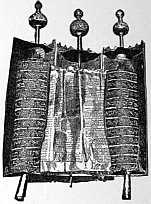
FIG. 6.—AN ANCIENT VOLUME.
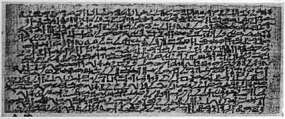
FIG. 7.—THE OLDEST BOOK IN THE WORLD. WRITTEN NEARLY 5,000
YEARS AGO.
The most ancient volume in the world is an Egyptian
papyrus (Fig. 7) now in the National Library
of France. It was written nearly 5,000 years ago
by an aged sage and contains precepts of right living.
In this oldest of volumes we find this priceless gem:
"If thou art become great, if after being in poverty
thou hast amassed riches and art become the
first in the city, if thou art known for thy wealth and
art become a great lord, let not thy heart become
proud, for it is God who is the author of them for
thee."
In Assyria and in other ancient countries of
Central Asia letters were engraved on cylinders
and these were rolled upon slabs of soft clay, making
an impression of the raised letters, just as
we make an impression with the seal of a ring. In
the ruins of the cities of Assyria these old clay
books may be found by the cart-load. The Assyrian
cylinder was really the first printing press. In ancient
Greece and Rome wooden tablets within which
was spread a thin layer of wax were used as a writing
surface in schools and in the business world.
The writing on the wax was done with a sharp-pointed
instrument of bone or iron called the stylus.
But next to papyrus the most important writing material
of antiquity was parchment, or the prepared
skin of young calves and kids. The invention of
parchment is said to have been due to the literary
ambitions of two kings, the king of Persia and the
king of Egypt. The king of Pergamus (250 B.C.)
wishing to have the finest and largest library in the
world was consuming enormous quantities of papyrus.
The king of Egypt, who also wished to have
the finest library in the world, in order to cripple
the plans of his literary rival, issued a command forbidding
the exportation of papyrus from Egypt.
The king of Pergamus, being unable to get papyrus
except from Egypt, caused the skins of sheep
to be prepared, and on these skins books for his
library continued to be written. The prepared
skins received the name of pergamena, because they
were made in Pergamus, and from pergamena we
get the word parchment. This is the story that has
come down to us to explain the origin of parchment,
but it cannot be accepted as wholly true. We know
very well that the Old Testament was written in gold
on a roll of skins long before there was a king of
Pergamus. Indeed, writing was done on skins as
far back as the picture-writing period.
After the invention of the alphabet and of paper
(papyrus) books multiplied as never before. "Of
making many books there is no end," exclaimed
Solomon a thousand years before the Christian
era. Greece in her early day was slow to make
books, but after she learned from the Phœnicians
(800 B.C.) how to use an alphabet she made up for
lost time. In 600 B.C. there was a public library at
Athens, and 200 years later the Greeks had written
more good books than all the other countries in the
world combined.
But the most productive of ancient book-makers
were the Romans. In Rome publishing houses were
flourishing in the time of Cicero (50 B.C.). Atticus,
one of Cicero's best friends, was a publisher. Let
us see how a book was made in his establishment.
Of course, there were no type-setters or printing-presses.
Every book was a manuscript; every word
of every copy had to be written with a pen. The
writing was sometimes done by slaves trained to
write neatly and rapidly. We may imagine 50 or
100 slaves sitting at desks in a room writing to the
dictation of the reader. Now if Atticus had ten
readers each of whom dictated to 100 slaves it took
only two or three days for the publication of 1,000
copies of one of his friend Cicero's books. Of
course every copy would not be perfect. The slave
would sometimes make blunders and write what the
reader did not dictate. But books in our own time
are not free of errors. An English poet recently
wrote:
"Like dew-drops upon fresh blown roses."
In print the first letter of the last word in the line
appeared as n instead of r. This mistake disfigured
thousands of copies. In the Roman publishing
house such a blunder marred only one copy.
You can readily see that by methods just described
books could be made in great numbers. And so
they were. Slaves were cheap and numerous and
the cost of publication was small. It is estimated
that a good sized volume in Nero's time (50 A.D.)
would sell for a shilling. Books were cheaper in
those days than they had ever been before and almost
as cheap as they are to-day, perhaps. The
Roman world became satiated with reading matter.
The poet Martial exclaimed, "Every one has me
in his pocket, every one has me in his hand." Books
became a drug on the market and could be sold only
to grocers for "wrapping up pastry and spices."
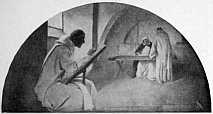
FIG. 8.—BOOK-MAKING IN THE MIDDLE AGES.
But a time was to come when books would not be
so plentiful and cheap. With the overthrow of
Rome (476 A.D.) culture received a blow from
which it did not recover for a thousand years. The
barbarian invaders of Southern Europe destroyed all
the books they could find and caused the writers of
books to flee within the walls of the churches.
Throughout the Middle Ages nearly all the writing
in Europe was done in the religious houses of monks
(Fig. 8), and nearly all the books written were of a
religious nature. The monks worked with the greatest
patience and care upon their manuscripts. They
often wrote on vellum (calf-skin parchment) and
illuminated the page with beautiful colors and
adorned it with artistic figures.
The manuscript volumes of the dark ages were
beautiful and magnificent, but their cost was so great
that only the most wealthy could buy. A Bible
would sometimes cost thousands of dollars. Along
in the 14th and 15th centuries Europe began to thirst
for knowledge and there arose a demand for cheap
books. How could the demand be met? There
were now no hordes of intelligent slaves who could
be put to work with their pens, and without slave
labor the cost of the written book could not be
greatly reduced. Invention, as always, came to the
rescue and gave the world what it wanted.
In the first place, writing material was made
cheaper by the invention of paper-making. The
wasp in making its nest had given a hint for paper-making,
but man was extremely slow to take the
hint. The Chinese had done something in the way
of making paper from the bark of trees as early as
the first century, but it was not until the middle of
the 13th century that paper began to be manufactured
in Europe from hemp, rags, linen, and cotton.

FIG. 9.
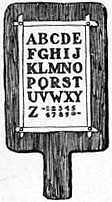
FIG. 10.—A BLOCK
PRINT CONTAINING
THE ALPHABET
USED
BY CHILDREN
WHEN LEARNING
TO READ.
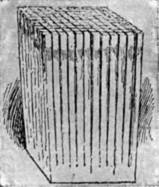
In the second place, printing was invented. On
a strip of transparent paper write the word post.
Now turn the strip over from right to left and trace
the letters on the smooth surface of a block of wood.
Remove the paper and you will have
the result shown in Figure 9. With a
sharp knife cut out the wood from
around the letters. Ink the raised
letters and press upon them a piece of paper. You
have printed the word "post" in precisely the way
the first books were printed. In the 13th century
fancy designs were engraved on wood and by the aid
of ink the figures were stamped on silk and linen.
In the 14th century playing cards and books were
printed on engraved blocks in the manner the word
"post" was printed above. (Fig. 10.) The
block-book was the first step in the art of printing.
The block-book decreased the cost
of a book, for when a page was once
engraved as many impressions could
be taken as were wanted, yet it did
not meet the necessities of the time.
In the middle of the 15th century
the desire for reading began to resemble
a frenzy and the books that
could be got hold of "were as insufficient
to slake the thirsty craving
for religious and material knowledge
as a few rain drops to quench
the burning thirst of the traveler in
the desert who seeks for long, deep-draughts
at copious springs of living
water." To meet the demand of the time book-makers
everywhere were trying to improve on the
block-making process and by the end of the century
the book as we have it to-day was being made
throughout all Europe.
In what did the improvement consist? First let
us call to mind what the book-maker in the early
part of the 15th century had to begin with; he had
paper, he had printing-ink, he had skill in engraving
whole pages for block-books, and he had a rude
kind of printing-press. The improvement consisted
in this: Instead of engraving a whole page on a
block, single letters were engraved on little blocks
called types, and when a word or a line or a page
was to be printed these types were set in the position
desired; in other words, the improvement consisted
in the invention of moveable types. The types were
first made of wood and afterward of metal.
The great advantage of the moveable types over
the block-book is easily seen. A block containing,
say, the word "post" is useless except for printing
the word post; but divide it into four blocks, each
containing a letter: now you can print post, spot,
tops, stop, top, sop, sot, pot, so, to and so forth.
The exact date of the invention of moveable types
cannot be determined. We can only say that they
were first used between 1450 and 1460. Nor can
we tell who invented them. The Dutch claim that
Lawrence Koster of Harlem (Holland) made some
moveable types as early as 1430, and that John
Faust, an employee, stole them and carried them
to Mayence (Germany), where John Gutenberg
learned the secret of printing with them. The Germans
claim that Gutenberg was the real inventor.
Much can be said in behalf of both claims. What
we really know is that the earliest complete book
printed on moveable types was a Bible which came
from the press of John Gutenberg in 1455.
Since 1450 there has been no discovery that has
changed the character of the printed volume. There
have been wonderful improvements in the processes
of making and setting type, and printing-presses
(Fig. 11) have become marvels of mechanical skill,
but the book of to-day is essentially like the book of
four hundred years ago. The tablet of the memory,
the knotted cord and notched stick, the uncanny
picture-writing, the clumsy picture-sign, the alphabet,
the manuscript volume, the printed block-book and
the volume before you bring to an end the story of
the book.
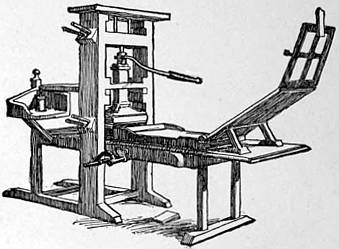
FIG. 11.—AN EARLY PRINTING PRESS.