OUR JOURNEY THROUGH THE WILDERNESS CONTINUED—A
REBELLION IN CAMP—NOTHING TO EAT—I SHOOT A
FISH AND MISS AN ELEPHANT—I KILL A BIG SNAKE,
AND THE OTHERS EAT HIM—MY FIRST SIGHT OF
GORILLAS.
Before we renewed our journey the natives
had done all they could to gather provisions;
but the result was poor enough. By going
to distant villages they had succeeded in getting
a few bunches of plantain.
Mcomo, Mbéné's brother, backed out. He said he
was not going into the cannibal country to be eaten up.
But I must tell you that Mbéné had some friends
among the cannibals. And he sent with me two of
his sons called Miengai and Makinda, together with
twelve good hunters, and six women who were the
wives of some of the men. The women carried the
provisions, etc.
I took seventy pounds of shot and bullets, nineteen
pounds of powder, ten pounds of arsenic for preserving
the birds and animals I should kill, for I knew
I should probably succeed in getting some new
specimens.
When all was arranged, when everybody had taken
leave of all his friends, for this was a very great
journey, and they came back half-a-dozen times to take
leave over again, or say something they had forgotten,
when all the shouting and quarrelling about who
should carry the smallest load was over, we at last got
away.
We had left the camp of Mbéné behind us at a
distance of about five miles when we came to the banks
of a little river called the Noonday, a clear and beautiful
stream. I was ahead of the party with Miengai, and
was waiting for the others to come up before crossing.
As we stood on the banks I spied a fish swimming
along. Immediately the thought came into my mind,
"How nicely that fish would taste if I could get it
and boil it in a pot over the fire!" I fired a charge
of small shot into it; but no sooner had I pulled the
trigger than I heard a tremendous crash on the
opposite bank about six or seven yards off. Small
trees were torn down violently, and then we heard the
shrill trumpetings of a party of frightened elephants.
They were probably sleeping or standing in a dead
silence on the opposite bank in the jungle. I was sorry
I had fired, for after crossing the stream we might have
killed an elephant. Poor Miengai was terribly vexed.
"I am sure," said he, "they had big tusks of
ivory."
Our party, as soon as they heard the gun, came
up in haste, and asked what was the matter. When
they heard the story they began to lament our not
killing an elephant; for then we should have had meat
enough for the whole journey; and they shouted
with one accord: "Elephant meat is so good!"
This exclamation made me wonder how an elephant
steak would taste.
On we went, and got fairly into the mountainous
country. The hills became steeper as we advanced.
How tired I felt; for the diet at Mbéné's camp had
not strengthened me. These Mbondemos had a great
advantage over me. They used their bare feet almost
as deftly as monkeys, and hence got their foothold
more easily than I.
Miengai and I were in advance. All at once he
made me a sign to keep very still. I thought he had
discovered a herd of elephants, or seen the traces of an
enormous leopard. He cocked his gun; I cocked
mine; the other men did the same; and there we
stood in perfect silence, for at least five minutes.
Suddenly Miengai sent a "hurrah" echoing through
the forest. It was immediately answered by shouts
from many voices not very far off, but whose owners
were hidden from us by huge rocks and trees.
Miengai replied with the fierce shout of the Mbondemo
warriors, and was again answered. Thinking we were
going to have a general fight, I looked carefully after
my powder flask and my bullets, and found they were
all right. Going a little farther on, we came in sight
of the encampment of a large party, who proved to be
some of Mbéné's people just returning from a trading
expedition to the interior. Two men of this camp
offered to go with us. Their names were Ngolai and
Yeava. We consented to take them.
What a journey it was! Nothing but thick woods to
struggle through, hills to climb, rivers to cross, and
nearly all the time it rained; in fact, I was wet from
morning to night. How glad I was when, in the
evening, we had made our camp, and built great fires!
For my part, I had three fires lit about my bed of
leaves; and in the evening I always hung up my
clothes to dry, so as to have them ready for the next
day.
One morning my men came to tell me they were
tired, and would not go a step farther unless I gave
them more cloth.
They seemed in earnest; and I began to question
myself whether they meant to plunder me or to
leave me in these mountains. To be left thus alone
would have been almost certain death. To give them
what they asked was to show them I was afraid of
them. If they knew I was afraid of them I did not
know what they might next do. So I determined to
put on a bold front. Taking my two revolvers in my
hand, I said: "I will not give you any more cloth.
I will not let you leave me, because your father
Mbéné has given you to me to accompany me to the Fan
tribe. You must therefore go with me, or" (here I
motioned with my pistols) "there will be war between
us. But," said I, "this is a very hard road, and at
the end of the journey I will give you something
more."
This satisfied them, and we again resumed our
journey. Up, and up, and up we struggled, and now we
began to meet with immense boulders. Not the scream
of a bird, or the shrill cry of a monkey, broke the
stillness of the dark solitude. Nothing was heard but
the panting breaths of our party as we ascended the
hills.
At last we came to an immense mountain torrent,
which rushed down the hillside with fearful force, and
was white with foam. Its course was full of huge
granite boulders, which lay about as though the Titans
had been playing at skittles in that country. Against
these the angry waters dashed as if they would carry
all before them, and, breaking, threw the milky spray
up to the very tree-tops. As I looked up the torrent
seemed to pour its foaming waters directly down upon
us.
This was the head of the Ntambounay river which
I had ascended in a canoe, and on the banks of which I
came near being murdered in the Shekiani village.
What a change had taken place in it! Here a canoe
would be dashed into a hundred pieces against the
rocks.
I was so thirsty and tired that I went to the river's
bank, and drank a few handfuls of the pure, clean cold
water.
After resting a little while, we continued our course
till we reached the top of a very high mountain,
whence I could see all the country round. How wild
and desolate it looked! Nothing but forest and mountains
stretching away as far as the eye could reach.
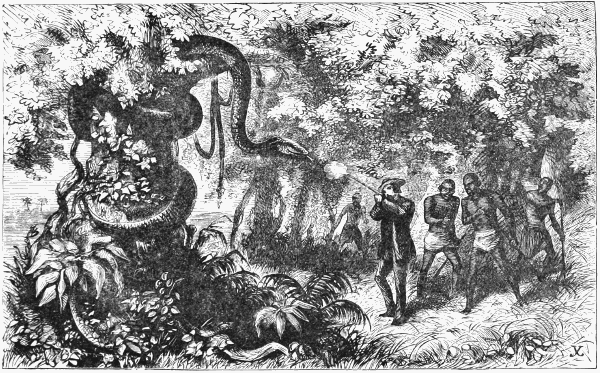
I was sitting under a very large tree, when,
suddenly looking up, I saw an immense serpent coiled
upon the branch of a tree just above me; and I really
could not tell whether he was not about to spring upon
me and entangle me in his huge folds. You may well
believe that I very quickly "stood from under."
I rushed out, and taking good aim with my gun, I shot
my black friend in the head. He let go his hold,
tumbled down with great force, and after writhing convulsively
for a time, he lay before me dead. He
measured thirteen feet in length, and his ugly fangs
proved that he was venomous.
My men cut off the head of the snake, and divided
the body into as many pieces as there were people.
Then they lighted a fire, and roasted and ate it on
the spot. They offered me a piece; but, though very
hungry, I declined. When the snake was eaten I was
the only individual of the company that had an empty
stomach; I could not help reflecting on the disadvantage
it is sometimes to have been born and
bred in a civilized country, where snakes are not
accounted good eating.
We now began to look about the ruins of the village
near which we sat. A degenerate kind of sugar-cane
was growing on the very spot where the houses had
formerly stood. I made haste to pluck some of this,
and chew it for the little sweetness it had. While
thus engaged my men perceived what instantly threw
us all into the greatest excitement. Here and there
the cane was beaten down or torn up by the roots;
and, lying about, were fragments which had evidently
been chewed. There were also footprints to be seen,
which looked almost like those of human beings.
What could this mean? My men looked at each
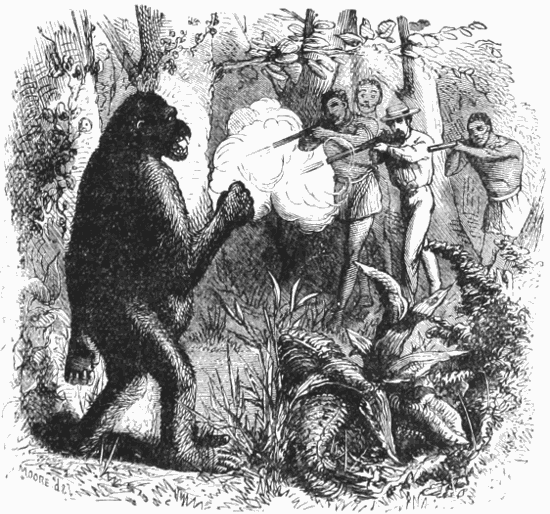
other in silence, and muttered, "Nguyla!" (Gorillas!).
It was the first time I had seen the footprints
of these wild men of the woods, and I cannot tell you
how I felt. Here was I now, it seemed, on the point
of meeting, face to face, that monster, of whose
ferocity, strength, and cunning the natives had told
me so much, and which no white man before had
hunted. My heart beat till I feared its loud pulsations
would alarm the gorilla. I wondered how they looked.
I thought of what Hanno the Carthaginian navigator
said about the wild hairy men he had met on the West
Coast of Africa more than two thousand years ago.
By the tracks it was easy to know that there must
have been several gorillas in company. We prepared
at once to follow them.
The women were terrified. They thought their end
had come—that the gorilla would be soon upon them.
So, before starting in search of the monster, we left
two or three men to take care of them and reassure
them. Then the rest of us looked once more carefully
at our guns; for the gorilla gives you no time to
reload, and woe to him whom he attacks! We were
fortunately armed to the teeth.
My men were remarkably silent, for they were going
on an expedition of more than usual risk; for the male
gorilla is literally the king of the forest—the king of
the equatorial regions. He and the crested lion of
Mount Atlas are the two fiercest and strongest beasts
of that continent. The lion of South Africa cannot be
compared with either for strength or courage.
As we left the camp, the men and women left
behind crowded together, with fear written on their
faces. Miengai, Ngolai, and Makinda set out for the
hunt in one party; myself and Yeava formed another.
We determined to keep near each other; so that in
case of trouble, or in a great emergency, we might be at
hand to help one another. For the rest, silence and a
sure aim were the only cautions to be given.
As we followed the footprints, we could easily see
that there were four or five of them, though none
appeared very large. We saw where the gorillas had
run along on all fours, which is their usual mode of
progression. We could perceive also where, from time
to time, they had seated themselves to chew the canes
they had borne off. The chase began to be very
exciting.
We had agreed to return to the women and their
guards and consult about what was to be done, after we
had discovered the probable course of the gorilla; and
this was now done. To make sure of not alarming our
prey, we moved the whole party forward a little way,
to some leafy huts, built by passing traders, and which
served us for shelter and concealment. Here we
bestowed the women, whose lively fear of the terrible
gorilla arises from various stories current among the
tribes, of women having been carried off into the
woods by the fierce animal. Then we prepared once
more to set out on our chase, this time hopeful to get
a shot.
Looking once more to our guns, we started off. I
confess that I was never more excited in my life. For
years I had heard of the terrible roar of the gorilla, of
its vast strength, of its fierce courage when only
wounded. I knew that we were about to pit ourselves
against an animal which even the enormously large
leopards of the mountains fear, which the elephants
let alone, and which perhaps has driven away the lion
out of this territory; for the "king of beasts," so
numerous elsewhere in Africa, is not met with in the
land of the gorilla.
We descended a hill, crossed a stream on a fallen
log, crept under the trees, and presently approached
some huge boulders of granite. In the stream we had
crossed we could see plainly signs that the animals had
just crossed it, for the water was still disturbed. Our
eyes wandered everywhere to get a glimpse of our
prey. Alongside of the granite blocks lay an immense
dead tree, and about this the gorillas were likely to be.
Our approach was very cautious; I wish you could
have seen us. We were divided into two parties.
Makinda led one, and I the other. We were to surround
the granite block, behind which Makinda
supposed the gorillas to be hiding. With guns cocked
and ready we advanced through the dense wood, which
cast a gloom, even in midday, over the whole scene.
I looked at my men, and saw that they were even
more excited than myself.
Slowly we pressed on through the dense bush, dreading
almost to breathe, for fear of alarming the beasts.
Makinda was to go to the right of the rock, while I
took the left. Unfortunately he and his party circled
it at too great a distance. The watchful animals saw
him. Suddenly I was startled by a strange, discordant,
half human, devilish cry, and beheld four
young and half-grown gorillas running towards the
deep forest. I was not ready. We fired, but hit
nothing. Then we rushed on in pursuit; but they
knew the woods better than we. Once I caught a
glimpse of one of the animals again; but an intervening
tree spoiled my mark, and I did not fire. We
pursued them till we were exhausted, but in vain.
The alert beasts made good their escape. When we
could pursue no more we returned slowly to our camp,
where the women were anxiously expecting us.
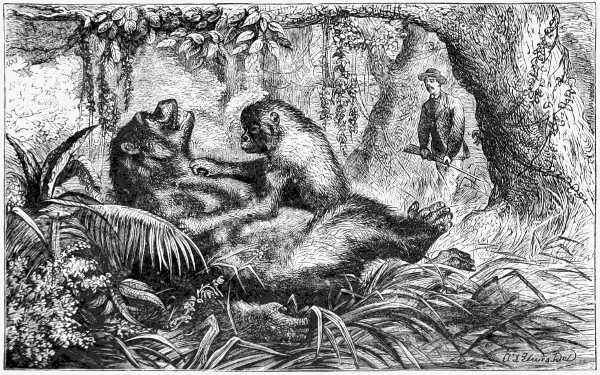
I protest I felt almost like a murderer when I saw the
gorilla this first time. As they ran on their hind legs,
with their heads down, their bodies inclined forward,
their whole appearance was that of hairy men running
for their lives. Add to all this their cry, so awful,
yet with something human in its discordance, and you
will cease to wonder that the natives have the wildest
superstitions about these "wild men of the woods."
In our absence the women had made large fires, and
prepared the camp. I changed my clothes, which had
become drenched by the frequent torrents and puddles
we ran through in our eager pursuit. Then we sat
down to our supper, which had been cooked in the
meantime. I noticed that all my plantains were gone—eaten
up. What was to become of us in the great
forest? I had only two or three biscuits, which I kept
in case of actual starvation or sickness.
As we lay by the fire in the evening before
going to sleep, the adventure of the day was talked
over to those who had not gone with us; and, of
course, there followed some curious stories of the
gorillas. I listened in silence.
One of the men told a story of two Mbondemo
women who were walking together through the woods,
when suddenly an immense gorilla stepped into the
path, and, clutching one of the women, bore her off
in spite of the screams and struggles of both. The
other woman returned to the village much frightened,
and told the story. Of course her companion was
given up for lost. Great was the surprise when, a few
days afterwards, she returned to her home.
"Yes," said one of the men, "that was a gorilla
inhabited by a spirit." This explanation was received
by a general grunt of approval.
One of the men told how, some years ago, a party
of gorillas were found in a cane-field tying up the
sugar-cane in regular bundles, preparatory to carrying
it away. The natives attacked them, but were routed,
and several killed, while others were carried off
prisoners by the gorillas; but in a few days they
returned home, not uninjured indeed, for the nails of
their fingers and toes had been torn off by their captors.
Then several people spoke up, and mentioned names
of dead men whose spirits were known to be dwelling
in gorillas.
Finally came the story that is current among all the
tribes who are acquainted with the habits of the
gorilla, that this animal will hide himself in the lower
branches of a tree, and there lie in wait for people who
go to and fro. When one passes sufficiently near, the
gorilla grasps the luckless fellow with his powerful feet,
which he uses like giants' hands, and, drawing the man
up in to the tree, he quietly chokes him there.
Hunger and starvation began to tell upon us
severely. When we started I did not calculate on
meeting with gorillas. I had eaten all my sea bread.
There was not a particle of food among us, and no
settlement near us. I began to feel anxious for fear
that we should die. Berries were scarce; and nuts were
hardly to be found. The forest seemed deserted.
There was not even a bird to kill. To make matters
worse, we had been misled. We were lost—lost in the
great forest!—and we failed to reach a certain settlement
where we had expected to arrive.
Travelling on an empty stomach is too exhausting to
be very long endured. The third day I awoke feeble,
but found that one of the men had killed a monkey.
This animal, roughly roasted on the coals, tasted
delicious. How I wished we had ten monkeys to eat!
but how glad and grateful we were for that single one.
Presently, Makinda, looking up, discovered a beehive.
He smoked the bees out, and I divided the honey.
There might have been a fight over this sweet booty
had I not interposed and distributed it in equal shares.
Serving myself with a portion not bigger than I gave
the rest, I at once sat down, and devoured honey,
wax, dead bees, worms, dirt, and all; I was so hungry.
I was only sorry we had not more.
I had really a hard time getting through the old
elephant tracks, which were the best roads through
the jungle. The men seemed to have lost their way.
We saw no animals, but found several gorillas' tracks.
At last my men began to talk more cheerfully; they
knew where they were: and, soon after, I saw the
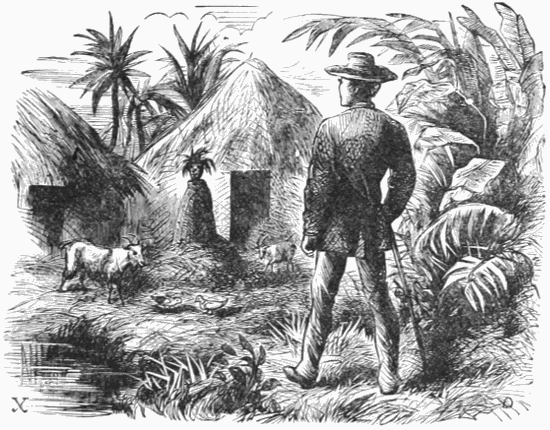
broad leaves of the plantain, the forerunner of an
African town. But, alas! as we approached, we saw no
one coming to meet us; and when we reached the place
we found only a deserted village. But even for this how
thankful I was! Since I left Dayoko I had experienced
nothing but hunger and starvation; and these were
the first human habitations we had met.
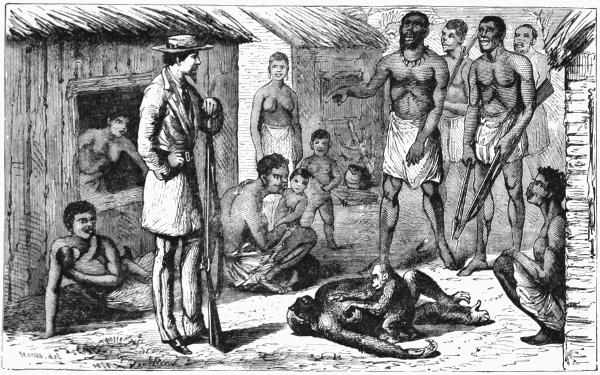
Presently, however, some Mbicho people made their
appearance. They were relatives of Mbéné, and their
village was close by. They gave us some plantains,
but no fowls. I wished very much to get a fowl. I felt
gouamba (which means hunger) for meat, and knew
that a good warm fowl broth would have done me a
great deal of good. We spent the evening in the
houses, drying and warming ourselves. It was much
better than the forest, even if it was only a deserted
town.
I asked if we should ever reach the cannibal country,
and found that, with the exception of the Mbicho
village near at hand, we were already surrounded on
three sides by Fan villages.
I was too tired to rest. Besides, I was getting deep
into the interior of Africa, and was in the neighbourhood
of the Fans, the most warlike tribe that inhabited
the country. So I barricaded my hut, got my
ammunition ready, saw that my guns were all right,
and then lay awake for a long time, before I could go
to sleep.
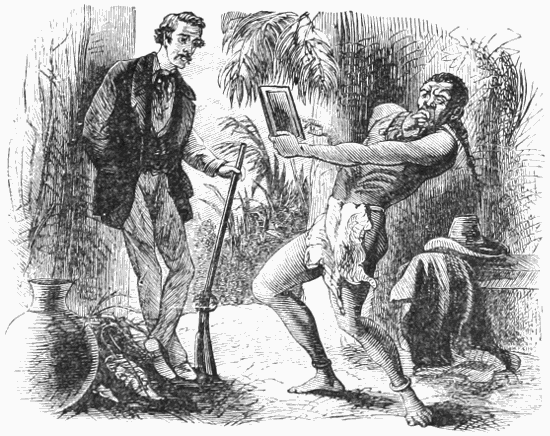
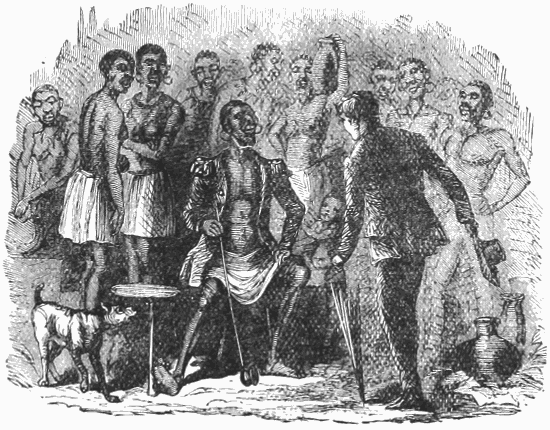
KING ASTONISHED AT LOOKING-GLASS.
CHAPTER VIII.
I ARRIVE AMONG THE CANNIBALS—THEIR SPEARS, BOWS,
AND BATTLE-AXES—THEY TAKE ME FOR A SPIRIT—THEIR
KING SHAKES WHEN HE SEES ME—I GIVE HIM A
LOOKING-GLASS—IT ASTONISHES HIM.
We were, at last, near the Fan country. We
had passed the last Mbichos village, and
were on our way to the villages of the
man-eaters.
I remember well the first Fan village I approached.
It stood on the summit of a high hill in the mountains.
All its inhabitants were very much excited when they
perceived we were coming towards it, through the
plantation path; for the trees around the hill had been
cut down. The men were armed to the teeth, as we
entered the village, and I knew not whether hundreds
of spears and poisoned arrows might not be thrown at
me, and I be killed on the spot. What dreadful spears
those cannibals had; they were all barbed. Each
man had several in his hand; and, besides, had a shield
made of elephant's hide, to protect himself with.
Others were armed with huge knives, and horrible-looking
battle-axes, or with bows and poisoned arrows.
Wild shouts of astonishment, which, for all I knew,
were war-shouts, greeted me as I entered the village.
I must own that I felt not quite at my ease. How
wild and fierce these men looked! They were most
scantily dressed. When they shouted, they showed
their teeth, which were filed to a point, and coloured
black. Their open mouths put me uncomfortably in
mind of a tomb; for how many human creatures each
of these men had eaten!
How ugly the women looked! They were all
tattooed, and nearly naked. They fled with their
children into their houses, as I passed through the
street, in which I saw, here and there, human bones
lying about. Yes, human bones from bodies that had
been devoured by them! Such are my recollections
of my first entrance into a village of cannibals.
The village was strongly fenced, or palisaded; and
on the poles were several skulls of human beings and
of gorillas. There was but a single street, about two-thirds
of a mile long. On each side of this were low
huts, made of the bark of trees.
I had hardly entered the village when I perceived
some bloody remains, which appeared to me to be
human. Presently we passed a woman who was
running as fast as she could towards her hut. She
bore in her hand a piece of a human thigh, just as we
should go to market and carry thence a joint or steak.
This was a very large village. At last we arrived at
the palaver house. Here I was left alone with Mbéné
for a little while. There was great shouting going on
at a little distance, at the back of some houses. One
of them said they had been busy dividing the body of
a dead man, and that there was not enough for all.
They flocked in presently, and soon I was surrounded
by an immense crowd. Not far from me was a
ferocious-looking fellow. On one arm he supported a
very large shield, made of an elephant's hide, and of the
thickest part of the skin, while in his other hand he
held a prodigious war-knife, which he could have
slashed through a man in a jiffy.
Some in the crowd were armed with cross-bows, from
which were shot either iron-headed arrows, or the
little, insignificant-looking, but really most deadly
darts, tipped with poison. These are made of slender,
harmless reeds, a foot long, whose sharpened ends are
dipped in a deadly vegetable poison, which these people
know how to make. These poisoned darts are so light
that they would blow away, if simply laid in the
groove of the bow. Hence they use a kind of sticky
gum to hold them.
The handle of the bow is ingeniously split; and, by
a little peg, that acts as a trigger, the bow-string is
disengaged. The bow is very stiff and strong, and
sends the arrow to a great distance. As you see by the
representation of a Fan bowman, they have to sit
down and apply both feet to the middle of the bow,
while they pull with all their strength on the string to
bend it back.
These little poisoned arrows are much dreaded by
them, and are very carefully kept in little bags, which
are made of the skin of wild animals.
Some bore on their shoulders the terrible war-axe.
A single blow of this axe suffices to split a human
skull. I saw that some of these axes, as well as their
spears and other ironwork, were beautifully ornamented.
The war-knife, which hangs by their side, is a terrible
weapon. It is used in hand-to-hand conflict, and
is designed to be thrust through the enemy's body.
There was also another sort of huge knife used by
some of the men in the crowd before me. It was a
foot long, about eight inches wide, and is used to cut
through the shoulders of an adversary. It must do
tremendous execution.
A few of the men had also a very singular pointed axe,
which is thrown from a distance. When thrown, it strikes
with the point down, and inflicts a terrible wound.
They handle it with great dexterity. The object aimed
at with this axe is the head. The point penetrates to
the brain, and kills the victim immediately.
The spears were six or seven feet long, and are
ingeniously adapted to inflict terrible wounds. They
are thrown with an accuracy and a force which never
ceased to astonish me. The long, slender staff fairly
whistles through the air; and woe to the man who is
within twenty or thirty yards of their reach.
Most of the knives and axes were ingeniously
sheathed in covers made of snake or antelope skins,
or of human skin. These sheaths were slung round
the shoulder or neck by cords, which permit the
weapon to hang at the side, out of the wearer's way.
These Fan warriors had no armour. Their only
weapon of defence is the huge shield of elephant hide,
of which I spoke to you. It is three and a half feet
long, by two and a half feet wide.
Besides their weapons, many of the men wore a
small knife, as a table-knife, or jack-knife.
From this description of the men by whom I was
surrounded, you may judge with what amazement I
looked around me, with my guns in my hands. It
was a grand sight to see such a number of stalwart,
martial, fierce-looking fellows, fully armed, and ready
for any desperate fray, gathered together.
Finer-looking savages I never saw; and I could
easily believe them to be brave; and the completeness
of their war-like equipments proved that fighting is a
favourite pastime with them. No wonder they are
dreaded by all their neighbours!
Here was I, at this time only a lad, alone in the
midst of them.
Presently came the king, a ferocious-looking fellow.
His body was naked. His skin in front was painted
red, and his chest, stomach, and back were tattooed in
a rude but effective manner. He was covered with
charms, and he wore round his neck a necklace made
with leopard's teeth. He was fully armed. Most of
the Fans wore queues; but the queue of Ndiayai, the
king, was the biggest of all, and terminated in two
tails, in which were strung brass rings. His beard was
plaited in several plaits, which contained white beads.
His teeth were filed sharp to a point. He looked like a
perfect glutton of human flesh.
I looked around me in a cool, impassive manner.
Ndiayai, the king, fairly shook at the sight of me.
He had refused to come and see me, at first, from a
belief that he would die in three days after setting eyes
on me. But Mbéné had persuaded him to come. Ndiayai
was accompanied by the queen, the ugliest woman I
ever saw, and very old. She was called Mashumba.
She was nearly naked, her only covering being a strip
of cloth about four inches wide, made of the soft bark
of a tree, and dyed red. Her body was tattooed in
the most fanciful manner; her skin, from long exposure,
had become rough and knotty. She wore two
enormous iron anklets, and had, in her ears, a pair of
copper rings, two inches in diameter. I could easily
put my little fingers in the holes through which the
earrings passed.
The people looked at me, wondered at my hair, but
never ceased to look at my feet. "Look at the strange
being," said they to each other, "his feet are not of
the colour of his face, and he has no toes!"
Finally, the king said to Mbéné that, when surrounded
by his people, he was not afraid of anybody.
I could well believe him. When fighting they must
look perfect devils.
When night came I entered my house, and looked
about to see how I could barricade myself for the
night; for I did not fancy putting myself entirely at
the mercy of these savage Fans. Their weapons had
been sufficient to show me that they were men who
were not afraid to fight. I told Mbéné to send for
Ndiayai. The king came, and I presented him a large
bunch of white beads, a looking-glass, a file, fire-steels,
and some gun-flints. His countenance beamed with
joy. I never saw such astonishment as he exhibited
when I held the looking-glass before his face. At first
he did not know what to make of it, and did not want
to take the glass, till Mbéné told him that he had one.
He put his tongue out, and he saw it reflected in the
looking-glass. Then he shut one eye, and made faces;
then he showed his hands before the looking-glass—one
finger—two fingers—three fingers. He became
speechless, and with all I had given him, he went away
as "happy as a king"; and "every inch a (savage)
king" he was.
Shortly afterwards, Mashumba, the queen, thinking
that probably I had something for her, also came and
brought me a basketful of plantains. They were
cooked. At once the idea rushed into my mind, that
perhaps the very same pot that cooked the plantains
had cooked a Fan's head in the morning; and I began to
have a horrible loathing of the flesh-pots of these people.
I would not have cooked in their pots for the world.
A little after dark, all became silent in the village.
I barred my little bit of a door as well as I could with
my chest, and, lying down on that dreadful Fan bed,
I placed my gun by my side, and tried hard, but in
vain, to go to sleep. I wondered how many times
human flesh had entered the hut I was in. I thought
of all I had seen during the day, which I have related
to you. The faces of those terrible warriors, and the
implements of war, were before my eyes though it was
pitch dark.
Was I afraid? Certainly not. What feeling was it
that excited me? I cannot tell you. It was certainly
not fear; for if anyone the next day had offered to
take me back where I came from, I should have declined
the offer. Probably I was agitated by the novel
and horrible sights that had greeted my eyes, and
which exceeded all my previous conceptions of Africa.
Now and then I thought that as these men not only
killed people, but ate them also, they might perhaps
be curious to try how I tasted.
Hour after hour passed, and I could not get to sleep.
I said my bed was a dreadfully bad one. It was a
frame composed of half a dozen large round bamboos.
I might as well have tried to sleep on a pile of cannonballs.
Finally, I succeeded in going to sleep, holding
my gun tightly under my arm.
When I got up in the morning, and went out at the
back of the house, I saw a pile of ribs, leg and arm
bones, and skulls, piled together. The cannibals must
have had a grand fight, not long before, and devoured
all their prisoners of war.
In what was I to wash my face? I resolved at last
not to wash at all.
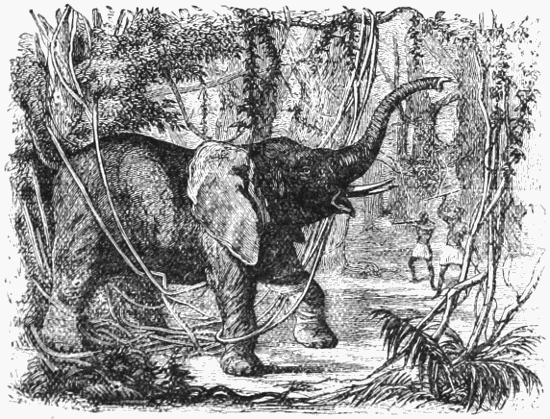
ENTRAPPING THE ELEPHANT.
CHAPTER IX.
AN ELEPHANT HUNT.
After a few days the Fans began to get
accustomed to me, and I to them; and we were
the best friends in the world.
They are great hunters. One day a woman
returning from the plantations brought news, that she
had seen elephants; and that one of the plantain fields
had been entirely destroyed by them. This was an
event of common occurrence in the country; for the
elephants are not very particular, and whatever they
like they take; not caring a bit how much hunger
they may occasion among the poor natives.
When the news arrived, a wild shout of joy spread
among the villagers. The grim faces of the Fans smiled;
and in doing so, showed their ugly filed teeth. "We are
going to kill elephants," they all shouted. "We are
going to have plenty of meat to eat," shrieked the
women.
So in the evening a war-dance took place; a war-dance
of cannibals! It was the wildest scene I ever
saw. It was pitch-dark; and the torches threw a dim
light around us, and showed the fantastic forms of
these wild men. Really it was a wild scene. They
were all armed as if they were going to war. How they
gesticulated! What contortions they made! What
a tumult they raised! How their wild shouts echoed
from hill to hill, and died away in the far distance!
They looked like demons. Their skins were painted of
different colours; and, as the dancing went on, their
bodies became warm, and shone as if they had been
dipped in oil.
Suddenly a deafening shout of the whole assemblage
seemed to shake the earth. Their greatest warrior
(Leopard) came to dance. Leopard was, it appears, the
bravest of them all. He had killed more people in war
than anybody else. He had given more human food
to his fellow-townsmen than many other warriors put
together. Hence they all admired and praised him;
and a song describing his feats of arms was sung by
those who surrounded him. How ferocious he looked!
He was armed to the teeth. He had a spear like one
of those I have already described. A long knife hung
by its side, and the hand that held the shield carried a
battle-axe also. In dancing, he acted at times as if he
were defending himself against an attack; at other
times, as if he were himself attacking somebody. Once
or twice I really thought he meant to throw his
spear at someone. I could hardly breathe while
looking at him. He appeared actually to be a demon.
Finally he stopped from sheer exhaustion, and others
took his place.
The next day the men furbished up their arms.
I myself cleaned my guns, and got ready for the
chase; so that, if I could get a chance, I might send a
bullet through an elephant.
The war-dish was cooked. It is a mixture of herbs,
and is supposed to inspire people with courage. They
rubbed their bodies with it, and then we started.
There were about five hundred men. After leaving
the village we divided into several parties. Each party
was well acquainted with the forest, and knew just
where to go. The march was conducted in perfect
silence, so that we might not alarm the elephants.
After proceeding six hours we arrived not far from the
hunting-ground where the elephants were supposed to
be. The Fans built shelters, and these were hardly
finished when it began to rain very hard.
The next day some Fans went out to explore the
woods, and I joined the party. The fallen trees, the
broken-down limbs, the heavy footprints, and the
trampled underbrush, showed plainly that there had
been many elephants about. There were no regular
walks, and they had strayed at random in the forest.
When the elephants are pleased with a certain
neighbourhood, they remain there a few days. When
they have eaten all the food they like, and nothing
remains, they go on to some other place.
The forest here, as everywhere else, was full of
rough, strong, climbing plants, many of which reach to
the top of the tallest trees. They are of every size;
some bigger than a man's thigh, while many are as
large as the ropes of which the rigging of a ship is
made. These creepers the natives twist together; and,
after working very hard, they succeed in constructing
a huge fence, or obstruction. Of course, it is not
sufficient to hold the elephant; but when he gets
entangled in its meshes, it is strong enough to check
him in his flight, till the hunters can have time to kill
him. When an elephant is once caught, they surround
the huge beast, and put an end to his struggles by
incessant discharges of their spears and guns.
While the others worked, I explored the forest. Seeing
that the men were careful in avoiding a certain
place, I looked down on the ground, and saw nothing.
Then, looking up, I saw an immense piece of wood
suspended by the wild creepers, high in the air; and,
fixed in it at intervals, I saw several large, heavy,
sharp pointed pieces of iron pointing downwards. The
rope that holds up this contrivance is so arranged that
the elephant cannot help touching it, if he passes
underneath. Then the hanou (such is the name given
to the trap) is loosened, it falls with a tremendous force
on his back; the iron points pierce his body, and
the piece of wood, in falling, generally breaks his
spine.
I also saw in different places, large, deep ditches,
intended as pitfalls for the elephant. When he runs
away, or roams around at night, he often falls into these
pits, and that is the end of him; for, in falling, he
generally breaks his legs. Sometimes, when the
natives go and visit the pit they have made, they find
nothing but the bones of the elephant and his ivory
tusks.
The fence that the natives had made must have been
several miles long, and in many places was several rows
deep; and now there were elephant pits beside, and the
hanous.
We were, you must remember, in a mountainous
country; and I could scarcely believe my eyes when I
saw plainly the footprints of this animal where I
myself had to hold to the creepers to be able to
ascend.
When everything was ready, part of the men went
silently and hid themselves upon the limbs or besides
the trunks of trees near the barrier or "tangle."
Others of us took a circuitous route in an opposite
direction from that in which we had come. After we
had got miles away from the "tangle," we formed a
chain as long in extent as the fence, and moved forward,
forming a semi-circle, with the men ten or twenty
yards apart from each other.
Presently, all along the line the hunting horns were
sounded, wild shouts were sent up, and, making all the
noise they could, the Fans advanced in the direction of
the "tangle." The elephants were entrapped. Hearing
the noise, of course they moved away from us,
breaking down everything before them in their flight. If
they tried to go to the right, they heard the same wild
shouts; if they tried to go to the left, they heard the
same. There was no other way for them to go but
straight ahead; and there, though they did not know
it, were the tangle, the pits, and the hanous. They
were going to surer death than if they had tried to
break our lines; for then most, if not all of them, would
have escaped. We were too far from each other to
hinder them.
Onward we pressed, the circle of those giving chase
becoming smaller and smaller, and the crashing of the
underbrush more distinct, as we approached the
elephants in their flight. The men's countenances
became excited. They got their spears in readiness;
and soon we came in sight of the tangles. What an
extraordinary sight lay before me; I could distinguish
one elephant, enraged, terrified, tearing at everything
with his trunk and feet, but all in vain! The tough
creepers of the barrier in no instance gave way before
him. Spear after spear was thrown at him. The Fans
were everywhere, especially up on the trees, where they
were out of the reach of the elephant. The huge animal
began to look like a gigantic porcupine, he was stuck
so full of spears. Poor infuriated beast! I thought he
was crazy. Every spear that wounded him made him
more furious! But his struggles were in vain. He
had just dropped down when I came close to him; and
to end his sufferings, I shot him through the ear. After
a few convulsions of limb all became quiet. He was
dead.
Some of the elephants had succeeded in going
through the tangle, and were beyond reach.
Four elephants had been slain; and I was told that a
man had been killed by one of the elephants, which
turned round and charged his assailants. This man
did not move off in time, and was trampled under foot
by the monstrous beast. Fortunately, the elephant
got entangled; and, in an instant, he was covered with
spears, and terribly wounded. After much loss of
blood he dropped down lifeless.
I am sure you will agree with me, after the description
I have given of a Fan elephant hunt, that the
men of this tribe are gifted with remarkable courage
and presence of mind.
They have certain rules for hunting the elephant.
These tell you never to approach an elephant, except
from behind; he cannot turn very fast, and you have,
therefore, time to make your escape. He generally
rushes blindly forward. Great care must also be taken
that the strong creepers, which are so fatal to the
elephant, do not also catch and entangle the hunters
themselves. A man lying in wait to spear an elephant
should always choose a stout tree, in order that the
infuriated beast, should he charge at it, may not uproot
it.
The next day, there was a dance round the elephant,
while the fetich-man cut a piece from one of the hind
legs. This was intended for their idol. The meat was
cooked in presence of the fetich-man, and of those who
had speared the elephant. As soon as all the meat had
been cooked they danced round it; and a piece was
sent into the woods for the spirit to feed upon, if he
liked. The next day, the meat was all cut up in small
pieces, then hung up and smoked.
The cooking and smoking lasted three days, and I
can assure you it is the toughest meat I ever tasted.
Of course, like the Fans, I had no other food; and for
three days I ate nothing but elephant meat. I wish
I could give you a notion how it tastes; but really I
do not know what to compare it with. Beef, mutton,
lamb, pork, venison, make not the slightest approach
to a resemblance: and as for poultry, such a comparison
would be positively aggravating!
The proboscis being one of the favourite morsels, a
large piece of it was given to me. The foot is another
part reputed to be a great dainty, and two feet were
sent me, together with a large piece of the leg for a
roast.
But the meat was so tough that I had to boil it for
twelve hours; and then I believe it was as tough as
ever; it seemed to be full of gristle. So, the next day,
I boiled it again for twelve hours; all my trouble,
however, was unavailing, for it was still hopelessly
tough! I may say, that the more I ate of elephant
meat the more I got to dislike it. I do not think
I shall ever hanker after elephant steak as long as
I live. I wonder if you boys would like it? I wish I
had some, and could induce you to taste of it. I am
inclined to think you would agree with me, and never
desire to renew your acquaintance with it.
How glad I was when I returned to Ndiayai village;
and no wonder, for we had rain every day in the woods.
As for the poor man who had been killed by the
elephant, his body was sent to another clan to be
devoured; for the cannibals do not eat their own
people.
FAN BLACKSMITHS AT WORK.
CHAPTER X.
LIFE AMONG THE CANNIBALS—CURIOUS MUSICAL INSTRUMENTS—COOKING
UTENSILS—A BLACKSMITH'S BELLOWS
AND ANVIL—CANNIBAL DIET.
After we reached Ndiayai, I went back to
my little hut, and found everything I had left
there. I had hidden my powder and shot in
different places, and had dug holes in which to hide
my beads.
The news had spread among the surrounding
cannibal villages that the spirit, as they called me, was
still in the village of Ndiayai, and the people flocked
to see me. Among those who came to see me, was a
chief of the name of Oloko. He gave me the long war
knife, of which you have seen a drawing, and explained
to me how it had several times gone right through a
man.
Mbéné went away for a while, and left me entirely
alone with these cannibals. During his absence I
studied the habits of these strange people; and you
may be sure that wherever I went I kept my eyes wide
open.
By the way, I see I have omitted to give a description
of the town of King Ndiayai. It was a very large
town, composed of a single street. When I say a large
town, I do not mean, of course, that it could bear any
comparison as to size with London, Paris, or New York.
I mean that it was a large town for this part of Africa.
It contained five or six hundred men. The houses
were quite small, and were all made of the bark of
trees; none of them had windows. They were nearly
all of the same size.
Strange to say, these Fans seemed to be very fond
of music, and very funny instruments they make use
of. To hear some of their music would make you laugh.
They have not the slightest idea of what we consider
harmony in sound; but they evidently have a great
liking for music after their own notion. It is very
much the same with their dancing. They have not the
slightest idea of the dances in use with us, such as
waltzes, galops, polkas, or quadrilles; and I am sure
if they were to see us dancing in our fashion, they
would laugh quite as much as you would laugh if you
could see them capering in their uncouth style.
Like all the savage tribes of Africans, they are very
fond of the tom-tom, or drum. Those drums are of
different sizes, but many are from four to six feet in
length, and about ten inches in diameter at one end,
but only six or seven at the other. The wood is
hollowed out quite thin, and skins of animals are
stretched tightly over the ends. The drummer holds
the tom-tom slantingly between his legs; and, with
two sticks, he beats furiously upon the larger end of
the drum, which is held uppermost. Sometimes they
beat upon it with their hands. The people form a
circle round the tom-tom, and dance and sing, keeping
time with it. They often invited me to hear them.
But now I am going to speak to you of a far more
curious instrument. It is called by these cannibals
the handja; and I never saw it except among their
tribes.
Ndiayai was very fond of hearing the handja, and I
often went to his shed to hear someone play upon it.
Sometimes, on these occasions, Ndiayai would come
out surrounded by Queen Mashumba and some of his
other wives, and listen for an hour or two to the music
of the handja.
I give you a representation of the handja (see p. 78),
so you will understand better when I describe it to
you.
It consists of a light reed frame, about three feet
long, and eighteen inches wide, in which are set, and
securely fastened, a number of hollow gourds. The
handja I saw contained seven gourds. These gourds
are covered by strips of a hard, red wood, found in the
forest. These gourds and cylinders, as you see, are
of different sizes, so graduated that they form a
regular series of notes. Each gourd has a little hole
which is covered with a skin thinner than parchment.
And what kind of skin do you think it was? It was
the skin of the very large spider which abounds in that
country, and from which I should not care to receive
a bite, it is so poisonous.
The performer sits down, with the frame across his
knees, and strikes the strips lightly with a stick. There
are two sticks, one of hard wood, the other of much
softer wood. The instrument is played on the same
principle as a chime of bells, or an instrument used in
France, and which, perhaps, some of you have seen,
composed of a series of glasses. The tone of the handja
is very clear and good, and though their tunes were
rude, they played them with considerable skill.
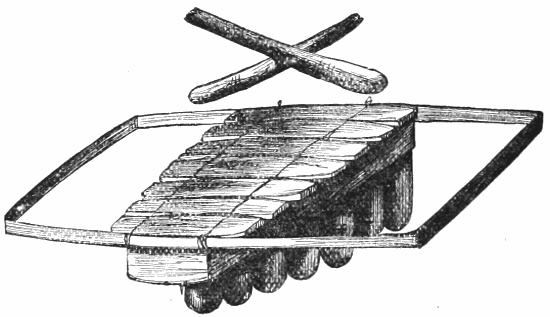
THE HANDJA.
The Fans work iron better than any tribe I met
with. They are very good blacksmiths. Their warlike
habits have made iron a very necessary article to
them. It is very plentiful in their mountainous
country.
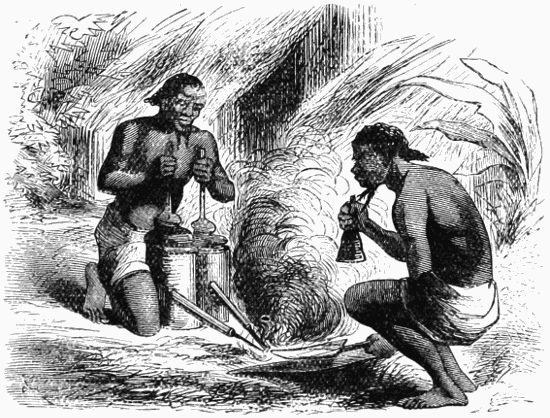
Before you is a picture of two Fan blacksmiths.
Look at the curious bellows they have. It is made of
two short, hollow cylinders of wood, surmounted by
skins, very well fitted on, and having an appropriate
valve for letting in the air. As you see, the bellows-blower
is on his knees, moving down these coverings
with great rapidity. There are two small wooden
pipes, connected with two iron tubes which go into the
fire.
The anvil, as you see in the picture, is a solid piece
of iron. The sharp end is stuck into the ground; and
the blacksmith sits alongside his anvil, and beats his
iron with a singular-looking hammer, clumsy in form,
and with no handle; in fact it is merely made of a heavy
piece of iron.
The blacksmiths sometimes spend many days in
making a battle-axe, knife or spear. They make, also,
their own cooking utensils and water-jugs. These are
of the shape you see in the picture before you. They
also make their own pipes, for they are great smokers.
Some of their pipes are not at all ungraceful in shape.
Besides the water-jug, they frequently use the calabash,
as a vessel to carry water in; and some of their
calabashes are really pretty, and very nicely ornamented.
Some of the spoons, with which they eat
their human broth, are very beautiful. They are made
of various woods, and sometimes of ivory.
It is quite sickening to think what horrible people
these Fans are! Such inveterate cannibals are they,
that they even eat the poor wretches who die of disease.
As I was talking to the king one day, some
Fans brought in a dead body, which they had bought
or bartered for, in a neighbouring town, and which was
to be divided among them. I could see that the man
had died of some disease; for the body was very lean.
They came round it with their knives; and Ndiayai
left me to superintend the distribution. I could not
stand this; and when I saw them getting ready, I left
the spot, and went to my hut. Afterwards, I could
hear them growing noisy over the division of their
horrid spoil.
In fact, the Fans seem to be perfect ghouls. Those
who live far in the interior practise unblushingly their
horrid custom of eating human flesh. It appears they
do not eat the dead of their own family, but sell the
corpse to some other clan, or make an agreement that
when one of their number dies they will return the
body in exchange.
Until I saw these things I could not believe a story
I had often heard related among the Mpongwe tribe,
which is as follows: A party of Fans once came down
to the seashore to view the ocean. While there,
they actually stole a freshly-buried body from the
cemetery, and cooked and ate it. Another body was
taken by them and conveyed into the woods, where
they cut it up, and smoked the flesh. These acts
created a great excitement among the Mpongwes.
But you must not think that the Fans are continually
eating human flesh. They eat it when they can
get it, but not every day. They kill no one on purpose
to be eaten.
One day Ndiayai took me to an Osheba town, the
king of which tribe was his friend; and let me tell you
that the Oshebas were also great man-eaters, like the
Fans, whom they greatly resemble in appearance. The
chief of that Osheba village was called Bienbakay.
The Fans are the handsomest and most resolute-looking
set of negroes I have ever seen in the interior.
Eating human flesh does not seem to disagree with
them, though I have since seen other Fan tribes whose
men had not the fine appearance of these mountaineers.
Here, as everywhere else, the character of the country
doubtless has much to do with the matter of bodily
health and growth. These cannibals were living among
the mountains, and had come from still higher mountain
regions, and this accounts for their being so robust
and hardy.
The strangest thing in connection with the Fans,
next to their hideous cannibalism, is their constant
encroachments upon the land westward. Year by year
they have been advancing nearer to the sea. Town
after town has been settled by them on the banks of
the Gaboon river. In fact, they seem to be a conquering
race, driving every other tribe before them.
The colour of these people is dark brown rather than
black. They feed much upon manioc and the plantain.
They have also two or three kinds of yams,
splendid sugar-cane, and squashes, all of which they
cultivate with considerable success. Manioc seemed
to be the favourite food. Enormous quantities of
squashes are raised, chiefly for the seeds, which, when
pounded and prepared in their fashion, are much
prized by them, and I confess I relished this food
myself. At a certain season, when the squash is ripe,
their villages seem covered with the seeds, which
everybody spreads out to dry. When dried they are
packed in leaves, and placed over the fireplaces in the
smoke, to keep off an insect which also feeds upon
them. They are all suspended by a cord, for, besides
being infested by insects, they are subject to the
depredations of mice and rats, both of which are fond
of them.
The process of preparation is very tedious. A portion
of the seeds is boiled, and each seed is divested of its
skin; then the mass of pulp is put into a rude wooden
mortar and pounded, a vegetable oil being mixed with
it before it is cooked.
While on the subject of the food of the cannibals, I
ought to mention that they do not sell the bodies of
their chiefs, kings, or great men; these receive burial,
and remain undisturbed. It is probable also that they
do not eat the corpses of people who die of special
diseases.
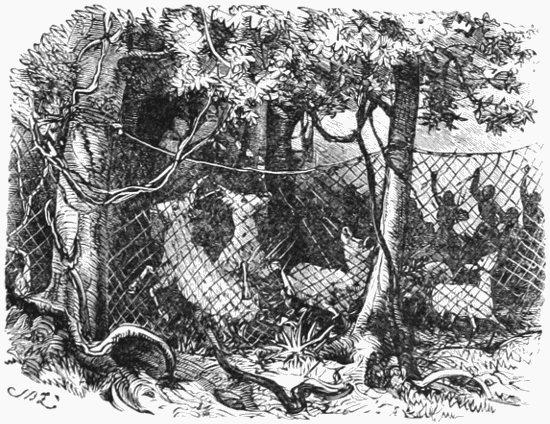
NET-HUNTING.
CHAPTER XI.
JOURNEY TO YOONGOOLAPAY—HUNTING WITH NETS—THE
TERRIBLE BASHIKONAY ANTS.
On my way to the seashore from the cannibal
country, I had a good deal of trouble. I had
taken quite another route to come back;
Mbéné and his people left me on the banks of
a river called the Noya, at the village of a chief called
Wanga. From there I pushed my way towards Yoongoolapay,
a village, whose chief is called Alapay. But
before reaching that place, we came one evening to a
village called Ezongo. The inhabitants, seeing our
heavy loads, turned out with the greatest amount of
enthusiasm to receive me. Their ardour cooled somewhat
when they learned the contents of my packages,
for they were the birds and animals I had collected.
The rascally chief, thinking I must place a great value
on things I had gone so far to get, determined to
detain me till I paid a heavy price to get away; and
for a while things looked as if I should have a good
deal of trouble. The king, urged on by his people,
who seemed to be a greedy set of rascals, insisted on
his price, which would have left me empty-handed.
At last my Mbicho guides from the Noya tried to
settle the matter. They were wise enough to get the
king to come to me with them alone. I gave the
rascal a coat and an old shirt, and I told him, what was
literally true, that I was very poor, and could not pay
what his people wanted. After this palaver he went
out at once and harangued the turbulent extortioners.
So I passed on safely to the village of my old friend,
King Alapay, whom I had known before, and who was
very glad to see me again. He asked me to stay some
days; and being really worn out with constant exposure,
much anxiety, and frequent annoyance, I determined
to do so. His village is charmingly situated upon a
high hill, which overlooks the surrounding country,
and has a beautiful stream skirting its base. Moreover,
I found the people very kind, peaceable, and
hospitable.
A considerable number of independent Mbicho
villages lay within a circuit of a few miles, the inhabitants
of which lived in great harmony with one another,
having prudently intermarried to such a degree that
they really constitute a large family. I was made
welcome among them all, and spent some very pleasant
days in hunting with these kind-hearted people, and
particularly in that kind of sport called by them
asheza, or net-hunting, a practice very common
among the bakalai, who called it ashinga.
This singular sport is very much practised in this
part of Africa; and, as it is generally successful, it is
a local amusement, and brings out the best traits of
the natives. I was always very fond of it.
The ashinga nets are generally made of the fibres of
the bark of a kind of tree, which are twisted into stout
cords. They are from sixty to eighty feet long, and
four to five feet high; and every well-to-do village
owns at least one. But, as few villages have enough
nets to make a great spread, it generally happens
that several unite in a grand hunt, and divide the
proceeds, the game caught in any particular net falling
to the share of its owners.
The first day we went out, the people of half a
dozen villages met together at an appointed place,
the men of each bringing their nets. Then we set out
for a spot about ten miles off, where they had a clearing
in the dense woods, which had been used before, and
was one of their hunting-grounds. We moved along in
silence, so as not to alarm the animals which might be
near our ground. The dogs—for dogs are used in this
hunt—were kept still, and close together.
Finally, we arrived on the ground, and the work of
spreading the toils began. Each party stretched a
single net, tying it up by creepers to the lower
branches of trees. As all worked in the same direction,
and each took care to join his net to that of his neighbour,
in a very short time we had a line of netting
running in a wide half circle, and at least half a mile
long.
This done, a party went out on each side, to guard
against the chance of escape, and the rest of us were
ready to beat the bush. We started at about a mile
from the nets, and, standing about fifty yards from
each other, we advanced gradually, shouting and
making all the noise we could, at the same time keeping
our arms in readiness to shoot or spear down anything
which might come in our way.
Though this very spot had been frequently used for
net-hunting, and was therefore better cleared than
the neighbouring woods, yet we were obliged to
proceed almost step by step. Nearly every native
carried, besides his gun, a heavy cutlass or bill, with
which it was necessary literally to hew out a way,
the vines and creepers making a network which only
the beasts of the forest could glide through without
trouble.
As we advanced, so did the men that guarded the
flanks; and thus our party gradually closed round the
prey. Presently we began to hear shouts, but we could
see nothing; and I could only hold my gun in readiness
and pray that my neighbours might not shoot me
by mistake; for they are fearfully reckless when on a
chase.
The dogs had for some time been let loose. At last
we came in sight of the nets. We had caught a
gazelle of very minute size, called ncheri. It is a very
graceful little animal, and would make a pretty pet,
though I have never seen one tamed. A large antelope
also was brought to bay, and shot before I came
up; and another antelope, being shot at and missed,
rushed forward and got entangled in the net.
Having drawn this cover, we gathered up the nets
and went off with the dogs, who enjoyed the sport
vastly, to try another place. After walking about
three-quarters of an hour we again spread our nets.
Here we had better luck, catching a considerable
number of antelopes, gazelles, and some smaller
animals. It was pretty busy work for us. Nearly all
the animals got very much entangled, and the more
they tried to get through the nets the more they
became bewildered.
Before breaking up, all the game caught was laid
together, that all might see it. And now I had an
opportunity to notice the curious little sharp-eared
dogs, about a foot high, which had been so useful in
driving the animals into our toils. They stood looking
at their prizes with eager and hungry eyes. These
dogs often go and hunt for themselves; and it is no
unusual thing for half-a-dozen dogs to drive an antelope
to the neighbourhood of their village, when their
barking arouses the hunters, who come out and kill
their quarry.
It was almost dark when we returned to the village
of Alapay. One antelope was put aside for me, being
a peculiar species which I wanted to stuff; and the
rest of the meat was immediately divided. The
villagers were delighted at our luck. We were all very
hungry, and cooking began at once. I could hardly
wait for the dinner, which was one worthy of an
emperor's palate. It consisted of plantain, cooked in
various ways, and venison of the tenderest sort,
stewed in lemon-juice, and afterwards roasted on
charcoal.
I was glad to go to bed early, for I felt very tired. I
had travelled during the day very nearly thirty miles.
But I had scarcely got sound asleep when I was
fairly turned out of the house by a furious attack of
the Bashikonay ants. They were already upon me
when I jumped up, and I was bitten by them terribly.
I ran out into the street, and called for help and
torches. The natives came out, the lights were struck,
and presently I was relieved. But now we found that
the whole village was attacked. A great army of ants
was pouring in on us, attracted doubtless by the meat
in the houses, which they had smelt afar off. My
unfortunate antelope had probably brought them to
my door. All hands had to turn out to defend themselves.
We built little cordons of fires, which kept
them away from places they had not entered, and in
this way protected our persons from their attacks.
We scattered hot ashes and boiling water right and
left; and towards morning, having eaten everything
they could get at, they left us in peace. As was to be
expected, my antelope was literally eaten up—not a
morsel left.
The vast number, the sudden appearance, and the
ferocity of these frightful creatures never ceased to
astonish me. On this occasion they had come actually
in millions. The antelope on which they fed was a
vast mass of living ants, which we could not approach;
and it was only when many fires were lighted that
they were forced from their onward and victorious
course, which they generally pursue. Then, however,
they retreated in parties with the greatest regularity,
vast numbers remaining to complete the work of
destruction. Little would I give for the life of a man
who should be tied up to a tree when these ants pass
that way and attack him; in two or three hours
nothing would be left of him but the bare bones.
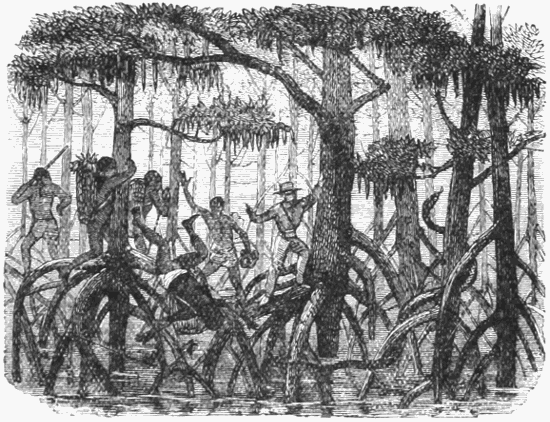
MANGROVE SWAMP. TUMBLING AND FALLING.
CHAPTER XII.
RETURNING TO THE COAST—CAVERNS AND WATERFALLS
IN THE HIGHLANDS—CROSSING A RIVER ON MANGROVE
ROOTS—STIRRING UP A BIG SNAKE—A MUTUAL SCARE.
I left the good villagers of Yoongoolapay,
and pursued my way to the seashore. On the
route we came to a high ridge, or plateau.
This was the highest land I had seen between
the Moonda and the Mani, and it is probable that, if it
had not been for the trees, I should have seen the
ocean very well. Along this ridge were strewn some of
the most extraordinary boulders I ever saw. These
immense blocks of granite covered the ground in every
direction. Several of them were between twenty and
thirty feet high, and about fifty feet long.
Near the largest of these granite masses a huge rock
rose some forty or fifty feet out of the ground. I saw
an opening in the solid rock, leading to a fine large
cavern. It had no doubt been made by the hands of
man; it was not of natural formation, for the entrance
had evidently been cut out of the solid rock by human
beings; and now it was much used by the natives as a
house to stop in over night when they were travelling
to and fro. Its vast opening admits such a flood of
sunlight and air that it is not likely to be used as a
lair for wild beasts. We saw the remains of several
fires inside, but I am bound to say we saw also the
tracks of leopards and other dangerous beasts on the
outside, for which reason I did not care to sleep there.
While exploring the cavern I thought several times
I heard a trickling, which was almost like the noise of
rain, and which I had not noticed before, probably on
account of the great shouting of my men. But when
we got out I was surprised to find not a cloud in the
sky. Turning for an explanation to Alapay, he led me
along a path, and as we went forward the trickling
noise gradually grew into the sound of rushing waters.
Presently we came to the edge of a steep declivity,
and here I saw before and around me a most charming
landscape, the centre of which was a most beautiful
waterfall. A little stream, which meandered along the
slope of the plateau, and which had hitherto escaped
our view, had here worn its way through a vast granite
block which barred its course. Rushing through the
narrow and almost circular hole in this block, it fell in
one silvery leap perpendicularly forty or fifty feet. The
lower level of the stream ran along between high, steep
banks covered with trees, the right bank being quite
abrupt. It was a miniature Niagara. Clear, sparkling,
and pure as it could be, the water rushed down to its
pebbly bed—a sight so charming that I sat down for
some time and feasted my eyes upon it.
I then determined to have a view from below. After
some difficult climbing we got to the bottom, and
there beheld, under the fall, a large hole in the perpendicular
face of the rock, which evidently formed
the mouth of a cavern. The opening of the cavern
was partly hidden by the waterfall, and was cut through
solid rock. Between the opening and the waterfall
there were a few feet of clear space, so that by going
sideways one could make good his entrance into the
cavern without receiving a shower bath.
I determined to enter this cavern; but before
venturing I went first and tried to get a peep at the
inside. It was so dark that I could see nothing, so it
was not very inviting. We lit torches; I took my
revolver and gun, and, accompanied by two men, who
also were armed with guns, we entered. How dark it
was! Once inside, we excited the astonishment of a
vast number of huge vampire bats. There were
thousands and thousands of them. They came and
fluttered around our lights, threatening each moment
to leave us in darkness, and the motion of their
wings filled the cavern with a dull thunderous or
booming roar. It really looked an awful place, and the
dim light of our torches gave to every shadow a fantastic
form.
The cavern was rather rough inside. When we had
advanced about one hundred yards we came to a stream,
or puddle of water, extending entirely across the floor,
and barring our way. My men, who had gone thus far
under protest, now desired to return, and urged me not
to go into the water. It might be very deep; it might
be full of horrible water snakes; all sorts of wild beasts
might be beyond, and land snakes also. At the word
snake I hesitated, for I confess to a great dread of
serpents in the dark, or in a confined place, where a
snake is likely to get the advantage of a man. A cold
shudder ran through me at the thought that, once in
the water, many snakes might come and swim round
me, and perhaps twist themselves about me as they do
around the branches of trees. So I paused and
reflected.
While peering into the darkness beyond I thought I
saw two eyes, like bright sparks or coals of fire,
gleaming savagely at us. Could it be a leopard, or
what? Without thinking of the consequences, I
levelled my gun at the shining objects and fired. The
report, for a moment, deafened us. Then came a
redoubled rush of the great hideous bats. It seemed
to me that millions of these animals suddenly launched
out upon us from all parts of the surrounding gloom.
Some of these got caught in my clothes. Our torches
were extinguished in an instant, and, panic-stricken,
we all made for the cavern's mouth. I had visions of
enraged snakes springing after and trying to catch me.
We were all glad to reach daylight once more, and
nothing could have induced us to try the darkness
again. I confess that, though I think it takes a good
deal to frighten me, I did not at all relish remaining
there in entire darkness.
The scene outside was as charming as that within
was hideous. I stood a long time looking at one of
the most beautiful landscapes I ever beheld in Africa.
It was certainly not grand, but extremely pretty.
Before me, the little stream whose fall over the cliff
filled the forest with a gentle murmur, resembling very
much, as I have said, when far enough off, the pattering
of a shower of rain, ran along between steep banks, the
trees of which seemed to meet above it. Away down
the valley we could see its course, traced like a silver
line over the plain, till it was lost to our sight in a
denser part of the forest.
I have often thought of these caverns since I saw
them, and I have regretted that I did not pay more
attention to them. If I had made my camp in the
vicinity, and explored them and dug in them
for days, I think that I should have been
amply rewarded for the trouble. At that time I
did not feel greatly interested in the subject. I had
not read the works of M. Boucher de Perthes and
others, or heard that the bones of animals now extinct
had been discovered in caverns in several parts of
Europe, and that implements made of flint, such as
axes, sharp-pointed arrows, etc., etc., had been found
in such places. If I had excavated I might perhaps
have found the remains of charcoal fires, or other things,
to prove that these caverns had been made by men
who lived in Africa long before the negro. I feel
certain these caverns must have been human habitations.
I do not see how they could have been made
except by the hand of man.
On my last journey I thought once or twice of going
to them from the Fernand-Vaz, to explore and dig in
them. I thought I might be rewarded for labour by
discovering the bones of unknown beasts, or of some
remains of primitive men.
These caverns are fortunately not far away from the
sea—I should think not more than ten or fifteen miles—and
are situated between the Muni and the Moonda
rivers. Anyone desiring to explore them would easily
find the way to them. The cavern under the waterfall
would be extremely interesting to explore.
The valley itself was a pleasant wooded plain, which,
it seemed, the hand of man had not yet disturbed, and
whence the song of birds, the chatter of monkeys, and
the hum of insects came up to us, now and then, in a
confusion of sounds very pleasant to the ear.
But I could not loiter long over this scene, being
anxious to reach the seashore. After we set off again we
found ourselves continually crossing or following elephant
tracks, so we walked very cautiously, expecting
every moment to find ourselves face to face with a
herd.
By-and-by the country became quite flat, the elephant
tracks ceased, and presently, as we neared a
stream, we came to a mangrove swamp. It was almost
like seeing an old friend, or, I may say, an old enemy,
for the remembrances of mosquitoes, tedious navigation,
and malaria which the mangrove tree brought to
my mind were by no means pleasant. It is not very
pleasant to be laid up with African fever, I assure you.
From a mangrove tree to a mangrove swamp and
forest is but a step. They never stand alone. Presently
we stood once more on the banks of the little stream,
whose clear, pellucid water, had so charmed me a little
farther up the country. Now it was only a swamp, a
mangrove swamp. Its bed, no longer narrow, was
spread over a flat of a mile, and the now muddy water
meandered slowly through an immense growth of mangroves,
whose roots extended entirely across, and met
in the middle, where they rose out of the mire and
water like the folds of some vast serpent.
It was high tide. There was not a canoe to be had.
To sleep on this side, among the mangroves, was to be
eaten up by the mosquitoes, which bite much harder
than those of America, for they can pierce through
your trousers and drawers. This was not a very pleasant
anticipation, but there seemed to be no alternative,
and I had already made up my mind that I should not
be able to go to sleep. But my men were not troubled
at all with unpleasant anticipations. We were to cross
over, quite easily too, they said, on the roots which
projected above the water, and which lay from two to
three feet apart, at irregular distances.
It seemed a desperate venture, but they set out
jumping like monkeys from place to place, and I
followed, expecting every moment to fall in between
the roots in the mud, there to be attacked, perhaps, by
some noxious reptile whose rest my fall would disturb.
I had to take off my shoes, whose thick soles made me
more likely to slip. I gave all my baggage, and guns,
and pistols to the men, and then commenced a journey,
the like of which I hope never to take again. We
were an hour in getting across—an hour of continual
jumps and hops, and holding on. In the midst of it all
a man behind me flopped into the mud, calling out,
"Omemba!" in a frightful voice.
Now, omemba means snake. The poor fellow had
put his hands on an enormous black snake, and, feeling
its cold, slimy scales, he let go his hold and fell. All
hands immediately began to run faster than before,
both on the right and the left. There was a general
panic, and every one began to shout and make all kinds
of noises to frighten the serpent. The poor animal
also got badly scared, and began to crawl away among
the branches as fast as he could. Unfortunately his
fright led him directly towards me, and a general panic
ensued. Everybody ran as fast as he could to get out
of danger. Another man fell into the mud below,
and added his cries to the general tumult. Two or
three times I was on the point of getting a mud bath
myself, but I luckily escaped. My feet were badly
cut and bruised, but at last we were safe across, and I
breathed freely once more, as soon after I saw the deep
blue sea.
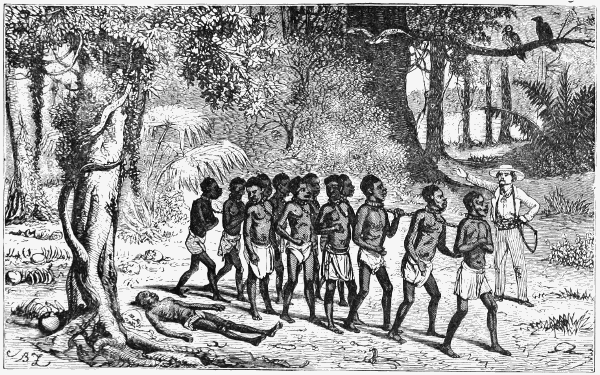

CHAPTER XIII.
CAPE LOPEZ AND AN OPEN PRAIRIE ONCE MORE—KING
BANGO AND HIS THREE HUNDRED WIVES—HIS FIVE
IDOLS—SLAVE BARRACOONS—THE CORPSE AND THE
VULTURES.
Cape Lopez is a long sandy arm of land
reaching out into the sea. As you approach it
from the ocean it has the appearance of overflowed
land. It is so low that the bushes and the
trees growing on it seem, from a distance seaward,
to be set in the water.
The bay formed by Cape Lopez is about fourteen
miles long. Among several small streams which empty
their water into it is the Nazareth river, one of whose
branches is the Fetich river. The bay has numerous
shallows and small islands, and abounds in all sorts of
delicious fish. On the cape itself many large turtles from
the ocean come to lay their eggs. I will tell you by-and-by
what a nice time I had fishing at Cape Lopez;
but I have many other things to talk about before I
come to that.
I arrived at Cape Lopez one evening when it was
almost dark. The next morning I prepared myself for
a visit to King Bango, the king of the country. The
royal palace is set up on a tolerably high hill, and fronts
the seashore. Between the foot of this hill and the
sea there is a beautiful prairie, over which are scattered
the numerous little villages called Sangatanga. I never
tired of looking at this prairie. I had lived so long in
the gloomy forest that it gave me great delight to see
once more the green and sunlit verdure of an open
meadow. I found the royal palace surrounded by a
little village of huts. As I entered the village I was
met by the mafouga, or officer of the king, who conducted
me to the palace. It was an ugly-looking house
of two stories, resting on pillars. The lower story consisted
of a dark hall, flanked on each side by rows of
small dark rooms, which looked like little cells. At the
end of the hall was a staircase, steep and dirty, up
which the mafouga piloted me. When I had ascended
the stairs I found myself in a large room, at one end of
which was seated the great King Bango, who claims
to be the greatest chief of this part of Africa. He
was surrounded by about one hundred of his wives.
King Bango was fat, and seemed not over clean.
He wore a shirt and an old pair of pantaloons. On his
head was a crown, which had been presented to him by
some of his friends, the Portuguese slavers. Over his
shoulders he wore a flaming yellow coat, with gilt embroidery,
the cast-off garment of some rich man's
lacquey in Portugal or Brazil. When I speak of a crown
you must not think it was a wonderful thing, made of
gold and mounted with diamonds. It was shaped like
those commonly worn by actors on the stage, and was
probably worth, when new, about ten dollars. His
majesty had put round it a circlet of pure gold, made
with the doubloons he got in exchange for slaves. He
sat on a sofa, for he was paralyzed; and in his hand he
held a cane, which also answered the purpose of a
sceptre.
This King Bango, whom I have described so
minutely, was the greatest slave king of that part of
the coast. At that time there were large slave depôts
on his territory. He is a perfect despot, and is much
feared by his people. He is also very superstitious.
Though very proud, he received me kindly, for I had
come recommended by his great friend, Rompochombo,
a king of the Mpongwe tribe. He asked me how I
liked his wives. I said, very well. He then said there
were a hundred present, and that he had twice as
many more, three hundred in all. Fancy three
hundred wives! He also claimed to have more than
six hundred children. I wonder if all these brothers
and sisters could know and recognise each other!
The next night a great ball was given in my honour
by the king. The room where I had been received
was the ball-room. I arrived there shortly after dark,
and I found about one hundred and fifty of the king's
wives, and I was told that the best dancers of the
country were there.
I wish you could have seen the room. It was ugly
enough; there were several torches to light it; but,
notwithstanding these, the room was by no means
brilliantly illuminated. The king wanted only his wives
to dance before me. During the whole of the evening
not a single man took part in the performance; but
two of his daughters were ordered to dance, and he
wanted me to marry one of them.
Not far from the royal palace were three curious and
very small houses, wherein were deposited five idols,
which were reputed to have far greater power and
knowledge than the idols or gods of the surrounding
countries. They were thought to be the great protectors
of the Oroungou tribe, and particularly of
Sangatanga and of the king. So I got a peep inside
the first house. There I saw the idol called Pangeo;
he was made of wood, and looked very ugly; by his
side was his wife Aleka, another wooden idol. Pangeo
takes care of the king, and of his people, and watches
over them at night.
I peeped also into the second little house. There I saw
a large idol, called Makambi, shaped like a man, and by
his side stood a female figure, Abiala his wife. Poor
Makambi is a powerless god, his wife having usurped
the power. She holds a pistol in her hand, with which,
it is supposed, she can kill anyone she pleases; hence
the natives are much afraid of her; and she receives
from them a constant supply of food, and many
presents (I wonder who takes the presents away).
When they fall sick, they dance around her, and implore
her to make them well; for these poor heathen
never pray to the true God. They put their trust in
wooden images, the work of their own hands.
I looked into the third house, and there I saw an
idol called Numba. He had no wife with him, being
a bachelor deity. He is the Oroungou Neptune and
Mercury in one—Neptune in ruling the waves, and
Mercury in keeping off the evils which threaten from
beyond the sea.
As I came away after seeing the king, I shot at a
bird sitting upon a tree, but missed it, for I had been
taking quinine and was nervous. But the negroes
standing around at once proclaimed that this was a
"fetich bird,"—a sacred bird—and therefore I could
not shoot it, even if I fired at it a hundred times.
I fired again, but with no better success. Hereupon
they grew triumphant in their declarations; while I,
loth to let the devil have so good a witness, loaded
again, took careful aim, and, to my own satisfaction
and their utter dismay, brought my bird down.
During my stay in the village, as I was one day out
shooting birds in a grove, not far from my house, I saw
a procession of slaves coming from one of the barracoons
toward the farther end of my grove. As they
came nearer, I saw that two gangs of six slaves each, all
chained about the neck, were carrying a burden
between them, which I knew presently to be the corpse
of another slave. They bore it to the edge of the
grove, about three hundred yards from my house; and,
throwing it down there on the bare ground, they returned
to their prison, accompanied by the overseer,
who, with his whip, had marched behind them.
"Here, then, is the burying-ground of the barracoons,"
I said to myself sadly, thinking, I confess, of
the poor fellow who had been dragged away from his
home and friends; who, perhaps, had been sold by his
father or relatives to die here and be thrown out as
food for the vultures. Even as I stood wrapped in
thought, these carrion birds were assembling, and
began to darken the air above my head; ere long they
were heard fighting over the corpse.
The grove, which was, in fact, but an African Aceldama,
was beautiful to view from my house; and I had
often resolved to explore it, or to rest in the shade of
its dark-leaved trees. It seemed a ghastly place
enough now as I approached it more closely. The
vultures fled when they saw me, but flew only a little
way, and then perched upon the lower branches of the
surrounding trees, and watched me with eyes askance,
as though fearful I should rob them of their prey. As
I walked towards the corpse, I felt something crack
under my feet. Looking down, I saw that I was already
in the midst of a field of skulls and bones. I had
inadvertently stepped upon the skeleton of some poor
creature who had been lying here long enough for the
birds and ants to pick his bones clean, and for the rains
to bleach them. I think there must have been the
relics of a thousand skeletons within sight. The place
had been used for many years; and the mortality in
the barracoons is sometimes frightful, in spite of the
care they seem to take of their slaves. Here their
bodies were thrown, and here the vultures found their
daily carrion. The grass had just been burnt, and the
white bones scattered everywhere, gave the ground a
singular, and, when the cause was known, a frightful
appearance. Penetrating farther into the bush, I
found several great piles of bones. This was the
place, years ago—when Cape Lopez was one of the
great slave markets on the West Coast, and barracoons
were more numerous than they are now—where the
poor dead were thrown, one upon another, till even
the mouldering bones remained in high piles, as monuments
of the nefarious traffic. Such was the burial-ground
of the poor slaves from the interior of Africa.

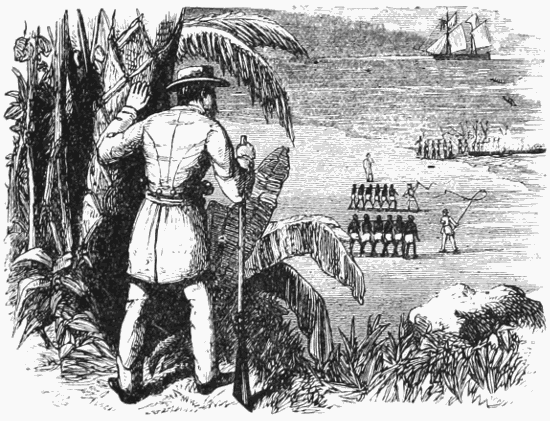
EMBARKING SLAVES.
CHAPTER XIV.
SLAVE BARRACOONS—A BIG SNAKE UNDER MY BED—A
SLAVE SHIP OFF THE COAST.
One day I passed by an immense enclosure,
protected by a fence of palisades about twelve
feet high, and sharp-pointed at the top.
Passing through the gate, which was standing
open, I found myself in the midst of a large collection
of shanties, surrounded by shady trees, under which
were lying, in various positions, a great many negroes.
As I walked round, I saw that the men were fastened,
six together, by a little stout chain, which passed
through a collar secured about the neck of each. Here
and there were buckets of water for the men to drink;
and they being chained together, when one of the six
wanted to drink, the others had to go with him.
Then I came to a yard full of women and children.
These could roam at pleasure through their yard. No
men were admitted there. These people could not all
understand each other's language; and you may probably
wish to know who they were. They were
Africans belonging to various tribes, who had been
sold, some by their parents or by their families; others
by the people of their villages. Some had been sold
on account of witchcraft; but there were many other
excuses for the traffic. They would find suddenly that
a boy or girl was "dull," and so forth, and must be sold.
Many of them came from countries far distant.
Some were quite merry; others appeared to be very
sad, thinking that they were bought to be eaten up.
They believed that the white men beyond the seas
were great cannibals, and that they were to be fattened
first and then eaten. In the interior, one day, a chief
ordered a slave to be killed for my dinner, and I barely
succeeded in preventing the poor wretch from being
put to death. I could hardly make the chief believe
that I did not, in my own country, live on human
flesh.
Under some of the trees were huge caldrons, in
which beans and rice were cooking for the slaves; and
others had dried fish to eat. In the evening they were
put into large sheds for the night. One of the sheds
was used as a hospital.
In the midst of all this stood the white man's house—yes,
the white man's house!—and in it were white
men whose only business was to buy these poor creatures
from the Oroungou people!
After I had seen everything, I left the barracoon—for
that is the name given to such a place as I have just
described. I wandered about, and it was dark before
I returned to the little bamboo house which the king
had given me. I got in, and then, striking a match
carefully, I lighted a torch, so that I might not go to
bed in darkness. You may smile when I say bed, for
my couch was far from bearing any resemblance to our
beds at home, with mattresses and pillows, and sheets
and blankets. Travellers in equatorial Africa are utter
strangers to such luxuries.
After I had lighted the torch, I cast my eyes round
to see if anything had been disturbed; for a thief, so
disposed, could easily break into these houses. I
noticed something glittering and shining under my
akoko, or bedstead. The object was so still that I did
not pay any attention to it; in fact, I could not see it
well by the dim light of the torch. But when I
approached the bed to arrange it, I saw that the glitter
was produced by the shining scales of an enormous
serpent, which lay quietly coiled up there within two
feet of me. What was I to do? I had fastened my
door with ropes. If the snake were to uncoil itself and
move about, it might, perhaps, take a spring and wind
itself about me, quietly squeeze me to death, and
then swallow me as he would a gazelle. These were
not comforting thoughts. I was afraid to cry out for
fear of disturbing the snake, which appeared to be
asleep. Besides, no one could get in, as I had barricaded
the only entrance, so I went quietly and
unfastened the door. When everything was ready for
a safe retreat, I said to myself, "I had better try to
kill it." Then, looking for my guns, I saw, to my
utter horror, that they were set against the wall at the
back of the bed, so that the snake was between me and
them. After watching the snake intently, and
thinking what to do, I resolved to get my gun; so,
keeping the door in my rear open, in readiness for a
speedy retreat at the first sign of life in the snake, I
approached on tip-toe, and, in a twinkling of an eye,
grasped the gun which was loaded heavily with large
shot. How relieved I felt at that moment! I was no
longer the same man. Fortunately, the snake did not
move. With my gun in one hand I went again towards
the reptile, and, fairly placing the muzzle of the gun
against it, I fired, and then ran out of the house as fast
as I could.
At the noise of the gun there was a rush of negroes
from all sides to know what was the matter. They
thought some one had shot a man, and run into my
house to hide himself; so they all rushed into it,
helter-skelter; but I need not tell you they rushed out
just as fast, on finding a great snake writhing about on
the floor. Some had trodden upon it and been
frightened out of their wits. You have no idea how
they roared and shouted; but no one appeared disposed
to enter the house again, so I went in cautiously
myself to see how matters stood, for I did not intend
to give undisputed possession of my hut so easily to
Mr. Snake. I entered and looked cautiously around.
The dim light of the torch helped me a little, and
there I saw the snake on the ground. Its body had
been cut in two by the discharge, and both ends were
now flapping about the floor. At first I thought these
ends were two snakes, and I did not know what to make
of it; but as soon as I perceived my mistake, I gave a
heavy blow with a stick on the head of the horrible
creature, and finished it. Then I saw it disgorge a
duck—a whole duck—and such a long duck! It looked
like an enormous long-feathered sausage. After eating
the duck, the snake thought my bedroom was just the
place for him to go to sleep in and digest his meal; for
snakes, after a hearty meal, always fall into a state of
torpor. It was a large python, and it measured—would
you believe it?—eighteen feet. Fancy my
situation if this fellow had sprung upon me and coiled
round me! It would soon have been all over with me.
I wonder how long it would have taken to digest
me, had I been swallowed by the monster!
One fine day, while walking on the beach of this
inhospitable shore, I spied a vessel. It approached
nearer and nearer, and at last ran in and hove-to a few
miles from the shore. Immediately I observed a gang
of slaves rapidly driven down from one of the barracoons.
I stood and watched. The men were still in
gangs of six, but they had been washed, and each had
a clean cloth on. The canoes were immense boats,
with twenty-six paddles, and about sixty slaves each.
The poor slaves seemed much terrified. They had
never been on the rough water before, and they did not
know what that dancing motion of the sea was. Then
they were being taken away, they knew not whither.
As they skimmed over the waves and rolled, now one
way, now another, they must have thought their last
day had come, and that they were to be consigned to a
watery grave.
I was glad that these poor creatures could not see
me, for I was hidden from their view by trees and
bushes. I felt ashamed of myself—I actually felt
ashamed of being a white man! Happily, such scenes
are rarely if ever witnessed nowadays, and the slave
trade will soon belong to the past.
Two hours afterwards, the vessel, with a cargo of six
hundred slaves, was on her way to Cuba.
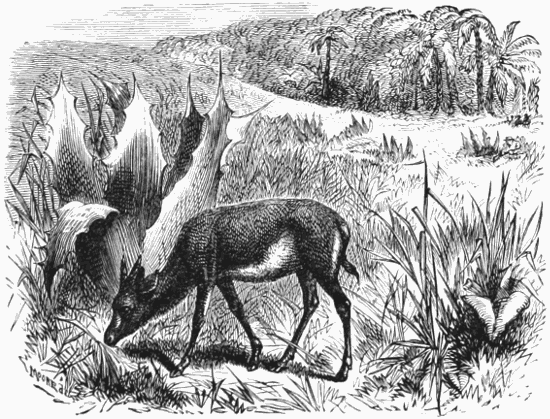
THE GAZELLE.
CHAPTER XV.
GOING INTO THE INTERIOR—SLEEPING WITH THE KING'S
RATS—THE CHIMPANZEE—KILL A GAZELLE—TOO COLD
TO SLEEP—THE GREY PARTRIDGE.
After this I went again to visit King Bango,
and was announced to his Majesty by his great
mafouga. I had an important object in
paying this visit. I wished to ask the king to
permit me to go into the interior and to spare me
some people to show me the way.
Bango liked me, though I had declined to marry one
of his beautiful daughters. So he granted my request,
and gave me twenty-five men, some of whom were
reputed great hunters in that country. They had
killed many elephants and brought all the ivory to
their king. They were the providers of the royal table,
and passed their lives in the hunt and in the forest.
We made great preparations for the chase, for game
was said to be plentiful. We were to encamp many
days in the forest, and to have a jolly time, and a
hard time, too, for the hunter's life is not an easy one.
I was invited by the king to sleep in his palace, so
that the next day I might start early; so I was led to
my bedroom by the great mafouga. It was so dirty
and gloomy that I wished myself fast asleep under a
tree in the forest. I looked around, thinking that perhaps
the king wanted to get rid of me, and had invited
me there to have me murdered; but finding nothing
suspicious, I concluded that old King Bango had
never entertained such ideas, and I felt vexed at
myself for having such thoughts on my mind. Then
I extinguished the light and lay down on the royal
couch. I had scarcely lain down when I began to
hear a strange noise. At first I did not know what it
meant. The noise in the room increased. What could
it be? I tried to see through the darkness, but could
distinguish nothing. Just then I felt something getting
under my blanket. Confounded, I jumped up, not
knowing what it might be. It was an enormous rat.
As soon as I got up, I heard a perfect scrambling of
rats going back where they came from, and then all
became silent. I lay down on the bed again and tried
to sleep, but in vain, on account of the assaults and
gambols of the rats, of which there was a prodigious
number. They seemed inclined to dispute possession
of my room with me. They were continually on my
bed, and running over my face. I soon got quite
enough of the royal palace. I wished I had never come
into it. But it was an excellent place for getting up
early. No sooner had the morning twilight made its
appearance than I rose and called my men together;
and, though we could hardly see, we set out at once on
the march.
I went in advance with Aboko, my head man, and
Niamkala, the next best man, at my side. Both these
men were great hunters, and had spent the principal
part of their lives in the woods. They seemed really
like men of the woods, so very wild were their looks.
Aboko was a short, somewhat stout man; very black,
and extremely muscular, very flat-nosed, and with big
thick lips. His eyes were large and cunning, and
seemed to wander about; his body bore marks of
many scratches from thorny trees and briars; his legs
displayed great strength. Niamkala, on the contrary,
was tall and slender, not very dark; he had
sharp piercing eyes, and seemed to be continually looking
after something. Both were first-rate elephant
hunters.
Aboko, Niamkala, and I became great friends, for
we were all three hunters, and loved the woods.
Our way led through some beautiful prairies, each
surrounded by dark forests, and seeming like natural
gardens planted in this great woody wilderness. The
country was really lovely. The surface was mostly
rolling prairie, with a light sandy soil. The highest
hills often broke into abrupt precipices, on which we
would come suddenly; and if any of us had tumbled
down to the bottom, he would never have been heard
of again. The woods are the safe retreat of the elephant.
Great herds of buffaloes are found there, also
antelopes, which go out into the great grass fields by
night to play and feed. Leopards are also abundant.
I was much pleased to be able to travel in an open
space, and not always through the dark forest The
breeze fanned our faces as we went onward. Presently
we saw the footprints of huge elephants and of wild
buffaloes. Friend Aboko now warned us to look sharp,
for we were sure to see game. Sure enough, he had
hardly spoken when we saw a bull standing, deer-like,
upon the edge of the wood, watching us, I suppose,
and no doubt greatly puzzled to make out what kind
of animals we were. He stood for some minutes, safe
out of range, and then turned into the woods, evidently
not liking our appearance. We ran around to intercept
him; and I waited at one pass in the woods,
for Aboko to go clear around and drive the bull
towards me.
I was waiting, when suddenly I saw something approaching
me out of the deep gloom of the forest. I
thought it was Aboko coming towards me, and I waited
anxiously for news. I did not say a word for fear of
frightening the game that might be near us. The
object came nearer and nearer to me, till I thought I
could recognise Aboko's dark face distinctly through
the foliage. I stood with my gun resting on the
ground, when suddenly I heard a shrill scream, and
then what I thought to be Aboko turned and ran back
into the woods, showing a broad, big hairy body. It
was one of the wild men of the woods—the chimpanzee—and
a big one it was, I assure you.
How glad I was to have seen this wild man of the
woods! For a few minutes I felt so astonished that I
did not move. His black face certainly did look very
much like that of an African, so much so that, as I
have already said, I took the chimpanzee to be Aboko.
By-and-by the real Aboko made his appearance.
This time there was no illusion, and we had a good
laugh over my mistake. I felt quite vexed that I had
not shot the chimpanzee. I should have liked so
much to look at the animal closely. But I felt it was
almost like shooting a man.
We left the woods, and started once more for the
interior. We had not been long on our way when I
spied a gazelle right in the middle of the prairie. How
could one approach it without being seen? for the
grass was short. We wanted very much to kill it, for
we had not killed anything yet; and what were we to
have for our dinner and supper? No one likes to go
without dinner, especially when working hard. Aboko,
Niamkala, and I held a council. We lay down flat on
the ground for fear of being seen; and finally it was
agreed that I should go towards the gazelle with my
long range gun and shoot it if I could. So I started.
I almost crawled, now and then raising my head just
to the level of the grass, to see if the animal was still
there. When I thought I was near enough, I quietly
lay down flat on the ground and rested my gun on an
ant-hill that looked like a mushroom. Taking careful
aim at the unsuspicious animal I fired, and down it
tumbled, to my great delight. Aboko and Niamkala,
who had been watching afar off, came rushing and
shouting, their faces beaming with joy. The prospect
of a good dinner cheered them up.
Others of the party soon joined us. The gazelle was
cut upon the spot, and we continued our journey till we
came to a beautiful little stream, which was too deep
to be forded. A huge tree had been felled, and we
crossed to the other side on it, though it was hard
work. I assure you I thought once or twice I should
have tumbled into the water.
At sunset we stopped, quite tired out. We made our
camp in the midst of the prairie in order to have the
nice grass to lie upon. It was the dry season, and we
were not afraid of getting wet. The people went into
the nearest forest and collected an immense quantity
of firewood, not a difficult task, as so many dead limbs
were lying on the ground.
We lighted a great many large fires, which blazed
up fiercely, for the wind blew hard. The country
around was illuminated, and the glare of our fires must
have been seen a long way off. We took our dinner
and supper at the same time. I roasted my own share of
the gazelle myself; I put a piece of stick through the
flesh and laid the skewer across two forked sticks,
which I fixed in the ground on each side of the fire.
I longed for some lard to baste the roasting meat, but
I was thankful for the good dinner I had, and I enjoyed
it thoroughly. I had a little bit of salt to eat
with it, and also some nice cayenne pepper.
My men also seemed to enjoy their meal very much,
for they had meat to their heart's content; and these
negroes are very gluttonous generally. It was laughable
to see how lazily we lay around on the grass by
our fires; some were smoking, others tried to sleep,
while others told stories; but we all tried to warm ourselves,
and kept continually adding fuel to the already
bright fires.
The night was clear and almost frosty. The stars
shone brilliantly above our heads, and it was bright
moonlight. It became so windy and cold that we regretted
we had not encamped by the forest, where we
should have been sheltered from the wind. It was too
cold to sleep, even with my blanket; and my poor
men, who had no blankets, were shivering around the
fires.
So at two o'clock in the morning I ordered the men
to get up. A couple of hours' sharp walking brought
us to a thick wood, and there we were sheltered.
We quickly made up one very large fire, big enough
for all of us, and stretched ourselves pell-mell around
it for a short nap. We were so tired that we soon fell
asleep, not caring for leopards or anything else. We
were awakened by the cry of the grey partridge
(Francolinus squamatus), called quani by the natives.
I will now say a word about these partridges. Unlike
our partridges, they perch on trees. When evening
comes, the old cock perches himself first, and calls the
flock together. They all settle near each other. In
the morning, before daylight, they begin to cluck;
and it was this noise that we heard. They do not sleep
on the ground, like our partridges, because there are
too many snakes crawling about, and too many carnivorous
animals.
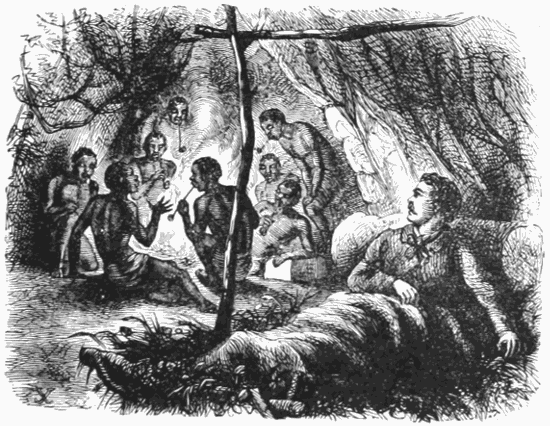
AFTER DINNER.
CHAPTER XVI.
THE HIPPOPOTAMUS—A SPECK OF WAR—REACH NGOLA—A
SUNDAY TALK—THE BLACK MAN'S GOD AND THE
WHITE MAN'S GOD—HOW KING NJAMBAI PUNISHED HIS
WIFE—WE BUILD AN OLAKO IN THE WOODS.
Sunrise found us under way again; and
before us lay a fine stretch of prairie, on the
farther borders of which were quietly grazing
several herds of buffaloes, which, as we approached
them, quickly ran into the woods. While they
remained in sight they gave the country a civilized
appearance; it looked like a large grazing farm in June,
with cattle, and hay almost ready for harvest; a fine,
quiet, old-country picture here in the wilds of Africa,
that reminded me so much of home scenes that I
felt happy and elated.
We pushed on rapidly in order to travel as far as
possible before the heat of the day should set in. We
came to a large pool or lakelet; and, while looking at
the water, I suddenly saw something strange coming
out from under its surface. It was a hippopotamus—the
first I had seen. I thought it was a log of wood; then
I fancied it was the head of a horse; for certainly, from
a distance, the head of a hippopotamus looks like that
of a horse. Then I heard a great grunt, and down went
the head under the water. Suddenly a number of the
animals made their appearance; there were at least a
dozen of them. They began sporting in the water,
now popping their huge heads out and snorting, and
then diving to the bottom and remaining there for
some time.
I watched them for a while, and then I took my gun,
intending to send a bullet into the head of one and
haul him ashore; but Aboko said they would sink to
the bottom. Not wishing to kill one of these creatures
for nothing, I took Aboko's advice, and we went away.
We had not met a single human being since we left
Sangatanga till now. As we journeyed, I saw in the
distance what I at first took to be a herd of buffaloes,
but soon perceived it was a caravan of natives coming
in our direction. Immediately we looked at our guns;
for in this country there is no law, and every man's
hand is against his brother. We saw that they, too,
prepared for an encounter; that most of them hid in
the grass, watching. Four fellows came towards us to
reconnoitre, and to ask if it was peace or war, when
suddenly they got a glimpse of me, and I do not know
how, but they at once saw, from the fact of my being
there, that there would be no war. They shouted to
their companions to come and see the Otangani.
They were Shekianis, who, as I have said, are a very
warlike people, and this part of the country, I was told,
was thickly inhabited by them. We left them in the
midst of their wonders, and travelled as fast as we
could, for we wanted to reach a village of their tribe,
named Ngola, whose chief was a friend of King Bango,
and was his vassal, having married one of his
daughters.
At last, after much travelling, we reached the
village of Ngola. As we approached, and as soon as
the women caught sight of me, they ran screaming
into the houses. Njambai, the chief, received us very
kindly, and gave me a house to live in.
Ngola was a very pretty village, and the house I lived
in belonged to Shinshooko, the brother of the chief.
You will agree with me that Shinshooko had a funny
name. He was a worthy fellow, and tolerably honest,
too, for he gave me the key of one of his doors—(I
wonder where he got the old padlock that was on it)—and
he recommended me to shut my door every time
I went away, as the people might steal something.
Sunday came; I remained in the village. They all
understood the Oroungou language so I could speak
to them. I told them there was no such thing as
witchcraft, and that it was very wrong to accuse people
of it and kill them; that there was only one God, who
made both the whites and the blacks, and we should
all love Him. This elicited only grunts of surprise and
incredulity. They all shouted that there were two
gods,—the God of the Ntangani (white men) and the
God of the Alombai (black men). The God of the
black men had never given them anything, while the
God of the white men had sent them guns,
powder, and many other fine things. Then Shinshooko
remarked, "You have rivers of alongon (rum) flowing
through your land. When I go to Sangatanga I taste
it at King Bango's; how much I should like to live on
the banks of such rivers!" They would not believe
that we had only rivers of water like theirs; and that
we ourselves made our powder, and guns, and rum also.
I stayed for a few days in the village of Ngola, where
the people were very kind to me. One day I heard a
woman crying out, as if she were in great pain. Asking
what was the matter, a man told me the king was
punishing one of his wives; and others said that, if I
did not go to her help, she might be killed. I hurried
to the king's house, and there, in front of the verandah,
a spectacle met my eyes, which froze my blood with
horror. A woman was tied by the middle to a stout
stake driven into the ground. Her legs were stretched
out and fastened to other smaller stakes, and stout
cords were bound round her neck, waist, ankles, and
wrists. These cords were being twisted with sticks;
and when I arrived the skin was bursting from the
terrible compression. The poor woman looked at me.
The king was in a perfect rage; he himself was the
chief executioner. His eyes were blood-shot, and his
lips were white with foam. I had to be careful in
expostulating with the king, for fear that he might kill
her at once, in a fit of rage. I walked up, and, taking
him by the arm, I asked him for my sake to release the
poor woman, and not to kill her. He seemed to
hesitate; he did not answer, and went into his house.
I threatened to leave if he did not release her. Finally
he consented, and said: "Let her loose yourself; I
give her to you."
How glad I was! I rushed out immediately and
began to untie the savage cords, and to cut them away
with my knife. The poor creature was covered with
blood. I sent her to my house and took care of her. I
learned that she had stolen some of her husband's beads.
After this, I left the Shekiani village of Ngola and
went on my journey with my friends, Aboko and
Niamkala. We travelled on, till, on reaching a place in
the midst of a forest, not far from a little lake, we
determined to build an olako; for I liked the country
so much that I did not want to leave it. There were
a great many wild animals in the neighbourhood, and
we thought the place was likely to afford us good sport,
especially as the lake would draw beasts down to its
banks to drink. We were not only near water, but we
had a wide stretch of forest and prairie-land about us.
We worked very hard that day, building and arranging
our encampment, in such a way as to make everything
comfortable and secure. Of course we selected the
prettiest part of the forest, and where there were many
tall and shady trees. We first cut the underbrush from
under the trees, and also many of the vines or creepers,
which looked very singular as they hung down over our
heads. Then we collected a great number of large
leaves, which are called by some tribes shayshayray
and guaygayrai, to roof our sheds with. After this
we proceeded to cut a number of small sticks, seven or
eight feet long, and began to construct our habitations.
Then we cut branches of trees to shield us from the
wind, and collected a great quantity of firewood, for
we had made up our minds to keep ourselves warm.
After we had arranged and lighted the fires, our camp
looked quite like a little village. It was very romantic
and beautiful. I had arranged my own shelter very
nicely; and it was first in the row. To be sure, my
bed was rather hard, being composed of sticks and leafy
branches; while for a pillow I had merely a piece of
wood.
In the midst of our work, ten slaves of Njambai
came, laden with provisions, which the good fellow had
sent after me. After doing a hard day's work, I think
we deserved to rest comfortably in the evening. We
began cooking our dinner; and a right good dinner it
was. My men had monkey and buffalo-meat; but I
had a nice fat fowl, which my friend Njambai had sent
me.
Before dinner I warned my men to be honest, and
keep their fingers at home. They were good fellows,
but I found that all savages will steal. So I threatened
to kill the first man I caught meddling with my property,
and told them I would shoot without mercy;
"and then," said I, with great sternness, "when I
have blown your brains out, I will settle the matter
with your king." To which Aboko coolly replied that
the settlement was not likely to do them any particular
good.
Of course they all protested that they were honest;
but I knew them better than they knew themselves; I
knew the effect of temptation on them, poor fellows!
and had more confidence in their faith that I would
kill the thief than I had in their good resolutions.
When this little matter was settled, they drew
around the blazing fire. By this time, the buffalo-meat
suspended in a huge kettle over the fire was
cooked and ready to be eaten; the monkeys had been
roasted on charcoal; my fowl had been cooked; and
before us was a great pile of roasted plantain. We
enjoyed a hearty meal together; I eating off a plate,
and using a fork, while the black fellows took fresh
leaves for plates, and used the "black man's fork," as
they call their five fingers. After dinner, they drank
a large calabash-full of palm wine that had been
brought from Ngola; and then, to crown their feast,
with the greatest delight of all, I went to one of my
boxes, and, lifting the lid, while the shining black faces
peered at me with saucer-eyes of expectation, I took
out a huge plug of Kentucky tobacco. There was a
wild hurrah of joy from them all. They shouted that
I was their friend; they loved only me; they would go
with nobody else; I was their good spirit; I was
like one of themselves. I distributed the tobacco
among them; and in a few minutes all were lying
about the fire, or seated round it, with their pipes in
their mouths.
After making the fire burn brightly I, being tired,
went and lay down, as you see me in the picture. My
blanket was the only article of bedding I had; I
wrapped this around me, and rested my head on my
wooden pillow, which I assure you was not of the softest
kind. I felt pleased to see my men so contented.
Their wild stories of hunting adventures, of witchcraft,
and evil spirits well fitted the rude, picturesque surroundings;
and they lay there talking away, till, at
last, I was obliged to remind them that it was one
o'clock, and time to go to sleep, especially as some of
us were to get up very early and go hunting. Then all
became silent, and soon we all fell asleep, except the
men appointed to keep the fires bright, on account of
the leopards, and also to watch that we might not be
surprised by some enemy.
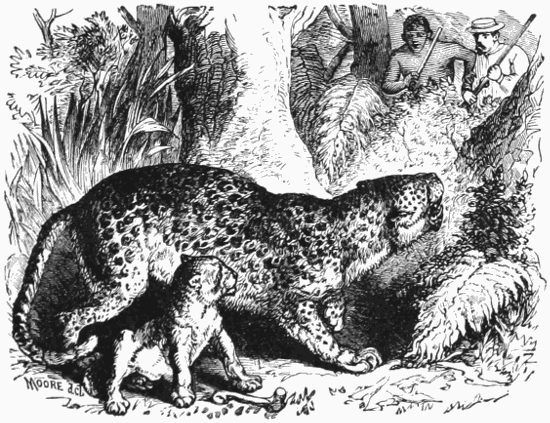
A LEOPARD AND HER YOUNG ONE.
CHAPTER XVII.
AN UNSUCCESSFUL HUNT FOR ELEPHANTS—I TAKE AIM
AT A BUFFALO—A LEOPARD IN THE GRASS NEAR US—WE
SHOOT THE LEOPARD AND HER KITTEN—GREAT
REJOICING IN CAMP—WHO SHALL HAVE THE TAIL?—A
QUARREL OVER THE BRAINS—THE GUINEA HENS—THE
MONKEYS.
Early the next morning, Aboko and I got up.
Aboko covered himself with his war fetiches,
and also with the fetiches that were to
bring good luck, and give him a steady hand. On
the middle of his forehead was a yellow spot made
with clay. When he had finished these preparations
we started.
Our desire was to kill elephants. We saw plenty of
tracks, and we hunted all day long. In many places,
to judge by the tracks, the elephants had been only an
hour or two before ourselves. But we did not see a
single elephant, and I killed only a few monkeys for my
men's dinner, as well as a few birds.
We were returning to the camp, rather down-hearted,
when I heard the cry of the grey male partridge,
of which I have already spoken, calling for his
mates to come and perch on the tree he had chosen.
We turned back to get a shot, if possible, for they are
fine eating. We were just on the edge of the forest;
and, as I pushed out into the prairie, suddenly I saw
several buffaloes, one of which I made sure of as he
stood a little in advance of the rest, where the grass
was high enough for a stealthy approach. I immediately
put a ball into the barrel that had only shot, so
that I might have my two barrels loaded with bullets.
Then Aboko and I advanced slowly towards the unconscious
bull, which stood a fair mark, and I was about to
raise my gun when Aboko made a quick sign to hold
still and listen. Aboko, at the same time, breathed as
if he were smelling something.
I did not know why it was that Aboko had
stopped me, but I knew there must be better game
at hand, or some other good reason for his doing
so. Perhaps he had heard the footstep of an
elephant. I looked at his face, and saw that it
appeared anxious.
As we stood perfectly motionless, I heard, at
apparently a little distance before us, a low purring
sound, which might have been taken, by a careless ear,
for the sound of the wind passing through the grass.
But to Aboko's quick ear it betokened something else.
His face grew very earnest, and he whispered to me
"Njego" (leopard).
What were we to do? The noise continued. We
cocked our guns, and moved, slowly and cautiously, a
few steps ahead, to get a position where we thought
we might see over the grass. The leopard might
pounce upon us at any moment. What would prevent
him from doing so if he chose? Certainly not our guns,
for we did not know exactly where the beast was. To
tell you the truth, I did not feel comfortable at all; I
had a slight objection to being carried away in the
jaws of a leopard and devoured in the woods.
Our situation was far from being a pleasant one. The
leopard comes out generally by night only, and nothing
but extreme hunger will bring him out of his lair in
open day. When he is hungry, he is also unusually
savage, and very quick in his motions.
We knew the animal was near, but we could not
succeed in getting a sight of him. As the wind blew
from him towards us, I perceived plainly a strong
peculiar odour which this animal gives out; and this
fact proved, still more decidedly, that the leopard could
not be far off. The thought passed through my mind:
Is he watching us? Is he coming towards us—crouching
like a cat on the ground, and ready to spring upon
us when near enough? Do his eyes penetrate the
grass which we cannot see through? If so, is he ready
to spring?
Meantime our buffalo-bull stood stupidly before his
herd, not twenty yards from us, utterly innocent of
the presence of so many of his formidable enemies—the
leopard, Aboko, and myself.
Just then we moved a little to one side, and, peering
through an opening in the grass, I beheld an
immense leopard, a female, with a tiny young leopard
by her side. The beast saw us at the same moment,
having turned her head quickly at some slight noise
we made. She had been watching the buffalo so
intently as not to notice our approach. It seemed to
me as if a curious look of indecision passed over her
face. She, too, had more game than she had looked
for, and was puzzled which to attack first. Her long
tail swished from side to side, and her eyes glared, as
she hesitated for a moment to decide which of the
three—the bull, Aboko, or me—to pounce upon and
make her victim.
But I saved her the trouble of making up her mind;
for, in far less time than it takes me to tell you what took
place, I had put a ball into her head, which, luckily
for us, relieved her of further care for prey. She
dropped down dead. At the same moment Aboko fired
into the little leopard and killed it. At the noise of
the guns, the buffalo-bull and the herd decamped in
the opposite direction, at a tremendous pace, the bull
little knowing the circumstances to which he owed his
life.
I felt much relieved, for I had never before been in
quite so ticklish a situation, and I felt no particular
desire ever to be in a similar plight again.
When we returned to the camp there was a great
excitement as soon as they heard the news that two
leopards had been killed. Aboko carried in the young
leopard on his back; but mine was too heavy, and had
to be left in the field. Guns were fired in rejoicing;
and the big leopard was fetched in. When the people
returned with it to the camp, all shouted, "What an
enormous beast! what an enormous beast! We heard
gun firing," etc., etc.
In the midst of this noise Niamkala made his
appearance with some of our party, bringing in some
wild boars and a pretty little gazelle which the natives
called ncheri. Of course the wild boars had been cut
up into several pieces, for they were too heavy to carry
whole.
Niamkala and his party were received with great
cheers. The prospect of a good supper brightened all
their faces, and mine also; and I shouted, "Well
done, Niamkala and boys!"
Everything was brought to my feet. There was so
much to eat that there was no use in dividing the meat
into equal shares; so I let everyone take as much as
he liked.
After supper the leopards were hung on a pole
resting on two forked sticks; and then the negroes
danced round them. They sang songs of victory, and
exulted over and abused the deceased leopard (the
mother). They addressed to her comical compliments
upon her beauty (and the leopard is really a most
beautiful animal). They said, "What a fine coat you
have!" (meaning her skin). "We will take that coat off
from you." They shouted, "Now you will kill no
more people! Now you will eat no more hunters!
Now you cannot leap upon your prey! What
has become of the wild bull you were looking after so
keenly? Would you not have liked to make a meal of
Aboko or of Chaillie?" (for they called me Chaillie).
Thus they sang and danced round till towards morning,
when I made them go to sleep.
Next morning there was great quarrelling among
my men. What could be the matter? I found that
Niamkala was declaring his determination to have the
end of my leopard's tail, while the rest of the hunters
asserted their equal right to it. Aboko said he did not
care, as he would have the tail of the one he had
killed.
I skinned the two leopards in the most careful
manner, and gave the end of the tail to Niamkala, and
I promised Fasiko to give him the tail of the next one
I should kill. They all shouted, "I hope you will kill
leopards enough to give to each of us a tail!"
Poor Fasiko looked very down-hearted. When I inquired
why, he said, "Don't you know that when a
man has the end of a leopard's tail in his possession he
is sure to be fortunate in winning the heart of the girl
he wants to marry?"
I said, "Fasiko, you have one wife, what do you care
for a leopard's tail?"
He replied, "I want a good many wives."
The palaver about the tail was hardly over when
another quarrel broke out. This time it was about the
brains. Aboko, Niamkala, and Fasiko each wanted the
whole brain of the animal. The others said they must
have some too; that there was only one end to each tail,
but that the brains could be divided among them all.
For a few minutes a fight seemed imminent over the
head of the leopard.
I said, "You may quarrel, but no fighting. If you
do you will see me in the fight; and I will hit everybody,
and hit hard too." At the same time I pointed
out to them a large stick lying by my bedside. This
immediately stopped them.
They all wanted the brain, they said, because, when
mixed with some other charms, it makes a powerful
monda (fetiche), which gives its possessors dauntless
courage and great fortune in the hunt. Happily, I
was able to persuade my three best hunters that they
wanted no such means to bolster up their courage.
The dispute over the brains being settled, Aboko, in
the presence of all the men, laid the liver before me.
As this had no value or interest for me, since I was
certainly not going to eat the liver of the leopard for
my dinner, I was about to kick it aside, when they
stopped me, and entreated me to take off the gall and
destroy it, in order to save the party from future
trouble. These negroes believe the gall of the leopard
to be deadly poison, and my men feared to be
suspected by their friends or enemies at Sangatanga
of having concealed some of this poison. So I took off
the gall, put it under my feet and destroyed it, and
then, taking the earth in which it had been spilled, I
threw it in every direction, for I did not want any of
these poor fellows to be accused of a crime, and lose
their lives by it. I intended to inform the king, on
my return, that we had destroyed the liver. But I
told my men that their belief was all nonsense, and a
mere superstition. They said it was not. As I could
not prove their notion to be false, I stopped the discussion
by saying I did not believe it.
Having plenty of game, we carried the leopard-meat
a long way off, and threw it away.
We did not go hunting for two days, but spent our
time in smoking the meat we had on hand. It was
just the sort of weather for hunting, and for living in
the woods. The air was cool and refreshing, for it was
June, and the dry season; but the sky was often
clouded, which prevented the sun from being oppressive.
To add to our pleasure, the forest trees were in
bloom, and many of them were fragrant. The nights
were very cold indeed for this country, the thermometer
going down to sixty-eight degrees Fahrenheit.
The wind blew hard, but against that we managed to
protect ourselves. The dews were not nearly so heavy
as they are in the rainy season. The grass was in
great part burned off the prairies.
Every day we succeeded in shooting more or less
game, among which were antelopes, gazelles, wild boars,
monkeys without number, and guinea fowls. These
guinea fowls were of a beautiful species. In this
country you have never seen any like them.
My joy was great when I killed this hitherto unknown
species of guinea-fowl (Numida plumifera). It is
one of the handsomest of all the guinea-fowls yet discovered.
Its head is naked, the skin being of a deep
bluish-black tinge, and is crowned with a beautiful
crest of straight, erect, narrow, downy feathers, standing
in a bunch close together. The plumage of the
body is of a fine bluish-black ground, variegated with
numerous eyes of white, slightly tinged with blue.
The bill and legs are coloured a blue-black, similar to
the skin of the head.
This bird is not found near the seashore. It is very
shy, but marches in large flocks through the woods.
At night they perch on trees, where they are protected
from the numerous animals which prowl about.
I killed several beautiful monkeys called by the
natives mondi. What curious-looking monkeys they
were! Only the stuffed specimen of a young one had
been received in England before this time. The mondi
is entirely black, and is covered with long shaggy hair.
It has a very large body, and a funny little head, quite
out of proportion to the size of the animal. It is a very
beautiful monkey; the hair is of a glossy jet black;
and it has a very long tail. In Africa no monkeys have
prehensile tails; I mean by that, tails which they can
twist round the branch of a tree, and so hang themselves
with the head downwards. That kind of monkey
is only found in South America.
The mondi has a dismal cry, which sounds very
strangely in the silent woods, and always enabled me
to tell where these monkeys were.
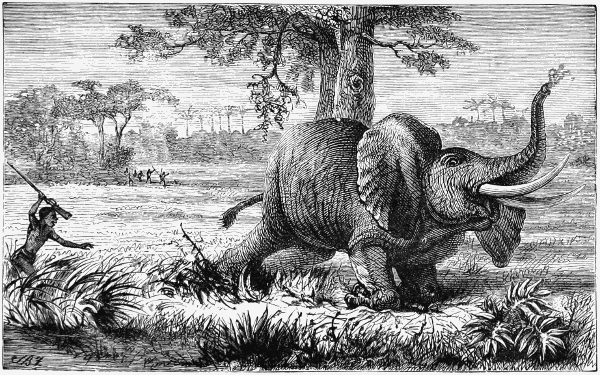

CHAPTER XVIII.
ALONE IN CAMP—HUNTING FOR ELEPHANTS—ABOKO KILLS
A ROGUE ELEPHANT—I CUT ANOTHER PYTHON IN TWO—WE
SHOOT SOME WILD BOARS—A BUFFALO HUNT—RETURN
TO SANGATANGA—KING BANGO SICK.
One fine day I remained in the camp, for I had
been hunting so much that I wanted a day
of rest. All the others had gone to hunt. I
was left alone, and I enjoyed the solitude, everything
around me was so beautiful and quiet.
Nature seemed to smile on all sides. I placed myself
at the foot of a large tree, and wrote in my journals;
and then I thought of the dear friends I had at home,
and wondered if they sometimes thought of me. Then
I called to mind all I had seen in the wonderful
country which I had explored. I could hardly believe
it myself: it seemed like a dream. What extraordinary
people, and what curious beasts, had I not met!
How many wonderful dangers I had escaped! How
kind God had been in protecting me! How He had
watched over the poor lonely traveller, and taken care
of him during sickness! Thus my heart went up in
gratitude, and I silently implored that the protection
of God might still be granted me.
Towards sunset, Aboko and Niamkala made their
appearance, and brought a fine young boar with them.
As usual, without saying a word, they came right to
me, and put the dead animal at my feet. Then, seating
themselves and clapping their hands, Aboko began
to tell me what had happened from the time they
started in the morning until the time they returned.
They forgot nothing, even mentioning the tracks of
the animals they had seen. They reported they had
found fresh elephant tracks, and thought the elephants
had made their head-quarters there for a few days.
After hearing this, we immediately resolved that we
would all turn out after elephants on the following
day.
Accordingly, in the evening, we cleaned and prepared
our guns, and everybody went to sleep early.
The next morning we started about daybreak, each
of us carrying some provisions. We were to fire no
guns in the forest, for fear of frightening the elephants,
who are very shy in this region. We had taken pains
to load our guns in the most careful manner.
We hunted all day, but in vain; no elephants were
to be seen. We slept out in the woods, for we were too
far from the camp to return. We felt so tired that
we had only sufficient strength left to enable us to fetch
firewood, and to cut a few branches of trees and lie
down upon them. I had lost or forgotten the matches,
so I had to light the fire with a piece of steel and a
gun-flint. This took a little longer.
Very soundly we all slept, as you may easily suppose.
When I awoke in the midst of the night our fires were
almost out; at least they did not blaze up enough to
frighten the wild beasts. Aboko, Niamkala, and
Fasiko were snoring tremendously. One was lying
flat on his back, the other had his legs up, while Fasiko
had his arm extended at full length. By the side of
each was his gun, which touched him in some way, so
that it could not be taken without awaking him. I
believe it was their snoring that had aroused me. They
were so tired, and seemed to sleep so soundly, that I
did not want to wake them, so I went and added fuel
to the fire, which soon began to blaze up again.
The next day found us again exploring the woods
in every direction. Elephants certainly were not
plentiful; besides they travelled much in search of
their favourite food—a kind of fern, which was not
very abundant. Again I got very tired; but at last,
in the afternoon, we came across our quarry.
Emerging from a thick part of the forest into a
prairie which bordered it, we saw to our left, just
upon the edge of the wood, a solitary bull elephant.
There we stood still. I wonder what he was thinking
about! I had seen the great beast in menageries,
and also among the Fans, and I have described to you
an elephant hunt in their country, but then there was
great confusion.
Here, the huge animal stood quietly by a tree,
innocent of our presence; and now, for the first time
in my life, I was struck with the vast size of this
giant of the forests. Large trees seemed like small
saplings when compared with the bulk of this immense
beast which was standing placidly near them.
What were we to do but to kill him? Though I
felt a sense of pity at trying to destroy so noble an
animal, yet I was very anxious to get the first shot
myself; for it was a "rogue elephant"—that is, an
elephant unattached.[1] It was an old one, as we could
see by the great size of its tusks. I remembered that
rogue elephants are said to be very ferocious. So much
the better, I thought. I had killed a good deal of
game, and I had ceased to be afraid of any of them,
though I felt that hunting was no child's play.
[1] Sir Emerson Tennent ("Ceylon," vol. ii. p. 304) speaks of "the
class of solitary elephants, which are known by the term of Goondapo,
in India, and from their vicious propensities, and predatory habits,
are called Hora, or Rogues, in Ceylon."
You must not think that we were standing up all
this time in sight of the elephant. As soon as we had
seen him, we lay down and hid ourselves in the forest,
in such a manner as not to lose sight of him. Then
we held a grand council, and talked over what must be
done to bag the beast.
The grass was burnt in every direction to the leeward
of him, and we dared not risk approaching him from
the windward for fear he should smell us. What was
to be done? The eyes of my men were fixed upon
me with a keenly inquisitive look. They expected me
to tell them what I thought best to do about the
matter.
I looked at the country, and saw that the grass was
very short; and, after taking account of all the chances
of approach, I was compelled to admit that I could not
manage to get near the beast myself with any certainty.
I could not crawl on the ground; my clothes
were sure to be seen by the elephant; therefore, as a
sensible hunter, I was reluctantly compelled to resign
in favour of Aboko, who, I thought, was the best man
for the difficult undertaking. His eyes glistened with
pleasure as he thought that now he could show his
skill. Besides, among hunters there is something
pleasant and exciting in knowing that you are about
to rush into danger.
After cocking his musket, Aboko dropped down in
the short grass, and began to creep up to the elephant
slowly on his belly. The rest of us remained where
we had held our council, and watched Aboko as he
glided through the grass for all the world like a huge
boa-constrictor; for, from the slight glimpses we
caught, his back, as he moved farther and farther away
from us, resembled nothing so much as the folds of a
great serpent winding his way along. Finally we could
no longer distinguish any motion. Then all was silence.
I could hear the beating of my heart distinctly, I was
so excited.
The elephant was standing still, when suddenly the
sharp report of a gun rang through the woods and over
the plain, and elicited screams of surprise from sundry
scared monkeys who were on the branches of a tree
close by us. I saw the huge beast helplessly tottering
till he finally threw up his trunk, and fell in a dead
mass at the foot of a tree. Then the black body of
Aboko rose; the snake-like creature had become a man
again. A wild hurrah of joy escaped from us; I waved
my old hat, and threw it into the air, and we all made
a run for the elephant. When we arrived, there stood
Aboko by the side of the huge beast, calm as if nothing
had happened, except that his body was shining with
sweat. He did not say a word, but looked at me, and
then at the beast, and then at me again, as if to say:
"You see, Chaillu, you did right to send me. Have
I not killed the elephant?"
The men began to shout with excitement at such
a good shot. "Aboko is a man," said they, as we
looked again at the beast, whose flesh was still quivering
with the death agony. Aboko's bullet had entered
his head a little below the ear, and, striking the brain,
was at once fatal.
Aboko began to make fetich-marks on the ground
around the body. After this was done we took an axe,
which Fasiko had carried with him, and broke the
skull, in order to get out the two tusks, and very large
tusks they were.
Of course we could not carry off the elephant, so
Aboko and I slept that night near our prize on the
grass and under the tree. Niamkala and Fasiko had
started for the camp to tell the men the news, and
the next morning all the men hurried out. While
quietly resting under the shade of a tree close to the
elephant, I spied them coming. As soon as they recognised
us they shouted, and, when near enough, they
made a spring at Aboko and then at the elephant. All
the cutlasses, all the axes and knives that were in the
camp, had been sharpened and brought out. Then
the cutting up of the elephant took place. He was not
very fat. What a huge beast he was! What a huge
liver he had! What an enormous heart, too!
The trunk, being considered a choice morsel, was cut
into small pieces. The meat was to be smoked
immediately, and then carried to Sangatanga, to be
sold and given away. Great bargains were looming
before the men's eyes; they were all to get rich by
selling the elephant's meat.
I never saw men more happy than these poor
fellows were. The negroes believe in eating. Mine
ate nothing but meat, and they ate such quantities of
it that several of them got sick, and I was obliged to
give them laudanum in brandy to cure them. They
almost finished my little stock of brandy.
The camp was full of meat, and as we had no salt,
the odour that came from it was not particularly agreeable.
Indeed, I had to have a separate shanty built on
one side, and to the windward of the camp. I could
not stand the stench.
At night the negroes lay around the fires, the jolliest
of mortals, drinking palm-wine, which they made
regularly from the neighbouring palm-trees, and
smoking tobacco when I was generous enough to
give them some. In fact, they were as honest a set
of negroes as I had met with anywhere, really good
fellows.
As time passed on you must not think that I did
nothing but kill animals. I rambled through the
forest, and studied everything I saw. Sometimes,
when too far away from the camp, and after a day of
hard hunting, I slept soundly under a tree by the side
of a big fire, with my gun by my side. I thought I
would go hunting one day for wild animals; on
another, for birds; and, when too tired to travel, I
would remain in the camp, sleeping sweetly on my
primitive couch, which consisted of a couple of mats
spread on the bare and soft earth, with a thick blanket
for cover, the foliage of a tree and the blue starlit sky
being my canopy and roof. I had given up sleeping
upon bare sticks, finding it too hard.
As fresh boar tracks had been seen near the camp,
I could not resist the temptation of having another
hunt after that savage beast. However tired I might
be, I could hardly keep still whenever news came that
game was near us. I was always in the hope of finding
some new animal or something curious to stuff and
bring home, to show what I had done.
We had not gone far when we heard, to the right
of us, the grunting of some wild boars. As they are
very wild, we jumped hastily behind a fallen tree to
hide ourselves. In our haste to do this, I heedlessly
stepped on something in my path, and, looking down,
found I was running upon an immense serpent, a huge
python, which lay snugly coiled up beside the tree.
Happily, he was in a state of stupefaction, consequent,
probably, on having eaten too heavy a dinner. He
scarcely moved, and did not raise his head. I ran to
Niamkala, and borrowed a kind of heavy cutlass which
he carried with him, and with a blow of this I cut the
python in two pieces, which instantly began to squirm
about in a very snaky and horrible way. During his
death-struggle the monster disgorged the body of a
young gazelle, which was in a half digested condition.
This python was not quite twenty feet long—a pretty
good-sized one, you may judge.
The noise we made in killing the snake of course
frightened the wild pigs. We pursued them, and
succeeded, by good management, and after a hard
chase of an hour, in coming up with the herd. They
were ten in number, and we managed to bag two.
They were not very large. Besides these pigs, my
hunters carried the two halves of the serpent to the
camp. We were received there with demonstrations of
joy. They made a kind of soup with the boa, and
seemed to relish it very much. I did not taste it, and
can therefore say nothing against it.
I never saw a country like this for game. There
was so much prairie land that it reminded me of
Southern Africa. The contrast with the great forest,
where I had travelled for days without seeing anything,
was very great.
For a few days I remained quiet in the camp. The
men had in the meantime been hunting and exploring
in various directions. As they reported that great
herds of buffaloes frequented every night a prairie
situated about ten miles from our camp, I determined
to have a hunt for them. I was very fond of buffaloes,
at least of their meat.
We set out and left our camp just before sunset.
Our route was through the midst of prairie land, and
by eight o'clock in the evening we reached the forest
beyond. There we hoped to find our game; and
securing for ourselves safe hiding-places in the woods
on the edge of the plain, we lay down and waited.
Now, waiting is generally tedious, but waiting in a
cold night from eight to two o'clock, every moment
expecting that which does not come, is apt to try one's
patience severely. Mine was entirely gone, and I
wished myself comfortably under my blanket in camp,
when suddenly the buffaloes came. Aboko heard them
coming, and presently a herd of about twenty-five
animals emerged from the woods, and scattered
quietly about the grassy plain.
The moon was going down, and we could see from
our hiding-places the long shadows of the buffaloes,
silently gliding one way or another, but never near
enough to us for a shot. Soon they felt quite at ease,
and began feeding, ever and anon gambling sportively
with one another. Seeing them engaged, we crawled
towards them slowly and with great care. We had
almost got within safe range when a sudden change of
wind discovered us to them. They snuffed up the air
suspiciously, and instantly gathering together, they
disappeared in the woods.
There was ill luck! My hunters cursed in Shekiani,
and I grumbled in several languages. But there was
still hope. Silently we crawled back to our lair, and
waited patiently for two mortal hours; when at last
two—a bull and a cow—stalked leisurely into the fields
and began to crop the grass. It was now dark. The
moon had gone down, leaving us only the uncertain
light of the stars. We watched the motions of the
buffaloes until we thought we could venture, and
then silently crawled towards them again. This time
we got within range. I chose the bull for my shot, and
Niamkala took the cow, while Aboko was ready to
second me with his gun in case I should not kill my
animal. We fired both at once, and by good luck, for
the light was not enough to afford a chance for a fair
shot, both the animals fell down dead.
Daylight soon appeared, and we resolved to return to
the camp and send men to bring in the meat, thinking
that no wild beasts would trouble our prizes at such
unseasonable hours. Aboko and Niamkala first cut off
the bushy tails of black glossy hair, and then we made
for the camp, where they showed to our companions
these trophies of our chase. The men made haste, and
reached the place early, but not before the cow was
half eaten by a hungry leopard. The poor leopard who
ventured out so early in the morning must have been
nearly famished. I did not grudge him his meal,
though I should have liked to watch for him and shoot
him, had I thought of his coming, for I had plenty of
friends to whom I could have given his skin on my
return.
A few days afterwards we broke up our camp, and
loaded ourselves with the birds and beasts I had killed
and prepared, and also with the meat which my men
had smoked; and all the time they were boasting of
how much tobacco and other dainties they would get
for this. They seemed very jolly, though groaning
under their burdens; and I was pleased to see them so
happy. The specimens of the Bos brachicheros were
an inconvenient load, and I was obliged to be very
careful with them.
When I reached Sangatanga I found that the king
was in worse health than he was when I had left. He
was alarmed, fearing he would die. He remarked that
it was singular he had been taken worse immediately
after my departure; and that, in fact, he grew sick on
the very night when I slept in his house.
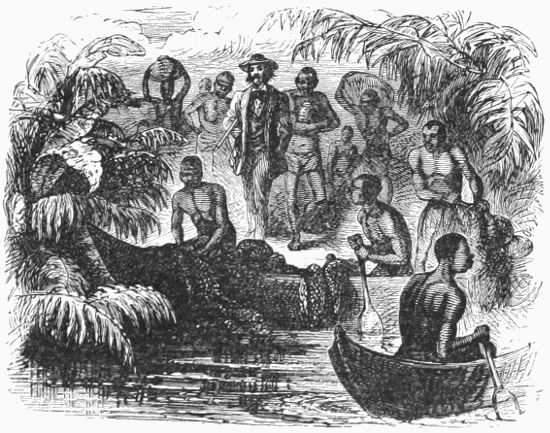
FISHING.
CHAPTER XIX.
A JOLLY EXCURSION PARTY—A RACE FOR THE FISHING
BANKS—THE OROUNGOU BURIAL-GROUND.
Not long after we returned from our hunting
expedition, I prepared to go to Fetich Point
on a fishing excursion. For this purpose it
was necessary to have canoes. I had called on
King Bango since I returned, but, remembering
the rats, I had respectfully declined the hospitality of
his palace. Nevertheless, he remained my friend and
gave me all the men I wanted.
I not only wanted to fish, but I also wished to see
the burial-ground of the Oroungous, which is not far
from Fetich Point. There were also some enormous
turtles on Fetich Point, I was told, and I wished to
catch some of them.
My old hunting friend, Fasiko, had got together a
party of forty men. Besides Fetich Point, I was to
visit the Fetich river, and the end of Cape Lopez.
There being no houses whatever there, the women had
prepared for us a great quantity of powdered manioc,
baskets of ground nuts, sweet potatoes, and bunches of
plantain. We had a very large outfit. Fasiko got
together a lot of mats to sleep upon, and kettles to
cook in, and a great quantity of salt, with which to
salt the fish we hoped to catch. We had several fish-nets
made, of the fibre of a vine. We also had fish-hooks;
and I took an enormous hook to catch sharks.
I always had a hatred of sharks, they are such savage
and voracious monsters.
We had a great number of baskets. The women
carried these to put the fish in. We did not forget
guns; for leopards lurk in the jungle, on the south
side of the cape, and the boa hangs from the trees,
waiting for his prey. If you got up early there, as
everybody at a watering-place should, you can see huge
elephants trotting down along the beach, and cooling
their tender toes in the surf.
It was a very jolly party, for Cape Lopez is the Cape
May, or Nahant of Sangatanga. The dry season there
answers to our July, when "everybody that is anybody"
is supposed to be "out of town and down by
the seaside."
Niamkala and Aboko were of the party; for we were
great friends; and wherever I went they wanted to go
with me. They were slaves of King Bango; but we
had shared the same dangers, we had shared the same
pleasures.
At last everything was ready. I embarked in the
biggest canoe, which was manned by sixteen oarsmen.
As usual, there was a good deal of shouting and bustle
before we got off. The sails, made with matting, were
unfurled, and we set out across the bay. We had an
exciting race to see which canoe was the fastest. There
was a stiff breeze; but unfortunately the wind was
nearly in our faces, so that our sails were of little use.
The men worked lustily at their paddles, and as they
paddled they sang their wild canoe songs. The morning
was clear and bright, but in the afternoon the sky
became clouded. We reached Fetich Point a little
before sunset; and the men, who seemed as lively and
jolly as could be, at once cast their net, in a way not
materially different from our mode of using the hand-net,
and made a great haul of fish, the principal part
of which were mullets. How beautiful they looked!
They seemed like silver fish.
The men went immediately in search of firewood.
We lighted our fires; and, having cooked and eaten
our fish, which were delicious, we prepared for a night's
rest by spreading mats upon the sand. It was terribly
cold; for we were not sheltered from the wind, which
went right through my blanket.
Not far from Fetich Point is the river Tetica, one
of the tributaries of the Nazareth river. The Nazareth
falls into the bay, through a tangled, dreary, and
poisonous track of back country, consisting of mangrove
swamps, like those I have described on the
Monda river, and where, I daresay, no animals, except
serpents, are to be found. There are no human habitations
there.
In the morning, I wished to see the Oroungou burial-ground,
before starting for Cape Lopez itself. It lay
about a mile from our camp, towards Sangatanga, from
which it is distant about half a day's pull in a canoe.
It was only by the promise of a large reward that I
persuaded Niamkala to accompany me. The negroes
visit the place only on funeral errands, and hold it in
the greatest awe, conceiving that here the spirits of
their ancestors wander about, and that they are not
lightly to be disturbed.
Niamkala and I left the camp, and, following the
seashore, we soon reached the place. It is in a grove
of noble trees, many of them of magnificent size and
shape. As I have said, the natives hold the place in
great reverence.
The grove is by the sea. It is entirely cleared of
underbrush; and, as the wind sighs through the dense
foliage of the trees, and whispers in their darkened,
somewhat gloomy recesses, there is something awful
about the place. I thought how many lives had been
sacrificed on these graves.
Niamkala stood in silence by the strand, while I
entered the domain of the Oroungou dead.
The corpses are not put below the surface. They
lie about beneath the trees, in huge wooden coffins,
many of which are made of trees. By far the greater
number were crumbling away. Some new ones
betokened recent arrivals. The corpses of some had
only been surrounded by a mat. Here was a coffin
falling to pieces, and disclosing a grinning skeleton
within. On the other side were skeletons, already
without their covers, which lay in the dirt beside them.
Everywhere were bleached bones, and mouldering
remains. It was curious to see the brass anklets and
bracelets, in which some Oroungou maiden or wife had
been buried, still surrounding her whitened bones, and
to note the remains of articles which had been laid in
the coffin or put by the side of some wealthy fellow
now crumbling to dust. What do you think these
articles were? Umbrellas, guns, spears, knives, bracelets,
bottles, cooking-pots, swords, plates, jugs, glasses,
etc.
In some places there remained only little heaps of
shapeless dust, from which some copper, or iron, or
ivory ornaments, or broken pieces of the articles I have
just mentioned, gleamed out, to prove that here, too,
once lay a corpse, and exemplifying the saying of the
Bible, "Dust, to dust thou shalt return." I could not
help saying to myself. "Man, what art thou?"
Suddenly I came to a corpse that must have been
put there only the day before. The man looked asleep,
for death does not show its pallor in the face of the
negro as it does in that of the white man. This corpse
had been dressed in a coat, and wore a necklace of
beads. By his side stood a jar, a cooking-pot, and a
few other articles, which his friend, or his heir, had
put by his side.
Passing on into a yet more sombre gloom, I came at
last to the grave of old King Pass-all, the brother of
the present king. Niamkala had pointed out to me
the place where I should find it. The huge coffin lay
on the ground, and was surrounded on every side with
great chests, which contained some of the property of
his deceased majesty. Many of them were tumbling
down, and the property destroyed. The wood, as well
as the goods, had been eaten up by the white ants.
Among some of these chests, and on the top of them,
were piled huge earthenware jugs, glasses, mugs,
plates, iron pots, and brass kettles. Iron and copper
rings, and beads were scattered around, with other
precious things which Pass-all had determined to carry
to the grave with him. There lay also the ghastly
skeletons of the poor slaves, who, to the number of one
hundred, were killed when the king died, that he
might not pass into the other world without due
attendance.
It was a grim sight, and one which filled me with a
sadder feeling than even the disgusting slave barracoons
had given me.
The land breeze was blowing when I returned, and
we started for the sandy point of the cape. It is a
curious beach, very low, and covered with a short
scrub, which hides a part of the view, while the sand
ahead is undistinguishable at a distance from the
water, above which it barely rises. I was repeatedly
disappointed, thinking we had come to the end, when
in fact we had before us a long narrow sand-spit.
Finally we reached the extreme end, and landed in
smooth water on the inside of the spit.
The point gains continually upon the sea. Every
year a little more sand appears above the water, while
the line of short shrubs, which acts as a kind of dam
or breakwater, is also extended, and holds the new
land firm against the encroachments of old Neptune.
Among these shrubs we built our camp, and here
for some days we had a very pleasant and lively time.
The weather was delightful; we had no rain, it being
the dry season, and we were not afraid of the awful
tornadoes.
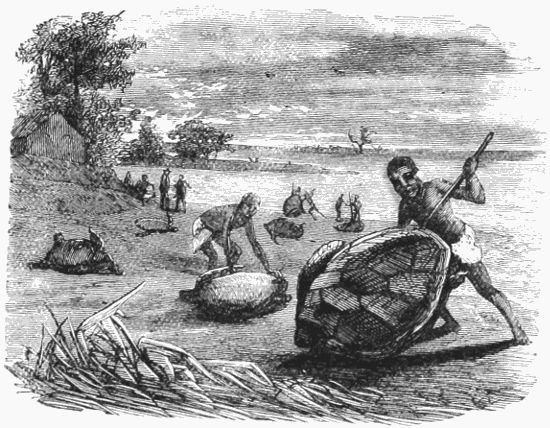
TURNING TURTLES JUST BEFORE SUNRISE.
CHAPTER XX.
OUR CAMP AT POINT FETICH—AN AFRICAN WATERING-PLACE—FISHING,
BUT NOT BATHING—THE SHARKS—CURING
MULLETS, ETC.—TURNING TURTLES—BIRD
SHOOTING—A LEOPARD SPRINGS UPON US.
Our camp presented a very picturesque appearance,
and was unlike the one described a
little while ago, and of which I gave you a
picture. Here each man had built for himself
a cosy shade with mats, which, by the way, are very
beautiful. These mats are about five or six feet in
length and three feet wide. We made our walls of
them, so that we were sheltered from the wind. Our
houses looked very much like large boxes.
As usual, the first day was occupied in making everything
comfortable, and in collecting firewood, which it
was not so easy a matter to find, for the shrubs did not
furnish much, and we had to go far to get it; afterwards
it was made the business of the children to
gather brushwood for the fires; and the poor children
had hard work too.
We built large oralas, or frames, on which to dry
the fish when salted, or to smoke it by lighting a fire
beneath, in which case the oralas were built higher.
Some had brought with them large copper dishes,
called Neptunes, which looked like gigantic plates,
in which they were to boil down salt water to get
supplies of salt for salting the fish, and to take home
with them. Some of the women were all day making
salt; when made, it was packed securely in baskets,
and placed near the fire to keep it dry.
Every day we had some new kind of fish to eat, or
to salt down.
As for myself, as I have said, I had brought along an
immense shark-hook and a stout rope. The hook was
attached to a strong chain two feet long, so that the
teeth of the shark could not cut the line if they should
swallow the piece of meat or the large fish put on the
hook for a bait.
There were so many sharks swarming in the waters
about the cape that they were often almost washed
upon the beach by the waves. I never saw such an
immense number. The Chinese, who eat sharks' fins,
would find enough here to glut the Canton market. In
truth, I sometimes trembled when in a canoe at the
idea that it might upset, for if that had happened, in
a short time I should have been seized by a dozen
hungry sharks, been dragged to the bottom of the sea,
and there been devoured. These sharks are certainly the
lions and tigers of the water: they show no mercy.
The very sight of them is horrible, for you cannot
help thinking and saying to yourself, "I wonder how
many people this shark has eaten!" There is a superstition
among sailors that whenever there is a sick
person aboard, the sharks will follow the ship, watching
for the corpse to be thrown overboard.
I confess I felt a hatred for sharks, and while at Cape
Lopez I killed as many of them as I could. Almost
every day you could have seen me in a canoe near the
shore, throwing my shark-hook into the sea, and after
awhile making for the beach, and calling all the men
together to pull with all our might, and draw in my
victim. One day I took a blue-skin shark. He was a
tremendous fellow. I thought we should never be
able to haul him ashore, or that the line would part.
It took us an hour before we saw him safely on the
beach. Now and then I thought he would get the better
of us, and that we should have to let the line go, or be
pulled into the water. At last he came right up on the
beach, and a great shout of victory welcomed him.
Aboko was ready for him, and with a powerful axe he
gave him a tremendous blow that cut off his tail. Then
we smashed his head, and cut his body into several
pieces, which quivered to and fro for some time. In
his stomach we found a great number of fish. If I
remember correctly, he had six or seven rows of teeth,
and such ugly teeth! I pity the poor man whose leg
should unfortunately get caught between them.
Hardly a day passed that I did not catch some
sharks, and then for a bait I used to put on my
hook a piece of their own flesh, which, like the cannibals,
they ate apparently without any remorse.
There is another species of shark, of a grey leaden
colour, which is shorter and thicker than the blue-skin
shark; it has a broader head, and a much wider
mouth, and is far more voracious. This species is the
most common. It will attack a man in shallow water.
I remember a poor boy who was going to his canoe,
where the water was not up to his knees, when
suddenly, just as he was going to get in, he was seized
by his leg and dragged into the water by one of these
terrible sharks, which had probably been for some
time swimming along the beach watching for prey. In
that country it is dangerous to bathe in the sea, and
I did not attempt to do so. So much for the sharks.
Every day, on the muddy banks near the mouth of
the Fetich river, we hauled in with our nets a great
quantity of mullets and other fish. These were split
open, cleaned, salted, dried, and smoked, and then
packed away in baskets.
Sometimes, early in the morning, we went out to
turn turtles. To do this we had to start before daylight.
They came on the beach to lay their eggs in
the sand, which the sea does not reach. There the
heat of the sun hatches them out. I have sometimes
spied these turtles early in the morning coming out of
the water and ascending the beach in a clumsy way,
until they reached the dry spot where they wish to lay
their eggs. After laying them, they manage to cover
them with sand. I should have liked very much to
have seen the young ones come out of the eggs. How
funny the little wee turtles must look! But I have
never been so fortunate.
One day we caught a turtle which had only three legs;
the fourth had been bitten off, no doubt by a hungry
shark. The wound had got well, and must have been
made long before we caught the turtle.
Would you like to know how we captured turtles?
As soon as they see people coming towards them
they generally make for the water. Then we rush with
all speed upon the unwieldy turtle, and with one jerk
roll it over on its back, where it lies, vainly struggling
to recover its legs. Then we kill it.
Hundreds of eggs are sometimes found in one turtle.
I was very fond of them when found in the body,
otherwise I did not like them. They made splendid
omelettes.
The turtles look very curious when they lie fast
asleep on the water. At such times I am told that,
with great care, they may be approached and captured.
Besides fishing, we had hunting also. South of the
cape was a dense forest, in which might be found most
of the animals that live in African woods. Several
times we saw elephants on the beach, but we shot
none. I killed a great number of sea fowls, which fly
about there in such flocks as almost to darken the air.
They collect in this way in order to feed on the fish
which are so plentiful.
One evening, as Aboko, Niamkala, and I were returning
from a fruitless hunt in the woods, we fell in with
larger game. Passing along the edge of the forest we
were suddenly startled by a deep growl. Looking
quickly about, we perceived an immense male leopard
just crouching for a spring upon our party. Fortunately
our guns were loaded with ball. No doubt we
had come upon the animal unawares. In a flash we all
three fired into the beast, for there was no time to be
lost. He was already upon the spring, and our shot
met him as he rose. He fell dead and quivering almost
within a foot of Aboko, who may be said to have had a
very narrow escape, for the leopard had singled him out
as his prey. He was an immense animal, and his skin,
which I preserved as a trophy, is most beautifully
shaded and spotted; in fact there is scarcely a more
beautiful animal than the African leopard.
At the mouth of the Nazareth the savage saw-fish is
found. It is no doubt one of the most formidable, and
the most terrible of the animals that live in the water.
I was quietly paddling in a little canoe, when my
attention was drawn to a great splashing of water a
little way off. I saw at once it was a deadly combat
between two animals. All round the water was white
with foam. The cause of this could not be two
hippopotami fighting, for in that case I should have
seen them.
I approached cautiously, having first made my two
rifles ready in case of an emergency. At last I came
near enough to see an enormous saw-fish attacking a
large shark. It was a fearful combat; both fought
with desperation. But what could the shark do against
the powerful saw of his antagonist?
At last they came too near my canoe. I moved off
lest they might attack my canoe, for they would have
made short work of my small, frail boat; and a single
blow of the saw-fish would have disabled me. Each
tooth of the saw must have been two inches long, and
there were, I should say, forty on each side; the saw
was about five feet long. In the end, the saw-fish, more
active than the shark, gave him a terrible blow, making
his teeth go right through the flesh of the shark.
Several such blows were quickly delivered, and all became
still, the foam ceased, and the water resumed its
accustomed stillness. I paddled towards the scene,
when suddenly I saw, at the bottom of the river, what
I recognised to be a great shark; it was dead, and lay
on its back, showing its belly. The body was frightfully
lacerated.
The saw-fish had killed its antagonist, and left the
field of battle, and only the blood of the shark stained
the water.
In the bay of Cape Lopez, in the month of July, I
could see whales playing about in every direction, and
sending water high into the air.
They come at that time of the year with their young;
and the water of the bay being very quiet, they enjoy
there the sea, and the young whales get strong before
they go into the broad ocean. Very pretty it looks to
see them swimming by the side of the big mothers.
Year after year the whales came, always in July; but
one year the whalers found them out, and made war
upon them; and now, when July comes, they are no
more to be seen, for the whale is very intelligent, and
knows well the places where he is not safe; so they
look out for some other unfrequented bay wherein to
play and train their young.
Besides the whale, all the year round can be seen
what the sailor commonly calls the bottle-nose, an
enormous fish, not so big as a whale, but nevertheless
of great size. It is of the whale family.
OUR SCHOONER CAUGHT IN A TORNADO.
CHAPTER XXI.
BOUND FOR THE INTERIOR—A SEA VOYAGE—A TORNADO—WE
REACH THE FERNAND-VAZ—SANGALA WISHES
TO DETAIN ME—A NIGHT ALARM—PROSPECT OF A
WAR—ARRAYED FOR BATTLE—A COMPROMISE—MY
COMMI FRIENDS.
I have been a great wanderer. On the 5th of
February, 1857, I was on board of a little
schooner, of forty-five tons burden, bound for
the mouth of a river called Fernand-Vaz. From
there I expected to penetrate into the interior.
I was on my way to a wild and unexplored region.
The name of the schooner was the Caroline. She
was full of provisions and goods for the long journey I
had to undertake; for I intended to make a very long
exploration before my return to America. The captain
was a Portuguese negro, Cornillo by name. The crew,
seven in number, were Mpongwes, Mbingos, and Croomen,
not more than two of whom could understand
each other, and not a soul could properly understand
the captain. A fine prospect for the voyage!
I got aboard at daylight, and should have been glad
to go immediately ashore again; but, by dint of steady
shouting, and a great deal of standing idle, with a
little work now and then, we got the anchor up just
at dusk. The captain did not like to leave port on
Friday. I told him I would take the responsibility.
He asked what good that would do him if he went to
the bottom. It appears that the Portuguese have the
same absurd superstitions as many of the sailors of
other nations.
No sooner had we got into the swell than our two
black women, and every man on board (except the
captain), got sea-sick. The cook was unable to get the
breakfast next morning; and the men were lying about,
looking like dying fish.
We set sail from the Gaboon river, and hoped to get
down to the Commi country in five days. But for four
days after starting we had light wind and a contrary
current; and, on the fifth day, we were caught in such
a storm at sea as I hope never to experience again.
The steering went on so badly when Captain Cornillo
was below, that I was forced to stand watch myself. I
had been steering for four hours, and had been perhaps
one hour in my berth, when I was awakened from a
sound sleep by the captain's voice, giving orders to
take down the mainsail. I sprang on deck immediately,
knowing there must be at least a heavy squall
coming. But no sooner did I cast my eyes to the leeward
than I saw how imminent the danger was. A
tornado was coming down upon us. The black clouds
which had gathered about the horizon were becoming
lurid white with startling quickness. It seemed almost
as if they were lit up by lightning. The tornado was
sweeping along and in a moment would be upon us.
As yet all was still—still as death. There was not a
breath of wind.
I turned to see if the mainsail was down, but found
nothing had been done. The captain was shouting
from the wheel; the men were also shouting and running
about, half scared to death; and, in the pitchy
darkness (for I could not see my hands when held close
before my eyes), no one could find the halliards. In
the midst of our trouble the wind came roaring down
upon us. I seized a knife, determined to cut everything
away; but just then somebody let go the halliards,
and, in the nick of time, the mainsail came half-way
down. The tornado was upon us. The jibs flew
away in rags in a moment. The vessel was thrown
upon her beam ends. The water rushed over her deck,
and the men sang out that we were drowning; as, in
fact, we should have been in a very few minutes.
Happily the wind shifted a little; and, by the light of
some very vivid lightning, we seized on the mainsail,
like men that felt it was their last hope, and pulled it
down, holding it so that the wind should not catch it
again. The vessel righted, and in less than twenty
minutes the squall died away, and was succeeded by a
driving rain, which poured down in such torrents that
in a very short time I was drenched to the skin. The
lightning and thunder were something terrific. I was
afraid of the lightning, striking us as the Caroline had
no lightning-rod, and we had powder enough on board
to blow us all to atoms. The deck was so leaky that
even below I could not get protection from the rain.
The next morning we had no jibs, and our other sails
were severely damaged. To add to our difficulties, no
one on board, not even our captain, knew where we
were. At that time I knew not how to make astronomical
observations. The captain was in the habit of
bringing up, every day, an old quadrant; but about
the use of it he knew as much as a cow does about a
musket.
At last we made the land. A canoe came on board,
and we asked where we were. We found that we must
be somewhere near Cape St. Catherine, and therefore a
good many miles south of the mouth of the Fernand-Vaz,
the place where I was bound. So we turned about
to retrace our path. Sailing close in shore, when I
passed the village of Aniambia, or Big Camma, the
natives came with a message from their king, offering
me two slaves if I would stay with him.
I was immovable, for I had set my heart on going
to the Fernand-Vaz river, of which I heard a good deal,
from my friend Aboko, while in the Cape Lopez regions.
As we approached that river, the vast column of water,
pushing seaward, forced its separate way through the
ocean for at least four or five miles; and the water
there was almost fresh, and seemed a separate current
in the sea.
At last we came to the mouth of the Fernand-Vaz,
and our fame had gone before us. Some of the
Commi people, the inhabitants of the Fernand-Vaz, had
seen me before at Cape Lopez. The news had spread
that I wanted to settle at the village of a chief called
Ranpano; so, as we passed his seashore village, a canoe
came off to ask me to land; but as the breakers were
rather formidable, I begged to be excused.
Ranpano's men wanted much to hug me; and were
so extravagant in their joy, that I had to order them to
keep their hands off, their shining and oily bodies
having quite soiled my clothes. They went back to
the king to tell him the good news. I kept one of
these men on board for a pilot, being now anxious to
get across the intricate bar, and fairly into the river,
before dark.
As we sailed along up the river, canoes belonging to
different villages shot out to meet us; and presently
I had a crowd alongside anxious to come on board, and
sufficient almost to sink us. They took me for a slaver
at first, and their joy was unbounded; for there is
nothing the African loves so much as to sell his fellowmen.
They immediately called out their names in
Portuguese: one was Don Miguel, another Don Pedro,
another Don Francisco. They began to jabber away
in Portuguese. Where they had learned this language
I could not tell, unless it were in Sangatanga. I could
not understand them; so I sent my captain to talk
with them. He had some difficulty to persuade them
that I came no such errand as slave-trading. They
insisted that I had, and that the vessel looked exactly
like a slaver. They said we must buy some of their
slaves; they had plenty of them.
They insisted that I should not go to Ranpano. I
should put up a factory in their place. They belonged
to Elindé, a town just at the mouth of the Fernand-Vaz,
whose king is named Sangala. They praised the
power and greatness of Sangala, and decried poor
Ranpano, until I had to order all hands ashore for the
night, being anxious to get a good quiet sleep to
prepare for the morrow.
During the night, the men on watch said they heard
the paddling of a canoe coming towards us. What could
it be? Let us be ready. These men might be coming
to board us and make war. At length the canoe came
within hailing distance; we shouted to them. (I may
say that the Commi speak the same language as the
Oroungou people—the inhabitants of Cape Lopez.)
They came, they said, with a message from King
Sangala. I recognised the voice of the head man in
the canoe to be that of Nchouga. He was brother of
King Bango of Cape Lopez. Bango had accused
Nchouga of bewitching him, whereupon the latter, to
save his life, fled from the country; and having married
one of the daughters of Sangala, he came to his father-in-law
for protection.
Nchouga was a very cunning fellow; fortunately I
knew him well, and he could not fool me so easily as
he thought. He came to tell me that Sangala was the
master of all the river; that he was a very great king;
that he would not let me go to Ranpano, who was only
a vassal of the great Sangala; therefore, he advised
me as a friend—an old friend—to go ashore at Elindé.
I could read the cunning rogue. He had been one
of the greatest rascals of Cape Lopez, and his slave
dealings had not improved him. So I sent Nchouga
off; I wanted to go to sleep. He had come out to
test me; they thought I was a green hand at slave-trading.
Early next morning Sangala sent off a boat for me.
On my arrival at Elindé, which village was about two
miles from the river's mouth, I was conducted to the
best house. Hither presently came King Sangala, who,
in order to nerve himself for the occasion, had got
drunk, and came attended by a great crowd of eager
subjects. He grew very angry when I stated my intention
of passing up the river, and going to Ranpano,
and also into the interior. He declared that I should
not go; he was the big king there and everywhere all
over the world, and I must settle in his town.
I declared that I should go on. Sometimes I wonder
that they did not at once make me a prisoner.
We had some sharp words, and I explained to his
majesty that I was an old African traveller, and saw
through all his lies; that he was not the big king of
the country, as he said. Then he said I might go
wherever I liked, provided I would have a factory built
in his village.
I said that I had no factory to build in his village;
but I offered to "dash" him (give him some presents).
He refused this offer; and now Ranpano, having just
come, assured me that I should be backed up. I told
Sangala I should force my way up. Sangala and all his
people shouted with all their might that there should
be war; Sangala, as he got up to say so, reared and
tumbled down, he was so drunk.
So I left Sangala. By that time it rained so hard
that no one followed us. It is wonderful how a crowd
is dispersed by a shower of rain.
A great palaver was looming up; the excitement had
spread over the country. In the meantime I had
succeeded in going to Ranpano's village, situated up
the river, five or six miles above Elindé. Ranpano
gave me as much land as I wanted. My goods must
come to his village; but it seemed that they could not
be brought there without great trouble. Our canoes
would be attacked by Sangala's people. Men would be
killed; and we might be routed, unless we had a powerful
force.
One morning the war drums beat. All Ranpano's
friends had gathered to help fight Sangala. Canoe
after canoe came in loaded with armed men, with drums
beating, and all hands shouting, and waving their
swords, guns, and spears. All were prepared to assist
Ranpano's white man; all were anxious to burn and
plunder Elindé, ready even to die in the undertaking.
There was King Ritimbo, with two canoes and fifty
men; King Mombon, from Sanguibiuri, also had two
canoes; altogether we had no less than twenty big
canoes, and could muster about three hundred men,
most of whom were drunk on mimbo (palm-wine), and
as noisy and as ready for fight as drunkenness will
make an African. The drums were beaten, war songs
were sung, and guns fired, as we paddled down the
river. All hands had their faces painted white, which
is a sign of war; and were covered with fetiches and
other amulets. The white chalk or ochre was a sovereign
protection against danger, and their war fetiches
would prevent them from being killed. I could not
recognise old Ranpano, his body was so daubed with
paint.
One would have supposed these terrible fellows were
bent upon the most bloody of raids. I wondered
if all this uproar would end in smoke; I thought it
would; nor was I disappointed. As these terrible
warriors approached the village of Elindé they became
less demonstrative. When they came in sight of
Sangala's town, they pushed over to the other shore,
out of the way, and took care to keep the Caroline
between the enemy and themselves. The sight of
Sangala's warriors had wrought a wonderful change in
their warlike feelings. They really began to think
that there might be some fighting.
We found that Sangala had also gathered his friends,
and had about one hundred and fifty men ready for
the fight, who probably felt about as courageous as my
men did. These fellows were painted more outrageously
than mine, having red as well as white applied in
broad stripes. They looked like so many devils shouting
and firing guns, each side knowing their mutual
lack of courage, and thinking it prudent to scare the
other in advance.
My men fired guns, sung, and danced war dances.
I went on board my schooner. One small canoe on
Sangala's side, with two men, who were unarmed,
started from the shore towards us. This of course meant
a palaver; they came on board of the Caroline, where
I was. I sent word to Sangala, pointing to two little
guns we had on deck, that if he stopped me I would
blow his canoes out of the water with grape-shot,
and would then go and bring a man-of-war to finish
him up. I loaded my guns and pistols before them.
I made my men put good charges into their pieces,
and showed Sangala's men the bag of bullets I loaded
them with, and then sent them back, and awaited the
event.
I spied them with a glass. As soon as they landed
the people surrounded them; there was a grand
palaver.
Presently, from Sangala, came a small canoe to ask
me ashore. Sangala sent his Konde (chief wife) to be
hostage for my safety. I determined to go ashore,
and, to show these negroes that I had no fear of them,
I took the woman along with me, to her great joy.
Ranpano and his brother kings protested against my
rashness as they thought it. "Why not keep Sangala's
woman on board?" said they. But I told them it was
not the fashion of white people to fear anything. They
looked at me as if to say, "If you are not afraid we
are." All this had its effect upon them, and Ranpano
and his brother kings were evidently impressed, and so
also was old Sangala when he saw me come with his
wife by my side.
We met on neutral ground outside his town. His
army was drawn up in battle array, and made a fine
savage display, many of the men wearing beautiful
leopard skins about their waists. They came up to us
at full trot, when we were seated, and made as though
they would spear us all; and, if Sangala had not been
close to me, I should have thought it was to be the end
of us all. Ranpano kept whispering in my ears, "Why
did you not keep Sangala's wife on board?"
But this advance upon us was only a kind of military
salute. Sangala, this time, had become more gentle;
he was not drunk, and, thinking that perhaps there
might really be a fight, he had become very quiet.
He did not wish to push matters to extremity.
Presently, Sangala said he would let me pass if I
would give him a barrel of rum, a big one. I refused.
I said I had none. He insisted that they must rejoice
and get drunk. He wanted to get drunk for several
days, and drink rum to his heart's content. At last,
the palaver was settled, and I gave him many presents;
and thereafter King Sangala became one of my best
friends.
Ranpano was delighted; he hugged Sangala; he
swore eternal friendship, and said that he loved him
with all his heart. Sangala returned these compliments.
We made a sign, agreed upon to our men, that
everything was settled. Immediately they fired guns,
embarked in their canoes, and came over to Sangala's
village. They made a fine display, as all their canoes
came in a line, and they were singing their war songs.
They were met by Sangala's warriors; and they made
a rush towards each other as if they were to have a
real fight, and then all was over and they laughed over
the palaver, and swore that they would not hurt each
other for the world.
I need not say how glad I was that everything had
ended so well. Captain Cornillo, when everything
looked black, swore that he never would come again to
this wild country; and the crew said I wanted them
all to be murdered.
I found these Commi very good people. I took
ashore canoe after canoe, loaded with goods which
might well tempt these poor negroes sorely. Many of
the things were brought loose to Ranpano's; and yet
not a single thing was stolen, not even the value of a
penny. They were proud that I had come to settle
among them. I was the first white man who had done
so.
I love these Commi people dearly; and I am sure they
all love me also. They took such great care of me.
Ranpano was a very good king, and he always tried to
please me, and so did his people. Now and then they
did wrong; but these poor people knew no better, and
they were sorry afterwards. Not one would have tried
to do me an injury, and I could sleep with my doors
wide open.
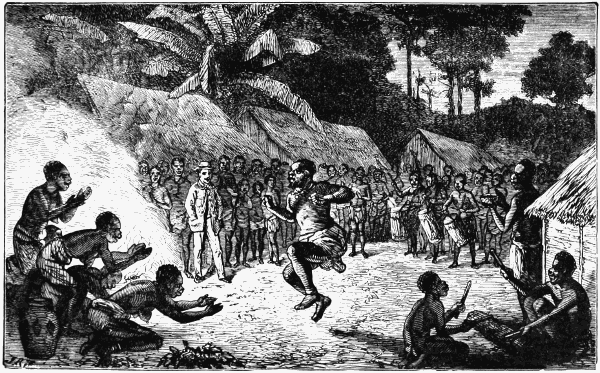

CHAPTER XXII.
I BUILD A VILLAGE, AND CALL IT WASHINGTON—I START
FOR THE INTERIOR—MY SPEECH ON LEAVING—THE
PEOPLE APPLAUD ME VOCIFEROUSLY, AND PROMISE TO
BE HONEST—WE REACH ANIAMBIA—THE "BIG KING,"
OLENGA-YOMBI—A ROYAL BALL IN MY HONOUR—THE
SUPERSTITIONS OF THE NATIVES—A MAN TOSSED BY A
BUFFALO.
I immediately began building a substantial
settlement, not an olako. I collected from a
kind of palm tree a great many leaves, with
which to cover the roofs of the buildings I
had to construct. I gathered also a great quantity of
branches from the same palm trees, and sticks, and
poles, and all that was necessary to make a house;
and finally I succeeded in building quite a village,
which I called Washington. My own house had five
rooms; it was forty-five feet long by twenty-five wide,
and cost me about fifty dollars. My kitchen, which
stood by itself, cost four dollars. I had a fowl-house,
containing a hundred chickens (and such nice little
tiny chickens they are in that country) and a dozen
ducks. My goat-house contained eighteen goats, and
funny goats they were. You had to milk a dozen of
them to get a pint of milk. I built a powder-house
separate, for I do not like to sleep every day in a place
where there is powder. I had a dozen huts for my
men.
This was Washington in Africa, a very different place
from Washington in America.
At the back of my village was a wide extent of
prairie. In front was the river Npoulounai winding
along; and I could see miles out on the way which
I was soon to explore. The river banks were lined
with the mangrove trees; and, looking up stream, I
could at almost any time see schools of hippopotami
tossing and tumbling on the flats or mud banks.
I was now ready to explore the country, and go to
Aniambia, where the big king of the country lived. I
bought a splendid canoe, made of large trees, which I
hoped would be serviceable to me in my up-river explorations.
I was now anxious to be off.
Before starting I called Ranpano and all his people
together, and said that I had perfect confidence in
them; that I was their white man, and had come to
them through much difficulty and many dangers.
(Cheers.) That Sangala's people wanted me, but I
was determined to live with the honest folks of Biagano
(Ranpano's village). (Tremendous applause.) That
I was going away for a few days, and hoped to find
my goods all safe when I came back.
At this, there were great shoutings of "You can
go! Do not fear! We love you! You are our white
man! We will take care of you!" and so on; amid
which my sixteen men seized their paddles, and shoved
off.
At nine in the evening, the moon rose; and we
pulled along through what seemed a charming scene.
The placid stream was shaded by the immense trees
which overhung its banks; and the silence was broken,
now and then, by the screech of some night-prowling
blast, or, more frequently, by the sudden plunge of a
playful herd of hippopotami, some of which came very
dangerously near us, and might have upset our canoe.
Towards midnight, my men became very tired, and
we went ashore, at a little village which was nearly
deserted. We could find only three old women, who
were fast asleep and were not particularly anxious to
make us welcome. I was too sleepy to stand upon
ceremonies, and stowed myself away under a rough
shed without walls. I had scarcely lain down, when
there came up, suddenly, one of those fierce tornadoes
which pass over these countries in the rainy season.
Fortunately, it was a dry tornado. In my half-sleepy
state I did not care to move. As the tornado had unroofed
every other shed as well as mine, nothing would
have been gained by moving, even if it had rained.
The next morning we paid for our lodging, not in
hard cash, but with some leaves of tobacco, and up the
river we paddled until we reached a village called
Igala Mandé, which is situated on the banks of the
river. In a two hours' walk through grass fields we
found numerous birds. One, in particular, was new to
me, the Mycteria senegalensis. It had such long legs
that it fairly outwalked me. I tried to catch it; but,
though it would not take to its wings, it kept so far
ahead that I did not even get a fair shot at it. This
Mycteria senegalensis is a beautiful bird, and wanders
here through the grass of the prairie.
There were also great flocks of a beautiful bird, whose
dark golden body-plumage and long snow-white downy
necks make a very fine and marked contrast with the
green grass. Next to these, in point of number, was
the snow-white egretta, which is found in vast flocks
all along this coast.
At last we came to Aniambia. Olenga-Yombi, the
king, came in from his plantation when he heard the
joyful news that a white man had arrived. I paid
him a state visit. He was a drunken old wretch, surrounded
by a crowd of the chief men of the town. His
majesty had on a thick overcoat, but no trousers; and,
early as it was, he had already taken a goodly quantity
of palm-wine, and was quite drunk. I was invited to
sit at his right hand.
King Olenga-Yombi was one of the ugliest fellows I
ever met with. He always carried with him a long
stick; and when drunk he struck at his people right
and left, and shouted, "I am a big king!" Happily,
they managed to keep out of his way.
At nightfall I got a guide, and went out to see if I
could get a shot at something larger than a bird. We
had gone but a little way, when my guide pointed out
to me a couple of bright glowing spots, visible through
a piece of thick brush. The fellow trembled, as he
whispered "Leopard!" But I saw at once that it was
only the light of a couple of fireflies which had got in
proper position to make a tolerable resemblance to the
glowing eyes of the dreaded leopard.
I did not think much of the bravery of my guide.
What a difference between him and Aboko, Niamkala,
or Fasiko! I wished that I had them with me.
At two o'clock in the morning we at last heard a
grunting, which announced the approach of a herd of
wild hogs. I lay in wait for them, and I was fortunate
enough to kill the big boar of the pack. The rest
of the herd made off without showing a desire for fight.
The next day, King Olenga-Yombi held a grand
dance in my honour. All the king's wives, to the number
of forty, and all the women in the town and neighbourhood
were present.
Fortunately, the dance was held out in the street,
and not in a room, as at Cape Lopez. The women were
ranged on one side, the men opposite. At the end of
the line sat the drummers, beating their huge tom-toms,
which make an infernal din, enough to make one
deaf; and, as if for this occasion the tom-toms were
not entirely adequate, there was a series of old brass
kettles, which also were furiously beaten. In addition,
as if the noise was not yet enough, a number of
boys sat near the drummers, and beat on hollow pieces
of wood. What beauty they found in such music I
cannot tell. There was of course singing and shouting;
and the more loudly and energetically the horrid drums
were beaten, and the worse the noise on the brass kettles,
the wilder were the jumps of the male Africans, and
the more disgusting the contortions of the women.
As may be imagined, to beat the tom-tom is not a
labour of love; the stoutest negro is worn out in an
hour; and for such a night's entertainment as this, a
series of drummers was required.
The people enjoyed it vastly; their only regret was
that they had not a barrel of rum in the midst of the
street, with which to refresh themselves in the pauses
of the dance; but they managed to get just as drunk
on palm-wine, of which a great quantity was served
out.
The excitement became greatest when the king
danced. His majesty was pretty drunk, and his jumps
were very highly applauded. His wives bowed down
to his feet while he capered about, and showed towards
him the deepest veneration. The drums and kettles
were belaboured more furiously than ever, and the
singing, or rather the shouting, became stentorian.
Of course I did not think his majesty's party pleasant
enough to detain me all night. I retired, but could
not sleep.
Now I think I have given you a sufficient account of
a ball at Aniambia, and of how his majesty Olenga-Yombi
danced.
There are two very curious fetich-houses in Aniambia,
which enjoy the protection of two spirits of great power—Abambou
and Mbiuri. The former is an evil spirit,
a kind of devil; the latter, as far as I have been able to
ascertain, is beneficent.
The little houses where these spirits sometimes condescend
to come and sleep for the night were about six
feet square. In the house of Abambou I saw a fire,
which I was told was never permitted to go out. I saw
no idol, but only a large chest, on the top of which
were some white and red chalk and some red parrot-feathers.
The chalk was used to mark the bodies of
the devout.
Abambou is the devil of the Commi people. He is a
wicked and mischievous fellow, who often lives near
graves and burial-grounds, and is most comfortably
lodged among the skeletons of the dead. He takes
occasional walks through the country, and, if he gets
angry at anyone, he has the power to cause sickness
and death. The Commi people cook food for him,
which is deposited in lonely places in the woods, and
there they address him in a flattering manner, and ask
him to be good to them, and, in consideration of
their gifts, and of the great care they take of him, to
let them alone. I was present once at a meeting
where Abambou was being addressed in public. They
cried continually: "Now we are well! Now we are
satisfied! Now be our friend, Abambou, and do not
hurt us!"
The offerings of plantain, bananas, sugar-cane,
ground-nuts, etc., etc., are wrapped in leaves by the
free men, but the slaves lay them on the bare ground.
Sometimes Abambou is entreated to kill the enemies of
him who is making the offering. A bed is made in
Abambou's house, and there he is believed to rest himself
sometimes, when he is tired going up and down
the coast in the forest.
Mbiuri, whose house I next visited, is lodged and
kept much in the same way as his rival. He is a good
spirit, but his powers are like those of Abambou, as
far as I could make out. Not being wicked, he is less
zealously worshipped.
These Commi people are full of superstition. They
believe in a third and much-dreaded spirit, called
Ovengua. This is a terrible catcher and eater of men.
He is not worshipped, and has no power over disease;
but he wanders unceasingly through the forests, and
catches and destroys luckless travellers who cross his
path. By day he lives in dark caverns, but at night he
roams freely, and even sometimes gets into the body
of a man, and beats and kills all who come out in the
dark. Sometimes, they relate, such a spirit is met and
resisted by a body of men, who wound him with spears,
and even kill him. In this case the body must be
burned, and not even the smallest bone left, lest a new
Ovengua should arise from it. There are many places
where no object in the world would induce a Commi
negro to go by night, for fear of this dreadful monster.
They have a singular belief that when a person dies
who has been bewitched, the bones of his body leave
the grave one by one, and form in a single line united
to each other, which line of bones gradually becomes
an Ovengua.
It is not an easy matter to get at the religious
notions of these people. They themselves have no
well-defined ideas of them, and on many points they
are not very communicative.
I suppose they think that sometimes the Ovengua is
in a man; hence they kill him and burn his body.
Of course the Commi people, like all other negroes,
are firm believers in witchcraft.
Not very far from Aniambia, there is a place in the
forest which is supposed to be haunted by the spirit of
a crazy woman, who, some hundreds of years ago, left
her home. They believe that she cultivates her plantation
in some hidden recess in the forest, and that she
often lies in wait for travellers, whom she beats and
kills out of pure malice.
While at Aniambia I had a great adventure with a
bos brachicheros, which might have ended in a terrible
way. I started out early one day to try and get a shot
at some buffaloes which were said to be in the prairie
at the back of the town. I had been an hour on the
plains with Ifouta, a hunter, when we came upon a bull
feeding in the midst of a little prairie surrounded by
woods, which made an approach easy. I remember
well how beautiful the animal looked. Ifouta walked
round through the jungle opposite to where I lay in
wait; for, if the animal should take fright at him, it
might fly towards me. When he reached the right
position, Ifouta began to crawl, in the hunter's
fashion, through the grass towards his prey. All went
well till he came near enough for a shot. Just then,
unluckily, the bull saw him. Ifouta immediately fired.
It was a long shot, and he only wounded the beast,
which, quite infuriated, immediately rushed upon him.
It was now that poor Ifouta lost his presence of mind.
In such cases, which are continually happening to
those who hunt the bos brachicheros, the proper course
for the hunter is to remain perfectly quiet till the
beast is within a jump of him, then to step nimbly to
one side, and let him rush past. But Ifouta got up
and ran.
The bull ran faster than he, and in a moment had
him on his horns. He tossed him high into the air,
once, twice, thrice, before I could come up; for, as
soon as I saw what had happened, I ran as fast as I
could to the rescue, and my shouts drew the bull's
fury upon myself. He left Ifouta and came rushing
at me, thinking that he would serve me as he had just
served Ifouta. Master Bull was sadly mistaken. I
took a good aim, and down came the bull, to rise no
more.
Ifouta proved to be considerably bruised; but, on the
whole, he was more scared than hurt. It was fortunate
for him that the horns of these buffaloes slant
backwards a good deal, and are curved.
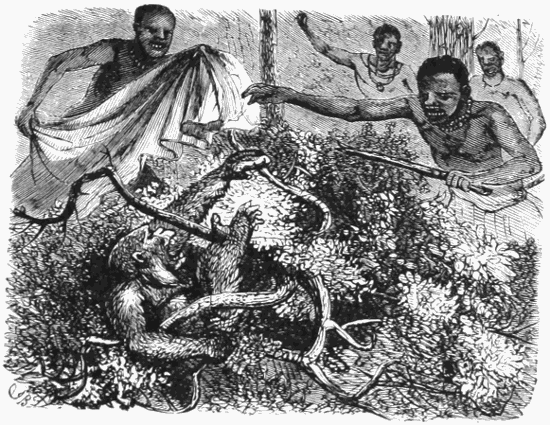
CAPTURING A YOUNG GORILLA.
CHAPTER XXIII.
CAPTURE OF A YOUNG GORILLA—I CALL HIM "FIGHTING
JOE"—HIS STRENGTH AND BAD TEMPER—HE PROVES
UNTAMEABLE—JOE ESCAPES—RE-CAPTURED—ESCAPES
AGAIN—UNPLEASANT TO HANDLE—DEATH OF "FIGHTING
JOE."
I remember well the day when I first possessed
a live gorilla. Yes, a gorilla that could roar;
a young gorilla alive! He was captured not
far from Cape St. Catherine, and dragged into Washington.
My hunters were five in number, and were walking
very silently through the forest, when suddenly the
silence was broken by the cry of a young gorilla for its
mother. Everything was still. It was about noon, and
they immediately determined to follow the cry.
Soon they heard the cry again. Gun in hand, the
brave fellows crept noiselessly towards a clump of wood
where the baby gorilla evidently was. They knew the
mother would be near; and there was a likelihood that
they might encounter the male also, which they dread
more than they do the mother. But they determined
to risk everything, and, if possible, to take the young
one alive, knowing how pleased I should be, for I had
been long trying to capture a young gorilla.
Presently they perceived the bush moving; and
crawling a little farther on, in dead silence, scarcely
breathing with excitement, they beheld what had
seldom been seen even by negroes. A young gorilla
was seated on the ground, as the picture shows you,
eating some berries, which grew close to the earth. A
few feet farther on sat the mother, also eating of the
same fruit.
Instantly they made ready to fire; and none too
soon, for the old female saw them as they raised their
guns, and they had to pull triggers without delay.
Happily, they wounded her mortally.
She fell on her face, the blood gushing from the
wounds. The young one, hearing the noise of the
guns, ran to his mother and clung to her, hiding his
face and embracing her body. The hunters immediately
rushed towards the two, hallooing with joy.
How much I wished that I had been with them, and
been so fortunate as to assist in the capture of a live
gorilla!
Their shouts roused the little one, who, by this time,
was covered with blood coming from his mother's
wounds. He instantly let go of his mother and ran
to a small tree, which he climbed with great agility.
There he sat and roared at them savagely. They were
now perplexed how to get at him. What was to be
done? No one cared to run the chance of being bitten
by this savage little beast. They did not want to
shoot him, for they knew I should never forgive them
for doing so. He would not come down the tree, and
they did not care to climb it after him. At last they
cut down the tree, and, as it fell, they dexterously
threw a cloth over the head of the young monster,
and thus gained time to secure it while it was blinded.
With all these precautions, one of the men received a
severe bite on the hand, and another had a piece taken
out of his leg.
The little brute, though very diminutive, and the
merest baby in age, was astonishingly strong, and
by no means good-tempered. They found they could
not lead him. He constantly rushed at them, showing
fight, and manifesting a strong desire to take a piece,
or several pieces, out of every one of their legs, which
were his special objects of attack. So they were
obliged to get a forked stick, in which his neck was
inserted in such a way that he could not escape,
and yet could be kept at a safe distance. It must
have been very uncomfortable for him; but it was the
only way of securing themselves against his nails and
teeth, and thus he was brought to Washington.
The excitement in the village was intense, as the
animal was lifted out of the canoe in which he had
come down the river. He roared and bellowed; and
looked around wildly with his wicked little eyes, giving
fair warning that if he could get at any of us he
would take his revenge. Of course, no one came in his
way.
I saw that the stick hurt his neck, and immediately
set about having a cage made for him. In two hours
we had built a strong bamboo house with the slats
securely tied at such a distance apart that we could
see the gorilla, and it could see out. We made it as
strong as we could, and I was very careful to provide
against every chance of his escaping. In this cage he
was immediately deposited; and now, for the first
time, I had a fair chance to look at my prize.
As I approached the cage he darted at me; but I
could afford to have a good laugh over him, for I knew
he could not get near enough to bite me. He looked
at me with very savage eyes.
I named the gorilla Joe—"Fighting Joe." He
was evidently not three years old, but fully able to walk
alone, and possessed, for his age, of very extraordinary
strength. His height was about three feet and six
inches. His hands and face were very black, his eyes
were sunken. The hair on his head was of a reddish-brown
colour. It began just at the eyebrows and came
down the sides of the face to the lower jaw, just as our
beards grow. The whiskers, if we may call them so,
were of a blackish colour. The face was smooth, and
intensely black. The upper lip was covered with short,
coarse hair; I wondered if it was the beginning of a
moustache. I found afterwards that gorillas had no
moustaches. The lower lip had longer hair; and I
wondered also if in time an imperial would grow there.
There were eyelashes too, though these were slight
and thin. The eyebrows were straight. Excepting the
face, and the palms of his hands and feet, his whole
body was covered with hair. On the back, the hair
was of an iron grey, becoming quite dark near the
arms. On the arms, the hair was longer than anywhere
else on the body, as you may see by the
picture.
After I had looked carefully at the little fellow, and
knew well that he was safely locked in his cage, I
ventured to approach him to say a few encouraging
words. He stood in the farthest corner; but as I approached,
he bellowed and made a precipitate rush at
me. Though I retreated as quickly as I could, he
succeeded in catching my trousers' legs with the toes
of one of his feet, and then retreated immediately to
the farthest corner. This taught me caution; I must
not approach too near.
Shall I be able to tame him? I thought I should;
but I was disappointed.
He sat in his corner, looking wickedly out of his
grey eyes; and I never saw a more morose or ill-tempered
face than this little beast had. I do not
believe that gorillas ever smile.
Of course I had to attend to the wants of my captive.
My first business in the morning was to attend
on Joe. I sent for some of the forest berries which
these animals are known to prefer, and placed these
and a cup of water within his reach. He was
exceedingly shy, and would neither eat nor drink till I
had removed to a considerable distance.
The second day I found Joe fiercer than on the first.
He rushed savagely at anyone who stood even for a
moment near his cage and seemed ready to tear us to
pieces. A fine specimen of man-monkey, thought I;
a tiger under the disguise of a gorilla. I wondered
what kind of a cage a full-grown gorilla would require.
I should certainly not care to be his keeper.
I threw Joe pieces of pine-apple leaves; and I
noticed that he ate only the white part. There seemed
to be no difficulty about his food, as long as it was
gathered from his native woods; but he refused all
other kinds of food. He was very fond of bananas and
ripe plantains.
The third day Joe was still more morose and savage,
bellowing when any persons approached, or retiring to a
distant corner to make a rush upon them.
On the fourth day, while no one was near, the little
rascal succeeded in forcing apart two of the bamboo
sticks which composed his cage and made his escape.
I came up just as his flight was discovered, and immediately
got all the negroes together for pursuit.
Where had he gone? I was determined to surround
the wood and recapture him. Running into my house
to get one of my guns, I was startled by an angry
growl issuing from under my low bedstead. It was
Master Joe; there was no mistake about it; I knew
his growl but too well. Master Joe lay there hid, but
anxiously watching my movements. I cleared out
faster than I came in. I instantly shut the windows,
and called to my people to guard the door. When Joe
saw the crowd of black faces he became furious; and
with his eyes glaring, and every sign of rage in his
little face and body, he got out from beneath the bed.
He was about to make a rush at all of us. He was not
afraid. A stampede of my men took place. I shut the
door quickly, and left Joe master of the premises.
I preferred devising some plans for his easy capture, to
exposing myself and men to his terrible teeth; for the
little rascal could bite very hard, and I did not care to
have a piece taken out of one of my legs. How to
take him was now a puzzling question. He had shown
such strength and such rage already that I did not care,
and none of my men seemed to care, to run the chance
of getting badly beaten in a hand-to-hand struggle, in
which we were pretty sure to come off the worse.
Meantime, peeping through the keyhole, I saw
Master Joe standing still in the middle of the room
looking about for his enemies, and examining, with
some surprise, the furniture. He seemed to think that
he had never seen such things before. I watched with
fear, lest the ticking of my clock should attract his
attention, and perhaps lead him to an assault upon that
precious article. Indeed, I should have left Joe in
possession, but for a fear that he would destroy the
many little articles of value or curiosity I had hung
about the walls, and which reminded me so much of
America.
Finally, seeing Joe to be quiet, I despatched some
fellows for a net; and, opening the door quickly, I
threw this over his head. Fortunately we succeeded at
the first throw in effectually entangling the young
monster, who roared frightfully, and struck and kicked
in every direction under the net. So fearfully was he
excited that I thought he would die in a fit of rage.
I took hold of the back of his neck; two men seized
his arms, and another the legs; and, thus held by four
men, we could hardly manage Joe.
We carried him as quickly as we could to the cage,
which had been repaired, and then once more locked
him in. I never saw such a furious beast in my life as
he was. He darted at everyone. He bit the bamboos
of his cage. He glared at us with venomous and
sullen eyes, and in every motion showed a temper
thoroughly wicked and malicious.
After this Joe got worse than ever; and as good
treatment only made him more morose and savage, I
tried what starvation would do towards breaking his
spirit. Besides, it began to be troublesome to procure
his food from the woods, and I wanted him to become
accustomed to civilized food, which was placed before
him. But he would touch nothing of the kind. How
was I to bring him to America? I could not put an
African forest on board. As for his temper, after
starving him for twenty-four hours, all I gained was,
that he came slowly up and took some berries from the
forest out of my hand and then immediately retreated
to his corner to eat them. Daily attentions from me,
for a fortnight more, did not bring me any further
confidence from him than this. He always snarled at
me; and only when very hungry would he take even
his choicest food from my hand.
At the end of this fortnight I came one day to feed
him, and found that he had gnawed a bamboo to
pieces slily, and again made his escape. Luckily
he had but just gone, for as I looked around I caught
a sight of him making off on all fours, and with great
speed, across the prairie for a clump of trees.
I at once gave the alarm. I called the men up, and
we gave chase, taking with us all the fishing nets.
He saw us, and, before we could head him off, made for
another clump, which was thicker and larger. This
we surrounded. He did not ascend a tree, but stood
defiantly at the border of the wood. About one
hundred and fifty of us surrounded him. As we moved
up he began to yell, and made a sudden dash upon a
poor fellow who was in advance. The fellow ran, and
tumbled down in affright. By his fall he escaped the
tender mercies of Joe's teeth; but he also detained the
little rascal long enough for the nets to be thrown over
him.
Four of us bore him again, struggling, into the village.
This time I would not trust him to the cage, but
fastened a small chain round his neck. This operation
he resisted with all his might, and it took us quite an
hour to securely chain the little fellow, whose strength
was something marvellous.
Ten days after he was thus chained he died quite
suddenly. He had been in good health, and ate
plentifully of his natural food, which was brought every
day from the forest for him. He did not seem to
sicken until two days before his death. He died in
some pain. To the last he continued utterly untameable,
and after his chain was put on he added treachery
to his other vices. He would come sometimes quite
readily to eat out of my hand, but while I stood by
him would suddenly—looking me all the time in the
face to keep my attention—put out his foot and grasp
at my leg. Several times he tore my pantaloons in
this manner. A quick retreat on my part saved my
legs from further injury, but I had to be very careful
in my approaches. The negroes could not come near
him at all without setting him in a rage. He seemed
always to remember that they captured him, and to
think he had experienced rather too hard treatment
at their hands; but he evidently always cherished
towards me also a feeling of revenge.
After he was chained I filled a half barrel with hay,
and set it near him for his bed. He recognised its
use at once, and it was pretty to see him shake up the
hay and creep into this nest when he was tired. At
night he always shook it up, and then took some hay
in his hands, with which he would cover himself when
he was snug in his barrel. He often moaned, for his
mother perhaps, at night.
After Joe died I stuffed his body, and brought his
skin and skeleton to New York, where many saw it.
Around his neck, where the chain had been, the hair
was worn off.
Poor Joe! I wish he had lived and become tame,
so that I could have brought him home with me to
show the children.
Now poor Joe can be seen stuffed in the British
Museum.
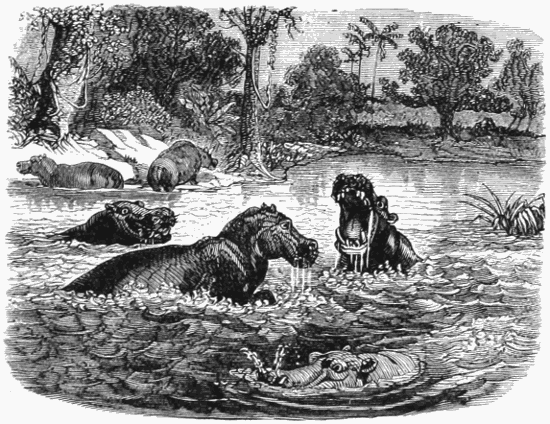
HIPPOPOTAMI AT HOME.
CHAPTER XXIV.
THE HIPPOPOTAMUS—A DUEL—SHOOTING ON THE RIVER—NEARLY
UPSET—A NIGHT-HUNT ON LAND—MY COMPANION
FIRES AND RUNS—APPEARANCE AND HABITS
OF THE HIPPOPOTAMUS.
What have we yonder in the water? A flock
of hippopotami! Their bodies look for all
the world like so many old weather-beaten
logs stranded on a mud-bank or a sand-bar.
Every thing was still. The sun was very hot, and
all nature seemed to repose. I was concealed on the
banks of the river, under a very shady tree, watching
them. Suddenly, not far from me, two huge beasts
rose as by enchantment to the surface of the water
and rushed towards each other. Their vast and hideous
mouths were opened to their utmost capacity, showing
their huge crooked tusks, which gave their mouths a
savage appearance. Their eyes were flaming with rage,
and each of them put forth all his power to annihilate
the other. They seized each other with their jaws;
they stabbed and punched with their strong tusks,
lacerating each other in a frightful manner; they
advanced and retreated; now they were at the top of
the water, and now they sank down to the bottom.
Their blood discoloured the river, and their groans or
grunts of rage were hideous to listen to. They showed
little power of strategy, but rather a piggish obstinacy
in maintaining their ground, and a frightful savageness
of demeanour. The combat lasted an hour. It
was a grand sight. The water around them was sometimes
white with foam. At last one turned about and
made off, leaving the other victorious and master of the
field. A few days after, I killed a hippopotamus, and
its thick hide was lacerated terribly. Doubtless it was
one of the beasts I had seen fighting.
The hippopotamus is found in most of the rivers of
Africa which empty themselves into the Atlantic or
Indian Ocean, but in none but the Nile of those
which empty themselves into the Mediterranean; and
in the Nile it is only met far up the river. Many as
there were of them on the Fernand-Vaz, they were
more numerous on the Ogobai.
How much sport I have had with them! How
often have I studied their habits! And now I must
give you some account of my encounters with them.
About five miles above my little settlement at
Washington there was a place in the river shallow
enough for them to stand and play around, and there
they remained all day playing in the deep water,
sometimes diving, but for the most part standing on
the shallows, with only their ugly noses or heads
lifted out of the water.
One fine morning I went towards them. We
approached slowly and with caution to within thirty
yards of them without seeming to attract the slightest
attention from the sluggish animals. One might have
asked himself, "Are they hippopotami or not?"
Stopping there I fired five shots, and, so far as I could
see, I killed three hippopotami. The ear is one of the
most vulnerable spots, and this was my mark every
time.
The first shot was received with very little attention
by the herd; but the struggles of the dying animal
I had hit, which turned over several times and finally
sank to the bottom, seemed to rouse the others, who
began to plunge about and dive down into deep water.
The blood of my victims discoloured the water all
around, and we could not see whether those who
escaped were not swimming for us.
Presently the canoe received a violent jar, and, looking
overboard, we perceived that we were in the midst
of the herd. "The hippopotami are coming upon
us!" shouted the men; "they are going to attack
us!" We pulled out of the way as fast as we could,
none of us being anxious to be capsized. It would
have been a comical sight to see us swimming in the
midst of a flock of hippopotami, and some of us, perhaps,
raised up on the back of one as he came to the
surface, or lifted, maybe, with his two crooked tusks in
our body.
We were soon out of the way, and looking back to
see where were the animals I had killed, I saw
nothing. They had sunk to the bottom, and of the
three, only one was recovered. It was found two days
afterwards on a little island near the river's mouth.
Seeing this, I resolved never to shoot hippopotami
while they are in the water, for I did not want to kill
these animals for nothing; I wanted their skins and
their skeletons to enrich our museums.
Some time after Joe had died, I determined to go
on a night hunt after hippopotami. These animals
come ashore by night to feed.
The Fernand-Vaz runs for many miles parallel with
the seashore, separated from the sea by a strip of
sandy prairie. On this prairie the hippopotamus feeds.
He is sometimes called the sea-horse, for when his head
is out of the water it looks from a distance exactly
like the head of a horse. The "walk" of a herd is
easily discernible. It looks very much like a regular
beaten road, only their immense footprints showing
who are its makers. In their track no grass grows.
They always return by the same path they go out on.
This gives the hunter a great advantage.
I chose moonlight night, and paddled up to the
vicinity of one of these "walks." There Igala, my
hunter, and I set out by ourselves. I had painted my
face with a mixture of oil and soot, which is a prudent
measure for a white hunter in Africa. The beasts
there seem to have a singularly quick eye for anything
white. I made myself look exactly like Igala. We
both had black faces and black hands. I was dressed
in the usual dark suit of clothes for the night; people
there must not go hunting in light-coloured garments.
We chose the windward side of the track, for the hippopotamus
has a very keen scent, and is easily alarmed
at night, feeling, probably, that on land his sluggish
movements, huge bulk, and short legs have their disadvantages.
We lay down under shelter of a bush and watched.
As yet none of the animals had come out of the water.
We could hear them in the distance splashing about
in the water, their subdued snort-like roars breaking
in upon the stillness of the night in a very odd way.
It was the only noise we heard—no, I cannot say the
only noise, for the mosquitoes were busily buzzing
around, and feeding upon us, taking advantage,
apparently, of our anxiety to keep perfectly quiet.
The moon was nearly down, and the watch was getting
tedious, when I was startled by a sudden groan.
Peering into the distance, I saw dimly a huge animal
looking doubly monstrous in the uncertain light. It
was quietly eating grass, which it seemed to nibble off
quite close to the ground.
There was another bush between us and our prey,
and we crawled up to this in dead silence. Arrived
there, we were but eight yards from the great beast.
How terrible he looked! The negroes who hunt the
hippopotami are sometimes killed; I thought that one
of us might be killed also. The animal, if only
wounded, turns savagely upon his assailants, and experience
has taught the negro hunters that the only
safe way to approach him is from behind. He cannot
turn quickly, and thus the hunter has a chance to
make good his escape. This time we could not get
into a very favourable position; but I determined to
have my shot nevertheless, eight yards being a safe
killing distance, even with so poor a light as we had by
this time.
We watched the hippopotamus intently, looking at
each other as if to say, "Are you ready?" We then
raised our guns slowly. Igala and I both took aim.
He fired and, without waiting to see the result, ran as
swiftly as a good pair of legs could carry him. I was
not quite ready, but fired the moment after him, and
before I could get ready for running (in which I had
not Igala's practice) I saw there was no need for it.
The beast tottered for a moment, and fell over with a
booming sound, dead.
This closed our night's sport, as none of the herd
would come this way while their companion lay there.
So we returned home. Poor Igala remonstrated with
me for not running as he did. It appears that running
was considered one of the chief accomplishments of
the hippopotamus hunter. Our good luck created
great joy in the village, where meat was scarce. The
men went out at daylight and brought the flesh home.
Basket after basket came in, and as each one arrived all
shouted except those who did not eat the hippopotamus.
It is roonda for them. Some of their ancestry
had a long time ago given birth to a hippopotamus,
and if they were to eat any, more births of hippopotami
would come to them, or they would die. These
shouted, "I wish he had killed a bullock instead of
a hippopotamus."
The meat does not taste unlike beef, but was not so
red. It was rather coarse-grained, and in the case
of this animal it was not fat. It makes a welcome and
wholesome dish. I tried to have some steaks; I must
say they were rather tough, and did not go down
easily. The broth was better, and I enjoyed it very
much. There was something novel in having hippopotamus
soup.
I have killed a good many hippopotami. It is a very
clumsily-built, unwieldy animal, remarkable chiefly
for its enormous head, whose upper jaw seemed to be
movable, like the crocodile's, and for its disproportionately
short legs. The male is much larger than the
female; indeed, a full-grown male sometimes attains
the bulk, though not the height, of the elephant. In
the larger specimens the belly almost sweeps the
ground as they walk.
The feet are curiously constructed to facilitate walking
among the reeds and mud of the river bottom, and
swimming with ease. The hoof is divided into four
short, apparently clumsy and unconnected toes; and
they are able, by this breadth of foot, to walk rapidly
even through the mud. I have seen them make quick
progress, when alarmed, in water so deep that their
backs were just at the surface.
The colour of the skin is a clayey yellow, assuming
a roseate hue under the belly. In the grown animal
the colour is a little darker. The skin of an adult
hippopotamus is from one and a half to two inches
thick on the middle of the back. It is devoid of hair,
with the exception of a few short bristly hairs in the
tail, and a few scattered tufts, of four or five hairs each,
near the muzzle.
All along the Fernand-Vaz there were scattered herds
of hippopotami; and I used to watch them from my
house. I could see them at any time during the day.
After they have chosen a spot, they like to remain
there day after day, and month after month, unless
they are disturbed, or their food becomes scarce.
These animals consort together in herds of from
two to thirty. They choose shallows in the rivers,
where the depth of the water allows them to have
their whole body submerged when standing. There
they remain all day, swimming off into the deep place,
diving for their grassy food, or gambolling in the
waves. From time to time they throw up a stream of
water two or three feet high. This is done with a noise
like blowing, and it is doubtless an effort to get breath.
It is pleasant to watch a herd peacefully enjoying
themselves, particularly when they have two or three
young ones among them. Some of the little fellows
look very small, and are comically awkward. They
chase each other about the shoals or play about their
dams; and I have often seen them seated on the back
of their mother in the water. How careful their
mothers seemed to be when they were swimming
about, and carrying their young in the way I have
described. It is a sight worth seeing; sometimes the
whole herd of hippopotami will disappear for a long
time under the water.
They prefer parts of the rivers where the current
is not very swift, and are therefore to be found in all
the lakes of the interior. They prefer to be near grass
fields. They are very fond of a particular kind of coarse
grass which grows on these prairies, and will travel
considerable distances to find it. They always return,
however, before daylight. Their path overland is very
direct. Neither rocks nor swamps nor bushes can prove
formidable obstacles to a water beast of such bulk. I have
seen their path lie through the thickest woods. Unless
much pursued and harassed, they are not much afraid
of man. If troubled by hunters they move their
encampment, or go into countries where they can be
more quiet.
Some of their favourite grass was growing on a little
plain at the back of my house; and several times I
found hippopotami tracks not more than fifty yards
from the house. They had not feared to come as near
as this; though probably, if the wind had been blowing
towards them, they would have avoided the place.
They always choose a convenient landing-place,
where the bank has a long and easy incline. This
landing-place they use till they have eaten up all the
provender which can be found in that vicinity. Before
going ashore, they watch for an hour, and sometimes
for two hours, near the landing, remaining very quiet
themselves, and listening for danger. The slightest
token of the hunter's presence, or any other suspicious
appearances on such occasions, will send them away
for that night. If no danger appears they begin to
wander ashore in twos or threes. I never saw more
than three of a herd grazing together; and, during
their stay ashore, they place more dependence on their
ears than on their eyes. I have watched them closely
in many hunts; and I am sure that the beast walks
along with his eyes nearly shut.
When playing in the water, this animal makes a
noise very much resembling the grunt of a pig. This
grunt it utters also when alarmed by the approach of
man. When enraged, or suddenly disturbed, it utters
a kind of groan—a hoarse sound—which can be heard
at a considerable distance. They are quite combative
among themselves, as you have seen in the case of the
fight I have described.
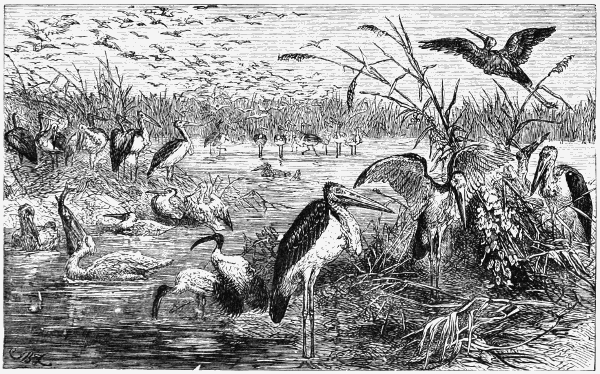

CHAPTER XXV.
VISIT OF KING QUENGUEZA—I PROMISE TO VISIT HIM—THE
KINDNESS OF THE COMMI—THE DRY SEASON ON
THE FERNAND-VAZ—PLENTY OF BIRDS AND FISHES—THE
MARABOUTS—THE EAGLES—A BAD WOUND.
One fine day I was quietly seated in my bamboo
house, and reading over, for the fiftieth time,
the letters of the dear friends who had not
forgotten me, and were so kind as to remember
me in my wandering life in Africa. My attention was
suddenly drawn away by the singing of numerous voices
coming down the river. Soon afterwards there stood
before me, accompanied by Ranpano, a tall venerable-looking
and slender negro of noble but savage bearing;
he was evidently, I thought, a chief; there was something
commanding about his countenance. He was
not very dark. The people who came with him
showed him great respect. This tall negro was Quengueza,
the great king of the Rembo, and the sovereign
of the whole up-river country of the Rembo and
Ovenga, the head waters of the Fernand-Vaz.
He came down in considerable state in three canoes,
with three of his favourite wives, and about one
hundred and thirty men.
My little black boy, Macondai, brought him a chair;
and after he had seated himself I saluted him, according
to the usual custom, by saying "Mbolo." After
a few seconds he said "Ai." Then he paused a little
while, and said "Mbolo," to which I replied "Ai."
This is the usual mode of salutation in the Commi
country, the host beginning first.
He looked at me and seemed very much astonished.
He said he expected to see a tall and stout man. He
had heard of me as a great hunter. He was now convinced,
he said, that I must have a brave heart to hunt
as I did.
Fortunately, Quengueza and I could talk together,
the Commi being his native language.
He told me there were plenty of gorillas and
nshiegos in his country; and that, if I would come, I
should have liberty and protection to hunt and to do
what I pleased. No one would hurt my people, or
Ranpano's people, or myself, or anybody, added he,
with emphasis, that should come with me.
I liked the old king at first sight; but I little
guessed then that he would afterwards become so fond
of me, and that I should love him so much. Yes, I
shall remember my good friend Quengueza as long as
I live. Though he is a poor heathen, his heart was full
of love for me, and he possessed many manly and
noble qualities.
I was so much pleased with King Quengueza's visit
that I sent the kind-hearted old fellow off with his
canoes full of presents of iron bars, brass rods, chests,
etc.; and I gave him goods on trust with which to buy
me ebony. He promised me great sport, and an introduction
to some tribes of whom these Commi men
of the seashore knew nothing.
To do him greater honour my people fired a salute
as he started off, with which he was highly delighted,
as an African is sure to be with noise. He did not
go before making me promise to come and see him as
soon as the rainy season arrived.
The dry season was now setting in. It was the first
I had spent in the Commi country; and I devoted the
whole month of July to exploring the country along
the seashore, between the Fernand-Vaz and the sea.
There was quite a change. The birds, which were so
abundant during the rainy season, had taken their
leave; and other birds, in immense numbers, flocked in
to feed on the fish, which now leave the seashore and
the bars of the river's mouth and ascend the river to
spawn. Fish, particularly mullet, were so abundant
in the river that two or three times, when I took my
evening airing on the water in a flat upper-river canoe,
enough mullet would leap into the boat to furnish me
a breakfast the next day. The quantity of fish in the
shallow water was prodigious.
The breakers on the shore, never very light, were
now frightful to see. The coast was rendered inaccessible
by them even to the natives, and the surf
increased to such a degree, even at the mouth of the
river, that it was difficult, and often impossible, to
enter with a canoe. Strong winds from the south
prevailed, and, though the sky was constantly overcast,
not a drop of rain fell. The thermometer fell sometimes
early in the morning to 64° of Fahrenheit, and
I suffered from cold, as did also the poor natives. The
grass on the prairie was dried up or burnt over; the
ponds were dried up; only the woods kept their
resplendent green.
I was often left alone in that great prairie with my
cook and my little boy Macondai, and a dear little
boy he was. I felt perfectly safe among the good
Commi. I always had tried to do right with them,
and I had reaped my reward. They loved me, and
anyone who should have tried to injure me would
have no doubt been put to death or exiled from the
country. I shall always remember my little village
of Washington and the good Commi people. When
perchance I got a chill the whole village was in distress.
No one was allowed to talk loud, and everyone would
call during the day and sit by me with a sad face for
hours without saying a word, and, when they went
away, they all expressed their sorrow to see me ill.
The kind women would bring me wild fruits, or cold
water from the spring, in which to bathe my burning
and aching head; and sometimes tears would drop
from their eyes and run down their kind black faces.
At this season the negroes leave their villages and
work on their plantations. The women gathered the
crop of ground-nuts which had been planted the preceding
rainy season, while the men cut down the trees
for the plantations of the coming year, or built canoes,
or idled about or went fishing. Some of their farms are
necessarily at some distance off. The sandy prairie
is not fit to cultivate, being, in fact, only a deposit of
the sea, which must have taken an incalculable period
of time to form.
The birds flocked in immense numbers on the prairies,
whither they come to hatch their young; especially
later in the season, when the ugly marabouts, from
whose tails our ladies get the splendid feathers for
their bonnets, were there in thousands; and I can
assure you they were not very easy to approach. I
believe the marabout is the ugliest bird I ever saw,
and one would never dream that their beautiful
feathers are found only under the tail, and can hardly
be seen when the bird is alive.
Pelicans waded on the river banks all day in prodigious
swarms, and gulped down the luckless fish
which came in their way. I loved to see them swimming
about in grave silence, and every now and then
grabbing up a poor fish with their enormous, long,
and powerful bills. If not hungry, they left the fish
in their huge pouches, till sometimes three or four
pounds of reserved food awaited the coming of their
appetite. This pouch, you see, performed the office
of a pocket, where boys, when not hungry, keep their
apples in reserve.
On the sandy islands were seen now and then flocks
of the Ibis religiosa, the sacred Ibis of the Egyptians.
They looked exactly like those that are found mummified,
and which have been preserved several
thousand years. They are very curious-looking birds;
the head and neck have no feathers. I have tried to
find their nests, but never succeeded.
Ducks of various kinds built their nests in every
creek and on every new islet that appeared with the
receding waters. Some of them were of beautiful
plumage.
Cranes, too, and numerous other water-fowls, flocked
in, and every day brought with it new birds. They
came by some strange instinct, from far-distant lands,
to feed upon the vast shoals of fish which literally
filled the river. I wondered if many of these birds
had come from the Nile, the Niger, the Zambesi—from
the interior of Africa, where no one had ever
penetrated, and from the vast plains of South Africa.
What great travellers some of these birds must be!
I envied them, and often wished I could fly away,
supported by their wings. What countries I should
have seen!—what curious people I should have looked
at!—and how many novel things I should have found
to recount to you!
Along the trees bordering the river, sometimes
perched on their highest branches, sometimes hidden
in the midst of them, I could see that most beautiful
eagle, the Gypohierax angolensis, called coungou by
the natives. This eagle is of a white and black colour.
He often watches over the water. How quickly his
keen eyes can see through it! and with what rapidity
he darts at his prey! Then, seizing it in his powerful
talons, which sink deep into it, he rises into the air
and goes where he can devour it undisturbed. These
eagles attack large fish. They generally make them
blind, and then gradually succeed in getting them
ashore, though it is hard work for them. They have
a luxurious time on the Fernand-Vaz river during the
dry season, and are very numerous. They build their
nests on the tops of the highest trees, and come back
to them every year. These nests are exactly like
those you have seen, only larger. They keep very
busy when their young begin to eat. The male and
female are then continually fishing. Strange to say,
they are very fond of the palm-oil nuts. In the season,
when these are ripe, they are continually seen
among the palm trees.
No wonder these eagles grab fish so easily, they
have such claws! One day, as one passed over my
head, I shot him, and, thinking that he was quite
dead, I took him up, when suddenly, in the last
struggle for life, his talons got into my hands. I
could have dropped down from pain. Nothing could
have taken the claws away; one of them went clear
through my hand, and I shall probably keep the mark
of it all my life.
On the seashore I sometimes caught a bird called
the Sula capensis, which had been driven ashore by
the treacherous waves to which it had trusted itself,
and could not, for some mysterious reason, get away
again.
Finally, every sand-bar was covered with gulls,
whose shrill screams were heard from morning till
night, as they flew about greedily after their finny
prey.
It was a splendid opportunity for sportsmen, and I
thought of some of my friends. As for myself, I
took more delight in studying the habits of the birds
than in killing them, and I assure you I had a very
delightful time. I love dearly the dry season in
Africa. I am sure you would have enjoyed it quite as
much as I did, if you had been there with me.
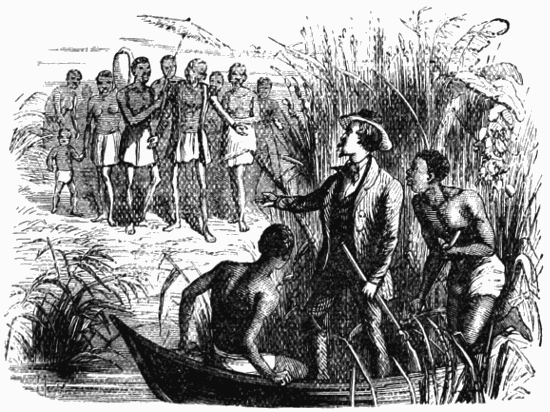
THE KING RECEIVES ME.
CHAPTER XXVI.
ANOTHER EXPEDITION TO LAKE ANENGUE—DIFFICULT
PASSAGE UP THE RIVER—THE CROCODILES—KING
DAMAGONDAI AND HIS TROUBLES—I BUY AN MBUITI,
OR IDOL.
One fine morning there was a great bustle on
the banks of the river at Washington, where
two canoes were loading. I was about to start
on another expedition. I called King Ranpano and
his people together and gave them charge of my
property; I declared that if anything was stolen during
my absence I should surely punish the thief.
They all protested that I need not even lock the
doors of my house; and I believed them. The
Biagano people loved me, and did not steal from me.
Then I counted my ten goats in their presence, and
said that I wanted no leopard stories told me when I
came back. At this they shouted and laughed. They
declared that neither they nor the leopards should touch
my goats.
I counted the fowls, and told them I wanted no
snake stories about them. Another hearty laugh, and
they all shouted that no snakes should gobble up my
fowls. These matters having been satisfactorily
arranged, I started with my canoes and a well-armed
crew.
I was bound again for Lake Anengue, where I had
been a few months before. It was now the dry season.
We had armed ourselves well, for fear we might be
interrupted, as some people came up this way to make
plantations during the dry season and might dispute our
advance; I determined to let no man bar the road to me.
The dry season was at its height, and I found the
Npoulounay shallower than before. There was about
fifteen feet less depth of water in the Ogobai during
the dry season than there was in the rainy season. At
this time the river was covered with muddy or sandy
islands, many of which were left dry. The muddy
islands were covered with reeds, among which sported
the flamingo, a bird not seen here in the rainy season.
We pulled hard all day, and we slept the first night
on a sandy island of the Ogobai river, under our mosquito-nets,
of which I had laid in a store. These nets,
which the natives also use, are made of grass cloth,
which comes from the far interior, and does very well
out doors, where it keeps out the dew as well as the
mosquitoes, and protects the sleeper against the cold
winds which prevail.
The next morning, when I awoke, I saw, for the first
time, a fog in this part of Africa; it was very thick, but
the sun drove it off. I sent out my fishing-net, and in
a few minutes the men caught fish enough for supper
and breakfast.
After our breakfast of fish and plantain, we paddled
on up the stream. Though we had seen a few villages,
we had not met a single canoe on the water, and
nothing human, except a corpse that came down the
river and ran against our canoe. It was probably the
body of some poor wretch who had been drowned on
account of witchcraft. The hands and feet were tied,
so that when they threw him into the water he could
not swim.
Finally we entered the Anengue; but this river we
found was entirely changed since May. Then it was
a deep, swift stream. Now its surface was dotted with
numberless black mud islands, on which swarmed incredible
numbers of crocodiles. We actually saw many
hundreds of these disgusting monsters, sunning themselves
on the black mud, and slipping off into the
water to feed. I never saw such a horrible sight.
Many were at least twenty feet long; and when they
opened their frightful mouths they seemed capable of
swallowing our little canoes without trouble. I
wondered what would become of us all if, perchance,
our canoe should capsize.
I determined to have a shot at these crocodiles,
which seemed no wise frightened at our approach.
Making my men paddle the boat quite near to them,
I singled out the biggest and lodged a ball in his
body, aiming at the joints of his fore legs, where the
thick armour is defective. He tumbled over, and, after
struggling in the water for a moment, sank into the
mud. His companions turned their hideous snaky
eyes down at him, in momentary surprise, but did not
know what to make of it, and dropped back to their
sluggish comfort. I shot another, but he sank also,
and as my men did not like to venture into the black
mud after them, we got neither.
As we ascended the stream, it branched off in several
places, and became gradually narrower. Crocodiles were
seen everywhere. At length we found ourselves pushing
laboriously along through a deep crooked ditch,
not more than two yards wide, and overhung with tall
reeds, on which a great number of birds balanced themselves,
as though enjoying our dilemma. We found
this time, to my surprise, a tremendous current
running. In May, the water of the lake had overflowed
its shores, and its regular outlets had therefore no great
pressure upon them. Now, this outlet was choked
with water, which rushed through at such a rate that
at some of the turns in the crooked channel we were
actually swept back several times before we could make
our way ahead. At one point, where the true outlets
joined, we could not pass till I made the men smoke
their condouquai, a long reed pipe, which seems to
give them new vigour; I also gave them a sup of my
brandy. This done, they gave a great shout and pushed
through, and in an hour after we emerged into the
lake, but not without tremendous exertions.
We now lay on our paddles and gazed about us. On
one side the lake is bounded by hills which come close
down to the shore; on the other side the hills recede,
and between them and the water lies a dreary extent
of low marsh, covered with reeds. Several towns were
in sight, all located on the summits of hills.
The lake, alas! had changed with the season too.
It was still a beautiful sheet of water; but all over its
placid face the dry season had brought out an eruption
of those black mud islands which we had noticed before,
and on these reposed, I fear to say what number of
crocodiles. Wherever the eye was turned these disgusting
creatures, with their dull leering eyes and
huge savage jaws, appeared in prodigious numbers.
The water was alive with fish, on which I suppose
the crocodiles had fat living; but pelicans and herons,
ducks and other water-birds, also abounded, drawn
hither by the abundance of their prey.
Paddling carefully past great numbers of crocodiles,
into whose ready jaws I was by no means anxious to
fall, and past several villages, whose people looked at
us with mute amazement, we reached at last the town
of Damagondai. A great crowd was assembled to receive
us, headed by the king himself, who stood on the shore.
Quarters were provided for me by his majesty, who, a
short time after my arrival, presented me with a goat.
He was dressed in the usual middle-cloth of the
natives, and a tarnished scarlet soldier's coat, but was
innocent of trousers. His welcome, however, was not
the less hearty because the pantaloons were absent.
His town, which contains about fifty huts, lies on
some high ground, at a little distance from the water.
I distributed presents among the grey-beards, and
beads among the women, and thus put them all in
good humour.
Damagondai, the king, then insisted that I must get
married to at least two or three women. He was
amazed when I declined this flattering proposal, and
insisted upon it that my bachelor life must be very
lonely and disagreeable.
The king was a tall, rather slim negro, over six feet
high, and well-shaped. In war, or in the chase, he
had the usual amount of courage, but at home he was
exceedingly superstitious. As night came on he
seemed to get a dread of death; and at last began to
groan that some of the people wanted to bewitch him,
in order to get his property and his authority. Finally
he would get excited, and begin to curse all witches
and sorcerers. He would say that no one should have
his wives and slaves; and that the people who wanted
to kill him had better beware; the mboundou was
ready.
Certainly poor Damagondai must have slept on the
wrong side, as I told him afterwards, for the old fellow
began to lecture his wives, telling them to love him
and feed him well, for he had given a great deal of
goods and slaves to their parents for them, and they
were a constant expense to him. To all this the poor
women listened with respect.
Damagondai and I were very good friends. I really
don't know why, but, wherever I went, these negroes
seem to take a liking to me.
In the village of Damagondai there was an mbuiti,
"an idol," representing a female figure, with copper
eyes, and a tongue made of a sharp sword-shaped piece
of iron. This explained her chief attribute; she cuts
to pieces those with whom she is displeased. She was
dressed in the Shekiani cloth, covering her from the
neck down. She is said to speak, to walk, to foretell
events, and to take vengeance on her enemies. Her
house is the most prominent one in the whole village.
She comes to people by night and tells them in their
sleep what is going to happen. In this way, they asserted,
my coming had been foretold. They worship
her by dancing around her and singing her praises, and
their requests. Sometimes a single woman or man
comes alone to prefer a request; and one evening I saw
the whole village engaged in this rite, all dancing and
singing around her. They offer her sugar-cane and
other food, which they believe she eats. I tried to buy
this goddess, but, ugly as she was, Damagondai said
that no amount of money would purchase her. He
insinuated, however, in a very slight way, that for a
proper price I might obtain the mbuiti of the slaves.
Then a great council took place with the grey-beards
of the village. The slaves were on the plantations.
They agreed to tell them on their return that they
had seen their mbuiti walk off in the woods, and that
she had not returned. I could hear them laugh over
what they thought to be their clever plot.
I paid them a good price for it. I packed the
mbuiti up, and took her off with me, and her portrait,
an exact likeness, taken in New York from the idol
itself, is found in my book called "Equatorial Africa."
I have often thought since how much I should have
enjoyed seeing the return of the slaves to the village.
I should like to know if they really believed that their
mbuiti had left them; if so, there must have been
great wailing and mourning for fear that the wrath of
the mbuiti would come upon them.
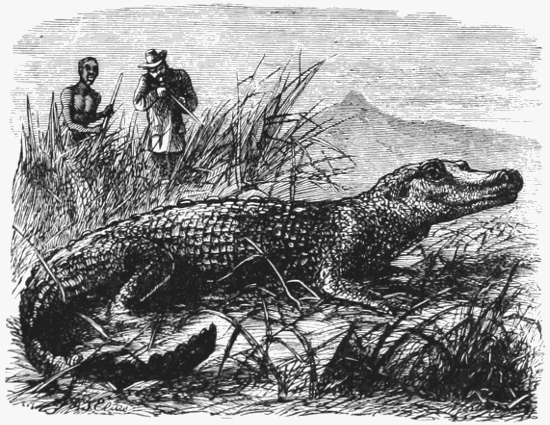
A CROCODILE HUNT.
CHAPTER XXVII.
A VISIT TO KING SHIMBOUVENEGANI—HIS ROYAL
COSTUME—HUNTING CROCODILES—HOW THEY SEIZE
THEIR PREY—THE NKAGO—THE OGATA.
I resolved to embark again on the waters of the
Anengue Lake and make a little journey of
exploration. Damagondai went in the canoe with
me. He was to take me to another king, a friend of his.
We reached the residence of King Shimbouvenegani,
a king with a long name and a small village. We
had to paddle through very shallow water before
reaching this place.
When we arrived, the king with the long name was
not at his village. We were told he was at his
olako—a place temporarily erected in the woods when
villagers go out to hunt, or fish, or pursue agriculture.
They had chosen a charming spot in the woods, just
upon the shores of the lake, which here had abrupt
banks. Their mosquito-nets were hung up under
the trees; every family had a fire built, and from the
pots came a fragrant smell of plantain and fish cooking.
The savour was very pleasant to me, for I was
hungry.
Presently, Shimbouvenegani came up. He was rejoiced
to see me, and thanked his friend Damagondai
for bringing his white man to visit him.
The appearance of Shimbouvenegani was comical.
He was between sixty and seventy years of age, and
was quite lean. His only garment was a very dirty
swallow-tailed coat, which certainly must have belonged
to the time of my grandfather. The buttons were
all gone. On his head he wore a broad beaver hat,
which dated nearly as far back as the coat itself. The
fur was entirely worn off, and the hat had a very seedy
appearance. But the king seemed very proud when
he made his appearance. He thought his costume
was just the thing, and he looked loftily around, as
if to say, "Am I not a fine-looking fellow?" And
truly, though his dress did not amount to much according
to our notions, I doubt not it had cost him several
slaves.
He asked me how I liked his costume, at the same
time taking one of the smaller tails in his hand and
shaking it.
Presently, some large pots of palm-wine were
brought, with which all hands proceeded to celebrate
my arrival. Damagondai and Shimbouvenegani soon
got drunk, and swore to each other eternal friendship,
and Shimbouvenegani promised to give one of his
daughters in marriage to Damagondai.
Meantime, Damagondai had presented me to his
eldest son, Okabi, who resided in the village of Shimbouvenegani.
Okabi arranged a nice little place for
me, with branches of trees, and made a kind of bed
for me. He then gave me his two wives to take care
of me, and to cook for me.
I had a very agreeable time in hunting while I was
with Shimbouvenegani. It was during my stay there
that I discovered the nshiego mbouvé, of which I will
speak by-and-by.
We also had a great crocodile hunt, which pleased
the people very much, as they are extravagantly fond
of the meat. Now and then during my travels, for lack
of something better, I have been obliged to eat crocodiles.
I have tried it in all sorts of ways—steaks, stews,
boiled, and broth; but I must say I was never fond of it.
They killed more or fewer crocodiles every day at
this village; but the negroes were so lazy that they
were glad to have me go and save them the trouble.
Moreover, the crocodile has not much meat on him;
so that, though some were killed every day, the
village was never sufficiently supplied.
We went in canoes. These canoes on the Anengue
are of very singular construction. They are quite flat-bottomed,
and of very light draught; many of them
are about fifty feet long, with a breadth of not more
than two feet, and a depth of ten to twelve inches.
They are made of a single tree. They are ticklish
craft. The oarsmen stand up and use paddles seven
feet long, with which they can propel one of these
canoes at a very good rate. They are, of course, easily
capsized, the gunwale being but a very few inches
above the water; but they do not often tip over.
What surprised me most was the way in which the
negro paddlers stood up at their work all day without
tiring.
The negroes on the Anengue hunt the crocodile
both with guns and with a kind of harpoon. The
vulnerable part of the animal is near the joints of his
forelegs; and there they endeavour to wound it.
Though so many are killed they do not decrease in numbers,
nor, strange to say, do they seem to grow more
wary. They were to be seen everywhere during the
dry season; when the rainy season comes they disappear.
As we started out, we saw them swimming in all
directions, and lying on the mud banks sunning themselves.
They took no notice of our canoe at all. As
we were to shoot them we were obliged to look for our
prizes on the shore, for if killed in the water they
sink and are lost. Presently we saw one immense
fellow extended on the bank among some reeds. We
approached cautiously. I took good aim and knocked
him over. He struggled hard to get to the water,
but his strength gave out ere he could reach it, and to
our great joy he expired. We could not think of
taking his body into our canoe, for he was nearly
twenty feet long.
We killed another which measured eighteen feet. I
never saw more savage-looking jaws; they were
armed with most formidable rows of teeth and looked
as though a man would scarcely be a mouthful for
them.
We had brought another canoe along, and capsizing
this upon the shore, we rolled the dead monsters into
it and paddled off for the village. Then we returned
to the olako.
During the heat of the day these animals retire to
the reeds, where they lie sheltered. In the morning,
and late in the afternoon, they come forth to seek
their prey. They swim very silently, and scarcely make
even a ripple on the water, though they move along
quite rapidly. The motion of their paws in swimming
is like those of a dog, over and over. They can remain
quite still on the top of the water, where they may be
seen watching for prey with their dull wicked-looking
eyes. When they are swimming the head is the only
part of the body visible; and when they are still, it
looks exactly like an old piece of wood which has
remained long in the water, and is tossing to and fro.
They sleep among the reeds. Their eggs they lay in
the sand on the island, and cover them over with a
layer of sand. It is the great abundance of fish in
the lake which makes them multiply so fast as they
do. The negroes seemed rather indifferent to their
presence.
On my journey back to Damagondai's I saw an
example of the manner in which the crocodile seizes
upon his prey. As we were paddling along I perceived
in the distance ahead a beautiful gazelle, looking
meditatively into the waters of the lagoon, of which
from time to time it took a drink. I stood up to get
a shot, and we approached with the utmost silence;
but just as I raised my gun to fire a crocodile leaped
out of the water, and, like a flash, dived back again,
with the struggling animal in its powerful jaws. So
quickly did the beast take its prey that, though I
fired at him, I was too late. I did not think my
bullet hit him.
After hunting on the water, I thought I would have
a few rambles in the forest near the olako. I killed a
beautiful monkey, which the natives call nkago, whose
head is crowned with a cap of bright red, or rather
brown, hair. The nkagos are very numerous in these
woods.
While walking in the forest I found, near the water,
the hole or burrow of an ogata. This is a species of cayman,
which lives near the pools, and makes a long hole
in the ground, with two entrances. In this hole it sleeps
and watches for its prey. The ogata is very unlike the
crocodile in its habits. It is a night-roving animal,
and solitary in its ways. It scrapes out its hole with its
paws with considerable labour. It lives near a pool, for
the double reason, I imagine, that it may bathe, and
because thither come gazelles and other animals, for
whom it lies in wait. The negroes told me that they
rush out with great speed upon any wandering animal,
and drag it into the hole to eat it. When the negroes
discover one of these holes they come with their guns,
which are generally loaded with iron spikes, and watch
at one end, while a fire is built at the other entrance.
When it becomes too hot the ogata rushes out, and is
shot. I killed one which proved to be seven feet in
length. It had great strength in its jaws, and its
teeth were very formidable. Like the crocodile, its
upper jaw is articulated, and is raised when the mouth
is opened.
Sometimes fire is put at both ends of the hole, and
the animal is smoked to death. At other times a trap
is made at the end where there is no fire, and when
the ogata rushes out it is ensnared.
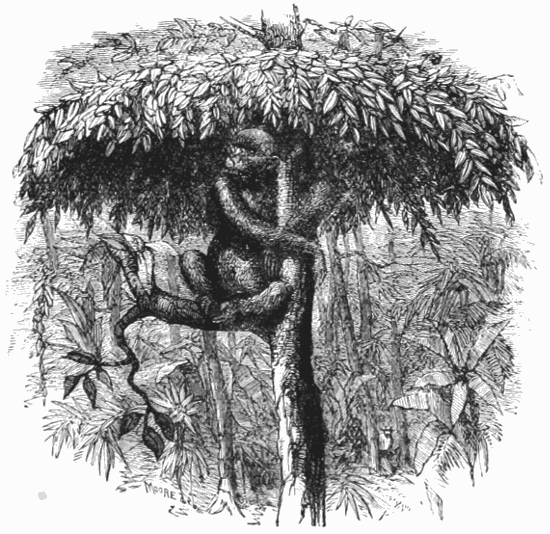
THE NSHIEGO MBOUVÉ.
CHAPTER XXVIII.
THE NSHIEGO MBOUVÉ—BALD-HEADED APES—THEIR
HOUSES IN THE TREES—LYING IN WAIT FOR THEM—WE
KILL A MALE—THE SHRIEKS OF HIS MATE—DESCRIPTION
OF THE ANIMAL—FAREWELL TO SHIMBOUVENEGANI.
AS I was trudging along one day in the woods,
rather tired of the sport, and on the point of
going back to the camp, I happened to look
up at a high tree which we were passing and saw a
most singular shelter or home built in its branches. I
immediately stopped and asked Okabi why the hunters
slept in that way in the woods. Okabi laughed, after
looking at me quizzically, and then he told me that no
man had ever built that shelter. He said that it was
made by a kind of man of the woods, called nshiego
mbouvé, an animal which had no hair on the top of its
head. I really thought Okabi was joking. An animal—a
man-monkey—with no hair on the top of his head?
a bald-headed ape? It was now my turn to laugh, for
I did not believe Okabi's story about the bald-headed
animal, though I believed what he said about the
shelter in the tree.
I saw at once that I was on the trail of an animal
which no civilized man had ever seen before. I no
longer felt tired, but pushed on through the woods
with renewed ardour, and with increased caution, so as
not to alarm our prey. The shelter we had seen was
an old one, which had been abandoned, but we had
a hope of finding another which should be still
occupied.
We were not disappointed. We soon found two more
shelters. They were about twenty feet from the
ground, and were on two trees, which stood a little
apart from the others, and which had no limbs below
the one on which the nests were placed. This location
for its house is probably chosen by the animals to
secure them at night from beasts and serpents, and
from the falling limbs of surrounding trees. They
build only in the loneliest part of the forest. They are
very shy, and are seldom seen, even by the negroes.
Okabi, who was an old and intelligent hunter, told
me that the male and female together select the
material for their nest or shelter. It is constructed in
part of the branches of the tree itself, which they
twist in with the boughs of other trees collected by
them for the purpose. The shelters I saw had the shape
of an umbrella.
We concealed ourselves by lying flat on the ground
amidst the bushes near by, and keeping perfectly still.
My patience was sorely tried. Mosquitoes and flies
were continually biting me. Ants now and then were
creeping upon me, and some of them managed to get
under my clothes. Besides, I had some fear of the
bashikonay, or of the white ants, coming to disturb me,
or of snakes creeping upon me. So, as you may
imagine, I was not comfortable, neither had I pleasant
thoughts.
At length, just at dusk, we heard the loud peculiar
"hew, hew, hew," which is the call of the male to his
mate. I was glad to know I had not waited in vain;
and looking up I saw a nshiego mbouvé sitting under
his nest. His feet rested on the lower branch; his head
reached quite into the little dome of a roof; and his
arm was clasped firmly about the tree trunk. This, I
suppose, is the position in which they sleep. Soon
after his mate came and ascended the tree.
After gazing till I was tired, I saw that one of the
animals showed signs of being alarmed. Had they
smelt us? had we made a noise that excited their
suspicions? Anyhow, we raised our guns and fired
through the gloom at the one that seemed asleep. I
almost felt sorry for the unfortunate beast, which fell
with a tremendous crash, and died without a struggle.
The other uttered an awful shriek and came down the
tree with the utmost rapidity. I fired but missed the
animal, and in less time than I take to write it the poor
creature had disappeared in the woods.
I was very hungry, for I had eaten nothing since
breakfast. We built a fire at once, and made our
camp. Then we built several more fires, to prevent an
attack of the bashikonay ants, in case they should
come that way. The poor ape was hung up to a limb
out of reach. During the night, I could hear now and
then, in the distance, the piercing shriek of its mate,
which no doubt was calling for the absent one. At last
I fell asleep on my bed of leaves and grass, as pleased
a man perhaps as any in the world.
The next morning I examined the nshiego mbouvé.
Okabi, pointing to the head triumphantly, exclaimed,
"See, Chaillie, is not the animal bald-headed? Did I
not tell you the truth?" So it was. The nshiego
mbouvé was quite bald; not a hair could be seen on
the top of his head. He was a full-grown specimen,
and measured three feet and eleven inches in height.
His colour was intensely black, and the body was
covered with short, rather blackish hair. On the legs
the hair was of a dirty grey, mixed with black. On
the shoulders and back the hair grew two or three
inches long. This animal was old, and his hair was a
little mixed with grey. The arms also, down to the
wrists, were covered with long black hair. The hair is
much thinner than on the gorilla, and is blacker,
longer, and glossier. The nose, also, is not so prominent.
Though only three feet and eleven inches in height,
the animal had an extremely broad chest, though not
so powerful as that of the gorilla. The fingers, also,
were much longer, and not large; and the hand was
longer than the foot; while the gorilla, like man, has
the foot longer than the hand.
Some of the teeth were decayed. So the poor
fellow must have had the toothache badly; and I suppose
there were no dentists among the nshiego
mbouvés. I have killed several of these animals.
One of them was a very old one; he had silvery hair;
nearly all his teeth were decayed, and some were missing
which had dropped out with age. He was getting
so infirm that he had not strength enough to pick
berries or break nuts; and, when killed, he had only
leaves in his stomach.
After enjoying myself thoroughly at the olako of
Shimbouvenegani, we returned to the village of Damagondai.
Shimbouvenegani dressed himself again in
state, that is to say, he put on his swallow-tailed coat
and his beaver hat. In this regal costume he accompanied
us to our canoes, and there bid us good-bye.
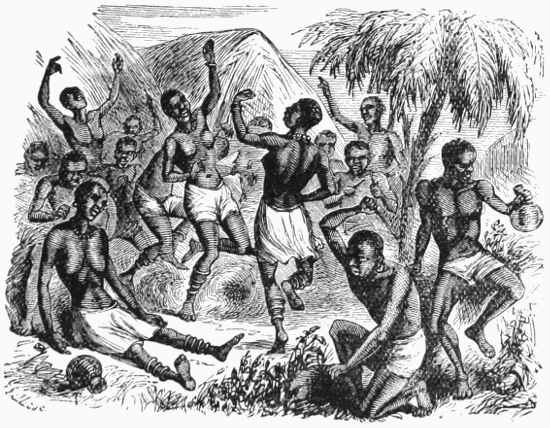
EXPIRATION OF MOURNING.
CHAPTER XXIX.
WAR THREATENED—OSHORIA ARMS HIS MEN—WE BLUFF
THEM OFF, AND FALL SICK WITH FEVER—THE MBOLA
IVOGA, OR END OF MOURNING TIME—A DEATH AND
BURIAL—FINDING OUT THE SORCERER—THE VILLAGE
DESERTED—I BECOME VICEROY AT WASHINGTON.
News came that Oshoria, the chief of Guabuirri,
a village situated at the junction of the
Ogobai and Anengue rivers, intended to stop
me on my way back to Washington. It was reported
that he had assembled all his fighting men, and was
bent upon war.
Poor Damagondai was much troubled. He wanted
no war. He sent his brother down with a plate, a
mug, and a brass pan, to propitiate Oshoria. These
were great presents. A plate, a mug, and a pan are
thought to be very valuable in the regions of the
Anengue.
I was very angry. I had done no harm to the people
of Guabuirri; I had passed their village in peace.
Oshoria wanted to exact tribute for my passage; but
he was not the king of the country, and I determined
to put down Mr. Oshoria.
We cleaned our guns, and I prepared my revolvers,
and the next morning we set out, without waiting for
the return of the king's brother, greatly to the dismay
of Damagondai and of his peaceful people. But nothing
must stop us. We must return to Washington. My
men swore that they would fight to the death.
When we came in sight of Guabuirri, I saw that
some of my fellows, who, a short time before, were going
to be so brave, began to show the white feather. I
therefore pointed to my revolver, and told them that
I would blow out the brains of the first man who failed
to fight to the last. They had a great respect for this
wonderful revolver, and they immediately answered,
"We are men."
So we pulled down the stream and soon came almost
opposite Oshoria's people. I gave orders to make for
the town. On the shore stood about one hundred and
fifty fellows armed with spears and axes, and led by ten
men who had guns. All of them were making a great
noise.
My men were all well armed, and, if I remember
well, there were only sixteen of us. I had my revolver
in one hand and a double-barrelled gun in the other.
The men all had guns, which were placed beside them
in such a way that the natives on the shore could see
them. At this piece of bravado, Oshoria's men became
very civil. They retreated as we approached the landing;
and instead of continuing their war-shouts and
firing at us, they received us peaceably, and shouted to
us not to fire.
Damagondai's brother hurried down to meet me, and
announced that there was no palaver: I must not kill
anybody. I was then led to where the quarrelsome
Oshoria stood. Looking at him with a stern look, I
reproached him for his conduct, telling him that if
anybody had been killed, the palaver would have been
on his own head. He said he had been vexed that I
did not stop to see him on my way up; and, after
making further excuses, added, "Aouè olomé," "thou
art a man;" an expression used in several ways, either
to designate a smart man or a rascal, or, in the best
sense, a very brave man. I was content to accept it as
an intended compliment.
I was presented with fruits and fowls, and we were
presently the best of friends. To show them what I
could do in the way of shooting, I brought down a little
bird which sat on a very high tree. They all declared
that I must have a very big shooting fetich; and they
reverenced me greatly.
The next morning, I left Oshoria, and once more I
glided down the placid waters of the Ogobai. I reached
Washington in safety.
It was in the month of August, and the malaria of
the Anengue marshes began to tell on me. I fell sick
with dysentery and symptoms of malignant fever. In
three days I took one hundred and eighty grains of
quinine, and thus happily succeeded in breaking the
force of the fever, which was the most dangerous of
the two diseases. I was ill from the 18th to the 31st
of August; and I did not regain my strength till the
9th of September. The Commi waited patiently for
my recovery before they would go through some of
then ceremonies.
There was to be a mbola ivoga at Biagano, that is,
an end of the mourning time, to be celebrated with
ceremonies and a terrible noise.
When anyone of importance dies, the clan, or town,
or the relatives, cease to wear their best clothes, and
make it a point to go unusually dirty. No ornaments
whatever, such as earrings or bracelets or beads, are
worn. This is the way they "mourn." Mourning
lasts generally from one year to two years. The ceremonies
at the breaking-up of this mourning are what
I am now about to describe.
The man who had died left seven wives, a house, a
plantation, several slaves, and other property. All this
the elder brother inherited; and on him, as the heir,
it devolved to give the grand feast. For this feast
every canoe that came brought jars of mimbo, or palm-wine.
Sholomba and Jombouai, the heir, with his
people, had been out for two weeks, fishing, and now
returned with several canoe-loads of dry fish. From
his plantation a large supply of palm-wine was brought
in. The women and slaves had prepared a great
quantity of food. Everything needful was provided in
great abundance.
In the village the people all got ready their best
clothes and furbished up their ornaments. Drums and
kettles were collected for music; powder was brought
out for the salutes; and at last all was ready for the
mbola ivoga.
The seven wives of the deceased seemed quite
jolly, for to-morrow they were to lay aside their
widows' robes, and to join in the jollification as brides.
The heir could have married them all; but he had
generously given up two to a younger brother, and one
to a cousin. He had already sixteen wives, and might
well be content with only four more. Twenty wives is
a pretty good number.
No wonder the widows were glad to see the time of
mourning over. For two whole years they had been
almost imprisoned in their husband's house, hardly
ever going out.
At seven o'clock three guns were fired off, to
announce that the widows had done eating a certain
mess, mixed of various ingredients, supposed to have
magical virtues, and by which they are released from
their widowhood. This was the first part of the ceremony.
They then put on bracelets and anklets, and
the finest calico they had. Some of the Commi women
wear brass anklets on each leg almost as high as the
knee, as you see represented in the picture. The
weight must be between twenty and thirty pounds on
each leg. Besides these anklets, they wear a few bracelets
of the same material. On their necks they wear
beads.
From early morning the guests had been coming, all
bringing provisions and mimbo (palm-wine) with them,
and dressed in their best clothes. There were several
hundreds in all. The guests that lived far away had
come the day before. About nine o'clock all the guests
sat down on mats, spread about outside of the house of
the deceased, and along the main street. They were
divided into little groups; and before each was set an
immense jar of mimbo, and food was spread before
them. All began to talk pleasantly, till, suddenly, the
Biagano people fired off a volley of about one hundred
guns. This was the signal for the drinking and eating
to begin. Men, women, and children set to, and ate
as much as they could; and from this time till the
next morning the orgies were continued without interruption.
They drank, they sang, they shouted, they
fired guns, and loaded them so heavily when they got
tipsy that I wonder the old trade-guns did not burst.
They drummed on everything that could possibly give
out a noise. The women danced—such dances as are
not seen elsewhere! You may imagine what they
were, when every woman was so furiously tipsy.
This mbola ivoga would have lasted probably for
several days, but the victuals and palm-wine finally
gave out.
Next day, about sunrise, Jombouai came and asked
me to assist at the concluding ceremony; for I had
told him that I wanted to see every scene of the mbola
ivoga. His brother's house, according to the custom,
was to be torn down and burned—yes, burned to the
ground, so that not a vestige of it would remain to remind
the people that once there stood a house whose
possessor was dead.
The people came around the house and fired guns;
then, in a moment, as if they were an infuriated mob,
they hacked the old house to pieces with axes and
cutlasses; then they set fire to it. When the ruins
were burnt, the feast was done.
This is the way they go out of mourning among the
Commi. The widows were all married again, and, until
another death should occur, everything would go
smoothly again.
Hardly were the rejoicings over, when Ishungui, the
man who had faithfully taken care of my house in my
absence, lay at death's door. He had gone out on
Jombouai's fishing excursion, in order to catch fish for
the mbola ivoga which I have just described. He
caught cold, and had now a lung fever. The people
called for me. I knew as soon as I saw him that he
must die, and I tried to prepare his mind for the
change. But his friends and relatives by no means
gave him up. They sent for a distinguished fetich
doctor, and under his auspices they began the infernal
din with which they seek to cure a dying man. I am
afraid the cure is worse than the disease.
One of the Commi people's theories of disease is,
that Obambou (the devil) has got into the sick man,
and as long as the devil remains in the body there is
no hope of curing the man. Now this devil is only to
be driven out by noise, and accordingly a great crowd
surround the sick man and beat drums and kettles
close to his head, fire off guns close to his ears, and in
every part of the house they sing, shout, dance, and
make all the noise they can. This lasts till the poor
fellow either dies or is better; but I must say that
he generally dies, unless the operators get tired out
first.
Ishungui died. He left no property, and his brother
buried him in the sand, without a coffin, in a grave so
shallow (as is the custom) that, when I came upon it
some days after, I saw that the wild beasts had been
there and eaten the corpse.
The mourning was short in this case; it lasted only
six days. There were no wives or property; there was
no feast. The relatives of the deceased slept one night
in his house, as a mark of respect.
Among the Commi it is the custom, when a man
has died, to keep the nchougou. The nchougou is a
feast that takes place generally, if not always, after the
man has been dead six days. There is drinking, eating,
and dancing; but the rejoicing is not so uproarious
as the ceremony of the mbola ivoga. Then the mourning
begins. I think you will agree with me that the
nchougou is a most extraordinary custom.
After Ishungui had died, it became necessary to discover
the persons who had bewitched the dead man;
for the Commi said, "How is it that a young man,
generally healthy, should die so suddenly?" This
they did not believe to be natural; hence they
attributed his death to sorcerers, and were afraid that
the sorcerers would kill other people.
A canoe had been despatched up to Lake Anengue
to bring down a great doctor. They brought down one
of Damagondai's sons, a great rascal. He had been
foremost in selling me the idol, or mbuiti, of the slaves
of which I spoke to you, and he was an evident cheat.
When all was ready for the trial, I went down to
look at the doctor, who looked really diabolical. I
never saw a more ugly-looking object.
He had on a high head-dress of black feathers. His
eyelids were painted red, and a red stripe, from the nose
upward, divided his forehead into two parts; another
stripe passed around his head. The face was painted
white, and on each side of the mouth were two round
red spots. About his neck hung a necklace of grass,
and also a cord, which held a box against his breast.
This little box is sacred, and contains spirits. A number
of strips of leopard's skin, and of skin of other
animals, crossed his breast, and were exposed about his
person; and all these were charmed and had charms
attached to them. From each shoulder down to his
hands was a white stripe, and one hand was painted
quite white. To complete this horrible array, he wore
around his body a string of little bells.
He sat on a box. Before him stood another box containing
charms. On this stood a looking-glass, before
which lay a buffalo-horn. In this horn there was some
black powder, and it was said to be the refuge of many
spirits. The doctor had also a little basket of snake-bones,
which he shook frequently during his incantations,
and several skins, to which little bells were
attached. Near by stood a fellow beating a board with
two sticks.
All the people of the village gathered about this
couple. The doctor had, no doubt, impressed the
people with his great power. His incantations were
continued for a long time, and at last came to the
climax. Jombouai was told to call over the names of
persons in the village, in order that the doctor might
ascertain if any of those named were sorcerers. As
each name was called, the old cheat looked in the
looking-glass to see the result.
During the whole operation I stood near him, which
seemed to trouble him greatly. At last, after all the
names were called, the doctor declared that he could
not find any "witch-man," but that an evil spirit dwelt
in the village, and many of the people would die if it
continued there. I have a suspicion that this final
judgment with which the incantations broke up was a
piece of revenge upon me. I had no idea until the
next day how seriously the word of one of these
ougangas (doctors) is taken.
The next morning all was excitement. The people
were scared. They said their mbuiti was not willing to
have them live longer here; that he would kill them,
etc. Then began the removal of all kinds of property,
and the tearing down of houses, and by nightfall I was
actually left alone in my house with a Mpongwe boy
and my little Ogobai boy, Macondai, both of whom
were anxious to be off.
Old Ranpano came to beg me not to be offended; he
said that he dared not stay; that the mbuiti was now
in town. He advised me as a friend to move also; but
nobody wished me ill, only he must go, and would
build his house not far off.
I did not like to abandon my house and settlement
at Washington, which it had cost me a good deal of
trouble to build. I called a meeting of the people, and
it was with the greatest difficulty that I could get some
of my own canoe boys and a few men to come and stay
at my place. These began immediately to build themselves
houses, and a little village was built, of which I
was now, to my great surprise, offered the sovereignty.
I remembered how the new king was made in the
Gaboon, and I did not know but that the Commi had
the same custom. The thought of the ceremony which
precedes the assumption of royalty deterred me.
Finally, the men determined to have me as their chief,
next to Ranpano; and with this my ambition was
satisfied.
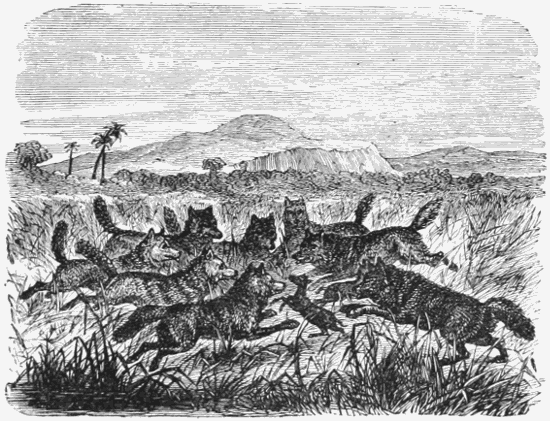
WOLF HUNTING.