Many, many years ago there was no earth.
There were no plants, nor animals; no sun;
no moon; neither were there any people.
All was darkness.
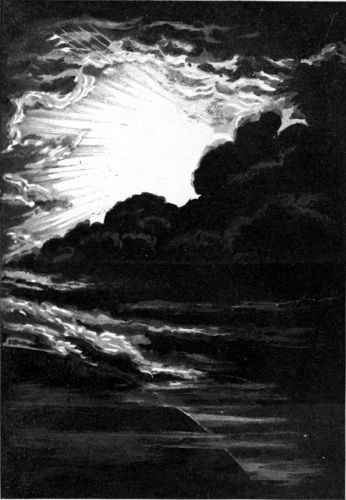
Then God looked into the darkness and
said, "Let there be light." And light came.
And out of the new light God created the blue
sky, the deep sea, the beautiful grass-covered
earth, the plants, the trees, and the many-colored
flowers.
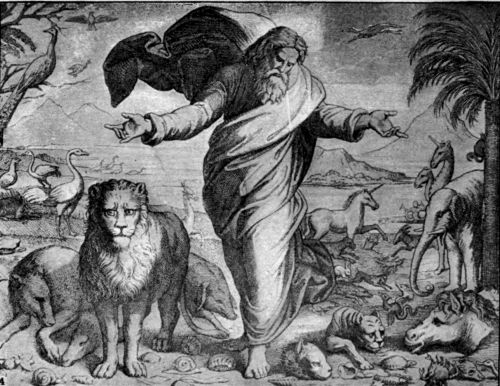
THE CREATION OF ANIMALS. (Raphael.)
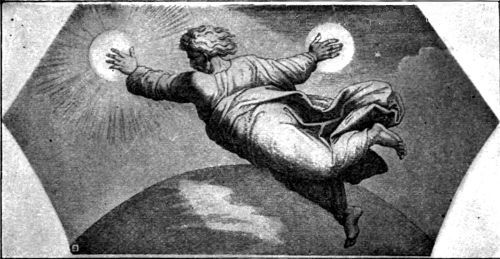
And in the blue sky he placed the golden
sun, the silver moon, and the stars that shine
like jewels in the sky.
Then, in the water he placed the fishes;
on the earth, the animals; and in the tree tops
the birds sang their praises.
"This shall be for a home for man," the
Creator said; and so, one morning, there woke
to life in the Garden of Eden a man and
woman—beautiful and good and pure.
To the animals God had given strength
and speed, and fur for protection from the
wind and rain. To the birds he had given
plumage, brilliant and warm. To the fishes,
fins and scales.
Then man came; and to him was given
intelligence, and reason, and power to grow in
wisdom; for by these was he to protect himself
from the elements and gain dominion over all
the earth,—the fishes, the birds, and the
animals thereof.
Then God blessed everything he had
made; for he loved what he had made, and
surrounded it with all that was beautiful and
good.
"Of every tree in the garden ye may eat,"
He had said to Adam and Eve, "except the
tree of Knowledge-of-Good-and-of-Evil. Of that
eat not lest ye die."
The spacious firmament on high,
With all the blue ethereal sky,
And spangled Heavens, a shining frame,
Their great Original proclaim.
The unwearied sun, from day to day,
Does his Creator's power display,
And publishes to every land
The work of an almighty hand.
Soon as the evening shades prevail,
The moon takes up the wondrous tale,
And nightly to the listening earth
Repeats the story of her birth;
Whist all the stars around her burn,
And all the planets, in their turn,
Confirm the tidings as they roll,
And spread the truth from pole to pole.
What though in solemn silence all
Move round this dark terrestrial ball!
What though no real voice or sound
Amidst their radiant orbs be found!—
In reason's ear they all rejoice,
And utter forth a glorious voice;
Forever singing as they shine,
"The hand that made us is Divine."
—Joseph Addison.
THE GARDEN OF EDEN. — THE CURSE OF CAIN.
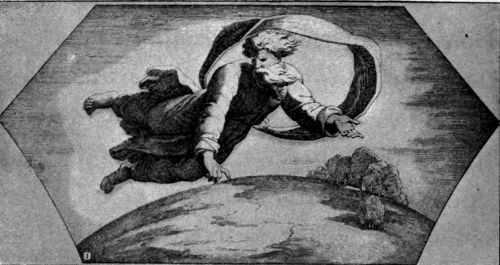
CREATION OF TERRA FIRMA. (Raphael.)
When Adam and Eve looked out
upon the world round about them; when they
saw the flowers and the grasses; when they
heard the splashing of the sun-lit waters, and
the rustling of the soft branches,—then their
hearts were filled with love for each other, for
their home, and for the Father who had made
all this joy for them.
For a long time they wandered up and
down the Garden of Eden, singing songs, and
ready always to hear the voice of God when he
spoke to them in the soft winds that played
among the tree tops.
Now, there was a wicked angel, named
Satan. He had been cast out from heaven,
down, down from the blue sky. And in his
own unhappy home he dwelt now, alone,
wretched and revengeful. And when he saw
this happy man and woman, so good and pure,
their hearts bounding with love to God and
joy in right doing, his cruel face grew black.
"Such happiness shall not last," he said.
So he crept into the Garden, took on the form
of a serpent and spoke to Eve.
"Eat of the fruit of this tree," he said,
"and give it to Adam that he may eat too."
"But we are forbidden," Eve said.
"The fruit is like no other. Eat! Ye
shall not die," the serpent answered.
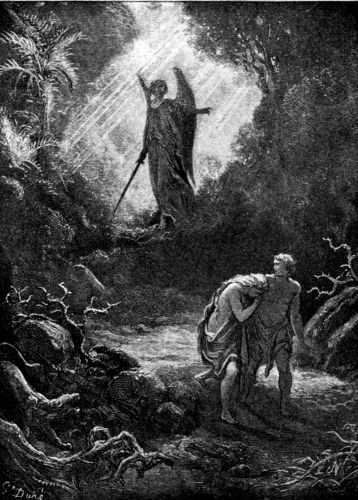
THE EXPULSION OF ADAM AND EVE
FROM THE GARDEN OF EDEN. (Dore.)
Then Eve gathered the fruit and ate of it.
It was sweet, even as the serpent had said. Then
she gathered more, and Adam, too, ate of it.
Then darkness fell upon the earth. A
great wind arose, the thunder rolled, and God
drove Adam and Eve out from the Garden of
Eden; and at the entrance He placed cherubims
and a flaming sword for no one who
had sinned could dwell in a land so beautiful
and free from sorrow.
But God pitied these children of his;
and, although they had sinned against him,
he saw that, after long years of suffering,
One should be born, who would bring back to
earth the joy and peace and happiness that had
once been theirs, and which would have been
to all their children in all the time to come,
had not these parents sinned.
And so Adam and Eve went out into the
world to work and struggle and build homes
for themselves.
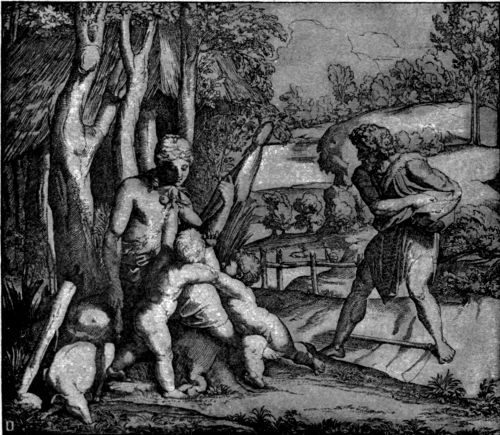
ADAM AND EVE. (Raphael.)
By and by two baby boys were born to
them,—Cain and Abel. Pure and kind and
good these children should have been. But
now they were born into a world of sin, and of
the nature of sin they too partook.
When these children were grown men,
Cain hated his brother. He grew sullen and
revengeful towards him. The serpent that
had tempted Adam and Eve now tempted him.
He listened; and one day, when they were at
work together in the field, Cain slew Abel and
hid him in the earth.
Then a great storm gathered across the
sky; and a voice said, "Cain, where is thy
brother?"
Cain trembled with fear; for he knew it
was the voice of God. But he raised his
wicked face towards the heavens and cried,
"Why should I know? Am I my brother's
keeper?"
And the voice said, "Thou art thy
brother's keeper."
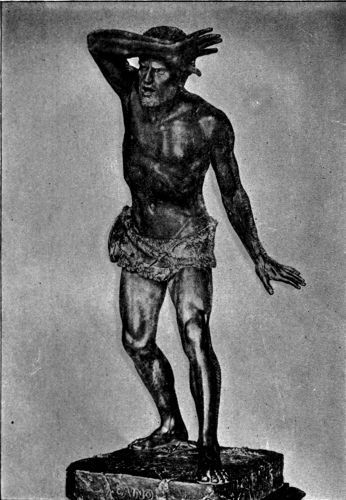
Then God put a brand upon the brow of
Cain, and drove him forth into the wilderness,
to be a fugitive and a vagabond.
STATUE OF CAIN. (Giovanni Dupre.)
O, the wrath of the Lord is a terrible thing!—
Like the tempest that withers the blossoms of spring,
Like the thunder that bursts on the summer's domain,
It fell on the head of the homicide Cain.
And, lo! like a deer in the fright of the chase,
With a fire in his heart, and a brand on his face,
He speeds him afar to the desert of Nod,—
A vagabond, smote by the vengeance of God!
All nature, to him, has been blasted and banned,
And the blood of a brother yet reeks on his hand;
And no vintage has grown, and no fountain has sprung,
For cheering his heart, or for cooling his tongue.
The groans of a father his slumber shall start,
And the tears of a mother shall pierce to his heart,
And the kiss of his children shall scorch him like flame,
When he thinks of the curse that hangs over his name.
—Knox.
THE FLOOD. — THE RAINBOW.
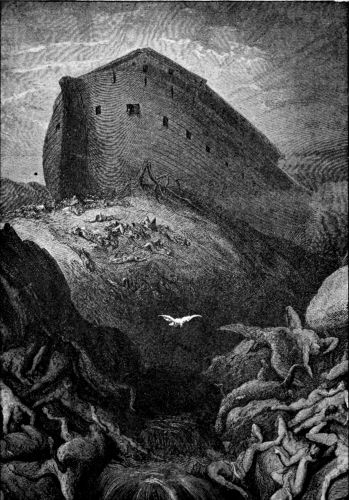
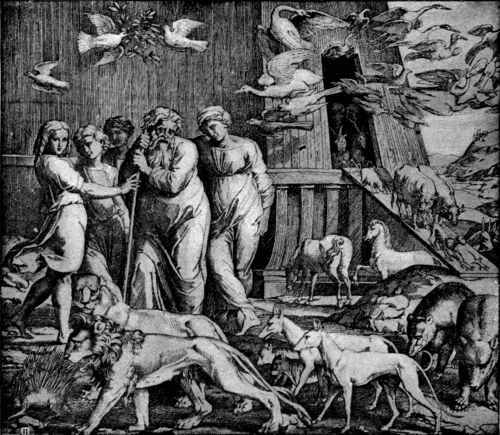
THE DOVE SENT FORTH FROM THE ARK.
Earth shall be ocean! and no breath,
Save of the winds be on the unbounded wave!
Angels shall tire their wings, but find no spot:
Not even a rock from out the liquid grave Shall lift its point to save,
Or show the place where strong despair hath died,
After long looking o'er the ocean wide
For the expected ebb which cometh not; All shall be void, destroyed.
—Byron.
It was many, many years after Adam and
Eve were driven out from the Garden of Eden
that the flood came.
There were thousands of people in the
world now, and they were scattered here and
there through the fertile valleys and along the
rivers of the country far and wide.
There were rich farms everywhere, and
shepherds watched their flocks on the hillsides.
There were towns and cities; many of them
where people dwelt together and made their
laws and appointed their law-givers.
But in all these years the people had been
growing more and more away from the simple,
honest life that God had first shown Adam
and Eve.
They had grown selfish and greedy; they
were cruel to each other; they cared nothing
for the rights and comforts of the community;
and more than all this, they had forsaken
the simple faith of their fathers and become
worshippers of idols.
There was one good man dwelling among
these people, many, many years before, whose
name was Enoch. Now, it was not the will of
God that Enoch should suffer for the sins of
the people; and so, when the flood was about
to come upon the earth to destroy them, God
came and stood by Enoch and said, "Come
with me."
Now there was another good man upon
the earth, a great grandson of Enoch's, and
a man who had never forgotten God, and who
had reared his children always in the simple
faith which had been his own.
Although God meant to send a flood that
should destroy the cities, and separate the
people so that the wickedness of the earth
might be destroyed, still it was not his wish
that the race should perish wholly. And so
again God went down to the earth, and said to
this good man, Noah, "Build thou an ark, and
into it bring all thy family, and also two of
every kind of bird and beast and animal. For a
great flood shall come upon the earth, and
those in the ark only shall be saved."
Noah was a simple hearted man. It was
a strange thing for him to be told to build an
ark and place within its shelter his family and
two of every living thing upon the face of the
earth.
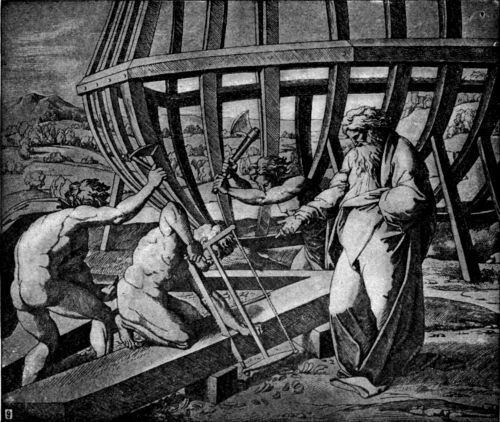
NOAH BUILDING THE ARK. (Raphael.)
He told the people what God had said to
him; and he urged them to do likewise. But
the people only laughed at him, and called him
a fool.
But Noah doubted not the word of God
and set to work at once,—his three sons,
Ham, Shem, and Japheth helping him to build
an ark, and to gather together the birds and
beasts and animals of the earth.
Every morning the four men set out as
soon as the sun had risen, and kept at their
work until darkness fell at night.
At last the ark was finished, and Noah,
with his wife, his three sons and their wives,
journeyed to the mountain side. The people
in the valley laughed at them and threw
stones at them, but the trustful little band
kept on their way and entered the ark, taking
with them, as they had been told, two of every
kind of bird and beast.
Then the clouds began to gather in the
south,—great black rolls of cloud. The wind
rose, the clouds scattered over the whole sky;
and so black and thick were they that the light
of the sun was shut out. It was like night.
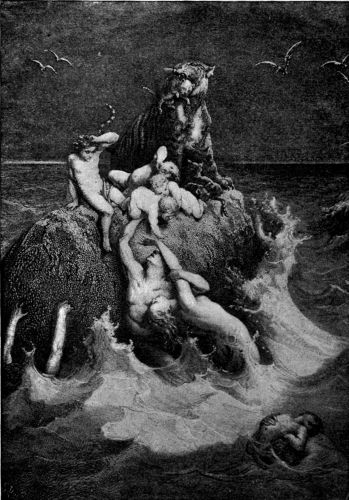
THE DELUGE.
Then the rain fell. In great sheets, like
rivers, it poured upon the valleys. The
thunders rolled, the lightnings flashed, the
rivers overflowed their banks. The winds
howled, and great trees were torn up by the
roots.
For forty days this storm continued—forty
days and forty nights. Every living
thing left upon the face of the earth was
drowned. But the ark, with its inmates, was
borne up by the waters in safety. At last, one
morning when Noah and his people awoke,
they could see that the storm had ceased; the
clouds were separating, and the sun was sending
its rays down through the mist upon the
flooded earth below.
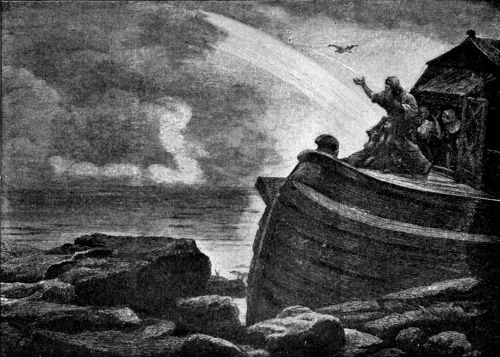
Then came the beautiful rainbow, spanning
the heavens in the west, and reflecting its
wonderful colors in the great sea below.
Triumphal arch, that fill'st the sky When storms prepare to part,
I ask not proud philosophy To teach me what thou art.
Still seem as to my childhood's sight, A midway station given,
For happy spirits to alight Betwixt the earth and heaven.
How glorious is thy girdle cast O'er mountain, tower, and town,
Or mirror'd in the ocean vast, A thousand fathoms down.
As fresh in yon horizon dark, As young thy beauties seem,
As when the eagle from the ark First sported in thy beam.
For faithful to its sacred page, Heaven still rebuilds thy span,
Nor lets the type grow pale with age, That first spoke peace to man.
—T. Campbell.
Never was rainbow so beautiful! Then
the voice of God spoke from out the skies to
Noah, "This shall be to you a bow of promise.
Never again shall the earth and the people be
destroyed by water."
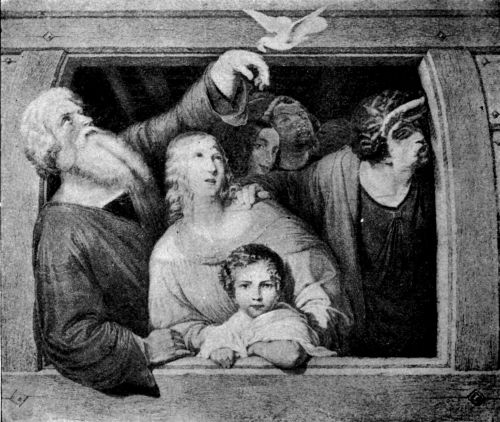
NOAH AND THE DOVE (Schopin.)
But nowhere, as far as eye could reach,
was there any sign of land; there was only the
peak of Ararat with the ark upon it, standing
out above the water.
Noah sent out first a raven, and it returned
not. Then he sent out from the ark a dove;
and the dove came back after a long, long
flight across the waters and fell fluttering at
Noah's feet.
Seven days went by. Then again Noah
sent out a dove; and this time it returned with
an olive leaf. Noah knew now that the flood
was subsiding, and that he might lift the cover
of the ark and step out upon the mountain
top.
Then Noah and his family went forth,
together with all the creatures that had gone
into the Ark with them.
And so thankful was Noah that he built
a great altar, and he and his family offered
sacrifices to God in gratitude for his loving
care of them.
COMING FORTH FROM THE ARK. (Raphael.)
THE TOWER OF BABEL.
Children were born to Ham, Shem, and
Japheth; and when these children became men
and women, children were born to them, until,
after many, many years, the valley was again
filled with people,—all descendants from Noah
and his three sons.
Now, there came a time, long after Noah
had died, and so could guide his people no
longer into the paths of right, that the people
again grew wicked and selfish to one another.
They boasted of their power, and said
among themselves, "We will build a tower
that shall reach into heaven itself. Then who
in heaven or earth shall be greater than we?"
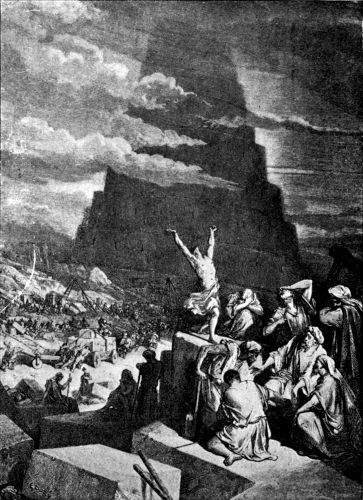
CONFUSION OF TONGUES.
Now, God was angry that these people
should have forgotten the God of their fathers,
and that the trustful, humble soul of Noah
should so have departed from them.
So, while all the people were at work
upon the tower, now risen above the trees and
hill-tops, God touched them; and behold, from
that instant each spoke a language of his own;
nor could one of them understand any other.
Confusion followed, the building of the
tower was forsaken, the people scattered up
and down the valley; and so the tower of
Babel was left to crumble into ruins.
ABRAHAM.
In the pleasant valley of Mesopotamia
there lived a good man, whom the people
loved, and who was called Abram.
Now, the people of this valley were idolaters,
and though Abram often pleaded with
them to return to the faith in one God, they
would not listen to him. "Go thou your way,
and we will go ours," they would say.
But God would not permit it to be that
Abram's life should be spent upon a people
who cared not for the good spirit that Abram
shed everywhere about him. So He called to
him and said, "Leave this valley. Go thou
with thy people to the land of Canaan. There
a son shall be born to you, and your descendants
shall govern the land of Canaan."
Abram, simple hearted and trustful like
Noah, gathered his possessions together, and
with his wife, Sarah, and his nephew, Lot,
set forth across the country towards the land
of Canaan.
Now, Abram was a man of great wealth.
He had silver and gold, and camels, and sheep
and cattle, and armies of servants.
Lot too had great wealth; and when the
two families came into Canaan, Lot declared
there was not land enough for them all. So
Lot went on towards Jordan, where there were
fertile valleys and broad rivers.
"Here," said Lot, "shall I find pasturage
for my flocks and food for my servants."
"But God bade us dwell here," said
Abram; and he was grieved that so great greed
should have fallen upon Lot.
Lot went to live in the city of Sodom, a
city so wicked that God finally visited it with
fire and destroyed it.
Lot was not happy in Sodom. The people
were idolaters, and laughed bitterly at Lot for
his religion. For, though Lot had disobeyed
God, he still kept the worship of Abram.
By and by a great king besieged the city
of Sodom, and stole away its riches. Lot
himself was made prisoner, and his wealth
was divided among the soldiers of the conquering
king.
Abram, living happily in the land of
Canaan, heard of the downfall of Sodom, and
of Lot's imprisonment. So he gathered
together his own great army and marched
against the king. He recaptured the wealth
of Sodom, returning it to its rightful owners,
and freed all the people from prison.
"Wilt thou come now to dwell in Canaan?"
Abram asked of Lot. But Lot was stubborn
and would not.
Then Melchizedek, the ruler of Salem,
came out to meet Abram, bringing bread and
wine. For Melchizedek was a priest as well
as a ruler; and, as he poured the wine, he said,
"Blessed be Abram of the most high God,
possessor of heaven and earth. And blessed
be the most high God, who hath delivered
thine enemies into thy hands."
Then Abram gave to Melchizedek one
tenth of all his wealth, in token of his love for
him; and after that he rode back into his own
Land of Canaan.
ABRAHAM'S VISIONS.
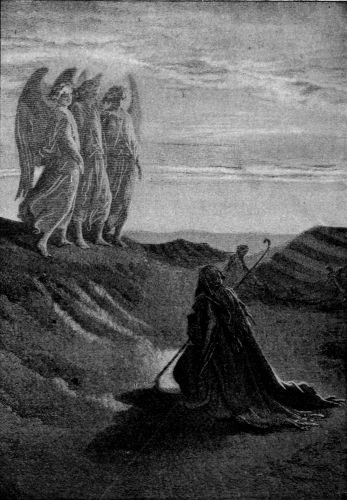
ABRAHAM AND THE THREE ANGELS.
Angels of life and death are His; Without his leave they pass no threshold o'er;
Who, then, would wish or dare, believing this, Against his messengers to shut the door.
—Longfellow.
One night Abram went out beneath the
sky and looked up at the stars. Then God's
voice spoke and said, "Thy descendants shall
be in number like the stars."
Now, Abram had no children, and had his
faith been less firm he might have doubted the
words he heard. But he had never forgotten
the promise that in the Land of Canaan a child
should be born to him, and that from him
should descend a nation.
And that same night God spoke again to
Abram in a vision. He showed him an altar
with a burning lamp. And he said to Abram,
"For four hundred years your descendants
shall journey in a strange land and suffer
affliction; but, at the end of that time, they
shall again come into Canaan and possess the
land."
Then the Lord changed the name of
Abram to Abraham, which means Father of a
People. And his wife's name he changed to
Sarah, which means a Princess. And again
God said unto Abraham and Sarah, "A child
shall be born to you; and he shall be great
among the nations of the earth."
A third time God came to Abraham; and
he told him that the destruction of Sodom was
near at hand, because of its wickedness.
Then Abraham thought of Lot, and prayed
to God to save the city for Lot's sake.
And God answered, "If ten righteous
people only be found in the city, I will not
destroy it for Lot's sake."
But ten righteous people were not to be
found in the city, and so the angels of destruction
were sent down upon it.
Lot sat in the gateway of the city and
looked out upon the country. And when he
saw the angels of destruction, he rose and led
them to his house and gave them food.
Then the angels said, "Whatsoever thou
hast in this city bring out; for we are come to
destroy this place."
Then Lot went and told his people; but
none of them would listen to him. In the
morning the angels came and woke Lot and
his wife and said to them, "Arise, and hasten
from the city. Escape for thy life, and look
not behind thee."
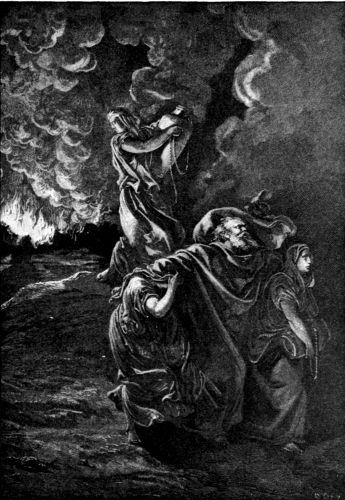
So Lot and his wife and their two daughters
fled from the city; and the shower of fire
came down to purify it. But when they were
far out on the plain, Lot's wife, still loving her
old home, turned back to look upon it. Too
late the angels' words came back to her, "Look
not behind thee."
THE FLIGHT OF LOT.
Her feet were rooted to the spot; her
voice refused to come; sight left her; sound
was shut out; and in one instant she was
changed to a pillar of salt.
Then Lot and his two daughters hurried
on. They reached a great cave, and ran and
hid themselves in it. The city was now a
blackened ruin. Lot's wealth was destroyed.
He had no silver, no gold, no cattle, no home—only
the cave, and grateful was he that he
had even that.
HAGAR.
DEPARTURE OF HAGAR AND ISHMAEL.
Who can speak a mother's anguish, Painted in that tearless eye,
Which beholds her darling languish, Languish, unrelieved, to die!
It was not very long after the destruction
of Sodom that there was born into the home
of Abraham and Sarah a beautiful little baby
boy—even as God had promised.
There was great rejoicing among the
people of Abraham's household. Feasts were
held, sacrifices were offered up, and Abraham
gave the child the name of Isaac.
One of Sarah's maids, whose name was
Hagar, had a son, too, called Ishmael. One
day this boy mocked at Isaac, and Sarah
said he and his mother must be sent away.
So Abraham called Hagar and told her
she must go, and he gave her some bread
and a bottle of water, and sent her forth into
the wilderness.
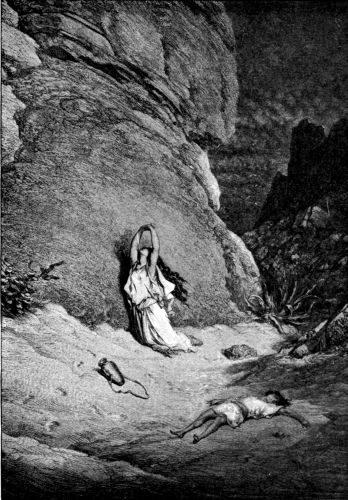
HAGAR AND ISHMAEL IN THE DESERT.
Poor Hagar and her child sorrowfully
set forth in the burning heat; but when all
their water was gone, her little one began to
droop; he grew weaker and weaker, and she
thought he would die. She laid him in the
shade and went away to weep. The mother
could not bear to see her poor boy die.
She looked above—the heavens shone still Unclouded, bright and clear;
She listened but not fount nor rill Poured music on her ear.
Thence once again her child she eyed— His cheek wore death's pale hue;
"Alas! and is it thus," she cried; "Doth God forsake me too,
And with my earthly foes combine
To work such ill for me and mine?"
The Angel of God heard her and told
her not to fear, but to take up Ishmael and
hold him in her arms. Then she saw, all at
once, a well near her; she gave the child
a drink, and soon he grew strong and well.
ISAAC.
THE TRIAL OF ABRAHAM'S FAITH.
Isaac grew up a fine, healthy, noble boy
loved by all his father's people; and to his,
father and mother, now old people, he was
their joy and life. Never a day passed that
Abraham and Sarah did not offer thanks to
God for their beautiful child. Most carefully
they taught him the religion of his people, and
bade him follow it all the days of his life.
"When God speaks, obey, O my son!"
the old father would say. And one day there
came to Abraham, and Isaac too, a trial of
their faith.
A vision came again to Abraham. And
in the vision the Lord spoke, saying, "Arise,
Abraham, and go and prepare an altar upon
the mountain. And when the altar is ready,
place thy son Isaac upon the altar; for I
would that he be sacrificed—a burnt offering—to
me."
Poor old Abraham! There was nothing in
all the world so dear to him as this child,
Isaac; but although his heart was sore and
heavy, the old man rose and did as he was bid.
And when the altar was ready, he called Isaac
and told him what the vision had said.
For a minute the brave boy's cheek grew
pale; his heart beat fast. Then he permitted
his father to bind him hand and foot and lay
him upon the altar. Abraham lifted the knife
to slay the boy; when, lo! his hand was held,
and a voice said, "Harm not the lad; for now
I do know that thou lovest God more than all
else beside."
With trembling hands Abraham unbound
the cords that held Isaac, and the boy leaped
down from the altar. Then, with tears of
gratitude, they knelt and thanked God for his
mercy. Then the voice spake again: "Because
you have done this thing I will bless thee; and
all nations shall be blessed through thy children."
One day Abraham's wife, Sarah, lay down
and died, and Abraham bought the field of
Machpelah and made for her a burial place.
"Now," said Abraham to Isaac, "it is right
that you should find a wife and bring her to
dwell in our tent. But take not a wife from
the people of Canaan, for they are idolaters.
Go rather to Mesopotamia, and there take the
wife that God may allot thee."
So a trusty old servant was sent into
Mesopotamia to find a wife for Isaac,—a
woman who should be beautiful and good, and
whose faith was like that of Abraham.
REBEKAH.
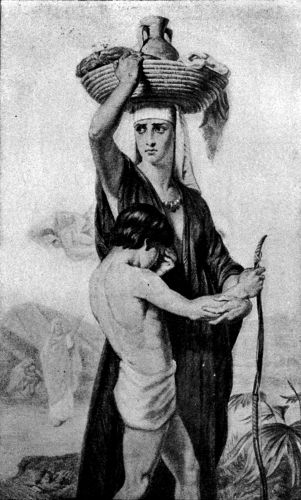
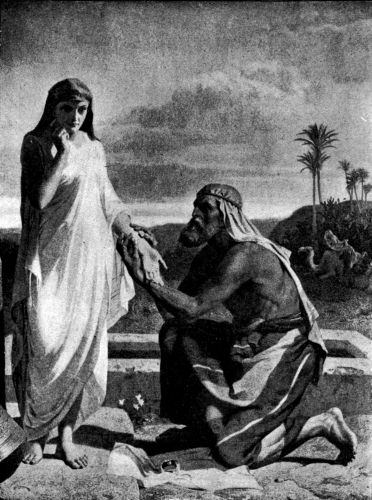
REBEKAH AT THE WELL. (Goodall.)
His house she enters, there to be a light,
Shining within, when all without is right.
It was just upon the edge of the village,
and just as the sun was sinking, that the
servant came to the well from which the
village folk drew water. And there, with a
pitcher in her hand, stood a maiden, as beautiful
as ever maiden could be.
"Whose daughter art thou?" the servant
asked.
And the maiden answered, "I am Rebekah,
the daughter of Bethuel, of the house of
Abraham."
Then the servant was glad; for he knew
now that the maiden was as good, and her
religion as pure, as she was beautiful. So he
went to the home of Bethuel, and told his
errand into Mesopotamia. He told Bethuel
of the godly life Abraham had led, and of the
noble youth, Isaac. And he asked that he
might choose Rebekah for Isaac's wife and
carry her back with him to Canaan.
The heart of Bethuel was glad; and
Rebekah, too, was glad to go; for already she
loved the brave lad, Isaac, so proudly had the
old servant told the story of his brave deeds
and godly life.
So Rebekah, arrayed in a fine raiment,
was placed on a camel, and beside her walked
her nurse and maids.
The old servant then hurried on, and
reached the home of Isaac while yet the
maiden and her companions were not beyond
the limits of their own land.
He told Isaac all that had happened, and
how beautiful and good the maiden was, and
that she was of the noble house of Bethuel.
Then Isaac loved the maiden; and, as she
came near to Canaan, he hurried forth to meet
her, and to bring her to his home and to his
people. Old Abraham was glad when he saw
the maiden, for he knew God's blessing would
rest upon the union.
Abraham was now one hundred and
seventy-five years of age; and when he came
to die, Rebekah and Isaac laid him beside
Sarah in the field of Machpelar, and Isaac
took his father's place in the household.
Isaac and Rebekah lived to an old age.
They were good people, and the Lord blessed
them; and when they came to die, their two
sons, Esau and Jacob, wept over them, and laid
them, also, beside Abraham in the field of
Machpelar.
JACOB AND ESAU.
We barter life for pottage; sell true bliss For wealth or power, for pleasure or renown;
Thus, Esau like, our Father's blessing miss, Then wash with fruitless tears our faded crown.
—Keble.
Esau was the older son, and to him
belonged the honors of the family. It was his
duty, too, to offer sacrifices and serve as the
high priest in the home; for such was the
custom of the times.
But Esau cared little either for honor or
religious services. And so, one day when he
came home from the hunt, hungry and thirsty,
he sold his birthright to his brother Jacob for
a bowl of pottage that Jacob sat eating
before the door of his home.
Now, Isaac loved this son better than he
loved Jacob, and was grieved and disappointed
that he should have sold his birthright so
foolishly; for now to Jacob rather than to
Esau would fall the blessings of God.
But it could not now be helped, and
Jacob took up the office of high priest in the
house of Isaac.
As Isaac grew old, to him was given the
gift of prophecy; and whomsoever he blessed,
honor and prosperity was sure to follow.
When Rebekah knew this, her heart was filled
with but one desire,—that Isaac's blessing
should fall upon Jacob rather than upon Esau;
for she knew how unworthy Esau was in
spirit, and how little he would strive to honor
God when the household became his own.
So, one day when Esau was away upon
the hunt, she called Jacob to her and bade him
go kneel beside his old father and ask his
blessing.>
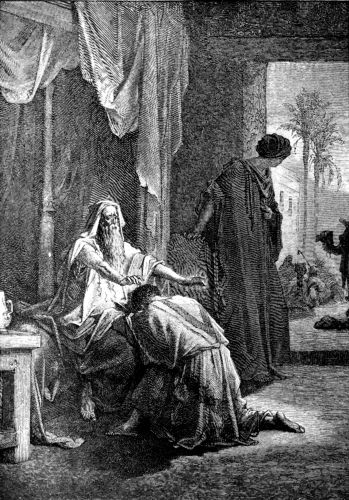
ISAAC BLESSING JACOB.
But Jacob said, "Behold, Esau, my
brother, is a hairy man and I a smooth man.
My father, perhaps, will feel me, and I shall
seem to him as a deceiver."
Rebekah said, "Obey my voice, my son."
And Jacob yielded.
Then Rebekah took some clothes belonging
to Esau and put them upon Jacob; and
she put the skin of the kids that he had
brought her upon his hands and upon the
smooth of his neck.
Then Jacob knelt before his father, whose
eyes were dimmed with old age, and said,
"Bless me, my father."
And Isaac said, "Who art thou, my son?"
And Jacob said, "I am Esau, thy first
born."
Then Isaac said to Jacob, "Come near,
that I may feel whether thou be my very son
Esau or not."
So Jacob went near to his father, and the
father felt of him; and he said, "The voice is
Jacob's voice, but the hands are the hands of
Esau."
Then Isaac, thinking it was Esau who
knelt, blessed him as his first-born, and said,
"The Lord bless thee, and give thee plenty of
corn and wine. Let the people serve thee;
and be thou lord over all thy brethren."
And all this came to pass; for Jacob's
children came into possession of the rich land
of Canaan.
By and by, Esau entered the tent and
knelt beside his father. "Thy blessing, O
father Isaac," he said.
The old man stretched out his hands.
"Who art thou?" he cried.
"I am Esau, your first-born. Know you
not that I am Esau?"
"Who was it then that came just now and
received my blessing?" Isaac asked.
Then Esau knew that to him was lost the
blessing as an eldest son.
The old man wailed. "Alas! alas! my son,"
he said, "much wealth can I yet bestow upon
thee; still the greater honors are now with
Jacob."
Now Esau's heart was filled with rage.
He would have slain his brother; but
Rebekah, knowing this, sent Jacob away.
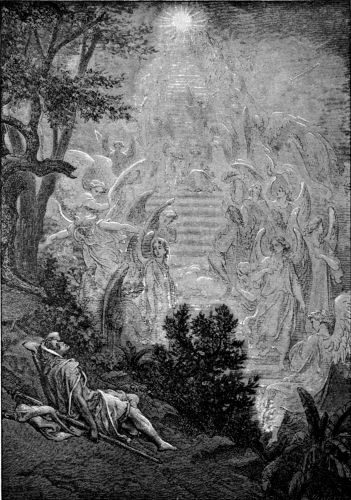
When night came on Jacob lay down
upon the cold ground and placed a stone
beneath his head. And as he slept God sent a
beautiful vision to bless him.
He saw a ladder set upon the earth, whose
top reached to Heaven. Holy angels were
going up and down the ladder, and, above
them all, stood God.
JACOB'S DREAM.
And a voice said, "I am the God of
Abraham and of Jacob. I will give the land
where thou liest to be a possession to thy
children. I am with thee and will keep thee
in all thy places, and bring thee again into thy
land."
Then Jacob awoke. "This is God's place,"
he said, "and I knew it not. This is the
House of God and the Gate of Heaven."
Then he took a stone and poured oil upon
it and blessed it. "This place shall be called
Bethel," he said; "Bethel, which means the
House of God, for here God appeared unto
me."
From Bethel Jacob went on to the land
of his uncle Laban; and there he dwelt for
many years, keeping the sheep.
But the time came when Laban looked
with jealousy upon Jacob. The Lord came
again to Jacob and bade him take his wife,
Rachael, and his children and go back to
Canaan. Jacob obeyed, and, driving his great
flocks before him, he set out again for his old
home.
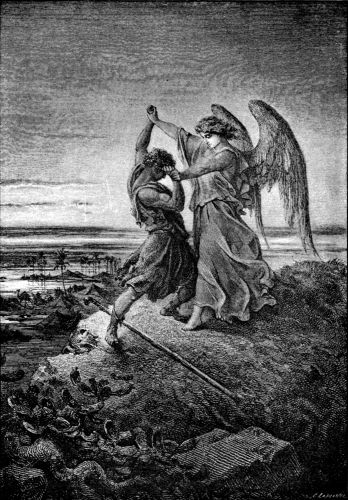
JACOB WRESTLING WITH THE ANGEL.
As he neared the village of Seir, where
Esau dwelt, he sent messengers ahead to tell
Esau that he was returning, and to beg him
to forgive the past that they might meet
each other in brotherly love.
The servants came back and told him
that Esau was coming to meet him with
four hundred men. Then Jacob was in great
fear, for he thought Esau meant to kill him.
He prayed to God to keep him safe.
At night an angel came and wrestled with
him till break of day, but could not overcome
him. And when morn came, the angel said,
"Let me go, for it is break of day." Jacob
said, "I will not let thee go till thou bless
me." Then the angel blessed him, and he
saw him no more. This was a sign from
God to Jacob that, as he was a match for
an angel, he need not fear men.
He took some of his cattle and sent
them as a gift to Esau. He set them in
droves, so that when Esau met them, and
asked whose they were, the men should say,
"They are Jacob's. It is a gift he has sent
to my lord Esau." Each man who drove
the cattle was to answer in this way, so that
Esau might feel that Jacob had come as a
friend.
All at once Jacob looked up and saw
Esau coming. Then he called his eleven
sons and Rachel and Leah to go with him
and meet Esau.
When he met Esau he bowed down to
the ground seven times. Then Esau ran to
him and put his arms round his neck and
kissed him, and they both wept.
Esau led Jacob to his home and there
feasted him for seven days. And when he
was rested Jacob set forth again, driving his
herds before him, to make a home for his
people in the land of Canaan; for he was an
old man now, and wished only to rest in the
land of his fathers, and to see his twelve sons
comfortably placed in homes of their own,
with their wives, their children, and their flocks
about them.
JOSEPH.
"Now let us thank the Eternal Power; convinced
That Heaven but tries our virtue by affliction,
That oft the cloud which wraps the present hour
Serves but to brighten all our future days."
Jacob had twelve sons; but the one
dearest to the old father's heart was Joseph, a
lad of only seventeen years when Jacob came
back into the land of Canaan.
The older of these sons were selfish,
cruel men; and more than that, they had
forsaken the God of Abraham, and were worshipping
graven images. Poor old Jacob's
heart was heavy!
"Go now to Bethel," said a voice to him
one night in a dream. "Make an altar there
to thy God."
Jacob obeyed; and when the altar was
built, he called his sons together and told
them the visions he had had. He told them
the stronghold God had always been to him in
his life, and begged them to forsake their idols
and turn again to the true God.
Then Jacob went on to Hebron, where
Abraham had lived, and where Isaac still lived,
an old, old man, nearly two hundred years old.
It was a joyous meeting—this meeting
between Isaac and Jacob. Esau, too, came,
and Isaac blessed them both and bade them
love each other. Isaac died very soon after,
and Jacob, an old man now himself, sat in
the door of the tent of his fathers.
To Joseph, Jacob had given a coat of
many colors, as a token of his great love for
him. And because of this Joseph's brothers
hated him only the more. Jealousy burned in
their hearts, and they plotted together to slay
the boy.
One night Joseph had a vision. In the
dream eleven stars came and stood before him
and bowed themselves to the ground. And a
voice said, "So shall your brothers one day
bow before you."
Joseph told his vision to Jacob and to his
brothers. The father observed the sayings,
but the brothers were made only the more
angry.
Now, his brothers spent their days upon
the hillside tending their flocks. And one day
Jacob said to Joseph, "Go, my son, and see if
any evil has befallen your brothers."
So Joseph set out. It was a long way to
the pasture lands, and the boy was tired and
footsore. And when he reached the place no
sign could he find of his brothers.
"Tell me," asked Joseph of the men upon
the plains, "where are my brothers that watch
their sheep here upon these hillsides?"
The men answered, saying, "Your brothers
have gone to the place called Dothan, which
is many miles from here."
Then Joseph, after resting, started on
towards Dothan. There his brothers saw
him, and recognized him afar off by the bright
colors of his coat.
"Here comes our dreamer," sneered one
brother.
"He who shall reign over us," sneered
another.
Then the face of the oldest brother grew
black and bitter. "Let us kill him," he said,
"and cast him into some pit."
"No," said Rueben, "we need not stain
our hands with his blood. Let us only cast
him into the pit, and then tell our father Jacob
that a wild beast has slain him."
This plan seemed most pleasing to them;
and when Joseph came near, they fell upon
him, tore his coat from him, and made ready to
throw him into a pit.
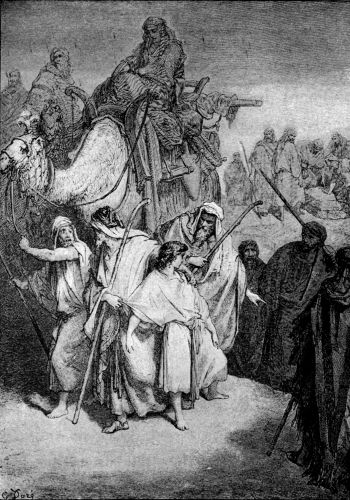
JOSEPH SOLD BY HIS BRETHREN.
But just then there came along the highway
a company of merchants, bound for
Egypt. They had a long train of camels, and
these were loaded with fruits and spices.
"Let us sell Joseph to these merchants,"
said one of the brothers. And when the merchants
came up, they pushed Joseph towards
them and sold him for twenty pieces of silver.
Then they killed a kid, and dipped the
coat in the kid's blood, and went back with it
to Jacob.
"O father Jacob! This coat have we
found by the wayside, and we know not
whether it be the coat of Joseph or not!"
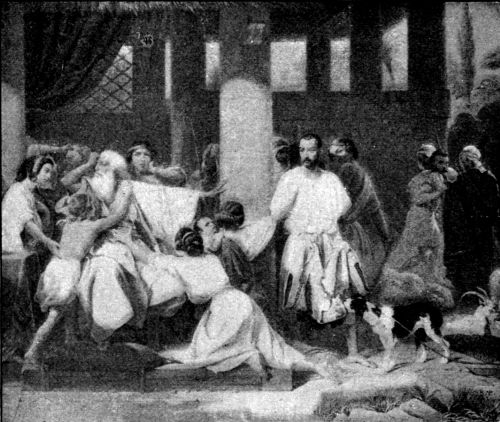
The old father looked at the coat. He
saw the blood upon it; then he bowed his head
and groaned. Too well did he know it to be
the coat of his dear son, Joseph.
DESPAIR OF JACOB. (Schopin.)
All day long the old man wept, refusing
to be comforted. "I will go down into my
grave unto my son mourning," he said. But
the sons cared not for his grief. It was enough
that they were rid of the brother whom they
hated.
PHARAOH'S DREAM.
Poor Joseph was carried into Egypt, and
there sold again to a rich man, whose name
was Potiphar. Potiphar was very proud of
his new slave, so tall and strong and beautiful
was he; and for a time Joseph dwelt most
happily in his new home. But Potiphar's
wife was a bad woman. And because he
refused, at her desire, to do evil, she had him
thrown into prison; and to Potiphar she told
such stories about the boy that for a time
Potiphar himself was deceived, and so permitted
Joseph to be in prison, giving him
no opportunity to prove to his master how
untrue these stories were.
Now, in prison with Joseph were servants
of King Pharaoh. One morning, when Joseph
went to them, they were downcast and sad.
"Why look ye so sad?" said Joseph.
"We have dreamed dreams, and we have
no one to interpret them," they said.
"It is God who sends dreams," said
Joseph. "Tell them to me. It may be I can
interpret them for you."
Then one of the servants told his dream.
"I saw in my dream a vine; and in the vine
were three branches. They budded, the
flowers came, the fruit ripened. Then I took
Pharaoh's cup, gathered the grapes and
pressed them in the cup, and gave it to
Pharaoh."
"Take courage, my brother," said Joseph,
"for it is a good dream. The three branches
are three days. The dream means that in
three days Pharaoh will liberate thee, and
thou shalt give the cup into his hands.
"And do not forget me when thou art
again free. For I have been sold into bondage
and stolen away from Canaan. Neither
have I deserved to be thrown into this
dungeon. Speak then to Pharaoh for me,
and beg him to free me from this prison."
Then the other servant told his dream:
"I had three baskets of meat upon my head.
They were baked meats for Pharaoh. The
birds came and ate the meat from the baskets."
"Alas!" said Joseph, "the meaning of
thy dream is this: In three days Pharaoh shall
hang thee upon a tree; and the birds shall
come and eat thee."
Now, as it proved, Joseph had interpreted
the dreams aright; for the power of vision had
been with Abraham, Isaac and Jacob before
him.
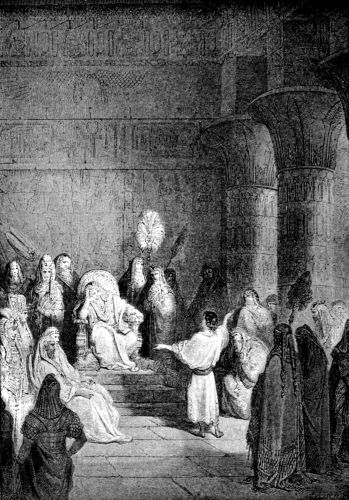
JOSEPH INTERPRETING PHARAOH'S DREAM.
But the servant who went back into
Pharaoh's home forgot Joseph when once he
was free himself; and so for two long years
Joseph lay in prison.
Then Pharaoh himself had two strange
dreams, and no one in the land could interpret
them. Then the old servant, remembering
how Joseph interpreted his dream for him so
long before, told Pharaoh of him; and Pharaoh
at once freed him from prison and bade him
come before him to interpret his dreams.
"I dreamed," said Pharaoh, "that I stood
beside a river. Seven fat kine came out from
it and fed in the meadow. Soon seven more
came out, thin and bad. Then the seven lean
kine ate up the seven fat kine.
"Then I awoke. But when I slept again,
I dreamed that seven good ears of corn
came out upon one stem. And soon after,
seven more, thin and bad. And the seven
bad ears ate up the seven good ears."
"The dreams, great king," said Joseph,
"mean this: There shall be seven years of
great fruitfulness in the land. Then shall
come seven years of famine. And the seven
years of famine shall eat up all the fruitfulness
of the first seven years.
"Now let Pharaoh take warning. Let
him hoard up all the corn that can be spared
in these first seven years. Then, when the
years of famine come, there will be corn for
all who dwell in the land."
Pharaoh was pleased with the wisdom of
Joseph. He appointed him at once to have
charge over the corn, and commanded the
people to obey him in all that he bade them
do. Then the king gave him a ring and
a chain of gold to wear upon his neck. He
dressed him in fine linen and made him a
golden chariot. And the people loved Joseph
and obeyed him.
Then followed seven years of fruitfulness,
such as even the fertile valley of Egypt had
never known before; and the people hoarded
their corn until their store houses were full to
bursting.
And when every house was full, then
began the drought and famine; and no food
grew for the people in all the seven years
that followed. Great indeed might have been
the suffering; for no rain came, no corn grew,
and everywhere the people were crying to
Joseph for food.
And the famine spread even into the
country of Canaan; and Joseph's own people
were starving.
JOSEPH'S BROTHERS.
JOSEPH MAKES HIMSELF KNOWN TO HIS BRETHREN.
The brothers of Joseph heard that in
Egypt there was corn stored away in plenty;
so they went down into Egypt to beg for it.
They came before Joseph, and bowed low
before him, even as in the vision so long ago
it had been foretold that they would bow
before him.
"Who are you?" said Joseph; for he
wished to try his brothers and see if they
would speak the truth.
"We are the sons of Jacob," said they;
"and we are come from the land of Canaan."
"Have you any other brothers?" asked
Joseph.
"We have one younger brother at home,"
they said.
"How do I know if you speak truly? Go
to your homes—I will give you corn—and
bring to me your youngest brother. Meanwhile
I will hold one of you here as prisoner
until you return. Then shall I know if you
are honest men."
So the nine brothers went back to Canaan
and told Jacob what had happened; but they
did not know it was Joseph they had seen.
And when they told Jacob what the man
in Egypt had said, and that Simeon had been
left a prisoner, the old father lifted up his
voice and wept. "Never," said he, "shall
ye carry Benjamin into Egypt. Joseph ye
have lost to me, and now Simeon! And if
mischief befall Benjamin by the way in which
ye go, then shall ye bring down my gray hairs
in sorrow to the grave."
But when all the corn was eaten and
there was no more food, Jacob was obliged to
send Benjamin into Egypt with his brothers;
for they dared not go without him.
Joseph saw them coming, and his heart
was glad when he saw his brother Benjamin
with them.
So he spoke to his servants and bade
them make ready a feast for the ten men who
had come from Canaan. Simeon he freed
from prison, and all were received into his own
home.
They came into the banquet hall, and
again they all bowed low before Joseph, as in
the dream it had been prophesied they should
do.
"Is thy father well?" Joseph asked of his
brothers.
And the brothers answered, "Jacob is
well."
Then the tears came into the eyes of
Joseph, and he looked with tenderness upon
them all. But they knew him not. And in
the morning of the next day they set out again
for Canaan, their bags filled with corn.
But when they were departing, Joseph
said to his steward, "Put my silver cup into
the sack of the youngest; and when they are
well out upon the road, overtake them, make a
pretence of searching them for it, and bring
back him in whose sack you find the cup."
The servant did as he was bid; and Benjamin,
in whose sack, of course, the cup was
found, was brought back to Joseph. Ashamed,
the other brothers too came back and fell at
Joseph's feet.
"Weep not," said Joseph. "Do you not
know me? I am your brother Joseph, whom,
so many years ago, you did sell into bondage."
Then the oldest brother fell upon his face
before Joseph; and Benjamin fell upon his
neck and wept tears of joy.
"Go back now to Canaan. Take with
you wagons and horses. Tell my father that
I am rich and happy; that I am governor over
the province; and that I send these wagons to
bear him to me, that I may look once more
upon his face."
Great was the rejoicing in Canaan when
the sons brought the good tidings from Joseph.
And straightway Jacob and all his family set
forth for the land of Egypt.
Eagerly the old father pressed forward to
meet his son. And when Joseph saw him
afar off, he rode out in his own chariot to meet
him. They fell upon each other's necks and
kissed each other; and Jacob lifted his face in
prayer to God, who had permitted him to see
again the son he loved.
JACOB GOETH INTO EGYPT.
Then Joseph led them to his own palace,
and a great feast was held.
For seventeen years Jacob dwelt in Egypt
with his children, and most happy were they,
now all together once more.
But Jacob was now one hundred and
forty-seven years old; and when he knew his
end was near, he called his twelve sons to him
and blessed them all. He told them many
wonderful things which sometime would come
to them; and when he had finished prophesying,
he kissed them all, then lay back upon his
bed and died. For seven days they mourned
for him; and then they carried him to Canaan
and buried him in the field of Macphelar.
Joseph returned to Egypt, where he lived
a long and happy life; and when he died, he
too, we trust, was carried back and laid in the
burial-place of Abraham and Isaac and Jacob.
THE STORY OF MOSES.
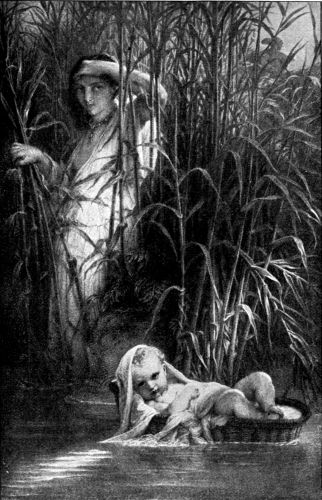
THE FINDING OF MOSES. (Paul Delaroche.)
Gently slumber'd on the wave The new-born seer of old,
Ordained the chosen tribes to save; Nor deem'd how darkly roll'd
The waters by his rushy bark, Perchance e'en now defiled
With infant's blood for Israel's sake, Blood of some priestly child.
What recks he of his mother's tears, His sister's boding sigh?
The whispering reeds are all he hears, And Nile, soft weltering nigh,
Sings him to sleep, but he will wake, And o'er the haughty flood
Wave his stern rod; and lo! a lake, A restless sea of blood!
Joseph had been dead now many, many
years. Pharaoh too had died, and a new
Pharaoh was on the throne.
And all these years the children of the
twelve brothers had grown up and passed
away. Many children had been born to them;
and these too had grown up and passed away,
leaving their children now in the land of
Egypt.
The children of the twelve brothers had
been called Israelites, because to Jacob had
been given the name Israel. From out the
clouds had God spoken to him and said,
"Thou shalt henceforth be called Israel."
Now, the Israelites had always been a
people apart from the Egyptians. They had
kept the faith of their fathers in the midst of
the idolatry of the land in which they lived.
The new Pharaoh hated these Israelites
and made slaves of them. He gave them
all manner of hard work to do; and at one
time ordered them, on penalty of their lives,
to make for him bricks without straw.
At another time he sent out his soldiers,
and bade them slay every little Israelitish boy
in the land, that thus the race might be
exterminated.
But this was not to be. For, you remember,
it was prophesied away back in the days
of Abraham, that, though the Israelites should
go out from their land and live for 400 years,
yet again the time would come when they
should return to Canaan, the land the Lord
had blessed to them.
Now, at the time Pharaoh sent out the
cruel command, there was among the Israelites
one mother, of the family of Levi, who had a
beautiful little baby boy.
"My baby shall not be slain," she said.
So she took him down to the river, made a
little basket, placed him in it, and hid him in
the bulrushes.
Every day, and many times a day, she
went down to see that he was comfortable and
to carry him food.
But one day the daughter of the king
came down to the water to bathe. Straight
towards the place where the baby was she
came, while Miriam, the baby's sister, hid
among the bulrushes, trembling with fear.
"See this poor little baby!" said the
princess; and the tears came in her eyes. "It
is one of the children of the Israelites," she
said, "hidden here from the cruel soldiers."
Then the kind woman lifted it from its
little basket and held it close to her heart.
Now, Miriam was a wise little girl; and
when she saw that the princess was kind, she
came out from the bulrushes and said, "Shall
I not bring you a good woman to nurse the
little baby for you?"
Then the princess bade her go with speed,
for already the baby was beginning to cry.
Miriam ran and brought the baby's
mother.
"Take this child, good woman," said the
princess, "and bring it up as your own. It
shall be my child, and I will name it Moses,
because I drew him out of the water."
And so the little baby was taken back to
its old home, and every day the princess sent
to know if it were well; and often she came
herself, bringing gold for its nurse and fine
linen for the child.
When the baby grew to be a boy the
princess sent him to the wisest teachers in
the land, that he might himself grow wise
and great.
But the true mother of Moses had taught
him the religion of his fathers, and had told
him the story of Abraham and Isaac and
Jacob and Joseph. She had told him, too, of
the promise of God, that sometime the Israelites
should again possess the land of Canaan.
To Moses this was a wonderful story;
and he wished often that he might be the
prophet that was to deliver his people.
One day Moses saw an Egyptian cruelly
beating an Israelite. His heart burned with
indignation, and he fell upon the Egyptian
and slew him.
Then Moses fled out into the wilderness;
for he knew he had offended against the law.
On through the wilderness he pressed, till
he came into the field where a priest named
Jethro lived. Jethro gave him food and
shelter; and it came about that Moses
became one of Jethro's family. For a long
time he dwelt among these people, tending
their flocks, and thinking about his poor people,
suffering in their bondage to the Egyptians.
MOSES' VISION.
Far out across the sandy wild, Where, like a solitary child He thoughtless roamed and free,
One towering thorn was wrapped in flame—
Bright without blaze it went and came,
Who would not turn and see?
—Keble.
One day, as Moses tended the sheep on
Mt. Horeb, there appeared beside him a bright
light. And in another instant a bush near by
leaped with red flames.
The branches crackled; the tongues of
flame streamed up against the sky; but still
the bush was not consumed, nor did it wither.
"This is strange," Moses thought; and he
went up to the bush.
"Moses! Moses!" called a voice from out
the flames.
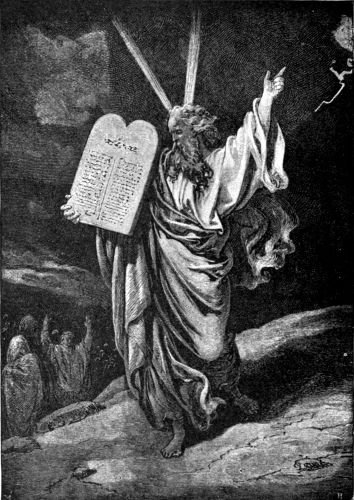
MOSES COMING DOWN FROM MOUNT SINAI.
Then Moses knew it was the voice of the
Lord; and he fell upon his knees before the
bush. He was afraid.
"The place where thou standest it is holy-ground!"
said the voice again. "I am God,
the God of Abraham and of Isaac and of
Jacob."
"I have seen my people's sorrow. I have
heard their cry. I am come to send thee to
Pharaoh. And thou shalt bring my people
out of Egypt."
"Who am I, O Lord," Moses cried, "that
I should be chosen to go to Pharaoh?"
"Fear not," said the voice of God again.
"I will be with thee. Go, and tell thy people
that I sent thee. If Pharaoh disobey my command,
then will I send punishment upon him.
Plagues will I send upon Egypt, and I will
bring out my people safely."
Still Moses was afraid. It was a great
duty that had been laid upon him. He dared
not believe he could do all that the Lord bade
him to do. What if the people refused to
believe him?
"Throw thy rod upon the ground," God
said to Moses. For he knew the fear that was
in the heart of the man, and he meant to give
him courage.
Moses threw the rod upon the ground,
and behold, it was changed into a serpent.
"Take the serpent in thy hand," commanded
the voice from the burning bush.
For a moment Moses hesitated; for it
was a terrible serpent, with fangs having
deadly poison; and even the heart of the
bravest man might well quail at such a
command.
But Moses knew the Lord would not
allow it to harm him. So he seized it by the
tail—when lo! it changed again to a rod.
"Now," said the voice from the bush, "go
to the people of Israel. Tell them these signs
I have given to you that they may believe that
I have sent you."
Still Moses feared. "O Lord," he cried,
"I cannot speak well. My tongue is slow; I
have no words."
But the Lord said, "Who hath made thy
tongue dumb? Have not I, the Lord? Go;
obey my command and I will instruct thee
what thou shalt say. Take, too, thy brother
Aaron with thee; and I will teach both Aaron
and thee what to say."
Then Moses obeyed. Timid was he still;
but the Lord gave him strength, and he set
out from the house of Jethro to deliver the
people of Israel. And as he journeyed towards
the city, the Lord spoke, too, to Aaron, and
bade him to go out to meet Moses.
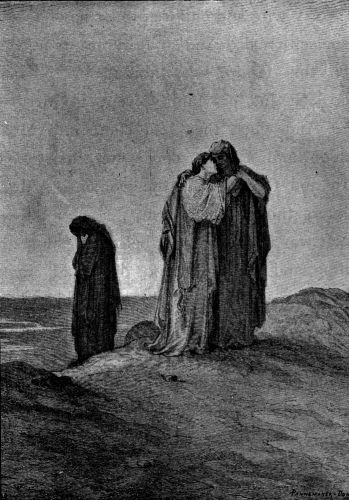
Then Aaron and Moses met; and when
they met, they fell upon each other's necks and
wept.
Then they told each other what the Lord
had said to them, and together they went into
the presence of Pharaoh and said, "Behold the
Lord hath told us to come to thee, and bid thee
set free the people of Israel."
But Pharaoh sneered and said, "I know
not the Lord of the Israelites, nor shall I set
the people free."
Instead, Pharaoh called together his governors
and bade them oppress the Israelites
more heavily still; to give them more work
and less pay; to punish them; and in every
way to do those things to them that would
make their yoke still harder to bear.
The governor obeyed. Then the poor
Israelites blamed Moses and Aaron.
Moses went to God with the great burden
of care now upon him. He was now eighty
years of age, and the care weighed upon him
most heavily.
"All this I do know," the Lord said.
"But have trust in me. I have heard the
groanings of my people. I remember the
covenant that I made with Abraham, and I
will bring the people out from Egypt into the
land of Canaan."
THE PLAGUES OF EGYPT. — THE DESTROYING ANGEL.
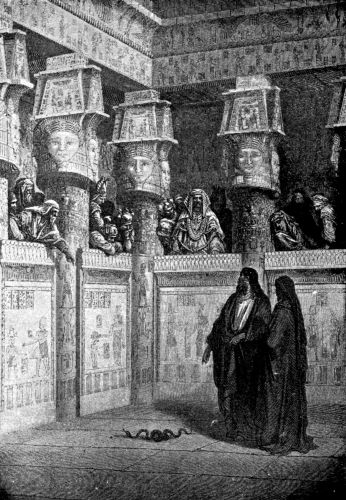
MOSES AND AARON BEFORE PHARAOH.
Yet think not thou, amidst thy warlike bands,
They lie beyond redemption in thine hands.
The God in whom they trust may help them still,
They know He can deliver, and He will:
Whether by life or death afflicts them not;
On His decree, not thine, they rest their lot.
—Montgomery.
God gave to Moses and Aaron power to
do wonderful things, miraculous things, that
through them Pharaoh might know that the
power of God was with them.
Aaron went before Pharaoh, and, throwing
down his rod before him, it turned to a
serpent.
But Pharaoh only laughed. "My wise
men can do as much," he said. So he called
them. They also did in like manner, but the
rod of Aaron swallowed up the rods of
Pharaoh's wise men.
Now, it is the river Nile that makes Egypt
the fertile, fruitful country that it is. Without
it Egypt would be a burning desert. The
Egyptians well knew this. One day Moses
went down to the waters, and, stretching his
rod out over them, turned them to blood. The
people were frightened.
The fish died; and no man could drink of
the water.
Then Moses stretched out his rod again
across the water; and behold thousands upon
thousands of frogs came up out of the water.
They infested the land. The houses were full
of them. They sprang upon the banquet table
of the king; and when he went to bed they
were there also.
Then Pharaoh sent for Moses and said,
"Take away these horrible frogs, and I will set
thy people free."
Moses raised his rod again, and the frogs
disappeared. There was rest in the land
again.
But when they were gone, Pharaoh
hardened his heart again. He would not let
the Israelites go.
"Stretch forth thy rod again," came the
word of God to Moses. He stretched forth
his rod, and another plague fell upon the
country. The ground was covered with lice,
and the lice swarmed upon the animals and
upon the people.
Then Moses went to Pharaoh and said,
"Let my people go; but if thou wilt not, I
will send flies upon thee and upon thy people;
but I will send no flies upon the Israelites."
But Pharaoh would not listen. And the
flies came—wasps and biting insects. But
none of these came near the Israelites, though
about the homes of the Egyptians they
swarmed until Pharaoh, beside himself with
torment, called upon Moses to deliver him
from the plague, promising again to free the
people of Israel.
Again this plague was lifted; and again
Pharaoh perjured his soul. For no sooner was
he free, than again he refused to let the people
go.
Then the Lord sent Moses again into the
presence of the king. "If thou wilt not let the
people go," said Moses to Pharaoh, "then a
plague shall fall upon the cattle; and not one
shall be left alive to all the Egyptians; but
those of the Israelites shall be free from
harm."
Pharaoh made no answer; and on the
morrow the plague fell, and not only the cattle
but the magicians were covered with boils.
Besides this, a terrible storm came. The trees
were broken down, and the crops in the fields
were destroyed.
Pharaoh was terrified. Famine he knew
now would follow; for they had neither meat
nor corn for food. And again he promised
freedom to the Israelites.
But when the storm had ceased, and the
crops were again growing, he forgot his terror,
and freed not the people.
Then the locusts came, millions upon
millions of them. They swarmed upon every
bit of green in all the land and devoured it,—the
leaves, the grass, and the newly-growing
crops. Not a leaf nor a blade was left. And
again famine sent terror into the soul of
Pharaoh. And again he promised freedom to
the Israelites; and again he refused, when the
plague was lifted, to keep his promise.
THE PLAGUE OF DARKNESS.
Then came a terrible darkness upon the
country,—a darkness that no light could
penetrate.
"Go, Moses," said Pharaoh again. "Go
out from the land to the land thou lovest.
Go; but leave behind thee thy cattle and thy
possessions. Those belong to Egypt."
Now, to have set out with the great company
of the Israelites without cattle and corn
for food would have been worse than useless
for starvation would have come upon them.
Therefore Moses answered, "No, Pharaoh,
the Israelites go not forth from Egypt without
their cattle and corn and all that belongs to
them."
Then Pharaoh was angry, and he drove
Moses forth from him, saying, "Never more
let me look upon thy face!"
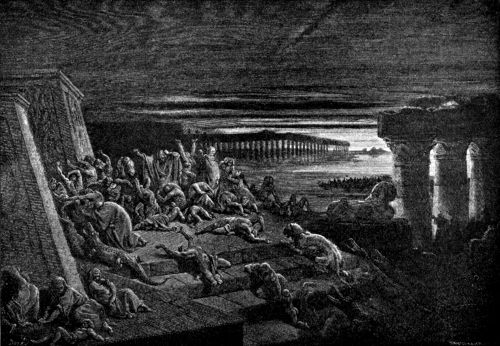
THE FIRST BORN SLAIN.
Moses went out from the palace and told
all that had happened to the Lord.
The darkness ended in three days. Then
God said, "Now will I send another and a
greater plague upon Pharaoh; and after this,
he will let the people go."
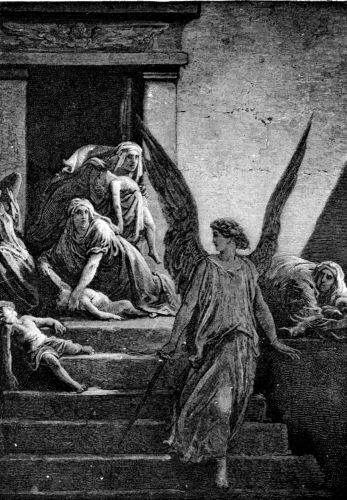
So God sent an angel to smite the first-born
of all the Egyptians. This Moses told
to his people, and bade them put a mark upon
their own doorsteps, that the angel might
pass by the homes of the Israelites, and leave
their children unharmed.
This the Israelites did; and in the night-time
the angel came. Not one house of the
Israelites did he enter; but in every house of
the Egyptians, when the sun rose, there lay
the dead body of the oldest child.
Then a groan went up from the people.
There was wailing in the streets. Pharaoh
himself could bear no more. He sent for
Moses and Aaron in the night time and said
to them, "Rise up, you and the Israelites and
all their children. Take all that you have and
be gone."
Then Moses and Aaron told the people,
and bade them make haste lest again Pharaoh
repent. But Pharaoh's heart was too heavy.
At last his proud spirit was subdued, and
Moses and Aaron, with 600,000 Israelites, set
out for the land of Canaan.
He stopped at last,
And a mild look of sacred pity cast
Down on the sinful land where he was sent To inflict the tardy punishment.
"Ah! yet," said he, "yet, stubborn king, repent,
Whilst thus unarm'd I stand,
Ere the keen sword of God fill my commanded hand; Suffer but yet thyself and thine to live: Who would, alas! believe That it for man," said he, "So hard to be forgiven should be, And yet for God so easy to forgive!"
Through Egypt's wicked land his march he took,
And as he march'd the sacred first born strook
Of every womb: none did he spare,
None, from the meanest beast to Pharaoh's purple heir.
Whilst health and strength and gladness doth possess
The festal Hebrew cottages;
The blest destroyer comes not there
To interrupt the sacred cheer:
Upon their doors he read, and understood
God's protection writ in blood;
Well was he skill'd i' the character divine; And though he passed by it in haste, He bow'd and worshipp'd, as he pass'd,
The mighty mystery through its humble sign.
—A. Cowley
THE RED SEA.
THE EGYPTIANS DROWNED IN THE RED SEA.
When the Israelites were gone, peace
settled down upon Egypt and all things
prospered. This was because Pharaoh had
given freedom to the people of Israel, and
so had caused the displeasure of God to be
removed from the land.
But Pharaoh did not think of it in that
way. He began, rather, to think that he had
done a most foolish thing in allowing 600,000
faithful workmen and slaves to go out from
the land. The Egyptians needed their help in
brick making, and in the planting and reaping
of the heavy crops.
The more he thought of it, the stronger
grew his determination to bring the Israelites
back. He had forgotten the suffering that
had come to his people; and perhaps he began
to think this suffering might more easily have
been kept away.
So what do you suppose the foolish, hard-willed,
stubborn-hearted Pharaoh did? He
gathered together a great army and started
out in pursuit of the Israelites.
"If only we can overtake them before
they reach the Red Sea," he thought, "we shall
easily drive them back into Egypt."
Now, the Lord heard the wicked plotting
of Pharaoh, and although he allowed him to
set forth, he allowed no harm to come to his
chosen people.
A great cloud he had placed behind them
and all around them as they traveled by day,
so that by it they were shielded from the
view of any enemy that might be lurking in
the neighborhood of their march.
And by night this cloud became a pillar
of fire, that by its light they might be guided
through the strange wilderness.
When Israel, of the Lord beloved, Out from the land of bondage came,
Her fathers' God before her moved, An awful guide in smoke and flame.
By day, along the astonished lands The cloudy pillar glided slow;
By night Arabia's crimson sands Returned the fiery column's glow.
There rose the choral hymn of praise, And trump and timbrel answered keen;
And Zion's daughters poured their lays, With priest's and warrior's voice between.
But when Pharaoh came upon the Israelites,
with his great army of horse and men and
war chariots, they were resting beside the
waters of the Red Sea.
When the Israelites saw the army, they
were stricken with fear. They forgot that God
had led them thus far, and that he had
promised to guide them and bring them at
last, safe, into the promised land of Canaan.
They rose in terror; and many of them
began to cry out against Moses, who had
allowed this danger to come upon them.
"Be not afraid!" said Moses. And just
then the pillar of cloud moved around so that
it blinded the Egyptians. They could not see
the Israelites. They could hardly see each
other; for it was like a dense fog fallen upon
them.
"Stretch out thy rod across the sea," said
the voice of God to Moses. Moses obeyed.
The waters parted, and the Israelites passed
over to the other side unharmed.
But when they were half across the cloud
lifted, and the Egyptians saw the Israelites.
Down into the water-parting they plunged,—men,
horses, chariots, all; and on they dashed
in quick pursuit.
Foolish Pharaoh! Did he not know that
the parting of the water was not for him? Had
not he yet learned that God was with the
Israelites?
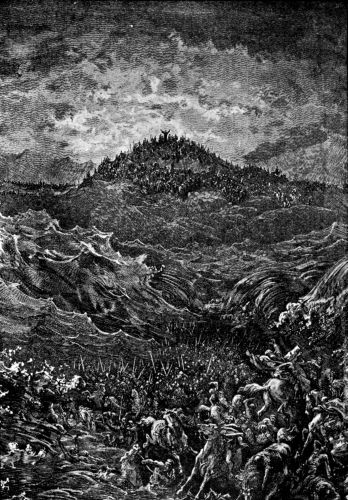
The Israelites were now across the sea.
They were climbing the opposite bank. The
last man had reached the top. Then Moses
raised his rod again, and the waters of the sea
came together with a great rushing sound.
They foamed and seethed, and the great army
of the Egyptians sank beneath the great pillars
of water that closed over them on either side.
All were drowned; and the Israelites were at
last freed from Pharaoh, king of Egypt.
"Fly, Misraim, fly!"—From Edom's coral strand
Again the prophet stretched his dreadful wand:—
With one wild crash the thundering waters sweep,
And all is waves—a dark and lonely deep;
And strange and sad the whispering breezes bore
The groans of Egypt to Arabia's shore.
Then the Israelites halted in their march
and held a festival of thanksgiving; for they
were now free from their old enemy.
Then they went on into the wilderness.
And Miriam, the prophetess, the sister of
Aaron, took a timbrel in her hand; and all the
women event out after her with timbrels. And
Miriam said, "Let us sing to the Lord, for
He hath triumphed gloriously."
They offered sacrifices, they prayed and
sang, and danced.
MIRIAM'S SONG.
Sound the loud timbrel o'er Egypt's dark sea!
Jehovah has triumphed—His people are free!
Sing!—for the pride of the tyrant is broken: His chariots, his horsemen, all splendid and brave,—
How vain was their boasting!—the Lord hath but spoken, And chariots and horsemen are sunk in the wave.
Sound the loud timbrel o'er Egypt's dark sea!
Jehovah has triumphed—His people are free!
Praise to the Conqueror, praise to the Lord!
His word was our arrow, His breath was our sword!
Who shall return to tell Egypt the story Of those she sent forth in the hour of her pride?
For the Lord hath looked out from his pillar of glory, And all her brave thousands are dashed in the tide.
Sound the loud timbrel o'er Egypt's dark sea:
Jehovah has triumphed—His people are free!
—Moore.
IN THE WILDERNESS.
MOSES STRIKING THE ROCK IN HOREB.
So led He them, in desert marches grand, By toils sublime, with test of long delay,
On, to the borders of that Promised Land, Wherein their heritage of glory lay.
Wonderfully they were being led. Surely
one would suppose they could never doubt
God again, nor Moses, the leader God had
chosen for them. But alas! there were many
among them who seemed little better than
the Egyptians, their oppressors.
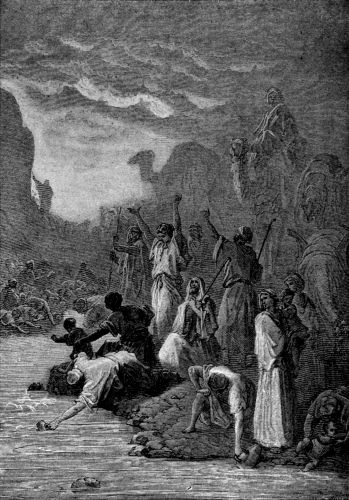
They had gone only a few miles when
they came to the waters of Marah, which were
bitter. They were tired, and longed to encamp
for the night. Then they began to groan and
to cry aloud, "O, why have you brought us into
a land where there is no water?"
But Moses, never failing in trust and
patience, cast a tree, which the Lord had
shown him, into the waters, and lo! they
became sweet. The people drank and were
satisfied; and there they encamped and rested.
When God gave them the sweet water to
drink, he said to Moses, "If thou wilt obey
me I will be with thee always. I will keep,
and bless, and strengthen thee, thee and all thy
people. And there shall come to thee neither
disease nor plague."
When the people heard these words, they
were comforted and meant never to doubt
again. But a few days after this, when they
had come into the heart of the wilderness, and
there seemed no way of finding food, again
they complained to Moses that he had led
them into the wilderness to starve.
But God heard their murmurings and sent
great flocks of quails on which to feed them.
Thousands and thousands were there of them,
and they covered the ground, the trees, and
the tents, so great were their numbers. The
Israelites caught them and ate them, and their
hunger was appeased.
"But what shall we do in the morning?"
the fretful, faithless ones said.
And in the morning the ground was
covered with tiny round loaves of sweet bread,
the manna that had been sent from heaven;
for so were the children of Israel fed in the
wilderness. And when, by and by, again
there was no water to drink, Moses struck a
great rock with his rod, and the water poured
forth.
The children of Israel had now come into
the wilderness of Sinai, and had pitched their
tents at the foot of the mountain. Moses was
commanded by the Lord to go into the mountain,
while the people rested in the valley
below. And when Moses had reached the top,
God spoke to him.
"Go and tell the Israelites how great a
thing God has done for them, in bringing them
through the Red Sea and freeing them from
the cruel king, Pharaoh.
"Tell them to remember that they are my
chosen people, and that I will be their God
always.
"Bid them prepare themselves for the
third day; for on the third day will I come
down upon this mountain and speak with
them. They shall not come up into the mountain.
Whosoever touches the mountain top
shall be put to death. But when the trumpet
sounds, then will I speak, and they shall all
come up into the mountain."
Moses went down into the valley and
gave these words to the people. So they all
made ready for the third day.
When the morning of the third day came,
the Israelites looked up towards the mountain
top. Behold, a heavy black cloud hung over
it, and fire and smoke poured out from it, and
the whole mountain shook!
The people were frightened, and ran and
hid themselves. But the trumpet sounded,
and God descended upon the mountain.
And a voice called to Moses: "Again say
to the people that they shall not come up into
the mountain. But thou, and Aaron with thee,
come thou up into the mountain."
And Moses and Aaron obeyed. And
there, upon the mountain top, they beheld the
glory of God, like a great cloud of glory.
Then Moses and Aaron went down into
the valley to tell the people what they had seen.
And when they had told the people, Moses
went back into the mountain; for God had
told him to come there alone, that he might
tell him how to guide the great multitude that
had been given to his charge.
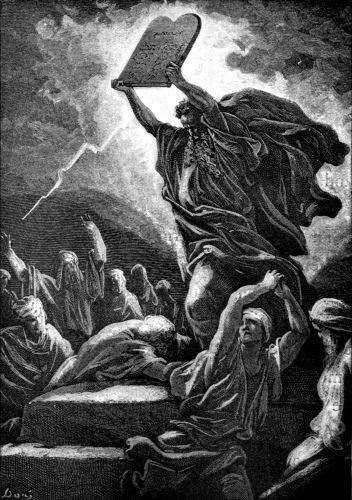
MOSES BREAKING THE TABLETS OF THE LAW.
It was from Mt. Sinai that God gave to
Moses the tablets upon which were written the
Ten Commandments; for Moses was in the
mountain forty days and forty nights, listening
to the words that God spoke to him.
And when so many days had gone by and
Moses did not return, then the people began to
be frightened.
"Moses has gone away and left us," they
wailed, "and we have no gods to guide us.
Let us make a golden calf and set it up before
us that we may worship it." And so they
built an altar, and placed the golden calf upon
it, and held a great feast.
They were in the midst of their feast
when Moses came down from the mountain,
the tablets in his hands.
"What is this?" he thundered, as he drew
near and heard the music and saw the dancing
and the feasting.
The people were frightened. Some of
them ran to hide; and so angry was Moses
that he hurled the tablets of stone from him
and broke them in pieces.
"Why didst thou allow this thing to be
done?" asked Moses of Aaron.
"The people gave me their gold to melt,
and it came out from the fire a golden calf,"
answered Aaron weakly.
Then Moses took the calf and ground it
to powder; and the 3,000 idolatrous men
among them he commanded to be slain.
Then Moses went again up into the
mountain, and again wrote the ten commandments
upon tablets of stone, and again carried
them to the people.
And now that the children of Israel might
have a place for worship, the Lord commanded
that the people should make a tabernacle, and
that in it should be kept the sacred tablets.
So the people went to work, and every man
woman and child had a part in the building of
the tabernacle.
THE TABERNACLE.
The tabernacle was made of boards, with
bars put across; and these bars and boards
were made of shittim wood and covered with
gold. Within the tabernacle, under the upper
end, were four more pillars; a beautiful covering,
called the vail, was hung over them; and
this hid the inside, which was the most holy
place, "the Holy of Holies," it was called.
None could go in there but the High Priest;
and he went only once a year. In the Holy of
Holies was placed the ark. The ark was a
chest, or box, made of shittim wood, covered
with gold; and there were rings in the sides
for poles to be put in when the ark was
moved. The top of the ark was called
the mercy-seat; two golden angels, called
cherubim, were placed one on each side of
the mercy-seat; they looked over it, and their
wings covered the top. In the ark were afterwards
kept the tables of the commandments,
Aaron's rod, and afterwards a golden pot full
of manna, which God commanded to be put
there. Outside the vail was the altar, on which
the holy bread, called shew-bread, was placed,
and the great gold candlestick. The tabernacle
stood in a large open court; pillars of brass
surrounded it, and curtains were hung upon
them. The brazen altar for burnt offerings,
and the great laver where the priests washed,
stood in this court. There were coverings and
curtains to the tabernacle and court.
Over the boards of the tabernacle was
thrown a covering of fine linen, beautifully
worked in scarlet, and purple, and blue; over
the linen was a covering of goat's hair; over
this, a covering of ram's skins dyed red; and
another covering of thick skins was over all.
The people were not allowed to go into the
tabernacle; but the priests went in every
morning to offer incense, and every evening to
light the lamps; and on the Sabbath, to take
away the old shew-bread from the table, and to
put on new. The sacrifices were offered in the
court, where the people stood.
Now, when the tabernacle was set up,
Moses made Aaron the High Priest and
clothed him in the sacred garments of his
office,—the coat, the girdle, the robe, the
ephod, the breastplate, and the mitre. The
coat was a long linen robe, with sleeves, and
having a girdle worked in blue and purple and
scarlet. The robe was a long, blue linen
garment, without sleeves.
Around the skirts were golden bells,
which sounded whenever the High Priest went
into the Holy Place.
The ephod was a short robe, worked also
in blue, purple and scarlet; and around the
waist was worn a girdle of gold.
The breastplate was made of cloth, and
was very thick. It had four rings to join it to
the ephod, and twelve beautiful stones were
set in it; and on these stones were cut the
names of the twelve tribes of Israel, that is,
the twelve sons of Jacob.
The mitre was a linen turban; and on the
front of it were the words, Holy of Holies!
When all was ready, the children held a
sacred feast, and Moses anointed Aaron with
oil.
The tabernacle established, the Israelites
were now ready to move on towards Canaan.
THE PROMISED LAND. — THE BURIAL OF MOSES.
RETURN OF THE SPIES FROM THE LAND OF PROMISE.
Twelve men were chosen, one from each
tribe, and sent ahead to see what manner of
place Canaan was, if there was land enough,
and if the people dwelling there were friendly.
The twelve men set out, and after forty
days came back again to the camp, bringing
rich fruits which they had gathered there.
"The land of Canaan is a beautiful country,"
they said, "and it is filled with fruits and corn;
but we fear the people there, for they are fierce
and warlike."
At this many of the Israelites were frightened.
Again they forgot God's promises and
began to upbraid Moses for having taken them
from their comfortable home in the wilderness.
Then God was angry with them; and he
spoke to them in tones of thunder, telling them
that for their wickedness they should never be
permitted to see the promised land of Canaan;
that they should die in the wilderness; and
that only the children and the few faithful
elders should live to reach the Promised Land.
This was a most grievous punishment to
the people; but in a few days they had forgotten
it, and again rebellion arose among
them.
Three men, Korah, Dathan, and Abiram,
grew jealous of the power of Moses and
Aaron, and asked why all glory should be theirs.
Moses, worn with the faithlessness of his
people, fell upon his face and wept when these
jealous men spoke thus to him. His heart
ached with the injustice of it, and he despaired
ever of teaching his people.
The next day Korah and all his people
came and stood before the tabernacle, as
Moses had bid them. Then the voice of the
Lord spoke, bidding the people move away
from the tabernacle, leaving the three doubting
men and their families standing alone.
Then there came a burst of thunder; the
earth rocked and groaned; then a great gulf
opened beneath the feet of Korah and Dathan
and Abiram, and they, with all their children,
were swallowed up.
Then God commanded Moses to take
twelve rods; and upon the rods to write the
names of the twelve tribes. On the rod of the
tribe of Levi he was to write the name of
Aaron, because Aaron was of that tribe.
"Place now the rods in the tabernacle;
and the rod bearing the name of him I appoint
High Priest shall bud and blossom."
DEATH OF KORAH, DATHAN, AND ABIRAM.
And when the morning came, behold the
rod of Aaron had budded and blossomed.
Then the people were content; and the rod
was kept ever after in the tabernacle.
For a time peace was in the camp, and
more than once the Israelites came near unto
the Promised Land. But it had been said
they should never reach it; and so many,
many times they fell back and turned away.
Over and over again they rebelled at
Moses and Aaron, until the patience of those
two was exhausted. They forgot themselves
to ask for guidance, and once, unable to endure
greater trial, they cried out, "O ye rebels! ye
rebels!" and there was anger in their hearts as
they spoke.
By and by the time came for Aaron to
die. So Moses took the priestly garments
from him and gave them to Eleazer. Then
Aaron died, and the Israelites mourned for
him thirty days.
Then the people wandered on and on.
Once they were bitten by serpents; and that
they might be healed, Moses lifted a brazen
serpent in the wilderness and bade the suffering
ones to look upon it and live.
But now the forty years were nearly at an
end; Canaan, too, was very close; and, although
the elders knew that it was not for them to
see the Promised Land, yet their children
would; and so there was joy in the camp.
But now the death of Moses was at hand.
He was one hundred and twenty years old,
and had wandered forty years, leading the
rebellious Israelites in the wilderness. So
God said to Moses, "Come thou up into Mt.
Pisgah. From there thou shalt see the fair
land of Canaan spread out before thee, although
thou mayst never go thither."
So Moses called his people together and
told them that his end was at hand. He told
them of all God had done for his people, and
how wonderfully they had been led forth from
bondage. He then bade them take Joshua
for their leader; for he it was who should lead
them into the Promised Land.
The people wept most bitterly, and many
prostrated themselves before the good man
who had borne so much for them.
Then Moses turned and went up into Mt.
Pisgah. There lay the fair land of Canaan at
his feet, with its fertile valleys and rich fruits
and abundant harvests of corn.
Upon this fair scene Moses gazed; then,
raising his face towards God, thanked Him that
the wanderings of the children of Israel were
now at an end.
Then he laid himself down and died.
The Lord buried him, but no man knew how
or where.
And when the children of Israel knew he
would come no more to them, they wept too
for him thirty days upon the plains of Moab.
By Nebo's lonely mountain, on this side Jordan's wave,
In a vale in the Land of Moab there lies a lonely grave.
And no man knows that sepulchre, and no man saw it e'er,
For the angels of God upturned the sod, and laid the dead man there.
That was the grandest funeral that ever passed on earth;
But no man heard the trampling, or saw the train go forth—
Noiselessly as the daylight comes back when night is done,
And the crimson streak on ocean's cheek grows into the great sun.
Noiselessly as the spring-time her crown of verdure weaves,
And all the trees on all the hills open their thousand leaves;
So without sound of music, or voice of them that wept,
Silently down from the mountain's crown the great procession swept.
Perchance the bald old eagle, on gray Beth-Peor's height,
Out of his lonely eyrie looked on the wondrous sight;
Perchance the lion stalking, still shuns that hallowed spot,
For, beast and bird have seen and heard that which man knoweth not.
But when the warrior dieth, his comrades in the war,
With arms reversed and muffled drum, follow his funeral car;
They show the banners taken, they tell his battles won,
And after him lead his masterless steed, while peals the minute gun.
Amidst the noblest of the land we lay the sage to rest.
And give the bard an honored place, with costly marble drest,
In the great minster transept where lights like glories fall,
And the organ rings, and the sweet choir sings along the emblazoned wall.
This was the truest warrior that ever buckled sword,
This the most gifted poet that ever breathed a word;
And never earth's philosopher traced, with his golden pen,
On the deathless page, truths half so sage as he wrote down for men.
And hath he not high honor,—the hillside for a pall,
To lie in state while angels wait with stars for tapers tall,
And the dark rock-pines like tossing plumes, over his bier to wave,
And God's own hand, in that lonely land, to lay him in the grave?
—Alexander.
THE STORY OF JOSHUA.
THE CHILDREN OF ISRAEL CROSSING JORDAN.
Then Joshua led the Israelites forth; but
when they came to the River Jordan, again
their courage failed them.
Although they had been led through the
Red Sea in the times of their fathers, and though
all their lives they had been told of that
wonderful deliverance, still, when now they
came to the River Jordan, their hearts grew
heavy, and fear took possession of them. But
there lay the country, fair and beautiful. They
could see it; and, with Joshua so brave and
true to lead them on, they gathered up their
courage, and the great company marched down
to the river banks.
Again the miracle of the parting of the
waters was repeated; for the waters roared
and rushed, and heaped themselves, like great
walls, on either side while the Israelites passed
through.
Meantime Joshua had sent forward two
men into the city of Jericho to learn what
manner of people were there; for Jericho was
one of the cities upon which the Israelites
must make war. These people of Canaan
were not likely to give the country into the
hands of a new people without a struggle. That
the Israelites well knew. Then, too, these
were in the days when all nations were at war
with each other, and the possession of a
country was always a matter of force and
strength,—one people overcoming the other.
When the two Israelites came into Jericho,
they sought the house of a woman named
Rahab; and from her learned all those things
about the city that they needed to know.
But the king of Jericho heard that two
Israelites were in the city, and at once he
suspected them of being spies. Accordingly
he sent messengers to seize them and put
them in prison. The messengers came, bearing
with them the authority of the king; but
the two men were hid away by Rahab, and the
messenger went away.
"I know," Rahab said, "that this land
belongs to you; that God hath promised it to
you; for I have heard of the wonderful things
that God hath done for you and your people.
Because of this I have hidden you beneath the
flax on the housetop; and now, when your
people come to take the city, forget not me.
Tell your people the protection given you in
this house; then shall your soldiers spare me
in the downfall of the city."
Then the Israelites promised that, in the
ransacking of the city, this woman Rahab
should be spared.
"When we are gone," they said, "fasten a
red cord upon the window of the house. Then,
when we enter the city, the house in whose
window the red cord is, shall be spared."
At night the woman let the Israelites
down from the roof of the house by a
rope, and they hurried away to join the
Israelites.
In a few days the army of the Israelites
appeared before the walls of Jericho. The
gates were closed, and the king's armies
within were ready to resist the attack.
What were the Israelites to do? Should
they attack the city with battering rams and
meet the people with spears and swords?
This was the way of besieging cities in
those days; and it was for this kind of an
attack that the people within were prepared.
But this was not the way the Israelites were
to do their work; for God had told them, even
while in the wilderness, that the walls of
Jericho were to be beaten down in a way most
strange. They were to take their Ark up to
the walls of the city. They were to draw up
their soldiers in line. The priests were to bear
the Ark, and together all were to march around
the city, the priests blowing their trumpets as
they passed before the Ark.
Not a spear was to be thrown; not a
sword was to be drawn. For seven days they
were to do this; but on the seventh day they
were to march seven times around the city.
Then, amid the shouting of the people and the
blowing of the trumpets, the walls would fall;
and so the city would lie open before them.
All this the Israelites did; and on the seventh
day it came about even as Joshua said it
should,—the walls fell with a terrible crash.
Then the Israelites marched in and took the
city. The house of Rahab they did not forget.
They brought her and all her family out from
the burning city and placed her in safety
among their own women and children.
THE WALLS OF JERICHO FALLING DOWN.
Great loads of gold and silver and brass
and iron they took from the city. All of
this they saved for the building of a temple;
for they had been warned to save no part of
the city's wealth for their own use.
In all this the Israelites obeyed, save one
man. He, Achan, thinking no one saw him,
took some of the riches and carried them away
and hid them. Now, Joshua knew nothing
of all this; but the next day, when the army
went against the little city of Ai, behold the
Israelites were driven back defeated.
Even Joshua's heart was heavy. He could
not see why it should have been; but when he
knelt before God, God said to him, "Never can
I fight for my people while there is sin among
them. Go find Achan; he hath hidden gold in
the tent. Accuse him before the people and
put him to death. Then again shall success
be with the Israelites."
Joshua went before his people and told
them what God had said to him. Then Achan
was called before the Israelites and put to
death.
"Now," said Joshua, "let us go against
the city of Ai again." They went; and this
time the city was taken, and the people
bowed before the power of the Israelites,
acknowledging them as their masters.
THE GIBEONITES.
The sun stood still, the moon it stayed
Till Israel's vengeance was allayed Upon his enemy,
Pausing all that awful day And glowing brilliantly.
While these cities were being taken, the
Gibeonites had heard of the coming of the
Israelites and of their great conquests. Now,
these Gibeonites were a strong people; and so,
when they heard these things, they made
preparations for the attack which they feared.
First, they sent messengers to Joshua.
"We wish to make peace with you," the
messenger said.
"If you are Canaanites," said Joshua, "we
can make no peace with you."
"But we are not Canaanites," the messengers
said. "Behold we come from a great
distance. Do you not see how dry our bread
is, and how broken our bottles are? Our shoes,
too, see how they are worn! All these were
new when we began our journey; but we have
been so long on the road, they are worn. We
have heard of your coming, as have all the
kings round about our country. We know
how great is your power; and that is why we
have come to beg you to be at peace with our
people."
Now, this story was in no wise true; but
Joshua believed it, and the Gibeonites went
away pleased indeed that they had succeeded
so well.
But a few days after, Joshua learned that
these Gibeonites had been untrue to him, and
that they dwelt in the very midst of the country
of Canaan.
"Why have you deceived us?" he asked
of their leaders.
The leaders could make no reply. They
could only say, "But you promised not to slay
us."
"That is true," Joshua replied. "And we
will not break our promise. We will not slay
you; but we will take all prisoners, and you
shall serve us as slaves all the days of your life."
The Gibeonites were heavy hearted indeed.
They had fallen into their own pit; for they
would rather have died than become slaves.
But now there was no hope for them, and they
could only bow their proud heads beneath the
yoke.
Hardly had the Israelites and the Gibeonites
made peace with each other in this way,
when down came the Amorites upon the
Gibeonites to fight them.
JOSHUA COMMANDING THE SUN TO STAND STILL.
The Gibeonites, frightened at the appearance
of the great army, fled to Joshua for help.
"We shall protect you as our servants
and slaves," was the answer. And so, when
the Amorites came, it was the Israelites that
marched out against them.
A terrible battle followed. For a time no
one could have told which army was to be
victorious. Many were falling among the
Amorites; still their army was pressing
forward.
If only the day would not come to an
end! If only the darkness would not fall! If
only they might keep on with the battle till the
Amorites, exhausted, should fall back! To
give up the battle and begin again in the
morning would be to give the Amorites opportunity
to regain strength and courage.
Then the thought came to Joshua, "Why
should night come? Why should not the sun
and the moon stand still in the heavens until
this battle is finished and the Amorites are
driven back?"
DESTRUCTION OF THE ARMY OF THE AMORITES.
And as he thought, lo! the prayer was
answered, and the sun and the moon did stand
still.
Hour after hour passed; the two armies
fought on; the Amorites grew weaker and
weaker. Why did not the sun go down?
Why did the darkness not come to give them
rest?
At last the Amorites could hold out no
longer. The army turned and fled. The
Israelites pursued. The kings hid themselves
in a great cave. But Joshua pursued these
still. He rolled great stones up before the
cave and held them there prisoners. Then,
when the Amorites had been scattered, Joshua
came back to the cave, brought out the
offending kings and slew them all.
So the contention for the possession of
the land of Canaan went on. One by one the
tribes were overcome; and at last Canaan was
in the control of the Israelites.
But now Joshua had grown to be an old
man. He knew that the end of his life was
near at hand. So he called the people together
and told them, even as Moses had told them,
of all the wonderful things that had happened
to God's chosen people in all the four hundred
years since they had come out of Egypt.
Then he appealed to them in the name of
God, who had led them safely into the land of
Canaan; he begged them never to forget that
they were the Children of Israel, and that the
religion of the people into whose land they had
come, an idolatrous religion, was not for them.
Then the people all promised to be true
to the religion of their fathers; and Joshua,
taking the great book of the law, wrote their
promise in it. More than that, he rolled a
great stone up beneath an oak tree and said,
"Look at the great stone. It has heard your
promise that you will serve always the one
God. Guard that stone; and let it be a
remembrance to you of the promise you have
made."
The people went away sad at heart; for
they knew they should never look again upon
their patient leader and teacher, who had been
so faithful and true to them in all the years he
had been with them.
EHUD AND DEBORAH.
DEBORAH
For a few years the Israelites remembered
their promise; but alas! they were very
prone to sink back into the idolatry which
surrounded them. And it was not very long
before they were worshipping idols, even as
were the heathen tribes round about them.
And again God sent cruel enemies to
fight against them; again they cried to Him,
and He heard them. For eighteen years they
served Eglon, the cruel, wicked king of Moab.
But at last God sent the Israelites a man to
help them, whose name was Ehud.
Ehud told them to send a present to
Eglon, and he would be its bearer. The
Israelites did this, and Ehud, making a dagger,
and hiding it under his clothes, went to Moab.
When he came to the king he said, "I have a
secret to tell and must see the king alone."
So Eglon sent away his servants. When they
were alone, Ehud took out his dagger and
thrust it into the king's body. Then Ehud
ran out from the room, locked the doors after
him, and so escaped.
No one saw Ehud go; and when the
servants found the doors locked, they thought
their master had fallen asleep, and so they
made no attempt to go in. Many hours
passed. At last the servants began to wonder
why the king did not send for them. Night
came on. Still the king did not awake; and
so, at last, they took a key and opened the door.
What did they see? There lay the king
upon the ground,—dead!
Ehud, meantime, had come back again,
bringing many soldiers with him; and the
Israelites fought against the Moabites and
conquered them.
For some time after this the people held
firmly to their faith, and Ehud led them. But
Ehud died; and then the Israelites again
rebelled against God. Again God, to punish
them, sent Jabin, king of Canaan, to fight
against Israel; and he conquered them. This
king was very cruel, and they suffered much
under his power for twenty long, terrible years.
Now, there was a very good woman living
at that time, named Deborah. She dwelt
under a palm tree, between Ramah and Bethel.
There she prayed and sang, and talked to, and
taught all the people who came to see her.
Deborah was a very wise woman and had the
gift of prophecy. And so it came about that,
when the Israelites began to cry to God,
Deborah, at His command, sent for a brave
man named Barak, and said to him, "Go now
and call men out of the tribes of Zebulon and
Naphtali, and take them to fight against
Sisera, the captain of Jabin's army. God
promises to give us the victory." Barak said,
"If thou wilt go with me, I will go." So
Deborah, with Barak and 10,000 men, went to
fight against Sisera. "Do not kill Sisera,"
Deborah said; "for God will give the wicked
captain into the hands of a woman."
So Barak and his army went and fought
against Sisera. Very soon the Israelites won
the victory, for it was as Deborah had
prophesied. Then Sisera came down from his
chariot and fled from Barak.
There was a man named Heber, who
was at peace with Jabin; and Sisera ran to
Heber's tent for safety. When the man's wife,
Jael, saw Sisera coming, she went out to meet
him and said, "Come in, come in, and fear
not." So Sisera came in and lay down; and
Jael covered him with a mantle. He asked
for water; and she gave him milk, which he
drank; and then he lay down again.
"Stand by the door," he said, "and if any
one ask if I am here, say 'No.'" Then Sisera
fell asleep, for he was weary with fighting and
running so far; and when he was asleep, then
Jael went very softly, took a large nail and a
hammer, and hammered the nail into Sisera's
head and down into the ground.
After this war forty years passed most
happily and safely. The Israelites lived in the
fear of God, and he kept them in peace and
gave them rest from their enemies.
But when the forty years were passed, the
Israelites again loved evil; and again, too,
sorrows and punishments came upon them.
First, the Midianites came to be their
enemies. They came in great numbers; they
brought their camels and their cattle with
them, and pitched their tents in the land of the
Israelites. The Israelites left their pleasant
houses and fields, and ran to hide in dens and
caves, for fear of the cruel Midianites.
The pleasant land became barren and
desolate. Then the Israelites cried again to
the Lord, for they knew that He could deliver
them, and He alone.
God sent an answer to them by a prophet:
"Thus saith the Lord, 'I brought you safely
out of Egypt and delivered you from the cruel
Egyptians, and drove away your enemies, and
gave you the land of Canaan for a possession;
and I commanded you to obey and serve Me,
and not to worship the idols of the people who
live near you; but you have not obeyed My
command.'" Then the prophet went away.
THE STORY OF GIDEON.
Now, there was a man (living at
Ophrah,) whose son was named Gideon.
Gideon was a true servant of the Lord; but
his father was an idolater and a worshipper of
Baal. One day Gideon was threshing wheat
in a hidden place, lest the idolaters should see
him and come and take his corn from him.
Gideon's heart was full of sorrowful thoughts
as he threshed the wheat; but, as he looked
up, he saw an angel near him, sitting beneath
an oak. And Gideon heard him say, "The
Lord is with thee."
When Gideon heard the angel speak, he
looked up with wonder. "Is the Lord with
us?" he cried. "Then why does He let the
Midianites come and destroy us? Why does
He not work miracles for us, as He did for our
fathers, and deliver us from our enemies?"
But the angel said again, "Go now, I send thee
to save Israel from the Midianites."
Gideon was frightened; he had faith, but
his faith was weak and small. He could not
believe that he could save Israel.
"How can I save my brethren?" he said.
"I am poor; all my family are poor, and I am
least in my father's house." But the angel
said again, "I will be with thee; I will give
thee power to smite the Midianites."
Gideon wondered. Could it be an angel
that was talking to him? An angel could
give him power to conquer his enemies!
"Wilt thou give me a sign that I may
know who thou art?" he asked. "Stay till I
come again, and bring my offering with me."
Then Gideon hurried away and made ready
a kid and cakes of flour. He put the flesh into
a basket and the broth into a pot, and brought
all out to the oak tree where the angel waited.
Now, the angel did not need food to
strengthen him, but he accepted Gideon's offering,
and told him to lay the flesh and cakes
upon the rock, and to pour out the broth.
Gideon hardly knew why, but he obeyed; and
then the angel of the Lord touched with his
staff the flesh and the cakes, and fire came out
of the rocks and consumed them.
The angel went away. Gideon knew not
how or where; but he knew who the angel
was. Then Gideon cried with fear, "O, Lord
God! for I have seen an angel of the Lord face
to face."
And a voice answered, "Peace be unto
thee; fear not, thou shalt not die;" and
Gideon named the place, "Jehovah-shalom,"
or "The Lord send peace;" and he built an
altar there to the Lord.
Again the angel of the Lord God spoke to
him. "Take thy father's bullock and throw
down the altar of Baal which thy father has.
Build there an altar unto the Lord and offer
the bullock in sacrifice upon it."
Now, Gideon's family all worshipped this
Baal, and they would be very angry if the idol
altar was thrown down; it might be they would
kill Gideon. But Gideon rose and went at
once to destroy Baal's altar, lest the men of
the city should try to prevent him if he waited
until morning came.
When the people rose next day, they wondered
to see Baal's altar thrown down, the new
altar to God ready built, and a bullock offered
upon it. "Who did all this?" they asked.
Gideon was not afraid to confess the truth.
He was bold, because he knew God was with
him. But the people were angry with Gideon.
"Bring out thy son," they said to Joash, "that
we may slay him!"
Before Gideon began to fight, he prayed;
"Give me now a sign, that I may know that
Thou wilt be merciful to the Israelites. I will
put a fleece of wool upon the ground to-night;
in the morning I will look at it, and if I see
the fleece wet with dew, and all the ground
dry, then I shall know that Thou dost promise
to save us from our enemies."
Gideon put the fleece of wool upon the
ground, for God had heard his prayer. In the
morning, when Gideon looked at it, it was so
wet that he wrung from the fleece a bowlful of
water, though there was no dew upon the
ground.
GIDEON CHOOSING HIS SOLDIERS.
The next night Gideon again tried the
fleece. "To-night let the fleece alone be dry,
and all the ground wet, and then I shall know
that Thou wilt save Israel," he prayed. The
next morning all the ground was wet with dew,
and the wool alone was dry. And now Gideon
was convinced. He asked no further proof.
Gideon had many thousand men to fight
with him. But God wished to teach the
Israelites that He alone could save them. So
he told Gideon to say to the soldiers, "Those
who are afraid may return home and not come
into the battle." Gideon did as he was told;
and 22,000 of the soldiers, struck with fear,
went away, leaving only 10,000 to meet the
foe. But God said, "I do not want even so
many; if all these soldiers go the Israelites
will say that their own power and courage
gained the victory. Bring the 10,000 men
down to the water and let them drink. Notice
the men who lap the water like a dog and put
them on one side; and the men who kneel
down to drink water, put on the other side;
and I will tell thee whom I will choose to fight
against the Midianites."
Gideon obeyed. He brought the soldiers
to the water and told them to drink. Three
hundred of them lapped, putting their hands to
their mouths; but most of them stooped down
on their knees to drink. Then God said, "By
the 300 men who lapped the water will I save
you; let all the others return home."
Gideon had a very, very small army now.
The Midianites were in great numbers, the
Israelites only 300. It was the night before
the battle. To-morrow Gideon and his army
must fight against their cruel enemies, the
Midianites.
When Gideon was lying down to rest,
and his 300 soldiers by him, he heard a voice
calling to him. Was it an enemy come to kill
him and his little army? No, it was the voice
of God. "Arise, go down to the army of the
Midianites," the voice said. "If thou fear to
go alone, take Phurah, thy servant, with thee.
Go, and hear what the Midianites are saying;
for afterwards thou shalt feel strengthened to
go down to the army."
So Gideon and his servant, Phurah, went
as God had commanded. The tents of the
Midianites and the Amalekites covered the
whole valley. The soldiers were sleeping in the
tents, and their camels lay by them. So many
were they that Gideon could not count them.
But the Midianites were not all asleep; some
were making ready for the morrow, some were
talking; but none of them saw Gideon and his
servant.
There were two men, Midianites, talking
together, and Gideon and Phurah went near to
them. "I dreamed," said one, "that I saw a
cake of bread tumble into the hosts of the
Midianites; I saw it fall upon a tent, and the
tent was overturned and thrown down." "That
cake," his friend answered, "is Gideon, the
commander of the Israelites; he will fall upon
us and destroy our army, because God is with
him."
When Gideon heard this tale, he
rejoiced. He now felt sure of the victory.
Then he and Phurah went back to the
Israelites, and Gideon said, "Arise, for God
gives the Midianites into our hands."
Then Gideon divided his army into three
companies, and gave to every man a trumpet
and a pitcher, with a lamp in every pitcher.
They had no swords, nor spears, nor bows,
nor arrows. Then Gideon said, "Come with
me and do as I do. When I blow the trumpet,
you must blow too, and cry, 'The sword
of the Lord and of Gideon.'" It was still
night when Gideon went again with his
soldiers to the camp of the Midianites. The
soldiers stood around the camp, and when
Gideon commanded, they blew with the trumpets,
and broke the pitchers, and cried aloud,
"The sword of the Lord and of Gideon."
The Midianites heard the noise and the
shout, and were struck with fear. They knew
not what to do. They ran like mad men.
They fell one upon another, killing their own
friends, and fathers, and brothers; and those
who were not killed fled away; and the
Israelites followed after these and killed them.
The Israelites were grateful for what
Gideon had done for them. "Come and rule
over us," they said, "and be our king, and we
will serve and obey thee." But Gideon was
not an ambitious man; he wanted neither
power, riches, nor possessions. So, when the
Israelites asked Gideon to be their king, he
said, "No, I do not wish to rule over you;
the Lord only is your king; obey Him.
But give me if ye will the earrings and gold
chains that were taken from the enemies."
THE MIDIANITES PUT TO FLIGHT.
"Yes, we will willingly give them," the
people said. And they spread out a large
garment and threw into it all the earrings
and chains they had, and with them purple
garments and many more beautiful things.
Gideon made them into an ephod like Aaron's
ephod; and this he took into his own city
Ophrah. The ephod Gideon made in remembrance
of his victory. After Gideon was
dead, the Israelites again forgot God, and
worshipped idols.
ABIMELECH.
DEATH OF ABIMELECH.
Gideon had many sons, but they were not
like him. The name of one was Abimelech.
He was a most ambitious man, and aspired
to be king. He went to Shechem and asked
to be made king over that city. The men
of Shechem were pleased with Abimelech,
and they attended to what he said, and gave
him much gold, promising to make him king.
Then he went home to Ophrah, and, cruel,
ambitious man that he was, he called his
brothers together and killed them,—all but
the youngest, named Jotham, who hid himself
and escaped. Now, why did Abimelech
kill his brothers? It was because they might
wish to reign too, and he was determined to
reign alone.
The men of Shechem made Abimelech
king. But the people in that city soon grew
tired of their king. He was cruel and greedy
and unjust. They rebelled, and refused to
obey Abimelech. So Abimelech came and
fought against them and conquered them.
Some of the Shechemites escaped to an idol
temple, and hid there. But Abimelech and
his soldiers cut down the boughs from the
tree and put the boughs under the place
where the people were hid, and set it on fire;
so that the people were all burned to death.
Then Abimelech went to a city named
Thebez, and tried to take it. The people in
Thebez had gone up to a high, strong tower.
Abimelech was under the tower fighting
against it, when a woman on the top of the
tower took a large mill-stone and threw it
down upon Abimelech's head. Abimelech was
severely crushed by the stone. When he
knew he must soon die, he cried to a soldier
near him, "Thrust thy sword into me and
slay me; for I will not let the people say
that a woman killed me." So the soldier
thrust his sword into him, and Abimelech
fell down dead.
At this time there was a man in Gilead
named Jephthah. He was most brave and
warlike; but his brothers hated him. They
would not let him live with them, but sent
him away. Some years after, when the
Ammonites came and fought against Israel,
the men of Gilead were frightened, and they
sent for Jephthah to help them conquer their
enemies. When Jephthah heard what the
messengers said, he answered, "Why do you
come to me now when you are in trouble?"
But the Gileadites promised to make Jephthah
their captain if he would come; so Jephthah
forgave their past unkindness and went to
their aid.
The Ammonites were very wicked people.
They had always been enemies to Israel.
Jephthah told the Ammonites that God had
commanded that they be destroyed, and had
promised to give their possessions to the
Israelites; but they would not listen. Then
Jephthah made ready to fight against them.
But before he went to the battle, he asked
God's help, and made this promise: "If Thou
wilt give me the victory, then the first thing
I meet at the door of my house, when I
return in peace, shall be the Lord's; and I
will offer it up for a burnt-offering."
Then Jephthah went into battle; the
Ammonites were conquered, and very many
of them killed. But when the battle was
ended, Jephthah went home again to Mizpah.
Jephthah had one child, a daughter, who was
very dear to him. This little daughter loved
her father, and when she heard of the victory,
she knew she should soon see her dear father.
So she waited and watched for him, and when
she saw him coming, she ran out to meet
him, dancing and singing for joy. Alas! alas!
Jephthah rent his clothes and cried, "O my
daughter, my daughter! I have made a promise
to the Lord, and I cannot break my vow!"
But the daughter said, "My father, do not
weep; if thou hast made a vow to the Lord,
do as thou hast promised. God has been
very merciful to us, and I am ready and willing
to help bear all thou hast vowed to do."
Jephthah thought now of his foolish vow,
and O how sorry he was that he had made
it! He must give up his dear daughter and
never see her again! But when he told her
what he had vowed, she asked to be allowed
to go upon the mountains to mourn there with
her friends. After two months she came
home again, and Jephthah did with her as he
had vowed.
Though the virgins of Salem lament,
Be the judge and the hero unbent;
I have won the great battle for thee,
And my father and country are free.
When this blood of thy giving has gushed,
When the voice that thou lovest is hushed,
Let my memory still be thy pride,
And forget not I smiled as I died.
THE STORY OF SAMSON.
Would any strive with Samson for renown,
Whose brawny arm can strike most pillars down?
Preserve he then unstained in his breast
A milk-white conscience; let his soul be blest
With simple innocence; this sevenfold shield
No dart shall pierce; no sword shall make it yield;—
Well guarded with himself he walks along,
When most alone, he stands a thousand strong.
After this Jephthah judged Israel six
years and then died. And now again the
people began to sin against the Lord; and He,
to recall them again, gave them up to their
enemies, the Philistines, for forty years. This
was a long time to be in sorrow and trouble;
but did not the Israelites deserve their punishment?
There was a good man in the tribe of
Dan, named Manoah. One day an angel of
the Lord appeared to Manoah's wife and said,
"Soon God will give thee a son, who shall
deliver Israel from the Philistines. No razor
must come upon him, for he shall be a Nazarite
unto God." Now, the Nazarites were people
who had made a vow to give themselves to
God. They did not drink wine, nor any
strong liquor; and they never cut their hair
or shaved their beards.
Manoah's wife wondered very much to
hear what the angel said, and she went and
told her husband. It seemed very strange;
still Manoah knew that nothing was too
wonderful for God to do; and he was thankful
for God's promise to deliver Israel. But
Manoah, fearful lest he and his wife might
forget what the angel had said and not bring
up their child rightly, prayed God to send
the angel to them again.
A few days after, the woman was sitting
alone in the field, and she looked up and saw
the angel again standing by her. She ran and
called her husband; and Manoah, following his
wife, came to the angel and asked, "What
shall we do to the child when he is born?"
The angel repeated what he had told the
woman before. Then Manoah said, "Stay
here till we have made ready a kid for thee."
The angel answered, "I will not eat of thy
bread; and if thou wilt offer a sacrifice, offer
it to God."
Manoah wondered who the angel was; so
he asked again, "What is thy name?" But
the angel answered, "Why dost thou ask my
name? It is a very secret and a very wonderful
name." Then Manoah offered a kid in
sacrifice to the Lord upon the rock, and God
sent fire upon the sacrifice to consume it.
Manoah and his wife looked at the angel,
and they saw him going up to Heaven in the
flame of fire. Then they both fell upon their
faces in holy fear and wonder; and Manoah
said, "Now we shall die, because we have seen
God." The woman said to her husband, "Do
not be afraid. God has shown us wonderful
things; he has accepted our sacrifice, and
surely he cannot wish to hurt or frighten us."
Manoah and his wife never again saw the
angel of the Lord; but God remembered His
promise, and very soon there came to them a
little son, whom they called Samson. Samson's
parents were very careful to attend to God's
commands regarding him. They remembered
that he was to be given to God; that he was
to be a Nazarite; that he must drink no wine;
that he must not shave his head, nor cut his
hair.
Samson grew to be wonderfully strong.
Great strength had been given him because he
had much to do; for he was to deliver Israel
from the Philistines. When Samson was
grown up, he went to Timnath with his father
and mother, to marry a young woman who was
a Philistine. As he passed the vineyards at
Timnath, a lion rushed out of the woods and
roared at him. But Samson was a very bold
man. He ran at the lion and tore it in pieces,
without stick, or sword, or spear—by his own
great strength alone. Samson said nothing of
this to his father or mother, but went on and
came to Timnath.
After a time Samson passed again along
the place where he had killed the lion, and it
came to him to go and look at the dead body
of the animal. He saw a strange sight.
Some wild bees had made their home in the
lion, and Samson found much honey there.
He took it and ate it, and gave some to his
father and mother; but he did not tell them
where he had found it.
SAMSON SLAYING A LION.
Once Samson made a feast at Timnath;
and when the company were all talking
merrily together, he said, "I will give you a
riddle to guess; if you guess right, I will give
you thirty sheets and thirty garments; but if
you cannot guess, you shall give me thirty
sheets and thirty garments." Then the people
said, "Tell us the riddle, and we will try to
guess it." So Samson said, "Out of the eater
came forth meat; and out of the strong came
forth sweetness." Now, the eater was the
strong lion; and the meat was the sweet honey
Samson found in it; but no one knew the
story of the lion, and they could not guess the
riddle. They tried six days, and then they
called in their friend, Samson's wife, and said,
"Ask Samson to explain the riddle to thee,
else we will burn thee and thy father's house
with fire."
The woman then begged so hard and
long for her husband to tell her that, at last,
he explained the riddle to her; and she
forthwith went and told the Philistines.
Then they came to Samson and said, "What
is so strong as a lion, and what is so sweet as
honey?" But Samson quietly said, "My wife
told you, else you could never have guessed
my riddle."
Samson was obliged, however, to give
what he had promised to the men who found
out the riddle. But he got the garments in a
strange way. He went down to Askelon and
killed thirty men of the Philistines and took
from them the things he wanted to give to the
men who told the riddle.
Soon after, Samson's wife went away
from him, and it was then that Samson began
his war upon the Philistines. He caught 300
foxes and tied firebrands to their tails, and
drove them into the corn fields belonging to
the Philistines. All the corn and vineyards
and olives were burned of course.
Then the Philistines asked, "Who did
this?" The people said, "Samson did it,
because his wife has been taken away." Then
the Philistines went and burned Samson's
wife and her father with fire. Samson was
now still more angry. He killed a great
number of the Philistines, and then went to
the top of a rock and lived there alone.
The Philistines now went to fight against
Judah. "We must have Samson, and bind
him, and take him prisoner," they said. The
people of Judah were frightened; they ran to
Samson and said, "We are come to bind thee;
we will not kill thee; but we will give thee
into the hands of the Philistines." Then they
bound him with two new ropes and led him
away. But Samson had strength to break the
ropes, and he soon escaped; then, picking up
the jawbone of an ass, which he found on the
way as he ran, he killed 1,000 men of the
Philistines with it.
SAMSON DESTROYING THE PHILISTINES
WITH THE JAWBONE OF AN ASS.
After this slaughter, Samson was most
thirsty. He cried to God and asked for water,
that he might not die of thirst. Then water
sprang up like a well, and Samson drank and
became strong again.
Samson had been raised up to deliver his
country from the Philistines, and so to him
was given great strength, and boldness and
courage to do it.
Soon after, Samson went to Gaza. The
people heard he was there, and they waited
quietly for him all night. "In the morning
we shall kill him," they said. But Samson
arose in the night and went to the gate of the
city, and took it up, and the posts, and the bar,
and carried them upon his shoulders to the
top of the hill near Hebron.
Samson had now another wife. Her
name was Deliah. The Philistines needed
very much to know wherein Samson's great
strength lay. So they went to Deliah and
said, "Ask Samson what makes him so
strong. Learn how we can bind him; and we
will each give thee 1100 pieces of silver."
Deliah did not love her husband as she loved
money; so she went to Samson and begged
him to tell her what made him so strong.
Samson did not mean to tell her; so he
deceived her, and said, "Let them bind me
with seven fresh green withes." Deliah told
the Philistines, and they brought the withes,
and she bound Samson with them, while the
Philistines were hiding in the room.
Then Deliah cried, "The Philistines are
upon thee, Samson!" Samson bounded up,
broke the withes, and the defeated Philistines
ran away. Again Deliah asked Samson to
tell her what made him so strong; and he
said, "Let them bind me with new ropes."
Deliah bound him with the ropes and cried
again, "The Philistines are upon thee,
Samson!" Then Samson sprang up, broke
the ropes like little threads, and escaped again.
Then Deliah said, "Now do not deceive
me; but tell me the truth. How can I bind
thee?" He said, "Weave the hair of my
head with the web." when Samson was
asleep, Deliah wove his hair and fastened it
most strongly. Then she said, "The Philistines
are upon thee!" And he awoke, bounded
up, and went away with the pin, and the beam,
and the web.
SAMSON AND DELIAH.
Then Deliah said, "Why hast thou
deceived me these three times? Tell me now
where thy great strength lies." Samson was
tired of his wife's asking him so often; so he
said, "I am a Nazarite to God! I have never
shaven my head; but, if my hair is cut off,
then I shall become weak like other men."
Then Deliah sent to the Philistines and
said, "Come once again; Samson has told me
the truth; I know now what it is makes him
so strong." The lords of the Philistines were
glad enough to think that soon they might
have their enemy in their power. They came
at once, and brought money with them to give
to Deliah. Then the cruel wife, when Samson
was asleep, called a man and told him to shave
off Samson's hair. When he had finished,
Deliah cried, "The Philistines are upon thee,
Samson!"
Samson arose, but alas, his strength was
gone! He could not defend himself now!
His enemies came and took him, and put out
his eyes, and bound him in chains, and carried
him to Gaza, and made him work hard in the
prison there.
Samson was now in prison at Gaza, alone
and blind, without any friend to comfort him.
When he first went to prison, his strength was
all gone; but, after a time, his hair began to
grow, and his strength came again. Now, the
Philistines worshipped an ugly idol, shaped like
a fish, and named Dagon. They made a great
sacrifice to Dagon and praised him, because
they thought he had given Samson into their
hands. They were very merry, playing, and
laughing, and feasting, and praising their idol;
and they said, "Let us call Samson, and we
will play with him, and laugh at him, and
make merry."
Then poor Samson was led in. He could
not see his cruel enemies, and they all laughed
at him, because he was blind and weak and in
their power; and they made him stand
between two pillars. The house in which
they were feasting was very large and full of
people. Three thousand of them were upon
the roof, looking and wondering at Samson.
Samson asked the boy who led him in to let
him rest against the pillars on which the house
stood. Then he seized one with his right
hand and the other with his left hand. "Lord,
give me now strength to conquer my enemies;
Let them die, and let me die with them,"
Samson said. Then he bowed himself down
with all his might and broke the pillars.
They fell, and the house with them; and the
people who were upon the roof were crushed;
and Samson died with them.
DEATH OF SAMSON.
THE STORY OF RUTH AND NAOMI.
There dwelt in Bethlehem in these days a
good man named Elimelech, with his wife
Naomi and their two sons, Mahlon and
Chilion. All their days these people had
dwelt in the land, and always faithful had they
been to the God of Israel.
But there came into the land a great
famine. For days and weeks no rain fell; the
trees were dropping their leaves; the grasses
were dry and brown; and the corn lay wilted
in the fields.
Everywhere there was suffering among
the people; starvation was upon them, and the
fathers of the little children could bring no
food to them.
"My wife and children must have food!"
Elimelech cried. And so it came about that,
when this famine was abroad in the land,
Elimelech and his family went to Moab to
live. And when they had come into Moab,
Mahlon and Chilion chose for their wives
Ruth and Orpah from the women of Moab,
idolaters though they were.
It was not very long before Mahlon and
Chilion, and Elimelech, too, died, and Naomi
was left alone with Ruth and Orpah.
They were kind to Naomi, for they loved
her well. Still, Naomi's heart longed for her
own old home and for the people she had left
there; and so (the days of mourning over)
Naomi said to Ruth and Orpah, "Dear
daughters, now will I return to my own land.
You have been very kind to me, and gladly
would I take you with me."
NAOMI AND HER DAUGHTER-IN-LAW.
Then Ruth And Orpah wept and begged
her to stay with them. But when they saw
she would not, then they wanted to go with
her.
Naomi would have been so happy to take
them with her! But she feared they might
be sorry by and by should they go into a new
land. So she said, "No, my daughters go not
with me. Live here in your own country and
among your own people. Here are your
parents and your friends; and may God deal
kindly with you as you have dealt with me."
Then Naomi kissed them and bade them
good-bye; but they went out from the village
with her, saying, "Surely we may go with thee
to Bethlehem."
But when they were far out across the
country, then Naomi turned again and bade
them return now to their people.
Then Orpah kissed Naomi and turned
back to her own city. But Ruth begged to be
allowed to go a little farther.
"Nay, nay," Naomi said; "go back,
Ruth, with Orpah. See, she is already far
back upon the road."
But Ruth fell at Naomi's feet and cried
aloud. "O, send me not away from thee!
Let me follow thee! Where thou goest, I
will go. Thy people shall be my people, and
thy God my God. Where thou diest I will
die, and there will I be buried. Death only
shall part thee and me!"
Then old Naomi's heart grew glad; for
she loved Ruth and longed to take her with
her. Then the two women walked on, and in
time they came into the village of Bethlehem.
And as they neared Bethlehem, the old
friends of Naomi came out and said, "Can
this be Naomi?"
For Naomi had gone out from the city
happy, with her husband and sons with her.
But now they were all dead; and Naomi was
returning, a lonely, sad woman.
It was the harvest time when Naomi and
Ruth came into Bethlehem; and, when Ruth
saw the gleaners at work, she said, "Let me
not be idle; let me go forth into the fields to
glean."
Now, Ruth knew no one among the
gleaners; but, when she came into the field,
and the gleaners looked upon her sweet face,
they loved her at once and gladly took her
into the field with them.
This field in which Ruth gleaned belonged
to a rich man, named Boaz; and, when Boaz
saw Ruth at work, he said kindly, "Stay here
with my maidens and glean in my field.
Follow them and glean after the reapers.
BOAZ AND RUTH.
And when thou art thirsty, then go and drink
of the water which my servants have brought."
Ruth wondered at the kindness of Boaz
and said, "Why dost thou show such kindness
to me, a stranger?"
And Boaz smiled kindly upon Ruth and
said, "Because I have heard of thy love for
Naomi; and that thou hast left thy home to
come with her and live among her people.
May God bless and reward thee!"
By and by it came the time when all the
gleaners stopped their work and ate their
noonday meal. Kindly the maidens took
Ruth with them, and they ate together. But
when Ruth had had her share given her, she
laid aside a part and carried it home to
Naomi.
"Where hast thou gleaned to-day?"
Naomi asked.
And when Ruth told her she had gleaned
in the field of Boaz, and how kindly he had
welcomed her, then Naomi was filled with
gladness; for Boaz was of the family of
Elimelech; and she knew that now he would
be kind to them and not allow suffering and
hunger to come to them.
All the long beautiful autumn Ruth
gleaned in the fields of Boaz; and each day
Boaz loved Ruth more and more, so gentle
and kind was she.
Then, when the harvest was over, Boaz
came to Naomi and told her that in Canaan
there was land that belonged to Elimelech;
and that he would buy this land and take
Ruth and Naomi to his home.
Then Ruth and Boaz married; and by
and by a little child was born to them. How
much Naomi loved this little baby! How
tenderly she nursed it; and how carefully she
taught it as it grew into boyhood!
And so these people lived together until
Naomi grew old and died. Then Ruth and
Boaz, who had loved her and cared for her all
these years, mourned for her, and buried her
tenderly beside her own people in the land
that had been her father's—the land she had
loved so well.
THE STORY OF SAMUEL. — Transcriber's Notes
SAMUEL PRESENTED TO ELI. (Opir.)
At Mount Ephraim there dwelt a man,
named Elkanah, with his good wife, Hannah.
These good people had one son, Samuel,
whom they loved with great tenderness. He
was their only child; but, though they loved
him so, they carried him when he was yet a
tiny boy to the temple and left him with the
holy priests.
"Here is my child," the good mother said.
"I give him now to our God, the God of
Israel. So long as he lives shall he be the
Lord's."
Then the priest, Eli, took the child and
blessed it, and blessed the mother too; and
Samuel grew up a true, honest boy, and came
in time to be himself a holy priest.
One night, when Samuel lay upon his
bed, he heard a voice calling, "Samuel,
Samuel!"
"Here am I, Eli," Samuel answered; for
he thought it was the voice of the priest.
But Eli said, "No, my son, I did not call
thee."
And Samuel went and lay down upon his
bed again.
Again the voice called, "Samuel, Samuel!"
And again Samuel ran to Eli's bedside,
saying, "Here am I, Eli."
A third time, even, the voice called. A
third time Samuel ran to Eli's bedside.
"Samuel," Eli said, when the lad came a
third time, "it may be it is the voice of the
Lord. Go back to thy bed; and if it speaks
again, say, 'Speak, Lord, for thy servant
heareth.'"
Samuel obeyed; and a fourth time the
voice called.
Then Samuel answered as Eli bade him.
And the voice then said, "Lo, I am about to
punish Eli and his sons; for the sons are
wicked and Eli punishes them not."
Now, these sons were priests in the
temple with their father, and Eli knew full
well that they were wicked men. Still,
because they were his own sons, and he loved
them, he had not driven them forth from the
temple.
Poor old Eli was sad when Samuel told
him what the voice had said to him; but he
bowed his head and said, "It is the voice of
God that hath spoken. Let him do with me
what seemeth to him wise and good."
Then came a great battle between the
Philistines and the Israelites; and in this
battle the Israelites were beaten, and the two
sons of Eli slain.
Eli was too old to go himself into the
battle, and so he sat at the gate of the city
and waited with the people for news of the
battle.
At last a man came running. His clothes
were rent, and there was dust upon his head,
and from this the people knew that he brought
sad news only.
Then they set up a weeping and wailing;
and old Eli, whose eyes were dim with age,
said, "What is this noise I hear? Why do
the people cry?"
Then the messenger said, "I have just
come from the battle-field."
Eli's heart beat fast. "Tell me," he cried
with trembling voice, "what has happened
there?"
The messenger dreaded to tell the old
priest the sad news; but he said, "Alas! alas!
the Israelites are conquered! Your own sons
have fallen; and even the Ark which the
Israelites carried into battle has been taken!"
Poor old Eli! This was more than he
could bear. The Ark taken! And the old
man threw up his hands and fell back, dead.
Now, the Ark was taken by the Philistines
to one of their own heathen temples, and one
of their idols was set upon it.
The Philistines thought the Ark was one
of the gods of the Israelites, just as their idols
were their gods; so they set it up on their
altar, and it was their chief god, Dagon they
called it, that they set beside it.
But when the Philistines went into their
temple the morning after the battle, there lay
Dagon upon the floor.
"This is strange!" they said; and they
put the idol back upon the Ark again.
The next morning, again was the idol
found upon the floor, its hands and its head
broken.
Then a dreadful plague settled upon the
people. "It is the idol of the Israelites that
has done all this!" the people cried. "Let us
send it away!"
So the Ark was sent to Gath; but there
a plague fell upon the people.
"We will not have it among us!" the
people of Gath cried; so they sent it on to
Ekron.
But when the people of Ekron saw it
coming, they cried out, "Take away this idol
of the Israelites! We fear the plague that is
sure to come with it!"
At last the Philistines said, "We will not
have it in our land." So they placed it upon
a cart, and they fastened two cattle to the cart.
Then they set the cart upon a road leading
towards Bethshemesh and bade the oxen go.
The oxen, obedient, carried the Ark out
upon the road, turning neither to the right nor
to the left, and straight into the village of
Bethshemesh.
Now, the people of the village were at
work in their fields, for it was harvest time.
They heard the coming of the cart and
looked. "It is the Ark! It is the Ark!" they
cried; and the Levites came and took the Ark
and set it upon a great stone.
Then followed a day of great sacrifice and
rejoicing. And the Israelites later repented of
all their sins, and came to Samuel and asked
him what they should do.
RETURN OF THE ARK TO BETHSHEMESH.
Samuel called them all to him at Mizpah,
and there he prayed for them and taught them
wisely and well.
But as he was teaching them and offering
sacrifices, lo! a great army of Philistines drew
near. They had come again to fight the
Israelites.
But Samuel bade them have no fear; for
this time it was the Philistines that were to be
conquered and not the Israelites.
So the Israelites made ready for battle;
but, before they were ready, a great black
cloud rolled up across the sky. The winds
blew, the hail fell, and the skies blazed with
terrible lightnings.
Never had such a storm been known
either to Philistines or Israelites.
"Fear not," Samuel said; "this is God's
hand." And the Philistines fled in terror.
Then, when the storm was over, and
again the sun shone out, Samuel took a great
stone and set it up near Mizpah; and the
stone at Mizpah was for a sign to the Israelites
that "God shall watch ever over thee and
me."
And Samuel named the stone Ebenezer—which
means, a stone of help.
For many years now Samuel had been
judge over Israel; and so long as the people
obeyed him they were safe and happy.
But there came a time when Samuel was
an old, old man. Then the Israelites came to
him and said, "Thou art very old; thy sons,
who now judge over us, are not like thee.
Let us have a king."
But Samuel said, "God only is the king
of the Israelites."
The people would not listen to the words
of Samuel. "We will have a king," they
said. "We will be like other nations. We
will have a king, and he shall go into battle
with us."
And so it came about that from out their
number a king was chosen.
Now, there was a man of the tribe of
Benjamin, who had a son, named Saul.
Saul was a tall, strong, brave, young
man, and of him the Lord said to Samuel,
"If the Israelites have a king, let this man
Saul be that king."
One day it chanced that the cattle
belonging to Kish, Saul's father, strayed
away; and Kish said to Saul, "Take a servant
with thee and go and seek the cattle that have
strayed."
So Saul took a servant, and they
searched the country round about, going great
distances; still the cattle could not be found.
At last Saul said to the servant, "I
am tired with this search. Let us go back
and tell my father all we have done."
Then the servant said, "There is a
prophet living near this place into which we
have come. Let us seek him; for I am told
he is most wise. Perhaps he may help us
to find our cattle."
"Let us go to him," Saul answered readily;
and so the two men came into the city where
Samuel dwelt; for it was he they sought.
As they drew near the city, they met two
young women coming to a well to draw water.
"Tell me, is the prophet here?" Saul
asked.
And the young women said, "Yes, to-day
he offers sacrifice in the city. First, he
blesses the sacrifice, and then the people feast;
and now he is going towards the temple.
Make haste and you will see him."
Saul and the servant hurried on towards
the gate of the city; and there they saw an
old man, sitting alone.
"Tell us," said Saul, "where we may find
the prophet Samuel."
And the old man answered, "I am
Samuel. Come and feast with me; and
to-morrow thou shalt go. Grieve not about
the cattle; already they are found. But come
with me, for I have much to tell thee. The
desire of all Israel is upon thee and upon thy
father's house."
Then Saul said, "Why dost thou speak
so to me? Knowest thou not that my family
is one of the least of the tribe of Benjamin?"
But Samuel knew; and he led Saul to his
house and feasted him. And when the feast
was over, Samuel said to Saul, "The people
of Israel desire a king; and it is thou, Saul,
whom the Lord has chosen to be that king."
SAMUEL BLESSING SAUL.
Then, when morning came, Saul and his
servant set out upon their journey home; and
Samuel went with them, even unto the city
gates. Then Samuel said to the servant, "Go
on before. I would speak once more with
Saul alone." And when he had gone, Samuel
poured oil upon the head of Saul and kissed
him, saying, "God has chosen thee to be king
to rule over his people in Israel."
Then Samuel went back to his home, and
Saul went on his way. It was to him a
strange journey back to his home, for God had
already given him great wisdom and power.
Already the gift of prophecy was his; and
when he met a company of prophets, he too
prophesied with them of things to come.
And the people wondered to hear Saul
uttering prophecies. "What does this mean?"
they cried. "Is Saul also a prophet?"
But now Samuel called all the tribes of
Israel together at Mizpah. "It is your wish,"
he said, "that a king should be chosen to rule
over you and lead you forth into battle.
Now, God is not pleased that you should
choose a king; for he was himself your king.
Still, because it is your wish, a king shall
be chosen by God. And that man chosen
shall be Saul."
"But where is Saul?" the people asked;
for nowhere was Saul to be found.
Then the Lord told the people that Saul
was hiding; and he bade them go and search
for him in that place which God should
name.
The people obeyed, and Saul was found
and brought before the people.
"Is this the man?" the people asked.
And the Lord said, "This is the man."
Then the people shouted, and Saul was
made king over the Israelites.
Then Samuel said to the people, "Behold
I am an old man. My hair is white with age.
All my life I have been with you, from the
time when I was a little child until now.
Tell me, have I ever oppressed you, or have I
ever taken anything from you?"
And all the people shouted, "No! No!
Never! Never have you oppressed us or
wronged us in any way!" For the people
all loved Samuel, from the oldest to the
youngest.
"Wait, then," said Samuel, "and hear
what I would say to you. Many years ago
God brought your fathers out of Israel and
gave this land to them for a possession.
"Often your fathers rebelled against
God; and as often he sent punishment upon
them that they might turn back to him.
Sisera and the Philistines and the Moabites
God sent to fight against the Israelites; but
whenever they repented and turned back, then
He forgave them. Many good captains He
sent them,—Gideon, Jepthah and Samson.
"And now you have asked for a king,
and God has given you one. And so long as
the king and his people are true to the one
God, so long shall His blessing be upon you."
And so ended that time in the history of
the children of Israel when they were content
to be ruled over by Judges chosen by God;
and of these Judges, Samuel was the last.
Various punctuation errors were corrected.
Multiple spellings of the names of people and places were left unaltered.
The table of contents was added by the transcriber.