It was a glorious night in June, and the stars
sparkled like gems against the dark background
of the sky.
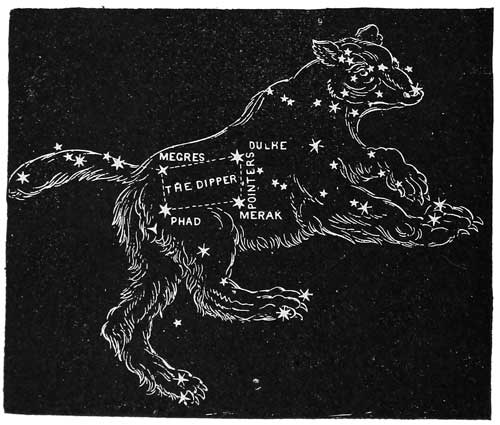
THE GREAT BEAR.
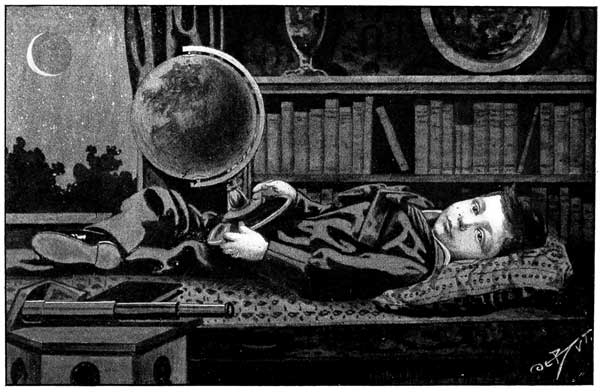
Harry was enjoying the scene, as the doctor had
allowed him to spend the warm summer evenings
out on the lawn in front of the house. This was
a royal treat to him. He could see all the sky at
once, he said to his sister, and could look at the
stars while she told him stories about them. First
of all, there was the Great Dipper in the North,
and the Little Dipper with the Pole Star. He
was surprised when his sister said that the Great
Dipper formed part of the group of stars known
as the Great Bear, and he listened intently while
she related the story as told in olden times by the
Grecians.
"The Great Bear was said to be Calisto, the
beautiful daughter of Lycaon, king of Arcadia.
Juno, the wife of Jupiter, was jealous of Calisto,
and threatened to destroy her beauty. Fearing
that Juno would harm her, Jupiter changed her
into a bear.
"'Her arms grow shaggy and deformed with hair,
Her nails are sharpened into pointed claws,
Her hands bear half her weight, and turn to paws;
Her lips, that once could tempt a god, begin
To grow distorted in an ugly grin;
And, lest the supplicating brute might reach
The ears of Jove, she was deprived of speech.'
"Calisto had a son named Arcas, who became
a great hunter. One day he roused a bear in the
chase, and, not knowing that it was his mother,
was about to kill her, when Jupiter, taking pity
on them both, changed Arcas into the Little
Bear."
"Who was Jupiter?" asked Harry.
"In the olden times, he was supposed to live
on the top of Mount Olympus, with his beautiful
wife Juno. When Jupiter was angry with people,
it is said he would hurl thunderbolts at them, and
when he was pleased he placed them after death
among the stars."
"So he was pleased with Calisto and her
son?" said Harry.
"So the story says," replied Mary. "But he
also seemed to be afraid of his jealous wife Juno.
"A modern Greek legend gives another account
of this constellation or group of stars. It is supposed
that at one time the sky was made of glass
and it touched the earth on both sides. It was
soft and thin, and someone nailed a bear skin upon
it, and the nails became stars; and the tail is represented
by the three bright stars known as the
handle of the Great Dipper.
"Another story is told about a princess who
was turned into a bear on account of her pride in
rejecting all suitors. For this her skin was nailed
to the sky as a warning to other proud maidens.
"Would you like to hear what the Indians tell
about the Great Bear?" asked Mary.
"Indeed I should," replied Harry. "I had no
idea the Indians looked at the stars."
"They spend so much time on the open plains
that they cannot help noticing them," said Mary;
"and they tell many strange legends about
them. The Iroquois Indians tell the following
story about the Great Bear, which must have
seemed like a Bear to them, just as it did to the
Grecians.
"Once upon a time a party of hunters who
were in pursuit of a bear were suddenly attacked
by three monster stone giants who destroyed all
but three of them. These, together with the
bear, were carried up to the sky by invisible
hands. The bear is still being pursued by the
first hunter with his bow, the second hunter
carries a kettle, and the third is carrying sticks
wherewith to light a fire when the bear is
killed. Only in the autumn does the hunter
pierce the bear with an arrow, and it is said
that it is the dripping blood that tinges the
autumn foliage."
"I like that story," said Harry. "Don't you
know another bear story?"
"I can tell you one," replied his sister, "that
is told by the Fox Indians of Louisiana. In the
days of long ago the Indians believed that the
trees were able to walk about at night and talk to
each other. One dark night as a bear was wandering
homeward through a lonely wood, he was
very much surprised to see the trees walking
about, nodding their heads and whispering to
each other.
"At first Mr. Bear thought it was only the
wind; but where he saw a mighty oak before him,
the next moment it was far behind him or on
the other side of the road. Presently he happened
to run against a tree. It was the oak, the
lord of trees. The oak was angry and reached
out one of its long branches and grabbed the bear
by the tail. The bear struggled all night long to
get away, and at last the oak, losing all patience,
gave his tail a final twist and hurled him up into
the sky. They say his tail was stretched in the
struggle."
"That is a funny story," said Harry, enjoying
the account of Mr. Bear. "Are there any stories
about the Great Dipper? I wonder why it is
called the 'Dipper'?"
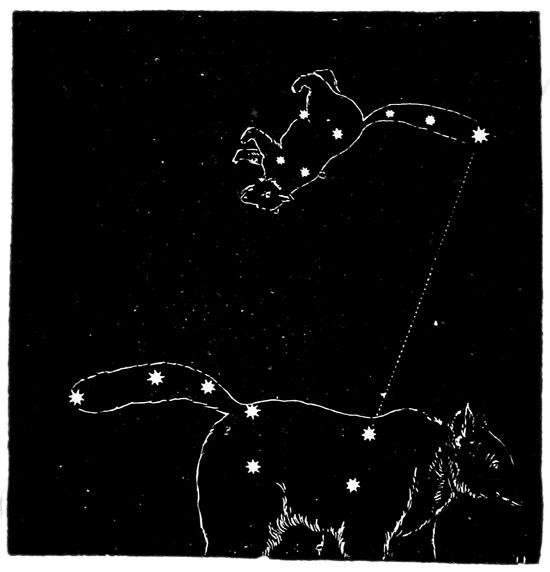
THE GREAT DIPPER AND THE LITTLE DIPPER.
"Because it is supposed to look like a dipper,"
replied Mary. "You can see the four large stars
representing the dipper and the three stars that
form the handle. It is known as the 'Saucepan'
in the South of France, and in other parts of
France it is called the 'Chariot of David.' In
England it is called the 'Plow' and sometimes
'Charles's Wain.' That means wagon. In Italy
it is known as the 'Car of Bootes.' Bootes was
supposed to be an ox-driver and inventor of the
plow—the Dipper. One day the driver, oxen,
and plow were suddenly lifted off the earth and
placed in the sky. You can see Bootes now, and
in front of him are the seven stars of the Great
Dipper, which he must drive around the Pole Star
for all eternity.
"A pretty story is told of a peasant who met
our Saviour near the shores of Galilee and gave
Him a ride in his wagon. As a reward he was
offered a home in heaven; but he preferred to
drive his wagon from east to west for all eternity,
and his wish was granted. There stands his
wagon in the sky, and the brightest of the three
stars is called 'The Rider.'
"In North Germany 'The Rider' is supposed
to start out on his journey before midnight, and to
return twenty-four hours later, his wagon turning
round with a great noise. He urges on his horses
with loud cries of 'hi! he!' which it is said
have sometimes been heard by lucky mortals."
"Hush, sister," said Harry softly; "let us see
if we can hear him now."
"No, you could only hear him at midnight,"
replied his sister—"that is, if the story were true."
"It is only like a fairy story, then?" asked
Harry.
"All these stories are fairy stories," replied
Mary; "and here is another.
"A Basque legend relates that a certain husbandman
had two oxen stolen from him by two
wicked thieves. He sent his laborer after them,
but he did not return. Then he sent his housekeeper,
and his dog, and finally he decided to go
after the thieves himself. He was so angry that
he lost his temper, and in punishment for the remarks
he made he was condemned to continue his
search through the sky for all eternity. There
you can see him now. The two oxen are the first
two stars, then follow the two thieves, and lastly
the two servants, the husbandman, and the little
dog."
"Where is the little dog?" asked Harry.
"Look at the three stars in the handle of the
Dipper," replied Mary. "Now look at the middle
star, and if you have good eyes you can see a little
star close beside it. Here, look through this
opera-glass and you can see it better."
"I see it now," said Harry, as he looked
through the glasses. "So that is the little
dog?"
"Yes," replied his sister; "and the Arabians
gave it the name of Alcor."
"Dear little Alcor," said Harry, as he continued
looking at him, "I am going to look for you
every evening now, because I can see the Great
Dipper from my window."
"So you can," replied Mary; "I forgot that it
faced north.
"The American Indians tell a quaint story about
the Little Dipper. Would you like to hear it?"
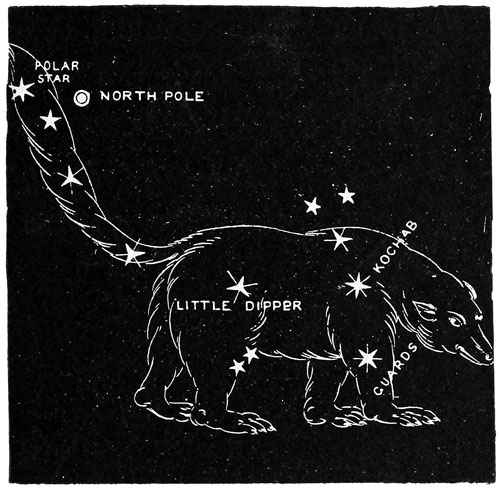
THE LITTLE BEAR.
"If you are not tired, sister," said Harry.
"You will get tired first, for I enjoy telling you
these stories, if they amuse you, dear. Well,
here is one that I came across some years ago
among a collection of Indian legends.
"Once upon a time a party of Indians went out
hunting in a strange country and lost their way.
They wandered about for many moons."
"What does that mean?" asked Harry.
"I suppose they did not know anything about
our months, so they counted from full moon to
full moon. This shows how much they observe
the sky. But, as I was saying, they wandered
about for many moons, and at last the chiefs decided
to hold a council and pray to the gods to
show them the way home. During the dance
that preceded the council, while the flames of
burnt offerings were ascending to the gods, a little
child appeared suddenly in their midst and said
she had been sent as their guide.
"She said she was the Spirit of the Pole Star,
and that if they followed where it led them they
would reach their home in the far North. The
hunters thanked the child, and following her advice
they soon reached home. Here they held another
council, and decided to call the Pole Star, 'the
star which never moves,' by which name it is
known among these Indians to this day.
"When the hunters died it is said they were
taken up to the sky, and we can see them still following
the Pole Star. The hunters are supposed
to be the stars that form the Little Dipper."
"They are smaller than the stars of the Great
Dipper," said Harry, "and the dipper is smaller,
but I can see it quite well. And what are the
stars between the two Dippers?"
"They curve in and out like a great dragon,"
said Mary; "and two bright stars mark its
eyes."
"Yes, it does look something like a dragon,"
said Harry. "What is its name?"
"It is called the Dragon, as that was the name
given to it by the Grecians long ago. This was
supposed to be the dragon that Juno placed as
guardian of a tree covered with golden apples.
No one dared to touch the tree while the dread
monster was there. But a brave man named Hercules
was not afraid, and killed the dragon. To
reward it for guarding the tree Juno placed it
among the stars.
"See the two bright stars that mark the eyes
of the Dragon, and quite close to it is Hercules,
represented in the olden maps as crushing the
head of the dragon under his foot. Bootes, who
drives the Great Bear around the Pole Star, is
very near Hercules. There you can see him, with
his hunting dogs."
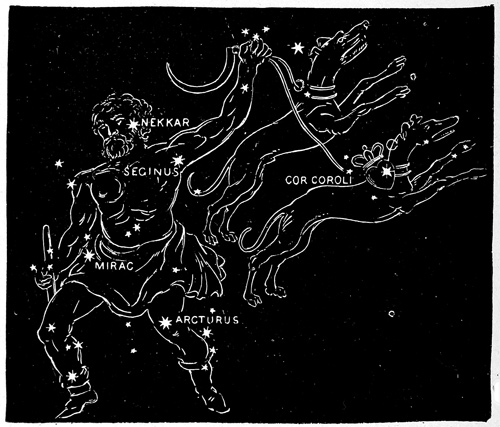
BOOTES AND HIS HUNTING DOGS.
"Where, sister? I cannot see him," said
Harry.
"Look right overhead, and to the west you will
see Bootes with a very bright star; and to the
east is Hercules, or the Kneeler, as he is sometimes
called. Now, in between there is a pretty little
half-circle of stars like a crown. This is called
the Northern Crown."
"I can see that very well," replied Harry, "for
it is exactly overhead, and I cannot help seeing
Hercules and the Bear-driver. They are large
enough," he continued, laughing. "Why are the
little stars called the Northern Crown?"
"This was supposed to be a beautiful crown
of seven stars given by Bacchus to Ariadne, the
daughter of Minos, second king of Crete.
"'Her crown among the stars he placed,
And with an eternal constellation grac'd,
The golden circlet mounts, and as it flies
Its diamonds twinkle in the distant skies.'
"There is a pretty legend told about it by the
Shawnee Indians. They call this group of stars
the 'Celestial Sisters,' on account of the story,
which is as follows:
"White Hawk was a great hunter, handsome,
tall, and strong. One day, while wandering
through the forest in search of game, he suddenly
found himself on the borders of a prairie. It was
covered with grass, and flowers, and a ring was
worn through the grass, without any path leading
to or from it. White Hawk was surprised at
this, so he hid behind some bushes and watched.
"'Soon he heard, high in the heavens,
Issuing from the feathery clouds,
Sounds of music, quick descending,
As if angels came in crowds.'
"Looking up he saw a small speck in the sky
which gradually became larger and larger. It
was a silver basket containing twelve beautiful
maidens, who leaped out as it touched the ground.
They danced around in the ring, beating time on
a silver ball. White Hawk gazed at the fairies in
wonder, and, rushing out from his hiding place,
tried to capture the youngest and prettiest. But
the sisters were too nimble for him, and, jumping
into the basket, they were soon far away in
the sky.
"White Hawk was vexed, but he came again
next day. This time he disguised himself as a
rabbit, but one of the little sisters saw him
creeping toward them. She gave the alarm just
in time for them to escape.
"Next day White Hawk disguised himself as a
mouse, and hid in the stump of a tree that he had
moved close to the fairy ring. The sharp-eyed
little fairy noticed that the stump was not in the
same place, and warned her sisters, but they only
laughed at her. They even ran around it striking
it in fun. Out ran White Hawk, caught the
youngest and prettiest, and took her home as his
bride.
"For a while they were happy, but the 'Celestial
Sister' became homesick, and longed for her
sisters in the sky. One day when White Hawk
was out hunting she made a silver basket and,
taking it to the fairy ring, she stepped into it,
while she sang a magic chant. White Hawk was
returning home across the fields just as the basket
rose above the tops of the trees, and, hearing the
music, he knew what had happened.
"But his wife did not forget him, and her father
sent for him and invited him to come to the sky,
where he is now one of the bright stars shining
near the Northern Crown."
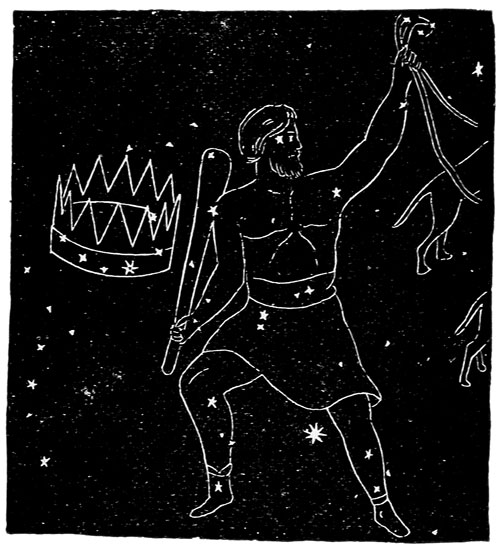
THE NORTHERN CROWN, AND BOOTES, THE BEAR-DRIVER.
"That must be the brightest star in Bootes,"
said Harry. "What is it called?"
"Arcturus," replied his sister. "Near Bootes
is Virgo, the Virgin who lived on Earth during
the Golden Age when people were very good.
Near her are the scales in which she weighed the
good and evil deeds of men."
"Just above the Virgin, in the west, you can
see some stars that look like a sickle," said
Mary.
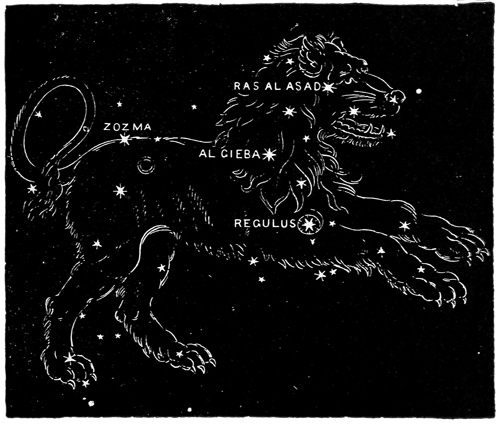
LEO, THE LION.
Harry looked in the direction pointed out by
his sister, and there he saw the sickle plainly
outlined by a few bright stars.
"Is there a story about it, sister?" he asked.
"Yes," replied his sister; "or rather there is a
story not about the sickle, but about the group of
stars to which it belongs, known as the constellation
of the Lion.
"You remember how jealous Juno was, and
she was even displeased with a brave man named
Hercules, because he was afraid of nothing. She
told her cousin to command Hercules to bring
him the skin of a fierce lion that roamed at large
through the forests. Hercules was not afraid, and
attacked the lion. Finding he could not kill it
with his club and arrows, he strangled the animal
with his hands. He returned home carrying the
dead lion on his shoulders, but Juno's cousin was
so frightened at the sight of it and at this proof of
the great strength of the hero that he ordered him
to tell the story of his brave deeds in future at a
safe distance outside the town."
"What a coward Juno's cousin must have
been!" said Harry disdainfully. "I suppose
Hercules laughed at him."
"Of course he did," said Mary. "But he was
not the only brave man Juno disliked. Orion,
the mighty hunter, also aroused her anger because
he boasted that nothing could harm him. She
sent a scorpion out of the earth, and it stung him,
causing his death. See the heart of the scorpion,
marked by a bright red star named Antares.
Above it is the serpent and the serpent-holder."
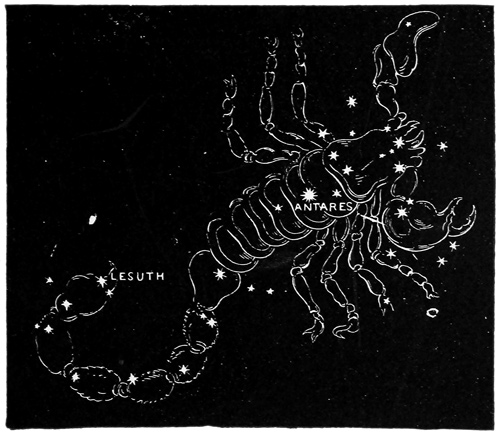
THE SCORPION.
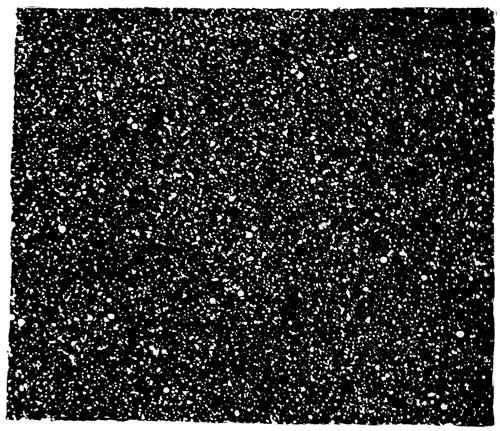
THE MILKY WAY IS CROWDED WITH STARS.
"Now look at the band of silvery light reaching
from the north to the south. That is the Milky
Way, and it is made up of millions of bright
stars. There are large stars and little stars, and
Professor Barnard thinks that there may be some
very small stars forming out of the star-mist.
These little stars glitter in vast beds of glowing
gas. As scientists believe, this gas is the
matter from which worlds and suns are made.
The stars at these points in space seem to be
actually growing out of the star-mist now surrounding
them. I shall show you to-morrow
some fine photographs Professor Barnard has
taken of the Milky Way where you can see
this star-mist in the background of the stars.
"According to a French legend, the stars in
the Milky Way are lights held by angel-spirits to
show us the way to heaven. The Grecians called
the Milky Way the road to the palace of heaven.
On the road stand the palaces of the illustrious
gods, while the common people of the skies
live on either side of them.
"Even the Algonquin Indians had something
to say about it, for they believed that it was the
'Path of Souls' leading to the villages in the sun.
As the spirits travel along the pathway, their
blazing camp-fires may be seen as bright stars.
Longfellow refers to this in his poem 'Hiawatha,'
in describing the journey of Chibiabos to the land
of the hereafter.
"While hunting deer he crossed the Big Sea
Water and was dragged beneath the treacherous
ice by evil spirits. By magic he was summoned
thence, and, hearing the music and singing, he,—
"'Came obedient to the summons,
To the doorway of the wigwam,
But to enter they forbade him.
Through a chink a coal they gave him,
Through the door a burning fire-brand.
Ruler in the Land of Spirits,
Ruler o'er the dead they made him,
Telling him a fire to kindle
For all those who died hereafter,
Camp-fires for their night encampments,
On their solitary journey
To the kingdom of Ponemah,
To the land of the hereafter.'"
"According to a Swedish legend, there once
lived on earth two mortals who loved each other.
When they died they were doomed to dwell on
different stars, far, far apart. But, 'as they sat
and listened to the music of the spheres,' they
thought of building a bridge of light that should
reach from star to star, till it spanned the distance
separating them from each other.
"'They toiled and built a thousand years in love's all-powerful might,
And so the Milky Way was made a bridge of starry light.'
"Now, Harry, look at the Milky Way in the
northern part of the sky, and what do you see?"
asked Mary.
"Some stars that look like a W," replied Harry;
"and just below it is another but larger W."
"The small W is Cassiopeia," said Mary, "and
the large one is Cepheus; but I shall tell you their
story another time, as it is getting late now. Under
the large W, you will see some stars that look
like a large cross. This is sometimes called the
Northern Cross, but it is better known as the
Swan."
"The 'Swan' is supposed to represent a wonderful
musician named Orpheus. Apollo gave him
a magic harp, which he played with such sweetness
that the wild beasts of the forest were tamed by
its sounds, rapid rivers ceased to flow, and mountains
and trees listened to the music.
"One day Orpheus met a beautiful maiden
named Eurydice, and won her for his bride. But
their happiness did not last long, as a serpent
lurking in the grass stung her foot, and she died
of the wound.
"Orpheus mourned her sadly, until at last he
died and his spirit met hers in the kingdom of
Pluto. Afterward Orpheus and Eurydice were
placed among the stars. You can see the harp
beside Orpheus, and it is adorned with a sparkling
blue star named Vega.
"And now one more story," said Mary, as she
heard the church clock chime nine, "and then we
must say 'good-by' to the stars for to-night."
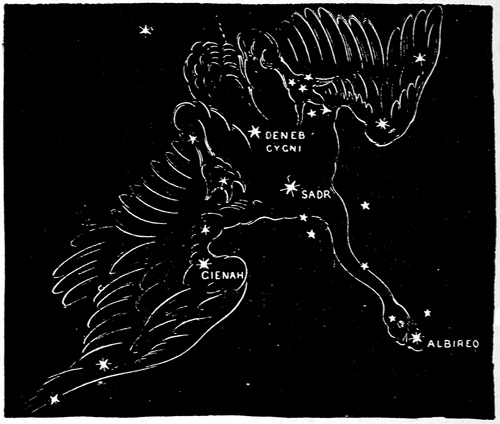
THE SWAN.
"It has been lovely," said Harry. "I could
listen to these stories all night long. How I shall
enjoy the stars since you have told me so much
about them! What are you going to tell me
now?"
"Just under the Swan can you see a bright
star, and a little star on each side of it?" asked
Mary.
Harry looked, and after a few moments he found
them. When his sister had made sure that he
could see the stars she meant, she began her story
as follows:
"The Japanese call the Milky Way the Silver
River of Heaven, and they believe that on the
seventh day of the seventh month (7th of July),
the Shepherd-boy star and the Spinning-maiden
star cross the Milky Way to meet each other.
Vega, the bright star in the harp, is supposed to be
the spinning-maiden, and on the other side of
the Milky Way, crossing over where you see the
bright star and the little star on each side, you
will find the shepherd boy, otherwise known as
the Goat. These stars are known among the
Japanese as the 'boy with an ox' and 'the girl
with a shuttle,' about whom the following story is
told:
"There once lived on the banks of the Silver
River of Heaven a beautiful maiden who was the
daughter of the Sun. Night and morning she was
always weaving, blending the roseate hues of
morning with the silvery tints of evening. That
is why she was called the Spinning maiden. The
Sun-king chose a husband for her. He was a
Shepherd boy who guarded his flocks on the banks
of the celestial stream.
"After meeting him the Spinning maiden
ceased to work, and the bright hues of morning
were left to take care of themselves, while the
silvery tints of evening hung like ragged fringe on
the dark mantle of night. The Sun-king, believing
that the Shepherd boy was to blame, banished
him to the other side of the Silver River, telling
him that only once a year, on the seventh day of
the seventh month, could the Spinning maiden
come to see him.
"The king called together myriads of doves
and commanded them to make a bridge over the
river of stars. Supported on their wings, the
Shepherd boy crossed over to the other side. No
sooner had he set foot on the opposite shore than
the doves flew away, filling the heavens with their
billing and cooing. The weeping wife and loving
husband stood awhile gazing at each other from
afar, and then they separated, one in search of
another flock of sheep, the other to ply her shuttle
during the long hours of daylight.
"Thus the days passed away, and the Sun-king
rejoiced that his daughter was busy again. But
when night comes, and all the lamps of heaven are
lighted, the lovers stand beside the banks of the
starry river and gaze lovingly at each other,
eagerly awaiting the seventh day of the seventh
month. As the time draws near the Japanese are
filled with anxiety. What if it should rain, for
the River of Heaven is filled to the brim, and a
single raindrop would make it overflow! This
would cause a flood, and the bridge of doves would
be swept away.
"But if the night is clear, then the Spinning
maiden crosses over in safety, and meets her Shepherd
boy. This she does every year except when
it rains. That is why the Japanese hope for clear
weather on the 7th of July, when the 'meeting of
the star-lovers' is made a gala day all over the
country."
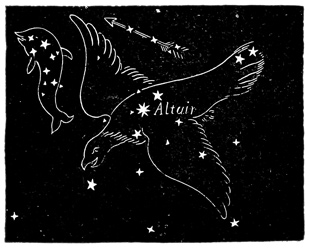
THE EAGLE.
"Sister, I can see the Spinning-maiden star,
and the Shepherd boy, but where is the bridge
of doves?" asked Harry.
"Across the Milky Way," said Mary.
"See the bright star, which is called Altair, and
one little star on each side. We call that the
Eagle, so if you change the story a little you can
say the Eagle takes the Spinning maiden across
the Silver River of Heaven."
When the sky was first made and suspended
From the far and invisible bars,
It enveloped the world, and God fashioned
Small windows, and these are the stars.
And the bits of the sky, through the evening,
Fluttered down to the sod and the dew,
And behold! in the morn they had blossomed,
And these are the violets blue.
Oh, the Summer night
Has a smile of light
And she sits on a sapphire throne;
Whilst the sweet winds load her
With garlands of odor,
From the bud to the rose o'erblown!
But the Autumn night
Has a piercing sight,
And a step both strong and free;
And a voice for wonder,
Like the wrath of the thunder,
When he shouts to the stormy sea!
And the Winter night
Is all cold and white,
And she singeth a song of pain;
Till the wild bee hummeth,
And the warm spring cometh,
When she dies in a dream of rain!
God's presence through the twilight stillness glides,
To spirits vocal—silent to the ear;
He calls by name each fair star where it hides,
And each star brightens, as it answers 'Here!'
Though we too call the stars, they answer not,
They do not softly come like children shy
At a fond parent's calling, for, I wot,
We do not know what names God calls them by.
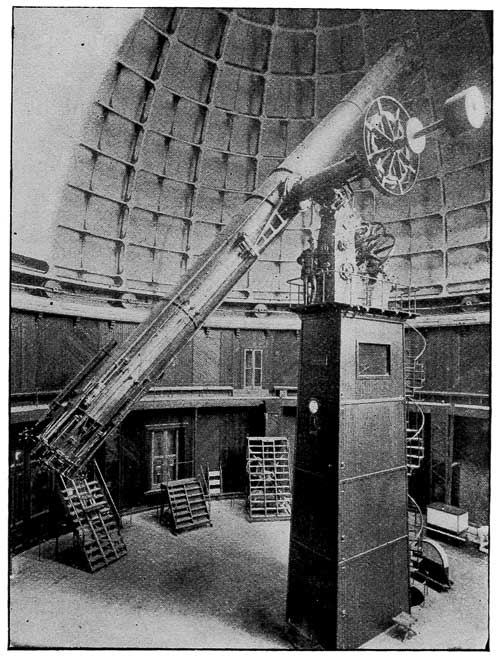
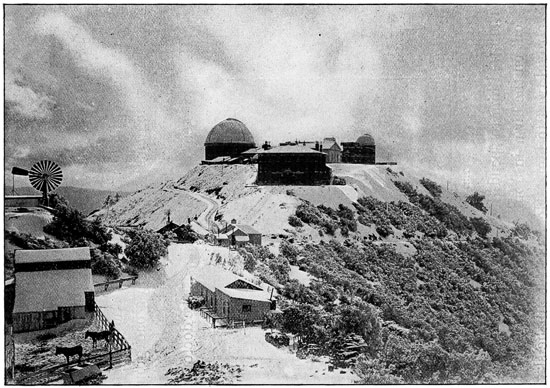
THE GREAT TELESCOPE AT LICK OBSERVATORY.
STORIES OF THE WINTER STARS. — STORY OF THE ROYAL FAMILY. — STORY OF THE FISHES. — STORY OF THE PLEIADES. — STORY OF THE SEVEN LITTLE INDIAN BOYS. — WHY THE STARS TWINKLE. — THE FLOWERS OF HEAVEN. — NUMBER OF THE STARS. — DISTANCE OF THE STARS. — WHAT ARE THE STARS MADE OF? — OUR ISLAND UNIVERSE. — WYNKEN, BLYNKEN, AND NOD. — SEVEN LITTLE INDIAN STARS. — WHY THE STARS TWINKLE.
I heard the trailing garments of the night
Sweep through her marble halls,
I saw her sable skirts all fringed with light
From the celestial walls.
Winter had come with its cold north winds
and frosty air. The stars glittered like gems
against the dark velvet sky, and seemed reflected
in the mantle of pure white snow that covered the
earth. Mary had asked Harry's nurse to move his
couch into her room so that he might see the stars
from the windows, one looking south, the other
east. Impatiently Harry now awaited his sister,
who had promised to take him on another trip to
starland. The room was in total darkness, and
nurse had raised the curtains. Looking right into
one window was the mighty giant Orion, while
the Twins peeped into another.
"It is as good as a play," said Harry, as his
sister started to tell him about them.
"First of all," she said, "I am going to tell you
the story of the Royal Family, although we cannot
see them from this window. You can get a
glimpse of Cepheus from your own room, but the
rest of the Royal Family are overhead. You
would have to make a hole through the roof if
you wanted to watch them while I told their
story."
"If we could go out-of-doors, as we did last
summer, could we see them overhead?" asked
Harry.
"Yes," replied his sister; "but it is too cold
now to look at them except from a warm, cozy
room. To-morrow I shall show you a map of
these stars, and when the days grow warm again
we can look for them in the sky."
"Can you see them during the summer-time as
well as the winter?" asked Harry.
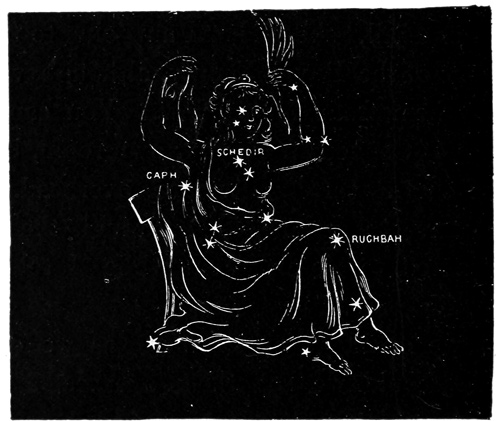
QUEEN CASSIOPEIA.
"Yes, we can see them all the year round, just
as we can always see the Pole Star and the Great
Dipper. The Royal Family consists of King
Cepheus, Queen Cassiopeia, and her daughter
Andromeda, sometimes called the 'Chained Lady.'
Perseus, the rescuer, is at the feet of Andromeda,
while her head rests upon the shoulder of the
winged horse Pegasus.
"The Grecians told a wonderful story about
this family. It appears that Cassiopeia boasted
of her beauty, and said she was more attractive
than Juno, the wife of Jupiter. As for her daughter
Andromeda, not a nymph in the sea could
compare with her in good looks. You may imagine
how Juno and the sea-nymphs felt when
they heard this vain boast!
"They determined to have revenge, and Juno
asked Jupiter to punish Cassiopeia. So she was
sent away from the earth and placed among the
stars with her husband Cepheus.
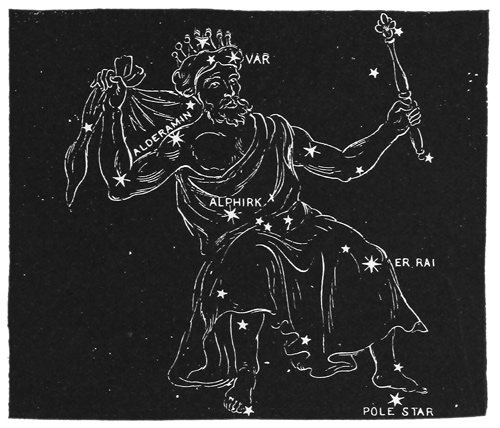
KING CEPHEUS.
"As for Andromeda, the sea-nymphs asked
Neptune to send a sea-monster to devour her.
She was chained to a rock so that she might not
escape this terrible fate; but just as the monster
was approaching a brave hero named Perseus
came to her rescue.
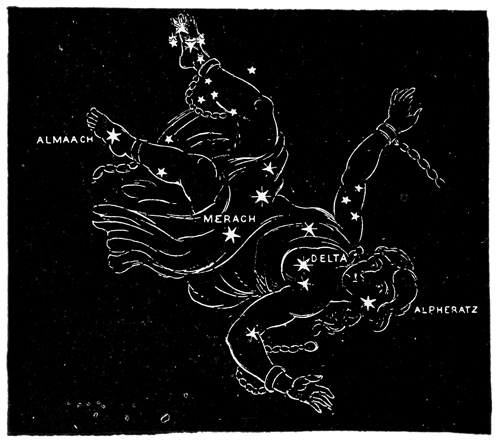
THE FAIR ANDROMEDE.
"Perseus was returning through the air on his
winged horse Pegasus from a terrible encounter
with the Gorgons. These were three sisters who
frightened everyone that saw them. Serpents
were wreathed around their heads instead of hair,
their hands were of brass, their bodies were covered
with scales, and their eyes had the power of
turning all they looked at to stone. Perseus had
cut off the heads of one of these terrible beings,
and when he saw the monster approaching Andromeda,
he turned the head which he still held
in his hand toward it, and in a moment it
turned to stone.
"As a reward for his bravery, he was placed
after his death among the stars, and near the fair
Andromeda. He still holds the head in his hand,
and a star named Algol, or the Demon, as the
Arabs call it, marks the evil eye. Sometimes it is
bright, but in a few hours it will grow dim, as
though winking at the people on earth. For this
reason it is called a variable or changing star."
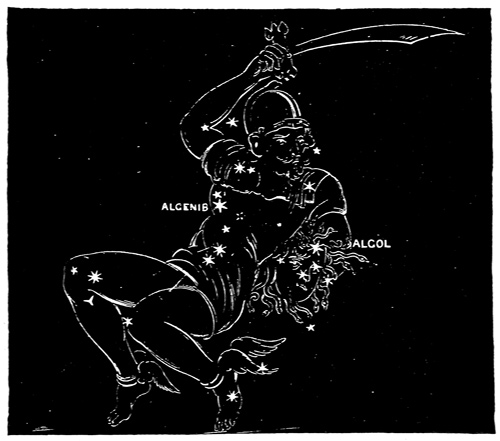
PERSEUS.
"What is that, sister?" asked Harry.
"A star that is brighter one time than another.
Supposing someone kept turning the wick of the
lamp up and down so that at one moment the
room would be very bright and the next moment
quite dim. You would call that a changing light.
So it is with these stars, only in the case of Algol
it is a planet that goes around it and at times cuts
off part of its light. For two days and a half it is
very bright, then during three or four hours it
begins to get dim, and remains so for twenty
minutes and then it gets bright again.
"Supposing you were trying to read by lamplight,
and I should now and then hold a book
between the lamp and you. Each time I did so
the light on your book would grow dim. There
is another variable or changing star named Mira,
in the group of stars called Cetus, which is no
other than the sea-monster which was sent to
devour Andromeda. You can see it if you look
out of the window facing south, and you will
notice that it is at a safe distance from Andromeda,
who is almost exactly overhead just now."
"Not far from the sea-monster are the Fishes,
and the story about them is as follows:
"One day when Venus and her little son Cupid
were walking beside the banks of a river they
were frightened at seeing a terrible giant named
Typhon. Flames flashed from his eyes, and as he
glared at Venus and Cupid they were overcome
with fear and called on Jupiter to help them.
He changed them into fishes, and afterward
placed them among the stars.
"Between Cetus and Orion you can see some
stars winding in and out, and they are part of
the River Eridanus. A daring youth named
Phaeton tried to drive the chariot of the sun
through the sky one day. Jupiter struck him
with a thunderbolt, and hurled him from heaven
into the river below.
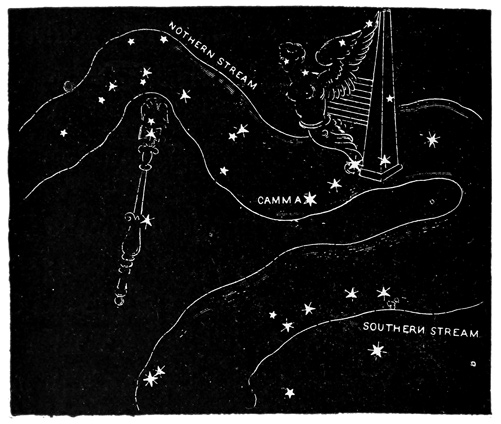
RIVER ERIDANUS.
"'At once from life and from the chariot driven,
Th' ambitious boy fell thunderstruck from heaven.
The breathless Phaeton, with flaming hair,
Shot from the chariot like a falling star
That in a summer's evening from the top
Of heaven drops down, or seems at least to drop.'
"His sisters mourned his unhappy end, and
were changed by Jupiter into poplars, which are
still to be seen on the banks of the River
Eridanus.
"'All the night long their mournful watch they keep,
And all the day stand round the tomb and weep.'"
"Poor Phaeton," said Harry, as Mary finished
the story. "And is that Phaeton with those
three bright stars near the river?"
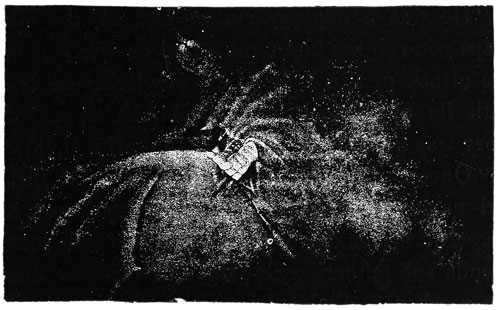
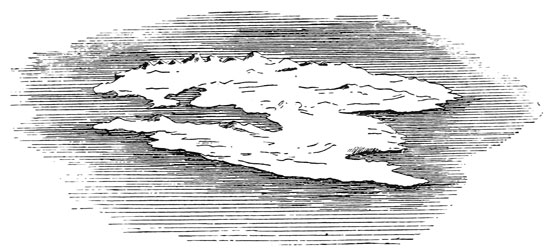
CLOUD OF STAR-MIST IN ORION.
"No; that is Orion," replied his sister, "and
the three bright stars mark his belt. Under it
you can see a small cloud of mist, if you look
at it through your opera glass. It is clinging
around one of the faint stars in the sword. This
is star-mist, from which other stars are being
made, and it looks small only because it is so far
away from us; but there is enough star-dust
there to make thousands of bright stars. Astronomers
called these clouds nebulæ."
"Who was Orion?" asked Harry. "Won't
you tell me more about him?"
"He was a mighty hunter, and in the old
maps you can see him represented as warding off
the attack of the Bull, which is glaring at him
with its bright red eye named Aldebaran. A
story was told by the Grecians about this bull:
"Once upon a time there was a beautiful little
girl named Europa, and she was a princess of
Phœnicia. One day she was playing with some
friends and gathering flowers in a meadow near
the seashore. Suddenly a snow-white bull appeared,
and the little children were very much
afraid. But the princess was not afraid. She
made a pretty garland of flowers and placed it
around the bull's neck. When it knelt down in
front of her as though to thank her, she jumped
on its back, and it ran away with her down to the
sea. Plunging under the waves, it swam with
her to Crete. The Grecians thought they saw
the bull outlined among the stars in the sky, but
only its head and shoulders are there."
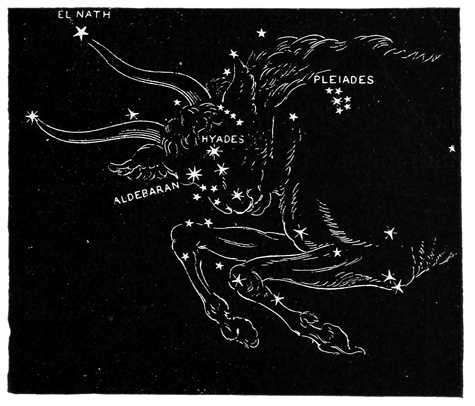
THE BULL, AND THE PLEIADES.
"But there are not any animals really in the
sky, are there?" said Harry.
"No," said Mary, laughing at the question;
"but if you look at the stars you can imagine
you see outlines of bulls and serpents and all
kinds of strange animals. Only you have to
imagine very much, and this is exactly what the
Grecians did.
"In the shoulder of the bull is the pretty little
cluster of stars known as the Pleiades."
"What is a cluster of stars?" asked Harry.
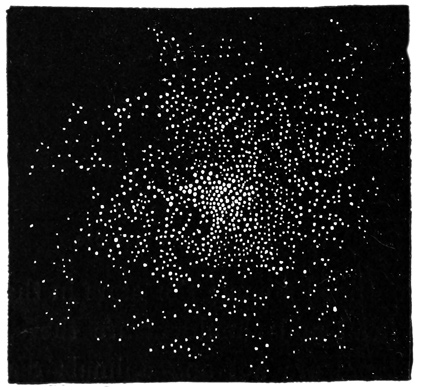
A BALL OF SUNS.
"Hundreds and thousands of stars forming
a family party, as it were; and seen from earth
they seem to be closely packed together. But if
we could draw near to them, however, we should
find that they were very far apart. If you look at
the Pleiades through your opera glass you will
see quite a number of little stars, and if you could
see it through the large telescope at the Lick
Observatory you would be able to count hundreds
of stars. When the cluster had its photograph
taken, not long ago, six thousand stars were
counted, so you might call the Pleiades a 'ball
of suns.' There are hundreds of these clusters,
or 'family parties,' in the sky—mighty regiments
marching across the star-depths."
"What do you mean, sister?" asked Harry in
surprise.
"All the stars are moving," replied his sister.
"Some in one direction, some in another; but
the stars in the Pleiades are all drifting in the
same direction.
"The Pleiades were said to be the seven
daughters of Atlas, and were so beautiful that
Orion pursued them across wood and dale, till the
sisters called on Jupiter to help them. He
changed them into doves, and afterward placed
them among the stars. Orion still seems to be
pursuing them among the stars; but, strange to
say, they are drifting toward him now instead of
away from him."
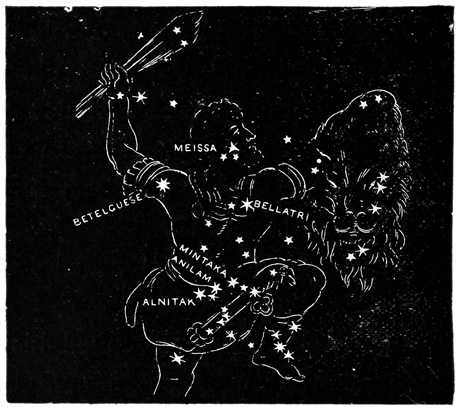
ORION, THE GREAT HUNTER.
"Then he will soon catch them," said Harry,
laughing at the idea. "I once heard something
about the 'Lost Pleiad.' What does that mean?"
"One of the seven stars supposed to represent
the sisters does not shine as brightly as the rest,
so the Grecians called it the 'Lost Pleiad.'
"Some say the Lost Pleiad is Electra, who hid
her face in her hands so that she might not see
the burning of Troy. But she seems to have
recovered from her fright, as her star now glows
as brightly as the rest. Others said it was
Merope, who married a mortal while her sisters
married gods.
"An Iroquois legend accounts for the Lost
Pleiad by saying it is a little Indian boy in the
sky who is very homesick. When he cries he
covers his face with his hands and thus hides his
light."
"Do tell me about him," said Harry, looking
forward to a treat, as he always enjoyed these
Indian stories.
"The story is as follows," said Mary:
"Once upon a time seven little Indian boys
lived in a log cabin in the woods. Every
evening when the stars peeped out of the sky
these children would take hold of hands and
dance around, while they sang the 'Song of the
Stars,' and the stars learned to love them. They
would often beckon to the little boys, inviting
them to come up to the sky; but the children
loved their home on earth too well.
"But one day they found fault with everything.
The oatmeal was too hot at breakfast,
there was an absence of pie at dinner-time; and
the distressing news that they were only to have
corn and beans for supper was a climax to their
'tale of woe.'
"Meanwhile their mother calmly ate her
supper, while her seven little boys looked on in
hungry dismay. When supper-time was over
they filed slowly and sadly out of the cabin.
Their mother felt sorry for them, it is true; but
she knew that if she gave in now she would have
to give in always. She watched her boys as they
danced as usual that evening and sang their
song to the stars; and then she hurried into the
cabin and cleared away the uneaten corn and
beans.
"Alas! she did not hear the song her children
sang to the stars. When the stars beckoned as
usual to the little boys, inviting them to come
up to the sky, they had accepted the invitation.
As they danced round and round their heads and
their hearts grew lighter, and in a few moments
they were soaring like birds through the air.
Just then their mother went to the cabin door to
tell them it was time to come home; and imagine
her horror when she saw her children slowly disappearing
in the sky!
"And now every evening the lonely mother
gazes at seven bright stars in the sky, which she
fondly believes are her seven little boys, but
which are really the seven stars known to us as
the Pleiades. One star in the group does not
shine as brightly as the rest, and this must be one
of the little Indians who is homesick."
"I shall never forget that story," said Harry,
who had enjoyed every word of it; "and now
I wish you would tell me about that very bright
star on the other side of Orion. I can only just
see it, but it is so beautiful. It is bluish-white,
and twinkles so brightly."
"That is Sirius, the brightest star in this part
of the sky," replied Mary, "and ever so much
larger than the sun."
"What makes it twinkle?" asked Harry.
"When we look at the stars we have to see
them through the great ocean of air that surrounds
the earth," replied Mary. "Like the
Atlantic Ocean, when the ocean of air is disturbed
there are waves, and we have to look at the stars
through the waves. That is why their light seems
to dance about so. When the air is still then
the starlight is steady, but when it moves the
stars twinkle. If we could go to the moon,
where there is not any air, we would not see the
stars twinkle."
"Then I should rather stay here," said Harry,
"because I like to watch them dancing about.
They seem so merry, I am sure they are laughing
at us, sister. Is there a story about Sirius?"
"It is part of a group of stars named the
'Great Dog,'" she replied; "and higher up you
will see the 'Little Dog.' These are the hounds
that Orion always took with him when he went
hunting. They seem to have even followed him
to the sky.
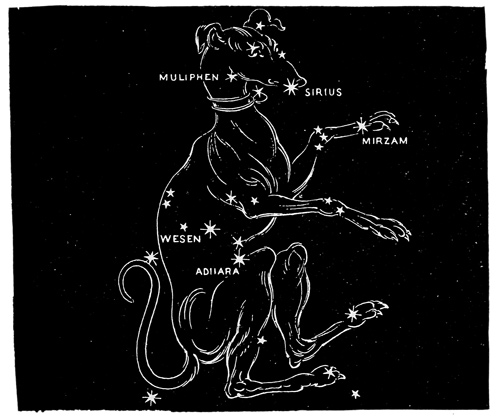
THE GREAT DOG.
"Sirius is also known as the Dog-star, because
when it was seen by the Egyptians in the east
just before dawn it was thought to announce the
overflow of the Nile. Therefore the Egyptians
watched this star, which warned them, like a
faithful dog, of the coming deluge. It was their
watch-dog or sentinel.
"Now I am going to tell you about the Twins,
two brothers who loved each other dearly while
on earth. They were named Castor and Pollux.
Castor was killed in battle. Pollux could not
bear to remain on earth without him, so Jupiter
placed him in the sky next to his brother.
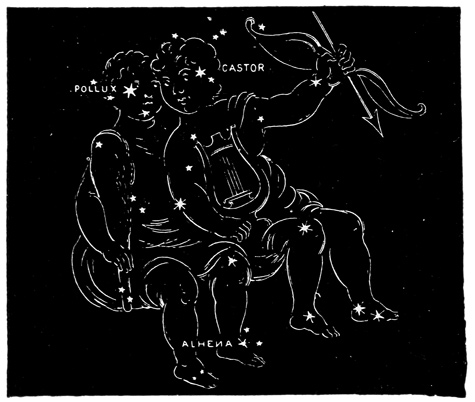
THE HEAVENLY TWINS, CASTOR AND POLLUX.
"If you look through the glass you can see
that Pollux is a golden-yellow star and Castor
has a green tinge."
"Are all the stars colored?" asked Harry.
"Yes," replied his sister, "and they are as
varied in color as the flowers of the earth. The
stars may be called 'The flowers of heaven.'
Longfellow says so beautifully:
"'Silently, one by one, in the infinite meadows of heaven
Blossomed the lovely stars, the forget-me-nots of the angels.'
"Some of the natives of Australia believe that
when the flowers die on earth they rise on the
winds and float away to the fair fields of heaven,
where they flourish forever in immortal beauty.
We cannot see the colors of these flowers of
heaven very well, on account of the air that surrounds
the earth. If it were removed, then the
dark sky would seem to be covered with starry
flowers of all the colors of the rainbow."
"How beautiful!" said Harry thoughtfully.
"How I wish we could see them that way!"
"But even as it is," said his sister, "you can
see some of these colors. Look at white Sirius,
that sometimes seems to me tinged with blue,
and then at red Aldebaran in the eye of the
bull, and a creamy star called Capella just
near the Twins. So you can see some of the
colors. And now a few more words about
Castor, which is a double star. That is, it
is made up of two bright stars, and they go
around each other.
"Professor Ball was once showing the stars
through his telescope to some friends, when he
pointed out this double star to them. First of
all, he told them to note the different colors of
the stars, for one was white, the other green. All
double stars are of complementary colors. One
may be green and the other red, one blue and
the other orange.
"Then Professor Ball told his visitors that the
stars went round each other.
"'Oh, yes!' said one of the visitors. 'I saw
them going round in the telescope.'
"But it was the twinkling that made the stars
appear to dance around each other. In reality,
he would have had to remain with his eye at the
telescope more than a hundred years before he
could have seen the stars go completely around
each other."
"I wonder how many stars there are in the
sky, sister," said Harry. "Do you think we
could count them?"
"I read somewhere," replied his sister, "that
the stars are as plentiful as the sands on the seashore.
Still, in the whole sky, the number bright
enough to be seen without a telescope is only
from six to seven thousand in a clear, moonless
sky. With an opera glass you can bring the
number up to one hundred thousand. A small
telescope can show about three hundred thousand,
while with a telescope such as the one at the
Lick Observatory the number would be nearly
one hundred million. But it is possible to photograph
the stars, and millions of stars have had
their pictures taken. Probably we would never
have known anything about them but the camera
caught them, and now they are being named and
labeled, so that they cannot escape us again. In
fact, some of the stars are so far away that if we
had not captured them in this way they would
have remained hidden to us forever."
"What do you mean, sister?" said Harry, his
eyes filled with surprise.
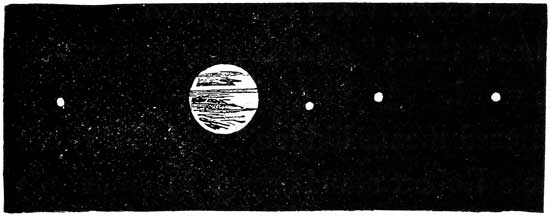
"I mean, dear, that some stars are so far away
that their light has not yet reached us. Don't
you remember what I told you about Jupiter's
moons: that they are so far away that light
takes about half an hour in coming from them to
the earth. Well, the stars are hundreds of times
as far away as Jupiter's moons. So far away are
they that even from the nearest—a star seen in
the southern hemisphere—light takes four years
and four months in reaching us, although light
travels more than 186,000 miles a second."
"Look at the Pole Star some night, and you
will not see it as it is now, but as it was more
than sixty-two years ago. All this time its
light has been on its way to Planet Earth. If
a planet travels around the Pole Star, or Polaris,
as it is sometimes called, and an astronomer on
that planet looked at the earth he would not see
it as it is now, but as it was more than sixty-two
years ago. There are other stars so far away
that light takes hundreds of years in coming
here. Perhaps they faded out long ago, but the
message is still on its way. It does seem strange
to think of people who may be living on distant
worlds in space, watching our little world, but we
need not fear. The earth is so small that it could
not be seen at all, even from the nearest star.
At that distance Giant Sun would not look quite
as bright as Sirius does to us, and giant Planet
Jupiter would only appear as a faint speck of
light near the sun."
"How far away everything seems to be!" said
Harry. "Yet you said just now that we could
tell what the stars are made of. How can we do
that?"
"The stars are made of iron, copper, zinc, and
other such metals, but the heat is so intense that
these metals are turned into vapor. You have
seen the steam coming from the spout of a kettle
when water is boiling, and you know then that
the water is scalding hot. But imagine heat so
great that masses of iron and copper are not only
melted but turned into vapor. Then you have
some idea of the intense heat that prevails on the
stars. The rains that fall on earth are made up
of drops of water, but the rainfalls on the stars
must be drops of melting iron, while the clouds
that form are sheets of molten metal."
"How wonderful!" said Harry; "and how do
we know this, as the stars are so far away?"
"By means of a little instrument known as the
spectroscope, or light-sifter. But you must wait
till you are a little older before I can explain that
to you, as it is something very difficult to understand.
At any rate, I can tell you this, that
when we want to find out what a star is made of
we catch a ray of its light and examine it with
the light-sifter. As Professor Ball quoted in one
of his lectures:
"'Twinkle, twinkle, little star,
Now we find out what you are,
When unto the midnight sky
We the spectroscope apply.'"
"And can you tell how old the stars are?"
asked Harry; "because when you were talking
about the planets you said some are old and some
are young."
"This same little spectroscope tells us that as
well, and we can recognize the stars that are in
their infancy, and others that are middle-aged or
nearly worn-out."
"How strange to think of worn-out stars," said
Harry; "yet I suppose they must grow old sometime,
just as we do; only I suppose they take
ever so much longer growing up."
"Hundreds of years," said Mary, laughing at
the idea of grown-up stars. "There are young
stars and old stars, and even the star that gives
us light and heat will grow cold and dead some
day, and not warm its planets any longer. But
that will be millions of years hence, long after we
are dead and gone."
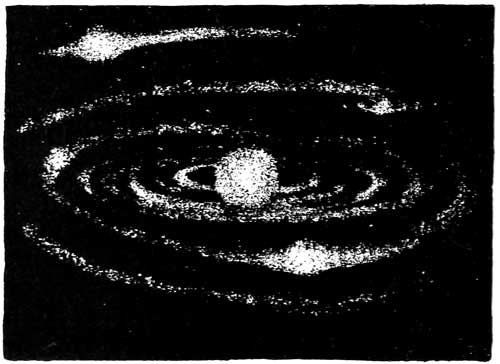
"So it is all over the heavens. Our little universe
is like an island in space. There are other
islands like our own, with their millions of stars
and star-clusters and star-mist, passing through the
periods of youth, middle age, old age, and decay.
Our little universe is not eternal. It cannot last
forever, but as long as it does we should feel glad
that we are here to enjoy it.
"Now, Harry, I really think we have had quite
a long ramble in starland for one evening, and
I believe two little stars I know need a rest."
"They are a little tired," said Harry, smiling;
"two little worn-out stars, sister; and perhaps
they do want to let the curtains down over them
for awhile."
"I believe they do," said Mary softly; and the
stars were hidden by their curtains almost before
she had said the words.
Wynken, Blynken, and Nod, one night
Sailed off in a wooden shoe—
Sailed on a river of crystal light
Into a sea of dew.
"Where are you going, and what do you wish?"
The old man asked of the three.
"We have come to fish for the herring-fish
That live in this beautiful sea.
Nets of silver and gold have we,"
Said Wynken,
Blynken,
And Nod.
The old Moon laughed and sang a song
As they rocked in the wooden shoe,
And the wind that sped them all night long
Ruffled the waves of dew.
The little stars were the herring-fish
That lived in the beautiful sea,
"Now cast your net wherever you wish,
Never afeared are we."
So cried the stars to the fishermen three,
Wynken,
Blynken,
And Nod.
All night long their nets they threw
For the stars in the twinkling foam;
Then down from the sky came the wooden shoe,
Bringing those fishermen home.
'Twas all so pretty a tale, it seemed
As if it could not be.
And some folks thought 'twas a dream they dreamed
Of sailing that beautiful sea.
But I shall name you the fishermen three,
Wynken,
Blynken,
And Nod.
Wynken and Blynken are two little eyes,
And Nod is a little head,
And the wooden shoe that sailed the skies
Is a wee one's trundle-bed.
So shut your eyes while mother sings
Of wonderful sights that be;
And you shall see the beautiful things
As you rock in the misty sea,
Where the old shoe rocked the fishermen three,
Wynken,
Blynken,
And Nod.
BY MRS. S. M. B. PIATT.
Seven little Indian boys were they,
Dancing with the moonbeams on a mound,
In the wind they all were whirled away,
And the fireflies searched the dews around.
Seven little Indian stars are they,
Seven, and only one, my child, is dim.
That's the Singer, their sad stories say;
That's the Singer—let us pity him.
Oh, the little Singer! (You can see
He's not shining as the others are.)
Once, when all the stars made wishes, he
Wished he didn't have to be a star.
—St. Nicholas, March, 1890.
BY OLIVER WENDELL HOLMES.
When Eve had led her lord away,
And Cain had killed his brother,
The stars and flowers,—the poets say,—
Agreed with one another
To cheat the cunning tempter's art
And show the world its duty,
By keeping on its wicked heart
Their eyes of love and beauty.
A million sleepless lids, they say,
Will be at least a warning;
And so the flowers will watch by day,
The stars from eve to morning.
On hills and prairies, fields and lawn,
Their dewy eyes upturning,
The flowers still watch from reddening dawn
Till western skies are burning.
Alas! each hour of daylight tells
A tale of shame so crushing,
That some turn white as sea-bleached shells,
And some are always blushing.
And when the patient stars look down,
On all their light discovers,
The traitor's smile, the murderer's frown,
The lips of lying lovers,
They try to shut their saddening eyes
And in the vain endeavor
We see them twinkling in the skies,
And so—they wink,—forever.
—Taken from The Autocrat of the Breakfast-Table.
"GOD BLESS THE STAR!" — CROSSING THE BAR. — YE GOLDEN LAMPS OF HEAVEN.
"Darling, I am feeling so tired this evening,
won't you sit beside my bed and hold my hand
in yours while you tell me about the stars?"
His sister Mary suggested lighting the lamp
and reading a story, but he held her hand with
gentle force, saying:
"Do not light the lamp. Leave the curtain up
so that I can see the stars from my window, and
tell me in your own words that story you told me
of a star the other day—Dickens' story of a star.
Don't you remember, sister?"
Still holding his little hand in hers, and giving
it a loving pressure, she rested her head on the
pillow beside his, and began, in low soft tones:
"There was once a beautiful bright star that
shone down upon the home of a little boy and
girl who wondered at its light. They learned to
know it so well that every evening the one who
saw it first would say, 'I see the star,' and before
they went to sleep at night they would say
'Good-night' to the star, and, 'God bless the
star!'
"But the little girl, while she was still very
young, became very weak and feeble, so that she
was unable to go to the window and look at the
star, so the brother would stand there alone and
watch for it. As soon as he saw it he would
turn round to his sister, and say, 'I see the star,'
and the little sister would answer gently, 'God
bless my brother and the star!' One evening the
brother looked at the star alone, for his little sister
had passed away to her home among the stars.
That was a sad and lonely evening for the brother,
and at night he dreamed of his sister. Her face
seemed to be looking at him from the bright star,
and he could see a pathway of light reaching from
it to his room.
"Along the pathway were people passing from
this earth to the stars. Angels waited to receive
them, and as they reached the star people came
out to welcome them. Kissing their friends tenderly,
they went away together down avenues of
light. But there was one who waited patiently
near the entrance of the star and asked the guide
who led the people thither if her brother had not
yet come.
"'Not yet,' he replied kindly, and as she turned
sadly away the little brother reached out his arms
toward her, and said, 'Here I am sister; I am
coming to you.'
"As she turned her beaming eyes on him, the
star was shining into the room, and he could see
its rays of light through his tears. From that
hour the child looked on that star as his future
home, where he would some day meet his angel
sister again.
"And he waited, oh! so patiently, and the
years rolled slowly by. He grew to manhood,
and still the star shone down upon him at night.
Then he grew to be an old man with gray hair
and wrinkled face, and his steps were slow and
feeble. Others had gone before him to the star.
A little brother who died while he was young—his
mother—his daughter—and now surely his
own time had come.
"One night he lay upon a bed of sickness, and
as his children gathered around him he suddenly
cried out, as he had long ago, 'I see the star.'
Then they whispered to each other, 'He is dying,'
and he heard them, and said: 'I am. My age is
falling from me like a mantle, and I move toward
the star as a child. And, O my Father, now I
thank thee that the star has so often opened to
receive those dear ones who await me!'
"And next day the star was shining, and it
still shines, upon his grave."
Harry had been lulled to sleep by the sound of
his sister's voice, and in the dim light Mary could
see that he was smiling in his dreams. Were his
dreams, she wondered, about Stories of Starland?
Sunset and evening star,
And one clear call for me!
And may there be no moaning of the bar,
When I put off to sea.
But such a tide, as, moving, seems asleep,
Too full for sound and foam,
When that which drew from out the boundless deep
Turns again home.
Twilight and evening bell,
And after that the dark!
And may there be no sadness of farewell,
When I embark.
For tho' from out our bourne of Time and Place
The flood may bear me far,
I hope to see my Pilot face to face
When I have cros't the bar.
Ye golden lamps of heaven, farewell,
With all your feeble light;
Farewell, thou ever-changing Moon,
Pale empress of the Night.
And thou, refulgent Orb of Day,
In brighter flames arrayed;
My soul, that springs beyond thy sphere,
No more demands thine aid.
Ye stars are but the shining dust
Of my divine abode,
The pavement of those heavenly courts
Where I shall reign with God.
Father of eternal light
Shall there his beams display,
Nor shall one moment's darkness blend
With that unvaried day.